/
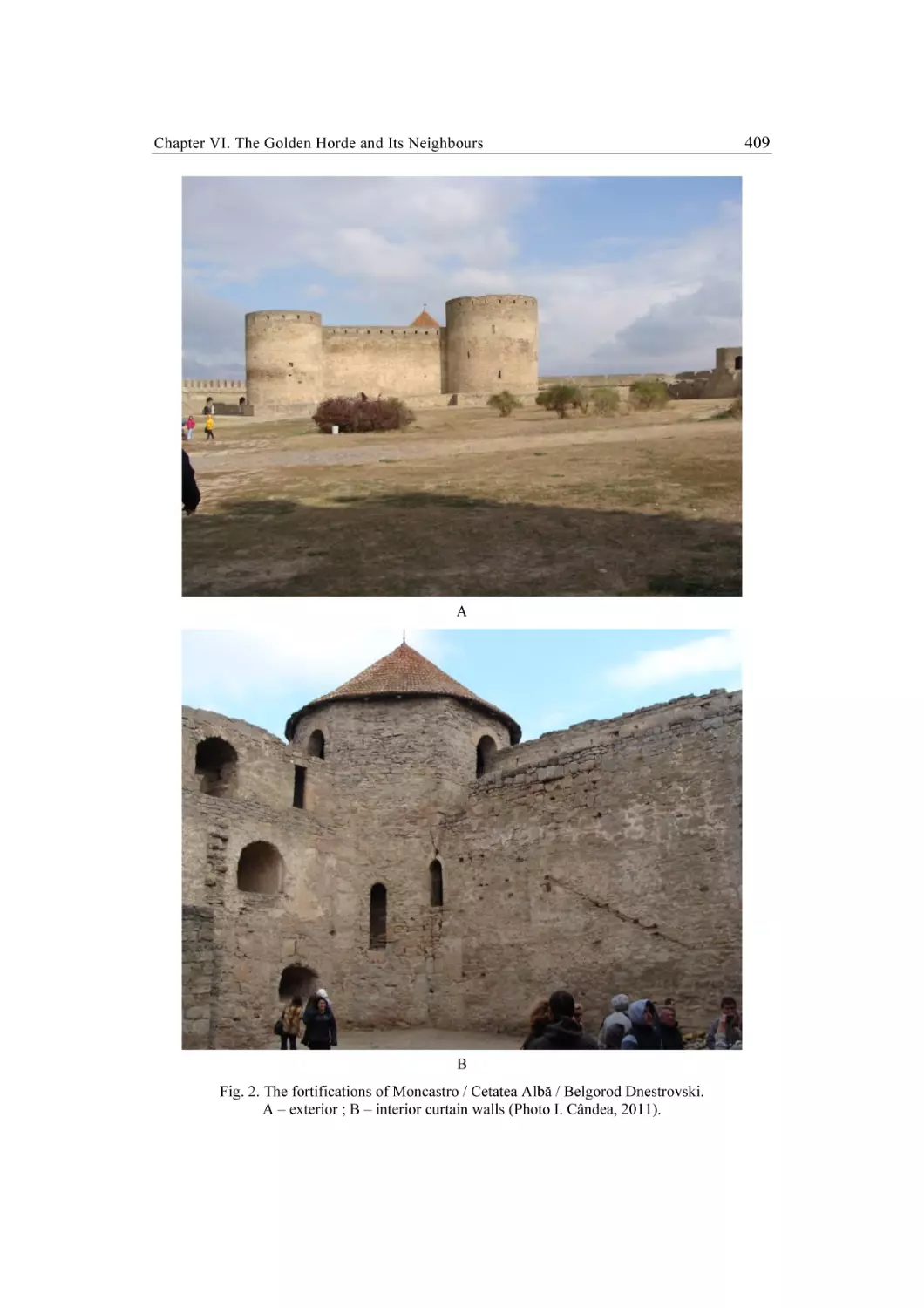
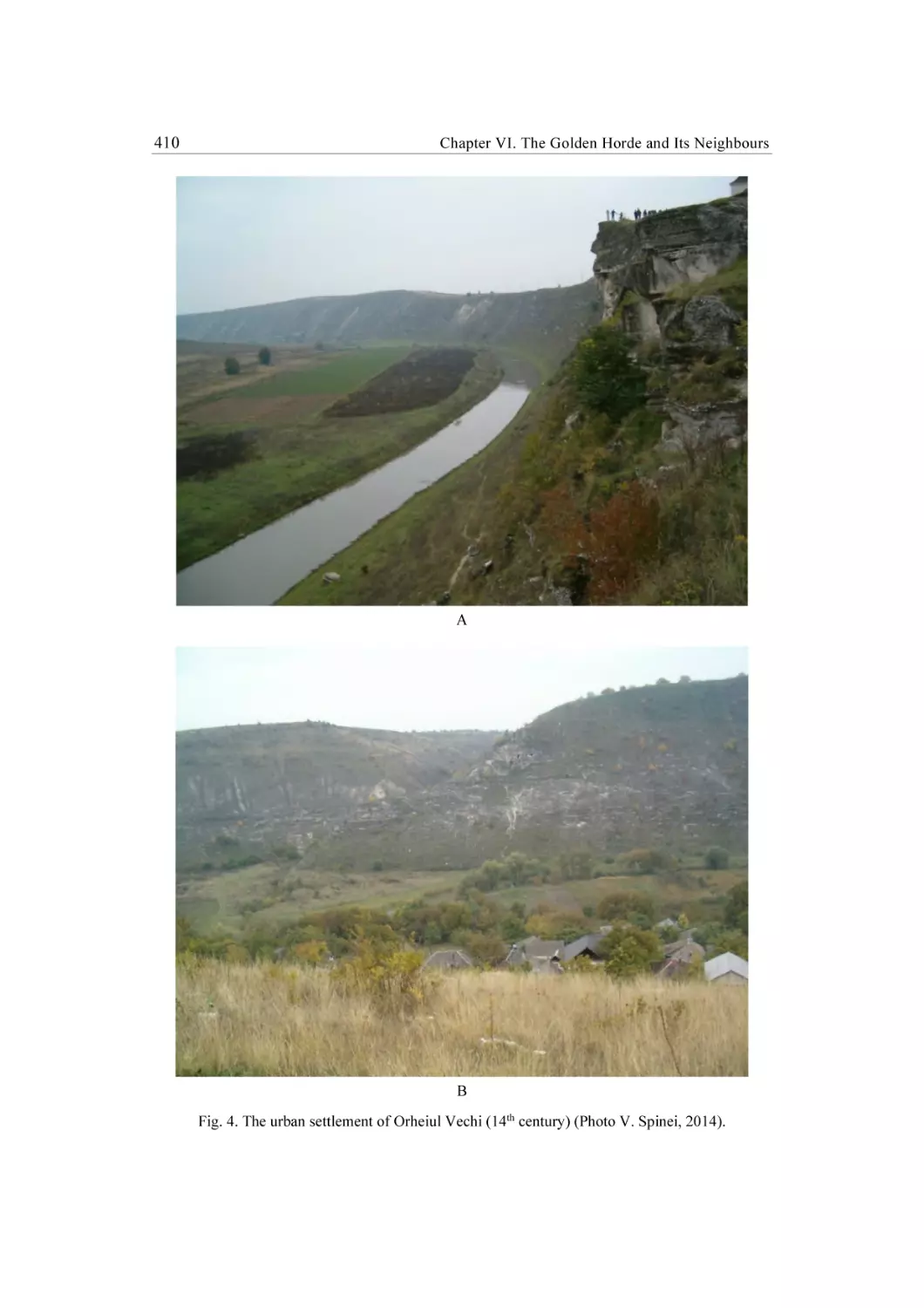
Автор: Khakimov Rafael Favereau Marie
Теги: world history golden horde
ISBN: 978-5-94981-254-9
Год: 2017
Текст
SH. MARJANI INSTITUTE OF HISTORY
OF THE TATARSTAN ACADEMY OF SCIENCES
UNIVERSITY OF OXFORD
THE GOLDEN HORDE
IN W ORLD H ISTORY
Kazan 2017
UDC 93/94
BBC 63.3
T ar tar ia Ma gn a Ser ies
Managing Editors of the Original Edition: Rafael Khakimov, Marie Favereau
Research Adviser of the Original Edition: Vadim Trepavlov
Editors in Chief of the Original Edition: Ilnur Mirgaleyev, Roman Hautala
Project Coordinator of the Original Edition: Ilnur Mirgaleyev
Editorial Board of the Original Edition:
Rafael Khakimov, Doctor of Historical Scien- Charles J. Halperin, Ph.D. in History (Bloomingces, Vice-President of the Academy of Sciton, USA)
ences of the Republic of Tatarstan, Member Ilya Zaitsev, Doctor of Historical Sciences
of the Tatarstan Academy of Sciences
(Moscow, Russian Federation)
(Kazan, Russian Federation)
Mark Kramarovsky, Doctor of Historical SciIlnur Mirgaleyev, Candidate of Historical Scienences (Saint Petersburg, Russian Federaces (Kazan, Russian Federation)
tion)
Marie Favereau, Ph.D. in History (Oxford, Nicola Di Cosmo, Ph.D. in History (Princeton,
Great Britain)
USA)
Vadim Trepavlov, Doctor of Historical Scien- Nikolay Kradin, Doctor of Historical Sciences,
ces (Moscow, Russian Federation)
Corresponding Member of the Russian
Roman Hautala, Ph.D. in History (Oulu, FinAcademy of Sciences (Vladivostok, Rusland)
sian Federation)
Uli Schamiloglu, Ph.D. in History (Madison, Dariusz Kołodziejczyk, Dr.Sci. in History
USA)
(Warsaw, Poland)
István Vásáry, Dr.Sci. in History, Corresponding Anton Gorsky, Doctor of Historical Sciences
Member of the Hungarian Academy of Sci(Moscow, Russian Federation)
ences (Budapest, Hungary)
The Golden Horde in World History. A Multi-Authored Monograph. – Kazan:
Sh. Marjani Institute of History of the Tatarstan Academy of Sciences, 2017. –
968 p. + 28 p. with colour insert.
ISBN 978-5-94981-254-9
This monograph presents research into the history of the Golden Horde that represents its role in
world history, and contains key contemporary studies by leading scholars from the Russian and foreign
academic centres.
The cover design features the image of ‘Mounted Batyr’, which belongs to the brand ‘Cultural
and historical heritage of Tatarstan’.
ISBN 978-5-94981-254-9
UDC 93/94
BBC 63.3
© Институт истории им. Ш. Марджани АН РТ, 2016
© Sh. Marjani Institute of History of the Tatarstan Academy of Sciences,
English translation, 2017.
3
Foreword
Rafael Khakimov
Full-scale research on the Ulus of Jochi (the Golden Horde) did not begin until as recently as the 1990s, when ideological restrictions imposed by the government were finally lifted.
This primarily concerned the Resolution on the State and Measures for Improving Political
and Ideological Awareness Raising in the Tatar Party Organization by the Central Committee
of the All-Union Communist Party (Bolsheviks), dated 1944, which prohibited studies on the
history of the Golden Horde and Tatar khanates, as well as any popularisation of the epic
‘Edigü’. The Falsification of Tatar history was remarkably crucial to the success of Soviet
policy. It was during the height of the WWII, with all of the country's resources already tied
up, and long before the conquest of Berlin that the government found it necessary to prohibit
research on the Golden Horde. Stalin believed Tatar history to be as important as achieving
victories on the front. This ideology was designed to confine Tatar history to covering local
events in the Volga Region and presenting the Tatars as descending from the Volga Bulgars,
known for their heroic resistance to the Tatar-Mongol invasion. But at the same time, Tatars
also acquired a negative image as Asians who had interrupted the natural course of Russian
history. These doctrines was powerful enough to give rise to a Bulgarist political movement
to rename Tatars to Bulgars and Tatarstan to Volga Bulgaria. The most zealous of its advocates wanted passports stating ‘Bulgar’ instead of ‘Tatar’ as their nationality, and would also
register as Bulgars, not Tatars, during censuses. Ultimately, it was Perestroika that brought
about a decline in Bulgarist activities, and nowadays the movement is seen as a rather exotic
rudiment of the Soviet era when historical myths ran rampant.
The turbulent political events of the 1990s stirred up the public, causing a surge in Tatar
self-awareness, and Perestroika lifted the restrictions on research regarding the Golden Horde
and Tatar khanates. This signaled the end of governmental ideological control. Academic
institutions independent of the Russian Academy of Sciences were thus established in Tatarstan, while the Russian academic community endured the time of turbulence without any
real interest towards Tatar history. Moreover, a number of Russian historians advocated for an
unbiased approach to the Golden Horde.
After state sovereignty of Tatarstan was declared in 1990, followed by the bilateral agreement on the division of powers between Kazan and Moscow in 1994, Tatarstan enjoyed an economic and cultural upswing. Borders were opened, international connections to academic centres were consolidated, and now that the republic was engaged in extensive foreign relations,
self-consciousness of Tatars and Tatarstan's inhabitants was growing stronger every day. Tatars
wanted an unbiased history for themselves, as textbooks and periodicals continued to be printed
with barbaric images of their people, still presenting the Golden Horde as a source of savagery,
humiliation to the Russians and a threat to Europe as a whole. A number of Russian politicians
even tried to promote the Battle of Kulikovo to the status of a Russian national holiday, which
was promptly prevented by Tatarstan's government.
It was under these circumstances that large-scale research began on the Golden Horde,
the first major milestone of which was The International Scientific Seminar titled ‘Source
Studies on the History of the Ulus of Jochi (the Golden Horde). From Kalka to Astrakhan.
1223–1556’ on June 23–26, 1998. [3]. In later years it was followed by a series of conferences that eventually transformed into the ‘Golden Horde Forum’, a regularly held conference. The varied and diverse approaches to issues related to the Golden Horde ultimately
yielded the dedicated volume titled ‘The Ulus of Jochi (Golden Horde). 13th Century–Mid–
4
Foreword
15th Century’ (Editor In Chief: Professor Mirkasym Usmanov) in the seven-volume History
of the Tatars since Ancient Times [1]. Together with Volume 4, titled ‘Tatar States (15–18th
Centuries)’ [2], it formed a detailed depiction of the development, prosperity, and decline of
the Golden Horde and the history of the post-Golden Horde territory. The Center for Research
on the Golden Horde and Tatar Khanates in the Sh. Marjani Institute of History, the Golden
Horde Review journal, and yearly periodicals including The Golden Horde Civilisation,
Golden Horde Numismatics, and Medieval Turkic-Tatar States have done their duty to promote academic connections to leading research centres in Russia and around the world to find
solutions to various issues in the history of the Golden Horde. This current multi-authored
monograph serves as the culmination of years of international academic research.
1. Istoriya tatar s drevneyshyx vremyon v semi tomax (History of the Tatars since Ancient
Times in Seven Volumes). Volume 3. Ulus Dzhuchi (Zolotaya Orda) XIII–seredina XV v. (The
Ulus of Jochi (Golden Horde). 13th Century–Mid–15th Century.) Kazan: Institut Istorii im. Sh.
Mardzhani Akademii Nauk Respubliki Tatarstan, 2009. 1055 p.
2. Istoriya tatar s drevneyshyx vremyon v semi tomax (History of the Tatars since Ancient
Times in Seven Volumes). Volume 4. Tatarskie gosudarstva. XV–XVIII vv. (Tatar States (15–
18th Centuries). Kazan: Institut istorii im. Sh. Mardzhani Akademii Nauk Respubliki Tatarstan,
2014. 1080 p.
3. Istochnikovedenie istorii Ulusa Dzhuchi (Zolotoj Ordy'). Ot Kalki do Astraxani (Source
Studies on the History of the Ulus of Jochi (the Golden Horde). From Kalka to Astrakhan). 1223–
1556. Kazan: ‘Master Line’, 2002. 432 p.
* * *
Marie Favereau
During the rule of the Golden Horde, multiple regions and the heterogeneous population
of Central Asia were for the first time integrated into a political unit. Like most empires, the
Golden Horde was made up of composite part of diverse cultures. It was home to various
religious communities, not only those who co-existed, but cooperated and traded with each
other as well, which caused an unprecedented intensification of mutual exchange, especially
in the Volga Region central to the Golden Horde. The Golden Horde influenced the commercial expansion of the mid 13–mid 14th centuries immensely, its economic and political rule
promoting the globalisation of the Old World to quite a remarkable extent.
Historians have thoroughly shown the phenomenal trade boom following the Chinggisid
conquest which encompassed transformative effect on Eurasian human society and the cultural landscape. What is known as the Fur Road joined up with the Silk Road in the Lower Volga Region to form the beginning of two key routes: the eastern route leading through Central
Asia to China and India and the western one through the Crimean Peninsula to the Mediterranean and Middle East. The Golden Horde served as the arena for the unfolding of this dramatic exchange, and Jochid khans and begs played a crucial role in the new international order. Quite naturally, this was a period of prosperity for cities and settlements in the Volga
Region and the Crimea, as well as along the steppe arterial route connecting Siberia and Hungary. The conversion of the nomadic elite to Islam made khans' courts central to the Islamic
world, and the Ulus of Jochi welcomed traveling scholars and craftsmen from Anatolia, Central Asia, Egypt and Syria.
The political structure of the Golden Horde largely determined the political, economic
and cultural map of today's Eurasia. Scholars have in fact been able to study the unique way
in which Islam brought people together on the foundations of unity and social integrity, thus
Foreword
5
forming both a public life and a collective memory by effectively combining Shamanistic
practices with local Sufism. The history of the Tatars and other communities in Central Asia
date back to the time when Berke Khan and Öz Beg Khan converted to Islam. Many Muslim
communities in the Russian Federation of today can trace their history back to that period.
Indeed, Islamisation is a key element in the Golden Horde's legacy.
The Golden Horde is part of the common heritage of mankind, as it created the very
framework for the new sophisticated culture of the 13–14th centuries due to interactions between the nomadic and sedentary worlds. Although Western scholars did not admit the importance of this notion until recently, the Russian-speaking academic community has long
been aware of the unique nature of the Golden Horde's legacy. It has been of great interest not
only to historians but also to archaeologists, art historians, and numismatists across the Russian Federation, especially in Tatarstan. Their works, statements, and findings have transformed research on the Golden Horde into a full-fledged field of academic interest. Western
experts would do well to better familiarise themselves with studies of this type. To a certain
extent, history textbooks in the USA, Great Britain, France, and Europe as a whole should
provide coverage of the Golden Horde as a historical period. Global history must always be
taught through a non-European lens to ensure a more integrated approach to our common
past, without which we cannot but fail to understand the historical roots of today's globalised
world. However, it is no less critical that historiographic debates and concepts developed by
historians across the world should be taken into account for current research on the Golden
Horde.
In fact, ‘world’ is a category of global history that historians have lately started to identify as a concept with multiple meanings extending beyond that of a mere empire. Indeed, empires and kingdoms were not isolated, but instead dependent on the larger world. Contemporary global history is meant to define these worlds and in turn clarify their mechanisms. The
Golden Horde survived the dissolution of the Mongol Empire to grow stronger and exert influence on the rest of the world, which includes states that succeeded the Mongol Empire in
China, Afghanistan, India, Persia, and Anatolia, as well as Byzantium, Rus', Europe and the
Middle East. Extensive contact all the way from the Mediterranean to the Caspian Sea and
even up to China suggest that the Ulus of Jochi had close ties to the larger world. Thus, it
would be a mistake to view the history of the Golden Horde as separate from more overarching formative global phenomena.
Nationalist historiography tends to pervert history in order to produce and promote cliches that serve their needs exclusively. For modern historians, the most important task is to
dismiss and dismantle the misnomer ‘Mongol-Tatar Yoke’, instead promoting research on the
following very vital issues: How should we understand the concept of general history when it
extends beyond today's nations?' And what is the Golden Horde's role and legacy in world
history in this respect?
The multi-authored monograph ‘The Golden Horde in World History’ offers a number
of answers to these most crucial questions. It serves the purposes of presenting the findings of
innovative research hardly known beyond a small group of experts to a wider academic community, and likewise integrating the findings into a more general view of global history. This
work combines different approaches and issues not only for a comprehensive presentation of
the current state of research, but also to single out the most promising areas of study and make
the public aware of the most promising developments. This new comprehensive summary
resulted from the cooperation between leading scholars from such outstanding academic institutions as the Sh. Marjani Institute of History of the Tatarstan Academy of Sciences, the University of Oxford, and the Institute of Russian History of the Russian Academy of Sciences.
I would furthermore like to express my deepest gratitude to those who were able to turn
this ambitious project into the impressive and fundamental multi-authored monograph it is
6
Foreword
today: Rafael Khakimov, Ilnur Mirgaleyev, Roman Hautala, and Vadim Trepavlov. Due to
the unbelievable vigor of our colleagues from the Sh. Marjani Institute of History of the Tatarstan Academy of Sciences and its Centre for Research on the Golden Horde and Tatar
Khanates, Kazan has received recognition as the ideal work location for historians, archaeologists, and numismatists studying the Golden Horde and open to comparative approaches. To
understand the world of the Golden Horde between Asia, Europe, and the Middle East requires a healthy dialogue between the experts of different fields. Multi-authored international
works are necessary to both extend and develop complex areas of study; the writing of history
is essentially collective and thus benefits immensely from cooperation among academic institutions, especially beyond the confines of a singular state. The present international monograph presents the findings of studies by leading experts on the history of the Golden Horde
and the most recent concepts of global history.
* * *
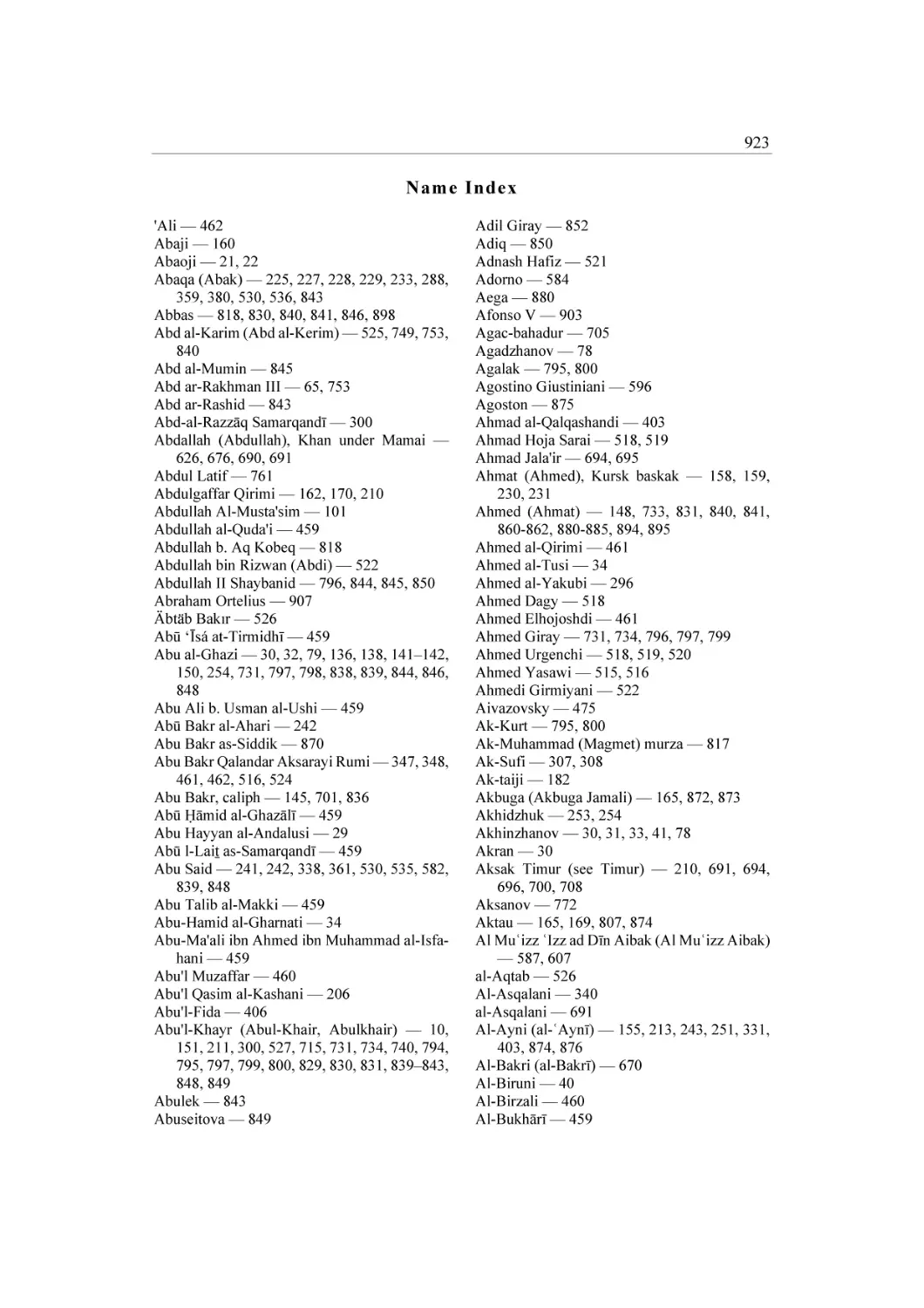
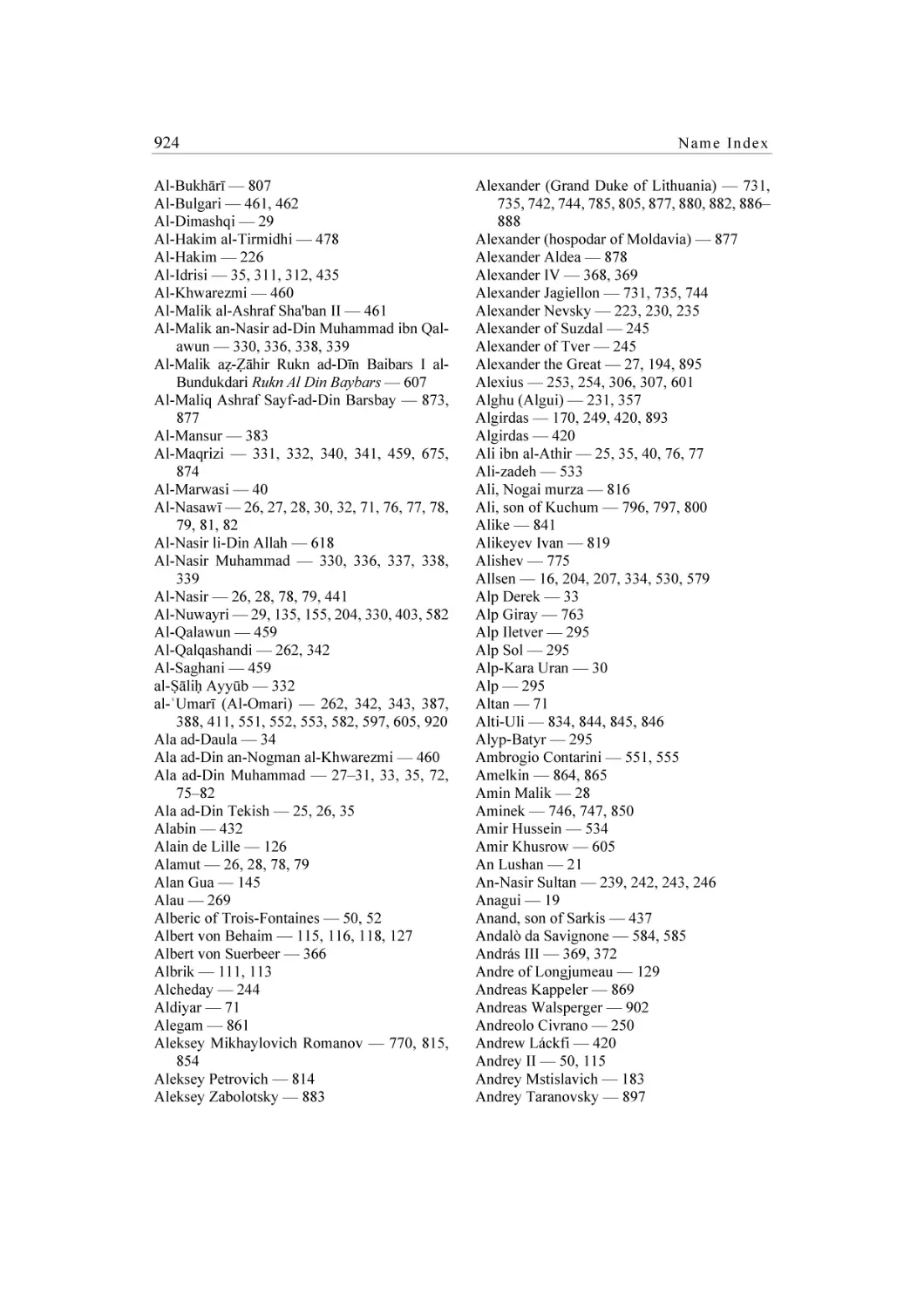
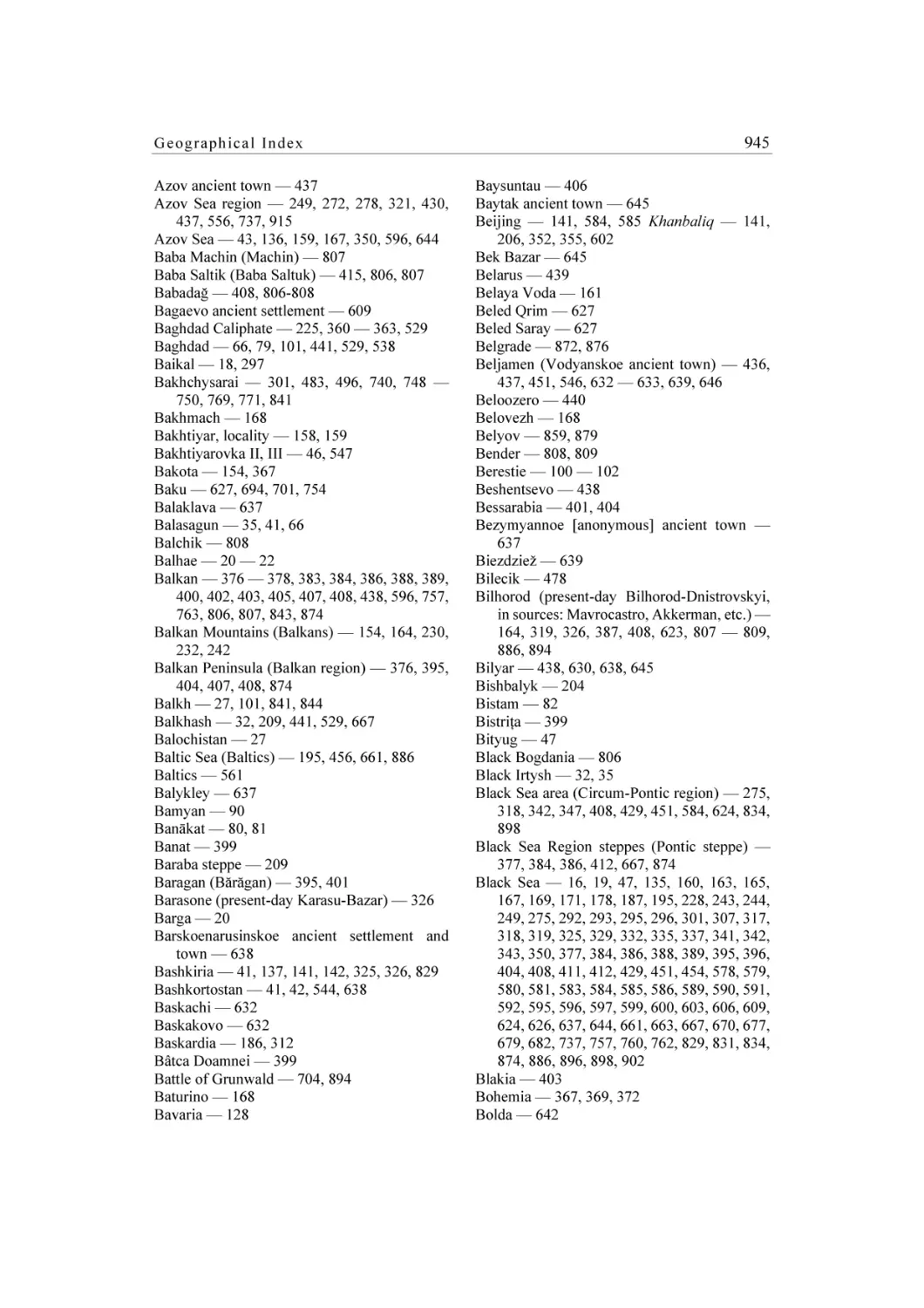
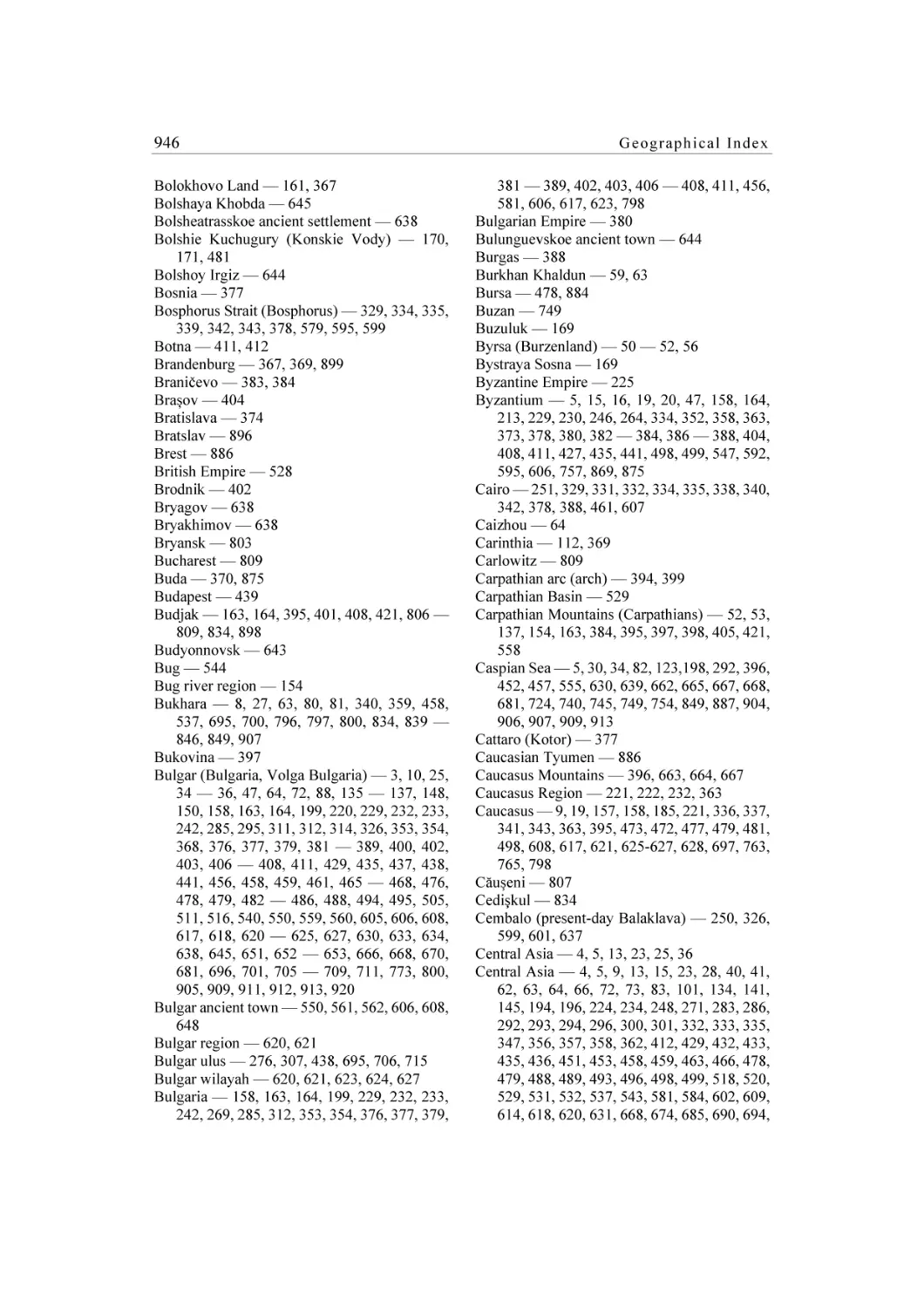
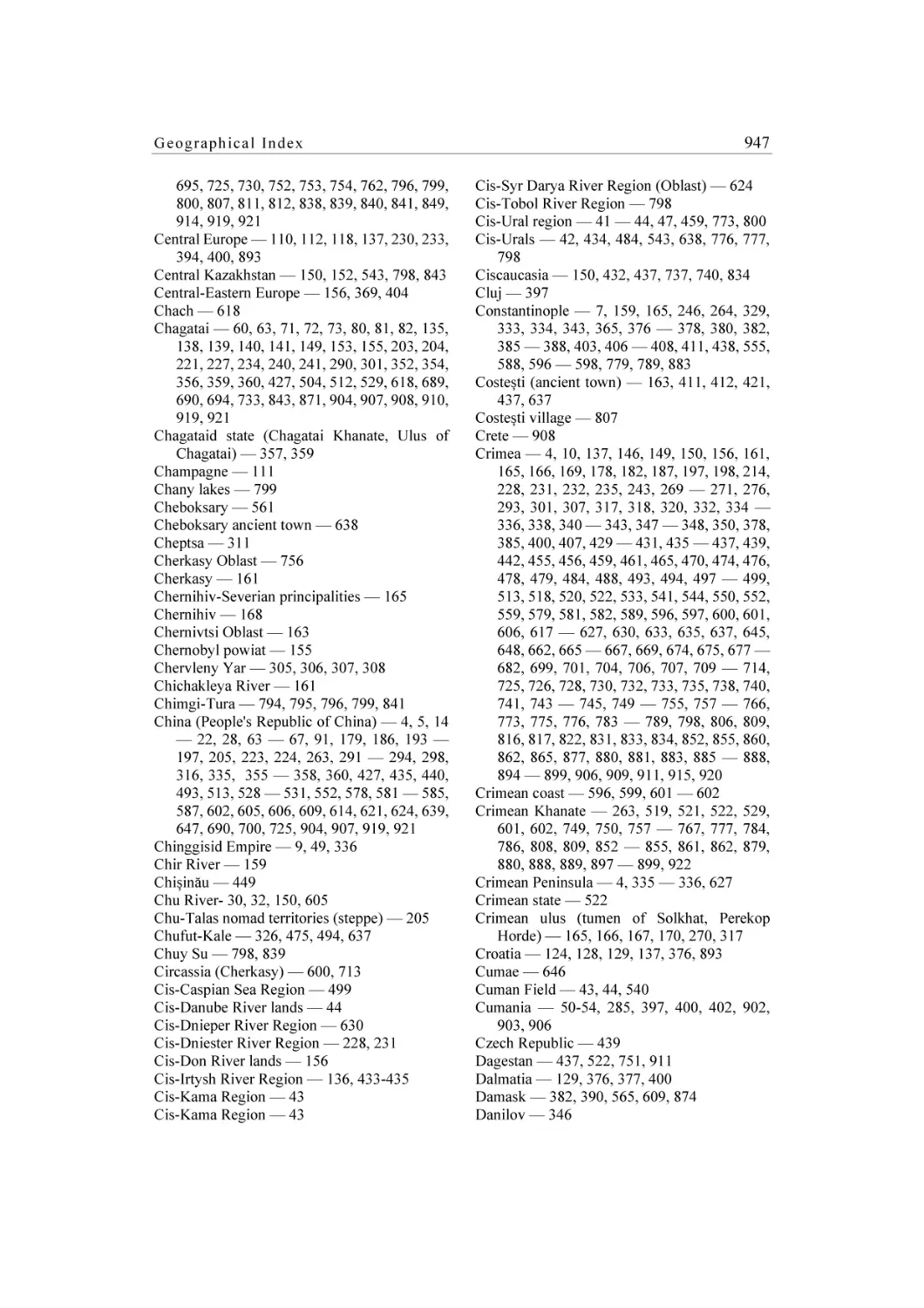
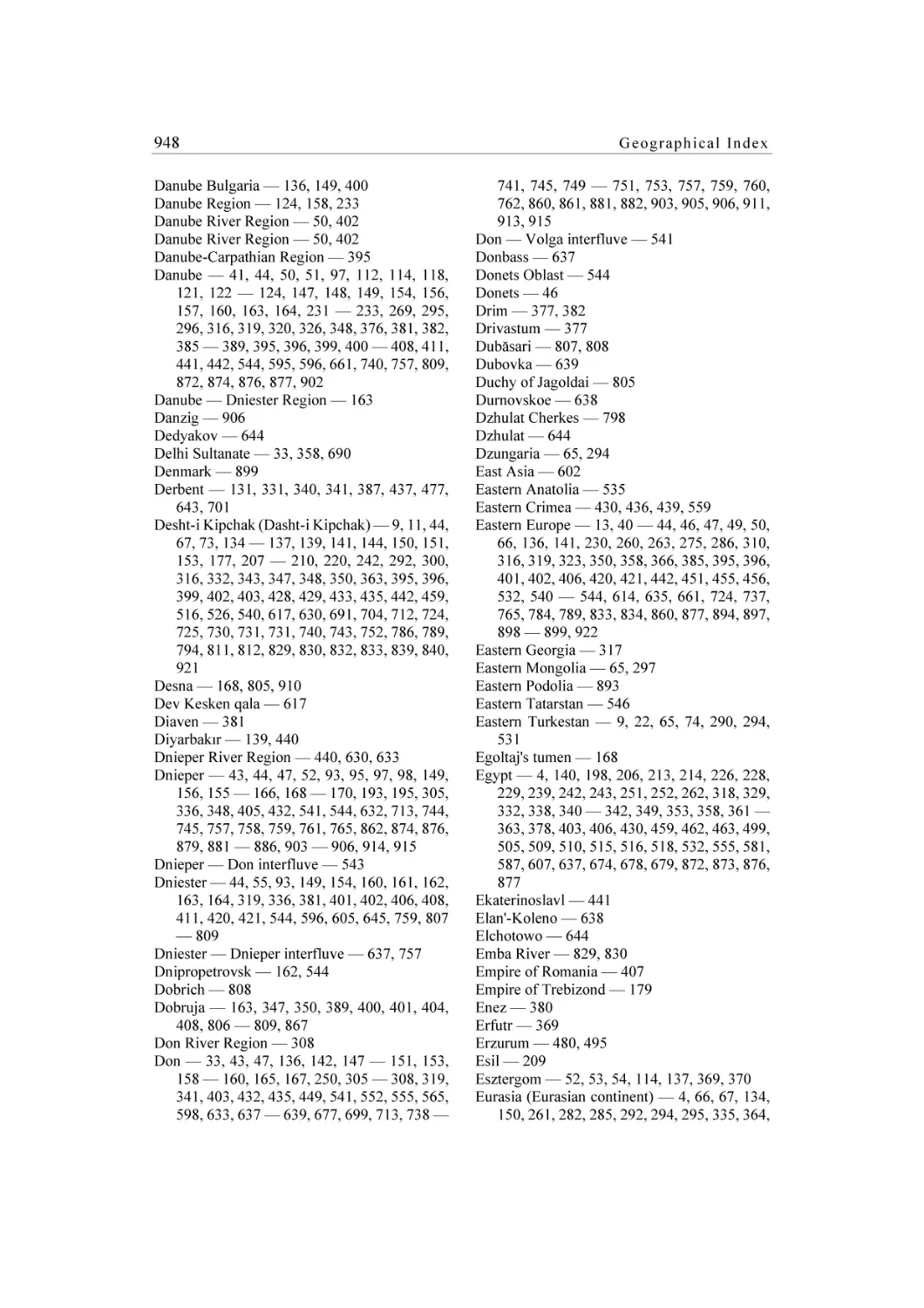
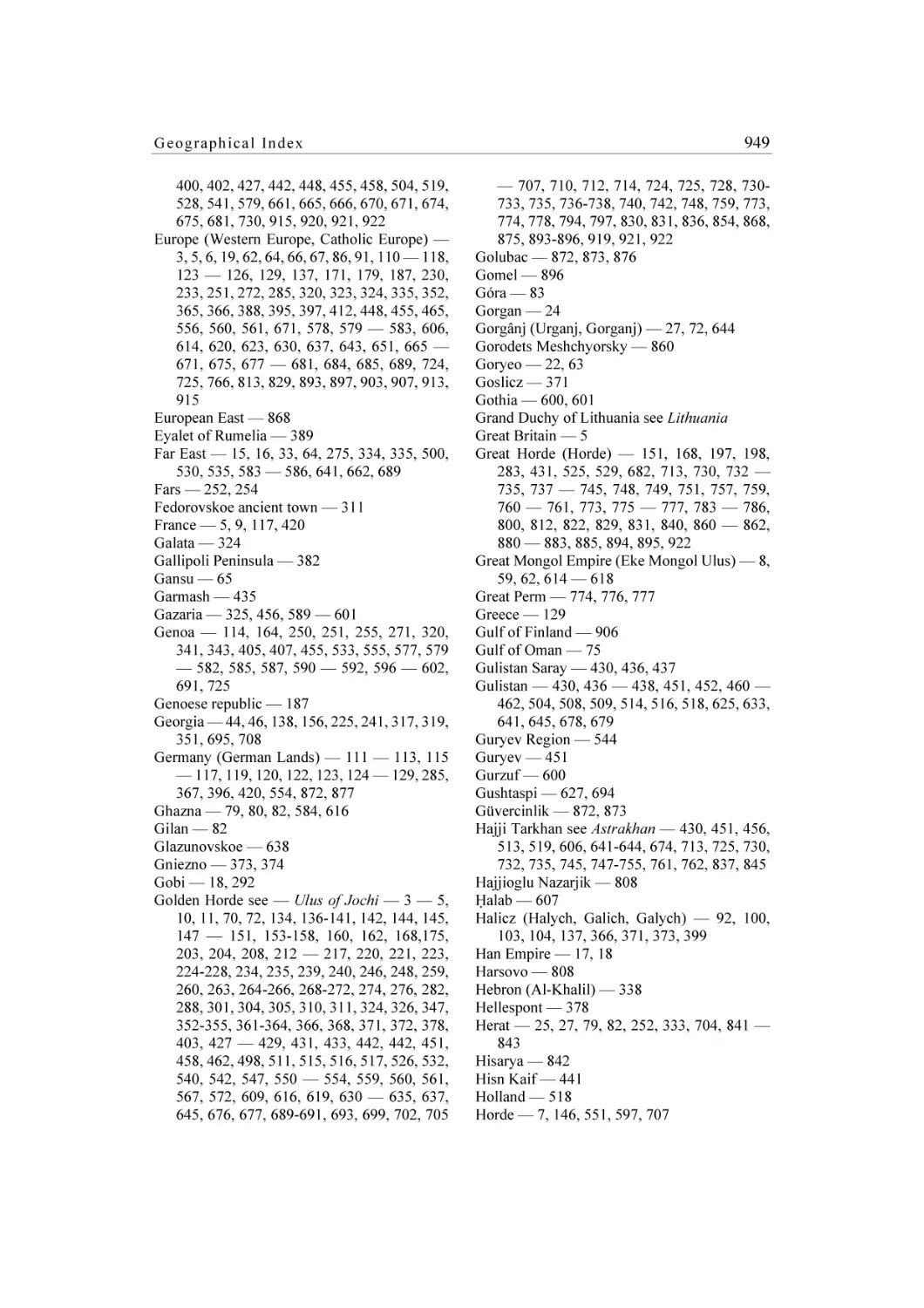
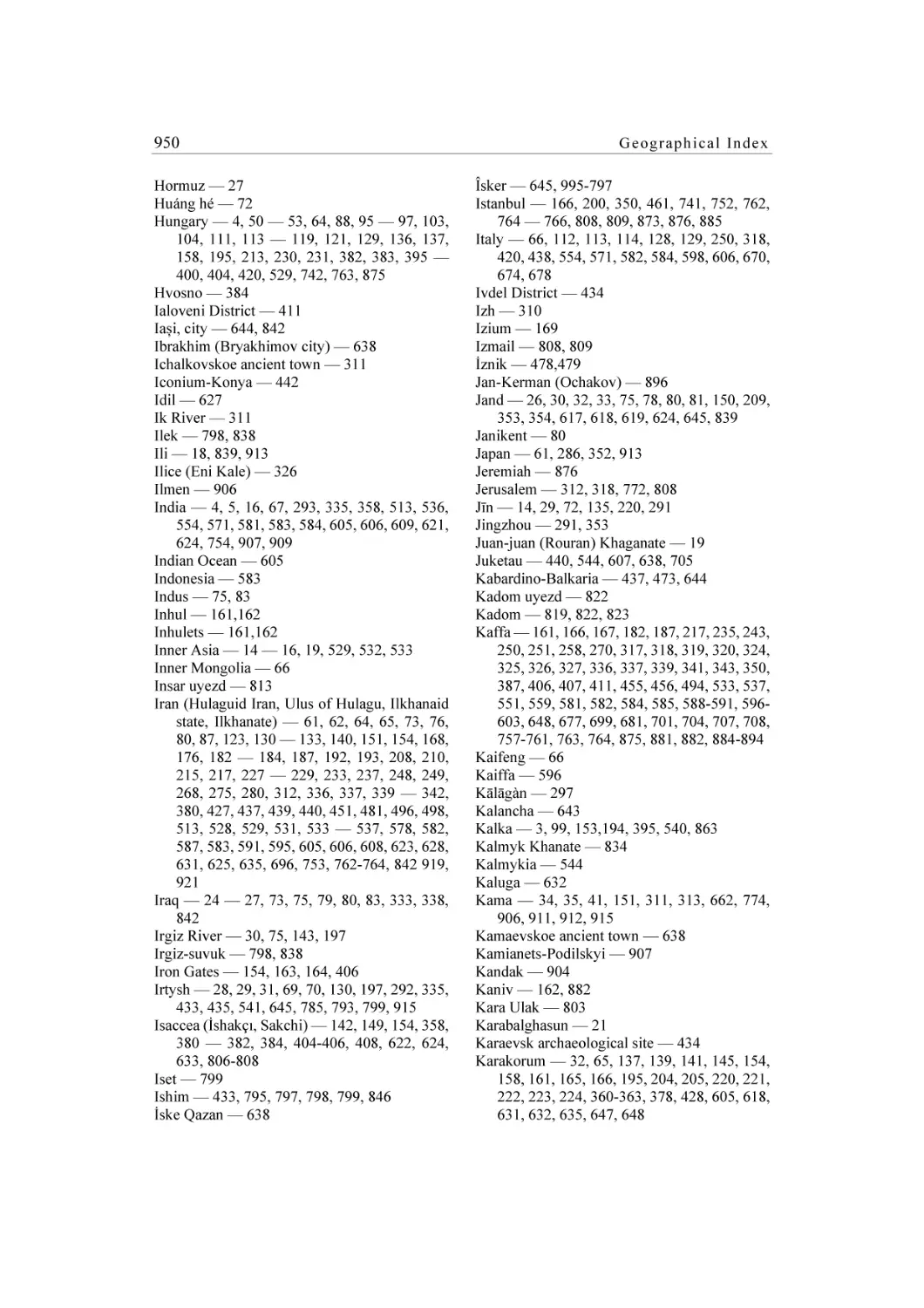
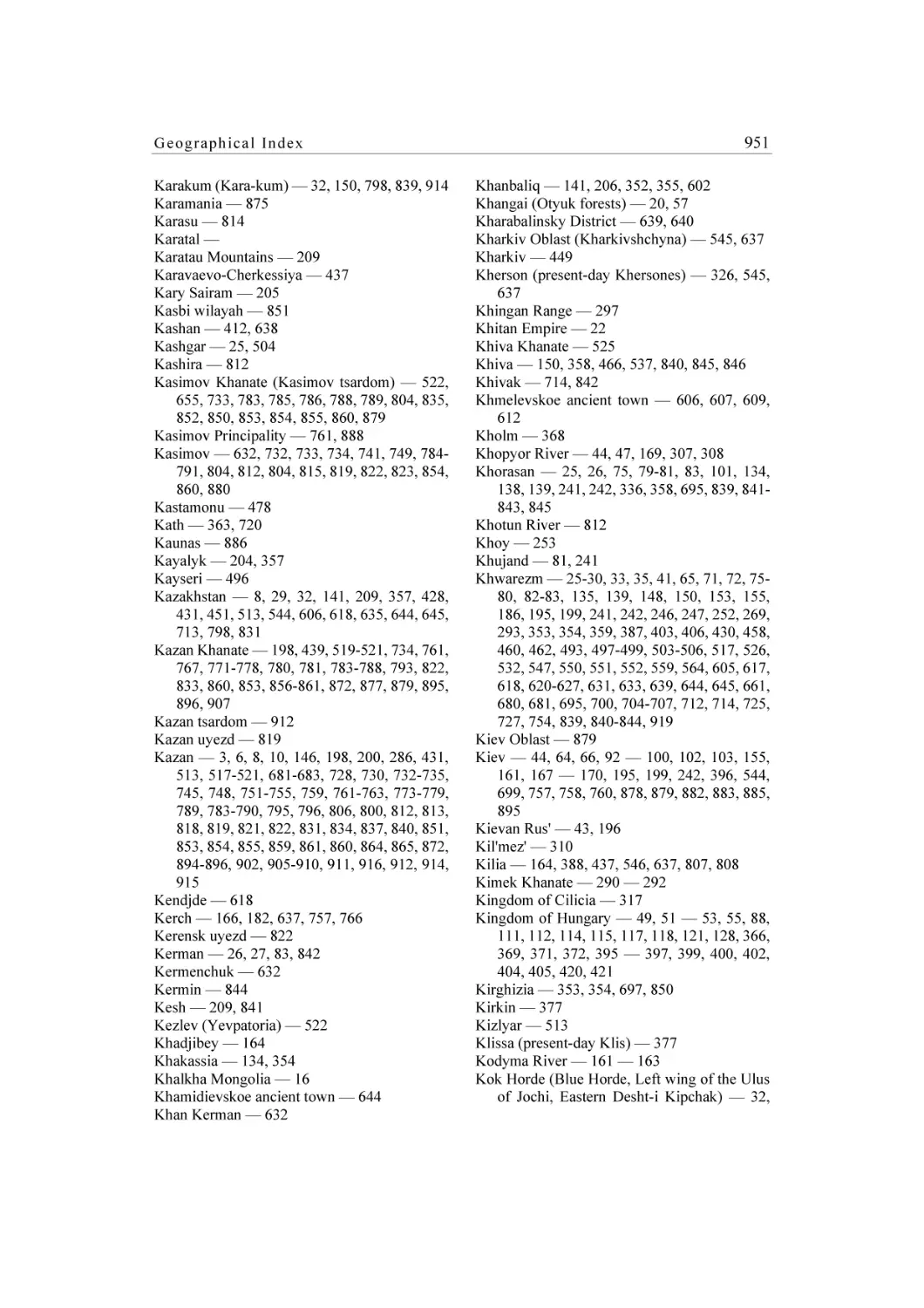
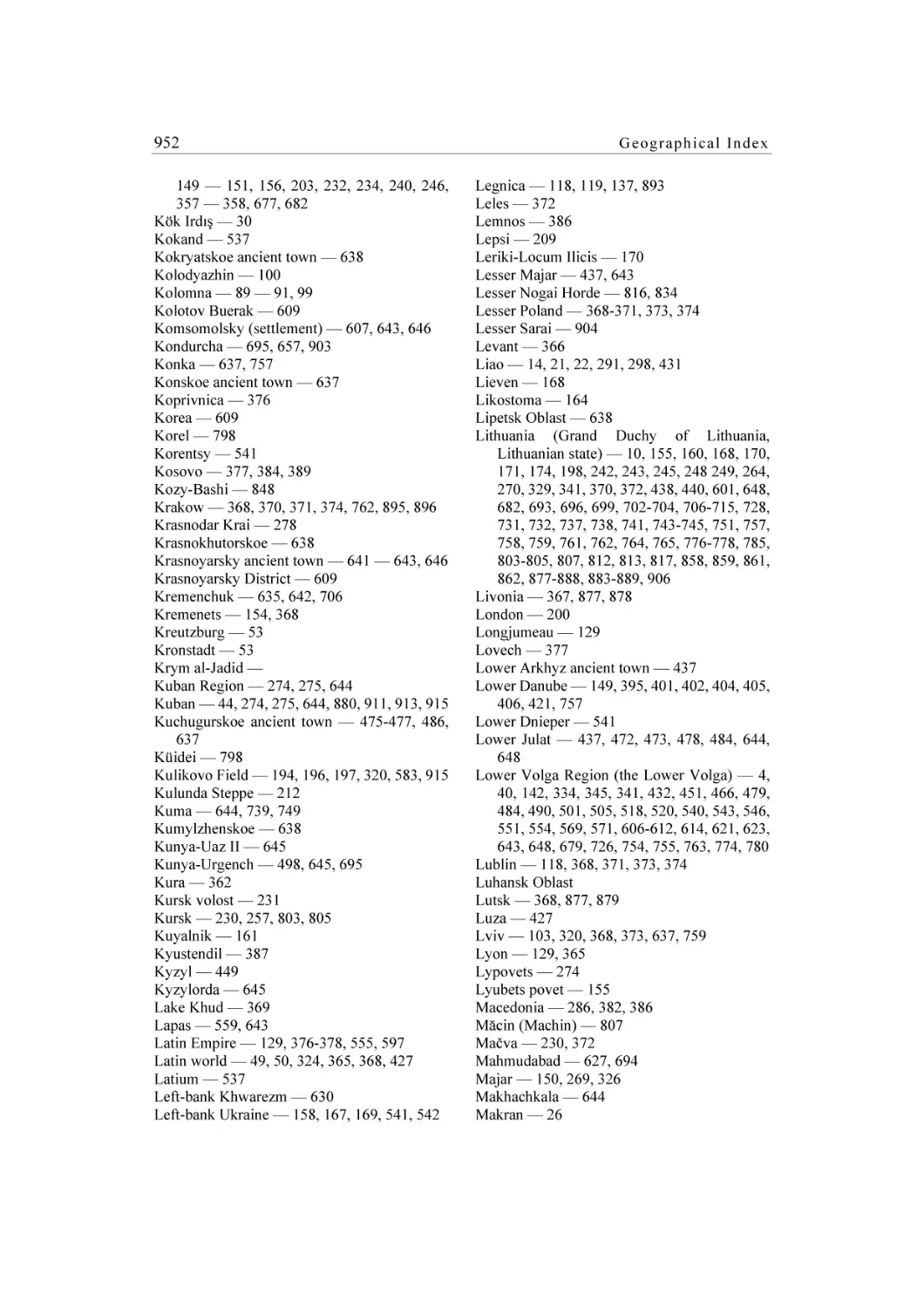
The Name Index and Geographic Index were compiled by R. Abyzova, A. Aksanov,
L. Giniyatullina, Sh. Sady'kov, E'. Sayfetdinova, and others, the Sh. Marjani Institute of History of the Tatarstan Academy of Sciences.
The maps in the colour insert (p. 8–15) were provided by A. Astaykin, Moscow; figures
were provided by the respective authors of the sections.
7
Introduction
Vadim Trepavlov
This book takes as its subject one of the largest and most powerful states in the Middle
Ages. Most of today's readers associate the name ‘Golden Horde’ with purely negative images, and in Russia in particular, with the dark period of the ‘Mongol-Tatar Yoke’1. Russian
schools and universities continue to present the 1230s–1470s as a period when the Russian
land was brutally enslaved by conquerors who drained the life out of Rus' as they conquered
and destroyed it. The khan's baskaks would squeeze tribute out of people, princes could not
succeed to their fathers' thrones without a yarliq from the ‘Tsar’-Khan of the Golden Horde,
cruel Tatar horsemen would raid peaceful cities and settlements; the list of torments seemingly had no end. The general impression lifted from these representations is one of terrible lawlessness and humiliation that stretched on for two and a half centuries.
This historical cliche, which was adopted by numerous generations of schoolchildren
and students, can be traced back even deeper than the formal historiography of the Russian
Empire, owing its foundation to Karamzin and Solovyov. Such an attitude to the Golden
Horde, its rulers and population had begun to be carefully crafted by Russian thinkers even in
the 13th century according to other medieval ideologies, outlooks, and political and cultural
stereotypes. In fact, most chronicles (the primary source of information on the history of this
period) were written by clericals, where priests and monks presented reality through the lens
of familiar Biblical images and analogies.
This unique type of worldview from medieval authors was based mostly on the historical circumstances of the 13th century. The Eastern Christian World hardly had recovered
from the shattering crusade to Constantinople in 1204 when suddenly a new foreign conquest
struck another heavy blow to Orthodoxy. The Mongol Conquest of Rus' was interpreted as a
sure sign that God had turned away from Holy Rus', denying it His mercy and grace. Slaughterous infighting among princes, unscrupulous plots, squabbling throughout the previous centuries, and the practice of sending ‘wild Cumans’ against enemy princedoms had all caused
the Russian people to lose intercession with God. Punishment was dolled out as foreign conquests. Comparisons to Biblical precedents were clearly obvious: did the ‘chosen people’ of
Israel not serve as slaves to the Pharaoh? Did they not suffer through exile in Babylonia? The
only way out seemed to be to pray and hope for the Lord's mercy, and before His grace finally
shined on them again, the ‘yoke’, as clerical writers denoted the Mongolian regime in Rus',
was simply to be endured.
1
‘Mongol-Tatars’ is an artificial term first created by historians in the 19th century. The word
‘Tatars’ (the name of an ethnic group in Eastern Mongolia) was used in the East to commonly denote
Central Asian peoples and tribes, including the Mongols proper, several centuries before the Mongols
even began their conquests. Upon learning from the Kipchaks that Mongol troops were indeed encroaching on their home countries, the Russians and Europeans of the 13th century adopted the common Eastern name for Mongols–‘Tatars’, based on what their informants related. This is why medieval
Russian texts, just as many from Western European, do not contain the ethnonym ‘Mongols’, instead
employing the term Tatars to describe what was in reality a multi-tribal Mongol army. Turkic peoples
within the Golden Horde who had adopted the name of their conquerors according to ancient tradition
began to refer to themselves as Tatars as well in addition to their tribal names, which they perceived as
synonymous to Mongols.
8
In trodu c tion
Clerical authors, as well as their audience, therefore perceived the lifting of the ‘yoke’ in
the 15th century as the result of divine mercy. The Horde's slide into historical oblivion was
viewed as punishment for its long abuse of Orthodox Christianity2.
Muslims shared a similar attitude to this expansive and all-encompassing catastrophe as
well. From among the numerous examples available, we find the words of wise theologist
who had witnessed the Mongols' atrocities in Bukhara in 1220 to be particularly enlightening.
His response to his co-believers' complaints was as follows: ‘[This is] the wind of the divine
wrath sweeping in, and the saman (chopped straw—Author's note.) [which it scatters around]
has nothing to say!’ [15, p. 81].
Contemporary studies tend to represent a less emotional and biased approach to the
Golden Horde, moving away from its interpretion as a power that was simply unconditionally
hostile to Rus'. Indeed, in the territory of Kazakhstan, as well as the modern borders of the
Russian Federation, Uzbekistan, Ukraine and Moldova, the Golden Horde was the ethnic
cradle of many Turkic peoples, making its population and culture the part of these peoples'
history and, consequently, the general history of Russia.
However, public representations as well as courses of academic study remain dominated
by the traditional image of the Horde as an oppressor. The content of school textbooks (see:
[11]) suggests that their authors are interested only in this subject as it concerns how the ‘yoke’
system was organized (yarliqs, tribute, jams, etc.), the intrigue surrounding the great throne of
Vladimir, as well as the gradually intensifying Russian struggle for independence. This overtly
laconic attitude also spans into the issue of the heirs and fragments of the Golden Horde, namely
the Tatar khanates, whose role is presented as no more than a problem area on Russia's borders
doomed to ‘just’ punishment (annihilation). This brings to light the standard set of reasons underlying the conquest of the 1550s: the end of Tatar raids, the release of numerous Russian captives, new land in the fertile sub-paradise land of Kazan to be distributed among noblemen, and
the acquisition of the Volga trade route. It should be noted that all of these but the last apply to
the conquest of the Khanate of Kazan (and also that each and every one of them remains controversial among researchers), but not to Astrakhan, which was relatively not hazardous for Russia
at that time, as it was relatively remote and surrounded by semi-deserts, not arable land.
The authors of the present monograph believe that the well-established traditional perception in Russian historiography of the Golden Horde as no more than an episode in Russian
history is outdated and is in need of further study. (However, this approach is attributable to
the available sources, as Russian medieval texts contain a wealth of information on the ‘Mongol-Tatars’). In fact, this powerful state had a historical value of its own, and in and of itself
should be considered an individual historical subject. By no means should it ever be viewed
exclusively in terms of its impact on Rus'.
The Golden Horde first made it on the map as part of an even larger state entity of truly
unprecedented size, namely the Mongol Empire (Eke Mongol Ulus). Sitting as the crown atop
a millennium-old succession of great nomadic powers, this Empire was able to perfect the
mechanism of uniting nomads that had been developing slowly over the previous 15th centuries.
The Mongol conquest was a key prerequisite for the integration of the land annexed by
the Empire as a united organism in order to form a common state area with a relatively unified (at the upper levels) administrative structure. Many Arab and Persian contemporaries are
in agreement that the form of government in Eke Mongol Ulus, in particular its western areas,
which separated from it in time to become the Golden Horde, operated quite smoothly. In
contrast, European historiography from the Middle Ages tended to be generally Mongolphobic, although a number of 13th century travelers and missionaries had a neutral to positive
2
For more on the Russian attitude to ‘Mongol-Tatars’ through the lens of Christian providentialism [see: 1, Chapter 1; 10].
In trodu c tion
9
opinion on the Chinggisid Empire. ‘The Book of Marco Polo’, very well-known in the West,
provided information on the distant, all but mythical ‘State of the Great Khan’ without ever
emphasising the Mongols' role in its establishment. Thus, the idea of that state, which in fact
was a large source of inspiration for Christopher Columbus to undertake his own voyage, was
by no means associated with the Mongols as a nomadic people in Central Asia.
What was capable of uniting so many countries and peoples within Eke Ulus? Cruel
governmental oppression of any protest and the growing weakness of victims in opposition to
a large army associated with the Mongol invasion, or fear and punitive executions, clearly
could not suffice alone for the long-term existence of the Empire and its ulus khanates. As
stated above, medieval observers believed that the Mongol's successful military campaigns
were proof that divine favour indeed rested with the conquerors and their rulers. The Chinggisid dynasty was thus perceived (and perceived itself) as a clan chosen by Heaven to rule the
world, and other kings on earth were naturally doomed to subjugation or annihilation if they
resisted. Loyal rulers would be allowed to keep their high status and administrative structure,
but as subjects and vassals of the Mongol Khan or that of the Golden Horde, by means of a
document traditionally known as a yarliq, or a license to rule.
One noteworthy phenomenon can in particular account for both the rapid establishment
and growth of the Mongol Empire, and the long absence of any ‘national liberation movements’ in it. The idea present in the term ‘...philia’, which is often exist when young empires
are developing, affected the overall course of its establishment. However, this idea is yet still
not completely analysed by historians. The notion of ‘empirephilia’ is representative of the
complex dialectics of political and cultural development among communities. Even though
some empires were created through mere conquest, a large part of such state entities relied on
various agreements and mutually beneficial obligations. The appeal of empires consisted, first
and foremost, in its rigid state structure in contrast to the fragmented and unstable neighbouring countries, secondly, in the opportunity to enjoy military protection against one's old enemies and confront them as part of a powerful state, and thirdly, in their access to the accumulation and distribution of enormous resources that were beyond comparison with those of any
annexed lands.
Turkophilia is known to have spread in the Near East and France in the 16th century, Russophilia, in the Caucasus in the 18th century, and so on. A type of Mongolophilia likely
emerged during the first foreign campaigns of the newly-born Mongol army when Chinggis
Khan acquired power over the Turkic peoples of Central Asia, Southern Siberia, and Eastern
Turkestan. But to gather them all together into a single empire proved to be much more complicated than to simply conquer them, or rather force them into submission.
It was not uncommon for ethnic consolidation to take place within imperial political entities before the era of national state formation (the 17–18th centuries), and the Golden Horde
was no exception as the ‘ethnic cradle’ of many of today's Turkic peoples. The multi-faceted
identity of the empire's subjects must also be taken into account in research on the period. The
requirement of belonging to a specific ethnic community did not come to the foreground as a
criterion for state building until modern nations were first formed. Before this trend, the concept of class, confessional, regional, or clan identity was of a much greater importance. Diverse ethnic communities were not a stumbling block to the imperial organism's ability to
grow and function; loyalty to the state order and the throne was instead what united subjects
who spoke different languages.
For the dwellers of Desht-i Kipchak (the steppe part of the Golden Horde), a group of
clans descending from a common ancestor, whether real or fictional, proved to be the most
stable and long-lasting union they identified themselves with. Historians commonly term such
groups as tribes. Depending on the period and the specific Turkic people, the terms boj (buj),
ru, yryu, and others were used, and in late medieval Desht they were known as el.
10
In trodu c tion
In the 11th century, the great Turkic linguist Mahmud Kashgari wrote in his ‘Dictionary
of the Turkic Languages’: ‘When two men meet who do not know each other, one of them
greets the other and asks, buj kim—that is, of what clan and tribe are you? After that, they
either start a conversation or hurry to part ways, as each of them knows which group the other
represents' [9, p. 844]. This rather curious question can still be heard nowadays as well, especially among the Bashkirs and Kazakhs, who ask during introductions: ruving kim? or qay
eldensin?
Along with the memory of an el's ancestors, common burial places where tribesmen
from different clans met periodically, were likewise of great importance. Clan and tribal identity formed the most basic and stable layer of individual and group self-awareness, while ethnocultural belonging to the nomadic world, an understanding of the unique nature of the cattle
breeding lifestyle, and the ways in which it differed from that of sedentary farmers and forest
hunters represented the next. As sparse as they may be, primary sources indicate the word Uzbek
to have denoted nomadic self-identification in the 14–18th century without referring to any
specific ethnic communities or eponym (Öz Beg Khan of the Golden Horde). The last Khan of
the Golden Horde, Sheikh Ahmad, noted similarities between the tribal nomads of Desht-i Kipchak and migrants from Ulus of Jochi in the Grand Duchy of Lithuania at the beginning of the
16th century, as he spoke about ‘our Uzbek people’ (bizniñ özbäg ta'ifisi) [13, 1992, p. 96, 124,
fig. XII]. Turkic and Persian works of the 16th century referred to the Nogai Horde as Uzbekistan, and to its dwellers as Manghit Uzbeks (uzbakan-i manghiti) [14, p. 201, 347]. A number of
other sources also referred to the subjects of the Khanate of Kazan as Uzbeks or UzbekCossacks. According to ethnograph A. Khoroshikhin in a recording from the 19th century, a
Kazakh discussing their historical roots would typically say, ‘My ancestors and my family
comes from the Uzbeks’ [8, p. 251, 252].
However, one should not interpret Sheikh Ahmad's words about the Uzbek people as evidence of their existence as an ethnic group, as the word ‘Uzbek’ might have a different meaning in this case. In the 18th century, a Djungar Khong Tayiji (ruler) told the Kazakh Khan
Abu‘l-Khayr: ‘... in front of this crow (the Russian empress—Author), we will not stand on
our knees, because they (Russians—Author) are with horse carts and we are Uzbeks (i.e. nomads—Author) [7, p. 306].
The term Tatars, whether interpreted as an ethnonym, a polytonym or a socionym when
applied to the Golden Horde era3, undoubtedly carried with it a certain level of ethnic regulatory potential. Ethnic consolidation and the formation of a Golden Horde Tatar ethnic community could be clearly observed in the Right wing of the Ulus, which enjoyed a welldeveloped urban civilisation while preserving powerful centres of the old sedentary culture
(Volga Bulgaria, the Crimea, Moldova). It had far-ranging inter-regional connections and a
far-reaching professional state apparatus, all ruled authoritatively and efficiently (until the late
14th century) by the khan. It is beyond any doubt that this community continued to exist for
some time into the 15th century. However, the plague epidemic in the mid-14th century and
the wars and migration of nomads from the other bank of the Yaik in the east put an end to
this process. The ‘Uzbeks’ of the Left wing, or rather the carriers of archaic social and cultural norms, firmly held to their tribal system and stimulated renewed tribalisation in the western
part of the Ulus of Jochi. Its successor states (the Kazan, Crimean, and perhaps Astrakhan
Khanates) therefore witnessed the formation of local ethnic communities based on the earlier
relatively united Tatar ethnicity of the Golden Horde.
The next level was that of political awareness—that is, self-identification as a subject of
a specific ruler and, respectively, as a dweller of a specific political entity (khanate, yurt).
This was marked by the emergence of a political culture manifested to the largest extent in
3
For more information on the development and transformation of the ethnocultural identity of the
dwellers of the Golden Horde and its successive khanates, see [3; 4; 5, p. 349–365; 6, p. 185–198].
In trodu c tion
11
equal respect for shrines demonstrated by all subjects regardless of their tribal affiliation,
occupation, and lifestyle. Piety towards capitals and dynastic necropoleis was a form of political identity that developed a sense of belonging in the community of subjects of the Ulus of
Jochi. Capitals and khans' tombs were linked directly to the life and death of representatives
of the ruling dynasty, thus forming the legacy of the clan [see: 12]. The Jochid clan was able
to rise above all subject el tribes (which eventually formed the special class of Kazakh aristocracy later known as tore). Thus, all Turkic tribes in Desht-i Kipchak had respect for this
clan as the holder of divine charisma and a monopoly that had the right to rule, and also recognized its sanctuaries.
Historians are confronted with considerable difficulties when researching the Golden
Horde. Only a small fraction of the chronicles, acts, and record keeping documents created
during the Golden Horde period have survived to this day. Nearly all known sources of information on it were instead written by those living outside of its confines, and usually by
people who had never been there themselves. The works mostly deal with the acts of rulers in
respect to certain cities and main camps of the khans. The vast majority of the state's population—including nomadic communities of Kipchaks, other Turkic peoples, and Turkicised
Mongols—was well beyond their scope. However, scholars have been able to reconstruct
certain milestones in political developments and the key economic, social, and cultural features of the Ulus of Jochi, so the general history of the state is nonetheless known to us. Archaeological methods have also provided great insight into the lifestyle of common subjects
of the Golden Horde. Excavations of records of 13–14th centuries, including both cities and
burial sites, have filled some of the gaps. Considerable numismatic data is also available. A
large volume of historiographic information4 has accumulated over two centuries of scientific
research on the Golden Horde, the analysis of which requires both a specific approach and a
dedicated monograph. Today's historians have to face the challenge of not merely expanding
our knowledge of the past as it concerns the Golden Horde, but also facilitating efforts to
overcome its traditional negative stereotypes. We sincerely hope that this book will contribute
to the development of a non-biased idea of the state.
1. Amelkin A., Seleznyov Yu. Kulikovskaya bitva v soznanii sovremennikov i potomkov
(The Battle of Kulikovo as Perceived by Contemporaries and Descendants). Voronezh: Kvadriga,
2005. 414 p.
2. Zolotaya Orda: bibliograficheskij ukazatel` (The Golden Horde: A Bibliographical Reference). Compiled by I. Mirgaleyev. Kazan: Institut istorii im. Sh. Mardzhani AN RT, 2013. 412 p.
3. Izmajlov I. Nekotory'e aspekty' stanovleniya i razvitiya e`tnopoliticheskogo soznaniya naseleniya Zolotoj Ordy' v XIII–XV vv (Certain Aspects of Development of Ethnopolitical SelfConsciousness of the Golden Horde Population in the 13–15th centuries) // Iz istorii Zolotoj Ordy'
(From the History of the Golden Horde). Executive Editor G. Valeyeva-Suleymanova. Kazan:
Fund im. M. Sultan-Galieva, 1993. Pp. 17–32.
4. Izmajlov I. Formirovanie e`tnopoliticheskogo samosoznaniya naseleniya Ulusa Dzhuchi:
nekotory'e e`lementy' i tendencii razvitiya tyurko-tatarskoj istoricheskoj tradicii (The Formation of
the Ethnopolitical Self-Identification of the Population of the Ulus of Jochi: Selected Elements and
Trends in the Development of the Turkic-Tatar Historical Tradition) // Istochnikovedenie istorii
Ulusa Dzhuchi (Zolotoj Ordy'). Ot Kalki do Astraxani (Source Studies on the History of the Ulus
of Jochi (the Golden Horde). From Kalka to Astrakhan). 1223–1556. Executive Editor
M. Usmanov. Kazan: Master Line, 2002. Pp. 244–262.
4
See the list of key works of the 18th–early 21st centuries on various issues related to the Golden
Horde [see: 2].
12
In trodu c tion
5. Istoriya Tatar s drevnejshix vremyon (History of the Tatars since Ancient Times). V 7
tomax (In 7 volumes). Vol. 3. Ulus Dzhuchi (Zolotaya Orda). XIII–seredina XV v. (The 13th–The
Middle of the 15th century). Editor in Chief M. Usmanov, R. Khakimov. Kazan: Institut istorii im.
M. Shardzhani AN RT, 2009. 1056 p.
6. Iskhakov D., Izmajlov I.. Vvedenie v istoriyu Kazanskogo xanstva. Ocherki. (An Introduction to the History of the Khanate of Kazan. Essays). Kazan: Institut istorii im. M. Shardzhani
AN RT, 2005. Pp. 48–53.
7. Kazaxsko-russkie otnosheniya v XVI–XVIII vv. (Sbornik dokumentov i materialov).
(Kazakh-Russian Relations in the 16th–18th Centuries. [A Collection of Documents and Materials]). Edited by V. Shakhmatov et al. Almaty: Izdatel`stvo Akademii Nauk Armyanskoj Sovetskoj
Soczialisticheskoj Respubliki, 1961. 741 p.
8. Klyashtorny S., Sultanov T. Gosudarstva i narody' evrazijskix stepej. Drevnost` i srednevekov`e (States and peoples of the Eurasian Steppes. Antiquity and the Middle Ages) Saint
Petersburg: Peterburgskoe Vostokovedenie, 2004. 368 pp.
9. Al-Kashgari Mahmud. Divan Lugat at-Turk. Translation, foreword and comments by Z.A. Aue'zova. Almaty: Dajk-Press, 2005. 1288 p.
10. Rudakov V. Mongolo-tatary' glazami drevnerusskix knizhnikov serediny' XIII–XV vv.
(The Mongol-Tatars as Seen by Ancient Russian Scribes of the Mid-13–15th Centuries). Moscow:
Kvadriga, 2009. 248 p.
11. Trepavlov V. Narody' Rossii v shkol`ny'x uchebnikax istorii (do XX v.) (The Peoples of
Russia in School History Textbooks (up to the 20th Century) // Otechestvennaya Istoriya. 2003.
No. 1. Pp. 114–120.
12. Trepavlov V. Sakral`naya topografiya Ulusa Dzhuchi (The Sacral Topography of the
Ulus of Jochi) // E`tnograficheskoe obozrenie, 2011, No. 2. Pp. 107—115.
13. Ötemish Hajji. Chingiz-Name (Ötemish Hajji. Chinggis-name). Facsimile, translation,
transcription, textological notes and study by V. Yudin; notes and index by M. Abuseitova. Almaty: Gy'ly'm, 1992. 296 pp.
14. DeWeese D. Islamisation and Native Religion in the Golden Horde. Baba Tükles and
Conversion to Islam in the Historical and Epic Tradition. University Park, Pennsylvania: The
Pennsylvania State Univ. press, 1994. 656 p.
15. The Ta’rikh-i-jahangusha of Alau’d-din ‘Ata Malik-i-Juwaini. Pt. I. Ed. with intrоduction, notes and indices by M. Qazwini. Leyden: E. Brill; London: Luzac & C°, 1912. 380 p.
13
Chapter I.
Central Asia and Eastern Europe
in the 12th–Beginning of the 13th Centuries
§ 1. Nomadic Empires of Central Asia
Nikolay Kradin
The nomadic peoples of this area lived in rainless steppes and semi-deserts, where farming the land was nearly impossible. Instead, they opted to breed grazing animals, which
proved an effective practice given the natural surroundings. The key nomadic staple were
dairy-based foods; meat, whether slaughtered or harvested from dead animals, including wild
game, was less common. It therefore comes as no surprise that nomadic interests in these
areas were focused on cattle as both their source of subsistence and major indicator of wealth.
As cattle need to rotate grazing lands every so often, breeders had no choice but to move several times a year. This mobility brought about the need for nomads to live primarily in highly
portable structures that were easily set up and torn down, and usually covered with wool or
leather (referred to as yurts or tents). For the same reason, nomads usually had few household
items, with their tableware made mostly from non-breakable materials (such as wood and
leather). Leather, wool, and fur were also the most common materials for clothing and footwear. The economic system of nomads was undoubtedly fragile and highly dependent on the
natural environment, as a drought, blizzard (dzhut) or animal epidemic (epizootic) could strip
a nomad of every source of his subsistence overnight. Nomads thus developed an efficient
system of mutual assistance to confront such natural disasters, with each tribesman providing
one to two heads to any victim, keeping them alive and enabling them to subsist. The victim,
in turn, was also obligated to render the same service to his affected kin [4; 18; 19; 30; 33; 36;
38; 39].
The unique character of nomadic tribes and their numerous dissimilarities with early
state entities established by sedentary farmers have long spurred historians to discuss the essence of the nomadic social order. While some authors denied that nomads ever crossed the
barrier into statehood and others asserted they reached the same level as any other early state,
a third group expounded on a special type of ‘nomadic feudalism’. Indeed, this debate is still
far from over. Adding to those three opinions, there is also the idea of the unique social evolution of nomads [6; 13; 15].
What actually spurred nomads to undertake mass migrations and devastating campaigns
against farming civilisations? This is undoubtedly the single most intriguing question of the
nomads’ history [14; 24]. A multitude of diverse opinions have been offered, but they can be
summarised as follows: 1) various changes in the global climate (desiccation according to
A. Toynbee and G. Grumm-Grzhimaylo, humidification according to L. Gumilyov); 2) warmongering and avarice among nomads; 3) overpopulation in the steppe; 4) growth in productive forces and class struggle, weakening of farming communities due to feudal fragmentation
(Marxist concepts); 5) the need to replenish the extensive cattle-breeding economy by raiding
more stable farming communities; 6) the reluctance of sedentary peoples to trade with nomads (inability to sell off the surplus products from cattle production); 7) the personal traits of
steppe community leaders; 8) ethnically integrating impulses (asabiyyah according to Ibn
Khaldun, passionarity according to L. Gumilyov).
14
Chapter I. Central Asia and Eastern Europe in the 12th–Beginning of the 13th Centuries
Most of these factors are reasonable to a certain extent, yet some of them seem exaggerated. For instance, modern paleographic data fail to confirm any rigid correlation between
global periods of steppe desiccation/humidification and the decay/prosperity of nomadic empires [8; 9]. The idea of a ‘class struggle’ within the nomadic community has also proved to
be false [18; 33]. The role of demography is somewhat vague because cattle grew at a faster
rate than the human population, which typically caused an overgrazing and a crisis in the
ecosystem. The quantity of animal stock and size of the cattle breeding population instead
fluctuated according to the predator-prey model by Lotka-Volterra, which represents the
predator to prey ratio as two cycle curves, one lagging a little behind the other. It is beyond
any reasonable doubt that nomadic way of life can indeed foster certain military qualities.
However, farmers were many times more numerous, operated under a more environmentally
complex economy, lived in strong fortresses, and had a superior handicraft and metallurgic
base.
What was it then that ultimately caused nomads to raid other communities and establish
‘steppe empires’? O. Lattimore, an outstanding US geographer and anthropologist, who himself spent a long time among Mongolian cattle breeders, wrote that a nomad could well subsist on just the products of his own herd, but a pure nomad would always be poor [35. p. 522].
Nomads needed food from farmers, goods produced by craftsmen, silk, weapons, and exquisite jewelry for their tribal leaders, wives and concubines.
In the end, there were two ways to obtain these items— by war or peaceful trade, and
nomads employed both of these means. When they were sure of their superiority and invulnerability, they would mount their horses without a second thought and start a campaign, but
when their neighbour happened to be a powerful state, cattle breeders preferred peaceful
trade. However, quite often the governments of settled states hampered such trade, as it was
outside of all state control. In these cases, nomads had to take up arms and forcibly assert
their rights to trade.
A number of important periodisation concepts are applied to the relations between Chinese dynasties and imperial confederations in the Inner Asian steppes. For instance, Japanese
historian J. Tamura put forth the idea that the history of Northern Eurasia could be broken
down into the following two long cycles: (1) Ancient nomadic empires in the drought-ridden
area of Inner Asia (2nd century BCE—9th century CE): the Xiongnu, Xianbei, Rourans,
Turks, Uighurs; (2) Medieval conqueror dynasties from the taiga (Jurchens, Manchu) or
steppe (Khitan, Mongols) areas (10–early 20th centuries): Liao, Jin, Yuan, Qing. Communities of the first cycle interacted with China from a distance, while those of the second conquered the agricultural South and formed symbiotic state structures with dual administrative
systems and original forms of culture and ideology [41].
A somewhat similar opinion was presented by N. Di Cosmo, who divided regional history into the following four periods based on the way income was earned from the outer
world: 1) the period of tributary empires—from the Xiongnu to the Rouran (209 BCE–
551 CE); 2) the period of Turkic, Khazar and Uighur trade-and-tributary empires (551–907),
when nomads learned to earn income through external exchange; 3) the period of dual administration empires (907–1259), when nomads learned to conquer agricultural civilisations (the
Khitan, Jurchens, and Mongols before Kublai); and 4) the period of mature empires (1260–
1796), which used direct taxation in addition to other means of exploitation (the Mongols and
their Western Asian successors, the Manchu) [7].
N. Shiraishi presents steppe history as a concisely constructed spiral. He views the evolution of nomadic empires as part of a spiral of evolution from disunity to centralisation, and
finally a gradual decentralisation. Each turn from the Xiongnu to the Mongols is represented
by an even wider arch of power, reaching its maximum spread in the 13th century [26].
Chapter I. Central Asia and Eastern Europe in the 12th–Beginning of the 13th Centuries
15
T. Barfield developed one of the most intriguing periodisation concepts for the history of
the Inner Asian steppes [1]. He believes the processes of growth and decay proceeded in a
quite similar manner between nomadic empires and China, and in fact that nomadic empires
mirrored Chinese dynasties. T. Barfield [2] views them as shadow empires because they
arose in the shadow of existing civilisations and empires (this term is quite accurate in modern terms, as it emphasised the shadow economy of such parasitic structures). Nomads preferred to exploit their southern neighbour at a distance rather than conquer their territory directly. The collapse of centralised power in China brought about a crisis in the steppe, relieving the latter of pressure from both the nomads and the Chinese. When free of external pressure, the peoples of Manchuria then established their own state entities and conquered the
farming areas in the south. T. Barfield believes the cyclical structure of political relations
among the peoples of China, Central Asia, and Far East repeated a total of three times over
2,000 years: from the Xiongnu to the Rouran people, from the Turks to the fall of the Yuan
Dynasty, and from the Ming Empire to the Xinhai Revolution, which eventually put an end to
this form of circular evolution [29].
A number of scholars have criticised this concept for allegedly misrepresenting certain
facts [4; 22; 43]. Indeed, only the Xiongnu-Han cycle was more or less identical, while the subsequent rise and fall of Chinese dynasties and steppe empires instead appear asynchronous. This
can be largely attributed to T. Barfield's unfortunate failure to include the size dynamics of the
steppe confederation's elite, which is a key internal factor. As far back as the 14th century, Ibn
Khaldun was the first to remark that dynasties established by nomads did not last more than
three -or four generations, as they lost their potential for group consolidation (asabiyya) from
generation to generation.
This argument is quite compelling, as historians have long acknowledged and studied
the cyclical nature of the history of Chinese dynasties (which actually applies to all preindustrial states). The early stage is marked by economic development, population growth,
and a period of robust cultural growth. Then the state's economy gradually decays while bureaucratic bribery increases, bringing about widespread disorder and eventually causing the
dynasty to crumble under its own weight. The nature of these cycles can be explained according to the structural demographic theory, which states that the elite and state apparatus expand
and consolidate when the economy grows (particularly true in Confucian China according to
Parkinson's First Law). Then as a result, producers are unable to pay the enormous amounts of
taxes required of them, thus effectively dragging the dynasty into a crisis and, eventually,
complete collapse [21; 23].
It should also be noted that A. Frank undertook an effort to bring these natural rhythms
in line with Kondratyev's macroeconomic trends. In his opinion, the pre-industrial trend was
actually longer, namely from 200 to 500 years. Frank and Gills singled out four major cycles:
the pre-classical (1700–100/50 BCE), classical (100/50 BCE to 200–500 CE), medieval (200–
500 to 1450/1500), and modern (from the 16th century) cycles. Each cycle contained an up
(A) and down (B) phase according to Kondratyev. For instance, the medieval cycle contained
two separate subcycles: the A-phase (500–750/800): the zenith of Byzantium, the Arab world,
China (the Sui and Tang dynasties), the Turkic Khaganate; В-phase (750/800–1000/1050): the
decline of the Carolingian, Abbasid and Tang dynasties, the fall of the Uighur Khaganate; Aphase (1000/1050–1250/1300): the Mongol conquest and the establishment of the pre-modern
world-system according to Abu-Lughod; В-phase (1250/1300–1450/1500): the decline of
Afro-Eurasia as a result of epidemics [32].
To put it more simply, different parts of the world have been interacting through various
connections since ancient times. Today's scholars traditionally focus on four types of major
communication networks: bulk goods networks (BGN), prestigious goods networks (PGN),
political and military networks (PMN), and information networks (IN) Information and pres-
16
Chapter I. Central Asia and Eastern Europe in the 12th–Beginning of the 13th Centuries
tigious goods networks are the most extensive among them [25; 31]. However, it was information exchange networks that were most crucial to the above processes. There are a number
of coincidences in the history of mankind that cannot be attributed to synchronous historical
processes alone, including the emergence of military chariots, which made nomadism an important factor of historical processes, the so-called iron revolution, which caused the iron
industry to spread from the Pacific to the Atlantic Ocean, and the Axial Age as the intellectual
turning point of the last centuries before Christ, etc. [17].
This brings to light quite a new view of the role of nomads in world history. While classic philosophical works presented them as destroyers of civilisations, or perhaps historical
scavengers at best, the world-system approach assigns them the role of compiling and translating information among sedentary civilisations. The domestication of the horse and the
spreading of wheeled transport served as a catalyst for the faster dissemination of information
and of prestigious goods. Even though nomads did not change a lot over time, they still
formed about new commercial contacts, spread religions and geographical knowledge, and
fostered the development of information networks, as well as the exchange of technology
among civilisations [17]. Though nomads often seemed to only have a place in the background, they in fact accelerated historical processes.
T. Allsen rightfully presented the nomads' role as in large part confined to being no more
than mediators in such processes, yet it was not uncommon for nomads to be the initiators of
certain borrowings either. It was not because stable and safe routes were available after the
establishment of the Mongol state that a cultural exchange between the Muslims of Middle
Asia and the Confucian Far East became possible, but because the ruling elite of the steppe
empire called for it. For over a century nomads acted as the major initiators, promoters, and
translators of cultural exchange among Old World civilisations [28, p. 210–211].
That is to say, nomads acted as important mediators between regional ‘world-empires’.
Just like sea voyagers, they provided a connecting element between the flow of goods, finances, and technological and cultural information among sedentary economic areas and urban
civilisation [15]. The extent to which nomads were centralised was directly proportional to the
size of the neighbouring farming civilisation; in each local regional area, the political structuredness of the nomadic semi-periphery was directly proportional to the size of the sedentary
farming base. The nomads of North Africa and Western Asia would unite into tribal confederations or chiefdoms to either trade with oases or attack them. The nomads of the East European steppes established semi-imperial state entities on the periphery of Greco-Roman world,
Byzantium and Rus'. The nomads of Inner Asia were part of the Chinese (Far Eastern) worldsystem, thus the nomadic empire was used here to adapt nomadic life to the ways of the outside world.
The dynamic ‘bipolar’ structure of political relations among farming civilisations and
the nomads surrounding them (barbarians and Rome, the Scythians and states in the Black
Sea region, Central Asian nomads and China, etc.) was repeated in multiple cycles during the
pre-industrial period. Its beginning was the Axial Age [27], when powerful farming empires
(Qing in China, Maurya in India, Hellenistic states in Asia Minor, the Roman Empire in the
west) arose in regions where large territories were available for cattle breeding (Black Sea
region, Volga River steppes, Khalkha Mongolia, etc.), and the nomads had to maintain longterm and active contacts with better-organised urban farming communities (the Scythians and
ancient eastern as well as antique states, Central Asian nomads and China, the Huns and the
Roman Empire, the Arabs, the Khazars, the Turks and Byzantium, etc.). The world's reaction
to the existence of farming world-empires was the emergence of nomadic empires and semiimperial polities.
The first bipolar elements of the regional system in Inner Asia were the Xiongnu Empire
(209 BCE–48 CE) and the Han dynasty. The famous treatise by Chinese historian Sima Qian
Chapter I. Central Asia and Eastern Europe in the 12th–Beginning of the 13th Centuries
17
‘Shiji’ (‘Historical Records’) describes the Xiongnu economy: ‘[They] move from one place
to another in search of water and grass, and though they have no cities surrounded with inner
and external walls, nor permanent residents, nor do they farm, each of them has an allotment
of land... Boys can ride sheep, shoot birds and mice with their bows; older boys shoot foxes
and hares, which they then eat; all mature men capable of bending a bow become mounted
armour-clad warriors. ‘According to their custom, in peacetime they follow their cattle while
also hunting birds and animals, thus maintaining their livelihood; in years of turmoil, everyone learns the military science of carrying out attacks' [20, p. 34]. Chinese eunuch Zhungan
Yué, an immigrant who built his career when the second ruler of the Xiongnu Empire was
ruling, added further information to Sima Qian's description: ‘According to the Xiongnu custom, the people eat the meat of domestic animals, drink their milk, and wear their skins; their
cattle feeds on grass and drink water, migrating from one place to another depending on the
season’ [20, p. 46].
If we compare the population of the Xiongnu Empire with that of China, the steppedwellers, although usually presented as fierce and pugnacious, seem to be no more than a
small ethnic group. The nomads numbered no more than 1.5 million (roughly equal to the
population of one Han district), while the Han Empire boasted a population of almost up to
60 million. How could the Xiongnu ‘David’ ever put up a fight against the Chinese imperial
Goliath for as long as nearly three centuries? Here there were two main reasons: the original
organisation of power in the form of a ‘nomadic empire’, and the no less authentic borderline
policy of the nomads towards China.
Sima Qian recorded a detailed description of the administrative system of the Xiongnu
Empire at the turn of the 3rd century BCE. He claimed that the ruler Modu divided the empire
into three separate parts: the center, left and Right wing. The wings were then subdivided into
sub-wings. Supreme power was concentrated entirely in the chanyu's hands, and he also ruled
the center, or the tribes constituting the steppe empire's mother country. Twenty-four higher
officials were subordinated to him, who managed large tribal unions and held the military
rank of temnik (‘the head of ten thousands’). The Left wing was usually commanded by the
chanyu's eldest son, who was the successor to the throne. The ruler's three closest relatives
were his co-ruler, the manager and head of the Right wing, and they were the only ones who
carried the title of ‘princes’ (wangs). These ‘princes’ and six more temniks of the most noble
status were regarded as ‘powerful’ and commanded at least 10,000 horsemen. The rest of the
temniks in fact had less than 10,000 horsemen [20, p. 40].
The fact that the Chinese historian used both military (temnik, thousand head, hundred
head) and traditional (princes of various ranks, duweis, donghus, etc.) terms to describe the
administrative and political structure of the Xiongnu society indicates the military and civil
hierarchies existed at the same time. They both held their own unqiue functions. The nondecimal system of ranks was used for civil tribe administration, and decimal ranks were used
during wartime when a large number of warriors from different parts of the steppe gathered
together in one or several armies [30, p. 38].
The well-balanced rank system developed during Modu's reign only to fall out of use in
later years. Personal relations grew weaker with time and were eventually replaced with federal ones, of which the transition from trial administrative and territorial division to the dual
system was indicative. Military hierarchy then moved to the background to make way for the
genealogical relations of ‘superior’ and ‘inferior’ tribes. The throne was passed not from father to son, but according to the agnatic seniority model from brother to brother and from
uncle to nephew [14, p. 216–231].
The Xiongnu developed a unique doctrine of international policy [30, pp. 45–67] based
on the nomads' awareness of the benefits of their mobility, which enabled them to strike unexpected blows to Chinese territory and then rapidly retreat into the steppe. As they were
18
Chapter I. Central Asia and Eastern Europe in the 12th–Beginning of the 13th Centuries
much less numerous, the nomads had a reason to keep a safe distance from their mighty
neighbour. To increase their revenue, the Xiongnu tried alternating war and raids with periods
of peaceful co-existence with China. The first raids were aimed at accumulating riches for all
members of the nomadic imperial confederation, regardless of their status. The chanyu needed
the support of most tribes in the confederation, thus making every warrior entitled to the
spoils of war. After a devastating raid the chanyu would send ambassadors to China with
offers of a new agreement ‘of peace and kinship’, or the nomads simply continued raiding
until the Chinese proposed a new treaty.
The system of the Silk Road acquired its final form in antiquity and was of great importance for anyone involved in trade. Roman women of fashion flaunted the Chinese silk
they wore. The Chinese army received famous horses ‘with the sweat of blood’. As mediators, the nomads were able to earn an income and access new technology and weapons. In
addition, trade routes facilitated the spreading of religious ideas, in particular Buddhism and
Manichaeism [3, pp. 187–188]. But nonetheless the newly established contact among civilisations of the Old World did carry certain negative consequences with it as well. For instance,
pathogens spread quickly in the 2nd–3rd centuries, causing epidemics that brought about a
population decline that had a general weakening on ancient civilisations [37, p. 106–147].
The Xiongnu Empire existed for nearly two and a half centuries and split into the Northern and Southern Confederations in 48 CE. The Xianbei (approximately 155–180) succeeded
the Xiongnu as the leader of the Mongol steppes, raiding and plundering North China for
several centuries. However, the Xianbei people preferred to simply devastate China's borderline districts instead of developing more intricate power schemes, which is most likely why
the Xianbei confederation just barely overlived its founder Tánshíhuái. It was about this period when a large-scale rebellion that was to become the beginning of the dynasty's end broke
out in the Han Empire.
The peoples of Manchuria built their states at the Chinese border for 150 years after the
fall of the Han Empire before a new bipolar system of international relations was formed in
the region. The luckiest of them (the Murong and Toba people) were successful in subjugating farmers' territories in North China, and it was not until that moment that the nomads in the
Mongol steppes officially established a centralised union, the Rouran Khaganate (early 5th
century–555). Although they remained unconsolidated for a long time, their unification can be
contributed to Chelun, who integrated separate Rouran chiefdoms into an imperial confederation in 402. He assumed the title of khagan and reorganised the military and administrative
structure of the Rouran society dramatically by dividing the army population into hundreds
and thousands, introducing the mandatory recording of warrior numbers, and establishing
strict rules of conduct on the battlefield as well as punishments for violating them. The
Khaganate was also divided into a left and Right wings, with the ruler of the left (eastern)
wing enjoying a somewhat higher status. The Rouran Khanate covered an enormous territory
in its heyday. The Khaganate's western borders reached the Ili River and the Tarim Basin, its
eastern borders stretching as far as the Khitan frontiers and the Goguryeo territory, while the
northern borders reached Baikal and the upper reaches of Amur, and in the south the Gobi
Desert [34].
The Rouran people used traditional nomadic strategies against their southern neighbours, alternating raids with demanding gifts during peacetime. Yet the Toba people also
were the nomads and they knew how to resist the steppe-dwellers, and their cavalry eventually reaching the Gobi. The horsemen would grab their rations, leave their carts behind and
cross the desert on foot rapidly for a blistering raid on undefended Rouran nomadic camps,
striking horror into their residents. Toba raids on Rouran camps were a regular occurance
from 429 to 470.
Chapter I. Central Asia and Eastern Europe in the 12th–Beginning of the 13th Centuries
19
In 464 the Juan-juan (Rouran) khagans borrowed the practice of using regnal title from
China. They also employed Chinese scribes for diplomatic correspondence with North Chinese dynasties. In the 6th century, the Rouran people built the capital Mumochen and surrounded it with two rows of walls. Unfortunately, historians have been unable to agree on its
location. During the reign of Khagan Anagui (519, 521–552), the influence of Chinese culture
was even greater. He came to power during a time of infighting and conflicts among the ruling clan, yet his willpower was enough to check those processes for three whole decades. In
552 the Rouran army suffered a devastating defeat at the hands of the Turks, and Anagui
committed suicide, thus bringing an end to the Khanate. Several khans replaced one other
over the following three years, all of which met with violent ends. In 555 the ruler of the
Western Wei Tsardom betrayed the surviving several thousand Rourans and gave them up to
the Turks, who cruelly executed everyone save children under 16 years of age. Part of the
Rourans fled to North China, and the rest went west. Many historians associate the latter
group with the Avars, who brought to Europe mounted combat techniques and new weapons—the bow, probably of the Mongol type, long swords, and stirrups. These novelties gave
them a critical advantage over the locals.
After Turks defeated Rourans and Sui dynasty formed in the south (followed by the
Tang House), the bipolar structure was restored in Inner Asia. It determined by the new macroeconomic growth of the then-leading world empires: the Tang dynasty in China, the Abbasid Caliphate in the Near East, and Byzantium in Asia Minor. Political stability enabled trade
routes to be restored quickly. Although it is impossible to accurately determine the volume of
trade operations, it was obviously much larger than in ancient times. The Turkic khagans
(552–630 and 683–734) continued the Xiongnu policy of extortion from a distance. They
forced China to send them expensive gifts, establish borderline markets, and fulfill other similar demands. Control over the transcontinental silk trade was important to the nomadic economy. The first Turkic khaganate was the first true Eurasian empire; it connected China, Byzantium, and the Muslim world through a network of trade routes.
In the late 560s, the Turks joined the struggle to control the western part of the Silk
Road. They had a large, powerful, and well-trained mounted army, as well as heavy cavalry
armed with long spears, which was a major Turkic innovation. Ultimately, they were able to
defeat the Hephthalites, also known as the White Huns, and establish diplomatic relations
with Byzantium, with a Sogdian merchant named Maniah serving as the ambassador. The
emperor sent his embassy, headed by Strategus Zimarkh to the Turkic khagan's camp, while
the Byzantines were more interested in an anti-Persian alliance. Moving farther to the west,
the Turks reached the Caucasus and the Black Sea region, which marked the beginning of the
golden age of the Khaganate.
The Khaganate was divided into a left eastern (telis) and right western (tardush) wing to
ease the process of administration. The ruler of the western wing had a lower status. Ancient
Turkic runic inscriptions mention two parallel hierarchies—a tribal group (bodun) and a military and administrative group (el), the latter being based on the decimal system. The former
was used within the system of administration and integration of tribes headed by tribal leaders
(irkin) and chiefdoms (ilteber). The latter was used during wartime and united warriors belonging to different class groups within military detachments according to the decimal system. The Turks, like the ancient Huns, had a well-developed system of titles for the leaders
and commanders of carious levels, including shad, yabgu, buyuruki, tarkany, tuduny, and
others. There were also a multitude of names used for the key social groups, such as khagan
and begs (the nomadic elite), ers (warriors), kuls (slaves), and many more. [10, 11].
In the Turkic Khaganate, power was passed on from brother to brother, and then to the
oldest nephew (the agnatic seniority system). As a result, the imperial confederation had split
into the Eastern and Western Khaganates by the beginning of the 7th century. The centre of
20
Chapter I. Central Asia and Eastern Europe in the 12th–Beginning of the 13th Centuries
the Eastern Khaganate lay in the Orkhon Valley, and in the Western Khaganate, Semirechye
held a similar position. The Eastern Khaganate existed for nearly three decades after the separation. During that period, China re-united under the auspices of the Sui dynasty (581–618),
followed by the House of Tang (618–907). In 629 the Turkic troops were defeated in modernday Shanxi Province. A Toquz Oghuz rebellion sparked up in its wake, and the Tang army
undertook a response campaign into the steppe in the following year, where the steppedwellers were resolutely crushed and the khagan taken prisoner. The Khaganate thus collapsed.
To prevent it from ever reviving, the Chinese implemented the forced deportation of
nomads. Many Turks were forced to move toward the northern borders of the Tang Empire, to
Ordos and Shanxi, where they were under the control of frontier officials. A lot of steppedwellers experienced the need to join the Tang army against other countries. The Tang Empire exercised full control over the Turks for half a century, making their life in a new land
full of deprivation and suffering.
It was not until 679 that a rebellion broke out and the Turks managed to regain independence after ten years of desperate struggles against the Chinese. Qutlugh (Oghul Qaimish)
was declared the Khagan, the closest associate of whom was the famous Tonyukuk, the man
responsible for inscribing the history of the Turks into famous walls in ancient Turkic runic
script. The centre of the Khaganate lay in the foothills of the Khangai (the Otyuk forests).
After Qutlugh died in 691, Qapaghan Khagan became the ruler, and remained so through the
Khaganate's golden age. He undertook a number of successful campaigns against the Chinese,
ans also restored Turkic rule over the Khitan in the Barga steppes and the Kyrgyz people
along the Yenisei. The Turkic troops reached as far as Semirechye, where Arabs finally
checked their advance.
Qapaghan Khagan was ambushed while suppressing a rebellion of Toquz-oghuzes in
716 and did not live to see another day. His nephew Bilge then became the Khagan, with the
brave Kul Tigin commanding the army, and the wise Tonyukuk advising the Khagan. Thus he
was able to rectify the situation. In 718 the Turks defeated the Chinese army sent to put an
end to the ‘northern threat’. The Turks remained politically central to the Eastern Eurasian
steppes for another two decades. When Kul Tigin died in 731, many ambassadors came from
different countries from Balhae to Byzantium to attend his funeral.
This tragedy was truly out of the blue, as the steppe elite practiced polygyny. Each khan
therefore had many wives and children and the number of their descendants grew at an exponential rate. The situation only became critical in the third to fourth generation (Ibn Khaldun's
Law). The Second Turkic Khaganate experienced quite a similar situation. About 60 years
after it was established an inner tension rose to the surface and Bilge Khagan was poisoned in
734. The new Khagan died soon afterwards as well, transferring power to Tonyukuk's daughter, who was officially regent for the underage Khagan. At her own command, a number of
influential claimants to the throne were systematically killed, thus escalating the internecine
conflict. In 744 the Uighurs defeated the weakened Turkic Khaganate to become the new
hegemon of the Mongol steppe.
But unlike the Turkic Khaganates, the Uighurs hardly ever raided China, as it was
enough for them to simply demonstrate the power of their weapons. The nomads not only
pressed for costly yearly ‘gifts’ but wanted even more special tribute on any occasion (commemoration, coronation, etc.). The Chinese had to establish borderline markets for nomads to
exchange their cattle for Chinese agricultural and crafted goods. But the Uighurs were a crafty
bunch, and they would sell off their old and weak horses for unreasonably high prices. This
method of trade put China at a perpetual loss, exposing the fact that it was merely a form of
disguised payments to the steppe-dwellers for peace at the borders, as were the more regular
gifts. It was not until 778 that the Chinese Emperor protested, as the horses by that time were
Chapter I. Central Asia and Eastern Europe in the 12th–Beginning of the 13th Centuries
21
truly good for nothing. Of the ten thousand offered him, he only bought six thousand. The
Uighurs then embarked on a devastating raid on the borderline Chinese provinces at once and
waited for the emperor's embassy to arrive. When the delegation arrived shortly after, the
usual extortion of China's resources continued as it always had [30, pp. 50–159].
On top of all this, the Chinese also had to bear the burdensome costs of receiving numerous Uighur embassies. In the end it was not even about the financial expenses, but rather
the nomadic attitude of conquerors that irritated the Chinese most of all. Drunk Uighur men
would pick fights and raid cities, vandalise things on their way back, and abduct Chinese
women and girls. During An Lushan's rebellion in China, they offered the Tang dynasty help
against the separatists, and because the house was experiencing a crisis of its own, it had to
agree. Yet the assistance proved to be of a rather particular nature, as Uighurs, participating in
military campaigns at the territory of China in the 750–770s, often forgot about their obligations as allies and still plundered from civilians, taking them in as slaves [30, pp. 50–159].
The Uighurs created a runic alphabet script of their own based on the Sogdian version.
They built the Khaganate's capital in the Mongol steppe in the Orkhon Valley,
Karabalghasun, which was truly immense when compared to other cities of that time, spreading to over 20km. The Khaganate of course also had other cities and fortresses. The Uighurs
converted to Manichaeism and borrowed other elements of Middle Asian culture [12].
In the late 770s–early 780s, the Khaganate witnessed a dynastic crisis because of excessive reproduction among the elite. The relations between the Uighur elite and Sogdian merchants were also decaying at that time, which led to many Sogdians being killed as a result.
Consequently, the flow of goods delivered through Karabalghasun dwindled, resulting in the
loss of an important economic resource of power. The disturbances did not end until 795
when another clan supporting Manichaeism came to power.
In the 820s the confrontation between the Uighurs and the Yenisei Kyrgyz people began
to escalate. In order to protect themselves from the neighbours, the Uighurs built a line of
defensive fortresses in Tuva. The Kyrgyz people then managed a series of military victories,
the defeats of which brought with them weakened central power and a new principle of inheritance (brother to brother). Yet this confederation also had too many potential claimants to the
throne once again, bringing rise to new conflicts. An unexpected raid from the Kyrgyz army
on the Khaganate's capital put an end to all this squabbling, all but recuding the city to ashes
after the assault was over. What remained of the Uighur tribes then settled near the Great
Wall to live a life of robbery on the borderline territories of China until the Chinese finally
lost patience and sent troops to destroy them. Another part of the Uighurs migrated to the
Turpan oasis, where they gradually become sedentary.
When the Kyrgyz people destroyed the Uighur Khaganate and the Tang Empire fell not
long after, the peoples of Manchuria had the opportunity to become political leaders in the
region. The Khitan people ultimately succeeded and founded the Liao Empire (907–1125).
The nucleus of the Chinese world economy thus shifted southward when compared to the
10th century. Since this caused another shift in the commodity flow, Central Asian nomads
and their neighbours from Manchuria were forced to establish buffer states in the territory of
North China (40). The Khitan people acquired several small states formed on the ruins of the
Tang Empire. In the early 10th century, the Khitan people established the Liao Empire (907–
1125), covering a large part of Northeast China, under the auspices of Abaoji. Numerous
small Chinese Tsardoms and the state of Balhae were conquered in the process. Then the
Khitan people initiated a series of wars against the Chinese Song dynasty, demanding the
Song people pay them 200,000 cuts of silk and 100,000 liangs of silver annually starting in
1005. This amount was increased to 200,000 coins and 300,000 cuts of silk after the war of
1042. At the same time, the Khitan people expanded a great deal into the Rouran territory in
the northeast against Jurchen, where they invaded Kore a number of times and were able to
22
Chapter I. Central Asia and Eastern Europe in the 12th–Beginning of the 13th Centuries
neutralize Mongol nomads (Shiwei people). In its heyday Liao had a population of 3.8 million, including 0.75 Khitans, 2.4 million Chinese, 0.45 million Balhaeans, and 0.2 million
representatives of other groups [42, p. 58].
As their domain expanded, the Khitan people understandably came to need a more complex administrative apparatus. An authentic dual system was finally implemented in 947: the
Northern Administration managed the Khitans and other northern peoples, while the Southern
Administration was expected to deal with the Chinese. Apart from the central, regional, and
local authorities, there were also the administrations of the empire's five capitals. Liao had a
total of five capitals, six regions (fus), 156 districts (zhous), provinces (juns), and towns
(chengs), 209 uyezds (xians), 52 tribes (buzu), and 60 vassal territories (shu gos). Each of the
five capitals had a separate administrative apparatus with its own civil and military institutions, and the capitals had vicegerents and commanders in chief of the respectful region.
There was no unified capital administration system among all of them. The Western Capital
was dominated by military officials responsible for border defense, while the Southern and
Middle Capitals were mainly governed by financial and tax officials. The Eastern, Middle and
Southern capitals were subordinated directly to the administrations of the right and Left wing
prime ministers [16, p. 224–248].
Khitan crafts were developed to a high level in the Liao era, where Liao craftsmen
smelted metals, built city walls, palaces, temples, and luxurious mausoleums for emperors.
They also produced salt and coal, made silk brocade and chinaware, watered warships and
laid roads. The Khitan people relied on craftsmen from their conquered countries—China,
Balhae, etc.—which fostered the rapid development of crafts in the empire. Whenever new
territories were captured, captive craftsmen were sent to the Khitan lands. The Khitan Empire
traded with China (the Southern Tang, Song, and other Chinese states), Xi Xia and Goryeo.
The Khitans exported to China sheep and horses, felt, copper, iron, and precious metals, and
the Liao imported Chinese luxury goods like silk, chinaware, tea and medicines [16, pp. 119–
223].
The major Khitan achievements include the creation of their own script. In 920, Tulyuybu and Yelü Lubugu created this large Chinese-based script in a period of nine months. In
925–926 Abaoji's brother Dela, after familiarising himself with the Uighur language and
script, created the improved small Khitan script, the symbols of which, ‘few as they were, still
covered everything’.
Paintings and frescoes in the tombs of Khitan noblemen that survived to this day are representative of the artists' mastery. Many of the above aspects of Liao culture reveal an obvious
Chinese influence. The more intensely acculturation and sedentarisation were taking place in
Khitan society, the harder it was to resist the raids of Mongol nomads from the north and
west. The Khitans gradually adopted the Chinese strategy of passive defense. It was then that
the so-called Northern Chinggis Khan's Wall was built, stretching for about 700 km across
Northeastern Mongolia, China and Trans-Baikal Region.
The Khitan Empire then suffered a period of decline in the latter half of the 11th century
due to increased private land ownership and reduced tax income to the treasury, eventually
spreading out to affect every other Chinese dynasty. It was during this period that the Jurchen
people, who had long been struggling to put an end to the Khitan rule, finally consolidated. In
1114 the Jurchen people waged war with the Khitan Empire, and in 1125 the dynasty breathed
its final breath. Part of the Khitans, headed by Yelü Dashi, then headed westwards towards
Eastern Turkestan, where they established the Kara Khitan Empire. The Khitans were included in the Jurchen Empire, and later also in the Mongol Yuan Empire. Among its rulers, Yelü
Chucai was especially famous as a close associate of the rulers of the Mongol Empire, Chinggis Khan and Ögedei.
Chapter I. Central Asia and Eastern Europe in the 12th–Beginning of the 13th Centuries
23
1. Barfield T. Mir kochevnikov skotovodov (The World of Nomadic Cattle Breeders) //
Kochevaya al`ternativa social`noj evolyucii (The Nomadic Alternative to Social Evolution). Moscow: Centr civilizacionny'x issledovanij Russkoj Akademii Nauk, 2002. Pp. 59–85.
2. Barfield T. Tenevy'e imperii (The Shadow Empires) // Mongol`skaya imperiya i kochevoj
mir (The Mongol Empire and the Nomadic World). Book 3. Ulan-Ude: Izdatel'stvo Buryatskogo
Nauchnogo Centra Sibirskogo Otdeleniya Rossijskoj Akademii Nauk, 2008. Pp. 14–57.
3. Bentley G. Mezhkul`turny'e vzaimodejstviya i periodizaciya Vsemirnoj istorii (InterCultural Interaction and Periodisation of World History) // Vremya Mira, Issue 2. Novosibirsk,
2001. Pp. 171–203.
4. Weinstein S. Mir kochevnikov centra Azii (The World of the Nomads of Central Asia).
Moscow: Nauka, 1991. 296 p.
5. Vasyutin S. K voprosu o vzaimodejstvii Pervogo Tyurkskogo kaganata i Kitaya v svete
koncepcii ‘bipolyarnogo mira’ T. Barfilda (On the Interaction of the First Turkic Khaganate and
China in the Context of T. Barfield's Bipolar World Concept) // Vestnik Novosibirskogo gosudarstvennogo universiteta, Series: Istoriya, filologiya (History and Philology), Vol. 10, 2011, Issue 1.
Pp. 34–39.
6. Vasyutin S., Dashkovsky P. Social`no-politicheskaya organizaciya kochevnikov Central`noj Azii pozdnej drevnosti i rannego srednevekov`ya (otechestvennaya istoriografiya i sovremenny'e issledovaniya) (Socio-Political Organisations of Central Asian Nomads in Late Antiquity and the Early Middle Ages [Domestic Historiography and Modern Studies]). Barnaul:
Izdatel`stvo Altajskogo universiteta, 2009. 400 p.
7. Di Cosmo N. Obrazovanie i periodizaciya istorii Vnutrennej Azii (The Formation and Periodisation of the History of Inner Asia) // Mongol`skaya imperiya i kochevoj mir (The Mongol
Empire and the Nomadic World). Book 3. Ulan-Ude: Izdatel'stvo Buryatskogo Nauchnogo Centra
Sibirskogo Otdeleniya Rossijskoj Akademii Nauk, 2008. Pp. 181–226.
8. Dinesman L., et al. Istoriya stepny'x ekosistem Mongol`skoj Narodnoj Respubliki (A History of the Steppe Ecosystems of the People's Republic of Mongolia). Moscow: Nauka, 1989.
215 p.
9. Ivanov I., Vasilyev I. Chelovek, priroda i pochvy' Ry'n-peskov Volgo-Ural`skogo
mezhdurech`ya v golocene (Man, Nature, and Soils of the Ryn Desert in the Volga-Ural Interfluve
during the Holocene Stage). Moscow: Intellekt, 1995. 259 p.
10. Klyashtorny S. Istoriya Central`noj Azii i pamyatniki runicheskogo pis`ma (The history
of Central Asia and monuments of runic writing). Saint Petersburg: Filologicheskij Fakul'tet
Sankt-Peterburgskogo Gumanitarnogo Universiteta, 2003. 560 p.
11. Klyashtorny S. Pamyatniki drevnetyurkskoj pis`mennosti i e`tnokul`turnaya istoriya
Central`noj Azii (Records of Ancient Turkic Scripts and the Ethnocultural History of Central
Asia). Saint Petersburg: Nauka, 2006. 591 p.
12. Klyashtorny S. Runicheskiye pamyatniki Ujgurskogo kaganata i istoriya evrazijskix
stepej (Runic Records of the Uighur Khaganate and the History of Eurasian Steppes). Saint
Petersburg: Peterburgskoe vostokovedenie, 2010. 328 p.
13. Kradin N. Kochevy'e obshhestva (Nomadic Societies). Vladivostok: Dal`nauka, 1992.
240 p.
14. Kradin N. Imperiya Xunnu. (The Xiongnu Empire.) 2nd edition. Moscow: Logos, 2002.
312 p.
15. Kradin N. Kochevniki Evrazii (Nomads of Eurasia). Almaty: Dajk-Press, 2007. 416 p.
16. Kradin N., Ivliev A. Istoriya kidan`skoj imperii Lyao (907–1125) (The History of the
Khitan Liao Empire [907–1125]). Moscow, 2014. 351 p.
17. McNeil. W. Vosxozhdenie Zapada: Istoriya chelovecheskogo obshhestva (The Rise of
the West: A History of Human Society). Kiev: Nika-centr; Moscow: Starklajt, 2004. 1964 p.
18. Markov G. Kochevniki Azii (Nomads of Asia). Moscow: Izdatel`stvo Moskovskogo
gosudarstvennogo universiteta, 1976. 316 p.
24
Chapter I. Central Asia and Eastern Europe in the 12th–Beginning of the 13th Centuries
19. Masanov N. Kochevaya civilizaciya kazaxov (osnovy' zhiznedeyatel`nosti nomadnogo
obshhestva). (The Nomadic Kazakh Civilisation [The Basic Principles of Nomadic Society]).
Almaty: Socinvest; Moscow: Gorizont, 1995. 320 p.
20. Materialy' po istorii syunnu (po kitajskim istochnikam) (Materials on Xiongnu History
[Based on Chinese Sources]). Issue 1. Translation and comments by V. Taskin. M., 1968. 176 p.
21. Nefyodov S. 2008. Vojna i obshhestvo. Faktorny'j analiz istoricheskogo processa (The
War and Society. A Factor Analysis of the Historical Process). Istoriya Vostoka (History of the
East). Moscow: Izdatel`skij dom ‘Territoriya budushhego’. 752 p.
22. Tishin V. Istoriografiya social`noj istorii Tyurkskogo kaganata VI-VIII vv.: dissertaciya
kandidata istoricheskix nauk (Historiography of the Social History of the Turkic Khaganate in the
6–8th centuries: Dissertation for the degree of candidate of Historical Sciences). Moscow, 2015.
554 p.
23. Turchin P. Istoricheskaya dinamika (Historical Dynamics). Moscow: URSS, 2007.
368 p.
24. Fletcher J. Srednevekovy'e mongoly': ekologicheskie i social`ny'e perspektivy' (The
Medieval Mongols: Environmental and Social Prospects) // Mongol`skaya imperiya i kochevoj
mir. (The Mongol Empire and the Nomadic World). Book 1. Ulan-Ude: Izdatel'stvo Buryatskogo
Nauchnogo Centra Sibirskogo Otdeleniya Rossijskoj Akademii Nauk, 2004. Pp. 212–253.
25. Chase-Dunn C., Hall T. Dve, tri, mnogo mirosystem (Two, Three, and Many World
Systems) // Vremya mira, Issue 2. Novosibirsk, 2001. Pp. 424–448.
26. Shiraishi N. E`tapy' kochevy'x gosudarstv mongol`skix stepej (Stages of Nomadic
States of the Mongol Steppes) // Mongol`skaya imperiya i kochevoj mir (The Mongol Empire and
the Nomadic World). Book 3. Ulan-Ude: Izdatel'stvo Buryatskogo Nauchnogo Centra Sibirskogo
Otdeleniya Rossijskoj Akademii Nauk, 2008. Pp. 239—251.
27. Jaspers K. Smy'sl i naznachenie istorii (The Origin and Goal of History). Moscow:
Politizdat, 1991. 527 p.
28. Allsen T. Culture and Conquest in Mongol Eurasia. Cambridge: Cambridge University
Press, 2001. 264 p.
29. T. Barfield. The Perilous Frontier: Nomadic Empires and China. 2nd ed. Cambridge etc.:
Cambridge University Press, 1992. 325 p.
30. T. Barfield. The Nomadic Alternative. Englewood Cliffs, NJ: Prentice-Hall, 1993.
240 p.
31. Chase-Dunn Ch., Hall T. Rise and Demise: Comparing World-Systems Boulder, CO.:
Westview Press, 1997. 322 p.
32. Frank A.G., Gills B. The World System: 500 or 5,000 Years? London: Routledge, 1994.
343 p.
33. Khazanov, Anatoly M. Nomads and the Outside World. 2nd ed. Madison, WI: University of Wisconsin press. 1994. 442 p.
34. Kradin N.N. From Tribal Confederation to Empire: the Evolution of Rouran Society //
Acta Orientalia Academiae Scientiarum Hungaricae. Vol. 58. 2005. № 2, p. 149–169.
35. Lattimore O. Inner Asian Frontiers of China. New York & London: Oxford Univ. Press,
1940. 588 p.
36. Legrand, J. Mongols et Nomades: Société, Histoire, Culture. Textes, Communications,
articles 1973–2011. Ulaanbaatar. 2011. 527 p.
37. McNeil W. Plagues and Peoples. N.Y.: Garden City, 1976. 365 p.
38. Salzman, Philip C. Pastoralists: Equality, hierarchy and the state. Boulder,
CO: Westview. 2004. 193 p.
39. Scholz, Fred. Nomadism: A Socioecological Mode of Culture. Ulaanbaatar: International Institute of the Study of Nomadic Civilisations, 2008. 234 p.
40. Tabak F. Ars Longa, Vita Brevis? A Geohistorical Perspective of Pax Mongolia // Review. 1996. Vol. 19, No 1, p. 23–48.
41. Tamura J. Types of Nations in the World of North Asia // Essays of Faculty of Letters
of Kyoto University, Vol. 4, p. 475–492 (in Japanese).
Chapter I. Central Asia and Eastern Europe in the 12th–Beginning of the 13th Centuries
25
42. Wittfogel K.A., Feng Chia-Sheng. History of Chinese Society. Liao (907–1125). Philadelphia, 1949 (Transactions of the American Philosophical Society, new series, 36). 752 p.
43. Wright D. 1995. Wealth and War in Sino-nomadic Relations // The Tsing Hua Journal
of Chinese Studies, n.s. Vol. 25, No 3, p. 295–308.
§ 2. Khwarezm, the Eastern Kipchaks and Volga Bulgaria
in the Late 12–early 13th Centuries
Dmitry Timokhin, Vladimir Tishin
The political history of Khwarezm at the turn of the 13th century is associated with two
outstanding representatives of the Anushteginid dynasty, Khwarezm Shahs Ala ad-Din Tekish
and Ala al-Din, who brought the state to become one of the largest and most powerful countries in the Islamic East. The expansion and strengthening of the state entity begins already in
1157, following the death of Seljuq Sultan Sanjar (1118–1157) [11, pp. 153; 10, pp. 32–33],
when Khwarezmian rulers become actually independent. The reign of Khwarezm Shah Abu-lFath Il Arslan (1156–1172) was marked by their joining the struggle over the Seljuqid legacy.
It is beyond doubt that Khwarezm had numerous rivals, who did their best to take advantage
of the power vacuum, trying to expand their territories as far as possible and thus succeed the
Seljuq rulers. In spite of Khwarezm's military success in Khorasan, Gorgan, Dihistan, and the
Persian Iraq, the Kara Khitan people and regional rulers of Transoxiana dependent on them
became the most important opponents of Il Arslan [10, pp. 35; 9, p. 398]. It should be noted
that Khwarezm Shah Il Arslan allied with Karluk tribes [34, p. 131] or, according to later
sources, the Kipchaks [83, vol. 1, p. 239] in order to enhance his military power and confront
the enemy. The former variant appears more plausible. It is more important, however, that
Turkic nomads were crucial to the Khwarezmian military apparatus already during Il Arslan's
rule. Please mind that Khwarezm's military alliance with Turkic tribes was to become very
typical during the reign of his descendants, which practice is described in detail below.
When part of Karluk tribes began to serve Khwarezm, the tension between Khwarezm
and the Kara Khitan people began to build as the latter's emperor viewed the Turkic tribes as
his subjects taking Il Arslan's side because of the threat of being forced out of Transoxiana to
Kashgar, where Ali ibn al-Athir reports the Kara Khitans to have expected to adopt a sedentary lifestyle [3, pp. 267–268]. Khwarezm Shah Il Arslan died in 1172, in the thick of the
conflict between the Khwarezmian state and that of the Kara Khitans [3, p. 270]. Since his
youngest son Sultan-Shah Mahmud inherited the throne, an internecine war broke out between him and Ala ad-Din Tekish [75, pp. 90; 66, J. 3, p. 158]. Both parties to the conflict
turned to the Kara Khitans for assistance, and Sultan-Shah Mahmud enjoyed support from the
Ghurid rulers, whose ambition was to weaken Khwarezm as much as possible and gain power
[3, pp. 276–277]. Unlike his brother, Ala ad-Din Tekish was not concentrated on the infighting exclusively but tried to strengthen Khwarezm and annex new territories. One of the
Khwarezm Shah's most important military accomplishments of that period was the conquest
of Nishapur in 1187 [67, p. 90] and the expansion of the Khwarezmian domain in Khorasan
along the Talakan–Merverud–Herat line [10, p. 41].
Thus, the time of troubles in Khwarezm following the death of Il Arslan had not only
negative, but also some positive effects. After Sultan-Shah Mahmud died in 1193, Ala ad-Din
Tekish was able to fully concentrate on the struggle against his neighbours without having
any concerns about the claimants to the Khwarezmian throne.
When Sultan-Shah Mahmud was alive, Ala ad-Din Tekish was able to achieve certain
rapport with the sultans of Ghur, though the latter were apprehensive about Khwarezm's pres-
26
Chapter I. Central Asia and Eastern Europe in the 12th–Beginning of the 13th Centuries
ence in Khorasan and the state's general strengthening. Nevertheless, Ala ad-Din Tekish was
able to not only gain a footing in Khorasan but force Ghiyath al-Din al-Ghuri to admit the fact
[66, J. 3, p. 170]. Of equal importance were the political effects of annexation of Tabaristan
[70, pp. 115–118], most of Khorasan and Transoxiana [66, J. 1, p. 275, J. 2, p. 109] by
Khwarezm, and Husam al-Dawla Ardashir, the ruler of Ghilyan and Mazandaran, admitting
his dependence on Ala ad-Din Tekish which also meant these lands to be actually annexed by
the Khwarezmian State [66, J. 1, pp. 275; 78, pp. 375–403; 64, pp. 47, 71, as well as
Khwarezm's active interference with the affairs of Kerman [71, p. 134].
The struggle over the Persian Iraq against the last Seljuq sultan Tughril III and Caliph
Al-Nasir was to become another important aspect of Ala ad-Din Tekish's foreign policy. He
was able to establish peaceful relations with Caliph al-Nasir following a series of combats,
and the latter had to recognise Khwarezmian rule over the Persian Iraq [3, p. 282; 12, p. 211],
whereas the confrontation with Togrul III proved to be much more violent and ended in a
battle near the city of Rey on 4 March 1194 [59, p. 176], on which field the last Seljuq sultan
fell and, quoting Sadr ad-Din al-Husaini, ‘of the glowing embers of the Seljuq clan only one
remained to be and scattered away by the wind!' [34, p. 164].
The last thing to be mentioned concerning Ala ad-Din Tekish's military and political activities is his short-term annexation of Kerman and the war against Alamut Ismaists, which
ended in a truce following a series of Khwarezmian victories, as well as an enormous monetary ransom [12, p. 219].
During the rule of Ala ad-Din Tekish, the Turkic presence grew even stronger in the
Khwarezmian army, which applied both to rank and file and senior positions, as well as in the
country's administrative apparatus. The trend is attributable not only to the continued policy
of Khwarezm Shah Il Arslan but, primarily, to Ala ad-Din Tekish's marriage, according to
Z. Buniyatov [10, p. 62] with the Terken Khatun, daughter of Kipchak Khan Jankishi. Together with wife he brought about a lot of relatives and, as some scholars believe, whole Turkic tribes for Khwarezmian service [67, pp. 130–131]. In a way, the situation is attributable to
the Kwarezm Shah's unchanged idea of the Kara Khitans as his major opponents and a threat
to his northern borders, which made him rely on Turkic tribes to counter-balance the threat.
This sheds some light on Ala ad-Din Tekish's actions, who took every effort to strengthen the Turkic presence on his northern borders, in particular in Jand and the adjoining areas.
Even though the region was already a traditional Turkic centre, the Khwarezm Shah ordered
those who had apparently been in Khwarezmian service for a short time and had not been
assigned to any location yet, to move there [49, p. 158]. This refers to the events of circa
1181, when a large number of Kipchaks and other nomadic Turkic tribes, commanded by Alp
Kara and his son Kyran, whom the Khwarezm Shah intended to use against the Kara Khitans,
came over to Ala ad-Din Tekish [10, pp. 46; 49, pp. 156–161]. The nomadic Turkic element
was so important to the Khwarezm Shah's army that, according to Juvayni, when Ala ad-Din
Tekish started a campaign against the Turkic tribes of Sygnak and the adjoining regions in
1194/1195, the Turks of the Uran tribe serving in the Khwarezmian army took the enemy's
side to avoid fighting against their tribesmen. As the result, the Khwarezm Shah lost a large
part of his army (actually, the centre of it left him), suffered a heavy defeat and had to flee
[12, p. 212].
Speaking of Terken Khatun, it should be noted that historical sources disagree on her
origin and, consequently, her relying on this or that Turkic nomadic tribe. According to AlNasawī, she ‘came from the Bayat tribe, which is a branch of the Yemek [tribe]’ [24, p. 87]
([ )ی مك ف روع از ف رعی ب ياووت ق ب ي لهء از ب ود زن ی73, p. 58] who then reports that ‘she was
the daughter of Khan Jankishi, a Turkic ruler’ [24, p. 87]. Terken Khatun's belonging to the
tribe (’ashīrat) (byāwwt), which was a branch of the Yemek tribe, is denied by other ArabPersian records. 'For instance, Juvayni, followed by Mir-Khwānd [60, p. 23, note 78], once
Chapter I. Central Asia and Eastern Europe in the 12th–Beginning of the 13th Centuries
27
mentions her to come from the Kangli tribe [56, vol. 2, p. 465] and in another place, from that
of Uran (Uraniyan) [12, p. 266], whereas Juzjani's work reports her to be the daughter of
Kipchak Khan Yqrān [83, p. 254]. In his commentary to a translation of Al-Nasawī's work,
Z. Buniyatov states that ‘the name of the Mongol tribe was confused with that of the Turkic
tribe Bayat’ [10, p. 326]. However, historiographers have been unable to agree on the descent
of Terken Khatun, which they are unlikely to do because of considerable differences in
sources [67, pp. 130–131; 77, p. 171 Anm. 1; 2, pp. 252; 25, pp. 65, 82; 10, pp. 61, 202, note
157; 4, pp. 206, 235–236]. For instance, P. Golden, being confronted with the challenge of
determining the relations among the tribal names, interpreted Byāwwt and Uran/Oran as related clans or tribes within the Ölberli tribe (see below), which he believed to be a Yemek
subdivision [60, p. 23, note 78]. However, it seems that the issue is much more complex and
can hardly be addressed with such an approach. Controversial issues also include that of the
relations among the tribal names Byāwwt for the Kipchak-Kanglis, Bayat for the Oghuz people and Baya’ut for the Mongols [see: 8, p. 271, note 1]. To make it even more confusing,
Mahmud al-Kashgari and Fakhr-i Mudabbir only mention the name Byāwwt [43, p. 115].
The foreign policy of Khwarezm Shah Ala ad-Din Muhammad (1200–1220) was aimed
primarily against the most powerful and dangerous neighbours of Khwarezm, the Kara Khitan
state and the sultans of Ghur. At first the Khwarezm Shah was able to use one of the enemies
against the others: it was the assistance of the Kara Khitan army, along with those of the Kara-Khanid rulers of Otrar and Samarkand what determined the defeat of the Ghurid army and
its flight from the battlefield when Shihab al-Din al-Guri's troops besieged Gurganj in 1204
[3, pp. 304–305; 12, pp. 225–227; 32, Vol. 1, Book 2, p. 140]. After Shihab al-Din al-Guri
died in 1206, his state dissolved, and Herat, Balkh, and other major cities of the Ghurid state
became part of Khwarezm [32, vol. 1, book 2, p. 155; 44, s. 123b–124b]. It was apparently
then that Sistan was subjugated by Ala ad-Din Muhammad, to prove which the army of Sistan
was sent to besiege Herat in assistance to the Khwarezm Shah in 1207 [37, p. 366].
As for the confrontation with the Kara Khitans, the initial situation did not favour
Khwarezm. After Ala ad-Din Muhammad annexed Bukhara in 1207, the Kara Khitan army
defeated the Khwarezmian troops heavily and captured the Khwarezm Shah, who was able to
run away eventually [3, pp. 329–330; 12, pp. 233, 246–247]. However, as soon as in 1210 Ala
ad-Din Muhammad was able to crush the enormous Kara Khitan army commanded by Tayangu,
which actually undermined the state's power [9, p. 420; 12, pp. 240–242, 252–253, 339; 74,
p. 23]. Following that battle the Khwarezm Shah assumed the laqb ‘Iskandar-i Sani’ (‘the second Alexander the Great’) and introduced the nawba of Dhul-Qarnayn (the ‘Two-Horned
One’—that is, Alexander the Great) to be performed by captive rulers [12, pp. 242; 10, p. 76],
and assumed the throne name Sanjar [34, pp. 167; 17, pp. 117; 12, p. 242]. The Kara Khitan
problem was finally solved for Khwarezm when the Naiman ruler Kushlu Khan came to power
in the Kara Khitan state, causing its weakening and enabling the Khwarezm Shah to annex a
number of its territories [24, pp. 49–52; 73, pp. 11–13; 72, pp. 12–14].
Apart from the aforementioned military and political activities, Ala ad-Din Muhammad
strengthened his state considerably through expansion: in 1212, he annexed Samarkand, and
the last Kara-Khanid sultan Usman of it was killed [3, pp. 333–335; 12, pp. 278–279]. Besides, in the Hijra year 606 (1209–1210), Khwarezm was able to acquire, without any considerable combats, Mazandaran [68, р. 391], where Ala ad-Din Muhammad took advantage of
the power vacuum to annex the region. In 612–1215, the Khwarezm Shah's army invaded
Kerman, after the annexation of which it conquered Balochistan and Mekran; Hormuz also
accepted the rule of Ala ad-Din Muhammad [24, pp. 45, 61; 10, p. 80].
The Khwarezm Shah's most important political achievements in the west and northwest were the conquest of the Fars region, Atabeg Uzbek of Azerbaijan recognising his
dependence of Khwarezm, and the final annexation of the Persian Iraq [10, p. 81]. The lat-
28
Chapter I. Central Asia and Eastern Europe in the 12th–Beginning of the 13th Centuries
ter region was to become crucial in the relations between the Khwarezm Shah and Caliph
Al-Nasir, whose support of Ala ad-Din Muhammad's enemies, Ghurid sultans and the Ismailis of Alamut, could not remain unpunished by the Khwarezm Shah [52, pp. 184; 72,
pp. 16; 68, p. 509]. After a number of attempts at settling the conflict diplomatically and
Ala ad-Din Muhammad claims to ‘such control and power over Baghdad as the clan of
Seljuqs had’ [24, p. 57], the latter became clearly pro-Shii and began to prepare his army
for a campaign against Baghdad [52, p. 184; 72, p. 16]. Though the Khwarezmian army
outnumbered the enemy and the Khwarezm Shah's actions were resolute as ever, the 1217
Baghdad campaign was put off because of unfavourable weather, and Ala ad-Din Muhammad never tried to solve the problem in a military way again [24, pp. 64; 10, pp. 64; 68,
p. 397; 44, s. 132a–132b].
Yet, the failure does not detract from the remarkable military success that the
Khwarezmian state enjoyed during the Khwarezm Shah's rule. Al-Nasawī was right in a way
to describe Ala ad-Din Muhammad's actions as follows: ‘He acquired the lands without effort,
struggle, violence, and destruction, by merely being fearsome. He acquired the land of the
Khitais and other Turkic rulers and lords of Transoxania—he destroyed some of them and
made those who hid take shelter in the remote areas of China. He annexed a total of about 400
cities. Another person could not have achieved this, but his lawful acquisition came to embellish him without being called for’ [24, p. 45].
Ala ad-Din Muhammad proved less independent in his domestic policy, as Arab-Persian
sources report him to have obeyed his mother Terken Khatun completely [10, p. 128]. She not
only owned lands and had unlimited financial opportunities, but enjoyed full control over the
capital Old Urgench, because the Khwarezm Shah mostly exercised his power from Samarkand. The further strengthening of Turkic presence on the key military and political positions
in the Khwarezmian government is attributable to the Khwarezm Shah's mother, because
many of them were Terken Khatun's relatives [24, p. 73; 77, p. 171, anm. 1; 2, p. 252]. Thus,
Ala ad-Din Muhammad's political helplessness and reluctance to object to his mother is understandable as most of his commanders were related to her. The vicegerent of Otrar Inal
Khan, or Inalchik, titled Gair Khan, illustrates the tendency as ‘a relative of the sultan's mother Terken Khatun’ [55, vol. 1, p. 60]. The vicegerent, who in fact triggered the war against the
Mongols, was not given up to Chinggis Khan and even continued to rule Otrar and the adjacent area, having an immunity to the Khwarezm Shah's power due to his relations [24, p. 80].
It should be admitted that, while Ala ad-Din Muhammad's engagement of nomadic Turkic tribes in the Khwarezmian army strengthened Khwarezm in military terms, Terken
Khatun's activities and the activities of her appointees significantly weakened the state and
Ala ad-Din Muhammad's personal power. The separatism of Turkic emirs, Terken Khatun's
relatives and appointees weakened the military potential of Khwarezm greatly during the war
against the Mongols, especially after Ala ad-Din Muhammad died in 1220.
Speaking of Terken Khatun and Khwarezm's Turkic military and political elite, the confrontation between the Khwarezm Shah's mother and his eldest son Jalāl al-Dīn Mingburnu
was of special importance. Today's scholars rightfully refer to Terken Khatun's hatred for AyChichek, Jalal ad-Din's mother, to infer that they belonged to different Turkic tribes, which
Arab-Persian sources do not confirm [10, p. 129]. It was typical for Jalāl al-Dīn Mingburnu to
turn for assistance to nomadic Turkic tribes in his military and political career, though there is
no indication of that being a single tribe. For instance, during the resistance to the Mongol
conquerors in 1220–1221, he mainly relied on the Kangli Turks, to whose leader, Amin Malik, Jalal ad-Din was related as his daughter's husband [24, pp. 125–126; 56, vol. 2, pp. 405,
407–408]. In another case, during military operations in the South Caucasus, the Khwarezm
Shah forced the Kipchak army to deny assistance to the Georgian army: ‘Having called for
Koshkar, he gave him bread and salt and sent him to the Kifchaks to remind them about their
Chapter I. Central Asia and Eastern Europe in the 12th–Beginning of the 13th Centuries
29
obligation to him. During his father's rule, they had been chained and humiliated, and he had
acted as a mediator to save them and interceded for them. Was it not a violation of their obligations to unsheathe their swords? So the Kifchak troops chose not to fight and left the battlefield immediately to encamp aside from everyone’ [12, p. 311].
Thus, the conflict between Terken Khatun and Jalal ad-Din apparently had nothing to do
with the confrontation among Turkic tribes serving to Ala ad-Din Muhammad, but rather was
a manifestation of rivalry among groups of the Turkic military elite, a part of which supported
the Khwarezm Shah's mother, while the other rooted for his eldest son. Ala ad-Din Muhammad was probably unable to put an end to the conflict, so he had to cede the throne to his
youngest son, Qutb al-Din Uzlaq Shah, Terken Khatun's appointee, and not the eldest son,
Jalāl al-Dīn Mingburnu, even before the Mongol-Khwarezmian war [9, p. 500; 10, p. 129].
The confrontations and fighting among Turkic groups over the Khwarezm Shah's throne
weakened Khwarezm both in military and political terms, preventing it from uniting against
the common enemy. The Mongols took advantage of Khwarezm's disunity. Large and powerful as it was, the latter proved to be a ‘colossus on clay legs’ as compared to Chinggis Khan's
strong centralised state.
The first mention of the Turkic group named Kipchak (Kifchak) among others near
Khwarezm's borders belongs to Beykhaki and is dated 1030 [23, vol. 1, p. 234; 1, p. 104; 5,
p. 98; 4, p. 181]. Various authors then used the word as an umbrella term for different nomadic groups on the other bank of the Syr Darya. This primarily applies to a number of
tribal groups that were established in the first half of the 11th century, after the Kimek
Khaganate fell as the result of migration of nomadic tribes from the east. Apart from that,
the word Yemek was used as a phonetic form of the name of the previously dominant Kimek
tribal group. Mahmud al-Kashgari mentioned them as a subdivision (jīl) of the Turks [see:
21, pp. 40–41], but located them on the left bank of the Irtysh River only [21, pp. 39, 87;
54, C. I, s. 97]. The author identified them as Kipchaks, though he mentioned that the Kipchaks identified themselves as another subdivision [54, С. III, p. 29]. The name Yemek was
mentioned as a Kipchak tribe by Muhammad al-Warraq (latter half of the 12th century), AlDimashqi (early 14th century), and Abu Hayyan al-Andalusi (14th century) [77, p. 157; 21,
pp. 39–40; 61, p. 121]. Thus, having lost their dominant position, the Kimeks ~ Yemeks
became a common subdivision within the newly formed tribal groups. However, some Muslim authors continued to use their name to refer to all Kipchak tribes in the Kazakhstan
steppes along with ‘Kipchak’ until the mid-13th century. Yet, certain authors began to use
‘Kangli’ in the same meaning in the late 11th century.
Reporting the word Kangli to mean ‘a cart for carrying heavy loads’, Mahmud alKashgari also provides the meaning of ‘the name of a great Kipchak man’ [54, C. III, p. 379;
53, p. 638]. Fakhr-i Mudabbir (1206) did not know the Turks to have such a tribal name while
being aware of the Yemek [43, p. 115]. Rukn al-Din Baybars (died in 1325), to whom alNuwayri referred for the list of Kipchak tribes, did not mention the name Yemek, but included
Kangu (or Kangar?) ogly; the same list according to Ibn Khaldun contains the form Kangarogly [38, vol. I, p. 539, 541; 61, p. 115]. The Chinese source ‘Bei Shiji’, which presents the
data provided by the Jin embassy, sent to Chinggis Khan in 1220 and returned in 1222, mentions among other tribes of Central and Middle Asia the name Hangli 航里 to represent
Kangli, without mentioning the Kipchaks [51, vol. I, pp. 27–28, note 48]. The biography of
commander Subetei in ‘Yuanshi’ (juan 121) mentions the Hanjin 杭斤 and the Kangli, probably in the form *Kanghit (Mongolian plural) along with the Kipchaks [63, vol. I, p. 115; 45,
30
Chapter I. Central Asia and Eastern Europe in the 12th–Beginning of the 13th Centuries
p. 500, comment XII; 46, p. 75, note 134]1. The name of the Kipchak tribal group east of the
Ural River, north of the Caspian Sea, was mentioned by Western European authors of the
mid-13th century (Kangit by Giovanni da Pian del Carpine and Benedict of Poland, Kangle
by William of Rubruck). In this respect, the hypothesis that part of the Kipchak tribes that
moved to the ancient land of Kanghi with its centre in the Otrar oasis in the 11th century assumed the name of the region—Kang (Chinese Kanjui 康居) appears highly plausible [18,
pp. 164–179; 4, p. 238]: Kangli, literally ‘dwellers of Kang’, which was later re-interpreted
according to the meaning of the Turkic homonym for ‘cart’.
In spite of separate mentions of Kipchak and Kangli as synonymous tribe names in
Juzjani's work in the context of the first Anushteginid sultans [83, pp. 233, 235], accurate and
detailed information on Khwarezm's relations with its northern steppe neighbours date back to
the last quarter of the 12th century.
Kyran, who arrived accompanied by a large retinue of ‘sons of begs of the Yugur tribe’
to express his willingness to obey Khwarezm Shah Tekish (on behalf of his father, Kipchak
Khan Alp-Kara Uran, who was approaching Jand) in 1181 and enjoyed the honour of kinship
[65, p. 180; 69, pp. 233–234, note 22; 10, p. 46; 4, pp. 214–215] might be identified as Khan
Akran (Ikran), mentioned by Juzjani as the father of Khwarezm Shah Tekish's wife (Terken
Khatun) [83, p. 240], which is possible with the names Kyran and Ikran (variant: Akran) corrected [69, pp. 234–235; 4, p. 216]. In 1182, he participated in Tekish's campaign against the
Kara Khitans.
In another place, Juzjani referred to Terken Khatun's father as Kadr (< *Kadir) Khan
[83, p. 254], which is the reason why S. Akhinzhanov [4, p. 216] found it possible to identify
him as Kadir Buku Khan, the ruler of Sygnak and Jand, against whom Juvayni reported
Tekish to have started a campaign in 1195. Al-Nasawī refers to Terken Khatun's father as
Khan Jankshi [25, p. 82)], the title of which I. Marquart, supported by P. Peglio, believes to
represent the Chinese title of zhang shi 長史, meaning palace officials, though it was often
awarded to vassal leaders of nomadic Central Asian tribes [77, p. 167 anm. 6; 63, pp. 89–92].
At least, Mahmud al-Kashgari recorded the word changshi, which he interpreted as ‘the title
of amīr-a Hotan’. He added that ‘the country was conquered due to him. They say that he was
subverted by Jamshid’ [54, s. III, p. 378; 53, p. 426].
Abu al-Ghazi reports many representatives of the Kangli tribe, relatives of Ala ad-Din
Muhammad's mother Terken Khatun, to have arrived to the Khwarezm Shah and converted
to Islam. According to a historian khan from Khiva, 50 to 60 thousand Kangli people
moved to the Khwarezm Shah's domain, while about 10 thousand stayed on the banks of the
Chu and Talas Rivers [6, pp. 294, 296]. They were awarded high positions and privileges. It
is thus noteworthy that both editions of the report of the Franciscan mission to the court of
the Mongol Khan of 1245–1246 (Giovanni da Pian del Carpine, Benedict of Poland) describe the bissermens—that is, the Khwarezmians to be ‘Saracens who spoke Coman'’ [30,
pp. 46; 47, p. 111].
The eastern borders of the tribal group can be estimated according to Rashid al-Din's report that the Kangli people were neighbours of the Naimans near Kök Irdış [32, vol. 1.
book 1, pp. 136–137. Compare: 6, p. 295], literally meaning ‘blue Irtysh’, which should probably be associated with the White Irtysh [compare: 32, vol. 1, book 1, p. 73, note 4]. According to Juvayni, the Kangli people were first subjugated by the Kara Khitan people of Yelü
Dashi (1124–1143), which fact Chinese sources confirm [51, pp. 223, 229, note 586]. ‘Jinshi’
(Juan 121), 1175 mentions the head (zhang 长) of the tribe (bu 部) Kangli (Kanli 康里)
1
R. Khrapachevsky suggests that this should be interpreted as *Kangar based on the possible interpretation of the second hieroglyph 斤 (Yuan *kin [82, p. 156]) as gen. However, the form suggested
by the medieval European authors below supports P. Peglio's version.
Chapter I. Central Asia and Eastern Europe in the 12th–Beginning of the 13th Centuries
31
named Bo Gu 孛古, who sent an embassy to the Jin court along with the Naimans
(Nanbaen 粘拔恩) to ask for citizenship, refusing to be Kara Khitan subjects, which they
were forced to become during the rule of Yelü Dashi [51, p. 223]. The leader's name might be
associated with Kadir Buku Khan mentioned by Juvayni2, though this challenges the dating.
On the other hand, taking into account the fact that a Naiman leader known as Sa-Li-Ya
撒里雅 (modern sā-lǐ-yǎ, late Middle Chinese *sat-li-ŋja:ˊ [82, pp. 271, 188, 254] < *?) is
mentioned first and titled jun-zhang 君长, literally meaning ‘the principal leader’, or, traditionally, ‘ruler’, ‘monarch’, this probably refers to a Kangli group subjugated by him, probably connected with the previously reported left-bank Yemeks.
Speaking of the 1195 Khwarezmian campaign against Kadir Buku Khan, Juvayni mentioned Tekish's army to contain Turks of the ywrān tribe, who came over to the enemy [9,
pp. 406–407, note 1; 23, p. 448]. According to V. Bartold, the form in which the name of the
tribe appears as that of Tekish's wife and Ala ad-Din Muhammad's mother in Juvayni's work
as edited by Kazwini and, probably with reference to it, in Rashid al-Din's work [32, vol. 1,
book 2, p. 209; 61, p. 110, note 48, pp. 117–118] is clearly identifiable as part of the name of
Kara Alp Uran, in which spelling the name of a Turkic tribe is presented by Fakhr-i Mudabbir
(1206) [9, p. 407, note 1; 69, p. 228; 4, pp. 217–218]. According to P. Golden, it could represent the Turkic *Uran /*Örän [61, pp. 117–118]. S. Akhinzhanov remarked that the spelling
(uran according to his transcription) fits the word ’wrān meaning ‘snake’ as recorded in a
Mamluk Turkic-Arabic dictionary of the 14th century [4, pp. 122–125, 225]. Indeed, the
source mentions the word ’wrān [58, p. 11, line 17 (Arabic text)], which J. Clawson read as
*ewre:n, meaning ‘adder’ (as-su‘bān), which correlated with the Ottoman Turkish evren ‘big
snake, dragon’ [53, p. 15]3.
Rashid al-Din, who presented a shorter account of Tekish's failed campaign of 1195, referred to his opponent, named Kayr (< *Kayur) Taku (variant: Tuku) Khan as Uighur [32,
vol. 1, book 2, p. 137]. S. Akhinzhanov associated it with Juzjani's mention of ‘sons of begs
of the Yugur tribe’ (ywgwr zādagān), which he identified as the Uighurs, supporting
V. Bartold that there was a ‘Yugur country’ mentioned by the same Persian author to refer to
the Kipchak area [4, p. 217, 235; 9, p. 434]. V. Minorsky believed Juzjani to mean the ‘country of the Yigurs of Turkestan’ [65, p. 309].
Juzjani's work mentions a Kadir Khan of Turkestan, referred to as the son of Yusuf of the
Tatars in one place and the son of Takaftan (or Sakaftan) of the Yemeks in another [9, p. 434,
notes 5; 77, pp. 129; 4, p. 224]. According to the Persian author, it was him from whom
Khwarezm Shah wanted to plunder in the steppe in 1218. However, we should probably turn to
I. Marquart's hypothesis that the Persian author not just confused him with the Merkit Khan
Toqta-biki, failing to understand that, while the Khwarezm Shah was marching against the Merkits, he encountered the Mongols, to whom Juzjani refers as the Tatars, purchasing the Merkits,
but confused the Kadir Khan with a Karakhanid ruler of the same name [77, pp. 129–131; 39,
vol. 2, p. 15, notes 1, 3]. P. Peglio showed that nobody in that period could have the title Kadir
Khan but the vicegerent of Otrar, Terken Khatun's cousin Inalchuk Kayir Khan, known as Ha
Zhi Er Zhi Lan Tu 哈只兒只蘭禿 according to ‘Yuanshi’ [80, pp. 53–54; 69, pp. 232–233, note
Bogu 孛古, modern bó-gǔ, late Middle Chinese *pɦut-kuǝ̆ˊ [82, с. 40, 111] < *buğa, compare:
Karakhan: buqa, Kipchak: boğa, buğa [53, p. 312]; this contradicts P. Peglio's opinion that Juvayni's
Buku stood for the Turkic *bögü [80, p. 22].
3
The length in the second syllable marked by J. Clawson probably does not apply because the alif
should mean a broad vowel. Compare with the Turkic stem evir- ‘to turn’, ‘to revolve’, derived from the
hypothetical root *eb- ~ *ev- and also reported in Orkhon ebir-, Ancient Uighur evir-, Karakhan evür-,
Chagatai ewür-, Ottoman Turkish. evir- [53, p. 14; 35, pp. 227, 228–229, 499]. The etymologisation for
the Kipchak ewrän (no long vowel despite Clawson's remark), ‘snake’ (< evrän) can be determined as
follows: evir- + action result affix -Xn (explaining the broad vowel in the second syllable) > ev(i)r-än.
2
32
Chapter I. Central Asia and Eastern Europe in the 12th–Beginning of the 13th Centuries
18]. The Chinese transcription has enabled scholars to accurately reconstruct his title as
*jy'nalchuk with an affricate consonant and a labial vowel in the last syllable and the initial
iotising sound typical of certain dialects of Karluk languages, which is generally reduced in
some Oghuz and Kipchak dialects: in this form the title *jy'nal has only be recorded in an
Oghuz environment, compare with Mahmud al-Kashgari's Ïnāl Öz as the personal name of a
Kipchak ruler [50, pp. 6, 10–11; 54, s. I. p. 361]. Here kajy'r is the Kipchak sound of the common Turkic stem с -d-: compare with: Turkic qajïr < qaδïr < qadïr > qazïr [57, bd. 3, с. 378–
380; 53, pp. 603–604, 678]4.
According to V. Minorsky, al-Nasawī, when speaking of the same campaign of Muhammed, mentions the Irgiz River, while Juvayni mentions the Kara-kum area belonging to
the Kangli people, which locations V. Minorsky believes to be the same as īrghīs savuq and
qara qum, as mentioned by Abu al-Ghazi as territories within the Ulus of Shiban [65,
pp. 309–310]. According to Rashid al-Din, a town named Karakum (in another manuscript by
Rashid al-Din: Karakorum) later hosted Jochi's main camp [9, p. 482, note 9; 48, p. 12,
note 24]. In another place in his work, he reports Jochi's main camp to have been situated on
the Irtysh bank; Abu al-Ghazi refers to it as Kok Horde, meaning ‘blue horde’, which denites
the ‘eastern camp’ [32, vol. 2, p. 78; 36, p. 199]. According to Abu al-Ghazi, Batu gave to his
brother Orda ‘the land where your father lived’, near the Black Irtysh and Lake Alakul'. It was
between the Black Irtysh and Lake Alakul' that Giovanni da Pian del Carpine found Urdu's
main camp during his travel. However, Karakum is known as one of Shiban's winter main
camps (the Irgiz River east of the Yaik is mentioned as a summer one), while the eastern border of his ulus lay near the mouths of the Chu and Sary su rivers [36, p. 217]. The Karakum in
the north of today's Almaty Region, in the Balkhash-Alakol depression, lay north-east of the
Kara-Khitan domain. Thus, the Karakum, mentioned by Rashid al-Din, might be localised in
the lower reaches of the Black Irtysh (compare with the village Karakum in today's Ayagoz
District, East Kazakhstan Region, Republic of Kazakhstan), identifying it as the same placename in Juvayni's work. Consequently, the theatre of the 1218 military operations was probably confined to the lands north-east of Otrar and Jand, that is, the middle reaches of the Syr
Darya, along Lake Balkhash at the southern border and up to the Irtysh River (the White Irtysh), beyond which lay the ancient Kimek land, which can be identified as the territory
where the Kangli group nomadised, the borders being formed by the Zaysan Valley up to the
Black Irtysh in the east and the Tian Shan slopes, beyond which lay the Uighur domain, in the
south and south-east. Juvayni mentions a Kangli bandit named Ozar, who was even able to
get control over Olmaliq in 1218 [6, p. 296], while identifying Kadir Khan as belonging to
Juzjani's Turkestan and Rashid al-Din's Uighurs, combined with Juzjani's mention of ‘sons of
begs of the Yugur tribe’ and a ‘Yugur (variant: Yigur) country [83, vol. I, p. 267, note 1; 9,
p. 434, note 6], which can be identified as synonymous to the placename Yui-yui 玉峪 from
‘Yuanshi’ (Juan 122) [80, p. 24; 45, p. 499; 46, p. 73, notes 125, 126] (also compare with
variant: Yui-gu 玉谷) [79, p. 154, note 2], suggests that the tribal group contained some Uighur elements, which has already been mentioned by scholars [also compare: 63, pp. 104–
105; 15, pp. 135; 4, pp. 188–189, 202, 235; 61, p. 121], while the title of Terken Khatun's
father, *drankshi directly indicated the group to have been connected to the cultural and,
probably, political traditions of the Eastern Turkestani Uighurs [see also: 51, pp. 244–245,
251–252]. Characteristically, ‘Hei-da shi lue’ identifies the Kipchaks (ke-bi-shao克鼻梢) as a
4
This weakens P. Peglio's somewhat more recent hypothesis. The transcribed name from ‘Yuanshi’ (Juan 151) I-na-si亦納思 as*inas, which he believed to represent the title (or personal name)
ïnal, of which ïnalčïq is a diminutive form. P. Peglio found it possible that it should refer to the above
vicegerent of Otrar, though he admitted the hypothesis to have phonetic limitations [63, p. 102]. For
other opinions see: [15, pp. 134–135; 48, pp. 9, 16–17; 46, pp. 23–25].
Chapter I. Central Asia and Eastern Europe in the 12th–Beginning of the 13th Centuries
33
Muslim state (huei-huei go回回國) and refers to them as a ‘clan’ (zhung 种) of the Uighurs
(huei-he 回紇) [see: 46, p. 71].
In 1198, Alp Derek, Kadir Buku Khan's nephew (the son of his younger brother), who
had arrived in Jand, turned to Tekish for help. The Khwarezm Shah sent him, accompanied by
his son Qutb al-Sin Muhammed (to be later known as Khwarezm Shah Ala ad-Din Muhammad) to the steppe for a campaign, which resulted in capturing Kadir Buku Khan. However,
Alp Derek soon began to raid Khwarezm, so Tekish set the captive free and sent him with
troops against his nephew. However, he was defeated. The mention about Khwarezm celebrating the news enabled V. Bartold to question the general accuracy of the report [9, p. 407;
69, p. 236–237; 4, p. 218–219]. Juvayni reported ‘the rests of those who used to be Kadir
Buku's subjects’ to have raided the suburbs of Jand in 1210, when Khwarezm Shah Muhammed was off for a campaign against the Kara Khitans [4, pp. 222, 224]. Though
S. Akhinzhanov's reconstruction of the events is not free of limitations, it enabled him to suggest that Alp Derek could be identified as Inalchuk [4, pp. 219–222]. Sourced provide no
more information concerning the Khwarezmians' interactions with the Kipchaks before the
advent of the Mongols.
Persian historian Juzjani listed the names Kibchak, Kangli, Yemek, and al-b.ri as peoples
subjugated by Batu. Noteworthily, a representative of the latter group, the Kipchak ruler of
the Delhi Sultanate Ulug Khan-i Ajam (Ghiyath al-Din Balban, ruled 1266–1287) is referred
to as the Khan of the Al-b.iri and the Shah of the Yemeks' [77, pp. 171–172; 63, p. 107].
P. Golden has proven this to refer to *ölberli(g) / *ölperli(g), recorded in ancient Russian
chronicles as Otperlyueve / Operlyueve, also Olbers in ‘The Tale of Igor's Campaign’, b.rlik,
al-b.ri, al-b.rli, ulb.rlik in works by Muslim authors, also we'n'-e'r-be-li tsin'cha 穩兒別里欽察 (the second word meaning Kipchak) in Yuanshi', to which group refers
Ilkhan Hulagu's letter to King Louis IX of France as regi uilperitorum. According to
P. Golden, the most well-grounded etymologisation of the name is to refer to P. Melioransky's
variant: Mongolian. *ölübür /*ölöbür ‘weak, having poor health’ [60, pp. 12–14, 24, note 79;
61, pp. 116–117]. Leaving aside various hypotheses on the origin of the tribe and its relatedness to other tribal groups [79, p. 161; 63, pp. 104–105, 107; 60, p. 13, note 29, p. 22 note 74,
p. 24; 46, p. 27, note 16, p. 80, note. 150], it should be noted that the key data on ölberi refers
to the Volga-Ural interfluve. It was in the lower reaches of the Volga River where its representative Bachman, known both from Persian (Juvayni, Rashid al-Din) and Chinese (Yuanshi)
sources fought against the Mongols [compare: 51, vol. I, pp. 310–312; 31, pp. 185–186; 48,
pp. 17–20; 60, pp. 28–29]. Bachman's name has come down to us in Tatar folk legends. According to the dastan ‘Tüläk häm Susılu’, the people ruled by Bachman lived near the Ural
River, while ‘Däftäre Çıngız-namä’ identifies his domain as Ak Tuba; a legend recorded by
Orenburg official P. Rychkov attributes the building of the city of Aktyuba to Bachman. The
data correlates with the reports in Persian sources, which enables us to associate the Akhtuba
River, the left arm of the Volga, with Bachman's territory [41, p. 116; 14, pp. 14, 16].
In that period, Volga was rather a strategic border than a geographical one. At least the
discovery of an ancient town dating back to the Golden Horde (Akhtubinsk) at the very beginning of the Akhtuba mouth, and the presence of another ancient town right opposite to it,
across the Volga (Mechetnoe, in today's Volgograd) suggests that there was a frequently-used
crossing in the time of the Golden Horde, especially one leading to Dubovskaya Portage
Place, which was the closest to the mouths of the Volga and the Don [13, pp. 110–111] and
was always of strategic importance [see: 20, pp. 28–29]. Besides, a number of ancient towns
dating back to the Golden Horde, downstream the Akhtuba River, indicate that farming was
intense in these areas [13, p. 118]. The situation was probably similar in the pre-Mongol period. For instance, William of Rubruck described the surrounding steppe as a desert ‘where
34
Chapter I. Central Asia and Eastern Europe in the 12th–Beginning of the 13th Centuries
there is no city, apart from some settlements not far from the place where the Etilia [that is,
Volga–Author] joins the sea' [30, p. 119].
In the 9–first half of the 10th centuries, the Volga separated Oghuz and Kipchak territories, whereas at that time Kipchak tribes were divided into Cumans (or Cumans) and Kangli
[5, pp. 98–99]. Mahmud al-Kashgari already referred to the Etil as the river that flew in the
Kipchak land [54, s. I, p. 73]. Based on indirect reports, K. Kudryashov determined the situation of the eastern Cuman (Western Kipchak) border as stretching along the Ural mouth from
the Caspian Sea to today's city of Uralsk and farther westward, approximately along the
Kamelik and Bolshoy Irgiz rivers [20, pp. 130–131].
It is quite doubtless that Kipchak camping grounds existed in the lower reaches of the
Volga. However, a number of issues remain controversial regarding Saqsin, as the information on it in sources is extremely fragmented and does not provide a holistic image [26,
pp. 108–113]. Mahmud al-Kashgari refers to Saqsin as ‘the city near the Bulgars’, identifying it as Suar, but providing no further details [54, s. I, p. 437]. However, this identification
is hardly acceptable. Abu-Hamid al-Gharnati, an Arab traveler who visited Saqsin in 1150,
mentions its population to have included ‘forty tribes (kabīla) of Guzzes’ living in tents,
each having an emir of its own, and other Muslim peoples—each group of which wanted to
have a mosque of its own—in particular, several tribes of ‘Khazars’, ‘Bulgarians’ (ūmm min
al-bulgāriyyan), headed by their emir (amīr min ahl al-bulgār, literally ‘the emir of the
dwellers of Bulgar’) and ‘the dwellers of Suar’ (ahl suwār), as well as a number of migrants
from Arabic countries [29, p. 27]5. The mention of Guzzes—that is, the Oghuz people within the multi-cultural population of Saqsin is important, because in other cases the Arab author just spoke of ‘Turks’ without specifying their tribal affiliation. Al-Garnati's contemporary Persian geographer Najib Hamadani, whose report had been mistakingly attributed to
Ahmed al-Tusi [see: 29, p. 111], also mentioned the dwellers of the city to live in tents,
specifying that they all were Muslims and bothered by ‘the tribes of Yimeks (yymk) and
Kipchaks (qfčāq)’ [84, p. 205; 2, p. 162, note 1]. Speaking about the rule of Khwarezm
Shah Qutb al-Din Muhammed (1097–1127)—that is, a somewhat earlier period, Juzjani,
whose available data is generally controversial, mentioned the Khwarezm Shah's successful
defense of his borders against ‘Saqsin, Bulgar and Kipchak infidels’ [83, vol. 1, p. 234].
Characteristically, Persian sources describing the Mongol conquest (Juvayni, Rashid al Din), as well as Russian chronicles continued to differentiate between the Kipchaks (or
Cumans, respectively) and the Saqsins [see: 48, pp. 12–13, 15]. This disproves the hypothesis that Russian chronicles used the term Saqsins to denote the Lower Volga Cuman group
[42, pp. 149–150; 27, pp. 116–117].
Kipchak tribes apparently came into contact with the Bulgars in the late 11th century,
when their summer camps happened to lie not far from the Bulgar borders. There were no
clear political borders between the Bulgars and their nomadic neighbours in the south and
south-east. Since that period, new elements of material culture began to appear in the Middle
Volga Region, in particular in the lower reaches of the Kama River. Similar records have
been found in the Southern Urals, Southern Siberia, and even Far East. The ratio of the nomadic Turkic-speaking—probably mostly Kipchaks—population continued to grow at a varying rate until the mid-14th century [16, pp. 69, 70; 33, pp. 25–29].
5
Al-Garnati's manuscripts being rather fragmented, historians have long believed that (speaking
of Saqsin) the Arab author reported a Khwarezm Shah named Ala ad-Daula to have tried to conquest
the city for forty years [76, pp. 87–88] which naturally motivated attempts at interpreting it [7, pp. 588–
589; 40, p. 275]. However, further reconstruction of the text showed the extract to deal not with the
Khwarezmian's attempts at conquering the city, but rather with a historical anecdote glorifying the
riches of Saqsin [29, pp. 47–48, 52–54, 80, note 173], which probably did reflect Saqsin's connection to
Middle Asia.
Chapter I. Central Asia and Eastern Europe in the 12th–Beginning of the 13th Centuries
35
A copy of the work of al-Gharnati, who visited Bulgar during 1135–1136, reports many
‘Turkic tribes’ (umm al-tūrḳ) to dwell around the city [76, pp. 236–237]. D. Rasovsky surely
associated it with Cuman—that is, Kipchak tribes [31, p. 160]. Apparently, the existence of
such cultural contacts within the Middle Volga Region was reflected in al-Idrisi's geographical work (1154). Though the author had never been to Bulgaria and referred to the old tradition for his reports, he mentioned the dwellers of Suar to spend the winter in wooden buildings and the summer in tents [19, p. 120].
Accurate data on the Eastern Kipchaks did not appear until much later. At least, ancient Russian chronicles mention the Yemyak Cumans—just once, in the context of the 1184
anti-Bulgarian campaign arranged by Prince Vsevolod Yuryevich of Vladimir-Suzdal, to
whom they came along with a Bulgar prince to offer assistance. Scholars do not doubt that
the above name should be interpreted as Yemek [31, pp. 160–161, note 38; 81, pp. 343–344;
61, p. 121; 62, p. 307]. D. Rasovsky believes it to refer to the Cumans who had migrated
from across the Ural River to the upper reaches of the Kama in the summer season.
O. Pritsak accepted the interpretation, regarding them as an eastern group within the Kangli
conglomerate. D. Rasovsky referred to the map by Mahmud al-Kashgari with only the
Bashkurts' steppes lying between those of the Yemek tribe (in the Irtysh Valley) and Bulgar.
Taking into account the data available on the location of Kangli-Yemek camps between the
Lower Syr Darya and the lower reaches of the Black Irtysh in the late 12th century, Ali ibn
al-Athir's report (1043), mentioning a group of Turks who ‘spent the summer near Bulgar
and the winter near Balasagun’, to have converted to Islam, after which they ‘scattered
across the country [the territories of the khans of Balasagun and Kashgar—Author.]; a thousand carts in each region, more or less [depending on] their safety, for they had united for
the sole purpose of protecting each other against Muslims', [22, p. 60] might be interpreted
as an indirect proof that north-west routes did exist.
Even though the relationships between the Kipchak groups of the Volga-Ural Ӧlberli
people and the Kazakhstani Kanglis/Yemeks remain vague, their relations with Volga Bulgaria
should be viewed as contacts of geographically adjacent political entities. At least ‘Yuanshi’
(Juan 120), mentioning the advance of the Mongols to the Kang-li 康裡, or Kangli land in
1223, names the city of (Chen 城) Bo-ji bo-li 孛子八里 as one of their destinations, which
name R. Khrapachevsky, accepting P. Peglio's identification of bo-li八里 as the transcription
of the Turkic word balïq, interprets as representing Bolgar-baliq [79, p. 162; 63, p. 105; 45,
p. 522, comment VII; 46, p. 77, notes 142, 143].
Thus, the history of the Khwarezmian state was closely connected with that of Kipchak tribes, in particular the Kangli group with its land adjacent to Khwarezm, east of the
lower and middle reaches of the Syr Darya, from the very beginning of the Anushteginid
dynasty. The group's domain, at least in the last quarter of the 12–early 13th century, apparently stretched westward up to the Ural River and farther, probably up to the lower and
middle reaches of the Volga, where Kangli subdivisions contacted Saqsin and Volga Bulgaria. The relations between the ruling clans of Khwarezm and the Kangli became especially close when the Khwarezmian political standing was the highest during the rule of
Khwarezm Shahs Ala ad-Din Tekish and Ala ad-Din Muhammad, bringing about, in particular, a considerable increase of the ratio of Kipchaks in the military and administrative
structure of the Khwarezmian state, who eventually occupied all key positions until the
Mongol conquest.
36
Chapter I. Central Asia and Eastern Europe in the 12th–Beginning of the 13th Centuries
1. Abu-l-Fazl Beykhaki. Istoriya Mas‘uda (The History of Masud) / Translated by A. Arendsa. Tashkent, 1962. 748 p.
2. Agadzhanov S. Ocherki istorii oguzov i turkmen Srednej Azii IX–XIII vv (Essays on the
history of the Oguz and Turkmen of the Central Asia of the 9–13th centuries). Ashgabat, 1969.
296 p.
3. Ali ibn al-Athir. Al-Kamil fi-t-tarix. Polny'j svod po istorii. Izbranny'e otry'vki (Al-Kāmil
fī at-tārīkh. The Complete History. Selected Extracts) / Translated by P. Bulgakov,
Sh. Kamoliddin. Tashkent, 2006. 560 p.
4. Akhinzhanov S. Kipchaki v istorii srednevekovogo Kazaxstana (The Kipchaks in the History of the Medieval Kazakhstan). Almaty, 1995. 296 p.
5. Bartold V. Dvenadcat` dnej lekcij po istorii tyurkskix narodov (Twelve Days of Lectures
on the History of Turkic Peoples) // V. Bartold. Sochineniya (Writings). Vol. 5. Raboty' po istorii i
filologii tyurkskix i mongol`skix narodov (Works on the History and Philology of Turkic and
Mongol peoples). Moscow, 1968. Pp. 19–192.
6. Bartold V. O xristianstve v Turkestane v domongol`skij period (About Christianity in
Turkestan in the pre-Mongol Period) // V. Bartold. Sochineniya (Writings). Vol. 2. Part 2. Raboty'
po otdel`ny'm problemam istorii Srednej Azii (Works on Certain Issues of the History of Central
Asia). Moscow, 1964. Pp. 265–302.
7. Bartold V. Ocherk istorii turkmenskogo naroda (An Essay on the History of the Turkmen
People) // V. Bartold. Sochineniya (Writings). Vol. 2. Part 1. Obshhie raboty' po istorii Srednej
Azii. Raboty' po istorii Kavkaza i Vostochnoj Evropy' (General Works on Central Asian History.
Works on the History of the Caucasus and Eastern Europe). Moscow, 1963. Pp. 547–623.
8. Bartold V. [A review of] N. Aristov, Zametki ob etnicheskom sostave tyurkskix plemyon
i narodnostej i svedeniya ob ix chislennosti (Notes on the Ethnic Composition of Turkic Tribes
and Ethnic Groups and Information Regarding Their Size) // V. Bartold. Sochineniya (Writings).
Vol. 5. Raboty' po istorii i filologii tyurkskix i mongol`skix narodov (Works on the History and
Philology of Turkic and Mongol peoples). Moscow, 1968. Pp. 266–279.
9. Bartold V. Turkestan v epoxu mongol`skogo nashestviya (Turkestan in the days of the
Mongol invasion) // Bartold V. Sochineniya (Writings). Vol. I. Turkestan v epoxu mongol`skogo
nashestviya (Turkestan in the days of the Mongol invasion). Moscow, 1963. Pp. 45–597.
10. Buniyatov Z. Gosudarstvo Xorezmshaxov-Anushteginidov, 1097–1231 (The state of
Khwarezmshahs-Anushteginids, 1097–1231). Мoscow, 1986. 248 p.
11. Daftari F. Kratkaya istoriya ismailizma. Tradicii musul`manskoj obshhiny' (A brief history of Ismailism. The traditions of the Muslim community) / Translated by: Dodykhudoyeva L.,
Dodkhudoyeva L. Мoscow, 2004. 273 p.
12. Juvayni. Chingiz-xan. Istoriya zavoevatelya mira (Chinggis Khan. The history of the
conqueror of the world) / Translated by Ye. Kharitonova. Мoscow, 2004. 690 p.
13. Yegorov V. Istoricheskaya geografiya Zolotoj Ordy' v XIII–XIV vv. (Historical geography of the Golden Horde in the 13–14th centuries). Moscow, 1985. 224 p.
14. Zakirova I. Narodnoe tvorchestvo perioda Zolotoj ordy': mifologicheskie i istoricheskie
osnovy' (Folk arts of the Golden Horde period: Mythological and Historical background): abstract
of dissertation of a Candidate of Historical Sciences. Kazan, 2011. 61 p.
15. Kadyrbayev A. Kitajskie istochniki mongol`skoj epoxi o vneshnepoliticheskix svyazyax
tyurkskix kochevnikov Kazaxstana – Kipchakov i kangly' s narodami Central`noj Azii i Dal`nego
Vostoka (XII–nachalo XIII v.) (Chinese sources of the Mongol epoch on foreign political relations
of the Turkic nomads of Kazakhstan, the Kipchaks and the Kanglis, with the peoples of Central
Asia and the Far East (12–early 13th centuries) // Trinadcataya nauchnaya konferenciya 'Obshhestvo i gosudarstvo v Kitae': tezisy' dokladov (13th Scientific Conference 'Society and the state
in China': abstracts). Part 2. Moscow, 1982. Pp. 132–136.
16. Kazakov Ye. Ob e`tnokul`turnyx komponentax narodov Vostochnoj Evropy' v Volzhskoj Bulgarii (po arxeologicheskim materialam) (On ethnocultural components of peoples of Eastern Europe in Volga Bulgaria (based on archaeological records) // Tatarskaya arxeologiya. 1997.
No. 1. Pp. 61–77.
Chapter I. Central Asia and Eastern Europe in the 12th–Beginning of the 13th Centuries
37
17. Jamal al-Qarshi. Al-Mulхakat bi-s-suraх (Al-Mulhakat bi-s-surah) // Istorya Kazaxstana
v persidskix istochnikax (The history of Kazakhstan in Persian sources). Almaty, 2005. Vol. 1.
416 p.
18. Klyashtorny S. Drevnetyurkskie runicheskie pamyatniki kak istochnik po istorii Srednej
Azii (Ancient Turkic runic records as a source of the history of the Central Asia). Мoscow, 1964.
214 p.
19. Konovalova I. Al-Idrisi o stranax i narodax Vostochnoj Evropy': tekst, perevod, kommentarij (Al-Idrisi on the countries and peoples of Eastern Europe: Text, translation and commentary). Moscow, 2006. 328 p.
20. Kudryashov K. Poloveckaya step`: Ocherki istoricheskoj geografii (Cuman steppe: Historical geography essays). Мoscow, 1948. 170 p.
21. Kumekov B. Gosudarstvo kimakov IX–XI vv. po arabskim istochnikam (The Kimak
state in the 9–11th centuries based on Arabic sources). Almaty, 1972. 156 p.
22. Materialy' po istorii kirgizov i Kirgizii (Materials on the history of the Kirghiz people
and Kirghizia) / Introduction by Executive Editor V. Romodin. Issue 1. Iz arabskix, persidskix i
tyurkskix istoricheskix i geograficheskix sochinenij X–XIX vv. (From Arabic, Persian and Turkic
historical works of the 10–19th centuries). Мoscow, 1973. 280 p.
23. Materialy' po istorii turkmen i Turkmenii (Materials on the history of the Turkmens and
Turkmenia). Vol. 1. Arabskie i persidskie istochniki. (VI–XV vv.) (Arabic and Persian sources (6–
15th century). Edited by S. Volin, A. Romaskevich, A. Yakubovsky. Moscow; Leningrad, 1939.
612 p.
24. Al-Nasawī Shihab al-Din Muhammad. Zhizneopisanie sultana Dzhalal ad-Dina Mankburny' (The Life of Sultan Jalāl al-Dīn Mingburnu) / Translated by Z. Buniyatov. Baku, 1973.
450 p.
25. Al-Nasawī Shihab al-Din Muhammad. Sirat as-sultan Dzhalal ad-Din Mankburny' (Sirat
as-sultan alāl al-Dīn Mingburnu) / Critical text, translation from Arabic, foreword, commentary,
notes and index by Z. Buniyatov. Мoscow, 1996. 804 p.
26. Pilipchuk Ya. Saksin: e`tnicheskaya i politicheskaya istoriya (Saqsin: The ethnic and
Political History) // Vostok (Oriens). 2013. No. 4. Pp. 108–113.
27. Pletnyova S. Polovtsy' (The Cumans). Moscow: Nauka, 1990. 210 p.
28. Polnoe sobranie russkix letopisej (The Complete Collection of Russian Chronicles).
Vol. 2. Ipat`evskaya letopis` (Hypatian Chronicle). 2nd edition. Saint Petersburg, 1908. P. 16,
column 938, 87, line iv.
29. Puteshestvie Abu-Xamida al`-Garnati v Vostochnuyu i Czentral`nuyu Evropu (1131–
1153) (Travel of Abu-Hamid al-Gharnati to the Eastern and Central Europe (1131–1153) / Published by O. Bolshakov and A. Mongait [translated from Arabic, foreword and notes by
O. Bolshakov, historical commentary by A. Mongait]. Мoscow, 1971. 134 p.
30. Puteshestvie v vostochny'e strany' Plano Karpini i Rubruka (Travels to the Eastern
Lands of Pian del Carpine and William of Rubruck) / Translated by A. Malein, edition, foreword
and notes by N. Shastina. Мoscow, 1957. 270 p.
31. Rasovsky D. Polovtsy'. Chyorny'e klobuki: pechenegi, torki i berendei na Rusi i v
Vengrii (raboty' razny'x let) (The Cumans. The Black Klobuks: the Pechenegs, the Torks, and the
Berendeis in Rus' and Hungary (works of different years). Мoscow, 2012. 240 p.
32. Rashid al-Din. Sbornik letopisej (Compendium of Chronicles). Vol. 1. Book 1 / Translated from Persian by L. Khegaturov. Moscow; Leningrad, 1952. 221 p.; Vol. 1. Book 2 / Translated from Persian by O. Smirnova. Moscow; Leningrad, 1952. 315 p.; Vol. 2 / Translated from
Persian by Yu. Verkhovsky; notes by Yu. Verkhovsky and B. Pankratov; edited by
I. Petrushevsky. Moscow; Leningrad, 1960. 260 p.
33. Rudenko K. Processy' e`tnokul`turnogo vzaimodejstiya v Volgo-Kam`e v konce X–
XIV vv. po arxeologicheskim danny'm (Processes of ethnocultural interaction in the Volga-Kama
Region in the late 10–14th centuries according to archaeological records): Abstract of dissertation
of a Candidate of Historical Sciences. Izhevsk, 2004. 47 p.
38
Chapter I. Central Asia and Eastern Europe in the 12th–Beginning of the 13th Centuries
34. Sadr al-Din al-Husayni. Aхbar аd-Daulat as-Seldzhukijja (Zubdat at-tavarix fi axbar alumara wal-Muluk as-Seldzhukijja) ('Soobshheniya o Sel`dzhukskom gosudartve'. 'Slivki letopisej,
soobshhayushix o sel`dzhukskix emirax i gosudaryax) (Akhbar ad-Daulat as-Seljuqiyya (Zubdat
at-Tavarikh fi Akhbar al- Umara' va-l-Muluk as-Seljukiyya) ('Reports on the Seljuk State'. 'Cream
of Chronicles Reporting on Seljuk Emirs and Rulers') / Translated by Z. Buniyatov. Мoscow,
1980. 519 p.
35. Sevortyan E`. E`timologicheskij slovar` tyurkskix yazy'kov (Obshhetyurkskie i
mezhtyurkskie osnovy' na glasny'e) (Etymological dictionary of Turkic Languages [Common
Turkic and Inter-Turkic Stems Beginning with Vowels]). Moscow, 1974. 768 p.
36. Sultanov T. Chingiz-xan i Chingizidy'. Sud`ba i vlast` (Chinggis Khan and Chinggisids.
The Fate and Power). Moscow, 2007. 448 p.
37. Tarix-i Sistan. (Istoriya Sistana) (Tarikh-i Sistan. [History of Sistan]) / Translated by
L. Smirnov. Мoscow, 1974. 574 p.
38. Tiesenhausen V. Sbornik materialov, otnosyashhixsya k istorii Zolotoj Ordy' (The Collection of Works related to the History of the Golden Horde). Vol. 1. Izvlecheniya iz sochinenij
arabskikh (Excerpts from Arabic works). Saint Petersburg, 1884. XII, 563 p.
39. Tiesenhausen V. Sbornik materialov, otnosyashhixsya k istorii Zolotoj Ordy' (Collection of Works Related to the History of the Golden Horde). Vol. 2. Izvlecheniya iz persidskix
sochinenij, sobranny'e V.G. Tizengauzenom i obrabotanny'e A.A. Romaskevichem i S.L. Voliny'm
(Extractions from Persian compositions collected by V. Tiesenhausen and finished by A. Romaskevich and S. Volin). Moscow; Leningrad, 1941. 308 p.
40. Tolstov S. Po sledam drevnexorezmijskoj civilizacii (Tracing back the ancient
Khwarezmian civilization). Moscow; Leningrad, 1948. 328 p.
41. Usmanov M. Tatarskie istoricheskie istochniki XVII–XVIII vekov (Tatar Historical
Sources of the 17–18th Centuries). Kazan, 1972. 224 p.
42. Fedorov-Davydov G. Kochevniki Vostochnoj Evropy' pod vlast'yu zolotoordy'nskix xanov (Nomads of the Eastern Europe under the authority of the Golden Horde Khans).
Arxeologicheskie pamyatniki (Archaeological records). Moscow: Moskovskij Gosudarstvenny'j
Universitet, 1966. 274 p.
43. Umnyakov N. ‘Istoriya’ Fahre`ddina Mubarakshaxa. (The ‘History’ of Fakhru’d-Dīn
Mubārāk-shāh). [Review of] Ta’rikh-i-Fakhru’d-Dīn Mubārāk-shāh being the historical Introduction to the Book ot Genealogies of Fakhru’d-Dīn Mubārāk-shāh Marvar-rūdi completed in a.d.
1206. Edited from a unique Manuscript by E. Denison Ross, Director of the School of the Oriental
Studies. London, 1927. XX+84 pp. 8° ('James G. Forlong Fund' Series, № 4) // Vestnik drevnej
istorii. 1938. No. 1(2). Pp. 108–115.
44. Muhammad al-Hamawi. At-Tarix al-Mansuri ('Mansurova xronika') (At-Tarih alMansuri ['Mansur's Chronicle']) / Published by P. Gryaznevich. Мoscow, 1960. 521 p.
45. Khrapachevsky R. Voennaya derzhava Chingiz-xana (The miilitary state of Chinggis
Khan). Мoscow, 2005. 557 p.
46. Khrapachevsky R. Polovcy'-kuny' v Volgo-Ural`skom mezhdurech`e (po danny'm kitajskix istochinkov) 元史 黑韃事略 (Polovtsians-Kuns in the Volga-Ural interfluve (according to
Chinese sources) 元史 黑韃事略. Мoscow, 2013. 126 p.
47. Xristianskij mir i ‘Velikaya Mongol`skaya imperiya’. Materialy' franciskanskoj missii
1245 goda (The Christian World and the Great Mongol Empire. Materials of the 1245 Franciscan
mission) / Ceritical text, translation from Latin of the History of Tatars by Brother C. de Bridia by.
S. Aksyonov and A. Yurchenko; exposition, study, and indices by A. Yurchenko. Moscow, 2002.
478 p.
48. Allsen T. Prelude to the Western Campaigns: Mongol Military Operations in the Volga–
Ural Region, 1217–1237 // Archivum Eurasiae Medii Aevi. 1983. Vol. 3. Pp. 5–24.
49. Baha ad-Din Mohammad ibn al-Bagdadi. at-Tavassul ila at-Tarassul (The Book of
Search for Access to Business Correspondence). Тehran, 1937. 389 p.
50. Bosworth C.E., Clauson G. Al-Xwārazmī on the Peoples of Central Asia // Journal of
the Royal Asiatic Society (New Series). 1965. Vol. 97. Iss. 2. Pp. 2–12.
Chapter I. Central Asia and Eastern Europe in the 12th–Beginning of the 13th Centuries
39
51. Bretschneider E. Mediaeval Researches from Eastern Asiatic Sources. Fragments towards the Knowledge of the Geography and History of Central and Western Asia from the 13th to
the 17th century. London, 1910. Vol. I. With a Map of Central Asia. XII, 334 p.; Vol. II. With a
Reproduction of a Chinese Medieval Map of Central and Western Asia. X, 352 p.
52. Cambridge History of Iran / Ed.: Boyle J. Cambridge, 1968. Vol. 5. 763 p.
53. Clauson G. An Etymological Dictionary of Pre-Thirteenth-Century Turkish. Oxford,
1972. xlviii, 989 p.
54. Divanü Lûgat-it-Türk ve Tercümesi / Çev. B. Atalay. Ankara, 1985. Cilt I. 530 s.;
Cilt III. 329 s.
55. Djuveini. Tarih-e jahan goshay. Vol. 1–2. Leiden, 1912.
56. Djuvаini. The History of the World-conqueror. Vol. 1–2 / Trad. Boyle J. Manchester,
1959.
57. Doerfer G. Türkische und mongolische Elemente im Neupersischen unter besonderer
Berücksichtigung älterer neupersischer Geschichtsquellen vor allem der Mongolen- und
Timuridenzeit. Bd. III. Türkische Elemente im Neupersischen. Wiesbaden, 1967. 670 S.
58. Ein türkisch-arabisches Glossar, nach der Leidener Handschrift / Hrsg. und erläutert:
M.Th. Houtsma. Leiden, 1894. 114, 57 (Lithographie) S.
59. Das Geschenk aus des Säldschukengeschichte von dem wesir Muhammad b.
Muhammad b. Muhammad b. Abdallah b. al-Ni’tam al-Husaini al-Jazdi / Ed. Karl Sussheim. Leiden, 1909. 244 s.
60. Golden P.B. Cumanica II: The Ölberli (Ölperli): The Fortunes and Misfortunes of an
Inner Asian Nomadic Clan // Archivum Eurasiae Medii Aevi. 1986 [1988]. T. VI. Pp. 5–29.
61. Golden P.B. Cumanica IV: The Cumano-Qıpčaq Clans and Tribes // Archivum Eurasiae
Medii Aevi. 1995–1997. Vol. IX. Pp. 99–122.
62. Golden P.B. The Polovci Dikii // Harvard Ukrainian Studies. 1979–1980. № 3–4.
Pp. 296–309.
63. Histoire des campagnes de Gengis Khan, Chêng-wou ts’in-tchêng lou / Traduit et annoté: P. Pelliot et L. Hambis. Leiden, 1951. T. I. XXVII, 485 p.
64. Histoire des seldjoucides de l'Iraq par al-Bondari d'apres Imad ad-din al-Katib alIsfahani // Recueil de textes relatifs a l'histoire des seldjoucides. / Ed. Houtsma M. Vol. II. Leiden,
1889. 324 s.
65. Ḥudūd al-‘Ālam: The Regions of the World, A Persian Geography 372 A.H. – 982
A.D. / Transl. and expl. by V. Minorsky; with the preface by V.V. Barthold. London, 1937. xx,
524 p.
66. Ibn Isfandiyar. Tarih-i Tabaristan. Tehran, 1941. J. 1–4.
67. Kafesoğlu I. Harezmsahlar devleti tarihi (485–617/1092–1229). Ankara, 1956. 420 s.
68. Hamdallah Kazvini. Tarihi gouzide / Trad. Y. Le Strange. Paris, 1903. Vol. I. 732 p.
69. Köprülü M.F. Türk Etnolojisine Ait Tarihi Notlar: Uran Kabîlesi // Belleten. 1943.
Cilt VII. Sayı 26. S. 227–243.
70. Marashi Zahir ad-Din. Tarikh-e Tabaristan va Ruyan va Mazandaran. Tehran, 1966.
393 s.
71. Mohammad ibn Ibrahim. Tavvarih-e al-e saljouk // Recueil de textes relatifs à l'histoire
des seldjoucides. / Ed. Houtsma M . Vol. I. Berlin, 1886. 211 s.
72. ün-Nesevî Ahmed Şehabeddin. Celâlüttin Harezеmşah / Mütercimi: Necip Âsım
[Yazıksız]. İstanbul, 1934. 158 s.
73. An-Nasavi Nur ad-Din Muhammad Zeydary. Sirat-e Jelal-e ad-Din ya Tarih-e Jelali /
Trans. Mohammad Ali Naseh. Tehran, 1945. 354 s.
74. Natanzi Moin ad-Din. Montahab at-tavarih-e Moini. Tehran, 1957. 492 p.
75. Nishaburi Zahir ad-Din. Salguk-name. Tehran, 1953. 100 s.
76. Le Tuh ̣fat al-albāb de Abū Ḥāmid Al-Andalusī Al-Ġarnātī,̣ par G. Ferrand // Journal
Asiatique. 1925. T. CCVII. Pp. 1–148, 193–304.
77. Marquart J. Über das Volkstum der Komanen // Bang W., Marquart J. Osttürkische
Dialektstudien. Berlin, 1914. S. 25–238.
40
Chapter I. Central Asia and Eastern Europe in the 12th–Beginning of the 13th Centuries
78. Ravandi Mohammad. Rahat as-sudur va ayat as-sorur. Tehran, 1955. 575 s.
79. Pelliot P. A propos des Comans // Journal Asiatique. 1920. XI série. T. XV. № 1.
Pp. 125–185.
80. Pelliot P. Notes sur le 'Turkestan' de M.W. Barthold // T’oung Pao. Second Series.
1930. Vol. XXVII. № 1. Pp. 12–56.
81. Pritsak O. The Polovcians and Rus // Archivum Eurasiae Medii Aevi. 1982. T. II.
Pp. 321–380.
82. Pulleyblank E.G. A Lexicon of Reconstructed Pronunciation in Early Middle Chinese,
Late Middle Chinese, and Early Mandarin. Vancouver, 1991. 488 p.
83. T̤abakāt-i-Nās ̣irı̄ : A General History of the Muhammadan Dynasties of Asia, Including
Hindustan; from A.H. 194 (810 A.D.) to A.H. 658 (1260 A.D.) and the Irruption of the Infidel
Mughals into Islam / by Minhāj-ud-dīn, Abū-’Umar-i-‘Usmān; transl. from original Persian manuscripts by H.G. Raverty. London, 1881. Vol. I. xlix, 518 p.
84. Zeki Validi Togan A. Ibn Faḏlān’s Reisebericht. Leipzig, 1939. XXXIV, 337, 45 S.
§ 3. The Nomads of Eastern Europe in the Early 13th Century
Vladimir Ivanov
The dissolution of the Kimak Khaganate, weakened by internal conflicts, was accelerated in the early 11th century by pressure from the Central Asian Kuns (Cumans) and Kai
tribes in the east. This brought about ethnopolitical changes in the areas adjacent t o the
Khaganate in the west, meaning the steppe Cis-Ural and Trans-Volga regions. Relying on
medieval authors such as al-Marwasi, al-Biruni, Ibn al-Athir, and others, researchers present the process as follows: the Kun tribes living in North China suffered a Khitan attack in
the 1030s, ceded to the aggressor, and moved westward. On their way, they were attacked
by the Kai tribe and had to retreat further, descending on the Shary (Sary) tribe or the
Polovtsians. Moving further to the west along their migration route, a Kun and Shary group
came to Kipchak land where they began to integrate with them. As a result, the Kipchaks
became dominant political power in the nomadic union, though the Kuns (Cumans) and the
Shary remained the actual military force [14, p. 346]. A Kun-Shary-Kipchak group attacked
the Ghuz people in the Aral Sea and Trans-Volga regions, forcing them to cross the Volga
[17, pp. 124–126; 15, pp. 136–138]. The Shary (Sary)-Kipchaks thus came to dominate the
Cis-Ural and Trans-Volga steppes.
This apparently failed to eliminate the problem of finding new territory, because the CisUral steppe was in the final stages of aridization (drying out), and its climate was very similar
to how it is today [9], meaning there was a pronounced continental climate with frequent
droughts and low river water volumes in summer, but frosty winters with occasional thaw
periods. This caused ice to form which prevented livestock from grazing. It can therefore be
assumed that the Sary-Kipchaks crossed the land between the Ural and the Volga rivers without stopping. Evidence of this is provided by the limited number (41 in total) of pre-Mongol
(late 11th to 12th century) nomadic burial sites scattered across the vast Steppe Trans-Volga
Region and Southern Ural. The ethnic affiliation of the Polovtsian-Kipchaks with the population that created the burial mounds is confirmed by the fact that archaeological evidence of
the burial ceremonies is comparable with similar Polovtsian (Sary-Kipchak) finds in the Eastern European steppes [13, p. 138–141].
As far back as the 1960s, G. Fedorov-Davydov relied on accounts by medieval authors,
in particular Rashid al-Din, in attributing 12–13th centuries burial mounds in the Lower Volga Region (Saqsin) to the Polovtsians-Cumans [26, p. 150]. Subsequently, R. Kuzeyev used
Chapter I. Central Asia and Eastern Europe in the 12th–Beginning of the 13th Centuries
41
historical ethnographic data to infer that a mass Kipchak migration onto the territory of today's Bashkortostan began in the 13th century [16, pp. 171–172, 184].
However, data contained in written sources (especially texts written by Ibn al-Athir) enabled S. Akhinzhanov to develop another hypothesis concerning the time when the Kipchaks
re-settled in the Southern Ural steppes. In particular, this author believes that as far back in
the 11th century, the Kipchaks, who ‘owned nearly all of Central and Western Kazakhstan’,
had jailau—summer pastures—in the lower reaches of the Kama River, from where they
travelled to winter camps near Balasagun [2, p. 51].
On the whole, information about the tribes living east of the Volga in general, and the
Sary-Kipchaks in particular, is so meagre and fragmentary that researchers have had to resort
to the cross-analysis of different documents in order to derive relevant information.
As a separate ethnocultural entity from contemporaneous neighbouring tribes, the Kipchaks (Turk-Kipchaks) were first referred to in the 8th century on a stele erected in memory
of Moyun-Chur, which mentioned them as being political opponents of ancient Turkic tribes.
In the late 9–10th century, Arab-Persian authors (Ibn Khordadbeh, ‘Hudud al-Alam’) listed
the Kipchaks among the following key ethnopolitical groups: the Kimeks, the Oghuz people
and the Pechenegs, who were settled in the eastern part of the Eurasian steppe.
In the early 11th century, following a period of rapid socio-political development, the
Kipchaks became neighbours to the Khwarezm (Beykhaki). They succeeded in wars against
the Khwarezm Shahs for grazing lands in the Aral Sea Region, forcing their opponents to
make concessions and even agree to dynastic marriages with the nomads [1, p. 61]. At that
time, Kipchak tribes formed a confederation, which was uniform in its material culture and
social development. The confederation was headed by khans from the Olburlik (Elbari, Ilbari)
clan who occupied an area known as Yuyliboli. Scholars have located this area in the steppes
of Northwestern Kazakhstan and the Southern Urals [1, p. 61]. This territory is the same as
the area where burial mounds of 12–13th centuries are to be found in the Southern Cis-Ural
Region.
Apart from the Kipchaks, Yemek (Kimak) tribes living in the western part of the Southern Ural steppe (including the steppes of Bashkiria) were important members of the union [3,
p. 89]. Despite using different ethnonyms, medieval authors (Mahmud al-Kashgari) emphasised the genetic and linguistic similarities between the Kipchaks and the Yemeks [16, p. 43].
The Yemek territory also corresponds with the areas where the records under discussion were
located in the Trans-Volga and Cis-Ural Regions.
Medieval authors mention that the nomads migrated in two directions when the Kipchaks gained power. The Kipchaks moved west and north-west, while the Yemeks (Kimaks)
went south and south-west [16, pp. 43–47].
A number of scholars (B. Kumekov, S. Akhinzhanov) believe that the nomadic Mongolian-speaking tribes (the Bayandurs, the Tatars, the Eymurs), who became part of the Kimak
and Oghuznomad union as soon as the Uighur Khaganate fell in 840, were also included in
the Kipchak confederation [17, p. 47; 3]. Ya. Pilipchuk has studied Polovtsian-Kipchak ethnonyms in depth and agrees that the Bayandurs (Bayauts) were a Mongolian-speaking tribe
[19, p. 17–19]. Moreover, the scholar believes that another Mongolian-speaking tribe joined
the Eastern Kipchak group in the 12th century, namely the Olberlik (Ilbari, El Borilu) people
[13, p. 261–262].
12–early 13th century burial sites containing stone structures—a stone, or stone with
earth mound, a stone super-structure, a stone ring or fence around the tomb, or a stone ‘shell’
on the earth mound—are indicative of the presence of Central Asian (Mongol) groups in the
Kipchak-Cuman ethnopolitical union. Such burial mounds are distributed sporadically across
the steppes of Eastern Europe from the upper reaches of the Tobol in the east to the mouth of
the Danube in the west, accounting for 9.1% of the 428 burial sites that we have registered.
42
Chapter I. Central Asia and Eastern Europe in the 12th–Beginning of the 13th Centuries
These burial mounds, as well as burial sites containing complete horse carcasses (10.5% of all
Kipchak-Polovtsian burials), can be attributed to the arrival in Eastern Europe of nomads
descended from Central Asian Turkic-Mongol tribes. The Kipchak-Polovtsians are known to
have formed an ethnocultural entity in the pre-European period of their history. It came into
existence under the influence of western Turkic culture, then under the Kimeks, to whose
state—the Kimek Khaganate—they belonged in the 8–10th centuries. It is also well known
that the building of stone structures over tombs and the burial of complete horse carcasses
with the person in the tomb [25, p. 29–45] were characteristic features of both ancient Turkic
and Kimek burials.
In the 11th century, the above-mentioned tribes and others (Kai, Durut, Burdzh-Ogly,
Toksoba, etc.) were integral to the Kipchak ethnopolitical union [19, pp. 20–26]. R. Kuzeyev
defined it as Kipchakisation, which became a kind of ‘ethnic tradition’ in the Golden Horde
era [16, p. 176].
Thus, medieval written sources reported that Kipchak tribes had long lived and been
concentrated in the steppes of the Southern Cis-Ural and Trans-Volga Regions. It was no
coincidence that after the disintegration of the Golden Horde [4], a state of ‘nomadic Uzbeks’
formed in Western Kazakhstan. Later it became part of the Middle Zhuz, where most Kazakh
families in the Kipchak tribe (13,500) were concentrated [18, pp. 70–75]. It was there, in the
foothills of the Southern Urals by the Sakmara River Basin, where Bashkir Kipchak clans
such as the Kara, Ak, Sankem, and Suuni Bushman-Kipchaks settled in the late 14–15th centuries [16, p. 185].
If we use the historical ethnographic data available to compare the tribal composition of
nomads in the eastern part of the Eurasian steppes from the latter half of the 7th century to the
14–16th centuries, we see that the largest, most significant tribes (among whom the Kipchaks
seem to have been the most stable ethnocultural unit) were there permanently, while smaller
ethnic units constantly came and went. The percentage of Kipchaks in any of these ethnopolitical unions might change, but they never assimilated into other ethnic groups.
The dominant role of Kipchak tribes in the steppe is also proven by the fact that Kipchak
clan and tribal unions were present within other ethnic groups in the Great Steppe Zone and
its periphery, such as the Uzbeks, Karakalpaks, and Tatars.
Thus, both written and historical ethnographic sources clearly indicate that the Kipchaks
were the dominant substrate determining the ethnocultural situation in the Southern Urals and
Cis-Ural Region in the 12–16th centuries.
A chronology made of nomadic written sources based on archaeological material has
not yet provided scholars with information in sufficient detail to trace the course and speed
of the Kipchaks' migration to Eastern Europe. However, written sources are helpful in resolving this question, as the information they contain provides an insight into the stages of
the process.
It is obvious that the Sary-Kipchaks/Polovtsians were not forced out of the droughtridden steppes of the Trans-Volga Region and the Southern Cis-Urals but chose to leave
them. First, no archaeological written sources from the pre-Mongol period indicating the arrival of a nomadic population have been found, aside from those mentioned above. Second, the
Sary-Kipchaks' nearest northern neighbours in the Volga-Ural Region were tribes who left
Mryasimovo-type written sources in that region, dating from the late 10th to the early 13th
century. They are located in the northern part of today's Bashkortostan (Karanayevsky, Bakalinsky, Mryasimovsky, and Burlinsky burial mounds) and in the Trans-Urals (burial
mounds at Lake Smolino)—that is, in the forest zone. They are relatively small earth
mounds—5–8 m in diameter— containing 2 to 32 bodies. An important ethnographic feature
of Mryasimovo-type burial mounds are horse skulls and leg bones buried in the bottom of
mounds. Some burial sites contain the remnants of a birch-bark wrap covering human bones.
Chapter I. Central Asia and Eastern Europe in the 12th–Beginning of the 13th Centuries
43
Horse humerus bones are common in graves, an element which scholars believe was a tribal
feature of the people that made these monuments [7, p. 16].
All the archaeological evidence (plicate-cord ornamented ceramics, elements of the burial ceremony) suggests that the Mryasimovo people should be ethnically identified as Ugric
[8, p. 25]. By the end of the 12th century, Mryasimovo-type written sources from the region
disappeared as a result of the assimilation of the Mryasimovo Ugrians and related tribes representing the Chiyalik culture, who had come to the Cis-Ural Region from the Cis-Kama Region in the north, with the ancient Bashkirs, who had also come there, having been forced out
of the Cis-Ural steppes by the Sary-Kipchaks. As a result of this process, mound-type burial
sites dating back to the 14th century are to be found in the forest-steppe of Cis-Ural Region.
They are ‘in no way different from other underground early Islamic Cis-Ural tribe burial sites
in terms of ceremonial features’ [7, p. 20]. As they were few in number, and their economic
and domestic traditions were unsuited to the conditions of the steppe, they were unable to
compete with the Kipchaks/Polovtsians in that region.
Researchers studying medieval nomadic written sources from Eastern Europe traditionally refer to Armenian historian Matthew of Edessa. His chronicle, written in 1050, mentions
a rivalry between ‘the red-haired Khardesh people’ (the Shary-Sary) and the Kun and Kai
(serpent) tribes over grazing land in the North Caucausian steppes. Five years later, a Russian
chronicler reported in a 1055 entry the first time that the Cumans, led by Khan Blush, approached, peacefully, for the time being, the borders of Kievan Rus'.
The Russian practice of applying the ethnonym ‘Polovtsians’ to the new nomadic
tribes in the East European steppes was maintained by the Polish and the Czechs (‘Plauci’),
the Germans (‘Valewen’), and the Hungarians (‘Palóc’). However, the Hungarians often
referred to the Polovtsians as Kuns-Cumans. S. Pletnyova believes this to be attributable to
the geographic location of two closely-related ethnoses—the Kun-Cumans and the
Shary/Sary-Kipchaks (Polovtsians). The former led a nomadic life west of the Dnieper and
were better known by the Byzantines, the Hungarians, and other European nations. The
latter migrated westward and were therefore better known by the Russians, who referred to
them as ‘Polovtsians’ [22, p. 40]. However, some scholars believe the gentilic signifier
‘Cumans’ or ‘Polovtsians’ to be merely a construct produced by chroniclers and historians
[19, pp. 7–14].
S. Pletnyova used the distribution of stone statues known as ‘Polovtsian women’ to
determine the extent of the Kipchak-Polovtsian camping grounds. She singled out the oldest
of them—stele-like flat bas-relief sculptures with faces and other details (such as hands,
breasts, pots held in hands) — that were similar to the Kimak-Kipchak sculptures in Semirechye. The vast majority of them are concentrated in the steppe triangle formed by the
right bank of the Siverskyi Donets, the lower reaches of the Don, and the Azov Sea [24,
p. 153], where 181 Polovtsian burial sites have been registered so far (77.6% of all known
burials of this type).
The fact that east-oriented burial sites (a characteristic feature of Polovtsian-Kipchaks)
on the banks of the Siverskyi Donets, the Don, the Samara, the Oreli and the Manych have
been found in the same area as early Cuman sculptures clearly indicates that this was the ‘area
first inhabited by Polovtsians in the Southern Russian steppe’. From there, they actively took
over the Southern Russian steppes.
It is no coincidence that experts pay most attention to the locations of stone sculptures in
identifying the borders of the ‘Cuman Field’ as ‘being part of the sanctuaries built to commemorate dead ancestors, [they] were naturally placed where more or less fixed Polovtsian
camps (in summer and winter) appeared and permanent roads were made in the steppe’. That
is to say, the concentration of sculptures is another sign of the Polovtsians' transition into the
second stage of nomadism [21, p. 249, 255]. A comparison of the distribution of Kipchak-
44
Chapter I. Central Asia and Eastern Europe in the 12th–Beginning of the 13th Centuries
Polovtsian archaeological records and data provided by written sources, both Russian and
Byzantine, indicates that the Kipchaks conquered the Cis-Danube River lands in 1091 [19,
p. 57–58] (where an area containing typical Polovtsian burial mounds lies between the mouths
of the Danube and the Dniester). At the very beginning of the 12th century Khan Otraq's
horde temporarily migrated to Georgia. When it returned to the steppe, the Northern Caucasian local group of Polovtsian-Kipchak archaeological records in the Kuban basin was apparently formed. ‘Vezha’ camps appeared in the Crimean steppes at approximately this time [21,
p. 253].
The borders of Kipchak-Polovtsian ‘vezha’ camps (the borders of the Cuman Field) in
the Eastern European steppes have been established quite precisely based on archaeological
records: they extended from the mouth of the Danube and the lower reaches of the Dniester
to the middle reaches of the Dnieper, then along the upper reaches of the Siverskyi Donets,
Khopyor, and Medveditsa, up to the southern curve of the Samara Bend. The Trans-Volga
Steppe Region and the Cis-Ural region made up the eastern periphery of the Polovtsian
Field, or Desht-i Kipchak (Figure 1). It truly was a Polovtsian Field, ethnoculturallyspeaking: the results of a comparative typological analysis of written sources in the steppes
of Eastern Europe pertaining to the Pecheneg and Polovtsian periods fail to provide support
for those attempting to ‘populate’ the territory with Oghuz people and Pechenegs who in
theory were supposed to be there [5] [13, Table 4, 5, 9]. This clearly suggests the following
conclusion: no such thing as a Pecheneg-Oghuz-Polovtsian ethnocultural community existed in the steppes of Eastern Europe in the pre-Mongol period. A series of migrations (invasions) by Pecheneg, Oghuz, and Kipchak-Polovtsian hordes took place, each group possessing a set of ethnocultural features (presumably including languages) that made each of
them distinct from their predecessors. This has affected the morphology of the respective
archaeological records.
The Kipchak-Polovtsians were assertive in establishing themselves in the steppes of
South Russia. Only six years after Khan Blush, another Polovtsian khan, Sokal, brought his
horde ‘to the Russian land to fight the first war’ (Hypatian Chronicle). From then until 1235
(when Polovtsians fought a major battle near Torchesk against troops led by Prince Daniil of
Halych) it was the Russian-Polovtsian adversarial relationship that determined the political
history of the Southern Russian steppes. Regular Polovtsian raids on Russian borderlands
were followed by years of peace and even the establishment of alliances. The latter is especially typical of the early period of feudal disunity in Rus'.
A detailed discourse on the history of the relations between the Kipchak-Polovtsians and
Rus' as well as other neighbours has been published in two major studies by Ya. Pilipchuk
[19, 20]. They are very informative in establishing the facts and chronology and for this reason there is no need to repeat what is already well known. We shall therefore limit ourselves
to outlining the general ethnopolitical situation.
Polovtsian raids on Rus', which became especially frequent in the 12th century, were
aimed specifically at establishing a tributary relationship [10, p. 192]. This ambition was
based on the military and political situation in the ‘Polovtsian Field’ at the time. By the end
of the 11th century, the Cuman Field had been divided among the major Polovtsian hordes
(chiefdoms according to Ya. Pilipchuk), each led by its own Khan. The Dnieper, Lukomorye, and Donets Polovtsians caused the most annoyance to the princes of Kiev: the former occupied the trade route ‘from the Varangians to the Greeks’, which was of special
importance for Rus', and the latter severed the Principality of Tmutarakan in the lower
reaches of the Kuban from Kiev. It was thus quite natural that when Vladimir Monomakh,
who understood the nature and tactics of wars on the steppes, decided to conduct a preemptive strike against the Polovtsians, his druzhinas crushed the Dnieper Polovtsians in 1103.
Chapter I. Central Asia and Eastern Europe in the 12th–Beginning of the 13th Centuries
45
46
Chapter I. Central Asia and Eastern Europe in the 12th–Beginning of the 13th Centuries
←
Figure. 1. A map of late 11–early 13th century - Sary-Kipchak/Polovtsian burial mounds
in Eastern Europe.
1 – Bazar-Tobe; 2 – Lebedevka VII; 3 – Bely Klyuch; 4 – Buranchi I; 5 – Zmeiny Dol; 6 – Kainsay; 7 –
Tretiy Ples; 8 – Solntse; 9 – Belozyorskoye; 10 – Pokrovsky; 11 – Novo-Troyevka; 12 – Pokrovsk (Engels); 13 – Kvasnikova; 14 – Kurpe-Bay; 15 – Zhanakala; 16 – Zhanakala I; 17 – Zhanakala. Novaya
Kazanka; 18 – Zhanakala. Kara Oba; 19 – Lake Raim; 20 – Mirny (Friedenberg);
21 – Wiesenmiller I; 22 – Kharkovka I; 23 – Rovnoye; 24 – Berezhnovka. Southern Border; 25 – Berezhnovka I; 26 – Politotdelskoye; 27 – Berezhnovka; 28 – Kalinovsky; 29 – Krasny Oktyabr;
30 – Bakhtiyarovka II; 31 – Seroglazovo; 32 – Babij Bugor; 33 – Nadezhdinskoye; 34 – Belozerskoye;
35 – Skatovka; 36 – Pokrovsky; 37 – Baranovka; 38 – Kosika; 39 – Bykovo I; 40 – Solyanka I;
41 – Ilovatka 42 – Shemyakinsky; 43 – Olkhovatka; 44 – Vostochny'j Many'ch; 45 – Chograjskij; 46 –
Kuptsy'n-Tolga; 47 – Arkharinsky; 48 – Lola V; 49 – Elistinskij; 50 – Volga-Chograj;
51 – Gashunskij; 52 – Vostochny'j Many'ch Valley; 53 – Tsagan-Nur Liman; 54 – Nikolskoye V;
55 – Taptulino; 56 – Tri Brata; 57 – Lesnoye (Svinukha); 58 – Yershovka; 59 – Tsagan-Usn;
60 – Bubnov Yerik V; 61 – Azov I; 62 – Bogoyavlenskij; 63 – Verkhne-Yachenkov; 64 – Grushevskij;
65 – Yelizavetinskij; 66 – Zhuravskij; 67 – Kamy'shevakha; 68 – Kasty'rskij VI; 69 – Krepinskij; 70 –
Matyukhin Bugor; 71 – Mayak II; 72 – Morskoj Chulek; 73 – Nadezhnovka I; 74 – Nizhnyaya Kozinka;
75 – NovoAlexandаrovka; 76 – Sonino; 77 – Aglos; 78 – Novo-Bataysk; 79 – Verkhnij Yanchenkov; 80
– Pelipenkovskaya; 81 – Pervomajskij VII; 82 – Romanovo II; 83 – Russkij Kolodets;
84 – Sal'skiе; 85 – Tret'yaki; 86 – near Vesyoly'j Khutor 87 – Ust'-Belokalitvinsk; 88 – Kholodny'j I; 89
– Redkodub I; 90 – Shakhaevo II; 91 – Yuzhny'j; 92 – Yasy'rev I; 93 – Kharinka; 94 – Vervekovka;
95 – Tuzluki; 96 – Abinskaya; 97 – Akhmetovskaya; 98 – Beshpagir; 99 – Bugadskij; 100 – Budenetovo
II; 101 – Kuzhorskaya; 102 – Kurchanskaya Stanitsa; 103 – Ladozhskaya; 104 – Lebedi I;
105 – Novoselitskoye; 106 – Ovalny'j; 107 – Psebayskaya; 108 – Turkmenskij Otryad; 109 – Chogray8; 110 – Raduga; 111 – Malai; 112 – Novotitarovskaya; 113 – Dmitriyevskaya; 114 – Temizhbekskaya;
115 – Severny'j; 116 – Burakovskaya; 117 – Yuzhnoe; 118 – Kriven'kij; 119 – Akkermen;
120 – Afanasyevka; 121 – Bolshemikhaylovka I,II; 122 – Velikaya Mogila; 123 – Verbki II, IV;
124 – Vilino; 125 – Vil'no-Grushyovka; 126 – Vladimirovskij; 127 – Volnovakhi; 128 – Georgiyevskoye; 129 – Dmukhajlovka; 130 – Zemlya Pleshkovoy; 131 – Kazanka; 132 – Kairy'; 133 – Kamenka; 134
– Kamenskij; 135 – Kara-Kiyat; 136 – Karan; 137 – Kovalyovka; 138 – Kolpakovka XXVII;
139 – Progress Kolkhoz; 140 – Krasnoperekopskij; 141 – Kureyevka; 142 – Lugovskoe; 143 – Makeevka; 144 – Malaya Kamy'shevakha; 145 – Marty'novka; 146 – Mar'evka III; 147 – Morskaya Koshara;
148 – Nikolaevka; 149 – Nikolaevskij; 150 – NovoAlexandаrovka; 151 – Novogrigor'evka; 152 – NovoIvanovka; 153 – Nosaki; 154 – Obloi; 155 – Pervomaevka; 156 – Peski; 157 – Polkovoe; 158 – Studenok Settlement; 159 – Ryasny'e Mogily'; 160 – Samojlovka; 161 – Simferopol';
162 – Krasny'j Sovkhoz; 163 – Sosnovka; 164 – Ternovka; 165 – Filatovka; 166 – Tselinnoe;
167 – Cherevkov; 168 – Chermaly'k; 169 – Chernechina; 170 – Chokurcha; 171 – Shhyurkino Pole;
172 – Yubilejnoe; 173 – Yasinovataya; 174 – Ogorodnoe; 175 – Novoandreevka; 176 – Novonikolaevka; 177 – Bashtanovka; 178 – Belyaevka; 179 – Velikodolinskoye; 180 – Dzinilor; 181 – Zelenki; 182 –
Zemlya Moskopulo; 183 – Kargaly'tskaya Sloboda; 184 – Kamenka; 185 – Kirova; 186 – Kovalyovka
II; 187 – Krasnopolka; 188 – Kruglaya Mogila; 189 – Nikolayevskij; 190 – Novogrigor'evka; 191 –
Novokamenka; 192 – Novorozanovka; 193 – Pavlovka; 194 – Parkany'; 195 – Pelageevka;
196 – Plavni; 197 – Ploskoe; 198 – Rossava; 199 – Sarata; 200 – Starogorozhenoe; 201 – Stepantsy;
202 – Sukleya; 203 – Sukhaya Kalina; 204 – Trapovka; 205 – Florinskoe; 206 – Friedensfeld; 207 –
Yablonovka.
Khans Tougorkan and Urusoba fell when trying to beat back the Russian attack. Given the situation, Khan Bonyak hurried to ally with the head of the Donets Polovtsians, Khan Sharukan, for
further joint actions against Rus' [21, p. 259]. The parties spent the next seven years in conflict
until Vladimir Monomakh organised a large-scale campaign of united Russian druzhina detachments in 1111. They travelled deep into the steppe to destroy the Polovtsian towns on the
Donets and scatter most of the Polovtsian hordes across the steppe (Khan Atrak's Horde went as
far away as Georgia, and ‘many hordes were crushed and scattered, with the remains of them
forming groups the chronicler calls ‘Wild Polovtsians’) [21, p. 261]).
Chapter I. Central Asia and Eastern Europe in the 12th–Beginning of the 13th Centuries
47
As a result, clan-based relations were broken, and the Polovtsian Hordes dissolved into
smaller ones, which were not based on clans. After Vladimir Monomakh's steppe campaign, a
Polovtsian hordes of Toksobyches and Otperlyueviches formed on the left bank of the Siverskyi Donets; the Cumans of Lower Don settled near the former Khazar town of Sarkel (Belaya Vezha), and the Yeltukoves occupied the interfluve of the Don, the Khopyor, and the
Medveditsa. An interesting feature of this latter development is that their northern borders
appear to have been marked with stone sculptures and burial sites along the Bityug and
Khopyor Rivers [27]. The monuments are adjacent to similar monuments created at the same
time along the right bank of the Volga River in what are now the Saratov and Samara Oblasts,
south of the Samara Bend [8, pp. 217–228]. This area was once very close to the southern
borders of the Volga Bulgaria. The Yeltukovich Polovtsians were the nearest steppe neighbours of Volga Bulgaria. They are remembered for their raids on the Principality of Ryazan in
the latter half of the 12th century [27].
Unfortunately, we do not know how Bulgar-Polovtsian relations developed, and it is unlikely that we ever will as no relevant sources are available.
Quite naturally, the almost permanent state of war prevented the Polovtsians from having
commercial connections with Rus'. The relevant archaeological material provides convincing
evidence of this [23, p. 90]. However, the same archaeological material also indicates an absence of trade between the Yeltukovich Polovtsians and the Volga Bulgars. The author of this
work initially attributed this to Bulgar cities possibly being hostile to Kipchak-Polovtsians in the
second half of the 11–13th century. The descendants of the nomads of the Oghuz-Pecheneg
circle, whom the Kipchaks had forced out of the Volga-Ural steppes, were prominent in these
cities [11]. However, an equally likely reason is that the mindset of nomadic steppe-dwellers
meant they were indifferent to strange, sedentary aesthetic traditions—the complete absence of
any Russian-crafted objects in Polovtsian burial sites is evidence of this [12, pp. 140–145].
Polovtsian-Byzantine relations in the period in question were different, however.
S. Pletnyova relies on archaeological data, albeit scattered, to infer that the Polovtsians would
mostly receive gifts or plunder in the form of costly fabrics from Byzantium, remnants of
which have been found at certain Polovtsian burial sites. Moreover, Polovtsian social relations
changed as a result of their regular contact with Byzantine merchants and diplomats in cities
on the Black Sea [23, p. 103].
In the late 12th century, the disparate hordes that had formed in the Polovtsian steppes
following Vladimir Monomakh's campaign began to merge into larger unions. The largest of
them were Togly Khan's Lukomorye Horde, which roamed around the Azov and Black Seas
and in the lower reaches of the Dnieper; the Dnieper Horde (the Burcheviches), led by Osoluk
and Izay Khans, which roamed the banks of the Dnieper south of the Samara River (a left
tributary of the Dnieper); and Khan Konchak's Don union. The latter was the largest of the
steppe unions.
The Eastern Polovtsians were most united at the very beginning of the 13th century when
two large unions of Cuman hordes—the Dnieper Horde and the Don Horde—finally joined near
the southern border of Russia: ‘two large state unions that were undoubtedly going to merge into
one state’ [21, p. 60]. However, the Mongols, who appeared soon after in the west of the Eurasian steppes' Great Belt, had a severe affect on how the Polovtsian-Kipchak relationship would
develop.
Small, and scattered across the steppes of the Trans-Volga and Cis-Ural Regions, nomadic Kipchak clans are unlikely to have had any significant affect on the ethnocultural processes in the region in the 12th–13th centuries, and judging from the archaeological material
in areas near to the Southern Urals, they did not.
Thus, during the Mongols' conquest of Eastern Europe, there was no one for them to
vanquish in the steppes of the Trans-Volga and Southern Cis-Ural regions.
48
Chapter I. Central Asia and Eastern Europe in the 12th–Beginning of the 13th Centuries
1. Akhinzhanov S. Iz istorii vzaimootnoshenij kipchakov i Xorezma v XII – nachale XIII
vekov (From the history of relations of the Kipchaks and Khwarezm in the 12–beginning of the
13th centuries) // Arxeologicheskie issledovaniya v Kazaxstane (Archaeological research in Kazakhstan). Almaty, 1973.
2. Akhinzhanov S. Iz istorii dvizheniya kochevy'x plemyon evrazijskix stepej (From the history of nomad tribes of the Eurasian steppes) // Arxeologicheskie issledovaniya drevnego i srednevekovogo Kazaxstana (Archaeological research of the ancient and medieval Kazakhstan). Almaty, 1980.
3. Akhinzhanov S. Ob e`tnicheskom sostave kipchakov srednevekovogo Kazaxstana (On the
ethnic composition of the Kipchaks of the medieval Kazakhstan) // Arxeologicheskie issledovaniya v Kazaxstane (Archaeological research in Kazakhstan). Almaty, 1976.
4. Akhmedov B. Gosudarstvo kochevy'x uzbekov (The state of nomadic Uzbeks). Moscow:
Nauka, 1965.
5. Вегерчук С.М. Печеніги та половці в Карпато-Причорноморських землях у II ст. //
Наукові праці. Історія. Випуск 116. Том 129. 2010. С. 6–11.
6. Garustovich G. Ob e`tnicheskoj prinadlezhnosti rannemusul`manskix pamyatnikov Zapadnoj i Central`noj Bashkirii (About the ethnic affiliation of the early Islamic written sources of
the West and Central Bashkortostan) // Problemy' drevnix ugrov na Yuzhnom Urale. Ufa: Bashkirskij Nauchny'j Centr Uralskogo Otdeleniya Akademii Nauk Soyuza Sovetskix Socialistichiskix
Respublik, 1988. Pp. 130–139.
7. Garustovich G. Naselenie Volgo-Ural`skoj lesostepi v pervoj polovine II ty'syacheletiya
nashej e`ry' (The Population of the Volga-Ural wooded steppe in the first half of the 2nd millennium of the Common Era): Abstract of dissertation of a Candidate of Historical Sciences. Ufa, 1998.
27 p.
8. Garustovich G, Rakushin A., Yaminov A. Srednevekovy'e kochevniki Povolzh`ya
(koncza IX – XV veka) (Medieval nomads of the Volga Region [of the end of the 9–15th centuries]). Ufa, 1998.
9. Demkin V., Demkina T. Arxeologicheskoye pochvovedeniye: novoe napravlenie v
izuchenii drevnej i srednevekovoj istorii prirody' i obshhestva (Archaeological soil science: A new
trend in studies in ancient and medival history of nature and society) // Arxeologiya vostochnoevropejskoj stepi. Electronic resource: www.sgu.ru/files/nodes/41059/05.pdf
10. Yegorov V. Rus` i eyo yuzhnny'e sosedi v X–XIII vekax (Rus' and its southern neighbors in the 10–13th centuries) // Otechestvennaya Istoriya. 1994. No. 6.
11. Ivanov V. Kul`turny'e svyazi srednevekovy'x kochevnikov Evrazii (po materialam
dekorativno-prikladnogo iskusstva) (Cultural connections of the medieval nomads of Eurasia
[based on the materials of Applied and Decorative Arts]) // Drevnetyurkskiy mir: istoriya i tradicii
(The ancient Turkic world: History and traditions). Kazan, 2002.
12. Ivanov V., Krylasova N. Vzaimodejstvie lesa i stepi Uralo-Povolzh`ya v epoxu srednevekov`ya (po materialam kostyuma) (Interactions of woods and steppe in the Middle Ages
(based on the costume). Perm, 2006. 162 p.
13. Ivanov V., Garustovich G., Pilipchuk Ya. Srednevekovy'e kochevniki na granice
Yevropy' i Azii (Medieval nomads at the border between Europe and Asia). Ufa: Izdatel'stvo
Bashkirskogo Gosudarstvennogo Politexnicheskogo Universiteta, 2014. 396 p.
14. Klyashtorny S. Kimaki, kipchaki i polovcy' (The Kimeks, the Kipchaks, and the Polovtsians) // Istoriya tatar s drevnejshy'x vremyon (The History of the Tatars since the Ancient
Times). Vol. 1. Kazan, 2002. Pp. 328–346.
15. Klyashtorny S., Sultanov T. Kazaxstan: letopis` tryox ty'syacheletij (the chronicles of
three thousand years). Almaty, 1992.
16. Kuzeyev R. Proisxozhdenie bashkirskogo naroda. (The Origins of the Bashkir People).
Moscow: Nauka, 1974.
17. Kumekov B. Gosudarstvo kimakov IX–XI vv. po arabskim istochnikam (The Kimak
state in the 9–11th centuries based on Arabic sources). Almaty, 1972.
Chapter I. Central Asia and Eastern Europe in the 12th–Beginning of the 13th Centuries
49
18. Mukanov M. E`tnicheskij sostav i rasselenie kazaxov Srednego Zhuza (Ethnic composition and spreading of the Kazakhs of the Middle Zhuz). Almaty, 1974.
19. Pilipchuk Ya. Desht-i Kipchak na sty'ke civilizacij (Desht-i Kipchak at the intersection
of civilizations). Ufa: Ufimsij filial Moskovskogo Gosudarstvennogo Gumanitarnogo Universiteta
im. M. A. Sholoxova, 2015. 247 p.
20. Пилипчук Я. Етнополітичний розвиток Дашт-і Кипчак у ІХ–ХІІІ ст. Київ, 2012.
288 с.
21. Pletnyova S. Donskie polovcy' (The Don Polovtsians) // 'Slovo o polku Igoreve' i ego
vremya ('The Lay of Igor's Campaign' and its time). Moscow: Nauka, 1985. Pp. 242–281.
22. Pletnyova S. Polovtsy' (The Cumans). Moscow: Nauka, 1990.
23. Pletnyova S. Otnosheniya vostochnoevropejskix kochevnikov s Vizantiej i arxeologicheskiye istochniki (Relations of the Eastern-European nomads with Byzantium and the archaeological resources) // SA. 1991. No. 3.
24. Pletnyova S. Kochevniki Yuzhnorusskix stepej v e`poxu srednevekov`ya (The Nomads
of the Southern-Russian Steppes in the Middle Ages). Voronezh, 2003.
25. Stepi Evrazii v epoxu srednevekov`ya (Eurasian steppes in the Middle Ages). Arxeologiya SSSR. Moscow: Nauka, 1981.
26. Fedorov-Davydov G. Kochevniki Vostochnoj Evropy' pod vlast'yu zolotoordy'nskix xanov (Nomads of the Eastern Europe under the authority of the Golden Horde Khans). Moscow:
Moskovskij Gosudarstvenny'j Universitet, 1966.
27. Tsybin M. Polovcy' i Ryazanskaya zemlya (The Polovtsians and Ryazan land) // Arxeologiya Vostochnoevropejskoj lesostepi. Ed. 13. Voronezh, 1999.
§ 4. The Kingdom of Hungary and the Cumans Shortly
before the Western Campaign of the Mongols
Roman Hautala
French scholar Jean Richard noted in one of his numerous works [29, p. 212] on the relations between the Latin world and the Chinggisid Empire that the appearance of the Mongols near the frontiers of Western Christianity in the 1240s was in fact an unique opportunity
for the Catholics to contact the previously unknown world of Eastern European nomads.
István Vásáry came to a similar conclusion [35, p.8], affirming that the ethnographic reports
of the first western ambassadors to the main camps of the Mongol khans helped Western European chroniclers form a complete picture of the lifestyle of the Cumans and the territories
they inhabited.
In this context, however, it is worth mentioning the following fact reported by Franciscan William of Rubruck, indicating close interaction between the Kingdom of Hungary and
the Cumans before the first diplomatic contacts with the Mongols. During the western ambassadors' five-week trip along the Volga with Batu's main camp, which took place from 14 August to 14 September 1253, an unnamed Cuman visited the Franciscan embassy and, much to
Brother William's surprise, greeted the Catholic diplomats in Latin, attributing his knowledge
of languages and his familiarity with the Order's activities to him having been baptised by
Hungarian Franciscans before the Mongol invasion of 1241 [21, pp. 100–101].
The Hungarian campaign of the Mongols, followed by the formation of the Golden
Horde, definitely influenced the establishment of close contacts between Europeans and the
nomads of Eastern Europe. On the other hand, the spread of the influence of the Latin world
in the east, which preceded the westward expansion of the Mongols, also fostered contacts
between Western Europe and the nomadic empire [28, p. 83]. Close contacts between the
Kingdom of Hungary and the Cumans, and the standard models of the former's relations with
50
Chapter I. Central Asia and Eastern Europe in the 12th–Beginning of the 13th Centuries
nomads took shape several decades before the Mongol conquest of Eastern Europe and directly affected the subsequent evolution of contacts between the Latin world and the Mongol
Empire.
The Period of the Teutonic Knights' Presence in Transylvania (1211–1225)
King Andrew II clearly invited the Teutonic brothers to Hungary for the purpose of ensuring the effective protection of Transylvania against Cuman raids, which had become increasingly frequent. The initial 1211 charter of Andrew II [36, pp. 162–163] granting the
Burzenland on the south-eastern margin of Transylvania to the knights contains very brief
information in this regard, indicating the need to protect the region against the Cumans. However, the subsequent letters of Pope Gregory IX [36, pp. 198–199, 201–204, 206–207] were
more informative; they reported that the Cumans had regularly invaded Transylvania through
Burzenland before the knights came, causing ‘great turmoil’ in the Hungarian Kingdom6. The
Pope's letters thus suggests that the decision of Andrew II was motivated by the increased
frequency of Cuman raids, and the Hungarian monarch's chief purpose was to prevent nomad
attacks by establishing firm control over the Burzenland [22, p. 157; 10, p. 22].
Thus, the papal epistles indicate a significant surge in the Cumans' military activity in
Transylvania in the early 13th century. The regular Cuman invasions of the Burzenland
demonstrated the ineffectiveness of the region's old defense system, meant to repel sporadic
raids by small detachments of nomads. The defense of Burzenland largely consisted in securing the territories close to mountain passages through which the nomads could enter the region; it had been previously entrusted to Pecheneg guardian detachments, who proved incapable of checking the increased pressure from the Cumans [22, p. 157; 10, p. 33; 25, p. 182].
The King of Hungary therefore assigned the defense of Burzenland to the Teutonic Order,
whose military potential was considerably greater.
However, the Teutonic brothers were expected not only to provide defense, but to expand the king's domain. The Hungarian monarch gave a clear indication of the direction in
which the knights could spread, mentioning in his charter that he sent them ‘to the Burzenland, which lies beyond the woods towards the Cumans’ 7, meaning that the Kingdom was to
grow through the conquest of the Trans-Carpathian territories referred to as Cumania in
Hungarian sources. The term ‘Cumania’ in this context was different from the catch-all
name of Desht-i Kipchak8 and referred to the nomadising regions of the Western Cumans,
situated in southern Moldova and north-eastern Wallachia [9, p. 164, nota 2; 33, p. 145; 32,
pp. 422, 426, 437; 1, pp. 28–29; 31, p. 28]. It should be noted that contemporary studies
have been unable to identify the Cumans whose invasions of Transylvania caused the King
of Hungary to settle the Teutonic knights in the Burzenland. It might be reasonable to revise
the assumption of some scholars that Cumania was controlled by the Danube Cumans, who
migrated to the Carpathian territories in summer and returned to the Lower Danube River
Region in autumn [3, p. 124; 5, p. 44], based on the following royal charter of 1212 [36,
pp. 164–165].
In his second charter, Andrey II reports that the Teutonic knights suffered ‘the constant
attacks of the Cumans, not fearing to expose themselves to mortal danger every day’9. The
6
‘...A(ndreas), illustris rex Vngarie ... eorum domui terram Borze pia liberalitate donasset ... per
quam Comanis regnum Vngarie multipliciter perturbantibus frequens introitus et exitus habebatur’ [36,
pp. 198–199].
7
'... cruciferis de hospitali sancte Marie ... terram Borza nomine, ultra silvas versus Cumanos ...
contulimus ...' [36, p. 162].
8
Compare with the fragment of the ‘Chronicle’ by Alberic of Trois-Fontaines on the Battle of
Kalka [11, p. 911].
9
‘… assiduos Cumanorum patientes insultus ... de die in diem morti opponere non formidant’
[36, pp. 164–165].
Chapter I. Central Asia and Eastern Europe in the 12th–Beginning of the 13th Centuries
51
mention of constant raids by nomads indicates that the Cumans invaded the Burzenland not
only in the summer months, as the Danube Cumans would be expected to have done according to the above scholars. This more likely refers to year-round attacks by nomads inhabiting
the territories adjacent to south-eastern Transylvania. The Cumans must have increased the
frequency of their raids to prevent the Teutonic knights from entrenching themselves in the
Burzenland.
The next royal charter, dated circa 1215 [36, p. 166] and confirming the right of the Teutonic knights to the ‘recently built fortress of Kreutzburg’10 demonstrates that the brothers had
established firm control over the Burzenland and started to expand their domain. Even though
the location of the fortress remains unclear, one may assume that Kreutzburg lay beyond the
territory that Andrew II had granted to the Teutonic knights in 1211 [36, p. 39; 22, pp. 157–
158; 31, p. 51; 23, p. 352].
The last charter of Andrew II, granted to the knights in 1222 and bearing the King's
Golden Bulla [36, pp. 169–172], is the most informative of all the records related to the presence of the Teutonic brothers in Transylvania. Most importantly, this document provides
extremely valuable information regarding the brothers' territorial expansion. In his charter, the
Hungarian monarch granted to the rulers of Byrsa new territories stretching ‘to the borders of
the Brodnici’11—that is, to Southern Moldova [33, p. 141; 32, p. 417, nota 19, p. 426; 31,
pp. 28–29, 106–109], as well as to the Danube in north-eastern Wallachia.
Further information on the Teutonic brothers' activities in the last years of their presence
in Transylvania is contained in letters by Pope Gregory IX on the expulsion of the knights
from the Kingdom of Hungary in 1225, the analysis of which which lies beyond the scope of
the present article. In his letter to the Prince of Hungary dated 26 April 1231 [36, pp. 198–
199], as well as in three subsequent letters to Andrew II, his legate in Hungary Jacob, and the
Partriarch of Aquileia Berthold von Andechs-Merania, respectively [36, pp. 201–204, 206–
207], the pontiff reports that the brothers had built in Transylvania ‘five strong fortresses
through hard work and by spilling their own blood’12. Apart from the above-mentioned fortress of Kreuzburg, Gregory IX is undoubtedly referring to the fortresses of Marienburg (the
residence of the Transylvanian komtur), Schwarzburg, and Rosenau. However, scholars disagree on the fifth fortress, which they identify with either Heldenburg, Kronstadt, or Terzburg
[36, pp. 40–41; 24, pp. 190–191; 19, p. 35]. Of even greater interest is the Pope's report that
the Teutonic knights had built a ‘perfectly fortified fortress’13, situated in Cumania and apparently erected shortly before their expulsion from Transylvania [36, pp. 40, 75; 32, pp. 418; 31,
pp. 52; 23, p. 352]. According to Gregory IX, the appearance of a powerful Teutonic outpost
in their domain troubled the Cumans, as it prevented them from entering Transylvania, so
they gathered ‘a countless multitude of warriors’14 and attempted to capture the fortress, but
failed. The Pope also reported that some Cumans had ‘attained the grace of baptism’ following their defeat. Even though the pontiff indicated clearly that the nomads converted to Christianity after being captured ‘along with their wives and children’15, this can be viewed as the
first documentary evidence of successful Catholic proselytism in Cumania.
10
‘... castrum quod Crucpurg nominatur, quod cruciferi de Borza de novo construxerant’ [36,
p. 166].
11
12
‘... a fine terre Cruceburg terram, quae vadit usque ad terminos prodnicorum...’ [36, p. 170].
‘... ibi cum multo labore ac proprii effusione cruoris [quinque] castra fortia construendo’ [36,
p. 199].
13
‘... dicti magister et fratres castrum munitissimum construxissent…’ [36, p. 199].
‘...congregata ingenti multitudine bellatorum...’ [36, p. 199].
15
‘...quidam ex illis dictis fratribus se reddentes, cu[m uxoribus et] parvulis ad baptismi gratiam
convola[runt...’ [36, p. 199].
14
52
Chapter I. Central Asia and Eastern Europe in the 12th–Beginning of the 13th Centuries
Information Regarding the Establishment and Further Activities of the Diocese of Cumania
In one of his letters to Prince Béla, dated 26 April 1231 [36, pp. 198–199], demanding
that the Teutonic knights be allowed to return to Transylvania, Pope Gregory IX refers to the
fact that the territories previously controlled by the knights had become part of Béla's domain.
This statement of the pontiff indicated that Béla, whom Andrew II granted the title of Duke of
Transylvania in 1224 or 1225, had come into the possession not only of the Burzenland in
south-eastern Transylvania, but also of the more recent territorial acquisitions of the knights
beyond the Carpathians. Thus, Béla was to lead further Hungarian expansion in Cumania after
the Teutonic knights were expelled from Transylvania in 1225 and probably succeeded in
enlarging the domain of Arpads [4]. Useful as they are for studying the past activities of the
Teutonic knights, the Pope's documents contain very little information on Béla's presumed
military success. However, even though the sources fail to provide a detailed account of Hungarian expansion in Cumania, letters by the Pope and contemporary Western European chronicles contain extensive alternative reports on missionary outreach to the nomads, thus testifying to the further development of relations between the Kingdom of Hungary and the Cumans.
All available sources emphasise the Order of Preachers' contribution to introducing the
nomads to the Catholic faith. The deployment of a Cuman apostolate was clearly only possible after the Dominican province of Hungary was established in 1221 and the first convents of
the new religious order, dedicated to preaching Christian doctrine to representatives of alternative religions, were founded in the Kingdom [32, p. 420; 18, XII, p. 970; 27, pp. 25–26].
The first missions to the Cumans are described only in late Dominican works, while
contemporary sources do not mention them, possibly because the initial attempts at preaching
the Gospel to the Cumans failed. The Hungarian Dominicans established the first missions to
the Cumans during the late period of Teutonic presence in Transylvania [32, p. 422; 13, с.
227, nota 6]. However, according to the Hungarian work written by Peter or Svipert of Porroch in 1259, the first Dominicans who came to Cumania in 1223 or 1224 were ‘repelled by
pagans’16, while two members of the next mission to reach the Dnieper were killed by local
‘infidels’ [26, p. 306].
The first factual evidence of successful proselytism among Cumans appears in the informative letter by Gregory IX to the Archbishop of Esztergom, dated 31 July 1227 [7, pp. 206–
207]. In his letter, the pontiff quotes a previous report submitted to the Roman Curia by Robert,
Archbishop of Esztergom, which contained the encouraging news that a Cuman leader named
Bortz was willing to receive baptism from the Hungarian prelate.
The letter of the pontiff suggests that the intention of Bortz was a result of previous
proselytism by Dominican friars preaching in Cumania. However, the Cuman leader, who
was ‘the fourth most powerful’ among the Cuman rulers (according to a later remark by Emo
of Wittewierum)17 insisted that an authoritative Hungarian prelate should participate in the
baptism, as his presence would emphasise the importance of his decision. The Archbishop of
Esztergom reported to Gregory IX that he had baptised several ‘nobles’18 including the son of
Bortz, who, according to the later report of Alberic of Trois-Fontaines [11, p.920], converted
to Christianity after informing the Hungarian prelate personally of his father's intention. Thus,
the Cuman ‘nobles’ preferred to take baptism from the Head of the Hungarian Church, challenging the status of the Dominican friars, which accounts for the failure of the first Dominican missions, who then turned to the Archbishop of Esztergom for assistance. This was clear16
‘... fratres ... repulsi sunt a paganis’ [26, p. 306].
‘...Boricius quartus de maioribus principibus Chunorum ...’ [16, p. 511].
18
‘Aliqui enim nobiles gentis illius per te ad baptismi gratiam pervenerunt...’ [7, p. 206].
17
Chapter I. Central Asia and Eastern Europe in the 12th–Beginning of the 13th Centuries
53
ly why Gregory IX stated in his letter that ‘dignity has been always venerated in Cumania’19
when assigning ancillary powers as an apostolic legate to the Archbishop of Esztergom for his
next mission beyond the Carpathians.
The 1227 letter by Gregory IX clearly indicates that the pontiff favoured the Cumans,
who, as he says, expressed ‘the pious desire’ 20to convert to Catholicism, at the same time
implying that the relations between the nomads and the Kingdom of Hungary had changed
quickly after the Teutonic knights were expelled from Transylvania. According to the Pope,
Cuman ‘nobles’ began to cross the Carpathians in order to see the Archbishop of Esztergom,
and the Hungarian prelate soon paid them a return visit. In his letter to Béla dated 21 March
1228 [15, p. 108], Gregory IX expressed his gratitude to the Duke of Transylvania for supporting the Archbishop of Esztergom by accompanying him to ‘the land of the Cumans’21
with his military retinue.
According to the pontiff, the visit resulted in ‘quite a large number of Cumans’22 converting, which was confirmed by a parallel letter from Gregory IX to the Archbishop of
Esztergom [7, p. 208]. However, the exact number of nomads baptised remains vague, and the
‘quite large number’ of Cuman converts might include those nomads who had become Christians before the Archbishop of Esztergom arrived in Cumania or who did so after he returned
to Hungary. In any case, the figures contained in later reports by Western chroniclers [11,
p. 920; 12, p. 636; 20, I, pp. 269, 505] seem to be exaggerated and clearly inconsistent with
the report by Svipert of Porroch that only several members of Bortz's clan followed his lead
[26, p. 306; 32, p. 424].
Of greater importance is the first mention of the establishment of the Diocese of Cumania in Gregory IX's letter to the Archbishop of Esztergom dated 21 March 1228 [7, p. 208].
The pontiff's letter expressed approval of the Hungarian prelate's resolution to use his powers
as the legate of the Apostolic See to appoint a Dominican named Theodoric, who according to
the Pope had fostered the efficient promulgation of Christianity among the nomads, head of
the new diocese. The actual boundaries of the jurisdiction of the Bishop of Cumania remain
the subject of lively discussion among scholars, as contemporary sources provide no definitive information in this regard [14, p. 25; 2, pp. 72–73, note 35; 30, p. 25, note 22; 31, p. 52;
4]. However, the assumption that the Diocese of Cumania was initially established in the
territory previously controlled by the Teutonic knights seems well-grounded. The jurisdiction
of the Bishop of Cumania was apparently later expanded both in southern Moldova and Transylvania. Thus the statement of Richard de Morins that the nomads within the Diocese of
Cumania were divided into parishes ‘headed by bishops and presbyters’23 does not seem to be
accurate. The name of the Diocese of Cumania reflected the direction in which proselytism
was subsequently conducted, but that does not necessarily mean that Cumans formed the
majority of subjects under bishop of Cumania's jurisdiction [33, p. 156; 30, p. 25].
Establishing an apostolate in the Cuman community presented certain difficulties inherent in missionary activities among nomads, which Gregory IX mentioned in his letter to the
Archbishop of Esztergom of 21 March 1228 [7, p. 208]. In his message, the pontiff quoted the
Hungarian prelate's affirmation that the Cumans expressed a clear willingness to adopt a sedentary lifestyle. It is obvious that the Archbishop of Esztergom was being overly optimistic
[32, p. 429]; however, his affirmation shed light on the key problem with organising missionary activities among the Cumans. The nomadic lifestyle of the Dominican apostolate's target
19
‘... cum auctoritas semper consuevit multum favoris habere in Cumania ...’ [7, p. 207].
‘... si piis eorum desideriis condescendas...’ [7, p. 207].
21
‘...ut pro Cumanis convertendis ad ipsum cum venerabili fratre nostro [...] Strigoniensi
Archiepiscopo, apostolice sedis legato, terram illorum intraveris…’ [15, p. 108].
22
‘... conversionem videlicet non parve multitudinis Cumanorum’ [15, p. 108].
23
‘... episcopis et presbyteris ibidem per parochias ordinatis’ [8, III, p. 112].
20
54
Chapter I. Central Asia and Eastern Europe in the 12th–Beginning of the 13th Centuries
audience naturally did not facilitate the rooting of Christianity in the steppe. Apart from the
Christian prejudice that nomads were religiously fickle, which is expressed indirectly in the
pontiff's letter, the Cumans' seasonal migrations within the steppe hindered year-round church
services greatly. This is apparently why Gregory IX, acknowledging the considerable problem, complied with the request of the Archbishop of Esztergom and granted him the power to
distribute indulgences, which were supposed to help build churches in every seasonal location
of the Cumans. However, the consequences of the Pope's resolution are unclear, and a work
by Svipert of Porroch is the only source indicating that a ‘chapel of the Holy Virgin’24 was
erected in the Cuman-populated territory, unfortunately without specifying its location.
It is beyond doubt that the baptism of the Cuman ruler helped to increase the worldly influence of the Hungarian crown in Cumania. In his letter of 21 March 1228 to Béla [15,
p. 108], Gregory IX clearly indicated that the prince of Hungary had participated in the Cuman ruler's baptism ritual, while his request25 to foster the further promotion of Christianity
'with all his forces’ suggested that Béla had troops in Cumania to protect missionaries against
potential Cuman attacks. However, the only definite evidence that part of the Cumans were
subjugated by Hungarian crown is contained in a later letter of Gregory IX dated 1 October
1229 addressing ‘the Cuman rulers and their people’26, in which the pontiff mentions a not
survived royal charter bearing a golden bulla granted to the Cumans by Andrew II as a guarantee that a number of their privileges and the right to the inalienability of property would be
observed as long as they recognized their feudal dependence on the Arpads [17, III/2, p. 217].
The Arpad secular authorities had extremely complicated relations with the Bishop of
Cumania. On the one hand, the Pope's letters clearly stress the importance of Béla's military
support for the unhindered expansion of missionary activities in Cumania [15, p. 108; 32,
pp. 426–427] or forcing the locals to recognize the jurisdiction of the Bishop of Cumania [37,
p. 61]. Furthermore, the letter of Gregory IX to Béla dated 25 October 1234 clarifies the importance of financial support from the Duke of Transylvania for ensuring the functioning of
the Diocese of Cumania [7, pp. 283–284]. On the other hand, the Bishop of Cumania soon
realized that the aims of the Arpad monarchy in Cumania did not fully coincide with the interests of the Dominican prelate. For example, the letter of Gregory IX sent to the 'Cuman
rulers and their people' on 1 October 1229 as a response to a likely complaint by the Bishop of
Cumania mentioned that Hungarian secular authorities had encroached on the Cumans' possessions following their conversion to Christianity, in spite of the guarantees granted to them
under the king's bulla [17, III/2, pp. 216–217].
The deterioration of relations between the Cumans and the Hungarian crown apparently
weakened the Cuman apostolate considerably. For example, the letter of Pope Gregory IX of
24 January 1237 addressing the Dominicans in Cumania [34, p.150] suggests that the Dominican friars had to attempt a re-Christianisation of the Cumans ten years after Bortz's conversion. In this letter, the pontiff depicts the Cumans as ardent pagans strongly opposed to Catholicism, at the same time expressing unadulterated joy because it had been recently reported
that the nomads were willing to convert to Christianity.
Most likely, the beginning of the Western Campaign led by Batu influenced the new
success of the Dominicans in proselytising the Cumans. It is quite possible that in the second
half of 1236 the nomads of Cumania grew concerned about the imminent Mongol attack and
tried to win Hungarian support in case of Mongol aggression. Conversion to Christianity
seemed to be the most effective way of building rapport with the Kingdom of Hungary, which
accounts for the increasing activity of the Cuman apostolate starting in late 1236. A later letter
24
‘... capella beate virginis, quam fratres ... edificaverant...’ [26, p. 306].
‘...intendens totis viribus, sicut princeps catholicus et sincere devotionis alumpnus, gentem
illam ad catholicam fidem adducere...’ [15, p. 108].
26
‘...Ducibus et populis Cumanorum ...’ [17, III/2, p. 216].
25
Chapter I. Central Asia and Eastern Europe in the 12th–Beginning of the 13th Centuries
55
by Dominican friar Benedict to the master of the Order of Preachers, dated circa 1238 [26,
p. 309] reports the friars to have achieved considerable missionary success among the nomads. According to Benedict, Christian Cumans demonstrated laudable religious zeal ‘both in
abstaining from food during Lent and in other Christian rituals’, and, in general, the Dominican friar's letter reflected the nomads' efforts ‘to observe the Catholic faith with all their
strength’27. It is quite possible that the Cumans' conversion was motivated by their sincere
desire to convert to the Christian faith. However, Benedict's subsequent mention of the Cumans' evident concerns about the approaching Mongols and their fear that the Mongols intended to attack them soon is also worth noting.
1. Knyaz'kij I. Polovcy' v Dnestrovsko-Karpatskix zemlyax i Nizhnem Podunav`e (Polovtsians in the Dniester-Carpathian Area and the Lower Danube River Region) // Solcial`noe`konomicheskaya i politicheskaya istoriya Moldavii perioda feodalizma (The socio-economic and
political history of Moldova in the period of feudalism). Chișinău, 1988. Pp. 22–32.
2. Kovacs S. E`kspansiya zapadnogo xristianstva: missiya dominikancev sredi polovcev
(kumanov) (The expansion of Western Christianity: The Dominican Mission for Polovtsians (Cumans) // Byulleten` (Newsletter). No. 12: Hungaro – Russica 2. Istoriya i kul`tura evrazijskoj stepi
(The history and culture of the Eurasian steppe). Moscow, 2005. Pp. 52–73.
3. Osipyan A. Migraciya, adaptaciya i integraciya kochevnikov v osedlom obshhestve (Migration, adaptation, and integration of nomads in sedentary society) // Tyurkskie kochevniki Evrazii (kimaki, kipchaki, polovcy'...) (Turkic nomads of Eurasia (Kimeks, Kipchaks, Polovtsians...).
Kazan, 2013. Pp. 102–122.
4. Paraska P. Politika Vengerskogo korolevstva v Vostochnom Prikarpat`e i obrazovanie
Moldavskogo feodal`nogo gosudarstva (The policy of the Kingdom of Hungary in the Eastern
Subcarpathia and the establishment of the Moldavian feudal state) // Historylib.org, 1975. Access
mode:
http://historylib.org/historybooks/pod-red--G-S--Grosula_Karpato-Dunayskie-zemli-vSrezhnie-veka/4
5. Shusharin V. Svidetel`stva pis`menny'x pamyatnikov korolevstva Vengrii ob
e`tnicheskom sostave naseleniya Vostochnogo Prikarpat`ya pervoj poloviny' XIII veka (Written
records of the Kingdom of Hungary on the ethnic composition of the Eastern Subcarpathia of the
first half of the 13th century) // Istoriya SSSR. No. 2. M., 1978. Pp. 38–53
6. Acta Honorii III (1216–1227) et Gregorii IX (1227–1241) / Tăutu А.L. (ed.). Romae,
1950. 400 p.
7. Annales monastici. Vol. 3. Annales de Prioratus Dunstaplia (1–1297); Annales monasterii
de Bermundseia (1042–1432) / Luard H.R. (ed.). London, 1866. 492 p.
8. Anonymus and Master Roger: The Deeds of the Hungarians & Epistle to the Sorrowful
Lament upon the Destruction of the Kingdom of Hungary by the Tatars / Bak Já.M., Rady M.C.,
Veszprémy L. (eds.). Budapest; New York, 2010. 326 p.
9. Berend N. At the Gate of Christendom: Jews, Muslims, and 'Pagans' in Medieval Hungary, c. 1000 – c. 1300. Cambridge, New York, 2001. 340 p.
10. Chronica Albrici monachi Trium Fontium / Scheffer-Boichorst P. (ed.) // Monumenta
Germaniae Historica, Scriptores. Vol. XXIII. Hannover, 1874. Pp. 631–950.
11. Continuatio Claustroneoburgensis tertia / Wattenbach W. (ed.) // Monumenta Germaniae Historica, Scriptores. Vol. IX. Hannover, 1851. Pp. 628–624.
12. Dobre C.F. Mendicants’ Mission in an Orthodox Land // Annual of Medieval Studies at
the Central European University. Vol. 9. Budapest, 2003. Pp. 225–248.
13. Dobre C.F. Mendicants in Moldavia: Mission in an Orthodox Land. Daun, 2009. 112 p.
14. Documente privitóre la istoria Românilor. Vol. I. 1199–1345 / Hurmuzaki E., Densuş ianu N. (eds.). Bucureş ti, 1887. 701 p.
27
‘... tam in ieiuniis quadragesimalibus, quam alii christiani ritus observanciis fidem catholicam
pro viribus imitantur’ [26, p. 309].
56
Chapter I. Central Asia and Eastern Europe in the 12th–Beginning of the 13th Centuries
15. Emonis Chronicon / Weiland L. (ed.) // Monumenta Germaniae Historica. Scriptores.
Vol. XXIII. Hannover, 1874. Pp. 454–523.
16. Fejér Gy. Dissertationes in res Hungariae veteris historico-criticae. 11 Vols. Budae,
1829–1844.
17. Fügedi E. Kings, Bishops, Nobles, and Burghers in Medieval Hungary. London, 1986.
346 p.
18. Glassl H. Der deutsche Orden im Burzenland und in Kumanien (1211–1225) // Ungarn:
Jahrbuch der Presseagentur Budapress. Bd. 3. Wiesbaden, 1971. S. 22–49.
19. Gombos F.A. Catalogus fontium historiae Hungaricae. 4 Vols. Budapestini, 1937–1943.
20. Guglielmo di Rubruk. Viaggio in Mongolia (Itinerarium) / Chiesa P. (ed.). Torino, 2011.
530 p.
21. Hunyadi Z. The Teutonic Order in Burzenland (1211–1225): New Re-considerations //
L’Ordine Teutonico tra Mediterraneo e Baltico. Incontri e scontri tra religioni, popoli e culture /
Houben H., Toomaspoeg K. (eds.). Galatina, 2008. Pp. 151–162.
22. Lăzărescu E.C. Notă despre documentele Ţării Bărsei şi Cavalerii Teutoni // Ţara Bârsei. Vol. VI/4. Braşov, 1934. Pp. 336–356.
23. Lotan Sh. Between the Latin Kingdom of Jerusalem and Burzenland in Medieval Hungary // Mirabilia. Vol. 10. Barcelona, 2010. Pp. 184–195.
24. Makkai L. The Emergence of the Estates (1172–1526) // History of Transylvania / Barta G., Köpeczi B. et al. (eds.). Budapest, 1994. Pp. 178–244.
25. Monumenta ordinis fratrum praedicatorum historica. Vol. I. Fratris Gerardi de Fracheto
O.P. Vitae Fratrum Ordinis Praedicatorum / Reichert B.M. (ed.). Lovanii, 1896. 362 p.
26. Pfeiffer N. Die ungarische Dominikanerordensprovinz von ihrer Gründung 1221 bis zur
Tatarenwüstung 1241–1242. Zürich, 1913. 240 s.
27. Phillips J.R.S. The Medieval Expansion of Europe. Oxford, New York, 1988. 303 p.
28. Richard J. Ultimatums mongols et lettres apocryphes // Central Asiatic Journal. Vol. 17.
Wiesbaden, 1973. Pp. 212–222.
29. Richard J. La Papauté et les missions d’Orient au Moyen Age. Rome, 1998. 331 p.
30. Spinei V. Moldavia in the 11th–14th centuries. Bucharest, 1986. 276 p.
31. Spinei V. The Cuman Bishopric: Genesis and Evolution // The Other Europe in the
Middle Ages / Curta F., Kovalev R. (eds.). Leiden, Boston, 2008. Pp. 413–456.
32. Spinei V. The Romanians and the Turkic Nomads North of the Danube Delta. Leiden,
Boston, 2009. 545 p.
33. Theiner A. Vetera monumenta historica Hungariam sacram. Vol I. Ab Honorio PP. III.
usque ad Clementem PP. VI, 1216–1352. Romae, 1859. 837 p.
34. Vásáry I. Cumans and Tatars. Oriental Military in the Pre-Ottoman Balkans, 1185–
1365. Cambridge, New York, 2005. 230 p.
35. Zimmermann H. Der Deutsche Orden in Siebenbürgen: eine diplomatische
Untersuchung. Köln, 2011. 246 s.
36. Zimmermann F., Werner C. Urkundenbuch zur Geschichte der Deutschen in
Siebenbürgen. Vol. I. 1191 bis 1342. Hildescheim, Zürich, New York, 2007. 620 s.
Chapter I. Central Asia and Eastern Europe in the 12th–Beginning of the 13th Centuries
57
§ 5. The Mongol Empire and Its Role in World History
Nikolay Kradin
Scholars from many countries have been fascinated with the history of the Mongols and
their deeds for a long time. The Mongols established one of the largest empires in the history
of the world. Their campaigns and conquests, as well as the consequences, had a huge impact
on the history of mankind. The most intriguing question that experts have puzzled over is how
and why a small, little-known people created an enormous world empire and then quickly
faded into the background.
The Otuz-Tatars (Chinese: Shiwei) were the Mongols' distant ancestors. They lived in
Eastern Mongolia and the Trans-Baikal Region [6]. Among the names of Shiwei tribes are
such ethnonyms as Tatan (Dadan) and Mengu. Following the collapse of the Uighur Khaganate in the mid-9th century, Mongol nomads gradually populated most of the Mongol steppe
area. Chinese chronicles commonly referred to them as Zubu on the eve of the second millennium-. According to the legend of the Mongols' original homeland, a long time ago their ancestors fled to the inaccessible area of Ergune Kun (‘Steep Range’, probably derived from
Argun). In time they grew in number and became masterful blacksmiths. They collected a lot
of firewood and, while making offerings, they melted the mountain and were able to enter the
steppes [19, Book 1, p. 154].
An ethnically diverse population resided in the Mongol steppe at the turn of the 13th
century. Nomadic tribes that can be referred to as Mongols lived in the eastern part of today's
Mongolia, in the Ono and Kherlen valleys. They included the Darlekins, the Niruns, the Tayichiuds, the Khonkirats, and others. The Tatars lived east of them in the Trans-Baikal Region
and Inner Mongolia. The Keraites lived in Central Mongolia in the foothills of Khangai as
well as the Orkhon and Tola valleys. Their chiefdom, headed by Khan Tooril (Wang Khan),
was one of the most powerful nomadic unions in that period. The Merkits lived along the
banks of the Selenga River in Northern Mongolia. The western part of Mongolia was occupied by the Naimans. Many scholars classify them as Turkic- and not Mongol-speaking nomads [6; 11; 17; 40].
The culture and everyday life of medieval nomads in the Mongol steppe were hardly
different from those of earlier nomads [4; 11; 13; 38]. They bred the so-called ‘five types of
livestock’ (tavan hoshuu mal)—horses, camels, sheep, goats, and cattle. The horse was the
most valuable animal and the measure of a nomad's wealth. Sheep generally accounted for
50–60% of all livestock. Horses and cattle made up about 15–20% of the herd. The rest
were goats and camels, which were the smallest groups of livestock [9]. Nomads also hunted and practiced primitive farming. Battue hunting was especially valuable as a good way
to learn military skills. The nomads divided into two groups and formed a ring stretching
over many kilometers. As they gradually tightened the ring, they chased many wild animals
into the circle.
The Mongols practiced division of labour based on sex and age as well as gender domination. Men's responsibilities included watching over the domesticated animals and making
arrows, bows, and other tools. They spent the rest of their time hunting, practicing archery,
and in military campaigns. Women did the remaining work including household chores, milking cattle and processing animal products, and caring for children. When the men were absent, the women did their work as well. However, the role of women in Mongolian society
was not merely that of a house slave. Women could enjoy considerable influence in public
life. Widows in particular were highly regarded. Take Hoelun, for example, who, as the wife
of Yesugay-bahatur and the mother of Chinggis Khan, had immense influence on her sons, as
did other khan's wifes in later times.
58
Chapter I. Central Asia and Eastern Europe in the 12th–Beginning of the 13th Centuries
Several types of Mongol families existed. Relatively poor cattle breeders apparently had
small nuclear families, consisting of parents and their underage children. The eldest son received his share of the herd and property when he married. The youngest son (otchigin) remained with his parents to take care of them when they were old. He inherited his parents' ger
(yurt), property, and domestic herd. Richer Mongols had extended polygynoecial families.
Those who could afford the bride-price (kalym) had several wives. Raids and military campaigns offered chances to obtain concubines, who also did housework. The nomads of the
Mongol steppes were Shamanists and believed in the Tengri cult of the sky. Apart from the
‘Eternal Blue Sky’, they worshiped the earth goddess Etugen, spirits of fire, and used sheep
shoulder blades for divination. The Keraites and the Naimans were familiar with Christianity.
It was typical for nomads to travel in ails of 5 to 10 families. They could form larger
units (kuren) when necessary, but this was unwise from an environmental standpoint because
then the animals would overgraze pasture land. A number of ethnographers report intra-group
conflicts are minimal at these levels. If any tension arose within the group, the dissatisfied
ones would go their own way at once. Ails formed higher level taxa known as linidzh (uruk)
and exogamic clan (obok)—tribe, chiefdom (irgen, ulus). Ethnic and potestary terminology
was usually the same across different peoples at that time. The same terms could refer to an
ethnopolitical group and its constituents [22].
Inequality and hierarchy were practiced in Mongol society. Tribes and chiefdoms were
headed by khans with retinues of nökers. Social dominance in Mongol society was based on the
terminology of tribal society as a contrast between older and younger relatives (father and son,
elder and younger brothers), of genealogical (including fictitious) inequality between certain
linidzhes and segments (‘white bone’ and ‘black bone’) labeling relatives of lower statuses with
slavery terms (bogol) [11; 22; 38].
Nomadic tribes often attacked each other to steal cattle as well as capture women and children. An anonymous Mongol chronicler wrote an vivid description of the ‘dark times’ of the
Mongols in the Middle Ages: ‘The starry sky turned, and the whole nation fought. People did
not sleep in their beds, everyone robbed (plundered) each other. The global battle made the
entire surface of the earth shake’ [7, §254].
These were the conditions into which Chinggis Khan was born, the future founder of the
Mongol Empire. His father was a descendant of the powerful standard bearer of the Mongols
in the first half of the 12th century Khabul Khan along the cadet branch–Yesugay-bahatur.
His mother was Holuen of the Olkhonut tribe. She had been married to a Merkit, but Yesugay
abducted her and made her his wife. The child was named Temüjin after an enemy vanquished by his father.
When Temüjin was nine years old, his father brought him to the Khonkirats to find a
bride, and they chose Börte, the daughter of Dei Sechen, the local tribal leader. On his way
home, Yesugay encountered Tatars who gave him a poisoned drink. After the death of
Yesugay, Temüjin had to return home to his mother. By that time most of Yesugay's companions had decided to abandon his family and split off after dividing up his cattle. This was the
typical way that nomadic cattle-raising chiefdoms dissolved. The betrayal of his tribesmen
deeply traumatized Temüjin. As a result, he was always suspicious of his relatives, even immediate ones, and preferred to rely on faithful friends and loyal nökers [31, p. 193–194]. The
life of Temüjin's mother and family became hard, for they had to survive in the severe Mongol climate without any livestock. Holuen had to forage while her children fished. This was
unheard of for nomads, their descendants aren't enthusiastic about eating fish even today.
During this time a conflict arose between Temüjin and Behter, his half-brother by another wife of Yesugay. Both teenagers probably felt that one of them would be the head of the
family one day. The conflict ended dramatically. Behter was shot with a bow and arrow. His
remote relatives did not ignore the crime. Tayichiuds captured Temüjin and made him wear
Chapter I. Central Asia and Eastern Europe in the 12th–Beginning of the 13th Centuries
59
stocks as a punishment. The boy proved to be extremely resourceful and brave. He was able
to escape and return to his family.
Another courageous deed soon followed—he pursued horse thieves and won back a herd
of his horses. He was aided in this by a young man from the next camp, Bo'orchu. He effectively became Temüjin's first nöker and remained one of his closest companions. Encouraged
by this victory, Temüjin set off for Dei Sechen for his bride. Börte's dowry consisted of an
elegant dokha hat of sable. Temüjin brought the dokha to the main Keraite camp. He presented it as a gift to the leader of the Keraite confederation Tooril (Wang Khan). In return, the
quick-thinking young man asked for protection. Wang Khan was moved to think of his late
friend Yesugay and promised the young man assistance.
However, Temüjin did not stay in his young wife's arms for long. The Merkits, who had
been scheming to avenge Yesugay or his relatives for years, suddenly attacked his
camp. Temüjin had to abandon his young wife and hide in the thicket of the sacred Mount
Burkhan Khaldun. His mighty protector came in handy. Temüjin turned for help to Wang
Khan and Jamukha, another influential Mongol leader. Jamukha was his relative and sworn
brother (Mongolian: anda). As children, the boys had exchanged gifts and promised to stay
loyal to each other for the rest of their lives.
The Merkits were not expecting an attack and were crushed. The coalition received a
bountiful plunder. But Temüjin only wanted his beloved wife. This is one of the most moving
scenes from his biography. Unfortunately, Börte was expecting her first child at the time they
set her free. In spite of the delicate situation, Temüjin recognized Jochi (literally ‘guest’) as
his son.
Temüjin moved with his old friend Jamukha for some time after their victory over the
Merkits. They would sleep under the same cover as they had done in childhood. Yet, they
gradually became rivals, and Temüjin split off from his anda. Ultimately, they became enemies. Somewhat later Temüjin's companions decided to make him the Khan. It was at this
time that he assumed the name of Chinggis Khan. He attracted loyal nökers. The germinal
‘apparatus’ consisted of as few as 26 nökers, headed by Chinggis Khan's most intimate companions—Bo'orchu, Jelme, and Subutai Bahatur.
Unfortunately, there is no accurate chronology of the early Mongol history from the
mid-1180s to 1204. Different sources provide different accounts of the events. Only the milestones can be restored, though their dates and even order remain debatable. We know that
Jamukha's younger brother was killed in a cattle raid shortly after a quarrel. This caused an
armed conflict between the sworn brothers. Chinggis Khan suffered a defeat, but was able to
make use of it. As a deterrence, Jamukha had 70 Chonos tribal leaders boiled alive in pots.
This repelled numerous tribes, who split off from him to the anda. Chinggis Khan was already
known to be a fair and quite generous leader who distributed most of the plunder among his
companions. Moreover, his reliance on loyal nökers and not relatives gave representatives of
other tribes an opportunity to reach high positions.
What followed was a whole series of raids and wars between different nomadic chiefdoms and tribes. Chinggis Khan was all but defeated more than once. Yet, he was able to stick
it out. It was his enemies that fell. Wang Khan died first. Then the coalition of the Naimans
and Jamukha was defeated. Jamukha fled, but was soon betrayed by his nökers. Chinggis
Khan dealt cruelly with the traitors while opting for a honourable execution for his anda. His
spine was broken without any blood being spilled.
Chinggis Khan was declared ruler of the Mongol State (Eke Mongol Ulus) on the banks
of the Onon River in 1206. He attempted to abandon the traditional tribal system and create
an innovative structure based on personal loyalty. This resulted in the introduction of the decimal system, in which military detachments were divided into tens, hundreds, and thousands.
Initially 95 ‘thousands’ were established. They were both military and administrative units of
60
Chapter I. Central Asia and Eastern Europe in the 12th–Beginning of the 13th Centuries
the imperial confederation. The tribes of Chinggis Khan's old associates and the chiefdoms
that voluntarily entered the confederation were able to keep the old clan structure. The rest
were re-divided into new thousands. Bo'orchu commanded the Right wing of 38,000 warriors.
The Left wing was entrusted to Muqali. It consisted of 62,000 warriors together with the center [19, Book 2, p. 266–278].
Chinggis Khan also established a druzhina (keshik) of 10,000 warriors. Its members
were expected to guard the Khan's residence, property, and main camp; manage the servants
of the court; provide food for him; participate in his battue hunts, etc. The druzhina was a
kind of talent pool for the future administration of the Empire. To a certain degree, its members formed the basis of the officer corps in the army and the administrative apparatus.
Chinggis Khan was less generous to his relatives. His mother and younger brother got
10,000 yurts, his brother Khasar got 4,000, and his sons Jochi, Chagatai, Ugadei and Tolui
received 9000, 8000, 5000, and 5000 yurts respectively. What's more, vicegerents were appointed to watch them and keep Chinggis Khan informed of every step they took. The reason
was the events recounted earlier from Chinggis Khan's childhood, when he was confronted by
treacherous relatives who abandoned his family after his father died. Chinggis Khan could
never forget this, and relied on loyal nökers but not relatives.
Shikhikhutug was entrusted with judicial affairs. Chinggis Khan also introduced new
rules of conduct commonly known as the Yasa. However, modern scholars disagree on what
Yasa actually was [30; 35]. Its original has not come down to us. Only retold pieces and reports by Oriental authors like Juvayni, Rashid al-Din, Makrizi, and Ibn Battuta are available.
The Yasa does not appear to have been a written code of law like the early medieval ‘barbarian’ ones (Visigothic, Saloc, Russian, etc.). It was rather a compilation of resolutions, rules,
and taboos introduced by Chinggis Khan and amended during the reign of Ögedei. The text
was never available to the public. As Juvayni said, ‘The scrolls are known as the Great Book
of Yasa and lie in the treasury of the oldest princes’. Whenever the khan takes the throne or
gathers a large army, or princes come and [discuss] state and administrative affairs, they bring
the scrolls and execute all decisions in accordance with them, whether to form an army or to
destroy countries and cities’ [36, p. 25].
In 1210, Jurchen ambassadors demanded Chinggis Khan pay tribute (the Mongols were
formally vassals of the Jin Empire). However, the actual balance of power between the north
and south had changed dramatically, so the event was used as a pretext for war. In the following
year the Mongols invaded the Jin Empire with two armies. This began the epoch of the great
Mongol conquests. The Jurchen had 1.2 million soldiers. Chinggis Khan had 139 thousands.
This gives a ratio of about 1:10. However, the Jurchen army was scattered among garrisons,
while the Mongols were able to concentrate their forces depending on the direction of their attack. They crossed the Wall and conquered the western capital. The very first victories brought
defectors to the Mongol troops.
The typical Mongol tactics were as follows. The Mongol army formed several lines. The
first lines consisted of heavily armed horsemen. Mounted archers were in the rears. When the
battle began, the light cavalry, situated on the flanks or alternating with leading detachments,
rode ahead and started to rain arrows down on the enemy. A solid wall of arrows falling from
the sky was a powerful psychological weapon, especially when whistling arrows were used,
and could damage a poorly armed infantry. Yet, such shooting was somewhat ineffective if
the enemy wore armour [5, p. 213].
The Mongols' favourite trick was the famous false retreat, when they sent several detachments ahead who imitated a clash with the enemy and then would pretend to retreat.
When the enemy started to pursue in hopes of plunder, the Mongols would stretch out the
enemy's lines of communication. Then the archers came in, pouring arrows on the enemy. The
Mongols preferred remote fighting until they had a critical advantage over the enemy. This is
Chapter I. Central Asia and Eastern Europe in the 12th–Beginning of the 13th Centuries
61
probably attributable to the fact that lightly armed archers made up the bulk of the army. The
heavy cavalry finished the battle, first galloping ahead and then crushing the tired and disarrayed enemy [18, p. 52].
Each Mongol warrior was expected to carry a complete set of gear, including defensive
and offensive weapons, ropes, transport animals, etc. If a soldier was found to have inadequate gear during army inspections, he would receive a severe, sometimes capital, punishment. Chinggis Khan maintained rigid discipline and collective responsibility. If one man fled
from the battlefield, the whole ten was punished. Cruel as it was, the system proved extremely
effective [18, pp. 50–51; 36, p. 31].
The Mongols employed total war tactics, using large-scale intimidation to dampen the
enemy's fighting spirit and demoralize him. Unless a city surrendered without a single shot,
they took no captives except for skilled craftsmen [16, p. 67]. When besieging cities they
forced the local population (hashar, literally ‘crowd’) to set giant mechanisms in motion,
collect stones and trees, and build siege structures [19, book 2, p. 207; 16, p. 67].
When the Mongols first confronted the Jurchens, they lacked experience and specialised
means for a siege of cities. During their first anti-Tangut campaign they failed to flood the
Tangut capital—water broke the dam, which flooded the Mongol camp instead. However, the
Mongols were quick learners in military science. They began using Jurchen, Chinese, and
Muslim engineers and craftsmen, which soon proved beneficial. They were able to master
advanced military technology in no time to build siege towers, in particular with catapults,
and various throwers that shot arrows, stones, and propellant powder, carry out large-scale
artillery reparation before assault, build dams to flood the enemy's cities, undermine fortress
walls, etc. [18, pp. 53–54].
Opinions differ on the Mongol army's relative advantage over other medieval troops. Nomads are widely believed to be ‘natural warriors’. Nomads stood out for their were outstandingly tough, hardy, and sharp-sighted nature; they had a good sense of direction and learned the art
of horse-riding and archery from childhood. The Mongol bow was the most powerful of medieval bows. Long training in battue hunts determined the high agility and efficient coordination of
Mongol military detachments, their high mobility in the territory of operation. These were their
key advantages over their enemies [5, p. 91].
At the same time, two important facts should be taken into account. Nomads were not as
good as professional warriors from sedentary farming countries (the military class, personal
guards, and trained military detachments of mamluks, janissaries, etc.) at using short-range
weapons. Besides, the sense of direction and the ability to move with a large number of led
horses was beneficial only in steppe areas or very close to them (as it was in Rus'). It was
another matter if military action was conducted in unfamiliar conditions. Here the nomads lost
their home field advantage and had to play by the rules of their opponent. This is what happened during the two Yuan maritime campaigns against Japan. This was the case in the Middle East, where they were defeated by the mamluks.
The Mongol army used the so-called decimal system. That is, troops were divided into
detachments of ten (arban), one hundred (zuut), one thousand (myangan), and ten thousand
(tumen) warriors. ‘Chinggis Khan decreed that ten men should be headed by one (we called
him ten head), and ten ten-heads by one called hundred head, and ten hundred heads by one
called thousand head, and ten thousand heads by one, which number they call tumen’ [18,
p. 49]. ‘Each Emir of a tumen, a thousand, or a hundred had to maintain his troops in full
order and prepared to set off for a campaign any time a firman or an order came, whether it is
night or day!’ [19, Book 2, p. 264].
The discovery of the hierarchical principle (including the decimal system) played no less
an important role in military affairs than the invention of the wheel for technical developments. Better-ogranised troops had a considerable tactical advantage over an army that was
not or one that was organised poorly. Military history offers numerous examples of small
62
Chapter I. Central Asia and Eastern Europe in the 12th–Beginning of the 13th Centuries
armies defeating larger troops due to better organisation alone. The aforementioned might
seem banal nowadays, but the principles of social organisation were very different in tribal
societies as compared to state ones.
A rigid military hierarchy means strict discipline. This principle was hardly acceptable
to separatist tribal leaders. Giovanni da Pian del Carpine wrote that if, during a battle, ‘one, or
two, or three, or even more men flee, they all are killed; if the ten flee and the other one hundred do not, all are killed; shortly speaking, everybody who flees is killed unless it is a general retreat; similarly, if one, or two, or more men join the battle bravely and ten more do not,
they are killed as well; if one or more men out of ten people are captured and their fellows fail
to set them free, they are also killed’ [18, pp. 49–50].
The decimal system and collective responsibility requires no special controllers. ‘Army inspections and counting is arranged in such a way that it is not necessary to record the
results (daftar-i arz) or have dedicated positions and assistance,’ Juvayni reported, ‘because
troops are divided into tens, and one man is appointed to command the other nine; one out
of ten heads of tens had the rank of hundred commander, and the whole hundred is subordinate to him. This applies to each thousand, and to ten thousand men, led by a commander
known as a tumen commander. According to this rule, whenever an object or person is required, the temnik (ten thousand head) gets the assignment, which he delegates to the ten
thousand head, as so on up to tens. This is truly just; each person works as much as any
other, and there is no difference between them regardless of their wealth and power [36,
p. 31; compare: 5, pp. 90–91].
Judging by the ‘Secret History of the Mongols’, Chinggis Khan's army numbered at least
a hundred thousand horsemen in 1206. §202 enumerates 95 thousand heads which were entrusted to command his detachments. The source also notes that this does not include the socalled forest peoples. At the time of the founder's death, the Left wing consisted of 38 thousand and the right of 62 thousand. If we count the thousand of bodyguards known as gol and
the 40 thousand already divided among immediate relatives, the total army counted 141,000
horsemen [19, Book 2, pp. 266–278]. Though the calculations may lack accuracy, they reveal
the number of nomads that engaged in active military operations had grown by a factor of
nearly 1.5 despite the casualties from previous campaigns. This is only attributable to the fact
that the human resources grew as the steppe state expanded. Recruits from the territories newly annexed by the Ulus replaced those fallen on the battlefield.
Supposing that adult men accounted for about one fifth of the population, the total nomadic population of the Mongol steppe of the 1220s numbered at least 700,000 people. Nomads became more numerous during the empire's golden age. A part of them went to Europe,
Central Asia, and Iran. According to the statistics for 1290, Mongols proper in the Yuan State
numbered approximately 1 million people; migrants from Western and Central Asia (Semu,
Semuren) were about as many; 10 million people lived in Northern China (Hanren); 60 million people lived in Southern China (Nanren).
The division of the army into decimal units was not a one time action. That would have
been impossible. Any military detachment participating in military operations needs replenishment or reorganisation. The introduction of the decimal system as the basis of Eke Mongol
Ulus in 1206 must have been a political declaration. In fact, the so-called myangans were
often larger than one thousand warriors. This is reported by Rashid al-Din in his ‘Compendium of Chronicles’. The Jalair thousand which was commanded by Muhali, consisted of 3
thousand people. The thousand of Baaritai-kurchi-noyon consisted of ten thousand Baarins,
and that of Naya-noyon was 3,000 Baarins. Khonkirat thousand detachments consisted of
5,000 people; Ongut ones, of 4,000; Jalair ones, of 2,000. The thousand commanded by the
brothers Kekhtai and Buchin also consisted of 3,000 people, while the Kara Khitan and
Jurchen thousands contained 10,000 warriors each, and so on and so forth [19, Book 2,
pp. 269–274].
Chapter I. Central Asia and Eastern Europe in the 12th–Beginning of the 13th Centuries
63
Moreover, there are cases of ‘tribal unit’ rearrangement, when their hierarchical status
had been changed. ‘A thousand consisting of Oirat tribes. There were [in fact] four thousands,
but [they] are not known in detail. Their emir and ruler [padishah] was Kutuka-beki. When he
submitted to Chinggis Khan, the whole Oirat army was assigned to him as was the [established] custom; the thousand emirs were those people who he wanted to have. His sons commanded [these thousands] after he died [19, Book 2, p. 269]. The text clearly indicates that the
Oirat myangan consisted of a large number of warriors and later a more hierarchical unit was
formed based upon it. Similar information is contained in the same source on the troops of
Baaritai-kurchi-noyon [19, Book 2, p. 269].
The Mongol army could mobilise in two ways. In the first case, all men of specific tribal
and clan units were considered warriors and expected to participate in military campaigns. This
method of replenishment was apparently used during the early stages of the existence of the
Mongol Empire. According to the other variant, recruits were conscripted into the Mongol Army from each tribe and chiefdom where necessary. For instance, in 1235 one warrior of each
Mongol ‘ten’ was conscripted for the western campaign and one for that against the Song Empire. One person per ten households was recruited from the former Jurchen Empire for the campaign against the Song Empire and Goryeo [2, p. 354]. For his 1247 campaign against Batu,
Güyük drafted one person per hundred [2, p. 300; 28, p. 21]. According to ‘Yuanshi’, the whole
male population aged 15 to 70 was drafted into military service in China during the Mongol
rule. In fact, the call-up age varied from 15 to 20 depending on the need [37, p. 17]. Mobilisation was carried out in secret to prevent third parties from finding out. According to Marco Polo,
when Kublai needed to gather a large army, he was able to do it so quickly and in such secrecy
that nobody suspected anything [5, p. 100].
The Mongols continuously replenished their army from newly conquered countries. The
more they conquered, the more powerful their armed forced became. The first campaigns
yielded enormous plunder. The Jurchen emperor paid a considerable contribution of 10,000
liang silver and 10,000 bars of gold. After that Chinggis Khan directed his gaze to Khwarezm
Shah's domain in the west. In September 1219, 150 thousand Mongol horsemen approached
Otrar. The fortress was taken after five months. In time other cities in Central Asia fell, including Bukhara and Samarkand (1220), Gurgandj (1221). The Tangut state Xi Xia fell in
1226–1227.
Chinggis Khan died in 1227 during the siege of the Tangut capital. According to one
version, shortly before he had hurt himself by falling from a horse. Others claim that he died
of a brief illness. The third version is that the Tangut ruler put a spell on him. According to an
exotic legend, he was killed by a young captive Tangut princess, which is similar to the death
of the Hun leader Attila. Chinggis Khan's burial place is also unknown. There are reports that
he was buried in the Altai Mountains. According to another version, he was buried in his
homeland near the sacred Mount Burkhan Khaldun. Buddhist monks believe Ordos to be his
burial place.
The funeral was held in secret. According to legend, all participants of the ceremony
were killed immediately after it and a herd of horses was made to run across the grave so that
nobody could ever find the burial place of the Conqueror of the universe. Though the information is both legendary and controversial, archaeologists have been unable to find the grave
of any of great khans or their immediate relatives.
Even Chinggis Khan failed to abandon the tribal system completely. It was his brothers
and sons who made the key decisions at the first kurultai after Chinggis Khan's death in 1228.
Chinggis Khan's third son Ögedei (1229–1241) was declared Khagan of the Mongol Empire.
Chinggis Khan appointed him his successor while he was still alive. He consulted his close
associates and relative concerning the candidate. His first son Jochi would be a ruler of dubious
legitimacy because of his vague heritage. The second son Chagatai seemed too impulsive and
this called forth possible danger. The fourth son Tolui was the otchigin and thus was expected to
64
Chapter I. Central Asia and Eastern Europe in the 12th–Beginning of the 13th Centuries
inherit his parents' house. Thus, the third son Ögedei was the most widely acceptable figure.
Ögedei was calm and even-tempered, a generous pleasure-seeker.
Yet, Ögedei's main advantage was in his not interfering with the natural course of
events. He would drink wine, hunt and have fun with his numerous wives while Mongol warriors conquered new cities and annexed new countries. The Empire spread from the Volga to
the Amur during his reign. The general chronology of the Mongols' key military campaigns is
as follows. The conquest of Northern China continued with occasional breaks. In 1233, the
Mongol Tumens reached Primorye and conquered the Jurchen state of East Xia; the Jin dynasty fell completely the following year. The Empire's last outpost, the city of Caizhou, was
conquered. The Jurchen Emperor hanged himself. He ordered that his body be burned lest his
enemies get it.
The campaign to the Korean Peninsula, completed in 1231–1232 put an end to the Silla
dynasty. A number of successful campaigns to Iran followed in the 1230s–1240s. The war in
China resumed in 1234, this time against the Song dynasty. After only three years, the Song
people agreed to pay 200,000 bars of silver and 200,000 pieces of silk annually. Möngke
Khagan continued military operations in 1251, but the conquest of China was not completed
until 1279, when Kublai was the ruler [for more details on the campaigns see: 23; 39].
The 1235 kurultai shaped the future of many peoples in the Old World. A resolution
was taken to continue the conquest of Europe and Asia. Volga Bulgaria was conquered in
1236. The Mongol army invaded Russia the following winter. Ryazan, Vladimir, Suzdal,
Rostov Veliky fell one by one as Batu's troops advanced. Casualties were heavy, and it took
the Mongols several years to gather troops for another campaign. They conquered Chernigov in 1239; Kiev was besieged and was taken by assault in the autumn of 1240. In January
1241, the Mongols invaded Poland and Hungary. The campaign terrified the European population; only the death of Khan Ögedei saved them [for more details on the Russian campaigns see: 25].
The active expansion policy stipulated that the stability of Mongol Empire directly depended on the Khan's ability to secure external sources of surplus produce. Already in his
youth Chinggis Khan was known to be a generous leader. His children and grandchildren had
even more of this quality. Juvayni writes that, Ögedei is to have overshadowed the preceding
steppe Khans. He divided all the plunder from campaigns among his associates without even
requiring an inventory [20, pp. 19, 35, 41, 53, 55, 58, 59, 62, 63; 36, pp. 188–189, 198, 202].
The following quote regarding avarice was attributed to him: ‘Those who relish in it,
they lose a portion of their intellect, for there is no difference between earth and a buried
treasure—both are equally useless. Since [treasure] is of no use when one's hour of death
arrives and there is no returning from the other world, we shall keep our treasure in our hearts
and give whatever we have and have prepared or [whatever] is to come to our subjects and the
needy to glorify our good name’ [20, p. 49; 36, p. 204].
It was during Ögedei's reign that the bureaucratic apparatus of the enormous empire began to form. It should be noted that for nomads the institutions of the treasury and state financial system were perceived as incomprehensible and strange. They did not try to accumulate
riches in their treasuries for further use as a resource of power. On the contrary, generosity
was what nomads expected their steppe leaders to demonstrate. This is why Khans would give
away their property to win over nomadic tribes. As a result, the Chinggisids often found the
Khan's treasury empty. Therefore, when the troops returned from a Central Asian campaign to
see that warehouses had run out of crops and silk, adherents of the pro-military party suggested that Ögedei should completely annihilate the population of Northern China and turn its
arable fields into pastures. Luckily, Yelü Chucai interfered to prevent large-scale genocide.
However, the controversy between the two court factions remained. Followers of the other
group, headed by Yelü Chucai, believed taxes to be the most efficient way of raising income
from the conquered territories.
Chapter I. Central Asia and Eastern Europe in the 12th–Beginning of the 13th Centuries
65
Yelü Chucai was able to persuade the Mongol Khan that levying taxes on the conquered
population was more beneficial. This was the occasion on which Yelü Chucai famously said:
‘Even though [you] have acquired the Celestial Empire on horseback, you cannot manage [it]
on horseback’ [quoted from: 14, p. 44–45, 73, 106, 190]. Seeing the potential rewards, Ögedei
appointed Yelü Chucai as chairman of the state secretariat (Chinese: zhong-shu shen). The
Khitan effectively became the supreme chancellor of the imperial government. It made crucial
decisions and prepared edicts for further distribution, and issued paizas, seals, and other attributes of imperial power. However, the body was not clearly structured until Kublai took the
throne.
In the early stages, Yelü Chucai was able to establish a stable tax system. Apart from
standard land taxes, various duties and additional charges were introduced. The duty to provide provisions to Mongol messengers and officials traveling in the Empire was rather burdensome. The successes are largely attributable to Chucai's active measures to form a state
apparatus composed of former Confucian bureaucrats. He referred to their extensive
knowledge and administrative experience to persuade Ögedei. Censuses were carried out in
Northern China in 1233 and 1234 to optimise the taxation system.
By suggesting that taxes should be introduced, Yelü Chucai intended not only to fill the
khan's treasury but to restore the country's economy. The pious Confucian lost his influence
towards the end of Ögedei's life. In the winter of 1239/1240, the Muslim merchant Abd arRakhman suggested farming taxes, promising to double the inflow to the treasury. Though
Chucai was strongly opposed to the idea, Ögedei and his associates agreed. Under pressure
from the nomadic aristocracy, Ögedei gave away a large portion of the conquered territories
of Northern China as appanages (fen di) in 1236. Again, Yelü Chucai could not prevent the
move. He was only able to ensure that dedicated supervisors would be attached to every
Mongol leader.
On Ögedei's order, officials (baskaks) accompanied by scribes (bitikchis) were sent to
the conquered countries. The word baskak is of Turkic origin (Turkic: bas-—to press). It is a
calque from the Mongol darughachi (Mongolian: daru-—to press). Both terms literally refer
to the person who applies the seal on behalf of the khan. The functions of the Darughachis'
apparently included a wide scope of administrative, military, and judicial powers.
The yam service was established in 1235 to strengthen the Empire's infrastructure. On
average, post stations were situated at intervals of 40km, depending on the region. Out of
every thousand people, managers were selected to provide for the upkeep of the post stations
(yam). They supplied fresh horses, food, and housing to messengers and other officials. This
enabled messengers to cover 350–400km a day by changing horses often [5, p. 121–122; 36,
p. 33].
The time came for the main camp to be transferred from Eastern Mongolia to a new location. It was resolved that the new capital should be built in the Orkhon Valley. It was
named Karakorum (Mongolian: Kharkhorin). The location of the new capital was determined
primarily by geopolitical advantages. It was much more conducive for controlling both China
and the trade routes through Gansu as well as for launching campaigns into Dzungaria and
Eastern Turkestan. The founding of the capital was also influenced by the necessity to concentrate craftsmen from the conquered countries in one location. The Mongols carried out a
large-scale mobilisation of human resources in the first decades after the establishment of the
empire. 100,000 craftsmen were brought to Mongolia following the conquest of Khwarezm.
Craftsmen were again forcibly deported as a result of the military campaign against the Jin.
As a result, many skilled craftsmen and artisans were brought to Karakorum. They decorated
the private chambers of the palace and made its furniture and interior decorations.
All representatives of the elite were directed to build palaces and houses in the city.
Ögedei's palace Wananggong (‘the palace of ten thousand years of peace’) was built in 1235. A
famous wine tree crafted by Guillaume of Paris grew in front of it. Four silver lions stood in
front of it, with koumiss pouring from their mouths. Four tubes shaped to resemble gilded
66
Chapter I. Central Asia and Eastern Europe in the 12th–Beginning of the 13th Centuries
snakes branched off from the trunk of the tree. They poured various alcoholic beverages. The
tree's branches and leaves were made of silver. An angel with a trumpet sat on the top [18,
p. 158–159].
The palace complex adjoined the city walls in the south. The city's shape was almost
rectangular, and it took the shape of an isosceles trapezoid in the southern part. Its longer
sides (about 2.5km long) were oriented along a north-east to south-west axis. The barrow was
1.6km long in the north and about 1.3km long in the south. The city was divided into several
sections. One section was comprised of aristocratic estates and the khagan's palace, another
was populated by Jurchen and Chinese craftsmen, and the third by Muslim merchants. The
city had at least four markets as well as churches and temples of various confessions.
The Mongols were religiously tolerant. Chinggis Khan and his immediate descendants
had no preference for any world religion and respected all existing ones. In many states, religious ministers (Taoists, Buddhists, Orthodox Christians) were exempted from paying taxes.
In part, this policy may be attributed to the pragmatic aim of securing Mongol rule over the
conquered territories. It is also entirely possible that in doing so, the Chinggisids wanted to
protect themselves from any supernatural forces [8; 15].
The Mongol conquest triggered large-scale migration processes, new cultural contacts,
tastes, and fashions, as well as the development of cosmopolitanism. The Mongol emperors
patronized Chinese arts. The Yuan court was the centre of cultural exchange of the different
civilisations. Elements of Chinese painting and decorative arts became part of Central Asian
art, just as Middle Asian brocades came to the Far East. The national cuisines in the area were
enriched by dishes and recipes from nearby peoples. The Chinese elite developed a taste for
mutton in the Yuan period, with rice falling in importance. Noodles from the Near East came
to China and Italy, where they become a national staple [33].
Europeans became acquainted with spirit distillation technology (probably through Arab
mediation) as well as such crucial discoveries as the compass, gunpowder, and book printing.
The Mongol world influenced military science and even clothing. The so-called Tatar dress
became fashionable in Europe. The Mongols also fostered the promulgation of medical ideas
across Eurasia. They also influenced the spread of various religions, and the development of
cartography, language learning, and dictionary making [10; 27; 28; 32].
The Mongol conquest dramatically changed the geopolitical balance of powers in the
Old World. In the eastern part of the Islamic world, regional centers shifted from Baghdad to
Tabriz, in Central Asia, from Balasagun to Olmaliq, in Eastern Europe, from Kiev to Sarai
and then to Moscow, and in China, from Kaifeng to Beijing. The Mongols re-united China,
and the administrative divisions that they introduced have been maintained to the present day.
Moreover, they paved the way for the Chinese state in its current confines, including Tibet,
Xinjiang, Inner Mongolia, and Manchuria. Today's Chinese historiography is persistent in
emphasising the multi-ethnic composition of the Yuan society as crucial to the national construction of the People's Republic of China [32, pp. 354–355].
The Mongols played a major role in Russian history. They mediated the borrowing of
various Chinese practices by the Rus', such as prostrating oneself when talking to the ruler
and punishing tax evaders by hitting their heels with sticks. It was the Mongols who paved the
way for the Muscovite state to rise as the successor of the Golden Horde, and the subsequent
formation of Russia, which many Eurasianists have written about in their works. The Mongol
post service was preserved in China, Iran, and Russia. Mongol military schools were developed in China in the Ming and Qing periods. Russian princes used Mongol principles of military construction, strategy, and tactics until the advent of firearms [3; 12].
Such borrowings were numerous in the Mongol Empire, too. This created opportunities
for expanding new connections and developing new fashion trends and tastes. It should be
noted, however, that it was not the Mongols' ambition to create a network of global information communications. They were obsessed with the idea of conquering the world, so many
of the results of their contacts with other cultures and civilisations were unintended. The
Chapter I. Central Asia and Eastern Europe in the 12th–Beginning of the 13th Centuries
67
transfer of high technologies was more the result of the political will of the Mongol rulers
than of internal economic and commercial development. This brought about large permanent
networks of cultural and technological contacts between craftsmen, engineers, artists, and
other intellectual workers among different peoples and states. They facilitated fruitful technological and cultural exchange bringing about new opportunities and unique discoveries which
were to turn the world upside down several centuries later [10; 11; 24]..
The Mongols also fostered the promulgation and advance of various religions. Ultimately,
Islam profited most of all: the Ilkhans of Iran, the Chagataids of Middle Asia, and the Jochids of
Desht-i Kipchak all converted to the religion sooner or later. This may be the result of a predisposition of nomads towards Islam, as the religion of warriors and merchants.
The visual expansion of Eurasia's horizons and the development of cartography was another consequence of the large-scale cultural exchange. To some extent, this spurred the Europeans to look for new maritime routes to India and eventually led to great geographical
discoveries. The Mongols' contribution to the development of linguistics was considerable,
too. the Empire was a multi-national state and the Mongols used different languages to manage the conquered territories. They established specialized translation schools and encouraged
the creation of multilingual dictionaries, which began to appear in different countries along
the Silk Road from China to Europe in the 13–14th centuries [32, p. 352, note 44]. Needless
to say, Mongol words are numerous in many languages, as the Mongols fostered linguistic
interaction. The Russian language alone borrowed such words from the nomads as argamak,
bazaar, den'gi (money), kazna (treasury), tamozhnya (customs), tabun (herd), t'ma (tumen or a
large number of something), yamshhik (post coachman).
To sum up, it is beyond reasonable doubt that the Mongol Empire's most important contribution to world history consisted in linking chains of international trade to form a network
of land and marine connections [1; 26]. This ensured the mass-scale mobilisation and migration of communities and peoples, creating unprecedented conditions for broad exchanges of
commodities, ideas, and technology. For the first time ever, all major regional elements of the
medieval world-system (Europe, the Islamic world, India, China, and the Golden Horde) were
integrated within a common informational, macroeconomic, and cultural space. It is safe to
call the phenomenon the medieval, or Mongol, globalisation of the 13–14th centuries.
1. Abu-Lughod J. Perestrukturiruya mirosistemy, predshestvuyushuyu novomu vremeni (Restructuring the Premodem World System) // Vremya mira. Ed. 2. Novosibirsk, 2001. Pp. 449–461.
2. Bichurin N. Istoriya pervy'x chety'ryox xanov iz doma Chingizova (The History of the
First Four Genghisid Khans). Saint Petersburg: Tipografiya Karla Krajya, 1829. 457 p.
3. Vernadsky G. Mongoly' i Rus` (History of Russia: The Mongols and Rus'). Tver: LEAN,
Moscow: AGRAF, 1997. 480 p.
4. Zhukovskaya N. Kochevniki Mongolii (Nomads of Mongolia). Moscow: Vostochnaya
literatura, 2002. 247 p.
5. Kniga Marko Polo (The Book of Marco Polo). Moscow: Gosudarstvennoe izdatel`stvo
geograficheskoj literatury', 1956. 376 p.
6. Kovychev E. K istorii rannix mongolov v Zabajkal`e (On the history of the early Mongols
in the Trans-Baikal Region) // Izvestiya laboratorii drevnix texnologij. Ed. 9. Irkutsk: Izdatel`stvo
Irkutskogo Gosudarstvennogo Texnicheskogo Universiteta, 2012. Pp. 129–146.
7. Kozin S. Sokrovennoye skazaniye: Mongol`skaya xronika 1240 g. (The Secret History of
the Mongols: Mongolian Chronicle 1240). Moscow—Leningrad: Izdatel`stvo Akademii Nauk
Soyuza Sovetskix Socialisticheskix Respublik, 1941. 611 p.
8. Kollmar-Paulenz K. Novy'j vzglyad na religioznuyu identichnost` mongolov (A new view
on the religious identity of the Mongols) // Mongol`skaya imperiya i kochevoj mir (The Mongol
Empire and the nomadic world). Ed. 1. Ulan-Ude: Izdatel'stvo Buryatskogo Nauchnogo Centra
Sibirskogo Otdeleniya Rossijskoj Akademii Nauk, 2004. Pp. 444–464.
68
Chapter I. Central Asia and Eastern Europe in the 12th–Beginning of the 13th Centuries
9. Kradin N. Kochevniki Evrazii (Nomads of Eurasia). Almaty: Dajk-Press, 2007. 416 p.
10. Kradin N. Aktual`ny'e problemy' istorii Mongol`skoj imperii (Current issues related to
the history of the Mongol Empire) // Istoricheskij vestnik. 2014. Vol. 10 (157). Pp. 10–43.
11. Kradin N., Skrynnikova T. Imperiya Chingiz-xana (The Empire of Chinggis Khan).
Moscow: Vostochnaya literatura Rossijskoj akademii nauk, 2006. 557 p.
12. Krivosheev Yu. Rus' i mongoly' (Rus' and the Mongols). 2nd edition. Saint Petersburg:
Izdatel`stvo Sankt-Peterburgskogo Gosudarstvennogo Universiteta, 2003, p. 468.
13. Markov G. Kochevniki Azii (Nomads of Asia). Moscow: Izdatel`stvo Moskovskogo
gosudarstvennogo universiteta, 1976. 316 p.
14. Munkuev N. Kitajskij istochnik o pervy'x mongol`skix xanax. Nadgrobnaya nadpis` na
mogile Elyuj Chu-czaya (Chinese source on the first Mongol khans. Tombstone inscription on the
tomb of Yelü Chucai). Moscow: Nauka, 1965. 224 p.
15. May T. Mongoly' i mirovy'e religii v XIII veke (The Mongols and Major religious
groups in the 13th century) // Mongol`skaya imperiya i kochevoj mir (The Mongol Empire and the
nomadic world). Ed. 1. Ulan-Ude: Izdatel'stvo Buryatskogo Nauchnogo Centra Sibirskogo Otdeleniya Rossijskoj Akademii Nauk, 2004. Pp. 424–443.
16. Me`n-da be`j-lu ('Polnoe opisanie mongolo-tatar') (Meng da Bei lu ['A complete description of the Mongol-Tatars']). Translation and commentary by Munkuev N. Moscow:
Nauka, 1975. 286 p.
17. Nanzatov B. Rasselenie i plemennoj sostav nomadov Central`noj Azii v predchingizovskoe i chingizovskoe vremya (Distribution and tribal composition of Central Asian nomads in the pre-Chinggis and Chinggis periods) // Mongol`skaya imperiya i kochevoj mir (The
Mongol Empire and the nomadic world). Ed. 3. Ulan-Ude: Izdatel'stvo Buryatskogo Nauchnogo
Centra Sibirskogo Otdeleniya Rossijskoj Akademii Nauk, 2008. Pp. 377–462.
18. Puteshestviya v vostochny'e strany' Plano Karpini i Rubruka (Travels to Eastern Lands
of Pian del Carpine and Rubruck). Moscow: Gosudarstvennoe izdatel`stvo geograficheskoj
literatury', 1957. 270 p.
19. Rashid al-Din. Sbornik letopisej (Compendium of Chronicles). Vol. 1. Book 1–2. Moscow—Leningrad: Izdatel`stvo Akademii nauk Sovetskogo Soyuza Socialisticheskix Respublik.
1952. 219 p., 315 p.
20. Rashid al-Din. Sbornik letopisej (Compendium of Chronicles). Vol. 2. Moscow—
Leningrad: Izdatel`stvo Akademii nauk Sovetskogo Soyuza Socialisticheskix Respublik, 1960.
253 p.
21. Rashid al-Din. Sbornik letopisej (Compendium of Chronicles). Vol. III. Moscow—
Leningrad: Izdatel`stvo Akademii nauk Sovetskogo Soyuza Socialisticheskix Respublik, 1960.
253 p.
22. Skrynnikova T. Xarizma i vlast` v e`poxu Chingiz-xana (Charisma and power in the
time of Chinggis Khan). 2nd edition. Saint Petersburg: Evraziya, 2013. 384 p.
23. Tataro-Mongoly' v Azii i Evrope (Tatar-Mongols in Asia and Europe). 2nd edition.
Moscow: Nauka, 1977. 504 p.
24. Hall T. Mongoly' v mir-sistemnoj istorii (The Mongols in the world system history) //
Mongol`skaya imperiya i kochevoj mir (The Mongol Empire and the nomadic world). Ed. 1. UlanUde: Izdatel'stvo Buryatskogo Nauchnogo Centra Sibirskogo Otdeleniya Rossijskoj Akademii
Nauk, 2004. Pp. 136–166.
25. Khrustalyov D. Rus' i mongol`skoe nashestvie (20–50 gg. XIII v.) 2nd edition. Saint Petersburg: Evraziya, 2015. 416 p.
26. Abu-Lughod J. Before European hegemony: The World-System A. D. 1250–1350. New
York: Oxford University Press, 1989. 464 p.
27. Allsen T. Commodity and Exchange in the Mongol Empire: a Cultural History of Islamic Textiles. Cambridge: Cambridge University Press, 1997. 156 p.
28. Allsen T. Culture and Conquest in Mongol Eurasia. Cambridge: Cambridge University
Press, 2001. 264 p.
Chapter I. Central Asia and Eastern Europe in the 12th–Beginning of the 13th Centuries
69
29. Allsen T. The Circulation of Military Technology in the Mongol Empire // Warfare in
Inner Asian History (500–1800). Leiden: Brill, 2002. Pp. 265–293.
30. Ayalon D. The Great Yasa of Chinggis khan. A Reexamination (Part's A, B. Ca, C2) //
Studia Islamica. Vol. 33. 1971. Pp. 97–140; 1971. Vol. 34. Pp. 151–180; 1972. Vol. 36. Pp. 113–
158; 1973. Vol. 38. Pp. 107–156.
31. Barfield T. The Perilous Frontier: Nomadic Empires and China. 2nd ed. Cambridge etc.:
Cambridge University Press, 1992. 325 p.
32. Biran M. The Mongol Transformation: From the Steppe to Eurasian Empire // Eurasian
Transformations, Tenth to Thirteenth Centuries. Leiden, 2004. Pp. 339–361.
33. Buell P., Anderson E., Perry Ch. A Soup for the Qan: Chinese Dietary Medicine of the
Mongol Era as Seen in Hu Szu-hui's Yin-shan Cheng-yao. London: Brill, 2000. 662 p.
34. Chambers J. The devil's horsemen: The Mongol invasion of Europe. 2nd ed. London,
1988. 208 p.
35. de Rachewiltz I. Some reflection on Činggis Qan's Yasay // East Asian History. Vol. 6.
1993. Pp. 91–104.
36. Genghis Khan. The history of the World-Conqueror by 'Ala ad-Din 'Ata-Malik Juvaini.
Translated by J.A. Boyle. Manchester: Manchester University Press, 1997. 763 p.
37. Hsiao Ch'i-ch'ing. The Military Establishment of the Yüan Dynasty. Cambridge, Mass:
Harvard University Press, 1978. 314 p.
38. Krader L. Social Organization of the Mongol-Turkic Pastoral Nomads. The Hague,
1963.
39. May T. The Mongol Art of War. Barnsley: Pen & Books Ltd, 2007. 214 p.
40. Togan I. Flexibility and limitation in Steppe Formations: The Kerait Khanate and
Chinggis Khan. Leiden: Brill, 1998. 204 p.
70
Chapter II.
The Formation of the Ulus of Jochi
§ 1. Jochi—The First Ruler of the Ulus
Ilnur Mirgaleyev
Chinggis Khan was still alive at the time his son Jochi received a separate ulus along
with those lands that Jochi himself had conquered. However, following his conflict with
Chinggis Khan, Jochi was virtually excluded from the Khwarezmian campaign. This schism
occurred, as described by one of the most important source—The Secret History of the Mongols, during a family convocation. Jochi's resentment only grew towards his father after this
meeting and, already having an alloted ulus, decided to retreat to it following his dismissal
from his position as commander-in-chief and subsequent subordination to Ögedei. He was
then allegedly instructed to organise a hunt for Chinggis Khan; a decision that was clearly
dictated by the conflict among the Chinggisid sons and, most importantly, between Chinggis
Khan himself and Jochi. Chinggis Khan undoubtedly realised that Jochi was displeased and
probably wanted to give him some time to cool down. And yet Jochi crossed the line when he
shunned Chinggis Khan's orders and criticised the methods of his father and brothers. Such
accounts as these don't simply fall onto the pages of the authors. On the contrary, considering
the critical tone to the events, one must properly understand the given psychological situation.
But suddenly the problem resolved itself at just the right time with Jochi's unexpected death.
And while such a conclusion to the advancing problem may have been ‘favourable’ for the
dynasty, the empire's future, and Chinggis Khan's reputation, the quick settlement of the conflict provides food for thought to researchers. Why exactly was the situation solved so ‘felicitously’ and well–timed?
And so, who really was the first ruler of this Ulus, whose appellation went down in history bearing his name?
Even today the date and circumstances surrounding Jochi's birth (most likely around
1182–1183) are up for debate. The questions surrounding his birth, it seems, were not seen as
decided by Chinggis Khan's family. Jochi was even once publicly called a ‘legacy of the Merkit captivity’ at a family convocation. Accordingly, depending on the purpose of the source,
the time and circumstances surrounding Jochi's mother's Börte captivity and release from the
Merkit captivity are described differently. It is unclear, exactly how long did she spend in the
Merkit captivity? Evidently though, the time period made it equally possible to treat Jochi as
either the son of Chinggis Khan or Merkit Chilgir. ‘The Secret History of the Mongols’ provides a detailed description of the Merkit captivity and release of Börte. And yet, it omits to
mention that Jochi was born on her way home, as is attested by later sources. According to
Rashid al-Din, Jochi was born after his mother had been liberated from the Merkit captivity:
‘When Chinggis Khan fought against the Merkit tribe and it defeated [him], Börte Üjin was
pregnant with Jochi. The Merkit tribe then captured her. Since the Merkit [tribe] was on
peaceful terms with Ong Khan at that time, they sent her to Ong Khan. Ong Khan demonstrated respect and veneration to her ... When Chinggis Khan found out this fact, he sent Sab
to Ong Khan ... Ong Khan ... delivered her to him ... and Jochi drew his first breath [was born]
while on their way back’ [7, pp. 68–69].
Chapter II. The Formation of the Ulus of Jochi
71
Despite these circumstances, Chinggis Khan raised Jochi as if he were his son. It is difficult to say what relations Jochi held with the Khan's family while growing up, but there are
indirect indications that the ‘Merkit story’ was not forgotten. According to some sources,
Jochi's relations, at least with his brothers, were strained, often leading to conflicts. Rashid alDin provides several indications that Jochi did not get on well with his younger brothers:
‘When [Jochi Khan] had grown up, he always accompanied his father and stuck to him, in
happiness and misery. However, there was constant quarreling, squabbling, and confrontation
between him and his brothers, Chagatai and Ögedei' [8, p. 65]. And this is what the anonymous ‘Genealogy of the Turks’ reports: ‘Chagatai and Ugetai [Ögedei] were always denigrating Jochi to Chinggis Khan in terms of his descent’ [10, p. 203].
Jochi's reputation as the most humane of Chinggis Khan's sons reached even his enemies. Al-Nasawī described Jochi as a kind conqueror, mentioning his mild treatment of the
conquered population: ‘He sent to them (the citizens of Khwarezm) people to warn them and
give them caution, and promised them mercy if they abandoned it (Khwarezm) without a
fight, and said that Chinggis Khan had presented the [city] to him and that he was not going to
destroy it, but wanted to keep [the city] for himself. To prove this, the troops did not raid the
countryside during their stay near (Khwarezm), instead, granting more care and mercy to
Khwarezm than to other regions, dreading lest the city by chance be damaged or touched by
the hand of destruction' [12, p. 132]. On the other hand however, Juzjani accused Jochi of
cruelty towards the civilian population of Urgench [10, p. 14]. Nevertheless, it is beyond
doubt that he was a skillful commander and a good diplomat, acting accordingly to the complexities of the situation.
Jochi's military career began during Chinggis Khan's campaigns against the Tayichiud, Tatar, and Keraite people, against Jamukha and Wang Khan. In 1207, Chinggis Khan ordered
Jochi to lead his first unaided campaign against the ‘forest peoples’ in the west. The Secret History of the Mongols states, ‘In the year of the Hare (1207), Jochi was sent with the troops of the
Right Hand to the Forest Peoples’ [9, p.123]. Jochi was apparently able to conquer them without
a single battle, proving to be not only a good commander but an efficient diplomat: ‘Khudukhabeki of the Oirats, accompanied by his Tumen-Oirats, was the first to pay homage. Having arrived there, he became Jochi's attendant... Having then subjugated the Oirat, Buryat, Barkhun,
Ursut, Khabkhanas, Khankhanas, and Tuba peoples, Jochi took to the Tumen-Kirghiz people.
Then the Kirghiz noyons Yedi, Inal, Aldiyar, and Olebekdigin came to see Jochi. They payed
homage to the ruler and prostrated themselves in front of him ... Jochi took all the Forest peoples
under Mongol power ... the Shibir, Kesdiin, Bait, Tukhas, Tenlek, Toyeles, Tas, and Bachzhigi.
He took with him the Kirghiz Noyon temniks and thousend men1, as well as the Noyons of the
Forest peoples, and having introduced them to Chinggis Khan, ordered them to prostrate themselves before him... And Chinggis Khan, kindly turning to Jochi, in an amiable voice deemed it
worthy to say, ‘You are the eldest of my sons. You scarcely left the house when you had already
returned successfully in good health, having conquered the Forest peoples without losing any
men or horses. I now grant them to you as your subjects’ [9, p. 123].
1
According to Yuanshi, the Kirghiz people ‘decided not to take a risk and sent ambassadors to
Chinggis Khan’ [5, p. 125]. Rashid al-Din similarly reported that in the Hijri year 603 (August 8, 1206–
June 27, 1207), ‘Chinggis Khan sent messengers to the two rulers of Altan and Bukra, encouraging
[them] to surrender. They sent back their three emirs to accompany the ambassadors... and surrendered
[to him]’ [6, p. 150]. This does not mean, however, that Jochi did not contribute to their surrender.
Rashid al-Din reported that it was Jochi himself who subjugated them for the first time, since in 1218
Jochi ‘conquered the Kirghiz region again, as it rebelled [for a second time]’ [7, p. 256]. Sources also
disagree on the conquest of the Oirats, though, in our view, we have more reason to trust The Secret
History of the Mongols on this account than later accounts.
72
Chapter II. The Formation of the Ulus of Jochi
Jochi then received from Chinggis Khan the newly conquered lands. And so marked the
beginning of the Ulus of Jochi. Additionally, he was also instructed to conquer new land for
his ulus in the west: ‘All territories and ulus lands, located within the boundaries of the Irdysh
River and the Altai Mountains, as well as summer and winter nomadic camping grounds of
such vicinities, issued in an unconditional decree by Chinggis Khan, are hereby granted to
Jochi Khan, so that [Jochi Khan] shall conquer and annex to his possessions the Desht-i Kipchak regions and states located in this area’ [8, p. 78].
The capital of the Ulus during Jochi's reign was the main camp on the Irtysh River [8,
p. 78], possibly in a former Kimek city, although it remains unclear whether any Kimek cities
survived up until Jochi's time. In any case, it is of little consequence exactly who they belonged to before the Mongol conquest—be it the Kara Khitans, the Naimans, or the Kipchaks.
The Kimeks for their part founded several cities on the Irtysh which they used in accordance
with the nomadic way of life of their state. These cities' location and structure fit the nomadic
Ulus of Jochi perfectly. It would thus be reasonable to assume that Jochi used a former Kimak
capital on the Irtysh2 as his capital.
Following the unification of the Central Asian Turkic-Mongol nomads, Chinggis Khan
conquered the Tangut state Xi Xia. Sources offer no information on Jochi's participation in
the military campaign against the Tangut. In 1211, Chinggis Khan crossed the Jin borders.
Chinggis Khan himself was commanding the troops. Jochi, along with Chagatai and Ögedei,
also participated in this campaign.
We also see Jochi join the 1213 campaign against the Khitans as well. Chinggis Khan at
this time divided the army into three groups. He and his younger son Tolui headed the main
group. Jochi along with his brothers Chagatai and Ögedei led the western group. And Chinggis Khan's brother Hasar commanded the third group in the east. It is known that Jochi and his
brothers moved south from the Tai Hang Mountain range and entered the northern bank of the
Huáng Hé River [Yellow River].
After the Chinese campaign, Jochi following the orders of Chinggis Khan marched his
army to face Kudu, an enemy general who had taken shelter with the Kipchaks [2, pp. 226–
227].
And then most likely before the Khwarezmian campaign, Jochi spent the majority of his
time in his ulus, improving its infrastructure and expanding its territory to the west. However,
the sources make no mention of this period. It is possible that Chinggis Khan specifically
separated Jochi from Chagatai and Ögedei so that their squabbling did not interfere with the
broader strategy, as was to happen during the later siege of Gurgandj. Moreover, it seemed
desirable, before waging war with the powerful state of the Khwarezm Shahs, to conquer its
allies—such Turkic tribes as the Eastern Kipchaks, the Kanglis, the remaining Tatars, the
Merkits, the Naimans, and so forth.
More information is provided by the sources regarding Jochi's role in the campaign
against Khwarezm. Jochi received from Chinggis Khan instructions to ensure security in the
north. His actions in 1218–1219 largely enabled the Mongol troops to maneuver on a large
scale during the Khwarezmian campaign. He also had to re-conquer the rebelling Kirghiz
tribes, force out the Merkits, and confront Ala ad-Din Muhammad II at that time [1, p. 44; 12,
p. 49].
2
Despite the nomadic way of life within the ulus, the Chinggisids nevertheless used cities as their
capitals. As is well known, before his western campaign, Batu made Gurganj the capital of his ulus later
on [11, pp. 386–387], although the precise date is unknown; he probably did it as soon as he had the
opportunity, most likely after Chinggis Khan's death, when the territory of the Ulus of Jochi was undergoing several changes. Even later on, Batu used the city Bulgar as his capital until the special establishment of Sarai on the Lower Volga.
Chapter II. The Formation of the Ulus of Jochi
73
During the war against the Khwarezm Shah, Jochi led the conquest of several
Khwarezmian cities [7, pp. 198-201] and was to occupy Gurgandj with Chagatai and Ögedei's
troops [7, p. 215]. The city was expected to become his, but Chinggis Khan ordered Ögedei to
command the army [9, p. 139]. They divided the plunder from Gurgandj ‘without allotting
anything to Chinggis Khan’ [9, p. 140], offended their father in process.
At this time the paths of Chinggis Khan's sons diverged. Jochi went ‘back to his carts’
[7, p. 219] to his ulus on the Irtysh [8, p. 78], where he undertook the expansion of his territories by conquering Kipchak lands [4, p. 44; 13, p. 258]. It is possible that this was carried out
on Chinggis Khan's order. Or perhaps there was another motivation: Jochi was able to conquer the west independently, neither sharing his plunder nor carrying out his father's orders.
‘Chinggis Khan ordered Jochi to start a campaign and conquer the northern countries, such as
Kalar, Bashgird, Urus, Cherkes, Desht-i Kipchak, and other regions lying in these lands. But
when Jochi shunned this task and left to his dwellings, Chinggis Khan was enraged and said,
‘I will execute him, he will see no mercy’. [8, pp. 78–79]'.
Did Chinggis Khan deliberately distance Jochi from his mother country, and was Jochi
capable of conquering so many nations in the far west? Was it really important to divide the
forces and conquer distant peoples in the thick of war against the Khwarezmians? Did Jochi
have to hunt ‘wild asses’ in the steppe while other Chinggisids were conquering rich Central
Asian cities [10, p. 20]? It would have been reasonable, from a military point of view, to first
finish the remaining Khwarezmian forces, as was Chinggis Khan's common practice: he conquered tribes and states one by one. And so it would seem that Jochi's situation lay beyond the
scope of military strategy. The understating medieval sources conceal a psychological drama.
Jochi's name was never used again in connection with further military operations of the
Mongol troops. While his brothers and father were fighting in modern day Afghanistan and
Pakistan, Jochi stayed in his ulus. And undoubtedly, he did work hard on improving his territory and bringing the population of the eastern Desht-i Kipchak to complete submission. All
of this shows that Chinggis Khan excluded Jochi from further military operations due to several conflicts between himself and his brothers, and that apparently Chinggis Khan took his
brothers' side.
Whether Jochi actually saw his father and brothers following this rift, it is difficult to say.
On the one hand, Juvayni reported that in the winter of 1222/1223, Chinggis Khan ‘sent a messenger to his eldest son Tushi [Jochi], inviting him to come from Desht-i Kipchak for hunting ...
Near the Fenaket River (Syr Darya) all the sons gathered to see their father and held a quriltai,
from which they then went to Kulan-basha. And Tushi arrived from the other side and came to
greet his father (too) [10, p. 20–21]'. However, as reported by Rashid al-Din, Chinggis Khan's
eldest son was absent at the meeting [7, p. 226]. Rashid al-Din's account is supported by Juzjani:
‘When Tushi, the eldest son of Chinggis Khan, saw the air and water of the Kipchak land, he
thought that there could be no land more pleasant than this one, or air better, or water sweeter, or
meadows and pastures wider, in the whole world. And the desire to rebel against his father entered into his mind, and so he said to his companions: ‘Chinggis Khan must have lost his mind,
for he kills so many people and destroys so many Tsardoms. I find it most reasonable to kill
father during the hunt, establish rapport with Sultan Muhammed, bring this state to prosperity,
and provide assistance to the Muslims’. Having learned of this scheme, his brother Chagatai
informed his father of his brother's treacherous plan and intentions. And having learned (of it),
Chinggis Khan sent his trusted men to poison and kill Tushi’ [10, pp. 14–15]. Undoubtedly,
Juzjani's report contains specific inconsistencies. For example, Sultan Muhammed had already
been dead for several years by this time. This report does indicate, however, that Jochi's criticism and dissatisfaction of Chinggis Khan's was known outside the family circle.
Therefore, we believe that Jochi began to avoid contact with both his father and his
brothers following the conquest of Gurgandj.
74
Chapter II. The Formation of the Ulus of Jochi
The precise date and circumstances surrounding Jochi's death remain to this day unknown. The Genealogy of the Turks reports the following: Jochi to have died 6 months before
Chinggis Khan [10, p. 204], that is, in 1227. Jamal al-Qarshi provides another date: ‘Tushi
died earlier than his father, in 622/1225’ [3, p. 119]. Sources also disagree on the cause of his
death: either disease [8, p. 79] (Rashid al-Din most likely presents the official version) or
poisoning on Chinggis Khan's order [10, p. 15].
It is entirely possible that Jochi refused to attend the 1224 quriltai and was thus killed on
the order of Chinggis Khan; this would make the year 1225 the more preferable estimate.
After Jochi died, his sons lived in their ulus and continued their conquests in the west in
order to expand their territory. Batu then became the head of the family. Juzjani reports,
‘when he passed away as the result of scheming against his father, he had many sons’ Batu
was the eldest one, and so Chinggis Khan made him the successor to (the throne of) his father’ [10, p. 15].
All of this helped maintain a uniform dynasty for some time. Jochi's numerous sons
were still young and stayed with the big Chinggisid family. Although part of their ulus was
taken away at this time, the young Jochids were still instructed to expand their own ulus, and
on their own no less. Overall, it seemed they were occupied with the very same tasks as their
cousins. However, whereas the latter were able to join the conquest of rich territories, the
Jochids had to fight against the scattered nomads of Western Siberia.
It is difficult to tell whether this was done on purpose, but the fact remains: Jochi's family and the other Chinggisids were separated from each other while Chinggis Khan was still
alive. And although they united later for a western campaign, Chagatai's and Ögedei's sons
nevertheless looked down on the Jochids, a fact that motivated Batu's later complaint to Khan
Ögedei. And at a subsequent time, Jochi's sons were to avenge themselves on their cousins.
1. Ala-al-Din Ata-Malik Juvayni. Chingiz-xan. Istoriya zavoevatelya mira (Chinggis Khan.
The History of the World Conqueror). Moscow: Izdatel`skij dom Magistr-press, 2004. 690 p.
2. Akhinzhanov S. Kipchaki v istorii srednevekovogo Kazaxstana (The Kipchaks in the History of the Medieval Kazakhstan). Almaty: Nauka, 1998. 293 p.
3. Jamal al-Qarshi Al-Mulxakat bi-s-surax (Al-Mulhakat bi-s-surah) / Executive Editor
A. Muminov. Introduction, translation from Arabic-Persian, commentary, text, and facsimile by
Sh. Vokhidov, B. Aminov. Series ‘Istoriya Kazaxstana v persidskix istochnikax’ (The History of
Kazakhstan in Persian Sources). Volume I. Almaty: Dajk-Press, 2005. 416 p.
4. Kononov A. Rodoslovnaya turkmen. Sochinenie Abul-Gazi, xana Xivinskogo (The Genealogy of the Turkmens. The Work by Abul-Ghazi, Khan of Khiva). [Studies, texts, translated].
Moscow; Leningrad: Izdatel`stvo Akademii nauk Sovetskogo Soyuza Socialisticheskix Respublik,
1958. 192 p.
5. Ky'chanov E. Zavoevanie Vostochnogo Turkestana i Zapadnoj Sibiri (The Conquest of
Eastern Turkestan and Western Siberia) // Istoriya Tatar s drevnejshix vremyon (The History of
the Tatars since the Ancient Times). V semi tomax. Volume 3. Ulus Dzhuchi (Zolotaya Orda)
Ulus of Jochi [The Golden Horde]). XIII–seredina XV v. (the 13-mid of 15th century) Kazan:
Institut istorii im. Sh. Mardzhani Akademii Nauk Respubliki Tatarstan, 2009. Pp. 124–128.
6. Rashid al-Din. Sbornik letopisej (Compendium of Chronicles). Volume 1. Book 1. Moscow; Leningrad: Izdatel'stvo Akademii Nauk Sovetskogo Soyuza Socialisticheskix Respublik,
1952. 222 p.
7. Rashid al-Din. Sbornik letopisej (Compendium of Chronicles). Volume 1. Book 2. Moscow; Leningrad: Izdatel'stvo Akademii Nauk Sovetskogo Soyuza Socialisticheskix Respublik,
1952. 316 p.
8. Rashid al-Din. Sbornik letopisej (Compendium of Chronicles). Vol. 2. Moscow; Leningrad: Izdatel'stvo Akademii Nauk Sovetskogo Soyuza Socialisticheskix Respublik, 1960. 254 p.
75
Chapter II. The Formation of the Ulus of Jochi
9. Sokrovennoe skazanie mongolov (The Secret History of the Mongols). Translated by S.
Kozin. Moscow: Tovarishhestvo nauchny'x izdanij KMK, 2002. 156 p.
10. Tiesenhausen V. Sbornik materialov, otnosyashhixsya k istorii Zolotoj Ordy' (The Collection of Works related to the History of the Golden Horde). Volume II. Izvlecheniya iz persidskix sochinenij, sobranny'e V.G. Tizengauzenov i obrabotanny'e A.A. Romaskevichem i
S.L. Voliny'm (Extractions from Persian compositions collected by V. Tiesenhausen and finished
by Romaskevich A. and Volin S.). Moscow—Leningrad: Izdatel'stvo Akademii Nauk Soyuza
Sovetskix Socialisticheskix Respublik, 1941. 308 pp.
11. Hautala Roman. Ot 'Davida, zcarya Indij' do 'nenavistnogo plebsa satany'. Antologiya
rannix latinskix svedenij o tataro-mongolax. (From 'David the King of Indias' to 'the abominable
plebs of Satan'. An Anthology of early Latin reports on the Tatar-Mongols). Series 'Yazma Miras.
Textual Heritage'. Ed. 2. Kazan: Institut Istorii im. Sh. Mardzhani Akademii Nauk Respubliki
Tatarstan, 2015. 496 p.
12. Shihab al-Din Muhammed ibn Ahmed Al-Nasawī. Sirat as-sultan Jalāl al-Dīn
Mingburnu: (A Biography of Sultan Jalāl al-Dīn Mingburnu). Critical text, translation from Arabic, foreword, commentary, notes, and indices by Buniyatov Z. Moscow: Izdatel`skaya firma
‘Vostochnaya literatura’ Rossijskoj Akademii Nauk, 1996. 798 p.
13. Giovanni di Pian di Carpine. Storia dei Mongoli / Daffinà P., Leopardi C., Lungarotti M.C., Menestò E., Petech L. (eds.). Spoleto: Centro italiano di studi sull’alto Medioevo, 1989.
viii + 522 p.
§ 2. The Conquest of Khwarezm by Mongol Troops (1219–1221)3
Dmitry Timokhin
When the Mongol-Khwarezmian (1219–1221) war broke out, the state of Anushteginid
Khwarezm Shahs in addition to the Khwarezm Region included the following territories:
Transoxiana, Khorasan, and the territories of today's Iran, Afghanistan, and Pakistan. To delineate its territory, the northern border ran along the right bank of the Syr Darya, where Otrar
was considered the main frontier city, up to the Aral Sea. The northern shores of the Persian
Gulf and Gulf of Oman formed its natural southern border, while the Indus presented the
south-eastern frontier of the Khwarezmian domain. Ala ad-Din Muhammad's state reached the
Pamir and the Sulaiman Mountains in the east and the Zagros Mountains in the east, in particular covering Persian Iraq. The ruler was so powerful that, according to a number of medieval
historians, the states of Shirvan Shahs and Azerbaijani atabegs were regarded as dependents
on it [14, p. 342].
It is only natural that medieval scholars regarded the collapse of such a strong and vast
state, as well as the events following it, as something unprecedented and impossible; something which they remembered to emphasise in their writings. ‘[People] witnessed misfortunes
unheard-of in the ancient times of bygone states. Whoever heard of such a thing? [A] horde
appeared at the place of sunrise, traveled by land to Bab al-Abwab, and entered the Kipchak
Land for a furious raid on its tribes, swinging their swords around randomly. They plundered
any land they entered, and ruined every city they conquered. Following the circular campaign,
the horde returned to their ruler, intact and with plunder, via Khwarezm, ruining the country's
arable fields and cattle crop, putting its population to the sword. All this took them less than
two years!’ [3, p. 89].
Before we proceed to the Mongol-Khwarezmian war of 1219–1221 and its consequences, we need to characterise the relations between the two states preceding the conflict and
3
Sponsored by the Russian Humanitarian Science Foundation 15-01-00020.
76
Chapter II. The Formation of the Ulus of Jochi
determine its main causes. According to Arab-Persian sources, the diplomatic relations between Khwarezm and the state of Chinggis Khan were founded by a mission sent by Ala adDin Muhammad, which reached the Mongol court in 1215. It was received with honour and
brought home rich gifts. This is what Chinggis Khan communicated to the Khwarezm Shah
via his ambassador: ‘I am the ruler of the East; you are the ruler of the West! Let a firm
agreement on friendship and peace be between us, and let merchants and caravans of both
parties depart and return, and let costly articles and regular goods that are there in my land be
brought to you and yours to me in the same way’ [37, vol. 2, p. 966]. The embassy, headed by
Sayid Baha al-Din ar-Razi, witnessed the beginning of intense commercial and diplomatic
interaction between the countries, which was interrupted by the event that triggered the Mongol-Khwarezmian war. It was the so-called Otrar incident of 1218.
What exactly happened in the Khwarezmian frontier city of Otrar remains a controversial issue in the history of the Khwarezmian-Mongol confrontation. The city was governed by
Inal Khan, or Inalchik, entitled Gair Khan, one of the Khwarezm Shah's military commanders,
related to his mother Terken Khatun. A caravan with 450 Muslim merchants and about a hundred Mongols, whom Chinggis Khan had sent to the Khwarezm Shah's domain for trade,
arrived [18, vol. 1, book 2, p. 188; 43, p. 235]. The caravan was very nearly annihilated and
the merchant's property all plundered—on Ala ad-Din Muhammad's order according to some
sources [14, p. 348; 31, j. 1, p. 415; 11, p. 258] or on the initiative of Inal Khan according to
others. The latter version states that the Khwarezm Shah merely ordered the caravan be detained, believing his vicegerent's report that the merchants were spies and spread propaganda
among the locals [3, p. 79]. It should be noted that more recent Arab-Persian records seem to
prefer the point of view represented by Ali ibn al-Athir and Juvayni [44, j. 2, p. 648]. The
question of what motivated Inal Khan remains open. He undoubtedly realized that his actions
would trigger a war between the two states.
One of the possible reason was not just the property carried by the caravan or the activities
of the merchants' activities which could have been seen as espionage, but the human factor. In
his work Juvayni states that the caravan was arrested not because of the merchants' property, but
because of a personal insult made by one of the caravanners, who had known the ruler of Otrar
before, caused to him by calling him Inal Khan and not Gair Khan [11, p 52]. It is entirely possible that the caravanners' activities in Otrar were deliberately meant to provoke the
Khwarezmian party and thus initiate a war, of which Ala ad-Din Muhammad and his vicegerent
in Otrar could be accused. This accounts for the merchants' actions in Otrar as described by AlNasawī: ‘When they are face-to-face with a common man, they threaten him and say, “You are
totally unaware of what is going on around; you will soon see what none of you has ever seen.”
And the like’ [3, p. 79]. The Mongol ruler probably did not expect the merchants to be killed; if
he did not want to provoke the Khwarezm Shah but merely ordered for some reconnaissance
and a campaign for the locals, the result exceeded his expectations [22, p. 13–22]. The fact that
Mongols entrusted merchants with espionage and similar purposes was nothing new, because
The Secret History of the Mongols reports that Chinggis Khan employed numerous Muslim
merchants in the first years of his rule [19, p. 78].
Historiography presents various hypotheses on what happened in Otrar; in most cases,
the authors mentioned all versions according to Arab-Persian sources, indicating one as preferable [see: 7, p. 428–429; 8, p. 135; 5, p. 223, 228; 16, p. 106–107; 20, p. 139; 43, p. 237–
238]. In a number of cases, the events are interpreted according to Chinese and Mongol
sources, which name Inal Khan's refusal to surrender the Merkits taking shelter in his city as
one of the reasons behind the Otrar incident [17, p. 151].
My hypothesis is as follows. As I have already been stated, Inal Khan was related to
Terken Khatun, the Khwarezm Shah's mother [36, vol. 1, p. 60]. A series of studies revealed
that the ruler of Otrar could use his status to implement an independent foreign policy, of
Chapter II. The Formation of the Ulus of Jochi
77
which Arab-Persian sources offer little evidence [17, p. 151; 40, vol. I, pp. 102–103]. They
mention that Terken Khatun's power was immense, and Ala ad-Din Muhammad dared not
contradict his father ‘neither in minor affairs nor in major ones, whether of little or great importnace, for two reasons: firstly, because of her maternal love, and secondly, because most of
the state's emir came from her clan [3, p. 73; 45, p. 171, anm. 1; 4, p. 252].
Scholars have given much emphasis to the fact: ‘Khwarezm Shah and Sultan Ala ad-Din
Muhammad was believed to be the absolute ruler but was in fact fully controlled by his mother Terken Khatun, who was in a manner of speaking a second ruler in both internal and foreign affairs, sometimes acting as her son's opponent’ [8, p. 128]. To quote V. Bartold, ‘in
areas controlled by Terken Khatun, Muhammed's authority was actually denied’ [7, p. 444].
However, the possibility that the order to kill the caravanners came from Khwarezm's alternative center of power has not been considered so far. It is entirely possible that Inal Khan undertook it on his initiative to get away with the whole situation. However, knowing that
Khwarezm had dual government, while the Turkic military elite had divided into two opposite
camps (see below), it seems likely that Terken Khatun gave the order. For example, AlNasawī stresses how powerful Terken Khatun was by stating that in the event of two orders,
issued by her and by the Khwarezm Shah regarding the same issue, the one signed more recently was implemented [48, p. 58–59]. Thus, a number of scholars have rightfully assumed
that there was a ‘war party’ within the Khwarezmian military elite, who wanted to wage war
against the new opponent [30, p. 113].
Khwarezm Shah Ala ad-Din Muhammad's actions following the Otrar incident is indirect proof of this. A new embassy from Chinggis Khan arrived, headed by Ibn Kafraj Bogra,
demanding that the ruler or Otrar should be surrendered to the Mongol khan, warning that
military operation would begin otherwise. ‘Chinggis Khan sent ambassadors to the sultan to
inform him that the vicegerent of Otrar had committed a treacherous act towards the merchants because of his dangerous shortsightedness and that it was the sultan's obligation to
surrender (Inal Khan) (to Chinggis Khan). Hearing the ambassadors words, the sultan ordered
that they should be killed’ [46, p. 73]. Al-Nasawī provides the text of the message in detail [3,
p. 79–80], also mentioning the reason why Ala ad-Din Muhammad could not meet Chinggis
Khan's requirements and why he chose unavoidable war closer by killing the ambassador. AlNasawī attributes it to Inak Khan's relation to Terken Khatun and the fact that ‘most of the
army and high-ranking emirs were his relatives’ [3, p. 80]. As we can see, the guilty person
was not punished, and the Khwarezm Shah, finding himself in a deadlock, triggered the war
himself. This had been the objective of some of the Turkic military elite of Khwarezm and
Chinggis Khan, who allegedly appointed a Khwarezmian defector as the head of the embassy,
thus provoking Ala ad-Din Muhammad into an irrational act [30, p. 113].
A battle between Khwarezm Shah Ala ad-Din Muhammad's troops and a Mongol corps
commanded by Jochi is another controversial moment in the history of Khwarezm shortly
before the Mongol invasion. It can be regarded as another pretext for war. To start with, ArabPersian sources provide several possible dates. Al-Nasawī gives the Hijra year 612 4 [3, p. 52;
50, p. 14] but mentions the Hijra year 616 in the following chapter 5 [3, p. 52; 50, p. 13], as
does Ali ibn al-Athir [14, p. 350], while Juzjani states that it was in the Hijra year 615 [12,
p. 13–14]. More recent Arab-Persian sources also date the battle in the Hijra year 615 6 [11,
p. 259; 18, p. 189–190]. A number of experts refer to Mongol and Chinese sources in dating it
1218 [27, p. 312–314; 32, p. 233–234].
The different localisation of the battle between Jochi's and Ala ad-Din Muhammad's
troops, as well as its date in historical sources, have been analysed in depth by
4
The 612 A.H. (1215–1216)
The Hijra year 616 – 1219–1220
6
The Hijra year 615 – 1217–1218
5
78
Chapter II. The Formation of the Ulus of Jochi
S. Akhinzhanov [5, pp. 226–227; 6, pp. 326–335] indicating the Turgay Plateau ‘north of the
Irgiz, in the Kayla and Kimach interfluve, in the area known as Yugur’ [5, p. 227]. Both Russian and foreign historiography mostly refers to it simply as the Battle of the Turgay Plateau
[7, p. 436; 8, p. 134; 20, p. 136]. However, its accurate location is still widely discussed due
to the current situation of the mouth of the Irgiz River [45, p. 130; 37, vol. 1, p. 268], to which
Al-Nasawī refers [48, p. 13]. According to S. Agadzhanov, the river used to be much deeper,
where it joins the basin of the Syr Darya and the Aral Sea [4, p. 53–57]. Nevertheless, additional information is necessary to give a final answer to the question where within the Turgay
Plateau the battle took place.
Arab-Persian sources are nearly unanimous that the Mongol army was commanded by Jochi [3, p. 53; 11, p. 260; 46, p. 75; 44 p. 649; 37, pp. 269–270]. However, Chinese sources mention that it was not Jochi but Mongol commander Jebe who led the destruction of Kushlu Khan
[Kuchlug] [32, pp. 233–234; 15, p. 46], after which the battle of the Turgay Plateau happened as
can be inferred from Al-Nasawī's writing. The confusion probably is due to the fact that most
Arab-Persian sources, beginning with Al-Nasawī, merged two operations by the Mongol troops,
the one against Kushlu Khan and the one against the Merkits, led by Toqta [Mongolian:
Toqtoa]. The Mongol army was commanded by Jebe in the first case, and by Jochi in the second, of which Arab-Persian authors were aware as the Khwarezmians had to deal with the latter.
Now that all controversial issues have been mentioned, we shall provide a brief description of the battle and its effects. Ala ad-Din Muhammad's campaign was motivated
either by the ambition to annex part of Kushlu Khan's land after the Mongols had defeated
him [3, p. 52] or by the need to protect the city of Jand and the adjacent Kipchak territories
against the oncoming troops of Toqta fleeing from the Mongol army [44, p. 649]. The
troops set off for the north to find the Merkits crushed. Ala ad-Din Muhammad heard of the
Mongols' victory but decided to pursue the troops commanded by Jochi even though the
states were not formally at war [44, p. 649]. As soon as the Khwarezmian army caught up
with Jochi, the latter started to negotiate, insisting that the Mongols were not going to fight
against Ala ad-Din Muhammad as they had received no such order from Chinggis Khan
[46, p. 76]. He even offered the Khwarezm Shah some gifts as a token of peace [11, p. 261]
or part of their plunder from the Merkits [3, p. 52]. The Khwarezm Shah did not accept
Jochi's offer but started a battle, which nearly cost him a defeat. Ala ad-Din Muhammad
survived due to the success of his right flank, commanded by Jalāl al-Dīn Mingburnu [3,
p. 54; 46, p. 76; 11, p. 262; 37, pp. 269–270; 25, pp. 326–334]. Both parties left the battlefield without determining the winner.
The above battle was at least a factor that induced the military conflict, if not the reason
of the war. With regard to the Khwarezmian side, Ala ad-Din Muhammad realized how powerful the Mongol army was and grew afraid of the new enemy. This was to have an effect on
his actions during the Mongol-Khwarezmian war [3, p. 54; 46, p. 77; 44, pp. 649–650]. However, Chinggis Khan received valuable information regarding both the Khwarezmian army
and its commanders. He apparently made sure that his potential enemy was relatively weak
which was to define his resolute attitude to military preparations against Khwarezm [37,
p. 269–270].
Finally, a number of additional factors could have influenced the beginning of the war
between the Khwarezmian Empire and the Mongol State of Chinggis Khan. There was a third
party interested in the enemies' mutual exhaustion or the total destruction of either. ArabPersian sources mention a conflict between Khwarezm Shah Ala ad-Din Muhammad on the
one hand, and Caliph Al-Nasir along with the Ismaili Muslims of Alamut on the other. The
latter began to establish closer relations in order to confront the Khwarezmian ruler [10,
pp. 154–155]. In 1211–1212, the Ismaili leader of Alamut Jalal ad-Din Hasan began an intense period of rapprochement with Baghdad. This led to the negative reaction of Khwarezm
Chapter II. The Formation of the Ulus of Jochi
79
who had failed to conquer the northern Iranian land controlled by the Ismaili community [38,
p. 509].
In turn, Ala ad-Din Muhammad demanded a number of concessions, both political and
territorial, from Caliph Al-Nasir. This naturally concerned the ruler of Baghdad, as did the
Khwarezm Shah's success in the Persian Iraq [3, p. 57]. As the Khwarezm state grew stronger
and its ruler more ambitious, the caliph began to look for allies against it, encouraging the
neighbouring states to wage war at Ala ad-Din Muhammad. After the Khwarezmian army
conquered Ghazna in 1215, correspondence with Al-Nasir was found in the Ghurid archive in
which he solicited the sultans to wage war against Khwarezm [34, p. 184]. This fact, as well
as Caliph Al-Nasir's reliance on Ismaili Muslims to neutralise the Khwarezm Shah's officials
and military commanders, as it had been with the viceregent of Iraq Oglymysh al-Atabeki, led
to Ala ad-Din Muhammad showing support for Shii Muslims within his domain on the one
hand, while preparing for a military expedition against Baghdad on the other [50, p. 16]. The
campaign took place in 1217. According to contemporary reports, Ala ad-Din Muhammad
was able to gather an unprecedented army which apparently would have crushed the caliph's
troops, but the campaign was canceled because to inclement weather [3, p. 64; 38, p. 397].
It is entirely possible that the 1217 campaign merely encouraged Al-Nasir to look for
new powerful allies against Khwarezm Shah Ala ad-Din Muhammad. V. Bartold, supported
by a number of Russian and foreign experts, doubted that the caliph had sent an embassy to
the Mongols, since they believed sources provide no evidence of it [7, p. 467]. Indeed, a
number of Arab-Persian sources contain no mention, whether direct or indirect, of the embassy [39, p. 366], while others indicate that a similar diplomatic mission might have existed
without providing any details [14, p. 348; 8, pp. 125–126]. Nevertheless, Mir-Khwānd and
Abu al-Ghazi in their work provide a meticulously detailed account of it, stating that Chinggis
Khan received the necessary information from the caliph's messenger but chose not to start
military operations immediately because he and the Khwarezm Shah were on peaceful terms
at that time [46, p. 105; 41, p. 521]. Thus, the version that Caliph Al-Nasir contributed to the
initiation of the Mongol-Khwarezmian war, and the vested interest of the Ismaili community
of Alamut, is justified by Arab-Persian sources but cannot be regarded as a proven fact.
Before we proceed to the course of the Mongol-Khwarezmian war, we should make a
few remarks on the balance of powers and what resources the State of Khwarezm and the
Mongol state possessed. Chinggis Khan had an army of barely more than 150–160 thousand
people when he invaded the State of Khwarezm [7, pp. 434–435; 16, p. 123; 27, p. 176]. It is
essential to note, however, that the Mongols were making much use of hashar in addition to
their own military forces, thus increasing their detachments and reducing the loss of Mongol
warriors [23, p. 33–39; 24, pp. 393–395]. When referring to hashar, Arab-Persian historians
actually mean detachments formed under compulsion composed of local men or captives.
They were used for siege activities and as a living shield when conquering cities and fortresses. This enabled them, among other things, to exterminate the enemy's young population, who
were most likely to rebel and show defiance to the conquerors. Arab-Persian sources mostly
mention the use of hashar when describing the conquest of Transoxiana and Khorasan [18,
vol. 1, book 2, p. 201], after which the Mongol conquerors preferred to form regular military
detachments of locals, as they did during the siege of Herat [34, p. 316].
The armed forces of the Khwarezmians were apparently twice that of the Mongols when
the war began: sources report Ala ad-Din Muhammad to have employed about 400,000 warriors in Transoxiana and Khorasan alone [46, p. 123; 44, p. 650]. According to Al-Nasawī, the
Khwarezm Shah had much more, since he had declared additional conscription shortly before
the war broke out but was unable to engage the troops [3, p. 81]. Regional and local chronicles also mention the additional armed forces of Khwarezm and their sad fate [21, p. 366; 51,
p. 76].
80
Chapter II. The Formation of the Ulus of Jochi
The main reason why the numerical advantage of the Khwarezmian army was not used
against the Mongols is due to the plan which Khwarezm Shah Ala ad-Din Muhammad chose
before the war. Arab-Persian sources place emphasis on the fact that the battle of the Turgay
Plateau had a shocking effect on the Khwarezmian ruler. However, this can hardly be regarded as the sole factor which may have determined his choice of tactics [11, p. 264]. Despite the
confused dating [14, p. 349; 11, p. 265; 18, vol. 1, book 2, p. 192; 44, p. 650], Arab-Persian
sources provide a very detailed description of both the military council and the preparations
for the war undertaken by Ala ad-Din Muhammad [3, pp. 80–81]. Several plans of the antiMongol war were suggested at the military council: to bring the troops together and make a
strike at the enemy near the Syr Darya when they were tired after the long march [14, p. 349];
to let the enemy enter Transoxiana and make use of their knowledge of the place to defeat it
there [14, p. 349; 8, p. 138]; to retreat towards Ghazna and initiate a battle there or to retreat
to North India [18, Vol. 1, Book 2, p. 192]; to retreat to the Persian Iraq, gather another army,
and defeat the enemy when it was exhausted from fighting for Transoxiana and Khorasan [11,
p. 265]; finally, to entrust the existing military forced to Jalāl al-Dīn Mingburnu, while Ala
ad-Din Muhammad would retreat to Iraq and gather new troops [44, pp. 650–651].
Ala ad-Din Muhammad decided against a decisive battle within Transoxania, preferring
to enhance the garrisons in local cities and fortresses which were expected to check the Mongol advance, while he would gather new forces in Khorasan and Iraq. Medieval Arab-Persian
sources believed the decision to be cowardly and irresolute [11, p. 264], but the actual reasons
were as follows. First of all, the ruler did not expect full loyalty from his military commanders
and associates due to the conflict within the Turkic military elite [7, p. 473; 16, pp. 115–116].
To make things worse, the Khwarezm Shah suffered an assassination attempt shortly before
the war with the Mongols, which deepened his mistrust of his commanders [38, p. 414]. Furthermore, Ala ad-Din Muhammad and his associates had no idea what about their enemy,
believing the Mongols to be bad at sieges and conquering fortresses and thus expected to be
able to hold them in Transoxiana for a long time. The Khwarezm Shah was also under a delusion concerning the size of the Mongol army [3, pp. 78–79], while Khwarezmian intelligence
was far from successful [14, p. 349; 31, p. 415]. Ala ad-Din Muhammad's war plan was quite
logical but relied on mistaken assumptions that and thus led to a crushing defeat of the State
of Khwarezm.
Chinggis Khan was able to make maximum use of all its limitations, as if he had known
it in advance. This probably indicates excellent reconnaissance and espionage. Instead of
employing all of his army to besiege one or two large frontier cities, the Mongol khan divided
his army, blocked major cities in the Syr Darya region, and sent the main body to the centre of
the country: ‘Chinggis Khan ordered Chagatai and Ögedei to besiege the city (Otrar—Author)
with several tumens of troops. He instructed Jochi to lead several detachments to Jand and
Janikent, while a group of emirs were to march towards Hojend and Banākat. Thus he assigned a part of the army to each direction and set off for Bukhara, accompanied by Tolui
Khan’ [18, vol. 1, book 2, p. 198]. If Ala ad-Din Muhammad had given up the initial plan in
time, he would have been able to exterminate Mongol detachments one by one. However,
after the first defeats and lost cities, the Khwarezm Shah rushed towards the centre.
The Mongol troops invaded Khwarezm but met with no organised resistance until
Khwarezm Shah Ala ad-Din Muhammad died in 1220. In fact, every city and its garrison had
been abandoned to its fate without any assistance from the ruler. As has already been mentioned, Ala ad-Din Muhammad did not give up his passive defense plan. He persisted even
when it was clear that the Mongols were either besieging and assaulting Khwarezmian fortresses
or blocking their garrisons, then proceeding towards the country's centre. Thus, the fate of this
or that city depended entirely on its garrison and vicegerent, which is described in more detail
below. Many localities gave in without a struggle, while others chose to go down fighting.
Chapter II. The Formation of the Ulus of Jochi
81
As a result, the Mongols conquered the following cities from September 1219 to December
1220: Otrar, Sygnak, Jand, Banākat, Khujand, Zarnuk, Nur, Bukhara, Samarkand, Nasu, and
more, thus acquiring control over both Transoxiana and Khorasan.
The Mongols struck their first blow at Otrar but were unable to conquer it at once. It became evident that the siege would be a long one, since due to the Otrar incident, Inal Khan
was unlikely to surrender to the mercy of the victor. After that, Chinggis Khan divided the
army to strike at cities south and north of Otrar, as it has been mentioned above, and marched
off for a siege of Bukhara—Khwarezmian major city. Otrar resisted for about five months. Its
vicegerent and garrison, expect for Hajib Karaja and his warriors, who defected, showed immense valour in the battlefield [11, pp. 56–57]. The Mongols eventually caught Inal Khan and
put him to an awful death in front of Chinggis Khan: ‘He (Chinggis Khan—Author) ordered
that Inal Khan should be brought to him. Then he ordered that silver should be melted and
poured into his ears and eyes. So he killed him, torturing and punishing him for his disgraceful deeds, for his base acts and commonly deplored crimes’ [3, p. 81; 50, p. 30]. Al-Nasawī
was probably mistaken, because in his work he writes that Chinggis Khan commanded the
siege of Otrar directly and put Inal Khan to death, while according to other Arab-Persian
sources Chagatai and Ögedei were the executors [11, pp. 56–57]. The siege of Khojend was
another case of brave resistance to the Mongols. The Khwarezmian troops were commanded
by Temür Malik, who had better luck than Inal Khan. Following a series of dramatic battles,
Temür Malik realising that he could not hold the city, broke out from the Mongol encirclement, and fled to Gurgandj, where he joined Jalāl al-Dīn Mingburnu [11, pp. 60–63].
As soon as the Mongols invaded the State of Khwarezm, a number of military and state
officials displeased with Ala ad-Din Muhammad's policies took their side. One of the defectors, Badr ad-Din al-Amid, did the following with Chinggis Khan's consent. He composed
fake letters by military commanders, relatives and associates of Terken Khatun, expressing
willingness to serve Chinggis Khan with the consent of the Khwarezm Shah's mother. The
letters reached Ala ad-Din Muhammad, ruining any confidence of his subjects, after which,
according to Al-Nasawī, he retired from commanding the army and governing the state. It
should be noted that the same source reports that Terken Khatun received a letter from
Chinggis Khan in which he recommended that she refrain from interfering and prevent her
emirs from doing so. In exchange for doing so, a number of regions were granted to her. Just
like her son, Terken Khatun panicked and adandoned her subjects in Gurgandj [3, p. 83; 50,
p. 31].
Chinggis Khan's conquest of the following cities deserves more than a passing mention
as they were critical to the State of Khwarezm: most importantly, Bukhara, Samarkand, and
of course Gurgandj as the capital. The siege of Bukhara began in March of 1220. Part of the
Khwarezmian garrison conducted a sortie outside the town but was defeated. Thus the scared
citizens opened the city gate for the Mongols. However, another part of the garrison continued
to resist in the inner fortress, so Chinggis Khan not only ordered that the people of Bukhara
should be use as hashar but ruined the city completely as soon as the last defenders were
crushed [11, pp. 70–71; 52, pp. 113–118].
Following the conquest of Bukhara, the Mongol troops commanded by Chinggis Khan
set off for Samarkand. Khwarezm Shah Ala ad-Din Muhammad not only gave up any control
over his state and army but fled to save his life. Samarkand was conquered after a series of
unsuccessful attempts by its garrison (which some sources report to have been as large as 110
thousands [8, p. 145]) to defeat the Mongols in a field battle [14, p. 353–355; 11, p. 78–83].
The locals gave up the city, as was the case with Bukhara, in the hope of mercy. However, the
Mongols slaughtered the entire Turkic garrison [11, p. 71] taking some of the population for
their hashar and capturing craftsmen [8, p. 146]. Thus, only few citizens of Samarkand were
able to survive its conquest by Chinggis Khan and stay in their city.
82
Chapter II. The Formation of the Ulus of Jochi
The ruler of Khwarezm Ala ad-Din Muhammad fled to Nishapur and Bistam when his
subjects were dying in battles. Then, on discovering that Chinggis Khan had sent Jebe's and
Sübütäi's detachments to find him [11, pp. 96–99], he moved to Gilan Province and hid there
on the Island of Abaskun in the Caspian Sea [50, pp. 35–37]. In 617 (December 1220), there
he died in Shawwal, the ruler of one of the largest states in the Islamic Orient. For his funeral,
his subjects had to shroud for him using their own clothes [3, pp. 91–92; 9, p. 186; 38, vol. 1,
p. 418; 48, pp. 62–67; 50, p. 37]. Before he died, Khwarezm Shah Ala ad-Din Muhammad
passed his power over to his eldest son Jalāl al-Dīn Mingburnu, who had been accompanying
him across the country [3, p. 100; 48, pp. 77–78; 50, pp. 40–41].
Unlike his father, the new Khwarezm Shah advocated for active resistance against the
Mongol conquerors from the first days on the throne and went to Gurgandj to make it the
centre of organised resistance. However, the local emirs, who were loyal to Terken Khatun,
not only denied his power but conspired to kill him. After discovering the plot, Jalāl al-Dīn
Mingburnu left Gurgandj never to return. The Mongol army soon approached the city [48,
p. 79–80]. Chinggis Khan employed an enormous number of troops commanded by his sons
Ögedei, Chagatai, and Jochi, enhanced with hashar, to besiege the Khwarezmian capital.
However, the resolute and brave resistance of the city's numerous population made its conquest a difficult task for the Mongols [11, p. 84; 18, vol. 1, book 2, p. 215; 47, pp. 134–135].
Arab-Persian sources emphasise two things about the siege, and in particular Jochi's attempt at negotiating the citizens and garrison of Gurgandj into surrender and thus keeping the
city for himself as Chinggis Khan had promised it to him along with the Khwarezm Region,
which attempt failed [3, p. 137; 48, pp. 129–130; 18, p. 215]. The siege of Gurgandj lasted for
over seven moths [8, p. 152], also as a result of the difficulties between Chinggis Khan's sons,
Jochi and Chagatai. Thus, the ruler had to appoint Ögedei as commander of the sieging
troops. Eventually, Ögedei reconciled them [18, vol. 1, book 2, p. 216; 47, p. 138]. At last, the
Mongol troops were able to conquer the Khwarezmian capital, where they killed a great number of military and civilians [18, vol. 1, book 2, p. 205], and razed the city to the ground [3,
p. 138; 48, pp. 130–131; 13, pp. 95–97; 36, vol. 1, pp. 60–61]. Many prosperous and flowering cities in Khwarezm and their populations shared the tragic fate of Gurgandj. In addition to
the cities already mentioned, there are other notable cities whose fate should be mentioned:
Merv, Nishapur, and Herat. Arab-Persian sources expressed dismay at scale of the disaster
when describing the ruination and casualties [1, p. 99; 11, pp. 101–112; 29, pp. 529–530, 579;
34, p. 316].
Having left Gurgandj, Khwarezm Shah Jalāl al-Dīn Mingburnu began to accumulate
troops to confront the Mongols first in Nishapur and then in Ghazna [3, p. 110], where he was
able to gather considerable armed forces [3, p. 124–125; 14, p. 365] and defeat a number of
small Mongol detachments [7, p. 509; 3, p. 109]. The most important event at that stage of the
Mongol-Khwarezmian war was the first serious defeat of the Mongol army near Pervana in
1221. The Khwarezmian army commanded by Jalāl al-Dīn Mingburnu was able to crush an
army of 45,000 warriors led by Shikhikhutug-Noyon. This forced Chinggis Khan to employ
all of his forces apart from Jochi's troops against the last Khwarezm Shah [7, p. 509; 26,
p. 154; 14, p. 365; 11, p. 287; 3, p. 125; 2, pp. 28–29]. The victory at Pervana per se had both
positive and negative effects for Jalal ad-Din. The former included numerous anti-Mongol
rebellion. The one in Herat was the biggest, though they were suppressed cruelly by the Mongols [34, p. 316]. The negative effects of the victory included a split in the Khwarezmian
army which consisted of about 60,000 men before the battle. As a result, nearly a half of the
remaining troops leaving Jalāl al-Dīn Mingburnu. Al-Nasawī emphasises that the conflict
within the Khwarezmian army originated between the commanders of Khalaj and Karluk
warriors and Amil Malik, who led the Kangli Turks and was related to Jalal ad-Din [3,
pp. 125–126; 35, vol. 2, pp. 405, 407–408].
Chapter II. The Formation of the Ulus of Jochi
83
Having lost the half of his army, Jalāl al-Dīn Mingburnu resolved to retreat towards Indus, heading for North India, where he expected to accumulate forces for a new war [3,
pp. 126–127; 33, p. 31]. However, this never happened. The Khwarezm Shah had to engage
in a battle on the Indus bank in 1221, facing the united Mongol army commanded by Chinggis Khan who had demanded his warriors take Jalal ad-Din alive [18, vol. 1, book 2, p. 223].
The Battle of the Indus began on November 23, 1221 and lasted for about three days [8,
pp. 157–158]. According to Arab-Persian sources, the key battle of the Mongol-Khwarezmian
war took the following course. The Mongol troops formed a crescent, pressing the
Khwarezmians to the river while they had no opportunity to cross it or maneuver otherwise.
The Mongols scattered the Khwarezmian flanks but the centre, commanded personally by the
Khwarezm Shah, persevered for a long time [11, p. 290] until Jalāl al-Dīn Mingburnu realised
they could stand no more and crossed the Indus on horseback in full arms [3, pp. 127–129; 52,
pp. 133–134; 11, p. 291; 18, vol. 1, book 2, pp. 223–224; 38, vol. 1, p. 420; 42, p. 154]. His
remaining warriors tried to do the same, but few succeeded, and the sultan's family either died
in the Indus River or were captured by the Mongols [7, p. 513]. More recent Arab-Persian
sources, starting with Juvayni's work, report that Chinggis Khan prohibited his warriors from
shooting the Khwarezm Shah as he was crossing the river but said to his sons while pointing
at him, ‘This is the kind of son that every father dreams of! Having escaped two whirlpools—
water and fire—and reached the bank of safety, he will commit many a glorious deed and
cause innumerable misfortunes. How can a man of reason but reckon with him?’ [11, p. 291].
The 1221 Battle of the Indus put an end to the Mongol-Khwarezmian war. The State of
Khwarezm Shahs ceased to exist. Its last ruler took shelter in North India, and there was no
military commander to lead the army against the Mongol conquerors. It should be noted that
the Mongols did not control the whole of Khwarezmian territory. They only had their administrative system and vicegerent in Transoxiana, Khorasan, and the Góra provinces, on which
taxes were levied. At that time certain regions entered a period of temporary interregnum,
While in others independent political structures began gradually to develop at a local level.
The Mongol troops continued to annex the territories that they were unable to conquer during
the Mongol-Khwarezmian war. For instance, the Mongols did not conquer Sistan until 1230
[21, p. 368; 51, p. 76], when the Kerman atabeg dynasty came into existence in Kerman,
whose ruler Khajib Barak surrendered to the Mongols [49, pp. 23–24].
That is, despite the fact that the State of Khwarezm had been ruined by 1221 and the last
centers of resistance on Transoxiana, Khorasan, and Góra provinces were eradicated in 1222–
1223. Many territories formerly included in the state of Khwarezm Shahs were not controlled
by the Mongols and did not belong to Chinggis Khan's Empire. This brought about a second
wave of Mongol conquests in Iran, Iraq, and the South Caucasus in the 1220s and 1230s,
during which they had to confront Jalāl al-Dīn Mingburnu again after he left North India in
1225. However, when the ruler died in 1231, the last remnants of the formerly vast State of
Khwarezm were conquered and finally annexed by the Mongol Empire of Chinggis Khan's
descendants.
1. Ibn Abu Usabiyya. Ujun al-anba fi-tabakat al-atiba (Istochniki svedenij o razryadax
vrachej) (Uyun al-anba fi-tabakat al-atiba (Sources of information on categories of physicians) //
Materialy' po istorii Srednej i Central`noj Azii X-XIX vv. (Materials on the history of Middle and
Central Asia of the 10–19th centuries) / Executive Editor B. Akhmedov. Tashkent, 1988. Pp. 95–
102.
2. Arunova M., Laletin Yu. Ocherki srednevekovoj i novoj istorii Afganistana (Essays on
the medieval and modern history of Afghanistan). Moscow, 2010. 264 p.
3. Al-Nasawī. Zhizneopisanie sultana Dzalal ad-Dina Mankburny (A Biography of Sultan
Jalāl al-Dīn Mingburnu) / Translated by: Z. Buniyatov. Baku, 1973. 450 p.
84
Chapter II. The Formation of the Ulus of Jochi
4. Agadzhanov S. Ocherki istorii oguzov i turkmen Srednej Azii IX–XIII vv (Essays on the
history of the Oguz and Turkmen of the Central Asia of the 9–13th centuries). Ashgabat, 1969.
298 p.
5. Akhinzhanov S. Kipchaki v istorii srednevekovogo Kazaxstana (The Kipchaks in the History of the Medieval Kazakhstan). Almaty, 1995. 294 p.
6. Akhinzhanov S. Xorezm i Desht-i Kipchak v nachale XIII v. (o meste pervogo srazheniya
armii xorezmshaxa s mongolami) (Khwarezm and Desht-i Kipchak in the early 13th century (on
the place of the first battle between the Khwarezm Shah's army and the Mongols) // Vzaimodejstviye kochevy'x kul`tur i drevnix civilizacij (Interatction of nomadic cultures and ancient civilizations) / Executive Editor V. Masson. Almaty, 1989. Pp. 326–335.
7. Bartold V. Turkestan v epoxu mongol`skogo nashestviya (Turkestan in the days of the
Mongol invasion) // Bartold V. Sochineniya (Writings). Moscow, 1963. Vol. 1. 760 c.
8. Buniyatov Z. Gosudarstvo Xorezmshaxov-Anushteginidov, 1097–1231 (The state of
Khwarezmshahs-Anushteginids, 1097–1231). Moscow, 1986. 247 p.
9. Wassaf. Tarix-i Vassaf (Tarih-i Wassaf) // Persidskie istoricheskie teksty'. Xrestomatiya
(Persian Historical Text. An Anthology) / Compiled by G. Giunashvili, D. Katsitadze. Tbilisi,
1972 Pp. 186–187.
10. Daftari F. Kratkaya istoriya ismailizma. Tradicii musul`manskoj obshhiny' (A brief history of Ismailism. The traditions of the Muslim community) / Translated by: Dodykhudoyeva L.,
Dodkhudoyeva L. Мoscow, 2004. 273 p.
11. Juvayni. Chingiz-xan. Istoriya zavoevatelya mira (Chinggis Khan. The History of the
World Conqueror) / Translated by: Ye. Kharitonova. Мoscow, 2004. 690 p.
12. Juzjani. Nasirovy' razryady' (Nasir's Ranks) // Sobranie materialov, otnosyashhixsya k
istorii Zolotoj Ordy' (A Compilation of materials regarding the history of the Golden Horde) /
Compiled by V. Tiesenhausen. Moscow, Leningrad, 1941. Vol. II. Pp. 13–19.
13. Juzjani. Nasirovy' razryady' (Nasir's Ranks) / Translated by A. Romaskevich,
V. Tiesenhausen. Moscow, 2010. 142 p.
14. Ali ibn al-Athir. ‘Al-Kamil fi-t-tarix’. ‘Polny'j svod po istorii’. Izbranny'e otry'vki (AlKāmil fī at-tārīkh. The Complete History. Selected Extracts) / Translated by P. Bulgakov,
Sh. Kamoliddin. Тashkent, 2006. 560 p.
15. Istoriya Nebesnoj imperii (The history of the Celestial Empire). Vol. 1. Istoriya pervy'x
pyati xanov iz doma Chingizova (The history of the first five khans of the House of Chinggis) /
Edited by V. Larichev; translated from Manchu by L. Tyuryumina and P. Kamensky; commentary
by L. Tyuryumina. Novosibirsk, 2011. 220 p.
16. Petrushevsky I. Poxod mongol`skix vojsk v Srednyuyu Aziyu v 1219–1224 gg. i ego
posledstviya (The march of the Mongol troops to the Central Asia in 1219–1224 and its consequences) // Tataro-mongoly' v Azii i Evrope (Tatar-Mongols in Asia and Europe) / Executive
Editor S. Tikhvinsky. Moscow, 1977. Pp. 107–140.
17. Пилипчук Я.В. Етнополітичний розвиток Дашт-і Кипчак у ІХ–ХІІІ ст. Київ, 2012.
288 с.
18. Rashid al-Din. Sbornik letopisej (Compendium of Chronicles). Vol. 1–2 / Translated
by: A. Arends, Yu. Verkhovsky, O. Smirnova, L. Khetagurov. Moscow, 2002.
19. Sokrovennoe skazanie mongolov (The Secret History of the Mongols) / Translated by:
S. Kozin. Moscow, 2002. 156 p.
20. Sultanov T. Chingiz-xan i Chingizidy'. Sud`ba i vlast` (Chinggis Khan and Chinggisids.
The Fate and Power). Мoscow, 2006. 448 p.
21. Tarix-i Sistan. (Istoriya Sistana) (Tarih-i Sistan. [The History of Sistan]) / Translated
by: L. Smirnova. Мoscow, 1974. 574 p.
22. Timokhin D. Zhizn` i smert` Inal-xana v opisaniyax arabo-persidskix istochnikov e`poxi
mongol`skogo zavoevaniya (The life and death of Inal Khan as described by Arab-Persian sources
of the period of the Mongol invasion) // Vostochny'j arxiv. 2012. No. 2. Pp. 13–22.
23. Timokhin D. Ispol`zovanie mongol`skimi vojskami taktiki xashara v period
zavoevaniya gosudarstva Xorezmshaxov (1219–1221 gg.) (Mongol troop's use of the hashar tech-
Chapter II. The Formation of the Ulus of Jochi
85
nique in the period of the conquest of the state of Khwarezm Shahs (1219–1221) // Baty'r. 2011.
No. 1(2). Pp. 33–39.
24. Timokhin D. Osobennosti ischisleniya hashara po musul`manskim istochnikam perioda
mongolskogo nashestviya na Srednyuyu Aziyu (Particular features of hashar counting according to
Islamic sources of the period of the Mongol invasion of Central Asia) // Vspomogatel`ny'e istoricheskie discipliny': klassicheskoe nasledie i novy'e napravleniya: materialy' XVIII nauch. konf.
Moskva, 26–28 yanvarya 2006 g. (Secondary branches of history: Classical legacy and new trends.
Proceedings of the 18th scientific conference. Moscow, January 26–28, 2006 / Editorial Board:
V. Muravyov et al. Moscow, 2006. Pp. 393–395.
25. Timokhin D. Pervoe srazhenie xorezmijcev i mongolov na Turgajskoj ravnine v 1218 g.
i ego posledstviya (The first battle of the Khwarezmians and the Mongols on the Turgay Plateau in
1218 and its consequences) // Zolotoordy'nskaya civilizaciya (The Golden Horde Civilization).
A compilation of articles. Issue 5. Kazan, 2012. Pp. 326–334.
26. Khartog L. Chingiz-xan. Zavoevatel` mira (Chinggis Khan. The Conqueror of the
World). Мoscow, 2007. 285 p.
27. Khrapachevsky R. Voennaya derzhava Chingiz-xana (The miilitary state of Chinggis
Khan). Мoscow, 2004. 557 p.
28. Al-Asir ibn. Al-Kamil fi-t-tarih // Journal Asiatique. T. XIII–XV. Paris, 1849–1850.
29. Barbier de Meynard, Casimir. Dictionnaire geographique, historique et litteraire de la
Perse et des contrees adjacentes. Extrait en traduction fransaise avec quelques texts originaux, du
Mo’djem el-Bouldan, dictionnaire des pays, de Ibn Abdallah el-Roumi el-Hamawi Yaqout, 1179–
1229 a.d. et complete a l’aide de documents arabes et persan pour la plupart inedits avec preface
analytique et des notes critiques. Amstedam, 1970. 640 p.
30. Barckhausen J. L’empire jaune de Genhis-Khan. Paris, 1935. 279 p.
31. Ibn Battuta. Safar nama-i Ibn Battuta / Tard. Muhammad Ali Muvvahid. Тehran, 1969–
1970. J. 1–2.
32. Bretschneider E. Mediaeval Researches from Eastern Asiatic Sources. Fragments towards the Knowledge of the Geography and History of Central and Western Asia from the 13th to
the 17th century. Vol. I. With a Map of Central Asia. London, 1910. 334 p.
33. The Cambridge History of Inner Asia. The Chinggisid Age / Ed.: N. di Cosmo,
A.J. Frank, P.B. Golden. Cambridge, 2009. 488 p.
34. Cambridge History of Iran. Vol. 5 / Ed.: Boyle Boyle. Cambridge, 1968. 763 p.
35. Djuveini. The History of the World-conqueror Vol. 1–2 / Trad.: Boyle Boyle. Manchester, 1959.
36. Djuveini. Tarih-e jahan goshay. Vol. 1–2. Leiden, 1912.
37. Djuzdjani. Tabakat-i Nasiri Vol. 1–2 / Trad.: H.G. Raverty. Calcutta, 1960.
38. Hamdallah Kazvini. Tarihi gouzide. Vol. I / Trad.: Y. Le Strange. Paris, 1903. 732 p.
39. Hamdallah Kazvini. Tarih-i Guzide / Еd.: Abdal-Hosein Navsi. Tehran, 1960. 816 p.
40. Histoire des campagnes de Gengis Khan, Chêng-wou ts’in-tchêng lou. T. I / Traduit et
annoté par P. Pelliot et L. Hambis. Leiden, 1951. 320 p.
41. Histoire des Mogols et des Tatares par Aboul-Gazi Behadour Khan. Vol. II / Trad.
B. Desmaisons. Saint Petersburg, 1874. 394 p.
42. Histoire des Seldjoucides d’Asie Mineure d’apres l’abrege du Seldjouknameh d’IbnBibi. Texte Persan // Recueil de textes relatifs a l'histoire des seldjoucides / Ed.: M.Th. Houtsma.
Leiden, 1902. Vol. IV. 384 s.
43. Kafesoğlu İ. Harezmşahlar devleti tarihi (485–617/1092–1229). Ankara, 1956. 420 s.
44. Khondamir. Tarih-e habib. Tehran, 1954. J. 1–3.
45. Marquart J. Über das Volkstum der Komanen // Bang W., Marquart J. Ostturkische
Dialektstudien. Berlin, 1914. S. 25–238.
46. Mirhond. Histoire de sultan du Kharezm. Le texte persian. Chrestomathies orientales ou
recueil de textes arabes, turks, persans, grecs-modernes, armeniens et indostanis. Paris, 1841.
113 s.
86
Chapter II. The Formation of the Ulus of Jochi
47. Mirhond. La vie de Genghis-khan. Le texte persian. Chrestomathies orientales ou
recueil de textes arabes, turks, persans, grecs-modernes, armeniens et indostanis. Paris, 1840.
174 s.
48. An-Nasavi Nur ad-Din Muhammad Zeydary. Sirat-e Jelal-e ad-Din ya Tarih-e Jelali /
Tard. Mohammad Ali Naseh. Tehran, 1945. 360 s.
49. Natanzi Moin ad-Din. Montahab at-tavarih-e Moini. Tehran, 1957. 492 s.
50. ün-Nesevî Ahmed Şehabeddin. Celâlüttin Harezеmşah / Mütercimi: Necip Âsım
[Yazıksız]. İstanbul, 1934. 158 s.
51. Sistani, Malek-Shah-Hosein b. Malek Giyas ad-Din Mohammad b. Shah-Mahmud. Tarih-i ihiya al-muluk. / Sard. Menuchar Sotude. Tehran, 1966. 620 s.
52. Tarih-i Benaketi // Hakemi I. Nasrhai-e tarihi. Tehran, 1971. S.131–134.
§ 3. The Conquest of Russian Lands in 1237–1240
Alexander Majorov
Although numerous studies exist about the invasion of Batu in Rus’, some important aspects of the Mongol conquest remain as if aside from the thoroughfare of historical investigation. Nevertheless, they are not only important for the reconstruction of the general picture of
the events but are of great interest per se. This essay mainly considers these—to a large extent
controversial and obscure—circumstances of the Mongol invasion of Europe.
The Mongols and the Princes of Northeast Rus'
Peace Negotiations Between Tatars and Grand Prince Yury Vsevolodovich
The Laurentian Chronicle contains a eulogy to the Grand Prince of Vladimir and Suzdal
Yury Vsevolodovich that mentions peace offerings on the part of the Tatars: ‘As they did
before, the messengers came, those evil bloodsuckers, saying: “Make peace with us”. He did
not want that, as the prophet said: “Glorious war is better than disgraceful peace”. These godless men with their deceitful peace will cause great dismay to our lands, as they have already
done much evil here’ [41, column 468].
The last editor of the Tale of Batu's Invasion in the Laurentian Chronicle tried to soften
the unfortunate impression the Prince of Vladimir and Suzdal had of the Tatars after speaking
to them. He apparently made significant changes to the original text [31, p. 91; 35, p. 41]. As
a result of these changes, the news about the Tatar messengers took on a completely different
meaning: the Prince declined the Tatar peace offering because he discovered their deceitful
nature. However, the Chronicle contains one more phrase before the above-mentioned words,
and it is precisely about how Yury Vsevolodovich contacted the Tatars: ‘His every malicious
person released the godless Tatars with gifts’ [41, column 468].
The phrase about malicious intentions is not about the godless Tatars. It is the beginning
of an interrupted phrase ‘His every malicious intention...’. V. Komarovich noticed this peculiarity in Yury's commendation: as Laurens reached the words malicious intention, he inserted a
fragment of commendation of another Russian Prince, Vladimir Monomakh, that was entered
in the Laurentian Chronicle in 1125 (‘as all his malicious intentions were in the hands of
God’). Laurens based his commendation of Yury on the one written for Monomakh: the former was ‘as if woven from extracts of the previous text’ [35, p. 42].
The unfinished phrase about malicious intentions is followed by the end of another
phrase about Tatars ‘...released the godless Tatars with gifts’, the beginning of which is omitted. As D. Bulanin described, the result of this clumsy combination of different borrowed
texts was a meaningless message: ‘His every malicious person released the godless Tatars
with gifts’ [7, p. 471].
Chapter II. The Formation of the Ulus of Jochi
87
The noun malicious person (zlomysl) does not have an analogue in modern Russian and
is best translated descriptively: ‘he who intends to do something bad, destructive’ [88, p. 418].
As a result the word for word translation of the phrase about malicious intentions and gifts to
Tatars, which was combined from multiple texts, reads as follows: ‘Every person who
planned something bad against him released the above-mentioned godless Tatars with gifts’.
G. Prokhorov believes that the latter half of the phrase is about how Yury Vsevolodovich received the Tatar messengers: ‘The “commendation” to prince Yury reveals that the
author knew about one of the delegations—the Tatar delegation: Yury Vsevolodovich “released the godless Tatars with gifts”’ [76, p. 87]. Modern researchers have reached the same
conclusion [84, p. 73; 102, pp. 209–210; 30, pp. 56–57].
The author of the commendation to Yury then says that the Tatars had sent their messengers to the prince of Vladimir and Suzdal before (‘as they did before, the messengers
came’). This means there were several Tatar delegations. According to Prokhorov, the mention of the Tatar delegation is ‘one of the two original phrases of the commendation that were
not borrowed. It is possible that the tale mentioned delegations to Yury at the beginning, but
were deleted by its editor’ [76, p. 87].
As is well known, the Mongols paid close attention to diplomatic preparations prior to
their conquests, and almost always tried to negotiate with their potential enemies before attacking. The aim of these negotiations was to impose fear or, conversely, to lull and disorient
their future opponents, while at the same time scouting out their strengths, future plans, and
other valuable information.
It is obvious that the peace conditions that the Tatar messengers brought to Prince Yury
Vsevolodovich were the same that they offered to Ryazan and, for that matter, to anyone whom
they wished to subdue: obedience and the paying of tributes [76, p. 87; see also: 38, p. 148; 103,
p. 133; 30, pp. 56–57]. The ‘gifts’ that Prince Yury gave to the Tatars (‘Tatars were released
with gifts’) were, in Prokhorov's opinion, the above-mentioned tribute. ‘However, the editorcompiler managed to use this not as evidence of the Grand Prince's cowardice and short sightedness, but as him following the commandment to love not only your friends, but also your
enemies’ [76, p. 87; see also 84, p. 73].
The chronicler hinted that prince Yury did not believe the Tatars, as he had already
known the value of their promises (‘these godless men with their deceitful peace’), but in his
Christian humility he decided to resign himself to his fate. However, this astuteness as regards
the ‘deceitful peace’ with the Tatars was most probably belonged not to the Prince himself,
but to his eulogist, writing after the lands of Vladimir and Suzdal had already suffered from
the treachery of ‘godless’ invaders.
It is hard to avoid gaining the impression that Yury's Christian humility, the image of
a ‘new Job’ painted in his posthumous eulogy [see: 74, pp. 142–143], and the passivity and
inaction of the Prince in face of mortal danger that even the chronicler who praised him
could not deny, were a result of more mundane reasons: Yury believed the Tatar messengers' promises and until the very last minute hoped to avoid an invasion, safely sitting out
the conflict in the forests near the Oka River without becoming involved in the Tatar war in
the south with either the Cumans or Ryazan troops [see: 103, p. 77; 102, pp. 209–210; 30,
pp. 56–57].
One way or another, the Prince of Vladimir and Suzdal seemed to have done everything
he could to avoid direct warfare with the Tatars. The prince's departure from the capital, Vladimir, before it was stormed by the Tatars was seen as fleeing by his contemporaries. This is
how the author of the First Novgorod Chronicle described Yury's behaviour: the prince ‘left
Vladimir and fled to Yaroslavl’ [65, p. 75]. Yury had no plans to enter into a full-on battle
with the enemy. In any case, the skirmish with Tatar troops near the Siti River where Yury
met an inglorious death could not be considered to be one [see: 85, pp. 53–55].
88
Chapter II. The Formation of the Ulus of Jochi
The Aims of the Mongolian Conquest of the West
Immediately before Batu invaded Northeast Rus', the Hungarian missionary monk Julianus appeared on the border of Rus' and Volga Bulgaria for the second time, having embarked
on another journey to the country of the Ural Hungarians. On reaching the eastern border of
Rus' he learned that the Volga Bulgaria and the ‘Great Hungary’ had already been routed by
the Mongols, whose troops were concentrated near the Russian border and were preparing for
an invasion. They were waiting for the onset of winter so they could cross the frozen rivers
and swamps. On his way back home Julianus visited the yet unharmed Suzdal, where he was
greeted by Prince Yury Vsevolodovich [see: 2, pp. 71–76].
The report Julius wrote to the archbishop of Perugi and the Pope's legate in Hungary,
Salvio de’Salvi, known as ‘the letter by friar Julianus on the Mongol war’ (Epistola fr. Iuliani
de bello Mongolorum), along with a report written by monk Ricardi based on Julianus' story
(Relatio fratris Ricardi) show that the missionary met numerous Mongol messengers on his
way to Rus', Volga Bulgaria, and the Ural Hungarians [2, pp. 81, 88]. The monk describes one
such delegation in detail: he saw the messengers, sent by the Mongol khan to the King of
Hungary via Suzdal. The Prince of Suzdal detained the messengers for unknown reasons and
gave their letter from the khan to the King of Hungary to Julianus [2, p. 88].
According to the Prince of Suzdal and other sources, Julianus learned that the main target of the Mongolian conquests in the West was the Kingdom of Hungary, as it led to Rome:
‘Many believe, and the Suzdal Prince used me to pass his words to the Hungarian King, that
the Tatars are holding counsel day and night so as to come and conquer the Kingdom of the
Hungarian-Christians. For they say that they intend to conquer Rome and beyond’ [2, p. 88].
This show that the Grand Prince of Vladimir and Suzdal knew about the Mongols' plans
to go to war with Hungary. These plans were openly declared in the autumn of 1237. The
source of this information—the letter from the Mongolian khan—could not have been more
reliable. It is possible that the Mongols intended this letter to fall into Yury Vsevolodovich's
hands.
The Mongols' true intentions regarding Hungary, and the role of Rus' as a mere intermediate stage on the road to fulfilling those intentions, are made evident by the following: the
Mongols used the Croat-Hungarian title of ban (ruler) in reference to the Grand Prince of
Vladimir, Yury Vsevolodovich. Thus, the Chinese biography of Sübütäi, which forms part of
official history of the Mongolian Yuan (Yuanshi) dynasty that ruled in China, states that this
great Mongolian commander fought against the ‘ruler of the Russian people Yury-ban (Ye-leban')’ [32, pp. 230–231, 242].
Annalist of the Mongolian invasion Rashid al-Din called Yury Vsevolodovich ‘emir
Vanke Yurku (var. Vike Yurku, Jike Yurku, Rike Yurku)’ [81, p. 39, add. 25]. In Rashid alDin's narrative the title of ban was, it seems, part of Prince Yury's name, while his position in
the hierarchy of Russian princes was conveyed by adding the traditional Muslim title emir
(ruler, prince, leader). It is worth noting that the title of ban does not denote a sovereign ruler,
but merely the namestnik appointed by him. It is possible that Mongols used this to demonstrate their perception of the Prince of Vladimir and Suzdal as a less important ruler than the
king of Hungary.
Having received seemingly reliable information about the main aims of the Mongolian
conquest in the south, the most powerful of the princes of the Northeast Rus' had a reason to
hope that the situation would unfold in a different way, one less tragic for him.
Of course, with no solid facts as evidence, this is nothing more than speculation. However in our view is also true that this theory ‘explains better than any other the evident inaction of Prince Yury Vsevolodovich, his clear reluctance to provoke the Mongols into military
actions’ [81, p. 53].
Chapter II. The Formation of the Ulus of Jochi
89
There is also no doubt that the Mongols were conducting peace negotiations with the
Russian princes while simultaneously preparing for war. Their military preparations before
the invasion of Northeast Rus' did not escape the attention of the Hungarian missionary spy
Julianus: ‘Being on the borders of Rus,—he wrote about the Mongols' positions and plans,—
we now know what is close to the real truth: the forces moving towards the western countries
have been divided into four parts. One section approached Suzdal from the East, from nearby
the Etil River on the borders of Rus'. Another section to the South had already attacked the
borderlands around Ryazan...’ [2, p. 86].
Having made their preparations for a campaign of looting in Rus', the Tatars only had to
bide their time for the moment to strike. Julianus continued, ‘According to the Russians,
Hungarians, and Bulgars who had already fled from them, the Tatars waited for the land, rivers and swamps to freeze over in winter, so that it would be easy for large numbers of Tatars
to plunder the whole of Rus' and all Russian land’ [2, p. 86].
The plans to invade Rus' at the beginning of the 14th century are also mentioned by the
Mongol Empire's official annalist, Rashid al-Din. After conquering the Volga Bulgars, the Burtas, and the Mokshas, the fate of Russian lands was decided at the Mongolian quriltai: ‘In the
autumn of the mentioned year (the year of chicken, which is year 634 Hijrah, that is—
September 4, 1236–August 23, 1237) all the tsareviches present organised a quriltai and unanimously decided to declare war on the Russians. Batu, Orda, Güyük-khan, Mengu Qa'an, Kulkan, Kadan, and Buri stormed the city of Arpan (Ryazan) together and conquered it in three
days’ [81, p. 38, add. 18].
We do not make a judgment on whether the Mongol Tatars' initial plans included invading all of Northeast Rus' or just the Ryazan land next to the steppes. One thing remains
clear—to proceed with his conquest Batu needed not only to achieve peace, but also to subdue
the Russian princes and use the financial and human resources present in the Russian lands.
The Battle of Kolomna and Its Consequences
But if the prince of Vladimir and Suzdal Yury Vsevolodovich had really negotiated with
the Tatars and reached some agreement by accepting their conditions, what was the reason for
the attacks on Northeast Rus' and the cruel execution of the Grand Duke and his sons?
We believe the available sources do provide an answer to that.
It is very likely that an unexpected clash with troops from Vladimir at Kolomna provoked Batu's anger. It was to here, on the border between the Ryazan and Vladimir-Suzdal
lands that Roman Igorevich (Ingvarevich), brother of the Prince of Ryazan, Yury, retreated
with his druzhina, chased by Tatars. According to a chronicler form Novgorod, he did not
defend Ryazan, but participated in battles against Tatars: ‘the Prince of Ryazan Yury barricaded himself in the city along with its people; Prince Roman Igorevich fought against them
with his people’ [65, p. 75].
In Kolomna, Roman met with a detachment sent by Yury Vsevolodovich, the Prince of
Vladimir and Suzdal not to help Ryazan, but to secure the borders of the Vladimir principality. Here, at the border this patrol was waiting for the outcome of the battle between the Tatars
and Ryazan. Thus, we interpret the words of the chronicler from Novgorod ‘Yermey to the
outpost voivode’ to mean that Prince of Vladimir sent him to Kolomna [65, p. 75]. Somewhere near the city itself a battle took place, in which both Roman Igorevich and Yeremey
Glebovich, the voivode of Vladimir, were killed. Vsevolod Yuryevich, the son of the Grand
Prince, led the Vladimir army. He was unharmed in the battle and safely returned to his father
[41, col. 460, 515–516; 28, col. 779].
The battle of Kolomna had other consequences that defined the fate of Northeast Rus'. If
what the majority of researches believe is true, and in the Compendium of Chronicles by Rashid al-Din the word Ike (that is—the city on the Oka) means Kolomna, then Kolomna is the
place where one of the main Mongolian commanders, died. His name was Kulkan, the young-
90
Chapter II. The Formation of the Ulus of Jochi
est son of Chinggis Khan himself. Immediately after conquering Ryazan, the Mongols ‘took
the city of Ike as well. Kulkan was wounded there and died. One of the Russian emirs, Urman
(Roman Igorevich—Author), led his army against the Mongols, but his army was crushed and
he was killed [81, pp. 38–39, add. 19].
There are insufficient grounds to suggest that the Vladimir army led by Prince Vsevolod
Yuryevich also took part in the battle of Kolomna in addition to Yeremey Glebovich's advanced detachment. Information from later chronicles that suggest voivode Yeremey was sent
ahead of Vsevolod [11, p. 139; 87, p. 55], or, on the contrary, that he came to Kolomna after
him [92, col. 290] were mistaken reinterpretations based on other ambiguous information in
ancient chronicles. The First Tale of Novgorod, which contains the nearest thing to a description of the event itself, does not even mention Prince Vsevolod as having participated in the
Battle of Kolomna [65, p. 75].
However, the Novgorod chronicle mentions the Muscovite army taking part. According
to the chronicler, the Muscovites, having been attacked by the Tatars, fled the battlefield: ‘the
Muscovites fled without seeing anything’ [65, p. 287]. These words are present in newer copies; in the most ancient Sinod copy the word ‘fled’ was scratched off, leaving ‘Muscovites did
not see anything’ [65, p. 75]. The Vladimir-Suzdal, and the later Moscow chronicles omit this
episode.
We believe that the clash between Russian troops and Tatars near Kolomna was local in
nature. As the Mongols were chasing the druzhina led by Ryazan prince Roman Igorevich,
who had retreated from Ryazan to the border of Vladimir's territory, they suddenly ran into
another powerful Russian army near Kolomna—the Vladimir outpost army. A sudden attack
from the Vladimir army caught the Mongols unawares, and Tsarevich Kulkan died as a result.
The Mongols could not leave the death of Chinggis Khan's son near Kolomna without
consequences. These consequences proved catastrophic for the whole of Northeast Rus'.
Sources say that the Mongols punished the killing of a Chinggis Khan family member
with utmost brutality. Such revenge was purely ceremonial in nature. Not only the rulers of
states at war with the Mongols were made to suffer, but also all the inhabitants of those lands
and cities where the Chinggisid died. Such cities were demolished and their entire populations
killed.
For example, in 1222 Togachar, husband of Chinggis Khan's fourth daughter, Tumelun,
was killed during the siege of an Iranian city, Nishapur. According to Juvayni (who died in
1283), ‘to avenge Togachar's death, the order was given to raze the city to the ground so completely that the land could be ploughed, and that nothing would be left alive, not even cats and
dogs’ [114, pp. 137–140].
It is likely that Chinggis Khan himself began this tradition after his grandson Mutukan
(Mao-Tukan) was killed in battle near the Afghan city of Bamiyan. According to Rashid al-Din,
when the Mongols took the city, Chinggis Khan ordered (issued a yasa) ‘the killing of every
living creature including humans, cattle, wild animals and birds, and prohibited the taking of
prisoners or loot’ [80, p. 219].
It would appear to be no coincidence that after the battle of Kolomna chroniclers recording the destruction of Russian towns start to mention cases where the entire population was
exterminated. The first such incident took place during the conquest of Moscow—the closest
city to Kolomna in the Vladimir-Suzdal land, and whose citizens took part in the battle of
Kolomna. Having taken Moscow, Tatars killed the voivode- and took the Prince hostage,
while ‘all the people, from elders to smallest babies, were killed’ [41, col. 461].
We can not igore another example which speaks volumes. Rashid al-Din's tale of the
Mogolian Tatars' conquest of Northeast Rus' only mentions the names of three Russian princes. They were: ‘Emir Urman’ and ‘his druzhina’, that is—the Prince of Ryazan Roman Igorevich who was killed near Kolomna; ‘the prince of Makar city’ ‘named Ulaytimur’, that is—
Chapter II. The Formation of the Ulus of Jochi
91
the Prince of Moscow, Vladimir Yuryevich who was also killed by the Tatars; and ‘Emir
Vanke Yurku’, that is—the Grand Prince of Vladimir and Suzdal Yury Vsevolodovich who
‘fled to the woods’, but ‘was caught and killed nonetheless’ [81, p. 39]. All these princes are
mentioned in connection to the death of Tsarevich Kulkan: two of them—Urman and Ulaytimur—were killed by the Tatars immediately after the battle of ‘the city of Ike’ (Kolomna)
that took the life of the Chinggisid tsarevich; the third—Vanke Yurku—fled from his capital
(‘the city of Yurg the Great’) and was caught and killed by the Mongols in the forest.
It would seem that, from the point of view of the official Mongol annalist, the destruction of the Vladimir-Suzdal Land was a consequence of the death of Chinggis Khan's son,
which required vengeance in accordance with Mongol laws. It is worth noting that in
Sübütäi's Chinese biographical writings, which form part of the Yuanshi, the Mongols' destruction of Northeast Rus' is described as a ‘punitive campaign’ against Prince (ban) Yury
[32, pp. 230—231, 242].
The Mongols and the Princes of South Rus'
The Mongols’ stone artillery
The Novgorod St. Sophia Cathedral’s chronicles of the first half of 15th century contain
a comprehensive account of the defeat of the Russian hosts near Chernigov, the capture of the
city by a savage assault, and the subsequent reconciliation of the Russian princes with the
Mongols (Tatars) [92, pp. 300–301; see also: 67, p. 115; 66, pp. 222–223]. This account undoubtedly originates from the South Rus’ version of The Tale about the Invasion of Batu that
is found also in the Hypatian (Ipatiev) Chronicle. However, in the Hypatian Chronicle the
description of the storm and the capture of Chernigov, most probably due to the confusion of
sheets in the ancient original (a common protograph of the Hypatian and Khlebnikov codes)
and through inadvertence of a copyist, was divided into two parts and attributed to different
events [see 50, pp. 311–326]. A number of episodes are dated to the Chernigov campaign of
the Galician prince Daniil Romanovich and the Kievan prince Vladimir Rurikovich. The Hypatian Chronicle dates this campaign to 6742 (1235) [28, p. 772].
Describing the storm of Chernigov by Tatars, the chronicler mentions stone-throwing
weapons that destroyed the city walls and predetermined the outcome of the battle. They must
have stunned the contemporaries. The scribe characterizes the event as something unheard of
and almost improbable. The stones hurled by terrible machines were too heavy to be lifted even
by four strong men, and those stones flew the distance that was half as long again as a bowshot.
The extraordinary character of the event is underscored by the use of an unusual in such
cases term taran (battering ram) instead of a more usual and appropriate in this context
poroky (praky) that was customarily used in chronicles and other records to report stonethrowing weapons [92, p. 134].
The use of powerful stone-throwing machines in the siege of Chernigov is a most important argument in answering the question of which army—Russian or Tatar—used them. This
tactic was little known in Rus’, while the Mongols used it widely and successfully to capture the
Russian cities. Stone-throwing machines were their main weapon, and there were no means to
resist it. At least, this is an impression made by numerous descriptions of the Tatar ‘poroks’ in
action contained both in Russian and foreign sources [see 73, p. 144; 41, p. 462; 28, pp. 780–
781, 785, 786; 65, pp. 76, 288; 96, pp. 21, 23].
Brought from China and operated by Chinese engineers, the advanced military machinery, especially the siege artillery that had been successfully developed over centuries, had
mechanical characteristics and combat qualities that far exceeded any counterparts existing at
that time. For example, the maximum shooting range of stone-throwing machines, used in the
Middle East and known in Western Europe since the time of Crusades, was 80–120 m, while
that of the Chinese catapults was 75–150 m [110, p. 122]. According to the Chinese military
92
Chapter II. The Formation of the Ulus of Jochi
treatise Shou Cheng Lu by Chen Gui, the longest-range weapons (yuan pao) could hit the
enemy at a distance of over 350 bu (over 535 m) [111, p. 133].
Historians believe that the adoption and systematic use of this machinery by the Mongols made a great impact on the Mongol state [113, p. 801; 71, p. 122]. According to N. Voronin, ‘the Tatar poroki were the key technology that helped the Tatars to overcome the heroic
defense of almost all Russian cities’ [10, p. 468].
According to A. Kirpichnikov, heavy lever machines, similar to those used in the storm
of Chernigov, were up to 8 metres high, weighed 5 tons, and threw stones as heavy as 60 kilos
or sometimes more. To actuate them, 50 to 250 soldiers were needed [31, p. 75].
Hence, it is understandable why the super-power Tatar catapults made a stunning impression on the Chernigov defenders. It is also absolutely clear that the Russian princes who
besieged Chernigov in 1235 cannot have had such weapons at their disposal.
Reconciliation of the Russian Princes with the Mongols
Some researchers refuse to accept the conclusion of a peace treaty between the Russian
princes and the Mongols in 1239. They believe that the report about it was entered into the
Novgorod chronicles by misunderstanding. Indeed, it must be attributed to the internecine war
of 1235 accounted for in the Hypatian Chronicle, which also ended in peace [108, p. 281].
That was the line of argument of John Fennell: This coda (the report about the peace treaty—
А. М.), which is also found at the end of Ipat’s description of the siege of Chernigov in 1235,
seems to me to be misplaced here: it would be hard to see what the princes of Chernigov,
Smolensk, and Galich were doing in Kiev at the end of 1239 [99, p. 135, note 101; see also
103, p. 171; 30, p. 305, note 14].
In fact, the report about reconciliation sounds unclear and unlikely in the context of the
story about the ‘war of Daniil and Vladimir against Mstislav of Chernigov’, because there
was no war with such correlation of forces. According to the Hypatian Chronicle, Mstislav,
Vladimir, and Daniil were allies from the beginning to the end and did not have to become
reconciled. According to the Novgorodian First Chronicle, Mstislav Glebovich did not participate in the campaign of 1235 at all. Vladimir and Daniil fought against Michael Vsevolodovich, who successfully held the line in Chernigov.
Perhaps the most unnatural is the report in the Hypatian Chronicle under the year 6742
about the participation in the campaign against Chernigov of one of the Chernigov princes,
Mstislav Glebovich. No other source that retains information about the internecine war of
1234–1235 mentions this prince, who allegedly participated in the devastation of his native
land. Only Vladimir and Daniil set out on the Chernigov campaign, while Michael Vsevolodovich, who occupied at that time the Chernigov throne, confronted them [65, pp. 73–74, 284;
83, p. 363; 22, pp. 117–118].
But even if we suppose that Mstislav Glebovich did participate in the campaign as an ally of the Kievan and Galician princes, why would the latter need to conclude peace with him
at the end of the campaign if they fought on the same side from the very beginning? Besides,
it is beyond understanding how the mentioned peace treaty with Vladimir and Daniil was
drawn up by ‘Mstislav and the Chernigovichi’ if Michael at that time was the prince of Chernigov who headed the defense of the city, while Mstislav was among the assaulters.
Unconvincing is Hrushevsky’s attempt to interpret the report in the Hypatian Chronicle
in the sense that Mstislav Glebovich may have been set on the Chernigov throne by his allies
after the city fell and Michael Vsevolodovich fled [20, p. 247]. Anton Gorsky has recently
attempted again a similar ‘combination’ of the reports in various sources that essentially contain alternative versions of the event [15, p. 86, note 33]. But what about the evidence of the
Novgorod First Chronicle saying that the defenders of Chernigov did not even think about
capitulation and that the city was never captured [65, pp. 74, 284]? The statement about enthroning Mstislav in Chernigov totally contradicts further evidence of the source reporting
Chapter II. The Formation of the Ulus of Jochi
93
that hardly had Vladimir Rurikovich returned from Chernigov to Kiev, when ‘Michael with
Chernigov’s townspeople’ came with Izyaslav and the Cumans ‘near Kiev and seized Kiev’
[65, pp. 74, 284]. Therefore, all this time Michael was the prince of Chernigov, and his replacement with somebody else is out of the question [see 49, pp. 564–566].
Martin Dimnik, the author of a special study analysing chronicle reports about the siege
of Chernigov in 1235, has convincingly shown that the Hypatian Chronicle account is not
consistent with the logic of the events, which, on the contrary, is clearly seen in the alternative
variant of the Novgorod chronicles [119, pp. 395–396]. Indeed, according to the Hypatian
Chronicle, making peace between the parties in war preceded the ‘fierce battle’ with battering
rams near the walls of Chernigov. It remains unclear why they continued the war and what the
outcome of the ‘fierce battle’ near Chernigov was.
In our opinion, the report about the peace in the Hypatian Chronicle account under the year
6742 is a poor insertion that breaks up the correct order of events [see 50, pp. 323–324]. Contrary to J. Fennell’s statement, this report does not conclude the description of the Chernigov campaign but rather breaks it ridiculously. The result is that the decisive storm of Chernigov took
place after the feuding parties became reconciled.
M. Dimnik had every ground to state that no peace was concluded in 1235 [119, p. 401].
The war continued, and after the Chernigov campaign had failed, military operations moved
to the Kiev land. The retreating troops of the Galician and the Kievan princes were followed
hard by the army of the Chernigov prince Michael Vsevolodovich, while from the south,
‘with a heavy force’, his ally Izyaslav Mstislavich came in time with the Cumans [65, p. 74;
28, p. 773]. As a result, Vladimir Rurikovich and Daniil Romanovich suffered an overwhelming defeat that cost them both their princely thrones— the Kievan and the Galician respectively [see 49, pp. 566–570].
The report about the conclusion of peace, on the contrary, fits well into the context of the
Mongol invasion of 1239. It does not break the narration but rather concludes it logically. In
spite of many details and separate episodes, the account of the ‘capture’ by the Tatars of the
Chernigov land does not contain any internal contradictions and is proved by evidence from
other sources (unlike the confusing and inconsistent account of the Hypatian Chronicle about
the campaign of 1235). It is a detailed and integral narration, most likely told by a direct witness, with all the components being in line with each other and united by one plotline.
Möngke Khan’s arrival in Kiev and the flight of Michael of Chernigov
Like the Novgorod St. Sophia Cathedral’s chronicles, the Hypatian Chronicle retained
the data about the attempt of the Tatars to make peace with the Russian princes after the fall
of Chernigov. In this account, the peace negotiations also took place near Kiev, but the Tatar
ambassadors hold negotiations with Michael Vsevolodovich and the Kievans, rather than with
the three aforementioned princes. ‘Möngke-Khan […] sent his ambassadors to Michael and
the townspeople, wishing to deceive them, but they did not listen to him’ [28, p. 782].
Michael’s flight was preceded by the appearance near Kiev of Möngke-Khan’s troops
and the negotiation with the Khan’s ambassadors. Möngke-Khan came to see the city of Kiev.
He stayed on the other side of the Dniester (Dnieper, according to the Khlebnikov Codex.—
A. M.) in Pesochny town; seeing the city, he wondered at its beauty and grandeur. He ‘sent his
ambassadors to Michael and the townspeople, wishing to deceive them, but they did not listen
to him” [28, p. 782]. From the Hypatian Chronicle’s account of the negotiation between the
Tatar ambassadors and Michael and the Kievans, it is unclear how the Tatars wanted to deceive them. It is only clear that the negotiation did not lead to peace, and Michael had to flee
from Kiev.
Insufficiency of the ancient source report might have caused the later chroniclers to attempt to supplement its report. Thus, the chronicles of the late 15–16th centuries contain the
report about the killing of Möngke-Khan’s ambassadors by Michael (‘they have slaughtered
94
Chapter II. The Formation of the Ulus of Jochi
those sent to them’) [61, p. 131; see also 25, p. 77; 83, column 374; 11, p. 144]. Gradually, it
unfolded into a novella in the Nikon Chronicle: Möngke offered his friendship to Michael and
advised that the latter should ‘be penitent’ and ‘bow to our tsar Batu’, but the pious prince
refused because he could not accept the power of a tsar of a different faith. Möngke got angry
with Michael and tried to lure him out of the city as if for new negotiation, but the prince,
having recognised the deception, ordered the killing of all the Khan’s ambassadors.Then,
afraid of what he had done, he fled from Kiev. The Tatars followed him but could not catch
him [64, pp. 115–116]
Although historians sometimes doubt the trustworthiness of this account in the Nikon
Chronicle, on the whole, they trust the report about the killing of the Tatar ambassadors by
Michael [among the recent studies see: 97, p. 11; 26, p. 578; 120, p. 353; 103, p. 181; 75,
p. 132; 30, pp. 87–88]. It is suggested that this killing was one of the reasons why Batu ordered the killing of Michael in 1246 [12, p. 45; 112, pp. 123–125].
As we see it, the report about the killing of the Tatar ambassadors by Michael requires a
more careful source analysis. First mentions of the killing of ambassadors appear in Moscow
chronicles only in the late 1470–early 1480s. In the Ermolin Chronicle, Chronicle of the 72
Tribes, and the Moscow Svod of 1479, it looks like an addition to the original text: ‘He slaughtered them … ʼ [25, p. 77; 42, pp. 54, 212]; “… and did not listen to him, and slaughtered those
sent to them" [61, p. 131].
The episode of slaughtering the ambassadors got into Moscow chronicles evidently from
The Life of Michael of Chernigov. One of its versions (the so-called Father Andrew’s extended version, included in the brief version of the Russian Prologue under 23 August) reads:
‘Michael held Kiev at that time; ambassadors came from Batu; on hearing their flattering
words, he ordered to slaughter them' [44, p. 299; see also 86, p. 64]. This version was compiled in the early 14th century at the latest (its oldest copy is dated 1313) [44, pp. 244, 298].
Most researchers acknowledge that the original version of the Life was the Rostov version
compiled in the third quarter of the 13th century, at the time of Michael Vsevolodovich’s
daughter and his grandchildren, the princes of Rostov, Boris (d. 1277) and Gleb (d. 1278) [86,
pp. 110–111; 33, pp. 208–210; 60, pp. 183–185]. The Rostov version does not contain any
report about the slaughter of the Tatar ambassadors [86, p. 55]. This report is also absent in
the brief version of Father Andrey [86, p. 55].
A. Gorsky carried out a comparative and textual analysis of Father Andrey’s extended
and brief versions and showed that the account of the Mongol invasion in the extended version is secondary to the brief version, and the ‘mentioning of the murder of the Mongol ambassadors by Michael appeared in the non-original version of The Life and had no connection
to the archetype text’ [19, pp. 146–147]. The same conclusion has also been made by
N. Milyutenko [60, pp. 184–185].
The appearance of the episode of the murder of the Mongol ambassadors in The Life of
Michael of Chernigov at one stage of its evolution is likely to have been connected with the
beginning of glorifying the prince as a martyr for the faith. When the Grand Princely Chronicle Svod of 1477 was compiled (the likely protograph of the Ermolin Chronicle and the Moscow Svod of 1479, the main source of which was the Sophia First Chronicle), Pachomius
Logothetes, based on the text of the Sophia First Chronicle, wrote a new version of The Life
of Michael of Chernigov, with the episode about the slaughter of the ambassadors included
[see 16, pp. 200–212]. Pachomius, apparently, participated in the work on the chronicle of
1477 in general and consistently supplemented it with anti–Horde-oriented elements [see 17,
pp. 87–93].
But if Michael Vsevolodovich did not commit the murder of the Tatar ambassadors,
what caused him to flee from Kiev ‘in the face of the Tatars’? Clearly, the flight was directly
Chapter II. The Formation of the Ulus of Jochi
95
related to the arrival of the Tatars or, more exactly, to the essence of the demands made by
Möngke-Khan’s ambassadors from Michael.
It is unlikely that in the fall of 1239, Möngke-Khan planned to take Kiev by storm. Most
researchers agree that Möngke’s campaign was of a reconnaissance nature and that he was not
strong enough to besiege the capital of Rus’ [29, p. 116; 103, p. 174; 75, p. 132]. The peaceful
character of Möngke’s mission is supported by the chronicle evidence that the Khan had left
his army on the opposite bank of the Dnieper, near Pesochny town (‘he stayed … in Pesochny
town’).
So, it appears that no immediate threat existed that the Mongols would seize Kiev in the
fall of 1239. Therefore, political, rather than military, reasons caused Michael to flee. That
reason might have been the alliance of the Mongols with Vladimir Rurikovich and Daniil
Romanovich—the main rivals of Michael Vsevolodovich in the struggle for Kiev. Michael
learned about that alliance during negotiations with Möngke. After Chernigov had been taken,
the Tatars apparently made a decision to grant Kiev to one of their new allies— Vladimir
Rurikovich—and after his sudden death, to Daniil Romanovich.
The conquer of Kiev and South Rus'
The siege and the capture of Kiev
The description of the siege and the capture of Kiev by Batu’s army was drawn up by
the witness of the events or from eyewitnesses’ account. This is evident, in particular, from
the list of names of Tatar chiefs given in the Hypatian Chronicle and compiled after the evidence of a captive Tatar Tovrul. The account focuses on the activities of tysiatsky (thousandman) Dmitr, who was wounded in the assault, captured, and pardoned by the Tatars ‘out
of regard for his courage’. Later he advised Batu to set a campaign against Hungary. This part
of the account must have been written by a person who was close to tysiatsky Dmitr [70,
p. 85; see also 30, pp. 98–104].
In the Hypatian Chronicle, the words ‘Dmitrey was brought, wounded, and [Batu] did
not kill him out of regard for his courage’ are followed by a small insertion: ‘At the same time
Daniil went to Hungary, to the king, and so he did not hear about the coming of the wicked
Tatars to Kiev’ [28, pp. 785–786]. Aleksei Shakhmatov noticed the insertion-like nature of
this report [109, p. 161], which in the Hypatian Chronicle is separated from the preceding text
by a characteristic punctuation mark—four bold dots arranged crosswise. The next entry begins with a cinnabar initial. In this way a chronicler used to separate significant parts of a text
which differed in content and origin.
The original text of The Tale about the Invasion of Batu Khan did not say that Daniil
knew nothing about the arrival of the Tatars to Kiev. This can be concluded by comparing the
accounts of the Hypatian Chronicle and those of the Novgorod St. Sophia Cathedral’s chronicles. The aforementioned insertion was made by the compiler of the Chronicle of Daniil of
Halych in the prince’s best interests in order to explain his strange evasion of the protection of
the main city of Rus’ and later of the cities of Volhynia and Galicia.
In the account of the siege of Kiev, the author gives the list of the Tatar chiefs who gathered at the walls of the Rus’ capital. The list was compiled from the words of a captive Tovrul: Those were his brothers (Batu’s—A. M.), strong commanders: Urdu and Baidar, Biryui,
Kaidan, Bechak and Möngke, Güyük, who returned, having learned about the khan’s death,
and became the khan himself; not from his clan, but his first commander Subutai Baghatur
and Burundai Baghatur, who seized the Bulgarian land and the Suzdal land, other commanders out of number—they cannot be listed here [28, pp. 784–785].
At the same time, according to the Mongol, Persian, and Chinese sources, Güyük and
Möngke, who were mentioned in the list, in fact were in Mongolia in spring 1240, where they
were recalled by the Great Khan Ögedei [see 6, pp. 282–284; 91, pp. 195, 199; 96, pp. 37, 48].
For this reason, as some contemporary researchers believe, they could not participate in the
96
Chapter II. The Formation of the Ulus of Jochi
siege of Kiev that began in the fall of the same year [29, p. 117; 24, pp. 26–27; 26, p. 580; 63,
pp. 33–34]. This conclusion seems to be confirmed by the report of a Hungarian monk Rogerius. Circa 1244, he compiled the list of Mongol khans who participated in the campaign against
Hungary that does not contain the names of Güyük and Möngke [129, p. 563]. The list compiled
in 1247 by the papal legate Giovanni da Pian del Carpine mentioned only Orda, Batu, Sheiban,
Kadan, Buri, and Budzhek. Möngke was named among those who ‘stayed in their land’, while
Güyük is not mentioned at all [23, p. 44].
Based on the given data, Vadim Staviski concluded that the information in the Hypatian
Chronicle is unreliable. Güyük and Möngke ‘could not participate in the siege and the assault of
Kiev’, and therefore the list of Batu’s 'brothers' and 'commanders' who besieged the capital of
Rus’ was not drawn up according to a captive Tatar but rather on the basis of a written source
available to the compiler of the Kievan Chronicle, who inserted it here according to his understanding’ [94, p. 193].
This conclusion, in our view, seems too hasty. The Secret History of the Mongols retains
the text of Güyük’s report about his glorious victories in the West, from which it follows that
together with other tsareviches, he participated in the capture of Kiev and other Russian cities.
'… tsareviches Batu, Buri, Güyük, Möngke and all other tsareviches … completely defeated
and captured the Orusuts (the Russians—A. M.) … as well as the people of the cities of Bolar,
Man-kerman, Kiwa (Kiev—A. M.) and other cities … and returned to their homeland’ [91,
pp. 189, 194].
The possible participation of Güyük and Möngke in the taking of Kiev is supported by
another source—the Chinese official History of the Yuan Dynasty (Yuánshi)— where we find
the exact date of the ‘imperial order for Güyük to recall the troops for rest and reinforcement’:
December–January 1240/41 [32, p. 176].
Thus, Güyük and Möngke were recalled from Batu’s army after the taking of Kiev and,
therefore, both tsareviches must have participated in its siege and storm. The Yuánshi confirms the trustworthiness of The Tale about the Invasion of Batu data as regards the participants of the assault of Kiev and refute the doubts about the trustworthiness of their source—
the evidence of a captive Tatar Tovrul.
Two dates of the fall of Kiev
No currently known copy of the Hypatian Chronicle that contains the most detailed and
the earliest story about the capture of Kiev by the troops of Batu Khan has any indication that
may help to determine the full date of this event. Nor does the Novgorodian First Chronicle
(either older or younger version) contain the date of the fall of Kiev.
Among the surviving records of the Mongol invasion of Rus’, only the Laurentian
Chronicle reports the date of the fall of Kiev: ‘This malice happened before Christmas, on St.
Nicholas day’ [41, p. 470]. St Nicholas day—6 December, the memory day of the highly
revered Russian saint St Nikolaos of Myra—is referred to as the date of the fall of Kiev in the
chronicles that were based on the Laurentian Chronicle or, more precisely, on the Rostov
chronicle writing of the third quarter of the 13th century: the Suzdal Chronicle according to
the Moscow Academic Chronicle [41, p. 523], the Vladimir Chronicle [8, p. 90], the Novgorod St. Sophia Cathedral’s chronicles [92, p. 302; 67, pp. 116–117; 66, p. 227]. Most Russian
chronicles of the late 15–16th centuries provide the same dates [11, p. 145; 64, p. 117; 83,
p. 375; 87, p. 93; 61, p. 131; 9, p. 76].
Chronicles that go back to the Pskov Chronicle of the turn of the 1460–1470s contain a
different dating of the fall of Kiev. They include Avraamka’s Chronicle from Western Rus’,
the Pskov Chronicles, and the Bolshakov Chronicle from Novgorod, which is close to Avraamka’s Chronicle. These sources specify the date when the siege began, the siege length,
and the date when the Kiev fell. The best readable text is in Avraamka’s Chronicle and the
Pskov 3 Chronicle: ‘The Tatars came to Kiev on 5 September, stayed for 10 weeks and 4
Chapter II. The Formation of the Ulus of Jochi
97
days, and took it on 19 November, on Monday’ [43, p. 51; 78, p. 81; see also 77, p. 12; 36,
p. 354].
Many historians accept the full date given in the Pskov chronicles as the most probable
date of the siege and the capture of Kiev. Vladimir Pashuto preferred this date [71, p. 157; 72,
p. 285]. Nikolai Berezhkov also adhered to this view [5, p. 111]. Oleg Rapov argued that as
19 November 1240 does fall on Monday, the entry that fixed this date must have been ‘made
immediately after the event and can be trusted’ [79, p. 87].
V. Staviski conducted a special source investigation in order to determine the exact date
of the fall of Kiev. The author concluded that the dating that goes back to the Pskov chronicles ‘is true and the oldest one’ [93, p. 290]. A number of contemporary studies recognise
19 November 1240 as the most probable date of the fall of Kiev [see 1, p. 30; 103, p. 190; 27,
p. 160]. Often both chronicle dates of the siege and the fall of Kiev are recognised as equally
trustworthy, and a conclusion is made that the months-long siege of the South Rus’ capital
lasted from 5 September to 6 December [see 79, p. 87; 101, p. 386; 102, pp. 234–235; 75,
p. 133; 30, pp. 99–100].
More or less distinct evidence of the time of the capture of Kiev by the Mongols can be
found in a Hungarian source. Compiled at the time of the events, this source has been underinvestigated by the historians of Rus’.
Matthew Paris in his Chronica Majora (mid-13th century) cites a letter of a certain Hungarian bishop to an unnamed bishop of Paris (possibly Guillaume III d’Auvergne). Before
telling a legendary history of the origin of the Tatars, which the Hungarians had heard from
the captive Tatar scouts, the author reported a few interesting details regarding the time and
the circumstances of the Tatars’ stay in Rus’ before they attacked Hungary: I reply to you
about the Tatars that they came as far as the border of Hungary in five day’s marches and
approached the river that is called Deinphir, which they had been unable to cross in summer.
Wishing to wait until winter, they sent forward a few scouts into Russia … [126, p. 75].
Another variant of this document, dated 1239, is found in the Annals of Waverley. It is
fuller and, in the opinion of contemporary researchers, ‘more reliable’ compared to Matthew
of Paris’s version [116, p. 53, Anm. 196; 125, p. 162, Anm. 61]. The Waverley manuscript
reads: I am writing to you about the Tatars, that they came as far as the border of Hungary in
5 days’ march. When they reached the Damaii river, which they had been unable to cross in
summer, they wished to wait until winter in order to be able to cross the aforesaid river over
the ice. They retreated by a good 20 days’ march and are waiting for winter there … [115,
p. 325].
Most researchers identify the river Deinphir (as spelled by Matthew of Paris) as the
Dnieper [see 128, p. 379; 121, p. 723; 123, p. 22; 116, p. 54; 125, p. 163; 130, pp. 112–113].
Both versions of the letter support this identification. Unable to force a crossing over the deep
river, the Tatars delayed it until winter frost, when a strong sheet of ice would cover it, and
withdrew to the East at the distance of 20 days’ march. Similarly, the following year, when
the Tatars had already come to Hungary, they had to wait for winter frost in order to cross the
Danube over the ice.
If the Hungarian bishop’s letter was about the crossing of the Dnieper that the Mongols were to undertake, this document must have been written before the siege and the
storm of Kiev. Contemporary researchers date the document to 1239 or, preferably, 1240
[see 116, p. 54; 125, p. 163; 122, p. 153; 130, p. 112]. In any event, the situation described
in the letter and, therefore, the letter itself, came into being when the West was not yet
filled with horror at the Mongolian invasion but was watching the approaching aggressors
with increased attention.
The Hungarian bishop’s letter informed that the Tatars had once come up to the river
Deinphir/Damaii, which they could not then cross by swimming. Now they were expected to
98
Chapter II. The Formation of the Ulus of Jochi
come back and cross the river when winter frost would lock it with ice. This detail seems to
comply with the Hypatian Chronicle report about the arrival of Möngke Khan’s troops to
Kiev before the capture of the city by Batu Khan.
The Hypatian Chronicle narration about the siege of Kiev by the Mongols contains a notable detail. When Batu’s troops surrounded the city, there was a terrible noise, and the besieged citizens ‘could not hear each other due to permanent grating of cartwheels, many camels’ roar and horses’ neigh’ [28, p. 784].
Consequently, in the late 1240, the Mongols arrived near Kiev with a lot of cattle and
their mobile dwellings on cartwheels, household possessions, and families. Moreover, Batu
Khan’s army had heavy battering rams and trebuchets that destroyed Kiev’s walls in a few
days.
One can hardly doubt that such an army could cross the Dnieper only after winter frost
had set in and solid ice had covered the river. Taking into account the climatic features of the
Middle Dnieper, it can be assumed that the Mongols could not arrange an ice crossing on the
Dnieper near Kiev earlier than in mid-November. Until then, according to the Hungarian
bishop’s letter, the Mongols were waiting on the opposite bank of the Dnieper.
Thus, these data proves the date of the fall of Kiev that goes back to the Rostov chronicles of the third quarter of the 13th century, that is, 6 December, St. Nicholas day. Considering that—according to the Mongolian version given by Rashid-al-Din Hamadani—Kiev was
captured in nine days, the storm of the city began on 28 November. This must have been preceded by the Mongolian troops crossing the icebound Dnieper, the siege of the city, and the
preparation for the assault. The entire military operation near Kiev appears to have taken the
Mongols less than a month.
Rashid al-Din’s reports about Uladmur cities
The official historiograph of the Ilkhanate, Rashid al-Din Hamadani (ca.1247–1318),
compiled his work in 1301–1311. He used widely the Mongol original works and the historical
documents that have not survived. According to him, after Kiev had been taken, the Mongol
army split into tumens and, using sweep tactics, conquered all Uladmur’s cities. Only Uchogul
Uladmur resisted and withstood a three-day siege [see 59, pp. 169–181].
Phonetically Ulādmur corresponds to the Russian princely name Vladimir. However,
when the translators of Rashid al-Din could not find a suitable candidate among the Russian
princes of the times of the Mongol invasion, they decided that the proper name Uladmur must
be related to the name of the city Volodymyr Volynskyi and apply to other cities of Volhynia
[81, p. 45].
But if we accept this interpretation, we need to look for the city named Uchogul among
the Volhynian cities. However, this name has no even remote phonetic correspondence with
any of the now known Old Russian placenames. Besides, as it has long been noticed, in Turkic languages, uch ogul literally means ‘three sons’. This meaning has no historical correspondence in the Russian place-name study.
It is possible that Rashid al-Din’s Uchogul Uladmur has nothing to do with the name of
the city but rather results from the wrong interpretation of another authentic Turkic evidence.
In this connection, we believe, Vladimir F. Minorsky’s translation is noteworthy. It reveals
the meaning of the expression Üchogul Ulādmur, that Rashid al-Din had left untranslated into
Persian ‘Jointly they (the Mongols—A. M.) besieged the town “of the Vladimir’s three sons”
(Üch-oghul Ulādmur) and took it in three days’ [127, p. 885].
Rashid al-Din, as well as the Turkic source that he had used, paid attention not only to
the names of the lands and the cities captured by the Mongols but also to the names of the
defeated rulers. This interest shows itself in particular in the description of the invasion into
Vladimir-Suzdal Rus’. In five days, the Mongols seized ‘Makar city (probably, Moscow—
A. M.) and killed the prince [of this] city named Ulaitimur (probably Vladimir—A. M.)’; or
Chapter II. The Formation of the Ulus of Jochi
99
‘they took Pereyaslavl city, the native region of Vezislav (probably, Vsevolod—A. M.), jointly in five days’ [81, p. 39].
On the whole, the Mongol version of the invasion of the Russian land is very precise and
in many details coincides with the facts known from the Russian chronicles. These include the
report about the taking of Ryazan, Kolomna (‘town on the Oka’), and Moscow, the flight and
the death of Grand Prince Yury Vsevolodovich ‘in a forest’ at the edge of his land, where he
was caught and killed, as well as the report about the two-month siege of Kozelsk town by
Batu [81, pp. 38–39].
Noteworthy, in the report about the taking of the capital of the Northeast Rus’, Vladimiron-Klyazma, by the Mongols, Rashid al-Din does not mention the name of the city but only
the name of the prince: ‘Having besieged the city of Yurgi the Great, they took [it] in eight
days’ [81, p. 39].
Not surprisingly, in describing the invasion of Southern Rus’, Rashid al-Din and his
Mongol source provide the name of the Russian prince with whom they associate Ulādmur’s
cities and the city of Ulādmur’s three sons captured by the Mongols.
This solution seems more preferable. The transfer of the rulers’ personal names on the cities and regions under their control is usual for Rashid al-Din’s geographic onomastics. At the
same time, naming the entire country (region) by the name of one of its cities is an unheard-of
phenomenon. Nothing of the kind is encountered in describing the invasion of other parts of
Rus’.
As we see it, the sources allow a reliable enough identification of prince Vladimir,
whose sons resisted Batu in Southern Rus’.
By the beginning of the Mongol invasion of Southern Rus’, Vladimir Rurikovich was the
lawful prince of Kiev. He reigned in Kiev for over 10years with intervals (after Mstislav Romanovich died in the battle of the Kalka River). When he voluntarily ceded Kiev to Yaroslav
Vsevolodovich in1236, his most likely aim was to establish a joint rule in the South of Rus’ to
ensure that the Monomakhovichi have superiority over the Olgovichi (Yaroslav was the prince
in Kiev, while Vladimir reigned over the Kievan Land). When Yaroslav left Kiev in spring
1238, he, apparently, returned the Kievan throne to Vladimir. However, Michael Vsevolodovich
soon forced Vladimir out of Kiev [see 14, pp. 29–30; 18, pp. 185–186].
The capture of Kiev by Michael in 1238 was perceived in Rus’ as unlawful. The name
list at the beginning of the Hypatian Chronicle of all Kievan princes ‘who reigned in Kiev
before Batu’s slaughter’ does not mention Michael Vsevolodovich, while it contains all the
other princes who occupied the Kievan throne before Batu came: Yaroslav Vsevolodovich,
Vladimir Rurikovich, and Daniil Romanovich [28, p. 2]. When the Pskov chronicle reports
the death of Vladimir Rurikovich (under the year 1239), it calls him the prince of Kiev
(‘prince Vladimir Rurikovich of Kiev died’) [77, p. 12; see also 78, p. 79].
The Mongols also perceived Vladimir Rurikovich as the lawful Kievan prince, when in
the fall of 1239, they concluded a peace treaty with him and Daniil Romanovich and Mstislav
Glebovich directed against Michael Vsevolodovich, who fled from Kiev immediately afterwards [see 51, pp. 46–86]. It seems no accident that the chronicle reports about the reconciliation between the princes and the Tatars place Vladimir Rurikovich before Daniil Romanovich. ‘They made peace with Vladimir and Daniil … ’ [28, p. 772]; ‘… they reconciled
with Mstislav and Vladimir and with Daniil’ [92, p. 301].
What happened to Vladimir Rurikovich afterwards is not entirely clear. For some reason, he had to leave Kiev in the late 1239 and soon died under unclear circumstances. He
might have been killed in Smolensk, defending his native city from the Lithuanians’ attack
[see 51, pp. 87–94].
So, when the Mongol source reports about the taking of all Uladmur’s cities after Kiev,
it means, as we see it, the cities under the control of Vladimir Rurikovich or, more precisely,
100
Chapter II. The Formation of the Ulus of Jochi
of his sons. This is all the more likely, because tsareviches Möngke participated in the taking
of Kiev in 1240. The previous year, he, according to the Russian chronicles, arrived near Kiev
to hold negotiation with Michael Vsevolodovich and forced him to flee from the city [28,
p. 782; 92, p. 301]. Due to this, the Kievan throne was returned to Vladimir, which, of course,
could not have happened without Möngke’s knowledge. A year later, Möngke and all Mongol
leaders continued to consider Kiev to be Vladimir’s city, as there was no other prince there at
that time.
One of Vladimir Rurikovich’s sons can be encountered on the pages of the GalicianVolhynian Chronicle. Following the report about Daniil Romanovich’s return to Volhynia
after the Tatars had left, we read: ‘Rostislav Vladimirovich came to Daniil in Chelm, as God
saved him from the wicked Tatars’ [28, pp. 788–789].
Dariusz Dąbrowski justifiably believes that the mentioned Rostislav Vladimirovich can
only be the son of the former Kievan prince Vladimir Rurikovich, while the chronicle's phrase
‘as God saved him from the wicked Tatars’ may refer not only to the city of Chelm, as it is
usually believed, but to Rostislav, who survived in the Tatar invasion [117, pp. 225–226; see
also 118, pp. 548–551].
‘Three Vladimir’s sons’ mentioned by Rashid al-Din and his Mongol source were the
only princes in Southern Rus’ who resisted the invaders. For three days, they defended their
city, the name of which seems to have been of no interest to the Mongols.
This town may have been the Kolodyazhin that is mentioned in the Galician-Volhynian
Chronicle. To seize it, Batu had to use battering rams (like in the storm of Kiev) [28, p. 786].
It is also not improbable that the city of ‘Vladimir’s three sons’ can be found among the
nameless fortified settlements existing until the mid-13th century at the border between the
Kievan and Volhynian Lands.
The Conquest of Volhynia and Galicia.
The Galician-Volhynian prince Daniil Romanovich did not wait for the beginning of the
enemy’s invasion and left his native land. He returned to Volhynia only after he got the word
that the Mongols had left Rus’ [see 54, pp. 53–77]. This explains a peculiar character of the
reports about the conquest of Galician-Volhynian Rus’ by the Tatars, as given by Daniil’s
court chronicler [see 56, pp. 87–99; 53, pp. 56–72; 55, pp. 6–12].
Daniil of Halych’s Chronicle reports about the unheard-of invasion of the steppedwellers very briefly and lightly, focusing all attention on how luckily the prince and his
family escaped dangers [see 58, pp. 11–24]. The chronicler mentions the evidence of the disaster that befell the country only to the extent that it caught the sight of Daniil. Only a couple
of lines described the invasion: ‘And [they] came to Vladimir, and took it by the spear, and
killed without mercy; and the same [they did with] the city of Halicz and many other cities
that are innumerable’ [28, p. 786].
Perhaps this is the only so cursory and obscure description of the catastrophe that befell
the country among other surviving written sources originating from the Russian lands where
local chronicles were compiled and literary works devoted to Batu’s invasion were created.
The massacre of Berestie inhabitants
When Daniil and Vasilko Romanovichi returned to the ravaged by the Tatars Volhynia
after they had failed to win over from the Templars Drohiczyn town near the border with
Mazovia [see 57, pp. 36–51], the first town in their way was Berestie. According to the chronicler, who apparently accompanied the princes personally and eye-witnessed the events, when
Daniil and Vasilko arrived at Berestie, they could not go out of the town in the field because
of the stench from many remaining bodies of the perished. ‘Daniil with his brother came to
Berestie and could not go to the field because of the stench of the many killed’ [28, p. 788].
Chapter II. The Formation of the Ulus of Jochi
101
It is noteworthy that the bodies of ‘the many killed’ were not in Berestie, as it could be expected, but somewhere on its outskirts, ‘in the field’. The town was not destroyed, and moreover, as far as one can judge, it did not suffer any significant damage. That is the conclusion that
contemporary researchers have arrived at as a result of a study of archaeological artefacts of the
medieval Berestie. ‘The excavations’, Piotr Lysenko writes, ‘did not reveal any traces of a massive fire or the destruction of the town in the layers of the mid-13th century’. Therefore, the
historian concludes that ‘the most probable is the hypothesis that the town had not been seized
and ruined, while the battle took place in its vicinity’ [45, p. 21; 46, p. 28].
Of course, one cannot exclude that a bloody battle took place at the walls of Berestie,
about which the chronicler keeps silent for some reason. But who could participate in this battle? If it were the defenders of the town, why would they leave their native town and go for the
battle with the Tatars in an open field, condemning themselves to death? Even if we suppose
that the mass death of Berestie inhabitants ‘in the field’ resulted from an unsuccessful sally, in
which most townspeople participated, it is unlikely that their armed resistance did not entail any
consequences from the Mongols.
As far as we know, the mass death of Berestie residents outside the city walls described
in the Chronicle of Daniil of Galicia is the only case of its kind that was reflected in chronicle
reports about the Mongol invasion of Rus’. Perhaps, that is why the reasons of the event remain unclear.
In our opinion, to see more clearly the picture of tragic events that took place near the
walls of Berestie, we should look more closely at some well-known facts from the history of
Mongol conquests in Central Asia and the Middle East that illustrate the regularly used methods of subjecting cities and treating the conquered people.
In February 1221, the inhabitants of Balkh submitted to Chinggis Khan. ‘Then’, Rashid
al-Din reports, ‘under the pretext that they need to count [people], the Mongols took all the
people of Balkh in the steppe, divided them between the soldiers, and killed everybody’ [80,
p. 218]. The same destiny befell the citizens of Fanakat (Beneket, Shahrukhiya), one of
Khorezm cities: 'on the fourth day the residents of the city begged for mercy and went out [of
the city] … The Mongols separated warriors, craftsmen, and [common] people. Some warriors were killed with swords, others were shot, and the rest were divided into thousands, hundreds, and dozens’ [80, p. 201]. After the two-week siege in Khorasan, the Mongols took
Nasa city. They drove the citizens out and ordered them to tie each other firmly. Then the
slaughter began: The Mongols massacred 70,000 Nasa inhabitants, ‘feeding them to wild
animals and the fowls of the air’ [62, pp. 96–97].
During the storm of Baghdad in February 1258, Hulagu Khan demanded from Caliph
Al-Musta’sim: ‘Tell the townsmen to lay down arms and go out, so that we could count
them’. When they fulfilled the requirement, the Mongols carried out a mass slaughter near the
walls of the city: ‘townspeople laid down arms and went out in numbers, and the Mongols
killed them’ [82, p. 44].
In late 1259, Hulagu’s army approached the Syrian fortress Harim. After a short siege
‘the local people begged for mercy’, intending to leave the city. ‘They went down as it was
agreed upon on oath. Hulagu Khan was very angry with them and ordered that they should be
killed at once, together with their wives and children … ʼ [82, p. 50].
Even if the city gave up to the Mongols without resistance, its inhabitants had to come out
beyond the city walls unarmed and humbly accept their fate. However, in this case, as a rule,
there was no mass killing. In April 1219, the Khorezm city of Jend (Che-ta) gave in to the Mongols without struggle. The townspeople were driven out and kept in the field while the city was
being plundered [114, pp. 88–90; 80, p. 200]. When the residents of Zarnuq city surrendered to
Chinggis Khan, they were all taken out beyond the city walls. The young men were taken into
the khashar (auxiliary troops used to assault cities). After the Mongols had destroyed the citadel,
102
Chapter II. The Formation of the Ulus of Jochi
they allowed others to return to their homes [114, pp. 98–100, p. 204]. The inhabitants of Nur,
who gave up without struggle, were taken out into the field. Six hundred young men were selected for the khashar; others had to pay ransom [114, pp. 98–100; 80, pp. 204–205].
As we can see, before an assault, the Mongols offered to the citizens surrender and leave
the city unarmed as a sign of humility. No oaths or safety guarantees were observed in such
cases. Death or captivity often awaited those who surrendered. Only if the city gave in without resistance, could its residents preserve their life and freedom. Those cities were plundered
mercilessly, but as a rule, they avoided a more massive devastation.
In light of these facts, the killing of Berestie citizens by the Mongols outside the city
walls suggests that at first, the besieged townspeople resisted the invaders, but then they had
to give up. They came out of the city unarmed and were killed. The fact that the bodies remained unburied for several months—supposedly, until April of 1241, when the Romanovichi
could return from Poland after the Tatars had left—implies that there was nobody to commit
them to the earth. The inhabitants of Berestie were either killed or taken to the khashar.
The taking of Volodymyr Volynskyi and the ‘Volhynian skulls’
One might think that other Volhynian cities, including Volodymyr, were seized under
similar circumstances. Like Berestie, the capital city of Volhynia became almost desolate.
When prince Daniil arrived there after the Tatars left, ‘there was nobody in Volodymyr who
kept alive’. Though on that occasion, the prince found the unburied bodies of the dead townspeople not in the field near the city but in the city churches: ‘the church of the Holy Virgin
Mary was full of dead bodies; other churches were full of corpses and dead bodies’ [28,
p. 788].
This tragic scene, as well as the chronicler’s indication that Volodymyr was ‘taken by
the spear’, apparently suggests that the city was assaulted by the Mongols. Archaeological
data seems to support this conclusion.
As far as one can judge, in Volodymyr Volynskyi, more or less clear signs of resistance
to the invaders were discovered. In 1930s, in the market square near the Kievan Gate, a common grave was accidentally found during earthwork. Many skeletons with broken skulls, cutoff limbs, and arrow points in backbones lay there at random. Weapons damaged in a battle
were also there [106, p. 165; 95, pp. 46, 96]. It is very probable that these findings are the
material evidence of the assault of Volodymyr by the Mongols in December 1240. However,
the circumstances under which they were made do not allow precise dating.
The same should be said about the traces of many fires found within the territory of the
medieval Volodymyr Volynskyi. There are no reliable grounds to interpret them as the consequence of the assault of the city by the Tatars.
The total destruction of the city in the mid-13th century is out of question. Most now
known ancient churches of Volodymyr survived the Tatar invasion. Plano Carpine, who
passed through Volodymyr Volynskyi, mentioned no traces of destruction that he later observed in Kiev [23, p. 47].
Finally, in our opinion, it is false that the Mongols imposed mass executions upon the
intractable defenders of Volodymyr in revenge for their stubborn resistance, although the idea
is shared by many contemporary researchers.
At various times, human skulls were found in the city’s territory with large iron nails
hammered into the crowns of their heads and temporal bones. These skulls come from single
graves and burial places located near ancient Volodymyr churches (Apostol’shchina, Mikhailovets, Spashchina areas) or under their vaults (Fedorovshchina, Staraia Kafedra areas).
Several skulls were found in the city vicinity and in various settlements of the Volodymyr
district [107, pp. 99, 368; see also 104, p. 33; 105, p. 223].
Vadim Kargalov, who studied this craniological material on the basis of one of Cynkałowski’s publications, arrived at the idea that the skulls pierced with nails came from the
Chapter II. The Formation of the Ulus of Jochi
103
mass executions of the defenders of Volodymyr Volynskyi by the Tatars. ‘… The struggle for
the city was long and fierce, and the Tatars had a hard time seizing it; for that reason, they
imposed terrible executions upon its inhabitants’ [29, p. 127].
This interpretation became widely accepted in literature. Following Kargalov, most contemporary authors see in the nail-pierced human skulls from Volodymyr the evidence of mass
executions carried out by the Mongols [40, p. 405; 103, p. 189; 30, p. 105; 37, p. 256].
On the other hand, a more grounded, in our opinion, explanation of the origin of
‘Volhynian skulls’ was suggested long ago. Among the supporters of that view were Alexandаr Cynkałowski and Iaroskav Pasternak [69, p. 629]. Making a hole in a dead man’s skull
with a nail or an iron tooth of a harrow is a well-known custom of dealing with ghosts and
vampires that was especially popular among Ukrainian population, in particular in Volhynia
and the Carpathian region, and still existed in the 19th century [21, p. 108; see also 39,
pp. 109–124].
Contemporary researchers of the Old Russian obsequies attribute the findings of human
skeletons with nail-pierced skulls in Kiev and Volodymyr Volynskyi to the now known community burial places, where the measures were taken to render the dead people safe in accordance with popular beliefs about vampires [68, p. 152].
Recently, new proofs were produced of the origin of the ‘Volhynian skulls’ as a result of
an ancient local custom of fighting vampires [48, pp. 302–317]. In particular, a special craniometric investigation was carried out on one of the skulls with the nail driven into it that was
found by Cynkałowski and is now kept in the Lviv historical museum (KR 23497). According
to its basic characteristics, the skull pertains to the Volhynian anthropological type, that is, it
belonged to an indigenous inhabitant of medieval Volhynia. The skull injuries clearly testify that
they were inflicted after the death of its owner [48, p. 311].
In view of the given facts, the ‘Volhynian skulls’ can hardly be considered an evidence of
long and stout resistance of the Volodymyr inhabitants to Batu’s troops. Moreover, as far as we
know, no other data confirms that the Mongols used such a peculiar method of killing captured
enemies.
The fate of Halych
That the Mongols seized Halicz—the capital of Roman Mstislavich’s domain, for which
his sons struggled long and hard—the Chronicle of Daniil of Halych mentions casually. It
reports nothing but the name of the city: The enemy won Halicz among ‘many other cities’.
This strange indifference to the fate of the capital city of Halicz seem to have puzzled
the later chroniclers, who tried to complete the narration with some details in order to depict
at least a general picture of the city’s fall: ‘And then they came to Halicz’, the Hustynia
Chronicle reads, ‘took it, and burnt with fire, and cut some people, and captured others’ [22,
p. 119].
With the current state of written sources, it is hardly possible to reconstruct a more complete picture. The suspicious silence of the Old Russian chronicles about the fall of Halicz and
no mention thereof in the Mongol sources suggest that the capture of the city was an ordinary
event that did not give cause to point out the heroism of its defenders or the valour of the
Mongol commanders.
At the time of the Tatars’ attack, not only the prince was absent from Halicz but also a
part of local boyars who had accompanied Daniil and his son Lev to Hungary and had stayed
there until the Tatars left. This, of course, was not conducive for the success of the city’s defense.
Like in Volodymyr Volynskyi, archaeological investigation of the sites of medieval
Halicz did not reveal any traces of total destruction in the mid-13th century. The main church
of the city — the Assumption Cathedral — and many other structures had survived Batu’s
invasion and were destroyed later due to other reasons.
104
Chapter II. The Formation of the Ulus of Jochi
Bogdan Tomenchuk, a contemporary researcher of ancient Halicz, has localised its
stronghold to the ancient settlement of Krylos (now Krylos village, Halicz district, IvanovoFrankivsk Region) [for the discussion about the localisation and territorial structure of the
ancient Halicz, see 47, pp. 467–476]. The settlement centred on a well-fortified princely castle of the area of 7 hectares. ‘Our excavations around the castle’, the historian writes, ‘have
studied the strong wooden and earthen fortifications (III phase) that burned in the mid-13th
century’ [98, p. 501]. The outer wall of the citadel, which had a more complicated cribwork
structure, burned down too: ‘This defensive wall with housing and household extensions
burned about the mid-13th century. Now it is fixed by a rather thick ash layer (0.3–0.7 m)’
[98, p. 515].
The burning of the citadel and the princely castle seem to evidence an assault. However,
it is known that the Mongols did so even if the city surrendered voluntarily.
No traces of the mass death of the townspeople as a result of Batu’s invasion were
found. Nevertheless, it is clear that the mid-13th century was a tragic milestone in the city’s
history. Its golden age was over, and Halicz entered a period of decay. One can state a considerable decline in the total number of archaeological findings made in Halicz that date back to
the period after the mid-13th century [see 13, pp. 61–67; 3, pp. 146–151; 4, pp. 70–74].
Apparently, Halicz, like other cities of South-Eastern Rus’, lost a significant part of its
population that was killed or taken into khashar when the city had been captured by the Mongols. We see those Russian captives from Volhynia and Galicia later in the vanguard of the
Mongol army that started warfare in Poland and Hungary.
Thus, according to Jan Długosz, Russian units went ahead of the Mongol army in Polish
land and showed the way to the invaders. ‘Some Rusyns, who were very unfriendly to the
Poles, directed their movement and led their way’ [124, p. 267]. Thomas of Split reports
about a Russian deserter who warned the Hungarians before the decisive battle with the Tatars
at the Sajó River (11 April 1241) about the turning movement that the enemy was preparing
[100, p. 107].
1. Alekseev, L. Zapadnye zemli domongol`skoi Rusi: Ocherki istorii, arxeologii, kul`tury'
[Western lands of pre-Mongol Rus`: Essays on the history, archeology, culture] Book 2. Moscow,
2006. 167 p.
2. Anninsky S. Izvestiya vengerskix missionerov XIII–XIV vv. o tatarax i vostochnoj Evrope
(Information of Hungarian missionaries of the 13–14th centuries about the Tatars and the Eastern
Europe) // Istoricheskij arxiv (Historical Archive). Vol. 3. Moscow, Leningrad, 1940. Pp. 71–112.
3. Аулiх В. Княжий Галич // Галичина та Волинь у добу середньовiччя. До 800-рiччя з
дня народження Данила Галицького / Вiдп. ред. Я.Д. Iсаєвич. Львiв, 2001. С. 146–151.
4. Баран В.Д. Княжий Галич в iсторiї України // Український iсторичний журнал. № 4.
2001 С. 70–74.
5. Berezhkov N. Xronologiya russkogo letopisaniya (Chronology of Russian chronicles).
Мoscow, 1963. 376 p.
6. Bichurin I. Istoriya pervy'x chety'ryox xanov iz doma Chingizova (The History of the
First Four Genghisid Khans). Saint Petersburg, 1829. 457 p.
7. Bulanin D. Letopisny'e povesti o mongolo-tatarskom nashestvii (iz Lavrent`evskoj i
Tverskoj letopisej) [Kommentarij] (Chronicles on the Mongol-Tatar Invasion (from the Laurentian
and Tver Chronicle [Commentary]) // Biblioteka literatury' drevnej Rusi (Library of Ancient
Rus`). Vol. 5. Saint Petersburg, 1997. Pp. 470–471.
8. Vladimirskij letopisec. Novgorodskaya 2-ya (Arxivskaya) letopis` (Chronicle of Vladimir. The 2nd Novgorod (Archive) Chronicle) // Polnoe sobranie russkix letopisej (Complete Collection of Russian Chronicles). Vol. 30. Мoscow, 2009. 242 p.
9. Vologodsko-Permskaya letopis` (Vologda-Perm Chronicle) // Polnoe sobranie russkix letopisej (Complete Collection of Russian Chronicles). Vol. 26. Мoscow, 2006. 412 p.
Chapter II. The Formation of the Ulus of Jochi
105
10. Voronin N. Krepostny'e sooruzheniya (Fortress structures) // Istoriya kul`tury' Drevnej
Rusi Domongol`skij period (The history of the culture of Ancient Rus'. The pre-Mongol period).
Vol. I: Material`naya kul`tura (Material Culture) / Edited by N. Voronin, M. Karger, and
M. Tikhanova. Moscow, Leningrad, 1948. Pp. 439–470.
11. Voskresenskaya letopis` (Voskresensk Chronicle) // Polnoe sobranie russkix letopisej
(Complete Collection of Russian Chronicles). Vol. 7. Moscow, 2000. 346 p.
12. Golubinsky Ye. Istoriya russkoj cerkvi (History of the Russian Church). 1700–1917. V.
2. 1st half of the volume. Moscow, 1900. viii + 903 p.
13. Гончаров В.К. Древнiй Галич // Вiсник Академiї Наук Української РСР. № 1. Київ,
1956. С. 61–67.
14. Gorsky A. Problemy' izucheniya ‘Slova o pogibeli Russkoj zemli’ (Issues of research on
‘The Tale of the Ruin of the Russian Land’) // Trudy' Otdela drevnerusskoj literatury (Works of
the Ancient Russian Literature Department). Vol. 43. Leningrad, 1990. Pp. 18–38.
15. Gorsky A. Russkie zemli XIII–XIV vv.: Puti politicheskogo razvitiya (Russian land in
the 13–14th centuries: Ways of political development). Мoscow, 1996. 128 p.
16. Gorsky A. ‘Povest` ob ubienii Baty'ya’ i russkaya literatura 70-x gg. XV veka (‘The
Tale of the Killing of Batu’) and Russian literature of the 1470s) // Srednevekovaya Rus` (Medieval Rus'). Issue 3. Moscow, 2001. Pp. 191–221.
17. Gorsky A. Paxomij Serb i velikoknyazheskoe letopisanie vtoroj poloviny' 70-x gg.
XV v. (Pachomius the Serb and the chronicles of grand princes in the late 1470s). // Drevnyaya
Rus`: voprosy' medievistiki. No. 4. Moscow, 2003. Pp. 87–93.
18. Gorsky A. Rus`: Ot slavyanskogo Rasseleniya do Moskovskogo czarstva (From the time
of Slavic Settlement to the Muscovite state). Мoscow, 2004. 368 p.
19. Gorsky A. Gibel` Mixaila Chernigovskogo v kontekste pervy'x kontaktov russkix
knyazej s Ordoj (The death of Michael of Chernigov in the context of Russian princes' first contacts with the Horde) // Srednevekovaya Rus` (Medieval Rus'). Ed. 6. Moscow, 2006. Pp. 138–
154.
20. Грушевський М.С. Iсторiя України–Руси. Т. 2. Львiв, 1905. 633 с.
21. Гузій Р. З народної танатології: карпатознавчі розсліди. Львів, 2007. 353 с.
22. Gusty'nskaya letopis` (Gustynya Chronicle) // Polnoe sobranie russkix letopisej (Complete Collection of Russian Chronicles). Vol. 40. Saint Petersburg, 2003. 202 p.
23. Giovanni da Pian del Carpine. Istoriya mongalov (Historia Mongalorum ) //
Puteshestviya v vostochny'e strany' Plano Karpini i Rubruka. (Travels to the Eastern Lands of Pian
del Carpine and Rubruck) / Edited, introduction, and notes by N. Shastina. Мoscow, 1957. Pp. 21–
83.
24. Yegorov V. Istoricheskaya geografiya Zolotoj Ordy' v XIII–XIV vv. (Historical geography of the Golden Horde in the 13–14th centuries). Moscow, 1985. 243 p.
25. Ermolinskaya letopis` (Ermolin Chronicle) // Polnoe sobranie russkix letopisej (Complete Collection of Russian Chronicles). Vol. 23. Moscow, 2004. vi + 252 p.
26. Iвакiн Г.Ю. Монгольська навала на Русь // Давня iсторiя Украïни: У 3-х томах.
Т. 3 / Гол. ред. П.П. Толочко. Киïв, 2000. С. 573–588.
27. Izmailov I. Poxody' v vostochnuyu Evropu 1223–1240 gg. (The Eastern European campaigns of 1223–1240). // Istoriya tatar s drevnejshix vremyon (The History of the Tatars since the
Ancient Times). Vol. 3: Ulus Dzhuchi (Zolotaya Orda) Ulus of Jochi [The Golden Horde]). Kazan,
2009. Pp. 133–160.
28. Ipat`evskaya letopis` (Hypatian Chronicle) // Polnoe sobranie russkix letopisej (Complete Collection of Russian Chronicles). Vol. 2. Мoscow, 1990. 10 p. + 938 columns + 108 p. +
L p.
29. Kargalov V. Vneshnepoliticheskie faktory' razvitiya feodal`noj Rusi. Feodal`naya Rus` i
kochevniki (Foreign factors of the development of the feudal Rus'. The Feudal Rus' and nomads).
Мoscow, 1967. 263 p.
30. Karpov A. Baty'j. Мoscow, 2011. 345 p.
106
Chapter II. The Formation of the Ulus of Jochi
31. Kirpichnikov A. Voennoe delo na Rusi v XIII–XV vv (Military science in Rus' in the
13–15th centuries). Leningrad, 1976. 103 p.
32. Kitajskaya dinastijnaya istoriya ‘Yuan' shi (Oficial`naya istoriya (dinastii) Yuan`)’
(Chinese dynasty history ‘Yuanshi (The Official History of the Yuan [Dynasty])’ // Zolotaya Orda
v istochnikax (Materialy' dlya istorii Zolotoj Ordy' ili ulusa Dzhuchi) (The Golden Horde in
sources (Materials for the history of the Golden Horde, or the Ulus of Jochi). Vol. 3: Kitajskie i
mongol`skie istochiniki (Chinese and Mongol sources) / Compilation, translation, and commentrary by R. Khrapachevsky. Moscow, 2009. Pp. 121–291.
33. Kloss B. Zhitie knyazya Mixaila Chernigovskogo (The life of Prince Michael of Chernigov) // Pis`menny'e pamyatniki istorii Drevnej Rusi. Annotirovanny'j katalog-spravochnik (Written sources on the history of the Ancient Rus'. An annotated reference catalogue). / Edited by
Ya. Shchapov. Saint Petersburg, 2003. Pp. 208–210.
34. Komarovich V. Literatura Suzdal`sko-Nizhegorodskoj zemli XIV v. (14th century literature in the Suzdal-Nizhny Novgorod land) // Istoriya russkoj literatury' (History of Russian literature). Vol. 2. Part 1. Moscow, Leningrad, 1946. Pp. 88–96.
35. Komarovich V. Iz nablyudenij nad Lavrent`evskoj letopis`yu (From observations on the
Laurentian Chronicle) // Trudy' Otdela drevnerusskoj literatury' Instituta russkoj literatury' AN SSR
(Works of the Ancient Russian Literature Department, Institute for Russian Literature, USSR Academy of Sciences) Vol. 30. Leningrad, 1976. Pp. 27–59.
36. Konyavskaya Ye. Novgorodskaya letopis` XVI v. iz sobraniya T. F. Bol`shakova (The
Novgorod Chronicle from the T. Bolshakov's collection) // Novgorodskij istoricheskij sbornik. Ed.
10 (20). Saint Petersburg, 2005. Pp. 322–383.
37. Kotlyar N. Kommentarij (Commentary) // Galiczko-Voly'nskaya letopis`: Tekst. Kommentarij. Issledovanie. (Galician-Volhynian Chronicle: Text. Commentary. Research / Edited by
N. Kotlyar. Saint Petersburg, 2005. Pp. 177–368.
38. Krivosheyev Yu. Rus` i mongoly'. Issledovanie po istorii Severo-Vostochnoj Rusi XII–
XIV vv (Rus' and the Mongols. A study on the history of Northeast Rus' in the 12–14th centuries).
Saint Petersburg, 2003. 464 p.
39. Кузеля З. Причинки до народніх вірувань з початком ХІХ ст. Упирі і розношенє
зарази // Записки Наукового Товариства iм. Шевченка. Т. 80. Львів, 1907. C. 109–124.
40. Кучинко М. Iсторiя населення Захiдної Волинi, Холмщини та Пiдляшшя в Х–ХIV
столiттях. Луцьк, 2009. 500 c.
41. Lavrent`evskaya letopis` (Laurentian Chronicle) // Polnoe sobranie russkix letopisej
(Complete Collection of Russian Chronicles). Vol. 1. Moscow, 1997. 17p. + VIII p. + 579 colums.
42. Letopisny'j svod 1497 goda. Letopisny'j svod 1518 goda (Chronicle Collection, 1497.
Chronicle Collection, 1518). // Polnoe sobranie russkix letopisej (Complete Collection of Russian
Chronicles). Vol. 28. Moscow, Leningrad, 1962. 412.
43. Letopis` Avraamki (Chronicles of Avraamka) // Polnoe sobranie russkix letopisej
(Complete Collection of Russian Chronicles). Vol. 16. Moscow, 2000. xii + 240 p.
44. Loseva O. Zhitiya russkix svyaty'x v sostave drevnerusskix Prologov XII – pervoj treti
XV vv. (The lives of Russian saints within ancient Russian Prologues of the 12–1st third of the
15th centuries). Мoscow, 2009. 472 p.
45. Lysenko P. Bierest`e (Biarestsie). Minsk, 1985. 399 p.
46. Lysenko P. Otkry'tie Berest`ya (The opening of Biarestie). 2nd edition. Minsk, 2007.
399.
47. Ляска В. Планувальна структура Галича ХI–ХIII ст.: iсторiя дослiджень //
Матерiали i дослiдження з археологiї Прикарпаття i Волинi. Вип. 12. Львів, 2008. С. 467–
476.
48. Мазур О., Терський С., Подоляка Т. Археологiчнi, кранiологiчнi та етнографiчнi
вiдомостi про боротьбу з упирями за княжої доби // Княжа доба: iсторiя i культура. Вип. 3.
Львiв, 2010. С. 302–317.
49. Mayorov A. Galicko-Voly'nskaya Rus`. Ocherki social`no-politicheskix otnoshenij v
domongol`skij period. Knyaz`, boyare i gorodskaya obshhina (The Kingdom of Rus'. Essays on
Chapter II. The Formation of the Ulus of Jochi
107
sociopolitical relations in the pre-Mongol period. The prince, boyars, and the urban community).
Saint Petersburg, 2001. 640 p.
50. Mayorov A. Letopinsny'e izvestiya ob oborone Chernigova ot mongolo-tatar v 1239 g.
(Iz kommentariya k Galicko-Voly'nskoj letopisi) (Chronicle records on the defense of Chernihiv
against the Mongol-Tatars in 1239 [From the commentary to the Galician-Volhynian Chronicle]) //
Trudy' Otdela drevnerusskoj literatury' Instituta russkoj literatury' (Pushkinskij dom) RAN (Works
of the Ancient Russian Literature Department, Institute for Russian Literature (Pushkin House),
Russian Academy of Sciences) Vol. 60. Saint Petersburg, 2009. Pp. 311–326.
51. Mayorov A. Povest` o nashestvii Baty'ya v Ipat`evskoj letopisi. Chast` pervaya (The tale
of Batu's Invasion in the Hypatian Chronicle. Part One) // Rossica antiqua. № 2 (6). Saint Petersburg, 2012. Pp. 33–94.
52. Mayorov A. Povest` o nashestvii Baty'ya v Ipat`evskoj letopisi. Chast` vtoraya (The tale
of Batu's Invasion in the Hypatian Chronicle. Part Two) // Rossica antiqua. № 2 (6). Saint Petersburg, 2012. Pp. 43–113.
53. Mayorov A. Mongolo-tatary' v Galiczko-Voly'nskoj Rusi (Mongol-Tatars in the Kingdom of Rus') // Rusin. No. 4. Chișinău, 2012. Pp. 56–72.
54. Mayorov A. Daniil Galickij i ‘princ Tatar’ nakanune nashestviya Baty'ya na Yuzhnuyu
Rus` (Daniil of Halych and ‘the prince of Tatars’ shortly before Batu's invasion of South Rus') //
Rusin. No. 1. Chișinău, 2013. Pp. 53–77.
55. Mayorov A. Poslednij rubezh Zapadnogo poxoda Baty'ya i Karpato-Dunajskie zemli
(The final frontier in Batu's Western Campaign and the Carpathian and Danube Regions) // Rusin.
No. 2. Chișinău, 2013. Pp. 6–12.
56. Mayorov A. ‘Dvojny'e’ izvestiya Galiczko-Voly'nskoj letopisi (‘Double’ reports in the
Galician-Volhynian Chronicle) // Russkaya literatura. No. 3. Moscow, 2013. Pp. 87–99.
57. Mayorov A. Daniil Galiczkij i tampliery' (Daniil of Halych and the Tampliers) // Rusin.
No. 1. Chișinău, 1988. Pp. 36–51.
58. Mayorov A. Mongol`skoe zavoevanie Voly'ni i Galicia': sporny'e i nereshenny'e voprosy' (The Mongol conquest of Volhynia and Galicia: Controversial and unsolved issues) // Rusin.
No. 1. Chișinău, 1990. Pp. 11–24.
59. Mayorov A. Zavoevanie Baty'em Yuzhnoj Rusi: K interpretacii odnogo izvestiya Rashid
ad-Dina (Batu's conquest of Southern Rus': On the interpretation of a report by Rashid al-Din) //
Studia Slavica et Balcanica Petropolitana. № 1. Saint Petersburg, 2015. Pp. 169–181.
60. Milyutenko N. Novgorodskaya 1-ya letopis` mladshego izvoda i obssherusskij letopisny'j svod nachala XV v. (Novgorod Chronicle 1 of the older and younger recension and the Russian Chronicle of the early 15th century) // Letopisi i xroniki. Novy'e issledovaniya. 2009–2010.
(Chronicles. New studies. 2009–2010). Saint Petersburg, 2010. Pp. 162–222.
61. Moskovskij letopisny'j svod koncza XV veka (Moscow Chronicle of the late 15th century) // Polnoe sobranie russkix letopisej (Complete Collection of Russian Chronicles). Vol. 25.
Мoscow, 2004. 464 p.
62. Muhammed Al-Nasawī. Zhizneopisanie sultana Dzalal ad-Dina Mankburny (A Biography of Sultan Jalāl al-Dīn Mingburnu) / Translated from Arabic by: Z. Buniyatov. Baku, 1973.
450 p.
63. Mysykov Ye. Politicheskaya istoriya Zolotoj Ordy' (1236–1313) (Political history of the
Golden Horde [1236–1313]). Volgograd, 2003. 174 p.
64. Nikonovskaya letopis` (Nikon Chronicle) // Polnoe sobranie russkix letopisej (Complete
Collection of Russian Chronicles). Vol. 10. Мoscow, 2000. iv + 244 p.
65. Novgorodskaya 1-ya letopis` starshego i mladshego izvoda (Novgorod Chronicle 1 of
the older and younger recension) // Polnoe sobranie russkix letopisej (Complete Collection of
Russian Chronicles). Vol. 3. Мoscow, 2000. xi + 589 p.
66. Novgorodskaya 4-ya letopis` (Chronicle of Vladimir. The 4th Novgorod Chronicle) //
Polnoe sobranie russkix letopisej (Complete Collection of Russian Chronicles). Vol. 4. Part 1.
Мoscow, 2000. xx + 688 p.
108
Chapter II. The Formation of the Ulus of Jochi
67. Novgorodskaya Karamzinskaya letopis` (Novgorod Karamzin Chronicle) // Polnoe sobranie russkix letopisej (Complete Collection of Russian Chronicles). Vol. 42. Saint Petersburg,
2002. 224 p.
68. Panova T. Czarstvo smerti. Pogrebal`ny'j obryad srednevekovoj Rusi XI–XVI vekov
(The Kindgom of Death. The burial ceremony of the medieval Rus' in the 11–16th centuries).
Мoscow, 2004. 180 p.
69. Пастернак Я. Археологiя України: Первiсна, давня та середня iсторiя України за
археологiчними джерелами. Торонто, 1961. 781 c.
70. Pashuto V. Ocherki po istorii Galiczko-Voly'nskoj Rusi (Essays on the History of the
Kingdom of Rus'). Мoscow, 1950. 327 p.
71. Pashuto V. Geroicheskaya bor`ba russkogo naroda za nezavisimost` (XIII v.) (The Russian people's heroic struggle for independence (13th century). Мoscow, 1955. 278 p.
72. Pashuto V. Vneshnyaya politika Drevnej Rusi (The foreign policy of the Ancient Rus').
Мoscow, 1968. 472 p.
73. Povest' p razorenii Ryazani Baty'em (The tale of Batu's Ruination of Ryazan) // Biblioteka literatury' drevnej Rusi (Library of Ancient Rus'). Vol. 5. Saint Petersburg, 1997.
74. Podskalsky G. Xristianstvo i bogoslovskaya literatura v Kievskoj Rusi (988–1237)
(Christianity and theological literature in Kievan Rus' (988–1237). Saint Petersburg, 1996. 572 p.
75. Pochekaev R. Baty'j. Xan, kotory'j ne by'l xanom (Batu. The Khan Who Was Not a
Khan). Мoscow, Saint Petersburg, 2007. 350 p.
76. Prokhorov G. Povest` o Baty'evom nashestvii v Lavrent`evskoj letopisi (The tale of Batu's invasion in the Laurentian Chronicle) // Trudy' Otdela drevnerusskoj literatury (Works of the
Ancient Russian Literature Department). Vol. 28. Leningrad, 1974. Pp. 77–98.
77. Pskovskie letopisi (Pskov Chronicles) // Polnoe sobranie russkix letopisej (Complete
Collection of Russian Chronicles). Vol. 5. Issue 1. Мoscow, 2003. 7 + lxiv +148 p.
78. Pskovskie letopisi (Pskov Chronicles) // Polnoe sobranie russkix letopisej (Complete
Collection of Russian Chronicles). Vol. 5. Ed. 2. Мoscow, 2000. 364 p.
79. Rapov O. Russkie goroda i mongol`skoe nashestvie (Russian cities and the Mongol invasion) // Kulikovskaya bitva v istorii i kul`ture nashej Rodiny' (The Battle of Kulikovo in the
history and culture of our Motherland) / Executive Editor B. Rybakov. Moscow, 1983. Pp. 77–89.
80. Rashid al-Din. Sbornik letopisej (Compendium of Chronicles). Vol. 1. Book 2 / Translated from Persian by O. Smirnova; edited by A. Semyonov. Moscow, Leningrad, 1952.
81. Rashid al-Din. Sbornik letopisej (Compendium of Chronicles). Vol. II / Translated from
Persian by Yu. Verkhovsky; edited by I. Petrushevsky. Moscow, Leningrad, 1960.
82. Rashid al-Din. Sbornik letopisej (Compendium of Chronicles). Vol. III / Translated by
A. Arends. Moscow, Leningrad, 1946.
83. Rogozhskij letopisec. Tverskoj sbornik (Rogozhsky Chronicler. The Tver Compilation).
// Polnoe sobranie russkix letopisej (Complete Collection of Russian Chronicles). Vol. 15.
Мoscow, 2000. 432 p. (pagina varia).
84. Rudakov V. Mongolo-tatary' glazami drevnerusskix knizhnikov serediny' XIII – XV vv.
(The Mongol-Tatars as Seen by Ancient Russian Scribes of the Mid-13–15th Centuries.) Мoscow,
2009. 244 p.
85. Rudakov V. Drevnerusskie knizhniki o begstve knyazej ot tatar (Ancient Russian scribes
on the princes' flight from the Tatars) // Drevnyaya Rus`: Voprosy' medievistiki. No. 1. Мoscow,
2012. Pp. 52–61.
86. Serebryansky N.. Drevnerusskiye knyazheskie zhitiya (Obzor redarcij i teksty') (Ancient
Russian biographies of princes [A review of editions and the texts]). Moscow, 1915. 295 + 186 +
vi c.
87. Simeonovskaya letopis` (Chronicles of Simeon) // Polnoe sobranie russkix letopisej
(Complete Collection of Russian Chronicles). Vol. 18. Moscow, 2007. 328 p.
88. Slovar` drevnerusskogo yazy'ka (XI–XIV vv.) (A dictionary of the Ancient Russian
language). Vol. 3. Moscow, 1990. 510 p.
Chapter II. The Formation of the Ulus of Jochi
109
89. Slovar` russkogo yazy'ka XI–XVII vv. (A dictionary of the Russian language of the 11–
17th centuries). Ed. 17. Мoscow, 1991. 296 p.
90. Slovar` russkogo yazy'ka XI–XVII vv. (A dictionary of the Russian language of the 11–
17th centuries). Ed. 18. Мoscow, 1992. 288 p.
91. Sokrovennoye skazanie: Mongol`skaya xronika 1240 (The Secret History of the Mongols: Mongolian Chronicle of 1240) / Translation and commentary by S. Kozin. Moscow, Leningrad, 1941. 619 p.
92. Sofijskaya 1-ya letopis` starshego izvoda (Sofia Chronicle 1 of the older recension) //
Polnoe sobranie russkix letopisej (Complete Collection of Russian Chronicles). Vol. 6. Issue 1.
Мoscow, viii + 583 p.
93. Staviski V. O dvux datax shturma Kieva v 1240 g. po russkim letopisyam (On two dates
of the assault of Kiev in 1240 according to Russian chronicles) // Trudy' otdela drevnerusskoj
litertury' (Works of the Department of Ancient Russian Literature). Vol. 43. Leningrad, 1990.
Pp. 282–290.
94. Staviski V. ‘Istoriya mongalov’ Plano Karpini i russkie letopisi (‘The History of the
Mongols’ by Giovanni da Pian del Carpine and Russian chronicles) // Drevnejshie gosudarstva na
territorii SSSR (The oldest states in the USSR territory). 1990. Moscow, 1991.
95. Терський С. Княже мiсто Володимир. Львiв, 2010. 316 с.
96. Tiesenhausen V. Sbornik materialov, otnosyashhixsya k istorii Zolotoj Ordy' (The Collection of Works related to the History of the Golden Horde). Т. 2. Moscow, Leningrad, 1941.
305 p.
97. Толочко П.П. Князiвська i життєва драма Михайла Чернiгiвського // Святий князь
Михайло Чернiгiвський та його доба. Матерiали церковно-iсторичноï конференцiï / Вiдп.
ред. В.П. Коваленко. Чернiгiв, 1996. 115 с.
98. Томенчук Б. Археологiя городищ Галицької землi. Галицько-Буковинське
Прикарпаття. Матерiали дослiджень 1976–2006 рр. Iвано-Франкiвськ, 2008. 696 с.
99. Fennel J. Krizis sredvenekovoj Rusi. 1200–1304. (The crisis of the medieval Rus'.
1200–1304). Moscow, 1989. 291 p.
100. Foma Splitskij. Istoriya arxiepiskopov Salony' i Splita (The history of archbishops of
Salona and Split) / Introduction, translation and commentary by O. Akimova. M., 1997. 319 p.
101. Khrapachevsky R. Voennaya derzhava Chingiz-xana (The miilitary state of Chinggis
Khan). Мoscow, 2004. 557 p.
102. Khrapachevsky R. Armiya mongolov perioda zavoevanoya Drevnej Rusi (The Mongol
army of the period of the conquest of the Ancient Rus'). Мoscow, 2011. 260 p.
103. Khrustalyov D. Rus`: from an invasion to a ‘yoke’). Saint Petersburg, 2008. 380 p.
104. Цинкаловський О. Княжий город Володимир. Львiв, 1935. 112 с.
105. Цинкаловський О. Матерiали до археологiї Володимирського повiту // Записки
Наукового товариства iм. Шевченка. Т. 154. Львiв, 1937. С. 183–240.
106. Cynkałowski A. Materiały do pradziejów Wołynia i Polesia Wołyńskiego. Warszawa,
1961. 269 s.
107. Цинкаловський О. Стара Волинь i Волинське Полiсся. Т. I. Вiннiпег, 1984. 601 с.
108. Cherepanov S. K vorposu o yuzhnom istochnike Sofijskoj I i Novgorodskoj IV letopisej (On the southern source of Sofia I and Novgorod IV Chronicles) // (Works of the Department
of Ancient Russian Literature). Leningrad, 1976. Pp. 279–283.
109. Shakhmatov А.. Obshherusskie letopisny'e svody' XIV i XV vekov (General Russian
chronicles of the 14th and 15th century).
110. Shkolyar S.. Voenny'j traktat ‘U czin czun`yao’ kak istochnik po istorii kitajskoj
doognestrel`noj artillerii (The military treatise ‘Wujing junyao’ as a source for the history of Chinese artillery before firearms) // Strany' Dal`nego Vostoka i Yugo-Vostochnoj Azii: problemy'
istorii i e`konomiki (Countries of the Far East and South-East Asia: Problems of history and economics) / Executive Editor I. Kazakevich. Moscow, 1969. Pp. 115–127.
111. Shkolyar S. Kitajskaya doognestrel`naya artilleriya: Materialy' i issledovaniya (Chinese artillery before firearms: Materials and studies). Мoscow, 1980. 404 p.
110
Chapter II. The Formation of the Ulus of Jochi
112. Yurchenko A. Knyaz` Mixail Chernigovskij i Batu-xan (K voprosu o vremeni sozdaniya agiograficheskoj legendy') (Prince Michael of Chernigov and Batu Khan (On the time of
creation of the hagiographical legend) // Opy'ty' po istochnikovedeniyu. Drevnerusskaya knizhnost` (Developments in source studies. Ancient Russian literary arts). Saint Petersburg, 1997.
Pp. 123–127.
113. Yakubovsky A.. Obrazovanie Mongol`skogo gosudarstva (The establishment of the
Mongol state) // Ocherki istorii SSSR. Period feodalizma IX–XV vv. (Essays on USSR History.
The period of feudalism of the 9–15th centuries): In two parts. Part I / Executive Editor B. Grekov.
Moscow, 1953. Pp. 797–803.
114. Ala’ al-Din ’Ata-Malik Juvaini. Tarikh-i-Jahan Gusha. Vol. I / Ed. M.M. Qazwini;
Eng. transl. J.A. Boyle. Manchester, 1958. 386 p.
115. Annales monasterii de Waverleia / Ed. H.R. Luard // Annales monastici. Vol. II. London, 1865 (Rerum Britannicarum medii aevi scriptores. T. XXXVI. Vol. 2). 414 + 18 p.
116. Bezzola G.A. Die Mongolen in abendländischer Sicht, 1220–1270: Ein Beitrag zur
Frage der Völkerbegegnungen. Bern, München, 1975. 271 s.
117. Dąbrowski D. Daniel Romanowicz król Rusi (ok. 1201–1264). Biografia polityczna.
Kraków, 2012. 544 s.
118. Dąbrowski D. Genealogia Mścisławowiczów. Pierwsze pokolenia (do początków XIV
wieku). Kraków, 2008. 816 s.
119. Dimnik M. The Siege of Chernigov in 1235 // Mediaeval Studies. Vol. 41. Toronto,
1979. P. 387–403.
120. Dimnik M. The Dynasty of Chernihiv, 1146–1246. Cambridge, 2003. 424 p.
121. Erben C.Ja. Regesta diplomatica nec non epistolaria Bohemiae et Moraviae. Pars I:
600–1253. Pragae, 1855. 812 p.
122. Giessauf J. Barbaren – Monster – Gottesgeißeln: Steppennomaden im europäischen
Spiegel der Spätantike und des Mittelalters. Graz, 2006. 226 s.
123. Gombocz Z. A magyar őshaza és a nemzeti hagyomány (II.) [The Hungarian Urheimat
and the national traditions] // Nyelvtudományi Közlemények. K. XLVI. F. 1. Budapest, 1923.
O. 168–193.
124. Joannis Długossii … Historiae Polonicae. T. II / Ed. A. Przezdziecki. Cracoviae, 1873
(Joannis Długosz Senioris. Opera omnia. T. XI). 546 p.
125. Klopprogge A. Ursprung und Ausprägung des abendländischen Mongolenbildes im
13. Jahrhundert: Ein Versuch zur Ideengeschichte des Mittelalters. Wiesbaden, 1993. 277 s.
126. Matthaei Parisiensis Chronica Majora. T. VI / Ed. H.R. Luard. London, 1882 (Rerum
Britannicarum medii aevi scriptores. T. LVII. Vol. 6). 688 p.
127. Minorsky V. The Turks, Iran and the Caucasus in the Middle Ages. London, 1978.
368 p.
128. Palacký Fr. Der Mongolen-Einfall im J. 1241: Eine kritische Zusammenstellung und
Sichtung aller darüber vorhandenen Quellennachrichten... Prag, 1842. 40 s.
129. Rogerius. Carmen Miserabile super distructione regni Hungariae // Scriptores Regum
Hungaricarum. Vol. II / Ed. E. Szentpetery. Budapestini, 1938. Pp. 543–588.
130. Szabó J. A tatárjárás. A mongol hódítás és Magyarország. Budapest, 2007. 191 o.
§ 4. The Campaign of Conquest of Central Europe:
Military Force and Secret Diplomacy
Alexander Majorov
The study of the Mongols' campaign in Central Europe is usually concentrated on its
military aspects—investigation of strategic plans and military tactics, movement routes and
number of troops, and the results and progress of the main battles. And yet, in any war, there
Chapter II. The Formation of the Ulus of Jochi
111
is always an opposite side, so to speak. A side which, although seemingly staying in the shadows of brighter events unfolding directly in the theater of operations, nevertheless largely
predetermines the overall outcome. I am speaking about the diplomatic preparation for war, to
which the Mongols, as is well known, paid special attention. The political alliances and
agreements crafted by the Mongols determined the balance of forces and, to a large extent,
influenced the outcome of military campaigns. These kinds of activities typically were kept
secret from the majority of the Mongols' contemporaries, and therefore their results are primarily evident from indirect signs requiring special analysis.
The Mongol Invasion and the Emperor's Rivalry With the Pope
The Aggressive Plans of the Mongols
The first indisputable evidence of the Mongols' conquest plans for Western Europe, it
would seem, was the Mongol Khan's message to the King of Hungary. Julianus, a Hungarian
missionary of the Dominican Order, delivered this message in early 1238, after already having been to the Volga twice while looking for the ancestral homeland of the Hungarians. During his second trip, undertaken sometime between the summer and autumn of 1237, Julianus
met in Suzdal some ambassadors who had been directed by the Mongol Khan to go straight to
the Hungarian King, Béla IV. The Grand Prince of Vladimir and Suzdal, Yury Vsevolodovich, interned these ambassadors for some unknown reasons, and instead gave the Khan's
letter to Julianus to give to the Hungarian King [see: 20; 81, pp. 589–602; 52]. Threatening an
inevitable attack, the Mongol Khan rudely demanded that the Hungarian King voluntarily
recognize his supreme power [1, pp. 88–89].
Moreover, Julianus learned from the Grand Prince of Vladimir and Suzdal as well as
other informants that the ultimate objective of the Mongol conquests in the West was Rome,
the path to which lay through Hungary. ‘Many believe, and the Suzdal Prince used me to pass
his words to the Hungarian King, that the Tatars are holding counsel day and night so as to
come and conquer the Kingdom of the Hungarian-Christians. For they say, they have the
intention to march on Rome and further’ [1, p. 88].
Béla IV himself then immediately informed the Roman Curia about the imminent threat.
Julianus's report of his journey including the text of the Mongol ultimatum, was then sent to
the uncle of the Hungarian King, the Patriarch of Aquileia Berthold of Andechs, to be sent
further to the Pope [81, pp. 600–601].
It is clear that the initial plans of the Mongols also included the conquest of German
lands which lay on their path to Rome. The German Emperor Frederick II also received a
message from the Mongol Khan at the same time as the Pope. The text of the document did
not survive. The only evidence of the message we have is from the Cistercian monk Albrik's
(died appr. 1252) Chronicle, from the Three Fountains Abbey in Champagne.
From the Chronicle in 1238, we read: ‘The Tatar King wrote to the Emperor Frederick,
dictating to him that if Frederick submits to the Tatar King he will be given land and the opportunity to select for himself a position in the King's court. To this the Emperor replied that
he was good with birds and could become a distinguished falconer for him (the Khan–
Author)’ [10, p. 943]. At times, the reliability of this message is questioned [49, p. 61]. However, it is neither the Khan's ultimatum or its content that is questioned, but the extremely
bizarre answer of the Emperor.
In any case, the French chronicler treated the Khan's ultimatum of threats against the
Emperor as seriously as he treated news of the Tatars' impending attack on Hungary. One year
earlier, Albrik had written down a message in his Chronicle regarding rumours alleging the
Tatars' intended to conquer the Kingdom of Hungary in the near future [10, p. 942].
Following the defeat of the Hungarian King's army by the Mongols at the Battle of the
Sajó River (April 11, 1241), anxious talks about the invaders' further plans to conquer Germany and the entire Christian world reverberated throughout Europe.
112
Chapter II. The Formation of the Ulus of Jochi
It follows from the 19 June 1241 letter of Pope Gregory IX to the Abbot of the Heiligenkreuz Monastery in Vienna that the Pontiff received many related signals: ‘From the letters of the noble dukes [...] of Austria and [...] Carinthia, we know that following the subjugation of the Kingdom of Hungary to onslaught and large-scale conquest, without distinction of
sex or age, intoxicating their swords by the blood of those whom they can seize, the Tatars
wish to attack the Czech and German kingdoms, turn the entire Christian land into a desert,
and destroy our faith’ [33, pp. 722–723].
The Emperor Frederick II confirmed these same intentions of the invaders in his encyclical on June 20, 1241 against the Tatars (which has survived in many copies), writing: ‘We
firmly believe that the Tatars want to profane the mother of our religion and faith, the holy
Roman Church, and conquer the capital and the main city of our Empire on the basis of domination or, better [to say], violence' [67, pp. 322–325].
In July 1241, when the Hungarian lands to the north of the Danube were already under
the sway of the invaders, the Hungarian King Béla IV informed the German King Conrad IV
about the further plans of the invaders: ‘...we are sure that they (the Tatars–Author) are planning to catch Germany by surprise when winter comes and, after quelling all resistance there,
to conquer other kingdoms and provinces’ [30, p. 348]. This document has survived in several
copies [30, p. 347] suggesting the importance given to its content.
The Emperor's Inaction
Despite numerous stories about the horrors of the Mongols' conquests in the east, their
victories over the Kipchaks, and their seizure of Kiev and other Russian cities, people in Europe seemed to have underestimated the true power of the Mongols and the determination of
these invaders to go further west. Up until the defeat of the army of Béla IV by the Mongols
at the Battle of the Sajó River and the subsequent arrival of these enemies to the banks of the
Danube, the Emperor and Pope, presumably, supposed that the Hungarians would be able to
deal with the aggressors on their own, or at the very least that the Mongols would have to
spend too much time and force to conquer the Kingdom of Hungary, the largest and strongest
state of Central Europe.
An echo of this sentiment rings out in the words of Emperor Frederick II. Rationalizing
his long inaction towards the aggressors, Frederick claims that he was relying on the ‘large
number of brave Princes and their people, those who resisted the weapon and violence of the
coming Tatars at that time’. In the same document—the encyclical against the Tatars—the
Emperor admits that due to ‘the large distance, we were sure that the Tatars would not be able
catch us by surprise’ [67, p. 323].
By all appearances, only a month after the defeat at the Battle of the Sajó River, the
Hungarian King asked the Emperor directly for military assistance. On 18 May 1241, Béla IV
sent his ambassador, the Watzke Bishop Stephan, from Zagreb to Italy with letters to the Emperor and Pope. And it is probable that Béla asked for help from the French King Louis IX at
the same time, as can be gleaned from later diplomatic correspondences [26, p. 220 sq.]. In
the letter to the Pope, the Hungarian King wrote: ‘We kindly request and beseech you, let the
wisdom of Your Holiness give the Kingdom of Hungary and us proper council and provide
support for the sake of the Christian people’ [90, p. 182, nr. 335].
The original letter of Béla IV to Frederick II did not survive, but its content, briefly explained in the Chronicle of Richard of San Germano (died appr. 1243), the court notary of
Frederick II, is as follows: ‘In this very month (June 1241—Author), a rumor has come to the
Emperor that the Tatars have defeated the Hungarian King and are already at the gates of
Germany. The Emperor received this information from the Hungarian King himself, through
the King's messenger, a Watzke Bishop; and in these letters the King promised to submit
himself and the Kingdom of Hungary to the power of the Emperor, if only the Emperor were
to save him from those Tatars by the shield of his patronage’ [76, p. 380]. The contents of this
Chapter II. The Formation of the Ulus of Jochi
113
letter are confirmed by a message from the Annals of Saint Pantaleon's Church in Cologne
(also known as The Greater Annals of Cologne or The Royal Chronicle of Cologne): the
Hungarian King ‘through the Watzke Bishop asked for the Emperor's help, promising eternal
allegiance if he gives him back his Kingdom’ [13, p. 535].
The exhortation of the Hungarian King coincided with the preparation for a crusade
against the Tatars in German lands, headed by the son of Frederick II, the German King Conrad IV. In May 1241, Frederick II urged his subjects to ‘take up the cross’ against the Tatars
and come to Nuremberg by 1 July [67, pp. 445–446]. At the same time, the so-called ‘Military
Instructions’ (Praecepta bellica) against the Tatars, known from a 13th century manuscript,
were prepared in the Royal Curia [67, p. 445]. And furthermore, on 16 June a set of papal
bulls was published with calls of support for the Hungarian King, including an appeal to all
ecclesiastical Prelates and clerics [90, p. 184, nr. 339].
Frederick II, for his part, issued his encyclical against the Tatars only on 20 June 1241
[67, pp. 322–325]. Frederick's reply to King Béla IV, dated approximately in the latter half of
June, has only survived in a later, undated copy. In this response, the Emperor states that he is
busy with some urgent matters in Italy and urges the Hungarian King to wait until he comes
with his son Conrad and large imperial army to help the Hungarians [42, pp. 1143–1146].
And so there is no doubt that the Emperor initially intended for Hungary to stop the Tatars on its own and unaided, without any military assistance from the West. In his letter addressed to the English King Henry III and other Christian sovereigns, dated 3 July 1241 and
quoted in Chronica Majora of the Benedictine monk Matthew of Paris (died after 1259),
Frederick lays the blame for the defeat of the Hungarians entirely on King Béla: ‘Their King,
lazy and extremely careless, [...] did not properly set an example, neither to his people nor to
outsiders, on how to prudently prepare for the defense and protection of his subjects against
the raids of the [Tatars]’ [65, p. 113].
It appears from this letter that the Emperor was aware in advance of the numerous
threats posed by the Mongols to Béla: ‘...through messengers and ambassadors, the Tatars
demanded that he (the Hungarian King–Author), if he values his own life as well as those of
his [subjects], shall hurry to curry their favor by transferring [into their hands] himself and his
kingdom’ [65, p. 113]. Consequently, the Hungarian King repeatedly appealed to the supreme
Suzerain of Europe with news of the military plans of the Mongols and, undoubtedly, requests
for help.
Records from the aforementioned Albrik of Three Fountains allow us to determine Frederick's reaction towards such appeals. The Emperor did not take the Mongol threat seriously
for a long time and, even while the enemy's march into Europe raged on, admitted that, despite repeated and frequent warnings, he did not believe in the real possibility of a Mongol
invasion until the very last moment [10, p. 943; see also: 42, pp. 1139–1140]. In his encyclical against the Tatars, Frederick wrote directly, ‘Although we had been hearing about them
(the Tatars–Author) for a long time already, we were nevertheless afraid to believe in what we
heard; and we preferred not to believe it’ [67, pp. 322–325].
Confrontation Between Emperor and Pope
Apart from the general underestimation of the scale of the Mongol danger, there was another reason why the Hungarian King could not count on getting real military assistance
against the Tatars from either the Emperor or the Pope.
At the turn of 1230/1240s, Gregory IX and Frederick II were competing with one another for political hegemony in Northern Italy. Both sought to take advantage of the Mongol
factor in this struggle. As a condition for calling a crusade against the Tatars in Hungary's
defense, the Pope stipulated that the King come over to the camp of the Pope's supporters and
break off relations with the Emperor [57, p. 127; see also: 39, p. 304].
114
Chapter II. The Formation of the Ulus of Jochi
On 20 March 1239, Gregory IX excommunicated Frederick II once again, with this excommunication lasting up until the death of the latter. Furthermore, on 1 July 1239, a papal
encyclical was published, probably written by the Cardinal Rainer of Viterbo, a sworn enemy
of Frederick, in which the Emperor was denounced as a heretic and ‘the final forerunner to
the Antichrist’. In turn, the Emperor and his supporters launched a counter-propaganda campaign in Northern Italy, glorifying Frederick as the new Messiah [see: 70, pp. 49–57].
On 9 August 1240, Gregory IX declared that a new ecumenical Council with the purpose
of condemning the Emperor would be convened for Easter of 1241. Leaving unanswered the
unsettling news about the coming of the Tatars, the Pope strongly urged the Hungarian King to
come to the Сouncil and ensure the arrival of the Hungarian Prelates [90, nrs. 329, 330]. In one
message, dated 15 October 1240, the Pontiff demanded Béla ignore threats from the Emperor
and personally be present at the Council [90, nrs. 331, 332]. The Chaplain of His Holiness John
Civiello then went to Hungary in order to instruct Béla and the Hungarian Bishops on how to
circumvent the obstacles arranged by the Emperor on the way to Rome [90, nr. 327]. And just
one month before the invasion of the Tatars, the Apostolic See was still urging Béla to oppose
the Emperor. In letters to the Hungarian King and Archbishop of Esztergom, sent on 26 February 1241, Gregory IX repeatedly demanded they come to Rome for the council, not accepting
any objections or delays [90, nr. 333; 33, p. 709].
Other participants were now arriving from all over Europe, convening at the northern
borders of Italy but unable to go further because of the Emperor's opposition. Genoa then
agreed to take the participants from Nice to Rome by sea, bypassing the territories controlled
by Frederick. However, the Emperor managed to organise a naval blockade with the help of
Pisa, the rival of Genoa. On Friday of 3 May 1241, between the Montecristo and Giglio islands of the Tuscan Archipelago, the Genoese fleet suffered a crushing defeat at the hands of
the Emperor's allies' fleet, headed by the Emperor's son Enzio, King of Sardinia, and the Admiral Ansaldo de Mari. Out of twenty seven ships of the Genoese fleet, only two managed to
escape. Over a hundred Roman Prelates were captured by Frederick (these events are described in numerous documents from the Imperial Chancery [see: 42, pp. 1108, 1120,
1124 sq., 1127, 1146]. European chroniclers of the 13th century also discussed these matters
[see: 64, p. 325; 76, p. 380; 11, pp. 194–196; 15, p. 229 sq.]). And consequently, the convening of the council was discontinued.
And then, in the latter half of June 1241, having received news on the Hungarian King's
defeat by the Tatars, Emperor Frederick headed to Rome with his army under the pretense of
negotiating with the Pope about organising a crusade against the invading barbarians. However, Rome was virtually under siege. It was in these circumstances that the Pope passed away,
on 22 August 1241. And there exists to this day extensive literature on the confrontation between Emperor Frederick II and Pope Gregory IX (for the latest works see: [88, pp. 36–43;
47, pp. 73–75, 178, 186–190]).
The Secret Diplomacy of Emperor Frederick II
The Anti-Staufer Coalition
It seems, the military assistance for Hungary promised by Emperor Frederick and his
son, the German King Conrad, never arrived. From diplomatic correspondences and other
imperial documents it can be concluded that Frederick II was planning to take active measures
against the Tatars, but only after settling his conflict with the Pope. However, even with the
death of Gregory IX, the matter never advanced past the issuing of declarations [see: 42,
pp. 1141–1142, 1144–1146, 1152, 1166; 43, pp. 5, 65; pp. 116–117; see also: 21, pp. 78–81].
It is true that Matthew of Paris, sympathetic to the Emperor, wrote in a 1241 report that
the sons of Frederick, Conrad and Enzio, defeated the Tatars and Cumans ‘with an innumerable army collected from all corners of the Empire’ in a fierce battle somewhere near the
Danube [65, p. 131]. And in his 1244 report, Matthew maintains, again, that the Kingdom of
Chapter II. The Formation of the Ulus of Jochi
115
Hungary was liberated from the Tatars by the army of Frederick: ‘Having sent an innumerable
army, the Emperor, not without great expense and danger, liberated this kingdom from the
inhuman Tatars and decisively and wisely expelled them away from the borders of Hungary’
[65, p. 298].
Researchers, however, regard these reports as either false or too exaggerated. The same
tone is also heard in the accounts of several sources related to the victories over the Mongols
of the Dukes of Bavaria and Austria [see: 75, pp. 100–105; 40, pp. 153–164]. From the letter
of the new Pope, Innocent IV, dated 21 August 1245, we see that Béla did not receive any
military assistance from the Emperor against the Tatars. The Pope on this basis released the
King from his earlier oath of loyalty to Frederick [90, pp. 199–200, nr. 369].
The facts that we know about the personal relationship between Béla IV and Frederick II
bear witness against the version of events where the Empire's military assistance liberated
Hungary from the Tatars. Immediately following his ascension to the throne (autumn 1235),
Béla refused to pay the Emperor the annual tax (tribute) of five thousand marks of silver; a
tax the former Hungarian King, Andrey II, had agreed to pay. And the ambassadors to the
Emperor, arriving to collect the money, also happened to become witnesses to a huge scandal
in the royal family: the stepmother of Béla, the Dowager Queen Beatrice, dressed as a boy
groom, fled the palace with her lover. However, she was recognized by the Emperor's ambassadors who were on their way to collect the tribute, and soon the incident became known all
throughout Europe [10, p. 939; see also: 57, p. 122].
According to Roger of Apulia, at the very same time, followers of Béla had intercepted
letters from some Hungarian Barons to the Duke of Austria, Frederick the Quarrelsome, and
Emperor Frederick II containing an offer to place the Kingdom of Hungary under the Emperor's patronage [74, p. 547].
In his confrontation with the Emperor, Béla IV relied on the support of Rome. In the late
1230s, through the efforts and active support of the Holy See's Special Envoy to Pope Gregory IX, Archdeacon Albert von Behaim (died appr. 1260), the Anti-Staufer coalition of European rulers was formed.
A native of Bohemia (according to one version), Behaim was a canon in Passau and
archdeacon in Lorsch. He then spent several decades at the Papal court, and from 1246 to
1260 was a dean of the diocesan chapter in Passau (Bavaria). Many historical, theological,
and journalistic works are attributed to Behaim. According to Johann Engelberger, these numerous extant scattered fragments had previously formed a single finished work—A Description of Peoples and Various Countries of Europe (Descriptio gentium et diversarum nationum
Europe) [see: 31, pp. 26–49; 32].
Thanks to the decisive actions of Behaim, the Czech King Wenceslaus and Duke of Bavaria, Otto II, joined the side of the Pope. They were then soon followed by Béla IV and the
Prince of Poland, Henry II the Pious [see: 71, nrs. 11322–11323; see also: 51, pp. 57–58].
As a means of weakening the positions of the Staufens in Germany, Rome refused to
recognize the German King Conrad IV (the 13-year-old son of Frederick II) as the legitimate
ruler and demanded a new election. Those who disagreed suffered severe persecution: upon
the initiative of Behaim in 1240, Archbishop of Salzburg Eberhard II, Passau Bishop Rüdiger
von Bergheim, and a number of other supporters of the Emperor from the German clergy
were all excommunicated. One zealous Papal emissary demanded that Frederick II von Parsberg, the Prince-Bishop of Eichstätt, impose an interdict (prohibition of all church services)
on the inhabitants of Nuremberg, Weissenberg, and Greding for providing auxiliary troops to
the Emperor for his military operations in Northern Italy [see: 19, p. 108 sq.].
By the end of 1240, the most powerful Princes of the Church in Germany, reserving the
rights of Kurfürsts [Prince-Electors]—including the Archbishop of Cologne Konrad von
Hochstaden (whom Frederick II, relying on his loyalty, appointed as an Imperial Prince with
116
Chapter II. The Formation of the Ulus of Jochi
secular rights in 1238) and the Archbishop of Mainz, Siegfried III von Eppstein (appointed by
the Emperor as Regent to the infant King Conrad)—began to view the Pope favourably. Only
the imminent danger of the Tatar invasion restrained these Prelates [see: 35, p. 1867].
As a means of currying favor with Béla IV, Behaim proposed to include his vote in the
new election for King of Germany, despite the fact that the Hungarian King did not hold
Kurfürst rights [see: 9, p. 28]. And so, once preliminary preparations were completed, Behaim
in March 1241 requested that the Pope send a new legate by sea to Hungary, where he was to
be met by Otto II, Duke of Bavaria, and Henry the Pious. Together, they would then travel to
Germany for the election [9, p. 27; see also: 68, p. 713].
Contacts of Frederick II with the Mongols
In this difficult situation of conflict with the Pope, Emperor Frederick II apparently established some contacts with the Mongols and tried to obtain their help in the fight against the
Pope and his supporters.
In any case, many contemporaries of the Mongol invasion of Europe expressed such
suspicions about the Emperor. The main denouncer was Albert von Behaim, who directly
accused Frederick of conspiring with the Mongols and inciting them to attack Europe based
on the fact that ambassadors of the Emperor were seen in the enemy camp on the eve of the
invasion.
Part of the documents of Behaim are known from extracts made by Bavarian court historian Johan Georg Turmayer, also known as Giovanni Aventino (Aventinus) (1477–1534),
which are stored at the Bavarian State Library. Among them is a copy of a message to the
bishop of Ferrara and other prelates, the original of which is dated 27 March 1241. In particular, this document contains the following information: ‘It was reported from some parts of
Germany that ambassadors of Frederick had been seen in the army of those barbarians (the
Tatars–Author), who are already prepared to invade’ [9, p. 28].
However, the given source of information is questionable in view of its extreme political
bias. Still, persistent rumours about Frederick's collusion with the Mongols were repeatedly
noted by witnesses more loyal to the emperor as well.
This primarily concerns the news of Matthew of Paris, a monk of St Albans Abbey in
Hertfordshire (England), whose political sympathies were entirely on the Emperor's side. As
noted by almost all researchers who have studied the works of this chronicler, in his desire to
glorify Frederick and belittle his enemies, the greatest of whom were the Popes, he didn't
mind distorting facts and often used unreliable information, even when he described events
related to the Mongol invasion [see: 77, pp. 116–132; 75, pp. 92–96; 40].
Nevertheless, the chronicler could not get around information that he learned about the
collusion of the Emperor with the Mongols, and the evidence that he provided still remains
the main source on this matter.
Under the year 1241 in his Chronica Majora, Matthew added a special chapter about ‘ill
suspicions’ concerning Frederick, which becomes a kind of response of the chronicler to the
his aforementioned Message of the Emperor Concerning the Tatar invasion to the English
King and other Christian rulers of Europe, dated 3 July 1241 [see: 65, pp. 112–119].
According to the chronicler, the rumours about the collusion of the Emperor with the Tatars which flooded all of Europe were fueled by obvious nonsense contained in the aforementioned message: ‘Strange rumours have spread all over Europe and even in the Saracen lands,
with regard to which there is no consensus. There were people who insisted that the Emperor
was deliberately using the Tatars, that scourge of the nations, and that his wordy, cunning
letter served as nothing more than a cover for his sinister and daring plans, in which Frederick
dreamed of power over the entire world and the destruction of the Christian faith, like Lucifer
or the Antichrist’ [65, p. 119].
Chapter II. The Formation of the Ulus of Jochi
117
Matthew felt the greatest indignation with regard to the false information contained in
Frederick's letter about the origins of the Tatars: ‘He was reproached’, continues Matthew,
‘with one part of the letter that contained a lie. It said that the Tatars, whome nobody had
known before, came from the southern countries located in the hot zone; however, this is
obviously a fiction, because we have never heard that the Tatars went through the southern or
eastern countries’ [65, pp. 119–120].
This ‘lie’ of Frederick and the impossibility of getting reliable information led to new suspicions: ‘Some suspected even more terrible things, as if the secret operations of the Tatars were
accomplished with agreement from the Emperor. Nobody could understand their intentions,
because they are able to keep their language secret and have learned to change their weapons. If
one of them (the Tatars–Author) is captured, even the most cruel tortures will not get information from him about their plans and intentions’ [65, p. 120].
Analyzing the consequences of the Tatar invasion of Hungary and other countries of Europe, Matthew found new evidence of collusion between Frederick and the steppe-dwellers:
‘...it was these Tatars, together with the Cumans, who being invited by the Emperor attacked
the King of the Hungarians and other rulers of the Empire in order to drain their strength and
force them to seek salvation with the Emperor and swear fealty to him so that he would help
them in return. Indeed, the Tatars left as soon as this happened’ [65, p. 120].
Yet the chronicler, who was well-disposed toward Frederick, finished his investigation
of the suspicions about the latter's collusion with the Tatars with doubt: ‘However, I am far
from the idea that this evil could arise in the heart of only one person’ [65, p. 120].
Under the year 1247, Matthew of Paris again addresses the issue of relations between
Frederick II and the Tatars and reports new reasons to suspect the Emperor of collusion with
the barbarians. According to the chronicler, when Frederick was deposed by the Council of
Lyons (summer 1245), ‘many sensible men’ were seriously afraid that ‘the distressed and
extremely furious Emperor will renounce the true faith or will call the Tatars from Rus' to
help him, or the Sultan of Babylon, with whom he lived in friendship’ [65, p. 635].
The rumours repeatedly described by Matthew about collusion between the Tatars and
the Emperor, who was trying to bring the recalcitrant Hungarian king under his power, are
confirmed by other sources of the mid-13th century.
In particular, this is attested to by Richer from Senones (died ca. 1266), a monk from the
Benedictine abbey of St Peter in Senones (French, German Sens [Vogesen, Lotharingia]). He
traveled extensively across France and Southern Germany, and he had been to the court of
Emperor Frederick II and was well aware of the political developments of that time.
In his The Deeds of the Senonian Church (Gesta Senoniensis Ecclesiae), in the chapter
devoted to the Tatar invasion of Hungary, Richer notes the following: ‘Some said that Emperor Frederick caused them (the Tatars–Author) to attack Hungary, because the King of received from the Emperor Kingdom of Hungary did not want to submit to him; later this was
confirmed. The King of Hungary was to submit to the power of his lord the Emperor and
received the Kingdom of Hungary [from him]’ [73, p. 310].
Obviously, news about collusion between Emperor Frederick and the Tatars demands
careful attention in view of their possible association with the massive Anti-Staufer propaganda of Rome. However, as P. Jackson aptly noted, these accusations, and especially information that the Emperor had sent his ambassadors to the Mongols, are not so absurd as they
might seem on the face of it. Suffice it to recall that in the past the Christian rulers of Europe
had repeatedly resorted to the services of nomads to achieve their political goals [49, p. 68].
The defeat of the Emperor's opponents
The lack of direct evidence of secret relations between Emperor Frederick II and the
Mongols to some extent can be compensated by indirect data, which, in our opinion, is quite
eloquent.
118
Chapter II. The Formation of the Ulus of Jochi
When analyzing the course of events during the Mongol invasion of the countries of
Central Europe, T. Yasinky noted an important pattern: ‘It cannot be a mere coincidence that
in spring of 1241, the brunt of the Mongols fell upon the supporters of the Pope, except for
Bavaria, which only due to its geographical location avoided the fate of Hungary, the Czech
lands (Moravia) and Poland’ [51, p. 58].
Even if we exclude the idea of collusion between the Mongols and Frederick, there can
be no doubt that the invaders were well aware of the alignment of political forces in Europe,
and, in one way or another, took sides in the conflict by attacking only the supporters of Pope
Gregory IX. In view of the immense scale of military operations in Central Europe, it is difficult to accept that the Mongols relied only on luck and hadn't established any contacts with
their potential ally Frederick. The latter is all the more likely because the military campaign
was led by Subutai, who constantly relied on diplomacy [51, pp. 58–59].
Indeed, if we remember the Anti-Staufer alliance which was created by the efforts of
Albert von Behaim at the turn of the 1230/1240s and consisted of the rulers of Bavaria, the
Czech lands, Hungary and Poland, and compare this fact with the results of the Mongol invasion of Europe in 1241, we can attest that the invaders attacked only the lands of the opponents of Emperor Frederick.
In Poland, the Mongol attack fell upon the lands of the Duke of Silesia, Greater Poland
and Krakow, Henry II the Pious, and the Duke of Sandomierz Bolesław V the Chaste, who
was under his guardianship. In January 1241, the Mongols conquered Lublin and Zawichost;
Sandomierz fell on 13 February; the armies of the voivodes of Krakow and Sandomierz were
defeated on 18 March in the battle at Khmelnik (near Krakow); Krakow fell on 28 March.
Duke Boleslaw the Chaste fled to Hungary, and later to Moravia [for a reconstruction and
chronology of events see: 59, pp. 189–224; 56; 50; 25].
On 9 April 1241, near the city of Legnica (Lower Silesia), the army of Henry the Pious,
consisting of the troops of Silesia and Lesser and Greater Poland, joined by German and Moravian knights, was utterly defeated and almost entirely destroyed by a Mongol detachment of
roughly the same size and headed by a Tsarevich Orda; Prince Henry was captured and executed ignominiously [see: 91; 22; 62].
The Army of the Czech king Wenceslaus I, which was coming to help Henry the Pious,
arrived just one day late for the beginning of the battle of Legnica. In the second half of April
1241, the Mongol army invaded the lands of Moravia and within several days had brutally
devastated them. Only cities and castles fortified beforehand upon the order of the Emperor
had survived. Haste in the actions of the Mongols in Moravia is most likely explained by an
order from Batu to urgently move a detachment of Orda to join the main Mongolian forces in
Hungary [see: 58; 8].
In spring 1241, the brunt of the attack of the Mongolian armies fell upon the Kingdom
of Hungary. Most likely the main attack began on the eve of Easter (31 March), although the
first clashes had already occurred on the eastern borders of the Kingdom at the end of 1240.
In the decisive battle on the Sajó river (11 April) the Mongols defeated and destroyed the
army of Béla IV and his brother Coloman, and then occupied the entire territory of the country to the north of the Danube [see: 86; 85].
The subsequent actions of the Mongols on the territory of the Kingdom of Hungary resemble a special operation to capture Béla: having crossed the Danube in winter 1241/42, in
early March they had already reached the Adriatic, where systematically looked for the fugitive King along the entire coast, visiting one city after another. After receiving information
that Béla was hiding in the fortress of Klis (close to Split), the Mongols made several attempts
to storm the fortress, but when they had made sure that the king wasn't there, they raised the
siege and moved to the island fortress of Trogir. Only the barrier of the water, insuperable for
the Mongol cavalry, saved Béla from capture [see: 87, pp. 142–143].
Chapter II. The Formation of the Ulus of Jochi
119
According to some very unreliable data, Duke Otto II of Bavaria was also unable to
avoid a clash with the Mongols. The annals of the Tewkesbery monastery (Gloucestershire,
England) contain the following message under the year 1240: ‘A nation appeared called the
Tartars, the sons of Ishmael, who came from caves, 30 million or more [in number]. They
devastated all provinces through which they passed. But Duke of Bavaria killed many of them
and threw them into the river’ [12, p. 118].
Researchers consider this report to be false [83, pp. 135, 147; 82, p. 45; 40, p. 67]. However, some information from the chronicle of Philipp Muske (mid 13th century) seems to
imply some kind of victory of the Duke of Bavaria over the Mongols: ‘On the other hand, the
Duke of Bavaria, // He, his way and his banner // Easily intimidated them [the Tatars]’ [24,
p. 681, vv. 30963–30965].
After learning about Frederick's relations with the Mongols, the former supporters of the
Pope hurried to normalize relations with the Emperor at any cost. Already in May 1241, Béla
IV, as we have seen, agreed to recognize the sovereignty of the Emperor, while the Czech
King Wenceslaus I established contacts with Frederick's son, Conrad IV, by declaring his
determination to fight against the Tatars [27, pp. 134–135, nr. 79]. Next, Bolesław the Bald
(the Horned), the eldest son of Duke Henry the Pious of Poland, who had died in the battle of
Legnica, sent an embassy to the Emperor [51, p. 60].
Crusade against the Mongols
Mobilisation in the German Lands
In the German Lands, the crusade against the Mongols started even before the official
call of Pope Gregory IX and the authorisation of Emperor Frederick II.
In April 1241, the German prelates at the local church councils adopted several decrees
on preparation for the crusade, declared extra church fasts and organized public confessions.
Monks of the mendicant orders who had fled from Hungary and Poland because of the Mongols became actively involved in the propaganda of the crusade and launched a massive fundraising campaign for its needs [see: 48, pp. 6–10; 61, pp. 59–60; 36, p. 262].
The Annals of the St. Panteleimon monastery in Cologne contain the following lines:
‘Following this battle (the battle of the Sajó river–Author), as well as following the defeats in
Poland and Hungary, many preaching brothers and minorites fled, and by the sign of the cross
raised almost all the German clergy and laity against these barbarians [...] The King, the son
of the Emperor, the archbishop of Cologne and a great many nobles of Germany also put on
the Life-Giving Cross. Great fear of this barbarian people took hold of distant lands as well,
not only Gaul, but also Burgundy and Spain, where nobody had heard the name of the Tatars
before’ [13, p. 535].
Apart from Konrad I von Hochstaden, the Archbishop of Cologne, an important role in
the preparation of the crusade was played by the Archbishop of Mainz Siegfried III von
Eppstein, archchanсellor of the Holy Roman Empire and regent of the German king Conrad IV.
The Chronicle of the bishops of Worms (the Annals of Worms) from the 13th century
reports the mass mobilization of volunteers and fund-raising that was started throughout Germany, and especially in the Archbishopric of Mainz: ‘Having heard that (news about the invasion of the Tatars–Author), Lord Siegfried, Archbishop of Mainz, commanded Christians
everywhere to observe the church fasts and to organise in the province of Mainz public confessions and processions carrying relics and prayers against the Tatars [...]. He also ordered
and determined to preach about the above-mentioned Crusade throughout the province. And
with the greatest zeal it was announced everywhere that those who fight against the Tatars
would be granted absolution for all their sins; and that those who cannot or do not want to go
should give of their property that which God inspires him to, and it will be divided between
120
Chapter II. The Formation of the Ulus of Jochi
the poor participants of the campaign. Almost everybody agreed to go and fight against the
Tatars, and an incalculable amount of money was raised from everywhere’ [16, pp. 46–47].
On 26 April 1241, Bishop Henry of Constance, submitting to the authority of the Archbishop of Mainz, announced the preparation for the crusade against the Tatars and the raising
of funds for the needs of the crusade [see: 42, pp. 1209–1213].
At the same time, King Conrad IV proclaimed the ‘peace of the land’ (Landfrieden) in
Germany, a legal prohibition on using military force to resolve private conflicts [see: 42,
pp. 1207–1208]. An important role in the mobilisation of forces for the crusade against the
Tatars was played by the landgrave of Thuringia, Heinrich IV Raspe [see: 65, p. 110; 67,
p. 78] and the Czech King Wenceslaus I [see: 23, pp. 105–117].
The so called Edict of King Conrad IV (known now only from the first publication in
1723) addressed to the subjects of the Empire ‘for living in the lower lands’ (probably in the
lower reaches of the Rhine), reports that at the council in Esslingen, which was held ‘on the
past feast of Pentecost’ (19 May 1241), ‘we have taken up the all-conquering sign of the
cross’ against the Tatars, regardless of the Pope's will, and ‘we will bear this cross up until the
feast of St Martin’ (11 November), and if needed, even longer. The Council members expressed their determination ‘on the octave of the coming feast of St. John the Baptist (1 July)
to safely gather our troops around Nuremberg and together with them and all those faithful to
Christ to go and fight against the Tatar dogs’ [67, pp. 445–446].
Emperor Frederick II expressed his full support for this initiative when he learned about
the preparations for the campaign. According to the annals of St. Panteleimon monastery in
Cologne: ‘The Emperor wrote to the magnates of Germany that they should provide support
(to the crusade–Author), because he also was going to help the Christian world against the
bloodthirsty barbarians’ [13, p. 535].
In response to a request for help from King Béla IV of Hungary, the Emperor ordered
him to join the army of King Conrad, promising to personally lead the combined forces and
win a quick victory over the enemy: ‘...from heaven we will be granted the victory which we
are accustomed to win over all our enemies, and we will defeat the Tatar hordes’ [42,
pp. 1143–1146].
By the time these lines were written (the latter half of June 1241), the Hungarian king
had probably already conducted some negotiations with German rulers and shared with them
the bitter experience of his failures. Addressing Béla IV, Frederick II wrote the following:
‘We encourage the desire of you and your people, for the sake of resisting the attack and invasion of our common enemies, to appeal to our beloved son Conrad, elected King of the Romans, in order to prevent him from fighting against them in the open field until we come with
a big army for a complete victory over them’ [42, pp. 1145–1146].
The warning addressed to the Hungarian king about the danger of fighting against the
Tatars in the open field was recorded in the so called Military Orders (Praecepta bellica) prepared in the Curia of the German King, probably soon after the military Council in Esslingen
(known from the 13th century manuscript). The first item of the orders contains the following:
‘Rulers should not themselves seek the Tatars in the field, but should protect their borders; for
if they happen to be defeated by the will of God, they will no longer be able to assemble their
troops’ [67, p. 445].
It is possible that the warnings addressed to Béla IV were the reason for postponing the
start of the crusade and moving the day for marching out planned in Esslingen to a later
time—from 1 to 25 July. This can be concluded from the letter of a Dominican monk and a
Franciscan monk (whose names are denoted with the initials R. and J.) quoted by Matthew of
Paris in his Chronica Majora. The letter says that Emperor Frederick and his son King Conrad
had planned a general attack against the Tatars ‘on the coming feast of St. James’ (25 July
1241) having gathered their troops in Merseburg (Marburg?). At that time, Béla IV was ready
Chapter II. The Formation of the Ulus of Jochi
121
to head out to meet them with a large army, of which he informed his recent ally in the AntiStaufer coalition, the Czech King Wenceslaus I: ‘...the Hungarian King wrote to the king of
Bohemia that he wishes to head out to meet them, having gathered men and equipped a large
army’ [66, pp. 81–83].
The defense of the borders of the Empire on the Danube.
At the same time, preparations were being made to repel a possible attack of the Mongols in other parts of the Holy Empire, especially on the Hungarian-Austrian border.
Duke Frederick II Babenberg of Austria, who remained loyal to Emperor Frederick II
and his son King Conrad, held a quite contradictory position in regard to King Béla IV of
Hungary and his fight against the Mongols.
Based on a letter to King Conrad dated 13 June 1241, initially the Duke of Austria decided to help the Hungarians in their fight against the Tatars: the strength of the Tatars ‘we
have experienced personally, when we met them in Hungary and started to fight, and when
we, defeated, left that place, the king and the entire Kingdom of Hungary experienced the
same’ [42, pp. 1216–1218].
Obviously, the defeat of the army of the Duke of Austria at the hands of the Tatars
which is mentioned in the document had happened at the very beginning of their conquest of
Hungary. In any case, it must have happened before the battle on the Sajó River, which determined the fate of the kingdom, because the extant sources do not contain any evidence of
the involvement of Austrian troops in the battle.
Military clashes between the Duke of Austria and the Tatars in Hungary are described
by Roger of Apulia. However, from his description it follows that Frederick Babenberg didn't
even plan to fight against the Tatars: ‘It isn't clear, but it is said that upon the request of the
King, the Duke of Austria came to Hungary but with a small number of people, and unarmed,
as if he didn't know what was going on’ [74, p. 566]. According to Roger, somewhere in the
vicinity of Pest, Frederick even routed a small detachment of Tatar warriors and defeated two
Tatars in a personal duel. After that the Austrian troops apparently did not take part in hostilities [74, p. 566].
It is difficult to say what objectives was pursuing the Duke of Austria by agreeing to
help King Béla, and how great the defeat of the Austrians at the hands of the Tatars that Duke
Frederick later reported to the German King was. Nevertheless, it is clear that as a result of
the campaign to Hungary and contacts that took place there with the Tatars, the Duke of Austria changed his attitude towards the Hungarian king: the recent allies had become enemies.
And when Béla IV, after his defeat in the battle of the Sajó River, agreed to take advantage of
Frederick Babenberg's offer of asylum in Austria, the latter treacherously took him captive
and released him only after receiving a substantial ransom, a part of which was the concession
of three Hungarian counties on the border [74, pp. 574–575].
The involvement of the Duke of Austria in military operations against the Tatars and the
death of some Tatar ruler, or canezii (probably derived from knyaz, prince) at his hands, recounted by Roger, had no serious consequences. Retaliatory measures, if they were taken by
the Tatars, were unusually palliative. In any case, nothing speaks to the intention of the Tatars
to devastate the Austrian lands in a way comparable to the devastation of Hungary, or to pursue Duke Frederick like they pursued King Béla.
Such a conclusion can be drawn, first of all, based on the reports of the Austrian and
Styrian annals, which say almost nothing about attacks of the Tatars on the Austrian lands,
confining themselves to information on the cruel devastation of Hungary. Only occasionally
do sources mention the appearance of the Tatars on the Austrian bank of the Danube.
The most detailed information is found in the annals of the Garsten Monastery (Upper
Austria, Bishopric of Passau): ‘The unknown Tatar people perpetrated a massacre in the
Kingdom of Hungary and in other Christian countries, in Poland and in Lower Slavonia; an-
122
Chapter II. The Formation of the Ulus of Jochi
other part of it suddenly attacked Austria and put many Christians to the sword on the bank of
the Danube near Neuburg, and then returned to their own without losses or injuries’ [28,
p. 597]. The author of the so-called Second Continuation of the annals of the Heiligenkreuz
monastery gave even shorter description: ‘a part of their (the Tatars'–Author) army invaded
the Czech lands and Austria, killed many people there, and returned’ [29, p. 640].
Duke Frederick II of Austria also mentions a clash with the Tatars that happened on the
Austrian-Hungarian border. In the letter to King Conrad cited above, he tells of his brilliant
success in repelling the invaders: ‘We write about everything that the ferocity of the abovementioned Tatars suddenly and insidiously perpetrated on the borders of our land, where they
hesitated for some time out of fear of our nearness; for several hundred men died, out of
which three hundred or more were killed by our men’ [42, p. 1217].
The message of a certain Yvon of Narbonne to Gerald, the Archbishop of Bordeaux, cited by Matthew of Paris, contains a description of one episode of resistance against the Mongols which was witnessed by the author of the letter. However, it didn't come to a fight, because the invaders didn't dare to start a battle against the combined forces of the European
rulers that had assembled on the Austrian bank of the Danube River near Vienna: ‘And when
spies (of the Tatars–Author), from the top of a mountain spur, saw the Duke of Austria and
the King of Bohemia, the Patriarch of Aquileia, the Duke of Carinthia and, as it is said, the
Margrave of Baden and enormous forces of the neighboring states already in battle formation,
all of that unholy army immediately disappeared, and all those horsemen returned to unfortunate Hungary’ [65, pp. 272–273].
Some researchers accept the information about the joint actions of Duke Frederick II of
Austria, the Czech King Wenceslaus I, Patriarch Bertold of Aquileia, Duke Bernhard II of
Carinthia and Margrave Herman of Baden against the Mongols as true [83, pp. 146, 190–
191], while others question it [49, p. 67]. One way or another, we can say that there were no
significant fights in Austria against the Mongols: for whatever reason, the invaders didn't let
their main forces cross the Danube in summer 1241.
The failure of the anti-Tatar campaign.
Despite large-scale military preparations and the general religious fervor of the participants in the crusade against the Tatars, the crusader army didn't engage in battle against the
invaders. It was unexpectedly disbanded, apparently, without even stepping outside of the
borders of the Holy Empire.
Contemporaries, expressing their bewilderment, speculated about the possible causes
behind such a strange turn of events.
The failure of the crusade was a great disappointment for the author of the annals of the
Garsten monastery. The majority of the participants must have experienced similar sentiments. According to the chronicler, there were no worthy leaders for the crusade: ‘Many
Christian princes and others, professing the name of Jesus Christ, were called by the preachers
of the Cross to fight against the Tatars; children and women weren't an exception. Everyone
unanimously designated themselves with the cross, but the army didn't have leaders, so it
stayed home; while the Tatars, driven by their own will or the calling of the Lord, turned
back’ [28, p. 597].
German chroniclers proffer another explanation. Monastery chronicles from the Bishopric
of Constance, one of the main centers for the preparation of the crusade, suggest that the Tatars
fled when they learned about the coming campaign of the crusaders, thus, the necessity of the
crusade disappeared by itself. For instance, the following information is found in the Annals of
the Benedictine monastery of St. Trudpert in Schwarzwald (the latter half of the 13th century):
‘Different peoples, called Tatars, devastated the lands of Pannonia, Semigrad'ye (Transylvania),
and Moravia. For this reason, people across all of Germany took up the cross. After learning
Chapter II. The Formation of the Ulus of Jochi
123
about this, the Tatars fled’ [14, p. 294]. This information is repeated almost verbatim in the
Greater Annals of the Zwiesel monastery (the early 16th century) [17, p. 59].
According to some other rumours, the army of Frederick II engaged the Tatars and even
caused them to suffer a heavy defeat, thus pushing them back behind the borders of the Empire.
The most detailed description of this version is given by Matthew of Paris. The English
chronicler writes about the victory of the combined army of Kings Conrad and Enzio, the sons
of Frederick, over the Tatars in a battle on the Delpheos river: ‘Fulfilling his will and the
desire of the Lord, the honourable Emperor sent his son Henry (Enzio, the King of Sardinia–
Author), who, as it was already mentioned, had won over the prelates and their princes, to his
brother Conrad with a vast army collected from all over the Empire which was ready to repel
the invasion of the Tatars and Cumans, so that the brothers would strengthen and give solace
to each other, fostering themselves with abundant chivalry. Upon the order of his father, he
(Enzio–Author) had taken with him four thousand horsemen and a detachment of infantrymen, no lower in number, which combined with those whom they came to help and together
made up a vast army. The haughty enemies then fell silent and tamed their arrogance. For
after the ferocious battle at the Delpheos River, located near the Danube, in which many people died on both sides, the enemy army, which was hardly amenable to any calculation, was
finally repelled by God Himself’ [65, p. 131].
Another English source, the Annals of the Tewkesbery monastery, from 1241 contains
information about a battle against the Tatars with more tragic consequences: ‘Henry, the son
of the Emperor Frederick, was killed by the Tatars, and a great massacre of people took place
on the eve of the feast of Sts. Cosmas and Damian (25 September)’ [12, pp. 118–119]. Apparently, this report about the King of Sardinia Henry (Enzio) confuses him with the King of
Poland Henry the Pious, who died in a battle against the Tatars on 9 April 1241.
It is noteworthy that rumors about the victory of the Emperor's army over the Tatars circulated only on the fringes of the Christian world, far away from the places where real contacts with Frederick or his sons could have taken place. This is the source for the abundance
of improbable details and distortions of reality.
Vague rumours about the military failures of the Tatars in the German lands reached the
Near East and Armenia. Such testimonies are found in one of the extensions of the Coptic
History of the Patriarchs of Alexandаria, the History of the Patriarchs of the Egyptian Church
(13th century), known from the manuscript of the National Library of France in Paris [see:
44]. The History of Armenia by Mkhitar Ayrivanetsy (the latter half of the 13th century) contains the following information: ‘The north detachment (of the Tatars–Author) moves along
the upper parts of the Caspian Sea, tramples many countries and crosses the Danube River.
The Alemannic Emperor stands against it and forces it to retreat’ [7, p. 414]. The same information is also found among other Armenian authors [see: 2, p. 90].
In the course of time, this information led to the appearance of the story about the death
of the supreme leader of the Mongols, Batu Khan, while crossing the Danube on the Hungarian-Austrian border, which became widely known not only in Western Europe but also in Russia [see: 5, pp. 107–149].
It is very likely that Frederick II himself spread rumors about the supposed victory of the
army of the Emperor, his sons, or allies, over the Mongols in order to cover up the true reasons behind his failure to resist the aggressors and the withdrawal of the latter from attacking
the Holy Empire. Improbable stories about military victories over the Tatars with reference to
non-existent geographical locations (like the Delpheos River), could gain currency only in
lands far from the events, where the information was difficult to ascertain. Apparently, this
explains the lack of such news in German, Austrian, and Hungarian sources.
One of the Austrian chronicles of the middle of the 13th century, the Annals of the
Heiligenkreuz monastery (Lower Austria, the bishopric of Passau), contains one more version
124
Chapter II. The Formation of the Ulus of Jochi
explaining the disbandment of the crusade against the Tatars. The crusade was terminated by
the decree of the Emperor Frederick II due to the non-participation of the Hungarian King
Béla IV: ‘But the honourable Emperor forbade it (to start the crusade–Author), because the
Hungarian King didn't support him and didn't send ambassadors for negotiations’ [29,
pp. 640–641].
In our view, news about the termination of the crusade by order of the Emperor can be
recognized as quite feasible. However, doubts can be raised about the explanation provided
by the chronicler regarding the reasons behind the decision taken by Frederick. It is inconsistent with information from other sources about the negotiations of the Hungarian King with
the Emperor and other participants of the crusade against the Mongols. True to his commitments, Béla IV brought together the surviving Hungarian troops and remained on alert for
several months after preparation for the crusade was terminated in Germany. Assuring himself of the unreliability of the Emperor's promises, the Hungarian king again asked the Pope
for help.
According to Roger of Apulia, Béla IV ‘had no one to help him, hesitated, and stayed
in Slavonia (Croatia)’, and only when the Tatars crossed the frozen Danube, ‘the King fled
and later, unwilling to stay in the coastal castles, moved to the islands’ [74, pp. 583–584].
Thomas of Split says that the Hungarian King was gathering forces against the Tatars while
he was in Zagreb: ‘At that time, King Béla arrived with his family; he was returning from
Austria and stayed in Zagreb. He gathered all those who managed to escape from the Tatar
sword, and they stayed there for the entire summer waiting for the outcome of the events’
[87, p. 168].
Thomas of Split dates the Mongol crossing of the Danube to ‘after January’–that is, the
beginning of February in 1242 [87, p. 172]. This date is confirmed by the records of another
historian, according to whom Béla IV was still in Croatia up until the end of January 1242,
ready to resist the invaders and anticipating the promised aid of Christian rulers. In a letter to
the Pope sent from Chasm (60 km south-east of Zagreb) on 19 January 1242, the Hungarian
King again asked the unnamed pontiff (not yet elected by that time) to assist in making the
‘sovereigns of the Catholic kingdoms who took up the cross’ to protect the crossing points
over the Danube in view of the impending enemy attack [42, p. 902–904].
Like the medieval chroniclers, contemporary historians also puzzle over the cancellation
of the crusade against the Tatars in Germany. ‘It is not clear why the crusade didn't have any
further development’, says P. Jackson, 'but the most likely explanation is the arrival of news
that the Mongols moved back from Bohemia and from the German borders and were then
concentrated in Hungary’ [49, p. 66]. The Mongols didn't cross the Danube, and therefore the
crusade of the German King Conrad didn't take place, says K. Mayer [61, pp. 59–60]. B.
Homan held the same opinion in his day, considering that the German King Conrad IV dismissed his troops in July 1241 when he learned that the Mongols had stopped their advance
on the Danube [45, p. 149].
But can the suspension of the offensive on the Danube and the withdrawal of Mongol
troops from the German borders in summer 1241 be taken as evidence of the refusal of the
conquerors to continue their campaign on the West? The Mongol troops did not withdraw
from the Danube region, and their conquests in Europe soon continued. In all likelihood, the
pause in hostilities is explained by the fact that the Mongol army needed a summer respite to
replenish forces and to prepare a crossing of the deep Danube; the easiest way to do so was to
cross the river when it was frozen.
Meanwhile, the participants of the aborted crusade against the Tatars in Germany behaved as if they were provided firm guarantees of the complete cessation of the Mongol offensive. Such a conclusion can be drawn based on information from German sources stating
that the leaders of the crusade not only dismissed their troops but also divided the money
Chapter II. The Formation of the Ulus of Jochi
125
collected for the crusade among themselves. We read in the annals of Worms the following:
‘Meanwhile, news came that the Tatars had moved to other regions. The bishops and lords
then divided the collected money among themselves’ [16, p. 47].
It seems that this act is disapproved by the chronicler, not because of the carelessness of
the crusade leaders and their underestimation of the possibility of a renewed Mongol threat,
but because of their greed; only one of the bishops acted fairly and ordered to return the money to the donors: ‘But the bishop of Worms, sir Landolf, ordered to return the money collected in Worms and in the diocese’ [16, p. 47].
The Demarche of Frederick II.
In our opinion, the main reason behind the failed crusade against the Tatars, prepared in
Germany, lies in the attitude of the Emperor Frederick II to the crusade [see: 6, pp. 16–45].
It appears that by the middle of June 1241, the Emperor prepared his own action plan
against the Tatar threat, which didn't involve military actions against the aggressor.
Such a conclusion can be drawn, first of all, from the content of the most famous document of Frederick, the encyclical against the Tatars, dated 20 June 1241, which survived in a
variety of differing editions and copies. The authenticity of the document is confirmed by its
presence in the collection of the letters of Petro de Vineis (Petrus de Vineis) (around 1190–
1249), chancellor and secretary (logothete) of Emperor Frederick, who was jailed under false
pretenses and died in prison. Beginning in the 1270s, the collection of his letters in Latin,
mainly written on behalf of the Emperor and published for the first time by Y. Iselin in 1740,
was spread in many copies [see: 69, pp. 193–197].
Concerns over the ‘peace of the Empire’—mentions Frederick in an encyclical against
the Tatars—instigate us ‘to treat with greater caution not only evident but also possible
threats’. That's why, despite the obvious danger of the Tatar invasion, ‘for the sake of the
common good’, Roman Augustus is forced to choose ‘already existing and known threats’ to
‘future and possible losses’ from unknown barbarians. Frederick considers his conflict with
Pope Gregory IX and the pontiff-supported ‘rebellion of the Milanese’ as such a kind of threat
[67, pp. 322–323].
In a letter to the English King Henry III and other Christian sovereigns dated 3 July
1241, quoted by Matthew of Paris, Emperor Frederick lays the blame for his forced inaction
against the Tatars on the Pope in a dramatic tone: ‘...since his own will was a law to him, and
he didn't restrain the unbridled flow of [his] speech and didn't consider it necessary to refrain
from countless attempts at strife, to the delight of the rebels, who had malicious intentions
against our honor and glory, he ordered to proclaim a crusade against me, the right hand and
defender of the church, through his legates and nuncios, which should have been started
against the tyranny of the Tatars [...] As far as our most immediate concern is to get rid of
internal enemies, then how shall we repel the barbarians?’ [65, pp. 117–118].
Frederick informed his addressees about the call of the Hungarian King to come to the
defense of Hungary and in turn took the decision to turn his army in the opposite direction
and move on Rome. ‘Making frequent transitions and constantly thinking of ways of achieving victory, we headed directly to the City, where, if [via] the supreme pontiff the son will
find his father, and for the sake of his faith he will get advice from the Apostolic See, then as
a Roman Augustus, Catholic Emperor, and illustrious victor over the rebels, he will not doubt
and hesitate, for the sake of the protection of the Christian faith, to come himself and bring
the entire might of his troops’ [67, pp. 323–324].
The Emperor bases the subordination of the ‘rebels’ and even the Pope to himself on his
crusade against the Tatars in defense of the Christians in Europe. ‘For this reason, says Riccardo di San Germano, the Emperor, worried about the destruction of Christianity, urgently
goes to the City to negotiate with Pope Gregory and at the same time sends letters to all of the
sovereigns of western countries with explanations of the issue [...], in which he inspires and
126
Chapter II. The Formation of the Ulus of Jochi
motivates these sovereigns to defend the Christian faith and help the Holy Church’ [76,
p. 380–381].
As we see, the normalization of relations with the pontiff on the Emperor's terms, according to the latter, should have been a prerequisite for his crusade in defense of the faith and
the church as head of the army that consisted not only of the subjects of the Empire but also
of all of the Christian sovereigns of Europe that recognized the Emperor as their main protector.
The essence of Frederick's intentions was already clear to his contemporaries. Even Matthew of Paris, who felt sympathy for the Emperor, as we have seen, had to admit that his letter
served as nothing more than a cover for his genuine intentions, in which Frederick dreamed
about not only control over the entire world but also ‘about the destruction of the Christian
faith, like Lucifer or Antichrist’ [65, p. 119].
Frederick motivates his call to all of the sovereign Christian rulers to act against the Tatars under the leadership of the emperor on the fact that he had already ordered a crusade
against the invaders: ‘We decisively ordered our beloved son Conrad and other notable people
of our empire to prevent the powerful invasion of enemy barbarians by all means. For the
public good, by the creator of our Christian faith and our Lord Jesus Christ, we wholeheartedly implore Your Grace to prepare effective assistance as soon as possible’ [65, p. 118].
At the same time, in an address to his subjects in Germany, ‘to loyal comits, free people,
ministerials and other people in Swabia’, Frederick orders to postpone the crusade against the
Tatars until he overcomes the Pope's resistance and makes all other sovereigns take his side:
‘When the Roman Pontiff ceases his resistance of the general well-being and his indifference to
the Christian faith, together with us and other sovereigns, to whom we appeal to by letters and
ambassadors, and zealously joins God's cause, then you, thinking over all of the means and
ways, together with us, if God permits, both quickly and successfully will be able to resist these
dangers and come to the aid of all the Christians and us’ [67, p. 325].
The authenticity of this document is indubitable. The text of the imperial encyclical, addressed to the people of Swabia, was found as a postscript in the parchment code of the imperial abbey of Ottobeuren (Bavaria), containing the ‘Distinctiones dictorum theologicarum sive
summa Quot modis’ of the French theologian and poet Alain de Lille (Alanus ab Insulis) (ca.
1116/17–ca. 1202/1203); the code is dated to 1241 [see: 67, pp. 322–323].
Thus, after sanctioning the preparation of the crusade against the Tatars and in every
possible way calling the sovereign Christian rulers of Europe to join it under his banner, the
Emperor eventually ordered his loyal subjects in Germany, who were ready to start the crusade, to postpone it until he would be able to lead a combined force after achieving the subordination of the Pope and other sovereigns. In fact, the demarche of the Emperor could mean
only one thing—the failure of the entire anti-Tatar campaign and the discreditation of the
German prelates as the main organisers.
The Mongols and The Roman Church
The Plot of The Archbishops
Historians have already noted that the failure of the crusade against the Tatars strangely
coincides with the beginning of protests against the Emperor by the most influential German
princes of the church—the archbishops of Cologne and Mainz—who earlier supported Frederick II and led the preparation of the anti-Tatar campaign. According to P. Jackson, the revolt
against the Emperor and his son, King Conrad IV, which started in September 1241 and plunged
Germany into a lengthy civil war, made it impossible to combine forces against the Tatars,
while the huge sums of money collected to fight against them were spent to finance opposition
to the Staunfens [49, p. 66]. Accepting this point of view, another contemporary researcher
states that the failure of the crusade in 1241 was caused by opposition from the archbishops of
Chapter II. The Formation of the Ulus of Jochi
127
Cologne and Mainz to the Emperor, which prevented Conrad IV from moving the gathered
troops against the Tatars outside of Germany [36, p. 262].
Apparently, another wave of anti-Saufen opposition was initiated by the Archbishop of
Mainz Siegfried III von Epstein (1230–1249). Being the successor of his uncle, the Archbishop Siegfried II, as well as the nephew (mother's line) of the Archbishop of Trier Theoderich II
von Wied (1212–1242), Siegfried III was particularly favored by the Emperor for many years
and was the most important pillar of his policy in Germany. He supported Frederick II in his
conflict with his son, the German King Henry VII, and was involved in overthrowing the
latter in the Reichstag in Mainz in 1235. Following the coronation of the infant Conrad IV in
1237, the archbishop of Mainz was assigned as his imperial regent (Reichsverweser) [79,
pp. 260–262].
Thus, Siegfreid III became the main representative of the Emperor to the north of the
Alps and possessed his full confidence. Even when Frederick II was excommunicated by
Pope Gregory IX (1239), Siegfreid III stayed loyal to the Emperor and didn't support the
anti-Saufen coalition created by Rome, despite the efforts of the Papal emissary Albert von
Behaim. Instead, as we have seen, the archbishop of Mainz took an active role in the preparation of the crusade against the Tatars, announced by Conrad IV and supported by the Emperor.
Following the Mongol invasion, after the Staufens achieved a preponderance in forces
and all of their recent opponents including the Czech King Wenceslaus I and the Duke of
Bavaria Otto II took the Emperor's side, while the Pope besieged by him in Rome died, a new
opposition force suddenly arose, headed by those who seemed to have been the most reliable
allies of Frederick II in Germany.
A charter issued by the archbishop of Mainz has survived in the archive of the archbishops of Cologne, dated 10 September 1241. It follows from the document that the archbishops
of Cologne and Mainz concluded an agreement, duly sworn, according to which both sides
mutually committed to oppose the Emperor in defense of the Pope and the Apostolic See [71,
p. 1681, nr. 11367]. Evidently, there was also a juror charter of the archbishop of Cologne
with the same content, which hasn't survived.
The document states the following: ‘We, Siegfried, by God's mercy the archbishop of
Mainz, arch-chancellor of the Holy German Empire, hereby declare, in writing, with the honorable sir Conrad, the minister of the Cologne Cathedral, our beloved cousin, that in the affair
currently happening between the holy father and honourable supreme pontiff Gregory and the
Apostolic See, on one hand, and the honourable Emperor Frederick on the other, we will firmly support each other by advice, word, and deed, will never leave each other in case of any
danger, will start our affair together and will continue it in the same way, and this affair can
be terminated only by the mutual decision of the general council’ [89, pp. 131–132, nr. 257].
Modern scholars consider the opposition of the archbishops of Mainz and Cologne to the
Emperor as a turning point in the history of Germany in the middle of the 13th century, which
significantly shifted the balance of political forces and weakened the positions of the Staufens
[see: 46, p. 118; 60, p. 113].
The text of the juror charter, dated 10 September 1241, doesn't contain any information
about the reasons that made the German prelates oppose the Emperor. Some additional information is provided in the Annals of the St. Panteleimon Monastery in Cologne: ‘In the same
year (1241–Author), the archbishops of Cologne and Mainz, reinforced in their views, took
the path of open resistance to the Emperor and his supporters and brought an army to one of
the Rhine regions, called Wederav (around the Wetter river, to the north of Frankfurt on the
Main–Author) on the river Mogus (Main–Author), devastating and burning many prosperous
settlements. They also accused the Emperor of a serious, premeditated crime and stated that
he should be anathematised for it. They even provided reasons for it. However, some people
128
Chapter II. The Formation of the Ulus of Jochi
made little account of them despite their real importance, because at that time, when the Roman throne was vacant, and the Emperor was creating difficulties for electing the Pope, they,
as loyal and strong sons, were full of compassion for their mother, the unhappy Roman
Church. For this reason, they had a legitimate reason to speak out, and, despite the dangers of
fighting the Emperor, avenge the damage done to the church’ [13, p. 536].
Contemporary scholars suggest that the officially stated reason for their opposition to
Frederick II—the defense of the church from his criminal offenses—can not be regarded as
sufficient. Other reasons must have existed. These are, first of all, the desire of the archbishops of Mainz and Cologne to increase their territory at the expense of imperial possessions, as
well as to make territorial claims against the Duke of Bavaria Otto II and the Landgrave of
Thuringia Henry IV Raspe, who took the emperor's side and received his support. In 1242,
Henry Raspe was appointed as the new imperial regent of the German King, instead of the
rebelling archbishop of Mainz. For the latter, the death of the Pope became a convenient excuse to join the opposing political camp, because the Pope's death released him from all previous obligations [see: 84, pp. 513–514; 92, p. 194–195; see also: 34, pp. 9–10].
Of course, we cannot exclude the possibility that the actions of the German prelates were
motivated by their own political considerations and the desire for material benefits. However,
it is apparent from the text of the juror charter dated 10 September 1241 that the archbishops
of Mainz and Cologne concluded their agreement against the Emperor during the life of the
Pope Gregory IX, being aware of the possible dangers that they were exposing themselves to
by defying the Emperor.
The death of the Pope, on the contrary, significantly weakened the position of the conspirators. In 1242, the supporters of Frederick II went on the offensive: the archbishop of
Cologne Conrad I was captured by Graf Wilhelm von Jülich; fighting broke out on the territory of the Archbishopric of Mainz. Cities located near the Rhine, especially Worms, sided with
the Emperor and the German King and provided the Emperor with significant military forces
in exchange for new privileges [see: 54, pp. 97–104].
From our point of view, the causes of the anti-Saufen opposition of the archbishops of
Cologne and Mainz should be found in the medieval sources. Perhaps the Pope, besieged in
Rome by the Emperor's troops, managed to ask the German prelates for military aid shortly
before his death, accusing Frederick II of ‘serious, premeditated crimes’.
One should suppose that news about these accusations spread not only in Germany. One
more contemporary of those events, the French historian and poet from the city of Turner
Philippe Mousket writes about accusations of a serious crime against the Church and entire
Christian world committed by the Emperor during the Tatar invasion. In his rhymed chronicle
describing the Tatar invasion, written until 1242, he writes the following: ‘The entire world
turned backward when Emperor Frederick, with their (the Tatars'—Author) help, undertook that
which dishonored the Christian world’ [24, p. 681, vv. 30967–30970].
It is important to note that for the German prelates, the armed uprising against Frederick
II became a more urgent matter than preventing the attacks of the Tatars and launching the
crusade, which was prepared with their active involvement. This circumstance suggests that
the emergence of a new anti-Saufen coalition must have been brought about by a change in
the political situation, related to the threat of a Mongol invasion of Germany.
Indeed, in spite of their initial intentions, the Mongols stopped their attempts to attack
the borders of the Holy Empire, and concentrated on conquering Croatia and other parts of the
Kingdom of Hungary.
The following question remains unanswered in the contemporary literature: why didn't
the invaders use such an opportune situation in the German lands in the autumn of 1241,
when the anti-Saufen rebellion of the German prelates broke out and the troops gathered for
the crusade were dismissed, while the emperor's army was sent to Italy?
Chapter II. The Formation of the Ulus of Jochi
129
The Pope's Mongol Diplomacy
In our opinion, information about direct contacts between the Emperor and the Mongols
on the eve of the Mongol invasion of Europe; persistent rumours about his collusion with the
aggressors, whose brunt fell upon the enemies of Frederick and the participants of the antiSaufen coalition created by Rome; the evasion of the Emperor from armed conflict with the
Tatars; the refusal to participate in the crusade prepared by the German prelates against the
Tatars, and instead—sending the imperial army to Italy to lay siege on Rome in order to force
the Pope to recognize the supremacy of the Emperor; the unexpected retreat of the Tatars
from German lands and the abandonment of their initial plans for conquering Germany; and
finally, the unexpected opposition against Frederick by his loyal German prelates, who accused the Emperor of a serious crime against the church and Christianity, all of these, definitely, are interrelated events. In our opinion, their confluence can be explained only by accepting that Emperor Frederick and the leaders of the Mongol western campaign were bound
by some mutual obligations.
The fact that the Mongols steered clear of the borders of the Holy Empire, moving their
troops out of Dalmatia and Croatia even though their conquests continued in the period, can
serve as one more proof of such a bound.
According to the Austrian chronicles of the 13–14th centuries, the Mongol troops that
were returning from Hungary attacked the Latin Empire [see: 37, pp. 271, 507, 778]. Even
though we didn't find any evidence of this news in the Byzantine sources, we have no reason
not to trust it.
The following is said in the so-called Austrian chronicle (the latter half of the 13th century) in 1243: ‘The Tatars and Cumans, not encountering anyone, who could stand against
them, left Hungary with a great booty consisting of gold and silver, clothes, animals, and
many captives of both sexes, as a rebuke to the Christians. After arriving in Greece, they (the
Tatars–Author) entirely devastated that land, except for heavily fortified castles and cities.
The king of Constantinople, called Baldwin, fought them; in the first battle he defeated them,
but in the second battle he was defeated by them’ [72, p. 245]. The same news is found in the
Leoben chronicle [18, p. 8] and in the Second Continuation of the Heiligenkreuz Monastery
Annals [29, p. 641].
The opponents of Frederick II were again the targets of the Mongols. As the only legitimate Emperor in the West, he didn't recognize the Latin Empire, which was founded by the
crusaders following the conquest of Constantinople in 1204, and was strongly supported by the
Popes. The German Emperor wanted to eliminate the state as an illegal instrument of the Pope's
influence on the East [see: 53, pp. 169–193; 78, p. 109 ff.]
Following the invasion of Europe under the command of Batu, the Papal Curia applied
considerable efforts to establish direct contacts with the Mongols, hence trying to seize the
initiative from the Emperor. In March 1245, the new Pope Innocent IV, who continued to
oppose Frederick II, sent four emissaries at once to the Mongol rulers from his new residence
in Lyon; the Dominicans, Andre of Longjumeau and Anselmo (Astselin) of Cremona, and the
Franciscans, Lorenzo of Portugal and Giovanni da Pian del Carpine. The envoys' trip took
several years, and only two of them—Anselmo of Cremona and Giovanni da Pian del Carpine—reached their target [see: 55, pp. 195–198; 49, pp. 87–89].
In response to the mission of Anselmo, the Mongol embassy arrived in Lyon in the
summer of 1248, bringing two charters to the Pope, one charter from the Great Khan Guyuk
and one from Bayju Noyon (Bachu-khurchi), his vicegerent in Iran, Transcaucasia, and Asia
Minor [80, pp. 113–117; see also: 38, p. 235].
Additional information about this embassy is given by Matthew of Paris, who mentions
that the ambassadors of ‘the Tatar King’ brought a proposal to start joint military actions against
130
Chapter II. The Formation of the Ulus of Jochi
the Emperor of Nicea John III Doukas Vatatzes. However, such a prospect didn't meet the main
goal of the Pope, which was to use the military force of the Mongols against Frederick II.
In response, Innocent IV asked to tell ‘the Tatar King’ to send his troops, after adopting
Christianity, to campaign together with the Pope's troops against both the ‘schismatic’
Vatatzes and the German Emperor. With the Tatars' help, the initial plan was to ‘subdue
Vatatzes the Greek, son-in-law of Frederick, schismatic of the Christian faith, who rebelled
against the Pope and Emperor Baldwin first, and then Frederick, who strayed from the Roman
Curia’ [63, p. 39]. But the conditions of the Pope confused the Tatar ambassadors, who
warned that the King would be angry when he learned the conditions [63, p. 39; cf: 66,
pp. 37–38].
Nevertheless, the Apostolic See didn't give up its intention to establish a military alliance with the Mongol rulers; persistent attempts to enlist the sympathies of the Golden Horde
rulers continued at least up to the end of the 1250s [see: 3, pp. 74–82; 4, pp. 34–50].
1. Anninsky S.. Izvestiya vengerskix missionerov XIII–XIV vv. o tatarax i vostochnoj Evrope
(Information of Hungarian missionaries of the 13–14th centuries about the Tatars and the Eastern
Europe) // Istoricheskij arxiv (Historical Archive). Vol. 3. Moscow, Leningrad, 1940. Pp. 71–112.
2. Armyanskie istochniki o mongolax (Armenian sources on the Mongols) / Otv. red.
A. Galstyan (Ed. A. Galstyan). Moscow, 1962. 153 p.
3. Mayorov A.. Pis'mo rimskogo papy Innokentiya IV zolotoordynskomy xanu Sartaku
(tekst, perevod, kommentarij) (Letter of Pope Innocent IV to the Golden Horde Khan Sartaq [text,
translation, comments]) // Mongolica. Vol. 10. Saint Petersburg, 2013. Pp. 74–82.
4. Mayorov A.. Mongol'skaya ugroza i xrestianskij mir v seredine XIII veka (The Mongol
threat in the middle of the 13th century) // Voprosy istorii (Issues of history). No. 4. Moscow,
2013. Pp. 34–50.
5. Mayorov A.. K voprosu ob istoricheskoj osnove i istochnikax 'Povesti o ubienii Baty'ja'
(To the issue of historical basis and sources of 'Tale of the murder of Batu') // Srednevekovaya
Rus' (The Medieval Rus'). Vol. 11. Moscow, 2014. Pp. 107–149.
6. Mayorov A.. Mongoly na Zapade (The Mongols on the West): tajnaya diplomatiya imperatora Fridrixa II (secret diplomacy of the emperor Frederick II) // Voprosy istorii. No. 1. Moscow,
2015. Pp. 16–45.
7. Xronograficheskaya istoriya, sostavlennaya otzcom Mexitarom, vardapetom Ajrivankskim
(Chronological history compiled by the father Mekhitar, vardapet of Ayrivank) / Per. K. Patkanova
(Translated by K. Patkanov) // Trudy Vostochnogo otdeleniya Imperatorskogo arxeologicheskogo
obshhestva (Works of the Eastern branch of the Imperial archaeological association). Part 14.
Saint Petersburg, 1869. Pp. 224–418.
8. Adámek Fr. Tatar̆i na Moravĕ. Praha, 1999. 134 s.
9. Albert von Beham und Regesten Pabst Innocenz IV / Hrsg. C. Höfler, Stuttgart, 1847
(Bibliothek des Litterarischen Vereins Stuttgart. Bd. 16. T. 2). xxiv + 224 s.
10. Albrici Monachi Trium Fontium Chronica / Ed. P. Scheffer-Boichorst // Monumenta
Germaniae Historica. Scriptores. T. XXIII. Hannoverae, 1874. Pp. 631–950.
11. Annales Ianuae [VI: Bartholomaei scribae annales a. 1225–1248] / Ed. G. Pertz // Monumenta Germaniae Historica. Scriptores. T. XVIII. Hannoverae, 1863. Pp. 156–225.
12. Annales monasterii de Theokesberia / Ed. H.R. Luard // Rerum britannicarum medii aevi
scriptores. T. 36. Vol. 1. London, 1864.
13. Annales Sancta Pantaleonis Coloniensis / Ed. H. Cardauns // Monumenta Germaniae Historica. Scriptores. T. XXII. Hannoverae, 1872. Pp. 529–547.
14. Annales Sancti Trudperti a. 1246 / Ed. G.H. Pertz // Monumenta Germaniae Historica.
Scriptores. T. XVII. Hannoverae, 1861. Pp. 285–294.
15. Annales Senenses a. 1107–1407 / Ed. G.H. Pertz // Monumenta Germaniae Historica.
Scriptores. T. XIX. Hannoverae, 1866. Pp. 225–235.
Chapter II. The Formation of the Ulus of Jochi
131
16. Annales Wormatienses a. 873–1366 / Ed. G.H. Pertz // Monumenta Germaniae Historica.
Scriptores. T. XVII. Hannoverae, 1861. Pp. 34–73.
17. Annales Zwifaltenses. Annales maiores a. 1–1503 / Ed. O. Abel // Monumenta Germaniae Historica. Scriptores. T. X. Hannoverae, 1852. Pp. 51–64.
18. Anonymi Leobiensis Chronicon / Hrsg. J. Zahn. Graz, 1865. xi + 50 p.
19. Bauerreiss R. Kirchengeschichte Bayerns. Bd. IV: Das XIII. und XIV Jahrhundert.
St. Ottilien, 1974. 227 s.
20. Bendefy L. Az ismeretlen Juliánusz. A legelső magyar ázsiakutató életrajza és kritikai
méltatása. Budapest 1936. 184 o.
21. Bezzola G.A. Die Mongolen in abendländischer Sicht [1220–1270]. Ein Beitrag zur Frage
der Völkerbegegnungen. Bern, München, 1974. 251 s.
22. Bitwa Legnicka – historia i tradycja / Pod red. W. Korty. Wrocław, 1994. 454 s.
23. Böhmer J.Fr. Briefe über den Anmarsch der Mongolen gegen Deutschland im Jahre 1241
// Neue Mitteilungen aus dem Gebiet historisch-antiquarischer Forschungen. Bd. IV. T. 2 / Ed.
K. Ed. Forstemann. Halle, 1840. S. 105–117.
24. Chronique rimée de Philippe Mouskes. T. II / Publiée par le baron de Reiffenberg.
Bruxelles, 1838. cccxxiv + 878 p.
25. Chrzanowski W. Wojna tatarska. Najazd mongolski na Polskę 1241 r. Kraków, 2006.
214 s.
26. Codex Diplomaticus Hungariae ecclesiasticus ac civilis, T. IV. Vol. 2 / Ed. G. Fejér.
Bedae, 1829. 528 p.
27. Codex diplomaticus Arpadianus continuatus. T. II / Ed. G. Wenzel. Pest, 1861
(Monumenta Hungariae Historica. Diplomataria. Vol. VII). xix + 402 p.
28. Continuatio Garstensis a. 1182–1257 / Ed. W. Wattenbach // Monumenta Germaniae
Historica. Scriptores. T. IX. Hannoverae, 1851. Pp. 593–600.
29. Continuatio Sancrusensis. II. a. 1234–1266 / Ed. W. Wattenbach // Monumenta Germaniae Historica. Scriptores. T. IX. Hannoverae, 1851. Pp. 637–646.
30. Das Baumgartenberger Formelbuch: Eine Quelle zur Geschichte des XIII. Jahrhunderts,
vornehmlich der Zeiten Rudolfs von Habsburg / Hrsg. H. Baerwald. Wien, 1866 (Fontes rerum
Austriacarum. Abt. II: Diplomataria et Acta. Bd. XXV). xiii + 494 S.
31. Englberger J. Albert Behaim – Passauer Domdekan, Kämpfer gegen Friedrich II., Vater
der Passauer Bistumsgeschichtsschreibung // Ostbairische Lebensbilder. Bd. II. Passau, 2005.
S. 26–49.
32. Englberger J. Albert Behaim und die Lorcher Tradition in der Passauer
Geschichtsschreibung. Die Descriptio diversarum nationum Europe. Hannover, 2007 (Monumenta
Germaniae Historica. Schriften. Bd. 57). 563 s.
33. Epistolae saeculi XIII e regestis Pontificum Romanorum selectee per G.H. Pertz / Ed.
K. Rodenberg. Berlin, 1883 (Monumenta Germaniae Historica. Epistolae saeculi XIII. T. I). xviii
+ 786 p.
34. Freche J. Zur Fraktionsbildung im Reich während der letzten Jahre Kaiser Friedrichs II.
(1241–1250): Thesis / dissertation. Hamburg, 2013. 52 s.
35. Gerlich A. Siegfried III., Erzbischof von Mainz // Lexikon des Mittelalters. Bd 7. München, 1995. S. 1867–1870.
36. Gładysz M. The forgotten crusaders: Poland and the crusader movement in the twelfth
and thirteenth centuries. Leiden, Boston, 2012. xxv + 433 p.
37. Gombos A.F. Catalogus fontium historiae Hungaricae aevo ducum et regum ex stirpe
Arpad descendentium ab anno Christi DCCC usque ad annum MCCCI. T. I. Budapest, 1937.
811 p.
38. Guzman G.G. Simon of Saint-Quentin and the Dominican mission to the Mongol Baiju:
A reappraisal // Speculum. Vol. 46. Nr. 2. Cambridge, 1971. Pp. 232–249.
39. Hampe K. Deutsche Kaisergeschichte im Zeitalter der Salier und Staufer. Paderborn,
2011. xxxviii + 284 s.
132
Chapter II. The Formation of the Ulus of Jochi
40. Hilpert H.-E. Kaiser- und Papstbriefe in den Chronica Majora des Matthaeus Paris.
Stuttgart, 1981 (Veröffentlichungen des Deutschen Historischen Instituts London. Bd. 9). 241 s.
41. Historia diplomatica Frederici secondi. T. 5. Pars 1 / Ed. J.L.A. Huillard-Bréholles. Paris,
1857. 644 p.
42. Historia diplomatica Frederici secondi. T. V. Pars 2 / Ed. J.L.A. Huillard-Bréholles. Paris, 1859. Pp. 646–1340.
43. Historia diplomatica Frederici secondi. T. VI. Part 1 / Ed. J.L.A. Huillard-Bréholles. Paris, 1860. viii + 548 p.
44. History of the Patriarchs of the Egyptian Church, Known as the History of the Holy
Church According to MS. Arabe 30Z Bibliotheque Nationale, Paris. Textes et Documents. T. IV
(1216–1243). Pars 2 / Ed. and transl. O.H.E. Ths-Burmester and A. Khater. Cairo, 1974.
45. Hóman B. Geschichte des Ungarischen Mittelalters. Bd. II: Vom Ende des zwölften
Jahhunderts bis zu den Anfängen des Hauses Anjou. Berlin, 1943. 400 s.
46. Höroldt U. Studien zur politischen Stellung des Kölner Domkapitels zwischen
Erzbischof, Stadt Köln und Territorialgewalten 1198–1332: Untersuchungen und Personallisten.
Siegburg, 1994. 723 s.
47. Houben H. Kaiser Friedrich II (1194–1250). Herrscher, Mensch, Mythos. Stuttgart, 2008.
262 s.
48. Jackson P. The Crusade against the Mongols (1241) // Journal of Ecclesiastical History.
Vol. 42. Cambridge, 1991. Pp. 6–10.
49. Jackson P. The Mongols and the West, 1221–1410. Harlow, 2005. xxxiv + 412 p.
50. Jasiński T. Przerwany Hejnał. Kraków, 1988. 79 s.
51. Jasiński T. Henryk II Pobożny wobec podziałów politycznych w Europie Środkowowschodniej (Przyczynek do poznania genezy najazdu mongolskiego na Polskę) // Europa
Środkowa i Wschodnia w polityce Piastów. Materiały z sympozjum / Pod red. K. ZielińskiejMelkowskiej. Toruń, 1997. S. 53–61.
52. Julianus barát és napkelet felfedezése / Bev., jegyz. Gy. Györffy, ford. Gy. Györffy,
I. Ruitz. Budapest, 1986. 493 o.
53. Kantorowicz E.H. Keiser Friedrich II und das Königsbild des Hellenismus // Varia
variorum. Festgabe für Karl Reinhardt. Münster, Köln, 1952. S. 169–193.
54. Keilmann B. Der Kampf um die Stadtherrschaft in Worms während des 13. Jahrhunderts.
Darmstadt, 1985 (Quellen und Forschungen zur hessischen Geschichte. Bd. 50). 336 s.
55. Klopprogge A. Ursprung und Auspragung des abendlandischen Mongolenbildes im 13.
Jahrhundert. Ein Versuch zur Ideengeschichte des Mittelalters. Wiesbaden, 1993. xvi + 277 s.
56. Korta W. Najazd Mongołów na Polskę i jego legnicki epilog. Katowice, 1983. 154 s.
57. Kosztolnyik Z. Hungary in the thirteenth century. New York, 1996. 510 p.
58. Králik O. Historická skutečnost a postupná mytizace mongolského vpádu na Moravu
roku 1241. Olomouc, 1969. 47 s.
59. Labuda G. Wojna z Tatarami w roku 1241 // Przegląd historyczny. T. 50. Nr. 2.
Warszawa, 1959. S. 189–224.
60. Loserth J. Geschichte des späteren Mittelalters von 1197 bis 1492. München, Berlin,
1903. xv + 744 s.
61. Maier Ch.T. Preaching the crusades: mendicant friars and the cross in the thirteenth century. Cambridge, 1994. xviii + 202 p.
62. Maroń J. Legnica, 1241. Warszawa, 1996. 158 s.
63. Matthaei Parisiensis Historia Аnglorum, sive, ut vulgo dicitur, Historia Minor. T. 3:
1246–1253 / Ed. Fr. Madden. London, 1869 (Rerum Britannicarum Medii Aevi Scriptores.
T. 44/3). liv + 564 + 32 p..
64. Matthaei Parisiensis Chronica Majora. T. III / Ed. H.R. Luard, London, 1876 (Rerum
Britannicarum medii aevi scriptores. T. 57/3). xxx + 640 p.
65. Matthaei Parisiensis Chronica Majora. T. IV / Ed. H.R. Luard.H.R. Luard. London, 1877
(Rerum Britannicarum medii aevi scriptores. T. 57/4). xviii + 656 p.
Chapter II. The Formation of the Ulus of Jochi
133
66. Matthaei Parisiensis Chronica Majora. T. VI 7 / Ed. H.R. Luard. London, 1882 (Rerum
Britannicarum medii aevi scriptores. T. 57/6). xvi + 656 p.
67. Monumenta Germaniae Historica. Legum. Sectio IV: Constituciones et Acta publica Imperatorum et Regum. T. II: 1198–1272 / Ed. L. Weiland. Hannoverae, 1896. xxii + 692 p.
68. Novotný V. České dějiny. Díl I. Část 3: Čechy královské za Přemysla I. a Václava I.
(1197–1253). Praha, 1928. 1085 s.
69. Petri de Vineis judicis aulici et cancellarii Friderici II, imperatoris, epistolarum quibus
res gestae ejusdem imperatoris aliaque multa ad historiam ac jurisprudentiam spectantia continentur libri VI. T. I / Ed. J.R. Iselin. Basileae, 1740. xxxii + 528 p.
70. Piazza A. Anticristo/Messia // Frederico II: Enciclopedia Fridericiana. T. 1. Roma, 2005.
Pp. 49–57.
71. Regesta Imperii. Die Regesten des Kaiserreichs. Bd. V: Unter Philipp, Otto IV,
Friedrich II, Heinrich (VII), Conrad IV: Heinrich Raspe, Wilhelm und Richard, 1198–1272.
Abt. 2.4: Staufer, Päpste und Reichssachen / Hrsg. von J.Fr. Böhmer, J. Ficker, E. Winkelmann.
Hildesheim, 1881. lxxxviii + 392 p.
72. Rerum Austriacarum scriptores. T. II / Ed. A. Rauch. Vienna, 1793. iii + 564 p.
73. Richeri Gesta Senoniensis Ecclesiae / Ed. G. Waitz // Monumenta Germaniae Historica.
Scriptores. T. XXV. Hannoverae, 1880. Pp. 249–345.
74. Rogerii Carmen Miserabile / Ed. L. Juhász // Scriptores Rerum Hungaricarum. T. II. Budapest, 1938. Pp. 543–588.
75. Rudolf K. Die Tartaren 1241/1242. Nachrichten und Wiedergabe: Korrespondenz und
Historiographie // Römische Historische Mitteilungen. Bd. 19. Wien, 1977. S. 79–107.
76. Ryccardi de Sancto Germano notarii chronica a. 1189–1243 / Ed. G.H. Pertz //
Monumenta Germaniae Historica. Scriptores. Т. XIX. Hannoverae, 1866. Pp. 321–384.
77. Saunders J.J. Matthew of Paris and the Mongols // Essays in Medieval History Presented
to B. Wilkinson / Eds. T. A. Sanquist and M. R. Powicke. Toronto, 1969. Pp. 116–132.
78. Schaller H. M. Die Kaiseridee Friedrich II // Probleme um Friedrich II. / Hrsg.
J. Fleckenstein. Sigmaringen, 1974. S. 109–134.
79. Schirrmacher Fr.W. Siegfried III. von Eppstein // Allgemeine Deutsche Biographie.
Bd. 34. Leipzig, 1892. S. 260–262.
80. Simon de Saint-Quentin. Histoire des Tartares / Ed. J. Richard. Paris, 1965. 129 p.
81. Sinor D. Un Voyageur du treizième siècle: le Dominicain Julien de Hongrie // Bulletin of
the School of Oriental and African Studies. Vol. 14. London, 1952. Pp. 589–602.
82. Sinor D. Les relations entre les Mongols et l’Europe jusqu’à la mort d’Arghoun et de Béla IV // Journal of World History. Vol. 3. Nr. 1. Neuchâtel, 1956. P. 39–68.
83. Strakosch-Grassmann G. Der Einfall der Mongolen in Mitteleuropa in den Jahren 1241–
1242, Innsbruck, 1893. 227 s.
84. Stürner W. Friedrich II. T. II: Der Kaiser, 1220–1250. Darmstadt, 2000. 659 s.
85. Szabó J.B. A tatárjárás: a mongol hóditás és Magyarország. Budapest, 2007. 191 o.
86. Tatárjárás / Szer. B. Nagy. Budapest, 2003 (Nemzet és emlékezet). 638 o.
87. Thomae archidiaconi Spalatensis Historia Salonitanorum pontificum atque Spalatensium
/ Ed. Fr. Rački. Zagreb, 1894. 225 p.
88. Thomsen M. 'Ein feuriger Herr des Anfangs…'. Kaiser Friedrich II. in der Auffassung der
Nachwelt. Stuttgart, 2005. 367 s.
89. Urkundenbuch für die Geschichte des Niederrheins. Bd. II (1201–1300) / Hrsg. von
T.J. Lacomblet. Düsseldorf, 1846. xxxvi + 662 p.
90. Vetera Monumenta Historica Hungariam sacram illustrantia. T. I (1216–1352) / Ed.
A. Theiner. Romae, 1859. xlii + 838 p.
91. Wahlstatt 1241. Beiträge zur Mongolenschlacht bei Liegnitz und zu ihren
Nachwirkungen / Hrsg. U. Schmilewski. Würzburg, 1991. 263 s.
92. Wertner M. Reichsfürst zwischen Mainz und Meißen. Heinrich Raspe als Landgraf von
Thüringen und Herr von Hessen (1227–1247) // Heinrich Raspe – Landgraf von Thüringen und
134
Chapter II. The Formation of the Ulus of Jochi
römischer König (1227–1247). Fürsten, König und Reich in spätstaufischer Zeit / Hrsg. von
M. Wertner. Frankfurt am Main, 2003. S. 125–271.
§ 5. The Formation of the Ulus of Jochi
Vadim Trepavlov
In 1206, Chinggis Khan was proclaimed the ruler of all Mongolia, and soon after initiated a slew of radical administrative changes. What was before a scattered mass of nomadic
tribes inhabiting the eastern part of Central Asia quickly began to form a coherent state organism. The external policy tasks of the new state was facing followed a common thread
throughout history, and included the expansion of its borders, acquisition of new subjects,
battling against powerful neighbours, and defeating the weaker ones. A year after Chinggis
Khan ascended the throne, he began a series of Mongolian conquests that lasted almost until
the end of the 13th century in various regions of the Eurasian continent. The conquered lands
were distributed among Chinggis Khan's closest relatives and Jochi, his eldest son, was honoured with an appanage (ulus) twice. The first instance occurred shortly after Chinggis' coronation, at the very beginning of the conquests. While ruling over the Right wing of the newlyformed Mongolian army, in 1207 at his father's orders Jochi advanced against the tribes of
Tuva, Khakassia and Altai, ultimately beating them into submission. Satisfied with the successful start to his expansionist campaign, Chinggis Khan proclaimed: ‘You, Jochi, the eldest
of my sons, left your home just a short time ago, but in the lands to which you departed along
a good road, you have already managed to conquer the forest peoples. Neither people nor
horses were injured. Thus I grant you these peoples!’ [14, p. 184].
There is a complete dearth of information on the way Mongolian rule was organised in
Southern Siberia during that period. However, the regime they established appeared to be too
soft at the beginning, as stricter government requirements for Siberian nationals in 1218 immediately spurred a mass outrage among the Yenisei Kirghizes—the most common people in
the region. As the 'appanage' ruler of the area, Jochi had full responsibility to stifle their rebellion.
Consequently, Tuva, Khakassia and Altai Mountains constituted a demesnial part of the
Mongol Empire, and were attributed to the ‘Root Yurt’ [Barungar] governed by Chinggis
Khan's youngest son Tolui and his family. Southern Siberia was therefore excluded from
Jochi's jurisdiction, granting Chinggis the opportunity to prepare other possessions for his
first-born.
The second instance came about when Jochi was granted an appanage in 1225 after the
bulk of Mongolian troops returned to their native steppes from the multiyear Central Asian
campaign. By that time, in addition to Mongolia and Southern Siberia, Chinggis Khan already
ruled over Manchuria, the Turkic principalities of the Uighurs and Karluks in Eastern Turkestan, the former empire of Khwarezm Shahs (Central Asia and Khorasan), and eastern Desht-i
Kipchak. The majority of these possessions were conquered either by Chinggis Khan personally, or by his sons at his order. In addition to other maneuvers, Jochi's troops chased away the
hostile Mongolian tribe of Merkits, who were retreating westwards, and fought the army of
Khwarezm Shah in the steppes of Desht-i Kipchak. Oriental chroniclers wrote that the eldest
Chinggisid was excited and impressed by the steppe country in the West when compared with
the Mongol Empire's boundaries at that time. According Juzjani, a Persian historian of the
13th century, ‘he discovered that in the whole world, there is no land more pleasant than the
local one, there is no air better than this, no water sweeter than this, and there are no meadows
or pastures broader than these’ [19, vol. I, p. 14]. And exactly these lands, which filled the
Chapter II. The Formation of the Ulus of Jochi
135
tsarevich with so much joy, were presented to him when his father distributed what had been
conquered.
In this process, certain characteristics of the interpretation of ownership and possession
rights inherent to the medieval nomad mindset became clear in a more concrete sense. As a
rule, the top posts in nomadic empires were occupied by people belonging to one and the
same ruling clan. In the Mongol Empire, this clan was formally considered to be the one of
Chinggis Khan’s Borjigids from the Tayichiud tribe. However, the political reality of the time
forced the empire's highest ranks to reconsider the unshakable canon of the tribal domain.
There is no information that the founder of the Mongol Empire treated all Borjigids as tribesmen towards whom he bore any type of responsibility; using the phrase ‘you are my kin and
my tribe’, he only ever addressed his own sons and younger brothers [14, p. 189]. Immediately after his accession to the throne in 1206, Chinggis Khan ordered one of his confidants to:
‘Distribute the multi-tribal state for me in the following way: allocate a share to our mater,
younger brothers and sons...’ [10, p. 159]. Hence, the concept of a kin became even narrower,
as it did not include uncles or nephews, and neither did it have in mind distant relatives. In
this manner a circle of people who theoretically had access to power was outlined.
However, when it came to the process of distribution, the Mongolian ruler shrank this
circle down even further. ‘A Khasar's legacy is to be continued by one of his heirs. Only the
first deals with Alchiday's heritage, the second one—with Otchigin's heritage, and the third—
with Belgutay's heritage (Chinggis Khan's brothers—Author). Following this system, I also
trust my heritage with only one heir of my own’ [12, p. 186]. This ‘only one’ turned out to be
his third son Ögedei, who was appointed as the successor to the All-Mongolian throne. Thus,
Ögedei rose to a higher status than his brothers, or Chinggis' sons from his first wife Börte:
Jochi, Chagatai and Tolui. This is to say that the empire formed in the course of wars was
perceived as under the sphere of control of a single Borjigid branch—Chinggis Khan's family.
On what basis did the latter distinguish his offspring from among the other clan branches? In 1225, Chinggis Khan told Jochi and Chagatai before their departure to the newlyformed uluses: ‘My kinsmen have distinguished themselves among their relatives. They
commit attacks even through mountains’ [14, p. 230]. Participation in Siberian, Jìn (NorthernChinese) and Khwarezmian campaigns, skillful command prowess, personal courage and
leadership roles also seemed sufficient to him to establish the priority of his sons over his
uncles and cousins.
In 1225, Jochi's father granted him the northern part of Khwarezm (lower reaches of the
Amu Darya), along with Eastern Desht-i Kipchak as ulus possessions. According to Arabic
chronicler Al-Nuwayri, the territory of his appanage covered the ‘summer and winter camps
from Kayalyk and Khwarezmian lands to Saqsin's outskirts and Bulgaria's far edges, which
the horses of his hordes reached during their raids’ [19, vol. I, p. 150] (by the time of Jochi's
death, the horses of Mongolian troops ‘reached’ Volga Bulgaria and the tribes of nomadic
Cumans in the Black Sea region). The main camp of Tsarevich was stationed ‘within the
Irdysh’ [18, p. 78].
Persian author Rashid al-Din describes approximately the same area granted to him as an
appanage: ‘Chinggis Khan granted control over all regions and the ulus located within the
Irdysh River and the Altai Mountains, as well as summer and winter nomadic camps in their
surroundings, to Jochi Khan, and issued an implicit degree for [Jochi Khan] to conquer Desht-i
Kipchak regions and states located in this area, and annexed them to his possessions. His yurt
was located within the Irdysh, and his state's capital was there as well’ [18, p. 78].
A later Mongolian source adds that Jochi was also awarded the title of ‘chief ruler of the
Kipchaks’ and ‘chief darughachi over the Kipchaks’ [14, pp. 229, 230].
Moreover, at Chinggis Khan's order, several thousand warriors from the tribes of
Kinghit, Sinjiut and Khushin were directed to Jochi to fight under his command. During the
reign of his closest heirs, the fact that Arguns, Oghuzes, Naimans, Buiraks, Oirats, Karluks,
Kushchi, Ujsuns, Mingi, Kungrats, Keraites, Barlases, Tarkhans and Kiyats inhabited his ulus
136
Chapter II. The Formation of the Ulus of Jochi
was also recorded [9, p. 222; 22, pp. 55–59]. This list includes not only Mongolian, but undoubtedly the Turkic tribes of the Oghuzes and Karluks as well. It is typically considered that
the most populous nation within Jochi's possessions were the Kipchaks. However, this point
of view is often questioned, especially if we take into account the scale of the conquest
(which was accompanied by a ‘demographic catastrophe’ for the Cumans) and patch-work
nature of the Golden Horde's ethnic composition (see: [12]).
The ruler of the new ulus thus moved to his possessions, according to Khiva historian
Abu al-Ghazi, ultimately ‘settling in the Kipchak yurt. From the Mongolian [land] he brought
here his family and all the Els (tribes—Author), which his father had granted to him’ [11,
p. 44]. Although well-known sources do not contain data about any administrative measures
the Tsarevich undertook in Desht, they nonetheless undoubtedly were carried out [21, pp. 58,
59]. However, the historical memory of the Golden Horde people retained the image of his
son Batu (‘Sain Khan’) as the true founder of the state. The absolute majority of medieval
texts touching on the history of the Ulus of Jochi rarely mention its first governor, and usually
describe him as just a link in the genealogical chain.
In February 1227, Jochi died under unclear circumstances (as one theory has it, he might
have been killed at his father's order, who suspected him of disobedience and separatism).
Different medieval texts typically recount his posterity in different ways, but historians refer
most frequently to the data provided by Rashid al-Din, who developed the theory of the fourteen sons of Jochi. The eldest were Orda, nicknamed ‘Ichen’ (‘master’) and Batu later referred
to as ‘Sain Khan’ (‘kind ruler’). Judging from certain evidence, they both managed to secure
investiture from their grandfather (died at the end of 1227), who ordered to grant them power
over the Ulus of Jochi. This version can be considered credible because in the end, the offspring of these two Tsareviches, Orda and Batu, ruled over the Jochids during the 13–14th
centuries. On the other hand, considering Jochi's other sons—Tuqay Timur and Shiban—
among those whom Chinggis Khan ‘annointed’ or blessed to rule independently, can be perceived as a later adulteration used to justify the authority of khans who came to power from
the lateral Jochid lines.
It is therefore understandable that Orda and Batu, who were indeed legitimate representatives of their father's ulus, took part in the nobility congresses of 1229 and 1235, where the
ruling elite of the Mongol Empire discussed their intentions to conquer Eastern Europe. Batu
was appointed to lead the army. Likely, that is because the lands conquered in the targeted
campaigns were to be placed directly under his control. By that time, demesne lands controlled by Orda Ichen and his four subordinate younger brothers had already been formed in
the Cis-Irtysh River Region. Some Chinggisids from other uluses in the Empire joined their
troops to this army ‘to help and reinforce Batu’ [19, Vol. 2, p.22].
The conquest of Eastern Europe began shortly after Jochi's death. In 1228–1229, thirty
thousand horsemen under the command of Subutai invaded the Western Cuman' nomadic
lands. Many Cumans began to leave in the direction of Rus', Hungary, Danube Bulgaria and
Transcaucasia, but the mass exodus started in 1236, when Batu's joint army moved in from
the East.
The army under his command had an estimated 120–150 thousand horsemen. In a year,
from autumn 1236 to autumn 1237, the Mongols completed their conquest of the Volga region and Desht-i Kipchak, and also subjugated Volga Bulgaria. Chinggisid Tsareviches,
Güyük and Mangu [Möngke], formed a broad front with their troops and carried out a ‘raid’,
moving through the ‘Wild Field’ which stretched from the Ural Mountains to the Azov Sea
and the Don. At the beginning of winter 1237, the main invading forces met at the border of
the Principality of Ryazan.
Ryazan fell on 21 December 1237 after a six-day siege featuring constant attacks.
Throughout January, the Ryazan land was devastated. A fierce battle took place by the walls
of Kolomna, which stood on the border with Vladimir-Suzdal Land, and Chinggis Khan's son,
Tsarevich Kulkan, was even killed. Despite this, the Russians were defeated. On 7 February
Chapter II. The Formation of the Ulus of Jochi
137
1238, Vladimir-on-Klyazma was taken, and in February alone fourteen major cities, including
Suzdal, were destroyed. After defeating the joint army of the Russian princes in March on the
Sit River, Batu ravaged several more cities. He had intended to advance on Novgorod afterwards, but due to the spring thaw elected to lead his troops back into the steppe instead.
A year later, Batu and Subutai gathered their forces and began a major new campaign.
They easily swept aside the defenses of the ‘Chorni Klobuky’—nomads in the service of the
Kievan princes. Vitichev, Vasilyev, Bilhorod and other fortresses protecting Kiev were razed
to the ground. On 6 January 1241, the capital of Ancient Rus' fell after a multiple-day siege.
The conquering forces moved west, raiding in their usual fashion. The capitals of
Southwest Rus', Galich and Volodymyr-Volynskyi, were destroyed. In the spring of 1241, the
battle moved to Poland and Hungary—the Mongolian army stormed into Europe. On 9 April,
the Polish Prince Henry the Bearded, supported by French Knights Templar, was defeated
outside the town of Legnica. Two days later, on the banks of the River Sajó, Béla IV, King of
Hungary was also defeated. His capital, Esztergom, was unable to resist the siege laid by
Batu's generals. Batu did not face any strong, organized resistance. He was laying waste to
Croatia when messengers brought him an invitation to attend the congress of the nobility in
Karakorum, the capital of the Mongol Empire. The congress was being held because Qa'an
Ögedei had died and a successor had to be chosen. It was the best possible excuse to organise
a retreat. Batu had understood that he could not hold Poland, Hungary and the Southern Slavic lands under his power. Undefeated, he announced his return to the East. By 1243, all of the
Mongol armies had retreated beyond the Carpathians.
As a result of the 1236–1242 military campaigns, Volga Bulgaria, modern Bashkiria,
Western Desht-i Kipchak, Crimea and part of the North Caucasus joined the Ulus of Jochi. The
status of the Russian principalities is more difficult to determine. The Grand Princes of Vladimir
initially (during the period when the empire was truly united) received investiture in the imperial
capital, Karakorum, in the court of the supreme khan (qa'an). Other princes had to be content
with a lesser investiture, awarded by Batu. The power to collect tributes from Rus' also appears
to have been distributed among Jochi and Empire authorities: the latter held a population census
in the principalities in 1250s. Thus, in the first period of the Golden Horde, Rus' was not solely
controlled by the Horde's rulers, meaning the Slavic lands could not with justification be considered as part of the Ulus of Jochi. The participation of non-Jochi tsarevichs in wars in Rus' and
Europe, as previously mentioned, is indirect evidence of this.
On returning from his European campaign, Batu settled not in his main camp near the Irtysh River, which was inherited from father to son (and was occupied by his older brother),
but in the Volga region. The city of Bulgar became the fixed centre of Batu's part of the Ulus
of Jochi but as a true Mongol, he naturally preferred a nomadic way of life. As a consequence,
the area around this urban centre of old Bulgarian culture effectively became his domain.
Subsequently, Batu founded a capital city, Sarai, in the Lower Volga. The Lower Volga Region also became a demesne. Seasonal migrations between the two areas (and later to the
North Caucasus, also) were a singular feature of Batu's annual routine. Such migrations continued by the Golden Horde khans who succeeded him.
Orda Ichen's main camp was located somewhere in Eastern Kazakhstan, between the
Tarbagatai Mountains and the upper Irtysh [15, p. 213; 22, pp. 56, 57]. Its exact location is
difficult to determine because the information contained in sources is sparse and inconsistent.
The widely-held scholarly view that the Ulus of Jochi (the Golden Horde) was founded
only once the Mongol army had returned from Central Europe in 1242 or 1243 is based on a
misunderstanding. It is clear that the start of Batu's reign over the newly acquired western
lands should not be thought of as the beginning of the Golden Horde state. The Ulus was in
fact formed (or allocated by Chinggis Khan) in 1225. During the wars of 1230–1240, Batu
and his brothers only extended its boundaries. Following these campaigns, the Ulus of Jochi
did not change in any fundamental way. As far as it is possible to judge from sources, slight
changes to its borders (or, to be more precise, spheres of influence) occurred only in the Cau-
138
Chapter II. The Formation of the Ulus of Jochi
casus, due to the patchy success of the Jochids in conflicts with the Mongol Hulaguid dynasty
(in Iran). Only in the second half of the 14th century, when the state was seized by unrest and
began to descend into chaos, did outlying possessions began to detach themselves from Sarai's
sphere of influence.
According to sources (Abu al-Ghazi, Ötemish Hajji), Batu initiated the process of separating the governance of the different regions after returning from the Western campaign. He
was assisted by the Orda Ichen in the east and west of the Ulus of Jochi. The boundary between the two virtually autonomous khanates was the Yaik River [21, p. 119].
In the first decades of its existence the Ulus of Jochi was included in the Mongol Empire's general system of organization of power and control. According to Mongol sources, in
1219 the first rulers of the Western uluses, Jochi and Chagatai, the sons of Chinggis Khan,
promised their father that they would obey their younger brother Ögedei, who had inherited
the supreme (qa'an) throne. They would therefore comply with all orders emanating from the
qa'an residence.
Formally, the qa'an (khagan, or great khan) as the head of the Empire was its supreme
ruler, the arbiter of its constituent peoples and uluses. A famous saying by 13th century Italian
traveler, Giovanni da Pian del Carpine, seemingly confirms the Mongol Great Khan's monopoly on power: ‘Everything is in the hands of the emperor to such a degree that no one dares to
say “This is mine and that is yours”, but everything belongs to the emperor, that is, all property, beasts of burden, and people’ [17, pp. 45–46]. This statement was something of an exaggeration. Between the empire and ulus authorities there was not only a separation of powers
(primarily fiscal and financial), the rulers also had distinct areas of competence, in accordance
with traditional, centuries-old rules of nomadic statehood.
These practices included a division of the territory and the population into two wings
(right and left, i.e. Western and Eastern) with an independent ruler in each. The Right wing
was considered inferior. A similar principle was common in most nomadic empires in the
Middle Ages and the Mongol Empire is a prime example. The Ulus of Jochi and Chagatai
belonged to its Right wing (mong. barungar); the eastern part of the Empire (known by the
Chinese name, Yuan, by the end of the 13th century) comprised the Left wing (jungar) under
the rule of qa'an. The Chinggisids had a sort of co-government, when the Khan of the Ulus of
Jochi headed the Right wing and in effect (but not officially) had equal status with the Emperor in the Karakoram.
Chinggis Khan had outlined the separation of Jochids and Chagataids from the Left
wing. After Chinggis Khan's death, Chagatai became the qa'an's de-facto co-ruler. After his
death in 1242, leadership of the hierarchy in the West passed to representatives of Jochi's clan
[16, pp. 115–122].
Güyük, son of Ögedei, came to the thone in Karakoram in 1246. He and Batu had a hostile relationship. Nevertheless, it is possible to conclude from some sources that they governed together. Giovanni da Pian del Carpine stated that ‘Batu was more powerful than all the
Tatar princes except the Emperor, whom he is obliged to obey’. European travelers were convinced that, despite the presence of a sovereign qa'an in the Mongol Empire, the head of the
Golden Horde was ‘the main ruler of the Tatars’. His name was revered as far away as Khorasan, where out of the many Chinggisid leaders, Mongol informants, when speaking to ambassadors from the west, named Güyük and Batu as its supreme rulers [17, p. 69; 20, p. 223: 24,
pp. 93, 95]. This is what Juzjani wrote about the reign of Güyük (1246–1248): ‘All the grandees and all the leaders of Mughal forces obeyed to Batu and, usually, treated him in the same
way they used to treat his father Tushi (Jochi–Author)' [25, p. 176]. Kirakos Gandzaketsi
spoke more clearly on Batu's status. This Armenian chronicler wrote that Qeen Rusudan of
Georgia sent messengers to offer ‘the Tatar warlord named Batu, who was in charge of forces
located in Rus', Ossetia and Derbent, to become her subject as he was the second to the Khan.
And he told her to stay in Tiflis, and the Tatars did not oppose because the Khan (Güyük
Qa'an—Author ) died in those days [8, p. 181].
Chapter II. The Formation of the Ulus of Jochi
139
Even this fragmentary information leads to the conclusion that the ruler of the Ulus of
Jochi had a special status, submitted to the Great Khan only, held power and influence over
certain western territories of the Mongol Empire. However, sources say nothing on whether
Batu was recognised as a superior ruler of the Ulus of Chagatai. It is known that during the
reign of Ögedei, Mahmud Yalavach with his son, and Kurkuz, all from Khwarezm, ruled
China, Transoxiana (Mawarannahr) and the lands of Iran, subjugated by that time, ‘from
Khorasan to the borders of Rus' and Diyarbakir’ [18, p. 64]. Yet, their power did not cover the
Jochids' territories behind the Jayhoun (Amu Darya) River.
The relations between joint rulers became more defined during Möngke Qa'an's reign
(1251–1259). After the death of Güyük, the Mongolian nobility offered Batu to take the
throne of the Empire, as he was the senior Chinggisid at that time. He refused, citing the fact
that he had already enough lands, and that ‘it would not be possible to rule them all, along
with owning and ruling the states of Chin (China—Author),Turkestan and Ajam (Iranian
lands then governed by vicegerents [namestniks] sent from Karakorum—Author).’ Therefore,
he proposed to enthrone Möngke (Mengu), his friend and younger cousin. ‘Möngke Khan...
mounted the throne of Chin and upper Turkestan’ [25, pp. 179–180], that is, firstly, he began
to rule the countries ‘rejected’ by Batu; and, secondly, the throne of Möngke was not considered to be the throne of Desht-i Kipchak and other Western regions.
Certainly, Batu was no absolute sovereign—the Great Khan appointed his fiscal clerks to
Russian principalities, and managed the finances of the Sarai court [2, pp. 319, 320, 331]. According to the reports of French diplomat William of Rubruck, the Golden Horde was not authorised to establish diplomatic relations without the approval of the central government, because, as William of Rubruck put it, ‘Möngke Khan was the main one in the world of Moals’.
But then, William of Rubruck cited Möngke Qa'an: ‘As the Sun spreads it rays all over, me and
Batu spread our sovereignty everywhere' [17, p. 141]. The explorer noted that the countries
directly submitted to Möngke paid even more respect to Batu messengers, than they did to
Qa'an's emissaries in the lands of the Jochids.
For the qa'an's edict to take effect in the West of the Empire, Batu had to confirm it. According to Kirakos, Möngke bestowed Hethum I, Tsar of Armenia, with ‘a sealed edict, so
that no one would dare to oppress him and the country of his’, and Hethum sent a messenger
to bring this edict to Batu, ‘for him, too, to write an edict in accordance with the charts (of the
Khan)’ [8, pp. 224–225]. In the 1240–1250s, Seljuk sultans used the ruler of Sarai as a judge
for their internecine conflicts, though, like Armenians, they had to travel to Karakorum to get
their yarliqs there. Information on the active communication between Batu and foreign rulers
contradicts what William of Rubruck wrote on the Horde ruler's dependent foreign policy.
The Amu Darya still bordered the spheres of influence. One typical case illustrates Batu's sovereignty. At the instigation of his Muslim brother Berke, he stopped Hulagu's army at
the right bank of the Amu Darya: the Qa'an had sent the army to conquer the caliphate. For
two years, the troops had been staying at the same place—they could not return because of
Möngke's order, and they could not cross the river, as the messenger from Sarai did not allow
them to do so. It was not earlier than the death of Batu in 1255, that Qa'an turned a favorable
ear to the insistent requests of Hulagu and ordered the march to be continued [23, pp. 101,
102].
Moreover, the beginning of Möngke's rule saw the reprisal against the young tsareviches, descendants of Chagatai and Ögedei. Their lands were divided between the Supreme
Khan and the Golden Horde, and the latter received the Transoxiana for ruling.
After Batu's death, his son Sartaq took the supremacy over the Golden Horde. Möngke
‘exalted him and rendered a great homage to him. He handed him the power of his father, that
is, the command over all the armed forces and (the possession) of all the principalities he had
conquered; then, he appointed him to be the second (person in the country) after him, and let
him go back to where he had come from’ [8, p. 226]. Armenian chronicles tell that the Great
Khan ‘honoured him (Sartaq—Author) and gave him the power of his father by recognising
140
Chapter II. The Formation of the Ulus of Jochi
him to be the second ruler after himself’; 'at Möngke Khan's command he (Sartaq—Author)
was given everything his father had possessed and even more’ [1, p. 27; 7, p. 11]. Thus, Batu's successor, like his father, became the second in rank in the Empire and acquired a right to
autonomous law. Apparently, Khan Jochid was allowed to issue edicts regarding any aspect
of inner life of his subject regions', provided that they agreed with Chinggis Khan's Yasa
(code of laws) and orders of the capital administration.
Sartaq died when he was just beginning to use these prerogatives. In 1256, his uncle
Berke became the head of the Horde. He still held a huge power and influence in the Western
half (right hand) of the Mongol Empire and even attempted to extend it to the newly formed
Ulus of Hulagu in Iran and Mesopotamia.
In general, as Rashid al-Din writes, until the end of Batu's days and ‘after his death, during the times of Sartaq... and during most of the times of Berke, between the houses of Tolui
Khan (the Qa'an government—Author) and Batu a path of unity and friendship was finally
paved’ [18, p. 81].
In 1260, the new Qa'an Kublai who had just won victory over Arik Buka, his brother and
rival, supported by Berke, delivered a message to the ulus rulers: ‘The regions are having a
time of troubles. From the banks of the Jayhoun through the gates of Misr (Egypt—Author),
you, Hulagu, must be in charge of the Mongol troops and regions of taziks, and guard them
well... From that side of the Altai to the Jayhoun let it be Algu (Chagatai's grandson—Author)
to guard this ulus and be in its charge, and from this side of the Altai to the seashores I shall
guard’ [18, p. 162]. Kublai omitted the Golden Horde ruler, who dominated firmly and indisputably over the north-west of the state. Yet, it was a clear attempt to exempt Hulagu's lands
and the Chagatai Transoxiana from Berke's jurisdiction, so that Algu would be confirmed in
his rights as the head of the Ulus of Chagatai.
Since then, the connections of the Golden Horde both with the imperial government and
with neighbouring, usually hostile principalities were reduced to minimum. Naturally, political rivalry was the main obstacle. In addition, the discorded cultural-political orientations of
elites in the huge country of the Mongols created yet another, objective difficulty. The rulers
of its eastern parts became the Yuan emperors, chinaised their courts, and followed Chinese
and partially Jurchen patterns in their government.
The different religions of the rulers also prevented sustainable relations. Under Kublai's
rule, China saw a wide spread of Buddhism, whereas the Jochids and the Hulaguids converted
to Islam, and so were oriented to Islamic bureaucracy and merchantry. Yet, it would hardly be
legitimate to ascribe special importance to these confessional differences. This fact should be
mentioned, as literature often has it that the rulers of different uluses allegedly saw each other
as people of different faiths and infidels as a result of such ideological transformations. But
then, religious intolerance was never distinctive to the Mongol state. Formed as a polyethnic
world power with a heathen ruling core ethnos, it accumulated followers of various religions
and invited them for service. Such policy was dictated both by the advisability and by the
precepts of the Empire founder. Chinggis Khan's tolerance to followers of various religions
was clearly and, generally, complementarily witnessed by the 13th-century Persian historian,
Juvayni, who was in public service for the ilkhan Hulaguids (see: [26, p. 18]).
The enormous clan of the Chinggisids was the key factor that, for a while, was preventing the final fall of the Empire. In spite of the violent conflicts between various branches, the
descendants of Chinggis Khan had indisputable authority. The Yuan emperors kept their status of supreme rulers in the possessions of the clan. After Möngke Qa'an's death in 1259, the
Jochids took no part in the empire-wide meetings of the nobility. Nevertheless, the Empire's
nominal unity could be proved, firstly, by the Chagataids' and the Hulaguids' presence at these
meetings; secondly, by the traditional trade and war relations. At the end of the 1260s, Kublai
Qa'an requested the Ulus of Jochi to allocate forces to conquer the Song dynasty (Southern
China) [3, p. 82]. Öz Beg Khan (1312–1342) of the Golden Horde was known to accept the
hierarchic superiority of the Yuan emperor, Buyantu Khan [3, p. 92]. It was very possible that
Chapter II. The Formation of the Ulus of Jochi
141
the Qa'an's formal superiority was confirmed by giving equally nominal yarliqs for ruling in
the western uluses. However, it was as early as the 1260s when the central government had
lost real control over the policy of the Golden Horde.
In historiography it is generally believed that the Ulus of Jochi separated from the Mongol Empire under Khan Mengü Temür (1266–1282). At the very beginning of his reign he
ordered that his name and family tamga be minted on coins instead of the tamga of the Qa'an.
Thus he demonstrated the de facto separation of the Ulus from the Mongol Empire, and it is
only from this time that one can start reckoning existence of the Golden Horde as an independent state. Since in the Middle Ages the issue of money served as one of the key indicators
of a state's independence, such an interpretation of events seems reasonable. The first yarliq to
the Russian Metropolitan was issued in the name of the same Mengü Temür. However, the
real subordination of the Jochids' imperial vassal possessions (including Russia) took place
much earlier. Since the reign of Sartaq, Russian rulers had not traveled to Mongolia for investiture (the last such visit, made by Gleb Vasilkovich Belozersky, took place in the mid-1250s
[16, col. 474, 524.].), but instead received yarliqs from the hands of the Khan in Saray.
A multitude of peoples, who spoke mainly Turkic languages, lived in the vast territory
of the Golden Horde. As for the Mongols, few of them migrated to the Ulus of Jochi. Those
Mongols that moved to conquered countries (Iran, Central Asia, China, the steppes of Eastern
Europe) turned out to be few compared to the local population. In the early decades the foreign conquerers remained aware that they belonged to the Mongol people. But when they
found themselves surrounded by Turkic peoples, who were nomads just like them, they quickly (within a century) completely blended with them. In the Golden Horde, they gradually lost
their original language and culture and mingled with the natives.
Formally, the Mongol people were considered the ruling class in the Empire. But in reality
they were virtually unable to enjoy the fruits of their conquest. The bulk of the Mongols continued to live in the steppes of Central Asia and live the usual life of nomadic herdsmen. Treasures
and tributes settled in the khans' and noyons' pockets, and merchants were not interested in trading with shepherds engaged in primitive subsistence farming. In 1264, Kublai, a grandson of
Chinggis Khan, moved the empire's capital from Karakorum to Beijing (Khanbaliq), and Mongolia essentially turned into a peripheral province.
In the first half of the 13th century, the Kipchak clans ended up under the rule of the
Mongol invaders, becoming the main human material for the construction of the Jochid and
Chagatai ulus system (other Turkic nomads—the Oghuzes, Karluks, Uighurs and Altai peoples—were few compared to them). Desht-i Kipchak was divided into Mongol nutagi, or
Turkic yurts—large areas of grazing land provided to the Mongolian tribes. It was believed
that some (barely significant) part of the steppe not included in this requisitioning remained in
the possession of the Kipchaks, ancestors of the future Kipchak lines of the modern Turkic
peoples.
It is not known exactly how many Mongol families moved to Kazakhstan and the expanses along the Volga. In any case, medieval sources mention not even tens thousands, but
mere thousands—quite a paltry number compared with the native Turks. Naturally, the newly-arrived nomads assimilated into the great mass of locals within the first century and a half
of the existence of the Golden Horde and the Chagatai ulus. However, the Kipchaks practically lost their pre-Mongol tribal division and came to be designated by the ethnonyms of the
Mongol tribes in whose yurts they happened to find themselves. Those who camped in the
nutag of the Manguts became Manghits, those who ended up in the zone of the Khonkirats
became Kungrats, those in the territory of the Naimans became Naimans, those in the territory
of the Kereits became Kereits or Kerei, etc.
The Golden Horde period was marked by significant changes in the ethnic profile of the
population of Desht-i Kipchak and the surrounding regions. The Mongol invasion caused
massive population shifts over large areas. An example is the migration of the Kipchaks to the
Southern Ural, to Bashkiria. A unique reference to this move was preserved by Abu al-Ghazi:
142
Chapter II. The Formation of the Ulus of Jochi
‘Jochi Khan defeated and killed [all] the Kipchaks who fell into [his] hands; those who survived went to the Ishtyaks... the Kipchaks who lived between the Itil and the Tin (that is, the
Volga and the Don—Author) scattered in [all] four directions’ [11, p. 44]. The influx of immigrants from the southern steppes in the middle–second half of the 13th century was a result
of the Horde's administrative policy; when the Kipchak nobility was deprived of power, the
Desht was divided into uluses for the Jochid tsareviches, and great numbers of subjects from
various tribes moved from one region to another by order of the government. It is not impossible that part of the Kipchak settlers appeared in the Southern Urals on orders from above. In
addition, after the Mongol conquest, some tribes chose places for a more peaceful and safer
life on the edge of the steppe zone.
Material evidence of these processes in Bashkiria are burial sites of two kinds: under
earthen mounds in the western plains and under stone mounds in the eastern foothills. The
former are similar to the burial structures of the Volga Cumans and were probably left by
people originating from the Lower Volga Region—the heirs of the pre-Mongol ethnic and
cultural Pecheneg-Cuman population, as well as the northern Oghuzes (‘Chorni Klobuky’).
The latter have no parallels in the Volga and Ural regions and are linked to immigrants from
the east and south-east, from the Kazakh steppes (Eastern Desht)—descendants of the tribes
of a Kimak-Kipchak alliance [4, p. 70; 5, pp. 359, 360; 6, pp. 96–98]. The Kipchak ethnic and
cultural base was characteristic of the tribes that formed in the southern Urals in the 13–14th
centuries: the Katai, Min, Kipchaks, etc. These were so-called ‘territorial tribes’ [13, pp. 473,
474]—communities formed from the fragments of various pre-Mongol alliances which had
intermingled in the course of wars and migrations in their new homelands.
1. Armyanskie istochniki o mongolax. Izvlecheniya iz rukopisej XIII-XIV vv. (Armenian
sources on the Mongols. Abstracts from manuscripts of the 13–14th centuries) / Translation from
Old Armenian, preface and notes by A. Galstyan. Moscow: Izdatel`stvo vostochnoj literatury',
1962. 156 pp.
2. N. Bichurin (Iakinf). Istoriya pervy'x chety'ryox xanov iz doma Chingizova (The History
of the First Four Genghisid Khans). Saint Petersburg: Tipografiya K. Krajya, 1829. 457 pp.
3. G. Vernadsky. Mongoly' i Rus` (History of Russia: The Mongols and Rus'). Moscow:
Agraf, Tver: Lean, 1997. 480 pp.
4. V. Ivanov, V. Kriger. Kurgany' kipchakskogo vremeni na Yuzhnom Urale (XII–XIV vv.)
(Kipchak-era Burial Mounds in the Southern Urals [12–14th centuries]). Moscow: Nauka, 1988.
96 pp.
5. E. Ivanova. Zolotoordy'nskaya tematika v arkheologii Yuzhnogo Urala //
Zolotoordy'nskoye nasledie (The Topic of the Golden Horde in the Archaeology of the Southern
Urals // The Legacy of the Golden Horde). Вып. 1. Kazan, 2009. Pp. 358–361.
6. Istoriya Bashkortostana s drevneishix vremyon do 60-x godov XIX veka (The history of
Bashkortostan from ancient times to the 1860s). Executive Editor Kh. Usmanov. Ufa: Kitap, 1996.
520 pp.
7. Istoriya mongolov po armyanskim istochnikam (The history of the Mongols according to
Armenian sources) / Translation and notes by K. Patkanov. Ed. 1. Saint Petersburg:
Tip. imp. Akademii nauk, 1873. 106 pp.
8. Kirakos Gandzaketsi. Istoriya Armenii (The History of Armenia) / Translation from Ancient Armenian, appendices and notes by L. Khanlaryan. Moscow: Nauka, 1976. 357 p.
9. S. Klyashtorny, T. Sultanov. Gosudarstva i narody' evrazijskix stepej. Drevnost` i srednevekov`e (States and peoples of the Eurasian Steppes. Antiquity and the Middle Ages) Saint
Petersburg: Peterburgskoe Vostokovedenie, 2004. 368 pp.
10. S. Kozin. Sokrovennoe skazanie (The Secret History of the Mongols). Mongol`skaya
xronika 1240 g. Vol. 1 / Translation, texts, glossaries. Moscow; Leningrad: Izdatel'stvo Akademii
Nauk Soyuza Sovetskix Socialisticheskix Respublik, 1941. 620 p.
Chapter II. The Formation of the Ulus of Jochi
143
11. A. Kononov. Rodoslovnaya turkmen. Sochinenie Abu al-Ghazi, khana khivinskogo
(The geneology of the Turkmen. A treatise of Abu al-Ghazi, Khan of Khiva). Moscow; Leningrad:
Publishing House of the USSR Academy of Sciences, 1958. 296 pp.
12. V. Kostyukov. By'la li Zolotaya Orda 'Kipchakskim Khanstvom' (Was the Golden
Horde a 'Kipchak Khanate'?) // Tyurkologicheskij sbornik 2005. Tyurkskie narody' Rossii i Velikoj Stepi (Turkic Peoples of Russia and the Great Steppe). Executive editor: S. Klyashtorny.
Moscow: Vostochnaya Literatura, 2006. Pp. 199–237.
13. R. Kuzeyev. Proisxozhdenie bashkirskogo naroda: E`tnicheskij sostav, istoriya rasseleniya (The Origins of the Bashkir People: Ethnic Composition and History of Dissemination). Moscow: Nauka, 1974. 572 pp.
14. Lubsan Danzan. Altan tobchi (The Golden Tale) / Translation from the Mongolian,
commentary and appendices by N. Shastina. Moscow: Nauka, 1973. 440 pp.
15. Allsen T. Tsarevichi levoj ruki: vvedeniye v istoriyu ulusa Ordy XIII–nachala XIV v.
(Left-hand princes: An Introduction to the History of the Horde Ulus in the 13–early 14th centuries) // Zolotoordy'nskaya tsivilizatsiya. Ed. 5. Ed. by I. Mirgaleyev. Kazan: Folio: Institut Istorii
im. Sh. Mardzhani Akademii Nauk Respubliki Tatarstan, 2012. Pp. 209–228.
16. Polnoe sobranie russkikh letopisej (The Complete Collection of Russian Chronicles).
Vol. 1. Lavrent`evskaya letopis` (Laurentian Chronicle). Moscow: Yazy'ki russkoj kul`tury', 2001.
496 pp.
17. Puteshestviya v vostochny'e strany' Plano Karpini i Rubruka (Travels to Eastern Lands
of Pian del Carpine and Rubruck). Ed., intr., and notes by N. Shastina. Moscow: Geografgiz, 1957.
270 pp.
18. Rashid al-Din. Sbornik letopisej (Compendium of Chronicles). Vol. 2 / Translated from
Persian by Yu. Verkhovsky; ed. by I. Petrushevsky. Moscow; Leningrad: Publishing House of the
USSR Academy of Sciences, 1960. 248 pp.
19. Sbornik materialov, otnosyashhikhsya k istorii Zolotoj Ordy' (Collection of materials related to the history of the Golden Horde) / Transl. by V. Tiesenhausen. Vol. I. Izvlecheniya iz
sochinenij arabskikh (Excerpts from Arabic works). Saint Petersburg: Tip. imp Akademii nauk,
1884. 579 pp., vol. II. Izvlecheniya iz persidskikh sochinenij (Excerpts from Persian works). Moscow; Leningrad: Izdatel'stvo Akademii Nauk Soyuza Sovetskix Socialisticheskix Respublik, 1941.
308 pp.
20. Sobranie puteshestvij k tataram i drugim vostochny'm narodam v XIII, XIV i XV
stoletiyax (Collection of travels to the Tatars and other oriental peoples in the 13th, 14th and 15th
centuries) / Translated by D. Yazykov. Saint Petersburg: Tipografiya Departamenta nar. prosveshcheniya, 1825. 330 pp.
21. K. Uskenbay. Vostochny'j Dasht-i Kipchak v XIII–nachale XIV veka. Problemy'
e`tnopoliticheskoj istorii Ulusa Dzhuchi (Eastern Desht-i Kipchak in the 13–beginning of the 14th
Centuries. Issues of the Ethno-Political History of the Ulus of Jochi). Kazan: Fe`n, 2013. 288 pp.
22. G. Fedorov-Davydov. Obshhestvenny'j stroj Zolotoj Ordy' (The social system of the
Golden Horde). Moscow: Izdatel`stvo Moskovskogo Gosudarstvennogo Universiteta, 1973. 180 p.
23. Das Mongolische Weltreich. Al-‘Umarī’s Darstellung der mongolischen Reiche in
seinem Werk Masālik al absār fī mamālik al-amsār. Mit Paraphrase und Kommentar hrsg. von
K.Lech. Wiesbaden: Otto Harrassowitz, 1968. 518 pp.
24. S. Saint-Quentin. Histoire des tartares / Publ. par J. Richard. Paris: P. Geuthner, 1965.
130 рp.
25. Tabakat-i-Nasiri: a General History of the Muhammadan Dynasties of Asia Including
Hindustan, from A.H. 194 (810 A.D.), to A.H. 658 (1260 A.D.), and the Irruption of the Infidel
Mughals into Islam. Vol. 1 / Transl. by H.G. Raverty. Calcutta: Gilbert & Rivington, 1881.
786 pp.
26. The Ta’rikh-i-jahangusha of Alau’d-din ‘Ata Malik-i-Juwaini. Pt. I. Ed. with intrduction, notes and indices by M. Qazwini. Leyden: E. Brill; London: Luzac & C°, 1912. 380 pp.
144
Chapter III.
The Politics of the Ulus of Jochi
§ 1. The Administrative Structure. Administrative Organisation
Vadim Trepavlov
The Golden Horde had a complex and extensive administrative system with multiple departments. It formed and changed shape throughout almost the entire three centuries of the
state's existence. Starting with the introduction of the Mongol Empire’s traditional institutions
in conquered Desht-i Kipchak, the Jochids made efficient use of the administrative traditions
of the conquered people and of neighbouring states. A complex system of administrative bodies and positions in central and local agencies, as well as hierarchised capital and country
authorities, was formed.
There were several events in the history of the Ulus of Jochi that could be interpreted as
milestones in the transformation of its administrative structure. The independence attained by
the state from the Empire, in the latter half of the 1260s, motivated the Sarai khans to improve
the state in line with its new, sovereign status. Yarliqs granted on behalf of Mengü Temür
Khan to the Russian Orthodox hierarchs served as a first indication of this. Nevertheless, the
infighting that took place after his death distracted the Jochid nobility from administrative
improvements, and thus the independent Golden Horde’s bureaucracy was only formed after
the end of the infighting, during the times of Toqta Khan (1290–1312). Soon the conversion
of state to Islam as the official religion during the reign of Öz Beg Khan caused new transformations, and as a result the Golden Horde turned into another Islamic state with all their
inherent laws and specific administrative ways, tried and true as they were throughout the
centuries.
Later, as far as can be judged from the sources, there were no more significant transformations in this sphere. The internecine feuds of the 1360–1370s and the invasions of Timur in
the 1390s never allowed the authorities of the Horde to improve its system further. Waging a
cruel struggle for power, they simply maintained the administrative institutions that were
preserved after political convulsions.
The characteristics of the Golden Horde's administrative system were as follows: a) the
monarchical power of the Khan; b) the participation in the administration of the karachi begs,
who were representatives of several (usually four) Tatar aristocratic dynasties; c) the division
of the nomadic population and the territory into right and left hands (‘wings’); d) the ulus
system, that is, the whole population of subjects and lands granted by the khan to commanders and ‘civil’ dignitaries; e) the institution of vicegerents (Mongolian: darugachi, darugha;
Turkic: baskak)—in the administration of the sedentary population in the city and country; f)
yasak-taxing; g) a combination of the state administration with traditional local governing
bodies of the population.
The Khan ruled the state and the administrative system of the entire Ulus of Jochi. The
foundation of monarchic governance and the organisation of the ruling elite had several
sources in the Golden Horde. The first and main aspect was the authority of the founder of the
Mongol Empire. In addition, upon inheriting power, the internal clan principles of transferring
the rank of khan were dominant. From nomadic ancient times, there was the tradition of holding a plebiscite to elect the governor (in reality, to show their approval of the elected). As the
Chapter III. The Politics of the Ulus of Jochi
145
Ulus of Jochi was a secondary formation within the Empire, the investiture of the superior
suzerain (the Karakorum qa'an) was of high importance during the 13th century. When the
Golden Horde khans turned to Islam, there was an issue regarding the legitimacy of their
power, which was to be developed in accordance with the tenets of this religion. Finally, during the course of the disputes and riots, it happened that the lead was taken by different Turkic-Mongol tsareviches and princes. After defeating their rivals, they took part in running the
state or its split provinces, persuaded as they were that the supreme powers were on their side
because they had ensured success in battle against their competitors.
The Jochid clan was constantly growing and branching out, and the system of eldership
of its different lines was becoming increasingly complicated. It is likely that by the end of the
13th century, their hierarchic priority of order had been fully defined. According to currently
available data, it can be supposed that the supreme places in this hierarchy belonged to the
heirs of Batu, and (after him) of Buval in the west of the Ulus and to the heirs of Orda in the
east. The next by age were the Tuqay-Timurids (in the following century, they were replaced
by Shaybanids).
While Mongols remained mostly pagan, their interpretation of the sources and the limits
of the khan's power was based on statements typical of the nomadic world. Evidently, the
main points of the concept of supreme power were inherited by the Mongol Empire from its
historical ancestors: the khaganates of the early Middle Ages. Their understanding put forth
an idea of the enthronement of the founder of a state, and the successful governance of it by
his descendants with the benevolence and support of divine powers. These powers were primarily personified by the Central Asian pagan pantheon’s leading pair: the Sky (Tengri) and
the Earth (Etügen).
The governing rank of Chinggis Khan's family was strengthened by the legend of the
family's first ancestor, Bodonchar, being sky-born. According to this legend, the foremother
Alan Gua gave birth to him and two brothers from a ray of light that got into her womb
through their yurt’s smoke hole [4, pp. 80–81; 12, book 1, pp. 10–14]. In addition, as regards
the family's origins, there was a totemic ancestor called Borte Chino (Fulvous Wolf), also
born ‘by the will of the Supreme Sky’ [4, p. 79]. Therefore, the legitimacy of the Chinggisids'
governance, including the Jochids, was based on a set of pagan concepts about the participation of supernatural powers in singling out this clan over others.
Granted by the Sky and protected by the Earth, power was carried out in four main areas: protecting the integrity and strengthening the State; expanding its borders through conquest; caring for the welfare of residents; and supporting the readiness of troops. At the very
beginning of Chinggis Khan's career, his first supporters saw him as ‘a person who could take
care of the army and run the ulus well’. Chinggis spoke on this subject in the following way:
‘I, having become a pillar (of the State), took upon myself the very difficult responsibility of
protecting the people’. Similar issues are also mentioned in his speeches to his sons [5,
pp. 95–96; 6, p. 189; 12, book 2, p. 90].
In general, it may be noted that the power of the ruling clan in the Empire and its uluses
was based on the charisma of Chinggis Khan, as well as on the charisma of the Chinggisid
family. Later, during the islamisation of the Mongol and Turkic nomads in western uluses,
there was an issue regarding the legitimacy of the Chinggisid governance from the point of
view of Islam. It was not even possible for them to obtain a formal investiture from the powerless Abbasid caliph, who was living aimlessly at the Egyptian court. Instead, a more fantastical version was developed: Chinggis Khan was turned to Islam by the Prophet's follower:
‘he accepted all the stipulations of God except hajj and circumcision when adopted the Islamic faith’ and pronounced the shahada (the symbol of faith). It was almost as if the adoption of
Islam by the Mongol governor became known to the righteous Caliph Abu Bakr, who actually
146
Chapter III. The Politics of the Ulus of Jochi
lived in the 7th century [3, pp. 64–66]. Now, Chinggis Khan could generally be added to the
grouping of Islamic dynasties that ceased to be ‘infidels’.
The machinery of government functioned on behalf of the khan and to implement his
orders, whether the throne was occupied by a sovereign ruler or a puppet of the nobility. The
khan was responsible for appointing the main administrative positions, the issue of currency,
and negotiations with foreign rulers. He also headed the army during large military campaigns
and so on.
However, he actually shared his powers with karachi begs, one of whom was senior
(beklyaribek, ulug beg). Some sources reasonably consider that these four superior noblemen
represented the most authoritative Turkic-Mongol clans and also constituted the ruler's council. As far as it can be judged, based on information about the Tatar Khanates of the late Middle Ages, karachi begs were the ones who had to perform the coronations. The structure of the
four main dynasties (except for the regnant dynasty) was traditional for Turkic-Mongol statehood. One can suppose that, in beginning of the 14th century, at the times of Öz Beg Khan, in
addition to their court duties, they also received four regions of the state to administer, turning
them into ulusbeks.
There are no records of the traditional Turkic or Mongol kurultai, that is a council of the
nobility, existing within the Golden Horde's governing structures. However, it might have
been formal and only gathered in exceptional or festive occasions (like the proclamation of a
new ruler). It is most likely that the four karachi begs themselves replaced this aristocratic
council. If we consider multiple records mentioning assemblies of ‘the whole earth’ held in
Kazan, Crimea, Siberia and Astrakhan, then it is clear that the kurultai was revived later,
while the Horde's statehood still existed under the Tatar Khanates.
As with any empire formed by nomads, the military played the most important role in
the life of the state. Nomads also understandably constituted the majority of its population and
army, making administrative institutions in the Golden Horde first and foremost directed at
controlling nomad nationals. However, the settled population made up of farmers, artisans
and merchants was also one of the most important categories of nationals, most notably as
taxpayers. Over time, with the adoption of Islam and the developing prosperity of cities in the
first half of the 14th century, the role of these citizens in the economy, and therefore their
social importance, increased at a significant rate. It therefore comes as no surprise that central
governance was focused exactly on these two parts of the population.
Based on circumstance we can consider that the military business and the ulus-appanage
system related to it were run by the Beklyaribek and three Karachi begs who were hierarchically subjected to him. All non-military affairs (first of all financial) were run by the Vizier
and his chancellery, the Divan. In other words, the nomad population of the Golden Horde
was mostly controlled by the Beklyaribek, and the settled population fell under the control of
the Vizier.
The role of the Khan in this system of powers had been reduced to high control over his
dignitaries, arbitrage over disputes between them, and final decision making on all principal
matters. Not coincidentally, medieval observers noted that the monarch of Jochid ‘paid attention only to the essence of cases, without going into details, and was satisfied with what he
got from reports, and never sought particulars on levis and expenses’ [15, p. 230]. However,
this distance of the Khan from everyday matters was typical for the 14th century, and perhaps
the 1270–90s as well. However, the first rulers of Ulus, Batu and Berke, examined every aspect of management down to the last detail, as they were only just beginning to fine-tune the
mechanism of government.
Beklyaribek was the nominal head of the Beg social estate (noyons, emirs) and with this
position, he acted as the supreme leader of war. When the Horde adopted Islam, their ideological base became intertwined with foreign politics which was, in a way, common for medieval
Chapter III. The Politics of the Ulus of Jochi
147
Islamic cities—battles (wars) were fought for the faith. In this capacity he was titled the ‘help
of Islam and muslims’, and the ‘champion of warriors and fighters for the faith’. At the same
time, the prerogatives of Beklyaribek were of course in constant submission to the Khan's, as
the Khan ruled over the entire population, both during times of peace and times of war. As the
number two in government, Beklyaribek also had a responsibility to build relationships with
other countries, and perhaps even render justice as the highest court (in areas of life and segments of the population that had not yet adopted sharia). The western part of the state, from
the Don River to the Danube River, was under the direct control of the chief Begs.
The institution of Beklyaribeks did not form until the 11th century among the TurkicOghuzes, but nonetheless had a long history in potestary societies during the proto-statehood
stage, ultimately transforming into one of the matrix forms of functionality for Turkic nomad
policies and reemerging in the Ulus of Jochi as a result of social consolidation among nomadic nobles. This was caused first and foremost by the favorable economic and demographic
conditions of the 13th century, and secondly by the crises and repressions in the ruling Batu
House during the reign of Toqta Khan, as well as in the beginning of the reign of Öz Beg
Khan, when Jochids were loosing support from their kin and dynasty members in their fight
for power, yet finding it among the nomad Begs. The revival of the Turkic Beklyaribeks institution was also aided by the Turkisation of the court, bureaucracy and record keeping in the
Golden Horde, in addition to the infiltration of Iranian and Oghuz-Seljuk elements of governance. The factors stimulating the occurrence of this last phenomenon in particular were the
temporary peace between the traditionally feuding Ulus of Jochi and Hulagu in the early 14th
century, and the adoption of Islam as the state religion in the Golden Horde. Starting in the
late 14th century, as the Jochid statehood weakened, the importance of Beklyaribeks in the
life of post-Horde states increased dramatically. In some of them this position was monopolised by Begs from the Turkic tribe of Manghits.
The appearance of Beklyaribek as a position was a priority indicator of the Golden
Horde's development, most strongly in terms of administrative and political development: a
specialised military agency for the state was formed and represented precisely by the chief
Beg and his court. However, the pressure from archaic attitudes and the crises in the various
Ulus never allowed this process to come to full fruition. Secondly, there were social development concerns, as Beklyaribek did not appear until the Golden Horde had a fully formed social estate of Begs that required strict ranking and structuring. Although nowadays researchers
have rejected the well-known concept of ‘nomad feudalism’, this concept is still relevant in
that it demonstrates the never fully realised potential of the future seigneur-vassal relationships, mestnichestvo [system of seniority], feudal pyramid and other institutions of classic
feudalism.
It is therefore not surprising that the most important dignitaries had such wide prerogatives and resources at their disposal that they could sometimes claim independence and assume rule over the throne. The most famous and powerful Beklyaribeks, Mamai and Edigü
(often incorrectly referred to as usurpers and minions), appointed Khans as they saw fit and
fully controlled all the business in the state.
The existence of two top dignitaries, the Beklyaribek and Vizier, reflected the division
of the Golden Horde's ruling elite into two categories: military nobility (noyons, Begs, emirs)
and administrative officials. Medieval Arabic authors refer to them as the rulers of emirs and
rulers of cities accordingly [15, p. 347 ff, 412 ff]. Military and civil structures operated simultaneously, both exercising their own functions, but
whereas the Institution of Beklyaribeks was an outgrowth of the Turkic-Mongol statehood tradition, then Vizier and Divan were the results of borrowed Islamic state institutions.
The main responsibilities of these organs included the provision of a financial system, fiscal
policy, control over an increasingly complicated and branching administration, regulation of
148
Chapter III. The Politics of the Ulus of Jochi
trade, urban planning and so on. While Khans and chief Begs tended to spend most of their
time in regular (and prestigious) migrations, officials dwelt mostly in cities. The office of the
Divan stored taxable copies (daftar, devter'), as well as various spreadsheets and cadastres.
Unfortunately, today this entire mass of documentation has been lost to history. However, even that small bit of knowledge we have about the actions of the central government
structures of the Golden Horde allows us to assert that it combined elements of business culture from different countries and people of the Mongol Empire, including Uighurs, Khitan,
Jurchen, Chinese and others. In the Ulus of Jochi, the influence of the Islamic Khwarezm,
Transoxiana (Mawarannahr) and Hulagu Iran regions can clearly be seen, and it is likewise
possible that the culture of Volga Bulgaria also had a certain influence here as well.
The hierarchy of Begs is known from original Khan yarliqs and their Russian translations, which mentioned temniks [generals], ty'syachniks [thousandmen], sotniks [hundredmen], desyatniks [tenmen], ulus princes and also military princes, regiment men and people's
princes (probably a synonym of ulus princes/ulus Begs). All of these military leaders and
namestniks together formed a pyramid that had karachi begs and Beklyaribek at the very
top. During the 13th century, they constituted a peculiar corporation that held the military
administrative structure of the state in their hands and stayed almost entirely out of nonmilitary affairs. In the 14th century, the military nomadic nobility, or in other words the keeper of the conquering traditions of the Mongol Empire, edged noticeably closer to beaurocratic
officialdom.
Officials of the Golden Horde also had a multi-level ranking system: the highest position
after the Vizier was the darugha, or man responsible for collecting taxes from a certain locality. Darughas were appointed both to distant localities and entire tumens, or appanages of an
ulus. In the latter case they shared managerial duties with the local Begs and holders of uluses, and also arranged tax collecting with them. The darughas embodied the presence and supervision of the central government locally and served as its representatives, in this sense
replacing the baskaks, who represented the qa'an during the cohesive period of the Empire,
including the lands ruled by Jochids. In the 15th century there were known to be darughas
responsible for the situation in the Russian Grand Principalities. In 1470 Ahmed Khan was
roused against Ivan III during the negotiations with Polish people by ‘Prince Temir, the road
to Ryazan and so on’ [10, Vol. 18, p. 224]. Apparently, that official was in charge of the affairs related to the Principality of Ryazan in the same way as the Moscow darugha was attached to the court of Ulugh Muhammad [10, vol. 12, p. 15].
In the 13th century, Imperial and Golden Horde authorities divided the controlled population into tumens (districts able to provide ten thousand combat-capable men for the militia),
thousands, hundreds and tens using centuries-old institutions common among nomads. Tumens usually formed large uluses, and there was a strict military and administrative hierarchy
between the heads of these detachments. Pastures were under the ulus holders, who regulated
all movements and tax payments of the population under their control.
The tens system was also introduced in settled territories, but there it mostly served as a
foundation for taxation, not for military mobilization. There is information about the establishment of tumens (‘tem’) in the conquered Russian lands thanks to the empire-wide census
performed by the Mongols in the second half of the 1250s. Nevertheless, it is also known that
lieges from the agrarian regions (including Russians) were involved in the military campaigns
organised by Khans of Golden Horde.
The Golden Horde comprised two wings, separated by the Yaik River—the Right wing
(western, the White Horde—Ak Horde) and the left (eastern, the Blue Horde—Kok Horde).
Each of them was, in turn, subdivided into wings. Two halves of the Ak Horde were separated
by the Don River, while the Kok Horde consisted of appanages of Jochi's sons Orda Ichen and
Shiban. The boundaries between them remain unidentified due to lack of data. Historians
Chapter III. The Politics of the Ulus of Jochi
149
obtained relatively detailed information only about the territorial and administrative organisation of the Ak Horde.
During the first century both the White Horde and the Blue Horde led mostly autonomous lives, being a part of the Ulus of Jochi only in name, without any explicit signs of cooperation. Ak Horde khans interfered in eastern affairs rarely and sporadically. Nothing is
known about whether Ak Horde suzerains participated in the events to the west of the Yaik
before the middle of the 14th century. There is also no information about the aristocracy of
the two Hordes gathering for meetings to discuss common issues (there must have not been
any); no evidence that the two wings used a uniform system of taxation or mustering troops.
Perhaps, the only things denoting that the Ak Horde and the Kok Horde belonged to the same
political entity were the lineal kinship of the rulers, a chain of caravan routes and postal stations, and—during the first decades—their obedience to the imperial Centre.
Merger of the two wings took place in the 1380s under Khan Toktamysh. It was short
and ineffective, as it took place in the context of a dawning national crisis and the fall of the
Golden Horde, right before Timur's fatal invasions. After the invasions the Right wing immersed in chaos, and independent khanates started to form on its territory. During the 15th
century, the Öz Beg Khanate, Kazakh khanate and Nogai Horde formed in the Left wing.
None of these new states deemed themselves to be Jochi wings.
A distinctive feature of the Golden Horde's government structure was the ulus system.
The term ulus originally meant a people assigned for governing. Later, the term expanded to
mean the territory that a given people takes up, and in this form it was used to denote an appanage or a state (a separated appanage, such as the Ulus of Jochi, the Ulus of Chagatai, the
Ulus of Hulagu).
In the Golden Horde uluses were not inherited—at least, before the latter half of the 14th
century. They were a form of conditional ownership. The main conditions for owning an appanage were collecting regular tributes from the people, maintaining order and stability for
the territory under control and mustering required number of soldiers for the militia. It is believed that an ulus corresponded to a military tumen, meaning a group of ten thousand. In
other words, each ulus provided ten thousand warriors. Thus, the ruler of the ulus held the
rank of a temnik.
Khan could change ulus owners, selecting and assigning appanages as he saw fit. The
borders of uluses remained unchanged. Each ulus had two guises, two forms of existence—
territory and people. The space for regular nomadism was called nutag (Mong.) or yurt
(Turk.); the people were called irgen (Mong.) or el, il (Turk.). Together a nutag/yurt and an
irgen/el formed an ulus. Over time the territorial meaning of ‘ulus’ became the primary one,
while among Mongols the primary meaning was that of a nomadic people formed an appanage.
V. Yegorov analysed the state of ulus structure of the Jochi Right wing in the middle of
the 13th century—that is, during the period when the Golden Horde obtained political independence. According to Yegorov, uluses were located from the West to East in the following
way (see [2, pp. 163, 164]).
1. Farthest Western regions beyond the Dniester that bordered with Danube Bulgaria
were under the rule of Nogai, Jochi descendant of Buval, the last seventh son. At the end of
the century, Nogai gained control over the whole region to the west of the Don, including
Crimea. Nogai's residence was in the city of İshakçı on the right bank of the Lower Danube.
2. The ulus of commander Kuremsa—presumably not a Jochid—was located between
the Dnieper and the Dniester.
3. On the left bank of the Dnieper, temnik Mauchi (Mochi) led a nomadic lifestyle, who
also did not belong to the imperial clan.
150
Chapter III. The Politics of the Ulus of Jochi
4. Further to the east and up to the Don were Kartan's lands given to him for marrying
Batu's sister.
5. Crimea was initially separated into a special ulus, but its first rulers are unknown.
6. The Volga-Don interfluve was occupied by nomad camps of Sartaq, Batu's older son.
7. Berke, Batu's younger brother and the future Khan, first ruled over the territory to the
south of the North Caucasian Steppe. However, in the late 1240s, Batu assigned another territory to him, west of Volga (probably in the Southern part of the Volga-Yaik interfluve).
8. Khan's appanage stretched along the left bank of Itil (Volga)—personal ulus of the
Golden Horde ruler. Demonstrating devotion to their ancestors' traditional way of life, the
rulers of the Horde tried to preserve nomadic way of life for their family and their court. The
main camp (the Golden Horde itself) moved around during the year along the Volga, spending summers in the North and winters in the South. Due to climate conditions of this part of
Eurasia, the Khan and his court were forced to spend most of the time on winter pastures. The
largest cities—both capital Sarai and Hajji Tarkhan (Astrakhan)—were founded on winter
camp territories. In the 14th century, Jochi governors spent their winters on the pastures of
Steppe Ciscaucasia (the city of Majar was founded there). In the area of khan's summer camps
the cities of Bulgar and Ukek were built (however, the latter stood on the right bank of the
Volga).
9. The right bank of the Yaik. Here, along an ancient caravan route by the crossing
through the Yaik River, Saray-Jük—one of the Golden Horde ‘megapolises’ was located. It is
unknown who ruled over this ulus in the middle of the 13th century. During the fall of the
Horde at the end of the 14–15th centuries, Jochi descendants Orda-Ichen, Shiban and Tuqay
Timur were claimed by Saray-Jük.
10. The left bank of the Yaik. The ruler of this ulus is also unknown.
Khwarezm was an independent administrative district. This country's Northern part, with
such cities as Urgench and Khiva, belonged to the Golden Horde. Perhaps, this area of ancient
culture at the Lower Amy Darya region was an enclave of the Right wing surrounded by Chagatai and Kök Horde territory.
As for the inner subdivision of the Left wing, the only aspect we know is the location of
Orda-Ichen and Shiban's territories. The older Jochid inherited his father's main camp in the
Upper Irtysh. The sources describe the khan domains of the Kok-Horde with the use of various place names from Southeast Kazakhstan. Among the larger cities they mention Otrar,
Sauran , Jand, Barchkent and Sygnak which became residence to local monarchs during the
latter half of the 14th century. All these cities were mostly settlements at the Syr-Darya, a
territory that had already been urbanised during the pre-Mongol period.
Shiban's ulus took up vast steppes of Western and Central Kazakhstan. According to
chronicler Abu al-Ghazi (17th century), Batu assigned it to his younger brother, saying: ‘The
yurt in which you will live...will be between my yurt and the yurt of my elder brother OrdaIchen: live on the eastern side of the Yaik in the summer, along the rivers Irgiz, Sanuk, Or up
to the Ural mountain, and live in Arakum, Karakum, and by the banks of the Syr Darya in the
winter, by the estuaries of the Chu and Sary Su rivers’ [14, p. 160].
There is no data on where the camps of other Jochi sons, subordinated to Orda-Ichen—
Udur, Shingkur, Shingum and Tuqay Timur—were located.
In the 14th century, as the role of urban economy rose and the administrative body developed in forms typical of stable settled states, the Golden Horde transformed its administrative territorial division. Preserving the structure of nomadic uluses, the government established four additional ulus beqs that were mentioned in Arabic documents as Sarai,
Khwarezm, Crimea and Desht-i Kipchak. It is obvious that the first three of these are local
regions with developed urban life, and for them a single vicegerent was more than enough. As
Chapter III. The Politics of the Ulus of Jochi
151
for gigantic Desht-i Kipchak, additional internal subdivision was necessary for successful
management. The old ulus system was preserved there for that very function.
According to limited and often questionable data from the sources, the total number of
uluses in both wings of the Golden Horde was around seventy in the 14th century [2, p. 167].
Thirty of them belonged to the Left wing—the less populated one.
Based on medieval texts it is yet impossible to establish the principles of delimitating
ulus borders. Geographic criteria (river boundaries) are not always applicable. If an ulus could
be separated by Volga, Kama, Don, or Yaik, what would act as borders in the plain steppes—
smaller rivers, or another landscape guiding lines, such as mountain ranges? Historiography
suggests that the division into ulus wings might have been based on the resettlement of ethnic
communities. For example, Kok Horde and Ak Horde approximately corresponded to the
areas of resettlement of the Oghuz and Kipchak tribes (according to archaeological materials)
[17, pp. 57, 58]. Possibly, the composition of the local Kipchak tribes and the outsider Mongol tribes was taken into account during the formation of the Jochids' appanage system, when
one ulus corresponded to a specific tribal community or group of communities. This is indirectly evidenced by the late medieval mentions of the population of Desht-i Kipchak, describing them primarily as aggregates of el's—that is, populated communities of ulus domains; at
that, each el was denoted in written sources by a tribal ethnonym: the el' of the Naimans, the
el' of the Qongirats, the el' of the Manghits, etc. If the hypothesis of four leading aristocratic
clans governing the state is accurate, it is reasonable to presume that the clans had their own
nomadism areas.
In the minds of those who lived in the Turkic khanates, the notion of the former centre
of the Ulus of Jochi consecrated by the figure of Batu (Sain Khan), the second son of Jochi,
was preserved. The capture of the main camp of the Horde Khan in the 15–beggining of 16th
centuries was considered by his victorious antagonists as the appropriation of the holy throne
of Sain Khan. This is how the Jochids, enemies of the Great Horde, treated their successes in
their fight against it: ‘But Lord sent me another fortune: by killing Timer, the son of Kutluy, I
took the throne of Sain’ (Ibrakhim, Khan of Tyumen, to Ivan III, 1494, regarding the defeat of
Akhmed Khan thirty years before); ‘the golden capital of our father (ancestor—Author), Tsar
Sain, is in our hands’ [11, pp. 46; 13, p. 539]. Mengli Giray himself in his letter to the Kiev
voivode described the defeat of the Great Horde as a successful campaign where he ‘had driven away Tsar Akhmat and captured the capital of the Father Tsar’ [18, p. 181]. The ‘Father
Tsar’ (ancestor khan) here is most likely to also mean Batu Khan.
The Eastern chroniclers believed that the main merit of the Manghit beg Waqqas (the
second quarter of the 15th century) was the fact that he ‘twice won the throne of Sain Khan’
for his patron Abu'l-Khayr Khan, after which Abu'l-Khayr's name was read at the beginning
of khutbah—a devotional praise in honor of the ruler, minted on coins, and his persona
‘adorned the throne of Sain Khan’ [8, pp. 67, 155].
All the aforementioned thrones/headquarters/capitals (khan's residences) were in different locations, which indicates how relative this concept was in the ideological constructs of
the late medieval Desht-i Kipchak. Moreover, ‘Kazan Chronicler’ of the 1560s, written in
Russian, calls Kazan ‘Sain's yurt’ [10, vol. 19, pp. 13, 210].
In the eyes of the former Slavic tributaries, the Ulus of Jochi that had fallen into oblivion, was embodied by the khan's location. Visits to the khan to procure yarliqs, payments of
the tribute—‘vykhod’, resolution of internal disputes between princes, etc., are described in
the Russian sources as trips ‘to the Horde’, the word ‘Horde’ means the main camp and the
state.
The symbolic nature of several of the above ‘thrones of Sain Khan’ seems obvious when
compared to the actual location of one of Batu's residences in the capital city of Sarai. In the
latter half of the 14th century, Mangutay became the khan ‘on Sain Khan's throne in the vila-
152
Chapter III. The Politics of the Ulus of Jochi
yet of Sarai’ (Sajy'n-khan tehtinde Seray vilayetinde); Toktamysh—‘in the city of Sarai on
Sain Khan's throne’ (Seray shehrinde Saiyn-khan tehtinde) [16, pp. 109, 118, 136, 144; see
also: 9, p. 147].
So, locations of capitals and nomadic camps turned into places of general importance,
blessed by the presence of magical charisma (farn, kut) that gave the heaven's chosen ones the
power over the people. At that, the inverse relationship of the phenomena needs to be taken
into account as well: capitals, main camps, burial sites could be arranged in areas that had
previously already had the reputation of holy places, and a nomadic camp, near which a khan
was buried, was turned into a memorial of its kind—a quruq [1, p. 149; 7, p. 158]. Apparently, such dynastic necropolises—quruqs—in the vicinity of the town of Saray-Jük on the Yaik
and in the Ulytau Mountains (Central Kazakhstan) maintained their general symbolic value
for the Jochids.
1. Dmitriev S. Sredneaziatskie kuruki v e'poxu Shibanidov (po materialam XVI v.) (Central
Asian Quruqs During the Shaybanid Reign [Based on the 16th Century Data]) // Tyurkologicheskij
sbornik 2005. Tyurkskie narody' Rossii i Velikoj Stepi (Turkic Peoples of Russia and the Great
Steppe). Executive editor: S. Klyashtorny. Moscow: Vostochnaya Literatura, 2006. Pp. 143–158.
2. Yegorov V. Istoricheskaya geografiya Zolotoj Ordy' v XIII–XIV vv. (Historical geography of the Golden Horde in the 13–14th centuries). Moscow: Nauka, 1985. 246 p.
3. Kniga Puteshestviya (Book of Travels). Turkish author Evliya Çelebi about Crimea
(1666–1667). Translation and comments by Bakhrevsky E. Симферополь: DAR, 1999. 144 p.
4. Kozin S. Sokrovennoe skazanie (The Secret History of the Mongols). Mongol`skaya
xronika 1240 g. Vol. I. Translation, texts, glossaries. Moscow; Leningrad: Izdatel'stvo Akademii
Nauk Soyuza Sovetskix Socialisticheskix Respublik, 1941. 620 p.
5. Kotvich V. Iz pouchenij Chingiz-xana (From the Lessons of Chinggis Khan) // Vostok.
1923. No. 3. pp. 94–96.
6. Danzan Lubsan. Altan tobchi (The Golden Tale) / Translation from the Mongolian, commentary and appendices by N. Shastina. Moscow: Nauka, 1973. 440 pp.
7. Masanov N. Kochevaya civilizaciya kazaxov: osnovy' zhiznedeyatel'nosti nomadnogo
obshhestva (The Nomadic Civilisation of the Kazakhs: Fundamentals of the Activity of the Nomadic Society). Almaty: Socinvest; Moscow: Gorizont, 1995. 320 p.
8. Materialy' po istorii kazaxskix xanstv XV–XVII vekov (Izvlecheniya iz persidskix i
tyurkskix sochinenij) (Materials on the history of Kazan Khanates from the 15–18th centuries
(extracts from Persian and Turkic works). Compiled by S. Ibragimov et al. Almaty: Nauka, 1969.
654 p.
9. Mustakimov I. Termin ‘Zolotoj prestol’ v Povolzh'e po danny'm arabografichny'x istochnikov (The term ‘Golden Throne’ in the Volga Region Based on the Data of Arabographic
Sources) // Gasyrlar avazy'=Exo vekov. 2008. No. 1. Pp. 142–157.
10. Polnoe sobranie russkix letopisej (The Complete Collection of Russian Chronicles).
Vol. 12. Letopisny'j sbornik, imenuemy'j Patriarshej ili Nikonovskoj letopis`yu (The Compendium
of Chronicles Known as the Patriarch's or the Nikon Chronicle). Moscow: Yazy'ki russkoj kultury'
(Languages of the Russian Culture), 2000. 264 p., vol. 18. Simeonovskaya letopis` (Simeon
Chronicle). Moscow: Znak, 2007. 328 p., vol. 19. Istoriya o Kazanskom czarstve (Kazanskij Letopisecz) (The History of the Kazan Tsardom [Kazan Chronicler]). Moscow: Yazy'ki russkoj
kul`tury', 2000. 328 p.
11. Posolskie knigi po svyazyam Rossii s Nogajskoj Ordoj. 1489–1549 (Ambassadorial
Books on the Relations of Russia with the Nogai Horde [1489–1549]). Compiled by B. Keldasov
et al. Makhachkala: Dagestanskoe knizhnoe izdatel`stvo, 1995, 356 p.
12. Rashid al-Din. Sbornik letopisej (Compendium of Chronicles). Moscow; Leningrad. Izdatel'stvo Akademii Nauk Soyuza Sovetskix Socialisticheskix Respublik, 1952. Vol. I. Book 1.
Translated by L. Khetagurov, 219 p.; book 2. Translated from Persian by O. Smirnova. 315 p.
153
Chapter III. The Politics of the Ulus of Jochi
13. Russian State Archive of Ancient Acts. F. 389 ‘Lithuanian Metrica’, inv. 1, file 7.
14. Rodoslovnoe drevo tyurkov (Turkic Genealogical Tree). Sochinenie Abul'-Gazi, xivinskogo xana (The Treatise of Abu al-Ghazi, the Khan of Khiva). Translation and foreword by
G. Sablukov. Kazan: Tipolitografiya imperatorskogo Kazanskogo universiteta, 1906. 224 p.
15. Sbornik materialov otnosyashhixsya k istorii Zolotoj Ordy' (Collection of Materials Related to the History of the Golden Horde) / Translated by V. Tiesenhausen. Vol. I. Izvlecheniya iz sochinenij arabskikh (Excerpts from Arabic works). Saint Petersburg: Tip. imp. Akademii nauk, 1884.
579 p.
16. Ötemish Hajji. Chinggis-name. Facsimile, translation, transcription, textological notes
and study by V. Yudin. Almaty: Gy'ly'm, 1992. 296 pp.
17. Fedorov-Davydov G. Obshhestvenny'j stroj Zolotoj Ordy' (The social system of the
Golden Horde). Moscow: Izdatel`stvo Moskovskogo Gosudarstvennogo Universiteta, 1973. 180 p.
18. Lietuvos Metrika. Knyga Nr 8 (1499–1514). Parengé E.Baliulis, A.Firkovičus,
D.Antanavičius. Vilnius: Mokslo ir enciklopediju leidykla, 1995. 710 p.
§ 2. Territorial Organisation of the Ulus of Jochi
(Territory to the West of the Don)
Boris Cherkas
Reconstruction of the territorial organisation of the Golden Horde (Ulus of Jochi) is a
major issue for the modern-day historical science, since understanding the regional division of
this state can significantly expand our understanding of its existence. The scarcity of sources
about the Jochids' state, mostly those of the internal origin, makes the study of this issue rather complicated. However, at the same time, the modern level of knowledge about the history of the Ulus of Jochi allows restoring the picture of the network of uluses in some of its
areas. One of such portions of the Golden Horde are the lands located to the west of the Don,
in the territory of the modern-day Ukraine and Moldova.
In 1224, Chinggis Khan performed an administrative reform, according to which the
state was divided into uluses. The khagan's sons—Jochi, Chagatai, Ögedei and Tolui—were
appointed as their rulers. The eldest, Jochi, gained the western region, which at the time included the newly conquered Khwarezm and the easterly Desht-i Kipchak. Still, even then, the
lands spreading west were thought to belong to Jochi. This is obvious, for example, by the
fact that after the 1223 battle on the Kalka River, the fate of the captured Kievan prince Mstislav was decided by Chinggis Khan's eldest son. The captive prince was taken east to Jochi's
main camp by a dedicated courier, where he was executed [20, p. 223]. This episode confirms
the opinion that it was Jochi who oversaw the actions of Subutai and Jebe. Juzjani's statement
about Jochi's attitude towards Desht-i Kipchak should be seen in the same context: ‘When
Tushi (Jochi), the eldest son of Chinggis Khan, saw the air and water of the Kipchak land, he
thought that there could be no land pleasanter than that one, or air better, or water sweeter, or
meadows and pastures wider in the whole world’ [52, p. 14]. The western campaign was also
headed by a Jochid, and even when Batu encountered internal opposition represented by
Güyük and others, the qa'an supported Batu [20, pp. 310–311].
As a result of the 1236–1242 western campaign and Kurumyshi's 1245–1246 march to
the right bank of the Dnieper, the Ulus of Jochi became the largest region of the Mongol Empire. However, its geographic location—distance from the metropolis, and the fact that the
Ulus of Chagatai also laid between the Ulus of Jochi and the capital—made the ulus ruler a
rather independent figure. And while the contemporaries treated Batu as one of the most powerful representatives of the Empire, his successor Berke already acted as an independent ruler,
as can be seen from Egyptian sources. The Civil War in the Mongol Empire that broke out in
154
Chapter III. The Politics of the Ulus of Jochi
1260 between Tolui's sons, the brothers Kublai and Arik Buka, definitively fractured Chinggis
Khan's Empire [61, p. p. 34 - 49].
As a result, as early as during Berke's reign (1257–1266), the Ulus of Jochi de facto became its own, separate state, with Khan Mengü Temür (1266–1280) starting to mint his own
coins, send his officials to settled areas, conduct a new census, cease the sending of tribute to
Karakorum and, following the example of the qa'an, distribute lands in settled areas. As for
the uluses located in modern-day Ukraine, they were automatically transferred to the new
state, while later in the 15th century the majority of lands in present-day Ukraine and Moldova had indeed become part of the Golden Horde.
It is far from a simple task (mainly to a lack of sources) to determine the borders of the
Golden Horde where Ukraine is currently located. However, it is possible to make a general
outline of the state's contours in this region. It should be noted that the Mongol Empire, followed by the Golden Horde, were not exclusively nomadic state formation. In fact, they were
based on two entirely separate worlds: nomadic and settled. The steppe was the core of the
country and contained its inner regions, while the outer contours of the state were home to the
settled areas. The nomads were the force that gave rise to the state of Chinggis Khan, and later
khans were able to keep their hold over the settled peoples owing in large part to nomads' efforts. While the nomads made up the bulk of the military power, the settled population formed
the country's economic foundation. Therefore, we believe that in any effort to demarcate the
borders of the state, the boundaries of the nomadic settlements should not be the only material
taken into account. The territory should instead be reconstructed considering the network of the
government bureaucracy, which was primarily represented by the Khan's vicegerents, the
baskak-darughachi and other full-fledged ‘economic’ officials including customs officers,
watchmen, heads of mail staging posts, atamans (chieftains) and so on. At the same time, most
regions retained institutions from the old aristocracy, dynasties and administrative mechanisms;
princes from among the steppe peoples governed their subjects just as the settled princes governed theirs. As for the countries neighbouring the Chinggisid states and paying tribute to them,
but not officially part of the Golden Horde administrative structure, they are in our opinion best
considered ‘dependent’ or ‘vassalic’.
Based on these criteria, the border of the Golden Horde during its most prosperous period can be described as such: in the west it covered Northern Dobruja and extended along the
left bank of the Danube towards the Iron Gates, or the place where the Carpathians and Balkan Mountains reach the Danube; from there it continued on to the upper reaches of the Seret,
Prut and Dniester, and along the left bank of the Dniester the boundary dropped down to Bakota and stretched further to the left bank of this river. In its description of the wars waged by
Daniil of Halych against the Bolokhivians and the Horde, a Halych-Volhynia chronicle uses
the following geographical names: during Kurumysh's and Burunday's campaigns against
Rus'1, the first to come under attack are Shumsk and Kremenets [6, pp. 117, 124]; in response,
the Rusyns' troops attack Bakota and capture a basquaq, Międzybuż and the Bug river region
together with the ‘Tatar people’, Gorodok, Semoch ‘and all the cities under Tatars, Gorodesk,
and from Teterev to Zhidichev’ [6, pp. 117, 120; pp. 251–253]. As this text makes abundantly
clear, the limits of the Mongol Empire in present-day Ukraine and Moldova included the upper reaches of the Seret, the Southern Bug, as well as the Horyn and Smotrych (this may be
due to the presence of the steppe zone in these areas). The boundary then most likely ran
along the Sluch River to the north, which is first and foremost evident from the fact that the
Kievan Land was part of the Mongol Empire, and the Sluch River served as the principality's
1
After princes Daniil and Vasilyok (the senior branch of the Monomakhovichi) had united the
territories of the Halych, Volhynia and partially Turov-Pinsk, and Kiev principalities under their rule,
this state received the name of the Kingdom of Rus. Accordingly, the terms ‘Rus’, ‘Rusyns’ and
‘Rusich’ should be considered general names for the power structure, army or population of this state.
Chapter III. The Politics of the Ulus of Jochi
155
boundary from Volhynia. It also happens to be proven by Daniil of Halych's march on
Zvyahel in 1257, where at the time he and Mindaugas signed an agreement on a joint offensive against Kiev. The first city attacked by Daniil of Halych was none other than Zvyahel,
which was located on the Sluch [6, p. 120]. The Mongols thus incorporated Kievshchina into
their state, and even the term ‘basquaqs’ was first mentioned here during the fall of the capital
city [20, p. 310].
To reconstruct the northern part of the boundary, we shall consider the work by Ye.
Rusina, who analysed the functions performed by the elders and atamans (chieftains) in the
Grand Duchy of Lithuania (hereinafter ‘GDL’) in the 16th century mentioned in sources, and
reached the conclusion that they contain the defining elements between the Golden Horde and
Lithuania. Accordingly, the boundary should pass through the Chernobyl powiat, and also
partially through the Ovruch powiat. The Mazyr and Lyubets powiats were not part of the
Jochid State [43, p. 82] (see the maps of the powiats and their populated areas given in
P. Klepatskij's work: [26]).
One chronicle mentioned that the reason for Daniil of Halych's journey to Batu was that
Mochi (named ‘Mighty’ in the chronicle) demanded Halichia be given away [6, p. 109].
However, the neighboruing lands belonging to the Horde were ruled by Kurumyshi, which
logically means that Mochi summoned Daniil as an official who was below Batu in the power
hierarchy (just as Batu was the last link in the command chain below the Khagan). It is significant that while naming ulus rulers, Giovanni da Pian del Carpine also says that Mochi ranks
‘higher than Korenca’ (Kurumyshi), but the Papal envoy fails to explain the essence of this
superiority [42, p. 48]. However, after the papal envoy left Kurumyshi ulus for Batu's camPian del Carpine's people were sent to visit Mochi, where there were others as well including
‘prince Yaroslav and his companions, as well as... Sviatopolk from Rus' and his companions’
[42, p. 60]. It is likewise important to note that Giovanni da Pian del Carpine's return route
was Batu - Mochi - Kurumyshi - Kiev [42, pp. 60–61].
But this ultimately begs the question: who exactly is hiding behind the name Mochi/Mighty? M. Safargaliev theorises that Mochi and Muval are actually the same person [46.
p. 42] To his benefit, this well-respected author used an alternative version of Mowal, most
likely because Rukn al-Din Baybars [51, pp. 109, 121] and al-Nuwayri [51, p. 150 footnote,
pp. 152, 156] call him Muval and al-Ayni call him Mughal [51, p. 503]. V. Trepavlov assumes that Mochi was not a Chinggisid [53, p. 31], while R. Pochekayev is of another opinion. In his study based on Rashid al-Din's findings, he asserts that Mochi was Chagatai's son
[41, pp. 76, 156]. Only Mutukan and Mooji fit this role from among Chagatai's children, but
the former died even while his grandfather was still alive, and Rashid al-Din fails to even
mention the rule of the Chagataids in the Ulus of Jochi. Therefore, given the confrontation of
this clan with the Jochids, in our opinion this situation is hardly probable. As for the area
ruled by Muval (we have decided in favor of this name for ease of reading), here one must
pay attention to the division of the Golden Horde into wings.
According to nomadic tradition, Jochi's descendants divided the Ulus of Jochi into two
parts, or rather wings. The West (Right) ‘wing’ went to Batu, the ruler of the entire Ulus, and
the East (Left) wing was ceded to Orda Ichen, the chief of the clan. By the early 14th century,
the wings in the west of the Yaik River (modern Ural) lived an independent life. However, the
rulers of the Left wing were officially considered to be dependent in relation to the owners of
the Right wing. From a territorial perspective, the Right wing was also dominant. It not only
owned huge tracts of steppe, but also all settled regions, and not only in the west, but also in
the east (Khwarezm). According to research by K. Uskenbay, the Left wing was divided into
two smaller wings ruled by Orda Ichen and Shiban [54, p. 373]. Accordingly, the same system must have applied in the western Right wing. Based on Muval's status described above,
156
Chapter III. The Politics of the Ulus of Jochi
we believe he was the head of one of the two wings in the Ak Horde, which allows us to employ the term ‘Muval's wing’.
We should also note that while in the Kok Horde the division of possessions between
Orda Ichen and Shiban is relatively clear, in the Ak Horde the part that belonged to Muval is
not so easily defined, due mainly to several reasons. First and foremost, Batu received the
lands conquered not long ago, and secondly, with each passing year the threat coming from
neighbouring lands was growing, primarily from the Hungarians, Rus and Lithuanians, which
required him to gather enough forces that ultimately were not sufficient enough to both stifle
uprisings and combat external threats. And while the large Right wing (Ak Horde) managed
to maintain control over this situation just barely, Muval's descendants, whose possessions
actually cut into Central-Eastern Europe (Bulgarian, Hungarian, Ruthenian and Lithuanian
possessions formed an arch running along the land boundary of the Ulus of Jochi and Muval's
wing, respectively, extending from the Danube River to the Dnieper)2 had few forces and
opportunities to do the same. One particularly telling example of this is Kurumyshi's futile
attempts to conquer the Kingdom of Rus', even though he was probably also supported by
neighbouring uluses [31, pp. 251–252; 41, pp. 264–266].
Weakness of the Muval's wing led to other problems. In particular, some of its region
were alloted not only to Muval' offsprings, but also to children of his elder brothers. Thus, a
part of the Right-bank Ukraine was given to Orda Ichen's son Kurumyshi (at least, in the genealogy compiled by Rashid al-Din, this name was attributed only to Orda Ichen's descendant
[52, p. 46]). During the first years after its conquest, Crimea belonged to Shayban, while the
Cis-Don River lands were governed by prince Kartan, not a Chinggisid at all, who though
later became Batu's brother-in-law (his sister's husband) [42, p. 48]. Thus, the elder brothers,
Batu, Orda Ichen and Shayban, not only formally headed their respective wings, but also took
possession of a larger part of the Muval wing lands. With all this, it was Kurumyshi who lead
the army, which the Jochids, according to Giovanni da Pian del Carpine, were keeping at the
western border [42, p. 47]. Even during the passage of representatives of western countries, as
it is evidenced by the example of Danylo Romanovich and Giovanni da Pian del Carpine,
visiting Mochi was not obligatory. It is worth remembering that such meetings assumed
presentation of gifts [42, pp. 47, 60], the value of which depended primarily on the status of
the ruler in the particular area.
In our opinion, Batu further undertook on an attempt to centralise the power in the Ak
Horde. Already William of Rubruck paid attention to how Batu had forced Berke to move his
ulus from the lucrative ‘Caucasian’ road to ensure that revenues therefrom went only to the
Batu's treasury [42, p. 95]. Even the fact that Khagan Möngke had granted Georgia as appanage to Berke, could not prevent this [20, pp. 187—188]. Apparently, Batu gave the Muval
wing to his son Sartaq; for William of Rubruck, who was passing here in 1253, it was indeed
Sartaq, who personified the Mongolian rule over the western domains [42, p. 67]. As for Muval's heirs, they most probably received lands within Batu's territories, closer to the capital
city. It was no accident that later Nogai had land possessions to the east of the Volga River,
near the Yaik [51, p. 117]. Mentioned in the sources messages and instructions, which Nogai
(at least by his account) received from Batu [46, p. 45], indicate that the latter had a practice
of granting his relatives plots of land in the vicinity of his own property prior to having them
sent to distant campaigns and expeditions. For example, in 1256 Batu sent Muval descendants
to Hulagu to help him conquer Persia.
After Berke's rise to power, however, the ‘Ukrainian-Moldavian’ wing again comes under the rule of Muval descendants, namely his grandson Nogai. We assume that support from
2
The term ‘Central-Eastern Europe’ as a designation for modern Ukraine and Moldova is currently used expansively in Ukrainian historiography.
Chapter III. The Politics of the Ulus of Jochi
157
other Jochids, dissatisfied with Batu's policy, was one of the reasons why Berke so relatively
easily did away with Batuids, Sartaq and Ulaghchi.
It was during the reign of Nogai that the Muval wing acquired its significance. It was not
accidental that chroniclers, who were quite careful about the titulary in the Horde, called
Nogai the Tsar [40, p. 79]. In this case it was not an exaggeration, but a statement of the fact.
In the Jochids' vertical of power, Nogai took a position equal to that of Shayban in the greater
left hand (wing). Hence, a new power centre emerged, both for subjects of the Jochids and the
neighbouring countries, which paid tribute to the Golden Horde. George Pachymeres explained Nogai's independence in the following way: ‘And, observing flourishing lands and
peoples, capable of establishing their own independent state, he turned against those, who had
sent him, and assumed the authority over those peoples’ [1, p. 287]. Thus, as this quotation
shows, the Greeks, on the one side, did not understand the reasons of Nogai's independence,
though on the other side, clearly grasped the sovereign potential of the peoples inhabiting the
lands where Nogai ruled.
Nogai's defeat resulted in the Muval wing loosing its significance. At first, Khan Toqta
gave it to his brother Burluk, who apparently received the position of a beylerbey: it was not by
coincidence that he led the army sent against Nogai's son Chaka, and later against Karakisek
[51, p. 119]. Burluk's main camp, however, was located not by the Danube, but in the Don area.
This can be seen from the report on the Sarai-Buga and Turay mutiny. Soon after Toqta's victory, Turay approached Sarai-Buga with a suggestion to plot a rebellion against the Khan. SaraiBuga agreed and now together with the Nogai's son went to his brother Burluk. Turay's initiative, however, was dictated not only by his family ties, but also by considerations of the power,
which Sarai-Buga had as the ruler of the Muval wing. According to sources, in order to get to
the brother's main camp, Sarai-Buga crossed the frozen Volga River and then, having left the
army, came to Burluk [51, pp. 118–119]. That is, in order to reach his main camp, the rebels did
not even need to cross the Don. It is not known, who was the head of the Muval wing after Burluk.
In the times of Öz Beg, the power in the Muval wing was to be transferred not to the
Chinggisids, but to someone of the emirs, what corresponded to the internal changes that the
state power structure had undergone under this Khan. Öz Beg, seeking to prevent emergence of
competitors, was giving the key positions in the state to emirs. The tradition to pass the wing to
non-Chinggisids, established by Öz Beg (we can assume that it had been introduced even earlier
by Toqta after Burluk), was also continued by his successors. Thus, under Berdi Beg, Mamai
was appointed to head the Muval wing. Interestingly, the region's power centre was also concentrated nearby the Dnieper [7, pp. 117–121]. It was under Mamai that the Muval wing again
restored its importance. For the period of the Great Troubles, it acted as one of the power centres, with the locally resident khans (under the actual rule of Mamai) presenting themselves as
the sovereigns of the whole Ulus of Jochi. Having come to power, Toktamysh had to revert back
to the traditions of the 13th century. The Muval wing under him was again headed by the
Chinggisids. Thus, in the 80s/early 90s of the 14th century, here ruled Bekbulat, and the centre
moved to Solkhat tumen. In 1391, Bekbulat came out against Toktamysh; hence, as in the time
of Nogai and Mamai, the Muval wing again acted as a subject of political relations. After Bekbulat's defeat, it was apparently Tash Timur, who took on leadership of the wing. In battles
against Tamerlane in 1395, in the Caucasus he was among the rulers of the Muval wing, and
sources of the 15–16th centuries already mentioned him as one of the longtime khans (for details see: [60]).
During the rout of the Golden Horde in 1395–1396, Tamerlane led a separate campaign
to destroy the Muval wing regions [52, pp. 121, 179]. Further internecine wars, which spread
over decades, resulted in it practically ceasing to exist as an administrative-territorial unit.
Every khan with his Horde roamed around the lands of the formerly one country, looking for
158
Chapter III. The Politics of the Ulus of Jochi
an opportunity to settle on the captured territories. The lands, previously belonging to the
wing, were the subject of the strife between the Transvolga khans and appointees of the Grand
Duchy of Lithuania.
Besides that, the Muval wing had one more specific feature. Quite often its rulers or ulus
begs from its territories simultaneously functioned as beylerbeys—military commanders of
the entire Golden Horde army. Kurumyshi led an army of six tumens. We suppose, this comprised the whole field army of Batu at that time. Nogai, Burluk and Mamai held this position
in different years. It can be that Bekbulat, and Tash Timur after him, were also beylerbeys.
Unfortunately, the absence of a full complex of source data does not permit to make a conclusion whether that was a regular practice. The very geopolitical position of the wing compelled
khans to keep there substantial forces, as opposed to the left hand (wing), which in fact was
an internal one and, consequently, faced no immediate threat to its existence. As for wars in
the Caucasus, they were mostly of an offensive nature for the Golden Horde. Troops, therefore, were sent to the Caucasus periodically, not being kept there on a constant basis. A different situation was in the Jochid territories, west of the Don. First of all, sedentary regions
‘squeezed’ steppe uluses from the north and south. Secondly, behind them lay the lands of
independent or semi-dependent countries—Bulgaria, Byzantium, Hungary, Poland, Lithuania,
and Rus'. All of them were potentially dangerous for the Horde. Periodically, the Golden
Horde collided with one or another of these countries, and eventually the advance of these
neighbours, coupled with attempts of the oppressed peoples to gain independence, became
fatal for the Muval wing.
The borders of this wing partially coincided with the state border, as sedentary regions
belonged at first to Karakorum and then to Sarai. Thus, similar to the Danube region, where
frontiers were identical to the state ones, the state border in the Right-bank Ukraine ran south
of the Bolokhivians land, along the border of the Ulus of Kurumyshi. The same relates to the
Left-bank Ukraine. The southern border of the Solkhat tumen represented the wing's boundary on the Crimean Peninsula (for more details about borders of uluses see hereafter).
Let us try to reconstruct the Muval wing’s eastern border. Giovanni da Pian del Carpine
was the first to provide a description of where the lands of Ulus of Jochi were situated. Based
on his report, V. Yegorov assumed that the border between the lands of Mochi and Katran had
probably passed along the right bank of the Don River and, in the upper part of it, along the
Siverskyi Donets [15, p. 164]. The same region served as the borderline during Nogai's campaigns. The 1283–1285 conflict between the princes of Rylsk (Oleg) and Lipetsk
(Svyatoslav), and the Kursk baskak, Ahmat (Ahmed), actually turned into a confrontation
between Nogai and Töde Möngke. A. Zaitsev places the disputed region in the upper reaches
of the Siverskyi Donets, the Seym and the Psel [17, p. 215, map No. 5]. Consequently, the
upper reaches of the Siverskyi Donets is referred to. It is known from the description of the
events of 1292 that Nogai, when travelling to meet Tula-Buga, first crossed the Dnieper, and
then approached the Khan's main camp joining other emirs on his way (this means that he
advanced further to the east). During negotiations, Tula-Buga was suddenly attacked by
Toqta. After he had defeated his rival, Toqta retreated quickly beyond the Volga. Notably, the
Don was not mentioned in the sources [52, pp. 69–70]. Therefore, Tula-Buga was waiting for
Nogai on the left bank of the Don River. At the end of the 1290s Nogai responded to yet another message from Toqta as follows: ‘Our (Nogai's warriors—Author) horses are thirsty, and
we want to water them from the Don’ [51, pp. 110; 4, p. 45]. Thus, the Don was defined as
the border out of the several major rivers that separated the lands of Nogai and Toqta.
In the winter of 1298, Toqta approached the Dnieper with his troop, however, when in
spring it came to a long-term deployment he retreated back to the Don again [52, p. 71]. In the
same year, the enemies fought a battle at the Yasa River (stated by Rukn al-Din Baybars) [51,
p. 111] or at the place named Bakhtiyar (as reported by Rashid al-Din) [52, p. 71]. Both re-
Chapter III. The Politics of the Ulus of Jochi
159
ports note that it happened near the Don. Rashid al-Din reports that it happened on the bank of
a river (‘Bakhtiyar on the bank of the Tan River’) [52, p. 71]. The Egyptian chronicler notes
that the Don was in Toqta's rear area [51, p. 111]. V. Tiesenhausen presumes that the Yasa is
the Akai, a tributary of the Siverskyi Donets. What is important is the description of the locality given by Baybars. It indicates that the Yasa was located between the lands (that is the
wings) of Nogai and Toqta [51, p. 111].
As we can see, the Don and the Siverskyi Donets appear to be the eastern border of the
Muval wing. In our opinion, the description of the journey made by Metropolitan Pimen
(1389) to Constantinople (a story on the movement along the Don) [28, p. 289] and its analysis described by K. Kudryashov [32, p. 26] can help to define more precisely where the border
lay. In May, Pimen's Embassy visited ‘Velikaya Luka’ and passed the ‘Tsar's Ulus of
Sarikhozya’. On the following day the Metropolitan was sailing by the ‘Ulus of Bekbulat’, a
day later he visited the Ulus of Ak-Buga, and three days later he was already in Azov [28,
p. 289]. K. Kudryashov defined ‘Velikaya Luka’ as the place where the Don ‘abruptly changes its direction from latitude-wise to longitude-wise’ [32, p. 24]. Thus, Pimen could see Bekbulat's lands in the Chir River region. So, as of 1389, the eastern border of the Muval's wing
passed along the interfluvial area of the Siverskyi Donets and the Don.
It is hard to say now whether it was an ordinary eastern border of the wing or whether
Bekbulat, who raised his first revolt against Toktamysh in the same year [35, pp. 110, 111],
expanded his possessions eastwards. It is noteworthy that Pimen saw ‘there are a lot of Tatars
from both sides of the Don River. On Thursday we were sailing by the Ulus of Bekbulat and
saw such a great quantity of Tatar livestock which one can hardly imagine: sheep, goats, oxen, camels, horses’ [28, p. 289]. Pimen's journey occurred in spring. At this time of the year,
nomads from the steppes on the Left Bank of Ukraine usually migrated to the Azov Sea and
to the Don (see, for example, the story on nomadism of Cumans up to the Azov Sea and the
Molochna River in spring of 1103 [39, p. 55]). However, it is known that nomads would go
up to the northern pasture-lands for summer. In the interfluvial area of the Siverskyi Donets
and the Don, summer nomads were most likely to be somewhere around Oskol, probably,
reaching the Tikhaya Sosna. No wonder it was there that the aforementioned conflict between
the Russian princes and baskak Ahmed took place.
Thus, the existing sources give reasons to assume that the eastern border of the Muval's
wing passed along the lower course of the Don and the left bank of the Siverskyi Donets.
The Mongol conquest created conditions for the new authorities to create an administrative and territorial structure which would meet their interests and traditions. In the first place,
this was necessitated by military mobilisation purposes. Accordingly, the main unit became
tumen—a region capable of providing ten thousand warriors. However, during the conquest
the Chinggisids did not attempt to make any drastic changes in the administrative structure of
their subjects. This is not that surprising, as initially they needed rations, supplies and recruits.
Given the conditions of military campaigns, they needed to receive all these promptly. However, once the Western Campaign was over, ‘a regional reform’ was implemented. First of all,
it affected the territories where nomads lived: Cuman hordes and Black Klobuks (Karakalpaks). It was an inevitable occurrence because the settlement of nomads strongly depended
on the economic capabilities of the lands and the density of their settlement. Consequently,
the authorities allocated plots of land for their oghlans, noyons, emirs and khans based on the
existing situation. At the same time the principalities with a more settled population, although
they were likely to lose lands suitable for nomadism, however, nothing on the part of Mongols threatened their existence in the form of separate regions.
At the end of 1245, the Ulus of Kurumyshi was formed in the territory of Ukraine, to the
west of the Dnieper, in the lands which belonged to Köten's horde and Black Klobuks. It
emerged as a result of a Mongol troop's arrival to protect the land from its European neigh-
160
Chapter III. The Politics of the Ulus of Jochi
bours [42, p. 47]. In the sources, this ulus is known under different names: ‘Mesta Kuremsovy
(Kurumyshi Places)’ [6, pp. 122–123], ‘Severny'e Oblasti’ (Northern Regions) [51,
p. 112], ‘Proslavia’ [12, pp. 32–65] and, finally, ‘Podolia’ [45, p. 396].
The personality of Kurumyshi is rather mysterious. In the biographies presented by Rashid al-Din there is only one character with this name—the third son of the eldest Jochid,
Orda-Ichen [52, p. 42]. The following is stated about him: ‘This Kurumyshi does not have any
sons, his wives are not known either’ [52, p. 46]. In 1259–1260, when internal strife occurred
in the Mongol Empire, namely between Kublai and Arik Buka, the latter was supported by
Kurumyshi on behalf of Jochi dynasty [52, p. 73]. V. Trepavlov states that Kurumyshi ‘was
not probably a Jochid’ [53, p. 31]. Giovanni da Pian del Carpine places Kurumyshi among the
superior regional rulers of the Ulus of Jochi. Notably, it is obvious from the description of the
Pope's Ambassador that Kurumyshi was a Chinggisid, otherwise Giovanni da Pian del Carpine would have described him as a Kartan: ‘some prince’ [42, p. 48]. It is possible that Rashid al-Din's report may contain inaccuracies. For example, after the description of the heirs
of Hulagu, Kurumyshi's blood brother, he adds: ‘But God knows better’ [52, p. 47]. And at
the end of the family tree of the Jochi dynasty he writes that this information was provided by
‘trustworthy people’ [52, p. 60]. It should be noted that Rashid al-Din was not a witness of the
events he described. Moreover, the Ulus of Kurumyshi was situated far away from the interest
area of the Iranian court which, certainly, was the reason for poor awareness of the Persian
historian of the situation in the western part of the Ulus of Jochi. Particularly, this is traced in
the description of Nogai's war: while stating the reasons why the emirs were unhappy after the
Crimean campaign, Rashid al-Din mentions neither these emirs' lands nor their names [52,
p. 71]. Accordingly, he does not mention Kurumyshi's sons, whom researchers learned about
from the Egyptian chronicler, Rukn al-Din Baybars. Baybars noted that the Northern Regions
were ruled by three of Kurumyshi’s sons (Kurmyshi in the text): Abaji, Karaja and Yanchi,
who were senior military commanders and ruled tumens [51, p. 112].
The ulus suffered great losses during the internecine war of 1299–1301. Kurumyshi's
two elder sons were killed, therefore once the conflict was over, Khan Toqta gave the region
to his younger offspring [51, pp. 113, 117]. During the first decades of the 14th century, the
kingdom of Rus' spread its influence over the territory of the ulus. In 1352, a local ruler made
a stand against Jani Beg Khan, for which he was punished. There are reasons to assume that,
as a consequence, the ulus lost its ruling dynasty, and as early as the 60s of the 14th century
the region was ruled by emirs of the neighbouring ‘Ulus of Nogai’. In 1362, the Grand Duchy
of Lithuania struck a successful blow against the local Horde. The Lithuanians extended their
power south, conquering the whole ulus. This situation lasted until the early 1390s . The decline of the authority of the Koryatowicz princes (who were members of the Giedyminowicze
dynasty and rulers of the Principality of Podolia from 1362 to 1394) helped emirs from the
‘Ulus of Nogai’ restore their power south of Blue Waters. In 1395 there was already an ulus
belonging to a certain Khurmaday. However, during the reign of Vytautas, the border of the
Grand Duchy of Lithuania again stretched down to the Black Sea. With a yarliq, Toktamysh
gave the Grand Duchy of Lithuania permanent possession of the lands of the former Ulus of
Kurumyshi. De facto, the southern part of the region was regularly subjected to attacks from
both nomads and the sedentary population, and as a result the local inhabitants began to disappear and cities declined. The main form of economic activity here was ukhodnichestvo—
hunting, fishing, and gathering honey3.
3
The type of economic activity which was common among the Ukrainian population. Ukhodniki
(Cossacks) represented groups (‘gangs’) who set off for the steppes seasonally to hunt, fish (in the lower reaches, first of all, of the Danube, the Dniester, the Southern Bug, the Ingul, the Dnieper, the Siverskyi Donets and the Don with their tributaries), keep wild bees, produce salt, etc.
Chapter III. The Politics of the Ulus of Jochi
161
After the ulus was formed, the Dniester formed its western boundary. However, it is unlikely that Ponizovye and Bolokhovo (a forest-steppe territory in the basins of the Dniester
and Southern Bug) were a part of it. This would not be consistent with the structure of the
Mongol Empire, in which the sedentary regions were directly subordinate to Karakorum.
Reports from the Halych–Volhynian Chronicle about wars between Kurumyshi and Daniil
Romanovich create the impression that the Horde came from remote lands. On the other hand,
there were no nomads during Daniil's campaign against the Bolokhovo people. The army of
the Rus' was confronted by their tribesmen, Rusyns, who were, however, under Mongol leadership. According to Giovanni da Pian del Carpine and William of Rubruck, a similar state of
affairs also took place both in the Kievan region and southern Crimea (where the Rusyns were
mentioned among peoples serving in the army of Temnik [General] Skatay [42, p. 83]). However, in 1352 the ‘king of Proslavia’ is mentioned as the ruler of the sedentary and nomadic
region that was later known as Podolia [12, pp. 32–65; 59, pp. 13–25].
Khans of the Golden Horde who withdrew from the mother country adopted complete
authority, which meant that the sedentary regions were subordinated to them. One of the defining characteristics of the new order was that these territories were distributed for ‘kormlenie’ [system of supporting officials at the expense of the local population in lieu of salary]
to emirs or even honoured captives. A vivid examples of kormlenie are when Khan Mengü
Temür granted Kiev and Kaffa to Tuqay-Timur [62, p. 212] or when Khan Berke awarded
sultan Izz ad-Dīn the city of Sudak [19, pp. 55, 75, 92, 98]. It is also possible that some of the
Bolokhovo people, along with the lands of the Cherkasy area, were annexed to the Ulus of
Kurumyshi, which was extended northwards. This in turn broadened the base for creating the
Ulus of Nogai. It is not by accident that Rukn al-Din Baybars indicates this area is northern
[51, p. 112].
The eastern border of the ulus went along the Dnieper. It is less clear where the border
with Nogai was. Initially, it would be logical to draw the border along the Dniester. Sources
say that the battle between Toqta and Nogai took place at the site of the latter's old yurt (area
of nomadism) [52, p. 71]. Some researchers believe the exact spot was on the Kuyalnik River
[64, p. 179; 45, p. 386; 46, p. 61]. It is indicative that the local emir Hajji Bey was also subordinate to the Ulus of Nogai [45, p. 388]. Therefore, it turns out that the demarcation line between the two regions must have been the Southern Bug. However, A. Galenko considers that
this river could not have been the border, especially if we consider how much smaller it is
than the Dniester [5, p. 141]. We believe that this fact alone cannot determine where the border was. The Volga is a perfect example. This large waterway passed through the middle of
the Golden Horde region, but did not play a crucial role in setting a border.
In 1502, the White and Blue Waters on the Dnieper are mentioned as a possible place of
nomadism of the Trans-Volga (which, however, did not reach this area) and Perekop Hordes
[47, pp. 418, 432]. The Blue Waters River is the present-day Synjucha. It is more difficult to
identify what White Waters [Belaya Voda] was. There is no river with this name in Podolia.
From the context we see that it separated nomadic fields from the West. It cannot be the Dniester, because that river is found in the same documents under its own name [47, p. 469].
Moreover, if the Dniester was meant, the Kodyma River at least should have also been mentioned. White Waters [Belaya Voda] cannot be the Inhul, Inhulets or Chichakleya rivers either. Firstly, it is not logical from a geographical point of view, secondly, these names have
Turkic origins [24]. The Inhul and Inhulets are called ‘Engel ve Ongul’ in a source from Crimea [34, p. 193], while ‘The Book of the Great Draft’ mentions them as the Angulets [27,
p. 112]. In our opinion, the Southern Bug could have been called the White Waters. It is
known that ‘white’ meant ‘western’ in the colour definition the Turks used to define cardinal
points. This tradition obviously existed back in the time when the Ulus of Kurumyshi was
located here, when the river was the border with Nogai lands. Another fact suggesting the
162
Chapter III. The Politics of the Ulus of Jochi
Southern Bug was the border is that both Kurumyshi and Burunday invaded Daniil Romanovich's possessions from the territories located on the left bank of this river [6, pp. 117, 121–
124; 31, pp. 251–252; 41, pp. 264–266]. Because the sedentary population belonged to the
Ulus of Kurumyshi, the border mostly likely went from the Southern Bug along the Kodyma
River or not far from it, to the Dniester.
Rukn al-Din Baybars wrote that Kurumyshi's children ‘ruled over tumens in northern
areas. They were equal to Nogai in their power, significance and number of troops’ [51,
p. 112]. In our opinion, the nature of the message in which three brothers are described
indicates that the ulus consisted of three tumens. Considering the directions of the rivers,
the tumens stretched from south to north, which was related to the seasonal nomadism.
Giovanni da Pian del Carpine found Kurumyshi's main camp near the Dnieper, but hardly
lower than present-day Zaporizhia (otherwise he would have ridden to Batu through Mochi's camp). In fact, a week-long trip from Kaniv along a frozen river on carts would hardly
have brought him to the river rapids, which he even does not mention. Besides, taking into
account the season, it was the southern camp of the ulus' ruler. In the summer, he should
have gone northwards and apparently he reached Porosye with its abundant pastures [25,
p. 23]. Therefore, we should localise at least one tumen on the territory of present-day
Dnipropetrovsk or Zaporizhia along the Dnieper to the Ros. To some extent, this is supported by reports of Benedict of Poland, according to which the Papal embassy met the commander of eight thousand warriors in front of Kurumyshi's main camp. This leader demanded gifts and then provided a slave who escorted the ambassadors to Kurumyshi [69, p. 224]
(Benedict of Poland must have meant the temnik).
The story by Abdulgaffar Qirimi about the escape of Mamai's son with the horde to the
Dnieper's right bank can be used to determine the location of the second tumen. The story
states that their shelter was at the ‘E'ngel' ve Ongul’ (that is, the Inhul and Inhulets) [34,
p. 193]. That is, in the 14th century the Horde considered this to be a separate region suitable
for nomadism. The second tumen apparently stretched along these rivers and the Southern
Bug northwards to the Blue Waters.
Contiguous lands of the sedentary population and nomads to the north of the Kodyma
and Blue Waters could have belonged to the third tumen, since the population of sedentary
territories also served in the army of the Golden Horde. Eventually, Nogai was killed by a
warrior from among the Rus' [51, p. 114].
As we see, three tumens of the Ulus of Kurumyshi occupied a smaller territory in size in
comparison with tumens in the Left Bank region (information about these tumens is provided
below). This can be explained by the abundant pastures that made it possible to maintain the
corresponding number of nomads, and by the neighbouring powerful sedentary region inhabited by the Bolokhovo people who, according to the chronicle, provided nomads with ‘wheat
and millet’ [6, p. 104]. Therefore, the large sedentary population was the reason that, by the
mid 14th century, the Ulus was already mentioned in European sources under a Slavic name–
Proslavia [59, pp. 13–25]. Moreover, this number increased so much that after the Koryatowiczes ascended the throne in Podolia in 1362, they were already opposed not by local Tatars,
but by Chambuls from neighbouring regions.
On the eve of 1300, Rashid al-Din reported, ‘Toqtay with 60 tumens of troops crossed
the Özü River and established a camp on the Tarku River where Nogai's old ulus used to be
located’ [52, p. 71]. If we take into account that the Dniester River area finally became part of
the Ulus of Jochi after Kurumyshi came in the winter of 1245–1246, the formation of this ulus
should be dated to this time too. This is also supported by the fact that burial places of Chorni
Klobuky were found on the lower Dniester [45, p. 384; 13, pp. 69–72]. Being a strong military power of Rus', the Chorni Klobuky were apparently divided between Batu and Muval
within the Right wing, thus they managed to retain their ‘capital’ status.
Chapter III. The Politics of the Ulus of Jochi
163
For some time, this Dniester ulus was a province at the remote western border. Muval's
offspring, including Nogai, mainly lived at the courts of Batu and Berke—they took part in
the Iranian campaign against Hulagu as commanders of Jochid troops. Consequently, already
in the course of the first Caucasian war (mid 1260s), Nogai transferred a range of peoples to
the Dniester area—Alans, Ruses, Goths, Zygii [4, p. 28], Circassians and ‘others’ [1, p. 287].
For example, it was said about the Alans that Nogai achieved great success with their help [1,
p. 288]. With them, he invaded Budjak and Northern Dobruja. It was here that he created his
new ulus with the capital in the city of İshakçı. According to N. Russev, ‘We can confirm that
the centre of Nogai's Ulus was the area of the Danube River with contiguous territories on
both banks of the river’ [45, p. 385].
The mass construction of settlements and cities in the Danube-Dniester Region begins
right from the moment Nogai settled on the Danube River [45, p. 400]. In turn, this area became the second power centre after the Volga Region. In the days of his power, Nogai conducted independent foreign politics, entered into kinship with the Bulgarian and Byzantine
monarchies, and minted his own coins. The double tamga of Nogai and his son Chaka found
on these coins allows us to presume that these possessions were also divided into wings. If it
was indeed so, Nogai must have ruled over the right, and Chaka over the Left wing. It is evident from the fact that Chaka participated in internecine feuds against the Kurumysheviches
on the territory between the Dniester and the Dnieper. Consequently, after Nogai was defeated by Toqta, the ulus passed under Chaka's authority. However, the latter did not manage to
retain power and had to retreat to Bulgaria where he died. Toqta decided not to break up the
ulus, and kept it whole. This whole area was granted to the Khan's son, Tukel-Buga [51,
p. 117; 4, p. 23].
During the reign of Öz Beg and Jani Beg, the Ulus of Nogai was already governed by
several emirs, but still retained its territorial integrity [52, p. 211]. Moreover, by the mid 14th
century, he extended his fiscal power over the neighbouring ulus of Kurumyshi. When the
‘Great Troubles’ began, Nogai's emirs basically detached from the Golden Horde. But defeats
in the 1360–1370s gradually led to the decline of the ulus. By the 15th century, the population
of the ulus was called Bilhorod or Budjak Horde by contemporaries. However, local lands and
people were still connected to Nogai in certain placenames and names of several sources [45,
p. 386].
The territory of Nogai's first ulus encompassed the Black Sea, the Dniester, Southern
Bug and possibly the Kodyma rivers. At the peak of Nogai's power, the maximum extent of
his ulus in the western direction stretched across the plain between the left bank of the Danube and the Carpathians, abutting against the mountains near the Iron Gates [51, p. 117]. In
the south, possessions of the Horde included the right bank of the Danube River, while in
Dobruja, nomads occupied its northern part. The northern border, stretching between the Carpathians and Dniester, reached present-day Chernivtsi Oblast, which is indicated by several
factors. In the upper reaches of the Prut, archaeologists have discovered the ancient Horde
town of Costești [15, p. 80; 14, p. 155; 22, p. 312]. In the upper Dniester, excavations uncovered a frontier castle of the kingdom of the Rus' [56, p. 85]. During Tula-Buga's campaign
against Poland, when he reached the lands of the Rus', he found out that Nogai had arrived in
Przemyśl with his army via a parallel path. However, their troops had not met. That is, Nogai
probably entered the interfluve of the Seret, Prut and Dniester rivers. Moreover, placenames
related to the Darughachi are still found in the upper reaches of the Seret and Prut, as well as
the foothills of the Eastern Carpathians [45, pp. 380–381].
Reports of Rukn al-Din Baybars about sons of Nogai and Kurumyshi say that their forces were equal. This means that the Nogai's sons had three tumens. However, Nogai himself
was not there; it seems that he had at least one more tumen under him. Therefore, we come to
the conclusion that the ulus consisted of four tumens. This is also confirmed by the fact that in
164
Chapter III. The Politics of the Ulus of Jochi
the mid-14th century, after the Alans' emigration, the ulus contained three tumens. However
by the beginning of the century, Chaka had taken refuge, according to Baybars, ‘in the land of
the Ases where the commander and 10,000 of his warriors resided’ [51, p. 116]. O. Bubenok
provided evidence that here he meant the Danube River area [3, p. 231]. Since the Alans'
territory was identified as a separate country and the number of its inhabitants was given, this
means that they were a separate tumen [51, p. 116]. The presence of their own leader among
them, recognition of Chaka and their arrival in the Balkans after the Nogai's sons death all
indicate that they belonged to Nogai's domain.
In our opinion, the tumens were arranged in the following way: the ‘old yurt’ represented one tumen with the capital in Khadjibey; the ‘Land of Ases’ was located on the opposite
side of the ulus, near the Iron Gates. N. Russev points to the Tatar principality of Demitria
(the 1360s) located on the territory extending from the Dniester along the Răut to the Seret
and to the north of them. If we take into account the territorial borders and the status the principality had in the politics of neighbouring countries, we can conclude it was indeed a tumen.
Its capital city was apparently the ancient town of Old Orhei. Budjak constituted a separate
tumen. Its economic resources are indicated by the fact that in later times, the BelgorodBudjak Horde could mobilise up to 4 to 5 thousand warriors [2, p. 49]. In the 18th century,
Budjak had a nomadic population of forty thousand people. Genoa documents of Antonio
Ponzi from Kilia, which N. Russev cites, mention Tatars with whom Italians did business—
‘thousands’ of Konakobey, Mengli Buga, and Koyu; ‘hundreds’ of Rabek, Keloga, and
Kogikarios; and ‘tens’ of Boru, Kogimay, and Tokoyar [45, p. 388]. In our opinion, it could
not have been emirs who controlled the whole Ulus of Nogai (three thousand of them are not
commensurable with the territory of the ulus). It was definitely princes who were commanders of thousands in the tumen where Kilia was located. We make this conclusion because
there is no tumen in the Kilia list. If the Horde people were from different tumens, it would
have been indicated in this list.
Nogai's war caused significant demographic losses in the area. The Alans, who numbered from ten [3, p. 231] to sixteen thousand, headed to Byzantium; and more than half of
them were warriors [11, p. 34; 1, p. 288] (it is interesting that Toqta later demanded they return [1, p. 291]). Some time later, three thousand warriors retreated to Poland with Nogai's
grandson Karakisek [51, p. 119]. The army and population suffered great losses because of
the hostilities. As a consequence, the power of the Horde in the coastal regions was somewhat
curtailed. Kilia and neighbouring Likostoma were ultimately allotted to the Genoese. Bilhorod (present-day Bilhorod-Dnistrovskyi, which in different sources has been mentioned as
Mavrocastro, Akkerman, etc.) fell under the sway of Bulgaria before the 1320s [45, p. 386],
while the local Orthodox Church became subordinate to the kingdom of the Rus' [49,
pp. 120–137]. During the reign of Öz Beg, in 1322–1323, Bilhorod was returned to the Golden Horde [11, p. 31]. After the defeat at the Blue Waters and the rebellion in Bilhorod in
1362, a series of misfortunes and territorial losses began. First the Lithuanians annexed the
Ulus of Kurumyshi, then in three years the Moldovans began to advance southwards and supplant the Tatars from Codri—the central part of Moldova. In the 1370s, the Principality of
Podolia conquered Bilhorod [10, pp. 133–134].
Taking into account the fact that at the beginning, the boundary of the Mongol Empire
went along the Dnieper, the first ulus on Ukrainian territory was the ‘Left Bank’ one. It is
noteworthy that Mochi's position as the wing's ruler doesn't exclude the possibility that he
also ruled over an independent ulus. The report of Giovanni da Pian del Carpine proves that
this territorial-administrative unit did exist. Carpine, recalling Mochi, noted not only that he
had a higher status than other Chinggisids, but indicated the exact borders of his possession:
‘on the opposite side (of the Dnieper–Author) Mochi lived as a nomad in those steppes’ [42,
p. 48]. The existence of such a large region fits well with the Mongols' politics of that time. It
Chapter III. The Politics of the Ulus of Jochi
165
was necessary to take control of new lands as soon as possible in which the population was
not yet completely subdued, but the neighbours posed a danger. The example of the uluses of
Kurumyshi and Nogai demonstrated that only a large administrative unit could counter such
threats.
With the consolidation of Kurumyshi's position, incorporation of Kievshchina and Chernihiv-Severian principalities into the Empire's structure (which was aided by the destruction
of the local power elite) and gradual restoration of their military potential to a level sufficient
to repel attacks of the Lithuanians, the ulus of Mochi turned from a frontier region into an
internal one. Already by the 1250s, during the war with Daniil of Halych, only Kurumyshi is
mentioned [31, pp. 251–252]. This, moreover, does not mean the chronicler was uninformed.
Thus, William of Rubruck, who in 1253 traveled from Crimea to Karakorum, also didn't mention any big ulus between the Dnieper and Don. For him, the embodiment of Mongol power
was the Crimean temnik Skatay [42, p. 81]. Therefore, we can assert that by the 1250s the
Ulus of Mochi [Mochi-Yaba] ceased to exist as an independent administrative territorial unit.
At the turn of the 13–14th centuries, there were several regions that had emerged on its
former territory. At least, this conclusion can be drawn from the description of the war between Nogai and Toqta provided by Rukn al-Din Baybars [51, p. 113]. According to this
source, Maji, Sudun, Utraj, Akbuga, and Tayta, ‘commanders who were subordinate to’
Nogai, went to Toqta's side, which allowed him to approach the Dnieper. At the same time,
when they supported Nogai, the latter attacked Toqta on the Siverskyi Donets River [51,
pp. 111, 113]. As we see, we are dealing with emirs whose possessions were situated between
the two rivers, which means that they used to belong to Mochi. It is hard to say whether all of
them were emir temniks [generals] based on the number of tumens they represented. The
oriental author could have given names only considering their status and influence. For example, the army they mobilised had thirty thousand warriors. It is clear that, in fact, tumens did
not usually have a permanent statutory' composition. However, we should note that Arab
authors could hardly have determined the size of the army based on the register. It is most
likely that they relied on the amount of tumens. For example, the number of troops serving
under offspring of Nogai and Kurumyshi was estimated based on this.
In 1334, Ibn Battuta escorted Öz Beg's wife (khatun), Bayalun, to her father in Constantinople. Their route was from Sarai to Crimea and the way back was along the Black Sea
coast, to Tsargrad [51, pp. 302–305]. Although Ibn Battuta did not provide any description of
the lands he crossed, he noted however that ‘every emir in this region escorted the khatun
with his troops to the very edge of the area under his control’ [51, p. 303]. We can therefore
conclude that the khatun crossed a rather large number of regions. More accurate information
can be found during the reign of Mamai. He arrived at the Battle of Kulikovo in 1380 ‘with
all his Horde princes’. Here we should note that the lands Mamai controlled were between the
Dnieper and the Don rivers. At the same time, the Volga Region had already been under Toktamysh's control since 1379 [35, p. 59]. ‘Three temnik princes’ were seen with Mamai during
the battle itself. Therefore, this information suggests the existence of at least three uluses between the Dnieper and the Don rivers. Already during Toktamysh's reign we see oghlans
Bekbulat, Bek-Yariq, and Tash Timur; princes Aktau and Mamai's son in the same areas.
Sources describe them as independent commanders and their names are linked to certain territories. However, the description of how Timur destroyed Muval's wing shows that there were
already three tumens: that of Bek-Yariq, Tash Timur and Prince Aktau [52, pp. 121, 179].
Moreover, the Ottoman source notes that Aktau was the head of the tumen [37, pp. 202–209].
The uluses that inherited Mochi's region did not emerge after it was dissolved. These could
have been the tumens into which the ‘left-bank’ region was divided from the very beginning.
The tumen of Solkhat is a good example. After we have a general picture of the left-bank
uluses, we should describe each of them with as much detail as the source base allows.
166
Chapter III. The Politics of the Ulus of Jochi
The formation of the Crimean ulus occurred during the Western campaign. A source
from the 16th century informs us that Batu, following the advice of the Begs, provided Shiban
with an army of forty thousand warriors, which included several clans, and ‘appointed to
vilayets of Crimea and Kaffa’ [55, p. 96]. However, this seems to be an exaggeration caused
by the lengthy period of time and political bias of the source—Batu (Sain Khan in the source)
was not the Khan, and Kaffa did not exist at that time [41]. But this report is based on real
facts. However, according to Rashid al-Din, the army was headed not only by Shiban, but also
Buchek and Buri [52, p. 37]. D. Iskhakov refers to information from an 18th century source
suggesting that Shiban was escorted to the peninsula by local atalyk Boraltai Tarakli Kiyat. In
addition, the researcher contends that one of the clans that Batu provided to Shiba, ‘yuruldai’,
is nothing less than a distorted ‘buruldai’ [23, p. 25]. In this case, the information about the
atalyk is trustworthy. It means that when conquering Crimea, the Mongols had migrants from
the peninsula among their warriors. They were possibly the people who joined Jebe and Subutai in 1222–1223. No wonder that the latter, when he returned from the campaign of 1224,
sent a petition to Chinggis Khan asking to form a separate regiment from the new subjects
who came with him [20, p. 228]. Therefore, we can assume that the idea of creating a new
ulus in Crimea emerged back in the 1220s.
Giovanni da Pian del Carpine does not mention the Crimean ulus in 1245–1246 or, accordingly, its ruler. However, the Papal envoy didn't describe everything he saw, but what
was important to him. At the same time, Carpine called temniks whose status was lower than
that of Mochi ‘leaders who were very many, but we do not know their names’ [42, p. 22].
Another European envoy, William of Rubruck, who in 1253 rode to Karakorum through Crimea, left evidence that an ulus did exist. According to him, the area was governed by a certain
Skatay who was Batu's relative [42, p. 81]. Shiban was not mentioned there, but possibly
because at that time, Batu represented the supreme authority. At the end of the day, we do not
know how closely related Batu and Skatay were.
In ten years, an Egyptian source, describing Mamluk envoys to Berke, characterised the
Crimean ulus as a tumen [51, p. 63]. Therefore we see that this area was created along a military-territorial scheme. It existed in this condition in the future as well. Thus, Ibn Battuta in
his report of 1334 also calls its governor the commander of ten thousand [51, pp. 280–281].
According to Italian documents, the official name of this region in the 14th century was the
‘Tumen of Solkhat’ [9, p. 173]. This tumen managed to survive the troubles the Golden Horde
faced and by the 15th century it was mentioned in Hacı Giray's yarliqs to ‘court officials and
begs, subordinate to Yeminek, who is the ruler of the Crimean tumen’ [65].
During the ‘Great Troubles’, the Crimean ulus (together with the Dnieper River area)
gained the status of one of the central parts of the empire. It did not lose its significance during Toktamysh's reign either. Bekbulat, who spoke out against the Khan, made Crimea his
headquarters. Starting in the beginning of the 15th century, the Crimean ulus was the foothold
from which ‘pro-Lithuanian’ khans tried to seize the Sarai throne. Gradually, the Solkhat
tumen turned into a state—the Crimean Khanate (for more details see [50]).
Although the Crimean ulus is first of all associated with the peninsula, this was only a
part of its territory. The description of William of Rubruck's journey shows that the coastal
sedentary territories were directly subordinate to Batu (formally, these territories should have
been controlled by the Khagan, but apparently the traveler only noted the de facto situation).
He met the Tatars only on the third day of his journey from Sudak. As we have already noted,
this was usual for sedentary regions. Ibn Battuta, who rode along the peninsula coast from
Kerch to Kaffa, noted upon his arrival in Solkhat that he was now in Öz Beg's possessions
[51, p. 280]. Rukn al-Din Baybars placed Kaffa between Istanbul and Crimea [51, p. 111]. In
the charter of Ulugh Muhammad it is noted: ‘in Crimea, in Kaffa, or in Kipchak' [8, p. 123].
We see that in the south, the ulus was contiguous with Italian colonies, while in the north it
Chapter III. The Politics of the Ulus of Jochi
167
shared borders with other Tatar possessions. The generalisation ‘Kipchak’ shows that the
border went across several uluses here.
We can judge the extent to which the northern border extended past the peninsula by reports of William of Rubruck and Ibn Battuta. They both reached the Don through the territory
of only one temnik. Otherwise, they would have recorded a meeting with another oghlan or
emir in their notes. This is especially true of William of Rubruck, because the reception at the
temnik's court involved a long procedure, including costs that would have been reported when
he returned. Both travelers reached the Don much higher than the river estuary. William of
Rubruck, who crossed the river near a Russian settlement, reported that there was another
settlement to the south where nomads crossed the river in winter when they came down to the
sea [42, p. 87]. After Ibn Battuta crossed the river, it took him three days to reach Azov [51,
p. 284]. The French envoy wrote that the ulus aristocracy ‘possessed manors in the south’ [42,
p. 75]. Thus, tumen lands stretched from the Black Sea and Azov Sea coasts quite far to the
north. The ulus extended to the Don, which is also evident by the fact that Toktamysh granted
emir Bek Hajji the Syutkel el [8, p. 90]—a feudal possession near Molochnyi Liman of the
Azov Sea.
Later reports also indirectly indicated that the ulus extended across a broad territory.
Thus, keeping in mind the presence of powerful rivals, in the 15th century the Crimean Khanate could hardly have attacked from the peninsula or ‘Steppes on the island of Kaffa’ as Giosafat Barbaro called these possessions [21]. Moreover, the amount of Tatar troops in the
1430–1450s fluctuated by several thousand people. In 1434, the Khan deployed five thousand
warriors in the Battle of Solkhat, Hacı Giray I recruited six thousand soldiers to face the
Tukish army near Kaffa in 1454, [18, p. 82], while according to reports of Giosafat Barbaro,
the Khan had approximately three to four thousand horsemen [21]. Therefore, we can see that
the lands of the peninsula itself were sufficient for the permanent nomadic population to live a
normal life, especially if we keep in mind that nomadic households were at the mercy of natural disasters. However, the steppes beyond Perekop were not as fertile as those located north
of Samara or on the Right Bank. In the 18th century, Thunmann noted that these territories
had little water and that it was of poor quality. William of Rubruck complained (without naming the place) that horses quickly polluted the water and it was impossible to drink [1, p. 216].
This meant that the bodies of water near which the Franciscan stopped were small and shallow. Under these conditions, the ulus, of course, was a rather large territorial enclave. Since
there are no sources, we can only guess where the region's northern boundary was. F. Shabuldo, who studied the history of yarliqs of the Crimean Khans on the territories granted to the
Grand Duchy of Lithuania, came to the conclusion that the northern boundary of the Perekop
Horde was along the Ovechya Voda River. Therefore, the boundary could have stretched
from this river to the Siverskyi Donets estuary.
Nizam ad-Din Shami and Sharaf ad-DīnʿAlī Yazdī mention an area called Mankerman
(this is how Kiev was called in the East) within the Golden Horde territory in their descriptions of Tamerlane's campaign. The name of this region and its location point right to Kievshchina. Here we see that an ulus near the city is meant, because Uvek is mentioned in the same
context (after it was destroyed, Tamerlane advanced towards Mankerman). Therefore, the
most northern ulus in Left-Bank Ukraine was on the territory of the Kievan lands. This was
natural, given the nature of the location of uluses—they were provided areas with sufficient
pasture lands [39, pp. 73–75]. Accordingly, new masters settled in these lands.
Unfortunately, we have little information about the history of this tumen. The first mention of Horde people as permanent inhabitants can be found in the chronicle about Daniil's
trip to Batu: ‘He arrived in Pereiaslav and met Tatars’ [6, p. 109]. It's not clear from the context whether the Mongols were within the city itself or resided nearby. This may be explained
by the fact that new permanent inhabitants had been brought to lands of the former Torks.
168
Chapter III. The Politics of the Ulus of Jochi
During the war between Nogai and Toqta, at first this tumen supported Nogai, but then, together with other Left-Bank territories, it switched to Toqta's side. During the ‘Great Troubles’, this ulus fell under the influence of the Grand Duchy of Lithuania on the rights of joint
ownership (condominium). Tamerlane's massacre also caused significant destruction in the
region called ‘Mankerman’. During the reign of Vytautas, lands of the ulus were ultimately
annexed to the Principality of Kiev and gradually turned into ordinary feudal possessions of
the Russian and Tatar nobilities. The latest mention about an administrative unit, according to
Ye. Rusina's observations, are found in the 1430/40s. Egoltaj's tumen may serve as a vivid
example of it [44, pp. 100–113].
The Torks' pastures, as we have already mentioned, should have formed the ulus' basis.
In S. Pletnyova's opinion, they were located on the right bank of the Sula and in its midstream. Such pastures were also found around the cities of Vsevolozh, Unenezh (Unezhi),
Bakhmach, and Belovezh [39, pp. 73–74]. They were so fertile that in 1500, the whole horde
of Sheikh Ahmad, Khan of the Great Horde, was supported there in the summer and autumn.
Numismatic discoveries indicated that we should search for the ulus' basis here. After studying the Kievan coins ‘inherited’ by the Golden Horde, the dirham, K. Khromov outlined the
territory where they had been found: the Dnieper, Psel, Upper Vorskla, Oster, the Left Bank
of the Seym River not far from Putyvl [58, pp. 122–130]. Archaeological excavations of
Nizhyn, settlements near Baturino [48, pp. 34–38], and Ozheretsky settlement show that some
sedentary settlements remained along the Osyotr, Desna and Seym rivers. At the same time,
sedentary activities decreased to the south. In this context, E. Kulpin's idea about disappearance of forests on the Left Bank is interesting. The researcher proposed that this could have
happened as a result of active transhumance cattle- and sheep-raising [33, p. 81]. Therefore,
there was a nomadic enclave bordered to the north by the Oster-Desna-Seym rivers here.
It seems that the tumen gained the name Mankerman because of its close proximity to Kiev. The status of the tumen itself would indicate a large number of inhabitants. Thus, considering the fact that the nomadic lifestyle required vast territories, the ulus must have been rather
large. Keeping in mind the region's limits that we have already mentioned, it must have been
located in the east. Since this ulus belonged to Muval's wing, its eastern boundaries must have
coincided with the wing's borders. Accordingly, we should look for the border of Mankerman
region in the upper stream of the Siverskyi Donets.
In our opinion, the point that formed this part of the region was the tumen of Egoltaj (or
‘Yagoltaj’ in some sources). The yarliqs mention ‘Egoltaj's tumen’, and remains of an ancient
town with this name existed back in the 17th century in the area ‘from Lieven to Oskol, to
Egoltaj's ancient town via the Murava road and through the Oponka River, 2 days' ride. It is
about 40 versts from Egoltaj's ancient town to the Murava road up to Oskol, and Oskol's upper reaches are near the Murava road’. F. Petrun designated this part of the yarliq as the protograph—the initial version [38, pp. 170–185]. Therefore, it should have existed at least since
the 1590s. If we take into consideration F. Shabuldo's theory about Mamai's yarliq, we can
shift this date to the early 60s of the same century. Ye. Rusina proved that apart from
‘Yagoltaj's (Egoltaj's) ancient town’, this ‘feod’ included Oskol, Miroljub and Muzhech. The
researcher concluded that it existed back in the pre-Lithuanian era [44, pp. 100–113].
Therefore, this ulus completely matched the boundaries of the Pereiaslav Principality
[29, pp. 100–105; 30, pp. 72–82]. In our opinion, the idea that the Chinggisids in fact turned a
Russian principality into an ulus directly governed by the Golden Horde seems promising.
Here we should turn to the events of 1239. At that time, the city was conquered by Jochid
troops, while in the same year Chernihiv was attacked by Tsarevich Mengu. Thus, the Jochids
conquered the lands where their nomadic camps must have been located. It's not a coincidence that the Pereyaslavl episcopate was transferred to the capital of the Ulus of Jochi. Ultimately, there was nothing extraordinary about transforming the principality into an ulus.
Chapter III. The Politics of the Ulus of Jochi
169
Similar cases took place in other parts of Chinggis Khan's state. Mongols did not conquer
desolate territories, but settled lands that already had borders. Moreover, neighbouring Kiev,
as we have already mentioned, was granted directly to Jochi's son, Tuqay Timur.
The description of Tamerlane's campaign against Muval's wing allows us to define the
boundaries of the Dnieper uluses. After Ukek's destruction, Tamerlane went south. In the
‘Yulukluk-Wazukluk’ region, he joined up with regiments that were going from the North
Caucasus [52, p. 121]. It is quite likely that the Buzuluk River (a Khopyor tributary) is meant
here, as it is located southwest of Ukek. If our suggestion is right, the route would then have
gone south of the Tikhaya Sosna, through Oskol. The ruler of Transoxiana could have crossed
the Siverskyi Donets near the Horde city at present-day Izium. From here, he arrived in the
Mankerman ulus governed by Bek-Yariq (who fled east). The events took place in the summer, when nomads were going to northern pastures. This means that Bek-Yariq must have
been located near the estuary of the Vorskla, Psel or Seym. Tamerlane's next victims were
Tash Timur's and Aktau's lands. Their people also fled. Besides, was headed west, to the right
bank of the Dnieper, towards Khurmaday's possessions [52, pp. 121, 179]. In both cases, the
Golden Horde aristocracy did not find shelter behind Kiev's walls. Apparently, Tamerlane
managed to cut them off from the city. The fact that Tash Timur and Aktau retreated to the
Right Bank, where their enemy Khurmaday ruled, can be explained by the regional geography. The Dnieper forms an arc below the Vorskla. Apparently they were south of this river
arc, which is why Tamerlane pressed them to the Dnieper bank. No wonder the Dnieper is
constantly mentioned in the description of the events. Tash Timur and Aktau could not have
been higher than Samara, because then they would have crossed the river in the area of Koryatowicz possessions. Therefore, the border of the Mankerman ulus must have been from the
Dnieper along the Vorskla; and further on, between its upper stream and the Seym and possibly to the Bystraya Sosna River.
Given the regions already mentioned in the steppe and forest-steppe parts of Left-Bank
Ukraine, i.e. the Solkhat region and Mankerman, the third ulus should be located right between the Vorskla and Ovechya Voda rivers. In 1478, Crimean Khan Mengli Giray wrote to
Kiev voivode Khodkevich that in winter ‘capital uluses should reach the Orel and Samara’
[66, p. 427]. Pastures in this region were fertile enough to feed the nomadic domain of the
Golden Horde. After studying the ‘Semyon people’ , F. Shabuldo concluded that the OrelSamara region was an independent region (since we do not know what this region was called,
we will use the term ‘Samara-Orel’ for convenience). In the 15th century this region was under the control of Sayyid-Ahmed, Hacı Giray I, and Semyon Olelkovych of Kiev at different
periods, and Mengli Giray I demanded it be returned [63, pp. 57–73]. If we compare reports
in sources about the journeys of Daniil Romanovich and Giovanni da Pian del Carpine, we
can draw the conclusion that Mochi lived as a nomad to the south of their routes. At the same
time, Giovanni da Pian del Carpine writes nothing about Crimea during his visit of the main
camp on his way back. The logical conclusion is that Mochi lived on the territory of the ‘Samara-Orel’ ulus.
A Spanish source from the first half of the 14th century states that the city of Pidea was
located on the Black Sea coast, between the Dnieper and Crimea. Moreover, it was ‘the capital of the kingdom’ which in turn was a vassal of Khan Öz Beg [67, p. 96]. Portolan maps
indeed contain a placename called ‘Pidea’. When analysing the mentions of Pidea in portolans, I. Fomenko concluded that it meant a ‘good harbour’, he also contended there was building timber there [57, p. 114]. Archaeologists localise many burial sites and mounds in neighbouring territories. However, we do not have any facts that would support the existence of the
remains of a city here. It seems that the author mistook the main camp of a Tatar emir or oghlan for a city. Let us remember how William of Rubruck described Skatay's main camp: ‘it
seemed as if a large city was moving towards me’ [42, p. 82]. Keeping in mind that the Span-
170
Chapter III. The Politics of the Ulus of Jochi
ish source calls Pidea a kingdom and places it slightly below Öz Beg, we think that Pidea was
a tumen. We should also keep in mind the fact that in order for a European to perceive Pidea
as a city, it needed to have the court of the local ruler and a significant number of people. At
the same time, it was not the tumen of Solkhat, because later on, the source describes Crimea
without any reference to Pidea. We therefore see that the main camp of the ‘Samara-Orel’
tumen's ruler was located on the sea coast, or possibly the sea coast was one of its places of
nomadism.
By the mid 14th century, this ulus was under control of the Kiyats' kin, to which Mamai
belonged. Apparently, this prince governed the ulus. It was here in the floodplain, his capital
was located. In the 17th century it was known as ‘Mamai's townlet of Sarai’ [27, p. 111],
while modern archaeologists call it the ancient town of Bolshie Kuchugury or Konskie Vody
[16, p. 163] which, in A. Grigoryev's opinion, was named ‘Horde’ [8, pp. 117–121]. Beginning at that time, the status of the ulus began to change from provincial to capital. Thus, during the twenty years ‘Mamai Horde’ existed, its political centre was located here. It is characteristic that Toktamysh, having taken control of the whole country, sometimes migrated back
into this region. On the eve of the Battle of Vorskla in 1399, Temür Qutlugh's Horde was in
the ‘Samara-Orel’ Ulus. During the confrontation between the Grand Duchy of Lithuania and
the Golden Horde (Edigü), no one could gain a foothold in these territories. In the 1420s, the
ulus was under Ulugh Muhammad's control and he set up camp here every year [18, p. 58].
Later, this region was appropriated by Sayyid-Ahmed for twenty years. After his defeat in
1455, it was annexed by the Principality of Kiev, but it could hardly avoid invasions of one
horde or another. Therefore, the mention about transfer of uluses in Mengli Giray the First's
warning is not unusual.
The location of the Samara-Orel Ulus and its inner arrangement contributed greatly to
increasing the population and enriching its elite. Archaeological discoveries provide us with
substantial material [16, pp. 162–166]. The abundant pastures increased the standard of living
of the residents, especially in the winter. This can be seen from letters of Ulugh Muhammad
[18, p. 58] and Mengli Giray [66, p. 427]. Documents from the late 17th century note that
pastures along the Orel River, as well as those located between this river and the Vorskla,
were nutritious and suitable for grazing all year round. Pastures near the Samara, especially
on its right bank, could feed a large number of horses and sheep most of the year. These territories had a sufficient supply of drinking water during the year. The amount of influence that
Nogai's war of 1299–1301 and the plague of 1352 had is still open for debate. It seems doubtful that Lithuanian troops invaded the ulus, especially if we remember that Mamai had generally allied or neutral relations both with Algirdas and Jagiełło. The first demographic turmoils
recorded in the sources date to 1380–1381. Then, according to Abdulgaffar Qirimi's chronicle, a part of local population, including Mamai's son, migrated to the right bank of the Dnieper [34, p. 193]. In 1395, the ulus was destroyed by Tamerlane's army. Some of the population moved back to the Right Bank, this time for good [52, p. 121, 179; 37, pp. 202–209; 18,
p. 52].
However, the region was not left completely desolated. For example, at the beginning of
the 15th century, the Genoese Senarga family bought the town of Leriki-Locum Ilicis (ancient
Oleshye) from the Tatars [68, p. 111]. This indicates that people continued to live here, economic life functioned and proprietary relationships developed without which the sale could
not have taken place. In the course of the confrontation between Vytautas and Edigü, the region could have lost the bulk of its population, but during the reign of Sayyid-Ahmed, the
population apparently began to increase. It is not surprising that Mengli Giray so persistently
demanded the return of the ‘Semyon people’.
The Dnieper formed the western border of the ulus. Reports about the migration of the
local nomadic population to the right bank make it sound like an extraordinary event. The
Chapter III. The Politics of the Ulus of Jochi
171
Vorskla served as the northern boundary. It is not surprising that the armies of Vytautas and
Temür Qutlugh-Edigü met on this river. Keeping in mind the above-mentioned Pidea, the
southern border might have gone along the Black Sea coast. Then it could have risen to the
Ovechya Voda River or even to the Konskie Vody. The eastern border must have coincided
with the border of Muval's wing, which was along the Siverskyi Donets.
The Golden Horde administration was strictly set up along territorial lines. Its original
basis was formed back when the Jochid Ulus was established, and extending it across European territories was so effective that this basis existed without any major changes almost until
the 15th century. The boundaries of regions on the territory of modern Ukraine and Moldova
are so consistent with the natural geographical features of the land that this state ‘absorbed’
whole uluses and kept their original boundaries for a long time during the persistent attacks of
the Grand Duchy of Lithuania in the 14–15th centuries. One of the reasons the areas were
divided up in such a functional way was because the Chinggisids relied on the existing situation when creating them. In fact, the Horde turned the state entities of conquered peoples into
tumens. When setting up the territorial structure of the territory of modern Ukraine, the Golden Horde divided it into two parts: the steppe regions were part of Muval's wing, while sedentary areas were included into the Khan's region.
1. Aleman' Agusti. Alany' v drevnix i srednevekovy'x pis'menny'x istochnikax (The Alans in
ancient and medieval written sources) / Aleman' Agusti. Moscow: Menedzher, 2003. 614 p.
2. Боплан де Г.Л. Опис України / Гійом Левасер де Боплан; пер. з фр. Я. І. Кравця.
Львів, 1990. 575 p.
3. Bubenok O. Alany'-Asy' v Zolotoj Orde (XIII–XV vv). (The Alans-Ases in the Golden
Horde [the 13–15th centuries]) / O. Bubenok. K.: Nauk. dumka, 2004. 324 p.
4. Veselovskij N. Xan iz temnikov Zolotoj Ordy' Nogaj i ego vremya (Nogai, Khan from
temniks of the Golden Horde, and his era) / N. Veselovskij. Petrograd: Rossijskaya
gosudarstvennaya tipografiya, 1922. 64 p.
5. Галенко О.І. Золота Орда у битві біля Синіх Вод1362 р. / О.I. Галенко //
Синьоводська проблема у новітніх дослідженнях. К., 2005. C. 129–159.
6. Галицько-волинський літопис. Дослідження. Текст. Коментар. [За ред. чл.-кор.
НАН України Котляра М.Ф.]. K.: Nauk., dumka, 2002. 400 c.
7. Grigoryev A. Istoricheskaya geografiya Zolotoj Ordy': mestopolozhenie gorodov, ix
naimenovaniya (Historical geography of the Golden Horde: location of cities, their names) //
Tyurkologicheskij sbornik, 2006. Moscow: 'Vostochnaya literatura' of the Russian Academy of
Sciences, 2007. Pp. 117–168.
8. Grigoryev A. Zolotoordy'nskie yarly'ki: poisk i interpretaciya (Golden Horde yarliqs:
search and interpretation) / A. Grigoryev // Tyurkologicheskij sbornik, 2005. Moscow:
Vostochnaya literatura, 2006. Pp. 74‒142.
9. Grigoryev A. Kollekciya zolotoordynskix dokumentov XIV v. iz Venecii (Collection of
Golden Horde documents of the 14th century from Venice) / A. Grigoryev, V. Grigoryev. SaintPetersburg, 2002. 232 p.
10. Груша А. Невядомая грамата Фёдара Карыятовіча за 1391 г. / A. Grusha
// Беларускі гістарычны агляд. 2001, Т. 8. cшытак 1/2. C. 133–134.
11. Гюзелев В. Очерци върху историята на българския Североизток и черноморието:
края на XII ‒ началото на XV век / В. Гюзелев. София, 1995. 102 c.
12. Дашкевич Я.Р. Угорська експансія на золотоординське Поділля 40-х ‒ 50-х
рр. XIV ст. / Я.Р. Дашкевич // Україна в минулому / НАН України. Інститут української
археографії, Львівське відділення; редкол.: Я. Р. Дашкевич, М. Капраль, І. Скочилас,
Я. Федорук. К.-Львів, 1994, Вип. 5. C. 33‒66.
172
Chapter III. The Politics of the Ulus of Jochi
13. Добролюбський А.О. Кочовики південно-західної України в Х‒ХVII ст.:
монографія / А.О. Добролюбський, І.О. Смирнов; НАН України. Ін-т археології. К.Миколаїв: Іліон, 2011, 171 c. Бібліогр.: c. 134‒143.
14. Drevnyaya kul'tura Moldavii (Ancient culture of Moldavia) / Academy of Sciences of
the Moldavian SSR; Department of ethnography and art history; executive editor V. Zelenchuk.
Chișinău: Ştiinţa, 1974, 231 p.: illustration.
15. Yegorov V. Istoricheskaya geografiya Zolotoj Ordy' v XIII–XIV vv. (Historical geography of the Golden Horde in the 13–14th centuries) V. Yegorov. Moscow: Librokom, 2009.
248 p.
16. Єльников М.В. Золотоординскі міста на території Запорізького краю
/ М.В. Єльников. W/m., w/y. Pp. 162‒166.
17. Zaitsev A. Chernigovskoe knyazhestvo X‒XIII vv. (The Principality of Chernihiv in the
10 ‒13th centuries) A. Zaitsev. Moscow: Kvadriga, 2009. 237 p.
18. Zaitsev I. Mezhdu Moskvoj i Stambulom: Dzhuchidskie gosudarstva, Moskva i Osmanskaya imperiya (nachalo XV–pervaya polovina XVI vv.) (Between Moscow and Istanbul: Jochid
states, Moscow and the Ottoman Empire [early 15–first half of the 16th centuries]) I. Zaitsev.
Moscow: Rudomino, 2004. 217 p.
19. Zolotaya Orda v istochnikax: v 5 t. T. 1: Arabskie i persidskie sochineniya (The Golden
Horde in sources: In 5 volumes. Vol. 1: Arab and Persian works / Translated by V. Tiesenhausen.
Moscow: Centr po izucheniyu voennoj i obshhej istorii, 2003. 448 p.
20. Zolotaya Orda v istochnikax: v 5 t. T. 3: Kitajskie i mongol'skie istochniki (The Golden
Horde in sources: In 5 volumes. Vol. 3: Chinese and Mongolian sources) / Translated by
R. Khrapachevsky. Moscow: Centr po izucheniyu voennoj i obshhej istorii, 2009. 334 p.
21. Barbaro Giosafat. Puteshestvie v Tanu // Barbaro i Kontarini o Rossii (Journey to Tana
// Barbro and Contarini about Russia). Moscow, 1971: [E-source]. Access mode:
http://www.vostlit.info/Texts/rus9/Barbaro/frametext.htm
22. Istoriya Moldavskoj SSR (History of the Moldavian SSR): In 6 vol.: V.I. Caranov,
V.L. Yanin, Akademiya de Shtiince a RSSM. Sekciya de Etnografie shi Studiere a Artelor, Institutul de Istorie «Ya.S. Grosul». Chișinău, 1987. Vol. 1: Pervoby'tnoobshhinny'j stroj. Perexod k
klassovomu obshhestvu. Formirovanie feodal'ny'x otnoshenij. Obrazovanie Moldavskogo
gosudarstva. 414 p.
23. Iskhakov D. O klanovom sostave pervonachal'nogo udela Shibana (About the clan
composition of Shiban's original appanage) D. Iskhakov Zolotoordy'nskoe nasledie, Issue 1.
Materialy' Mezhdunarodnoj nauchnoj konferencii 'Politicheskaya i social'no-ekonomicheskaya
istoriya Zolotoj Ordy' (XIII–XV vv.), 17 March 2009: collection of papers. Kazan: Izdatel`stvo
'Fe`n' Akademii Nauk Respubliki Tatarstan, 2009. 526 p.
24. Ільченко І. Гідроніми іншомовного походження надвеликолузького регіону
/ І. Ільченко. Філологія: Збірник праць. К., 2009. 300 p.
25. Квітницький М. Пороська захісна лінія: етапи формування та розвитку (у світлі
писемних та археологічних джерел) / М. Квітницький // Місце і значення Поросся в історії
України
(IX‒XVII ст.):
Матеріали
науково-практичної
конференції.
КорсуньШевченківський, 2007. Pp. 124‒143.
26. Klepatskij P. Ocherki po istorii Kievskoj zemli (Essays on the history of the Kievan
Land) / P. Klepatskij. Біла Церква, 2007. 480 p.
27. Kniga Bol'shomu Chertezhu (The Book of the Great Draft) / Prepared to publication and
edited by K. Serbina. Moscow—Leningrad: Izdatel'stvo Akademii Nauk Soyuza Sovetskix Socialisticheskix Respublik, 1950, 229 p.
28. Kniga xozhenij: Zapiski russkix puteshestvennikov XI–XV vv. (Book of Travels: Notes
of Russian Travelers of the 11–15th Centuries). Moscow: Sovetskaya Rossiya (Soviet Russia)
(translated
by
A.
Prokofyev),
1984:
[E-source].
Access
mode:
http://www.vostlit.info/Texts/rus2/Hozenija/pred.phtml?id=1693
Chapter III. The Politics of the Ulus of Jochi
173
29. Корінний М.М. Природні умови Переяславської землі в X‒XIII ст.
/ М.М. Корінний // Історико-географічне вивчення природних та соціально-економічних
процесів на Україні. K.: Наук. думка, 1988. Pp. 100‒105.
30. Корінний М.М. Переяславська земля в X – першій третині XІІІ ст. // Український
історичний журнал. 1981. №7. Pp. 72–82.
31. Котляр М.Ф. Нариси воєнного мистецтва Давньої Русі М.Ф. Котляр. K.: Nash
chas, 2010. 280 p.
32. Kudryashov K. Poloveckaya step' (The Cuman steppe). K. Kudryashov. Мoscow,
1948. 170 p.
33. E'. Kul'pin-Gubajdullin. Zolotaya Orda: Problemy' genezisa Rossijskogo gosudarstva
(The Golden Horde: Problems of the Russian state's genesis) E'. Kul'pin-Gubajdullin. Moscow,
2014. 176 p.
34. Mirgaleyev I. ‘Cherny'j chelovek’ Mamaj (‘Black person’ Mamai) I. Mirgaleyev //
Mamaj. Opy't istoriograficheskoj antologii: Sbornik nauchny'x trudov (Experience of historiographic anthology: Collection of scientific works) / Edited by V. Trepavlov, I. Mirgaleyev. Kazan:
Izdatel`stvo ’Fe`n’ Akademii Nauk Respubliki Tatarstan, 2010. Pp. 183–197.
35. Mirgaleyev I. Politicheskaya istoriya Zolotoj Ordy' perioda pravleniya Toxtamysh-xana
(Political history of the Golden Horde during the reign of Toktamysh Khan) I. Mirgaleev; First
publication, Kazan: Alma-Lit, 2003. 164 p.
36. Морозов О. Нариси з історії стародавнього Ніжина О. Морозов // Ніжинська
старовина: Науковий історико-культурологічний збірник. 2005. Вип. 1(4). С. 26‒43.
37. Orel' Desej. Obosnovanie Aktava iz Zolotoj Ordy' v Ottomanskoj imperii (Aktav's move
from the Golden Horde to the Ottoman Empire) Desej Orel' // Golden Horde Civilization: Collection of science works. Issue 3. Kazan, 2010. Pp. 202–209.
38. Петрунь Ф. Ханські ярлики на українські землі Ф. Петрунь // Східний світ. 1929.
№ 2. С. 170‒185.
39. Pletnyova S. Polovtsy' (Cumans) S. Pletnyova. Moscow: Nauka, 1990. 208 p., illustr.
40. Polnoe sobranie russkix letopisej (Complete Collection of Russian Chronicles): in 43
volumes. Vol. 18: Letopis' Simeonovskaya (Chronicle of Simeon)/ Edited by A. Presnyakova.
Saint Petersburg: Tipografiya M. Alexandаrova, 1913. 316 p.
41. Pochekaev R. Baty'j. Xan, kotory'j ne by'l xanom. (Batu. The Khan who was not a
Khan) / R. Pochekaev. Moscow: AST; Saint-Petersburg: Evraziya, 2006. 138 p.
42. Puteshestvie v Vostochny'e strany' (The Journey to the Eastern Parts of the World) /
Giovanni da Pian del Carpine, William of Rubruck Saint Petersburg: Izdanie A. S. Suvorina, 1911.
232 p.
43. Русина О. Сіверська земля у складі Великого князівства Литовського
/ О.В. Русина. K.: Інститут історії України НАН України, 2005. 246 с.
44. Русина О. Студії з історії Києва та Київської землі / О.В. Русина. K.: Інститут
історії України НАН України, 2005. 347 с.
45. Russev N.D. Moldaviya v 'tyomny'e veka': materialy' k osmy'sleniyu kul'turnoistoricheskix processov (Moldavia during the 'Dark Times': materials to reflect upon cultural and
historical processes / N.D. Russev // Stratum plus. 09/1999. No. 5. Pp. 379‒408.
46. Safargaliev M. Raspad Zolotoj Ordy' (The fall of the Golden Horde) M. Safargaliev.
Saransk: Mordovskoe knizhnoe izdatel'stvo, 1960. 279 p.
47. Sbornik Imperatorskogo Russkogo Istoricheskogo Obshhestva (Collection of the Imperial Russian Historical Society): In 148 vol. Vol. 41. Part 1: Pamyatniki diplomaticheskix
snoshenij Moskovskogo gosudarstva s aziatskimi narodami: Kry'mom, Kazan`yu, Nogajczami i
Turcziej (Records of diplomatic relations between the Muscovite state and Asian peoples: Crimea,
Kazan, Nogai people and Turkey): Part 1 (from 1474 to 1505) / Published under the editorship of
G. Karpov. Saint-Petersburg, 1884. 558+82 p.
174
Chapter III. The Politics of the Ulus of Jochi
48. Ситий Ю. Зміни в характері занять населення нижнього Посейм’я після монголотатарської навали / Yu. Sitij // Батуринська старовина: Збірник наукових праць, присвячений
300-літтю Батуринської трагедії. K., 2008. С. 34‒38.
49. Скочиляс І. Аспрокастрон-Білгород ‒ кафедра Галицької митрополії у XIV ст.
/ І. Скочиляс // Ruthenica: Збірник наук. праць. K.: Інститут історії України НАН України,
2009. Vol. 8. С. 120–137.
50. Smirnov V. Kry'mskoe xanstvo pod verxovenstvom Ottomanskoj Porty' do nachala
XVIII v. (Crimean Khanate under the control of the Ottoman Porte before the early 18th century) /
V. Smirnov. Saint Petersburg: Universitetskaya tipografiya, 1887. 824 p.
51. Tiesenhausen V. Sbornik materialov, otnosyashhixsya k istorii Zolotoj Ordy'. Vol. 1 /
V. Tiesenhausen. Saint Petersburg, 1884. 588 p.
52. Tiesenhausen V. Sbornik materialov, otnosyashhixsya k istorii Zolotoj Ordy' (The Collection of Works related to the History of the Golden Horde). Vol. 2 / V. Tiesenhausen. Leningrad:
Izdatel'stvo Akademii Nauk Soyuza Sovetskix Socialisticheskix Respublik, 1941. 308 pp.
53. Trepavlov V. Zolotaya Orda v XIV st. (The Golden Horde in the 14th c.)
V. Trepavlov. Moscow: Kvadriga, 2010. 72 p.
54. Uskenbay K. Ulusy' pervy'x Dzhuchidov: Problema terminov Ak-Orda i Kok-Orda
(Uluses of the first Jochids: The problems of terms 'Ak Horde' and 'Kök Horde') / K. Uskenbay //
Tyurkologicheskij sbornik 2005. Moscow, 2006. Pp. 373‒381.
55. Ötemish Hajji ibn Mawlana Muhammad Dosti. Chingiz-name (Chinggis-name) / Translated by V. Yudin.–Almaty, 1992: [E-source]–Access mode: http://www.vostlit.info /Texts/rus6/
Chengiz-name/frametext.htm.
56. Федорук А. Археологічні дані про арбалетне озброєння на Буковині (за
матеріалами розкопок городища в с. Зелена Липа). – С. 85–93 // Музейний щорічник. 2003
(Матеріали науково-практичної конференції «Музей та музейна справа на початку ІІІ
тисячоліття», м.Чернівці, 14 травня 2003 р.). Випуск 2 (24). Чернівці: Золоті литаври, 2003.
124 с.
57. Fomenko I. Obraz mira na starinny'x portolanax. Prichernomor`e. Konec XIII–XVII veka (The image of the world in ancient portolan charts. The Black Sea region. Late 13‒17th centuries). 2nd edition. I. Fomenko. M., 2007. 424 p.
58. Khromov K. O monetnoj chekanke na territorii Kievskogo knyazhestva v 50-e gody'
XIV v. ('kievskie' podrazhaniya monetam Dzhanibeka) (About coin minting on the territory of the
Kievan Principality in the 1550s ('Kievan' imitations of Jani Beg's coins) K. Khromov //
Mezhdunarodnaya nauchno-prakticheskaya konferenciya 'Problemy' oxrany' i vosstanovleniya
fortifikacionny'x sooruzhenij Kievskoj zemli', Kiev, 26‒27 May 2005. Pp. 122‒130.
59. Черкас Б. Похід хана Джанібека на Правобережну Україну 1352 р. // Україна в
Центрально-Східній Європі. Вип. 9–10. Київ, 2010. C. 13–25.
60. Черкас Б. Україна в політичних відносинах Великого князівства Литовського і
Кримського ханату (1515–1540). K.: Інститут історії України НАН України, 2006. 250 с.
61. Chuluuny' Dalaj. Mongoliya v XIII–XIV vv. (Mongolia in the 13–14th centuries) Dalaj Chuluuny'. Moscow: Glavnaya redakciya vostochnoj literatury', 1983. 233 p.
62. Chxao Chxu-Cheng. Kitajskie istochniki po istorii Zolotoj Ordy' (na materiale perevoda
knigi 'Sin' Yuan' Shi') (Chinese sources on the history of the Golden Horde [based on the material
of translated book 'Xin Yuanshi']) / Chxu-Cheng Chxao The Golden Horde Civilization: Collection of Articles. Kazan: Izdatel`stvo 'Fe`n' Akademii Nauk Respubliki Tatarstan, 2009. Ed. 2.
Pp. 209‒214.
63. Shabul'do F. ‘Semyonovy' lyudi’: ix territoriya i rol' v politicheskix otnosheniyax
mezhdu Kry'mom i Litvoj na isxode XV v. (‘Semyon people’: their territory and role in political
relations between Crimea and Lithuania in the waning years of the 15th century) F. Shabul'do //
Ruthenica: Zb. nauk. pr. K.: Ін-т історії України НАН України, 2010. Т. IХ. С. 57‒73.
64. Erenzhen Zara-Davan. Chingiz-zan kak polkovodec i ego nasledie: Kul'turnoistoricheskij ocherk Mongol's koj imperii XII‒XIV vv. (Chinggis Khan and his legacy: Cultural-
175
Chapter III. The Politics of the Ulus of Jochi
historical essay of the Mongol Empire of the 12‒14th centuries.) Xara-Davan Eredzhen. Elista:
Kalmy'ckoe knizhnoe izdatel'stvo, 1991. 224 p.
65. Yarly'k kry'mskogo xana Xadzhi Gireya I (1453) (Yarliq of Crimean Khan Hacı Giray I
(1453) // Izuchenie yarly'kov i vostochny'x gramot: Collection of Articles. (Translated by S. Malova). This text has been reproduced in accordance with the following publication: Izuchenie
yarly'kov i vostochny'x gramot (Study of yarliqs and Oriental charters) // Akademiku
V. Gordlevskomu k ego semidesyatiletiyu (Study of yarliqs and charters related to the East // To
Academician V. Gordlevksy at his seventieth anniversary) [E-source]. Access mode:
http://www.vostlit.info/Texts/Dokumenty/Krym/XV /Cahdji_girejI/Jarlyk1453/text.phtml?id=543.
66. Biblioteka Narodowa. – Biblioteka Czartoryskich. – Teki Naruszewicza – zbiór 38 270
kopii dokumentów, zebranych w 230 tomach, powstały w II połowie XVIII wieku. (6475). № 102.
S. 427.
67. El libro del conoscimiento de todos los reinos = The book of knowledge of all kingdoms. By Marino Nancy F. Arizona Center for Medieval and Renaissance Studies Marino, 1999.
228 p.
68. Quirini-Popławska D. Włoski handel Czarnomorskimi niewolnikami w póżnym średniowieczu D. Quirini-Popławska . Kraków, 2002. 321 s.
69. Stolica Apostolska a њwiat mongolski w poіowie XIII wieku / Pod red. J. Strzclczyka.
Poznaс, 1993.
§ 3. The Law of the Golden Horde. Taxation.
Court Etiquette and the Protocol
Roman Pochekaev
The Law of the Golden Horde was distinguished by the simultaneous coexistence of
several legal systems whose elements were not mutually exclusive, but rather complemented
each other. Of course, depending on the political situation one of the systems could dominate
the others, which was reflected in the predominance of particular sources of law for the regulation of especially important social relations.
The legal system of the Golden Horde was based on Mongol imperial law, which was
established by Chinggis Khan; the lawmaking process was then continued by his successors.
Consequently, the first sources of Imperial Law were edicts, or yarliqs, of the founder of the
Mongol Empire, which were later elevated to the status of legal principles necessary for developing subsequent regulations and making decisions concerning the law. The totality of
these principles was traditionally defined as the Great Yasa. It is commonly suggested by
historians that the Yasa was a code of laws or written customs composed by Chinggis Khan;
however, a more thorough analysis makes it possible to define it rather as a certain public
order based on compliance with the legal mandates of Chinggis Khan himself and his successors [see, for example 52]. The Great Yasa was commonly cited by Golden Horde rulers and
the elite as a certain inviolable legal heritage which passed to the Ulus of Jochi from the
Mongol Empire and symbolized the legal succession of the Horde's khans from Chinggis
Khan.
Nevertheless, their inviolability did not mean that these principles could not be augmented: in the first quarter of the 13th century Chinggis Khan could not have foreseen in his
legislation all the legal institutions and areas of legal relations which started to take shape half
a century later, to say nothing of later periods. In this regard the main source of imperial law
in the Golden Horde became the khans' yarliqs as acts of supreme legal force which were
issued on a wide range of matters: yarliqs could be laws, letters, tarkhan yarliqs (letters patent
on tax immunity), appointment yarliqs (including yarliqs to vassal rulers of the Golden Horde
176
Chapter III. The Politics of the Ulus of Jochi
on the confirmation of their status by the khan), and orders on individual matters. The provisions of a yarliq remained in force throughout the lifetime (or reign) of the khan who issued it,
or, if they were letters patent or appointment yarliqs, they remained in force throughout the
lifetime (or tenure of office) of the yarliq holder. Consequently, every new khan ascending the
throne confirmed or rejected the will of his predecessors through his own yarliqs (the former
happened much more often), or, in case of the holder's death, issued a yarliq of the same purview to his successor. Thus the yarliqs were, firstly, the most numerous, and secondly, the
most frequently updated sources of law, objectively reflecting changes in the legal situation of
the Golden Horde.
In executing yarliqs, Golden Horde officials and regional governors often issued their
own bylaws where the provisions of the khan's edicts could be clarified or interpreted ‘broadly’. Naturally, unlike the yarliqs, which were often addressed to ‘everyone’, that is, the whole
population of the Golden Horde, government officials and even foreigners living in the Jochid
lands, these bylaws were in force only on the territory under the jurisdiction of the ruler who
issued them [for more details see: 29, pp. 61–90].
One more source of law based on the Great Yasa and the khans' yarliqs were legal precedents, in other words, the results of the operation of the jargu courts. The judges themselves
were appointed by khans' yarliqs that established their powers and defined the regulations on
which they were to base their decisions. However, this did not mean that the khans dictated
how to decide one dispute or another or determine the penalty for a crime: the judges followed the core principles of imperial law, but were largely free to consider a case at their
one's discretion, depending on certain circumstances [6, pp. 135–136].
One cannot but mention one more specific type of law—tore. Historically it originated
long before the foundation of the Mongol Empire and was in force in the era of the Turkic
Khaganates, initially being the result of the lawmaking of these monarchs. However, the
Mongols (in the pre-imperial era) transformed the specific legal norms of tore into principles
of sacred law established by Heaven, the observation of which guaranteed the preservation of
universal order. Chinggis Khan and the Chinggisids incorporated the ancient Turkic law into
the imperial law system, turning the tore into a set of essentially abstract principles which
symbolized the reign of the khan's dynasty as the fulfillment of the will of Heaven, that is,
they confirmed the ancestral charisma of Chinggis Khan's successors. In the Golden Horde,
tore was often mentioned both in legal acts and in making important decisions, when it was
necessary to preserve imperial values and the inviolability of the khan's dynastic traditions.
The issues regulated by tore included, in particular, the status of the khans and their relations
with the elite, the conduct of military campaigns and the sharing of spoils, and the basics of
administrative and territorial division (the khan's main camp, the wings, etc.) [for further details see: 31; 45].
However, imperial law could regulate by no means all spheres of legal relations. The
khans of the Horde (like the rulers of the Mongol Empire) tried to encompass primarily public
relations, that is, the interaction between the various Chinggisid rulers and governmental bodies and relations between subjects and the authorities. They prudently tried not to interfere in
matters of private law relations. Such matters were dealt with through other law systems operating in the Golden Horde.
The customary law of the nomadic tribes was the most widespread in the nomadic districts of the Jochid Empire. In the Mongolian tradition it was termed yosun and regulated
many private matters including family and inheritance relations, settlement of property disputes, etc.
In settled areas Islamic law was more widespread; this included the precepts of sharia
and those norms of adat, the customary law which had operated long before the foundation of
the Golden Horde, which do not contradict them. Jochid rulers acknowledged the right of
Chapter III. The Politics of the Ulus of Jochi
177
Islamic communities to resolve private issues on the basis of their own religious law, which
was one of the examples of Chinggis Khan's descendants showing religious tolerance. Consequently, it served as a basis for private law relations and the resolution of property disputes, as
well as the regulation of taxes payable to the Islamic community in accordance with sharia.
After Öz Beg Khan established Islam as the official religion of the Golden Horde in
1320, the sphere of application of sharia law significantly expanded: the members of the Islamic administration, who acted in accordance with the principles of Islamic law, were integrated into the system of public authorities, and Islamic qadi courts, which also passed judgment on the basis of sharia, appeared alongside the jargu courts as part of regional governments. Nevertheless, one cannot say that the entire population of the Golden Horde was
forced to abide by Islamic law: for example, in the early 15th century the nomadic population
of Desht-i Kipchak lived on the basis of customary law, and Edigü had to work actively to
introduce Islamic values (including legal ones) to them [for more details see: 50].
Imperial law (Yasa and the khans' yarliqs) was the most relevant in the Golden Horde in
the 13–mid-14th centuries, because it was during that period that the khan's power was the
most stable and any expressions of the monarch's will were perceived as norms of supreme
legal force. As a result of the internecine feuds of the 1360/1370s, Tamerlane's invasions and
the subsequent disintegration of the Golden Horde, the prestige of the khans' power declined
significantly and the coherent system of Chinggisid law lost its relevance. As a result, settled
regions (and later, the post-Horde states founded on their territory: the Kazan, Astrakhan, and
Crimean Khanates) started to rely on Islamic law and the qadi court, while the nomadic districts (where the Siberian and Kazakh Khanates and the Nogai Horde later appeared) mostly
returned to the ancient customary law of the Turkic-Mongol steppes, which became the basis
for a system of elected judges or beys, who made decisions on the basis of these legal customs.
Thus, it can be argued that the status of the Golden Horde as an imperial state was emphasized by the widespread acceptance of the norms of imperial law, which reflected that the
Jochid Empire belonged to an empire-wide political and legal framework. After the disintegration of the Mongol Empire and the crisis on the Golden Horde itself, imperial law practically ceased to be applied there, which indicates the loss of imperial status by this state.
Let us briefly examine the most significant institutions of law in the Golden Horde—the
tax system, relations in the sphere of crime and punishment, the court and justice.
One of the main features of the Golden Horde as a state is a developed system of taxes
and fees, originally inherited from the Mongol Empire. The introduction of taxes and the
creation of a fiscal system was one of the first actions the Mongols performed in conquered
lands. Information about taxes, fees and duties collected in the Golden Horde can be reconstructed from preserved yarliqs of the khans, most of which are privilege yarliqs, that is, they
grant tax immunity to their holders.
Until quite recently, the tax system of the Golden Horde was perceived as a rather disorderly complex of taxes and duties collected by the Horde authorities and the elite from the
common people and vassal states without any control. However, a more thorough acquaintance
with the khans' yarliqs and other sources convinces one otherwise: the Horde's tax system was
strictly and clearly regulated.
The taxes could be monetary or in kind, and were introduced by special yarliqs. Under this
system the authorities of the Horde took into full consideration the specifics of each region and
the different categories of populations subject to taxes or levies. Thus, for example, the yarliq
addressed to city dwellers did not include taxes assigned for the peasant population, and, conversely, a yarliq addressed to country dwellers did not mention taxes and levies imposed on
merchants and craftsmen [46, p. 240]. Moreover, taxes, levies, and duties, as a rule, were usually listed together in specific groups, making it easier to organize and systematize them. For
178
Chapter III. The Politics of the Ulus of Jochi
example, a yarliq issued by Timur-Kutluk to Muhammad and Mahmud states: ‘[from] their
vineyards a tamga, from Inkinchi and Uskübola quruts, a grain tax, and a threshing-floor levy,
[and from] their dependents—[the taxes] qismet and kubchir, yasak and kalan; and let them not
take called ‘saliq’, baj and kharaj; and on their way to, or at the place of, their arrival, or upon
[their] departure, in the Crimea, or in Сaffa, while they are selling or buying things of various
sorts, let [no one] take from them either tamga or tartnak; and of the Tarkhans and [their] dependents let no one demand travelling fees or protection fees; let no one seize their cattle or their
carts; let no one force [them] to provide lodging for the night or in the day; let no one demand of
them victuals or fodder; and let [them] be immune and protected from any disturbances, levies,
and exceptional taxes’ [7, pp. 98–99]. Based on analysis and research of the yarliqs, we can
single out several groups of taxes, levies, and duties.
The basic taxes were imposed on all subjects of the Khan of the Golden Horde, although
some of their variants were more specifically collected from either nomadic or settled populations. These taxes and collections were denoted by such terms as yasak and kalan [46, p. 236].
The main taxes were a poll-tax (collected from the nomads) or a land tax (collected from the
settled population), known as borch kharaj and tutun kharadji respectively [46, p. 235]. Its
rate in the Golden Horde is unknown, but one may surmise it equaled the rate which existed
in Iran, being 7 dinars for the rich and 1 dinar for the poor [2, p. 80]. The qupchur was a tax
levied on cattle herders. It was a general tax on cattle which initially charged 10 percent of the
stock of horses, cows and sheep, but later was lowered to 1 percent. Naturally, it was levied
on the entire nomadic population, except for the aforementioned Tarkhans, and thus it makes
sense to consider it as a basic tax. It was first instituted by the Great Khan Ögedei in Mongolia in the 1230s, and was later continuously collected in the Chinggisid states, including the
Golden Horde [34, p. 36; cf.: 8].
The settled population on the other hand paid several taxes not levied on the nomadic
subjects of the Khan. Concurrent with the nomadic tax of qupchur, a tax on the harvest, or
tagar, was established for the settled population, collecting 1/10 of the harvest. It was thought
that this tax was implemented with the purpose of being redistributed among the poorer elements of the general population [34, p. 36]. Another kind of ‘agricultural’ tax was the socalled plough tax. The plough tax was collected from each plough, that is, from each household working on its patch of land. The rate of this tax was 3 akçe [see: 2, pp. 80–81; 47,
pp. 34–35].
Trade taxes, road taxes, and border taxes were mostly collected from foreign and Golden
Horde merchants, but some were also collected from other groups (non-merchants) who had
to cross and transport property across the border. At the crossing of the border the individual
would immediately pay a tax either on the imported products or other property. If cargo was
imported by ship, the rate of the tax depended on the number of masts on the ship. The tax
was levied twice, during the ship's arrival into the port and its subsequent departure, serving
as a substitute for the import and export taxes [10, p. 24]. Additionally, a road tax was also
paid at the border, intended for road maintenance and providing the merchants with an armed
escort (karaulluk) [see, for instance: 7, pp. 99, 107; 9, p. 97; 33, pp. 21, 36]. While moving
across the Golden Horde, merchants and travelers also had to pay a number of transport levies
when they made a crossing by boat or raft, or crossed a bridge [10, pp. 135–136; 12, p. 5].
The sources, however, don't allow us to conclude whether the tax was levied on all bridges of
the Golden Horde.
Sale taxes consisted of a proper sale tax and a tax by weight. In line with the commercial
traditions of the Black Sea region, which for the most part had adopted Byzantine terminology
and methods of tax collection, the system for these two taxes and entrance duties went under the
general name of kommerkion. The sale tax, following Horde tradition and terminology, was
called tamga, and the official who levied it (‘tamozhennik’, [the tamga man]), as evidence that
Chapter III. The Politics of the Ulus of Jochi
179
the tax had been payed, marked the goods with a specific sign. This sign was also called tamga.
The rate of the sales tax in the Golden Horde was 3 percent of the goods' value (and which, in
exceptional cases, rose to 5 percent) [10, pp. 15, 98, 149–150]. However, exceptions were made
with respect to certain kinds of goods. For example, in a yarliq granted to the Venetian merchants of Azov by Uzbek in 1332, there is one such provision: ‘And in olden times a sales taxes
on the trading of precious stones, pearls, gold, silver, and spun gold was not levied, and let them
not levy it now’ [10, p. 27]. The tax by weight, tartanak or kantar, was closely related to tamga.
Its rate was half the rate of the sales tax (and in the case that the sale tax rose, the absolute value
of the tax by weight rate rose, too). It is interesting to note that the taxable units of tartanak were
not the weight of the goods themselves, but the carts in which they were imported. Moreover,
this tax was levied even if both parties of the deal were foreigners [10, pp. 15, 98, 103–105].
Additionally, a special fee was paid to a middleman following a commercial transaction; in the
Empire of Trebizond, this fee was 1 percent of the deal's value. It can be reasoned that the rate
was roughly the same in the Golden Horde. A special fee was also collected for the creation of a
contract [see: 10, p. 151].
It is a curious fact that many taxes and fees of this category, that is, this system of taxes
and customs duties, were widely spread throughout Western Europe, even as early as the times
of the Roman Empire. [see, for instance, 35, p. 222]. Thus, it is highly possible that such taxes
and duties entered into the tax system of the Golden Horde not from Mongolia or China, but
from its Western neighbours, with whom the Horde since its inception had maintained close
contact. This idea is corroborated by the fact that taxes are not mentioned in the Great Yasa or in
yarliqs of the Great Khans of the Mongol Empire. It is only in the yarliqs of the Golden Horde
where they appear, and this could be due to influence from the West and not the East.
Special collections and taxes were also applied to people of certain professions. The
yarliqs mention taxes on the use of water and mines [33, pp. 21, 34–35], qurt collection (levied
on the producers of qurt—cottage cheese and other dairy products) [46, p. 237], a mill tax and
threshing-floor tax [24, p. 477], garden and vineyard taxes, a wine producer tax [9, p. 102], an
arrow production tax [7, p. 130], and a tax on small livestock [2, pp. 80–81; 7, p. 130]. The last
tax, according to Simon de Saint-Quentin, equalled 3 akçe for every 6 sheep [see: 4, p. 34].
Additionally, special or exceptional taxes and duties were levied on the population of the
Golden Horde in certain cases: on the arrival into the region of high officials, ambassadors, or
the Khan's relatives, all of whom were to be treated with gifts and benefactions as per tradition; on arrival to the Khan's headquarters of Golden Horde subjects or foreigners, who were
obliged to present to the Khan, his family, and the highest officials with gifts. The most representative of such taxes are to be found in the Khan's yarliqs to Russian metropolitan bishops,
where duties such as dary' [gifts] (pominki), zaprosy' [requests], pochest`ya [honours], and
dokhody' [income], among others, are mentioned [2, pp. 92–95; 9, pp. 34–35; 24, pp. 474–
475]. To this kind of collections should probably be referred the collection paid to the court
after the settlement of a dispute [see: 6, p. 104].
Yarliqs rather often mention such duties as carts (ulag), riding horses (mal), provisions
(ulafa), and feed for cattle (susun). Within this category the duty to lodge travelling officials and
diplomats (ilchi–konak) was also included. Rather often these duties were imposed on the population collectively or in pairs, which is testified by the use of ‘double terms’ in the yarliqs—
ulufa–susun, ulag–ilmak and others [46, p. 236]. Another group of duties was related to the
organization of military campaigns or hunting raids. This category included lodging soldiers,
providing them with food, providing men for military campaigns (or voyna [war] in Russian
translations of these yarliqs) [see, for instance: 2, p. 93; 9, p. 34]) and hunting raids (mentioned
as chiriq avy in the yarliqs [46, p. 237]).
Cherik, or conscription, in each region depended on the population size; thus, for example, the naming of an administrative-territorial unit as tumen meant that, in the case of war,
180
Chapter III. The Politics of the Ulus of Jochi
this area must provide up to 10,000 soldiers—with 1,000 corresponding to a thousand, and so
forth. According to the Book of the Great Khan, the Golden Horde Khan Öz Beg had 700,000
soldiers under his command [51, p. 59]—that is, 70 tumens. However, this did not mean that
the Khan maintained this number of soldiers in a constant state of combat readiness. It simply
meant that, when necessary, he could mobilise this number of soldiers. However, neither Öz
Beg nor other Khans of the Golden Horde had ever done so in its history!
To the list of duties it is also worth adding the provision of security in the region—this
included the constant struggle of warding off robbers and thieves. In yarliqs, this duty is listed
as ‘karauluk’ or ‘night call-up’ [7, pp. 99, 107; 46, p. 237]. Locals also had an interest in carrying out this duty: in cases of robbery of passing merchants or government officials, local
residents were compelled to either find the robbers, or to pay damage to the victims at their
own expense . This duty could be fulfilled through supplying dispatched units as well as assigning the locals to form their own units.
The collection of the majority of taxes fell within the jurisdiction of the civilian administration, headed by a Vizier. The Vizier also controlled other ‘branch ministries’, or divans.
One such divan was the national treasury divan [see 6, p. 99].
In the Khans' yarliqs, there is not only a detailed list of taxes, but also a detailed list of
the officials responsible for their collection. For example, Timur-Kutluk's yarliq contains a
standard list of people responsible for either the collection or proper disposal of taxes: ‘the
right (and) Left wings of the uhlans, the ty'syatskijs, the captains, and the foremen led by
Temnik [general] Edigü, the darughachis of the interior villages, ... chamber scribes, customs
officials (and) tax collectors, passing-by envoys (and) messengers, patrols (and) outposts,
coachmen and horse-fodder collectors, falconers (and) panther hunters, boatmen and bridge
managers, and market traders’ [40, p. 158–159]. Tulyak's yarliq to Metropolitan Michael has
a similar list: ‘Tatar ulus and military princes, volost officials, and princes, and scribes, and
customs officials and passing-by envoys and falconers, and pardusniks and buralozhniks and
outpost commanders and boatmen, and many other types of people’. [24, p. 465] The Russian
version of the names of most of these officials already indicate which taxes, duties, and obligations these officials collected.
Subordinated to the the civil administration heads of the area were customs officers
(tamgachi) and ‘weighers’ (tartnakchi), responsible for the collection of sales taxes and taxes
for use of state scales respectively [see: 10, pp. 15, 50, 94, 135]. Also acting as subordinates
were the bazaar guards (bazarga turkanlar—tradesmen), whose function was to keep order in
the markets [33, pp. 21, 25] as well as, probably, to collect special fees following the purchase
or sale of animal skins, to take a percent for mediation, and to collect fees for drawing up
contracts.
Part of the taxes and duties collection fell under the jurisdiction of the military administration. For example, commanders of hundreds and tens were directly responsible for the
preparation of food for soldiers joining a campaign as well as the collection of recruiting fees
in the areas under their supervision. Additionally, so-called tysyatskys and Temniks supervised their subordinate commanders. Moreover, Temniks, who were responsible for the protection of the state borders of the Golden Horde also supervised outposts and troops, ensuring
security and order in border regions. The commanders of these outposts (in yarliqs referred to
as zastavshhiks, tutkauls, and buralozhniks) were tasked with collecting tolls and fees for the
import and export of goods. The commanders, or bukauls, of the mobile units, in turn, collected fees for the protection of merchants and others on the road. According to Oriental chroniclers, the Bukaul was a high army official responsible for the supply of military units under
his command, probably drawing funds from the fees acquired through protecting the roads
[see: 9, p. 97].
Chapter III. The Politics of the Ulus of Jochi
181
Tax collection was the prerogative of the central authority: The Khan's relatives and
tribal leaders had very limited rights in this sphere. For example, they had the right to collect
fees and duties from only nomadic populations under their control, while the settled areas,
although formally in their possession, were administered fully and subject to tax collection by
the Khan's darughachi. Under this system, funds went to the Khan's treasury and only then, at
the discretion of the Khan, were the funds distributed among his family and nobility. This met
the doctrine of the Golden Horde, under which the khan was practically considered the main
and sole owner of all land holdings. In reality however, some of the Khan's relatives and high
officials had the right to rely on the Khan's generosity, something he could allow at the expense of the citizens and foreigners residing in the territory of the Golden Horde. For example, the Khansha [Khan's wife] Taidullah had her own staff of tax officials who collected a
number of taxes not found in the Khan's treasury, but rather which went directly to her. However, khans often revised these privileges of their relatives: for example, Berdi Beg,
Taidullah's grandson, in 1358 gave his close friend Togla-bey the right to charge every ship
coming into the Azov 3 soms of silver ‘for arms’—and not at the expense of the Khan's treasury, but at the expense of fees that Taidullah himself had previously collected! The latter had
to agree to this condition and support the Khan's additional order [10, pp. 152–153]. Simon de
Saint-Quentin wrote and supported the fact that these taxes and fee grants in favor of the
Khan's relatives and dignitaries were common practice: ‘Firstly, the Khan receives his share
...; secondly, a special holder; thirdly, the regional owner ...’ [quoted from: 47, p. 34].
In most cases, the tax exemption was given or confirmed by the Khan in person and at his
own discretion rather than on the basis of privileging a single class. Accordingly, Tarkhans
could belong to different groups of the tax-paying population, and tax immunity was not a sign
of their social class. As a rule, the status of Tarkhan included the exemption from taxes and
incurring obligations, the right to retain all prey killed during battue hunting, and the privilege to
see the Khan at any time and ride near him during trips and campaigns. An additional privilege
was an exemption from penalty for nine offenses; these privileges were maintained for nine
generations [see: 2, pp. 53–54; 49, pp. 308–311]. The status of Tarkhan could be granted to
individuals, entire categories of people, or even whole villages. Toktamysh, Timur-Kutluk, and
Ulugh Muhammad's yarliqs are individual grants to specific individuals, the yarliqs to the Russian clergy are privileges to a whole category of people. In Toktamysh Beck-Hajji's yarliq, there
is a reference to Khan Pulad's yarliq, giving the status of Tarkhan to a whole village (or clan)—
Shhurakul' [12, p. 3]. An analysis of their content allows us to trace the evolution of the tax
immunity institution of the Golden Horde.
At the early stage of the history of the Golden Horde the tarkhan custom was not a widespread practice. It was developed further and became widespread under Toktamysh and his
immediate successors. In order to strengthen their power, the Khans sought to attract members of different tribes and groups of the population by giving them exemption from taxes.
Yarliqs, which exempt the holders from the greatest number of taxes and duties, belong to this
period [47, pp. 124–125]. In late periods, one can observe a gradual curtailment of the rights
of the Tarkhans. Already in the yarlyk of Ulugh Muhammad, who came to the throne a quarter century after Toktamysh, there exists the following clause: ‘And also, [all] that you paid to
your darughachi early every year, now also pay according to [our] yarliq’ [7, p. 122].
Researchers point out that, in addition to a Tarkhan's yarliqs and charters, there also
were Suyurgal yarliqs and charters [see, for instance: 46, p. 281]. The researchers determine
that a Suyurgal, being a Khan's land ownership grant, originally gave a specific tax and legal
immunity. Therefore, Suyurgal charters typically do not contain any provisions on the release
of their owners from payment of taxes. However, the very fact of giving the Suyurgal grant
meant a release from payment of taxes, as well as a ban on interference from the Khan's officials in the affairs of the Suyurgal individual. The Suyurgal appeared in the Golden Horde
182
Chapter III. The Politics of the Ulus of Jochi
before the end of the 15th century, most likely after the invasion of Timur, as a result of the
impact of the legal traditions from the East [46, p. 214; 47, pp. 114–115]. The only surviving
document of this kind is Ulug Muhammad's yarliq of 1420, which, in addition to the removal
of a number of taxes, affirms Tuglu-Bey and Khizr's right to inherit the title and ownership of
their father, a former darugha in Kerch [7, pp. 112–135].
Notions of crime and punishment were sufficiently clear in the criminal-legal system of
the Golden Horde. Crimes against the state and the ruling family were considered the most
serious.
Usurping the throne was considered one of the gravest crimes of all: ‘There is one decree: anyone who sets himself above all others and desires to become sole emperor without
the electing princes, must be killed without mercy’ [15, p. 48]. That is why throughout the
entire history of the Golden Horde there were practically no cases of the throne being successfully usurped. Even during the Great Troubles (‘Velikaya Zamyatnya’ in 1358–1381, and the
further collapse of the Horde in the first half of the 15th century) this rule was obeyed, when
between three to five candidates would lay claim to the throne at once, each of them with their
own kuriltai (great assembly), and declare himself khan in accordance with current legislation. However, in 1291 khan Tula-Buga was killed as a throne usurper when the all-powerful
beklyaribek Nogai accused him of occupying the throne that was to be inherited by another
tsarevich. Yet in reality Nogai wished only to cover up the military upheaval effected at his
own command, which ended with the khan's assassination, as Tula-Buga acceded to the
throne in accordance with the law meaning ‘...the wives, brothers, uncles, relatives and confidants agreed’ with his accession [44, p.106, 108]. Khan Jani Beg, who took over the throne
after the assassination of his two brothers, was not considered a usurper because he was accepted by emirs [44, pp. 263–264], leading to the assumption that he was enthroned by decision of the quriltai in accordance with tradition and law.
Offending a khan or the khan's clan in any way was also considered a serious crime.
Even foreign rulers who were vassals of the Golden Horde khan lost their lives repeatedly
for similar crimes. For example, the Russian chronicles include passages about the grueling
execution of prince Roman Olgovich (1270), who ‘abused...the great tsar’: for this crime ‘it
was required to cut out the tongue and shut the mouth with a wimple, start cutting his joints
and fingers and toes, mouth, ears and other joints all over the body, and once only a corpse
remains, the skin must be peeled off the head and a spear stuck into it’ [27, p. 149]. In 1326
in the Golden Horde, Dmitry the Fearsome Eyes, the Great Prince of Tver, was also killed
because he had murdered Prince Yury Danilovich ‘without the Tsar's Permission’ [27,
pp. 189–190]. Any similar acts of self-will in the khan's camp were considered an offense
to his majesty.
The murder of a representative of the khan's clan was considered one of the most heinous crimes and punishable only by death. Thus, for example, the Arabic historian from the
end of the 13–the beginning of the 14th centuries, Rukn al-Din Baybars reports that during the
war led by khan Toqta with his rebellious belkyaribek Nogai, the latter was killed by a Russian warrior from the khan's own troops. Despite the fact that the murder was committed during the battle itself, the warrior was executed in accordance with the khan's order, ‘because he
killed such a highly-titled man and did not present him to the sultan’ [44, p. 114]. The same
historian reports that a year earlier Nogai himself committed a devastating raid into Crimea
and burnt the Genoese colony Kaffa, the rulers of which traitorously murdered his grandson
Ak-taiji [44, pp.111–112].
Violations of administrative orders were considered as a separate group of crimes. It is
not written in the majority of khan yarliqs exactly what punishment was to be imposed for the
violation of official orders. Typically, the authors would note nothing more than a vague sanction, such as ‘those who do not obey shall be dealt with immediately’ [see, e.g.: 10, p. 121].
Chapter III. The Politics of the Ulus of Jochi
183
Presumably, wording sanctions like this gave the authorities tasked with punishing the guilty
persons free to reign over how to administer justice. Depending on the gravity of the crime,
the violator could be dismissed with a small fine, or also perhaps beheaded.
No matter the time period, bribery was always strictly considered an official crime. Even
though in the East, as we mentioned in the previous chapter, there was no notion of what a
‘bribe’ entailed, certain activities of officials could nonetheless be considered as such. For
instance, khan yarliqs contained an exhaustive list of taxes and fees to be collected from certain regions and categories of persons, and any attempt to collect additional duties or augment
its amount could be construed as a bribe. For example, the yarliq of Mengü Temür to the
Church contains the following statement: ‘Those basqaqs, scribes, customs officers, and land
tax collectors who see and hear this charter shall not collect any tribute or anything from
priests and monks. Should they collect anything, they must ask for forgiveness and die according to the Great Yasa’ [24, p. 468]. This is one of few yarliqs where execution is given as
an explicit condition for the violation of its orders.
Another administrative violation among nomads was the unauthorised abandonment of
their duties. Thus, Juvayni reports: ‘Another yasa is as follows: none of the thousands, hundreds or dozens where he is assigned shall dare to leave for another place or escape to any
other places, and nobody shall let that person arrive, and if anybody will act counter to this
order, the one who will defect and who will hide him shall be enfettered and punished. This is
why nobody can let any alien come in. For instance, no Tsarevich shall let any person of lower rank come in, and shall not violate the prescriptions of Yasa [quoted from: 4, p. 145]. Thus,
when several emirs/military commanders of Khan Toqta decided to defect to beklyaribek
Nogai, the khan demanded from the latter that he return the defected back and execute them
[44, p.158].
The specified crime can justifiably be considered as a subgroup of war crimes. The
Mongols often faced crimes of this kind because in the Golden Horde (like in any other state
of the Chinggisids) practically every subject at the age of 14 to 70 years old was considered a
warrior and could be conscripted into the army at any moment. It is therefore not surprising
that the state lived under permanent martial law, and the Golden Horde Khan citizens had to
conform their actions with military discipline and the safety of the state.
The most serious crime in the civil sphere was undoubtedly crimes against a person,
thus making murder in the Golden Horde punishable by death. But it must be said that such
a severe punishment was only applicable for the murder of a Mongol, whereas for the murder of a different nationality one could simply buy their way out. For example, the 15thcentury Middle Asian historian, Mir-Khwānd reports that ‘one can pay duty for murder
(escaping execution for a crime) by paying forty golden coins (balysh) for a muslim, and a
donkey for a Chinese’ [quoted from: 48, p.143]. Such a legislatively fixed separation by
nationality was a characteristic feature of Mongol rule in Eurasian countries.
Another group included property crimes, among which robbery and theft were considered the most common and were punished quite severely in the Golden Horde. ‘If anyone is
caught at another's place and there is a robbery or an evident theft in his estate, then he will be
murdered without any regret’, reports Giovanni da Pian del Carpine reports [15, p. 42]. William of Rubruck agrees with him: ‘They are punished by death for a large theft. For a light
theft, for example of a ram, if the person has been rarely judged for that crime, they shall be
cruelly beaten, and if they are given one hundred punches as punishment then it means one
hundred lashes with a stick’ [37, pp. 100–101].
The Mongol nomads showed particularly extreme severity in regard to horse thieves.
For example, according to Giovanni de Pian del Carpine, even Andrey Mstislavich, Prince of
Chernigov, was executed in the Golden Horde after having been punished for ‘stealing horses
from the Tatar estates and selling them in another region’ [15, p. 36]. According to the report
184
Chapter III. The Politics of the Ulus of Jochi
of 14th century Arabian author, Ibn Battuta, after the acceptance of Islam certain extremely
severe punishments for similar crimes were replaced with less severe ones: ‘Their statement
regarding this was that one who has stolen a horse must return it back to the owner and also
give him nine similar horses, and if he cannot then his children will be taken away, and if he
has no children then he will be murdered like a sheep’ [44, pp. 282–283]. However, it is reasonable to conclude that replacing execution with ransom was quite conditional in terms of
the Islam faith: it was hardly possible that a person who stole a horse could afford to pay nine
horses as a penalty! Thus, while formally following Sharia law de-facto, Golden Horde authorities continued to apply their previous cruel punishments.
As for punishments, they were strictly regulated in Golden Horde law.
Capital punishment was established for the most dangerous crimes (treason, lèsemajesté, etc.) was exercised by decision of the khan himself or high officials. The only exceptions could be instances when a criminal was caught during the commission of a crime and
was murdered immediately, or lex talionis (eye for an eye) would come into play—murdering
the killer by relatives of the killed person according to the decision of tribal elders.
Mengu Timur's yarliq given to the Russian church (1267) contains the following
statement: ‘Those who see and hear this charter, namely, any basqaqs, princely scribes,
popluzhniks, tamozhniks, shall not collect any tribute from priests and monks. In case they
do collect anything they must bring their apologies and die according to the Great Yasa'
[24, p. 468]. Based on this statement, one can conclude that the death penalty could be prescribed for religious crimes as well, however, we think that the risk of death penalty is
meant here not for the infringement of the rights of the Church but for the failure to comply
with the law—the Great Yasa and the khan's yarliq. As is well known, the khans of the
Golden Horde pursued a policy of religious tolerance, and we know some occurrences of
the capital punishment for religious crimes [compare: 39]. By the decision of a khan the
death penalty could be substituted with sales into slavery or deprivation of all property [see:
44, p. 234].
As follows from the aforementioned facts provided by the sources, corporal punishments could vary, from whipping (the number of strokes depended on the severity of the
crime) to cutting off an arm. Both the death penalty and corporal punishment could be prescribed by the official authorities as well as by a judicial decision delivered by common
law. For example, William of Rubruck writes: ‘If they prescribe one hundred blows it
means one hundred canes. I am speaking about those who are subjected to whipping by a
court sentence’ [37, pp. 100–101].
It can be understood from the legislation of the late medieval Mongols and Kazakhs that
eventually fines replaced most other more severe punishments. There is no doubt that it was
caused by the adoption of Islam in the Golden Horde: Islamic law, though does not prohibit
capital punishment, but yet prescribes to replace it with a fine where possible. In the case of
murder such a fine is called in Sharia diyah—payment for blood [21, pp. 190–191]. This form
of punishment became widespread in post-Horde states (particularly, in the Kazakh Khanate),
however there is every reason to believe that it is the Golden Horde where this practice originates from.
To end the discussion on the principles of punishment in the Golden Horde, one cannot
but talk about the responsibility of the rulers themselves in whose power the destiny of all
their subjects was. Thus, for example, when Khan Uzbek adopted Islam and demanded that
all people from his circle did the same, they interpreted his actions as violations of the Mongol law tore and yasa of Chinggis Khan and refused to submit. They even tried to put him out
of the way. Only decisive actions of the Khan who during a short period of time executed a
great number of Islam opponents helped him to stay in power. Khan Aziz, who ‘established
bad customs’ was killed by his own people [42, pp. 130–131, 141]. Thus, the Khans of the
Chapter III. The Politics of the Ulus of Jochi
185
Golden Horde, while requiring from their subjects rigorous compliance with the law and who
punished those strictly for any crime, also had to comply with rules of law and were responsible for any violation of the law. In our opinion, this is indicative of a consistent policy that the
monarchs of the Golden Horde pursued in the law area, their commitment to legitimacy, and
refutes one more time the stereotype of them being despots who possessed absolute power
and were above the law. I. Izmailov rightfully considers the control of the Horde aristocracy
over the Khans to be some system of restrains and counterbalances the existence of which
eliminates completely the stereotype of autocratic power in the Golden Horde [see: 23,
pp. 170–171].
As we can see, the system of punishments in the Golden Horde was rather severe but efficient at the same time. Therefore many foreigners who visited the Golden Horde were surprised to note that there was practically no theft among the local population, no sex crimes,
and robberies were only committed by residents of submitted states [see, for example: 15,
p. 40; 19, p. 123].
The supreme judicial authority of the Golden Horde was its rulers. The system of justice as a function of the Khan's power had already been acknowledged in the ancient Turkic
society. It is not surprising that Khans of the Golden Horde exercised actively judicial functions. Thus, a chronicler describes one of them as follows: ‘Khan Mengü Temür... was a
fair, clever and generous tsar; during his sultanate he strengthened with fairness and justice
the basis of the Khanate and principles of ruling, so that during his reign the offended
thanked his nature and the offenders complained’ [42, pp. 205–206]. It was during the reign
of Mengü Temür that the Golden Horde officially became an independent state and its rulers became sovereigns, an integral feature of their power being exercise of the supreme
judge function.
Coins appear to serve as some kind of a proof of importance of the judicial constituent
of the Khan's power. Many of them have among epithets of the monarch a title Al-Adil which
is usually translated as ‘fair’ or ‘just’. We can see this epithet on the Khans' coins whose reign
coincided with the zenith of the Golden Horde (end of 13–first half of the 14th centuries):
‘Supreme Sultan Tokhtogu the Fair’ [13, pp. 65–67, 69, 70], ‘Fair Sultan Jani Beg [22,
p. 110] and later rulers (end of the 14th century—‘Fair Sultan Toktamysh Khan, ‘Fair Sultan
Temür Qutlugh Khan’ [18, pp. 455, 464]. Most likely designation of the judicial function on
coins was a kind of advertisement, that is in this way Jochids tried to communicate this function not only to the population of the Golden Horde but also to foreign rulers, merchants—to
all those who used money and could resort to the khan's justice.
Not infrequently Khans acted as international arbitrators resolving disputes of vassal
rulers of the Caucasus, Middle East, Rus'. One of the most well-known examples was the
dispute about the great Moscow throne submitted for consideration to Khan Ulugh Muhammad in 1432. Despite the decision made by the Moscow princely house not to involve
the Horde authorities in internal conflicts, the boyar of the Grand Prince Vasily II Ivan
Vsevolzhsky, the actual ruler of the Grand Principality of Moscow resorted to the Khan's
court and managed to get the decision in favour of his patron. Notably that Vasily II appealed in the dispute not to ‘the dead charter of his father’ (that is to the will as his uncle
and rival Yury of Zvenigorod did) but to ‘favour and yarliq’ of the khan himself [28,
pp. 249–250; see also: 16, pp. 45–46]. Notably, Khans not only held court but also could
grant to certain individuals and categories of people immunity which exempted them from
court of justice of region vicegerents and other representatives of the authorities except that
they could not be exempted from the court of the monarch himself. For example, in the
yarliqs granted to the Russian clergy, Khans Berdi Beg, Tyulyak (and Khansha Taidullah in
their charters) delegate their judicial authorities to the Russian Metropolitans prescribing to
Russian Princes and Horde officials not to interfere with the Church matters [see, for exam-
186
Chapter III. The Politics of the Ulus of Jochi
ple, 11, p. 246; 32, p. 81]. Tarkhans who were exempted from the payment of taxes usually
obtained the judicial immunity as well: they were subject to judgment ‘for nine offences’
[49, pp. 309–312].
Apart from the Khan's court of justice other courts were available to which the khan
transfered his judicial authorities as necessary. There is information that qurultais executed
justice both in the Golden Horde and in Mongolia. For example, in the early 14th century, ‘in
order to settle the matter’, a quriltai was convened by Bayan—the ruler of the eastern regions
of the Golden Horde (The Left Wing or the Ulus of Orda Ichen) who fought for power with
his relative Kuylyuk [41, p. 44; 42, p. 44]. However, the quriltai court with regard to the
Golden Horde is rarely mentioned in sources. One can assume that its judicial function was
just a tribute to the ancient Mongol tradition and soon was brought to naught. This was due to
the fact that those functions were transfered in the 14th century to karachi-beys—tribal princes who became a kind of ‘state council’ for the khan of the Golden Horde.
The role of tribal princes in the Golden Horde was even more significant than that in the
Mongol Empire the rulers of which relied on the officialdom which advanced to the forefront
during the reign of Chinggis Khan and his nearest successors. The Jochids to a greater extent
had to reckon with the leaders of tribes whose ancestors had come to the Volga region from
Mongolia together with the founder of the state, as well as with representatives of local noblemen [53, p. 283]. It goes without saying that the status and the role of major feudals in the
Golden Horde depended in many aspects on the personality of the khan, however, the tendency to strengthening of their role in ruling which appeared during the reign of Öz Beg Khan
was rising during the period of further existence of the Golden Horde which manifested in
their exercise of judicial functions. Thus, in 1319, when the Princes Michael of Tver and Yury
of Moscow faced the trial of Öz Beg, the khan delegated consideration of the case to tribal
princes. He only reserved the right to punish the person who would be found guilty: ‘...and the
Tsar said to his princes: ‘as verbal attacks were levied against Prince Michael, please try
Grand Prince Yury Danilovich of Moscow. And I will grant a pardon to the one who is right,
and I will execute the wrongdoer’ [28, p. 168].
Apart from the princes, judicial functions were also performed by darughas—
vicegerents of the Golden Horde regions. Their authorities are also reflected on the coins: for
example, there are coins of the vicegerent of Hajji Tarkhan (Astrakhan) with the inscription
‘Fair Emir Cherkes Bey’ (the second half of the 14th century) [5, p. 178]. Let us note, however, that the court of justice of the region rulers was not something special in the Golden
Horde—in the Ilkhanate in Iran, in the Yuan Empire in China and other states of the Chinggisids, which emerged later during the same period, vicegerents of regions were supreme
judges in their lands at the same time. The Hungarian missionary brother Johanca who visited
the Golden Horde in 1320 mentions in his letter the Tatar judges in ‘Baskardia’ (that is, those
of Bashkirs of the Volga region) and in ‘the country of Siberia’. [1, pp. 93–94] There is no
doubt that the court of the vicegerents of these regions is meant.
Some information on the court of the Horde darughas can be obtained from the preserved Horde documents. They provide valuable information on some measures to which they
resorted in order to obtain justice for the Horde subjects who happened to be victims of foreigners' actions. Thus, when a ship with several Horde merchants on board was attacked by
Venetian pirates, the Crimean darugha Ramadan notified the Doge of Venice that he had arrested two Venetian salesmen and confiscated their property. He promised to release the captives only after the Venetian authorities set free the Horde merchants and gave back them
their property [10, p. 172].
The next judicial instance was the court—dzargu (yargu). This is how they are described
by Ibn Battuta, an Arabian merchant and traveller of the first half of the 14th century:
‘…every day the qadi comes to his [Emir Temür Qutlugh's, a vicegerent of Khwarezm,—
Chapter III. The Politics of the Ulus of Jochi
187
Author] reception room and sits down in the seat reserved for him; and legal scholars and
scribes [come] together with him. One of the senior emirs takes a seat on the opposite side, he
is accompanied by eight other senior Turkic emirs and sheikhs called argudji [yarguchi]; people come to them for legal proceedings. As far as religious issues are concerned, they are
resolved by the qadi, all other [cases] are subject to these emirs' consideration’ [17, p. 76].
Finally, one more judicial institute should be considered. Its emergence can only be explained by the international relations of the Golden Horde: a joint court of representatives of
the authorities of the Golden Horde and other states which functioned in the regions where
active relations between merchants of the Golden Horde and other states, diplomats, etc. existed. For example, in the Crimea and other Black Sea regions diplomatic representatives of
the Genoese and Venetian republics were present at all times. The Khan recognized the Consul in Azov as the head of the Venetian community, and the Consul in Kaffa—as the head of
the Genoese community. According to the ‘table of ranks’ (reflected, for example, in the dictionary as Codex Cumanicus) which was in place in the Black Sea region, a Consul was equal
in his status to an Islamic qadi [10, p. 22], that is apart from administrative functions he performed judicial functions as well. Thus, the yarliq of Khan Jani Beg granted to Venetian merchants of Azov in 1342 reads as follows: ‘Also, if any of our subjects happens to come into
quarrel with a Venetian, offend him or, on the contrary our people end up complaining on
Venetians, may the ruler of Azov and the Consul of Venice at a joint meeting establish, carefully weigh and resolve all above mentioned complaints, offenses and humiliations, so that no
harm would be done to a father by a son and to a son by a father’ [10, p. 73]. The procedure
for ‘initiating a case’ is stipulated in another document—a notification of the Crimean ruler
Ramadan to Venetian merchants as well: ‘Also, if a Venetian enters into a dispute with anyone from a tumen, or litigates with him, then the one who lodges a lawsuit against a Venetian
has to go to the Consul; in case a Venetian lodges a suit against somebody from a tumen, he
has to go to the territory ruler’ [10, pp. 181–182]. In this case we face the principle of jurisdiction according to the citizenship (allegiance) of the defender which is typical of the modern
international law.
Despite the fact that Sharia courts of the Golden Horde were arranged in a similar
way as the courts of the countries of the Islamic East, they nevertheless had some peculiarities. Islam had become the state religion in the Golden Horde by 1320, but unlike other Islamic states, this did not result in total Islamisation of its society, state and law institutes. One of
the peculiarities of the Golden Horde judicial system was, first of all, the aforementioned
coexistence of the traditional Mongol justice institutes—dzargu courts and the Islamic qadi
court. Notably, no conflicts between the seemingly incompatible law systems were observed:
representatives of each system considered cases which were referred to their exclusive jurisdiction [6, pp. 103–104]. The Hungarian missionary Johanca who visited the Golden Horde in
1320—that is, during the period of Islamisation of this state, speaks about ‘the infection with
Saracen delusion’ (Islam), while at the same time noting the existence of Tartar judges who
adhered to Nestorian Christianity and had significant influence [1, p. 92]. We do not encounter in the sources any information on inequality of Muslims and ‘infidels’ before the Horde
court. However, during the same period of time, in the Islamic districts of Christian Spain
evidences of a Christian witness were not taken into consideration unless they were confirmed
by a Muslim witness, however, they were ignored if only confirmed by a Christian [3, p. 146].
The Golden Horde did not have special courts for non-Muslims, which, for example, appeared
in the Ottoman Empire after the Turkish Sultans had conquered Christian lands of Southeast
Europe [43, p. 220]. The principle of equality before the court can be regarded as a rather
cutting-edge one for that period of time when in Europe even a resident of a neighbouring
village was considered to be an alien, let alone representatives of other states and, certainly, of
other confessions!
188
Chapter III. The Politics of the Ulus of Jochi
So, the creation, development and functioning of the judicial system of the Golden
Horde was influenced a great deal by centuries-long state and law traditions of the regions
which were a part of this state. The legal awareness at the period of the Golden Horde should
also be taken into consideration. It is these conditions that outline the unique features of the
Golden Horde court of justice and its similarity with courts and legal proceedings of other
countries at the same period of time.
We deem it necessary to say a few words about the court protocol and ceremonial used
in the Golden Horde because its rules were to a great extent relevant to legal norms and especially to legal awareness of the ruling elite of the state of Jochi, and violation of these rules
often resulted in severe legal consequences for the wrongdoer.
As soon as any foreigner crossed the border of any Turkic-Mongol state and came into
contact with representatives of the local authorities they faced peculiarities of protocol nature. Immediately cross-cultural disagreements occurred: representatives of the authorities
demanded some tribute from the travellers which ‘civilised’ Europeans regarded as a bribe
at best, and as attempted robbery at worst. Thus, for example, Giovanni da Pian del Carpine, a messenger of the Pope, who visited the Mongol Empire in 1245–1246, wrote: ‘The
chief of the settlement gave us horses and people to accompany us to another settlement, its
chief was an Alan named Mikhey... It was him who sent to Kiev his body guards against us
in order to give us a fake notification on behalf of Korenca so that we were considered to be
Ambassadors and came to his place. And though it is not true, he did it in order to obtain
gifts from us...’ [15, pp. 70–71]. The Russian chronicles also tell us about ‘gifts’ describing
a journey of Russian Princes to the Golden Horde in the second half of the 14th century:
‘Ambassador Sari Khoja... received many gifts in Moscow which he brought to the Horde...
And when the Grand Prince Dmitry of Moscow arrived in the Horde, he gave a lot of gifts
and promises to Mamai and tsarinas, and princes, so they did not deprive him of the principality...’ [36, p. 87]. Meanwhile in the Turkic-Mongol states (and generally in the East),
there was almost no notion of bribe, and such tributes were considered to be an element of
the ceremonial during interaction with representatives of the authorities of all levels. According to eastern beliefs, any actions of officials were supposed to be rewarded [30,
pp. 259–260].
It is noteworthy that European diplomats and the latest European historians emphasised
to a lesser degree that it was in the practice of the Mongol Empire that for the first time the
principle of respect to ambassadors and other diplomatic representatives was actively used,
and that the level of reception of foreign diplomats was to reflect the power of the receiving
sovereign. These aspects are only noted by contemporary researchers [see, for example: 54,
p. 205].
Before meeting representatives of supreme authority, foreigners would undergo a kind
of protocol enlightenment: special officials explained to them what could be done in presence
of august persons and what was prohibited because it might be regarded as lèse-majesté and
entail inevitable death. Certain ceremonial rules of the court also seemed to be bizarre and
insulting to Europeans. William of Rubruck, a messenger of the French king Louis IX to the
ruler of the Golden Horde Batu, described how his Horde guide taught him not to touch the
tent threshold, not to speak until asked, and to kneel down before the Horde ruler. However,
when William of Rubruck faced Batu and received permission to speak he ‘bent one knee as
before a person. Then Batu gave a sign to bend both knees, which I did to avoid disputes.
Then he made me speak, and since I was on my knees I imagined that I was praying to
God and began my speech with a prayer’ [27, p. 117].
However, if all the necessary ceremonies and rituals were followed, even foreign ambassadors, rulers or other persons went through the ceremony of joining the Mongol society.
Thus, for example, when Prince Daniil of Halych came to Batu, the latter offered him kou-
Chapter III. The Politics of the Ulus of Jochi
189
miss, and when the prince drank it, the Golden Horde ruler said a ritual phrase: ‘You are our
person now, a Tatar’. After that Daniil was dressed in Mongol clothes and assigned a certain
place in the system of the Golden Horde hierarchy. It is noteworthy that the Russian chronicler who described the trip of Daniil to the Golden Horde presented all these ceremonies as an
endless chain of humiliations for the Russian Prince. ‘Oh, so evil is the Tatar honour!.. Daniil
Romanovich… now is sitting on his knees and being called a lackey...’ [25, p. 185]. But in the
meantime, after Daniil had come back from Batu, the Hungarian king agreed immediately to
marry Daniil's son to his daughter which he had refused to do earlier: no doubt that in his
opinion this ritual that the Prince performed did not make Daniil a ‘lackey’ [see: 14, pp. 355–
356]. The inclusion of foreign rulers and diplomats into the Turkic-Mongol hierarchy ensured
honouring the head of this hierarchy—the monarch.
However, if Turkic-Mongol rulers wanted to do away with unwanted foreign rulers,
violation of rituals by the latter was often the ground for reprisal. Thus, according to the
Russian chronicles, Prince Michael of Chernigov was executed in the Golden Horde in
1246 for refusal to perform the ritual of passing between fires: during this ceremony the
person who came to face the monarch allegedly became purified from evil intentions in
relation to the monarch. By the way, this ritual was not mandatory, and that same Daniil of
Halych was exempted from performing it. But Michael was an old enemy of the Golden
Horde, and shortly before he came to Batu he had tried to form a coalition of European
sovereigns to fight against Mongols. Therefore he had to be done away with him, but for
this reprisal not to look as an arbitrary action, Michael of Chernigov was accused in refusal
to perform protocol actions, and therefore in the intention to insult Batu, bring the anger of
the Heaven on him [38].
However, the Golden Horde khans tried to create an image of themselves as not only
powerful and mighty but also generous rulers who abode by the law. Thus, for example, in
1319, Prince Michael of Tver faced the court of the Golden Horde Khan Öz Beg. He was
accused of, among other things, poisoning the Khan's sister. Since Öz Beg did not want to act
as an impartial judge in this case he instructed his people to consider the case saying: ‘as verbal attacks were levied against Prince Michael, please try Grand Prince Yury Danilovich of
Moscow. And I will grant a pardon to the one who is right, and I will execute the wrongdoer’
[28, p. 163].
Another khan of the Golden Horde, namely, Ulugh Muhammad demonstrated his generosity in a similar way: his military commander Haidar treacherously captured Grigory Protasyev, a Lithuanian voivode, but the Khan ‘instead of praising him scolded Haidar, and, let
Grigory go with honour’ [26, p. 95]. The Khan's behaviour in this case made rather positive
impression both on contemporary and later historians: particularly, N. Karamzin who used to
give negative characteristics to the rulers of the Golden Horde, described him as ‘an example
of honour, rather rare among barbarians’ [20, p. 140].
Thus, the ceremony and protocol of the court remained an efficient tool which helped
to create and maintain the image of the rulers of the Golden Horde throughout the period of
its existence.
1. Anninsky S. Izvestiya vengerskix missionerov XIII–XIV vv. o tatarax i vostochnoj
Evrope (Information of Hungarian missionaries of the 13–14th centuries about the Tatars and the
Eastern Europe) // Istoricheskij arxiv (Historical Archive). 1940. No. 3. Pp. 71–112.
2. I. Berezin Ocherk vnutrennego ustrojstva ulusa Juchieva (The essay about internal arrangement of the ulus of Jochi) // Saint Petersburg, 1864, 112 p.
3. I. Varyash Pravovoe prostranstvo islama v xristianskoj Ispanii XIII–XV vv. (Legal
framework of Islam in Christian Spain in the 13–15th centuries) Moscow: URSS, 2001. 188 p.
190
Chapter III. The Politics of the Ulus of Jochi
4. Vernadsky G. O sostave Velikoj Yasy Chingis-xana (On the structure of the Great Yasa
of Chinggis Khan) // G. Vernadsky Istoriya prava (The History of Law). Saint Petersburg: Lan`,
1999 Pp. 112–148.
5. Goncharov E. Medny'e monety' XIV v. goroda Xadzhi Tarxan (Copper coins of the 15th
century of the city of Hajji Tarkhan) // Vostochnoe istoricheskoe istochnikovedenie i vspomogatelny'e istoricheskie discipliny' (Oriental historical source studies and secondary historical disciplines). Ed. 5. Moscow: Vostochnaya Literatura, 1997. Pp. 177–188.
6. Grekov B., Yakubovsky A. Zolotaya Orda i eyo padenie (The Golden Horde and its fall).
Moscow: Bogorodskij pechatnik, 1998. 368 pp.
7. Grigoryev A. Zolotoordy'nskie yarly'ki: poisk i interpretacia (Yarliqs of the Golden
Horde: search and interpretation) // Tyurkologicheskij sbornik 2005: Tyurkskie narody Rossii i
Velikoj stepi. Moscow: Vostochnaya literatura, 2006. Pp. 74–142.
8. Grigoryev A. Nalogovy'j termin ‘kubchir’ (Tax term ‘kubchir’) // Turcologica. K semidesyatiletiyu akademika A. Kononova (In tribute of the seventieth anniversary of academician
A. Kononov) Moscow: Nauka, 1976. Pp. 235–240.
9. Grigoryev A. Sbornik xanskix yarly'kov russkim mitropolitam: Istochnikovedcheskij analiz zolotoordy'nskix dokumentov (The collection of khans' yarliqs to the Russian Metropolitans:
Source study analysis of the Golden Horde documents). Saint Petersburg: Izdatel`stvo SanktPeterburgskogo universiteta, 2004. 276 p.
10. Grigoryev A., Grigoryev V. Kollekcia zolotoordynskix dokumentov XIV veka iz Venecii: Istochnikovedcheskoe issledovanie (Source study). Saint Petersburg: Izdatel`stvo SanktPeterburgskogo universiteta, 2002. 276 p.
11. Grigoryev V. O dostovernosti yarly'kov danny'x xanami Zolotoj Ordy' russkomu duxovenstvu (On the authenticity of the yarliqs of the Golden Horde given to the Russian priesthood)
// V. Grigoryev V. Russia and Asia. Saint Petersburg, 1876. Pp. 170–258.
12. Grigoryev V., Yartsov Y. Yarly'ki Toxtamy'sha i Seadet-Gireya (Yarliqs of Toktamysh
and Seadet-Giray) // Zapiski Odesskogo obshhestva istorii i drevnostej. 1844. No. 1. Pp. 1–16.
13. Gumayunov S. Numizmaticheskij material XIII–XIV vv. (Numismatic material of the
13–14th centuries) The Saratov Region // Drevnosti Povolzhya i drugix regionov (Antiquities of
the Volga and other regions). Ed. IV. Numizmaticheskij sbornik. Vol. 3. Moscow; Nizhny Novgorod: Informe`lektro, 2002. Pp. 56–72.
14. Gumilyov L. Drevnyaya Rus` i Velikaya Step` (Ancient Rus` and the Great steppe).
Moscow: Kly'shnikov, Komarov and Co., 1992. 512 p.
15. Giovanni da Pian del Carpine. Istoriya mongalov (Historia Mongalorum) / Translated
by A. Maleina, introductory article and comments by M. Gornung // Puteshestviya v vostochny'e
strany' (Travels to the Eastern Lands). Moscow: My'sl`, 1997. Pp. 28–85.
16. Zimin A. Vityaz` na rasput`e: Feodal'naya vojna v Rossii XV v. (Vityaz at the crossroads: Feudal war in Russia in the 15th century). Moscow: My'sl`, 1991. 286 p.
17. Ibragimov N. Ibn Battuta i ego puteshestviya po Srednej Azii (Ibn Battuta and his travels in Central Asia). Moscow: Nauka, 1988. 128 pp.
18. Ivanov N. Klad dzhuchidskix monet, najdenny'j v Kry'mu v 1964 (The treasure-trove of
Jochi coins found in the Crimea in 1964) // Materialy' po arxeologii, istorii i e`tnografii Tavrii. Ed.
8. Симферополь: Tavriya, 2001. Pp. 454–484.
19. ‘Istoriya Tatar’ (The History of Tatars) C. de Bridia / Translated from Latin by
S. Aksenova, A. Yurchenko // Xristianskij mir i ‘Velikaya Mongol`skaya imperiya’. Saint Petersburg: Eurasia, 2002. Pp. 75–126.
20. Karamzin N. Istoriya gosudarstva Rossijskogo (The History of the Russian State).
Vol. 5. Moscow: Nauka, 1992, 560 p.
21. Kerimov G. Shariat: Zakon zhizni musul`man. Otvety' Shariata na problemy' sovremennosti (Sharia: The Muslim law of life. Answers of Sharia to the modern problems). Moscow; Saint
Petersburg: DILYA, 2007. 512 p.
22. Klokov V., Lebedev V. Monetny'j kompleks s Selitrennogo gorodishha (Zolotaya Orda,
gorod Saraj) (The monetary complex from the archaeological site of Selitrennoe (The Golden
Chapter III. The Politics of the Ulus of Jochi
191
Horde, the town of Saraj) // Drevnosti Povolzh`ya i drugix regionov. Ed. IV. Numizmaticheskij
sbornik. Vol. 3. Moscow; Nizhny Novgorod: Informe`lektro, 2002. Pp. 73–166.
23. [Mirgaleyev I., ed.] Stenograficheskij otchyot kruglogo stola, posvyashhyonnogo
probleme czivilizacionnogo podxoda k izucheniyu istorii Zolotoj Ordy' 27.02.2008 Kazan (Verbatim report of the Round Table designed to address the problem of a civilized approach to studying
the history of the Golden Horde 27.02.2008 Kazan) // Zolotoordy'nskaya czivilizaciya: Collection
of Articles. Iss. 1 / editor in chief I. Mirgaleyev. Kazan: Institut istorii Akademii Nauk Respubliki
Tatarstan, 2008. Pp. 154–173.
24. Pamyatniki russkogo prava. Ed. 3: Pamyatniki prava perioda obrazovaniya russkogo
centralizovannogo gosudarstva (The written sources of the period of formation of a unitary centralised Russian state). XIV–XV vv. / edited by L. Cherepnina. (Edited and commented by
A. Zimin; co-edited and preface by L. Cherepnin) Moscow: Gosudarstvennoe izdatel`stvo
yuridicheskoj literatury', 1955. 528 p.
25. Polnoe sobranie russkix letopisej (The Complete Collection of Russian Chronicles). Vol. 2.
Ipat`evskaya letopis` (The Hypatian Chronicle). Saint Petersburg, 1843. 381 p.
26. Polnoe sobranie russkix letopisej (The Complete Collection of Russian Chronicles).
Vol. 8: Prodolzhenie letopisi po Voskresenskomu spisku (The Continuation of the Chronicle
Based on the Voskresensky Copy). Moscow: Yazy'ki russkoj kul`tury', 2001. 312 pp.
27. Polnoe sobranie russkix letopisej (The Complete Collection of Russian Chronicles).
Vol. 10. Letopisny'j sbornik, imenuemy'j Patriarshej ili Nikonovskoj letopis`yu (The Compendium
of Chronicles Known as the Patriarch's or the Nikon Chronicle). Moscow: Yazy'ki russkoj
kul`tury', 2000, p. 244
28. Polnoe sobranie russkix letopisej (The Complete Collection of Russian Chronicles).
Vol. 25. Moskovskij letopisny'j svod koncza XV veka (The Moscow Compendium of Chronicles
of the Late 15th Century). Moscow; Leningrad: Izdatel`stvo Akademii Nauk Sovetskogo Soyuza
Socialisticheskix Respublik, 1949. 462 p.
29. Pochekayev R. Pravo Zolotoj Ordy' (The Law of the Golden Horde). Kazan: Fe`n,
2009. 260 p.
30. Pochekayev R. Pravovaya kul`tura Zolotoj Ordy' (istoriko-pravovy'e ocherki) (Legal
Culture of the Golden Horde [historical and legal essays]). Moscow: Yurlitinform, 2015. 312 p.
31. Pochekayev R. E`volyucia töre v sisteme mongol`skogo srednevekovogo prava (Evolution of töre in the system of Mongol medieval law) // Mongol`skaya imperiya i kochevoj mir (The
Mongol Empire and the Nomadic World) Ulan-Ude: The Publishing House of the Buryat Research
Centre of the Siberian Division of the Russian Academy of Sciences, 2004. Pp. 530–543.
32. Priselkov M. Xanskie yarly'ki russkim mitropolitam (Khans' Yarlyqs to the Russian
Metropolitans). Petrograd, 1916. 116 p.
33. Radlov V. Yarlyki Toxtamy'sha and Temir-Kutluga (Yarliqs of Toktamysh and Temir
Qutlugh) // Zapiski Vostochnogo otdela Russkogo arxeologicheskogo obshhestva. Vol. 3. 1889
(offprint). 40 p.
34. Rashid al-Din. Sbornik letopisej (Compendium of Chronicles). Vol. 2 / Translated from
Persian by Yu. Verkhovsky; notes by Yu. Verkhovsky and B. Pankratov; edited by I. Petrushevsky. Moscow; Leningrad: Izdatel`stvo Akademii Nauk Sovetskogo Soyuza Socialisticheskix
Respublik, 1960. 253 p.
35. Rogachevsky A. Kul`mskaya gramota—pamyatnik prava Prussii XIII v. (Charter of
Kulm—Record of Prussia Law of the 13th century). Saint Petersburg: Izdatel`stvo SanktPeterburgskogo universiteta (The publishing house of the Saint Petersburg University), 2002.
368 p.
36. Rogozhskij letopisec (Rogozhsky Chronicler) // Tverskaya letopis` (Russkie letopisi,
vol. 6) Ryazan: Nashe vremya, 2000. Pp. 23–147.
37. William of Rubruck Puteshestvie v vostochny'e strany' (Travel to Eastern Countries) //
Puteshestviya v vostochny'e strany'. Moscow: My'sl`, 1997. Pp. 86–189.
38. Rykin P. Gibel` knyazya Mixaila Chernigovskogo v svete tradiczionny'x mongol`skix
verovanij (The death of Prince Michael of Chernigov in the light of the traditional Mongol beliefs)
192
Chapter III. The Politics of the Ulus of Jochi
// Rossiya i Vostok: Tradicionnaya kultura, e`tnokulturny'e i e`tnosocial`ny'e processy' (Russia and
the East: The traditional culture, ethnic cultural and ethnic social processes). Materialy' IV
mezhdunarodnoj nauchnoj konferencii ‘Rossiya i Vostok: problemy' vzaimodejstviya’ (The materials of the 4th international scientific conference ‘Russia and the East: problems of interaction’).
Omsk, 1997. Pp. 85–89.
39. Rykin P. Mongol`skij srednevekovy'j ritual v letopisnom rasskaze ob ubijstve knyazya
Romana Ryazanskogo (1270): opy't interpretacii (Mongol medieval ritual in a chronicle story
about the murder of Prince Roman of Ryazan (1270): interpretation experience) // Nomadic Studies. 2005. No. 11. Pp. 62–73.
40. Samojlovich A. Neskol`ko popravok k yarly'ku Timur-Kutluga (Several amendments to
Temur-Qutlugh's yarliq) // Izbranny'e trudy' o Kryme. Simferopol, 2000. Pp. 144–162.
41. Safargaliev M. Raspad Zolotoj Ordy' (The Fall of the Golden Horde). Saransk: Mordovskoe knizhnoe izdatel`stvo, 1960. 278 p.
42. Sbornik materialov, otnosyashhixsya k istorii Zolotoj Ordy' (The Collection of Works
related to the History of the Golden Horde). Vol. 2. Izvlecheniya iz persidskix sochinenij, sobranny'e V.G. Tizengauzenom i obrabotanny'e A.A. Romaskevichem i S.L. Voliny'm. (Extracts from
the Persian Writings Collected by V. Tiesenhausen and processed by A. Romaskevich and
S. Volin. Moscow; Leningrad: Izdatel`stvo Akademii Nauk Soyuza Sovetskix Socialisticheskix
Respublik, 1941. 308 p.
43. Syukiyaynen L. Musul`manskoe pravo (The Muslim Law). Moscow: Nauka, 1986,
256 p.
44. Tiesenhausen V. Sbornik materialov, otnosyashhixsya k istorii Zolotoj Ordy' (The Collection of Works related to the History of the Golden Horde). Vol. 1. Izvlecheniya iz sochinenij
arabskikh (Excerpts from Arabic works). Saint Petersburg, 1884. 564 pp.
45. Trepavlov V. Töre u drevnix tyurok i mongolov (Töre of Ancient Turks and Mongols) //
Mezhdunarodnaya Associaciya po izucheniyu kul`tur Czentral`noj Azii (The International Association for Studies of Cultures of Central Asia). Informacionny'j byulleten`. 1991. Ed. 18. Pp. 19–30.
46. Usmanov M. Zhalovanny'e akty' Dzhuchieva ulusa XIV–XVI vv. (Letters patent of the
Ulus of Jochi of the 14–16th centuries). Kazan: Izdatel`stvo Kazanskogo universiteta, 1979. 317 p.
47. Fedorov-Davydov G. Obshhestvenny'j stroj Zolotoj Ordy' (The social system of the
Golden Horde). Moscow: Izdatel`stvo Moskovskogo universiteta, 1973. 180 pp.
48. Khara-Davan E. Chingis-xan kak polkovodecz i ego nasledie (Chinggis Khan as a military commander and his legacy). Kul`turno-istoricheskij ocherk Mongol`skoj imperii XII–XV
vekov (Cultural and historical essay about the Mongol Empire of 12–15th centuries). 2nd ed.
Elista: Kalmy'ckoe knizhnoe izdatel`stvo, 1991. 224 p.
49. Shapshal S. K voprosu o tarxanny'x yarly'kax (On the question of Tarkhan's yarliqs) //
To academician V. Gordelevsky in tribute of his seventieth anniversary. Collection of Articles.
Moscow: Publishing House of the Academy of Sciences of the USSR, 1953. Pp. 304–316.
50. DeWeese D. Islamization and Native Religion in the Golden Horde: Baba Tukles and
conversion to islam in historical and epic tradition. Pensylvania: University Park, 1994. 638 р.
51. La Livre du Grant Caan, extraite du manucrit de la Biblioteque du Roi, par M. Jacquet //
Journal Asiatique. T. 6. 1830. Pp. 57–72.
52. Morgan D.O. The ‘Great Yasa of Chingis Khan’ and Mongol Law in the Ilkhanate //
Bulletin of the School of Oriental and African Studies. Vol. 49. No. 1. 1986. Pp. 163–176.
53. Schamiloglu U. The Qaraçï Beys of the Later Golden Horde: Notes on the Organization
of the Mongol World Empire // Archivium Eurasiae Medii Aevi. 1984. Vol. 4. Pp. 283–297.
54. Tsolmon D. Tradition and innovative issue of Mongolian diplomatic ceremony and protocol, some recommendations // Олон улсын монголч эрдэмтний Х их хурал. The 10th International Congress of mongolists. ИлтгэлYYдийн товчлол. Summaries of Congress Papers.
Ulaanbaatar, 2011 Т. 205–206.
193
Chapter III. The Politics of the Ulus of Jochi
§ 4. Interrelations of Rus’ with the Jochid Ulus4
Charles J. Halperin
Because neither Rus’ nor the Jochid Ulus remained unchanged from the thirteenth to the
fifteenth centuries, Rus’-Tatar relations also changed. Tatar influence on Rus’ was never uniform; it varied chronologically, geographically, and socially [36; 6, pp. 432–436; 31, p. 377–
387]. Although Rus’-Tatar interaction varied, it was never marginal or unimportant.
Unfortunately specialists in medieval and early modern East Slavic history have often
overlooked the role of the Tatars [47, pp. 306–322 (37, pp. 62–76); 46, pp. 298–310 (37,
pp. 156–167); 25, pp. 385–408 (37, pp. 239–263)]. Traditional historiography treated the
Tatars as barbarians, plunderers (zakhvatchiki) greedy for loot, whose influence upon Rus’
history was either entirely negative or insignificant. To do so such historians either disregarded or used only very selectively, the research of specialists in the Jochid Ulus who demonstrated that the Jochid Ulus was much more than a band of nomadic bandits. The Jochid Ulus
was a state with a functioning administrative and fiscal apparatus and a Muslim urban civilization [32, pp. 131–144 (37, pp. 306–317)]. Although some historians in Russia and the West
have attempted to treat the Tatar factor in Rus’ history more evenhandedly, the topic remains
extremely controversial [7; 9; 10; 22, pp. 74–94]. Modern Russian historiography continues to
manifest a complete aversion to admitting that the Tatar role in Rus’ history was sometimes
positive or at least mixed.
Outside legitimate academic scholarship the situation is even worse. Amateurs or nonspecialists have advanced alternative, often fantastic, concepts of Rus’-Tatar relations. The
original Eurasianists of the inter-war period transformed Russia into a reincarnation of the
Mongol Empire [19, pp. 477–493 (37, pp. 25–42); 38, pp. 55–194]. Lev Gumilyov reduced
the Tatar conquest of Rus’ to a friendly alliance [17, pp. 109, n. 59 (37, p. 211, n. 59)]. The
New Chronology goes even further and turns the Mongol Empire itself into a Russian Empire
[18, pp. 1–50]. Such theories are driven by Russian nationalism–the desire to deny that European, civilized, Christian Rus’ was conquered by shamanist, later Muslim pastoral nomads. It
is possible to create such metaphysical interpretations only because of the nature of the medieval and early modern sources about Rus’ and the Tatars.
Rus’ sources about the Tatars present major difficulties to analyzing Rus’-Tatar relations
[43, pp. 27–34]. The least evidence is available for the earliest period of Tatar rule, the 13th
century, but the Rus’ sources for later periods of Rus’-Tatar relations are still puny compared
to those for the Mongols in China or Iran. Narrative sources presented the Tatars as enemies
of Rus’ Orthodox Christians in stereotypical terms and images derived from Scripture [8],
even though the Tatars were tolerant of the religious beliefs of all their multi-confessional
subjects. Rus’ sources avoided depicting or minimized instances of cooperation between Rus’
and Tatars because such activities impugned their paradigm of Rus’-Tatar conflict. The Rus’
sources give the one-sided impression that Rus’-Tatar relations consisted of nothing but hostile military encounters. Tracing Tatar institutional influence is hampered by a chronological
anomaly. Only scattered evidence from the Grand Principality of Muscovy survives even
from the second half of the 14th century. The most detailed data on Tatar institutional influence date to the end of the fifteenth and the sixteenth centuries, after the overthrow of Tatar
rule. Sources from the other Russian principalities annexed by Muscovy such as Tver’ or
Riazan’ suffered disproportionately from the process of Muscovite conquest. By the early
14th century, the Dnieper River valley and Galicia-Volhynia fell increasingly under non-Rus’
4
All terms and transcriptions provided by the author of the article.
194
Chapter III. The Politics of the Ulus of Jochi
rule. The indigenous chronicle tradition in the future Ukrainian lands disappeared. Gaps and
biases in the Rus’ sources inhibit scholarly understanding of Rus’-Tatar relations.
The situation of Jochid Ulus sources is worse. When Timur sacked Sarai he burned the
Jochid Ulus archives. The Tatars of the Jochid Ulus had no chronicle tradition [27, pp. 1–15
(37, pp. 264–276)]. Only scattered government charters survive. Archeological evidence
demonstrates the presence of Rus’ princes, nobles, clergy, merchants, artisans, and slaves in
the Horde. Rus’-Tatar trade resulted in Rus’ importation from the Horde of silks, glass, beads,
cowrie shells and boxwood combs. Unfortunately Arabic, Persian and later Turkic chronicles
shed very little light on Rus’-Tatar relations, and literary and material evidence of Muslim
high culture is altogether irrelevant to Rus’-Tatar contacts.
Absent adequate evidence on both sides of the Rus’-Tatar divide, scholars and amateurs
can formulate highly fanciful theories.
Precisely because Rus’ and the Tatars evolved, the theme of Rus’-Tatar relations is best
approached chronologically. The era from the thirteenth to sixteenth centuries can be divided
for heuristic purposes into four periods: pre-Jochid Ulus, the Jochid Ulus at its height, the
Jochid Ulus in decline, and post-Jochid Ulus. This periodisation is only approximate. Rus’Tatar relations must be understood within the context of the history of the Grand Mongol
Empire, of each its successor states (Yuan China, the Chagataid ulus, the Jochid Ulus, and the
Ilkhanate), and, where relevant, of the successor states of the successor states (the successor
states of the Jochid Ulus will be discussed below) [40, p. 239-261 (37, p. 114-131); 42,
p. 321-339 (37, p.182-200); 3, s. 385-400 corrected errors in 24, pp. 229–245].
During the first period, the pre-Jochid Ulus, Rus’ dealt with the World Mongol Empire.
Their first encounter was at the battle of the River Kalka in 1223 which aroused among some
Rus’ apocalyptic expectations that the peoples of Gog and Magog had finally broken through
Alexander the Great’s wall. This reaction was never dominant and soon disappeared because
the world did not come to an end. This was also the only occasion in which Rus’ relations
with the Tatars reflected Rus’ ignorance of the Tatars, and even then the Rus’ knew that the
Tatars were steppe nomads [51, pp. 23–30; 5, pp. 32–40]. The Tatars conquered Rus’ during
the campaigns of 1237–1238 and 1240, but the Rus’ sources tried to avoid acknowledging a
change in Rus’ sovereignty despite repeating irrefutable evidence of the imposition of Tatar
rule. The Tatar ‘conquest’ was depicted as just another nomad raid in the manner of the Cuman one [36, pp. 61–74; 51; 17, pp. 98–117 (37, pp. 201–218); 5]5. Such intellectual ambivalence toward the Tatar conquest later complicated ideological articulation of attempts to overthrow Tatar rule in 1380 after the battle of Kulikovo Field [41, pp. 7–103; 51, pp. 103–156; 5,
pp. 169–181; 52, pp. 248–263; 49] or 1480 after the Stand on the Ugra River [51, pp. 171–90;
5, pp. 182–200].
The Rus’ Ideology of Silence [20, pp. 442–466; 2, pp. 65–98] could not impede Rus’ integration into the World Mongol Empire. Without confronting the intellectual consequences
of Mongol conquest, the Rus’ exalted the status of the Mongol rulers who had conquered
them. Even provincial Rus’ sources recognised the legitimacy of the heirs of Chinggis Khan
to be titled ‘tsar’—the Slavic translation of the title of the Byzantine basileus [15, pp. 323–
335 (37, pp. 11–23)]. Sons of khans (‘sultans’ in Turkic) were called ‘tsarevichi’, wives
(khanshas) of khans became ‘tsaritsy’. When it was politically expedient the Rus’ used
Chinggisid legitimacy to criticise non-Chinggisid rulers (such as Mamai and Edigü and even
the great Central Asian conqueror Timur) who nominated puppet khans. These leaders were
accused of usurping the title ‘khan’, of committing lèse-majesté, perhaps the one political
crime of which they were innocent. Politically the Mongols left the Rus’ princely infrastructure intact. Why the Mongols sometimes liquidated indigenous dynasties and at other times
5
For a later reflection of this identification of Tatars and Polovtsy see [21].
Chapter III. The Politics of the Ulus of Jochi
195
permitted them to continue has never been fully explained [11, pp. 117–140]. The Mongols
respected the legitimacy of the Rurikid dynasty and never raised a non-Rurikid to a Rus’
princely throne, but exercised final approval over all occupants of all Rus’ princely thrones
[36, pp. 44–60]. Rus’ princes traveled to Karakorum in Mongolia to swear fealty, an experience which afforded them an unequaled opportunity to appreciate the power and wealth of the
Mongol Empire. Rus’, both east and west of the Dnieper River, was subjected to a World
Mongol Empire census, the creation of an on-site administrative apparatus of tax-collectors or
tax farmers, and governors called baskaks. Probably, the firm application of Tatar power in
the southwest occurred slightly later than in the northeast, but the rulers of Galicia-Volhynia
could not resist when the Tatars decided to impose their complete authority. In addition to
paying tribute, the Rus’ had to perform military service for their new rulers. Rus’ from Galicia-Volhynia joined raids and campaigns against Poland, Hungary and Lithuania. Rus’ from
the northeast helped the Jochid Ulus battle the Mongol Ilkhanate in Iran over ownership of the
rich pastures of Azerbaidjan. Although relevant documentation dates only to the fourteenth
century, there must have been a conscription to supply the Rus’ recruits who wound up constituting Rus’ regiments in Yuan China. No one conquered by the Mongols could on their
own avoid fiscal and military service obligations; the Mongols exempted only clergy.
The immediate economic impact of the Tatar conquest was devastating. Some regions,
such as Kiev, never recovered. The Rus’ carried a heavy burden of taxation. In addition to
tribute and other taxes, they had to support Tatar officials in the Rus’ forest zone and cover
the expenses of princely trips to make obeisance to the khans. Punitive expeditions for disobedience of Mongol authorities also cost the Rus’ economy dearly. The Rus’ economy required a century to recover.
Many Rus’ princes and nobles lost their lives fighting the Tatars, but those who served
the Tatars loyally were favored. The price paid by the lower classes was much higher, first of
all in lives, both in the cities and the countryside, and in taxes, conscription, and slavery.
The World Mongol Empire, from the Pacific Ocean to the Baltic Sea, the Black Sea, and
the Mediterranean, was too big to remain united. As a result of Mongol civil wars, the Jochid
Ulus, called ‘the Horde’ or more precisely the ‘Volga Horde’ in Rus’ sources, achieved greater autonomy, even sovereignty, during the second half of the thirteenth century. Formally,
however, even in the early fourteenth century it still acknowledged the titular supremacy of
the Yuan Khan ruling China and Mongolia. The Jochid Chinggisids maintained ties, and even
possessed appanages, in China until the overthrow of the Yuan. From the second half of the
thirteenth century until the 1360s the Jochid Ulus was at its height, the second period of Rus’Tatar relations.
At the same time as the Tatars lost control over Ukrainian Rus’ they maintained a cordon sanitaire to the southwest to ensure the safety of the Tatar homeland in the Black Sea and
Caspian steppes. The Volga Horde maintained its territorial aspirations in Ukraine long after
its ability to impose direct rule had disappeared. The Dnieper region, while not depopulated,
was a no-man’s-land of little value or interest to the Tatars. Even as the Horde developed into
an East European regional power, Sarai was far more interested in Azerbaijan and Khwarezm
than the Rus’ forest zone; the former generated far greater revenues than the latter. Rus’ was
not only on the geographic periphery of Horde territory, it was also peripheral to the Horde’s
major economic interests. Nevertheless, the Horde continued the World Mongol Empire’s
involvement in Northeast Rus’. Unfortunately the place of Rus’ within the Jochid Ulus remains elusive. Rus’ authors were willing, when convenient, to describe Rus’ as the Tsarev
Ulus (the Ulus of the Khan). However such self-serving assertions did not necessarily reflect
the Horde’s administrative structure [53, pp. 257–263 (37, pp. 77–83); 34, pp. 21–30 (37,
pp. 318–328)].
196
Chapter III. The Politics of the Ulus of Jochi
If during most of the thirteen century Tatar interference in Northeast Rus’ dynastic succession was limited, the development of competing Rus’ principalities thereafter necessitated
a different role. When the Horde was divided between Nogai and Toqta, Rus’ princes naturally aligned themselves with one or the other, but a united Jochid Ulus was the sole decisionmaker of who received the yarliq to be Grand Prince of Vladimir, titular ruler of the Northeast. At this time the Horde removed the baskaks and shifted to indirect administration of its
Rus’ princely vassals via ‘envoys’ (posoly) and ‘absentee governors’ (darugi). The Horde
permitted Rus' princes to collect the Tatar tribute for Sarai. Russian resistance to direct Tatar
rule, such as the 1327 Tver’ uprising, was probably not responsible for this change in Tatar
administrative practices. The Rus’ princes profited from collecting the tribute not so much by
embezzlement as by tax apportionment. Neither the Rus’ princes nor the Jochid Ulus observed traditional Rus’ princely succession practices nearly as scrupulously as in the past.
At some times Tatar policy favored Moscow over Tver, at other times Tver or Nizhny
Novgorod over Moscow, but all the Rus’ princes had the same Tatar policy: to take advantage
of Tatar power to overcome Rus’ rivals. The princes of Moscow were not successful in this
endeavor because they were more servile, more unscrupulous, or more immoral, but because
they were adept at it [44, pp. 23–29]. Moscow timed its support of the Horde to coincide with
Horde strength and its opposition to the Horde to coincide with Horde weakness. The Horde
was unable to reverse the rise of Moscow.
Social familiarity between Rus’ and Tatars may have reached its height when the Horde
was at the apex of its power. The Rus’ were well informed of Horde personnel, customs, society, geography, administration, nomadic routes, and life [26, pp. 161–175 (37, pp. 43–61); 36,
pp. 104–119]. There were some intermarriages in the thirteenth and early fourteenth century
between Chinggisid princes and Rus’ princes. In this context princes Gleb Vasil’kovich of
Rostov, Fyodor the Black of Smolensk and Yaroslavl or Yury Danilovich of Moscow should
be mentioned. However, such intermarriages were rare. Rus’ knowledge of the Horde was
acquired under duress. Rus’ princely survival could depend upon accurate intelligence information about the Horde. The Tatar presence in Rus’ of administrators, envoys, and taxcollectors, with their retinues was unavoidable. Probably the Tatars did not install major Tatar
garrisons in the forest zone. Punitive expeditions were far more destructive than the regular
Tatar administration. Although the Rus’ possessed ‘insider’ expertise about the Tatars, nevertheless to the Rus’ the Tatars remained ‘outsiders’, ‘others’. For security reasons and because
knowing too much about ‘infidels’ was not considered a virtue, most Rus’ information about
the Tatars was never recorded for posterity. No Russian wrote a travelogue of Sarai’s palaces,
mosques, caravansaries, medresses, or aqueducts. Rus’ princes and boyars shared the martial
ethos of the Tatar warrior class, as evidenced by the chivalric actions attributed to Batu toward the Russian bogatyr’ Evpatyi during the 1237 siege of Ryazan and the depiction of the
fleeing defeated Tatars in the epic Zadonshchina about the 1380 battle of Kulikovo Field.
Rus’ elite also shared the Tatar elite’s attachment to hunting as a form of recreation. Such
social compatibility was absent among the Russian peasants and artisans captured in raids to
serve as servants in Sarai or to be sold as slaves to Central Asia or the Middle East.
The economic recovery was uneven. Some artisan skills of Kievan Rus’ such as niello
enameling had disappeared forever, but the urban sector prospered, particularly those cities
such as Moscow and Nizhny Novgorod connected via the Volga River to the Silk Route. The
northwest cities such as Novgorod, Pskov, Smolensk, and Polotsk also did well. A khan issued a decree exempting Baltic merchants in Novgorod from paying customs dues. The Rus’
economy must have resumed generating an economic surplus, because stone church construction resumed, and the northeastern principalities resumed minting silver coinage. The khans
of the Volga Horde exempted the Russian Orthodox Church from taxation in return for prayers for the health of the Khan and the Golden Kin. The Church spent this windfall on church-
Chapter III. The Politics of the Ulus of Jochi
197
es, icons, frescoes, vestments and other church materials, and on literary activities such as
chronicles and saints’ lives. The inhabitants of cities not tied to the most lucrative international trade routes probably did not share equally in this prosperity [36, pp. 75–86; 62, pp. 360–
390; 61, pp. 321–355; 63, pp. 108–132]6.
Political and other factors brought this ‘golden age’ of the Jochid Ulus to a close in vicious succession disputes in the Horde during the ‘great troubles’ of the 1560/70s, initiating
the third period of Rus’-Tatar relations. Timur smashed the temporary recovery of Horde
unity under Toktamysh. Even Edigü’s ascendancy could not stem the tide of increasing political disintegration within the Horde. Eventually the Jochid Ulus fragmented into a nomadic
core, the Great Horde, which claimed to exercise previous Jochid Ulus sovereignty, the khanates of Kazan’, Astrakhan’, Crimea, Sibir’, and Kasimov, and the nomadic Nogai Hordes.
This decentralisation of power culminated in the liquidation of the Jochid Ulus per se by the
destruction of the Great Horde in 1502 by the Crimean Tatars.
By the late fourteenth century the Horde dealt more and more exclusively with Moscow,
which probably began borrowing Tatar institutions. Certainly, Muscovy–and potentially other
northeast Rus’ principalities, about which we have much less information—had already acquired from the Tatars such fiscal and administrative institutions and terminology as the
kazna (the treasury), tamga (customs tax), and iam (postal service). Muscovite coinage imitated Tatar coinage, even to the extent of carrying fake Arabic inscriptions. The Muscovites
could not have been victorious at the 1380 battle of Kulikovo Field if they had not become
experts in Tatar warfare. Unfortunately, it is impossible to determine whether they had already acquired the skills and accouterments of Tatar mounted archers or structured their field
armies in imitation of the five divisions of a Tatar field army. Unquestionably, they eventually
did do so, but the evidence comes from the post-Jochid Ulus period. The Rus’ may even have
borrowed a land measurement custom from the Tatars, although as a rule, the Tatars—unlike
the Mongols in other areas such as China—did not try to impose their social customs upon the
Rus’, and in general the Rus’ did not borrow social institutions from the Horde [14, pp. 647—
673]. The Rus’ elite seclusion of women in the terem (women’s quarters) is not of Mongol
origin [36, pp. 116; 63, pp. 64—84]. Administrative borrowing has been exaggerated. The
number of Muscovite boyars was not fixed at four, so the Muscovite Council (duma) did not
imitate the diwan of the four Horde karachi begs. Muscovite namestniki (governors) and volosteli (county administrators) were not divided between military and civilian offices in imitation of the Horde because Horde administrators were not divided between civilian and military functions [29, pp. 237–257 (37, pp. 219–238)]. That the Russians borrowed some Tatar
institutions does not entail that they borrowed all Tatar institutions.
The area of Rus’ high culture remained almost totally immune to Tatar influence. While
some decorative arts at the Horde may have made their way to the Rus’ forest zone, Rus’ high
culture was Christian. The high culture of the Horde was Muslim, and therefore considered as
tabu [36, pp. 120–125]. Translated Oriental tales from the Horde reached Rus’ in the form of
vitae, totally purged of any Islamic taint. Russians did not want to learn how to build better
mosques.
Even in the mid fifteenth century, the Volga Horde khan and its feuding elite still exercised considerable influence on the Muscovite dynastic wars. Moscow remained highly attuned to Horde politics. Times had changed, but the attitude of court and church writers toward the Tatars did not. There was no radical alteration in the depiction of Tatar actions from
neutrality to hostility after 1448 or 1453. Rus’ sources had not been neutral toward Tatar oppression before 1448 and Russian sources after 1453 continued to respect Chinggisid legitimacy [33, pp. 53–62]. However, by the second half of the fifteenth century Tatar control was
6
For a different interpretation, see [56, pp. 187–201; 55, pp. 85–101].
198
Chapter III. The Politics of the Ulus of Jochi
sufficiently weak to permit Russian writers to take previously unthinkable literary liberties
with Batu’s biography, inventing defeats he never suffered and treating his legacy with disdain [16, pp. 50–65 (37, pp. 99–113)]. However, the blunt rejection of Chinggisid legitimacy
vouched by Bishop Vassian Rylo of Rostov in 1480 remained atypical. Even after the liquidation of the Great Horde the Muscovites had to continue to defer to Chinggisids, most importantly the Crimean and Kazan’ khans. Muscovite respect for Chinggisid blood continued
throughout the sixteenth century. In addition, the absence of a clearly articulated concept of
Rus’ conquest by the Tatars precluded formulation of a clear-cut ideology of ‘liberation’ from
the Tatars in 1480. Russian writers employed analogies to the exodus of the Hebrew slaves
from Egypt as a substitute, even if this metaphoric model hardly depicted Rus’-Tatar relations
accurately.
The fourth and last period of Rus’ relations with the Jochid Ulus encompassed from
1502 through the end of the sixteenth century. Muscovite-Tatar relations remained highly
significant. Instead of a united Horde dealing with competing Rus’ principalities when Rus’
was part of the Grand Mongol Empire or during the period of Jochid Ulus ascendancy, now a
united northeast Rus’, Muscovy, dealt with rival Tatar states and hordes. Muscovy had been
allied with the urban peripheries of the Jochid Ulus, Kazan’ and the Crimea, against its nomadic core, the Great Horde. The successful destruction of the Great Horde led to the dissolution of this alliance as the former allies squabbled over the division of the spoils. Now hostility grew between Moscow, on the one hand, and Kazan’ and the Crimea on the other. Moscow
still had to stay abreast of politics throughout former Jochid Ulus territories. Envoys and couriers visited not only Kazan’ and the Crimea but every Nogai Tatar notable from the ‘prince’
to the lowest mirza. Dealing with the vast disunited Nogai Hordes was a tiresome burden for
Muscovite diplomats. Tribute was still paid to the Crimea which claimed the Jochid inheritance, but the Muscovites called it ‘gifts’. Moscow and Poland-Lithuania tried to outbid each
other to direct Crimean slave-raids against the other, which was expensive even to whoever
succeeded and destructive to whoever failed. Crimea was virtually out of reach of Muscovite
arms, but Kazan was not. In 1552 Moscow conquered Kazan. Astrakhan, at the mouth of the
Volga River, fell soon after. Muscovy now controlled the river route to the Caspian Sea.
Moscow continued to trade with the steppe. The Muscovite cavalry rode steppe ponies
imported by the thousands from the Nogais. Defending the southern and southeastern frontiers against raids continued to drain state revenues. Slave raids from Crimea continued to
drain population. By the end of the sixteenth century, however, Muscovy was clearly advancing into the steppe, creating ever more advanced defensive lines.
It is from the post-Jochid Ulus era that our most convincing evidence of Muscovite institutional borrowing comes [36, pp. 33–60, 87–103]. Muscovite mounted archers could have passed
for steppe warriors in armaments, armour, and horse equipage, perhaps even in tactics. Muscovite field army marched in the Mongol five divisions including the Right and Left Hands. The
Muscovite postal system duplicated the speed and reliability of the Mongol iam. Muscovy conducted its diplomacy with steppe and oriental polities (but not European countries) according to
the basic principles of Tatar diplomatic practice [13]. However, the Muscovites lacked either the
ability or the inclination to copy all Tatar institutions. The Grand Mongol Empire had conducted
an imperial census, including of Rus’ households, but Muscovite cadastres of the late 14th and
16th centuries did not derive their format from the Tatar devter’. Various forms of conditional
land-holding obtained in the Middle East, but our evidence from the Jochid Ulus is sparse, and
the Muscovites did not need to borrow the pomest’e from anyone, either Tatars, Iranians, Ottomans, or Byzantines. The complicated Muscovite system of mestnichesto allocating ranking and
office based upon both genealogy and clan service record had no Tatar input. The Muscovite
‘Assembly of the Land’ (zemskij sobor) had nothing specific in common with the Tatar quriltai,
even if the Muscovites could become acquainted with that institution in the Kazan Khanate. The
Chapter III. The Politics of the Ulus of Jochi
199
first Zemskij sobor was convened by Ivan IV, who would never have created an institution with
the authority to elect or remove a ruler like the quriltai. In the 16th century there were limits to
Muscovite borrowing from the Tatars as in the 14th.
As the Volga Horde declined some Tatar notables entered Muscovite service, probably
bringing small suites with them. However, it is only in the post-Jochid Ulus period that significant numbers of Tatars moved to the Russian forest zone, often retaining, even after conversion, some elements of their former steppe lifestyle [58, pp. 13–38; 5; 57, 1–23; 60, 365–387;
59, 114–120]. How many of the supposed Tatar founders of Muscovite boyar and gentry clans
were historical, rather than legendary, remains disputed, but, without question, many Tatar
nobles did convert and intermarry and assimilate into the Russian aristocracy. Some serving
Chinggisids, even Muslims, were even given appanages populated by Russian Orthodox
Christians. How the Russian subject populations interacted with their new overlords cannot be
determined.
Muscovite familiarity with the steppe did not lessen when anti-Tatar and anti-Muslim religious rhetoric increased in the middle of the 16th century. Even the monks employed by the
Metropolitan of Moscow and All Rus’, the chief advocate of anti-Muslim propaganda, had
mastered precise information of the structure and personnel of the court and Muslim religious
establishment in Kazan’ [28, p. 188–201]. Nevertheless Rus’ clerics had never manifested
much interest in the intellectual content of Islam [12, p. 117–143]. The metropolitan was not
above citing a forged patent (yarliq) of Khan Öz Beg to defend Church land from the aspirations of the Muscovite Court, supposedly striving for their secularisation.
It was not until the middle of the 16th century that hindsight gave the Stand on the Ugra
River in 1480 its modern significance as Russian ‘liberation’ from the ‘Tatar Yoke of the
Golden Horde’. The key terms of this formula were created in the middle of the 16th century.
The term ‘Tatar Yoke’ originated in Latin in the 16th century and did not appear in Slavonic
until the second half of the 17th century [50, pp. 20–39 (37, pp. 168–181); 63, pp. 244–245;
54, p. 241 (erroneous reference in 31, p. 378 n. 9); 48, p. 59]. The term ‘Golden Horde’ originated in Russian in Muscovy in the mid-16th century7. No one in Rus’ during the 13th to 15th
centuries had heard of the ‘Golden Horde’ or the ‘Tatar Yoke’. The projection of such anachronistic vocabulary onto medieval Rus’ can only distort the history of Rus’-Tatar relations.
Chronicles of the mid-16 century continued to deny that the Tatars had ‘conquered’ Rus’
and therefore that Rus’ needed to be ‘liberated’ from Tatar rule at all. Chronicles emphasized
uninterrupted continuity from Kiev to Vladimir and Moscow. There was no ‘Tatar period’ of
Rus’ history [51, pp. 191–200; 5, pp. 201–209; 35, pp. 11–26; 4, pp. 149–170] (in modern
Russian historiography the ‘appanage period’ often replaced the ‘Tatar period’). Respect for
Chinggisid blood continued. Captured Chinggisids from Kazan’ were treated with honor.
Whatever Ivan IV was doing when he assigned converted Chinggisid Simeon Bekbulatovich
the throne of Moscow and All Rus’ in 1575, only to demote him to Grand Prince of Tver’ in
1576, Simeon’s Chinggisid status was a prime consideration in Ivan’s choice of puppets (note
that Simeon could never had played that role if he were still a Muslim [45, p. 306-330]).
Even after Muscovy’s conquest of former territories of the Jochid Ulus such as Kazan,
Astrakhan, and at the end of reign of Ivan IV, Siberia, Muscovy did not become or perceive
itself to be a successor state of the Jochid Ulus [23, pp. 481–497 (37, pp. 277–297); 30, pp. 5–
20 [the Russian-language version of this article, 1, pp. 68–71 (37, pp. 298–305) contains unintended distortions)]. Muscovy did not try to reproduce the changing boundaries of the Jochid
Ulus. Muscovy had no aspirations to Azerbaijan, Khwarezm, or Bulgaria (which had been
controlled by Nogai at the turn of the 14th century). The Muscovite court permitted the Nogai
7
For a long time it was thought that only 17th-century manuscripts of the Kazanskaya istoriya
(The History of Kazan) contained the term: [51, pp. 184–187; 5, pp. 194–198], but a 16th-century manuscript of the paterik of the Joseph of Volokolamsk monastery contains it: [48, pp. 58–59].
200
Chapter III. The Politics of the Ulus of Jochi
Tatars to laud Ivan IV as ‘White Tsar’ and even as a descendant of Chinggis, but Muscovite
political and diplomatic ideology gave Ivan an imperial Roman lineage. Ivan IV did not become a khan in order to conquer Kazan; he was not raised on a blanket at his coronation. Diplomatic reports of Muscovite embassies to Stockholm, London, and Vilnius employed Muscovite political and social lexicon to explicate ‘European’ governments and societies far more
than the embassy to Istanbul did to describe Ottoman government and society, a manifestation
of a subtle, perhaps unconscious, belief of the Muscovite foreign policy establishment that
Muscovy was ‘European’, not ‘steppe’ [39, pp. 81–103]. To be a successor state of the Jochid
Ulus or any segment of the Great Mongol Empire requires more than some territorial continuity, use of Mongol servitors, and borrowing of Mongol institutions; it entailed adoption of a
political and cultural identity. Muscovy lacked just such an identity. Unlike Timur who tried
to emulate Chinggis Khan in his conquests, Ivan IV did not try to emulate Batu.
In conclusion, Rus’-Tatar relations were fluid, complex, and multi-faceted. Each period of
Rus’-Tatar relations has elements in common with the others, but also unique characteristics.
The underlying commonality in all four periods is that such relations were intense, complicated,
significant, malleable, and informed. Only the first encounter of the Rus’ and the Tatars on 1223
occurred in an environment of Rus’ ignorance of the Tatars. This familiarity with the Tatars
made the Tatars an integral element of Rus’ history for over three centuries. It was only after the
Great Troubles that Russian knowledge about Tatars began to erode. That process completed by
Peter the Great. But the importance of Rus’-Tatar relations before Peter should never be denied.
1. Halperin C. J. Vymy'shlennoe rodstvo. Moskoviya ne by'la naslednitsej Zolotoj Ordy' /
Filyushkin A. (tr.) // Rodina: Rossijskij istoricheskij zhurnal. 2003. No. 12. Pp. 68–71.
2. Halperin C. J. Ideologiya molchaniya: predvzyatost’ i pragmatizm na srednevekovoj
religioznoj granitse / Tsyganenko-Isidorova Z. N. (tr.) // Amerikanskaya rusistika. Vekhi istoriografii poslednikh let. Period Kievskoj i Moskovskoj Rusi. Antologiya / Madzheska J. (ed.). Samara, 2001. Pp. 65–98.
3. Halperin C. J. Kipchakskij faktor: il’khany, mamlyuki i Ain-Dzhalut / Kostyukov V. (tr.)
// Stepi Evropy' v epokhu srednevekov’ya. Trudy' po arkheologii. Vol. 6. Zolotoordy'nskoe
vremya. Sbornik nauchny'kh rabot. Donetsk, 2008. Pp. 385–400.
4. Halperin C. J. Perepisyvaya istoriiu: Nikonovskaia letopis’ o vzaimootnosheniiakh Rusi s
Ordoi / Anan’ev V. (tr.) // Rossica Antiqua. No. 2. Saint Petersburg, 2010. Pp. 149–170.
5. Halperin C. J. Tatarskoe igo. Obraz mongolov v srednevekevoi Rossii / Kopylova M. E.
(tr.), Seleznev Iu. V. (ed.). Voronezh, 2012. 230 p.
6. Halperin C. J. Tsentral’naia vlast’ i Russkie kniazhestva / Arslanova A. A. (tr.) // Istoriia
Tatar s drevneishikh vremen v semi tomakh. Vol. III / Usmanov M. (ed.). Kazan, 2009. Pp. 432–
436.
7. Gorsky A. Moskva i Orda (Moscow and the Horde). Moscow, 2000. 214 p.
8. Rudakov V. N. Mongolo-Tatary glazami drevnerusskikh knizhnikov serediny XIII-XV vv.
Moscow, 2009. 248 p.
9. Seleznyov Yu. A peremenit” Bog ordu...” (Russko-ordynskie otnosheniia v kontse XIVpervoi treti XV vv.). Voronezh, 2006. 160 p.
10. Seleznev Iu. V. Russkie kniaz’ia v sostave praviashchei elity Dzhuchieva ulusa v XIIIXV vekakh. Voronezh, 2013. 472 pp.
11. Allsen Th. T. Technologies of Governance in the Mongolian Empire: A Geographic Review // Imperial Statecraft: Political Forms and Techniques of Governance in Inner Asia, Sixth to
Twentieth Centuries / Sneath D., Peachey L. (eds.). Bellingham, 2006. Pp. 117–140.
12. Bushkovitch P. Orthodoxy and Islam in Russia 988–1725 // Forschungen zur
osteuropäischen Geschichte. Vol. 76. Wiesbaden, 2010. Pp. 117–143.
13. Croskey R. Muscovite Diplomatic Practice in the Reign of Ivan III. New York, 1987.
332 p.
Chapter III. The Politics of the Ulus of Jochi
201
14. Grinberg L. From Mongol Prince to Russian Saint: A Neglected Fifteenth-Century
Source on Mongol Land Consecration Ritual // Kritika: Explorations in Russian and Eurasian
History. Vol. 12. Bloomington, 2011. Pp. 647–673.
15. Halperin C.J. A Chinggisid Saint of the Russian Orthodox Church: ‘The Life of Peter,
tsarevich of the Horde’ // Canadian-American Slavic Studies. Vol. 9. Pittsburgh, 1975. Pp. 323–
335.
16. Halperin C.J. The Defeat and Death of Batu // Russian History. Vol. 10. Pittsburgh,
1983. Pp. 50–65.
17. Halperin C.J. The East Slavic Response to the Mongol Conquest // Archivum Eurasiae
Medii Aevi. Vol. 10. Wiesbaden, 1998–1999. Pp. 98–117.
18. Halperin C.J. False Identity and Multiple Identities in Russian History: The Mongol
Empire and Ivan the Terrible. 1. Anatolii Fomenko, the ‘New Chronology’, and Russian History;
2. Who Was Not Ivan the Terrible, Who Ivan the Terrible Was Not. Pittsburgh, 2011. 71 p.
19. Halperin C.J. George Vernadsky, Eurasianism, the Mongols, and Russia // Slavic Review. Vol. 41. Seattle, 1982. P. 477–493.
20. Halperin C.J. The Ideology of Silence: Prejudice and Pragmatism on the Medieval Religious Frontier // Comparative Studies in Society and History. Vol. 26. Cambridge, 1984.
Pp. 442–466.
21. Halperin C.J. The Image of the Mongols (Tatars) as Kipchaks (Polovtsy) in Russian
Sources, Thirteenth–Sixteenth Centuries. forthcoming.
22. Halperin C.J. Iu. V. Seleznev’s Contribution to the Study of the Jochid Ulus //
Zolotoordynskoe obozrenie. No. 2(4). Kazan, 2014. Pp. 74–94.
23. Halperin C.J. Ivan IV and Chinggis Khan // Jahrbücher für Geschichte Osteuropas.
Vol. 51. Wiesbaden, 2003. Pp. 481–497.
24. Halperin C.J. The Kipchak Connection: the Ilkhans, the Mamluks, and Ayn Jalut // Bulletin of the School of Oriental and African Studies. Vol. 63. London, 2000. Pp. 229–245.
25. Halperin C.J. Kliuchevskii and the Tatar Yoke // Canadian-American Slavic Studies.
Vol. 34. Pittsburgh, 2000. Pp. 385–408.
26. Halperin C.J. Know Thy Enemy: Medieval Russian Familiarity with the Mongols of the
Golden Horde // Jahrbücher für Geschichte Osteuropas. Vol. 30. Wiesbaden, 1982. Pp. 161–175.
27. Halperin C.J. The Missing Golden Horde Chronicles and Historiography in the Mongol
Empire // Mongolian Studies. Vol. 23. Bloomington, 2000. Pp. 1–15.
28. Halperin C.J. The Muscovite Attitude Toward the Outside World During the Reign of
Ivan IV: Stepennaia kniga // Aktual’nye problemy istorii i kul’tury tatarskogo naroda. Materialy k
uchebnym: v chest’ iubileiia akademika AN RT M. A. Usmanova / Gatin M. (ed.). Kazan, 2010.
Pp. 188–201.
29. Halperin C.J. Muscovite Political Institutions in the Fourteenth Century // Kritika: Explorations in Russian and Eurasian History. Vol. 1. Bloomington, 2000. Pp. 237–257.
30. Halperin C.J. Muscovy as a Successor State of the Jochid Ulus // Archivum Eurasiae
Medii Aevi. Vol. 18. Wiesbaden, 2011. Pp. 5–20.
31. Halperin C.J. ‘No One Knew Who They Were’: Rus’ Interaction with the Mongols //
The Steppe Lands and the World Beyond Them. A Collection in Honor of Victor Spinei On His
70th Birthday / Curta F., Maleon B.-P. (eds.). Iasi, 2013. Pp. 377–387.
32. Halperin C.J. Omissions of National Memory: Russian Historiography on the Golden
Horde as Politics of Inclusion and Exclusion // Ab Imperio. No. 3. Kazan, 2004. Pp. 131–144.
33. Halperin C.J. Paradigms of the Image of the Mongols in Medieval Russia // The Early
Mongols: Language, Culture and History. Tümen tümen nasulatugai. Studies in Honor of Igor de
Rachewiltz on the Occasion of His 80th Birthday / Rabatzii B. et al. (eds.). Bloomington, 2009.
Pp. 53–62.
34. Halperin C.J. The Place of Rus’ in the Golden Horde // Archivum Eurasiae Medii Aevi.
Vol. 14. Wiesbaden, 2005. Pp. 21–30.
35. Halperin C.J. Rewriting History: The Nikon Chronicle on Rus’ and the Horde // Archivum Eurasiae Medii Aevi. Vol. 17. Wiesbaden, 2010. Pp. 11–26.
202
Chapter III. The Politics of the Ulus of Jochi
36. Halperin C.J. Russia and the Golden Horde: The Mongol Impact on Medieval Russian
History. Bloomington, 1985. 180 p.
37. Halperin C.J. Russia and the Mongols. Slavs and the Steppe in Medieval and Early
Modern Russia / Spinei V., Bilavschi G. (eds.). Bucharest, 2007. 329 p.
38. Halperin C.J. Russia and the Steppe: George Vernadsky and Eurasianism //
Forschungen zur osteuropäischen Geschichte. Vol. 36. Wiesbaden, 1985. Pp. 55–194.
39. Halperin C.J. Russia Between East and West: Diplomatic Reports During the Reign of
Ivan IV // Saluting Aaron Gurevich: Essays in History, Literature and Other Subjects / MazourMatusevich Y., Korros A.S. (eds.). Leiden, 2010. Pp. 81–103.
40. Halperin C.J. Russia in the Mongol Empire in Comparative Perspective // Harvard
Journal of Asiatic Studies. Vol. 43. Cambridge, Mass., 1983. Pp. 239–261.
41. Halperin C.J. The Russian Land and the Russian Tsar: The Emergence of Muscovite
Ideology, 1380–1408 // Forschungen zur osteuropäischen Geschichte. Vol. 23. Wiesbaden, 1976.
Pp. 7–103.
42. Halperin C.J. Russo-Tatar Relations in Mongol Context: Two Notes // Acta Orientalia
Academiae Scientiarum Hungaricae. Vol. 51. Budapest, 1998. Pp. 321–339.
43. Halperin C.J. Rus’ Sources on the History of the Jochid Ulus and its Successor States //
Archivum Eurasiae Medii Aevi. Vol. 17. Wiesbaden, 2010. Pp. 27–34.
44. Halperin C.J. The Scourge of God: The Mongols and Violence in Russian History //
Violence in Russian Literature and Culture / Novikov T., Levitt M. (eds.). Madison, 2007. Pp. 23–
29.
45. Halperin C.J. Simeon Bekbulatovich and the Mongol Influence on Ivan IV’s Muscovy
// Russian History. Vol. 39. Pittsburgh, 2012. Pp. 306–330.
46. Halperin C.J. The Six-Hundredth Anniversary of the Battle of Kulikovo Field, 1380–
1980 in Soviet Historiography // Canadian-American Slavic Studies. Vol. 18. Pittsburgh, 1984.
Pp. 298–310.
47. Halperin C.J. Soviet Historiography on Russia and the Mongols // Russian Review.
Vol. 41. New York, 1982. Pp. 306–322.
48. Halperin C.J. Stepennaia kniga on the Reign of Ivan IV: Omissions from Degree 17 //
Slavonic and East European Review. Vol. 89. New York, 2011. Pp. 56–75.
49. Halperin C.J. A Tatar Interpretation of the Battle of Kulikovo Field, 1380: Rustam
Nabiev // Nationalities Papers. forthcoming.
50. Halperin C.J. The Tatar Yoke and Tatar Oppression // Russia Mediaevalis. Vol. 5.
München, 1984. Pp. 20–39.
51. Halperin C.J. The Tatar Yoke: The Image of the Mongols in Medieval Russia. Bloomington, 2009. 239 p.
52. Halperin C.J. Text and Textology: Salmina’s Dating of the ‘Chronicle Tales’ about
Dmitry Donskoy // Slavonic and East European Review. Vol. 79. Pittsburgh, 2001. Pp. 248–263.
53. Halperin C.J. Tsarev ulus: Russia in the Golden Horde // Cahiers du monde russe et soviétique. Vol. 23. Paris, 1982. Pp. 257–263.
54. Keenan E.L. Ivan III, Nikolai Karamzin, and the Legend of the “Casting Off of the Tatar Yoke” (1480) // Rude and Barbarous Kingdom Revisited: Essays in Russian History in Honor
of Robert O. Crummey / Dunning C. et al. (eds). Bloomington, 2008. Pp. 237–251.
55. Langer L. For Want of Coin: Some Remarks on the Mongol Tribute and the Problem of
the Circulation of Silver // Dubitando: Essays in Culture and History in Honor of Donald Ostrowski / Boeck B. et al. (eds). Bloomington, 2012. Pp. 85–101.
56. Langer L. War and Peace: Rus’ and the Mongols in the Thirteenth and Fourteenth Century // Everyday Life in Russian History: Quotidian Studies in Honor of Daniel Kaiser / Marker G.M. et al. (eds). Bloomington, 2010. Pp. 187–201.
57. Martin J. Multi-ethnicity in Muscovy: A Consideration of Christian and Muslim Tatars
in the 1530s–1580s // Journal of Early Modern History. Vol. 5. 2001. Pp. 1–23.
58. Martin J. Novokshcheny of Novgorod: Assimilation in the Sixteenth Century // Central
Asian Survey. Vol. 9. Oxford, 1990. Pp. 13–38.
Chapter III. The Politics of the Ulus of Jochi
203
59. Martin J. Tatar Pomeshchiki in Muscovy (1560s-70s) // Mesto Rossii v Evrazii.
The Place of Russia in Eurasia / Szvák G. (ed.). Budapest, 2001. Pp. 114–120.
60. Martin J. Tatars in the Muscovite Army During the Livonian War // The Military and
Society in Russia 1450–1917 / Lohr E., Poe M. (eds.). Leiden, 2002. Pp. 365–387.
61. Miller D.B. Monumental Building and its Patrons as Indicators of Economic and Political Trends in Rus’, 900–1262 // Jahrbücher für Geschichte Osteuropas. Vol. 38. Wiesbaden, 1990.
Pp. 321–355.
62. Miller D.B. Monumental Building as an Indicator of Economic Trends in Northern Rus
in the Late Kievan and Mongol Periods, 1138–1462 // American Historical Review. Vol. 94.
Washington, 1989. Pp. 360–390.
63. Ostrowskii D. Muscovy and the Mongols. Cross-cultural influences on the steppe frontier. Cambridge, 1998. 329 p.
§ 5. Left Wing of the Ulus of Jochi in the 13–the Beginning of the 15th Centuries
Kanat Uskenbay
Possessions of the First Ordaids
After Jochi's death, his place was taken by his second son Batu. Modern scholars believe
that it was the decision of Chinggis Khan, the great Qa'an of the Mongol Empire [2, p. 15].
The firstborn son of Jochi and the older brother, Batu—Orda, according to Rashid al-Din
‘agreed to the accession of Batu, and it was him who put him on the throne of his father’ [16,
p. 66]. Did Orda claim the sovereignty in the Ulus of Jochi, or was he forced to agree with the
decision of his grandfather? According to the legends of the 16th century, the brothers gave
way to reign to each other: 'You're my older brother, who replaced my father, and that is why
you are like a father to me. We will go to someone else's yurt. You'll be the Khan’, Batu said.
‘You're right, I'm older than you. But our father raised you with care and affection, and he
loved you greatly. Let you be the Khan! I can bear your reign, but you can not bear mine’,
Orda objected. The brothers' dispute was solved by the ‘great grandfather’ (uluғ baba) Chinggis Khan giving preference to his second grandson [23, pp. 92, 121, s. 37b–38a].
However, in fact there was a division of uluses (people) in the Ulus of Jochi between the
older brothers. According to Rashid ad-Din, ‘in the troops of the Jochi Khan, he (Orda) was in
charge of one half of them, and the other half was under Batu’ [16, p. 66]. According to Wassaf, Jochi's personal four thousand, which at the time of his death were more than a tumen of
the troops, were under the control of the elder brother Hordu (Orda—Author)’ [18, pp. 84–
85]. Orda, together with his younger brothers Udur, Tuqay Timur (Togha Timur), Shingkuro
and Shingum ‘was the left hand (wing) of the [Mongol] army; and they are still called tsareviches of the left hand (wing)—shakh-zadagan-i dast-i chap’ [16, p. 66].
The authors of medieval essays have always noted the important role played by Orda in
the political life of not only the Ulus of Jochi, but the entire Mongol Empire. It is their opinion, we should think, that was a reflection of the real position taken by this Chinggisid. Essentially, Orda, together with his younger brother Batu, led the third generation of rulers of Eke
Mongol Ulus—the era of the grandchildren of Chinggis Khan. In the centre of the Empire the
grandchildren were alternately introduced as Güyük, Möngke, Ariq Böke and Kublai. Away
from them, in the south-west of Mongolia, in Iran there was another grandson—Hulagu. At
the time of their reign, the Empire that their grandfather had founded reached the peak of its
power, and duding them began its inevitable decay. The most important events of the military-political history of the Mongol Empire during the second third of the 13th century took
place with the indispensable participation of Orda. According to Thomas Allsen, starting in
1241, when Ögedei and Chagatai, the last surviving sons of Chinggis Khan, had died, Orda
204
Chapter III. The Politics of the Ulus of Jochi
acquired the status of elder of all Chinggisids: he was not almighty, but everybody had to
consult with him [2, p. 15].
Rashid al-Din says that Orda was held in great esteem and respect, both in life of his father and after his death. The supreme ruler of the Empire Möngke Qa'an in the public documents, which were sent to the Ulus of Jochi ‘on the part of Edicts and Yasa, the name of Orda
(Möngke Qa'an—Author) put in front’ of the name of Batu [18, p. 41]. Hearing about this
‘honour and respect’ to Orda reached the Arab authors. For example, Al-Nuwayri reported
that some have called Orda, one of the sons of Jochi, the son of Chinggis Khan [19, p. 150].
Giovanni da Pian del Carpine, passing through the lands of Orda in 1246, wrote the following: ‘The sons of Tossuk Khan (Jochi—Author) are: Batu, he is the richest and the most powerful after the Emperor; Orda, he is the eldest of all the Leaders; Syban, Boru, Berke...’ [14,
p. 39]. Further describing Orda's lands, which Giovanni da Pian del Carpine and his companions passed through, he said: ‘In these lands lives Orda, who is senior over Batu; moreover,
he is older than all of the Tatar princes’ [14, p. 64]. According to the author of the History of
Tatars, the brother of C. de Bridia, Orda was ‘senior and most respected among the Leaders’
[24, p. 110].
After Orda's death, the aksakal of the third generation of elder Chinggisids, his name became taboo, and he received the honorary posthumous title Ichen Khan (Ichen Khan, Ezhen
Khan)—Lord Khan, which completely replaced his real name. Modern researchers, combining the name and the posthumous title, turned him into the Orda-Ichen. His younger brother
Batu is also known as Sain Khan [13, pp. 23–27]: this name or honorary nickname, as determined by J. Boyle, was his posthumous title [7, pp. 28–31]. Such titles Mongols used to refer
to the deceased members of the Khan's family. Contemporaries of the first Jochids did not call
Orda Ezhen (Ichen, Edzhen). For Giovanni da Pian del Carpine, Rashid al-Din, Wassaf and
others he was just Orda. For the first time, as far as we know, this term as the name of Orda
was used by a Persian-speaking author of the first third of the 15th century in the book
‘Mu'izz al-ansab’ [11, p. 39].
The successor of Orda, his eldest son Konkyran, despite his name did not become a
strong (kon) and clever (kyran) ruler. He ruled until about the end of the 1270s. His name
only once, as far as it is known, is mentioned in connection with the events of the first half of
1250-s. We are talking about the military actions of Möngke Khan, who had just been proclaimed the Khan of the Empire, against the representatives of Chagatai and Ögedei families.
Möngke Khan sent one of his noyons with ten tumans of brave Turks to the west, to the borders of the Ulug Tag, to the lands (the names can not be read), between Bishbalyk and Karakorum, so that they leave that area and came closer to the camp of Kunkyran-ogul, which was
situated in Kajalyk's borders, and pulled the camp up to the bank of Otrar [16, pp. 137–138].
According to V. Bartold, ‘in order to finally destroy his enemies, Möngke Khan sent a
large army to the west, which was to occupy the space between Karakorum and Bishbalyk
and connect with Jochids' troops, located in the countryside between Kayalyk and Otrar, under the command of Khunkyran (or Khunkuran), the son and successor of Orda. All commanders in the Ulus of Chagatai, suspected of sympathising with the conspirators, were executed’ [5, p. 65; 6, p. 560]. Thomas Allsen, probably on the basis of the same fragment believed that Kunkyran ‘assisted Möngke Khan in tracking down the escaped conspirators, inspecting the area from Kayyalyk to Otrar intending to arrange a brutal massacre’ [2, p. 16].
Orda's Ulus in the Era of disintegration of Eke Mongol Ulus
Since the second half of 1270s, on the throne of the Orda's Ulus was his grandson and
son of Sartaktay, Konchi (Koishi, Kuindzhi, Turuk Qa'an), which ‘has long been the ruler of
the Orda's Ulus’ [16, p. 67]. During his reign came the inexorable disintegration of the mighty
Mongol Empire, accompanied by permanent war between the numerous descendants of
Chinggis Khan. Konchi pursued an active foreign policy. First, he ‘began a friendship’ with
Chapter III. The Politics of the Ulus of Jochi
205
Kaidu and successfully fought with him against Kublai [16, p. 13]. After 1280, Konchi, as
well as the Golden Horde Khan Töde Möngke and temnik [general] Nogai made peace with
Kublai and returned Numugan, the son and heir of the Khan of Yuan from captivity. Kublai
replied with gifts and financial assistance: according to Yuanshi, in February 1288, the Emperor gave the Imperial Tsarevich Huo-ni-chi (Konchi) 500 ounces of silver, a pearl necklace
and embroidered fabrics. The following year, the salary (what form was not specified) was
sent to Konchi's troops [2, p. 21].
Konchi was a ‘friend and supporter’ of the Ilkhans of Iran and constantly sent messengers to Argun Khan, Gaykhatu Khan and Ghazan Khan ‘with the expression of love and sincere friendship’, ‘consensus and request for a union’ [16, p. 67; 17, p. 134]. Specific information about Konchi's contacts in this period with Saray Khans has not survived.
After the conclusion of peace with the descendants of Tolui in Iran and China Konchi
spoiled relations with the neighbours in the south, where the descendants of Ögedei and Chagatai ruled. The rivalry was partly over the cities in the south and south-east of modern Kazakhstan (Kary Sairam is mentioned in the source). The descendants of Orda at that time were
already expanding their possessions from the east to the south in the direction of the ChuTalas nomad territories. This, of course, caused a war with Kaidu, the master of Zhetysu.
According to Rashid al-Din, Kary Sairam ‘was dependent on Kaidu, [classed to] Konchi's
uluses’ [15, p. 81].
Nevertheless, in general, Konchi's reign was peaceful and calm. This did not escape the
attention of the quite knowledgeable traveller Marco Polo who mentioned, ‘The Tsar (of the
North, Konchi—Author) has a lot of people, but he fights no one and peacefully rules his
people’ [8, p. 206].
During these years, Orda's Ulus became independent from Batu's Ulus: The representatives of Orda's family declined the previous formal vassal relations with the Karakorum and
Sarai, expressed, according to Rashid al-Din, in the ‘ordinary to consider their sovereign and
ruler the person who is the deputy of Batu, and their names are written at the top of their labels’, however, ‘from the very beginning there was no case that some member of Orda's family, who took his place, went to Khans of Batu's family, as they are distant from each other and
are independent sovereigns of their uluses’ [16, p. 66].
However, after the death of Konchi around 1299 the political stability was upset: his
successors began a fierce struggle for power.
The Dark Age
The history of the Left Hand (Wing) Tsareviches from the beginning of the 14th century
to 1360s—that is, since the death of Konchi (ca. 698–701 AH), and until the time of the reign
of Urus Khan (ca. 770 AH), has received scant coverage in the sources. Compendium of
Chronicles by Rashid ad-Din ends with a description of events in the beginning of 14th century; Arab authors give scattered and fragmentary facts; original information reported by the
‘successors’ of Rashid al-Din, particularly Natanzi, ‘whose data, other than the question of the
kinship, had reason to be taken into accoun’t [2, p. 26]; numismatics has little information. In
all of these sources the sequence of the reigns of the Khans and their family ties are dimly
reflected. This period was marked by an internecine struggle of Ordaids; the interference with
other lines of Jochids and Chinggisids; the submission to Batu's Ulus—the Tsareviches of the
Right Hand (Wing); the elevation of Tuqay-Timurids and the emergence of a number of ‘new’
khans of this branch; finally, the uprising of Mubarak Khoja Khan, who only then received
clear chronological outline of numismatic sources (768–769 AH), but at the same time, when
written sources remained silent. This period (700–770 AH) can rightly be called the Dark Age
in the history of Ordaids, which, as suggested by the author of these lines, did not ‘disappear’
or ‘extinguish’, but newly rose with the advent of Urus-Khan.
206
Chapter III. The Politics of the Ulus of Jochi
The civil war that broke out after the death of Konchi not only weakened the Orda's
Ulus, but actually split it into parts, which were not subordinate to each other. Among the
main rivals in the fight for supremacy over the princes of the Left Hand (Wing) the sources
name Bayan (sometimes, Nayan)—Konchi's heir and his eldest son; Makuday(options: Mangytay, Mangitay, Mumgkia)—the forth and the youngest Konchi's son; Kubluk (Kuyluk,
Kupalak)—the son of Timur-Buka from another branch of Ordaids; and also Kushtay(Kushay,
Kush-Temir, Kushnay)—the son of Kubluk. Each of them, according to the sources, occupied
the Khan's throne of Orda's Ulus for some time.
In the view of Rashid al-Din, the legitimate ruler of the Orda's ulus appears to be Bayan:
‘Bayan, son of Kuindzhi, now is the sovereign of the Orda's ulus’; ‘Bayan is currently sitting
on father Kuindzhi's place and still rules in the ulus of his father’; ‘Bayan is still in charge of
the larger part of the Orda's Ulus’; ‘Now he (Bayan—Author) is the sovereign of the Ulus’
[16, pp. 14, 66, 67, 68, 212]. Yangichar, son of Kaidu, is ‘at odds’ with him, as the head of
Orda's Ulus’; the sovereign of Islam, Ghazan Khan, is ‘friendly’ with him; Toqta ‘who owns
the throne of Jochi’ ‘helps’ him; and the powerful Kaidu is ‘afraid’ of his possible actions [16,
pp. 14, 68]. While Kubluk, ‘warring’ with the ‘sovereign of Orda's ulus’ is satisfied with the
army, ‘which broke away from Bayan, and with that came to his aid from Kaidu and Duwa’
[16, pp. 14, 68]. We can judge that Kubluk only claimed to supreme power in Orda's ulus by
the fact that Kaidu and Duwa conspired to help him become the sovereign of the Ulus [16,
p. 68]. Rashid al-Din believes this plan failed, and he did not become a sovereign.
A different picture appears on the pages of Arabic works. The historians of Mamluk
Egypt, ‘equalised’ in the rights for the throne all contenders for Khanate of Orda's ulus of that
time, declaring them sons of the Konchi and of his uncle (?). The fact that Konchi's successor
was his nephew Kubluk, but not his son Bayan, is also indicated by Ibn Khaldun: ‘After Kuindzi
his son, Kuylyuk, came to the throne... his brother Bayan rebelled against him’ [19, p. 394].
Baybars and Ibn Khaldun talk about the division of Orda's ulus between the rival clans. It is
highly likely that there was a temporary collapse of ulus and parallel board of at least two
Khans–Kubluk and Bayan. It is worth remembering the words of Rashid al-Din that Bayan ‘is
responsible for the bigger part of Orda's ulus’ [16, p. 68]; it is obvious that Kubluk ruled the
smaller part. The same can be said of military resources: Kubluk based himself upon the army,
‘which broke away from Bayan’, besides, he was helped by Kaidu and Duwa (Tuva). ‘The intentions of them (Kaidu and Tuva–Author) was as follows: we will help Kubluk become the
sovereign of the ulus, and he will be our ally in the dispute with Ghazan Khan’ [16, p. 68].
‘Bayan fought with Kubluk and the army of Kaidu and Duwa eighteen times, six times he personally participated in battles’ [16, p. 68]. In the end, he was defeated and fled ‘to the boundaries of the area where Toktay, the successor of Batu, ruled’ [16, p. 68].
In search of allies, Bayan tried to get the support of governors of Saray, Tabriz and Yuan
Khanbaliq, and decided to create a Grand Alliance [2, p. 23].
‘Because of these incessant battles his army (Bayan's - Author) impoverished, the warriors were partly horsemen, partly infantry, but he, Bayan, was still bravely fighting the enemy, and asked that party meaning Ghazan Khanto help him with cash resources['be mal']’
[16, p. 68].
Toqta's army helped Bayan to win in the civil strife. This is indicated by information
from Abu'l Qasim al-Kashani, the author of Tarikh-i Uldzhaytu: ‘at the end of the reign of
Toqta, Tubidzhi (Konchi–Author), son of Khardu (that is, Orda, but not really the son, but his
grandson—Author), died. He left two famous sons—the elder Bayan, and the younger—
Mumkiya. Bayan inherited from his father the Ulus and army, and Mumkiya was against him
and forced him to flee the country and ulus and wander. Toqta came to his aide with a myriad
bloodthirsty army, and prevailed. Mumkiya fled, and his father's place was confirmed for
Bayan’ [1, p. 144].
Chapter III. The Politics of the Ulus of Jochi
207
In the second decade of the 13th century, Bayan managed, with the help of the forces of
the Golden Horde, to regain power in Orda's ulus. From that moment the Ulus of Orda recognised its dependence on the Ulus of Batu. Thomas Allsen rightly writes, ‘The most likely
explanation for the loss of their (the princes of the Left Hand [Wing]—Author) autonomy is
that the descendants of Bayan, faced with continuing internal and external threats to their
power, were forced to turn to the Öz Beg for help and protection, and the payment, which was
demanded by their patron for support, was the unprecedented subordination of the Left Hand
(Wing) princes to the Right Hand (Wing) princes’ [2, p. 26].
Bayan's successor, his son Sası-Buka, apparently ruled for an insignificant period of
time (1318–1321). According to information by Natanzi, Sası-Buka ‘followed the path of
obedience and submission... and in all that time he never took a step off the path of service to
Tugrul Khan and Öz Beg Khan and never contradicted or refused quriltai. Maintaining fidelity to the [Khan], he died a natural death in 720 AH (2 December 1320—1 January 1321). His
tomb is located in the fortress of Sauran ’ [12, p. 73]. Khans of the Left Hand (Wing) had a
city protected by God—mahruse Sauran ’ [12, p. 73].
After the death of Sası-Buka Khan, due to the edict of Öz Beg Khan, Yerzen (Irzan) became Khan. He possessed a great intelligence, insight, and knowledge; had a lot of power in
the country, ‘and in a short time achieved a position close to the greatness of Öz Beg Khan
himself. A wise, just, pious and God-fearing Padishah built a large part of the madrasah,
khanqah, mosques and other charitable institutions in Otrar, Sauran , Jenda and Barchkend.
By the omen of justice and mercy, he has transformed the whole of Turkestan into an example
of the highest heaven, and for almost seven hundred of his relatives, he made it possible to
use the common grace, and gave each of them an area or region to manage, so that everyone
could find their yurts, high position, service and people. None of the nobles oppressed the
commoners, and none of the common people behaved rudely towards the nobles. That security and prosperity that was known in the Ulus in the days of his rule, later people could not see
it in a dream’ [12, p. 73]. Yerzen was buried in the city of Sygnak (madine-i Sygnak) [12,
p. 73].
Despite the fact that Natanzi notes the same ‘submission and obedience’ of Yerzen Khan
to Öz Beg Khan, we can assume that all these measures of the new Ulus ruler to strengthen
his own power in the country, the desire to find support from the Islamic clergy and nomadic
aristocracy, and, more importantly, aristocracy of urban centers of Turkestan, could not bother
the Khan of Saray. There is no specific information about the rivalry with the Golden Horde
Khan, but we know about the campaign of Tini Beg, son of Öz Beg, evidently in the region of
Turkestan, where Yerzen became stronger.
In about 740–741 AH, Tini Beg came with his army to Sygnak. If Yerzen had still been
alive at the time, then it is likely that he would have peacefully handed over his power to the
son of his suzerain, while retaining Ordaids' position in East Desht-i Kipchak, because there is
no information about any reprisals following the confirmation of Tini Beg's power. Tini Beg
stayed in Sygnak for a short time. At the beginning of 742 AH, having received the news of
the death of his father, he went back. The Emirs of his younger brother Jani Beg met returning
Tini Beg in Saray-Jük, and treacherously murdered him. Jani Beg, having occupied his father's throne, had not forgotten about the rebel Eastern Horde. Perhaps seeking to enlist the
support of the local nobility, he made his son Yerzen the Khan of Chimtaya (Jimbay) and did
not appoint his protégés here. The new Khan of Sygnak ulus directed his activities at restoring
political stability and, according to Natanzi ‘fixed the broken in the way that time require’
[12, p. 74]. After ascending the throne at the same time with Jani Beg about 742–743 AH
(1341/2–1342/3), Chimtay lived four years longer than him, and died presumably in 762 AH
(1360/1 g).
208
Chapter III. The Politics of the Ulus of Jochi
The end of Chimtay's reign was overshadowed by a political crisis: ‘Time of Troubles of
Berdi Beg, Jani Beg and Kildi Beg was during this time’ [12, p. 74]. It is about a protracted
civil war in the Golden Horde, provoked by the rise to power of Berdi Beg b. Jani Beg in
1357. The weakening of Saray Khan's power led to increased de-centralist trends around the
Ulus of Jochi. In the 1360s, in the Syr area, where even earlier the Kiyat nobility became
stronger, the descendants of Tuqay Timur were on the ascent. According to Utemish-Haji,
here alternately ruled Kara-Nogai (ca. 761–ca. 763 AH) and Tugly-Timur (ca. 763 - ca. 767
AH) [23, p. 113]. After their reigns, Mubarak Khoja came to power (768–769), according to
some sources–a Tuqay-Timurid, according to some others–an Ordaid [3, pp. 371–385].
According to Natanzi, ‘Mubarak Khoja, because of his excessive vanity and greed, organised a rebellion (fetne), and the memory of this turmoil (bulgak) is still preserved in the
Dasht-i Kipchak. Because people are used to security, prosperity and peace, this time of troubles led to nothing. Six months later, he preferred [his] disappearance over that of the disappearance of the heavenly habitat of Turkestan, and for two and a half years, not knowing a
refuge, he wandered in the habitat of the Kyrgyz and Altai, until he died there’ [12, p. 74].
According to extant coins, he ruled for only two years: 768–769 AH (1366/1367–1367/1368).
From 770 AH (1368/1369) the next Khan, Urus, began minting his coins in Sygnak. The circumstances of Mubarak Khoja Khan's reign are unknown. It is possible that he was toppled
from the throne by Urus Khan, and he was forced for some time to wander near the eastern
nomadic areas of Sygnak Horde, among Kyrgyz people and in the Altai.
The Rise of Urus
The rule of Urus-khan can be divided in two stages: the end of the 1350/60s, which was
a period of conflict with the Eastern Kiyat Begs (Cir-Qutlugh and Tengis-Buka) and TuqayTimurids; and the 1370s, during which a conflict with the Western Kiyats (Mamai) and Shaybanids took place. It is assumed that the rise of Kiyat Begs in the Eastern Desht-i Kipchak
struck a negative cord among the population, as it overshadowed the other Beg clans and
tribes. That is why ‘the pillars of the nation and nobility’ (Natanzi [12, p.74]), as well as the
‘amirs of troops and rulers of the state’ (Ibn Wali [21, p. 187]) relied on Urus. Sources from
that period describe political activity of Manghits, Jalairs, Kangyrats, Kipchaks, Bakhrins,
Naimans, and others in the Sygnak Horde as follows: ‘Approved by all amirs of troops (umara-ji lakshar) and civilian officials (umana-ji daulat), Urus-Khan rose to power, and state
affairs were settled owing to his insight. He scared the Uzbek tribes so much that all rebels
quieted down’ [21, p. 187]. According to Ötemish Hajji, ‘this Urus-khan became a great ruler,
and held power over all Turkestan vilayets’ [23, p. 113].
It was quite obvious that the Turkestan vilayets were never enough for Urus. Instead, his
intentions were focused on the West ‘as Urus-Khan ascended to the throne he revealed his
innermost goals to the pillars of the state and the nobility at kurultai. Everybody encouraged
him in his pursuit of unison. After several days of ample feasts and generous gifts, he embarked on a crusade to that country’ [12, p. 76–77]. From 1374–1375 he conquered SarayJük, Hajji Tarkhan, Sarai, and then began to mint his own money. At the same time Toktamysh, the son of Tuy-Khoja-oglan executed by Ulus, received the support of Barlass emir
Timur, the ruler of Transoxiana. Urus-khan left his vicegerents in the Volga region and returned to Ulytau, and the Syr-Darya region, but before
his return the sons of Urus-khan, Qutlugh-Buka and Toktakiy twice defeated the troops
of Toktamysh given to him by Timur. In one of the battles Qutlugh-Buka was wounded and
killed, but this only intensified the pressure from the Özbegs (who the sources of the Timurian
circle referred to as the subjects of Sygnak khans, for example in ‘Matla as-sadain va majma-i
bakhrain’ by Samarkandi [18, p. 198; 21, p. 245]), who eventually defeated the troops of Toktamysh once again. Urus-khan sent his messengers to Timur, demanding the wounded Tokta-
Chapter III. The Politics of the Ulus of Jochi
209
mysh be given over to them and threatening war if they did otherwise. Timur in response
offered a vague, evasive answer and prepared his troops for attack.
In the autumn of 1376, the troops of Urus-khan gathered outside the city of Sauran as
Timur and his troops approached Otrar, but severe weather conditions delayed the general
battle between the sides. In smaller battles Urus-Khan's troops managed to inflict several
defeats on the commanders of Timur, and after having lost many of his troops, horses and
provisions, in the winter of 1376–1377, Timur retreated to Samarkand and Kesh. In 1377,
Urus-khan finally met his end.
According to Natanzi's descriptions, the Padishah was ‘incredibly stubborn, irascible,
and powerful’ [12, p. 76].
Territory
The borders of lands under the influence of the Golden Horde and its descendants are
difficult to establish with any certainty. During different periods of time these lines varied due
to the varying political situations inside and outside the Ulus of Orda. At the beginning of the
Horde's history its rulers held firm control over the steppes of West and Northwest Kazakhstan, and as they gradually moved southwards they also took South Kazakhstan under control,
as well as the cities of Sauran , Sygnak, Jand, Barchkend and others. The territory of the Orda
Ulus expanded mainly from the East to West, encompassing the area between the Baraba
steppe and Kulundinsk steppe in the North, and between Tarbagatay and Balkhash in the
South; the Ulus also added the steppes of Saryarka (Kazakh hillock area), the Ulutau mountains in the West, and the Karatau mountain region in the South to their territory by the 13th
century. At the start of the 14th century, the khans of the Ulus of Orda began spreading their
influence into a section of modern West Kazakhstan, reaching as far as the eastern Yaik river
bank. Under Urus-khan these lands became a profound part of the Horde nobility's property as
he conquered the steppes of the Lower Syr Darya and Mangystau.
Households
The main population of the Ulus of Orda was comprised of nomads engaged in nomadic
and semi-nomadic cattle breeding. The principles and nature of nomadism, along with the
composition of herds, did not undergo any considerable changes for many centuries, as nomads continued to practice meridional semi-nomadic cattle breeding. They preserved traditional nomadic routes and stationary winter camps. According to the sources, the nomads of
West Desht-i Kipchak often travelled from Saryarka to Zhetysu along the banks of Karatal,
Aksu and Lepsi to spend the winter, crossing the frozen Balkhash to reach their destination.
Toktamysh fell upon khan Temür Malik, Urus-khan's son, at a winter camp in Karatal, and
after Toktamysh's victory, the other son of Urus Khan, Koirijak, moved here as well.
Modern archaeological research indicates that agricultural traditions were significantly
widespread in the nomadic steppes. Along the banks of large rivers such as the Irtysh, Chu,
Syr Darya, Nura, Esil, Torgaj, Tobol, Irgiz, Emba and Yaik, people established permanent
settlements that were inhabited the whole year round.
Hunting birds and wild animals remained an important pillar in the lives of nomads in
the Left Wing in the 13–15th centuries, and the skins and furs collected were traded for other
goods. Marco Polo, in his description of Konchi's territories, stated the following about its
inhabitants: ‘those who live here in the mountains and on the steppes are avid hunters; they
catch many expensive animals with high prices, and receive great benefits from these activities; they catch ermines, sables, squirrels, and black foxes, and many other expensive animals
from which they make expensive fur coats at high prices. They are armed with weapons that
never miss’ [8, p. 206].
Stable political development typical for the main period of this state's history contributed
greatly to the development of the economy and trade. The homogeneous nature of this country
was also beneficial, unlike in the Golden Horde, which had a more heterogeneous state that
210
Chapter III. The Politics of the Ulus of Jochi
constantly demanded a strong centralised authority to rule. The expansion of state territories in
the 15th century with the inclusion of the Syr Darya basin gave way to an extended period of the
state's military and political dominance.
As for the negative influences on the related economic and political development, internecine feuds and external wars were at the top of the list. During the last quarter of the 14th
century, the economy of the country was in decline because of both the unsuccessful campaigns of the ruler of Transoxiana, Emir Timur, and its involvement in battles for the Golden
Horde cities in the Volga region.
Religion
Despite long years of Islam's supremacy in West Desht-i Kipchak before the Mongols
arrived, the majority of nomads still adhered to the ‘native nomadic religion’ (according to
Devin De Weese's terminology). With the arrival of the Mongols, the position of Islam weakened for a short period of time, ultimately giving way to the more traditional religious views
of the nomads.
According to Marco Polo, the subjects of Khan Konchi (Kanchi) strictly ‘obey Tatar
(Mongol—Author) law... they obey it as precisely as Chinggis Khan and other authentic Tatars did; they craft their god from felt and call it Nachigai (evidently, one of the lowest Mongol deities—Author); then they make him a wife, and name the two of them gods; they say
they are earthly gods that protect their cattle, bread, and all their earthly possessions. They
pray to them, and when they eat something good, they also spread it on their gods' mouths’ [8,
p. 206].
In the meantime, Jochi's sons were already beginning to convert to Islam. Berke was in
fact an open supporter of Islam. Some Horde descendants received Muslim names as early as
at birth. For example, along the bloodline of Kuli, the Horde's second son, there was Musulman, Kuli's son, and Mubarak, Kuli's grandson [16, pp. 69–70]. However, official conversion
to Islam nonetheless occurred at almost the same time as in the Golden Horde and in the Chagataid territories, meaning only in the 1320/30s. From that time on, Islam became the official
religion of the nobility, spurring two significant processes to take place: the construction of
various religious institutions – mosques and madrasahs that khans erected in their cities—and
the tendency for khans to add new Muslim names to their own. For example, Urus-Khan became Muhammad Urus, and Toktamysh, another descendant of Jochi, became Mahmud Toktamysh. Other Chinggisids were also given Muslim names at birth, such as Mubarak Khoja,
Jalal ad-Din, Muhammed, and others.
The Uzbek Ulus at The End of The 14th–Beginning of the 15th Centuries
Conflict between the descendants of Urus-khan and Toktamysh, the destructive campaigns of Aksak Timur, and the war for the Volga region cities resulted in the decline of the
economy, trade and urban culture. Toktamysh's rise to power was marked by the transition of
the political centre from the Syr Darya region to the Volga region, which is linked by many
researchers to the temporary restoration of the former unity of Ulus Jochi.
The Saryarka and Western Kazakhstan steppes were formally recognised as territories
under Toktamysh and were governed by local nobility, some of whom, such as Manghits and
Kungrats, held high military positions in his government. But still others began to offer their
support to Urus-khan, who aspired to restore his power. While Koirchak did not manage to
accomplish this task, his son Barak nevertheless successfully united the former Horde territories under his rule [9, pp. 59–64].
Abdulgaffar Qirimi described Barak as a ‘man of reckless bravery, and quite an energetic individual’ [4, p. 108]. According to Kadir Ali, Barak was an influential, large and strong
Bahadur [20, p. 229; 10, p. 114; 23, p. 75].
However, the consolidation of tribal nobility preceeding this, as well as the decentralisation of authority, led to new conflicts that ended in Barak's death and the subsequent
Chapter III. The Politics of the Ulus of Jochi
211
disintegration of the country. The steppe nobility put their support behind the young
Abulkhair, a representative of another Jochi clan, the Shaybanids. However, Urus-khan's descendants continued to rule over part of the territory, and only the growth of Abulkharai's
power forced Girey and Jani Beg, the oldest of Urus Khan's children, to move to the East into
Mogulistan territories. This single event led to the creation of the Kazakh State.
1. Abu’l Qasem ibn ‘Ali ibn Mohammad al-Qashani. The History of Uljaytu Edited by
M. Hambly. Tehran: Printed in Ziba Press, 1969. 255 p.
2. Allsen Th. T. The Princes of the Left Hand: an introduction to the history of the Ulus of
Orda in the thirteenth and the early fourteenth centuries // Archivum Eurasiae medii aevi. T. V:
1985. Wiesbaden: Harrasowitz Verlag, 1987. Pp. 5–40.
3. Vasary I. The Beginnings of Coinage in the Blue Horde // Acta Orientalia Academiae
Scientiarum Hung. Vol. 62 (4). Pp. 371–385.
4. Abdulgaffar Qirimi. Umdet al-axbar (Umdet al-Akhbar). Kniga 1 (Book 1): Transkripciya,
faksimile (Transcription, facsimile). Transcribed by Derya Derin Pashaoglu; edited by I. Mirgaleyev.
Kazan: Institut Istorii im. Sh. Mardzhani Akademii Nauk Respubliki Tatarstan, 2014. 420 p.
5. Bartold V. Ocherk istorii semirech`ya (Essay on history of Semirechye) // Compositions.
Vol. 2. Part 1. Moscow: IVL, 1963. Pp. 23–106.
6. Bartold V. Turkestan v epoxu mongol`skogo nashestviya (Turkestan in the days of the
Mongol invasion) // Compositions. Vol. I. Moscow: IVL, 1963. 760 p.
7. Boyle J. Posmertny'j titul Batu-xana (Posthumous title of Batu-khan) // Tyurkologicheskij
sbornik 2001: Zolotaya Orda i eyo nasledie (The Golden Horde and its Heritage) / editorial board:
S. Klyashtorny, V. Trepavlov, D. Iskhakov. Moscow: Vostochnaya literatura, 2002. Pp. 28–31.
8. Kniga Marko Polo (The Book of Marco Polo). Almaty: Nauka, 1995. 352 p.
9. Kurat A. Sobranie sochinenij (Collection of works). Kniga 1 (Book 1). Yarly'ki i bitiki
xanov Zolotoj Ordy', Kry'ma i Turkestana v arxive muzeya dvorcza Topkapy' (Yarliqs and bitiks
of the khans of the Golden Horde, Crimea, and Turkestan in the archives of the Topkapı Palace
Museum). Kazan: Institut Istorii im. Sh. Mardzhani Akademii Nauk Respubliki Tatarstan, 2014.
256 p.
10. Qadyrghali Žalair. Şejireler jinağı. [Şağatay-kazak tilinen audarip, alğı sözin jazğandar
N. Mingulov, B. Kömekov, S. Ӧteniyazov. Jalpı redakčiyasın qarağan M. Mağauin]. Almaty:
Kazakhstan, 1997. 128 p.
11. Muizz al-ansab (Proslavlyayushhee genealogii) (Muizz al-ansab [Glorifying Genealogies]) / Edited by A. Muminov. Translation from Persian, preface, notes, preparation of the facsimile for print by Sh. Vakhidova; compiled by U. Utepbergenova. Almaty: Dajk-Press, 2006.
672 p. (The History of Kazakhstan in Persian Sources. Vol. 3).
12. Muntaxab at-tavarix-i Mu‘ini / ta‘lif-i Mu‘in ad-din Natanzi; be-ehtemam-i Parvin
Istarxi. Tehran: Asatir, 1383 (2004). 454 p.
13. Pochekayev R. Baty'j: Xan, kotory'j ne by'l xanom (Batu: The Khan Who Was Not a
Khan). Moscow: AST: AST Moskva; Saint Petersburg: Evraziya, 2006. 350 p.
14. Puteshestviya v vostochny'e strany' Plano Karpini i Rubruka (Travels to Eastern Lands
of Pian del Carpine and Rubruck). Almaty: Gy'ly'm, 1993, 248 p.
15. Rashid al-Din. Sbornik letopisej (Compendium of Chronicles). Vol. 1. Book 1. Translated from Persian by L. Khetagurova. Edited by, notes by professor A. Semyonova. Moscow;
Leningrad: Izdatel'stvo Akademii Nauk Sovetskogo Soyuza Socialisticheskix Respublik, 1941.
308 p.
16. Rashid al-din. Sbornik letopisej (Compendium of Chronicles). Vol. 2. Translated from
Persian by Yu. Verkhovsky. Notes by Yu. Verkhovsky and B. Pankratov. Edited by professor
I. Petrushevsky. Moscow; Leningrad: Izdatel'stvo Akademii Nauk Sovetskogo Soyuza Socialisticheskix Respublik, 1960. 250 p.
212
Chapter III. The Politics of the Ulus of Jochi
17. Rashid al-din. Sbornik letopisej (Compendium of Chronicles). Vol. 3. Translated from
Persian by A. Arendsa. Edited by A. Romaskevich, E. Bertels and A. Yakubovsky. Moscow; Leningrad: Izdatel'stvo Akademii Nauk Sovetskogo Soyuza Socialisticheskix Respublik, 1946. 340 p.
18. Sbornik materialov, otnosyashhixsya k istorii Zolotoj Ordy' (Collection of Materials Related to the Golden Horde History). Vol. II. Fragments from personal works, collected by
V. Tiesenhausen and processed by A. Romaskevich and S. Volin. Moscow; Leningrad: Izdatel'stvo
Akademii Nauk Sovetskogo Soyuza Socialisticheskix Respublik, 1941. 308 p. Vol. 2. Pp. 27–89.
19. Sbornik materialov, otnosyashhixsya k istorii Zolotoj Ordy' (The Collection of Works
related to the History of the Golden Horde). Vol. I. Fragments from Arabian works, collected by
V. Tiesenhausen. Saint Petersburg: Imp. Akademiya Nauk, 1884. 563 p.
20. Sy'zdy'kova R. Yazy`k ‘Zhami at-tavarix’ (The language of ’Jami at-tawarikh’ by
Jalairi). Almaty: Nauka, 1989. 243 p.
21. Uskenbay K. Vostochny'j Dasht-i Kipchak v XIII–nachale XIV veka (Eastern Dasht-i
Kipchak in the 13th–Beginning of the 15th Centuries). Problemy' etnopoliticheskoj istorii Ulusa
Juchi (Problems of Ethnopolitical History of the Ulus of Jochi) / Edited by I. Mirgaleyev. Kazan:
Izdatel`stvo ’Fe`n‘ Akademii Nauk Respubliki Tatarstan, 2013. 289 p.
22. Usmanov M. Tatarskie istoricheskie istochniki XVII–XVIII vekov (Tatar Historical
Sources of the 17–18th Centuries). Kazan: Izdatel`stvo Kazanskogo universiteta, 1972. 224 p.
23. Ötemish Hajji. Chingiz-name (Chinggis-name) / Facsimile, translation, transcriptions,
textological notes, research by V. Yudin. Almaty: Gy'ly'm, 1992. 296 pp.
24. Xristianskij mir i ‘Velikaya Mongol`skaya imperiya’(Christian World and the Great
Mongol Empire). Materialy' franciskanskoj missii 1245 goda (Materials of the French Mission of
1245). Text in Latin prepared and translated by: S. Aksenova and A. Yurchenko. Exposition and
research by A. Yurchenko. Saint Petersburg: Evraziya, 2002. 478 p.
§ 6. Languages Used in the Records Keeping
and Paperwork Culture of the Golden Horde
Lenar Ab zalov
The fact that the Mongol state was a large, polyethnic structure, within which the Ulus
of Jochi was formed, naturally determined that its record keeping would be multilingual. The
Mongolian language, as the one spoken by the ruling dynasty, was the primary official language of the Empire. Along with the Mongolian language, the Uighur or Turkic language8
became widely spread and originally gained the status of an official language. The Uighur
language was used widely due to: the ethno-cultural proximity of the Turkic-Mongol tribes
living together for many centuries in the Central Asian steppes; the ethnic composition of
Chinggis Khan's ulus, where the Turkic-speaking tribes formed a significant part of population; and the influence of the Turkic-speaking Uighurs, who were more culturally developed
than other nations that had been originally included in Chinggis Khan's possessions and who
occupied key civil positions. It is not surprising that the observant William of Rubruck wrote
about them: ‘the Yugurs were the main scribes among them’.
8
Within this article, the term ‘Turkic language’ means all the linguistic diversity of the Turkic
languages existing during the period of the Mongol Empire and the Ulus of Jochi. As we know, Arab
and Persian authors used this term for all the Turkic languages and peoples, along with local glottonyms
and ethnonyms (the Uighurs, Kipchaks, Bulgars, and others) [21, p. 36]. It is no less important that
medieval Turkic authors were aware of their ethno-linguistic unity, which certainly had more in common than in the modern period. Moreover, from the beginning of the 8th century the Uighurs themselves defined their language as Turkic [28, p. 5].
Chapter III. The Politics of the Ulus of Jochi
213
In the Mongol Empire, the functions of a particular language depended on the ethnolinguistic development of the Chinggisids' chanceries. Chinggis Khan's Ulus initially included
numerous Turkic-speaking tribes, and the number increased as the Mongols expanded west.
Along with the prevailing Turkic-Mongol nomads, there were many settled Turkic-speaking
peoples that practiced agriculture.
In the Ulus of Jochi, the area of use and status of the Turkic language was naturally determined by the prevailing Turkic-speaking community. The positions of the Mongolian language in the Ulus of Jochi were originally limited by the small number of Mongolian speakers
in the western peripheries of the Empire. The prevalence of bilingualism among the Central
Asian tribes could be just as important. The Mongols themselves usually spoke both languages. In turn, the traditional status of the Turkic-Uighur language in Chinggisid chanceries
as a language that all Turkic-speaking peoples of the Ulus of Jochi understood, including
inhabitants of settled agricultural centers of the Turkic-Islamic culture, predetermined the area
in which the Turkic language was used. Furthermore, the Turkic language was better known
in the Islamic East and other states that had close ties with the Turkic nomadic world (the
Transcaucasian countries, Rus', Byzantium, Hungary), which made it the language of diplomatic correspondence [35, p. 307].
Some researchers tend to exaggerate the extent to which the Mongolian language was
used in record keeping and distribution in the Ulus of Jochi [9; 13; 14; 15]. Yet most of the
facts known to the academic world prove the opposite.
It is difficult to believe that the Mongolian language would be used in the internal record
keeping when the Turkic language prevailed across the whole territory of the Ulus of Jochi.
This is partially supported by the lack of extant Mongolian-language documents in Golden
Horde chanceries. M. Usmanov notes that ‘even with about ten Turkic narrative written
sources and acts, the academic world doesn't know of even one Golden Horde official act in
Mongolian addressed to anyone except a Mongol. However, four Mongolian scripts were
found within the territory of the Ulus of Jochi: three paizas issued by the khans in the 13–14th
centuries and fragments of a birch bark book with Uighur-written Mongolian, as well as Turkic-Uighur manuscripts. On the other hand, unlike a traditional paiza with mainly symbolic,
non-linguistic inscriptions, the second bilingual written source is of particular interest because
it concerns daily activities and indicates its owner was bilingual’ [29, p. 96].
The Mongolian written language was used mainly to develop relations with the Chinggisids' uluses and the central yurt of the Empire. Apparently, they continued to use it in the
Ulus of Jochi primarily in political and prestigious spheres. It is likely, that even during the
times of Öz Beg Khan (1313–1341), the Mongolian language was used by some representatives of the ruling dynasty [28, p. 89] and Mongol aristocracy, by their servants (including
scribes and translators). However, due to the increasing functional limitations of the Mongolian language, the Turkic language began to take precedence.
There were authors back in the 13th century that used the Turkic language in the Jochids' chancery, for example, the secretary of the Egyptian Sultan Rukn al-Din Baybars alBunduqdari (1260–1277), Muhyi ad-Din Abu-l-Fazl Abdallah ibn Abd az-Zahir (died in
1293) wrote The Life Story of al-Malik az-Zakhyr [26, p. 64]. One can frequently come
across ambiguities in the Arabic narrative sources and inaccuracies in their translation regarding the language of diplomatic correspondence between the Ulus of Jochi and Mamluk Egypt,
in which there was confusion between the Mongolian and Uighur languages and the Uighur
script. Based on the information from these sources, some researchers are convinced that
Mongolian was the language of correspondence between these countries [9; 13; 14; 15].
Meanwhile, careful study of Arabic texts brings us to the conclusion that not one of these
medieval authors spoke specifically about the language. Only al-Ayni, who knew Turkic well,
provided specific information: ‘And two letters, one of them written in Arabic, and the other
214
Chapter III. The Politics of the Ulus of Jochi
in Uighur’ [29, p. 95]. At the same time, it should be noted that both the term ‘Mongols’ and
the term ‘Tatars’ were used by medieval authors mainly as politonyms [25, p. 103].
In Mamluk Egypt it was considered important to learn Turkic, as Egypt maintained close
diplomatic contacts with the Golden Horde. Egypt became one of the centers of research and
development of Turkic literature during this period [20; 2, pp. 30–31]. From this perspective,
a reference to lexicographical materials is very demonstrative and shows that the Turkic language was more widely diffused [for more details see: 19; 24; 12; 22; 15; 34] than Mongolian, including in diplomatic correspondence. If the Mongolian language was used in official
correspondence for several decades, then it should have been reflected in lexical materials.
It is quite appropriate to refer to the well-known Codex Cumanicus here. This dictionary
is illustrative, defining the role of the Turkic language in the Ulus of Jochi [for Turkic loanwords in the Persian part of the dictionary, see: 31, pp. 101–104]. It should be kept in mind
that even before the Mongol invasions, the Kipchak language had become somewhat of a
lingua franca in Crimea, and soon after the Jochids' rule had been established over the great
expanses of the East European steppes, the role of Kipchak (wider, Turkic) language further
increased. It is no coincidence that the Turkic language in its Kipchak dialect became widely
spread among other peoples, too [for more details, see: 7; 8]. According to L. Ligeti, the Turkic column of the Codex Cumanicus was used for high-level contacts with the Mongol-Tatar
elite [33, p. 11]. Ya. Dashkevich, discussing the linguistic situation in Crimea during the
Golden Horde period, notes that ‘in notarial acts of Caffa dated back to 1289/1290, long before the city's rise in the 1320/30s, a translator from the Genoese community called Pietro de
Milano was mentioned, who probably spoke Greek, Syriac (Arabic?) and Tatar, or was at
least a member of the notaryship while the acts with the participation of these nations' representatives were recorded. Besides him, 24 other people are mentioned as translators who
spoke Greek, Syriac, Arabic, Armenian, Alanic and German’ [11, p. 80]. It should be noted
that there is no mention of Mongolian translators in these acts, and by the Tatar language the
Turkic language spoken by the local population was meant here, because in the Codex Cumanicus the Kipchak language is referred to as Tatar: ‘tatar tilgä koneldi’ [33, p. 229], which
means ‘translated to the Tatar language’. As can be seen, those materials support our conclusions of the limited use of the Mongolian language. The ethno-linguistic predominance of the
Turkic-speaking people in the Ulus of Jochi caused only one of the state's official languages
to functionally develop.
All the available narrative sources characterise the Ulus of Jochi as a Turkic-speaking
state. According to the extant data provided by the Ulus of Jochi's contemporaries, the Turkic
language was most widely spoken. This was most vividly expressed in the descriptions of Ibn
Battuta's travels (1304–1377). An Arabic traveler who stayed with Öz Beg Khan for a long
time, when describing the customs of the khan's main camp, provided numerous Turkic
words, and Ibn Arabshah (1388–1450) emphasized the fact that: ‘This region (Dasht-i Kipchak) is exclusively Tatar, overcrowded (…) by the Turkic tribes... Judging by their language,
they are the most eloquent Turks’ [26, p. 459].
A Florentine financier of the 14th century, Francesco Pegolotti (died around 1350), in
his guide for merchants, known as The Practice of Commerce (La practica della mercatura,
compiled between 1310 and 1340), recommended hiring servants with a good command of
Cuman language [35, p. 320]. A Franciscan monk, Paschalis of Vittoria (died in 1339), wrote
in his letter dated 10 August 1338: ‘By the grace of God, I studied the Chaman [Cuman] language and Uighur script, as they both are most commonly used in all the Tatar tsardoms and
empires’ [30, p. 212]. Long before him, Giovanni da Montecorvino (1247–between 1328–
1331) wrote in his letter: ‘I was supposed to make six pictures in order to help the unversed to
understand the Old and New Testaments, and wrote explanations for them in Latin, Tarsit
(Tatar – Author) and Persian, so that anyone could read them in one of the languages’ [30,
Chapter III. The Politics of the Ulus of Jochi
215
p. 142]. Turkic became the language of inter-ethnic communication; using it, the linguistically
diverse tribes of the Empire could understand each other. This was reported, for example, by
Johannes de Galonifontibus, the Archbishop of Soltaniyeh [10, p. 15].
It was during the Golden Horde period that the Turkic-Tatar language and literature
were formed and reached their golden age. The fact that the local poets wrote in Turkic when
dedicating their works to the Jochid rulers indicates that these powerful leaders spoke Turkic.
A poem written by Golden Horde poet Qutb (late 13—mid 14th centuries) called Khosrow
and Shirin (1342) that is dedicated to Öz Beg Khan's eldest son, Tini Beg, and his wife [18]
has come down to us.
Apparently, the khan's yarliqs preserved in Russian translations were issued to the Russian clergy and originally written in Turkic [6, p. 198]. As a result of the long-standing relations with the Turkic peoples, their language was well-known throughout Russian lands, unlike the Mongolian language [17, p. 16]. It should be noted that even after the Tatar khanates
had been integrated into Russia, one of the major official languages in the chancery was Tatar. Charters were issued and letters were written in Tatar.
The history of Jochid-Moscow correspondence points only to the Turkic language.
There are a significant number of Turkic loanwords in Russian that dated back to the period
of Golden Horde domination, while the number of Mongolian words is insignificant. According to V. Arakin, most Turkic words in Russian were borrowed from the Kipchak dialect
spoken in the Golden Horde starting from the latter half of the 13th century [3, p. 146]. It
should also be noted that words used both in Mongolian and Turkic entered Russian vocabulary through the Turkic language, because Russian phonetic form of the words was the same
as in Turkic, but differed from Mongolian pronunciation. M. Usmanov notes that, ‘If the
Mongolian ethnic component and language had an absolute dominant role in the Ulus of Jochi
established in the Kipchak steppes, then the proportion of borrowed Mongolian words in the
Russian language would be larger than of Turkic’ [29, p. 99]. Tatar and Cuman dictionaries
are evidence that Russia and the Horde used the Turkic language to communicate [16; 1].
O. Pritsak concluded that these dictionaries were compiled in the 13th century [17, p. 17]. In
view of this, we can conclude that the traditional language for Russian-Horde contacts was
the Turkic-Tatar language. And it is quite possible that it was so at the early stages of relations between the Horde and Russian princedoms.
Thus, at the early stages of the formation and development of the Ulus of Jochi, the
Mongolian language was the prevailing official language used by the ruling dynasty, although
the objective factors of the state development determined the diffusion of the Uighur (more
widely, Turkic) language, dominant in functional sense at all stages of the state development.
In spite of the limited sphere in which the Mongolian language was used, it was still preserved in the Horde for some time and was mainly used for establishing contacts with the
other Chinggisid uluses. Later in these parts of the former Mongol Empire the Mongolian
language was also superseded. We can observe the same process in the Ulus of Jochi where
the Mongolian language was eventually superseded in the first half of the 14th century. Apparently, by the beginning of the same century, or even earlier, the functional sphere of its use
was extremely limited and, due to this, was merely a convention or ceremonial formality, a
kind of attribute of belonging to the ‘golden family’.
At the same time, the extension of the sphere in which the Turkic language was used is
in line with the Chinggisids' bureacratic traditions, and also reflect ethno-linguistic processes
taking place in the Golden Horde. For these reasons, the Mongolian language was seamlessly
and smoothly replaced in Jochid record keeping. The Mongolian language persisted based on
the same traditions.
Describing the path of their development, a regular line of replacement of the Mongolian
language can be tracked in Jochid record keeping. Later, the Mongolian language was eventu-
216
Chapter III. The Politics of the Ulus of Jochi
ally superseded by the Turkic language in the official record keeping system. This process,
which had started back during the early stages of the state's formation, concluded during its
golden age. This conclusion does not generally contradict either data from historical sources
or Mongolian record keeping traditions.
Taking into consideration the limited use of the Mongolian language and its quick replacement in Jochid record keeping, we should not diminish the role and importance of the
Mongols in the Ulus of Jochi: one way or another the Mongolian dynasty of Chinggisids
stayed in power. It can be assumed that the Mongols themselves were aware of their ethnocultural affinity with a large part of the population of the Ulus of Jochi, which became one of
the reasons that Mongolian was so rapidly replaced in a process that was, at the same time,
undetectable for most. The sensible attitude of the Mongols themselves to this process is additional proof of the original bilingualism of the Mongolian aristocracy and representatives of
the khan's family, as well as the original bilingualism of the official record keeping in the
Ulus of Jochi.
The official written language of the Ulus of Jochi was formed on the basis of old Uighur
and to a lesser extent on local Kipchak-Oghuz language elements. In this language, the number of Arab-Persian loanwords was minimal. It was a language that was understandable for
the majority of the population of the Empire. The Turkic-Tatar formal language was strictly
standardised. However, there are incidents in the sources when it was varied, which depended
on the cultural and historical conditions and the level of education of the author. Local language elements strengthened during the period of decline and dissolution of the state.
After the Golden Horde collapsed, although the common framework of the official language was preserved, foreign elements and colloquialisms found their way more and more
into the Golden Horde official language in the new states. This is also a logical consequence
of its development. But still the old Golden Horde language tradition proved to be very stable
and was maintained even after the fall of several Turkic-Tatar states.
Establishment and growth of the Jochid state encouraged the active development of the
state apparatus, requiring record keeping in organisational and management activities. Standards and rules were established for record keeping and various forms of documentation appeared as documentation support became necessary.
Uighur record-keeping traditions, which stood at the origins of the Chinggisid paperwork culture, served as the basis for paperwork culture of the Ulus of Jochi.
Paperwork initially began to develop in civil administration, one of the main duties of
which was document handling. Record keeping traditions were created in central governmental authorities, which were concentrated in the khan's main camp, the Horde. The ruler of the
Ulus of Jochi, as well as the other Chinggisid rulers, had a number of officials who were in
charge of civil matters and handled issues of serving the khan's main camp. Among the numerous attendants involved in the management of the Horde's operation were those responsible for documentation support, including the financial and fiscal registers, correspondence,
recording of resolutions and some orders of the ulus ruler, and others.
The main finance and fiscal body of the Ulus of Jochi was the Divan, which provided
technical execution of decisions made at the state level, mostly in the sphere of financial and
fiscal policies. The Vizier performed the duties of the head of the Divan and was in charge of
the civilian agency, finance, taxes, and the khan's property. He organized and supervised the
work of the bureaucracy, including clerical services.
In the Ulus of Jochi there was initially a certain nomenclature of clerical workers, they
all had certain functions and corresponding titles. The bitikchi initially handled record keeping in the khan's chancery [33, p. 91]. Concurrently with this title, another designation for
scribes was bakshi [33, p. 91; 5, p. 72; 4, p. 501]. Apparently, this category of employees was
responsible for writing documents in Uighur script that were intended for the Turkic and
Chapter III. The Politics of the Ulus of Jochi
217
Mongol population. It is clear that in the early stages of the Ulus of Jochi, there were scribes
in the chancery who were proficient in preparing papers in Arabic script (also in Turkic, Persian or Arabic) called katibs.
In the materials we come across reports about scribe clerks in the khan's chancery, divan
bitkäčeläre. This shows the role that clerks had in the administration system. The third part of
the addressee (inscriptions) of Jochid letters patent included terms listing upper and local
executors of orders, and the term ‘divan bitkäčeläre’ was the most obligatory element of the
addressee [29, pp. 213, 220]. In general, this term is typical of all varieties of Chinggisidgranted yarliqs. However, it should be emphasized that in this part of the Jochid letters patent,
the chief inspectors-clerks of the government chancery were mentioned, so they should be
distinguished from scribes, called bakshi or katib in the yarliqs [29, p. 221].
The bitikchi performed a quite wide range of duties, which was typical for this period. The
primary duty of the scribes was drawing up a ruler's edicts and some of the resolutions adopted
by the administrative apparatus, as well as storing documentation. Along with this main recordkeeping duty, the khan's chancery dealt with financial and fiscal issues, including population
registration. In addition, the employees of the chancery could simultaneously act as translators.
The bitikchi and bakshi of the khan's chancery had to have special qualifications, because
drawing up official papers required special knowledge and experience, especially in the field of
diplomatic correspondence. Bitikchi of the khan's chancery had to be proficient in the official
languages of the Empire, and employees involved in diplomatic correspondence were obliged to
know foreign languages.
Bitikchi and bakshi of the khan's chancery used traditional methods for drawing up official documents. Along with the common standards for preparing documents adopted in most
countries, the Golden Horde had features that differentiated it from the Islamic East and the
Christian West: rigidity, brevity, lack of decorative frills, and the use of the Uighur and Arabic scripts, which in general was typical for Chinggisid official documents. Rulers of the Ulus
of Jochi stuck with the old record-keeping traditions and despite the increasing role of Islam
in the daily life of Golden Horde society, the paperwork canons didn't change significantly
and continued after the Ulus of Jochi collapsed. Thus, the paperwork culture of the Ulus of
Jochi was highly developed and was able to ensure the administrative apparatus worked effectively in such a large and powerful state.
1. Alekseev M. Slovari inostrannogo yazy'ka v russkom azbukovnike (Foreign word vocabularies in a Russian thesaurus). Leningrad, 1968.
2. Amin al`-Xoli (Amin al-Kholi). Svyazi mezhdu Nilom i Volgoj v XIII–XIV vv. (Contacts
between the Nile and the Volga in the 13–14th centuries). Moscow, 1962. Pp. 30–31.
3. Arakin V. Tyurkskie leksicheskie e`lementy' v pamyatnikax russkogo yazy'ka mongol`skogo perioda // Tyurkizmy' v vostochno-slavyanskix yazy'kax (The Turkic lexical elements in
the Russian written sources of the Mongol period // Turkic loanwords in the East Slavic languages). Moscow: Nauka, 1974. Pp. 112–147.
4. Bartold V. Baxshi // Sochineniya (Bakhshi // Essays). Vol. 5. Moscow, 1968. P. 501.
5. Baskakov N. K probleme kitajskix zaimstvovanij v tyurkskom yazy'ke (On the problem
of Chinese loanwords in the Turkic language) // Sovetskaya tyurkologiya. 1987. No.5. Pp. 69–75.
6. Vashari I. Zhalovanny'e gramoty' Dzhuchieva Ulusa, danny'e ital`yanskim gorodam Kafa
i Tana (The Letters patent granted by the Ulus of Jochi to the Italian cities of Kaffa and Tana) //
Istochnikovedenie istorii Ulusa Dzhuchi (Zolotoj Ordy'). Ot Kalki do Astraxani. 1223–1556
(Source Studies on the History of the Ulus of Jochi (the Golden Horde). From Kalka to Astrakhan.
1223–1556). Kazan: Master Line, 2002. Pp. 193–206.
218
Chapter III. The Politics of the Ulus of Jochi
7. Garkavecz A. Kipchakskoe pis`mennoe nasledie (The Kipchak written legacy). Vol. I.
Katalog i teksty' pamyatnikov armyanskim pis`mom (The catalogue and texts of the records in
Armenian script). Almaty, 2002.
8. Garkavecz A. Kipchakskoe pis`mennoe nasledie (The Kipchak written legacy). Vol. II.
Pamyatniki duxovnoj kul`tury' karaimov, kumanov-polovtsev i armyano-kipchakov (The written
sources of the spiritual culture of the Crimean Karaites, the Cumans-Cumans and the Armenian
Kipchaks). Almaty, 2007.
9. Grigor`yev A. Oficial`ny'j yazy'k Zolotoj Ordy' XIII–XIV vv. (The official language of
the Golden Horde in the 13-14th centuries) // Tyurkologicheskij sbornik 1977. Moskva, 1981.
Pp. 81–89.
10. Galonifontibus Johannes de. Svedeniya o narodax Kavkaza (1404 g.) (Information on
the peoples of Caucasus [1404]). Baku, 1980.
11. Dashkevich Ya. Codex Cumanicus – voprosy' vozniknoveniya (Codex Cumanicus,
questions of origin) // Voprosy' yazy'koznaniya. 1985. №4. Pp. 72–83.
12. Zayonchkovsky A. Arabo-kipchakskij slovar` iz e`poxi gosudarstva mamlyukov (Arabic and Kipchak vocabulary in the period of the Mamluk state) // Soobshheniya pol`skix orientalistov. Moscow, 1961.
13. Zakirov S. Diplomaticheskie otnosheniya Zolotoj Ordy' s Egiptom (XIII–XIV vv.)
(Diplomatic relations of Golden Horde with Egypt [13–14th centuries]). Moscow, 1966.
14. Yegorov V. Zolotaya Orda: mify' i real`nost` (The Golden Horde: myths and reality).
M., 1990.
15. Islamov R. Altĭn Urda häm mämälüklär Misĭrĭ: yazma miras, mädäni bağlanĭşlar.
Kazan, 1998.
16. Kovtun L. Russkaya leksikografiya epoxi srednevekov`ya (Russian lexicography in the
Middle Ages). Moscow; Leningrad, 1963.
17. Kononov A. Istoriya izucheniya tyurkskix yazy'kov (dooktyabr`skij period) (The history
of studies of the Turkic languages [pre-October revolutionary period]). Leningrad, 1972.
18. Qotb. Xösräü vä Şirin (şig``ri roman). Kazan, 2003.
19. Melioransky P. Arab filolog o tureczkom yazy'ke (An Arab philologist on the Turkish
language). Saint Petersburg, 1900.
20. Miňnegulov X. Dön`yada cüzemez bar... Kazan, 1999.
21. Nadzhib E`. Tyurkoyazy'chny'j pamyatnik XIV v. ’Gulistan‘ Sejfa Sarai i ego yazy'k
(Turkic records of the 14th century. ‘Gulistan’ Sutro Sarai and his language). Part 1. Almaty,
1975.
22. Nadzhib E`. Zaslugi arabskix filologov v oblasti izucheniya tyurkskix yazy'kov
(Achievements of the Arab philologists in the sphere of the Turkic languages studies) // Semitskie
yazy'ki. Moscow, 1965.
23. Nadzhib E`. Istoriko-sravnitel`ny'j slovar` tyurkskix yazy'kov XIV v. Na materiale
’Xusrau i Shirin‘ Kutba (Comparative-historical dictionary of the Turkic languages of the 14th
century. Based on the material of the ‘Khosrow and Shirin’ by Qutba). Book 1. Moscow, 1979.
24. Poppe N. Mongol'skij slovar` Mukaddimat al-Adab (Mongolian dictionary Mukaddimat
al-Adab). Part 1–2. Moscow–Leningrad, 1938.
25. Rashid al-Din. Sbornik letopisej (Compendium of Chronicles) / per. s pers. A. Khetagurova; red. i primech. A. Semyonova (translated from Persian by Khetagurova A.; edited and
commentaries by Semenova A.). Vol. 1. Book 1. Moscow; Leningrad: Izdatel'stvo Akademii Nauk
Sovetskogo Soyuza Socialisticheskix Respublik, 1960.
26. Sbornik materialov, otnosyashhixsya k istorii Zolotoj Ordy' (The Collection of Works
related to the History of the Golden Horde). Vol. 1. Izvlecheniya iz sochinenij arabskix, sobranny'e
V. Tizengauzenom (Extracts from the Persian Writings Collected by V. Tiesenhausen). Saint
Petersburg: Tipografiya Imp. Akademiya Nauk, 1884.
27. Sbornik materialov, otnosyashhixsya k istorii Zolotoj Ordy' (Collection of Materials Related to the Golden Horde History). Vol. 2. Izvlecheniya iz persidskix sochinenij, sobranny'e
V. Tizengauzenov i obrabotanny'e A. Romaskevichem i S. Voliny'm (Extractions from Persian
Chapter III. The Politics of the Ulus of Jochi
219
compositions collected by V. Tiesenhausen and finished by A. Romaskevich and S. Volin). Moscow; Leningrad: Izdatel'stvo Akademii Nauk Sovetskogo Soyuza Socialisticheskix Respublik,
1941.
28. Tugusheva L. Rannesrednevekovy'j tyurkskij literaturny'j yazy'k. Slovesnostilisticheskie struktury' (The Turkic literary language in the early middle-ages. Lexical and
stylistic structures). Saint Petersburg, 2001.
29. Usmanov M. Zhalovanny'e akty' Dzhuchieva ulusa XIV–XVI vv. (Letters patent of the
Ulus of Jochi of the 14–16th centuries). Kazan: Izdatel`stvo Kazanskogo gosudarstvennogo universiteta, 2006.
30. Xennig R. Nevedomy'e zemli (Mysterious lands) / per. s nem. A. Lisovoy; predisl. i red.
I. Magidovicha (translated from German by A. Lisovoy; introduction and edited by I. Magidovich). Vol. III. Moscow, 1962.
31. Bodrogligeti A. The Persian vocabulary of the Codex Cumanicus. Budapest, 1971.
32. Cleaves F. A chancellery practice of the Mongols in the thirteenth and fourteenth centuries // Harvard Journal of Asiatic Studies. 1951. Vol. 14. Pp. 496–504.
33. Codex Cumanicus. Edited by G. Kuun with the prolegomena to the Codex Cumanicus
by L. Ligetti. Budapest, 1981
34. Favereau M. Comment le sultan mamlouk s’adressait au khan de la Horde d’Or // Annales Islamologiques. 2007. No. 41. Pp. 59–95.
35. Sinor D. Interpreters in Medieval Inner Asia // Asian and African Studies. Journal of the
Israel Oriental Society. 1982. No. 16. Pp. 321–336.
36. Vásáry I. Mongolian impact on the terminology of the documents of the Golden Horde
// Turks, Tatars and Russians in the 13–16th Centuries. (Variorum Collected Studies Series, 884.)
Aldershot, Eng., and Burlington, Vt.: Ashgate, 2007. Pp. 479–485.
220
Chapter IV.
The Golden Age of the Ulus of Jochi
§ 1. First Rulers of the Ulus of Jochi
Roman Pochekaev
Batu: His Policies and Role in The History of The Golden Horde and Mongol Empire
In formal terms, the founder of Ulus Jochi was the eldest son of Chinggis Khan, thus
giving its official name to the state. However, the actual founder of the Golden Horde, of
course, was Batu—the son and heir of Jochi. During his reign, the Jochi state more or less
established its formal borders, expanded its autonomy. Relations between the Jochids and
rulers of the Mongol Empire and other Chinggisid uluses were also established.
Batu was not Jochi's eldest son. After his father's death the right to the throne was passed
to his older brother Orda. According to the accepted historiographic tradition, Orda, who was
fond of his younger brother, voluntarily waived his right to the throne of the Ulus of Jochi to
Batu. However, there is reason to believe that he could have been forced to do it by his relatives from Karakorum, in particular—Börte, the elder wife of Chinggis Khan. Although both
Orda and Batu were her grandchildren from Jochi's line (her eldest son), Batu was also the
son of her niece Uki Khatun—tahta is, by blood he was closer to her than Orda and could be
more pliant to her influence [read more: 31, pp. 51–52].
After becomeing leader of Ulus of Jochi, Batu became drawn involuntarily into court intrigues, as a result of which there was a redistribution of Chinggisid possessions, in contrast to
the boundaries established by Chinggis Khan in the first half of the 1220s. The young ruler of
the Ulus of Jochi (he acceded to the throne at the age of 18) had the sense not to oppose his
uncle's intentions to tear away part of the original Jochi possessions for himself. As a result,
he was able to establish relations with Ögedei who became the new Mongol khan. Together
with him, Batu took part in hostilities against the Jin Empire in the early 1230s. Certain researchers consider that in the early 1230s Batu fought in Volga Bulgaria and Western Desht-i
Kipchak. However there is no confirmation in the sources [1, p. 98]. By participating in the
fight against the Jurchens, Batu, apparently, endeared himself even more to his crowned uncle, with whom he subsequently maintained good, and even informal relations: for example,
in one of his letters, sent to Ögedei during the Great Western campaign, he allowed himself a
very direct reference to Ögedei—Uncle Khan [17, p. 194]. The Khan's patronage had important implications for Batu.
First, immediately after the conquest of the Jīn, he received several areas in the newly
conquered Chinese territories. Monetary revenue from these areas were in favor of Batu and
his descendants until the middle of the 14th century. [13, p. 172]. Secondly, as a result of the
good relationship with Ögedei, all the conquered possessions in the west were granted to the
Ulus of Jochi ruled by Batu who led the campaign to seize those lands. However, some
sources suggest that Batu shared the high command in the Great Western campaign with an
outstanding general Subutai-Baghatur. In certain cases the decisions of the latter were final,
even if they were at odds with the views of Batu and other Chinggisids [see: 13, p. 233].
However, among the tsarevichs-war chiefs, the seniority belonged to Jochi's heir. This sometimes led to conflicts with other Chinggisids, particularly Güyük, the eldest son of Ögedei,
who genuinely could not understand why he, a son of the Mongol Khan, should obey the ruler
Chapter IV. The Golden Age of the Ulus of Jochi
221
of a distant ulus, of a younger age at that (Batu was younger than Güyük for 3–4 years). In
fact, Batu ranked quite low in the imperial (and family) hierarchy in the 1230s and early
1240s. Above him, there were two uncles, Chagatai and Ögedei, as well as his elder brother
Orda. We have already described his contradictory status in relation to Batu.
However, thanks to Ögedei's support, Batu was able to assert his supremacy at the final stage of the Great Western campaign. This was to justify the inclusion of almost all the
territories conquered in the west into Ulus of Jochi. As a commander, Batu was unable to
prove his worth in comparison to Subutai and even other Chinggisids—Möngke, Baydar,
Shiban, who was his own brother, etc. However, he made a very successful politician and
administrator.
In 1242–1256, while he ruled Ulus of Jochi without any major wars, he managed to create a system to govern conquered lands, establish relationships with vassal rulers of Rus', the
Caucasus region, Asia Minor. Batu was also actively engaged in the development of trade
relations within Ulus of Jochi and with other states, also rebuilding destroyed cities and new
ones [11, pp. 95–96, 129–130]. Thus, he laid the foundations of the Golden Horde's future
power and to a large extent—ensured the possibility of fighting for independence for its subsequent rulers.
However, no matter how much Batu was interested in developing his own ulus and
improving its prosperity, he could not withdraw from the empire-wide policies—even if he
wanted to. As mentioned above, after the death of Chagatai and Ögedei, he became aka—
the elder of the Chinggis family. He became a highly influential political figure, whose
opinion on the most important political issues of further development of the Mongol Empire
was crucial.
Due to the uncertain rules of succession in the Mongol Empire (and in some uluses of
the Mongolian Empire, including in the Golden Horde, as we shall see below) Ögedei's death
resulted in a four-year interregnum (1242–1246), during which various political clans struggled to put their proteges on the throne. There is a widespread opinion in historiography that
the transitional period was delayed due to the fault of Turakina—Ögedei's widow, who tried
to put her eldest son Güyük on the throne. However, this opinion is erroneous for two reasons.
Firstly, she was in no hurry to pass the throne to Güyük. The position of regent was sufficient
for her. Secondly, with no gift for governing in the absence of serious political support, Turakina would not have been able to maintain power over the Empire if it had not been for
Batu's silent support. We do not know whether the regent of the Mongol Empire and the ruler
of the Ulus of Jochi held any formal negotiations, nevertheless they managed to ‘divide
spheres of influence’. Batu tried not to interfere in affairs of Karakorum. On a number of
occasions he cancelled visits under various pretexts, thus preventing the holding of the Kurtalai to elect a new Mongol Khan. Turakina, on the other hand, was not interested in affairs of
the Western ulus, giving free rein to Batu both in the Golden Horde and in vassal states [read
more: 31, p. 221].
The idyll was broken in 1246, when Güyük was elected as the new Mongol Khan at the
quriltai. This time Batu also tried to put off the moment of its convening, however, seeing the
inevitability, he sent his brothers to assure the support to the person, for whom the majority
would vote [33, p. 118]. His support for Güyük, apparently, made the latter to forget about
their feud, which began during the Great Western campaign. It is significant that when Güyük
ordered the trial of Temuge Otchigin, the younger brother of Chinggis Khan, who had tried to
seize the throne during the interregnum, he appointed Orda, Batu's elder brother, and Möngke,
a son of Tolui, who was a close friend to the Golden Horde ruler [47, p. 255]. However, at the
same time, the new khan immediately tried to regain control of Ulus of Jochi, so lightly lost
by his mother-regent. He began by ensuring that each of the states, vassal to the Golden
Horde, had two governors, one of whom was a supporter of Batu, the other did not enjoy his
222
Chapter IV. The Golden Age of the Ulus of Jochi
support. This solution seriously undermined Batu's positions in the Caucasus region and in
Asia Minor, and weakened his control over Russian lands. Soon Batu's governors were ousted
from his possessions in Iran that had been allocated to him by Ögedei [read more: 31,
pp. 226–227].
However, Güyük failed to undertake any other actions against Batu. Firstly, Batu, being
a prudent politician, gave the Khan no formal reasons for grievances and moreover–punitive
sanctions. Secondly, Güyük had a lot of problems within the Empire, he could not afford to
spend time and effort on conflicts with Batu. However, in 1248 the Khan, irate over Batu's
constant excuses to come to him personally, rode at the head of large armed forces to meet
him. His formal excuse was to meet with the ruler of Jochid Ulus on neutral grounds. No-one
had any doubt that Güyük intended to start fighting against his cousin. Not far from Samarkand, the Khan suddenly died under mysterious circumstances [33, p. 121]. Although even
contemporaries accused Batu of poisoning him, we can reasonably argue that with his actions
Güyük antagonized virtually all political forces of the Empire. Thus his death was beneficial
not only to the ruler of the Golden Horde.
However, it was Batu who benefited most from the death of the Mongol khan. Similarly to the previous interregnum, he tried to prevent holding the quriltay to elect the Khan's
successor at any cost. He even approved Güyük's widow, the completely incapable OghulQaimish, to be a regent. Her abilities were even worse than Turakine, who also had not
been blessed with many talents [33, p. 122; 47, p. 263]. We believe that such a strange
choice had to emphasize Batu's lack of interest in imperial affairs, especially given that
soon he refused the offer to become the Mongol Khan, saying that he was satisfied with his
own vast dominions.
However, this position was certainly insincere. He knew perfectly well that the status of
the Golden Horde depended on the next Khan of the Mongol Empire. So, he was not inclined
to let the process of selecting the new monarch without his involvement. After three years of
negotiations and secret discussions (1248–1251), Batu decided on the candidacy and proposed
Möngke, Tolui's eldest son. Möngke was considered a friend of Batu. Moreover his mother,
Sorkhaktani Beki, was Batu's main ally both during the regency of Turakina and Güyük's
ruling. So, the quriltai took place in 1251. The leading role was played by Batu's two brothers—Berke and Tuqay Timur (according to other sources—Berke and Sartaq, Batu's son),
who came to the event at the head of 20,000 warriors and literally forced the Golden Horde
ruler's will upon participants.
After the election of Möngke, Batu's influence in the Mongol Empire reached its apogee.
He preserved his status of head of the Chinggisid clan and the khan's co-ruler as the governor
of the West Wing of the Mongol Empire, but also, according to some reports, obtained the
title of khan. The History of the World Conqueror by Juvayni presents him under the mysterious title of Qa'an-aka—that is, literally, ‘a senior khan’. He also mentioned in historical writings of his Caucasian contemporaries under the title ‘Khan's father’ (used as a Byzantine
equivalent of ‘vasileopator’) [16, p. 181; 47, p. 561; 52, p. 274, n. 1]. Thus we can say that
Möngke actually recognized Batu's seniority not only in the family but also in the imperial
hierarchy. According to sources, after the election of Möngke vassal rulers began to come to
Batu for approval instead of visiting Karakorum. He gave vassals and merchants his yarliqs—
it also suggests that he had the khan's title, since the right to issue yarliqs was provided to
supreme rulers only [16, p. 218; 47, p. 267]. Shortly after his election, Möngke faced a conspiracy of Ögedei's supporters. He began repressions against his political opponents, allowing
Batu to deal with a number of members of Chagatai's and Eljigitai's families (the latter being
Chinggis Khan's nephew). Perhaps these measures should include the so-called Nevryui's
Men. This was a campaign, undertaken by one of the Golden Horde commanders—Nevryui—
against Rus'. It results in the overthrow of the Grand Prince of Andrey Yaroslavich, a protege
Chapter IV. The Golden Age of the Ulus of Jochi
223
of Güyük and Oghul-Qaimish, and enthroning of his brother, Alexander Nevsky, an ally of
the Golden Horde [read more: 31, pp. 245–249].
However, it is important to bear in mind that Batu's title of khan did not mean that he
was an independent ruler. His status was relevant in the scale of the Mongol Empire, so, it
would be a mistake to consider Jochi's heir the first Golden Horde khan. However, the tradition in which the main source of law in the Golden Horde was not the right of Chinggis Khan
(Yasa) but yarliqs-edicts of Golden Horde monarchs, began to emerge in the era of Batu's
ruling.
Perfect relations seemed to established between Karakorum and Sarai, the capital of the
Golden Horde, founded by Batu, but soon they began to deteriorate. Apparently, with the
consolidation of his power, Möngke Khan decided that the status of Batu was too high and
undermined his own authority. Therefore, without showing open hostility to his co-ruler (as
Güyük did in his time), Möngke gradually equalized Batu's rights with other rulers of Chinggisid uluses. At first, he cancelled the Golden Horde khan's right to receive more revenue
from their holdings in Mongolia and China than it was officially defined. This was under the
pretext that such additional payments would drain the imperial treasury. Then he sent his
officials to Jochid Ulus and its vassal states to carry out a population census. Finally, in 1253,
Batu received the Khan's order to allocate 20% of his warriors to march to Iran under the
command of Hulagu—Möngke's younger brother. It is interesting to note that all Möngke's
actions were carried out in full compliance with legal standards. Batu could not resist them
because it would mean that he was disobeying the Khan, the election of whom had been
greatly facilitated by his own hands.
Therefore, similarly to Möngke Khan, he decided to avoid engaging in open hostilities. He
also tried to delay the census process. As a result, it was carried out in Ulus of Jochi and other
vassal states just at the end of 1250's–that is, after Batu's death. Similarly, by formally submitting to the order to provide his army to Hulagu, Batu made it clear to the Khan's brother that he
did not approve of its further progress. The future Ilkhan had to halt close to Amu Darya until
Batu's death, as he dared not incur the wrath of his brother's co-ruler to further progress in Iran
[47, p. 268].
Despite the cooling of their relations, formally Batu and Möngke were allies and corulers. Möngke even agreed to approve Sartaq, Batu's eldest son, as Batu's heir in Ulus of
Jochi (and, consequently, his future co-ruler). Sartaq came to the Khan, was treated kindly
and received the necessary confirmation of his powers [47, p. 268]. This, in our view, also
indicates that Batu did not aspire to independence from the Golden Horde, and saw that the
might of his ulus was connected to the Mongol Empire, with full respect for the principles of
power and the legal regulation within the imperial model.
Batu died in early 1256, leaving his successors with a vast and rich ulus, a high status in
the Mongol Empire, as well as a number of unresolved problems inside the Golden Horde, in
its relations with the Mongol Empire, Chinggis ulus, and other neighboring states.
Berke's Accession to The Throne as a Turning Point in the Golden Horde's History
Based on medieval sources, it can be argued that Berke, Jochi's seventh son by his status, became actively involved in the political life of the Golden Horde at the turn of the
1240/50s. Juzjani makes it clear that he was de facto the co-ruler with his brother Batu [37,
pp. 15–16, note 4]. However, there is every reason to doubt the truth of this statement by an
author, eager to idealize the image of Berke as the first Muslim ruler of the Golden Horde
and, accordingly, present him as a more significant political figure than he was in reality.
However, in 1251, Berke was sent to Mongolia to organise the quriltai to approve Möngke for
the throne, thus becoming an empire-wide scale politician.
However, all his activities after Batu's death were far from independent, since after the
death of his elder brother he became head of the family of Jochids and as such had the right
224
Chapter IV. The Golden Age of the Ulus of Jochi
to claim the Golden Horde's throne. However, he was unable to implement his power ambitions in an ulus which was part of the Mongol Empire. The Mongol khan Möngke reserved
the right to select a ruler of the Ulus of Jochi and he had approved Sartaq as Batu's heir
during the latter's lifetime. The historiographic tradition suggests that Sartaq professed
Christianity in its Nestorian form, while Berke adhered to Islam. This allegedly was the
cause of their mutual hostility. However, given the high degree of Chinggisids' tolerance
(especially early in the history of the Mongol Empire and Chinggisid states), there is reason
to doubt it. Undoubtedly, Berke saw Sartaq as a rival in the struggle for power, who illegally acceeded to the throne, bypassing the oldest Jochids in the family. So, when Sartaq died
unexpectedly after a feast at Berkechar (Berke's brother from his father and mother), no one
doubted that it was Berke, who had arranged his murder. However, the elimination of
Sartaq did not bring the coveted throne to Berke. Möngke Khan, who for some reason did
not like Berke, preferred Sartaq's small son Ulaghchi with his grandmother Borakchin
Khatun, widow of Batu, as a regent [47, p. 268]. The same Juzjani explains the hostility by
the fact that after Möngke was elected at the Kurultai and had to give the Khan's ritual oath,
Berke allegedly made him swear on the Quran [23, p. 53; 37, p. 16]. This statement, as well
as the reference to the joint ruling of Berke and Batu, looks doubtful. Apparently, Möngke
Khan saw Berke as the same ambitious and determined figure as Batu and did not want him
to head Ulus of Jochi and become his co-ruler across the Empire.
For some time, Berke did not attempt to renew the fight for power. However, in 1257
Möngke Khan decided to personally lead Mongol forces against the Chinese empire of Southern Song, and Batu decided to make use of the Khan's seemingly distracted attention. In the
same year, 1257 (or 1258), Berke eliminated Ulaghchi. When the regent Borakchin, in an
attempt to save her power, decided to appeal to Ilhan Hulagu, Möngke Khan's brother, he
accused her of treason and ordered that she be executed [38, pp. 150–151]. After that, with the
full consent of the Golden Horde nobility and Jochi's descendants, he proclaimed himself the
ruler.
It is possible, however, that Berke's formal accession to the Golden Horde throne took
place in 1259. He may have received news of Möngke's death during the siege of one of the
Sung cities and make use of the subsequent interregnum. He was far from miscalculating. It is
known that factional fighting between the Khan's brothers Kublai and Arik Buka ensued after
the ruler died. The nominal winner of the four-year struggle was Kublai Khan. He managed to
capture Arik Buka and gain recognition as the successor to Möngke. However, the real winners were the rulers of the other three Chinggisid uluses—the Golden Horde, Ulus of Chagatai, and Ilkhanate. Careful not to interfere in the fighting between the brothers, they nevertheless did not allow Arik Buka to be killed. They also prevented imperial officials from regaining control over the affairs in their uluses.
Thus, Berke became the first ruler of the Golden Horde to come to power without the
approval of Karakorum. In addition, Kublai, who had a lot of issues in Mongolia and China,
de-facto had to recognize him, since he did not possess the capacity or the energy to overthrow Berke and enthrone a more loyal ruler of the Golden Horde. He had to be content with
Berke's possessions that he had deprived him of. Earlier they were allocated to the Golden
Horde rulers in China and Central Asia. Sources say, in particular, that a Golden Horde garrison was eliminated in Bukhara. It had been stationed there to exercise control over that part of
the city, which was in the Jochids' possession [37, p. 82]. However, Berke hardly needed to
keep those lands, which, as already mentioned, merely generated revenue to the Golden
Horde's coffers in cash. However, that income did not compensate for the contributions paid
by Ulus of Jochi to the imperial budget. After the Mongol Khan's baskaks were killed in his
possessions (including in Russia) in 1262, Berke himself could avoid paying.
Chapter IV. The Golden Age of the Ulus of Jochi
225
Making sure that there was no threat to his power in Ulus of Jochi from the Mongol
Empire, Berke attempted to return to the Golden Horde those possessions, which it had lost as
a result of Güyük's and Möngke's policies—especially Azerbaijan, at that time it was under
the control of Ilhan Hulagu. As a result, Berke started the first war between uluses in the
Mongol Empire. This was not a civil war to get the throne but a war for the redivision of
lands, which, as it turned out, lasted about a hundred years with varying success.
Undoubtedly, the cause of that war was territories disputed by the Golden Horde and
Ilkhanate. These included not only Azerbaijan, but also other Caucasus regions, as well as a
number of areas in Iran and the Anatolian Seljuq Sultanate. During Batu's reign, all those
territories were controlled by the Golden Horde. However, at first Güyük drove his viceregents from Iran. Then Möngke supported his brother Hulagu in the fight for Iran, Azerbaijan
and establishing suzerainty over Georgia and the Seljuqs. After making sure that Kublai Khan
could not help Hulagu, as his older brother once did, Berke decided to return his rightful possession by military means.
He accumulated enough reasons for the outbreak of hostilities against Hulagu. Significantly they were well within Mongol imperial legislation. First of all, Hulagu delayed delivery of trophies to Berke acquired in the campaign on the Baghdad Caliphate. Berke was legally entitled to his share as the ruler, who had sent troops to the aid of Hulagu (although in fact
it had been done by Sartaq) [37, p. 19, note 3]. In addition, Hulagu, apparently, did not trust
the Golden Horde commanders from among the Jochids (that is, Berke's direct and greatnephews). He accused them of plotting against him and demanded that Berke should punish
them. The Golden Horde ruler responded by saying that Hulagu was free to decide their fate,
probably hoping that he would also forgive them and send to Ulus of Jochi. However, Hulagu
caught him at his word and ordered to execute the accused [16, p. 236; 34, p. 59]. Thus, the
reason for the war against Hulagu was to take revenge for unlawfully executed relatives. The
fate of the Chinggisids was supposed to be decided at the family council by representatives of
all uluses of Chinggis Khan's descendants.
In 1262–1263, Berke and Hulagu undertook several raids on each other's possessions.
Despite the fact that the troops of both opponents had advanced into the enemy lands far
enough and caused a number of serious injuries to each other, it was obvious that the conflict had reached a deadlock, and the solution looked impossible without the involvement of
the additional forces. As a result, Hulagu (and after his death in 1256—his son and heir
Abaqa) enlisted the support of the Byzantine Empire and tried to win over the Crusaders,
while Berke allied with a mighty power of the Middle East—the Mamluk Sultanate. It is
interesting to note that both rulers, who justified their actions to other Chinggisids by references to imperial laws and Chinggisid traditions, attracted their allies by stressing the unity
of religion. It served as the origin of stereotypes in medieval historiography that the Muslim
Berke, supported by Mamluks of the same faith, led a holy war against the Ilkhans, who
tended towards Christianity and wished to unite the Christians of the Mediterranean and the
Near East against the Muslims.
A few remarks on Berke as a Muslim would be both appropriate and beneficial to mention at this point. A number of scholars place full confidence in medieval Oriental sources of
relevant information, yet other experts reasonably advocate for a more critical approach, as
their authors were Muslims themselves, so it is likely they indulged in a certain amount of
wishful thinking when describing the situation in the Golden Horde. According to the Turkic
medieval historiographic tradition, Berke not only accepted Islam himself, but also converted
the Golden Horde's nobility and army, a total of several tens of thousands people, to the ‘true
faith’. What followed was the construction of mosques, development of theology, and other
similar processes [see, for example: 37, p. 17].
226
Chapter IV. The Golden Age of the Ulus of Jochi
However, we cannot agree with this interpretation, as in this case Öz Beg Khan would
have needed to have staged a religious revolution in the Golden Horde in the first quarter of
the 14th century, and then fight for years until Islam was recognised as the official religion.
It is beyond any doubt that Islam was not widespread in the Ulus of Jochi during Berke's
reign. Yet it would still be wrong to deny the fact that he was a Muslim himself, for this
was also mentioned by William of Rubruck, who was by no means interested in idealising
Berke's image as a Muslim ruler [35, p. 115]. His phrase ‘Berke pretends to be a Sarace’ is
believed to be of critical importance for understanding the ruler's religious position. That is,
he demonstrated Islamic devotion on a superficial level to the public, while at the same time
remaining a true Chinggisid that acted according to the principles and rules of Mongol imperial law, to the extent, naturally, that it was politically beneficial. Living demonstratively
as a Muslim was meant to facilitate Berke's recognition as the ruler by a large part of his
subjects (Bulgars, Khwarezmians, and others), as well as bring him international recognition as an independent ruler on behalf of his powerful neighbours, the latter also being a
pre-requisite for entering the Pax Islamica. This reason was a major factor in why Berke
played such an intricate game of religion and diplomacy during the restoration of the caliphate Hulagu destroyed in 1258. In 1262, Al-Hakim, the candidate whom he supported,
arrived in Egypt, where he was also recognised as the caliph [see: 12, pp. 11–12; 51,
pp. 170–171]. The dethroned Seljuk Sultan İzzeddin Keykavus II, who was also a follower
of Islam, logically took shelter with Al-Hakim as a fellow believer [38, p. 191]. The strategic alliance with the Mamluk Sultanate in 1263 [12, p. 52; 38, p. 61–62], which survived
even the non-Muslim descendants of Berke, was of particularly crucial importance.
In any event, Berke's reign over the Golden Horde became a turning point not only because he was essentially the first independent ruler of the Ulus of Jochi, but because he was
the first Jochid to rely on religion for the entrenchment of his power and international recognition. While outwardly demonstrating adherence to Islam, Berke also maintained the common Chinggisid policy of religious tolerance. In particular, it was during his rule that the Russian Orthodox Eparchy was established in Sarai; he also stimulated the rebellion of Georgian
Orthodox Christians against the Ilkhanate and the like.
An Islamic orientation and alliance with Islamic states was undoubtedly one of the major consequences of Berke's rule over the Golden Horde. Yet during his lifetime he was unable to make use of these policy advantages. He died ‘of renal colic’ in 1266, with his death
causing another shift in the Golden Horde's politics and motivating Berke's successors to
become even more engaged in the policy of the Empire.
Mengü Temür as The First Khan of the Golden Horde
Berke managed to ascend to power by manipulating the vague succession that existed in
the Mongol Empire in general and the Golden Horde in particular. Although he was able to
make use of it successfully, in most cases this gap in imperial law was known to bring about
long periods of interregnum and violent disturbances.
According to Arab sources, Batu's grandson Mengü Temür—a son of Batu's second son
Tutukan—was Berke's official successor even before he died [38, p. 193]. We can assume,
however, that Batu's brother declared him as such just to make members and associates of
Batu's clan compliant with his assumption of power. In addition, being appointed by one's
predecessor was hardly the only foundation on which people made claim to the throne. It
therefore comes as no surprise that the Russian chronicles report an internecine feud in the
Golden Horde following Berke's death. It might be argued that Mengü Temür's associates and
adherents of Berke were part of strife, as he wanted his son (also a Muslim) to inherit the
throne, but it is also entirely possible that Töde Möngke, Mengü Temür younger step-brother,
was viewed as yet another claimant. In the opinion of G. Vernadsky, as a grandnephew of
Batu and Berke and descending from their oldest brother Buval, who had nearly become the
Chapter IV. The Golden Age of the Ulus of Jochi
227
Golden Horde's supreme commander-in-chief during Berke's rule, Nogai might have had a
claim to the throne after Berke's death as well [3, p. 170]. Yet it seems unlikely that Nogai,
being a descendant of Jochi's son by a concubine, dared rival the numerous descendants of his
sons by legal wives (Batu, Berke, Shiban, and others), so he most likely offered his support to
one of the other claimants.
As a result, Mengü Temür ultimately rose to power, in one fell swoop bringing the direct
dynasty of Batu's descendants back to the throne. But even though he continued the family
line of Batu, the new ruler tended more towards the policies of his grand-uncle Berke.
First and foremost, he maintained his focus on ensuring a policy of independence between the Ulus of Jochi and the Mongol Empire, and constantly ignored Kublai's attempts at
persuading him to recognise the supremacy of the Yuan Empire. The Mongol Khan had to
content himself instead with the fact that his yarliq to Mengü Temür, sent in confirmation of
his appointment as the ruler of the Ulus of Jochi, was left unanswered [33, p. 168]. Unlike
Berke, the new ruler would not put up with the Golden Horde's self-isolation from the Empire's affairs. On the contrary, he was never anything but actively involved in Chinggisid
politics.
For example, in 1268, soon after his rise to power, he interfered with the battles being
waged between Kaidu, the ruler of the Ulus of Ögedei, and Borak, who reigned over the Ulus
of Chagatai. As Borak was Kublai's appointee, Mengü Temür naturally took the side of Kaidu
and sent him a reinforcement of 30,000 warriors commanded by Berkechar, Berke's brother.
A year later the defeated Borak, having received no support whatsoever from the Yuan emperor, had to negotiate with the winner [for more details see: 48, pp. 25, 63]. A quriltai attended by rulers and tsareviches from the Uluses of Jochi, Chagatai and Ögedei, was held in
the Talas valley in 1269, where two crucial decisions were made. Firstly, as mentioned above,
the rulers of the three uluses were declared to be khans equal to both each other and Kublai in
status. Secondly, Kaidu and Mengü Temür appropriated about one third of the Ulus of Chagatai, which in fact enabled Borak to compensate for his losses during a campaign against
Ilkhan Abaqa, the last Chinggisid ulus ruler who still recognised the Mongol khan's suzerainty
[34, p. 71].
As an insightful politician, however, Mengü Temür could not allow himself to undertake
any long-lasting alliance obligations with a Chinggisid khan. Seeing that Kaidu would not
content himself with his status as an independent ruler after his victory over Borak, and instead declared himself Mongol khan in opposition to Kublai in 1271, the khan of the Golden
Horde did not hesitate to support Nomogan, the son of Kublai, whom his father had sent to
war against Kaidu. Moreover, sources report that Mengü Temür and Kublai agreed on providing mutual assistance to suppress domestic rebellions in each other's domains. However, when
Nomogan obtained a degree of success in his struggle against Kaidu, Mengü Temür instead
grew inclined towards allying with the latter. When Kublai's son was then betrayed by his
noyons and captured by Kaidu's associates in 1278, Kaidu sent the prisoner to Mengü Temür,
and he was kept there until the very death of Mengü Temür as a guarantee of Kublai's peaceful policy towards the Golden Horde [10, pp. 48–49].
Having secured, as Berke had done, the Mongol khan's non-interference in the affairs of
the Golden Horde and, more importantly, his recognition as khan by other Chinggisids,
Mengü Temür enhanced his foreign-policy activities.
Mengü Temür consolidated his power over Rus', which is most remarkable for the fact
that it was not by military force as his grandfather Batu had done, but by being the first ruler
of the Golden Horde to issue a yarliq to the Russian Orthodox Christian Church exempting it
from any taxes and charges [27, pp. 467–468]. As a result, the Orthodox Christian clergy
became an influential ally for him, which from that moment on did its best to keep Russian
228
Chapter IV. The Golden Age of the Ulus of Jochi
principalities loyal to the khans of the Golden Horde, whom the Russians came to call ‘tsars’,
just as they used to refer to Byzantine emperors.
Despite being a Muslim and professing the traditional Chinggisid religion Tengrism,
Mengü Temür continued his predecessor's policy of consolidating his alliance with the Mamluk Sultanate. This alliance seems to us now all the stranger because Mengü Temür led no
wards against the Ilkhanate after Ilkhan Abaqa defeated him in 1268, meaning that he did not
need any military assistance from the Mamluks. However, the amicable and periodic exchange of embassies between the Golden Horde and the Mamluk Sultanate were maintained
throughout Mengü Temür's entire rule [12, pp. 59–63].
Mengü Temür's reign was less impressive when compared to Batu or Berke: he neither
fought constant wars, nor tried to enthrone his appointees in Mongolia, nor had any ambitious
plans regarding his key role in the politics of the Mongol Empire. Nevertheless, he was still
the first khan of the Golden Horde, was able to successfully annex certain Central Asian and
Caucasian territories as a result of the war against the Alan-Jasz people, while also maintaining peace with the Ilkhanate and an alliance with the Mamluk sultans, develop commercial
and diplomatic relations with Italian merchant republics which he officially permitted to establish colonies in the Crimea and Northern Black Sea Region, as well as Hanseatic cities,
and granted merchants from said cities to enter the Golden Horde via Russia lands on a dutyfree basis [8, pp. 57; 21, p. 141]. It was also during Mengü Temür's rule that the procedure
was finalised according to which khans of the Golden Horde confirmed the powers of Russian
grand princes (taking into account the Russian traditions of succession to the throne), and the
tradition of khans patronising the Russian Church was developed as well. Thus, the Ulus of
Jochi first became the truly independent state known as the Golden Horde during Mengü
Temür's reign.
Nogai and Toqta— The First Civil War in The Golden Horde and The ‘Second Empire’
of the Chinggisids
Mengü Temür died in 1280, leaving behind a system of administration that was efficient
enough to prevent the usual infighting that occurred after a ruler's death, and allowing his next
eldest brother Töde Möngke to take the throne peacefully. As a ruler he was less authoritative
and vigorous than his predecessor, and was thus in need of more efficient and effective assistants. Nogai, Batu's great-grandson who had obtained a key position in the Horde's army during Berke's rule but had fallen into disrepute with Mengü Temür for supporting another
claimant to the throne, soon filled the vacancy.
Nogai stayed put in his family domain, the Cis-Dniester River Region, throughout the
ruling period of the first khan of the Golden Horde. Mengü Temür excluded him from the
Golden Horde's affairs, but did not interfere with Nogai's ulus or his activities in the neighbouring states.
Nogai therefore took the opportunity to engage in large-scale diplomatic activities, not
hesitating to arrogate to himself the right to develop independent international relations,
which was in fact exclusive only to sovereign rulers. He exchanged embassies and made alliances with rulers of both the East and the West without ever seeking agreement with the
Khan's court.
For instance, he sent his embassy to Sultan Rukn al-Din Baybars of Egypt, offering him
an alliance in the Hijrah year 669 (1270). In order to earn the sultan's sympathy, Nogai informed him in his letter that he had converted to Islam, which the temnik might have in fact
actually done, for Arab sources refer to him by the Islamic name Isa. The Baybars issued a
positive reply without hesitation, which was in fact the beginning of their friendly correspondence. The successors of the Baybars inherited amicable relations with Nogai, to whom
they continued to send letters and rich gifts. But Nogai ultimately did not fulfill his promise to
the Baybars, as he waged war on Hulaguid Iran until Tula-Buga, Mengü Temür's second suc-
Chapter IV. The Golden Age of the Ulus of Jochi
229
cessor, was enthroned in the Golden Horde and until Egypt was ruled by Sultan Qalāwūn, the
third successor of the Baybars. Remarkably, Nogai was still able to make use even of the
unwanted peace with Iran by sending his son Turi as a messenger to Ilkhan Abaqa, which
ended with Turi marrying the Ilkhan's daughter [33, p. 86].
Nogai's friendly relations with the Sultan of Egypt could not help but influence other
rulers' perception of the temnik either, for they had to adjust their international policies to
come in line with Egypt's position. Michael VIII Palaeologus, the Emperor of Byzantium,
who had nearly been captured by Nogai and his ally, Constantine of Bulgaria, was among
such rulers. The Emperor thus undertook an unprecedented measure to prevent new attacks by
the powerful temnik—he married off his illegitimate daughter Yefrosinya to Nogai. This wild,
illiterate nomad therefore became a son-in-law of the Byzantine basileus and was even awarded the Byzantine title of archon, or province ruler [6, pp. 164, 210].
As the Emperor's relative, Nogai implemented a much friendlier policy towards Byzantium, whose ruler he rather ironically referred to as his ‘father’. Of course, the basileus could
only be regarded as Nogai's father in familial terms and not politically, as the temnik was not
able to recognise his supremacy while being, even though only in name, a subject of the khan
of the Golden Horde.
Nogai did not hesitate to demonstrate his lack of piety for his ‘father’ when receiving
his embassies either, which Michael VIII would send to his newly acquired son -in-law
along with rich gifts such as barrels of famous Roman wine, gold and silver plates, luxurious expensive clothes and headgear becoming of a Byzantine nobleman. While accepting
the wine and offering it his due praises, Nogai nonetheless treated the Byzantine garme nts
with contempt. He was recorded as once holding some headgear decorated with pearls and
asking: ‘Does this calyptra heal headaches, or do these pearls and other gemstones on it
protect the head from lightning and thunderbolts to make the one who wears it invulnerable?’ The temnik would ask similar questions when trying on other costly gold-brocaded
clothes, ‘Can these precious garments protect parts of my body from exhaustion?’ When
Byzantine diplomats offered up their embarrassed negative answers, Nogai would shake off
the exotic clothes with disgust and sometimes even tear them in the presence of the Emperor's messengers, after which he would demonstratively don his regular armyak [6, pp. 318–
319; 42, p. 508]. Although despite such insults directed at his ‘father’, the temnik often
proved his alliance with Byzantium in practice, mostly through Byzantine-Bulgarian relations. After becoming the Emperor's son-in-law, Nogai not only gave up his raids of Byzantine territories, but prohibited his former ally and vassal Tsar Constantine Tikh of Bulgaria
from invading them. In 1277 and 1278, Nogai's troops and the Emperor's army carried out
joint anti-Bulgar operations, and in 1282 they fought against John of Thessaly, all while the
Mongols stayed behind in Byzantium as allies [6, pp. 314–315; see also: 44, p. 176; 50,
pp. 369–370; 55, p. 7].
In 1277 Tsar Constantine Asen was subverted and killed during a popular uprising, and
the ‘peasant tsar’ Ivaylo took over the Bulgarian throne and married Constantine's widow.
The new tsar began military operations against the Mongols immediately and even defeated
them in one of the battles, yet after just a year the Byzantine Emperor's appointee, Ivan Assen
III (also a son-in-law of Michael VIII), confronted him, and Ivaylo turned to Nogai for
help. He arrived at the temnik's camp and at the outset was received with honour, for Nogai
viewed the subverted tsar as an instrument he could use to shape his Bulgarian and Byzantine
policies. In another year's time, Ivan Assen III was also overthrown from the throne and came
to Nogai. The temnik indeed found it flattering that the lives of two Bulgarian tsars depended
entirely on his own will, yet he also realised that this uncertain situation could not last long,
and instead made a decision based entirely on his father-in-law's interests. At a feast in 1280
attended by the two overthrown Bulgarian monarchs, he said while pointing at Ivaylo, ‘This
230
Chapter IV. The Golden Age of the Ulus of Jochi
man is an enemy of my father, the Emperor, and it is not life but death that he deserves’. The
dethroned tsar was thus killed immediately. Ivan Assen III, who was expecting the same to
happen to him, was eventually sent away to his former domain in Mačva, Serbia, at the insistence of Yefrosinya [6, pp. 429–430; see also: 2, pp. 351–352]. The new tsar George Terter,
who at first paid tribute to the Golden Horde in 1285 like his Russian vassals, had to admit his
allegiance not to the khan himself, but to Nogai, and started minting special coins specially
marking this fact [for more details, see: 5, pp. 71–72].
After giving up on raids of Byzantium, Nogai directed his attention towards other countries in Central Europe. He undertook a series of raids on Polish and Lithuanian territories
from 1275 to 1279. These campaigns proved useful to Nogai beyond just the riches he plundered, although he did accumulate numerous trophies and forced many locals into slavery.
Much more importantly, the temnik was able to establish a rapport with the South Russian
princes, Leo of Galicia and Roman of Bryansk, who became subordinated to him rather than
the khan of Sarai. According to Hungarian and German chronicles, the 1285 Hungarian campaign was initiated by Cumans, who had been taking shelter in Hungary but then rebelled
against King Ladislaus IV and were defeated [7, p. 135]. Nogai's cohort in these campaigns
was tsarevich Tula-Buga, a baskak in South Rus' and one of the most probable claimants to
the khan's throne, as his father was Tarbu, Mengü Temür's elder brother. Somewhat later in
1283 and 1285, Nogai and Tula-Buga, along with the princes of Galicia and Volhynia, successfully raided Hungary and Poland, which ultimately served to bring the two Jochids even
closer together [29, pp. 211, 345–347]. His alliance with a relative of this amount of influence
opened up alluring prospects for Nogai.
In other words, Nogai had become a major political figure in Eastern Europe and the
Balkans by the time Mengü Temür died, so the confines of his appanage grew too restrictive
for him. The death of Mengü Temür enabled him to return to the bigger-picture politics of the
Golden Horde and serve as beklyaribek during the rule of Töde Möngke.
The new khan, whom a number of sources report to have had Sufi Islam leanings, was
even more peaceful a ruler than Mengü Temür. Immediately after his brother died, he freed
the valuable hostage Nomogan, Kublai's son, and sent him back to his father to express his
peaceful intentions [33, p. 171]. Any military activities the Golden Horde engaged in during
the khan's rule were carried out on the initiative and under the command of Nogai, along with
another Jochid, Tula-Buga, the nephew of Mengü Temür and Töde Möngke. Without confronting the khan openly, the beklyaribek implemented policies of his own that were often in
conflict with the khan's own policy. Töde Möngke's and Nogai's attitude to Vladimir Rus' is a
good example of this tendency. In 1281 the khan overthrew Grand Prince Dmitry Alexandаrovich (Alexander Nevsky's eldest son) from his throne, replacing him instead with his
younger brother Andrey. However, Nogai supported the subverted Dmitry, who re-claimed
the title of Grand Prince in 1282 and was thus able to win back supreme power over Rus'’ [30,
pp. 153–154].
Also in the early 1280s Nogai appointed Muslim merchant Ahmat baskak to the Principality of Kursk, where he proceeded to establish two ‘slobodas’ for peasants and city dwellers
fleeing their princes around 1283. Lower taxes and duties compared to other Russian principalities were the main factors attracting the runaways. Quite naturally, the princes affected by
this were dissatisfied with the decision, and two of them, Oleg of Rylsk and Svyatoslav of
Lipetsk, submitted a formal complaint to the khan. Töde Möngke order in response was as
follows: ‘Take as many people of yours as there are in the slobodas to your volost and do
away with the slobodas’. Encouraged by the khan's support, the princes of Kursk together
with his representatives robbed the slobodas and captured their dwellers. Ahmad then filed a
complaint to Nogai immediately, claiming Oleg and Svyatoslav were preparing for war
against the beklyaribek. Nogai summoned the ‘guilty’ princes, but of course they did not risk
Chapter IV. The Golden Age of the Ulus of Jochi
231
coming, so the ruler instead sent his troops to Kursk volost. Oleg and Svyatoslav fled to Töde
Möngke Khan, but Ahmat was still able to capture and put to death some of their boyars. The
baskak soon restored his slobodas so that when Oleg of Rylsk went to the Horde again,
Svyatoslav of Lipetsk did not wait for the khan's resolution to destroy them for a second time.
After returning from Sarai with the khan's officials, Oleg discovered what Svyatoslav had
done and killed him to prevent another invasion by Nogai. Indeed, the prince never saw him
again, for he and his two sons were soon killed by Alexander of Lipetsk, Svyatoslav's brother.
When Nogai learned about the two princes' deaths, he concluded that the guilty ones had been
punished and chose to spare Kursk volost, which was in a state of ruin anyway [see: 24, p. 0;
30, pp. 154–156; 46, p. 204].
Nogai, who was outraged even by Khan Töde Möngke's tentative attempts at limiting his
power and influence, soon established friendly relations with the pugnacious tsarevich and
soon persuaded him and several of his brothers and cousins to carry out a coup d'etat. In 1287,
the tsareviches declared Töde Möngke insane and removed him from the throne (with his own
permission, according to the official historiography). The next in line to be declared khan was
Tula-Buga, Nogai's associate in the above-mentioned raids on Poland and Lithuania. However, Nogai believed him to be too hot-tempered and pugnacious, so he forced him to share
supreme power with his brother Kunchek and cousins Algui and Tughril, sons of Mengü Temür, at the instance of the beklyaribek, who was in fact the temporary ruler of the Golden
Horde [33, p. 83].
Tula-Buga and his co-rulers were in power from 1287 to 1291, which was the same period Nogai undertook his major military campaigns against the Ilkhanate and Hungary. However, his Iranian campaigns of 1288 and 1290 were unsuccessful; Ilkhan Argun defeated the
Golden Horde's army in both cases [15, pp. 64–65]. On the other hand, the 1288 Hungarian
campaign was successful for Nogai but a failure for Tula-Buga, who took another route and
advanced his troops simultaneously. As a result, the khan blamed Nogai for his defeat, which
caused a deterioration in their relations [38, p. 106].
Nogai thus resolved to replace the khan with a better candidate again, and fortunately for
him, the deceased Mengü Temür had left behind ten sons. From among them he chose the
young Toqta, whom scholars describe as the most gifted and ambitious of all Mengü Temür's
sons. It is only natural that Tula-Buga and his co-rulers suspected the tsarevich of intentions
to capture the throne, which ultimately led him to flee the capital to the eastern periphery of
the Golden Horde and take shelter with Berkechar's son Bilykchi. Nogai then entered into
correspondence with him to assure him of his support and stage a coup in 1291. He enticed
Tula-Buga along with his co-rulers to his main camp, where they were subsequently captured
and put to death immediately by Toqta's associates [33, p. 84].
For several year the new khan demonstrated complete obedience to Nogai's orders,
which mostly consisted of eliminating public officials and tribal leaders in the Golden Horde
whom the beklyaribek regarded as his enemies [38, pp. 108–109]. However in the mid-1290s,
a strong opposition to Nogai consolidated consisting of the khan's brothers, high officials, and
military commanders. The beklyaribek was facing certain difficulties within his ulus, and was
thus unable to prevent his opponents from uniting against him. Seen in this light, the events
around 1297 seem entirely logical and understandable. Worried lest the khan fall out of his
control, Nogai demanded him to get rid of a number of counsellors including Saljitai Gurhan,
the father of Nogai's son-in-law, and Toqta's maternal grandfather. The khan understandably
refused to kill his own grandfather, which led to an open confrontation with the beklyaribek
[33, pp. 84–85].
By that time Nogai had won control over the Cis-Dniester River Region and those areas
of the Golden Horde that lay on the Danube, as well as the South Russian steppes and Crimea.
For this reason he decided against looking for another candidate for the throne after challeng-
232
Chapter IV. The Golden Age of the Ulus of Jochi
ing his former protégé and declared himself a khan, instead appointing his eldest son Juki as
co-ruler and, consequently, official successor; coins bearing the two names together have
been thoroughly documented [45]. Military commanders and the tribal aristocracy thus divided into supporters of the khan and associates of the beklyaribek, and the risk arose that the
Golden Horde could possibly split into two independent states.
The first battle between Toqta and Nogai took place in 1298, resulting in the khan's troops
suffering a crushing defeat and scattering in all directions. The khan just barely managed to
escape total destruction and likely death because Nogai decided to punish the population of
Genoese colonies in the Crimea who had been imprudent enough to support Toqta and kill
Nogai's grandson when he came to collect tribute, meaning he did not march immediately to
Sarai [38, pp. 111–112, 382]. Toqta used this opportunity to gather troops loyal to him, and his
adherents were soon so numerous that even some of Nogai's commanders defected to his side.
The battle that took place on the Southern Bug River in 1299 was the last for Nogai, as he was
defeated and killed while retreating by a Russian warrior in Toqta's service [33, p. 86; 38,
p. 114]. Thus was the end of the Kingmaker of the Golden Horde, who believed that his influence and sweeping geographical power enabled him to claim the throne in breach of all principles and rules of the Mongol Empire's law.
It is therefore curious that Nogai nonetheless seemed to recall every once in a while that
the Golden Horde was indeed part of the Mongol Empire, and tried to use the previous unity
of the Chinggisids to his own benefit. For instance, at the beginning of Töde Möngke's rule
along with the Khan of the Golden Horde and Konchi, the ruler of the Blue Horde, he negotiated with Kublai until Nomogan was set free [33, p. 81]. In 1299, shortly before his death, he
also understood that the game was over and turned to the Persian ilkhan Ghazan, asking him
to grant him and his people citizenship (but Hulagu's descendant proved to be a no-nonsense
politician and refused to get caught up in the internecine feud in the Golden Horde) [33,
pp. 86–87]. Thus, even in his own separatist activities that disregarded Chinggisid principles
of succession to power, Nogai viewed himself as the bearer of Mongol imperial traditions,
albeit to the extent that it coincided with his political interests and ambitions.
His descendants did not appeal to the Chinggisid unity, relying instead on Nogai's appanage ulus in the Balkans, most likely intending to establish an independent state of their own.
Juki, the eldest son of Nogai who also became his co-ruler while he was still alive, presented
the greatest danger to Toqta. Having successfully escaped the battlefield where his father's
decapitated body lay, Juki proceeded to wrangle his domain on the Danube under control. As
his first order of business he dealt with the rebelling thousand commanders who had split
from Nogai and captured his second son Teke, Juki's brother. Nogai's eldest son went into
combat with the rebels, defeated them, decapitated one of the captive thousand heads and sent
his head straight to the remaining rebels. Teke took advantage of their confusion and fled,
taking along with him several hundred of their warriors [33, p. 85–86].
Yet Teke did not benefit from the liberation, as along with Yaylak Khatun (the mother
of Turi, Nogai's third son) tried to convince Juki that he should conclude peace with Toqta
and recognise his power. Juki killed them both in a fit of rage [33, p. 86; compare: 38,
pp. 115–116]. Yet by killing his brother he turned a number of military commanders against
him. Two of them, Nogai's son-in-law Taz and Tunguz, incited the troops to rebellion and
soon confronted him openly. Juki then fled to the North Caucasus region where he still had
loyal troops, along with 150 of his warriors, where he substituted his ranks with contract Jassic (Ossetian) fighters to defeat the rebels. The insurgent noyons and surviving warriors thus
fled to Toqta.
Juki marched his increased army into Bulgaria, where an internecine feud among claimants to the throne was still raging on. Unlike his father, Juki chose not to enthrone a Bulgar
tsarevich or boyar, instead deciding to conquer Tarnovo and declare himself the tsar. In order
Chapter IV. The Golden Age of the Ulus of Jochi
233
to prove his right to the Bulgar throne, he referenced his marriage with Elena, the daughter of
former tsar George Terter I; her brother Fyodor-Svyatoslav was currently with Juki as something in between a co-ruler and a hostage. Thus Juki, the son of Nogai, became the only
Chinggisid to occupy the throne in Central Europe in 1300 (or 1298–1300 according to some
reports [5, p. 73]) [for more details, see: 3, p. 195; 26, pp. 37–39; 44, p. 179]. Alternatively,
certain medieval Arab sources report that Juki merely took shelter with the Bulgar ruler, who
eventually killed him lest his relations with Khan Toqta sour beyond the possibility of a reconciliation [38, pp. 117, 160–161].
In any event, local boyars soon understood the balance of power and became apprehensive that Khan Toqta might avenge Bulgaria for being a shelter for son of his arch-enemy. At
the beginning of 1301, Fyodor-Svyatoslav and the boyar conspired against Juki, captured him
and threw him into prison, where Jewish executioners strangled him after just several days.
Fyodor-Svyatoslav, who was declared the new Tsar of Bulgaria, sent his head to Toqta, along
with a statement of his own submission. As a token of gratitude, Toqta disclaimed his suzerainty over the Balkan state, which sank back into a mire of internecine feud after 20 years of
peace at the hands of Fyodor-Svyatoslav [see: 44, p. 179; compare: 20, p. 31]. However,
Toqta's actions soon resulted in the Golden Horde losing much of its influence over the Balkans [see: 39, pp. 188–191].
As soon as Juki was out of the picture, his brother Turi began presenting problems for
Toqta. When Nogai died, his third son hid out in the Ilkhan's domain, for he was married to
the daughter of Abaqa b. Hulagu, but the reception was not as warm as he had expected, so he
eventually returned to his father's former demesne on the Danube in late 1300/ early 1301. By
that time, Toqta had already appointed his vicegerents for Nogai's uluses: his son Ilbasar in
Ural, and another son Tukel-Buga and his brother Sarai-Buga in the Danube Region [see: 18,
pp. 187; 36, p. 387; 54, pp. 148–149]. Sarai-Buga turned out to be reckless enough to receive
Nogai's son at his court.
Day by day Turi, who had inherited his father's cunning personality and propensity to
scheme, convinced Sarai-Buga that he deserved the throne no less than Toqta himself. Together with Sarai-Buga, Turi eventually marched his troops towards Sarai, yet the land of
Burlyuk, another brother of Toqta, lay in their way and prevented their advancement. The
rebels did not hesitate to suggest that Burlyuk should join them, who in turn pretended he
agreed while sending a messenger to Sarai to warn the khan about the rebellion. Then he invited Sarai-Buga and Turi for negotiations, captured them at the khan's order, and killed them
both. Several vicegerents of the khans thereafter ruled the Cis-Danube part of the Golden
Horde, and the autonomous ulus as such ceased to exist [38, pp. 118–119, 384; see also: 40,
p. 91].
Tsarevich Karakisek, Juki's son, was the only surviving descendant of Nogai out of
many, and after Turi's death, he fled to the territory of Bulgaria along with two relatives and
three thousand warriors, where his father met his demise. Refraining from risky schemes unlike his father and uncle, Karakisek chose instead to serve the Šišman, Despot of Vidin, thus
becoming the first Chinggisid to ever be ‘in foreign service’ [38, pp. 119, 182; see also: 4,
p. 58; 9, p. 111].
By 1302, Toqta had suppressed the rebellion organised by Nogai and his descendants,
and finally overcome the rift that had existed in the Golden Horde for two decades. Now the
khan could afford to pay more attention to other more pressing issues in his domestic and
foreign policies.
As concerns Toqta, he was already attempting to normalise his relations with other
Chinggisid uluses back when he was still subordinate to Nogai. For instance, he concluded
peace with Ilkhan Gaykhatu in 1294. At the turn of the 14th century, the rulers of Chinggisid
uluses entered into negotiations in which Toqta played a crucial role, resulting in the restora-
234
Chapter IV. The Golden Age of the Ulus of Jochi
tion of the Mongol Empire, albeit as a confederation of independent states among which the
Yuan Empire was nominally supreme, for its ruler was regarded as the ultimate arbitrator in
the event of disputes between ulus rulers [53, p. 340].
It can be assumed that it was far from simply nostalgia for former greatness that motivated Toqta to advocate for a ‘Second Empire’ of the Chinggisids with the support of Yuan
Emperor Temur, Khan Duwa of the Chagatai Ulus, Ögedeid Chapar, and Ilkhan Ghazan (later
also his successor Öljaitü). There were political reasons behind his interest in the Empire's
unity as well. First and foremost, restored relations with the Yuan Empire enabled Toqta to
regain control over the Chinese prefecture of Pingyangfu, which had been ruled by Batu before Kublai confiscated it following his conflict with Berke. Toqta was able to retrieve the
prefecture (or rather, the right to earn income from it) peacefully, at the same time receiving
two additional prefectures, Jinzhou and Yunzhou, that provided an annual income of 2,400
liang silver, most likely in appreciation of his assistance to Emperor Temur in restoring the
empire [19, p. 32]. Secondly, since all Chinggisids had equal rights to the throne, Toqta had
the opportunity to claim the title of all-Mongol khan, which Arab sources report that he tried
to do towards the end of his rule but never managed to accomplish before he died [38, p. 162,
Note 1].
At the same time, around 1310–1311, Toqta decided to implement monetary reforms in
the Ulus of Jochi, finally bringing to conclusion the previously unsuccessful attempts of his
predecessors Berke and Mengü Temür. A national coin, although manufactured at a number
of different mints, was introduced across the entire Golden Horde [43, pp. 120–123]. It can be
assumed that in doing so Toqta made use of the Yuan Empire's vast experience in monetary
policies, enabled first and foremost by the newly enhanced relations to Chinese Mongols and
Yuan experts. It is conceivable that Toqta intended to eventually narrow the minting of the
coin in all cities except for Sarai, but died before he could make this a reality.
Even though the unity of Chinggisid uluses never managed to materialise (Duwa soon
waged war on Chapar, eventually annexing the Ulus of Ögedei), allowing Toqta for some
time to prevent invasions of the Golden Horde by relatives from other uluses. This came
just in time, as problems arose in the Blue Horde which, as already mentioned, was in fact
an independent state with a ruling house of its own, yet still in need of an outside intervention to address its dynastic issues. Konchi, the ruler of the Blue Horde, died c. 1300, and the
throne was thus claimed simultaneously by two candidates representing different branches
of Orda Ichen's descendants—Bayan, the son of Konchi, and his second cousin Kuylyuk.
Kaidu and Duwa, who in fact benefited from any sort of infighting in the Ulus of Jochi,
supported the latter immediately, pushing Toqta to align himself with Bayan and send him
aid in the amount of 20,000 warriors. The struggle for power in the Blue Horde lasted for
nearly the next ten years. Bayan proved to be an ineffective ruler, and even the death of
Kaidu in 1301 (his successor Chapar preferred to stay out of the Jochid internecine feud)
and Kuylyuk in approximately 1305 did not put an end to the feuding. Kuylyuk's son
Kushay inherited his father's claim to the throne, and meanwhile some opponents of Bayan
declared his brother Mangutai the new ruler of the Blue Horde. Thus, there were as many as
three claimants to the Blue Horde's throne between 1308 and 1310. The war finally ended
in 1310, when while performing his alliance obligations to the Yuan Empire, Toqta confronted Chagataid Esen-Buga and sent his troops into the Blue Horde, thus putting an end to
the internecine feud and confirming Bayan on the throne [38, p. 118; see also: 41, pp. 135–
146].
Meanwhile, unification in the ‘Second Empire’ did not prevent the ruler of Iran Öljaitü
from starting a new war against the Golden Horde in 1308. The ilkhan most likely believed
the Golden Horde's khan was too caught up in the infighting in the Blue Horde, and found this
to be the most opportune moment to attack. However, Toqta was able to redeploy some of his
Chapter IV. The Golden Age of the Ulus of Jochi
235
troops in Azerbaijan and thus prevent Iranian Mongols from advancing deep into his domain.
The relations with Iran remained tense until Toqta died in 1312, but there were never any
displays of open hostilities: just like his predecessors, Toqta maintained an alliance with the
Egyptian Mamluks, who initiated military operations in Syria in the early 1310s that prevented Öljaitü from continuing his war against the Ulus of Jochi [15, pp. 70–71].
Toqta also came into conflict with Genoese colonies in the south of the Crimea, as had
his opponent Nogai, yet their motivation was quiet different. While the rebellious beklyaribek
ravaged them to avenge the killing of his grandson, the khan instead wanted to punish the
Italians because they had been buying children from citizens of the Horde during the famine
in the Ulus of Jochi and selling them to the West (although some authors assert that the true
reason was espionage for the Ilkhanate). In 1308, Toqta marched his army against Kaffa,
forcing most of its Italian population to leave the Horde's domain in a hurry on ships. The
colony was not restored until 1313, when the succeeding khan, Öz Beg, had just come to
power [49, pp. 412–413].
Just like his predecessors, Toqta also tried to maintain order in vassal states (especially in Russian principalities) through peaceful methods, but he was not always successful in
his efforts. In 1293, he supported the claim of Prince Andrey, the son of Alexander Nevsky,
to be the Grand Prince in Vladimir against his brother Dmitry (as mentioned previously, he
enjoyed the support of Nogai, who was at the height of his power) and sent his brother Tudan, leading considerable forces, to help him. The invasion, which the Russian chronicles
refer to as Campaign of Dyuden, proved devastating for Northeast Rus', but overall effective in accomplishing its goal, for Dmitry Alexandаrovich disclaimed any rights to his title,
which put an end to the time of troubles in Alexander Nevsky's family [28, Column 527]. In
1297, Toqta attempted to secure peace among his Russian vassals by calling together a
convention of princes in Pereyaslavl where the khan's ambassador Aleksa Nevryuy read
Toqta's yarliq instructing Russian princes to settle their disputes by negotiations [32,
pp. 347–348, 351].
Relatively peaceful relations of Toqta with Rus' are largely attributable to the khan's
non-interference with the politics of Russian principalities (unless their actions posed a threat
to his suzerainty over Rus') and his observance of agnatic seniority, or the established principle of succession to the throne in Rus'. For example, when his appointee Grand Prince Andrey
Alexandаrovich died in 1304, his nephew Yuri, the son of Daniil Alexandаrovich of Moscow,
claimed the throne. It was then at Toqta's instance that Michael Yaroslavich of Tver became
the new grand prince as the senior prince in Northeast Rus' in accordance with Russian legal
tradition [25, p. 92].
The sources suggest indirectly that Toqta was the first khan of the Golden Horde to ever
plan a visit to Rus'. However, he died under unclear circumstances in 1312. According to the
Muizz al-Ansab, he met with his end in the wreck of a ship navigating on the Volga [14,
p. 41]. This type of death, which is rather unusual for a Mongol nomad, was the official version, but rumour had it that he might have been poisoned on the order of his nephew Öz Beg.
1. Abu-al-Ghazi-Bahadur Khan. Rodoslovnoe derevo tyurkov (The genealogical tree of the
Turks) / Translation and foreword by G. Sablukov // Abu-al-Ghazi-Bahadur Khan. Bahadur Khan.
Ioankif (Hyacinth). Istoriya pervy'x chety'ryox xanov iz doma Chingizova (The History of the
First Four Genghisid Khans). Le`n-Pul` Ste`nli (Lane-Poole Stanley). Musul`manskie dinastii
(Islamic dynasties). Moscow; T.; B., 1996. Pp. 3–186.
2. Brun F. Materialy' dlya istorii Sugdei (Materials for the history of Sugdaea) // Brun
F. Chernomor`e. Sbornik issledovanij po istoricheskoj geografii Yuzhnoj Rossii (1852–1877 g.)
Part 2. Odessa, 1880. Pp. 121–158.
236
Chapter IV. The Golden Age of the Ulus of Jochi
3. Vernadsky G. Istoriya Rossii: Mongoly' i Rus` (History of Russia: The Mongols and
Rus'). Tver: Lean; Moscow: Agraf, 2000. 480 p.
4. Veselovskij N. Xan iz temnikov Zolotoj Ordy' Nogaj i ego vremya (Khan Nogai of Golden Horde, former temnik, and his time) Petrograd, 1922. 58 p.
5. Vladimirov G. Obraz tatar i Zolotoj Ordy' v sovremennoj bolgarskoj istoriografii (The
image of the Tatars and the Golden Horde in contemporary Bulgarian historiography) //
Zolotoordy'nskaya civilizaciya. Collection of Articles. Вып. 1. Kazan: Institut istorii Akademii
Nauk Respubliki Tatarstan, 2008. Pp. 71–77.
6. George Pachymeres. Istoriya o Mixaile i Andronike Paleologax (The story of Michael
and Andronicus Palaeologus) // Translation edited by V. Karpov. Saint Petersburg, 1862. XXII +
526 pp.
7. Gorsky A. Nogaj i Rus` (Nogai and Rus') // Tyurkologicheskij sbornik 2001: Zolotaya
Orda i eyo nasledie. Moscow: Vostochnaya Literatura, 2002. Pp. 130–155.
8. Gramoty' Velikogo Novgoroda i Pskova (Charters of Veliky Novgorod and Pskov) / Edited by S. Valk. Moscow; Leningrad: Izdatel'stvo Akademii Nauk Sovetskogo Soyuza Socialisticheskix Respublik, 1949. 408 pp.
9. Grumm-Grzhimaylo G. Dzhuchidy'. Zolotaya Orda (Jochids. The Golden Horde). // Mir
L`va Gumilyova. ‘Arabeski’ istorii. Book I: Russkij vzglyad. Moscow: DI-DIK, 1994. Pp. 100–
148.
10. Dalai Ch. Mongoliya v XIII–XIV vv. (Mongolia in the 13–14th century). Moscow:
Nauka, 1983. 232 p.
11. Yegorov V. Istoricheskaya geografiya Zolotoj Ordy' v XIII–XIV vv. (Historical geography of the Golden Horde in the 13–14th centuries). Moscow: Nauka, 1985. 246 p.
12. Zakirov S. Diplomaticheskie otnosheniya Zolotoj Ordy' s Egiptom (The Golden Horde's
diplomatic relations with Egypt). Moscow: Nauka, 1966, 160 p.
13. Zolotaya Orda v istochnikax. Vol. 3: Kitajskie i mongol`skie istochniki / Translation
from Chinese, compilation, introduction, and commentary by R. Khrapachevsky. Moscow: B.i.,
2009. 336 p.
14. ‘Istoriya Kazaxstana v persidskix istochnikax’ Vol. 3: Mu'izz al-ansab (’Proslavlyayushhie genealogii‘) / Translation from Persian, foreword, and notes by Sh. Vohidov. Almaty:
Dajk-Press, 2006. 672 p.
15. Kamalov I. Otnosheniya Zolotoj Ordy' s Xulaguidami (The Golden Horde's Relations
with Hulaguids). Kazan: Institut istorii Akademii Nauk Respubliki Tatarstan, 2007. 108 p.
16. Kirakos Gandzaketsi. Istoriya Armenii (The History of Armenia) / Translation from
Ancient Armenian, foreword and commentary by L. Khanlaryan. Moscow: Nauka, 1976. 359 p.
17. Kozin S. Sokrovennoe skazanie (The Secret History of the Mongols). Mongol`skaya
xronika 1240 g. Yuan` chao bi shi. Mongol`skij oby'denny'j izbornik. (The Secret History of the
Mongols: Mongolian Chronicle 1240. Yuáncháo mìshǐ. Mongolian common anthology). Moscow;
Leningrad: Izdatel'stvo Akademii Nauk Soyuza Sovetskix Socialisticheskix Respublik, 1941.
620 p.
18. Kostyukov V. Ulus Dzhuchi i sindrom federalisma (Ulus of Jochi and federalism syndrome) // Vorposy' istorii i arxeologii Zapadnogo Kazaxstana. 2007. No.1. Pp. 169–207.
19. Kychanov E. Svedeniya iz ‘Istorii dinastii Yuan`’ (’Yuan` shi‘) o Zolotoj Orde (Information on the Golden Horde from the ‘History of the Yuan Dynasty’ (’Yuanshi‘) // Istochnikovedenie istorii Ulusa Dzhuchi (Zolotoj Ordy'). Ot Kalki do Astraxani (Source Studies on the
History of the Ulus of Jochi (the Golden Horde). From Kalka to Astrakhan). 1223–1556. Kazan:
Institut istorii Akademii Nauk Respubliki Tatarstan, 2001. Pp. 30–42.
20. [Лонгинов А.В.] Iсторiа славено-болгарскаа о народах и о царях и святых
болгарских и о всех деяниях и бытия болгарскаа // Записки Одесского общества истории и
древностей. Т. XVI. 1893. Отд. II. С. 1–54.
21. Malyshev A. Nachalo katolicheskogo missionerstva v Zolotoj Orde (The beginning of
Catholic missionary work in the Golden Horde) // Vostok – Zapad: problemy' vzaimodejstviya i
translyacii kul`tur. Saratov, 2001. Pp. 140–145.
Chapter IV. The Golden Age of the Ulus of Jochi
237
22. Muhamadiev A. Drevnie monety' Kazani (Ancient coins of Kazan). Kazan: Tatarskoe
knizhnoe izdatel`stvo, 2005. 200 pp.
23. Mysykov Ye. Politicheskaya istoriya Zolotoj Ordy' (1236–1313 gg.) (Political history of
the Golden Horde [1236–1313]). Volgograd: Izdatel`stvo Volgogradskogo Gosudarstvennogo
Universiteta, 2003. 178 p.
24. Nasonov A. Mongoly' i Rus`. Istoriya tatarskoj politiki na Rusi (The Mongols and Rus'.
The history of Tatar politics in Rus'). Moscow; Leningrad: Izdatel'stvo Akademii Nauk Sovetskogo Soyuza Socialisticheskix Respublik, 1940. 178 p.
25. Novgorodskaya pervaya letopis` starshego i mladshego izvodov (The First Novgorod
Chronicle of the older and younger recensions). Izdatel'stvo Akademii Nauk Sovetskogo Soyuza
Socialisticheskix Respublik, 1950. 568 p.
26. Palauzov S. Yugo-vostok Evropy' v XIV stoletii. St. vtoraya (The South-East of Europe
in the 14th century. Article 2) // Zhurnal Ministerstva narodnogo prosveshheniya. October 1857.
Отд. II. Pp. 26–56.
27. Pamyatniki russkogo prava. Ed. 3: Pamyatniki prava perioda obrazovaniya russkogo
centralizovannogo gosudarstva (The written sources of the period of formation of a unitary centralised Russian state). XIV–XV vv. / edited by L. Cherepnina. Moscow: Gosudarstvennoe izdatelstvo yuridicheskoj literatury', 1955. 528 p.
28. Polnoe sobranie russkix letopisej (The Complete Collection of Russian Chronicles).
Vol. I. Lavrent`evskaya letopis` (Laurentian Chronicle). Ed. 3: Prodolzhenie Suzdal`skoj letopisi
po Akademicheskomu spisku (The Continuation of the Suzdal Chronicle Based on the Academic
Copy). Leningrad: Izdatel'stvo Akademii Nauk Sovetskogo Soyuza Socialisticheskix Respublik,
1928. Column 489–577.
29. Polnoe sobranie russkix letopisej (The Complete Collection of Russian Chronicles). Vol.
II. Ipat'evskaya letopis' (The Hypatian Chronicle). Saint Petersburg, 1843. 381 p.
30. Polnoe sobranie russkix letopisej (The Complete Collection of Russian Chronicles).
Vol. XXV. Moskovskij letopisny'j svod koncza XV veka (The Moscow Compendium of Chronicles of the Late 15th Century). Moscow; Leningrad: Izdatel'stvo Akademii Nauk Sovetskogo Soyuza Socialisticheskix Respublik, 1949. 462 p.
31. Pochekayev R. Baty'j. Xan, kotory'j ne by'l xanom (Batu. The Khan Who Was Not a
Khan). Moscow: AST; Evraziya, 2006. 350 pp.
32. Priselkov M. Troickaya letopis` (Trinity Chronicle). Saint Petersburg: Nauka, 2002.
515 p.
33. Rashid al-Din. Sbornik letopisej (Compendium of Chronicles). Vol. 2 / Translated from
Persian by Yu. Verkhovsky; notes by Yu. Verkhovsky and B. Pankratov; edited by I. Petrushevsky. Moscow; Leningrad: Izdatel'stvo Akademii Nauk Sovetskogo Soyuza Socialisticheskix
Respublik, 1960. 253 p.
34. Rashid al-Din. Sbornik letopisej (Compendium of Chronicles). Vol. 3 / Translated from
Persian by A . edited by A. Romaskevich, Ye. Bertels, A. Yakubovsky. Moscow; Leningrad: Izdatel'stvo Akademii Nauk Sovetskogo Soyuza Socialisticheskix Respublik, 1946. 340 p.
35. William of Rubruck Puteshestvie v vostochny'e strany' (Travel to Eastern Countries) //
Puteshestviya v vostochny'e strany'. Moscow: My'sl`, 1997. Pp. 86–189.
36. Russev N. Moldaviya v ‘tyomny'e veka’: materialy' k osmy'sleniyu kul`turnoistoricheskix processov (Moldova in the Dark Ages: Materials for understanding cultural and historical processes // Stratum. 1999. No. 5: Neslavyanskoe v slavyanskom mire. Pp. 379–407.
37. Sbornik materialov, otnosyashhixsya k istorii Zolotoj Ordy' (The Collection of Works
related to the History of the Golden Horde). Vol. II. Izvlecheniya iz persidskix sochinenij, sobranny'e V.G. Tizengauzenom i obrabotanny'e A.A. Romaskevichem i S.L. Voliny'm. (Extracts from
the Persian Writings Collected by V. Tiesenhausen and processed by A. Romaskevich and
S. Volin. Moscow; Leningrad: Izdatel'stvo Akademii Nauk Soyuza Sovetskix Socialisticheskix
Respublik, 1941. 308 pp.
238
Chapter IV. The Golden Age of the Ulus of Jochi
38. Tiesenhausen V. Sbornik materialov, otnosyashhixsya k istorii Zolotoj Ordy' (The Collection of Works related to the History of the Golden Horde). Vol. 1. Izvlecheniya iz sochinenij
arabskikh (Excerpts from Arabic works). Saint Petersburg, 1884. 564 pp.
39. Travkin S. Nekotory'e voprosy' numizmatiki i istorii Starogo Orxeya (zolotoordy'nskij
period) (Certain issues of numismatics and history of Old Orhei [the Golden Horde period]) //
STRATUM PLUS. 2000. No. 6: Pechat` prezrennogo metalla. Pp. 188–199.
40. Trepavlov V. Gosudarstvenny'j stroj Mongol`skoj imperii XIII v.: Problema istoricheskoj preemstvennosti (The political system of the 13th century's Mongol Empire: The problem of historical succession). Moscow: Vostochnaya literatura, 1993. 168 pp.
41. Uskenbay K. Vostochny'j Dasht-i Kipchak v XIII–nachale XIV veka. Problemy'
e`tnopoliticheskoj istorii Ulusa Dzhuchi (Eastern Desht-i Kipchak in the 13–beginning of the 14th
Centuries. Issues of the Ethno-Political History of the Ulus of Jochi). Kazan: Fe`n, 2013.
42. Uspensky F. Istoriya Vizantijskoj imperii (The history of the Byzantine Empire). Vol. 3.
Moscow: My'sl`, 1997. 829 pp.
43. Fedorov-Davydov G. Klady' dzhuchidskix monet (Hoards of Jochid Coins) // Numizmatika i e`pigrafika. Vol. 1. Moscow: Izdatel'stvo Akademii Nauk Sovetskogo Soyuza Socialisticheskix Respublik, 1960. Pp. 94–192.
44. Khara-Davan E. Chingis-xan kak polkovodecz i ego nasledie (Chinggis Khan as a military commander and his legacy). Kul`turno-istoricheskij ocherk Mongol`skoj imperii XII–XV
vekov (Cultural and historical essay about the Mongol Empire of 12–15th centuries). 2nd ed.
Elista: Kalmy'ckoe knizhnoe izdatel`stvo, 1991. 224 pp.
45. Haywood C. Nekotory'e problemy' numizmaticheskogo dokazatel`stva pravlenij xana
Nogaya i Dzheki (Some problems of numismatic evidence of the reign of Khan Nogai and Chaka)
// Istochnikovedenie istorii Ulusa Dzhuchi (Zolotoj Ordy'). Ot Kalki do Astraxani (Source Studies
on the History of the Ulus of Jochi (the Golden Horde). From Kalka to Astrakhan). 1223–1556.
Kazan: Institut istorii Akademii Nauk Respubliki Tatarstan, 2001. Pp. 129–145.
46. Cherepnin L. Tataro-mongoly' na Rusi (XIII v.) (Tatar-Mongols in Rus' [13th century])
// Tataro-mongoly' v Azii i Evrope Moscow: Nauka, 1977. Pp. 186–209.
47. Ala-ad-Din Ata-Malik Juvaini. Genghis Khan: The History of the World-Conqueror /
Transl. from the text of Mirza Muhammad Qazvini by J. Boyle with intr. and bibl. by D. Morgan.
Manchester: Manchester University Press, 1997.LXVII + 763 pp.
48. Biran M. Qaidu and the rise of the independent Mongol state in Central Asia. Richmond: Curzon, 1997. 198 р.
49. Di Cosmo N. Mongols and Merchants on the Black Sea Frontier in the Thirteenth and
Fourteenth Centuries: Convergences and Conflicts // Mongols, Turks and others. Eurasian Nomads
and the Sedentary World. Leyden; Boston, 2005. Pp. 391–424.
50. Geanakoplos D.J. Emperor Michael Palaeologus and the West. 1258–1282. A study in
Byzantine-Latin relations. Cambridge: Harvard University Press, 1959. 434 р.
51. Hammer-Purgstall J. Geschihter der Golden Horde, das ist: der Mongolen in Russland.
Pescht, 1840. L + 683 s.
52. Klaproth M. Des entreprices des Mongols en Georgie et en Armenie dans le XIIIe siecle
// Nuveau Journal Asiatique. Septembre 1833. Рp. 273–305.
53. Liu Y. War and Peace between the Yuan Dynasty and the Chaghadaid Khanate (1312–
1323) // Mongols, Turks and others. Eurasian Nomads and the Sedentary World / Ed. by
R. Amitai, M. Biran. Leyden; Boston: Brill, 2005. Рp. 339–358.
54. Schamiloglu U. Tribal Politics and Social Organization in the Golden Horde Ph.D. Dissertation. Columbia University, 1986. 286 р.
55. Vagnon E. Cartographie d’une ville disparue Vicina sur le Danube // Revue de la Biblioteque nationale de France. № 24. 2006. Pp. 6–11.
Chapter IV. The Golden Age of the Ulus of Jochi
239
§ 2. The Golden Age of the Ulus of Jochi: The Rule of Öz Beg and Jani Beg
Roman Pochekaev
The Golden Age of The Golden Horde: The Rule of Öz Beg
The name Khan Öz Beg (1313–1341) is traditionally associated with the most prosperous period of the Golden Horde and the time of its greatest power. Indeed, his reign was one
of the most outstanding in any historical period, and he was able to introduce truly radical
reforms into the administrative system of the Ulus of Jochi. However, a detailed analysis of
his reign reveals that he was not the perfect ruler that medieval Muslim authors made him out
to be, while the Golden Age moniker was no more than an example of clever marketing to
disguise more deeply-rooted political problems.
The reason why medieval Arab, Persian, and Central Asian authors so intensely glorified
Öz Beg undoubtedly stemmed from his religious reforms. The Khan officially declared Islam
the official religion of the Golden Horde in the late 1310s–early 1320s, and the eastern chroniclers described in picturesque detail Öz Beg's piety and ardent struggle for the triumph of the
‘true faith’. But in reality, the religious reform is hardly attributable to Öz Beg's dogmatic
dedication to Islam. Instead, it was rather motivated by politics.
When Toqta died, both his son Tukel-Buga and his nephew Öz Beg, who also enjoyed
a high position both at the court and in the army, claimed power. Öz Beg's associates killed
Ilbasar treacherously, but other descendants of Toqta were still supported by numerous
tribal leaders, public officials, and military commanders of the horde. Öz Beg needed funding to consolidate his adherents that only the Muslim clergy and merchantry could ultimately provide, which pushed him towards declaring his intention to make Islam the official
religion of the Ulus of Jochi, gaining immediate support among clergymen and merchantsand also ensuring support from the Islamic regions of the Golden Horde. However,
the struggle lasted for many years until Öz Beg declared in a letter to Sultan Al-Nasir of
Egypt in 1320 that Islam had triumphed all across the Jochid Empire and all its enemies had
been destroyed. The last of Toqta's three sons, as well as other claimants to the throne, undoubtedly had already died by that time, as the sources report that the number of Chinggis
Khan's descendants alone exterminated by Öz Beg during the struggle approached 120 (!)
[52, p. 141; compare: 61, pp. 102–104].
In addition, Öz Beg destroyed the ‘bakshys and lamas’—that is, Buddhists and the ministers of other confessions, whom Toqta and his associates had patronised. It stands to reason
that the triumph of Islam was no more than a pretext (perhaps even exaggerated by Muslim
historians from Egypt and Syria whose works we rely on as primary source data). After his
major political opponents were neutralised, Öz Beg had no reason to pursue non-Muslims,
and in fact permitted them to profess their religions and even once again occupy important
positions. Bakshy scribes, meaning Buddhist Uighurs, were still nonetheless part of the court
of Öz Beg and his successors [for example, see: 18, pp. 71, 74]. Buddhist holidays and rituals
still took place in the Golden Horde as late as the first half of the 15th century as reported,
among others, by Johann Schiltberger, a Bavarian contractor in the Golden Horde army [for
more details, see: 29, pp. 190, 202–203].
After declaring Islam the official religion, Öz Beg assumed the triple name Sultan Giyas
al-Din Muhammed Öz Beg and continued passing reforms that brought the Golden Horde's
administrative and judicial system into conformity with its canons.
In addition to the Mongol imperial dzargu courts, Islamic courts known as qadi were also established in the Ulus of Jochi, where it was the duty of the litigants themselves to decide
which court to appeal to. According to Ibn Battuta, both dzarguchis and qadis met in adjoined
halls on the premises of the regional ruler's palace [22, p. 76].
240
Chapter IV. The Golden Age of the Ulus of Jochi
Öz Beg's administrative reforms centralised the khan's power to a considerable degree—
all the numerous appanages of Jochi's descendants and clan leaders were thus reorganised into
70 tumens and united to form ten large ulus regions ruled by vicegerents appointed by the
khan and referred to as ulus begs [19; 66, pp. 89–103]. After finishing with his reforms of the
White Horde, meaning in the lands where he exercised full control, Öz Beg attempted to integrate the Blue Horde into the new system, in this way reducing its autonomy to a significant
degree. The ruler of the Blue Horde, Mubarak Khoja, became disaffected and incited a rebellion against Öz Beg in 1328, declaring himself khan and minting his own coin, but was defeated and forced to flee, after which a number of vicegerents were established in the Blue
Horde who were apparently subordinate to Timur, Öz Beg's eldest son, and after his death the
khan's next eldest son Tinibek [52, pp. 130, 211, 214].
There is every indication that Öz Beg's administrative and territorial reform was in fact
not his own idea, but rather a borrowing from the Yuan Empire's administrative tradition.
Similar to Toqta, Öz Beg maintained contact with the Mongol khans, bore the title of Third
Grade Prince in the Empire's hierarchy and was considered to own the three regions previously granted to Toqta by Khan Temur, or Emperor Chengzong. The suggestion that a separate
governorate general should be established in the territory of these regions was first submitted
in the final years of Toqta's rule, but was not officially implemented until 1337 towards the
end of Öz Beg's reign [6, p. 202]. Nevertheless, negotiations on this issue most likely provided detailed insight into the administrative and territorial structure of the Yuan Empire for Öz
Beg's benefit, granting him the base material to refer to regarding his reforms while still taking into account the characteristic features of the Golden Horde. It is thus no coincidence that
the system of administrative units established in the Ulus of Jochi (uluses ruled by ulus begs
and tumens subordinate to them and administered by darughas or temniks) is similar to the
two-tier system of the Yuan Empire: districts (taos) administered by governors general and
‘darughas’ (lu) administered by governors [78, pp. 594–595; see also: 47, p. 38].
The centralisation of the khan's power was also manifested in the curtailment of Chinggisid rights, for they could not rule their own appanages directly, collect taxes from them for
their own benefit, or form troops of their own during Öz Beg's rule because these issues fell
under the purview of the khan's officials. Depending on the place that a Jochid occupied in the
family hierarchy, he received payments from the khan's treasury where taxes from the corresponding appanages were funneled. Quite naturally, neither the tsareviches of the khan's clan
nor influential tribal leaders liked this new system of administration, so the opposition to Öz
Beg and his successors' centralision policy, which started gaining major ground in the 1320s,
was one of the causes of the dissolution of the Golden Horde in the 1360/70s.
Unlike the relatively peaceful Toqta, Öz Beg was known more as a straightforward
warmongering khan. At the very beginning of his rule in 1313 or 1314, he most likely preferred not to interfere with the internecine feud of the Ulus of Chagatai and the Yuan Empire
owing to his own feelings of insecurity on the throne. In order to obtain Öz Beg's support in
the war, the Chagataid ruler Esen-Buga informed him that the Yuan Emperor did not recognise Öz Beg as a legitimate ruler, and was intending to replace him with another tsarevich.
However, Temür Qutlugh, Öz Beg's cousin and beklyaribek, was able to check the validity of
this fact and refute it [52, pp. 141–142; 80, p. 346–350]. In any event, Öz Beg then started a
series of wars after several years that never stopped until the end of his rule, waging war
against other Chinggisids, vassals, and neighbouring states.
Öz Beg's initial intentions towards Iran were to maintain peace, yet it is recorded that he
also sent ambassadors to Ilkhan Öljaitü immediately after his enthronement, demanding him
to ‘return what belongs to us under Möngke Qa'an's yarliq’, apparently referring to the Iranian
territories that Möngke Khan had granted to the Golden Horde in appreciation of its troops'
contribution to Hulagu's campaign. The demand was never fulfilled, but in 1314 Öz Beg's
Chapter IV. The Golden Age of the Ulus of Jochi
241
new embassy still concluded official peace with the Ilkhan [see: 24, p. 73; 30, p. 86]. This
peace was nearly broken when Baba ogul, a Jochid tsarevich (presumably a descendant of
Shiban, Batu's brother [23, p. 42]), ran away from the Golden Horde to enter the ilkhan's service. There the ilkhan granted him 1,500 horsemen, with the help of whom he undertook a
raid to plunder Khwarezm. When vicegerent Temür Qutlugh spoke out against him for this
transgression, even some of the Khwarezmian warriors joined the tsarevich to attack the cities
and settlements of Khwarezm. The defection of the troops of Temür Qutlugh, the vicegerent
of Khwarezm, can most logically be attributed to Baba ogul's origin: they apparently found
his actions as a descendant of Chinggis Khan to be more legitimate than those of the vicegerent, who, though related to the khan's house, did not сome from the Golden Clan. After
rounding up a number of warriors as prisoners, Baba ogul promptly returned to Iran. Öz Beg
wasted no time after this sending an angry letter to the ilkhan, demanding he give up Baba
ogul. Öljaitü's vicegerent in Khujand, Chagatai Tsarevich Yasawur, attacked Baba ogul at the
order of Öljaitü, defeated him, and forced him to set the captives free. Baba ogul eventually
gave himself up to the ilkhan, who ordered that he be executed in the presence of Öz Beg's
messengers, and peace was thus restored [52, p. 139–140]. While keeping peace with Ilkhan
Öljaitü, Öz Beg even refused, on the advise of his beklyaribek Temür Qutlugh, to occupy the
Hulaguid throne after the ilkhan's death in 1316, as per the suggestion of Iranian emir Choban. According to Arab chroniclers, the above-mentioned Temür Qutlugh, who was both Öz
Beg's relative and associate, reacted to Choban's suggestion by telling Öz Beg that ‘when he
went to Khorasan, the Northern State would slip through his fingers, and another would come
to rule it. It would often be difficult to manage the other state, and in the end both would be
gone’ [57, pp. 324–325]. In other words, the refusal was not based on Öz Beg's generosity and
intention to observe the treaty of peace with the ilkhan, but instead due to the instability of his
own power at that moment.
But soon after realising that nothing remained of the desired unity, and that the ‘ultimate
arbitrator’ for all disputes, the Yuan emperor, was perpetually engaged in internecine feuds
with his relatives, Öz Beg found himself to be free of any obligations under the Union Treaty.
He began by securing support from the ilkhan's other opponents and entering into direct correspondents with the previously mentioned Yasawur, who had rebelled against Öljaitü's successor Abu Said and won control over Khorasan. Öz Beg and Yasawur decided to take joint
measures against the Ilkhans, but torrential rainfall prevented the allied forces from uniting
[52, p. 140; 57, pp. 517–518]. Yasawur died soon afterwards in the struggle against Kebek,
the khan of the Ulus of Chagatai, whose throne he had been trying to occupy, while Öz Beg
was unable to help him because he was allied with Kebek as well [57, p. 524; 71, p. 59].
In 1320, Öz Beg Khan resumed military operations against Hulaguid Iran in another attempt to annex Azerbaijan. However, as a military commander Öz Beg failed miserably and
suffered heavy losses exacerbated all the more because he, a mature and experienced monarch, had to face the 16-year-old Ilkhan Abu Said with much fewer warriors. Öz Beg's domain
suffered from an attack by Iranian troops in response in 1325. Emir Choban (the one who had
offered the Iranian throne to Öz Beg) invaded the North Caucasian regions of the Golden
Horde through Georgia and forced them into a hurried retreat to Arran, all without ever having to actually battle the Horde's army [1, p. 104; 52, p. 92]. This conflict apparently had an
intensely dramatic effect on the entire region, as even the Book of the Great Khan, written in
approximately 1330 for Pope John XXII, mentions it: ‘when Emperor Öz Beg (lempereur
usborch) was leading a war against the Emperor of Bussay and planning to go to battle
against him, he brought seven hundred seven thousand warriors to the battlefield without any
drastic consequences for his empire [79, p. 60; see also: 47, pp. 15–16].
After suffering defeat at the hands of a foreign military, Öz Beg then decided to try his
hand at diplomacy. His informants in Iran reported a tension between the young ilkhan and
242
Chapter IV. The Golden Age of the Ulus of Jochi
Choban, his amir al-umara (equivalent to the beklyaribek of the Golden Horde). As his relations with Ilkhan Abu Said deteriorated, Choban had to turn to other rulers for support. In this
way he intended to enter the Yuan Emperor's service while entrusting his sons to Khan Öz
Beg and the Sultan Al-Nasir of Egypt. It was then that the khan of the Golden Horde entered
into correspondence with Choban, and the latter soon suggested that he should invade Iran
again, promising that his troops would provide support. However, both the sultan and the
khan of the Golden Horde instead quickly chose to execute the rebellious official's sons; Choban was also killed only a little later by Malik Giyath ad-Din Kurt, the ilkhan's vicegerent in
Khorasan whom he had asked for shelter [1, pp. 105–107; 51, pp. 11–12; 71, pp. 62–63]. In
other words, Öz Beg once again failed against the Ilkhanate.
The khan of the Golden Horde then had another opportunity in 1335 when Abu Said was
poisoned by his own wife Baghdad Khatun, the daughter of Emir Choban. As he had no heirs,
a struggle for power broke out in Iran immediately, leading Öz Beg to take advantage of the
situation and once again send the Golden Horde's troops to invade Azerbaijan. According to
some medieval Persian historians, Öz Beg began his invasion of Iran back in the final days of
Abu Said's rule, and the ilkhan even began preparations to repel it [52, p. 93; 71, p. 66]. However, Abu Bakr al-Ahari, who was a contemporary and eyewitness of the events, indicates
directly that ‘when the news of Sultan Abu Said's death reached Desht-i Kipchak, Öz Beg
Khan's desire was kindled and he marched to Iran again’ [1, p. 111]. The only assumption that
could reconcile these two versions is that Öz Beg Khan's spies at the ilkhan's court informed
him that Abu Said would soon die, and he chose not to wait until that moment came. The
following report by al-Ahari might be an indirect indication of this: ‘In Rabi' I of said year
(19.10–17.11.1335), Baghdad Khatun was put to death for having been in correspondence
with Öz Beg and encouraging him to invade Iran’ [1, p. 110]. It is entirely possible that she
confided in the khan of the Golden Horde that she was planning to poison her husband beforehand.
But in any event, this time around the khan was defeated by the newly enthroned Arpa
Khan [1, p. 110]. Ironically, the new ilkhan did not enjoy the spoils of the throne for a long
time, as he was overthrown and killed by another Hulaguid, Musa Khan, that same year.
Some Persian sources even seem to ‘justify’ Öz Beg's defeat by reporting that during his invasion of Iran he received news about emir Temür Qutlugh's death (he died in Khwarezm on 9
Rabi II of the Hijrah year 736, or 26 November 1335), which devastated the morale of both
the khan and his troops [52, p. 93; 62, p. 59]. Although this was Öz Beg's last attempt at conquering Azerbaijan, his successors continued his struggle for that territory.
Öz Beg even tried to re-establish the Golden Horde's control over the Balkan countries,
a pursuit his predecessor Toqta had given up on long before. In 1323 the khan's troops were
sent to aid Tsar George Tarter II in Bulgaria, but were not able to prevent his defeat by the
Byzantines in the battle near Adrianople. Öz Beg did not wage war on Emperor Andronikos
II, and neither did he later against his grandson and at the same time successor—Andronikos
III, for he was related to them as the husband of Andronikos the Second's daughter (the latter's
aunt), who was referred to as Bayalun Khatun in the sources [see: 11, p. 202]. Öz Beg's troops
participated in the battle to redivide power in the Balkans again in 1330, where three thousand
warriors from the Golden Horde fought within the joint troops of the Walachian voivodeBasarab I and the Byzantines against King Stephen III of Serbia. But the Serbian ruler also
employed Spanish and German condottieres, who enabled him to defeat the allies near Velbujd, thus forever quelching Öz Beg's hope to ever restore the Horde's former power over the
Balkans [see: 11, pp. 202–203; 40, pp. 45–46].
It was during Öz Beg's rule that the Grand Duchy of Lithuania started gaining upward
momentum; its ruler Grand Duke Gedimin was able to conquer Volhynia and Kiev in 1320 by
defeating the local princes and those vicegerents from the Golden Horde who had come to
Chapter IV. The Golden Age of the Ulus of Jochi
243
help them. Öz Beg marched his troops against Lithuania in 1324 and then again in 1337, but
never restored control over Southwest Rus'. Öz Beg's army was able to capture Narimantas,
Gedimin's son, in a frontier clash in the early 1330s, which the Golden Horde could have used
to extort concessions from the Lithuanian ruler. However, Narimantas was bought out by
Prince Ivan Kalita of Moscow and sent home as early as 1333, so the Horde and Lithuania fell
back into their previous confrontation. In 1339, Öz Beg sent his army to Smolensk, which
Gedimin had claimed, and was able to keep the city under control for some time, but at the
end of that same year Smolensk was conquered by the Lithuanians, and its prince recognised
his vassalage to Gedimin. A year later the Lithuanians occupied the last principality of
Southwest Rus'—that of Galicia, thus putting an end to the Horde's suzerainty over the region
[5, p. 30; 39, p. 112].
In his struggle against Iran, Öz Beg tried to maintain an alliance with Mamluk Egypt, as
did the previous rulers of the Golden Horde, but once again did not seem to succeed diplomatically. Sultan al-Nasir expressed his intention to marry a Jochid princess in 1320, and Öz
Beg's first cousin once removed Tulunbay was offered to him as a bride. When the sultan's
ambassadors arrived at the khan's court, he summoned a council of 70 temnik emirs, who
proceeded to demand a bride price of 1 million dinars, after which the sultan eventually withdrew his proposal. However, after a while the marital negotiations resumed. This time the
Egyptian ambassadors did not have enough money and had to borrow 27,000 dinars from the
merchants of the Golden Horde, after which all the formalities were finally completed. Yet
the khan set such a high bride price that the Egyptian wedding embassy were forced to borrow
a large sum from local merchants [21, pp. 78–80; 57, pp. 167–168, 438–439, 518–519]. It is
entirely possible that Öz Beg deliberately enabled his friends, or Muslim merchants who had
helped him ascend to the throne, ‘to make money from the wedding contract’. In any event, a
princess from Chinggis Khan's clan became the wife of the Egyptian sultan in 1320.
Arab sources identify her as ‘the daughter of Tukaji, the son of Hindu, the son of Teku,
the son of Dushikhan, the son of Chinggis Khan' [57, p. 518]. The remainder of her life was
rather tragic: she had been married to the sultan for roughly eight years before she was married off to his emir Saif ad-Din Kawsun (Mengli Buga according to another version) in 1327,
then after his death to his brother Susun, and finally to Emir Umar. She died in Egypt on
8 September 1340 according to some sources, 18 August 1342 according to others, but others
nonetheless claim her final day as late as 20 January 1364 [57, pp. 198–199, 264, 440, note
2]. The following report by Al-Ayni is quite curious: when the rumour of the sultan's divorce
reached Öz Beg, he sent him an irritated letter mentioning how An-Nasir had insisted on the
marriage, and asked for more details on the reasons for the divorce. The sultan in response
resorted to lies to prevent his relations with the khan from deteriorating. He told Öz Beg's
ambassadors that the princess was dead and even issued a document in confirmation of that
fact, which was verified by his emirs and handed in to the Horde's ambassadors for the khan
to read [57, pp. 527–529].
Öz Beg took an even harder line in his later negotiations with Egypt: outraged as he was
at the Mamluk sultan's refusal to provide military aid, he ordered the execution of the Egyptian ambassador, Venetian Shaqran, who was in high favour with Sultan An-Nasir [3, p. 18].
To name one of the positive outcomes of Öz Beg's foreign policy, he came to patronise
Italian colonies in the North Black Sea Region. In 1313, he permitted the Genoese people,
whom Toqta had exiled from the Crimea, to settle in Kaffa. In 1320, Venetian merchants of
the Black Sea region submitted a petition to the khan asking for a land lot in that area to build
a permanent factory, as well as trade concessions. However, it indeed took the khan a long
time to eventually make a favourable decision. Öz Beg's officials and lawyers spent 12 years
studying the situation and analysing the existing precedents of such concessions for the Black
Sea region granted by the Iranian ilkhans, emperors of Trebizond, and other rulers. It was not
244
Chapter IV. The Golden Age of the Ulus of Jochi
until 1332 that a khan's yarliq to the desired effect was officially issued to the Venetian merchants, enabling them to build their factory in Azaq (Azov) [18, p. 10; 53, p. 32; 77, p. 411].
The khan thus fostered the development of trade in the Black Sea Region, which served to
increase income to the treasury from commercial taxes and charges [18, pp. 5–33, 67,
pp. 117–118; 77, p. 411]. Yet it is still entirely possible that it was for fear of losing economic
competitiveness with his enemy, the ilkhan of Iran, that Öz Beg finally decided to grant land
for the factory and other concessions to the Venetians. The Iranian Hulaguids made trade
concessions to the Venetians in 1306, and permission to build a factory in one of the ilkhan's
largest cities, Tabriz, followed in 1320 [see: 26, p. 96].
However, Öz Beg did not equally favour all residents of the Black Sea region. For instance, the Arab traveller Ibn Battuta reported a conflict between the Muslim and Christian
population of Sudak in 1322, where troops of the Golden Horde commanded by Tulak-Timur
and Kara-Pulad were sent to restore order. There they occupied the city and introduced a
number of anti-Christian sanctions, such as the removal of church bells and the confiscation
of icons [4, pp. 600, 621; 57, p. 303; see also: 10, p. 143; 11, p. 203]. Citizens of the Golden
Horde were also sold abroad during Öz Beg's rule, as had been the case when his uncle Toqta
held the throne, although this time it was not the Crimean Genoese people—they had learned
a bitter lesson in this regard—but the tribes of the North Caucasus who formally recognised
the suzerainty of the khan of the Golden Horde. Öz Beg Khan had to embark on a series of
punitive campaigns against the Circassians and the Jasz people to discourage them from capturing and selling his subjects [57, p. 231].
But unlike his predecessors, Öz Beg chose to interfere as often as he could in the affairs
of his vassals, or Russian princes. Indeed, it is his rule with which it is reasonable to associate
the term ‘the Horde yoke in Rus'’. Öz Beg overthrew the ancient Russian agnatic seniority
principles of succession to the throne, according to which it was inherited by the oldest member of the prince's clan, and instead granted the throne to whomever he thought fit. For example, in 1317 he removed Grand Prince Michael of Tver (appointed by Toqta) and transferred
the throne of Vladimir to Yury of Moscow, who was both younger and inferior according to
the princely family's hierarchy, by marrying off his sister to him. Realising that the legitimate
Grand Prince would not cede the title to him without a struggle, Yury obtained from Öz Beg
two cavalry tumens of the Horde's army, in the face of which Michael did not oppose the
khan's pressure and gave up his title in favour of Yury. Yet the triumphant Prince of Moscow
was still not quite satisfied, so he invaded the Principality of Tver, his opponent's personal
domain, with support from the Horde's ambassadors Kavgady and Alcheday, as well as their
loyal troops. Michael of Tver ultimately defeated this advance, Yury fled the scene, and ambassador Kavdagy chose to surrender. Most unfortunately, the young Grand Princess Konchaka (baptised Agathias) was also captured by the prince of Tver and soon died under mysterious circumstances in Tver. The causes of her death remain unclear (though even certain
Russian chronicles report that ‘he captured his [Yury's—Author's note] princess and brought
her to Tver, where he put her to death’ [40, p. 338]), but with a helping hand from Kavgady,
Yury of Moscow alleged Michael of poisoning him, the accusation of which Öz Beg, distressed by the death of his sister, believed [see: 15, p. 50; 55, p. 214; see also: 8, p. 95]. In
1318, Michael of Tver was summoned to court to the Golden Horde. Remarkably, even as a
stakeholder in the affair himself, Öz Beg demonstrated his impartiality by refusing to try the
prince on his own, instead referring the case to emirs, telling him, according to the Russian
chronicles, ‘as verbal attacks were levied against Prince Michael, please try Grand Prince
Yury Danilovich of Moscow. And I will grant pardon to the one who is right, and I will execute the wrongdoer’ [45, p. 163]. Of course, it goes without saying that the emirs understood
what judgment the khan expected them to pass. In fact, the issue of the Prince of Tver's guilt
of the death of the khan's sister was hardly even addressed, as the other accusations were
Chapter IV. The Golden Age of the Ulus of Jochi
245
enough to suffice. Yury of Moscow accused his opponent of grave wrongdoings including
concealing the Horde's tribute, resisting the khan's ambassador, and negotiating an antiGolden Horde alliance with ‘the Germans’ (probably the Teutonic Order). It is no great surprise that the trial did not end until 1319. Michael Yaroslavich was ultimately found guilty,
executed, and subsequently canonised in Rus' [44, column 410–413; see also: 15, pp. 50–51;
28; 55, pp. 215–217; 81, pp. 73–74].
However, in 1322 Öz Beg then removed Yury and transferred the throne to Dmitry, Michael of Tver's son, and then over to his brother Alexander. A year later in 1327, Öz Beg, who
had grown suspicious of his appointee, sent an ambassador to Tver with an extraordinary
mission to grant him even greater powers than the prince had for the period of his visit. To
create the impression the khan's order carried more weight, a special ambassador was also
chosen; the nominee was Öz Beg's cousin, Tsarevich Shawkal, the son of Tudan (the very
same who led the awful Duden's campaign in 1293). By appointing his relative as ambassador, Öz Beg wished to send a warning message to the Russians about the consequences of
defiance. Basking in satisfaction over his substantial new authority, Shawkal indeed began to
act much too provocative in Tver. He even forced Prince Alexander out of the palace he occupied with his retinue. Around this time an unrealistic rumour also began to spread that the
khan's relative was planning to murder the princely family of Tver and seize the city's throne
[43, p. 194; see also: 66, p. 137]! It is curious that the rumour was later referred to in the folk
song Shhelkan Dudentyevich, which depicts the 1327 events in Tver quite closely to the
chronicle. According to the song, Shhelkan became the absolute ruler and judge in Tver, violating both the prince's rights and those of the citizens, so they took it upon themselves to kill
him [20, pp. 24–27]. Some scholars believe that Shawkal came to Tver not to make any kind
of inspection, but as the commander of a Mongol detachment within the joint forces of Rus'
and the Golden Horde, as Öz Beg Khan was planning to establish an outpost in Tver to check
the Lithuanian military advances against Rus' [8, pp. 140–141]. However, sources fail to confirm the accuracy of this version. In fact, the family and political relations that princes of Tver
shared with Lithuanian rulers suggest quite the opposite—Tver might have indeed allied with
Lithuania against the Horde.
But either way, the aggressive attitude of Shawkal's retinue eventually caused a rebellion. The chronicles report that the Tver rebellion broke out when members of Shawkal's retinue attacked a local deacon named Dyudko and stole one of his mares. The locals intervened
on behalf of the deacon, started to ring the veche bell and then took to beating representatives
of the Golden Horde in the city [for example, see: 44, column 416]. Some Tatar authors believed that Prince Alexander of Tver incited the rebellion [for example, see: 63, p. 93]. As a
result, the Tver people attacked the Horde's representatives, who locked themselves in the
prince's palace and attempted to defend themselves with bows; the citizens (not without
prince Alexander's approval) then burned down the building along with the men in it including Shawkal. Having cruelly suppressed the rebellion through Prince Ivan Daniilovich, Öz
Beg appointed two grand princes at the same time—the same Ivan of Moscow as mentioned
above, and Alexander of Suzdal. In 1337, he permitted Alexander of Tver (whom he had removed in 1337) to declare himself grand prince in his Tver domain. At least ten Russian
princes were executed in Öz Beg's main camp during his rule—more than all his predecessors
had put to death combines [45, pp. 161–172].
However, just like other international actions of Öz Beg, his policy for Rus' had a rather
adverse effect on the Golden Horde, for by interfering in Russian affairs he caused one of the
other princely houses, namely that of Moscow, to grow stronger. The princes of Moscow
(Ivan Kalita and his descendants) proved to be vigorous and ambitious rulers, and were able
to get almost all of Northeast Rus' (except for Tver, Ryazan, Nizhny Novgorod, and Veliky
Novgorod) under their control in just a short period). They led the opposition to the khan's
246
Chapter IV. The Golden Age of the Ulus of Jochi
authorities during the Time of Troubles in the Golden Horde in the 1360/70s. But this was to
come later. When Öz Beg was the ruler, Russian princes, scared by his interference with their
affairs and numerous reprisals against members of the princely family, tried their best not to
trigger another devastating campaign.
Öz Beg's volatility and inconsistency affected even his family life. At first seemed to favour his wife Bayalun, the illegitimate daughter of Emperor Andronikos II Palaeologus of
Byzantium [57, pp. 294–295; 82, pp. 84–85; compare: 61, p. 102] (according to G. Vernadsky, the daughter of Emperor Andronikos III, the grandson of Andronikos II [11, p. 202]).
However, when she refused to give up Christianity for Islam, Öz Beg quickly lost interest in
her and even removed her brother Baydemir from the position of vicegerent of Khwarezm.
Indignant at her husband's attitude, she decided to leave him. In 1334, Bayalun asked the khan
for permission to travel to Constantinople to see her father. It was her trip that the Arab traveller Ibn Battuta described, for he was staying at the court of Öz Beg Khan at the time and,
having found out what the khan's wife was going to undertake, obtained permission to accompany her. Ibn Battuta reported that, having reached Byzantium, Bayalun resolved to stay
there and never returned to the Horde. However, scholars have questioned the veracity of the
information reported by the Arab traveller regarding these events. Furthermore, as Ibn Battuta
himself states, the khan's wife was pregnant when she set off for Byzantium. It is unlikely that
Öz Beg Khan would allow his child to remain in a foreign country, especially a Christian one.
Taidullah (Tai-Toglu-begim) became Öz Beg's new favourite; she gave him two male
heirs, Tini Beg and Jani Beg. According to Arab travellers, she was able to remain in favour
with the volatile Öz Beg for a long time due to certain physiological features of her body. The
Arab traveller Ibn Battuta provided spicy details: ‘The sultan loves her due to one special
feature of hers, which consists in the fact that each night he finds her to be seemingly a virgin’
[57, p. 293]. We can only wonder who ‘one of the trustworthy people’ in the Golden Horde
was that took the liberty of sharing with the traveller such intimate details concerning the
khan's wife, whom ‘the people venerate as well due to his (the sultan's) great respect for her,
and despite her being the stingiest of khatuns’! Looking ahead, however, it should be noted
that Taidullah was very influential not only during her spouse's rule, but during the reigns of
her son Jani Beg and grandson Berdi Beg. This means that her influence is not wholly attributable to her physical merits!
Öz Beg's favourite son was his firstborn, Timur, but he died before his father in 1330.
The rest were continually coming in and out of favour with their fickle father. At first Öz Beg
wanted the next eldest son, Tini Beg, to become his heir, and began to prepare him. Tini Beg
commanded troops, and in 1337–1341 reportedly was his father's vicegerent in Khwarezm
and even sent ambassadors of his own to European rulers. For instance, Pope Benedict XII, in
his letter to Khan Öz Beg dated 1338, mentioned his reception of the khan's ambassadors,
‘including Khelim of Hungary, a Franciscan, the ambassador of Grand Prince Tini Beg, your
son’ [quoted from: 25, p. 307]. Ibn Battuta, who visited Öz Beg's court in the 1330s, also
refers to Tini Beg (Tinabek) as ‘the successor to the tsardom’ of Öz Beg [57, p. 296]. Öz Beg
apparently favoured his eldest son at that moment. His military campaign in the eastern part
of the Ulus of Jochi is described in the Biography of Sultan al-Malik al-Nasir: ‘Shortly before
his death, he [Öz Beg—Author] sent his eldest son Tini Beg with troops to the land of Chagatai, the first (nearest) of Khatai regions, to conquer those countries’ [57, p. 263]. Sources indicate that Öz Beg was allied with the Chagatais and the Chinese Emperor throughout his rule,
which means that conquering the areas was out of question. It is thus only reasonable to assume that Tini Beg was sent to Khwarezm or the Blue Horde, whose tsareviches and emirs
constantly manifested separatist intentions [see: 36, p. 139]. A number of authors believe that
Tini Beg led the Horde's troops against the insurgent Mubarak Khoja in the late 1330s–1340s
and replaced him as the ruler of the Blue Horde, which he ruled until the death of his father
Chapter IV. The Golden Age of the Ulus of Jochi
247
Öz Beg [36, p. 139; 60, p. 283] (however, this opinion is rather dubious, as there is numismatic evidence that Mubarak Khoja was expelled in 1328–1329 and it was Öz Beg's eldest
son, Timur, who campaigned against him).
While in the east, Tini Beg somehow managed to anger his father, who started to favour Tini Beg's younger brother, Jani Beg. Already in 1339/1340 the Golden Horde minted
coins bearing the names of Öz Beg and Jani Beg [12, p. 123; 58, p. 59; 65, p. 186; 76,
p. 437], while foreign rulers addressed their letters not only to the khan of the Golden
Horde and his wife Taidullah, but to Jani Beg as well; for example, in 1340 the above mentioned Pope Benedict XII sent letters not only to Khan Öz Beg, but also to his wife
Taidullah and ‘Prince Jani Beg’ firstborn son of His Majesty the Sovereign Öz Beg, Emperor of the Tatars’ [74, p. 1002]. Some scholars surmise that Tini Beg was essentially exiled to the east, away from the khan's court, around 1339 for certain ‘disgraceful deeds’
mentioned by Persian authors [18, pp. 41–42].
Öz Beg was no less capricious when it came to choosing officials. At first he was completely under the influence of emir Temür Qutlugh, who had helped enthrone him. Öz Beg
married his sister to Temür Qutlugh, appointed him beklyaribek, and lavished benefits on
him, never failing to heed his advice. But several years later Temür Qutlugh was removed and
sent to Khwarezm as a vicegerent (ulus beg). For the formerly omnipotent prime minister, this
high-ranking position meant nothing but an honourable exile! Öz Beg's next favourite and
beklyaribek was another son-in law, Isa Gürgen of the Uishin clan, who was married to the
khan's daughter. He also fell out of grace with the khan after some time, and Temür Qutlugh
became the berklyaribek again, only to be replaced once more by Isa Gürgen [18, pp. 13–14;
57, p. 388].
Even in matters of faith, Öz Beg was less consistent than he probably would have liked
to be, in hope of going down in history as a champion of Islam who converted the Golden
Horde to the ‘true faith’. Having established Islam as the official religion, he continued to
extend patronage to the Orthodox Christian church and even Catholic missionaries.
The so-called ‘extensive collection’ of khans' yarliqs to the Russian Church contains one
issued by Öz Beg to Metropolitan Peter. Its content is very different from other documents in
the ‘collection’, which has attracted great attention from scholars. The yarliq was found to be
forged in 1918 [54]. Yet the very fact that it was included in the ‘collection’ suggests that
such a yarliq was issued, even though its actual content might have been less beneficial for
the Church [for more details, see: 47, pp. 173–176, 191–192]. As we know, each khan of any
Chinggisid state confirmed his predecessors' edicts on Church privileges upon enthronement.
A yarliq of Toghon Temür, the last great khan and the Emperor of the Yuan dynasty, is a
prime example. In a yarliq granting certain privileges to Taoists, he refers even to a yarliq of
his predecessor Rinchinbal, who only ruled, according to different sources, from several days
to two months, but still issued a yarliq on the matter! [83, pp. 3–4]. It is highly improbable
that Öz Beg issued no yarliq to the head of the Russian Orthodox Church during his 30-year
rule, all the more so because he is known to have issued a tarkhan yarliq to Bishop
Barsanuphius of Sarai [34, p. 24].
On 20 March 1314, that is, soon after his enthronement, Öz Beg issued a yarliq to the
Franciscans, granting them numerous benefits and permitting them to found a mission in Sarai
in the following year. There were as many as ten Franciscan missions in the Horde by 1336.
Catholics enjoyed the khan's protection because they facilitated Öz Beg's negotiations with
western merchants—for trade was his priority, not religion [see: 82, p. 58]. Furthermore, Öz
Beg corresponded with Popes John XXII and Benedict XII [18, pp. 40–41; 38, pp. 113–114;
46, pp. 118–119, 198–199].
According to some sources, Öz Beg himself participated in non-Islamic festivities [for
more details see: 75].
248
Chapter IV. The Golden Age of the Ulus of Jochi
It is commonly believed that Öz Beg's rule was the apogee of the Golden Horde's power
and prosperity. There is no doubt that the Jochid state had a powerful international standing in
the 1320s–1330s; its vassals' dependence on the khan was greater than ever, and enemies
dared not trouble its frontiers. However, everything was not as smooth as it seemed on the
surface.
In particular, most foreign rulers were unaware of the plot against Khan Öz Beg in 1339.
The rebels besieged the khan in his own palace and tried to break in by setting a fire to distract the guards. The plot failed, and most of the conspirators were captured and put to death
[18, pp. 40–41]. However, the very fact that the khan was assaulted in his own residence indicates that the ‘great and mighty’ Öz Beg could not trust even his immediate circle! Remarkably, not only citizens of the Golden Horde participated in the plot, but foreign Christians as
well, as attested to by a letter of Pope Benedict XIII: he thanked the khan for being merciful
to Christian conspirators, executing only three of them [74, p. 1003].
Öz Beg's nearly thirty-year-long rule was an epoch of great efforts and an incredible expenditure of resources—monetary, material, and human. The population of the Golden Horde
was being constantly distracted from activities at home for campaigns against Iran and Rus' or
suppression of rebellions in various regions of the Golden Horde itself. Apart from the constant engagement of the Golden Horde's population in the khan's military undertakings, enormous sums of money were spent as well. This brought about a massive outflow of silver from
the Golden Horde during Öz Beg's rule, as it was cheaper there than in Central Asia and Iran.
The Khan tried to prevent it by stating the value of silver as established by law on copper
coins, but this measure proved ineffective. The problem was only solved by his successor Jani
Beg [37, pp. 56–58]. As wide-reaching and money-consuming as these actions were, they
yielded a very poor result. Öz Beg's foreign military undertakings always ended in defeats.
Having devastated his vassals in Northeastern Rus' with a series of punitive raids, he ceded
Southwestern Rus' to Poland and Lithuania with hardly any resistance. Neither did he attain
success in Iran.
Öz Beg died in 1341, glorified as a powerful and pious ruler, but having in fact weakened the Golden Horde with constant wars and incessant replacement of high officials, as well
as creating dynastic problems. Nevertheless, his successor Jani Beg automatically continued
the active policy of Öz Beg, whose time is also associated with the peak of the might of the
Ulus of Jochi.
Khans Jani Beg and Berdi Beg.
Like Öz Beg, Jani Beg maintained relations with the Yuan Empire, having inherited the
title of ‘third-degree prince’ in the imperial hierarchy and the right to receive income from
three Chinese regions [33, pp. 32, 34]. However, the anti-Mongol Red Turban Rebellion of
the early 1350s ultimately resulted in the overthrow of the Yuan dynasty, which essentially
ended Jani Beg's relations with the Mongol khans. It would seem that the severance of these
contacts played a role in the fate of the Golden Horde itself. It should be noted immediately
that Jani Beg's policies seem peaceful compared to his father's energetic activity in international politics, although in fact it was not.
Russian chronicles often characterise Khan Jani Beg as ‘kind’. To quote a description of
Jani Beg from the Nikon Chronicle, This Tsar Chanibek Azbyakovich was very kind to Christianity and granted many a benefit to the Russian land, but he was judged, for he smote his
brothers and drank the same cup’ [43, p. 229]. However, it is entirely possible that the Russian chroniclers literally translated the phrase sain Khan Jani Beg, which his supporters could
have used after his death. The word sain (an equivalent of the Arabic aziz) has the meaning
‘kind’, but can also mean ‘deceased’ [see: 7]. And later chroniclers tried to think of the reason
behind the khan's ‘kindness’ mentioned in earlier chronicles.
Chapter IV. The Golden Age of the Ulus of Jochi
249
In fact, he was hardly likely to have been kinder than the other monarchs of the Golden
Horde; it is remarkable, however, that the Horde did not invade Rus' during his rule [see: 55,
p. 244]. The report in the Nikon Chronicle dated 6856 (1348) is illustrative in this respect, as
it states that a ‘Prince Temir of the Horde’ approached Aleksin, burned down its suburbs and
captured numerous prisoners, but ‘the Tatars’ killed him and his children as soon as he returned to the Horde [43, p. 220]. This undoubtedly refers to a man who disobeyed the khan
and was punished.
In his relations with Rus', Jani Beg consistently supported representatives of the Moscow House—Simeon and Ivan II, sons of Ivan Kalita—as Grand Princes. However, he was
prudent enough to prevent them from gaining strength through the subjugation of other princes. For example, the khan settled conflicts between the rulers of Tver and Nizhny Novgorod
on his own to emphasise their independence from Moscow. Nevertheless, when Grand Duke
Algirdas of Lithuania sent an embassy to Jani Beg headed by his brother Koriat to conclude a
military alliance against Rus' in 1350, the khan gave up the ambassadors to his vassal and ally
Grand Prince Simeon Ivanovich [15, p. 73; 43, p. 219; 55, p. 244].
According to some sources, though, it was Poland and not Rus' against whom Algirdas
wanted support. This is confirmed by the events of 1352, when the Horde's troops helped
Algirdas in his struggle against Poland [see: 15, pp. 75–76; 70, pp. 47–48, 50]. Nonetheless,
chroniclers did have some reason to praise Öz Beg's son, especially after the rule of his father,
who was very harsh towards Rus'.
However, Jani Beg proved to be even harsher than his father when it came to the Russian Church. Despite his uneven temper, volatility, and authoritativeness, Öz Beg continued to
observe the custom established by Chinggis Khan of not levying taxes on ministers of the
Church. But Jani Beg had to fund his numerous military campaigns and buy support from
emirs. For this reason the khan resolved to impose a number of taxes and levies on the
Church, which was reflected in the 1342 yarliq to Metropolitan Theognostus. Its text has not
survived; we know the document from a chronicle record dated 6850 (1342) that reports Metropolitan Theognostus to have undertaken a trip to the Horde ‘to the heathen (sic!) Tsar
Chanibek’, who ‘tormented him and said, “pay me an annual tribute”’ [45, p. 174]. This gives
scholars reason to assume that Jani Beg ‘forgot’ about Chinggis Khan's order and deprived the
Church of a number of benefits it had previously enjoyed, in particular, exemption from duties and quartering in Church houses, as well as independence from the khan's court [49,
pp. 72–78; see also: 9, p. 68; 63, pp. 96–97]. The possible reason why Jani Beg levied taxes
on the Church was his reliance on secular princes rather than the Church to maintain his power in Rus' [see: 68, pp. 290, 292].
For fear of losing the Church's support of the khan's power over Rus', however, Jani
Beg's mother Taidullah prohibited secular princes from interfering with the Church's judicial
proceedings in her charter to Bishop John of Sarai in 1347. Thus, while the khan manifested
his power, his mother demonstrated kindness and went down in Russian chronicles as ‘the
patroness of the Russian Church’ [see: 17, pp. 50–51; 42, p. 467; 49, p. 79]. Thus, the khan's
relations with the Church were generally favourable, bringing him the name ‘the kind tsar’ in
Russian chronicles. Accordingly, Jani Beg's policy for Rus' was peaceful, but his actions towards other vassals and neighbouring states showed more aggression.
Soon after his enthronement, in the same year 1342, Jani Beg issued a yarliq to Venetian
merchants confirming Öz Beg's yarliq of 1332 (on the ownership of the Azov colony and
exemption from certain taxes and charges), but a conflict broke out between the Golden
Horde and the Italian colonies only a year later which was to prove long-lasting. It was largely caused by the Italians, who had been living in the Black Sea and Azov Sea region for so
long and had so many privileges that they sometimes felt like they were the lords of the land,
forgetting it to be the demesne of the khan of the Golden Horde. Formally, the centre of the
250
Chapter IV. The Golden Age of the Ulus of Jochi
Genoese domain, Kaffa, had a dual allegiance to the Genoese signoria and the khan of the
Horde. Numismatic data confirms this status of the Italian colonies: as early as in the 15th
century, coins minted in Kaffa bore Genoa's coat of arms on one side and the tamga of the
Golden Horde's rulers on the other [for example, see: 69, p. 8]. In effect, the consul of Kaffa
and the representatives of major noble and merchant families did not answer to anybody and
took the attitude of feudal seigneurs towards the population of nearby cities and settlements.
The Venetians acted similarly in their colony in Azov (Tana), which was also a subject of the
khan of the Golden Horde.
The Italians had no respect for subjects of the Golden Horde, which often caused conflicts. For instance, in 1343 Venetian nobleman Andreolo Civrano killed merchant Khodja
Omar from the Golden Horde, who had slapped him in the face, in a street fight in Azov. As
the result, many residents and visitors of Azov of European origin were robbed and even
killed; the rest had to flee, whether to Kaffa or to their home in Italy. This inflicted enormous
financial losses on Venetian, Genoese, Florentine, and Pisan merchants (over half a million
gold florins), while causing European prices for Oriental goods, crops, and fish to surge. Jani
Beg, angry with the Europeans for behaving in such a provocative manner in his domain,
implemented real economic sanctions against them by expelling all Italian merchants from
Tana for a period of five years [18, p. 79; 53, p. 34]. The khan took other punitive measures as
well, as a result of which, in particular, the settlement Porto Pisano at the mouth of the Don,
which belonged, as its name indicates, to Pisan merchants, was destroyed, thereby denying
them the opportunity to trade with the Golden Horde [67, pp. 118–119].
The Senate of Venice investigated the events in Azov, found Civrano guilty and arrested
him, of which it informed the khan of the Golden Horde immediately, soliciting for the Venetians' right to trade in Azov to be restored. Jani Beg relented and expressed his readiness to
compromise. The Venetians allied with their old enemies, the Genoese people of Kaffa, to
ensure maximum success by jointly claiming compensation for the losses that they had suffered in Azov because of the conflict with the local population (the Genoese also had business
in Azov). Having learned about these negotiations, Khan Jani Beg thought that the Italians
were going to join against him and sent his troops to Kaffa in 1344. He embarked on the campaign on the pretext that the Genoese community of Kaffa had formally refused to give up the
murderer of Khodja Omar for trial according to the Horde's law [see: 72, pp. 81–82].
However, Jani Beg had bad luck: Kaffa turned out to be a well-fortified city with a
population experienced in defence, as its Genoese population had survived a number of sieges
apart from the above-mentioned attacks by Nogai's, Toqta's, and Öz Beg's troops from the
Golden Horde, namely, a raid by Giovanni Sorando's Venetian squadron in 1296 and an invasion by the troops of the emperor of Trebizond and the ruler of Sinop in 1313 and 1314 [see:
35, pp. 221–222]. It is no wonder that they repelled every attack and even undertook daring
sallies against the besieging army. The Horde's troops suffered casualties of up to 15,000 men
and lost all siege weapons during the siege and were forced to retreat [13, pp. 156, 158; 18,
pp. 82–83; 72, p. 82]. While retreating, the khan unleashed his fury on another Genoese settlement, Cembalo (Balaklava), which had no fortifications but an earth mound and proved
helpless in the face of the Golden Horde's army; the city was captured and burned, and its
dwellers fled [see: 73, p. 320]. Nevertheless, the khan had to start peace negotiations with
Genoa.
However, Jani Beg wanted revenge and resumed the siege after a year. Since his troops
failed again, the khan's beklyaribek Mogul-Buga, who was commanding them, resorted to
extreme measures. He was one of the first in medieval history to use a ‘biological weapons’:
they used a catapult to throw the body of a man who had died of plague across the wall. An
epidemic broke out in the cramped and not very clean city, which is only natural given the hot
weather. Many of the defenders who had bravely withstood the siege and assaults fled to the
Chapter IV. The Golden Age of the Ulus of Jochi
251
mother cities of Venice and Genoa for fear of the disease. However, some of those who fled
were already infected and brought the horrible illness to Europe. That was the beginning of
the plague epidemic of 1348–1349, which according to some sources wiped out up to 60% of
Europe's population. It returned somewhat later, in the early 1350s, this time shattering Rus';
it was then that Grand Prince Simeon Ivanovich Gordiy died, as did many other princes and a
great number of their subjects. It is remarkable that the Golden Horde itself suffered much
less from the plague, as its cities were cleaner and not as densely populated, while the steppes
had an even thinner population. Scholars have suggested that the people of Kaffa were able to
buy off the Horde's troops, and they raised the siege [18, p. 84]. Of course, in this case, it
unclear how the plague entered the city. The Trinity Chronicle contains a report on the plague
in the Golden Horde itself, dated 6854 (1346): ‘In the same year, God's punishment befell the
people of the eastern land of the Horde, and in Ornachi, and in Sarai, and in Bezdezh, and in
other cities and countries, and there was a great plage on the people, on Besermyans, and
Tatars, and Ormens, and Abazas, and Jews, and Fryazes (Italians), and Circassians, and other
people that lived there’ [48, p. 368]. The plague had reached as far as Syria and Egypt by
1349; al-Ayni reports that up to 20,000 people were dying in Cairo daily, and a total of 2/3 of
its population died [57, p. 529].
Despite the tragic effect that the siege of Kaffa had on all of Europe, Jani Beg failed to
capture the city and had to retreat again. To make the defeat even worse, it was inflicted on
the khan of the powerful steppe empire by a single peripheral city! Nevertheless, the khan was
able to take revenge by prohibiting the Italians from trading in the Golden Horde. However,
the Italian merchant republics had a powerful lobby among the khan's officials, so the prohibition was raised after a year, and they were once again able to carry out commercial operations
in Jani Beg's realm. In 1347, the Venetian community of Azov received a new yarliq from the
khan, under which the turnover tax alone was increased from 3% to 5% [18, pp. 104–105].
The Italians apparently did not learn anything from the khan's severity; in 1349, Jani
Beg marched his troops again, this time against Azov, once again plundering the property of
the Venetians, Genoese, and Pisans. But fortune did not favour Öz Beg's son this time, either;
the Genoese fleet from Kaffa entered the Sea of Azov and started to bombard the khan's army,
forcing him to raise the siege and conclude a peace treaty with the Italians [13, p. 161].
Another conflict between the Venetians and the Golden Horde broke out in 1353, this
time outside of Jani Beg's domain. In the Mediterranean, where another Venetian-Genoese
war was in progress, the Venetians boarded a Genoese galley, capturing its passengers and
their belongings. Unfortunately, several merchants who were subjects of the khan of the
Golden Horde were on board. One of them was killed and the rest stripped nearly naked and
flung into prison. Fortunately for the Venetians, Jani Beg was busy addressing domestic issues: Russian chroniclers report that he was suppressing the rebellion of a ‘Tsar Ourdak’,
which will be described below. Thus a drawn-out judicial dispute began, which was eventually ‘inherited’ by the khan's successor Berdi Beg, who faced a number of more pressing problems and chose to stay out of the proceeding by entrusting it to his grandmother Taidulla and
the Crimean darugha Temür Qutlugh. Taidullah and the official contented themselves with
monetary compensation to the victims and their families—and remembered to obtain remuneration for themselves ‘for their pains’—so the offenders got a lenient punishment [18,
pp. 172, 176, 185–191, 199–206, 215–217; 27, pp. 177–178].
The Venetians finally came to an understanding with Jani Beg towards the end of his
rule, in 1356: the Crimean darugha Ramadan allotted them the Crimean town Yangi-Shehr
(the Venetians called it Provato) as an additional trading post, in which the former 3% tax
applied [18, pp. 169–175, 181]. It is beyond doubt that the khan's ‘generosity’ to his exenemies is wholly attributable to the fact that he was going to embark on the conquest of
Azerbaijan and thus needed money and did not want any conflicts in his own realm.
252
Chapter IV. The Golden Age of the Ulus of Jochi
The eastern uluses of the Golden Horde (formerly the Blue Horde), integrated into its
administrative system by force, were never truly subjugated. And after the death of Tini Beg,
who had been able to restore order there in the 1330s, Jani Beg was probably unable to fully
control them. For example, Russian chroniclers reported in an entry dated 1352 the following:
‘Tsar Chanibek came with warriors that autumn and drove Tsar Ourdak out to the desert’ [50,
pp. 63–64]. The identity of this ‘Tsar Ourdak’ remains a mystery. A number of authors identify him as Urugdaq, a descendant of Tuqay Timur (Jochi's thirteenth son) and the grand-uncle
of the future khan Toktamysh, who ruled a territory near Mangyshlak [17, pp. 57, 211–212;
see also: 52, p. 61]. However, ‘Muizz’ mentions another Urgudaq, a descendant of Jochi
Qasar (Chinggis Khan's brother) and an immediate relative of the last ilkhan Tuq-Timur [23,
p. 28]; the family's land was situated in Mazandaran, so it is entirely possible that he could
have fought against Jani Beg for some territory near Khwarezm. Jani Beg was powerful
enough to deal with the problem, but the very fact of an armed rebellion proves that the administrative system created by Öz Beg was not very effective.
It was Jani Beg who put an end to the confrontation between the Golden Horde and Iran,
which had lasted for nearly a hundred years by that time. The Ilkhanate had dissolved into
several territories by the mid-1350s. The Muzaffarids, a dynasty of Persian emirs of Arab
origins, also related to the Hulaguids by that time, ruled Khorasan. Central Iran was controlled by members of the Turkicised Mongol Jalair clan, also related to the House of Hulagu
and therefore even claiming the khan's title. The Sulduzes Shaikh Hasan Kuchak and his
brother Maliq Ashraf, grandsons of emir Choban, were in power in Azerbaijan and, despite
their being matrilineal descendants of the ilkhans, set up straw monarchs from the House of
Chinggis Khan throughout their rule. Needless to say, the three dynasties were always at enmity. Furthermore, other Iranian dynasties ruled certain regions—the Kurts in Herat, the Injuids in Fars, the Saffarids in Sistan, and others—but their territories lay beyond the scope of
the Horde's interests.
One puppet khan enthroned by Maliq Ashraf, the atabek of Azerbaijan, who had come to
power in 1344, died in 1356. Before Ashraf had the chance to crown a new monarch, Jani Beg
decided to take advantage of the fact that the emir did not have ‘his own’ khan, and personally
marched the Golden Horde's enormous army to conquer the disputed territory. According to
various reports, his troops numbered from 100,000 to 300,000 warriors, while the ruler of
Azerbaijan was only able to gather 17,000–18,000. There are indications that the noblemen of
Azerbaijan called for Jani Beg, as they were disaffected with their ruler Maliq Ashraf. According to Zayn ad-Din, Azerbaijani emirs complained to the khan of the Golden Horde that
Ashraf was oppressive [52, p. 94]. Chinggis-name states that Ashraf was even planning to
marry his own daughter [61, pp. 107–108; see also: 24, pp. 82–83]. Jani Beg's report on his
victorious campaign, which he sent to Egypt following the conquest of Azerbaijan, estimated
the size of his troops at 700,000 [57, p. 448].
Unlike his deceased brother Hasan Kuchak, Maliq Ashraf was a failure as a commander.
He gave up mountain passes in which a handful of warriors could have impeded the advance
of an entire army without a struggle. When Jani Beg's troops entered Azerbaijan, Ashraf's
army scattered without even engaging in battle with the Horde's soldiers [52, p. 95; see also:
24, p. 83]. The emir tried to save his treasures, but had to give them up and save himself as
warriors from the Golden Horde went in pursuit of him. Ashraf hid in the house of his adherent, Shaikh Muhammed Baligji. His ‘faithful’ supporter gave him shelter, and then sent a
messenger to inform the khan of the Golden Horde that he was there. Jani Beg's emirs captured Ashraf and brought him to their ruler. A conversation took place between Jani Beg and
Ashraf, during which the khan asked, ‘What was it that made you do violence, devastate the
country, plunder people's property, and hurt the slaves of Allah?’ Ashraf replied, ‘That is
what all rulers, leaders, and sultans did’. Jani Beg Khan ordered that Ashraf should be decapi-
Chapter IV. The Golden Age of the Ulus of Jochi
253
tated and his head put on display on the city gate of Tabriz. According to another version,
Ashraf blamed his nökers for the atrocities, saying that they would not obey him. A number of
authors report that Jani Beg was reluctant to execute Ashraf, but the emirs from Azerbaijan
insisted, claiming that Azerbaijan would not see peace as long as Ashraf was alive [see: 24,
p. 84; 57, pp. 95–96]. Thus, after the nearly hundred-year-long war for Azerbaijan, the khans
of the Golden Horde were finally able to defeat their Iranian relatives. Quite remarkably, it
happened during the reign of the ‘kind’ Jani Beg, and not those of the pugnacious Berke or Öz
Beg! Tabriz, Khoy, Nakhchivan, and Maragheh continued to mint coins bearing his name
throughout 1356 [16, p. 201; 24, pp. 84–85]. The khan's eldest son, Tsarevich Berdi Beg, was
appointed vicegerent of Azerbaijan, assisted by military commander emir Akhidzhuk [1,
p. 129]. Some Persian authors report that Akhidzhuk was a warrior in Maliq Ashraf's service,
and then seized power in Azerbaijan when the Horde's troops left [52, pp. 95, 97]. Others
refer to him as Jani Beg's vicegerent [71, p. 78].
However, the khan's triumph was not to last, for he became gravely ill during the campaign. Concealing the khan's illness from the troops, the emirs sent the monarch to Sarai in
complete secrecy. The Horde's doctors failed to cure Jani Beg, and his concerned mother
Taidullah sent for Metropolitan Alexius of Rus', who was known even in the Horde to be a
healer. Of course the khan's mother could not say that the khan was at death's door, so she
wrote in her letter that it was she who was ill, pretending that something was wrong with her
eyes. This version subsequently went down in Russian chronicles [see: 17, pp. 86–87; 18,
pp. 126–127; 31; 32, p. 184].
Having learned that Jani Beg was dying, one of his influential emirs, Togla-bey, immediately informed Berdi Beg of his father's state in a letter advising him to arrive in Sarai as
soon as possible if he wanted to be the new khan and not cede the throne to one of his numerous relatives. Berdi Beg followed this advice and, leaving Akhidzhuk in charge of Azerbaijan,
hurried to the capital. Different sources offer different versions of what happened next. Some
report that Jani Beg died before his son reached Sarai [2, p. 101; 52, pp. 96, 98]. Authors who
felt a clear antipathy toward the Golden Horde and its rulers present an alternative account of
events. According to their reports, ‘a grave disease befell Jani Beg, and his emirs called for
Berdi Beg. When Berdi Beg came to see his father, Jani Beg rebuked him for coming back.
Outraged, he issued the order under which his father was killed on the 4th of Sha'ban 758 AH
/ 22 July 1357' [52, p. 214]. A number of medieval historians claimed that Taidullah took part
in the conspiracy against Jani Beg as well [52, p. 128]. Russian chroniclers also reported that
‘The impious Tsarevich Berdi Beg came to his father deceitfully with his councilors, the tsareviches of the Horde, and strangled his father Chyanibek, son of Azbyak’ [43, p. 229]. Khan
Jani Beg died on the 3rd of Sha'ban 758 AH (22 July 1357) and was buried in Saray-Jük [52,
p. 214; 59, p. 81].
The death of Jani Beg in 1357 put an abrupt end to the golden age of the Golden Horde,
followed by the most dramatic period in its history—a twenty-year-long Time of Troubles
that nearly put the country on the verge of collapse.
Berdi Beg began neutralising his rivals for the throne as soon as his father died. Jani
Beg's sons and other relatives who were descendants of Öz Beg (including even Berdi Beg's
newborn brother), a total of 12 people, were killed within several days. Russian chronicles
refer to them all as the killer's brothers. For instance, according to the Nikon Chronicle, ‘Berdi
Beg... took the throne and killed his 12 brothers’ [43, p. 229]. The Trinity Chronicle reports:
‘In the same summer Tsar Berdi Beg was enthroned in the Horde; he killed his father and his
brothers’ [48, p. 376]. It is entirely possible that the word ‘brothers’ (Russian: ‘bratiya’) here
refers to not only brothers, but to other relatives and even attendants [see: 56, column 169].
Eastern authors also report that Berdi Beg killed not only his brothers, but other relatives as
well [2, p. 101; 52, p. 129; 61, p. 108]. Some members of the khan's family were able to es-
254
Chapter IV. The Golden Age of the Ulus of Jochi
cape, but they were too scared by what had happened to their relatives to confront Berdi Beg,
who took the throne with no resistance.
The murderous khan took a favourable attitude to Metropolitan Alexius. He issued a
yarliq to him in the first days of his rule to the effect that all benefits and privileges of the
Russian clergy were restored completely. It can be assumed that Berdi Beg, whether deliberately or subconsciously, was expressing his gratitude to the metropolitan for failing to heal his
father [see: 17, p. 88].
Emir Akhidzhuk, who had been left as a vicegerent in Tabriz, soon declared himself an
independent ruler, attracting surviving adherents of Maliq Ashraf. However, he could not hold
onto power without support from the Horde's army and was soon defeated and killed by
Mubariz ad-Din Muhammad, the Muzaffarid ruler of Fars [71, pp. 78–79]. Azerbaijan had
been part of the Golden Horde for less than a year when Iranian rulers won it back!
Berdi Beg died (or was killed, according to alternative reports) in 1359. He had ruled for
less than two years by that time. Eastern historiography views his death as the end of Batu's
line, which had been in power in the Golden Horde for about a century. Khan Abu al-Ghazi of
Khiva, a historian, provided the following symbolic description of the dynastic crisis in his
Genealogical Tree of the Turks: ‘Birdi Beg was the end of the line of Sain Khan's children.
Now the Uzbeks have the saying, “The trunk of the pomegranate tree is cut in Birdi Beg”.
Those who ruled Desht-Kipchak after him were descended from other sons of Jochi Khan’ [2,
pp. 101–102]. As a result, on the one hand, the continuous line of rulers in which power had
been passed from brother to brother or from father to son was severed. On the other hand,
there remained younger representatives of Öz Beg's line who in principle had no less of a
right to the throne. However, the actions of the last khans from Batu's house, who violated
numerous ordinances of Chinggis Khan, had disaffected the other Jochids and emirs, leading
them to the conclusion that this branch of Batu's descendants had degenerated and needed to
be replaced.
This brought about a struggle for power in the Golden Horde involving several branches
of Jochi's descendants.
1. Abu Bakr al-Qutbi al-Ahari. Tarix-i shejx Uvejs (Tarih-i Shaikh Uwais) / Translated by
M. Kyazimov and V. Piriyev. Baku: E`lm, 1984.
2. Abu-al-Ghazi-Bahadur Khan. Rodoslovnoe derevo tyurkov (The genealogical tree of the
Turks) / Translation and foreword by G. Sablukov // Abu-al-Ghazi-Bahadur Khan. Rodoslovnoe
drevo tyurkov (Turkic genealogical tree). Ioankif (Hyacinth). Istoriya pervy'x chety'ryox xanov iz
doma Chingizova (The History of the First Four Genghisid Khans). Le`n-Pul` Ste`nli (Lane-Poole
Stanley). Musul`manskie dinastii (Islamic dynasties). Moscow; T.; B., 1996. Pp. 3–186.
3. Amin al-Kholi. Svyazi mezhdu Nilom i Volgoj v XIII–XIV vv. (Contacts between the
Nile and the Volga in the 13–14th centuries). Moscow, 1962. 40 p.
4. Antonin, Archimandrite. Zametki XII–XV veka, otnosyashhiesya k kry'mskomu gorodu
Sugdee (Sudaku), pripisanny'e na grecheskom sinaksare (Notes of the 12–15th century on the
Crimean city of Sugdaea (Sudak) made on the Greek synaxarion) // Zapiski Odesskogo obshhestva
istorii i drevnostej. Vol. 5. 1863. Pp. 595–628.
5. Barxatnaya kniga. Moscow, 1787. 278 p.
6. Belyayev V., Sidorovich S. Stavka Velikogo xana i ulusy' po numizmaticheskim danny'm
(The Great Khan's main camp and uluses according to numismatic data) // Monety' i denezhnoe
obrashhenie v mongol`skix gosudarstvax XIII–XV vekov. Trudy' Mezhdunarodny'x numizmaticheskix konferencij. IV MNK – Bolgar 2005, V MNK – Volgograd 2006. Moscow:
Numizmaticheskaya literatura, 2008. Pp. 201–204.
7. Boyle J. Posmertny'j titul Batu-xana (Posthumous title of Batu-khan) // Tyurkologicheskij
sbornik 2001: Zolotaya Orda i eyo nasledie. Moscow: Vostochnaya Literatura, 2002.
8. Borisov N. Ivan Kalita (Ivan Kalita). Moscow: Molodaya gvardiya, 2005. 302 p.
Chapter IV. The Golden Age of the Ulus of Jochi
255
9. Borisov N. Russkaya cerkov` v politicheskoj bor`be XIV–XV vv. (Russian Church in the
political struggle of the 14–15th centuries). Moscow: Izdatel'stvo Moskovskogo universiteta,
1986. 208 pp.
10. Brun F. Materialy' dlya istorii Sugdei (Materials for the history of Sugdaea) // Brun
F. Chernomor`e. Sbornik issledovanij po istoricheskoj geografii Yuzhnoj Rossii (1852–1877 g.)
Part 2. Odessa, 1880. Pp. 121–158.
11. Vernadsky G. Istoriya Rossii: Mongoly' i Rus` (History of Russia: The Mongols and
Rus'). Tver: Lean; Moscow: Agraf, 2000. 480 p.
12. Vinnichek V., Lebedev V. Period e`konomicheskoj aktivnosti na Nikol`skom selishhe
po numizmaticheskim danny'm (Period of economic activity in Nikolskoe ancient settlement according to numismatic data) // Drevnosti Povolzh`a i drugix regionov. Ed. 5. Numizmaticheskij
sbornik. Vol. 4. Moscow; Nizhny Novgorod: Inform'elektro, 2004. Pp. 119–148.
13. Volkov M. O sopernichestve Venecii c Genuej (On the rivalry between Venice and
Genoa) // Zapiski Odesskogo obshhestva istorii i drevnostej. Vol. 4. Odessa. 1858. Pp. 151–236.
14. Goncharov E. Novosarajskie dengi 741 g.x. i nachalo pravleniya xana Dzhanibeka
(New Sarai money of the Hijrah year 741 and the beginning of Khan Jani Beg's rule) // Numizmatika. 2005. No.3 (7). Pp. 23–26.
15. Gorsky A. Moskva i Orda (Moscow and the Horde). Moscow: Nauka, 2000. 214 pp.
16. Grekov B., Yakubovsky A. Zolotaya Orda i eyo padenie (The Golden Horde and its
fall). Moscow: Bogorodskij pechatnik, 1998. 368 pp.
17. A. Grigoryev Sbornik xanskix yarly'kov russkim mitropolitam: Istochnikovedcheskij
analiz zolotoordy'nskix dokumentov (The collection of khans' yarliqs to the Russian Metropolitans: Source study analysis of the Golden Horde documents). Saint Petersburg: Izdatel'stvo SanktPeterburgskogo universiteta, 2004. 276 pp.
18. Grigoryev A., Grigoryev V. Kollekcia zolotoordynskix dokumentov XIV veka iz Venecii: Istochnikovedcheskoe issledovanie (A collection of 14th-century Golden Horde documents
from Venice. Source study). Saint Petersburg: Izdatel'stvo Sankt-Peterburgskogo universiteta,
2002. 276 pp.
19. Geograficheskoe opisanie Zolotoj Ordy' v e`nciklopedii al-Kalkashandi (Geographical
description of the Golden Horde in the encyclopedia of al-Qalqashandi) // Tyurkologicheskij
sbornik. 2001. Zolotaya Orda i eyo nasledie. Moscow: Vostochnaya Literatura, 2002. Pp. 261–
302.
20. Drevnie rossijskie stixotvoreniya, sobranny'e Kirsheyu Danilovy'm (Ancient Russian
poems collected by Kirsha Danilov). Moscow: Nauka, 1977. 488 pp.
21. Zakirov S. Diplomaticheskie otnosheniya Zolotoj Ordy' s Egiptom (The Golden Horde's
diplomatic relations with Egypt). Moscow: Nauka, 1966, 160 p.
22. Ibragimov N. Ibn Battuta i ego puteshestviya po Srednej Azii (Ibn Battuta and his travels in Central Asia). Moscow: Nauka, 1988. 128 pp.
23. ‘Istoriya Kazaxstana v persidskix istochnikax’ Vol. 3: Mu'izz al-ansab (’Proslavlyayushhie genealogii‘) / Translation from Persian, foreword, and notes by Sh. Vohidov. Almaty:
Dajk-Press, 2006. 672 p.
24. Kamalov I. Otnosheniya Zolotoj Ordy' s Xulaguidami (The Golden Horde's Relations
with Hulaguids). Kazan: Institut istorii Akademii Nauk Respubliki Tatarstan, 2007. 108 p.
25. Karamzin N. Istoriya gosudarstva Rossijskogo (The History of the Russian State). Vol.
IV. Moscow: Nauka, 1992, 480 p.
26. Karpov S. Ital`yanskie morskie respubliki i Yuzhnoe Prichernomor`e v XIII–XV vv.:
problemy' torgovli (Italian marine republics and the Southern Black Sea area in the 13–15th centuries: issues of trade). Moscow: Izdatel`stvo Moskovskogo gosudarstvennogo universiteta, 1990.
336 p.
27. Karpov S. Latinskaya Romaniya (Empire of Romania). Saint Petersburg: Aletejya,
2000. 256 p.
256
Chapter IV. The Golden Age of the Ulus of Jochi
28. Konyavskaya Ye. Rannyaya povest` o prestavlenii Mixaila Alexandаrovicha Tverskogo
(The early tale of the repose of Michail Alexandаrovich of Tver) // Drevnyaya Rus`. Voprosy'
medievistiki. 2004. No. 3 (17). Pp. 70–86.
29. Kostyukov V. Buddizm v kul`ture Zolotoj Ordy' (Buddhism in the culture of the Golden
Horde) // Tyurkologicheskij sbornik 2007–2008. Istoriya i kultura tyurkskix narodov Rossii i sopredel`ny'x stran (History and culture of the Turkic peoples of Russia and neighboring countries).
Moscow, 2009. Pp. 189–236.
30. Kostyukov V. Iranskij poxod Xulagu: predy'storiya (Hulagu's Kazan campaign: The
background) // Zolotoordy'nskaya cizivilizaciya: Collection of Articles. Ed. 2 / Edited by
I. Mirgaleyev. Kazan: Fe`n, 2009. Pp. 69–89.
31. Krivcov D. Rasskaz o poedzke mitropolita Alekseya v Zolotuyu Ordu v literaturny'x
istochnikax i istoriografii (The story of Metropolitan Alexius's travel to the Golden Horde in literature and historiography) // E`lektronny'j zhurnal ‘Mir istorii’. 2002. No. 5–6:
http://www.historia.ru/2002/05/krivtsov.htm; http://www.historia.ru/2002/06/ krivtsov2.htm.
32. Kuchkin V. Zachem mitropolit Aleksej v 1357 godu ezdil v Ordu? (Whi did Metropolitan Alexius go to the Horde in 1357) // A se ego serebro. Kiev, 2002. Pp. 177–184.
33. Kychanov E. Svedeniya iz ‘Istorii dinastii Yuan`’ (’Yuan` shi‘) o Zolotoj Orde (Information on the Golden Horde from the ‘History of the Yuan Dynasty’ (’Yuanshi‘) // Istochnikovedenie istorii Ulusa Dzhuchi (Zolotoj Ordy'). Ot Kalki do Astraxani (Source Studies on the
History of the Ulus of Jochi (the Golden Horde). From Kalka to Astrakhan). 1223–1556. Kazan:
Institut istorii Akademii Nauk Respubliki Tatarstan, 2001. Pp. 30–42.
34. Leopoldov A. Istoricheskij ocherk Saratovskogo kraya (An essay on the history of Saratov Krai). Мoscow, 1848. 196 p.
35. Molchanov A. Novoe ob e`konomicheskix i politicheskix svyazyax srednevekovogo
Prichernomor`ya (New information on the economic and political relations of the medieval Black
Sea region) // Drevnejshie gosudarstva na territorii SSSR. Materialy' i issledovaniya. Moscow:
Nauka, 1983. Pp. 219–222.
36. Muhamadiev A. Drevnie monety' Kazani (Ancient coins of Kazan). Kazan: Tatarskoe
knizhnoe izdatel`stvo, 2005. 200 pp.
37. Muhamadiev A. Ob obrezanny'x monetax v Volzhskoj Bolgarii v konce XIV v. (MaloAtryasinskij klad) (On clipped coins in Volga Bulgaria in the late 14th century (Malo-Atryasinsky
horde) // Numizmatika i `epigrafika. Vol. VIII. 1970. Pp. 53–66.
38. Narozhny Ye. O roli xristianstva v xulaguido-dzhuchidskix vzaimootnosheniyax v
predkavkazskoj zone (On the role of Christianity in Hulaguid-Jochid relations in the CisCaucasian area) // Severnoe Prichernomor`e i Povolzh`e vo vzaimootnosheniyax vostoka i zapada
v XII–XVI vv. Rostov-on-Don: Izdatel`stvo Rostovskogo universiteta, 1989. Pp. 108–116.
39. Nasonov A. Mongoly' i Rus`. Istoriya tatarskoj politiki na Rusi (The Mongols and Rus'.
The history of Tatar politics in Rus'). Moscow; Leningrad: Izdatel'stvo Akademii Nauk Sovetskogo Soyuza Socialisticheskix Respublik, 1940. 178 p.
40. Novgorodskaya pervaya letopis` starshego i mladshego izvodov (The First Novgorod
Chronicle of the older and younger recensions). Izdatel'stvo Akademii Nauk Sovetskogo Soyuza
Socialisticheskix Respublik, 1950. 568 p.
41. Palauzov S. Yugo-vostok Evropy' v XIV stoletii. St. vtoraya (The South-East of Europe
in the 14th century. Article 2) // Zhurnal Ministerstva narodnogo prosveshheniya. October 1857.
Отд. II. Pp. 26–56.
42. Pamyatniki russkogo prava. Edition 3: Pamyatniki prava perioda obrazovaniya russkogo
centralizovannogo gosudarstva (The written sources of the period of formation of a unitary centralised Russian state). XIV–XV vv. / edited by L. Cherepnina. (Edited and commented by
A. Zimin; co-edited and preface by L. Cherepnin) Moscow: Gosyurlitizdat, 1955. 528 pp.
43. Polnoe sobranie russkix letopisej (The Complete Collection of Russian Chronicles).
Vol. X. Letopisny'j sbornik, imenuemy'j Patriarshej ili Nikonovskoj letopis`yu (The Compendium
of Chronicles Known as the Patriarch's or the Nikon Chronicle). Moscow: Yazy'ki russkoj
kul`tury' (Languages of Russian culture), 2000. IV + 244 p.
Chapter IV. The Golden Age of the Ulus of Jochi
257
44. Polnoe sobranie russkix letopisej (The Complete Collection of Russian Chronicles).
Vol. 15. Letopisny'j sbornik, imenuemy'j Tverskoj letopis`yu (Rogozhsky Chronicler. Compendium of Chronicles Known as the Tver Chronicle). Saint Petersburg, 1863. VII p. + 504 columns.
45. Polnoe sobranie russkix letopisej (The Complete Collection of Russian Chronicles).
Vol. XXV. Moskovskij letopisny'j svod koncza XV veka (The Moscow Compendium of Chronicles of the Late 15th Century). Moscow; Leningrad: Izdatel'stvo Akademii Nauk Sovetskogo Soyuza Socialisticheskix Respublik, 1949. 462 p.
46. Posle Marko Polo. Puteshestviya zapadny'x chuzhezemcev v strany' treox Indij (After
Marco Polo. Travels of western foreigners to countries of the three Indias) / Translation, introduction, and commentary by Ya. Svet. Moscow: Nauka, 1968. 237 p.
47. Pochekayev R. Pravovaya kul`tura Zolotoj Ordy' (istoriko-pravovy'e ocherki) (Legal
Culture of the Golden Horde [historical and legal essays]). Moscow: Yurlitinform, 2015. 312 p.
48. Priselkov M. Troickaya letopis` (Trinity Chronicle). Saint Petersburg: Nauka, 2002.
515 p.
49. Priselkov M. Xanskie yarly'ki russkim mitropolitam (Khans' Yarlyqs to the Russian
Metropolitans). Petrograd, 1916. 116 p.
50. Rogozhskij letopisec (Rogozhsky Chronicler) // Tverskaya letopis' (Russkie letopisi,
vol. 6) Ryazan: Nashe vremya, 2000. Pp. 23–147.
51. Seyfeddini M. Monetnoe delo i denezhnoe obrashhenie v Azerbajdzhane XII–XV vv.
(Coinage and monetary circulation in Azerbaijan in the 12–15th centuries). Book 2. XIV–XV vv.
Baku: E`lm, 1981. 244 p.
52. Sbornik materialov, otnosyashhixsya k istorii Zolotoj Ordy' (The Collection of Works
related to the History of the Golden Horde). Vol. II. Izvlecheniya iz persidskix sochinenij, sobranny'e V.G. Tizengauzenom i obrabotanny'e A.A. Romaskevichem i S.L. Voliny'm. (Extracts from
the Persian Writings Collected by V. Tiesenhausen and processed by A. Romaskevich and
S. Volin. Moscow; Leningrad: Izdatel'stvo Akademii Nauk Soyuza Sovetskix Socialisticheskix
Respublik, 1941. 308 pp.
53. Skržinskaja E. Istoriya Tany' (XIV–XV vv.) (The history of Tana [14–15th centuries]) /
Barbaro i Kontarini o Rossii. Moscow: Nauka, 1873. Pp. 29–63.
54. Sokolov P. Podlozhny'j yarly'k xana Uzbeka mitropolitu Petry (The fake yarliq of Khan
Öz Beg to Metropolitan Peter) // Rossijskij istoricheskij zhurnal. 1918. Book 5. Pp. 70–85.
55. Solovyov S. Istoriya Rossii s drevnejshix vremen (History of Russia from Ancient
Times). Book II. Vol. 3–4. Moscow: My'sl', 1988. 765 p.
56. Sreznevsky I. Materialy' dlya slovarya drevnerusskogo yazy'ka (Materials for the Dictionary of the Ancient Russian Language). Vol. I. Moscow: Znak, 2003. 776 p.
57. Tiesenhausen V. Sbornik materialov, otnosyashhixsya k istorii Zolotoj Ordy' (The Collection of Works related to the History of the Golden Horde). Vol. 1. Izvlecheniya iz sochinenij
arabskikh (Excerpts from Arabic works). Saint Petersburg, 1884. 564 pp.
58. Travkin S., Zorin A. Ob odnoj gruppe monet iz Kurskoj oblasti i nekotory'x osobennostyax denezhnogo obrashheniya na zapade Zolotoj Ordy' (On a group of coins from Kursk oblast
and certain characteristic features of monetary circulation in the west of the Golden Horde) // Trinadcataya vserossijskaya numizmaticheskaya konferenciya. Moskva. 11–15 April 2005. Tezisy`
dokladov i soobshhenij. Moscow, 2005. Pp. 59–60.
59. Trutkovsky V. Gulistan Zolotoj Ordy' (Gulistan of the Golden Horde) // Drevnosti.
Trudy' Vostochnoj komissii Moskovskogo arxeologicheskogo obshhestva. Vol. 1. Вып. 1. Moscow, 1889. Pp. 73–83.
60. Uskenbay K. Ak-Orda (Ak Horde) // Bol`shoj atlas istorii i kul`tury' Kazaxstana / Head
of the Editorial Board: . Baypakov (foreword) and others; academic editor K. Uskenbay. Almaty:
ABDI Company, 2008. Pp. 282–286.
61. Ötemish Hajji. Chingiz-name (Chinggis-name) / Facsimile, translation, transcription,
textological notes, and study by V. Yudin. Almaty: Gy'ly'm, 1992. 296 pp.
62. Fasih Ahmed ibn Jalal ad-Din Muhammad al-Hawafi / Translated by D. Yusupova.
Fasixov svod (Fasih's collection). Tashkent: Fan, 1980.
258
Chapter IV. The Golden Age of the Ulus of Jochi
63. Fakhretdin R. Xany' Zolotoj Ordy' (Khans of the Golden Horde) / Translated from Tatar
by S. Shamsi. Kazan, 1996. 127 pp.
64. Fedorov-Davydov G. Denezhnoe delo Zolotoj Ordy' (Coinage in the Golden Horde).
Moscow: Paleograf, 2003. 352 pp.
65. Fedorov-Davydov G. Naxodki dzhuchidskix monet (Finds of Jochid coins) // Numizmatika i e`pigrafika. Vol. IV. Moscow: Nauka, 1963. Pp. 165-221.
66. Fedorov-Davydov G. Obshhestvenny'j stroj Zolotoj Ordy' (The social system of the
Golden Horde). Moscow: Izdatel`stvo Moskovskogo universiteta, 1973. 180 pp.
67. Heller K. Zolotaya Orda i torgovlya s Zapadom (The Golden Horde and trade with the
West) // Istochnikovedenie istorii Ulusa Dzhuchi (Zolotoj Ordy'). Ot Kalki do Astraxani (Source
Studies on the History of the Ulus of Jochi (the Golden Horde). From Kalka to Astrakhan). 1223–
1556. Kazan: Institut istorii Akademii Nauk Respubliki Tatarstan, 2001. Pp. 111–128.
68. Khoroshkevich A. Rus` i Kry'm. Ot soyuza k protivostoyaniyu. Konec XV–nachalo
XVI vekov (Rus and Crimea. From Alliance to Confrontation). Late 15–Early 16th Centuries).
Moscow: URSS, 2001. 336 p.
69. Khromov K. Novoe v izuchenii medny'x genue`zsko-tatarskix monet goroda Kaffy' XV
veka (New in the Study of the 15th Century Copper Genoese-Tatar Coins from the City of Kaffa)
// Trudy' mezhdunarodnoj numizmaticheskoj konferencii ’Monety‘ i denezhnoe obrashhenie v
mongol`skix gosudarstvax XIII–XV vekov'. III MNK- Stary'j Kry'm. 3–9 oktyabrya 2004.
Moscow: Numizmaticheskaya literatura, 2005. Pp. 6–8.
70. Shabuldo F. Zemli Yugo-zapadnoj Rusi v sostave Velikogo knyazhestva Litovskogo
(Lands of the South-West Rus` as part of the Grand Principality of Lithuania). Kiev: Naukova
dumka, 1987. 184 pp.
71. Sharaf Khan Bidlisi. Sharaf-name. Vol. II / Translation, foreword, notes, and appendices by Ye. Vasilyeva. Мoscow, 1976. 351 pp.
72. Shostak V. Istoriya chernomorskoj torgovli v srednix vekax (History of Black Sea trade
in the Middle Ages). Part I. Odessa, 1850. 157 pp.
73. Yurgevich V. Dve genue`zskie nadpisi iz Balaklavy' (Two Genoese inscriptions from
Balaklava) // Zapiski Odesskogo obshhestva istorii i drevnostej. Vol. 11. 1879. Pp. 319–320.
74. [Yurgevich V.] Rasskaz Rimsko-katolicheskogo missionera Dominikancza Yuliana, o
puteshestvii v stranu privolzhskix Vengercev, sovershennom pered 1235 godom i pis`mo papy'
Venedikta XII k xanu Uzbeku, ego zhene Tajdolyu i sy'nu Dzhanibeku, v 1340 godu (Tale of the
Roman Catholic missionary Dominican Julian about the trip to the country of Volga region Hungarians made before the year of 1235 and the letters of Pope Benedict XII to Khan Öz Beg, his
wife Taidolu and son Jani Beg in 1340) // Zapiski Odesskogo obshhestva istorii i drevnostej. Vol.
5. 1863. Pp. 998–1006.
75. Yurchenko A. Kakoj prazdnik otmetil xan Uzbek v iyune 1334 g. (What holiday Khan
Öz Beg celebrated in June 1334). // Zolotoordy'nskoe nasledie. Materialy' Mezhdunarodnoj
nauchnoj konferencii ‘Politicheskaya i social'no-ekonomicheskaya istoriya Zolotoj Ordy’ (XIII–
XV vv.)'. 17 March 2009. Collection of Articles. Вып. 1. Kazan: Fe`n, 2009. Pp. 110–126.
76. Yanina S. Dzhuchidskie monety' iz raskopok i sborov Kujby'shevskoj e`kspedicii v
Bolgarax v 1946–1952 (Jochid coins from excavations and collections by the Kuybyshev Expedition in Bulgary in 1946–1952) // Materialy' i issledovaniya po arxeologii SSSR. No.42. 1954.
Pp. 424–457.
77. Di Cosmo N. Mongols and Merchants on the Black Sea Frontier in the Thirteenth and
Fourteenth Centuries: Convergences and Conflicts // Mongols, Turks and others. Eurasian Nomads
and the Sedentary World. Leyden; Boston, 2005. Pp. 391–424.
78. Endicott-West E. The Yuan Government and Society // The Cambridge History of China. Vol. 6. Alien regimes and border states, 907–1368 / Ed. by H. Franke and D. Twitchett. Cambridge University Press, 2006. Pp. 587–615.
79. La Livre du Grant Caan, extraite du manucrit de la Biblioteque du Roi, par M. Jacquet //
Journal Asiatique. T. 6. 1830. Рp. 57–72.
Chapter IV. The Golden Age of the Ulus of Jochi
259
80. Liu Y. War and Peace between the Yuan Dynasty and the Chaghadaid Khanate (1312–
1323) // Mongols, Turks and others. Eurasian Nomads and the Sedentary World / Ed. by
R. Amitai, M. Biran. Leyden; Boston: Brill, 2005. Рp. 339–358.
81. Nitsche P. Mongolensturm und Mongolenherrschaft in RuBland // Die Mongolen in
Asien und Europa / Hrsg. S. Conermann, J. Kusber. Frankfurt: Peter Lang, 1997. S. 65–80.
82. Pelliot P. Notes sur l'histoire de la Horde d'Or . Paris: Adrien-Maisonneuve, 1949.
174 р.
83. Sugiyama M. The Phags-pa Mongolian inscription of Toɣon-temür qaɣan edict // Memoires of the Research Department of the Toyo Bunko. 1988. № 46. Pp. 1–6.
§ 3. Military Science in the Golden Horde
Emil Seydaliyev
Lately, the subject of military success, arms, and the organisation of troops in the Ulus
of Jochi has become increasingly attractive for scholars. Confirmation of this are the numerous conferences, round table discussions and forums dedicated to military science of the
Golden Horde that have been held, as well as the large number of relevant collected studies
and monographs that have appeared. Yet, a number of issues pertaining to the subject remain
under-explored. These include, in particular, the military organisation of the Ulus of Jochi, the
number of its troops, weapons production, and several others. To a certain extent, some of
these questions can be solved through the use and comprehensive analysis of various sources:
written, archaeological, ethnographical data, etc.
The military organisation of the Golden Horde was characterised by a complex structure.
The beklyaribek headed the army. The following names of outstanding beklyaribeks have
come down to us in sources: Nogai, Temür Qutlugh, Mamai, Edigü. Even though the khan
was the head of state, it was the beklyaribeks in whose hands military power was concentrated, who also represented supreme administrative power, and who were subordinate only to
the khan. In fact, beklyaribeks could often even remove and enthrone khans for their own
benefit. They were also commonly known as temniks (tumenbashis)—that is, commanders of
ten thousand warriors, a tumen. This is not particularly accurate, however, as will be demonstrated below, since the number of troops controlled by a beklyaribek was much larger. The
commanders-in-chief of the Golden Horde's army often remained on the sidelines during a
battle. Sometimes, however, they participated directly in combat. Rashid al-Din reports that
an arrow struck Nogai's eye in the battle of Aksu in 1265, and that his troops retreated to
Shirvan [69, p. 99].
Characteristic of the Jochid Ulus army was the designation of a military service class
chosen primarily from among the Horde's social elite. The Jochids formed its upper crust,
followed by ulus begs and darugh begs, then emirs in command of thousands, hundreds,
and dozens, to whom the title beg also applied [67, p. 210]. Commanders from the Jochi
clan were known as oghlans on the army's right and Left wings [29, p. 410]. Therefore,
most scholars agree that the organizational structure of the military consisted of a rigid
hierarchy based on the decimal system, in which tens were the smallest units and a tumen of
ten thousand warriors—the largest unit. Marco Polo described the military structure,
providing both the names of sub-units and their numerical strength: ‘When the Tatar Tsar
goes to war, he takes along a hundred thousand horsemen and arranges them as follows: he
appoints a commander over ten men, another over a hundred, another over a thousand, and
another over ten thousand...’, then he explains how the khan, (commander over a hundred
thousand warriors), interacted with the tumenbashi (temnik), and so on down the hierarchy.
Marco Polo names the numerical strength of the sub-units below: ‘A detachment of one
260
Chapter IV. The Golden Age of the Ulus of Jochi
hundred thousand, you know, is called tut; ten thousand, toman; one thousand, min; one
hundred, yuz; and ten, on’ [35, p. 256]. Ibn Battuta confirmed his report: ‘The leader of the
toman is the one with 10,000 horsemen under his command’ [63, p. 299]. Sources indicate
that the actual number of warriors in a unit did not always correspond to data provided by
Marco Polo; it could be either larger or smaller.
The decimal principle of army organization was apparently typical of nomads at this
stage in the formation of a state, when they had to mobilize the khan's subjects. Scholars believe that tumen commanders were also ulus begs and controlled a territory capable of supplying approximately ten thousand warriors, including mixed contingents. Plots of arable land
awarded to vicegerents as a source of livelihood in exchange for their service—iqta—
gradually evolved into appanages. These appanages provided an income for their begs, which
enabled them, among other things, to maintain troops. I. Izmaylov rightfully points out that
‘the clan aristocracy not only received enormous income, but also usurped the part of the
military system subordinate to it, having turned petty noblemen into their vassals, whose duty
was to serve not the khan or the empire but a specific ulus beg or clan head’ [29, p. 411]. We
do not observe as rigid a hierarchical structure with, for example, the Kipchaks of Eastern
Europe in the pre-Mongol period: clan heads, while subordinate to the khan, also supplied
troops, but their number was not so clearly regulated. When the Cumans became part of the
Horde, they had to adjust to its rigid system.
Like other representatives of the Golden Horde's military aristocracy, some of them
distinguished themselves by wearing distinctive military belts and other paraphernalia. According to M. Kramarovsky, such prestigious armaments and equipment were characteristic
of veterans of Batu's European campaign and, apparently, some of the Cuman khans who
recognized Mongol authority [38, p. 508; 39, pp. 42–43]. As concerns the Cumans, it is
commonly believed that their tradition of military belts became extinct in the 12th century
and then reappeared during the Mongol period: but only those who were able to make a
military career among the Mongol khans might enjoy the honour. The rich Cuman burials
of Rotmistrovka, Lipovtsy, Taganchi and others, serve as proof of this: they contain a ful l
range of military equipment, but no belt adornments. Yet, such a belt was found in a noble
Cuman's burial near Novopidkryazh village in the Middle Oril Region [41, pp. 93–94].
Archaeological records also provide a clear insight into the social stratification of the
Horde's army. Burials where the deceased warrior is surrounded not only by belt sets, but
also by ornate weapons and protective equipment probably belong to commanders. These
collections were often complete and included long-range weapons, as well as sabers, human
and horse armour, and others.
Common soldiers were buried with a minimum of armaments (bows, several arrows, and
close combat weapons). Each military contingent had maintenance personnel who not only
acted as servants, but were also employed in trade and repair work. According to I. Izmaylov,
there were at least two servants per mounted warrior [29, p. 411]. Thus, we can conclude that
conscription was practiced by the Golden Horde's army, as earlier nomadic communities had
done. Certain principles pertaining to the formation of military contingents were observed. It
was typical for warriors to provide themselves with whatever they needed for campaigns.
However, the army of the Ulus of Jochi was permanently on alert, and was regulated by regular military inspections and training sessions. Such inspections could take place upon the
khan's enthronement, on important holidays or gatherings of aristocrats (quriltai), as reported
by the aforementioned Ibn Battuta [63, p. 299].
Military exercises and warrior training deserve more than a passing mention. Since each
male nomad was a warrior, it is appropriate to focus special attention on military science.
First and foremost, nomads learned archery. From childhood each of them would participate
in the hunt using a bow and arrow, as well as a lasso. Giovanni da Pian del Carpine reported
Chapter IV. The Golden Age of the Ulus of Jochi
261
that male nomads were ‘from time to time in charge of the herds, also engaging in hunting
and shooting exercises. This is why they are excellent archers, and their children begin to ride
on horseback at the young age of two or three. They receive a bow when they have grown up
a little’. [57, p. 37]. He also mentioned the women, who could ‘ride horses as artfully as men.
We also noticed that they carry quivers and bows’ [57, p. 37]. Guillaume Le Vasseur de
Beauplan reported that the Tatars begin to teach their children archery from the age of seven
and send them to war at 12. Beauplan also pays particular attention to their physical conditioning and endurance, which Tatar warriors were likewise taught beginning in childhood [13,
p. 215].
Modern ethnographic data provides an insight into military training as practiced by Turkic nomads. L. Yermolenko, while describing the ancient Turks' notion of war, provides information on riding competitions among Central Asian peoples, such as the Kazakhs, the
Kirghiz, the Uzbeks, the Turkmen, and others. The so-called ‘goat grabbing game’ or kukburi,
was common on holidays, at weddings and funerals. A ram's or goat's carcass would be
thrown into a crowd of horsemen. The one who got hold of the carcass and brought it to the
appointed place, while leaving behind his rivals, won. Competitors were often maimed or
killed during such competitions. Both boys and adolescents played a similar game. It was
called ‘ok sunak’ (white bone) or ‘sunak otdi’ (bone throwing). A bone would be thrown into
a crowd of players on a moonlit night. The first player to find it would then cry out. The rest
would then jump on him, grab the bone and bring it to their ‘elder’ at a specific place. These
games represent unarmed struggle over an animal. Scholars believe that players at such competitions equated themselves with wolves and the animal carcass or the bone with their prey
[23, pp. 26–27].
In both the children's competition and the adult game they imitated the wolf's behavior
as a hunter and fighter, an image much desired by all warriors in the tribe. One feature of
Turkic ‘men's unions of wolves’, which aimed to provide warrior training, was the ritual
known as ‘barymta’, or cattle-lifting. It was neither theft nor robbery. Three days before the
attack a warning would be given. Such raids could take place either in daylight or at night [23,
pp. 28–29]. These traditions and peculiar practices are characteristic of modern Turkic peoples whose ancestors were the medieval nomads of Eurasia; they provide us with insight into
the traditional military eduction or Pecheneg and Cuman youth. It is possible to draw a parallel between the institution of ‘men's unions of wolves’ and certain practices in Cuman society
when, for instance, Khan Bonyak would howl like a wolf to attract victory before a battle [30,
p. 170]. Such competitions were also meant to instill fighting qualities in the younger generation, in warriors and hunters.
Moreover, the hunt could be interpreted not only as a means of obtaining food or other
provisions, but also as a raid. S. Pletnyova rightfully pointed out that ‘the second important
function of hunting was military training for everyone from the khan to the common soldier...’ A hunting was an opportunity for the most courageous warriors, excellent archers,
horsemen and commanders to stand out [55, p. 137]. Combat and hunting revealed the strongest and most gifted members of society, thereby determining hierarchic relations in nomadic
communities.
Competitions among warriors often took place during inspections. For instance, Ibn Battuta reported that during an inspection ‘targets were put up for each toman commander...
Something like an ambon was arranged for each emir so that he could sit while his people
were having fun in front of him’ [63, pp. 298–299]. Giosafat Barbaro also provides a detailed
description of such competitions [5, pp. 155–156]. The Venetian traveler's notes shed light not
only on the skills of Tatar warriors, but also on their bravery: ‘The warriors are very valiant
and brave, so much so that some of them, for their excellence, are called "tulubagator", which
means "a valiant fool"’. The same author reported how five warriors from the Horde drove off
262
Chapter IV. The Golden Age of the Ulus of Jochi
a hundred Circassians [5, pp. 146–147]. Marco Polo shared similar impressions of the Tatars'
valor [35, p. 81]. The Kipchaks, who were without a doubt part of the Golden Horde's army,
were also characterised by the Egyptian sultan's secretary, al-Omari, in the 14th century as:
‘...one of the best Turkic clans in terms of their reliability, valor, honesty, their perfect and
beautiful figures, and their nobility of character. They comprise the majority of the Egyptian
army, as Egypt's sultans and emirs are their descendants [63, p. 232].
No exact and accurate data on the number of troops in the Golden Horde is available. Information on this differs depending on the source. Al-Qalqashandi and other Arab authors
described the size of Tatar troops in general terms: ‘the troops are so numerous that they cannot be counted’. The author mentioned below that ‘... (the khan) sent one of each dozen (warriors) against him. And the number of warriors counted reached 250,000’ [19, p. 299]. Moroccan Ibn Battuta reported Khan Öz Beg to have gathered 17 emirs: ‘17 such temniks were
present, having under their command 170 thousand; but his (the khan's) army is larger than
that’ [63, p. 299]. As we can see, the traveler here confirms that each emir commanded
10,000 horsemen, that is, a tumen. Rashid al-Din reports that in 1262 Berke Khan sent Nogai
at the head of a thirteen thousand detachment against Hulagu Khan. In 1264–1265, Nogai
embarked on another campaign, leading a vanguard detachment with 50 thousand reinforcements under Suntay's command against the Hulaguids [63, p. 152]. Rashid al-Din calls
Nogai's detachment a ‘complete army’, but immediately adds that Berke brought 300 thousand warriors to aid Nogai [69, p. 99].
At the present time, it is impossible to state how large the army actually was. I. Izmaylov rightfully points out that names for units such as tumen, thousands, hundreds, and dozens
in fact referred not to the actual number of forces, but to those available, in principle, for possible ‘mobilisation’. In any case, the largest unit was the tumen, which consisted of approximately 10 thousand mounted warriors, although corps of 3–4 tumens could be formed depending on the mission [29, p. 416]. Populations of dependent states might also have contributed to the composition of the Golden Horde's army. For instance, sources report that Nogai
was killed by ‘a Russian from Toqta's troops’ [63, p. 114], while M. Kramarovsky, in his
discussion of burial complexes, demonstrates the Mordvin princes' close connection with the
house of Batu: this may indicate that the Horde's army contained a Mordvin contingent [41,
pp. 106–119].
There was a direct connection between the structure of the army and its division into
branches. Central to the Mongol troops, as well as to other nomadic armies, was the infantry.
Composed of military and service class nobility, it was the most privileged group within the
army. I. Izmaylov emphasizes that noblemen owned taller horses with better pedigrees as
compared to the ordinary steppe horses of common warriors [29, p. 418]. It was typical for a
horseman to have several replacement horses, a number of attendants, and a special set of
armaments. Noblemen formed the armour-clad cavalry, armed with special close combat,
armour-piercing weapons such as pikes, six-flanged maces, and war hammers, as well as
powerful protective equipment– Scale Armour, Baidana, Kuyak armour (Brigandine), etc. M.
Gorelik provided an example of such armour-clad warriors based upon reference to archaeological materials published by V. Chkhaidze and I. Druzhinina [17, pp. 110–125; 71, pp. 137–
145]. Such heavily-armed cavalry enabled the Mongols to employ battering rams attacks with
spears in battle.
Light-armed horsemen were numerically prevalent. Their set of weapons and equipment
is harder to determine. Their main weapons were, without a doubt, projectiles such as bow
and arrows, axes and fighting knives. Edged and long-poled weapons (spears) were less
common. This type of warrior used a lightweight shield, as well as leather armour and a helmet for protection. Such warriors formed the basis of light archer detachments. They were
widely employed on the battlefield: they would initiate combat, chase the enemy when neces-
Chapter IV. The Golden Age of the Ulus of Jochi
263
sary, protect the army's flanks, and could encircle their opponents. Light archer detachments
also served as patrols and advance guards, thus providing security.
Almost unknown are reports of infantry being employed in the Golden Horde's army;
even if it was, it would have played only an auxiliary role. The infantry might have been responsible for engineering, field camp security, etc. Wherever a city had to be assaulted or
besieged, dismounted horsemen were used. Marco Polo described a situation when unmounted horsemen shot elephants with bows: ‘Upon seeing this, the Tatars became furious and did
not know what to do; they realised that they would all die unless they were able to lead their
horses forward. However, they found a clever solution. They did the following: seeing that
the horses were scared, they dismounted, hid their horses in the woods, and tied them to trees.
Then they grabbed their bows, nocked their arrows, and began to shoot at the elephants. They
were excellent archers and wounded the elephants gravely. The Tsar's warriors did not stop
shooting and kept attacking them fiercely, but the Tatars were better at combat than the enemy and defended themselves bravely... Seeing the elephants run away, the Tatars mounted
their horses at once and galloped at the Tsar's army; there began a ferocious skirmish...' [36,
pp. 142–143]. Nevertheless, it should be noted that infantry was not typical of the Golden
Horde's army, and that they were, in all probability, mercenaries.
It was uncharacteristic for the army of the Ulus of Jochi to have a fleet. It was not until
the second half of the 14th century in the Bulgarian Ulus that the formation of a river fleet
began to be continued in the time of the Khanate of Kazan [29, p. 420]. In the rest of the territory no fleet ever developed, even at a later period in the Crimean Khanate, which had access
to the sea.
The nomads used various assault equipment during the siege of a city, which they generally wanted to be short. The ram and throwing weapons enabled them to break city gates
and walls. Setting fire to them was another common tactic. Not only flaming arrows but specialised equipment was used for this. To quote a chronicle, ’The impious, and godless, and
thrice-cursed Konchak came with innumerable Cumans; he attacked Rus' because he wanted
to occupy Russian cities and set them on fire; they found a Besurman (i.e. Moslem) man who
could shoot live fire; they had tight crossbows that 50 men could hardly pulling’ [30, p. 435].
The chronicle dates the event from 1184. This means that the nomads had projectile devices
that shot shells filled with an oil-based liquid, which a Muslim operated.
The Lay of Igor's Campaign also reports such equipment to have been used.
P. Melioransky pointed out places in the The Tale where devices and substances for the application of ‘live’ fire are enumerated [8, p. 402, 404]. He identified širišär to be the Persian tiri-čarh, meaning an arrow of a shell—čarh, while associating the Persian term specifically
with crossbows. The scholar interpreted smaga as oil. A large number of Persian and Arab
sources mention such equipment. We can see them in Ancient Russian miniatures that depict
the cities occupied by Mongols [73, pp. 70–71]. It is entirely possible that the Cumans borrowed this type of siege weaponry from their eastern neighbours inhabiting Central Asian or
Caucasian cities. It is also possible that the Muslim maintaning this equipment came from
there. S. Shkolyar provides some information regarding China's employment of ‘Muslim’
experts in throwing weapons [72, pp. 222–228]. Scholars are far from agreeing on the design
and origin of this weapon at present [49, p. 250]. Beginning in the 1230s, Ancient Russian
chronicles mentioned weapons know as ‘poroks’ and used to assault cities. P. Tolochko believes that they came into use when the Mongols came to Eastern Europe [65, p. 445], which
agrees with the date of the first chronicle mentions of ‘poroks’. Providing evidence that
throwing weapons were used in Rus' from 1206, M. Ivanuts remarked that it could have been
used before [31, p. 44].
Fire artillery gradually replaced throwing weapons, though the two categories coexisted in a number of cases [29, p. 421]. The Tatars adopted fire artillery into their military
264
Chapter IV. The Golden Age of the Ulus of Jochi
in the 14th century. The 15th century was its golden age. Lightweight tufeng cannons were
used to siege and defend fortresses. It was a small-calibre lightweight weapon. Manual
tufeng also existed. Cannons began to change in the 15th century; bombards, mortars, and
other weapons for throwing large and heavy cannonball came into use. Early cannonballs
were made of stone, while later versions were cast of bronze or cast iron. Such projectiles
could break stone walls. During the early stage, cannons were made of iron strips riveted
together; cast iron was used for the production of later cannons, which increased their efficiency. Firearms became more diverse in the 15th century due to manual bombards for
shooting lead balls [29, p. 421].
A number of written sources present information, though incomplete, on the military
campaign strategy and tactics of the Golden Horde's army. Those include Ancient Russian
chronicles, Eastern authors, and West-European travellers. A comprehensive analysis of the
sources reveals certain features of the Tatars' strategy as well as the tactics that their commanders used. As noted by scholars and indicated in sources, military strategy and tactics
depended on where the Khans directed their eyes and policies. The Golden Horde as a state
ceased to expand with new land at some point, confining itself to levying tribute on subordinated territories.
As A. Kushkumbaev rightfully pointed out, Mongols planned all of their large-scale
military operations in great detail and beforehand. It was typical to start planning a war in
spring [43, pp. 41–42]. Most military operations took place in summer or autumn, when
harvesting was finished, so that there was enough to plunder. Besides, the nomads' horses
were especially fit and endurable in campaigns after the summer season. Of great relevance
is the following mention in Robert de Clari's Conquest of Constantinople: ‘...In winter,
when they are planning to embark on a campaign, they go out of their tents and leave their
country’ [61, p. 47]. Even though this refers to Cumans, we can assume that it applied to
the Golden Horde to some extent. When all strategically critical operations had been meticulously planned and discussed among the high command, the khans approved them at a
quriltai: ‘After a big quriltai, he sent Kublai Qa'an to the realm of Khitai and the above
countries and assigned troops to him, and sent Hulagu Khan, with consent of all the relatives, to the land of Iran...’ [69, p. 26].
Great importance was attached to military and political reconnaissance. The Western
campaign can be interpreted as a case of military reconnaissance. The army of the Ulus of
Jochi consequently carried out active operations in Western Rus' and Central European countries. For example, in 1243 it embarked on a campaign to the Tsardom of Rus'; Poland and
Lithuania were the next to suffer blows from Batu's troops. A series of strategic actions was
taken against the Hulaguids. For instance, Nogai's campaigns against Byzantium were aimed
at sidelining the allies of the Hulaguid Iran. As the result, the Eastern Roman Empire hardly
interfered with the Jochids' conflict with Iran. Despite a number of differences in means of
war depending on the direction, the military organisation of the Golden Horde generally determined a uniform strategy. The strategy consisted in direct blows and blitzkrieg. The troops
consisting of noble horsemen required considerable funds, so plunder in successful campaigns
was integral to military operations as it helped maintain the army. It was not common to declare war before undertaking a raid; the Mongols preferred to attack the enemy's camp where
no men were there, either in the dark or at dawn [51, p. 94].
The nomads generally tried to ruin cities and settlements, set them on fire, and plunder
as much as possible. Where the nomads had the military initiative, they wanted to advance
deep into the enemy's territory and undermine its defensive capacity. This was usually implemented with great efficiency, especially if the attacks were sudden and the enemy was less
mobile than the nomads and had no advantages in terms of cavalry. Where the nomads did not
feel superior to the enemy, they tried to find a peaceful solution, limiting themselves to levy-
Chapter IV. The Golden Age of the Ulus of Jochi
265
ing a tribute on the enemy [59, p. 205]. In case the nomads hesitated to take a direct approach
to the enemy, they could decide for a sudden attack, which tactic was known as ‘izgon’. In
this case they advanced deep into the neighbouring peoples' territory and to undertake a series
of short and devastating raids. Such attacks were often carried out by large detachments [59,
p. 206; 51, pp. 92–93]. During each raid, the nomads sent reconnaissance men ahead to find
out how large and prepared to repel the attack the enemy's forces were and how likely they
were to attack from an unexpected direction [60, p. 87; 77, pp. 69–85]. Marcin Broniowski
mentioned it several times that the Crimean Khan would send his best warriors ahead during
military campaigns so that they could find out the size of the enemy's forces and their location
before he attacked [46].
Taking into account the fact that the Golden Horde had the strongest, very well-trained
and excellently armed army throughout its existence, it hardly needed to carry out defensive
operations [29, p. 424]. In case of possible or actual intervention, however, they could use the
following strategy: the nomads either vanished into the steppe or accepted a battle after drawing the enemy deep into the steppe through a series of feigned retreats [51, p. 98; 53, pp. 291–
292]. Yet, as noted by A. Kushkumbaev, Toktamysh did not attempt to use the strategy of
long retreats and wearing down of the enemy during the invasion of Timur's army in 1391
since he could not rely on the fortifications of Golden Horde cities [43, p. 62].
Combat tactics as well as strategy were determined primarily by the specific structure of
the Golden Horde's army. Scholars have been able to largely reconstruct them from written
sources. An increased interest in the military art of the Ulus of Jochi has brought about more
works on it lately. Among them, articles by M. Gorelik, I. Izmaylov, Yu. Khudyakov,
L. Bobrov, and A. Kushkumbaev are of special importance [15; 29; 42; 43; 77]. Tactics refers
to battle orders, field combat techniques, siege and defensive warfare, reconnaissance, offensive warfare and stratagems, transferring troops to the place of the battle and preparations for
it, overcoming obstacles (e.g. assault river crossing), and military camping.
The Golden Horde's army was arranged as follows in the battles: vanguards, two wings,
centre, and reserve. I. Izmaylov provided detailed information on the battle order of Tatar
troops; he also classified all parts thereof within a system of five or seven detachments. The
corps—kuls—were called vanguard (ertoul) or wings (baraunkarand jaounqar) depending on
their position within the order; no specific terms for the centre and the reserve have come
down to us. The heptamerous structure also included a vanguard, known as karaul, flange
guard (kangul), sometimes also a rear guard (surgavy'l) [29, p. 424].
A number of sources prove it. For instance, Sharaf ad-DīnʿAlī Yazdī described the confrontation between Timur and Toktamysh in his Books of Victories: ‘He (Timur—Author)
arranged 7 corps (kuls) in such a way that nobody had ever seen or heard of. Such thoughts
can (only) result from divine prompting and support of Heaven, for there is many a mystery
behind the special nature of the number 7, which only those familiar with the 7 verses (of the
Quran) can fathom. He embellished one of the corps with the name of Sultan-Mahmud Khan;
it consisted entirely of men of war, who were brave and knew how to use a sword. He appointed Emir Suleyman Shah its commander. Having established the main corps, he entrusted
it to Tsarevich Muhammad Sultan and reinforced its sides and edges with brave men who
smote lions and experienced soldiers who broke the (enemy's) ranks. He left for himself 20
koshuns of valiant men by choosing brave men and soldiers who broke ranks from among the
army and took his place behind the main corps in order to be prepared to help and alert in case
any part of his victorious army needed reinforcement when the brave men of both parties
came to blows. He built another corps on the Right wing, which he embellished with the victorious banner of Murza Miranshah; Tsarevich Muhammad Sultan Shah was at the front and
ready to combat using trench shields and gabions. Emir Hajji-Seif-al-din with well-ordered
troops and reinforcement, who were ready to sacrifice themselves at a moment of (demonstra-
266
Chapter IV. The Golden Age of the Ulus of Jochi
tion of) courage, stood at the extreme flange (kanbul) of the Right wing. Timur formed another corps in the Left wing, which he entrusted to Murza Omar Sheikh, and at the extreme
flange of the Left wing Berdi Beg-i-Sarbuka and Khudadad Hussaini with a detachment of
courageous men came to blows with the enemy bravely. Having taken their places, the emirs
of the right and Left wings—temniks, thousand heads, and (emirs) of koshuns, ranked according to the battle order, and both dismounted and mounted warriors prepared for the battle,
holding their shields in front of them. Security posts were approaching from the other side.
Khan Toktamysh embellished the centre and flanks with the tsareviches of Jochid clan, such
as Tash Timur Oghlan, Bek-Yariq Oghlan, Ilygmysh Oghlan, Beg Pulad Oghlan, Ali Oghlan,
Chente Oghlan, and others, as well as emirs noyons such as Ali, Suleyman Sufi Khungirat,
Nawruz Khungirat, Aktau, Ak Buga, Uruschuk Kiyat , Hasan Beg Sarai, Kuke Buga, Yagli
bei Bakhrin, Kungur Bey, and other emirs and commanders of the Ulus of Jochi; he brought
them there in a column (yasal)' [64, pp. 167–168]
Detachment flags and ‘nakar’ drums were used to manage troops during battles. Marco
Polo described the beginning of a battle. He wrote, ‘The Tatars dare not start a battle until the
nakar of their leader begins to beats; as soon as it does, they start a battle. The Tatars have the
following tradition: When preparing for a battle, they sing softly and play dichords; they sing,
play, and have fun, waiting for the battle until the nakar begins to beat. Both parties are prepared and waiting, as is the custom, for the nakar to beat and the battle to begin... The nakar
started to beat, and the people immediately rushed to...’ [35, p. 92]. It is a common opinion in
literature that Tatar military commanders could control battles with the help of special whistling arrows. A hollow bone whistler with special holes was attached to the shaft of the arrow
under the arrowheads, producing a shrill whistle when the arrow was shot. Messengers were
also used to pass on orders and instructions [42, p. 27].
Each kul or koshun (a smaller detachment within a kul) had specific combat functions.
The centre was expected to hold the entire army; as we can see from Yazdi's report above, the
main corps was fortified with ‘trench shields and gabions’ [64, p. 168]. Among its other purposes, the centre immobilised the enemy while the flank detachments attacked the enemy's
flanks and could circumvent it.
Marco Polo provided a detailed description of a battle. He wrote, ‘The nakar started to
beat, and the people rushed immediately... They grabbed their bows and bega shooting arrows... They threw as many arrows as they had; there were many dead and mortally wounded
ones... They ran out of arrows, hid their bows in bow cases, grabbed their swords and clubs,
and set off’ [36, p. 102]. It can be inferred that Tatar military clashes occurred in two stages:
namely remote combat with the help of the bow and arrows and a close combat using pole
and edged weapons.
Sources describing the beginning of a battle involving the armies of the Golden Horde
and its successors, the Tatar Khanates, mention another characteristic feature. Marco Polo
described the tactics as follows: ‘When fighting against the enemy, the Tatars do not get off
their horses but ride around and shoot’ [36, p. 276]. The description in Sigismund von Herberstein's Notes on Muscovite Affairs provides more details: ‘Their weapons are bows and
arrows; a sword is rarely found amongst them. They begin the battle with the enemy from a
distance and very bravely, though do not stand it for long, and make a feigned flight. When
the enemy begins pursuing them, [at the first opportunity] the Tatars start firing back at them
with arrows; then, having suddenly turned the horses, attack the disordered lines of the enemy. When a battle is to be fought upon their native plains, and they have the enemy within
arrows' flight, they do not enter into the engagement in regular battle-array, but draw out their
forces into a winding circle, so as to afford themselves a freer and more certain opportunity of
discharging their weapons at the enemy. They observe a wonderful degree of order, both in
Chapter IV. The Golden Age of the Ulus of Jochi
267
advancing and retreating... This battle technique is known as ‘dancing’ because it resembles
it...' [9, p. 168].
Herberstein's contemporary Michalo Lituanus reported that the Tatars ‘are always the
first to enter a battle, trying to occupy the enemy's left flank to make shooting easier’ [48].
Their successor Guillaume Le Vasseur de Beauplan also stated that the Tatars used the bow
and arrows at the beginning of the battle. He claimed that the Crimean troops used this technique against the Poles until the latter were exhausted and then, feeling strong enough to
‘fight with a sword’, forced the Poles to retreat [13, pp. 243–245, 251]. M. Gorelik suggested
the term ‘carousel’ for the technique. Besides, he determined the most efficient shooting position to be the forward side and to the side backward, reporting today's Kirghiz people to use
these techniques for mounted shooting [15, p. 157]. A. Kushkumbaev and L. Bobrov rightfully point out that, efficient as it was, the carousel technique was also vulnerable to rapid and
unexpected attacks by the enemy or in case of the leader's mistake or death, which is confirmed by S. Herberstein's [42, p. 9]. Apart from this technique, attacks in small groups of
mounted archers were used; they were able to reform for an attack quickly and make larger
units depending on the combat situation.
As has been shown above, the Tatars resorted to attacks by dismounted archers as described by Marco Polo. Chinese authors confirm his report: ‘In general, [the Black Tatars] use
dismounted order in regular [formation] and use cavalry in extended [formation]’ [27, p. 68].
Zakhir ad-Din Muhammad Babur reported another tactic: ‘When the ranks had got to close
quarters, the enemies began to advance the edge of their right flank into our rear area; I turned
around so that my front was facing them, and our vanguard, to which all the Yigits who had
seen battles and fought with swords had been assigned, was at the right hand; there was not a
single man in front of them. We eventually repelled the attack of the enemies that had advanced forced them towards the centre [of their army]; some old noblemen of Shaybani Khan
even told Shaybani Khan, ‘We have to retreat; the time to stand is over,’ but he stood there
firmly. Having driven back out left flank, the enemy's right flank subverted our troops. Since
our vanguard was left on the right hand, our front was uncovered. The enemy's people attacked us at the front and in the rear and began to shoot arrows... Those men who had circumvented us were close too and started to shoot arrows right at our banner; they were attacking
us at the front and in the rear, and our people reeled back. This ‘tulgama’ is the great martial
art of the Uzbek people. There is no battle without tulgama’ [4, p. 107].
Feigned retreat combined with ambushing was a very widespread tactic. While the main
body was lying in ambush, the vanguard retreated rapidly after showering arrows on the enemy; seeing them fly in the heat of combat, the enemy chased them to be attacked by the main
body. Marco Polo: ‘This is how they defeat their enemies in battles: they are not ashamed to
fly. When in flight, they turn back and shoot. They have taught their horses to turn round like
dogs. When driven away, they fight wonderfully on the run, as if they stood face to face with
the enemy; they fly and turn back for a well-aimed shoot, killing both the enemy's horses and
men; the enemy believes them to be upset and defeated and loses because its horses are all
killed and many of its men are dead. Seeing that they have killed many horses and men of the
enemy, the Tatars turn back and fight well, crushing the enemy bravely and defeating it. This
is how they won many battles and conquered many nations’ [36, p. 91]. The retreat could last
for several days in a row; when the enemy overextended its troops and dropped its guard, the
Tatars would strike a sudden blow.
A number of authors mention the tactics described by the German historian of the late
15th century A Cranz, which was used by Russian warriors, who ‘come in large lines, throw
spears, and fight with swords and sabres’. This technique most likely was borrowed from the
Tatars [32, p. 14; 15, p. 158; 29, p. 427]. At the second stage, the Horde's heavily armed warriors could undertake a ram attack with spears. According to Yu. Khudyakov, the heavily-
268
Chapter IV. The Golden Age of the Ulus of Jochi
armed armour-clad cavalry entered the battle when the outcome was clear and they had to
suppress the enemy's centres of resistance [42, p. 18]. Those were the key steppe combat tactics practices by troops of the Ulus of Jochi. Other tactics could be used depending on the
situation [42, pp. 7–20].
The Siege and Defence of Cities
Troops of the Golden Horde generally preferred open terrain combat. Yet, they sometimes had to besiege and assault fortified cities. Various siege equipment, projectile weapons,
and fire artillery were used in such cases. Where assault could be avoided, the Tatars tried to
occupy the city by merely threatening the enemy with a storm and thus forcing it to surrender
without a struggle. It should be noted that I. Izmaylov rightfully pointed out, that the city
siege and defence tactics did not play any major role in the development of military art in the
Ulus of Jochi [29, p. 431].
The Nomadic Army on The Move - Military Camp - River Crossings
Despite their high mobility and being constantly on alert for another campaign, the
Horde's troops always placed special importance on preparation. Tactica Leontis describes the
nomads as follows: ‘They are accustomed to heat, cold, and all the other deprivations of comfort the nomads have to endure’, mentioning below that ‘they are accompanied by much cattle—stallions and mares, which they use both to feed on their meat and milk and to demonstrate how numerous they are’ [44, pp. 275, 276]. When describing the army of the Ulus of
Jochi, which included Kipchaks, I. Izmaylov quoted Arab sources on how the warriors prepared for campaigns: ‘Each of their horsemen was always accompanied by two servants, thirty head of sheep, five head of horses, two copper pots, and a cart’. In the same place he provided quotes on the high endurance of nomadic warriors during long passages, their swiftness
and quickness [28, p. 8]. Speaking of the organisation of Cuman campaigns, Robert de Clari
reported, ‘Each of them has ten or twelve horses; they have tamed them so well that the horses follow them wherever they lead them, and they ride their horses alternately... so they never
stop advancing, whether during the day or at night. They move so fast that they cover a six, or
seven, or eight days' passage within one night and one day. While advancing this way, they
never chase anybody, nor do they plunder until they turn back; it is on their way back that
they plunder, capture prisoners, and take whatever they can get’ [61, p. 47]. Michalo Lituanus
and Guillaume Le Vasseur de Beauplan provided similar information on the Tatars; they also
reported the 16–17th centuries' nomads to have about five replacement horses and travel
quickly [48; 13, pp. 229–231].
The treatise by Leo VI the Wise contains a description of how the nomads arranged their
military camps. He wrote, ‘They do not camp like the Romans do but stay divided into clans
and tribes until the day of the battle; they leave their horses at pasture, unattended, both in
summer and in winter. When the day of the battle comes, they catch the horses they need and
keep them corralled near the Turks' tents until they are to form the battle order, which they
begin at night. They place their vigiliae at a large distance from each other so that it is not
easy to attack them suddenly’ [44, p. 276]. It can be inferred from this report that the nomads
posted a guard around their camp. The Cumans also made camps of vezhas or kibitkas—that
is, small structures mounted on a cart or wagon. Giovanni da Pian del Carpine described them
as follows: ‘Their camps are rounds, made to resemble a tent of rods and thin sticks. Up in the
middle of the camp there is a round window to let in light and let out smoke, because they
always have a fire in the middle. Walls and roofs are covered with felt; doors are made of felt,
too. Giovanni da Pian del Carpine also mentioned the carts: ‘Some (of dwellings) are easy to
disassemble, repair, and transport on pack animals, while others cannot be disassembled but
can be carried on carts’. William of Rubruck described the dwellings in similar terms: ‘The
logs of his house are rods converging at the top to form a small wheel, from which a neck
resembling a chimney protrudes upward; they cover it with white felt’ [57, pp. 27–28, 90].
Chapter IV. The Golden Age of the Ulus of Jochi
269
It is possible that the Kipchaks, already being part of the Ulus of Jochi and supplying
warriors for its army, maintained their camping traditions. Marco Polo made several mentions
of the Tatar military camp: ‘When Berca had finished his preparation and gathered his people,
he found out that Alau along with his troops had set out on a campaign; he decided to keep up
with him and started immediately. He travelled until on a large plain, where his enemy was
awaiting him; he made a camp about ten miles away from Alau. His camp was as good as that
of Alau and no less rich; there were rich tents of golden cloth; indeed, nobody had seen a
more beautiful camp and a richer one before... Nogai and his people arrived before two days
had passed since Toqtai's arrival on the plain and arranged his camp in perfect order ten miles
away from his enemy. When the camp had been set up, there were many beautiful installations of golden cloth and wonderful tents to be seen; it was clear that it was the camp of a rich
Tsar; Toqtai's camp was no worse and no poorer but better and richer; there were miraculously rich installations and rich tents’ [36, pp. 228, 234]. The Khan's tent was apparently separated from the rest of the camp and guarded by special detachments [77, pp. 32–33].
The nomads could easily overcome water obstacles during long passages. The Byzantine
historian Niketas Choniates reported, ‘In order to cross a river, the Scythians use leather bags
stuffed with straw and so well-made that not a single drop of water can leak into them. The
Scythian mounts his horse and sits on a bag like this, which he ties to the horse's tail; he puts
the saddle and all the munitions over it so that he can use the horse like a ship uses its sail to
easily cross the Danube in its full breadth’ [52]. The Jewish traveller, Rabi Petachiah of Regensburg confirms this report: ‘The dwellers of this land have no ships, but they sew together
up to ten stretched horse skins, attach a single strap around their edges, and sit on the skins
with all their carts and possessions; then they tie the ends of the skins to horses' tails using
straps and make the horses swim, thereby crossing the river’. He also described the nomads'
diet during military campaigns: ‘They eat not bread here but only rice and millet cooked in
milk as well as milk and cheese. As for meat, the Kedars put it under the saddle of a horse and
make it gallop until it sweats; when the meat is warm, they eat it as it is’ [66, pp. 264].
I. Izmaylov noted that all steppe battle breeders were very undemanding during campaigns, referring to reports of Marco Polo and Giosafat Barbaro regarding the Tatars [28,
p. 8]. V. Ushnitsky provides evidence that horse meat and koumiss were the key staples of the
Kipchak diet, also drawing up on ethnographic parallels [68, p. 60]. Authors of the 16th and
17th centuries described the ways in which the Crimean Tatars and Nogais overcame water
obstacles. Michalo Lituanus writes: ‘Rapid deep rivers, which produce awful cracking sounds
in the North during the severe winter time as ice breaks on them and are hard to cross, they
overcome without ships but on horses only; they hold their manes while doing so; they tie
bags to their horses, [which they put] on wooden boards or bunches of reeds to cross the river
without delay, easily and quickly’ [48]; Guillaume Le Vasseur de Beauplan gave a very similar account of the Tatars' crossing of the Borysthenes [13, pp. 251–255].
Military architecture in cities of the Golden Horde is an issue that deserves to be studied
in detail. Scholars associate different patterns of city planning with different regions within
the Ulus of Jochi. A number of Golden Horde cities were founded in the pre-Mongol period
and continued to develop. Those were mostly situated in the Crimea, Bulgaria, and
Khwarezm. In the central regions of the state new cities appeared: Sarai, Ukek, Majar, Saraial-Jadid, etc. Some inner cities were unfortified, while others had constantly developing fortifications from the pre-Mongol period. It is clear that nothing posed a danger to the new cities
arising in the Empire's inland, so they were generally left unfortified. In contrast to them,
urban centres in border areas could be threatened by neighbouring countries and nations and
were consequently surrounded with defensive barrows and moats, defensive walls and towers.
Ancient towns in the Volga Region pertaining to different periods are characterised by barrows and moats, some of which date back to the pre-Mongol period. Scholars report that dur-
270
Chapter IV. The Golden Age of the Ulus of Jochi
ing the period of Great Troubles defensive belts were made even for cities which had existed
without such fortifications. For example, barrows began to appear at the Tsarevskoye archaeological site and Old Orhei in the second half of the 14th century. At the same time barrows, a moat, wooden walls, and towers were built at the Bulgar archaeological site [20,
p. 408].
The situation was different in another region of the Ulus of Jochi, namely in the Crimea.
Since large commercial ports and pre-Mongol cities already existed in the Crimea and a local
tradition had been established in military architecture, the only fortified city to emerge in the
Golden Horde period was the capital of the Crimean yurt, the city of Qırım (Solkhat, Eski
Qırım, presently Stary Krym). Speaking of pre-Mongol fortified centres on the Crimean Peninsula, it should be noted that following Nogai's campaign in the late 13th century, life in
Tepe-Kermen, Eski-Kermen, and Suiren was diminished and they likely lost their fortifications; Sudak and Aluston were robbed; Qırq Yer was robbed (occupied?) [40, p. 439, 11,
pp. 55–56]. In the opinion of A. Herzen, the Principality of Theodoro arose in the southwestern Crimea in the latter half of the 14th century, whose centre on Mount Mangup was
surrounded by three rows of defensive walls [10, pp. 138]. The emirs of Solkhat, Mangup,
and Qırq Yer participated in the Battle of Blue Waters against the Duke Vytautas of Lithuania
in 1362/1363, which M. Kramarovsky interpreted to indicate segmented power in the ‘Crimean Ulus’ and the Golden's Horde undoubted control over the aforementioned cities and fortresses [40, p. 439, 442].
An Armenian source reports the construction of Solkhat-Qırım's first fortifications in the
form of moats and barrows to have begun. The entry is dated 1363. It was recorded by an
eyewitness who lived in the Armenian quarter of Solkhat, known as Chxbnis (Upper). He has
been identified as a son of the Crimea's miniaturist and calligraph Nater of Bayburt1, scribe
Stepanos from the scriptorium of the Church of Saint Sargis. Below is a translated excerpt
from the 1363 text according to the Catalogue of the Armenian manuscripts in the British
museum: ‘...Earthly rulers cause great tumult because there is no tsar at the head of them to
create peace as the Lord said, “any kingdom divided against itself will be ruined”, and now
the head of the city is making a moat around the city. He is razing to the ground many houses,
and the devastation is innumerable, and everyone is in fear’ [74, p. 248]. These lines by Stepanos omit to name the head of the city who ordered the construction of the moat; neither the
opponent nor the cause of the event that horrified the people of Solkhat is mentioned. Remnants of the medieval moat and barrows were discovered during conservation archaeological
studies near the city Eski Qırım in 2011. The barrows had been heavily damaged by ploughing for vineyards; the surviving part reached 0.7 m above the natural ground surface. Seven
metres east of its maximum surviving height point, remnants of a moat about 9 m wide and up
to 3.1 m deep from the current surface level with traces of an obstacle made of stones at its
base. Scholars date the material discovered at the site within the latter half of the 14th century,
thus attributing the earthworks to Solkhat's original fortification line [45, pp. 85–87]2.
The first mention of Solkhat-Qırım's walls in written reports was made by the Venetian
Giosafat Barbaro as late as the mid-15th century, rightfully describing Solkhat not as a fortress but as a settlement with a wall surrounding it [5, p. 15]. Pero Tafur, who visited Kaffa in
1438, mentioned the walls indirectly ten years before Barbaro [78, p. 163]. In the mid-17th
century the Turkish traveller Evliye Çelebi associated the legend of the fortress QarımKermen, allegedly built under the aegis of the ‘King of Sudak’ from what had been stolen
from the merchants3, with the remnants of Solkhat walls. He even measured the steps along
1
Historical Armenia, Khakhtik Region (Khakhteats Gavar)
I express my sincere gratitude to V. Mayko for the opportunity to use to the study data.
3
The Genoese King Sudak reportedly said in reply to the merchants' petition, ‘...Build a fortress
and a city in the place that you have chosen and settle there’! As soon as the permission was issued,
2
Chapter IV. The Golden Age of the Ulus of Jochi
271
its perimeter. This yielded 17,000 steps; the traveller reported the walls to be made of smoothly cut stone blocks [75, p. 659]. Likely this refers to the way in which stones of the frontal
shell were processed, which is illustrated by the masonry facade of the Solkhat madrasah (the
beginning of the second third of the 14th century), even though it was made of pliable limestone. Findings made in the 2009–2012 seasons proved that the Turkish traveller was right.
Though the original masonry of the walls has not survived, some traces of it remain4.
An 18th century topographical survey and an air photographic survey conducted in the
1970s have brought down to us some objective data on the city's stone defensive belt.
According to the city plan by quartermaster I. Lyutov, dated around 1783 (Russian State
Military History Archive, fund: Military Records, file 22608), the walls had a perimeter of
6,734m. This matches the report of Evliya Çelebi assuming the informer's step to be about
0.4m long. The plan depicts 28 towers reinforcing the walls (the cartographer apparently
counted the well-preserved remnants of tower ruins, the estimated total number of towers
being 65). Curtain size depends upon the relief, but the distance between towers on the crest
of the south-eastern branch of the Maly Agarmysh, which separates the valley from the
steppe, is up to 90 m. The line of the wall along the crest of the Maly Agarmysh branch as
well as the bases of five rectangular towers with a side of approximately 10 m are clearly
visible in the 1973 aerial photographs (Archive of the Institute of Archaeology of the Russian
Academy of Sciences, archive no. 2201–51033) The distance between towers is 75 to 100 m,
which is essentially consistent with the data contained in the plan by the military topographer
of the last quarter of the 18th century.
V. Smirnov (1886) mentioned the defensive walls of Solkhat in his reports on trips to the
Crimea [62, p. 504], and the commission lead by B. Zasypkin was able to discover part of a
wall during a survey in 1926. It should be noted that the most large-scale and systematic studies on the defensive belt of Eski Qırım have been undertaken very recent [1; 2; 3].
The surveys were carried out on the south-eastern branch of Mount Maly Agarmysh.
Remnants of a defensive wall approximately 2–2.5 m wide were discovered at five sites. A 1–
1.5m wide trench from the wall in the natural ground had survived at certain sites. The shells
of the wall were made of local large stones with mortar rubblework between them. Besides,
the walls were lined with finely polished slabs, which trend can be traced to the architectural
traditions of Stary Krym. Traces of three defensive towers adjoining the defensive wall on the
north were localised at three excavation sites. An opening, presumably a wicket, was found
under the defense of one of the towers in a section of the wall [1; 2; 3]. The defensive complex of Solkhat was built within a short period from 1362 to 1380. It consisted of two stages
of different scales, the first of which—the moat and the earth barrow—was conceived by
Qutlugh Buga and implemented in 1362–1365. The second stage—the stone walls—dates
back to 1375–1380. It was planned and carried out by Mamai. Planimetric data suggests that
there is no engineering connection between the complexes. Each had its reasons, purposes,
and technical parameters. The former was designed to defend the city from the Lithuanian
threat and the latter from that posed by Genoa.
Generally speaking, defense construction was unsystematic in cities of the Golden
Horde; the development of military architecture was largely poor and could only be seen in a
number of borderline regions or cities where defensive structures had been previously built.
Just like other aspects of military art in the Ulus of Jochi, its weaponry was largely inspired by Turko-Mongol traditions, mostly borrowed from Central Asia, while drawing upon
they started to erect a fortress at the place where they had been robbed, which they named QarımKermen. This name, Malignant Fortress, was given to avenge on their evil enemies who had stolen their
goods there. The word qarım was gradually transformed into qırım, as it was commonly mispronounced, and ‘<…> its [the city's] construction was completed after forty years’ [75, p. 658].
4
I express my sincere gratitude to M. Kramarovsky for the opportunity to use to the study data.
272
Chapter IV. The Golden Age of the Ulus of Jochi
influence from Eastern European traditions. Contact with local military traditions influenced
the development of the Golden Horde's new weaponry [18, p. 396]. It is beyond doubt and has
been confirmed by written sources that military contingents representing subjugated local
Turko-Tatar, primarily Kipchak, peoples prevailed in the army of the Ulus of Jochi. Archaeological records are of the utmost importance for reconstructing the weaponry of Ulug Ulus—
numerous excavation materials, whether they have been introduced into scientific discourse or
are unpublished, and enable scholars to estimate the development of weapons in the Golden
Horde and its dependent peoples. Graphic sources can be used for additional reference while
exploring the subject.
We will attempt to discuss the key types of munitions and military equipment used in
the Ulus of Jochi taking into account the way in which the Golden's Horde army was structured.
The bow and arrow were an essential weapon for the Horde. To quote Marco Polo,
‘most often they use the bow because they are excellent archers...’ [36, с. 90]. The so-called
‘Mongol bow’ was used. Scholars estimate that this type of bow first appeared in Europe in
the early 13th century and was brought there from Central Asian steppes. Various species of
wood and flexible horn were used to make it. In the centre a rigid knot of frontal and side
bone lathes was formed. The lathes had notches on one side to improve adherence between
the bone and the wood. Having analysed the material pertaining to nomadic burials of the
Golden Horde period from the Eastern Azov Sea Region, I. Druzhinina, V. Chkhaidze, and E.
Narozhny singled out two bow types within the burial accessories. The first type of bow is
characterised by long middle front laths: they are wide, massive, and flared towards the ends.
Such lathes have grooves on their inner side for attachment to the wooden frame. Part of the
lathes are ornamented on the outside. The sets contain no preserved end lathes [21, p. 101].
The second type of bow is characterised by end shoulder lathes [21, p. 102]. V. Korenyako
and A. Atavin attributed such finds to the pre-Mongol period [37, pp. 98–100]. However, it is
commonly believed that both bow types in the Eastern Azov Sea region belong to the socalled ‘Mongol composite bows’ [21, p. 102]. M. Gorelik and I. Izmaylov singled out another
bow type, also compound, the so-called Middle-Near Eastern type, which gradually replaces
the Mongol type. It was easier to manufacture and was made combining with several wood
species and soft horn [18, p. 397].
Warriors from the Ulus of Jochi used iron and bone arrowheads. Nearly all iron arrowheads that have been found are tanged; only in one case G. Fedorov-Davydov presented a
socketed arrowhead in his work [70, pp. 25–26].
Arrowheads can be divided into hunting and combat depending on the function of the
arrow. Arrowheads with a feather flat in cross-section were prevalent. They were known as
general-purpose arrowheads. Armour-piercing arrowheads with a feather that was quadrilateral in cross-sections were used in combat only. Some arrowheads had a feather that was
triangular in cross-section or round, but they are scarcely represented in nomadic artefacts
of the studied period. Several three-blade arrowheads are known [70, p. 27], which are rather combat than hunting type, though it is not entirely impossible that they served both
purposes.
In some quivers depicted on Cuman stone sculptures, quite large arrowheads of two
types— diamond-shaped and two-horned—can be discerned [54, p. 31]. The artefacts have
also been recorded in an archaeological context. A. Medvedev dated them from the 12–14th
centuries [47, Table 21]. It should be noted that the so-called ‘srezni’—arrowheads of various types, flat or two-horned with a wide fighting part. They were mostly used to inflict
large wounds on the enemy or damage his bow-string. Marco Polo described such arrowheads in the following way: ‘It is their custom that each warrior is to have sixty arrows for a
battle, thirty small for throwing and thirty large with broad iron heads, which they throw at
Chapter IV. The Golden Age of the Ulus of Jochi
273
a close distance at the enemy's face and hands or to cut bow-strings, always doing each
other much harm with them’ [36, p. 212]. Giovanni da Pian del Carpine also mentioned
Mongol arrows to be extremely sharp, pointing out that ‘they always carry files attached to
their quiver to refine arrows’ [57, p. 51]. The same author described various arrowheads
depending on their purpose: ‘They also have different arrows for shooting birds, animals,
and unarmed men, three fingers thick. Furthermore, they have various arrows for shooting
birds and animals’ [57, pp. 52–53]. It is known that the Mongols came to use flat and threeblade arrowheads with bone whistlers, perforated barrel-shaped or biconical objects made
of bone. Their size varied depending on how large the arrowhead was. Their main purpose
was to produce deterrent noise; it is possible, however, that they could be used to fix the
arrowhead on the shaft, to control the flight of the arrow, to attach burning hemp, and to
carry a combustible. In the latter case, hemp or similar materials were used to stuff the
holes in them [50, p. 219]. There is the alternative assumption that those bone objects acted
to expand the wound, which increased bleeding with such arrows [34, p. 138]. We find the
opinion of A. Kushkumbaev and L. Bobrov that the pieces were used for signalling in combat to be more likely [42, p. 27].
Unfortunately, it is not always possible for archaeologists to identify the materials with
which arrow shafts were made, as they were usually poorly preserved. According to written
sources, Mongol arrows had shafts of willow, juniper, or birch wood [50, p. 219]. The butt
end of the tree, the one closer to the root system, was used because it is thicker and more elastic [34, p. 133]. Arrow shafts could be painted with different colours for quick identification
in case they were carried in the quiver with their heads, which varied in shape and purpose,
down [34, p. 133]. Alternatively, colouring could have a totemic, decorative, or social meaning. It is seldom possible to identify the length of an arrow, which is again attributable to the
poor preservation of wood; but Giovanni da Pian del Carpine defined it as ‘two feet, one
hand, and two fingers’ [57, p. 51], which makes approximately 80 cm.
Feathers of various birds were generally used for arrow fletching. Straight and springy
feathers which were not too rigid, mostly obtained from local birds, were used. Eagle, falcon,
and seabird feathers were especially valuable [50, p. 51]. Eagle, vulture, and goose feathers
are known to have been the most common with Mongols [50, p. 219]. The shaft had another
important structural element, the nock. It was the flared end of the shaft opposite to the arrowhead, which had a notch to secure the arrow on the bow-string. Reed, cane, or bamboo
arrows could have nocks with a tanged or socketed plug that was inserted into the shaft. It
could be made of wood, horn, or bone [34, p. 139]. There is evidence that the Mongols used
poisoned arrowheads [50, p. 219]. Known bone arrowheads are few as compared to iron ones.
They were apparently rather uncommon and used primarily for hunting, though their use in
combat cannot be denied. G. Fedorov-Davydov classified them into the following four types:
bullet-shaped (conical), quadrangular with a socket inside, thriangular with a flat tang, and
leaf-shaped with a flat tang [70, p. 29].
Arrows were carried in quivers made of leather or birchbark on a wire or wooden frame.
Quivers shaped as a narrow case for carrying arrows with their heads up were characteristic of
the 13–14th centuries. Sometimes the mouth of the quiver could be closed. The quiver was
worn on a system of buckles and straps. It was typical to decorate the surface of the quiver
with bone or gilded silver plates, sometimes combined, with various decorations. Such plates
could also be attached to bow cases for storing bows. Warriors in the Horde are also known to
have used saidak sets (a bow case and a quiver) attached to the belt with the help of special
loops and a system of T-joints. Speaking of the archers' weaponry, such finds as rings with a
triangular protruding part for the so-called ‘Mongol shooting style’ are of interest. The style
consisted of using the protruding part of the ring, which was worn on the thumb, to pull the
bow-string instead of holding it with one's fingers. A large portion of these rings are made of
274
Chapter IV. The Golden Age of the Ulus of Jochi
bone and horn, though it is known that more materials were used, including metal, wood, and
stone. The artefacts range broadly in dates [22, p. 30] and areas [70, p. 25].
As has already been mentioned, the Tatars used close combat weapons during the second stage of a battle. Quite naturally, those were predominantly pole weapons. Warriors in the
Horde used swords (a straight, two-edged blade and a handle that is coaxial to the it), broadswords (a straight, usually one-edged blade with a hilt angled towards the edge), and sabres (a
curved one-edged blade with a hilt curved towards the edge). The sabre was the most widespread type of this weapon; it gradually replaced the sword and the broadsword [18, p. 398].
The Golden Horde sabres sometimes had a sharpened piece at the back of the blade up to
30 cm long. As noted by M. Gorelik and I. Izmaylov, sabres with bayonet points had spread
from the Kuban Region to the Ulus of Jochi by the 14th century [18, p. 398; 56, p. 284].
Scholars emphasise that sabres from the Golden Horde feature grooves, sometimes double, on
both sides of the blade, often arranged so that the grooves on the one side are staggered relative to those on the other side. The sabre grew more curved with time and developed a jalman
at the end near its point. Sabres from the Golden Horde had cross-shaped, narrow rhombic
cross-guards. Early swords had asymmetrical cross-guards, in which the lower portion is
longer than the higher one. Over time, nodes appeared on the end of the cross guards. A thong
was often attached to the end of the hilt. Archaeological finds provide an insight into how
sabre scabbards were attached. The scabbard had sheet braces or clamps holding together the
halves of the scabbard with the one part attached slightly lower than the throat and the other
in the centre. Rings were attached to the clamps for wearing the scabbard on a belt. A sword
pertaining to the Golden Horde period, found in a burial at Kairka 3/1 burial site, was identified by M. Gorelik as a ‘falchion’ [16, pp. 240–242]. Speaking of short edged weapons, combat knives and daggers were used.
Long pole weapons were represented by spears with spearhead of various shapes. Common spears included those with narrow blades, quadrangular in cross-section, having broad
laurel- or willow-leaf spearheads, flat or rhombic in cross-section. The shapes coexisted for a
long time because they had different purposes. Spears or pikes with faceted narrow blades
were used by armour-clad warriors for ram attacks and to pierce armour, while broad-bladed
spears made wide wounds but could only be used for enemies wearing light armour. Striking
and crushing weapons included maces and flails with knobs or weights of iron, bronze, and
bone that varied in shapes, including spherical, bi-conical, covered with pyramidal spikes, etc.
Maces with a beak-shaped protrusion part on their edges resembling the beak-shaped corbin
[18, p. 401]. These weapons were used to break and crush armour, which was achieved due to
the weight and shape of the impact portion. Axes were less common than other weapon at that
time but are still present in the warriors' weapon sets of the Golden Horde. M. Kramarovsky
pointed out that veterans of the Western campaign had small ceremonial axes with brass or
silver [39, pp. 42–43], while M. Gorelik and I. Izmaylov clearly defined axes as part of Tatar
warriors' munitions [18, p. 402].
Helmets used by Tatar warriors are primarily represented by archaeological finds. Those
are combat headgears with peaks and spikes with rings on them for attaching ribbons. They
had one-, two- and three-piece crowns welded to the band. Helmet shapes included spheroconical, hemispherical, and semi-ovate. Such headgear also had face protection in the form of
half masks or combat face masks. This applies to the finds located near the villages of Kovali
and Lypovets, in Rotmistrovka and Chersonesus. The masks clearly portray the deceased
person. Slits for the eyes, nostrils, and mouth indicate that the mast was used as a visor (face
mask) when the warrior was alive. To prove it, the mask is very massive and attached securely to the helmet. Slits in places which are expected to be covered in ritual masks also make it
unlikely that the mask had purely ritual functions. A. Kirpichnikov identified such masks on
ancient Russian helmets as combat one, also suggesting a reason for portrayal, which was to
Chapter IV. The Golden Age of the Ulus of Jochi
275
identify the prince during a battle [33, p. 28]. A mask found near the village Kovali had an
‘ear’ attached by welding. L. Bobrov assumed that side fasteners could be used to attach redundant straps that secured the mask on the head [7, p. 13]. We can also assume that the rivets
were used to attach a camail protecting the warrior's neck. A. Kirpichnikov attributed a similar function to rings in the bronze ears of the masks [33, p. 28].
A metal armour of rectangular plates having apertures along the edge used to protect the
torso of the heavily-armed warrior in the Golden Horde. Armour was either lamellar, that is
made of small plates, or laminar if made of large plates. The classification of fastener type is
as follows: plate armour was made of plates connected with straps. In scale armour, the plates
were riveted into or strapped to a textile or leather garment, while in brigandines (kuyak,
khuyag) large plates were attached to a canvas or leather garment [18, p. 402]. The armour
also had rectangular or leaf-shaped pauldrons reaching the elbow or lover, and cuisse [50,
pp. 212–213]. Unlike western armour, in the East, torso protection became increasingly mobile with time.
The Tatars also used leather armour, which Marco Polo confirms: ‘on their backs they
wear armour of buffalo or other leather, boiled and very strong... Their mail armour is made of
buffalo leather’ [36, pp. 90, 139]. Mail armour became common in the latter half of the 13th
century, and in the beginning of the 14th century both types of torso protections were combined—a mail armour was worn under the upper armour made of metal plates. The so-called
plate and mail armour—behter (bahterets, behterets)—gradually replaced lamellar and laminar
armour. In such armour the plates were connected with metal rings and not straps. Only wealthy
warriors could afford it because its production was highly labour-intensive [18, p. 403; 25,
pp. 126–127].
Apart from torso protection, protective equipment for the arms and legs existed. On the
one of the Cuman stone statues pauldrons can clearly be discerned. They are represented as two
strips running down the shoulders to the shoulder-blades [70, Figure 28, 1]. G. FedorovDavydov wrote about this matter: ‘These strips on the shoulders probably represent metal plates
protecting the warrior's shoulders’ [70, p. 175].
There are vambraces among archaeological materials pertaining to the Golden Horde period. They were found in one of the Cuman burial grounds in Krasnodar Krai. In literature the
burial is referred to as Burial 2 of Mound 4 near Dmitriyevskaya stanitsa [14, pp. 140–141].
Among its burial accessories, folding vambraces dating back to the first half of the 13–14th
centuries. M. Gorelik believed them to have been brought there by Mongols [14, p. 143].
G. Fedorov-Davydov also wrote that the nomads ‘used hemispherical plates to protect their
knees...’ [70, p. 35]. Unfortunately, very few graves have been found in burial sites; we know
only one case in a Cuman burial ground of the Golden Horde period near Dmitriyevskaya
stanitsa. Those were made of iron and were found on the deceased man's legs. A stripe of mail
was used to attach the shin pieces to the knee pieces, forming full graves 68 cm long and 18
cm wide in their central part. Yu. Zelensky dates the find at the 13–14th centuries by reference to the accompanying accessories, inferring that the burial belonged to a wealthy Cuman
serving in the army of the Golden Horde [26, pp. 116–117]. The wicker shield became common in Eastern Europe in the Golden Horde period; later versions of it were iron-clad [18,
p. 404]. Wooden shields reinforced with umbos, like the one found in Burial 2, Mound 4 near
Dmitriyevskaya stanitsa, were also used. The umbo had the form of an iron disc having a
diameter 9.7 m with metal plates crossed over it and riveted into the disk in the centre. According to M. Gorelik, such umbos are peculiar to the Kuban Region of the Golden Horde
period. The scholar thinks it possible that they were borrowed from Italian colonists by citizens of the Horde living in the North-Eastern Black Sea area in the latter half of the 13th century and later spread to western Mongol states [14, p. 142].
276
Chapter IV. The Golden Age of the Ulus of Jochi
Materials from archaeological studies of nomadic records provide most of the available
data on horse armour. First, we should dwell on chest pieces. A known item is a falciform
plate with its edges turned up, which was attached to the vertical harness strap on the horse's
chest [70, p. 61]. Forehead and nose plates can also be classified as protection. They combine
different metals: iron, silver, and bronze. A light-weight horse protection was made of leather
plates and straps as well as stitched soft materials lined with iron plates. Written sources confirm it [50, pp. 221–222]. Besides, conventional horse harness with metal pendants, tassels,
and similar details was used.
Military accoutrements were also part of the warrior's outfit in the Golden Horde. This
category includes banners, or flags. No items available in the archaeological materials could
be classified as a flag or a banner, while the Ancient Russian chronicles mention nomadic
banners, and miniatures in the Radziwiłł Chronicle depict nomads under banners, which
undoubtedly represents a real historical event. Its was traditional for miniatures to symbolise victory with a vertically installed flag and defeat with lowered banners or banners lying
on the ground [58]. A flag is depicted on one of the Cuman statues. The reverse side of the
statue presents a motionless horseman on horseback with a flying large angled flag on a
long flagpole. Only one find among the archaeological materials could be viewed as pertaining to a banner, namely the iron topper with a ring in its upper part presented by
G. Fedorov-Davydov [70, p. 35]. These attributes were mainly used to indicate the place
where troops were concentrated and bolster the morale of either the whole army or a specific detachment [6, p. 365].
Specialised combat signal devices were another military attribute used by the nomads.
Describing the beginning of a battle involving Mongol troops, Marco Polo reported:
‘The nakar started to beat, and the people immediately rushed forth...’ [36, pp. 101, 102, 212,
213, 216, 220, 231, 236]. In this case the word nakar refers to a kind of timpani or drums, the
sound of which most probably meant the beginning of the battle and deter the enemy. Speaking of musical instruments among finds attributes to the nomadic military class, the kobyz
found in the burial site near Kirovskoye village, Beryslav district, Kherson region, should be
mentioned. The discovered find is a bow instrument made of ash wood [12, p. 43; 24, p. 281;
76, p. 81]. The item consisted of a resonating cavity and a neck with an ornately shaped headstock. The instrument had a slightly convex wooden bow with a round cross-section. The
kobyz has a total length of 87 cm and the bow of 48 cm [324, p. 85]. In the opinion of
G. Yevdokimov, the instruments had three strings. It was held vertically in the player's right
hand [24, p. 282]. The burial area probably belonged to a person with a special social status,
though not a rich one. Given that the burial site contains munitions, he undoubtedly was a
warrior. Even though scholars associate the burial complex with the Cumans, Marco Polo's
report reading, ‘The Tatars have the following tradition: when preparing for a battle, they sing
softly and play dichords; they sing, play, and have fun, waiting for the battle’, suggests that a
musical instrument could already be a warrior's attribute in the Golden Horde period [36,
p. 213].
As we can see, the military art and weaponry of the Golden Horde evolved greatly from
Chinggis Khan's first conquering campaigns to the state's dissolution. When mounted warriors
consolidated to form a social class, it brought about not only social differentiation but a division of troops into branches: heavily armed armour-clad warriors and light mounted archers
appeared. Fortifications are only present in peripheral centres (the Crimea) or cities of the
Volga Region, where the pre-Mongol traditions have been preserved. Taking into account that
artillery developed at a rather slow pace and was mainly used to defend cities in the Bulgar
Ulus, blockade and stratagems devised to occupy cities replaced the tactics of siege and assault. The troops of the Ulus of Jochi largely maintained the tactical traditions of nomadic
field combat, which I. Izmaylov believes to have led to its defeats against Poland, Lithuania,
Chapter IV. The Golden Age of the Ulus of Jochi
277
Rus', and Timur [29, p. 431]. It should be noted, however, that frequent defeats of the declining state are attributable to powerful centrifugal tendencies and the time of Great Troubles.
These factors eventually brought about the post-Horde Khanates and other political entities
that succeeded the Ulug Ulus not only in terms of statehood, politics, and culture, but in martial art.
1. Ajbabin A., Kramarovsky M. Otchyot ob arxeologicheskix issledovaniyax na gorodishhe
srednevekovogo Solxata v 2009 g. (Report on the archaeological studies at the archaeological site
of the medieval Solkhat carried out in 2009) // Nauchny'j arxiv Instituta Arxeologii Nacional`noj
Akademii Nauk Ukrainy'. 2010.
2. Ajbabin A., Kramarovsky M. Otchyot ob arxeologicheskix issledovaniyax na gorodishhe
srednevekovogo Solxata v 2010 g. (Report on the archaeological studies at the archaeological site
of the medieval Solkhat carried out in 2010) // Scientific Archive of the Institute of the Archaeology of the National Science Academy of the Ukraine. 2011.
3. Ajbabin A., Kramarovsky M. Otchyot ob arxeologicheskix issledovaniyax na gorodishhe
srednevekovogo Solxata v 2011 g. (Report on the archaeological studies at the archaeological site
of the medieval Solkhat carried out in 2011) // Nauchny'j arxiv Instituta Arxeologii Nacional`noj
Akademii Nauk Ukrainy'. 2012.
4. Babur-nama. Zapiski Babura (Babur's notes). Tashkent, 1992. 312 p.
5. Barbaro i Kontarini o Rossii [Translated by E. Skržinskaja]. Moscow: Nauka, 1873.
6. Boeheim W. E`nciklopediya oruzhiya. [translation from German and foreword by
A. Kirpichnikov; commentary and appendiced by S. Yeryomenko, V. Milovanov, M. Nekrasov].
Saint Petersburg: AO ‘Sankt-Peterburg orkestr’ 1995. 576 p.
7. Bobrov L. Maski-lichiny' aziatskix voinov e`poxi Srednevekov`ya i rannego Novogo
Vremeni iz muzeya Metropoliten (Medieval and modern Asian warriors' masks from the Metropolitan Museum) // Baty'r. Tradicionnaya voennaya kul`tura narodov Evrazii. No. 2. Мoscow,
2011. Pp. 12–19.
8. By'liny'. Russkie narodny'e skazki. Drevnerusskie povesti (Bylinas. Russian folk tales.
Ancient Russian tales) / By'liny'; [Introduction, compilation, and commentary by V. Anikin,
D. Likhachyova, T. Mikhelson]. Мoscow, 1986. 640 p.
9. Herberstein S. Zapiski o Moskovii (Notes on Muscovy). Moscow: Izdatel`stvo Moskovskogo gosudarstvennogo universiteta, 1988. 430 p.
10. Herzen A. Krepostnoj ansambl` Mangupa (Mangup fortress ensemble) // Materialy' po
arxeologii, istorii i e`tnografii Tavrii. Ed. I. Simferopol, 1990. Pp. 88–166.
11. Herzen A., Mogarichev Yu. Krepost` dragocennostej Ky'rk-or – Chufut-Kale (Fortress
of treasures Qırq Or—Chufut-Kale). Simferopol, 1993. 128 p.
12. Гершкович Я.П. Спадщина Коркута в половецькому середовищі Північного
Причорномор’я // Археологія. Київ, 2011. №1. С. 40–50.
13. Guillaume Le Vasseur de Beauplan. Opisanie Ukrainy' (Description of Ukraine).
[Translated from French by Z. Borisyuk]. Moscow: ‘Drevlexranilishhe’, 2004. 576 pp.
14. Gorelik M. Zolotoordy'nskie latniki Prikuban`ya (Golden Horde armour-clad warriors
of the Kuban Region) // Materialy' i issledovaniya po arxeologii Severnogo Kavkaza. Ed. 9.
Armavir, 2008. Pp. 139–159.
15. Gorelik M. Stepnoj boj (iz istorii voennogo dela tataro-mongolov) (Steppe combat
(from the history of Tatar-Mongol military science) // Voennoe delo drevnego i srednevekovogo
naseleniya severnoj i central`noj Azii. Novosibirsk, 1990. Pp. 155–160.
16. Gorelik M. Shlemy' i fal`sh`ony': dva aspekta vzaimovliyaniya mongol`skogo i evropejskogo oruzhejnogo dela (Helmets and falchions: Two aspects of the mutual influence of Mongol
and European arms production) // Stepi Vostochnoj Evropy' v e`poxu Srednevekov`ya. Poloveczko-zolotoordy'nskoe vremya. Donetsk: Doneczkij Nacional`ny'j Institut, 2003. Vol. 3 Pp. 231–
244.
278
Chapter IV. The Golden Age of the Ulus of Jochi
17. Gorelik M. Zolotordy'nskie latniki Vostochnogo Priazov`ya (po materialam V. Chkhaidze and I. Druzhininoj (Golden Horde armour-clad warriors of the Eastern Azov Sea region
[Based on data by V. Chkhaidze and I. Druzhinina]) // Baty'r. Tradicionnaya voennaya kul`tura
narodov Evrazii. No. 1. 2010. Pp. 137–145.
18. Gorelik M., Izmailov I. Vooruzhenie (Arms) // Voennoe delo Ulusa Dzhuchi // Ulus
Dzhuchi vo vremya mogushhestva // Istoriya tatar s drevnejshix vremyon. Vol. 3. Ulus Dzhuchi
(Zolotaya Orda) Ulus of Jochi [The Golden Horde]). XIII–seredina XV v. (the 13-mid of 15th
century) Kazan, 2009. Pp. 396–404.
19. Grigoryev A., Frolova O. Geograficheskoe opisanie Zolotoj Ordy' v e`nciklopedii alKalkashandi (Geographical description of the Golden Horde in the encyclopedia of alQalqashandi) // Tyurkologicheskij sbornik. 2001. Zolotaya Orda i eyo nasledie. Moscow, 2002.
20. Gubaydullin A., Izmailov I. Voennoe zodchestvo (Military architecture) // Voennoe
delo Ulusa Dzhuchi // Ulus Dzhuchi vo vremya mogushhestva // Istoriya tatar s drevnejshix
vremyon. Vol. 3. Ulus Dzhuchi (Zolotaya Orda) Ulus of Jochi [The Golden Horde]). XIII–
seredina XV v. (the 13-mid of 15th century) Kazan, 2009. Pp. 405–408.
21. Druzhinina A., Chkhaidze V., Narozhny Ye. Srednevekovy'e kochevniki v Vostochnom
Priazov`e (Medieval nomads in the Eastern Azov Sea region) [edited by M. Gorelik]. Armavir-M.,
2011. 266 p.
22. Dushenko A. Rogovy'e kol`ca dlya natyazhki tetivy' luka ’mongol`skim‘ sposobom iz
raskopok Mangup-Kale (po materialam issledovanij 1990–2010 gg.) (Horn rings for Mongol style
bow drawing from Mangul-Kale excavations (based on studies of 1990–2010) // V науковi
читання пам`ятi У. Боданiнського: тези доповiдей та повiдомлень мiжнародної наукової
конференцiї (Бахчисарай, 23–27 жовтня, 2013 р.). Симферополь: Антiква, 2013. С. 29–30.
23. Yermolenko L. Predstavleniya drevnix tyurkov o vojne (The Ancient Turks' ideas of war)
// Baty'r. Tradicionnaya voennaya kul`tura narodov Evrazii. No. 2. Мoscow, 2011. Pp. 20–32.
24. Євдокимов Г.Л. «...Співай же йому пісні половецькі» (Літопис Нестора) // Золото
степу. Археологія України. К., 1991. С. 281–284.
25. Zaitsev I. ‘Bekter` sy'davnoj’ // Baty'r. Tradicionnaya voennaya kul`tura narodov Evrazii. No.1. Moscow, 2010. Pp. 126–127.
26. Zelensky Yu. Ponozhi iz poloveczkogo pogrebeniya v stepnom Prikuban`e (Greaves
from the Cuman burial in the steppe Kuban Region) // Voennaya arxeologiya: Sbornik materialov
seminara pri Gosudarstvennom istoricheskom muzee. Moscow: Kvadriga, 2008. Pp. 116–117.
27. Zolotaya Orda v istochnikax. Kitajskie i mongol`skie istochniki (The Golden Horde in
sources. Chinese and Mongol sources). Vol. 3. Moscow: Nauka, 2009.
28. Izmailov I. Voennaya organizaciya Ulusa Dzhuchi (Military organisation of the Ulus of
Jochi) // Baty'r. Tradicionnaya voennaya kul`tura narodov Evrazii. No.1. Moscow, 2010. Pp. 5–15.
29. Izmailov I. Organizaciya vojska. Voennoe iskusstvo (Military art) // Voennoe delo
Ulusa Dzhuchi // Ulus Dzhuchi vo vremya mogushhestva // Istoriya tatar s drevnejshix vremyon.
Vol. 3. Ulus Dzhuchi (Zolotaya Orda) Ulus of Jochi [The Golden Horde]). XIII–seredina XV v.
(the 13-mid of 15th century) Kazan, 2009. Pp. 409–431.
30. Ipat`evskaya letopis` (Hypatian Chronicle) // Complete Collection of Russian Chronicles. [Edited by A. Shakhmatov]. Saint Petersburg, 1908. Vol. 2. 638 pp.
31. Івануц М.Г. Класифікація метальних машин Давньої Русі // Сіверщина в історії
України: Zb. nauk. pr. K.: Глухів, 2009. Вип. 2. С. 41–48.
32. Kirpichnikov A. Voennoe delo na Rusi v XIII–XV vv. (The military art in Rus' in the
13–15th centuries). Leningrad, 1976. 135 p.
33. Kirpichnikov A. Drevnerusskoe oruzhie. Dospex, komleks boevy'x sredstv IX–XIII vv.
(Ancient Russian arms. The armour, set of armaments of the 9–13th centuries) // Svod arxeologicheskix istochnikov (SAI). Ed. 3. Leningrad: Nauka, 1971. 126 p.
34. Kishchenko V. Strely' drevnix i srednevekovy'x kul`tur Evrazii: Rekonstrukciya (Arrows of ancient and medieval Eurasian cultures: Reconstruction) // Stepi Vostochnoj Evropy' v
e`poxu Srednevekov`ya. Poloveczko-zolotoordy'nskoe vremya. Donetsk: Doneczkij Nacional`ny'j
Institut, 2003. Vol. 3. Pp. 131–191.
Chapter IV. The Golden Age of the Ulus of Jochi
279
35. Kniga Marko Polo (The book of Marco Polo). 2nd edition. Alma-Ata, 1990.
36. Kniga Marko Polo (The Book of Marco Polo). Moscow: Geografizdat, 1956. 376 pp.
37. Korenyako V., Atavin A. Pozdnekochevnicheskie pogrebeniya v kurganax u s.
Novoselickoe (Stavropol`skij kraj) (Late nomadic burials in mounds near Novoselitskoye village
(Stavropol Krai) // Kratkie soobshheniya Instituta arxeologii. No.183. Moscow: Nauka, 1986.
Pp. 95–101.
38. Kramarovsky M. Dzhuchidy' i Kry'm: XIII–XV vv. (Jochids and the Crimea: 13–15th
centuries). // Materialy' po arxeologii, istorii i e`tnografii Tavrii. Ed. X. Simferopol, 2003.
Pp. 506–532.
39. Kramarovsky M. Zolotaya Orda kak civilizaciya (The Golden Horde as a civilisation) //
Zolotaya Orda. Istoriya i kul`tura. Saint Petersburg, 2005. Pp. 13–172.
40. Kramarovsky M. Kry'm v sisteme administrativnogo ustrojstva Zolotoj Ordy' (The Crimea within the administrative system of the Golden Horde) // Vnutrennyaya politika Ulusa
Dzhuchi // Istoriya tatar s drevnejshix vremyon. Vol. 3. Ulus Dzhuchi (Zolotaya Orda) Ulus of
Jochi [The Golden Horde]). XIII – seredina XV v., Kazan, 2009. Pp. 436–447.
41. Kramarovsky M. Chelovek srednevekovoj ulicy'. Zolotaya Orda. Vizantiya Italiya. (The
man of the medieval street. The Golden Horde. Byzantium. Italy). Saint Petersburg: Evraziya,
2012. 496 p.
42. Kushkumbaev A., Bobrov L. Mongol`skaya taktika vedeniya stepnogo boya (Mongol
steppe combat tactics) // Voennoe delo kochevnikov Kazaxstana i sopredel`ny'x stran e`poxi
srednevekov`ya i novogo vremeni. Astana, 2013. Pp. 5–47.
43. Kushkumbaev A. Klyuchevy'e principy' mongol`skoj voennoj strategii XIII–XIV vv.
(Key principles of the Mongol military strategy in the 13–14th centuries // Voennoe delo Ulusa
Dzhuchi i ego naslednikov. Astana: Folinant, 2012. Pp. 38–71.
44. Leo VI the Wise. Taktika L`va (Tactica Leontis). [Edition prepared by V. Kuchma].
Saint Petersburg, 2012. 368 p.
45. Mayko V., Kulikov A., Bejlin D. Oxranny'e arxeologicheskie issledovaniya fortifikacionny'x sooruzhenij skednevekovogo Solxata v 2011 g (Conservation archaeological studies
of fortification buildings of medieval Solkhat conducted in 2011. Археологічні дослідження в
Україні 2011. К.: ‘Волинські старожитності’, 2012. Pp. 85–87.
46. Marcin Broniowski. Opisanie Tatarii (A Description of Tataria) [Electronic resource] /
[translated by I.Shershenevich] / Opisanie Kry'ma (Tartariae Descriptio) Martina Bronevskogo
(Marcin Broniowski's Description of the Crimea (Tartariae Descriptio) // Zapiski Odesskogo obshhestva
istorii
i
drevnoctej.
1867.
Volume
6.
Access
mode:
http://www.vostlit.info/Texts/Dokumenty/Krym/XVI/Bronevskij/frametext.htm
47. Medvedev A. Ruchnoe ognestrel`noe oruzhie. Luk i strely', samostrel (Hand-carried
firearms. The bow and arrows, the crossbow) // Svod arkheologicheskikh istochnikov. Ed. Е1–36.
Moscow: ‘Nauka’, 1966. P. 200.
48. Michalo Lituanus. O nravax tatar, litovcev i moskvityan (On the ways of Tatar, Lithuanian, and Muscovite people) [Electronic resource] / [Translared by V. Matuzova]. Moscow: Moskovskij Gosudarstvenny'y Universitet. 1994. Access mode: http://www.vostlit.info/Texts/rus
/Litvin/frametext1.htm
49. Nabiyev R., Gabbasov D. Artilleriya imperii dzhuchidov (The artillery of the Jochid
Empire) // Zolotoordy'nskoe nasledie. Materialy' Mezhdunarodnoj nauchnoj konferencii ’Politicheskaya i social'no-ekonomicheskaya istoriya Zolotoj Ordy‘ (XIII–XV vv.)'. (Kazan, 17 March
2009). Ed. 1. Kazan: Izdatel`stvo ‘Fe`n’ Akademii Nauk Respubliki Tatarstan, 2010. Pp. 249–257.
50. Nemerov V. Voinskoe snaryazhenie i oruzhie mongol`skogo voina XIII–XIV vv. (Armament and weapons of the Mongol warrior of the 13–14th centuries). // Sovetskaya arxeologiya.
No. 2. Moscow, 1987. Pp. 212–227.
51. Nefyodkin A. Voennoe delo sarmatov i alanov (po danny'm antichny'x istochnikov)
(Military science of the Sarmatians and the Alans [according to antique sources]). Saint Petersburg: Philology Department, Saint Petersburg State University; Nestor-Istoriya, 2011. 304 p.
280
Chapter IV. The Golden Age of the Ulus of Jochi
52. Niketas Choniates. Istoriya so vremeni czarstvovaniya Ioanna Komnina (History since
the reign of John II Komnenos). Ryazan, 2003. Vol. 1. 446 p.
53. Pletnyova S. Poloveckaya zemlya (Cuman land) // Drevnerusskie knyazhesrtva X–XIII
vv. (Ancient Russian principalities of the 10–13th centuries). Moscow: Nauka, 1975. Pp. 260–300.
54. Pletnyova S. Poloveckie kamenny'e izvayaniya (Cuman stone statues) // SAI E4–2.
Moscow: ‘Nauka’, 1974. P. 200.
55. Pletnyova S. Polovtsy' (The Cumans). Moscow: Nauka, 1990. 208 p.
56. Prokopenko V. Kratkij ocherk istorii severokavkazskoj sabli so shty'kovy'm ostriyom
(A brief essay on the history of the North Caucasian sabre with a bayonet point // Voennoe delo
Ulusa Dzhuchi i ego naslednikov. Astana: Folinant, 2012. Pp. 284–295.
57. Puteshestviya v vostochny'e strany' Plano Karpini i Rubruka (Travels to the Eastern
Lands of Pian del Carpine and Rubruck). [Editing, introduction, and notes by N. Shastina].
Мoscow, 1957. 272 p.
58. Radzivilovskaya letopis` (Radziwiłł Chronicle) // Complete Collection of Russian
Chronicles [Edition prepared by M. Priselkov]. Leningrad: Nauka. 1989. Vol. 38. 177 p.
59. Rasovsky D. Voennaya istoriya polovcev (Military history of the Cumans) // Series
‘Materialy' i issledovaniya’. Issledovaniya po istorii kochevnikov Vostochoevropejskix stepej.
Vol. I. Мoscow, 2012. Pp. 198–230.
60. Rasovsky D. Pechenegi, torki i berendei na Rusi i v Ugrii (The Pechenegs, Torks and
Berendeis in Rus` and in Ugria) // Series ’Materialy' i issledovaniya‘. Issledovaniya po istorii
kochevnikov Vostochoevropejskix stepej. Vol. 1. Мoscow, 2012. Pp. 39–112.
61. Robert de Clari. Zavoevanie Konstantinopolya (The conquest of Constantinople).
Мoscow, 1986. 176 p.
62. Smirnov V. Arxeologicheskaya e`kskursiya v Kry'm letom 1886 goda (Archaeological
excursion to the Crimea in the summer of 1886) // Nepomnyashchy A. Podvizhniki kry'movedeniya. Vol. 2: TAURICA ORIENTALIA. Simferopol, 2008.
63. Tiesenhausen V. Sbornik materialov, otnosyashhixsya k istorii Zolotoj Ordy' (Collection of Materials Related to the Golden Horde History). Vol. 1. Izvlecheniya iz sochinenij arabskikh (Excerpts from Arabic works). Saint Petersburg, 1884. 563 pp.
64. Tiesenhausen V. Sbornik materialov, otnosyashhixsya k istorii Zolotoj Ordy' (Collection of Materials Related to the Golden Horde History). Vol. 2. Moscow, Leningrad, 1941.
65. Tolochko P. Poroky' – osadny'e orudiya XIII v. (Poroks—siege weapons of the 13th
century) // Kraeugol`ny'j kamen`. Arxeologiya, istoriya, iskusstvo, kul`tura Rossii i sopredel`ny'x
stran. Vol. 2 / Edited by Ye. Nosov, S. Beletsky. Moscow: ‘Lomonosov``’, 2010. 552 p.:
illustrated.
66. Tri evrejskix puteshestvennika (Three Jewish travelers). Jerusalem-Мoscow, 2004. 318 p.
67. Usmanov M. Zhalovanny'e akty' Dzhuchieva ulusa XIV–XVI vv. (Letters patent of the
Ulus of Jochi of the 14–16th centuries). Kazan: Izdatel`stvo Kazanskogo universiteta, 1979. 318 p.
68. Ushnitsky V. Vostochny'e korni kipchakov: e`tnokul`turny'e paralleli s narodami Sibiri
(Eastern roots of the Kipchaks: Ethnocultural parallels with Siberian peoples) // Stepi Vostochnoj
Evropy' v e`poxu Srednevekov`ya. Poloveczkoe vremya. Vol. 10. Donetsk: Doneczkij
Nacional`ny'j Universitet. 2012. Pp. 53–64.
69. Fazlullah Rashid al-Din. Jami-al-Tawarikh. Baku, 2011. 540 p.
70. Fedorov-Davydov G. Kochevniki Vostochnoj Evropy' pod vlast'yu zolotoordy'nskix xanov (Nomads of the Eastern Europe under the authority of the Golden Horde Khans). Мoscow,
1966. 276 p.
71. Chkhaidze V., Druzhinina I. Tyazhelovooruzhyonny'e zolotoordy'nskie voiny' Vostochnogo Priazov`ya (Heavy Golden Horde warriors of the Eastern Azov Sea region) // Baty'r.
Tradicionnaya voennaya kul`tura narodov Evrazii. No. 1. 2010. Pp. 110–125.
72. Shkolyar S. Kitajskaya doognestrel`naya artilleriya: Materialy' i issledovaniya (Chinese
artillery before firearms: Materials and studies). Moscow: Nauka, 1980. 404 pp.
73. Yakubovsky A. Rasskaz Ibn-al-Bibi o poxode maloazijskix turok na Sudak, polovcev i
russkix v nachale XIII v. (Ibn-al-Bibi's story about the campaign of Turks of Asia Minor against
Chapter IV. The Golden Age of the Ulus of Jochi
281
Sudak, the Cuman, and the Russians at the beginning of the 13th century). // Vizantijskij vremennik. Vol. 25. Moscow, 1927. Pp. 54–77.
74. A Catalogue of the Armenian Manuscrits in the British Museum, by Frederick
C. Conybeare. London, 1913.
75. Evliya Çelebi. Seyahatnamesi. Istanbul, 1928.
76. Gershkovich Ya. Korkut`s Hertage in the Cuman Milieu of the North Black Sea region
// Ukrainian Archaeology. Kiev, 2011. Pp. 81–90.
77. May T. The Mongol Art of War: Chinggis Khan and the Mongol Military System.
Yardley, Westholme, 2007.
78. Tafur Pero. Andancas e viajes de Pero Tafur por diversas partes del mundo avidos
(1435–1439). Madrid, 1874.
282
Chapter V.
The Population of the Ulus of Jochi
and the Development of the Medieval Tatar Ethnos
§ 1. The Ethnonym ‘Tatar’ at Different Stages of Eurasian History
Rafael Khakimov
The ethnonym ‘Tatar’ has caused considerable confusion and speculation that have
complicated research on the history of Eurasia. The key problem is that the names ‘Tatar’ and
‘Mongol’ are often confused and their ethnic and linguistic attributes are unclear. The established historiographic traditions preclude unbiased interpretation of sources and evaluation of
the Tatars' actual contribution to the world history. Political history is the only guide in the
kaleidoscope of early medieval ethnonyms and politonyms. The military and political dominance of particular tribes made it possible for their names to go down in history as well as for
their culture to continue and for the nation to survive to the present day.
The first mention of the Tatars appears in the inscription in honour of Kul Tegin (732),
referring to the ‘Oghuz-Tatar’ and ‘Toquz Tatar’ tribal unions as Kul Tegin's enemies. At that
time the Tatars and the Kirghiz people were supporting the Toquz-Oghuz people against the
Turks (Turkuts). In 723–724, the Tatars (Toquz Tatars) in league with the Toquz-Oghuz people rose up against Eletmish Bilge Khagan, but apparently failed since the latter reportedly
‘conquered the Tatars of eight tribes again’ (about 742). It is mentioned below that ‘in the
year of the Pig (747), the Karluks of three tribes and the Tatars of nine tribes... asked him
respectfully to become the khan’ [22, pp. 43–44]. The Terkhin inscription reports that ‘when
this inscription was being made, oh my Khan, in attendance were the noblemen of my Heavenly Khan, the Tatars of eight tribes, seventeen Az buyuruks, sanggongs and a detachment of
a thousand Tongra (people), and the Uighur people with my tegins’ (753) [22, p. 42]. During
the time the Turkic Khaganate was established, the Tatars were playing a major role in the
Turks' relations with the Chinese Empire and apparently were more or less independent. In
the late 1240s, they joined the Oghuz rebellion against the Uighur Khaganate and suffered a
defeat. The runic inscriptions also mention a war against the Kirghiz. What is relevant here is
not the historical sequence of events, but the ethnic independence of the Tatars. They were
mentioned along with the Turkuts, the Uighurs, and the Kirghiz people in the 12–13th centuries, but neither the Kipchaks nor the Mongols were regarded as political actors at that time.
The Chinese called the Tatars Ta-ta (da-da) since there is no R sound (character) in the
Chinese language. ‘Even now, wrote Munir Yerzin, the Chinese use these two characters—
Tata[er]ren (Tatar) and Tata[er] gongheg, meaning Tatar Republic—to differentiate Tatars
from Tatarstan in writing’ [13, p. 15]. According to him, ‘Ta-ta, the word for Tatar, essentially consists of two characters. The left character conveys the meaning of the word and the right
one, its sound (the tonality with which it should be pronounced). That is, the left character
stands for crafted leather (bulgar), while the right indicates the phonetic feature. This word of
two characters does not have any other meaning; it was created specifically to denote the
Tatar nation’ [13, p. 46–47]. The association between the ethnonym ‘Tatar’ and bulgar crafted
leather is just one of the many opinions in existence. It is important to note that the Chinese
did not name the nation ‘Tatar’ but merely rendered the ethnonym by introducing a special
word for it.
Chapter V. The Population of the Ulus of Jochi and the Development of the Medieval Tatar Ethnos 283
A number of scholars (N. Baskakov, P. Pelliot, G.-J. Ramstedt, N. Kychanov, and others) have studied the etymology of the word ‘Tatar’, drawing on various concepts. However,
the ethnonym is most likely connected with an ancient ancestor named ‘Tatar’. Curious as it
is, the origin of this self-designation is not of such importance, as it is the political, and not
ethnic, history that determined the ethnonym's destiny. Here we have to face the problems
caused by the existence of six Tatar and two Mongol state entities before the Empire of
Chinggis Khan was established. A comprehensive review of annals of Mongol ‘states’ is given in ‘The Empire of Chinggis Khan’ by N. Kradin and T. Skrynnikova; therefore it is not
necessary to discuss the issue in this chapter [see: 25]. S. Klyashtorny carried out a detailed
analysis of the locations of the six Tatar states (yurts) mentioned by Rashid al-Din [see: 24].
We will discuss this below.
The name ‘Tatar’ initially referred to tribes living north of the Great Wall of China as
well as in the steppe zone of Central Asia. In the ‘Complete Description of the MongolTatars’ (Meng-Da Bei-Lu, 1221) the following is written: ‘The land in which the Tatars originally rose lies north-west of the [land of the] Khitans. The [Tatar] tribes descend from a special kind of Shato people’ [36, p. 45]. The name ‘Shato’ refers to a union of Western Turkic
tribes who lived near Fergana in the 7th century. In the 8–10th centuries, Shato splinter
groups inhabited the territories of today's Shaanxi, Gansu, and Shanxi provinces. The Chinese
historian Wang Guowei explains that this refers to the so-called White Tatars. His report is as
follows: ‘All Tatar people are valiant and pugnacious. Those who are closer to the Chinese
land are known as cultured Tatars. [They] can sow millet; they cook it in flat-bottomed clay
pots and eat it’ [36, p. 45]. Rashid al-Din identified the White Tatars as a Turkic group, claiming them to be one of the peoples ‘that have recently been named Mongols’ [37, p. 77]. Apart
from Tatar farmers, there were also the nomadic Black Tatars and the so-called
wild/immature Tatars.
To quote the Short Notes on the Black Tatars chronicle, ‘The state of the Black Tatars
(that is, of the northern chanyu) is called Great Mongolia’ [26, p. 137]. Northern chanyu was
the Chinese term for tribal leaders of the northern Xiongnu people after they had split into
northern and southern. The Northern Xiongnu people occupied the territory that is presently
inhabited by the Mongols. The chronicle continues, ‘The Black Tatars live in dome-shaped
huts—that is, felt tents. They build neither walled cities nor [stone] buildings. [They] move
from one place to another depending on [access to] water and [pasturing] grass without any
permanent [routes]... The location of the Tatar ruler's hunting tent is generally always called
‘wolito’” [26, p. 139]. ‘Wolito’ here renders the Ancient Turkic word ordu, or ordo, meaning
‘camp’ or ‘palace’1. ‘As for his golden tent (the poles [inside it] are made of gold. This is why
[the tent] is called golden), it is only when the tents of all the illegitimate empresses 2 and a
camp for [the rest of subjects] are erected [along with it] that [this] is called “the Great Horde”
(yeke ordu)’ [26, p. 139]. In the early 13th century the Chinese often referred to Chinggis
Khan's Mongols as Hei-da, meaning Black Tatars. To cite Meng-Da Bei-Lu, ‘The current
Emperor Chinggis, as well as all (of his) military commanders, ministers, and officials are
Black Tatars’ [36, p. 49].
Chinese sources also singled out the Wild Tatars of Southern Siberia, whose sources of
sustenance were hunting and fishing. They were ruled by tribal leaders and had no khans,
which is why they were called ‘immature’. ‘The so-called Wild Tatars are quite poor and
primitive, and they do not have any skills. They can do nothing but ride on horseback after
1
William of Rubruck mistranslated the word orda as ‘middle’: ‘In their language [the word for] a
homestead is orda, which means middle’. He apparently confused the word orda with the Tatar word
urta, which indicates that the ruler of the Mongol Empire had a Turkic linguistic environment.
2
Chinese chroniclers considered all Tatar khans and their wives to be self-proclaimed emperors
and empresses because they were not appointed by the Emperor of China.
284 Chapter V. The Population of the Ulus of Jochi and the Development of the Medieval Tatar Ethnos
everyone [else]’, reads Meng-Da Bei-Lu [36, p. 49]. As we can see, the Tatars were classified
as White, Black, and Wild according to their economies.
It should be noted that different Tatar tribes had different self-designations. If the ethnonym ‘Tatar’ doesn't appear in sources, this does not mean that the Tatars are not mentioned,
because they can be called a different name. The Secret History of the Mongols mentions the
Airiud-Bujruud, Oboe, and Derben groups, which are all regarded as Tatar tribes. For example, it says, ‘Once Ambaghai Khagan wanted to personally see off his daughter, whom he was
going to marry off to the Tatars of the Airiud-Bujruud tribe, which is on the Urshiun River
between the Buyur naur and Kölen naur lakes. This is when the Tatars of the Zhuying tribe
captured Ambaghai Khagan and took him to Altan Khagan of Khitan’ [42, §53]. The DerbenTatars were not homogeneous as a tribe but were divided into Chaan-Tatars, Alchi-Tatars,
Dudaut-Tatars, and Alukhai-Tatars [42, §141, 153]. Rashid al-Din named six main Tatar
tribes: the Tutukuljut Tatars, the Alchi Tatars, the Chagan Tatars, the Kuin Tatars, the Terat
Tatars, and the Barkui Tatars. There were other Tatar tribes as well, like the Hoyins, the Neraits, etc. ‘The Tutukuliut tribe is the most respected of [all] Tatar tribes’, he added [37,
pp. 101–103]. The prefix ‘Tatar’ was sometimes omitted in tribal self-designations because
their Tatar origin was well known at the time. Rashid al-Din provided the following example:
‘There is a custom according to which every man of this tribe is called Tutukulitai and every
woman is called Tutukulichin. Those coming from the tribe of the Kuin Tatars are called
Kuitai and Kuichin, and those of the Terat tribe, Terati and Terauchin’.
A large number of self-designations resulted naturally as the population grew. Each tribe
that had broken away was differentiated from its parental one by its name3, and indication of its
Tatar origin was lost. The ‘parent’ ethnonym was only preserved in the name of the eldest son
as the legitimate successor to his father's authority. Exploring Chinggis Khan's genealogy,
N. Kradin described the traditional path to ligitimisation: ‘A tribal leader who has some success
in uniting tribes under his authority gives the name to the community, sometimes referring to an
authority of the past. For instance, Khabul Khan named his union Kiyat. However we can assume, as legend says, that this ethnonym could be found on the original territory of Mongol
tribes. This ethnic name was given to Khabul Khan's senior descendants. The story of the life of
Yesugay-bahatur, Chinggis Khan's father, is preceded by an account of his place in the genealogy: Ҥ 50. Bartan Baghatur had four sons: Mengetu-Kiyan, Nekun-taiji, Yesugay-bahatur, and
Daritai-otchigin”. As we can see, the ethnonym appears in the name of the eldest son, the legitimate successor to his father's authority’. [25, pp. 172–173]. By referring to different selfdesignations of the tribes, we can perceive them as different nations, while they actually could
have been close relatives who remember about their origins, and when they came together in
alliances they returned to their ‘parent’ name, as was the case with the Alty Tatars, Toquz Tatars, Oghuz Tatars, and others.
The process described by Rashid al-Din is also possible: ‘Because of their extraordinary
greatness and honourable position, other Turkic clans were known by their name despite all
the differences in their ranks and names. They were all referred to as Tatars’ [37, p. 101].
Back in ancient times, the Tatars had conquered other Turkic tribes up to the ‘borders of
Khitai’, which were renamed after the dominant tribe. In this case the ethnonym ‘Tatar’ became a politonym. According to Rashid al-Din, something similar had happened with the
name ‘Mongol’, which turned into a politonym as Chinggis Khan gained power, causing
many tribes to assume the name ‘Mongol’ as they had earlier assumed the name ‘Tatar’. The
author makes an important point, however, that all Turkic tribes from China to Desht-i Kip3
Abu Sa'id Gardezi reported that a tribe needed 700 people in order to separate out as an individual tribe. The Chinese chronicler Yeh Lung-li, in the History of the Khitan State, wrote of the Tatars,
‘Every large tribe consists of two to three hundred families, and every small one consists of fifty to
seventy families’ [12, p. 306].
Chapter V. The Population of the Ulus of Jochi and the Development of the Medieval Tatar Ethnos 285
chak and Maghreb were still known as Tatars in his time [37, p. 103]. Subsequently, when
Chinggis Khan had become a world-famous conqueror, chroniclers continued to refer to the
Mongol Empire as Tataria, and not Mongolia. The whole Eurasia came to be associated with
‘Tataria’ with time, evidence of which can be found on medieval maps.
A number of interpretations claim the name ‘Tatar’ as an exoethnonym—the Chinese
term for everyone who wasn't Chinese (something like ‘barbarian’). N. Munkuev believes that
the Chinese, having encountered some Tatar tribes ‘extended the name to include all Mongol
and even non-Mongol tribes living within today's Outer and Inner Mongolia as well as Southern Manchuria’. He refers to the ‘commonly-known fact that the Tatar tribes, whose name the
Chinese extended to include all Mongol tribes, were enemies of Chinggis Khan's clan and had
been exterminated by him long before 1221’ [34, p. 135]. There is no reason why the Chinese
would have referred to the Mongols as Tatars, especially if the Tatars had been exterminated
by that time.
There are also those who believe that the Chinese chancellery was instructed to replace the self-designation ‘Mongol’ with ‘Tatar’ or at least ‘Mongol-Tatar’ (Meng-da) in
reports. This would mean that the Chinese, who had been living side by side with the Tatars
for centuries, waged war against them and traded with them without knowing who they
were. Here we should cite N. Bichurin: ‘It is essential to note that China maintained political connections with the Mongols, the Tunguses, and the Turks since the very time it discovered these peoples, and it has always known the difference between them’ [5, p. 10]. In
fact, Chinese officials and historiographers did not confuse different peoples; they wrote
not only about tribes, but about dynasties too, including their titles. They used the term
‘Mongol-Tatars’ in the political, rather than ethnic, sense, with ‘Mongol’ meaning the dynasty and ‘Tatar’, its people (budun). European chroniclers were not naive bystanders either
scared of a Tatar invasion of Europe, many of them undertook reconnaissance trips to find
out who they were to deal with. King Béla IV of Hungary wrote very clearly in his letter to
Conrad IV of Germany: ‘The fierce peoples who call themselves Tatars have come from the
East like locusts from the desert and devastated Great Hungary, Bulgaria, Cumania, and
Russia, as well as Poland and Moravia’ [16, p. 805]. The letter clearly states that the ‘fierce
peoples’ called themselves ‘Tatars’.
We are skeptical of the idea that the ethnonym ‘Tatar’ was imposed on the conquered
peoples of the Mongol Empire. What would be the political motivation for doing this? It is
quite clear that neither the Mongols nor the Chinese needed it; and nobody else could have
imposed the name. A number of authors have proposed that the ethnonym ‘Tatars’ was invented in the 19th century by nation-building ideologues like Shigabutdin Marjani, who is
said to have replaced the original name ‘Bulgar’ with the artificial ‘Tatar’. For instance, Michael Kemper wrote, ‘By introducing the term “Tatar people”, Sh. Marjani devises an ethnos
to replace the religiously-defined and multi-ethnic “Bulgar” cultural community’ [18, p. 613].
Indeed, the memory of the Bulgar state has remained in the memory of the Tatar people, as
have those of the Golden Horde and the Khanate of Kazan, which, however, neither indicates
that the people had dual self-identification nor that the ethnonym ‘Tatar’ was imposed on
them by enlighteners of the 19th century. The idea that the Tatars gave up their authentic selfdesignation for the ethnonym ‘Muslim’ is also untenable. The Tatars did indeed call themselves ‘Muslims’ in accordance with the Russian Empire's system of classes and confessions,
which was completely in line with their ethnic identity. In some really exotic versions of Eurasian history, the ethnonym ‘Tatar’ is not mentioned at all [see: 40]; this is hard to comment
on since it reveals an absurd desire to shrug off the ‘Tatar issue’.
Placenames and hydronyms connected with the Tatars refute the claim that ‘Tatar’ was
an exoethnonym. The name ‘Tatar’ appears in local names, names of mountains, lakes, rivers,
streams, mountain peaks, and localities in many countries, including China, Iran, Pakistan,
286 Chapter V. The Population of the Ulus of Jochi and the Development of the Medieval Tatar Ethnos
Afghanistan, Turkey, Central Asia, Azerbaijan, and Eastern European countries including
Bosnia, Serbia, and Macedonia. It can even be found in the names of administrative units,
mountain ranges, and valleys. They are neither few nor coincidental. Japan, for example, is
very far from the key arenas of Tatar invasions, so it would be only natural if Tatar presence
was minimal there, unlike in Asia or Eastern Europe. According to an oral report by Vladimir
Kurbatov, there are mountains on Honshu Island between the cities Aomori and Hachinohe
which are called Tatara yama (mountain) and Tatara san. North of Tokyo lies a small marshy
island called Tatara numa (swamp), a tiny lake north of Mount Ube has the name Tatara saki,
and in the western part of Ryukyu Island are Tatara shima (island) and Tatara gawa (river).
In addition, there is a town on Noto Peninsula called Kazan shi, a hill mass near Cape Sata
called Kazan, and the Nanpō Islands in the East China Sea contains a group of isles known as
Kazan retto. It is clearly no coincidence that so many similar names exist there. That is, the
Tatars left an imprint on Japan long before Kublai attempted to force the Japanese islands into
submission. In particular, Japanese scholars date the Tatara iron smelting process used to
make Samurai swords to the 7th century [see: 49]. The placenames not only indicate that the
Tatars were present in Japan for a long time, but also that it would have been impossible to
impose them by force. They represent the people's self-designation.
Some experts (I. Marquard, S. Akhindzhanov, and others) believe that the early Tatars
were Mongol-speaking, which is very doubtful because the reasoning relies entirely on either
indirect evidence or liberal interpretation of sources. To quote N. Bichurin, ‘Khyagas must
have been a Mongol-Turkic state in terms of its original composition, consisting of two peoples, Mongols and Turks. The Turks, or Tatars, were the aboriginals and the Mongols—their
masters, previously known as the Xiongnu, but in that epoch they were called Hoihu4. The
Hoihu language was presumably used for negotiations with the Chinese embassy at the
Khyagas court, as it was [the language of] the ruling people, which the Chinese knew. So the
messenger reported the Khyagas people spoke Hoihu; but the thing [in fact] the Khyagas
people spoke the Tatar language, which the following words prove: Ai—moon, Wei—the title
of minister’ [5, p. 351]. In this case the replacement of the name ‘Xiongnu’ with ‘Mongol’
and then ‘Hoihu’ (Uighur) is only natural because it indicates that not the ethnicity was
changed, but the names of the ruling ‘Houses’. What is important for us is that not only Tatars
but Khyagas (Kirghiz) people spoke Tatar. It is commonly known that Turkic tribes are closely related, and so are their languages. Abu al-Istakhri wrote, ‘As for Turkestan, the Toquz
Oghuz, Khyrkhyz, Kimek, Ghuz, and Khazlaj people speak the same language, and they all
are descendants of each other...’ [32, p. 25]. Rashid al-Din, the best informed of medieval
historians, classified the language of the Tatars as Turkic.
Mahmud al-Kashgari, the outstanding expert in Turkic languages, entitled the chapter
listing the peoples as ‘On the Composition of the Turks’ and included the Tatars in the list. He
devised a classification of Turkic languages, remarking that, like the Chomuls, ‘Each union of
Kai, Yabaku, Tatar, and Basmyls has a special dialect (luya) but at the same time speaks the
Turkic language fluently’ [33, p. 76]. This report was considered sufficient to confirm that the
Tatars were Mongol-speaking. Yet, al-Kashgari did not mean the Mongolian language. It was
just that Tatar speech sounded different to him than Turkic (meaning Turkut) and his mother
tongue Karakhanid. At that time ‘Turks’ was not an umbrella term, but was used to specifically denote the Turkuts as opposed to the Tatars, Uighurs, Kirghizes, and some other peoples5.
Similarly, when speaking of the Oghuz replacement of the letter ghayn with aleph, he con4
Chinese chronicles used the term Khyagas for Kirghiz people and Hoihu for Uighurs. As we can
see, Bichurin identifies both the Mongols and the Tatars as Turkic-speaking.
5
Chinese sources enumerating the titles of states to the north mention the wan of the ‘state of the
Turks’ and ‘the state of the Western Turks’ among many Turkic tribes (Kirghiz, Tatar, Shato, and others) [50, p. 146].
Chapter V. The Population of the Ulus of Jochi and the Development of the Medieval Tatar Ethnos 287
trasts the Oghuz dialect with Turkic, although they are only pronounced slightly differently
but are not of different languages [33, p. 79]6. Describing the differences in the languages
spoken by various Turkic peoples, Mahmud al-Kashgari added that some letters were in a
different order or missing, which cannot be interpreted to mean that the Tatars were Mongolspeaking. According to his reports, they could not have spoken a mixed Tatar-Mongol language as described by S. Kaziev: ‘In our opinion, the language of the Kai and Tatar peoples
might have been that of ethnic groups of mixed Turkic-Mongol origin, a kind of lingua franca, which both Mongol-speaking and Turkic-speaking groups understood’ [17, p. 373]. It is
possible that some Tatars spoke two languages, but there is no evidence that a Tatar-Mongol
language existed. The term ‘Mongol-Tatars’ (Meng-da) as such began to appear in Chinese
sources after Chinggis Khan ascended to the throne and declared a Mongol dynasty, which
resulted in the traditional Ta-ta/Da-da acquiring the Meng character, which referred to the
ruling dynasty. This does not mean that a Turkic-Mongol pidgin ever existed as suggested by
S. Kaziev: ‘The Tatars were one of Shiwei tribes who had the most extensive contacts with
Turkic-speaking tribes and therefore either knew the Ancient Turkic language or spoke a
Turkic-Mongol pigeon as al-Kashgari remarked’ [17, p. 377]. In fact, Mahmud al-Kashgari
did not mention any pidgin language; his compilation of Turkic words deals with the subtle
differences between Turkic dialects.
The assumption that the Tatars were Mongol-speaking draws on the opinion that Mongolian was the Mongols' only language, leading to the conclusion that the Tatars must have been
multilingual. Why not assume the opposite? It is possible that the medieval Mongols knew Tatar. For instance, it can be inferred from The Secret History of the Mongols that Chinggis Khan
had no problem talking to representatives of the clearly Turkic-speaking Onguts (White Tatars),
Karluks, and Uighurs. This does not mean that everybody spoke Mongolian, but rather suggests
that Chinggis Khan knew the Tatar language. Subetei Bagatur said while offering peace to Kipchak tribal leaders, ‘We and you come from the same tribe and the same clan, but the Alans are
strangers to us. We will make an agreement with you that we will not harm each other; we will
give you whatever gold and garments you like if you leave to us [the Alans]’ [37, p. 230]. This
does not prove that the Kipchaks were Mongol-speaking or bilingual. It is equally possible that
Subetei spoke Tatar. Moreover, it is stated clearly that the Mongols and the Kipchaks belong to
the same clan, that is, they are both Turks.
There is no evidence that the Mongol language was predominant among Turks, whereas it is safe to say that the Kipchak dialect was a lingua franca and Turkic dialects had a
major impact on the Mongol language. A. Shcherbak expressed the idea very clearly: ‘Borrowing was unilateral until the 13th century. Mongol languages borrowed from Turkic
ones’ [52, p. 48]. The Codex Cumanicus was compiled to aid European merchants who
wanted to use the most widely understood language in the Mongol Empire. It should be
noted that it refers to the Cuman (Kipchak) ‘tatar tili’ language. The Tatar or Turkic-Tatar
language was the actual lingua franca. This accounts for the shared terminology between
the Tatar and Mongol language. It represents borrowings from the Tatar language into
Mongolian, but not vice versa.
It appears that scholars have difficulties distinguishing between the ethnonyms ‘Tatar’
and ‘Mongol’, which brings about the common assumption that the Tatars are in fact ethnic
6
Turkic languages and the language of the Turkic/Turkut ethnos could have been confused because the separate ethnonym ‘Turk’ appeared in the late 5th century. I. Kyzlasov writes, ‘Turks was the
name for only one of the numerous Turkic-speaking peoples that existed at that time—the one that
founded the First and Second Turkic Khaganates. Other peoples speaking related languages had different names (Uighurs, Basmyls, Az, Zygii, Karluks, etc.). The Turkic people united many (but by no
means all) Turkic-speaking and other peoples within a vast Eurasian empire, thereby extending the
political meaning of its name’ [19, p. 36].
288 Chapter V. The Population of the Ulus of Jochi and the Development of the Medieval Tatar Ethnos
Mongols, the arbitrary division of the Tatars into ethnic Mongols and Tatars, or the use of the
compromise term ‘Tatar-Mongols’. In order to shed some light on this issue, we should quote
Rashid al-Din, who believed that ‘the Mongols used to be [merely] one tribe within a whole
group of Turkic steppe tribes in ancient times’ [37, p. 103]. This is really quite clear. We
could challenge this assertion by the outstanding chronicler. Yet, this truly is the best account
of that period that has come down to us. By the way, other chroniclers shared Rashid al-Din's
opinion. For instance, Meng-Da Bei-Lu reports that the former Mongol state had been destroyed by that time and that the Mongols of that period were actually Tatars [36, p. 52]. The
Mongols did not appear in Tatar-populated territories until the 10th century. E. Kychanov, the
famous expert in Mongol studies refers to the ‘arrival of Mongols in Mongolia around the
latter half of the 10th–first half of the 12th centuries’ [20, p. 141] (the territory included today's Mongolia, Inner Mongolia, and the Gansu and Shaanxi provinces in China). Since there
were many Tatars, which all chroniclers note, they lived in a large territory both along the
Silk Road and across today's Mongolia. The issue of how the Mongols of the 12th century are
connected to the Mongols of today is beyond the scope of this article.
The report in The Secret History of the Mongols that all Tatars were slaughtered, so only
a small number of them that were able to hide and remain unnoticed or that were saved by
somebody survived, is very confusing in terms of how the ethnonyms ‘Mongol’ and ‘Tatar’
relate to each other and it also contributes to the linguistic confusion. For example, E. Kychanov wrote on the Tatar and Mongol wars: ‘For the Tatars these wars ended in 1202 with
them almost completely annihilated’ [21, p. 210]. Firstly, ‘annihilated’ here has a political
rather than physical meaning. That is, the Tatar dominance in the steppe was ended, not even
of all Tatars, but specifically the Derben-Tatar tribal union: ‘We annihilated the Tatar leaders
of the generations Chagat-Tatar, Alchi-Tatar, Dutaut-Tatar, and Alukhai-Tatar here’ [42,
§153]. That is, former leaders merely became common vassals (kol)7. Secondly, it is unclear
why the Derben-Tatars and the Taichiud Tatars are described as Chinggis Khan's allies in §
196 of The Secret History of the Mongols despite the graphic description of the extermination
of Tatars: ‘The Jadarans, Katagins, Salji’uts, Derbens, Taichi’uds, Ongirats, and others that
were with Jamukha all submitted’ [42, §196]. Thirdly, two of Chinggis Khan's five main
wives were Tatar women, namely Esulun and Esukat. Besides, sources often refer to the Tatars as the people from whom the Mongols took their wives. So it appears they first slaughtered all the Tatars and then married Tatar women. Assuming that, to cite Chinggis Khan
from The Secret History of the Mongols, they had ‘annihilated the Tatar people, measuring
their children against the axle of a cart’, how did they return to the historical arena? According to Rashid al-Din, ‘they [the Naimans, the Uriankhats, and the Tatars] became numerous
due to a population increase’ [38, p. 55]. He also reported the Tatars occupied high positions,
which he enumerated: ‘From the Hoyin Tatar tribe came: Samkar Noyon, the groom of Hulagu Khan, who at the time of Abaqa Khan became an honourable and great emir; Tugan,
Mulai and Kui-tai, the father of Buka Kurchi... In the ulus of Jochi Khan, the senior wife of
7
The Turkic tradition was to kill the elite, while the people either became vassals of the conqueror or some clans were scattered among other tribes. For example, in 710–711, the Turks crossed the
Sayan Mountains to overwhelm the Kirghiz El and kill its Khagan Bar Beg. Yollig-Tegin reported, ‘The
Khagan was killed, and his people became slaves... We organised the tribal unions of the Az and Kirghiz people’. That is, the state and its khagan were exterminated, but the indigenous Kirghiz tribal union (bodun) was preserved. The Turkic term for ‘slave’ was equivalent to ‘vassal’ in the Chinese or
European tradition. Accordind to ‘Suishu’, when Ishbara Khagan (Shabolue) asked what the word vassal meant, the answer was as follows: ‘Vassal in the Sui Tsardom is the same as our (Turkic) “rab”
(slave)’ [5, p. 237]. The new suzerain imposed taxes and military duty on his dependent peoples. Following the execution of ringleaders in a mutiny, Eletmish Bilge Khagan reported, ‘Kara igil` buduny'
jok kil`madim ebin barky'n jelky'sy'n yulmadm’ (I did not exterminate their common people; I did not
take away their yurts and buildings, nor their cattle).
Chapter V. The Population of the Ulus of Jochi and the Development of the Medieval Tatar Ethnos 289
Jochi's son Batu, named Burakchin, was from the Alchi-Tatar tribe; also from this tribe was
the wife of Töde Möngke, the ruler of the same ulus, named Ture Qutlugh; among the emirs
of Batu, a senior emir by the name of It-Kara was from this tribe; among the emirs of Mengü
Temür, also the ruler of that ulus, a senior emir by the name of Timur-Beg was from the same
tribe...’ Chinese sources confirm that Tatar associates of Chinggis Khan enjoyed a high status.
The Yuanshi chronicle reports, ‘Tahai-Temur, a Tatar. In the time of Taizu, his ancestors had
served Go wang Muhali, commanded the Left wing of the Great Tumen in the Mongol army,
and controlled eight western districts in Taiyuan [province]’ [50, p. 93]. This refers to keshiktens, the guard that Chinggis Khan established in 1206 as his ‘personal thousand’ and which
eventually grew to become a tumen. According to Rashid al-Din, the personal thousand included a detachment of Tatar keshiktens commanded by Esungtee [38, p. 267]. Is it possible
that Chinggis Khan employed representatives of the ‘annihilated’ Tatar people as his personal
guard? This sounds ridiculous. This list of famous Tatars among Chinggis Khan's associates is
far from full, which by no means supports the idea that the nation was ‘annihilated’. Yet, the
contradictions can be eliminated easily if we interpret ‘annihilation’ as interrupting the political dominance of enemy Tatar tribes, depriving them of their name and scattering them by
dispersing families among other tribes.
No direct evidence is available that the Mongol language was spoken in the Golden
Horde. Though the empire is commonly believed to have had two official languages, none of
the known official documents is written in Mongol. A birchbark manuscript dating back to the
beginning of the 14th century was found near Ternovka village on the left bank of the Volga
in 1930. It is written using the Uighur alphabet; most of it is in Mongol and the rest in Uighur.
The birchbark manuscript contains lyric verses. This single case cannot be regarded as proof
that the Mongol language was common among Tatars. All other evidence that exists is also
indirect. For example, a silver paiza was found in the territory of Yekaterinoslav guberniya in
1845 (currently kept in the State Hermitage Museum). It bears an inscription in Mongol written in Uighur script that reads, ‘Monke` te`gri-in kuchun-dur, eke` su dzhali-in ige`ge`n-dur:
Abdulla-in dzharlik ke`n ulu bushire`ku kumun aldaxu, ukuky’ (By the power of the eternal
sky, (its) great volition and power, any person that disobeys the order of Abdullah will thereby commit a crime and die) [2, p. 146]. This inscription pertains to the period of 1362–1369,
when Abdullah sat on the throne of the Golden Horde. Paizas of Öz Beg Khan and others
have also come down to us.
Being a symbol of power, the paiza is to some extent a document. However, it continued
the traditions of the Chinese and Mongol Empires, meaning that the design was more important than the text, so we cannot infer from it which language was common in the Golden
Horde. Nevertheless, scholars rely on indirect arguments to insist that Mongol was the official
language. A. Grigoryev quoted Giovanni da Pian del Carpine in favour of this theory: ‘...we
presented the charter and asked for translators who could translate it. They were provided to
us... and we worked together to translate the charter carefully into the Russian and Saracen
scripts and to that of the Tatars; this translation was presented to Batu, and he perused it’. The
quotation is followed by the statement below. ‘Thus, during the rule of Golden Horde's first
khan Batu (1227–1255), its chancellery kept records in the Mongol language’ [9, p. 83]. This
conclusion was made by arbitrarily identifying a Tatar as a Mongol, though it is entirely possible that Batu could read Tatar. A. Grigoryev used a similar approach to analyse the rest of
documents to arrive at the following point: ‘Our general conclusion it as follows. The official
language of the Golden Horde in the 13–14th centuries (until 1380) was Mongol written with
the Uighur script’ [9, p. 89]. As was proven by M. Usmanov, there is no evidence that early
grant charters issued by Jochids were written in Mongol [46, pp. 94–97]. Moreover, it is
wrong to judge what language they were written in from Russian translations as A. Grigoryev
does. Nigmat Kurat was able to present a better-grounded study on yarliqs and bitigs issued
290 Chapter V. The Population of the Ulus of Jochi and the Development of the Medieval Tatar Ethnos
by khans of the Golden Horde by referring to the originals: ‘The letter is written in the literary
language that was used in the Golden Horde; it is commonly and somewhat inaccurately referred to as Chagatai’ [27, p. 30]. It is only natural to call the language of the Golden Horde
‘Tatar’ and not the artificial term ‘Chagatai’ or something else. Kurat notes the Arabisms in
some of the texts, but not those of other languages, not to mention Mongol. Moreover, he
noted that Crimean khans used the same language as was employed in the Golden Horde: ‘All
the yarliqs are very similar in this respect. Their style reveals the Golden Horde's tradition of
record keeping’ [27, p. 101].
The issue of the Golden Horde's language has given rise to a great deal of literature attempting to trace down not only Mongol but Uighur, Kipchak, Karakhanid, Karluk, and Chagatai linguistic influence on the Tatars. Terms devised to denote the state's official language
include Volga-Golden Horde, Khwarezmian-Volga, and finally Turki or Turkic (OghuzKipchaks). For example, the following commentary is offered regarding letters by khans of
the Golden Horde: ‘These texts are undoubtedly of linguistic interest. Without dwelling on the
subject, we should note that the simple Turkic language with numerous archaisms in the former two letters can be compared with the sophisticated Arabic-Persian of the latter ones, also
in Turkic’ [35, p. 235]. When the term ‘Turkic language’, or ‘Turki’ is used to speak of the
Golden Horde, it creates a substantial amount of confusion. Is it to be interpreted as the language of the Turks (Turkuts) of the period of the Turkic Khaganate or a separate one spoken
by some unknown Turki nation that once lived in the Tatar state? The conventional use of
‘Turkic’ as an umbrella term for a group of closely related languages is quite understandable.
However, there is no reason to devise a special term like ‘Turki’ just in order to avoid calling
the language Tatar. The use of the pre-revolutionary term ‘Turkic-Tatar dialects’ is entirely
reasonable as it refers to the common Tatar origin of this group of related languages. Some
experts suggest that the official language of the Golden Horde should be termed Old Tatar or,
as a compromise, Turko-Tatar. This is absolutely unnecessary because it can accurately be
called simply the Tatar language of record keeping!
The colloquial medieval Tatar language differed from formal and literary Tatar and its
nuances also varied depending on the area. It was typical for medieval states to use different
languages for official (formal), literary, religious, and colloquial purposes. They did not
merge until capitalism began to develop in modern times. It can be asserted from the available
evidence that Tatar—at first using the Uighur runic script and then with the Arabic script—
was used for colloquial, literary, and clerical purposes in the Golden Horde. The slight differences in its use depending on whether it was formal, literary, or colloquial language as well as
regional variances are not reason enough to view it as ‘Turkic’, Chagatai, VolgaKhwarezmian, etc. and not Tatar. It was the medieval Tatar language, which is largely understandable even now. Since the Uighur and Tatar languages are closely related, khans of the
Golden Horde were able to employ the Uighur script for official use.
Let us get back to the issue of early Tatar states. Not only were the Tatars a numerous
people before Chinggis Khan came to power, but also they had built a number of state entities
(yurts) by that time. Rashid al-Din reported, ‘There are six Tatar tribes which are famous and
glorious and each one has an army and [a] sovereign’ [37, p. 103]. Yet, Rashid al-Din failed
to describe their location.
One of the Tatar yurts has been localised around Buir Lake in the eastern part of today's
Mongolia. Another was in Gansu at the border of Eastern Turkestan with Suzhou as its capital. Al-Kashgari referred to this territory as Desht-i-Tatar. ‘Hudud al-Alam’ (10th century)
mentions the Tatars as neighbours and allies of the Toquz-Ghuzz—that is, Uighurs—and
refers to Eastern Turkestan as the ‘land of the Toguz-Ghuzz and the Tatars’ [51, p. 47]. The
third Tatar yurt appears to be associated with the Kimek Khanate. Abu Sa’id Gardezi described the Kimeks' origin as follows: ‘A leader of the Tatars died and left two sons; the eld-
Chapter V. The Population of the Ulus of Jochi and the Development of the Medieval Tatar Ethnos 291
est son reigned over the Tsardom, and his younger brother envied him; the younger brother's
name was Shad. He made an unsuccessful attempt on the life of his elder brother; fearing for
himself, he took with him a slave mistress, fled from his brother, and came to a place where
there was a large river, lots of trees and an abundance of wild game; there he pitched his tent
and stayed... Then seven people came to them who were their Tatar relatives: Imi, Imek, Tatar, Bayander, Kipchak, Lanikaz (?) and Adzhlad (?)... Other people, upon hearing the news,
also began to arrive [here]; 700 people gathered. For a long time they remained in Shad's
service; then, when their number increased, they scattered throughout the mountains and
formed seven tribes called by the names of these seven men [3, p. 43–44]. This report by
Gardezi might leave the impression that both the Tatars and the Kipchaks belong to Kimek
tribes. Yet, we should not forget about the principle that the senior branch of the clan preserved the ‘parent’ ethnonym while the other branches assumed names of their own. We can
merely infer from Gardezi's evidence that the Kimek tribe was politically dominant over Tatar
tribes, which were closely related to it, in this specific period and within the confines of this
area8. The Kimek Khanate was essentially a separate Tatar yurt.
R. Khrapachevsky attempted to localise the six Tatar states mentioned by Rashid al-Din.
He wrote, ‘According to Tangut sources, Xi Xia bordered on three Tatar unions in the 11–
12th centuries. Two of them should be associated with the Western Tatars... The third one,
occupying the territory from the Alashan Mountains to the Inshan Mountains, was the Tatar
unit that had connections both to the White Tatars (Onguts) and tribes of Turkic, Mongol, and
mixed origins that were allied to them (Naiman, Zhubugu, black-cart Shiwei, Xi, and others).
The Diu troops at the northern and north-eastern borders of China (or, to be more precise, the
Liao and Jin Empires) can be regarded as another eastern Tatar confederation. It also contained tribes of various origins (Teraites Tatars, Ughurs, Merkits, “Tangut” and many more)...
Outside observers (like the Song authors) could mistake it for two separate unions at certain
times... Finally, the last major “Tatar confederation” to be named is represented by the groups
of Mongol tribes proper that occasionally established tribal unions of varying types’ [50,
pp. 37–38]. The Western Tatars bordered the Uighurs and occupied the territory of today's
Gansu and Shaanxi provinces. Being located along the Silk Road, they most probably formed
a state that served the sole purpose of connecting the Chinese and the Uighurs along the trade
route. The White Tatars inhabited today's Inner Mongolia and can be viewed as a separate
state. There were two more Tatar states, which R. Khrapachevsky associated with the socalled Diu troops, led by the Tutukuljut Tatar tribe (‘the most respected’ one according to
Rashid al-Din). He localised them north of the Khitan (the Liao Empire) and west of the
Jurchens (the Jin Empire). The Black Tatars apparently formed an independent yurt in the
north-eastern part of today's Mongolia. The Chinese chronicler Li Xinchuan presented the
following account of Jin affairs: ‘Jin was still on the throne when he issued the order to Yunji
to go to Jingzhou and obtain gifts from the Black Tatars’ [50, pp. 70–71]. This indicates that
in 1211 the Black Tatars lived along the Jin borders and were vassals to the Jurchens. Different chronicles referred to the same Tatar groups by different names because they used different classification criteria. They sometimes referenced key economic activities (the Black Tatars were cattle breeders) or the territory that the group occupied. What was essential about
the entity formed by the Diu troops is their function within the state (they appear in ‘Jinshi’ as
‘the northern frontier troops’.)
8
Turkic ‘parent’ ethnoses is a subject that deserves to be studied in detail, which is difficult due
to the scarce historical and historiographic data. For instance, S. Klyashtorny and I. Sultanov singled
out the early Kirghiz people, the Kipchaks, and the Tele as independent ethnoses. The Tatars, who have
always been an independent political actor, cannot be identified with any of the ‘parent’ ethoses, not to
mention with the Kipchaks and the Mongols, as they were the last of the above to enter the historical
arena. The Uighurs also qualify as an early independent ethnos.
292 Chapter V. The Population of the Ulus of Jochi and the Development of the Medieval Tatar Ethnos
We believe that the above-mentioned Kimek Khanate belongs among these states. Thus,
all the six Tatar yurts listed by Rashid al-Din have been localised, though it is unclear how
long they had existed before Chinggis Khan's conquest. Rashid al-Din apparently did not
consider the Wild Tatars to form an independent state because they did not have either khans
or government institutions, being primarily engaged in hunting in Southern Siberia. Apart
from the above, Chinese sources mention the states of the Western, Northern, and NorthWestern Tatars [50, p. 145]. They can be largely identified with the states listed above. The
Western Tatars lived in Gansu Shaanxi; the Northern Tatars inhabited the area along Xi Xia's
border in the Gobi Desert and can be viewed as the Black Tatars. The North-Western Tatar
state had the same territory as the White Tatars occupied.
Every ethnonym undergoes transformations that are sometimes so complex that it can be
difficult to trace their origins. The Kimeks and the Kipchaks once dominated the Great Steppe
but then, according to the majority of scholars, they assimilated with closely related peoples.
Al-Omari wrote on Desht-i Kipchak, ‘This state used to be the land of the Kipchaks in ancient
times; but when the Tatars occupied it, the Kipchaks became their subjects. Then they became
mixed with and related to them, and the land prevailed over their [Tatar] natural and racial
qualities, and they all became just like Kipchaks, as if they came from the same clan’ [44,
p. 105]. Indeed, the Kipchaks had a period of prosperity but then disappeared from the historical arena. Yet, many Tatar, Kazakh, Uzbek, Nogai, Bashkir, and even Russian (primarily
Cossacks) people are related to the Kipchaks [11, p. 112]. Does this mean that it is possible
for a nation to dissolve into other peoples or change its language easily? A well-developed
nation is very unlikely to do so. The Kimeks and the Kipchaks founded the Kimek Khanate.
The Great Steppe was known as Desht-i Kipchak until the very last Tatar Khanate, the Crimean one9, dissolved. Could they have just vanished? There are no arguments to support this.
For instance, the Maris have not disappeared in millennia. They keep living where they have
always lived, near the Tatars and the Russians. Why should the Kipchaks have disappeared?
In fact, the Kimeks and the Kipchaks merely returned to their ‘parent‘ ethnonym of ‘Tatar’
after losing political influence.
To understand ethnic processes in Eurasia it is essential to note that the Huns, Turks, and
Tatars that moved from the east to the west did not arrive in uninhabited areas. Peoples closely related to them occupied the land. N. Bichurin wrote in the foreword to ‘Collected Data on
Peoples Who Lived in Central Asia in Ancient Times’, ‘Brief as they are, these reports reveal
that in ancient times the whole part of Central Asia that stretches from the Eastern Ocean
westward to the Caspian Sea was populated by the same peoples that inhabit it now; they led
the same life as their descendants lead after two thousand years, and they do it within the
same confines with only minor territorial changes’ [5, p. 10]. We note the important fact that
the peoples that used to live in the area of Central Asia from the Pacific Ocean to the Caspian
Sea before the Common Era still live there.
It is hard to discuss the formation of the Tatars' ancestors in Siberia, the Urals, the Volga
Region, and the Black Sea Region before the Common Era because relevant data and archaeological material is scarce. Some authors believe that there were Turkic-speaking tribes
among the Scythians [see: 8], but this assertion requires further research. As for the Hunnu/Huns, it is beyond doubt that this group included Turkic tribes. V. Radlov believed that
‘the On-Uighurs apparently formed the core of the Xiongnu state, and it is not surprising that
the Chinese name Xiongnu is nothing but a corrupted On-Uighur...’ [39, pp. 126–127].
N. Bichurin similarly wrote, ‘According to the history of China, the Oikhor [Hoihu] House
was maternally descended from the Hunns. Therefore, there is no doubt that the founding
father of the Oikhor [Hoihu] House was the son of the Xiongnu khan's daughter or niece who
9
Crimean Khans began to lay claim the Golden Horde's legacy following the collapse of the Kazan and Astrakhan Khanates, calling their state ‘Ulug Urda wa Desht-i Kipchak’.
Chapter V. The Population of the Ulus of Jochi and the Development of the Medieval Tatar Ethnos 293
was married off to a ruling prince who belonged to the union of Dili generations, which can
be dated to the beginning of the Second century before Christ, when the Xiongnu completely
conquered Mongolia. In the period of Chinese history known as Zhan Guo [480–221 BCE],
the northern parts of today's Chinese Shanxi and Gansu did not belong to China but were
occupied by various nomadic peoples’ [5, p. 213]. The Hoihu (Uighurs) and the Dili (Teles
tribes) were undoubtedly Turkic.
In order to properly understand the historical processes, it is important to view the Great
Steppe as a common environment populated by nomadic tribes. It can be described as a steppe
civilisation by analogy with the Mediterranean. Fernand Braudel's approach to the Mediterranean applies here. He studied the Mediterranean, including the coast, as a whole civilisation
regardless of ethnic and state borders. To cite Braudel, ‘The Mediterranean can be defined as
a strip of landlocked water. However, one should not confuse the different stretches of land
that envelope and press round the sea. Would it be right to say that the Mediterranean is a
body of water surrounded by mountains? It should be emphasised that this fact and its numerous consequences are especially important in historical terms, particularly since it is traditionally neglected’ [7, p. 34]. The Mediterranean is united by its climate, such staples as olive
trees and grapes, and sea trade routes.
The steppe is clearly associated with specific geographical conditions and a certain historical lifestyle. The Great Steppe is surrounded by mountains and forests, which are both of
vital importance since the former yield metal and the latter wood. The Turks and, later, the
Tatars could not have made their great conquests without their own metallurgic resources, in
particular in the Altai Mountains. Trade routes were also crucial. While the Mediterranean
would be inconceivable without its coastal fleet, Eurasian states could not exist without good,
safe roads and means of transport.
The Silk Road was definitely more important than any other commercial connections.
René Grousset wrote, ‘The territory of the Tarim Basin, presently occupied by the Chinese Turkestan, used to be a centre of commerce and caravan routes, and chains of oases formed a line
there that ensured communication between the great Western civilisations, situated in the Mediterranean, Iran and India, and those of the Far East, namely China. A double path ran in the
double bend north and south of the Tarim River: the northern route connected Tonghua, Hami,
Turpan, Kara Shahar, Kuqa, Kashgar, the Fergana Basin, and Transoxiana; the southern one
included Tongwan, Hotan, Yarkant, the Pamir valleys, and Bactria. This thin double line winding across deserts and mountains was strong enough to connect nations’ [10, p. 13]. The Silk
Road crossed the entire Central Asia—the cradle of many Turkic peoples—and some of its
branches stretched towards Volga-Kama Bulgaria and Crimea. This ensured continuous connection between the Turks of Gansu, the Turpan oasis, Bukhara, Khwarezm, Crimea, the Black Sea
region, and the Middle Volga Region in the Middle Ages. Muslim missionaries entered the
Volga Region from Khwarezm along with merchants. The fact that even nowadays Tatars do
not need interpretors to talk to Uighurs from Xinjiang and Uzbeks from Khwarezm illustrates
how tight the cultural connection has been among the nations living on the Silk Road. Our linguists are too preoccupied with differences between Turkic languages to notice how extremely
similar they are. This degree of similarity is not attributable to common Turkic roots alone. If
we compare the languages spoken by the Yakuts and the Tatars, or even by the Chuvashes and
the Tatars—given that their areas alternate to form a mixed population—we will find the difference too big to communicate without an interpreter, even though these ethnic groups are all
Turkic. It is not the case with the Uighur, Kazakh, Kirghiz, Uzbek, and Tatar people. Distant
from each other as they are, they have similar cultures and languages. Olzhas Suleimenov described it as ‘remarkable conservatism of the Turkic word and language’ [43, p. 109]. Yet, it is
determined not only by the nature of Turkic languages, but by the civilisational principles of the
Great Steppe.
294 Chapter V. The Population of the Ulus of Jochi and the Development of the Medieval Tatar Ethnos
It should be noted that, despite being associated with nomadic life, the Great Steppe unites
various economic and cultural types, also covering the adjacent mountains, forests, and plains.
‘The territory of Eastern Turkestan has never been homogeneous in economic and cultural
terms’, wrote S. Klyashtorny. ‘It combined sedentary farming oases with extensive nomadic
economies based on cattle breeding’. The two economies were not only not isolated from each
other, but even developed a certain symbiosis, which also influenced the population's culture
and political life. This merging of the two types of culture and economy was especially pronounced in the northern part of the country, where rich cities of the Tarim Basin always maintained strong connections to the nomads of Semirechye, the Eastern Tien Shan, Dzungaria, and
Mongolia [23, pp. 383–384]. As early as in the 1st millennium BCE, the tribes of Central Asia,
Eastern Turkestan, and what is now Gansu province ‘mastered bronze and iron metallurgy,
metal working, wheeled carts, and horseback riding. They lived in hemispherical felt kibitkas
with a conical top, which were attached to large bull-driven carts when it was time to change
locations’ [23, p. 384]. The Steppe was not self-sufficient in the Early Middle Ages, so it often
waged war on China for free trade rather than tribute. A historiographer described China's policy as follows: ‘No tribute [subordination] means no trade; tribute means rewards’. Later nomadic empires wanted to combine different types of economies. The tendency was especially strong
in the Golden Horde, which can hardly be described as nomadic. It relied equally on arable
farming, metallurgy, and sea-borne trade, with wheat being its chief export.
Tomas Barfield views the whole nomadic world as a culture living entirely on plunder
from sedentary farmers, such as the Chinese [see: 4]. Peoples for whom plunder was the main
source of subsistence did exist, for instance, the Rouran, but they were the exception rather
than the rule. It would be wrong to regard plunder as the point and purpose of nomadic culture. There was no raiding into submission Ancient China, with its powerful economy, efficient state structure, and well-armed troops. To confront the Celestial Empire, one needed a
powerful army—that is, an organised population capable of maintaining hundreds of thousands of warriors, and a metallurgical industry of one's own to supply the troops with the
world's best weapons.
Nomadic empires could not be built merely by exploiting sedentary peoples. Cattle
breeding was the cornerstone of their economy. An efficient system of power relations was
necessary to ensure the land was protected. The reallotment of pastures and search for new
grazing lands was what brought about all the wars and mass migrations, but not the pursuit of
tribute. How people were distributed across the steppe was important for nomads, as it enabled them to preserve the terrain and maintain cattle breeding. War was inherent to nomadic
life. The nomads had to either defend themselves against foreign enemies in the struggle for
pasture lands or confront other peoples in times of expansion.
In the nomadic world it was possible for entire nations to cover long distances at high
speeds, even by today's standards. By giving rise to a unique nomadic civilisation, the Steppe
made it possible to establish a connection between the East and the West, thereby forming a
united Eurasia in which great empires could develop. Many states, including Russian principalities, were centred along waterways. But this lifestyle was not conducive to building empires. Only the steppe, which was home to the Turks, could bring together the widely dispersed small principalities. N. Trubetskoy wrote, ‘Any people in control of a river system
dominated only a certain part of Eurasia; but a people in control of the steppe system dominated the entire Eurasia, because by dominating stretches of all the river systems flowing
across the steppe, they thereby controlled each of the river systems as a whole. Therefore,
only a state in control of the entire steppe system could unite Eurasia’ [45, p. 7]. Besides, the
one who controlled the steppe at that time controlled the cities as well. This determined the
very nature of Eurasia and enabled great empires to develop. The Huns, the Turks, and then
the Tatars eventually came to control a vast territory, in which medieval ethnoses formed.
Chapter V. The Population of the Ulus of Jochi and the Development of the Medieval Tatar Ethnos 295
The steppe terrain developed many millennia ago, long before the Common Era, which
means that the peoples inhabiting its territory from the Strait of Tartary to the Black Sea region
and the Danube had shared certain features long before any written mentions of the nomads.
Whenever Turkic tribes migrated from Eastern to Western Eurasia, they encountered their relatives. Legends of the Kazan Tatars present a somewhat blurred memory from that period. The
legend of Alyp-Batyr is especially well-known [6, p. 23–25]. It is set in relatively recent times,
most probably is about the dissolution of the Second Turkic Khaganate. It begins as follows:
‘Legend has it that Prophet Nûḥ had three sons, and Yafes (Japheth) was among them. Yafes
had three sons, too: Ghazi, Turk, and Alp. They were handsome and strong, but in time started
to quarrel, and a war began between Ghazi and Turk. Turk was the winner. His brother Alp was
so strong that he could move mountains. Once he went to faraway lands but got lost and could
not find his way home. So he came to a river and encountered a tribe that spoke a language
similar to his. He found himself a wife and stayed with the people. Alp had two sons, and he did
not know what names to give them. All of a sudden the sky turned cloudy, it grew colder, and
the babies began to cry. Alp tried to soothe them, but the babies continued to cry. Then Alp
realised that they had a reason to cry. It occurred to him that they needed names10. Alp consulted
his wife, and they called one baby Bulgar and the other Burtas. Alp's children grew to be as
strong as he was and founded two cities. His two sons gave rise to two peoples, who at first
spoke the same language but then their speech became less similar. This is the legend. It is hard
to identify the legendary Alp with any historical figure because Alp could have meant simply an
epic hero or a title in written sources. According to Movses Kaghankatvatsi, the name of the
North Caucasian Huns' prince who ruled in the 660s was Alp Iletver (that is, ‘hero-elteber’). Alp
Iletver, the ruler of the Hun state, occupied the third position in the hierarchy of the khaganate
after the khagan and his heir [15, p. 265]. High status of Alp in the Turkic hierarchy is confirmed by a surviving inscription in Northwest Mongolia which reads: ‘[I], Alp Sol [of the clan
with these tamgas]. I, Tyupesh Alp Sol, wrote [this]. I was in good health [then] (variant: I sat as
an esen then)’ [23, p. 122]. S. Klyashtorny dated this inscription to the latter half of the 8–9th
centuries. He wrote, ‘However, one of the tamgas used in the inscription is typologically similar
to one of the three tamgas of the Khagan of the Uighur dynasty found on the monument to
Bayan-chor (Eletmish Khagan, 747–759) in Moghon Shine Usu’ [23, p. 123]. Turkic tribes were
apparently in the midst of forming new states, in particular Volga Bulgaria, at the time in which
the legend of Alp is set.
There is much speculation about the Bulgar issue. During the Soviet period, the Tatar's
historical thinking was refocused on their Bulgar origin. This ideological attitude has carried
over from the Soviet past as the so-called Bulgarist movement. Its adherents regularly file
petitions to public authorities asking that the Tatars be renamed Bulgars. There is a political
reason for their perseverance. If Tatar history is viewed as beginning from the Bulgars, it is
confined to a rather recent period. For example, there is a city named Tetyushi in Tatarstan. It
lies just opposite to Bulgar. It was founded as an outpost in the years of the First Turkic
Khaganate, probably when Istämi Khagan conquered the Volga Region (558/559). That is, the
ancestors of the Tatars had existed for several centuries by the time the Bulgar State was
founded. Before the Turkic Khaganate emerged, the Huns had occupied the territory of today's Tatarstan. Of course they had predecessors, but no reliable data on them has come down
to us. Anyway, it is beyond doubt that the ancestors of the Tatars lived along the Volga River
before the Common Era. The famous Russian linguist S. Malov wrote, ‘What I can say is that
even five centuries before the Common Era, the Turks lived in essentially the same territory
as they do now, with some minor exceptions’ [30, p. 136]. Having analysed 30–40 Turkic
10
Claude Lévi-Strauss cites a myth of North American tribes, which contains the following passage, ‘Since the baby cried incessantly, his new “father” decided to give a name to his “son” so that he
would calm down’ [28, p. 28].
296 Chapter V. The Population of the Ulus of Jochi and the Development of the Medieval Tatar Ethnos
languages and dialects, Malov arrived at the following conclusion: ‘Migrations did not have
the importance for and influence on Turkic languages that is traditionally attributed to them’
[30, p. 136]. This is essential for understanding the history of the Tatars, whose ancestors
already inhabited the Volga Region, the Black Sea region, and the banks of the Danube at the
beginning of the Common Era. The subsequent Migration Period caused some changes, but
just in which Turkic tribes were subordinated to others. The appearance of the Huns, followed
by the Tatars under Batu's command, did not mean a new homeland for the Turks. It was just
a shuffling of the cards, without any dramatic differences in culture.
We have little information on the period of the Huns, not to mention the Scythians,
which seems to be the time when the Turks first settled in the territories that they still occupy
today. Of particular importance is the following statement by S. Malov concerning the long
history of the modern Tatar language: ‘I believe that long ago, that is, long before the 5th
century BCE, two language groups formed from many tribal languages in the western part of
the Turkic territory, one being Khazar-Bulgar-Chuvash, and the other Bashkir-Tatar-KipchakMishar. In order to avoid chronological confusion (13th century Tatars!), the latter should be
referred to as just ‘Mishar’, since the term ‘Mishar’ is unlikely to cause any historical or
chronological confusion. I believe it is irrefutable, from the linguistic perspective, that this
Mishar (Tatar) language group has existed in the west since ancient times. Western Turkic
languages reveal too long a history, too many different influences. This could not have happened within a very short period of time. All known Turk migrations from Central Asia (e.g.
the Huns, the Mongol-Tatars, the Kirghiz) did not have the expected linguistic effect, nor did
they trigger the shift towards Eastern Turkic linguistic elements that would have been only
natural if there had not been long-established West Turkic languages in this western area [30,
p. 137]. This raises serious questions. It is clear that the Mishar (Tatar) dialect was the original language of the Tatars' ancestors in the Volga Region. This dialect incorporated the Bulgar dialect in the 7–10th centuries, then the Volga-Khwarezmian dialect in the 13th century,
after which the modern Tatar language was formed.
Given the circumstances, there is no reason to view the Tatars and the Bulgars as different peoples, the former being non-indigenous and the latter autochthonous, considering they
had a common ethnic origin, closely related languages, and similar cultures. The conquest of
the Bulgars by the Tatars under Batu's command was nothing out of the ordinary. There are
many fratricidal wars in the annals of history. To quote Ahmed al-Yakubi, ‘Each Turkic tribe
has a separate state of its own, and some of them fight with the others’. [1, p. 149]. It is beyond doubt that both the Eastern ancestors (Tatars proper) and the Western Huns (Bulgars)
contributed to the development of the Tatar nation between the Volga and the Urals. Both
groups descended from the ancient Xiongnu.
The name ‘Tatars’ was most widely used in the time of Chinggis Khan and, later, Batu.
Despite the Mongol Empire's considerable influence, the politonym ‘Mongol’ failed to replace the ethnonym ’Tatar’, which was eventually extended to apply to the whole Turkicspeaking population of the Golden Horde. Chinese, Asian, and European chroniclers all referred to the Mongol Empire as the state of all Tatars, which contributed to the historiographic
confusion of the terms ’Tatar’ and ‘Mongol’. For instance, Marco Polo gave the following
account of Chinggis Khan's coming to power: ‘In 1187, the Tatars elected their tsar, and his
name in their language was Chinggis Khan. He was a brave, intelligent, and valiant man. I tell
you, when he was elected tsar, Tatars from all over the world who had been scattered across
foreign countries came to him and recognised him as their ruler’ [31, p. 85]. European travellers did sometimes misidentify Eastern peoples, but Chinese and Asian chroniclers were definitely able to distinguish between them. Rashid al-Din titled the second chapter of his chronicles ‘On Turkic tribes who are known as Mongols at present’. Meng-Da Bei-Lu reported,
‘[The Tatars] also admire the Mongols as a pugnacious people and therefore refer to the name
Chapter V. The Population of the Ulus of Jochi and the Development of the Medieval Tatar Ethnos 297
of the dynasty as “the great Mongol state”. They learned it from escaped Jurchen officials,
too. [I], Hun, have personally noticed their Go Wang Mo-Hou, who is temporarily acting as
the Emperor, call himself “we Tatars” each time... They even do not know whether they are
Mongols and what kind of name it is, what is the dynasty name and what is the name of regnal years. As for the documents that are sent these days, the literate officials who escaped here
explain the affairs [to Tatars] carefully at all times to teach them’ [36, p. 55]. It should be
noted that Mo-Hou (Muhali) was Chinggis Khan's most intimate associate. Commenting on
this extract, N. Munkuev mentioned that Muhali, who originated from the Jalair tribe, could
never have called himself a Tatar [36, p. 135]. Here the author of Meng-Da Bei-Lu, who had
met Muhali in person, should be given more credit than the person who translated the chronicle into Russian. What is curious about this quotation is the fact that Jurchen escapees taught
the Tatars to call themselves ‘The Great Mongol State’, that is, they turned to the Chinese
tradition for determining the titles of ruling dynasties.
Governmental affairs were determined not by ethnonyms, but by various political forces
that aspired to rule the country. V. Bartold noted, ‘It was during the reign of Chinggis Khan that
the name Mongol... was first used to refer to the state and the dynasty; its meaning was later
extended to include the people's name’ [3, p. 616]. The Souther Song ambassador Xū Ting, who
visited Mongolia in 1235–1236, reported: ‘[The Tatar ruler] calls the Tatars “his own bone”
each time’ [26, p. 142]. The Turks had used the word ‘bone’ to denote patrilinear kinship in
ancient times. Important decisions, such as those regarding wars and military campaigns, were
made by the khagan personally, but ‘he also discusses them with his relatives. Chinese and other
people do not participate [in such discussions]’ [26, p. 142]. The name ‘Mongol’ at that time
was neither an ethnonym nor a politonym but referred to the dynasty, the ‘bone’, that is, the
clan. V. Radlov was right to assume that family and tribal entities (clans), which occasionally
formed military and political alliances and conquered neighbouring peoples under the command
of outstanding tribal leaders, played the key role in the development of nomadic communities.
When the Empire collapsed, they scattered again to gather together in new entities [39, pp. 72–
73]. The relationship between the ethnonyms ‘Tatar’ and ‘Mongol’ can be confusing because
the tribe and ethnos were identified with the ruling House of Mongol.
Already N. Bichurin observed, ‘The origin of the Mongol people and that of the House
of Mongol, after which the people was named, are two completely different things’ [5,
p. XXXIX]. The name House of Mongol was extended to refer to the state but did not become
a politonym until Chinggis Khan and his ‘golden clan’ came to power.
The ruling houses established according to the appanage system of administration were
first mentioned in ancient Chinese chronicles. To quote N. Bichurin, ‘The state was divided
into small dominions, which tended to merge and split, giving rise to new states. On top of
this, the Mongol people was named after the ruling House. Therefore, the same people was
known as the Xiongnu when ruled by the Xiongnu House, as the Dulga people when ruled by
the Dulga [Tukue] House, and as Mongols when ruled by the Mongol House, and it would
bear this name until another House grew stronger and conquered it, thus giving it its own
name’ [5, p. 8]. The name of the House did not always reveal the ethnic identity of people that
this dynasty ruled. Quoting N. Bichurin, ‘The Xiongnu, referred to as the House of Mogul
Khan in Asian sources, reigned in the western half of Mongolia; its horde camped near the
Khangai Mountains (not far from the Orkhon River); /II/ its realm spread from Kālāgàn to
Baikal in the north and to the Tarbagatai Mountains in the west. ‘The Dunghu, referred to as
the House of Tatar Khan in Asian sources, reigned in Eastern Mongolia; its horde was in the
heart of the country (in Kartsin); its realm spread up to Kālāgàn in the north, to the Khingan
Mountain Range in the north... The descendants of the two houses rose and fell, exchanging
roles and ruling Mongolia alternately in two lines for a total of thirteen centuries. The House
of Xiongnu gave rise to the Rouran, Dulga [Tukue], and Oikhor [Hoihu] within this long pe-
298 Chapter V. The Population of the Ulus of Jochi and the Development of the Medieval Tatar Ethnos
riod; the House of Dunghu gave rise to the Wuhuan, Xianbei, and Khitan; the Muyung and
Toba were regarded as branches of the House of Dunghu. The first Mongol dynasty Xiongnu
was interrupted by the fall of the House of Khitan. Its line had continued in generations from
the year 1864 before Christ to the year 1115 after Christ. The House of Mongol, the line of
which is still being continued in Mongol princes, replaced it following a short period (31
years)’ [5, p. 32]. The quotation indicates that the Houses were not named or divided into
more Houses according to ethnic features. Even though the Dulga and Oikhor, descending
from the House of Xiongnu/Mogul Khan can be identified to some extent with the Turkic
Tukue (Turkut) and Hoihu (Uighur) tribes, the Rouran hardly belong to Turkic tribes, which
means that the House of Xiongnu ruled a multi-ethnic community. Historians identify the
Wuhuan, Xianbei, and Khitan, who descended from the House of Dunghu/Tatar Khan, as
Mongol tribes. Yet, it is not clear whether the Xianbei state and the Khitan Liao state, which
existed from 907 to 1125, were mono-ethnic, because the Khitan language has not been deciphered. ‘The identity of Tatar Khan remains unclear. Was he the khan of the Eastern Mongols
or the Khan of the Yuezhi?, continued N. Bichurin, ‘Both nomads camped not far from China;
the former owned the land beyond the border of Zhili governorate; the latter lived in the territory which now makes up the north-western corner of the Chinese Empire. This lack of clarity, however, is eliminated given that Mongolia was divided into eastern and western halves,
the former belonging to Tatars and the latter to Mongols, after which the peoples were named’
[5, p. 220]. The ‘Tatar’ and ‘Mongol’ Houses here cannot be associated with ethnicity, nor
even with the state. They refer solely to the ruling dynasty, the ‘bone’, clan, though the meaning of the House of ‘Tatar’ was extended with time to become the eponym of the people, who
were made up of closely related tribes of the ruling House.
It is hard to identify the ‘Houses’ ethnically because Tatars lived all across Mongol, Siberia, and along the Great Wall of China, while the Yuezhi were Proto-Iranians. As for the
ancestors of the contemporary Mongols, they did not come to Mongolia until the 10th century
at the earliest. N. Bichurin described their ascension to power as follows: ‘The Mongol tribe
gained strength rapidly around the time of the birth of Jesus Christ and bothered the Middle
Colour [a literal translation of Zhonghua, or China] for a long time. Finally, in the middle of
the ninth century the Khyagas people were able to defeat the ruling House of Oikhor [Hoihu];
the vengeful China exterminated the remaining ones who sought shelter under the Great Wall;
the remaining generations moved away from the Khangai Mountains, to the Ili or Tarbagatai
Mountains in the west. Then the House of Khitan, the last branch of the House of Dunghu,
succeeded to the Oikhors [Hoihu]. As the Khitan rose, the Mohe of the Black River, commonly known as Tatan, came from the Amur River. They took advantage of the Mongols' exhaustion to easily cross their border westwards and go down the south-western slope of the mountains towards Chahar until they settled on the desolate northern slopes of the Yinshan Mountains. Those Mohe of the Black River gave the people its current name of Mongol, and European sources began to use it instead of the ancient names that had been given to Mongols by
their ruling Houses. Therefore, the Mongolian Empire was founded not by native Mongols,
but by Tungus people, who came to Southern Mongolia from the Amur River’ [5, p. 375].
Detailed as it is, the explanation leaves some doubts because of more recent reports identifying Chinggis Khan as a Black Tatar. This problem is eliminated if we take into account the
following report by Sima Guang (1019–1086): ‘The Tatars are a separate tribe descending
from the Mo[he] and Jie. They live in the Yingshan Mountains’ [50, p. 173]. Most scholars do
not question Chinggis Khan's Mongol origin and therefore change the name from ‘Tatar’ to
‘Mongol’ in the chronicles. However, it is essential to distinguish between the Mongols descending from the Black Tatars and the modern Khalkha Mongols. We will not be able to
understand the dramatic history of the Tatars if we confuse them.
Chapter V. The Population of the Ulus of Jochi and the Development of the Medieval Tatar Ethnos 299
It is critical to realise that Chinggis Khan used the name ‘Mongol’ to refer to his dynasty, not his ethnos. N. Munkuev wrote, ‘Some authors conclude that the union of Mongol
tribes or clans in the 12th century was a state with a name of its own, “Khamag Mongol Ulus”
(Khalkha Mongolian for “Khamag-Mongol State”) and that the phrase “Khamag-Mongol”
(Khalkha Mongolian) was an ethnonym referring to these tribes. However, neither the name
“Qamuy mongqol ulus” nor the ethnonym “qamuy mongyol” appears in “The Secret History
of the Mongols” or in any other sources. Sources only mention the names “Mongqol ulus”
(Mongol State), as does The Secret History of the Mongols, and “Yeke mongyol ulus” (Great
Mongol State), which appears in the legend of Güyük Khan's (1246–1248) seal dated 1246’
[34, p. 379]. Chinese sources indicate that in 1211, Chinggis Khan's state was first given the
official name Da Menggu guo, that is, Great Mongol State/ Domain of the Great Mongols,
which is a calque of the Mongol ‘Yeke mongyol ulus’.
In the latter half of the 12th century, the name ‘Mongol’ referred ‘to all tribes whose
progenitors descended from the legendary Alan Gua’, continued N. Munkuev, ‘Therefore, the
Barulas, Adarkin, Urut, and Mangut people were known to be Mongols at that time as well as
tribes that branched off later—Taichiud, Besut, Khonkhotan, Geniges, and others. ... As a
general name, the word “Mongol” apparently applied to all clans and tribes descending from
the legendary ancestors of Chinggis Khan’ [34, p. 380]. Having analysed the use if the terms
‘mongol’ and ‘mongoljin’ in The Secret History of the Mongols, P. Rykin concluded that ‘in
no context do these terms act as a self-designation of any group or denote (even “by outsiders”) any ethnic identity’ [41, p. 57], ‘it does not refer to “ethnic” Mongols or Mongols
“proper”. In all relevant contexts, the term mongol acts not as an “ethnonym” but as a category of classification comprising those groups who declared Chinggis Khan ruler or supported
him voluntarily’ [41, p. 61]. This means that the name of Chinggis Khan's state ‘Yeke
mongγol ulus’ does not convey any ethnic meaning, but refers to the dynasty that had come to
rule. However, speaking of the Tatars in this state, the ethnonym or, rather, politonym is used.
The chronicle Da Jin guo zhi (1234) offers the following explanation: ‘The great dynasty is
the Tatars (Dada) of the Mongol state’ [50, p. 249]. Xū Ting's notes of the Mongols begin as
follows: ‘The state of the Black Tatars <...> is called Great Mongolia’ [26, p. 137]. As has
been mentioned above, it was Jurchen officials who taught the Tatar to call themselves Great
Mongolia, which does not mean that it was possible to make the Empire's subjects believe that
they all had become Mongols, as is argued by P. Rykin. He wrote, ‘The strategy used by the
Empire's ruling elite to construct the Mongol identity consisted of making a point of the
“common descent” of that ruling elite and the population subordinated to it’ [41, p. 64]. The
author obviously exaggerates the constructivism of the chancellery. Chancellors did not determine the great ruler's influence; it was based on the belief that the khan's power originated
with Kuk Tengri (the Eternal Sky)—that is, was divine. The inscription on Güyük Khan's seal
begins as follows: ‘Müngke tengri-yin küčün-dür yeke Monggol ulus un dalai-yin qan jarliq’
(By the power of the Eternal Sky. Yarliq of Dalai Khan of the Great Mongol Empire). Rashid
al-Din wrote, ‘Common people saw for themselves that he enjoyed various kinds of support
from Heaven’ [38, p. 64]. The Chinggisid power drew on the idea of divine will as the source
of the ruler's power as well as succession to the throne within the ‘golden clan’.
In the opinion of N. Kradin, Mongolisation took ‘the form of development of a ruling
elite, nirun (descendants of Alan Gua's sons), and other elements of the politia, known as
Darlekin (all patrilineal descendants of Borte Chino)’ [25, p. 162]. The Chinggisid clan relied
heavily on kinship, which included a large number of branches. Rashid al-Din wrote, ‘In the
time of Kabul Khan, who was the Mongol khan from whose line came the majority of Kiyat
tribes, and to whom the Mongol tribes of Nirun were cousins, and other branches of the Mongols, each of which was known by its own special name and nickname — all were his uncles
and grandfathers, and all were considered his friends and allies, and in adversity and misfor-
300 Chapter V. The Population of the Ulus of Jochi and the Development of the Medieval Tatar Ethnos
tunes they became his helpers and defenders’ [37, pp. 103–104]. Here a clan is described in
which descendants of the ‘immaculate’ Alan Gua had access to power. In fact, the legend of
Alan Gua has much in common with the story of Virgin Mary's immaculate conception. Given that some of Chinggis Khan's associates were Nestorian Christians, it seems likely that
they extended the Biblical story to Alan Gua.
The House of Chinggis Khan, as well as the later House of Batu, implemented the principle of clan inheritance; however, the meaning of the term could be extended in a political
context. A House is a clan consisting of close relatives and influential political figures, usually distantly related through marriage. Whether it has the same ethnicity as the people or not,
the House stands in contrast to the demos (budun). This is why, when we say, ‘The Mongols
ruled the Tatar Empire’ we do not refer to the ‘Mongol’ and ‘Tatar’ ethnoses, but mean the
ruling clan known as ‘Great Mongol’ (Tatar is ‘ak suek’, meaning ‘white bone’) and the people known as ‘Tatars’ (budun, ‘qara xalıq’, meaning ‘common people’). Therefore, the name
of the Mongol state reflects citizenship rather than ethnic affiliation.
Giovanni da Pian del Carpine was not mistaken when he titled his report ‘Liber Tartarorum’ (The Book of the Tartars). He was using the politonym. Neither was it wrong when the
learned scribe of the 14th century corrected it as The History of the Mongols Whom We Call
the Tartars (Historia Мопgalorum quos nos Tartaros appellamus), for this title referred to both
the ruling dynasty and the subordinated people.
Many people began to call themselves Mongols after Chinggis Khan came to power, but
the self-designation ‘Tatars’ preserved its meaning. There are two possible reasons for this.
Firstly, the Mongol dynasty distinguished itself from among the rest of the people, including
non-noble Mongols. Describing the 1211 anti-Jin campaign, Rashid al-Din wrote that the
khan left his commander Tokuchar, who led two thousand horsemen, in the rear ‘for protection against the tribes of Mongols, Keraites, Naimans, and others’ [37, p. 163]. Secondly, the
Mongols were not the numerically dominant group as compared with the Tatars, the Naimans,
etc. To quote N. Munkuev, ‘In the state of Chinggis Khan, those Mongols alone to whom the
“thousand” administrative system applied—that is, those subordinated to the khan, counted as
many as 695 thousands, which does not include various, in particular Mongol, tribes in northern wooded areas as well as Turkic peoples’ [34, p. 393]. The Mongols proper were a drop in
the ocean as compared to the tens of millions of conquered people. Besides, some of the
Mongols were simply assimilated by the numerous Turks, Persians, and Chinese. The latter
warned them, ‘Our state is like a sea, and your state is like a handful of sand’. It was true.
This was a critical period for the ethnonym, due primarily to the political situation. The
Golden Horde became the turning point for the ‘Tatar’ ethnonym. With its efficient machinery of government and well-developed culture and language, it was able to draw various
tribes into its orbit [see: 48]. No policies for ethnic assimilation were implemented in the
Golden Horde because religious equality was promoted; local customs, traditions, and even
law were preserved. However, the new culture as well as the country's powerful economy
were the centrifugal force that laid the basis for the medieval Tatar people, which had much in
common with the Tatars of today.
Regional differences became more profound as the Golden Horde dissolved and numerous Turkic-Tatar states arose. In 1428, Tyumen split from the Horde. There Abu'l Khayr
Khan and his ulus became known as the ‘Uzbek people and ulus’. In Central Asia, the term
‘Uzbek’ referred to the nomadic population of eastern ‘Desht-i Kipchak’. Isfakhani wrote in
the early 16th century: ‘There are three tribes of Uzbeks who are the most glorious in the
realm of Chinggis Khan. Now one (of them) is the Shibanits... The second tribe is the Kazakhs, who are famous throughout the world for their strength and fearlessness, and the third
tribe is the Manghits... [47, p. 47]. The core of what was to become the Kazakh people began
to form in the Uzbek union during the rule of Abu'l Khayr Khan. Abd-al-Razzāq Samarqandī
Chapter V. The Population of the Ulus of Jochi and the Development of the Medieval Tatar Ethnos 301
wrote in 844, ‘At times some of the Uzbek troops, having become Kazakhs, came to Mazanderan and, having plundered everywhere, returned [to where they came from]’ [14,
p. 381]. Historical chronicles sometimes refer to them as ‘Uzbek–Kazakhs’. Here ‘Uzbek’
referred to the nomadic tribes of Shayba'n ulus and ‘Kazakh’ referred to the nomads of Orda
Ichen's ulus; the two groups were very similar ethnically. As late as the 16th century, Abu'l
Khayr's grandson Shayban Khan conquered the Timurid state by occupying Samarkand and
Bukhara. It was then that he extended the meaning of ‘Uzbek’ to include Central Asian Turks.
At that point the Tatars, the Uzbeks, and the Kazakhs began to develop distinct differences.
The nomads of Mongolistan and the Left Wing of the Ulus of Jochi formed the core of the
Kazakh people, while in Central Asia the Turkic language was influenced by Farsi, resulting
in the Chagatai-based modern Uzbek language. The Crimean Tatars remained under the aegis
of the Ottoman Empire for a long period of time and therefore adopted numerous elements of
the Turkish (Oghuz) culture. The other ethnic groups developed in relative isolation, which
accentuated their local features. Those are now known as the Azerbaijani, Kumyk, Balkar,
Karachay, Nogai, etc.
A pure ethnos does not exist. Every nation contains constituents of many tribes and ethnoses. To quote Sadri Maksudi, ‘any effort made to ensure direct ethnic, clan, or tribal succession, ethnic adequacy both between ancient and medieval Turkic tribes and between medieval and contemporary ethnic communities of Turks (ethnic groups) is fruitless and will never
be rewarded’ [29, p. 291]. Each of today's Turkic peoples is a unique mix of ancient tribes.
To sum up, the scope of the ethnonym ‘Tatar’ changed from the time of the Turkic
Khaganate to the Golden Horde period. In the Early Middle Ages, Tatar tribes often split into
new tribes due to rapid population growth and the establishment of new yurts. Therefore, they
assumed new self-designations, sometimes forming unions with other ethnic groups, whether
related or not. The Tatars were originally Turkic speaking. There are no solid arguments for
the opposing opinion. In the Golden Horde, various Turkic-Tatar tribes consolidated to form a
medieval nation that had a literary language and well-developed culture and whose heritage is
still valuable today.
It should be noted that there is no cultural, linguistic, or anthropological evidence of any
Mongol influence on the Tatar people. In addition, a Y chromosome DNA test has revealed
that haplogroup C is hardly found in Tatars, but is very common in today's Mongols. This is
all the more surprising because chronicles report that Batu was entrusted with four thousand
Mongol horsemen, which was about twenty thousand people with families, whereas
N. Munkuev estimated the size of his army at 139 thousand warriors [34, p. 396]. These warriors settled in the Golden Horde. The Jochids were buried in the Kazan Kremlin as well as
Bakhchysarai in Crimea. Their numerous descendants have lived in the Volga and Black Sea
regions for centuries. However, no genetic trace of the Khalkha Mongols has been found,
which supports the assertion that not only the Tatars, but also the Mongols of Chinggis Khan's
time differed greatly from today's Mongols.
It is essential to keep in mind in the context of medieval history of the Tatars that the
name ‘Mongol’ had multiple meanings. Different chroniclers used the term as: (1) the ethnonym of an ancient people; (2) the name of the House of Mongol, which existed before the
Mongol Empire was established; (3) a politonym which appeared following Chinggis Khan's
rise to power; (4) the dynasty that ruled the Yeke mongyol ulus; (5) the contemporary Mongols. This can cause confusion in studies unless the intended meaning is specified for each
case and period. It should be noted that the Chinese chancellery used the term ‘MongolTatars‘ in the form of Meng-Da to refer to both the ruling dynasty and the subordinated Tatar
people. In this case the term ‘Tatar’ was used as a politonym, referring to all common people
(budun) as opposed to the ‘white bone’, or the Mongol dynasty. This term does not convey
302 Chapter V. The Population of the Ulus of Jochi and the Development of the Medieval Tatar Ethnos
any meanings in addition to the above. Therefore, it appears reasonable to differentiate between the terms ‘Tatar’ and ‘Mongol’ in both ethnic and political terms.
1. Ahmed al-Yakubi. Kniga stran (Kitab al-Buldan) (The Book of Countries [Qitab alBuldan]) // Materialy' po istorii turkmen i Turkmenii. Vol. 1. VII–XV vv. Arabskie i persidskie
istochniki. (7–15th centuries. Arab and Persian sources). Moscow—Leningrad: 1939. 612 p.
2. Banzarov D. Sobranie sochinenij (Collected works). Ulan-Ude: Izdatel`stvo BNC SO
RAN, 1997. 240 p.
3. Bartold V. Otchyot o poezdke v Srednyuyu Aziyu s nauchnoyu cel`yu. 1893–1894 gg. (A
report on a trip to Central Asia for scientific purposes. 1893–1894)., Saint Petersburg, 1897
(Zapiski Imperatorskoj akedemii nauk po istoriko-filologicheskomu otdeleniyu, Series 8, Vol. 1,
No. 4). Pp. 78–126.
4. Barfield T. Opasnaya granica: kochevy'e imperii i Kitaj (221 g. do n.e`. – 1757 g. n.e`.).
(The Perilous Frontier: Nomadic Empires and China, 221 BC to AD 1757). Saint Petersburg:
Nestor-Istoriya, 2009. 488 p.
5. Bichurin N. Sobranie sochinenij o narodax, obitavshix v Srednej Azii v drevnie vremena
(The collection of data about the peoples who lived in Central Asia in ancient times). Vol. 1.
Moscow — Leningrad, 1950. 471 p.
6. Borıñgı tatar ädäbiyate. Kazan, 1963. 395 p.
7. Braudel F. Sredizemnoe more i sredizemnomorskij mir v e`poxu Filippa II (The Mediterranean and the Mediterranean world in the time of Philip II. Part 1. Rol` sredy' (The role of the
environment). Moscow: Yazy'ki slavyanskoj kul`tury', 2002. 496 p.
8. Gasanov Z. Czarskie Skify'. Yazy'kovaya identifikaciya ’czarskix skifov‘ i drevnix
oguzov (The Royal Scyths. Linguistic identification of the ‘Royal Scyths’ and the ancient Oghuz
people). N.Y.: Liberty Publishing House, 2002. 486 p.
9. Grigoryev A. Oficial`ny'j yazy'k Zolotoj Ordy'. XIII–XIV vv. (The official language of
the Golden Horde. The 13–14th centuries. // Tyurkologicheskij sbornik 1977. Moscow: Nauka,
1981. Pp. 81–89.
10. Grousset R. Imperiya stepej. Istoriya Central`noj Evropy'. (The Empire of the Steppes:
A History of Central Asia). Kazan: ’Slovo‘, 2012. 528 p.
11. Gumilyov L. ‘Chyornaya legenda’ (istoriko-psixologicheskij e`tyud) (’The Black Legend‘ [A historico-psychological study]). Moscow: Algoritm, 2003. 352 p.
12. Yeh Lung-li. Istoriya gosudarstva kidanej (History of the Khitan state). Moscow:
Nauka, 1979. – 613 p.
13. Yerzin M. Iz glubin Evrazii (From the depths of Eurasia). Almaty: E`konomika, 2015.
519 p.
14. Zolotaya Orda v istochnikax. Volume 1. Moscow: Nauka, 2003. 448 p.
15. Istoriya tatar s drevneyshyx vremyon v semi tomax (History of the Tatars since Ancient
Times in Seven Volumes). Vol. 1. Narody' stepnoj Evrazii v drevnosti. Kazan: Institute of History
of the Academy of Sciences of the Republic of Tatarstan, 2002. 551 p.
16. Istoriya tatar s drevneyshyx vremyon v semi tomax (History of the Tatars since Ancient
Times in Seven Volumes). Vol. 3. Ulus Dzhuchi (Zolotaya Orda) Ulus of Jochi [The Golden
Horde]). ХIII – seredina ХV v. (Ulus of Jochi (the Golden Horde). The 13–mid-14th centuries).
Kazan: Institute of History of the Academy of Sciences of the Republic of Tatarstan, 2009. 1055 p.
17. Kaziev S. Kipchaki: koncepcii e`tnicheskoj istorii (The Kipchaks: Concepts of Ethnic
History) // Tyurkskie narody'. Fragmenty' epicheskix istorij. Moscow: Institute of Russian History,
Russian Academy of Sciences, 2014. 442 p.
18. Kemper M. Sufii i Uchyony'e v Tatarstane i Bashkortostane. Islamskij diskurs pod russkim gospodstvom (Sufis and scholars in Tatarstan and Bashkortostan: Islamic discourse under
Russian domination). Kazan: Russian Islamic University, 2008. 675 p.
19. Kyzlasov I. Altaistika i arxeologiya (Altai studies and archaeology). Moscow: Institute
of Turkology, 2011. 256 p.
Chapter V. The Population of the Ulus of Jochi and the Development of the Medieval Tatar Ethnos 303
20. Kychanov E. Mongoly' v VI – pervoj polovine XII vv. (The Mongols in the 6–first half
of the 12th centuries) // Dal`nij Vostok i sosednie territorii v srednie veka. Istoriya i kul`tura vostoka Azii. Novosibirsk, 1980. Pp. 136–148.
21. Kychanov E. Istoriya prigranichny'x s Kitaem drevnix i srednevekovy'x gosudarstv (ot
gunnov do man`chzhurov) (The history of ancient and medieval states bordering with China (from
the Huns to the Manchus). Saint Petersburg: Saint Petersburg Linguistic Society, 2010. 364 p.
22. Klyashtorny S. Runicheskiye pamyatniki Ujgurskogo kaganata i istoriya evrazijskix
stepej (Runic Records of the Uighur Khaganate and the History of Eurasian Steppes). Saint
Petersburg: Peterburgskoe Vostokovedenie, 2010. 328 p.
23. Klyashtorny S. Pamyatniki drevnetyurkskoj pis`mennosti i e`tnokul`turnaya istoriya
Central`noj Azii (Records of Ancient Turkic Scripts and the Ethnocultural History of Central
Asia). Saint Petersburg: Nauka, 2006. 591 p.
24. Klyashtorny S. Tatary' v Central`noj Azii (Tatars in Central Asia) // Istoriya tatar s
drevneyshyx vremyon v semi tomax. Vol. 1. Narody' stepnoj Evrazii v drevnosti. Kazan: Institute
of History of the Academy of Sciences of the Republic of Tatarstan, 2002. Pp. 347–353.
25. Kradin N., Skrynnikova T. Imperiya Chingiz-xana (Chinggis Khan's Empire). Moscow:
Vostochnaya literatura, 2006. 557 p.
26. ‘Kratkie svedeniya o chyorny'x tatarax’ Pe`n Da-ya i Syuj Tina (’Short Notes on the
Black Tatars‘ written by Peng Daya and Xu Ting) // Problemy' vostokovedeniya. No. 5. 1960.
Pp. 133–158.
27. Kurat A. Sobranie sochinenij (Collected works). Book 1. Yarly'ki i bitiki xanov Zolotoj
Ordy', Kry'ma i Turkestana v arxive muzeya dvorca Topkapy' (Yarliqs and bitiks of the khans of
the Golden Horde, Crimea, and Turkestan in the archives of the Topkapı Palace Museum). Kazan:
Institut Istorii im. Sh. Mardzhani Akademii Nauk Respubliki Tatarstan, 2014. 256 pp.
28. Lévi-Strauss C. Mifologiki: chelovek goly'j (Mythologiques: The Naked Man).
Moscow: Flyuid, 2007. 784 p.
29. Maksudi Sadri Arsal. Tyurkskaya istoriya i pravo (Turkic history and law). Kazan:
FE`N, 2002. 412 p.
30. Malov S. Drevnie i novy'e tyurkskie yazy'ki (Ancient and new Turkic languages) //
Izvestiya AN SSSR. Otdelenie literatury' i yazy'ka. ХI. Ed. 2. Moscow, 1952. Pp. 135–143.
31. Marco Polo. Kniga o raznoobrazii mira (The book on the diversity of the world) // Giovanni da Pian del Carpine. Istoriya mongalov; Gil`om de Rubruk. Puteshestviya v vostochny'e
strany'; Kniga Marko Polo. Moscow: My'sl`, 1997. 464 p.
32. Materialy' po istorii kirgizov i Kirgizii (Materials on the history of the Kirghiz people
and Kirghizia). Ed. 1. Moscow: Nauka, 1973. 280 p.
33. Mahmud al-Kashgari. Divan Lugat at-turk (svod tyurkskix slov) (Diwan Lughat at-Turk
[A compilation of Turkic words]). Vol. 1. Moscow: Vostochnaya literatura, 2010. 461 p.
34. Munkuev N. Zametki o drevnix mongolax (Notes on the ancient Mongols) // Tataromongoly' v Azii i Evrope. Moscow: Nauka, 1970. 507 p.
35. Pis`ma zolotoordy'nskix xanov (Letters of the Golden Horde Khans) // Tyurkologicheskij sbornik 1975. Moscow: Nauka, 1978. Pp. 235–252.
36. Polnoe opisanie mongolo-tatar. Me`n-da be`j-lu (A complete description of the MongolTatars. Meng da Bei lu). Moscow: Nauka, 1975. 285 p.
37. Rashid al-Din. Sbornik letopisej (Compendium of Chronicles). Vol. 1. Book 1. Moscow–Leningrad: Izdatel'stvo Akademii Nauk Sovetskogo Soyuza Socialisticheskix Respublik,
1952. 315 p.
38. Rashid al-Din. Sbornik letopisej (Compendium of Chronicles). Vol. 1. Book 2. Moscow–Leningrad: Izdatel'stvo Akademii Nauk Sovetskogo Soyuza Socialisticheskix Respublik,
1952. 281 pp.
39. Radlov V. K voprosu ob ujgurax (On the issue of the Uighurs) // From the foreword to
edition of the Kutadgu Bilig / Appendix to Vol. 72 of the Notes of the Imperial Academy of Sciences. Saint Petersburg, 1893. No. 2. 130 p.
304 Chapter V. The Population of the Ulus of Jochi and the Development of the Medieval Tatar Ethnos
40. Rakhmanaliyev R. Imperiya tyurkov. Velikaya civilizaciya. Tyurkskie narody' v mirovoj istorii s X v. do n.e`. po XX v. n.e`. (The Empire of the Turks. The Great Civilisation. Turkic
peoples in world history from the 10th century BCE to the 20th century CE). Moscow: RIPOL
klassik, 2009. 704 p.
41. Rykin P. Sozdanie mongol`skoj identichnosti: termin ‘mongol’ v e`poxu Chingiz-xana
(The formation of the Mongol identity: The term ’Mongol‘ in the time of Chinggis Khan) // Vestnik Evrazii. 2002. Ed. No. 1. Pp. 48–85.
42. Sokrovennoe skazanie (The Secret History of the Mongols). Moscow: Stalker, 2001.
265 pp.
43. Suleymenov O. Tyurki v doistorii. O proisxozhdenii drevnetyurkskix yazy'kov i
pis`mennostej (Turks in prehistory. On the origin of Ancient Turkic languages and scripts). Almaty: ‘ATAMURA’, 2002. 320 p.
44. Tiesenhausen V. Sbornik materialov, otnosyashhixsya k istorii Zolotoj Ordy' (The Collection of Works related to the History of the Golden Horde). Vol. 1. Izvlecheniya iz sochinenij
arabskikh (Excerpts from Arabic works). Saint Petersburg, 1884.
45. [N. Trubetskoy]. I. Nasledie Chingiz-xana. Vzglyad na russkuyu istoriyu ne s Zapada, a
s Vostoka (The legacy of Chinggis Khan. Looking at Russian history from the East and not from
the West). Berlin: Evrazijskoe knigoizdatel`stvo, 1925. – 60 p.
46. Usmanov M. Zhalovanny'e akty' Dzhuchieva Ulusa XIV–XVI vekov (Letters patent of
the Ulus of Jochi of the 14–16th centuries). Kazan, 1979.
47. Fazlullah b. Ruzbihan Isfahani Mixman-name-ij Buxara (Zapiski buxarskogo gostya)
(Mihman-name-i Buhara [Notes of a Bukhara guest]). Moscow: Vostochnaya literatura, 1976. 106 p.
48. Khakimov R. Nulevaya tochka istoricheskogo vremeni (The zero point in historical
time) // Zolotoordy'nskoe obozrenie. 2013. No. 2. Pp. 4–18.
49. Khakimov R. Po sledam ’tatara‘(informaciya o poezdke v prefekturu Simane`, Yaponiya) (In the footsteps of ‘tatara’ (information on a trip to Shimane Prefecture, Japan) //
Zolotoordy'nskaya civilizaciya. Kazan, 2015. No. 8. Pp. 9–12.
50. Khrapachevsky R. ‘Tatary’, ‘mongoly’ i ‘mongolo-tatary’ IX–XII vv. po kitajskim istochnikam (The ‘Tatars’, ‘Mongols’, and ‘Mongol-Tatars’ of the 9–12th centuries according to Chinese sources). Moscow: Izdatel`stvo ‘Pero’, 2015. 334 p.
51. Hudud al-Alam. Rukopis` Tumanskogo s vvedeniem i ukazatelem V. Bartol`da (Manuscript of Tumansky with introduction and glossary by V. Bartold). Leningrad, 1930. 123 p.
52. Shcherbak A. Tyurko-mongol`skie yazy'kovy'e svyazi (K voprosu vzaimodejstviya i
smesheniya yazy'kov) (Turkic-Mongol linguistic connections (On the interaction and blending of
languages) // Vorposy' yazy'koznaniya. 1986. No. 4. Pp. 47–59.
§ 2. Interconfessional Population of the Ulus of Jochi
Russians
Yuri Seleznyov
After Batu's 1237–1241 aggressive campaign on the Russian Principalities, Russian
princes faced the question to recognise the power of the invaders or to defend their independence by force of arms. Princes, who survived the disastrous invasion, one after another went
to the main camp of the fearsome commander, and Russian lands were absorbed by the Mongol Empire as part of the Ulus of Jochi. This led to the fact that an enclave of the Russian
orthodox population, with a significant territory and considerable number of inhabitants, appeared within the Mongol Empire.
The political culture created by Chinggis Khan and his descendants implied that head of
the relevant administrative unit (principality) or the supreme ruler have to visit to the Khan's
Chapter V. The Population of the Ulus of Jochi and the Development of the Medieval Tatar Ethnos 305
main camp upon the change of a ruler. We cannot completely exclude the need for a prince's
or his representative's visit to the Khan's main camp during the annual meetings of the Horde's
elite—the quriltai [30, pp. 78, 89] or the probability of a prince's relatives' serving in the
Khan's guard forces [19, pp. 104; 22, pp. 70–75]. These political events required the participation of a significant number of prince's confidants and his servants, or other accompanying
persons, including churchmen of the Russian Orthodox Church [16, pp. 22–28; 17, pp. 31–36;
19, pp. 267–272]. Moreover, the Russian princes and their court had to stay in the Khan's
main camp for a long time, often for years.
The need for the frequent and long stays of Orthodox Christians in the main camp of the
Horde ruler and in his capital city, Sarai, led to the establishment of the Russian Orthodox
Eparchy of Sarai in 1261. The compiler of the Laurentian Chronicle briefly noted: ‘That very
summer the Metropolitan appointed Mitrophan the Bishop of Sarai’ [11, column 476]. The
new eparchy was supposed to care of the Orthodox population, who lived in the steppes between the Dnieper and the Volga, as well as in the state's capital [8, p. 56]. There is no doubt
that the Golden Horde's tolerance significantly contributed to such a turn of events.
Another factor that contributed to the creation of a special eparchy in the steppes of the
Golden Horde, was the presence of a significant number of Russian Orthodox population in
the lands of the nomadic uluses, who were brought there as prisoners after the conquest. Their
number and composition were replenished after various incursions into the territory of the
Russian principalities, that during the period from 1223–1505 were more than 100 [20] (152
conflicts are known between Russia and the Horde [18]).
William of Rubruck speaks of the practice of removing the population from the conquered Russian lands: ‘When Russians have no more gold or silver to give, the Tatars take
them and their little babies, like flocks of sheep, to the desert to guard their animals’. In his
memoirs he noted that ‘Batu and Sartaq ordered to build a village (саsale) on the eastern bank
(on the left bank of the Don—Author) for Russians who transport ambassadors and merchants
by boats’. In addition, William of Rubruck described of the appearance of Russian women,
who, as he says, ‘do their hair like our women and decorate the front side of their dresses with
vair or ermine from feet to knees’ [14, pp. 109, 110]. Thus, the driven out Russian population
was located in the steppe uluses of the Golden Horde and performed different tasks for the
public infrastructure of the Horde state.
The description of a functioning administrative unit, known in the sources under the
name Chervleny Yar, might be a good example, based on which one can somewhat judge the
life of the Russian Orthodox population on the territory of the Golden Horde.
Chervleny Yar is the name of the territory, defined in the historical science as the interfluve between the Don and the Khopyor [3, p. 88; 7, pp. 234–235]. In the middle of the 13th
century, these lands came under the rule of the Mongol-Tatars as a part of the Ulus of Jochi.
In the historiography an extensive literature is devoted to the problem of Chervleny Yar.
The most controversial issue is the political and administrative status of the territory. Back in
the early 20th century, S. Vvedensky published an essay about this historical territory [5,
pp. 347–380]. The author, based on the fact that the interfluvial area between the Don and the
Khopyor belonged to the Eparchy of Ryazan, ascribed Chervleny Yar to the possessions of
the princes of Ryazan. An extensive work on the history of the territory in the 14–16th centuries was written by A. Shennikov [29]. In relation to the middle of the 15th century, he identified Chervleny Yar as ‘quite significant’. ‘It must have been so significant that the Golden
Horde khans in the height of their power (Öz Beg, Jani Beg), who seemed to have all the
power and opportunities to just sweep Chervleny Yar from the face of the earth, did not do
that...’ [29, p. 15]. In his resumptive work on the historical geography of the Golden Horde,
V. Yegorov defines the middle and upper Don region as a ‘buffer zone’ between the Russian
and the Horde lands [6, pp. 27–47]. A great material on the history of these territories was
306 Chapter V. The Population of the Ulus of Jochi and the Development of the Medieval Tatar Ethnos
collected due to the archaeological excavations conducted by the Department of Archaeology
and Ancient History of the Voronezh State University under the guidance of M. Tsybin [27,
pp. 121–124; 28, pp. 142–144]. As a result, they discovered ancient settlements and burials of
Cumans (Tatars) on the territory between Don and Khopyor, which was appearantly quite
extensive in terms of population. M. Tsybin also considers it possible that on the territory of
the Chervleny Yar there existed one of the peripheral uluses ‘that wasthere, probably, before
the period of “the great turmoil”’ [26, p. 194].
Thus, in the historiography various aspects of the region's life and development in the
discussed period can be found both in general works and in works dedicated particularly to
the Chervleny Yar issue. That said, the question concerning the nationality of the territory and
its administrative status in the 14th century remains open.
At the same time, the nature of the dispute between the eparchies (of Ryazan and Sarai),
which is reflected in the charters of Theognostus and Alexius, allows to determine the status
of these lands. A disputable situation occured when the Bishop of Sarai, who was responsible
for the Orthodox population of the entire Horde, attempted to exercise his rights on the territory of Chervleny Yar. However, he was opposed by the Bishop of Ryazan, who had been
granted those lands at the end of the 13th century. The Eparchy of Ryazan then sent a letter of
complaint to the Metropolitan, as a result of which he got back his rights to these territories.
Thus, Chervleny Yar should be considered as an integral part of the Horde lands that obtained
a special status in the Russian Orthodox Church. For whatever reasons, these lands were excluded from the jurisdiction of the Bishop of Sarai and handed over to the Eparchy of Ryazan.
As it is known, the ulus system was the principle of administrative and territorial division of the Golden Horde. According to it, all the state (the Great Ulus) was divided into
smaller holdings, which were also called uluses. In their structure, they resembled the military
organisation of the Mongols, and their sizes depended on the owner's rank (temnik, tysyatsky,
sotnik, desyatnik). The major holdings were tumen uluses, with their number of inhabitants
and size of the territory able to mobilise or keep a corps of 10, 000 people).
As borders between the major uluses were set natural boundaries, quite often, large rivers. Their territory generally remained unchanged throughout the existence of the Golden
Horde. This is because people were considered to be the main wealth of the nomads, while the
land was Chinggis Khan's ancestral property. Therefore, after the division of the smaller uluses (tysyacha), the noyon with his people migrated to a new territory, while his land remained
under the rule of the previous owner. However, the migration of ‘tysyacha’ from one ulus to
another was forbidden by the Mongol law (Yasser).
The existence of an ulus in the interfluvial area between Don and Khopyor is proved by
the information preserved in the charters of the 14th century Russian metropolitans. According
to them, the territory between Don and Khopyor was the final point [1, p. 3] of the division [1,
pp. 3; 2, p. 340]. So, we can see a definite territory with clear borders, which is an administrative and territorial unit. References of Metropolitans Theognostus and Alexius to their predecessors (Maxim (1283–1305) and Peter (1305–1326) allow for the possible existence of an ulus
here at the end of the 13th century, which could have been established during 1240–1250, that
is, at the time of the Golden Horde's formation and the creation of other uluses.
More complicated is the problem of determining the size of the given administrativeterritorial unit known as an ulus-‘tumen’ or ulus-‘thousand’. According to the chronicles, in the
late 14th century, Tsarevich Mamat-Saltan (Muhammad Sultan) roamed here. Princes were
subordinate to him [12, p. 194]. According to the socio-political hierarchy of the Horde, ‘Tsarevich’ was a temnik or general and ‘Prince’ was a commander of a thousand or colonel [4,
pp. 12–22; 21, pp. 124–128]. Thus, the territory of Chervleny Yar in the late 14th century
was an ulus-‘tumen’. As mentioned above, the territory and size of uluses remained static
Chapter V. The Population of the Ulus of Jochi and the Development of the Medieval Tatar Ethnos 307
throughout the period of the Golden Horde's existence. Thus it follows that at the moment of its
founding in the 1240–1250s, Chervleny Yar was already an ulus-‘tumen’.
M. Tsybin acknowledges the possibility that in the 14th century a provincial ulus could
have existed on the territory of Chervleny Yar, which ‘lasted, in all probability, until the period of “Great Troubles”. Tsarevich Mamat-Saltan (Muhammad Sultan), however, led a nomadic life in the interfluve of Don and Khopyor rivers in the 14th century—that is, after the
shocking events of 1360–1370s in the Horde. At the same time, chronicle sources note unusual activity on the part of Horde rulers of various ranks in the outlying territories during the
period of Great Troubles. For example, in 1361, Prince (emir) Tagay occupied the Mordovian
ulus (‘came to Naruchad [Narovchat—Author]) and began to reign there’ [12, pp. 232–234;
13, pp. 70–71]); Prince (emir) Sekiz ‘robbed Zapianiye, surrounded himself with a ditch and
there began to rule’ [13, pp. 71–72]; Prince (emir) Bulat-Temir occupied the Bulgar ulus [12,
pp. 232–234; 13, p. 73]. Also in 1361, according to M. Safargaliev, the Mamai Horde established itself in the Crimea and the Black Sea region [15, p. 125]. This means that, in all likelihood, there was an influx of people into Chervleny Yar during that period.
Based upon archaeological research conducted by M. Tsybin, in the 13–14th centuries
the territory of Chervleny Yar was settled by both Russians and Tatars (Cumans). ‘The ancient Russian and Cuman populations focused upon different economic activities, which allowed them to co-exist in the same region’ [27, pp. 123–124]. Thus, the ulus consisted of both
settled Russian and nomadic Tatar (Cuman) populations. Also, according to charters from the
Metropolitan, the Horde's mid-level administrators, who were known as baskaks and sotniks, were represented by Orthodox Russians. At the same time, supreme military and administrative positions (generals and colonels) were held, in all probability, by Tatar (Cuman)
Muslims, although they are not mentioned in the charters. This conclusion is based upon the
presence of ceremonial, Muslim burial artifacts that have been discovered in the territory
between Don and Khopyor Rivers [9].
Since Chervleny Yar was an administrative unit, other Horde officials were also supposed to be present there. Among them were: scribes, customs officers, poberezhniks [officials who collected duties for transporting goods by water], falconers, ‘pardusniks’ [leopard
keepers in charge of elite hunting], ‘buralyzhniks’, zastavshchiks [duty collectors at outposts],
or karaulshchiks [watchmen]. (Patrols along the Khopyor River are mentioned in charters
belonging to Metropolitan Alexius and others) [23 p. 528; 31, pp. 465–569]. The population
of the ulus had to pay established taxes: a general tribute, poll taxes, sales tax, a transport tax
(coachman and cart duties); on procurement of food and forage, and a gift tax, etc. [ 25,
p. 240; 31, p. 465].
Establishing the ruler of Chervleny Yar as an ulus in the late 14th century is crucial to an
understanding of the domestic political situation in the Golden Horde, and of events in outlying territories. According to the Russian Chronicles, in 1400 Tsarevich-Chinggisid MamatSaltan roamed this territory. His name is mentioned in regard to the united campaign involving troops belonging to Princes Oleg of Ryazan, Ivan Pronsky, Tit of Kozelsk and the Murom
army to the nomadic lands ‘in the outskirts of Chervleny Yar, which involved patrols along
Khopyor and Don Rivers’ in 1400. The Russian troops, evidently, passed along Nogai's road
and ‘killed many Tatars and captured Tsarevich Mamat-Saltan and other Horde princes’ [12,
p. 194].
Three names are preserved in genealogical lists belonging to the Jochids that could be
rendered in Russian as Mamat-Saltan. One of them is Mahmud (Mam'ud)—the second son of
Ak-Sufi, who was the eldest son of Suncek-oglan, the second son of Tunki (Tuki), who was
the second son of Badakul, who was the eldest son of Jochi-Buka, the second son of Bahadur,
who was the second son of Shayban, the fifth son of Jochi Khan [10, p. 36]. Mahmudek Khan
(Mahmud Sultan, Mahdum Sultan)—the sixth son of Timur-Beg, who was the second son of
308 Chapter V. The Population of the Ulus of Jochi and the Development of the Medieval Tatar Ethnos
Temür Qutlugh, a son of Numkan (Tomgan), who was the second son of Abai, who was the
second son of Kin-Timur (Uz-Timur), the fourth son of Tuqay Timur, the thirteenth son of
Jochi Khan, who was the eldest son of Chinggis Khan [10, p. 40; 24, p. 63]. Mahmudek Khan
(Mahmud Sultan)—the fourth son of Muhammad Khan, who was the second son of Hasan,
who was the second son of Jansa (Jine), a son of Dervish Khan, who was a son of TulakTimur, who was the second son of Kuichek (Kunchek), who was a son of Sarich, who was the
fourth son of Urunka, who was the third son of Tuqay Timur, the thirteenth son of Jochi
Khan, who was the eldest son of Chinggis Khan [10, p. 40; 24, p. 61].
The period of late 14–beginning of 15th centuries is characterized by active political,
military and economic activities on the part of the seventh (for example Khan Toktamysh) or
the eighth (Toktamysh's children) generations of the Jochids. Among representatives of the
Golden Horde's ruling clan Mahmudek Khan (Mahmud Sultan) belongs to the tenth generation. It is also known that his first cousin once removed, Khudaydad (Kuidat), who was the
eldest son of his younger brother Hasan Aliy–that is, a representative of the ninth generation,
participated actively in the political life of the Jochid ulus in the 1420s [12, p. 238; 15,
p. 199]. And it was exactly during this period from 1420–1440s, and not in the 1400s, that the
tenth generation of the Jochids were active.
Mahmudek Khan (Mahmud Sultan, Mahdum Sultan) belongs to the seventh generation.
His elder brother, the Great Khan Timur-Qutlugh, died in June or July of 1400 [15, p. 214].
Mahmud (Mam'ud) belongs to the eighth generation. His cousin Yumaduk-oghlan (son
of Sufi, his father's younger brother), according to Mu'izz: ‘was appointed by a certain group
of people as rule, despite the fact that his father is still alive’. The previous citation refers to
829 AH (Hijrah)—that is, to the period from 13 September 1425 to 1 September 1426. That
means that Mahmud (Mamud) likely ruled sometime during the late 14th or beginning of
the15th century.
Consequently, those rulers roaming the territory of Chervleny Yar in 1400 could have
been Mahmud (Mamud), the second son of Ak-Sufi, a descendant of Shayban (Shiban) and
fifth son of Jochi, or Mahmudek Khan (Mahmud Sultan, Mahdum Sultan), the sixth son of
Timur-Beg, a descendant of Tuqay Timur, who was the thirteenth son of Jochi. Also, in Nikon's Chronicle the record concerning the Ryazan troops' campaign against the Horde's camps
in the territory of Don and Khopyor Rivers follows that describing Khan Timur-Qutlugh's
death [12, p. 193, 194]. Obviously, the events described were happening in the same succession: the Khan's death, followed by the campaign to Chervleny Yar. It is possible that, wishing to take advantage of Timur-Qutlugh's death, Oleg Ivanovich of Ryazan decided to invade
the lands belonging to the deceased khan's brother, and even captured him. At the same time,
it seems unlikely that the brother of leader of Jochid ulus led a nomadic life not relatively far
from the capital, but still in the outlying territory belonging to the state. This circumstance
would appear to support the idea that Mahmud (Mamud) was the owner of Chervleny Yar in
1400.
Thus, the historical territory named Chervleny Yar was an administrative territorial unit
of the Golden Horde in the 13–14th centuries. In the 14th century it was an ulus-‘tumen’,
populated by both Russians and Tatars. In the 15th century these lands were deserted.
1. Akty' istoricheskie, sobranny'e i izdanny'e Arxeograficheskoyu komisseeyu (Historical
acts collected and published by the Archaeological Committee). Vol. 1. Saint Petersburg, 1841.
2. Akty' social`no-e`konomicheskoj istorii Severo-Vostochnoj Rusi XIV–XVI vv (Acts of
socio-economical history of north-eastern Rus' of the 14–16th centuries). Vol. 3. Moscow, 1964.
3. Amelkin A. Graniczy' gosudarstv v Podon`e v poslednej chetverti XIV v. (The borders of
the states in the Don river region in the last quarter of the 14th century) // Vostochnaya Evropa v
Chapter V. The Population of the Ulus of Jochi and the Development of the Medieval Tatar Ethnos 309
drevnosti i srednevekov`e (Eastern Europe during ancient times and Middle Ages). Kontakty',
zony' kontaktov i kontaktny'e zony' (Contacts, areas of contacts and contact areas). Moscow, 1999.
4. Amelkin A., Seleznyov Y. Nashestvie Baty'ya i ustanovlenie ordy'nskogo iga v
obshhestvennom soznanii Rusi XIII–XVII vv. (Batu's invasion and establishment of the Yoke of
the Horde in social conscience of Rus' in the 13–14th centuries). Voronezh, 2000.
5. Vvedensky S. Chervlyony'j Yar // Voronezhskaya starina (Voronezh ancientness).
Voronezh, 1905. Ed. 5. Pp. 347–380.
6. Yegorov V. Istoricheskaya geografiya Zolotoj Ordy' v XIII–XIV vv. (Historical geography of the Golden Horde in the 13–14th centuries). Moscow, 1985.
7. Zagorovsky V. Voronezhskaya istoricheskaya e`nciklopediya (Voronezh Historical Encyclopedia). Voronezh, 1992. Pp. 234–235.
8. Hieromonach Leonid (Kavelin) Istoriya czerkvi v predelax ny'neshnej Kaluzhskoj gubernii i kaluzhskie ierarxi (The history of the church within the present Kaluga guberniya and Kaluga
hierarchs). Kaluga, 1876.
9. Levashova V. Zolotoordy'nskie pamyatniki v Voronezhskoj oblasti (The artefacts of the
Golden Horde in the Voronezh region) // Trudy' Gosudarstvennogo istoricheskogo museya (Works
of the State History Museum). Ed. 37. Moscow, 1960.
10. Materialy' po istorii Kazaxskix xanstv v XV–XVIII vv. (izvlecheniya iz persidskix i
tyurkskix sochinenij) (Materials on the history of the Kazakh Khanates in the 15-18th [extracts from Persian and Turkic works]). Almaty, 1969.
11. Polnoe sobranie russkix letopisej (dalee – PSRL) (Complete collection of Russian
chronicles). Vol. I. M., 1997.
12. PSRL (Complete Collection of Russian Chronicles). Vol. 11. Moscow, 1965.
13. PSRL (Complete Collection of Russian Chronicles). Vol. 15 Moscow, 1965.
14. Puteshestviya v vostochny'e strany' Plano Karpini i Rubruka (Travels to Eastern Lands
of Pian del Carpine and Rubruck). Мoscow, 1957.
15. Safargaliev M. Raspad Zolotoj Ordy' (The Fall of the Golden Horde). Saransk, 1960.
16. Seleznyov Y. Bez pravdy' boyarskoj czar Boga prognevit (Without the boyar truth Tsar
will call down the wrath of God) // Rodina (Homeland). 2014 No. 5. Pp. 22–28.
17. Seleznyov Y. O vremeni, zatrachivaemom russkimi knyaz`yami dlya poezdki v Ordu
(About the time spent by the princes on journeys to the Horde) // Ural`skij istoricheskij vestnik
(The Ural historical newsletter). 2012. No. 2 (35). Pp. 31–36.
18. Seleznyov Y. Otvetny'j udar (Retaliation) // Rodina (Homeland). 2003 No. 11. Pp. 95–97.
19. Seleznyov Y. Russkie knyaz`ya v sostave pravyashhej e`lity' Juchieva Ulusa v XIII–XV
vv. (Russian princes as part of the ruling elite of the ulus of Jochi). Voronezh, 2013.
20. Seleznyov Y. Russko-ordy'nskie konflikty' XIII–XV vekov. (Conflicts between Russians and the Horde in the 13–15th centuries). Moscow: Kvadriga, 2010. 224 p.
21. Seleznyov Y. Titulatura russkix knyazej v XIII–XIV vv. i social`no-politicheskaya ierarxiya Zolotoj Ordy' (The titulary of Russian princes in the 13–14th centuries and social and political hierarchy of the Golden Horde) // Slavyane i ix sosedi (Slavs and their neighbours). Slavyane i
kochevoj mir. Moscow, 1998. Pp. 124–128.
22. Seleznyov Y. K voprosu o preby'vanii pri dvore Nogaya serbskix i bolgarskix knyazej
(On the presence of Serbian and Bulgarian princes at Nogai's court) // Regelevskij sbornik (Regel's
Collection): materialy' Vtory'x Regelevskix chtenij 19 noyabrya 2013 (the materials of the second
Regel's readings of 19 November 2013). Voronezh, 2014. Pp. 70–75.
23. Tarxanny'e yarly'ki Toxtamy'sha, Timur-Kutluka i Saadat-Gireya (Tarkhan yarliqs of
Toktamysh, Temür Qutlugh and Saadet Giray) // Russkie letopisi (Russian Chronicles). Vol. 3.
Voskresenskaya letopis` (Voskresensk Chronicle). Ryazan, 1998. Pp. 521–532.
24. Tiesenhausen V. Sbornik materialov, otnosyashhixsya k istorii Zolotoj Ordy' (The Collection of Works related to the History of the Golden Horde). Vol. 2. Moscow, Leningrad, 1941.
25. Usmanov M. Zhalovanny'e akty' Dzhuchieva Ulusa (Letters of Grant of the Ulus of Jochi). Kazan, 1979. P. 240.
310 Chapter V. The Population of the Ulus of Jochi and the Development of the Medieval Tatar Ethnos
26. Tsybin M. [Recenziya (Review)] // Istoriya SSSR (The History of the USSR). 1990. No.
2. P. 194. Recenziya na knigu (Reviewer of the book:) Shennikov A. Chervleny Yar. Issledovaniya po istorii i geografii Srednego Podon`ya v XIV–XVI vv. (Research in History and Geography
of the Middle Don Region of the 14–16th Centuries). 286 p.
27. Tsybin M. Drevnerussko-poloveckoe pogranich'e 2-j poloviny' XII–XIV vv. v Podon`e
(The Ancient Russian and Cuman Frontier of the 2nd Half of the 12–14th Centuries in the Don
River Region) // Arxeologiya i istoriya yugo-vostoka Drevnej Rusi (Archeology and History of the
South-East of Ancient Rus). Voronezh, 1993. Pp. 121–124.
28. Tsybin M. Yugo-vostok russkix zemel` posle mongol`skogo zavoevaniya (The SouthEast of the Russian Lands after the Mongol Conquest) // Slavyane i ix sosedi (Slavs and their
neighbours). Slavyane i kochevoj mir (Slavs and Nomadic Life). Moscow, 1998. Pp. 142–144.
29. Shennikov A. Chervleny Yar. Leningrad, 1987.
30. Yurchenko A. E`ita Mongol`skoj imperii: vremya prazdnikov (The Elite of the Mongol
Empire: Holiday Times) // ТYYXИЙН СУДЛАЛ (Studia historica). Ulaanbaatar, 2004. Vol. 35.
31. Yarly'ki tatarskix xanov moskovskim mitropolitam (Yarliqs of Tatar Khans Granted to
Moscow Metropolitans) // Pamyatniki russkogo prava (Records of the Russian Law). Ed. 3.
Moscow, 1955. Pp. 465–469.
Peoples of the Volga -Ural Region
Vladimir Ivanov
The Mongol conquest of Eastern Europe and the inclusion of the larger part of its territory into the Ulus of Jochi played a crucial role in definitively forming the map of ethnic peoples that found themselves in close proximity to the administrative borders and centres of the
Golden Horde. According to the definition given by R. Kuzeyev, it was during this period of
Golden Horde rule that ‘the formation of the modern outlines of the ethnic territories of all the
Volga-Ural peoples (including the Turkic peoples) was largely completed’ [29, p. 88]. This
conclusion is also supported by the archaeological material. Thus, according to N. Shutova,
who studied the Udmurt burial sites of the 16–19th centuries, beginning from the 16th century, ‘A network of new burial monuments in uncultivated lands is recorded... As a rule, they
are located in the upper reaches of shallow rivers or brooks, where no settlements of people
were observed in the 10–14th centuries’ [36, p. 101]. In the geographical grid system, these
sites are in the interfluve of the Cheptsy, Kil'mez' and Izh rivers, where the author discovered
Udmurt pre-Christian burial sites, the earliest origin of which was in the 16th century [36, fig.
1]. This means that in comparison with the prior period, the ancient Udmurt ethnic territory
was diminishing. According to R. Kuzeyev, this happened due to the advancement of the
Mari people to the north and the Russians to the east [29, p. 88]. Similar processes occurred in
the Middle Volga region, where the invasion of the Mongol-Tatars made ‘The majority of the
Mari people abandon their lands of habitation (Sura-Tsna basin) and save themselves in the
Meadow Land, which was inaccessible to the cavalry of the Mongol-Tatars’ [32, p. 206].
Additionally, there is a well-established viewpoint in the historical literature about the
domination of the Golden Horde over the peoples of the region. This was concisely expressed
by I. Antonov: ‘undoubtedly, the Golden Horde, throughout... a relatively stable period in its
history, that is from the mid-13th to the mid-14th centuries, held the Bashkirs, Bulgars, Mari,
Chuvashes, and Mordva-Moksha people in its dominion. As regards to the Mordva-Erzi people,
the southern Udmurts (the Arsk people, and bearers of Chumoitlin culture), and the KomiPermyaks, there are not sufficient grounds to make such an unambiguous conclusion. Nevertheless, their lands were also in the sphere of the military and political influence of the Mongols’ (emphasis is mine–Author.) [1, p. 178]. This opinion is also emphatically and clearly pre-
Chapter V. The Population of the Ulus of Jochi and the Development of the Medieval Tatar Ethnos 311
sented in the map showcasing the heyday of the White Horde under the reign of Öz Beg Khan,
which was compiled by A. Astaykin. This map shows the Middle Volga region (to the mouth of
the Vetluga river), the Lower and Upper Kama rivers regions (to the mouth of the Chusovaya
River), and the Southern Urals entirely as part of the administrative territories of the Ulus of
Jochi [4, pp. 296–297].
However, the geography of archaeological artefacts pertaining to the period of the Golden Horde in the Volga and Urals region reveals somewhat of a different situation. The distance between the city of Bulgar and the farthest eastern Mordovian archaeological sites—
Fedorovskoe, Ponetayevskoe, Ichalkovskoe ancient towns—in the upper reaches of the Alatyr
and Issa rivers [11, p. 129], is over 300 km, which takes more than a week of travel by land.
From the Kazan fortress to the closest Mari settlements between the mouths of the Ileti and
Malaya Kokshaga rivers [32, p. 169], the distance is over 50 km, or one day and a half to two
days of travel (and probably even more if traveling by river). The distance between the
outermost northern Golden Horde town of Alabuga to the outermost southern Udmurt
(Cheptsa) settlements [20, p. 213] is no less than 270 km (at least one week of travel). This
means that a traveler in that period of time had to spend several days to reach the territories
inhabited by the populations of the Golden Horde, the bearers of ‘the imperial culture’.
The Bashkir tribes of the forest-steppe Ural region are an exception; their ethnic territory
spread out to the north of the Ural river in its middle reach [28, pp. 149–151; 1, fig. 2]. It is
likely that the steppes between the upper reaches of the Ural and Irtysh rivers in the 13–14th
centuries were inhabited by Turkic-Mongol tribes, namely, Naiman, Karluk, Kushchi, and
Buyrak tribes which constituted the ethnic core of the ulus of the youngest Chinggisid—
Shiban [26, pp. 131–132].
There is no doubt that the territory of the Ural region steppe, which is located to the
north of the middle reaches of the Ural river in the period in question, belonged to the Bashkirs-Paskatirs. This is indicated in part by the narratives which appeared long before the
Mongol invasion. This is in reference to the map of Muhammad al-Idrisi (mid-12th century),
well-known by source study specialists. Despite its confusion (the Volga-Atil River flows
from the east to the west, the Kama-Julyman [a nameless tributary on the map] falls into the
Atil on the right, Pechenegs ['bilad bag'nak min al atrak'] are placed in the upper reaches of
this nameless tributary, etc.), the placement of 'bajigaks' to the north of the Ural river ('ahr
śaūrān'), between the Volga-Atil river and the Ural Mountains ('ǵebel āskāskā') is consistent
with the historical circumstances of the time and can be supported by artefacts of the Chiyalik
archaeological culture of the 12–14th centuries.
The records of the Chiyalik culture are located (though rather sparsely) in the vast territory spreading from the Ik river in the west to the lower reaches of the Tobol river in the east
[24, p. 81]. In the territory of modern Bashkortostan, records of the Chiyalik culture were
discovered in the form of compact local groups located along the banks of the largest rivers
around the Bugulma-Belebey Upland: the Ik, Syun', Ust-Belsk, Chermasan, Dem, Tok, Ayd,
Middle Belaya, Upper Belaya and Ural local groups [12, p. 9]. According to the archaeological artefacts investigated, the tribes of the Chiyalik culture led a semi-nomadic way of life, as
their settlements were of seasonal nature—summer and winter camps. The former are camps
with traces of collapsible portable dwellings—yurts, tents, huts. The latter camps are stationary settlements consisting of semi-dugouts heated by suval-furnaces and foundationless log
houses.
None of the authors of the 9–12th centuries say anything about the way of life of the bajirts-paskatirs and their settlements. The exception is al-Idrisi, whose report about ‘bajirt
towns’ is doubtful from the point of view of its credibility [2; 3]. However, in terms of chro-
312 Chapter V. The Population of the Ulus of Jochi and the Development of the Medieval Tatar Ethnos
nology and historical geography, the ‘bashjirt country’ (ard basgirt) on al-Idrisi's map11 coincides spatially with the areal of the records of Chiyalik culture. Here, the researchers make the
natural conclusion that the Ugrians-‘Chiyaliks’ comprise the main ethnic core of the medieval
Bashkirs [24, p. 82; 13, pp. 13, 24].
Practically as soon as the Chiyalik culture was identified, the ethno-cultural affiliation of
its bearers was defined as Ugrian [23, p. 99; 22, p. 85; 21, pp. 42–44; 9, p. 141]. No serious
refutation of this identification has been made so far.
And although the author of these lines does not set the task of reviving the concept, proposed at the end of the 19th and the beginning of the 20th centuries, about Bashkir and
Madyar (read Bashkir and Ugrian) ethno-genetic affinity, however, the Ugric-Samody ethnocultural layer in the ethnographic culture of the Bashkirs is clearly present. Thus, until the
beginning of the 20th century inclusively, the Bashkirs practiced stalking and drive hunting
and hunting with birds, which was traditional for nomads, they also practiced forest hunting
with the help of traps and large-size nets, bear hunting with spears, etc. The latter ‘...were
known since ancient times by Russians, people of the Volga-Kama basin (Tatars, Chuvashes,
Udmurts, Mari and Komi-Permyaks), as well as by the peoples of the middle Ob River region
(Mansi and Khanty)’ [33, p. 86]. Forest bee-keeping is a traditional past-time of the Bashkirs.
According to S. Rudenko, ‘It did not differ too much from ordinary bee-keeping, which was
prevalent since ancient times among peoples of the Middle and Lower Kama River regions
(Udmurts, Mari, Chuvashes, Tatars, etc.)’. Similar to livestock farming, which was the prevailing industry of the Transuralian and South-Western Bashkirs in the beginning of the 20th
century, in its nature (tebenevka), it did not differ at all from livestock farming among the
neighbouring steppe Kazakh and Kalmyk nomads [33, p. 111; 10, pp. 46–60]. Types of dwellings in the yäyläu and kışlau: on the first ones there are typically nomadic yurts-tirmä, framed
constructions—alychak, huts-tents (kuysh), light log-house-burama; on the second ones—the
same foundationless burama12, constructively dating back to Udmurt kua, kuala, already
known in the ancient Udmurt settlements of the 11–13th centuries [35, pp. 140–154]. Researchers have noted the strong influence of the Finnish-Ugric and later Russian cultures on
the means of transportation which were traditional for Bashkirs: skis, sleds, sledges, and hollowed out boats.
Thus, it is obvious that the material culture of the Bashkirs, at least in those categories
which ensured the vital activity of the ethnos, was formed as a result of their adaptation to the
natural conditions of the forest-steppe and forest areas of the Volga and Urals region, which
differed from the conditions in the steppe. This implies close ethno-cultural interaction with
the tribes and peoples of the region who already possessed the appropriate skills and traditions
of economic life in the forest13.
Eastern authors of the pre-Mongol period ignore both the economic life of the Bashkirs
and their religious affiliation. On the one hand, it is surprising, but on the other hand, there is
an impression that they, as undoubtedly truthful adherents of the Prophet, consider Bashkirs
to be no more than pagans. It should be assumed that despite the close proximity of Volga
Bulgaria, which had become ‘a country of classical Islam’ already by the beginning of the
11th century, the Islamisation process did not reach Baskardia, and during the nearest (12–
13th) centuries, it remained an wholly pagan country. The remoteness of the territory and its
forested and mountainous make-up could have been one important factor behind the delay of
the spreading of Islam (in comparison with Bulgaria). But the weak consolidation of the
Chiyalik tribes, which lived separately in their appanages, obviously, was an important factor
as well. One of the other important factors was the absence of a national leader who could
11
There are no other settlements for the period in question.
In the beginning of the 20th century, they became the dwellings of the poor.
13
This is indicative of the assimilation of the local Ural region Ugrians among the Bashkirs.
12
Chapter V. The Population of the Ulus of Jochi and the Development of the Medieval Tatar Ethnos 313
‘push’ his tribesmen into embracing a world religion or into the fold of the ‘developed’ early
Middle Ages. Let us remember that neither the Russian Prince Vladimir nor the Norwegian Konung Olav, who at one point were dedicated pagans and then became saints, saw that
forests, moors, seas and mountains were not obstacles for the establishment of Christianity in
their states as an element and mechanism of reaching geopolitical goals.
At any rate, the fact that the trans-Volga Madyars adhered to pagan beliefs in the 1230s
was clearly testified by the Hungarian monk Julianus in his report to Pope Gregory IX.14
However, it should be kept in mind that Julianus' journey to the Volga and Kama regions as
well as to the Southern Ural (this very event being something extraordinary) pursued
a particular goal—the search and conversion of far away tribesmen ‘to the true religion’.
In general, it is typical of medieval narratives that the degree of credibility of the information that they provided ‘was lower the further you moved away from the centres of Islamic
civilization and the places of residence of the authors of medieval treatises’ [31, p. 64]. The
fact that in the medieval sources ‘Bashkirs’ are rendered as Turks does not mean at all that
during the period in question ‘the Bashkir Horde’ only consisted of Turks.
It also follows that the authors of the 12–13th centuries actually meant the bearers of
Chiyalik culture in the Urals region when speaking about the Bashkirs. The artefacts of this
culture, as was mentioned above, spread along both sides of the Ural Mountain range. There
are no other archaeological artefacts of that time in this region. Thus, the archaeological
‘Chiyalik people’ are the ‘Bashkirs’ referred to in the written sources of the 12–13th centuries. This means that ‘the Bashkir Horde’ included a part of the Ugric people of the Kama
River region and the Cis-Ural region which assimilated later, first of all in terms of the language. With reference to the religious affiliation of the Bashkirs-‘Chiyaliks’, obviously, some
of them remained pagans, while others already started to convert to the Islam of ‘the Bulgar
Islamic canon’ [12, p. 21]. The first instance is supported by materials from the Taktalachuk,
Azmetyevo I, Kushulevo, and Novo-Sasykul burial sites. The latter is supported by materials
from burial sites such as Gornovskoe and Kazaklarovskoe, as well as Kushelevo, Azmetyevo
I, Kara-Yar, etc. [12].
The attempt to discover the archaeological traces of the influence of ‘the imperial culture’ of the Golden Horde on bearers of the Chiyalik culture—Mordvins, Mari, Udmurts and
the neighbouring tribes of the forest Kama river region—did not bring any positive results:
the main components of this culture—weapons, horse harnesses, decorations and garments—
are not found among the archaeological artefacts of these peoples [17]. Thus, the following
conclusions can be made:
the Mongol conquest of the region and the establishment of the Golden Horde in
many respects provided grounds for and facilitated the process of forming the ethnic territories of the Volga, Kama, and Ural peoples—the Mari, Mordvins, Udmurts, and Bashkirs—
who, actually, exist to the present day. The areal-forming role of the Golden Horde is doubtless here.
The conquest which entailed this process and the following establishment of the military and political domination of the Mongol-Tatars over this region, in contrast to the preceding Bulgar period, hardly encouraged a tolerant perception of the conquerors' culture by the
population under submission. This was reflected in the range of material culture of the population of the Volga and Kama regions in the period in question.
The absence of direct territorial contacts15 between the Finnish people of the VolgaKama Region and the Finno-Permians of the Kama region, on the one hand, and the polyethnic and polyconfessional population of the Golden Horde, on the other, helped to preserve the
14
15
Julianus' report was written down by brother Richard in the beginning of 1236.
This implies the existence of territories in which they co-existed.
314 Chapter V. The Population of the Ulus of Jochi and the Development of the Medieval Tatar Ethnos
traditional pagan outlook in the spiritual culture of the local population, which was reflected
both in the reminiscences of the burial ceremony and in decorations. The only exceptions are
the Bashkirs of the Urals region, for one of their ethnic components included the bearers of
the Chiyalik culture, who accepted the Islam of the ‘Bulgar Islamic’ canon in the 13–14th
centuries.
We cannot say anything definite in regards to the quality and quantity and circumstances
in which the bearers of ‘the imperial culture of the Golden Horde’ could penetrate (and
whether they did penetrate) into the forests of the Volga-Kama Region. A. Belavin, for example, thinks that ‘The Bulgars of the Golden Horde, and then the Kazan people, maintained
steady economic and political relations with the Cis-Ural and Trans-Ural regions up to the
15th century’, continuing to use the Kama Trading Route for this purpose [7, p. 12]. It is quite
probable that this is how it was in reality. However, the fact that the disseminating components of ‘the imperial culture of the Golden Horde’ among the population of the Volga and
Urals region did not occur on a large scale suggests that, in contrast to Volga Bulgaria in the
Pre-Mongol period, the relations of the Golden Horde with the population in the territories
adjacent to it in the north were mostly of a political nature, which was never recorded archaeologically.
1. Antonov I. E`tnicheskaya istoriya Volgo-Ural`skogo regiona v XIII–nachale XV vv.
[Ethnic History of Volga-Ural region in the 13–beginning of 15th centuries) (istorikoarxeologicheskoe issledovanie (Historical and Archaeological Research)]. Ufa, 2006.
2. Antonov I., Ivanov V. ‘Gorod Bashkort’ i drugie ’goroda bashkir’ na srednevekovy'x i
arxeologicheskix kartax (’Bashkort town’ and other ‘towns of Bashkirs’ on the medieval and archaeological maps) // Problemy' poiska i izucheniya drevnix i srednevekovy'x gorodov na Yuzhnom Urale i sopredel`ny'x territoriyax (The issues of searching and studying ancient and medieval towns in the Southern Ural region and in the adjacent areas). Ufa: Bashkirskij gosudarstvenny'j
pedagogicheskij universitet, 2013. Pp. 64–79.
3. Antonov I., Ivanov V. V popytke ukrepit' identichnost' (Trying to Strengthen the Identity): ’gorod Bashkort’ i drugie ’goroda bashkir’ na srednevekovy'x i arxeologicheskix kartax
(’Bashkort town’ and other ’towns of Bashkirs’ on the medieval and archaeological maps) // E'tnicheskaya identichnost' v Bashkortostane v zerkale Vserossijskoj perepisi naseleniya 2010 g.
(Ethnic Identity in Bashkortostan in the Mirror of the Russian-wide Population census of 2010):
materialy' Kruglogo stola, sostoyavshegosya 25 oktyabrya 2013 g. (the materials of the Round
Table which took place on 25 October 2013). Ufa: Federal`noe gosudarstvennoe byudzhetnoe
uchrezhdenie nauki (Federal State Budgetary Research Institution) Institut e`tnologicheskix issledovanij im. R. Kuzeyeva Ufimskogo nauchnogo centra Rossijskoj Akademii nauk (The Institute of
Ethnological Research named after R. Kyzeyev of the Ufa Scientific Centre of the Russian Academy of Sciences), 2013. Pp. 32–51.
4. Atlas Tartarica. Kazan-Moscow-Saint Petersburg, 2005.
5. Bashkiry'-gajnincy' Permskogo kraya (Bashkirs-Gayninsk people of Perm Krai): Istoriya,
e`tnografiya, antropologiya, e`tnogenomika (History, Ethnography, Anthropology, Ethnogenomics). Ufa: Gilem, 2008. 334 p.
6. Belavin A. Vneshnie i vnutrennie e`tnokul'turny'e i e`konomicheskie kontakty' srednevekovogo naseleniya Predural`ya (po keramicheskomu kompleksu) (External and Internal Ethnocultural Contacts of the Medieval Population of the Cis-Ural region (according to the ceramic
complex) // Novy'e issledovaniya po srednevekovoj arxeologii Povolzh`ya i Priural`ya (New Researches on the Medieval Archaeology of the Volga and Ural regions). Izhevsk-Glazov, 1999.
7. Belavin A. Kamskij torgovy'j put` v sisteme torgovy'x putej srednevekov`ya (The Kama
Trading Route in the System of Medieval Trading Routs) // Putyami srednevekovy'x torgovcev
(Using the Roads of Medieval Tradesmen). Perm, 2004.
Chapter V. The Population of the Ulus of Jochi and the Development of the Medieval Tatar Ethnos 315
8. Belavin A. Kamskij torgovy'j put` (The Kama Trading Route). Srednevekovoe Predural`e
v ego e`konomicheskix i e`tnokul`turny'x svyazyax (The Medieval Cis-Ural region in its Economical and Ethnocultural Relations). Perm, 2000.
9. Belavin A., Ivanov V., Krylasova N. Ugry' Predural`ya v drevnosti i srednie veka (Ugrians of the Cis-Ural Region in the Ancient Times and Middle Ages). Ufa: Bashkirskij Gosudarstvenny'j Pedagogicheskij Universitet, 2009. 285 p.
10. Bikbulatov N., Yusupov R., Shitova S., Faty'xova F. Bashkiry': E`tnicheskaya istoriya i
tradicionnaya kul`tura (Ethnic History and Traditional Culture). Ufa: Nauchnoe izdatel`stvo
’Bashkirskaya e`nciklopedia’, 2002. 248 p.
11. Vikhlyaev V., Peterburgsky I. Mordva (Mordvins) // Finno-ugry' Povolzh`ya i
Priural`ya v srednie veka (Finno-Ugrians of the Volga and Ural regions in the Middle Ages).
Izhevsk, 1999.
12. Garustovich G. Naselenie Volgo-Ural`skoj lesostepi v pervoj polovine II ty'syacheletiya
nashej e`ry' (The Population of the Volga-Ural wooded steppe in the first half of the 2nd millennium of the Common Era): Abstract of dissertation of a Candidate of Historical Sciences. Ufa, 1998.
27 p.
13. Garustovich G. Ob e`tnicheskoj prinadlezhnosti rannemusul`manskix pamyatnikov Zapadnoj i Central`noj Bashkirii (About the ethnic affiliation of the early Islamic written sources of
the West and Central Bashkortostan) // Problemy' drevnix ugrov na Yuzhnom Urale (Problems of
ancient Ugrians in the Southern Ural region). Ufa: Bashkirskij Nauchny'j Centr Uralskogo Otdeleniya Akademii Nauk Soyuza Sovetskix Socialistichiskix Respublik, 1988. Pp. 130–139.
14. Goldina R. Drevnyaya i srednevekovaya istoriya udmurtskogo naroda (Ancient and
Medieval History of the Udmurt People). Izhevsk, 1999.
15. Zeleneyev Y. E`tnokul`turny'e tradicii zolotoordy'nskogo goroda (Ethnocultural traditions of the Golden Horde towns) // Drevnosti Povolzh`ya (Antiquities of the Volga river region):
E`poxa srednevekov`ya (issledovaniya kul`turnogo naslediya Volzhskoj Bulgarii i Zolotoj Ordy')
(The Middle Ages (researches of the cultural legacy of the Volga Bulgaria and the Golden Horde).
Kazan, 2005.
16. Ivanov V. Problema formirovaniya ’imperskoj kul`tury’ Zolotoj Ordy' i eyo roli kak arealoobrazuyushhego faktora dlya narodov Uralo-Povolzh`ya (The problem of establishment of ’the
empire culture’ of the Golden Horde and its arealforming role for the peoples of the Volga-Ural
region) // Povolzhskaya arxeologiya. 2013. No. 2. Pp. 179–188.
17. Ivanova M. Gorodishhe Idnakar IX–XIII vv. (Idnakar ancient town of the 9–13th centuries): materialy' issledovanij territorii mezhdu valami (materials of the research of the area between the walls) (1989–1992). Izhevsk, 1995.
18. Ivanova M. Idnakar—drevneudmurtskoe gorodishhe IX–XIII vv. (Idnakar is an ancient
town of the 9–13th centuries). Izhevsk, 1998.
19. Ivanova M. Udmurty' (Udmurts) // Finno-ugry' Povolzh`ya i Priural`ya v srednie veka
(Finno-Ugrians of the Volga and Ural regions in the Middle Ages). Izhevsk, 1999.
20. Kazakov E. Volzhskaya Bulgariya i finno-ugorskij mir (Volga Bulgaria and FinnoUgric World) // Finnо-Ugrica. 1997. No. 1. Pp. 33–53.
21. Kazakov E. O nekotory'x e`lementax yazy'cheskoj kul`tury' ugrov Uralo-Povolzh`ya
(About some elements of the Pagan Culture of Ugrians of the Volga-Ural regions) // Problemy'
drevnix ugrov na Yuzhnom Urale (The problems of ancient Ugrians in the Southern Ural region).
Ufa, 1988. Pp. 79–87.
22. Kazakov E. Pamyatniki bolgarskogo vremeni v vostochny'x rajonax Tatarii (Records of
the Bulgarian times in the eastern regions of Tataria). Moscow: Nauka, 1978. 128 p.
23. Kazakov E. Chiyalikskaya kul`tura: territoriya, vremya, istoki (The Chiyalik culture:
territory, time, origin) // Ugry' (The Ugrians). Materialy' VI-go Sibirskogo simpoziuma
’Kul`turnoe nasledie narodov Zapadnoj Sibiri’ (Materials of the first Siberian Symposium ’Cultural heritage of the peoples of Western Siberia’) Tobolsk, 2003. Pp. 79–81.
316 Chapter V. The Population of the Ulus of Jochi and the Development of the Medieval Tatar Ethnos
24. Kokorina N. Keramika Volzhskoj Bulgarii vtoroj poloviny' XI—nachala XV v. (Ceramics of the Volga Bulgaria of the second half of the 11–beginning of the 15th centuries). Kazan,
2002.
25. Kostykov V. Ulus Shibana Zolotoj Ordy' v XIII–XIV vv. (Shiban's Ulus of the Golden
Horde in the 13–14th centuries). Kazan, 2010. 200 p.
26. Kry'lasova N., Podosenova Y. Material`naya kul`tura srednevekovogo Predural`ya (The
material culture of the medieval Cis-Ural region). Part 1. Kul`tura zhizneobespecheniya (The sustenance culture). Perm, 2008.
27. Kuzeyev R. Istoricheskaya e`tnografiya bashkirskogo naroda (Historical ethnography of
the Bashkirs). Ufa, 1978.
28. Kuzeyev R. Narody' Srednego Povolzh`ya i Yuzhnogo Urala. (Peoples of the Middle
Volga region and Southern Urals). E`tnogeneticheskij vzglyad na istoriyu (Ethnogenetic perspective on the history). Moscow, 1992.
29. Kuzeyev R., Ivanov V. E`tnicheskie processy' v Volgo-Ural`skom regione v V–XVI
vekax i problema proisxozhdeniya chuvashskogo e`tnosa (Ethnic processes in the Volga-Ural
region in the 5–16th centuries and the problem of the origin of Chuvash ethnos) // Bolgary' i Chuvashi (Bulgars and Chuvashes). Cheboksary, 1984.
30. Kuchumov I. Rannesrednevekovy'e svedeniya o bashkirax i problemy' e`tnicheskoj
identichnosti (The early medieval information on Bashkirs and the problems of ethnic identity) //
Problemy' e`tnogeneza i etnicheskoj istorii bashkirskogo naroda (The problems of ethnogenesis
and ethnic history of Bashkirs). Materialy' Vserossijskoj nauchno-prakticheskoj konferencii,
posvyashhyonnoj 70-letiyu S.N. Shitovoj. (Materials of the Russian-wide scientific-practical conference dedicated to the 70th anniversary of S. Shitova). Ufa: Gilem, 2006. Pp. 63–67.
31. Nikitina T. Mari (Mari people) // Finno-Ugry' Povolzh`ya i Priural`ya v srednie veka
(Finno-Ugrians of the Volga and Urals regions in the Middle Ages). Izhevsk, 1999.
32. Rudenko S. Bashkiry' (Bashkirs) Istoriko-e`tnograficheskie ocherki (Historical and ethnographic essays). Ufa: ’Kitap’, 2006.
33. Svyatkin S. Vooruzhenie i voennoe delo mordovskix plemyon v pervoj polovine II
ty'syacheletiya nashej e`ry' (Armament and military science of Mordvin tribes in the first half of
the 2nd millennium CE). Saransk, 2001.
34. Cherny'x E. U istokov ural`skogo domostroitel`stva: drevnee i srednevekovoe zhilishhe
Prikam`ya (At the origins of housebuilding in the Ural region: ancient and medieval dwellings of
the Kama river region). Izhevsk: Izdatel`stvo ’Udmurtskij universitet’, 2010. 160 pp.
35. Shutova N. Udmurty' XVI—pervoj poloviny' XIX v. (Udmurts of the 16–first half of
the 19th centuries). Izhevsk, 1992.
Armenians
Alexandаr Osipyan
The formation of Armenian colonies in the Golden Horde towns was prompted by
changes in trade routes, as a result of the 1220–1250s Mongol invasions in Western Asia and
Eastern Europe. The establishment of the Mongol Empire (subdivided into four uluses) with a
well organised postal system (the Yam), strict discipline and severe punishments that prevented robberies on the roads, absence of numerous internal dues and respectful attitude towards
merchants and their property—all these fostered trade [19, p. 84]. Through the whole century
between the 1250s and 1350s (the so-called Pax Mongolica), merchants could engage in trade
without hindrance within vast territories of the Empire that spread from the Danube and Armenia to China [18].
Even before the Mongol conquest, Armenian merchants had been to the Cuman steppe
(Desht-i Kipchak) [4; 12]. Their subsequent entry into the Volga region can be linked to nu-
Chapter V. The Population of the Ulus of Jochi and the Development of the Medieval Tatar Ethnos 317
merous trips by Armenian princes from Georgia, Greater Armenia and the Kingdom of Cilicia
to Batu Khan's court during the 1240–1250s. In particular, a trip was undertaken in 1240 by
the ruler (atabek) of Georgia, Prince of Princes Awag (†1250), son of Ivan Dolgorukiy; in
1246 by Princes Shahin Shah and Awag, Zakare (Shahin Shah's son), Aghbuga (Vahram
Gageli's son), and Sargis Tmogveli; in 1250–1251 and 1256–1257 the court of Sartaq Khan
was visited by Hasan Jalal, Prince of the Khachen territory; in late 1253 or in 1254 Sartaq's
and Batu Khan's main Volga camps were visited by the Armenian King of Cilicia, Hethum I
(1226–1270) [23; 24; 33].
While describing the events of 1249–1251, a period of struggle for power following the
death of the Great Khan Guyuk (1248) and preceding the enthronement of Möngke Khan
(1251–1259), Armenian chronicler Kirakos Gandzaketsi indicates that after the execution of
the Mongol commander Elchigaday (a vicegerent in Armenia and Persia) at the order of Batu,
all Elchigaday's subjects began to seek Batu's attention: ‘Tsars and Tsareviches, princes and
merchants then started coming to see him, all embittered by the loss of their patrimony. He
judged fairly and reinstated, for all those asking, their ownership of lands, property, and patrimony, and granted them special charters, and not one man dared oppose his orders’ [2,
p. 218]. In the Middle Ages, merchants would often travel under the aegis of an embassy or a
ruler’s escort. Besides, princes were the people who could ask Batu Khan and Sartaq Khan to
grant safe-conduct charters for merchants, as their subjects [3; 35, p. 118].
It is a historical fact that Batu's main camp was visited by the richest Armenian merchant (metsatun), referred to in historical sources as Shadin/Shahabadin/Shnorhavor, Saravan's son. Mongols did not trust the Georgian Tsar David Ulu (1249–1270). For this reason,
between 1259 and 1265, Tbilisi and Eastern Georgia were actually under Shnorhavor's rule.
According to Armenian theologian and historian Vardan the Great (approx. 1198–1271), ‘in
1264, the great Ilkhan Hulagu's invitation was passed to us by a man named Shnorhavor, who
was held in great respect by everyone and especially by Batu, the ruler of the North, whom he
had visited earlier and whose visit had been regarded a great honour, and by Hulagu as well’
[8, p. 66]. One can assume that Shnorhavor and other Armenian merchants traded with Sarai
as early as in the 1250s.
As time passed, Armenian merchants settled in the towns of the Golden Horde, which is
implied by the evidence of Armenian church parishes found in the area. Sources dating back
to the 1320s have mentions of Armenian bishops in Sarai, Solkhat (Eski Qırım), and Kaffa
(Theodosia) (episcopus Armenorum in imperio Tartarorum Iusbect) [39, pp. 92, 159–160].
Franciscan Pascal of Vittoria lived in Sarai in 1336–1337 and, having learned the Kipchak
language, moved further to the east in order to preach among non-Christians. In 1338 he set
out from Sarai and sailed down the Volga to Saray-Jük in the Yaik/Ural estuary, then travelled to Urgench with a caravan. ‘Having got aboard with some Armenians, I started on a
journey down the river called Tigris, then traveled along the shore of the sea called Vatuk
until I reached Saray-Jük 12 days later. From that place I continued my journey in a carriage
pulled by camels and reached Urgench on the fiftieth day’ [29, pp. 83–85]. Thus, Armenian
merchants had not only been to Sarai, but reached Urgench as well. Unfortunately, written
sources containing information about Armenians in the Volga region are scarce, so one should
hope that archaeological excavations will provide a more detailed picture of their presence in
this vital region of the Golden Horde.
The largest number of Armenians settled in Southeastn Crimea, namely in the Italian
trading colonies of Kaffa and Sudak (Soldaia), in the city of Kirim/Solkhat/Surkhat (Eski
Kirim), the administrative centre of the Crimean Ulus, and the many villages of the region.
According to some tangential evidence, Armenian merchants had known of the Northern
Black Sea region even before the Mongol conquests. This was the region used to trade with
Kiev, a home to an Armenian community since the second half of the 11th century [26].
318 Chapter V. The Population of the Ulus of Jochi and the Development of the Medieval Tatar Ethnos
Over the period of the 12–15th centuries there were commemorative notes in the socalled Synaxarion (the Great Almanac) of Sourozh, which contain references to Sudak’s inhabitants, including those who can be identified as Armenians based on their names. Records
from 1242 mention the death of David, Sumbat's son, those of 1283 make reference to the
murder of Samat, Yefrem's son, and in 1306 an entry on the death of Yernichu, Samat's wife,
was added. Finally, in 1292, a note was made about disagreement between Greeks and Armenians over the celebration of Easter (because the Greek Orthodox and Armenian Apostholic
churches use different calendars) [5, pp. 593, 603, 609].
Vital records made by Genoese notaries of Kaffa in 1289–1290 are indicative of the active involvement of Armenian merchants and craftsmen in economic activities within the
Black Sea area. In particular, the period from April 1289 to June 1290 witnessed 3 cases of
Genoese ships being loaded in Kaffa by Armenian merchants (jointly, by 2, 3, and 10 companions) in order to deliver significant batches of wheat, millet, salt (from Ciprico on the
Kerch Peninsula) and other goods from Crimea to Trabzon [20, pp. 68, 109, 233–234]. On 27
April 1290 several Armenian and Greek merchants in Kaffa received back their goods that
had previously been robbed by the pirate Jurzuchi during a galley voyage [20, pp. 181–182;
25, pp. 271–272].
Crimean Armenians not only hired ships from Italians, but also made various deals with
them. On 16 July 1290, Georgiy and Savva, butchers from Kaffa, in partnership with Flancus
the Armenian, also a Kaffa resident, purchased a batch of wine from Oddin Bankat de Chev
and promised to pay before Easter (1291) [20, p. 304]. On 14 August 1290 an Armenian
named Hakob Fregulia purchased goods from Guillaume de Percio and promised to pay the
price of 347 aspres a month later [20, p. 375]. At the same time Italian merchants Peter de
Bobio and Jacob de Bobio bought large batches of bovine skins from Armenian tanners (5,
14, 18, and 21 kantars) by paying in advance and getting guarantees of the goods delivery in a
year or by Easter 1291. A family of Armenian tanners offered their house as collateral, and
the Armenian Tarkoksha and his wife Mina offered their son (the house might have already
been mortgaged) [20, pp. 160, 301, 309, 337]. The slave trade was a commonplace practice in
Kaffa. The acts mention isolated cases when certain Armenians sold slaves (perhaps, servants
or slaves received as forfeit from their trade partners). Thus, on 1 June 1290, a Kaffa Armenian, Sava the candle seller, sold a 10-year-old female slave, Arkona from Hungary, to Martin
de Predono [20, p. 215]. The Armenians didn't systematically engage in the slave trade; it was
concentrated in the hands of Italian merchants who delivered slaves to Egypt and Italy [27,
p. 222; 31; 38]. At the same time, there was an Armenian interpreter (drogumano) at the marketplace of Kaffa, by the name of Stefan, who also functioned as a witness in deals between
the Armenians and the Italians [20, p. 220, 233–234].
As a result of active business relations with the Italians, the Crimean Armenians were
involved in the Eastern Mediterranean trade. Thus, on 23 June 1289, an Armenian by the
name of Peter sold his goods to a Genoese, who promised to reimburse him 29 hyperpyra as
soon as his ship arrived from Pyora [20, p. 105]. An Armenian named Chilacos (Kirakos?)
from Kazaret (Chilacos erminio de Cazarese) lent money on 18 July 1289 to an Italian by the
name of Raphael Ebriaco, who assured that he would return 2000 akçe in 15 days, when a
ship would come from Syria, from Arsuf (in Siria loco ubi dicitur Sur) [20, p. 120].
It can be presumed that some Armenian merchants from Cilicia also visited the Crimea
with the purpose of trade, and even settled there. A transaction carried out in Kaffa on 24 June
1290 may service as evidence of that: a Syrian, Johannes (Johannes Sorianus), confirmed the
reception of a loan from an Armenian, Christofanus, living in Kaffa or in Solkhat, from Laiazzo (Christofano erminius, habitator de Caffa, sive de Sorchati de Laizo), for the sum of
1800 akçe barikats, which he promised to return in a year and a half. As security, he gave
Christofanus his house located in Kaffa [20, p. 220]. In all likelihood, the Armenian Chris-
Chapter V. The Population of the Ulus of Jochi and the Development of the Medieval Tatar Ethnos 319
tofanus was a native of the port Laiazzo/Ayas in Cilicia and lived in Kaffa or Sorkhat (Kaffa's
neighbouring city Sorkhat/Solkhat was an important centre of trade with a numerous Armenian community) at the time of the deal; it is also likely that he retained his trading ties with the
Eastern Mediterranean. The Syrian, Johannes, who also had a house in Kaffa, evidently had to
sail to Syria and return the loan in a year and a half.
According to the Genoese Imposition of Kaffa Impositio officii Ghazarie), there were already three Armenian churches in the city in 1316 [17, p. 827]. In time, the Crimean Armenians (from Kaffa and Solkhat/Kazarat) started to penetrate more actively into the Northern
Black Sea and Azov regions. Thus, the preserved mid-14th-century sources record their activity at the estuaries of the Danube (Kilia and Likostomo), the Dniester (Akkerman/Moncastro),
and the Don (Tana/Azak). It was along these great rivers that the merchants from the Black
Sea region travelled into Eastern Europe to buy corn, wax and furs, or make contracts with
Eastern European merchants who would bring those goods with them right to the Italian trading posts.
The records left in the sermon collections copied by the priest Terter Yerevantsi in
Azak/Tana in 1339 and 1341, mention a local Armenian church of St. Gregory the Illuminator
[13, p. 329–330]. Consequently, the Armenian community in Tana had existed long enough
and was wealthy enough to erect a church. Terter also describes his trip from his native Yerevan through Georgia, then by sea to Kaffa, and from Kaffa to Azak. The notary acts of 19
September 1359 mention an Armenian Judicial Curia in Tana [6, p. 190]. According to the
calculations of S. Karpov, there were 7 Armenians among the 443 free persons which figure
in the acts of Tana in 1359–1360, [28, p. 79]. Tana was known as the centre of trade in fish,
caviar, leather, and slaves. Therefore, the city attracted not only Crimean Armenians but also
Armenian merchants from more distant regions, who often settled in Tana. Thus, in a transaction on 28 July 1360, which dealt with the selling and buying of slaves, there figures a certain
Armenian by the name of Astlan, son of the late Sirim (Shirin/Suren?) from Arzeron (Erzurum), and a resident of Tana (Astlan condam Sirim de Arzeron armenus habitator in Tana) [6,
p. 190].
The Crimean Armenians who visited Cilicia and Akkerman with trading pursuits are
mentioned in the Genoese acts of the 1340s and 1360s. Thus, on 17 April 1344, in Kiliya,
Andreolo de Venduri sold a Russian female slave and her two-year-old son for 4150 akçe to
the Armenian merchant Hodja Amir from Tiflis, a citizen of Kaffa (Coia Amir de Tefelix,
burgensi de Caffa) [22, pp. 102–103]. Thus, Amir from Tiflis had moved to Kaffa and had
obtained citizenship (he is called a ‘burgensi’ and not a ‘habitator‘, if he had been just a ‘resident’). In the old Armenian Church of the Dormition in Akkerman (Bilhorod-Dnistrovskyi)
there are marble plates embedded in the walls in memory of the dead (perhaps, some walls of
earlier provenance were later embedded in the church walls). One of the inscriptions, dated
1351, mentions a certain Kutchsen, who mourns the death of his mother [7, p. 66]. On
14 September 1360, an Armenian, Grego(ry), son of a late Arabec, resident and citizen of
Kiliya (Grigo Erminius, quondam Arabec, habitator et burgensis Chili), sold a twenty-yearold female Mongol slave named Toydani for 5 sommas to Johann de Monterosso, resident
and citizen of Pera [21, pp. 107–108]. As we see, if Kaffa resident Amir from Tiflis only visited Kiliya for business purposes, Gregory settled down there and received citizenship. The
Danube and its tributaries bound Kilia with Hungary, Moldavia, and Red Ruthenia (Western
Ukraine), from where grain and wax were delivered to the Black Sea market. On 30 October
1360, a Kaffa Armenian named Sarkis, son of Constantine (Sarchis Erminio de Caffa, filio
Constantini), signed a contract in Kilia with Yagop from Hungary, son of the late Bartholomew, resident of Kilia (Yagop de Ungaria, quondam Bartholomei, habitator Chili), according
to which Yagop was obliged to deliver a large shipment of wax (5 cantaros) to Sarkis in Kilia
on Easter of 1361. As security, Yagop left Sarkis his thirteen-year-old slave-girl Alekesa. One
320 Chapter V. The Population of the Ulus of Jochi and the Development of the Medieval Tatar Ethnos
of the witnesses in the contract was a local Armenian by the name of Sabadim/Shabadin (?)
(Sabadim Erminio, habitatore Chili) [21, pp. 193, 194]. The aforementioned Sarkis of Kaffa
had figured earlier as a witness in transactions on 25 August and 14 September 1360 ‘Sachis
de Caffa, habitatore Chili’ and ‘Sarchis Erminio de Caffa’) [21, pp. 58, 111]. In the first case,
he was called ‘a resident of Kilia’, so he either stayed there for long periods of time or had
moved from Kaffa altogether. The contracts made in Likostomo (Vilkovo in the Danube delta) on 13 September 1373 mention a seventeen-year-old Armenian by the name of Mkhitar
and his two advisors/guarantors(?) Abram and George, Armenians from Kaffa (Machitar
maiorem esse annis XVII, cum consilio Abram Erminii de Caffa et Georgii Erminii de Caffa)
[22, p. 197], as well as an Armenian named Spinula, who had become a citizen of Genoa by
that time (Erminium Spinulam civem Ianue) [22, pp. 200–201].
Probably, in the second half of the thirteenth century, the Armenians started to settle in
Lviv, which was a point of transit trade between the countries of Central and Western Europe.
When the Polish King Casimir III conquered Lviv in 1349, it had an Armenian community
which he allowed to retain their own judiciary court [15, pp. 27–28]. Armenian merchants
from the Crimea continued to settle down in Lviv and erected the Church of the Dormition
there in 1363 [30, pp. 41–42]. From this time on, Lviv became the centre of an Armenian
bishopric which included parishes not only in Galicia, Podolia, and Volhynia, but also in the
Principality of Moldova [10; 11; 32; 34].
The Armenian merchants of Lviv and Kamianets-Podilskyi maintained commercial relations with the Crimea, while the internecine feud that erupted in 1359 in the Golden Horde led
to an influx of new migrants from the Crimea. The memorial records (colophons) of the Armenian manuscripts copied in the Crimea in 1363–1371 describe the troubles of the local
Armenians and their anxiety over forthcoming disasters, which forced many to emigrate [40,
pp. 93–98].
The fate of the Armenian merchant Nekomat Surozhanin was closely intertwined with
the policy of the mighty Emir Mamai, the actual ruler of the Western part of the Golden
Horde [9]. Russian chronicles reveal that in 1375–1383, Nekomat repeatedly visited Moscow
and Tver, where he not only engaged in commercial activity but also carried out diplomatic
tasks for Mamai, mostly of a secret nature. Nekomat was Mamai's agent in his liaisons with
prince Michail Alexandаrovich of Tver and Ivan Vasilyevich, the disgraced son of Moscow
tysiatskii Vasily Vasilyevich Velyaminov. The defeat at Kulikovo Field and the murder of
Mamai in Solkhat or Kaffa led to the death of his agent Nekomat. In 1383, ‘some fraud called
Nekomat was killed in Moscow for some transgression’ [14, p. 85]. In the earliest act book of
Lviv's magistrate for 1382–1389, in a record of a deal on 14 November 1386, a certain
‘Avakhav, son of the late Nekomat’ (Awachaw filius quondam Necomath) is mentioned [36,
p. 69]. We think it possible to identify this Nekomat with the Nekomat of Sourozh from the
Russian chronicles. Nekomat of Sourozh was executed in 1383, which agrees well with the
record in the Lviv acts that the transaction was made by Avakhav, the son of the late
Nekomat. ‘Avakbarun, son of Nekamaty’ (Awackbarun filius Nekamaty) is mentioned in the
tax register for Armenian house owners in Lviv from 5 September 1407 [37, pp. 40–41]. The
case of Nekomat and his son Avakbarun is, to our mind, a good example of commercial networks based on family ties. It appears that Nekomat carried out commercial activity between
the Crimea and Tver and Moscow, while his son Avak traded between the Crimea and Lviv. It
is likely that Avak (Avakhav, Avakbarun) finally settled in Lviv after the defeat and death of
Mamai, his father's patron, and the execution in Moscow of Nekamat himself. The Crimean
merchants of Sourozh made regular trading trips to Moscow under the reign of Prince Dmitry
Ivanovich. He took brought some of them with him from Moscow in 1380 on his march towards Mamai's army. L. Khakichyan identifies most of these Sourozh merchants as Armeni-
Chapter V. The Population of the Ulus of Jochi and the Development of the Medieval Tatar Ethnos 321
ans and Greeks [16]. It is likely that Armenian merchants frequented Novgorod during the
same time [1].
Thus, thanks to the religious tolerance and the promotion of trade of the Mongol rulers,
a considerable number of Armenian merchants and artisans settled in the cities of the Golden
Horde, mainly in Sarai and the port cities of the North Black Sea region and the Azov Sea
region. The period of instability in the Golden Horde in the 1360s and the 1390s contributed
to the outflow of a number of Armenians from the Northern Black Sea region into the Principality of Moldova, Galician Rus' and Podolia, as the Armenian merchants had often previously visited these regions with commercial purposes.
1. Ayvazyan K. Kul`t Grigoriya Armenskogo, ’armenskaya vera’ i ’armenskaya eres`’v
Novgorode (XIII–XVI vv.) (Worship of Gregory the Armenian, ’Armenian faith’ and ’Armenian
heresy’ in Novgorod, 13–16 centuries) // Russkaya i armyanskaya srendyevekovy'e literatury'. L.,
1982. Pp. 255–332.
2. Gandzaketsi Kirakos. Istoriya Armenii (History of Armenia). Moscow: Nauka, 1976.
357 p.
3. Gramoty' Velikogo Novgoroda i Pskova (Charters of Great Novgorod and Pskov) / Izd. S.
N. Valk. Moscow: Izdatel'stvo Akademii Nauk Sovetskogo Soyuza Socialisticheskix Respublik,
1949. 407 p.
4. Eremyan S. Yuriy Bogolyubskiy v armyanskix i gruzinskix istochnikax (Yuri Bogolyubski in Armenian and Georgian sources) // Nauchny'e trudy' Erevanskogo gosudarstvennogo
universiteta. 1946. No. 23. Pp. 389–421.
5. Zametki XII–XV veka, otnosyashhiesya k kry'mskomu gorodu Sugdee (Sudaku), pripisanny'e na grecheskom sinaksare (12–15th centuries notes related to Crimean city of Sougdaea
(Sudak), written in a Greek synaxarium) // Zapiski Odesskogo obshhestva istorii i drevnostej. Vol.
5. Odessa, 1863.
6. Karpov S. Latinskaya Romaniya (Empire of Romania). Saint Petersburg: Aletejya, 2000.
256 p.
7. Kuchuk-Ioannesov Xr. Starinny'e armyanskie nadpisi i starinny'e rukopisi v predelax Yugo-Zapadnoj Rusi i v Kry'mu (Old Armenian inscriptions and old manuscripts within the borders
of Southwest Rus' and the Crimea) // Drevnosti vostochny'e. Trudy' Vostochnoj komissii Moskovskogo arxeologicheskogo obshhestva. Vol. 2. Ed. 3. M., 1903. Pp. 33–75.
8. Margaryan A. K voprosu o lichnosti i deyatel`nosti ’nekoego Shadina’ (Concerning the
problem of identity and activity of ’a certain Shadin’) // Kavkaz i Vizantiya. Vol. 3. Erevan: Izdvo AN Arm. SSR, 1982. Pp. 64–72.
9. Osipyan A. By'l li predatelem Nekomat Surozhanin: syuzhet iz istorii otnoshenij moskovskogo knyazya Dmitriya Ivanovicha i ordy'nskogo emira Mamaya (Was Nekomat of Surozh a
traitor: a scene of the relations between Moscoiw prince Dmitry Ivanovich and the Horde emir
Mamai) // Opy't istoricheskoj antologii. Sbornik nauchny'x trudov / Edited by V. Trepavlov, I.
Mirgaleyev. Kazan: Izdatel`stvo ’Fe`n’ Akademii Nauk Respubliki Tatarstan, 2010. Pp. 239–247.
10. Osipyan A. Vozniknovenie armyanskix torgovy'x kolonij vo L`vove i KamencePodol`skom i ix rol` v torgovle so stranami Prichernomor`ya i Vostochnogo Sredizemnomor`ya vo
vtoroj polovine XIII – pervoj polovine XV v. (The emergence of the Armenian trade colonies in
Lviv and Kamianets-Podilskyi and their role in the trade with the countries of the Black Sea region
and he Eastern Black Sea region) // Studia Historica Europae Orientalis = Issledovaniya po Istorii
Vostochnoj Evropy'. Ed. 5. Minsk, RIVSh, 2012. Pp. 54–84.
11. Osipyan A. E`tnicheskaya i konfessional`naya identichnost` v formirovanii gorodskix
’nacij’ L`vova vo vtoroj polovine XIV – pervoj polovine XV vv. (na primere 'armyanskoj nacii')
(Ethnic and religious identity in the formation of urban ’nations' of Lviv in the second half of the
14th – first half of the 15th centuries [on the example of an 'Armenian nation’]) // Al`manakh po
istorii srednix vekov i rannego novogo vremeni. 2012–2013. Ed. 3–4. Pp. 22–41.
322 Chapter V. The Population of the Ulus of Jochi and the Development of the Medieval Tatar Ethnos
12. Осіпян О. Поширення християнства серед половців в XI–XIV ст. // Київська
старовина. 2005. №1. С.3–28; №2. С.3–22.
13. Pamyatny'e zapisi armyanskix rukopisej XIV v. / Sost. L. Khakichyan Erevan, 1950.
XXXIII+759 s. (na arm. yazy'ke)
14. Polnoe sobranie russkix letopisej (The Complete Collection of Russian Chronicles).
Vol. 28. Moscow: Nauka, 1963.
15. Привілеї міста Львова XIV–XVIII ст. / Упор. М. Капраль. Львів, 1998. 640 с.
16. Khachikyan L. ’Gosti-surozhane’ v russkix letopisyax i Skazanii o Mamaevom poboishhe. (K voprosu ob ix nacional`noj pronadlezhnosti) (’Sudak merchants’ in Russian chronicles
and Tale of the slaughter of Mamai. [To the question of their ethnic affiliation]) // Russkaya i
armyanskaya srednevekovy`e literatury'. L., 1982. Pp. 333–357.
17. Yurgevich V. Ustav dlya genue`zskix kolonij v Chyornom more izdanny'j v Genue v
1449 godu (The charter for Genoese colonies in the Black Sea published in Genoa in 1449) //
Zapiski Odesskogo obshhestva istorii i drevnostey. Vol. 5. Odessa, 1863. Pp. 627–837.
18. Abu-Lughod J. L. Before European hegemony: the World System A.D. 1250–1350.
New York: Oxford University Press, 1989. 443 р.
19. Allsen Thomas T. Mongolian Princes and Their Merchant Partners, 1200–1260 // Asia
Major, third series. 1989. Vol. 2. No. 2. Pp. 83–126.
20. Balard M. Gênes et l’Outre-mer. T. 1: Actes de Caffa du notaire Lamberto di Sambuceto. 1289–1290. Paris, La Haye: Mouton & Co, 1973. 420 p.
21. Balard M. Gênes et l’Outre-mer. T. 2: Actes de Kilia du notaire Antonio di Ponzo.
1360. Paris, La Haye, 1980. 211 p.
22. Balbi G., Raiteri S. Notai genovesi in Oltremare. Atti rogati a Caffa e a Licostomo (sec.
XIV). Genova, 1973.
23. Bedrosian R. The Turko-Mongol Invasions and the Lords of Armenia in the 13–14th
Centuries. New York, 1979 [http://rbedrosian.com]
24. Boyle J.A. The Journey of Het’um I, King of Little Armenia, to the Court of the Great
Khan Mongke// Central Asiatic Journal. 1964. Vol. 9. Рp. 175–189.
25. Brătianu G.I. Actes des notaires génois de Péra et de Caffa de la fin du treizième siècle
(1281–1290). Bucurest, 1927. 389 p.
26. Dachkevytch Ya. Les Arméniennes à Kiev (jusquà 1240)// Revue des études arméniennes. Paris, 1973–1974. Vol. 10. Pp. 114–131; 1975–1976. T. 11. Pp. 323–375.
27. Hayton. La flor des estoires de la terre d’Orient// Recueil des historiens des croisades.
Documents Arméniens. T. 2. Documents latins et français relatifs a l’Arménie. Paris, 1906.
28. Karpov S. P. Tana – Une grand zone réceptrice de l’émigration au Moyen Âge // Migrations et diasporas mediterraneennes: Xe – XVIe siecles: actes du colloque de Conques, octobre 1999/
reunis par Michel Balard et Alain Ducellier. Paris: Publications de la Sorbonne, 2002. Pp. 77–89.
29. Letter from Pascal of Vittoria, a Missionary Franciscan in Tartary, to his Brethren of the
Convent of Vittoria, 1338// Cathay and the Way Thither Vol. 3 / Ed. H.Yule; rev. edn. by
H.Cordier. London, 1914. Рp. 81–88.
30. Obertyński S. Die Florentiner Union der Polnischer Armenier und ihr Bischoffskatalog
// Orientalia Christiana. 1934. Vol. 36. No.1. S. 5–68.
31. Origo I. Domestic Enemy: The Eastern Slaves in Tuscany in the Fourteenth and Fifteenth Centuries// Speculum. 1955. Vol. 30. №3. Pp. 321–366.
32. Osipian A. Trans-Cultural Trade in the Black Sea Region, 1250–1700: Integration of
Armenian Trading Diaspora in Moldavian Principality // New Europe College Black Sea Link
Yearbook. 2012–2013. Pp. 113–158.
33. Osipian A. Armenian Involvement in the Latin-Mongol Crusade: Uses of the Magi and
Prester John in Constable Smbat’s Letter and Hayton of Corycus’s ’Flos historiarum terre orientis,’ 1248–1307, Medieval Encounters 20, no.1 (2014): 66–100.
34. Osipian A. Practices of Integration and Segregation: Armenian Trading Diasporas and
Their Interaction with the Genoese and Venetian Colonies in the Eastern Mediterranean and the
Chapter V. The Population of the Ulus of Jochi and the Development of the Medieval Tatar Ethnos 323
Black Sea, 1289–1484, Georg Christ et al. Union in Separation. Diasporic Groups and Identities
in the Eastern Mediterranean (1100–1800). Roma: Viella, 2015. Pp. 349–361.
35. Ostrowski, Donald. Muscovy and the Mongols: Cross-Cultural Influence on the Steppe
Frontier, 1304–1589. Cambridge: Cambridge University Press, 1998. 329 p.
36. Pomniki dziejowe Lwowa z archiwum miasta. T. 1: Najstarsza księga miejska. 1382–
1389/ Wyd. A. Czołowski. Lwów, 1892.
37. Pomniki dziejów Lwowa z archiwum miasta. T. 2: Księga przychodów i rozhodów miasta. 1404–1414/ Wyd. A. Czołowski. Lwów, 1896. 184 s.
38. Quirini-Popławska D. Włoski handel czarnomorskimi niewolnikami w późnim
średniowieczu. Kraków, 2002. 321 s.
39. Richard J. La papauté et les missions d’Orient au Moyen Âge (XIIIe – XVe siècles).
Rome, 1998. 331 р.
40. Sanjian A.K. Colophons of Armenian Manuscripts, 1301–1480. A Source for Middle
Eastern History. Cambridge, Mass.: Harvard University Press, 1969. 459 p.
§ 3. Catholic Missionaries in the Golden Horde
Roman Hautala
As J. Muldoon remarked on several occasions, the fundamental objective of Catholic
missionaries during the Middle Ages was the keeping the commandment of Jesus Christ–to
preach the Word to all people so as to save all humankind. Therefore, missionaries were to
devote their activities to strengthening those Christians whose faith was being threatened,
confronting the false doctrines and heretics, and, what is most important for this article, to
make every effort to return the ‘infidels’ to the fold [18, pp. 37-38]. The importance of the
latter of the above objectives was invariably supported by quotes from the Scriptures, whose
interpretation in the 13th century had become distinctly eschatological: both Jesus himself and
Paul the Apostle indicated the necessity of total conversion of the ‘infidels’ prior to the imminent coming of the Anti-Christ, as a compulsory condition for the future atonement of the
whole of humankind [see Matthew: 24: 14, 28: 19–20; Mark: 13: 10; Romans: 11: 25–26; and
also: 24, pp. 1–2; 21, p. 271; 20, p. 2; 10, pp. 12–13]. Therefore, from the point of view of
theoreticians of the Catholic missionary operations, the future salvation of Christians was
dependent not only on the moral transformation of their lifestyle, but also on the effectiveness
of proselytising activities of the new apostles of the Roman Church outside Europe.
In its turn, the Holy See demonstrated a clear comprehension of the new tasks faced by
the Roman Church, and entrusted their fulfillment to the new orders of Franciscans and Dominicans, founded in the early 13th century to resolve the issues at hand. In his special bull
‘Cum hora undecima’ of 1235, later reproduced without modifications by subsequent pontificates during the 13–15 centuries, Pope Gregory IX instructed the new apostles of the Roman
Church to travel to ‘peoples and tribes, and many tongues and kings’, because, to alter the
words of Paul the Apostle, ‘the entire Israel will not be saved until the full number of pagans
enters it’ [see Revelations 10: 11; Romans 11: 25–26; and also: 3, no. 210, pp. 286–287; 22,
p. 222; 18, pp. 36–37]. The list of peoples, to whom the missionaries were to be sent to preach
the Gospel, first included the 'Tartars' in the homonymous bull of Pope Innocent IV of 23 July
1253 [8, no. 211, p. 237], and they remain present in the later bulls of the Roman pontificates
until the 15th century.
From the moment of appearance of the Tatars in the Eastern Europe, they had presented
a perfect object for Christian proselytism, whose conversion was pivotal for the future redemption of Christianity. The apostolate of the Franciscans and Dominicans among the Tatars
completely met the Catholic missionary ideals. Moreover, such activities could be extremely
324 Chapter V. The Population of the Ulus of Jochi and the Development of the Medieval Tatar Ethnos
useful for the achievement of geopolitical goals: ‘the Tartar pagans’ who converted to Christianity could provide significant military support to the Latin world in its centuries-long
struggle with Islam. In particular, Raymundus Lullius, in his missionary project submitted to
the French King Philip IV, pointed out the foreign political advantages that could follow the
total baptism of the Tatars [11, p. 64]; while the Franciscans of Kaffa, who preached the Gospel among the nomads of the Golden Horde and in 1323 addressed a report on their activities
to the administration of the Order, assured their Western brothers that ‘after the complete
conversion of this Empire, the Saracen power would no longer have any strength, locked and
surrounded as it would be by this empire from one side, and the Greeks and Italians, that is,
the Latins, and other Christian kingdoms from the other’16.
At the same time, the Latin authors expressed their extreme concern regarding the possible success of Islamic proselytism among the Tatars. The same Lullius in a number of his
treatises of the late 13th century insisted on the necessity of intensification of Christian proselytism in the East, and described the threats to Christianity that were lurking in the potential
conversion of the Tatars to Islam [19, p. 119; 11, p. 66; 13, p. 151; 12, I, p. 374]. In the early
14th century, Lullius was already lamenting that Khan Toqta surrounded himself with Islamic
secretaries, and expressed his concerns that, due to their superior position, senior Islamic
bureaucrats were able to disseminate the Islamic faith in the Ulus of Jochi [12, I, pp. 381–384,
III, p. 374]. In his turn, a Dominican friar, Guillaume Adam, in his treatise 'How to Defeat the
Saracens' of 1317 wrote that Khan Uzbek ‘receives in his domain, encourages and protects the
Saracen fakirs, that is friars, and all others, with whose assistance, in the end, he, along with
other Tatars, has become the worst Saracen, enemy and persecutor of the Christians’17. And a
Venetian, Marino Sanudo Torsello, indicated that the conversion of the nomads of the Ulus of
Jochi to Islam ‘could become an extreme threat and grave danger for the Christian faith, since
reliable persons insist that the mentioned Uzbek has innumerable horsemen’18.
Due to the aforementioned reasons, Catholic missionaries applied their best efforts to arrange the preaching of the Gospel in the Golden Horde. However, to deploy the proselytic
activities in the East, they needed to overcome a number of hurdles, in which undertaking
they were given invaluable support by Western merchants. The Italian commercial expansion
concurred with the development of the Eastern apostolate and establishment of marine communication between Europe and Asia allowed Christians to relatively easily reach the regions,
where they deployed their proselytic activities. For example, the aforementioned letter of the
Kaffa Franciscans contained the following instruction for those missionaries who wished to
devote themselves to the Eastern apostolate: ‘Know that it is safer and easier to arrive there by
sea in the company of Venetian traders than by land, through the territories that are considered very difficult to transverse and dangerous’19. In its turn, the missive of the Iberian Minorite, Paschalis of Vittoria, contains the description of his journey from Spain to Sarai in 1335,
along with the enumeration of all intermediate stages of travel of the Catholic missionary
through Venice, Galata and Tana [23, pp. 501–506].
16
‘cum, illo inperio perfecte conuerso, nullius momenti foret potentia saracenica, que inter illud
ex vna parte et gregum ac ytalicum siue latinum ex alia et regna alia xristiana interclusa est et vallata’
[17, p. 109].
17
‘Saracenos etiam facarios, id est monachos, et alios quoscumque in suo dominio recipit, promouet et tuetur, per quos tandem ipsemet cum multis aliis Tartaris Sarracenus pessimus et Christianorum inimicus et persecutor est effectus’ [25, pp. 46–48].
18
‘Hoc enim foret in praeiudicium nimium et periculum maximum fidei Christianae. Nam a
nonnullis dignis fide asseritur quod dictus Husbecho, habet equitum multitudinem’ [7, p. 33; 16, p. 66].
19
‘vt sciatis ad partes quas per terram, quod difficilimum esset et periculosissimum, vel quod securius et leuius per mare et in societate mercatorum Venecorum extra veniendum’ [17, pp. 110–111].
Chapter V. The Population of the Ulus of Jochi and the Development of the Medieval Tatar Ethnos 325
The same contribution to the development of the Eastern apostolate was highlighted by
an anonymous author from Munster, who at the same time pointed out the equally important
material support of merchants from Northern Italy. ‘For the tradesmen of Lombardy and other
rich lands, staying in those lands and frequently visiting them, carry with them these Orders
there and found cloisters for them with the support of other tradesmen and the faithful, while
generously giving them every necessary thing in accordance to what Order each of them prefers’.20 Western merchant obviously tended to fund the construction of Catholic churches in
all large urban centers of the Golden Horde they visited, thereby promoting the creation of
Franciscan and Dominican convents in Kaffa, Soldaia, Solkhat, Tana and Sarai [19, pp. 89,
94, 138].
Therefore, Catholic missionaries advanced eastwards side by side with Western merchants and, evidently, they arrived at the territory of the Golden Horde simultaneously with
the establishment of a Genoese trading post in Kaffa. In any case, the Latin translation of the
yarliq of Khan Uzbek, issued to the Franciscans in 1314, indicated that for the first time this
yarliq was issued to Minorites by Khan Mengü Temür (1266/67–1280), supposedly, at the
beginning of his reign [6, p. 65; 2, pp. 33–34].
The contents of this khan yarliq demonstrated another, more important circumstance that
stipulated the trouble-free deployment of the apostolate within the borders of the Golden
Horde, namely, the favor of the Jochid rulers towards Catholic missionaries. The yarliq granted the Minorites the right for unimpeded preaching of the Gospel throughout the territory of
the Golden Horde, and guaranteed them the Khan's patronage in case of a conflict with representatives of alternative confessions. The Jochid protection was inestimably valuable to missionaries during their frequent clashes with Islamic residents of the Golden Horde urban centers, about which a missive of Friar Ladislaus, a Franciscan custodian of Gazaria (that is,
North Black Sea region), provides priceless information. In his letter, Ladislaus described the
circumstances of the conflict that took place in the summer of 1286 between the Franciscans
of Solkhat and the local Islamic residents who resented the Catholic's tradition to ring the bell
on their church. During the conflict, they tore off the bell and destroyed the Catholic Church,
which resulted in a complaint being submitted by the Franciscans to Khan Tula-Buga and
Nogai. In response to the petition of Minorites, the Jochid rulers sent their representatives to
Solkhat, who, despite their personal affinity for Islam, strictly punished the offenders of the
Franciscans, which allowed them to restore their church and hand three bells in the place of
the one destroyed [12, II, pp. 444–445].
It is obvious that the rulers of the Golden Horde followed the orders of Yasa with regard to the tolerant treatment of all world religions, and continued doing so in the 14th century, despite the growing influence of Islam among the Jochid elite. Both the message written in 1320 by Brother Ioganka on the territory of present-day Bashkiria and the letter of the
Crimean Franciscans, sent West three years later, could not hide the Minorites' admiration
of the tendency of the Jochid administration to give all communities the complete freedom
in the religious matters until their confessional autonomy interfered with the interest of the
secular legislation of the Golden Horde [6, p. 66; 1, pp. 90–91, 108–109; 17, p. 111]. The
most eloquent description of the religious tolerance of the Tatar was given by an Umbrian
Franciscan Giovanni Elemosina, in his "Chronicon" of 1336: ‘And after Tartars had subdued many tsardoms… Under the influence of some natural mercy, they were transformed
by the Divine Providence so greatly that they abandoned their former rage and ferocity and
turned to good, starting to manage and care for the peoples conquered by them with love
20
‘Nam mercatores de Lombardia et aliis terris ditissimi, qui in illis partibus degunt, et frequenter
perveniunt, trahunt hos ordines ad illas partes, et eis cum auxilio aliorum mercatorum et fidelium claustra fundant et omnia necessaria largiter eis ministrant, secundum quod quivis aliquem Ordinem diligit’
[12, II, p. 153].
326 Chapter V. The Population of the Ulus of Jochi and the Development of the Medieval Tatar Ethnos
and solicitude. And they allowed the peoples to follow their own laws and promote their
culture without hindrance, in accordance with their ancient rituals, and peacefully own their
land, with the only condition that they would obey the ruler of the Tartars and pay him a tax
on the property’21.
Using the Khans' patronage, the Franciscans launched extremely active missionary activities in the central regions of the Golden Horde. According to the above-mentioned letter of
the custodian Ladislaus, by 1286, the Minorites founded their abodes in Kaffa, Solkhat, Qırq
Yer (Chufut-Kale), Sarai and Vicina (in the estuary of the Danube) [12, II, pp. 444–445]. A
later list of Franciscan footholds in the Ulus of Jochi, made before 1319 and surviving as a
copy of the manuscript in the collection of the British Museum (Nero A. IX), already indicates the existence of 17 convents, located, apart from the cities mentioned by Ladislaus, also
in Soldaia, Kherson (present-day Khersones), Cembalo (present-day Balaklava), Barasone
(present-day Karasu-Bazar), Maurocastro (present-day Bilhorod-Dnistrovskyi), Tana, Majar,
Ukek, and in the place of Saint John, at the distance of three miles from Sarai [12, III, p. 72].
A Franciscan author, Paolino Veneto, added to this list the mention of a convent in Bulgar,
and Bartholomew of Pisa—the one in Aksarai (Sara al-Jadid), Agitarchan (Astrakhan) and
Ilice (Eni Kale) [12, II, 268; 4, p. 557].
The Dominicans appeared the Golden Horde much later than the Franciscans and established themselves in Kaffa only in the late 13th century [9, p. 186, nota 174; 14, p. 257; 19,
p. 94, nota 108, p. 132; 15, p. 92]. However, the Friars Preachers made their feasible contribution to the development of the apostolate by converting to Catholicism in 1333 a certain Millenus, the Alan ruler of Vosporo (Kerch). For his part, Pope John XXII was so happy to hear
about the conversion of the Crimean Alans that he found it appropriate to found an archdiocese of Vosporo, headed by a Dominican, Francesco di Camerino [5, a. 1333, § 36–37,
pp. 524–525].
However, the Catholic missionary operations were not limited to the urban centres of the
Ulus of Jochi. A letter from the Franciscans of Kaffa of 1323 clearly indicates that the Crimean Minorites developed daily proselytic activities in the steppe: ‘but due to the hourly following of the travelling camps and wholly devoting ourselves to our tasks, we frequently have no
time to partake of our meals before the stars rise. It is not surprising that during one such trip,
a German brother tore 93 idols from the hands of the pagans, baptised all their families and
instructed them on the matters of faith, as much as he was able’22. This message to a great
extent conforms to the contents of the report of the Minorite Iohanca about his six-year apostolate at the territory of the present-day Bashkiria [1, p. 90, 108; 6, p. 66]. It seems, Iohanca's
efforts were not in vain, since a later Franciscan document from the aforementioned manuscript from the collection of the British Museum (Nero A. IX) speaks of the baptism of ‘the
son of some great thousandman called Tharmagar, as well as Estokis, the master of the entire
Baschardia, along with his wife and children, and his numerous family’23.
21
‘Et postquam ipsi Tartari regna plura ... subiugaverunt, Deo providente, quadam naturali mansuetudine eis infusa, adeo commutati fuerunt a furia sua et feritate, et in bonitatem conversi, gentes quas
submiserant, caritate et curialitate regere et fovere ceperunt. Et libere concesserunt nationibus leges suas
servare, et culturam suam agere secundum ritum antiquorum suorum, et terras suas possidere in pace,
solum quod domino Tartarorum obedirent et censum ei persolverent’ [12, II, p. 125].
22
‘Set crebro castra sequentes ob diligenciam meram tante occupacionis gustare victum non vacat
usque ad lucentes stellas. Nec mirum, cum exitu vno frater quidam almannus 93 paganorum ydola de
eorum manibus surripuit et omnes familias baptizauit et in fide quo potuit plenius instruxit’ [17, p. 107].
23
‘Sed iam per proximo baptizatus est per fratrem Henricum Alemanum filius cuiusdam magni
millenarii vocatus Tharmagar. Item Estokis dominus totius Baschardie, cum uxore et filiis et familia
multa’ [12, II, p. 73].
Chapter V. The Population of the Ulus of Jochi and the Development of the Medieval Tatar Ethnos 327
However, a more detailed description of the apostolate in the steppe is contained in the
"Chronicon" by Giovanni Elemosina, who, among other things, reported that ‘the shepherds,
Friars Minor of Saint Francis, have five mobile residences among those Tartars, in tents covered with felt. Along with the Tartars, they move from place to place, transporting their residences, books and domestic effects in carts. They preach to the Tartars, baptise them and
administer the Sacraments to the righteous. And since, from the very beginning, these brothers were blessing the groom, the bride and weddings and, following the example of our Lord,
ate with them, for this reason the piety among the Tartars started growing so rapidly that the
brothers had to bless weddings and eat with them frequently. And the Tartars love the brothers so well because they do not wish to fight and wear arms, and because they do not wish to
own lands and vineyards, but only the paltriest of places where they could stay for a time’24.
Evidently, the Catholic missionaries felt safer in the steppe than in the Jochid towns,
where they more than once clashed with local Muslims. It is obvious that this was the reason
why the author of a Franciscan letter from Kaffa of 1323 offered the following characteristics
of the nomads' attitude towards missionaries that was in a harsh contrast with the description
of a series of martyr's deaths of Catholic preachers in Eastern towns: ‘So know that we meet
with more displays of piety in pagans than in Christians. And they readily offer us food and
good clothing that is available to them'25.
1. Anninsky S. Izvestiya vengerskix missionerov XIII–XIV vv. o tatarax i vostochnoj
Evrope (Information of Hungarian missionaries of the 13th–14th centuries about the Tatars and the
Eastern Europe) // Istoricheskij arxiv (Historical Archive). No. 3. Moscow — Leningrad, 1940.
Pp. 71–112.
2. Hautala R. Yarly'k Uzbeka franciskancam Zolotoj Ordy' 1314 goda (Uzbek's Yarliq of
1314 Granted to the Franciscans of the Golden Horde): Latin text, Russian translation and commentaries // Zolotoordy'nskoe obozrenie. 2014. No. 3. Pp. 31–48.
3. Acta Honorii III (1216–1227) et Gregorii IX (1227–1241) e regestis vaticanis aliisque
fontibus collegerunt notisque adornarunt / Tăutu A.L. (ed.). Romae, 1950.
4. Analecta Franciscana: sive chronica aliaque varia documenta ad historiam Fratrum minorum spectantia. Vol. IV. Quaracchi, 1906.
5. Annales ecclesiastici Caesaris Baronii. Vol. XXIV. 1313–1333 / Raynaldus O., Theiner
A. (eds.). Barri-Ducis, 1880.
6. Bihl M., Moule A.C. Tria nova documenta de missionibus Fr. Min. Tartariae Aquilonaris
annorum 1314–1322 // Archivum Franciscanum Historicum. No. 17. Quaracchi, 1924. Pp. 55–71.
7. Bongars J. Gesta Dei per Francos, sive Orientalium expeditionum, et regni Francorum
Hierosolomitani historia. Vol. II. Hanoviae, 1611.
8. Bullarium Ordinis FF. Praedicatorum. Vol. I. Ab Anno 1215 ad 1280 / Ripoll Th.,
Brémond A. (eds.). Romae, 1729.
9. Ciocı̂ ltan V. The Mongols and the Black Sea Trade in the Thirteenth and Fourteenth Centuries / Willcocks S. (tr.). Leiden, Boston, 2012.
24
‘Inter istos Tartaros pastores gregum, fratres Minores Sancti Francisci habent quinque loca mobilia in papilonibus filtro coopertis, et cum Tartaris moventur de loco ad locum, in curribus portantes loca et
libros et utensilia, qui Tartaris predicant et baptizant et administrant credentibus sacramenta. Et quia ipsi
fratres a principio sponsum et sponsam et nuptias benedicere ceperunt, et exemplo Salvatoris nostri cum
eis manducare, ideo tantum inolevit ista devotio inter Tartaros, ut fratres oporteat sepius nuptias benedicere et cum eis manducare. Et diligunt tantum fratres, quia bellare nolunt, nec arma portare, et quia terras
et vineas nolunt possidere, sed solum loca humilia, ubi possint hospitari’ [12, II, p. 125].
25
‘Sciatis quod maioris sepe deuocionis reperimus apparenciam in ipsis paganis quam nos in multis xristianis cum et victualia nobis libenter conferunt et indumenta nobis apta qualia ipsis possident’
[17, p. 108; compare with: 17, pp. 104–106].
328 Chapter V. The Population of the Ulus of Jochi and the Development of the Medieval Tatar Ethnos
10. Daniel E.R. The Franciscan Concept of Mission in the High Middle Ages. Lexington,
1975.
11. DeWeese D.A. The Influence of the Mongols on the Religious Consciousness of Thirteenth Century Europe // Mongolian Studies. № 5. Bloomington, 1978–1979. Pp. 41–78.
12. Golubovich G. Biblioteca bio-bibliografica della Terra santa e dell’Oriente francescano.
5 vols. Quaracchi, 1906–1927.
13. Hillgarth J.N. Ramon Lull and Lullism in Fourteenth-Century France. Oxford, 1971.
14. Jackson P. The Mongols and the West, 1221–1410. Harlow, 2005.
15. Loenertz R.J. La Société des Frères Pérégrinants. Étude sur l’Orient Dominicain. Vol. I.
Étude sur l’Orient Dominicain. Roma, 1937.
16. Marino Sanudo Torsello. Book of the Secrets of the Faithful of the Cross = Liber secretorum fidelium crucis / Lock P. (tr.). Burlington, 2011.
17. Moule A.C. Textus duarum epistolarum Fr. Minorum Tartarie Aquilonaris an. 1323 //
Archivum Franciscanum Historicum. No. 16/1–2. Quaracchi, 1923. Pp. 104–112.
18. Muldoon J. Popes, Lawyers, and Infidels. Liverpool, 1979.
19. Richard J. La Papauté et les missions d’Orient au Moyen Age (XIIIe–XVe siècles).
Rome, 1998.
20. Schmieder F. Nota sectam maometicam atterendam a tartaris et christianis: The Mongols as Non-Believing Apocalyptic Friends around the Year 1260 // Journal of Millennial Studies.
No. I/1. Boston, 1998. Pp. 1–11.
21. Schmieder F. Tartarus valde sapiens et eruditus in philosophia. La langue des missionnaires en Asie // L’étranger au Moyen Âge: XXXe Congrès de la SHMES, (Göttingen, juin 1999).
Paris, 2000. Pp. 271–281.
22. Tolan J.V. Saracens. Islam in the Medieval European Imagination. New York, 2002.
23. Van den Wyngaert A. Sinica Franciscana. Vol. I. Itinera et relationes fratrum minorum
saeculi XIII et XIV. Quaracchi, 1929.
24. Whalen B.E. Dominion of God: Christendom and Apocalypse in the Middle Ages.
Cambridge, 2009.
25. William of Adam (Guillelmus Ade). How to Defeat the Saracens = Tractatus quomodo
Sarraceni sunt expugnandi / Constable G., Chakravarti R., Constable O.R., Kolbaba T. (eds.).
Washington, 2012.
329
Chapter VI.
The Golden Horde and Its Neighbours
§ 1. The Golden Horde and the Mamluks1
Marie Favereau
From the mid-13th to the mid-15th century, the Jochids and the Mamluk sultans of
Egypt and Syria regularly exchanged letters, presents and goods; and people used to travel
from one territory to another. Slaves, civil administrators, warriors, traders, women, poets and
scholars went from the Golden Horde to the sultanate [29, pp. 304–319]; Muslim literati,
jurists, and traders left the sultanate for the khan’s court. Diplomatic missions were an important channel for the transmission of luxury goods—in particular through the circulation of
gifts, expected and even demanded by rulers and elite members—but also of technical skills,
knowledge and court fashion [21, p. 28, 32, 61–65]. Most likely, agreements concluded by the
Jochids and Mamluks were confirmed in written form.The diplomatic letters themselves were
sometimes considered as proof of agreement. These agreements were valid for a certain period, usually a ruler’s lifetime. A new sovereign would renegotiate the terms of the alliance
according to his own background and to the new political situation. Diplomatic clashes between the Mamluks and Jochids and periods of hiatus, when the network was disrupted, occurred a few times. As we will see, the Mamluk-Jochid relationship cannot be considered as a
single, long-lasting alliance, but as a succession of silent periods and active exchanges. Obviously, their complex ties went beyond simple cordial relations, and tensions between the two
courts were palpable.
The reasons why these two societies enjoyed relations and exchanges over the long
terms were complex and changed over time. The historical reconstruction of the entire period
raises many questions, and the details of the Mamluk-Jochid diplomacy are either yet to be
uncovered or remain disputed2. Did the fact that Mamluks and Jochids shared common interests—the same enemies, for instance—remain the essential cornerstone of their diplomatic
relations? Were they also seeking to achieve something else? What was the degree of mutual
formal and organised contact? What was the level of formalisation of their exchanges? In
other words, can we speak of a ‘foreign policy’ that went beyond the personal investment of a
single ruler?
This study containsan overview of the long relationship of the Golden Horde and the
Mamluk sultanate and offers some answers to these questions. The diplomatic interplay began
precisely in 660 H. (between November 1261 and October 1262), year of the sending of the
first letter from Cairo, and ended in the mid-15th century. By then, the Ottomans controlled
the Black Sea, Constantinople and the strait of the Bosphorus. The khans lost their hands on
the traderoutes, and the means of communication between the Golden Horde and the Mamluks, via the Crimean peninsula, were cut. The Giray khans, based in the Crimeaand surrounded by theGrandDuchy of Lithuania and the Ottomans, were not able to pursue a diplomatic and economic alliance on their own with the Mamluks.
1
All terms and transcriptions provided by the author of the article.
Among the numerous studies that deal with the Mamluk-Jochid alliance, the most important
contributions are Zakirov, Broadbridge and Ciocîltan works [1; 24; 26].
2
330
Chapter VI. The Golden Horde and Its Neighbours
For a period of almost two centuries (c.1260–c.1440), setting aside the dubious or ambiguous mentions, we can identify some eighty missions. Times of intense diplomatic activity
witnessed continuous reciprocal traffic: the Mamluk envoys sent to the khan came back to the
sultan accompanied by Jochid messengers who carried the answer of their ruler and vice versa. By reconstructing the chronology of these exchanges and carefully investigating key moments, we should be able to clarify the motivations of the successive alliances set up by the
Jochids and the Mamluks. This chapter reveals how crucial these alliances were for both parties by looking at the three most important periods of exchange:
1. The beginnings (1261–1267): the first alliance launched by Khan Berke and Sultan
Baybars.
2. Pax Mongolica (c.1300 – c.1350): a period of time that witnessed the prohibition of
the slave trade under Khan Toqta and, later, when Öz Beg and al-Malik al-Nasir Muhammad
b. Qalawun were in power, the collapse of the Ilkhanate, arch-enemy of both the Golden
Horde and the sultanate.
3. The last alliance (1382–1399): the last attempt, by Khan Toktamysh and Sultan alẒāhir Barqūq, to secure a diplomatic and economic relationship between their empires.
The Sources
Most historical studies on the Golden Horde and the Mamluk sultanate tend to focus on
the Mamluks’ position. The khans’ politics appear almost as secondary. This imbalance is
generated by the sources themselves: even if the original letters were not preserved, some of
them were recorded by the secretaries of the Mamluk chancellery and included in chronicles,
chancellery manuals and works of inšā’ literature. The academic literature is based on these
Arabic versions of the summarized letters. The fact that we do not have the original Jochid
versions raises questions concerning the content of their copies as registered by the Mamluk
secretaries. The Jochid missives could be written in Turkish, Persian, Arabic or Mongolian
[30, pp. 76–80]; they were then summarised in Arabic and included in official works. How
can we know that these copies truly reflected the Jochids’ messages? How should we deal
with the strong bias of the Cairo-centric view? [24, p. 4] Can we still rely on these sources? I
am inclined to think so.
Mamluk sources of the Golden Horde are precious. They are almost the only ‘pro-Jochid
sources’ we know. Because the first task of a diplomatic mission was to gather and register
such information, secretaries and Mamluk historians really meant to record concrete and reliable details about the khans’ environment: ruling figures, dynastic history, political achievements and plans, languages spoken at court, geographical descriptions, etc. The Mamluk
sources thus, provide, concrete information about political and military issues. The careful
reading of these texts, in which the names of the envoys, the list of gifts exchanged and the
transcription of the oral report transmitted by the ambassadors are often mentioned, allows us
to penetrate the formal conventions and to understand the practical side of the Mamluk-Jochid
contacts.
This material is especially useful in reconstructing the chronology of the exchanges between Baybars and Berke: who opened the diplomatic friendship? What reasons were officially offered? When did it occur? To counterbalance the fact that there are no sources left
from the Jochid side, we have to take the ‘events’ into account: exchanges occurred and missions were sent. The simple fact that the Jochids sent ambassadors to the Mamluks means
they cared.
During the second half of the 13th century, the major source is Ibn ʿAbd al-Ẓāhir
(620/1223–692/1292), who enjoyed a privileged position as Baybars’s personal secretary and
biographer. The basics—in terms of facts and chronology—are given in his official biography
of the sultan, al-Rawḍ al-zāhir fī sīrat al-malik al-Ẓāhir, which may be complemented by the
narratives of Ibn al-Dawādārī, Šāfiʿ b.ʿAlī, Baybars al-Dawādār, al-Yunīnī, al-Nuwayrī, al-
Chapter VI. The Golden Horde and Its Neighbours
331
Ḏahabī, Mufaḍḍal Ibn Abī-l-Faḍā’il, Ibn Kaṯīr, Ibn al-Furāt, al-Maqrīzī and al-ʿAynī. Date
disputes and confusion are common in the Mamluk sources, so it is necessary to compare all
versions available to us.
Duringthe period of the Pax Mongolica, on top of the major Mamluk historians, we can rely on important Persian sources (Rashid al-Din, Kashani); bearing in mind that they were patronized by the Ilkhanids and often biased when it comes to the Jochids. To complete the Islamic
sources, Italian and Latin sources are very useful. Venetians and Genoese played a crucial role
in the Mamluk-Jochid exchanges and were well informed by eye-witnesses [8; 26].
During the time of Toktamysh and sultan al-Ẓāhir Barqūq, we benefit a lot from cross
Mamluk and Genoese information. The Temürid sources are also important but should be
taken with a grain of salt, as their authors often held very negative views of the Jochids [25;
3]. Regarding the last years of the Mamluk-Jochid relation, which ended in the first half of the
15th century, we mainly rely on Arabic sources3.
I. The beginnings
Between November 1261 and October 1262 (660 H), Sultan Baybars entrusted his first
letter for Khan Berke to Alan merchants. The sultan congratulated the khan on his recent conversion to Islam and exhorted him to fight Hülegü in the name of jihād4. The war against a
common enemy and the defense of Islam were the two reasons offered to justify the establishment of an alliance [37, pp. 88–89]. Yet, if we look at the crucial events of 1261–1262,
what predominates is not the conversion of Berke but the military conflicts between the khan
and Hülegü5.
A Common Enemy
Indeed, Baybars’s decision had nothing to do with the recent conversion of Berke—who
had been a well-known Muslim for more than ten years—but with the fact that the khan
launched a first attack against Hülegü’s positions during the winter 1261–1262. In a few
weeks Berke’s army reached the south of Derbent and took the city of Shirvan within
Hülegü’s domain—their common border was situated at the Terek River, north of Shirvan. In
August 1262, Hülegü left the city of Ala-tag, northeast of Lake Van, In order to travel to
Shirvan to strike a return blow.
On 13 October 1262, a group of two hundred Jochid warriors arrived at Damascus. This
group—called in the Arabic sources wāfidūn or wāfidiyya, ‘the refugees’—was fleeing
Hülegü’s troops. They showed a written order of the khan and asked the protection of the
Mamluk sultan. Baybars welcomed them in Cairo on 10 November 1262 [37, pp. 137–139; 9,
p. 220; 39, VIII, pp. 90–91; 56, pp. 442–443; 67, I, pp. 487, 496–497]. The first JochidMamluk alliance wasconcluded.
At exactly the same time, Hülegü expelled the Jochids from Shirvan (14 November
1262). On 8 December 1262, he went to Derbent, which was occupied by the khan’s vanguard. He took the city back, crossed the Terek and chased the Jochid troops, plundering their
encampments. Berke retaliated. On 13 January 1263, his army pushed Hülegü’s troops beyond Shabran. The khan stopped at that point and went back to the Volga valley. For almost a
year, there was no fighting [61, pp. 392–399]. The conflict was still in its first stage, and both
sides were making preparations to resume battle. It was precisely during this ‘truce’ that
Berke sent his first diplomatic mission to Baybars. His messengers arrived in Cairo on
21 May 1263 along with Seljūq, Byzantine and Genoese envoys [56, pp. 452–453; 67, I,
3
Next to the range of Arabic sources edited by Tiesenhausen, we can find mentions of the Mamluk-Jochid exchanges in a few additional sources such as the Qahwat al-inšā’ [44, letters 30–31].
4
Hülegü (d.1265) was the brother of the great-khans Möngke (1251–1259) and Kublai (1260–
1294). In 1251, he was put in charge of the new Chinggisid conquests to the west.
5
The first part of this study draws mainly from [31].
332
Chapter VI. The Golden Horde and Its Neighbours
pp. 533–534, II, pp. 194–195; 45, XIII, p. 238; 27, pp. 97, 167; 58, pp. 87–88]6. Why did
these five parties convene for?
Internal Legitimacy
If the Jochids decided to side with the Mamluks against other Mongols, it implied that
the alliance involved more than military considerations. At that time, the Mamluk sultanate
and the Golden Horde were young political formations. The rulers themselves were newcomers on the throne: Berke came to power in 1258, and Baybars in 1260. In this context of war
against Hülegü, the khan and the sultan had to deal with internal legitimacy issues and they
needed each other’s support. Both rulers’ situations have to be taken into consideration to
understand what was at stake.
Baybars’s Situation
The Battle of ʿAyn Jalut (north of Jerusalem) took place on 3rd of September 1260. The
Mamluks led by the Sultan Qutuz opposed the Mongols led by Hülegü’s commander Qitbugha. The Chinggisids were defeated, marking a crucial step in the regional balance of power that was until that point favourable to the Mongols. Their advance in the west was restrained for the first time since the fall of the major Islamic clusters in Central Asia, in Iran
and in the Middle East7. It was a badly-needed Islamic victory wonunder the banner of the
Mamluks.
Most of these Mamluks came from Turkic nomadic families living in the western part of
the Eurasian steppes, the region between the Volga and the Black Sea called Desht-i Kipchak.
Such a military ‘slavery’ had distinctive features that allowed the successful candidates to
have access to high-status functions. A Mamluk at the peak of his career was a representative
of the elite, freed from slavery and held a higher social standing in comparison to a slavewarrior.The Mamluks who took power in Egypt and Syria were mainly part of the household
of the last great Ayyubid sultan al-Ṣāliḥ Ayyūb (reigned 1240–1249). Baybars had been recently recruited as a Baḥriyya member, and he was only one of the Mamluk emirs fighting at
ʿAyn Jalut. After the battle, on his way to Cairo, the sultan Qutuz was murdered. Baybars,
who claimed to be the head of the plot, took the place of the hero of ʿAyn Jalut by ascending
the throne [34, pp. 127–135; 32, pp. 31–48]. He had to show that he was not only the victorious combatant of the crusaders, as he proved himself to be at the battle of al-Manṣūra, but
also the challenger of the Chinggisids.
In his letters to the khan, the new sultan called for jihād against Hülegü and the nonMuslim Mongols [37, pp. 88–89, 139–140]. For that purpose, however, he needed more
Mamluks. The regular routes used at the time of their predecessors, the last Ayyubids, crossed
the sultanate of Rūm. Key markets such as Sivas were located there, and Türkmen and Seljuk
merchants made deals with the Kipchak traders living on the other side of the Black Sea, in
the Crimea [38, p. 113 (602/1205–1206); 54, pp. 404–405; 36, II, pp. 93, 112–122]. Yet when
Baybars became sultan, in 1260, the Anatolian section of the trade circuit transporting military slaves from the Qipchaq steppes to Syria and Egypt was in the hands of Hülegü. Baybars
had to find a way to bypass the Seljuk roads and the Turkmen intermediaries. He had to shape
a new itinerary and to secure it by all military and diplomatic means.
Berke’s Situation
When Batu died at the end of 1255 or beginning of 1256, Great Khan Möngke wanted
Sartaq, the eldest son of Batu, to succeed him in accordance with the rules of succession that
tended to prevail among the Chinggisids [48, pp. 266–268]. After Sartaq died, a few months
after his election, Möngke ordered that Sartaq’s son, Ulaghchi, became khan. Ulaghchi died at
the end of 1257 or beginning of 1258. Only then could Berke ascend the throne. He was the
6
7
Zakirov [1, p. 50] provides a wrong date based on Baybars al-Dawādār and Maqrīzī.
The Khwarezmshah, the Abbasids and the Nizārī-Ismā’īlī were already dismantled at that time.
Chapter VI. The Golden Horde and Its Neighbours
333
aġa—that is, the eldest of Jochids. But his mother—a daughter of the Khwarezm Shah—was
only a secondary wife of Jochi, so his pedigree was not as prestigious as Batu, Sartaq and
Ulaghchi8. Möngke seemed, thus, reluctant to see Berke becoming khan of the Jochid ulus.
The fact that he was Muslim might have played a role as well. Berke had links with members
of the Khwārezmian royal family, seen as unfaithful by the Mongols, and connections with
the rulers of the Dehli sultanate, who refused to pledge allegiance to the Chinggisids9.
On the throne, Berke had nevertheless to obey the great khan’s orders and to follow the
imperial agenda in the Middle East [10, pp. 61–63, 104]. Jochid troops participated, thus, in
the Mongol conquests in Iraq and Syria-Palestine and helped to take Baghdad. As a result,
they had rights on the conquered places and could claim a share of the tributes. Yet, Hülegü,
who was leading the Chinggisid conquests to the west, started to threaten the Jochidpositions
in western and central Asia. He chased the Jochids from Herat, Tabriz, and Baghdad; and
even executed some Jochid princes [35, pp. 260–276]10. Moreover, he discharged the Seljuq
sultan ʿIzz al-dīn, while he maintained his brother Qīlīč Arslān IV on the Seljuq throne [24,
pp. 31–32, 54, 55]. ʿIzz al-dīn was Berke’s protégé and his banishment meant a definitive loss
of control for the Jochids in Eastern Anatolia. This was the detonator of the hostilities
launched by the khan. During the winter 1261–1262, Berke declared war on Hülegü [59,
pp. 327–332; 61, pp. 358–361, 390–401, 404–415]11. At the great khan’s court, the underlying
tensions among the Chinggisids had already turned into open conflicts and two candidates
were fighting for the supreme office: Kublai, supported by Hülegü, and Arigh Böke, supported by Berke.
What Berke Wanted in Exchange for Qipchaq Slaves
Why would Berke be ready to let Baybars buy young men whom he could potentially
need in his own armies? The expected compensation must have been high. In the first letter he
sent to Baybars in 1263, the khan claimed that Hülegü did not respect the Chinggisid laws:
‘[He] transgressed Chinggis Khan [yasa] and the šarīʿa of his people; he aimed only at killing
men with hate’. For Berke, protection and propagation of Islam were also at stake: ‘[…] I,
together with my four brothers, stood up and fought him from all sides for the sake of reviving the light of Islam and returning the abodes of the True Religion to their old state of prosperity and to the mention of the Name of God, the call to prayer, the reading of the Qur’an,
prayer, and avenging the Imams and the Muslim community’ [7, pp. 101–113; 14, pp. 167–
172; 11, pp. 82–83; 24, pp. 53–54].
Berke offered Baybars to send troops towards the Euphrates to stop Hülegü’s military
operations and trap him between their two armies12. At that time, the Abbasid and Seljūq
legacies, the greatest of the dār al-islām, were at stake. Negotiations concerning the allotment
of the Seljūq territory were in process. The khan asked the sultan to support ʿIzz al-dīn, who
was in exile at Constantinople. According to Ibn ʿAbd al-Ẓāhir, ʿIzz al-dīn also promised
Baybars half of his kingdom in case of victory13. However, claims on the Seljuk domain, as
8
On Berke’s origins, see Jean Richard [63; see also 30, p. 63]; on the precedence of the mother,
see Juvayni [48, p. 40].
9
On Berke’s attempt to set up an alliance with the Negūderis (or Qara’unas), enemies of Hülegü,
see [47, pp. 239–244].
10
I would like to express my thanks to Dr. Yihao Qiu who drew my attention to this information.
11
This is the most probable date despite a lot of debate on that point in the historiography. See
[47, pp. 233–234; 11, p. 79; 30, pp. 64–67].
12
On the first mission sent by Berke, see [37, p. 171; 58, p. 87]. For a divergent version, possibly
based on Ibn Šaddād, see [56, pp. 452–453; 67, I, p. 534, II, p. 195; 39, VIII, p. 97]. As for Baybars alDawādār [20, p. 83], he mixed the texts of the two first letters sent by Berke.
13
It is highly improbable that the Jochids were ready to accept so easily the Mamluks’ claim on the
Abbasid Caliphate, and perhaps some arrangements to share this crucial heritage were under negotiation as
334
Chapter VI. The Golden Horde and Its Neighbours
on all the territories conquered by Baïju when he was in the service of Batu in 1242–1243 [47,
pp. 216–219; 10, pp. 49, 177]14, were openly made by the Jochids. The common idea was that
the region of Rūm was a Jochid conquest [15, p. 476]. Yet, direct tensions between Jochids
and Mamluks over the Seljuk Sultanate never arose because Hülegü and, later, the Ilkhanids
controlled the lands.
Since Baghdad was in the hands of Hülegü, Cairo became the new seat of the caliphate
and the caliph was under the control of Baybars. Ibn ʿAbd al-Ẓāhir suggested that the khan
was asking Baybars for the caliph’s recognition of his status as sultan. Indeed, Berke was
keen to consolidate his position as a Muslim ruler. Having territorial claims did not imply that
the khan had the means to fight his enemy and, compared to Hülegü, Berke was militarily and
politically weak. Hülegü was the loyal deputy of the great khans Möngke and Kublai and
could legitimately fight back; besides he had at his disposal more troops than did the khan15.
Without external support, the Jochids could not hope to win against Hülegü. Berke’s alliance
with Baybars aimed at strengthening the position of the Jochids in the newly conquered regions and in the wider Islamic world.
The khan was setting up an alliance with the Kipchak sultans (the main rebels to the
Chinggisid cause) in Cairo and Delhi. His court was welcoming the nebula of administrators
and officers who fled the court of the Khwarezm Shah (Berke preferred to rely on faithful
Turkic than on Uighur secretaries sent by Kublai). As the Golden Horde was becoming the
main Islamic power of the area, it was crucial for the Jochids to have access to Mecca and
Medina. Their friendship with the Mamluks would allow them to send their people to the
Ḥedjaz to make ḥājj and to be recognized as part of the Muslim elite and significant members
of the dār al-islām16.
The Agreement
In 1262–1263, Khan Berke concluded a formal agreement with Sultan Baybars and the
Byzantine Emperor Michael VIII Palaiologos, who had recently retaken Constantinople from
the Latins. At that time, the Mamluks were fighting the Mongols led by Hülegü in Syria and
Eastern Anatolia. They had the same enemy as the Golden Horde had and the same problem:
they need to bypass the Anatolian markets where slaves were sent from Crimea. Thus, they
formalised an agreement with Michael VIII Palaiologos stipulating that merchants and ambassadors the sultan or the khan sent were allowed to cross Byzantium and to travel through
the straits of the Bosphorus. The configuration of a direct route between Alexandаria and the
Lower Volga region via Constantinople and the Crimea—a travel of two months or two
months and a half—was the main result of the negotiations that took place in Cairo between
Baybars, Berke, Michael VIII Palaiologos, Sultan ʿIzz ad-Dīn, and the Genoese17.
well. The Mamluk sources are obviously silent on a possible claim of Berke being associated with the
caliphate. Yet a sign of such an association might be that the name of Berke was said during the Friday
prayer in Medina, Mecca and Jerusalem [37, p. 174]; and previously in the regions of ʿAjam, Mā warā annahr and Khorasan [49, II, pp. 1285, 1292–1293].
14
Baïju, appointed chief commander of the Chinggisid troops in western Asia in 1242, was then
under Batu’s authority. He passed later under the orders of Möngke.
15
According to Marco Polo [59, pp. 329–330], Hülegü had 300,000 men against 350,000 for the
Jochid khan. T. Allsen rightly questioned the plausibility of these totals. It is hard to believe that Berke
had more men than Hülegü, who was in charge of the conquests [10, pp. 203–207].
16
For instance, under khan Töde Möngke (reigned 1280–1287), two faqīh came to the Mamluk
sultan with a letter in Mongol script asking his permission to make ḥājj. The khan wanted also two
battle flags or standards, one with the sultan’s name and the other with the caliph’s name [42, p. 354].
17
According to the Treaty of Nympheum signed on 13th March 1261, the Genoese were to provide a fleet to the Byzantines and enjoyed commercial privileges in the Black Sea. For more details on
the content of the agreement, see [28, pp. 36–38 (no. 1890); 17, pp. 42–45].
Chapter VI. The Golden Horde and Its Neighbours
335
The setting up of a viable alternative to the Anatolian land route and the control of the
slave-warriors market were a great accomplishment for all parties involved. Fifty days at least
were needed to travel from Cairo to Saqsīn in 1262 [37, p. 215; 39, VIII, p. 99; 68, I, p. 540;
58, p. 105; 56, pp. 456–458]. The duration of the trip remained basically the same until the
1360s as did the itinerary from Cairo to the khan’s hordeon the lower Volga region. According to Ibn Battuta’s account (c.1334) it took indeed twenty days to travel between Sudak and
Sarai, and according to Pegolotti (c.1340), the distance between Tana, the gateway to the
steppes, and Sarai could be covered by ox-drawn carriage in twenty-six days, including one
day of navigation on the Volga, or ten to twelve days for the same trip on horseback. If we
follow this itinerary, it is obvious that the hub of the exchanges was the Black Sea. Whoever
controlled the strait of the Bosphorus and whoever controlled the south of Crimea commanded the two pivotal access points to the Mamluk-Jochid road. The fight for the control of these
access points and the attempts to open competing routes would be one of the major issues at
stake in this region until the end of the 14th century.
The short-term results of the first Mamluk-Jochid alliance were, therefore, substantial.
True, the alliance was only partially successful. The plan outlined in the letters to recapture
the Seljuk domain to the benefit of Baybars and Berke failed as did the resolution to kill
Hülegü, who died a natural death. Nevertheless, Baybars and Berke succeeded in combining
their military (human) resources through the recruitment of slaves. The alliance put a stop to
Hülegü’s conquests into the western Islamic lands. It was a major factor of stability during
Baybars’s reign and allowed him to recruit Mamluks for his armies, preventing the emerging
sultanate from disintegrating. The consequences were equally positive for the Golden Horde.
The cultural bonds between the two courts contributed to a first synthesis of Islamic and
Chinggisid traditions. By allying with Baybars, Berke took independent and personal political
decisions, which contributed to building up the foundations of the Golden Horde. Jochids and
Mamluks were both looking for a legal basis to justify their expansionist agenda. Their
agreement was framed by their convergence of interests. It was a good deal between two
powers in equal need of each other.
II. Pax Mongolica
After the Mongol conquests, a commercial boom transformed the Eurasian continent,
connecting the Mediterranean Sea to India and China. The economic exchanges intensified,
integrating Asia, the Middle East and Europe. Historians call this global phenomenon Pax
Mongolica (the Mongol Peace) because this was a world-shaping phenomenon on parwith
Pax Romana. The post-conquest stability of the Mongol dominions and relatively peaceful
relationships between the descendants of Chinggis Khan laid the ground for such commercial
boom. The ways Mongols stimulated the exchanges resulted in a new form of long-distance
trade and the agreements established between the Golden Horde, the Mamluks, the Byzantines, the Italians, and others, led to the transformation of the trade networks. A new economic order emerged, which cannot be seen as the mere revival of the ancient continental Silk
Road.
The Golden Horde was not a transit area that was merely crossed by merchants, but the
melting point atwhich the great commercial circuits converged. Whenthe route was open from
Venice to China, and the goods exchanged and tradedalong the entire way, only few merchants, like Marco Polo, make the whole trip. They usually stopped halfway: in the Golden
Horde’s lands. At the level of the lower Volga region, the core area of the Golden Horde, two
major routes were passable: the eastern one through Central Asia towards north India and
China, and the second—western, through the Black Sea steppes and the Crimean peninsula
towards the Mamluk sultanate and the Mediterranean world.
In this new economic context, the Mamluk-Jochid relation took a different shape. At the
dawn of the 14th century, their exchanges were exposed to inter-regional competition and
336
Chapter VI. The Golden Horde and Its Neighbours
tensions were palpable through their diplomatic correspondence. Clashes between the two
courts occurred a few times. They never led to direct military conflicts because the Golden
Horde and the sultanate had no common borders but, as we will see, the consequences were
significant for their go-betweens and intermediaries.
Toqta and al-Malik al-Nasir Muhammad b. Qalawun: the slave trade prohibited
(c.1300–1312)
The early 14th century was a period of unions at the level of the entire Mongol Empire.
At the end of the year 1304, a peace agreement was concluded between the Yuan, the Chagataids, the Jochids and the Ilkhanids; the formal unity of the Chinggisid Empire was apparently
restored. The Yuan kept the overarching title of ‘Great Khan’ and enjoyed a nominal primacy
over the three other parts.
Yet, the same year, khan Toqta sent his first embassy to sultan al-Nasir Muhammad. In
his letter, the khan said that he asked the Ilkhan to surrender the lands from Khorasan to Tabriz, and had threatened war otherwise. He sent also to the sultan 200 slave girls and 400
mamluks (most of whom died during the journey). In exchange, the khan asked al-Nasir Muhammad to support him against their Ilkhanid rivals18.
At that time, khan Toqta was at the peak of his power. He had eliminated Nogai
(d.1299), the powerful beglerbeg who was ruling over Crimea and Southeastern Europe. He
had pacified the local tensions in the Dnieper and Dniester areas and in the Crimean peninsula. He wanted to control Transcaucasia. In May 1301, he sent his envoys to Ilkhan Gazan [62,
p. 79]. We do not know the exact mission of this embassy nor the content of the letters
brought by the Jochidmessengers but, a few months later, some Jochidtroops attacked the
Ilkhanid Empire along the Terek River. The military operations failed to change the balance
of power in favour of the Golden Horde. They ended on a status-quo agreement between the
khan and the Ilkhan and the Transcaucasian road was re-opened [26, pp. 168–169].
The only way to really break the power of the Ilkhan was to open several military fronts
at the same time and to attack the Ilkhanate not only from the north Caucasus but also from
Syria. The Mamluks were, therefore, crucial allies for the Jochids. But when Toqta sent his
envoys to al-Nasir Muhammad, the sultan refused to comply arguing that ‘Allāh had called
Ghazan to him and that his brother Kharbende (Öljaytu) was already asking for peace’ [26,
pp. 169–170]19. In fact, an Ilkhanid embassy had already informed the sultan that Öljaytu
allowed Mamluk merchants into Persia. For the sultan, the peace with the Ilkhan had huge
economic advantages and allowed him to secure the transit of slave-warriors via Tabriz. In
1306/07, Toqta sent again the same letter to al-Nasir Muhammad who again refused to support any military operation against the Ilkhan. A few months after, the khan ordered to expel
the Genoese from the Golden Horde and to confiscate their goods. Kaffa was besieged for
eight months and the Genoese had to abandon their fortified settlement in May 1308.
Since the formation of the Golden Horde, the Jochids had interruptedmerchant activities
only once20. The khans’ policies combined state control (treaties, currency issue, taxes, roads
supervision) and liberal exchange (fluidity in partnership, alliances based on common interest
and not on ethnic or religious affiliation, low taxation regime). They did not interrupt the
18
In 704 /1304–1305: [57, p. 144; 52, p. 424; 20, p. 381; 39, IX, p. 128; 16, IV, p. 345]; in
706/1306–1307: [19, p. 180; 20, p. 388; 16, IV, pp. 421–422; 52, p. 424]; in 710/1310–1311: [19, p.
220]; in 711/1311–1312: [57, p.144]; in 714/1314–1315: [52, p. 424].
19
We have to bear in mind that at this time, al-Nasir Muhammad was only a puppet. The emirs
were ruling in his name (Salar, Baybars al-Jashnakir, and others). I am grateful to Professor Amitai for
this significant information.
20
At the end of the 13th century, when Nogai fought with the Genoese, it had nothing to do with
the Mamluks, tax issues and political struggles within the Horde were at stake [26, pp. 161–162; 55, p.
184].
Chapter VI. The Golden Horde and Its Neighbours
337
exchanges except in case of warlike situation. Only very serious reasons could have led to
Toqta’s decision. Historians often presented the khan’s actions as brutal and unexpected and
they struggled to provide convincing interpretations of what happened21. We should consider
the explanations given in the sources at the time when the first Mamluk-Jochid crisis took
place.
According to both Mamluk and Christian sources, Toqta took his revenge because the
Genoese ‘stole’ Tatar and Kipchak children to sell them on the slave markets. The Franciscans argued further that the Genoese were acting too independently and were not respectful of
the imperial laws [26, pp. 165–167]. Indeed, kidnapping was illegal and merchants had to pay
taxes on selling and purchasing. Yet, these taxes were very low and we know cases of pure
robbery involving Genoese, or others, that were not punished by the sword. At last, if Toqta
was against the slave trade or against selling local children—why was this happening in 1307
and not before? We should remember that in 1304 he had sent 200 slave-girls and 400 mamluks to the sultan. Therefore, selling local children cannot be considered the reason for the
tension between the Genoese and the Golden Horde.
Some historians argued that Toqta was a ‘shamanist’ and not a Muslim. It would explain the misunderstandings and disagreements he had with the Mamluk sultan [24, p. 131].
We can counter-argue that the Mamluks had fine diplomatic relations with khan MöngkeTemür who was not Muslim. Besides, depending on the sources, Toqta was a skyworshipper, a Christian (baptised by the Franciscans under the name of Giovanni [Iohannes] and buried in a Franciscan monastery near Sarai) and a Muslim, bearing the name of
Ghiyath ad-Din, as can be seen on series of coins that were minted under his name in Sarai
and Ukek. Thus, it is hard to believe that religion had anything to do with the crisis between
the khan and the merchants.
Obviously, the Genoese paid for al-Nasir Muhammad’s refusal to organise a joint attack
against the Ilkhanids. The timing of the khan’s decision is a revealing indication: right after
the sultan’s third refusal, Toqta expelled the Genoese (November 1307). Genoese were not
only key intermediaries between the sultanate and the Golden Horde, they were also responsible of the most strategic slave-market places, at Kaffa especially. In the wake of his expulsion
of the Genoese, the khan stopped all diplomatic exchanges with the Mamluks, despite the
conciliation attempt of the sultan, who wrote to Toqta, in September–October 1308, that ‘having heard of military clashes in the Caucasus between Ilkhanids and Jochids, he had prepared
a military unit to help the khan but since he heard that the fights had stopped, he dismissed the
unit’ [18, p. 96]. Toqta was not fooled by the sultan’s story and he remained closed to further
diplomatic discussions [26, pp. 171–173].
The Mamluks and Jochids had no common border, they could not fight on the battlefield
but they could fight on the market Sphere.A blow to the slave merchants was a blow to the
sultanate. For the first time, the Jochids tried to stop the slave trade; but the trade could not be
stopped because there were other slave traders than the Genoese (such as Venetians, Greeks,
local merchants, Alans, and Turks) and alternative networks22. As the Byzantine historian
Nicephorus Gregoras (c. 1292–c. 1360) noticed: every year one or two ships would cross the
Black Sea to bring slave-warriors to serve in the Mamluk army and nothing could be done to
end this trade which had become so significant [13, pp. 364–366; 33, pp. 101–102].
Even the most powerful empires cannot control their surrounding world. In this specific
case, the use of an embargo had two effects. On the one hand, the Genoese and Venetians
merchants living in the Golden Horde sought a new legal and institutional framework that
21
V. Ciocîltan offers an overview of the historiography and its limits: [26, pp. 163–173, and esp.
p. 166, note 93].
22
As far as I know, there is no indication in the sources that the slave trade from the Qipchaq
steppes decreasedat that time.
338
Chapter VI. The Golden Horde and Its Neighbours
would provide better protection to their business [8]. On the other hand, the Mamluks looked
for alternative solutions to secure the supply of military-slaves, which meant further cooperation with the Ilkhanids, masters of the Tabriz road. But, even if there was a short detente, the
war had not ended. The Ilkhanids were still the enemies of the Mamluks and the Jochids. In
1310/11, Toqta sent his envoys back to Cairo with the Mamluk messengers who had come to
announce al-Nasir Muhammad’s third enthronement to the khan [18, p. 98]. The Mamluks
and the Jochids still needed to exchange and communicate.
Öz Beg and al-Malik an-Nasir Muhammad b. Qalawun: the End of a Common Enemy
(1312–1341)
Öz Beg and al-Nasir Muhammad entered into relations soon after the khan was elected.
Öz Beg’s first embassy arrived in Cairo in March–April 1314. His letter informed the sultan
of his throne accession and conversion to Islam. Al-Nasir Muhammad sent his congratulations
of his accession to the throne and a great number of gifts. In December 1315, he made a special request to the khan’s envoys: he asked for a Jochid bride. After three years of negotiations, Tulunbay-Khatun (the khan’s niece) was ready to be married to the sultan. In exchange,
the khan forced the Mamluk ambassadors to borrow 27,000 dinars from his merchants to pay
the dowry and to finance the wedding festivities. Tulunbay and her huge retinue (up to 3,000
people, depending on the sources) departed from the lower Volga in 1319 and arrived in
Egypt in early May 1320 [24, pp. 132–133].
Sheikh Nuʿman Khwarazmī, Segurano Salvaygo—a Genoese merchant nicknamed
Sakrān—, and Qūṣūn, a future Mamluk emir, were among the most important persons of the
princess escort23. The sultan received sumptuously Tulunbay-Khatun and, in May, a marriage contract was arranged for a dowry of 30,000 dinars. This was not an extravagant
bride-price if we consider that a year after, the sultan sent a gift package that was worth
40,000 dinars to thank the Ilkhan Abu Said for his series of gifts equivalent to 25,000 dinars
[21, p. 67].
For Öz Beg khan, this wedding alliance was a reassessment of the Mamluk-Jochid alliance and it implied military support against the Ilkhanids. Thus, as soon as 1320–1321, the
khan asked al-Nasir Muhammad to join him on the battlefield against their common enemy.
Yet, the sultan refused to comply and even warned the Ilkhan of Öz Beg’s plan. At that time,
peace negotiations between the Mamluks and the Ilkhanids were in full swing and, for alNasir Muhammad, it was worth a diplomatic clash with the khan [24, p. 134].
In 1322, when the Mamluk messenger carrying this negative answer went back from the
Golden Horde, he complained of Öz Beg’s treatment. The khan received him only once. During the meeting, he did not inquire of al-Nasir Muhammad’s health. Besides, the sultan’s
envoy was prevented from purchasing slaves and slave-girls [24, pp. 134–135].
The khan had two major reasons to complain as it was expressed in his letters to the sultan: first, al-Nasir Muhammad sent no army to Iraq while he, Öz Beg, had faced the enemy
for a month and, so far, has received no news of any advance from the Mamluk side. Second,
the sheikh Nuʿman, who had very high status in the Golden Horde, was ill-treated by the sultan and his entourage. The sheikh wished to visit Jerusalem and Hebron (al-Khalīl) and to
built in Jerusalem a pious waqf. The sultan had not let him to do so. The khan was particularly
displeased with this issue, as he had provided the sheikh with the necessary funds [24, p. 135].
It meant no respect for someone close to him and considered as a holy figure in the Golden
Horde. Moreover, the khans had always allowed the sultans, and people from their entourage,
to patronize the construction of religious buildings in the Volga Valley and in the Crimea. For
instance, the gifts sent by Qalawun to the Horde in 1287 contained goods worth 2,000 dinars
for the mosque being built in Solkhat and masons were sent with their material and paint to
23
On Segurano Salvaygo, see: [50]; on Qūṣūn, see: [66].
Chapter VI. The Golden Horde and Its Neighbours
339
carve the name and titles of Sultan Qalāwūn on this mosque [42, p. 356]. Between sultans of
the same standing, reciprocity in the exchanges was expected. Al-Nasir Muhammad acted as
if he was despising the khan or as if they did not have the same status.
To retaliate, the khan killed Segurano Salvaigo, a rich Genoese merchant who was close
to the sultan and used to purchase slaves in the Golden Horde. When al-Nasir Muhammad
complained, the khan said that this merchant was killed by one of the tsars of al-Jazā’īr (the
islands); openly lying to the sultan’s envoys [50, p. 86]. A few years after, al-Nasir Muhammad took his revenge by making a fool of the khan’s messengers. In 1327–1328, al-Nasir
Muhammad had divorced Tulunbay and married her to one his Mongol commanders (Sayf
ad-dīn Mankalī Bughā) [64, p. 482]. When the khan complained that she should be sent back
to the Golden Horde, the sultan answered the messengers she had died and asked a judge to
produce the legal proof for it [24, p. 136].
The divorce, the sheikh’s bad-treatment and no military support were the major reasons
explaining the diplomatic tensions between the Golden Horde and the sultanate. The interregional context has evolved since the time of Baybars and Berke. Al-Nasir Muhammad was
in a strong position to negotiate with the khan: the Bosphorus route was not the sole access to
the sultanate for the slave traders; the Anatolian and the Syrian land routes were then passable. In 1321, the Mamluk troops occupied Ayas (Laiazzo) in Cilician Armenia—one of the
greatest commercial hubs of the area. The sultan had also a peace treaty with the Ilkhan who
offered very advantageous conditions for trading in the Ilkhanate [12]. Yet, as the main source
of Mamluks was still the core territory of the Golden Horde, Öz Beg khan and al-Nasir Muhammad continued to exchange embassies and gifts, even during this ‘cold war’.
Between the reigns of Toqta and Öz Beg, there was a clear evolution in the status of
the Genoese. Under Toqta, the clash with the Mamluks led to a massive expulsion of the
Genoese merchants. The entire community living in the Golden Horde was held responsible
for it. Under Öz Beg, the Genoese, as an intermediary group between the Jochids and the
Mamluks, could not be held responsible anymore for any diplomatic struggles with the
Mamluks. In fact, when Öz Beg arrived on the throne, the khan agreed on the reconstruction
of Kaffa, which started in 1316 on the basis of a new agreement: ‘Anno domini MCCCXVI
redificata fuit civitas Caffa per dominum Antoniun gallum et dominum Nicolaum de pagana
sindicos comunis Janue per gratiam sibi concessam per Usbech imperatorem tartarorum’
[60, pp. 500–501].
The detailed content of this agreement was not preserved24, but for the same period we
can rely on the contract concluded between Öz Beg khan and the Venetians. Dated in 1333, it
covered the crucial questions of the liability (collective and individual) and protected status of
the trading community [8]. It is highly probable that the same rights were granted to the Genoese and their most important settlement in Kaffa.
If Segurano Salvaigo paid for the diplomatic clash between the khan and the sultan, it
was not because he was Genoese. Indeed, the Italian community was left in peace and the
khan did not confiscate their goods. Neither was it for the divorce with Tulunbay, that Öz Beg
learnt later, nor because of the military defection of the Mamluks against the Ilkhanids. Segurano Salvaigo, a close friend of the sultan, paid with his life for the sheikh Nuʿman’s illtreatment. The sultan had scorned the image of the khan as a powerful Islamic ruler, influential beyond the Golden Horde. The khan had to reply, for his internal and external legitimacy
was at stake. Like the messages the diplomatic gifts suggested, actions towards rulers’ representatives (ambassadors, close relations) required appropriate reactions. It was a matter of
reputation for the rulers of the time.
24
In the case of the Genoese, if we except the chronicles, the oldest agreements with the Golden
Horde that were preserved are from the 1380s, fortunately they included older contracts.
340
Chapter VI. The Golden Horde and Its Neighbours
III. Toqtamish khan and az-Zahir Barquq: the Last Alliance
The reigns of Toqtamish khan (c.1377–c.1397) and az-Zahir Barquq (1382–1390)25 offer coincidently interesting similarities. They both ruled during approximately two decades;
Barquq died in 1399, which is also the date of Toqtamish’s political death after his defeat on
the Vorskla. Both reigns marked the end of an era and the beginning of new times. In Egypt,
the connections with the Qipchaq world became looser, as well as the importance of the nomadic culture in court and political life. Az-Zahir Barquq started to integrate into the Mamluk
elite an increasing number of Circassian people. It is worth noting that he was the last sultan
to perform court rituals associated with koumiss [51, p. 173]. He was also the last sultan to
exchange extensively with the Jochids. In the last quarter of the 14th century, Mamluk-Jochid
relations still were important for both parties.
Previous scholarship has focused on the relations between the Mamluks and the Temürids [24, pp. 168–197]; yet, they rarely highlight the role that the khan and his entourage,
especially his deputies in the Crimea, played in the local geopolitics. In this last part, we will
see what was concretely at stake at the end of the 14th century between the Mamluk sultanate
and the Golden Horde and why this period was a turning point in the exchanges between both
powers.
Temür, the New Common Enemy
The chronology of the missions exchanged between al-Zahir Barquq and Toqtamish
(Toktamysh) is quite easy to reconstruct (especially if we compare with previous sets of diplomatic exchange between the khans and the sultans). We know about two missions: the first
one in 1384–1386, the second one in 1394–1395. Both seemed to have been initiated by
Toqtamish.
According to Ibn Duqmaq, in 786/Feb. 1384–Feb. 1385, the khan’s envoys arrived in
Cairo. Maqrīzī gave the more precise date of 11 Dhū al-ḥijja 786/ 24 January 1385. Ibn Ḥajar
al-‘Asqalānī added that the chief ambassador was Ḥasan, son of the former governor of Crimea, Ramadan. The embassy itself was sent by al-ḥāqim bī-l-Qrim or Ṣāḥib al-Qrim on behalf of the khan. The envoys brought gifts: seven hawks and seven types of textile made of
cotton from diverse origins, and slaves [40, p. 322; 52, pp. 427–428; 43, p. 450].
A following embassy, this time sent directly by Toqtamish, arrived in Muḥarram 787/12
February–14 March 1385. The content of the letter is not preserved in the Mamluk sources,
we only know that Toqtamish was asking az-Zahir Barquq to reestablish relations as in olden
days [24, p. 172]26. The reason for this diplomatic meeting was probably the war with Temür.
Indeed, the first campaign launched by Toqtamish in Transcaucasia started soon after. In
1384–1386, Temür had made a military incursion as far as Azerbaijan where he had left a
governor over Sultaniyyah and Tabriz. In 1386, the khan’s troops attacked Derbent and Tabriz. Temür replied by sending troops led by one of his sons. The fighting stopped on a status
quo. At this point, the military strategy of Toqtamish was apparently to multiply the military
fronts to weaken Temür’s positions [2, p. 99]. The sultan would attack Temür’s troops stationed between Derbent and Tabriz, and they would be caught between the Jochid and the
Mamluk armies.
In 1388, Toqtamish launched his first campaign towards the East. His armies reached
the banks of the Amu Daria River but failed to conquer the city of Bukhara. Again, both sides
stopped on a status quo. This time, Temür decided to retaliate. In January 1391, after three
months of preparation, he launched a campaign deep inside the heartlands of the Golden
Horde. When the Temürid and Jochidarmies met on the battlefield, Temür’s troops were exhausted after six months of travelling in the steppes. Yet Toqtamish was defeated. Having lost
25
The sultan’s rule was interrupted for almost a year due to a revolt in 1389–1390.
According to al-Asqalani, in Ṣafar 787 (March 14 – April 11, 1385), Toqtamish’s envoys came
again. They probably came for the same purpose: to convince the sultan to attack Timur [43, p. 450].
26
Chapter VI. The Golden Horde and Its Neighbours
341
the battle, he had to escape to the Middle Volga region [2, pp. 124–125, 138], where he activated his alliance with the Grand Duchy of Poland-Lithuania by sending his envoys to his ally
Władysław II Jagiełło (1377–1434), who was the head of the GrandDuchy together with his
cousin Vitovt (1392–1430). Toqtamish was defeated but the raids conducted by the Temürid
troops in the aftermath of this campaign were limited. And indeed only three years after, in
spring 1394, Toqtamish was ready to resume the fight.
Before launching his new military expedition, the khan actively communicated with Poland-Lithuania and the Mamluks. On the 26 March 1394/ 23 Jumada I 796, his envoys arrived
in Damascus to discuss the terms of a viable alliance against Temür [42, p. 356; 52, p. 428].
Soon after, in 797/1394–1395, the khan’s troops entered the Caucasus. The region was then
again under the control of one of Temür’s son. In April 1395, Temür stroke back and the khan
lost a crucial battle on the shores of the Terek River. According to Ṭūlūman ʿAlī Shāh, the
Mamluk ambassador who went back to Egypt in September 1395, the khan lost the battle
because one of the most influential emirs of the Golden Horde betrayed him and joined Temür’s camp [42, pp. 356–357]. Modern historians have established that this emir was Aktau
[4, p. 180]27.
After the khan was defeated, he flew away to a wooded area in Bular [6, p. 178; 2,
p. 138]. The Lower Volga region and the area between the Don and the Volga were plundered
by Temür’s troops. The Mamluk ambassador Ṭūlūman ʿAlī Shāh left the region just before
Temür’s men arrived. With his companions, he went to the Crimea, first to Solkhat, then to
Kaffa, where they looked for a boat to cross the Black sea and go back to Egypt. But the Genoese kept him as a hostage and he had to pay 50,000 dirham to leave and safely reach Samsun. According to Maqrīzī, the Genoese were on Temür’s side [52, p. 428].
In fact, the Genoese—as the Byzantines—played all sides and switched from an alliance
to another. We know, for instance, that at the same period they played the Ottomans against
Temür and the other way around. Temür’s military intervention had shaken the political organization of the peninsula and the Genoese were becoming increasingly autonomous.
Were the Genoese for or against the khan?
The first agreement between Toqtamish and the Genoese dated 1381. It recognizes the
Genoese authority over eighteen places and villages in the southern Crimea. In exchange, the
Genoese would support the khan, and not welcome his enemies in their towns. At that time,
the khan needed to set up a strong alliance with the Genoese in order to have free hands to
impose himself in the Rus’ lands. If we compare the content of this agreement with the yarliqs
granted by Öz Beg, Janibek and Berdi Beg to the Venetians, we see that the khan made striking concessions to the Genoese: not only the eighteen settlements, but also the right to travel
wherever they wanted in the Golden Horde [26, pp. 225–229].
Right after they reached this agreement, the Genoese started a large-scale renovation of
the fortifications of the citadel in Kaffa. They also increased their food supplies, acquired
weapons and military equipment from Genoa andPera. This led to the Solkhat war which
opposed the Genoese, the local Crimean populations, and the Jochids based in Solkhat, from
1385 to 1387 [22].
Twice in less than ten years, Toqtamish launched military expeditions in the Caucasus.
He targeted Derbent and beyond—Shirvan and Tabriz; yet, even more important strategically,
this was the only way to open a protected land route to Syria. The khan needed to keep the
exchanges with the Mamluk world fluid for military and economic reasons. This direct land
access to the sultanate would also put him in a stronger position to renegotiate his agreement
with the Genoese, who tended to dominate the connection between the Jochids and the Mediterranean world as the misfortune of the Mamluk ambassador Ṭūlūman ʿAlī Shāh has shown.
27
My deepest thanks to Ilnur Mirgaleev for providing me with this information and, more generally, for his relevant comments on the conflict between Toqtamish and Timur.
342
Chapter VI. The Golden Horde and Its Neighbours
But the khan was never able to secure a Transcaucasian land road between the Golden Horde
and the Syria-Palestinian coast.
The Crimea: the Last Bridge Between Egypt and the Golden Horde
The succession of events that led to the Jochid embassies in Cairo in 1384–1386 and
1394–1395 is rather well documented. Yet, the political agendas of Toqtamish and az-Ẓahir
Barquq remained complex. We have to look under the stones to understand what was at stake.
Temür’s role and importance should not be exagarated. The exchanges between the Mamluk
sultanate and the Golden Horde did not have for sole purpose the war against him. As we saw,
Toqtamish did not only answer Temür’s attacks, he had his own agenda.
The notion of an age-old friendship between the Mamluks and the Jochids, expressed in
the Mamluk sources and in the recorded letters, is part of the language of diplomacy. The
vocabulary used in the diplomatic missives, as their format, were very conservative partly
because the secretaries used to take old letters as writing models [30, pp. 89–91]. Yet, the
geo-political situation was not the same as in the times of Berke and Baybars. Tradition was
not the real motivation of the Jochids and the Mamluks, nor the driving force of their exchanges; they did not send missions every year, but only when they needed it.
When Toqtamish sent his first embassy to the Mamluk sultan, it has been ten years that
the diplomatic contact had stopped28, which does not mean that the commercial exchanges
between the Golden Horde and the sultanate were cut. Even if the itineraries were the same,
we have to deal with two different dynamics, trade and diplomacy, which sometimes converged but not always. As we already mentioned, the embassy of January 1385 was led by
Ḥasan b. Ramaḍān, the son of the former beg of Solkhat. At the diplomatic reception, he offered falcons, cloth and military slaves, and the letter he was carrying for the sultan was read
in front of the audience. The heads of the chancellery, then, discovered that the embassy was
not coming directly from Toqtamish but from the governor of the Crimea. This generated
embarrassment and confusion because the protocol had to be adapted to the status of the
sender [23, pp. 114–115]. This scene was recorded by al-Qalqashandī as an example of the
kind of mistakes the secretaries in charge of the diplomatic protocol could make. Yet, the fact
that al-ḥāqim bī-l-Qrim sent a letter and envoys to the Mamluk sultan was not an innovation
at all. We know that the divan al-inshā’ received and kept letters from the highest Jochid
officials and civil administrators. Ibn Faḍl Allāh al-ʿUmarī and Ibn Nāẓir al-Jaish recorded
their correspondence with al-ḥāqim bī-l-Qrim, with al-ḥāqim bī-Azāq, with the umarā’ alulus, with the nā’ib al-qān (or beglerbeg) and with the wazīr (chief of the divan) [41, pp. 44–
48; 46, pp. 339–340].
The interesting point is not so much that the diplomatic reception was disrupted when
the heads of the chancellery discovered the misunderstanding, but the fact that diplomatic
exchanges between the khans’ deputes in the Crimea and the Mamluks existed since, at least,
the first half of the 14th century—not because the beys of Solkhat were acting independently
of the khans but because the peninsula was a highly strategic place, a bridge between Egypt
and the Golden Horde.
In the last quarter of the 14th century, the Mamluks were keen to maintain their commercial network and connections with the Black Sea area. The Crimea was the hub of the
slave trade network; here stood the slave markets and the shipping facilities to the Bosphorus
and the Mediterranean Sea. The Jochids needed the money from the sails; alternatively, the
Mamluk sultans needed the young slave warriors. The diplomatic gifts carried by the first
embassy during Toqtamish’ rule were a metaphore for exchange economy and fair trade:
28
The last embassy had been sent in 776/1374–1375, when the Egyptian secretary Ibn Nāẓir alJaysh wrote a letter for the sultan to the khan ‘Muḥammad’ (probably Urus); this embassy also carried
gifts for the khan [1, p. 94].
Chapter VI. The Golden Horde and Its Neighbours
343
hawks and slaves were emblematic luxury commodities from the Golden Horde. The Jochid
elite acquired textiles made of cotton, silk, linen, from the Anatolian market and the Middle
East. In the Crimean peninsula, clothes had been exchanged for slaves since Seljuk times.
For the sultanate, the importation of future Mamluks remained a crucial issue. Az-Ẓahir
Barquq personally acquired some 5,000 Mamluks during his rule of sixteen years. He once
was a slave himself. When the emir Yalbugha al-ʿUmarī bought him in 1363, he had approximately twenty-two years and had been living in Qrim, as a slave, for several years [51,
pp. 64, 69]. The Crimea and especially Kaffa remained the biggest slave market, comparable
to Tabriz. And it was more advantageous to control the market places where the slaves were
brought from everywhere, than their region of birth—the Desht-i Kipchak and the Caucasus
where the Circassians came from.
In the first half of the 15th century, the Ottomans progressively controlled the Black Sea
until they, finally, took control of the straits of the Bosphorus and Constantinople. Then, the
connection between the Golden Horde and the Mamluks was cut for good.
Concluding Remarks
The long-term relationships between the Mamluk Sultanate and the Golden Horde had a
strong impact not only on both empires but also on the whole inter-regional balance. The
Horde and the sultanate were part of a bigger world – So, to understand what was at stake
between them, we need to look at the broader context: the Mongol Empire; the Genoese; the
Venetians; the papacy and the sultanates of the dār a-islām.
Regarding the diplomatic conventions, we can say that basic topoi were elaborated during the founding period of Berke and Baybars. The expressions and images used in further
letters show how important this first alliance was. The secretaries from both chancelleries
based their rhetoric on the text of the letters recorded in the inšā’ literature, manuals and
chronicles, and made frequent reference to the previous alliances. This first sequence set the
terms for the birth of a diplomatic tradition and its language. Yet we should not forget that
Mamluks and Jochids had concrete and contextual reasons to engage in exchange and that
only when the economic and political motivations failed did the alliance lose its raison d’être.
Baybars and Berke, and their close entourages, were the instigators of a foreign policy
that was continued and adapted by their successors. Jochids and Mamluks shared political and
economic aims, they formalised and protected the exchanges on the basis of treaties and foregone itineraries, and they tried to coordinate their strategies to confront a changing political
environment. They developed forms of communication between societies with different languages and traditions. They did believe that diplomacy could change things and used it as
such.
There is no true alliance without tension. In this study, I tried to identify the reasons why
the Mamluks and the Jochids, though officially allied, struggled at times. The Pax Mongolica
was a period of tense economic competition. The evolution in the statuses of the merchants
and of the ambassadors from Venice and Genoa is a significant consequence of such competition. Besides, notwithstanding their friendship, both the sultanate and the Golden Horde were
empires in the stage of expansion with their own internal issues.
1. Zakirov S. Diplomaticheskie otnosheniya Zolotoj Ordy' s Egiptom (XIII–XIV veka) (Diplomatic relations between the Golden Horde and Egypt [13–14th centuries]). Moscow, 1966.
2. Mirgaleyev I. Politicheskaya istoriya Zolotoj Ordy' perioda pravleniya Toktamy'sh-xana
(Political history of the Golden Horde during the reign of Toktamysh Khan). Kazan, 2003. 164 pp.
3. Mirgaleyev I. Materialy' po istorii vojn Zolotoj Ordy' s imperiej Timura (Materials for the
history of the Golden Horde's wars against Timur's empire). Kazan, 2007. 107 p.
344
Chapter VI. The Golden Horde and Its Neighbours
4. Mirgaleyev I. Bitvy' Toktamy'sh-xana s Aksak Timurom (Khan Toktamysh's battles
against Tamerlane) // Voennoe delo Zolotoj Ordy': problemy' i perspektivy' izucheniya. Materialy'
Kruglogo stola, provedennogo v ramkax Mezhdunarodnogo Zolotoordy'nskogo Foruma. Kazan,
29–30 March 2011 / Editor-in-chief and compiler: I. Mirgaliev. Kazan, 2011. Pp. 170–182.
5. Tiesenhausen V. Sbornik materialov``, otnosyashhixsya k`` istorii Zolotoj Ordy' (Collection of materials related to the history of the Golden Horde). Vol. 1: Izvlecheniya iz`` sochinenij
arabskix`` (Extracts from Arab sources). Saint Petersburg, 1884. 564 pp.
6. Tiesenhausen V. Sbornik materialov``, otnosyashhixsya k`` istorii Zolotoj Ordy' (Collection of materials related to the history of the Golden Horde). Vol. 2: Izvlecheniya iz persidskikh
sochinenij (Excerpts from Persian works). Moscow—Leningrad, 1941. 308 pp.
7. Favereau M. Pervoe pis`mo xana Berke sultanu Bejbarsu po mamlyukskim istochnikam
(661/1263 god) (The first letter of khan Berke to sultan Baybars, based on Mamluk sources
(661/1263) // Zolotoordy'nskaya czivilizacziya. Issue 4. Kazan, 2011. Pp. 101–113.
8. Favereau M. Veneczianskie istochniki po istorii Zolotoj Ordy': novy'e perspektivy'
izucheniya (Venetian sources on the history of the Golden Horde: New directions for research) //
Zolotoordy'nskoe obozrenie. 2016. No.1 Pp. 39–54.
9. Abū Šāmah. Tarājim rijāl al-qarnayn al-sādis wa-l-sābiʿ al-maʿrūf bi-l-ḏayl ʿalā alRawḍatayn / Muḥammad Zāhid b. al-Ḥasan al-Kawṯarī (ed.). Cairo, 1947.
10. Allsen Th. Mongol Imperialism. The Policies of the Grand Qan Möngke in China, Russia, and the Islamic Lands, 1251–1259. Berkeley, 1987.
11. Amitai-Preiss R. Mongols and Mamluks. The Mamluk-Īlkhānid War 1260–1281. Cambridge, 1995.
12. Amitai R. Resolution of the Mamluk-Mongol War // Mongols, Turks and Others: Eurasian Nomads and the Sedentary World / Amitai R., Biran M. (eds.). Leiden–Boston, 2005.
Pp. 359–390.
13. Amitai R. Diplomacy and the Slave Trade in the Eastern Mediterranean: A Reexamination of the Mamluk-Byzantine-Genoese Triangle in the Late Thirteenth Century in Light
of the Existing Early Correspondance // Oriente Moderno. Vol. LXXXVIII/1. Roma, 2008.
Pp. 349–368.
14. Ayalon D. The Great Yāsa of Chingiz Khān. A Re-examination // Studia Islamica.
Vol. 34. Paris, 1971. Pp. 151–180.
15. Al-ʿAynī. ʿIqd al-jumān fī tawārīḫ ahl al-zamān // Sbornik materialov``, otnosyashhixsya
k`` istorii Zolotoj Ordy'. Vol. 1 / Tiesenhausen, V. Saint Petersburg, 1884. Pp. 475–477.
16. Al-ʿAynī. ʿIqd al-jumān fī tawārīḫ ahl al-zamān / Muḥammad Muḥammad Amīn (ed.).
Cairo, 1987–1992.
17. Balard M. La Romanie génoise (XIIe – début du XVe siècle). 2 Vols. Roma, 1978.
1008 p.
18. Baybars al-Dawādār // Sbornik materialov``, otnosyashhixsya k`` istorii Zolotoj Ordy'.
Vol. 1 / Tiesenhausen, V. Saint-Petersburg, 1884. Pp. 76–123.
19. Baybars al-Dawādār. Kitāb al-Tuḥfat al-mulūkīya fī-l-dawlat al-turkīya (638–711) /
ʿAbd al-Ḥamīd Ṣāliḥ Ḥamadān (ed.). Cairo, 1987.
20. Baybars al-Dawādār. Zubdat al-fikra fī ta’rīḫ al-ḥijra / Richards D.S. (ed.). Beyrouth–
Berlin, 1998.
21. Behrens-Abouseif D. Practising Diplomacy in the Mamluk Sultanate: Gifts and Material
Culture in the Medieval Islamic World. London, 2014.
22. Bocharov S., Sitdikov A. The Solkhat’s War and Its Reflection in the Fortification of
Caffa // Classica et Christiana. Vol. 9/2. Ias̜ i, 2014. Pp. 413–426.
23. Broadbridge A. Diplomatic Conventions in the Mamluk Sultanate // Annales Islamologiques. Vol. 41. Le Caire, 2007. Pp. 97–118.
24. Broadbridge A. Kingship and Ideology in the Islamic and Mongol Worlds. Cambridge,
2008.
25. Charmoy F.B. Expédition de Timoûr-i-lènk contre Toqtamiche, Khân de l’Ouloûs de
Djoûtchy en 793 H., 1391 de J.C: textes arabes, persans et turks / publiés et traduits avec des notes
Chapter VI. The Golden Horde and Its Neighbours
345
et éclaircissements [par] François-Bernard Charmoy // Mémoires de l’Académie impériale des
sciences de St-Pétersbourg. 6e série, Sciences politiques, histoire et philologie. T. 3, 5 (1836, 1835)
[Reprint. Amsterdam, 1975].
26. Ciocîltan V. The Mongols and the Black Sea Trade in the Thirteenth and Fourteenth
Centuries. Leiden–Boston, 2012. 321 p.
27. Al-Ḏahabī. Kitāb duwal al-islām. Vol. 1 / ʿAbdallah b. Ibrāhīm al-Anṣārī (ed.). Qatar,
1977.
28. Dölger F. Regesten der Kaiserurkunden des Oströmischen Reiches von 565–1453.
Vol. 3: (1204–1282). München, 1932.
29. Eckmann J. The Mamluk Qipchaq Literature // Central Asiatic Journal. Vol. 8.
Wiesbaden, 1963. Pp. 304–319.
30. Favereau M. Comment le sultan mamlouk s’adressait au khan de la Horde d’Or. Formulaire des lettres et règles d’usage d’après trois manuels de chancellerie (1262 – v.1430) // Annales
Islamologiques. Vol. 41. Le Caire, 2007. Pp. 64–67.
31. Favereau M. The Golden Horde and the Mamluks: The Birth of a Diplomatic Set-up
(1261–67) // Mamluk Cairo, a Crossroad for Embassies / Bauden F., Dekkiche M. (eds.). Leiden–
Boston, 2017. Pp. 282–301.
32. Flinterman W. Killing and Kinging: Altaic Notions of Kingship and the Legitimation of
al-Zāhir Baybars’ Usurpation of the Mamluk Sultanate, 1249–1260 // Leidschrift. Vol. 27/1. Leiden, 2012. Pp. 31–48.
33. Gregoras N. Nicephori Gregorae Byzantina historia graece et latine. Vol. I / L. Schopen
(ed.). Bonn, 1829.
34. Haarmann U. Regicide and ‘The Law of the Turks’ // Intellectual Studies on Islam: Essays Written in Honor of Martin B. Dickson / Mazzaoui M., Moreen V. (eds.). Salt Lake City,
1990. Pp. 127–135.
35. Haravī, Sayf Ibn Muḥammad. Tārīkh Nāmah-i Harāt / Ghulām Riẓā Ṭabāṭabāʼī Majd
(ed.). Tehrān, 2004.
36. Heyd W. Histoire du commerce du Levant au moyen-âge. Leipzig, 1885–1886 [reprint.
2 vols. Amsterdam, 1967].
37. Ibn ʿAbd al-Ẓāhir. al-Rawḍ al-zāhir fī sīrat al-malik al-Ẓāhir / ʿAbd al-ʿAzīz alḪuwayṭir (ed.). al-Riyāḍ, 1976.
38. Ibn al-Aṯīr. The Chronicle of Ibn al-Athīr for the Crusading Period from al-Kāmil fīʾltaʾrīkh. Part 3: The years 589–629/1193–1231: the Ayyūbids after Saladin and the Mongol Menace / Transl. D.S. Richards. Aldershot–Burlington, 2008.
39. Ibn al-Dawādārī. Kanz al-Durar wa-jāmiʿ al-Ġurar. Vol. 8: al-Durra al-Ḏakiyya fī
aḫbār al-dawlat al-turkiyya / Haarmann U. (ed.). Cairo–Wiesbaden, 1971. Vol. 9 / Roemer H.R.
(ed.). Cairo, 1960.
40. Ibn Duqmāq // Sbornik materialov``, otnosyashhixsya k`` istorii Zolotoj Ordy'. Vol. 1 /
Tiesenhausen, V. Saint Petersburg, 1884. Pp. 315–330.
41. Ibn Faḍl Allāh al-ʿUmarī. al-Taʿrīf fī al-muṣṭalaḥ al-šarīf. Cairo, 1312/ 1894–1895.
42. Ibn al-Furāt. Ta’rīḫ al-duwal wa-l-mulūk // Sbornik materialov``, otnosyashhixsya k``
istorii Zolotoj Ordy'. Vol. 1 / Tiesenhausen, V. Saint Petersburg, 1884. Pp. 351–357.
43. Ibn Ḥajar al-ʿAsqalānī // Sbornik materialov``, otnosyashhixsya k`` istorii Zolotoj
Ordy'. Vol. 1 / Tiesenhausen, V. Saint Petersburg, 1884. Pp. 449–454.
44. Ibn Ḥiǧǧa. Qahwat al-inšā’ / Veselý R. (ed.). Beyrouth, 2005.
45. Ibn Kaṯīr. al-Bidāya wa-l-nihāya fī ta’rīḫ. Vol. 13. Cairo, 1932.
46. Ibn Nāẓir al-Ǧayš. Kitāb taṯqīf al-taʿrīf bī-l-muṣṭalaḥ al-šarīf // Sbornik materialov``,
otnosyashhixsya k`` istorii Zolotoj Ordy'. Vol. 1 / Tiesenhausen, V. Saint Petersburg, 1884.
Pp. 331–350.
47. Jackson P. The dissolution of the Mongol Empire // Central Asiatic journal. Vol. 32.
Wiesbaden, 1978. Pp. 186–244.
48. Juvaynī, ʿAlā’ al-Dīn ʿAṭā Malik. Genghis Khan: The History of the World Conqueror /
Transl. J.A. Boyle. New introduction and bibliography D.O. Morgan. Manchester–Paris, 1997.
346
Chapter VI. The Golden Horde and Its Neighbours
49. Jūzjānī, Minhāj-i Sirāj. Ṭabaqāt-i Nāṣirī: A General History of the Muhammadan Dynasties of Asia, including Hindustan. Vol. 2 / Transl. Major H.G. Raverty. London, 1881 [reprint.
New Dehli, 1970].
50. Kedar B. Segurano-Sakrān Salvaygo: un mercante Genovese al servizio dei Sultani
Mamalucchi, c. 1303–1322 // Fatti e idée di storia economica nei secoli XII–XX. Studi dedicati a
Franco Borlandi. Bologna, 1976. Pp. 75–91. [Reprint. in: The Franks in the Levant, 11th to 14th
Centuries. Aldershot, 1993. Art. XXI].
51. Loiseau J. Les Mamelouks (XIIIe–XVIe siècle). Une expérience du pouvoir dans l’islam
medieval. Paris, 2014.
52. Al-Maqrīzī // Sbornik materialov``, otnosyashhixsya k`` istorii Zolotoj Ordy' (Collection
of works related to the History of the Golden Horde). Vol. 1 / Tiesenhausen, V. Saint Petersburg,
1884. Pp. 417–442.
53. Al-Maqrīzī. Kitāb al-sulūk li-maʿrifat duwal al-mulūk / Muḥammad Muṣṭafā Ziyāda
(ed.). Vol. 1/2. Cairo, 1936.
54. Martin J. The Land of Darkness and the Golden Horde // Cahiers du Monde russe et soviétique. Vol. 19. Paris, 1978. Pp. 401–421.
55. Mufaḍḍal Ibn Abī-l-Faḍā’il // Sbornik materialov``, otnosyashhixsya k`` istorii Zolotoj
Ordy' (Collection of works related to the History of the Golden Horde). Vol. 1 / Tiesenhausen, V.
Saint Petersburg, 1884. Pp. 176–199.
56. Mufaḍḍal Ibn Abī-l-Faḍā’il. Al-Nahj al-sadīd wa-l-durr al-farīd fīmā baʿd Ta’rīḫ Ibn alʿAmīd // Histoire des sultans Mamlouks / Blochet E. (ed. & transl.) // Patrologia Orientalis 12.
Paris, 1919. Pp. 343–550.
57. Al-Nuwayrī // Sbornik materialov``, otnosyashhixsya k`` istorii Zolotoj Ordy' (Collection of works related to the History of the Golden Horde). Vol. 1 / Tiesenhausen, V. Saint Petersburg, 1884. Pp. 128–171.
58. Al-Nuwayrī. Nihāyat al-Arab fī funūn al-adab. Vol. 30 / Muḥammad ʿAbd al-Hādī
Šaʿīra (ed.). Cairo, 1990.
59. Polo, Marco. La description du monde / Hambis L. (ed.). Paris, 1955.
60. Promis V. Continuazione della Cronaca di Jacopo da Varagine dal 1297 al 1332 // Atti
della Società ligure di storia patria. T. X. Genova, 1874. Pp. 493–512.
61. Raschid-Eldin [Rašīd al-Dīn]. Histoire des Mongols de la Perse / Quatremère É. (ed. &
transl.). Vol. 1. Paris, 1836.
62. Rašīd al-Dīn // Sbornik materialov``, otnosyashhixsya k`` istorii Zolotoj Ordy' (Collection of works related to the History of the Golden Horde). Vol. 2 / Tiesenhausen V. Moscow–
Leningrad, 1941. Pp. 27–79.
63. Richard J. La conversion de Berke et les débuts de l’islamisation de la Horde d’Or //
Revue des études islamiques. Vol. 35. Paris, 1967. Pp. 173–184.
64. Al-Ṣafadī. A‘yān al-‘Aṣr wa-a’wān al-naṣr. Vol. 1 / ‘A. Abū Zayd (ed.). Beyrouth–
Damascus, 1998.
65. Šāfiʿ b.ʿAlī. Ḥusn al-manāqib al-sirriyya al-Muntazaʿa mīn al-sīrat al-Ẓāhiriyya / ʿAbd
al-ʿAzīz b. ʿAbd Allāh al-Ḫuwayṭir (ed.). 2nd ed. Al-Riyāḍ, 1989.
66. Van Steenbergen J. The Amir Qawṣūn, Statesman or Courtier? (720–741 AH/1320–
1341 AD) // Egypt and Syria in the Fatimid, Ayyubid and Mamluk Eras / Vermeulen U., Van
Steenbergen J. (eds.). Leuven, 2001. Pp. 449–466.
67. Al-Yūnīnī. Ḏayl Mir’āt al-Zamān. Vol. 1–2. Ḥaydarʹābād al-Dakn, 1954–1955.
Chapter VI. The Golden Horde and Its Neighbours
347
§ 2. The Golden Horde and Anatolia
Ilnur Mirgaleyev
Anatolia and Desht-i Kipchak had maintained close cultural, religious and political ties
since ancient times. The same was true of the Golden Horde period. The Jochids considered
that Chinggis Khan had left all of the land west of Central Asia to the Ulus of Jochi in his
will. Naturally, they considered Anatolia to be a part of this. While Batu and Möngke Khagan
were joint rulers, it was in Batu's control. He established close ties with the Seljuqs. His
brother Berke, one of the first Muslims in Chinggis Khan's family, married a Seljuq princess
[13, p. 33].
It is worth noting that Crimea's ruler, Togluk-Timur, was an Ottoman-Seljuq, meaning
he came from Anatolia. He was one of Öz Beg Khan's supporters and was active in the
Islamisation of the Golden Horde. This is described in Qalandar-name: ‘The ruling amir
had Seljuq roots’ [1, p. 361]. This shows that even the early Jochids attracted immigrants
from Anatolia who had links with the Seljuq elite to assist with administrative work. They
would later provide significant support to the khanate rulers Öz Beg and Jani Beg. This
phenomenon was undoubtedly linked to the Jochids and Seljuqs creating family ties, as well
as the policy of power centralisation in the Golden Horde and the spread of Islam. Information contained in the Qalandar-name clearly shows that immigrants from Anatolia were
among the proselytizers of Islam. Representatives of Anatolia's Sufi Qalandar brotherhood
were close to Öz Beg and Jani Beg. It is possible that their predecessors even served unde r
Berke. Anatolian sheikhs were among the last Seljuq princes. Berke Khan rescued them
from being held in captivity by the Byzantines [6, p. 52]. Scientists and religious figures
moved to the Golden Horde from Anatolia. Part of the populations of newly-constructed
Golden Horde cities was made up of immigrants from Anatolia. It has been established that,
under Berke, Islamic missionaries from Anatolia became active in the Crimea and Black
Sea areas including Dobruja, which covered modern-day Moldova and Romania [10,
pp. 33–34].
Academic study of the extensive theological work Qalandar-name by Abu Bakr Qalandar Rumi Aksarayi has provided a new perspective on many aspects of religious life in the
Golden Horde. A surprise revelation was the closeness of its ties with Anatolia [1; 12].
The Golden Horde established close relations with Seljuq beyliks, including the Ottoman beylik which was gradually gaining power. Ottoman historical works considered this
ruling clan to be Tatars. These relations continued even after Hulagu included Anatolia in the
creation of a new state, a move that the Jochids opposed. As we know, the Golden Horde was
often in conflict with the Hulaguids. They remained in contact, therefore, despite the difficult
military-political circumstances.
Ties which were established during the reign of Batu and Berke no doubt continued, but
with the formation of an independent Ulus of Hulagu, they turned from being political to
cultural-religious in nature.
‘The trace of Anatolia’ in the Golden Horde is vividly in evidence in its architecture,
where the influence of the Seljuq school may be observed among the extant monuments of the
Golden Horde period not only in Crimea, but also in the Middle Volga region and the Golden
Horde town of Bolgar. Judging from them, construction in Golden Horde cities, especially
those in the Right wing (the western part of the Ulus of Jochi), was strongly influenced by the
Seljuq style. These influences could not have extended so far north without Anatolian craftsmen living there. Apart from architecture, the Anatolian influence is strongly seen in artistic
metalworking and other art forms. M. Kramarovsky, a renowned archaeologist from the State
348
Chapter VI. The Golden Horde and Its Neighbours
Hermitage Museum, has written dozens of works on this topic [7, 8, 9] which describe these
influences in detail.
In the 13th century, the Jochids fostered close contacts at a high political level with the
late Seljuqs. This provided an opportunity to attract skills from Anatolia, a region with rich
traditions in architecture, governance and art, to improve Golden Horde cities. Later, in the
14th century, contacts in the field of religion came to the fore. This was especially the case
during the Islamisation of the Golden Horde, when great numbers of scholars, preachers and
theologians were required. Islamisation should also have increased Anatolian influence on
religious architecture and the organisation of academia, as well as the regulation of Islamic
tariqas and their relationship with the Golden Horde's ruling elite.
From the mid-14th century, there was political unrest in the Golden Horde and its sphere
of influence decreased. Gradually, it began to grow weak. At the same time, the Ottomans,
one of the beyliks of West Anatolia, increased their territory in Anatolia and the Balkans.
They created a powerful state which soon began to resist the power of Ilkhans militarily and
escaped their control. The Ottomans had their own ideology based on gazavat–a holy war
against European states. In their turn, Europeans were guided by an ideology of ‘freeing’
Middle Eastern lands from Muslims. According to letters from Golden Horde Khans to Ottoman Empire sultans, the Tatar Khans treated the Ottomans with respect and maintained a
good relationship with them [22, pp. 609–610]. The gazavat ideology, created by closelylinked Sufi circles, was undoubtedly the reason behind this. For instance, children of the
Khan's confidants became students of Anatolian sheikhs. The Anatolian Qalandar sheikh, Abu
Bakr, taught in Crimea [12]. This would explain the respect for the Ottoman gazavat ideology
shown by the Golden Horde. From Khan Jani Beg onward, the Khan's offspring were brought
up by atalyks-pirs who had links with Sufis.
There is no doubt that the Islamic elites in both regions had links: there were many migrants from Desht-i Kipchak among the Ottoman Gazis. At the end of the 14th century, when
the Ottomans became a leading force in Anatolia, these states gained a common enemy in
Emir Timur. The Golden Horde and the Ottomans decided to confront the common threat
together [11, pp. 139; 20, pp. 51–57]. An anti-Timur coalition was created which included
Tatar Khan Toktamysh, the Ottoman ruler Bayezid, Mamluk sultan Barquq, the Emir of Sivas
Burkhan ad-Din Ahmed, the ruler of Kara-Koyunlu Kara Yusuf, the Jalāyirids, the rulers of
Mardin and the Turkmen Emirate [11, pp. 128–129]. Negotiations regarding the alliance began in 1394. In order to prevent this union from being formed, Timur attacked the Golden
Horde and defeated the Tatar army as Toktamysh had initiated the confrontation with him.
Thanks to the destructive campaign of 1395–1396, the Tatars were sidelined from active foreign policy-making.
The defeats that Timur inflicted on Toktamysh in 1395 and Bayezid in 1402 were turning points for both states. Therefore in the period following these defeats, when both states
faced internal problems, there were no ties between the Golden Horde and Anatolia. At the
same time, according to Timur's court historian, Nizam ad-Din Shami, the Golden Horde
troops led by Emir Aktau that retreated to the lower reaches of the Dnieper after being defeated by Timur [23, p. 196]. Thereafter, they first settled in Ottoman Empire territory in the lower reaches of the Danube, before being accommodated south of the Danube and in the Balkans. However, some time later, Sultan Bayezid changed his mind and made a deal with the
Tatar emirs, agreeing to resettle people around Edirne [18]. Arabic authors also report that at
the end of the 14th century Tatars moved to Anatolia, ‘to the Rûm people’ in huge numbers,
which ‘can neither be counted, nor estimated’ [17, p. 470]. Townspeople would undoubtedly
have been the first to abandon the troubled country.
Ulugh Muhammad, the last Khan of the unified Golden Horde, sent an ambassador with
a message to Sultan Murad II in 1428 [4, pp. 6–7; 19, pp. 109–112]. The letter emphasised the
Chapter VI. The Golden Horde and Its Neighbours
349
previous relationship between the Golden Horde and the Ottoman Empire. ‘Our former Khanbrothers and your fathers, the sultans of the vilayet Rûm and our elder brothers, exchanged
ambassadors, gifts and greetings, traded using merchants-urtaqs and maintained good relations. Then our brother-Khan, Khan Toktamysh, and your grandfather, Gazi Bayezid Beg,
according to the fine old custom, exchanged ambassadors, gifts, greetings and, living in
friendship and accord, were honoured with God's mercy’.
The Golden Horde maintained trading relationships with the Middle East, Egypt and
Mediterranean countries via the Genoese and Venetians. This trade was carried out through
straits which passed into Ottoman possession in the 15th century, blocking the route for Italians. The khans tried to find a solution to this problem, but political instability made it hard to
develop a suitable strategy. Meanwhile, the Ottomans made further advances and conquered
the Balkans. This destroyed the trading relations between the Golden Horde and Italians once
and for all, which exacerbated the economic crisis. This was the reason why the Hungarian
king's suggestion that Khan Jalal ad-Din form an anti-Ottoman alliance with the Byzantines
was accepted [13, p. 91]. Had the Golden Horde's Time of Troubles been at an end, the Tatar
Khans would undoubtedly have had a clearer position in Eastern European policy-making and
their interests would always have been taken into consideration.
Golden Horde khans continued to communicate with Ottoman sultans even after the
reign of Ulugh Muhammad. We know that two such letters were written to the famous sultan,
Mehmed Fatih. One is Khan Mahmud's letter dated 1466 [19, pp. 37–45]; the other, Khan
Ahmed's letter of 1477 [19, pp. 46–53].
We know from Mahmud Khan's letter that the Golden Horde wanted diplomatic and
trade relations with the Ottoman Empire to continue: ‘ambassador-envoys of previous
khans—our ancestors—and ambassadors-envoys from Your best people of the past would
come to each other, exchange gifts and greetings, inquire after one another's well-being and
health; they succeeded in attaining the mercy of almighty God through their friendship and
brotherly relationships. Thanks to the grace of Allah, when the great place of the former
khans—our ancestors—was graciously given to us and at a time when we, according to the
custom of our best people of the past, decided to exchange ambassadors, messengers and
merchant caravans, and would inquire after each other's well-being and health, many important events have happened; thus, our people could not come [to You] for this reason. Now,
by the grace of the one and only almighty God, if from this day on, increasing the friendship
of our fine, old people, good relations between us increase, strengthening the friendship between us in the future, our kind people will visit each other, the distant [Emperor] will hear
[it], while the close will see [it]’ [19, p. 42; 26, p. 140].
Khan Ahmed's letter noted that the Golden Horde was an unconditional ally of the Ottoman Empire: ‘Karaj Bahatur, the ambassador that you sent, has arrived. He told us that you
are in good health and prospering. He brought us information about the cities [you] conquered. On hearing the news, we were extremely, eternally happy. Praise be to almighty God
for the peaceful resolution of affairs. Brotherly relationships between you and us were revealed on the way of love. From this day on, forever more, let there be no lack [of friendship
and love], so let our ambassador-envoys visit each other exchanging precious greetings and
small gifts. To foster our friendship and brotherhood day after day, I have sent my son, whose
name is Aziz Khodja, as an ambassador to you. I am one son (descendant) of Chinggis Khan,
Aziz Khodja is another son (descendant). Henceforth, with God's mercy, may the friendship
[established] between you and us multiply, so that, if almighty God is willing, let the name of
this [friendship] remain on the lips of friends [and] enemies in further times. Then, in whatever direction You go or advance militarily, we shall take the same side in order to strengthen
you’ [19, pp. 52–53; 21, pp. 247–250; 26, pp. 141–142].
350
Chapter VI. The Golden Horde and Its Neighbours
The situation is more clearly understandable if we consider that this letter was written
during the last days of the Golden Horde, while the Ottomans had conquered the Crimean
Peninsula and lands around the Azov Sea. In the summer of 1454, the Ottoman fleet under the
command of Demir-Kahya made a raid along the shore of the Black Sea and met Hacı Giray,
who supported the Ottomans. Hacı Giray entered into an agreement with them, according to
which the Sultan received the Tatars' help during the conquest of Kaffa and other Genoese
fortresses, while the Tatars took ownership of Kaffa and the entire coast of Taurida.
Tatar-Ottoman embassy activity in the second half of the 1470s shows that cultural relations between Anatolia and Desht-i Kipchak were at a high level. Now, at a time of great
political change, the Golden Horde khans, still influential in Eastern Europe, were trying to
create a strategic relationship with the Ottomans. It is impossible not to notice that the attitude
of the Tatar Khans to the Ottoman Sultans was more than favourable. However, there was a
need to protect the Golden Horde's interests. This was especially the case with regard to the
changing situation in the Balkans where the Tatar-inhabited area of Dobruja would be at the
forefront of the Ottoman Empire's attentions. The stabilisation of trade in the Black Sea region also required some care. However, political stability was not possible in the last days of
the Golden Horde: Khan Ahmed was killed [14, p. 202; 15, p. 346; 16, p. 95]. With the support of Lithuanian princes and Poland, Crimea became an independent yurt with a claim to
Takht Eli [throne place], but it soon fell under the strong political influence of the Ottoman
Empire. This also shows that the population of the late Golden Horde was strongly influenced
by the Ottoman gazavat ideology, which could have led to a closer alliance between these
powers.
The Golden Horde broke up into several Tatar Khanates [for more details see: 5], with
which the Ottomans communicated from time to time. The Crimean Khanate recognised the
suzerainty of the Ottoman Empire and followed in the wake of Ottoman policies. As a result,
Tatar Khanates could only communicate with the Ottomans through the rulers of Crimea, the
Girays.
1. Abu Bakr Kalandar Rumi. Kalandar-name (Qalandar-name). Facsimile. Prepared for publication by I. Mirgaleyev. Kazan: Institut Istorii im. Sh. Mardzhani AN RT, 2015. 800 p.
2. Vremya napisaniya ’yarly'ka’ Axmata (Time of writing of Ahmat's yarliq) // Istoriografiya i istochnikovedenie istorii stran Azii i Afriki. Ed. X. Leningrad: Izdatel`stvo Leningradskogo
universiteta, 1987. Pp. 28–89.
3. Zaitsev I. Mezhdu Moskvoj i Stambulom: Dzhuchidskie gosudarstva, Moskva i Osmanskaya imperiya (nachalo XX–pervaya polovina XVI vv.) (Between Moscow and Istanbul: Jochid
states, Moscow and the Ottoman Empire (the early 15–first half of the 16th centuries). Мoscow,
2004. 216 p.
4. Zaitsev I. Pis'mo zolotoordy'nskogo xana Ulug-Muxammeda osmanskomu sultanu Muradu II (The letter from the Golden Horde Khan Ulugh Muhammad to the Ottoman Sultan Murad
II) // Osmanskaya imperiya, Zolotaya Orda i gosudarstva Vostochnoj Evropy' v konce XIV–pervoj
treti XV veka. Byulleteni Hungaro-Rossica. Moscow, 2002.
5. Istoriya Tatar s drevnejshix vremen. V semi tomax. Tom IV. Tatarskie gosudarstva XV–
XVIII vv. (History of the Tatars since Ancient Times. Volume 4. Tatar states of the 15–18th centuries). Kazan: Institut istorii im. Sh. Mardzhani Akademii Nauk Respubliki Tatarstan, 2014.
1080 p.
6. Kamalov I. Otnosheniya Zolotoj Ordy' s Xulaguidami (The Golden Horde's Relations
with Hulaguids). Translator from the Turkish language and science editor is I.M. Mirgaleev.
Kazan: Institut Istorii im. Sh. Mardzhani AN RT, 2007.
7. Kramarovsky M. Mangupskaya naxodka. Sel`dzhukskie otrazheniya v Kry'mu i na
Severnom Kavkaze. Materialy' po arxeologii, istorii i e`tnografii Tavrii (A Mangup discovery.
Chapter VI. The Golden Horde and Its Neighbours
351
Seljuq reflections in Crimea and the North Caucasus. Materials on Taurida's archaeology, history
and ethnography). Issue 15. Simferopol, 2009. Pp. 457–478.
8. Kramarovsky M. O vliyanii Anatolii na Zolotuyu Ordu: Kry'm i Dasht-i Kipchak v XIII–
XIV vekax (About the influence of Anatolia upon the Golden Horde: Crimea and Desht-i Kipchak
in the 13–14th centuries) // ’Podarok sozercayushhim’. Stranstviya Ibn Battuty'. Katalog vy'stavki.
Saint Petersburg: Izdatel`stvo Gosudarstvennogo Ermitazha, 2015. Pp. 299–309.
9. Kramarovsky M. Chasha so scenoj pira iz Solxata (A bowl with a scene of a feast from
Solkhat) // Drevnie pamyatniki i kul`tury' na territorii SSSR. Leningrad, 1991. Pp. 69–91.
10. Mirgaleev I. ’Dzhami ad-Duve'l’ Munedzhimbashi Axmeda Dede: k voprosu ob
izuchenii tureckix istochnikov po istorii Zolotoj Ordy' (’Jami al-Duval’ of Muneccimbaşi Ahmed
Dede: To the Question of Study of Turkish Sources on the Golden Horde History) // Zolotoordy'nskaya civilizaciya. Collection of Articles. Ed. 3. Kazan: Izdatel`stvo ’Fe`n’ Akademii Nauk
Respubliki Tatarstan, 2010. Pp. 31–35.
11. Mirgaleev I. Politicheskaya istoriya Zolotoj Ordy' perioda pravleniya Toxtamy'sh-xana
(The political history of the Golden Horde during the reign of Toktamysh Khan) Kazan: Alma-Lit,
2003.
12. Mirgaleev I. Sochinenie ’Kalandar-name’ Abu Bakr Kalandara kak istochnik po istorii
Zolotoj Ordy'. (The work ’Qalandar-name’ of Abu Bakr as a source on the history of the Golden
Horde.) // Zolotoordy'nskaya civilizaciya. No. 9. Kazan, 2016.
13. Mirgaleyev I., Kamalov I. K voprosu o vzaumootnosheniyax Zolotoj Ordy' s Osmanskoj imperiej (On the question of relationships between the Golden Horde and the Ottoman
Empire) // Zolotoordy'nskaya civilizaciya. Collection of Articles. Вып. 1. Kazan: Institut Istorii
im. Sh. Mardzhani AN RT, 2008. Pp. 87–94.
14. Polnoe sobranie russkix letopisej (Complete Collection of Russian Chronicles). Vol.
XII. Letopisny'j sbornik, imenuemy'j Patriarshej ili Nikonovskoj letopis`yu (The Compendium of
Chronicles Known as the Patriarch's or the Nikon Chronicle). Moscow: Yazy'ki slavyanskix
kul`tur, 2000. 272 p.
15. Polnoe sobranie russkix letopisej (Complete Collection of Russian Chronicles). Vol. 10.
L`vovskaya letopis` (The Lvov Chronicle). Moscow: Yazy'ki slavyanskix kul`tur, 2005. 704 p.
16. Polnoe sobranie russkix letopisej (Complete Collection of Russian Chronicles). Vol. 37.
Ustyuzhskie i Vologodskie letopisi XVI–XVIII vekov (The Ustyug and Vologda Chronicles of the
16–18th centuries). Leningrad: Nauka, 1982. 228 p.
17. Tiesenhausen V. Sbornik materialov, otnosyashhixsya k istorii Zolotoj Ordy'. Izvlecheniya iz sochinenij arabskix (The Collection of Works related to the History of the Golden Horde.
Excerpts from Arabic works) Volume I. Saint petersburg: Tipografiya Imperatorskoj Akademii
Nauk, 1884. 564 p.
18. Decei A. ’Establissement de Aktav de la Horde d’Or dans l’Empire Ottoman, au temps
de Yıldırım Bayezid’, 60. Doğum Yılı Münasebetiyle Z.V. Toğan’a Armağan, İstanbul 1950,
s. 77–92.
19. Kurat A.N. Topkapı Sarayı Müzeyi Arşivindeki Altın Ordu, Kırım ve Türkistan Hanlarına Ait Yarlık ve Bitikler. İstanbul: Burhaneddin Matbaası, 1940.
20. Kurat A.N. IV–XVIII yuzyillarinda karadeniz kuzeyindeki turk kavimleri ve devletleri.
Ankara: Murat kitabevi yayinlari, 1992.
21. Kurtoğlu F. Belleten, II (1938), V/VI, s. 247–250.
22. Kun T.H. Philologica III. Kazan turkcesine ait dil yadigarlari. Ankara: TTKB, 1949.
23. Mirgaleyev Ilnur. Altın Orda, Osmanlı ve Memlüklerin Aksak Timur’a Karşı Birlik
Kurma Meselesine Dair // Karadeniz Araştırmaları Dergisi. 25. Sayı, Bahar 2010. S. 51–57.
24. Nizamüddin Şâmî, Zafernâme, Farsçadan çev. N. Lugal, TTK, Ankara 1987.
25. Osmanlı belgelerinde Kazan, Ankara, 2005.
26. Özyetgin Melek A. Altın Ordu, Kırım ve Kazan Sahasına Ait Yarlık ve Bitiklerin Dil ve
Üslûp İncelemesi, TDK Yayınları, Ankara, 1996.
352
Chapter VI. The Golden Horde and Its Neighbours
§ 3. The Golden Horde and the Yuan Dynasty
Zhào Zhū Chén
There is not much information available about the international communications between the Golden Horde and the Yuan dynasty, although they undoubtedly play a significant
role in the history of the Golden Horde. This is due to the following factors.
Firstly, khans of the Ulus of Jochi were located far northwest of Khanbaliq, the capital
of the Yuan Empire that was founded by great Khan Kublai. Sarai and Khanbaliq were 5,000
km apart, which hindered traffic between them despite the fact that the Mongol Empire had
the well-known yam transportation system.
Secondly, as we know, during the reign of Chinggis Khan, internecine feuds started between his offspring (the houses of Jochids and Chagataids) who wanted to inherit the Great
Khan's throne. 1260 was marked by constant military conflicts between Arik Buka and Kublai, which led to a civil war between Mongol Khanates. As a result of this war, the Ulus of
Jochi de facto became a state independent from the Empire.
Thirdly, in 1269 representatives of the Ulus of Jochi, Ulus of Chagatai and the Ulus of
Ögedei gathered at a quriltai on the banks of the Tallas River and concluded an agreement
about delimiting the territories of the three states up to the Amu Darya. Long-lasting military
conflicts and political unrest interrupted communication between Sarai and Khanbaliq.
Fourthly, both the Ulus of Jochi and Yuan dynasty pursued their own foreign policies.
The Yuan dynasty maintained relations with South China, Southeast Asia, Korea and Japan,
while the Ulus of Jochi had ties with Europe and the Middle East.
The relations between the Yuan dynasty and Golden Horde rulers have not yet been sufficiently studied. Neither Western European nor Islamic sources provide enough information
on these interrelations. They mostly speak of the connections between the Golden Horde and
Byzantium, Lithuania, the Mamluk state and other countries. Therefore we turn to the original
Chinese sources to demonstrate relations between the Golden Horde and Yuan.
One of the important and fundamental sources for Mongolian history is ‘Yuanshi’ (The
History of the Yuan Dynasty). This written record contains some materials (though fragmentary) on this topic. Yuanshi contains 210 chapters and consists of four large parts:
The first part is Benji (Imperial biographies);
The second is Zhi (Descriptions);
The third is Biao (Chronological tables);
The fourth is Liezhuan (Biographies).
Based on an analysis of these parts, we have compiled a table of relations between the
Yuan and Golden Horde rulers.
Here, our task is to reconstruct the main aspects of diplomatic relations between the
Golden Horde and rulers of the Yuan Empire according to information from this Chinese
source. The basic data are presented in Table 1 below.
Table 1
Connections between the Golden Horde and the Yuan Empire
based on the Yuanshi
Source
The imperial biographies–Ögedei
(Taizong Benzi)
Year
1235
The imperial biographies–Ögedei
(Taizong Benzi)
1236
Data
Ordered to start a campaign against the West
under the command of
Batu
Honoured Batu with a
feudal manor
in Pinyanfu
Note
Chapter VI. The Golden Horde and Its Neighbours
The imperial biographies–
Möngke (Xiǎnzǔn Benzi)
1251
The imperial biographies–
Möngke (Xiǎnzǔn Benzi)
1252
The imperial biographies–
Möngke (Xiǎnzǔn Benzi)
1253
The imperial biographies–
Khayishan/Külüg Khan (Uzong)
The imperial biographies–
Ayurbarwada/Buyantu Khagan
(Renzong)
The imperial biographies–
Yesün Temür (Taidingdi)
The imperial biographies–
Yesün Temür (Taidingdi)
The imperial biographies–
Toghon Temür/Ukhaghatu
Khagan (Shundi)
Chapters on administrative geography (Dilizhi)
Economic description
(Shihuozhi)
Genealogical tables
of imperial families
(Dezong shi shi xi Biao)
1308
(1. The
year of
Zhida)
1314
(1. The
year of
Yanie)
1324
(1. The
year of
Taidin)
1326
(3. The
year of
Taidin)
1353
(13. The
year of
Zhizhèng)
Batu, Berke, Tuqay Timur
supported Möngke's candidacy for the Great
Khan's throne
At Möngke's order, Berke
was resettled to the territory of Qiú erzi.
1. Berke was appointed as
a secretary (bichichi,
bitikchi) and sent to Rus'
to carry out a population
census
2. Batu sent an ambassador to Möngke asking for
jewels
353
Qiú erzi is Georgia
1. Here Berke is not
the ruler of the Ulus
of Jochi, but his
namesake, a Karakorum official
2. Möngke Khan
granted Batu 1,000
ingots of silver as an
annual award of the
Emperor
The Emperor sent a delegation, led by Yuelu, to
Toqta
After Toqta's death, the
Emperor appointed Öz
Beg as the Khan of the
Ulus of Jochi
Öz Beg sent Ambassador
Kerei to the Emperor
1. Ambassador Huan-Chi
was sent to Öz Beg
2. Öz Beg presented a
colourful panther to the
Emperor
Jani Beg presented the
Emperor with sabres,
bows and chain armours
from Tashkent (Chach)
and Egypt (Maṣr), as well
as two dark-brown and
two white horses
Administrative devision of
Öz Beg's territory
Jochi's offspring were
granted a yearly award
from feudal manors in
Pingyangfu, Jīngzhōu and
Yeongjo
Jochi's descendants
The Emperor awarded Öz Beg with gold
and silver
The Emperor awarded Öz Beg with gold,
silver and other
jewels
For this, the Emperor honoured Jani
Beg with bank notes
amounting to 20
thousand
The territory of Öz
Beg Khan included
Kirghizia, Alania,
Kipchak land, Rus',
Jand, Bulgaria and
Khwarezm
Jochi's sons: Batu,
Sartaq, Möngke Temür, Toqta-Möngke,
354
Chapter VI. The Golden Horde and Its Neighbours
Toqta-Ninsuvan
(Prince of Ninsu) and
his son Kuan-Chieh
Suvan (Prince Su),
Berke, Öz Beg and
his son Jani Beg
Genealogical tables of princes
(Zongwang Biao)
Jochi's biography
(Jochi liezhuan)
Subitai's biography
(Subutai liezhuan)
Telen's biography
(Telen liezhuan)
1. In 1308 Toqta was
honoured with the title of
Prince of Ninsu.
2. In 1329 Kuan-Chieh
was honoured with the
title of Prince of Su
The Jochids' genealogy:
Jochi
–Batu (Jochi's son),
–Sartaq (Batu's younger
brother)
–Mengü Temür (Sartaq's
younger brother)
–Toqta (Mengü Temür's
younger brother)
–Berke (Toqta's younger
brother)
–Öz Beg (Berke's younger
brother)
–Jani Beg (Öz Beg's son)29
In 1251 after Ögedei's
death, Subutai persuaded
Batu to take part in the
meeting to elect the Great
Khan
A Turkic-speaking people.
Over 14 years, this naiman
visited the Ulus of Jochi
four times as an ambassador of Emperor Kublai
Let us analyse the materials presented in the Chinese source and comment on the political-economic and military relations between the two states. Regarding political-economic
relations, firstly, the Ulus of Jochi included Kirghizia30, Khwarezm, Alania, Jand, Kipchak
land, Bulgaria and Rus'. The information about Golden Horde territory generally coincides
with non-Chinese sources.
Secondly, the development of diplomatic relations between the Golden Horde and the
Yuan dynasty was completely dependent upon the political situation and position of Chinggisid houses. Military conflicts between Arik Buka and Kublai led to a civil war between the
houses of Jochi, Chagatai, Ögedei and Tolui that started in the beginning of Kublai's reign
29
It is noteworthy that Jochi's biography (Jochi liezhuan) contains significant mistakes in the dynasty's genealogy. In our opinion, these mistakes are a result of both unstable political contacts and the
fact that Yuanshi was written relatively late. According to our observations, some West European
sources contain similar genealogical mistakes.
30
In Chinese: 吉 利 吉 思. Chinese sources state that since the 8th century before the Mongolian
epoch, Kirghizia had been located in the area of present-day Khakassia and the Altai Republic. Here,
‘Kirghizia’ means the utmost eastern territories of the Golden Horde.
Chapter VI. The Golden Horde and Its Neighbours
355
(1260) and lasted till the end of Temur's rule [Öljaitü Khagan, Kublai's grandson) (1307)]. As
a result, relations were broken off between Tolui's and Jochi's offspring. Relations between
the Golden Horde and Yuan dynasty were restored only during Temur's reign.
As we know, after Jani Beg and Toghon Temur (Ukhaghatu Khan), diplomatic relations
were suspended because of the unfavourable political environment. The Golden Horde gradually entered into a political crisis after Jani Beg, while in 1368, the Ming dynasty overthrew
the Yuan.
Thirdly, let us note the political status of the Yuan Empire and the Golden Horde. It is
known that both states developed historically along separate paths. Therefore, they did not
have common political interests, because the Golden Horde was politically independent from
the Great Khan in Khanbaliq. The exchange of ambassadors between the Golden Horde and
Yuans is reflected in the source, which shows the attitude of the Yuan Emperor towards rulers
of the Golden Horde. For example: ‘after Toqta's death, the Emperor appointed (Chinese
ming) Öz Beg as the Khan of the Ulus of Jochi’; ‘Öz Beg presented (Chinese xiànor gun) a
colourful panther to the Emperor’; ‘the Emperor honoured (Chinese qì) Jani Beg with bank
notes amounting to 20,000’, etc.
The truth is that great khans of Yuan always viewed rulers of the Golden Horde as their
governors (vassals). The Genealogical Tables of Princes (Zongwang Biao) calls rulers of the
Golden Horde xibei gongjue (northwest princes). Therefore, they had their hubi—that is, appanages or feudal manors, on Chinese territory. Indeed, each member of Chinggis Khan's clan
had a right to demand a hubi for himself in newly-conquered lands. According to the Chinese
source, appanages of Chinggisids from other uluses existed in China until the fall of the Yuan
dynasty in 1368.
Moreover, the awards and gifts of various kinds that existed when the two states maintained contacts were of economic significance in the history of the Golden Horde and the
Yuan Empire. The exchange of imperial jewelry and products of the country of ‘vassals’ was
of political and economic importance for both parties. This exchange of gifts confirmed the
political status both in the centre and in provinces. Trade, as an economic activity, also helped
to maintain bilateral economic relations and strengthen political relations.
It is known that the Yuan Empire had special forces among which the Ases and Kipchaks particularly distinguished themselves. They made up a significant part of the forces—
both among commanders and ordinary fighters.
It is interesting that there were also Russian warriors in China, who constituted a whole
tumen—that is, a corps of 10,000 people. It is hard to say on what conditions and along which
routes these immigrants from Russian lands arrived in China. But they doubtlessly were sent
to the Far East from the Ulus of Jochi during the most powerful period of this state, the reign
of Öz Beg Khan.
1. 新校本元史并附編二種一 / (明)宋濂等撰 ; 楊家駱主編.台北:鼎文書局 I. Ming [’Yuan` shi’ novogo ispravlennogo izdaniya s dopolneniyami. 2 varianta. Tom I (’Yuanshi’ of the new
corrected version with additions. 2 variants. Vol. 1)] / Yang Jiǎ Lo (editor-in chief), Song-Lian
(executive editor). Taipei: Izdatel`stvo ’Din-Ve`n’, 1981.
2. 新校本元史并附編二種二 / (明)宋濂等撰 ; 楊家駱主編.台北:鼎文書局 Er. Ming
[’Yuan` shi’ novogo ispravlennogo izdaniya s dopolneniyami. 2 varianta. Tom I ('Yuanshi' of the
new corrected version with additions. 2 variants. Vol. 1)] / Yang Jiǎ Lo (editor-in chief), SongLian (executive editor). Taipei: Izdatel`stvo ’Din-Ve`n’, 1981.
3. 新校本元史并附編二種三 / (明)宋濂等撰 ; 楊家駱主編.台北:鼎文書局 San.Ming
[’Yuan` shi’ novogo ispravlennogo izdaniya s dopolneniyami. 2 varianta. Tom III (’Yuanshi’ of
356
Chapter VI. The Golden Horde and Its Neighbours
the new corrected version with additions. 2 variants. Vol. 3)] / Yang Jiǎ Lo (editor-in chief), SongLian (executive editor). Taipei: Izdatel`stvo ’Din-Ve`n’, 1981.
4. 新校本元史并附編二種四 / (明)宋濂等撰 ; 楊家駱主編.台北:鼎文書局 Xi Ming [’Yuan` shi' novogo ispravlennogo izdaniya s dopolneniyami. 2 varianta. Tom IV (’Yuanshi’ of the
new corrected version with additions. 2 variants. Vol. 4)] / Yang Jiǎ Lo (editor-in chief), SongLian (executive editor). Taipei: Izdatel`stvo ’Din-Ve`n’, 1981.
5. 新校本元史并附編二種五 / (明)宋濂等撰 ; 楊家駱主編.台北:鼎文書局 Wu Ming
[’Yuan` shi’ novogo ispravlennogo izdaniya s dopolneniyami. 2 varianta. Tom V (’Yuanshi’ of the
new corrected version with additions. 2 variants. Vol. 5)] / Yang Jiǎ Lo (editor-in chief), SongLian (executive editor). Taipei: Izdatel`stvo ’Din-Ve`n’, 1981.
6. Chxao Chxu-Cheng. Kitajskie istochniki po istorii Zolotoj Ordy' (na materiale perevoda
knigi ’Sin` Yuan` Shi’) (Chinese sources on the history of the Golden Horde [based on the material of translated book ’Xin Yuanshi’]) // Zolotoordy'nskaya civilizaciya. Issue 2. 2009. Pp. 209–
213.
§ 4. Between Steppe Khanates: Relations Between
the Chagataids and the Golden Horde (1260–1370)31
Michal Biran
Relations between the Mongol steppe khanates are less documented than the relations
between Ilkhanate and Yuan China, and their cultural interchanges are far less impressive.
Nevertheless, the relations between the Chagataids and the Golden Horde included a whole
range of political, economic and cultural contacts. These contacts will be briefly examined in
this article, which is mostly limited to the period of unity of the Chagataid Khanate, before
Tamerlane's ascension and the Golden Horde's zenith, and before the Time of Troubles of the
1360s.
Political relations
The tension between Jochi, Chinggis Khan's eldest son, and Chagatai, the next in seniority and the first of his sons whose paternal origins were not questioned, was evident during
the life of Chinggis Khan and, quite possibly, cost Chagatai the Great Khan throne. During
the period of the empire's unity (1206–1260), the Jochids enlarged their territory and strengthened their power, while the Chagataids partially lost both. This was partly because the possessions of the Chagataids in Central Asia, stretching from the land of the Uighurs (present-day
Xinjiang) to the Amu Darya (present-day western border of Uzbekistan) were among the first
regions conquered by the Chinggisids, and their resources–both human and material–were
used by the constantly growing empire, often to the detriment of local needs. In contrast, the
Jochid territory, which stretched from the Irtysh River 'as far to the west as the hoof of the
Tatar horse trod' [10, I, p. 31, (trans.) 42], was significantly expanded during Ögedei's rule,
and its extreme remoteness in the west gave it broader autonomy.
The Chagataid-Jochid opposition was inherited by the next generation, because Batu,
Jochi's son, had a conflict with Buri, Chagatai's son, and Güyük, Ögedei's son, during the
Great Western campaign (1236–1242). Later on, Batu was the key figure in the enthronement
31
The present study was carried out with the support of the Israel Science Foundation (grant
602/12) with the use of а database compiled with funding from the European Research Council under
the seventh Framework programme (FP/2007-2013) / Agreement of the European Research Council on
the provision of grant No. 312397. -
Chapter VI. The Golden Horde and Its Neighbours
357
of Toluid Möngke as the Great Khan and at the expense of the Ögedeids. After Möngke came
to power (approximately 1251–1259), there was a purge among the Ögedeids and allied Chagataids. Many princes and officials were prosecuted, exiled and even killed; some of them
(Buri, for example) were even executed right at Batu's court. The Jochids took advantage of
the Chagataids' weakness and expanded their presence in Transoxiana. At the same time,
Möngke transfered some Far Eastern territories, for instance, Kayalyk and the Irtysh basin (in
Kazakhstan), to the younger Ögedeids who had supported him [1, pp. 18–63; 5, pp. 46–49].
The struggle of the Toluids for the succession of power after Möngke's death and the
subsequent fall of the empire gave rise to a new political order. During the first decades after
the empire's fall (in the 1260–1280s), the Golden Horde played a significant role in Central
Asian politics, providing support to Kaidu (app. 1271–1301), an Ögedeid prince who was at
first a rival of the Chagataids and later their ally and suzerain.
Chagataid Khan Alghu (app. 1260–1266) skillfully took advantage of the struggle for
succession of power in Mongolia and the Golden Horde's preoccupation with the conflict with
Hulagu in Azerbaijan in order to regain territories of his ulus that had been annexed by the
Jochids, as well as expand his possessions in former Ögedeid lands. Under these conditions,
the Golden Horde agreed to support Kaidu, who was trying to restore Ögedeid possessions,
and issued a challenge to both Alghu and Great Khan Kublai (app. 1260–1294). Khans of the
Golden Horde Berke (app. 1257–1267) and Mengü Temür (app. 1267–1280) provided Kaidu
with military aid in the decisive moments of his struggle for power and helped him defeat
Alghu and his heir Barak (app. 1266–1271). The Golden Horde played an important role during the quriltai in Talas in 1269 at which the relationships between the Central Asian Chinggisids were regulated. Despite the fact that the rights of Mengü Temür in Transoxiana set out
in Talas were not observed, Kaidu and Mengü Temür maintained generally good relations.
The latter even suggested Mamluk Sultan Baybars (app. 1260–1277) establish diplomatic
relations with Kaidu because of their common enemy–the Ilkhanate. These contacts had been
established at the latest by the 1280s. Moreover, the supremacy of the Golden Horde over
Kaidu during this period was acknowledged by other Chinggisid branches. When Toluid
princes sent by Kublai to fight Kaidu rebelled in 1266/67, they sent the head of the army—the
son of Kublai Nomugan—to Mengü Temür and the leading general of Nomugan, Antong, to
Kaidu. They weren't sent back to China until 1284 [2, pp. 19–37; 7].
The Golden Horde decreased its participation in Central Asian events in the 1280s both
due to inner conflicts within the Golden Horde provoked by the challenge Prince Nogai (died
in 1299) posed to the ruling khans and because Kaidu successfully established domination
over the Chagataids after the enthronement of Duva (app. 1282–1307), Barak's son, as the
Chagataid khan, who remained a loyal ally of Kaidu up till the latter's death.
The Golden Horde began to once again actively engage in Central Asia at the very end
of the 13th century, after the Golden Horde Khan Toqta (app. 1291–1312), who had improved
relations with the Yuan China, managed to defeat Nogai in 1299. At that time, Toqta and the
Central Asian Chinggisids supported rival candidates for the Blue Horde throne. These candidates were descendants of the firstborn son of Jochi, Orda Ichen, who had previously been
subordinate to the Golden Horde and ruled in its south-eastern possessions that bordered the
Chagataid state. Bayan, Toqta's protegee, suggested forming a coalition against the Central
Asian Mongols that would unite the Yuan, Ilkhanate, Golden Horde and some local rulers.
Although this coalition was not created, this threat forced Kaidu and Duva to deploy their
garrisons along all their borders, which limited their military capabilities.
The renewal of this threat in 1302/03, after Kaidu's death, was one of the factors that
pushed Duva to subdue Yuan and contributed to the conclusion of the pan-Mongol peace in
1304. Although this peace did not stop internal Central Asian conflicts (they ended only in
the beginning of the 1320s), after the peace agreement was reached, the Jochid state turned
358
Chapter VI. The Golden Horde and Its Neighbours
its attention to Eastern Europe and Azerbaijan, limiting its participation in Central Asian
politics. The Golden Horde became a refuge for several Ögedeid runaways when the Chagataids turned against their former Ögedeid allies after the peace agreement was reached.
Chagataid Khan Yesen Buka (app. 1310–1319) was still involved in political events in the
Blue Horde. Later, fearing the Yuan-Ilkhanate coalition, he attempted to make a pact with
the new Golden Horde Khan, Öz Beg (app. 1313–1341), but the latter preferred to side with
the Great Khan.
In 1322, Öz Beg joined Yesen Buka's successor, Kebek (app. 1319–1327), in order to
invade Ilkhanate's Khorasan and later he approved of the Islamisation of Chagataid Khan
Tarma Shirin (app. 1331–1334). Nevertheless, when the Chagataid Khanate fell into chaos
after Tarma Shirin's rule, the Golden Horde, which at that time was at its zenith during the
reigns of Öz Beg and his heir Janu Beg (app. 1342–1357), was tempted to invade Central Asia
in hopes of returning several territories. This, however, did not result in stable acquisitions [5,
pp. 54–59].
Immediately after this, the Golden Horde experienced a period of anarchy known as the
'Great Troubles' (1359–1380). That time, the Chagataid Khanate was divided into two parts:
the Chagataid Khan continued to rule over the eastern territories of his ulus, while Transoxiana was conquered by Tamerlane (app. 1370–1405), the former Chagataid general. Escaping
from upheavals in the Jochid Ulus, Toktamysh (active 1375–1405)—the prince from the Blue
Horde and Tuqay Timur's heir—found refuge at Tamerlane's court. With his help, Toktamysh
restored Jochid rule in the former Golden Horde state, which, as a result, turned into a threat
for his former patron. As a consequence of this, Tamerlane invaded the Golden Horde in 1391
and 1395. His last invasion, during which he burnt cities of the Golden Horde, including its
capital of Sarai, struck a decisive blow against the Jochid state. At the end of the day, nomadic groups who split off from the Golden Horde and were later known as the Uzbeks and Kazakhs moved southwards and gradually won Central Asia both from the Timurids (app. 1370–
1501), and the eastern Chagataids (app. 1347–1678) [8, pp. 76–85, 182–237].
Economic ties
The two khanates were economically tied via diplomatic presents and through the presence of their appanages on each other's territories. The Chagataids had received income from
Kyat and Khiva since Chinggis Khan's times up to the time of Tamerlane, while the Jochids
enjoyed certain privileges in Transoxiana [2. p. 178]. For the most part, however, these relations were manifested through trade.
Thanks to their central location, the Chagataids connected the Golden Horde with Yuan
China, with which the Golden Horde also had a common border, as well as with the Delhi
Sultanate. At the same time, the constant wars in Central Asia in the second half of the 13th
century led to a decrease in East-West continental trade, increasing the significance of the
North-South trade with India. The political orientation of Central Asian Mongols also meant
that the Chagataid traded with the Mamluks or Europe through the Golden Horde. Central
Asian goods, primarily slaves, were transported overland to the Golden Horde and from there
by sea through Byzantium into Egypt or westward [6; 7].
When peace was established in Central Asia at the beginning of the 1320s, the volume
of East-West continental trade significantly increased, thus intensifying the connections between the two khanates (and also between Europe and China). By this time, however, the
Chagataids could rival the Golden Horde in the trade of eastern and northern goods and trade
with Iran and Egypt along overland routes without Jochid intermediaries. The fall of Ilkhanate
in 1335 increased the significance of the northern route in the eastern direction–from Sarai to
Urgench and Otrar–which went around Transoxiana and went only through eastern possessions of the Chagataids, in particular Olmaliq. Internal political upheavals among the Chagataids, especially beginning from the 1340s, again took a toll on continental Asian trade. In-
Chapter VI. The Golden Horde and Its Neighbours
359
deed, one of the reasons Tamerlane attacked the Volga region cities was his aspiration to
change the direction of trade routes, again directing them towards Transoxiana to the detriment of the Golden Horde's economy [6].
Scientific relations
The close scientific connections in the pre-Mongol period between Transoxiana and
Khwarezm were maintained in the epoch of Chinggisid rule, despite the devastation caused by
the Mongols in these lands. Already by the 1240s, if not earlier, Bukhara had once again became an Islamic scientific centre that attracted scientists and sufis from the Golden Horde
state (for example, Hasan Bulgari). Indeed, it was Bukhara sheikh Saif ad-Din al-Baharzi
(died in 1261) who converted Golden Horde Khan Berke to Islam, making Khan Berke the
first Islamic Mongolian prince. At the same time, upheavals in the Chagataid Khanate, in
particular, the burning of Bukhara by Ilkhan Abaqa in 1273, caused many to emigrate from
the Chagataid state. Although few people chose to settle in the Golden Horde at that time,
later waves of immigration helped to move a significant number of Transoxianian scientists to
the Golden Horde, mostly after Öz Beg Khan adopted Islam. Khwarezm became a large scientific centre, many schools of which had Transoxianian teachers. Wandering Sufis also
linked the two states, as did European travellers and missionaries, although we do not have
any detailed information about cultural contacts outside the field of Islam. During the reigns
of Tamerlane and his heirs, whose achievements were later inherited by the Uzbeks, the scientific centre moved back again to Transoxiana [7; 9, pp. 58–94].
In conclusion: the Golden Horde and Chagataid Khanate were not close friends, but
their conflicts with Toluid neighbours were often worse than their relations with each other,
thus making them allies of sorts. During this period, the Golden Horde had a noticeable impact on the Ulus of Chagatai via support provided to Kaidu, thanks to which he became the
suzerain of the Chagataids. Nevertheless, the fates of both uluses continued to be tightly intertwined over the following centuries, long after their Toluid enemies had ceased to exist. The
Golden Horde and the Chagataids cooperated and competed in the spheres of trade and Islamic scholarship, maintaining a certain level of cosmopolitanism. However, they never managed
to achieve the brilliance of their Toluid neighbours.
1. Allsen T.T. Mongol Imperialism: The Policies of the Grand Khan Mongke in China, Russia, and the Islamic Lands, 1251–1259. Berkeley, 1987. 278 p.
2. Allsen T.T. Sharing out the Empire: Apportioned Lands under the Mongols // Nomads in
the Sedentary World / Khazanov A.M., Wink A. (eds.). Richmond, Surrey, 2001. P. 172–190.
3. Biran M. Qaidu and the Rise of the Independent Mongol State in Central Asia. Richmond,
Surrey, 1997. x + 198 p.
4. Biran M. Culture and Cross-Cultural Contacts in the Chaghadaid Realm (1220–1370) –
Some Preliminary Notes // Chronika. Vol. 7–8. Szeged, 2007–2008. P. 26–43.
5. Biran M. Central Asia from the Conquest of Chinggis Khan to the Rise of Tamerlane:
The Ögödeied and Chaghadaid Realms // The Cambridge History of Inner Asia. Vol. 2: The
Chinggisid Age / Di Cosmo N., Golden P.B., Frank A. (eds.). Cambridge, 2009. P. 46–66.
6. Biran M. Commerce and Trade Networks in Mongol Eurasia // Paper read at the 2nd Eurasia Trajeco Conference, Connected Histories – Trading Networks Across the Eurasian Continent:
Structures, Practices, and Socio-economic Impact», Paris, November 28–29, 2014.
7. Biran M. The Mamluks and Mongol Central Asia: Diplomatic, Economic and Scientific
Relations // Paper read at the Conference «The Mamluk Sultanate and the World», Bonn, December 16–18, 2015.
8. Di Cosmo N., Golden P.B., Frank A. (eds.). The Cambridge History of Inner Asia. Vol 2:
The Chinggisid Age. Cambridge, 2009. 488 p.
360
Chapter VI. The Golden Horde and Its Neighbours
9. DeWeese D. Baba Kamal Jandi and the Kubravi Tradition among the Turks of Central
Asia // Der Islam. Vol. 71. Hamburg, 1994. P. 58–94.
10. al-Juwaynī `Aṭā-Malik. Taʾrīkh-i Jahāngushā / Ed. M.M. Qazwīnī. London, 1912–1937.
3 vols. Trans. J.A. Boyle // Genghis Khan: The History of the World Conqueror. Manchester,
1997. 763 p.
§ 5. Relations with the Ilkhans
Ilnur Mirgaleyev
The state of the Hulaguids, arising from the conquests in the Middle East by Chinggis
Khan's descendants, was formed as a result of the feud between the Chinggisids. These territories were not originally conquered by Chinggis Khan himself, and so it is still not fully determined whether they belonged to the Chinggisid families or not. Following the events connected with the feud between Jochi's descendants and the houses of Chagatai and Ögedei—
ending in the total defeat of the latter—the descendants of Chinggis Khan's younger son, Tolui, took over the Mongol Empire with the help of the Jochids. Batu had declined the allMongol throne [that of the Great Khan] [9, p. 16] and instead became the co-ruler of the
Mongol Empire [10, p. 77]. The territories west of Mongolia were deemed to be his according
to Chinggis Khan's will [8, p. 244]. It was also known that Chinggis Khan's youngest son
Tolui (and his descendants) were to control only the original lands of the Mongols [9, p. 80].
Eventually, as the Mongol Empire began to collapse following the death of Möngke
Khan, his [Möngke Khan's] brothers, Kublai and Hulagu—both active army leaders—decided
to strengthen their respective positions on the newly conquered territories and create their
own states. The interests of the other Chinggisid houses and central authority were not considered during this state of affairs. This entire situation and feud led to future conflicts between the different Chinggisid houses.
A perfect example of this is the relationship between the Golden Horde and the Hulaguid state [the Ilkhanate]. The whole web of reasons for these complicated relations stems
primarily from both unregulated territorial claims and violations of Jochid interests during the
organisation of the new Chinggisid state, the Ilkhanate.
Hulagu had to act carefully, taking into consideration the interests of Karakorum authorities, Kublai, and the Jochids. As a result, he remained a military leader for practically the
rest of his live. Later on, when the Empire had already collapsed, Hulagu remained on the
conquered lands and started to rule on behalf of Kublai. This is why the Hulaguids named
themselves the Ilkhans—that is, merely the ‘Khans of el’. And thus their claim to the throne
was lower than that of the Jochids and all the other Chinggisids. The descendendants of Kublai, the Khagans [Great Khans] of the Yuan Empire, were considered to be the supreme rulers of the Hulaguids. But although the Hulaguids' suzerainty became more and more apparent
with their conversion to Islam and adoption of the title sultan, and China was so far away,
they nevertheless remained ‘the Khans of el’ in the Chinggisid world up until the very end of
the state's existence.
As is well known, the all-Mongol quriltai of 1251 called for completing the conquest of
the Baghdad Caliphate. For the campaign it was decided to collect soldiers from all uluses,
two soldiers out of every ten men [9, p. 67]. The younger brother of Möngke Khan, Hulagu,
was designated to lead the troops. However, it was only in 1256, after Batu's death, that the
army could begin as Batu, being a co-ruler of the Mongol Empire, forbade the launching of
the campaign due to harsh objections from the Jochids against conquering the Caliphate [8,
p. 246]. But by all appearances the co-rulers did end up discussing the future of the soon-to-be
Chapter VI. The Golden Horde and Its Neighbours
361
conquered territories, and so the campaign was only delayed until this issue had been resolved.
P. Jackson concludes, based on an October 1312 dated letter from Öz Beg Khan to
Ilkhan Öljeitü, that the subject of negotiations between Möngke and Batu was the future of
these territories. In this letter the Golden Horde ruler, referring to a yarliq by Möngke Khan,
demands he be granted the Transcaucasian territories [12, p. 208]. Undoubtedly, Batu based
his claims for those lands on Chinggis Khan's will. So it is quite possible that the two sides
had already come to an agreement.
The political influence of the Jochids in Iran, Transcaucasia, and Anatolia was already
well acknowledged in Karakorum, as it was believed that the whole west belonged to the
Jochids. Yet vassalage of the states of Transcaucasia to the Mongol Empire certainly had not
yet been fully determined. The region, although already having been divided into uluses, was
still more or less a united entity. And in fact, there were only two variants for its control: either by the centralised government in Karakorum or the Ulus of Jochi. Moreover, Batu, as a
co-ruler of the Empire, had ruled over the western lands and had already granted Letters patent and yarliqs to Sultans of Rûm, Syria, and other countries of Asia Minor [9, p. 22]. And
Georgian rulers became dependents as well in the 1240s. But now these territories entered the
composition of the Hulaguid state, something the Jochids saw as a clear violation of their
rights. Moreover, the Jochids had their own plans for their ally, the Baghdad Caliphate. However, the issue of finding a new ruler for the Ulus of Jochi after Batu's death was not resolved
quickly. The Khagan [Möngke Khan] and his circle at this time delayed the ascension of
Berke to the throne of the Golden Horde for more than two years since Berke was against the
liquidation of the Caliphate [12, p. 224]. Möngke Khan instead tried to confirm to the Jochid
throne Batu's son, Sartaq, who in the autumn of 1256 as per his agreement with Möngke Khan
had sent Golden Horde troops to help Hulagu [4, pp. 53–54].
And while Berke had still not yet been confirmed as the ruler in the Ulus of Jochi, Hulagu began his conquest of the Baghdad Caliphate. It would seem the Jochids could not dictate their own conditions at this time. In 1258 Mongol troops took Baghdad and executed the
Caliph [8, p. 205; 9, p. 74], an ally of the Jochids.
The territory of Persia was then approved to become the third imperial province and a
subject of Karakorum's centralised authority [2, p. 172]. After Möngke Khan's death in 1259,
Kublai and Hulagu remained in their conquered territories as the head of their respective
troops. The descendants of Hulagu ruled over Iran up until 1335. After the death of Ilkhan
Abu Said, the dynastic line of Hulagu ended. Following Said the title of Khan was merely
nominal and often these Khans were representatives of other Chinggisid lines. And in the
early 1350s the history of this state ended in complete disintegration. By this time the state
had split and the Jalāyirids, Muzaffarids, Sarbedars, among others, managed to form their
own separate states.
In this rather short period of time—a little less than 70 years for its entire existence—the
Hulaguid state's relationship with the Golden Horde was almost always tense. If we are to
analyse their conflict, then one aspect stands out: the Jochids were almost always the initiators
of conflicts. Later on, when Jani Beg Khan took control of the Transcaucasian territories, the
Hulaguid state had already ceased to exist.
Undoubtedly, following a series of unsuccessful wars both sides exchanged ambassadors
and restored the status quo. However, their relationship never amounted to anything substantial. It was precisely due to this conflict that the Golden Horde was drawn to the Islamic world
more and more, eventually turning into an Islamic state. The main ally of the Golden Horde in
their fight against the Hulaguids became Mamluk Egypt. This then fundamentally influenced
the geopolitical leanings of the post-imperial Golden Horde.
362
Chapter VI. The Golden Horde and Its Neighbours
The qurultai of 1251 had merely designated the complete conquest of the Caliphate territories and did not set out a plan for the creation of a state. Prior to the formation of the Hulaguid state, the Jochids fully controlled the trading routes of the Transcaucasia as well as the
eastern part of Asia Minor. Moreover, the goods imported by merchants from the Ulus of
Jochi were not subject to taxes [7, p. 73]. When Berke finally became the ruler of the Golden
Horde there were many issues that demanded review. The Jochids were supposed to present a
rather large list of demands to new rulers in the lands of the former Caliphate based on Batu's
agreement with Möngke Khan.
‘From every Persian country that was under Mugal jurisdiction, he [Batu] received the
established appropriations and his agents were designated to those positions that were presented to Batu’ [13, p. 519]. However, following Batu's death the payments stopped. But
Berke began to demand this income again as soon as he ascended the throne [2, p. 176]. The
level of tension was so serious that the sides could not come to an agreement and eventually
they proceeded to engage in open conflict. The creation of the new ulus [Golden Horde] was
legitimised to some extent only at the quriltai of 1269.
As is well known, following the death of Möngke Khan in 1259 Arik Buka was chosen
by a quriltai as the new Khagan. However, his brother Kublai expressed his defiance and
proclaimed himself to be the new Khagan. This conflict then influenced the course of the
relationship between Berke and Hulagu since Hulagu supported Kublai while Berke supported Arik Buka's claim [8, p. 188]; and at the beginning of 1261 Berke withdrew his auxiliary
troops from Hulagu's army. Thus, the Jochids lost their hope for a peaceful resolution to their
claims.
Grateful for Hulagu's support, Kublai in 1263 granted him a yarliq on the lands from the
Amu Darya River up to Syria and Egypt [9, p. 75], thereby acknowledging the new state in a
one-sided manner. This situation was clearly aimed against the Ulus of Jochi. The Mongol
Empire was collapsing. References to the ‘will of Chinggis Khan’ or the agreement between
Batu and Möngke no longer worked. The political and economic interests of the Golden
Horde in these areas were no longer being considered. And thus, when Hulagu proclaimed
himself the ruler in 1263, the Jochids did not recognize his claim and began a war against
him. The first battle between Berke and Hulagu then took place at the Kura River. The Golden Horde army was defeated initially and forced to quickly retreat back to their territory. They
then gathered a larger army and managed to stop the counterattack of the Hulaguids in a
bloody battle at the Terek River.
Following the defeat Hulagu ordered the destruction of all Golden Horde merchants in
Iran. This order was completed with the approval of Kublai. Kublai, for his part, also executed the Golden Horde merchants in Central Asia [6, p. 207] so as to prevent the Golden Horde
from trading with, among others, the South Caucasus and Iran, and thereby destroy the relations established during Batu's reign between the Jochids and their allies—the South Caucasus
and the Baghdad Caliphate. The conflict between Kublai and Arik Buka ended in 1264 [11,
p. 37] with the defeat of the latter.
After Berke's death, when both uluses were already fully formed and disputes between
the Chinggisids on the creation of the Yuan Empire and Ilkhan state had been somewhat regulated at the quriltai of 1269, the Jochids were no longer interested in Karakorum's fate and
openly did not support Karakorum. Their priorities in their relationship with the Hulaguids
also were changing, with their main demands now essentially boiling down to territorial
claims.
In their conflict with the Hulaguids the Jochids started to use Islamic ideology. Berke
was a Muslim and in his ulus he leaned on Muslim clergy and merchants. It became senseless
to make claims based on Chinggis Khan's will and Jochid-Tuluid agreements as the Mongol
Empire had practically disintegrated. That is why, ideologically speaking, religion became the
Chapter VI. The Golden Horde and Its Neighbours
363
main factor. And thus the annihilation of the Baghdad Caliphate and the execution of the
Caliph were held against Hulagu. The alignment with Muslim Egypt and the revival of the
Abbasid Caliphate in Egypt were both consequences of the larger conflict between the Jochids and the Hulaguids.
In 1260 the Mamluks managed to restore their caliphate and get it approved by Berke,
who also took it under his patronage [5, p. 29]. And thereby the Jochids became the leading
force in the Islamic world. Naturally, this elevated status had to be the result of diplomatic
agreements and dictated by international realities. Such serious political acts could not have
been achieved by mere will, and instead had to result from a political consolidation that
emerged after the formation of the Ulus of Hulagu.
When the relationship between Berke and Hulagu deteriorated a part of Hulagu's troops,
those who had come to him from the Ulus of Jochi, shifted to the Mamluks. The Mamluk
Sultans from this time on became the main allies of the Golden Horde in their respective foreign policies up until the end of the 14th century. The Jochids had already began to follow
their own policy without consideration of the imperial authority as it had become senseless to
them. The subsequent maintenance of the illusion of a united Mongol Empire should only be
considered as part of the foreign policy of the Ulus of Jochi.
The Sultans ruling in Egypt were from the Mamluk military class, who themselves were
natives of the Kipchak lands. This itself provided another reason for the two states to unite
together as one kindred. Later on, Turkic youths were sent to the Mamluks from the Golden
Horde and ended up becoming Mamluks themselves. Additionally, the Golden Horde regiments located in the Middle East, as mentioned before, went over to the Mamluks.
The relationship between the two uluses during the reigns of the Golden Horde Khans
Mengü Temür and Töde Möngke existed within the framework of a quadrangle—that is,
within the context of the Golden Horde's relationship with Egypt and the Ilkhans' relationship
with Byzantium [1, p. 62]. Byzantium, not daring to start a war against the Golden Horde,
carried out a policy of maneuvering between the Jochids and the Hulaguids. The Golden
Horde, for their part, had to use their military force several times to solve interstate problems.
At this time the Golden Horde was in fact forming its own foreign policy.
The Horde Khan Tula-Buga recommenced in 1288 the conflict with the Ilkhans and sent
troops to conquer Azerbaijan. However, his troops retreated, never reaching their destination.
During internal complications within the Golden Horde, caused by Nogai's opposition to the
centralised authority, the Jochids withdrew from the south. This then resulted in finalizing the
legitimisation of the Hulaguid state and its consolidation in the Transcaucasia.
After Khan Toqta resolved these internal issues, he resumed his claims on the Transcaucasian territories. In 1303 Toqta's messengers demanded that Ilkhan Gazan leave the whole
Caucasus region to Toqta. And although Toqta never got exactly what he wanted, he did
reach some agreements in trading [1, p. 71].
In 1294 Toqta and Ilkhan Gaykhatu concluded a peace treaty. And then in 1304 Toqta
and Ilkhan Öljeitü concluded a trade agreement once again. After Toqta, Öz Beg Khan also
made a claim for the Caucasus even though both sides had already taken steps towards reviving mutual trade to boost their trading-economic relations.
Undoubtedly, following the legitimisation of the Hulaguid state, its continuing confrontations with the Golden Horde were connected with the Transcaucasia territories, very profitable in an economic and strategic sense. Transit trade between the East and the West was one
of the main sources of profit for Chinggisid states since two of the world's main trading routes
crossed Iran and Desht-i Kipchak. But after the formation of the Ilkhan state, trade connections between Desht-i Kipchak and Iran were disturbed and the southern route fell out of Jochid control. That is why war between the two states was inevitable.
364
Chapter VI. The Golden Horde and Its Neighbours
1. Kamalov I. Otnosheniya Zolotoj Ordy' s Xulaguidami (The Golden Horde's Relations
with Hulaguids). Translated from the Turkish language by science editor I. Mirgaleyev. Kazan:
Institut istorii imeni Sh. Mardzhani Akademii Nauk Respubliki Tatarstan, 2007.
2. Kolbas J. Finansovoye vzaimodeystvie mezhdu mongol`skimi ulusami Dzhuchi i Persii:
konflikt i kooperatsiya (Financial interaction between Mongol uluses of Jochi and Persia: conflict
and cooperation) // Zolotoordy'nskoe obozrenie. 2015. No. 4. Pp. 169–187.
3. Mirgaleyev I. Politika Zolotoj Ordy po otnosheniyu k gosudarstvu xulaguidov (The Policy of the Golden Horde Towards the Hulaguid State) // Vestnik Sankt-Peterburgskogo universiteta. Series 9. Issue 3. 2009. Pp. 346–352.
4. Mys`kov E. Politicheskaya istoriya Zolotoj Ordy' (1236–1313) (Political history of the
Golden Horde [1236–1313]). Volgograd: Izdatel`stvo Volgogradskogo gosudarstvennogo universiteta, 2003.
5. Polyak A. Novy'e arabskie materialy' pozdnego srednevekov`ya o Vostochnoj i Central`noj Evrope (New Arabic materials of the late Middle Ages concerning the Eastern and Central
Europe) // Vostochny'e istochniki po istorii narodov Yugo-Vostochnoj i Central`noj Evropy. Edited by A. Tveritinova. Moscow: Nauka, 1964. Pp. 29–66.
6. Porsin A. Prichiny i xod vojny mezhdu Zolotoj Ordoj i xulaguidskim Iranom (1262–
1265) (The reasons and the course of war between the Golden Horde and the Hulaguist Iran
[1262–1265]) // Zolotoordynskoe nasledie. Materialy' Mezhdunarodnoj nauchnoj konferencii
’Politicheskaya i social`no-ekonomicheskaya istoriya Zolotoj Ordy’ (XIII–XV vv.) (Materials of
the International scientific conference ’Political and socio-economic history of the Golden Horde
(13–15th centuries)’), 17 March 2009. Collection of Articles. Вып. 1. Kazan: Izdatel`stvo ‘Fe`n’
Akademii Nauk Respubliki Tatarstan, 2010. Pp. 200–210.
7. Seifeddini M. Monetnoe delo i denezhnoe obrashhenie v Azerbajdzhane XII–XV vv.
(Coinage and monetary circulation in Azerbaijan in the 12–15th centuries). Book 2. Baku, 1981.
8. Tiesenhausen V. Sbornik materialov, otnosyashhixsya k istorii Zolotoj Ordy' (The Collection of Works related to the History of the Golden Horde). Vol. I. Saint Petersburg: tipografiya
IAN, 1884.
9. Tiesenhausen V. Sbornik materialov, otnosyashhixsya k istorii Zolotoj Ordy' (The Collection of Works related to the History of the Golden Horde). Vol. II. Izvlecheniya iz persidskix sochinenij, sobranny'e V.G. Tizengauzenov i obrabotanny'e A.A. Romaskevichem i S.L. Voliny'm
(Extractions from Persian compositions collected by V. Tiesenhausen and finished by Romaskevich A. and Volin S.). Moscow—Leningrad: Izdatel'stvo Akademii Nauk Soyuza Sovetskix
Socialisticheskix Respublik, 1941. 308 pp.
10. Trepavlov V. Gosudarstvenny'j stroj Mongol`skoj imperii XIII v.: Problema istoricheskoj preemstvennosti (The political system of the 13th century's Mongol Empire: The problem of historical succession). Moscow: Nauka. Vostochnaya literatura, 1993.
11. Chuluuny Dalai. Mongolia in the 13–14th centuries. Moscow: Nauka, 1983.
12. Jackson P. The dissolution of the Mongol Empire // Central Asiatic journal. Vol. 22
(1978), pp. 186–244.
13. Juvaini ‘Ata Malik. Genghis Khan, the History of the World Conqueror / Translated and
edited by J.A. Boyle. Manchester University Press, Manchester, 1997. 763 p.
§ 6. The Confrontation Between the Ulus of Jochi and the Catholic
Europe from the Mid-13th to the Mid-14th Centuries
Roman Hautala
In his 1247 History of Tartars, Polish Minorite C. de Bridia contrasted the precisely defined borders of Europe, which was characterised as dominated by the Catholic Church, along
with the Mongol Empire, that had conquered the main part of the Eurasian continent and from
Chapter VI. The Golden Horde and Its Neighbours
365
then on had been bordering the Latin world [24, p. 4]. The Nomadic Empire was described as
an unshakable state, while the Catholic Europe had to establish new political relations, where
the main role was given to the head of the Roman Church.
The achievement of urgent foreign policy objectives was the core mission of Giovanni
da Pian del Carpine, who headed to the East in April 1245 upon the order of Pope Innocent
IV. The main aim of Giovanni da Pian del Carpine's diplomatic mission was to deliver the
messages of Innocent IV to the Mongol ruler, in which the pontiff expressed his geopolitical
ambitions similar to the claims of Chinggisids seeking world domination, and demanded to
give an account of the recent invasion in the catholic areas in order to determine the immediate plans of the head of the Mongol Empire. In particular, the Pope's letter ‘Cum non solum’
(dated 13 March 1245) condemned the Mongol ruler for the recent invasion of Hungary and
Poland and urged him to repent [44, pp. 147–148].
In turn, in his reply the Great Khan Güyük expressed his anger over the Pope's ideological ambitions, which he believed were based solely on his supremacy in the Catholic World.
According to the Great Khan, the recent military successes of the Mongol army were a more
powerful argument for proving the special sympathy of the Almighty. Consequently, Güyük
demanded the Pope to visit his main camp for the expression of his humility and for the respective establishment of peaceful relations [21, pp. 142–143]. According to Giovanni da
Pian del Carpine, the refusal to subordinate to the Great Khan inevitably resulted in the war
with the Tatars [36, p. 264]. Moreover, Friar Giovanni asserted that Güyük had already made
the decision to start a war against Europe following his enthronement on the imperial quriltai,
and added that troops and commanders were already assigned at that quriltai to invade Hungary and Poland [36, pp. 294–295, 323]. Thus, Giovanni da Pian del Carpine brought in Europe
the news about Güyük's intention to resume the expansion to the West (not confirmed by any
Oriental source [42, p. 200]). However, a separate statement by Friar C. de Bridia about the
inflamed conflict between the Great Khan Güyük and the Jochid ruler Batu explained the
reason that prevented the realisation of these plans [24, p. 21].
Defense of Europe against the Potential Tatar Invasion
Not waiting until the completion of Giovanni da Pian del Carpine's mission, Pope Innocent IV took some precautionary measures to repel the possible Mongol aggression against
Europe. The First Council of Lyon of the Catholic Church, which commenced two months
after Friar Giovanni's departure to the East, dealt with the Tatar threat to some extent. After
the council, the pontiff sent a papal bull to a number of European rulers, in which he explained the essence of the sixteenth canon of the council, which contained a list of measures
that had to be taken to protect the eastern borders of the Latin world: the rulers of lands that
were under the immediate threat of the Tatar invasion were called to build fortifications on all
roads and passages leading to their lands, to repel the vanguard of the Tatars and to get the
follow-up aid from the west [16, p. 55]. Thus, this decree of the council entirely consigned
protection from the first attack of the aggressor to countries that bordered the Mongol Empire,
and postponed the review of the military aid issue to the future.
According to the participants of the council and the Pope himself, defensive fortifications on the eastern borders of Europe were to hold the enemy attack temporarily; however,
neither the King of Hungary, nor the Polish rulers got clear guarantees of a timely military
assistance from the West. Indeed, in his message dated 30 January 1247, Innocent IV promised Béla IV of Hungary to provide assistance of crusaders involved in hostilities in Palestine
or against the Nicean Empire [55, I, pp. 203–204]. However, Innocent IV did not consider the
possibility that the main part of the kingdom could be devastated by the Tatars before deploying crusaders from the Middle East or even from Constantinople. In turn, influenced by the
rumors about the probable offensive of the Tatars headed by Güyük, which he received from
both Giovanni da Pian del Carpine, who visited the King of Hungary in August or September
366
Chapter VI. The Golden Horde and Its Neighbours
1247, and from his own ambassadors, who returned from the Tatars [53, p. 203], in his reply
to Innocent IV, Béla IV pointed to the fact that the defense of Hungary was supposed to be an
all-European affair and blamed the pontiff for paying much more attention to conducting
crusades in the countries of Levant than strengthening the defense capability of Hungary, on
the integrity of which the security of the entire Europe depended [55, I, pp. 231–232].
It should be noted to the credit of Innocent IV that the pontiff tried to compensate his
negligence of the security of the Kingdom of Hungary by forming a coalition of Ruthenian
principalities and the Teutonic Order, in order to create ‘a kind of signaling system on the
eastern borders of Christianity’, borrowing the expression of V. Matuzova [9, p. 360]. However, it would be appropriate to highlight the fact that this activity was aimed at achieving
specific goals of the Apostolic See, namely, its desire to conclude a union with the Orthodox
Church. In particular, on his way from Poland to Batu's main camp, Giovanni da Pian del
Carpine tried to get in touch with Daniil of Halych. However, Friar Giovanni was not able to
meet with Daniil Romanovich during his first visit to the Galician princely court, because the
latter was gone to Batu's main camp to accept formal dependence on the head of the Ulus of
Jochi on condition of maintaining significant autonomy of the Principality of Galicia–
Volhynia. Nevertheless, Giovanni da Pian del Carpine had an opportunity to meet the local
Orthodox bishops in Galych, in order to present them and Daniil's brother, Vasilko, the Pope's
message ‘Cum simus super’ calling for the reunification of the eastern and western Churches.
According to Friar Giovanni, the pontiff's call was received very favourably, but ratification
of the union was prevented by the absence of Daniil [36, p. 304]. However, in his next visit to
the Galician princely court, following his return from Mongolia (9 June 1247), Friar Giovanni
managed to meet with the Prince, Vasilko of Volhynia, and local bishops, who, according to
Friar Giovanni, expressed a clear desire to accept the papal supremacy and enter into the
church union [36, p. 330].
The warm welcome Giovanni da Pian del Carpine received in Halych was an obvious
consequence of the anxiety of the Galicia and Volhynia princes related to the threat of the
Tatar invasion: in 1246, Friar Giovanni visited the princely court of Galicia at a time when
nobody in Galich could predict the outcome of Daniil of Halych's travel to Batu's main
camp. At the same time, anxiety about the potential aggression of the Tatars was also fueled
by increased activity of oghlan Curemsa (Kurumyshi), who founded his ulus on the right-bank
Ukraine [11, pp. 94, 97]. In turn, the visit of the papal legate to the princely court in the summer of 1247 coincided with the circulation of rumors in Eastern Europe about Great Khan
Güyük's impending offensive on the West.
Innocent IV granted a number of privileges to the princes of Galicia and Volhynia to encourage their convergence with the papal curia. By the bull of 3 May 1246, the Pope already
took Daniil Romanovich's domain under patronage [16, pp. 69–70], which was very important
with regard to the recent aggression of the Kingdom of Hungary in Galicia. With his message
of 27 August 1247, the pontiff entitled Daniil and Vasilko to return some hereditary domains
illegally taken by unspecified rulers [16, p. 85]. Apparently, these domains were the territories
in Styria and Austria, claimed by the princes of Galicia and Volhynia during their participation in the War of the Austrian Succession [8, p. 688]. In the synchronous bulls, the pontiff
granted the princes an absolute right to prevent the members of military orders from acquiring
lands in their domains without their knowledge and allowed the local priests to maintain the
features of the Orthodox liturgy, not conflicting with the canon law of the Roman Church [16,
pp. 86–87].
It should be noted once again that for Innocent IV the main goal and condition of convergence of the princes of Galicia and Volhynia with the papal curia was concluding of a
church union. In negotiations the Pope was mainly represented by his prelate Albert von Suerbeer, who had received an order on September 1247 to visit the Principality of Galicia-
Chapter VI. The Golden Horde and Its Neighbours
367
Volhynia and make sure that religious reforms were carried out there [16, pp. 89–90]. The
Pope had clearly explained to his legate that he was not satisfied with the personal union of
the princes with the Roman Church, but wanted to get an evidence from Daniil Romanovich
of the start of the gradual Latinisation of the local Orthodox Church. In turn, on 22 January
1248 Innocent IV sent to Daniil a bull calling the prince to inform the Teutonic knights about
the impending Tatar offensive in advance, so that they, respectively, could communicate these
news to the papal curia in a timely manner. Thus, in exchange for the consent to enter into a
church union and inform the papal curia about any aggressive intentions of the Tatars, the
Prince of Galicia got quite an unreliable promise of military assistance from the West [16,
p. 108].
Apparently, the Pope's mediation contributed to the convergence of Daniil of Halych
with the Teutonic knights from Livonia, with whom the Prince concluded a treaty on military
cooperation [7, p. 27]. However, Daniil, who had to take into account also the opinion of the
local Orthodox clergy, could afford to continue negotiations about the church union only in
exchange for the promise of military assistance for the period when the threat of the Tatar
invasion was quite realistic. Apparently, when Daniil received the news of Güyük's death in
April 1248, he lost faith in the validity of rumours about the planned expansion of the Mongol
Empire to the west and terminated the negotiations with the Apostolic See.
However, four years later, the relationship of Daniil of Halych with the neighbouring
oghlan Kuremsa sharply aggravated. Apparently, inspired by Great Möngke Khan's empirewide fiscal reform, in 1252 Kuremsa sent his baskak to Bakota with an obvious intention of
conducting a census in the Bolokhovo lands for the subsequent collection of due tributes from
the population. Daniil, in turn, considered the Bolokhovo lands to be within his sphere of
influence and expelled Kuremsa's baskak from Bakota, which led to an open conflict between
the Principality of Galicia and the neighbouring Tatar ruler. Kuremsa's several subsequent
unsuccessful invasions into the Principality of Galicia and Volhynia showed that at the beginning of the war Kuremsa had minor forces in place. Daniil successfully resisted Kuremsa's
attacks and, in the meantime, managed to attack the lands of the Yatvagians bordering with
Volhynia [5, pp. 828–831, 838, 840–843; 11, pp. 96–110].
Nevertheless, at the very beginning of the conflict, Daniil was not sure that Batu would
not provide military assistance to Kuremsa and, therefore, he hastily turned to the Pope for
help. In response to the Prince of Galicia's call for assistance, on 14 May 1253 Innocent IV
wrote a letter to all Christians of Bohemia, Moravia, Sarbia and Pomerania and expressed the
necessity to organise resistance against the imminent Tatar invasion. The Pope clearly indicated to the recipients of his message that the push-back to the aggressors had to be organised
as part of the anti-Tatar crusade [16, pp. 152–153].
Apparently, the Pope considered the preaching of the crusade as the most effective tool
for the mobilisation of massive military and financial resources. On the other hand, the use of
sacralised military actions had a number of disadvantages. First of all, the organisation of the
crusade took too much time, not allowing to respond to external threats in a timely manner.
Apart from that, starting from the Fourth Crusade, every military campaign, authorised by the
Apostolic See, could suddenly deviate from the original purpose. The aforementioned papal
bull suggested that the planned military campaign could have been aimed not only ‘against
the Tatars’, but also against ‘other pagans’.
As a result of propagating the crusade, an army of 60 thousand men, led by the Bohemian King Přemysl Otakar, was mobilised in December 1254—that is, one and a half years
after proclaiming the crusade against the Tatars. Apparently, the crusaders army consisting of
volunteers from Bohemia, Moravia, Austria, Brandenburg, Saxony, Thuringia, Meissen and
other German lands, was one of the largest armies to cross Poland in the Middle Ages [37,
pp. 304–305]. However, having received information about the insignificance of the Tatar
368
Chapter VI. The Golden Horde and Its Neighbours
threat, the Crusaders army proceeded to Prussia to carry out a lightning campaign against the
local pagans in the winter of 1254–1255, resulting in the complete defeat of the Sambians [7,
pp. 31–32].
It is possible that this crusade brought some benefits to Daniil, who got an opportunity to
attack the Yatvagian lands [7, pp. 35–38]. On the other hand, the Prince of Galicia was able to
see for himself that in case of the Tatar invasion he would not be able to get timely support from
the Pope, because mobilisation of the Crusaders required too much time, and these forces could
be used to achieve alternative political purposes. As a result of understanding the irrelevance of
the pontiff's aid, the relations between the Prince of Galicia and the Apostolic See gradually
deteriorated, which was exacerbated by the temporary convergence of the Papal Curia and the
Grand Duchy of Lithuania. In his letter of 5 March 1255 to the Duke of Lithuania, Mindaugas,
Pope Alexander IV called him to facilitate the battle against schism and entitled him for new
territorial acquisitions in Volhynia [56, I, p. 61]. The Pope's decision affected the relationship
between the Papal Curia and the Prince of Galicia, who, in the end, rejected the union with the
Roman Church. In particular, in his letter of 13 February 1257 to Daniil, Alexander IV already
threatened the Prince by the crusade, because the Prince of Galicia was explicitly preventing the
realisation of the union conditions [14, p. 66]. Thus, by the time of the resumed Tatar invasion
in the West, the Principality of Galicia-Volhynia was outside of the Latin World's sphere of
influence, which immediately affected the security of its eastern borders.
The Second Tatar Invasion in Poland
Following Berke's enthronement in 1257, the priorities of the external policy of the Ulus
of Jochi changed dramatically. In the same year, Berke decided to hand over the administration of the Ulus of Kuremsa on the right-bank Ukraine to tumen commander Burunday [5,
column 846; 12, p. 30]. The decision of the new Jochid ruler reflected Berke's clear intention
to start expansion to the north-west. Burunday was one of the most outstanding Tatar military
commanders and distinguished himself in the previous military campaigns in the Volga Bulgaria, the Northeast Rus' and, more importantly, during Batu's invasion of Hungary in 1241–
1242. Thus, he had the experience of leading military actions against the Europeans, and was
expected to use these skills during the next territorial expansion [6, pp. 48–49, 73]. In addition, far larger military forces were placed at Burunday's disposal compared to the previous
potential of Kuremsa [5, column 846].
In 1259, Burunday with his army entered Galicia and ordered Vasilko of Volhynia and
sons of Daniil of Halych (Daniil himself fled to the Poles and then to Hungary [5, column
850]), who came to bow him in token of obedience, to demolish the fortress walls in Danilov,
Stojka, Lviv, Kremenets, Lutsk and Vladimir [12, p. 32]. In spite of the fact that Kholm, the
new capital of Galicia, refused to do it and even successfully resisted Burunday's troops, in
general we can say that since that moment the rulers of the Principality of Galicia-Volhynia
had to accept the direct subordination to the Ulus of Jochi [41, p. 109, no. 88]. First of all, the
recognition of their subordination was expressed in performing military duties during the
following invasion of Poland, in which, according to the "Great Poland Chronicle", their military units were actively involved [47, VIII, pp. 113–114].
Thus, Burunday's army including the military units of the Principality of Galicia–
Volhynia, secured a reliable rare, and in November 1259 invaded Lesser Poland [47, VIII,
p. 113]. The Tatars had hastily passed Lublin and Zawichost, crossed the Wisła and entered
the Sandomir region [5, column 852]. Then, according to the description of the synchronous
"Rocznik kapitulny Krakowski", the Tatars conquered Sandomir and killed or captured the
main part of its population, and invaded Ziemia Krakowska [47, V, pp. 87–88, II, p. 585–586;
5, column 852–855]. According to the same source, Burunday's army had inflicted much
heavier losses on Poland than Orda Ichen's army that fought on its territory in 1241. The Tatars did not encounter significant resistance (yet they did not dare storm Krakow) and, accord-
Chapter VI. The Golden Horde and Its Neighbours
369
ing to several Polish sources, returned to the east (in April 1260) with a large number of captives [49, p. 626; 46, II, p. 839, III, pp. 73, 170; 47, V, p. 242; 20, p. 528].
In turn, the Kingdom of Hungary stayed away from the conflict and avoided the Tatar
invasion. In 1259, Berke demanded the Hungarian King Béla IV to enter into a military alliance on the eve of the Tatar invasion into Lesser Poland, which is evident from Pope Alexander IV's reply to the Hungarian sovereign, dated 14 October of the same year [55, I, p. 240].
Béla IV resorted to a kind of blackmail by threatening the Pope with accepting Berke's request if he did not get real support from the Apostolic See. In turn, the pontiff emphasised that
accepting the Tatar ultimatum would have called into question the good name of any Christian ruler and underlined the unreliable nature of any political treaty concluded with the Tatars. In addition, Alexander IV made it clear to the Hungarian sovereign that his attempt of
political blackmail was unsuccessful, and refused to provide him any specific support [55, I,
pp. 240–241].
In his letter of 28 January 1264, addressed to the Hungarian ruler, Pope Urban IV pointed to the fact that Berke's claims remained valid even after four years [55, I, p. 264]. On his
part, the Hungarian monarch was able to refuse Berke's claims, but apparently, did it in the
most tactful way. Probably, Béla IV admitted the formal dependence on the Tatar ruler and
paid him tribute irregularly, whenever the Tatar ambassadors visited the royal court with an
official threat of military invasion [10, p. 35]. The arrival of the first Tatar embassy to Hungary was documented in 1263 [in the copy of 1271; see reference in: 41, p. 222, no. 31]. But the
most detailed information about diplomatic exchanges between the Tatars and Hungarians is
given in King István V's charter, dated 10 December 1270, which describes two previous
Hungarian embassies to Khan Mengü Temür contributing to the appeasement of the Golden
Horde ruler [32, pp. 347–348]. Probably, both embassies provided abundant gifts to the Tatar
‘Emperor’. The tribute to the Tatars was to be paid even further, and in 1288 the Archbishop
of Esztergom openly accused King Ladislaus IV in admitting his subordination to Khan TulaBuga [see reference in: 41, p. 222; no. 32]. However, the dudgeon of the prelate of Esztergom
was likely related to the deterioration of relationships between the Hungarian monarch and
the local clergy. Ladislaus IV consistently continued the diplomatic policy of his grandfather
and father [41, p. 201].
Invasion of Hungary and Poland led by Nogai and Tula-Buga.
The aforementioned evidences of embassies, sent by Béla IV to appease the Jochid rulers, show that the Kingdom of Hungary was under the constant threat of the Tatar invasion.
For instance, in 1265, the Hungarian monarch informed the Papal Curia about the resumed
threat of the invasion and asked Pope Clement IV for help again. In the reply, addressed to the
archbishops of Esztergom and Kalocsa in June 1265, the pontiff authorised the preaching of
the anti-Tatar crusade in Hungary, Bohemia, Poland, Styria, Austria, Carinthia and mark of
Brandenburg [55, I, p. 280]. Thus, Clement IV had seriously considered the threat of the Tatar
attack on the Central-Eastern Europe and, for the first time, responded to the numerous calls
of the Hungarian monarch for assistance. According to the continuator of the chronicle of a
Minorite from Erfurt, in 1270, the Tatars attacked the Kingdom of Hungary, taking advantage
of the interregnum after Béla IV's death [27, p. 213]. According to one 1291 charter of King
András III, the Tatars had attacked Hungary even after István V's death (1272), taking advantage of the minority of his son, King Ladislaus IV [33, VII/2, p. 141].
In turn, by the moment Ladislaus IV reached majority, the Kingdom of Hungary was
exposed to the internal unrest of Cumans, unhappy with the implementation of the program of
forced Christianisation of the Hungarian nomads and the simultaneous assaults of the Hungarian monarch to their political autonomy. The Cuman rebellion started in 1280, but two years
later, Ladislaus IV heavily defeated the rebels on Lake Hood [22, pp. 146–147]. After the
defeat, a significant part of the Cumans fled to the Tatars, and according to the compilation of
370
Chapter VI. The Golden Horde and Its Neighbours
the Hungarian chronicles of the 14th century, as a result of instigations of these fugitives,
Nogai and Tula-Buga decided to attack Hungary, with the scale of attack being inferior only
to Batu's invasion in 1241 [54, I, p. 472].
According to the minor annals of Augsburg, the Tatars invaded Hungary on 2 February 1285 and stayed there during the next Lent [18, p. 10]. Hungary was simultaneously
invaded by Nogai's army from the south and troops of Tula-Buga from the east. With regard
to Nogai's actions, the synchronous message of the Esztergom presbyter Benedict shows
that military operations were solely of punitive nature and were aimed at rural population,
because the Tatars did not try to storm any fortified urban centres [45, II, p. 419]. Queen
Elizabeth, wife of Ladislaus IV, had an opportunity to observe from the walls of Buda the
vanguard of both Tatar armies that merged under Pest, which is evidenced by her charter
[33; VII/2, pp. 110–111].
After plundering the neighbourhood of Pest, the Tatars headed back, and both armies
headed back separately, following the same way that they invaded the Kingdom. On the way
back, Nogai's army suffered some losses from Ladislaus IV's army, following hard after it
[10, p. 153]. However, Nogai suffered heavier losses from the Transylvanian Székelys,
Vlachs and German colonists [41, p. 205], which showed how unsafe it was to leave enemy
fortresses untouched in the rear. In particular, in his message the aforementioned presbyter
Benedict said that Székelys, Vlachs and Saxons had significantly impeded the return of the
Tatars by building barricades and other obstacles on the Transylvanian roads [45, II, p. 419];
while ‘Rocznik Traski’ described significant losses, suffered by Nogai's army in an attempt to
attack the Christian fortifications on the way back [46, II, p. 850; III, p. 183].
However, despite all these references, Nogai's losses, apparently, were insignificant; and
presbyter Benedict's statement about the estimated 26,000 losses of the Tatars seems to be
exaggerated [45, II, p. 419]. However, information about the retreat of Tula-Buga's army,
which suffered heavy losses because of extremely unfavorable climatic conditions, might be
reliable. For instance, according to the ‘Niederaltaich Annals’, on the way back the Tatars
were badly-hit both by hail, snow, rainfalls and by the Hungarian army chasing them [31,
p. 414; 39, I, pp. 257, 297–298; 18, p. 10]. In turn, the ‘Hypatian Chronicle’ complements this
information adding about the famine rampant in army of Tula-Buga. Although the chronicle's
statement that from the entire army only Tula-Buga ‘with his wife and horse’ managed to
cross the Verecke Pass should be considered improbable exaggeration [5, column 891].
As for the reasons behind the Tatar invasion of Lesser Poland following the attack on
Hungary, it contained an assumption that it resulted from the unsuccessful outcome of the
previous campaign in 1280 [10, p. 154]. The campaign, in turn, was launched upon the initiative of prince Lev Danilovich of Galicia, who tried to seize the principality of Lesser Poland
following Boleslaw V the Chaste's death in 1279. On the eve of the Lesser Poland invasion,
Lev Danilovich asked Nogai for military assistance, and the latter fully supported the proposal
of the Galician Prince. Nogai sent him rather limited military reinforcements led by Tatar
military commanders Konchak, Kozey and Kubatan [5, column 881]. However, what was
more important is that Nogai ordered the Dukes of Lithuania and Volhynia to take part in the
planned campaign. In February 1280 [46, II, p. 847, nota 1], the combined forces of Galicia
and Volhynia attacked Lesser Poland with the support of the Tatar and Lithuanian reinforcements, passed Zawichost and approached Sandomierz, where they split. The Volhynian troops
stayed around Sandomierz, not undertaking any serious attempts to conquer it during the entire period of stay on the territory of Lesser Poland. Lev Danilovich, together with his Tatar
and Lithuanian allies, invaded Ziemia Krakowska and stayed there until September of the
same year, not achieving any significant success. The newly elected prince of Lesser Poland,
Leszek II the Black, decided to make a counter-attack instigated by the unexpected victory of
Chapter VI. The Golden Horde and Its Neighbours
371
the Lesser Poland troops near Goslicz over the detachments of Tatars, Lithuanians and Ruthenians [46, II, p. 847, III, p. 364; 19, p. 429; 5, column 881–882].
Of course, Nogai was irritated both by casualties of the Tatar detachments and the general failure of the military campaign. However, the Tatar reaction kept waiting for over seven
years. That's why a more probable reason for the Tatar invasion was Leszek II the Black's
attack on the Galich lands during the next Tatar campaign to Hungary in 1285, which prevented Lev Danilovich from participating in the invasion of the Kingdom of Hungary as a
part of army of Tula-Buga [5, column 888].
According to the "Life of St. Kunigunda", the Tatar troops invaded Lesser Poland on 6
December 1287 and stayed there until 11 February the next year [46, IV, p. 715]. Just like in
the Hungarian campaign, the armies of Nogai and Tula-Buga moved separately and did not
encounter any open resistance on their way. Tula-Buga crossed the frozen Wisła with some
difficulties and approached Sandomierz. His attempt to storm Sandomierz failed, the khan
abandoned the siege and decided to move towards Krakow. However, on the halfway he
learned that Krakow was already besieged by Nogai's army, who arrived there by another
road through Przemyśl around Christmas, according to the dating of the "Poznań Rocznik"
[47, VI, p. 130]. After receiving these news, Tula-Buga quickly returned to Sandomierz and
moved further to Galicia, thoroughly ruining both the occupied Polish lands and the allied
lands of Lev Danilovich [5, columns 893–895]. Nogai also had to confine himself to the devastation of the Krakow neighbourhood, because attempts to storm the capital of Lesser Poland
encountered vigorous resistance from its population. Later, in gratitude for the resistance to
the Tatars, Leszek II the Black granted the people of Krakow with a charter exempting from
taxes [43, p.4].
In general, the study of this campaign gives the impression that it was mainly aimed at punitive expedition into the Polish lands. On the other hand, a special mention should be made to
the inconsistency of the military operations conducted by both Tatar armies, which resulted in
the failure of the siege of Sandomierz and, especially, Krakow. The capital of Lesser Poland,
obviously, was to be the key point of the military operations, where both armies, moving separately to this goal, were to converge. However, ‘a great dislike’, that according to the Hypatian
Chronicle [5, column 892] determined the relationship between Nogai and Tula-Buga at that
time, prevented the two armies from conducting joint operations. The Hungarian King Ladislaus
IV, on the contrary, hastened to provide timely assistance to the Poles and sent troops led by
György, son of Simon, against the Tatars, and they defeated one of Nogai's units, according to
the 1288 charter of the Hungarian monarch [33, V/3, p. 395].
From Khan Toqta to the War of Galician Succession
The internal conflict between Tula-Buga and Nogai, which followed the campaign of
1287–1288, led to a sharp decrease in the Tatars' activity on the borders of the Catholic world
[41, p. 205]. In the future, due to the consolidation of the internal situation in the Ulus of Jochi during Toqta's reign, the Tatars made a relatively large raid to the Sandomierz land in
1293, taking advantage of the conflict between Władysław I the Elbow-high and the Bohemian King Wenceslaus II [40, VII, pp. 277; 46, II, p. 852, III, p. 184]. It is interesting to note
that on the eve of this attack, the Tatars had sent an embassy to the Bohemian monarch [38,
p. 718], apparently trying to secure his neutrality in the future conflict or even trying to establish military cooperation [41, 200].
The Tatars, obviously, were already regarded as potential allies in the internecine conflicts
of the Christian rulers. In particular, according to "Rocznik Małopolska", in 1302 Władysław I
the Elbow-high with the help of the Ruthenians and the Tatars attacked Lesser Poland [46, III,
186]. However, this attack was unsuccessful for the allies; in the following counter-attack of
Lesser Poland's troops Prince Yuri I of Galicia lost Lublin [46, II, p. 853; 4, p. 128].
372
Chapter VI. The Golden Horde and Its Neighbours
In both raids the Tatars had much smaller military force than during the previous invasion of Tula-Buga and Nogai, and this observation suggests a significant reduction of interest
of the Golden Horde rulers in the deployment of military operations in Poland and Hungary.
In particular, during Toqta's reign, the Tatars made the only significant raid to the domains of
the Kingdom of Hungary, attacking the south-western region Mačva in 1293, according to
András III's charter dated 10 November of the same year [51, p. 125]. The other attack of the
Tatars on the Slovak region Leles in 1305, apparently, did not have any significant impact
[41, p. 206, 226, nota 75].
The Tatars did not expose Hungary to serious attacks even during the reign of Uzbek,
and that allowed the Hungarian monarch Charles Robert to invigorate his foreign policy in the
south-eastern direction. For instance, during his stay in Transylvania in 1323, Charles Robert
sent military forces led by his attendant Phynta de Mende to some Tatar lands, which is evidenced by the royal charter dated 12 August 1324 [57, I, pp. 388–389]. Raids to the Tatar
domains took place even later, which is evidenced by the gratitude expressed in 1325 by Pope
John XXII to the Hungarian King for sending two captured Tatar lads to Avignon [55, I,
pp. 501–502]. The Tatar invasion of 1326, described by the Prussian annalist Peter of Duisburg in an extremely exaggerated way, obviously, was a response to these attacks [52, I,
p. 213]. Nevertheless, the Hungarian forces continued to attack the Tatars, and in 1331 they
were led by Charles Robert himself as it appears from the congratulations expressed by the
pontiff to the Hungarian King in August 1331 [32, p. 617].
In turn, the relationship between Poland and the Golden Horde deteriorated temporarily
following the sudden death of Prince Andrey Yurievich of Galicia and his brother, Prince Lev
II of Volhynia, in 1323. According to the message of Władysław I the Elbow-high to Pope
John XXII, dated 21 May 1323, the King of Poland considered both princes of Ruthenia to be
a reliable protection of the eastern borders of his kingdom. However, after their sudden death
putting an end to the rule of the Romanovich dynasty in Galicia and Volhynia, Władysław I
the Elbow-high expressed to the Pope his concerns about the selection of their successors and
asked John XXII to authorise the preaching of the crusade due to the potential collision between Poland and the Golden Horde [1, p. 152].
The pontiff, occupied by the struggle with Emperor Ludwig IV, authorised the anti-Tatar
crusade only in 1325 [17, p. 162]. However, by that time the crisis in the foreign policy had
already been overcome by appointing the prince of Masovia, Bolesław-Jerzy II, as the ruler of
Galicia [41, p. 209]. Bolesław-Jerzy's enthronement resulted from the compromise between
Władysław I the Elbow-high and the Duke of Lithuania Gedimin [13, p. 34]. However, it is
more important that the selection of the new prince of Galicia was approved by Uzbek Khan,
who was trying to consider Lithuanian and Polish interests in Ruthenia on the essential condition of continuing to be paid tribute by the Principality of Galicia-Volhynia [50, 307–308; 2,
p. 94].
Thus, Uzbek took a rather passive position in relation to the Kingdom of Poland, not infringing Bolesław-Jerzy's autonomous reign in Galicia and satisfied with being paid annual
tribute by the Ruthenian lands. However, at the end of his reign, he began to show some concerns about the expansionist claims of the Polish and Hungarian rulers and decided to resort
to the Pope's mediation in resolution of the border conflicts. In the spring of 1340, Uzbek sent
a Franciscan Helia of Hungary, an attendant of his elder son Tini Beg, to Avignon with a
letter calling the pontiff to put some pressure on the Catholic rulers in order to stabilise their
relationships with the Ulus of Jochi. In his reply dated 17 August 1340, Benedict XII assured
the khan that he would make every effort to meet his request [23, p. 78]. However, this answer was not particularly sincere because half a month before Benedict XII had declared the
preaching of the anti-Tatar crusade in Poland, Hungary and Bohemia [15, pp. 102–104].
Chapter VI. The Golden Horde and Its Neighbours
373
Uzbek's concerns were caused by the sudden death of Bolesław-Jerzy, who was poisoned around 7 April 1340 [46, II, p. 860] by the local boyars for his attempt to latinise the
Galician church, if we take the statement of John of Winterthur for granted [26, p. 184]. According to Rocznik Trusky, King of Poland Casimir III immediately took advantage of the
Galician Prince's death and conquered Lviv with a small army in order to repeat the attack in
June of the same year with significantly larger forces, resulting, apparently, in the conquest of
Przemyśl [46, II, pp. 860–861, III, pp. 199–200]. Anticipating Uzbek's reaction, Casimir
rushed to ask Pope Benedict XII for help, which is evidenced in the reply of the pontiff dated
1 August 1340, approving the preaching of the anti-Tatar crusade [15, pp. 103–104].
According to Jan of Czarnków, the main reason for the subsequent Tatar invasion was
the Ruthenian embassy to Uzbek, led by the boyar appointee in Galich, Dmytro Dedko, and
the Volhynian serving Prince Daniil of Ostrog, who assured the khan that Casimir intended
not only to occupy Ruthenia, but also to stop paying annual tribute to the Jochid ruler. As a
result, the Tatar army invaded Lesser Poland in early 1341 [26, p. 181], but was pushed back
by the Polish army on the Wisła River [46, III, pp. 620–622, 860–861, III, p. 200; 47, VI,
p. 130; 15, pp. 112; 26, pp. 184; 39, II, p. 218]. According to the "Rocznik świętokrzyski"
(with a wrong date), on the way back the Tatars made vain attempts to conquer Lublin, but its
siege was suddenly stopped because of their military commander's death [46, III, p. 78].
However, the statement of František von Prague that the Tatars were forced to retreat because
of famine and cold, seems to be more trustworthy [34, p. 429]. In this context, special attention should be given to hypothesis of John of Winterthur that the Tatar invasion was caused
not by political reasons, but was a result of severe famine raging in the Golden Horde and,
thus, the desire of nomads to find food in neighboring lands [26, p. 181].
At the end of this raid, Uzbek Khan focused on military campaigns against Byzantium
and Chagataid Ulus, and due to the subsequent death of the khan, the Tatars could not prevent
the strengthening of the Polish king's influence in Galicia [41, p. 210]. The appointee Dmytro
Dedko remained the actual ruler of Galicia, but soon was forced to accept a formal subordination to Casimir on the condition of preserving the Orthodox rite [13, pp. 38–39].
The reign of Janibek.
However, the war for Galicia did not abate, and Casimir was forced to ask the Avignon
Curia for help again. In 1343, Pope Clement VI provided the King of Poland with the tithe
from the income of Archbishop of Gniezno and his suffragans for four years, explaining his
decision by the continuous raids of the Tatars, Ruthenians and Lithuanians to the new territorial acquisitions of Casimir [56, I, pp. 468–469]. However, later Casimir, apparently, agreed
to start direct diplomatic relations with the Golden Horde khan. Thus, according to the "Rocznik miechowski", in 1349 Casimir held negotiations with the Tatar ambassadors, resulting in
the Polish conquest of ‘Russia’—that is, the entire Galicia and the main part of Volhynia [46,
II, p. 885]. The terms of this diplomatic pact between Casimir and Janibek remain unclear.
Apparently, the King of Poland ensured neutrality of the Tatars in his military campaign
against the Lithuanians carried out in the same year. In turn, Janibek was apparently ensured
to be paid traditional tribute from the Ruthenian lands, in spite of the fact that they had come
under the control of the Polish monarch. Anyway, in his later letter to Casimir, dated 24 January 1357, Pope Innocent VI rebuked the Polish ruler for paying Janibek the annual property
tax from his new territorial acquisitions and becoming a tributary of the Golden Horde khan
[56, I, p. 581].
According to the message of Pope Clement VI addressed 14 March 1351 to the Polish
prelates with demand to provide the Polish King with the tithe for four more years, Casimir
most likely did not strictly follow the terms of the concluded pact, because two years later the
Tatars entered into a military alliance with the Lithuanians. It is noteworthy that the pontiff's
bull contained reference to a case of conversion to Catholicism of some ‘influential prince’ in
the Ruthenian lands, by which Clement VI, apparently, meant one of the sons of the Duke of
374
Chapter VI. The Golden Horde and Its Neighbours
Lithuania, Karijotas [3, p. 145]; thereby indicating the disagreements among the Lithuanians
[56, I, pp. 531–532].
According to Henry Taube from Seelbach, in March of the next year, the Tatars invaded
Lesser Poland and conquered some Polish town [25, pp. 102–103; 28, p. 4]. In turn, information from the "Rocznik miechowski" allows to assume that the conquered town was Lublin
[46, II, p. 885]; while the continuator of the chronicle of Matthias of Neuenburg mentions that
the main part of the troops invading Poland consisted of Lithuanians [35, IV, p. 284]. As a
result of this attack, Pope Clement VI sanctioned the crusade preaching in support of Poland
by a bull dated 4 November 1354 addressed to the prelates of Gniezno, Krakow and Bratislava [55, II, pp. 10–11], which almost literally mirrored previous bull of Pope Benedict XII
dated 1 August 1340 [15, pp. 102–104], but contained reference to Lithuanians along with the
Tatar as objects of an organised military campaign.
However, by the time this bull was published, Casimir had already signed a truce with
Lithuanians, ensuring their neutrality in case of a repeated attack of the Tatars on Poland [3,
p. 145]. The King of Poland, apparently, did his best to break the military alliance between
the Lithuanians and the Tatars. For instance, according to the royal charter dated 19 January
1354, in 1353 he sent his attendant, Ian Pakoslav, as an ambassador to ‘the Tartar people’ [29,
pp. 209–210]. Furthermore, a later message of Casimir, dated 2 January 1363 and addressed
to Pope Urban V, contained numerous references to Pakoslav's visit of ‘the Ceasar of the
infidel Tartars’ to sign truces [48, p. 400; 3, p. 145]. By 1356, Casimir could already boast
about a military alliance with ‘seven Tartar princes’ in his call to take part in the planned
military campaign against Lithuania, addressed to the Hochmeister of the Teutonic knights
[30, p. 107]. In turn, the Teutonic knights, bonded by that time with the Lithuanians, sent to
Avignon charges of Casimir with making an alliance with the Tatars and paying them the
annual tribute in exchange for owning the Ruthenian lands [41, p. 211]. Respectively, Innocent VI expressed his rebuke to the King of Poland by sending a message on 24 January 1357,
in which the pontiff did not hide his indignation by the fact that Casimir acted only from
pragmatic interests centred around keeping his recent territorial acquisitions [56, I, p. 581].
1. Boleslav-Yurij, knyaz` vsej Maloj Rusi (Bolesław-Jerzy II, the prince of the entire Rus'
Minor). Saint Petersburg, 1907. 334 p.
2. Войтович Л.В. Король Данило Романович // Доба Короля Данила в науці,
мистецтві, літературі. Львів, 2008. C. 22–97.
3. Гулевич В. Тука-Тимуриди і західні землі улусу Джучі // Спеціальні історичні
дисципліни: питання теорії та методики / Відп. ред. Г. В. Боряк. Число 22–23. Київ, 2013.
C. 138–178.
4. Gusty'nskaya letopis` (Gustynya Chronicle) // Polnoe sobranie russkix letopisej (Complete Collection of Russian Chronicles). Vol. 40. Saint Petersburg, 2003. 201 pp.
5. Ipat`evskaya letopis` (Hypatian Chronicle) // Polnoe sobranie russkix letopisej (Complete
Collection of Russian Chronicles). Vol. 2. Moscow, 1962. 638 pp.
6. Kostyukov V. ’Zhelezniye psy’ Batuidov (The iron dogs of Batuids) // Voprosy istorii i
arxeologii Zapadnogo Kazaxstana (The issues of history and archaeology of the Western Kazakhstan). №1 Uralsk, 2008. Pp. 43–96.
7. Mayorov A. Daniil Galitskij i krestovyj pohod v Prussiyu (Daniil of Halych and crusade
to Prussia) // Rusin. № 4/26> Kishinev, 2011. Pp. 26–43.
8. Mayorov A. Rus`, Vizantiya i Zapadnaya Evropa (Rus', Byzantium and Western Europe).
Saint Petersburg, 2011. 800 p.
9. Matuzova V., Nazarova E. Krestonostsy i Rus` (Crusaders and Rus'). Moscow, 2002. 488 p.
10. Узелац А. Под сенком пса. Бео́град, 2015. 324 c.
11. Черкас Б. Західні володіння Улусу Джучи. Київ, 2014. 387 с.
12. Черкас Б. Синьоводська битва 1362 року. Київ, 2012. 127 с.
Chapter VI. The Golden Horde and Its Neighbours
375
13. Shabuldo F. Zemli Yugo-zapadnoj Rusi v sostave Velikogo knyazhestva Litovskogo
(Lands of the South-West Rus` as part of the Grand Principality of Lithuania). Kiev, 1987. 183 p.
14. Acta Alexandаri P.P. IV (1254–1261) / Haluscynskyj Th.T., Wojnar M.M. (eds.).
Romae, 1960–1966. xxviii + 162 p.
15. Acta Benedicti P.P. XII (1334–1342) / Tăutu A.L. (ed.). Romae, 1958. xvi + 260 p.
16. Acta Innocentii P.P. IV (1243–54) / Haluscynskyj Th.T., Wojnar M.M. (eds.). Romae,
1962. xliv + 226 p.
17. Acta Ioannis P.P. XXII (1317–1334) / Tăutu A.L. (ed.). Romae, 1966. xix+ 302 p.
18. Annales Augustani minores // Monumenta Germaniae Historica. Scriptores. Vol. X.
Stuttgart, 1852. Pp. 8–11.
19. Annales Sandivogii // Monumenta Germaniae Historica. Scriptores. Vol. XXIX. Hannover, München, 1892. Pp. 424–430.
20. Annales Wratislavienses antiqui et annales magistratus Wratislaviensis // Monumenta
Germaniae Historica. Scriptores. Vol. XIX. Hannover, München, 1866. Pp. 526–531.
21. Benedictus Polonus. Relatio / Van den Wyngaert A. (ed.) // Sinica Franciscana. Vol. I.
Quaracchi, 1929. Pp. 135–143.
22. Berend N. At the Gate of Christendom. Cambridge, New York, 2001. xvii + 340 p.
23. Bullarium Franciscanum. Vol. 6 / Eubel C. (ed.). Romae, 1902. liv + 687.
24. C. de Bridia. Hystoria Tartarorum / Önnerfors A. (ed.). Berlin, 1967. x + 44 p.
25. Chronica Heinrici Surdi de Selbach / Bresslau H. (ed.). Berlin, 1922. lxxvii + 167 p.
26. Chronica Iohannis Vitodurani / Baethgen F., Brun C. (eds.). Berlin, 1924. xxxvii + 332 p.
27. Chronica minor auctore minorita Erphordiensi // Monumenta Germaniae Historica.
Scriptores. Vol. 24. Hannover, München, 1879. Pp. 178–213.
28. Chronicon Moguntinum / Hegel K. (ed.). Hannoverae, 1885. xxi + 103 p.
29. Codex diplomaticus Poloniae. Vol. I / Helcel A.Z. et al. (eds.). Varsaviae, 1847. xxiii +
367 p.
30. Codex diplomaticus Prussicus. Vol. 3 / Voight J. (ed.). Königsberg, 1848. xxiv + 200 p.
31. Continuatio Altahensis // Monumenta Germaniae Historica. Scriptores. Vol. XVII.
Hannover, München, 1861. Pp. 408–416.
32. Documente privitóre la istoria Românilor. Vol. I. / Hurmuzaki E., Densuş ianu N. (eds.).
Bucureş ti, 1887. xxx + 701 p.
33. Fejér Gy. Dissertationes in res Hungariae. 11 Vols. Budae, 1829–1844.
34. Fontes rerum Bohemicarum. Vol. 4 / Emler J. (ed.). Praha, 1884. xxviii + 571 p.
35. Fontes rerum Germanicarum. 4 Vols. / Böhmer J.F., Huber A. (eds.). Stuttgart, 1843–1868.
36. Giovanni di Pian di Carpine. Storia dei Mongoli / Daffinà P. et al. (eds.). Spoleto, 1989.
viii + 522 p.
37. Gładysz M. Forgotten Crusaders: Poland and the crusader movement in the twelfth and
thirteenth centuries. Leiden, 2012. xxv + 433 p.
38. Heinrici de Heimburg annales // Monumenta Germaniae Historica. Scriptores. Vol.
XVII. Hannover, München, 1861. Pp. 711–718.
39. Iohannis abbatis Victoriensis Liber certarum historiarum. 2 Vols. Hannoverae, Lipsiae,
1909–1910.
40. Ioannis Dlugossii Annales. Vol. 7-8. Varsaviae, 1975. 431 s.
41. Jackson P. The Mongols and the West. Harlow, 2005. xxxiv + 414 p.
42. Jackson P. The Dissolution of the Mongol Empire // Central Asiatic Journal. № 22.
Wiesbaden, 1978. Pp. 186–244.
43. Kodeks dyplomatyczny miasta Krakowa. Vol. I. Krakowie, 1879. lxxx + 370 s.
44. Lupprian K.-E. Die Beziehungen der Päpste zu islamischen und mongolischen
Herrschern. Città del Vaticano, 1981. 328 s.
45. Monumenta ecclesiae Strigoniensis. 4 Vols. Strigonii, Budapestini, 1874–1999.
46. Monumenta Poloniae historica. 6 Vols. Warszawa, 1960–1961.
47. Monumenta Poloniae historica, Series nova. Kraków, 1946.
48. Monumenta Poloniae Vaticana. Vol. 3 / Ptaśnik J. (ed.). Cracoviae, 1914. lvi + 572 p.
376
Chapter VI. The Golden Horde and Its Neighbours
49. Neues Archiv der Gesellschaft für Ältere Deutsche Geschichtskunde. Band 2. Berlin,
1877.
50. Pelensky J. The Contest between Lithuania and the Golden Horde // Archivum Eurasiae
Medii Aevi. No. 2. Wiesbaden, 1982. Pp. 303–320.
51. Regesta regum stirpis Arpadianae critico-diplomatica. Vol. II/4. / Szentpétery I., Borsa
I. (eds.). Budapest, 1987. 336 p.
52. Scriptores rerum Prussicarum. 5 Vols. / Hirsch Th. et al. (eds.). Leipzig, 1861–1874.
53. Sinor D. John of Plano Carpini’s Return from the Mongols // Journal of the Royal Asiatic Society. № 3–4. Cambridge, 1957. Pp. 193–206.
54. Szentpétery I. Scriptores rerum hungaricarum. 2 Vols. Budapestini, 1937–1938.
55. Theiner A. Vetera Monumenta Historica Hungariam Sacram Illustrantia. 2 Vols.
Romae, 1859–1860.
56. Theiner A. Vetera monumenta Poloniae et Lithuaniae. 4 Vols. Romae, 1860–1864.
57. Urkundenbuch zur Geschichte der Deutschen in Siebenbürgen. 2 Vols. /
Zimmermann F., Warner C. (eds.). Hildescheim, Zürich, New York, 2007.
§ 7. The Golden Horde and the Balkans (13–14th Centuries)
Aleksandar Uzelac
The Mongol Invasion
The news about the upcoming Mongol invasion reached the Balkan region as early as in
1239. At that time a large group of Cumans that was fleeing from the Mongols, crossed the
Danube, wreaking havoc along their way. The refugees eventually settled in the various parts
of the Balkan Peninsula, but most of them stayed in Bulgaria, where they fully integrated into
local medieval and Christian society. Despite the fact that the coming of the Cumans had
positive consequences in the years to come, their pacification presented a difficult task for the
states in the Southeast Europe, who were also engaged into the quarells among themselves.
The only move, taken in order to counter the Mongols occurred when it was too late. In the
summer of 1241, great Bulgarian ruler and the most dominant figure in the Balkan politics,
Ivan Assen II, died and the two year armistice was concluded between the three empires and
mutual adversaries—Bulgaria, Nicean Empire and Latin Empire of Constantinople [54,
p. 950]. However, nothing else was done in order to organise a joint front against the nomadic
war machine led by Batu and Subedei.
Even before the armistice was concluded, Bulgaria experienced the Mongol strength. In
the early spring of 1241 army led by Prince Buchek passed through South Moldova and Wallachia, which was under the Bulgarian political domination at the time, before it entered South
Transylvania [44, p. 45; 69, pp. 103, 118; 112, p. 431]. Not accidentally, several western contemporary sources record that Bulgaria was attacked by the Mongols even before they entered
Hungary [56, p. 299; 101, p. 310; 110, p. 283]. It was the ominous announcement of the
events that took place next year, when another army of Prince Kadan, son of the great Khan
Ögedei, took a chase in order to capture Hungarian king Béla IV and thoroughly devastated
the Balkans, from the shores of Dalmatia to the vicinity of Constantinople.
In the very beginning of 1242, Kadan’s Mongols devastated Slavonia and Croatia, which
was described by two contemporaries—Roger of Varad and Thomas of Split [59, pp. 288–
291; 102, pp. 584–585]. Recent archaeological researches provide a more complete, but not
less terrifying picture. In Eastern Slavonia the traces of the fortifications built in order to
check the Mongol advance were discovered, while discontinuity in the use of local cemeteries
suggest the heavy depopulation of the region. A buried vessel containing a dog’s head was
found in a cemetery near the city of Koprivnica, which points out to the Mongol presence in
Chapter VI. The Golden Horde and Its Neighbours
377
the region [105; 109]. Afterwards, the Mongols descended on the Adriatic coast and Kadan at
first unsuccessfully attacked the fortress of Klissa (modern Klis) near Spalato (Split). Only
then, he besieged Traù (Trogir), where Béla IV indeed found refuge, but he was unable to
attack this city, which had strong natural defense. Kadan and his men devastated the Dalmatia, but were faced with the problem—the lack of pasture for their horses. Eventually, in
March of 1242, they abandoned their camp in the vicinity of Traù and went further southeast
[59, pp. 294–300; 108]. During the next month, the Mongols devastated southern parts of
Bosnia and descended into the region of Zeta (modern Montenegro), which was a part of the
Serbian medieval state, where they destroyed a number of cities. Among them Thomas of
Split explicitly mentions Cattaro (Kotor), as well as episcopal seats of Swakium (Svač) and
Drivastum (Drivast) in the vicinity of Üsküdar (Skadar) [59, pp. 300–303]. From there, Kadan
entered the hinterland of Serbia, probably following so-called via de Zenta, the road along the
river Drim that led from Scutari to the region of Kosovo and further to Niš, which was at that
time Bulgarian border city [50, pp. 19, 56].
For Serbia, the Mongol passing was a striking, yet brief episode, but Mongol actions left
more serious consequences in the Danubian plains of Northern Bulgaria. Jud--ging from
sparse written sources and more from the archaeological findings, many larger urban centers
became their victim--s, including Lovech, Preslav and Silistra [3, pp. 680–683; 4, pp. 17–18;
5, pp. 3–10; 35; 38; 104]. It seems probable that the Bulgarian capital of Tarnovo has fallen
into their hands as well. Persian writer Rashid al-Din, conspicuously mentions the city of
Kirkin/Tirnin in the country of Vlachs, among those conquered by the Mongol commander
[44, p. 45; 69, pp. 104, 120; 112, p. 445]. Devastation of Bulgaria was not Kadan’s final
achievement, as the Latin Empire also became his target. According to the information preserved in the several Austrian chronicles, the Frankish ‘King of Constantinople’ and his
knights managed to defeat the Mongol invaders in the first encounter, but in the second one
they suffered defeat [67, p. 85; 74, pp. 131–132; 117, p. 70]. In the West, rumours spread that
the Latin Emperor Baldwin II died [74, pp. 132–133], while Syriac chronicler Grigory Abū'lFaraj recorded different gossips, according to which the Franks managed to defeat the Mongols, who wanted to conquer Constantinople and forced them to retreat [64, p. 398]. Neither
of these were true. In fact, Kadan’s actions against Serbia, Bulgaria and the Latin Empire
were not aimed at the outright conquest and they were probably prompted by the fact that
fugitive Cumans found the refuge in all these Balkan states [4, p. 17; 50, p. 42; 82, p. 65].
Establishment of the Tatar Sphere of Influence
It is usually assumed that in 1242 Bulgaria was forced to acknowledge Mongol overlordship, as a consequence of the devastation brought by Kadan’s forces. The earliest mention
of its dependent status was preserved in a letter of Hungarian King from 1247 [106; 118,
p. 231], while two years earlier Giovanni da Pian del Carpine and friars minorities who
passed through the Black Sea region steppes conspicuously omit Bulgarians in the list of the
peoples subjugated by the Mongols [75, pp. 289–291, 305; 79, pp. 22–23; 107, p. 135].
Therefore, it is more probable that Bulgaria became a part of the Jochid sphere of influence
between 1245 and 1247, simultaneously with the extension of their power over the principalities of the western Rus’ [36, p. 89; 50, pp. 73–74]. In 1255, another famous Franciscan traveller, William of Rubruck described in detail the extent of the Mongol domains in the Black Sea
region. According to his report, Bulgaria was not only subjected to the usual tribute, but also
to a temporary extraordinary levy in metal artefacts. Bulgarian envoys visited Batu and Sartaq
to carry the annual tribute and gifts and its Emperor Michael Asen (1246–1255) was according to Rubruck heavily pressed by the service to the Tatars [107, pp. 167–168, 209, 331].
The position of Batu’s ulus as a major player in the politics of Southeast Europe was
recognized even before the Rubruck’s travel to the East. In 1249 or 1250, encouraged by the
successful trade enterprises of the Italian merchants in the Northern Black Sea region, a deci-
378
Chapter VI. The Golden Horde and Its Neighbours
sion was made in Constantinople to send the embassy to the Tatars, led by nobleman of the
Empire, Baldwin of Hainaut [100; 115]. Rubruck recorded that Baldwin conducted talks with
Batu’s son Sartaq and that he visited Mongolia [107, pp. 201, 268]. As a consequence of his
mission, diplomatic relations were established between the Latin Empire and the Ulus of Jochi. It is noteworthy that Rubruck carried with himself the recommendations signed by the
Latin Emperor that eventually provided him a safe-conduct charter across Jochid lands, from
Crimea to the basin of Volga [107, pp. 188, 190–191].
Despite the Frankish attempt to conclude an alliance with the Mongols, the Balkans remained largely out of Jochid interest during the reigns of Batu and Sartaq. These conditions
drastically changed in the time of Berke, due to the events of ecumenical importance: Nicean
capture of Constantinople in 1261 and the eruption of the Jochid-Ilkhanid war. Consequently,
they led to the establishment of the Jochid-Mamluk alliance.
First contacts between Nicea and the Mongols were made by Emperor John III Doukas
Vatatzes (1222–1254). He sent an embassy to Karakorum, where his envoys met with William of Rubruck in 1254 [89, p. 180–185; 107, pp. 247, 255–256]. His successor and restorer of the Byzantium, Michael VIII Palaeologus (1258–1282) realised the benefits of the
alliance with the Chinggisid branch in Persia and around 1260, he turned to Hulagu with the
alliance proposal. Surprisingly enough, Hulagu accepted and his forces pacified Turkmen
bands and brought desperately needed order on the Nicean eastern frontiers [72, p p. 184–
187; 89, p. 24–25]. After the reconquest of Constantinople, Michael VIII also established
contacts with Mamluk sultan Baybars and Berke [15, pp. 44–46; 47, p. 57; 72, pp. 236–
237]. Probably as a consequence of these negotiations in the same year the orthodox bishopric of Sarai was founded [52]. There was a specific reason why Byzantine proposals were
gladly accepted in Sarai and Cairo. Free passage of emissaries, goods and the slaves that
filled the ranks of the Mamluk corps, through the Constantinople and the straits of Bosphorus and Hellespont was of the utmost importance for the interested parties. That fact was
duly noted by Byzantine writers George Pachymeres and Nicephorus Gregoras [10, p. 75–
77; 72, p. 236–237; 95, pp. 101–102].
Michael’s vigorous diplomacy that included simultaneous reliance on the three powers
was not destined to last long. When in 1262, war broke out between Hulaguids on one, and
Jochids with Mamluks on the other side, he was forced to make the choice. It fell upon Hulagu’s Mongols, who were closest to the Byzantine borders. Michael imprisoned the Seljuq
pretender İzzeddin Keykavus, who was considered an adversary of the Mongol interests in
Anatolia [47, p. 203; 72, pp. 180–187; 95, pp. 81–83; 117, pp. 73–74], and probably under the
pressure of Hulagu’s emissaries present in Constantinople, he decided to hold Baybars’ representatives who traveled to the north in 1263 [15, pp. 49–52; 47, pp. 59–61, 99–100, 189–190;
89, pp. 192–193]. The sultan lodged official protest [47, pp. 62, 126, 432–433; 89, p. 193],
but did not dissuade Michael, who went so far to offer his daughter Maria, born out of wedlock, as a bride to Hulagu.
However, there was a more sinister threat to the Emperor’s plans, embodied in the imprisoned Seljuq Prince İzzeddin. Despite being confined, he managed to get in touch with one
of his cousins who lived on the Northern Black Sea region, as Pachymeres writes, or with
Bulgarian Emperor Constantine Tikh (1257–1277), as less reliable report of Gregoras provides, in order to ask for the Tatar help for his release [72, pp. 300–301; 95, p. 100; 117,
p. 74]. Berke was interested to liberate İzzeddin, but even more to reopen the communications
with Egypt. His dependent, Bulgarian ruler was also dissatisfied with Michael VIII, who in
1263 gave him his niece as a bride, but abstained to release a promised dowry—the Black sea
ports of Anchialos (modern Pomorie) and Mesemvria (Nesebar) that were a cause of discord
between the two states for quite a long time [7, pp. 510–511; 72, pp. 276–279; 95, p. 99].
Chapter VI. The Golden Horde and Its Neighbours
Fig. 1. Image of Jani
Beg Khan from the
Catalan Atlas (circa
1375)
Text on the right: ‘…
l’imperi comenca en la
provincia de Burgaria et
fineix en la ciutat de
Organcio. Lo senyor es
appelat Iambech senyor
del Sarra’ (...This Empire
begins in the province of
Bulgaria and finishes in
the city of Urgench. Its
sovereign is named
Yambeh. [He] is the Emperor of Sarai’.
Fig. 2. Bone adornments for quivers found in the hill Trapezitsa,
Veliko-Tarnovo
[42, p. 54]. Photo by
Deyan Rabovyanov
379
380
Chapter VI. The Golden Horde and Its Neighbours
The joint Bulgarian and Tatar military actions against Byzantium took place in the winter of 1264/65. Constantine Tikh was officially the leader of the enterprise, but auxiliary Tatar
detachment, led by Berke’s commander Qutlugh-Maliq [24, pp. 33–34], played very important role in the campaign. Exactly at the time of the attack, Michael VIII was returning
from Thessaly, together with his Seljuq prisoner. He managed to find refuge inside the walls
of Constantinople, while his retinue shut themselves inside the fortress of Ainos (modern
Enez) on the Aegean coast. Besieged by the Bulgarians and the Tatars, the defenders eventually agreed to release İzzeddin and the truce was concluded. The attackers withdrew, but the
Tatars thoroughly plundered countryside on their return [28, pp. 6–10; 72, pp. 302–311; 95,
pp. 100–101; 117, pp. 75–77]. As a consequence, Michael VIII not only lost his precious
hostage, but was forced to open the straits for the passage of Jochid and Mamluk representatives. According to Mamluk sources he even agreed to send the yearly tribute in silk to Berke
[15, pp. 53–54; 47, p. 191; 89, p. 196]. However, he did not completely abandon his proilkhanid orientation and in 1265, his daughter Maria, finding out about Hulagu’s death, married his son and successor Abaqa [45, p. 65; 72, pp. 234–235].
The wavering attitude of Byzantine government provoked another Tatar military intervention, which took place in 1271 or 1272. Pachymeres gives yet another cause of that campaign: according to him, the Tatars were called by Andronikos Tarchaneiotes, Byzantine renegade who rebelled against the Michael VIII and joined forces with another adversary of Palaeologus—sebastocrator John of Thessaly. The Tatars, probably led by Nogai, cousin of Khan
Mengü Temür, again thoroughly devastated Thrace. Their second attack was so brutal that,
according to Pachymeres’ words ‘it could be discussed only in a separate book, written not by
words, but by tears’ [40, pp. 162–163; 50, pp. 136–138; 72, pp. 418–419]. According to the
very words of Emperor Michael VIII, written in his short autobiography, ungrateful Bulgars
this time again gave free passage to the Tatars and helped them in the attack [36, p. 98; 77,
p. 457; 92, p. 296]. Judging from the circumstances of their two campaigns against Byzantium, it may be concluded that the Bulga-r-Tatar relations drastically improved with respect to
the previous decades.
Byzantine-Tatar Alliance
Tatar pressure from the north, accompanied by enmity of the Bulgars increasingly became a major concern for Emperor Michael VIII. Not long after the second attack, in 1273 or
1274, he decided to counterbalance the menace by proposing an alliance to Nogai, as well as
the hand of another of his illegitimate daughter—Yefrosinya. Pachymeres vividly described
details of the negotiations between the Byzantine representatives and the Tatar leader. Nogai
originated from different cultural environment and when Byzantine representatives offered
him among other gifts a precious calyptra (cap), he ironically asked ‘is it good because it
protects from headache, or is it because pearls on it can protect its bearer from the lightning
and storm!?’ Despite his allegedly contemptuous attitude, Nogai concluded the negotiations
by accepting the hand of the princess and the alliance proposal [33, p. 124; 72, pp. 442–447;
92, p. 300].
As a consequence of the agreement between Michael VIII and Nogai, it seems that the
relations between Byzantium and Mengü Temür Khan also improved. The contacts between
the Middle Volga state and Constantinople during the seventies were in the hands of the bishop Theognostus of Sarai. He visited the Byzantine capital on several occasions in order to
resolve church as well as political matters. Not many details is preserved about them, but to
what extent they were intertwined is visible in the fact that he carried the letters of the khan
and metropolitan of Kiev to the Constantinopolitan Patriarch and the Emperor [40, pp. 164–
165; 41, pp. 336–337; 89, pp. 206–207].
The biggest loser in the political great game was Bulgarian Empire. It became effectively cut off from the central authority of the Golden Horde and its protection. Immediate conse-
Chapter VI. The Golden Horde and Its Neighbours
381
quence of the agreement was disappearance of the Bulgarian political presence in the Danube
delta, where joint Byzantine-Tatar condominium was introduced in the mid-1270s. The center
of the Byzantine power in the region became the city of Vicina where metropolitan seat was
established around 1280, while Nogai took control of the city of Sakchi, situated not far from
the modern Tulcea, at the place where lied the most convenient crossing over the Danube
estuary [2, pp. 29–31; 86, pp. 188–189, 193; 99, pp. 36–37]. In the following years Sakchi
became unofficial Nogai’s capital and there, numerous series of coins were struck in his, as
well as in the name of his son Chaka. These numismatic finds bear inscriptions in Greek and
Arabic and were discovered at various localities in the Danube delta, Dniester basin, as well
as in Bulgariа [88; 96; 97].
In the mid-seventies of the thirteenth century, Nogai’s Tatars began raids on Northeastern Bulgaria. The vivid example of their ferocity is preserved in an inscription found at the
fortress of Shumen: ‘I, George, looked up and down and said: “Oh God, by thy name, save us
from the Tatars’” [97, p. 131]. Constantine Tikh was unable to check the invaders, his authority greatly diminished and he lost respect of his fellow countrymen. Eventually, in 1277, a
rebellion broke out in Bulgaria, led by certain Kordokoubas, probably Cuman by origin, also
named Lahanas in Byzantine sources [72, pp. 548–549; 90, p. 251; 95, p. 131]. He is frequently equated with enigmatic ‘Emperor Ivaylo’, mentioned in a contemporary fragmentary
notice from the so-called Svrljig Evangeliary in 1279 (still, there is a strong possibility that
Ivaylo is none other than the Byzantine pretender to the throne in Tarnovo—Ivan Assen III of
whom more will be said later) [11; 14, pp. 65–66; 46, p. 12]. The rebel leader first took up
arms against the Tatars and managed to defeat some of their marauding bands, which encouraged many people to flock under his banner. When he became strong enough, he turned
against the Emperor of Tarnovo. The rebels defeated Constantine Tikh near the Bulgarian
capital and slew him, ‘like a ritual animal’ [72, pp. 550–553]. Bulgaria was now drowned into
the three years of anarchy and the civil war in which the Tatars played one of the crucial roles.
Upon the news of the death of the Bulgarian ruler, Michael VIII, decided to exploit the
opportunity and announced his candidate for the vacant Bulgarian throne—Byzantine protégée Ivan Assen III, grandson of the namesake Bulgarian ruler [6, p. 249]. Constantine’s widow Maria decided to counter his aspirations by unexpected move: she opened the gates of
Tarnovo and offered her hand to Kordokoubas. Michael VIII then asked Nogai for help and
the Tatars swept into Bulgaria. The rebel army and their leader went to the north in order to
stop the invasion, but were besieged in the Danubian fortress of Silistra by combined Greek
and Tatar army, led by young and promising general Michael Tarchaneiotes Glabas. In the
meantime, smaller detachment that consisted of Byzantine regiments and the Tatar cavalry
suddenly descended upon Tarnovo and captured the Bulgarian capital in 1278. Maria was
handed over to the Byzantines, and Ivan Assen III was enthroned as a new Emperor. Tatar
commander Chavush-Bakshi was endowned by Michael VIII with honorary title of protostrator, as a sign of gratitude for his contribution in the war [72, pp. 588–591; 93, p. 261; 119,
pp. 264–266]. It was unique example of formal inclusion of a member of the Tatar elite into
the high Byzantine court hierarchy.
The capture of Tarnovo did not signal the end of the war, as Kordokoubas managed to
escape from Silistra and to gather his followers. Aware that the military balance was in the
hands of the Tatars, he tried and eventually succeeded in winning them and their commander
for his cause. In 1279, combined forces of Bulgarians and the Tatars clashed with hastily
gathered Byzantine forces and carried two significant victories—near the fortress of Diavena
(modern Diavena) in the region of Sliven, and on the slopes of Sredna Gora. Disheartened,
Ivan Assen III decided to abandon Tarnovo and in the beginning of 1280, new emperor took
up the crown; it was a distinguished member of a local aristocracy—George I Terter, ‘who
382
Chapter VI. The Golden Horde and Its Neighbours
was highly respected and esteemed by Bulgarians’, despite being Cuman by origin [72,
pp. 566–567].
Terter’s election was expected turn of the events, considering that for the majority of
Bulgarian political elite neither the rebel candidate, nor the Byzantine puppet were adequate
choices, but for the rebel leader it was a heavy blow. Encouraged by his previous successful
cooperation with the local Tatar army, he decided to ask for the help directly from Nogai and
it turned out that at the same time, Michael VIII sent his protégée to his Tatar ally. As
Pachymeres informs us, Nogai provided hospitality to both claimants for Bulgarian throne,
but quickly he got tired of their mutual intrigues. Finally, at a banquet, he suddenly ordered
the execution of Kordokoubas and his disloyal commander Chavush-Bakshi. According to the
report of the Byzantine historian, he intended to kill Ivan Assen III as well, but eventually he
spared his life, due to the pleas of his Greek wife Yefrosinya [33, p. 124; 36, pp. 104–105; 72,
pp. 588–591]. More probable is that the scenario of the tragedy was fully prepared in advance
and that Nogai acted in accordance to the wishes of his father-in-law, Michael VIII.
One thing is certain—despite the failure of the Bulgarian adventure, the confidence in
Nogai was unshattered and in Constantinople he continued to be considered the most trustworthy ally. Not much time has passed before he was called to help once more. In 1282, Michael VIII decided to solve the question of the renegade Greek state of Thessaly, and to subdue its independent ruler, energetic John Angelos. For this purpose he asked Nogai to send
him his men. In autumn of the same year, 4,000 Tatar horsemen came, probably via the Bulgarian territory. Michael VIII greeted them in the Gallipoli Peninsula, where he gathered the
army for the upcoming campaign, and expressed the wish to lead them to the glorious victory.
However, the Emperor was ill and on December 11, he died, before the campaign ever started. His death was a tragic loss for both Greeks and the Tatars, who equally mourned him [72,
pp. 658–667; 95, p. 149–154].
Michael’s son and successor Andronikos II (1282–1328) postponed the grandiose father’s plans, but he could not disband the Tatar corps. Instead, he decided to use it in an ad
hoc campaign against Thessalian ally—Serbian king Stephen Uroš II Milutin (1282–1321),
who in the autumn of 1282 conquered northern Macedonia. The Tatars were put under the
command of Michael Glabas. In the beginning of 1283, the Tatars, strengthened with Byzantine border units swiftly ravaged the territories of the enemy and without encountering any
resistance they penetrated to the north as far as Kosovo region. However, the Serbian side
organised defense on the banks of the river Drim. Part of the Tatar force suffered a crushing
defeat in an attempt to cross the river, then swollen from spring floods. Its leader, mentioned
in the Serbian sources as ‘Črnoglav’ (which is probably nothing else than Slavic rendition of
Turkic name ‘Karabash’), was captured and beheaded [1, pp. 110–112; 51, pp. 102–103; 117,
p. 102]. The battle of Drim signaled the unsuccessful end of the campaign and soon the Byzantine alliance with Nogai that Michael VIII tried so painstakingly to maintain during the
previous decade, crumbled to pieces.
Under the Shadow of Nogai
Simultaneously with the rise of his influence in the Golden Horde and reinvigorated Tatar expansion towards Hungary, Nogai was not content with the role of the defender of Byzantine interests anymore. The abrupt change in Byzantine-Tatar relations became obvious in
the fall of 1285, when a Tatar army, which allegedly numbered 10,000 warriors, penetrated
through Bulgaria and stormed into the northern Thrace. Byzantine Strategus of Mesembria,
Ubertopulos bravely clashed with the attackers and defeated them [73, pp. 92–93], but consequences of the attack were hard to ignore. Byzantine possessions were devastated and many
captives fell into the Tatar hands [110, pp. 298–301; 114, p. 625]. At the same time, the influence of Byzantium in the Danube delta was wiped out. A church source records that metropolitan of Vicina arrived to Constantinople in 1285 with the help of divine providence, which
Chapter VI. The Golden Horde and Its Neighbours
383
is probably the reflection of the existing Tatar threat [5, pp. 13–14; 94, pp. 37–38]. Two years
later, this port was undoubtedly in Nogai’s hands, and in a contemporary Franciscan report,
certain Tatar official Argun is mentioned as the governor of Vicina [63, pp. 58–59, 119; 76,
pp. 444–445].
Bulgaria emerged from the civil war with a new ruler and a dynasty, but politically and
economically weakened. George I Terter (1280–1292) was forced to rebuild the central power
from the scratches. He encountered serious opposition in the face of the regional lords– Smilets, master of the southern region of Sredna Gora and Šišman, ruler of Nortwestern Bulgaria
with the seat in Vidin. Šišman, who like Terter was also a Bulgarian aristocrat of Cuman
origin, accepted the suzerainty of Nogai from the very beginnings of his rule in the early
1280s [27, pp. 47–48; 50, p. 117; 58, pp. 39–40]. George I Terter was forced to follow his
footsteps. In 1284, he concluded alliance with Serbian King Milutin [6, pp. 257–258; 26,
pp. 334–335], but after the Tatar incursion in Thrace, which took place next year, he also
recognized Nogai’s overlordship and married his daughter to Nogai’s son Chaka [73,
pp. 290–291].
Thus, during the reign of George I Terter, Bulgarian lands, effectively split into three
separate political entities, came again under the Tatar sphere of influence, but historians were
too often inclined to harshly judge the nature of the mutual Bulgarian-Tatar relations. The
marriage between Chaka and Terter’s daughter, undoubtedly an indication of the dependent
position of the Empire of Tarnovo, also suggests that the Bulgarian ruler enjoyed Nogai’s
favors at the time. Furthermore, although it survives until today, the belief according to which
George I was forced to send his son Theodore Svetoslav as a hostage to Nogai is completely
unfounded [50, pp. 199–202]. Quite the contrary, Theodore Svetoslav was present in the Tatar
lands at the end of the 13 century as a political refugee, when he married a lady named Yefrosinya, whose godmother was the namesake Nogai’s wife [34; 70; 73, pp. 290–291]. Аccording to Baybars al-Mansuri, the wife of the Bulgarian prince was a relative of Nogai and
Chaka [47, p. 117]. Considering that younger Yefrosinya descended from the wider circle of
Nogai’s kindred, it is certain that the Bulgarian prince enjoyed the support of the mighty Tatar
leader, despite the fact that his father lost it in the meantime.
Foreign political orientation of George I Terter and reliance on the Serbs and the Tatars was possible and opportune only as long as all of these interested parties were joined in
their enmity towards Byzantium. However, at the beginning of the last decade of the 13th
century, important changes took place, as two Bulgarian allies—the Tatars and the Serbs—
entered into the mutual conflict. In the late 80s of the 13th century, Milutin’s older brother
Stefan Dragutin, who ruled the territories that lied south of the Sava River as a Hungarian
vassal, began a war against independent lords of the region of Braničevo (now in eastern
Serbia), half-brothers Dorman and Kudelin, another prominent Bulgarian aristocrats of
Cuman stock. The lords of Braničevo turned to Nogai. He allowed them to recruit Tatar
groups from Wallachian Plains for their cause, thus hoping to extend his influence in the
Balkan interior. Stengthened with Tatar detachments, Dorman and Kudelin conquered
Dragutin’s possessions in 1290. Dragutin fled under the protection of his younger brother
and asked his help in order to recover the lost territories [1, pp. 114–115; 25, p. 335; 116,
pp. 10–13]. At that point Dorman and Kudelin overextended their strength; Hungary also
openly entered into the war against them. In the winter of 1291/92 Hungarian forces managed to inflict two crushing defeats to Tatar detachments in their army on the banks of Sava
River [60, pp. 617–618; 61, p. 125; 82, pp. 202–203], And in the course of a year, Milutin
and Dragutin joined forces and conquered Braničevo. Dorman and Kudelin were forced to
flee to Nogai [1, pp. 115–116; 116, pp. 13–14].
Tatar interests in the Balkans were shattered, but Nogai was quick to react. Bulgaria,
whose ruler George I Terter was his dependant, but also a staunch ally of Serbian king, was a
384
Chapter VI. The Golden Horde and Its Neighbours
priority. In 1292 Nogai forced Bulgarian ruler to abandon the throne and according to his
wishes, new emperor became Smilets [28, pp. 22–23; 50, pp. 213–214; 73, pp. 121–122, 292–
293]. Terter fled to Byzantium, but the Tatar troops followed him and for one more time, the
northern Thrace was devastated [13, pp. 97–100; 73, pp. 290–293]. In order to prevent new
Tatar attacks, Andronikos II was forced to strengthen the defenses in the border area with
Bulgaria, and to undertake the resettlement of local Vlach populations to Asia Minor. It was a
harsh, but necessary precaution, for it was feared that they might join their forces with the
Tatars [73, pp. 120–123; 117, pp. 87–88].
Next task for Nogai was to deal with the Serbs. This time, he opted for more indirect approach. He encouraged Prince of Vidin, Šišman, his dependent and ally of the lords of
Braničevo, to organise a campaign against Milutin, putting, according to Serbian archbishop
Danilo II, the ‘thrice-cursed Tatars’ at his disposal. In 1293, Šišman’s combined Bulgarian
and Tatar army penetrated deep into the Serbian territory, as far as the area of Hvosno in the
region of Kosovo. However, it suffered defeat near the village of Ždrelo in the Rugova gorge.
Serbian sources attributed their failure to divine intervention, but it is beyond doubt that it
ensued as a consequence of a careful preparation, strong defence or maybe even an organized
ambush by the Serbs [1, p. 117; 16, pp. 57–58; 50, pp. 215–217]. Milutin was quick to exploit
the victory and in the same year he attacked the Principality of Vidin. The outcome was total
Bulgarian defeat. Serbian forces occupied the land of their adversary, including his capital
and, similar to the Lords of Braničevo, Šišman was forced to flee on a barge across the Danube. Victorious Serbian king was now in position to dictate the terms, but, as his biographer
Danilo II states, he showed generosity: the armistice was concluded and pre-war borders
reestablished. As a guarantee of peace, the marriage was arranged between Šišman and a Serbian noblewoman [1, pp. 118–119].
In fact, behind Milutin’s lenient policies lied quite a different cause—the Tatar threat
[18, pp. 219–220; 116, p. 14]. According to archbishop Danilo II, after Šišman’s defeat
‘Nogei, the lawless and impious Tatar tsar… rose up with his forces and took up arms against
the righteous Tsar’. Hearing about this, Milutin decided to send his messengers to Nogai, with
‘nice words’ and gifts, in order to placate his anger [1, pp. 120–121; 25, p. 347]. His delegation succeeded to convince the Tatar leader to suspend the attack, but Nogai’s mercy came
with a price. The terms of Serbian-Tatar agreement, achieved in late 1293 or 1294, included
Milutin official recognition of Nogai’s overlordship and another obligation: the king’s oldest
son Stefan was sent to Nogai ‘to serve him’; he was allowed to return after the three years [1,
pp. 121–122; 25, p. 336; 50, pp. 219–221]. Milutin’s submission signaled the end of the long
conflict in the Danubian region and it was the culmination of the Tatar infuence in Southeast
Europe. The entire area between the slopes of the Carpathian Mountains an-d Thracian Plain
now lied under Nogai’s authority.
It seems that the former adversaries cooperated to some extent in the future events.
Namely, after the agreement with Nogai, the Serbs renewed the conflict against Byzantium
and at the same time, new Tatar raids on Thrace ensued. Byzantine sources record simultaneous Serbian and Tatar attacks against the Byzantine possessions that are usually dated in 1297
[28, pp. 30–31; 73, pp. 282–283; 90, pp. 413–414]. However, soon Nogai’s influence in the
Balkans crumbled, as a consequence of the war that broke out betwee-n him and his cousin –
Khan Toqta. In the late 1299, or the very beginning of 1300, Nogai was slain and, as a bizarre
twist of the events, many of his followers were forced to flee to Bulgaria and the neighbouring countries. They were the same ones that were in the two previous decades frequently harassed by the Tatar attacks.
Tatars in the Service of the Balkan States
In late 1300 or early 1301, Nogai’s son Chaka, accompanied by the loyal fraction of
once mighty army of his father, decided to leave the Black Sea region steppes and to retreat
Chapter VI. The Golden Horde and Its Neighbours
385
south of the Danube. Together with Chaka were his Bulgarian wife and her brother Theodore
Svetoslav with his Tatar consort. A partnership was concluded between Chaka and the Bulgarian prince. As Pachymeres confers, Theodore Svetoslav ‘wanted to subdue the Bulgarians’
and he needed the Tatar support for it [73, pp. 290–291; 117, p. 94]. After the death of
Nogai’s puppet, Emperor Smilets in 1298 [28, pp. 41–44], Bulgaria was without any effective
central government and small Chaka’s army was enough to restore an order in the country.
And so, Nogai’s son and Theodore Svetoslav took control over Tarnovo and eastern Bulgaria
without encountering resistance.
It was a long-held view that Chaka then proclaimed himself as Bulgarian Emperor, but it
has to be rejected [30]. Namely, he was never crowned with the imperial crown, nor did he
aspire or needed to. From the formal point of view, Bulgaria was a land under his domination.
For Chaka, Bulgaria was primarily important as a base for the reorganization of his forces and
for the continuation of war against Toqta. If these were indeed his plans, they were not destined to be fulfilled. According to Pachymeres, Theodore Svetoslav suddenly captured his
brother-in-law, imprisoned him and eventually ordered the Jewish executioners, positioned at
the court, to murder him [73, pp. 292–293]. Baybars al-Mansuri adds that Bulgarian prince
imprisoned Chaka, because he was urged by his followers, who were afraid of Toqta [29; 47,
p. 117]. He then sent a word about his captive to the Khan, who ordered his execution. Chaka’s head was then sent to the Khan in Crimea as a proof [21, pp. 111–112; 53, pp. 176–177].
In this way, Theodore Svetoslav secured Toqta’s support and he was free to deal with his
internal opponents. Among them the most prominent place belonged to the Bulgarian patriarch Joachim III, who was also executed, on the pretext that he was supporter of Nogai’s Tatars [32; 73, pp. 292–293].
Another member of Nogai’s lineage who found refuge in Bulgarian lands was his grandson and Chaka’s son Karakisek. According to Baybars al-Mansuri, in 1302, together with his
two cousins—Jerik-Temur and Yol-Kutlu—and accompanied by 3,000 horsemen, Karakisek
came to the country of Šišman. He and his men were settled there and served as mercenaries
[31, pp. 114–116; 47, p. 121; 65, pp. 1101–1102]. Nogai’s grandson did not show intentions
to continue the family ambitions, nor was he considered a threat to Toqta’s power, but Šišman
also decided to come to the terms with Toqta and to acknowledge his overlordship. The dependent position of the Principality of Vidin towards the Tatars, including the sending of the
regular tribute, is recorded around 1310 in the anonymous contemporary western source—socalled Description of Eastern Europe [50, p. 218; 58, p. 40].
Many of Nogai’s and Chaka’s subjects—Tatars, as well as Alans from the territory of
the present day Moldavia—also fled to the lands south of the Danube. At the time of Chaka’s
demise, a large group of Alans, numbering between 10.000 and 16.000 thousand people, of
which large part were women and children, asked the government in Constantinople to provide them refuge in Thrace [55, с. 214-215; 73, с. 336-353; 95, с. 204]. The Alans were welcomed and sent to Asia Minor where they participated in the unsuccessful war against Ottoman Turks. Later, they came into the conflict with another mercenary group in Byzantine
service—notorious Catalan company. When in 1305 tired and disappointed Alans finally
renounced their allegiance to the Byzantine government, they were ambushed by the Catalans
near the Thracian fortress of Apros, who inflicted a crushing defeat upon them. The majority
of Alans were slain, but some managed to flee to Bulgaria, where they were accepted by Theodore Svetoslav [55, pp. 215–218; 62, pp. 61–62, 81–82]. These Alan immigrants are mentioned again in 1323, during the Bulgarian-Byzantine war. Alan leaders who bore Tatar
names – Itil and Temur – with their men participated in the clashes around the city of Plovdiv
on Bulgarian side [80, с. 172-175; 117, с. 123-125]. Once more, we hear about Alans in the
Bulgarian service some four decades later. In 1365 they are mentioned as defenders of Vidin,
386
Chapter VI. The Golden Horde and Its Neighbours
against forces of Hungarian king. For them, it is explicitly mentioned they were ‘Ismaelites’—that is, Muslims [31, p. 119; 113, pp. 359–360].
Besides Alans, there were other refugees from the Black Sea region steppes who fled to
Byzantium after Nogai’s demise. Сertain Kuchi-bakshi or Khoja-bashi, Nogai’s ‘chief magician’ (probably Buddhist), also entered into the Byzantine service. He was baptized and given
a prominent position in the local administration in Asia Minor, but at one point he has fallen
out of favors and found himself in prison. However, he managed to escape and to join Alan
renegades. His final destiny is unknown [73, pp. 378–379, 602–603, 626–629; 91, pp. 114–
117; 119, p. 262]. In Bulgaria, a seal of sword-bearer Tagchi (Мечωнωша Тагчи) was found,
roughly dated in the late 13–14th centuries. It is probable that this man was a Tatar, who had
prominent position in Bulgarian service [17, p. 142; 49]. Anonymous continuator of archbishop Danilo II speaks about the group of Tatars and Alans, who in 1310 came to Serbia and
entered into the service of king Milutin. They participated in the war that broke out at that
time, between Milutin and his brother Dragutin and, according to the Serbian writer they
played a key role in the king’s victory over his adversaries [1, pp. 358–359; 117, pp. 108109]. For a short time they formed the Milutin’s elite bodyguard unit, but in 1312, at the behest of Andronicus II, they were given to Byzantium [50, pp. 253–255; 62, p. 83; 83, pp. 232–
233; 95, pp. 262–263, 266–267]. Byzantine Emperor and historian John IV Kantakouzenos
(1347–1354), who calls them ‘Cumans’, records that in 1320 Milutin asked for their return,
but in vain as Constantinopolitan government was unwilling to deprive itself of this military
asset. At that time, the residence of these men was in Thrace, but seven years later they were
relocated to the Aegean islands of Lemnos, Thasos and Mytilene. In Constantinople, it was
feared that they might join the Tatars of khan Öz Beg, who became a serious threat to Byzantium [80, pp. 35, 259].
The Tatar immigrants in the Balkans brought with them some aspects of nomadic military technology. During archeological excavations on Trapezitsa hill in Tarnovo and on other
sites in Bulgaria, nine peculiar bone appliqués for quivers were found that exhibit obvious
nomadic influence. Furthermore, composite bows that bear resemblance to the characteristic
Tatar types of this weapon are depicted in the frescoes of the 14th century, preserved in several monasteries in Macedonia [8, pp. 72–77; 42]. Many place-names indirectly attest to the
Tatar settlement in the Serbian and Bulgarian lands; some of them, like village Nogaevtsi in
the valley of the Vardar River, are still preserved today [50, p. 257].
Restoration of the Tatar ‘Hegemony’
Byzantium was first among the Balkan states to recognize the potential winner of the
conflict between Toqta and Nogai. As early as in 1297, Andronicus II offered his illegitimate
daughter Maria to the Khan in a similar fashion as Yefrosinya was offered to Nogai quarter a
century earlier. Toqta gladly accepted the offer, but the bride remained in Constantinople
during the course of war and went to Sarai only after the Khan’s final victory [73, pp. 294–
295; 89, pp. 208–209; 117, pp. 87–88]. Maria is probably identical with Bayalun, Greek wife
of Khan Öz Beg, whom he married after the death of her first Jochid husband, as Arabic writer Ibn Duqmaq records [47, pp. 323–324; 66, p. 265]. Famous traveller Ibn Battuta met her
personally and travelled with her to Constantinople in 1332, when she went back to her father
[47, pp. 294–295, 302].
In order to maintain cordial relations with the Golden Horde, Andronicus II did not hesitate to send occasional presents to Toqta. These presents were considered tribute by contemporary western observers [58, p. 7], and probably by the Khan himself. In Bulgaria, Theodore
Svetoslav, who became the Emperor in 1301, also recognised Toqta’s overlordship. Thus,
Toqta managed to restore the political influence of the Golden Horde south of the Danube
almost to its extent during the Nogai’s lifetime (with exception of the distant Serbian kingdom). As Arabic authors noted, in the beginning of the 14th century all lands from Caucasian
Chapter VI. The Golden Horde and Its Neighbours
387
Derbent and Khwarezm to Constantinople had been under the sway of Toqta [47, pp. 197,
206, 447].
Not much is known about Bulgarian-Tatar relations during the reign of Toqta. There is a
long-held opinion that the Khan, as a sign of gratitude for the murder of Chaka, gave his Bulgarian vassal the port of Mavrocastro (Bilhorod-Dnistrovskyi), but it is unfounded [19; 111,
pp. 123–124]. It is, however, certain that the Empire of Tarnovo stayed firmly in the political
orbit of the Golden Horde at the beginning of the reign of Öz Beg. Anonymous Tuscan geographer who wrote between 1313 and 1315, records that Bulgaria obeys the Tatars [71, p. 176].
Other western sources confirm that impression and add more details about the western extension of the domains of the Golden Horde. In a bull of Pope John XXII from 1318, it is stated
that the domains of the bishop of Kaffa in Tatar lands stretched from Sarai to Varna in Bulgaria [57, p. 549; 111, pp. 124–125]. Five years later, a Franciscan document that listed minorite monasteries in the “lands of the Northern Tartars”, included those in Maurocastro and
Vicina [22]. On many contemporary European maps and portolans, both Mavrocastro and
Vicina are drawn with the Tatar tamgas on their flags and Arabic geographer al-ʿUmarī conspicuously included Danube among those rivers that flow through the Khanate of Kipchak
[47, pp. 236–237].
During reign of Öz Beg, the Tatar presence south of the Danube intensified and Byzantium again became their main target. In 1321 and 1322, two Tatar raids took place. The attackers did not do much damage and their activities were limited to the vicinity of Adrianople
and Bulgarian-Byzantine border [80, pp. 188–189; 84, p. 281; 117, p. 123]. It was, however,
the ominous announcement of the calamities that would befall Byzantium in the years to
come. New Tatar incursion in Thrace, on much larger scale than previous attacks, took place
in the fall of 1323. According to Kantakouzenos, their army was led by two commanders,
Taytak and Toglu Torgan, and numbered as much as 120,000 men. The Tatars plundered the
countryside for forty days. Young Emperor Andronikos III, grandson of Andronikos II, harassed isolated smaller Tatar detachments, but he did not have army large enough to openly
confront the invaders, who retreated only after they gathered enough booty [80, pp. 189–193;
117, pp. 126–128]. Florentine chronicler Giovanni Vilani states that the Tatars wrought unremembered havoc and that they killed or took into captivity more than 150,000 people [68,
p. 275; 84, p. 291]. The figures of the attackers provided by Cantacuzenos, as well as the
number of captives recorded by the Florentine chronicler are greatly exaggerated, but the
inhabitants of Thrace were undoubtedly struck by the great fear of future raids, as Nicephorus
Gregoras observed during his travel from Constantinople to the Serbian court couple of years
later [83, p. 164; 95, pp. 374–375].
The above-mentioned Tatar invasions were caused by Bulgarian-Byzantine enmity and
it seems certain that the forces of Öz Beg Khan acted in the interests of newly elected Bulgarian Emperor, successor of Theodore Svetoslav of Bulgaria. It was Michael, son of Šišman,
who in 1323 managed to unite lands of Tarnovo and Vidin under a single crown, after decades of coexistence. Michael counted on strong support of the Tatar contingents from the
north of the Danube when he meddled in Byzantine civil war between Andronicus II and
Andronicus III in 1328 [80, pp. 294–297, 323–324; 95, pp. 430–431; 117, pp. 128–129], as
well as in the war that broke out between Bulgaria and Serbia in 1330. In the decisive battle
of this conflict, which took place near the city of Velbužd (modern Kyustendil in western
Bulgaria), Bulgarian forces numbered some 15,000 men, of which 3,000 belonged to ‘Scythian’—that is, Tatar corps [36, pp. 121–122; 95, p. 455]. Serbian sources confirm the presence
of ‘neighboring Black Tatars’ in the Michael’s army [43, p. 84; 51, pp. 108–109].
In the battle of Velbužd, Bulgarian army was utterly crushed by the enemy, being unable
to resist a sudden charge of the Serbian cavalry, strengthened with the contingents of Catalan
mercenaries. Michael Šišman died on the battlefield and Bulgaria was now at the mercy of the
388
Chapter VI. The Golden Horde and Its Neighbours
Serbs. A political faction led by Michael’s half-brother Belaur, born from the Šišman’s marriage with his Serbian wife, was ready to offer the imperial crown to Stefan, but the king firmly rejected the offer. He was content to post on the throne Michael’s son from his first marriage, Ivan Stefan, who was also half-Serb by his maternal side [1, pp. 191–195]. Serbian
lenient policies towards the defeated enemy were undoubtedly instigated by the fact that Bulgaria was in the sphere of influence of the Golden Horde. Describing a Bulgarian embassy
that visited Cairo in 1331, al-ʿUmarī made a reminiscence of these events by noting that the
Serbs and Bulgarians quarrelled among each other, but they nonetheless respected ‘the Sultan
of Kipchak because of his great power over them’ [20, pp. 621, 627–630; 47, pp. 235–236;
51, p. 109].
Serbian protégée on the Bulgarian throne did not stay in power for long. He was overthrown in less than a year and Bulgarian nobility elected Ivan Alexander (1331–1370), son of
Michael’s sister, as his successor. Ivan Alexander easily arranged relations with the Serbs, but
opposition inside the country, gathered around Belaur of Vidin, was a hard nut to crack. Still,
Ivan Alexander had an obvious advantage; he could count on the Tatar support. Belaur suffered a defeat [14, pp. 69–72], which was largely due to the Tatar activities around Vidin in
the fall of 1331. They are concisely described in a letter of a Ragusan merchant who was the
eyewitness of their raids in Northwestern Bulgaria [39, pp. 51–52]. Next year, Ivan Alexander
was free to turn against Byzantium, who used the crisis in Bulgaria to gain some territorial
advantages in the border region. In this Bulgarian-Byzantine war which was decided in the
battle of Rusokastro «(Burgas)», 2,000 Tatars participated on victorious Bulgarian side [7,
pp. 583–584; 80, pp. 458–470; 95, pp. 483–488].
During the reign of Andronikos III, relations between the Golden Horde and Byzantium
reached their lowest ebb. Al-ʿUmarī recorded that the Byzantine Emperor greatly feared ‘the
pressure and the malice‘ of the Khan [47, p. 236]. The fear has been justified because in 1337
ferocious Tatar attack on Thrace took place. According to Nicephorus Gregoras, it was because Byzantium had stopped to send the regular gifts to the Tatar ruler and their nobility.
The Tatars seemed unstoppable. They devastated the whole region up to the vicinity of Constantinople and took great number of captives. They also inflicted a crushing defeat and completely annihilated the band of Ottoman marauders, who at that time began to regularly cross
to Europe in search for booty [95, pp. 535–536; 117, p. 132].
In 1341, another serious crisis in Byzantine-Tatar relations emerged. Byzantine authorities foolishly allowed the passage through the straits to their Turkish allies—corsairs from
Aydın, who plundered Bulgarian cities on the Black sea coast, but also the port of Kilia in the
Danube delta, which was under the Tatar control. Öz Beg promised vengeance and allegedly
declared the conquest of Constantinople as his war goal. A diplomatic mission, laden with
precious gifts, was sent in a desperate attempt to placate the khan’s anger [87; 89, p. 217]. In
the same year, Öz Beg died and these news must have been received in Constantinople with
the great rejoice. A smaller Tatar army once again attacked Byzantium in 1342, but their success was limited because, as Kantakouzenos admits, they had nothing to plunder anymore [36,
pp. 124–125; 81, p. 303; 83, p. 170].
From the Golden Horde to Ottomans
Last known Tatar leader in the Danube delta who was invested in power by the central
government in Sarai was Atlamysh, brother-in-law of Khan Jani Beg. He was defeated by
Hungarians in 1345 [9, pp. 23–26; 66, pp. 278–279], and it is unlikely that he exercised any
influence in the Balkans. In the ensuing era of The Great Troubles, the political domination of
the Golden Horde altogether disappeared in the Southeast Europe. Despite that fact, during
the second half of the fourteenth century, autonomous Tatar groups on northern Bulgarian
frontier remained a formidable force to be reckoned with. Three Tatar princes that were defeated by Lithuanians in the Battle of Sinie Vody (1362)—Demetrius, Hajji Bey and Kutlu-
Chapter VI. The Golden Horde and Its Neighbours
389
buga—maintained their independence in the region north of the Danube delta. According to
Turkish historian Neshri, who wrote in the beginning of the 16th century, two of them—
Yanchi (Hajji?) Bey and Kutlubuga – were asked by the Ottomans, to join them in the campaign against the Empire of Tarnovo in the penultimate decade of the 14th century [12, p. 80;
23, p. 93]. On the basis of numismatic evidence, it has been suggested that prince Kutlubuga
exercised suzerainty over short-lived Bulgarian despotate of Dobruja, or at least its northern
part with the capital in Silistra. If that was the case, it is also a likely explanation for the Tatar
reluctance to assist the Turks [2, p. 199; 5, pp. 23–27]. Another early Ottoman writer, poet
Enweri, mentions that Tatars helped the Serbs in the famous battle of Kosovo in 1389 [13,
p. 147; 78, p. 38]. His notices have to be accepted with reservation, but the possibility that
some Tatar detachments indeed came to aid the Serbian army via allied countries of Bulgaria
or Wallachia cannot be completely excluded [36, pp. 128–129].
Tatars of the Golden Horde appeared for the last time on the Balkan stage at the very
end of the 14 century, at the time when the region was already firmly under the Ottoman
grip. Fleeing from the wave of destruction brought by the hordes of Tamerlane and the disaster at the battle of Terek (1395), Aktau Tatars (the name is rather tribal designation than personal name) fled to the west and settled in the lands of commander Hurmadai, who was independent Tatar leader, probably in the Prut-Dniester interfluve [48, p. 179]. Aktau Tatars were
not content in their new homeland and after short time they decided to move south of the
Danube delta. In 1399 they passed through Bulgaria like a storm and conquered Varna on the
Black Sea coast, thus erasing the last trace of the independent Bulgarian despotate of Dobruja
[2, p. 199; 12, pp. 80–83; 37, pp. 111–112; 103, p. 60]. Then, they descended in the Thrace,
where they were invited to enter into the Ottoman service. Soon, the tensions arose between
the newcomers and the local authorities. In order to prevent their rebellion, Ottoman sultan
Bayezid (1389–1402) treacherously ordered the execution of the Tatar leaders. Without leadership, Aktau Tatars succumbed and were permanently settled in the small communities
across Thrace and Southern Bulgaria [37, p. 113; 85, pp. 93–94]. Eventually, they lost their
identity and melted into the Muslim population of the Ottoman Eyalet of Rumelia.
1. Архиепископ Данило и други. Животи краљева и архиепископа српских, издао
Ђ.Даничић. Загреб, 1866. 386. с.
2. Атанасов Г. Добруджанското деспотство (към политическата, църковната,
стопанската и културната история на Дoбруджа през ХІV в.). Велико Търново, 2009. 496 с.
3. Атанасов Г. Дръстърската митрополия през Второто Българско царство // Тангра –
Сборник в чест на 70-годишнината на акад. Васил Гюзелев. София, 2006. С. 659–683.
4. Атанасов Г. Етнодемографски и етнокултурни процеси по Добруджанско
черноморие през средновековието // Исторически преглед. Вып. 2. София, 1996. С. 3–30.
5. Atanasov G., Pavlov P. Tataro-Bulgarica – Tri etyuda o bolgarsko-tatarskix kontaktax na
Nizhnem Dunae v XIII–XIV vv. (Tataro-Bulgarica – Three sketches about Bulgarian-Tatar contacts on the Lower Danube in the 13–14th centuries) // Forum 'Idel'–Altai'. Materialy' nauchnoprakticheskoj konferencii ‘Idel'–Altai: istoki evrazijskoj civilizacii’, Pervogo Mezhdunarodnogo
Kongressa srednevekovoj arxeologii evrazijskix stepej (Materials of the Scientific and Practical
Conference 'Idel — Altai: the Origins of the Eurasian Civilization' of the 1st International Congress of the Medieval Archaeology of Eurasian Steppes) (7–11 December 2009, Kazan). Seriya
'Arxeologiya Evrazijskix Stepej'. Issue 13. Kazan, 2011. Pp. 3–32.
6. Божилов И. Фамилията на Асеневци (1186–1460), Генеалогия и просопография.
София, 1994. 507 с.
7. Божилов И., Гюзелев В. История на Средновековна България. Том 1: VII–XIV века.
София, 1999. 704 с.
8. Божиноски Г. Ръчно метателно оръжие от XIII и XIV век на територията на
Република Македония. София, 2013. 222 с.
390
Chapter VI. The Golden Horde and Its Neighbours
9. Vásáry I. Tatarskie poxody' vengerskogo korolya Layosha Velikogo (Tatar campaigns of
the Hungarian King Louis the Great) // Zolotoordy'nskaya civilizaciya. Issue 3. Kazan, 2010.
Pp. 22–30.
10. Vernadsky G.V. Zolotaya Orda, Egipet i Vizantiya v ix vzaimootnosheniyax v carstvovanie Mixaila Paleologa (The Golden Horde, Egypt and Byzantium in their relations during the
reign of Michael Palaeologus) // Seminarium Kondakovianum. Issue 1. Praha, 1927. Pp. 73–84.
11. Господинов К. Свърлижката приписка като исторически извор. Исторически
преглед. Вып. 3–4. София, 2005. С. 151–175.
12. Гюзелев В. Очерци върху историята на българския Североизток и Черноморието
(краят на XII – началото на XV в.). София, 1995. 143 с.
13. Гюзелев В. Самият Търновград ще разтръби победите (Средновековни поети за
България). София, 1981. 260 с.
14. Дуйчев И. Из старата българска книжнина. Том 2: Книжовни и исторически
паметници от Второто българско царство. София, 1944. 436 с.
15. Zakirov S. Diplomaticheskie otnosheniya Zolotoj Ordy' s Egiptom (XIII–XIV vv.)
(Diplomatic relations between the Golden Horde and Egypt in the 13–14th centuries). Moscow,
1966. 159 p.
16. Илиев Н. Шишмановият поход срещу Сръбия през 1292. г. // Исторически
преглед. Вып. 11. София, 1988. С. 50–59.
17. Йорданов И. Корпус на печатите на средновековна България. София, 2001. 202 с.
18. Коларов Х. Българо-сръбски отношения при Тертеровци // България в света от
древността до наши дни. Том 1. София, 1979. С. 213–221.
19. Кузев А. Владял ли е цар Тодор Светослав над Маврокастро? // Годишник на
Софийския Университет – Научен Център за Славяно-византинични проучвания «Иван
Дуйчев». Вып. 1. София, 1987. С. 101–106.
20. Кръстев К. Дипломатически отношения между Българското царство и Египет през
ХІV в. // Bulgaria Mediaevalis. Вып. 2. Пловдив, 2011. С. 619–630.
21. Кръстев К. Българското царство при династията на Тертеревци (1280–1323).
Пловдив, 2011. 451 с.
22. Maly'shev A.B. Soobshhenie anonimnogo minorita o missionerskix punktax franciskancev v Zolotoj Orde v XIV v. (Report from an anonymous Minorite about missionary locations
of Franciscan monks in the Golden Horde in the 14th century) // Arxeologiya vostochnoevropejskoj stepi. Issue 4. Saratov, 2007. Pp. 183–189.
23. Мехмед Нешри. Огледало на света. История на османския двор / пер. М. Калицин.
София, 1984. 420 с.
24. Mirgaleyev I. ’Dzhami ad-Duve'l’ Munedzhimbashi Axmeda Dede: k voprosu ob
izuchenii tureckix istochnikov po istorii Zolotoj Ordy' (’Jami al-Duval’ of Muneccimbaşi Ahmed
Dede: To the Question of Study of Turkish Sources on the Golden Horde History) // Zolotoordy'nskaya civilizaciya. Issue 3. Kazan, 2010. Pp. 31–35.
25. Мишић С. Српско-бугарски односи на крају 13. века // Зборник радова
Византолошког института. Вып. 46. Београд, 2009. С. 333–340.
26. Мошин В. Крал Милутин според неговата биографија од Данило II, неговото
«Житие по свиток» и неговата автобиографија // Споменици за средновековната и поновата
историја на Македонија. Том 2. Скопје, 1977. С. 309–414.
27. Ников П. История на Видинското княжество до 1323. година // Годишник на
Софийския университет. Историко-филологически факултет. Вып. 18. София, 1922. С. 1–
124.
28. Ников П. Татаробългарски отношения през средните векове съ оглед към
царуването на Смилеца // Годишник на Софийския университет. Историко-филологически
факултет. Вып. 15–16. София, 1919–1920. С. 1–95.
29. Павлов П. Бележки към събитията в България и в средновековната столица
Търново в края на XIII – началото на XIV в. // Търновска книжовна школа. Вып. 5. Велико
Търново, 1994. С. 527–534.
Chapter VI. The Golden Horde and Its Neighbours
391
30. Павлов П. Бил ли е татаринът Чака български цар? // Историческо бъдеще. Вып.
1–2. София, 1999. С. 71–75.
31. Павлов П. Монголотатари на българска военна служба в началото на XIV век //
Военноисторически сборник. Вып. 2. София, 1987. С. 112–120.
32. Павлов П. Патриарх Йоаким III, татарският хан Чака и цар Теодор Светослав //
Духовна култура. Вып. 6. Велико Търново, 1992. С. 27–33.
33. Павлов П. Татарите на Ногай, България и Византия (около 1270–1302 г.) //
Българите в Северното Причерноморие. Т. 4. Велико Търново, 1995. С. 121–130.
34. Павлов П. Теодор Светослав, Ногай и търговецът Пандолеон // Историкоархеологически изследвания в памет на проф. др. Станчо Ваклинов. Велико Търново, 1994.
С. 177–185.
35. Павлов П., Атанасов Г. Преминаването на татарската армия през България (1241–
1242 г.) // Военноисторически сборник. Вып. 1. София, 1994. С. 5–20.
36. Павлов П., Владимиров Г. Златната орда и българите. София, 2009. 176. с.
37. Павлов П., Тютюнджиев И. Българите и османското завоевание (края на XIII –
средата на XV в.). Велико Търново, 1995. 151 с.
38. Пенчев В. Още две колективни монетни находки од XIII в., намерени при
археологическите разкопки в Силистра и свързани с опожаряването на града от татарите
през 1242 г. Минало. Вып. 1. София, 2005. С. 14–19.
39. Петров П. Нови данни за търговските връзки между България и Дубровник през
XIV век // Известия на българското историческо дружество. Вып. 28. София, 1972. С. 45–53.
40. Порсин А. Politika Zolotoj Ordy' v Vostochnoj i Yuzhnoj Evrope v 50x–70x godax
XIII veka (The Golden Horde's policy-making in South Europe in the 1250s-70s) // Zolotoordy'nskaya Civilizaciya. Issue 3. Kazan, 2010. Pp. 155–166.
41. Priselkov M. Troickaya letopis`: Rekonstrukciya teksta (The Trinity Chronicle: Text reconstruction) / Under the editorship and with the foreword of K. Serbina. Moscow, Leningrad,
1950. 514 p.
42. Рабовянов Д. Средновековни костени апликации за колчан от хълма Трапезица,
Велико Търново // Археология. Вып. 2. София, 2011. С. 53–72.
43. Радојчић Н. Законик цара Стефана Душана 1349 и 1354. Београд, 1960. 176 с.
44. Rashid al-Din Fazlallah. Sbornik letopisej T. 2 (Collection of chronicles Vol. 2) / translated by Yu. Verkhovsky and B. Pankratov. Moscow, Leningrad, 1960. 253 p.
45. Rashid al-Din Fazlallah. Sbornik letopisej T. 3 (Collection of chronicles Vol. 3) / translated by A. Arends. Moscow, Leningrad, 1946. 316 p.
46. Стојановић Љ. Стари српски записи и натписи. Том I. Београд, 1902. 480 с.
47. Tiesenhausen V. Sbornik materialov, otnosyashhixsya k istorii Zolotoj Ordy'. T.I.
Izvlecheniya iz sochinenij arabskix (The Collection of Works related to the History of the Golden
Horde. Vol. 1. Excerpts from Arabic works) Saint Petersburg, 1884. 588 p.
48. Tiesenhausen V. Sbornik materialov, otnosyashhixsya k istorii Zolotoj Ordy'. T.II.
Izvlecheniya iz persidskix sochinenij sobranny'e V.G. Tizengauzenom i obrabotanny'e A.A. Romaskevichem i S.L. Voly'nim (The Collection of Works related to the History of the Golden
Horde. Vol. 2. Excerpts from Persian works collected by V. Tiesenhausen and edited by A. Romaskevich and S. Volyn). Moscow; Leningrad, 1941. 306 p.
49. Тотев К. За датировката на златния пръстен-печат на мечоносеца Тагчи //
«България, земя на блажени!» In memoriam Professoris Iordani Andreevi. Велико Търново,
2010. С. 450–458.
50. Узелац А. Под сенком пса. Татари и јужнословенске земље у другој половини XIII
века. Бео́град, 2015. 321 c.
51. Uzelac А. Serbskie pis'menny'e istochniki o tatarax i Zolotoj Orde (pervaya polovina
XIV veka) Serbian written sources about the Tatars and Golden Horde (first half of the 14th c.) //
Zolotoordy'nskoe obozrenie. Issue 1[3]. Kazan, 2014. Pp. 101–118.
392
Chapter VI. The Golden Horde and Its Neighbours
52. fon Shelixa V. Osnovanie pravoslavnogo episkopstva v Sarae v 1261 godu (Foundation
of the Orthodox episcopacy in Sarai in 1261) // Zolotoordy'nskaya civilizaciya. Issue 5. Kazan,
2012. Pp. 83–90.
53. Abulfedae Annales Muslemici Arabice et Latine / ed. J. Reiske, Т.V. Hafniae, 1794.
574 p.
54. Albrici monachi Triumfontium Chronicon / ed. P. Scheffer-Boichorst // Monumenta
Germaniae Historica: Scriptores. Vol. XXIII. Hannoverae, 1874. P. 631–950.
55. Alemany A. Sources on the Alans: A Critical Compilation. Leiden, Boston, 2000.
461 p.
56. Andreae Danduli Chronica per extensum descripta / ed. E. Pastorello // Rerum
Italicarum Scriptores. Nuova Edizione. Vol. XII/1. Bologna, 1938. cxi + 405 p.
57. Annales minorum seu trium ordinum a S. Francisco institutorum, VI / ed. L. Waddingus. Romae, 1783. 622 p.
58. Anonymi Descriptio Europae Orientalis: Imperium Constantinopolitanum, Albania,
Serbia, Bulgaria, Ruthenia, Ungaria, Polonia, Bohemia anno MCCCVIII exarata / Ed. O. Górka.
Kraków, 1916. xlix + 70 p.
59. Archdeacon Thomas of Split. History of the Bishops of Salona and Split / edd. O. Perić
et al. Budapest, New York, 2006. 404 p.
60. Árpádkori új okmánytár. Codex diplomaticus Arpadianus continuatus. T. XII / ed.
G. Wenzel. Budapest, 1874. 737 p.
61. Az Árpád-házi királyok okleveleinek kritikai jegyzéke. Regesta regum stirpis Arpadianae critico diplomatica. Vol. II/4 / edd. I. Szentpétery, I. Borsa. Budapest, 1987. 336 p.
62. Bartusis M. The Late Byzantine Army: Arms and Society, 1204–1453. Philadelphia,
1992. 438 p.
63. Brătianu Gh. Recherches sur Vicina et Cetatea Albă. Bucharest, 1935. 196 p.
64. Budge E.A.W. (ed. & trans.). The Chronography of Gregory Abu’l-Faraj 1225–1286,
the son of Aaron, the Hebrew physician commonly known as Bar Hebraeus. Vol. I. London, 1932.
582 p.
65. Ciocîltan V. Hegemonia Hoardei de Aur la Dunărea de Jos (1301–1341) // Revista Istorică: Serie nouă. No. 5/11–12. București, 1994. P. 1099–1118.
66. Ciocîltan V. The Mongols and the Black Sea Trade in the Thirteenth and Fourteenth
Centuries. Leiden, Boston, 2012. 344 p.
67. Chronicon Claustroneuburgense / ed. A. Rauch // Scriptores Rerum Austriacarum. Vol.
I. Vindobonae, 1793. P. 1–126.
68. Croniche di Giovanni, Matteo e Fillippo Villani / ed. A. Rachelli. Trieste, 1857. 486 p.
69. Decei A. L’invasion des Tatars de 1241/1242 dans nos régions de selon la Djamiot
Tevarikh de Fazl ol-lah Rashid od-Din // Revue Roumaine d’Histoire. No. 12. București, 1973.
P. 101–121.
70. Failler A. Euphrosyne l’epouse du tsar Théodore Svetoslav // Byzantinische Zеitschrift.
No. 78. Munich, 1985. P. 92–93.
71. Gautier Dalché P. Une géographie provenant du milieu des marchands toscans (début
du XIVe siècle) // P. Gautier Dalché. L’espace géographique au Moyen Âge. Firenze, 2013.
P. 171–179.
72. Georges Pachymeres. Relations historiques. Vol. 1–2: Livres I–VI / eds. A. Failler –
V. Laurent. Paris, 1984. 667 p.
73. Georges Pachymeres. Relations historiques. Vol. 3–4: Livres VII–XIII / ed. A. Failler.
Paris, 1999. 727 p.
74. Giebfried J. The Mongol Invasions and the Aegean World // Mediterranean Historical
Review. No. 28/2. Tel Aviv, 2013. P. 129–139.
75. Giovanni di Pian di Carpine. Storia dei Mongoli / eds. E. Menestò et al. Spoleto, 1989.
522 p.
76. Golubovich G. Biblioteca Bio-Bibliografica della Terra Santa e dell’Oriente
francescano. Vol. 2. Quaracchi, Firenze, 1913. 520 p.
Chapter VI. The Golden Horde and Its Neighbours
393
77. Gregoire H. Imperatoris Michaelis Paleologi de vita sua // Byzantion. No. 29–30. Bruxelles, 1959–1960. P. 447–476.
78. Guboglu M., Mehmet M. Cronici turcesti despre Tarile Romane. Vol. 1: sec. XV —
mijlocul sec. XVII. Bucuresti, 1966. 563 p.
79. Hystoria Tartarorum С. de Bridia monachi / ed. A. Önnerfors. Berlin, 1967. x + 44 p.
80. Ioannis Cantacuzeni eximperatoris historiarum libri IV, T. I / ed. L. Schopen. Bonnae,
1828. xxxvi + 560 p.
81. Ioannis Cantacuzeni eximperatoris historiarum libri IV, T. II / ed. L. Schopen. Bonnae,
1831. 615 p.
82. Jackson P. The Mongols and the West (1221–1410). Harlow, 2005. 448 p.
83. Kyriakidis S. Warfare in Late Byzantium 1204–1453. Leiden, Boston, 2011. 254 p.
84. Laiou А. Constantinople and the Latins: The Foreign Policy of Andronicus II 1282–
1328. Cambridge, Mass., 1972. 400 p.
85. Laonici Chalkocandylae Historiarum demonstrationes. T.1 / ed. E. Darkó. Budapestini,
1922. 206 p.
86. Laurent V. La domination byzantine aux bouches du Danube sous Michel VIII Paléologue // Revue historique du Sud-Est européen. No. 22. Bucarest, 1945. P. 184–198.
87. Laurent V. L’assaut avorté de la Horde d’Or contre l’Empire Byzantin (Printemps-été
1341) // Revue des études byzantines. No. 18. Paris, 1960. P. 145–162.
88. Lazarov L. Sur un type de monnaies en cuivre avec la tamgha de Nogaj // Bulgarian
Historical Review. No. 4. Sofia, 1997. P. 3–12.
89. Lippard B. The Mongols and Byzantium 1243–1341 (Ph.D. Diss). Indiana Uni., 1984.
253 p.
90. Manuelis Philae Carmina ex codicibus Escurialensis, Florentinis, Parisinis et Vaticanis,
T. II / ed. E. Miller. Paris, 1857. 496 p.
91. Maffry Talbot A.M. The Correspondence of Athanasius I, Patriarch of Constantinople.
Washington DC, 1975. 467 p.
92. Margos A. Deux sources arméniennes du XIIIe siècle concernant certains événements
historiques du Second Empire bulgare // Études balkaniques. Vol. 1, no. 2–3. Sofia, 1965. P. 295–
300.
93. Moravcsik Gy. Byzantinoturcica. T. II: Sprachreste Der Turkvolker in Den
Byzantinischen Quellen. Leiden, 1983. xxv + 376 s.
94. Năsturel P. Les fastes episcopaux de la metropole de Vicina // Byzantinischneugriechische Jahrbücher. No. 21. Berlin, 1976. P. 33–42.
95. Nicephori Grеgorae Byzantina Historia, T. I / ed. L. Schopen. Bonnae, 1829. ci + 568 p.
96. Oberländer-Târnoveanu E. Byzantino-tartarica; Le monnayage dans la zone des
bouches du Danube à la fin du XIIIe et au commencement du XIVe siècle // Il Mar Nero: Annali di
archeologia e storia. Vol. 2. Roma, 1996. P. 191–214.
97. Oberländer-Târnoveanu E. Numismatical Contributions to the History of South-Eastern
Europe at the end of the 13th Century // Revue Roumaine d’Histoire. No. 26. Bucarest, 1987.
P. 245–258.
98. Popkonstantinov K., Kronsteiner O. Altbulgarische Inschriften, T. II. Salzburg, 1997.
266 p.
99. Previale L. Un panegirico inedito per Michele VIII Paleologo // Byzantinische
Zeitschrift. No. 42. Munich, 1943. P. 1–49.
Richard J. À propos de la mission de Baudouin de Hainaut: l’empire latin de Constantinople
et les mongols // Journal des Savants. No. 1. Paris, 1992. P. 115–121.
Richeri Gesta Senoniensis Ecclesiae / ed. G. Waitz // Monumenta Germaniae Historica.
Scriptores, T. XXV. Hannoverae, 1880. P. 249–345.
Rogerii Carmen Miserabile / ed. L. Juhász // Scriptores Rerum Hungaricarum. T. II. Budapest, 1938. P. 543–588.
Schreiner P. Die Byzantinischen Kleinchroniken. 3. Teil. Wien, 1979. 254 p.
394
Chapter VI. The Golden Horde and Its Neighbours
Schreiner P. Die Tataren und Bulgarien. Bemerkungen zu einer Notiz im Vaticanus
Reginensis gr. 18 // Études balkaniques. No. 21/4. Sofia, 1985. P. 25–29.
Sekelj Ivančan T. et al. Slučajni nalaz lubanje Canis Familiaris položene u srednjovjekovnu
keramičku posudu s lokaliteta Torčec – Cirkvišče kraj Koprivnice // Prilozi Instituta za arheologiju
u Zagrebu. No. 15–16. Zagreb, 1999. S. 61–79.
Senga T. IV. Béla külpolitikája és IV. Ince pápához intézett 'tatár- levele // Szazadok. No.
121. Budapest, 1987. O. 583–612.
Sinica Franciscana, vol. I: Itinera et relationes fratrum minorum saeculi XIII et XIV / Ed. A.
Van den Wyngaert. Quaracchi, Firenze, 1929. 637 p.
Soldo J. Provala Tatara u Hrvatsku // Historijski zbornik. No. 21–22. Zagreb, 1969. S. 371–
388.
Sophoulis P. The Mongol invasion in the Lands of Croatia and Serbia // Fragmenta Hellenoslavica. No. 2, 2015 (in print).
Spinei V. Les Mongols dans Historia Ecclesiastica Nova de Tholomeus de Lucca // Archivum Eurasiae Medii Aevi. No. 18. Wiesbaden, 2011. P. 271–333.
Spinei V. Moldavia in the 11th–14th Centuries. Bucharest, 1986. 276 p.
Spinei V. The Great Migrations in the East and South East of Europe from the Ninth to the
Thirteenth Century. Cluj-Napoca, 2003. 546 p.
Thalloczy L. Oklevelek a magyar-bolgár összeköttetések történetéhez 1360–1369 // Magyar
Törtenelmi Tár. No. 2. Budapest, 1898. P. 357–367.
Tholomeus von Lucca. Historia ecclesiastica nova: nebst Fortsetzungen bis 1329 / ed. O.
Clavuot. Hannover, 2009. 784 p.
Uzelac A. Latin Empire of Constantinople, the Jochids and Crimea in the Mid-Thirteenth
Century // Zolotoordy'nskoe obozrenie No. 3. Kazan, 2015. С. 62–76.
Uzelac A. Tatars and Serbs at the End of the Thirteenth Century // Revista de Istorie Militară. No. 5–6. București, 2011. P. 9–20.
Vasary I. Cumans and Tatars. Oriental Military in the Pre-Оttoman Balkans, 1185–1365.
Cambridge, 2005. 230 p.
Vetera monumenta historica Hungariam sacram illustrantia. Vol. I / ed. A. Theiner. Osnabrück, 1968. 837 p.
Zachariadou E. Observations on Some Turcica of Pachymeres // Revue des études byzantines. No. 36. Paris, 1978. P. 261–267.
§ 8. The Domination of the Golden Horde in the Romanian Regions32
Victor Spinei
The impact of the Great Mongol Invasion of 1241–1242 on the Romanian regions was
particularly deep, causing massive economic and political disruptions that inter alia resulted
in the inclusion of wide territories from outside of the Carpathian arch into the Golden Horde
state for more than a century. Naturally, this historical sequence raised a major interest in
historiography, being the subject of numerous studies and monographs [93, pp. 33–66; 48,
pp. 101–121; 54, pp. 42–67, 79–132; 82, pp. 64, 94–97; 100, II, pp. 628–656; 91, pp. 236–
272; 34, pp. 243–253]. Moreover, monographic volumes and various other studies that treat
the events related to the Mongols’ conquests in Eastern and Central Europe synthetically also
illustrate aspects regarding the Danube-Carpathian lands [103, pp. 20–21; 107, pp. 66–67, 74–
76; 63, pp. 63–64, 68–70; 47, pp. 410–414; 30, pp. 95–104; 112, pp. 343–346]. The conclusions reached by the historians interested in the above topics mainly concerned, until several
decades ago, the information resulting from the Western and Eastern narrative and diplomatic
32
All terms and transcriptions provided by the author of the article.
Chapter VI. The Golden Horde and Its Neighbours
395
sources. Their number is low, and their content rather poor in terms of data, so that they project only partial aspects of the demographic and political realities of the regions on the Lower
Danube, thus raising many questions. At a certain point, there was the illusion that the informative substance of these sources was fully exhausted. Still, beyond this pessimistic perspective, certain persuasive researches identified sources that had either not been analysed
until then or had been only partly explored. In the years following World War II, during
which the field of medieval archaeology progressed, numerous vestiges dated to the period of
the Mongol expansion were brought to light, substantially enriching the topics related to the
contacts between the autochthones and the invaders. Among the finds recovered then are also
a great number of coins, the prospecting of which led to very interesting conclusions. In the
current phase of research, comprehensive investigations regarding the history of the Romanians and Mongols of the thirteenth-fourteenth centuries cannot be undertaken without a thorough parallel examination of the written and archaeological sources.
When the Mongols started their great campaign in Europe, the Romanian regions had
just crossed a long critical phase, the consequence of the successive settling in the plain areas
north of the Lower Danube—in Budjak and Bărăgan—of the Pecheneg, Uzes and Cuman
tribes, and of the inclusion of Transylvania within the Kingdom of Hungary.The nomads’
predatory raids and skirmishes with the neighbouring states brought instability to the area,
stifling demographic growth, preventing economic prosperity, and delaying the coagulation of
vigorous polities [101, pз. 47–305; 52, зp. 32–55]. In these circumstances, on the one hand,
the Danube-Carpathian lands were not attractive targets for the Asian riders’ predatory attacks, and, on the other hand, were not great hindrances for the military actions of the Mongol
hosts. It is for these reasons that they were only a pale flicker in the landscape of the political
potentates of the era, and of the historiographical circles as well.
Already before the Mongols’ penetration into the Danube-Carpathian regions, certain
repercussions of their campaigns in Eastern Europe were registered at a great distance from
the epicentre of the military confrontations. Thus, many historians consider that the 1227
request of the Cuman contingents to the ecclesiastic authorities of Hungary to patronize their
evangelization — soon resulting in the creation of the Cumans’ Bishopric in Southeast Transylvania, northeastern Wallachia (Muntenia) and southwestern Moldova — would have been
due to the shock felt by the Turkish tribes following the defeats inflicted by the detachment
led by Jäbä (Gebe)and Sübütäi north of Caucasus in 1222 and at Kalka in 1223. It has been
assumed that through this confessional initiative, the new converts wanted to obtain the benevolence and protection of the Kingdom of Hungary in the eventuality of renewed Mongol
aggression [82, pp. 66–67; 61, p. 131; 47, p. 406; 67, p. 260; 80, pp. 97–98]. Surely enough,
the attacks recommenced in 1236, at much higher amplitude. The serious defeats suffered by
the Cumans’ tribal confederations in the Volga basin and in the Ponto-Caspian steppes forced
them to find refuge westwards, in the Pannonian Plain and the Balkan Peninsula. The group
coordinated by Köten Khan reached Hungary after crossing the Northern Carpathians through
the Verecke Pass—the traditional migratory route from the North Black Sea region into Pannonia—thus avoiding the territory of Moldova. On the other hand, the group that penetrated
south of the Danube, where it met the hostile Bulgarian tsar, could not have reached that region unless they crossed the southern part of Moldova and the eastern part of Wallachia.
The Mongol army advanced down to the territories neighbouring those already inhabited
by the Romanians in 1239 or 1240. In the Hijrah year 635 (= A.D. 1237–1238), the Mongols
penetrated into the Desht-i Kipchak (the Qipchaq Steppe / the Cumans’ Steppe) and, after
arduous fights, defeated the armies coordinated by Köten. In 1239, the Cuman khan requested
king Béla IV to grant him refuge in the Kingdom of Hungary. It is also possible that the deserted area might have been taken over quasi-instantaneously by the victors, allowing the
possibility that the Mongol detachments advanced all the way to the mouths of the Danube.
396
Chapter VI. The Golden Horde and Its Neighbours
According to the timeless laws of war, all territories of those defeated in military confrontations were seized by the conquerors, even when decisive confrontations had taken place only
within a limited space.
If for the Mongols’ penetration along the lower course of the Danube we do not have information, their advancement towards the northeastern limits of the territories inhabited by
the Romanians is, however, recorded by contemporary sources. After the conquest of Kiev of
6 December 1240 (some other pieces of information, less credible, indicate the date of 19
November), Mongol detachments penetrated into the western regions of the Principality of
Kiev, as well as into the Principality of Galicia-Volhynia, where the local leaders, dispirited
and considering that any opposition would be useless, bowed to the aggressors. Most operatively, without allowing themselves any rest after the lengthy military operations in Russia
and Desht-i Kipchak, the Mongols prepared to attack the countries in Central and Eastern
Europe, the invasion of which they had planned long before.
At this phase of the campaign, the Mongols’ supreme commander, Batu, did not have
the same manpower available which he had counted on when the great invasion in Eastern
Europe started. Naturally, some of his soldiers died during the confrontations with third parties, but most probably the manpower could have been completed by integrating detachments
recruited from within the subjected populations into the invaders’ hosts, according to the
steppe riders’ usual practice. On the contrary, some of the Mongols’ army bodies that had
participated in the fights with the Russians, Cumans and other peoples in Eastern Europe were
withdrawn to Asia after the capitulation of Kiev. Thus, among the active chieftains on the
theatres in Poland and Hungary, we do not find anymore the names of some of the notable
members of the Chinggisids’ clan, such as Güyüg, son of Ögedei, and Möngke, son of Tolui,
both future Great Khans of the Mongol Empire. Obviously, they did not retreat alone, but
accompanied by their subordinating troops. The Empire’s supreme authority probably considered that the most important objectives of the campaign—the conquest of the plain area north
of the Caspian Sea, the Caucasus Mountains and the Black Sea, including the imposition of
hegemony over the Russians and other Eastern European peoples—had been accomplished.
Although the continuation of the expansion towards Central and Eastern Europe held a
somewhat lower priority within the Mongols’ expansion plans, this military enterprise was
not at all underestimated.
The command of the expeditionary corps, led by Batu Khan, was well advised about the
high combative potential of the Central and Eastern European states, with the Arpadian Kingdom appearing a formidable adversary. Already before the settling of the confrontations with
the Russian principalities, the conquest of the Kingdom of Hungary was among the Mongols’
strategic priority plans. The testimony of Dominican friar Julian, sent on mission to Eastern
Europe while the invasion of the armies of Batu Khan in Russia, is suggestive in this regard:
‘Fertur a pluribus re certa et dux de Su[z]dal mandavit per me regi Hungariorum viva voce
quod nocte dieque consilium habent Tartari, qualiter vincant et obtineant regnum Hungariorum christianorum’ [51, pp. 38, 42; 38, pp. 177–178] (It has been a long known fact that the
prince of Suzdal verbally transmitted through me to the king of the Hungarians that the Tartars were deliberating night and day how to defeat and conquer the Kingdom of Christian
Hungarians). Moreover, Mongols also envisaged the invasion of Germany (Alemania) [49,
pp. 25, 29, 33; 39, p. 158]. In order to start the military operations, in the winter of 1240–1241
the Mongols’ hosts were concentrated in the western territories of the Principality of GaliciaVolhynia and probably in the northern half of Moldova. To avoid raising suspicions on an
imminent penetration into Hungary, between their locations and the frontiers of the Kingdom,
they preserved an area that was not subjected to plunders and which could be crossed in four
to five days [89, p. 32, 71; 90, pp. 164–165], which would probably equate to about 150–200
km. The protection of this buffer area also served the purpose of ensuring the victuals for the
Chapter VI. The Golden Horde and Its Neighbours
397
fighters and also fodder for the animals when the attack would begin. In order to support the
intendancy services, the subjected communities were forced to provide food products to the
campaigning armies. Such tasks had been attested for the Bolokhovo inhabitants, whose domains were located in the middle course of the Southern Bug. In 1241, they received the order
to hand over wheat and millet to the Mongols [12, column 792]. It is very possible that other
Russian and Romanian collectivities might have been obliged to provide similar items, without having been recorded by contemporary chronicles. During the Christmas feast of 1240, in
the Kingdom of Hungary there were reports regarding Mongols who started plundering the
lands near the frontier towards Russia: ‘circa natiuitatem Domini fama fuit, quod confinia
Hungarie Ruscie contigua [continua], Tartari deuastabant’ [89, pp. 29, 68; 90, pp. 156–157].
The Mongol armies gathered in the winter of 1240–1241 near the northeastern slopes of
the Eastern Carpathians, and started the general offensive towards the western regions in
March 1241. Poland and Hungary were attacked simultaneously by several corps, such a tactics did not allow time for helping those on the defensive and, on the other side, offered facilities for provisioning to the invaders. The main wing of the armies directed towards the Kingdom of Hungary, under the coordination of Batu, forced the crossing of the Northern Carpathians through the so-called Gate of Russia (ad dictam portam Ruscie) [89, pp. 32, 71; 90,
pp. 164–165], a term used to designate the Verecke Pass (nowadays Nizhni Verecki). The
fortified settlements to the north of Bukovina, which, according to archaeological research
undertaken after World War II, ended their existence in mid-thirteenth century, were most
probably destroyed by the troops subordinated to Batu while they were marching towards the
frontiers of Hungary [22, p. 89 ff.; 5, pp. 266–270, 275].
One of the most robust wings, undoubtedly, the second most important among the invading forces, led by Kadan, son of Great Khan Ögedei, advanced westwards on a road situated ‘between Rus' and Cumania’—that is through the northern part of Moldova. In three
days, he crossed the entire forested areas of the Eastern Carpathians, reaching the eastern side
of Transylvania, the Someșul Mare Valley, at the end of March 1241. The first to oppose the
Mongol advance was the Saxon community of Rodna, colonised there by the Hungarian kings
for the mining purposes. The Saxon’s determination in defending themselves and wishing to
avoid possible losses, prompted Kadan to simulate a retreat. The inhabitants of Rodna—
which were not familiar with the nomads’ tactical tricks—had the naiveté to believe that their
warrior initiative frightened the Mongols. Their sudden return found the Saxons completely
unprepared, and thus they were easily defeated. Six hundred of those whose lives were
spared, led by ‘count Aristald’, were forced to follow Kadan when crossing Transylvania on
his way towards Hungary [89, p. 33, 72; 90, p. 164–167]. The episode that took place in Rodna is illustrative of the manner in which the Mongols filled their ranks during military campaigns. Explicit references to such events are very rare, especially for the operational theatres
in Europe, but this does not mean that such practices were not generalised. Without such supplements to the numbers of fighters, their expansive vigour throughout the long campaigns
would have been drastically diminished, especially considering that the demographic potential
of the Mongols’ homeland was never high. Accompanied by the 600 Saxons, Kadan reached
Oradea and entered the city rather easily but found tougher resistance when they besieged the
fortification, which they conquered only after they cracked its walls using seven stonethrowing devices. The punishment for those who resisted was extremely cruel: not only the
civilians were killed, but also the clergy and the women, while the cathedral and the other
churches were looted, desecrated and torched [89, pp. 45–46, 85–86; 90, pp. 198–201]. From
among the most important cities of central Transylvania conquered by the Mongols, mention
should be made of Cluj [46, p. 65], which probably also became the victim of the expeditionary group led by Kadan, while traveling on the route between Rodna and Oradea.
398
Chapter VI. The Golden Horde and Its Neighbours
Fig. 1. The putative route taken by the Mongol units crossing the Carpathians on their way
into Transylvania and Hungary in the spring of 1241.
Chapter VI. The Golden Horde and Its Neighbours
399
A Mongol host, unnamed by the written sources, advanced from Central Moldova towards Transylvania along the Bistrița Valley, as suggested by the archaeological research
undertaken in the fortified settlement of Piatra Neamț—Bâtca Doamnei, dated to the end of
the 12th century and the first half of the 13th. The archaeological excavations unearthed a
large number of weapons, implements, clothing pieces, and iron harness items [95, pp. 441–
454], indicating a sudden abandonment due to an immediate great danger, certainly represented by the Mongol movement. Advancing north-westwards, along the Bistrița River, the bulk
of this army made junction with the hosts coordinated by Kadan.
Another wing of the Mongols acted in the south of Moldova, where, after having crossed
the Siret River, penetrated into ‘the country of the Cumans’ bishop’, crushing the armies sent
to confront it. We do not know whether this wing advanced from Galicia (Halych) and northern Moldova, or from Desht-i Kipchak. It was led by a certain Bochetor [89, pp. 33, 72; 90,
pp. 166–167], whose name was rendered in a deformed manner by Roger (Ruggiero) of Torre
Maggiore, the one who wrote about the events. It is also possible that this anthroponym might
have referred to Böchek, son of Tolui, or Bärkächar, son of Jöchi (Ĵoči) and brother of Batu.
After having destroyed the Cumans’ Bishopric, the Mongols moved into Transylvania via the
Oituz Pass, the easiest accessible way from Moldova towards the inner Carpathian Arc (Fig.
1). According to Tholomeus of Lucca (1236?–1326/1327) and other Italian chronicles, the
task of defending the mountain pass befell on the Romanians and Szeklers (Ollaci et Siculi),
but they did not manage to stop the advancement of the invaders [104, p. 539; 99, pp. 7–15;
102, pp. 23–38, 119–134]. Nor did the forces led by the voivode of Transylvania, who tried to
oppose them in Burzen (Byrsa) land (Țara Bârsei) but were not of any considerable effectiveness. The Mongols continued their advancement westwards along the valley of the Olt River,
plundering the Cistercian monastery of Cârța. The campaign in southern Transylvania resulted inter alia in the conquest of the cities Sibiu and Alba Iulia [46, p. 65].
As specified in a letter addressed by King Béla IV to Pope Innocent IV from 11 November 1250, during the campaign against Hungary, an army of Mongols passed through a region
situated in ‘the neighbourhood of the Cumans beyond the Danube, and of the Bulgars’ (in
confinio Cumanorum ultra Danubium et Bulgarorum) [57, p. 261, where the letter is erroneously dated to 1254], a statement from where it would result that the territory of Wallachia
would also have been affected by the invasion. It is possible that, within the strategic coordinates of this encroachment of the eastern half of the Kingdom of Hungary, the Mongols might
have initiated attacks both towards Transylvania in the Olt Valley, through the Turnu Roșu
Pass, and towards Banat through the Danube Gorges (Clisura Dunării/Banatska Klisura).
The military confrontations between the Mongols and the Romanians are tangentially referred to by the famous Persian chronicler Rashid al-Din (1247–1318), who had access to the
rich documentary resources available at the court of the Ilkhans. The Romanians are designated through two different ethnonyms: Ulagh and Qara-Ulagh (the Black Romanians), reflecting the fact that they occupied distinct territories and did not have similar political statuses.
Against them acted the detachment led by Böchek, who, ‘passing on the road of the Black
Romanians, through the mountains down there, conquered those peoples of Romania’, and
later on won another victory against a certain Mishlove [86, p. 70; see also 87, II, p. 332],
probably a local chieftain. The Qara-Ulagh (the Black Romanians) might have lived outside
the Carpathian arch, while it is also possible that the Ulagh (the Romanians) in the text of
Rashid al-Din might have originated from Wallachia or Transylvania. The invasion of the
territories of the Romanians (Blacci) is also mentioned in a writ by the Florentine Dominican
Riccoldo da Monte di Croce (ca. 1243–1320) [88, pp. 106–107]. Moreover, another erudite
originating from Tuscany, Giovanni Villani (ca. 1275–1348), speaks in his chronicle of the
conquest of Wallachia (Bracchia) by the Mongols [109, p. 71; 110, pp. 255–256].
400
Chapter VI. The Golden Horde and Its Neighbours
Hurrying to reach the Pannonian Plain as soon as possible, so as to make the junction
with the main body of the armies led by Batu, who was expecting an energetic response from
King Bela IV, the detachments ruled by Kadan, Buri, Böchek and the other Chinggisid chieftains did not have enough time to destroy and plunder on a wider scale. Still, when the signal
was given for the retreat from Hungary, after they received the news of the Great Khan
Ögedei’s death, the groups of Mongols indulged in slave capturing and terrifying robberies.
We do not have information on the road followed by the main corps of the armies led by Batu, but one can assume that he preferred to retreat also through the Verecke Pass. Numerous
detachments of Mongols returned to their lands of origin, crossing Transylvania, where they
caused important damage. Since the Mongols did not allow themselves to leave troops for the
surveillance of the regions crossed in 1241, the local Transylvanians took advantage of this
situation to strengthen the fortresses in the area. Unfortunately for them, these were not sufficiently equipped to withstand the invaders’ attacks [89, pp. 55–56; 90, pp. 220–225]. Other
groups of Mongols, commanded by Kadan, who stationed in the winter of 1241–1242 near the
coasts of Dalmatia, moved towards the Eurasian territories crossing the northern regions of
the Bulgarian Tsardom. The route followed by the Mongol hosts is marked by the traces of
destruction identified within certain fortresses as well as by several monetary hoards from
Dobruja hidden by the local inhabitants [78, pp. 97–98; 1, pp. 4–9]. In the year in which the
Mongols decided to withdraw from East-Central Europe—1242, news came to the West,
received with joy by all, that they were defeated by ‘the king of the land of the Vlachs’: ‘Des
Tartares revint noviele, / Ki par tot le monde fu biele, / Que li rois de la tiere as Blas / Les ot
descomfis a un pas’ [117, p. 819]. The bishop of Tournai, recorded in the rhymed chronicle of
Phillipe Mousket (pp. 1220–1282), this information raises inherent suspicions with respect to
its veridity. The French poet used the ethnonym Blas to designate the Balkan Vlachs and the
representatives of the Second Bulgarian Tsardom (Johannitsa, called Kaloyan—Jehanins—is
named in the chronicle as Sires des Blas et des Comins <Comans>) [117, p. 765], the ruler of
which, Tsar John Asan II, died in 1241 and was replaced on the throne by his underage son
Koloman, who, obviously, was not yet able to distinguish himself on the battlefield. A victory
of the Asanides is hard to conceive—excluding any eventual small successes—given that only
a few years after the invasion, explicit information is available concerning the tributary status
of the Slavic polities in the Balkans under the Mongols.
The great Mongol invasion of 1236–1242, probably the most fulminant military undertaking throughout the entire Middle Ages, resulted in an array of lasting ethnic-demographic,
economic, political, cultural, and confessional repercussions for the destiny of the peoples in
the western part of Eurasia. The consequences of the military confrontations were not always
uniform. In my opinion, within the regions affected by the invasion, three main distinct categories can be identified. In certain countries—Poland, Moravia, Hungary—homicide, destruction and plundering took place throughout the campaign, but the Mongols did not impose
thereafter any coercive obligations. Some other countries—Rus', Danube Bulgaria and Serbia—suffered the same calamities and were subjected to impoverishing tributary provisions
for a long time. A third category of regions—Volga Bulgaria, Cumania, the North-Caucasian
area and Crimea—lost their political autonomy, being occupied directly by the Mongols and
falling under their direct administration. The proposed distinction has not remained immovable, certain categories undergoing evolutions throughout time.
In general lines, the three categories are also found in the area inhabited by the Romanians, their configuration being to a great extent influenced by the previous political entities.
Thus, Transylvania, where the percentage of the Romanians within the demographic compound was considerable, left within the frontiers of the Kingdom of Hungary, being protected
by the attacks of the neighbours east of the Carpathian chain, and also by the fortifications
erected by the authorities in the more accessible passes. In the regions outside the Carpathian
Chapter VI. The Golden Horde and Its Neighbours
401
arch, there were no such imposing landform barriers, but in spite of that the Mongols did not
want to fully annex them but only partly. In a predictable manner, they took over their territories held by the Cumans, former owners of the Ponto-Caspian plains. Like the other nomad
Turkic steppe tribes—the Pechenegs and the Uzes—the Cumans had their wintered in the
strip of plain north of the Lower Danube and in the area of the maritime lakes between the
mouth of the Danube and the estuary of the Dniester; that is, in Budjak and Bărăgan, from
where they would go northwards together with their families and their flocks during the warm
seasons. In their search of plains favourable for flocks and herds, they followed the courses of
the main rivers, advancing into northern Moldova and Wallachia. Usually, they avoided the
hilly lands covered by thick forests, so they did not entered the Subcarpathian area, and did
not exceed, in the west, the courses of the Siret River in Moldova and, respectively, of the Olt
in Wallachia. The entrenchment of the Turkic nomads in Budjak and Bărăgan forced the local
agricultural population to migrate northwards and westwards, in lands more protected from
their plundering raids [97, pp. 84–104; 101, pp. 307–360; 85, pp. 89–93, 139–145, 230–232].
These territories remained outside the possessions of the Golden Horde, but could not avoid
the position of tributaries to the powerful state created in Western Siberia and the southern
part of Eastern Europe.
The boundaries of the territory occupied directly by the Mongols and their Turkic subjects are hard to establish with precision. Slightly more precise data are provided by the archaeological researches undertaken during the last decades, with priority given to the ceramic
and monetary finds. In this regard, we refer to the reddish-yellowish ceramic species (Fig.
8/2) produced by the craftsmen in the eastern urban centres of the Golden Horde that brought
over technologies of older traditions. Its unique quality determined its special appreciation, so
that in many of the European regions of the Mongol Empire it had a large proliferation, often
replacing other types of ceramic products. Its finding in the rural settlements of Moldova and
Dobruja indicate the fact that the respective villages were within the economic orbit of the
reddish-yellowish pottery production centres, which enjoyed the protection of the authorities.
It was from such centres that the commercialisation of the produced goods was assured, with
priority in the area controlled by the Mongol administrative factors and, to a much more limited extent, beyond the limits hereof, where the reddish-yellowish ceramicware is identified in
conjunction with the pottery items created by the local craftsmen. The charting of the settlements where the reddish-yellowish pottery was prevalent indicates that the dissemination area
did not extend westwards which was the course of Siret River. Between the Siret and the Prut
this ceramic artefacts has been discovered so far only in the southern half of this interfluve,
while between the Prut and the Dniester, the limits of the dissemination hereof go northwards,
occupying approximately two thirds of the surface of Bessarabia [21, passim]. Isolated reddish-yellowish ceramic potsherds were identified in the levels dating back to the mid-14th
century at Baia, Mihoveni, Suceava (Suceava County), etc., but their percentage was limited
among the pottery recovered when archaeological excavations were carried out [37, pp. 243–
253]. That is why the finds of northwestern Moldova have another meaning than those evoked
above. According to the available information, the reddish-yellowish ceramic species has not
been recovered, so far at least, in the eastern part of Wallachia. On the contrary, it was identified in Dobruja [96, pp. 231–238]. Several monetary issues, coined by the khans of the Golden Horde, were found in southern Moldova [18, pp. 135, 138–140, 143–144, 146–150; 19,
pp. 96–113] and in Dobruja [78, pp. 115–124]. These finds support the idea that the dissemination area of the reddish-yellowish pottery west of the Dniester indicates the territories that
were under Mongol administration. It should be mentioned that in the current phase of research, the production and usage of this ceramic species in Moldova and Dobruja is attested
only starting from the 14th century. As for the previous period, we do not have evidence regarding the limits of the extension of the direct occupation by the Golden Horde in the regions
402
Chapter VI. The Golden Horde and Its Neighbours
to the right of the Dniester. One can assume though that the area of Mongols’ hegemony in
the second half of the 13th century was in general lines similar to the one in the first half of
the following century.
The involvement of the Mongol ethnic element in capturing and administering the regions on the Lower Danube and the lower basin of the Dniester is not reflected in a relevant
manner in the available sources. It is a well-known fact that the Mongols’ limited demographic availabilities allowed them to undertake only a superficial colonisation of the huge territories they conquered in Eurasia. The khans only firmly assumed the hegemonic prerogatives,
meaning that they rigorously supervised the stability of the domains conquered through military coercion and conveniently benefitted from the tributary provisions imposed on the local
communities. In order to raise government efficiency, they widely used the cooperation with
various representatives of the enslaved peoples, with experience in the management of the
administrative problems, and also with skills in crafts and commercial activities. Once subjected to the conquerors and the loss of military power, in order to avoid riots and claiming
autonomy, the peoples included into the Mongol Empire benefitted from a certain protection
of their own daily life norms, in the spirit of the precept designated as pax Mongolica, which
supposed the unconditioned acceptance of the political supremacy of the Chinggisids.
Among the tribes that had to assume the statute of vassal, there were also the Cumans.
They stood up firmly and steadily against the aggressors and consequently paid for their headstrongness with tens thousands victims. In spite of this hecatomb as well as the massive migration towards other meridians, the number of those who survived the invasion cataclysm
was considerable, so that throughout the decades that followed, the Mongols’ long cohabitation with the Cumans and other Turkic groups in Western Asia and Eastern Europe resulted in
the linguistic assimilation of the former [10, pp. 65–67; 13, pp. 242–244]. Within this process
the group holding political supremacy lost its ethnic individuality and left itself absorbed by
the subordinate Turkic entities but numerically prevalent. The situation might have seemed
unlikely if it had not been reiterated in the case of the Bulgars and the southern Slavs, the
Rus’/Scandinavians and the Eastern Slavs, the francophone Normans and the Anglo-Saxons,
the Lombards and the Italians, etc. The perpetuation of the Cumans and possibly of other
Turkic groups within the territory of the Golden Horde was registered not only in the PontoCaspian steppes but also in Southeast Moldova. The archaeological research undertaken in the
barrow compounds led to the identification of several tombs specific to the nomad Turks,
dating back to the second half of the 13th century and the first half of the 14th [8, pp. 28–39;
9, pp. 65–79]. It is hard to specify whether they belonged to the Turkic communities that already lived in the area before the Mongols’ arrival or if they should be assigned to groups of
nomads moved by khans, from Desht-i Kipchak to the places emptied by those who left for
Pannonia and the Balkans. The assumption, according to which some of the nomads’ barrows
discovered on both banks of the lower course of the Dniester belonged to the enclaves of the
Chornye klobuki, dislocated from the course of the Ros River [8, p. 32, 39], does not seem to
be fully convincing.
The effective takeover of the flatlands of Moldova and Wallachia took place either simultaneously with the execution of the invasion of 1241–1242 or immediately after its completion. There are several pieces of contemporary written evidence that indicate the application
of the Mongol hegemony on the Lower Danube River region during the first decades after the
great invasion. The statute of the region is reflected, inter alia, in the letter of Béla IV of 11
November 1250, specified above, where one can read that regions, such as Ruscia, Cumania,
Brodnic and Bulgaria—previously “for the most part … obeying” (in magna parte … subiacebant) to the Kingdom of Hungary—had recently become the possession of the Mongols
[57, p. 260]. As understood by the Arpadian chancellery service, the notions of Cumania and
Brodnic referred to the counties east of the Kingdom, corresponding to the territory of Mol-
Chapter VI. The Golden Horde and Its Neighbours
403
dova. Illustrative for the extension of the sovereignty of the Golden Horde is the notification
contained in the report by William of Rubruck for his trip in the Mongol Empire in 1253–
1255. According to the Flemish Franciscan, ‘Ab orificio Tanais versus occidentem usque ad
Danubium totum est eorum, etiam ultra Danubium versus Constantinopolim, Blakia que est
terra Assani et minor Bulgaria usque in Sclavoniam omnes salvunt eis tributum’ (From the
mouth of Tanais [the Don] westwards, as far as the Danube, everything is theirs [the Tartars']
even beyond the Danube, towards Constantinople, Blakia which is the country of Asan and
Lesser Bulgaria as far as Sclavonia, all pay them tribute) [92, pp. 167–168]. Since the Balkan
states had accepted the payment of the tribute to the Mongols, it goes without saying that the
Romanians north the Danube could not have avoided this obligation. In fact, the messenger of
King of France at the court of the great khan mentions that envoys of the Romanians (Blaci)
would give gifts to the khan of the Golden Horde, together with the representatives of other
European peoples [92, p. 209].
The inclusion of the Romanian regions within the Empire of the Horde is also attested
by several Islamic sources. Among these, mention should be made of the encyclopaedic work
elaborated by al-Nuwayri (1279–1333), a prestigious erudite from Mamluk Egypt. He assigns
a large offensive to the elder son of Chinggis Khan, Jöchi (Ĵoči) Khan, who would have
‘crushed the Turkic tribes of the Qipchaq people and other ethnicities, such as the Alans,
Ases, Vlachs, Circassians, Russians and other inhabitants of the Northern Lands’. Later on, all
these peoples, previously mastered by Jöchi, came to be ruled by Batu Khan, Sartaq and the
sons and brothers of Batu [27, p. 149, note 1]. Al-Nuwayri was wrong when he assigned the
offensive of the ‘Northern Lands’ to Jöchi. He was probably confused by the fact that the
territories dominated by Batu Khan were designated in the eastern world under the name of
‘Ulus of Jochi’. On the other hand, the enumeration of the peoples that had entered under the
khans’ hegemony is perfectly correct, a fact that is not at all surprising, considering the constant and amicable contacts between the Mamluk state and the Golden Horde that allowed the
transmission to Egypt of precise information on political and demographic realities of the
Ponto-Caspian space. Tributary to the writings of his predecessors, another chronicler of the
Mamluk Sultanate, al-’Ayni (1361–1451), enumerated among the Mongols’ conquests the
same peoples as those specified by al-Nuwayri, but indicated Batu Khan and his relatives as
leaders of the military actions—this time correctly [25, p. 503]. Having other sources of information than his co-nationals of the Mamluk Sultanate, Ahmad al-Qalqashandi (1355/1356–
1418) enumerated among the Mongols’ possessions ‘the Khwarezm, Desht-i Kipchak, the
countries of the Khazars, Crimean Tartars, Azakians, Circassians, Bulgars, Vlachs, Ases and
Russians’ [26, p. 404, note 3]. The obedient status of the Romanians—in fact, of only a part
of them—in relation to the Mongols can be inferred from a formula contained in Johann von
Würzburg’s poem entitled Wilhelm von Österreich, composed in the early 14th century. The
verses of interest refer to a—essentially imaginary—prolonged journey undertaken by the
hero of the work, who, after passing through the Hungarians (Ungern), reached ‘the Cumans
from Tartaria / where the Vlachs live’ (zu den Valwen in Thartary / den die Walachen
wonent) [115, p. 13].
The territory of Moldova served on many occasions as a crossing point for numerous
Mongol military troops launched in campaigns undertaken in the neighbouring regions.
Among these, of larger notoriety were those initiated by Nogai, one of the most ambitious and
energetic strategists of the Horde. Apart from the undertaking of military actions in the Russian principalities and against the Persian Ilkhanate, he interfered with considerable selfconfidence in the dynastic and inter-state disputes in the Balkans, restarted after the winning
back of Constantinople by the Byzantines. Upon the request of the Bulgarian tsar and of the
Seljuq Sultan İzzeddin Keykavus, who were in conflict with Emperor Michael VIII Palaeologus, in 1265 Nogai started a reprisal expedition in Thrace [27, p. 154; 81, I, pp. 229–240;
404
Chapter VI. The Golden Horde and Its Neighbours
56, I, pp. 99–101]. The hostility of the Golden Horde towards Byzantium was also due to the
fact that the Empire had amicable relations with the Persian Ilkhanate, the Sarai khans’ arch
enemy. In order to throw down the Mongols’ alliance with the Bulgarian tsars and avoid new
attacks, the Constantinopolitan diplomacy made efforts to get Nogai’s benevolence. In this
regard, he was offered a wife from one of the natural daughters of Michael VIII [81, I,
pp. 231, 265; 56, I, p. 149]. To increase the efficiency of the military actions in the northern
part of the Balkan Peninsula, Nogai set one of his residences in the northern Dobruja, at Isaccea, where the easiest Danube crossing point near the Delta was located; that facilitated the
link between Bessarabia and Dobruja. The good relations between the Byzantium and the
Mongols got damaged, together with the death of Michael VIII, so that during the first years
of reign of Andronikos II (1281–1328), an army of ‘Paristrian Scythians’—an archaic name
that designated, certainly, the Mongols—penetrated the east of Thrace, though it was defeated
near Mesembria [81, II, pp. 80–81].
Several years later, more precisely in 1285, the ruler of the Horde initiated a new ample invasion of the countries in Central-Eastern Europe. Hungary and Poland were the main
targets of this campaign. The coordination of the operations in the Kingdom of Hungary
was assigned to Tölä Buqa (Tula-Buga), nephew of Töde Möngke Khan, and to Nogai [58,
pp. 221–223; 94, pp. 271–282]. The former probably directed his armies towards the
Verecke Pass, while Nogai intended to cross the Oituz Pass to attack Brașov (Noga[i] poide
na Brashev``) [12, column 890]. This itinerary would have clearly crossed the southern half
of Moldova. Like in 1241–1242, the defence of the mountain passes towards Transylvania
was entrusted to the Szeklers and the Romanians, who, because of the circumstances, were
joined by the Saxons. Near the Carpathian passes massive palisades were built (indagines in
Latin, prisăci in Romanian, gyepü in Hungarian) in order to prevent the incursions of the
enemies from the east: ‘Tartari […] venientes fere a VII Castris [Siebenbürgen = Transylvania]. A VII Castris incipiendo fere [?] usque ad Danubium totam terram devastarun t. […]
Nunc autem ipsi Tartari presidio fuge manus evadere cupientes Vngarorum, usque ad VII
Castra pervenerunt, sed Siculi, Olachi et Saxones omnes vias ipsorum [Tartarorum] cum
indaginibus stipaverunt sive giraverunt et sic de vita ipsorum omnino sunt de necessitate
cogente ibidem castra eorum sunt metati’ [70, II, pp. 419–420; 45, pp. 263–264]. The row
of fortification with stone walls and the tough response of the local forces, in conjunction
with the organisational dysfunctions on the Mongols’ side, resulted in great losses for the
aggressors [94, pp. 277–280].
During the last decades of the 13th century, Nogai consolidated his positions in the
northwestern area of the Black Sea and on the Lower Danube. It was not a coincidence that
Rashid al-Din wrote in his Chronicle about the fact that he extended his domination over the
territories of the ‘Orus (Russians), Ulagh / Ulakh (Romanians) and khrt / khrb (unidentified
people), which he conquered and established there his yurt-’. These events took place in the
context of the reign of Tölä Buqa (Tula-Buga) Khan (1287–1290) [86, p. 125; 87, II, p. 363].
The Persian chronicler was certainly wrong when he assigned to Nogai the subjection of the
Russians and Romanians, a fact that actually took place about half a century before, during
the reign of Batu Khan, but he was correct in appreciating that Nogai had extended his authority over them. Nogai’s ambitions were even higher, so that he did not hesitate to deny the
political prerogatives of the legitimate khans of Sarai and assume the hegemony in the western area of the Golden Horde, recognised as such also externally. Significant for his claims
was the issuance at Isaccea (Sakchi) of certain monetary types with his own heraldic symbols
[77, pp. 291–304; 78, pp. 93–128; 69, pp. 3–9; 24, pp. 129–145]. This attitude naturally led
him to a direct conflict with Toqta Khan, who had occupied the throne of Sarai since 1291.
The first conflicts between them led to Nogai’s victory, but the decisive confrontation took
place in the Hijrah year 699 (=28.09.1299–15.09.1300) [2, p. 114; 27, p. 159; 87, II, pp. 364–
Chapter VI. The Golden Horde and Its Neighbours
405
365], probably near the Dnieper, where Nogai was defeated, losing his life on the battlefield.
As Rashid al-Din claims, Nogai’s sons, disheartened by the outcome of the conflict, took
refuge at the Hungarians (Keler / Kilar and Bashghird / Bashghurd) accompanied by one
thousand soldiers [86, p. 129; 87, p. 365]. Unfortunately, the chronicler in the service of the
Persian Ilkhans does not specify whether this solution was taken by all or only a part of
Nogai’s descendants, and also does not develop on the position taken by the Hungarian officials towards the rump group. Naturally, any support given to Nogai’s descendants, at a moment in which the outcome of the Mongol infighting was not fully settled, would have constituted a manifest act of hostility towards the legitimate dynasty of the Golden Horde. Briefly
mentioning the main moments of Toqta’s reign—in the work dedicated to the history of the
Mongols, written in the first years of the 14th century—the Armenian scholar Hethum (Hayton) mentioned, among others, the occasional wars carried out by the khan against the Kingdom of Hungary (Aucune foiz [Tocthaï…] movent guerre au roiaume de Ungarie /
Quandoque movent isti guerram […] cum regno Hungarie), without any additional details
[114, pp. 215 and 335]). By corroborating the information provided by Rashid al-Din with
that of Hethum, we can deduce that Toqta’s military actions were of a retaliatory nature,
caused by the Hungarian support of his adversaries. In spite of his success, the khan of Sarai
was not able to operatively regain his authority over the counties on the Lower Danube, where
Nogai’s former adherents still held strong positions. Proving a lack of political realism, his
sons engaged in fierce fights for power in ‘the countries of the Russians and the Vlachs’ and
in ‘the country of the Alans’ [2, pp. 115–117; 27, pp. 160–161; 11, pp. 383–384], instead of
uniting and mobilising their forces against those of the same blood who were threatening
them from the East. The ‘countries’ specified in the Islamic sources were probably situated
east of the Eastern Carpathians. If ‘the country of the Vlachs’ had been mentioned alone, then
it would have been plausible to identify it as the Balkan Vlachia, that is, the Second Bulgarian
Tsardom, but the association to ‘the country of the Russians’ pleads for its localisation in
Moldova. After thorough confrontations with his brothers, Nogai’s elder son, Jöge (Čākā),
managed to impose his suzerainty in the countries near the mouths of the Danube, on both
banks of the large river. Just like Nogai, in his residence of Isaccea, Jöge minted his own
coins in the Hijrah year 700 (=16.09.1300–7.08.1301) [77, pp. 296–298; 78, pp. 133–135; 73,
pp. 139–143] as confirmation of his hegemonic claims. To consolidate his authority in the
area, he married a princess from the Bulgarian tsar’s family, a strategic move that proved to
be ineffective. Asked to intervene in the disputes for power between Nogai’s descendants,
Toqta Khan sent an army led by his brother Bürlük against Jöge [2, pp. 116–117; 27, pp. 160–
161; 11, pp. 383–384]. Incapable of making any resistance, he found refuge—as indicated in
the eastern chronicles—in ‘the country of the Vlachs’, syntagm designating in this case the
Second Bulgarian Tsardom. Lucidly evaluating the changes of victory of the two Mongol
sides, Tsar Theodor Svetoslav did not take into account the family relations and arrested and
killed Jöge [81, II, pp. 264–265; 2, p. 117; 27, p. 161; 11, p. 384]. Re-establishing his prerogatives on the western territories of the state, Toqta entrusted the mission of the ruling hereof to his son Tükäl Buga, who set up his headquarters at Isaccea [2, p. 117; 27, p. 161].
The supposition that he might have given up the attributes of power on the Lower
Danube to the Bulgarian Tsar has neither documentary, nor logical support. The large military efforts of the central authority of the Horde for reacquiring major strategic and economic points would have been fully nonsensical if the ultimate goal was to pass them to the
Bulgarians, who were tributaries of the Mongols. In support of the above assumption, several pieces of evidence were invoked [40, pp. 104–119; 108, pp. 122, 161–162; 1, pp. 18–
23], most of them completely non-revelatory [Cf. the arguments presented in 62, pp. 699–
716]. Among these though, one cannot ignore a document issued in Genoa on 22 March
1316, which stipulated the interdiction of engaging contacts with the Bulgarians, as a result
406
Chapter VI. The Golden Horde and Its Neighbours
of their refusal to grant satisfaction for the drawbacks caused to the Genoese merchants in
the ‘countries’ subjected to Fedixclauus (=Theodor Svetoslav), ‘both at Mavrocastro (=
Cetatea Albă), and in other places’ (in terris subditis dicto domino imperatori tam in
Mauocastro quam alibi) [60, column 382]. As notified in a letter written in Kaffa, two years
earlier, in 1314, the Minorite monk Angelo da Spoleto had been martyred in the same town
(Mauro Castro) by the Bulgarians [72, p. 106]. From this text it would result that in the
specified harbour settlement was a Bulgarian community, which is certainly plausible. On
the other hand, the supposition regarding the application of the political authority by the
Bulgarian Tsar in the area of the Dniester estuary is contradicted by numerous sources
showing that the Mongols maintained their hegemony in the area of the Lower Danube for
several decades. Thus, chronicler emir Rukh al Din Baybars al-Mansuri (died in 1325) from
the court of the Mamluk sultans specified that after the suppression of Jöge, ‘the Northern
Lands—as the Golden Horde was known in the eastern environments—were fully annexed
by Emperor Toqta’ [2, p. 117], a fact also confirmed by Syrian erudite Abu’l Fida (1273–
1331), who noted that ‘Nogai’s Tsardom was left to Toqta’ [29, p. 39]. In his turn, Qutb alDin Musa al-Yūnīnī (1242–1326), descending from a family of Damask, opines that once
Nogai was defeated and killed, Toqta won the ‘entire realm of the Kipchaks’ [113, p. 191].
An astute observer of the Balkan political landscape, Georgios Pachymeres (1242–mid1310), the most rigorous Byzantine chronicler of his age, likewise reported that when Nogai
disappeared, his ‘state’ was taken over by Toqta [81, II, p. 268]. Khan Toqta’s regain of the
hegemonic prerogatives, both in his eastern and western domains (dominus in toto oriente
et quasi aquilone), after the victory over his tenacious opponent, was also recorded by
Tholomeus of Lucca [118, p. 646], which practically indicates that a simple replacement
had taken place at the level of the top ruling class of the Khanate. Moreover, the mint of
Isaccea remained operational even after the suppression of Jöge, on the obverse of the
Mongolian coins Nogai’s tamga being replaced to the one of the house of Batu Khan [77,
pp. 298–299; 20, pp. 41–44; 16, pp. 371–372]. Referring to the events that had taken place
in the Hijrah year 706 (= A.D. 13.07.1306–2.07.1307), at the mid-14th century the Copt
chronicler Mufaddal ibn Abil-Fada’il noted the following: ‘from the Iron Gates to the country of Kipchaks [Cumans], to Sudak, to Khwarezm and to the frontiers of the Empire of
Constantinople, sovereignty belongs to Tsar Toqta’ [71, III, pp. 127–128]. Given the tight
connections established between the Golden Horde and the Mamluk Sultanate, rather precise pieces of news could reach Egypt and Syria regarding the entire military and administrative realities from the Ponto-Caspian and Danubian regions. In two further subchapters of
his writing, corresponding to the Hijrah years 720 (= A.D. 1320–1321) and 724 (= A.D.
1323–1324), Mufaddal ibn Abi l-Fada’il made estimates when it came to the limits of the
territories held by Toqta’s successor: ‘From the Iron Gates (Bab al-Hadid) [identified as a
pass in the Baysuntau Mountains in Transoxania] to Khwarezm and Sudak and from Bulgar
[on Volga] to the frontiers of the Constantinople [Empire] reigns Sultan Yuzbak [Öz Beg]’
[66, pp. 65, 91]. With several substitutions, this statement is also inserted among the events
regarding the Hijrah years 737 (= A.D. 1336–1337) and 741 (= A.D. 1340–1341): ‘From
the Iron Gates, from the (country of) the Russians and one from Kipchak, and from
Khwarezm and Sudak to the frontiers of [the Empire of] Constantinople there was a spread
from the Empire of Tsar Baraka [Berke], where Sultan Yuzbak [Öz Beg] reigned’ [66,
pp. 178, 233–234]. As one can notice, the author ignored the existence of the Second Bulgarian Tsardom, probably from the available sources one cannot understand that this state
enjoyed an autonomous statute. In fact, in an anonymous description of Eastern Europe
prepared in 1308 probably by a French catholic prelate, it was specified that Bulgaria was at
that moment paying tribute to the Mongols: nunc [Bulgaria] seruit tartaris sub tributo [35,
p. 40].
Chapter VI. The Golden Horde and Its Neighbours
407
The maintenance of the Mongols’ political attributes in southern Moldova and northern
Dobruja is also attested by several cartographic sources. Thus, on the map of Black Sea, made
in 1320 by Pietro Vesconte of Genoa—signed Petrus Vesconte de Jenua—by the site Mavrocastro a flag is drawn with a tamga [7, pl. LIV], the Mongols’ most known heraldic sign. An
identical flag is also present on a nautical map attached to the chronicle of Venetian Marino
Sanudo the Old (il Vecchio), supposed to have been created by his townsman Petrus Vesconte
in about 1320/1321 [76, p. 33, pl. 13; 32, pp. 17–19; 7, pl. LV]. Similar elements are found on
Perrinus Vesconte’s map of 1327 [76, pl. VII, 1]. Several years later, in Angelino Dulcert’s
portolan chart of 1339, above the site Mau(r)o Castro is a flag with the image of the crescent
and the tamga. It is very probable that the crescent—the symbol of Islam—was added following the official adoption of the Muslim religion within the Golden Horde during the reign of
Öz Beg Khan (1313–1342). The representation of the flag with the crescent and the tamga is
also present in the harbour’s centre Vicina in Dobruja [76, p. 58, pl. IX]. The two important
cities—Vicina and Mavrocastro—are mentioned in a list of Franciscan settlements written
around 1320, which are included in the Vicariate in Tartaria Aquilonaris [53, II, pp. 72, 266–
267; 111, pp. 256], organised, as the name indicates, in the territories held by the Mongols of
the Golden Horde. During the same period, more precisely in 1318, a bulla of Pope John
XXII specified that the domains under the canonical jurisdiction of the bishop of Kaffa in ‘the
Tartars’ lands’ (ad partes Tartarorum) would spread from the city of Varia [= Varna] in Bulgaria to Sarai and from the shores of the Pontus Sea [= the Black Sea] to the country of the
Ruthenians [= Russia] [31, pp. 12–14]. Since the area of confessional entities in the Middle
Ages was circumscribed to the state frontiers, it was obvious that the jurisdiction of the eparchy with the residence in Crimea was applied only within the territories controlled by the
Mongols. ‘Paristrian Scythians’, that is the Mongols of Paristrion, who in about 1320–1321
endangered the stability of the European frontiers of the Byzantine Empire [56, I, p. 302], had
their seats in Dobruja. Certainly, they were de jure subordinated to the khans of the Golden
Horde. From there, they would become involved in the warrior conflicts of the regions, acting
alone, or in alliance with various dynasts from the Balkans. They are found, inter alia, under
the name of ‘Tatars’ (Татарѣ), fighting together with the Bulgarian Tsar and Basarab against
the Serbs in the famous battle of Velbuzhd of 1330 [79, pp. 53; 64, p. 83; 6, p. 114], that was
to determine considerable modifications in the foreground of the Balkan political scene, determining the change between the Bulgarians and the Serbs, in favour of the latter ones.
When, in 1326, an army of the Turks from Anatolia undertook a predatory raid in the Balkan
Peninsula, reaching the Danube, the Mongols on the left of the large river responded energetically and caused a devastating defeat [68, p. 31–32]. A request from the Constantinopolitan
diplomacy for the Mongol intervention on the left bank of the great river seems little probable, given that Andronikos III Palaeologus — at that moment co-emperor alongside his grandfather Andronikos II — bemoaned, during the same period, the ‘barbarian’ invasions from
around the Danube into Thrace [56, p. 399]. Such invasions were also recorded by Marino
Sanudo the Elder (il Vecchio), called Torsello (1270–1343), who, in an extensive epistle —
essentially a micro-treaty of Eastern-Mediterranean geopolitics — addressed to cardinal Bertrand du Pouget, from the 10th of April 1330, reported that, taking advantage of the dispute
between the two Byzantine sovereigns, the Mongols advanced up to the walls of Constantinople and took 100,000 Greeks into slavery when they retreated [116, p. 781]. Even if the number of captives is clearly hyperbolized, the scale of the damage caused by the invaders, who
surely had very large effectives, cannot be disputed. The same author, this time in a letter
from the 4th of April 1332, the receiver of which was Philip VI of Valois, the King of France,
claimed that ‘likewise the Tatars from the northern region descended into that part of the Empire of Romania towards the west, pillaging, capturing and taking with them many Greek
people’ (Tartari etiam in parte septentrionali degentes veniunt ad partes illius imperii Roma-
408
Chapter VI. The Golden Horde and Its Neighbours
niae versus occidens, capientes, depraedantes ac secum conducentes multas gentes Graecorum). The scale of the operations suggests that the learned Venetian aristocrat was referring to
military effectives originating from the Black Sea area, and not to those from the Balkans. At
the same time, he made known his fear that the Mongols ‘will spread to the furthest parts in
the west, since, as it is well known, they are very numerous’ (Et finaliter timeo, ne ipsi se ad
ulteriora loca occidentis diffundant, cum ipsi, ut publice scitur, sint in maxima quantitate)
[116, pp. 797–798].
The Mongols’ military vigour was maintained south of the Danube also in the following years. To prevent their attacks during the first years of the reign of Andronikos III
(1328–1341), Byzantium entered into a peace treaty with them and paid them a tribute. The
amicable relations were also sealed through a matrimonial alliance, a daughter of the emperor marrying Öz Beg [59, II, p. 393]. According to a notification contained in the map of
the Pizzigani brothers in Venice, drawn in 1367, it was during the reign of this khan that the
Empire ‘started from the province Burgaria [Bulgaria] and the city of Vecina’ [Vicina] [55,
p. 447]. The famous erudite and traveller Ibn Battuta, who served the khan of Sarai for
many years, claimed that the southern limits of the realm of the ‘Turks’, an ethnonym
through which he designated the Mongols, reached Baba-Saltyk [59, II, p. 417], identified
with the site of Babadag in northern Dobruja. His testimony is credible, given that in 1331
he crossed twice the distance between Sarai and Constantinople, and had personally known
the lands to the northwest of the Black Sea.
From this entire copious set of data it undoubtedly results that after the residence of
the son of the Khan of Sarai was established at Isaccea, the authority of the Golden Horde
was uninterruptedly applied in the northeastern corner of the Balkan Peninsula until mid 14th century. Of course, an extension of the domination of the Bulgarian Tsardom north of
the mouth of the Danube could not have taken place during the reign of Theodor Svetoslav.
The Bulgarians had the possibility to act there only in their capacity as subjects of the
Golden Horde, which in certain cases would concede various military attributes to the
populations on whom they had imposed their hegemony. It is equally true that, like in the
case of the Russian principalities, the Bulgarian Tsardom would try to take advantage of the
moments in which the rulers of the Horde were involved in disputes on other meridians, in
order to solve their own political priorities.
Obviously, to maintain the domination over Dobruja, Mongols also had to have under
their control the southern part of Moldova, an area for which we do not have equally numerous pieces of information. As mentioned already, in the flatlands between the Prut and the
Dniester, designated in the Middle Ages with the Turkic name of Budjak, there were identified several barrows dated to the second half of the 13th century and the first half of the 14th,
assigned to the Cumans and possibly other Turkic peoples.
It was also in the southeastern side of Budjak, where the Dniester emptied into the estuary of the same name, where during the last decades of the 13th century an important
harbour settlement was founded on the ruins of the ancient fortress Tyras, erected by the
Greeks and later taken over by the Romans. Its genesis is connected to the commercial offensive of Genoese, who, according to the treaty of Nymphaion of 13 March 1261, obtained
important facilities from the Byzantines for the exchange transactions in the Black Sea basin [65, I, p. 488–495], confirmed and extended by the khans of the Golden Horde. Using a
favourable political context and their own economic potential, starting from the last decades
of the 13th century, Genoese founded a row of commercial points, of which some evolved
in time into fortified urban centres along the Black Sea shoreline, inhabited by an ethnically
and religiously mixed population. Among these, mention should be made of Maurocastron
(Moncastro, Akkerman, Cetatea Albă, Bilhorod-Dnistrovskyi) (Figs. 2–3), attested in a
written source for the first time in a document issued on 8 May 1290 under the ‘Malvocastro’ graphical form [36, p. 203].
Chapter VI. The Golden Horde and Its Neighbours
A
B
Fig. 2. The fortifications of Moncastro / Cetatea Albă / Belgorod Dnestrovski.
A – exterior ; B – interior curtain walls (Photo I. Cândea, 2011).
409
410
Chapter VI. The Golden Horde and Its Neighbours
A
B
Fig. 4. The urban settlement of Orheiul Vechi (14th century) (Photo V. Spinei, 2014).
Chapter VI. The Golden Horde and Its Neighbours
411
During the 14–15th centuries, the number of times this settlement is mentioned increased exponentially, in various forms, parallel to the increase of its commercial and
military importance. It is significant that in the nautical maps representing the Black Sea
basin, created by the Italian and Catalan cartographers, the name of the harbour at the
mouths of the Dniester was rendered in red, just like those of the main cities along the
coast, unlike most other settlements, written in black. Among the centres on the weste rn
end of the Golden Horde, the scholar al-ʿUmarī (1301–1349), originating from Damask,
mentioned in his great synthesis on the Mongol state only the name of Akkerman, also
adding that among the great rivers that would drain their waters through the Mongol Empire was the Turlu (= the Dniester) and the Danube [33, p. 142]. The prosperity of the city
was mostly due to the commerce with grains, slaves, salt, but probably with other goods
as well. In a detailed treatise of commerce, prepared around the mid-14th century by the
Florentine Francesco Balducci Pegolotti, the wheat of Maurocastron / Cetatea Albă
(grano da Maocastro) was mentioned together with the one that was cropped at Kaffa,
Anchialos, Varna, in Bulgaria as well as at Vicina and at Sozopolis [83, p. 42]. The
transport of grains was especially meant for Constantinople and Pyora. The slave markets
in the North Black Sea harbours were supplied particularly by the Mongols through the
raids undertaken in the neighbouring countries. In exchange for the goods sent from
Maurocastron / Cetatea Albă, as indicated by the archaeological excavations, metal, glass
and ceramic items were brought back in return from Byzantium and from various Asian
countries. Numerous coins and two monetary treasures, composed mainly of issues by the
Golden Horde, discovered within the precinct of the city, prove the important role of the
coin in the process of the exchange. Like in most harbour sites located on the Nort h Black
Sea shores, the population of Maurocastron / Cetatea Albă was ethnically heterogeneous,
a fact reflected by several medieval texts and by the archaeological vestiges uncovered
there, indicating the presence of collectivities of east-European, Byzantine, Mediterranean and Eastern origin [40; 15, passim; 3, p. 757–790].
While protecting the commercial activities of the Italian colonists, the Mongols
were naturally the beneficiaries of substantial revenues. During the cohabitation with
various sedentary populations, the mentalities of the nomad aristocracy evolved in the
direction of an awareness that encouraging certain economic branches would bring
them much larger material gains than the predatory raids. In the spirit of these precepts,
they were founding patrons of the urban settlements from Orheiul Vechi (Orhei district)
on the Răut River (Figs. 4–5) and Costești (Ialoveni district) on the Botna River (Republic of Moldova).
After the destruction of the free Dacians’ proto-urban settlements, and when the
Roman ones were destroyed during Late Antiquity, urban life in Moldova witnessed an
interruption of about one millenary due to the cadenced succession of the great invasions
from the East. In such circumstances, the urban traditions of the local population faded
away entirely, so that the contribution of the Mongol authorities to their re -emergence
proved to be propitious. Being a nomad steppe population, the Mongols did not have any
experience either in designing buildings and street networks, or in certain branches of the
urban economy and administration, but they efficiently used in this regard the potential of
the urban communities subjected during the military campaigns. For stimulating the creation of cities, the power of the Empire frequently used deportations and colonisation
through coercive measures; this was traumatising for personal destiny, but beneficial for
the evolution of certain territorial entities. These practices were also common in the case
of Orheiul Vechi and Costești. None of these two cities is mentioned in written sources;
they were identified through archaeological research undertaken during the post-World
412
Chapter VI. The Golden Horde and Its Neighbours
War II decades. The archaeological vestiges recovered with the occasion of the excavations reflect characteristics not specific to the local environment, closer though to those
identified in the urban centres of the Golden Horde in the basin of the Volga, in the western part of Central Asia, and in the Ponto-Caspian regions. Inside the central perimeter of
the two sites there were massive stone edifices of public and private use, while towards
the peripheries simple constructions made of wood and wattle were prevalent, some of
them used as craftsmen’s workshops. At Orheiul Vechi there was discovered a mosque,
two caravanserais and three baths in eastern style (Fig. 5/B), heated with the help of pipes
placed under the floor. Both at Orheiul Vechi and at Costești, the drinking water supply
of certain dwellings was achieved with the help of ceramic pipes. Both cities were active
craft centres, where metalwork took place and where various ceramic assortments were
likewise produced. It is at Orheiul Vechi where one of the oldest storages of agricultural
implements in 14th century Europe was found, containing 68 furrowers, 42 plough knives
and other items, certainly produced not only for the usage of the city inhabitants but also
for trade with the neighbouring rural communities [98, pp. 242–258; 14, pp. 70–107].
Of special significance is the fact that, in all probabilities, the respective site minted
its own coins. Their Arabic legend specifies being coined in Shehr al-Jadid or YangiShehr, that is—the New City. This was for sure the name of the urban settlement where
the coinage existed [28, pp. 193–213; 23, pp. 39–66; 74, pp. 167–179; 75, pp. 1367–
1373]. Like in the case of Maurocastron / Cetatea Albă, the urban centres on the rivers
Răut and Botna had intensive commercial contacts with the cities in the eastern regions of
the Golden Horde, where from high quality metal and ceramic items were brought. A
rather large quantity of enamelled ceramicware originated from Kashan in Ilkhanide Persia, one of the most famous pottery centres of the Middle Ages, is a fact that proves the
existence of social layers with high tastes and with considerable material resources available, as they could afford to purchase expensive goods. The necropolis corresponding to
the two cities contained inhumed bodies laid in different positions, reflecting various
rituals, specific both to the Christian communities and to the Muslim ones. In fact, not
only the funeral rite but also their constructions and inventory indicate the inhabitants’
ethnical-cultural heterogeneity. While most of the urban population probably originated
from eastern regions of the Golden Horde with Turkic preponderance, the rural communities neighbouring the cities, that provided city inhabitants with agricultural products, were
mainly composed of Romanians [98, pp. 242–258; 14, pp. 70–107].
As specified above, apart from the territories directly administered by the Mongol authorities, some of the Moldavian and Wallachian regions were left outside of the possessions of the Horde. We do not have precise information from documents as for their political statute, but certain suggestions result indirectly from several categories of sources. From
the content of the so-called Diploma of the Joannites of 1247, in the central and western
side of Wallachia there were several Romanian polities, some of them in a certain condition
of dependence in relation to the Hungarian crown [106, pp. 73–76; 50, pp. 21–28. See also
82, pp. 138–141; 105, pp. 233–242; 30, pp. 131–135; 84, pp. 225–242]. It is hard to state
whether at a certain moment these formations or those that succeeded had or did not have to
accept the khans’ suzerainty. In any case, when Basarab came to the throne of Wallachia
during the third decade of the 14th century, his state was not under the Mongols’ hegemony. If he was in an obedient position, during the convulsive moments of the expedition of
Charles Robert of Anjou of 1330, he would have undoubtedly used the support from his
neighbours in the Black Sea region steppes, but this did not happen.
Chapter VI. The Golden Horde and Its Neighbours
413
A
B
Fig. 5. The urban settlement of Orheiul Vechi (14th century). A – The settled area close to the
banks of the Răut River; B – The ruins of the Oriental baths (Photo V. Spinei, 2014).
414
Chapter VI. The Golden Horde and Its Neighbours
Fig. 6. Iron stirrups from the 14th century uncovered in the settlement of Orheiul Vechi
(Photo V. Spinei, 2014).
Chapter VI. The Golden Horde and Its Neighbours
Fig. 7. Iron stirrups from the 14th century uncovered in the settlement of Orheiul Vechi
(Photo V. Spinei, 2014).
415
416
Chapter VI. The Golden Horde and Its Neighbours
1
2
Fig. 8. 1 – Glazed dish discovered in the settlement of Orheiul Vechi;
2 – Reddish-yellow paste vessel with handle discovered in the settlement Bârlad-„Prodana”
(14th century) (Photo V. Spinei, 2014).
Chapter VI. The Golden Horde and Its Neighbours
Fig. 9. Glazed dishes discovered in the settlement of Orheiul Vechi (14th century)
(Photo V. Spinei, 2014).
417
418
Chapter VI. The Golden Horde and Its Neighbours
Fig. 10. Glazed dishes discovered in the settlement of Orheiul Vechi (14th century)
(Photo V. Spinei, 2014).
Chapter VI. The Golden Horde and Its Neighbours
419
Fig. 11. Jug with impressed decoration discovered in the settlement of Orheiul Vechi (14th century)
(Photo V. Spinei, 2014).
420
Chapter VI. The Golden Horde and Its Neighbours
On the other hand, during the same period and even several decades later, about half of
the territory of Moldova—from its southeastern side—was under the Mongols’ direct administration. The northern and the western sides had another statute, but it is hard to establish
whether within these territories the political regime was a uniform one. The medieval and
early-modern toponymy offers certain clues regarding the political relations in the northern
part of the considered region. In this regard, we refer to several medieval documents issued in
the voivode’s chancellery in the 15–17th centuries, which mention villages named Bascocouți, Băscăciani and Băscăceni in the northern part of Moldova. These names are derived
from the detachments of Baskaks, charged by the khans with the collection of the tribute and
the imposition of other duties on the populations subjected by the Mongols in the territories
where they applied their hegemony but which were left under the administration of the local
dynasts [97, pp. 165–166].
Towards the middle of the first half of the 14th century, after the Anjou dynasty consolidated its authority within the entire Kingdom of Hungary, its expansive tendencies were reactivated, especially beyond the southern and eastern frontiers of the state. Several sources indicate tensioned conditions or even clashes between the Hungarians and the Mongols, the military theatres of operations being situated in the lands inhabited by the Romanians. In 1324,
there took place an expedition under the command of Fanta Mendiysky in ‘the Tartars’ country’, with the purpose of preventing an attack hereof [106, I, pp. 387–388]. During the same
period, the Holy See sent Charles Robert financial help in order to organise the crusade’s
actions against the Mongols, the schismatics and the pagans and granted the spiritual blessing
for the warriors involved in the fights [57, pp. 574–575, 630, 631]. The launch of an aggressive policy towards the East would have been at that moment inauspicious, given that the
Golden Horde reached its military and economic apex during the rule of Khan Öz Beg (1313–
1342). Marino Sanudo the Elder, a keen theoretician of Western political concepts, delivered
in 1330 — in the aforementioned letter sent to a high representative of the Roman Catholic
Church, Bertrand de Pouget — a warning about the potential dangers posed to his coreligionists by the Mongols: “the Tatars who neighbour the Kingdom of Hungary can pass
into Germany and France, as well as into Italy, and subdue them to their rule. And this does
not seem impossible, because the Tatars of the northern parts have dominion over a large
number of warriors, but also because their lord called Özbäg is a competent Saracen” (Possent
transire Tartari, qui cum regno confinant Ungariae, et in Alemanniam et Franciam ire, ac
etiam in Italiam, et totam dominio suo submittere. Et non videtur hoc impossibile, quia Tartarus ille de septentrionalibus partibus subtus dominium suum habet multitudinem maximam
pugnatorum, tum etiam quia dominus ille nomine Husbecco est Saracenus effectus) [116,
p. 779–780].The Venetian scholar was informed on the military potential of the Golden
Horde, but also on the capacity to retaliate of Angevin Hungary, possessing certain general
knowledge and on the ethnic and confessional makeup of Mediterranean and Eastern Europe.
Among others, in a letter, issued on the 13th of October 1334 in the city he resided in and
addressed to King Philip VI, the following note is found: “Also, under the rule of the king of
Hungary there is a numerous people, who follows the rite of the Greeks” (Item sub dominio
regis Hungariae est magnus populus, qui sequuntur Graecorum vestigia) [116, p. 801]. Even if
he does not explicitly name them, Marino Sanudo most probably referred to Romanians, who
at that moment were the largest Eastern Orthodox people of the Kingdom. Together with the
ascension to the throne of Louis I of Anjou (1342–1382) the Kingdom of Hungary increased
the amplitude of military undertakings beyond its northeastern and eastern frontiers. To respond to an attack against Transylvania, Andrew Láckfi, the count of the Szeklers, was
charged with an expedition in the ‘country of the Tartars’ [42, pp. 276–277; 43, p. 167]. In
spite of his success, the Mongols were not pushed to the left of the Dniester, as some historians consider. Nor was the defeat suffered by the Lithuanian Grand Duke Olgerd (Algirdas) in
Chapter VI. The Golden Horde and Its Neighbours
421
1362/1363 at Sinie Vody [17, p. 66] meant to oblige them to abandon the territories north of
the mouths of the Danube. As a proof of this statement one can invoke the longevity of the
urban settlements of Orheiul Vechi and Costești until the end of the seventh decade of the
14th century. It was then that they stopped to exist, as demonstrated by the Mongol coin
which stopped circulating within the urban precinct, like at Maurocastron / Cetatea Albă [97,
pp. 252–254].
The circumstances and moment of the termination of the domination of the Golden
Horde on the extra-Carpathian Romanian regions are not, unfortunately, reflected in a clarifying manner in the written sources. It is possible that the Mongols’ being chased away beyond
the Dniester might have been helped by a coalition of the Christian forces that took advantage
of the internal disturbances occurring within the Golden Horde; this was seriously affected by
the civil wars started in 1359 and continued for about two decades [10, pp. 261–298; 103,
pp. 109–121; 4, pp. 58–108; 44, pp. 219–225]. The data provided by the narrative sources
also remain inconclusive with respect to the moment the regions in southeastern Moldova
came under the sway of the Romanian polities east of the Carpathians. After the conquest of
Cetatea Albă and Chilia in 1485, the Ottoman Turks called back the Tartars to Budjak, in
order to establish a bulwark against the Moldavians, in case they might attempt to retake the
two important harbour cities. The Tatars also remained in Budjak after the dissolution of the
Golden Horde in 1502, being evacuated by the tsarist armies from Eastern Europe only at the
beginning of the Russian-Turkish war of 1806–1812 [41, pp. 162–171].
As everywhere in the invaded countries, the Mongols’ intrusion into the regions inhabited by the Romanians caused large damage demographically, economically and politically.
Entire communities were slaughtered and enslaved or had to leave their abodes. Important
goods were destroyed or plundered, causing disturbances in the economic life, particularly in
the field of commercial exchanges. The capture of extensive territories hindered the coagulation and consolidation of political formations by the local inhabitants. On the other hand
though, the Mongols’ presence in the lands on the Lower Danube represented an impediment
to the extension of the domination of the Kingdom of Hungary beyond the Carpathian ridges
and of the Bulgarian Tsardom north of the Danube. The Pax Mongolica, in effect for several
decades on the Lower Danube, created conditions for the activation of commercial roads of
continental importance, for the development of certain craftsmanship branches, and for the
emergence of several urban nuclei. In spite of the precepts imposed in the older historiography, the idea that the Mongol domination in the Romanian regions also had positive consequences shall therefore be accepted.
1. Atanasov G., Pavlov P. Xrestomatiya Tataro-Bulgarica—Tri e`tyuda o bolgarskotatarskix kontaktax na Nizhnem Dunae v XIII–XIV vekax (Anthology Tataro-Bulgarica, Three
essays on Turkic-Bulgarian contacts in the Lower Danube in the 13–14th centuries) // Forum
'Idel`-Altaj`. Kazan, 2011. Pp. 3–32.
2. Baybars. Iz letopisi Rukneddina Bejbarsa (Extracts from Rukn al-Din Baybars' chronicle) // Sbornik`` materialov``, otnosyashhixsya k`` istorii Zolotoj Ordy', Vol. 1, Izvlecheniya iz``
sochinenij arabskix (Extracts from Arab sources) / Tiesenhausen V (ed.). Saint Petersburg,
1884. Pp. 76–123.
3. Boguslavsky G. Belgorod — Akdzha Kerman — Asprokastro (ocherk istorii i arxeologii srevnevekovogo goroda) (Bilhorod —Akdzha Kerman — Asprokastro (Essay on the
history and archaeology of a medieval town) // Drevnie kul`tury' Severo-Zapadnogo Prichernomor`ya. Odessa, 2013. Pp. 757–790.
4. Varvarovsky Yu. Ulus Dzhuchi v 60–70-e gody' XIV veka (Ulus of Jochi in the 1360s–
1370s). Kazan, 2008.
422
Chapter VI. The Golden Horde and Its Neighbours
5. Возний I. Історико-культурний розвиток населення межиріччя Верхнього Сірету
та Середнього Дністра в X–XIV ст. I, Поселення. Київ-Чернівці, 2009.
6. Вукасовић В.В. Стари студенички зборник // Споменик (Српска Краљевска
Академија) XXXVIII, 34, 1900. С. 109–121.
7. Джурова А., Димитров Б. Славянски ръкописи, документи и карти за Българската
история от Ватиканската Апостолическа Библиотека и Секретния архив на Ватикана (IX–
XVII век). София, 1978
8. Dobrolyubovsky A. E`tnicheskij sostav kochevogo naseleniya Severo-Zapadnogo
Prichernomor`ya v zolotoordy'nskoe vremya (Ethnic composition of the nomadic tribes in the
North Black Sea Region during the Golden Horde epoch) // Pamyatniki rimskogo i srednevekovogo vremeni Severo-Zapadnogo Prichernomor`ya. Kiev, 1982 Pp. 28–39
9. Dobrolyubovsky A. Kochevniki Severo-Zapadnogo Prichernomor`ya v e`poxu srednevekov`ya (Nomads in the Black Sea region in the Middle Ages). Kiev, 1986.
10. Grekov B., Yakubovsky A. Zolotaya Orda i eyo padenie (The Golden Horde and its
fall). Moscow—Leningrad, 1950.
11. Ibn Khaldun. Iz istorii Ibnkhal`duna (Extracts from the history of Ibn Khaldun) //
Sbornik`` materialov``, otnosyashhixsya k`` istorii Zaolotoj Ordy', Vol. 1, Izvlecheniya iz``
sochinenij arabskix`` (Extracts from Arab sources) // Tiesenhausen V. (ed.) Saint Petersburg,
1884. Pp. 365–394.
12. Ипатьевская лѣтопись // Полное собраніе русскихъ лѣтописей, II, втор. изд.
СПб., 1908.
13. Klyashtorny S., Sultanov T. Gosudarstva i narody' Evrazijskix stepej. Drevnost` i
srednevekov`e (States and peoples in the Eurasian steppes. Ancient times and the Middle Ages).
2nd edition. Saint Petersburg, 2004.
14. Konovalova I., Russev N. Zolotaya Orda i zhizni gorodov Dnestrovsko-Dunajskogo
regiona (po svedeniyam pis`menny'x istochnikov) (The Golden Horde and life in the cities in the
Dniester-Danube Region (based on written sources)) // Evul mediu timpuriu în Moldova
(Probleme de istoriografie şi istorie urbană) / Dragnev D. (ed.). Chişinău, 1994. P p. 70–107.
15. Kravchenko A. Srednevekovy'j Belgorod na Dnestre (konec XIII–XIV v.) (Bilhorod
upon Dniester River in the Middle Ages (late 13–14th century)). Kiev, 1986.
16. Лазаров Л. Няколко монети на Златната Орда от фонда на Археологически
музей-Варна // Нумизматични и сфрагистични приноси към историята на Западното
Черноморие (Acta Musei Varnensis, II). Варна, 2004. С. 369–378.
17. Лѣтописець великых князеи литовъскых, in Супрасльская летопись // Polnoe sobranie russkix letopisej, Vol. 35, Letopisi belorussko-litovskie / Rybakov B. (editor-in-chief),
Buganov V. (deputy editor), Ulanschik Kh. (editor). Moscow, 1980. Pp. 61–67.
18. Nudelman A. Topografiya kladov i naxodok edinichny'x monet (Geographical location of treasure troves and finds of individual coins) // Arxeologicheskaya karta Moldavskoj
Sovetskoj Soczialisticheskoj Respubliki. Ed. 8. Chișinău, 1976.
19. Nudelman A. Ocherki istorii monetnogo obrashheniya v Dnestrovsko-Prutskom regione (s drevnejshix vremen do obrazovaniya feodal`nogo Moldavskogo gosudarstva) (Essays
on the history of monetary circulation in the Dniester–Prut Region (from ancient times to the
formation of feudal Principality of Moldavia)). Chișinău, 1985.
20. Oberlender-Tyrnoveanu E. Byzantino-Tartarica — Monetnay chekanka v zone ust`ev
Dunaya v konce XIII–nachale XIV veka (Byzantino-Tartarica, coining in the Danube mouth
area in the late 13th–early 14th century) // Numizmatika Zolotoj Ordy' / edited by Mirgaleeva I.
Kazan, 2012. No.2. Pp. 38–53
21. Polevoy L., Byrnya P. Srednevekovy'e pamyatniki XIV–XVII vekov (Medieval records from 14–17th centuries) // Arxeologicheskaya karta Moldavskoj Sovetskoj Soczialistiheskoj Respubliki. Ed. 7. Chișinău, 1974.
22. Rusanova I., Timoshchuk B. Drevnerusskoe Podnestrov`e (The Dniester Region in
the period of Ancient Rus'). Uzhhorod, 1981.
Chapter VI. The Golden Horde and Its Neighbours
423
23. Russev N. Gorodskie czentry' Dnestrovsko-Dunajskix zemel` i Zolotaya Orda (momenty' i arealy' e`volyuczii) (Urban centres in the Dniester–Danube Region and the Golden
Horde (milestones and geographical range of the development)) // Moldavskij feodalizm. Obshhee i osobennoe (Istoriya i kul`tura). Chișinău, 1991. Pp. 39–66.
24. Heywood C. Nekotory'e problemy' numizmaticheskogo dokazatel`stva pravlenij xana
Nogaya i Dzheki (Several issues related to coin-based evidence of the reign of khans Nogai and
Jöge) // Istochnikovedenie istorii Ulusa Dzhuchi (Zolotoj Ordy') ot Kalki do Astraxani 1223 –
1556 / Usmanov M. (editor-in-chief). Kazan, 2002. Pp. 129–145.
25. al-'Aini. Iz letopisi (Extracts from chronicle...) // Sbornik`` materialov`, otnosyashhixsya k`` istorii Zolotoj Ordy', Vol. 1, Izvlecheniya iz`` sochinenij arabskix`` (Extracts from
Arab sources) / Tiesenhausen V. (ed.). Saint Petersburg, 1884. Pp. 475–534.
26. al-Qalqashandi. Iz sochineniya... (Extracts from the work...) // Sbornik`` materialov`,
otnosyashhixsya k`` istorii Zolotoj Ordy', Vol. 1, Izvlecheniya iz`` sochinenij arabskix`` (Extracts from Arab sources) / Tiesenhausen V. (ed.). Saint Petersburg, 1884. Pp. 395–416.
27. Al-Nuwayri. Iz e`ncziklopedii... (Extracts from the encyclopaedia...) // Sbornik``
materialov`, otnosyashhixsya k`` istorii Zolotoj Ordy', Vol. 1, Izvlecheniya iz`` sochinenij
arabskix`` (Extracts from Arab sources) / Tiesenhausen V. (ed.). Saint Petersburg, 1884.
Pp. 128–171.
28. Yanina S. 'Novy'j gorod' (=Yangi-Shexr=Shekhr al-Dzhedid) — monetny'j dvor
Zolotoj Ordy' i ego mestopolozhenie ('New City' (=Yangi-Shehr=Shehr al-Jadid), Golden
Horde's mint and its location) // Trudy' Gosudarstvennogo Ordena Lenina Istoricheskogo
Muzeya 49, Numizmaticheskij sbornik V, 1 / Davidovich E. (ed.). Moscow, 1977. Pp. 193–213.
29. Abu’l-Fidā’, Sultan of Hamāh (672–732 / 1273–1331). The Memoirs of a Syrian
Prince / Holt P. M. (ed. and trans.). Wiesbaden, 1983.
30. Achim V. Politica sud-estică a regatului ungar sub ultimii Arpadieni. Bucureşti, 2008.
31. Acta Ioannis XXII (1317–1334) e registris Vaticanis aliisque fontibus collegit A.L.
Tăutu // Pontificia commissio ad redigendum codicem iuris canonici orientalis, Fontes, Series
III, VII, 2. Città del Vaticano, 1952.
32. Almagià R. Planisferi, carte nautiche e affini dal secolo XIV al XVII esistenti nella
Biblioteca Apostolica Vaticana // Monumenta Cartographica Vaticana, I. Città del Vatican o,
1944.
33. Al-‘Umarī. Das mongolische Weltreich. Al-‘Umarī’s Darstellung der mongolischen
Reiche in seinem Werk Masālik al-abşār fī mamālik al-amşār / Lech K. (ed.). Wiesbaden, 1968.
34. Andronic M. Istoria Bucovinei, II, În epoca marilor migraţii şi până la încheierea
formării Moldovei medievale. Suceava, 2014.
35. Anonymi Descriptio Europae Orientalis "Imperium Constantinopolitanum, Albania,
Serbia, Bulgaria, Ruthenia, Ungaria, Polonia, Bohemia" Anno MCCCVIII exarata / Górka O.
(ed.). Cracoviae, 1916.
36. Balard M. Gênes et l’Outre-Mer, I, Les actes de Caffa du notaire Lamberto di Sambuceto, 1289–1290. Paris–La Haye, 1973.
37. Batariuc P.-V. Din nou despre ceramica „Hoardei de Aur" din teritoriul dintre Carpaţi
şi Prut // Arheologia Moldovei. 2010. No. XXXIII. Pp. 243–253.
38. Der Bericht des fr. Iulianus // Dörrie H. Drei Texte zur Geschichte der Ungarn und
Mongolen // Nachrichten der Akademie der Wissenschaften in Göttingen, Philologischhistorische Klasse 1956, 1. S. 162–182.
39. Der Bericht des fr. Riccardus // Dörrie H. Drei Texte zur Geschichte der Ungarn und
Mongolen // Nachrichten der Akademie der Wissenschaften in Göttingen, Philologischhistorische Klasse 1956, 1. S. 147–162.
40. Brătianu G.I. Recherches sur Vicina et Cetatea Albă. Contributions à l’histoire de la
domination byzantine et tatare et du commerce génois sur le littoral roumain de la mer Noire.
București, 1935.
424
Chapter VI. The Golden Horde and Its Neighbours
41. Chirtoagă I. Apariţia tătarilor (nogailor) pe teritoriul Moldovei şi semnificaţia noţiunii
Bugeac // Originea tătarilor. Locul lor în România şi în lumea turcă / Gemil T. (ed.). Bucureşti,
1997. P. 162–171.
42. Chronicon Budense / Podhradczky I. (ed.). Buda, 1838.
43. Chronicon Dubnicense // Historiae Hungaricae fontes domestici, Scriptores III / Florianus M. (ed.). Quinqueecclessiis (=Pécs), 1884.
44. Ciocîltan V. The Mongols and the Black Sea Trade in the Thirteenth and Fourteenth
Centuries. Leiden-Boston, 2012.
45. Codex diplomaticus Transsylvaniae. Diplomata, epistolae et alia instrumenta litterar ia
res Transsylvanas illustrantia, I, 1023–1300 = Erdélyi okmánytár. Oklevelek, levelek és más
írásos emlékek Erdély történetéhez, I, 1023–1300 / Jakó S. (ed.). Budapestini, 1997.
46. Codex Parisiensis, Suppl. Lat. Nr. 1675, olim Epternac, fol. 101’, in Annales
Frisacenses / Weiland L. (ed.) // Monumenta Germaniae Historica, Scriptores XXIV. Hannoverae, 1879. P. 65.
47. Curta F. Southeastern Europe in the Middle Ages, 500–1250. Cambridge, 2006.
48. Decei A. L’invasion des Tatars de 1241/1242 dans nos régions selon la Djami otTevarikh de Fäzl ol-lah Räšid od-Din // Revue Roumaine d’Histoire. No.XII, 1973, 1. Pp. 101–
121.
49. Descriptio itineris prioris fr. Iuliani a fr. Richardo // Bendefy L. Fontes authentici
itinera (1235–1238) fr. Iuliani illustrates. Archivum Europae Centro-Orientalis III, 1937, 1–4.
Pp. 21–34.
50. Documenta Romaniae Historica, B, Ţara Românească I / P.P. Panaitescu şi D. Mioc
(eds.). Bucureşti, 1966.
51. Epistola fr. Iuliani de bello Mongolorum // Bendefy L. Fontes authentici itinera (1235–
1238) fr. Iuliani illustrates. Archivum Europae Centro-Orientalis III, 1937, 1–4. P. 35–44.
52. Gemil T. Osmanlı Öncesi Romanya Topraklarında Türk Varlığı // Moştenirea istorică
a tătarilor II / Gemil T., Pienaru N. (eds.). Bucureşti, 2012. P. 32–55.
53. Golubovich G. Biblioteca bio-bibliografica della Terra Santa e dell’Oriente francescano, II (Addenda al sec. XIII, e fonti pel sec. XIV). Quaracchi presso Firenze, 1913.
54. Gonţa A.I. Românii şi Hoarda de Aur, 1241–1502. München, 1983.
55. Grămadă N. Vicina. Izvoare cartografice. Originea numelui. Identificarea orașului //
Codrul Cosminului I, 1924. Pp. 437–459.
56. Gregoras. Nicephori Gregorae Byzantina historia, I / Schopen L. (ed.). Bonn, 1829.
57. Hurmuzaki E. de. Documente privitoare la istoria românilor, I, 1199–1345 / Densuşianu N. (ed.). Bucureşti, 1887.
58. Iambor P. Atacurile cumano-tătare asupra Transilvaniei în a doua jumătate a veacului
al XIII-lea // Anuarul Institutului de Istorie şi Arheologie Cluj-Napoca XVII, 1974. P. 211–223.
59. Ibn Batoutah. Voyages II // Defrémery C. et Sanguinetti B.R. (eds. et trad.). Paris, 1854.
60. Imposicio Officii Gazarie // Monumenta historiae patriae, Leges municipales. Auguste Taurinorum (=Torino), 1838.
61. Iorgulescu V. Le sud-est européen entre Byzance et Occident aux X e–XIVe siècles. Le
cas des Roumains. Iaşi, 2005.
62. Iosipescu S. Bulgarii la Cetatea Albă în anii 1314, 1316 // Românii în Europa medievală (între Orientul bizantin şi Occidentul latin). Studii în onoarea profesorului Victor Spinei /
Ţeicu D., Cândea I (eds.). Brăila, 2008. P. 699–716.
63. Jackson P. The Mongols and the West, 1221–1410. Harlow, 2005.
64. Jagić V. Ein Beitrag zur serbischen Annalistik mit literaturgeschichtlicher Einleitung
// Archiv für slavische Philologie II, 1877. S. 1–109.
65. Jus Graecoromanorum, I, Novellae et aureae bullae imperatorum post Justinianum /
Zepos J. et Zepos P. (eds.). Athena, 1931.
66. Kortantamer / Omar S. Ägypten und Syrien zwischen 1317 und 1341 in der Chronik
des Mufaddal b. Abī l-Fadā’il. Inaugural-Dissertation zur Erlangung der Doktorwürde der
Chapter VI. The Golden Horde and Its Neighbours
425
Philosophischen Fakultät der Albert-Ludwigs-Universität zu Freiburg im Breisgau. Freiburg i.
Br., 1973.
67. Kovács Sz. Bortz, a Cuman chief in the 13 th century // Acta Orientalia Academiae
Scientiarum Hungaricae. No.58, 2005, 3. Pp. 255–266.
68. Laonic Chalcocondil. Expuneri istorice / Grecu V. (ed.). București, 1958.
69. Lazarov L. Sur un type de monnaies en cuivre avec la tamgha de Nogaj // Bulgarian
Historical Review. No.XXV, 1997, 4. Pp. 3–9.
70. Monumenta Ecclesiae Strigoniensis, II, Ab a. 1273. ad a. 1321 / Knauz F. (ed.).
Strigonii, 1882.
71. Moufazzal ibn Abil-Fazaïl. Histoire des sultans mamlouks III / Blochet E. (ed. et
trad.) // Graffin R.-Nau F. Patrologia Orientalis XX, 1, Paris, 1929. P. 3–267.
72. Moule A.C. Textus duarum epistolarum fr. minorum Tartariae Aquilonaris an. 1323 //
Archivum franciscanum historicum. 1923. No.XVI. Pp. 104–112.
73. Nicolae E. O monedă emisă de Çaka fiul lui Nogay // Simpozion de numismatică organizat în memoria martirilor căzuți la Valea Albă, la împlinirea a 525 de ani (1476 –2001),
Chișinău, 13–15 mai 2001 / Nicolae E. (ed..) București, 2002. Pp. 139–143.
74. Nicolae E. Monedele de cupru bătute în Orașul Nou (Șehr al-Cedid) // Simpozion de
numismatică dedicat împlinirii a 125 de ani de la proclamarea Independenței României,
Chișinău, 24–26 septembrie 2002 / Nicolae E. (ed.). București, 2003. Pp. 167–179.
75. Nicolae E. Le monnayage en Bessarabie dans la deuxième moitié du XIV e siècle //
XIII Congreso Internacional de Numismática, Madrid – 2003. Actas – Proceedings – Actes /
Alfaro C., Marcos C. and Otero P. (eds.). Madrid, 2005. P. 1367–1373.
76. Nordenskiöld A.E. Periplus, an Essay on the Early History of Charts and SailingDirection. New York, 1897.
77. Oberländer-Târnoveanu E. Un atelier monétaire inconnu de la Horde d’Or sur le Danube: Sāqčy-Isaccea (XIIIe–XIVe siècles). Actes du XIe Congrès International de Numismatique /
Proceedings of the XIth International Numismatic Congress III, Monnaies byzantines, monnaies
médiévales et orientales / Hackens T., Moucharte G. (eds.). Leuvain-la-Neuve, 1993. Pp. 291–304.
78. Oberländer-Târnoveanu E. Începuturile prezenţei tătarilor în zona Gurilor Dunării în
lumina documentelor numismatice // Originea tătarilor. Locul lor în România şi în lumea turcă /
Gemil T. (ed.). Bucureşti, 1997. Pp. 93–128.
79. Okázky občanského pisemnictvi / Šafařik P.J. (ed.). Prague, 1870.
80. Osman S. Prezenţa cumană în spaţiul nord-dunărean // Moştenirea istorică a tătarilor I
/ Gemil T., Pienaru N. (eds.). Bucureşti, 2010. Pp. 79–106.
81. Pachymeres. Georgii Pachymeris De Michaele et Andronico Paleologis. I, II / Bekker
Im. (ed.). Bonn, 1835.
82. Papacostea Ș. Românii în secolul al XIII-lea între cruciată şi Imperiul mongol.
Bucureşti, 1993.
83. Pegolotti, Francesco Balducci. La pratica della mercatura / Evans A. (ed.). Cambridge, Mass., 1936.
84. Pop I.-A. Noi comentarii asupra Diplomei Cavalerilor Ioaniţi (1247) şi a contextului
emiterii sale // Românii în Europa medievală (între Orientul bizantin şi Occidentul latin). Studii
în onoarea profesorului Victor Spinei / Ţeicu D., Cândea I. (eds.). Brăila, 2008. P p. 225–242.
85. Postică Gh. Civilizaţia medievală timpurie din spaţiul Pruto-Nistrean (secolele V–
XIII). Bucureşti, 2007.
86. Rashīd al-Dīn. The Successors of Genghis Khan / Boyle J. A. (ed. and trans.). New
York–London, 1971.
87. Rashiduddin Fazlullah’s Jami’u’t-tawarikh: Compendium of Chronicles. A History of
the Mongols II / Thackston W.M. (ed. and trans.). Harvard, Cambridge, Mass., 1999.
88. Riccold de Monte Croce. Pérégrination en Terre Sainte et au Proche Orient. Lettres
sur la chute de Saint-Jean d’Acre / Kappler R. (ed.). Paris, 1997.
89. Rogerius. Rogerii Carmen miserabile = Rogerius, Cântecul de jale / Popa-Lisseanu G.
(ed.) // Izvoarele istoriei românilor, V. Bucureşti, 1935.
426
Chapter VI. The Golden Horde and Its Neighbours
90. Rogerius. Magistri Rogerii Epistola in miserabile carmen super destructione regni
Hungarie per Tartaros facta = Master Roger’s Epistle to the sorrowful lament upon the destruction of the kingdom of Hungary by the Tatars / Bak J.M. and Rady M. (trans. and annot.) //
Anonymus and Master Roger. Budapest–New York, 2010. Pp. 132–227.
91. Roman G. Consecinţele marii invazii tătare asupra creştinismului românesc, în a doua
jumătate a secolului al XIII-lea // Istorie bisericească, misiune creştină şi viaţă culturală, II,
Creştinismul românesc şi organizarea bisericească în secolele XIII–XIV. Ştiri şi interpretări noi.
Galaţi, 2010. Pp. 236–272.
92. Rubruck. Guillelmus de Rubruc, Itinerarium // Sinica Franciscana I, Itinera et relationes fratrum minorum saeculi XIII et XIV / Wyngaert A. van den (ed.). Ad Claras Aquas
(Quaracchi-Firenze), 1929. Pp. 147–332.
93. Sacerdoţeanu A. Marea invazie tătară şi sud-estul European. Bucureşti, 1933.
94. Sălăgean T. Transilvania şi invazia mongolă din 1285 // Românii în Europa medievală
(între Orientul bizantin şi Occidentul latin). Studii în onoarea profesorului Victor Spinei / Ţeicu
D., Cândea I. (eds.). Brăila, 2008. Pp. 271–282.
95. Scorpan C. L’ensemble archéologique féodal de Bîtca Doamnei // Dacia, NS, IX,
1965. Pp. 441–454.
96. Simion G. O locuinţă cu ceramică de factură tătărească descoperită în nordul Dobrogei // Arheologia Moldovei. No.XXI, 1998. Pp. 231–238.
97. Spinei V. Moldavia in the 11 th–14th Centuries. Bucureşti, 1986.
98. Spinei V. La genèse des villes du sud-est de la Moldavie et les rapports commerciaux
des XIIIe–XIVe siècles // Balkan Studies. No.35, 2, 1994. Pp. 197–269.
99. Spinei V. Les répercussions de la grande invasion mongole de 1241–1242 sur
l’espace carpato-danubien reflétées surtout dans les œuvres des chroniqueurs italiens // SüdostForschungen. 2002/2003. No.61/62. Pp. 1–47.
100. Spinei V. The Great Migrations in the East and South East of Europe from the Ninth
to the Thirteenth Century, II, Cumans and Mongols. 2 nd ed. Amsterdam, 2006.
101. Spinei V. The Romanians and the Turkic Nomads North of the Danube Delta from
the Tenth to the Mid-Thirteenth Century. Leiden-Boston, 2009.
102. Spinei V. Mongolii şi românii în sinteza de istorie ecleziastică a lui Tholomeus din
Lucca = Les Mongols et les Roumains dans la synthèse d’histoire ecclesiastique de Tholomeus
de Lucca. Iaşi, 2012.
103. Spuler B. Die Goldene Horde. Die Mongolen in Russland, 1223–1502. 2nd ed.
Wiesbaden, 1965.
104. Tholomeus von Lucca. Historia ecclesiastica nova nebst Fortsetzung bis 1329 /
Clavuot O. (ed.) // Vorarbeiten von L. Schmugge. Monumenta Germaniae Historica, Scriptores
XXXIX, Hannover, 2009.
105. Turcuş Ş. Sfântul Scaun şi românii în secolul al XIII-lea. Bucureşti, 2001.
106. Urkundenbuch zur Geschichte der Deutschen in Siebenbürgen, I, 1191 bis 1342 /
Zimmermann F. und Werner C. (eds.) Hermannstadt (= Sibiu), 1892.
107. Vásáry I. Az Arany Horda. Budapest, 1986.
108. Vásáry I. Cumans and Tatars. Oriental Military in the Pre-Ottomam Balkans, 1185–
1365. Cambridge, 2005.
109. Villani, Giovanni. Cronica // Croniche di Giovanni, Matteo e Filippo Villani I /
Racheli A. (ed.). Trieste, 1857.
110. Villani, Giovanni. Nuova cronica, I (Libri I–VIII) / Porta G. (ed.) Parma, 1990.
111. Waddingus Hibernus L. Annales Minorum seu trium ordinum a S. Francisco institutorum VI (1301–1322). Ad Claras Aquas (Quaracchi) prope Florentiam, 1931.
112. Zimonyi I. The Mongol campaigns against Eastern Europe // Medieval Nomads in
Eastern Europe / Spinei V. (ed.). Bucureşti–Brăila, 2014. Pp. 325–352.
427
Chapter VII.
The Civilisation of the Golden Horde
§ 1. The Golden Horde as a Civilisation (Based on Archaeological Materials)
Mark Kramarovsky
However paradoxical it may seem, there has never been a state called the 'Golden Horde.'
In the same way that there has never been a state bearing the name 'Byzantium.' The Greeks
called their state the 'Empire of the Romans (Romaioi)'. Hence, 'Romania' in the Latin world,
and 'Rûm' in the Turkic. The use of the name 'Byzantium' to designate the state of the Romaioi
occurs after the fall of the Empire, being introduced by humanist scholars. A similar story occurred with the name of the Golden Horde, which called itself 'Ulug Ulus' in Turkic, that is, the
'Great State'. The new name came into being after the dissolution of the Jochid empire, not as
a result of the will of scholars but due to monastery scribes in the latter half of the 16th century,
who took the name of the main camp of the Khan, the Golden Horde, as a basis.
After the disintegration of the single Chinggis Khan empire, the Jochids, despite occasionally hostile relations with their kindred Mongol dynasties, including the Ulus of Chagatai,
which included Transoxiana, Semirechye, and Kashgaria, the il-Khans of Iran, and the Mongols
in China (up to 1368, when the Yuan dynasty was replaced by the Ming), did not lose these ties
until their total disappearance from the political scene. This gives reason to raise the question
of the interaction of cultures within the greater boundaries of Pax Mongolica and its natural
frontier areas, including the Asian steppe zone and the forest-steppe of Eurasia. Since the western part of Pax Mongolica was mostly represented by the Golden Horde, with the latter acquiring the form of a steppe empire—by the end of the 13th century—with a whole range of peculiarities, including ethnic, economic, cultural, political, and ideological ones, it is reasonable to
describe it from the vantage point of a unique civilisation model.
This essay consists of two unequal parts. The first one will contain a review of three theses
that relate to the justifications behind descriptions of the Golden Horde as a civilisation. As for
the second part, it is reasonable to focus it on the main stages of the Jochids' self-identification
in the period between 1207 and 1502.
One of the most important pre-conditions in defining any civilisation, including that of the
Golden Horde, is the commonness of origins, the fate, and the legacy of the ulus of Jochi. Indeed,
it is these phenomena that distinguish the Golden Horde as a cultural and historical entity with a
specific world-view, making it recognisable at the scale of Eurasia. While trying to define the
notion of the Golden Horde civilisation, it is pertinent to refer to the experience—be it not so
simple and unmistakable—of Russian 'Eurasianists,' from Trubetskoy to Vernadsky [73, p. 58 and
other; 24, pp. 158–186]. Additional value will be found in the observations of P. Bitsilli (1922)
[5, pp. 67–73], who regarded the Eurasian continent as a complex structure comprising a number
of unique local civilisations [74, p. 198].
According to Fernand Braudel, civilisations '<…> of great reality, inexhaustible continuance <…> endlessly adapt to their fate' [for an analysis of Braudel's conception, see: 13,
pp. 178–186; 17, pp. 169–187]. The thesis about a long historical period [83, p. 46] in which a
civilisation lives should not be perceived simply as linear (that would contradict his theory of a
multi-level structure of reality, each with its own rhythm) and infinite. 'Linear' time is attributable to the fate and experience of every individual person. In a historic sense, however, it is the
428
Chapter VII. The Civilisation of the Golden Horde
generation that is the main measuring unit, as it is only within the genealogical lineage that the
notions of the 'closeness', 'remoteness,' and 'ultra-distance' of time can be manifested. Approximately fifteen generations of the Horde formed a live chain of fates from the moment when
the Ulus of Jochi detached in 1207 until 1502. Several more generations of veterans, including
the founders of the Mongol state, starting with Temujin—Chinggis Khan—and the generation
of his elder sons, should also be added to that. Was this a substantial number or not in terms of
the period of the formation and development of the civilisation of the Jochid dynasty? Meanwhile, the people and representatives of the dynasty did not disappear after 1502 and proceeded
to live their historical life-lines in political formations of separate Khanates, which grew from
the ruins of the Golden Horde and continued its cultural traditions up to the period of modern
history. It is worth noting that written sources from the 15th to the 18th centuries retained the
memory of the 189 descendants of the 'golden lineage' (Altan urug in Turkic) [4], which, undoubtedly, is indicative of the long-existing perception of the legitimate succession rights to the
title of Khan of Desht-i Kipchak.
In general terms, we can view any civilisation (including that of the Golden Horde) as the
totality of traditional links among the historical factors of material and spiritual culture, authority, socio–legal norms (in our case, the Yasa and Islamic town-courts), and economy, forming
sustainable and long-term vectors in the development of society. In our situation, the society
itself, which was heterogeneous in terms of ethnicities, traditions and religions, turned out to
be able to function only in a certain cultural and physiographic area: an accommodating landscape that met the combined requirements of nomadic cattle breeding and the life of steppe
towns. The geographic centre of the 'accommodating landscape' happened to be located in the
expanse of the Desht-i Kipchak. The Jochid (Golden Horde) civilisation, therefore, had its own
nucleus, periphery, and borders at different stages of its development.
We shall look into this phenomenon through the prism of the main phases of the Jochids'
self-identification.
Ulus of Jochi was formed as a part of the mighty centralised state of Chinggis Khan and
for several decades existed within the latter's military and administrative system. From 1220,
the centre of the empire was located on the eastern bank of the Orkhon river, where the main
camp of the Great Khan was set up near the small river of Karakorum. In 1235, already under
Ögedei, the construction of a town commenced there. For a quarter of a century (until 1260),
Karakorum was the unified Mongolian capital city. By the time that Kublai Khan (1260–1294)
transferred the capital to Beijing, the first capital city of the Golden Horde—Sarai (Palace)—
had been founded in the estuary of the Volga, on the left bank of the Akhtuba River. Construction of the Jochid capital city dates to the early 1250s; William of Rubruck, a Minorite monk,
visited the place in 1254 on his way from Karakorum to the main camp of Batu [54, pp. 184–
186].
The ulus of Jochi separated from the Great Mongol state with the disintegration of Chinggis
Khan's empire, though the initial 'Siberian assignment' of Jochi was arranged by the personal decision of the empire's founder. This was the first hereditary ulus in the Chinggisid family. For the
Jochids (heirs to the house of Chinggis Khan's elder son), the process of becoming politically
autonomous took a definite shape only in the 1240s after the army of Batu (1227–1257) completed
its seven-year European campaign in 1242, the result of which was the return of the Mongol cavalry to Desht-i Kipchak after reaching the shores of the Adriatic Sea. The new state formation
consisted of two main military-political units: the right and left 'wings', called the Kok Horde and
the Ak Horde in Oriental sources [58, pp. 94–96; 69, pp. 55–63; 50, pp. 79–95; 66, pp. 360–378].
Although the geographical location of various uluses changed with time, the Eastern Desht-i Kipchak—most of the territory of present-day Kazakhstan—remained an integral part of the Ulus of
Jochi. At the same time, the steppe lands, which formed the nucleus of the state after the Western
campaign, found themselves on the outskirts of the cultural world for a number reasons. As was
Chapter VII. The Civilisation of the Golden Horde
429
noted by E. Kulpin, the establishment of the urban way of life in the steppe zone helped to overcome the Golden Horde's (Ulus of Jochi) civilizational marginality [44, pp. 127–157]. Despite
the continuing predominance of nomads, dozens of towns grew up at the locations of old steppe
winter quarters as early as in the first half of the 14th century. New cultural forces were gradually
taking shape therein; inhabitants of handicraft districts occupied a significant place among them.
Evidence testifies that in the Golden Horde, a new development occurred in the first half of the
14th century, in which there was a formation of a new cultural milieu with diverse interests and
cultural vectors that differed from the early Jochid period, and expand far beyond the subject of
our review [for references to libraries in Sarai, see: 27, p. 203; about the language and script and
literature, see: 67, pp. 658–667; 51, pp. 668–675; 49, pp. 676–681].
The interaction of nomadic and sedentary (largely, urban) life-styles within the framework
of the single state allows for the designation of three major periods in the cultural development
of the Golden Horde.
The early Jochid period (the first half, roughly, 1207–1250s) is characterised by the nominal separation of the Ulus of Jochi from the range of territories belonging to Chinggis Khan,
with the de facto preservation of the integrity of the emerging empire. It is difficult to overestimate the importance of the early Jochid stage in the formation of the culture of the future Golden
Horde as the construction of the new began within the system of ties of the Chinggis Khan state,
which acquired the official name Yeke Mongyol ulus—'the Great Mongol state' (1211–1264).
That period was characterised by the intensive redistribution of traditional tribal ancestral formations in favour of the Chinggisid Mongol elite, accompanied by the rearrangement of pasture-lands, watering sites, and routes of seasonal migrations. Vigorous innovative processes in
the material culture were mostly drawn from the traditions of Central Asia and North China.
As never before, a gap between the steppe and urban cultures is felt in these decades (the latter
developed predominantly outside of the steppe nucleus of the emerging state). It is natural that
the basic content of the cultural paradigm was determined by the struggle of the Mongols for
the Eastern and, later, the Western Desht-i Kipchak. It should be noted that the polemical remarks of scholars, which emphasise the dramatic consequences of the Mongol–Kipchak confrontation in the sphere of ethnic processes encompassing the entirety of Desht-i Kipchak, are
interesting but not entirely convincing [42, pp. 199–234].
The middle Horde period (mid–second half of the 13ththe first two thirds of the 14th
centuries). The main achievement of this period was the stabilisation of the economy and the
cultural formation of the new steppe towns of the Jochids, where a considerable part of the noyon
elite settled down already at the time of Berke. At the end of the 1250s– –early 1260s, the Jochids
introduced their own coin system, ushering in one of the most important phases of state and cultural construction, which was accompanied by the revival of the northern branch of the Great Silk
Road. The first period of coin minting occurs in the time period between the second half of the
13th century and the Toqta reform of 1310–1311 [71, pp. 45, 46]. A characteristic feature of this
stage is the prevalence of the regional turnover of coins inside separate numismatic provinces
within the boundaries of the former Volga Bulgaria, Middle and Lower Volga regions, Crimea,
and the north-western Black Sea area, Danube and Dniester regions [71, p. 46]1. The most vivid
1
It is notable that in the given period in Crimea, anonymous jarmak coins with the inscription 'Emir
of Crimea' are replaced by coins bearing the name of the issuer—Temir Buqa (Tuka). Thus, early Crimean
emissions indicate a vicegerent minting coins [75, pp. 15–17]. Recently in Crimea, puls with the name of
Giyath ad-Din Mas'ud II from the early 1280s [76, pp. 328–331; 9, pp. 83–85] have been discovered,
which, contrary to the opinion of numismatists, could hardly be of local coinage. Mas'ud was the son of
Sultan Izz ad-Din Kaykaus, who lost the throne in the Sultanate of Iconium in 1261 and was sent into
confinement in the fortress of Enos at the shore of the Aegean Sea by Michael VIII Palaiologos. The
imprisoned Sultan of Iconium was freed by the order of Berke in 1265 and was granted iqta over Solkhat
and Sudak in Crimea [25, pp. 66, 67]. The eighteen-year rule of the ex-Sultan, Izz ad-Din Kaykaus (his
430
Chapter VII. The Civilisation of the Golden Horde
events of the period are related to the reconstruction of old towns which were destroyed in the
invasions, and the commencement of the building of new towns. G. Fedorov-Davydov and V.
Yegorov describe the Golden Horde as a state with two capital cities—at the Selitrennoe (Sarai,
Sarai al-Mahrusa) and Tsarevskoe (Sarai al-Jadid) archaeological sites [70; 17, p. 112–117]. According to written and cartographic sources, the capital city of the Golden Horde is localised to
the Selitrennoe archaeological site, located on the high terrace of the left bank of the Akhtuba
River, 115 km north of present-day Astrakhan. Selitrennoe ancient town is identified as the city
of Sarai, first mentioned by William of Rubruck with reference to the year 1253. Modern archaeological and numismatic data puts into question the existence of a 13th-century town at the location of the Selitrennoe archaeological site [52; 8, pp. 345–349]. Later on, in the 1330s, under Öz
Beg Khan (1312–1342), the town of Gulistan Saray was founded at the location of the Tsarevskoe
archaeological site (left bank of the old course of the Akhtuba river, near the village of Tsarev in
Volgograd oblast) [the discussion about Gulistan Saray was revived by I. Evstratov, see: 16,
pp. 88–118]. During the middle Horde period, the steppe and urban branches of culture actively
interacted. The former experienced pressure from the Islamised municipal communities of the
Khan's domain and the regional centres of the Azov Sea region, the North Caucasus, and Crimea
[in total, the register of Golden Horde towns was compiled by V. Yegorov to include 140 sites,
see: 17, p. 139]. Actually, it is in this period that the urban vector—be it indirectly—begins to
influence the material culture of the steppes; as for the handicrafts culture, it acquires a distinctive
Golden Horde appearance.
The late Horde period (from the 1340s–60s to the beginning of the 15th century) was
characterised by the flourishing of urban life at the early stage (until 1395), with the noticeable
leadership of Islamic communities. The latter did not lead to any pronounced tensions in interfaith relations. Central Asian elements of culture gradually died away in the steppe, being
ousted by Islamic innovations pouring into the society of the Golden Horde from the direction
of Khwarezm, the Caspian Sea region, Egypt, and Asia Minor (via Crimea). The Jochid elite
rapidly lost its links with the Three Rivers region and, together with its 'old' homeland, the
Mongolian language. Already in the time of Toktamysh (1376–1395), Turkic becomes the official language of the Golden Horde. The dominant cultural idea in that period is completely
determined by urban crafts, which form their own industrial centres.
The mints of Sarai, Sarai al-Jadid, and Gulistan operate at full scale during the reigns of
Toqta, Öz Beg, Jani Beg, and the Khans of the 1360s; dirhams from those emissions fill up the
markets of the Volga region, the Mordvin lands, the North Caucasus, the Dniester region, and
Crimea [71, pp. 46, 47]. During the time of troubles and internecine feuds in the 1360s, large
numbers of coins disappear in hoards, and already in the 1370s, the monetary sphere experiences the rapid growth of centrifugal tendencies. From the second half of the 1360s, the majority of hoards begin to contain coins with countermarks; an important place among them is occupied by the silver of Öz Beg, coined by the mint of Krym al-Mahrusa in 720 AH. Starting
from 1380–1381, all dirhams bearing the name of Toktamysh issued by the mints of the European part of the Golden Horde are being coined by uniform weight measures [71, p. 48].
The shocks of 1395, caused by the military victories of Timur (1370–1405), lead to the
slow death of extensive international trade and urban life in the central regions of the country
(the second stage of the late Horde period). The monetary reform of 802 AH, related to the
reduction of the dirham weight, did not result in the unification of the monetary sphere [71, p.
54], and coin circulation started to experience a downfall trend nearly everywhere. Almost a
century-long period of the disintegration of the Golden Horde statehood and a general cultural
stagnation begin after 1395. Nonetheless, local crafts centres, mostly in Eastern Crimea, still
coins are unknown), in the Eastern Crimea left a noticeable imprint on the material culture of Solkhat [39,
pp. 5–17].
Chapter VII. The Civilisation of the Golden Horde
431
continued to work during this period. In 1502, the Crimean Khan Mengli Giray delivers a decisive blow against the Great Horde. This ends the military and political history of the Golden
Horde but not the history of the dynasty. And it certainly does not end the cultural tradition of
the Golden Horde. Vectors in the spheres of political life, economy, crafts, and ideology,
formed by the 14th century, continue to exist in the post–Horde period; mostly they are evident
in the centres of power of the new Chinggisid dynasts in successor states, be it in the steppes of
Kazakhstan, the forest-steppes of Western Siberia, the Middle Volga region, Ryazan, and the
more so in Crimea. In the 15–16th centuries, this tendency also manifests itself in the culture
of Moscow. Horde elements are most vividly reflected in the miniatures of the Chronicle, compiled in the 3rd quarter of the 16th century.2 At the time of the conquest of Kazan, the Golden
Horde was still the historically legitimate power holder in the period of the 13–15th centuries,
and in diplomatic correspondence with their eastern neighbours, the Moscow Tsars called themselves 'White Tsars' (Ak Padishah) [65].
Studies of the early developmental stages of Chinggisid crafts and culture are hampered
by a lack of reliable sources. This situation largely relates to the fact that the 'dark ages' of
Mongol history occurred at the time of the consolidation of the Mongol tribes within the framework of one state in the 11–12th centuries, headed by the ancestors of Chinggis Khan (around
the middle of the 12th century)3. The records of written sources about contacts between part of
the Tatar-Mongols and the Liao Kithans (916–1125) and Jin Jurchens (1115–1234) still remain
poorly supported archaeologically, and we know practically nothing about the material culture
of the Mongols in the time of Khabul Khan and his political successors. This contributes to an
incomplete understanding of the genesis and initial formation of the material culture in the period of Mongol unity. Because the Ulus of Jochi developed as part of a multi-ethnic empire
throughout the first half of the 13th century, the sparse historiographic sources related to the
early Jochids—while reflecting the general status of the issue—imply nothing specific in themselves. Only toreutic items—the artworks of silver and gold which more precisely met the requirements of their owners, the Mongol elites, in respect to their authenticity—can somehow
fill this gap. In real life, the aspiration for imperial self-identification found its reflection in the
choice of regalia befitting the Khagan, his keshigs, the ulus Khans, their tarkhans and noyons
of all ranks, and representatives of the local nobility who were equal to them. Besides a limited
number of symbols of the Khan's power [34, pp. 73–79; 79, pp. 131–190], dress [11, pp. 16–
79; 12], uniform hairstyles, headgear [40, pp. 413–419] and some types of male and female
decorations, this list included the details of horse trappings [38, pp. 122–129], warriors' belts,
and ceremonial items. It is the last three categories of items that can most expressively help in
forming a perception of the character of the horsemen culture of the early Jochid elite.
In this context, the most important discoveries to consider are items made from gold and
silver that are related to the first generation of the Chinggisids, be they from regions of Central
Asia, Southern Siberia, or the European steppe zone behind the Urals. Quite recently, during
the field season of 2005, the expedition of the Mongolian National University (led by Prof.
2
The Illustrated Chronicle of Ivan the Terrible includes over 17,000 miniatures, about 10,000 of
which relate to the history of Rus' [48, pp. 61–70; see also: 90, pp. 157–179].
3
According to the observations of J. Gärälbadrax, the state, headed by Khans Khabul, Ambaghai, and
Hotula, was called 'Monlgyol ulus'—the 'Mongol state' [15, pp. 25–32], and not 'Qamuy Mongyol ulus'—
'Khamag Mongol ulus.' The first state of the Mongols, in which some historians saw a big tribal confederation
of part of the Mongols and Tayichiuds living in the area of the estuary of the rivers of Onon and Kherlen, did
not exist long and disintegrated in around 1160. For us, it is important that in the years of peaceful relations,
the Mongols of Khabul Khan and his successors maintained cooperation with their neighbours. For example,
in exchange for the deliveries of livestock herds to the Jurchens, they received cereals and silk (300,000 pieces
of fine silk and the same amount of rough silk) [46, p. 285]. The very existence of normalised trade relations
with the Jurchens, as in older times with the Khitans, gives grounds to assume the acquaintance of the Mongols with the cultural achievements of their neighbours in various day-to-day tasks.
432
Chapter VII. The Civilisation of the Golden Horde
D. Navaan) discovered an unspoiled female grave with a horse, and golden saddle facings with
images of four-toed (?) dragons at Tavan Tolgoi (Sükhbaatar aimag) in south-eastern Mongolia
[96, # 44, pp. 18–27; 99, vol. 4/1, pp. 55–60, fig. 6, 7]. The grave belonged to an unmarried
young woman (not more than 20 years old), whose high status is evident by the rich golden
decorations—earrings, filigree decoration of the hairstyle4, pectoral and vajra, but, most of all,
golden saddle facings with images of dragons. Undoubtedly, grave no. 5 from Tavan Tolgoi
belongs to the early Mongol epoch, and likely, to the first decades of the 13th century. It is
notable that the young woman without a bokka (that is, unmarried) was buried with a ceremonial golden saddle with images of dragons. This is the third female saddle discovered from the
early Mongol epoch after the discoveries at Khailin Gele and nearby Melitopol [34, pp. 21, 22].
Now we know the series of golden and silver saddles of that epoch to which the golden saddle
facings from the collection of Nasser Khalili should also be added (end of the 12–beginning of
the 13th centuries) [81, pp. 42–46; 34, p. 21]. Three of them belong to female burial sites. It is
difficult to imagine more expressive evidence of gender equality in the early Mongol environment. The dragon theme on the saddle facings from Tavan Tolgoi is typical for the first level of
noyon regalia, including military belts and belt chalices.
It can be recalled that the system of emblems of the Great Khan and his 'guard' containing
images of dragons was developed within a narrow stretch of time between 1204–1206 and 1217.
It was noted in 1221 by Zhao Hong, who arrived in Yanjing, the recent former capital city of
the Jurchens. This stretch of time can probably be shortened by a little. At present, discoveries
of military ('guards') belts with dragon images were only found in archaeological findings from
the European steppe zone, where they were brought by the first generation of Jochid horsemen
as early as in the period of the 1220s– 1240s. The area of the discoveries includes the Dnieper,
Middle Don, Steppe Ciscaucasia, and Middle Volga regions [34, pp. 35–45, fig. 14, 1–16, 17–
19]. From the findings of the Lower Volga Region, we can take note of the belt set from the
destroyed grave site at Krasny Yar ancient town [34, pp. 35–45, fig. 18]. A fragment of the belt
is extant. The fittings—of silver and gold—include a buckle5, cap, sliding scabbard clamp, two
sabre holders with loops for attaching the scabbard, and 25 lunulas [60, p. 69, Cat. no. 19]. With
a full length of 125–150 cm for an intact belt, an estimated number of 65–70 units of belt fittings
seems to be optimal6.
This group of military belts is closely related to a group of belt sets with a 'hunting' designation: a silver belt set from the Tash-Bashat burial site in the Talas Valley, Kyrgyzstan, a
golden belt set from Gashun Usta in the North Caucasus, three golden plates from the private
collection of Nasser Khalili in London, and three bronze plates with images of fallow deer from
the museum of P. Alabin in Samara [34, pp. 45–49, fig. 20, 21; 1, pp. 24–29]. It should be noted
that, along with the belt, a scoop with a handle in the shape of a dragon protoma was also found
at Gashun Usta in the Stavropol Region. Vessels of such type have been found in Siberia, in the
Volga region, near Voronezh, and in the Dnieper area [60, pp. 56–58, 163, fig. 13; Cat. nos. 12,
13, 14, 21]. Related to this group of vessels, a two-handled bowl for wine was found during the
4
The filigree decoration is similar to that which is found in the female grave of the three-chamber
mausoleum referred to the middle of the 12th century, discovered in 1990 by Chinese archaeologists in
Hebei Province [104, n. 12, pp. 37–51; 95, p. 36; 34, pp. 171, 172, fig. 88].
5
The buckle was restored in antiquity by a Russian master [34; p. 44].
6
The composition on the face plate decoration consists of two face-to-face dragons with fish tails. The
back plate of the cap is covered with a scaly pattern on the reverse side. The sabre holders are hollow and of
a rectangular form with large frog loops. The holders' face plates were made in the open-cast technique. The
image of a three-toed dragon occupies a larger part of the object. The lower field is occupied by the figure
of a flying bird; the big beak and heavy feathers probably indicate a falcon. This sabre holder with an extended frog loop and a chiseled image of a three-toed dragon on the face side of the plate is identified by the
jade from the Song dynasty.
Chapter VII. The Civilisation of the Golden Horde
433
excavation works at the Tsarevskoe archaeological site [60, p. 59; Cat. no. 15]. The whole set
of these vessels is dated from the 13th to the turn of the 14th centuries [34, pp. 61–72], and it
differs from the Yuan vessels of this type [60, p. 159, fig. 11].
Saddles and belts with dragon-shaped heraldry seem to have appeared in the Mongol milieu almost instantaneously. Apparently, they were called into existence by the drastically increased level of state-building after the reform of 1206, when in the course of the establishment
and rapid growth of new family branches, the nobility found itself in need of new unifying
symbols. Thus, the two groups of belts belong to the older generation of the Jochids command
corps, who came to the European steppe zone around the middle of the 13th century. The types
and styles of these belts were developed in Central Asia already before the formation of the
Ulus of Jochi. They may be viewed as part of the 'Chinggisid legacy' which was brought to
Desht-i Kipchak with the first generation of conquerors and afterwards, on new ground, gave
impetus to the development of the horsemen cultural phenomenon of those generations of Jochids who, upon returning from the Western campaign in the 1240s, laid the foundations of the
Golden Horde. For the first time, this set of articles of Central Asian artistic handicrafts allows
the opportunity to examine historical artefacts dated before the middle of the 13th century,
which have not been discovered until the present day, except for a few discoveries in the parent
country. It is significant that this group of items—which was very important for the early Jochids—does not yet possess innovative features related to Western adaptations from the time
of the resounding defeat of the Khwarezm Shah state. Along with the advance of the Mongols
to the west of Irtysh, Islamic traits become noticeable in the forms and decorations of ceremonial items used by the early Jochids. There is a group of artefacts, totalling about ten vessels,
five of which (four of them are intact) are remarkably similar to each other in their shape. By
the same attribute, the group of high-stem vessels is closely related to the bowl of Asia Minor
origin from the private collection in London, dated to the middle of the 13th century. Except
for the London bowl bearing the name of Ulugh Humayun (the place of discovery is unknown),
the whole group of discovered items originates from the Ural and Cis–Irtysh River regions [34,
pp. 93–108] and the Surgut area of the Cis–Ob River region [80, pp. 144–147]. The vessels
belong to one specific or several related workshops, which operated during a short period of
time from the 13th to the turn of the 14th centuries. The geography of discoveries indicates that
a certain local centre, serving the north-eastern regions of the Golden Horde, existed east of
Ishim [34, pp. 106, 107]. Questions about the production location of these vessels, their originality, the genesis of their style, and chronology problems of some of the items remain unanswered.
434
Chapter VII. The Civilisation of the Golden Horde
Below is the data about the main artefacts of the group, presented in the form of a table:
No.
No.
1
No.
2
No.
3
No.
4
No.
5
Place of
discovery or storage
Probably, the Cis-Urals
A private collection
in Perm before 1909
Part of the treasure trove to
the north of Sverdlovsk Oblast, village of Ponil, and
Ivdelsky urban okrug
From the Surgut area of the
Cis–Ob River region, burial
site 'Saygatinsky 3', burial
place 31
From the Surgut area of the
Cis–Ob River region,
Shrine Saygatinsky 1
From the Surgut area of the
Cis-Ob River region. Accidental discovery at the Karevskoe archaeological site
Material
and dimensions
Physical
condition
Publication
Silver, dimensions
unknown
Whole
57, no. 221
Silver, diameter:
27.0 cm; height:
12.5 cm
Missing
? spoons
7; 34, fig. 45.
Cat. no. 54
Silver,
diameter: 12 cm;
height: 6 cm
Damaged body of
the bowl
34, fig. 47,
Cat. no. 55
Silver, diameter:
14 cm
Missing stem
34, fig. 48
Silver, diameter:
19.5; height: 12.1
cm
Whole
80, pp. 144–
1147
Morphology, production techniques, and decor properties are the attributes that are common to all of the objects. As regards the form (morphology attributes), it is worth noting the
combination of deep hollow-patterned bowls (nos. 1, 2, 4, 5) with distinct corollas and a pan in
the form of a high cone-shaped stem, thickening at the fluently bent-out base plate. Some items
(bowls no. 2 and no. 4) share the uncommon lotus-shaped flower with two bent down petals.
The same attribute is present in the decor of the silver cup from the Tobol area of the Cis–Irtysh
River region [34, fig. 52, Cat. no. 56]. It is notable that the flexible stem of the flower with
typical narrow trifoils at the edging of the cup is remarkably similar to the stem that decorates
the crown of the vessel from the Surgut area of the Cis–Ob River region (cup no. 5). Meanwhile,
the design of the flexible stem with wide sappy palmettes at the corolla edging from the Ivdel
exhibit from the Urals (bowl no. 2) is identical to the flexible stem in the decor of the crown of
the silver tankard, found at the 'Saygatinsky 1' shrine in the Surgut area of the Cis–Ob River
region [34, fig. 51]. One more detail should be noted, which localizes the cup from the Tobol
area of the Cis–Irtysh River region closer to the findings from the Surgut area of the Cis–Ob
River region (cup no. 5 and the tankard from the shrine 'Saygatinsky 1'); this is the distinctly
detailed portrayal of a straight-faced animal (a bear?) with its head turned back. In some cases,
similarities in images allow the identification of the 'hand' of a particular craftsman. It remains
to be added that the theme of triangular-shaped figures with double contour lines and fan-shaped
clusters of retouching hatches in the decor of the stem of the bowl from the Karaevsk archaeological site (cup no. 5) has a rather close analogy with a similar geometrical pattern on the
fragment of the silver cup (a part of the base plate?) from the Saratov area of the Volga region
[34, fig. 54]. At the same time, the pattern of fan-shaped clusters of retouching hatches [bowls
nos. 1, 3, 4, 5] is repeated as an independent theme not only in the decor of the fragment of the
cup from the Saratov area of the Volga region but also on the inlay mark of the silver vessel
from the ‘Saygatinsky 1’ shrine [34, fig. 44]. Thus, the range of items originating from one or
several related workshops, determined on the basis of a system of similar signs, includes nine
silver vessels from Western Siberia and the Urals. Five of them are distinguished by the similarity of their shape. The tenth bowl—in the form of a belt scoop, but with an image of a lotus-
Chapter VII. The Civilisation of the Golden Horde
435
shaped flower— is similar to bowls nos. 2 and 4, as well as the cup from the Tobol area of the
Cis–Irtysh River region, which was found in the North Caucasus [34, no. 136]. Thus, the Irtysh
group of silver artefacts belongs to one or several closely related workshops, which operated
during a relatively short interval of time from the first third of the 13th to the beginning of the
14th centuries. There is no doubt that the new crafts centre was being formed at the same time
as the yurt (appanage) of Jochi, in the area of the migration routes of the camp of the ulus khan
and his wives by the Irtysh River, but not in the upper reaches of the river, where the central
camp of the Ögedeids was located7. The geography of the crafts centre is indirectly confirmed
by the zone of archaeological findings, limited to the east by the basin of the Surgut area of the
Cis–Ob River region [32], and by the Middle Urals and Perm krai in the west. The level of
originality and ultimately the recognisability of the reviewed group of vessels is determined by
the confluence of artistic traditions of the peoples of North China and the West, where distinct
signs of the craftsmanship of the Islamic Central Asia and the Middle East emerge and go on
to influence Byzantium and Asia Minor.
Thus, on the basis of authentic archaeological findings at the burial complexes of the early
Jochids and excavations at different ancient settlements and sites, for the first time, we receive
the possibility of acquainting ourselves with certain rare objects from the Great Mongol state.
Many of these artefacts were brought from the Irtysh and Western Siberia regions to the basins
of the Sura, Volga-Kama Region and the steppe zone of the Don by the cavalry of Batu's Siberian troops, the core force of the European campaign of 1237–1242. Nonetheless, one of the
groups of the items, identified as ‘Irtysh’, provides an understanding of the new vector in the
development of the culture, which began at the time of the early campaigns in the western part
of Desht-i Kipchak. These two groups of materials—specifically the details of the belt sets and
horse trappings with dragon images—reflect an integral part of the horsemen culture in the
first stage of the self-identification of the Turkic-Mongol population of the Golden Horde.
The loss of the cultural norms of the Turkic-Mongol horsemen in the early Chinggisid
period is reflected in toreutic materials as early as in the beginning of the 14th century, at the
time of the intensive Islamisation of the Golden Horde. In the Simferopol treasure trove, one of
the most characteristic complexes from the first half of the 14th century, which belonged to a
Crimean ruler [34, pp. 114–120], only one of the three belt sets is from the Golden Horde.
Details of this ceremonial military belt do not contain any features at all of the early Jochid
tradition, which developed during the period of unity in the Chinggisid empire [60, p. 83; Cat.
nos. 527–564]. This belt set belongs to one of the many groups of discovered items produced—
apparently—in Crimea during the middle Horde period. The style of its making differs little
from the techniques used by the craftsman of the golden belt set from the Kazakh Cis–Irtysh
River region [60, p. 85, Cat. nos. 143–155]. Apart from Crimea, such articles could be manufactured at urban workshops of the Volga region, including Bulgar [34, pp. 130–140], from
where they were then spread throughout the territory of the whole European steppe zone. Nonetheless, the traditions of the Great Khan period do not disappear without a trace. They can be
seen in other items from the Simferopol treasure trove such as in the typical finials of headwear.
It is of interest for our theme that one of the most noteworthy artefacts of the treasure trove is
the decorations of a female hat [60, p. 82; Cat. 307–330], where the relics (the rendering of the
miniature multi-petal flowers with a central pearl on a high stem of golden wire) still reveal the
handicraft tradition more typical for Central Asia, going back to the Chinese Sui dynasty (581–
617) —compare with the decoration of the gold and silver female headwear from the grave of
Li Qinsun (Li Jingxun) in Shanxi Province, People's Republic of China [103, p. 112, no. 274].
7
Sources are vague in their reports about the existence of towns in the Irtysh area in the pre–Mongol
period. According to Al-Idrisi (in the 12th century), there were 16 towns in the country of the Kimeks,
eight of which were situated in the valley of the Garmash river, identified as the Irtysh. At present, there
is no established connection between the Kimek towns and traces of sedentary life in the Mongol epoch.
436
Chapter VII. The Civilisation of the Golden Horde
Apart from pearls, the decoration of the finial plate and twenty onlays of the headwear from the
Golden Horde treasure trove include amethysts, spinels, emeralds, chrysoprase, jasper, sapphire
and turquoise, and, in one case, rock crystal [60, nos. 307–332; p. 82], which indicates the saturation of the markets of the western branch of the Silk Road as early as in the middle of the
14th century. Apparently, the phenomenon of female dress conservatism played its role in preserving the decorative tradition in respect to girl’s (?) hats. It should be noted that all parts of
the headwear decoration and some parts of the belt from the Simferopol treasure trove were
made in eastern Crimea, most probably in one of the jewellery workshops of Solkhat, serving
the rulers of the town and the region of Qirim. Thus, it may be concluded that the items closely
related to the demands of the horsemen elite most completely reflect the two stages of the selfidentification of the Jochids, starting from the post-imperial and lasting to the middle Jochid
period, coinciding with the flourishing of urban life. Meanwhile, the upper social strata of the
Horde begin to actively adapt Islamic behaviours in the 14th century, which—with difficulty—
replace the traditions of the Chinggis Khan empire.
Because of the vastness of the territory, the Golden Horde did not and could not have a
uniform town planning system. Several local variants of urban development are distinguished
here: the Steppe Volga region with its capital city of Sarai, Gulistan Saray, Ukek, and Beljamen
represent one variant. The Dniester region, Crimea, the Cis–Azov region and the North Caucasus are represented by settlements and towns which are in many aspects different from the
towns and settlements of the khan's domain.
Unlike other towns of the Volga region and other territories of the Golden Horde, Sarai was
not completely destroyed by the army of Timur in 1395. The date of its final desolation is not known,
but in 1438 it was still notable as a centre of international trade [22, pp. 166, 167]. The capital city
of the Golden Horde was a major crafts centre; the quarters of craftsmen-metallurgists and potters
have been discovered there, as well as the workshops of jewellers and bone carvers.
As for the steppe towns of the Golden Horde, where, like at the Tsarevskoe archaeological
site, only major topographic contours can be discerned [105, pp. 21–23], it is, apparently, too
early to speak about the specific features of the layout scheme. Nonetheless, some important
details have been identified. The area of the town within the limits of the ditches and the ramparts—built in the 1360s for the defence of the central quarters during the years of feudal
strife—amounts to about 2 sq. km, but the total area of Gulistan Saray is much larger [17,
p. 113]. The town plan drawn by A. Tereshchenko (1840s) shows up to 1,550 separate buildings
just within the ramparts of the 1360s. Outside the ramparts, individual manors can be seen,
which, according to the observations of G. Fedorov-Davydov, became larger in size in proportion to their distance from the town centre, to the east and to the south. Big manors, with areas
of up to 26,000 sq. m, can be found on the far outskirts of the town to the east; to the west of
the suburbs, there was an urban-type settlement, representing a complex of seven manors connected by common walls. It seems that similarly to the construction in the larger radius of
Selitrennoe ancient town, Tsarevskoe ancient town can be regarded as an agglomeration, where
town buildings, big manors, and their clusters alternated one after the other with rural zones
and pasture lands. A big lake lay west of the town, on the shores of which were located housing
quarters in the middle of the 14th century, while at the end of the century, a burial site appeared.
In the centre of Gulistan, there was a big square, surrounded from the south and east by buildings of a prominently large size. From the centre to the outskirts lay streets with irrigation
channels, along which pedestrian sidewalks could be seen in some cases. One more square can
be seen in the microrelief in the eastern part of the town; four artificial water reservoirs apparently also existed in this sector of the ancient town. Tsarevskoe ancient town was located on
the flood plane of the Akhtuba, most probably on the very bank of the river. Archaeological
studies established the existence of municipal water conduits as well as complex hydrotechnical
constructions that regulated the water level in the reservoirs. Initially, the nucleus of the town
Chapter VII. The Civilisation of the Golden Horde
437
was formed by a few big aristocratic manors [69, pp. 85–87; 17, p. 114]. Unlike Sarai and
Saray-Jük on the Ural River, Gulistan Saray was destroyed by Timur.
Besides Selitrennoe and Tsarevskoe ancient towns in the Volga region, over thirty more
ancient towns and settlements were discovered outside of the Bulgar area, representing medium
and small townships, though among them there are also well-known ones such as Mokhshi, Ukek,
Beljamen, and Hajji Tarkhan [17, pp. 106–120]. G. Fedorov-Davydov rightly warned against the
automatic expansion of the list of Golden Horde towns [70, p. 41], but in fact, if we look only at
the number of noticeable towns, their amount is incredible. In reality, such centres were brought
into being by the needs of the state structure and trade exchanges (see above). A cursory enumeration of the ancient towns provides a panorama of the urbanisation boom in the 14th century.
Below are some of the towns and major settlements within the boundaries of the right 'wing'. In
the Prut–Dniester region: Akkerman, Kilia, the Costești ancient town, Old Orhei (Shehr alJadid/Yangi-Shehr); in Ciscaucasia: Majar, Lesser Majar, Upper Majar; in Dagestan: Derbent; in
North Ossetia: Upper Dzhulat; in Karachay-Circassia: Lower Arkhyz ancient town, the settlements of the Terek–Sulak interfluve; in Kabardino-Balkaria: Tersk ancient town and Lower Julat.
In the Azov Sea region: the Azov ancient town (town of Azak), and several settlements. In Taman:
Matracha. From the new Golden Horde towns in Crimea, the only one that has been identified is
Solkhat (Qirim).
Within this essay, it is not easy to outline the general and specific features of life in the
towns of the Golden Horde. I can mention just two examples manifesting the peculiarities of
communication in the life of urban settlements in different points of the enormous state in the
14th century. At four different archaeological sites—Tsarevskoe (town of Gulistan Saray),
Sarepta (apparently, from medieval Ukek), Vodyanskoe ancient town, and the archaeological
site of the medieval Saray-Jük—tare vessels—khums (xums)— were found, with a height of up
to 1.07 m and a diameter of 0.6 m, bearing the stamp of the craftsman or the workshop owner.
The three-line lettering of the stamp indicates the name ‘Anand (?), son of Sarkis’ [37, p. 119,
nos. 164, 575, 576]. There is no doubt that the production of the Armenian craftsman, who
worked in the Volga region, was widely known and reached as far as the Ural River (Yaik in
Turkic) at the time of the urban boom [64, p. 240]. Another example and one of the finest
specimens of the pottery art is the wine cup made from semifaience (kashi) with polychromic
painting, found in the Golden Horde town of Azak. The cup was most likely produced in one
of the workshops of the capital Sarai [36, pp. 182–189]. The cup contains an image of Islamic
paradise and was apparently designed for a palace or the banquet table of a rich manor. It is
decorated with a cobalt underglaze painting and a three-colour overglaze painting in red, green,
and black colours against a white background of opaque glaze, with the addition of rolled gold
in some areas. The closest parallels to the Azak artefact can be found in the fragments of polychrome pottery discovered at the archaeological sites of Saray-Jük [64, pp. 39, 112, 137, 247]
and Bulgar (the vessel has not been presented in publications). An inscription on one of the
fragments from Saray-Jük mentions the year of the workshop work as 764 AH, that is, 1362—
1363. An alternative opinion about the source of this group of ceramics links them to Iran [30,
p. 144], though this is unconfirmed due to the absence of similar types of discoveries in the
Middle East.
The majority of madrasahs, mosques, and other public buildings in the towns of the Golden
Horde are dated to the first half of the 1360s [102, pp. 41–56; 23, pp. 9–58; 35, pp. 112–116]. The
Islamic branch of urban culture, it seems, may be viewed as an archaeological indicator of the
second stage of the self-identification of the Jochids8. This line of the development of the spiritual
8
Within the Bulgar ulus of the Golden Horde, the Islamic tradition based itself in the lands conquered in the pre–Mongol period. The work on establishing the succession of these attributes, however,
is complicated by the unfinished state of the discussion on the typology and dating of some categories of
large-scale discoveries in Bilyar, introduced by A. Khalikov [see, for example: 68].
438
Chapter VII. The Civilisation of the Golden Horde
and material culture was inherited by the successor states after the demise of the Golden Horde.
It is pertinent to note that the civilisational legacy was being passed at the time of the fading of
world trade along the Great Silk Road in connection with the downfall of the Yuan dynasty (1279–
1368) and the general decline of urban life in the Kipchak steppe itself. The crisis of monetary
circulation—the signs of which appeared in the 1370s—resulted in the reduction or total cessation
of coining by the mints of Sarai, Sarai al-Jadid, and Gulistan. This was related to the overall degradation of urban life in the central regions of the country after the time of troubles in the 1360s.
In 1399–1400, monetary circulation in the Volga region was on the decline [71, pp. 49, 55].
Among the political factors determining the life in the Golden Horde at that period, it is
worth noting the increased activity of the Grand Duchy of Lithuania at the Golden Horde's
south-western borders and of Moscow in the north-west.
The second half of the 14th century is characterised by the marked return of Desht-i Kipchak to the nearly forgotten values of the first generation. By this, I mean the revival of the
traditions of belt sets with dragon images. There is a certain series of belt plates in the form of
tropeic medallions with scalloped edges made from bronze alloy cast into rigid moulds. On the
face side, there is an image of a polymorphous creature (leftward), depicted in two planes in
the flat relief technique, with a body, wings, three-toed bird legs, a snake-like tail, and the head
of a chimera with a wide-open mouth, from which a forked tongue is outstretched. On top of
the chimera’s head, there are two projections—horns (?). The details of the feathering of the
spread wings are not cut out but are still rather distinct. The outstretched right paw (to the left
of the viewer), together with the springy rings of the tail and the open mouth with a forked
‘snakes’ tongue, creates the illusion of threatening movement. Two such plates from the Hermitage collection were found near the village of Zubovka in the former Tsarev uyezd9; one in
Bilyar [72, no. 17] and one in Bulgar—the onlay from the collection of the National Museum
of the Republic of Tatarstan; one more was also discovered during the examination of the Kokpomyagsky burial site (burial place 131) in the Vychegda area of Perm by the Vym river [55,
p. 138, tables 36–23]. The Vym artefact is dated to the 13–14th centuries, but it is also possible
that the bronze belt plates, preceding the Kazan Zilant, became a part of the series in the second
half of the 14th century. The proliferation of this dragon figure—unusual for Golden Horde
iconography—is also indicated by the discovery of a sewed-on plate from carved bone containing a similar image. The plate was undoubtedly made by a Russian craftsman based on a Golden
Horde sample10; it was found in the excavated layer of a rural settlement from the middle of the
13th to the last third of the 14th centuries, not far from Nizhny Novgorod. Apparently, the
image of such a serpent-dragon was brought to the Golden Horde from Italy, where it is known
by the needlework insertion on a linen towel from Perugia (?) (13–14th centuries; not published,
the Hermitage Museum, Inv. no. T–650)11. The serpent-dragons of the Perugia towel differ
from those of the Golden Horde mainly by membranous wings. The same feature is present in
the image of biped dragons with bird legs on the base plate of a silver Balkan bowl of the 15th
century (?) from Constantinople (collection of Fr. Martin) [57, table CXVIII, 274]. 'Bat' wings
are a typical but optional element of dragons in European iconography, see, for example, the
image of a winged dragon in 'The Book of the Treasure' by Brunetto Latini (13th century) [78,
p. 80]. On the seals of the Russian Grand Princes, Ioann III (1497), Vasily Ivanovich (1514),
9
Village of Zubovka, Solodovka volost, Tsarev uyezd, Astrakhan guberniya; accidental discovery,
1882. The Hermitage Museum, Inv. nos. 758, 759.
10
Not presented in publications. Discovered in 2006 by the expedition of N. Gribov at the excavation site of the ancient settlement of Beshentsevo 3 near Nizhny Novgorod (excavation site 1, pit 2). For
the closest examples of Russian bone carvings based on Horde models, see: [31, nos. 155, 158]. I am
grateful to N. Gribov for the information.
11
The date is shown on the exhibit label. For a general description of the 'Perugia towels' see: [41,
p. 55].
Chapter VII. The Civilisation of the Golden Horde
439
and Ivan IV Vasilyevich (1539), Saint George slays a two-legged serpent-dragon portrayed in
the Western style. It is possible to agree that the iconography of the serpent-dragon on the
Golden Horde belt sets served as the basis for the adoption of the design as the Kazan Khanate's
heraldic symbol [72, pp. 132–135]. One should not, however, exclude the possible substitution
of this image, accommodated by the Turkic tradition, with a version of a crowned basilisk from
the Latin bestiary [93, p. 85], similar in iconography to the dragons of our bronze belt plates.
One of the latest manufactured heraldic emblems of the Kazan Khanate (first half of the 19th
century) can be seen in the decor of the throne in St. George's Hall in the Winter Palace in
St. Petersburg.
At the turn of the 14–15th centuries, belt sets with dragons were typical not only for the
Middle Volga Region but also for the south-western regions of the Golden Horde. One of the
most remarkable findings is related to the coin–artefact treasure trove near the village of Litva
on the territory of present-day Belarus. The coins in the treasure trove include no less than 6,191
silver coins specimens of Prague groschen, 6,186 of which went to the museum of the National
Bank of Belarus. According to Prof. V. Ryabtsevich, that was only a part of the treasure trove.
Five more coins of this type and three small jewellery made from gilded silver were assigned
to the National Museum of History and Culture of Belarus (the latter had been earlier discovered
by Ryabtsevich at the site, by means of ground digging and the use of a magnetometer). All of
the discovered coins from the treasure trove were minted in 1378–1419 at the Kutná Hora mint
in the Czech Republic (location determined by V. Ryabtsevich12).
The artefacts part of the treasure trove comprises two belt sets (silver with gold-plating
and niello). I examined one of them at the National Museum in 1997, and I saw the parts of the
second one (which were in a private collection in Paris in the early 2000s) in a photograph
several years later. The belt sets from the treasure trove near the village of Litva are unique and
belong to the workshop which operated in the epoch of Hacı Giray in eastern Crimea. By its
non-military nature and the peculiarities of the decoration (one of the belts is, probably, for
hunting), the belts can be listed under the category of ceremonial attributes, belonging apparently to the treasury of a rich merchant or prince. All of the parts are made of silver, while the
majority of them are decorated with niello and gold-plating. The belt fittings set of the first belt
consists of 15 items: a buckle, tip cap, two (of the four found) rectangular plates, two large (up
to 8.3 cm in diameter) plates with scalloped edges, and nine round plates with a diameter of up
to 6.5 cm13. The dual buckle (6.6 cm long in total) with a rectangular receiver (3.2 x 3.0 cm)
repeats the form of the buckle of the late-Gothic silver belt set of the late 15th century from the
collection of the Hungarian National Museum in Budapest [106, pp. 208, 209, 322, 323; Cat.
No. 46]. Dragon images are included in the decorative structure of plates 7 and 8. Each of the
two (diameters of 6.4–6.5 cm) has two images, along the borders of the face side, of annularly
winding large-toothed serpent-dragons biting each other at the tail ends. The dragons have ‘fish’
heads with an upper lip that is bent upwards, an almond-shaped eye, and short ‘manes.’ Their
bodies are covered with notches. The subject of two serpents in a circle or, in some cases, a
sphere, relates in the Islamic tradition of astral themes, as, for example, in the miniature with
12
From the letter of V. Ryabtsevich to the writer of this essay.
The number of items is tentative. During an examination of the findings at the National Museum
of Belarus (Minsk) at the end of 1994, I was shown 15 items, which, prior to the information revealed by
the articles from the Paris collection, were regarded as one single belt set. In the pit of the hoard's burial
place by the village of Litva, V. Ryabtsevich also discovered two rectangular plates, similar to the ones
I saw in Minsk but with different dimensions. It seems, therefore, reasonable not to include them in the
list of fittings of the first belt. As it was impossible to establish the number and composition of the findings
of the Paris part of the treasure trove, similarly, there is no certainty in regards to the distribution of the
individual items of particular belt sets.
13
440
Chapter VII. The Civilisation of the Golden Horde
an image of a lunar deity in Kitab al-Diryaq, dated 1199 and localised to Seljuk Iran by Melikyan Shirwani [91, pp. 4–16]. Apparently, a protective property is the main theme in these
cases [84, p. 50, fig. 41]. The Islamic bestiary inherited this theme from ancient times [3, pp. 1627]. In the Turkic world of the Middle East, however, contrary to the traditions of the peoples
of China, a dragon is always a monster of the lower world, whose place is underneath the ground
or in the sea, the latter apparently being the result of the pressure of their ancient heritage [85,
pp. 275–284]. In such a case, their undeveloped wings, as noted by V. Propp, are a relict of the
heavenly image of the serpent [53, p. 303].
Comparing the attributes of the craftsmanship traditions allows us to localise the belt set
to a workshop in eastern Crimea14.
Little is known about the composition of the fittings of the second belt. Based on the reproductions that we have, it can be said that they mainly consisted of the same set of plates of two
types as the first one. It is evidenced by the large plate with a scalloped edge and parts of the openwork pendant on a joint. The decoration of the face side of this plate is similar to the decoration
of plate no. 2 of the first belt set. The two small ones are comparable to plates nos. 7 and 8 of the
first set. It is not only the ornamental-decorative structure of the face plates that match but also
the images of serpent-like reptiles along the plate borders. But the main difference relates to the
buckle. The buckle consists of two parts connected by a clamp. We have the picture of the second
half, which can be described as a receiver. The face side of the buckle plate is richly decorated.
The conceptually dominant idea is represented by four heraldic serpent-dragons directed toward
the centre in the form of a six-pointed rosace with a medallion. The medallion is completely covered by a stylised floral pattern with a characteristic half-palmette; the same theme, but already in
the shape of a flexible stem, is in the decoration of the rosace.
The renderings of paired serpent-dragons on the belt buckles are dominated by Seljuk stylistics, similar to the presentation of paired dragons on the Diyarbakr Aleppo gates, where winged
monsters, leaning on one paw, are positioned inside the elongated triangular-shaped cartouches.
14
Narrow (up to 0.5 cm) rims of both plates are decorated with the pattern of nielloed vines and groups
(up to seven) of small serrate leaves, emphasised by niello; the leaves on plate no. 7 are gold-plated. The
theme of small leaves is repeated on the rims of other plates (nos. 9, 10, 12). As the image of separate small
leaves does not involve much in terms of semantics, this theme deserves special attention from the point of
view of the craftsmanship tradition. It is this particular element of decoration that is often repeated on golden
nielloed items from the Simferopol treasure trove [see: 34, fig. 61, Cat. no. 307; fig. 62, Cat. nos. 334–356,
308–332] or in combination with the half-palmetto with a characteristic ringlet, such as in the decoration of
the silver comb case from the burial place in mound no. 1 of the Belorechensky burial site, as well as in the
decoration of the plates on the golden bracelet from Juketau [34, p. 110, fig. 55, p. 131, fig. 71, Cat. nos. 81,
111]. The emergence of Golden Horde artefacts on the territory of the Grand Duchy of Lithuania, where
Tatars (the descendants of the Horde) also lived in the 14th century, was conditioned by the history of the
relations between these medieval states [for more details see: 14, p. 203 and others]. In the archaeology of
Lithuania, this phenomenon found its reflection in a whole range of particular findings, which also included
such decorations as earrings in the form of a question mark, open-ended ring-shaped earrings with a small
dragon head, plated bracelets with lion images, and others [see, for example: 100, p. 167, fig. 7; 97, pp. 205–
224]). There is a high probability that the dissemination of Golden Horde decorations towards the Grand
Duchy of Lithuania and the European north-east was precipitated by Novgorod, where no less than fifteen
earrings of the same question mark shape were found in ground layers from the 14th to the early 15th centuries [56, p. 16]. Earrings in the form of a question mark and open-ended earrings with dragon's head are
found in the funeral inventory of the Loemsky burial site, which is on the right bank of the Luza River [see:
55, fig. 4–1, 2, 4]; in the excavations at Beloozero [see: 21, fig. 51–4; fig. 264–12]; there is also a fragment
of a Golden Horde plated bracelet here [fig. 264–8]. From among the Golden Horde discoveries, let us note
the earrings with a dragon head found in the Dnieper River region, in the complex of the Vasilitsa treasure
trove near Cherkasy, found along with 52 Golden Horde coins, the latest of which are from the 1370s [62,
fig. 5–1], and the earrings of the same type found among the discoveries in the Poltava area [64, p. 92, fig.
87] and in the inventory of the Mamai-Surka burial site near Zaporizhia [18, fig. 32–5].
Chapter VII. The Civilisation of the Golden Horde
441
The dragons face each other and are separated by an inscription containing the name of Sultan
Mahmud, son of Kara Arslan; the inscription shows the date—579 AH, that is, 1183–1184 [82,
p. 82]. A pair of serpent-dragons is carved on the gates of Baghdad; underneath the friso there is
an inscription with the name of caliph Al-Nasir and the date—618 AH, that is, 1221–1222 [84,
fig. 39]. The Artuqids of Diyarbakr had ceded Hisn Kaif and Amida to the Ayyubids already by
1232. In the first third of the 13th century, they already experienced vassalage under the Seljukid
Rûm, and after the conquest of Transoxiana by the Mongols in 617 AH (1220), under Jalal adDin Mingburnu (1220–1231); the Mardin branch of the Artuqids continued to exist until the beginning of the 15th century. Another line of similarities can be seen in the images of heraldic
winged serpent-dragons on the silver buckles of belts from the 13–14th centuries from the fortress
of Dolishte in north-eastern Bulgaria, obviously designed for a Turkic user [36, note 1, pp. 131,
132, table III–1; pp. 136, 138]. The heraldic buckle of belt 1 was, most probably, made by a Byzantine craftsman or brought from Byzantium, where the Turkic nobility, represented by nearly
three dozen clans, established itself in the upper social strata of the state from the middle of the
11th through the middle of the 14th centuries [26; 20, pp. 163–175]. Since the second half of the
12th century, the Turkic military aristocracy already held a prominent position in the lands between the Danube and Stara planina [the Balkan Mountains]15.
The type of Seljuk winged reptiles, as is evidenced by the discovery of a saddle at a nomadic burial site of the 14th century near the village of Philia in the area of Ekaterinoslavl,
Ukraine [34, pp. 126, 127, fig. 37], was well known in the European part of the Golden Horde
as well. V. Shalobudov believes that the decoration of the saddle facings was made at a Golden
Horde workshop by a craftsman who evolved and matured under the influence of the Russian
bone carving school [77, pp. 110–119]. Triangle-shaped plates with dragons from Philia
show—as we see—that the carver was acquainted with Seljuk prototypes. There is hardly a
doubt that the design of the winged reptiles on the buckle from the treasure trove at the village
of Litva could be developed somehow other than under the influence of the Seljuk tradition.
The theme of the chthonic world with figures of serpent dragon-like creatures inevitably
brings us to the terrain of Turkic mythology. This line is typical for both the east and the west
of the Turkic-Mongol world. For example, the Kimeks, residing west of the Khitans and connected with the Khitans by a common destiny back in the period of the Uighur el (744–840),
depicted their serpents as totem creatures [2, p. 115]. There is an account of the Chinese Ambassador Wang Yan-de, who visited The Uighur Turfan Principality in the latter quarter of the
10th century, and describing his journey in the western part of Manchuria and eastern Mongolia,
he mentioned the lands of the Dachong Taizu tribe by the borders of the Khitan state [47, p. 5;
2, p. 115; 10, p. 465]. The word 'dachong' is translated as 'great serpents' [94, p. 175]. In the
first half of the 11th century, the Turkic-speaking Kai and Yabaku were the eastern neighbours
of the ‘Sary (Yellow)’ Turgesh in the Balkhash area; the coalition was led by a Yabaku, Budrach Böke, that is, Budrach ‘the great serpent’ [28, pp. 11, 12]. Despite the fact that the link
with the serpent totem is traced also to the western Kipchaks in the genealogy of the Sharukhanid clan (12th century), whose name originates from the Turkic word for dragon, we have no
information about any developed Kipchak iconography in the pre–Mongol period. As P. Golden
noted, the Russian tradition holds the memory of the Cumans' leader—Tugarin Zmeyevich
('zmeyevich', 'serpent's son')—and identifies the Cumans with their totem—the serpent [10, p.
465]. In the Golden Horde, this iconography is fixed in the decoration of quivers and warriors’
belts but dates back mostly to the Khitan and Jurchen prototypes. In our case, the characteristic
iconography of dragon-like reptiles is an indicator of the artistic tradition of Seljuk Asia Minor
and Upper Mesopotamia. In the Islamic West, this image became wide-spread in the 12–13th
15
This is evidenced both by historical placenames on the territory of Bulgaria and by the dynastic
history of the Cumans; for a description of the main stages of the Cumans' penetration into the Dniester–
Carpathian and Carpathian–Danube lands, see: [29, pp. 90–142].
442
Chapter VII. The Civilisation of the Golden Horde
centuries [see: 87, pp. 10–17]. Judging by the similarity of the reptile themes in the materials
of Seljuk Anatolia and on the belt plates from Crimea, the acquaintance of the craftsman or
craftsmen with product specimens of the Sultanate of Rum, with its capital in Iconium Konya
(since 1134), seems obvious.
Details of belt sets with heraldic dragons from the Middle Volga region and Crimea of the
time of the Giray dynasty's ascent to power represent and document that the late Jochids—from
the second half of the 14th to beginning of the 15th centuries—safely preserved non–Islamic
beliefs, not as hidden vestiges but as a civil norm adopted by the institutions of power.
The progressive advance of the Golden Horde as a world power was halted by the fatal
superimposition of several crises simultaneously. Among them is the systemic crisis of power
that began in the 1360s and the global ecological crisis, which, together with the plague pandemic, caused irreparable damage to cattle breeding and the towns of Desht-i Kipchak. The
military–political catastrophe of the late 14th century destroyed the single network of markets
of the Jochid steppe towns. After 1395, the Golden Horde ceased to exist as an empire. Nonetheless, the civilisational legacy, formed from the 13th to the beginning of the 14th centuries,
was taken over by the Turkic states of Eastern Europe in the 15–16th centuries.
In short, it may be stated that within the territorial boundaries of the Ulus of Jochi (the
Golden Horde)—in a relatively short amount of time—there developed recognisable nomadic
(horsemen's) and sedentary/urban cultures, each of which had its own unique features, dynamics of development, and local peculiarities. They existed as mutually complementary systems
in the socio–cultural context of the single empire. The weakening of the horsemen's branch of
the single system entailed stagnation and the eventual downfall of the urban culture.
The recognisability of the Golden Horde's culture (sometimes disputed by colleagues) and
the growth of sedentarisation in the 14th century and of the relative share of urban life in the
steppe expanses west of the Volga, including Crimea and up to the Danube, allow to suggest
for the description of the heritage of this state an approach based on the analysis of the Horde
civilisation in the context of the history of the whole continent of Eurasia. The latter seems
relevant in connection with the special position of the Golden Horde between the West and the
East, taking into account the poly-ethnicity and the preservation of the multiconfessional character of the population of this state.
1. Arxeologicheskie pamyatniki na territorii goroda Samary' (Archaeological monuments on
the territory of the city of Samara). Samara, 2005. 31 p.
2. Akhinzhanov S. Kipchaki v istorii srednevekovogo Kazaxstana (The Kipchaks in the History of the Medieval Kazakhstan). Almaty, 1989. 287 p.
3. Beleniczkij A., Meshkeris V. Zmei–drakony' v drevnem iskusstve Srednej Azii (Serpent–
dragons in the ancient art of the Central Asia) // Sovetskaya arxeologiya. 1986. No. 3. 305 p.
4. Belyakov A. Chingizidy' v Rossii XV–XVII vekov. Prosopograficheskoe issledovanie (The
Chinggisids in Russia in the 15–17 centuries. A Prosopographic study). Ryazan: ‘Ryazan. Mir’,
2011. 512 p.
5. Bitsilli P. ‘Vostok’ i ‘Zapad’ v istorii Starogo Sveta (The East and the West in the history
of the Old World) // Metamorfozy' Evropy' Moscow: Nauka, 1993. 256 p.
6. Botalov S. Asky'zskij kurgan mongol`skogo vremeni (The Askizsky mound of the Mongol
time) // Rossijskaya arxeologiya. 1992. No. 2. 304 p.
7. Gening V., Kramarovsky M. Ivdel`skaya naxodka (Ivdel find). Leningrad: Avrora, 1978.
29 p.
8. Goncharov E. Stary'j i Novy'j Saraj—stolicza Zolotoj Ordy' (novy'j vzglyad na izvestny'e
istochniki) (Old and New Sarai—the capital of the Golden Horde [new look at the known sources])
// Trudy' po arxeologii. Stepi Evropy' v e`poxu srednevekov`ya Vol. 1. Collection of Articles.
Donetsk: Izdatel`stvo Donetskogo nacional`nogo universiteta, 2000. 400 p.
Chapter VII. The Civilisation of the Golden Horde
443
9. Goncharov E. Novoe imya v numizmatike Kry'ma XIII v. (New name in numismatics of
Crimea in the 13th century) // XIV Vserossijskaya numizmaticheskaya konferenciya. Saint Petersburg, 2007.
10. Golden P. Formirovanie kuman-kipchakov i ix mira (Formation of the Cumans-Kipchaks
and their world) // Materialy' po arxeologii, istorii i e`tnografii Tavrii. Ed. X. Simferopol, 2003.
11. Gorelik M. Vvedenie v istoriyu rannego mongol`skogo kostyuma (Introduction in the
history of the early Mongolian costume) // Baty'r: Tradicionnaya voennaya kul`tura narodov Evrazii.
2010. No. 1. Moscow, 2011. 160 p.
12. Gorelik M. Kompleks mongol`skogo zhenskogo kostyuma v XIII–XV vv. v pogrebeniyax (The set of the Mongolian female dress in the 13–15th centuries at burial sites) // Materialy' i
issledovaniya po arxeologii Severnogo Kavkaza. Armavir, 2012.
13. Grabski A. Fernand Braudel: voprosy' metodologii istorii civilizacij (Fernand Braudel:
issues of methodology of history of civilisations) // Civilizacii. Ed. 1. Moscow: Nauka, 1992, 230 p.
14. Gudavičius E. Istoriya Litvy' s drevneijshix vremyon do 1569 goda (History of Lithuania
from the ancient times till 1569). Moscow: Fond imeni I. Sy'tina: Baltrus 2005.
15. Gärälbadrax J. By'lo li ‘Qamuy Mongyol’ nazvaniem gosudarstva? (Was ‘Qamuy
Mongyol’ the name of the state?) // Altaica X. Sbornik statej i materialov. Moscow: Institut
vostokovedeniya, 2005. 278 p.
16. Evstratov I. O zolotoordy'nskix gorodax, naxodivshixsya na mestax Selitrennoro i Czaryovskix gorodishh (opy't ispol`zovaniya monetnogo materiala dlya lokalizacii srednevekovy'x gorodov Povolzh`ya) (About the Golden Horde towns, formerly existing at the place of the
Selitrennoye and Tsarevskoe ancient towns [the experience of the use of monetary material for the
localization of medieval towns of the Volga region]) // E`poxa bronzy' i rannij zhezny'j vek v istorii
drevnix plemyon yuzhnorusskix stepej. Part 2. Saratov, 1997.
17. Yegorov V. Istoricheskaya geografiya Zolotoj Ordy' v XIII–XIV vv. (Historical geography of the Golden Horde in the 13–14th centuries). Moscow: Nauka, 1985. 243 p.
18. Yel`nikov M. Srednevekovy'j mogil`nik Mamaj-Surka (Medieval burial site by the
Mamai-Surka). Vol. 1. Po materialam issledovanij 1989–1992 gg. Zaporizhia, 2001. 275 p.
19. Erasov B. Civilizaciya: smy'sl slova i opredelenie termina (Civilisations: the meaning of
the word and definition of the term) // Civilizacii. Ed. 4. Moscow, 1997.
20. Zhavoronkov P. Tyurki v Vizantii (XIII–seredina XIV v.). Chast` pervaya: tyurkskaya
aristokratiya (Turks in Byzantium [the 13–middle of the 14th centuries]. Part One: turkic aristocracy) // Vizantijskij vremennik. Moscow: Nauka, 2006. No. 69 (90). 353 p.
21. Zakharov S. Drevnerusskij gorod Beloozero (The ancient Russian town of Beloozero).
Moscow: Indrik, 2004. 592 p.
22. Zakhoder B. Shirazskij kupecz na Povolzh`e v 1438 g. (K voprosu o russkix e`konomicheskix svyazyax s Sibir`yu, Srednej Aziej i Perednim Vostokom (A Shiraz merchant in the Volga
Region in 1438. [To the question of the Russian economic ties with Siberia, Central Asia, and the
Near East]) // Kratkie soobshheniya instituta Vostokovedeniya, 1955. No. 15. Pp. 14–19.
23. Zilivinskaya E`. Ocherki kul`tovogo i grazhdanskogo zodchestva Zolotoj Ordy' (Essays
on the religious and civilian architecture of the Golden Horde). Astrakhan: The Astrakhan State
University, 2011. 252 p.
24. Ionov I. Puti razvitiya civizacionnogo soznaniya v Evrazii i problema evrazijstva (Ways
of development of the civilisational consciousness in Eurasia and the problem of Eurasianism) //
Civilizacii. Ed. 6. Rossiya v civilizacionnoj strukture evrazijskogo kontinenta (Russia in the civilisational structure of the Eurasian continent). Moscow: Nauka, 2004. 243 p.
25. Istoriya Kazaxstana v persidskix istochnikax. Vol. 4. Sbornik materialov, otnosyashhixsya k istorii Zolotoj Ordy'. Izvlecheniya iz persidskix sochinenij, sobranny'e V. G. Tizengauzenom i obrabotanny'e A. A. Romaskevichem i S. A. Voliny'm. Dopolnennoe i pererabotannoe
izdanie. Almaty: Dajk-Press, 2006. 620 p.
26. Kazhdan A. Social`ny'j sostav gospodstvuyushhego klassa Vizantii XI–XII vv. (Social
compositions of the ruling class of Byzantium of the 11–12th centuries). Moscow: Nauka, 1974.
294 p.
444
Chapter VII. The Civilisation of the Golden Horde
27. Klyashtorny S., Sultanov T. Kazaxstan. Letopis` trex ty'syacheletij (Kazakhstan. Chronicles of three milleniums). Almaty: Rauan, 1992. 383 p.
28. Klyashtorny S. Kipchaki, komany', polovcy' (Kipchaks, Cumans, Polovtsy) // Desht-i
Kipchak i Zolotaya Orda v stanovlenii kul`tury' evrazijskix narodov. Materials of the international
scientific-practical conference of 11 April 2003.
29. Knyaz‛kij I. Vizantiya i kochevniki yuzhnorusskix stepej (Byzantium and nomads of the
southern Russian steppes). Saint Petersburg: Aletejya 2003. 181 p.
30. Koval` V. O keramike ‘minai’ (On the ‘minai’ ceramics) // Srednevekovaya arxeologiya
Povolzh`ya. Materialy' i issledovaniya po arxeologii Povolzh`ya. Ed. 4. Yoshkar-Ola, 2009.
31. Kolchin B., Yanin V., Yamshchikov S. Drevnij Novgorod. Prikladnoe iskusstvo i arxeologiya (The Old Novgorod. Applied arts and archaeology). Moscow, 1985. 158 p.
32. Kramarovsky M. Novy'e naxodki zolotoordy'nskogo serebra iz Priob`ya: severokitajskie
i islamskie cherty' v torevtike XIII–XIV vv. (New discoveries of the Golden Horde silver from the
Ob river region: north Chinese and Islamic features in the toreutics of the 13–14th centuries) //
Vostochny'j xudozhestvenny'j metall iz Srednego Priob`ya. Novy'e naxodki. Katalog vy'stavki, Leningrad, 1991. 27 p.
33. Kramarovsky M. Serebryany'j kovsh perioda Yuan (1279–1368) iz kollekcii Xalili (A
silver scoop of the Yuan period (1279–1368) from the collection of Khalili). // E`rmitazhny'e chteniya 1986–1994 gg. pamyati V. Lukonina. Saint Petersburg, 1995. 258 p.
34. Kramarovsky M. Zoloto Chingizidov: kul`turnoe nasledie Zolotoj Ordy' (The Gold of the
Chinggisids: cultural legacy of the Golden Horde). Saint Petersburg: Slavia, 2001. 363 p.
35. Kramarovsky M. Zolotaya Orda kak civilizaciya (The Golden Horde as a civilisation) //
Zolotaya Orda. Istoriya i kul`tura. Saint Petersburg: Slavia, 2005. 264 p.
36. Kramarovsky M. Kubok iz Azaka. O polixromii v keramike Zolotoj Ordy' (A cup from
Azak. On the polychromy in the ceramics of the Golden Horde) // Srednevekovaya arxeologiya
evrazijskix stepej. Vol. 1. Kazan: The institute of history of the Academy of sciences of the Republic
of Tatarstan, 2007. 251 p.
37. Kramarovsky M. Kumanskie poyasa v Desht-i Kipchake i na Balkanax v XIII–XIV vv.
(The Cuman belts in Desht-i Kipchak and the Balkans in the 13–14th centuries) // Turkologicheskij
sbornik 2003–2004. (Tyurkskie narody' v drevnosti i srednevekov`e). Moscow: Vostochnaya literatura, 2005. 375 p.
38. Kramarovsky M. Xy'ng-oglan—kon` udachi. Verxovaya loshad` Chingizidov (XII–XV
vv.) (Khyng-oghlan—luck bringing horse. Riding horse of the Chinggisids (13–15 centuries)) //
‘Polczarstva za konya...’. Loshad` v mirovoj kul`ture. Proizvedeniya iz sobraniya Gosudarstvennogo
E`rmitazha. Katalog vy'stavki. Saint Petersburg, 2006. Pp. 122–130.
39. Kramarovsky M. Kry'm i Rumskij sultanat vo 2-oj pol. XIII–XIV vv. (Crimea and the
Sultanate of Rûm in the second half of the 13–14th centuries) // Sbornik materialov Mezhdunarodnoj
nauchno-prakticheskoj konferencii ‘Aktual`ny'e problemy' izucheniya i soxraneniya islamskogo
naslediya Kry'ma’, posvyashhyonnoj 700-letiyu mecheti xana Uzbeka (g. Stary'j Kry'm). Simferopol, 2014. Pp. 5–12.
40. Kramarovsky M. Bokka v ‘portrete’ damy' na fragmente rospisi iz Turfanskogo oazisa
(xram ‘T’ v Kocho) (Bokka in the ‘portrait’ of a woman on a fragment of the painting from the
Turfan oasis [temple ‘T’ in Qocho]) // Gosudarstvenny'j E`rmitazh. ‘Podarok sozerczayushhim’.
Stranstviya Ibn Battuty'. Katalog vy'stavki. Saint Petersburg: Izdatel`stvo Gosudarstvennogo
E`rmitazha, 2015. 512 p.
41. Kryzhanovskaya M. ‘Frajburgskij’ krest i ego mir. Zapadnoevropejskoe prikladnoe iskusstvo srednix vekov iz sobraniya Gosudarstvennogo E`rmitazha. (The ‘Freiburg’ cross and its
world. West European applied arts of the Middle Ages from the collection of the State Hermitage
Museum). Katalog vy'stavki. Saint Petersburg, 2004.
42. Kostyukov V. By'la li Zolotaya Orda ‘Kipchakskim xanstvom’? (Was the Golden Horde
a ‘Kipchak Khanate’?) // Tyurkologicheskij sbornik 2005. (Tyurkskie narody' Rossii i Velikoj stepi).
Moscow: Vostochnaya literatura, 2006. 382 p.
Chapter VII. The Civilisation of the Golden Horde
445
43. Kullanda M. Obraz drakona i zmei v tureczkom xudozhestvennom vremeni (The image
of a dragon and serpent in the Turkish artistic craft works of the Ottoman time) // Nauchny'e soobshheniya Gosudarstvennogo muzeya Vostoka. Ed. 26. Moscow, 2006.
44. Kulpin E. Zolotaya Orda: fenomen stepnoj gorodskoj civilizacii (The Golden Horde: a
phenomenon of a steppe urban civilisation) // Civilizacii. Ed. 6. Rossiya v civilizacionnoj strukture
evrazijskogo kontinenta (Russia in the civilisational structure of the Eurasian continent). Moscow:
Nauka, 2004. 243 p.
45. Kyzlasov I. Asky'zskaya kul‛tura Yuzhnoj Sibiri X–XIV vv. (Askiz culture in the Southern Siberia of the 10–14th centuries). Moscow, 1983. 128 p.
46. Kychanov E. Vlastiteli Azii (Masters of Asia). Moscow: Vostochnaya literatura, 2004.
631 p.
47. Malyavkin A. Materialy' po istorii ujgurov IX–XII vv. (Materials on the history of the
Uighurs of the 9–12th centuries). Novosibirsk, 1974. 210 p.
48. Martynyuk A. Rus` i Zolotaya Orda v miniatyurax Licevogo letopisnogo svoda (Rus` and
the Golden Horde in the miniatures of the Illuminated Chronicle) // Rossijskie i slavyanskie issledovaniya. Collection of scientific works. Ed. 1. Minsk, 2004. 252 p.
49. Minnegulov X. Zolotoordy'nskaya civilizaciya (The civilisation of the Golden Horde).
(The civilisation of the Golden Horde. Literature). // Istoriya Tatar s drevnejshix vremyon. V semi
tomax. Vol. 3. Ulus Dzhuchi (Zolotaya Orda) XIII–seredina XV v. (Ulus of Jochi [the Golden
Horde]). The 13–middle of the 15th centuries). Kazan, 2009. Pp. 676–681.
50. Mingulov N. K nekotory'm voprosam izucheniya istorii Ak-Ordy' (On some questions of
the studies of history of Ak Horde) // Kazaxstan v e`poxu feodalizma (Problemy' e`tnopoliticheskoj
istorii). Almaty, 1981.
51. Nurieva F. Zolotoordy'nskaya civilizaciya. Zolotoordy'nskij literaturny'j yazy'k (The civilisation of the Golden Horde. The literary language of the Golden Horde) // Istoriya tatar s
drevnejshix vremyon. V semi tomax. Vol. 3. Ulus Dzhuchi (Zolotaya Orda) XIII–seredina XV v.
(Ulus of Jochi [the Golden Horde]). The 13–middle of the 15th centuries). Kazan, 2009. Pp. 668–
675.
52. Pachkalov A. K voprosu interpretacii e`piteta al-Dzhedid (po materialam gorodov Ulusa
Dzhuchi) (On the subject of interpretation of the epithet al-Jadid [by the materials of the towns of
Ulus of Jochi]) // Povolzh`e v srednie veka. Tezisy' dokladov Vserossijskoj nauchnoj konferencii,
posvyashhyonnoj 70-letiyu so dnya rozhdeniya Germana Alekseevicha Fyodorova-Davy'dova
(1931–2000). Nizhny Novgorod, 2001. Pp. 60–62.
53. Propp V. Zmeeborstvo Georgiya v svete fol`klora (George's slaying of the serpent in the
context of the folklore) // Rossijskaya Akademiya Nauk. Izbranny'e stat`i. Vol. 1. Saint Petersburg,
1995.
54. Puteshestviya v vostochny'e strany' Plano Karpini i Rubruka (Travels to the Eastern lands
of Pian del Carpine and Rubruck). Editing, introductory article and notes by N. Shastina. Moscow:
Gosudarstvennoe izdatel`stvo geograficheskoj literatury', 1957. 291 p.
55. Saveliyeva E`. Loemskij mogil`nik. E`tnokul`turnaya prinadlezhnost` (Loemsky burial
site. Ethnocultural identity) // Materialy' po arxeologii Evropejskogo Severo-Vostoka. Ed. 13. Syktyvkar, 1995. Pp. 92–138.
56. Sedova M. Yuvelirny'e izdeliya drevnego Novgoroda (X–XV vv.) (Jewelry of the old
Novgorod [the 10–15th centuries]). Moscow: Nauka, 1981. 196 p.
57. Smirnov Ya. Vostochnoe serebro. Atlas drevnej serebryanoj i zolotoj posudy'
vostochnogo proisxozhdeniya, najdennoj preimushhestvenno v predelax Rossijskoj imperii (Silver
from the East. Atlas of silver and golden dishware of Eastern origin, found predominantly within
the boundaries of the Russian empire). Saint Petersburg: Izdanie Imperatorskoj arxeologicheskoj
komissii, 1909.
58. Sultanov T. K voprosu o terminax ‘Ak-Orda’, ‘Kok-Orda’, ‘Jyuz-Orda’ (On the question
of the terms ‘Ak Horde’, ‘Kok Horde’ and ‘Jüz Horde’) // Pis`menny'e pamyatniki i problemy' istorii
kyl`tury' narodov Vostoka. Moscow, 1970.
446
Chapter VII. The Civilisation of the Golden Horde
59. Sokrovishha Priob`ya (The treasures of the Ob River Region). Edited by B. Marshak,
M. Kramarovsky. Saint Petersburg: ‘Formika’, 1996, 228 p.
60. Sokrovishha Zolotoj Ordy' (The Treasures of the Golden Horde). Katalog vy'stavki. Saint
Petersburg, 2000. 346 p.
61. Spitsyn A. Nekotory'e novy'e priobreteniya Saratovskogo muzeya (Some new acquisition
of the Saratov museum) // Izvestiya Imperatorskoj arxeologicheskoj komissii. Ed. 53. Saint
Petersburg, 1914.
62. Строкова Л. Золотоординський скарб з Васильцiв // Пам’ятки Украϊни: iсторiя та
культура. Спецвипуск, 2006.
63. Супруненко О.Б. На землi Полтавськiй. Полтава: Археологія, 1998.
64. Tasmagambetov I., Samashev Z. Sarajchik (Saray-Jük). Almaty: OF ‘Berel’, 2001. 320 p.
65. Trepavlov V. Status ‘belogo czarya’: Moskva i tatarskie xanstva v XV–XVI vv. (Status
of the ‘white tsar’: Moscow and Tatar Khanates in the 15–16th centuries) // Rossiya i Vostok: problemy' vzaimodejstviya. Part 1. Moscow, 1993.
66. Uskenbay K. Ulusy' pervy'x Dzhuchidov. Problema terminov Ak-Orda i Kok-Orda
(Uluses of the first Jochids. Problem of the terms Ak Horde and Kok Horde) // Tyurkologicheskij
sbornik 2005. (Tyurkskie narody' Rossii i Velikoj stepi). Moscow: Vostochnaya literatura, 2006.
382 p.
67. Zolotoordy'nskaya civilizaciya. Deloproizvodstvo i kancelyarskaya kul`tura (The civilisation of the Golden Horde. Records management and paperwork culture). V semi tomax. Vol. 3.
Ulus Dzhuchi (Zolotaya Orda) XIII–seredina XV v. (Ulus of Jochi [the Golden Horde]). The 13–
middle of the 15th centuries). Kazan, 2009. Pp. 658–667.
68. Fakhrutdinov R. O stolice domongol`skoj Bulgarii (About the capital of the pre-Mongol
Bulgaria) // Sovetskaya arxeologiya. 1974. No. 2. 328 p.
69. Fedorov-Davydov G. Obshhestvenny'j stroj Zolotoj Ordy' (The social system of the
Golden Horde). Moscow: Moskovskij universitet, 1973. 181 p.
70. Fedorov-Davydov G. Zolotoordy'nskie goroda Povolzh`ya (The Golden Horde towns of
the Volga Region). Moscow: Izdatel`stvo Moskovskogo universiteta, 1994. 232 p.
71. Fedorov-Davydov G. Denezhnoe delo Zolotoj Ordy' (Coinage in the Golden Horde).
Moscow: Paleograf, 2003. 344 p.
72. Khafizov D. Kryl`ya Zilanta. Proshloe i budushhee kazanskogo gerba (The wings of the
Zilant. The past and future of the Kazan coat of arms) // Kazan`. Na styke civilizacij i ty'syacheletij.
1999. No. 5–6.
73. Khachaturian V. Evraziya: mezhdu Zapadom i Vostokom (Eurasia: between the West and
the East) // Metamorfozy' Evropy'. Moscow: Nauka, 1993. 256 p.
74. Khachaturian V. Istoki i rozhdenie evrazijskoj idei (The origins and birth of the Eurasian
idea) // Civilizacii. Ed. 6. Rossiya v civilizacionnoj strukture evrazijskogo kontinenta (Russia in the
civilisational structure of the Eurasian continent). Moscow, 2004. 243 p.
75. Khromov K. Novy'e danny'e o serebryanom monetnom chekane Kry'ma rannego
zolotoordy'nskogo perioda (New data about the silver coinage in Crimea of the early Golden Horde
period) // Numizmatika. Scientific–informational journal, 2004. July (5).
76. Khromov K. Kratkaya xarakteristika i voprosy' monetnoj chekanki Kry'ma 2-oj pol. XIII
v. (po numizmaticheskim danny'm) (Short description and issues of coin minting in Crimea of the
second half of the 13th century [per numismatic data]) // Prichernomor`e, Kry'm, Rus` v istorii i
kul`ture. Materialy' Sudakskoj mezhdunarodnoj konferencii (18–21 Sentyabrya 2006). Vol. 2.
Sudak, 2006.
77. Shalobudov V. Paradnoe sedlo iz kochevnicheskogo pogrebeniya u sela Filiya (Ceremonial saddle from the nomadic burial site at village Philia) // Problemy' arxeologii Podneprov`ya.
Dnipropetrovsk, 1991.
78. Yurchenko A. Vzglyad vasiliska: variacii na temu Gorgony' (The gaze of a basilisk: variations on the theme of the Gorgon Medusa) // Vostochnaya kollekciya. 2002. No. 2 (9).
Chapter VII. The Civilisation of the Golden Horde
447
79. Yurchenko A. Xan Uzbek: mezhdu imperiej i islamom. Struktury' povsednevnosti (Öz
Beg Khan: between the empire and Islam. The structure of the everyday). Saint Petersburg:
Evraziya, 2012. 392 p.
80. Yakovlev Ya. Novaya naxodka [pamyatnika] zolotoordy'nskoj torevtiki iz Surgutskogo
Priob`ya (New find [artifact] of the Golden Horde toreutics from the Surgut area of the Ob River
Region) // Rossijskaya arxeologiya, 2006. No. 2.
81. Alexander D. The Arts of War, Arms of the 7th to 19th Centuries. The Nasser D. Khalili
Collection of Islamic Art. Vol. XXI. London.
82. Berhem Max van. Materiaux pour l’epigraphie et l’histoire musulmanes du Diyar-Bekr.
Paris, 1910.
83. Braudel F. Historia i trwnie. Poln. übers. B. Geremek. Mit Vorrede von B. Geremek und
W. Kula. Warszawa, 1971.
84. Curatola Giovanni. Draghi. La tradizione artistica orien tale e isegni del tesoro del Topkapi.
85. Çal H. Osmanli kapi halkalari ve kapi tokmaklan // Osmanli. V. 11. Ankara, 1999.
86. Dongfang Qi. The ‘Golden Horde’ fnd Mongol Yuan Gold and Silver Ware // Silk Road
and Mongol-Yuan Art. Paper Collection of the International Symposium. China National Silk Museum, 2005. 11. 1–2.
87. Gierlichs Joachim. Drache, Phönix, Doppeladler. Fabelwe sen in der islamischen Kunst.
Staatliche Museen zu Berlin, 1993.
88. Gold der Steppe. Archäologie der Ukraine. Heraus gegeben von Renate Rolle, Michael
Müller-Wille und Kurt Schietzel. hleswig, 1991.
89. Komaroff Linda. Islamic Art at the Los Angeles County Museum of Art. Los Angeles, 2005.
90. Martyniouk Aleksey. Die Mongolen im Bild. Orientalische, westeuropäische und
russische Bildquellen zur Geschichte des Mongolischen Weltreiches und seiner Nachfolgestaaten
im 13.–16. Jahrhundert. Verlag Dr. Kovaĉ. Hamburg, 2002.
91. Melikian-Chirvani А.S. Trois manuscrits de l’Iran seldjoukide // Arts Asiatiques, XVI.
1967.
92. Navaan D. Tavan tolgoi site, Ongon sum, Sukhbaatar aimag // Relics Excavation State and
Meaning by the Jinghiz Khan Age. Korea and Eastern Asia (III). The 6th International Conference.
Korea Unversity, # 44, 2005.
93. Payne Ann. Medieval Beasts. New York, 1990.
94. Ögel B. Ein Tor nach China in 10 Shdt. Central Asiatic qounal, V. 6, #3, 1961.
95. Rawson Jessica. Changes in the Representation of Life and the Afterlife as Illustrated by
the Contents of Tombs of the T’ang and Sung Periods // Arts of the Sung and Yüan. New York,
1996.
96. Relics Excavation 2005 – see: Navaan, 2005 (see note 92 above).
97. Tautavičius A., Urbanavičius V. Arche ologiniai turimai // Viniaus Žemutinės Pilies
Rūmai, Vilniaus, 1995.
98. Empires Beyond the Great Wall The Heritage of Genghis Khan. By Adam T. Kessler.
Natural History Museum of Los Angeles County, 1993.
99. Tombs of Chingisids Are Still Being Found… An Interview with Senior Archaeologist,
Professor Dorjpagma Navaan // The Silk Road. Vol. 4, Number 1, Summer 2006.
100. Vélins, Gintatas. Kernavé in the context of towns of the Grand Duchy of Lithuania //
Archaeologia Lituana, 4.
101. Vickers M., Impey O. and Allan J. From Silver to Ceramic. The Potter’s Debt to Metalwork in the Graeco-Roman, Oriental and Islamic Worlds, Oxford, 1986.
102. Zilivinskaya E. The Golden Horde Mosques // Toward an Archaeology of Buildings.
Contexts and concepts. Ed. by Gunilla Malm. BAR International Series 1186. 2003.
103. Wei Han., Deydier Cristian. L’or de la Chine An cienne. Paris, 2001.
104. Wen-wu (Cultural Relics), #12, 1992.
105. Fedorov-Davydov G.A. The Culture of the Golden Horde Cites. BAR International Series
198, 1984.
106. Fingerlin Ilse. Gürtel des hohen und späten Mittelalters. München-Berlin. 1971.
448
Chapter VII. The Civilisation of the Golden Horde
§ 2. Environmental and Economic Criteria
of Civilisation in the Golden Horde
Eduard Kulpin -Gubaydulli n n
Environmental criteria.
According to archaeological data, we know that in a number of districts during the period of
the sixth generation from the start of the Mongol invasion (1325–1343), strips of continuously
settled areas started to16 appear on the map. The central urban agglomeration on the Lower Volga,
which stretched from Old Sarai to Saray al-Jadid, is of particular interest, as its emergence was
only possible based on the condition that the environmental and economic problems of the settlement were resolved simultaneously. For a settlement's evolution into an urban agglomeration, the
capacity of the country's agriculture to produce a surplus of foodstuffs and industrial crops was also
a crucial requirement. However, the nature of the steppe was not favourable for the development
of arable farming. Its negative factors could only be overcome due to the efforts of the elite and
residents of the central portion of the Golden Horde, who managed to successfully put into practice
a civilised and environmentally-oriented set of measures. None of the urban agglomerations known
to us in the past or present has ever faced a similar need to overcome such a complex challenge.
There exists the belief that civilisation in general is a synonym of culture, as it demonstrates the level of material and spiritual public development, which in fact establish society's
ability to maintain a reasonable quality of life (from the perspective of members of this civilisation) of people, even in disadvantageous natural conditions.
It is thus natural that all ancient civilisations originated in the tropics: in the cities there,
all material and spiritual blessings were accumulated already in one place. It was more difficult,
though still possible, to create similarly advantageous circumstances in the countryside, for
example, the Roman villas, and even in the natural conditions of Southern and South-Western
Europe. Notably, the northern border of the Roman Republic, and later of the Empire, for a long
time corresponded to freezing temperatures in January and only later just barely crossed over
this invisible limit.
However, the benefits of these areas for civilisation could not be recreated in the dugouts,
yurts, and yarangas of north and east Eurasia. It was therefore believed that only barbarians
(from the perspective of civilised people) were capable of living with winter temperatures below zero, and the harsher the environment was, the more they were considered barbaric. The
lands between the zero January isotherm and –5°C were first settled by the Germans, followed
by the Slavs, then the Ugrians, Finns, and finally, at the same latitude but only in the steppe
zone, by nomadic peoples. It only become truly possible to create a decent mode of living in
the steppe zone of European civilisation starting from the late 18th century. It was only then
that urban infrastructure was being built up in the prairies of North America (which well earned
the moniker of the 'Wild West'), in the Argentinean pampas, and in the steppes of Southern Rus,
but these were limited to individual towns.
Only once in its history, in particular during the Golden Horde period, has humankind
ever managed to create an urban system of towns. Archaeological excavations indicate that
cities included in the agglomeration featured both the common benefits of Western European
civilisations of the period and more unusual ones. Barbarians, or nomads of the Eurasian
steppes, outpaced the general course of historic development and created, from the perspective
of the Old World's greatest civilisations, an unprecedented phenomenon.
16
'Certain areas of the state are turning into multi-kilometer, populated areas of an entirely sedentary lifestyle, comprised of small towns, settlements, and aristocratic castles surrounded by cultivated
fields' [5, p. 13].
Chapter VII. The Civilisation of the Golden Horde
449
Today, thanks to the efforts of archaeologists, we can form an idea about the riches of the
steppe cities. In the past, archaeologists have traditionally only considered the social and political processes, which has assisted greatly in understanding the Golden Horde as a phenomenon
but did not allow to completely conceive of its value or its grandness, when compared to other
civilisations. By combining traditional historical studies with the works of biologists, geographers, and climatologists, we are now able to understand the process of its formation as a complex social entity, along with its developmental stages and causes of its downfall.
At present, the man-made landscape has changed the face of nature and, also to a great
extent, the micro-climate of the European steppe that was centred on the strip between 52 and
48 North. The steppe of the former days is gone, but even though the cities of the Golden
Horde have disappeared from the face of the Earth and are beyond the recall of people's memories, the steppe cenosis was thoroughly studied by biologists before its disappearance.
Before the Golden Horde, the Great Steppe had not been a country of cities, which was indeed
not a coincidence: the Eurasian steppe climate is unforgiving, and it is ill-suited for both agriculture
and human habitation in general. The steppe is characterised by seasonal and daily contrasts of
temperatures, coupled with overheating of the land in the summer and harsh cooling in winter, and
large differences in daily and nightly temperatures. The overwhelming majority of atmospheric
precipitation (80%) in the steppe is attributed to the summer months, and even then it is quite uneven, as in June and July, the area from Moldova to the Don suffers from droughts. Starting from
the latter third of September, the entire expanse of the Eurasian steppe descends into a state of
hibernation, either due to a lack of heat or water, or both. Sometimes, a year's worth of precipitation
may fall in a single heavy summer shower and quickly evaporate due to the heat, and then a drought
reigns for months on end, preventing the growth of trees and healthy grasses, and plaguing the
human population with constant thirst. Plants are unable to use more than one fifth of the moisture
that falls in the steppe. Severe droughts are cyclical every 3–4 years in the steppe. It is no coincidence that agriculture among nomads went no further than merely sowing seeds in spring and then
leaving the field, only to return to it in autumn to gather whatever meager crops reached maturity,
if any at all.
The steppe climate of our mainland features a high-pressure area that extends as a narrow
ridge to the west from the Siberian anticyclone, and along the nominal line connecting the cities
of Kyzyl—Uralsk—Saratov—Kharkiv—Chișinău—Székesfehérvár. This nominal line is also
known as the Great Eurasian Climactic Axis and serves as a wind divide on the mainland. In
winter, to the north, where the wooded steppe and forest zones are located and where agricultural workers used to live in the Middle Ages, warm winds blow in from the West and Southwest, bringing moisture along with them. To the south, where the steppes, semi-deserts and
deserts are, the dry and cold north-eastern and eastern winds prevail, and here only nomads
used to live in the Middle Ages.
The wind direction is conditional upon the clockwise movement of air flows in anticyclones:
out from the centre, where the atmospheric pressure is high, to the edges, where it is lower. In January, the pressure contrast between Atlantica and Siberia created a powerful air flow from the centre
of Asia to the Atlantic Ocean. This frosty draft chooses its path along the smooth, low spaces between the uplands and the mountains.
Territories to the north of the Great Eurasian Climactic Axis receive more precipitation in
winter than those to the south, and a deep layer of snow also protects the soil from excessive
freezing. In spring there is not just much water, it is in abundance: flooding occurs, and that
water does not flow into rivers immediately, but gradually seeps into the soil, moistening it. To
the south of the Great Eurasian Climactic Axis, water evaporates quickly in spring, as it is
unable to penetrate the frozen soil. The steppes get their biggest intake of water in spring, when
the snow melts, while in summer there is less water from rain showers than forest ecosystems
usually receive. The period of abundant precipitation, however, is quickly replaced by droughts
450
Chapter VII. The Civilisation of the Golden Horde
in the steppes. It is no coincidence then that steppe cities of the Golden Horde originated on the
river banks, as life in the steppe is entirely dependent on water.
To preserve moisture and phytomass to the maximum during dry periods, the biocenosis
developed a special trick—continuous movement as a necessary condition for the survival of a
large animal in the steppe. If hoofed animals, with their immense herd density, were evenly
distributed throughout the entire area of the steppe or prairie, they would eat up the entire
aboveground mass of plants in only a few days, never giving them any opportunity to grow [12,
pp. 43, 75–76, 87–88, 90]. However, in natural conditions, the even distribution of hoofed animals across the steppe is, in fact, impeded by predators, which also act as agents of natural
selection, regulating the population sizes of mammals. However, such a stable homeostasis was
typical for the steppe before the arrival of humans. To quote the concise words of Sergey Balandin, 'The steppe, much like a good Turkmen carpet, needs to be stomped on' [12, p. 76]. The
more hooves tramp down the steppe, the more grass it has later. But the steppe cannot be
tramped on without limits, even though the recreative abilities of the steppe biome are amazingly well developed: 'the surface of the steppe, compacted by cattle to a state resembling tarmac, in just three years after the pasturing animals move on, restores its initial condition…' [12,
p. 134]. Yet, recreative abilities of the steppe biome are nonetheless far from limitless. The
ecological vulnerability of the steppe was indeed the latent Achilles' heel of the Golden Horde
civilisation.
The reclamation of steppes both in the Middle Ages and modern history made homeostasis
there less stable, yet the natural instability of this region was also felt by people who had created
the Golden Horde steppe cities from scratch. The people who populated them did not know
how to behave in the steppe and were not aware that the skills developed by their ancestors in
other natural conditions would fail to serve them in a new place, yet they quickly adapted their
economic activity to the unfamiliar conditions. Nomads also considered the steppe to be incomparably richer than their former stomping grounds, and they knew not the limits of its capacities,
or what would occur if they pushed it beyond its bounds into an environmental crisis or local
environmental catastrophe. So before the 1360s, no elements of an upcoming crisis were ever
felt.
The natural capacities of steppes determined universal regularities, as in the man-made
landscape they depend on the physical mass of household cattle; in the nominally man-made
landscape, the total mass of domestic and wild animals could not exceed the mass of the wild
hoofed animals that had been present there before the arrival of humans. Moreover, to maintain
the ecological balance of the steppe biocenosis, not only the total number of animals was important but also the numerical ratio of different species. From time to time, as things used to be
done in the Ryn Desert in the 19th century or in present-day Mongolia, herdsmen get caught in
an environmental trap, when the ratio of numbers of sheep and goats in the herd is disturbed.
The problem, however, is also related to the number of nomads: the more of them live in the
same space, the more sheep they need to feed themselves. But sheep put a massive strain on the
earth, both in the literal and figurative sense. Unlike cattle, sheep move slowly and stomp down
the ground thoroughly. The pressure applied by a small sheep's hooves on a unit of surface area
is four times greater than the pressure of tracks of even a medium-sized tank [12, p. 164].
Whereas cattle only graze on the grass, sheep, to use the popular Buryat expression, shear it.
Circumstances in the geographical centre of the state of the Golden Horde, apart from
climactic features and the underdevelopment of medieval infrastructure, were aggravated by
the foundation of centralised administrative and economic management and, correspondingly,
the accumulation of a large number of cattle and industrial facilities. All of this created additional pressure on the steppe biocenosis. However, up until the beginning of the civil war in the
steppe—also known as the Great Troubles—there were no signs of steppe degradation either
on the vast stretches of land or in the vicinity of cities. This can be attributed first and foremost
Chapter VII. The Civilisation of the Golden Horde
451
to the cultural skills of land owners and nomads, and also to the developed coordination between
the groups or the link between the polis and the khôra.
Only later was it fully demonstrated that the nomadic Turks, spearheaded not by the Mongols but by the Turkicised elite of the society, were able to establish cities so quickly. The
necessity for such cities was born from the needs of the state, as well as global goals of strengthening and consolidating great trading routes. This, in turn, set the task before society to unite
cities within a single system, ideally in the efforts to create an urban agglomeration. But to do
so, problems involving production needed to be solved, mainly 'where to produce?' and its derivative, 'how to produce?'.
As a result, an agglomeration of settlements eventually took form. D. Iskhakov and I. Izmaylov describe this event as follows: 'The Lower Volga region was the heart of the Ulus of Jochi.
This was the area that, according to an Arab historian of the latter half of the 14th century, Ibn
Khaldun, was "rich in cultivated areas" (that is, populated settlements) [13, p. 378]. It was also
where the two most shining examples of medieval mega-cities of the Ulus of Jochi were located—
Sarai and Sarai al-Jadid [New Sarai], not to mention the other large cities, including Hajji Tarkhan
(near modern-day Astrakhan), Beljamen (Vodyanskoe ancient town), Ukek (near modern-day
Saratov), Gulistan and Saray-Jük (modern-day settlement of Sarayshyq to the north of the town
of Guryev) that, along with dozens of other towns and settlements surrounding them, comprised
a densely populated agricultural oasis stretching along both banks of the lower reaches of the
Volga and the Ural. The political, economic, and cultural centre of the empire was focused exclusively here, where there was a concentration of immense material and human resources…' [6, p.
67]. The reasons behind the emergence of this major urban agglomeration in the Middle Ages
were multifaceted and spanned various historical, ecological, administrative, manufacturing, trading, and communicational elements.
'The Lower Volga steppes were chosen by the Jochids as the primary territory for their
new state, or the domain of the Jochid khans, possibly because in the 12–early 13th century
there was a sort of vacuum there encompassing a multitude of free pastures and a very sparse
population, even for the nomadic steppe. These areas were then quickly populated in the 13–
14th centuries by nomads who moved there out of necessity and others—purely of free will'.
Also, 'the Lower Volga, where new cities were being built, featured a favourable combination
of low flood plains, well suited for agriculture, wooded river banks, and wide steppes, where
abundant herds could graze and people could roam freely. After taking up residence in this area,
the Golden Horde khans held an important trading thoroughfare for all of Eastern Europe—the
Volga—under their control. This was where the routes passing along the Volga from the north
towards the Caspian Sea and further to Transcaucasia, Iran, and Central Asia crossed caravan
routes from the cities of the Black Sea area and from Azaq to the east, through the Kazakhstan
steppes to the deserts near the Aral Sea' [15, p. 11].
Economic criteria.
The Lower Volga urban agglomeration, immense even when considered from a modernday perspective, functioned in accordance with objective laws similar to those of contemporary
urban agglomerations [see 10, pp. 256–275]; it is indeed one manifestation of civilisation's economic criteria that has held true for the entire civilised period of world history.
At the same time, the Lower Volga agglomeration also had its downsides, which were
unavoidable for such a large swath of geographical space. In fact, spatial tightness is a primary
condition for the economic foundations of urban growth, where the direct proximity of suppliers
and consumers reduces transportation and communication costs, driving down the costs of manufacturing and sales processes. It is no coincidence that from a historical perspective, everywhere in the world the largest cities originated around inexpensive, natural or man-made
transport nodes, including along sea shores and on large rivers when this mode of transportation
was still the cheapest, eventually being replaced in the 20th century by railway hubs.
452
Chapter VII. The Civilisation of the Golden Horde
Large urban agglomerations promote the establishment of companies and branches of industry that produce goods for other companies and branches of industry. Thanks to the growing
specialisation of production, significant savings are made on both transportation and communication costs. As a group, merging companies can acquire lower prices for resources, in turn
lowering overall costs, which is impossible if they are geographically dispersed. The inflow of
new production capacities is stipulated by these savings, as is the population of cities. As a
result, the attraction of manufacturing and, consequently, populations to cities is, in fact, a selfreplicating, cumulative process. The rapid development of New Sarai (or Gulistan, as some
scholars refer to it) during the reign of Öz Beg Khan may be considered an indicator of this
process.
This means that urban agglomerations stimulate a rich and varied infrastructure that in
itself acts as a powerful integrating force, as well as an explanation for the growth of major
modern-day urban territories. From a modern perspective, infrastructure comprises the water
and power supply, sewage treatment facilities, transportation, research and technological services, financial institutions and banks, consulting services for management and advertising,
specialised legal services, and many other services. Almost all of the above (naturally, at the
medieval level and in that sense incomparable to our own) were present as part of the infrastructure of Golden Horde cities17.
Practice has demonstrated that the proximity of manufacturers of finished and intermediate goods to each other provides them direct access to the services and markets needed for the
sale of their finished goods, giving rise to the pre-conditions for market growth, which ensures
the development of the internal economy into large-scale production. As a result, groups of
manufacturers always aim to concentrate in cities.
Consumers of inexpensive, mass-produced goods and services, as well as consumers of
sophisticated luxuries, also gravitate towards cities. Urban agglomerations turn into places
where representatives of almost all layers of society are able to satisfy their needs in accordance
with their tastes and resources. These circumstances acted as another powerful force drawing
the population towards urban agglomerations, both in the past and at present day.
The urban agglomeration of the Lower Volga region satisfied almost all of the above conditions, except for one: the country's agriculture was unable to produce surplus foodstuffs and
industrial crops. The steppe environment was far from favourable for the development of arable
farming, making the achievements of the elite and residents of the central portion of the Golden
Horde, who had been able to resolve such complex problem, even more valuable.
One cannot but acknowledge that contemporaries were unlikely to have contemplated the
problems in any kind of comprehensive manner as we are prone to in modern times. Their scope
of vision was limited only to the individual, contextual tasks they solved. The general range of
problems described above was not represented in the consciousness of individuals but rather in
the collective unconscious (as per the definition of Carl Gustav Jung). In their actual lives, they
strove only to make their own existence comfortable, and all together as a single mass they solved
major, complex problems, without ever recognizing the fact or even comprehending the grand
scale of their own achievements. Yet they still unconsciously felt their degree to a certain extent,
visualising an amazing manorial city/suburb along the entire length of the Lower Volga Region,
with its artisan quarters, bazaars, and squares. Old Sarai was at one end of this settlement belt,
and New Sarai at the other, while the still undiscovered, mysterious, fabulous Gulistan was somewhere in the middle.
17
A more detailed analysis into the economic life of the city from the standpoint of modern-day
economies is indeed a subject of special consideration but reaches beyond the framework of this current
study.
Chapter VII. The Civilisation of the Golden Horde
453
Social fabric of society.
Historians are quick to point out that the Golden Horde underwent the process of amalgamation, or the merging of the Mongol aristocracy with the urban patrician class/officials; this
strengthened the Islamisation of the Mongol aristocracy and its transition to an urban, settled
way of life [15, p. 16]. The turkicised Mongol elite was known for its ambition to partake of
the conveniences of settled, urban life, while also partially preserving their traditional, nomadic
lifestyle. This gravitation of theirs towards the qualitatively new, urban lifestyle corresponded
to the desires of the Turkic masses and other peoples of the empire. The administrative resources of the state were aimed at the mass construction of cities, which were commissioned
pursuant to a khan's order but completed by the efforts and energy of common people. The
turkicised elite also participated in this process. According to G. Fedorov-Davydov, 'during the
reigns of khans Toqta and Öz Beg, the Mongol nomadic feudal elite, whose ancestors had arrived from Central Asia, was drawn into the trade and state administration and established
closer ties with the Muslim bureaucratic/merchant city elite. Certain representatives of the old
Mongol nomadic nobility became noblemen at the khan's city court and participated in the
management of trade, crafts, and general state politics' [15, pp. 15–16].
Yet state promotion alone was unable to ensure the settlement and development of life in
difficult natural conditions by large masses of the population. The state programme could only
be implemented by the voluntary efforts of society. The Mongols built their capital in the steppe
on the basis of a sparse nomadic population. After the capital was founded, the issue of fortifying it through a system of agricultural and craft settlements came to the forefront, which, put
simply, means the steppe was in need of colonisation. Applying non–economic methods, that
is, administrative coercion, to resettle agricultural workers from outlying areas there, or forcing
nomads to turn to agricultural ways of life and urban craftsmen, would be difficult even in the
modern world [see the description of a similar phenomenon in Mongolia in 8] and was simply
beyond the realms of possibility in the Middle Ages. Indeed, after the first and only forced act
of construction of Old Sarai, the government of the Golden Horde never attempted to repeat its
follies.
The state could not force the colonisation of the steppe, but creating conditions for natural
processes that operated along these lines was certainly within its power. F. Engels, who in our
day and age has nearly been forgotten, wrote: 'The reverse influence of state power on economic
development may be threefold. It may act in the same direction as economic development,
making its success even quicker, but it might also counteract economic development, meaning
that at present in the case of any large population, it will ultimately fail after a certain period of
time: either that or it puts obstacles on the road to economic development in certain directions
and pushes it forward in others. However, it is clear that in the second and third cases political
power might cause immense harm to economic development and cause the waste of powers and
materials on a massive scale' [16, p. 417].
We do not know if there ever existed even the most generalised plan of what was eventually
built in the almost uninhabited, central part of the state. The existence of a programme of economic
reclamation of the steppe that included the creation of nodes of agriculture, well-developed animal
husbandry, and the construction of settlements as centres of trade and craft is doubtful. Yes there
remains no doubt that the government of the Golden Horde acted in the direction revealed to them
by demographic and social development, and not only abstained from impeding natural processes
but also promoted the acceleration of such processes.
As settlements gradually grew into towns, their bazars—centres of information exchange
and connection among the Turks, both city dwellers and nomads—were becoming more populated. Both had the same language and culture tied to this place; some had permanent dwellings,
while others kept to strictly delineated travel routes passing through specific settlements. But
454
Chapter VII. The Civilisation of the Golden Horde
despite these differences, connections between city dwellers and nomads were centered on both
an exchange of information and kinship ties.
The turkicised nobility built its manors in the growing settlements on a massive scale, transitioning in the process to a semi-nomadic or completely sedentary lifestyle. Their Turkic servants
also started settling down in the same communities and naturally began to assimilate to the longterm residents. Crafts based on the Turkic workforce saw a marked development as well, always
with the mandatory involvement of highly-qualified experts from the periphery of the empire and
abroad. The state continued during this period to offer preferential treatment to city dwellers: there
was no confession-based discrimination, and international trade was actively supported. This has
been noted by leading researchers of the Golden Horde G. Gubaydullin, M. Safargaliev, and G.
Fedorov-Davydov [2; 11, pp. 280–526; 14]. 'In the early and mid-14th century, the urban patricians
and the merchant class closely connected to it supported the khan's all-encompassing power, as it
ensured the order of trade, prosperity of crafts, and supply of cities with materials and human resources' [15, p. 16].
To support trade, the state maintained a low customs duty level that did not exceed 5% of
the cost of goods. In the Northern Black Sea region, it amounted to 3% on all imported and
exported goods, and only during the reign of Berdi Beg (1357–1359), on the eve of the Great
Troubles of the 1360–1380s, were trade duties raised all the way to 5%. These measures for the
promotion of urban life were an undoubted necessity, yet ultimately insufficient.
More notably, five principal economic functions of government are highlighted today:
1) to provide a legal foundation and social climate promoting the effective functioning of
the market economy;
2) to support competition;
3) to redistribute income and material benefits;
4) to regulate the distribution of resources to provide public goods and to make adjustments for side effects;
5) to stabilise the economy [10, p. 200].
Considering said modern government functions, the powers that be of the Golden Horde
performed the first and the last; the second one, only partially; and the fourth, to a relatively wide
extent. As far as its own urtaq merchants were concerned, the government not only offered them
benefits but also provided them with direct financial support. The performance of state functions
even at this scale was a tremendous achievement in terms of contemporary European practices.
Yet in the end, everything depended on the people's attitudes towards the established procedures and their ability to carry them out through specific actions. And they acted as if they knew
the fundamental principles of modern marketing, namely: 1) achievement of the maximum level
of consumption; 2) achievement of the highest consumer satisfaction; 3) provision of the largest
selection of goods to the consumer; 4) maximum increase in the quality of life. People aspired to
and achieved the maximum demand for their services by connecting their income not with an
increase of consumption (for example, the building of new inns) but with the quality of services
along old trade routes. They attracted merchants through various road options, gave them the
freedom to choose their routes, and improved the service culture, as can be seen from the functions
of caravanserai.
The absence of confession-based discrimination and the provision of personal safety, or
the main issues encountered when travelling in the Middle Ages, are crucial for the life of society even in modern society. In the Middle Ages, ideological tolerance and preservation of life
were rarely guaranteed. The advantages of globalisation has been a particularly popular topic
as of late. In the Middle Ages, the Golden Horde was the most globalised state, oriented in large
part towards foreign trade and to a certain extent, owing its own existence to these activities as
well. This fact was crucial in determining the internal life of the society. First and foremost,
neither confessional affiliation nor ethnic origin had any influence over an individual's social
Chapter VII. The Civilisation of the Golden Horde
455
status or service career. The world-view and ideological sphere of the Golden Horde was characterised not only by religious tolerance but also (typical for modern-day criteria of a civilisation) non-conformism with direct support from state structures. For example, before the end of
Tatar rule in Rus', up to 1480, not a single case of a khans' infringement of the established
privileges of the Russian church had ever been documented.
Merchants and entrepreneurs are members of the most progressive social layer as we know
it today. In the Golden Horde, this social layer was particularly respected in accordance with
the traditions established by Chinggis Khan himself. The customs of the great empire protecting
the life, honour, and property of merchants were radically different from those in Europe, where
'travellers had no shortage of trials or obstacles … the forest with its dangers and fears … bandits, innumerable taxes collected from merchants and sometimes simply from travellers near
bridges, at mountain passes, or rivers, plus the poor condition of roads…' [9; pp. 128–129].
Were people free in the Golden Horde? From the modern point of view18, the subjects of
a khan were deprived of rights, as their rights were not protected by legally codified laws applicable to all ('the law is above the king'). Yet this modern formal criterion can only be partially
related to Medieval customs. When compared to Europeans of the same period, the subjects of
a khan in fact enjoyed a significant amount of freedom, as according to Medieval conceptions,
'a free person is one who has a powerful patron' [9, p. 262]. In the Golden Horde, this patron
was the most powerful it could possibly be—the state itself. According to certain indirect witness statements, we can assume that the order maintained in the Golden Horde by the state in
its prime was adhered to not in word, as was the case of most states of the period, but in deed:
it was strict but sufficiently civilised. It particular, it is known that representatives of the authorities were prohibited to take hostages, or arrest relatives or tribesmen of a criminal in their
stead [4, p. 96]. It is only fairly recently that humankind as a whole has begun to place such
importance not on the group but on the personal responsibility of each individual. It is now
believed that the appeal to group responsibility indicates the powerlessness of authorities to
control the social life of society. Before the Great Troubles of 1360, the khan's power was so
strong that it could indeed employ civilised (from the perspective of a modern person) methods.
It might be the fact that based on modern-day democratic criteria this is more bad than good,
but the state successfully maintained order and opposed oppression, burglaries, offenses, and
the high-handedness of major and minor feudal rulers or bandits up to 1360.
As a result of the consolidated actions of the authorities and society, within just 60 years
over, one hundred large settlements were founded in the steppe, or cities, according to the definition of historians and archaeologists. Even though large settlements in the steppes of Eastern
Europe were founded pursuant to the khan's orders, their construction was naturally not based
on any unified, standard design. Unified principles and standards had existed, but they did not
so much originate from the state, as came about as a result of interactions between the state and
society.
Golden Horde cities denoted the directions of two trading transportation routes in Eurasia:
from West to East, the Great Silk Road; and from North to South, Northern Europe–Persia–
Middle East. A total of 38 trading posts of Italian republics—Venice and Genoa—also operated
in the steppe. Some of the trading posts were represented by smaller settlements, whereas the
walled quarters in the two Golden Horde capitals could also act as trading posts. Some of them
were cities, of which Sudak and Theodosia—the medieval Soldaia and Kaffa—in Crimea are
18
It must be noted that the matter of human rights is usually limited to political rights, while the
Universal Declaration of Human Rights also takes into account other rights, including economic and
social. The entire spectrum of human rights (or lack thereof) in the Golden Horde requires a special analysis that faces one insurmountable difficulty: a lack of information. We are only sure of one fact: intellectual non-conformism, which during the Middle Ages boiled down to the free choice of religious beliefs,
was protected by the state.
456
Chapter VII. The Civilisation of the Golden Horde
known best. Trading posts were not independent formations nor states within a state. 'During
the entire history of the Golden Horde, Solkhat-Qirim dominated over the peninsula in constant
competition with Kaffa. And even though this was a competition of administrative capitals of
approximately the same age—the Jochid one and "the colonial possession of Gazaria"—the real
power in Crimea, despite the defeat of the Golden Horde forces in the local war with the Genoese in 1385–1386, belonged to Solkhat' [7, p. 102].
The geography of the cities demonstrates that the maximum density of the urban population was attributed to the crossing of the North–South and West–East trading routes. This area
was not a point in geographical space per say, but rather the connection of two routes along the
left bank of the Volga, from modern-day Volgograd to Astrakhan. The goods on the West–East
route were also transported by land, while those on the North–South route were shipped by
water through the Baltic, Volga, and Caspian Sea. The mass and weight of goods transported
by land were significantly smaller, mostly expensive goods that generated income for the treasury, thanks to customs duties, and monetary compensation to the population of towns and settlements for various services along the trading routes. For example, the goods of Sogdian merchants included silk, hemp, silver, gold, sal ammoniac, medicinal herbs, brass, emerald-colored
and red glass, certain kinds of fabrics, and other products. [1, p. 7]. No more than several tons
of goods could be transported by land in the same caravan ('Goods can be carried in carts that
can handle up to 30–40 poods. Three camels are usually tied to these carts…' [2, p. 63]), while
when travelling by water, a single ship could take dozens, even hundreds of tons.
Both light and voluminous goods such as furs and heavy items including timber and grain
were transported along the Volga. Written sources indicate that timber and grain along the
Volga originated not in Rus' but in Bulgaria, where Turks were settled for six centuries and
built the great city of Bulgar and other cities, and entered the epoch of urban civilisation earlier
than in other areas. This is one possible reason why Bulgarians did not migrate downstream
along the Volga; there are no indications of mass migrations of the Bulgarians to the lower
reaches of the river, where intensive urban development and craft expansion was taking place.
On the contrary, there is in fact archaeological evidence of their movement in the opposite
direction, giving rise to the need for additional studies in this respect. Yet it might still be assumed that the high cultural and economic quality of life of the Bulgarians was achieved in
amidst their relatively low numbers.
The Golden Horde required an immense amount of fuel for the mass construction of urban
settlements, to protect residents from the cold, burn bricks, and produce ceramic, metal household items, and weapons, which needed to be brought to the water-scarce and therefore woodless steppe from the distant, forested North. In other words, the existence of the capital, settlements and towns growing in its vicinity required economic connections with provinces. These
connections were arranged and regulated by the state. The principal construction materials for
fundamental structures were stone and brick. Bricks and the other connecting material, lime,
were produced on-site, while the wood for burning bricks and lime needed to be shipped into
the forestless steppe from afar, and stone was rarely found anywhere nearby. For the first capital
of the Golden Horde—Sarai Batu—the state collected construction materials and the builders
themselves through the use of force. However, later it was no longer necessary to use force, and
the further development of settlements came about naturally, based on the self-organisation of
the society and economic interests but still under the supervision of the khan's authority.
The fifth and sixth generations of descendants of conquerors of the Eastern European
steppes (1308–1343) witnessed the mass transition of a portion of Turks from the nomadic to a
settled lifestyle. Since the natural conditions did not allow the nomads to become agricultural
workers, the nomadic Turks instead had only a single opportunity: to skip one historical development stage and move on directly to the next—to the epoch of urban production—which they
achieved by creating their own city system. This transition, unlike all other precedents of nomads
Chapter VII. The Civilisation of the Golden Horde
457
finally settling down, implied not the deterioration but the improvement of both the level and
quality of life, while moving from the militarised to the demilitarised zone meant a change in the
meaning of life for nomads (the warrior class).
The optimal ethnic ratio of Turks and representatives of other ethnicities had become a
condition for the process of intensive assimilation of achievements of other countries and peoples, the improvement of those achievements, and the formation of a unique civilisation. The
high level of globalisation, typical for the 21st but not for the 14th century, was a typical feature
of this civilisation. The indicators of the civilisation level of the Golden Horde, both environmental and economic, offer themselves up to be considered as a phenomenon of both Middle
Age and modern-day parameters.
1. Askarov A., Buryakov Yu., Gulyaev V., Sayko E. Differenciruyushhee i integriruyushhee
dejstvie Shelkovogo puti v kulturno-istoricheskix i e`tnicheskix processax (The differentiating and
integrating influence of the Silk Road in cultural, historical and ethnic processes) // Goroda i karavan-sarai na trassax Velikogo shelkovogo puti. Tezisy' dokladov Mezhdunarodnogo seminara
YuNESKO. Urgench, 1991. 98 p.
2. Gaziz G. Istoriya tatar (The History of the Tatars). Moscow: Moskovskij licej, 1994. 190 p.
3. Grigoryev A., Grigoryev V. Yarly'k xana Uzbeka venecianskim kupczam Azova (Yarliq of
Khan Öz Beg to Venetian merchants from Azov). Rekonstrukciya soderzhaniya (Yarliq of Khan Öz
Beg to Venetian merchants from Azov. Reconstruction of content). // Istoriografiya i istochnikovedenie istorii stran Azii i Afriki. Mezhvuzovskij sbornik. Ed. 13. Leningrad, 1990. 215 p.
4. Yegorov V. Istoricheskaya geografiya Zolotoj Ordy' vv. (Historical geography of the
Golden Horde). Moscow: Nauka, 1985. 243 p.
5. Yegorov V. Zolotaya Orda (The Golden Horde). Moscow: GMI, 2005.
6. Iskhakov D., Izmailov I. E`tnopoliticheskaya istoriya tatar (Ethnopolitical history of the
Tatars). Kazan: Iman, 2000. 136 p.
7. Kramarovsky M. Zolotoordy'nskij gorod Solxat-Kry'm (The Golden Horde city of SolkhatQirim). K probleme formirovaniya gorodskoj kul`tury' (novy'e materialy') (On the problem of formation of the urban culture [new materials]) // Tatarskaya arxeologiya. 1997. No. 1. Pp. 101–106.
8. Kulpin E. Revolyucionny'e preobrazovaniya i osobennosti formirovaniya mongolskogo
proletariata (Revolutionary transformations and characteristics of formation of the Mongol proletariat) // Narody' Azii i Afriki. 1987. No. 4.
9. Le Goff Zh. Civilizaciya srednevekovogo Zapada. (Civilization of the medieval West.)
Moscow: Izdatel`stvo Progress, Progress-Akademiya, 1992. 376 p.
10. McConnell C., Brue S. Ekonomiks (Economics). Moscow: Respublika. 1992, vol. 2. 589 p.
11. Safargaliev M. Raspad Zolotoj Ordy' (The Fall of the Golden Horde). Saransk:
Mordovskoe knizhnoe izdatel`stvo, 1960. 276 p.
12. Sud`ba stepej (Destiny of the steppes) / Mordkovich V., Gilyarov A., Tishkov A., Balandin S. Novosibirsk: Mangazeya, 1997. 208 p.
13. Tiesenhausen V. Sbornik materialov, otnosyashhixsya k istorii Zolotoj Ordy'. Volume 1.
Saint Petersburg, 1884. 588 p.
14. Fedorov-Davydov G. Obshhestvenny'j stroj Zolotoj Ordy' (The social system of the
Golden Horde). Moscow: Moskovskij universitet, 1973. 181 p.
15. Fedorov-Davydov G. Zolotoordy'nskie goroda Povolzh`ya (The Golden Horde towns of
the Volga Region). Moscow: MGU, 1994. 228 p.
16. Engels F. Konradu Shmidtu 27.X. [1890]. (To Conrad Shmidt 27.X. [1890].) Collected
works. Vol. 37.
458
Chapter VII. The Civilisation of the Golden Horde
§ 3. The Islamic Culture of the Golden Horde
Elmira Sayfetdinova
An important characteristic feature of how the Golden Horde state became a medieval
empire was the way that, after uniting various peoples who possessed their own individual cultural and historical traditions, it was able to create a distinctive Golden Horde civilisation, which
many peoples in modern-day Eurasia feel is related to their own heritage.
The reason for the successful development of the Golden Horde was largely that, despite
the co-existence, interaction, inter-penetration, and development of various folk customs and
traditions over its vast territory, the processes that lead to the formation of the state were given
a civilisational tone by Islam, which was able to integrate different sociocultural and ethnopolitical elements in the creation of a single community. It is hardly a coincidence that the Arabic
word for civilisation, 'madaniya', has a similar root to the Arabic word for town ('madina').
According to U. Schamiloglu, 'Both of these meanings were closely connected to the Golden
Horde, where, in the new towns of the steppe zone which had their own riverside oases of sorts,
a new, high culture was created' [7, p. 589].
When the state was being formed, the Golden Horde khans' religious policy was characterised by a liberal, tolerant attitude towards religion. By the time the state formed, a complex
and unstable confessional situation had come into being. Khwarezm and Central Asia had been
dominated by Islam from the 8th century. It later took hold of the Volga Region and became
the official religion of Volga Bulgaria in the 10th century. In Rus', Orthodox Christianity had
been spreading since the late 10th century. Nomadic peoples were pagans, though their culture
was continuously coming under the influence of one of the monotheistic religions.
As a result of Islam, which had been present in the region for more than 300 years, 'meeting' other religions and faiths, the Golden Horde was a unique environment well-suited to interconfessional interaction. This determined the unique spread of Islam [6, p. 43].
Numerous scholars of Golden Horde history have already traced the expansion of ideological boundaries within the Golden Horde state, as well as the spread of various religions and
pagan cults among the local Turkic population [4; 19; 22]. However, it must be acknowledged
that Golden Horde rulers were tolerant towards the diversity of organised religions. Numerous
13–14th century sources, and not only oriental ones, bear witness to this. Regarding the causes
of Islamisation, those researching the history of the Golden Horde devote particular attention
to foreign political stimuli: the Jochids' friendly relations with the Egyptian Mamluk sultanate
was a motivating factor in their conversion. However, as regards the Jochids' religious leanings,
researchers mainly stress the importance of the cultural and economic influence held by the
Islamic trading elite and Islamic urban culture, reducing their arguments to stock phrases about
the inevitable inclusion of nomads in Islamic civilisation [19, p. 18].
When Islam was elevated to the status of the Golden Horde's state religion, it began to be
used as a means of gaining political power and as a source of cultural inspiration. It must be
acknowledged that the history of the burgeoning of religious life in the Golden Horde during the
reign of Öz Beg Khan is also the history of the Ulus of Jochi's integration into Islamic religious
civilisation. This was true both in the sense of theological thought and at the level of popular
Islam. This undoubtedly also influenced the establishment of its legal school, which was characterised by its liberal attitude to non-conformism and its ability to adapt to local customs. Therefore, the adoption of Islam as the state religion also led to the establishment of a certain legal
school, on the basis of whose rules the public and spiritual life of the population took shape.
Islamic scholars from Central Asia, especially Bukhara and Khwarezm, influenced the peoples
populating the Golden Horde. The Golden Horde's rulers were effectively converted to Islam by
Chapter VII. The Civilisation of the Golden Horde
459
Islamic missionaries from those places. The Hanafi madhhab dominated Central Asia. The abundant bibliographic materials in the Golden Horde literary masterpiece 'Nahj al-Faradis' by
Mahmud al-Bulgari provide proof of this. The book records the titles of nineteen religious, didactic books, most of whose authors were supporters of the Hanafi legal school. They are: 'Masabih al-Sunnah' (Lamps of Sunna) by Hussain al-Baghawi, 'Al-Taʻarruf Li-madhhab Ahl Al-tasawwuf' (Introduction to Sufi doctrine) by Muhammad al-Kalabadhi, 'Mashariq al-anwar al-nabawiyya min sihah al-akhbar al-mustafawiyya' (The rising of the prophets from the true chronicles
of the chosen) by al-Saghani, 'Nisab ul-Akhbar' by Abu Ali b. Usman al-Ushi, 'Kenzul-akhbar'
(Treasures of legends) by Muhammad b. Bashrawi, 'Shihab al-Akhbar' by Abdullah al-Quda’i,
'Al Mabsut' by As-Saraḫsî, 'Ihya' Ulum al-Din or Ihya'u Ulumiddin' (The Revival of Religious
Sciences) by Abū Ḥāmid al-Ghazālī, 'Tanbīh al-ḡāfelīn' (Awakening of the carefree) by Abū lLaiṯ as-Samarqandī, 'al-Jāmi’ al-Sahīh' (True collection) by Al-Bukhārī, 'Sahīh' (True collection)
by Muslim an-Nishaburi, 'al-Jāmi’ al-Sahīh' by Abū ‘Īsá at-Tirmidhī, 'Musnad an-nas' by Shabgan
b. Mahdi, 'Tafsir' by Abu-Ma'ali b. Ahmed b. Muhammad al-Isfahani, 'Mujtala' by Zainulla
Imamati Firdausi, 'Al-Kashshaaf 'an Haqa'iq at-Tanzil' (Revealer of truths) by Jarulla al-Zamakhshari, 'Qut al-qulub fi mu'amalat al-mahbub' (Nourishment of hearts) by Abu Talib alMakki, 'Maghazi' (History of Prophet Mohammad after hijrah) by Al-Waqidi, 'Maghazi' by Muhammad Katib [15, p. 30].
After Islam was established in the Golden Horde in the 1270s, the incidence of pagan
burial sites in the Volga and Cis–Ural regions diminishes from that time, while Muslim necropolises appear more frequently and become more widespread [18, p. 248]. Sufis played a prominent role in strengthening Islam's status as the state religion. Berke, one of the first Chinggisids
to become a muslim, was converted by Saif ad-Din al-Baharsi, a student of Najmuddīn-e Kubrā.
Öz Beg Khan converted to Islam under the influence of a Sufi sheikh, Sayyid-Ata: 'after establishing himself on the throne (Öz Beg), spent eight years with his ile and ulus in the countries
of northern (ark) Desht-i Kipchak… Eight years after the commencement of his rule, under the
guidance of the holy sheikh of sheikhs and Muslims, having the highest titles, showing the path
to serving the God of worlds to those who had lost their way, the leader of travellers and guide
of seekers, Saint Sayyid-Ata, the successor to Zengi-Ata, he (Öz Beg) in the months of the year
of hijrah 720 (12.11.1320–30.1.1321), corresponding to the year of the chicken, had the honour
of converting to Islam' [17, p. 207].
All over the Golden Horde a well-developed system of Islamic institutions appeared:
mosques, madrasahs, maktabs, khanqahs, tekiye (cloisters), durbe (mausoleums). The writings
of Ibn Battuta, a traveler who visited the Golden Horde during the reign of Öz Beg Khan, provide us with some important insights on this subject. His memoirs describe encountering
mosques, religious judges, and Sufi traveller lodgings (zawiya).
Mosques in Golden Horde cities were centres of spiritual life and continued the centuriesold religious building tradition that previously existed in other cities of the Islamic East. Most
of them have not survived. The most famous is the mosque in the city of Bulgar. Its construction
is estimated to have started in the 1230–1240s. There are several Golden Horde-era mosques
remaining in Crimea. The mosque commissioned by Öz Beg Khan (1314) and the 'Baybars
mosque' (1288), so-called in honour of the Egyptian Mamluk sultan who donated funds for its
construction, are the best-known buildings of the period. A portal of the first mosque has survived, on which information about its construction date is displayed. As far as the second
mosque is concerned, there are discrepancies as to whether Baybars was still ruling Egypt when
it was constructed—the last year of his rule was 1277. The medieval Arab chronicler AlMaqrizi wrote: 'In the year 686 (=1287–1288), the sultan sent Berke an expensive gift and over
2,000 dinars for the construction of a mosque in Crimea, where the sultan's titles were to be
inscribed. He (also) sent his stonemason to cut (the titles) and decorate them' [16, p. 435]. It is
still a mystery how this substitution occurred as Sultan Al-Qalawun had sent his own craftsman
to perform the work along with his ambassadors.
460
Chapter VII. The Civilisation of the Golden Horde
Madrasahs were the foundation of the faith—jurists, spiritual mentors and theologians all
studied there. Madrasahs frequently aided the development of other disciplines: they housed
libraries, where scholars completed their educations. 'The construction of a madrasah and
providing funds for its upkeep was considered a godly act, a sure sign of the piety of its founder.
This was the reason why such institutions were often established by rulers, senior bureaucrats,
and members of the nobility' [5, p. 57]. Ibn Battuta reports that during his travels he stayed in
Urgench at a madrasah built by a Golden Horde vicegerent, Temür Qutlugh. In Solkhat (Eski
Qırım) there are still ruins of a madrasah founded by the wife of the ruler of Solkhat, Inci Bek
Khatun. 'An inscription that has not survived once displayed the date of the spiritual school's
foundation: 1332–1333'. [5, p. 61].
Ribats, khanqah, zawiyah, and tekiye comprise a different category of Islamic religious
building. These institutions were mostly intended for Sufi religious orders. They provided monastic accommodation for Sufis travelling in search of religious knowledge. Sufi orders and the
ideology they followed played a major role in Islam becoming a Golden Horde institution. Written
sources have been found full of Sufi motifs, where the prevailing ideas are of self-denial and
decisive inner renewal. Ribats were 'fortified structures' where warrior ascetics lived. They were
devoted to the protection and expansion of Islam. These structures featured religious military architecture [5, p. 59]. Ibn Battuta reports visiting a ribat built by sheikh Muhammad al-Bata'ihi in
Majar. It housed '70 Arab, Persian, Turkic, and Rumic fakirs, both married and single' [16, p.
287]. Khanqahs were built inside cities and, unlike ribats, did not serve a defensive function. They
were designed for the performance of Sufi rituals. They became widespread with the development
of Sufism. 'Holy grave cults are a characteristic feature of Sufism, in contrast to Orthodox Islam.
Therefore, khanqahs were usually built near the tombs of respected members of the Sufi order. A
khanqah's residence was often turned into a tomb after his death' [5, p. 57]. Ibn Battuta's chronicles
state that Öz Beg Khan visited the sheikh Noman al-Din al-Khwarezmi's khanqah in Sarai every
Friday [16, p. 307].
A zawiya was a guest house for travelling dervishes and pilgrims who had embarked on a
hajj. They were places where travellers could rest and eat. Ibn Battuta mentions visiting two
zawiyas in Khwarezm, the construction of one of which was financed by a donation from the
wife of Temür Qutlugh, Tyurabek Khanum.
The Golden Horde reached the apex of its power during Öz Beg Khan's reign. Not only
theologians and fakikhs but mathematicians and astronomers were invited to the khan's court.
The first book on mathematics, 'et-Tuhfe fî ilmi'l-hisâb', has recently been discovered. Its author
remains unknownб but it contains lines devoted to the ruler of the Golden Horde's Crimean
ulus, Abu'l Muzaffar Giyaseddin Tuluktemir. This shows that the work was written during this
period. Al-Birzali's chronicles contain information on a Golden Horde traveller, Ala ad-Din anNogman Al-Khwarezmi: 'He was an amazing person. He left his homeland aged 21, travelled
to (different) countries, met famous people, studied logic, dialectics, medicine, and returned to
his homeland in the year 701 (=6 September 1301–25 August 1302)' [16, p. 175].
Öz Beg Khan's son, Jani Beg (1342–1357), also made a great contribution to the development of Muslim culture in the Golden Horde. In addition to his Turkic name, he had an Islamic
one—Jalal ad-Din Mahmud. During his reign, a number of significant Islamic philosophical
academic works were written. Mubarek b. Yusuf al-Alani, on the 19th day of the month of
Ramadan in 735/1334–1335, wrote a commentary entitled 'Turerul-mulyahhas' on the short
work 'al-Mulyahhas fi ilmil-heyetiil-basita' by Sharafetdin Abu-Ali Mahmud b. Muḥammad b.
Omar al-Chagmini al-Khwārizmī. It spans the divide between Ibn Heysemji's scientific committee and Meraga's mathematical and astronomical school. He presented it to Jani Beg Khan.
At approximately the same time, Kemaladdin Muhammad at-Turkmani al-Mardini, in the
month of Ramadan of 755/September 1354, wrote his own commentary on the same work. This
work is important in the history of Islamic and Osman astronomy in Sarai/Gulistan [8, p. 63].
Many Arab chroniclers describe Islamic science as being widespread in the Golden Horde
and record that renowned scholars were present at khans' royal courts. For example, Ibn Arabshah
Chapter VII. The Civilisation of the Golden Horde
461
lists: 'our maula Kutbeddin, the most learned Errazi, sheikh Saaduddin Taftazani, seyid Jelaleddin,
interpreter of 'Hajjibie', and other Hanafi and Shafi eminences, and then our maula Hafizeddin
Elbazzazi and our maula Ahmed Elhojoshdi' [16, pp. 461–463]. In 1352–1353, in the Turkestan
city of Gulistan, Sa'ad al-Din al-Taftazani composed a work on the methodology of Islamic law
(usul al-fiqh) 'at-Talwih 'ala-t-tauhid'. His other work—'Sharh al-talhis'—was devoted to the ruler
of the Golden Horde, Jani Beg Khan [12, p. 90].
It should be noted that Hafiz ad-Din ibn al-Bazzazi (1329–1413) played an important role
in the establishment of the Crimea's medieval academic elite. Under his leadership a Crimean
scholar, Ahmed al-Qirimi (d. 1474), had the chance to develop. He went to Istanbul during the
reign of the Osman sultan Mehmed Fatih, where he earned the respect of the sultan and became
a tutor to his children.
While stressing the beneficial role of scholars and educated people from distant Islamic
and non–Islamic countries in the cultural life of Golden Horde cities, the local population's
great contribution to its flourishing must also be noted. The Golden Horde's many scientists and
authors are evidence of this. Nisbas such as Sarai, Khwarezmi and Bulgari have been recorded
in medieval sources and biographical works, in particular in Haji Khalifa's encyclopaedic work
'Kashf al-ẓunūn ‘an asāmī al-kutub wa-al-funūn' ('The Removal of Doubt from the Names of
Books and the Arts'). This bibliographic encyclopaedia on the entirety of the literature in the
Islamic world comprises a compendium of information on scientists, theologians, spiritual
guides, writers, and poets. Muhammad Murad ar-Ramzi obtained a great deal of information
on the scientists of the Golden Horde from this encyclopaedia. In his famous historical work
'Talfiq al-ahbar va talqih al-asar fi vaka-i Kazan va Bulgar va muluk at-Tatar' ('News and reports on events in Kazan, in Bulgar and on the Tatar tsars') (1908), he disclosed the names of
scientists recorded in Haji Khalifa's encyclopedia [13, pp. 681–723].
The cultural exchange taking place at the time between the Volga and the Nile has also left
to us names of eminent scholars. For example, Mahmud ibn Fatshah as-Sarai (d. 1373/74) and
Shihab ud-Din as-Sarai (d. 1388/1389) taught in Cairo at the madrasah 'Al-madrasah as-Saragatmyshiya'. Diya ibn Sadalah ibn Muhammad al-Qirimi (d. 1376/1377) in Cairo directed the
school 'Al-madrasah al-Beybarsiya'. Some time later he was recognised by the Mamluk sultan AlMalik al-Ashraf Sha'ban II (1363–1376), who called him 'sheikh of sheikhs' [3, p. 38].
This was the social and cultural backdrop against which a new stage in the development
of the Golden Horde's literary tradition began. Literature, along with the other art forms, has a
sophisticated way of reflecting mutual influence and infiltration of different cultures.
The creation of a number of artistic and religious works is an indication of high culture.
Most of them were compilations of previously known works by Persian and Arab authors. Their
distinguishing feature is that they were adapted to suit Turkic culture and translated into the
native language. As a result, they became more similar to the local folk and literary canon,
eventually turning into its continuation.
The manuscript of a work by Abu Bakr Qalandar Aksaray Rumi, 'Qalandar-name', has been
discovered recently. The text of this composition is gradually becoming known in academic circles
[1; 2; 19; 20; 21]. It was written during the reign of the khans Öz Beg and Jani Beg (circa 1320–
1340). The book is also entitled 'Qitab-e qalandariya', which makes it safe to assume that it was
dedicated to 'qalandars' or written on the subject of them. The author, Abu Bakr Qalandar, is mentioned in 'The description of the knowledgeable' by Eflyaki (14th century). It is likely that Abu Bakr
Qalandar is the very same spiritual guide whom Ibn Battuta (14th century) met during his travels
around Crimea. 'Qalandar-name' was written in Persian, and it contains a wealth of data on the history of Golden Horde and Sufi practices. The work resembles a 'sharkh' of sorts. It is written in the
form of a response to a widely known work by Jalal ad-Din Rumi (1207–1273) called 'Mesnevi-i
manavi'. 'Mesnevi-i manavi' is a collection of parables from Sufi commentaries. It is a classic of
Islamic literature.
Surviving Turkic literary works are of particular importance (those by M. Al-Bulgari,
Rabguzi, Qutb, Khwarezmi, S. Sarayi, Hisam Kyatib).
462
Chapter VII. The Civilisation of the Golden Horde
Some of these works clearly confirm the Golden Horde ruling elite's patronage of literature. One of the earliest is 'Kısasu'l Enbiya' ('The history of the prophets') by Rabguzi, (1310)
composed for the local beg, Nasir ad-Din Tokbugi. Another surviving work is 'Khosrow and
Shirin' by Qutb, which is dedicated to Khan Tini Beg (1341/1342) and his wife Melike Khatun.
Qutb's poem is a reworking of the famous romantic poem 'Hosrou-o Shrin' (1180) by the Persian
poet, Nizami (circa 1141–1209). Qutb himself noted that the translation of this work from Persian in the name of the khan was the aim of the work. His version raised the literary standards
of the Turkic language by following orthographic traditions first established in the 11th century.
'Muhabbat-name' ('The Book of Love', 1353) by Muhammad Khwarezmi was dedicated to a
specific person, Muhammad Khoja Beg. During the break up of the Golden Horde, the famous
medieval poet Saif Sarayi emigrated to Mamluk Egypt, where he worked in the state chancellery as a scribe (kâtib). His famous works 'Gulistan bit-tyurki' (1391) and 'Sukhail i Guldrusun'
(1394) were written in Egypt, where he received recognition and fame.
'Nahj al-Faradis' (1357–1358) by Mahmud Al-Bulgari can be thought of as a religious and
didactic work written for the edification of the faithful. The book does not mention any of the
Golden Horde rulers. This may have been the author's protest against the despotism of the
Golden Horde rulers and their extravagant lifestyles that did not correspond to the ideals of
early Islamic tradition, which were based on such concepts as modesty, moderation, and industriousness. There is no evidence to show that the author belonged to a specific Sufi order. It is
more likely that the author of 'Nahj al-Faradis' was not associated with any particular religious
movement but was a representative of moderate, ascetic piety.
Referring to the literary traditions of his time, Mahmud Al-Bulgari created a compilation.
In the introduction (mukaddime), while stating the main idea of the work, he writes: 'If any
faithful person, believing in the true god, brings these forty hadiths from my book to those who
have not heard them, teaches the hadiths to the ignorant, the Almighty will include this person
in the league of the all-knowing (learned) and resurrect them along with those who died for
their faith. If anyone has evil intentions and lies, stating that certain hadiths are from my book
when he knows that they are not, let him prepare to live in Hell for all eternity. We have selected
forty Hadiths of the Prophet, may peace be upon him, from reliable sources and collected them
together. And, in accordance with the hadiths, we have presented stories from the life of the
Prophet and his four companions (Abu Bakr, 'Umar, 'Osman and 'Ali), and compiled a book
comprised of four chapters. Each chapter has been divided into ten sections. Each chapter starts
with a Hadith of the Prophet; there are forty in total. The first chapter is devoted to the life and
virtues of the prophet; the second, to the four companions of the Prophet, family members, and
the four founders of the Sunni madhhab. The third chapter is devoted to pious deeds that make
a person nearer to God. The fourth chapter describes deeds that distance a person from God.
This book was called "Nahj al-Faradis", which means "The open road to Paradise…" We hope
that those who read this book will live in accordance with its advice, and it will be their guide
to Paradise' [10, pp. 17–18]. It should be noted that 40 is the minimum number of hadiths that
every faithful Muslim has a holy duty to learn by heart.
We may assume that the work is Orthodox Sunni in nature: it simply describes the principal knowledge and precepts necessary for a person to become a good Muslim. It includes balanced information on all Islamic legal schools and recognises Sunni scholars in the cities of the
Ulus of Jochi, as described by Ibn Battuta. After all, Orthodox Islam was obviously the dominant religion in the Golden Horde cities along the Volga, while in Khwarezm and elsewhere in
the south there was a strong Sufi tradition that played a part in Berke's conversion to Islam [7,
p. 598].
The break up of the Golden Horde state was described in 'Jumjuma sultan' by Hisam Kyatib
(1358). 'The ideological line of the work, which develops out of its system of imagery and symbolism, foretells the imminent death of the society if Islamic values are forgotten' [4, p. 118]. What
is interesting is that the ideals of religious didactic work of the period are all the same. H. Kyatib,
like M. Bulgari, does not devote his composition to the glorification of any Sufi order nor to any
Chapter VII. The Civilisation of the Golden Horde
463
representative of the ruling elite. They are based on an appeal to refer to the traditions of early
Sufism, when the Sufis aimed not at increasing their numbers of adherents but strove to bring the
principal dogmas of Islam to simple believers [14, p. 244].
The spread of Islamic literature throughout the Golden Horde allows the realities of the
workings of Islam in the Golden Horde to be revealed. At that time, Central Asia and Egypt
were the recognised centres of theology, famous for their learned theologians. Many thinkers
from Sarai travelled to these academic centres to study. However, famous works by Islamic
authors were the most widely distributed in the Golden Horde. They were written by adherents
of the Hanafi and Shafi'i movements. Once again, this stresses the spread of the Hanafi madhhab
in the Golden Horde.
Having become the official religion of the Golden Horde, Islam added its own flavour and
stylistic features to Turkic-Tatar medieval culture. The Golden Horde period was the heyday of
Turkic Islamic high culture. This is all prove that the Islamic and Turkic cultural synthesis,
which took place in the territories governed by the Golden Horde in 13–14th centuries (before
the Black Death), was very important for the development of both Islamic and Turkic civilisations [7, p. 598].
1. Abu Bakr Qalandar Rumi. Qalandar-name. Facsimile. Prepared for publication by
I. Mirgaleyev, Candidate of Historical Sciences. Kazan: Institut istorii imeni Sh. Marjani Akademii
Nauk Respubliki Tatarstan, 2015. 800 p.
2. Abu Bakr Qalandar. Qalandar-name (Qalandar-name) // Zolotoordy'nskoe obozrenie. 2014.
No. 2. Pp. 231–252; 2014. No. 3. Pp. 207–214; 2014. No. 4. Pp. 198–207; 2015. No. 1. Pp. 171–
176; 2015. No. 2. Pp. 187–196; 2016. No. 1. Pp. 193–207; 2016. Vol. 4, No. 2. Pp. 443–449.
3. Amin al-Kholi. Svyazi mezhdu Nilom i Volgoj v XIII–XIV vv. (Contacts between the Nile
and the Volga in the 13–14th centuries). Kazan: Iman, 2002. 49 p.
4. Galiakhmetova G. Islam v Zolotoj Orde: Istoriko-arxeologicheskoye issledovanie (Islam in
the Golden Horde: tradicii religioznogo opy'ta (Islam in the Golden Horde: traditions of the religious
experience). Kazan: Institut istorii imeni Sh. Marjani Akademii Nauk Respubliki Tatarstan, 2007.
132. 66 p.
5. Zilivinskaya E. Arxitektura Zolotoj Ordy' (Golden Horde architecture). Part 1. Kul`tovoe
zodchestvo (The art of church building). Kazan: Otechestvo, 2014. 228 p.
6. Izmaylov I. Islam v Zolotoj Orde (Islam in the Golden Horde) // Islam i musul`manskaya
kul`tura v Srednem Povolzh`e: istoriya i sovremennost`. Kazan, 2002.
7. Istoriya tatar s drevneyshyx vremyon v semi tomax. (History of the Tatars since Ancient
Times in Seven Volumes.) Vol. 3. Ulus Dzhuchi (Zolotaya Orda) XIII–seredina XIV v. (The ulus
of Jochi (the Golden Horde). The 13th–middle of the 14th century). Kazan: Institut istorii imeni Sh.
Mardzhani Akademii Nauk Respubliki Tatarstan, 2009.
8. Ihsan Fazlyoglu. Pervaja matematicheskaja kniga v zolotoordy'nskom gosudarstve: shedevr
v vy'chislitel`noj matematike (The first mathematical book in the Golden Horde state: the masterpiece of computational mathematics) (‘At-Tuhfe fi ̒ilm al-hisab’) (1) // Zolotoordy'nskoe obozrenie.
2014. No. 4(6). Pp. 57–68.
9. Ihsan Fazlyoglu. Pervaja matematicheskaja kniga v zolotoordy'nskom gosudarstve: shedevr
v vy'chislitel`noj matematike (The first mathematical book in the Golden Horde state: the masterpiece of computational mathematics) (‘At-Tuhfe fi'ilm al-hisab’) (1) // Zolotoordy'nskoe obozrenie.
2015. No. 1. Pp. 106–126.
10. Mӓhmud ӓl Bolgari. Nӓhcel-Fӓradis. Kazan: Tatar. kitap nӓşriyate, 2002. 384 b.
11. Mirgaleev I. Sochinenie ‘Qalandar-name’ Abu Bakra Qalandara Rumi Aksaraji kak istochnik po istorii Zolotoj Ordy'. (The work ‘Qalandar-name’ of Abu Bakr Rumi of Aksaray as a source
on the history of the Golden Horde.) // Zolotoordy'nskaya civilizaciya. 2016. No. 9. Pp. 63–68.
12. Muminov A. Zolotoordy'nskaya istoriografiya vklad i potencial istoriko-biograficheskoj
literatury' (Golden Horde historiography: contribution and potential of historical and biographical
literature) // Zolotoordy'nskoe obozrenie. 2014. No. 1(3). Pp. 79–100.
464
Chapter VII. The Civilisation of the Golden Horde
13. Ramzi M. Talfik al-ahbar va talkix al-asar fi vaka-i Kazan va Bulgar va muluk at-Tatar.
Beyrute: ‘Dar al-kutub al-gilmiya’, 2002.
14. Sayfetdinova E. Differenciaciya sufizma v Zolotoj Orde (na primere proizvedeniya
Maxmuda al-Bulgari ‘Naxdzh al-Faradis’) (Differentiation of the Sufizm in the Golden Horde [as
exemplified by the work by Mahmud al-Bulgari ‘Nahj al-Faradis’]) // Islam i vlast` v Zolotoj Orde.
Kazan: Institut istorii imeni Sh. Marjani Akademii Nauk Respubliki Tatarstan, 2012. Pp. 240–245.
15. Sayfetdinova E. Istoriya duxovnogo naslediya Zolotoj Ordy (History of the spiritual heritage of the Golden Horde). Saarbrucken: LAP Lambert, 2011. 119 p.
16. Tiesenhausen V. Sbornik materialov, otnosyashhixsya k istorii Zolotoj Ordy' (Collection
of materials related to the history of the Golden Horde). Izvlecheniya iz sochinenij arabskix. Volume
1. Saint Petersburg: Tipografiya Imperatorskoj Akademii nauk, 1884, 564 p.
17. Tiesenhausen V. Sbornik materialov, otnosyashhixsya k istorii Zolotoj Ordy'. Izvlecheniya
iz persidskix sochinenij (Collection of materials related to the history of the Golden Horde. Extracts
from Persian works). Vol. 2. Moscow-Leningrad: Izdatel`stvo Akademii Nauk SSSR, 1941. 308 p.
18. Fedorov-Davydov G. Kochevniki Vostochnoj Evropy' pod vlast'yu zolotoordy'nskix xanov
(Nomads of the Eastern Europe under the authority of the Golden Horde Khans). Moscow, 1966.
19. Hautala R. Islamizaciya tatar, soglasno latinskim istochnikam konca XIII – pervoj poloviny' XIV veka (Islamization of the Tatars according to Latin sources in the late 13th – first half of
the 14th centuries) // Islam i vlast` v Zolotoj Orde. Kazan: Sh. Marjani Institute of History, the
Tatarstan Academy of Sciences, 2012. Pp. 18–72.
20. Shagaviev D. Istochniki bogoslovskix glav sochineniya ‘Qalandar-name’ Abu Bakra Qalandara (Sources of theological chapters in the work ‘Qalandar-name’ by Abu Bakr Qalandar) //
Zolotoordy'nskaya civilizaciya. 2016. No. 9. Pp. 69–74.
21. Shamsimukhametova M. Sochinenie ‘Qalandar-name’ Abu Bakra Qalandara Rumi: istochnikovedcheskij analiz (The work ‘Qalandar-name’ by Abu Bakr Qalandar Rumi: source study) //
Zolotoordy'nskaya civilizaciya. 2016. No. 9. Pp. 75–78.
22. DeWeese D. Islamization and Native Religion in the Golden Horde: Baba Tukles and conversion to islam in historical and epic tradition. Pennsylvania, 1994. 638 р.
To E. Zilivinskaya's article 'Architecture and Art in the Golden Horde'
Fig. 35. Portal
of the Janicke
Khanum
mausoleum
in Chufut-Kale
2
1
Fig. 36. Stone carving in the church
of St. Sergius (Sarkis) in Kaffa:
1—column; 2—baptismal niche
1
2
Fig. 37. Carved decoration
of the Minor minaret in Bulgar:
1, 2—decoration of the
doorway; 3—triangular
chamfer of an octagon
3
Fig. 38. Stamped terracotta
slabs with glaze
Fig. 39. Mosaic tondo
(Selitrennoe settlement)
Fig. 40. Parts of internal veneer
of palace building walls
(Selitrennoe settlement)
Fig. 41. Mosaics with gilding,
from the Juma mosque of Sarai
Fig. 42. Majolicas
with under-glaze painting
Fig. 43. Mosaics with over-glaze
painting and gilding
Fig. 44. Red-clay glazed
ceramics 'sgraffito'
Fig. 45. Kashi pottery, with relief
and polychrome painting
465
Chapter VII. The Civilisation of the Golden Horde
§ 4. Architecture and Art in the Golden Horde
Emma Zilivinskaya
The Golden Horde emerged as a state after nomadic Mongols conquered vast spaces of
Europe and Asia that were mostly inhabited by nomadic and semi-nomadic peoples. Nevertheless, as early as the mid-13th century, its territory was already covered with settlements, while
in the first half of the 14th century, the Golden Horde indeed grew into a full-fledged 'country
of cities'. Golden Horde cities, which were built and reached an unprecedented climax in record
time, are at once a peculiar historical phenomenon and the most vivid reflection of various
aspects of the Golden Horde civilisation. In the beginning stages, to build their cities, nomadic
Mongols exploited the bonded labour of subdued peoples with multiple centuries of construction skills under their belts. During the state's zenith, builders, craftsmen, and traders moved to
the Golden Horde voluntarily. This is in fact how the polyethnic population of its cities was
first formed, in contrast to the more homogeneous population of the steppes, making the multiculturalism of Golden Horde society easier to observe in its urban culture.
Monumental constructions defining the appearance of cities are an expressive embodiment of their culture, and in the Golden Horde they differed depending on the region. In the
steppe zone, cities were constructed from adobe and fired brick, similar to the Central Asian
style. Glazed tile bricks, glazed majolica and mosaic, carved shaped bricks, and terracotta were
widely used as decorations. In Dniester region, Crimea, and Volga Bulgaria, monumental buildings were made from stone with the addition of brick. Here architectural decorations are comprised mostly of stone carving, and in the North Caucasus, a mixed construction technique was
common. In general, cities in the Golden Horde, despite their diversity, had a distinct Oriental
exterior, which was in many ways defined by Islam and the leading role it played among urban
citizens. The main and most impressive buildings here were, therefore, mosques, madrasahs,
mausoleums, and eastern baths. These monumental constructions, first and foremost characteristic of Islamic countries, defined the basic appearance of cities.
The most significant cult constructions in all countries with ties to Islam are mosques, and
minarets built into mosques or adjacent to them are also the most important city-forming element of Islamic cities, determining their unique silhouette. By the time they started to appear
in Golden Horde cities, these types of buildings had a multiple-century history, with different
kinds of mosques and minarets existing in different parts of the Islamic world [56].
In the Golden Horde, a state located at the very edge of the Islamic world, the first mosques
were possibly constructed during Berke's reign, who was a Muslim himself and encouraged urban
development. However, their mass construction undoubtedly took place during the rule of Öz Beg,
whose name is linked to the adoption of Islam as a state religion, as well as the prosperity of its
cities. During these years, Ibn Battuta, a traveller from Maghreb, mentioned 'thirteen mosques used
for cathedral service and... an extremely large number of other mosques' only in Sarai [43, p. 306].
Although the number of mosques that have been researched throughout the entire Golden Horde
territory is slightly larger than the number Ibn Battuta mentioned, the extant material gives us an
idea about the plan of these buildings [23; 25, pp. 9–36; 26, pp. 13–42].
The most famous monument of Islamic cult architecture in the Golden Horde is the
mosque in Bulgar city, the capital of Volga Bulgaria, known under the name 'Quadrangle'. Constructed in the 1260s, the mosque was rebuilt several times over the period of its existence
(before the 1330s) [1, p. 54]. During the first period (fig. 1.1), the building had a rectangular
form with a slight widening towards the south (32.6 m x 28.2–29.6 m). Walls 1.2–1.3 m thick
were built from pieces of raw limestone glued together with lime mortar and were fortified with
rectangular counterforts. The entrance doorway in the north wall was framed by a portal, with
the rectangular plinth of the minaret located to the west. The mosque's inner space was divided
466
Chapter VII. The Civilisation of the Golden Horde
into five aisles by four rows of columns, with five in each row. The mosque's walls were covered with white lime both from the inside and outside; the floors were covered with wood.
At the beginning of the 14th century, the mosque was radically reconstructed (fig. 1.2).
Its outer appearance was forever altered through the addition of multifaceted towers built at the
mosque's corners. The diameter of the two northern towers constituted 8 metres, and in the
south, 10 metres. Such a unique decoration of corners has not been documented in any other
mosque. Fortified castles of a similar design were built in Central Asia in the early Middle
Ages, while later, tower-like ledges at its corners were characteristic of fortresses, caravanserais, and khanqas. Massive round towers fortified the walls of feudal castles in Azerbaijan [13,
pp. 74–78]. The small decorative towers of Kalyan Mosque in Khiva possibly have the same
roots but are significantly reduced compared to the corner counterforts of the 'Quadrangle'.
During its final period, the mosque of Bulgar was reconstructed on the inside. Doorways
were made in the eastern and western walls, and windows were inserted on either side of the
doorways. Light portals were added to all three entrances from the inside. The mosque's colonnade was also changed: eight-faceted stone columns on square bases were now placed into six
rows. Bases and column caps were adorned with carvings in the form of pastiched palmettes
characteristic of Azerbaijan's architectural decoration [13, p. 378]. In the opinion of most researchers, the ceiling of the 'Quadrangle' was flat and rested on arcades, and the roof might have
been sloped, which well corresponded to the climactic conditions.
The 'Quadrangle' also included the Big Minaret (fig. 2), known well from pictures and
currently fully restored. The minaret's cubic base transitioned into an octagon, upon which
rested a trunk in the form of a cylinder that narrowed towards the top. A platform for the muezzin was located upstairs. There were three windows on each of the two sides of the body,
while its centre featured a wrap-around Arabic inscription. The height of the Big Minaret
reached 24 m.
The Minor minaret was constructed in a similar manner, albeit 5 m shorter than its larger
counterpart (fig. 3). This smaller minaret was also designed to feature a cubic base with inclined
corners transitioning into an octagon and conical trunk. The body is finished with a platform,
upon which stands a superstructure with a pitched roof, and the entrance is located on the northern side. The top of the doorway, the arc in the trunk of the minaret, and inclines of the cubic
basement are decorated with stone carvings.
At present, two cathedral mosques have been examined and researched in the central part
of the Golden Horde, the Lower Volga region, one of which was excavated in the Vodyanskoe
ancient town in Volgograd Oblast [17]. The mosque was designed as a rectangle (26 x 35 metres) stretching from the north to the south (fig. 4). The walls of this construction were 1.2–1.3
m thick and made of ragged stone glued together with an adobe mortar, covered with a white
lime solution inside and outside. The entrance to the mosque in the northern wall was shifted
to the east relative to the central axis of the building and framed by the portal, and the
southern wall in the centre had a rectangular ledge with a mihrab niche included. The
semicircular mihrab is plastered with a white mortar and framed by profiled pylons; it was
adorned with a rectangular plank with a stamped inscription in Arabic. The plank had a red
border, blue background, and prominent white inscription.
Chapter VII. The Civilisation of the Golden Horde
Fig. 1. The mosque of Bulgar ('Quadrangle'):
1—in the 1st period; 2—in the 2nd and 3rd periods (according to [1])
Fig. 2. The mosque complex in Bulgar
467
468
Chapter VII. The Civilisation of the Golden Horde
Fig. 3. The Minor Minaret in Bulgar: 1—photo; 2—architectural measurements
Fig. 4. The Mosque of Vodyanskoe
ancient town: 1—general plan;
2—plan sketch (according to
V. Yegorov and G. Fedorov-Davydov
[17]); 3—variant of reconstruction
Chapter VII. The Civilisation of the Golden Horde
Fig. 5. The mosque of Vodyanskoe ancient town, mihrab, and a stand for the Quran
Fig. 6 Juma, the mosque of Sarai: 1—general plan (according to G. Fedorov-Davydov);
2—plan sketch; 3—variant of reconstruction
469
470
Chapter VII. The Civilisation of the Golden Horde
A rectangular square (8.14 x 8.40 m) demarcated by walls made of pieces of bricks laid
in three layers was located in front of the mihrab. In all three walls there were rough-cut square
flat stones, which served as the foundation for wooden columns, which supported the roof above
the platform. A section of a round marble column with flutes, which served as a pedestal for
the Quran's stand, was dug into the centre of this platform (fig. 5). The column was placed with
its wide end up, and to support it a marble early-Byzantine capital was situated at the bottom of
the hole where its lower end rested. It is most likely that the cap and column were imported
from Crimea.
The remainder of the mosque's space was divided into six aisles four-metres wide by five
rows of columns. Column bases made of grey granite were 30 x 30 cm and 20 cm high with
sloped corners that formed an octagon, and there was a notch for constructing wooden columns
on the surface of many bases. The mosque's floor seems to have been covered by planks.
A minaret was located near the north-eastern corner of the mosque, and its stone, rectangular (5.0 x 4.2 m) basement was immediately adjacent to the mosque's eastern wall. The minaret's trunk, found in bits and pieces, was made of semicircular fired bricks and adorned with
bricks covered by a turquoise glaze and ganch insertions with Kufic inscriptions.
Another cathedral mosque was examined in the aristocratic region of Sarai (Selitrennoe
ancient town) that featured walls constructed of fired bricks glued together with clay mortar.
The mosque consisted of two rooms: a large prayer hall and an addition constructed adjacent to
its north-western part (fig. 6).
The prayer hall was square in the plan, with a size of 35.5 x 36.0–36.5 m. The main entrance to the mosque was built in the middle of the northern wall and decorated with a massive
portal, the pylons of which were approximately 5 m long. The same type of portal, albeit significantly smaller, was likewise built in the middle of the eastern wall. It is most likely that an
entrance with a portal was also located in the western wall.
The inner space of the prayer hall was divided into nine aisles by eight rows of columns,
with eight columns in each row, apart from the two standing in the middle. In the middle rows the
second and third columns, if we count from the north, were missing, and instead there was an
internal courtyard 9.0 x 9.3 m in their place. Along its perimeter, there was a border made of fired
bricks placed on their edges and glued together with lime mortar. The rest of the yard platform
was paved with fired bricks placed flatwise. There was a pool in the centre of the yard in the form
of a round cistern, the walls of which are lined with bricks. Only the brick foundations dug into
the firm land have been left intact from the columns supporting the mosque's roof (fig. 7). Squarecut wooden columns were then placed atop them, as evident from the traces left behind in the lime
daub. The columns placed in front of the mihrab differed from the rest, as they were put on foundations with wooden constructions and most likely stone. The space in front of the mihrab was
fenced in with a ganch grating.
The mosque of Selitrennoe ancient town had a flat beam floor owing to how it rested on
wooden poles. Its internal decoration was simple: the floor was earthen, and its walls and columns were covered with lime mortar. From the outside the walls were also plastered, and portals
were adorned with glazed monochrome tiles and little carved bricks.
In the north, a small building (11.9 x 8.2 m) was added to the western section of the prayer
hall, containing a rich interior design. The floor was paved with fired brick and walls adorned
with mosaics featuring overglaze painting and gilt. A wide rectangular sofa was constructed
along the western wall. The ceiling was supported by two poles, but only their bases of grey
sandstone have survived to modern times. It is most likely that this room was designed not for
the cult but for public needs, and in fact some sort of institution under the mosque was located
here.
Chapter VII. The Civilisation of the Golden Horde
471
Fig. 7. Juma, the mosque of Sarai, general view
Three mosques have been examined in Golden Horde ancient towns of the North Caucasus, with two of them located in Upper Dzhulat, North Ossetia [38]. The minor mosque was a
small (9.8 x 6.6 m) building with brick walls situated atop a stone basement (fig. 8.1). A mihrab
in the form of a square protruding niche was made in the southern wall. The remains of six
square abutments were inside of the mosque's inner space in the corners of the room and in the
middle of the eastern and western walls. On the outside, a cubic minaret was built close against
the wall near the north-eastern corner of the mosque.
A total of two thirds of the Big mosque's area in Upper Dzhulat has been subjected to
examination (fig. 8.2). The building was trapezoidal and extended from the west to the east,
with measurements 11.8 m wide and approximately 22.8 m long. The basement of the walls
was constructed of river cobblestones and lime mortar, while the walls themselves were built
of figurate stones and fired bricks. The walls were approximately 6 metres high, and a protruding rectangular mihrab niche was found in the southern wall. The mihrab's floor and possibly
its walls were adorned with tiles covered in turquoise glaze. The entrance to the mosque was
located in front of the mihrab, and there was an additional portal in the western wall, opposite
the minaret.
The mosque's floor was paved with large brick slabs, a portion of which was covered with
turquoise glaze, ordinary bricks and small cobbles, and the walls were plastered and possibly
painted. No traces of abutments or columns have been found in the mosque. It is likely that the
flat covering and a double pitch roof were supported by wooden poles placed directly on the
floor slabs. The roofing was tiled.
472
Fig. 8. Mosques of the North
Caucasus: 1—the Minor mosque
of Upper Dzhulat; 2—the Big mosque
of Upper Dzhulat; 3—the mosque
of Lower Julat (according
to O. Miloradovich [38], I. Chechenov
and E. Zilivinskaya [59])
Fig. 9. The
mosque
of Lower
Julat,
general
view
Chapter VII. The Civilisation of the Golden Horde
Chapter VII. The Civilisation of the Golden Horde
473
The Tatartup minaret (fig. 10), which is quite famous in the Caucasus and fell to ruin only
in 1985, was also part of the Big mosque. The minaret was 20.8 m high, with a rectangular
basement made of bricks and stone blocks. The minaret's stone trunk was conical and consisted
of two parts divided by a double stalactic belt supporting a balcony for the muezzin. A door
with a semicircular ending was located in the basement area, and the same door exited out onto
the balcony. Brick stairs twisted around the five-corner trunk, which was also adorned with
several ornamental belts, the main one of which was stalactic. Two stripes of turquoise glazed
discs interspersed with brick lozenges were located directly under it. An ornamental belt imitating a Kufic inscription was positioned between them, and the top of the trunk was also decorated with ornately shaped brickwork.
The largest cathedral mosque in the Caucasus was excavated in the ancient town of Lower
Julat in Kabardino-Balkaria. It was designed as a rectangular building with an area of 17.65 x
25.7 m (fig. 8.3) stretched out in the meridional direction. The entrance to the mosque with the
portal was located in the northern wall, while the prayer hall was divided into five aisles by four
rows of columns with stone bases (fig. 9). There were twelve columns in each row. The floor
of the hall was paved with fired bricks laid directly into lime mortar.
A minaret was built to the eastern section of the northern wall; at present, only the basement has remained intact. The basement was overlaid with large rectangular blocks, between
which was ornamental brickwork. A room, round in the plan, with traces of a wooden ladder
was discovered inside the basement. It is most likely that the minaret of Lower Julat's mosque
was similar to the Tatartup minaret.
The most famous monument in this style of architecture in the west of the Golden Horde
is the mosque/madrasah of Solkhat. Multiple research works have already been dedicated to
this subject [8; 12; 19; 54, pp. 104–118; 32, pp. 112–116; 27]. The building of the mosque that
has survived in its entirety to the present day is a basilica with three pairs of octagonal pillars
connected by pointed arcs (fig. 11.1). The size of the building is 17.9 x 13.5 m, and props support a rafter ceiling and a gable tiled roof (fig. 12). The cylindrical trunk of the minaret is built
into the north-eastern corner of the building. A portal with a stalactic niche and carved stone
frisos is located close to the southern wall; most scientists have noted the influence of Seljuq
art here. The mihrab niche is decorated in a similar way.
An inscription dating back to 1314–the time of Öz Beg's rule–has been preserved on the
carved portal of the mosque. A madrasah in the form of a large square building with an open
yard in the middle abuts the mosque in the south. Excavations during the expedition of the State
Hermitage led by M. Kramarovsky showed that the mosque and madrasah were built at different
times: the madrasah was constructed in the first third of the 14th century, while the mosque was
added to it at the turn of the 15–16th centuries [32, pp. 113–114]. Nevertheless, Solkhat's
mosque can confidently be considered a representation of Golden Horde architecture, as in the
opinion of M. Kramarovsky, at the end of the 15th century, it was not built from scratch but
instead transferred to a new spot near the northern wall of the madrasah.
Ruins of one more mosque by the name 'Baybars' mosque' were located near Öz Beg's
mosque (fig. 11.2). It is almost identical in its planning and takes the form of a three-aisle
basilica with three pairs of columns set upon octagonal bases. Moreover, its arcade had identical
column spacing when compared to Öz Beg's mosque [32, p. 116]. A semicircular niche of the
mihrab can be traced in the southern wall, and a portal with an entrance is located on the northern side. According to the numismatic material, 'Baybars' mosque' is dated to Toktamysh's
reign.
474
Chapter VII. The Civilisation of the Golden Horde
Fig. 10. The Tatartup minaret: 1—photo; 2—architectural measurements (according to [38])
Fig. 11. Basillica
planned mosques
of Crimea:
1—complex of Öz
Beg's mosquemadrasah in Solkhat;
2—Baybars' mosque
in Solkhat;
3—mosque in ChufutKale (according to
M. Kramarovsky [32]
and U. Bodanin
sky [10])
Chapter VII. The Civilisation of the Golden Horde
475
A mosque referred to as 'Leaden'
(Kurshun-Jami) used to be located in the former manor of painter Aivazovsky, represented
by a rectangular building (12.5 x 17.7 m) built
of crushed stone and lime mortar (fig. 13.1).
The entrance to the mosque is framed by portal
pylons; the western and eastern walls are fortified with twin counterforts. There is only one
counterfort at the southern wall, which is located behind the rectangular mihrab niche running deeply into the thickness of the wall. Remains of the minaret's foundation have been located in the north-eastern corner. The entirety
of the building is divided into two unequal
parts. A square room (10.5 x 10.6) with a mihrab in the southern wall was topped by a dome
on pendentives. The rectangular (10.5 x 4.5 m)
northern room had a ceiling in the form of three
semicircular vaults [8, p. 132].
The mosque in Sudak is very similar to
Kurshun-Jami in both its plan and size [19, pp.
134–139]. However, it has survived to this day
only after undergoing certain alterations. The
Fig. 12. 'Öz Beg' Mosque in Solkhat
main part of the building is rectangular (fig.
13.2, 14). Two square abutments divide the inner space into two parts. A square prayer hall
with a mihrab niche in the southern wall was covered with a dome, and the rectangular vestibule
of the mosque was roofed with three vaults. A minaret was added in the north-eastern corner,
but currently only its foundation remains. The entrance to the mosque was located in the eastern
wall, not in the northern wall. This departure from canon can be explained by the fact that the
building stands on a hillside, and in the north the level of the floor is significantly higher than
the level of the earth. A gallery consisting of three arcs was built along the eastern wall, but
ultimately only two arcs were ever erected. The eastern wall has two windows with frames
adorned by carvings taking the form of a complex plait.
Another Crimean mosque of the basilica type was examined in 1927–1929 in Chufut-Kale
[3, pp. 166–168; 10, pp. 170–178]. The outer size of the building was 13.8 x 10.65 m (fig. 11.3),
and its north-western corner was occupied by the basement of a minaret. Four foundations of
columns, which divided the mosque's space into three aisles approximately 2.4 m wide, were
uncovered during excavations. Two small niches of a pentagonal shape were made on both
sides of the mihrab's rectangular niche. The entrance to the mosque was located in the northern
part of the western wall, near the minaret. The abundance of architectural detail bares witness
to the fact that the mosque had a portal with a stalactic niche, which was framed by a geometrically-ornamented belt and adorned with inscriptions and two rosettes. It is likely that a stone
with the carved date of '746 AH' (1346) was part of the portal (directly indicating when the
mosque was built).
Two mosques have been examined in the western part of the Golden Horde's steppe zone.
The mosque of Kuchugurskoe ancient town (not far from Zaporizhia) was built of brick and
had a rectangular form of 26.0 x 17.9 m (fig. 15.1). A broad vestibule (8.5 x 6.5 m) was located
in the north and was also stretched out in the meridional direction. Inside, the mosque's space
was paved with fired brick, and three rows of columns (from 9 to 11 columns in each row)
divided the prayer hall into four aisles. A semicircular mihrab niche 80 cm wide and 35 cm
476
Chapter VII. The Civilisation of the Golden Horde
deep was located in the centre of the southern wall. The mosque of Kuchugurskoe ancient town
had a minaret with its base built in the western wall.
Juma, the mosque of Old Orhei [14], is the most grandiose mosque in the Golden Horde
with measurements of 57.7 x 51.5 m. Only the perimeter of this building with a portal in the
northern wall and a mihrab in the southern one have survived to modern times (fig. 15.2). The
north-eastern corner of this building was occupied by the base of a minaret, hexagonal in the
plan.
Thus, a large number of Golden Horde mosques belong to this type: square or rectangular
buildings, the inner space of which is divided by rows of columns supporting a flat covering in
the form of beams or arcades. Rectangular mosques often stretch in the meridional direction
but also sometimes in the latitudinal direction, as we can see in the Big mosque of Upper Dzhulat. The main entrance to the building is built in the northern wall opposite the mihrab and
framed by a portal. As a result of its large size, the building could have also had additional side
entrances, as for example in Bulgar, Sarai, and Kuchugurskoe ancient town. Sarai's mosque
featured a small internal yard with a pond in its centre. The space in front of the mihrab in the
mosque of Vodyanskoe ancient town was fenced, while the roof here was possibly raised
higher.
This main type of mosque in the Golden Horde was developed under the influence of Asia
Minor. Mosques from this region of the Seljuq period were designed as basilicas or rectangular
halls divided into aisles by rows of poles or columns connected by beams or arcades. A typical
feature of Seljuq mosques was a skylight in the roof, under which a drastically scaled-down
inner court with a fountain was located, and a small dome might have been erected over this
section in front of the mihrab. One of the simplest buildings of the Seljuk–Anatolian period
was, therefore, the mosque of Mahmud Bey near Kastamonu, which took as its form a threeaisle hall with two rows of wooden columns, a beam ceiling, and a gable roof. Ulugh-Jami in
Shiwaz and Afyon feature large multi-aisle halls with a transept leading to the mihrab, and a
flat ceiling over the arcades [55, pp. 16–17; 57, pp. 100–102; 56, pp. 92–100].
Fig. 13. Dome mosques of Crimea: 1—Kurshun-Jami in Solkhat; 2—mosque in Sudak
(according to A. Bashkirov [8], I. Baranov [60], and M. Fronzhulo [61])
Chapter VII. The Civilisation of the Golden Horde
477
Fig. 14.
The
mosque in
Sudak's
fortress
The Big mosque of Upper Dzhulat, the building of which lies in the latitudinal direction,
is unusual in its proportions ( likely as a result of local traditions). For example, the Juma
mosque of Derbent built in the 8th century–the most famous in the Caucasus–has a rectangular
structure stretching far out in the latitudinal direction, with a ledge in the central part of the
southern facade. In the Caucasus, other mosques of the same size are also known [5; pp. 141–
143; 50; 35, pp. 110–112].
Fig. 15. The mosques of western regions: 1—in Kuchugurskoe ancient town; 2—in Old Orhei
478
Chapter VII. The Civilisation of the Golden Horde
Fig. 16. The madrasah of Solkhat: 1—northern iwan; 2—southern iwan
There were also other types of mosques in the Golden Horde apart from large mosques of
the basilica type. Dome mosques in Crimea were small buildings consisting of a square prayer
hall covered with a dome and a rectangular vestibule with a vault ceiling. The same structure can
be found among the mosques of Asia Minor of the Seljuq and early Ottoman periods, such as the
mosque of 'Ala' al-Din in Bursa (1335), Orhan Gazi in Bilecik, and the Green mosque in Iznik
(1378) [56, pp. 494–495; 58, pp. 84–92].
The Minor mosque of Upper Dzhulat is classified as a pole-dome construction. According
to its plan, it is most similar to the pole constructions of Central Asia, such as the mosques in
the mausoleums of Al-Hakim al-Tirmidhi (11th century) and Khoja Isa (11th century) [11]. The
only difference is that these buildings are extended in the latitudinal direction, while the Lower
Julat mosque is in the meridional, thus exposing
the prevailing influence of Asia Minor in the planning and decoration of Golden Horde
mosques. The Seljuq building tradition was able to spread widely through Transcaucasia, where
such examples as the Minuchir mosque in Ani [6] have been preserved, as well as through Crimea.
Mosques with a hall divided into aisles were known to have existed in the pre–Mongol period in
Volga Bulgaria [49; 2], which could have also possibly served as a model for imitation. Having
taken the basilica plan with a flat ceiling as their basis, Golden Horde builders creatively reworked
Chapter VII. The Civilisation of the Golden Horde
479
this idea while keeping in mind the local conditions and tastes of their patrons. Moreover, in a
number of cases, the idea of a closed hall with a flat ceiling supported by a colonnade was employed, but how it was built in different parts of the state was also quite diverse and original. At
the same time, we cannot completely exclude the influence of Central Asia or local traditions, as
was the case in Volga Bulgaria and the Caucasus.
Minarets are connected to mosques, forming with them a unified architectural ensemble.
According to their position relative to the mosque, minarets of the Golden Horde may be divided into those that stand separately, those with a base abutting the mosque's wall, and those
with a base built into the wall itself. Minarets that stood separately or were added to the mosque
had a cubic or prismatic basement which, with the help of outer bevels, transitioned into an
octagonal prism or straight into a cylindrical trunk slightly narrowing towards the top. A polygon could be found at the foundations of built-in minarets, and their basements were made from
stone or fired brick. The trunk was usually made from brick but could also be from stone as
well; stone constructions were decorated with carvings. The trunks of brick minarets were
adorned with ornamental belts of carved terracotta, tooled brick, ganch insertions, and glazed
tiles. A stalactic belt was located under the muezzin's balcony. Minarets featured hip roofing.
Such architectural forms were only typical for Asia Minor and countries in the sphere of its
cultural influence, such as Azerbaijan, Crimea, and a section of North Iran. They appeared there
during the Seljuq period and continued to exist in the process of certain transformation. For
example, these include the minaret of Alaeddin Jami in Niğde built in 1223, Ivli-minar in Antalya from 1220, the minarets of the Big mosque and the Gök madrasah in Sivas erected in
1271, and the Green mosque in Iznik from 1378 [56, p. 161; 58, pp. 26, 43]. The minarets of
Azerbaijan had a triadic division similar to those found in Asia Minor [13, pp. 88–96, 156–
160].
In Islamic countries, not only mosques but other institutions are also related to the religious cult: first and foremost, these include madrasahs, or the higher education institutions of
Islam. Another category of buildings related to the Islamic religion includes ribats, khanqahs,
zawiyahs, and tekiye. All these institutions served the needs of multiple dervish orders, which
became quite widespread in the Middle Ages.
In the Golden Horde, just as in other states where the bulk of the population professed Islam,
madrasahs and khanqahs were also built along with mosques. Information about these structures
may be found in certain written sources, in particular the works by Juzjani, Ibn Khaldun, and
'Iskander's Anonymous', dedicated to the biographies of Muslim Khans Berke, Öz Beg, and Jani
Beg [43; 44]. Arab traveller Ibn Battuta also described the madrasahs, ribats, and zawiyahs he
visited personally during his time in the Golden Horde [43, pp. 278–314]. Unfortunately, his reports have yet to be confirmed as fact: spiritual schools and alms-houses have hardly ever been
discovered in the Golden Horde. The only building which can be attributed to this group beyond
doubt is the madrasah of Öz Beg in Solkhat.
This structure was designed as a square building (fig. 11.1) with a large, richly decorated
carved portal known only from illustrations. A broad inner court lined all around by rooms with
various designations and a colonnade was the basis of the interior; a large iwan was erected on
each side of the courtyard, and a fountain was located directly in the centre. The madrasah of
Solkhat has been preserved to a degree rarely achieved in others complexes, allowing us to make
judgments not only about the building's planar geometry but about its cubic content, as the ceilings
of certain rooms have survived intact in modern times (fig. 16). All four iwans were covered with
monumental semicircular arcs, and jujras also featured a vault covering. Square rooms in the
western part of the building were crowned with semispherical domes of brick [32, pp. 112–114].
A section of a building which likely had an internal court with standard living rooms
(hujras) situated along its perimeter has been excavated in Selitrennoe ancient town, Lower
Volga region (fig. 17.1). One room was occupied by a house mosque (fig. 17.2). Its plan and
480
Chapter VII. The Civilisation of the Golden Horde
location near the Juma mosque provide grounds to suggest that it was an institution related to
the Islamic religion–either a madrasah or khanqah.
Fig. 17. Khanqah or madrasah of Sarai:
1—plan; 2—mosque
Based on its plan and building traditions, the madrasah of Öz Beg in Solkhat represents a
typical example of Minor Asian craft. Open iwans with round vaults belted with a gallery and
columned arcade, coupled with a fountain in the centre of the courtyard–these elements are reminiscent of the monuments of four-iwan plans in Asia Minor, such as Gök madrasah from the 13th
century in Sivas, Çifte Minareli from the 13th century in Erzurum, Taş madrasah in Akşehir, the
13th-century madrasah of Burujie in Sivas, and the madrasah of Ibrahim Bey in Aksaray [55, pp.
33–35; 56, p. 515; 58, p. 46]. The building in Sarai, that may presumably be treated as a madrasah,
does not provide sufficient material for definite conclusions. According to the masonry techniques,
building materials, size and format of adobe bricks and ordinary bricks, this construction belongs
to the Central Asian building tradition. A definite similarity can be observed between the construction in Sarai and the building of the madrasah examined in Sawran ancient town in South Kazakhstan [7, pp. 84–90].
Such type of building as a mausoleum became extremely widespread in Islamic countries;
they are great in number and their role in the creation of the architectural image of cities and
other localities is considerable. Mausoleums have always played a significant social and religious role in society. In the Golden Horde, just as in other countries from the same period where
Islam was at the forefront, mausoleums were built throughout the entire territory, aided by the
fact that preachers of Sufism, in which the cult of 'holy graves' was inherent, were extremely
influential. Mausoleums make up the largest portion of monumental architecture objects excavated by archaeologists. Separate buildings have been preserved to modern day, and others are
known only according to the illustrations and descriptions of researchers and travellers from
previous centuries. An examination of memorial constructions of the Golden Horde shows us
a wide range of architectural forms and planning solutions [26, pp. 93–165].
Chapter VII. The Civilisation of the Golden Horde
481
Fig. 18. Tower mausoleums: 1—in the Maslov Kut settlement near Majar
(illustration from the 18th century); in Konskie Vody, Zaporizhia
(illustration from the 19th century); in Asiz near Bakhchysarai
Fig. 19. Pyramidal mausoleum in Majar (illustration from the 18th century)
First and foremost, these buildings may be divided into two large groups: single-chamber
and multiple-chamber mausoleums. The majority of Golden Horde mausoleums were designed
as single-chamber constructions. According to the form of the main building, they are divided
482
Chapter VII. The Civilisation of the Golden Horde
into three sections: tower-like, pyramidal, and cubic (prismatic). Tower-like mausoleums consist of two subsections differing in the form of their plan: round and polygonal (fig. 18). Pyramidal mausoleums could also be round and polygonal in their plan (fig. 19), while a square
or a rectangle close to a square in its proportions lied in the foundation of cubic buildings. Each
section can be divided into either the facade or portal type. Facade mausoleums are those without a strongly pronounced portal but with a distinguished section in which the entrance was
located (fig. 20). Portal buildings are categorised by the distinguished size of their entrance
portal (fig. 21). The only mausoleum of a centric plan where all the facades are of an equal size
is the Black chamber in Bulgaria (fig. 22).
Fig. 20. The cubic facade mausoleum near Majar (illustration from the 18th century).
Fig. 21. Cubic portal
mausoleums of Majar in
drawings from the 18th
century: 1–2—from
P. Pallas' works; 3—
drawing by M. Ivanov
Chapter VII. The Civilisation of the Golden Horde
Fig. 22. The Black chamber in Bulgar
Fig. 23. Transformation plan of the Asia Minor tower mausoleum into Bulgarian:
1—Asia Minor tower mausoleum; 2, 3—transformation of proportions;
4—Eastern mausoleum in Bulgar
Fig. 24. Mausoleums of the Cis–Urals: 1—Hussain Bek; 2—Tura Khan
483
484
Chapter VII. The Civilisation of the Golden Horde
Based on the form of the portal, these buildings can be divided into the following subtypes:
with a protruding portal, with a portal seamlessly integrated into the building and resting on
massive pylons (peshtak), and with a portal seamlessly integrated into the building but without
massive pylons. In addition, every construction subtype is divided into two different kinds according to the form of ceiling, with either a dome or hip roof. Coverings are rarely preserved in
archaeological monuments, which often complicates the process of determining their type, but
it can still be defined by illustrations. Tower and cubic mausoleums might have had roofings of
both types, yet all pyramidal mausoleums by definition had hip roofs.
The group of multiple-chamber mausoleums is divided into three sections: prismatic longitudinal, prismatic transverse, and multiple-chamber mausoleums of complex construction.
The classification of Golden Horde mausoleums vividly demonstrates that the architecture of
memorial constructions was quite diverse in the Golden Horde. The diversity of types of mausoleums suggests that they were brought from different countries of the Islamic world, and certain borrowings prevailed in different sections of the huge Horde. Some buildings are quite original and are
a result of the creative re-processing of already-known types of planning.
We can also distinguish two main focuses in the architecture of Golden Horde buildings:
buildings made from either stone or brick (fired and adobe). There was also a mixed technique,
where certain parts were built from different materials.
A thorough analysis of the design, construction techniques and architectural details of mausoleums, and construction tools lead us to the conclusion that several tendencies existed throughout
the evolution of Golden Horde memorial architecture. This mainly includes the influence of Armenia and Asia Minor, which is most strikingly noticeable in the monuments erected from stone, yet
the influence of the Central Asian construction style involving fired and adobe bricks was also extremely significant. And finally, remnants of nomadic (Kipchak) traditions can also be found in
certain architectural forms. Currently, we can distinguish several areas where a certain school prevailed over the others. Volga Bulgaria and Crimea fell within the zone of Armenian-Minor Asian
influence, while the Lower Volga region and steppe regions of the North Caucasus were more influenced by Central Asia. At the same time, the traditions of Azerbaijan architecture present in the
Nakhchivan school, which used combinations of stone and brick, along with tiles for decoration,
can be easily traced in certain parts of the Lower Volga region (Vodyanskoe ancient town) and
North Caucasus (Pyatigorye, Upper Dzhulat, Lower Julat). The presence of Azerbaijanian elements,
in particular the Shirvan–Absheron school, can also be observed in Volga Bulgaria. Rare forms of
mausoleums found among Turkic commemorative constructions have been located in the Lower
Volga region and North Caucasus, yet cities of the Golden Horde nonetheless did not borrow from
any external traditions directly, instead opting to rework them in their own creative way. Thus,
the surprisingly uniform type of tomb developed in Volga Bulgaria (fig. 23) subsequently spread
throughout other regions, for example the Cis–Urals, where buildings similar to Bulgarian mausoleums were erected alongside mausoleums of the Central Asian type (fig. 24). New design types
for memorial buildings also emerged, in particular two-chamber mausoleums, which also spread
throughout various parts of the state.
In terms of civil public buildings in cities of the Golden Horde, banyas made up a significant percentage [20; 25, pp. 59–91]. The spread of these facilities in the Golden Horde is further proof that its cities were built on the basis of Eastern examples. With the advancement of
Islam, the customs of which required obligatory ritual ablution, public banyas-hammams solidified themselves as an indispensable feature of any Oriental city. The immense popularity of
public baths can also be explained by the fact that in the Middle Ages, they functioned more as
a sort of social club visitors attended quite enthusiastically.
Chapter VII. The Civilisation of the Golden Horde
485
Fig. 25. Banyas of Bulgar: 1—No. 1; 2—No. 2; 3—No. 3; 4—the Red chamber;
5—the White chamber; the Eastern chamber (according to O. Khovanskaya [51]
and R. Sharifullin [53])
Eastern banyas, not unlike the more traditional thermae, featured a heating system where hot
air exiting through the bath's furnace warmed the entire surface of the floor. Nevertheless, there
were also important differences, such as the general layout of the building. The design of eastern
banyas was a reflection of the Eastern 'ideology' of the bathing process, in which the most important
element was a massage that led the body to a state of complete relaxation. An essential feature of
every hammam is the presence of a central hall in the form of a cross, polygon, or star at the compositional centre of the building.
Banyas of the Golden Horde also featured heated floors, which evidences their direct relation to Eastern hammams and banyas more classic in form. The design of Golden Horde banyas was diverse, and examples of their various layouts have been discovered in most regions of
the Golden Horde.
We can, in fact, confidently conclude how popular banyas were in the Golden Horde on
the example of Bulgar alone, where six baths have so far been examined [51; 53; 25, pp. 64–
486
Chapter VII. The Civilisation of the Golden Horde
69]. Banya No. 1 was designed as a rectangular (14.0 x 9.0 m) building with a simple layout
(fig. 25.1). It consisted of a dressing room, washing room, and heating section. Other baths
features still more developed designs (fig. 25.2–6), consisting of a rectangular or square dressing room, a cross-like central hall with four square washrooms at the corners, and a heating
section in the form of a massive furnace with cisterns above it. The walls of Bulgarian baths
were made from limestone with metal-sheathed masonwork, and their foundations were dug
into ditches, at the bottom of which were massive abutments also built from limestone slabs.
The floor was built upon these slabs, allowing the hot air from the furnace to travel through
specially built channels into the underground space and warm the entire surface of the central
hall floor and corner washrooms. Dressing rooms were either partially warmed or did not have
a system of underground heating at all. In the latter case, warm sufas and kans might have been
placed in the interior.
Cisterns for water were located above the heating section; there were always several cisterns, with the hottest water in the one located directly above the furnace. Water inside the
banya was distributed through a pipeline located in special niches along the outer walls of the
building, and flowed freely through the use of ceramic tee-joints, while short ceramic or copper
tubes were used as taps. Water ultimately poured out into special tanks. A stone twelve-petal
bowl of the fountain was located in the centre of the cross-like hall of the Red chamber, while
15 stone sinks of various forms and sizes were installed in the corner washing rooms and loggias
of the hall. Waste water was removed via an open drain installed in the floor or through ceramic
pipes laid under the floor.
The public banyas of Bulgar were fairly large buildings, the biggest of which was the Eastern
chamber, measuring 39 metres long and anywhere from 14 to 19 metres wide in different parts.
Judgements can be made about the exterior of Bulgarian banyas based on multiple illustrations of
the White chamber, the walls and ceilings of which were preserved up until the first half of the
19th century. As we see from the Chernetsov brothers' illustrations [52], the dressing room and
vestibule of the building were covered by a V-shaped roof. Leading out from the vestibule, the
doorway led into a cross-like hall which was connected with hot and warm washing rooms by
lancet arcs (fig. 26). The central hall and
corner rooms were topped by domes with
light holes in the zenith, and four windows
were made near the basis of the large dome.
The walls and internal surfaces of the
domes were plastered, while the floor slabs
were covered by a layer of a lime mortar.
In the Red chamber, wall plaster was
painted red, while walls in Banya No. 2
were instead painted blue, yellow, and red.
Baths with a cross-shaped hall have
been discovered in Mokhsha, Ukek, and
Kuchugurskoe ancient town. The bath of
Sarai's
aristocractic
elite
region
(Selitrennoe ancient town) also featured a
cross-like hall, but with a much more complex design (fig. 27). The building had an
elongated shape and dimensions of 26 x
13.3–15.8 m and walls constructed of fired
brick. The bath consisted of nine rooms,
Fig. 26. The White chamber
six of which featured heated floors. The
(illustration by the Chernetsovs)
entrance to the building was framed by a
Chapter VII. The Civilisation of the Golden Horde
487
portal and led into a small vestibule, from which visitors could access a broad rectangular dressing room located in the building's southern part (these rooms were not heated). A sufa was
constructed along three walls of the dressing room and warmed by chimney pipes, and a fountain was located in the middle of the floor. One of the walls of the dressing room featured a
window closed off by a chiselled alabaster grating (panjara) made with colourful glass.
Fig. 27. The public
banya of Selitrennoe
ancient town
All of the remaining rooms featured heated floors that rested on small supports with a
width of either one or one and a half bricks. Two narrow elongated rectangular rooms (most
likely, cloakrooms) were located north-east of the dressing room. Their walls were covered
with a mosaic panel of kashi tiles featuring white, yellow, turquoise and blue colours, while its
floors were paved with hexagonal bricks interspersed with turquoise triangular tiles. A crossshaped hall with four washrooms was located north of these rooms. Water flowed into the
washing room via ceramic pipes and was removed through a rectangular drain, part of which
was found in the corridor and entrance vestibule. The heating room of Selitrennoe's banya was
located not along the long axis of the building but rather on the side, which can be explained
by the fact that a house was located there. There is no information known about the roof of this
banya; however, we may assume by analogy that the middle of the hall and square washing
rooms were topped with domes. The rectangular washing room and cloakrooms might have had
vault ceilings, while in the dressing rooms and vestibule they were possibly flat.
The largest and most complex bath in the Golden Horde is Banya No. 2 of Old Orhei, a trapezoidal building measuring 40.0–37.6 х 23.6 metres. The bath consisted of two almost symmetrical
488
Chapter VII. The Civilisation of the Golden Horde
sections. From the non-heated dressing room, visitors immediately entered square heated rooms,
each of which was connected with two small warm rooms (one section featured an additional
room). Further eastwards, both sections were connected with cross-shaped halls with corner wash
rooms.
Baths of a simpler layout also existed in the Golden Horde, consisting instead of one or
several rows of rectangular rooms. Buildings of the same design have been excavated in Vodyanskoe ancient town, in Majar, and Old Orhei [25, pp. 50–91]. Apart from public spaces, there
also existed private banyas. Small homestead banyas designed to include just one heating room
and possibly a wood-framed dressing room have been discovered in Mokhshi and Azaq. The
homestead bath in Sarai (fig. 29) featured a dressing room with a swimming pool.
Four separate types of banya buildings can be distinguished throughout the territory of the
Golden Horde. Banyas of the 1st and 2nd types, consisting of rectangular rooms with gradually
increasing temperatures, belong to the ancient building tradition, while banyas of the 3rd and 4th
types are classical hammams of the Oriental tradition, with a massage room in the shape of a crossshaped central hall. Banyas representing the classic tradition existed throughout the Golden Horde
even back in pre–Mongol times in Crimea, Volga Bulgaria, and Asian territories. The design of
Banyas No. 3 and 4 was likely borrowed from Asia Minor or Azerbaijan, as baths of these types are
hardly known to have existed in Armenia, while in Central Asia real hammams became widespread
not earlier than during the Mongolian period and, in fact, featured a different layout. In other words,
banyas of these types are, in fact, another example of Seljuk influence on the architecture of the
Golden Horde.
Residential houses form the structural basis of every city, providing support for the idea
that the architecture of dwellings in the Golden Horde should be taken as a major focus. All
residential houses can be divided into three groups according to their construction technique.
These buildings were built as: connected cells, each of which represented a single-room Mongolian house, multiple-room monumental buildings according to a single plan, and multipleroom monumental building conglomerates consisting of several parts built close to one another
[21; 24; 25, pp. 91–132].
The simplest type of residential construction was the single-room 'Mongolian' house, which
also formed the base unit of all other types of buildings belonging to the first group. This type of
house emerged as a result of the transformation of yurts into stationary dwellings during the nomadic
transition to a sedentary lifestyle. This process has been well documented and repeatedly described
in ethnographic research. Stationary dwellings at first preserved their round shape, yet the use of
hard building materials eventually led to the transformation of a circle into a polygon with defined
angles and ultimately into a square. One version of the reconstruction of these 'Mongolian-type
houses' in Golden Horde cities has been put forth by V. Yegorov [16] (fig. 30). The interior of a
'Mongolian' house, just as residential buildings of other types, consisted of an L–shaped or U–shaped
sufa with a furnace (tandoor) and kan, built in one of the sufa's wings along the wall or in it in the
shape of a semi-circle. The connection of the tandoor, kan, and U–shaped sufa into a single complex
became the main and almost obligatory feature of the 'Mongolian' house and the majority of dwellings in general in the Golden Horde. In these houses, sufas occupied the most space. A drain valve–
toshnau–was sometimes installed into the small floor, which could be either adobe or paved with
fired brick.
Chapter VII. The Civilisation of the Golden Horde
489
Fig. 28 The banya of Old Orhei
Fig. 29 The palace banya of Selitrennoe ancient town
Houses of the first group are distinguished by the mutual arrangement of cells, each of which
represents a 'Mongolian' house. Houses consisting of a chain of rooms that each form a separate
square house, and buildings consisting of 'Mongolian' houses linked up to one another without
any real design are also characteristic of former nomads. Chinese influences may possibly be
traced in the composition of two entirely symmetrical houses. Houses connected by an iwan and
grouped around the inner yard are typical of most eastern countries, and Central Asia in particular.
Houses of the second group include fairly monumental buildings constructed from adobe
or fired brick with a strict and regular layout. The most developed layout can be found in houses
with a 'representative' nucleus consisting of a great hall with other rooms connected to it. We
490
Chapter VII. The Civilisation of the Golden Horde
can assume that their owners were members of the highest stratas of the Golden Horde population. Moreover, the great number and complicated differentiation of rooms, as well as their rich
decoration, encourage us to perceive several examples of manorial houses as real castles.
Houses of this type have been examined in the cities of the Lower Volga region.
Three manor houses in Selitrennoe ancient town also had similar designs (fig. 31), designed
as square constructions divided into three rows of rooms by meridional walls. The central row
consisted of a vestibule located on the southern side and a hall that served as the focal point of the
building. The floors of these halls were paved with fired brick on lime mortar, and there was a
podium in the northern part, upon which the couch of the house's owner was placed during festive
occasions. In one of the buildings, archaeologists uncovered the poles of the podium that supported the canopy over the couch. A swimming pool was built into the centre of the floor, where
water flowed via a channel coming from the yard through the southern vestibule under the paved
floor. A similar channel stretching northwards diverted excess water from the pool. Residential
and household rooms were located on both sides of the central row of living quarters and housekeeping rooms.
A palace building was excavated in Selitrennoe ancient town that has since become the
largest manorial construction ever discovered in the Golden Horde (fig. 32). It is a multipleroom house with outer walls built from fired brick, and inner walls that were half-timbered. The
building was partly destroyed, making its size known only in approximation at 32.5 m long,
and presumably over 40 m wide. A succession of front doors, starting from a large porch with
steps, occupied the central location, and the doorway ultimately led to a vestibule with L-shaped
sufas. The distributional vestibule that followed was connected with the central hall via two
passages.
The hall was rectangular, elongated along the North–South axis, and featured dimensions
of 15.8 x 9.4 m. In its southern part, there was a raised platform topped with brick on lime
mortar. Narrow sufas were placed along walls in the central part of the hall, and another pedestal
was made in the north, which was wider than in the south. Passages leading to the northern
quarters were located to the east and west, and sufas surrounded the figurately paved floor with
a large toshna in the centre. The floor was paved with two different kinds of tiles: first, the
border along the edge of the floor, the square framing the toshna in the centre, and paths leading
from the corners of the square and forming a cross-shaped figure were paved with large square
slabs. Second, the space between the paths was filled in with hexagonal brick tiles, while the
space around the toshna was laid with ordinary bricks. The hall's walls were decorated with a
mosaic panel consisting of intricate gilded polychromatic elements. Two more spaces were located north of the hall, while the vestibule and an iwan were located in the southern section.
The rooms located in rows along the north–south axis adjoined the front part of the palace
in its western and eastern areas. In general, approximately 35 rooms with identified residential
or household purposes have been examined. Apart from ordinary rooms with a sufa and kan,
there was also a home bakery with several tandoors, a pantry with millstones for grinding grain,
a bathroom, and a children's room with many children's drawings cut into its plastered walls.
Rooms adjoined one another via corridors and vestibules.
Palace buildings of a similar design with front halls at the centre have been researched in
Akhtubinskoe ancient town [42].
Chapter VII. The Civilisation of the Golden Horde
491
Fig. 30 A single-room house of the Golden Horde:
1—log; 2—brick; 3—clay; 4—planks (according to V. Yegorov [16])
Fig. 31. Manorial houses 'with a central hall' in Selitrennoe ancient town
It is difficult to imagine that the developed layout of these buildings emerged without any
external influences in cities founded by nomads. Indeed, their roots should be looked for among
nations possessing a fairly developed construction culture by the 14th century, and popular
dwellings should not be considered as typical examples, as elegant manors are more useful for
our purposes. A comparison with the palaces of Mongolia built on the basis of Chinese examples exposes the absence of any similarity either in construction engineering or design. Nevertheless, the descriptions of techniques used for building Mongolian castles recorded by William
of Rubruck and Marco Polo might possibly shed light on the character of ceremonies that took
place in the main hall of Golden Horde manorial houses. Their entrance was also located in the
south, while the raised platform where the owner of the house sat was built in the northern
section. Places for visitors and family members were located to the sides. That is to say, the
organisation of the space in the grand hall of manor houses in the Golden Horde corresponds
492
Chapter VII. The Civilisation of the Golden Horde
to that in the palaces of Mongolia. This type of layout is typical for any type of Mongolian
dwelling. Mongolian yurts were built so that their doors were on the southern side, while the
north is considered to be more honorary, but Turkic yurts have their entrances in the south-east
[18, p. 16].
Fig. 32. A palace building in Selitrennoe ancient town
Fig. 33.
The front
hall of the
palace
building in
Selitrennoe
ancient
town
Chapter VII. The Civilisation of the Golden Horde
493
As for the design itself, buildings with a central hall are widely represented in the architecture of the Middle East. Examples of buildings with a yard/iwan or hall/iwan layout can also be
found in the architecture of Central Asia. The origins of manor houses with rectangular halls can
be observed in Khwarezm.
The third group includes conglomerates of houses that did not follow any strict layout
structure. These capital, richly-decorated multiple-room constructions obviously belonging to
the city elite possess the same primitive architectural concepts that can be found in the design
of houses for relatively poor craftsmen.
Therefore, a synthesis of various components can be traced through the design of manorial
buildings in the Golden Horde. The so-called 'Mongolian-type house' lies at the basis of buildings of the first group, although its construction is characteristic of dwellings of former nomads
in various regions. Buildings of this sort might have emerged in the Golden Horde independently and now represent the 'nomadic' tradition of housebuilding in the architecture of this
state.
The design of houses with an iwan and inner yard, widespread throughout the East, were
likely imported here from Central Asia. Manorial houses with a front hall belonging to the
social elite of the Golden Horde society have a more complex and developed layout, which also
emerged under the influence of Central Asia and Khwarezm. Nevertheless, despite such a
strong Central Asian influence, no direct borrowings can be identified here. Houses with an
inner yard and central hall have a strict North–South axis. In cases where there was a 'representative' nucleus, its entrance was located in the south, and the host's honorary place, in the
north. This means that citizens of the Golden Horde took typical Central Asian designs as a
basis and added their own organisational principles taken from Mongolia and possibly China.
As a result, buildings began to appear that may be considered as an original variant of layout
designs well-known in the Middle East.
Architectural decorations are directly related to architecture as a whole, but throughout
the Golden Horde state they were entirely irregular. In regions where masonry prevailed, buildings were adorned with detailed carved stone.
The most vivid and artistic examples of stone carving have been preserved in Crimea. Paintings (watercolours by M. Ivanov) show that the madrasah of Solkhat featured a luxurious portal
with a triangular niche filled with stalactites. Similar niches of a reminiscent form were carved
into the side walls of the portal. Unfortunately, it is impossible to see all the details because of the
angle, but certain elements of the portal found during excavations were covered with complex
epigraphic and floral ornaments executed in flat, deep three-plane carvings [32, pp. 113–116].
The portal of Öz Beg's mosque has been preserved much better; it was originally built in 1314,
according to the building inscription. Its rectangular portal was framed with a carved friso along
the outer contour, and its inner corners were decorated with semi-columns with double capitals
upon which an arc shoe of a sub-triangular niche rested. The niche was filled with ganch stalactites
(mukarnas) (fig. 34.1). The arc's tympanum was also covered in detailed carvings. The strip above
the entrance contained an Arabic inscription dedicated entirely to praising Öz Beg, who ordered
the mosque be built, and also naming the year and name of its builder–Ibrahim al Irbili [32, pp.
114–115].
The mosque's mihrab featured an identical structure as the portal, albeit decorated more
ornately (fig. 34.2). A stalactic niche supported in a way by semi-columns with double-layer
capitals and bases in the form of lamps can be seen here in two different places. The space
above the niche was covered with complex carvings, including different areas of epigraphic and
floral ornamentation, as well as separate medallions. A Quranic inscription was located in the
epigaphic friso. All this was framed by a wide strip of intricate carvings, with three voluminous
medallions located on its upper shelf. Researchers believe that the mihrab might have been
illuminated with gilt [32, p. 116]. Despite the fact that Öz Beg's mosque was built by an Iraqi
494
Chapter VII. The Civilisation of the Golden Horde
architect, its layout and ornamental carved decoration motifs evidence instead the influence of
Asia Minor from the Seljuq period [32, pp. 115, 116].
Fig. 34. Stone carving in the mosque of Öz Beg in Solkhat:
1—portal; 2—mihrab (reconstructed by M. Kramarovsky)
Architectural details typical of the Seljuq style, such as sub-triangular niches of portals
filled with stalactites, and stalactic capitals of columns and frisos have been found all over
Crimea. The ornament referred to as a 'Seljuq chain', which often framed the portal, and the
decoration of arc tympana with round rosettes featuring epigraphic and floral ornaments were
extremely popular. These decorative elements were present in the mosque of Sudak's fortress
and such mausoleums as Eski Durbe in Bakhchysarai, durbe No. 1 in Asiz, and Janicke Khanum
mausoleum in Chufut-Kale (fig. 35*) [26, pp. 32–34, 133–135, fig. 34, 169, 172, 174–175]. It
is notable that the exact same decorative elements are found not only in Islamic cult constructions but also Christian monuments in Crimea. The Seljuq chain as a portal framing or niche
detail can be seen in the churches of John the Baptist, Michael and Gabriel in Kaffa, as well as
in the Surb Khach monastery. The columns supporting the dome over the chancel in the Church
of St. Sergius (Sarkis) in Kaffa are almost completely identical to the columns in Öz Beg's
mosque, while the baptismal niches have a triangular ending filled with stalactites (fig. 36). In
the Armenian monasteries of St. Elijah and Surb Khach, entrances are decorated with portals
featuring triangular stalactic niches of a typical Seljuq appearance [26, pp. 79–88, fig. 86, 88,
96, 97]. The stalactic baptismal niche of a triangular shape in the Surb Khacha church represents
a significantly simplified version of a Seljuq portal or mihrab, while the stalactic friso of the
drum bottom is identical to the stalactic belt of Sultan Khan's caravanserai, dated 1232 and
located in Kayseri [58, p. 75].
Stone carving became widely spread in Volga Bulgaria as well. The capital of the only
extant column of the Bulgarian mosque is decorated with stalactites and stylistically identical
* See Fig. 35–54 for the article in the colour insert.
Chapter VII. The Civilisation of the Golden Horde
495
to the Öz Beg's mosque. Carvings in the Minor minaret have been fairly well preserved (fig.
37). The outer triangular chamfers of its octangle are decorated with six-petal palmettes, and
the doorway is set far back into the niche with a rectangular ending and framed by a stone
carving similar in appearance to a cable-stitch. The plane of the niche was also covered with
carvings, including a wide band of stylised floral ornamentation and a border that looked like
wavy, intertwining ribbons. A cavity with a lancet arc featuring a smaller semi-circular niche
inside was located in the western facade at the same level. The space between arcs is filled by
an ornamental edging with two round rosettes filled with a thin carved ornament. Researchers
categorise the decoration of the Minor minaret as belonging to the traditions of Transcaucasia,
to be more precise, Azerbaijan and Armenia [1, p. 54]. The motifs of carved decorations in
Bulgar also have multiple similarities with those found in Asia Minor. For example, decorative
arcs of Tyurbe Khatunie dated 1255 in Erzurum are designed with the same 'cable-stitches' as
on the doorway of the Minor minaret [58, p. 42]. The ornamentation of two wavy, intertwined
ribbons has Byzantine roots and is quite typical [58, p. 62], while the decoration of arc tympanum with rosettes is one of the most widely spread techniques traced in the majority of Minor
Asian buildings of the Seljuq and early-Ottoman periods. Unfortunately, research into the ornamental motifs and compositions of decorative elements in Bulgar buildings has not been conducted as a separate topic; therefore, at present we can only suggest that we might search for
their origins in Asia Minor or Transcaucasia.
In steppe regions, where adobe or fired brick was most commonly used as construction
material, buildings were adorned with various decorative elements covered with glaze. Glazed
decorations were notably various in style [40; 41; 46, pp. 147–166].
The simplest elements were bricks of red-clay or kashi bricks, the surface of which was
covered in a blue or turquoise glaze. A veneer of the minaret's base, decorated with rectangular
(16 x 10 x 4.5 cm) blue and turquoise bricks forming rhombic figures on the surface of the wall,
have been found in Selitrennoe ancient town [22; 26, p. 50], along with glazed bricks with a
rounded front surface used for the masonry of minaret pillars and domes.
Glazed hexagonal red-clay slabs, as well as carved and stamped terracotta slabs in other
shapes also covered with a white or turquoise glaze, were also used for external decoration
(fig. 38).
The most widely spread type of ornamentation was undoubtedly mosaics consisting of
white, turquoise, blue, yellow, and red elements. Elements of these mosaics were carved out of
large kashi slabs [47, pp. 109–112] and then laid in different combinations; tiles were included
into the brickwork of either walls or floors. For example, in one room of Sarai's public banya, the
floor was paved with hexagonal brick slabs interspersed with turquoise triangles [20, p. 192; 25,
p. 72]. Multiple elements of various colours formed decorative panels similar to the tondo found
in Selitrennoe ancient town (fig. 39). Mosaics often covered the entire surface of walls, or their
majority. During the excavations of a manorial building in Krasny Bugor of Selitrennoe ancient
town, the floor of the front hall was covered with a thick layer of tiles that had fallen as a result
of the walls being dismantled (fig. 40) [21, p. 76]. For decorative purposes, mosaic elements could
be additionally ornamented with golden foil against a red background, as we can see in the Juma
mosque of Sarai (fig. 41) [26, fig. 21].
Mosaics often depict floral compositions to include shoots, flower buds, and flowers in
full bloom. G. Fedorov-Davydov notes that a typical feature of Golden Horde mosaics is the
absence of repetitions, in comparison with Central Asian mosaics and their strictly rigid symmetry [46, p. 153]. Geometrical ornaments were usually painted on borders and benches, and
epigraphic ornaments were found on borders as well.
Majolicas with a sub-glaze fresco were used to decorate rooms (fig. 42). Tiles were coated
with various elements of floral ornamentation, but there were also geometric ornaments in the
form of lozenges, hexagons, arcs, stars, plaits and knots, which in various combinations formed
496
Chapter VII. The Civilisation of the Golden Horde
'Girih' ornaments typical of Middle Eastern art. Epigraphic and pseudo-epigraphic ornaments
in the form of inscriptions written in Naskh script or 'Blossoming Kufi' were typically executed
in white on a blue background.
Majolicas with supra-glaze painting and gold plating can also be found in Golden Horde
cities (fig. 43). A large number of such tiles of various colours and forms were uncovered during
the excavations of a palace building in Selitrennoe ancient town [46, pp. 155–157; 25, p. 103].
Large panel pictures were created from these elements, including various shapes, colouring,
and ornamentation [41; 46, p. 156]. Ten-pointed stars, between which were pentagonal insertions, were located in the centre, and the space between the latter was filled with irregularlyshaped lozenges. Insertions in the shape of two connected triangles and lozenges were included
along the edge. Panel pictures compiled from these tiles were polychrome and overloaded with
gilt. Although each unique element was exquisite in its own right, the general impression this
decoration produced was somewhat blurry because of the small sizes of its fractionary ornaments.
Decorations of carved and stamped ganch were not so widely spread in the Golden Horde
as they were in Iran or Central Asia. Nevertheless, chiselled ganch grating/panjaras were quite
often used to cover window openings, and colourful glass was frequently inserted into them.
For instance, the remains of such grating were found during the excavation of a public banya
and wealthy manorial house in Selitrennoe ancient town [20, p. 190; 21, p. 49]. Ganch panels
adorned with carved or stamped ornaments have also been sometimes found. Rectangular ganch
insertions with Kufic inscriptions and meander ornaments adorned the trunk of the minaret in
Vodyanskoe ancient town [17, p. 126]. One absolutely unique work of art from Sarai is a ganch
panel depicting animals during estrus, drawn by local painters under the influence of the Transcaucasian or Central Asian schools [45, p. 125; 4, p. 448]. However, in general this type of
decoration did not become as widely spread in the Golden Horde as it was in Iran and Central
Asia.
When examining the origin of the architectural decorations of the Golden Horde, G. Fedorov-Davydov came to the conclusion that the impetus in the development of plate mosaics
and majolicas with supra-glaze painting made its way to the Golden Horde via Iran through
Transcaucasia [46, p. 164]. At the same time, architectural decorations took various forms in
the Golden Horde, mainly in the use of red in mosaics and the abundant application of gilt in
majolicas. The influence of Central Asia can be vividly observed in the motifs of majolicas with
under-glaze painting, while many ornamental motifs of all decorative types were formed under
the impact of Asia Minor [46, pp. 165–166].
Another reflection of aesthetic tastes in the Golden Horde is artistically glazed ceramics,
which should in fact be viewed as pieces of art and not just examples of craftwork. 'Glazed
ceramics reflected the general style of art from that time; they were an artistic phenomenon
connected with the stormy epoch of the formation and development of Mongol states. This quite
succinctly shows the syncretism and diversity of the Golden Horde city. The most widely spread
artistic products were glazed ceramics, which reflected both social psychology and tastes, and
greatly influenced them by inundating markets and homes. These were great examples of a
developed craft industry that included all the latest technical know-how to make Middle Eastern
pottery,' G. Fedorov-Davydov wrote [46, p. 78].
Artistic glazed pottery found in abundance throughout all Golden Horde monuments can be
divided into two large groups: red-clay and kashi. Red-clay bowls were mostly crafted with open
ends—cups, plates, and more rarely goblets—but closed bowls have also been found, such us albarello, jars, and bottles.
Ornamentation was added either with engobe or via carving or reserve (sgraffito). Glaze
could be transparent, turquoise, and ultramarine but was most often just shades of yellow, green,
and brown [48, pp. 199–202]. Ornaments painted with engobe were usually not complex–floral
Chapter VII. The Civilisation of the Golden Horde
497
or geometric (fig. 44). Epigraphic ornamentation was always made to include the Arabic word
'success' [46, p. 125], but ornamentation executed in 'sgraffito' were more various. These included strips crossing in the centre that formed a rosette or cross located in the centre of a star,
a rosette, trefoils or medallions with a picture of a flower. Different figures made from wide
strips plaited together on backgrounds filled with spirals were widely spread on the bowls of
this group. Floral motifs, in particular branches and pomegranates, have been found much more
rarely. Bowls with zoomorphic pictures of birds with long legs, fish, deer, lions, and peacocks
form a separate group. Ceramics of this kind are found in particular abundance in Crimea.
Bowls with a picture of a female figure near a tree originate from Crimea [32, p. 144]. One
particular masterpiece is a bowl found in Solkhat depicting a festive scene in a pomegranate
garden. In M. Kramarovsky's opinion, the multiple-figure composition portrays the feast of an
association of young men (futuwwa), known in the Middle East and Asia Minor. In both the
plot and its execution, the researcher can see the clear influence of Seljuq Anatolia [32, pp. 142–
147; 34, pp. 164–198].
Red-clay glazed ceramics were produced in almost all Golden Horde cities where pottery
was found. Its fragments have been discovered not only in rich urban cities but in the dwellings
of middle-class and even poor residents as well.
Kashi dishes made from white non-plastic material represent the highest achievements of
pottery in the Golden Horde; they were produced only in Khwarezm, Saray-Jük, and the cities
of the Lower and Middle Volga regions. Tableware (mostly bowls), bowls for rose water, pharmaceutical jars (albarello), ink pots, stands for reed pens, and small figurines were the most
common items made from kashi. The tableware can be divided into two large groups, the first
of which are bowls with lead-free alkali enamels and transparent glaze. The glaze on these
bowls could either be clear, turquoise, or ultramarine, and was mixed through the addition of
copper, chrome, and cobalt. The second group consists of ceramics with a non-transparent glaze
and the addition of stannum oxide, which were painted either white, turquoise, or ultramarine.
Light-green half-transparent glaze was applied to imitate Chinese faience of the 'celadon' type.
Polychrome or monochrome under-glaze painting is typical for the first group, while the second
group of ceramics includes products with over-glaze paining [48, pp. 195–199].
The kashi pottery with a relief and polychrome painting is the most artistically inclined.
Their ornamentation was usually executed against white and more rarely light-turquoise backgrounds, and accompanied by a slight crock relief emphasising its main decorative element.
The contour of the picture was painted with a dark-green, dark-blue, or dark-brown dye, while
the light details of the ornament were coloured with blue dots or turquoise spots. On the outside,
bowls were almost always decorated with arc ornaments, medallions and triangles, and a star,
rosette, or a blooming lotus flower was placed at the bottom. The flower was surrounded by
either petals or rings of drop-shaped figures (peacock eye). On some bowls, a complex floral
ornamentation of thick shoots or medallions with lotus flowers was included around the central
flower. Sometimes, a belt of oblique hatching or epigraphic ornamentation was made along the
bowl's edge. Zoomorphic motifs are also considered a part of this group of ceramics. Birds
(most often web-footed), animals (panthers, fallow deer), and fantastic creatures (fig. 45) could
be depicted in the centre of the bowl.
The ornamentation of ceramics with under-glaze painting without a relief is so diverse
that classification is indeed difficult [46, pp. 88–115]. It keeps the same colour palette, but the
motifs include various floral and geometric compositions. Some bowls of this type have an
epigraphic belt of Persian verses painted along the border. Ceramics with turquoise glaze were
painted black and featured their own special elements of ornamentation (fig. 46).
Kashi pottery with monochrome cobalt painting on a white background is in its own subgroup stylistically (fig. 47). This particular type emerged at the end of the 14th century and is
498
Chapter VII. The Civilisation of the Golden Horde
conditionally referred to as 'Timurid'. Various floral motifs are typical for this style of ornamentation, including leaves, shoots, floral rosettes, and bouquets with axial symmetry. Zoomorphic pictures feature animals such as birds with spread wings and wavering tails. Bowls
have also been discovered with a phoenix added to the floral ornament, a pheasant, and a heron
near a lotus flower. Undoubtedly, these images, just as the white-blue range itself, are an imitation of Chinese porcelain. At the same time, epigraphic borders with Persian verse inscriptions
can be found on bowls painted with cobalt [46, p. 120].
Ceramics with over-glaze painting and gilt, similar to Iranian 'Minai' ware, were produced
in the Golden Horde in small amounts. Kashi tiles executed in this technique can be found in
many monuments, while ceramic discoveries are only occasional. This type of Golden Horde
ceramics was first distinguished by G. Fedorov-Davydov, who based his theory on the discovery of substandard ceramics of this type found in excavations of the 2nd Selitrennoe ancient
town near a pottery furnace [45, fig. 100; 48, p. 199; 46, p. 133]. Ceramic pieces of this type
have been uncovered in Kunya-Urgench, Saray-Jük, Selitrennoe and Tsarevskoe ancient towns.
A goblet from Azaq depicting phoenixes and blooming peonies is unique in its integrity (fig.
48), and a number of researchers insist on the Iranian origin of this items [9; 15; 28; 37, pp. 423–
424]. However, after analysing the colour range and stylistics of the picture, M. Kramarovsky
persuasively proved that this goblet, just as ceramics similar to it, was created by Golden Horde
craftsmen in Khwarezm, or the capital cities of the Volga region [31; 33; 34, pp. 79–93]. Golden
Horde ceramics is indeed related to the traditions of Iran 'minai' ware and 'lajwardina' ceramics
but differs from it in a stylistic sense [34, p. 87].
Therefore, the entire range of cultural connections that weave the tapestry of the Golden
Horde are reflected in glazed ceramics. Motifs of artistic ornamentation and the technique of
production of red-clay ceramics express the influence of Central Asia (Otrar, Samarkand,
Khwarezm), as well as Byzantium, Asia Minor, Crimea, and the Caucasus [46, pp. 135–137].
The decoration of kashi pottery point to close connections with Iran and Central Asia. Ceramics
with cobaltic painting and a light-green glaze are an imitation of Chinese porcelain. However,
according to G. Fedorov-Davydov, despite all the borrowings, an independent artistic style
nonetheless emerged in the Golden Horde, which can be characterised by its special tendency
in painting of violating line density, the feeling of omnipresent movement in its ornamentation,
the colourisation of ornamentation with multi-coloured dots, which created overtones on the
surface of dishes, as well as the presence of a 'top-down' orientation in a number of ornamental
elements [46, p. 137]. Taken all together, these form the unique style of Golden Horde artistic
ceramics, although it undoubtedly developed in the same vein as Eastern traditions, as they
were in many ways both original and recognisable.
Artistic metal products can also be considered pieces of high art. Unlike architecture and
ceramic production, they reflect the tastes and demands of not only the urban population but
also the large portion of Golden Horde society who lived in the steppe. The toreutics of the
Golden Horde was thoroughly examined by M. Kramarovsky, who devoted a range of fundamental research works to this topic [most importantly 29; 30; 32]. The researcher distinguished
three separate stages of the formation and development of artistic metal in the Ulus of Jochi
[29, pp. 145–146]. The early-Jochid period (the 1250s) involves products related to horse riding
culture. These items penetrated the western part of the Great steppe along with the generation
of the Golden Horde's original founders. Some items representing this period are ceremonial
belts, bowls, and cups. Military belts were decorated with the figures of curled up dragons (fig.
49), which were the heraldic symbols of the Chinggisids [29, pp. 146–147; 30, pp. 37, 52–53].
Front surfaces from the second group of belts depicted fallow deer or does among blooming
flowers, or simply floral motifs (fig. 50). The researcher defines these belts as produced for
ceremonial hunting purposes [29, p. 157; 30, pp. 51–52].
Chapter VII. The Civilisation of the Golden Horde
499
Another typical characteristic of Mongolian horse riding culture can be seen in belt bowls
(fig. 51). Two kinds of bowls can be distinguished in the collective group of early-Jochid artistic
metal. The first and most numerous group features bowls with a handle in the form of a dragon
protoma; bowls of the second group have handles in the form of a horizontal blade and are richly
decorated with floral ornaments. All these items were pieces of Mongolian Jochid art and emerged
on the foundation of Far Eastern (Chinese and Jurchen) traditions, but at the same time we can
also see the influence of Middle and Near East culture in certain motifs and technical elements.
The Middle-Horde period (the late 13th–first two-thirds of the 14th century) is characterised
by economic stabilisation and the appearance of a great number of steppe cities, where a part of
the Golden Horde elite settled. During this period, steppe and urban cultures underwent a period
of convergence. The artistic metal of this period is presented along with belt bowls, festive dishes
in the form of capacious cups, and bowls on a high tray (fig. 52). One unique feature of items
from this period lies in the fact that they were produced by Golden Horde craftsmen by order of
the local elite. Products of the Golden Horde toreuters combined the traditions of Central Asian
crafts with new representative elements and techniques from the Near and Middle East. Thus, the
form and stylistic solution of spoon-like bowls were most likely borrowed from the Sultanate of
Rûm [29, p. 170; 30, p. 97], while the Near Eastern influence with its strongly pronounced dominant Islamic elements can be traced in the decorations [29, p. 175; 30, p. 105].
The collection of the late-Horde period (the last third of the 14th century–first half of the
15th century) is the largest in quantity. This period is characterised by a blossoming of urban
life and the notable influence of Islam on all of its feature. The steppe portion of the population
lost connection with Central Asia and began to respond to the new cultural elements penetrating
Golden Horde society from Khwarezm, Cis–Caspian area, Transcaucasia, and Asia Minor.
Large treasure troves with goods or both goods and coins from the Volga region, Cis–Azov
region, Crimea, and the Byarezina basin, as well as a complex of burial equipment from Belorechenskie burial mounds, are dated to this period. A wide range of jewels produced for both
specific customers and sale were discovered in these complexes, along with belt sets and bowls
(fig. 53). The influence of the craft traditions of Islamic and Christian Anatolia, Byzantium,
Syria, Iran, and Mamluk Egypt on the one hand, and Latin Romania on the other, can be noted
in the craft techniques and decoration stylistics of these products produced in Golden Horde
cities.
When addressing the artistic products of the Golden Horde period, we cannot help but
take particular interest in items carved from bone. Quiver covers, which were mostly found in
burial mounds from the 13–14th centuries but also sometimes in cities, are of particular interest
among them [36]. Covers represent plates divided into horizontal carved stripes. The simplest
ornaments consisted of triangles and zigzags, and more complex elements were formed by Sshaped figures with additional curls and volutes (fig. 54). Plates with even more complex decorations contain zoomorphic pictures (deer, fantastic creatures) and sometimes even images of
people carved in certain areas. The background around them is covered in small-scale hatchwork. On several covers, parts of the ornamentation are painted green, white, red, and orange.
Modern researchers are also familiar with colourful chiselled covers in which the visual field is
filled with pictures of animals and floral shoots between them. Sometimes quivers were covered
with gold foil, on the background of which painted plates looked especially bright.
500
Chapter VII. The Civilisation of the Golden Horde
Fig. 54. Bone quiver linings
It has been agreed that such highly artistic products were produced in cities. At the same
time, from a stylistic perspective, the decoration of bone linings is markedly different from the
artistic style of other types of applied Golden Horde arts. However, the traditions of the Turks
of Altai, Siberia, Central Asia, and Mongolia can indeed be traced back to this state [36, p. 169].
This is explained by the fact that their buyers were steppe dwellers, mostly the Kipchaks, which
encouraged urban craftsmen to make products in response to their tastes. Moreover, bone items
of everyday use are not noted for their beauty or intricate decorations. Therefore, artistic bone
carving in the Golden Horde was mostly a reflection of the aesthetic views shared by the steppe
population of Golden Horde society.
The art of the Golden Horde absorbed the traditions of multiple cultures and peoples with
whom the Mongols had contact both during their conquests and in the course of peaceful coexistence. Researchers therefore often speak of the syncretical character of Golden Horde culture, yet items of Golden Horde art are nevertheless quite vivid, expressive, and well-recognisable. This all serves to demonstrate the synthesis of traditions and the elaboration of a definite and in many ways unified style. As G. Fedorov-Davydov noted, 'the inconsistency of eclectically bound elements was compensated by the powerful sound of a new style in applied
arts (the main artistic direction of Golden Horde culture), a style that is 'pathetic' to a large
extent and has a strong tendency towards 'painterliness' [46, p. 209].
1. Aydarov S. Arxitekturnoe issledovanie ruin sobornoj mecheti v Bolgarax (Architectural research of ruins of Bolgar's cathedral mosque) // Povolzh`e v Srednie veka. Moscow: Nauka, 1970.
Pp. 39–57.
2. Aydarov S., Zabirova F. O rekonstrukcii i konservacii ostatkov kompleksa mecheti (About
reconstruction and conservation of remains of the mosque complex) // Novoe v arxeologii Povolzh`ya. Kazan, 1979. Pp. 46–62.
3. Aqçoqraqlı O. Novoe iz istorii Chufut-Kale (New from the history of Chufut-Kale) //
Izvestiya Tavricheskogo obshhestva istorii, arxeologii i etnografii. Vol. 2 (59). Simferopol, 1928.
Pp. 159–172.
4. Alpatkina T. Zolotoordy'nskie veshhi v fonde arxitekturnogo dekora Gosudarstvennogo
muzeya Vostoka (Golden Horde products in the fund of architectural decoration of State Museum
of Oriental Art) // Zolotoordy'nskoe nasledie. Materialy' Mezhdunarodnoj nauchnoj konferencii
Chapter VII. The Civilisation of the Golden Horde
501
‘Politicheskaya i social`no-e`konomicheskaya istoriya Zolotoj Ordy' (XIII–XV vv.)’ Ed. 1. Kazan:
FE`N, 2009. Pp. 445–449.
5. Artamonov M. Drevnij Derbent (Ancient Derbent) //Sovetskaya arxeologiya. 1946. 8.
Pp. 121–145.
6. Arutyunyan V., Safaryan S. Pamyatniki armyanskogo zodchestva (Monuments of Armenian
architectonics). Moscow: Gosudarstvennoe izdatel`stvo literatury' po stroitel`stvu i arxitekture,
1951. 244 p.
7. Байпақов К., Смағұлов Е. Ортағасырлық Сауран шаһары. Srednevekovy'j gorod Sauran.
The medieval town Sawran. Almaty: Credo, 2005. 202 p.
8. Bashkirov A. Xudozhestvenny'e pamyatniki Solxata (Artistic monuments of Crimea)
//Kry'm. 1927. No.1. Pp. 123–148.
9. Belinsky I., Maslovsky A. Importnaya polivnaya keramika Azaka (XIV v.) (Imported glaze
ceramics of Azaq (the 14th century)) // Polivnaya keramika Sredizemnomor`ya i Prichernomor`ya
X–XVIII vv. Kiev, 2005.
10. Bodaninskij U., Zasypkin B. Chufut-Kale // Izvestiya Tavricheskogo obshhestva istorii,
arxeologii i e`tnografii. Vol. 3 (60). Simferopol, 1929. Pp. 170–183.
11. Borodina I. Osobennosti formirovaniya memorial`ny'x sooruzhenij Srednej Azii X–XV
vv. (Special aspects of the formation of Central Asian memorial constructions of the 10–15th centuries // Arxitekturnoe nasledstvo. 1974. No. 22. Pp. 117–128.
12. Borozdin I. Solxat (Solkhat) // Novy'j vostok. No. 13–14. 1926. Pp. 271–301.
13.Bretanitsky L. Zodchestvo Azerbajdzhana XII–XV vv. i ego mesto v arxitekture Perednego
vostoka (Architectonics of Azerbaijan of the 12–15th centuries and its place in the architecture of the
Near East). Moscow: Glavnaya redakciya vostochnoj literatury' izdatel`stva ‘Nauka’, 1966. 560 pp.
14. By'rnya P. Kamennoe sooruzhenie 1 v Starom Orxee (Stone building No.1 in Old Orhei)
// Arxeologicheskie issledovaniya srednevekovy'x pamyatnikov v Dnestrovsko-Prutskom
mezhdurech`ye. Chișinău, 1985. Pp. 24–35.
15. Volkov I. Ob opredeleniyax keramiki i azovskom sosude v texnike minai (About identification of ceramics and the Azov bowl in the ‘Minai’ technique) // Istoriko-arxeologicheskie issledovaniya v Azove i na Nizhnem Donu v 2005 g. Issue 22. Azov, 2006. Pp. 410–427.
16. Yegorov V. Zhilishha Novogo Saraya (Dwellings of Sarai al-Jadid) // Povolzh`ye v srednie
veka. Moscow: Nauka, 1970. Pp. 172–194.
17. Egorov V., Fedorov-Davy'dov G. Issledovanie mecheti na Vodyanskom gorodishhe (Examination of the mosque in Vodyanskoe ancient town) // Srednevekovy'e pamyatniki Povolzh`ya.
Moscow: Nauka, 1976. Pp. 108–167.
18. Zhukovskaya N. Kategorii i simvolika tradicionnoj kul`tury' (Categories and symbolism
of traditional culture). Moscow: Nauka, 1988. 196 p.
19. Zasy'pkin B. Pamyatniki arxitektury' kry'mskix tatar (Architectural monuments of the Crimean Tatars) // Kry'm. 1927. No.2. Pp. 113–168.
20. Zilivinskaya E`. Bani Zolotoj Ordy' (Baths of the Golden Horde) // Praktika i teoriya arxeologicheskix issledovanij. Moscow, 2001. Pp. 174–226.
21. Zilivinskaya E`. Usad`by' zolotoordy'nskix gorodov (Manors of Golden Horde cities). Astrakhan: Izdatel`skij dom ‘Astraxanskij universitet’, 2008. 172 p.
22. Zilivinskaya E`. Raskopki bashni na Selitrennom gorodishhe (Excavations of the tower in
Selitrennoye ancient town) // Drevnosti yuga Rossii. Moscow, 2008. Pp. 513–525.
23. Zilivinskaya E`. Zolotaya Orda kak arxitekturnaya provinciya islama: mecheti Srednego i
Nizhnego Povolzh`ya, Severnogo Kavkaza i Kry'ma (The Golden Horde as an architectural province
of Islam: mosques of the Middle and Lower Volga Regions, North Caucasus and Crimea) // Archaeologia Abrahamica. Issledovaniya v oblasti arxeologii i xudozhestvennoj tradicii iudaizma, xristianstva i islama. Moscow: ‘Indrik’, 2009. Pp. 349–385.
24. Zilivinskaya E`. Usadebny'e i dvorcovy'e zdaniya Zolotoordy'nskix gorodov Nizhnego
Povolzh`ya. Planirovka, tradicii, innovacii (Manorial and palace buildings of Golden Horde cities
of the Lower Volga Region. Layout, traditions, innovations). // Stepi Evropy' v epoxu srednevekov`ya. Vol. 8. Donetsk: Izdatel`stvo Doneckogo universiteta, 2010. Pp. 97–164.
502
Chapter VII. The Civilisation of the Golden Horde
25. Zilivinskaya E`. Ocherki kul`tovogo i grazhdanskogo zodchestva Zolotoj Ordy' (Essays on
the religious and civilian architecture of the Golden Horde). Astrakhan: Izdatel`skij dom ‘Astraxanskij universitet’, 2011. 252 p.
26. Zilivinskaya E`. Arxitektura Zolotoj Ordy' (Architecture of the Golden Horde). Part 1.
Kul`tovoe zodchestvo (The art of church building). Moscow-Kazan: ‘Otechestvo’, 2014. 448 p.
27. Kirilko V.P. Stroitel`naya periodizaciya t. n. mecheti Uzbeka v Starom Kry'mu (Periods of
construction of the so-called Öz Beg mosque in Stary Krym) // Stratum. Genuezskaya Gazariya i
Zolotaya Orda. Kazan-Simferopol`-Chișinău, 2015. Pp. 509–559.
28. Koval` V. O keramike ‘minai’ (On the ‘minai’ ceramics) // Srednevekovaya arxeologiya
Povolzh`ya. Issue 4. Yoshkar-Ola, 2009.
29. Kramarovsky M. Zoloto Chingizidov: dzhuchidskaya sokrovishhnicza (Gold of the Chinggisids: Jochid treasure) // Sokrovishha Zolotoj Ordy'. Saint Petersburg: Slaviya, 2001. Pp. 132–207.
30. Kramarovsky M. Zoloto Chingizidov: kul`turnoe nasledie Zolotoj Ordy' (The Gold of the
Chinggisids: cultural legacy of the Golden Horde). Saint Petersburg: Slavia, 2001. 364 p.
31. Kramarovsky M. Aly'e piony' E`dema. O polixromii v keramike Zolotoj Ordy' XIII–XIV
vv. (About polychromy in ceramics of the Golden Horde in the 13–14th centuries) // Antichnaya
drevnost` i srednie veka. Issue 36. Yekaterinburg: Izdatel`stvo Ural`skogo universiteta, 2005.
Pp. 229–243.
32. Kramarovsky M. Zolotaya Orda kak civilizaciya (The Golden Horde as a civilisation) //
Zolotaya Orda: istoriya i kul`tura. Saint Petersburg: Slaviya, 2005. Pp. 15–171.
33. Kramarovsky M. Kubok iz Azaka. O polixromii v keramike Zolotoj Ordy' (The goblet
from Azaq. About polychromy in the Golden Horde ceramics) // Srednevekovaya arxeologiya evrazijskix stepej. Materialy' Uchreditel`nogo s``ezda Mezhdunarodnogo kongressa. Kazan, 14–16
February 2007. Vol. 1. Kazan, 2007. Pp. 182–190.
34. Kramarovsky M. Chelovek srednevekovoj uliczy'. Zolotaya Orda, Vizantiya, Italiya (A
person from a medieval street. The Golden Horde, Byzantium, Italy). Saint Petersburg: Evraziya,
2012. 494 p.
35. Kudryavcev A. K izucheniyu arxitektury' srednevekovogo Derbenta (VIII–XIII vv.) (To
the study of architecture of medieval Derbent (the 8–13th centuries)) // Drevnyaya i srednevekovaya
arxitektura Dagestana. Makhachkala, 1989. Pp. 98–114.
36. Malinovskaya N. Kolchany' XIII–XIV vv. s kostyany'mi ornamentirovanny'mi obkladkami na territorii evrazijskix stepej (Quivers of the 13–14th centuries with bone ornamented onlays
on the territory of Eurasian steppes) // Goroda Povolzh`ya v srednie veka. Moscow: Nauka, 1974.
Pp. 132–176.
37. Maslovskij A. Keramicheskij kompleks Azaka. Kratkaya xarakteristika (The ceramic complex of Azaq. Short characteristics) // Istoriko-arxeologicheskie issledovaniya v Azove i na Nizhnem
Donu. Issue 21. Azov, 2006. Pp. 309–473.
38. Miloradovich O. Srednevekovy'e mecheti gorodishha Verxnij Dzhulat (Medieval mosques
of Upper Dzhulat ancient town) // Materialy' po istorii i arxeologii SSSR (MIA). 1963. No.114.
Pp. 66–87.
39. Noskova L. Terrakotovy'j i ganchevy'j dekor v gorodax Zolotoj Ordy' (Terracotta and
ganch decoration in cities of the Golden Horde) // Vestnik Moskovskogo universiteta. Edition 9.
Story No. 5. 1972. Pp. 61–78.
40. Noskova L. Mozaiki i mayoliki iz srednevekovy'x gorodov Povolzh`ya (Mosaics and majolicas from medieval cities of the Volga Region) // Srednevekovy'e pamyatniki Povolzh`ya. Moscow: Nauka, 1976. Pp. 7–37.
41. Noskova L. Dekorativnoe ubranstvo dvorczovogo kompleksa v Sarae (Selitrennoe gorodishhe) (Decoration of the palace complex in Sarai [Selitrennoye ancient town]) // Sovetskaya
arxeologiya. No.4. 1984. Pp. 295–310.
42. Plaxov V. Dvorczovy'e zdaniya koncza XIV v. u posyolka Komsomol`skij v Astraxanskoj
oblasti (Palace constructions of the late 14th century near the village of Komsomolsky in Astrakhan
Oblast) // Stepi Evropy' v epoxu srednevekov`ya. Donetsk: Izdatel`stvo Doneckogo universiteta,
2008. Vol. 6. Pp. 125–141.
503
Chapter VII. The Civilisation of the Golden Horde
43. Tiesenhausen V. Sbornik materialov, otnosyashhixsya k istorii Zolotoj Ordy'. Vol. 1. Arabskie istochniki. Saint Petersburg, 1884. 588 p.
44. Tizengauzen V. Sbornik materialov, otnosyashhixsya k istorii Zolotoj Ordy'. Vol. 2. Persidskie istochniki. Moscow-Leningrad: Izdatel`stvo Akademii Nauk SSSR, 1941. 308 pp.
45. Fedorov-Davydov G. Iskusstvo kochevnikov i Zolotoj Ordy'. Ocherki kul`tury' i iskusstva
narodov Evrazijskix stepej i zolotoordy'nskix gorodov (The art of nomads and the Golden Horde.
Essays on culture and art of peoples inhabiting the Eurasian steppes and Golden Horde cities). Moscow: Iskusstvo, 1976. 228 p.
46. Fedorov-Davydov G. Zolotoordy'nskie goroda Povolzh`ya (The Golden Horde towns of
the Volga Region). Moscow: Izdatel`stvo Moskovskogo universiteta, 1994. 232 p.
47. Fedorov-Davydov G., Vainer I., Muhamadiev A. Arxeologicheskie issledovaniya
Carevskogo gorodishha (Novy'j Saraj) v 1959–1965 gg.) (Archaeological researches of Tsarevskoe
ancient town [Sarai al-Jadid] in 1959–1965) // Povolzh`ye v srednie veka. Moscow: Nauka, 1970.
48. Fedorov-Davydov G., Bulatov N. Keramicheskaya masterskaya Selitrennogo gorodishha
(Ceramic workshop of Selitrennoe ancient town) // Sokrovishha sarmatskix vozhdej i drevnie goroda
Povolzh`ya. Moscow: Nauka, 1989. Pp. 133–249.
49. Khalikov A., Sharifullin R. Issledovanie kompleksa mecheti (Study of the mosque complex) // Novoe v arxeologii Povolzh`ya. Kazan, 1979. Pp. 21–46.
50. Xan-Magomedov S. Dzhuma-mechet` v Derbente (The Juma Mosque in Derbent) // Sovetskaya arxeologiya. 1970. No.1. Pp. 202–221.
51. Khovanskaya O. Bani goroda Bolgara (Baths of Bolgar city) // MIA. 1954. No. 42.
Pp. 395–414.
52. Chernetsovy' G. i N. Puteshestviya po Volge (Travels along the Volga). Moscow, 1970.
53. Sharifullin R. Bani Bolgara i ix izuchenie (Baths of Bolgar city and their research) // Gorod
Bolgar. Monumental`noe stroitel`stvo, arxitektura, blagoustrojstvo. Moscow: Nauka, 2001. Pp.
217–261.
54. Yakobson A. Srednevekovy'j Kry'm (Medieval Crimea). Moscow-Leningrad: Nauka,
1964. 232 p.
55. Benset Ünsal. Turkish Islamik Architecture. Seldjuk to Ottoman. New York, 1973. 238 р.
56. Hillenbrand R. Islamic Architecture. New-York, 1994. 645 р.
57. L’Art en Turguie. Friborg, 1981. 302 р.
58. Stierlin H. Turkey from the Selçuks to the Ottomans. Köln: Tashen, 1998. 238 p.
59. Chechenov I., Zilivinskaya E`. Mechet` gorodishha Nizhnij Dzhulat (The mosque of Lower
Dzhulat ancient town) // Drevnosti Severnogo Kavkaza. Moscow, 1999.
60. Baranov I. Raskopki v Sudakskoj kreposti (Excavations in Sudak fortress) // Arxeologicheskie otkry'tiya 1977 goda. M., 1978.
61. Fronzhulo M. Raskopki v Sudake (Excavations in Sudak) // Arxeologicheskie otkry'tiya
1972 goda. Moscow, 1973.
§ 5. The Language of Written Records from the Golden Horde Period
Fanuza Nurieva
The development of Turkic literary languages during the Golden Horde period was an
outstanding moment in the development of the culture of Turkic peoples. By the beginning of
the 14th century, the Golden Horde had established itself as a powerful state in the Volga and
Cis–Ural regions, and in Northern Khwarezm. Here blossomed centres of urban culture; cultural and economic life thrived. The Jochid empire was most politically and economically powerful during the reign of Khans Öz Beg (1312–1342) and Jani Beg (1342–1357), when growth
in the economy and trade coincided with a sharp increase in central power, and a unified system
of rule was established in the empire. With the support of the khan's administration, dozens of
504
Chapter VII. The Civilisation of the Golden Horde
major cities quickly developed, in which a luxurious, expressive, in many aspects eclectic style
evolved. The study of historical works, along with other sources (yarliqs, various reports), leads
us to conclude that the urban class (trade-craft, official, clerical) played an important part in the
cultural life of the population of the Golden Horde, which significantly affected the need for
spiritual values for the entire society.
By the beginning of the 14th century, Islam had been fully adopted as the state religion.
This helped to promote the further integration of peoples, the creation of a single ethnos and
left a deep imprint on all Turkic peoples of Eurasia [2, pp. 61–62; 11, pp. 177–185]. Religion
played, without a doubt, a significant role in politics, ideology, the management of social institutions, the economy, trade, in spiritual culture and in the arts.
During this period, famous classical works of a religious and didactic nature were created,
such as 'Qisas al-anbiya' (=QR) by Rabguzi (1310), 'Nahj al-Faradis' (=NF) by Mahmud Bulgari
(1358), 'Jumjuma sultan' (=J) by Hisam Kyatib (1369), 'Kisekbash kitaby' (=Kb); and secular
works, such as 'Muhabbat-name' (=Mn) by Khwarezmi (1353), 'Khosrow and Shirin (=KS) by
Qutb (1383), 'Gulistan bit-turki' (=Gb) by Seyf-i Sarayi (1391), etc. It should be noted that
other active varieties of the literary language, namely, the language of yarliqs and bitiks belonging to the Golden Horde era, epigraphic inscriptions, etc., were current during this period.
In the opinion of the researchers who study the socio-cultural life of the cities and other
cultural centres of the Golden Horde, these centres provided conditions for creation of oralcolloquial koiné, the linguistic basis of which was composed by Turks, speakers of dialects
belonging to the Kipchak language group. The state language of the Golden Horde was Kipchak
[4, p. 31; 11, pp. 94–101]. The cultural environment, the presence of administrative centres and
local rulers, as well as an Islamic educational system replete with madrasahs, libraries, and
literate mullahs—all of this created a basis for recording in a written manner a supra-dialectical
form of the language; upon this basis, written literary texts of various genres and styles were
created.
Many scholars have studied the problem of the establishment and development of literary
languages in the Middle Ages: V. Radlov, A. Samoylovich, Ya. Ekman, E. Najib, E. Tenishev,
G. Blagova, D. Nasilov, F. Khakimzyanov, F. Khisamova, F. Nurieva, among others.
A. Samoylovich's position on the uniformity of the Turkic people's literary language and
its changeability under the influence of living dialects is at the basis of his proposed periodisation of the Turkic people's written culture within the framework of Islamic civilisation: the first
period, centered in Kashgar, coincides with the initial establishment of the Kara-Khanid state;
the second period, centered in the basin of the lower reaches of the Syr Darya and Khwarezm,
coincided with the initial consolidation of Islam among the Oghuz and Kipchak peoples; the
third period would then coincide with the beginnings of cultural life among the Timurids in a
number of centres in the settled area of Chagataid Ulus. A. Samoylovich paid significant attention to the second period known as the Kipchak–Oghuz, as it was during this period—and
not during the Chagatai period—that due to the formation of Chinggis Khan's Empire, conditions favourable to the development of a united literary language for all Muslim and Turkic
tribes of the Mongol State occurred. Also, the origins of the main modern Islamic and Turkic
literary languages can be traced to this period as well. The scholar points directly to the continuity of the modern Tatar language in reference to the literary language of the Golden Horde:
'...the ancient Kipchak roots of the Kazan Tatar literary language, which survived several developmental periods, are not in the 15th century as generally assumed but in the earlier literary
works of the Golden Horde, where Kipchak linguistic elements dominate. The same is true for
the Crimean Tatar literary language' [7, p. 21]. A. Samoylovich's concept concerning the continuity of a uniform literary tradition was further developed in the works of E. Tenishev
[9, pp. 67–85; 10, pp. 35–38].
Chapter VII. The Civilisation of the Golden Horde
505
One foremost authority on the history of medieval literary languages, E. Najib, contributed
significantly to the illumination of the historical-cultural and linguistic situation during this
period. As is known, the territory of the Jochid Ulus was vast, and the Golden Horde had several
centres there. One of these cultural centres was Northern Khwarezm, in the lower reaches of
the Syr Darya, where more ancient traditions characteristic of Central Asian Turkic (Kara-Khanid and Uighur) written culture could still be found. Sarai was another such centre in the lower
reaches of the Volga River in the 12–13th centuries. And in the 14th century a new centre
appears—Mamluk Egypt [4, p. 16]. E. Najib conducted a set of comparative studies of written
sources created in the Golden Horde and Egypt. These studies focused, first and foremost, on
the distinctive lexical characteristics of these works, and the distribution and statistical analysis
of lexemes in them according to their dialectal attributes. He draw the following conclusions:
1) by the 14th century the Kipchak-Oghuz literary language labeled y–group, which was common in the Golden Horde and Egypt, had formed. 2) Along with this qualitatively new literary
language, the more archaic written language known as z–group continued to be used. E. Najib
called it the Oghuz-Kipchak literary language of the Lower Volga region—Khwarezm [5,
pp. 81–82]. According to E. Najib, as early as the 14th century, this mixed, Kipchak-Oghuz
written literary language was finally established 'as the literary language of the Golden Horde—
Turks of the Volga and Ural regions' [4, p. 31]. The Middle Volga region, where the city of
Bulgar is located, was also a cultural centre. In this cultural centre of the Golden Horde, in
contrast to the Lower Volga region, or, let us say, to Mamluk Egypt—where complex ethnic
processes such as the intermingling of different Turkic tribes, the formation of supra-dialectal
koiné, or the creation of literary versions of the language occurred after the Mongol conquests—
here there existed an ancient cultural, in particular, written literary tradition [15, p. 30].
In turkological literature, different terms are used to designate the literary language of the
Golden Horde, such as 'mixed Kipchak-Oghuz literary language', 'Volga Turki', 'Turko-Tatar',
'Khwarezm-Turkic literary language', 'Khwarezm-Golden Horde written language', 'Eastern
Turkic language', 'Golden Horde-Egyptian literary language'. According to the majority of researchers, the literary language of the Golden Horde differs notably in its structural properties
from the preceding Kara-Khanid and Uighur languages, and functions in different ways: in the
'Oghuzed' variant of the Golden Horde language (which absorbed Oghuz elements) and the
'Kipchaked' variant (that is, which absorbed Kipchak features). Although the term 'mixed language' is used in research, this notion has not, however, been clearly articulated. Turkologists
interpret the term 'mixed' to mean that a written source contains phonetic, grammatical, and
lexical elements belonging, in their opinion, to a language of a different classification group.
Notably, these language elements are usually attributed to a certain group of languages or dialects (Kipchak, Oghuz, Uighur, Karluk). Meanwhile, in modern linguistics the expression
'mixed language' has a specific meaning. It applies, in particular, to Creole languages that arose
under specific socio-cultural conditions. As a rule, in these cases we are talking about substantial shifts in the lexical and grammatical systems of contact languages or dialects. In the existing
turkological tradition, 'mixing' means not a change in a language system but the use in the language of one written source of dialecticisms, which are considered the norm in another written
source. Notably, here one sees both synchronous matches and archaic phenomena typical of a
language of another historical period. Such terminological ambiguity makes the comparative
study of the language of written sources very difficult, because characteristics of 'mixing' are
not universal for all researchers—this calls for the development of clear and uniform criteria
for evaluating the language of a written source.
Given the existing problem in Turkology with the expression 'mixed language' of a written
source, terms such as 'fundamental' and 'peripheral' systems [1] that were introduced by G.
Blagova are widely used. Besides, they correlate with the notions of norm and variation. When
classifying the language of a written source, we start by dissecting the text and singling out its
506
Chapter VII. The Civilisation of the Golden Horde
fundamental and peripheral elements. Based upon the phonetic-graphic and morphological features singled out by us and their statistical review, we see that every written source is a specific
and living reflection of linguistic conditions. These selected phonetic-morphological features
serve as markers when classifying Turkic languages.
Religious-Didactic Texts.
One written source, 'Qisas al-anbiya' by Rabguzi (further QR), was composed in 1310
in the Northern part of Khwarezm. An ancient manuscript of it, kept in the British Museum of
London, dates back to 1489. It should be emphasised that this manuscript was very popular in
the Islamic world, which is why a great number of copies—approximately 35—have come
down to us in manuscript archives. This number also does not reflect those held by private
persons. Copies of the manuscript have been found in a wide range of geographical locations,
including the Russian Federation, Tatarstan, Uzbekistan, Azerbaijan, and others. These copies
were clearly updated by scribes, who introduced numerous language innovations into the text.
Thus, our research is based on the most ancient copy. Ultimately, linguistic analysis allowed us
to distinguish the following normative phonetic and graphic features. Compare: the language
of KR includes a one-variation traditional spelling of words with ( اalif), such as اذک وäδgü
'righteous'; the graphic variation carries a certain semantic differentiation: ارär 'man', اي رir
'warrior'. Labial harmony is consistently preserved; words with the δ-grapheme are the orthographic norm, but variation appears in later copies. The -q-grapheme in the intervocalic position ساق ي ندیis also consistently preserved: saqyndy 'thought' , the combinations –aγu-, -uγu, -yγy-: اغ يزaγyz 'mouth', the auslaut –γ: ساري عsaryγ 'yellow'.
Among morphological features, the fundamental declension system is related to the Uighur-Kipchak type. In the system of tenses, we observe multifunctional and wide use of past
tense forms with –dy: aldymyz 'we took'. Among the group of absolute present and future
tenses, we have the frequent form with -ar, -ur: jaturman 'I'm lying', the future tense with –
γaj: kiçürkäjmin 'I will forgive', having full conjugation paradigm in the future tense. The optative mood has the forms -ajyn, -alyη: körküzäjin 'I will show you'. In the attributive function,
two forms co-exist -γan and -myş. The action noun is represented only by the form –maq: oşbu
kitmäkidin ölmäkimni tilär irsäŋ 'if by leaving me you wish I were dead'. These features refer
to the fundamental characteristics of the language of the written source and are, at the same
time, characteristic of the Kara-Khanid Uighur literary language.
Another large-scale religious-didactic work, namely, 'Nahj al-Faradis' (henceforth NF)
by Mahmud al-Bulgari as-Sarai, is chronologically close to QR. Despite the small number of
copies found—only ten—this written source played an important role in the cultural life of the
Tatar people. It is especially interesting in terms of the study of the history of public opinion in
the medieval Volga region, because its author relied on a great number of works (there are a
total of 20 recorded sources) by famous Muslim theologists. This text represents a blending of
religious and moral doctrines embodied in an artistic form. Fascinating novellas and wise parables were supposed to encourage loyalty to Islam and lasting immunity to temptations lying
in wait for a Muslim on the way to celestial bliss. Thus, the text differs from QR specifically in
its didactic nature. As a result, the language of NF is replete with descriptive devices, synonyms,
antonyms, idioms, etc. As a whole, it could be characterised as close to a folk-colloquial form.
This interaction of the literary norm and the folk-colloquial language is corroborated by the fact
that in the language of NF, much more than in the language of the previous source, we find
variation both in the phonetic-graphic development of the lexicon and in its grammatical features. But even here, however, one can trace the adherence to a basic system taking root in a
stable written tradition. These fundamental features in grapho-phonetics include consistent
preservation of labial harmony in word stems, and in genitive case and possessive affixes, -luq,
-suz: ک ورک لوکkörklük 'beautiful', in the forms of adverbial participles. However, in NF there
are certain examples of spelling of the affixes that violates labial harmony (most often, these
Chapter VII. The Civilisation of the Golden Horde
507
are possessive affixes or ones involving the past definite tense). In the stems with an alternating
vocalic anlaut, the word written with ( اalif) is most often replaced with ( اي ـalif yay). However,
this is not a consistent variation. Variation also becomes common with the use of d~δ~j and the
predominance of the written δ-grapheme: ق وذوغquδuγ 'well', اي ذیiδi 'owner', etc. The expansion of the function of –j: ق ي غیqajγu 'grief', etc. demonstrates elements of colloquial speech
in the graphics. When -q- dominates in the intervocalic position, the variation jaruγy 'his light'
appears. However, the combination -aγu-, -uγu-, -yγy- is rigidly preserved, as well as the
auslaut -γ: ب وغونbuγun 'joint', ب اغbaγ 'link', etc. Among new phenomena are a consistent
reflection of sonority and voicelessness in case affixes and those of the past definite tense. The
declension system continues to reflect the Uighur-Kipchak pattern, while low-frequency peripheral forms mirror the Oghuz declension. Tense markers in their distribution are close to KR
data. Lexical elements of Turkic origin dominate in the vocabulary. The plot of the written
source provides an opportunity for the full play of artistic and graphic devices. It is interesting
to note that many idioms continue to survive in the modern Tatar language, both in form and
content. Compare: irgä barmaq 'to get married', küz qamaşmaq 'mottled vision', til tigürmäk
'to talk a lot', etc.
Analysis of this written source, which was based upon statistical review of fundamental
norms and peripheral elements, demonstrates that in the language of NF we find reflected the
stable Kara-Khanid Uighur literary language. There is, in fact, an increase in its variation when
compared with KR. In our opinion, this is related, on the one hand, to its content, which was
aimed at a wider audience; on the other hand, this may have been due to the increasing influence
of the colloquial environment—the Kipchak koiné.
The next chronological cut-off dates back to 1369 and is reflected in the language of
'Jumjuma Sultan' by Hisam Kyatib (hereafter J). Popular in the Volga region, it is a religiousdidactic work. Kyatib was an outstanding poet of his time. This poem begins in an intriguing and
exciting way: the author philosophises about the frailty of earthly existence, about the fact that
eventually all turn to ashes, and that in the afterlife we are all tormented for our actions, regardless
of who we were on earth. The poet, in artistically depicting the life and deeds of the hero, Jumjuma
Sultan, conveys his own ideas through the hero's narration: he convincingly expresses the idea of
humanism and the notion that a ruler should take care of his people. The poem also concludes
philosophically with the statement that Islam is the most righteous religion.
In the language of this written source, we see preserved its Kara-Khanid Uighur basis,
which is reflected in its basic features, such as the preservation of labial harmony: ک وزومküzüm
'my eye', the voiceless -q- in the intervocalic position: ج ي قبçyqyb 'coming out', the auslaut –
γ: ق وروعquruγ 'dry', the traditional combinations, such as –uγu-, -аγy-: اع يزaγуz 'mouth' , etc.
The most interesting thing in this written source is the violations of labial harmony; there is an
increase in the use of ( اي ـalif yay), which becomes a fundamental phonetic feature of a number
of words like اي کیiki 'two', اي رir 'man'. The d–feature is completely absent, but the δ~j variation is preserved, where the grapheme -δ- is the linguistic norm: اذاقаδaq 'leg'. It is noteworthy that basic Kipchak declensions include a form of the ablative case with the affix –dyn:
başdin 'from the head'. The past tense in -dy is one of the most frequent tense forms and is used
to create the general background to the narrative. Another characteristic feature of the source is
its structural consistency in conjugation according to person and number. As regards the perfective past, there is only one form encountered, the one with -myş in the third person singular.
The present tense form in -а, -jur: suwlar aqa 'waters flow', tiläjürmän 'I want'; the future
definite tense form with –ysar: žan quş uçasar 'soul will fly away like a bird'; participle in -an,
adverbial participle in –uban: taxtemqa kütärubän mändürdilär 'raising him up, they set him
upon the throne', are regarded as peripheral. Since we are acquainted with this text only through
later copies that have come to us, one can assume that the noticeable increase in Kipchak linguistic features in it was due to the linguistic peculiarities of its latest scribes. But, against the
508
Chapter VII. The Civilisation of the Golden Horde
general background of the written sources studied, we see a picture of the gradual, progressive
introduction of Kipchak linguistic features into the traditional fundamental system of the KaraKhanid Uighur literary language.
Secular texts.
Secular texts include analyses of the following: 'Khosrow and Shirin' by Qutb (1383),
'Muhabbat-name' by Khwarezmi (1353), 'Gulistan bit-turki' by Seyf-i Sarayi (1391). As is evident from historiographic review, turkologists have often studied secular texts. Taking into account the achievements of our predecessors, we analysed the aforementioned texts using the
language stratification method based upon fundamental and peripheral components. The
most significant result of this approach was the classification of the primary linguistic system
of 'Khosrow and Shirin' (hereafter KS) among the Kara-Khanid Uighur tradition; the two
other texts, based upon their primary forms, we consider representatives of the Kipchak language system. The difference is explained, first and foremost, by the fact that Qutb, the author,
who was from the Volga region, tied his literary activities to Sarai; he created this work at the
end of his life by order of the ruler Tini Beg. As literary specialists have established, the work
'Nizami', written in classical, literary Farsi, served as its model. Thus, we must pay attention to
the certain influence of the artistic form of the poem 'Nizami' on Qutb's work. Besides, when
presenting his work to the ruler of the Golden Horde, Qutb, naturally, would have adhered to
traditional etiquette and used a high poetic style clothed in the literary poetic form of the language common to the Turkic literature of that period, which is rooted in the Kara-Khanid Uighur tradition. All of these factors, it seems,— Qutb's high educational level, his old age, the
fact that his work was ordered by the khan, and traditional court etiquette—influenced the specific characteristics of Qutb's poem 'Khosrow and Shirin'. Labial harmony in the language of
'Khosrow and Shirin' no longer forms a single strict system. A complex interrelation of the
written tradition and living colloquial language is observed, which is evident from the variation
in the spelling of a great number of words and word forms. Compare: ب ول وتbulut (17 times)
~ ب ول تbulyt (8 times) 'clouds'. Characteristic of the language of 'Khosrow and Shirin' is the
use of elision of -γ, -q,, which, by the way, violates labial harmony: ل وع ي ازوقjazuqluγ ~
ي ازوق لیjazuqly 'sinful'. In the anlaut, the spelling of the diagraph ' اي ـalif + yay' is consistently
preserved: ي لil 'hand', اي رir 'man', اي وiw 'house', although partial variation is noted: اي ري ن
irin ~ اري نärin 'lips'. The alternations of d~δ~j can also be traced. In many words, the grapheme δ- is traditionally preserved, though there are words appearing as duplicates: اذاقаδaq (77
words) ~ اي اقajaq (20 words) 'leg'. Although the relative stability of the auslaut –γ is noted,
there is variation in the spelling with an omission of the final –γ with the auslaut –γ , like ق وروع
«quruγ». This is used in the text 14 times, and with the –γ ق وروomitted quru 4 times. Declension is based upon Uighur-Kipchak forms, but structurally regular peripheral characteristics are
associated with Oghuz forms. In the system of past tenses, the form in –dy dominates: juraqdyn
käldiηiz bir däm tynyηyz 'you came from afar, have some rest'. The perfect with -myş is used
extensively: xasis tuşlarγa ol gäwhär qatylmyş Jusuf teg qadγu quduγunγa atylmyş 'these pearls
have been thrown on rough stones, just like Yusuf was thrown into the well of grief'; the perfect
in –ур and –γan is quite rare: fäläkni täzgitib julduz jüritkän qamuγny hγkmi birlä häm igitkän
bu munça γilm vä hikmätlär jaratγan qaranγu tünni kün birlä jarutγan 'While turning the sky
around, he moved the stars, by his orders he helped everything to grow, created so much
knowledge and wonder, lighted up the dark night with stars'. The present tense form with -а is
noted in eight instances; -jur, 58 times. For example: aj üstünä ol hyrqa ürtä 'she covers the
moon with her clothes'; süçüg til birlä mini aldajursän 'you envelop me with your sweet words'.
As regards 'Gulistan bit-turki' (hereinafter Gb) by Seyf-i Sarayi, this work is a translation of the famous work 'Gulistan' by Saadi. Sarayi was famous among poets and scholars of
the Golden Horde as an outstanding master of poetics, and therefore, his friends recommended
him for the translation. We know that Sarai was born in 1321 in the Volga region, that he studied
Chapter VII. The Civilisation of the Golden Horde
509
and was engaged in literary activities in Sarai, and that in the 1380s he emigrated to Mamluk
Egypt [for more details, refer to 17]. Thus, Sarayi's native language belonged to the Kipchak
family, but thanks to his education, he mastered the language of Turkic classical literature of
that time. Therefore, in comparison to KS, the conditions in which Gb was created were different. In our opinion, this explains why, in the fundamental language system of this written
source, one finds evidence of a Kipchak linguistic basis.
'Gulistan bit-turki', in terms of its genre, is close to KS but differs from it in its fundamental
linguistic forms. The following distinctive features serve as proof of the significant introduction
of Kipchak elements into the system of Gb: in the text, the anlaut ( اي ـalif yay) and ( یyay)
dominate in the closed syllable; the language of Gb relates to the group with the j–feature, all
the words of which are written in the same way with the j–grapheme; the assimilation of the
auslaut -q at the juncture of lexical elements is observed: اي اقajaq (21 words) ~ غاي اajaγ (11
words); the auslaut -γ is always omitted: اجیaçy 'angry, mean', ي ارل یjarly 'poor', ساریsary
'yellow' , etc. Judging by its forms and main structural parameters, the fundamental declension
system appearing in the language of Gb is related to Kipchak. Peripheral forms varying in the
text: the dative case -а and the accusative case -yny in the 3rd person nominal possessive paradigm are related to Oghuz declination forms. The system of preterite forms typically includes
the features -γan, -myş, -yp, although the tense form with -myş is encountered rarely; the most
universal is the past tense form with -yp, which is represented by two models: -yp tur+personal
endings; -yp+personal endings, which are observed in all 3 persons. This form focuses on the
result of an action, and sometimes there is evidence of non-obvious modality. There are rare
occurrences of the form with -а, which in the respective text may render the semantics of the
future tense. Compare: süzlämäk tiläbiz niçäkim türk adäb ilä şiyr 'we want to read the poem
according to the Turkic rules'. Verbal forms are represented by the affixes -maq,
-maqlуq, and in certain cases, the supine -rγа is observed: üç alurγa duşmanyndin waqt bar
'there is a time to take revenge on the enemy'.
The history of the creation of the third source, the poem 'Muhabbat-name' by
Khwarezmi (hereinafter MN), is exactly the same. Khwarezmi was a famous poet who lived in
the territory of the Golden Horde, specifically, in Sygnak. There he received a request from
Muhammad Khoja Beg to create a poem, bizniη til birlä, 'in our language', that is, in the TurkicKipchak language. Khwarezmi modeled his work on 'Muhabbat-name', a popular work in the
East, which was a collection of love messages embodied in poetic form. While fulfilling his
patron's specific artistic request, Khwarezmi (his real name remains unknown) created a work
the language of which is based upon Kipchak roots. As with other authors, Khwarezmi's work
is not a word for word translation of the original but its free rendering. Against the backdrop of
the last two written sources, the language of KS, which was based on Kara-Khanid Uighur,
contains a rather significant stratum of Kipchak elements in variations at the level of peripheral
signs. As our analysis demonstrates, the Kipchak elements become the norm in the language of
this written source.
The study of the language of 'Muhabbat-name' is important within the larger scale of research being conducted on the establishment and formation of the literary language of the
Golden Horde, including its connections with other literary languages of Turkic peoples; and
in determining the influence of its norms on literary languages in later periods. As already mentioned, in this written source, the Kipchak language elements begin to dominate. Thus, in the
anlaut ( اي ـalif yay) are recorded, which is typical only of Kipchak languages: اي ري نirin 'lip',
اي لیilli 'fifty' , etc. Whereas d~δ~j may alternate, in the written work we find only one variation
spelled with -j. The intervocalic -q is generally preserved; in the auslaut, there is a voiceless q: ق اب وقqabuq 'door', voiced - in the affix -ly is always absent: ک ورک لوkörklü 'beautiful'.
The fundamental declension system is closer to that of Kipchak, while peripheral forms are
more similar to the Oghuz. The low frequency Karluk type declension is observed in the dative
510
Chapter VII. The Civilisation of the Golden Horde
and locative cases. The perfective aspect is represented by two competing forms, -аn, -yp tur.
Examples: çiçäk japraqlary jirgä tüşüptür 'flower petals were scattered on the ground'; iki
jaktu gävhär γalämga birgän 'he gave two light pearls to the world'. The attributive function is
manifested more actively by the Kipchak form -аn, while the Oghuz forms -myş, -аn are recorded in only a few instances. Among forms of the adverbial modifier in the language of MN,
the adverbial participle with -ур clearly dominates; there are extremely rare occurrences of the
form with -а, -u,, usually in repetition (although they may occur with different stems): külä
ojnaju 'laughing and playing'. The action noun is represented by the form -maq; there are a few
examples with -maγа and -rγа: seniŋ γjşqyŋda sajrarγa Xaräzmi 'in order to sing your love to
Khwarezmi; jyraq min baqmaγa imkän joq äj žan 'I am far away, no chance to feast my eyes on
you, oh, my soul'.
The language of the poem is colorful, rich, and metaphoric. The author skilfully employs
various artistic devices, in particular, epithets, comparisons, and metaphors. Quite often,
Khwarezmi creates a portrait of an amazingly beautiful girl by means of comparisons: irür jüzi
qujaş tek γäläm ara 'will beautify her face as the sun beautifies the universe', saçγη bir taryna
miη xor γitmas 'thousands of houris are unworthy of a single of your hairs', etc. The poem is
adorned with numerous artistic metaphors: ysyrγaη danasi – zührä, jüzüŋ – aj 'Venus is only a
gem in your earring, and the Moon is your face', etc.
The previous texts representative of the written literary language of the Golden Horde that
we analysed above do not exhaust, however, the number of written examples of the TurkicTatar literary language of that period. Other important sources are Arab-Kipchak glossaries,
grammar books, and translated literary works from the 13–16th centuries, which were created
in Mamluk Egypt over some 250 years. Among original sources a special place is held by the
'Codex Cumanicus' (hereafter CC), which is a major written source of the Kipchak colloquial
language of the Golden Horde. It is also a very good source for studying the history of the
establishment and development of nearly all modern languages belonging to the Kipchak group.
The language of the 'Codex' is already referred to as Tatar in the work itself. For example, 'Iisus
Hristos bitik tilinçe, tatarça 'kutkardaçı' tatar tilge konelde'. Translation: 'Jesus Christ, as it is
written, was translated into the Tatar language as Saviour' [23, pp. 48, 83]. This written source
is valuable because the Turkic language is represented in Latin graphics, which allows a more
precise reflection of phonetic peculiarities. In the texts of this written source, the focus is basically not only on the spoken language but also, most importantly, on the availability of the
language in the Turkic environment. It is exactly for this reason that the written source is a
valuable fixed record of oral Kipchak dialects in the 13–14th centuries. This is demonstrated,
in particular, by the regular j–feature: all words are written using the univariate j. Stable vocalisation of the intervocalic -q- is observed, although there are instances when it is preserved:
çуγar 'let go', saγyş 'sorrow', joqary baqyp 'looking upward', etc. The combination -aγy, -uγu
is regularly reflected in the diphthong -uw: awuz 'mouth', buzau 'calf'. The final -γ is regularly
omitted: bitti 'letter', jamau 'patch', tau 'mountain'. In the declension, the genitive case complies
with labial harmony; accusative case formatives include-ny, -ni, in the 3rd person -уn (17
times) and -уny (18 times) co-exist equally; the dative case is represented by the affix -qа- and
its respective harmonic variants, the original form of which is -dan, -tan. The infix -n- is commonly used in possessive-nominal declension. Thus, the illustrative material of the dictionary
demonstrates clear Kipchak declension type. The tense form with -ур tur is used frequently,
but the form with -γan and -myş is comparatively rare. Thus, we can absolutely confirm that
Kipchak is the fundamental language type appearing in the 'Codex Cumanicus'.
The development of Turkic literary languages during the period of the Golden Horde was
an important stage in the cultural evolution of Turkic peoples. A formal business style—of
yarliqs and bitigs—developed actively. Commenting upon the fundamental linguistic structure
in Toktamysh's yarliq to Jagiello (1393) and Temür Qutlugh's (1398) yarliq, the researcher
Chapter VII. The Civilisation of the Golden Horde
511
F. Khisamova points out language peculiarities typical for the Volga area: the declension is
absolutely Kipchak; the participle form -gan is used extensively, such as olturgan 'sitting solemnly', tuşmanlık kılgan Bekbulat 'hostile Bekbulat'; and the infinitive form -ırga: tuta tururga
altın nışanlık al tamgalık jarlık bärildi 'a yarliq with a golden seal and scarlet tamga was
granted', etc. [15, pp. 54–57]. The specificity of these yarliqs, according to F. Khisamova, is
explained by the typological proximity of this business style to the specific regions where these
yarliqs appeared. This diversity in the literary language of the Golden Horde is, as is well
known, directly related to the Volga River region: in it, to a greater extent than in other functionally stylistic varieties of the written language of that period, the linguistic peculiarities of
local Turkic tribes are reflected [15, p. 59]. Having analysed over two hundred epitaphs devoted
to Volga Bulgars and taken into consideration the graphic peculiarities involved in rendering
Turkic words using the Arabic alphabet, F. Khakimzyanov was able to fully describe the
graphic-phonetic structure, the phonetic-grammatical and lexical characteristics of the language
of these inscriptions. As this scholar noted, the vocabulary in this group of written sources has
much in common with modern Kipchak languages, mainly with the Tatar language. Lexical
elements with Kipchak features are quite distinct at different language levels: this is reflected
in the morphology in the formation of the past tense participle with the help of the affix -аn
(asraan 'who brought up'); in the formation of the aditive case with the help of -а (baqıy
dunjaа 'to the eternal world'), etc. At the same time, there are indications of the Kara-Khanid
Uighur literary tradition in the epigraphs; Arabic-Persian borrowings also play a certain role
[13, pp. 64–65]. Taking into account F. Khakimzyanov's rather convincing facts regarding the
formation of a supra-dialect of common Turkic (Kipchak) in the pre–Mongol period in Volga
Bulgaria, one can assume that this tradition must have also played a role in the creation of a
regional variant of the literary language during the Golden Horde period.
Our research demonstrates that the written literary form of the language of the Golden
Horde, as it developed in literary centres, was initially oriented to the phonetic-graphical and
grammatical norms of literary languages prevalent in the Kara-Khanid Uighur area. This can
be explained by the fact that during this historical period, the aforementioned areas were centres
from which Islamic education spread; this education also included, apart from religious fundamentals, instruction in the respective forms of the written literary language, which was, first
and foremost, a religious-didactic literature. Beginning with the establishment of the Golden
Horde as an independent state, cultural life in the Horde was heavily influenced by famous
Muslim devotees-theologians, whose names are known to us from the works of historians Sh.
Marjani, M. Usmanov, and G. Davletshin, and from literary works such as 'Nahj al-Faradis' by
Mahmud Bulgari themselves. Therefore, it is not surprising that in regional literary centres of
the Golden Hordeб the literary language played such a significant role. Based upon the KaraKhanid Uighur variant of the Turkic written language, this literary form secured its position in
these centres. At the same time, the majority of the population of the Ulus of Jochi, both settled
and nomadic, spoke tribal languages of the Kipchak type, although among the residents of the
Golden Horde there were also speakers of Oghuz and Karluk type languages, such as Uighurs
who worked in governmental offices. Thus, due to ethno-demographic conditions, those bearers
of Islamic tradition we mentioned previously found themselves mainly among a Kipchakspeaking population. This ethnic situation aided in the establishment in cultural and trading
centres of a supra-dialectal koiné based upon the Kipchak language environment. It is exactly
this factor we find confirmed in our research materials: there is direct evidence of the influence
of a folk-colloquial koiné, which was established under the aforementioned conditions, based
upon the norms of the literary language of the examined period. The influence and interaction
of the old tradition with new linguistic processes is reflected in different ways in the language
of individual sources and was dependent on the genre of a written source (religious-didactic
literature remained more consistent, while secular literature adopted innovations faster); on the
512
Chapter VII. The Civilisation of the Golden Horde
author's educational level and affiliation with a particular literary-artistic school; on the customer who ordered the work as, for example, 'Khosrow and Shirin' by Qutb, or 'Muhabbatname' by Khwarezmi; on specific conditions in the location where the work was created; on the
scribe, his tribal affiliation, and his level of proficiency in his native language. We can now
state that in early written sources belonging to the Golden Horde, the Kara-Khanid Uighur tradition was firmly preserved, and that parallel to it in the Volga region, a new variant of the
regional literary language was being formed.
Among phonetic-graphic features the following were stable: labial harmony, the intervocalic -q-, and combinations such as -аγu-. As for phonetic features, the most dynamic and least
stable are [ä], which gradually gives way to the narrow, non-labialised front vowel [i], which
is reflected in writing; the replacement of -δ with -j, as the language of written sources reflects
the process when the j–grapheme enters into the language of the texts. The maximum number
of phonetic features identified as representative of the Kara-Khanid Uighur tradition is used in
'Qisas al-anbiya' by Rabguzi; the minimum, in the 'Codex Cumanicus'.
Morphological description of the language of these written sources demonstrates that they
also reflect general rules of language formation during the Golden Horde period. Significantly,
their morphological parameters correspond to phonetic and graphic phenomena.
Analysis of morphological categories leads to the following conclusions: based upon the
systematic study of the declension system in the written sources, the subsequent matching of
all data from the analysis of every source, and upon consideration of all coincidences and deviations, we can now confirm that the transition from the Uighur-Kipchak declension type to the
Kipchak type began in the 14th century. Forms outside of the basic declension system coincide
in many respects. For example, in the noun paradigm such forms are the dative case with -а (in
KS, Gb, MN, J), the accusative case with -i (in MN, Gb), the ablative case with -dan (in KS,
MN). Considering their position in the declension system of each written source allows us to
identify them as belonging to the Oghuz type. They are peripheral in relation to the fundamental
declension system.
An analysis of synthetic aspect–tense verbal forms also demonstrated active interaction
between the written literary tradition and a regional koiné; this interaction appeared to be nonuniform and varying in the language of specific written sources in the Golden Horde.
As for past tense forms, in the language of written sources from the 13th to the beginning
of the 15th centuries, the most common and polysemantic was the -dy form. The use of all three
forms of the perfect: -myş, -γan, -yp tur is quite limited, and reflects a living process of evolution in the perfect system: this includes the appearance in the literary language of the new
Kipchak form -γan; -myş as a poetic expressive device used in the prestigious literary tradition,
and the colloquial-dialectal form -yp tur.
The analysis of the tense system in the Golden Horde's written sources demonstrates that
this system,—along with stable fundamental components stemming from earlier stages in the
development of Turkic languages that reflect, primarily, the Kara-Khanid Uighur language tradition,—in the new Volga areal, as with the declension system, experiences marked shifts towards inclusion of new, local regional Kipchak forms: -a, -a turur, -γаn, -yb, -ybtur. Significantly, the language of certain written sources reflects different stages in this development
(compare the language of NF and MN).
In the field of impersonal substantive forms, the absolutely dominant form is -maq, the
synonym of which is -maγa. The form -maq, which is characteristic of a number of Turkic
languages, generally is typical of Turkic languages of the Eastern areal. Its use in literary
sources is related, most probably, to the post–Kara-Khanid period, and first became widespread
in the language of the Golden Horde and Chagatai written sources. Out of the nine sources
analysed by us, only in the language of KS, MN, Gb, CC is the new substantive form -rγa
present. It functions more often as the supine, that is, it designates the goal of an action. Despite
Chapter VII. The Civilisation of the Golden Horde
513
its low frequency, this form is regional, typical of the language of the Volga region. Thus, in
the analysed written sources, we see recorded the initial stage in the dispersal of this form
among languages of the Volga region.
On the one hand, the linguistic analysis we conducted, which has important socio-linguistic content, allowed us to reveal the origins of the Old Tatar literary language. These origins,
nourished by a continuous Turkic literary tradition, date back to the era of the Turkic and Uighur
Khaganates. On the other hand, we defined the role played by the regional Kipchak koiné
which, widely spread within the territory of the Golden Horde, critically influenced the old
literary language; this eventually led to the formation of an early, regional literary language.
Subsequently, the Tatar (in historiography, the pre-national period is referred to as Old Tatar)
literary language developed intensively and was used mainly in the Tatar khanates. The fundamental system of the regional Old Tatar language remained Kipchak. Cultural, historical, and
linguistic conditions in the Kazan, Astrakhan, and Siberian Khanates helped to preserve its traditional archaic features. In the Crimea, as the Ottoman Turkish language began to influence
the fundamental grammatical forms of the literary language, southern Turkish traditional elements began to dominate to a great extent.
When, as a result of Muscovy's active international policy in the East, Tartar Khanates
became part of Russia, a functional variation of the Old Tatar literary language used in official
business or diplomacy continued to actively develop. F. Khisamova's detailed study of the language of numerous official documents related to diplomatic correspondence with the East, as
well as examples of administrative documents within Russia, demonstrated that the fundamental language of Old Tatar business correspondence was rather close to spoken Tatar. Its dialectal
basis was absolutely Tatar. That is why it was referred to everywhere at that time in the language
of official business as 'Tatar writing', the 'Tatar language' [15, pp. 376–377]. This style originated in well-known yarliqs and charters belonging to the Golden Horde, Kazan and Crimean
Khanates. And this tradition remained stable during the centuries that followed, due to the functional importance of the official business style as one form of diplomatic language and administrative correspondence. F. Khisamova demonstrated in her work that business correspondence
in the 16–18th centuries extended far beyond the borders of Tatar settlements. As the language of Russian diplomacy, charters and letters in the Tatar language were sent to countries
such as India, China, Iran, and Turkey. This written language was widely used in administrative
correspondence not only in regions settled by Tatars but also, as the eastern borders of the
Russian Empire expanded, in administrative centres such as Orenburg and Kizlyar. As a result
of this, administrative correspondence with representatives of Turkic and even non–Turkic peoples like the Kumyks, Chechens, and Kabardians was conducted in the very same Tatar language. In most cases, scribes and translators were also selected from among Kazan Tatars. Correspondence with Nogais, Kazakhs, Karakalpaks, and the Uzbek Khanates was conducted in a
similar way [15, p. 377]. The Old Tatar literary language, spreading beyond the Volga River
region, influenced the formation of regional writing traditions in Siberia, the North Caucasus,
Kazakhstan, and in other regions with a Turkic-speaking population. Addressing the function
of the Old Tatar language in Kazakh Khanate offices, F. Faseyev paid special attention to this
problem. 'While remaining Old Tatar-Turkic in its basic parameters, as early as in the 18th
century, it reflected and adopted a number of Kazakh elements, such as names of local objects
or phenomena, titles, terms, personal names, and placenames. Later in the 19th century, while
enriching itself with Kazakh phonetic-lexical-grammatical elements, the Old Tatar administrative language gradually evolved into the language of Kazakh business correspondence, after
which it was used in other fields, such as in print media, the recording of Kazakh folklore, in
written poetry and textbooks ... By the end of the 19th century it had become, in essence, the
old written Kazakh language. Thus, with the help of an earlier language— in this case, the Tatar
514
Chapter VII. The Civilisation of the Golden Horde
administrative language—a new written Turkic language was established. This is a common
practise in the derivation of new Turkic literary languages' [8, p. 37].
Thus, study of the language used in written sources belonging to the Golden Horde confirms that the literary language of the Horde, which was spread over a huge territory, is basically
Kipchak; its structure differs remarkably from the preceding Kara-Khanid Uighur literary language. In the 16–18th centuries, the basic system of the regional Tatar language, which was a
spin-off from the Kipchak literary language of the Golden Horde, remained relatively stable
during its lifetime.
Abbreviated notations of the sources referenced in the text:
Gb – A Fourteenth century turkic translation of Sa`dis Culistan (Sayfi Sarayis Culistan bitturki). By A. Bodrogligeti. Budapest, 1969. 450 p.
J – Islamova A. Issledovanie yazyka tyurksko-tatarskogo pamyatnika XIV v. (The analysis of
the language of the Turkic-Tartar written source of the 14th century). ‘Dastan and Djumjuma Sultan’
by Hisam Kyatib: dissertation for the degree of Candidate of Philological Sciences. Kazan, 1998.
Text. Pp. 39–62.
Kb — Akhmetgaleyeva Ya. Issledovanie tyurkoyazy'chnogo pamyatnika ‘Kiksebash kitaby’
(Analysis of the Turkic written source ‘Kiksebash kitaby’). Moscow: Nauka, 1979. Text.
Pp. 124–143.
СС – Radioff W. Das turkische Sprahmaterial des Codex Cumanicus. StP., 1887. Wörterverzeichniss. S. 1–132. Einzelne Sätze. S.1–79. Vorwort. S. 80–111.
QR — Melioransky P. Skazanie o proroke Salixe (A tale about the prophet Salikh). Collection of
Articles Saint Petersburg, 1897. 281 p.; Malov S. Pamyatniki drevnetyurkskoj pis`mennosti. Teksty' i
issledovaniya (Records of Ancient Turkic scripts.Texts and studies). Moscow, 1951. Pp. 323–341; Ilminsky N. Istoriya prorokov Rabguzy' na dzhagatajskom narechii (The history of Rabguza's prophets in
the Jagatai dialect). Kazan, 1859. 555 p.
MN — Khwarezmi. Muhabbat-name. The publishing, transcription, translation and analysis
of the text by E. Najib. Moscow: Izdatel`stvo vostochnoj literatury', 1961. 223 p.
NF – Eckmann J. Nehcü’l-Ferâdîs. I, Tıpkı Basım. Ankara, 1956. 444 s.
KS – Zajaczkowski A. Najatarsza wersja turecka Husräv u Širin Qutba. Warszawa, 1958. Tect.
304 s.; Faksimile. 238 s.; Slownik. 207 s.
1. Blagova G. Tyurkskoe sklonenie v areal`no-istoricheskom osveshhenii: yugo-vostochny'j
region (Analysis of the Turkic declination in the historical and areal perspective: the south-eastern
region). Moscow: Nauka, 1987. 304 p.
2. Iskhakov D., Izmaylov I. E`tnopoliticheskaya istoriya tatar v VI – pervoj chetverti XV v.
(Ethnopolitical history of Tatars in the 6th–the first quarter of the 15th century). Kazan, 2000.
136 p.
3. Najib E. Kipchako-oguzskij literaturny'j yazy'k mamlyukskogo Egipta XIV veka (The Kipchak-Oghuz literary language of Mamluk Egypt of the 14th century): abstract of dissertation of a
Candidate of Philological Sciences. Moscow, 1965. 94 p.
4. Najib E. Tyurko-yazy'chny'j pamyatnik XIV veka ‘Gulistan’ Sejfa Sarai i ego yazy'k (The
Turkic written source of the 14th century ’Gulistan’ by Seyif Sarai and its language). In 2 books.
Almaty: Nauka, 1975. Book 1. 210 p.; Book 2. 301 p.
5. Nadzhip E. Issledovanie po istorii tyurkskix yazy'kov XI–XIV vv. (Research on the history
of Turkic languages of the 11–14th centuries). Moscow: Nauka, 1989. 291 p.
6. Nurieva F. Istoricheskie i lingvisticheskie usloviya formirovaniya tyurko-tatarskogo literaturnogo yazy'ka zolotoordy'nskogo perioda (The historical and linguistic conditions of formation of
the Turkic-Tatar literary language of the Golden Horde period). Kazan, 2004. 376 p.
515
Chapter VII. The Civilisation of the Golden Horde
7. Samoylovich A. K istorii literaturnogo sredneaziatsko-tureckogo yazy'ka (To the history of
the literary Middle Asian-Turkish language) // Mir Ali Shir. Leningrad, 1928. Pp. 3–25.
8. Starotatarskaya delovaya pis`mennost` XVIII v. (The Old Tatar business writing tradition
of the 18th century). The collection of texts, translations, comments and researches by F. Faseyev.
Kazan: The G. Ibragimov Institute of Language, Literature and History of the Kazan Branch of the
USSR Academy of Sciences, 1982. 172 p.
9. Tenishev E. Yazy'ki drevne- i srednetyurkskix pis'menny'x pamyatnikov v funkcionalnom
aspekte (Languages of ancient and medieval Turkic written sources in the functional aspect) // Voprosy' yazy'koznaniya. 1979. No. 2 Pp. 85–93.
10. Tenishev E. Princypy' sostavleniya istoricheskix grammatik i istorii literarurny'x yazy'kov
(The principles of compiling historical grammar books and the history of literary languages) // Sovetskaya tyurkologiya. 1988. No. 3. Pp. 67–78.
11. Usmanov M. Zhalovanny'e akty' Dzhuchieva ulusa XIV–XVI vv. (Letters patent of the
Ulus of Jochi of the 14–16th centuries). Kazan: Izdatel`stvo Kazanskogo universiteta, 1979. 318 s.
12. Khakimzyanov F. Yazy'k e`pitafij volzhskix bulgar (The Language of the Epitaph Inscriptions of Volga Bulgars). Moscow: Nauka, 1978. 206 p.
13. Khakimzyanov F. E`pigraphicheskie pamyatniki volzhskix bulgar i ix yazy'k (Epigraphic
Records of Volga Bulgars and their Language). Moscow: Nauka, 1987. 101 p.
14. Khisamova F. Funkcionirovanie i razvitie starotatarskoj delovoj pis`mennosti (XVI – nach.
XVII vv.) (The functioning and development of the Old Tatar business writing system [the 16-beginning of the 17th centuries]): Dissertation of a Doctor of Philological Sciences. the Kazan State
University. Kazan: Izdatel`stvo Kazanskogo universiteta, 1995. 418 s.
15. Khisamova F. Tatarskij yazy'k v vostochnoj diplomatii Rossii (XVI–nach. XVIII vv.) (The
Tatar Language in the Eastern Diplomacy of Russia [the 16–beginning of the 18th centuries]). Kazan, 1999, 407 p.
16. G. Däülätşin Törki-tatar rukhi mädäniyati tarikhy. Kazan, 1999. 512 b.
17. Miñnegulov X. Säyuf Sarai Tormişi häm icati. Kazan, 1976. 180 b.
18. Miñnegulov X. Altin Urda çori yazma mädäniyate // Miras. 1993. No. 6. B. 14–24.
19. Miñnegulov X. Dön`yda süzemez bar... Kazan: Tatar kitap nӓşriyatı, 1999. 336 b.
20. Nadjip E. Tatar ädäbiyatiniñ häm ädäbi teleneñ kayber onitilgan yazma istälekläre turinda
// Sovet ädäbiyati. 1957. No. 12. Pp. 77–88.
21. Sägdi G. Tatar ädäbiyati tarixi. Kazan: Tatgosizdat, 1926. 300 b.
22. Khakov V. Tatar ädäbi tele tarihi. Kazan, 1993. 323 b.
23. Radioff W. Das turkische Sprahmaterial des Codex Cumanicus. StP, 1887. Wörterverzeichniss. S. 1–132. Einzelne Sätze. S.1–79. Vorwort. S. 80–111.
§ 6. Literature of the Ulus of Jochi
and the Post–Golden Horde Tatar Khanates
Khatip Minnegulov
The Turkic-Tatar verbal art goes back to ancient Turkic literary texts, such as runic inscriptions of the 7–10th centuries, the poem 'Kutudgu Bilig' (1069) by Yusuf Balasaguni, the
famous 'Dictionary of Turkic Dialects' (Dīwān Lughāt al-Turk, 1072–1074) by Mahmud Kashgari, and the poetry of Ahmed Yasawi (died in 1166), Süleyman Bakırgani (died in 1186), Qol
Ghali (1183–1230s), 'Qíssai Yosıf' (1233).
During its two hundred years of existence, the Golden Horde achieved considerable success not only in political, economic, and social affairs but also in spiritual matters. The centuries-old rich Turkic traditions, among them the Bulgar Khazar traditions, the prosperous cities,
religious tolerance, and close ties with many states, especially Mamluk Egypt, contributed to
516
Chapter VII. The Civilisation of the Golden Horde
the development of literature in the Golden Horde [4, pp. 185–193]. But, unfortunately, many
written sources of this period have been lost for various reasons.
The written sources of the Golden Horde that have come down to us are of different purposes and natures. Among them, we find dictionaries, epitaphs, official documents, khans'
yarliqs, scholarly treatises, religious works, travel accounts, works of fiction, and others. The
overwhelming majority of them are written in the Turkic-Tatar language. There are works written in other languages. In particular, the first part of the 'Codex Cumanicus' dictionary (a copy
from 1303) was written in the Kipchak (that is, Turkic-Tatar), Persian, and Latin languages.
The poet Khwarizmi composed his poems both in Turkic and in Farsi. Theological works were
also written in Turkic-Tatar, Arabic, and Persian. For example, the expansive theological treatise 'Qalandar-name' by Abu Bakr Qalandar, dedicated to Öz Beg Khan and Jani Beg Khan,
was written in Persian [6]. It should be noted that well-known thinkers, poets, and travellers of
the Muslim East, such as Kutbuddin ar-Razi, Sa'ad ad-Din Taftazani, Kamal Khujandi, and
others, lived and worked in the city of Sarai for a number of years. In the travel notes of Ibn
Battuta and Ibn Arabshah, there is interesting evidence regarding the spirituality of the Golden
Horde and the high intellectual level of the scholars of Sarai. In particular, they mention competitions in writing mulammag poems in different languages (Turkic, Persian, and Arabic).
The literature of the Ulus of Jochi was created and developed not only in Golden Horde
lands but also in Mamluk Egypt, since it was ruled by the Mamluks, who came from Desht-i
Kipchak, from the mid–13th century until the early 16th century. The Nile and the Volga maintained close political, scholarly and cultural connections. Many scholars, pedagogues, and writers
of the Golden Horde (Mahmud Sarai Gulistani, Saif Sarayi, Berke Fakih and others) emigrated to
Egypt for various reasons and continued their careers there. It was in Mamluk Egypt, somewhat
later, in early 16th century, that the famous poem 'Turkic Shahnameh' was written by Tatar Ghali
Efendi, also known as Sharif Ghamidi.
The literature of the Golden Horde, on the one hand, continued the best traditions of the
ancient Turkic and Bulgar verbal arts. The works by Yusuf Balasaguni, Ahmed Yasawi, Süleyman Bakırgani, Kul Gali, and other authors of the old Turkic poetry were honoured and highly
valued there. On the other hand, the Turkic-Tatar literature of the Golden Horde era developed
in close connection with the written culture of the Muslim East. The works of Ferdowsi, Ghazali, Nizami, Attar, Rumi, and especially Saadi were read in the original and in various translations and with various commentaries. Some buildings in Sarai were even decorated with verses
from Saadi.
When speaking about literature from the Middle Ages, it is necessary to bear in mind that
there were no clear-cut boundaries between works of verbal art and other kinds of written records, and they often overlapped. Thus, for instance, the poem 'Nahj al- Faradis' by Mahmud
Bulgari (1358) combined aesthetics, education, and religious ethics.
The fictional works of the Golden Horde cover a variety of genres; they are ideologically
and aethetically rich, and have an elegant style and language. There are both original and translated works in prose, poetry, nazira (poetical answers), and other genres.
Turkic-Tatar authors wrote in the genres of hikayat, qissa, dastan, long poem, ghazal,
qasida, rubai (quatrain), ode-madhia, elegy-marsiya, fable, and others. There is a poetic novel
by Qutb entitled 'Khosrow and Shirin'. The voluminous works of Rabguzi, Mahmud Bulgari,
and Saif Sarayi are considered to exemplify the so-called 'box-composition' genre. To execute
their artistic concepts, the authors freely use folklore, mythology, religious and historical books,
the literature of bygone ages and the realities of everyday life. A poem by Berke Fakih, for
instance, depicts the fate of the author himself, his move from Desht-i Kipchak to Mamluk
Egypt and the hardships of his life. Rabguzi uses stories and characters from the Quran and the
works of Arab authors.
Chapter VII. The Civilisation of the Golden Horde
517
The poets and prose writers of the Golden Horde dealt with various questions concerning
life and human existence. They took interest in moral and ethical issues, the meaning of life,
the structure of society, the attitude of man to God, the relationships between rulers and their
subjects, love, and others. Secular motifs frequently and naturally were intertwined with religious Sufi ideas. Morality, intellect, and knowledge are considered to be the main components
of their aesthetic ideal. The meaning of life was to live and work for the benefit of other people
and to leave a 'good name' after death.
Following is a brief description of the works of some of the most famous authors of the
literature of the Golden Horde period.
Burhaneddin Rabguzi lived in the second half of the 13th to the first quarter of the 14
century in the eastern part of the Ulus of Jochi, in Khwarezm. He is famous for his book 'Qisas
al-anbiya' ('The Tale of the Prophets', 1310), which was very popular among Turkic-Tatar readers. This voluminous work was first published in Kazan in 1859 and was re-released more than
ten times. 'Qisas al-anbiya' contains various legends and tales about the prophets and their
deeds, and affirms the norms and criteria of religious ethics.
The life and works of Qutb (born in 1297) were connected with the Volga region and,
first of all, with Sarai. The only surviving copy of the poetic novel 'Khosrow and Shirin' (1342)
is stored at the Bibliothèque nationale de France. In the latter half of the 20th century, it was
published in Kazan and Warsaw. 'Khosrow and Shirin' is based on the work of the same name
by Nizami. Its author extols the greatness of love in his poem, confirming the ideals of beauty
and humanity.
For both Qutb and Khwarezmi (14th century), love is the main component of the ideal of a
perfect human being ('kamil insan') and the most important criterion for assessing his morality.
The main idea of Khwarezmi's long lyrical poem 'Muhabbat-name' ('Love Message', 1353) is that
love gives meaning and purpose to a person's life. In his qasida, the poet emphasises the importance of a robust life and the immortality of poetry.
Mahmud Bulgari (Mahmud ibn Gali al-Bulgari as-Sarai al-Kerdari, 1297–1360) was
born in the suburbs of the city of Bulgar. He spent most of his life in the capital of the Golden
Horde, Sarai. There he died. Mahmud Bulgari was a very respected man of his time: he was a
theologian, a teacher, and a writer. His work 'Nahj al-faradis' ('Path to the Gardens of Paradise,
1358) was one of the most popular books among the Tatars. There are numerous copies of this
poem. The oldest copy was made in 1360 in Sarai.
'Nahj al-faradis' consists of four chapters (babs), each containing ten parts (fasl). The first
two chapters tell of the life and actions of Prophet Muhammad, of his retinue and the first caliphs.
The third chapter depicts the human qualities and actions that lead to God, while the final chapter
is concerned with the actions that lead away from the Almighty. In his book, Bulgari quotes hadiths, commentaries on them, and numerous hikayat (tales). 'Nahj al-faradis' can be considered a
manual on morality. The author affirms the ideas of kindness, fairness, generosity, and modesty,
at the same time harshly criticising their opposites with the use of antithesis.
The dastan 'Jumjuma Sultan' by Hisam Kyatib (1369) is intensely focused on the question
of time. From the opening lines, it starts with reflections on the 'vanity of life' and the brevity
of human existence. In order to prove his thesis of the vanity of earthly life, the author lists the
names of many legendary and historical characters. According to Hisam Kyatib, they all ruled
the 'world', but in the end, had to leave all their 'riches, power, and life' behind and enter the
other world. To illustrate this idea, the author relates the tale of Jumjuma. Typologically, his
story resembles Dante's 'Divine Comedy' and 'The Epistle on the Angels' by Maʿarri. Hisam
Kyatib believes that every person is responsible for their deeds and actions, and that the principle 'you reap what you sow' is universal for all. Like Mahmud Bulgari, Hisam Kyatib sympathised with the ideas of Sufism. The most important things for the Sufis are not riches or power
but being content with little, spiritual progress and godliness.
518
Chapter VII. The Civilisation of the Golden Horde
The works of Saif Sarayi[5] are considered to be the culmination of the Turkic-Tatar
literature of the Golden Horde period. Already in his lifetime, he was an acknowledged and
famous poet. Here is what a contemporary of his wrote about him (in a literal translation):
'Where in the world can you find a (man) as intelligent as Sarayi Saif?!
Not knowing how to describe him, my heart bleeds,
If one can find a man who dislikes his verse,
This man is either dumb or has no soul in his body.'
Saif Sarayi (1321–1396) was born in the Tatar town of Qamishli in the Lower Volga region. He studied and started his literary career in Sarai, the capital of the Golden Horde, and
emigrated to Mamluk Egypt in the 1380s.
The literary legacy of Saif Sarayi is known to us by only two manuscript copies: 'Quitabe
Gulistan bit-Turki' and 'Yadgyarname'. The former was written in Mamluk Egypt in the late
14th century. Then it reached Holland via Turkey and Crimea, and is stored at present in Leiden
University library (no. 1553).
'Quitabe Gulistan bit-Turki' is 373 pages long. Pages 3–356 contain 'Quitabe Gulistan bitTurki', and the rest of the codex is comprised of poems of eight Turkic-Tatar poets (Mawlya
Kazy Muhsin, Maulana Ishaq, Maulana Huja Malyavi, Gabdelmajid, Ahmad Hoja Sarai, Tugli
Khoja, Khwarizmi and Hasan ögli) and the poetic responses to them (nazires) by Saif Sarayi.
In addition, at the beginning and end of the manuscript, there are original poems, among them
ghazals by Sarayi and other authors.
Another copy of Saif Sarayi's poems is 'Yadgyarname', also written in Mamluk Egypt. The
manuscript was brought to Central Asia by a pilgrim in the 18th century, It has been known to the
scholarly community since 1965 and is currently stored in the Suleyman Institute of the Manuscripts of the Uzbekistan Academy of Sciences (no. 311). The collection also includes the poem
'Suhail and Guldursun', some poems by Saif Sarayi, and lyrical poems by Ahmed Urgenchi, Maulana Ishaq, and Tugli Khoja. All previously known works by Saif Sarayi, that is, all texts of the
collections 'Quitabe Gulistan bit-Turki' and 'Yadgyarname', including the poems by other authors,
were edited by K. Minnegulov and published in the collection printed in 1999 in Kazan [7].
The works by Saif Sarayi that have come down to us are only a part of his literary legacy.
The fate of the rest of his works is unknown.
Saif Sarayi's key work, 'Quitabe Gulistan bit-Turki' (1391, 'Turkic Gulistan'), by its structure may be classified among the works of the so-called 'box composition'. It has no overall plot
or single topic. It consists of 180 hikayat, 18 nasikhat, 57 hikmet, and other compositions written in verse and in rhymed prose. 'Gulistan bit-Turki' has a 'box composition' because of the
didactic purpose of the poem. Its author's aim is to give educational instructions concerning the
main issues of life, everyday conduct, and morals.
The main part of 'Gulistan bit-Turki' is divided into thematic chapters: Chapter 1: on the
life of rulers; 2: on the morals of the dervishes; 3: on the advantages of being content with little;
4: on the advantages of silence; 5: on love and youth; 6: on old age and feebleness, 7: on the
role of education; and 8: on the rules of communication. Several pages of the book include
traditional introductory and concluding parts.
'Gulistan bit-Turki' was based on the famous 'Gulistan' by Saadi (1258). A comparative
analysis of the works of Persian and Turkic-Tatar authors demonstrates that Saif Sarayi, like
his predecessor Qutb, took a creative approach to the original, immersing himself in its imagery.
As a result, 'Gulistan bit-Turki' became a key work of independent aesthetic importance and
enriched the Turkic-Tatar verbal art with humanistic ideas and new artistic forms and images.
The naziras by Saif Sarayi are remarkable examples of lyrical poetry of the Golden Horde
period. They served as a source of inspiration for other authors. For example, the medieval
Turkic-Ottoman poet Ahmed Dagy created a nazira based on one of the ghazals of Saif Sarayi.
Chapter VII. The Civilisation of the Golden Horde
519
In the poem 'Suhail and Guldursun' (1394), Sarayi heralds humanistic ideals and denounces the injustice and despotism of contemporary society. The dastan starts with a depiction
of the horrors of war. Then it tells about the difficult fate of Suhail, who was a prisoner of war.
Guldursun, daughter of the victorious shah, falls in love with the prisoner, frees him, and runs
away with him, leaving her father's house. But on the way, the girl dies of long hardships and
thirst. In despair, Suhail stabs himself with a dagger.
The heroes of the poem are appealing due to their beauty, faithful love, and courage. Guldursun's deed is represented as brave and noble.
In one beit (couplet), it is said that the girl, upon seeing Suhail for the first time, turned
his way like the Earth that revolves around the Sun (Gönäş gärdendä yörgän misle Yir tik). This
comparison, besides being creative and original, is also valuable from the scientific perspective.
It confirms the idea of the Earth revolving around the Sun, long before Copernicus and Bruno.
The literary heritage of the talented poet of medieval Turkic-Tatar literature Saif Sarayi
attracts the attention of literary critics, linguists, philologists, and orientalists from around the
world with its humanist content, aesthetic value, and rich language. His legacy is explored in
numerous articles and books in different languages.
Just like the dastan 'Suhail and Guldursun', the works of the blind poet Ahmed Urgenchi
condemn Timur's violent politics. The poet calls him a 'villain' and 'blood-sucker' and reminds
him of divine vengeance.
The lyrical poems by Ahmad Hoja Sarai, Maulana Ishaq, Mawlya Kazy Muhsin and
other Golden Horde authors are known for their rich thoughts and feelings, perfect form and
elegant poetic diction. There are other literary works of the Jochid period.
So, judging even by the small part of the Golden Horde's literary legacy that has come
down to us, the literature of the Golden Horde covered a wide variety of genres and ideological
themes and achieved artistic perfection. The literary and official language of the Golden Horde
and the subsequent Tatar states was Old Tatar, also called Turkic-Tatar. The continuity of the
Golden Horde traditions is especially visible in written language and literature. It must be noted
that the language of Qutb, Mahmud Bulgari, Hisam Kyatib, Saif Sarayi, and some other Golden
Horde authors differs little from the language of Muhammedyar (16th century), Mawla Qoly
(17th century), Utyz Imyani (1754–1834), Gabdeljabbar Kandaly (1797–1860), Gabdulla
Tuqay (1886–1913), and Derdemend (1859–1921).
Literature of the Tatar khanates of the 15–18th centuries
The verbal art of the Tatar khanates of the 15–18 centuries, which embraces more than
three centuries, developed during a complex, controversial, and tragic period. After the Tatar
khanates in the Volga region (Kazan and Astrakhan) fell, the people of the Crimean Khanate
started to Osmanise, setting themselves apart from the uniform linguistic, cultural, and ethnic
Tatar world.
Tatar verbal art of this period, as well as the period of the Golden Horde, was relatively
uniform and indivisible. This literature was written and distributed in the same language, Old
Tatar. The authors of the Volga region, especially those of Kazan, were definitely most influential
in the literary tradition that was being created across the enormous territory of Eurasia. Muhammedyar described Kazan as a 'city full of poets'.
Another issue is that only a few of the works written in the 15–16th centuries have survived to present times. Our knowledge of the literature of some other Tatar khanates is particularly scant. Therefore, discussions about the literature of the Kazan Khanate period are incomplete and sometimes even fragmentary.
Tatar literature of the second half of the 15—first half of the 16th century is a direct heir
and successor to the Golden Horde literary traditions, both in terms of language and its ideological, thematic, and poetic features. It is permeated with Muslim ideology and Sufi motifs
and images. Like the literature of previous centuries, it is greatly influenced by Arab-Persian
520
Chapter VII. The Civilisation of the Golden Horde
and Turkic literatures. For example, Muhammedyar creatively employs plots and images from
'1001 Nights', 'Kalila and Dimna', and works by Attar and Saadi. Medieval Tatar readers knew
Arabic, Persian, and Turkic to varying degrees. Therefore, works by Oriental authors were popular in the Volga and Ural regions. They were read in the original, as well as in various translations and with commentaries. In particular, there is a translation of the famous collection
'Kalila and Dimna' that dates from this period. The literary, as well as written Tatar language
of the Middle Ages borrows heavily from oriental languages.
The Tatar literature from the period of the Kazan Khanate contains works of different
genres: poetry, prose, poems, dastans, ghazals, qasidas, satire, and humour. Some literary works
combine motifs and styles of written and oral literature. In particular, the dastan 'Edigü' makes
use of some achievements and the experience of centuries-old written poetry. Sharifi in 'Zafarnamai Vilayati Kazan' (1550), that is, 'The story of the victory of the Kazan state', frequently
uses characteristically folkloric and literary devices to describe the defenders of Kazan.
Literary works of this period explore various questions of human existence and society.
The topic of moral character is particularly predominant. For many writers, the ideal human is
an enlightened, morally pure, educated, and religious person. Tatar literature also deals with
social and philosophical issues. For example, according to Muhammedyar, one's happiness depends both on the social structure of the society and on the rulers. The 'Edigü' dastan clearly
shows that selfish, personal interests undermine the foundation of a state. Some works can serve
as a reliable source for studying the actual life of that period. In particular, Sharifi in his 'Zafarnamai Vilayati Kazan' describes the attack of Ivan IV on Kazan, the city's siege, and the battle
between the Kazan people and the forces of the grand prince. It is important that the author was
a participant in the events he describes. Muhammedyar's poem contains images of real historical
figures of the time, such as Sahib Giray and others.
Poems by Hasan Kaigi, Dusmambet, Kaztugan, and Chalgiz Zhirau are folkloric, reflective of epic story-telling traditions. They celebrate the nature of the motherland, and unity
and friendship between people. These poets lived in Kazan, Lower Volga region, and on the
Yaik river.
The Kazan khan Muhammad-Emin (1469–1518) in his poem 'Gyikab' ('Revenge'), like
his predecessor poets Saif Sarayi and Ahmed Urgenchi, criticises the inhumane, aggressive
politics of the Central Asian ruler Timur, who destroyed many cities of the Golden Horde and
brought countless woes upon the Turko-Tatars. Many readers in the Tatar khanates enjoyed the
romantic poems by Majlisi of Central Asia (15–16th centuries) about the sublime love of Saiful
Mulook for Badi-ul-Jamal, and poems by Sayyadi about Tahir and Zuhra. Though it is not clear
when and where these poems were written, they were copied and spread among the TurkoTatars, becoming part of their own literature. Therefore, it is no surprise that the poem 'Kyissai
Seyfulmulük' by Majlisi was one of the first secular books in the Tatar language, printed in
Kazan in 1807. There are numerous folkloric and written versions of stories about Saiful Mulook and Badi-ul-Jamal, and about Tahir and Zuhra.
In the poems by Ummi Kamal (Ismagil) (the latter half of the 14th century–1475) a Sufi
ascetic contemplates human perfection, the meaning of human life, and the relationship between life and death. According to him, all people are equal in the face of death. Death has the
same power over a mighty shah and a slave. The works of this gifted poet had a great influence
on the poetry of Qolşärif (16th century), Mawlya Qoly (17th century), S. Zaki (1821–1865),
Derdemend (1859–1921), and that of other Tatar authors. His life was connected not only with
the Volga region and Crimea but also with Anatolia, but copies of his works were widely distributed among the Kazan Tatars.
Qolşärif was a renowned poet and religious activist. He died a heroic death on 2 October
1552 defending Kazan. His emotional religious and philosophical poems were used as educational material for several centuries. The work 'Zafar-nama-i vilayet-i Kazan' ('The Story of
Chapter VII. The Civilisation of the Golden Horde
521
the Victory of the Kazan State'), written in the autumn of 1550, has come down to the present
times. This prose work, with poetic lines dispersed throughout, was composed by Sharifi (Sharifi Hajjitarhani). Some scholars identify Sharifi as Qolşärif.
The author condemns wars of conquest, calling Ivan the Terrible 'conceited', a 'troublemaker', and a 'malefactor', and portrays the heroism of the city's defenders with admiration.
Sharifi's works contain a poem that extols the beauty and historical role of Kazan:
A wonder! This city of Kazan is a place of joy in the world,
There is no other city in the world that provides such shelter,
There is no other city in the world that blooms like Kazan,
One can always find food and drink in Kazan—the city of the Universe!
We have inherited our power from our ancestor khan,
This place on earth has always been a city of the khan,
the place for a khan's son.
Having sold his land and house, he will not pay his father's tax.
Why is this villain here? This is not Ivan's city!
Sharifi, do not leave this city as long as you believe in gazavat,
From this day forth, they shall proclaim him the lord of Kazan.
Muhammedyar (1497–1549) was one of the last poets of the Kazan Khanate period. Only
the two long poems 'Tukhfa-i Mardan' ('The Gift of Men', 1540) and 'Nuri Sodur' ('The Light
of the Soul', 1542), and one short poem entitled 'Nasikhat' ('Admonition') are known from Muhammedyar's considerable literary legacy. They are all both lyric and epic in style, with didactic
content, vividly depicting the author's innermost thoughts and feelings.
Like his predecessors, Muhammedyar dreamt of a just, enlightened ruler, putting great
hopes in him. He believed that the inhabitants of the state needed to be well-mannered in order
for peace and tranquility to reign in the state. That was the reason the author deliberately portrayed moral qualities and actions, telling didactic stories and examples from real life. The poet
valued justice, compassion, generosity and loyalty above all. He evaluated people not by
wealth, rank or religion but by their noble, humane actions. His ideas about society and man's
role and place in the world are concordant with those of the great Renaissance thinkers, and the
Western European utopianists of the Middle Ages.
Despite his diplomatic immunity, Muhammedyar, who worked as an interpreter in the
Kazan Khanate delegation to Moscow, was brutally murdered on the order of Ivan IV. Another
member of the same delegation, Adnash Hafiz, was turned into a slave [8, pp. 141–147]. In
these hard times, Adnash Hafiz wrote the book 'Siradzhel-Kulyub' ('The Luminary of Hearts',
1554), which spread widely among the Tatars. According to V. Bartold and A. Shcherbak, a
book of this title was initially written in Arabic and then translated into Farsi. There were Turkic
versions of the work as well. Adnash Hafiz created his work on the basis of its multilingual
texts and variants [2, pp. 100–104]. 'Siradzhel-Kulyub' uses some materials from the Quran, the
Hadiths of the Prophet, and other texts. The book examines various religious and moral questions. The author places particular emphasis on the tremendous role of faith and knowledge in
preserving the national mentality. In presenting his ideas, Adnash Hafiz often used dialogues,
contrasts, stories, and didactic examples.
The works by Turkic-Tatar writers, regardless of the place they were written, spread
across all Tatar khanates. The traditions of the spiritual culture of the Golden Horde, its language and literature lived on in the Crimean Khanate. At the same time, beginning in the mid16th century, it experienced the growing influence of the Ottoman Empire. This was evident
not only in the public and political spheres but also in language, literature, the arts, and in particular, music and dance. It is important to stress that a considerable number of documents of
the material and spiritual culture have come down to us from the time of the Crimean Khanate.
522
Chapter VII. The Civilisation of the Golden Horde
There were about two hundred poets, scholars, and authors in the Crimean Khanate [1, p.
37]. Unfortunately, most of their works did not come down to the present or have not yet been
found. So-called 'historical prose' comprises a significant portion of the written literature of the
Crimean Khanate. Such prose includes the following works: 'A History of Khan Sahib Giray'
by Badr ad-Din Muhammad bin Muhammad Kaisuni Zadeh Nidai efendi, known as Remmal
Khoja (died in 1569); 'Chronicles of Desht-i Qipchaq' by Abdullah b. Rizwan (Abdi), composed
around 1630s; 'Tarikh-i Islam–Giray Khan' (finished 1651) by Khoja Muhammad ('Senai',
'Kyrymly'); 'A History of the Tatar Khans of Dagestan, Moscow, and the Peoples of Desht-i
Kipchak' (mid-18th century) by Ibrahim b. Ali Kefevi (1736–1737); 'The Rose Bush of the
Crimean Khans' by Halim Giray, and others.
Although such works are considered historical, they are also, to varying degrees, literary
art. Their language and manner of narration often come close to a literary, figurative style. They
include examples of rhyme, rhythmic prose, and poetic rhymes. In addition to depicting real
events and acts, they describe fictional circumstances and legends as well. Some stories of the
khans can be read as panegyrics. Therefore, such works can be conditionally considered historical literary works. In their structure and contents, they resemble books written in the Kasimov Khanate that were well-known to Tatar readers: 'Jami' al-tawarikh' (1602) by Kadir Ali
Bek, 'Daftar-i Chinggis-name' (around 1679) by an unknown author from the Volga-Ural Region, and also 'Tawarikh-i Bulgariya' by Hisameddin Muslimi [9]. Such works by the Crimean
and Volga Tatar authors feature an intertextual and, to some extent, eclectic type of narration.
They include texts borrowed from works of previous authors, especially Zakariya al-Qazwini
(1203–1283) and Rashid al-Din (1247–1318). It is worth noting that composing and writing
literary works were highly respected in the Crimean Khanate. Even khans and high-ranking
officials engaged in it [1, p. 25]. Some authors of the above-mentioned 'historical' works were
also poets. In particular, Remmal Khoja wrote a medical treatise in verse.
The surviving written literature of the Crimean state comprises poetic and prosaic works
of various genres, such as dastan, ghazal, rubai, qasida, madhia, marcia, name, munajat, hikayat,
seyahatname (sefernama), shajara, yarliq, etc. This literature reflects upon various aspects of
human life and existence, including moral, philosophical, social, political, and domestic issues,
and, of course, the subject of love. As in other regions of the Muslim East, spirituality in the
Crimean Khanate was greatly influenced by Sufism, especially 'Mesnevi' (a 'poetic encyclopedia of Sufism' of sorts) by the great Jalal al-Din Rumi (1207–1273). Besides the classics of
Arab-Persian literature, works by Ottoman authors were widely popular in Crimea as well. Such
works include 'Muhammadia' (1449) by Yazicioğlu (Çelebi), 'Iskander-name' (1390) by Ahmedi Girmiyani, 'The Birth of the Prophet' ('Mavlyuden-näbi') by Süleyman Çelebi (d. 1422),
travel notes by Evliya Çelebi (1611–1670), and others
Many readers and listeners in Crimea enjoyed various versions and variants of common
Turkic-Tatar dastans, such as 'Edigü', 'Tahir-Zuhra', 'Chura Batyr', etc. Alongside the abovementioned authors of the Crimean Khanate, there were other respected writers, such as JanMuhammad (15th century), Mengli Giray (15th century), Mudami (d. 1540), Bakayi (d. 1591),
Leila Bikech, Aşık Arif, and others. The greatest and most renowned of the poets of the Crimean Khanate was Aşık Umar(1621–1707). He was born and died in the city of Kezlev (present day Yevpatoria), but he travelled a lot and visited many places in the Ottoman Empire.
Aşık Umar was a gifted and highly professional poet, who left a rich literary heritage. He
created magnificent pieces of verbal art within the general framework of traditional classical Oriental poetry, as well as 'ashyk' lyrics. His poems, written in the genres of ghazal, murabbag, koshma, qasida and rubai, feature heroes with feelings and emotions that are deep and sincere, clear
and harmonious poetic structure, and an elegant and musical style. Aşık Umar's poignant poems
accompanied troops during raids and battles, and were read by Sufi ascetics in their cells and by
lovers. His works had a great influence on the works of later poets of the whole Turkic world.
Chapter VII. The Civilisation of the Golden Horde
523
Despite the fall of the Tatar khanates and the very harsh colonial oppression, the traditions
of ancient and medieval literature were continued by subsequent authors to varying degrees.
1. Zaitsev I. Kry'mskaya istoriograficheskaya tradiciya XV–XIX vekov. Puti razvitiya:
rukopisi, teksty' i istochniki (The Crimean historiographical tradition of the 15–19th centuries).
Moscow: Vostochnaya literatura Rossijskoj akademii nauk, 2009. 304 p.
2. Minnegulov H. Zapisi raznykh let (Tatarskaya literatura: istoriya, poe`tika i vzaimosvyazi).
(Notes of different years [Tatar literature: history, poetics, interrelations]). Izdatel`stvo Idel-Press.
2010. 408 p.
3. Minnegulov H. Tatarskaya literatura i vostochnaya klassika (Voprosy' vzaimosvyazej i
poe`tiki) (The Tatar literature and Eastern classics [matters of interrelations and poetics]). Kazan:
Izdatel`stvo Kazanskogo universiteta, 1993. 384 p.
4. Minnegulov H. E`tapy razvitiya tyurko-tatarskoj, antichnoj i russkoj literatur (Stages of development of Turkic-Tatar, Classical and Russian literature). Kazan: Ikhlas, 2014. 288 p.
5. Miñnegulov X. Säyuf Sarai. Tormişi häm icati. Kazan, 1976. 190 b.
6. Mirgaleyev I. Sochinenie Abu Bakra Qalandar-name (Qalandar-name, a work by Abu Bakr)
// Aktual`ny'e problemy' izucheniya i soxraneniya islamskogo naslediya Kry'ma: Materialy mezhdunarodnoj nauchno-praktisheskoj konferencii, posvyaschyonnoj 700-letiyu Xana Uzbeka. Simferopol, 2014. Pp. 37–39.
7. Säyuf Sarayi. Gölestan. Lirika. Dastan / Basmaga äzerläüçe X. Miñnegulov. Kazan: Tatar.
kit. nӓşr., 1999. 296 b.
Srednevekovaya tatarskaya literatura VII–XVIII vv. (Medieval Tatar literature from the 8th to
the 18th century) Kazan, Fen, 1999. 210 s.
9. Usmanov M. Tatarskie istoricheskie istochniki XVII–XVIII vekov (Tatar Historical Sources
of the 17–18th Centuries). Kazan: Izdatel`stvo Kazanskogo gosudarstvennogo universiteta, 1971.
222 p.
524
Chapter VII. The Civilisation of the Golden Horde
§ 7. Formation of the Historiographic Tradition
Elmira Sayfetdinova
Golden Horde's high spiritual culture, noted in literary sources written in the local dialect,
proves one more time the postulate of existence of the Golden Horde written historiographic
tradition. Recent historical notions which denied the mere existence of the Golden Horde historiography were based on the fact that all the works dating back to the Golden Horde period
were preserved in oral tradition and had folklore features passed by word of mouth; and other
works on the Golden Horde history were written after its fall and in adjacent regions. It must
be pointed out, in this respect, that the history of the nation includes not only various aspects of
formation and development of political, social and economic relations but also the diversity of
the spiritual culture. The study of the traditional components of spirituality allows us to reproduce historical events in their various aspects, gives us the opportunity to analyse a unified
cultural-historical process.
In this regard, the research on the formation of the Golden Horde historiographic tradition
has increased significantly. Even though only a small fraction of the sources dating back to the
Golden Horde have survived to this day, and the archives (provided that they existed) have been
ruined, the literary tradition in the form of fictional, narrative works created during the Golden
Horde period indicates a high level of the state by medieval standards. Although fragments of
information occurring in these works do not provide a complete description of development of
the medieval state, they still reflect many aspects of social and political life, as well as spiritual
culture. Native researchers (M. Usmanov, D. Iskhakov, I. Mirgaleyev, E. Sayfetdinova) frequently mentioned that it would be rational to include Turkic historiographic sources in historical
studies of the Golden Horde. They emphasised that the Golden Horde literature should be used
not only as an additional or illustrative material but also as a main source in research work. Especially due to the fact that nowadays information contained in many foreign sources has been
proved to have a number of factual errors, and its bad Russian translations often confuse modern
scholars. Therefore, modern historians mostly refer to Turkic sources, focusing on them in their
studies.
The Turkic works dating back to the Golden Horde period are significant, first of all,
because they have revealed the path of civilisational development of the Golden Horde state,
since existence of the written culture itself negates the idea that the Golden Horde was a union
of nomadic tribes. Nomadic civilisations had no written languages. The only sources bearing
information about the ancient Scythians, Cimmerians, Huns, Sarmatians, and other nomadic
peoples were the works of authors who belonged to the so-called 'classical' civilisations: the
Greeks, Romans, Chinese, and so on. It should be also noted that the study of the historical
tradition of the Golden Horde is complicated by a lack of complete authentic historical works,
which could be interpreted as historiosophical conception of the history of the Golden Horde.
Today, it is hard to tell exactly when and who initiated the Golden Horde historiography,
but it is quite clear that its main goal was 'to confirm the hereditary rights in confrontation with
other Chinggisid branches and to create arguments in favour of the exceptional and noble nature'
[2, p. 654].
Particular attention should be paid to the works originating from the Golden Horde. One
of them is the work written by Abu Bakr Qalandar ar-Rumi 'Qalandar-name' in 1320–1340,
during the reign of Öz Beg Khan and Jani Beg Khan. The book has been recently introduced
into scientific use [1], but we can already say that along with religious features, it contains
historical information.
The literary works written during the Golden Horde period confirm the existence of a
well-developed written culture within the territory of the Golden Horde. Most of the currently
Chapter VII. The Civilisation of the Golden Horde
525
known fictional works created during that period have plots that contain no historical data on
the Golden Horde; however, they present information revealing the internal political history of
the Golden Horde state. For example, the poem 'Khosrow and Shirin' by Qutb, written in the
year 1342 and dedicated to Tini Beg Khan of the Golden Horde and his wife, has a number of
interesting changes that Qutb introduces into history of Nizami. 'One of them was the social
structure of the society lead by khan. First came all the beys, then the warriors (bahadurs),
others were the rich, in the fourth place were the poor, followed by the indigents and countless
slaves, and others in the end'. According to U. Schamiloglu 'they were the ulug-begs, the wifes
of the ruling nobility (khatuns), and the landowners who distributed wealth. These members of
the elite were not mentioned in Nizami's original version, and their appearance in this version
is unexpected' [9, p. 597].
The work 'Nahj al-Faradis' by Mahmud al-Bulgari, written in 1357 in the Golden Horde,
along with other literary works, is interesting in terms of identifying the main sources and ideological and theological background of the various aspects of spiritual life of the Golden Horde
society. Their creation was naturally caused by events which took place in social and political
life of the Golden Horde. For example, with respect to Tengrism in the Golden Horde, the
Turkic-renewed form of Islam was spread, which combined the features of different cultures,
along with Tengrism elements as a relic form of the original religion of the ancient Turks and
Mongols. Consequently, the tradition of using the epithet 'Tengri' became deeply rooted in the
language of literary sources. Thus, the 'Turkic-Mongol tradition in the Islamic paradigm' [2, p.
655] became used a priori both in linguistic and literary traditions of the Golden Horde.
As for the texts which describe the history of Golden Horde, they mainly date back to the
15–14th centuries and were recreated based on the Golden Horde historiographic tradition filled
with Islamic religious and political elements, symbols. The main source for them was an anonymous work 'Shajarat al-Atrak' (The genealogical tree of the Turks), which, in its turn, combines information about the ancestors of Chinggis Khan with a storyline about the history of
the Oghuz, 'Oghuz-name' [6, pp. 80–91]. In the version of the 'Oghuz-name', the ancestors of
Oghuz Khan are associated with the prophet Yafet (Yafes) and his father, the prophet Nûḥ
(Noah). The problems of formation and development of Islamic hierolatry were relevant to the
archaic traditional cults of the Central Asian population. D. DeWeese considered the Islamisation process of the Golden Horde, performed a detailed analysis of the historical tradition, folklore, and literature sources [10, pp. 321–516]. The character of Baba Tuklas was especially
emphasised here, as he actually became a key figure in the 'final' decision of the Öz Beg Khan
to choose Islam. The adaptation of the cult of Chinggis Khan under the new concept system
associated with Islamic values was to play an important role This storyline was vividly described in 'Chinggis-name' by Ötemish Hajji. The work 'Chinggis-name' by Ötemish Hajji is
known to many modern researchers, both native and foreign. It was written in the mid-16th
century in the Turkic language with Arabic script within the Khiva Khanate, one of the hereditary khanates of the Golden Horde. Nowadays, it has been proven that 'Chinggis-name' by
Ötemish Hajji was created involving written sources most likely based on the official Mongol
genealogy of Chinggis Khan, the 'Altan Debter' ('The golden book') and the 'Jami' al-tawarikh'
('Compendium of chronicles') by Rashid al-Din. It is important to note that the version proposed
by V. Yudin of Ötemish Hajji using the nomads' oral historical knowledge seems to be wrong,
as the author himself mentions the 'chronicles of Dost Sultan' and 'entry belonging to Hazrat
Dost Sultan', and other sources. Moreover, Ötemish Hajji mentions in his work names of the
people who provided information for him: Ilbars Khan of the Shibanids, Shaikh Ahmed Khan—
a descendant of Tuq-Timur Khan, referred to as the last ruler of the Great Horde—Haji Niyaz
from Hajji Tarkhan, and Khitai Baba Ali, who was the big beg of Abd al-Karim Khan, the ruler
526
Chapter VII. The Civilisation of the Golden Horde
of the Astrakhan Khanate. Thus, the 'Chinggis-name' by Ötemish Hajji is a solid historical written source and may become proof that there was a systematic historiography in the Golden
Horde [3, pp. 49–50].
The Tashkent manuscript called 'Chinggis-name' by Ötemish Hajji figured in historical
research even before our time. However, this manuscript is incomplete and lacks a large layer
of information dedicated to Chinggis Khan and the history of his conquests—this allowed some
researchers (V. Yudin, I. Izmaylov) to believe that the Golden Horde tradition did not preserve
the history of the 'golden dynasty', and Chinggis Khan was only portrayed as the one who passed
parts of his lands to his son Jochi. However, another list of 'Chinggis-name' by Ötemish Hajji19
has been recently discovered; it is more complete and gives us more information about the
transformation of the 'Chinggis Khan's golden dynasty'. 'Sain Khan's clan ended with Berdi
Beg, father of Berdi Beg Jani Beg Khan is said to be deceased and pardoned, Allah sent his
revelation to him and made paradise a resting place for him; merciful, sacred, highly regarded
and esteemed by Allah and among the people, Jani Beg Khan, may he have mercy and forgiveness (from Allah—Author), his lord (effendi) al-Aqtab Sheikh and a representative of our
epoch Sagidet-din Effendi, may they be forgiven. Jani Beg Khan from his father Öz Beg Khan,
his father Tugrul, his father Mengü Temür Kukel Khan and his father Tugan, his father Sain
Khan, his father Jochi, his father Chinggis Khan, his father Sabuke bahadur, his father Berbiyan
bahadir, his father Kubyl Khan, his father Tümen Khan, his father Baysulkyar, his father Kaidu
Khan, his father Durt Khan, his father Badanju, his father Kiçi Märkän, his father Tugan
Chulban, his father Kara Maral, his father Kük Khan, his father Oğuz Khan, his father Kara
Khan, his father Äbtäb Bakır, his father Yafät (Yafäs), his father Nûḥ, may peace be with him'
[7]20. When listing the genealogical tree, the Golden Horde Khan Jani Beg is lauded with adoring epithets that allow to believe that the source of this information may have been a work
written in the Golden Horde during the reign of Jani Beg Khan, since no other khan received
such praise. As an example, we can mention the above literary work written by the Golden
Horde poet Qutb and devoted to Jani Beg's brother, Tini Beg.
Next follows a quite detailed description of the history of Chinggis Khan's conquests and
his family This manuscript has been held by Z. Togan and his pupils and has not been presented
to the wider research community21. Thus, one of the peculiarities of Golden Horde historical
tradition should be considered the inclusion of 'Mongol' ancestors of Chinggis Khan in the Islamic world and historiography. In this list of 'Chinggis-name', the author keeps a clear chronology of the history of Chinggis Khan, emphasising his noble origin and drawing attention to
his uniqueness: 'The Supreme God gave him freedom from self-seeking and salvation as his
fate was granted from heaven' [7]. In this version of 'Chinggis-name', much attention was paid
to the description of the Chinggis Khan's conquests, while the history of Jochi Khan was outlined very briefly. 'Jochi Khan was the eldest of his sons. He [Chinggis Khan] gave [him] a big
army and sent him to rule in Desht-i Kipchak, saying: "Let it be a pasture for your horses". He
[also gave him] the vilayet of Khwarezm. When Jochi Khan rode to the vilayet of Desht-i
Kipchak, he reached Ulug Tag, which is well-known. One day, when he was hunting in the
mountains, he saw a herd of maral-kiyiks. He was following the herd, shooting arrows, fell off
his horse, broke his neck, and died' [7]. Primary focus was made more on the history of Berke
Khan and his descendants, who maintained Islam in their ulus. Further development of the Turkic historical tradition of the Ulus of Jochi takes place within this narrative paradigm. It was
based on the genealogy of one of Jochi's descendants with a brief characteristic of previous
19
On the cover of this copy, it is stated that the manuscript belongs to R. Fakhretdin and has a title
'Kara tawarikh' ('Black history'). I. Mirgaleyev suggested that this title comes from the concept of 'ancient
history' or 'unknown history' [5, p. 15].
20
Kara tawarikh. Personal archive of I. Mirgaleyev.
21
For more details, refer to: [5].
Chapter VII. The Civilisation of the Golden Horde
527
generations and a more detailed description of the khan's biography (Jani Beg, Orda Ichen,
Urus, Abu'l-Khayr, and others) or a noble karachibek (Mamai, Edigü) [2, p. 657]. The version
of Chinggis Khan's first meeting with the sheikh Najmuddīn-e Kubrā is interesting: it is believed that before the ancient city of Urgench had been captured, Chinggis Khan ordered
Najmuddīn-e Kubrā to appear before him and thus save himself, but the sheikh refused and
replied: 'I have lived with them for 70 years. If I abandoned them, that would be cruel and
cowardly'. The Sheikh's body was not found among the casualties [7].
Speaking of the formation of the Golden Horde historiography, the fact to be pointed out
is that the list made by R. Fakhretdinov contains not only references to the 'Chronicles of Dost
Sultan' known to researchers but also the 'History of the Mongols (Magul tavarixĭ') [7], as well
as the work 'Zafar-nama' [7]. Unfortunately, it is not quite clear which exactly 'Zafar-nama' was
mentioned, since the author did not specify the name of the interpreter.
Formation of historiographic tradition came to be a significant stage in the development
of the concept of the mental world view and unification of various Turkic peoples, and the
cultivation of a Tatar ethno-political identification. Having achieved independence from the
Mongol Empire, the Golden Horde obtained the necessary patronage for the creation and establishment of an independent state historical tradition. After the official adoption of Islam as
a state religion, it even found support in the countries of the Islamic world, having absorbed
new motifs and symbols. 'Unlike a whole range of other Turkic states with a vague social
structure and undeveloped state tradition, the Golden Horde power ideology (a peculiar "political theology") became a powerful burst of Turkic-Tatar self-consciousness. Its paradigm of
ethno-political ideology turned out to be so authoritative that it consumed less adapted and
weaker mythologems from previous epochs or absorbed them, partly developing them, and defined the further development of Turkic historical-political thought of late medieval Eurasian
states and their peoples for many centuries. The Tatar historical tradition turned out to be so
strong that after the collapse of the Golden Horde, it became an integral part of the local historical traditions of various Tatar states in the 15–18th centuries.' [2, p. 656].
1. Abu Bakr Qalandar. Qalandar-name (Qalandar-name) // Zolotoordy'nskoe obozrenie. 2014.
No. 2. Pp. 231–252; 2014. No. 3. Pp. 207–214; 2014. No. 4. Pp. 198–207; 2015. No. 1. Pp. 171–
176; 2015. No. 2. Pp. 187–196; 2016. No. 1. Pp. 193–207; 2016. Vol. 4, No. 2. Pp. 443–449.
2. Izmaylov I. Stanovlenie istoriograficheskoj tradicii (Formation of historiographical tradition) // Istoriya tatar s drevnejshix vremyon. In Seven Volumes. Volume 3. Ulus Dzhuchi (Zolotaya
Orda) XIII–seredina XV v. (Ulus of Jochi [Golden Horde]. 13th century – to mid 15th century).
Kazan: Institut istorii imeni Sh. Marjani, 2009. 1048 p.
3. Kawaguchi T., Nagamine Kh. Nekotory'e novy'e danny'e o ‘Chingiz-name’ Utemisha-xadzhi:
v sisteme istoriografii v Dasht-i Kipchake (Some new data of ‘Chinggis-name’ by Ötemish Hajji: in
the system of historiography in Dasht-i Qipchaq) // Zolotoordy'nskaya civilizaciya. Collection of Articles. Ed. 3. Kazan: Izdatel`stvo ‘Fe`n’ Akademii Nauk Respubliki Tatarstan, 2010. Pp. 44–51.
4. Mirgaleyev I. Abu Bakr Qalandar Rumi. Kto on? (Abu Bakr Qalandar Rumi. Who is he?)
// Kry'mskoe istoricheskoe obozrenie. 2014. No. 1. Pp. 41–45.
5. Mirgaleyev I. Chingiz-name Utemisha xadzhi: perspektivy' izucheniya (‘Chinggis-name’
by Ötemish Hajji: perspectives of the study) // Zolotoordy'nskaya civilizaciya. 2001. No. 4.
Pp. 14–19.
6. Rashid al-din. Sbornik letopisej (Compendium of Chronicles). Vol. 1. Book 1 / Translated
from Persian by L. Khetagurova. Moscow-Leningrad: Akademiya Nauk SSSR, 1952. 219 p.
7. Ötemish Hajji. Chingiz name. Arxhiv I. M. Mirgaleeva (Utemish-hajji. Chinggis-name.
Archives of Mirgaleyev I.)
8. Ötemish Hajji. Chingiz name (Utemish-hajji. Chinggis-name) / Facsimile, translation, transcriptions, textological notes, research by V. Yudin. Comments and notes by M. Abuseitova
Almaty: Gĭlĭm, 1992.
528
Chapter VII. The Civilisation of the Golden Horde
9. Shamiloglu Yu. Vy'sokaya islamskaya kul`tura Zolotoj Ordy' (High Islamic Culture of the
Golden Horde) // Istoriya tatar s drevnejshix vremyon. In Seven Volumes. Volume 3. Ulus Dzhuchi
(Zolotaya Orda) XIII–seredina XV v. (Ulus of Jochi [Golden Horde]. 13th century – to mid 15th
century). Kazan: Institut istorii imeni Sh. Marjani, 2009. Pp. 589–598.
10. DeWeese D. Islamisation and Native Religion in the Golden Horde. Baba Tükles and
Conversion to Islam in the Historical and Epic Tradition. University Park, Pennsylvania: The Pennsylvania State Univ. press, 1994. 656 p.
§ 8. Multilingualism and Cultural Interactions in the Golden Horde
István Vásáry
The Mongol conquests resulted in the formation of the largest known Eurasian Empire by
the middle of the 13th century. After Chinggis Khan's election as ruler of all the Mongol lands
and the consolidation of Mongol tribes in 1206, Mongolia became the starting point for the advance of an army comprised of nomadic warriors that was essentially a military force of unprecedented power. By the 1260s (that is, over the course of only two generations), they had forged a
vast empire that spread across the Eurasian continent from China to the Carpathians. For a long
time, historical research focused mostly on the military events that occurred during the Mongol
conquests, while most works emphasised the disastrous devastation caused by the Mongol invasion in virtually all Eurasian countries and communities. However, at a later point, there came an
awareness that after the initial destruction, any invasion could produce a positive effect on a community by consolidating various peoples, languages, and cultures within a single political system.
It can facilitate a political, economic, and cultural exchange between civilisations. World history
witnessed such processes to occur in large empires of the Hellenistic period and in the Roman
Empire. In Modern history, they were characteristic of the British and Russian Empires.
Over the past few decades, globalism and multiculturalism have given rise to a new approach, which juxtaposes contemporary events with their analogues from the past, for example,
the Middle Ages. Naturally, this has sparked increased interest in the Mongol conquests and
the epoch that has often been deemed the medieval antecedent of the modern globalism. In the
2nd edition of his remarkable monograph 'The Mongols' published in 2007, David Morgan
found it necessary to extend the original edition published in 1986 with an additional chapter
entitled 'The Mongol Empire since 1985' [33, pp. 181–206]. In that chapter, he indicates that
research on the Mongol Empire has been changing spasmodically and provides a detailed bibliography. This question is discussed in a myriad of monographs and articles that are based on
excellent scientific research, let alone some other impeccable works meant for a wider audience.
Books about Chinggis Khan are ensured of success on the Western publishing market, despite
the fact that such books have been published by the dozens in the recent years.
The past decade alone has yielded the following conferences and books: 'Cross-cultural
contacts and exchanges in pre–Modern times' (1993) [16], 'Commodity and exchange in the
Mongol Empire' (1997) [11], 'Eurasian Nomads as Agents of Cultural Change' (2006)22, 'Chinggis Khan, world system analysis and preindustrial globalisation' (2013) [29], 'Mobility and
transformations: economic and cultural exchange in Mongol Eurasia' (2014)23.
We will take into consideration the comparative studies mentioned in the article's title
using the examples of two western Mongol states: the Golden Horde and the Ilkhanate on the
22
Eurasian Nomads as Agents of Cultural Change. Symposium organised by the Institute of Advanced Studies, The Hebrew University of Jerusalem, Givat Ram Campus, 5–8 June 2006.
23
Mobility and Transformations: Economic and Cultural Exchange in Mongol Eurasia. Conference
convoked by the Hebrew University of Jerusalem, 29th June–1st July 2014.
Chapter VII. The Civilisation of the Golden Horde
529
territory of Iran. It appears sensible to immediately determine the time frame and geographical
boundaries of our study. From the very beginning, the unity of the enormous empire that
spanned from China to the Carpathian Basin was fictional, because Chinggis Khan himself and
his successors, the Great Khans, who ruled the empire from headquarters in Mongolia, only
consolidated its separate parts religiously and legally. Since the very beginning, those separate
lands were ruled by Chinggis Khan's heirs, formally and legally subordinate to the Great Khan.
However, after the death of Chinggis Khan's grandson, Mengü Khan (still recognised as the
Great Khan in each individual ulus) in 1259, the empire effectively broke down into four parts
in the course of a struggle for the throne between Arik Buka and Kublai Khan. The ruler of
Mongolia and China in the East was the Great Khan Kublai, who soon transferred his throne
from Mongolia to China and became the first Yuan Emperor, founding a dynasty of Mongol
origin. The territory of present-day Central Asia (the whole Eastern and Western Turkestan)
fell under the rule of Chinggis Khan's other son, Chagatai. After earlier Mongol invasions and
raids, the ancestral territory of Iran (present-day Afghanistan, South Caucasus, and the lands of
the Baghdad Caliphate in Mesopotamia) eventually came to be under the Mongol reign only in
1258 as a result of a gory conquest and destruction of Baghdad, and fell under the rule of Chinggis Khan's grandson Hulagu. Finally, in 1241–1242, after a military campaign in the West
(known in Hungary as 'the Tatar invasion'), an empire stretching from Lake Balkhash to the
Carpathian Basin across vast steppes was established. It was later named the Golden Horde in
Russian and European specialised literature.
The first period of existence of both fragments of the Mongol Empire lasted for over a
century. In the Golden Horde, it lasted until the death of Berdi Beg, the last Khan of Batu Khan's
lineage, in 1359. As a result, representatives of another Chinggisid dynasty seized power after
twenty years of struggle for the throne and anarchy, although further disintegration of the
Golden Horde into the Khanate of Kazan, the Crimean Khanate, and the Great Horde occurred
only in the 15th century. In Mongol Iran, Hulagu's successors, the Ilkhan dynasty, ruled until
1335. Then followed a period of anarchy that lasted for decades, until, finally, another Mongol
dynasty, the Jalāyirids, came to power. They, however, did not belong to the Chinggisids. From
the perspective described above, this work focuses on both Mongol states until the mid-14th
century.
Naturally, the Mongolian language received the status of the official language in the territories conquered by the Mongol Empire: China, Central Asia, Iran, and the Golden Horde. However, one should keep in mind that in the early 13th century, the Mongolian script was still quite
new as a means of meeting the administrative needs of the empire in the making. It is known that
only the Uighurs of Turkestan had peacefully succumbed to Chinggis Khan in 1206. At the time,
the Uighurs were the most civilised people of Inner Asia and had had their own script based on
the Turkic language for a few centuries. The Mongols had adopted the Uighur script, and Uighur
scribes had helped them adapt to the Mongolian language. The so-called Uighur Mongolian script
has been in use in the Mongolian culture for eight centuries and survives to this day, although in
Soviet times, it was almost completely superseded by the Cyrillic script. As early as in the 1240s,
almost immediately after the Mongolian script had been introduced, there appeared the remarkable work 'The Secret History of the Mongols'. It was really discovered and studied only in the
20th century and to this day is a unique source of information on the Mongol conquests.
Although the Mongolian language and script had become the official means of communication in the empire, they would never replace or supersede local languages, since the empire
formed as a result of the Mongol conquests was a multicultural entity, with the conquerors
being a linguistic minority. It is no coincidence that 100–150 years later, the Mongolian language was practically extinct in the conquered territories, and its use was limited to the ancestral
Mongolian lands (the Mongolian Plateau, along with Inner Mongolia in the territory of presentday China). The Mongols adopted a practical approach to both language issues and ideological
530
Chapter VII. The Civilisation of the Golden Horde
and religious ones. Although they considered their belief system and language a top priority,
the Mongols never tried to assimilate alien cultures, unlike the monotheistic world religions
with their proselytism or modern national movements. For them, recognition of the Mongols'
political supremacy by the conquered peoples was enough, which, in turn, entailed a practical
task of organising administration of the conquered lands in order to maintain their power and
collect tributes. This vast empire that embraced numerous languages and cultures required qualified officials with a good command of several languages. This need created exceptional opportunities for interpreters and translators. People from various professions and trades were
involved in such activities: merchants and diplomats, travellers and adventurers, as well as missionaries from different religions, officials and scribes from various chancelleries. According
to Thomas Allsen's accurate remark, 'learning and knowing languages became a political credit
in the Mongol period' [12, p. 35].
Similarly to the process of script creation, Uighur scribe-officials actively participated in
the establishment of Mongol chancelleries across the whole empire. Their title, 'bakshi', was
borrowed from the Uighur language into Mongolian. While there is no known document in the
Mongolian language in the territory of the Golden Horde (we will later address the causes of
this obvious absence of Mongol documents there), a lot of these documents from the Mongol
Ilkhans of Persia have survived. The earliest document can be traced to Abaqa Khan (1267);
the latest, to the Jalāyirids (Shaikh Awais, 1372), a Mongol dynasty (but not Chinggisids). Several Mongol letters in a luxurious style addressed to Philippe le Bel, King of France, are noteworthy written sources that reflect the Ilkhans' foreign policy. One of the letters, dated 1289, is
from Ilkhan Argun; another, dated 1305, is from Ilkhan Öljaitü. Öljaitü's letter is of special
interest, as Buscarello de Ghizolfi, a well-known Genoese adventurer, who served as an ambassador to several Ilkhans, made a Latin translation on its reverse side that also bore the
Ilkhan's red seal.
However, the Mongolian language, represented in writing with the Uighur alphabet, was
used in not only diplomatic correspondence but interior letters patent as well. A good example
is the letters patent granted by Ilkhan Abu Said to Shaikh Badr ad-Din Abu Muhammad
Mahmud in 720 AH/1320 in Soltaniyeh [17; 41].
Here one should briefly describe the symbols that verified documents in Mongol chancelleries, namely seals and 'certificate tables'. Both symbols used in Mongol chancelleries were
clearly of Chinese origin and are a good example of the cultural influences during the Mongol
period. The usage of seals in China can be traced to the earliest times (first records of seals date
back to 554 BCE), and the whole Far East and South Asia adopted the practice from China.
After the conquest of Northern China and, subsequently, the whole Zhōngguó, the Mongols
also started using seals in their chancelleries. The seals were large (5–15 cm), rectangular, and
red in colour. Chinese seals were used around the whole Mongol Empire; they even had inscriptions in Chinese on them. For example, a Chinese inscription is discernible in the seal
borne by the letter from Ghazan Khan to Pope Boniface VIII [34].
In the first hundred years of the Golden Horde's existence, not one single seal (as well as
Mongol documents) remained on its territory, but they can be found in abundance on all Ilkhan
documents. Each document bears 5–6 seals on the paper edges glued together. Before 1316,
only seals with Chinese inscriptions were in use; later the inscriptions were in the Uighur script,
and after the spread of Islam, there appeared Arabic formulae. However, the rectangular shape
and red colour remained unchanged. In the Golden Horde, seals are only found on later documents in the Turkic language, and the inscriptions are always in Arabic and in Kufic script. In
the Mongolian and Turkic languages, the red Chinese seal was called al tamġa (both words in
Mongolian are ancient borrowings from Turkic) [42].
Another Chinese invention adopted in the Mongol state is the 'paiza' [tablet] (baysa in
Mongolian and Turkish, pāyza in Persian). It is a flat elongated rectangular tablet with rounded
Chapter VII. The Civilisation of the Golden Horde
531
edges made of metal (gold, silver, copper, bronze, or iron) and fairly large in size (25–30 cm
long and 8–10 cm wide) that state officials or their authorised representatives carried on their
chest or waist. Both sides of the paiza had inscriptions that were originally in the Mongolian
language, unlike those on the seals. These tablets were always signed on behalf of the Khan and
ensured free travel for their bearers around the whole empire, as well as free lodging, food,
horses and carriages required for travel. One can say that the paiza was simultaneously a travel
document, a letter of attorney, and a privilege in the whole territory of the empire [35]. Most
frequently, the granting of letters patent was also accompanied by granting a 'paiza' that meant
additional privileges, and this fact is always mentioned in the certificate for the former, for
example, 'there were granted letters patent with red seals and a paiza'. In Mongol texts, the
original Chinese word was rendered as gerege/gerige [18], while in the Turkish language it was
never translated, the Chinese word was only adapted as baysa. Only a few paiza tablets survived
in the territory of the Golden Horde, and all of them have the following Mongolian message
written in the Uighur alphabet:
'By the will of the eternal heavens, may the Khan's name be sacred. Edict by Khan XY.
He who holds no faith therein shall be killed' [42, p. 63].
Since the function of the paiza remained unchanged, unlike the Khans who granted them,
the text on it retained this fixed formula. This explains the fact that the Turkish translation did
not appear in the Golden Horde even later. Moreover, the Mongolian tradition in paiza inscriptions (the Mongolian language and Uighur Mongolian alphabet) survived both in the Golden
Horde and Iran under the rule of the Hulaguids. The situation was different during the Yuan era
(Chinese dynasty of Mongol ancestry in 1271–1368), where the Great Khan Kublai (ruled in
1260–1295) ordered to create a new official Mongolian state script for the empire, which was
later developed by Drogön Chögyal Phagpa (1235–1280), a Tibetan monk at court. However,
this so-called square script, the Drogön Chögyal Phagpa's script, turned out to be short-lived:
its usage lasted for only about a hundred years and was limited to the eastern parts of the empire—China and Central Asia. The paiza shown here is contemporary with the Yuan dynasty
and is an excellent illustration of the multilingualism and multiculturalism characteristic of the
era: the inscriptions on it were made in two languages using three alphabets. The Mongolian
text is represented in both the Uighur and Drogön Chögyal Phagpa's new script, while the Persian phrase, rendered in Arabic letters, demonstrates that the Persian language was used as a
lingua franca throughout Asia and even in China.
In the western part of the Mongol Empire, that is, in the Golden Horde and the Ilkhanate,
Mongolian-speaking conquerors had been a linguistic minority from day one. Despite the prestige that the Mongolian language enjoyed among the ruling class, the conquerors had to take
into consideration the linguistic majorities in both uluses. They spoke various Turkic languages
in the Golden Horde and Persian (Farsi) in Iran. However, in Iran it was also impossible to
ignore the Turkic languages spoken by a considerable share of the population, as the Seljuqs,
speaking Oghuz Turkic, had conquered Iran in the 11th century and made it the centre of their
empire. In the 11–12th centuries, new waves of Turkic tribes would constantly arrive and settle
there (first of all, the Oghuz and Turkmen).
The Mongolian script was formed with the aid of Uighur Turks after the first conquests in
the 1220s, whereas the Turkic script had already had a centuries-long tradition. The runic Turkic script appeared in the 6th century, and the Uighur alphabet in the 8th century. Both remained
in active use: there exist runic Turkic texts dating back to the 6–10th centuries, while the Uighur
script virtually outlived the Mongol period and was used in Eastern Turkestan until the 17th
century. Simultaneously, for the purposes of our subject, it is more essential that for the two
centuries preceding the Mongol conquest (1000–1200), as Islam kept spreading to the East, the
532
Chapter VII. The Civilisation of the Golden Horde
Islamic Turkic script that combined elements of the Arabic and old Uighur alphabet24 permeated the territory of Central Asia that was under the rule of the Turkic Karakhanid dynasty.
The Mongol conquests introduced drastic changes to the ethnic boundaries in Inner Asia
and fostered the formation of new centres of the Islamic Turkic writing. One such centre was
Khwarezm, which fell under the rule of the Golden Horde for a century. There appeared and
thrived a new Islamic Turkic literary language called the Khwarezmian Turkic language in
modern Turkology (to a great extent, owing to the studies of Janos Ekman, a Hungarian
scholar). The Khwarezmian Turkic language is not a direct continuation of the literary language
of the Karakhanids but a new 'blend' of Central Asian Turkic languages. The greatest difference
separating it from the Karakhanid language is its vocabulary, as it uniquely combines lexical
elements of the Oghuz and Kipchak languages. One should note that both the Karakhanid and
Khwarezmian written records reflect the literary norm and give no idea of the contemporary
colloquial language. Unlike them, grammars and lexicons of the Kipchak Mamluks was also
composed in Arabic in Egypt in the 13–14th centuries, as well as the unique written source
Codex Cumanicus, at present kept in Venice, give a credible account of the language spoken
by the north-eastern Turks, that is, Kipchaks. By that time, the Kipchak or Cuman-Kipchak
dialects had already been spoken throughout Eastern Europe for two centuries. On the other
hand, from the 9th century, the mid-Volga region had been inhabited by Bulgar Turks, who
were later subjected to Islamisation (in the 10th century). However, only a few written sources
representing their relatively uncommon Turkic script have survived to this day.
So, in the Ulus of Jochi that we call the Golden Horde during the Mongol conquests of
1236–1241, the majority of the population spoke Kipchak Turkic (and, to a smaller extent,
Bulgar Turkic) dialect, while the Tatars or Mongols, being a minority, came to be linguistically
dissolved in the Turkic environment of the Polovtsian steppe (Dašt-i Qipčaq). Al-Omari, an
Egyptian Mamluk (died 749 AH/1348–1349), clearly states that the Tatars (surely meaning the
Mongol conquerors) completely merged into the Kipchak people [13]. We can assume that two
generations after Batu Khan's conquests, that is, by the 1280s (the last years of Khan Mengü
Temür's rule), the Mongolian language was completely out of use in the territory of the Golden
Horde. We will revisit this noteworthy question later: why did the Mongolian language become
obsolete so rapidly in that region but survive much longer both in the official and everyday
usage in the Ilkhanate? Thus, as mentioned before, there are practically no Mongol texts from
the Golden Horde territory surviving to this day, except for brief formulaic texts on paiza tablets25. This provokes the question whether the Mongolian language had ever been used in the
chancelleries of the Golden Horde.
According to S. Zakirov, A. Grigoryev, and others, it is certain that in the administration,
the Mongolian language had an official status and was obligatory, and Turkic translations appeared later [8, pp. 65, 98, 100, 102; 5]. M. Usmanov believes that from the very beginning, the
official language of the Golden Horde was Turkic, which was also used for correspondence
with the Egyptian Mamluk state [10, pp. 94–101]. This question cannot be answered on the
basis of information available at present, since there is not a single original document from the
first 130 years of the Golden Horde's existence surviving to this day. The first original is the
24
Substantial information on all these Turkic scripts is presented in the two-volume work Philologiae Turcicae Fundamenta (I–II) [37]. R. Dankov [19] wrote about the Karakhanid literature. In his study,
Dankov convincingly proves that the dictionary composed by Mahmud Kashgari (1072–1074), Divan
Lughāt al-Turk, and Qutadġu Bilig, a poetic work by Yusuf Khass Hajib of Balasaghun (1069), were of
great importance for the creation of the Islamic Turkic (Arabic) script. However, after the Mongol era,
the Turkic script followed a different path, so the literary language of the Timurids and Western Turks
(the Ottomans and Azeri Turks) cannot be regarded as direct continuation of the Karakhanid literary
language.
25
There is one exception; for details, see [9, pp. 81–87].
Chapter VII. The Civilisation of the Golden Horde
533
yarliq given by Toktamysh Khan to Hajji Bey of Crimea, dated 782 AH/1381 [7, pp. 2, 13–
15]26. Instead of that, we have Russian, Latin, and Italian translations made in the 13–14th
centuries that allow us to draw reliable and essential conclusions on the linguistic aspects of the
documents that were later lost. The medieval Russian church preserved the Russian translations
of khans' letters patent by which khans of the Golden Horde had granted it some tax privileges.
Latin and Italian translations date back to the 14th century and describe the privileges enjoyed
by two Italian colonies in Crimea, the Venetian Tana and Genoese Kaffa. These precious documents are kept in the archives of Venice and Genoa [20; 21; 6]. A thorough linguistic analysis
of the documents clearly shows that the translations were made from Turkic originals [3]27, but
it only means that the Turkic language was used in the chancelleries of the Golden Horde in the
14th century. There exists a single earlier Russian translation of the letters patent granted to
Metropolitan Kirill by Khan Mengü Temür, which was made in 1267, but this brief translation
is not enough to base on it any conclusions regarding its source language. Nevertheless, one
cannot exclude the possibility that over the first decades of the Golden Horde's existence, its
document flow was in the Mongolian language, but it soon came out of use and was replaced
by the language spoken by the Turkic majority. In any case, by the late 13th century, local
languages had also started being used for official purposes in various parts of the Mongol Empire (such as Iran)28. At the same time, the practice of using the Mongolian language in documents lasted until the 1360s, when the Mongol elite was likely to have stopped speaking Mongolian long ago (for example, there was a charter issued in Mongolian in Iran as late as in 1358).
All these facts take us back to the question asked above: why was the Mongolian language
replaced by the Turkic language so quickly in the Golden Horde, while it stayed in use for so
long in Iran? There is no definite answer to the question; however, it will not be far from the
truth if we assume that the closeness of the Mongol and Turkic cultures was the most essential
factor in it. The Turkic peoples conquered by the Mongols belonged to the nomadic tribal world
that had determined the history of Inner Asia since the times of the Asian Huns (xiongnu). There
are numerous instances of Turkic tribes switching to the Mongolian language and Mongol
tribes, to the Turkic language. In these instances, a shift in language was not accompanied by a
shift in culture, since the economic, social, religious, and cultural roots of the Turkic people
and Mongols were extremely close. The Turkisation of the Mongol ethnic group in the Golden
Horde occurred simply and quickly and only took one and a half or two generations29. However,
in Iran, where the Mongol elite clashed with a millennium-long Iranian culture and language,
assimilation had a significantly slower pace. This also precipitated the weakening of the Mongol ethnic identity in Iran and eventually resulted in its complete loss after the adoption of Islam
at the turn of the 14th century.
Further on, we will consider the phenomenon that has not been given due attention before.
It is the fact that in the Mongol period, there was a significant share of Turkic population in
Iran, who could play an intermediary role between the Mongol and Iranian cultures. As is
known, since the 11th century, after the Seljuq conquests, Turkic tribes would constantly arrive
26
The original is kept in the Institute of Oriental Manuscripts of the Russian Academy of Sciences
(IOM RAS), D–222.
27
For information on the traces of the Turkic original in khans' yarliqs given to the Russian clergy,
see: [4].
28
Jāmiʿ al-tawārīkh by Rashīd al-Dīn contains the texts of seven documents in the Persian language
prepared in the chancellery of Ghazan Khan (1298–1304); see work edited by Ali-zadeh: [1, pp. 426–
432, 434–446, 466–476, 510–517]. See the yarliq issued by Öljaitü Khan on 2 October 1313 (10 Jumada
II 713 AH) in [39]; two yarliqs issued by Abū Saʿīd Khan in 1331 in [36].
29
The assumption that the Mongols were more 'alien' by their language in Iran than the Mongol
rulers in the Golden Horde, whose subjects were generally Turks, was first made by M. Usmanov [10,
pp. 100–101].
534
Chapter VII. The Civilisation of the Golden Horde
and settle in Iran. The Seljuqs, Oghuz, and Turkmen people spoke languages and dialects that
belong to the south-eastern branch of the Turkic languages, which later served as the foundation
for the Anatolian, Ottoman, and Azerbaijani scripts. The Central Asian Seljuqs conquered Iran
while already being Muslims. Even though they seized political power, they had already been
conquered by the Iranian civilisation culturally, as they adopted and supported all elements of
its language and culture. This means that before the Mongol period, there were no Turkic texts
in the territory of Iran, despite a great number of Turkic people who lived there and played a
crucial role in the military forces. As shown above, the Mongolian script appears there during
the Mongol period; it is noteworthy that soon there also appear a small number of Turkic texts.
The Mongolian script and chancellery practices were forged by Uighurs and introduced by Uighur officials and scribes(bitikči and baḫšï). Uighurs used the eastern Turkic literary language,
which later partially inspired the Islamic Turkic script of the Karakhanid dynasty Islamisised
in the 11th century. It is no coincidence that the first written Turkic documents in the Iranian
territory, contemporary with the Ilkhan rule, are connected with the work of Mongol chancelleries.
It appears sensible to demonstrate such a document here in order to illustrate the general
principles used for composition of brief Turkic texts. The charter was issued by Amir Hussein,
one of the main emirs of Öljaitü Khan and vicegerent in the ruler's lands (Mongolian inčü), in
1305. The contents of the charter concern property in the provinces of Tabriz and Ardabil [27,
pp. 84–89 (Tables 25–35); 24]. The charter is a vivid example of multiculturalism that dominated the post–Mongol states in the 13–14th centuries. The charter is in Persian, and the main
seal at the end of the document contains a Mongolian inscription in Uighur script (Üseyin-ü
gerige belge‚ 'Verified and sealed by Hussein'). The ruler's rectangular seals used for glued
elements contain Chinese inscriptions. Finally, on the reverse side of the charter there is a brief
(five lines) inscription in an Eastern Turkic language made in Uighur script that gives a summary of the Persian document.
It is noteworthy that Turkic inscriptions appeared not only as a result of Mongol chancelleries operating but independently of them as well. A unique written source is, for example, a
Turkic inscription in the Syrian Catholic Monastery of Mar Behnam, located 30 kilometers
south-west of Mosul, in the proximity of the Ruins of Nineveh. Researchers have not given
enough attention to it before. A short period of Ilkhan Baydu's reign in 1295 stirred hope among
the Christian population, which was broken when Ghazan Khan came to power and established
the ultimate supremacy of Islam. Baydu Khan had made an attempt to oppose the spread of
Islam, which earned him praise from Bar Hebraeus, a Syrian historian, and gave grounds for
Marco Polo and Hethum (Hayton), an Armenian historian, to consider him a Christian. When
the khan visited the Monastery of Mar Behnam, he reinstated its proprietary rights previously
taken away by the Mongols, which was celebrated by a long Syrianic and a brief Turkic inscriptions [40, p. 219; 26]30. The text of the brief inscription in Turkic is as follows:
Qïdïr Aliyas-nïng qut-ï alqïš-ï ilqan-qa bäg-lär qatun-lar-qa qon-zun ornaš-zun 'May the
Ilkhan, noble men and women be blessed by Khidr Ilyas and live in bliss'.
What makes the inscription and comments on charters made in Turkic so remarkable?
First of all, they prove that Uighur scribes worked in Iranian Ilkhans' chancelleries and that,
probably, most Mongol charters were made there. Second, the Turkic language used by Uighur
scribes was a version of the Eastern Turkic literary language rather than the one spoken by the
Oghuz people residing in Iran. The latter developed into an individual literary language of the
Iranian Turks only after the Mongol period. It is commonly referred to as the Azerbaijani or
Iranian Turkic language (Türki-yi Acemi).
30
The picture of the inscription in Uighur script has not been published in either Harrak and Niu's
article [26] or any other sources, for which reason we intend to publish soon our pictures that were taken
on-site in spring 2002, before the Iraq War.
Chapter VII. The Civilisation of the Golden Horde
535
Two more noteworthy phenomena are indicative of the influence of the Mongol period on
Iran and lasted for a long time following the 13–14th centuries. One of them concerns the formulae used in official documents. The formulae used in Mongol charters had an Uighur basis,
an example of which can be well-known introductory phrases in khans' yarliqs meant to express
the khan's orders. The phrase üge manu, 'by my word', in Turkic sounded like sözüm(üz). If the
charter was granted not by the ruler but by a high-level official, a different formula was used:
'By X's (the khan's name) command, by Y's (high-level official) word'. For example, a charter
issued on 13 April 1321 (721 rabīʻ I 14) reads as follows: Abū Sa‘īd Bahādur ḫān yarlïġïndïn,
Čoban sözi, 'By Abu Said's command, by Choban's word' [27, p. 90]. This formula had become
so widely used in official documents that the phrase sözüm(üz) was found in charters in Persian
for a long time after the disappearance of Mongol chancelleries, in the times of the Kara Koyunlu (1375–1468), Ak Koyunlu (1378–1508) and Timurid (1370–1506) dynasties, up to the
late 15th century [15, pp. 30–31, 148, 151, 154, 162, 171; 25, pp. 64, 72].
Another excellent illustration of the East Turkic influence is the application of the twelveyear animal calendar. The Uighurs were acquainted with the zodiac calendar of Chinese origin
as early as the 8th century. The Mongols borrowed the Turkic version of the Chinese calendar
from the Uighurs and implemented it in all the conquered territories [14, pp. 209–357, 385–
412]. The introduction and application of the Chinese Uighur calendar in Iran was a sign of
Mongolian sovereignty and a manifestation of the fact that Iran's new rulers had not come from
beyond the boundaries of Islamic learnedness but had brought their share of knowledge from
the Far East. The names for the twelve years of the animal cycle were translated into the Mongolian language and used alongside Turkic names. For example, a historical work by Rashid
al-Din mentions the names of the years of the twelve-year animal calendar 54 times: 26 in the
Turkic language; 34 times in Mongolian; in 13 cases it is impossible to determine if the name
is of Turkic or Mongolian origin because it has the same form in both languages (for example,
lu, 'dragon'). However, the names of months were only used in the Turkic form. After the Mongol period, Turkic and Mongolian names for the animal years of the calendar were preserved
but were used less frequently. They were indicated alongside the Hijrah dates on a regular basis
until the end of the Qājār dynasty (1781–1925) [31].
The presence of Turkic elements in Iran's Mongol chancelleries and introduction of the
twelve-year animal calendar provide confirmation that Mongolian sovereignty in a number of
cases enhanced the status of the Turkic culture in Iran (including Azerbaijan and Eastern Anatolia). It is no coincidence that in the 14th century, after the adoption of Islam, most Iranian
Mongols merged with culturally similar Turks rather than Persians. The Mongol conquest did
not bring to an end the Turkic period in Iran, which had begun with the Seljuqs' rule. On the
contrary, after the Mongol period (1257–1335), Turkic influence kept gaining strength until the
end of the Qājār dynasty in 1925.
Due to the Islamisation initiated by Ghazan Khan, the Mongolian language was superseded
not only in chancelleries but in everyday usage as well, and by the 14th century, once revered
language had completely disappeared, having left a large chunk of borrowings in Persian, which
is described in detail in the first volume of G. Doerfer's monograph [23]. In a recent article focusing on changes in Middle Eastern languages within a broad context, P. Martinez pointed out
an extremely interesting linguistic phenomenon. Martinez believes that numerous Mongolian
(and Turkic) words appeared in the Persian jargon, which is an unambiguous indication of the
downgrading social status of the Mongolian language caused by the weakening of the Mongolian
sovereignty. Later on, these words came to be associated with a below-standard speaking style.
The initial stage of the process is reflected in a famous Persian poem by Pur Bach (died circa
1284), where the author recreates an exotic atmosphere of the passing epoch of the conquerors by
using Mongolian and Turkic words to excess [32].
536
Chapter VII. The Civilisation of the Golden Horde
Coins from both states and the inscriptions on them also represent excellent material for
the study of cultural and linguistic differences. Usage of the official Mongolian language was
not limited to chancelleries: both the Horde khans and ilkhans, and later the Jalāyirids issued
coins with inscriptions in Mongolian done in the Uighur script. Let us consider two examples
from the Golden Horde. The first is Tole-Buk Khan's (686–689 AH/1287–1290) undated coins
minted in Qirim (Qïrïm), an ancient Crimean capital, that have the khan's name in Uighur script
on one side31. The other is Toktu Khan's silver dirham minted in 710 AH/1310–1311 in Sarai,
the capital of the Golden Horde (Sarai al-Mahrusa). On one of the coin's sides, Tokhtu Khan's
name in its Mongolian form (Toqtaγa) is written in the Uighur script32.
On the coins of Iranian Ilkhans (from Abaqa to Ghazan Khan), there is a long Mongolian
text according to the following Mongolian formula: Qaγan-u nereber (XY) deletgegülüg-sen,
'coined by XY on behalf of the khagan'33. Let us consider the example of a silver coin with the
name of Baydu Khan, who ruled for only half a year in 1295. The coin was struck in Tabriz,
the Ilkhanid capital, and has the khan's name on one side in the following manner: Qaγan-u
nereber Baydu-yin deletgegülüg-sen, 'coined by Baydu on behalf of the khagan', with Baydu's
name in Arabic letters below; the reverse side contains the Shahadah, the Islamic declaration
of faith, in Arabic: lā ilāha illā’llāhu Muḥammad rasūlullāhi, 'There is no God but Allah, and
Muhammad is his Prophet'34.
After Ghazan's adoption of Islam and his extensive reforms (1301), the Mongolian manner
disappeared from the coins. Both in the Golden Horde and Ilkhanid Iran, Arabic formulae characteristic of Islamic coins tends to occupy increasingly large areas of the coins' surface, while
in the 14th century, only the khan's name was (or was not) given in Uighur script next to the
Arabic version.
The background for the linguistic and cultural phenomena that we have been discussing
above is formed by religious and legal aspects, which determine elements of belief systems and
world perception. In conclusion, we cannot proceed further without at least a short summary of
these phenomena. When the Mongols appeared on the historical scene, Islam tended to be the
dominant religion in the Central Asian and Middle Eastern territories conquered by them. Moreover, in the centuries preceding the 13th century, Islamic civilisation had enjoyed its first thriving period. Islam is a triumphant world view, a religion that aims for victory in this world.
Muslims can maintain their well-being and generally view their existence only as state-forming
and dominating peoples. Although Christians and Hebrews enjoyed relative autonomy in the
conquered Middle Eastern and Spanish territories, they were considered as second class subjects. For this reason, it was so difficult for Muslims to accept the fact that barbarians and Mongol pagans had seized and destroyed Baghdad, the caliphate capital, in 1258, bringing practically all the Muslim population under subjection. In the few territories that were not conquered
by the Mongols, such as the Mamluk state or India, Islamic authors (Ibn Taymiyyah in Syria
and Juzjani in India) condemned the Mongols' barbarian conquests, their religion, and legal
system and considered the Yasa code incompatible with Sharia laws. Naturally, it was impossible to ignore the new power in the Islamic territories conquered by the Mongols, and in the
13–14th centuries, two high-profile Persian historians, Juvayni and Rashid al-Din, were already
apologists for the Mongol rulers, trying to reconcile Islam and Mongolian sovereignty both in
their hearts and their works. However, it did not take a long time: after only two or three generations, the beginning of the 13th century saw the completion of a well-known process given
a classical definition by Horace, who described relations between Romans and Greeks:
31
http://www.zeno.ru/showgallery.php?cat=8572
http://www.zeno.ru/showphoto.php?photo =10976
33
For more information on these written sources, see Ömer Diler's book [22], and the following
Internet database: www.zeno.ru.
34
http://www.zeno.ru/showphoto.php?photo=28685
32
Chapter VII. The Civilisation of the Golden Horde
537
Graecia capta ferum victorem cepit et artes / Intulit agresti Latio ... [28, Epist. II.1.156–
157].
'Greece, the captive, made her savage victor captive, and brought the arts into rustic
Latium'.
Simply put, the Chinggisids and the Mongol nobility converted to Islam and from that
moment displayed their military talents in the name and defence of Islam. Islam became the
official religion of Iran in the late 13th century, following Ghazan Khan's conversion; in the
Golden Horde, after Berke's (1257–1266) and other khans' failed attempts, it gained this status
only under Öz Beg Khan's rule (1313–1341). This gap between the Golden Horde and Iran can
be explained by the fact that the majority of the Turkic population conquered by the Horde
(except the territories inhabited by the Volga Bulgars) had not been or had only been slightly
exposed to Islamisation. On the other hand, in Iran Islam had been an integral part of the Islamic
civilisation for centuries due to both the Persian and newly arrived Oghuz Turkic population.
For this reason, the cultural and religious assimilation of the conquerors, who were a minority,
occurred at a quicker pace. However, while the Mongols converted to Islam, they did not and
would not abandon many traditions and customs of their ancestors for a long time. They preserved the essential elements of Yasa, a religious and legal system of the Mongols consecrated
by its founder, Chinggis Khan. First of all, the so-called 'Golden Lineage' (altan uruγ) of Chinggis Khan's descendants preserved their ambitions of world domination for a long time even after
the fall of the successor Mongol states in the 14th century. In Islamic Central Asia, from the
Kazakh steppe to Bukhara, Khiva, and Kokand, primary political legimitisation, that is, the
right to reign granted by a superior, was provided by Chinggis Khan's descendants, now Turks
and Muslims, up to the partial and subsequent complete absorption of these lands by Russia in
the 19th century.
1. Alizade A. (Ed.), Fazlullax Rashid-ad-Din: Dzhami at-tavarix (Sbornik letopisej) (‘Jami' altawarikh’ [‘Compendium of Chronicles’]) Volume 3. Baku, 1957.
2. Berezin I. Xanskie yarlyki II. Tarxanny'e yarlyki Toxtamy'sha, Timur-Kutluka i SaadetGireya (Khans' yarliqs II. Tarkhan Yarliqs from Toktamysh, Temür Qutlugh, and Saadet Giray).
Kazan, 1851.
3. Vashari I. Zhalovanny'e gramoty Dzhuchieva Ulusa, danny'e ital`yanskim gorodam Kafa i
Tana (Letters patent of the Jochi Ulus given to the Italian cities of Kaffa and Tana) // Istochnikovedenie istorii Ulusa Dzhuchi (Zolotoj Ordy) ot Kalki do Astraxani 1223/1556. Kazan, 2002. Pp.
193–206.
4. Veselovsky N. Neskol`ko poyasnenij kasatel`no yarly'kov dannyx xanami Zolotoj Ordy
russkomu duxovenstvu (A few explanations as regards the yarliqs given to the Russian clergy by the
Golden Horde Khans) // Zapiski Russkogo Geograficheskogo Obshhestva po otdelenii e`tnografii.
Sbornik v chest` semidesyatiletiya G.N. Potanina. No. 34. Sankt Peterburg, 1909. Pp. 527–532.
5. Grigor`ev A. Oficial`ny'j yazyk Zolotoj Ordy v XIV–XVI vv. (The official language of the
Golden Horde in the 13–14th centuries) // Tyurkologicheskij sbornik 1977. Moskva, 1981. Pp. 81–89.
6. Grigor`ev A., Grigor`ev V. Kollekciya zolotoordy'nskix dokumentov XIV veka iz Venecii
(A collection of 14th-century Golden Horde documents from Venice). Saint Petersburg, 2002.
7. Grigor`ev V. Yarlyki Toxtamysha i Seadet-Geraya (Yarliqs from Toktamysh and Saadet
Giray) // Zapiski Odesskogo Obshhestva istorii i drevnostej. No 1. Odessa, 1844. Pp. 337–346
(338–339).
8. Zakirov S. Diplomaticheskie otnosheniya Zolotoj Ordy s Egiptom XIII–XIV vv. (Diplomatic relations of the Golden Horde with Egypt in the 13–14th centuries). Moskva, 1966.
89. Poppe N. Zolotoordynskaya rukopis` na bereste (A birch bark manuscript from the Golden
Horde) // Sovetskoe vostokovedenie. No 2. Moskva, 1941. P. 33.
10. Usmanov M. Zhalovanny'e akty' Dzhuchieva ulusa XIV–XVI vv. (Letters patent of the
Ulus of Jochi of the 14–16th centuries). Kazan, 1979. 318 p.
538
Chapter VII. The Civilisation of the Golden Horde
11. Allsen Th.T. Commodity and exchange in the Mongol Empire. Cambridge, 1997.
12. Allsen Th.T. The Rasûlid Hexaglot in its Eurasian cultural context // The Rasûlid Hexaglot:
Fourteenth century vocabularies in Arabic, Persian, Turkic, Greek, Armenian and Mongol / Edited
with notes and commentary by P.B. Golden, translated by T. Halasi-Kun & P.B. Golden & L. Ligeti
& Ö. Schütz, with introductory essays by P.B. Golden & Th.T. Allsen. Leiden, Boston, Köln, 2000.
Pp. 25–48.
13. Al-‘Umarī. Das mongolische Weltreich: al-‘Umarī’s Darstellung der mongolischen Reiche
in seinem Werk Masālik al-abṣār fī mamālik al-amṣār / kiad. ford. K. Lech. Wiesbaden, 1968.
14. Bazin L. Les systèmes chronologiques dans le monde turc ancien. Budapest, Paris, 1991.
15. Busse H. Untersuchungen zum islamischen Kanzleiwesen an hand türkmenischer und safawidischer Urkunden. Kairo, 1959.
16. Bentley J.H. Old World Encounters: Cross-Cultural Contacts and Exchanges in Pre-Modern Times. New York, Oxford, 1993.
17. Cleaves F.W. The Mongolian documents in the Musée de Téhéran // Harvard Journal of
Asiatic Studies. No. 16. Cambridge, Mass., 1953. Pp. 1–107.
18. Cleaves F.W. Daruga and Gerege // Harvard Journal of Asiatic Studies. No. 16. Cambridge,
Mass., 1953. Pp. 237–259.
19. Dankoff R. Qarakhanid Literature and the Beginnings of Turco-Islamic Culture // Central
Asian Monuments / Ed. by Hasan B. Paksoy. Istanbul, 1992. Pp. 73–80.
20. de Mas Latrie L. Privilèges commerciaux accordés à la république de Venise par les princes
de Crimée et les empereurs mongols du Kiptchak // Bibliothèque de l’école des chartes. Vol. 29/6.
Paris, 1868. Pp. 581–595.
21. Desimoni C. Trattato dei Genovesi col chan dei Tartari nel 1380–1381 scritto in lingua
volgare // Archivio Storico Italiano, quarta serie. Vol. 20. Roma, 1887. Pp. 161–165.
22. Diler Ö. Ilkhanids. Coinage of the Persian Mongols. Istanbul, 2006.
23. Doerfer G. Türkische und mongolische Elemente im Neupersischen, I–IV. Wiesbaden,
1963–1975.
24. Doerfer G. Mongolica aus Ardabil // Zentralasiatische Studien des Seminars für Sprachund Kulturwissenschaft Zentralasians der Universität Bonn. Bd. 9. Wiesbaden,1975. S. 221–223.
25. Fekete L. Einführung in die persische Paläographie. 101 persische Dokumente (Aus dem
Nachlass des Verfassers herasugegeben von G. Hazai). Budapest, 1977.
26. Harrak A., Niu Ruji. The Uighur Inscription at the Mausoleum of Mar Behnam, Iraq //
Journal of the Canadian Society for Syriac Studies. No. 4. Piscataway, 2004. Pp. 66–72.
27. Herrmann G. Persische Urkunden der Mongolenzeit. (Documenta Iranica et Islamica 2).
Wiesbaden, 2004.
28. Horatius Restitutus: or the Books of Horace / ed. James Tate. London, 18372.
29. Kradin N.N. Chinggis Khan, world system analysis and preindustrial globalization // Entelequia, revista interdisciplinary. Núm. 15 (especial 2013). Pp. 169–188. Available at:
http://www.eumed.net/entelequia
30. Martinez P. Changes in chancellery languages and language changes in general in the Middle East with particular reference to Iran in the Arab and Mongol periods //Archivum Eurasiae Medii
Aevi. Vol. 7. Wiesbaden, 1987–1991. Pp. 103–152.
31. Melville Ch. The Chinese Uighur animal calendar in Persian historiography of the Mongol
Period // Iran. Vol. 32. London, 1994. Pp. 83–98.
32. Minorsky V. Pūr-i Bahāʼs ʻMongolʼ Ode (Mongolica 2.) // Bulletin of the School of Oriental and African Studies. Vol. 18. London, 1956. Pp. 261–278.
33. Morgan D. The Mongols. Second edition. Oxford, 2007.
34. Mostaert A., Cleaves F.W. Trois documents mongols des Archives Secrètes Vaticanes //
Harvard Journal of Asiatic Studies. Vol. 15. Cambridge, 1952. Pp. 419–506.
35. Münküyev N.Ts. A New Mongolian P’ai-tzŭ from Simferopol // Acta Orientalia Hungarica. Vol. 31. Budapest, 1977. Pp. 185–215.
36. Papazian A.D. Deux nouveaux iarlyks d’ilkhans // Banber Matanadarani. No. 6. 1962. Pp.
297–399 (in Armenian, with a summary in French)
Chapter VII. The Civilisation of the Golden Horde
539
37. Philologiae Turcicae Fundamenta (I–II).
38. Poppe N. The Mongolian Monuments in ḥP‛ags-pa Script. Wiebaden, 1957 (Göttinger
Asiatische Forschungen VIII).
39. Siouffi M. Notice sur le cachet du sultan mogol Oldjaïtou Khodabendèh // Journal Asiatique, 9. série. No. 8, Paris, 1896. Pp. 336–337.
40. Spuler B. Die Mongolen in Iran. Politik, Verwaltung und Kultur der Ilchanzeit 1220–1350.
Leipzig, 1939 (4th edition: Berlin, 1985).
41. Sudāvar, Abu’l-‘Alā Barrasi-ye farmān-e oyghuri-ye Abu Sa‘id Bahādor Ḫān va erṭebāt-e
ān bā kašf-e yeki az ja‘lhā-ye tāriḫi-ye ṣafaviyye [Ujgurskij ukaz Abu Said Baxadur xana i ego
sootnoshenie s otkry'tiem odnoj istoricheskoj fal`sifikacii safavidskogo perioda (Abu Said Bahadur
Khan's Uighur Edict and its relation to the exposure of one historical falsehood of the Safavid Period) // Nāme-ye Bahārestān. Vol. 11/12. Tehran, 1389 [2010]. Pp. 197–210.
42. Vásáry I. Az Arany Horda kancelláriája. Budapest, 1987.
43. http://www.zeno.ru (digital`naya baza danny'x po vostochnoj numizmatike) (a digital database on Oriental numismatology).
540
Chapter VIII.
Economy, Crafts, and Trade
§ 1. The Nomadic Population of the Ulus of Jochi
Vladimir Ivanov
The ethnocultural processes in the steppes of Eastern Europe stabilised at the beginning
of the 13th century. The steppes of the Southern Urals were part of the eastern periphery of the
Desht-i Kipchak—the Cuman Field. It was a periphery since there is scarce archaeological evidence that the Kipchak-Cumans stayed in the area 13. Volga Bulgaria lay to the north; in
turn, it bordered the nomadic Ugrians in the east. The Bulgars continued to actively explore the
Kama trade route, creating their fortress-trading posts in the forest-covered Kama region [2,
pp. 395-407. The nomadic Ugrians, displaced from the Ural steppes by the Sary-Kipchak-Cuman peoples, adapted to the forest-steppe landscapes of the Western Urals.
The western part of the Volga Desht-i Kipchak had its own 'internal disputes': The Konchakoviches asserted their authority in the Polovtsian steppe by fighting their rivals, the Sharukanids, thus bringing relative calm to the Rus' [25, pp. 91–92]. This was so important for both
parties (the system of 'chiefdom' in the Polovtsian steppe, traditional and clear to the Russian
princes, was collapsing [26, pp. 78–89]) that the campaign, undertaken by Subutai Bahatur in
1223, as disastrous as it was for both ethnopolitical structures, failed to lead to any lasting
conclusions after the tragedy on the Kalka River in regards to joining forces in the face of the
impending danger. They did not even see it coming. On the contrary, the Cumans were to
blame... [12, p. 164].
The realisation of the danger came later when it was too late. Let us review the words of
the founder of domestic 'Golden Horde Studies', G. Fedorov-Davydov: 'The Mongol invasion
finds the Polovtsian steppe torn by internal strife and rivalry between individual princes and
tribal leaders...' [28, p. 230]. The conquered territories were regarded by Mongolian feudal lords
as their yurts or nutugs [29, p. 44], in which the presence of 'unnecessary' people, even the
subdued Cumans ('slaves'), was undesirable, while the population that dwelt in these areas—
such as the Unagan-Bohol clans—became dependent on the conquerors. They had to live in
these conditions—not where they would like but where they were prescribed to by the new
rulers. As an example, G. Fedorov-Davydov names the burial mounds of nomads in the Lower
Volga region in the 13–14th centuries: their morphological characteristics suggest the migrations of the Chorni Klobuky from Porosye to the Volga region [28, pp. 237–241].
The archaeological sites of the Golden Horde nomads (1,180 burials recorded by the author) are comprised of underground burials or, in rare cases, under-stone mounds that were
made up of a stone-earth mound—a stone lining ('shell') around an earth mound and a stone
fence around the grave. The mound contains one burial (very rarely, two), among which there
are inlets in the earlier mound and—even more rarely—moundless (ground) burial sites; some
ground mounds contain traces of fires, different animal bones, and fragments of pottery (funeral
feast signs?).
Since, as mentioned above, the Golden Horde administrative system was based on
uluses—people and nomads, given into ownership, who roamed in a specific area of a yurt or
nutug—researchers take the words of Giovanni da Pian del Carpine (1245) as a basis regarding
the Golden Horde's territorial-administrative divisions into the following uluses: on the right
541
Chapter VIII. Economy, Crafts, and Trade
bank of the Lower Dnieper (closer to Rus'), the ulus of Korentsy—evidently, Batu Khan's
nephew; on the left bank ('the other side of the steppe'), the ulus of Mochi, one of Chagatai's
sons [19, p. 128]. In the lower reaches of the Don, the ulus of Batu Khan's son-in-law, Kartan;
and in the area of the Don–Volga interfluve, the ulus of Sartaq, Batu's son. The Volga region
was the khan's ulus, while the steppes in the Volga–Ural interfluve belonged to a Jochid whose
name was not preserved.' However, Giovanni da Pian del Carpine wrote that it was two tysyachniks (commanders of thousands) who roamed both banks of the Ural (Jaec) River. Finally,
the 'Southern Cis–Urals and Western Siberia steppe up to the Irtysh River belonged to Shayban,
the son of Jochi, as well as his immediate descendants' [19, p. 129].
1,180 nomadic burial sites of the 13–14th centuries have been discovered and studied in
these areas. They can be divided into 8 territorial and typological groups: Cis–Ural (234 burials), Lower Volga (207 burials), Middle Volga (162 burials), Volga–Don interfluve (110 burials), North Caucasian (77 burials), Don (91 burials), Left-bank Ukraine, including Crimea (95
burials), and Right-bank Ukraine (71 burials). If you compare them with the uluses designated
by Giovanni da Pian del Carpine, the following matches are observed (see Table. 1), reflecting
the division of the Golden Horde into the uluses fixed by the medieval traveller.
However, no one doubts the polyethnic character of the Golden Horde and, in particular,
the polyethnic character of its nomadic population. Among which, in addition to the traditionally perceived Sary-Kipchak/Cuman tribes, there were the Naiman, Karluk, Kushchi, and
Buyrak groups. V. Kostyukov believes that they comprised the ethnic majority among the nomads of the Ulus of Shiban, 'among which the Kipchaks were not particularly numerous nor
influential' [20, pp. 200–235].
Table 1
No.
1
2
3
4
5
6
7
8
Ulus (according to
Giovanni da Pian del Carpine)
Korentsy
Mochi
Sartaq
?
Kartan
Khan's Ulus
Ulus of the 'Jochid' (or of 'two
commanders of thousands')
Ulus of Shiban
Local group
Right-bank Ukraine
Left-bank Ukraine
Volga–Don interfluve
North Caucasian
Don
Middle and Lower Volga
Cis–Ural
Cis–Ural
Archaeologists studying nomadic objects of the Middle Ages in the steppes of Eurasia pay
special attention to the problem of the identification and ethnocultural attribution of monuments
left behind by the Mongols themselves during their grand march to the west in 1223–1242. In
general, all of them are of the opinion that archaeological signs of the presence of nomads of
Central Asian origin in the steppes of Eastern Europe include grave structures with stone constructions—stone mounds, stone and earth mounds, fences, rings, 'shells', compilations of stones
over graves, and so on—the Northern orientation of the body, and the presence of a skeleton of a
horse next to the buried. From the time of G. Fedorov-Davydov, those signs were considered to
be wholly Mongolian. Mounds of this type make up a total of about 19% of all the recorded burials
of the Golden Horde nomads and geographically occur in almost all local groups (uluses1), of
course, in different proportions in relation to the total number of burials in these groups. The most
common, burials located under stone structures are found in the Southern Cis–Urals (40.2%), the
1
The only place where they are not found is the steppe of the Lower Volga region.
542
Chapter VIII. Economy, Crafts, and Trade
Left-bank Ukraine (23.2%), and the North Caucasus (20.8%). Very rarely, they are found in the
Middle Volga and the Volga–Don interfluve (2.4% and 2.7% respectively).
For example, a comparative statistical analysis of the funeral rites of burial mounds of the
13–14th centuries in the Volga–Ural steppes shows that burials under stone structures are characterised2 by such ritual signs as the northern orientation of the body, a grave with red lining, a
ledge at the entrance to the lining area, the burial of the deceased on a 'frame' of boards, the
wooden ceiling of the lining area, and the presence of horse bones to the left of the buried on
the ledge, which, together with the values of other ritual attributes, demonstrate the low importance of the typological similarity coefficient between the funeral rite in 'stone' and 'earth'
burial mounds in the region (0.47) [17, pp. 362–365].
The results clearly indicate that the 'earth' and 'stone' mounds of the Volga–Ural regions
were left by nomads who were nonidentical in an ethnocultural sense and, therefore, favour the
hypothesis proposed by V. Kostyukov. It is obvious that the latter were left by nomads who
were not related to the Kipchak-Cuman ethnocultural habitat in Eastern Europe and came to the
Southern Ural steppes as part of the Mongol invasion. This is confirmed by anthropological
data. As R. Yusupov found out, those buried under 'stone mounds' in the South Urals region
belonged to the 3South Siberian race—with a predominance of Mongoloid features—which, in
turn, is one of the 'youngest' in the Southern Urals [32, p. 44]. Their ethnic affiliation is the
theme of specialised studies. In the meantime, we should recognise that V. Kostyukov was
right, in addition to other researchers, in questioning the ethnic and cultural dominance of the
Kipchak-Cumans in the Ulus of Jochi—the Golden Horde [421, p. 129; 33, pp. 26–27]. It is
possible that the 'stone mounds' could be the creation of the Mongols.5
However, as long as we do not have sufficient archaeological materials which would allow
us to single out the monuments of the Naimans, Karluks, Buyraks, etc. in the east of the Great
Belt of the Eurasian steppes, we should dwell on the assumption that the now-discovered
Golden Horde stone burials in the steppes of Eastern Europe were left by these Turkic-Mongol
tribes. Their first appearance to the west of the Volga River most likely was due to the KipchakCuman expansion in the first half of the 11th century. But these were, apparently, a few scattered nomadic groups; as mentioned above, they made no significant impact on the KipchakCuman (Sary-Kipchak) component of the ethnic map of the Eastern European steppes in the
pre–Mongol period.
It should also be kept in mind that the Kipchak-Cuman expansion into Eastern Europe
was a spontaneous movement of nomads (although caused by specific ethnopolitical collisions
in the Kimek Khaganate) in search of 'a place under the sun.' It was carried out during the final
stages of the aridisation of the Eurasian steppes, when the climate and natural conditions of the
steppes of Eastern Europe, although close to modern conditions, were drier and thus more extreme for nomads [9; 10]. Therefore, it is not accidental that there are just 41 Kipchak-Cuman
burials of the 13–14th centuries in the steppes east of the Trans–Volga and Southern Ural regions. This is 9.8% of the Kipchak-Cuman burials of the pre–Mongol period discovered in the
steppes of Eastern Europe. That is, the Sary-Kipchaks/Cumans, joined by a group of TurkicMongol nomads, passed the Volga–Ural steppes almost without stopping (according to S.
Pletnyova, the first stage of nomadism) [27].
The Mongol invasion of Eastern Europe was exclusively expansionist in goals. The
steppes captured by the Mongols were not only exploited but also inhabited by nomadic tribes
2
That is, they reveal an increasingly frequent rate of occurrence.
At the burial sites of Khabarny, Ozernovsky, and Urta-Burtya.
4
First of all, in its Cis–Ural territories.
5
V. Kostyukov, in particular, did not deny the Mongol affiliation of such ritual signs—typical for
stone 'mounds'—as a northern or north-eastern orientation, the absence of the remains of horses, or the
presence of harness items [21, p. 229, footnote 38].
3
Chapter VIII. Economy, Crafts, and Trade
543
subservient to them. Among the latter, no doubt, there were tribes that retained their funeral
rites, genetically dating back to the Turks from Central Asia and the Kimaks. They made up the
ethnic core of the Ulus of Shiban (additionally, the steppes of the Volga–Ural region entered
the humidisation stage in the era of the Golden Horde), and some of them could dwell in the
Dnieper–Don interfluve, the terrain of which, by the way, is quite reminiscent of the terrain of
the Southern Ural steppes (comp. the Donetsk and Azov highlands and the Turgay plateau).
Yu. Khudyakov's conclusion that the nomads—who were affiliated with the Kipchaks and
used to live in the steppes of North and Central Kazakhstan—abandoned the funeral ceremony
of burying their deceased with a horse in the early 2nd millennium CE and switched to single
inhumation under round earthen mounds, in ground pits or kerfs, in wooden bottomless sarcophagi (frames) or in tombs made of boards and covered with blocks with different horse
bones in the graves [30] leads us to believe that the groups of mounds of the Golden Horde era
in the steppes of Eastern Europe, in principle, comply with this provision, and therefore, the
people that made them can be construed as the families that constituted this association and
came to the region as part of the Mongol invasion. To a certain extent, such a conclusion goes
against the now-traditional conception of the violent and administrative relocation of Torchesk
Chorni Klobuky and Cuman-Kipchak tribes from the west to the east from the 13th to the beginning of the 14th centuries, which launched the process of Kipchakisation of the Turkic population in the Volga–Ural region [29, p. 39; 22, pp. 455–457]. This is primarily confirmed by
the low frequency of cases in which the deceased is buried in the eastern direction and of cases
in which he is buried with a horse (characteristic for the Cumans) in the funeral rites of nomads
of the Volga–Ural region in the 13–14th centuries. This also relates to the increased (compared
to other areas) number of such graves in the Volga–Don interfluve (8.2%), on the Don (10.4%),
and in the Right-bank Ukraine (9.9%)—areas of the concentration of 'Cuman vezha' camps in
the 12–early 13th century.
On the other hand, the so-called 'equestrian' burials are traditionally regarded as one of
the most expressive ethnocultural markers of the medieval nomads of the Eurasian steppes. In
the 12–14th centuries, this is an ethnocultural attribute of the Sary-Kipchaks [31, pp. 482–491;
14, pp. 496–503]. Burials with horses make up a total of 16.2% of Golden Horde nomadic burials: 10.2% are burials with horse hides and 6% are with a skeleton of a horse. A separate group
is made up of burials containing horse harness items—saddles, stirrups, and bits—but without
the horse (23.2%). The geography of the 'equestrian burials' of the 13–14th centuries in the
steppes of Eastern Europe also speaks in favour of the hypothesis that the Golden Horde nomadic population retained the tradition to bury horse hides (skulls and leg bones) along with
the deceased: the prevalence of these burials out of the total number of graves in the local group
increases from the east to the west: 5.2% among the nomads of the Southern Urals; 14.8% and
12.1% in the Middle and Lower Volga region respectively; 11.8% in the Volga–Don interfluve;
10.4% in the North Caucasus; 5.5% on the Don; 9.6% and 12.7% in the Left-bank and Rightbank Ukraine. Burials containing skeleton of a horse are distributed in a similar way: The Southern Cis–Urals, the Middle and Lower Volga region: 6.9%, 1.8%, and 6.3%; the Volga-Don
interfluve, the Don, the North Caucasus: 3.6%, 12.1%, and 9.1%; the Left-bank and Right-bank
Ukraine: 9.5% and 19.7%.
Similarly, from the east to the west, the prevalence of burial sites with the deceased
aligned to the east or north-east increases—another sign of the Kipchak/Cuman burial ceremony.
On the whole, the picture is quite clear: in the 13–14th centuries, the steppes stretching to
the west of the Volga River were still dominated by the Kipchak-Cuman population, 6part of
which was forced to migrate to the east, to the Volga region, where there had been very few
6
This is in parallel to the sporadic inclusion of real newcomers to Eastern Europe—the nomadic
population with Central Asian genetic roots (group burials under 'stone mounds').
544
Chapter VIII. Economy, Crafts, and Trade
representatives of this people before the Mongol invasion. This is confirmed, firstly, by the
similar values of coefficients for the formal-typological similarities of burial monuments of
local groups in the steppes of Eastern Europe [15]; secondly, by the high value of the coefficient
of typological proximity between the 'earthen mounds' of the Golden Horde period in the
Volga–Ural region and the mounds of the pre–Mongol period in the Polovtsian steppes of Eastern Europe (0.67) [16, p. 348]; thirdly, by the entirely opposite value of the coefficient of typological affinity for ritual signs, characteristic for each of the compared groups of 'stone and
earthen mounds' of the Volga–Urals separately (0.27), in fact, they are in the same landscape-climatic zone [16, pp. 343–348, Tables 4 and 5].
The geography of Golden Horde nomadic mounds allows us to supplement our understanding of the boundaries of this state, especially in the north, which has been uncertain for a
long time. Currently, we can draw a border from the mouth of the Danube in the west, through
the lower reaches of the Dniester, the Bug, and lower reaches of the Dnieper River (mouth of
the Samara River); then, in the Don–Siverskiy Donets interfluve in their lower reaches (confluence area of the Khopyor and Medveditsa) and along the Medveditsa River to the headwaters
of the Sura River and the Volga towns of Kazan, Suvar, Juketau, and Mokhshi. Furthermore,
we move along with the Samara River (a tributary of the Volga up to the headwaters of the Ural
and Sakmara). That is, practically along with the border of the Eastern European steppe and
forest steppe.
However, the geography of the nomadic burial mounds and sites of the Golden Horde
period shows that their distribution in space was determined by certain factors, including the
role played by Golden Horde towns and their outskirts.
By combining the monuments under review with the modern administrative map of Western Kazakhstan, Russia, and Ukraine,7 we get the following picture (Table 2). The data in the
table shows that there is no clear territorial connection between Golden Horde towns and synchronous nomadic monuments (at least, in the context of the current administrative division of
the Eastern European steppes).
Table 2
No.
1
2
3
4
5
6
7
8
9
10
11
12
13
14
15
16
7
Region (Oblast)
Aktyubinsk
Astrakhan
Bashkortostan
Volgograd
Voronezh
Guryev
Dnipropetrovsk
Donetsk
Zaporizhia
Kalmykia
Kiev
Krasnodar Krai
Crimea
Luhansk
Moldova
Odessa
Number of
burial sites
15
24
18
203
27
–
56
10
18
91
8
51
2
4
6
40
% of total
number
1.4
2.3
1.75
19.7
2.6
–
5.4
0.97
1.75
8.8
0.77
4.9
0.19
0.38
0.58
3.9
Number of
towns8
–
5
2
2
1
–
–
1
–
–
–
7
–
2
–
The sole purpose of this was a more convenient geographic orientation.
Including those unidentified archaeological sites, which, according to V. Yegorov, have the remnants of brick buildings.
8
545
Chapter VIII. Economy, Crafts, and Trade
No.
17
18
19
20
21
22
23
24
25
26
27
28
Region (Oblast)
Orenburg
Pavlodar
Rostov
Samara
Saratov
Stavropol Krai
Tatarstan
Ural
Kharkov
Kherson
Chelyabinsk
Cherkasy
Total:
Number of
burial sites
128
3
42
24
145
13
7
62
7
11
12
2
1,029
% of total
number
12.4
0.3
4.0
2.3
14.0
1.2
0.68
6.0
0.68
1.0
1.1
0.2
100
Number of
towns8
–
–
–
–
2
–
11
–
–
–
–
–
35
That is, most archaeologists in the field are 'doomed' to study the culture of the Golden
Horde either in its urban or steppe nomadic versions. Accordingly, it is difficult to count on the
presence of a topographic link between towns and nomadic burial sites of the period under
review. Indeed, the area with the greatest concentration of Golden Horde nomadic burial sites—
the lower reaches of the Uzeni (Mokrinsky I, Lake Raim, Zhanakala [Nov. Kazanka], Dzhanakala [Kara-Oba], and others), closest to the town of Saray-Jük—is 240 km away from this town
along a straight line, which means at least 5–6 days of horse riding.
It should be noted that the town of Saray-Jük, founded in the second half of the 13th century
[11, p. 124; 4, p. 245], is in the Caspian desert area, where no nomadic sites have been discovered.
From the point of view of modern landscape and climatic characteristics, this is quite natural and
understandable: the area is a barren zone of saltmarsh deserts and semi-deserts. However, according to soil analysts, the 13th century was the peak of the humidisation of the Volga-Ural steppes,
which resulted in the growth of the moisture level and the shifting of geographical borders to the
south. That is, the Caspian deserts and semi-deserts were the steppe, albeit dry [9, p. 62].
Burial sites at the Uzeni are even farther away from the Mavliberdinsky archaeological
site near the Uil River (320–340 km along a straight line); they include the remains of brick
walls of 30–40 buildings and irrigation canals [11, p. 127 ff.].
No burial sites could ever appear near the town of Hajji Tarkhan (town of Shareny Bugor),
which was founded in the 14th century. First of all, the town is located in the Volga delta; so,
the closest burial site is Seitovsky (30 km north-east)9, on the left bank of the Akhtuba River,
in the semi-desert area.10 Secondly, this very area (at the relevant time, dry steppe) hardly inspired the nomads to develop it intensively. Therefore, the vast majority of well-known nomad
burial sites in the territory of the modern Astrakhan oblast, dating back to the 13–14th centuries
(Nikolskoe, Chyorny Yar, Krivaya Luka, Solyonoye Zaymishche, Staritsa, etc.), are found farther north, beyond the Caspian deserts and semi-deserts.
Naturally, we should mention the 528 moundless burial sites of the Golden Horde period,
discovered and studied in the vicinity of the settlement of Shareny Bugor [24, pp. 137–154]. But
what does 'in the vicinity' mean in this case? The largest cluster of moundless burial sites of the
Golden Horde period (over 370 burials)—the burial sites of Baranovka (Kalmatsky Bugor),
Vakurovsky Bugor I and II, Mayachny Bugor I–III, Mechetny Bugor I and II—is 30 km to the
east from the settlement, on the left bank of the Buzan River [24, p. 124, fig. 4]. Such a territorial
9
The burial site has not been studied; so, it is referenced to the Golden Horde period solely based
on the findings of bricks [24, p. 154].
10
Then, apparently, the dry steppe.
546
Chapter VIII. Economy, Crafts, and Trade
remoteness make it difficult to perceive these burial sites as part of the sociocultural structure of
the town of Hajji Tarkhan (despite the fact that these burial sites are mainly Muslim).
The town of Sarai al-Mahrusa (Selitrennoe ancient town) had no nomadic burial sites
nearby at all. The closest (and only) nomadic burial site —Yenotaevskoe—is located 35 km
north-west, on the right bank of the Volga River [24, p. 91, fig. 3] and has nothing to do with
the settlement.
It is worth noting that the first capital of the Golden Horde was founded by Batu Khan in
the early 1250s, when Islam was far from being the main religion of the state. Therefore, there
were no objections to the stay of pagan nomads in the vicinity of the town from the perspective
of confessional 'subtleties.'
No nomadic burial site of the Golden Horde period has been discovered in the immediate
vicinity of Beljamen (Vodyanskoe ancient town) [11, p. 109 ff.] either. Six graves from the
burial site near the settlement of Verkhnee Pogromnoe are situated on the left bank of the Volga
River, opposite to the archaeological site. A burial in the mound near the settlement of Gusevka,
70 km north of Vodyanskoe ancient town [7, p. 83].
The same is true for territories near the town of Uvek (outskirts of the modern city of
Saratov). The burial mounds closest to the town are Pokrovsk, Zaumorie, Skatovka; they are
located on the left bank of the Volga River, while the Atkarsky burial site is 70 km to the northwest.
Just four nomadic graves—from the Balymersky burial site—have been discovered in the
territory of modern Eastern Tatarstan, where most of the towns which existed in the Golden
Horde period are located. These burials cannot be treated as anything but an accidental phenomenon in the area.
The same is true for the steppes west of the Volga River: in the immediate vicinity of the
Golden Horde towns of Majary, Azak, Shehr al-Jadid (Old Orhei), Akkerman, and Kilia, nomadic burial sites have not been discovered.11
Against this background, the area near Sarai al-Jadid (Tsarevskoe ancient town)—appeared around the 1340s—looks unusual [3, p. 80]. Within a radius of 20 km up and down
along the left bank of the Akhtuba River (just over an hour by trotting), there are 18 burial sites
of the Golden Horde period: Zaplavnoe II, Bahtiyarovka I–III, Leninsk I and II, Malyaevka I,
V, VI, Solodovka I–III, Tsarev, Kolobovka I–IV, and Zubovka. In total, there are 158 burials
(85.2% of all the Golden Horde nomadic burials in the Lower Volga region).
This 'phenomenon' may be explained in several ways. The first is that 'some of the burials
became operational in the Golden Horde period before the formation of a large town in the
place of Tsarevskoe ancient town. Before the town appeared, the main occupation of local residents had apparently been nomadic herding. The transformation of the economy from nomadic
to semi-nomadic coincided with the emergence and development of the town' [3, p. 97].
The second is that 'the area of Tsarevskoe ancient town mainly contains burials beneath
mounds (by one and a half times more than ground ones), which is unique to Golden Horde
towns of the Lower Volga region: it is likely that this area was dominated by representatives of
the nomadic world...' [24, p. 237].
In principle, both of these assumptions do not contradict each other, and we cannot offer
any other alternative.
L. Nedashkovsky creates a reasonable and convincing scheme of the dynamics of potential
economic zones in the area of Tsarevskoe ancient town.12 The data provided by the researcher
11
The burial mounds of Russky Kolodets and Manuylovka, the closest to the town of Azak, are
located 50 km away across the Gulf of Taganrog, and the Trapovsky burial site, the closest to the town
of Kilia, is 60 km north-east, on the eastern shore of Sasyk Lake (Kunduk).
12
He draws it for all major towns in the Lower Volga region, but in this case, we are interested in
Tsarevskaya.
Chapter VIII. Economy, Crafts, and Trade
547
shows that throughout the history of the town (from 1266 to 1395), the outlines of its economic
zone changed slightly, and the nomads, which are represented by a large cluster of graves in
the area, were consistently close to these zones. This led the author to the fair conclusion of
'close ties between Golden Horde towns in the Lower Volga region and their nomadic and rural
districts' [24, fig. 10–14; p. 246]. There is hardly any sense to doubt this, or that those relations
were markedly economic, not social. The latter refers to the difference in the dynamics between
the social development of Golden Horde towns and the 'nomadic steppe'.
In this regard, one very illustrative example refers to Golden Horde burials with coins,
which make up 10.1% of all burials in our sample. Mainly, these are the coins of such khans as
Öz Beg (1312–1341), Jani Beg (1342–1357), and Berdi Beg (1357–1359), whose rules accounted for adopting Islam as the state religion of the Golden Horde. 8.8% of these graves are
pagan, meaning that they contain horse burials and things that accompany the buried. They are
found in burial sites located in the vicinity of towns (Bakhtiyarovka II, III, Tsarevsky, a burial
in Saratov) but are mostly found in the steppe.
The issue of Islam taking root in the Ulus of Jochi has been repeatedly addressed with
the involvement of both written and archaeological sources [5; 6; 8; 18]. The main conclusion
of the researchers is that, firstly, the process of the Islamisation of the Golden Horde was not
momentary, and that it included several stages. The first stage was the adoption of Islam by
the Jochids and the nobility close to them during the reign of Berke Khan. No mass Islamisation of the nomads or their nobles took place in that period. The second stage was the
strengthening and expansion of Islam in the Ulus of Jochi at the end of the 13th century
(Toqta Khan's ruling), when Islam (not without violence from the sovereign power) started
to penetrate into the nomadic steppe. The third stage was the transformation of Islam into a
state religion during the reign of Öz Beg Khan [18, pp. 100–108]. Additionally, the incentive
to switch to the new religion came from towns and their outskirts, including nomadic ones.
However, while pagan traditions were gradually giving in, the Golden Horde nobility continued to bury their members in Muslim mausoleums with the accompanying burial inventory
[6, p. 126]. Also, the nomads of the Golden Horde steppe periphery preserved paganism
(shamanism, ancestral worship) in the 14th century and even into the early 15th century. This
is confirmed by pagan sanctuaries like the Akimbetovsky burial mound, the burial sites of
Sistema I and Annenskoe–12 in the steppe Trans–Urals, and others [21, Chapter 2; 8, p. 94].
The most plausible explanation behind the 'confessional delay' in the Golden Horde nomadic steppe, as compared to Golden Horde towns, seems to be the conclusion of V. Kostyukov that 'a nomadic way of life does not create suitable soil for the entrenchment of proselyte religions. It is well known that in places where the nomads turned out to be more or less
firmly tied to monotheistic public centres, such as Khwarezm or Byzantium, the process of
the adoption of global religions was accomplished much faster and at a deeper level. In a
different situation, new religious canons, not repeated regularly in the course of missionary
instructions, refracted in the consciousness of the nomads in most peculiar ways, either failed
to penetrate the critical areas of ritual practice or entered them in fragments, in a partial form'
[21, p. 82].
As for the concentration of nomadic burial mounds near Tsarevskoe ancient town (town
of Sarai al-Jadid), D. Vasilyev believes that 'it is a testament to the economic and political
gravitation of the nomads towards major urban centres' [6, p. 131]. But we should not ignore
the fact that in the preceding period, particularly in the 10–11th centuries, a similar pattern
was observed in the area: the burial sites of Bakhtiyarovsky, Kalinovsky, Tsarevsky, Solodovka, and Leninsk (in total, 20.1% of all recorded burials of the Oghuz-Pecheneg period).
This gives us a reason to believe that this place was an ancient location for the traditional
548
Chapter VIII. Economy, Crafts, and Trade
winter camps of the nomads of the Volga–Ural region.13 We should not rule out the fact that
the emergence of a town here (and all the towns in the Lower Volga steppe) was an additional
(if not the main) dissonance in the relations between the 'nomadic steppe' and the Golden
Horde central authorities. In our view, all of this has been exhaustively explained by Ye.
Kulpin-Gubaydullin, 'The emergence of a man-made steppe homoeostasis is less stable for a
number of reasons. Towns in the steppe were created from scratch. The people who populated
them did not know how to live in the steppe and were not aware that the skills developed
by their ancestors in other natural conditions would fail to serve them in the new place
(highlighted—Author). The nomads themselves did not know the new steppe. They considered the steppe to be incomparably richer than their former stomping grounds, and they knew
not the limits of its capacities or what would occur if they pushed it beyond its bounds into
an environmental crisis or local environmental catastrophe.' [23, p. 71].
An important (if not decisive) role in the development of this dissonance was played by
the opposition, at the mental level, of the two components of the Golden Horde's cultural
space: the steppe, based on the Great Yasa biligs ('When you want to eat an animal, tie its
legs, rip the belly open, and squeeze the heart in the hand until the animal dies, and then you
can eat the flesh; but if someone slaughters the animal as Muslims do (emphasis is mine—
Author), kill this person himself'—§8; 'He forbade to wash their clothes in the course of
wearing them, until they get worn out'—§15; 'Men are only allowed to engage in war and
hunting'—§53), and the urban Islamic [16].
In general, it is clear that in the geographical and, consequently, the mental-psychological sense, towns and the 'nomadic steppe' of the Golden Horde period were two parallel
phenomena in the socio-political, ethnic, and religious life of the Golden Horde. The connection between them was purely economic: the material culture of the nomads was regularly
'supplemented' by the products of urban crafts (which turned the Golden Horde into an imperial culture, that is, supra-ethnic), while the 'Golden Horde towns of the Lower Volga region
could not do without the influx of livestock and dairy products from the nomadic steppe' [24,
p. 221]. As for the spiritual connection between Golden Horde towns and the steppe, it hardly
should be exaggerated. The Great Troubles of the 1360s–1380s is a very illustrative example.
1. Antonov I. E`tnicheskaya istoriya Volgo-Ural`skogo regiona v XIII–nachale XV vv. (istoriko-arxeologicheskoe issledovanie) ([Ethnic History of Volga-Ural region in the 13–beginning
of 15th centuries] [Historical and Archaeological Research]). Ufa, 2006.
2. Belavin A. Narody Verxnego Prikam`ya i Volzhskaya Bulgariya (The peoples of the Upper Kama Region and the Volga Bulgaria) // Istoriya tatar s drevnejshix vremyon. Vol. 2. Volzhskaya Bulgariya i Velikaya Step`. Kazan, 2006.
3. Blokhin V., Yavorskaya L. Arxeologiya zolotoordy'nskix gorodov Nizhnego Povolzh`ya
(Archaeology of the Golden Horde Towns in the Lower Volga Region). Volgograd, 2006.
4. Burkhanov A. Sarajchuk i poseleniya Volgo-Uralskogo mezhdurech`ya (Saray-Jük and
Settlements in the Volga-Ural Interfluve) // Istoriya tatar s drevnejshix vremyon. Vol. 3. Ulus
Dzhuchi (Zolotaya Orda) XIII–seredina XV v. (Ulus of Jochi [Golden Horde]. 13th century – to
mid 15th century). Kazan, 2009.
5. Vasilyev D. Islam v Zolotoj Orde: Istoriko-arxeologicheskoye issledovanie (Islam in the
Golden Horde: Historical Architectural Study). Astrakhan: Publishing House ‘Astrakhan University’, 2007. 192 p.
6. Vasilyev D. Islamizaciya i pogrebal`ny'e obryady' v Zolotoi Orde (Islamisation and Burial
Ceremonies of the Golden Horde) (Archaeological and Statistical Study). Astrakhan: Izdatel`skij
dom ‘Astraxanskij universitet’, 2009. 179 p.
13
In the same way as the whole territory on the left bank of the Volga-Akhtuba region.
Chapter VIII. Economy, Crafts, and Trade
549
7. Garustovich G., Rakushin A., Yaminov A. Srednevekovy'e kochevniki Povolzh`ya (Medieval Nomads of the Volga Region). Ufa: Gilem, 1998.
8. Garustovich G. Religioznaya situaciya v Zolotoi orde glazami sovremennikov (Religious
Situation in the Golden Horde Through the Eyes of Contemporaries) // Islam i vlast` v Zolotoj
Orde. Kazan: Institut istorii im. Sh. Mardzhani Akademii Nauk Respubliki Tatarstan, 2012. Pp.
73–97.
9. Demkin V., Borisov A., Demkina T., Khomutova T., Zolotaryova B., Kashirskaya N.,
Udaltsov S., Yeltsov M. Volgodonskiye stepi v drevnosti i srednevekov`e (Volga-Don Steppe in
Ancient Times and the Middle Ages). Pushchino, 2010.
10. Demkin V., Demkina T., Borisov A., Yakimov A., Sergatskov I. Izmenenie pochv i
prirodny'x uslovij polupusty'nnogo Zavolzh`ya za poslednie 4000 let (Changes in soils and natural
conditions of the semi-desert east of the Trans-Volga region in the last 4,000 years) //
Pochvovedeniye. 2004. No. 3.
11. Yegorov V. Istoricheskaya geografiya Zolotoj Ordy' v XIII–XIV vv. (Historical geography of the Golden Horde in the 13–14th centuries). Moscow: Nauka, 1982.
12. Zlygostev V. Sube`de`j. Vsadnik, pokorivshij vselennuyu. (Subutai. The Rider That
Conquered the Universe). Ufa: DizainPoligrafServis, 2011. 396 p.
13. Ivanov V. E`tnokul`turnaya karta Yuzhnogo Urala v predmongol`skiy period (vtoraya
polovina 9 – nachalo 13 vv.) (Ethno-cultural map of the Southern Urals in the pre-Mongol period
[second half of the 9th – beginning of the 13th centuries]). // E`tnicheskie vzaimodejstviya na
Yuzhnom Urale. Materialy' II regional`noj nauchno-prakticheskoj konferencii. Chelyabinsk,
2004. Pp. 66–70.
14. Ivanov V. Kipchaki v Vostochnoj Evrope (Kipchaks in Eastern Europe) // Istoriya tatar.
Vol. 2: Volzhskaya Bulgariya i Velikaya Step`. Kazan, 2006.
15. Ivanov V. Lokal`ny'e osobennosti pogrebal`nogo obryada kochevnikov evraziyskix
stepej perioda Zolotoj Ordy (Local features of a funeral ceremony of the nomads of the Eurasian
steppes in the Golden Horde period) // Srednevekovaya arxeologiya evrazijskix stepej. Materialy'
Uchreditel`nogo Mezhdunarodnogo kongressa. Vol. 2. Kazan, 2007. Pp. 22–28
16. Ivanov V. Ximery' i mirazhi Zolotoi Ordy (Chimeras and Mirages of the Golden Horde)
// Zhurnal Zolotoordy'nskoye obozrenie. 2014. No. 1 (3). Pp. 190–211.
17. Ivanov V., Garustovich G., Pilipchuk Ya. Srednevekovy'e kochevniki na granice Evropy'
i Azii (Medieval nomads at the border between Europe and Asia). Ufa: Izdatel'stvo Bashkirskogo
Gosudarstvennogo Politexnicheskogo Universiteta, 2014. 396 p.
18. Izmaylov I. Prinyatie islama v Uluse Dzhuchi: prichiny i e`tapy' islamizacii (Adoption
of Islam in the Ulus of Jochi: Causes and Stages of Islamisation) // Islam i vlast` v Zolotoj Orde.
Kazan: Institut istorii im. Sh. Mardzhani Akademii Nauk Respubliki Tatarstan, 2012. Pp. 98–116
19. Iskhakov D., Izmaylov I. Klanovaya struktura ulusa Dzhuchi (The clan structure of the
Ulus of Jochi) // Istoriya i kul`tura ulusa Dzhuchi. 2006. Bertold Spuhler ‘Zolotaya Orda’: tradicii
izucheniya i sovremennost` (Golden Horde: Traditions and Modernity). Kazan, 2007.
20. Kostyukov V. By'la li Zolotaya Orda ‘Kipchakskim Xanstvom’? (Was the Golden Horde
a ‘Kipchak Khanate’?) // Tyurkologicheskij sbornik. 2005. Moscow, 2006.
21. Kostykov V. Ulus Shibana Zolotoj Ordy' v XIII–XIV vv. (Shiban's Ulus of the Golden
Horde in the 13–14th centuries). Kazan, 2010. 200 p.
22. Kuzeyev R. Proisxozhdenie bashkirskogo naroda. (The Origins of the Bashkir People).
Moscow: Nauka, 1974.
23. Kulpin E. Zolotaya Orda. Problemy' genezisa Rossijskogo gosudarstva (Golden Horde.
Problems of genesis of the Russian state). Moscow, 2008.
24. Nedashkovsky L. Zolotoordy'nskie goroda Nizhnego Povolzh`ya i ix okruga. (Golden
Horde towns in the Lower Volga Region and neighbourhood). Moscow, 2010.
25. Пилипчук Я.В. Етнополітичний розвиток Дашт-і Кипчак у ІХ–ХІІІ ст. Київ, 2012.
288 с.
26. Пилипчук Я.В. Суспільний лад та державна організація кипчаків ІХ–ХІІІ ст. //
Східний світ. No. 4 2012. С. 78–89.
550
Chapter VIII. Economy, Crafts, and Trade
27. Pletnyova S. Kochevniki Srednevekov`ya (The nomads of the Middle Ages). Moscow:
Nauka, 1982.
28. Fedorov-Davydov G. Kochevniki Vostochnoj Evropy' pod vlast'yu zolotoordy'nskix xanov (Nomads of the Eastern Europe under the authority of the Golden Horde Khans). Moscow:
Izdatel`stvo Moskovskogo gosudarstvennogo universiteta, 1966. 272 p.
29. Fedorov-Davydov G. Obshhestvenny'j stroj Zolotoj Ordy' (The social system of the
Golden Horde). Moscow: Izdatel`stvo Moskovskogo gosudarstvennogo universiteta, 1973. 178 p.
30. Xudyakov Yu. O proisxozhdenii kul`tury' sredenvekovy'x kipchakov (On the origin of
the culture of medieval Kipchaks) // Drevnosti Altaya. 2004. No. 12. Electronic resource: Access
mode: http://e-lib.gasu.ru/da/archive/ 2004/12/17.html
31. Xudyakov Yu. Kipchakskie plemena Zapadnoj Sibiri v 9 – pervoj polovine 13 v. (Kipchak tribes of Western Siberia in the 9th – first half of the 13th centuries) // Istoriya tatar s
drevneyshix vremyon. Vol. 2. Kazan, 2006.
32. Yusupov R. Antopologicheskij sostav bashkir i ego formirovanie (Anthropological composition of the Bashkirs and its formation) // Bashkiry'. E`tnicheskaya istoriya i tradicionnaya
kul`tura (Ethnic History and Traditional Culture). Ufa, 2002. Pp. 21–44
33. Yaminov A. Yuzhny'j Ural v 13–14 vv.: (Southern Urals in the 13–14th centuries:) Abstract of dissertation of a Candidate of Historical Sciences. Izhevsk, 1995. 30 p.
§ 2. Agriculture, Cattle Breeding, Crafts, and Trade*
Leonard Nedashkovsky
Traditionally, historians have believed the Ulus of Jochi to be a nomadic state with underdeveloped agriculture. But in light of new archaeological evidence, this point of view is
now incorrect.
In addition to nomadic steppes, the Golden Horde included old agricultural regions such
as Bulgar, Khwarezm, Crimea, and the North Caucasus.
Bulgar ancient towns, in fact, during the Golden Horde period were familiar with common wheat, emmer wheat (farro), club wheat, millet, barley (hulless and chaffy), oats, rye,
peas, vetch, lentils, cucumbers, apples, flax, and hemp [18, p. 218]. At Selitrennoe ancient
town, grape and watermelon seeds were found during excavations [40, p. 231]. Exploration
of the Uvek ancient town found the presence of rice, chick-peas, figs, grapes, barberry, coriander, walnuts, millet, and wheat [19], in addition to rye [National Museum of the Republic
of Tatarstan (NM RT); Collections of F. Dukhovnikov, 1893, no. 5365–35, OAIII–66, file
no. 12799, 202].
At the ancient settlements of Bagaevo, Kolotov Buerak, Khmelevevskoe I, and Shirokiy
Buerak, Saratov area, Saratov Oblast, flotation was used for the first time to explore cultural
layers and the fill of the examined constructions during the author's excavations in 2001–
2003. 39 samples were taken from the intact lower horizon of the cultural layer and the
construction fill at the Shirokiy Buerak ancient settlement; 66 samples at the Bagaevo ancient
settlement; 17 samples at the Kolotov Buerak settlement; and six more samples were taken
from pre-continental layers during excavation at the Khmelevskoe I ancient settlement. The
samples were analysed at the Laboratory of Natural Methods at the Institute of Archaeology
of the Russian Academy of Sciences by senior researcher in history, PhD E. Lebedeva. 209
definable grains of cultivated plants were found at the Shirokiy Buerak ancient settlement;
370 grains were found at the Bagaevo ancient settlement; 20 grains were found at the Kolotov
Buerak ancient settlement; and 15 grains were found at the Khmelevskoe I ancient settlement.
*See fig. 4–7, 9–11, 13, 23 for the article in the colour insert.
Chapter VIII. Economy, Crafts, and Trade
551
At the Shirokiy Buerak, Bagaevo, and Khmelevskoe I settlements, fragments of wheat heads
were found, thus providing evidence of grain threshing. And so, the theory that people cultivated plants at the explored settlements was found to be true, further allowing archaeologists
to rule out the theory that grains were imported, since unthreshed grains were never transported for sale in the Golden Horde. It is impossible to not consider and examine the cultural,
chronological, and territorial unity of the explored sites. These considerations allow us to
correctly talk about a unified paleoethnobotanical system in the latter half of the 13–14th
centuries. We believe that the absolute prevalence of millet in the samples (53.4% of all remains of cultivated plants)— surpassing that of rye (20.1%), wheat (19.6%), barley (5.9%),
oats (0.7%), and dried peas (0.3%)—is not accidental. We found millet grains at the
Khmelevskoe I ancient site in the fill of a den during the second excavation, I–1999. The den
was a household building in the complex shape of a figure eight. The eastern part of the den,
in which the grains were found, was the deepest and served as a divided bell-shaped cellar
with steps leading down into it.
Millet cultivation in the Golden Horde was described by medieval authors. In the middle
of the 13th century, Giovanni da Pian del Carpine and William of Rubruck wrote that people
of the Mongol Empire ate this type of crop [millet]; and of other types of crop, they only
touched upon rice and barley, specifically discussing their use in making beverages [8, pp.
36, 95, 124, 138, 146, 148, 154; 55, pp. 10, 62, 68, 132, 166, 173, 183, 186]. Millet ('tari'),
oats ('ous'), wheat ('coptaluc'), farro ('suulu'), barley ('arpa'), rice ('tuturgan', 'brinč', 'bri[ng]'),
peas ('brizac', 'noghuc'), and lentils ('maruimac') are mentioned in the Cuman part [47,
pp. 107, 130–131; 48, pp. 96, 109] of the 'Codex Cumanicus' manual (originally written in
1303, this manual was based on materials from the late 13th century). This manual was compiled for Italians visiting the Ulus of Jochi. 'Vassaf's History' [The Allocation of Cities and
the Propulsion of Epochs] mentions a sack of millet sent by Toqta Khan to the Hulaguid
Ilkhan Gazan in 702 AH (1302/1303) as a symbol of the large size of the Golden Horde army
[35, p. 83]. In his geographical work (700–749 AH / 1300/1301–1348/1349), al-ʿUmarī described farming in the Golden Horde: 'Their crops are scarce, hardly any wheat and barley;
no beans are found at all. Most often they sow millet, and they eat this millet; millet, as it is
the principal produce of the land, is their main food' [34, p. 230]. According to al-ʿUmarī,
wheat, barley, and two sorts of millet—pearl millet (or dokhn) and 'javers (a typer of millet),
similar to the seeds of trefoil'—in addition to lentils, were sold at the bazaars of Sarai [34, p.
242]. Giosafat Barbaro also mentioned that the people of the Horde used millet for eating
and performing sacrifices. Apart from millet, he only named wheat and oats for their use in
feeding horses [2, pp. 142, 146, 149–150]. Ambrogio Contarini, who crossed the Lower
Volga region in 1476, only mentioned rice and crackers cooked of 'fairly good wheat flour',
as well as onions and garlic [2, p. 221, see also p. 224].
Italian and Byzantine merchants bought various types of crops from the Golden Horde,
including wheat, millet, and barley, all of which are ranked in order of export volumes [2,
pp. 52–53, 57, 66; 5, pp. 442, 447; 6, pp. 39–43; 9, pp. 100–101, 103–104, 108–116, 118,
146, 149; 11, pp. 27–34; 12, p. 145; 13, p. 191; 14, pp. 156, 175–176, 183; 17, pp. 122–123,
131–133; 51, pp. 250–251, 259–260; 53, pp. 24, 42, 54–55]. Francesco Balducci Pegolotti
wrote about the high quality of wheat exported from Kaffa and Moncastro [53, p. 42]. However, not all regions of the Ulus of Jochi were able to fully provide themselves with agricultural products: the famous Arab traveller Ibn Battuta provided information on the delivery of
wheat and barley from Termez to Khwarezm by boat on the Amu Darya River [34, p. 309;
56, p. 542].
William of Rubruck talked about vineyards and wine in the Northeast Caucasus [8,
p. 186; 55, p. 262]. The 'Codex Cumanicus' contains names for oranges ('nainč', 'nouma'),
552
Chapter VIII. Economy, Crafts, and Trade
lemons ('limon'), peaches ('saftalu'), pomegranates ('nardan'), apricots ('mismis'), plums ('eric'), figs ('ingir'), grapes ('xuxun'), megalocarpus muscat grapes ('churu xuxun'), cherries
('chiras'), dates ('ghorma'), cucumbers ('chear'), melons ('coun'), turnips ('salgan', 'samuc'),
cabbages ('laghan'), beet-roots ('čagundur'), pumpkins ('cabuc'), onions ('sorgan', 'youa'), garlic ('sarmisac'), spinach ('yspanac'), parsley ('mangdan'), lettuce ('marul'), dill ('raxiana'),
pears ('armut', 'chertme'), and apples ('alma') in its Cuman section [47, pp. 125–127; 48,
pp. 106–107]. Al-ʿUmarī provided interesting information about fruits, nuts, vegetables, and
melons in his stories about the Golden Horde: 'Various trees and different fruits (grow) there,
such as grapes, pomegranates, quinces, apples, pears, apricots, peaches, and nuts. There is a
vegetable that is called in the Kipchak language batenk (badendzhan?) [that is, aubergine—
Author], similar to a wine berry... As for the melon, it is consumed (?) there in large amounts,
especially the yellow sort. They store it and eat it throughout (the whole) year. It is extremely
sweet and has a pleasant taste, while they also speak a lot about its abundance and cheapness.
Some juice it and make halvah (a sweet) out of it. They grow various vegetables in their
towns such as rutabagas, turnips, cabbages, and others' [34, pp. 233–234]. Ibn Battuta, who
personally visited Khwarezm, excitedly described Khwarezmian watermelons: 'There is not
a single melon in the world that would be similar to those cultivated in Khwarezm, neither in
the East nor in the West... Its skin is green, while its core is red. It [the melon] is extremely
sweet and at the same time, it is hard. Its amazing characteristics [lie] in the fact that it is cut,
dried in the sun, placed in baskets... and brought from Khwarezm to the most remote lands
of India and China. Among all the dried fruits, none is better than them (these melons)' [34,
p. 313]. Vineyards, gardens, mills, and farms in the surrounding areas of Sudak in Crimea,
as well as barn duties and threshing floors taxes, are described in the 1398 Tarkhan yarliq of
Temür Qutlugh [31, p. 21, 33].
The 'Codex Cumanicus' manual also contains a word for a plough ('saban'), as well as a
number of words and phrases related to its use and structure: plougher ('sabanci'), to plough
('saban surarmen', 'saban surdum', 'saban sur'), ploughshare ('saban temir'), and arable land
('tarlov', 'saban ieri') [47, pp. 8, 90, 180; 48, pp. 40, 87, 127]. Egyptian historian Rukn Al Din
Baybars (died in 1325) also mentioned sokhas in his description of the conflict between Toqta
and Nogai [34, p. 110].
According to archaeological data [18, pp. 213–214; 32, pp. 8–10], the plough had an
iron coulter and a heavy share (either symmetrical or with right-sided asymmetry). Judging
by the sources at hand [18, pp. 211–213; 32, pp. 10–11], the sokha in the Golden Horde period was two-forked and equipped with asymmetrical shares and a politsa (an instrument for
casting off soil). For the tilling of soil, hoes were used, while sickles and small scythes were
utilised for harvesting [32, pp. 11–12]. Agricultural tools of the Golden Horde are found at
numerous sites in the Volga region. Evidently, the noria pots for watermills, the remains of
which were found in the Lower Volga region, were also used for agricultural purposes.
Giosafat Barbaro, who from 1436 to 1452 lived in Tana—a Venetian colony at the
mouth of the Don—gives some interesting information about agriculture in the steppe region
of the Golden Horde in his work 'A journey to Tana':
'Around the new moon in February, they call together the whole horde, so as to summon
and instruct every person willing to sow to prepare all necessities; for during the full moon
in March, they will sow in a given place, and they shall know that on a given day of the given
new moon, they will set out to sow. Afterwards, those who plan to sow, or those who want
to charge somebody with this duty, load their carts with seeds, take the animals they need,
and, together with their wives and children or with a part of the family, set out for the appointed place; usually, as a rule, this is a two-day journey from where the horde was camped
at the moment people were called to sow. They plough, sow, and live in this place while they
have not yet finished what they had come for. Then they return to the horde.
Chapter VIII. Economy, Crafts, and Trade
553
The khan treats his horde just as a mother treats her children on a walk, never releasing
them out of her sight. And thus he circles the fields—today he is here; tomorrow he is there,
never separated [from his people] by more than a four-day journey. This goes on while the
bread [crops] have not yet ripened. When the crops do ripen, the khan does not travel back to
reap with his horde but rather sends out those who sowed and those who are willing to buy
the wheat. They go in their carts with oxen, camels, and other things they need, just as they
would if moving to their manors.
The earth there is fertile and bears a fifty-fold yield of wheat, as much as that of Paduan
wheat; millet there bears a hundred-fold. Sometimes the harvest is so abundant that they leave
some of it in the steppe' [2, p. 150].
Judging by the quotation above, a fallow farming system prevailed in the steppe region.
It would seem the prominent systems in the Middle Volga region were either a 'random sowing of crops with an absence of rotation or a two-field rotation of crops, with both using
fallow soil' [18, p. 223].
Apart from agriculture, cattle breeding was another economic pillar of the Golden
Horde. The Jochid army contained a number of nomadic cattle breeders during the first half
of the Golden Horde's existence, that is, up until the end of the 14th century.
Cattle breeding was not only developed in nomadic farming—although, naturally, it was
a major foundation for it—but also present among the settled population.
According to osteological data, beef, mutton, and horse meat prevailed in the diets of
the Lower Volga region population during the time of the Golden Horde. On average, rural
regions consumed more beef, less mutton, and less horse meat than in the cities, where the
main bulk of cattle was evidently imported by the nomads. Apart from the bone remains of
cows, bulls, bullocks, goats, and horses, the Golden Horde settlements of the Lower Volga
region also contained bones of camels, pigs, dogs, cats, domestic chickens, and ducks. Small
cattle were slaughtered from 2 months to 8 years old; large cattle from 3 months to 6 years
and older; horses from 1 to 12 years and older; and pigs from 1 to 2 years and older. Cattle
were bred not only for meat but also for milk, wool, and skins. The role of dung was also
significant: it served as the only fertiliser in medieval agriculture. Bulls and oxes were used
for cargo transportation (along with camels and horses) and tillage [24, pp. 258–259; 42,
pp. 117, 129].
Giovanni da Pian del Carpine wrote about the Mongols: 'They are very rich in cattle:
camels, bulls, sheep, goats, and horses. They have such a large quantity of beasts of burden,
the likes of which, in our view, do not exist anywhere else in the world; but they have no pigs
nor other animals at all' [8, p. 28]. Giosafat Barbaro discussed the amount of cattle in the Ulus
of Jochi in the 15th century: 'What shall I say about the enormous, even countless, multitude
of animals in this horde? Will anyone believe me?' [2, p. 149].
Horse breeding in the steppes carried great significance for the military: every soldier
had to have several horses when embarking on a crusade. Apart from that, horse milk was
also used to brew koumiss, a traditional drink of the steppe nomads. They also paid their
taxes in cattle and koumiss [37, pp. 39–40]. In the summertime, nomads primarily ate various
dairy products (but storing butter, dried curd and cheese, and jerked beef for the winter),
while during the winter, they primarily ate meat products [8, pp. 95–96]. Al-ʿUmarī (700–
749 AH / 1300/1301–1348/1349) talked about meat and the tradition of giving meat as a gift
among the nomads of the Ulus of Jochi: 'Their sustenance mostly depends on their cattle:
horses, cows, and sheep. ... Those who live in the steppes do not sell nor buy meat. ... When
someone's cattle grow sick, such as a horse, or a cow, or a sheep, he slaughters it and eats one
part of it with his family. [The other part] he gives to his neighbours; and if one of the neighbour's sheep, or cow, or horse is ill, they slaughter it and give [part of it] to those who have
offered them something before. That is why there is never any shortage of meat in their
554
Chapter VIII. Economy, Crafts, and Trade
households. This (tradition) is so established among them that it makes giving meat an obligatory deed' [34, pp. 230–231].
The Golden Horde exported cattle in enormous amounts. For example, they exported
horses to India for household purposes. Ibn Battuta, who described the export of horses from
the Ulus of Jochi to India, wrote about the steppe region of the Golden Horde: 'There is an
exceptionally large quantity of horses, and they all stand by, useless. ... They (Turks) only
eat them; in their lands, they are (as abundant), maybe even more, as sheep are in our lands.
Sometimes, one Turk has (several) thousands. One tradition of Turkic horse breeders living
in these lands (is when) they place pieces of felt with a length of a span [9 inches], tied to a
cubit-long thin stick, in the corner of the bullock-cart in which their wives ride. Every one
thousand horses correlate to one (such) piece. I saw how some of them had 10 pieces, and
some who had even more' [34, p. 286]. Giosafat Barbaro also described the cattle trade in
detail: 'There are horse traders among those people; they take horses from the horde and drive
them to various places... I used to meet merchants on the road who were driving so many
horses that they covered the entire steppe... The second type of animal that this people have
is the marvelous big bull. They have so many of them that there would be enough even for
Italian slaughterhouses. They are driven to Poland while some of them are driven through
Wallachia to Transylvania or Germany, and then from there to Italy...The third type of animal
this people keep is the tall shaggy two-humped camel. They are driven to Persia and sold
there for 25 ducats each' [2, p. 149]. Small and large cattle were imported in abundance by
nomads to other settled regions. For example, they were transferred to the Middle Volga [24,
pp. 258, 260, 271; 25, pp. 103–104, 106–107] and specifically to Russia, where cattle were
generally smaller in size. The average height of a large animal in the Golden Horde was
almost 10 cm more than animals bred in Russia [1; 42, p. 120].
The nomadism system in the Golden Horde times was strictly regulated by the khan's
power. All pastures and steppes were distributed within the state in accordance with its military and administrative divisions. Every superior officer ordered his subordinates to nomadise
in certain territories and along certain routes. Giovanni da Pian del Carpini reported: 'No one
is allowed to stay in a country unless the emperor orders so. However, he himself decides
where tribal leaders must stay. Leaders order where a thousand-squad commander must stay,
while the latter orders the same to centurions and centurions to foremen' [8, p. 45]. The
system of nomadism in meridional direction parallel to the flow of large rivers prevailed
within the Golden Horde area. In summer, nomads moved along river basins northwards in
search for optimal living conditions; in winter, southwards. William of Rubruck wrote that
'each leader (capitaneus) knows the limits of his pastures judging by the amount of people he
has under his command. He also knows where he must graze his herd in the winter, summer,
spring, and autumn. It is in winter when they descend to the south, to warmer countries. In
summer, they ascend northwards, to colder ones. In winter, when there is snow, they graze
herds in places lacking water but convenient for pastures, because snow replaces water' [8,
p. 91].
Hunting made up an important part of the Horde's economy. Bones of wild animals were
found at the Golden Horde sites: hare, mottled polecat, fox, wolf, bear, badger, boar, beaver,
marten, ground squirrel, hamster, elk, red deer, reindeer, roe, kulan, saiga, auroch (?), ringed
seal, turtle, and birds (grey goose, grouse, partridge, mallard, grey heron, bustard, seagull,
rook, rock pigeon, magpie, jackdaw), which proves, along with written sources, the auxiliary
role of hunting in the population's economy. However, the ratio of wild mammals' bones
found at the settlements, if they were present at all, was insignificant. Judging by the amount
of meat that may be extracted from one unit of different animals, beef, mutton and horse meat
prevailed in the nutrition of the Lower Volga region population during the Golden Horde
period. Marco Polo provided information about hunting ermines, sables, squirrels, silver
Chapter VIII. Economy, Crafts, and Trade
555
foxes and marmots in the eastern part of the Jochid state [15, pp. 225–226; 54, p. 481]. 'They
hunt very well mostly using bows', Giosafat Barbaro said about the Ulus of Jochi's population
[2, p. 142]. Furs (of sables, ermines, martens, weasels, foxes, lynx, squirrels, hares, beavers,
otters, marmots, polar bears), which were mostly brought from northern areas were one of
the most essential exports of the Golden Horde [see 2, pp. 51, 57–58, 66, 217; 8, pp. 88; 9,
pp. 23–28, 34, 64, 80, 84, 97, 147, 149; 12, pp. 152–154; 13, pp. 191; 14, p. 183; 34, pp. 297–
298; 49, p. 386; 53, pp. 24, 150; 55, p. 44].
According to the tradition established by the Yasa, battue hunting [8, p. 99; 55, p. 71]
was a peculiar school of military training and somewhat of military maneuvers. Hunting was
one of the traditional entertainments of the Jochid aristocracy. The yarliqs of Mengü Temür
of 1267, Berdi Beg of 1357, Tyulyak of 1379 and Temür Qutlugh of 1398 mention falconers
and leopard-keepers among the Golden Horde officials [7, pp. 64, 74, 82–84, 102; 31, pp. 21,
25; 45, pp. 465, 467, 469]. Hunting for falcons, gyrfalcons, and golden eagles (?) is mentioned by William of Rubruck [8, p. 98, note 59; 55, p. 69]. Russian chronicles of 1283 tell
that Golden Horde falconers bred swans [26, p. 177; 27, pp. 154–155; 28, pp. 62, 222; 30,
pp. 340–341]. Toqta's ambassadors in 702 AH (1302/1303) presented Ilkhan Ghazan with
hunting falcons, skins of 'Kirghiz squirrels, Karluk weasels (fennecs), Slavic ermines, and
Bulgar sables' [35, p. 83]. Falcons are mentioned among the gifts presented by Öz Beg Khan's
embassy to the Egyptian sultan in 717 AH (1317/1318) [34, pp. 325–326, 438]. Öz Beg sent
gyrfalcons to Chinese great khan of the Yuan dynasty [46, p. 238]. Jani Beg's ambassadors
who arrived in Egypt in Sha'ban 758 AH (20 July–18 August 1357) presented gifts, which
included furs of sables and wild birds [34, p. 441]. On 30 January 1385, Toktamysh's embassy
to the Egyptian sultan presented him 7 falcons [34, p. 441]. Hunting with falcons and gyrfalcons, as well as hunting deer, geese, and goldfinches, is described by Giosafat Barbaro [2,
pp. 147–148].
The development of the fishing trade on large and small rivers is indicated by finds of
fish hooks, boat braces, sinkers, as well as bone remains and fish scales, discovered at Golden
Horde sites. Judging by the types of sinkers and hooks, they were familiar with the use of
dragnets (both small and large) and stationary nets (both seine nets and multi-wall nets), trawl
lines and fishing rods (including live-bait fishing). Dragnet fishing was much more popular
than the use of stationary nets [20]. Bones of sturgeons, belugas, starry sturgeons, sterlets,
pikes, pike-perches, catfish, and carps have been found in the Golden Horde settlements. At
some sites, the amount of bones is very significant (0.1% to 54.7%), and the consumption of
fish had a material impact on the nutrition of the local populace. It is interesting that the
average consumption of fish in cities was a bit higher than in rural regions. Sun-dried and
salted fish (including sturgeons and sturgeon balyks), as well as caviar, were export ed from
the Golden Horde by Italian merchants [2, pp. 50–52, 57–58; 9, pp. 79, 100–102, 104, 122–
124, 146, 149; 12, p. 149; 13, pp. 191, 195, 210; 14, p. 183; 36, p. 803; 44, p. 218; 49,
pp. 416, 676, 701; 53, pp. 24, 102, 380]. William of Rubruck spoke of the purchase of dried
sturgeons, breams, 'and other fish in innumerable quantities' by Constantinople merchants
(that is, obviously Italian ones, since at that time the city was the capital of the Latin Empire)
[8, p. 88] near the embouchure of the Don, the inhabitants of whose banks are described by
the traveller to have had great amounts of dried fish [8, p. 109; 55, p. 97]. Johann Schiltberger
characterises Azak as a town 'on the bank of the Don that abounds with fish, taken away on
large ships and galleys to Venice, Genoa and the Archipelago islands' [43, pp. 44–45]. Giosafat Barbaro, when speaking of the Volga and the Caspian Sea, stated that 'in the river and
in the sea, there are fish beyond count' [2, p. 157]. Contarini's narration spoke of the fish ing
trade (involving sturgeons and starred sturgeons) and seal trade in the area of the Caspian Sea
[2, pp. 216, 218].
556
Chapter VIII. Economy, Crafts, and Trade
Salt production was tightly connected to the procurement of fish. The existence of such
trade in the Golden Horde and salt exports to Rus' are confirmed by the reports of Barbaro,
Contarini [2, pp. 157, 219], and William of Rubruck speaking of significant proceeds to the
khan's treasury from the control over salt making [8, pp. 90–91, 107; 55, pp. 52, 92]. On
cosmographer Fra Mauro's 1459 map, a mountain near the Ural River is accompanied by an
inscription 'the salt mountain' [50, p. 56, XXXIII].
The beekeeping trade was also of certain importance. Honey and wax were exported by
the Ulus of Jochi, and honey, herbs, roots were collected and used as food by the general
populace [2, pp. 51–52, 57, 66, 142, 153, 220; 8, p. 95; 9, pp. 32–33, 79, 84, 95–97, 104, 111,
128–129, 147, 149; 12, p. 131; 13, pp. 195, 210; 34, p. 234; 53, pp. 24, 43, 150; 55, p. 62].
The 'Codex Cumanicus' contains the names for a nut ('cox'), hazelnut ('catlauc'), almond ('badam'), pistachio ('pistac'), chestnut ('castana'), rue ('sadaf'), mint ('gischic') and sage ('salg')
in the Cuman part [47, pp. 125–126; 48, p. 106]; hence, they could also be collected. Herbs
were also collected for medicinal purposes, for example, the florets of wormwood were exported from the Circum-Pontic and Azov Sea regions to Western Europe and the Middle East
[2, p. 147, note 69; 9, pp. 84, 119; 53, pp. 69, 138, 429–430].
Certain historians have expressed their opinion concerning the insignificant degree of
development of the Golden Horde crafts [33, pp. 76–78]. However, even as early as in the
15th century, when the principal urban centres of the Ulus of Jochi either had already declined
or ceased to exist, we have the following report of Giosafat Barbaro on the Golden Horde
army: 'In this army, there are many artisans, such as clothiers, blacksmiths, armourers, and
others, and there are all the necessary crafts' [2, p. 147]. Archaeological data allows us to
provide a detailed insight into the crafts of the Golden Horde.
In spite of the syncretism of the material culture (which has certain similarities throughout the adjacent areas) and the craft traditions in the Jochid state, the uniqueness of the Golden
Horde products allows to distinguish them from products of the manufacturing centres of
other medieval states. Craftsmen in the cities of the Ulus of Jochi lived in dedicated quarters,
where estate-based crafts were also well-developed.
Let us try to briefly describe the main kinds of crafts and their products.
Chapter VIII. Economy, Crafts, and Trade
557
Fig. 1. Iron fishhooks (1–13)
and boat braces (14).
1—Podgornoe ancient settlement,
2–14—Uvek ancient town
[52, Fig. 65]
Fig. 2. Ceramic (1–13, 16)
and stone (14–15)
fishing sinkers.
1–14, 16—-Uvek ancient
town, 15—-Khmelevskoe
ancient town [52, Fig. 66]
558
Chapter VIII. Economy, Crafts, and Trade
Among all the types of crafts developed in the Golden Horde, pottery is worth a special
mention. Unglazed, red-clay crockery is the key material for the settlements of the Golden
Horde circle. 'Unglazed ceramics are characterised by greater standardisation, the clarity of
shapes and simplicity of ornaments, mainly amounting to linear and wavy ornaments' [38, p.
235]. Ceramic goods of different shapes and sizes were widely used, including cauldrons, pots,
jugs, bowls, cups, plates, basins, flasks, 'holes' ('tagora'), amphorae, large and small storage
vessels, spheric cones, money boxes, tuvaks (sunaks), lids, lamps, candlesticks, devices for installing and relocating lamps, digirs, whistles, rattles and other toys, roof tiles, water pipes (kuburs), vessels in the shape of a blunted cone, fishing sinkers, spindle whorls, balls, vessels with
a net, stoppers, disks with holes, potter's wheels, and sippy jugs [see 40, pp. 7–199]. As a rule,
they did not have any decorative design or complex ornaments but were characterised by high
performance capability. Pressed to shape gray-clay pottery was also used. It was imprinted in
parts in segmental ceramic molds (kalyps) known from the materials found in Tsarevskoe and
Selitrennoe ancient towns.
Fig. 3. Unglazed
ceramics found
in the Uvek ancient
town: jar-like
(1–4) and a pot-like
(5) vessels, khum (6)
[57, p. 95, fig. 24]
559
Chapter VIII. Economy, Crafts, and Trade
I. Volkov made attempts to define the common features of ceramics produced in various
Golden Horde regions: Azak, Volga region, Majar, Khwarezm, Eastern Crimea (Kaffa, Sudak,
Solkhat) and South-Western Crimea [4, pp. 4–14, 20–21].
Different types of kilns for unglazed ceramics have been discovered in Vodyanskoe,
Selitrennoe, Tsarevskoe [40, pp. 6–7], Bulgar, Narovchat, and Uvek ancient towns, as well as
in other settlements of the Volga region (Bolshoy Shikhan, Zubovka, Krasny Yar, Lapas,
Russky Urmat, Sukhorechenskoe, Tatarskaya Bashmakovka, Shareny Bugor, etc.) and in outlying regions of the Ulus of Jochi. In Selitrennoe ancient town, the complex of pottery kilns
and ancillary facilities 'comprised a large craft workshop like a "karkhana" and occupied a
whole block' [38, p. 232]. 'A rapid progress in mastering advanced pottery kilns is generally
typical of the Golden Horde period' [10, p. 137]. Numerous items related to the manufacture of
ceramics have also been found, such as kiln furniture (different shapes, including clay supports)
and burnishers.
Fig. 8. Unglazed
ceramics found in the
Uvek ancient town:
sphero-conical vessels
(1–8) and miniature
vessels (9–10)
[57, p. 97, fig. 26]
See fig. 4–7, 9–11, 13, 23 for the article in the colour insert.
560
Chapter VIII. Economy, Crafts, and Trade
A considerable amount of kashi (with a white or pink base) and red clay glazed ceramics
were produced in the Golden Horde. The range of kashi products includes bowls, dishes, albarelli, rose water sprinklers (gulabdani), bottles, jars, reed pen stands, and inkwells. Red clay
glazed bowls, albarelli, rose water sprinklers (gulabdani), tuvaks, lamps, jars, and toys were
manufactured. 'The relatively poor shapes of glazed ceramics are supplemented with the incredible diversity of their colours and ornamentation. ... Glazed ceramics appear as a sea of bright,
multiple colours, with rich designs and compositions' [39, p. 137].
Pottery kilns for glazed ceramics (either for vessels or architectural decor) are known in
the Lower Volga region, in Selitrennoe, Tsarevskoe, and Uvek ancient towns.
Among other things, ceramists produced bricks, as well as glazed mosaics and maiolica
wares on a kashi and red clay base, carved terracotta tiles, window grating frames, carved and
pressed ganch plates—elements for the decoration of buildings.
Glassblowing was also developed in the Golden Horde. Monochrome and polychrome
beads, pendants, rings, bracelets, rings inserts, vessels (glasses, phials, jugs, bowls, lamps, and
tuvaks), as well as window frames, were very popular. Glass jewellery, primarily beads, are
among the most common finds. By their chemical composition, the greatest number of glass
products are of the sodium alkaline class, and among these, 77% are items studied at Ukek and
its surrounding area [3, pp. 263, 265]. In the Volga region, glass-making shops are known in
the Bulgar and Selitrennoe ancient towns. Frit (a semi-finished product for glass manufacturing)
was discovered in Tsarevskoe ancient town [10, p. 239]; semi-finished products were also found
in the ancient town of Uvek. Chemical analysis of the products, along with discoveries of slag,
fused glass, defective beads and sticks for drawing eyes on beads, are evidences that jewellery,
such as necklaces, pendants, rings, bracelets, was produced in the workshop of Selitrennoe ancient town.
Smithcraft and iron-making were also well-developed. The Golden Horde crafts induced
cast-iron production in Europe. Facilities related to iron processing were found not only in
towns (Bulgar, Tsarevskoe, and Vodyanskoe ancient towns) but also in many rural settlements
of the Golden Horde time. In fact, a set of blacksmith's tools is known among the findings in
one of the burial mounds (Malyaevka VI, burial mound 4). In the Ulus of Jochi, blacksmiths
used iron anvils, sledgehammers, hammers, blacksmith tongs, pliers, metal shears, pritchels,
files, nail headers, and chisels. Codex Cumanicus in the Cuman version mentions the terms
forge ('chura'), blacksmith ('temirzi'), jeweller ('altunči'), bellows ('curuc'), coal ('comur'),
sledgehammer ('čaсuč'), anvil ('ors'), tongs ('cheschač'), file ('egau'), knife ('bičaс') and coil
spring ('masa') in the Cuman variant [47, pp. 96–97; 48, p. 90]. A wide range of blacksmith
technologies were known in the Golden Horde: goods were manufactured not only from bloomery iron but also from raw and whole steel, pack metal; forge welding techniques were also
used, along with techniques of welding steel plates in the blade base, end, side and V–shaped
welding of steel plates onto the blade, copper carburising, quenching, and soldering.
The range of blacksmiths' products was extremely wide: colters, ploughshares, openers,
politsas, mattoks, ketmens, pickaxes, sickles, scythes, axes, adzes, chisels, knives, scissors, augers, tool bits, pritchels, awls, needles, pincers, kochedyks, skillet handles, devices for cattle
branding, fish hooks, snaffle bits, stirrups, horseshoes, horse tack rings, saddle ornaments,
caulkins, fire strikers, mail armour, plate armour, helmets, arrowheads, spearheads and dart tips,
sabers, maces, flails, daggers, quiver hooks, buckles, syulgams, onlays, hash marks, badges, cartridges, belt tips, bucket bails, candlesticks, rushlight holders, boxes, chains, wire, wedges, nails,
brackets, cramp irons, latches, handles, door onlays, locks and keys. Cast iron was used to cast
cauldrons, chalices, and hubs for cart axles.
Non-ferrous metallurgy was also highly developed—numerous casting moulds, melting
pots, casting ladles, jeweller's anvils and hammers, chisels, locksmithing scissors, matrices,
production waste, substandard products have been discovered. Waste from the bronze-making
Chapter VIII. Economy, Crafts, and Trade
561
industry have been found not only in towns (Tsarevskoe and Vodyanskoe ancient towns) but
also in rural settlements of the Golden Horde. They used casting, fullering, embossing, engraving, and soldering techniques.
Products of non-ferrous metalworking are represented by a large number of various types
of items, including buckles, onlays, stripes, belt rings, belt tips, badges, cartridges, pendants,
medallions, sleighbells, bells (a large bronze bell was also found in Tsarevskoe ancient town),
buttons, clasps, hat tops, beads, chains, temple rings, earrings, kolts, ear picks, pincers, bow
bracing rings, bracelets, hair pins, syulgams, mirrors, iltakhans, mace tips, cauldrons, basins,
dippers, chalices, ewers, lids, phials, mortars, pestles, spoons, lanterns, lamps, pen cases, ink
stands, kalams (writing sticks), fasteners for horse hobbles, wheels for pulleys, spindle whorls,
thimbles, needles, cups for scales, weights, sealing weights, saber guards, sleeves and facings
of knives, fire steel handles, facings for whetstones, door handles, bindings, wire, decorative
nails, locks and keys.
The chemical composition of certain kinds of items varies and sometimes helps to identify
various manufacturing locations of even morphologically similar products. The comparison of
a number of Golden Horde products studied by types of alloys (distinguished by A. Konovalov)
with the materials discovered in Novgorod and dated to the 12–14th centuries appears to be
interesting: among the Lower Volga materials, there are fewer items made of lead-tin bronze
(6.7%) than made of tin (46.9%; the predominance of this group can be explained by its numerous examined bronze mirrors, uncommon for ancient Rus'); the number of brass items (2.4%)
is smaller in the Golden Horde selection; multi-alloy (copper, tin, zinc and lead 17.7%) and
'pure' lead products are more frequent (5.3%), and there are no products made of 'pure' tin at
all. Among the materials from Pskov, dating to the 13–14th centuries, as compared to the Lower
Volga region, there are fewer products made of 'pure' copper, and much more (even compared
to the Novgorod materials) items made of brass and multicomponent alloys. This data allows
us to suppose that brass was imported to the Golden Horde, as well as to Rus', from Western
Europe through Baltics [see 21; 22; 52, pp. 49–54].
In Tsarevskoe ancient town, besides a bronze-casting shop, a goldsmith's shop was studied, which was later moved from one homestead to another and contained a furnace, crucibles,
casting ladles, letter punches, jeweller's anvil, miniature spoons, numerous droplets of gold,
cuts of gold leaves and a gold wire, samples of end products (a golden onlay and a belt tip).
Jeweller's shops have also been explored in Old Orhei and Cheboksary. A goldsmith Shahidullah is mentioned in the text on a 1317 tombstone found in the Bulgar ancient town. The
techniques of granulation and filigree were widely used in jewellery making.
The Golden Horde jewellers used silver and gold to produce chalices, goblets, buckets
(including those attached to belts), plates, trays, ball-shaped vessels, spoons, parts of belt sets,
hat-tops, charms, phylacteries, paizas, buttons, beads, temple rings, earrings, rings, bracelets,
hair pins, hair clasps, chains, combs and their cases, wafers, nails, foil, wire, medallions, pendants and badges. The famous Monomakh's Cap—the Moscow Grand Prince's and later tsar's
ceremonial headwear—was manufactured by the toreutics experts of the European part of the
Ulus of Jochi in the late 13–early 14th century (the cross and fur trim were added to the cap at
a later time) [see 16].
Jewellery making was closely related to stonemasonry. Semi-precious and precious stone
working was performed in the Golden Horde cities of the Volga region, including the Bulgar
and Selitrennoe ancient towns (raw and primary materials, defective products were found there)
[29]. The range of gemstone items includes bead necklaces, pendants, rings, ring inserts, buckles, inlays, plates, vases, and chess pieces. Lots of millstones, sharpening stones, whetstones,
hones, fishing sinkers, spindle whorls, and cannon balls were manufactured. Furthermore,
stonecutters manufactured gravestones and carved architectural details.
562
Chapter VIII. Economy, Crafts, and Trade
Bone-carving had reached a high level of development and used a number of technologies,
including the working of products on a turning lathe, sawing, cutting, applying circular ornamentation, engraving, and polishing. Bone-cutting shops were discovered at the Tsarevskoe,
Selitrennoe and Bulgar archaeological sites (colouring with bone carvers was noted there as
well), and at the latter, bone ornamented facings of quivers were produced and sold to nomads
by urban craftsmen. In two manors of Tsarevskoe ancient town, bone and horn blanks, bone
and horn fragments, unfinished items have been discovered; knife handles, pommels, and
onlays were also manufactured there. Production waste, blanks, defective products, bone carvers' goods and their tools (augers, cutting irons, special knives, and so on) were discovered in
the Bulgar ancient town.
Bone was used to manufacture belt buckles, onlays, tabs, badges, buttons, beads, rings,
charms, writing sticks, chess sets, checkers sets, game pieces for playing dibs, dice pieces,
piercing pieces, bast shoe weaving tools, combs, ear picks, spoons, scales, needle cases, whip,
bodkin handles, sleeves and butt plates for knives, saddles linings, horse hobble fastenings,
rings for bracing a bow, whistling nozzles on the stems of iron arrowheads, bone arrowheads
for hunting, bow elements and ornamented decorative facings of quivers that were frequently
painted in different colours.
Tanning was well-developed. According to archaeological data, leather was used to manufacture bags, purses, pouches, casings, charms, bow coverings, quivers, belts, sirwals, boot
and other footwear, headgear, mirror and needle cases. Saddles were also covered with leather.
During the excavations in the Bulgar ancient town, there were found more than 1,500 fragments
of items (including shoes with asymmetrical soles, manufactured separately for left and right
feet), along with leather fragments. Furthermore, in a dwelling dated to the beginning of the
14th century, raw materials (leather fragments of 40 х 30 cm) and tools (cutting knives, a copper
needle, an iron awl, and grindstone pieces) were found. Fragments of boots and booties, soft
footwear like shoes and sandals were also discovered [41].
Giovanni da Pian del Carpine described in detail the leather armours and barding of the
Mongols, as well as iron armours fixed by leather belts and thongs; he also mentioned fox furs
wadded from inside [8, pp. 50–51, 80]. William of Rubruck also mentioned leather armours,
boots, booties, sirwals, fur trousers, hats and winter fur outerwear of two types: bottoms with
the fur inside, and tops with the fur outside. According to him, home fur clothing was also used
[8, pp. 98–99, 122, 186, 242]. The Mongol women made clothes (including winter clothes, by
sewing skins with sinew threads), shoes, boots, and all other items made of leather [8, pp. 37,
101]. Codex Cumanicus contains contextually related terms, such as furrier ('ygina tonči'), needle ('ygina'), scissors ('bučchi'), thimble ('oymac'), and thread ('yp') in its Cuman version [47, p.
97; 48, p. 90]. The source successively mentions the terms shoe-maker ('eticči'), boot last
('kalip'), awl ('bix'), shoemaker's knife ('bičaс eticči'), sole ('taban'), outsole (top of a shoe)
('suruc'), morocco ('sastian'), sheepskin ('choy suruchi'), boot ('etic'), shoe ('basmac'), and toecap ('etic baxi') [47, p. 99; 48, pp. 91–92].
Chapter VIII. Economy, Crafts, and Trade
Fig. 12. Kashi (1, 7–8, 10) and red clay (2–6, 9) glazed ceramics
from the Uvek ancient town [57, p. 103, Fig. 28]
563
564
Chapter VIII. Economy, Crafts, and Trade
Fig. 14. Glass ornaments from Ukek and its surroundings.
1, 28–29—Khmelevskoe I ancient town, 2—Kolotov Buerak ancient town, 3–5, 8–9, 12–13,
16–27, 30–42, 44–47, 49–50—Uvek ancient town, 6–7, 14–15—Khmelevsky I burial site,
10–11—Bagaevo ancient settlement, 43—Alekseevskoe ancient town, 48—ancient settlement
in the 'Podstepnoe' area [3, fig. 1]
Fabric was used to sew clothing and headgear, to produce belts, purses, and mirror cases.
Fragments of all these items (including brocade and silk headgear) were found during the excavations at the Golden Horde sites. Unfortunately, the archaeological material has not yet provided scholars with enough information to distinguish fabrics made in the Golden Horde from
those imported, as well as locally produced threads from imported ones.
Codex Cumanicus mentions the following words in its Cuman version: wool ('yung'), flax
('usculi'), silk ('ypac'), raw silk ('last'), taffeta ('čux'), nak ('naс'), nasik ('nasič'), velvet ('catifa'),
scarlet ('yscarlat') [47, pp. 106–108; 48, pp. 95–96]. Codex Cumanicus also contains such terms
as tailor ('derxi'), tailoring scissors ('bizchi', 'chopti') [47, p. 98; 48, p. 91]. Ibn Battuta mentions
tents made of linen and colourful silk, as well as a linen fence around them, which were prepared by the emir and the qadi of Azak to meet the emir of Khwarezm, Temür Qutlugh, who
Chapter VIII. Economy, Crafts, and Trade
565
arrived and stepped on pieces of silk cloth. The Arab traveller also reports on brocade cloaks
for horses, which were used to draw arabas (carriages) of noble Mongol women with their attendants, all dressed in silk decorated with precious stones and embroidered with gold [34,
pp. 285, 292]. The chronicles of the Battle of Kulikovo mention clothing ('porty'), and the extended edition of Zadonshchina ['the region beyond the Don River'] reports damask, nasik
('nosechi', 'nasycheve'), 'uzorochye' among the trophies captured by the Russian warriors [23,
pp. 10, 40, 81, 103, 118, 131]. Giosafat Barbaro reports about the Golden Horde clothiers ('artesani de drapi'); he mentions silk, scarlet, and rag images of deities [2, pp. 140–141, 157, 173,
181–182, 260]. Noblemen wore brocade and silk clothing [8, p. 100; 15, p. 90], while the poor
had to use linen, cotton, and woolen fabrics [8, p. 99]. Broadcloth was used to cover carriages
(blue broadcloth is mentioned in particular) [2, p. 144; 34, p. 288] and to make ongons [15,
p. 90].
Fig. 15. Plates (1–4), knives (5, 8), rings (6–7), anvils (9–10),
filling of a gating canal (11), a chisel (12) and jeweller's hammers (13–14)
from the Uvek ancient town. 1–4—gold, 5–6, 8, 12–14—iron, 7, 9–11—bronze [52, Fig. 60]
566
Chapter VIII. Economy, Crafts, and Trade
Fig. 16. Stone casting moulds from the Uvek ancient town, collected by F. Dukhovnikov in 1893
[State Historical Museum (SHM), no. 34162, inv. 952, nos. 10–12]
Fig. 17. Stone casting moulds from the Uvek ancient town, collected by F. Dukhovnikov in 1893
(State Historical Museum (SHM), no. 34162, inv. 952, no. 12)
Chapter VIII. Economy, Crafts, and Trade
567
Fig. 18. Bronze (1) and stone (2–6) casting moulds from the Uvek ancient town [52, Fig. 61]
Written sources mention only the broadcloth produced in the Golden Horde and the
Khwarezm silk; the other fabrics mentioned in the territory of the Ulus of Jochi were of foreign
origin. It should be noted, however, that the Golden Horde imported fabrics and raw materials
(raw silk, linen, cotton in the form of yarn and shreds) to start their production and not readymade clothing, as evidenced by written sources and archaeological finds of clothes of their own
design.
Felt was also used [2, pp. 144, 213, 222; 8, pp. 27–29, 32–33, 51, 91–92, 94, 99, 101, 122,
130, 166, 177; 15, p. 90; 34, pp. 281, 286] to cover and design araba carriages, trunks, to manufacture blankets, coats, shabraques, 'rain hats', shoes, and images of deities (ongons). According
to Giovanni da Pian del Carpine, Mongol carriages had 'walls and top covered with felt, and felt
doors' [8, p. 27]. Here is how William of Rubruck describes a Mongol carriage: 'A house they
sleep in they put on wicker wheels; its logs are rods converging at the top to form a small wheel,
from which a neck resembling a chimney protrudes upward; they cover it with white felt, often
saturate the felt with calx, white soil, and bone powder to make it sparkle; and sometimes they
use black felt. They decorate the felt around the top neck with beautiful and diverse ornaments.
568
Chapter VIII. Economy, Crafts, and Trade
The multi-coloured felt is also hung at the entrance. They sew together coloured or other felt
composing grape-vines and trees, birds and animals' [8, p. 91]. According to the following report
of William of Rubruck, felt was also used to manufacture trunks: 'rectangular boxes of the size of
a large trunk are made of chopped small rods; then these rods are arranged in a canopy from one
side to another, and a small inlet is made on the front; afterwards, the boxes are covered with
black felt and soaked in fat or sheep milk to protect them from rain. Such boxes are evenly decorated with multi-coloured or plumy fabrics' [8, pp. 91–92]. Remains of felt linings are occasionally found under the buried bodies in the coffins of nomads. Mongolian women used to make felt
and cover carriages with it [8, p. 101].
Fig. 19. Details of the silver belt set from burial site 4
excavated in 1913 in the Uvek ancient town [57, p. 29, fig. 4]
Chapter VIII. Economy, Crafts, and Trade
569
Fig. 20. Buckles (1–5), belt rings (6–11), and belt tips (12–17)
from the Uvek ancient town. 16—iron, others—copper-based alloys [57, p. 30, Fig. 5]
Woodworking is also worth mentioning. Due to the poor wood preservation at the Golden
Horde sites, archaeologists managed to discover only a few types of products of wood carvers
who used turning lathes in their work, which included saddles, quivers, bows, arrow shafts,
scabbards, whip, knife and bodkin handles, bases for bokk hats, needle cases, charms, boxes,
cups, bowls and plates, kobyzes (a string musical instrument), combs, and spoons. Wooden
tableware was frequently ornamented with colourful paints.
Building reached a high level of development in the Golden Horde. Codex Cumanicus
contains contextually related terms, such as carpenter ('cherchi'), axe ('balta'), splitting maul
('buran'), saw ('bičchi'), plummet ('uxun ip'), chisel ('uturgu'), hammer ('čachuč'), scribe-compass ('pargal'), hand plane ('uscu'), mallet ('tocmac'), and tool bit ('schinia') in its Cuman version
[47, pp. 99–100; 48, p. 92]. Constructions in the the Lower Volga region include mosques,
mausoleums, bathhouses, palaces, and houses as a rule equipped with horizontal kan chimneys,
heated couches (sufas), and toshnau basins. There are also household and production facilities.
In addition to wooden dwellings, such as half dugouts or dugouts, buildings made of stone,
570
Chapter VIII. Economy, Crafts, and Trade
adobe or fired brick were also discovered. There were fences around manors in the urban area
(sometimes rather massive walls). Cities possessed squares, ponds, wells, aryks, drainage facilities, earthenware ducts, not to mention fountains and public toilets.
Fig. 21. Onlays (1–23, 33) and patches (24–32) from the Uvek ancient town. 1–21, 24,
27–33-—bronze, 22-—bone and iron, 23-—stone, 25-—iron, 26—bone [57, p. 32, Fig. 6]
Chapter VIII. Economy, Crafts, and Trade
571
Fig. 22. Temple rings (1–4), earrings (5–11), kolt (12), rings (13–23), and
bracelets (24–33) from the Uvek ancient town. 1–3, 5–33—bronze, 4—silver [52, Fig. 35]
To sum up, agriculture of the sedentary regions of the Golden Horde was well-developed.
In agriculture, millet was mainly cultivated, which was followed in order of importance by rye,
wheat, barley, oats, and peas. Hunting was more important as a source of valuable fur rather
than meat. Meat food of the Lower Volga region population during the Golden Horde period
mainly consisted of products provided by well-developed cattle breeding (beef, lamb, and horse
meat); products were exported to Europe and the Middle East, up to India. Fishing was also
well-developed, and its products were exported all the way up to Italy. In the nutrition of the
Lower Volga region population, the consumption of sturgeons and belugas was particularly
572
Chapter VIII. Economy, Crafts, and Trade
important. Among the trades, salt making, bee-keeping, harvesting of nuts, herbs, and roots
should be noted. The Ulus of Jochi had well-developed crafts for that time: pottery, iron and
non-ferrous metallurgy and metal working, jewellry making, glass making, weaving, stonecutting, tanning, woodworking, and felt production.
Fig. 24. Bronze mirrors from the Uvek ancient town [57, p. 49, Fig. 9]
573
Chapter VIII. Economy, Crafts, and Trade
Fig. 25. Bronze mirrors
from the Uvek ancient town
[57, p. 55, Fig. 10]
Fig. 26. Bronze mirrors
from the Uvek ancient town
[57, p. 58, Fig. 11]
574
Chapter VIII. Economy, Crafts, and Trade
Fig. 27. Halves of
bronze locks
from the Uvek
ancient town
[57, p. 90, Fig. 22]
Fig. 28 Silver gilded
belt ladle from the Uvek ancient town
in the vault grave burial, excavated by engineer
Ujejski in 1913 [58, p. 106, Fig. 40]
Fig. 29 Fragment of an ornamented bone knife
handle from the ancient settlement of Shirokiy
Buerak in Saratov oblast, excavations
by L. Nedashkovsky in 2002,
excavation I–2002, pit 1 (Saratov
575
Chapter VIII. Economy, Crafts, and Trade
Regional Museum of Local History)
1. Antipina E., Yavorskaya L. Rekonstrukciya razmerov krupnogo rogatogo skota po osteologicheskim materialam iz srednevekovy'x gorodov i selishh na territorii Evropejskoj chasti Rossii
(Reconstruction of the cattle size adapted from osteological materials found in the Medieval cities
and settlements on the territory of European part of Russia) // Kratkie soobshheniya Instituta arxeologii. Ed. 236. Moscow: Yazy'ki slavyanskoj kul`tury': Znak, 2014. Pp. 331–338.
Barbaro i Contarini o Rossii (Barbaro and Contarini about Russia): K istorii italo-russkix
svyazej v XV v. (Barbaro and Contarini about Russia: The history of the Italian-Russian relations
in the 15th century) / Introductory articles, text preparation, translation, and comments by Skrzhynskaya E. Leningrad: Nauka, 1971. 275 p.
3. Valiulina S., Nedashkovsky L. Steklyanny'e izdeliya Ukeka i ego okrugi (Glass articles of
Ukek and its boundaries) // Nizhnevolzhskij arxeologicheskij vestnik. Ed. 7. Volgograd: Izdatel`stvo
Volgogradskogo gosudarstvennogo universiteta, 2005. Pp. 257–280.
4. Volkov I. Keramika Azova XIV–XVIII vekov (Klassifikaciya i datirovka) (Azov pottery of
the 14–18th centuries [Classification and dates]): Abstract of dissertation of a Candidate of Historical Sciences. Мoscow, 1992. 24 p.
5. Volkov I. Rannie monety' chekanki Azaka (Early minted coins by Azak) // Istoriko-arxeologicheskoe issledovanie v gorode Azove i na Nizhnem Donu v 2006 godu. Ed. 23. Azov: Izdatel`stvo Azovskogo muzeya-zapovednika, 2008. Pp. 425–477.
6. Volskiy M. Ocherk istorii xlebnoj torgovli Novorossijskogo kraya s drevnejshix vremyon
do 1852 goda (Essay on the history of bread trade of the Novorossiysk Region from the ancient
times up to 1852). Odessa: V tipografii Franczova i Nitche, 1854. 158 p.
7. Grigoryev A. Yarly'k Mengu-Timura: Rekonstrukciya soderzhaniya (Yarliq of Khan Öz
Beg to Venetian merchants from Azov. Reconstruction of content). // Istoriografiya i istochnikovedenie istorii stran Azii i Afriki. Ed. XII. Leningrad: Izdatel`stvo Leningradskogo universiteta,
1990. Pp. 53–102.
8. Dzhiovanni del` Plano Karpini. Istoriya Mongalov. Gil`om de Rubruk. Puteshestvie v Vostochny'e strany' (Giovanni da Pian del Carpine. History of the Mongols. William of Rubruck. Trip
to the Eastern countries) / Editorship, introductory article, and remarks by N. Shastina. Moscow:
Geografgiz, 1957. 270 p.
9. Emanov А. Sever i Yug v istorii kommercii: Na materialax Kafy' XIII–XV vekov (North
and South in the history of commerce: on materials of Kafa in the 13–15th centuries.) Tyumen: MI
‘Rutra’, 1995. 226 p.
10. Zolotaya Orda. Istoriya i kul`tura (Golden Horde. History and culture). Saint Petersburg:
Slavia, 2005. 264 p.
11. Karpov S. Torgovlya zernom v Yuzhnom Prichernomor`e v XIII–XV vekax (Grain trade
in the South Black Sea area in the 13–15th centuries) // Vizantijskij vremennik. Vol. 50. Moscow:
Nauka, 1989. Pp. 26–35.
12. Karpov S. Ital`yanskie morskie respubliki i Yuzhnoe Prichernomor`e v XIII–XV vekax:
problemy' torgovli (Italian marine republics and the Southern Black Sea area in the 13–15th centuries:
issues of trade). Moscow: Izdatel`stvo Moskovskogo gosudarstvennogo universiteta, 1990. 336 p.
13. Karpov S. Dokumenty' po istorii venecianskoj faktorii Tana vo vtoroj polovine XIV v.
(Documents on the history of Venetian factory Tana in the latter half of the 14th century) // Prichernomor`e v srednie veka. Moscow: Izdatel`stvo Moskovskogo Gosudarstvennogo Universiteta, 1991.
Pp. 191–216.
14. Karpov S. Latinskaya Romaniya (Empire of Romania). Saint Petersburg: Aletejya, 2000.
256 p.
15. Kniga Marko Polo (The book of Marco Polo) / Translation of old French text by Minayev
I. Editorship and introductory article by Magidovich I. Moscow: Geografgiz, 1955. 376 p.
16. Kramarovsky M. Zoloto Chingizidov: kul`turnoe nasledie Zolotoj Ordy' (The Gold of the
Chinggisids: cultural legacy of the Golden Horde). Saint Petersburg: Slavia, 2001. 364 p.
576
Chapter VIII. Economy, Crafts, and Trade
17. Kramarovsky M. Petrarka o bedax Skifii (Zolotoj Ordy') v 1360-x gg. (Petrarch on the
troubles of Scythia [Golden Horde] in 1360s) // Istoriya i sovremennost`. Moscow: Uchitel`, 2007.
No. 2. Pp. 122–144.
18. Krasnov Yu. Nekotory'e voprosy' istorii zemledeliya u zhitelej goroda Bolgara i ego okrugi
(Certain issues of the agricultural history of the residents of the city of Bulgar and its surroundings)
// Gorod Bolgar. Ocherki istorii i kul`tury'. Moscow: Nauka, 1987. Pp. 205–230.
19. Lebedeva E., Kubankin D. Unikal`ny'e naxodki redkix rastenij v zolotoordy'nskom gorode
Ukeke (Unique finds of rare plants in the Golden Horde town of Ukek) // Kratkie soobshheniya
Instituta arxeologii. Ed. 236. Moscow: Yazy'ki slavyanskoj kul`tury': Znak, 2014. Pp. 339–344.
20. Nedashkovsky L. Ry'bolovny'j inventar` iz Ukeka i ego okrugi (Fishing tools from the
Ukek and its surrounding area) // Povolzh`e i sopredel`ny'e territorii v Srednie veka / Trudy' Gos.
istoricheskogo muzeya. Ed. 135. Moscow: Tisso-Poligraf, 2002. Pp. 122–128.
21. Nedashkovsky L. Ximicheskij sostav izdelij iz czvetny'x metallov s zolotoordy'nskix poselenij central`noj chasti Saratovskoj oblasti (Chemical composition of the articles made of non-ferrous metals from the Golden Horde sites in the central part of Saratov Oblast) // Nizhnevolzhskij
arxeologicheskij vestnik. Ed. 5. Volgograd: Izdatel`stvo Volgogradskogo gosudarstvennogo universiteta, 2002. Pp. 335–347.
22. Nedashkovsky L. Ximicheskij sostav izdelij iz czvetny'x metallov s zolotoordy'nskix
selishh Ukeka (Chemical composition of the articles made of non-ferrous metals from the Golden
Horde ancient settlements of the Ukek's area) // Integraciya arxeologicheskix i e`tnograficheskix
issledovanij. Part 1. Kazan: Institut istorii im. Sh. Mardzhani Akademii Nauk Respubliki Tatarstan,
2010. Pp. 147–151.
23. Pamyatniki Kulikovskogo cikla (The records of Kulikovo cycle). Saint Petersburg:
Russko-Baltijskijy informacionny'j centr BLICZ, 1998. 412 p.
24. Petrenko A. Osteologicheskie ostatki zhivotny'x iz Bolgara (Osteological Remains of Animals from Bolgar )// Gorod Bolgar: Ocherki remeslennoj deyatel`nosti. Moscow: Nauka, 1988. Pp.
254–271.
25. Petrenko A. Stanovlenie i razvitie osnov zhivotnovodcheskoj deyatel`nosti v istorii
narodov Srednego Povolzh`ya i Predural`ya (po arxeozoologicheskim materialam) (The formation
and development of animal breeding bases in the history of nations of the Middle Volga and Cisural
Regions [according to the archaeo-zoological materials]). Kazan: Institut istorii Akademii Nauk
Respubliki Tatarstan 2007. 144 p.
26. Polnoe sobranie russkix letopisej (The Complete Collection of Russian Chronicles). Vol.
7. Letopis` po Voskresenskomu spisku (The Chronicle Based on the Voskresensky Copy). Saint
Petersburg: V tipografii E`duarda Pracza, 1856. 345 p.
27. Polnoe sobranie russkix letopisej (The Complete Collection of Russian Chronicles). Vol.
25. Moskovskij letopisny'j svod koncza XV veka (The Moscow Chronicle of the Late 15th Century).
Moscow-Leningrad: Izdatel`stvo Akademii Nauk SSSR, 1949. 464 p.
28. Polnoe sobranie russkix letopisej. Vol. 28. Letopisny'j svod 1497 goda. Letopisny'j svod
1518 goda (Uvarovskaya letopis`) (The Complete Collection of Russian Chronicles. Chronicle Collection, 1497. Chronicle Collection, 1518 [Uvarov Chronicle]). Moscow-Leningrad: Izdatel`stvo
Akademii Nauk SSSR, 1963. 411 p.
29. Poluboyarinova M. Ukrasheniya iz czvetny'x kamnej Bolgara i Zolotoj Ordy' (Jewellery
with coloured stones of Bulgar and the Golden Horde). Moscow: E`vtektika, 1991. 112 p.
30. Priselkov M. Troiczkaya letopis`: Rekonstrukciya teksta (Trinity Chronicle: Text reconstruction). Moscow-Leningrad: Izdatel`stvo Akademii Nauk SSSR, 1950, 514 p.
31. Radlov V. Yarly'ki Toxtamy'sha i Temir-Kutluga (Yarliqs of Toktamysh and Temir
Qutlugh) // Zapiski Vostochnogo otdela Russkogo arxeologicheskogo obshhestva. Vol. 3. Saint Petersburg: Tipografiya Imp. Akademii nauk, 1889. Pp. 1–40.
32. Savchenkova L. Cherny'j metall Bolgara. Tipologiya (Black metal of Bulgar. Typology) //
Gorod Bolgar. Remeslo metallurgov, kuzneczov, litejshhikov. Kazan, 1996. Pp. 5–88.
33. Safargaliev M. Raspad Zolotoj Ordy' (The Fall of the Golden Horde). Saransk: Mordovskoe knizhnoe izdatel`stvo, 1960. 276 p.
Chapter VIII. Economy, Crafts, and Trade
577
34. Tiesenhausen V. Sbornik materialov, otnosyashhixsya k istorii Zolotoj Ordy'. Vol. 1.
Izvlecheniya iz sochinenij arabskix. Saint Petersburg: Tip. imp. Аkademii nauk, 1884. 564 p.
35. Tiesenhausen V. Sbornik materialov, otnosyashhixsya k istorii Zolotoj Ordy'. Vol. 2.
Izvlecheniya iz persidskix sochinenij, sobranny'e V.G. Tizengauzenom i obrabotanny'e A.A. Romaskevichem i S.L. Voliny'm (Extractions from Persian compositions collected by V. Tiesenhausen
and finished by A. Romaskevich and S. Volin). Moscow-Leningrad: Izdatel`stvo Akademii Nauk
Soyuza Sovetskix Socialisticheskix Respublik, 1941. 308 p.
Ustav dlya genue`zskix kolonij v Chyornom more izdanny'j v Genue v 1449 godu (The charter
for Genoese colonies in the Black Sea published in Genoa in 1449) // Zapiski Odesskogo obshhestva
istorii i drevnostey. Vol. 5. Odessa: Tipografiya S.X. Aleksomati, 1863. Pp. 629–837.
37. Fedorov-Davydov G. Obshhestvenny'j stroj Zolotoj Ordy' (The social system of the Golden
Horde). Moscow: Izdatel`stvo Moskovskogo gosudarstvennogo universiteta, 1973. 180 p.
38. Fedorov-Davydov G. Mongol`skoe zavoevanie i Zolotaya Orda (Mongol invasion and the
Golden Horde) // Arxeologiya SSSR. Stepi Evrazii v epoxu srednevekov`ya. Moscow: Nauka, 1981.
Pp. 229–236.
39. Fedorov-Davydov G. Zolotoordy'nskie goroda Povolzh`ya (The Golden Horde towns of the
Volga Region). Moscow: Izdatel`stvo Moskovskogo gosudarstvennogo universiteta, 1994. 228 p.
40. Fedorov-Davydov G. Zolotoordy'nskie goroda Povolzh`ya: Keramika. Torgovlya. By't
(The Golden Horde Cities of the Volga Region: Ceramics. Trade. Life). Moscow: Izdatel`stvo Moskovskogo gosudarstvennogo universiteta, 2001. 256 p.
41. Khlebnikova T. Kozhevennoe delo (Leather Craft) // Bolgar. Ocherki remeslennoj
deyatel`nosti. Moscow: Nauka, 1988. Pp. 244–253.
42. Tsalkin V. Domashnie zhyvotny'e Zolotoj Ordy' (Domestic Animals of the Golden Horde)
// Byulleten` Moskovskogo obshhestva ispy'tatelej prirody'. Otdel biologicheskij. Vol. 72. Ed. 1.
Moscow: Izdatelstvo Moskovskogo Gosudarstvennogo Universiteta, 1967. Pp. 114–130.
43. Schiltberger I. Puteshestvie po Evrope, Azii i Afrike s 1394 po 1427 god (Journey through
Europe, Asia and Africa from 1394 to 1427). Baku: Izdatel`stvo ‘Elm’, 1984. 86 p.
44. Sсhreiner P. Kupcy' i tovary' Prichernomor`ya: fragment vizantijskoj kontorskoj knigi
(Merchants and products of the Black Sea area: fragment of Byzantium account book) // ByzantinoBulgarica. Sofia: Editions de l’Academie Bulgare des Sciences, 1981. Pp. 215–219.
Yarly'ki tatarskix xanov moskovskim mitropolitam (Kratkoe sobranie) (Yarliqs of the Tatar
Khans Granted to Moscow Metropolitans (Short collection)) // Pamyatniki russkogo prava. Ed. 3. Pamyatniki prava perioda obrazovaniya russkogo centralizovannogo gosudarstva (The written sources of
the period of formation of a unitary centralised Russian state). Moscow: Gosudarstvennoe izdatel`stvo
yuridicheskoj literatury', 1955. Pp. 463–491.
46. Cathay and the way thither. Translated and edited by H.Yule. 5. 1. London: Hakluyt society, 1866. 250 p.
47. Codex Cumanicus / Edited by G.Kuun; with the Prolegomena to the Codex Cumanicus by
Louis Ligeti. Budapest: MTAK, 1981. 395 p.
48. Drimba V. Codex Comanicus: Édition diplomatique avec fac-similés. Bucarest: Editura
Enciclopedica, 2000. 296 p.
49. Il libro dei conti di Giacomo Badoer (Costantinopoli 1436–1440). Testo a cura di Umberto
Dorini e Tommaso Bertelè. Venice: Istituto poligrafico dello Stato, 1956. 857 p.
50. Il mappamondo di Fra Mauro. A cura di Tullia Gasparrini Leporace, presentazione di Roberto Almagiа. Venice: Istituto poligrafico dello Stato, 1956. 79 p.
51. Kramarovsky M.G. The Golden Horde and Levant in the epoch of Fr. Petrarca: trade, culture, handcrafts // Rivista di Bizantinistica. N 3. Bologna: Edizioni CUSL, 1993. Pp. 249–280.
52. Nedashkovsky L.F. Ukek: The Golden Horde city and its periphery / BAR. International
Series, 1222. Oxford: Archaeopress, 2004. 253 p.
53. Pegolotti F.B. La pratica della mercatura / Edited by A.Evans. Cambridge, Massachusetts:
The Medieval Academy of America, 1936. 443 p.
54. The book of Ser Marco Polo the Venetian concerning the kingdoms and marvels of the
East. Translated and edited, with notes, by H.Yule. 5. 2. London: John Murray, 1903. 662 p.
578
Chapter VIII. Economy, Crafts, and Trade
55. The journey of William of Rubruck to the eastern parts of the world 1253–55, as narrated
by himself with two accounts of the earlier journey of John of Plan de Carpine / Translated from the
Latin and edited with an Introductory Notice, by W.W.Rockhill. London: Hakluyt Society, 1900.
304 p.
56. The travels of Ibn Battuta A.D. 1325–1354. Translated with revisions and notes from the
Arabic text edited by C.Defrémery and B.R.Sanguinetti by H.A.R.Gibb. Vol. 3. Cambridge: University Press, 1971. Pp. 539–771.
57. Nedashkovsky L. Zolotoordy'nskij gorod Ukek i ego okruga (The Golden Horde town of
Ukek and its surroundings). Moscow: Izdatel`skaya firma ‘Vostochnaya literatura’ Rossijskoj akademii nauk, 2000. 224 p.
58. Spitsyn A. Nekotorye novy'e priobreteniya Saratovskogo muzeya (Some new acquisition
of the Saratov museum) // Izvestiya Arxeologicheskoj Komissii. Ed. 53. 1914. Pp. 95–106.
§ 3. Tatars and Merchants on the Black Sea Border
in the 13th and 14th Centuries: When Interests and Conflicts Align14
Nicola Di Cosmo
Over the past few years, European and Asian historians have demonstrated that the dominant periods of nomadic invasions were not simply turning points that catapulted civilisation
back to its initial stage of development but rather times when scorched earth politics and plundering were at least partially in balance with positive achievements. This historiographic tendency underscores the necessity to, above all, recognise the concrete societal contribution of
nomads, who indeed made it possible to establish contacts and connections throughout Europe,
and contributed to their further development. This is particularly evident in the century following the Mongol conquests, when the Turkic-Mongol courts, armies, and administrative structures dictated the terms that regulated the flow of people and goods from China to the Mediterranean. The world became more open; distant countries became more accessible, and
knowledge was enriched thanks to increased travel and cultural exchange.
To a significant extent, this openness was also a result of the inalienable need of nomadic
empires for a means of living, where trade is an obvious source of income, making commercial
communities obligated to pay taxes and tributes15. The rulers needed commercial income (besides other types of income) to compensate expenses for large court complexes, individual security, permanent armies, and also to maintain the 'lifestyle' habits of themselves and their large
families. Merchants were also relatively unpretentious partners and easy to find a common
tongue with despite linguistic, religious, and political barriers. On the other hand, the attitude
of the Mongols to the government was characterised by a clear tendency to use loyal foreigners
and the flow of goods and merchants16. In 1370 in his correspondence with the Grand Duke
14
The original title of the article: Di Cosmo N. Mongols and Merchants on the Black Sea Frontier
in the Thirteenth and Fourteenth Centuries: Convergences and Conflicts // Mongols, Turks, and Others.
Eurasian Nomads and the Sedentary World / Amitai R., Biran M (eds.). Leiden, the Netherlands; Boston,
MA, Brill Academic Publishers, 2005. Pp. 391–424. - 15
In regard to the statement that access and control over 'economic zones' is most important for the
explanation of survival and success of the Mongol policy, see: [14, pp. 122–129].
16
However, we must note two opposite tendencies in the attitude of Mongol courts towards foreigners. One of them was exclusive, and for the most part disregarded foreigners, while the second was
inclusive, cosmopolitan, and accessible for people of diverse cultural, ethnic, and religious origins. During the reign of Kublai (Khubilai) Khan (period of reign 1260–1294) and particularly after his death in
the period from 1295 to 1368, the second tendency dominated, and many foreigners, especially of Turkic
descent, served in the Yuan administration [see 51, pp. 281–310].
Chapter VIII. Economy, Crafts, and Trade
579
Yaroslav Yaroslavich, the Golden Horde khan provided free passage for merchants and guaranteed their protection [44, p. 144]. Thus, according to the general consensus, at least on the
whole, the Mongols played a central role in the golden age of trade, which, in turn, allowed the
Europe and Asia of the late 13th and entire 14th centuries to move closer together and get to
know each other much better than in previous periods.
But this network of exchanges and connections did not appear accidentally, or as a result
of a general increase in global openness. Rather, in line with the convincing assertion put forth
by Thomas Olsen in his recent research on Chinese–Iranian relations during Mongol rule, the
increase in the volume of 'cross-cultural exchanges' (an expression borrowed from world history
research) was closely associated with the Mongol factor [2, pp. 189–211]. In a nutshell, the
point of view eloquently defended by Allsen was that the flow of people, ideas, and goods from
Asia was determined, to a large extent, by the fact that the Mongols liked what they needed and
had a vested interest in it. Chinese and West Asian scholars gathered at the Mongol courts not
because of a spontaneous desire to compare their scientific notes but because the Mongols
wanted to test the efficiency, benefits, power of persuasion, and relative value of diverse cultural traditions. This touched upon such diverse spheres as religion, cooking, astronomy, and
engineering. Thus, 'cross-cultural relations' were subject to processes of filtration and adaptation, in which the Mongol rulers always occupied the most central and critical place. They
controlled it insofar as they created the conditions for certain goods and people to travel around
Eurasia faster and in larger numbers than others.
From this point of view, which is more favourable analytically, even a cursory review of
the vast literature on the Black Sea as the most important link between Europe and Asia, described as a 'rotating food table' of international trade, shows that the role the Mongols and
especially the Golden Horde played in it, requires a more precise definition17. I fell under the
impression that at times, the role of the Mongols is underestimated, and at others is overestimated. The degree of underestimation is obvious when considering that European expansion,
for example, in terms of increasing maritime power and advancing the organisation of commercial activity, prompted the Italian sea powers of the 13th century to expand their influence in
the Black Sea and beyond [50, pp. 96–114]18. This particular point of view firmly focuses on
the European theatre of action and is inclined to consider the emergence of Venice and Genoa
as trade and military powers, as well as their interaction with the Byzantine Empire and many
other European and Middle Eastern protagonists, including the pope, Muslims, northern European powers, and others. However, as prominent historians pointed out long ago, despite the
fact that the Treaty of Nymphaeum (1261) provided Genoa with a commercial monopoly to the
east of Bosphorus, it was the Tatars who allowed them 'to open up shop' in Crimea [see also 26,
p. 92]. What the Mongols wanted, how they perceived these relations, and what manner they
allowed them to develop in: all these are issues that must be considered in light of our
knowledge about the Mongols' attitude toward the government, international relations, and
commercial agreements.
What sometimes seems to be underestimated is the negative influence of the end of Pax
Mongolica on international trade, combined with the alleged closure of the Ming China for foreign
17
Literature on the Black Sea trade is too extensive to cite here in its entirety. However, after studying the main part of the important and minor works, I could not find any research that gave the Mongols
(or 'Tatars', a more convenient term combining both the Turks and Mongols) a central role or paid attention to their activities in a way they deserve. This distortion is largely inevitable if we look at the nature
of sources, highly rich in the 'latin' side and very meager in the Golden Horde side.
18
Phillips summarised this argument quite well. His book provides a balanced picture of European
factors that contributed to the growth of eastern trade and, of course, played a very important role and
cannot be attributed to the contrived 'eurocentric' imagination.
580
Chapter VIII. Economy, Crafts, and Trade
merchants19. All in all, Italian trading depots continued to function up until the Ottoman conquest,
and even that could not entirely eradicate Italian business circles [63, pp. 221–237; see also 19,
pp. 134–141]. Secondly, serious difficulties in relations with Tatar rulers were experienced even
before the fall of united and effective government in the Golden Horde. Thirdly, even though
there was relative security provided by Tatar control over trade routes, after approximately 1360,
there was increased instability and higher risks, although Black Sea trade never stopped entirely.
In fact, it can be argued that the Genoese were more effective in imposing their terms of trade in
the Black Sea starting approximately in 1360 simply because of the fact that now the power of
Tatar rulers was reduced by internecine wars in the Golden Horde, and Tatars were therefore
forced to cede them vast territories and trading rights. Conversely, in Europe in the latter half of
the 14th century, many factors hindered investments in long-distance trade. Among these can be
mentioned the credibility crisis of Genoese and Venetian merchants, which came into being in the
latter half of the 14th century and perhaps was associated with the fall of Mongol-ruled Persia and
the Black Death [31, p. 1]. Wars waged by Genoa and Venice in 1350–1355 and later, both against
each other and against other enemies, burned through capital that could have instead been invested
in commercial purposes20. Another sign of the investment 'crisis' in international trade at the end
of the 14th century was the increased difficulties in organising muda (maritime trade convoys) in
the Black Sea [on muda, see 33, pp. 649–664; 9, pp. 172–194]. And perhaps the most important
circumstance was the change of trade practices, where international business began to rely more
on local (and stationary) foreign agents than on the initiative of traveling merchants and ship captains [37, pp. 343–348]. In general, despite the fact that Black Sea colonies were still considered
pillars of the Italian trade network, the general tendency towards consolidation reduced the ability
and readiness of Italian merchants to penetrate into more distant markets.
The purpose of this work is to consider certain aspects of the role of Tatars in encouraging
or restraining the system of profits and the continuation of commercial and political relations
between Italians and Tatars in the Black Sea. There are many levels of analysis that need to be
considered in this regard, such as official relationships between 'states' and, so to speak, local
relations that developed between the local authorities and merchants. Another aspect to consider
is that the Venetian and Genoese factories in the Black Sea region and their respective positions
in relation to the Tatars differed in terms of origin, geopolitical considerations, commercial influence, and legal status. However, based on the assumption that relations between merchants and
Tatars included primarily the pursuit of mutual interests through a series of agreements and
amendments, I compared these levels of analysis with two comprehensive categories of 'alignment of interests' and 'conflicts', focusing primarily on political and economic relations.
Alignment of interests.
Naturally, Tatar and 'Latin' wants coincided in their mutual readiness to be involved in business relations that involved earning income by the exchange of goods. Both the direct and indirect
benefits shall be taken into consideration in the analysis of these relations from the Tatar side.
Among various factors, we can mention the proceeds from trade charged by political authorities,
the involvement of Tatar merchants in international trade, including partnership relations with
European merchants, and the involvement of 'ordinary' subjects of the Golden Horde in minor
trade. Among the less direct factors, we can mention proceeds from the 'transaction costs' of merchants trading abroad, including the rental of pack animals and labour, storage costs, and transit
fees. They could total significant amounts and must have made their contribution to the local
economies along trade routes during the period of increased intensity of long-distance trade in the
19
In regard to the term 'pax mongolica', see [38, p. 480]; see also [49, pp. 549, 558]. In regards to
the decline in international trade as a result of its end, see [43, p. 571].
20
A description of the influence of long wars on the ability of merchants to invest in foreign trade
can be found in [41, pp. 97–101].
Chapter VIII. Economy, Crafts, and Trade
581
first decades of the 14th century. The expansion of trade networks also contributed to the development of cities in territories controlled by the Tatars; such cities as Sarai, Urgench, and Tabriz
became commercial centres of international import with markets often visited by merchants of
diverse origins and ethnic affiliations [20, pp. 140–147].
Commercial charges (commercium, from the Greek κομμερκιον), levied by the Golden
Horde on Italian trading colonies, had a low fixed rate of 3% of the value of the goods but were
later increased for Venice to 5% [54, pp. 8, 13; 58, p. 261]. The land tax (terraticum) was imposed
on the Venetian settlement in Tana under a treaty dated 1333, which granted Venice the privilege
of establishing a commercial colony (or 'factory') there. These taxes were controlled by the Tatar
ruler in Crimea, residing in Solkhat, who was in charge of maintaining orderly relations with
sometimes disobedient Italians, and in some cases, represented the khan in diplomatic negotiations. Italian colonies, Kaffa in particular, had improved the complex local bureaucracy that facilitated the collection of duties and regulation of trade, although the specific details are ultimately
unknown [there are several pieces of research on this issue; about Genoa, see 3, pp. 87–129; see
also 52, pp. 177–266]. Kaffa also paid tribute (canlucum) to the khan in recognition of his supremacy [8, p. 273]. Agreements were entered into and signed directly with the Golden Horde
khan, whose authority as the main political power in the region was never fully challenged, even
after Genoa managed to gain full control over a significant part of the Crimean coastal regions in
the 1380s. Other taxes were imposed randomly, as we can see from a complaint filed by the Venetian consul of Tana on 4 August 1333, according to which the officials of the Tatar aristocrat
'Tatamir'21 extorted additional taxes from certain merchants [15, p. 204, note 161].
Trade.
While the Italian factories in the Black Sea were end points for both local (Pontic, South
Russian, Anatolian, and Caucasian) and international trade with Central Asia, Persia, China and
even India, local trade was indeed more important in economic and strategic perspective, although
the relative importance of both types of trade has been widely discussed for some time (see below). Local trade mainly consisted of grain, nomadic and hunting products, such as skins and furs,
fish, caviar, and slaves. International trade mainly consisted of silk and spices, pearls and precious
stones22. Famine in Europe sparked Venice and Genoa to start searching out alternative sources
of basic food, and the coast of the Black Sea region, along with the coastal regions of Bulgaria
and the territory to the north of Tana, offered foods that could satisfy European demand at the
relatively low cost of sea transportation. Access to this food not only earned money for those who
controlled access to it, but also provided a powerful strategic weapon that Genoa and Venice
sought to use, despite the fact that they had already established a broad Mediterranean network
for the importation of wheat. As we can see from the words of chronicler Martin da Canal, the
famine of 1268 caused Venice to feel vulnerable and encouraged it to look for additional sources
of grain on the vast and fertile lands around the Black Sea [11, pp. 324–325; see also 9, pp. 130,
135–136].
Leather was important in the medieval economy, and it is no coincidence that the leatherworking workshops on the island of Giudecca in Venice became famous world-wide for its high
leather processing quality just at the time when leather was being imported in large quantities
from the Golden Horde [40, p. 56]. But another sphere in which the Tatars, it appears, were also
very active was the slave trade. It is well known that this enterprise was one of the most prosperous commercial activities of the time. People, not necessarily merchants, were often involved in the slave trade and could sell slaves (sometimes members of their own family) to
European merchants for the Mediterranean markets, as well as for use in the homes of Italian
21
It is unclear who specifically was referred to, but Tash Timur later served as a general of Tokhtamysh, and it is possible that this could be the same person [see 55, p. 270].
22
For a comprehensive review of products in the Black Sea trade, see [4, II, pp. 717–868].
582
Chapter VIII. Economy, Crafts, and Trade
residents in Crimea. Mamluk Egypt imported men from the territory of the Golden Horde to
use as slave soldiers, while in Europe, they were mainly used as home servants, concubines,
and rarely, for other purposes as well23. Most of the sales of slaves registered in the notarial
documents relate to young women aged 12 to 18. In this regard, among the Italians there were
professional slave resellers who penetrated into the inner regions to buy their 'goods' in order
to sell them later in Kaffa, Tana, and other colonies, or to merchants who then transported them
to Italy, or to agents of Italian customers. But we also have examples of Tatars who sold their
slaves directly24. Many slaves were not Tatars but rather Russians, Circassians, Hungarians,
and members of other nations captured during raids. One such raid is colourfully described in
the narration of Giosafat Barbaro, who joined the detachment of Tatars that decided to attack a
passing caravan of Circassians. There is no doubt that the fearless type of Tatars with whom
the Venetians made friends were tempted to sell the spoils of raids to slave resellers themselves
[35, pp. 81–82]. Al-ʿUmarī, an Arab author from Mamluk Sultanate, shows that famine in the
territories under Tatar rule sometimes forced people to sell their own children into slavery.
Other similar sources by Baybars al-Mansuri and Al-Nuwayri state that women and children
were sold into slavery due to consequences resulting from civil war among the Tatars. Even Öz
Beg Khan (1312–1341) had no objection selling people captured during wars or plundering
raids25. It is no surprise that the Tatars welcomed the presence in the Golden Horde's threshold
of customers eager to supply the markets of Europe and North Africa.
Trade did not stop during periods of political and military tension, as we can see from the
accusations made by Venice against Genoa that they failed to observe the terms of devetum
(trade prohibition) which both cities agreed on during the war against the Golden Horde (1343–
1347) [42, pp. 289–295]. These accusations contain a clear reference to a Tatar commander
who was in charge of certain regions in the Crimea and still allowed to trade, despite military
actions and a mutual embargo, while also charging an income tax on the vigorous Genoese
merchants. This document implies the existence of a hidden economy of gifts and bribes, which
obviously 'greased the wheels' in relations between the Tatar military, civilian officials, and
Italian residents.
Transit fees.
The description of fees and duties to be paid by merchants travelling from Asia is presented by Pegolotti in his description of ordinary prices for shipping cargo by land from Ayas
to Tabriz. A number of charges for entry, transit, overnight storage, and security from the point
of entry into the land of Ilkhan Abu Said (1316–1335) to Tabriz amounted to the considerable
sum of 209 aspri (Italian: aspri) for the cargo on one animal [48, pp. 28–29, 389–391]. In terms
of comparison, we can note that a house in Kaffa sometimes cost around 400 aspri, though the
majority of houses were much more expensive [4, I, p. 286, doc. 730].
On the way from Tana to China, Pegolotti points to another procedure for spending money
on hired people (translators, guards, guides, and others), food, and animals. With respect to his
note that the route from Tana to Sarai was less safe than in other places and recommendation
that it would be advisable to form a caravan of sixty people for mutual protection, we can see
that the income earned by the Chinggisid states from payments for services and charges must
have been significant [48, pp. 15, 21–23].
23
Genoa played a central role in the acquisition of slaves on behalf of the Mamluk Sultanate from
the Golden Horde territory; see [17, pp. 335–345].
24
Sources provide many examples of the Tatars selling slaves. See, for example: [25, p. 119; 64,
p. 8; 7, p. 199].
25
See al-ʿUmarī in [34, p. 73 (Arabic text), p. 140 (translation)]; Baybars al-Mansuri in: [59, p. 91,
114 (= Baybars al-Manṣūrī. Zubdat al-fikrah fı̄ tārı̄ kh al-hijra / Richards D.S. (ed.). Beirut, 1998, p. 347)];
Al-Nuwayri in [59, pp. 140, 162 (= ‘Abd al-Wahhāb al-Nuwayrī. Nihāyat al-arab fī funūn al-adab. Cairo,
1923–1997. Vol. 27, p. 374)].
Chapter VIII. Economy, Crafts, and Trade
583
Other conclusions.
Neither should we forget that Italian cities were centres of not only trade but also craft and
manufacturing, and had craftsmen at their disposal (soldiers sent to Tana were also craftsmen)
[16, p. 253].
Knowledge from experts on issues that might have held importance for Mongol rulers was
also available. One example of this can be found in the edicts of Lamberto di Sambuceto. On 11
May 1290, a falconer named John de Rain was hired by Pietro de Braino until August the same
year to accompany him to the court of emperor Argun [5, p. 192, no. 513]. The falconer would
have been given 800 aspri and had his expenses covered had he ultimately reached the court
(Orda) of the emperor. However, the document does not specify what the duties of the falconer
were. It is reasonable to assume that Pietro planned to use the skills of the falconer to be accepted
by Argun and, possibly, to obtain a commercial agreement. However, no additional information
can be found, except that a few days earlier, the emissaries of Argun compensated a group of
merchants for their damages incurred as a result of robbery by the Jurzuchi. At that time, the
relations between Argun and the Genoese were good, and the compensation could have been a
signal of the Ilkhan's intention to protect foreign merchants, in that way inviting more merchants
to his lands [4, I, pp. 181–182, no. 459].
On some occasions, Romans served as mercenaries in Tatar armies. For example, Genoese
troops fought on the side of Mamai, a prominent temnik [general] of the Golden Horde during
the Time of Troubles, in his campaign against Grand Prince Dmitry of Moscow and were defeated alongside him in a landmark battle on Kulikovo field on 8 September 1380 [31, p. 69].
Global market?
Sharp criticism by M. Finley on the 'global market' idea in the ancient world remains an
important warning against excessive generalisations. 'In order to make sense', he stated, the
'global market' or 'single economic bloc' should capture something much more extensive than
merely the exchange of goods at great distances. Otherwise, China, Indonesia, the Malay Peninsula, and India would also have to be considered as part of one and the same bloc and global
market. What needs to be shown is the existence of interconnected behaviour and responses
over vast territories [...] in the dominant sectors of the economy, for example, in prices for food
and metals. But no one can do this as of yet, or at least no one has been able to' [18, p. 34].
Researchers have already put forth ample evidence of the existence of 'interconnected
behaviours and responses' in the economy of the Black Sea and Mediterranean in the period
after the Treaty of Nymphaeum (1261). Venetian and Genoese merchants had by that time developed a network of agents and informants, which allowed them to predict short-term market
behaviour over an area covering Europe, the Mediterranean, North Africa, and the Black Sea26.
But it still needs to be convincingly proven that merchants were capable of operating on the
same level outside these regions.
This leads us to the question of just how important was long-distance trade with India and
China (and even Iran)? The most outstanding, convincing, and zealous propagandist of the importance of communication with the Far East was undoubtedly Roberto Sabatino Lopez. In
numerous studies, he demonstrated that since the middle of the 13th and up until the early latter
half of the 14th centuries, perhaps even later, a rapid, regular, and well organised flow of goods
was coming from China. He brought to light the names of many Italian and especially Genoese
merchants who were active in this long-distance form of trade, names that earlier had just been
buried in wills, notarised sales certificates, or court cases. Additional evidence of regular exchanges with the Far East has been found in the detailed information provided in the guide by
Pegolotti: what they sold and purchased, exchange rates, routes, and many other practical issues
26
For the tendency of Venetian merchants to base their business decisions on short-term forecasting, see [61, pp. 547–557].
584
Chapter VIII. Economy, Crafts, and Trade
beneficial for merchants were included in his treatise. Although not a unique work in its own
right, it is a specific, sophisticated, and systematic example of that type of existing (perhaps in
large numbers) merchant guides one of which, for example, was partially published by RobertHenri Bautier [8, pp. 311–331].
On the other hand, Bautier argued in favour of a much more limited, irregular, inconsistent, and almost irrelevant economic exchange of goods with the Far East. Bautier's argument
was based mainly on the meager amount of spices arriving by the continental route from distant
regions to Tana and other parts of the Black Sea area [8, pp. 278–310]. On the western side,
Europeans were able to make a minor contribution, as the main article of European export,
ready-made and raw fabrics, could be easily sold either at the Black Sea ports or intermediate
markets, such as Sarai and Urgench in Central Asia. In addition, it appears that a number of
expeditions to India and China were 'one-off' activities, the participants of which were eager to
get 'presents' from fantastically rich eastern rulers in exchange for 'donating' European mechanical miracles, such as the fountains and clocks brought to the Sultan of Delhi by one group of
Venetians [37, p. 346]27. There were also some other valuable and unique items, for example,
horses and glassware most likely transported to the Chinese emperor by the Genoese Andalò
da Savignone. The question is, can an argument in favour of the much more significant and
regular Far East trade be based on the presumptive justification Lopez puts forth about the
existence of regular, consistent, and abundant import traffic of cheap silk [36, pp. 13–33]? This
is a serious argument based mainly on a 'default', that is, on the assumption that the silk used in
Italy was mainly of Chinese origin, although origins as such were not specified.
Along with the accumulation of knowledge about the Genoese and (to a lesser extent)
Venetian commercial interests in the Far East, cumulative proof has led to the assertion that
international trade in the first decades of the 14th century became less regular, and that merchants, not just the adventurers themselves, earned their living by visiting the most distant
markets in Beijing and Quanzhou (Zaitong). Such names as Vivaldi, Stancone, Bonaccia,
Spezza, Ghisolfi, Bestagno, Savignone, Vegia, Malrasi, Gentile, Ultramarino, Adorno,
Basso, and many others indicate the participation of individuals and families in the Far E ast
trade. According to Michel Balard, the Asian route to China through Peru—Kaffa—Tana—
Sarai—Urgench became a standard route following the fall of the ilkhans and the end of
Italian trade with Persia after 1340 due to the harassment and looting that took place in Tabriz
[6, pp. 681–689]. Tabriz was the most important centre of Italian commercial presence in
continental Asia from 1290 to 1340. However, the Mongolian route through Central Asia
only operated until the Ming dynasty overthrew the Mongol Empire in 1368 and almost
closed its borders for international trade.
However, we have very little information about the type and volume of traffic, and the
evidence that is available, regardless of the number of families who indeed earned their living
(and sometimes their death) by trading in said distant regions, is not sufficient enough to assert
that this implies an integrated market between the Mediterranean and China. In other words,
even though it was significant, the penetration of commercial interests into far Asia did not give
rise to any structural modifications of international trade in accordance with the type of 'colonisation' we observe in the Black Sea. This colonisation was facilitated by a mixture of personal
and state interests, was supported by diplomatic agreements and political decisions at the governmental level, and protected by armed forces. Instead, Far East activities remained the prerogative of individuals and merchants, and an attempt to penetrate distant markets was never
the primary goal of Italian maritime republics. Access to the products of India and China was
in the hands of Muslim intermediaries, and the North African ports remained the main markets
for purchasing spices and other products from the south, south-east, and east of Asia.
27
For more on the support provided by Tatars to Venetian merchants travelling from Urgench to
Ghazna, see [27, pp. 252–253].
Chapter VIII. Economy, Crafts, and Trade
585
Indeed, the fact that the Ming did not want, as mentioned above, to support the activities
of Italian merchants should not necessarily be interpreted as a complete closure to the foreign
trade [49, p. 558]. Maritime trade flourished during the initial period of the Ming, as is well
known from the navigational exploits of admiral Zhèng Hé, so it is more reasonable to assume
that the Ming responded to the presence of western people, who enjoyed so many privileges
under the Mongols to the detriment of the Chinese. Perhaps, the personal ties the Genoese and
Venetian merchants were able to establish with the Mongol rulers in China eventually became
the cause of their own collapse. But this model differed from reality in the Black Sea, where
Venetians and Genoese persisted in sending missions and entering into diplomatic and commercial agreements even when the centralised government in the Kipchak Khanate fell and was
followed by a chaotic and unstable political situation. In my opinion, this can be interpreted to
mean that long-distance trade between the Mediterranean and China operated solely because it
was actively supported by the Chinggisid states; this condition was also the primary factor that
made the presence of Italian merchants possible in the Far East, aside from, of course, their own
initiative. For this reason, the end of Pax Mongolica was particularly significant in the sense
that support from the Mongolian state thus proved to be meaningless, and Italian merchants
were unable to promote and protect their interests during successive powers.
The prosperity of international trade required active state protection not only to maintain
the security of routes but, first and foremost, to ensure that market conditions were fair, the
property of the deceased merchants was not lost, exchange rates were robust, and the circulation
of money was enough for the needs of higher-value transactions. All of these factors could not
exist without the existence of formal agreements and contracts with local authorities. Both
Genoa and Venice made considerable efforts to promote the establishment of these terms in
their agreements with the authorities they dealt with, including Byzantines, Mamluks, the Greek
rulers of Trebizond and, of course, the Golden Horde and Ilkhanate. However, the Italian states
never tried to initiate official relations with China, and ceased cooperation with Persia after the
unsuccessful attempts of the successors of ilkhans to provide trade protection [39, p. 183].
The mission led by Andalò da Savignone to promote diplomatic contact between the dynasty of Yuan and the maritime republics was met with noted attentiveness from the Senate of
Venice. What the Mongol Khan of China, Toghon Temür, wanted from the West, was clearly
described in his diplomatic correspondence with European powers mediated by the Genoese
merchant Andalò da Savignone: horses and other wonderful things (alia mirabilia). He intended
to purchase in Venice between five to ten horses at the cost of two thousand florins, along with
crystal 'jewels' (iocalia) at the same high cost from one to two thousand florins28. In order to
encourage the Senate of Venice with this particular diplomatic gesture, he promised to set forth
on a Venetian ship. We do not know whether this request was satisfied or not, but we know that
Andalò headed out on a Genoese ship, which first landed in Naples and then headed out to
Kaffa, where the caravan with gifts continued its way onwards to China. At least one of the
Italian horses eventually reached Beijing, presumably escorted by Italians [49, p. 555].
It seems to me that the Mongol request completely clarifies the nature of the contact the
Yuan emperor was aiming for; obviously, the type of 'gifts' requested from the West corresponded to the tribute exchanges maintained by China with many independent states. The Italian delegation with its horses and other wonderful things, once they reached the Yuan court,
would be considered as a tribute mission from a distant subordinate people, thus increasing the
prestige of the imperial court of China.
Relations between Toghon Temür and the West were undoubtedly guided by a double
aim of 'getting tribute' according to the Chinese tradition and opening doors for official rela28
The 'florin' was a gold Florentine coin minted since 1252. It weighed 3.54 grams and was widely
used in the Mediterranean.
586
Chapter VIII. Economy, Crafts, and Trade
tions with foreign countries. However, the Western side did not take advantage of this opportunity. The duty of presenting exotic gifts was reserved for individuals when the Venetian or
Genoese states, it appears, were not inclined to initiate official relations with distant courts,
even though they were well-acquainted with the tribute forms of diplomatic exchanges and
had at their disposal people familiar with the customs of the Yuan court, who could easily act
as intermediaries.
If we consider the key link between state support and commercial penetration into distant
markets, we can see that the more we move away from the epicentre of commercial interests
(in the Mediterranean and adjacent coasts), the weaker state interference becomes29. In this area
of interest, the Venetians and Genoese did not retreat from the Black Sea, even when they were
under serious threat, and continued to search for 'points of contact' with local authorities while
desperately defending their positions. Outside this sphere, the activities of the Italian merchants
depended on the readiness and ability of the Mongol governments to facilitate the creation of
favourable trade conditions.
The collapse of the Chinggisid courts, which actively supported trade, coincided with a
sharp decline in long-distance trade, meaning this occurred mainly because the governments of
the Italian republics were still not interested in establishing diplomatic relations with the Far
East. On the other hand, they continued to negotiate and fight for their positions in the Black
Sea even when the political crisis in the Golden Horde made this activity extremely difficult
and risky. No matter how extensive and regular they were, private interests simply could not
survive for a long time in an environment where they did not enjoy fair or at least predictable
protection and legal status, which could only be guaranteed by official diplomatic agreements.
Therefore, here we shall briefly consider what kind of treaties between the states regulated the
presence of merchants and what guarantees they typically provided.
Diplomatic activity.
The mission of Venetian ambassador Jacopo Cornaro to Sarai (between 1360 and 1362)
during the 'civil war' in the Golden Horde is a clear indication of the relentless attention payed by
the Venetian Senate to establishing good relations with anyone and everyone in power. Before
taking up this mission30, Cornaro, as a Venetian consul in Tana, had the opportunity to study the
political situation in the steppe. According to the detailed research by Skržinskaja, the khan who
he met with was either Khidr or Murad; the same author also asserts that Cornaro's mission was
aimed at confirming the rights of Venice in Tana and obtaining compensation for the losses incurred by the Venetians from the subjects of the khan on the khan's territory [53, pp. 67–96]. But
it seems that the main issue was ultimately to reduce the commercial tax levied on the Venetians
to 4%, which had been previously increased to 5% [57, I, p. 95, no. 355]. Cornaro must have
succeeded, as according to the summary of another embassy sent to Mamai in 1369, it was involved in negotiations to further reduce the tax from 4 to 3% [57, I, p. 121, no. 476]. The intensive
diplomatic activity of the Venetian government entailed additional costs, bearing in mind that the
salary of the consul in Tana was increased from 70 to 110 golden liras, and the budget for administrative expenses was increased by five times to increase headcount and improve protection.
The mission by Cornaro to the Tatar khan emphasises the main issues that underlay diplomatic agreements among the Venetian and Genoese states and the Tatar rulers, including territorial concessions, a favourable tax regime, and the protection of the interests and property of
subjects. To these main points we shall also add others associated with particular circumstances,
such as negotiations to resume commercial activity after war, compensation for losses incurred
29
On this issue, see [47, pp. 41–116]. It should be noted that there is no reference to the Mongols
in his review of the 'Asian empires'.
30
According to one document of the Venetian Senate, this mission was entrusted to the consul in
Tana as nobody in Venice wanted to go as an ambassador to 'the Tatar emperor' [see 57, I, p. 96, no. 363].
Chapter VIII. Economy, Crafts, and Trade
587
by subjects, or the return of captives held by the khan. Again, the grand chaos (the Great Troubles in Russian sources) in the Golden Horde did not present any real obstacles for the preservation of commercial agreements.
Similar agreements were already mentioned in the text of the treaty between Genoa and
the Mamluk sultan Qalāwūn in 1290 [see 22, pp. 101–108]. Trade rights and immunities were
granted to Genoese merchants on the entire territory of the sultan's domains, and no Genoese
could be taken hostage for the crimes or debts of another person. If a merchant died on the
sultan's territory and did not leave a will, his property was to be claimed by the Genoese consul
or any other Genoese in the absence of the consul. If there were no Genoese, then 'the sovereign
of the land' was to hold it until it was officially claimed by Genoa. Moreover, its sale and purchase was to be performed without any pressure or coercion, and only actually sold goods were
to be taxed. Loading and unloading, along with other operations, were not to be subjected to
restrictions or other charges. Other provisions charged import duties, which, for example, were
10% for silk and wool.
Legal procedures within the framework of the Genoese settlement were also clarified. If a
'Saracen' was suing the Genoese, this claim was to be reviewed by the consul, but if a Genoese
filed a complaint against a Saracen, this claim was to be submitted to a financial officer. However,
the consul had the right to appeal to the sultan if any Genoese ever sought compensation. The
treaty also included concurrent conditions for Muslim merchants in Genoese territories, which
essentially granted them the same rights and privileges Genoa enjoyed in Egypt. As Halt notes,
despite the fact these conditions are very close to those granted to the Venetians by Mamluk sultan
Al Muʿizz Aibak (1254), they have a different political character: the agreement of 1290 was a
bilateral treaty between two equal powers and not a list of concessions.
Another issue stipulated in official agreements concerned the protection of the property
of merchants who died in a foreign land, in particular on the way from Tana to China. Since
death on the road was always possible and merchants carried either money or goods taken on
credit from investors in the homeland, the option to reclaim and return the proceeds in case of
the death of the merchant was apparently an important issue. According to Pegolotti, 'if a merchant going to or returning [between Tana and China] dies on the road, all his property shall
become property of the ruler of the place where he died, and thus shall be given to the officials
of the ruler; the same procedure shall be applied if he dies in China. However, if he has a brother
or friend who was his brother under statement, they should be able to reclaim the goods, thus
keeping the property' [48, p. 22]. It seems to contradict the order attributed to Yasa, or the collection of laws traditionally attributed to Chinggis Khan, according to which, if a person died
without any heirs, their property should not be taken by the tsar but given to 'the person who
served him' [65, p. 107]. However, the application of this rule to foreign merchants in places
where wills could not be drawn up and people who out of necessity lived beyond the limits of
established social or kinship ties might serve as an invitation to an unfair game. For this reason,
only fellow travellers who were relatives of the deceased or could rightfully argue that they
were his relatives could have the right to claim inheritance. Otherwise, property was to belong
to the khan, whom the Venetian and Genoese authorities usually addressed at the end their
claims for the return of goods lost or stolen by force. In other words, it seems to me that in a
situation where, apparently, it was impossible to determine the legitimate heirs of the deceased,
the provision to transfer official powers over the unclaimed property rights, thus guaranteeing
that third parties could not benefit from the death of a foreigner, can be regarded as designed to
protect the safety of merchants [for more discussion on this issue, see 39, p. 176].
This seems to be confirmed by a certain provision in the treaty of Qalāwūn, according to
which the unclaimed property of deceased Genoese was returned to the local authorities to be
claimed later by other Genoese, based on official request. The fact that the Venetians had the
right to claim the property lost by a compatriot who died in 'Tatar regions' is confirmed by the
588
Chapter VIII. Economy, Crafts, and Trade
edict given to the bayyul of Constantinople to do everything possible to return the goods of
Francesco da Canale. These goods were kept by the local population, but it appears there was
still hope to return them by sending an envoy with an official letter [56, I, pp. 172, 304].
Territorial and commercial privileges were also provided by the Mongol khans on the
basis of treaties or concessions. The first documentary example of privileges granted to Venice
by the Mongol khan is a letter addressed by the khan of Persia to the Venetian doge in early
November 1306 [21, II, pp. 122–124]. This letter, sent by the Tatar sultan (Soldani Tartarorum)
Zuka and attributed by Heyd to Ilkhan Öljeitü (1304–1316), contains valuable information
about three aspects of Venetian relations with the Mongol khan. Written in the Mongolian language, this document was submitted together with the Latin translation by the khan's envoy
whose name is not provided, but most likely he was a 'Latin' serving the Ilkhan as we have seen
a number of Italians in such position [58, pp. 47–48]31. Expanding on what can be considered
more an invitation than a formal concession, the Ilkhan informs the Venetians that their merchants can freely come and go without fear of being persecuted by the local population still
waiting for the debts taken by their people to be returned. One more item was mentioned in the
appendix to this diplomatic letter as confirmation that the khan's policy came into force; it explained that a certain Khoja Abdullah would not claim compensation for losses incurred by
Venetian Pietro Rudolfo and would not hold other citizens of Venice accountable. At its end,
two Italians signed as witnesses of this document: Balduccio Buffeto, whose origin is not mentioned, and Tommaso Uzi from Siena, who was hired to serve the Ilkhan as ilduchy or 'swordbearer' of the ruler. It is important to note that the start of relations with Tabriz coincided with
the establishment of peaceful relations with Golden Horde Khan Toqta and Öljeitü in 1304–
1305, an event promoted by the political interference of Yuan Emperor Temür. This agreement
led to the general resumption of trade across the territory controlled by the Mongols, even
though relations between Toqta and the Genoese of Kaffa deteriorated soon after (see below)
[65, pp. 82, 191].
The content and circumstances of this letter demonstrate that the Ilkhan was eager to attract
Venetian merchants by applying rules strictly to individuals rather than promoting collective responsibility in commercial disputes. It also shows that local merchants were law-abiding in this
policy, although we do not know if they were forced to comply with it, or it was rather the policy
they supported and the khan confirmed, perhaps under their influence. Thirdly, we see that western
people serving the khan favour Islamic merchants and act, as mentioned earlier, as guarantors of
said decision that merchants shall not be held responsible for losses incurred due to the fault of
someone else. Here we see, first and foremost, the direct initiative of the Ilkhanate to apply generally accepted rules of international trade (as they should be accepted, bearing in mind they are
mentioned in various different diplomatic agreements) in an effort to attract foreign merchants to
Persia. As a consequence, the Genoese and Venetian communities in Tabriz prospered over the
next three decades, turning the city into the most important centre of long-distance trade in continental Asia until the end of the existence of the Ilkhanate. In Trabzon, the Venetian and Genoese
authorities developed closer links and dictated conditions to local rulers that facilitated the establishment of regular communication with the Ilkhanid. In fact, they insisted that the emperor of
Trabzon grant tax privileges to merchants from the Ilkhanate in order to attract them to Trabzon
[30, p. 416].
The agreement of 1333 entered into by Venetian ambassadors Giovanni Quirino and Pietro
Giustiniano, and Öz Beg Khan about the foundation of their factory in Tana included territorial
concessions, favourable taxation rates, protection for traders, and provisions in legal disputes. Import duties were fixed at the same rates as with the Genoese of Kaffa. It is interesting to note that
31
Only Latin translation has been preserved in the archives, while the original Mongolian text has
been lost.
Chapter VIII. Economy, Crafts, and Trade
589
disputes were to be resolved by the consul together with 'the sovereign of the land', or a representative of the khan. By this, it was probably understood as the Tatar ruler residing in Solkhat. This is
confirmed by an instance when a Tatar official with the title of tudun (Latin, titanus) in 1374 was
entrusted with judicial duties over the subjects of the khan until friendly relations between Kaffa
and the ruler of Solkhat were resumed [4, I, p. 286]. It is perhaps interesting to note here that legal
disputes between the people of different ethnic origins were reviewed according to the Yuan code
by running joint meetings with the involvement of members of each ethnic group [12, p. 83].
Close and regular relations were maintained between the Tatar governor of Solkhat and the
Genoese and Venetian governments of Tana and Kaffa. Another document, dated 14 November
1381, also mentions another embassy sent to 'the ruler of Sorgat and the emperor of Gazaria'32.
This embassy had three goals: 1. To request all privileges enjoyed by the Venetians; 2. to explain
the terms of the Peace of Turin upon the end of the Venetian–Genoese war, according to which
Venice was barred from accessing the Black Sea for two years; 3. to orgamise the return of goods
confiscated from Venetian merchants [57, I, p. 151, no. 612]. Again, here we see how diplomatic
relations continued to play an important role in maintaining a political environment favourable
for trade. Finally, we must note that these missions were expensive and that the gifts presented to
the khan were at times quite significant. The state also undertook the economic burden of diplomatic exchanges and recorded this data in state documents33.
As we saw, the Mongol 'alignment of interests' with Italian merchants covered many
spheres, as well as a joint desire to create favourable conditions for trade, and was supported
by a mutual readiness to find a common tongue, establish relations founded on trust, and reach
mutual understanding. But this activity was far from risk-free, and the necessity to protect their
own interests sometimes led to conflicts, just like how certain incidents could also escalate.
Conflicts.
Frankly speaking, although the Tatars seem to be supportive of trade, they were far from
being 'simpletons'. Conflicts between rulers of the Golden Horde and the Italian colonies periodically broke out in their territory, and as a preliminary evaluation of the causes leading to the
violent clashes, we shall note two main points. Firstly, conflicts were not caused by disagreements on commercial issues, and peace, as soon as it was restored, led to the resumption of the
conditions of trade with no difference from those observed before the war. Secondly, it appears
that military clashes were primarily caused by real or alleged infringements to the sovereign
power of the khan. The motives of conflicts associated with the supremacy of power for the
most part concerned two spheres: control over territory, and offenses against Tatar subjects.
In 1308, the Golden Horde Khan Toqta attacked the Genoese because of their alleged
cooperation with Tabriz (despite the general improvement of relations between the Golden
Horde and the Ilkhanate) and also because the Genoese were kidnapping Tatar children and
selling them into slavery. In order to punish the Genoese, Toqta moved the merchants from
Sarai to Solkhat and confiscated their goods, after which he sent his army against Kaffa. The
Genoese resisted for several months but eventually set fire to the city and fled by ship. Toqta's
army then entered and plundered the defenseless city on 8 May 1308 [20, p. 89; 55, p. 84]34.
The Genoese supported Ilkhan Argun in his fight against the Golden Horde, and the victory of
the latter dealt a heavy blow to the interests of the Genoese in the Black Sea. Therefore, it is
quite possible that the aggressive behaviour of Toqta reflected an old grudge, but it is also
possible that the Tatar child slave trade was so blatant and deprived the khan of so many people
32
Gazaria (or Khazaria, that is, the land of the Khazars) was a term applied not only to Crimea but
to the entire khanate of the Golden Horde. The evolution of this term in the Venetian application is explained by Skržinskaja in [53, pp. 91–95].
33
The embassy sent in 1369 carried gifts worth 100 silver bars (sommi) [see 57, I, p. 121, no. 476].
34
Vernadsky purposes that Kaffa was attacked 'because of a misunderstanding between Toqta and
the Genoese' but fails to explain the nature of said misunderstanding [see 65, p. 191; see also 10, p. 283].
590
Chapter VIII. Economy, Crafts, and Trade
that it provoked an armed attack. However, as mentioned by Brătianu, it is also possible that
Toqta was primarily driven by the desire to make the audacious Genoese sensible to 'the weight
of his power' [10, p. 283], that is, in order to punish their aggressive and arrogant behaviour,
which was typical of the Genoese during the initial period of their commercial activities in the
Black Sea and condemned by a number of parties35.
Perhaps the most significant episode of the conflict between the Golden Horde and the Italian
colonies was the war led by Jani Beg Khan against Venice and Genoa from 1343 to 1347 [29,
pp. 33–51]. As is well known, soon after emperor Jani Beg in 1342 [58, I, pp. 261–263]36 confirmed
the privileges granted to the Venetians by Öz Beg, the incident in Tana caused him to react with
force, that is, the expulsion of the Venetians and Genoese from Tana and the start of war between
the Golden Horde and Italians, which led to an unsuccessful siege of Kaffa resolved only after several years of chaotic political destabilisation. In September 1343, Venetian merchant Andriolo Kivran killed a Tatar aristocrat who hit or beat him. This was of course illegal, as in addition to his
disproportionate response, complaints against the Tatars were to be addressed through the appropriate channels and reviewed by a joint commission37. The incident aroused the public and led to the
armed interference of the government, which culminated in the expulsion of all Italians and the death
of some, while others were injured or captured and their property plundered. Ultimately, most Italians managed to escape on their ships [28, pp. 270–272]. Apparently, the Venetians had received an
official request to extradite the offender, but it was ignored [42, p. 285].
Tension increased for some time, and it is likely that the real goal of Jani Beg was Kaffa,
not Tana, which was the most prosperous and independent Italian colony. Therefore, the legal
dispute about legal responsibility reflected the broader problem of to what extent these cities
would be allowed to preserve their almost sovereign powers. Even though Venice was granted
the right to establish its base on the territory of the Golden Horde just ten years ago, and although its relations with local rulers were extremely attentive, the incident with Kivran showed
that Venice was unable to dissociate itself from the hostilities between the Golden Horde and
the Genoese. Instead, an unreliable alliance was forged between the Venetians and Genoese in
order to protect their respective positions on the Black Sea, making the primary tasks to resume
trade and keep their bases.
This could only have been achieved through the resumption of diplomatic negotiations
with the khan and the simultaneous strengthening of embargo (devetum) inside the territory of
the Golden Horde. This embargo was observed only partially, and in reality, the Venetians
accused the Genoese of continuing their commercial operations in Kaffa and other places in
violation of the agreement [42, pp. 289–295]. But finally it worked, as both sides were clearly
suffering from the decline of trade and Jani Beg could not resolve the conflict through the force
of arms. It has also been alleged that the negative consequences of the plague that wrecked the
ranks of Tatar troops besieging Kaffa played their role in restoring the state of peace [60,
pp. 139–152]. But it should be noted that the Venetians were eager to restore peace and in 1347
achieved conditions largely similar to the pre-war landscape, with the exception that the trade
tax was increased from 3 to 5%. On the other hand, the Genoese lost access to Tana until Berdi
Beg succeeded Jani Beg on the Golden Horde throne in 1358. But the situation was destined to
remain tense throughout this period, and the Tatars threatened Kaffa several times. According
to Venetian intelligence reports, in 1352, the Genoese were forced to request immediate assistance from Pyora as the Tatar khan was hostile to them and intended to attack Kaffa [13, p. 210].
35
Greek merchants often complained about the Genoese for their offensive and aggressive behaviour [see 32, II, pp. 675–686].
36
For a detailed study of the decree of Jani Beg, see [1, pp. 33–86].
37
The Yuan code of 1283 clearly states that if a Mongol beat a Chinese, the Chinese could not fight
back but instead had to provide witnesses and file a lawsuit to the local authorities. It is quite possible
that a similar procedure was followed in the Golden Horde [see 12, p. 85].
Chapter VIII. Economy, Crafts, and Trade
591
Another sign of the tug-of-war between Kaffa and the Tatars is the issue of currency.
Asper barikatus (derived from the name of Tatar Khan Berke, 1257–1267) was the coin in use
at the time in Kaffa, as well as in the entire Golden Horde, in most commercial transactions. In
addition, the sommo (silver bar) was used for larger deals. Until the 1380s, the aspri used in
Kaffa pointed to Tatar rule, based on the khan's name minted on coins. However, most likely
after 1380, the same coins appear with the countermark of the authorities of Kaffa. According
to certain sources, this was a necessary measure to devalue the currency as some of the coins
had begun to be minted with inferior silver content. For this reason, good coins were minted
with the image of the Genoese fortress to guarantee their proper value [23, pp. 25–52; 24,
pp. 156–171].
But the stamp of Kaffa on the side reverse with the name and title of the khan was also a
declaration of the new status of Kaffa following the agreements between Genoa and the Golden
Horde in 1381 and 1387, which sanctioned the territorial expansion of Genoa along the Crimean
coast and the expulsion of the Tatar subjects from the same region [46, p. 214. For more on the
agreements between Genoa and the Tatars, see 62, pp. 177–187]. In the early 15th century,
Kaffa issued a series of coins bearing only the name of Genoa (later Milan), which is evidence
of its completely independent status. In any event, the reason for multiple clashes between
Genoa and the Golden Horde had to be more than a mere rivalry between Genoa and Venice,
but rather, more precisely, the attempts of Genoa to take away the territorial rights and sovereign powers of the Golden Horde rulers by force.
We can see from this that conflicts took place primarily when the Golden Horde khans
believed their sovereign powers were under threat or subject to attack. But in this regard, it
should also be noted that Venice and Genoa acted in completely different ways, and this difference underlies our understanding of what 'form' Black Sea colonisation took.
Colonies or factories?
The answer to the question of why Tatars on the whole had more conflicts with Genoa
than with Venice should be sought not only in the size differences of their respective colonies
but also in the very nature of their 'colonisation' of the Black Sea. The fundamental differences
between Venice and Genoa in their corresponding attitudes to overseas possessions are well
documented. Most researchers emphasise the broader autonomy of the Genoese colonial administration and certain other bodies established to regulate them (the most important were
Officium Gazarie and Officium Romanie) from the metropolis, while the overseas Venetian
administration is regarded as more closely controlled by the metropolitan centre. The power of
the central government was stronger in Venetian domains, while Genoese colonies were more
susceptible to the influence of individual initiatives in that location alone.
We, on the other hand, are more interested in the differences of the colonisation process.
Venice was satisfied with the acquisition of commercial bases throughout the Black Sea, but
the most significant were Tana, Trabzon, and Sudak, which granted free access to the local
markets while also acting as safe harbours for its ships and merchants. As long as they were
granted the rights to reside, together with permission to trade and be protected, the Venetians
did not resort to the use of violence unless they were forced to protect themselves. The settlement in Tana, which was so important for the very existence of Venice in the Black Sea, was
fortified in 1424–1429, only after it was plundered and destroyed several times over. However,
as early as in 1442, we find reference to the possibly autonomous and independent status of
Venetians in Tana [16, p. 260].
On the other hand, Genoa pursued a more aggressive territorial expansion policy initially
aimed at excluding the Venetians and other competitors from the Black Sea through diplomatic
agreements with local authorities and, when they failed, through armed force. During the war in
1350–1355, Genoa was in a situation where it had to fight simultaneously against the Byzantines,
Venetians, and Tatars. Facing the threat of losing access to the Black Sea, it instead chose to
592
Chapter VIII. Economy, Crafts, and Trade
establish complete territorial control over strategic regions and commercial ports both on the Crimean Peninsula and along the Romanian coast [45, pp. 939–947]. This control was preserved up
until the Ottoman conquest only through the increase of problems associated with the ability of
Genoa to provide its colonies (and itself) with a means of living. It is therefore not surprising that
especially after 1350, conflicts between Genoa and the Golden Horde were different from those
that broke out between Venice and the Tatars. These different manners of colonisation (if this
word is applicable here) reflected two different types of perception of the political landscape.
While Genoa had already strengthened its position in the Black Sea, controlled a larger volume
of trade and, therefore, felt that it should protect these achievements by often resorting to violence,
Venice was weaker from the very beginning and thus had to rely more on cooperation with the
local authorities and their protection.
In this inevitably cursory examination of the multilateral and widely discussed relationships between the Italian colonies in the Black Sea and the Chinggisid states, I tried to concentrate most on Mongol goals, interests, and their active involvement. Several aspects deserve to
be mentioned in conclusion.
Firstly, Mongols benefited greatly from their commercial relations with the European states.
These states opened vast markets for local products, paid various fees, taxes, and trade expenses,
made contributions to the personal funds of the khan and earned his interest with both tributes and
gifts, and the provision of foreign knowledge. Any perception that the appearance of Italians on
the Black Sea coast was a phenomenon that is best understood in the context of Europe, the rivalry
between Genoa and Venice, the weakening of Byzantium, and the search for commercial opportunities on the distant markets by merchants and others must give due notice to the obvious understanding displayed by Tatar rulers in relation to the benefits of trade, as well as the numerous
positive steps they took to promote and protect it.
The second most noteworthy aspect is that international trade declined after the collapse
of the ikhans and Yuan dynasty not only because with the end of Pax Mongolica trade routes
became unsafe and risks became more unpredictable but also because the states of Venice and
Genoa never interacted diplomatically to obtain sufficient agreements. Despite the ripening of
conditions for the beginning of diplomatic exchanges with Beijing, they did not develop into a
policy of regular interstate correspondence. Although we shall resist the temptation to resort to
counterfactual arguments, it is still important to take due account of the fact that specific and
existing opportunities have been missed. Tabriz defined the limit of state interests, which was
partly determined by the influence that relations between the Ilkhanate and Golden Horde had
on regional stability. But as soon as the ilkhans fell and conditions became less favourable, the
state retreated, also forcing individuals to follow suit and abandon the Persian markets. Indeed,
the Mongols were exceptional in their ability to provide a basic trade infrastructure even in the
absence of formal support from Europeans states.
Finally, it should be noted that the overwhelming majority of conflicts between the Tatars
and Italian colonies were determined not by commercial issues but by problems of supremacy
and political power. Wars were waged between them not to deprive Italians of their trade privileges but to curb abuses that threatened the formal and actual application of the supreme power
of the Golden Horde rulers in the regions they assumed to be their domains. The disputes, of
course, were territorial in nature, but they also concerned legal and financial issues. In this
context, we also noted that Genoa and Venice had chosen 'colonisation' strategies that were
completely different from each other, yet both successful in holding their positions up until the
Ottoman conquest. The attitude of the Mongols towards administration and international agreements contributed to the formation of political environment in which Venice and Genoa had to
make their choice and state the importance of the Mongol factor as a direct influence on the
scale of commercial, political, and cultural exchange between Europe and Asia in the period of
'European expansion'.
Chapter VIII. Economy, Crafts, and Trade
593
1. Grigoryev A., Grigoryev V. Yarly'k Dzhanibeka ot 1342 venecianskim kupczam Azova
(rekonstrukciya soderzhaniya) (Jani Beg's yarliq of 1342 to the Venetian merchants in Azov [reconstruction of the content]) // Istoriografiya i istochnikovedenie istorii stran Azii i Afriki. No.14. Leningrad, 1992. Pp. 33–86.
2. Allsen T.T. Culture and Conquest in Mongol Eurasia. Cambridge, 2001.
3. Astuti G. Le colonie genovesi del Mar Nero e i loro ordinamenti giuridici // Colloquio RomenoItaliano, I Genovesi nel Mar Nero durante i Secoli XIII e XIV – Colocviul Româno-Italian, Genovezii la
Marea Neagră ı̂ n Secolele XIII–XIV / Pascu Ş (ed.). Bucarest, 1977. Pp. 87–129.
4. Balard M. La Romanie Génoise. Roma, Genova, 1978.
5. Balard M. Gênes et l’Outre-mer. Vol. 1: Les actes de Caffa du notaire Lamberto di Sambuceto, 1289–1290. Paris, The Hague, 1973.
6. Balard M. Les Gênois en Asie Centrale et en Extrême-Orientau XIVe siècle: un cas exceptionnel? // Économies et sociétés au Moyen Age. Mélanges offerts à Edouard Perroy / Balard M.
(ed.). Paris, 1973. Pp. 681–688.
7. Balletto L. Genova Mediterraneo Mar Nero (secoli XIII–XIV). Genova, 1976.
8. Bautier R.-H. Les relations économiques des occidentaux avec les pays d’Orient, au Moyen
Âge, points de vue et documents // Sociétés et compagnies de commerce en Orient et dans l’Océan
Indien. Actes du huitième colloque internationale d’histoire maritime / Mollat M. (ed.). Paris, 1970.
Pp. 263–331.
9. Berindei M., Gilles V. La Tana – Azaq de la présence italienne a l’emprise ottomane //
Turcica. No. 8/2. Paris, Luovain, 1976. Pp. 110–201.
10. Bratianu G.I. Recherches sur le commerce Génois dans la Mer Noire au XIIIe siècle. Paris,
1929.
11. Canal Martin da. Les Estoires de Venise. Cronaca Veneziana in lingua francese dalle origini al 1275 / Limentani A. (ed.). Firenze, 1972.
12. Ch’en P. Heng-chao. Chinese Legal Traditions under the Mongols. Princeton, 1979.
13. Costa M.-M. ‘Sulla battaglia del Bosforo.’ Studi Veneziani. No. 14. Firenze, 1972.
Pp. 197–210.
14. Dardess J.W. From Mongol Empire to Yüan Dynasty: Changing Forms of Imperial Rule
in Mongolia and Central Asia // Monumenta Serica. No. 30. Los Angeles, 1972–73. Pp. 117–165.
15. Le Deliberazioni del Consiglio dei Rogati, Serie ‘Mixtorum’. Vol. 2: Libri XV–XVI / Cessi
R., Brunetti M. (eds.). Venezia, 1961.
16. Doumerc B. La Tana au XVe siècle: comptoir ou colonie? // Ètat et colonisation au Moyen
Age et à la Renaissance / Balard M. (ed.). Lyon, 1989. Pp. 251–266.
17. Ehrenkreutz A. Strategic Implications of the Slave Trade between Genoa and Mamluk
Egypt in the Second Half of the Thirteenth Century // The Islamic Middle East, 700–1900: Studies
in Economic and Social History / Udovitch A.L. (ed.). Princeton, 1981. Pp. 335–345.
18. Finley M.I. The Ancient Economy. London, 1973.
19. Fleet K. European and Early Islamic Trade in the Early Ottoman State: The Merchants of
Genoa and Turkey. Cambridge, 1999.
20. Grekov B., Iakoubovski A. La Horde d’Or: La domination tatare au XIIIe et au XIVe siècle
de la Mer Jaune a la Mer Noire. Paris, 1939.
21. Heyd W. Histoire du commerce du Levant au moyen-âge. Reprint Amsterdam, 1983 of
Leipzig, 1885–1886. Vol. 2.
22. Holt P.M. Qalāwūn’s Treaty with Genoa in 1290 // Der Islam. No. 57. Berlin, 1980.
Pp. 101–108.
23. Iliescu O. Contributions à l’histoire des colonies génoises en Romanie aux XIIIe – XVe
siecles // Revue Roumaine d’Histoire. No. 28.1/2. Bucureş ti, 1989. Pp. 25–52.
24. Iliescu O. La monnaie génois dans les pays roumains aux XIIIe – XVe siecles // Colloquio
Romeno-Italiano, I Genovesi nel Mar Nero durante i Secoli XIII e XIV – Colocviul Româno-Italian,
Genovezii la Marea Neagră ı̂ n Secolele XIII–XIV / Pascu Ş (ed.). Bucarest, 1977. Pp. 156–171.
594
Chapter VIII. Economy, Crafts, and Trade
25. Iliescu O. Nouvelles éditions d’actes notariés instrumentés au XIVe siècle dans les
colonies Génoises des bouches du Danube – Actes de Kilia et Licostomo // Revue des Études du
Sud-Est européennes. No. 15. Bucureş ti, 1977. Pp. 113–129.
26. Iorga N. Points de vue sur l’histoire du commerce de l’Orient au Moyen Âge. Paris, 1924.
27. Jackson P. The Delhi Sultanate: A Political and Military History. Cambridge, 1999.
28. Karpov S.P. Venezia e Genova: rivalità e collaborazione a Trebisonda e Tana, secoli XIII–
XV // Genova, Venezia, il Levante nei secoli XII–XIV / Ortalli Gh., Puncuh D. (eds.). Venezia,
2001. Pp. 257–272.
29. Karpov S.P. Génois et Byzantins face à la crise de Tana de 1343 d’après les documents
d’archives inédits // Byzantinische Forschungen. No. 22. Amsterdam, 1996. Pp. 33–51.
30. Karpov S.P. Grecs et Latins à Trébizonde (XIIIe – XVe siècle). Collaboration économique,
rapports politiques // Etat et colonisation au Moyen Âge / Balard M. (ed.). Lyon, 1989. Pp. 413–
424.
31. Kedar B.Z. Merchants in Crisis. Genoese and Venetian Men of Affairs and the FourteenthCentury Depression. New Haven, London, 1976.
32. Laiou A.E. Monopoly and Privilege: the Byzantine Reaction to the Genoese Presence in
the Black Sea // Oriente e Occidente tra Medioevo ed età moderna: studi in onore di Geo Pistarino,
Vol. II / Balletto L. (ed.). Genova, 1997. Pp. 675–686.
33. Lane F.C. Fleets and Fairs: the Functions of the Venetian Muda // Studi in onore di Armando Sapori / Lane F.C. (ed.). Milano, 1957. Pp. 649–664.
34. Lech K. Das mongolische Weltreich: Al-'Umarı̄ 's Darstellung der mongolischen Reiche in
seinem Werk Masālik al-absạ̄ r fı̄ mamālik al-ams ̣ār. Wiesbaden, 1968.
35. Lockart L., Morozzo della Rocca R., Tiepolo M.F. I Viaggi in Persia degli ambasciatori
Barbaro e Contarini. Roma, 1973.
36. Lopez R.S. L’importance de la mer Noire dans l’histoire de Gênes // Colloquio RomenoItaliano, I Genovesi nel Mar Nero durante i Secoli XIII e XIV – Colocviul Româno-Italian, Genovezii la Marea Neagră ı̂ n Secolele XIII–XIV / Pascu Ş. (ed.). Bucarest, 1977. Pp. 13–33.
37. Lopez R.S. Les méthodes commerciales des marchands occidentaux en Asie du XIe au
e
XIV siècle // Sociétés et compagnies de commerce en Orient et dans l’Océan Indien / Mollat M.
(ed.). Paris, 1970. Pp. 343–348.
38. Lopez R.S. L’extrême frontière du commerce de l’Europe Médiévale // Le Moyen Age:
revue d’histoire et de philologie. No. 69. Bruxelles, 1963. Pp. 479–490.
39. Lopez R.S. European Merchants in the Medieval Indies: The Evidence of Commercial
Documents // Journal of Economic History. No. 3. Wilmington, 1943. Pp. 164–184.
40. Luzzatto G. Storia economica di Venezia dall’XI al XVI secolo. Venezia, 1995.
41. Luzzatto G. L’Economia // La civiltà veneziana del Trecento / Ortega y Gasset J. et al.
(eds.). Firenze, 1956. Pp. 85–109.
42. Morozzo della Rocca R. Notizie da Caffa // Studi in onore di Amintore Fanfani. Vol. 3.
Milano, 1962. Pp. 266–295.
43. Nystazopoulou Pélékidis M. ‘Venise et la Mer Noire du XIe au XVe siècle’ // Venezia e il
Levante fino al secolo XV. Vol. I / Pertusi A. (ed.). Firenze, 1973. Pp. 541–582.
44. Ostrowski D. Muscovy and the Mongols: Cross-Cultural Influences on the Steppe Frontier,
1304–1589. Cambridge, 1998.
45. Papacostea Ş. Un tournante de la politique génoise en Mer Noire au XIVe siècle: l’ouverture des routes continentals en direction de l’Europe Centrale // Oriente e Occidente tra Medioevo
ed età moderna: studi in onore di Geo Pistarino. Vol. II / Balletto L (ed.). Genova, 1997. Pp. 939–
947.
46. Papacostea Ş. ‘Quod non iretur ad Tanam’. Un aspect fondamental de la politique génoise
dans la Mer Noire au XIVe siècle // Revue des Études du Sud-Est Européenne. No. 12. Bucureş ti,
1979. Pp. 201–217.
47. Pearson M.N. Merchants and states // The Political Economy of Merchant Empires: State
Power and World Trade 1350–1370 / Tracy J.D. (ed.). Cambridge, 1991. Pp. 41–116.
Chapter VIII. Economy, Crafts, and Trade
595
48. Pegolotti Francesco Balducci. La Pratica della Mercatura / Evans A. (ed.). Reprint, New
York, 1970 of Cambridge, MA, 1936.
49. Petech L. Les marchands italiens dans l’empire Mongol // Journal Asiatique. No. 250.
Paris, 1962. Pp. 549–574.
50. Phillips J.R.S. The Medieval Expansion of Europe. 2nd ed. Oxford, 1998.
51. Rachewiltz I. de. Turks in China under the Mongols: A Preliminary investigation in TurcoMongol Relations in the 13th and 14th Centuries // China among Equals: The Middle Kingdom and
Its Neighbors, 10–14th Centuries / Rossabi M. (ed.). Berkeley, 1983. Pp. 281–310.
52. Saraceno P. L’amministrazione delle colonie genovesi nell’area del Mar Nero dal 1261 al
1453 // Rivista di storia del diritto italiano. No. 72–73. Roma, 1969–1970. Pp. 177–266.
53. Skžrinskaja E.Č. Un Ambasciatore veneziano all’Orda d’Oro // Studi Veneziani. No. 16.
Firenze, 1974. Pp. 67–96.
54. Skžrinskaja E.Č. Storia della Tana // Studi veneziani. No. 10. Firenze, 1968. Pp. 8–13.
55. Spuler B. Die Goldene Horde: die Mongolen in Rußland 1223–1502. Leipzig, 1943.
56. Thiriet F. Délibérations des Assembées vénitiennes concernant la Romanie, 1160–1463. 2
Vols. Paris, 1966–1971.
57. Thiriet F. Régestes des deliberations du Sénat de Venise concernant la Romanie. 3 Vols.
Paris, 1958–1961.
58. Thomas G.M. Diplomatarium Veneto-Levantinum, sive Acta et Diplomata res venetas
graecas atque levantis illustrantia. Pars I: a. 1300–1350. Venetiis, 1880.
59. Tiesenhausen W. de. Recueil de matériaux relatifs à l’histoire de la Horde d’Or. Vol. 1:
Extraits des ouvrages arabes. Saint Pétersburg, 1884.
60. Tononi A.G. La Peste dell’Anno 1348// Giornale ligustico di archeologia storia e belle arti.
No. 11. Genova, 1884. Pp. 139–152.
61. Tucci U. Alle origini dello spirito capitalistico a Venezia: la previsione economica // Studi
in onore di Amintore Fanfani. Vol. 3. Milano, 1962. Pp. 547–557.
62. Vasiliev A.A. The Goths in the Crimea. Cambridge, Mass., 1936.
63. Veinstein G. From the Italians to the Ottomans: The Case of the Northern Black Sea Coast
in the Sixteenth Century // Mediterranean Historical Review. No. 1. London, 1986. Pp. 221–237.
64. Verlinden Ch. Le colonie vénitienne de Tana, centre de la traite des esclaves au XIVe et au
debut du XVe siecle // Studi in onore di Gino Luzzatto. Vol. 2. Milano, 1950. Pp. 1–21.
65. Vernadsky G. A History of Russia. Vol. 3: The Mongols and Russia. New Haven, 1953.
§ 4. The Genoese and the Golden Horde
Michel Balard
Throughout the Middle Ages, the Black Sea was a border zone between nomadic cattle
breeders who tried to reach its shores and settled empires located to the South which sought to
establish their colonies on the Pontic coast. The opposition of these two worlds set the pace of the
history of the Black Sea [37, pp. 50–51]. If the nomads moved south of the Danube or the Crimean
mountains, the Byzantine Empire, being the mistress of the Black Sea before 1204, was immediately weakened and its food supply was under threat. And vice versa, if Byzantium established its
colonies on the northern coast of the Black Sea, the steppe people retreated and the Byzantine
predominance became strengthened all over the Black Sea, meanwhile maintaining the necessary
trade relations with the nomads. The fate of the straits was the second factor that had a decisive
influence on the development of the Pontic regions. The Black Sea would not have played a crucial role in the international economy if the Bosphorus and Dardanelles straits had not remained
open for unhampered traffic with the allowance of trade flows in both directions: agricultural
products and goods coming through the steppe towards the Mediterranean region and Mediterranean manufactured goods going towards the Pontic regions. If the straits were closed by the will
596
Chapter VIII. Economy, Crafts, and Trade
of the political power which controlled them, the Black Sea lost its importance, its trade fell into
decay, and the merchants disappeared. To make it fully integrated into the world economy, three
necessary conditions had to be fulfilled: first, the existence of stable communities in the south of
Rus' that appreciated the trade benefits; then, the settlement of communities in Crimea that were
engaged in trade and maintained regular communication with the Balkan and Mediterranean communities; and finally, the ability of the Mediterranean coastal population to consume the excess
products coming across the steppe and to supply the nomadic population with manufactured goods
through the control of the most important trade routes.
These conditions were realised in the latter half of the 13th century by means of communication between Western merchants and the Tatars of the Golden Horde, which was one of the
fundamental events in the history of relations between East and West. For a little more than two
centuries, the Black Sea became the 'lazy Susan' of international trade, as it was aptly characterised by the great Romanian historian Gheorghe Brătianu [12, pp. 204–224]. The Genoese
merchants were its main protagonists due to their less than peaceful relations with the Golden
Horde. In the period after the signing of the Treaty of Nymphaeum (March 1261) with Basileus
Michael VIII Palaeologus, who granted them access to the Black Sea, they established a trading
post on the Crimean coast in Kaffa and then, during the 14th century, expanded their presence
from the entire Crimean coast and the Azov Sea, with their settlement in Tana, to the mouths
of the Danube and Dniester rivers, with their colonies in Kiliya, Licostomo, and Moncastro. Of
course, during the two centuries of their existence (circa 1275–1475), a number of these leading
Genoese trading centres, which were located in the Mongolian world, were subject to significant changes related to the political and economic situation that influenced the Pontic regions,
and, in particular, the Mongolian supply route of silk and spices, the intervention of Tatar armies, as well as Timur's conquests, which threatened the Genoese trading posts.
The first contacts of the Genoese with the Golden Horde are shrouded in mystery, which
was noted by the Genoese chronicler Giovanni Agostino Giustiniani Campi in the 16th century
with the following words: 'We have no clarity about whether the Genoese received the location
for this city [Kaffa] as a gift, by purchasing it, or by using weapons...' [20, p. 136]. Whether it
was Nicephorus Gregoras, who ascribed the bestowal of the territory to the Genoese to 'the
great Scythian leader' [35, II, pp. 683–684], Oderico, who wrote in the 18th century that the
Tatars lost Kaffa to the Genoese before 1250 [38], or Canale, who referred the foundation of
the city to the beginning of the 12th century, having confused it with the Syrian city of Kaiffa
in the south of Acre [13, II, pp. 409–412; 14, II, pp. 142–144, 152–159]—historians largely
made contradictory hypotheses due to a lack of precise documents relative to the concessions
made by the Tatars of the Golden Horde to the commune of Genoa.
Reliable facts that can be affirmed are few in number. On the one hand, coins from
Kaffa (aspri baricati) are first mentioned in Genoese documents in November 1276, but before 1280, they are mentioned there very rarely [4, Notai, cart. n° 118, f. 48v, Notai ignoti,
busta 22, frammento 4, f. 5r (anno 1277)]. On the other hand, investments made by the Genoese in the Greek East between 1270 and 1280 by means of ordering agreements or marine
company contracts (societas maris) were fulfilled in Greek coins or hyperpyrons and related
to Romania and Constantinople, while Kaffa was not mentioned. In this regard, it is reasonable to assume that Genoese merchants, attracted by the opening of the Black Sea for their
activities, were initially interested in the small old Byzantine town of Soldaia, which was
visited by Italians in previous decades [36, pp. 30–34; 46, p. 392], and then, due to their
competition with the Venetians, between 1270 and 1275, they gained the right from the khan
of the Golden Horde to settle in the bay of Theodosia, the ancient and near-abandoned Greek
Chapter VIII. Economy, Crafts, and Trade
597
colony, where several of the Genoese, joined later by their countrymen, formed a small community with the consul as its head, beginning in 1281 38. The acts of the notary Lamberto di
Sambuceto drawn up in Kaffa in 1289–1290 indicate the rapid growth of the Genoese trading
post despite competition from the Venetians.
The Most Serene Republic obviously could not allow the expansion of its competitor.
While the Genoese supported Argun, the Ilkhan of Persia, who had hospitably received them
before 1280, Venice became closer with the Tatar Khan Tula-Buga and concluded a trade agreement with him in 1291, as well as with Emir Nogai, who took advantage of the weakness of the
khans of the Golden Horde from 1280 and gave himself an appanage within the Horde, killing
Tula-Buga before later becoming the victim of his successor Toqta in 1299 [42, pp. 412–413].
The rivalry between the two maritime republics and the complex of alliances between the Byzantines, Mamluks, and Tatars against the Ilkhanate led to the Genoese executing the Nogai's
grandson, who arrived in Kaffa for tax collection, in 1298. Soon after the attack of the Nogai's
army, which plundered the trading post, they suffered another devastation at the hands of the
Venetian fleet led by Giovanni Soranzo in the following year [28, pp. 130–131; 46, p. 75]. This
was one of the episodes in the War of Curzola, which had risen out of the Venetian–Genoese
enmity in Crimea and then spilled over into Ayas and later into the Adriatic, before a peace
without victors was concluded in Milan on 25 May 1299 under the aegis of Matteo Visconti.
By this time, the Genoese had occupied Kaffa again, though this turned out to be short-lived
because in 1307, they were drawn into a conflict with Toqta, the Khan of the Golden Horde. The
pretext for the conflict were abuses committed by the Genoese traders in their trade practices,
though these were done with the consent of the Tatars, according to al-ʿUmarī, who mentions that
'in times of drought and famine (Tatars) sell their sons. In years of abundance, they give away
their daughters, but not their sons. They get rid of their male children only in cases of extreme
necessity' [fragment quoted in 42, p. 413]. The continuous selling of children devastated the khanate, and in order to put an end to it, after the arrest of Genoese merchants in Sarai, Khan Toqta
sent his army to Kaffa at the end of 1307. Describing this event, Jacobus de Varagine, the continuing chronicler, emphasises the disparity between the opposing forces. This is done, of course, in
order to explain the decision of the Genoese to leave the besieged city after eight months of siege
and to burn it before leaving [16, pp. 500–501; 46, p. 84]. The consequences of this destruction
were important: for several years, the Genoese ceased visiting the Black Sea coast, with the exception of the famous Segurano-Sakran Salvaigo, who was under the patronage of the sultan and
probably returned to the markets of the Golden Horde after 1308 [27, p. 82]. But Kaffa and aspri
baricati are not mentioned in notarial documents from 1308 until 1313.
However, both the Golden Horde and Genoa were considerably interested in the renewal
of mutual relations: the former, to collect taxes from commercial activities; the latter, to gain
access to the Silk Road and the agricultural resources of the Pontic lands. Thus, after the death
of Toqta on 9 August 1312, Genoa hastened to send two ambassadors—Antonio Grillo and
Niccolo di Pagan—to his successor. They received permission to restore the houses and fortifications of Kaffa from the new khan [16, p. 502]. The metropolis also took measures contributing to the recovery of trade. In 1313, when the documents again recorded the appearance of
the Genoese in the city, a commission of eight advisers 'for navigation and the Black Sea affairs'
(constituti super factis navigandi et maris maioris) was established, which was often referred to
as Officium Gazarie. On 18 March 1316, this commission adopted a series of measures aimed
at the restoration, improvement, and strengthening of Genoese trading posts in accordance with
a regulatory and highly detailed plan [23, II, pp. 170–171; 5, I, pp. 202–205]. The text of the
38
See all of this in my work: [5, I, pp. 114–118]. It is hardly possible to trust Jean-Paul Roux, who
claimed, without references, first [42, p. 371] that the Mongols gave Kaffa to the Genoese in 1266 in
exchange for duty payments; and then [42, p. 442] that this assignment took place in 1256, which is
absolutely impossible due to the Venetian supremacy in Constantinople and the Latin Empire.
598
Chapter VIII. Economy, Crafts, and Trade
plan showed a desire to facilitate the colonisation and economic growth of the trading post and
obliged all Genoese shipowners to stop at its port and pay taxes proportional to the value of
their imported goods [31, pp. 234–235]. Fortified by a citadel and a wall surrounding the lower
city, Kaffa experienced rapid growth for nearly thirty years, until new incidents with the Golden
Horde put that to an end.
In the 1340s, there was a renewal of tensions that was caused by competition between
the Genoese and Venetians in the Pontic regions. In 1341, the two communities encountered
each other in Tana, where the presence of the Genoese was witnessed in 1289–1290, while
the Venetians had to wait until November 1333 in order to obtain the charter that granted
them a quarter beside the quarter of the Genoese. The incidents became more frequent, and
the Venetian Senate sent an ambassador to Öz Beg Khan with a requirement to provide a
quarter away from that occupied by the Genoese. The new Khan Jani Beg consented to this
request and confirmed the privileges granted by his father [49, III, pp. 261–263]. At an unspecified date but prior to January 1343, the Venetian commune sent two ambassadors to the
Khan again—Federico Piccamiglio and Enrico di Guasco [51, I, p. 46, n° 120]. Skirmishes
continued with unabated force, and besides, the merchants of both nationalities began to cheat
the tax service of the Tatars, seeking to avoid paying the statutory excise tax [51, I, p. 51, n°
151; 44, pp. 10–11; 11, pp. 110–201]. In 1343, due to the murder of a Tatar by a Venetian, a
battle flared up between the local population and the Western residents: the houses and warehouses of the Latins were plundered, their property was confiscated, some merchants were
killed, others were imprisoned, and the rest managed to flee on their ships. The episode of
the 'riot in Tana' was described in detail by Giovanni Villani, who pointed out the economic
consequences of these events: famine in Constantinople due to a shortage of grain, salt, and
fish; a shortage of grain in Venice; and a sharp rise in prices for silk and spices in Italy [17,
book XII, chapter XXVII; 48, p. 138; cf. 23, II, pp. 186–188; 31, pp. 256–258; 46, p. 394; 5,
I, pp. 75–76; 39, pp. 182–184; 26, pp. 270–271].
The conflict in Tana spilled over into Kaffa, which was besieged by the army of Jani Beg.
The city, which had been successfully strengthened during the 30 years of peace that followed
its restoration, resisted, and in February 1344, its defenders destroyed the siege weapons of the
Tatars, who lost courage and retreated after having lost more than five thousand people, according to Giovanni Stella [24, III, p. 192; 35, II, pp. 685–686; 48, p. 139].
In the summer of 1344, the Doge of Genoa, Simone Boccanegra, offered the Venetians a
defensive alliance, along with a proposal for a trade and sea boycott of the Golden Horde [40,
pp. 201–217]. However, wishing to avoid losing the benefits provided by the port of Kaffa, the
Genoese refused to give their rivals and allies full exemption from customs duties in their trading post, as well as legal autonomy, which was perceived by the Venetians as a humiliating
submission. Having received support from Pope Clement VI, in honour of which one of the
defensive towers was later named, the Genoese survived another attack by Jani Beg's troops in
early 1345. The plague epidemic spread among the Tatar troops, and the khan ordered catapulting the corpses infected with plague over the walls, hoping to force the city to surrender—the
first example of bacteriological warfare in history. The besieged threw the bodies into the sea
but were unable to prevent some of the Genoese from coming back infected on their ships to
the West, thus bringing the pathogens of the epidemic, which under the name of the black
plague caused the death of millions of its victims, perhaps up to one-third of the European
population—so much that it can be called 'the most serious environmental crisis in history' [21,
p. 161; 22].
As soon as the Tatar threat had passed, a split appeared again between the two maritime
republics. The Venetians returned to Tana, where through an agreement with Jani Beg, they purchased one city quarter near the Don at the end of 1347, while the Genoese intended to strengthen
their trade monopoly in the Pontic regions by forcing Venetian ships to stop in Kaffa. Various
Chapter VIII. Economy, Crafts, and Trade
599
incidents led to a serious conflict, during which the Genoese clashed with the Venetians, who
united with Aragon and Basileus John Kantakouzenos [23, II, pp. 195–201]. After the battle of
Bosphorus (February 1352), in which the Genoese fleet led by Paganino Doria retained its dominance in the Byzantine waters [8, p. 431–469], the two republics signed a peace treaty in June
1355 through the mediation of Visconti [30, pp. 118–119; 29, col. 617–627]. They pledged not to
send their ships to Tana for three years, after which both republics began to act according to their
own discretion in the Black Sea. After five years of cruel and costly war, according to the peace
without victors, that is, the agreement for restoring pre-war conditions, both rivals kept their quarters in Tana, and Genoa kept its dominance over the Crimean coast.
In 1358, upon the expiration of the embargo period (devetum) established by the Milan
agreement, the Venetians sent two ambassadors to Jani Beg (in fact, they were received by his
successor Berdi Beg (1357–1359)) 'seeking the former privileges' [51, I, pp. 87–88, n° 324–
325]. The Genoese hastened to do the same: in October 1358, Niccolo di Guano and Raffo
Herminio returned from their mission to the khan with many gifts and jewels given to the two
legates [4, Antico Comune, Magistrorum Rationalium, n° 52, f. 46]. An agreement was reached
between the two republics and the volume of trade reached pre-1343 levels. After the death of
Berdi Beg (1359), the Golden Horde was plunged into anarchy and for twenty years witnessed
the reign of dozens of alternating khans, the short-term rulers of a small part of the Kipchak
steppe population [46, pp. 107–112; 34, pp. 223–224; 42, p. 498]. Fratricidal wars followed
each other with various contenders for power, which were supported in turn by the powerful
Emir Mamai and later became deprived of his help. The Genoese also sought to ingratiate themselves with this new 'majordomo'. He was officially received in October 1374 by the Consul,
who presented rich garments to the ambassadors of Mamai several months later. According to
the accounts of the massaria of Kaffa, the Genoese ambassadors who went to the Golden Horde
were sent 'to the Emperor of the Tatars' and Mamai, which pointed to the fact that the Genoese
fully realised who had the real power in the Kipchak steppe [4, San Giorgio, Caffa Massaria,
1374, f. 6v, 7r, 14v; cf. 25, pp. 32–33]. However, from that point, the power of the Emir waned.
Defeated by troops of the Russian Prince Dmitry and then of Toktamysh, he fled to Kaffa,
where he was executed by the local authorities, who sought to please the khan [46, p. 127; 42,
pp. 498–500; 34, p. 237]. His death can easily be dated thanks to the massaria accounts: in
March 1381, two ambassadors vested with the titles of messengers of the Emperor and Mamai
were received in Kaffa. In November 1381, Corrado di Guasco and Cristoforo della Croce set
forth with the embassy to the Emperor of the Tatars only. Mamai must have died between
March and November of 1381, and it is quite probable that the Genoese ambassadors brought
the khan that pleasant news. They were given luxury gifts and accompanied by sixteen other
members of the embassy and two translators in order to demonstrate the magnificence of the
commune in an effort to please the ruler of the Sarai [4, San Giorgio, Caffa Massaria, 1381, f.
3r et 242v; cf. 25, p. 35].
The Kaffa authorities took advantage of the period of anarchy in the Kipchak steppe to
complete the construction of the city fortifications: the internal cordon of fortifications, begun
about 1340, was completed by the Consul Gottifredo di Zoagli in 1352 [48, p. 156; 45, pp. 33–
46; 5, I, pp. 208–209]. These fortifications soon became insufficient as the quarters built outside
were left unprotected, especially by the time of the deterioration of relations between Kaffa and
the rulers of Solkhat. Between 1383 and 1385, three successive consuls—Pietro Cazano, Jacopo
Spinola, and Benedetto Grimaldi—built the external cordon of fortifications to protect the suburbs of Kaffa: a long wall stretched for 5.5 kilometers in length [5, I, pp. 211–212]. The Genoese
also expanded their gains. In the 1340s, they founded a small community in Cembalo (Balaklava), where a notary by the name of Rolando Saliceto made an official act in favour of Paolo
di Podio in 1344 in a church dedicated to the Virgin Mary. Consuls, who were appointed by
Genoa to govern the city, built a citadel there between 1357 and 1386 [9, p. 112; 5, I, p. 157].
600
Chapter VIII. Economy, Crafts, and Trade
But the most important thing is that in 1365, the Genoese captured Soldaia, which the Tatars
had taken away from the Venetians in 1343, as well as the neighbouring settlements of Alushta,
Gurzuf, Yalta, and the settlements of Gothia (eighteen villages), which went on to form the
Genoese Gazaria under the authority of the Consul of Kaffa. Inspectors from Gothia (vixitatores
Gothie) made visits to these settlements, but the fiscal requirements of the Genoese likely made
the inhabitants regret the loss of their former status under the Tatars. Emir Mamai, who practically ruled the Western part of the Golden Horde, restored the Tatar dominance over these
villages in around 1375 [18, p. 163; 23, II, p. 205; 46, pp. 120–121].
The situation changed completely from 1378 when Toktamysh came to power. A distant
descendant of Jochi, one of the sons of Chinggis Khan, Toktamysh tried to seize power in the
Eastern wing of the Horde from one of his cousins—Urus Khan. Having found shelter in
Transoxiana with Timur, he managed to overthrow Urus and then made for the West against
the army of Mamai. In 1380, in an uncertain situation for Crimea, the Consul of Kaffa Giannone
Bosco considered it useful to negotiate with Konak Beg, one of the Toktamysh's rivals, and
Iharkas Ziq, the ruler of Solkhat (Eski Qırım), but then, when Toktamysh's power became
firmly established, he renewed this agreement with Elias Bey, the successor of Ikharkas and
representative of the new khan [18, pp. 161–165; 10, pp. 98–99]. Toktamysh, realising the importance of the Genoese commercial activity for the Golden Horde, made an agreement dated
24 February 1381 that accepted the occupation of Soldaia and the villages of Gothia by the
Genoese and guaranteed safety to Genoese merchants in his state in exchange for a very formal
recognition of the khan's supremacy in Kaffa.
In the following years, relations between the Genoese of Kaffa and Solkhat deteriorated,
as it seems, due to the fiscal claims of the Genoese authorities, who had intended to dispense
with the mediation of Solkhat in their commercial relations with the internal regions of Crimea.
The consequence of this, at first, was the rebellion of the Crimean rural population, and then, a
conflict between 1385 and 1386 named by the Genoese sources as the Solkhat war (bellum de
Sorcati) [4, San Giorgio, Caffa Massaria 1386, f. 99v]. Within two years, the newly established
Military Officia (Officium Guerre) in Kaffa allocated significant funds for the purchase of
weapons in Genoa or Pyora—bombards, crossbow arrows, spears, and helmets—in order to
build brigantines for the protection of the Black Sea, to promote the arrival of military technicians and mercenaries, and to conduct costly diplomatic negotiations with the voivode- of Moldova, the Prince of Circassia, and the ruler of Sinop [4, San Giorgio, Caffa Massaria 1386, f. 40r
et 41r, 193r (embassies to Vosporo and Zyx), f. 316r (the Genoese embassy of Carlo dell'Orto
and Ilario Doria to Moncastro), f. 39r (reception of one embassy in Sinop)], seeking to preserve
their neutrality. A decisive role in this relationship was played by Kotolboga (Qutlugh Buga),
the confidant of Toktamysh. Generously showered with gifts by the Consul of Kaffa [4, San
Giorgio, Caffa Massaria 1386, f. 97v; cf. 10, pp. 103–106], he contributed to concluding the
peace treaty on 12 August 1387 after the exchange of ambassadors between Kaffa and Sarai [4,
Archivio Segreto, busta 2729, doc. 27; 43, pp. 62–64; cf. 52, pp. 179–182 (a detailed analysis
of the treaty of 1387); 5, I, p. 458]. Among the articles of the treaty, one should mention the
mutual forgiveness of all crimes and robberies; compensation for damages caused to the merchants during the conflict39; the return of fugitive slaves, the trade of whom was the main resource of the Genoese colony; and finally, the promise of the Tartars to provide money made
of high-grade silver from the mint of Solkhat. Commercial deals were immediately resumed,
and, particularly in Tana, ten merchants were declared debtors of the massaria (exchequer) in
Kaffa in 1387 [4, San Giorgio, Caffa Massaria 1386, f. 453v].
39
The Officia for Saracen affairs (Officium super rebus Saracenorum) was established in Kaffa,
which managed the property seized from the Tatars [4, San Giorgio, Caffa Massaria 1386, f. 190v, 213
r–v, 416v, 425v, 446r, 449v].
Chapter VIII. Economy, Crafts, and Trade
601
The intervention of Toktamysh in Crimean affairs was not only dictated by the natural
desire of the new khan to resume profitable trading relations with the Genoese but also by the
desire to prevent the conclusion of an alliance between the latter and Timur, the conqueror of
Ilkhan Persia, who represented a new threat to the Golden Horde, which stood up in arms for
its rights to Azerbaijan. In 1391 and 1395, Timur inflicted two heavy defeats against the khan,
who was forced to seek refuge in Lithuania, and then in West Siberia after a new defeat in 1399
[34, pp. 224–225]. The Golden Horde was in the hands of Edigü, the protege and later the enemy of Timur, who in the meantime continued his conquest and destruction: in 1395, after he
had received a delegation of the Latin colony of Tana, which arrived to congratulate the winner,
with feigned goodwill, Timur put the city to fire and sword, enslaved the merchants who could
not flee, and destroyed the prosperous quarters of the Genoese and the Venetians [31, p. 304].
The city was completely destroyed; the Venetian Consul, Giorgio Capello, was killed, together
with numerous merchants, and the damage caused to the subjects of the Serenissima exceeded
100 thousand ducats. The Genoese were subjected to the same disaster, so nobody was able to
estimate their losses [19, p. 6]. Both of them demanded permission from To Khan (Toktamysh)
to restore their trading post and strengthen it. But despite this, the quarters of the Western residents of Tana were subjected to new attacks by the Tatars in 1410 and 1418, which caused more
damage to the Venetians than the Genoese.
The Crimean coast escaped the ravages of Timur. Kaffa and other Genoese trading posts
enjoyed a peaceful period during the first decades of the 15th century, which was interrupted
in 1433 by the rebellion against the Genoese dominance of the Greek population of Cembalo,
which submitted to the power of the Greek Prince Alexius, the ruler of Theodoro-Mangup.
Genoa was forced to organise an expedition, headed by Carlo Lomellini, which suppressed
the rebellion but was caught off guard when the main part of the troops headed to Solkhat,
without keeping the necessary order. The survivors managed to reach Kaffa, which by that
time did not have relations with the totally decayed Golden Horde Khanate, but had relations
with the new state—the Crimean Khanate—which separated from the Horde and was founded
by Hacı Giray, the leader of the Tatars and a distant descendant of Jochi [48, pp. 377–378;
23, II, pp. 381–382; 3, pp. 507–517; 2, pp. 23–36]. Despite the hostile relations with the new
ruler of Crimea and payment of tribute to the Ottoman Sultan from 1454, Genoese Gazaria,
which became the property of the Bank of Saint George in 1453, managed to survive until
the arrival of the Ottoman fleet of Gedik Ahmed Pasha, who captured the Genoese colonies
in five days [15, pp. 495–538].
The incidents in the relationship between Kaffa and the Golden Horde cannot hide the
mutual interests of both partners. Of course, under the treaty of 1387, the inhabitants of Kaffa
declared their 'fidelity and loyalty' in relation to the Khan. But this declaration was quite vague
and meant nothing but a simple promise of reliability, as the policy of Genoa was to try to
prevent the dependence of its representatives in Kaffa on the Tatar khans. Of course, the treaty
did not define the autonomy of the trading post in relations with the Golden Horde. But since it
confirmed the prior agreements, which subjected the settlements of Gothia 'to the will and the
power of the Commune and its Consul, free of the Empire' (in la voluntay et bayria de lo Comune e de lo consoro, franchi da lo imperio) [43, p. 57; 18, p. 163; 52, p. 178], it is obvious
that Kaffa was also de facto exempted from the actual rule of the Tatars, though the agreements
with the Khan included two restrictions. On the one hand, citizens of the Horde living in the
trading post were under the jurisdiction of the tudun [titanis in Latin, see 23, II, p. 371], a kind
of vicegerent who represented the Khan. At the end of the 14th century, he had all the legal
authority in relation to his compatriots, while in 1449, according to the Charter of Kaffa, all the
Tatars who lived in the trading post or its suburbs for more than one year were subjected to the
Consul, but not the Tudun.
602
Chapter VIII. Economy, Crafts, and Trade
In economic and financial terms, the symbolic and material power of the Khanate was manifested primarily in the use of cash money. Among the coins circulated in Kaffa, there were coins
of the Golden Horde, aspri baricati (in the name of Berke Khan, 1256–1266) with minted tamga—
a stamp impressed upon the heads of the cattle and later upon the Khan's coins before the Genoese
authorities decided to coin counterfeits [46, pp. 232–234; 33, pp. 31–125]. Thus, from 1423, the
Genoese started to coin the bilingual aspri with the image of the Genoese gate (ianua: 'the gate',
according to the contested etymology) and the name of Kaffa on one side, and tamga on the other
side, together with a description, written in Arabic letters, that listed the names and the titles of
the ruling Khan [33, pp. 38–39]: it was a way to express the autonomy of the trading post at the
time of strained relations with the Golden Horde and later with the Crimean Khanate. On the other
hand, the Tatar customs agent levied kommerkium on behalf of the Khan, 'according to the ancient
customs' (segundo le premere usansse), as specified in the revision of the agreement dated 1380
and written in the Ligurian dialect. This was probably the customs duty on goods exported from
and imported in the Kipchak steppe, which was different from the kommerkium approved by the
Commune of Kaffa40.
This is the context in which the relations between the Genoese and the Tatars of the Golden
Horde developed. The latter received some symbolic tribute for themselves, though this was by
no means equal to the benefits received by the Genoese. The Genoese were the rulers of the urban
lands and possessed them at their own disposal: none of the real estate purchase agreements respected the rights of the Khan. The Consul gradually expanded his jurisdiction to all of the residents within the city. At best, he could allow for special protection of the subjects of the Mongol
Empire to be bestowed by an official representing the Khan, whose role did not seem to be superior to the role of the consuls of foreign powers in modern states. Trying to keep its gains, Kaffa
began to enjoy much greater autonomy than it had been granted earlier, in the period of the neartotal absence of power beginning in the latter half of the 14th century: unstable tribes and small
ephemeral polities separated the Crimean coast and Sarai, the capital of the Khans. Suppressed
by the ongoing palace revolutions, the Golden Horde only had an episodic impact on the coastal
area of the Kipchak steppe by the end of the 14th century. The Horde's fading into insignificance
resulted in the expansion of Kaffa's autonomy. This autonomy was only threatened by the neighbouring principalities of Theodoro-Mangup and Zyx, and later by the Crimean Khanate, which in
the end managed to set back these changes.
In fact, the trade flow was the basis of the relationship between Genoa and the Golden
Horde, which controlled the main trans–Asian routes that began in Tana, continued to Sarai,
and then deepened into Central Asia, reaching Khanbaliq. Many Genoese and Venetian merchants travelled over this Northern branch of the Silk Road, which became safe in the latter half
of the 13th century due to the establishment of Pax mongolica, which was described by
Pegolotti [41, pp. 21–25]; this continued up to 1368, that is, to the date when the Ming dynasty
came to power in China and interrupted direct exchanges between West and East Asia for centuries [6, pp. 149–164; 32, pp. 83–186]. Silk and spices in the East to West direction, and silver,
fabrics, and small handicrafts in the reverse direction were the main (and most often recorded)
goods for exchange [23, II; 47, pp. 121–146; 1, pp. 174–178; 5, II, pp. 701–868; 50, pp. 366–
396]. However, it is important to mention the significant transformations which took place in
Pontic trade in the last two centuries of the Middle Ages: an almost complete disappearance of
40
On the 'Genoese' kommerkium, see [5, I, p. 409]. It can also be assumed that the Commune allocated one part of the kommerkium revenue to the Tatar kommerkiarijs [financial control officers]. But no
payment of this type is mentioned in the registers of the massaria of Kaffa. On the other hand, the care
with which the government treated the Tatar kommerkarijs proves that the latter actually collected the
taxes, despite the fact the Council tried hard to avoid the perverse impression produced by the honorary
treatment of the agents entrusted with this task. The presence of the Tatar kommerkarijs was recorded in
Kaffa in 1289–1290; cf. [7, doc. n°95, 190, 213, 231, 252, 459].
Chapter VIII. Economy, Crafts, and Trade
603
silk and spices at the end of the 14th century, which had arrived from the Mongol direction
approximately up to 1360; this was compensated by an increase in the transportation of regional
products to Kaffa before their shipment to the West—grain, salt, wax, honey, leather, fish, fur,
and non-ferrous metals, as well as slaves—which filled the holds of Genoese ships and replenished the Tatar treasury with customs duties from the goods.
In this sense, we can agree with Gheorghe Brătianu in his statement that the relationship
between the Genoese and the Golden Horde made the Black Sea a 'lazy Susan' of international
trade in the last centuries of the Middle Ages.
1. Badyan V., Chiperis A. Torgovlya Kaffy' v XIII–XV vv. (Trade in Kaffa in the 13–15th
centuries) // Feodal`naya Tavrika. Materialy' po istorii i arxeologii Kry'ma / Bibikov S. (ed.). Kiev,
1974. Pp. 174–189.
2. Agosto A. Nuovi reperti archivistici genovesi dell’Officium Provisionis Romanie sulla guerra di Cembalo (1434) // Genova, la Liguria e l’Oltremare tra medioevo ed età moderna. Studi e
ricerche d’archivio. T. 4. Genova, 1981. Pp. 23–36.
3. Agosto A. Due lettere inedite sugli eventi di Cembalo e di Sorcati in Crimea nel 1434 // Atti
della Società ligure di storia patria. Nuova serie. No. 12. Genova, 1977. Pp. 507–517.
4. Archivio di Stato di Genova.
5. Balard M. La Romanie génoise (XIIe – début du XVe siècle). 2 Vols. Rome, Genova, LA,
1978.
6. Balard M. Precursori di Cristoforo Colombo. I Genovesi in Estremo Oriente nel XIV secolo
// Atti del Convegno internazionale di Studi Colombiani: Genova, 13 e 14 ottobre 1973. Genova,
1974. Pp. 149–164.
7. Balard M. Gênes et l’Outre-mer. Vol. 1. Les actes de Caffa du notaire Lamberto di Sambuceto 1289–1290. Paris, La Haye, 1973. 420 p.
8. Balard M. A propos de la bataille du Bosphore. L’expédition génoise de Paganino Doria à
Constantinople (1351–1352) // Travaux et Mémoires du Centre de Recherche d’Histoire et Civilisation byzantines. Paris, De Boccard, 1970. No. 4. Pp. 431–469 (republished in: Id. La mer Noire et
la Romanie génoise (XIIIe – XVe siècles). London, 1989, n° II).
9. Balbi G., Raiteri S. Notai genovesi in Oltremare. Atti rogati a Caffa e a Licostomo (sec.
XIV). Genova, 1973. 242 p.
10. Basso E. Caffa e l’Orda d’Oro: una difficile convivenza // Idem. Genova: un impero sul
mare. Cagliari, 1994. 343 p.
11. Berindei M., Veinstein G. La Tana-Azaq de la présence italienne à l’emprise ottomane (fin
XIIIe – milieu XVIe siècle) // Turcica. T. VIII/2. Paris, Louvain, 1976. Pp. 110–201.
12. Bratianu G. La mer Noire. Des origines à la conquête ottomane. Münich, 1969. 394 p.
13. Canale M.G. Nuova istoria della repubblica di Genova, del suo commercio e della sua
letteratura dalle origini all’anno 1797: narrata ed illustrata con note ed inediti documenti. 4 Vols.
Firenze, 1858–1864
14. Canale M.G. Commentari storici della Crimea, del suo commercio e dei suoi dominatori
dalle origini fino ai dı̀ nostri. 3 Vols. Genova, 1855.
15. Cazacu M., Kevonian K. Les Ottomans en Crimée. La chute de Caffa en 1475 à la lumière de nouveaux documents // Cahiers du monde russe et soviétique. No. XVII/4. Paris, 1976.
Pp. 495–538.
16. Continuazione della Cronaca di Jacopo da Varagine dal 1297 al 1332 / Promis V. (ed.) //
Atti della Società ligure di storia patria. T. X. Genova, 1874. Pp. 493–512.
17. Croniche storiche di Giovanni, Matteo e Filippo Villani a miglior lezione ridotte coll’aiuto
dei testi a penna. 7 Vols. / Gherardi Dragomanni F., Moutier I. (eds.). Milano, 1848.
18. Desimoni C. Trattato dei Genovesi col khan dei Tartari 1380–1381, scritto in lingua volgare // Archivio Storico Italiano. Nuova serie. No. 20. Firenze, 1887. Pp. 161–165.
19. Doumerc B. Les Vénitiens à La Tana (Azov) au XVe siècle // Cahiers du monde russe et
soviétique. No. XXVIII/1. Paris, 1987. Pp. 5–19.
604
Chapter VIII. Economy, Crafts, and Trade
20. Giustiniani A. Annali della Repubblica di Genova / a cura di Lomellini Sorba. Genova,
1537. 592 p.
21. Gottfried R.S. The Black Death. Natural and Human Disaster in Medieval Europe. New
York, London, 1983. xvii + 203 p.
22. Herlihy D. The Black Death and the Transformation of the West. Cambridge, Mass., 1997.
117 p.
23. Heyd W. von. Histoire du commerce du Levant au Moyen-Âge. 2 Vols. Amsterdam, 1967.
24. Ioannis Cantacuzeni eximperatoris historiarum libri IV. 3 Vols. / Schopen L. (ed.). Bonnae,
1828–1832.
25. Iorga N. Notes et extraits pour servir à l’histoire des croisades au XVe siècle // Revue de
l’Orient latin. Vol. 4. Paris, 1896. Pp. 25–118, 226–320, 503–622.
26. Karpov S.P. Venezia e Genova: rivalità e collaborazione a Trebisonda e Tana, secoli XIII–
XV // Genova, Venezia, il Levante nei secoli XII–XIV: atti del convegno internazionale di studi,
Genova-Venezia, 10–14 marzo 2000 / Ortalli G., Punuch, D. (eds.). Genova, 2001. Pp. 257–272.
27. Kedar B.Z. Segurano Sakran Salvaygo: un mercante genovese al servizio dei sultani mamelucchi, c. 1303–1322 // Fatti e idee di storia economica nei secoli XII–XX. Studi dedicati a Franco
Borlandi. Bologna, 1976. Pp. 75–91.
28. Lane F.C. Venise, une république maritime. Paris, 1985. 660 p.
29. Liber jurium reipublicae Genuensis / Albert C. (ed.) // Monumenta historiae patriae T. 7.
Torino, 1857.
30. Lisciandrelli P. Trattati e negoziazioni politiche della Repubblica di Genova (958–1797):
regesti // Atti della Società ligure di storia patria. Nuova serie. No. 1. Genova, 1960. xvi + 242 p.
31. Lopez R.S. Storia delle colonie genovesi nel Mediterraneo. Genova, 1996. xxxvi + 366 p.
32. Lopez R.S. Su e giù per la storia di Genova. Genova, 1975. 388 p.
33. Lunardi G. Le monete delle colonie genovesi // Atti della Società ligure di storia patria.
Nuova serie. No. 30. Genova, 1980. Pp. 31–125.
34. Martin J. Medieval Russia: 980–1584. Cambridge, New York, 1995. xxvi + 450 p.
35. Nicephori Gregorae Byzantina historia. 3 Vols. / L. Schopen (ed.). Bonnae, 1829–1855.
36. Nystazopoulou M.G. Hē en tē Taurikē Chersonē sō polis Sougdaia (Dē mosieumata tou Archaiologikou deltiou, ar. 7). Athenai, 1965. xii + 188 p.
37. Obolensky D. The Byzantine Commonwealth. Eastern Europe 500–1453. London, 1974.
552 p.
38. Oderico G.L. Lettere ligustiche ossia osservazioni critiche sullo stato geografico della Liguria fino ai tempi di Ottone il Grande con le memorie storiche di Caffa, ed altri luoghi della Crimea
posseduti un tempo da Genovesi, e spiegazione de monumenti Liguri quivi esistenti. Bassano, 1792.
xxii + 214 p.
39. Papacostea S., Ciocîltan V. Marea Neagra. Raspântie a drumurilor intercontinentale: 1204–
1253. Constanta, 2007. 360 p.
40. Papacostea S. ‘Quod non iretur ad Tanam’. Un aspect fondamental de la politique génoise
dans la mer Noire au XIVe siècle // Revue des études sud-est européennes. No. 17/2. Bucureş ti,
1979. Pp. 201–217.
41. Pegolotti, Francesco Balducci. La Pratica della Mercatura / Evans A. (ed.). Cambridge,
Mass., 1936. liv + 443 p.
42. Roux J-P. Histoire de l’Empire Mongol. Paris, 1993. 597 p.
43. Sacy S. de. Pièces diplomatiques tirées des Archives de la République de Gênes // Notices
et extraits des manuscrits de la Bibliothèque du Roi. T. 11. Paris, 1827. vi + 333 + 395 p.
44. Skrzinskaja E. Storia della Tana // Studi veneziani. No. 10. Venezia, 1969. Pp. 3–40.
45. Skrzinska E. Inscriptions latines des colonies génoises en Crimée // Atti della Società ligure
di storia patria. T. LVI. Genova, 1874. Pp. 33–46.
46. Spuler B. Die Goldene Horde: die Mongolen in Russland 1223–1502. Wiesbaden, 1965.
xviii + 638 s.
605
Chapter VIII. Economy, Crafts, and Trade
47. Starokadomskaja M.K. Linee di storia economica di Caffa genovese tra la fine del secolo
XIII e la prima metà del XV // Storici sovietici del Levante genovese, Saggi e Documenti. T. V /
Prefumo A. (ed.). Genova, 1985. Pp. 121–146
48. Stella G. Annales Genuenses / Petti Balbi G. (ed.). Bologna, 1975. xxxiii+ 447 p.
49. Tafel G.L., Thomas G.M. Urkunden zur älteren Handels- und Staatsgeschichte der Republik Venedig mit besonderer Beziehung auf Byzanz und die Levante vom neunten bis zum Ausgang
des fünfzehnten Jahrhunderts. 3 Vols. Wien, 1856–1857.
50. Tangheroni M. Commercio e navigazione nel Medioevo. Roma, 1996. xii + 499 p.
51. Thiriet F. Régestes des délibérations du Sénat de Venise concernant la Romanie. 3 Vols.
Paris, La Haye, 1958–1961.
52. Vasiliev A.A. The Goths in the Crimea. Cambridge, Mass., 1936. x + 292 p.
§ 5. International and Domestic Trade*
Leonard Nedashkovsky
In the Golden Horde period, there was an increase in Volga region trade relations. The
Volga Trade Route was the most important in the Golden Horde and in the relations between
ancient Rus' and the East. Golden Horde khans and nobles patronized trade which brought them
big profits. There were merchant associations which organised large-scale caravan trade. The
Golden Horde state was characterised by the high level of monetary circulation, including
small-scale retail trade.
At the beginning of the 14th century, there were trade relations with India. This is confirmed by information on the goods (swords, flax, and linen) brought from Rus' to India, found
in the writings of the authors of the first half of the 14th century: Amir Khusrow and al-ʿUmarī
[18, p. 17; 30, p. 59]. In trade relations with India, the export of horses from Kipchak steppes
to Indian lands played a very important role [50, pp. 286–287]. The Golden Horde exported
sable and ermine hides to India. They were mostly bought by Bulgar merchants from the peoples of the North, or brought from the territory of Rus'. In the Volga basin, a number of Delhi
sultans' golden coins have been found. [59, p. 62]. The majority of Indian coins known from
the territory of the Golden Horde were found in the Volga region. In addition to coins, India
was a source of unprocessed ivory. It has been found amongst the materials in Selitrennoe ancient town, as well as cowry shells and corals from the shores of the Indian Ocean. A filigree
bone plate depicting an elephant and a monkey, which were possibly of Indian origin, was
discovered in Tsarevskoe ancient town [58, p. 215].
To the Volga region from Khwarezm, talcum-chlorite vessels (primarily boilers) were imported, as well as grey-clay pottery, which reached even the Dniester and the Azak in the west; in
Khwarezm and Ustyurt, in turn, dishes from the Volga region were found [6, pp. 13–14, Table 2,
17; 20, pp. 62–65; 44; 45, pp. 54–56, 80, 82, Fig. 4, 15, 4; 58, pp. 210–213, 221, Tables 105–
106]. Khwarezm coins were present in the monetary circulation of the Volga cities of the Golden
Horde; from Khwarezm, silk was also delivered to the Volga region and further to the West.
In the vicinity of Karakorum in Mongolia, finds of Golden Horde silver coins of the Lower
Volga coinage have been made [5, pp. 140, 147, Fig. 6, 16].
From China to the Volga region, there came silk and brocade fabrics, porcelain (met in
particular in the materials of the Bulgar and Tsarevskoe ancient towns), as well as Chinese
bronze mirrors and products made of jade. In Selitrennoe ancient town, there have been finds
of Chinese porcelain fragments and even Korean celadon from the 14th century [40, pp. 108–
109; 42; 43; 45, pp. 49, 51, 75–79, Fig. 11–14, ill. 9; 58, pp. 218–219; 60, p. 204].
* See Fig. 2–5 for the article in the color insert.
606
Chapter VIII. Economy, Crafts, and Trade
From the Volga region to the Black Sea and further down to the Mediterranean area and
Italy, sturgeon was taken [16, p. 122; 63, p. 380], as well as caviar, furs, and salt. To Azak,
Crimea, Northern Black Sea region, to the Balkans, Volga kashin, red-clay glazed and unglazed,
and stamped ceramics were brought [6, pp. 13–14, Table. 2, 18–19; 58, p. 210]. Venetian and
Genoese merchants traded in the second half of the 13th and 14th century in the Lower Volga
region and further to the east in India and China [16, pp. 95–96; 19, pp. 220, 222, 224; 58,
pp. 205–206, 213].
Fig. 1. Fragments of Trebizond
amphorae from Khmelevskoe I ancient settlement
(excavations of L. Nedashkovsky)
Excavation I–2000, pit 4 (1),
excavation I–1999, pits 3 (2) and 1 (3–4)
Fig. 6 Bronze vessel lid with silver inlay
from the Uvek ancient town
[Photo archives of the Institute
of History of Material Culture
of Russian Academy of Sciences,
no. II 78 488]
At the monuments from the Lower and Middle Volga regions, fragments have been found
of Trebizond, Triliyskiy, Crimean, Azak amphorae and pitchers testifying to the Golden Horde
imports of wine and oil, as well as fragments of presumably Cretan pithoi, glazed Black Sea
pottery [2, pp. 54, 57–59, Fig. 2, 1, 3, 2, 5; 9, pp. 20, 22; 26, pp. 62, 66, fig. 2, 4; 34, pp. 98–99,
102–106, 120–121, fig. 27, 6, 28, 2–6, 9; 45, pp. 59–67, 79, fig. 5, 2–4, 6, 6, 1, 7, ill. V,4–5,
VI; 58, pp. 208; 62, pp. 56, 59–60, 69–73, 233–234, 238–239, 244, 249–250, fig. 68–69, 74,
75, 6, 81, 2–6, 9, 86, 88]. Western cloth and linen were brought to the Volga region. The Uvek
ancient town gave us a Western European bone statuette in the form of a recumbent lion; and
Vodyanskoe ancient town, a bronze frame or jug handle of Mediterranean origin. From Western
Europe through the territory of the Volga region, 13–15th centuries bronze Aquarians came to
Siberia; and to Kazakhstan, a bronze statuette of a knight of French work [58, p. 207]. A Venetian ducat of the 14th century was found near Astrakhan [59, p. 62], and in Bulgaria in 1863, a
gold florin of 1329 was found [48, pp. 87–89]. In Karatunsky hoard, a Trebizond coin and a
Prague groschen were found [59, pp. 96–97, no. 152g]. In Vodyanskoe ancient town, a copper
coin [29, pp. 59–60, Fig. 1, 13] of Trebizond Emperor Michael III (1341–1349) was found.
Links between the Golden Horde Volga region and Byzantium are confirmed by a discovery in the Bulgar ancient town of a copper coin of Emperors Andronikos II and Michael IX
Palaiologos (1295-1320), and in Samosdelka settlement in Astrakhan oblast, of an iperperon of
Andronikos II (1282–1332) [13, p. 240; 57, pp. 179, 202].
From the Middle East to the Middle and Lower Volga regions, transparent glass lamps
with painted enamel of different colours and other glass vessels were brought, as well as some
607
Chapter VIII. Economy, Crafts, and Trade
types of kashi pottery; a marble candlestick with Arabic inscriptions found in Tsarevskoe ancient town is possibly from Egypt [3, p. 85, 90; 4, pp. 53–54, Fig. 2, Table VIII; 26, pp. 59–60,
67–68, Fig. 1, 1, 4, 4; 39, pp. 207–211, Fig. 91–95; 45, pp. 45–47, Fig. 2, 1, 3–4, ill. IV, 5–7;
58, pp. 209–210; 61, p. 168, Table VII, 1–4]. A copper coin of an Egyptian Sultan Al Muʿizz
ʿIzz ad Dīn Aibak (1250–1257), from Mamluk dynasty, was discovered in Juketau [28, pp. 43,
45, Fig. 4, 44]. In one of the graves near Komsomolsky village in the Krasnoyarsky district of
Astrakhan oblast, a Cairo dinar was found [37, pp. 75–76; 58, p. 35; 59, p. 62], which belonged
to an Egyptian Mamluk Sultan al-Malik aẓ-Ẓāhir Rukn ad-Dīn Baibars I al-Bundukdari (1260–
1277). In Selitrennoe ancient town, a Damascus dinar of Mamluk dynasty of 771 AH was found
[29, pp. 57, 59–61, Fig. 1, 2]. From the Middle East to the Middle and Lower Volga regions,
there came artistic brass vessels with gold and silver inlays, as well as expensive silk and brocade fabrics.
Fig. 7. A fragment
of a minaya-type vessel
(top left) and fragments of
luster ceramics from the
Uvek ancient town [National
Museum of the Republic of
Tatarstan, nos. 5365–56]
Fig. 8. Coins of the southern
neighbours of the Golden
Horde from the collection
of the Saratov Regional
Museum of Local History.
Hulaguids: 1-—fals of Argun (1284–1291), 2–3—fulus of Suleyman (1340–1345),
4—fals of Anushiruwan (1344–1355). Jalāyirids: 5—fals of the second half of the 14th century
(Muzaffarids'?), 6—double dirham of Ahmed (1382–1410), coined in Ḥalab.
Timurids: 7—fals of Timur (1370–1405), 8—tanga of Shakhrukh (1405-1447),
coined in Astrabad in 820s AH, 1–5, 7—copper, 6, 8—silver. 1—Khmelevskoe I ancient town,
2–4, 6–8—the place of discovery is unknown, 5—Vodyanskoe ancient town [64, Fig. 20]
608
Chapter VIII. Economy, Crafts, and Trade
Trade with Iran is suggested by the finds of Iranian kashi dishes in the Bulgar ancient
town and by some fragments of 'minaya'-type Iranian ceramics and luster-painted vessels found
in the Lower Volga region; from Transcaucasia to the Volga region came red-clay glazed ceramics [8; 26, pp. 67–68, Fig. 4, 3; 45, pp. 58–60, 70–74, Fig. 5, 1, 5, 9–10, ill. V, 1–2, VIII;
58, pp. 214–216, Table 107, 3–4]. Silk and brocade, as well as, probably, cotton fabrics, were
brought from Iran.
Coins of Hulaguids, Jalāyirids, Chagataids, and Timurids are known from the monuments
of the Middle and Lower Volga regions, as well as from hoards of these regions. Primarily,
coins of Hulaguids, Jalāyirids, and Timurids were discovered in large hoards which can be
attributed to merchant capital [35].
In Transcaucasia, in turn, finds of silver and copper coins of Jochid khans from Öz Beg
to Kildi Beg of Volga coinage have been made [55, p. 212, nos. 590–593]. Silver coins of
Golden Horde coinage have been found in Transcaucasian hoards [54, p. 166, nos. 181–183;
59, pp. 103, 111, nos. 180a, 257b].
Trade between Northeast Rus' and the East came through the Volga Trade Route. Ibn Abd
al-Zahir wrote about the Volga in connection with the visit of the Mamluk sultan ambassadors
to Khan Berke in the Lower Volga region in 1263: 'Russian ships (go) along it' [50, p. 63] To
Rus' from the Golden Horde came Khwarezmian stone pots, glass rings, glass and kashi beads,
unglazed, glazed, and stamped Golden Horde ceramics, which have been encountered during
the excavation of many Russian cities, as far as Novgorod and Beloozero [12, pp. 168, 186–
188, Fig. 61, 1–3, 66, 3, 5–6, 13; 15, p. 127; 21, pp. 170–171, Fig. 1, 1; 23, pp. 153–166, Fig. 1,
4–5, 12–13, 2, 1–8; 24, pp. 107–113, 115–120, Fig. 2, 5–10, 5, 4–5; 25, pp. 99, 104–107, Fig. 2,
1; 26, pp. 61, 63; 27, p. 100–101, 103–105, Fig. 38–39, 40, 1–2,6; 31, pp. 271–274, 276–286;
32; 33, pp. 324–326, Fig. 146; 38, p. 48; 41, pp. 106–107; 46, pp. 50–51; 47, p. 88; 58, p. 220].
Carnelian, rock crystal, lapis lazuli [46, p. 52; 47, pp. 242–244; 58, p. 221], the Iranian, Syrian,
Central Asian and Caucasus glazed ceramics [22, pp. 236–239, fig. 1, 1–2, 4–5, 7, 10; 23,
pp. 156–157, fig. 1, 6–11; 24, pp. 107–109, 111, fig. 2, 1–2, 4; 26, pp. 59–60; 27, pp. 100–101,
fig. 40, 3] Chinese celadon [23, pp. 158–159, fig. 2, 9; 25, pp. 101–102, fig. 3, 9; 27, pp. 101–
102, fig. 41; 42, pp. 157, 163; 58, p. 220], the Middle East Glassware [3, p. 85; 27, pp. 98–99,
fig. 37, 2–3; 49, pp. 104–105, Fig. 8, 1] came to Rus' through the Middle and Lower Volga
regions. In a Novgorod birch bark of the 14–15th centuries, an Asian cotton fabric called
'zenden' was mentioned [1, p. 281]. There are hoards of Golden Horde coins in Moscow and
Nizhny Novgorod lands [11, p. 63; 17; 27, pp. 106, 156, 160–161, 179, 210–213, Fig. 52, 3,
53–54; 54, pp. 150, 185, nos. 108a, 312; 59, pp. 47, 88–89, 106–107, 113, nos. 95d, 97b, 208b,
214b, 217a, 312a–312b]. Some isolated finds of Juchid dirhams and puls have been discovered
in the territory of the principalities of Moscow, Tver, and Suzdal–Nizhny Novgorod [10; 11,
pp. 64–65; 27, pp. 160–161, 210–213; 55, p. 203–204, nos. 479–480, 488–493]. Glass bracelets
and amber were brought from the Russian lands to the Middle and Lower Volga regions. Russian dengas are often present in the Golden Horde treasure troves found in the Volga region
(from 0.1% to 13.4%). Judging by the size of the hoards containing Russian coins, these discoveries are probably savings of merchants from commercial operations in Rus' [7; 27, pp. 157–
159, 184–185, 189–192; 53, p. 76; 54, pp. 114–115, 122–123, 157, 169–170, nos. 141, 198,
200–201, 202a–202b; 55, p. 218, no. 201a; 56, p. 180, nos. 202B–202g; 59, pp. 56, 95–99, 105,
nos. 151a, 152g, 152d, 202e]. In Selitrennoe ancient town, a hoard of more than 3 thousand
pieces of silver was found, which included, in addition to ancient money, only 5 Golden Horden
dirhams of the 15th century [51; 52, p. 118]. There are Russian coins in the settlements of the
Middle and Lower Volga region [14, p. 95; 29, pp. 58–60, Fig. 1, 8; 34, p. 106; 53, pp. 76–77];
in Rozhdestvenskoe V ancient settlement in 2005, in addition to the published copies, an anonymous denga coined in Suzdal in 1427–1429 was found.
Chapter VIII. Economy, Crafts, and Trade
609
Great damage to the Volga trade was caused by the internecine feud of the 1360s–1370s.
At the end of the 14th century, the most important cities of the Golden Horde were in decline
or ceased to exist as a result of Timur's campaigns against the Golden Horde. The main trade
routes between East and West were displaced to the south and no longer in the territory of the
Ulus of Jochi.
However, trade in Sarai even in the 15th century brought considerable income to foreign
merchants. A report of a Shiraz merchant Shams ad-Din Muhammad has survived. He sold his
goods and bought Chinese raw silk, silk damask, satin, European cloth, and Russian canvas in
Sarai in 1438. [18]
Thus, in the Golden Horde period, there was a surge in development of trade relations in
the Volga region. The geography of contacts is unusually wide: Rus', Western and Central Europe, Black Sea, the Mediterranean, Middle East, Middle and Central Asia, India, China, Korea.
At the heart of the internal trade of the Volga regions of the Jochid state, the major cities
were closely linked to small towns and rural areas of their counties. There were also trade relations with other regions of the Golden Horde, as well as contacts between the sedentary and
nomadic populations, sharing production of crafts and agriculture, on the one hand, and animal
husbandry, on the other. Domestic trade was based on a highly developed monetary circulation
and met the needs of large-scale trade and small-scale retail trade.
In exchange for the supply of agricultural and fish goods to the city from rural communities, the urban centers supplied the villages with high-tech crafts (glazed ceramics, glass products, iron, many kinds of products made of non-ferrous metals), whose existence in small urban
and rural communities has not been recorded . Primitive forms of non-ferrous metal processing,
of course, existed in small towns and rural area. It is confirmed by the findings of spikes and
metal scraps at Bagaevo, Kolotov Buerak, Sovetskoe, and Khmelevskoe I ancient settlements
in the district of the Uvek ancient town, as well as in Vodyanskoe ancient town, where moulds
have been discovered (the only case of such finds outside major settlements). From cities to the
countryside came the usual Golden Horde unglazed pottery and ceramics. Most of the metal
forged items find in rural monuments were also produced in the cities.
The village received imported goods through cities as major international trading centers
(all the individual finds of foreign coins in the Lower Volga, the bulk of imports and products
imported from other regions come from the monuments found in the cities): wine in amphorae,
brocade and silk fabrics, sometimes even luster pottery and glass vessels with polychrome.
Findings of fragments of Trebizond amphorae are known from ancient settlements of Bagaevo
(where fragments of triliysky amphorae were also found), Kolotov Buerak, Khmelevskoe I,
Shirokiy Buerak in Ukek district. Fragments of luster and painted glass vessels were encountered during our excavations in Bagaevo ancient settlement.
A variety of crafts (pottery, glass-making, iron production, advanced forms of non-ferrous
metals processing) could not exist in the conditions of nomadic life. Therefore, all of their products in the funerary monuments of nomads should be regarded as imported from settlements of
the Lower Volga region. The cities received cattle and dairy products from the nomads, while
supplying them with crafts. Nomads received also some imported products, in particular wine
amphorae, brocade and silk.
Economic ties were carried out not only through the direct exchange of food and raw
materials for craft products but mostly in the form of commodity–money relations. This is confirmed by numerous finds of both silver and copper Golden Horde coins in many rural monuments and mounds of nomads.
These materials allow us to understand the specificity of economic interaction between
the Golden Horde town and its districts, which was based on the exchange of products of craft,
agriculture, livestock, crafts and goods received by means of long-distance international trade.
610
Chapter VIII. Economy, Crafts, and Trade
The rural districts of the Golden Horde cities of the Lower Volga region had a developed
agriculture and crafts, capable of partially providing the city with food and handicraft raw materials. The village was supplied by the city with craft products (glazed and unglazed ceramics,
glass and cast iron products, ferrous and non-ferrous metal objects) and expensive imported
goods (wine, brocade, silk).
Nomads, in exchange for the products of cattle, received a wide range of craft products,
many of which (vessels, bone plates, ornamented quivers, some types of mirrors) in the cities
were made specially, taking into account the artistic tastes and traditions of nomads [36, pp. 59–
60]. Nomads also obtained some imports which reached rural settlements.
It seems that the Golden Horde cities of the Lower Volga region were tightly connected
by internal trade contacts (based on commodity–money relations) with the settled and nomadic
districts.
1. Аrtsikhovsky А. Odezhda (Clothes) // Ocherki russkoj kul`tury' XIII–XV vekov. Part 1.
Material`naya kul`tura (Material culture). Moscow: Izdatel`stvo Moskovskogo Gosudarstvennogo
Universiteta, 1969. Pp. 227–296.
Bulatov N. K voprosu o stanovlenii keramicheskogo remesla v zolotoordy'nskix gorodax (To
the question of formation of ceramic trade in the cities of the Golden Horde). // Vestnik Moskovskogo Universiteta. 1969. No. 2. Pp. 46–59.
3. Busyatskaya N. Xudozhestvennoe steklo stran Blizhnego Vostoka na territorii Vostochnoj
Evropy' (X–XIV vv.) (Art Glass of the Middle East countries in Eastern Europe [10–14th centuries])
// Vestnik MGU, seredina IX история. 1972. No. 2. Pp. 83–90.
Busyatskaya N. Steklyanny'e izdeliya gorodov Povolzh`ya (XIII–XIV veka) (Glass products
of Volga cities [13–14th centuries]) // Srednevekovy'e pamyatniki Povolzh`ya. Moscow: Nauka,
1976. Pp. 38–72.
5. Voitov V. Mogil`niki Karakoruma (po materialam rabot 1976–1981 godov) (Karakorum
burial sites [based on the works of 1976–1981]) // Аrxeologicheskie, e`tnograficheskie i antropologicheskie issledovaniya v Mongolii. Novosibirsk: Nauka. Sibirskoe otdelenie, 1990. Pp. 132–149.
6. Volkov I. Keramika Azova XIV–XVIII vekov (Klassifikaciya i datirovka) (Azov pottery of
the 14–18th centuries [Classification and dates]): Abstract of dissertation of a Candidate of Historical Sciences. Мoscow, 1992. 24 p.
7. Volkov I. Russkie monety' v kladax Povolzh`ya poslednej chetverti XIV – pervoj chetverti
XV veka (Russian coins in hoards of the Volga Region of the last quarter of the 14th – the first
quarter of 15th century) // Vos`maya vserossijskaya numizmaticheskaya konferenciya. Moscow,
17–21 April, 2000. Tezisy' dokladov i soobshheniya. Moscow: Tipografiya OOO ‘Polteks’, 2000.
Pp. 80–82.
8. Volkov I. Shirvanskij keramicheskij import v zolotoordy'nskix gorodax (Shirvan ceramic
imports in Golden Horde cities) // Srednyaya Аziya: Аrxeologiya, istoriya, kul`tura. Materialy'
mezhdunarodnoj konferencii, posvyashhyonnoj 50-letiyu nauchnoj deyatel`nosti G. Shishkinoj.
Gosudarstvennyj muzej Vostoka, 14–16 December 2000. Moscow: Gosudarstvenny'j muzej Vostoka, 2000. Pp. 45–50.
9. Volkov I. Zolotaya Orda i xristianskij mir (arxeologicheskie svidetel`stva istoricheskix
yavlenij) (The Golden Horde and the Christian world [the archaeological evidence of historical
events]) // Vestnik Rossijskogo gumanitarnogo nauchnogo fonda. 2001. No. 4. Pp. 15–25.
10. Volkov I. Kompleks srednevekovy'x monet s poseleniya u d. Gorodishhi-Yushkovo Moskovskoj oblasti (The complex of medieval coins from the settlement near the village GorodischiYushkovo Moscow region) // Trinadczataya Vserossijskaya numizmaticheskaya konferenciya. Moscow, 11–15 April, 2005. Tezisy' dokladov i soobshheniya. Moscow: Alfa-Print, 2005. Pp. 108–109.
11. Volkov I. Ob obrashhenii dzhuchidskogo dirxema v moskovskix zemlyax vo vtoroj
polovine XIV – nachale XV veka (About Juchid dirhams in the Moscow lands during the second
half of the 14th – beginning of the 15th century.) // Trudy' mezhdunarodny'x numizmaticheskix
Chapter VIII. Economy, Crafts, and Trade
611
konferencij. Monety' i denezhnoe obrashhenie v mongol`skix gosudarstvax XIII–XV vekov (Coins
and monetary circulation in Mongol states of the 13–15th centuries). Saratov 2001, Murom 2003.
Moscow: Numizmaticheskaya literatura, 2005. Pp. 62–67.
12. Golubeva L. Ves` i slavyane na Belom ozere (Ves and Slavs on Beloe Lake). X–XIII veka
(10–13th centuries). Moscow: Izdatel`stvo ‘Nauka’, 1973. 212 p.
13. Goncharov E. Аnaliz monetnogo materiala s dvux zolotoordy'nskix gorodishh (Analysis
of the coin material from two Golden Horde ancient towns) // Drevnosti. Issue 36. Аrxeologicheskie
issledovaniya i muzejno-kraevedcheskaya rabota v Volgo-Ural`skom regione (Archaeological research and museum and local history work in the Volga-Ural region). Moscow-Kazan: Gumanitarya,
2003. Pp. 239–242.
Goncharov E., Trostyansky O. Monetny'j kompleks XV veka iz sela Rozhdestveno (Monetary
complex of the 15th century from the village of Rozhdestveno) // Dvenadczataya vserossijskaya
numizmaticheskaya konferenciya. Moscow, 19–24 April, 2004. Tezisy' dokladov i soobshheniya.
Moscow: OOO ‘Tisso-Poligraf’, 2004. Pp. 94–95.
15. Dubynin А. Аrxeologicheskie issledovaniya v Zaryad`e (Moskva) (Archaeological research in Zaryad'ye [Moscow]) // Kratkie soobshheniya o dokladax i polevy'x issledovaniyax Instituta istorii material`noj kul`tury Akademii Nauk SSSR. Ed. 65. Moscow: Izdatel`stvo Akademii
Nauk SSSR, 1956. Pp. 119–130.
16. Emanov А. Sever i Yug v istorii kommercii: Na materialax Kafy' XIII–XV vekov (North
and South in the history of commerce: on materials of Kafa in the 13–15th centuries.) Tyumen: MI
‘Rutra’, 1995. 226 p.
17. Zaitsev V., Kolyzin А. Dva klada zolotoordy'nskix monet (Two hoards of the Golden
Horde coins) // Trinadczataya Vserossijskaya numizmaticheskaya konferenciya. Moscow, 11–15
April, 2005. Tezisy' dokladov i soobshheniya. Moscow: Alfa-Print, 2005. Pp. 53–54.
18. Zakhoder B. Shirazskij kupecz na Povolzh`e v 1438 g. (K voprosu o russkix e`konomicheskix svyazyax s Sibir`yu, Srednej Aziej i Perednim Vostokom (A Shiraz merchant in the Volga
Region in 1438 [To the question of the Russian economic ties with Siberia, Central Asia, and the
Near East]). // Kratkie soobshheniya Instituta vostokovedeniya. 14. Moscow: Izdatel`stvo Akademii
Nauk Sovetskogo Soyuza Socialisticheskix Respublik, 1955. Pp. 14–19.
19. Karpov S. Ot Tany' – v Urgench: e`ti trudny'e dorogi srednevekov`ya (From Tana to Urgench: these difficult roads of the Middle Ages) // Srednie veka. Ed. 61. Moscow: Nauka, 2000. Pp.
217–224.
20. Kdyrniyazov M. Torgovy'e svyazi srednevekovy'x gorodov Xorezma (XIII–XIV veka)
(Trade relations of medieval towns of Khwarezm [13–14th centuries]) // Vestnik Karakalpakskogo
filiala Аkademii nauk Uzbekskoj SSR. No. 3 (73). Nukus: Nukusskij poligrafkombinat im. 50-letiya
‘Pravdy'’, 1978. Pp. 60–65.
21. Koval V. Lyustrovaya keramika Blizhnego i Srednego Vostoka iz raskopok v Velikom
Novgorode (Luster ceramics of the Middle East from the excavations in Novgorod) // Novgorod i
Novgorodskaya zemlya. Istoriya i arxeologiya. Novgorod: АO Tipografiya ‘Novgorod’, 1995. Ed.
9. Pp. 169–181.
22. Koval V. Iranskaya lyustrovaya keramika v srednevekovoj Rusi (Iranian luster pottery in
medieval Rus) // Tver`, Tverskaya zemlya i sopredel`nye territorii v e`poxu srednevekov`ya. Ed. 1.
Tver, 1996. Pp. 235–240.
23. Koval V. Vostochnaya keramika zolotoordy'nskoj e`poxi v srednevekovom Novgorode (Oriental Ceramics of the Golden Horde epoch in medieval Novgorod) // Novgorod i Novgorodskaya zemlya. Istoriya i arxeologiya. Ed. 11. Novgorod: АO Tipografiya ‘Novgorod’, 1997. Pp. 153–166.
24. Koval V. Keramika Vostoka v srednevekovoj Moskve (opy't sistematizacii) (Oriental Ceramics in medieval Moscow [experience of systematization of]). Part 1. Fayansy i polufayansy //
Rossijskaya arxeologiya. 1997. No. 2. Pp. 104–122.
25. Koval V. Keramika Vostoka v srednevekovoj Moskve (opy't sistematizacii) (Oriental Ceramics in medieval Moscow [experience of systematization of]). Part 2. Polumajolika, farfor,
nepolivnaya posudnaya, texnicheskaya, dekorativnaya i arxitekturnaya keramika // Rossijskaya
arxeologiya. 1997. No. 3. Pp. 94–113.
612
Chapter VIII. Economy, Crafts, and Trade
26. Koval V. Glazurovannaya keramika iz okrestnostej Uveka (Glazed ceramics from the vicinity
of Uvek) // Kratkie soobshheniya Instituta arxeologii. Ed. 215. Moscow: Nauka, 2003. Pp. 58–69.
27. Kolyzin А. Torgovlya drevnej Moskvy' (XII – seredina XV v.) (Ancient Mocow trade
[12th – the middle of 15th century]). Moscow: OOO ‘Informpoligraf’, 2001. 278 p.
28. Lebedev V., Bugarchev A., Gumayunov S. Monetnoe obrashhenie Dzhuketau po numizmaticheskim dannym (Coin circulation in Juketau according to numismatic data) // Trudy mezhdunarodny'x numizmaticheskix konferencij. Monety' i denezhnoe obrashhenie v mongol`skix gosudarstvax XIII–XV vekov (Coins and monetary circulation in Mongol states of the 13–15th centuries).
Bulgar 2005, Volgograd 2006. Moscow: Numizmaticheskaya literatura, 2008. Pp. 39–49.
29. Lebedev V., Klokov V. Inozemny'e monety XII–XV vekov na zolotoordynskix gorodishhax
Povolzh`ya (Foreign coins of the 12–15th centuries on the Golden Horde sites of the Volga region) //
Trudy mezhdunarodny'x numizmaticheskix konferencij. Monety' i denezhnoe obrashhenie v mongol`skix gosudarstvax XIII–XV vekov (Coins and monetary circulation in Mongol states of the 13–15th
centuries). Saratov 2001, Murom 2003. Moscow: Numizmaticheskaya literatura, 2005. Pp. 57–61.
30. Limonov Y. Iz istorii vostochnoj torgovli Vladimiro-Suzdal`skogo knyazhestva (From the
history of the eastern trade of Vladimir-Suzdal principality) // Mezhdunarodny'e svyazi Rossii do
XVII v. Moscow: Izdatel`stvo Akademii Nauk SSSR, 1961. Pp. 55–63.
31. Medvedev A. Blizhnevostochnaya i zolotoordy'nskaya polivnaya keramika iz raskopok v
Novgorode (The Middle East and the Golden Horde glazed ceramics from the excavations in Novgorod) // Materialy' i issledovaniya po arxeologii SSSR. No. 117. Moscow: Izdatel`stvo Akademii
Nauk SSSR, 1963. Pp. 269–286.
32. Mongait А. Zolotoordy'nskaya chasha iz Novgoroda Velikogo (The Golden Horde chalice
from Novgorod the Great) //Kratkie soobshheniya o dokladax i polevy'x issledovaniyax Instituta
istorii material`noj kul`tury' Akademii Nauk SSSR. XIX. Moscow-Leningrad: Izdatel`stvo Akademii Nauk SSSR, 1948. Pp. 70–73.
33. Mongait А. Ryazanskaya zemlya (Ryazan land). Moscow: Izdatel`stvo Akademii Nauk
SSSR, 1961. 400 p.
34. Nedashkovsky L. Zolotoordy'nskij gorod Ukek i ego okruga (The Golden Horde town of
Ukek and its surroundings). Moscow: Izdatel`skaya firma ‘Vostochnaya literatura’ Rossijskoj akademii nauk, 2000. 224 p.
35. Nedashkovsky L. Monety yuzhny'x sosedej Zolotoj Ordy v sobranii Saratovskogo oblastnogo muzeya kraevedeniya (Coins of southern neighbors of the Golden Horde in the collection of
the Saratov Regional Museum of Local History) // Rossiya i Iran: Iranistika v Tatarstane. Moscow:
PALEYA-Mishin, 2001. Pp. 156–162.
36. Nedashkovsky L. Struktura i vnutrennie svyazi okrugi zolotoordynskix gorodov Nizhnego
Povolzh`ya (The structure and internal communication of the Golden Horde cities of the Lower
Volga Region) // Rossijskaya arxeologiya. 2014. No. 2. Pp. 48–61.
37. Pavlenko Y. K voprosu o rasprostranenii sufizma v Nizhnem Povolzh`e (On the Dissemination of Sufism in the Lower Volga region) // Arxeologiya Nizhnego Povolzh`ya na rubezhe ty'syacheletij (Archaeology of the Lower Volga Region at the Turn of the Millennia). Materialy' vserossijskoj
nauchno-prakticheskoj konferencii. Astrakhan: Izdatel`stvo Аstraxanskogo gosudarstvennogo pedagogicheskogo universiteta, 2003. Pp. 74–76.
38. Poluboyarinova M. Russkie lyudi v Zolotoj Orde (Russian people in the Golden Horde).
Moscow: Nauka, 1978. 133 p.
39. Poluboyarinova M. Steklyanny'e izdeliya Bolgarskogo gorodishha (Glass ware of Bulgar
archaeological site) // Gorod Bolgar: Ocherki remeslennoj deyatel`nosti. Moscow: Nauka, 1988. Pp.
151–219.
40. Poluboyarinova M. Ukrasheniya iz czvetny'x kamnej Bolgara i Zolotoj Ordy' (Jewellery
with coloured stones of Bulgar and the Golden Horde). Moscow: E`vtektika, 1991. 112 p.
41. Poluboyarinova M. Rus` i Volzhskaya Bolgariya v X–XV vekax (Rus' and Volga Bulgaria
in the 10–15th Centuries). Moscow: Nauka, 1993. 123 p.
42. Poluboyarinova M. Kitajskij seladon iz Bolgara (Chinese celadon from Bulgar) // Rossijskaya arxeologiya. 2003. No. 2. Pp. 155–164.
Chapter VIII. Economy, Crafts, and Trade
613
43. Poluboyarinova M. Kitajskij farfor s Bolgarskogo gorodishha (Chinese porcelain from the
Bulgarian archaeological site) // Rossijskaya arxeologiya. 2003. No. 3. Pp. 136–144.
44. Poluboyarinova M. Kamenny'e kotly' iz Bolgara (Stone boilers from Bulgar) // Vostochnaya Evropa v srednevekov`e. K vos`midesyatiletiyu Valentina Vasil`evicha Sedova. Moscow:
Nauka, 2004. Pp. 316–323.
45. Poluboyarinova M. Torgovlya Bolgara (Bulgar Trade) // Gorod Bolgar: kul`tura, iskusstvo,
torgovlya. Moscow: Nauka, 2008. Pp. 27–107.
46. Rybina E. Аrxeologicheskie ocherki istorii novgorodskoj torgovli X–XIV vv. (Archaeological Essays on History of Novgorod trade in the 10–14th centuries). Moscow: Izdatel`stvo Moskovskogo universiteta, 2004. 276 p.
47. Rybina E. Torgovlya srednevekovogo Novgoroda: Istoriko-arxeologicheskie ocherki
(Trade of medieval Novgorod: Historical and archaeological essays). Veliky Novgorod: Izdatel`skopoligraficheskij centr Novgorodskogo gos. un-ta im. Yaroslava Mudrogo, 2001. 390 p.
48. Singatullina A. O nekotory'x zoloty'x monetax iz sobraniya Nacional`nogo muzeya,
najdenny'z na territorii Respubliki Tatarstan (About some gold coins from the collection of the National Museum, found in the territory of the Republic of Tatarstan) // Srednevekovaya arxeologiya
Povolzh`ya: Materialy' i issledovaniya po arxeologii Povolzh`ya. Issue 4. Yoshkar-Ola: Basic education programs of Mari State University, 2009. Pp. 78–97.
49. Stolyarova E. Proisxozhdenie i xronologiya steklyannyx izdelij Moskvy' XII–XIV vv. (The
origin and history of glass products in Moscow of 12–14th centuries) // Rossijskaya arxeologiya.
1997. No. 4. Pp. 93–106.
50. Tiesenhausen V. Sbornik materialov, otnosyashhixsya k istorii Zolotoj Ordy'. Vol. 1.
Izvlecheniya iz sochinenij arabskix. Saint Petersburg: Tip. imp. Аkademii nauk, 1884. 564 p.
53. Trostyansky O. Klad suzdal`sko-nizhegorodskix monet XV veka s Selitrennogo gorodishha
(Hoard/treasure trove of Suzdal and Nizhniy Novgorod Coins of the Early 15th century from
Selitrennoye Archaeological Site) // Drevnosti Povolzh`ya i drugix regionov. Ed. 5. Numizmaticheskij
sbornik. Vol. 4. Moscow; Nizhny Novgorod: Numizmaticheskaya literatura, 2004. Pp. 237–268.
53. Trostyansky O. Monety' nizhegorodskogo knyazya Ivana Vasil`evicha (Coins of the Nizhniy
Novgorod Prince Ivan Vasilyevich) // Trinadczataya Vserossijskaya numizmaticheskaya konferenciya.
Moscow, 11–15 April, 2005. Tezisy' dokladov i soobshheniya. Moscow: Alfa-Print, 2005. Pp. 117–120.
53. Trostyansky O. ‘Voenny'e dengi’ knyazya Yuriya Dmitrievicha (‘Military dengi’ of Prince
Yuri Dmitrievich) // Trudy' mezhdunarodny'x numizmaticheskix konferentsij. Monety' i denezhnoe
obrashhenie v mongol`skix gosudarstvax XIII–XV vekov (Coins and monetary circulation in Mongol states of the 13–15th centuries). Bulgar 2005, Volgograd 2006. Moscow: Numizmaticheskaya
literatura, 2008. Pp. 76–78.
54. Fedorov-Davydov G. Klady' dzhuchidskix monet (Hoards of Jochid coins) // Numizmatika
i e`pigrafika. Vol. 1. Pp. 94–192.
55. Fedorov-Davydov G. Naxodki dzhuchidskix monet (Finds of Jochid coins) // Numizmatika
i e`pigrafika. Vol. 4. Pp. 165-221.
56. Fedorov-Davydov G. Naxodki kladov zolotoordy'nskix monet (Hoards of Golden Horde
Coins) // Goroda Povolzh`ya v srednie veka. Moscow: Nauka, 1974. Pp. 176-182.
57. Fedorov-Davydov G. Denezhnoe delo i denezhnoe obrashhenie Bolgara (Monetary business and monetary circulation of Bulgar) // Gorod Bolgar: Ocherki istorii i kul`tury'. Moscow, 1987.
Pp. 158–204.
58. Fedorov-Davydov G. Zolotoordy'nskie goroda Povolzh`ya (The Golden Horde Cities of
the Volga Region). Ceramics. Trade. Life. Moscow: Izdatel`stvo Moskovskogo gosudarstvennogo
universiteta, 2001. 256 p.
59. Fedorov-Davydov G. Denezhnoe delo Zolotoj Ordy' (Coinage in the Golden Horde). Moscow: Paleograf, 2003. 352 pp.
60. Fedorov-Davydov G., Bulatov N. Keramicheskaya masterskaya Selitrennogo gorodishha.
Sokrovishha sarmatskix vozhdej i drevnie goroda Povolzh`ya. (Ceramic workshop of Selitren ancient town. Treasures of Sarmat leaders and the ancient cities of the Volga region). Moscow: Nauka,
1989. Pp. 133–248.
614
Chapter VIII. Economy, Crafts, and Trade
61. Fedorov-Davydov G., Vainer I., Muhamadiev A. Аrxeologicheskie issledovaniya
Czarevskogo gorodishha (Novy'j Saraj) v 1959–1966 godax (Archaeological research of
Tsarevskoye settlement [New Sarai (Sarai al-Jadid)] in 1959–1966) // Povolzh`e v srednie veka.
Moscow: Nauka, 1970. Pp. 68–171.
62. Nedashkovsky L. Ukek: The Golden Horde city and its periphery / BAR. International
Series, 1222. Oxford: Archaeopress, 2004. 253 p.
63. Pegolotti F.B. La pratica della mercatura / Edited by A.Evans. Cambridge, Massachusetts:
The Medieval Academy of America, 1936. 443 p.
64. Nedashkovsky L. Zolotoordy'nskie goroda Nizhnego Povolzh`ya i ix okruga. (Golden
Horde towns in the Lower Volga Region and neighbourhood). Moscow: Izdatel`skaya firma ‘Vostochnaya literatura’ Rossijskoj akademii nauk, 2010. 351 p.
§ 6. Jochid Money and Monetary Policy in the 13–15th Centuries
Pavel Petrov
In the Middle Ages, coin production took place where there was intensive trade development, and so demand for means of payment and money circulation increased accordingly. That
is to say that coining processes were conditioned by economic factors. When authorities adopt
an active monetary policy, it is always aimed at the development of the state's foreign and domestic trade with the purpose of maximising tax receipts. That is to say that the ultimate goal
is fiscal in its nature. Monetary policy was not always successful, that is, did not always achieve
its goals. It has been established that the amount of tax collected from the population was not
determined by the level of output: 'the increase of tributes and duties depended, in many cases,
not on an increase in production but on foreign policy needs, military spending increases, etc.'
[11, p. 3]. However, treasury revenue sources were not limited to taxing the population. A significant proportion of revenues were taxes on trade, transit through the state, numerous water
crossings, and so on. Therefore, it was in the interests of the authorities to promote the intensification and development of interregional and international trade. State authorities in the Middle
Ages were at their least active in developing monetary policy during periods of economic crisis
and heightened internal strife. It should be borne in mind that when authorities had no visible
effect on monetary circulation in markets within a state, this was also a form of monetary policy,
namely, passive monetary policy.
It has been well established that, in addition to coins, ingots made from precious metals
were used as money in Europe, Eastern Europe, Central Asia, and even in China. While the use
of ingots in China was extremely limited—they were mainly a means of sending provincial tax
revenues to the treasury—in the territories west of China, ingots were used to fulfill all the
functions of money. This is important for the assessment of commodity–money relations in the
Jochid ulus, that is, both when the ulus formed part of the Great Mongol Empire and when it
separated from the Empire and became an independent state.
There were many mints in the Eastern medieval states because there were no restrictions
on who could create a coinage. With sufficient silver ingots or scrap, anyone who required new
coins could order a run of coins of the required denomination as long as the mint had the right
to produce it.
As the regions varied in the nature and degree of their economic development, the authorities
took a different approach to monetary policy in each region. This tactic was particularly in evidence during the period of formation and development of the regions and the state itself, and also
during its final period, when the state and its economy collapsed. Monetary policy is a multifaceted term. It defines not only the principles of coinage systems, the use of coins in circulation,
denominations, coin metal quality (for coins made of precious metals), norms relating to weight
Chapter VIII. Economy, Crafts, and Trade
615
and size but also the degree to which a certain quantity of precious metal changes in value once it
is made into a coin. It also concerns the price that must be paid for coin production and the amount
of tax to be paid on coin production to the issuer. Monetary policy was based on the right of sikka,
that is, the sovereign right of the khan to coin money and levy a tax on the process, as well as to
mark coins with his name or a distinctive symbol which identified the issuer—a stamp of ownership known as tamga. Monetary policy was implemented through monetary reforms, legislative
acts, and administrative orders addressed to mints, fiscal bodies, and the population. Since there
are no extant written documents from the Jochid era, all theories about their monetary policy are
based on research conducted on numismatic written sources from the time and studying the topography of numismatic findings in archaeological written sources. Coins—as a consequence, a
result of monetary policy—form a very informative and comprehensive historical source that
'speaks' its own peculiar language [18; 19]. However, coins are, in a certain sense, secondary
sources (to find answers to most issues, certain documents are required in addition to coins—
orders made to mints, government edicts, etc.). This imposes certain restrictions on researchers
regarding the certainty of their research findings. Nevertheless, a study of the dynamics of monetary circulation and coinage in different regions of the Jochid state in the 13–15th centuries creates quite an objective picture of the state's changes in monetary policy, as well as the reasons for
these changes and their aims.
Legal changes in coinage and monetary circulation are called revisions. The term 'reforms'
should be used to refer to more global changes in coinage and monetary circulation across the
entire state. National reform refers to changes to standards used and the range of coined products
(denominations) issued by all mints in the state. National reform can be of two types: 1. total
withdrawal of all previously-issued coins in circulation in the state's markets; 2. no withdrawal of
the previous issues. Through local revisions and national reforms the government could affect the
quality and the nature of monetary circulation both in specific regions and throughout the state.
However, once a fully-fledged system of coinage is in place, the government has only a few ways
of influencing the money market, namely:
– permissive-prohibitive legislation;
– the change in value of precious metals once they are made into coins;
– fiscal policy, through determining which money the population may use to make tax
payments.
Legislating for the type of money that can be used to pay tax provides support for the
status of these means of payment in the market. Of course, coins made of precious metals are
real money, their purchasing power being determined by the precious metal (subject to a moderate change in the value of the metal being in coin form). Copper coins were forced into circulation. It is well worth noting that copper coins were not used for tax payments and could not
be exchanged for silver coins at mints or sarrafs (money changers). Copper coins had their own
sphere of circulation, that is to say they were not a subsidiary of silver or gold coins. With their
low purchasing power, copper coins were used in retail trade transactions for the cheapest product groups or served as a make-weight when trading silver. The main forms of money in the
Jochid state markets were silver coins and ingots (Jochid soms, Russian grivnas). Scrap silver
jewellery was also used as money [it appears to have been no more (and perhaps less) valuable
than the simple cost of the metal]. Attempts by some researchers to claim that copper puls were
subsidiary coins of silver Jochid dirhams are thoroughly mistaken as they do not take into account that the Copernicus–Gresham law of monetary circulation would have applied. According to this law, all the silver coins would have been hoarded, while only the 'bad' coins—the
puls—would have stayed in circulation. As there is no evidence to support this, copper and
silver coins circulated separately.
616
Chapter VIII. Economy, Crafts, and Trade
Of particular note is how the Jochids' coinage use perfectly illustrates the political process
whereby the Jochid yurt and ulus changed from being an administrative-territorial unit of an
empire to gaining the status of an independent state.
This brief introduction is intended to help the reader to avoid any ambiguity in understanding the following account. Below is an attempt to outline briefly a chronology of the stages
of Jochid monetary policy and coinage.
The 13th century. The 13th century can be divided into two stages. The first stage concerns coinage and monetary policy in the Ulus of Jochi, which was part of the Great Mongol
Empire. The second stage concerns coinage and monetary policy in the Golden Horde, which
was an independent state.
The first stage. The first stage begins with the conquest of lands and the making of the
conqueror's own coins in these lands. A feature of the Chinggisid conquests was that the Mongols conquered enormous territories that were at different stages of economic development, and
their conquests were not instantaneous. Another feature is that the Mongols themselves did not
have their own coinage and money in circulation before their era of conquests began. As was
the case for all invaders in the Middle Ages, when the Chinggisids conquered new territories
and wished to issue a coin, the coin would be similar visually and in size to those used by the
local population—only it would bear different legends. For example: if only silver-plated copper dirhams and gold dinars were coined in the city of Merv during the rule of Khwarezmshah
Muhammad ibn Tekish, then the Mongols issued the same coins (Fig.1.) [7]. If in the city of
Ghazna silver jitals were coined prior to Chinggis Khan, then this coin would continue to be
issued following his arrival (Fig.2.) [31, no. 1967].
Fig. 1. Copper silver-plated dirham (stamp reconstruction).
Merv, 618 AH, with Chinggis Khan title
Fig. 2. Silver, jital [Ghazna], year not given, with Chinggis Khan title
(St. Album auction, April 2011, lot no. 811)
Chapter VIII. Economy, Crafts, and Trade
617
The reasons behind this monetary policy were simple: the local population must accept
the new coin; therefore, it must be similar to what they were accustomed to. Of course, not
everybody could read monetary legends, so conquerors at least initially minted coins not just
using the metals the local coins were already being produced with but also adhered to the size,
weight, and very appearance of the coins. And only over the course of time, once the population
structure had changed (or was forcibly changed), the government became stronger, and trading
volume grew, were monetary reforms implemented that changed both the appearance of the
minted coin and the nature of monetary circulation.
During the formation of the Jochid ulus, there were regions that were economically developed with a population accustomed to monetary circulation (the lands of Bulgar, the Caucasus, Khwarezm, the Syr Darya region, the Crimea, the European territories [Wallachia, Bulgaria]), and also the great expanses of Desht-i Kipchak, where they did not mint currency and
did not use coins in trade. It should be noted that the nomadic population conquered by the
Mongols had already been familiar with money as a concept. Certain dealings between the
nomads were most likely carried out with the use of ingot silver and coins taken from various
raids and robberies. However, using money was far from a universal or regular process among
them. The Mongols were also familiar with Chinese coins, as they traded with Chinese states,
but Chinese money did not perform all the functions typically associated with money. Therefore, it is not possible to find traces of regular monetary circulation among the nomads or to
estimate the degree of readiness of this population for its development. It is thus obvious that
in these conditions, the monetary policy in the Jochid ulus could never be manifested in any
uniform rules for the development of coinage and monetary circulation throughout the entire
subjected territory. In other words, the policy included differentiated approaches to the requirements, opportunities, and economic (first and foremost trade) potential in each region. Both
distinctions in the level of economic development of different regions and the considerable
remoteness of these regions from one another prevented any advancements in monetary policy
pursued by the authorities. Only at the end of the 13th century were the prerequisites formed
for the subsequent gradual movement away from such a rigid model of geographically differentiated monetary policy in the Jochid state. Now it is possible to unequivocally assert that in
the 13th century, none of the regions of the Jochid ulus where coins were minted could reasonably have fulfilled the role of the supplier of coins to provide for the whole ulus! The fact of the
matter is that the authorities never actually faced this task.
One of the most important questions when discussing the character and features of coinage
and monetary circulation in the Jochid ulus at its first stage is the question of when they started to
mint coins themselves. Various researchers have dealt with this question of the beginning of coinage in the Jochid ulus [28; 14; 12; 16, pp. 121–149]. In the work 'The hoard from Dev Kesken
qala and issues of the beginning of silver coinage in the Jochid Ulus', the first attempt was made
to analyse the available information on the beginning of silver coinage in the known emission
centres of the 13th century, as dating for the beginning of coinage can only be carried out on the
basis of the analysis and study of the commissioning of each separate mint. As a result of this
analysis, the following conclusion was made: '… four out of five earliest emission centres of the
Jochid ulus known today [Sarai, Jand, Khwarezm, the Crimea, and Bulgar—Author] record the
beginning of their activity during the reign of Mengü Khan and Berke. But at the same time, there
are also grounds to assume that the activity of these mints (except in the Crimea) could be initiated
earlier, during the reign of Batu, although at the moment there is no reliable evidence corroborating this fact' [16, pp. 121–149]. In this article, it was argued that 'over the course of time, the
results given here will be checked and corrected in the process of discovering new coins and
emission centres'. Recently, the production facilities of another mint of Jochid on Syr Darya—
Barchin, Barchanlyg, or Barchanlygkend—have been discovered. A gold dinar dated 64 (1, 2, or
4)/124(3–5 or 6–7) and silver dirhams, one of which is most likely dated 659/1261, have been
618
Chapter VIII. Economy, Crafts, and Trade
found [21, pp. 80–81, nos. 1 and 1A]. Thus, the earliest dated monetary issues in the Jochid ulus
have so far only been recorded in the Syr Darya region (640s/1240s). It would not come as any
great surprise if further on Jochid coins with earlier dates were eventually discovered. As the
question of the beginning of coinage in each of the regions of the Jochid ulus has yet to be settled,
it will continue to be brought up in the future.
During the period when the Jochid ulus was part of the Great Mongol empire, the monetary policy in the ulus was defined not by the owners of the ulus but by the khan's administration
in Karakorum. This is easily supported by the coinage prohibition imposed on ulus owners: the
Jochids were banned from putting their own tamga on coins. For this reason, silver dirhams of
Jand, Barchkend, Khwarezm, and the Crimea did not have the tamga of the Chinggisids, the
ulus owners. The only known coin with the tamga of Batu is the copper silver-plated dirham of
Termez 6[1/2?] 8 AH (1221 or 1231) with the countermark containing both the tamga of Ögedei
and the tamga of Batu at once [23, pp. 109–110]. If the tamgas on coins of the Great Mongol
empire before 665 AH are analysed, it is easy to see that they were allowed to be put there
mostly by the representatives of the family that included the Khan of the Empire. The tamga of
Chagatai, for example, can rarely be found on coins (only one coin with his tamga and the
tamga of Ögedei minted in his lifetime have been documented [21, pp. 88–89, no. 24]). In the
reign of Mengü Khan, there were no other tamgas on the coins except his own, but at the same
time, there are a large number of coins from different mints of the empire which have no tamgas
at all. This means that the prohibition against the use of the ownership sign belonging to the
owner of the ulus on coins minted in his possession applied beyond just the Jochids. A defined
domestic monetary policy, as well as the economic policy of the supreme power of the empire,
is clearly noticeable here. The tamga indicates the issuer exercising the right of sikkah (the one
using monetary regalia). Currently, it is difficult to state precisely who was taxed to fund the
mint that issued anonymous coins without tamgas or how they divided these funds. In fact, the
question is still very much open to discussion.
It is necessary to pay special attention to the coins of Bulgar of the first half of the 13th
century. The issue of coins (copper and silver) with the name of the late Baghdad caliph Al-Nasir
li-Din Allah and without tamgas was at first replaced by coinage with the name of Mengü Khan
and his tamga (copper and silver), and later with the name of Ariq Böke and his tamga (only
silver). Namely, unlike the issues from all other mints of the Jochid ulus, the coins of Bulgar had
tamgas of qa'ans. This phenomenon corresponds well to the practice of coinage by the khan of the
empire when they ruled over a part of an ulus and yurt, or owned a mint. The production of monetary regalia in this case was carried out in relation to the issuer designated by the tamga [21,
pp. 41–65].
It is known that during the reign of Mengü Khan, Otrar and certain other territories of
Central Asia were given under the control of Batu. The study of coinage and monetary circulation in Otrar, as well as in present-day Kazakhstan and northern Uzbekistan, showed that from
650s/1250s to 663/1264–1265 gold dinars and their parts, and also copper silver-plated dirhams
of Otrar, circulated in the territory controlled by the Jochids. From 656/1258, there were also
fulus of Otrar. The area of their circulation (the areas of Otrar, Kendjde, Sayram, Taraz and
Chach, and also modern western Kyrgyzstan) mark the territory of economic control and influence of Batu, and later Berke [21, pp. 84, 144]. In this case, the 'individual' approach to carrying
out monetary policy can also be traced. It may also be the case that the Otrar mint paid taxes to
Mas'ud Beg, and for this reason, copper silver-plated dirhams of the same type were minted
here without any changes for 17 years.
The second stage. The change of monetary policy in the Jochid ulus took place rapidly
and with concrete features in 665/1266–1267. But the beginning of this process can be accurately recorded as early as a year before—in 664/1265–1266, when the relations between the
Jochids and Ögedeids, on the one side, and Kublai Khan, on the other, were aggravated worse
Chapter VIII. Economy, Crafts, and Trade
619
than ever before. The result of the opposition that arose immediately affected minting as a
whole. Silver coins minted in Ordu Bazar in 664/1265–1266 with the tamga of Kaidu, House
of Ögedei, have recently been discovered [22, pp. 71–72] (Fig. 3).
Fig. 3. Silver, dirham (stamp reconstruction).
Ordu Bazar, anonymous with the tamga of Kaidu, 664 AH.
At the same time on the undated coins from Jand [6, pp. 196–202] and the Crimea [29, pp. 8–
9], we find a tamga which nevertheless should be dated to the period of Berke [21, p. 51, tamga 11]
(Fig. 4).
Fig. 4. Silver dirham.
The Crimea, anonymous, undated, with the tamga of Berke
These coins are very rare, which means that their production rate was limited and they
were not minted for an extended period of time (most likely only in that same year of 664,
perhaps even right at the end of the year). The simultaneous minting of both Kaidu and Berke
coins (each of them with its own tamga) can be considered evidence of the riot against Kublai
Khan. While for the Jochids, this act of disobedience had resulted in the formation of a new
state, the Golden Horde, in 665/1266–1267 with the accession to power of the first Khan Mengü
Temür, Kaidu had lost this battle to Barak and achieved success only four years later [22,
pp. 71–72]. The new status of the ruler of the Ulus of Jochi, namely, the status of Khan and
Qa'an41, is confirmed in the coin legends of various mints of the Golden Horde. From this moment on, the state monetary policy changed indefinitely. Firstly, the number of functioning
mints rapidly increased, and secondly, all the coins of Mengü Temür now only had one tamga—
the personal tamga of Mengü Temür (for a long time, this tamga was called the tamga of the
'House of Batu', although none of the Chinggisid houses ever had such a tamga, including the
41
The difference between these titles among Chinggisid rulers is not entirely clear. The researchers
often imply that the title of Qa'an is akin to the title of Khan of Khans; yet the coin legends completely
rewrite the meaning of this word in the titulary of the Chinggisids.
620
Chapter VIII. Economy, Crafts, and Trade
House of Batu itself [21, p. 50, tamga 10]), which in this case is representative of the implementation of state monetary reform.
Thus, Mengü Temür Khan's ascension to power began the second stage of monetary trade
and monetary circulation in the Golden Horde. Naturally, the monetary policy based on differentiated territories remained as a principle, as the reasons for this approach were brought about
by objective circumstances and conditioned upon the difficulties of organising effective administration in the vast territory of the state, as well as upon the lack of necessity for monetary
unification throughout the entire state. During the first half of the reign of Mengü Temür, lowgrade gold dinars were still in monetary circulation in the Syr Darya region and Khwarezm.
The local mints coined this money themselves, but the coins also arrived in sufficient volumes
from other southern and south-eastern territories. The gold dinar was never coined in the central
regions of the Golden Horde, and to this day, traces of its circulation have yet to be found. The
main and most common coin in the markets of the Jochid State was the silver dirham. Its large
output, which was organised in several state mints at once, is evidence of the needs of local
markets for some sort of monetary means. This was conditioned by the very organisation of the
mints' operations, as the coin was minted from the customer's own silver, meaning that anyone,
including the khan treasury, citizens, and non-residents, could have the coin minted from their
own silver whenever required. The mints could belong to the khan, or be leased to private owners, which quickly led to minting in localities where coins were most in demand.
The silver coin, first and foremost, supported local and interregional retail trading, as it
was appropriate for these purposes due to its low cost compared to its gold counterparts. In
addition to silver coins, silver bars that were mass produced not only in Europe, Russian principalities, and the Bulgar land but in the mines of Central Asia as well, were also in use. They
had various shapes and were not always made according to any weight standards (for instance,
billets). In other words, they were a commodity. Correspondingly, ingot silver did not go
through any sufficient revaluation in the form of a percentage of the metal's price. Even if there
was a revaluation, it was minuscule compared to the revaluation of silver in coin, which in the
east equaled to 3–7%.
Other than the output of silver coins, the monetary circulation of some regions also included
a copper coin, which was used exclusively in local markets for low-price goods. In Crimea, the
copper coin was regularly minted in the 13th century, but in Khwarezm, the mints did not produce
copper coins at all. Bulgar started producing copper puls during the reign of Mengü Temür, but
this process did not last long, and their coinage was then discontinued for more than 50 years
(until the 1320s). In the 13th century, the territories near Sarai did not coin copper, which makes
it impossible to trace a unified system of copper coins in the state, as every individual region in
the country largely relied on an individual approach to the matter.
It is generally known that silver coins were not limited to circulation within the territory of
a single state but were also accepted as money (even if only by the price of the metal) in other
states. This was made possible in the East due to the low revaluation of silver into coins. This
makes the fact of the circulation of silver coins from mints in the Bulgar wilayah of the Golden
Horde being limited exclusively to the territory of this vilayet that much more remarkable! The
localisation of Bulgar monetary circulation in the 13th century has been noted by all the scholars
who study monetary production in the Bulgar region and the area of its distribution, and include
several works dedicated to the study of this issue [17; 2]. It has been noted that the territory of
Tatarstan has offered up almost no findings of silver coins from the 13th century minted in Sarai
and Ukek; yet in the neighbouring regions (Samara and Penza oblasts), similar coins are the basis
of the monetary bulk that used to be in circulation. However, these neighbouring regions did not
have any coins produced at Bulgar mints.
The initial reason for the localisation of monetary circulation based on the remoteness of
the centres of economic development of the Golden Horde is understandable, but as time went
Chapter VIII. Economy, Crafts, and Trade
621
on, the zones of handicraft industries and trade increased in size. This fact alone could not avoid
impacting the expansion of the circulation area of minted coins in the state. Indeed, this process
is clearly evident in the topography of the monetary findings when seen in the chronological
aspect of the loss of coins during circulation. In other words, the localisation of the monetary
trade and monetary circulation in the Bulgar wilayah in the 13th century and beginning of the
14th century, as recorded by the researchers, is the result of a reasonable monetary policy implemented in this very region of the Golden Horde. Based on these facts, we offer one possible
mechanism for the implementation of this policy, as well as put forth the main objectives of
this approach as they concern the formation of the monetary circulation in this region of the
Golden Horde. Here they are in brief.
The main objective of the organisation of a localised system of monetary circulation lies
in the desire to earn as much as possible for the treasury and the local governing administration.
In order to achieve this, it was necessary to bring the economic potential of the region to life,
which, in turn, required silver ingot material. After increasing revaluation during the production
of local silver coins and organising tax collections exclusively with the coins of local minting
or with foreign coins, albeit based purely on the price of silver, the administration could have
suppressed the inflow of coins from foreign mints to the Bulgar region. Furthermore, the increased purchasing power of the local coin prevented it from flowing out of the Bulgar wilayah
in considerable amounts, as it lost a portion of its purchasing power outside the Bulgar wilayah.
The inflow and turnover of ingot silver could not be limited in any way, as it was circulated
according to the price of the noble metal. Thus, the local market, which was inundated with
goods from all over the world, was also loaded with silver to facilitate trading on the required
scale, whereas sufficient amounts of chased silver promoted the development of handicrafts,
the production of goods, and the development of animal farming and trading.
Apparently, interregional and international trading was of a seasonal nature, leading to the
excess silver, concentrated in the wilayah in minted coins (as well as in bars), being transformed
into treasure, yet it was not always used up by their owners due to various circumstances. Because of this fact, treasure troves with coins from this period are constantly being found in
modern Tatarstan, the heir to the riches of Volga region of the 13th-century Golden Horde,
more frequently than in any other region that was a part of this medieval state.
However, the nature of this type of monetary circulation was bound to have a negative
effect on the development of trade in the region. The state of the economy was gradually changing both within the wilayah and in the neighbouring regions, as the cities of the Lower Volga
region, firstly Sarai and its district, were actively growing. Naturally, at the beginning of the
14th century in the wake of its rise to prosperity, the capital centre, with its optimal location at
the crossroads of trading routes from Crimea to the Caucasus, Khwarezm, India, and China,
was starting to fulfill its trading potential to a much greater extent. This gradually weakened
the economic positions of the Bulgar wilayah. At a certain point, the level and quantity of goods
in local markets started to decrease, making isolated monetary circulation no longer needed.
After a while, the existence of a localised zone did not even make sense anymore and could
have even threatened the viability of the entire region. As a result, in 731/1331, monetary reform implemented in the region that put an end to the circulation of coins from former issues
integrated this region into a unified zone of monetary circulation with other Volga regions of
the Golden Horde [17, pp. 117–123].
The local monetary circulation project in the Bulgar wilayah was unique and temporary
in nature, though it lasted for almost 50 years. Authorities did not intend to strike coins using
the same measurement parameters at all mints in the Golden Horde but attempted to take maximum advantage of the economic potential in each region. In the 13th century, chased silver
from Khwarezm was barely in circulation in the central regions of the Golden Horde, while
Crimean dirhams were not used in the markets of the Volga region nor in Khwarezm. For ease
622
Chapter VIII. Economy, Crafts, and Trade
of trading, it was logical to adapt the measurement parameters of silver coins (metal purity
standards and the weights of the chased coins) to the requirements of local merchants. Therefore, every local market 'chose' the measurement parameters of its coins (denominations) from
those permitted by authorities at the specific time that they were required. Coins in the required
denominations were struck at the local mints at the request of customers.
The growth of the sedentary population in the regions and its more even spread (mainly
along the rivers and the banks of basins) led to an influx of money from different issuing centres.
As a result, coins began to mix. For instance, 13th-century dirhams from Sarai and Ukek are
often found in hoards discovered in the Samara Bend and the Penza oblast. In the early 14th
century, this influx of money was enhanced by coins struck at the mints of Majar and Mokhshi.
The aim of state monetary policy in the 13th century was certainly not to unify monetary circulation across the entire state, but it still contributed to the development of monetary flows that
increased during the intensification of trade between regions. However, the central government
did not ease its control and influence over monetary circulation. The easiest way to track this is
to look at the tamgas on silver coins. For instance, only the tamga of Mengü Temür was stamped
on silver coinage in the Golden Horde during the reign of Mengü Temür and Töde Mengü.
Tamgas different from those of Mengü Temür were stamped during the reign of Tula-Buga
Khan in Bulgar and Crimea. This signifies that the Khan ceded control over these regions to his
two brothers, as well as the right to stamp marks of ownership on coins. That is, Tula-Buga
provided his two brothers with uluses and yurts.
Toqta Khan's coming to power was marked by changes in the rules of stamping tamgas
on Golden Horde coinage.
First, Bulgar and Crimea began to stamp the hereditary tamga of Mengü Temür once
again.
Second, Nogai was given an ulus and yurt, and the right to mint coins bearing his tamga.
The only known dated Nogai-era coins were struck in his ulus in the city of İshakçı in 690/1291.
For now, we have no evidence that Nogai might have struck silver and copper coins in his ulus
before Toqta Khan's reign.
Third, Toqta removed his tamga from coins struck in Ulug kul (The Great Centre). To be
more specific, his tamga (the hereditary tamga of Mengü Temür) was not stamped on the coins
from mints controlled by the khan's administration in Khwarezm, Sarai42, Majar43 and Ukek44.
Mokshi45 is also included on this list of mints. At the same time, a tamga was stamped on silver
coins in mints in Bulgar, Crimea, Azak, and İshakçı. In other words, the distribution of tamgas
on coins shows which territories were encompassed by Ulug kul—the Great centre46— and
which territories were relatively independent economically but still under the khan's power. It
has already been established that Toqta did not have full control over the Ulus of Nogai in the
42
A. Singatullah has already noted that the stamping of tamgas on coins from Khwarezm and Sarai
ceased [26, p. 70].
43
According to the available information, the Majar mint only started to operate during the reign
of Toqta Khan [8, pp. 123–124].
44
[16, p. 131], this relates to Toqta's dirhams with a Tibetan inscription. There is no reference to
the mint's name, but several factors mean it can be attributed to the coinage of Ukek mint (see, for example, [4, p. 128, no. 6a]).
45
[25, pp. 91–93; 5, pp. 56–65]. The reason we encounter no coins from Bulgar dating to the late
13–early 14th century in Nikolskoe ancient settlement would appear to be because the Mokhshan lands
were private domains of the khans and not because coins of different weights had been minted and were
in circulation, according to V. Vinnichek and V. Lebedev [5, p. 57]. On the other hand, coins from Crimea
and Khwarezm did not reach Mokhshi. This was because monetary circulation was only regional in those
areas due to considerable distance from the centre of the Volga region.
46
[10, p. 165]: 'In Wassaf's History, the khans' private domains are called "ulug kul", meaning "the
great centre"'.
Chapter VIII. Economy, Crafts, and Trade
623
final decade of the 13th century. However, coins minted in İshakçı bear the tamgas of both
Shaka and Toqta. This demonstrates that both issuers had the right of sikkah there. Silver coins
from Bulgaria also bear Toqta's tamga. Coins from Akcha Kerman (near the modern city of
Bilhorod-Dnistrovskyi) bear Nogai's tamga only.
By the beginning of the 14th century, silver coins had been minted in Sarai for over 30
years, and coinage weight standards had changed in this time. In addition, the gradual loss of
silver of coins in circulation meant that constant coinage weight standards could not be retained
over long periods. Low quality dirhams that imitated Ukek coins featuring Tibetan writing began to appear on the markets47. These coins were of such low quality that copper could be
discerned in the alloy used. After Toqta's victory over Nogai, Majar, Ukek, and the other settlements in the Lower Volga region began to grow and consolidate their positions. A large trade
centre at the intersection of the trade routes to the east–particularly to Khwarezm–from Europe,
Crimea, and the Caucasus was required if the trade and transit potential of the Lower Volga
region was to be developed. In addition, in several regions, the money in circulation needed
reform. Khwarezm and Crimea's foreign trade relations demanded changes be made to the coinage and monetary circulation in these centres of development.
14th century. The third stage. The third stage of monetary policy in the Golden Horde
began in the first decade of the 14th century with the reform of monetary circulation in
Khwarezm in 706/1306–1307, in Crimea in 707/1307–1308, and in the Lower Volga region in
710/1310–1311 [15, pp. 145–146]. The coinage in the Bulgar wilayah underwent reform later,
in 731/1330–1331. As yet, there is no information about whether there was any monetary reform in the Syr Darya region. Reforms to monetary circulation in the various regions were not
aimed at unifying the measurement parameters for minted coins or minting the same type of
coins at all (or the majority) of mints, as was the case in the Hulaguid state after Ghazan Khan's
reforms. The reforms were primarily aimed at removing coins used locally in all three regions
from circulation. They contained dirhams that were struck using different measurement standards not only as regards weight but also purity. There is no doubt that local reforms of this sort
helped to improve trading conditions in these regions.
After 700/1300–1301, new mints emerged in Majar, Azak, and Mokhshi during Toqta's
reign. However, by 700/1301, the mint in Sarai ceased to function, and production of silver
coinage in two denominations only began at the mint in Sarai al-Mahrusa in 710/1310–1311.
By 709/1310, the mint in Ukek had ceased to function, and its workers were transferred to the
new money issuing centre in Mokhshi. The silver monetary system was a closed system, meaning that free circulation of coins from foreign states was not permitted in its territory. The few
foreign coins that we have found were discovered in Golden Horde border settlements. However, it is impossible to determine whether these foreign coins would have been used as money
or if visitors from neighbouring countries simply lost them by accident. It is possible that local
sarafs used the influx of such coins for their own benefit.
It should be noted that Toqta Khan did not demand that all the mints in his state use the same
stamp of religious creed. For instance, from 690/1291, the Turkic legend kutlugh bolsun, written
in Tibetan script, was stamped only on coins made in Ukek. This legend disappears in 700/1300–
1301. However, following Toqta's adoption of Islam, a kalima and Toqta's Muslim title of sultan,
with a pseudonym, appear no later than 706/1306–1307. Again, this was only the case for Ukek
coins [20, p. 317]. Toqta Khan is known to have had a seasonal main camp near Ukek. The legends on coins from other mints in the state did not undergo these changes at the time.
Coinage and monetary circulation reform in the first decade of the 14th century did not
affect copper coins in circulation. Copper coins (pul) had their own specific area of circulation.
Their purchasing power was very low, and it would appear that local authorities in each region
47
Blessings kutlugh bolsun were marked on the coins in Tibetan script.
624
Chapter VIII. Economy, Crafts, and Trade
decided whether or not to use them depending on need. For instance, during Toqta's reign,
copper coins were not minted in Khwarezm at all, whereas in Crimea, which was visited by
merchants from countries of the Black Sea area and the Mediterranean, copper coins were
minted regularly and in significant quantities relative to the size of the local market. In the early
14th century, copper puls were not minted in the Bulgar wilayah until approximately the
720s/1320s. Neither were they minted in Ukek, it would seem, for some time. For this reason,
reforms to silver and copper coins almost never happened at the same time.
Further monetary reforms took place during the reign of Öz Beg Khan. During Öz Beg's
reign, the number of different mints named on coins increased. In connection with the khan's
reforms to the administrative division of the state and to increase centralisation of the state's
government, changes were also observed in the tamgas stamped on Golden Horde coins. For
instance, tamgas were not stamped on silver dirhams from the following mints: Sarai, Sarai alMahrusa, Khwarezm, Azak, Akcha Kerman, Crimea (in 713/1313), İshakçı, Bulgar (from
740/1339–1340). A tamga stamp is present on coins from Mokhshi, Crimea (720/1320), and
Bulgar (until 740/1340). A tamga was not stamped on copper puls from the following mints:
Sarai (which started to mint coins in c. 713/1313), Sygnak, Barchin, Jand, Yangi-Kent,
Khwarezm (which started to mint coins in 714/1314), Azak, Crimea (in 713/1313), İshakçı,
Bulgar (from 740/1339–1340). Tamga stamps are present on the puls of Mokhshi and Nurichat,
Crimea (in 720/1320), and Bulgar (until 740/1339–1340). This means that, as during Toqta's
reign, it is impossible to determine the borders of Ulugh kul by the presence or absence of
tamgas on coins. This territory, in fact, ceased to exist because almost all of the Golden Horde
became directly subordinate to the khan. Even the Cis–Syr Darya River region in the east
proved subordinate. The region of Mokhshi retained some economic independence. This did
not immediately arise, but the Crimean region became independent from 720 AH. It is particularly noteworthy that there were huge time intervals between the periods when silver coins were
produced in Crimea. After 720 AH, the next coins issued were stamped with the name of Toktamysh in 782 AH. The reasons for this have yet to be comprehensively researched.
The Bulgar wilayah also underwent significant changes during the reign of Öz Beg Khan.
It ceased to be a special economic zone in the Golden Horde at the end of this khan's reign. The
Golden Horde cities in the Lower Volga region (especially Sarai) started to grow, as they were
better located for the transit of goods from Crimea to China and India than Bulgar. As a result
of this, and also because of the increasingly important role these cities played in trade, the Bulgar wilayah became less important and by 730/1330, its economic potential had significantly
reduced. It would not only have been disadvantageous to continue its status as a special economic zone, to have done so would also have put the existence of the region at risk. Local
copper coins were introduced into circulation no earlier than the late 720s AH. This was the
first stage of the full-scale monetary reforms in the wilayah [2, pp. 216–231]. However, this
would appear not to have saved the local market. Under the previous system, the value of locally
minted silver coins was greater than those from other regions. As a result, local silver coins and
those from the central region could not be used at the same time on the markets in the wilayah
(based on the Copernicus-Gresham law). For this reason, local monetary reform was required.
These reforms were undertaken in 731/1331. Old coins were prohibited and withdrawn by the
local mints. The new coin had a different non-archaic appearance but preserved the khan's
tamga. That year marked the beginning of an influx of silver coins from different regions of the
Volga region into the Bulgar wilayah, and local coins were able to flow freely into other regions
of the Golden Horde [17, pp. 117–123]. In 740/1339–1340, the tamga disappeared from Bulgar
coins, and the economic independence of the wilayah came to an end.
It should be noted that the reign of Öz Beg Khan was the first time that copper puls of the
same type covered an area greater than the area (Sarai) specified on the legend denoting its
issue. Indeed, they supplied the copper coins needed in many Golden Horde markets. Some
Chapter VIII. Economy, Crafts, and Trade
625
mints stamped their names on the same type of coins (instead of the name of Sarai on the 'lion
and sun' type, for instance, there were coins bearing the name of the Azak mint). However,
according to the preliminary results of the stamp analysis research, coins were produced in
many different places in the state, with each location striking coins bearing the name of the
Sarai mint. It is possible that the majority of these mints were given leases, while some may
have been informal (illegal). The quality of the coins produced is suggestive of this. Of course,
nobody calculated what quantity of a certain type of copper pul needed to be provided to the
markets. As a result, puls saturated the markets relatively quickly. The ordered (declared) price
of the coin would start to decrease, and after some time, the copper coin surplus would start to
hinder the development of small-scale retail trade. Whenever this happened, a new type of pul
would be officially issued, and the old types declared low denomination coins (several times
lower in value). Note that people were trying to get rid of the old coins in the first place. Apart
from the early undated type made between c. 713–720 AH, there were four coin issues in Sarai
during the reign of Öz Beg Khan: in 721/1321, 726/1326, 731/1331, and 737/1337. This means
that the copper pul was changed four times in 19 years, from 721 to 740 AH—an average of
every 5 years. However, there were mints which did not produce the Sarai-type copper puls, for
instance, Khwarezm, Crimea, Bulgar, Mokhshi, Sygnak, and others. In fact, even if the puls
issued by Öz Beg Khan in Sarai reached these regions, they were thinly spread, small in volume,
and the markets were mainly (and entirely in some places, for example, Khwarezm) served by
locally struck copper coins. This situation would always lead to there being a temptation to use
local copper coins instead of foreign ones, giving rise to a speculative currency 'rate' of foreign
coins on local markets. This slowed both the influx of copper coins and the outflow of local
puls to other regions. In other words, during the reign of Öz Beg, production of coins of the
same type was not strictly regulated across all of the state's mints.
After Jani Bek Khan came to the throne, tamgas disappeared entirely from Golden Horde's
silver and copper coins. Moreover, it should be noted that the Crimea and Mokhshi regions, which
during the reign of Öz Beg continued to mint tamga-stamped silver coins, stopped producing any
silver coins during the reign of Jani Bek. The centralisation of political power reached a peak
during the reign of Jani Beg. Several large mints, including Sarai al-Jadid, began to operate around
Sarai. The Gulistan mint was opened with the same silver coinage capacity as Sarai. Until now, it
has been thought that silver coinage production in Bulgar ceased during the reign of Öz Beg Khan.
However, recent topographical research and statistics relating to discoveries of coins bearing the
name of the Sarai al-Jadid mint give reason to believe that the coins were struck in Bulgar. This
is being researched at the moment.
Unfortunately, the question of whether the silver monetary circulation was unified during
the reign of Jani Beg Khan cannot yet be considered. There are two reasons for this. First, the
weight and purity of the Khan's coins struck at the Khwarezm mint–one of the most active
centres of monetary production–has not yet been ascertained with sufficient accuracy. Single
coins have only been discovered in what was once Khwarezm region, and most had their edges
rounded off, making it impossible to determine their original weight. No Jani Beg-era hoards
have yet been discovered in Khwarezm [27]. Neither has it been possible to determine with any
confidence when the coins were rounded off. In other words, the region of Khwarezm simply
cannot be taken into account regarding this issue. Second, coins issued almost 50 years earlier
were still in circulation during Jani Beg's reign. They were Sarai al-Mahrusa dirhams dated 710
AH, which bore the name of Toqta Khan, and all subsequent issues from various mints. These
coins lost a significant amount of weight while in circulation, meaning a large number of coins
had a variety of different weights. In addition, following Jani Beg's Iran campaign at the end of
the
1350s, a significant number of small denomination non–Jochid coins, similar in size and weight
to Golden Horde dirhams but struck in the Caucasus and Transcaucasia, found their way into
626
Chapter VIII. Economy, Crafts, and Trade
Golden Horde circulation (particularly in the Caucasus and the Volga River border regions). It
must be said that many of the secrets and intricacies of Jani Bek's monetary policy have not
been uncovered yet.
During Jani Beg's rule, a new pul type provisionally named 'eagle' was introduced into the
copper coins in circulation. Later, a larger 'rosette' coin from Sarai al-Jadid dated 750 AH was
introduced. The 'rosette' type coins were the most widely circulated. They were minted in Sarai
al-Jadid in Crimea and in the land that is now Moldova. These puls are often among numismatic
finds, even in the Syr Darya regions.
The fourth stage. Once the khans Jani Beg and Berdi Beg had left the political stage, the
so-called Great Troubles period began. Khans came and went, sometimes without an opportunity to occupy the throne even for a few months. The 760s/1360s were the most difficult years
in the Golden Horde's history. Several severe droughts, repeated plagues, a sharp reduction in
foreign and Black Sea trade: during this decade the east neither contributed to the strengthening
of the state nor helped in the adoption of a single monetary policy. As a result, from 764/1362–
1363, Khwarezm's local rulers stopped stamping the names of Golden Horde khans on their
coins, but neither did they stamp their own names. Soon after, they started to mint a small gold
coin for the first time [30]. In 768/1366–1367 in Sygnak, Mubarak Khoja started to mint a coin
bearing his name and the title of sultan (sometimes the title of khan as well), meaning this khan
became independent of Sarai [3]. In 764/1362–1363, Abdullah was declared khan. He was a
puppet of the temnik [general] Mamai in the western and southern borders (Azak and Crimea)
until 771/1369–1370. He was followed by Ghiyath al-Din Muhammad Tulak Khan. At the same
time that Abdallah was Khan, other khans ruled in Sarai: Khair-Pulad in 764/1362–1363, Aziz
Sheikh in 767/1365–1366, Uljay Timur in 768–769/1366–1368, etc. In fact, at that time, there
was no universally-recognised khan in the Golden Horde. In various parts of the state, several
contenders for supreme power declared themselves khans.
For this reason, tamgas again appeared on coins towards the end of 760s/1360s. The struggle not only over spheres of influence and territory but also for troops and the support of military
leaders required a particular approach to internal policy in general and monetary policy in particular. This relates to tamgas on coins of non–Chinggisid origin. This matter is still being researched, but proof of the appearance of tamgas of this kind has been established.
If anyone should so wish, the regions where Sarai silver coins circulated could be traced,
as well as those from Crimea, Ordu, and Yangi-Shehr al-Jadid. Coins from Azak and Khwarezm
could be studied separately. In this case, the localised nature of circulation is explained by the
political fragmentation of the state. As for copper puls, almost every issuing centre minted its
own versions. These versions changed much more rapidly than during the reigns of Öz Beg and
Jani Beg.
The fifth stage. After completing his conquest, Toktamysh found himself in charge of a
country that had been destroyed by internecine feuds and weakened by plague and famine. A
new political and military force formed in the state—the emirs. They commanded troops in
various regions of the country. Having just come to power, the Khan could not ignore this
reality. This was the reason why A. Ponomaryov, in his research, found that Toktamysh's reign
was marked by a change of approach to the structure of government spending: it is likely that
large sums were paid to military leaders, on whom the khan relied for support in various regions
[24, pp. 168–169].
Toktamysh's coming to power in the Golden Horde meant the country was unified under
the Chinggisids. It is no wonder that the new Khan's first act relating to the state's coinage was
to refashion it. In other words, a reform was carried out. Unlike Toqta's reforms, the reform of
782/1380–1381 did not end the circulation of silver coins issued earlier but replenished some
of the state's markets with a new coin of reduced weight, and, probably, lower purity (at the
current time of writing, the question of how purity was manipulated requires further study). It
Chapter VIII. Economy, Crafts, and Trade
627
is a curious fact that despite there being no discoveries48 of single Toktamysh coins in the Bulgar wilayah, and no functioning mint, there have been many discoveries of coins issued earlier
whose edges have been rounded off. Just as in the 13th century, this feature separates the circulation of money in Bulgar lands from the general trend in the Golden Horde.
It should be noted that a significant number of coins were in circulation during Toktamysh's reign: Sygnak (from 781 AH), Khwarezm, Barchin (only puls), Saray-Jük, Hajji Tarkhan, Majar, Azak, Crimea, Crimea al-Jadid, Beled Qrim, al-Jadid, Sarai, Sarai al-Jadid, Sarai
al-Mahrusa, Beled Saray, Idil (only puls), Ordu, Ordu al-Jadid, Ordu Muazzam, etc. However,
in his study of the stamp connections of Toktamysh coins from different mints, L. Dobromyslov
noticed an unusual connection: the stamp network of Ordu-minted dangs contains coin stamps
from Sarai al-Jadid, Hajji Tarkhan, Majar, and even Khwarezm [9, pp. 27–28]. This might be a
sign that, when taking a town, Toktamysh's army would confiscate stamps from the town's mint
for use in their own camp's mint. If this is the case, it would be impossible to evaluate the
relative operational activity of each issuing centre. In other words, the existence of a large number of mints and a huge mass of coins that they struck cannot be used to assess levels of trade
and monetary transactions in the areas and regions where the mints in question were in operation.
The Golden Horde's unenviable economic situation determined the steps that Khan Toktamysh had to take. First, he returned the Principality of Muscovy and its allies to his rule; then he
moved to conquer the Caucasus. For several years, a number of mints in the Caucasus (such as
those in Baku, Gushtaspi, Shamakhi, and Mahmudabad) minted coins bearing Toktamysh's name.
Toktamysh's Caucasus campaign certainly eased the economic pressure on the state to some degree. However, it clearly could not completely solve all of the complex issues it faced. Quite a
large number of coins of the Ilkhans, Jalāyirids, and other southern dynasties entered into circulation in the Golden Horde. They included small coins, similar in size and weight to Jochid-issued
coins in the central regions. Large coins that stood out were quickly remade.
In addition to the Caucasus campaign, Toktamysh invaded the domains of Emir Timur in
Transoxiana in 789/1387–1388. As a result, Samarkand coins entered into circulation in the
Golden Horde, but only the small miri could be said to have 'thrived'.
As a result of Timur's Caucasus campaign, Toktamysh lost an additional source of money
and goods. From 793/1391 to 797/1394–1395, Emir Timur and Toktamysh repeatedly invaded
each other's lands. This led to Emir Timur's coins constantly entering the Golden Horde's markets [1]. What is important to note is that monetary circulation in the Golden Horde was no
longer protected from influxes of foreign coins. This is a clear indication that the state was in
an economic crisis. Monetary policy did not change after Toktamysh left the political arena.
Many mints ceased to operate either partially or completely. This situation continued for several
years.
The 15th century. The sixth stage. The sixth stage of monetary circulation started with
Shadi Beg Khan's monetary reform. It should be said that nobody has yet made a comprehensive
study of coinage and monetary circulation in the Golden Horde during the 15th century. Apart
from making a self-evident statement that Shadi Beg carried out some monetary reforms, for
the time being it is impossible to trace the subsequent stages of the state's monetary policy.
Shadi Beg's reforms were aimed at changing the quality levels of the coins used on the markets
in the state's various regions. They affected Bulgar, Khwarezm, Hajji Tarkhan, and the Crimean
Peninsula. The old silver coin was not compulsorily withdrawn from circulation, but its share
as a percentage of coins in circulation steadily decreased over time. It could be said that in a
number of regions the role of copper coins significantly decreased. After a small silver coin
48
Large hoards from the Toktamysh era have been found in Tatarstan, but they were all were buried
either at the beginning of the 15th century or during Emir Timur's invasion. There is no record of Toktamysh-era coins being in circulation in the Bulgar wilayah.
628
Chapter VIII. Economy, Crafts, and Trade
which could justifiably be called an akçe was issued in significant numbers, the quantity of puls
dropped dramatically. This is evident from the number of discoveries of both coin types in
various issues.
The coinage and monetary circulation of the 15th-century Golden Horde and the TurkicTatar khanates that succeeded it still await meticulous, rigorous, comprehensive, and professional study. There can be no doubt that even in the previous two centuries many issues remain
unresolved.
1. Bragin A. Naxodki monet amira Timura i Timuridov na territorii Zolotoj Ordy' (Discoveries of Emir Timur and Timurids coins in the territory of the Golden Horde) // Numizmatika Zolotoj
Ordy. 2015. No 15. Pp. 67–79.
2. Bugarchyov A., Petrov P. E`tapy' mednogo monetnogo obrashheniya v Bulgarskom vilayate (vtoraya polovina XIII – pervaya tret` XIV vv.) (Stages of the copper monetary circulation in
the Bulgar vilayet [the second half of the 13th – the first third of the 14th centuries]) // Povolzhskaya
arxeologia. 2013. No 1 (3). Pp. 216–231.
3. Vashari I. Xan Mubarak-Xodzha i nachalo chekanki v Vostochnom Dash-i-Kipchake (Mubarak Khoja Khan and the beginning of coinage in the East Desht-i Kipchak) // Numizmatika
Zolotoy Ordy. Ed. 2. Kazan, 2012. Pp. 106–116.
4. Vinnichek V., Lebedev V. Period e`konomicheskoj aktivnosti na Nikol`skom selishhe po
numizmaticheskim danny'm (Period of economic activity in Nikolskoe ancient settlement according
to numismatic data) // Drevnosti Povolzh`ya i drugix regionov. Ed. 5. Moscow—Nizhny Novgorod,
2004. Pp. 119–148.
5. Vinnichek V., Lebelev V. Dirxemy' rubezha XIII–XIV vv. s Nikol`skogo selishha (Dirhams at the turn of the 13–14th centuries from the Nikolskoe ancient settlement) // Srednevekovy'j
gorod Moxshi i Naruchatskaya zemlya: itogi 95-letnego izucheniya. Materialy' Vserossijskoj
nauchnoj konferencii 23–24 sentyabrya 2010 goda. Penza, 2010. Pp. 56–65.
6. Goncharov E. ‘Stremyavidnaya’ tamga – tamga Berke? (The stirrup type tamga – is it the
tamga of Berke?) // Yurchenko A. Zolotaya Orda. Mezhdu Yasoj i Koranom (nachalo konflikta).
Book-summary. Saint Petersburg: Evraziya. 2012. Pp. 196–202.
7. Grachyov A., Petrov P. Klad medny'x poserebrenny'x dirxemov Merva vremeni zavoevanij
Chingiz-xana (A hoard of silver-washed copper dirhams from Marw of Chinggis Khan's conquests
time) // Numizmatika Zolotoj Ordy. Ed. 1. Kazan, 2011. Pp. 124–138, photoboard 12 and 23.
8. Gumayunov S., Lebedev V. Obzor Madzharskogo chekana xana Tokty' (Review of the
Majar coinage of Tokta Khan) // Trudy' mezhdunarodnoj numizmaticheskoj konferencii. Monety' i
denezhnoe obrashhenie v mongol`skix gosudarstvax XIII–XV vekov (Coins and monetary circulation in Mongol states of the 13–15th centuries). Trudy V mezhdunarodnoj numizmaticheskoj
konferenczii (MNK). Moscow, 2008. Pp. 123–124.
9. Dobromyslov L. Shtempel`nyj analiz monet Toxtamy'sha v Ordu i Ordu al-Mu'azzam v
poslednem desyatiletii XIV veka (Stamp analysis of the Toktamysh coins in Orda and Orda alMuazzam in the last decade of the 14th century) // Numizmatika Zolotoj Ordy'. 2014. No 4. Pp. 22–
31.
10. Yegorov V. Istoricheskaya geografiya Zolotoj Ordy' v XIII–XIV vv. (Historical geography of the Golden Horde in the 13–14th centuries). Moscow: Nauka, 1985. 246 p.
11. Kashtanov S. Finansy' srednevekovoj Rusi (Finance of medieval Rus'). Moscow:
Nauka, 1988. 246 p.
12. Lebedev V. Novyy'e danny'e o rannedzhuchidskom chekane Xorezma i Saraya (New
information about the early Jochid coinage of Khwarezm and Sarai) // Stepi Evropy' v epoxu
srednevekov`ya. Vol. 1. Donetsk, 2000. Pp. 277–281.
13. Lebedev V., Gumayunov S. Obzor Madzharskogo chekana xana Tokty' (Review of the
Majar coinage of Tokta Khan) // Trudy' mezhdunarodnoj numizmaticheskoj konferencii. Monety' i
Chapter VIII. Economy, Crafts, and Trade
629
denezhnoe obrashhenie v mongol`skix gosudarstvax XIII–XV vekov (Coins and monetary circulation in Mongol states of the 13–15th centuries). Trudy' V MNK. Moscow: Numizmaticheskaya
literatura, 2008. Pp. 123–125.
14. Muhamadiev A. Bulgaro-tatarskaya monetnaya sistema XII–XV vv. (The Bulgarian–Tatar coin system of the 13–15th centuries). Moscow, 1983.
15. Petrov P., Studitsky Y., Serdyukov P. Provodilas` li Toktoj obshhegosudarstvennaya
reforma 710 g.x. (Did Tokta carry out the general state reform in 710 AH). Kubanskij klad vremeni
Uzbek xana (The Cuban hoard of the Öz Beg Khan time) // Trudy' mezhdunarodny'x numizmaticheskix konferencij. Monety' i denezhnoe obrashhenie v mongol`skix gosudarstvax XIII–XV vekov
(Coins and monetary circulation in Mongol states of the 13–15th centuries). I MNK – Saratov 2001
i II MNK – Murom, 2003. Moscow, 2005. Pp. 142–147.
16. Petrov P. Klad iz Dev-kesken-kala i voprosy' nachala chekanki serebryany'x monet v
Dzhuchidskom uluse (Hoard from Dev Kesken qala and issues of the start of silver coins coinage in
the Jochid ulus) // Zolotoordy'nskaja civilizaciya. Ed. 3. Kazan, 2010. Pp. 121–149.
17. Petrov P., Bugarchyov A. Osobennosti denezhnogo obrashheniya v Bulgarskom vilayate
v poslednej treti XIII – pervoj treti XIV vv. (Features of the monetary circulation in the Bulgar
vilayet in the last third of the 13th – the first third of the 14th centuries) // Vestnik Kazanskogo
gosydarstvennogo universiteta kul`tury i iskusstv. No 3. Part 1. Kazan, 2012. Pp. 117–123.
18. Petrov N. Nekotory'e aspekty' srednevekovoj vostochnoj numizmatiki – istoricheskogo
istochnika (1) (Some aspects of the medieval eastern numismatics – historical source) //
Zolotoordy'nskoye obozreniye. 2013. No 1. Pp. 177–206.
19. Petrov N. Nekotorye aspekty' srednevekovoj vostochnoj numizmatiki – istoricheskogo
istochnika (2) (Some aspects of the medieval eastern numismatics – historical source) //
Zolotoordy'nskoye obozreniye. 2013. No 2. Pp. 191–216.
20. Petrov P., Uskenbay K. ‘Sultan spravedlivy'j, velichie mira i very' Toktogu xan’ (Fair
sultan, the greatness of the world and faith Toktogu Khan) (690/1291–712/1312–1313). (Numizmaticheskij istochnik o rasprostranenii islama v Uluse Dzhuchidov [Numismatic source about
spread of Islam in the Jochids ulus]) // Ot Onana k Temze. Chingisidy' i ix zapadny'e sosedi (Chinggisids and their western neighbors): K 70-letiyu Marka Grigor`evicha Kramarovskogo [sbornik].
Moscow: Izdatel`skij dom Mardzhani, 2013. Pp. 273–332.
21. Petrov P., Baypakov K., Voyakin D. Monetnoye delo i denezhnoye obrashheniye v Velikoy Mongol`skoj imperii, gosudarstvax Chagataidov i Dzhuchidov (Coinage and monetary circulation in the Great Mongol Empire, the Chagataid and Jochids states). Kazaxstan. Almaty: Xikari,
2014. 264 p.
22. Petrov P., Baypakov K., Voyakin D., Eresenov D. Srednevekovy'j gorod, obnaruzhennij
v doline reki Ili (numizmaticheskij aspekt) (The medieval town found in the valley of the Ili River)
// Numizmatika Zolotoj Ordy'. 2014. No 4. Pp. 61–76.
23. Petrov P. Ocherki no numizmatike mongol`skix gosudarstv XIII–XIV vekov (Essays on
the numismatics of the 13–14th century Mongol states). Nizhny Novgorod, 2003, 180 p.
24. Ponomaryov A. Den`gi Zolotoj Ordy' i Trapezundskoj imperii (Money of the Golden
Horde and the Empire of Trebizond). Kvantitativnaya numizmatika i processy' srednevekovoj
e`konomiki (Quantitative numismatics and processes of the medieval economy). Moscow: Editorial
URSS, 2002. 216 p.
25. Reva R. O nachale monetnoj chekanki v Moxshi (About the start of coinage in Mokhshi)
// Tezisy' dokladov i soobshhenij XIV–VNK. Saint Petersburg, 2007. Pp. 91–93.
26. Singatullah A. O tamgax na dzhuchidskix monetax Povolzhya XIII v. (About tamgas of
the Jochid coins of the 13th century Volga region) // Shestaja Vserossijskaya numizmaticheskaja
konferenciya. Saint Petersburg, 1998. Pp. 68–70.
27. Fedorov-Davydov G. Klady' dzhuchidskix monet (Hoards of Jochid Coins) // Numizmatika i e`pigrafika. Ed. 1. Moscow: Izdatel`stvo Akademii Nauk SSSR, 1960. Pp. 94–192.
28. Fedorov-Davydov G. O nachale monetnoj chekanki v Xorezme i Sarae v konce XIII v.
(About the start of coinage in Khwarezm and Sarai in the late 13th century) // E`pigrafika vostoka.
Vol. 14. Moscow, 1961. Pp. 79–89.
630
Chapter VIII. Economy, Crafts, and Trade
29. Khromov K. Monety' zapadnoj chasti Ulusa Dzhuchi (Coins of the western part of Ulus
of Jochi). Part 1. Yarmaki Kryma (Yarmaks of Crimea) // Vostochnaya numizmatika v Ukraine. Part
2. Kiev: Izdatel`stvo ‘Kupola’, 2007. Pp. 4–54.
30. Yanina S. Zoloty'e anonimny'e monety Xorezma 60–70-x gg. (Golden anonymous coins
of Khwarezm in 60–70s). XIV v. v sobranii Gosudarstvennogo istoricheskogo muzeya (of the 14th
century in collection of the State historical museum) // Trudy' GIM. Numizmaticheskij sbornik. Volume 4. Ed. 3, part 4. Moscow: State Historical Museum. 1971. Pp. 25–76.
31. Album St. A Checklist of Islamic coins. Santa Rosa (CA). 2013. 324 p.
§ 7. Cities of the Golden Horde
Emma Zilivinskaya, Dmitry Vasilyev
The emergence of cities.
It is surprising, but nonetheless true, that most of information we know about the Golden
Horde—which we are used to considering a nomadic state—was obtained by archaeologists
during excavations in the ruins of the Golden Horde cities. But how great was the influence of
urban culture on the Ulus of Jochi and what was the reason behind emergence of cities in the
steppes?
The Ulus of Jochi, or the Golden Horde, emerged as a result of the Mongol conquest of a
vast territory of Europe and Asia including regions with different cultural and historical background. First of all, that were steppe and forest-steppe areas of the Western Siberia, Western Kazakhstan, Volga–Ural interfluve, Volga region, Don River region, Cis–Dnieper River region, inhabited by nomads: the Kipchaks and Cumans. The outskirts of this vast steppe, called Desht-i
Kipchak, were traditional settlement areas, but they significantly differed in terms of the level of
development. South Kazakhstan, Left-bank Khwarezm, Crimea, and Volga Bulgaria were areas
of long-lived settled way of life with a developed urban infrastructure. In the North Caucasus,
there were many large settlements of Alans, but they had not become real cities yet. In the Mordvin lands and Prut–Dniester interfluve, the settled population lived in rural areas, and there were
no cities in the pre–Mongol period. Archaeological research of the early 21st century allow us to
attribute the delta and flood plain regions of the Lower Volga, where the city of Saqsin and related
settlements, forming the region of the same name, were located, to the list of settled areas of the
pre–Mongol era [13]. Thus, cities became a relatively new social and economic phenomenon just
for the steppe regions centred in the Lower Volga region. It is the level of development of the
Golden Horde cities in the Lower Volga region that can be regarded as an indicator of the level
of development of the entire Ulus of Jochi at every stage of its existence; the life cycle of these
cities remarkably clearly coincides with the life cycle of the Golden Horde state in general.
Traditionally, it was believed that the Mongol invasion, as a result of which many cities
were burned and plundered, and their population was partially killed, partially enslaved, led to
abandonment and decay of the city centres in the settled areas for almost centuries. This view is
based on the data from historical sources, many of which depict truly apocalyptic pictures. However, archaeological researches largely disprove these established perceptions. For instance, the
capital of Volga Bulgaria, the city of Bilyar, sinks into decay as Bulgar rises into importance and
becomes the metropolitan centre. In the Golden Horde period, Bulgar reaches its peak impossible
before. In the Lower Volga region, in the ancient town of Samosdelka (presumably the city of
Saqsin), the 13th-century layers contain traces of a powerful fire, which can be linked to the Mongol invasion [11]. However, the city recovered in a very short period of time and continued to
exist until it was flooded as a result of a rise in the Caspian Sea level. The Mongol invasion did
not have a significant impact on the development of the Crimean cities.
Chapter VIII. Economy, Crafts, and Trade
631
Written source-based opinion about catastrophic consequences of the Mongol invasion of
the Central Asia and that it resulted in the decay of many cities for a long period of time is
rather stable [1, pp. 111–113]. However, in a large-scale archaeological research in a number
of cities of South Kazakhstan, such as Otrar, Taraz, Sawran, etc., no traces of massive fires and
destruction were found. In addition, they showed that cities quickly recovered and continued to
develop in the Golden Horde period [74, pp. 72–79]. Before assaulting Urgench, the capital of
Khwarezm, Jochi's troops held it under siege for seven months and tried to flood it by destroying
the dam on the Amu Darya [63, pp. 214–217]. Although most of the population was slaughtered
and enslaved, recorded buildings weren't significantly damaged [89, pp. 12–18]. During the
Golden Horde period, Khwarezm would become one of the richest and most prosperous regions
of the Golden Horde.
Besides this, by the 1240s, by edict of Batu, construction of new cities in the steppe area
began. The reasons for this building have repeatedly been the subject of studies [24; 25, pp. 75–
78; 27; 82, pp. 7–16]. The necessity to create administrative centres to control the conquered territories, inhabited by both the settled population and nomads, was the most significant among
them. Initially, old cities like Bulgar and Urgench were used as administrative centres. There were
officials and tax-farmers engaged in tax collection, most of which was sent to Karakorum. Local
nomadic aristocracy was separated from the government over urban centres and rural settlements;
systematic exploitation was taken over by the Chinggisids. The issue of arranging the governance
over the conquered peoples led to a sharp struggle among the Chinggisids. Representatives of one
point of view called for maintaining the nomadic life style and occasional plundering raids; another party argued in favour of limiting the arbitrariness of conquerors and organising a permanent
taxation system.
According to G. Fedorov-Davydov, the Mongol cities were founded upon the edicts of the
Mongol conquerors and quickly grew as craft and trade centres due to the labour of the enslaved
population [81]. In the countries with advanced traditions of urban life, new cities emerged as
administrative centres having no connection with the former strongholds of the government. In
the regions with a predominance of nomadic culture, the fundamental reasons for the emergence
of cities was, according to V. Yegorov, related to the changes occurring in the society of nomads [23, pp. 45–49]. It is possible that in the pre–Imperial period, there existed some sedentary
elements among the Mongols because 'The Secret History of the Mongols' mentions some people using wooden doors, along with Mongols living behind felt walls [45, chapter VIII]. But
there were no fortified cities performing commercial and handicraft functions yet; they emerged
among the nomads only after the formation of the state with bureaucratic functions, civil service, and other attributes. Urgent decisions may be taken by the khan in his nomadic camp.
However, the bulky and branched bureaucratic state apparatus was in need of a permanent location. This is the first stage of the development of urban life. To quote V. Yegorov, if a city
arose solely as an administrative centre, without an economic lifeline it did not exist long. The
second stage of development is the growth of a small administrative centre into a centre of craft
and trade that turns into a populous city [23, pp. 45–49].
The early Karakorum can be studied as an example of emergence of a city as an administrative centre. The second stage was observed by William of Rubruck, who visited Karakorum
at the turn of 1253 and 1254 [5, p. 20]. Based upon one more message of William of Rubruck,
V. Yegorov makes the assumption that even the capital of Ulus of Jochi, Sarai, at the early stage
of its existence was a small town, rather reminiscent of a nomad camp [23, pp. 44–45]. He also
identifies two main types of the Mongol cities in the steppe area at the early stage of the development of the state. Type 1 is a city which arose as an administrative centre around the main
winter camp when 'the army armed with bows and swords is aided by the army armed with
quills and laws' [23, p. 46]. Further on, these cities acquire functions of trade and craft centres
and accumulate orchards and crops around. Type 2 is a city-colony. These cities were inhabited
632
Chapter VIII. Economy, Crafts, and Trade
by craftsmen and farmers from the conquered settled lands, who provided their products to
nomads. As an example of such city in the Golden Horde, V. Yegorov points to Beljamen
(Vodyanskoe ancient town) [23, p. 47].
G. Fedorov-Davydov highlighted features that were present in the cities of the Golden
Horde. The first one is the construction of new urban centres in the shortest possible time using
the labour of captives, the process being stimulated by the khan's power. The second feature is
the development of a slave-owning economic system, which is particularly apparent in such
form of craft organisation as a slave-type manufacture like the Iranian manufacture, karkhana.
The third feature is the dualism of city and the nomadic camp-orda. Economic power of the
state was concentrated in the city, while political power was concentrated in the nomadic camp
[81, pp. 215–220] M. Kramarovsky writes that the emergence of cities and monetary circulation
led to occurrence of new forms of division of labour, new economic ways of concentration,
redistribution, and sale of the surplus product obtained from the steppe, farming concentrated
regions of the empire, as well as from the international trade. Cities became centres of transcontinental trade, spiritual life, intellectual activity, and multi-ethnic culture. However, the resources of cities, their rhythm of life entirely depended on the steppe empire. The fall of the
power of nomadic khans automatically leads to the fall of the steppe cities [47, pp. 567–568].
A. Yakubovsky mentioned the favourable combination of natural climatic conditions, allowing for agricultural and nomadic economy, as the main reason for construction of new cities
in the steppes of the Lower Volga region, which became the centre of the independent state of
the Jochids [20, p. 68]. In addition, the Lower Volga region was located at the intersection of
the most important trade routes of the continent: the Volga–Caspian trade route and the northern
branch of the Great Silk Road. Control over these routes enriched the khan's treasury. However,
the independence of the Ulus of Jochi without the enthronement of Khan Mengü Temür was
out of the question; thus, revenues from old urban centres were taken by appointees from Karakorum [79, p. 78]. Thus, development of the Lower Volga region, which was the private domain of the khans from the house of Batu and accumulated material and human resources [6,
p. 24], meant the ability to 'seize' a part of revenues promised by the exploitation of settled
regions.
So, the administrative and political factor was the main factor determining the emergence
of the Golden Horde cities. Both capitals of the Golden Horde, the Old and New Sarai (Sarai
al-Jadid), represent examples of such an emergence of cities [6, pp. 25–26]. M. Safargaliev
noted that most of the cities which emerged in the Mongol period were built on the site of
military camps. He tried to find the reason for their emergence in the translation of their names.
As an example he mentioned Eski Qırım, Akkerman (Moncastro), Khan Kerman (Kasimov),
Kermenchuk (on the Vyatka River), Kremenchuk (on the Dnieper River), and others. The word
'kerman' in the Cuman dictionary was translated into Latin as 'Castrum': 'fortification', 'fortress',
'camp'. In addition, the name of present-day Temnikov in Mordovia, Siberian Tyumen, Tyumen
on the river Terek, he associates with the locations of the camps of khans' temniks, the commanders of ten thousand garrisons [72, p. 79]. V. Yegorov linked the emergence of such cities
as Tula, Kaluga, Yelets in a so-called 'buffer' forest-steppe zone between Russia and the Horde
domains to the existence of baskak districts and military outposts in their place [26, pp. 23–24].
M. Nasonov records lots of names of the villages the origin of which also goes back to the
baskak localities and districts within the territory of Rus': Baskaki, Baskakovo, Baskachi, etc.
[56, pp. 18–20].
Other cities of the Golden Horde, according to M. Safargaliev, owe their origin to the caravan trade. He attributed to those the cities of Solkhat, Azak (Tana), Majar, Sarai, Saray-Jük, Hajji
Tarkhan, Ukek, Beljamen [72, pp. 79–80]. However, as it was aptly noted by M. Kramarovsky,
the question of whether new cities of the Jochids appeared outside of the khans' will and support
of tribal and military aristocracy is not worth discussing at all: in the Golden Horde, especially in
Chapter VIII. Economy, Crafts, and Trade
633
the 13th century, there was no other social force capable of changing the stereotype of nomadic
farming in favour of sedentarisation [47, p. 572]. Furthermore, the thesis of M. Safargaliev about
the emergence of cities out of fortified camps did not stand the test of time. Archaeological research in many archaeological sites of the Golden Horde provided a broad range of 'evidence that
indigenous regions of the Ulus of Jochi were urbanised by the compulsory concentration of craftsmen in those regions. But not in the form of fortified settlements. In the steppes, there was nothing
and no one for the Jochids to be afraid of' [47, p. 574].
Cities in the steppes emerged upon the will of khans, without reliance on the old traditions.
Curiously, during excavations on the ruins of cities that were founded by the Mongols in the
new location, the 'sub-city' stage has not yet been identified anywhere yet. Thus, so far it is
impossible to track the evolution of the Golden Horde city from the foundation to transformation into a full-fledged settlement.
Currently, in the study of urban development in the Golden Horde, there is a concept
which assumes that there are two main paths for the emergence of cities. These are the 'steppe'
way (in areas which did not have the pre–Mongol settlement tradition) and 'autochthonous'
(where cities had their own urban development traditions). In reality, none of these ways is
implemented anywhere in its pure form, because the initial imperial culture of the Mongols was
syncretic and based on the mixture of settled and steppe elements, on the mutual penetration of
different cultural traditions [47, p. 574].
V. Yegorov identified six stages of development of the Golden Horde cities [25, p. 78],
among which were the periods of recovery and use of old cities which existed even before the
Mongols, in the 1240s; the beginning of urban development in the steppes during the reign of
Batu, from the beginning of 1250s; the rise in urban development during the reign of Berke,
from the middle of the 1250s to the 1260s; the period of slow growth of cities from the 1270s
to the beginning of the second decade of the 14th century; the golden age of urban development
during the reign of Öz Beg and Jani Beg from the second decade of the 14th century to the
1360s; the decrease and decay of urban development from the 1360s to 1395.
As further research has shown, this general scheme did not take into account the local
features of urban culture in the Golden Horde [82, p. 16].
M. Kramarovsky, based upon numismatic research, identifies the following stages of
'leadership of the most significant permanent settlements and city-forming provinces' [47,
pp. 576–578].
The first period (from 1240s–1250s to the 1290s). Coining was concentrated in the old
urban centres of Bulgar, Crimea, Khwarezm and appeared in newly-founded Sarai.
The second period (1290–1341). It begins with termination of coining in Bulgar for 30
years, while it was maintained in all other minting centres. This period was marked by an attempt to mint coins with the name of Nogai in the Crimea and İshakçı. In the reign of Toqta,
the coining began in Majar. The reign of Öz Beg was marked by coinage in such centres of
uluses as Crimea, Sarai, Khwarezm, Mokhshi, and Bolgar, as well as Azak and Sygnak.
The third period is from Jani Beg to Toktamysh (1341/42–1380/81). The leaders of monetary emission in this period are the mints of Sarai al-Jadid and Khwarezm. The fall of the state
led to the beginning of independent coining in Gulistan, Beljamen, Aksaray, Mokhshi, Hajji
Tarkhan, Saray-Jük. The mints of Shehr al-Jadid in the Dniester region, Ordu al-Muazzam in
the Dnieper River region, and Azak in the Don River region prospered. Even golden dinars
were minted in Khwarezm during the entire period of independence.
The fourth period covers the reign of Toktamysh until Jalal ad-Din (1380–1412). In this
period, all regional centres became city-issuers. The mint of the nomadic Orda operated along
with them [18].
634
Chapter VIII. Economy, Crafts, and Trade
This periodisation clearly shows that new centres of issue, which became active in the
years of political fragmentation, are not a sign of decline in urbanisation: they mark the beginning of alignment of the levels of economic development of regions, which became possible in
the years of obtaining political independence. These processes happen all the time and everywhere in the situation of feudal fragmentation of a once united country.
Based on the laws of monetary circulation in the region, L. Nedashkovsky identifies the
main stages of development of the suburbs of the Golden Horde cities in the Lower Volga region.
He highlights six stages in total: 1) 1266–1310 (from the reign of Mengü Temür until the reform
of Toqta); 2) from 1310 to 1365 (from the reform of Toqta to the beginning of massive cutting of
old dirhams and reducing the weight of new coins); 3) from 1365 to 1380 (during the height of
internecine feud in the Ulus of Jochi); 4) from 1380 to 1395 (the reign of Toktamysh); 5) from
1395 to 1420 (the era of Edigü); 6) from 1420 to 1459 (during the fall of the Golden Horde) [58,
p. 225].
V. Blokhin came up with similar results in his research performed using generic numismatic
data. Criticising V. Yegorov, he states that his identification of the second and third stages of
urban development seems groundless and supported neither by archaeological nor written
sources. There is only one building known to be built in the reign of Berke by now, and that is a
mosque in Bulgar. No definite cultural layers dated from the 13th century have been found so far
in artefacts of the Lower Volga region [6, p. 40]. According to the results of analysis of coins
found in hoards in the Lower Volga region, it is difficult to grasp any drastic changes, alteration
between ups and downs in urban development policy of the Golden Horde khans in the Lower
Volga region from 1240s to 1310 [6, p. 41]. The monetary activity begins in 671 AH in Sarai, and
the latter half of the 13th century is marked by slow progressive development of cities. Gradual
concentration of resources contributes to the rise of urban development at the end of Toqta's reign,
when the mint 'Sarai al-Mahrusa', which minted coins for the entire state, starts to function in 710
AH. The volume of monetary circulation sharply increased in the reign of Öz Beg Khan and Jani
Beg Khan. Political destabilisation, associated with period of 'The Great Troubles' in 1359–1380,
led to stagnation in the urban development and reduction of monetary circulation by several times.
The next rise of monetary circulation resulted from the temporary unification of the country under
the rule of Toktamysh in 1380–1395. The final undermining of economic foundations of the state
was caused by the campaign of Timur against the Golden Horde in 1395–1396. The majority of
the Golden Horde cities were destroyed; however, the biggest centres, associated with international transit trade, recovered and existed for a long time. For example, Sarai, Hajji Tarkhan, and
Saray-Jük became the political centres of the post–Horde states [6, p. 42–44].
Thus, according to V. Blokhin, the history of urban development shall be divided into the
following periods:
1. The period of slow progressive development of urban structure from the 1240s to the
early 14th century.
2. The rapid rise in urban development from the beginning of the 14th century to the early
1360s.
3. The period of decline in urban culture due to the Great Troubles from the early
1360s to the early 1380s.
4. A temporary insignificant rise due to recovery activities of Toktamysh from the early
1380s to 1395.
5. Complete degradation of urban culture in the Golden Horde from 1395 to the first half
of the 15th century.
Thus, obviously, the majority of researchers who studied this issue wanted to find an argument for identification of periods of development and existence of the Golden Horde cities
in the monetary circulation within the territory of the Ulus of Jochi. Therefore, they recognise
the vital importance of trade, craft, and the level of development of the market in general for
Chapter VIII. Economy, Crafts, and Trade
635
the existence of cities in the Golden Horde. We shall also note a common feature of these periodisations that the main historic milestone, which gave start to urbanisation, is in general associated with acquisition of independence by the Ulus of Jochi from the Mongol Empire.
The actual separation of the Ulus of Jochi took place at the end of the 13th century. Tax
collection in Russian lands was transferred to the princes; supervision over them was transferred
to the khans, and less funds were sent to Mongolia. From that time, the rapid growth of the
cities began. New cities emerged and were controlled by khans and were free of the power of
officials from Karakorum. The centre of the state shifts to the Lower Volga region, where already by the 40s was founded the capital, the city of Sarai (Sarai al-Mahrusa). This region was
chosen primarily because of the favourable combination of natural conditions. Here were flood
plain lowlands suitable for agriculture, forested banks of the river, endless steppes necessary
for nomadic camps. In addition, Volga was the most important trade route for the entire Eastern
Europe. It encompassed trade routes going to Transcaucasia, Aral Sea region, Kazakhstan, Central Asia, Iran in the east and Crimea, Circum-Pontic region, Dniester River region in the west.
In the 13th century, the cities of the Golden Horde were still few in number, but in the first
half of the 14th century, cities and smaller settlements emerged everywhere across the Golden
Horde, while the Lower Volga region, desert-like in the Mongol period, became an area of continuous sedentism. That was driven by the urban development policy of Öz Beg Khan and later
his son Jani Beg, and also by the fact that in the reign of these Khans the Golden Horde reached
the apex of its power. In this period, the economic and political situation of the state was marked
by stability, almost no wars involved in, while crafts, trade, and cultural life flourished. Undoubtedly, the growth of cities is also associated with the adoption of Islam as the state religion. This
step, largely initiated by the influential layers of the Khwarezm merchantry [9, pp. 20–23], contributed to continued influx of urban population from different Islamic countries of the east to the
Golden Horde.
Initially, these 'khans-controlled' cities were built by the enslaved craftsmen, forcibly
evicted from different countries. It was colourfully described by Giovanni da Pian del Carpine:
'They take all the best craftsmen and get them do their jobs. Other craftsmen pay tribute to them
from their job. They harvest all crops to the barns of their masters; however, the masters give
them seed, as well as bread enough for food; the rest are given bread daily of a specific weight,
but just a little, and they do not give them anything except of a small portion of meat three times
a week. They do it only for those craftsmen who live in the cities... In short, they eat very little,
drink little, and are very badly dressed, unless they can earn something as a goldsmith and other
good craftsmen. However, the masters of some craftsmen are so bad that they do not give them
anything, and craftsmen are so busy doing jobs of the masters that they cannot earn anything
for themselves, unless they allocate some time for themselves from the time when they are
supposed to rest or sleep, and only those who are permitted to have a wife or own camp can do
it. Others, who are kept at home as slaves, are more to be pitied' [65, p. 58]. In the first half of
the 14th century during the reign of Öz Beg and Jani Beg, when the Golden Horde reached its
golden age and prosperity, builders and craftsmen from neighbouring countries were moving
to the Golden Horde cities, where work was always in abundance and their products were in
demand.
More than 110 cities and settlements [25] are now known, but exploratory works of the
last decades continue to discover more and more new settlement sites (Fig. 1). Thus, the state
founded by nomads, who formed the core of its population, in a few decades became 'the country of cities'.
636
Chapter VIII. Economy, Crafts, and Trade
Fig. 1. The Golden Horde in the 14th century (by V. Yegorov [25] with amendments).
Chapter VIII. Economy, Crafts, and Trade
637
Geographical overview of the Golden Horde cities.
The most detailed region-based overview of the Golden Horde cities known to science
can be found in the monograph by V. Yegorov [25]. We will quote it here very briefly and try
to supplement it with data discovered by scholars since the publication of the 'Historical geography of the Golden Horde'.
The review starts with the Prut–Dniester interfluve, where V. Yegorov identified four ancient towns: Akkerman, Kilia, Costești, and Old Orhei. The first two cities were large centres
of international trade and existed surrounded by nomadic steppe in isolation from settled regions. Ancient towns of Costești and Old Orhei were located in agricultural regions and were
surrounded by numerous villages. Old Orhei stands out against these ancient towns: it was one
the largest cities of the Golden Horde; administrative, crafts, and trade centre of the Prut–Dniester Region. Excavations here have revealed a number of monumental stone buildings of social
and religious character: mosque, church, three baths, the remnants of a palace building [62].
From the residential buildings should be mentioned the Golden Horde houses with a heating
system consisting of kans and tandoors, as well as the remnants of yurts that show the interweaving of nomadic and sedentary traditions [25, pp. 79–182].
In the Dniester–Dnieper interfluve, V. Yegorov recorded seven ancient towns of the
Golden Horde, that is, Mayaki, Velyka Mechetnya, Bezymyannoe [anonymous] ancient town,
Solonoe ancient town, Argamakli Saray, Ak-Mechet, Balykley. Perhaps, these ancient towns
emerged and existed in the 14th century on the trade routes that connected Lviv with Crimea
and western uluses with central regions of the state [25, pp. 82–84].
The left-bank Dnieper has not been studied enough from the archaeological perspective.
Here were identified Kuchugurskoe ancient town to the south of Zaporizhia, the ancient town
of Tavan to the south of Kherson, Konskoe ancient town on the Konka River bank. In addition,
several ancient towns were located in Kharkivshchyna, Poltavshchina, and Donbass; no archaeological traces of them have been found yet, and they are known only from written sources [25,
pp. 84–87].
Crimea is one of the most urbanised regions: traditions of settlement appeared here long
before the arrival of the Mongols. However, its territory is divided into steppe regions, inhabited
by nomads, and the mountain Crimea with the Black Sea coast, where the settled way of life was
spread. The cities of Crimea (Eski Qırım) and Qırq Yer (Chufut-Kale) were known here in the
Golden Horde time. The Genoese called the city of Crimea, Solkhat. Due to the rapid growth of
the Genoese trade and closely located Kaffa, Solkhat became a major trade and craft centre. Ibn
Battuta, who visited the city in the 1330s, reports that it is a great and beautiful city, from which
deep into the state goes a road with stations for changing horses at regular intervals [75, pp. 280,
284]. From the time of its founding and until the end of the 15th century, Qırım was the administrative centre of the entire peninsula. Archaeological research confirmed that in the 13–14th centuries, the city was already developed and possessed high culture. A unique complex of mosque
and madrasah of Öz Beg, as well as the ruins of two more mosques and a Christian temple, has
been preserved to our days. Other cities of the peninsula legally had no connection with the
Golden Horde; however, they were completely dependent on the Mongolian authorities. These
are the cities of Vosporo (Kerch), Kaffa (Theodosia), Soldaia (Sudak), Cembalo (Balaklava),
Theodoro (Mangup). These cities were surrounded by numerous rural settlements and acted as
conduits in the international trade, playing an important role as intermediaries in trading on the
Silk Road. Right there all overland caravan trade routes ended, and the sea route to the countries
of the Middle East, Egypt, and Western Europe began. Goods from the northern regions, Rus' and
Cis–Urals, also flocked here [25, pp. 87–90].
The Don River basin was one of the central regions of the Ulus of Jochi. The Southern
Don River region is a steppe region, while the Northern Don River region is a forest-steppe.
Until recently, only one large Golden Horde city, Azak (present-day city of Azov), was known
638
Chapter VIII. Economy, Crafts, and Trade
in the Southern Don River region. However, medieval maps contain a few more small settlements in the lower Don. Azak was a large trade centre because there were Genoese and Venetian colonies called Tana. That was the place where all goods delivered by caravans from East
and Rus' arrived. The counter-flow of goods was delivered to Azak from the Mediterranean
countries. The following ancient towns are known in the upper and middle Don: Krasnokhutorskoe, Pavlovskoe, Tishanskoe, Durnovskoe, Glazunovskoe, Kumylzhenskoe, Sitnikovo, and
there is information about the ancient towns near the city of Zadonsk in Lipetsk oblast and near
the village of Elan'-Koleno in Voronezh oblast. Of course, this is hardly all the Golden Horde
sites that existed in this region. V. Yegorov considers the interfluve of Volga and Don within
the boundaries of present-day Volgograd oblast as a region of complete distribution of settled
way of life throughout the 14th century [25, pp. 91–94].
In the Volga region, the Golden Horde captured the Volga Bulgaria, a region with a long
tradition of sedentary culture. Along with numerous rural settlements and small towns in the
Golden Horde period, there were the cities of Juketau, Bilyar (the pre–Mongol capital of the
state [76, pp. 93–97], the size of which was significantly reduced in the Golden Horde period),
Suvar (was also in decline in the Golden Horde period), Kashan, Kremenchuk, Kazan. In addition, the settlements of İske Qazan (ancient town consisting of the Urmat ancient settlement
and Kamaevskoe ancient town), Barskoenarusinskoe ancient settlement and town, Kokryatskoe
ancient town (perhaps, the remnants of the city of Tukhchin), Bolsheatrasskoe ancient settlement (proposed location of the city of Shungat), and the Cheboksary ancient town were archaeologically documented [25, pp. 94–106]. In the 13–14th centuries, the most important and the
largest city in the region was Bulgar, the capital of the Volga Bulgaria during the Golden Horde
period (the city of Ibrakhim, Bryakhimov, or Bryagov in the Russian chronicles [76, pp. 60–
62]), the remnants of which are found near the present-day village of Bulgary in Tatarstan.
During the course of excavations in the territory of the ancient town, entire districts of residential buildings were found in the central part of the city with remnants of a manor building. In
addition, large buildings in the ancient town were either preserved on the ground or excavated
and turned into a museum; these are the Cathedral mosque, the Big and Small minarets, a number of mausoleums (Northern, Eastern, the Black chamber, the Khan's tomb), six public baths
(the most famous of them are the Black house and the Red house), and a number of other monumental buildings that show the significant level of development of the urban culture in the
Golden Horde period.
Lands of the former Volga Bulgaria in the 13–14th centuries were a region of completely
settled way of life, with numerous villages and small towns, many of which were discovered as a
result of archaeological excavations. In addition, the region was an intersection point of traditional
trade routes used to deliver furs from Cis–Urals, the Vyatka River basin, and Northern Volga.
Again, numerous and various Russian goods were delivered to this region, where Eastern merchants were waiting for them.
The territory of present-day Bashkortostan was closely connected to the Volga Bulgaria.
However, this territory was located away from large trade routes and represented a raw material
base for supplies of fur, honey, wax, leather, and other products. Abisov ancient town is the
only town in this region known to be related to the Golden Horde period [25, p. 106].
Interfluve of Sura and Moksha Rivers is one of the northernmost uluses of the Golden
Horde. Here only one but very important and large city of Mokhshi, near the village of Narovchat in Penza oblast, is known. The city existed in the 14–15th centuries and was a significant settlement in terms of its area. Here the remnants of a mosque, baths, mausoleums, residential buildings were found. The city was an administrative and political centre of a big region
inhabited by the Mordvinian tribes [25, pp. 106–107].
The Volga region played a special role in the life of the state, for it was the central from
geographical and political perspective. That was the region with the largest number of localities
Chapter VIII. Economy, Crafts, and Trade
639
and the first cities founded by the Mongols in the steppes. According to the most general overview, there were 30–40 settlements in the Volga region from Tatarstan to the Caspian Sea,
where the remnants of buildings made of fired brick were found (that is, those that can be considered as large cities). Starting a conversation about the Golden Horde cities in the Volga region, it makes sense to dwell only on the biggest and the most significant of them.
The ancient town of Uvek (the Golden Horde city of Ukek) is one of the earliest cities in the
Golden Horde, which was founded by the Mongols in the 1250s. Its remnants are located on the
right bank of the Volga River on the outskirts of present-day city of Saratov. The city of Ukek
was fortified with a rampart and a ditch, stretched from Kalancha mountain to the Volga River
bank. In the early 20th century, there were clear traces of stone buildings of the Golden Horde
period; however, due to the almost complete development, its planning is not clear in general.
Archaeological research has showed that the ancient city stretched along the Volga for over 2 km.
Population of the city can be evaluated as 9–10 thousand people. Excavations have revealed various buildings made of fired and adobe brick, the remnants of water pipeline, furnaces for firing
the architectural ceramics. The remnants of a Christian temple have recently been found and studied in Ukek [49; 50]. The 'Book' by Marco Polo, whose father and uncle visited this city in 1262,
contains a reference to Ukek. The death of the city is associated with Timur's campaign in 1395
[57, pp. 72–81],
Vodyanskoe ancient town (possible location of the city of Beljamen, Biezdziež in Russian
chronicles) is located on the left bank of the Volga River, to the north of the city of Dubovka
in Volgograd oblast. Its area is over 500 thousand square metres. Construction of the Golden
Horde city in this place was associated with convenient geographical location. Here the distance
between the Don and the Volga is at a minimum. This allowed merchants to transport goods
and ships by land from one river to another with the least effort. That was a starting point of the
route to both capitals of the Golden Horde, and further to Khwarezm, Mongolia, and China.
Reliable historical sources confirm the existence of portage in this place. Archaeological research in Vodyanskoe ancient town allow us to describe Beljamen as one of the developed and
landscaped cities of the Golden Horde. In addition to various residential buildings, here were
studied the remnants of stone and brick mosques, three mausoleums, bath with a water pipeline,
and various craft complexes. Of special note is a Russian district, found here, inhabited by
captives who were turned into slaves. According to the stratigraphy of archaeological stratas,
the city was built by Russian captives, who were driven here and lived in dugouts [25, pp. 109–
110].
The largest ancient towns in the territory of the Golden Horde are Tsarevskoe in the Lenin
region of the Volgograd oblast and Selitrennoye in the Kharabalinsky district of the Astrakhan
oblast. By their location, area, and abundance of discoveries, these two archaeological sites can
claim to be the capital of the Golden Horde.
The area of Tsarevskoe ancient town covers 160 hectares within the boundaries of the fortified part and together with the non-fortified part is over 400 hectares. The ancient town contains
traces of streets, some farms, and aryks; a system of artificial pools was studied. Tsarevskoe ancient town is interesting by its planning. The site has a well preserved macro-relief: plans of the
middle of the 19th century clearly show all streets and houses, the number of which reaches 1,550
(Fig. 2). In the city centre, there was a big square with large buildings, from which streets radiated
to the outskirts; from them, in turn, side streets radiated and formed rectangular districts. Three
estates of nobility were studied on the southern fringe of the fortified part of the ancient town;
they were surrounded by rectangular fences, and apart from houses of owners, were equipped
with pools, houses for servants, and guards. On the site, overground and buried into the ground
dwellings were studied; traces of yurts, monumental buildings, and various craft workshops (bone
carving, pottery, iron works, glass-making, bronze casting, and jewellery productions were iden-
640
Chapter VIII. Economy, Crafts, and Trade
tified) were also discovered. Human skeletons with iron-tipped arrows stuck in them were sometimes found in the ruins of houses, which tells about catastrophic destruction of the city [57,
pp. 74–75]. In Russian historical research, Tsarevskoe ancient town is traditionally associated
with the location of the city of Sarai al-Jadid, the second capital of the Golden Horde [82, pp. 22–
23, 27].
Fig. 2. Tsarevskoe ancient town's plan made in 1842 by topographer Volokhov
under the supervision of N. Teterevnikov (according to N. Savelyev)
Selitrennoe ancient town is located on the left bank of the Akhtuba (the main channel of the
Volga River in the 14th century), near the village of Selitrennoye in Kharabalinsky region of
Astrakhan oblast. It stretches along the river for over 7 km and goes deep into the steppe for 2
km. The ancient town is fortified with a weak rampart and a ditch built in the 1360s. During the
archaeological excavations of the site, overground (including yurts) and buried into the ground
dwellings, manors, mosque, the remnants of a minaret, baths, madrasah, mausoleums, workshops
Chapter VIII. Economy, Crafts, and Trade
641
(pottery, glass-making, bone carving, processing of semi-precious stones) were studied. The
thickness of the cultural layer of the monument reaches 2 metres in some places.
Selitrennoe ancient town is marked by complete development, with streets and aryks; rich
estate development dominated in the western part of the city: behind rammed clay walls, there
were houses of the owners of estates, dwellings of craftsmen and servants, household buildings,
water reservoirs. A large manufactory, of a karkhan sort, and the largest Golden Horde homes
(palace-like) were studied at the site. Also excavated on this site was the centre of an aristocratic
district consisting of a Juma mosque, madrasah and public bath-hammam. From the 1370s until
the 15th century, a significant part of the ancient town was occupied by burial sites. In general,
according to numismatic materials, Selitrennoe ancient town is dated the last third of the 13–
middle of the 15th centuries, while the period of the most active economic life of the site is
dated 1330–1390s [57, pp. 75–76].
According to the view generally accepted in archaeological and historical literature,
Selitrennoe ancient town is identified with the remnants of the Golden Horde capital, the city
of Sarai [25, pp. 114–117; 82, pp. 22–23, 27]. In addition to these two large cities in the Lower
Volga region, written sources and monetary material contain reference to the city of Gulistan,
which have long remained unlocated [25, p. 114].
The traditional view that the first capital of the Golden Horde was at Selitrennoe ancient
town and the second capital was at Tsarevskoe ancient town was criticised at the turn of the
20th and 21st centuries. Results of numismatic material analysis from the data found in the
ancient towns showed inconsistency between the amount and type of coins found there and the
settlements that they were identified with. A reasonable hypothesis was put forward, according
to which the city of Gulistan is now located by the researchers in Tsarevskoe ancient town,
while the city of Sarai al-Jadid is located in Selitrennoe ancient town [7; 17; 22; 66; 67; 69].
The outbreak of scientific discussion helped to clarify the location of the first and the second
capitals of the Golden Horde. The initial hypothesis of V. Rudakov and E. Goncharov about
location of two capitals of the Golden Horde, the New and Old Sarai, in the territory of
Selitrennoe ancient town was seriously criticised by I. Volkov, who highlighted numerous written and cartographic evidence on the existence of two capitals in the state [15; 16], and by A.
Pachkalov [59].
A. Pachkalov put forward a hypothesis according to which currently the possible location
of the city founded by Batu in the 13th century is considered the large Krasnoyarsky ancient
town, situated about 40 km to the north-east of Astrakhan, on the north-eastern border of the
Volga River delta [61]. This hypothesis is based, firstly, on the results of analysis of monetary
material which was found on the surface and cultural stratas of the ancient town, as well as
extracted from graves in the burial site Mayachny bugor, which relates to the Krasnoyarsky
ancient town as its urban necropolis. The burial site was left by representatives of the highest
nobility of the Golden Horde. The largest number of hoards and the biggest number of rich
burials in percentage (with gold and silver items) across the entire territory of the Golden Horde
were found here. Some features of the burial rite allow us to link these burials to emigrants from
the Far East: the Jurchens, Uighurs or Chinese, who practiced Buddhism [9, pp. 146–147; 10,
pp. 436–435]. Information about the Krasnoyarsky ancient town and its neighbourhood allows
us to consider that the Golden Horde city already existed here in the latter half of the 13th
century. Here were found the Sarai coins of the 13th century, which almost did not circulate
after the reign of Toqta Khan, as well as the coins of Ukek, which are rarely seen to the south
of the Saratov Volga region. Some features of monetary circulation in the Krasnoyarsky ancient
town allow us to characterise it as a large city. S. Skisov highlights the following features of
monetary circulation in the ancient town of Krasnoyarsky: monetary circulation begins by the
beginning of the 1270s and reaches peak activity by the end of the reign of Toqta Khan, that is,
642
Chapter VIII. Economy, Crafts, and Trade
at the beginning of the reign of Öz Beg Khan. In the 1330s, monetary circulation sharply decreased and then almost stopped in the 1340s, resuming only 10 years later, but in a different
capacity [73].
Archaeological research at the beginning of the 21st century and hypothesis about the location of the city of Sarai in the ancient town of Krasnoyarsky allowed us to clarify the location of
some cities known from written sources and also to put forward a hypothesis about the time of the
foundation of one more large city in the Lower Volga region, Hajji Tarkhan.
The ancient town of Shareny Bugor, located on the right bank of the Volga River, 12 km
above the centre of present-day Astrakhan, is the remnants of Hajji Tarkhan. Archaeological
excavations on this site showed that the surviving part of the ancient town represents one of the
fringes of Hajji Tarkhan, built up mainly by dugouts. The time of the foundation of the city is
unknown; we can only say for sure that it already existed by the 13th century. Visiting the city
in the 1330s, Ibn Battuta says that 'this is one of the best cities, with big markets' [75, p. 301].
Timur's troops plundered and burned the city in the winter of 1396.
William of Rubruck states that Batu wanders on one side of the Volga River, while his
son Sartaq wanders on the other side. From the context of William of Rubruck's story, it becomes clear that for winter, Batu had installed his camp in the city of Sarai, while Sartaq installed his camp on the opposite bank, and they did not go further down. Between these cities
in the Volga River delta, there is the city of Summerkent, which had already emerged before
the Mongol invasion, since the Mongols were forced to storm it. The path from Sarai to the
main camp of Sartaq goes through Summerkent and numerous channels of the Volga River,
which have to be crossed by boats. By the time of William of Rubruck's journey (1254), Sartaq
had ordered to begin building a locality and Christian church in his main camp [65, pp. 180–
182]. If we assume that 'Sarai and the palace of Batu', as it is recorded by William of Rubruck,
were located in the Krasnoyarsky ancient town and start looking for the main camp of Sartaq
on the western bank of the Volga River, it will be discovered in the place of the city of Hajji
Tarkhan. Despite the fact that William of Rubruck did not state the name of the city, we still
have an opportunity to link the foundation of this city to the beginning of construction of the
locality and church by the Tsarevich Sartaq [12, p. 181].
In this case, we have the ability to localise the city of Summerkent in the Moshaik ancient
town, which is located on the western border of Astrakhan, on the Bolda River bank, half-way
from Sarai to Hajji Tarkhan. The message of William of Rubruck is the only information available now about Summerkent: 'There is the city of Summerkent in the middle arm [of the Volga];
it does not have walls; but when the river overflows, the city is surrounded by water. The Tatars
stood under it for eight years before they conquered it. It was inhabited by the Alans and the
Saracens' [65, p. 181].
The ability to localise the main camp of Sartaq to Hajji Tarkhan makes it clear why the
ancient town of Yenotaevskoe, located by V. Yegorov to be on the right bank of the Volga
River, opposite the ancient town Selitrennoe, has not been found [25, p. 117]. It just does not
exist [12, pp. 64–72].
The presence of the city of Summerkent in the delta of the Volga River, which was founded
in the pre–Mongol period, makes us turn to the question of existence of settled way of life in the
Lower Volga region before the arrival of the Mongols. Archaeological excavations in the delta, in
the Samosdelka ancient town showed the presence of powerful cultural deposits of the 9–14th centuries, which can be associated with the remnants of the city of Saqsin, the capital of the homonymous province [14, pp. 24–36]. In the 1230s, Saqsin was conquered and burned by the Mongols
but was recovered and rebuilt in the early 14th century. If before the Mongol invasion, it was used
as the main transit point on the Volga–Caspian trade route, then in the Golden Horde period, it
already could not compete with new cities built by the Mongols. Nevertheless, in the Golden Horde
period, the delta was populated, and there were many towns and villages, which constituted a part
Chapter VIII. Economy, Crafts, and Trade
643
of the Saqsin province before the Mongol conquest. One of them is the aforementioned ancient
town of Moshaik [13].
The unique site of the Golden Horde is the Lapas ancient town located on the left bank of
Akhtuba in the Astrakhan oblast between the Selitrennoe and Krasnoyarsky ancient towns. V.
Yegorov described the remnants of four large mausoleums of the Golden Horde located near
the ancient town; he allegedly associated them with burials of the Golden Horde Khans: Berke,
Öz Beg, Jani Beg, and Berdi Beg, not excluding the possibility that the founder of the state,
Batu, was also buried in this area [25, pp. 117–118]. Excavations and surveys in the ancient
town allowed to discover over 10 more mausoleums, to date the beginning of the construction
of complex as 1342, and allegedly link the emergence of the biggest mausoleum to the death of
Öz Beg Khan, who died in that year [8].
A large ancient town, located on the left bank of the Akhtuba, 70 km to the north of Astrakhan, near the village of Komsomolsky, to the north of present-day Aksaraysk, is also of
great interest. Several large buildings: palaces and mausoleums, a number of dwellings, a big
number of burials were discovered here during excavations. A. Pachkalov suggests that the
Golden Horde city of Aksaray can be located here [60].
At that period of time, particular importance of the Volga River for the development of economy was not only that it connected some uluses of the Golden Horde. It was also used in major
permanent international transportation of goods. In the late 13–14th, centuries the Lower Volga
region was an important point in the international transit trade, where it combined two streams of
the most diverse goods. One stream was coming from the north; the second one from the east.
Merchants from Rus', the Golden Horde, East and West Europe would continuously meet here,
developing a mutually beneficial relationships and largely contributing to the prosperity of cities
in the Lower Volga region [ 25, p. 120].
The North Caucasian region of the Golden Horde was very diverse from an ethnic and
economic perspective. In the Golden Horde period, small but numerous localities were replaced
by rapidly evolving large cities, which in a short period of time, became prominent centres of
craft and trade.
The most ancient town of the region is Derbent. It was founded long before the Mongol
invasion. In the 13–14th centuries, it was used as a border fortress separating domains of the
Jochids from the territories controlled by Hulaguids. During the reign of Batu, Derbent was
used in trade with countries of Transcaucasia. A long war for Azerbaijan, that started in the
reign of his descendants, decreased the regularity rate of these relations and reduced the role of
Derbent to an advanced border outpost of primary strategic importance. It is the only preserved
fortress in the Golden Horde with significant fortifications [25, p. 120].
The largest and the most important city in the North Caucasus was Majar; its remnants are
located on the territory and on the outskirts of the present-day city of Budyonnovsk in Stavropol
krai. Currently, a part of the ancient town has been built up and ploughed, that is why it is rather
difficult to determine its area. According to E. Rtveladze, the city occupied the area of 8 thousand km [64, pp. 156–158], which indicates not only its vastness but also the significance of its
role in political and economic life of the region. The first confirmation of this is the right to
mint coins issued here in the 14th century. At the end of the 18th century, there were rather
many monumental brick buildings in the Majar ancient town, which is clearly described in the
story of Ibn Battuta ('the big city, one of the best Turkic cities, located on a big river, with
orchards and abundant fruits') [75, p. 278]. Majar is best known by mausoleums that survived
until the end of the 18th century and were repeatedly depicted and described by researchers and
travellers. As a result of archaeological surveys, here were discovered the remnants of dwellings, traces of various craft productions, a complex urban water pipeline, the remnants of a
public bath [41]. The neighbourhood of Majar comprises the Lesser Majar and Upper Majar
644
Chapter VIII. Economy, Crafts, and Trade
ancient towns, located respectively down and up the stream of the Kuma River. Apparently,
this archaeological complex represented an area of a completely settled way of life.
The remnants of large and important cities of the North Caucasus include the ancient
towns of Lower Julat near the village of Maysky in Kabardino-Balkaria and Upper Dzhulat
(Tatartup) near the village of Elchotowo in North Ossetia. The first ancient town is allegedly
identified as the medieval city of Dzhulat, while the second one is identified as the chronicle
Iași city of Dedyakov. The remnants of monumental buildings, mosques, and minarets were
discovered during archaeological excavations in the ancient towns. The minaret in the Upper
Dzhulat ancient town had survived for a long period of time and fell to pieces only in 1981 [40,
p. 121]. What is also unique in this ancient town is that the remnants of four Christian churches
were studied [51, pp. 131–157].
In addition to these ancient towns, V. Yegorov also lists in the North Caucasus the city of
Tarki near Makhachkala, the Urukh and Terek ancient settlements, as well as Khamidievskoe,
Bulunguevskoe, and Verkhne-Chegemskoe ancient towns in Kabardino-Balkaria.
The cities of Matrega, located in present-day Taman, and Kopa, in the estuary of the Kuban
River, were known on the Taman Peninsula during the Golden Horde period. In addition, there
were 39 Italian colonies along the eastern coast of the Azov Sea and the Black Sea in the 14th
century. The lack of archaeological surveys in this area makes it impossible to localise the majority of them; they are known only from medieval maps. The colonies represent small villages, but
such a large number of them indicates brisk trade activities between Italians and the local population. In general, the North Caucasus and the Kuban region represented one of the important
economic regions of the Golden Horde, which is evidenced by the extent of its involvement into
international trade [25, p. 123].
The Volga–Ural interfluve features vast semi-desert and steppe areas. In the Golden Horde
period, cities were located here only along the rivers. The most important political and economic centre of the region was the city of Saray-Jük, the remnants of which are located in
Kazakhstan, on the right bank of the Ural River, near the village of Saray-Jük (60 km above the
city of Atyrau). The name of the city is well known from written sources and coins minted here
in the 14th century. It was founded in the latter half of the 13th century and completely destroyed in 1580 during the invasion of the Yaik Cossacks. According to V. Tatishchev, in the
middle of the 16th century, merchants from Saray-Jük (Zaraychin) came to Astrakhan to trade
'with all sorts of goods'. Now the remnants of Saray-Jük have almost been completely destroyed
due to the change of the Ural River-bed.
In addition to Saray-Jük, in the region there are an ancient town on the river Bolshoy Irgiz
in Saratov Oblast, Sukhorechenskoe ancient town in Samara oblast, the Orenburg ancient town
in the location of the present-day city of Orenburg, the Tendyk ancient town near the village of
Tendyk in Kazakhstan. The Zhalpaqtal ancient town has recently been discovered in the Western Kazakhstan region; there have been excavated several adobe mausoleums, the remnants of
a mosque, and residential buildings. According to an instrumental survey of the ancient town,
it occupies area of 68 hectares [52]. The Zhayik ancient town was discovered in 2001 not far
from present-day Uralsk. There were excavated numerous buildings made of adobe and fired
bricks, residential estates, a bath, mausoleums, production facilities [2; 3, pp. 97–112]. Without
any doubt, all of these localities emerged along the trade routes from Khwarezm to the Volga
Region. This caravan road, running through desert-like arid regions, was equipped with dug
wells and caravanserais at the distances approximately corresponding to one daytime travel
(about 30 km). Some of them have been studied by archaeologists. According to available information, there were 15 caravanserais on the way from Saray-Jük to Urgench [25, p. 125].
The Ulus of Khwarezm was a border south-eastern region of the state. Trade and irrigated
agriculture played a prominent role in region's economy. The biggest city and the capital of the
region was Urgench (Gorgânj, Ornach). Its remnants are located near present-day locality
Chapter VIII. Economy, Crafts, and Trade
645
Kunya-Urgench in Turkmenistan. The ancient town occupies an area of around 400 hectares.
During the Mongol invasion, Khwarezm suffered from economic and demographic destruction.
It was caused by the fact that many craftsmen of Khwarezm were captured and taken to Mongolia and the Volga River region. Economic recovery of Khwarezm began just in the early 14th
century. The period was also marked by revival of different size localities such as khutors,
villages, and larger size settlements. Around 15 such settlements have been discovered during
surveys carried so far on nowhere near the entire territory of ancient irrigation lands. The size
of occupied area was different, for instance, the settlement of Kunya-Uaz II consisted of 12–15
houses, while the settlement of Akcha Gelin I stretched 5 km along the bed of irrigation canal,
although it consisted of 40 buildings. This kind of localities always were located along the
irrigation mains, stretching in the form of narrow strips, reaching the length of up to 10 km. In
the Golden Horde period, there were many rural settlements in Khwarezm [25, p. 127].
Apart from the ruins of numerous mausoleums of the Golden Horde period in a vast territory of North Kazakhstan steppes, there have been found several ancient towns: the Mavliberdinskoe on the Oʻyil River, the Baytak on the Bolshaya Khobda River, and the Tagatay on the
Nura River. The remnants of brick walls and traces of irrigation canals were found in this ancient towns. However, in general, settled way of life in this steppe region was underdeveloped
[25, pp. 127–128].
There are many medieval ancient towns, most of which date back to the Siberian Khanate
period, on the territory of Western Siberia in Tobol and Irtysh Rivers basins. Definitively
Golden Horde cities are Tyumen (political centre of ulus in the 14th century) on the Tura River,
Îsker (Sebourg, Siberia) on the Irtysh River near the city of Tobolsk. There is also the ancient
town of Tontur in Baraba steppe on the Om River. In these cities, which were located far away
from contemporary to them centres of advanced urban development, there still were fundamental buildings, erected by qualified specialists [25, p. 128].
In the 13–14th centuries, South Kazakhstan was a part of Kok-Orda, the south-eastern part
of the Ulus of Jochi. During the Mongol invasion, numerous cities in the basins of Syr Darya,
Talas, and Chu Rivers were destroyed; population was partially killed, partially captured. Passing through this region in the middle of the 13th century, Giovanni da Pian del Carpine saw
many devastated cities and villages without any signs of life. The late 13–early 14th centuries
are marked by active revival of urban life in the Syr Darya River basin. The city of Sawran,
located 30 km to the north-west of present-day Turkestan, became the centre of Kok-Orda. The
remnants of the city of Sygnak are located near the city of Yani Kurgan in the Kyzylorda oblast
of Kazakhstan. The remnants of another large city, Otrar, where the mint functioned in the 14th
century, are located near the station of Timur. The remnants of the city of Jand, a prominent
trade and craft centre in the lower reaches of the Syr Darya River, are located on the right bank
of the Zhany-Darya River, 115 km to the west of present-day Kyzylorda. The Iași ancient town
(Turkestan) with the iconic complex devoted to the Sufi preacher Hajji-Ahmed Yesevi is partially built up by modern city of Turkestan. Almost all of these cities are known from the written
source of the 9–11th centuries; they existed much longer than the Golden Horde and desolated
just by the 18th century, while Turkestan still exists [25, pp. 129–130].
V. Yegorov identified within the territory of the former Golden Horde the remnants of
110 settlements; most of them have been found so far during archaeological excavations representing ancient towns and ancient settlements. 30 cities known in the Middle Ages have not
been located yet [25, p. 139]. Archaeological observations are close to information about 170
cities in the steppe, mentioned by Evliya Çelebi [85, p. 143]. However, are all ancient towns
and ancient settlements in the steppes from the Dniester to Ural and Western Siberia the remnants of cities? Apparently, not.
V. Yegorov himself considered Sarai, Sarai al-Jadid, Khwarezm (Urgench), Gulistan, Bulgar, Bilyar, Azak, Crimea, Kaffa, Hajji Tarkhan, Ordu Bazar, Bek Bazar, Ukek, Saray-Jük,
646
Chapter VIII. Economy, Crafts, and Trade
Mokhshi, Shehr al-Jadid, Majar as the most important cities of the Golden Horde. These cities
were hihglighted because of the coinage right. In addition, Beljamen, Tyumen, Trestago, and
Akkerman were flagged on the map of brothers Pizzigani as the most important cities. All of
them were not only the centres of craft and trade but also important administrative centres [25,
p. 139].
So, V. Blokhin questioned the exaggerated, in his opinion, level of urbanisation in the
Golden Horde. He considers that the majority of sites, studied only by exploration, do not provide the possibility to attribute them to the group of cities. Even excavated areas within the
remnants of large settlements are insignificant compared to the size of the settlements. Certainly, in such circumstances, information about structure, functional load, time, and conditions
of foundation of one or another settlement will be rather relative. From the list of ancient towns
by V. Yegorov, V. Blokhin classifies as the remnants of cities only Uvek, Hajji Tarkhan, as
well as Vodyanskoe, Selitrennoe, and Tsarevskoe ancient towns. The author proposes to identify the status of several more settlements—Mechetnoe, Komsomolsky, Krasnoyarsky, Samosdelka—only after performing large-scale excavations [5].
Of course, such question is absurd. An archaeologist and historian, adopting these rules,
loose the opportunity to not only discuss the Golden Horde cities in general but even to interpret
one or another single object without 'performing large-scale studies'. Unfortunately, it is obvious that for most of the archaeological sites this time will never come. Thus, we encounter the
problem of archaeological and historical identification of sites, and run the risk of turning any
settlement site into an unknowable object. It is also obvious that the problem is about the degree
of assumption that we are ready to accept in the course of historical interpretation.
A known fact is that the majority of the Golden Horde cities did not have fortifications, at
least those located in the steppes. Based upon the generally accepted archaeological terminology, we should call the remnants of these cities 'ancient settlements' (even those, which V.
Blokhin identifies as the remnants of cities). However, according to a long-established tradition,
they are referred to as ancient towns because of being the remnants of large cities, that is, settlements called cities by the contemporaries. Theoretical framework for attributing one or another settlement to the cities of the Golden Horde has been neither determined nor developed
yet. The following criteria can be put forward as the basis of framework:
1. The exceptionally large sizes of the site (sizes of the Golden Horde ancient towns vary
from 15 hectares to 36 square kilometres). This criteria is subjective, but it is impossible to take
into account all local conditions. L. Nedashkovsky, for example, suggests to consider as the remnants of large cities the sites occupying an area of 205–3,385 hectares (there are four sites of such
kind in the Lower Volga region: the Uvek, Tsarevskoe, Selitrennoe ancient towns and Shareny
Bugor, which is slightly different from the point of V. Blokhin). He attributes the sites occupying
an area of 10–100 hectares to the group of small cities, the ancient settlements occupying an area
of 1–7 hectares to the group of the remnants of rural settlements, and the ancient settlements
occupying an area of less than 1 hectare to the group of villages [58, p. 15].
2. The presence of rich research material, including the remnants of dish-ware and packages, as well as irrigation vessels.
3. The presence of rich numismatic material: copper and silver coins.
4. The presence of the remnants of buildings made of fired brick, as well as glazed tiles,
mosaics, and majolica at the site.
5. The presence of powerful cultural layer, dated not later than the 14th century.
6. The presence among the findings of a big number of fragments of handicraft products
(not only ceramics), bone, iron, copper, glass items, and maybe the traces of productions.
7. The presence of evidences of transit trade: a considerable number of import items, lead
weights-plumbs, copper weights, bronze and bone scales, etc.
Chapter VIII. Economy, Crafts, and Trade
647
8. The ability to correlate the site with the mentioned in written sources or highlighted on
the medieval maps Golden Horde city, based on the features of topography or monetary materials.
9. The evidence of coinage, lasting even for a short period of time, may be regarded as a
criterion for correlating an archaeological site with the category of cities. It will mean that a
settlement was the administrative and economic centre of a big or small neighbourhood, thus,
performed the functions of a city (of course, here should be taken into consideration the presence of abundant coining in the nomadic camp, Ordu, which wasn't a city, or at least, a stationary city).
In addition, we must bear in mind that the medieval criteria of cities did not necessary
coincide with the modern criteria. If a locality was considered a city in the Middle Ages and
that is recorded in written sources, we do not have any reason to consider it the remnants of a
rural settlement.
Features of cities in the Golden Horde.
Large-scale studies of the Golden Horde cities, carried out by the Volga archaeological
expedition in the 1960s–1970s, showed that they were different from contemporary to them
cities of the East and West. The identity of the Golden Horde cities was analysed in a number
of classical works of G. Fedorov-Davydov and V. Yegorov [23; 24; 27; 82; pp. 12–16]. Their
main features are the green field emergence upon the khan's will, the manor planning, lack of
fortress walls resulting in large sizes.
The manor-street type of development is one of the characteristic features of the Golden
Horde cities in the steppe area. The first excavations in Tsarevskoe ancient town showed that
its south-eastern part was occupied by large manors, making up entire neighbourhoods, while
in the other parts of the city, the houses were located along the streets [77, p. 251; 78; 54; 55;
80; 27]. Further excavations in Selitrennoe and other ancient towns of the Golden Horde proved
that they had the same development principles [82, pp. 12–16].
Unfortunately, written sources do not contain any specific information about the start of urban
development in the Golden Horde, that is why G. Fedorov-Davydov assumed that this process
progressed similar to the process in Mongolia. The construction of Karakorum was described by
Rashid al-Din: 'Since he [Ögedei] brought with him from China different craftsmen and masters of
every type of craft and art, he ordered to build in [his] yurt of Karakorum, where he mostly stayed
in well-being, a palace with very high basement and columns, as befits high intentions of such
ruler. The length of every side of the palace was equal to the distance of an arrow's flight. A grand
and high kushk was erected in the middle, and the building was decorated in the best way and
painted with art and pictures and was called 'Qarshi' [palace]. [Qa'an] made [it] his blessed throne.
According to a decree, each of [his] brothers, sons and other tsareviches under him had to built a
good house near the palace. Everybody obeyed the decree. When those buildings were erected,
they stood next to each other, and there were so many of [them] [63, p. 40].
It should be noted that the 13th-century layers in the ancient towns almost have not been
studied yet, that is why considerations about the initial structure of the Golden Horde city are
largely hypothetical. However, the manor layout was maintained during the entire period of
existence of the Golden Horde, and now we have enough information about the 14th-century
manors. The manors of feudal nobility and wealthy citizens occupied a significant area of
5,000–10,000 square metres [27, p. 268], apparently, for this reason, all manors studied so far
have been excavated only partially. Nevertheless, on the whole, their structure has been sufficiently studied. Large manors consisted of the owner's house, dwellings of servants, household
buildings. Every manor had its own pond (haus) and was surrounded by a fence (duval). Often
there were craftsmen workshops on the manor's territory; their products were used for the needs
of the manor, and if there was an excess of products, they could have been sold at the market.
648
Chapter VIII. Economy, Crafts, and Trade
G. Fedorov-Davydov emphasized the similarity in structure of manors in Tsarevskoe ancient
town and the manors in Karakorum [55, p. 89; 21, p. 128, Fig. 80].
One more important feature of new cities is the lack of fortifications and, thus, the threepart structure typical of the medieval cities of the East and West, which consisted of citadel
(kremlin, arc), a part surrounded by the city wall (posad, shakhristan), and suburbs (ancient
settlement, rabat). Some cities that replaced the earlier period settlements retained the initial
layout. For example, the Lower Julat in the North Caucasus [86, p. 47; 44]. Notably, the most
important public buildings (for example, Juma mosque) were inside the citadel. But the 'green
field' 'khan's' cities did not have a clear structure: the densely built central part smoothly flew
into more sparsely built outskirts and suburbs.
In the 'Time of Troubles' of the 1360s–1380s, some cities of the Golden Horde commenced construction of small earthen ramparts enclosing just a part of the city. These kind of
ramparts were found in Selitrennoe, Vodyanskoe, and Tsarevskoe ancient towns. The layout of
Tsarevskoe ancient town clearly shows that these fortifications were built when cities already
existed; the ditch and rampart crossed the manor's territory, cutting its fence and destroying
household buildings [55]. Recent research has showed that well-preserved rampart of the Bulgar ancient town also relates to this period49.
If in the Lower Volga region cities, the ramparts could not serve the purpose of serious
fortification buildings, a real fortress wall, made of local limestone, was built in the 1370s in
Solkhat. The history of construction of these fortifications is extremely interesting [48, pp. 219–
228]. The first fortifications in the form of a ditch emerged in Solkhat in 1362–1365, and they
were built due to the threat of Lithuanian invasion. On the command of beklyaribek Mamai, a
stone fortress was built in Solkhat in 1375–1380. The fortress wall over 6 km long was strengthened with towers, whose number, according to M. Kramarovsky, reached 65 [48, p. 225]. Mamai
thought that the stone walls of Solkhat would balance the defensive capabilities of Kaffa and stop
the Genoese expansion. However, realisation of such an ambitious project undermined the economy of Crimea, angered the majority of population, and ultimately triggered the fall of powerful
Mamai, who lost all support [48, pp. 227–228].
Unfettered cities of the Golden Horde were growing bigger and bigger. Ibn Battuta, a
traveller from Maghreb, wrote the following about Sarai: 'Once we rode on horseback with one
of its elders, intending to go around the city to learn the area it occupies. We lived in one end
of the city and headed out in the morning, and reached the other end of the city only in the
afternoon. We made there the midday prayer, ate, and returned home only at the sunset. Once
we had passed it across, headed out, and returned in a half a day, and that all was a complete
row of houses without any spare place or orchard' [75, p. 306]. Research evaluated the sizes of
Sarai (Selitrennoe ancient town) based on the archaeological data from 10 to 36 square km [25,
p. 115]. Modern research has showed that the city only occupies an area of about 15 square km,
and necropolises with mausoleums, made of adobe and fired bricks, stretch far into the steppe
from the city [68, pp. 289–295].
The population of Sarai was numbered at 75,000 people. Ibn Arabshah notes an interesting
episode confirming information about the size and density of population in Sarai: 'It was one of
the greatest cities by its location and the most densely populated by the size of population. It is
said that a slave of one of his lords ran away, settled in a place distant from the road, opened
there a shop, and traded making a living. This scoundrel lived this way for about 10 years, and
his lord has never seen him there, never met him there because of the size of his city and the
large number of inhabitants' [75, p. 463].
49
Excavations by A. Gubaydullin in 2015.
Chapter VIII. Economy, Crafts, and Trade
649
The enormous sizes of new cities in the Golden Horde and the absence of clearly delineated parts in them led some researchers to believe that they weren't real cities. So, M. Kramarovsky calls them 'agglomerations', where residential districts were interspersed with orchards,
pastures, and farmland [46, p. 110]. In his opinion, only Solkhat was a real city, occupying an
area of just 2 square km. It is difficult to agree with this opinion. First of all, the author is
inconsistent. Literally on the next page, he writes that the real city, Solkhat, wasn't densely
built, and there were many orchards and gardens between houses [46, p. 112]. If we look at the
layout of Tsarevskoe ancient town (Fig. 2), taken in the middle of the 19th century, when the
relief was still well outlined, we will see that the entire central part of this 'agglomeration'
(within the rampart) is built extremely densely [71, Fig. 4]. By the way, this central part also
occupies an area of 2 square km. It is built less densely beyond the rampart, but there are many
large adjacent manors. Of course, there could have been orchards and even gardens, but large
fields and pastures would not fit into the city borders. Apparently, the same situation was observed in Selitrennoe ancient town, but there the relief is traced far worse, and the density of
development can be evaluated only based on the excavation materials. Finally, Ibn Battuta, who
saw Sarai first hand, tells about complete rows of houses 'without any spare place or orchard'
[75, p. 306].
Formation of urban structure.
Despite a considerable degree of investigation of the Golden Horde cities of the 14th century, it is still impossible to make comprehensive conclusions about their structure. First of all,
this is due to the large sizes of urban centres. For example, large-scale excavations in the
Selitrennoe ancient town, that now comprise an area of about 30,000 square m, covered just a
small part of the site, the total area of which is no less than 15 square km [68]. We can only
state that the Golden Horde cities had a manor-street type development, and there weren't any
districts of complete development typical of the majority of cities in the East.
Nevertheless, excavations of aristocratic district in Sarai (Selitrennoe ancient town) contain information allowing us to suggest what was the process of formation of urban structure in
the reign of Öz Beg Khan. This district, located between Kuchugury and Krasny hillocks, was
formed in the 1330s. The public centre, consisting of a Juma mosque, the building of madrasah
or khanqah, as well as a public bath-hammam, was studied in the district [43; 90].
Public buildings surrounded the houses of
ordinary people. In addition, four big aristocratic manors were studied in this district.
The most significant building in this
complex (Fig. 3) was a big mosque [32,
pp. 354–357; 40, pp. 24–27]. It consisted
of two rooms: the prayer hall (1) and an extension (2) in the north-western part of the
building. The prayer hall was square in the
plan, with a size of 36.5 x 35.5 m. The main
entrance was decorated with a massive portal facing the square. There were two more
entrances, decorated with smaller portals,
Fig. 3. Layout-plan of the public centre:
in the western and eastern walls (see de1—a mosque; 2— an extension to the mosque;
tailed information about the mosque in
3—the building of a madrasah; 4—public bath;
Sarai in the chapter 'Architecture and Art').
5—houses
650
Chapter VIII. Economy, Crafts, and Trade
The space to the south of the mosque was occupied by houses (5). There were two houses
adjacent to the southern part of its western wall. There was a 2-metre-wide passage in the northern
part between the western wall of the mosque and the wall of a big multi-room house. One more
house was built to the west of this one, and they formed a single residential complex. There was
a 15-metre-wide street between the northern and southern tract houses; apparently, it led to the
unpreserved western entrance to the mosque.
There was a necropolis on the southern side of the mosque; it consisted of several mausoleums, crypts, and graves with brick tombstones (mastaba) [83]. The mosque already existed
when the necropolis arouse. Maybe, it happened when the mosque stopped functioning, and the
entire district was abandoned.
There was a multi-room building (3) to the east of the mosque; by a number of features,
it can be considered a public building, associated with the Islamic religion, a madrasah or
khanqah [36, pp. 129–151; 39, pp. 82–98; 40, pp. 64–65]. Partially explored building, likely,
had a rectangular shape and consisted of a series of buildings surrounding a courtyard. As a
result of excavations, two perpendicular wings of the building were found. Its western wall
stood parallel to the eastern wall of the mosque and was 6.0 m away from it. The walls of the
building were made of adobe brick, and the outer, south-western corner was strengthened with
a round tower-buttress made of fired brick. From south to north the building was 20 metres
long, from west to east 15.1 metres long. All rooms, except for one built up later, were arranged
in rows along two perpendicular axes. The north-western wing of the building occupied five
rooms, four of which were living rooms of almost the same size and similar layout, and the fifth
one was a small storage room. An insignificant number of traces of economic activities and
household items and also complete lack of internal re-planning, so typical of the Golden Horde
houses, allow us to suggest that these rooms did not have permanent owners.
In the centre of the south-eastern wing of the building, there was a square room of the inhouse mosque with mihrab in the southern wall. There were two more living quarters to the east
of the prayer room. Apparently, this building is an institution associated with Islam, such as a
madrasah or a khanqah. In one of its wings, there were standard rooms for students or pilgrims,
while in the other wing there were the in-house mosque and dwelling of spiritual mentor or
landlord of the hospice.
To the south of the big mosque, there was a public bath-hammam (4) designed for wealthy
people [29, pp. 174–226; 37, pp. 71–72]. Its facade was opposite to the main portal of the
mosque and the eastern part of its northern wall. The bath and mosque were separated by an
11-metre-wide square or street. The bath's building stretched along the meridian axis and was
26 x 13.3–15.8 m in size. There were nine different rooms in the bath, among which we can
mention an extensive dressing room with warm sufas along three walls, fountain bowl in the
centre, floor paved with patterned bricks, and pandzhara bars with coloured glass in the windows. Walls of the dressing-rooms were decorated with glazed tiles, and floor was paved with
patterned hexagonal bricks and turquoise tiles. The washing chamber consisted of a crossshaped hall and four small rooms at its corners.
There were residential districts to the north of the bath [28]. Several house with wooden
and adobe walls were excavated there. The foundations of three yurts were found near one of
the houses. Their presence indicates the presence of nomads in the cities or preservation of
nomadic traditions among the urban population.
Some public buildings, such as mosques [32], public baths [29; 84; 87], madrasah [36; 88,
pp. 106–108; 46, pp. 113–116] have been studied in many cities of the Golden Horde, but in
Selitrennoe ancient town, the entire complex of these buildings, forming the public centre of a
big district of the city and a single architectural ensemble, has been excavated. All buildings
are grouped around the big mosque. The building of a court or another public place is adjacent
to it. Due to the mosque, there was a building of seminary or hotel for pilgrims on the site. And,
Chapter VIII. Economy, Crafts, and Trade
651
finally, there was a public bath near the mosque. It should be noted that in Islamic countries, as
in ancient Rome, baths were not only for hygienic purposes. They were kind of clubs, places of
recreation, entertainment, and communication, that is, performed functions of social institutions. In addition, a bath near the mosque might have been its waqf domain as it was often
practiced in the countries of East. The complex of public buildings was surrounded by residential districts.
Stratigraphic research showed that the mosque was the first building on this site. Its walls
were oriented to the cardinal points with deviation from the meridian to the east to 30 degrees.
According to the canons of Islam, the mosque should be oriented towards qibla, that is, its
mihrab should be directed towards Mecca. It is unknown what kind of calculations was used in
the construction of the Selitrennoe mosque, but there was made a mistake. Simple calculations
show that in reality the deviation from the north-south axis must be 16.7 degrees. Bath, madrasah, and houses were built later.
Four large aristocratic manors have been studied in the same district. The presence of large
state-rooms, intended for receptions similar to those feasts in the palaces of the great Qa'an in
Mongolia, described by William of Rubruck and Marco Polo, in the houses shows that these
manors were owned by the elite of the Golden Horde society [33, pp. 340–377; 34, pp. 117–
1264; 35, pp. 102–112]. The duval-surrounded large manors made up entire districts. They consisted of the central house, dwellings for servants, household buildings, various workshops, and
other buildings, such as orchard pavilions and manor baths. Nevertheless, they were also included in urban planning. This is evidenced by the fact that their walls have the same direction
as walls of the mosque and surrounding buildings. It proves that in the 14th century, the city
was built according to a single plan. Apparently, the construction of any new building was
started with a qibla-oriented mosque, and then other buildings were built accordingly.
Thus, in the 14th century, the Golden Horde cities, even though preserving the manor
planning, weren't just a haphazard accumulation of manors. They were built according to a clear
plan, had wide streets, and were well landscaped.
Landscaping in the Golden Horde cities.
In her essay about the city of Majar, the well-known researcher of the North Caucasus
T. Minaeva wrote the following: 'streets were close, narrow, dirty' [53, pp. 131–161]. Apparently, the stereotype of a medieval city fits here. Indeed, in cities of the Western Europe and
Middle East, compressed with fortress walls, streets involuntarily were built narrow. But, as it
was mentioned before, in the Golden Horde settlements free of any constraints, the streets could
have been 10–15 m wide. In the same city of Majar, V. Gorodtsov excavated a section of a
street that divided manors [19, pp. 197–198]. The street represented a 'valley' with the remnants
of buildings on both sides. According to the cross section of the street, it was just over 3.5 m
wide confined on two sides by adobe ramparts, which were called duvals of the manors.
In the steppe zone with relatively small amount of rainfall, streets weren't stoned; only in
some places streets were stoned with fired bricks. The situation was different in Bulgar located on
the black soil, which, because of a highly humid climate, most of the year represents a viscous
thick mud. Here most of the streets have about 2-metre-wide wooden pavements [4, pp. 317–319].
In front of socially significant sites, such as Juma mosque, big mausoleums, public baths,
there were squares paved with stone slabs [4, pp. 313–316]. Squares were often equipped with
outdoor pools built of stone. At the centre of the square, there could have been a fountain. The
foundations of such fountains were found in Bulgar in front of several public baths. M. Ivanov
depicted the square in front of the 'Öz Beg' madrasah in Solkhat. The space in front of the portal
is paved with stone slabs, and there is a spring with a pool on the left-hand side (Fig. 4).
The water supply system is very important for any city. For this reason, Golden Horde cities
were built mainly along river banks. Water wheels were used to obtain water from rivers and other
natural ponds. Water wheels have not been found, because they were made of wood, but water
652
Chapter VIII. Economy, Crafts, and Trade
vessels are one of the most popular categories of ceramics discovered during excavations in
Golden Horde cities and settlements. Water was supplied to the system of aryks, the compact
network of which covered the entire city. Water was stored in howz reservoirs. Howzs were located both outdoor on the streets and inside large manors. Water pipeline, built of kubur pipes,
was used to supply water to public buildings, such as baths, and also to the outdoor pools and
fountains (fig. 5). Considerably long water pipelines were found in Selitrennoe and Tsarevskoe
ancient towns, and also in Bulgar [4, pp. 333–334]. The water pipeline in Majar, described by the
land surveyor A. Arkhipov, had an interesting structure. It consisted of a high arched corridor
built of brick. Arkhipov drew the layout of the water pipeline; its total length was about 650 m
[19, pp. 166–167].
Fig. 4. The square in front of the 'Öz Beg' madrasah in Solkhat. Watercolor by M. Ivanov
Fig. 5. The water pipeline in Bulgar (by V. Baranov [4]).
The water in aryks and howzs was used for different purposes, but clean drinking water
for the urban population was supplied from numerous wells. In Volga Bulgaria, the walls of
wells were reinforced with a wooden frame [4, pp. 322–329]. In the Lower Volga region, the
wells were laid with brick, arch brick, stone [70, pp. 288–289].
Chapter VIII. Economy, Crafts, and Trade
653
All parts of the complex urban water supply system have been studied in Tsarevskoe ancient
town [70]. Three large pools were used as a water source there: the reservoir on the Kalguta River,
the reservoir on the Tsarevka River, and a cascade of lakes in the northern part of the city at the
foot of Syrt. Through the systems of dams, locks, and embankment, this water was supplied to
the city. Dug canals, aryks, were used as water supply mains. Canals directed water from the
Kalguta to the east of the city to the suburbs and irrigated fields, and also to the diversion canal in
the city centre. Water was supplied to the city from the Tsarevka by canals from the east making
up a single system with the Solodovsky eriks. From the reservoir, cascade water was supplied to
the diversion canal in the city centre, and from there, it was distributed to the northern regions by
a network of small aryks. Through the system of locks in the eastern part of the canal, water
surplus could be discharged to the Solodovsky eriks, where with the help of dams artificial reservoirs were built. Probably, the reverse process was also possible. If necessary, water could be
supplied from the Solodovsky reservoirs to the southern part of the diversion canal, water surplus
was discharged to the Sakharnoe lake. Howz pools in the southern part of the city had a gravity
feed through shallow groundwaters. The Kalguta River supplied water also to the western districts
of the city: space between the Solonchatoe lake and the river was covered with a network of
canals. The southern and south-eastern parts of the city did not have an advanced network of
canals; the shallow groundwaters fed howz reservoirs, which were used as a water source. Wells
of different composition were used to provide residents with drinking water. Clay pipes were
found in some of them; these pipes could have been used as water pipelines to supply water from
the well or could have been used as parts of the fountains [70, pp. 288–289].
In the cities with excessive moisture, groundwaters were removed through drainage systems. The drainage system (fig. 6) consisting of wood laid drainage ditches, water supply and
water absorbing wells, reinforced with wooden frames, has been excavated in Bulgar [4,
pp. 337–340].
A sewer system was built in the cities to dispose of sewage. A part of the sewer system
has been excavated under the square between the mosque and public bath in Selitrennoe ancient
town (fig. 7). Water from the bath's washing rooms was fed into the sewer system through the
overflow launders. A trench was dug for the sewage; it was laid with wooden pipes made of
logs hollowed out in the middle. Through these pipes, water was fed to the square settling well
(fig. 8), the walls of which were laid with fired brick. Water surplus flowed further through
another branch of the sewage canal [38, p. 165].
Unique for 14th-century cities hygienic facility, the public toilet in Selitrennoe ancient
town, should be mentioned as well. It was located outdoors, at the back of the public bath. The
toilet was a small building with half-timber walls. It was divided into two separate rooms, which
shows that it was a public toilet [28, p. 165]. This kind of hygienic facility is an element of
advanced urbanism.
Fig. 6 The drainage system in Bulgar (according to V. Baranov [4]).
654
Chapter VIII. Economy, Crafts, and Trade
Fig. 7. Public bath with sewer system in Sarai
Golden Horde cities arose not as a result of
long historical development but in a short time at
the command of the khans. In a matter of decades, they reached unprecedented peaks, striking
with their beauty, size, and well-being. Having
imbibed the traditions of urban development of
many peoples, they had not become merely a
copy of contemporary to them urban centres but
acquired an original incomparable image. Having
existed for a little over a century, they came off
the stage of history leaving almost no trace; only
cities built in the regions with traditionally settled
way of life were preserved. The steppe cities of
the Golden Horde can be compared with ephemFig. 8. Settling well of the sewer system
erous plants. In the early spring, separate stars of
in Sarai, cross section
tulips suddenly appear in the bare sad steppe, and
soon the entire steppe flares crimson. After a short period of time, the flowers disappear as if
they never existed. And only seeds, sown into the ground, remain until the next spring.
Chapter VIII. Economy, Crafts, and Trade
655
1. Abuseitova M. Dzhuvajni ob ‘Otrarskoj katastrofe’ (Juvayni about ‘The Otrar catastrophe’)
// Voprosy istorii (KazGU). Ed. 7. Almaty, 1975. Pp. 108–123.
2. 7. Байпақов К.М., Смағұлов Е.А. Ортағасырлық Сауран шаһары. Srednevekovy'j gorod
Sauran. The medieval town Sawran. Almaty: Credo, 2005. 202 p.
3. Baypakov K., Erofeeva I., Inochkin V., Krivobokova S., Sdykov M. Uralsk: drevnij i sovremenny'j (Uralsk: the ancient and the modern). Ocherki istorii (Kasimov Khanate. Historical
essays). Uralsk, 2012. 384 p.
4. Baranov V. Voprosy blagoustrojstva goroda Bolgara i ix arxeologicheskoe izuchenie
(Landscaping issues of the city of Bulgar and their historical study) // Gorod Bolgar.
Monumental`noe stroitel`stvo, arxitektura, blagoustrojstvo. Moscow: Nauka, 2001. Pp. 311–351.
5. Blokhin V. Zolotoordy'nskie goroda Nizhnego Povolzh`ya (The Golden Horde cities in the
Lower Volga Region): problema sociokul`turnoj identifikacii arxeologicheskix by'tovy'x pamyatnikov (problem of socio-cultural identification of archaeological household sites) // Problemy
arxeologii Nizhnego Povolzh`ya. II Mezhdunarodnaya Nizhnevolzhskaya arxeologicheskaya konferenciya. Tezisy' dokladov. Volgograd: VolGU, 2007. Pp. 164–171.
6. Blokhin V., Yavorskaya L. Arxeologiya zolotoordy'nskix gorodov Nizhnego Povolzh`ya
(Archaeology of the Golden Horde Towns in the Lower Volga Region). Volgograd: VolGU, 2006.
268 p.
7. Varvarovsky Yu. K voprosu o ‘teorii dvux Sarayev’ i lokalizacii goroda Gyulistana (About
the ‘theory of two Sarais’ and localization of the city of Gulistan) // Arxeologicheskie vesti. No.7.
Saint Petersburg, 2000. Pp. 251–265.
8. Vasilyev D. Gorodishhe Ak-Saraj (The Aksaray ancient town) // Arxeologiya Nizhnego
Povolzhya na rubezhe ty'syacheletij: Materialy' vserossijskoj nauchno-prakticheskoj konferencii.
Astrakhan: Izdatel`stvo AGPU, 2001. Pp. 68–71.
9. Vasilyev D. Islam v Zolotoj Orde (Islam in the Golden Horde): Historical Architectural
Study). Astrakhan: Izdatel`stvo ‘Astrakhan University’, 2007. 192 p.
10. Vasilyev D. K voprosu o mestonaxozhdenii pervoj stolicy' Zolotoj Ordy (About the location of the first capital of the Golden Horde) // Zolotoordy'nskoe nasledie. Materialy' Mezhdunarodnoj nauchnoj konferencii ‘Politicheskaya i social`no-e`konomicheskaya istoriya Zolotoj Ordy’
(XIII–XV vv.) (Materials of the International scientific conference ‘Political and socio-economic
history of the Golden Horde [13–15th centuries]’), 17 March 2009. Collection of Articles. Ed. 1.
Kazan: Izdatel`stvo ‘Fe`n’ Akademii Nauk Respubliki Tatarstan, 2009. Pp. 436–445.
11. Vasilyev D. Nekotory'e rezul`taty issledovanij na raskope № 2 (Some results of researches in the excavation site No. 2) // Samosdel`skoe gorodishhe: voprosy' izucheniya i interpretacii. Astrakhan: Izd. Sorokin Roman Vasil`evich, 2011. Pp. 36–48.
12. Vasilyev D. O puti Gil`oma Rubruka cherez del`tu Volgi i o naselyonny'x punktax, kotory'e on posetil (About the trip of William of Rubruck through the Volga delta and about settlements
he visited) // Zolotoordy'nskoe nasledie. Edition 2. Materialy' vtoroj Mezhdunarodnoj nauchnoj konferencii ‘Politicheskaya i social`no-e`konomicheskaya istoriya Zolotoj Ordy'’, posvyashhyonnoj pamyati M. Usmanova. Kazan, 29–30 March 2011. Kazan: ‘Foliant’ Limited, Sh. Marjani Institute of
History of the Tatarstan Academy of Sciences, 2011. – pp. 64–72.
13. Vasilyev D. Gorod i oblast` Saksin v svete novy'x danny'x arxeologii (The city and the
region of Saqsin in the light of new archaeological information) // Povolzhskaya arxeologiya. No. 2
(12), 2015. Pp. 189–267.
14. Vasilyev D., Grechkina T., Zilivinskaya E. Raskopki na gorodishhe Samosdelka v
Astraxanskoj oblasti v 2000–2004 gg. (Excavations in the Samosdelka ancient town in the Astrakhan
Oblast in 2000–2004) // Rossijskaya arxeologiya, 2006. No. 4. Pp. 24–36.
15. Volkov I. Zolotoordy'nskaya princessa, sovremenny'e ‘istoriki-novatory’ i gorod Sarai alDzhedid, ne svyazannye mezhdu soboj (The Golden Horde princess, modern historians-innovators
and the city Sarai al-Jadid, unrelated) // Nizhnevartovskij arxeologicheskij vestnik. Ed. 8.
Volgograd: Izdatel`stvo VolGU, 2006. Pp. 302–312.
656
Chapter VIII. Economy, Crafts, and Trade
16. Volkov I. Istochniki o dvux stolitczax Zolotoj Ordy' (Sources about two capitals of the
Golden Horde) // Gorod i step' v kontaktnoj Evro-Aziatskoj zone. III Mezhdunarodnaya nauchnaya
konferenciya, posvyashhyonnaya 75-letiyu so dnya rozhdeniya G. Fyodorova-Davy'dova (1931–
2000). Tezisy' dokladov. Moscow: Numizmaticheskaya literatura, 2006. Pp. 119–120.
17. Goncharov E. Stary'j i Novy'j Saraj—stolicza Zolotoj Ordy' (novy'j vzglyad na izvestny'e
istochniki) (Old and New Sarai—the capital of the Golden Horde [new look at the known sources])
// Stepi Evropy' v e`poxu srednevekov`ya . Vol. 1. Donetsk: Izdatel`stvo DonNU, 2000. Pp. 345–
351.
18. Goncharov E. Monetny'e dvory' Ulusa Dzhuchi (The mints in the Ulus of Jochi) // Trudy
II MNK ‘Monety i denezhnoye obrashheniye v mongol`skix gosudarstvax v XIII-XIV vv.’ Murom,
6–12 September 2003. Moscow: Numizmaticheskaya literatura, 2005. Pp. 97–102.
19. Gorodtsov V. Rezul`taty' arxeologicheskix issledovanij na meste razvalin
g. Madzhara v 1907 (Results of archaeological researches in the ruins of the city of Majar in 1907)
// Trudy' XIV arxeologicheskogo s``yezda. Moscow, 1911. Pp. 162–208.
20. Grekov B., Yakubovsky A. Zolotaya Orda i ee padenie (The Golden Horde and its fall).
Moscow-Leningrad: Izdatel`stvo Akademii Nauk SSSR, 1950. 505 p.
21. Drevnemongol`skiye goroda (The ancient Mongol cities). Moscow: ‘Nauka’, 1965. 371 p.
22. Evstratov I. O zolotoordy'nskix gorodax, naxodivshixsya na mestax Selitrennoro i Czaryovskix gorodishh (opy't ispol`zovaniya monetnogo materiala dlya lokalizacii srednevekovy'x gorodov Povolzh`ya) (About the Golden Horde towns, formerly existing at the place of the
Selitrennoye and Tsarevskoe ancient towns [the experience of the use of monetary material for the
localization of medieval towns of the Volga region] // E`poxa bronzy' i rannij zhelezny'j vek v istorii
drevnix plemyon yuzhnorusskix stepej. Part 2. Saratov, 1997. Pp. 88–118.
23. Yegorov V. Prichiny' vozniknoveniya gorodov u mongolov v XIII–XIV vv. (Causes of
the emergence of cities among the Mongols in the 13–14th centuries) // Istoria SSSR. 1969. No.4.
Pp. 39–49.
24. Yegorov V. Zolotoordy'nskij gorod (prichiny' vozniknoveniya, istoricheskaya geografiya, domostroitel`stvo) (The Golden Horde city [causes of emergence, historical geography, urban development]): Synopsis of a thesis... candidate of Historical Sciences Moscow, 1973. 24 p.
25. Yegorov V. Istoricheskaya geografiya Zolotoj Ordy' v XIII–XIV vv. (Historical geography of the Golden Horde in the 13–14th centuries). – Moscow: Nauka, 1985. 245 p.
26. Yegorov V. Zolotaya Orda: mify' i real`nost` (The Golden Horde: myths and reality).
Moscow: ‘Znanie’, 1990. 64 p.
27. Yegorov V. Goroda Rusi i Zolotoj Ordy' v XIII – XIV vv. – obshhee i osobennoe (The
Rus` and Golden Horde cities in the 13–14th centuries – common and specific) // Nauchnoe nasledie
A. Smirnova i sovremenny'e problemy arxeologii Volgo-Kam`ya. Materialy' nauchnoj konferencii.
Moscow: Izdatel`stvo GIM, 2000. Pp. 263–272.
28. Zilivinskaya E`. Zhily'e postrojki Saraya po materialam raskopok 1984 goda (Residential
buildings of Sarai according to materials obtained from excavations in 1984) // Istoriko-arxeologicheskoe izuchenie Povolzhya. Yoshkar-Ola: Marijskij Gosudarstvenny'j universitet, 1994. Pp. 114–
120.
29. 20. Zilivinskaya E`. Bani Zolotoj Ordy' (Baths of the Golden Horde) // Praktika i teoriya
arxeologicheskix issledovanij. Moscow: Institut arxeologii RAN, 2001. Pp. 174–226.
30. Zilivinskaya E`. Usad`by' zolotoordy'nskix gorodov (Manors of Golden Horde cities).
Astrakhan: Izdatel`skij dom ‘Astrakhanskij Universitet’, 2008. 172 p.
31. Zilivinskaya E`. Raskopki usad`by' na Krasnom bugre Selitrennogo gorodishha (Excavations in the Krasny bugor in the Selitrennoe ancient town) // Stepi Evropy v e`poxu srednevekov`ya.
Vol. 6. Donetsk: Izdatel`stvo Doneczkogo Nacional`nogo Universiteta, 2008. Pp. 17–93.
32. Zilivinskay E`. Zolotaya Orda, kak arxitekturnaya provinczia islama: mecheti Srednego i
Nizhnego Povolzh`ya, Severnogo Kavkaza i Kry'ma (The Golden Horde as the architectural province of Islam: mosques in the Middle and Lower Volga Region, North Caucasus and Crimea) //
Archeologia abrahamica. Moscow: ‘Indrik’, 2009. Pp. 349–385.
Chapter VIII. Economy, Crafts, and Trade
657
33. Zilivinskaya E`. Vliyanie arxitektury' Srednej Azii na formirovanie usadebny'x zdanij v
Zolotoj Orde (Influence of Central Asian architecture on the formation of manor houses in the
Golden Horde). // Otzvuki Velikogo Xorezma. Moscow: IE`A RAN, 2010. Pp. 340–377.
34. Zilivinskaya E`. Usadebny'e i dvorcovy'e zdaniya Zolotoordy'nskix gorodov Nizhnego
Povolzh`ya. Planirovka, tradicii, innovacii (Manorial and palace buildings of Golden Horde cities
of the Lower Volga Region. Planning, traditions, innovations). // Stepi Evropy v e`poxu srednevekov`ya. Vol. 8. Donetsk: Izdatel`stvo Doneczkogo Nacional`nogo Universiteta, 2010. Pp. 97–
164.
35. Zilivinskaya E`. Tradicii arxitektury' Srednego Vostoka v usadebnom stroitel`stve
Zolotoj Ordy (Traditions of the Middle East architecture in the manor development of the Golden
Horde) // Arxeologiya, e`tnografiya and antropologiya Evrazii. 2011. No. 2. Pp. 102–112.
36. Zilivinskaya E`. Medrese i hanaka v Zolotoj Orde (po pismennym istochnikam i arxeologicheskim danny'm) (Madrasah and khanqah in the Golden Horde [basing on the written sources
and archaeological data]). // Problemy' istorii, filologii i kul`tury. 2011. No. 2. Pp. 129–151.
37. Zilivinskaya E`. Ocherki kul`tovogo i grazhdanskogo zodchestva Zolotoj Ordy' (Essays
on the religious and civilian architecture of the Golden Horde). Astrakhan: Izdatel`skij dom
‘Astraxanskij Universitet’, 2011. 252 p.
38. Zilivinskaya E`. Struktura zolotoordy'nskix gorodov vo vremena xana Uzbeka (Structure
of the Golden Horde cities in the reign of Öz Beg Khan) // Islam i vlast` v Zolotoj Orde. Kazan:
Institut istorii imeni Sh. Marjani Akademii Nauk Respubliki Tatarstan, 2012. Pp. 154–178.
39. Zilivinskaya E`. Kul`tovy'e postrojki vremeni Uzbeka v Zolotoj Orde (Religious buildings in the reign of Öz Beg in the Golden Horde) // Zolotoordy'nskaya civilizaciya. No. 6. Kazan,
2013. Pp. 82–98.
40. Zilivinskaya E`. Arxitektura Zolotoj Ordy' (The Golden Horde architecture). Part 1.
Kul`tovoe zodchestvo (The art of church building). Moscow-Kazan: ‘Otechestvo’, 2014. 228 p. +
220 with illustrations.
41. Zilivinskaya E`. Madzhar (Majar) // Madzhar i Nizhnij Dzhulat. Iz istorii
zolotoordy'nskix gorodov Severnogo Kavkaza. Nalchik: Izdatel`skij otdel KBIGI, 2015. Pp. 7–109.
42. Zilivinskaya E`., Aleksejchuk S. Usadebnoe zdanie na XV raskope Selitrennogo gorodishha (Manor house in the 15th excavation site in the Selitrennoe ancient town) // Stepi Evropy
v epoxu srednevekov`ya. Vol. 3. Donetsk: Izdatel`stvo Doneczkogo Nacional`nogo Universiteta,
2003. Pp. 295–345.
43. Zilivinskaya E`., Vasilyev D. Raskopki obshhestvennogo centra v aristokraticheskom rajone Saraya (Excavations of a public center in the aristocratic district of Sarai) // Kaspijskij region:
politika, e`konomika, kul`tura. 2011. No.1. Pp. 204–213.
44. Zilivinskaya E`., Chechenov I. Nizhnij Dzhulat (Lower Julat) // Madzhar i Nizhnij Dzhulat. Iz istorii zolotoordy'nskix gorodov Severnogo Kavkaza. Nalchik: Izdatel`skij otdel KBIGI, 2015.
Pp. 109–177.
45. Kozin S. Sokrovennoe skazanie. Mongol`skaya xronika 1240 g. pod nazvaniem Mongrolun Niruca tobciyan (The Secret History of the Mongols. Mongolian Chronicle of 1240 under the
Name Mongyol-un niruca tobciyan). Yuan Chao Bi Shi. Mongol`skij oby'denny'j izbornik (Mongolian Day-to-Day Izbornik). Moscow-Leningrad: Izdatel`stvo Akademii Nauk SSSR, 1941. 611 p.
46. Kramarovsky M. Zolotaya Orda kak civilizaciya (The Golden Horde as a civilisation) //
Zolotaya Orda. Istoriya i kul`tura (Golden Horde. History and culture). Saint Petersburg, 2005. Pp.
13–173.
47. Kramarovsky M. Gorod i gorodskaya zhizn` v Zolotoj Orde (City and urban life in the
Golden Horde) // Istoriya Tatar s drevnejshix vremyon. V semi tomax. Vol. 3. Ulus Dzhuchi
(Zolotaya Orda) XIII–seredina XV v. Kazan, 2009. Pp. 567–589.
48. Kramarovsky M. Chelovek srednevekovoj uliczy'. Zolotaya Orda, Vizantiya, Italiya (A
man from the Middle Age street. The Golden Horde, Byzantium, Italy). Saint Petersburg: Evraziya,
2012. 494 p.
658
Chapter VIII. Economy, Crafts, and Trade
49. Kubankin D. Xristianskoe naselenie zolotoordy'nskogo goroda Ukek (Christian population of the Golden Horde city of Ukek) // Dialog gorodskoj i stepnoj kul`tur na evrazijskom prostranstve. Materialy' V Mezhdunarodnoj konferencii, posvyashyonnoj pamyati G. Fedorova-Davydova. Kazan, Astrakhan, 2011. Pp. 211–216.
50. Kubankin D. Russkaya obshhina zolotoordy'nskogo goroda Ukeka (Russian society of
the Golden Horde city of Ukek) // Povolzhskaya arxeologiya. 2012. No.1. Pp. 172–190.
51. Kuzneczov V. El`xotovksie vorota v X–XV vekax (Elkhotov gates in the 10–15th centuries). Vladikavkaz: FGUP Izdatel`stvo ‘Kavkazskaya zdravnicza’, 2003. 194 p.
52. Maryksin D., Alpatkina T. Pervy'e rezul`taty' rabot na gorodishhe Zhalpaktal (Initial results of the work in Zhalpaqtal ancient town) // Margulanovskie chteniya – 2011. Materialy' mezhdunarodnoj arxeologicheskoj konferencii. Astana, 20–22 April 2011. Astana: ENU im. L.N.
Gumilyova, 2011. Pp. 312–316.
53. Minaeva T. Zolotoordy'nskij gorod Madzhar (The Golden Horde city of Majar) // Materialy' po izucheniyu Stavropol`skogo kraya. Ed. 5. Stavropol, 1953. Pp. 131–161.
54. Muhamadiev A., Fedorov-Davydov G. Raskopki bogatoj usad`by' v Novom Sarae (Excavations of a wealthy manor in New Sarai [Sarai al-Jadid]) // Sovetskaya arxeologia. 1970. No. 3.
Pp. 149–171.
55. Muhamadiev A., Fedorov-Davydov G. Raskopki usad`by' na Czarevskom gorodishhe
(Excavations of a manor in the Tsarevskoe ancient town) // Vestnik MGU. 1978. No. 3. Pp. 88–102.
56. Nasonov A. Mongoly' i Rus`. Istoriya tatarskoj politiki na Rusi (The Mongols and Russia.
The history of Tatar politics in Russia). Moscow—Leningrad, 1940. 123 p.
57. Nedashkovsky L. Soczial`ny'j oblik krupny'x zolotoordy'nskix gorodov Nizhnego Povolzh`ya i poselenij ix okrugi (Social image of large the Golden Horde cities in the Lower Volga
Region and settlements in neighborhood) // Uchyony'e zapiski Kazanskogo gosudarstvennogo universiteta. Gumanitarny'e nauki. Volume 151. Book 1, part 1. 2009. Pp. 72–81.
58. Nedashkovsky L. Zolotoordy'nskie goroda Nizhnego Povolzh`ya i ix okruga. (Golden
Horde towns in the Lower Volga Region and neighbourhood). Moscow: ‘Vostochnaya literatura’,
2010. 351 p.
59. Pachkalov A. K voprosu interpretacii e`piteta al-Dzhadid (po materialam gorodov Ulusa
Dzhuchi) (On the subject of interpretation of the epithet al-Jadid [by the materials of the towns of
Ulus of Jochi]) // Povolzh‛e v srednie veka. Tezisy' dokladov Vserossijskoj nauchnoj konferencii,
posvyashhyonnoj 70-letiyu so dnya rozhdeniya Germana Alekseevicha Fyodorova-Davy'dova
(1931–2000). Nizhny Novgorod: Izdatel`stvo NGPU, 2001. Pp. 60–62.
60. Pachkalov A. Svedeniya o zolotoordy'nskom gorode, raspolagavshemsya v sele Komsomolskij (Aksarajskiy) Astraxanskoj oblasti (Information on the Golden Horde city located in the Komsomolsky [Aksarajskij] village in the Astrakhan Oblast) // Perekryostki istorii. Aktual`nye problemy'
istoricheskoj nauki. Astrakhan: Izdatel`skij dom ‘Astraxanskij universitet’, 2007. Pp. 136–139.
61. Pachkalov A., Skisov S. Numizmaticheskie naxodki na Krasnoyarskom gorodishhe v
Astraxanskoj oblasti (Numismatic findings in the Krasnoyarsky ancient town in the Astrakhan
Oblast) // Pyatnadczataya Vserossijskaya konferenciya: tezisy' dokladov i soobshheniya. Moscow,
2009.
62. Polevoj L., Byrnya P. Srednevekovye pamyatniki XIV-XVII vv.: Archeologicheskaya
karta Moldavskoj SSR (The Middle Age sites of the 14–17th centuries: Archaeological map of Moldavian SSR). Ed. 7. Chișinău, 1974.
63. Rashid al-Din. Sbornik letopisej (Compendium of Chronicles). Vol. 1, book 2. MoscowLeningrad: Izdatel`stvo AN SSSR, 1952. 315 p.
64. Rtveladze E`. K istorii goroda Madzhar (On the history of the city of Majar) // Sovetskaja
arxeologiya. 1972. No. 3 Pp. 172–190.
65. William of Rubruck. Puteshestvie v Vostochnye strany' Vil`gel`ma de Rubruk v leto
Blagosti 1253 (Travel to the Eastern countries by William of Rubruck in the summer of mercy in
1253) // Dzhiovanni del` Plano Karpini. Istoriya Mongalov; Gil`om de Rubruk. Puteshestvie v Vostochny'e strany'. Moscow: Gosudarstvennoe izdatel`stvo geograficheskoj literatury', 1957. Pp. 85–
194.
Chapter VIII. Economy, Crafts, and Trade
659
66. Rudakov V. Vopros o sushhestvovanii dvux Saraev i problema lokalizacii Gyulistana
(The issue of existence of two Sarais and problem of localization of Gyulistan) // Uchyony'e zapiski.
Tatarskij gosudarstvenny'j gumanitarny'j universitet. Ed. 7. Kazan: Izdatel`stvo TGGU, 1999.
67. Rudakov V. K vopsoru of dvux stoliczax v Zolotoj Orde i mestopolozhenii goroda
Gyulistana (On the issue of two capitals in the Golden Horde and location of the city of Gulistan) //
Nauchnoe nasledie A. Smirnova i sovremenny'e problemy' arxeologii Volgo-Kam`ya. Moscow:
Izdatel`stvo GIM, 2000. Pp. 305–323.
68. Rudakov V. O graniczax Selitrennogo gorodishha (po itogam arxeologicheskix razvedok
2002–2003 gg.) (About the borders of the Selitrennoe ancient town [by the results of archaeological
surveys in 2002-2003]) // Problemy' arxeologii Nizhnego Povolzh`ya (I Mezhdunarodnaya Nizhnevolzhskaya arxeologicheskaya konferenciya). V. Volgograd, 1–5 November 2004. Tezisy' dokladov. Volgograd: Izdatel`stvo VolGU, 2004. Pp. 289–296.
69. Rudakov V. Gorod Saraj v sisteme mezhdunarodnoj torgovli (The city of Sarai in the
system of international trade) // Gorod i step` v kontaktnoj Evro-Aziatskoj zone. III Mezhdunarodnaya nauchnaya konferenciya, posvyashhyonnaya 75-letiyu so dnya rozhdeniya G. FyodorovaDavy'dova (1931–2000). Tezisy' dokladov. Moscow: Numizmaticheskaya literatura, 2006.
Pp. 182–183.
70. Savel`ev N. Vodosnabzhenie Czarevskogo gorodishha (Water supply system of the
Tsarevskoe ancient town) // Zolotoordy'nskaya civilizaciya. No. 5. Kazan: Institut istorii im. Sh.
Mardzhani AN RT, 2012. Pp. 288–289.
71. Savel`ev N. ‘Plan Sarajskix razvalin...’ (Plan of Sarai ruins) // Zolotoordy'nskaja civilizaciya. No.6. Kazan: Institut istorii im. Sh. Mardzhani AN RT, 2013. Pp. 35–49.
72. Safargaliev M. Raspad Zolotoj Ordy' (The Fall of the Golden Horde). Saransk:
Mordovskoe knizhnoe izdatel`stvo, 1960. 279 p.
73. Skisov S. Voprosy' datirovki i xronologii Krasnoyarskogo gorodishha v zolotoordy'nskij
period (Issues of dating and chronology of the Krasnoyarsky ancient town in the Golden Horde
period) // Arxeologiya Nizhnego Povolzh`ya: problemy, poiski, otkry'tiya. Materialy III Mezhdunarodnoj Nizhnevolzhskoj arxeologicheskoj konferencii (Astraxan`, 18–21 oktyabrya 2010). Astrakhan: Izdatel`skij dom ‘Astraxanskij universitet’, 2010. Pp. 375–384.
74. Smagulov E. Drevnij Sauran (Ancient Sawran). Almaty: AO ‘ABDI Kompani’, 2011.
434 p.
75. Tiesenhausen V. Sbornik materialov, otnosyashhixsya k istorii Zolotoj Ordy'. Vol. 1.
Arabskie istochniki. Saint Petersburg, 1884. 580 p.
76. Fakhrutdinov R. Ocherki po istorii Volzhskoj Bolgarii (Essays on History of Volga Bulgaria). Moscow: Nauka, 1984. 216 p.
77. Fedorov-Davydov G. Raskopki Novogo Saraya v 1959–1962 gg. (Excavations in the
New Sarai [Sarai al-Jadid] in 1959–1962) // Sovetskaja arxeologiya. 1964. No.1. Pp. 248–271.
78. Fedorov-Davydov G. Novy'j Saraj po raskopkam 1963–1964 gg. (New Sarai [Sarai alJadid] by the excavations in 1963–1964) // Sovetskaja arxeologiya. 1966. No.2. Pp. 233–248.
79. Fedorov-Davydov G. Obshhestvenny'j stroj Zolotoj Ordy' (The social system of the
Golden Horde). Moscow: Izdatel`stvo Moskovskogo gosudarstvennogo universiteta, 1973. 180 p.
80. Fedorov-Davydov G. Issledovanie bol`shoj aristokraticheskoj usad`by na Czarevskom
gorodishhe (Research of a big aristocratic manor in the Tsaresvkoe ancient town) // Vestnik MGU.
1981. No.1 Pp. 64–84.
81. Fedorov-Davydov G. Istoricheskie osobennosti gorodov v mongol`skix gosudarstvax
Azii v XIII-XIV vv. (Historical features of cities in the Mongol states of Asia in the 13–14th centuries) // Srednevekovaya gorodskaja kul`tura Kazaxstana i Srednej Azii. Almaty, 1983. Pp. 215–220.
82. Fedorov-Davydov G. Zolotoordy'nskie goroda Povolzh`ya (The Golden Horde towns of
the Volga Region). Moscow: Izdatel`stvo Moskovskogo universiteta, 1994. 232 p.
83. Fedorov-Davydov G., Yegorov V. Otchyot o raskopkax na Selitrennom gorodishhe v
1986 g. (Report on the excavations in the Selitrennoe ancient town in 1986) // Arxiv Instituta arxeologii Rossijskoj Akademii Nauk. Р.–1. No.11755, 11755а-в.
660
Chapter VIII. Economy, Crafts, and Trade
84. Khovanskaya O. Bani goroda Bolgara (Baths in the city of Bolgar) // Materialy' i issledovaniya po arxeologii SSSR. No.42. Moscow—Leningrad, 1954. Pp. 392–425.
85. Çelebi Evliya. Kniga puteshestviya (Book of Travels [seyahat-name]). Ed. 2. The Lands
of the Northern Caucasus, Volga Region and Don Region. Moscow: ‘Nauka’. Glavnaya redakciya
vostochnoj literatury', 1979. 288 p.
86. Chechenov I. Drevnosti Kabardino-Balkarii (Ancientries of Kabardino-Balkaria).
(Materialy' k arxeologicheskoj karte). Nalchik: ‘Elbrus’, 1969. 151 p.
87. Sharifullin R. Bani Bolgara i ix izuchenie (Baths of Bolgar and their study) // Gorod Bolgar. Monumental`noe stroitel`stvo, arxitektura, blagoustrojstvo. Moscow: Nauka, 2001. Pp. 217–
261.
88. Jakobson A. Srednevekovy'j Kry'm (Medieval Crimea). Moscow-Leningrad: Nauka,
1964. 232 p.
89. Yakubovsky A. Razvaliny Urgencha (Ruins of Urgench) // Izvestiya Gosudarstvennoj
akademii istorii material`noj kul`tury. Vol. 6, ed. 2. Leningrad, 1930. 70 p.
90. Zilivinskaya E. The Golden Horde city pattern: evidence from excavations // Urbanism
in Medieval Europe. Papers of the ‘Medieval Europe Brugge 1997’ Conference. Zellik, 1997.
Vol. 1. Рp. 29–36.
661
Chapter IX.
Natural, Social and Economic Crises
§ 1. Climate Change in Central Eurasia and the Golden Horde1
Uli Schamiloglu
This essay considers the question of climate and climate change in Central Eurasia during
the time of the Golden Horde (13–14th centuries). Focusing exclusively on two centuries, however, would not really give us meaningful insights into the climate history of Central Eurasia in
this period. In order to contextualise this period of climate history, it would be more meaningful
to consider a broader period of time. For this reason, in this essay I will try briefly to set the
13–14th centuries against the backdrop of the larger picture of climate change in the 9–19th
centuries. The reason for choosing this longer period of time is because the Golden Horde existence coincides with a period of transition from the era known as the 'Medieval Warm Period'
to the later cooling trend which is known as the 'Little Ice Age'.
The ecological zones of the territories of the Golden Horde
As is well known, the territory of the Golden Horde, which stretched from the Zaysan
Pass in the east to various lands in Eastern Europe in the west, and from Khwarezm and the
Pontic and Kazakh steppes in the south to Siberia in the north, can be divided into roughly three
ecological zones. The southernmost vegetation zone, that of desert-oasis [37, pp. 95–96], is a
well-known example of variation within a single zone resulting from the sharp segregation of
habitable areas from uninhabitable areas. Today, the part of this zone which fell under the domination of the Golden Horde, namely Xwarezm, receives 30 cm mean annual precipitation or
less (with much lost to dessication), and it is only along the southeastern piedmonts of Central
Asia (in the 13–14th centuries forming part of the Chagatay Khanate) that this figure rises [37,
pp. 77–78]. In those parts of this zone forming a part of the Golden Horde, sedentary human
habitation would be possible only within the irrigated oases of Xwarezm.
The next zone to the north is the steppe zone [37, pp. 94–95], the grassland known to
medieval travellers as the 'wilderness' [46, p.112] and home to the nomadic population of the
Golden Horde and the so-called 'empires of the steppe' throughout history. The steppe begins
in the east in Manchuria and extends west through Mongolia in a band roughly 300–1,100 km
wide to as far west as Romania, beyond where the Danube River empties into the Black Sea,
and the Alföld, or Great Hungarian Plain. This zone extends westward from Mongolia in only
two spots: the elevated southern steppe passing through the Dzungar Gate [37, p. 50] and encircling Lake Issïk-kul (this area formed a part of the Chagatay Khanate) and the northern
steppe gate passing through the Altay Mountains along the Black Irtïsh River to Lake Zaysan
and then continuing northwest along the Irtïsh River. One must also add to this the figures for
the adjacent mixed forest-steppe north of the steppe zone, since this transition zone of grasslands and trees roughly 200–500 km in width [37, pp. 93–94] often offered easy access for
nomads, though there were also sedentarists inhabiting this zone.
Beyond the forest-steppe is the mixed forest zone, a cone expanding northwest from east of
the Ural Mountains to the Baltic Sea and stretching north. This mixed deciduous-coniferous forest
eventually turns into coniferous forest in those regions where the climate is sufficiently wet and
1
All terms and transcriptions provided by the author of the article.
662
Chapter IX. Natural, Social and Economic Crises
cool. Together, the forest-steppe and the mixed forest constitute one of the most important zones
of medieval agriculture, even though the forest-steppe was shared with the nomads. In the east,
the forest-steppe changes rapidly from mixed forest or swamp into the tayga coniferous forest
zone, while west of the Volga River, the forest-steppe and forest zones head southwest.
There are four distinctive sub-zones running through the zones travelled by pastoral nomads running latitudinally from the southern edge of the steppe zone to the forest-steppe in the
north. At the southern edge of the steppe zone is the first sub-zone of semi-desert (sometimes
considered a part of the desert-oasis zone), the vegetation of which alternates seasonally between desert (in the summer) and steppe vegetation (in the winter) [32, p. 175]. This sub-zone
swings around the northern shore of the Caspian Sea and follows the course of the Volga River
from two-thirds of the way up to Volgograd, where the line of 30 cm mean annual precipitation
crosses the Volga, to as far as Volgograd itself. The second sub-zone of dry steppe (sometimes
considered to be part of a separate semi-desert zone) [37, p. 95] extends from the great bend of
the Volga near Volgograd, where the line of 40 cm mean annual precipitation crosses the Volga,
to the south of Saratov. Cultivation in the sub-zones of semi-desert is generally not possible
without irrigation.
The third sub-zone, that of true steppe, extends northward along the Volga River from
south of Saratov to Samara (Kuybïshev), where there is another bend of the Volga River. The
largest area of this steppe is a cone extending north-east from the Black Sea littoral and the
western half of the North Caucasus foreland towards Samara. This zone receives more precipitation than the sub-zone of dry steppe (or semi-desert) to the south. Even though it is still too
arid and subject to drought for trees to develop, the cultivation of cereals such as wheat is possible without irrigation2. Precipitation continues to increase as one proceeds northward to the
end of the sub-zone of true steppe at Samara, where the line of 50 cm mean annual precipitation
crosses the Volga. This is the beginning of the sub-zone of forest-steppe (often considered a
separate zone) extending along the Volga River from Samara to just south of the confluence of
the Volga and Kama Rivers. This zone offers the best agricultural lands from the standpoint of
heat, precipitation, and fertility. The forest-steppe zone ends, and the mixed forest zone begins
where the line of 60 cm mean annual precipitation crosses the Volga. The forest sub-zones
continuing to the north correspond not only to the areas of increasing mean annual precipitation
but to ever-shorter growing seasons as well.
Additional factors to consider for the steppe and forest-steppe zones include the length
and depth of winter snow cover, which are critical factors for the pastoral nomad and his herds
[41, p. 22 ff.]. To the east of the Ural Mountains, the grass of the northern steppe can be covered
with snow for up to 180 days per winter, and this far east even the southern steppe of the Golden
Horde (not including the elevated southern steppes which would fall under the Chagatay Khanate) can be covered with snow over 120 days per winter. On the other hand, the grass of the
lush northern part of the steppe zone west of the Urals is covered with snow over 140 days per
winter, while along the Black Sea, the southern edge of the steppe, this figure drops to as little
as 40 days. Around Azerbaycan and in the Crimea the duration of winter snow cover can be
even less. A related consideration is the depth of winter snow cover. Although the horses native
to this area have adapted to snow up to about 40 cm in depth, cattle, sheep, and goats can survive
in snow-covered pasturage only if there is tall grass and it is not covered by snow deeper than
about 20 cm3. For this reason, it is also worth considering the data on the depth of winter snow
cover: the line of 20 cm mean maximum depth of snow cover crosses the Volga River south of
the great bend of the Volga, thus including within it most of the southernmost sub-zone of
2
For a more detailed account see R.E.F. Smith [41, pp. 22–24], which includes an excellent description of the vegetation of the steppe zone.
3
'Kirghiz' (Kazakh?) foals are unable to paw food buried deeper than 25 cm, while adult horses find
30 cm of snow hard to paw, and 40 cm is the maximum for adult animals [41, p. 22]
Chapter IX. Natural, Social and Economic Crises
663
steppe and all of the dry steppe. On the other hand, the situation further to the east is far worse:
the line of 20 cm mean maximum depth of snow cover dips somewhat to the south-east, skirting
the Aral Sea and running parallel to the Sïr Darya [37, p. 83], which can only mean that all the
sub-zones of steppe east of the Ural Mountains fall north of this crucial line.
The modern data presented so far on variation within the steppe zone is useful (insofar as
they are applicable to the medieval period) for reconsidering a major question that has been
debated inconclusively by historians of the Völkerwanderungen, or great Eurasian migrations,
namely why there was a constant series of historical migrations of nomadic populations from
the east to the west. I would argue that there is at least one significant consideration which
seems to be absent from the traditional scholarship: early nomadic populations to the east of the
Ural Mountains must have been well aware that the winters were less harsh in the southern
winter pastures just north of the Black Sea and the Caucasus Mountains, and that the pasturage
west of the Ural Mountains was far richer. They surely understood that the same area of pasturage could support a far greater animal population and therefore human population to the west
of the Ural Mountains than to the east. A pastoral nomad concerned with feeding his flocks
during the winter also understood that a southern winter pasture with as little as 20–40 days of
snow cover in the west had great advantages over a southern winter pasture in the east with 140
days or more of snow cover, most of which would probably be 20 cm or deeper for an extended
period of time. Medieval travellers also remarked that the steppe east of the Caspian was inhabited much less densely and confirmed the inability of the eastern steppe zone to support its
population as well as the steppe zone in the west [31, p. 58]. Therefore, the more plentiful water
and food resources and the milder winters of the west should be considered one of the significant factors attracting pastoral nomads to the west from various regions to the east throughout
historical time. One additional factor which must be considered, however, is that climate was
not constant and changed over time, Which means it could also affect these conditions just
described above.
Climate change in the territories of the Golden Horde
The description of environmental zones offered above is based on the data for the modern
period. Researchers in a variety of disciplines now recognise, however, that climate has not
been constant throughout historical time and that present-day climatic conditions are not necessarily representative of earlier periods even in our own millennium. Therefore, any examination of the environment of these territories in the medieval period should at least attempt to
confront the problem of climatic variation over longer and shorter periods of time as discussed
in the scientific literature.
Climatic change can be studied in terms of long-term and short-term variation. Evidence for
changes in global climate over longer periods of time (over millennia and the even longer glacial
periods) is provided by changes in the advance and retreat of glaciers, changes in the vegetation
patterns covering the earth, and many other categories of the so-called 'proxy' evidence4. Scientists
have associated climatic change on earth over the larger periods with variations in the earth’s
orbit, the effects of which differ above and below 43 degrees N and S latitude. More recently
scientists have concluded that climatic change can now be considered the result of changes in
global weather patterns, which result from the changes in solar luminosity and other phenomena5.
Occasionally, factors affecting global weather patterns, such as the dust spewed forth by major
4
For the first attempt at a history of global climate change, see John L. Brooke [24].
See the essays in 'Climate and History: Studies in Past Climates and Their Impact on Man' [45].
See also the essays in 'The Earth's Climate and Variability of the Sun over Recent Millennia: Geophysical,
Astronomical and Archaeological Aspects' [15] for an important collection of essays on the problem of
climatic change and the sun; a summary of some of these points is found in this same volume, see
T.M.L. Wigley and P.M. Kelly [44, pp. 547–549].
5
664
Chapter IX. Natural, Social and Economic Crises
volcanic eruptions, must also be considered. Evidence for more recent short-term climatic variation (over centuries, decades, and individual years) is offered by the lower-scale advance and
retreat of glaciers; variation in layers of tree ring growth; variation in isotope readings in a variety
of sources such as datable layers of ice core samples or tree ring growth; written sources; and
certain other categories of 'proxy' evidence.
It is instructive to recall that short-term variation in the climate of the territories of the
Golden Horde can be viewed against the backdrop of long-term trends in the climate of the
territory formerly known as the 'European part of the USSR'. The analysis of pollen from successive layers of peat bogs (which cannot be dated precisely) shows that the centre of this territory north of Moscow experienced a significant warming trend beginning roughly 6500 BCE
which peaked roughly 4000–3000 BCE, and that we are currently in the continuing phase of
cooler and wetter climate which followed [8, p. 87; 39, p. 122]. Data for the Middle Volga
region also reveals a warming trend ending in the cooler phase of today6. This is further confirmed by the data for the basin of the Malïy Cheremshan (east of the Volga–Kama confluence),
which also indicates that the earlier climate of this territory was warmer and drier than present,
followed by a period of increased temperature and precipitation, culminating finally in the modern era’s cooler and wetter climate [19, pp. 255–258]7.
It would be important to know what conclusions can be drawn from these data regarding the
climate of the second millennium CE, and especially the period of the 13–14th centuries. If we
are to judge by a series of vegetation maps by Neyshtadt, vividly illustrating these long-term
changes over the past 12,000 years, we can see only that the boundary between steppe and foreststeppe has advanced somewhat to the north over the past 2,500 years in the territory west of the
Volga River [13]. This can be taken as an indication that while the exact composition of vegetation
within the various environmental zones has changed over time, there could have been at best only
minor changes in the boundaries of the various zones over the past millennium8. For the southern
regions, it can be seen that during the past millennium there has been an increase in birch or pine
at the expense of warmer weather plants such as broad-leaved trees in the northern parts of the
Caucasus mountains [13]. In the Middle Volga region, the final phase down to our own day, which
consists only of the uppermost 50–75 cm of the peat bogs in this area, is characterised by an
increase in pine and birch, with a corresponding decrease in broad-leaved trees. Some of these
changes could result from the intervention of the man, but they are also consistent with the notion
of a period of cooling continuing through the past millennium [39, pp. 107–110]9. It is worth
noting that the uppermost layers of pollen data for the basin of the Malïy Cheremshan corresponding to the most recent times show an increase in spruce, though by the 19–20th centuries, this tree
no longer grew in the basin of the Malïy Cheremshan. These same uppermost layers also indicate
a decrease in broad-leaved trees [19, p. 259]10. Thus, this data suggests that the climate may have
been somewhat warmer earlier in the past millennium, with certain changes in evidence even for
the past few centuries. Unfortunately, such data does not permit chronologically more precise
conclusions regarding the 13–14th centuries.
6
Peat bogs 4,000–7,000 years old in the Middle Volga region reveal a pine-birch phase, followed
by a warmer alder–broad-leaved (or coniferous–broad-leaved) phase, ending in the cooler pine–broadleaved phase of today. Areas further to the south-west reveal the former presence of trees such as hornbeam and beech preferring more warmth [39, pp. 107–110].
7
I am not considering the contemporary concern over global warming in this essay.
8
See, however, the discussion in I. Buchinskiy, O klimate proshlogo russkoy ravninï (discussing
Grichuk 1946) [4, pp. 49–50]
9
The data for Estonia also indicates that this long-term cooling trend has continued through our
own millennium [13, p. 42]
10
Shalandina attributes this change in tree patterns to human intervention.
Chapter IX. Natural, Social and Economic Crises
665
For more precise information regarding the period of the Golden Horde, it is necessary to
examine data which can be dated accurately to the 13–14th centuries. There is far less data
available for short-term variation in climate in the territories of the Golden Horde than for
Western Europe, nor would it be possible to derive the climate of the Golden Horde from the
data for the climate of the rest of Europe in this same period11. Nevertheless, certain categories
of 'proxy' data offer important evidence regarding the climatic history of the territories of the
Golden Horde in the 13–14th centuries. This data includes explicit references to temperature,
precipitation, and famine in sources such as the Russian chronicles; written and physical evidence on the changing level of the Caspian Sea; the physical record of annual sediment deposits
in Lake Saki in the Crimea; analysis of pollen from datable archaeological sites; and certain
other sources12. Even so, I must caution that there is no consensus regarding all the basic facts
relating to the climatic history of this territory and that I am offering in this work an original
synthesis which will no doubt require extensive revision as scientific research proceeds13.
Temperature and climate change in the territories of the Golden Horde
To begin with temperature, although the precise regional and local variations in temperature in the territories of the Golden Horde may never be known, the application of global trends
is a very attractive working hypothesis for which certain other correlations can also be established. One study has assembled data to suggest that the uniform advance and retreat of glaciers
around the world is indicative of shorter-term global trends of cooling and warming, including
the following cold intervals over the past two millennia14 [44, pp. 550–551]:
Cold Periods
570–660 CE
850–1040 CE
1280–1400 CE
(Suggested Minimum Date)
(640 CE)
(930 CE)
(1330 CE)
Conversely, maximum temperatures during global periods of warmer climate would fall
between these cooler periods (so 660–850 CE and 1040–1280 CE). Based on these data, it
seems that more or less the first eight decades of the 13th century were the latest part of a global
warming trend. The year 1280 marks the period of the beginning of a global cooling trend
through the end of the 14th century, centred around 1330 CE. Many scientists and scholars
believe that this is, in fact, the beginning of the cooling period known as the 'Little Ice Age'
(with 1650, 1770, and 1850 CE marking the beginning of three particularly cold intervals) [36].
11
It is believed that fluctuations in rainfall and run-off in the Crimea and much of south-eastern
Europe are generally inverse to those of northern, western, and central Europe [33, p. 84]. However, the
detailed studies of climatic change in Western Europe during this period cannot be considered applicable
to the territories of the Golden Horde. Moreover, the Golden Horde covered such a vast area of Eurasia
that there was a significant variation within its territories.
12
Additional evidence for the climatic history of Russia is offered by dendrochronology (the study
of annual tree ring growth patterns), but the sudden declines in ring growth for this region are not related
to the long-term trends in precipitation discussed here. They are more likely to be indicators of periods
of cold or drought [10].
13
I will not attempt a detailed discussion of this literature because it enters into areas where I am
strictly an amateur. I would observe, however, that much of the data on which this research is based is
culled from the Russian chronicles. Since the interpretation of this data is still open to debate (see the
perceptive comments of M. Lyaxov, [12, p. 69]), historians should approach reconstructions of the climate of the European part of the USSR (and the equations applied to these data in some of this literature)
with great caution.
14
It should be remembered that these data may not reflect other undetected cooling trends nor are
the suggested minima intended to be regarded as highly accurate.
666
Chapter IX. Natural, Social and Economic Crises
This periodisation should be contrasted, however, with studies suggesting a somewhat
different series of pessima (periods of cooling) alternating with optima (periods of warming) in
Western Europe over the past two millennia15. These divergent views result not only from the
introduction of new data but also from the fact that variation in climate was not uniform over
the whole of the European continent, let alone over the entire planet16. For example, Fagan
argues that the medieval warming period from 800 CE to about 1200 CE offered unusually mild
and stable weather conditions in Northern Europe and created favorable ice-free sailing conditions in the northern seas. This allowed the Vikings to sail across the Atlantic to Iceland, Greenland, and Labrador, as well as to venture over a far broader range of territories across Eurasia
than they had ever done earlier [26, pp. 3–21]. I would add that the warmer conditions in the
Middle Volga region were probably a contributing factor in the migration of the Bulgars to the
north, resulting in the establishment of the Volga Bulgarian state.
The suggested minimum date of 1330 CE for the cold period of 1280–1400 CE coincides
with the beginning of the spread of the Black Death, highlighting the nexus between climate
change and disease, which is only now beginning to be appreciated by scholars. As we know
from Europe and North America, the Little Ice Age had a dramatic impact on the daily life and
economy of the local populations and led to the abandonment of many settlements in marginally
viable ecological zones. Yet the implications of the most severe periods of the Little Ice Age
for sedentary regions, such as the Middle Volga region, or for the nomads of the Eurasian steppe
are yet to receive serious scholarly attention. As I have noted elsewhere, the Middle Volga
region is susceptible to poisoning of rye crops during times of poor growing conditions, and
extremes of weather are associated with climate change [22, p. 16]. The problem of nomads in
Central Eurasia enduring a food crisis during the period of the Little Ice Age also requires special attention17.
Precipitation and climate change in the territories of the Golden Horde
In contrast to the question of temperature, abundant precise data exists for the study of
precipitation in the territory of the Golden Horde in the 13–14th centuries. For the southern
territories, remarkable evidence on climatic history over the past four millennia is to be found
in the sediment layers of Lake Saki in the Crimea. Although these data are famous among historians of climate, they have not been considered so far by historians of the Golden Horde.
According to Schostakowitsch, who pioneered the study of these deposits, 250–790 was a dry
period, and 1090–1280 was a period of rather thick deposits [40, p. 179 and graph on p. 177].
Lamb considers that unusually thick layers in 805 CE and a series of very thin layers in the
15
For earlier periodisations, see: E. Le Roy Ladurie and Lamb [34, pp. 245–246; 33, pp. 117–271]
Other scholars use the terms Medieval Warm Epoch (1000–1400) and the Little Ice Age (1400–1800),
see [29, pp. 16–17]
16
Climatic change and shorter-term changes in weather patterns do not occur uniformly (or predictably, for that matter) over the entire world. See [29, pp. 16–17; 33, pp. 21–66, especially pp. 34–36]. For
example, periods of warmer weather in Antarctica in 1250–1450 and 1670–1840 correspond to pessima, or
periods of cooler weather, in Western Europe [33, pp. 36–37] Great differences arose between wet and dry
and between warm and cold weather over longer periods of time in different parts of the same latitude zone
around the planet [33, p. 35] One explanation of the phenomenon of inverse climatic fluctuation already
mentioned above is the organisation of summer weather systems into a series of cold troughs. A system of
four cold troughs (over the Bering Strait, the Atlantic coast of North America, Finland to the Adriatic, and
Lake Baykal) is considered representative of an optimum or warm period in Western Europe, such as during
the 11th or 20th centuries, while a system of five cold troughs (two over North America, one each over
England, the Aral Sea, and Manchuria) is considered representative of a pessimum, such as during the 16–
17th centuries or the period of the Golden Horde. For additional details, see Leroy Ladurie summarising the
works of Lamb and a series of other scholars [34, pp. 297–304, especially, p. 299]. (The specialist will note
that I have considerably oversimplified the description of these complex phenomena.)
17
For a comparable study of this period for the Ottoman Empire, see Sam White [43].
Chapter IX. Natural, Social and Economic Crises
667
1280s mark the beginning and the end of the medieval period of moist climate in the Crimea
[33, pp. 83–84, including Figure 34, 'Thickness of the yearly mud layers (varves) in the bed of
Lake Saki in the Crimea, indicating rainfall variations in the area since 2300 BC']18. Lamb
further observes that periods of warmer climate in western and north-western Europe (in this
case, what he considers to have been the optimum of the 8–12th centuries) correspond to periods of wetter climate in the Mediterranean, the Crimea, the Caspian Sea region, and Central
Asia [33, p. 173]19.
The significance of this amount of precipitation is better understood if it is considered that
during this period the Pontic steppe (north of the Black Sea) was receiving rainfall equivalent to
what the southern part of the forest zone receives [15, p. 15]. Additional supporting evidence for
such a scenario in the south in this period is seen in the decline of the upper limit of the food line
in the Caucasus mountains, which would correspond to a 0.7–0.8 degree C drop in temperature,
or to a 250 mm rise in precipitation [7, p. 32]. Of course, it is not clear for how large a territory
one can generalise based on the data for Lake Saki, but one may assume that such major increases
in precipitation would have led to increased growth in grasses in the drier southern zones of semidesert and dry steppe; conversely, the end of this wet period would lead to decreased growth in
grasses in those zones.
The level of the Caspian Sea is another indirect source for the climatic history of the
Golden Horde. Gumilyov, one of many scholars to have examined this question (though the
only one with an interest in Eurasian history), follows the view that the level of the Caspian Sea
has varied by as much as 8 m above and below its current level20. Conservative estimates by
respected scholars such as Berg, on the other hand, consider that it has not varied more than 4
m above or below its present level [1, pp. 332–354; 2, pp. 281–326]. Whichever view is correct,
it is clear that by the beginning of the 14th century, the level of the Caspian Sea had risen to a
historic high (that is 4 or 8 m above its present level from a low of 4 or 8 m below its present
level in the 3rd–4th centuries BCE). More recently, the Caspian reached a record low in 1977,
after which it quickly rose again. A careful study of this abrupt change has made it possible to
confirm that the level of the Caspian Sea is directly linked to precipitation and other climatic
factors in the catchment basin (the upper and middle course) of the Volga River, since this river
contributes 81% of the inflow to the Caspian Sea [16, pp. 73–81; 37, p. 114]. For this reason,
the level of the Caspian Sea itself can be considered 'proxy' evidence regarding precipitation in
the north (possibly including the Volga–Kama confluence) but not as evidence for precipitation
in the area of the Caspian Sea. Thus, the level of the Caspian Sea can be taken as an indication
of the fact that there was very little precipitation in the catchment basin of the Volga River
leading up to the 3rd–4th centuries BCE, and that there was an unusually high amount of precipitation along there by the beginning of the 14th century. This increase in precipitation probably contributed to richer vegetation in the steppe zone.
18
According to Lamb, after the unusually thick layer of 805 (or 800), there was another peak in
1130. Cf. Smith [41, p. 27] A. Zolotokrïlin, A. Krenke, M. Lyaxov, V. Popova, M. Chernavskaya consider that the evidence from Lake Saki as measured against actual figures for the 19th century reveals that
it is useful only for discussing 10–30 year trends rather than discussing actual precipitation levels for
shorter periods of time [7, pp. 30–31].
19
Lamb also links drought in the Mediterranean, North Africa, and Asia characterised by two maxima of 300–400 CE and 800 CE with the Caspian Sea falling to low levels at the same time [33, p. 159].
The broad reference to Central Asia, however, should be more localised to retain any validity. Cf. G.
Jenkins [30].
20
Gumilyov links the rise in the level of the Caspian Sea with dessication in the steppe in the general
area of Lake Balxash and the Aral Sea [28, pp. 331–336; 6, pp. 85–94; 5, pp. 53–66; 27, pp. 20–24]. See
also the articles by other scholars in the volume 'Kolebaniya uvlazhennosti Aralo-Kaspiyskogo regiona v
golotsene' [9].
668
Chapter IX. Natural, Social and Economic Crises
It should not be forgotten that one of the possible sources of additional inflow into the
Caspian Sea is the Uzboy River, which in the 13–16th centuries (but with the greatest volume
during the 13th–14th centuries) led a significant portion of the waters of the Amu Darya into
the Caspian Sea. Although this may not be a result of climatic conditions, the changes in the
life of the Uzboy must have had devastating consequences for the environment of the surrounding areas. No doubt, its waters contributed to the rising level of the Caspian Sea in this period,
but its contribution is not considered to have been the most important factor affecting the rise
in the level of the Caspian Sea. In such a case, the contribution of the Amu Darya does not
weaken the argument for increased precipitation in the catchment basin of the Volga River
feeding into the Caspian [35, pp. 455–458].
Certain additional evidence regarding precipitation is offered by an examination of the
pollen record from archaeological excavations. Although this involves the same methodology
of pollen analysis as utilised to study long-term climatic phenomena, the studied pollen comes
from specific layers excavated at a site which Soviet scholars identify with Bilär, which they
further consider to have been the capital of Volga Bulgaria. The conclusion is that this site
east of Bulgar was drier during the time of its existence (10–13th centuries) than it is today
[23, p. 250]. This assessment appears to support the notion of drier conditions prior to the
heavy precipitation in the early 14th century along the middle and northern course of the
Volga River.
As for the remaining territories of the Golden Horde, it has been considered that Western
Siberia and Central Asia also received extensive precipitation in the 14–15th centuries [4, pp.
100–101]. Beyond such a characterisation, it would be premature to make a detailed statement
for Xwarezm or the other eastern territories of the Golden Horde (the patrimony of Orda) during
this period. Although the level of the Aral Sea has also varied significantly over historical time,
these changes owe more to changes in the course of its sources (for example, the aforementioned Uzboy) than to climatic factors.
On the basis of this important data, we can confidently offer the working hypothesis that
there were long-term trends of high precipitation in the southern territories of the Golden Horde
until 1280, followed by a decline. There was another small peak in 1310, followed by another,
even worse drop in precipitation in 1320. It is only after 1360 that there was a recovery in
elevated levels of precipitation peaking in 1370 and bottoming out in 1420. In the north, there
may have been a dramatic rise in precipitation along the upper and middle course of the Volga
River by the beginning of the 14th century. (One could speculate that this might have begun in
the 1280s.) It is not clear, however, if we can relate extremes of precipitation in this period to
extremes of temperature, even though it is known that the optima in Western Europe were accompanied by warmer weather, and pessima were accompanied by cooler, wetter temperatures.
After all, it has been observed that there is a different relationship between temperature and
precipitation north and south of 50 degrees N latitude in the territory formerly known as the
'European part of the USSR' [7, p. 34]21.
Dendrochronology and climate change in the territories of the Golden Horde
Earlier discussions of the relationship between climate and history in the former 'European
part of the USSR' have relied exclusively upon climatic data in the written sources for medieval
Russia. This data, including reports of droughts, floods, and cold winters, and other phenomena,
have been assembled and studied by modern scholars [4, pp. 65–72; 14, pp. 87–94]. The written
data for medieval Russia offers an incomplete picture, however, since there are gaps of many
years between most reports. For example, it is very difficult to document, based on these sources,
any general worsening of conditions that might have resulted from the pessimum beginning
21
263].
There is even significant variation in patterns of rainfall within the Ukraine itself [3, pp. 256–
Chapter IX. Natural, Social and Economic Crises
669
around 128022. Certain additional categories of proxy data, such as tree ring data, are also available for medieval Russia [10], but this data is just as problematic as the written sources. It cannot
be ascertained on the basis of the written sources whether the decline in tree ring widths in the
Novgorod area in certain years was due to extremes of temperature or precipitation. Declines
in certain years seem to correspond to the years in which locusts were reported (1008, 1094,
1103) [10, p. 80 and elsewhere], which can be taken as an indication of high levels of precipitation23. Other years of decline correspond to the years for which excessive precipitation is
explicitly reported (1155, 1162, 1176, 1186, 1219, 1351). However, it is difficult to establish
any firm correlation between the tree ring data and the written data on precipitation for Novgorod alone24. It is not certain that the additional data on floods and famines would clarify this
relationship, especially since it is often not possible to ascertain the exact causes of famine in a
given year.
It is even less likely that we might be able to establish a correlation between the evidence
for Novgorod and for Lake Saki in the Crimea. The closest possible correlation for the 13–14th
centuries is between an extended period of unusually low precipitation in Lake Saki during the
period of 1281–1285 and a decline in tree ring growth in Novgorod and other towns in the same
region over a similar period (approximately 1282–1284 or 1283–1285) [10, pp. 43, 44, 57, 59, 60,
62, 72, and the discussion and comparative charts on pp. 85–87]. An earlier extended period of
unusually low precipitation in Lake Saki (902–907) may also correspond to a decline in tree ring
growth in 902–904 [10, p. 45]. The sources do not report extremes of precipitation or temperature
in Novgorod during this time. A counterexample is provided by the decline in tree ring growth in
1279, since it corresponds to a year of excessive rain in Lake Saki. (Although the sources list
famine in this year, it is not clear what the cause might have been.) One must conclude that the
earlier dendrochronological data is insufficient for any precise formulation of the relationship between climatic information for the core Russian territories and the territories of the Golden Horde
[30]. Since this is a burgeoning field of research, it may be that we will have more data allowing
more meaningful analysis in the future.
Tentative conclusions on climate change in the territories of the Golden Horde
A consideration of climatic change begs the question of how climatic change might have
affected the environmental zones already described. The possible impact of climatic variability
in various periods on human beings is the subject of debate in a growing body of literature25.
The results of the debate on the effects of climatic variation in Western Europe and elsewhere
can serve as a guide for our own attempt at a description of climatic conditions in Central Eurasia during the time of the Golden Horde. Scholars disagree on the full range of effects of the
period of warming in Western Europe, but these can be considered to include the expansion of
cultivation in marginal areas which could not have been cultivated earlier due to excessive cold,
major changes in the kinds of crops cultivated in other areas, and often lower precipitation.
Some scholars have even equated advances in Western European civilisation during this period
with favourable climatic conditions, which may also have been partially responsible for a rising
population in Western Europe during this time. The onset of the cooling trends, however, had
the opposite effects: increased storm activity, cooler and wetter growing seasons often resulting
22
See, however, Buchinskiy [4, pp. 101–102]
The sudden plagues of locusts can serve as an indication of unusually wet conditions coupled
with a specific temperature range [33, p. 304; 42].
24
Tree ring layers have been studied for this area because of their significance for dating archaeological sites; but in order to be useful for the study of climatic variation, the trees should be in some
marginal area in order to test variation in one specific variable condition.
25
While certain scholars, most notably Leroy Ladurie, have questioned the impact of a decline of
as little as 1 degree Celsius in mean temperature, other scholars now point out that such small figures can
mask a greater frequency of extreme conditions [29, pp. 32–33]
23
670
Chapter IX. Natural, Social and Economic Crises
in failed harvests and famine, illnesses from moldy grain, the abandonment of marginal agricultural lands, epidemics, and increased glaciation26. In Western Europe, it was not uncommon
for communities to be forced to abandon their previous areas of habitation because of worsening
conditions. On the other hand, worsening growing conditions in Italy after 1280 would contribute to an economic boom in the Golden Horde because of an increased demand for grain exports
to the Italian maritime republics27.
It is difficult to provide a complete description of how changing climatic conditions affected the Golden Horde, since so much of the past research is still entrenched in a notion of
the unchanging nature of climate28. In the broadest terms, it seems that the boundaries of the
environmental zones themselves may not have shifted significantly or at all in the past millennium. The vegetation within these zones might have changed, however. Hudson suggested long
ago in response to earlier theories regarding the eastern end of the steppe zone that dessication
in the south could have led to the creation of new pasturage in the north in forest areas which
had previously depended on higher precipitation [30, p. 219, note 12]. It is also not to be excluded that the increased moisture of the 9–13th centuries might have served to expand the lush
pasturage west of the Ural Mountains (and, conversely, that drier conditions in 250–790 might
have had the opposite effect). The same levels of precipitation could also have stimulated agricultural production in lands that otherwise would have been inhabited by the nomads.
Changing climatic conditions must have had significant consequences for the sedentary
population within the traditionally agricultural territories of the Golden Horde as well, since
changing precipitation levels could and did wreak havoc with grain production, as we know
from the history of Western Europe. The expected effects of extreme conditions on sedentary
communities in the territories of the Golden Horde would only be amplified because such large
portions of the Golden Horde consisted of marginal lands. In the Volga–Kama confluence, more
lentils, vetch, and peas were cultivated in Bulgar than in Bilär, to the east, where oats, rye, and
flax were more common [17, p. 243]29. Though differing soil conditions could also play a role,
this can also serve as one indication that Bulgar was close to the northern limit of production
of these crops. Such conditions, which also exist today, should be taken as another fact pointing
to the marginal or near-marginal agricultural conditions this far north, including the danger of
the poisoning of food supplies by rye mold30. The Volga–Kama region was vulnerable to insufficient heat and especially to too much precipitation, just as the sedentary areas north of the
Black Sea were sensitive to too little precipitation. In fact, the medieval Arabic geographer alBakrī states quite clearly that in all the lands of the north, hunger is a result not of a lack of rain
but of excessive rain and dampness [11, pp. 39–54; 4, p. 48].
Finally, the apparent end to the wet period in the southern regions of the Golden Horde in
the 1280s could have led to a decline in grain production in the south, with a likely shift of grain
production to areas with the greater precipitation, required for grain production, than the semidesert or dry steppe could afford. In that case, we can imagine that beginning in the 1280s, grain
production could have shifted to (or expanded) further to the north, to the region around Saratov
(site of the Golden Horde city Ükek), which today is an important centre of grain production.
As noted above, there is a basis for believing that there was increased precipitation in the north
26
For these examples for the period of warming in Western Europe (according to Lamb, in 750–
1150/1200), see Lamb [33, pp. 162–200, 272–309]. It is instructive to compare the work of Lamb with
the evaluation of his findings by Leroy Ladurie [34, pp. 309–319].
27
On the grain exports of the Golden Horde, see my 'Torgovlya Ulusa Dzhuchi so stranami Sredizemnemor’ya' [20].
28
Such a view is based, for example, on the absence of any major redistribution in the plant cover of
Western Eurasia over the past 5,000 years [41, p. 15].
29
For a general description of this problem for Bolgar, see V. Tuganaev [18].
30
See my 'Napravleniya v issledovanii Zolotoy Ordï' [22, p. 16].
Chapter IX. Natural, Social and Economic Crises
671
after the 1280s, but it is not clear how much temperatures might have fallen over the course of
the 14th century. Based upon global trends, however, it was still very far from experiencing the
significant decline in temperatures associated with the Little Ice Age in the mid-17th century
and later.
It has been the goal of this essay to introduce the topic of climate change to the historiography of the Golden Horde. It is possible to study this topic on the basis of sources and methods
used for the study of other world regions. Even though the data may be far sparser than for
Western Europe, there is still more than enough to make a start to integrate the science of climate change with the study of the history of the Golden Horde. There is a basis in the evidence
to take seriously the idea that there was some kind of change in the climate of the territories of
the Golden Horde beginning in the 1280s. It seems likely that this change had an effect on both
nomadic and sedentary populations. It would also have had an important relationship to the
economic history of the Golden Horde, especially a possible shift in the regions supplying grain
for export to the Italian maritime states. It is likely that the climatic downturn beginning in the
1280s later had some role in the spread of bubonic plague in the mid-14th century as well31.
The emergence of the Khanate of Kazan, the Crimean Khanate, and the other khanates of the
Later Golden Horde period in the mid-15th century would have taken place during a period in
which the climate was becoming cooler, but it probably would not pose a crisis until later. We
cannot be sure when the nomads and sedentarists of Central Eurasia—especially those living in
the northern regions—began to experience a crisis, but it is likely that they were experiencing
a severe crisis by the mid-17th century.
1. Berg, L.S. Pervïe russkie kartï Kaspiyskogo morya v svyazi s voprosom o kolebanii urovnya
ėtogo morya // Izbrannïe trudï. Volume 3. Moscow, 1960. Pp. 332–354.
2. Berg, L.S. Uroven’ Kaspiyskogo morya za istoricheskoe vremya // Izbrannïe trudï. Volume
3. Moscow, 1960. Pp. 332–354.
3. Buchinskiy, I.E. Klimat Ukrainï v proshlom, nastoyaschem i buduschem. Kiev, 1963. 308 p.
4. Buchinskiy, I.E. O klimate proshlogo russkoy ravninï. Leningrad, 1957. 142 p.
5. Gumilev, L.N. Rol’ klimaticheskix kolebaniy v istorii narodov stepnoy zonï Evrazii // Istoriya SSSR. No.1 Moscow, 1967. Pp. 53–66.
6. Gumilev, L.N. Istoki ritma kochevoy kul’turï Sredney Azii // Narodï Azii i Afriki. No.4
Moscow, 1966. Pp. 85–94.
7. Zolotokrïlin, A.N., Krenke, A.N., Lyaxov, M.E., Popova, V.V., Chernavskaya, M.M. Kolebaniya klimata Evropeyskoy Chasti SSSR v istoricheskom proshlom // Izvestiya Akademii Nauk
SSSR. Seriya geograficheskaya. No.1. Moscow, 1986. Pp. 26–36.
8. Kats, N.Ya. K poslelednikovoy istorii shirokolistvennïx porod v Evropeyskoy chasti SSSR
// Dokladï Akademii Nauk SSSR. No.81:1. Moscow, 1951. Pp. 85–88.
9. Kolebaniya uvlazhennosti Aralo-Kaspiyskogo regiona v golotsene. Moscow, 1980.
10. Kolchin, B. A., Chernïx, N.B. Dendroxronologiya Vostochnoy Evropï: Absolyutnïe dendroxronologicheskie shkalï s 788 g. po 1970 g. Moscow, 1977. 125 p.
11. Kunik, A., Rozen, V. Izvestiya al-Bekri i drugix avtorov o Rusi i Slavyanax. St. Petersburg,
1878. 201 p.
12. Lyaxov, M.E. Klimaticheskie ėkstremumï v tsentral’noy chasti Evropyskoy territorii SSSR
v XIII–XX vv. // Izvestiya Akademii Nauk SSSR. Seriya geograficheskaya. No.6 Moscow, 1984.
Pp. 68–74.
13. Neyshtadt, M.I. Paleogeografiya prirodnïx zon Evropeyskoy territorii SSSR v poslelednikovoe vremya // Izvestiya Akademii Nauk SSSR. Seriya geograficheskaya. No.1. Moscow, 1953.
Pp. 32–48.
31
On the Black Death, see, for example, my 'Chernaya smert’ i ee posledstviya' [21].
672
Chapter IX. Natural, Social and Economic Crises
14. Pashuto, V.T. Golodnïe godï v Drevney Rusi // Ezhegodnik po agrarnoy istorii Vostochnoy
Evropï 1962 g. Minsk, 1964. Pp. 61–94.
15. Rauner, Yu.L. Dinamika ėkstremumov uvlazheniya za istoricheskiy period // Izvestiya
Akademii Nauk SSSR. Seriya geograficheskaya. No.6 Moscow, 1981. Pp. 5–22.
16. Rodionov, S.N. Klimatologicheskiy analiz neobïchnogo pod”ema urovnya Kaspiyskogo
morya v poslednie godï // Izvestiya Akademii Nauk SSSR. Seriya geograficheskaya. No.2. Moscow,
1989. Pp. 73–81.
17. Tuganaev, V.V. Sostav i xarakteristika kul’turnïx i sornïx rasteniy Bilyarskix poley // Issledovaniya Velikogo goroda. Moscow, 1976. Pp. 240–245.
18. Tuganaev, V.V. Materialï po istorii kul’turnïx i sornïx rasteniy Srednego Povolzh’ya //
Botanicheskiy zhurnal. No.57:5 Leningrad, 1972. Pp. 505–508.
19. Shalandina, V.T. Istoriya rastitel’nosti basseyna reki Malïy Cheremshan v golotsene // Issledovaniya Velikogo goroda. Moscow, 1976. Pp. 252–259.
12. Schamiloglu, U. Torgovlya Ulusa Dzhuchi so stranami Sredizemnemor’ya // Istoriya Tatar
s drevneyshix vremen v semi tomax: Volume 3. Ulus Dzhuchi (Zolotaya Orda). XIII–seredina XV
v. Kazan, 2009. Pp. 287–294.
21. Schamiloglu, U. Chernaya smert’ i ee posledstviya // Istoriya Tatar s drevneyshix vremen
v semi tomax: Volume 3. Ulus Dzhuchi (Zolotaya Orda). XIII–seredina XV v. Kazan, 2009. Pp.
686–690.
22. Schamiloglu, U. Napravleniya v issledovanii Zolotoy Ordï // Istochnikovedenie istorii
Ulusa Dzhuchi (Zolotoy Ordï). Ot Kalki do Astraxani, 1223–1556 // ed. M.A. Usmanov et al. Kazan,
2002. Pp. 15–29.
23. Yataykin, L.M., Shalandina, V.T. Rastitel’nïy pokrov v rayone Bilyarskogo gorodishcha
// Issledovaniya Velikogo goroda. Moscow, 1976. Pp. 246–251.
24. Brooke J.L. Climate Change and the Course of Global History. A Rough Journey. Studies
in Environment and History. New York, 2014. xxi + 631 p.
25. Chew A.F. An Atlas of Russian History. Eleven Centuries of Changing Borders. Second
edition. New Haven, 1970. xi + 127 p.
26. Fagan B. The Little Ice Age. How Climate Made History. 1300–1850. New York, 2000.
xxi + 246 p.
27. Gumilev L.N. Searches for an Imaginary Kingdom. The Legend of the Kingdom of Prester
John. Past and Present Publications / Smith R.E.F. (tr.). New York, 1987. xix + 403 p.
28. Gumilev L.N. Les Fluctuations du niveau de la mer Caspienne // Cahiers du monde Russe
et Soviétique. No.6. Paris, 1965. Pp. 331–366.
29. Ingram M.J., Farmer G., Wigley T.M.L. Past Climates and their Impact on Man: A Review
// Wigley T.M.L., Ingram M.J., Farmer G. (eds.). Climate and History: Studies in Past Climates and
Their Impact on Man. New York, 1981. Pp. 3–50.
30. Jenkins G. A Note on Climatic Cycles and the Rise of Chinggis Khan // Central Asiatic
Journal. No.18. Wiesbaden, 1974. Pp. 217–226.
31. John of Plano Carpini. History of the Mongols // Mission to Asia. Trans. A Nun of Stanbrook
Abbey. Ed. C. Dawson. Medieval Academy Reprints for Teaching 8. Toronto, 1980. Pp. 1–76.
32. Knystautas A. The Natural History of the USSR. New York, 1987. 224 p.
33. Lamb H.H. Climate History and the Modern World. London, New York, 1982. xix + 387 p.
34. Le Roy Ladurie E. Times of Feast. Times of Famine. A History of Climate since the Year
1000. Second Edition / Bray B. (tr.). New York, 1988. xviii + 438 p.
35. Le Strange G. Lands of the Eastern Caliphate. Cambridge, 1905.
36. Little Ice Age. Available at: https://en.wikipedia.org/wiki/Little_Ice_Age. Accessed: 28
November 2015.
37. Lydolph P.E. Geography of the U.S.S.R. Fifth Edition. Elkhart Lake, 1990. viii + 447 p.
38. Pecker J.C., Runcorn S.K. (eds.). The Earth’s Climate and Variability of the Sun over
Recent Millennia: Geophysical. Astronomical and Archaeological Aspects. Proceedings of a Royal
Society and Académie des sciences Discussion Meeting Held on 15 and 16 February 1989. London,
1990. ix + 289 p.
Chapter IX. Natural, Social and Economic Crises
673
39. P’yavchenko N.I. Peat Bogs of the Russian Forest / Gourevitch A. (tr.). Jerusalem, 1964.
156 p.
40. Schostakowitsch W.B. Geschichtete Bodenablagerungen der Seen als Kilma-Annalen (Niederschläge von Europa seit 2880 v. Chr.) // Meteorologische Zeitschrift. Mai 1936. S. 176–182.
41. Smith R.E.F. The Origins of Farming in Russia // Études sur l’économie et la sociologie
des Pays Slaves. No.2. Paris, The Hague, 1959. 198 p.
42. Tian H. et al. Reconstruction of a 1.910-y-long locust series reveals consistent
associations with climate fluctuations in China // Proceedings of the National Academy of Sciences
of the United States of America 108: 35. August 30, 2011: 1451–1452. Available at:
http://www.pnas.org/content/108/35/14521
43. White S. The Climate of Rebellion in the Early Modern Ottoman Empire. Studies in Environment and History. New York, 2011. xvii + 352 p.
44. Wigley T.M.L., Kelly P.M. Holocene climatic change. 14C wiggles and variations in solar
irradiance // Pecker J.C., Runcorn S.K. (eds.). The Earth’s Climate and Variability of the Sun over
Recent Millennia: Geophysical. Astronomical and Archaeological Aspects. Proceedings of a Royal
Society and Académie des sciences Discussion Meeting Held on 15 and 16 February 1989. London,
1990. P. 547–560.
45. Wigley T.M.L., Ingram M.J., Farmer G. (eds.). Climate and History: Studies in Past
Climates and Their Impact on Man. New York, 1981. xii + 530 p.
46. William of Rubruck. The Journey of William of Rubruck // Mission to Asia. Trans. A Nun
of Stanbrook Abbey. Ed. C. Dawson. Medieval Academy Reprints for Teaching 8. Toronto, 1980.
Pp. 87–220.
674
Chapter IX. Natural, Social and Economic Crises
§ 2. The Impact of the Black Death on the Golden Horde:
Politics, Economy, Society, Civilisation32
Uli Schamiloglu
This essay considers the question of the political, social, economic, and cultural transformations in Central Eurasia as a result of the Black Death during the time of the Golden Horde
(13–14th centuries). The Black Death was the second of three major waves of deadly pandemic
caused by the bacteria Yersinia pestis. The first wave was the Plague in the Time of Justinian
from the mid-6th to the mid-8th centuries [see my 'The Plague in the Time of Justinian and Central
Eurasian History: An Agenda for Research' 46]. The third wave was modern plague beginning in
the late 19th century [for studies of modern plague, see 32]. The geographic point of origin of the
plague is now believed to have been the Qinghai-Tibet Plateau. The plague, transmitted by rodents
and fleas feeding on both rodents and humans, reached Lake Isıq-köl in 1338–1339. Arab writers
in the Middle East inform us that the disease had begun in Central Asia and had been raging there
for 15 years. The Russian sources indicate that it struck the cities of the Golden Horde, including
Saray and Astrakhan. The disease then appeared in the Crimea in 1346 [for the sources, see my
articles: 52, pp. 447–457; 3, pp. 686–690; 50, pp. 98–117]. From there the disease spread to Constantinople, and from there to Alexandria in Egypt and Sicily in Italy [on the Black Death in
Constantinople, see 51]. The disease spread widely across the Middle East, Europe, and beyond.
It ravaged these world regions in multiple waves for many years, with waves of the Black Death
continuing in the territories of the Golden Horde apparently until the 15th century. In this essay,
I will take as my starting point some of the topics considered by David Herlihy and other scholars
for medieval Europe and the Middle East [see 27; 15; 22; 18]33 and explore additional topics based
upon my own research on the Golden Horde in order to offer some thoughts in an attempt to
provide a general overview of the political, economic, social, and cultural legacy of the Black
Death in the territories of the Golden Horde and its successor states.
Earlier population growth vs. Black Death-era depopulation
It is believed that in Western Europe population was on the rise prior to the arrival of the
Black Death in the mid-14th century. According to Herlihy, by 1300 many communities in
medieval Europe had attained a large size: the population of the region of Tuscany, for example,
reached about two million inhabitants. Scholars also believe that high prices for cereals and
occurrences of famine in this period also offer indirect evidence of overpopulation. In Languedoc, there were 27 years of adequate food supply but 20 years of scarcity during the period of
1302–1348. In Northern Europe, the period of 1314–1317 was a period of famine known traditionally as the 'Great Hunger'. There was also famine in Florence in 1346–1347, on the eve of
the arrival of the Black Death: only 20% of the population had access to bread, with the rest
foraging in the countryside. Indeed, as Herlihy points out, some scholars have considered what
was to transpire upon the arrival of the Black Death as a 'Malthusian crisis' of overpopulation
[see 27, pp. 31–33. On the crisis of the early 14th century, see also the essays in 19].
Can we describe a parallel situation for the territory of the Golden Horde, namely that it,
too, was experiencing overpopulation in this period before the arrival of the Black Death? It is
difficult to make such a blanket statement. It does appear that there was some significant nomadic population, which arrived in the western part of Central Eurasia from areas further to the
east with the Mongol conquests in the first half of the 13th century. Given the rich pasturage
along the lower Volga River and other river systems, perhaps this enabled a better-nourished
32
All terms and transcriptions provided by the author of the article.
Clearly, there is a larger body of historical and interdisciplinary research on the Black Death
which I cannot cite here in full.
33
Chapter IX. Natural, Social and Economic Crises
675
population to grow in number. We also have a sense of the growth of urban centers, probably
representing an expanding population as well.
With the arrival of the Black Death in the territories of the Golden Horde in the 1340s—
the precise chronology and paths of which may never be fully elucidated—we must assume that
there were very high levels of mortality in many regions. If we consider the effects upon Western Europe, it will help us to imagine what its impact might have been on Central Eurasia. As
noted above, on the eve of the Black Death, the population of Tuscany had reached about two
million inhabitants. After the Black Death and everything else transpiring after its arrival, Tuscany would not reach the level of population it had once had at the beginning of the 14th century
until after 1850. The demographic impact of the Black Death is somewhat controversial, since
in some areas, there could have been mortality up to 90%, while other areas nearby could have
escaped its ravages altogether [See the discussion in 15, p. 245 ff.]. Many scholars believe that
the population of Europe declined by one-third in the initial period of roughly 1346–1350 [35,
pp. 149–150]. A higher estimate is offered by Benedictow, according to whom, mortality from
plague reached 60% across Europe, with many communities wiped out completely [see 15, pp.
380–384].
It will prove next to impossible to find similar direct evidence for the territories of the
Golden Horde, but we can look for additional indirect evidence to give a broader picture. A few
Arabic sources I have already cited elsewhere give some of the only estimates to be found in
the sources for population dying during the outbreak of the Black Death in the territory of the
Golden Horde. The account of Maqrīzī mentions depopulation in the steppe region prior to the
arrival of the Black Death in the Middle East [33, ii/3, pp. 773–774; 22, pp. 40–41]. Ibn alWardī writes that when the outbreak of disease arrived in the 'land of Özbek' (bilād Uzbak) in
Racab 747/October–November 1346, the villages and towns were emptied of their inhabitants.
He also cites a report from a qādī in the Crimea estimating 85,000 dead [23, pp. 443–455, especially p. 448]34. Additional supporting evidence comes from the neighbouring Russian territories to the west, with the Russian chronicles reporting numerous occurrences of plague in
cities throughout Russia accompanied by a high rate of mortality [on the Black Death in Russia,
see 1, pp. 14–25; 11, pp. 15–58; 31, pp. 53–67, especially pp. 55–61; 12, pp. 12–15]. Indirect
evidence is also provided by the spike in the number of gravestones bearing Nestorian Turkic
inscriptions in the Syriac alphabet near Lake Isıq-köl and by a parallel spike in the number of
gravestones bearing Muslim Turkic inscriptions in Volga Bulğarian in Arabic script in the Middle Volga region (see below).
Based upon everything we know about Europe and the Middle East in this period, the
population loss must have been substantial—perhaps even extreme—and it would not be until
the mid- to late-15th century that we can see the outlines of a rebound in population. Nevertheless, it is not clear whether the population crisis of the 14–15th centuries was strictly one
of mortality (so death), or whether it also involved a question of factors affecting fertility [see
27, p. 2].
Depopulation and political instability
The most visible and dramatic result of the rapid depopulation associated with the Black
Death was a disruption in the political system of the Golden Horde. The political system of the
Golden Horde was based upon a system of political and marital alliances between a khan descending from Chinggis Khan and the leaders of four high-status tribes. The leaders of these
four 'ruling tribes', the four ulus beks (known in the time of the khanates of the Later Golden
Horde of the 15–18th centuries as the four qaraçı beys), formed a council of state involved in
34
For a reference to the original text of the Risāla in Ibn al-Wardī's Dīwān, see [23, p. 446, note 16]
and the discussion of Ibn al-Wardī’s works in my 'Preliminary Remarks on the Role of Disease in the
History of the Golden Horde' [52, p. 455, note 17].
676
Chapter IX. Natural, Social and Economic Crises
the selection and sometimes the removal of the Chinggisid khan, as well other matters of state
[On this system, see my works 55, pp. 283–297; 54; 48, pp. 15–18]. The pattern of succession
was originally based upon 'collateral succession', with an expectation that the sons of the first
generation descended from Chinggis Khan might rule in descending order based upon age. It is
clear that in the succeeding generations this principle (or cultural expectation) based upon genealogy endured to one degree or another, but in the Golden Horde, it is clear that over time the
tribal élite selected the khan without adhering strictly to the original principle of succession. As
a result, the line of succession appears to have shifted back and forth between lines of descent
more than once. Within the tribes themselves, there was also a hereditary leadership which
appears to have passed from father to son (though it is not certain whether it was also based
upon the same principle of collateral succession).
What would have been the result of the waves of plague in the territory of the Golden
Horde beginning in the early 1340s? I must say that the most remarkable aspect of the political
system of the Golden Horde in the 1340s–1350s was the unlikely extent to which it was actually
politically stable. I would have expected that the political system would have collapsed sometime earlier during the 1340s–1350s. It is surprising for me that it was only after the death of
Berdi Bek that the political order in the Golden Horde seems not just to have collapsed but to
have collapsed completely. Under what circumstances did both Canıbek (d. 1357) and Berdi
Bek (d. 1359) really die? Could they have fallen victim to the Black Death, as had Grand Duke
Simeon several years earlier? It is hard to be sure, but what follows the death of Berdi Bek is
the utter and complete collapse of political stability in the territories of the Golden Horde.
Until 1359, it appears that there was an orderly, stable, well-functioning political system
in the territories of the Golden Horde. After 1359, with the collapse of centralised authority, the
only word one can use to describe what is going on in the territories of the Golden Horde is
'anarchy'. We see in the sources a succession of dozens of names in competition with one another, such as Qulpa, Nevruz, Xızr, Temür Xoca, Ordu Meliq, Kildi Beg, Murad, Pulad, Aziz,
Abdullah, Hasan, and many, many others. Although the historiography is not clear on this, it
is clear that while some of them are Chinggisids, others are tribal leaders vying for control of
the Golden Horde in the west, so the ulus of Jöchi also known as the White Horde. (As is well
known, the term 'Golden Horde”'is a later term, probably first used in the 16th century, which
becomes the most widely-used appellation for this state in modern scholarship.) At the same
time, figures from the eastern Blue Horde would also vie for control over the White Horde.
How can we explain the mechanism by which the Black Death had such an impact on the
Golden Horde? The explanation for this lies in the system for orderly succession, which forms
the basis of the political organisation of the Golden Horde. As noted above, the system of collateral succession formed the original basis of the method for determining succession among
the first generations of Chinggisids after the death of Chinggis Khan. (Did the system of four
ulus beks also underlie the earliest quriltays choosing the successors to Chinggis Khan? We
will never know.) In succeeding decades, it is clear that the same system of a khan plus four
tribal leaders was involved in choosing and removing the Chinggisid khans of the Golden
Horde. The most famous of these tribal leaders was Emir Noğay (d. 1299), though he was certainly not the only tribal leader about whom we have knowledge based on the sources. As waves
of bubonic plague swept across the territories of the Golden Horde—but especially beginning
in 1359—the political system of the Golden Horde was disrupted. It appears that with the death
of Berdi Bek—which coincided with a period of a number of years in which the Black Death
was very active in the territories of the Golden Horde in the late 1350s–early 1360s—orderly
succession became impossible. Trying to acquire objective, current information about the
proper genealogical order of succession between Chinggisids was probably a hopeless task,
since if one died before becoming khan, his successors could lose the right to become khan. But
Chapter IX. Natural, Social and Economic Crises
677
who knew who was alive and who was dead? Each of the tribes also had its own internal leadership, which must have faced the same crisis of leadership as the Chinggisids. As a result, with
the breakdown of the political order, one person after another became selected and raised as
khan, and either died or was overthrown. It is possible that the four chief tribes could no longer
come together and function as a council of state. If the true power of the khan rested in the
marital relationships between the khan and his offspring and the tribal leaders and their offspring, then this system was also disrupted for a long period of time.
As a result, the western ulus of Jöchi (the White Horde) fell deeper and deeper into anarchy. For some reason, the eastern ulus of Orda (the Blue Horde) seems to have been affected
less by the Black Death (possibly because it was more nomadic), or else it simply was fortunate
to have avoided the worst effects of successive waves of bubonic plague. Another possibility is
that it experienced bubonic plague earlier and had already begun to recover demographically.
What we can see is that they were in a position to dominate the western territories until those
territories would begin to recover themselves in the mid-15th century.
In contrast, even though Grand Duke Simeon and other members of the ruling élite also
died of the Black Death in Moscow in 1353, we cannot say that Muscovy and the other Russian
principalities collapsed into anarchy. Quite the opposite. Since the basis of the state was estates,
not genealogy, the foundation of the Russian principalities was not undermined. To the extent
that depopulation characterised the Russian principalities from the second half of the 14th century until the later 15th century, the response was a centralisation of political authority in the
hands of fewer individuals, culminating ultimately in the 'gathering of the Russian lands' under
Ivan III (r. 1462–1505) [see especially the discussion in 11, pp. 37–38]. This meant an increasingly stronger Russian state confronting a number of khanates in the 15–16th centuries, which
were much smaller and weaker than the earlier Golden Horde prior to its collapse in 1359.
Bubonic plague as biological warfare
An episode connected with the arrival of the Black Death in Kaffa is often cited as the earliest example of the use of biological weapons in human warfare35. After reaching the land of
Özbek and striking the cities of the Golden Horde, Yersinia pestis finally reached the Crimea,
where the Italian commercial centres of the Crimea became the point of transmission of the Black
Death to the Middle East and Europe. Italian merchants had been expelled from Tana (Azaq) in
1343, and they were besieged in the fortified city of Kaffa in 1343 and again in 1345–1346. According to one of the best known sources on the Black Death in Kaffa, the Historia de Morbo by
Gabriele de’ Mussis [see 26, pp. 45–57; and the revised translation in 16, pp. 14–26, especially
pp. 17–18, 20], countless numbers of Tatars ('Tartars') and Saracens became afflicted in 1346 with
an illness that resulted in sudden death. Large portions of these provinces, kingdoms, towns, and
settlements were soon stripped of their inhabitants. The illness spread among the Tatars while
they were holding under siege the Genoese colony of Kaffa (modern Feodosiya) in Crimea. At
that time, Kaffa also included Italian merchants who had fled Tana, an Italian colony on the mouth
of the Don River. Unexpectedly, thousands of Tatar soldiers began to die with the sudden swelling
of the armpit or groin followed by a fever. Although the Tatar soldiers soon abandoned their siege,
they began to place the corpses onto catapults and launch the bodies of their comrades who had
fallen victim to the disease into the Genoese fortress of Kaffa. The Italians tried to dump as many
of the bodies as possible into the Black Sea, but the rotting corpses filled the air with a stench and
poisoned the water supply. Through their strong resistance, and perhaps due to the weakened state
of the blockading army, the Genoese were able to lift the siege. Many Genoese then fled to Constantinople, taking the infection with them. I have outlined elsewhere the equally catastrophic
effects of the Black Death on Anatolia and have proposed that the rise of the Ottoman Empire can
35
On the development of a biological weapon programme by the USSR utilising smallpox and other
biological agents (including Yersinia pestis), see [10].
678
Chapter IX. Natural, Social and Economic Crises
be explained as a consequence of the Black Death [see my 'The Rise of the Ottoman Empire: The
Black Death in Medieval Anatolia and its Impact on Turkish Civilisation' 51]. By 1347, the plague
had reached Italy and Egypt from Constantinople. Soon the Black Death was raging throughout
Europe and the Middle East.
Economic crisis
The sudden demographic crisis experienced by medieval European society had profound
economic consequences [for an overview of these consequences, see, for example, 14, pp. 23–
38; 22, pp. 255–280; 27, pp. 39–57; 18]. David Herlihy differentiates between short-term and
long-term effects of the Black Death. He sees the short-term repercussion as a shock which was
very disruptive for regular economic life and interrupted routines of work and service36. Not
only did the positions of those who died in a wide range of jobs and professions remain unfilled
because of the deaths of the holders of these positions, others fled the town to the safety of the
countryside—as in Boccaccio’s Decameron—because people felt that they had no better option
for saving themselves. This led to many towns being emptied of their population either because
of the death of the population or flight. Those who remained behind sometimes refused to carry
out their jobs, choosing instead to enjoy what they could of life before their turn to die arrived.
In the countryside, as described by Guillaume de Machaut in 1349, because of a huge loss in
the population (according to him, ninety-nine out of one hundred), there were not enough people remaining to tend to large farms, nor could sufficient labourers be found even at many times
the pre-plague salary. Fields went untilled; harvests remained ungathered, and herds were left
untended, resulting in feral herds.
The high rates of mortality led to a sudden increase in the demand for certain professions.
Gravediggers came into high demand. It is possible that prior to the arrival of the Black Death,
gravediggers in Florence may not have been paid, whereas after the arrival of the Black Death,
this was a paid job for which there was a high demand. Physicians were also in high demand to
treat the ill, as were clergy to perform the rituals for the burial of the dead. As these professions
were also losing many highly-trained members to epidemic disease, their ranks were joined by
those who were less well‑ trained or not trained at all. The Black Death similarly cut short the
careers of many skilled artisans and craftsmen whose ranks needed to be replenished. Over the
longer term, the skilled professions needed to bring in new members at a higher rate than before
the Black Death, since the average length of one’s career was now shorter. The rise in wages
was a part of a general period of inflation, with grain prices rising until they finally begin to
diminish after 1375 or 1395. Meanwhile, as wages rose, agricultural rents fell. Herlihy suggests
that cheap land was substituted for expensive labour, leading, for example, to the expansion of
pasturage at the expense of cultivated fields.
How might we apply these insights into the economic impact of the Black Death on medieval Europe to the history of the Golden Horde? We may safely assume that the sedentary
regions of the Golden Horde also experienced a similar fate. The report estimating that 85,000
people were dead in the Crimea suggests that the other towns of the Golden Horde also suffered
shock from high rates of mortality. We have direct reports of other cities being struck, such as
the report on the wave of 1364 originating in Saray [31, p. 57]. The kind of abundant detailed
information available for medieval Europe is simply not available, however, for the Golden
Horde. Yet there are some intriguing pieces of indirect evidence which fit the same pattern as
for medieval Europe.
I have noted that flight from cities was a common response to outbreaks of plague in
Europe. While in the Golden Horde we do not have direct evidence of flight, the curious case
of Gülistan may pose indirect evidence for disruption caused by the Black Death. Mellinger
36
I refer the reader to Herlihy, The Black Death and the Transformation of the West [27, p. 40 ff.]
for a more complete discussion and references to the sources.
Chapter IX. Natural, Social and Economic Crises
679
believes that two types of Golden Horde coinage, the first minted in Saray in the year 746/1345–
1346 (and continued from 752/1351–1352 to 754/1353) and the second minted in 749/1348–
1349, reflect the havoc caused by the Black Death in the Golden Horde. He also suggests that
the establishment of Gülistan as a mint site in 752/1351–1352 might have been a response to
plague (a conclusion which both Mellinger and I have reached independently from each other)
[see 36, pp. 153–211, especially pp. 178–180]. In such a case, Gülistan, which literally means
'Rose Garden' (and the name of a popular romantic epic perhaps first translated into Turkic in
the Golden Horde)37, could be seen as a refuge parallel to Boccaccio’s refuge in the countryside
away from Florence.
The shock of the waves of Black Death in various years would have meant that, as elsewhere in Europe, the tending of fields, the harvesting of crops, and the taking care of herds
could have been neglected. This would have affected the food supply of the urban population
and perhaps of the nomads as well. It should not come as a surprise, therefore, that there are
many reports of famine in this period in the Russian sources [see the table in 31, pp. 58–61]. In
the towns, we can also expect that there would have been a need for more gravediggers, as well
as pressure on healers and Muslim clerics. The number of craftsmen and artisans would have
diminished greatly, too. While we do not have direct evidence for this, the fact that Volga
Bulğarian ceased to be written as a literary language after 1358 (see below) suggests that the
people who knew that language, or the scholars or clergy who could write the texts for the grave
markers on which these inscriptions were written, or perhaps the stone carvers who would physically carve the stone grave markers were no longer in adequate supply. Perhaps with the demand for labour, which was in short supply, there were other urgent tasks which were tended
to instead, or perhaps wages rose too high for people to be able to afford grave markers.
At the same time, it is not clear whether a comparison of the Golden Horde with medieval
Europe is more apt, or whether a comparison with medieval Egypt would be more appropriate.
In Europe, high wages resulted in cheap land and an increase in capital investment, as in oxen
and seed being provided to agriculturalists to make it more attractive for labourers to cultivate
the land. In contrast, medieval Egypt had a centralised landholding system with absentee landlords living in the cities. The Egyptian system could not adapt to massive depopulation and
continued in crisis, while in England the localised rural landholding system had fully recovered
by 1500 [see 18]. Was the Golden Horde system more like a centralised landholding system
with absentee landlords, or was it a more localised landholding system? This is a question which
requires further investigation.
Although we expect inflation, there are not many direct sources for this. Future researchers
may be able to reconstruct the history of prices in the territory of the Golden Horde over the
course of the 13–15th centuries, with a view to understanding the impact of the Black Death on
prices. This will prove notoriously difficult, however, since the most abundant data is for the
Italian colonies in the Crimea, where the markets—which were subject to influences from all
over the Mediterranean—showed tremendous seasonal variation. According to Balard, more is
known about the grain trade after 1350, which makes it more difficult to evaluate the price of
this commodity before and after the onset of the Black Death [on the wheat commerce in the
Black Sea region and elsewhere, see 13, ii, pp. 749–768]. The idea of inflation in the territories
of the Golden Horde is, however, supported by the numismatic evidence. I have proposed, with
the assistance of my colleague Leonard Nedashkovsky, that the lighter standard for the silver
dirham introduced as a part of the monetary reform of Toqtamış in 782/1380–1381 (which was
first put into effect in the Lower Volga region) can be considered direct evidence of inflation
in this period [see 45].
37
This work is known from the translation by Seyf-i Serayi (a native of Saray) produced in Mamlūk
Egypt in 1391, see [56].
680
Chapter IX. Natural, Social and Economic Crises
We should not forget that one of the big differences between the states of Western Europe
and the Golden Horde is that, even though it had significant amounts of agricultural exports to
the Italian maritime republics, the territory of the Golden Horde was home to vast herds of
horses, sheep, and other livestock, which were tended by nomadic herders. It is certainly a
principle that nomads are less susceptible to epidemic disease (though not immune to it), which
is why we should not be surprised that after the collapse of the urban centres of the Golden
Horde (see below), there were still strong nomadic confederations. At the same time, if Western
Europe is to serve as a guide, the decline in the rural agricultural population would have meant
that less land was cultivated. This could have led to a greater exploitation of formerly-tilled
agricultural land by herds of animals tended by nomadic herdsmen, or by local sedentarists, for
whom it was less labour-intensive to tend to herds of animals than to cultivate large fields now
laying fallow (see below).
Social crisis
There is no question that in medieval Europe the Black Death created a major social crisis
the likes of which had not been seen since the 6–8th centuries38. As the ravages of the Black
Death continued, people stopped treating the sick and dying as human beings. The sick were
treated 'no better than dogs' or were sent to pesthouses. There was a fear of transmission of
disease from corpses, and local administrations punished those who hid the sick. The dead became an overwhelming crisis, since towns and communities had difficulty dealing with the
large numbers of dead or even the expense of digging their graves. The diminishing number of
clergy meant that it was more difficult to offer the dead a proper burial. The numerous corpses
ended up being treated no better than goat carcasses. In the longer term, the fact that in some
parts of Europe the demographic structure of the population changed meant that an unusual
number of younger persons and older persons were left alive. This meant that the ratio of dependents to productive workers increased, putting additional pressure on the main providers in
the family. Clearly some children must have been orphaned, while some elderly must have been
left without family members to care for them.
It is nearly impossible to document this range of issues for the territories of the Golden
Horde. It is clear, as with the report from the Crimea, that there were large numbers of dead. The
'weaponisation' of the dead by the Mongols (see above) seems to fit with the notion of corpses
being treated like goat carcasses, but of course this may reflect more on Mongol military tactics
than on their becoming inured to the death of civilians around them. As noted above in the section
on the economy, the end of gravestones with inscriptions in Volga Bulğarian could also be linked
to the inability of the Muslim population in the Middle Volga region to properly bury its dead in
the way it had been accustomed. At a higher level, namely the level of the élite, the anarchy in the
traditional political system of the Golden Horde meant that the lines of the ruling families and the
family lines of the tribal leadership were disrupted, as we see in the sources (see above).
Urbanisation and deurbanisation
Although medieval Europe experienced a substantial decline in its population as a result of
the Black Death, we do not speak of the deurbanisation of medieval Europe, even though it appears that many villages were abandoned following the Black Death [see 58, p. 52; and
https://en.wikipedia.org/wiki/Abandoned_village]. Clearly villages, towns, and urban centres
were characteristic features of Europe’s economy based upon a sedentary way of life and agriculture. In the Eurasian steppe zone, however, it is clear that before the modern era this zone was not
characterised by villages, towns, and urban centres; rather this zone was characterised by pastoral
nomadism. Urban centers were characteristic of the Crimea, Khwarezm, and the Middle Volga
region, but the grasslands of the steppe, in which nomadic confederations dominated, probably
38
I refer the reader to Herlihy, The Black Death and the Transformation of the West [27, p. 59 ff.]
for a more complete discussion and references to the sources.
Chapter IX. Natural, Social and Economic Crises
681
could not afford sufficient security for the establishment of agricultural settlements. It is only with
the expansion of the Russian Empire in the modern period that we see the complete agricultural
colonisation of this zone.
I argue elsewhere that the establishment of the Mongol World Empire created a secure environment for merchants to travel across Eurasia. This is very clear from the account of William
of Rubruck, for example [37]. The Golden Horde also provided security for the trade network
known popularly in modern times as the 'Silk Road'. The communication network of the Mongol
World Empire (cam) required a regular network of manned stations for changing horses [see 38,
pp. 103–107]. Merchants also had a need for regular stations or caravanserais, too. This probably
led to the development of a series of towns along transportation and trade routes. With the everincreasing volume in trade, the Golden Horde élite beginning with Batu Khan began to establish
fixed cities at the southern and northern edges of the annual migration route of his flocks, Saray
Batu and probably Ükek, respectively [see my article: 38]. Saray Batu and later Saray Berke became important political, commercial, and cultural centres. An important description of various
urban centres in the Golden Horde in the 1330s is provided by Ibn Baṭṭūṭa, less than a decade
before the initial outbreaks of bubonic plague on the territories of the Golden Horde in the early
1340s. With the increase in the export of grain to the Italian maritime republics, there was an
expansion of agricultural production, probably including the steppe zone around Ükek, thanks to
the security provided by the Golden Horde. This necessarily meant an increase in the number of
agricultural settlements in this zone. Nedashkovsky also studies the towns established in the region around Ükek (a suburb of present-day Saratov) [6; 39; 5]. The expansion of settlements in
this period can also be seen from a map of settlements established in the 13–14th centuries offered
by Egorov [pp. 232–233 (maps are between these pages)].
Given the paucity of sources for Golden Horde following the outbreak of the Black Death,
we can only state that there is direct and indirect evidence for the Black Death visiting
Khwarezm, the Crimea, Saray, Volga Bulğaria, and more generally the towns and cities of the
Golden Horde, as noted elsewhere. It is difficult to be more specific, since our sources do not
offer any more information about a wide range of settlements, towns, and cities in the steppe
zone. It is clear that settlements, towns, and cities continued to exist in the traditional areas of
sedentary habitation. In the Middle Volga region, however, we do see that 70 years after the
apparent decline or demise of Volga Bulğaria ca. 1358 (judging by the end of the Volga
Bulğarian inscriptions, see below), the Khanate of Kazan was established almost 100 km to the
north of the site of the town known today as Bulgar. It is quite possible that this is a case of the
abandonment of the site of the former Volga Bulğarian town as a political centre for the region.
It is not to be excluded that the reason for this was that it was somehow 'marked' as a place of
death. In this case, it would be comparable to the settlements abandoned in medieval Europe.
In the steppe zone itself, we can probably speak of destruction and deurbanisation, too.
The great 17th-century Ottoman traveller Evliya Çelebi offers us a survey of the towns he visited during one of his visits to the territories of the former Golden Horde in 1664 [25, vii, p.
473 ff.; 24, vii, p. 368 ff.]. He often repeats that Toqtamış had leveled whichever town he was
describing at the moment [25, vii, pp. 479, 485, 488, 490, 492, 522, 566; 24, vii, pp. 371, 376,
378, 380, 402, viii, 23]. In his account, Saray (probably Saray Batu, given its proximity to the
Caspian Sea) is still not very developed (hâlâ o kadar imar değildir) and is a poor town of 9,000
ill-fated houses of wood with (thatched) roofs of rushes and reeds (hepsi dokuz bin tahta, saz
ve kamış ile örtülü uğursuz evlerden ibarettir). Moreover, they speak so many different languages that they must communicate through interpreters, which also suggests that many of them
had arrived there only recently [25, vii, pp. 479–480; 24, vii, p. 372]. We also learn from his
description that significant numbers of nomads or semi-nomads live among what Evliya Çelebi
refers to as the 'ruins' (harabeler) of this region. The general impression one gets is that—con-
682
Chapter IX. Natural, Social and Economic Crises
sidering that this is a period of time in which the population has already recovered significantly—it is not a robust urban population. Even if we may question at times the reliability of
Evliya Çelebi’s description, the extent to which the urban tradition of this region declined compared to the time of the visit of Ibn Baṭṭūṭa in the 1330s or indeed was disrupted is certainly a
topic which merits further study based upon the later sources.
Population pressure and migration
With the substantial depopulation across the territories of the Golden Horde (which may not
have been uniform, of course), we can see several phenomena related to the movement of people
to areas which were suddenly depopulated, or at least politically and militarily weakened. The
first example can be the expansion by Lithuania to the south as far as the Black Sea. As Pelenski
has demonstrated (though without mentioning bubonic plague), Lithuania expanded its territories
dramatically in the 2nd third of the 14th century. It expanded into Belorussia and five Ukrainian
lands (the conquest of Chernigov in three stages beginning in 1345, Siveria, the conquest of Kiev
and the Kievan land by 1361–1363, Pereyaslavl following Kiev, and major parts of Podolia in the
first half of the 1360s) [41, pp. 303–320, especially p. 308]. Lithuania scored a major victory over
the forces of the Golden Horde at the Battle of the Blue Water (Sinyaya voda) in 1362 [41; pp.
309–311]. Lithuania even established control over the northern coast of the Black Sea under
Witold (r. 1392–1430) [41, p. 318]. This territorial expansion corresponds to the period of the
ravages of the bubonic plague, which certainly led to substantial depopulation and political instability in the period which Pelenski calls the 'Time of Troubles' in the Golden Horde following the
death of Canıbek Khan. It is possible that the Black Death may not have affected Lithuania as
profoundly as it did the territories of Russia and the Golden Horde39. This is a topic meriting
further consideration.
It is also possible that the territories of the eastern half of the Golden Horde (so the Blue
Horde) were not affected as profoundly as the western territories (so the White Horde), or possibly
that the eastern territories began to recover more rapidly. The now-weakened Golden Horde begins to experience a series of attacks from the east as Urus Khan and then later Toqtamış lead
campaigns against the territories of the western half of the Golden Horde [for a discussion of the
sources for this section, see my works 54, pp. 179–204; 3, pp. 690; 50, pp. 113–114; 48, pp. 16–
17]. Let us leave aside for the moment the question of the origins of Toqtamış. As I have argued
elsewhere, we see from a later source that when Toqtamışis playing the role of de facto or de jure
ruler in the western territories in the 1380s and part of the 1390s, he is supported by a confederation of four 'ruling tribes' consisting of the Şirin, Arğın, Barın, and Qıpçaq. It is significant that
these four tribes migrated to this territory at the end of the 14th century along with Toqtamış. The
same four tribes will later form the basis of the xanates of the Crimea, Kazan, and part of the
xanate of Kasimov. In order to appreciate the significance of this information, we should consider
that according to one source the four tribes of the nomadic 'Great Horde' of the 15th century were
the Qıyat, Mangıt, Sicivut, and Qongrat. If we may consider the nomadic Great Horde to be the
last remnant of the earlier Golden Horde (more accurately, the western White Horde) and its direct
continuation, then these four tribes (the Qıyat, Mangıt, Sicivut, and Qongrat) must also have been
the earlier tribes of the western territories of the Golden Horde (so the White Horde). This allows
us a second example of population moving to an area depopulated by the bubonic plague [cf. 35,
pp. 170–171].
The third and final example I would suggest would be the later movement of Kipchak
Turkic-speaking population into the Middle Volga region. If we may take the Volga Bulğarian
inscriptions as any indication, the dominant population of the Middle Volga region spoke Volga
Bulğarian, which belongs to the Western or Bulğar branch of the Turkic languages whose sole
39
Benedictow suggest that the Black Death may have spread more slowly in the Baltic region, see
[15, pp. 209–210].
Chapter IX. Natural, Social and Economic Crises
683
modern relative is Chuvash. I have noted elsewhere that it is also possible that Volga Bulğarian
served the purpose of a 'religious' language for speakers of Kipchak Turkic languages and perhaps even speakers of Turkic languages belonging to other branches of the Turkic languages
[53, pp. 157–163]. (We will never know for sure.) The fact that over the course of the 15–16th
centuries, we see the rise of a strong Kipchak Turkic-speaking population, based upon the Kipchak Turkic language (Old Kazan Tatar) used in the gravestones from this period and the official diplomatic correspondence of the Khanate of Kazan, we can see that there was an in-migration of Kipchak Turkic population, probably including nomadic Noğays. Not only would
this be our third example of a population moving into a region depopulated by bubonic plague,
it can also serve as an example of the phenomenon, described by Herlihy, of the expansion of
pasturage at the expense of cultivated fields. Of course, any nomadic population moving to the
Middle Volga region eventually sedentarised.
Cultural and technological regression
As I have argued elsewhere, I believe that we see the end of several Turkic literary languages in the mid-14th century because of the Black Death. At the far eastern edge of the territories of the Golden Horde, around Lake Isıq-köl, there was a community of Christian Turks
using the Syriac alphabet to write funerary inscriptions. The gravestones of the Nestorian grave
sites around this site record that an outbreak of plague took place there in 1338–1339 [for a
description of these inscriptions and further bibliography, see 57, pp. 94–107]. During these
two years, there is an unusually high number of gravestones, with some of the gravestones
recording that the person buried there had died of plague [see 9, pp. 84–109, 217–221, 303–
308, especially 305–305; 21, pp. 129–130; 11, pp. 31–38]. There is a second peak in the number
of gravestones in 1341, which probably reflects a second wave of plague, even though this fact
is not mentioned in the gravestones [This is pointed out by Chwolson: 20, pp. 39–40]. I have
proposed that the fact that the Syriac Turkic inscriptions largely disappear after this period is a
result of plague [see my 'The End of Volga Bulgarian': 53, pp. 157–163, especially pp. 161–
162]. The corpus described by Xvol'son for the years 1226–1373 included at least 37 inscriptions for the period of 1338–1339, while for the period of 1342–1373, there was only one recorded for 1347, after which the next and final inscription is from 26 years later [see 9, p. 306]40.
According to Thacker, the earliest of these inscriptions dates from 1186 and the last from 1345
[57, p. 99]. Teker more recent finds into account, Klein states that the gravestones date from
1250–1342, except in Almalıq (along the Kazakh–Chinese border in the region of Taldıqorğan),
where the last inscriptions are from the 1370s [29, pp. 213–223, especially p. 214].
The second language to disappear as a result of the Black Death was Volga Bulğarian, a
Western Turkic language whose sole surviving relative is Chuvash. Volga Bulğarian is known
from the inscriptions on gravestones in the Middle Volga region from the 13th century [on these
inscriptions, see 44; 8]. On the relationship between Volga Bulgarian and Chuvash, see also 43,
pp. 13–123; 42]. The earliest inscription in Volga Bulğarian in the city of Bulğar itself dates
from 1271, while the last ones date from 1356 [4, p. 120]. In addition to inscriptions in Volga
Bulğarian, there were also funerary inscriptions in a Standard Turkic dialect, which may be
considered as a precursor of the modern Kazan Tatar language in the Middle Volga region [see
7, pp. 5–15]41. In a parallel to the situation a number of years earlier near Lake Isıq-köl, there
is a peak in the number of gravestones with inscriptions in Volga Bulğarian and Standard Turkic
in 1357 and 135842. After 1358, there are no new inscriptions or any other text written in Volga
Bulğarian, with only a limited number of inscriptions in Standard Turkic in the years following
40
A large portion of the corpus is undated.
For a map of the distribution of both kinds of inscriptions, see [8, p. 21].
42
These eight inscriptions are: [44, 1357: nos. 24, 25, 52; 8, 1357: no. 23, 1358: nos. 24, 25; 7,
1357: nos. 16, 17]. Cf. [8], in which no. 26 is read as '1361?', while the same inscription is read in [44,
no. 26] as '1353-1354?'.
41
684
Chapter IX. Natural, Social and Economic Crises
this date [see, for example, the two inscriptions dated 1382 and 1399 in 7, nos. 18, 19]. There
is furthermore a general decline in the number and variety of gravestones in this region after
1358 [see the discussion in 4, pp. 120–126].
I will offer one final example, namely the disruption in the literary language of the Golden
Horde after 1358. The last work in the literature of the Golden Horde was the Nehc ül-feradis.
Already in the 19th century, Şihabeddin Marjani described a manuscript of the Nehc ül-feradis
(now lost) copied in Saray in 749/1358. That manuscript attributed the work to one Mahmud
born in Bulğar, who found refuge in Saray, and whose family name (nisba), Kerderī, linked him
with the city of Kerder in Xwarezm. Another manuscript says that the author died three days
after 25 March 1360. The manuscript edited by Eckmann et al. and completed on 6 Cumādā I,
761/25 March 1360 indicates the various sources on which it was drawn, and finally refers to
the author as Muhammad b. Muhammad b. Xusrev el-Xorezmi [17, p. 95; 40, p. 309. See also
34, p. 8]. After the death of this author in 1360, we do not see another literary or religious work
produced in the language of the Golden Horde, only funerary inscriptions. Instead, we do not
see new literary or religious works until those written in Chaghatay and produced in Central
Asia in the early 15th century.
All of this may be taken as evidence to suggest that, as is the case of the Latin literary
language in Europe, bubonic plague led to technological regression disrupting the development
of multiple Turkic literary languages in the territories of the Golden Horde [I have argued this
in my article: 49, i, pp. 501–507].
Increase in religiosity
The next result of the Black Death which I will consider here is increased religiosity.
People living in the time of plague were frightened by the arrival of plague as an indication of
God’s displeasure with them. They concluded that they were poor Muslims and sought to atone
for their sins. Some people gave away their possessions or performed pious acts. This was
equally true of the Muslim Turks of the Golden Horde. As noted (above), a work of Islamic
Turkic religious literature was produced in the Golden Horde in 1358 (a plague year) with the
Arabic title Nehc ül-feradis and bearing the Turkic subtitle Uştmaxlarnıŋ açuq yolı, meaning
‘The Clear Path to Heaven’. This work is a handbook of the Islamic religion, with the title
suggesting that if one reads this book (and, perhaps, we might add, if one writes such a book),
one is guaranteed entry to heaven. Why else would a devout Muslim be concerned unless there
is clear evidence of God’s impending punishment? [For parallel evidence from Anatolia, see
51, p. 268]. It also appears that this work was also copied just before the author himself died. I
would argue that the production of such religious literature and its copying were pious acts
performed to regain God’s favour in order to ward off disease. This is buttressed by the subtitle
of the work: why else would they be concerned with getting to heaven? There is at least one
parallel example to this in Anatolia as well, namely Süleyman Çelebi’s early-15th-century religious poem in honour of the birth of the Prophet Muhammad (mawlid) entitled Vesilet ünnecat or 'Path to Salvation'43.
There was yet another consequence of the Black Death for religion and religiosity, namely
the dramatic strengthening of the relationship between the ruler and the religious class. Of
course, it is the case that earlier rulers, such as Özbek Khan, already had a close relationship
with the religious élite [28, ii, p. 482]. Later, upon the collapse of the Golden Horde state, the
clear lines of succession in the dynastic and tribal leadership, as well as the four-bey system,
were disrupted. Many individuals competed for the right to be elevated as xan. From this time
on, descent from Chinggis Khan was no longer sufficient to guarantee political legitimacy. The
leaders of Sufi orders, which had been active throughout the 13–14th centuries, were now in a
43
See my forthcoming articles on the Turkish mevlid tradition and its later history among the Muslim Turks of the Russian Empire.
Chapter IX. Natural, Social and Economic Crises
685
position to offer Islam as a second source of political legitimacy. The Black Death ushered in a
new era in which Chinggisid political leaders were now allied even more closely with Islamic
religious leaders. Individual Sufi shaykhs offered candidates for khan Islamic legitimacy to
supplement their Chinggisid descent. In return, a candidate for xan, once successful, could offer
the Sufi shaykh who supported him and his order tremendous prestige and, as in Central Asia,
wealthy estates. In this regard, the Black Death was certainly a factor in the dramatic increase
in the importance of Sufi orders after the second half of the 14th century.
Rise in population after the Black Death
Even though the Black Death evidently contributed to large-scale depopulation in the territories of the Golden Horde, eventually the population would begin to grow again. In Europe,
this recovery was certainly in evidence by the second half of the 15th century. For example,
Cohn notes a surge in the number of surviving publications (incunabula) in Europe in the 1470s,
which we may take as a possible reflection of the rising population in this period [see 27, p.
11]. Perhaps we can see the foundation of the Khanate of Kazan in the late 1430s, the Crimean
Khanate in the 1440s, the Khanate of Kasimov in the 1450s, and the Siberian Khanate in Tümän
at the end of the 15th century as indirect evidence of sufficient recovery of the population to
make governance of isolated regions of the western territories of what was once a vast state
possible. After all, when Uluğ Muhammad moved north to Kazan, he needed to also take a
certain number of forces with him, which would only be possible with a rise in the population.
We need to look for more evidence of a rising population by the mid-15th century in the territories of the Later Golden Horde. The Kipchakisation of the Middle Volga region must also be
seen as a result of Kipchak Turkic speakers migrating into the region after the reversal of the
decline in population (see above), though we may certainly expect that the decline in the nomadic population was less severe compared to the decline in the sedentary population.
Conclusion
It is clear that the primary sources for the territories of the Golden Horde in the 14–15th
centuries do not provide the kind of detailed data on the Black Death and its political, economic,
social, and cultural consequences which we find in the ample supply for Europe. Even the Middle East has much more detailed information than we can find for the territories of the Golden
Horde. Nevertheless, I hope that I have been able to show that the political, economic, social,
and cultural transformations in these territories from the mid-14th to the mid-15th centuries are
consistent with what we might expect to find in a territory and population living through successive waves of bubonic plague. Regarding some of the consequences, I rely more on speculation than hard data, to be sure. It is my firm conviction, however, that once we become aware
of the Black Death and its well-documented consequences for Europe and the Middle East in
this same period, it becomes possible to find some direct and substantial amounts of indirect
evidence for studying the shadow cast by the Black Death over this state and its population. If
we take these and other theorised consequences to be an agenda for research, I believe that
future researchers will be able to marshal much more evidence in support of the consequences
outlined here.
1. Derbek F.A. Istoriya chumnykh epedemiy v Rosii s osnovaniya gosudarstva do nastoyashchago vremeni // Seriya doktorskikh dissertatsiy dopushchennkh k zashchite v Imperatorskoy
voenno-meditsinskoy akademii v 1904–1905 uchebnom godu. No.14. St. Petersburg, 1905. Pp.
14–25
2. Egorov V. L. Istoricheskaya geografiya Zolotoy Ordy v XIII–XIV vv. Moscow, 1985.
245 p.
3. Istoriya Tatar s drevneyshikh vremen v semi tomakh: 3. Ulus Dzhuchi (Zolotaya Orda).
XIII–seredina XV v. Kazan, 2009. 1056 p.
686
Chapter IX. Natural, Social and Economic Crises
4. Mukhametshin D.G., Khakimzyanov F.S. Epigraficheskie pamyatniki goroda Bulgara. Kazan, 1987. 128 p.
5. Nedashkovskii L.F. Zolotoordynskie goroda Nizhnego Povolzh’ya i ikh okruga. Moscow,
2010. 264 pp.
6. Nedashkovskii L.F. Zolotoordynskii gorod Ukek i ego okruga. Moscow, 2000. 224 p.
7. Khakimzyanov F.S. Epigraficheskie pamyatniki Volzhskoy Bulgarii i ikh yazyk. Moscow,
1987. 191 p.
8. Khakimzyanov F.S. Yazyk epitafiy Volzhskikh Bulgar. Moscow, 1978. 205 p.
9. Khvol'son D. Predvaritel'nyya zametki o naydennykh v Semirechenskoy oblasti siriyskikh
nadgrobnykh nadpisyakh // Zapiski Vostochnogo Otdeleniya Imperatorskago Russkago Arkheologicheskago Obshchestva. No.1 Saint Petersburg, 1886. Pp. 84–109, table (following p. 160),
pp. 217–221, 303–308.
10. Alibek K., Handelman S. Biohazard: The Chilling True Story of the Largest Covert Biological Weapons Program in the World – Told from Inside by the Man Who Ran It. New York,
1999. xi + 319 p.
11. Alef G. The Crisis of the Muscovite Aristocracy: A Factor in the Growth of Monarchical
Power // Forschungen zur osteuropäischen Geschichte. Bd. 15. Wiesbaden, 1970. Pp. 15–58 [reprinted in Rulers and Nobles in Fifteenth-Century Muscovy (London, 1983), V].
12. Alexander J.T. Bubonic Plague in Early Modern Russia. Public Health & Urban Disaster.
Baltimore, 1980. xvii + 385 p.
13. Balard M. La Romanie génoise (XIIe – début du XVe siècle), i–ii. Rome, 1978.
14. Bean J.M.W. The Black Death: The Crisis and its Social and Economic Consequences
// The Black Death: The impact of the 14 th-century plague. Papers of the 11 th annual conference
of the Center for Medieval & Early Renaissance Studies / ed. Daniel Williman. Binghamton, 1982.
Pp. 23–38.
15. Benedictow O.J. The Black Death, 1346–1353: The Complete History. Woodbridge, Suffolk, 2004. xvi + 433 p.
16. The Black Death / ed.–trans. Rosemary Horrox // Manchester Medieval Sources Series.
Manchester–New York, 1994. Pp. 14–26.
17. Bombaci A. Histoire de la littérature turque / trans. 1. Mélikoff. Paris, 1968. viii + 437 p.
18. Borsch S.J. The Black Death in Egypt and England: A Comparative Study. Austin, 2005.
xii + 195 p.
19. Campbell B.M.S. Before the Black Death: Studies in the ‘Crisis’ of the Early Fourteenth
Century. Manchester, 1992. viii + 232 p.
20. Chwolson D. Syrisch-nestorianische Grabinschriften aus Semirjetschie. Neue Folge. St.Pétersbourg, 1897. 62 s.
21. Chwolson D. Syrisch-nestorianische Grabinschriften aus Semirjetschie // Mémoires de
l’Académie Impériale des sciences de St.-Pétersbourg. Vol. VII, 37:8. St.-Pétersbourg, 1890.
Pp. 129–130.
22. Dols M. The Black Death in the Middle East. Princeton, 1977. xvii + 390 p.
23. Dols M. Ibn al-Wardī's Risālah al-naba' can al-waba', A Translation of a Major Source for
the History of the Black Death in the Middle East // Near Eastern Numismatics, Iconography, Epigraphy and History. Studies in Honor of George C. Miles / ed. D.K. Kouymjian. Beirut, 1974. Pp.
443–455.
24. Evliya Çelebi. Günümüz Türkçesiyle Evliya Çelebi Seyahatnamesi / trans. Seyit Ali
Kahraman and Yücel Dağlı. Istanbul, 2011.
25. Evliya Çelebi Seyahatnamesi, i–x / ed. Mehmed Zillioğlu. Istanbul, 1985.
26. Henschel A.W. Document zur Geschichte des schwarzen Todes. Repertorium für die
gesammte Medicin, ii / ed. Heinrich Haeser. Jena, 1841.
27. Herlihy D., Cohn S.K. Jr. The Black Death and the Transformation of the West. Cambridge, MA, 1997. 117 p.
28. Ibn Baṭṭūṭa. Riḥla / trans. H.A.R. Gibb // The Travels of Ibn Baṭṭūṭa, A.D. 1325–1354, i–
iii. Works Issued by the Hakluyt Society. Cambridge, 1958–1971.
Chapter IX. Natural, Social and Economic Crises
687
29. Klein W. Syriac Writings and Turkic Language According to Central Asian Tombstone
Inscriptions // Hugoye: Journal of Syriac Studies. Vol. 5:2. Washington, 2002. Pp. 213–223.
30. Langer L.N. Plague and the Russian Countryside: Monastic Estates in the Late Fourteenth
and Fifteenth Centuries // Canadian-American Slavic studies. Vol. 10. Pittsburgh, 1976. Pp. 351–
368.
31. Langer L.N. The Black Death in Russia: Its Effects Upon Urban Labor // Russian History.
Vol. 2. Leiden, 1975. Pp. 53–67.
32. Little L.K. Plague Historians in Lab Coats // Past and Present. Vol. 213. Oxford, 2011.
Pp. 267–290.
33. Maqrīzī. As-sulūk li-macrifat duwal al-mulūk / ed. M.M. Ziada. Cairo, 1958.
34. Mäxmüd äl-Bolgari. Nähcel-färadis / ed. Fänüzä Nurieva. Kazan, 2002.
35. McNeill W.H. Plagues and Peoples. Garden City, 1976. viii + 369 p.
36. Mellinger G. The Silver Coins of the Golden Horde: 1310–1358 // Archivum Eurasiae
Medii Aevi. Vol. 7. Wiesbaden, 1987–1991. Pp. 153–211.
37. Mission to Asia / trans. A Nun of Stanbrook Abbey, ed. C. Dawson. London, 1955/Toronto, 1980. xxxix + 246 p.
38. Morgan D. The Mongols. New York, 1987. xviii + 238 p.
39. Nedashkovsky L.F. Ukek: The Golden Horde city and its periphery. An analysis of the
written, numismatic and artefactual evidence for the city of Ukek and the Jochid state on the Volga,
12th to 15th centuries // British Archaeological Reports S1222. Oxford, 2004. i + 253 p.
40. Nehcü’l-ferādīs. Uştmahlarnıng açuq yolı (Cennetlerin açık yolu) / ed. János Eckmann et
alia, ii: Metin, Türk Dil Kurumu Yayınları 518. Ankara, 1995. x + 312, 444 + xiv p.
41. Pelenski J. The Contest between Lithuania-Rus’ and the Golden Horde in the Fourteenth
Century for Supremacy over Eastern Europe // Archivum Eurasiae Medii Aevi. Vol. 2. Wiesbaden,
1982. Pp. 303–320.
42. Róna-Tas A. The Periodization and Sources of Chuvash Linguistic History // Chuvash
Studies / ed. A. Róna-Tas. Budapest, 1982. Pp. 113–169.
43. Róna-Tas A. Bevezetés a csuvas nyelv ismeretébe. Budapest, 1978. 480 o.
44. Róna-Tas A., Fodor S. Epigraphica Bulgarica: a volgai bolgár-török feliratok // Studia
Uralo-Altaica. Vol. 1. Szeged, 1973. 189 o.
45. Schamiloglu U., Nedashkovsky L.F. Coins Tell Their Own Story: Numismatic Evidence
for the History of the Golden Horde and the Later Golden Horde //The Golden Horde & its Successors. Second International Conference in Memory of Ayaz Ishaki, Saadet Chagatay, and Tahir Chagatay. Conference Pamphlet, 22–24 April 2005. Istanbul: Ayaz-Tahir Turkistan Idil-Ural Foundation, 2005. Pp. 60–61.
46. Schamiloglu U. The Plague in the Time of Justinian and Central Eurasian History: An
Agenda for Research // Central Eurasia in the Middle Ages. Studies in Honour of Peter B. Golden /
ed. Osman Karatay and István Zimonyi // Turcologica 104. Wiesbaden, 2016. Pp. 293–311.
47. Schamiloglu U. The Rise of Urban Centers in the Golden Horde and the City of Ükek //
Proceedings of the conference on the Historical and Archeological Heritage of the Golden Horde on
the Territory of Saratov’s Volga Region: Uvek – Past, Present and Future. Saratov, Russia, June
2015.
48. Schamiloglu U. The Origins of Kazakh Statehood: From the Golden Horde to the Kazakh
Khanate // Qazaq xandığınıŋ qurıluınıŋ 550 jıldığına oray uyımdastırılğan 'Qazaq xandığı: tarix,
teoriya jäne bügingi kün' attı xalıqaralıq ğılımi-teoriyalıq konferentsiya Materialdarı. 5–6 mausım
2015 jıl, Almatı qalası. Almatı, 2015. Pp. 15–18.
49. Schamiloglu U. Ortaçağ Dillerinden Modern Dillere: Avrupa ve Türk Dünyasında Yeni
Edebi Dillerin Varlığa Gelmesi // IV. Dünya Dili Türkçe Sempozyumu Bildirileri. 22–24 Aralık
2011, Muğla, i–ii / ed. Mehmet Naci Önal. Ankara, 2012.
50. Schamiloglu U. The Black Death in the Golden Horde and the Later Golden Horde and its
Consequences // Natsional’naya istoriya tatar: Teoretiko-metodologicheskie problemy. Ed. 2, Bibliotheca Tatarica. Kazan, 2011. Pp. 98–117.
688
Chapter IX. Natural, Social and Economic Crises
51. Schamiloglu U. The Rise of the Ottoman Empire: The Black Death in Medieval Anatolia
and its Impact on Turkish Civilization // Views From the Edge: Essays in Honor of Richard
W. Bulliet / ed. Neguin Yavari, Lawrence G. Potter, and Jean-Marc Oppenheim. New York, 2004.
Pp. 255–279.
52. Schamiloglu U. Preliminary Remarks on the Role of Disease in the History of the Golden
Horde // Central Asian Survey. Vol. 12:4. Oxford, 1993. Pp. 447–457.
53. Schamiloglu U. The End of Volga Bulgarian // Varia Eurasiatica. Festschrift für Professor
András Róna Tas. Szeged, 1991. Pp. 157–163.
54. Schamiloglu U. Tribal Politics and Social Organization in the Golden Horde Ph.D. dissertation. Columbia University, 1986. 286 p.
55. Schamiloglu U. The Qaraçı Beys of the Later Golden Horde: Notes on the Organization of
the Mongol World Empire // Archivum Eurasiae Medii Aevi. Vol. 4. Wiesbaden, 1984.
Pp. 283–297.
56. Seyf-i Sarayi. A Fourteenth Century Turkic Translation of Saʻdī’s Gulistān (Sayf-i Sarāyī’s
Gulistān bi’t-turkī) / ed.-trans. A. Bodrogligeti. Budapest, 1969.
57. Thacker T.W. A Nestorian Gravestone from Central Asia in the Gulbenkian Museum,
Durham University // The Durham University Journal. Vol. 59. Durham, 1967. Pp. 94–107.
58. Wunderli R. Peasant Fire: The Drummer of Niklashausen. Bloomington, 1992. xii + 156 p.
689
Chapter X.
The Break Up of the Ulus of Jochi
§ 1. The Time of Troubles in the 1360s and 1370s
Ilnur Mirgaleyev
The Time of Troubles in the 1360s and 1370s was one of the longest of its kind. In this
period, unlike in the 15th century, pretenders to power fought for the control of the capital and
not their individual yurts. This Golden Horde period is one of the most popular subjects for
discussion among historians, and it continues to be of interest to experts.
The Chinggisid states entered a period of political and economical turmoil towards the
middle of the 14th century. A struggle for power between the numerous descendants of the
golden family gathered pace. Groups of influential emirs supported the various pretenders to
supreme power. Chinggisids killed their brothers' families in their power play. Even grandchildren of Chinggis Khan started to kill one another. A good example is the killing of the families
of Ögedei and Chagatai by the Jochid and Tolui alliance. These entrenched political challenges
were accompanied by economic issues, epidemics and climate change. Central Eurasian political borders changed considerably over the course of a few decades. Former economic and political centres declined and came to an end. These changes had a negative impact on trade across
Asia and transcontinental trade between the Far East and Western Europe and North Africa.
The Asian trade crisis also adversely affected domestic trade, causing unrest among the population.
The transcontinental trade route went through many states. It is understandable therefore
that an unstable political situation in one state could have a negative effect on world trade as a
whole. Instability in one state resulted in political and social crises in others, because craftsmen
and merchants as well as other social groups depended on trade. Given the fact that the population of the Golden Horde, especially in its central regions, was involved in trading, it is easy
to see how problems with the flow of goods affected the whole country.
However, the instability of the states where the Chinggisids ruled in the 14th century was
caused by political motives. These included struggles for power between various lines of the
ruling dynasty, the interference of the court and individual emirs in the internal affairs of the
country and the elections of heads of state, the increasing strength of regional rulers and desire
for separatism, and, finally, the struggles of indigenous peoples against their conquerors (for
example, in the Yuan Dynasty) and wars between states.
The population in the Golden Horde was more homogeneous. Most people spoke a Turkic-Tatar language and followed Islam. However unlike other Chinggisid states, the Golden
Horde had many representatives of the golden family, descendants of Jochi's numerous sons
(some sources mention 40 sons, but there is only reliable evidence for Jochi having had 15 sons
[for more details see 5, p. 60]). In the end, representatives of two dynastic lines remained: the
Tuka-Timurids and the Shibanids (other lines if they continued to exist, for example, the Orduids, were very few in number, and the question of the existence of other branches of the Jochi
family tree remains open to debate).
The khan's court in the Golden Horde became increasingly powerful. Emirs (particularly
the atalyks, who were responsible for bringing up young princes [for details see 16, p. 93]) in
the khan's immediate circle had influence over the khan as well as over decisions of state-level
690
Chapter X. The Break Up of the Ulus of Jochi
importance. Of course, a strong ruler would be required for the state to be run well in such
conditions. As the Time of Troubles in the 1360s and 1370s showed, the khan in the Golden
Horde could retain the power only with the support of strong emirs. Should a suitable opportunity arise, they would then be able, in effect, to seize power. This happened to Mamai and
Edigü.
By the middle of the 14th century the Ulus of Chagatai in Central Asia broke up into
separate dominions: Moghulistan and Transoxiana [11, p. 217]. The ruling Hulagu clan was
absorbed into the Hulagu Empire. As a result it disintegrated into several states warring with
each other [10, p. 245]. In the middle of the 14th century, large anti-Mongol rebellions took
place in China, leading to the fall of the Yuan dynasty in 1368 [15, pp. 129–132]. Emirs of the
Delhi Sultanate waged wars against each other and the Sultan [1, pp. 71–74]. The above-mentioned states in which these situations developed were active participants in world trade. The
caravan trade was adversely affected as its northern routes traversed the Ulus of Jochi. The
decline in caravan trade had a detrimental effect on the state coffers.
However, the Time of Troubles was caused by the disappearance of the ruling Batuid
dynasty. Their direct descendants were murdered by the Khan Berdebeck [13, pp. 129, 211,
214]: 'He killed his relatives and oghlans for fear that they would question his reign' [14, p.
108]—is how 16th century Lower Volga Tatars recorded this turning point in the history of the
Golden Horde. However, the central government was still very strong. That it continued to
function was due to Muhammad Öz Beg Khan's political reforms. All the same, pretenders to
the throne in Sarai gradually grew in number. The khans who ruled after Berdi Beg tried to
eliminate their rivals in an attempt to put a halt to the Time of Troubles and the dissipation of
the state. Toktamysh was eventually successful in doing this.
There were many pretenders to the throne during the Time of Troubles. We know of 23
Khans according to written sources [12, pp. 390–391, 406; 13, pp. 106, 130, 146, 207]. Numismatic data suggests there may have been even more, but these sources require more detailed study,
as do the theories put forward by numismatists. Necessary work includes analysis of the stamps
used and a correlation analysis with other sources.
According to Russian chronicles, the 'Great Troubles' as the Russians called that Time of Troubles, started after Temir-Khoja, when the Emir Mamai stirred up a revolt. 'Temir-Khoja sat to reign
on the fourth day, and on the seventh day of his reign his tumen, Mamai, took his kingdom, stirring
up a revolt in the Horde' [6, p. 11]. As a result, a number of pretenders to the throne, among them
Abdullah, Kildi Beg and Murat, entered the political arena [8, p. 327].
The emirs of Sarai lost control of the country after Mamai's attack, and other emirs from
the provinces, who were just as powerful, interfered in the election of the khan. As a consequence, the tatar emirs split into two groups—supporters of Khan Mamai, and the rulers of the
left hand ('wing') (the Kok Orda). Shibanids and Sarai emirs participated in the struggle.
Kulna, Nawrus, Khidr, Temir-Khoja, Ordu Meliq, Kildi Beg, Murat, and Abdullah ruled
after Khan Berdi Beg for short periods. Subsequently there were a number of simultaneous
pretenders to the throne [for details see 3, pp. 22–43]. Emir Mamai played the leading role from
the beginning of the 1360s until Toktamysh came to power. The Left Wing did not interfere in
the affairs of the capital before the reign of Urus Khan: only tsareviches of the Left Wing actively sought supreme power.
Mamai was not from the Chinggisid dynasty, but he served as a beklyaribek under Khan
Berdi Beg and married his daughter [12, p. 389]. He recognised the first khans up to Kildi Beg,
and it appears he admitted that the latter was 'Janibek's son'. He opposed Khan Murat [7, p. 233]
and exiled him from the capital because of his poor treatment of emirs from the White Horde.
Mamai declared a certain Abdullah as khan. He would appear to have been from the Batu dynasty, but of a different lineage to Khan Öz Beg.
Chapter X. The Break Up of the Ulus of Jochi
691
There was a violent struggle between the pretenders to the Sarai throne. Abdullah could
not remain in the capital for long, either. Mir-Bulat, Aziz Sheikh, Tulunbek Khanum, Urus
and Kaganbek ruled in Sarai successively. Mamai seized the capital a number of times, but
could not maintain control over it for long. In fact, the capital appears to have turned into a
sort of buffer zone, and the declaration of a new khan in Sarai ceased to have significance. In
1370 Mamai replaced Abdullah with Muhammad-Bulak [9, p. 86]. After Muhammad-Bulak,
Mamai ruled on behalf of his wife Tulunbek Khanum [2, p. 476], Khan Berdibeck's daughter
[12, p. 389]1.
Hajji Cherkes, Kaganbek, Urus and Arabshah were among the pretenders to the throne
who could make a statement by, for example, conquering the capital or minting coins. As we
know, the Time of Troubles ended when Khan Toktamysh came to the throne. By 1380, he had
restored political stability over the whole of the Ulus of Jochi.
From the mid-1370s, there was a renewal of the ideology of unification of the Ulus of Jochi—the rise of the Golden Horde as in the time of Khan Öz Beg—among Tatar emirs. Moreover,
this ideology led to the name 'Uzbeks' being used to describe the population of the Left Wing.
The former khans of the House of Batu, though popular and authoritative, had no direct descendants. There were no powerful Jochid clans in the Ak Horde (the main part of the Ulus of Jochi).
The source material does not allude to any, at least.
Kök Horde tsareviches and the Shibanids had every right to rule the Ulus of Jochi, so
emirs of Sarai and other cities in the Volga Region were prepared to support the descendants of
Jochi's other sons. The ideology began to win over Mamai's associates.
Mamai, the Sarai emirs, the rulers of the Left Wing and the Shibanid ulus all wanted the
country to unite. The ruler of the Kök Horde, Urus Khan, also wanted to 'unite both uluses' [13,
p. 211]. Toktamysh, the future khan, flew the 'flag of ascension' to promote the ideology of bringing the Golden Horde back to the 'golden age' of Öz Beg Khan's rule [13, p. 191]. According to
'Chinggis-name' by Ötemish Hajji, 'by the grace of God Toktamysh Oghlan displayed a royal farr,
so Urus Khan's nökers and other people despite themselves sided with this aforementioned oghlan'
[14, pp. 113–114]. He was one of the pretenders to the throne in the 1370s, but failed. After a
defeat in the winter of 1378, he sought refuge with Aksak Timur [for more details see: 3, pp. 54–
55], who helped him return to Desht-i Kipchak. However, they never were allies.
As soon as Toktamysh came to power, the emirs of the Golden Horde 'came of their own
accord and humbly became his nökers ... The city of Sarai had neither a khan nor a sultan ... Toktamysh became khan by pronouncing a khutbah in his name' [14, p. 118]. Al-Asqalani reports that 'in
782 AH Chinggisid Toktamysh Khan occupied the land of Desht, and the khan who had ruled (it)
for 20 years was killed' [12, p. 452]. Toktamysh defeated Urus Khan and his sons in the east of the
country and Mamai in the west [4, p. 191]. This was the end of the Time of Troubles that lasted from
the 1360s to the 1370s. However, it presaged major upheavals to come.
1. Ashrafyan K. Delijskij sultanat: K istorii e`konomicheskogo stroya i obshhestvenny'x
otnoshenij /XIII–XIV vv./ (Delhi Sultanate: On the history of its economic system and social relations /13–14th centuries/) Moskva: Izdatel`stvo vostochnoj literatury', 1960. 256 p.
1
Other khans may also have ruled in the late 1370s (Telyak according to Russian sources, and
Kunak Bey, according to Latin ones, for example). A research paper by the famous scholar A. Ponomaryov entitled 'The Forgotten Agreement between Khan Kunak Bey and Genoa (28 November 1380 / 29
Shaban 782)' that was written on the subject of that khan and registered to be presented at an international
conference 'Foreign Archive Documents on the History and Culture of Tatars', which took place on 1–2
October 2014 in Kazan. Unfortunately, it was never given due to the author's sudden death before the
conference. When I last met Andrey, he showed me the Latin copy of the agreement which clearly stated
'Tatar Emperor Kunak Bey'. We hope that this agreement will soon be published.
692
Chapter X. The Break Up of the Ulus of Jochi
2. Markov A. Inventarny'j katalog musul`manskix monet Imperatorskogo E`rmitazha (The inventory catalog of Islamic coins of the Imperial Hermitage). Saint petersburg: tipolitografiya
N. Zejfert``, 1896. 880 p.
3. Mirgaleyev I. Politicheskaya istoriya Zolotoj Ordy' perioda pravleniya Toxtamy'sh-xana.
(The political history of the Golden Horde during the reign of Toktamysh Khan.) Kazan: Alma-Lit,
2003. 164 p.
4. Mirgaleyev I. ‘Chyorny'j chelovek’ Mamaj (Mamai the Black Man) // Mamaj. Opy't istoricheskoj antologii. Sbornik nauchny'x trudov / Edited by V. Trepavlov, I. Mirgaleyev. Kazan:
Izdatel`stvo ‘Fe`n’ Akademii Nauk Respubliki Tatarstan, 2010. Pp. 183–197.
5. Mirgaleyev I. ’Shuab-i pandzhgana’ Rashid ad-dina: perspektivy' izucheniya (’Shu'ab-i Panjgana’ by Rashid al-Din: Perspectives of research) // Zolotoordy'nskoe obozrenie. 2013. No. 1. Pp.
57–64.
6. Polnoe sobranie russkix letopisej (Complete Collection of Russian Chronicles). Volume 8.
Prodolzhenie letopisi po voskresenskomu spisku (the continuation of the chronicle based on the
voskresensky copy). Saint petersburg: tipografiya E`. Pracza, 1859. 303 p.
7. Polnoe sobranie russkix letopisej (Complete Collection of Russian Chronicles). Volume 9–
10. Letopisny'j sbornik, imenuemy'j Patriarshej ili Nikonovskoj letopis`yu (The collection of chronicles known as the Patriarch's or Nikon Chronicle). Moscow: Nauka. Glavnaya redakciya vostochnoj
literatury', 1965. 500 p.
8. Polnoe sobranie russkix letopisej (Complete Collection of Russian Chronicles). Volume 27.
Nikanorovskaya letopis`. Sokrashhenny'e letopisny'e svody' koncza XV veka (The Nikanor Chronicle. Abbreviated chronicle collections of the late 15th century). Moscow-Leningrad: Izdatel`stvo
Akademii Nauk SSSR, 1962. 419 p.
9. Polnoe sobranie russkix letopisej (Complete Collection of Russian Chronicles). Volume 33.
Xolmogorskaya letopis`. Dvinskij letopisecz (The Kholmogory Chronicle. The Dvina Chronicler).
Leningrad: Nauka, 1977. 252 p.
10. Petrushevsky I. Iran i Azerbajdzhan pod vlast`yu Xulaguidov /1256–1353/ (Iran and Azerbaijan under the rule of the Hulaguids /1256–1353/) // Tataro-mongoly' v Azii i Evrope. Moscow:
Nauka, 1970. Pp. 222–254.
11. Stroyeva L. Bor`ba kochevoj i osedloj znati v Chagatajskom gosudarstve v pervoj polovine
XIV v. (The struggle between nomadic and sedentary nobility in the Chagatai State in the first half
of the 14th century) // Pamyati akademika I.Yu. Krachkovskogo. Leningrad: Izdatel`stvo Leningradskogo gosudarstvennogo universiteta, 1958. Pp. 206–220.
12. Tiesenhausen V. Sbornik materialov, otnosyashhixsya k istorii Zolotoj Ordy'. Izvlecheniya
iz sochinenij arabskix (The Collection of Works related to the History of the Golden Horde. Excerpts
from Arabic works). Volume I. Saint petersburg: tipografiya Imperatorskoj Akademii nauk, 1884,
564 p.
13. Tiesenhausen V. Sbornik materialov, otnosyashhixsya k istorii Zolotoj Ordy'. Volume II.
Izvlecheniya iz persidskix sochinenij, sobranny'e V.G. Tizengauzenov i obrabotanny'e A.A. Romaskevichem i S.L. Voliny'm (Extractions from Persian compositions collected by V. Tiesenhausen
and finished by Romaskevich A. and Volin S.). Moscow-Leningrad: Izdatel`stvo Akademii Nauk
Soyuza Sovetskix Socialisticheskix Respublik, 1941. 308 p.
14. Ötemish Hajji. Chingiz-name (Chinggis-name). Translated by V. Yudin. Almaty: Gy'ly'm,
1992. 296 pp.
15. Chuluuny Dalai. Mongoliya v XIII–XIV vv. (Mongolia in the 3–14th centuries) / Translated by P.Nixlaj. Moscow: Nauka, 1983. 232 p.
16. Mirgaleev I. The Islamization of the Golden Horde: New Data // Zolotoordy'nskoe obozrenie. 2016. No.1. Рp. 89–101.
693
Chapter X. The Break Up of the Ulus of Jochi
§ 2. Attempts to Restore the Golden Horde
at the End of the 14—Beginning of the 15th Century
Ilnur Mirgaleyev
In 1380, Toktamysh Khan was able to establish control over the entire Ulus of Jochi and
began implementing a number of reforms [for more details see: 7, pp. 63–84], primarily economic ones. The issue of succession to the throne was addressed as he struggled for power. The
Tuka-Timurids were to hold power. The grandeur of the Golden Horde and the Jochid dynasty
became a political doctrine. The unification of the country by Toktamysh Khan should be
viewed as a policy of the Jochid aristocracy aimed at bringing the Golden Horde back to the
untroubled times of Öz Beg and Jani Beg. Toktamysh's popularity suggests that his national
ideology appealed to the interests of Golden Horde society.
The territory, political institutions, and army were divided among ulus emirs during the
Time of Troubles. Power had been largely concentrated in the hands of Mamai, as well as the
rulers of the Left wing (Kök Horde) and the Shibanid Ulus. Having united the country, Toktamysh proceeded to establish order. Toktamysh was able to appeal to the entire society of the
Ulus of Jochi with the ideology of a united and powerful country. His reforms, as well as policies both domestic and foreign, suggest that Toktamysh and his associates had a well-developed
program for restoring order in the country. Having subordinated the rulers of borderline areas,
Toktamysh 'kept those whom he found worth keeping, sent back those whom he found fit to
guard the frontiers, and exterminated those who were of no use to him' [30, pp. 132–133]. Toktamysh 'showed royal farr' [31, pp. 113–114] while being a gifted, valiant, and fair ruler [30,
pp. 132, 135]. The people were tired of disturbances, so the call to restore political stability and
bring the country back to the untroubled times of Öz Beg and Jani Beg evoked a ready response,
and 'the entire Jochid Ulus demanded Toktamysh Khan' [30, p. 150].
Back in the Time of Troubles in the 1370s, Toktamysh said to Kaganbek, 'the black man,
Mamai, usurped the authority over the Ak Horde' [31, p. 117]. One of Toktamysh's key programmes
was to restore Jochid power across the entire Ulus of Jochi. According to the ordinance of Öz Beg
Khan that a black-boned man must not rule the state, Toktamysh appealed to his famous predecessor, whom he admired immensely. This is why an increasing number of emirs and oghlans came to
support him, 'detachments marched to him one by one, and a great number of people joined him
within a short time' [30, pp. 131–132]. 'The kingdom and rule of Toktamysh Khan shone brighter
every day' [30, p. 152] after he had defeated his opponents, and 'he flew the flag of ascendancy' [30,
p. 191].
The majority of the elite, as well as common people supported Toktamysh Khan's policy
and wanted to centralise the country's government, since the ulus system of administration had
proven to endanger the state's unity in the Time of Troubles. A weak central administration
afforded the uluses an opportunity for separatism, which ulus emirs had demonstrated in the
Time of Troubles.
Those opposed to Toktamysh argued against the policy while striving to preserve the former ulus system. The key representatives of this group are mentioned in Toktamysh Khan's
letter to Jagiełło [3, pp. 16, 21, 37].
Both the advocates of Toktamysh and his opponents belonged to the same clans. For instance, Edigü's brother Isa-Bek was an outstanding supporter of Toktamysh, while Edigü criticised him. This means that Toktamysh's ideology was not accepted by everybody. This evidently resulted from his domestic policy of limiting the authority of ulus emirs and ruling clans.
In addition to regulating the country's interior, Toktamysh implemented an active foreign
policy. Through his foreign policy Toktamysh intended to bring the Golden Horde back to the
international arena. In the West, Lithuania and the Principality of Moldova became satellites of
694
Chapter X. The Break Up of the Ulus of Jochi
the Golden Horde. It also established amicable relations with the Mamluks [1, p. 15] and the
Ottoman state in Western Anatolia [34, p. 610]. Toktamysh established amicable relations with
all neighbouring states, including those in Transcaucasia and Moghulistan. Since Chinggisid
states had dissolved, trade routes had to be adjusted. The smooth operation of the northern route
of the Silk Road, leading through the Golden Horde, required the restored presence of Tatar
authorities both at the borders and in the neighbouring countries. However, new powers
emerged at the borders. First, a serious attempt was made to enhance the northern route of the
Silk Road. The powerful Timurid state was being formed. It spread beyond the confines of the
former Ulus of Chagatai since Timur claimed Khwarezmю This step belonged to the Golden
Horde and eventually led to a confrontation with Toktamysh [29, p. 456]. Timur came to lay
claim to the land of the House of Hulagu, triggering an outright conflict with Toktamysh. The
interests of Toktamysh and Timur clashed in the north-west of Iran in 1385.
Quite naturally, Toktamysh responded to Aksak Timur's intense expansion through conquest, with measures to protect the interests of his state. He chose active defense in the form of
establishing military blocs and conquering buffer states, in order to prevent Timur from enveloping the Golden Horde's territory. Even though an issue of psychology, manifested in personal
antipathy, contributed to the confrontation between Toktamysh and Timur, the antagonism was
primarily caused by political and economic reasons.
Timur's control over Central Asia and Iran made the southern route more beneficial in
terms of trans-continental trade. The westward and northward expansion of Timur's Empire
also upset the balance of power, which historically did not favour the establishment of a new
state like the Empire of Khwarezm Shahs in the pre-Chinggis time. Therefore, Toktamysh also
applied the ideology of uniting 'the Chinggisid World' under his control to his international
policies. Unlike his predecessors, he tended to present himself as a descendant of Chinggis
Khan rather than a Jochid. It was also an ideological confrontation similar to the one when
disturbances within the Golden Horde were being suppressed. This time Toktamysh's international opponent was a representative of the 'black bone', emir Timur, who illegally claimed the
Chinggisid legacy, the houses of Chagatai and Hulagu. The policy proved efficient. A number
of regions in Iran declared Toktamysh their ruler and referred to him as a legal Chinggisid ruler
in khutbahs during his war against Timur. His policy also appealed to the rulers of Moghulistan
and Iranian regions.
In 1385, Totkamysh and the ruler of Tabriz Ahmad Jala'ir entered into a treaty of friendship [28, p. 360]. Hardly had they signed it, however, when Timur inflicted a crushing defeat
on Ahmad Jala'ir. Toktamysh decided to take action and obtain control over the Transcaucasian
areas of the Jalāyirid state [9, sheet 357]. In particular, the Golden Horde controlled Shirvan
[11, p. 60]. Cities subordinated to the Golden Horde included Shamakhi, Shaberan,
Mahmudabad, Gushtaspi, and Baku [4, pp. 484–487; 10, p. 59; 11, pp. 45, 74; 27, pp. 319, 322–
326; 32, pp. 157, 163, 165, 166, 173; 33, pp. 337–338].
The Tatar army established control over the northern part of the Jalāyirid state and the city
of Tabriz [2, p. 88; 28, p. 360; 30, pp. 97, 109, 151]. Toktamysh 'pillaged many a country,
destroyed cities and lands but partly restored them for themselves ... having finished the pillage,
especially in the land belonging to Tamur Beg (Totamikh) (Toktamysh—Author) returned to
Tartalia' [28, p. 340].
Toktamysh established control over the territory of the Jalāyirid state which had Timur
had not conquered yet. He devastated the part which the Central Asian Emir had been able to
occupy. This suggests that the Transcaucasian campaign of Tatar troops was menat to keep
Timur away from the Golden Horde's boundaries. The deliberate pillaging of the lands controlled by Emir Timur shows that Toktamysh was already acting as an opponent of Tamerlane's
expansionist policy.
Chapter X. The Break Up of the Ulus of Jochi
695
Nevertheless, Timur attacked Tabriz and Nakhchivan when the Tatar army had left [2, p.
88; 29, p. 392]. Of course, Toktamysh did not leave Timur's offensive on Tabriz unnoticed. He
dispatched troops immediately. They reached the Samur River but were defeated by Timur's
forces [30, p. 110]. However, Timur did not want to aggravate his conflict with the Golden
Horde and released the captives. This did not prevent him from winning back the Jalāyirid
territory from Toktamysh and advancing up to the borders of Shirvan.
Emir Timur implemented a dual-track policy and sent ambassadors to declare that there
was an agreement between him and Toktamysh and that it was unreasonable to 'stir trouble'
'because of a bunch of fools' [30, pp. 110, 152–153], meaning Ahmad Jala'ir. Emir Timur thus
pretended to be at war with the Jalāyirids only. After that Timur continued the war against
Ahmad Jala'ir and conquered Georgia, which was on friendly terms with the Golden Horde.
Toktamysh chose not to leave Timur's offense unnoticed. He evidently developed a plan
against Timur's expansionist policy to prevent his army from advancing into Golden Horde
proper. To achieve this purpose, he began to expand the alliance into an anti-Timur coalition
with other states [29, p. 457].
Toktamysh resolved to open another front, this time in Central Asia, closer to the heart of
Timur's Empire. Thus, he entered into an agreement with Emir Qamar-ud-din of Moghulistan.
In 1387, the parties began an open confrontation on that front [30, p. 98]. Having conquered
Tashkent, Qarshi, and a number of other cities, the troops of Toktamysh besieged Bukhara and
Timur's capital Samarkand [30, p. 154]. However, Timur was able to gather considerable forces
and drive back the allied troops. Timur pursued them to the Golden Horde Khwarezm and ruined Urgench (today's Kunya-Urgench, Turkmenistan), enslaving all its citizens [30, p. 155].
Tokamysh attempted to save Khwarezm by embarking on a new campaign in the autumn of
1388 [8, p. 55; 30, p. 156; 15, p. 60; 16, p. 121; 21, p. 218; 26, p. 141]; but the Tatar troops
'faced with snowfalls and rainstorms heavier than the human memory had ever seen' [8, p. 56].
Still, Toktamysh 'conquered his (Timur's—Author) far city but could not defeat him and returned to his ulus' [16, p. 121; 18, p. 139; 26, p. 141].
Timur found himself in a difficult situation and failed to defeat Toktamysh. He was faced
with the threat of losing everything and his new state being ruined. At seeing Chinggisid Toktamysh invade Central Asia, Muluk Sardabar and Hajji Beg rebelled in Khorasan and came over to
Toktamysh [5, p. 106; 6, p. 523]. They began to mint coins and declare the name of Toktamysh
in their khutbahs [6, p. 523]. Inga Tyurya also supported Toktamysh [5, p. 125].
However, Timur was able to hold his ground and even launch an offensive, fighting back
Central Asia and restoring his power over the Iranian territories as well as conquering Shirvan [30,
pp. 124, 187] and those cities of the Golden Horde which belonged to the Kök Horde. Timur embarked on a campaign to the inland Tatar territory immediately afterwards. It ended with a major
battle on the Kondurcha River in the summer of 1391, in which Toktamysh suffered a defeat by
Timur 'resulting from his great emirs' inclination towards Timur Gurgan' [3, p. 37; 30, p. 209].
Timur turned back following the victory. His scattered army pillaged and set fire to the
Golden Horde's land, enslaving the population. Toktamysh took shelter in the middle reaches
of the Volga, on the northern fringe of the Bulgar ulus, and, 'having regained calm, gathered his
troops and called for help to his people, who did help him' [30, p. 470]. Toktamysh Khan had
fully restored his power over the Golden Horde by the summer of 1392. Toktamysh wanted to
take revenge and thus proceeded to form an anti-Timur military bloc. According to Ibn
Taghrībirdī, it included Tatar Khan Toktamysh, Ottoman ruler Bayezid, Mamluk Sultan
Barquq, Emir Burhaneddin of Sivas, Kara Koyunlu ruler Kara Yusuf, the Jalāyirids, the ruler
of Mardin, and the Turkmen emirate [35, pp. 282–290].
Toktamysh confronted Timur again in 1394. This time it happened at the Caucasian border. Having gathered a large army [15, p. 65; 20, pp. 160–161; 21, p. 222], Timur incursed into
the Golden Horde. The enemies came to blows again on the Terek River in April 1395, which
696
Chapter X. The Break Up of the Ulus of Jochi
battle lasted for three days [16, p. 159; 29, pp. 442, 448, 454, 466; 30, p. 207]. Toktamysh Khan
held the initiative for the first two days, and the first day of the battle nearly ended with Timur
being captured. However, the commander of the right wing defected from Toktamysh before
the third day [29, pp. 465–466], bringing about an overthrow of the Tatar army. Defeated, Toktamysh 'went into the woods near Bulgar' [30, p. 178].
Timur proceeded to exterminate Golden Horde cities systematically. Russian chronicles
report that Timur 'crossed the entire Tatar land' [13, pp. 247–248]. The cities destroyed included
Sarai al-Jadid, Majar, Hajji Tarkhan, Azak, Ukek, and many more. Timur's army spent over a
year ruining the cities of Golden Horde and exterminating its population. However, the resistance did not stop, and as a result 'Timur's troops grew weak and dispirited' [30, p. 185].
Therefore, Timur hurried to leave for Iran via the Caucasus in the spring of 1396. He declared
Urus Khan's son Koirijak Oghlan, who had been in his service for a long time by that moment,
khan of the Golden Horde—by assigning to him 'a detachment of brave Uzbek warriors' and
the khan's insignia, he 'made him the khan of the Ulus of Jochi' [30, p. 178]. However, Koirijak
Oghlan was unable to hold power for a long time and was killed [30, pp. 212, 214]. No coins
of his are known, which suggests that his ‘rule’ was brief.
In addition to Timur's army killing the population, in late 1395, a severe famine seized
most of the country. Various diseases began to spread. The plague outbreak, which did not
end until 1405, was especially dreadful. Many citizens left the country in search of escape
[29, p. 470].
The anti-Toktamysh group blamed Toktamysh Khan for every defeat. Their leader was
Emir Edigü, whom they had sent to Timur as his guide. Temür Qutlugh being the official khan
of the group, Emir Edigü was the de facto ruler. The alliance of Edigü and Temür Qutlugh with
Aksak Timur had always evoked mixed feelings amongst the people of the Golden Horde. The
dastan about Edigü was actually composed to justify his deeds. However, Edigü severed his
relations with Timur and declared a revenge war. He drove back Toktamysh [14, p. 130; 16, p.
167; 19, p. 219], who retreated to the Lithuanian frontiers and called to his vassal Vytautas for
help [14, p. 130; 15, p. 71; 17, p. 457; 23, p. 88; 26, p. 149]. Vytautas and Toktamysh lost the
battle on the Vorskla River on 12 August 1399 [12, p. 352; 17, p. 458; 22, pp. 166–167; 24, p.
129; 25, p. 93]. Toktamysh lost any power over the Golden Horde and his in Western Siberia,
on the northern edge of the Shibanid ulus, where he was able to stay until 1406.
Temür Qutlugh died immediately after the Battle of the Vorskla River. Shadi Beg became
the Khan of the Golden Horde. He finally dealt the last blow to Toktamysh and won back the
previously lost territories in the Caucasus, essentially implementing the same policy that Toktamysh had applied. However, Edigü removed him from the throne to prevent any accretion of
the khan's power. Edigü attempted to rule with the help of servile khans, who eventually came
to confront him [30, pp. 133–134, 193]. After the death of Toktamysh, his sons led the antiEdigü group. Nearly all of them died in the struggle. Toktamysh's sons who ascended to the
throne were Jelaleddin, Kerim-Berdi, Kepek, Kadir-Berdi, and Jabbar Berdi. Edigü's struggle
against the sons of Toktamysh lasted for the whole second decade of the 15th century. In 822
AD (18.02.1419–16.01.1420), Toktamysh's son Kadir-Berdi killed Edigü [29, p. 533].
A number of khans made further attempts at restoring the Golden Horde. However, the
fact that a number of political groups fought for power suggests that intra-elite disputes were
both heavy and deep. The ideology of restoring the country's grandeur and bringing back the
times of Khan Öz Beg remained a dream for many khans in the tumultuous 15th century.
1. Amin al-Kholi. Svyazi mezhdu Nilom i Volgoj v XIII–XIV vv. (Contacts between the Nile
and the Volga in the 13–14th centuries). An abridged translation from Arabic. Moscow, Izdatel`stvo
vostochnoj literatury', 1962. 40 p.
Chapter X. The Break Up of the Ulus of Jochi
697
2. Armyanskie istochniki o mongolax. Izvlecheniya iz rukopisej XIII–XIV vv. (Armenian
sources on the Mongols. Extracts from manuscripts of the 13–14th centuries). Translation, foreword, and note by A. Galstyan. Moscow: Izdatel`stvo vostochnoj literatury', 1962.
3. Beryozin I. Xanskie Yarly'ki (Khans' Yarliqs). 1. Yarly'k Toxtamy'sh-xana k Jagajlu (Toktamysh Khan's yarliq to Jagiełło). Published by Prince M. Obolensky. Kazan: tipografiya
N. Kokevina, 1850. 72 p.
4. Markov A. Inventarny'j katalog musul`manskix monet Imperatorskogo E`rmitazha (The inventory catalog of Islamic coins of the Imperial Hermitage). Saint petersburg: tipolitografiya
N. Zejfert``, 1896. 880 p.
5. Materialy' po istorii kirgizov i Kirgizii (Materials on the history of the Kirghiz people and
Kirghizia). Ed. I. Moscow: Nauka. Glavnaya redakciya vostochnoj literatury', 1978. 280 p.
6. Materialy' po istorii turkmen i Turkmenii (Materials on the history of the Turkmens and
Turkmenia). Volume I. VII–XV vv. Arabskie i persidskie istochniki. (7–15th centuries. Arab and
Persian sources). Edited by S. Volin, A. Romaskevich, and A. Yakubovsky. Moscow-Leningrad:
Izdatel`stvo Akademii Nauk SSSR, 1939. 612 p.
7. Mirgaleyev I. Materialy' po istorii vojn Zolotoj Ordy' s imperiej Timura (Materials for the
history of the Golden Horde's wars against Timur's empire). Kazan: The Institute of History of the
Academy of Sciences of the Republic of Tatarstan, 2007. 108 p.
8. Mirgaleyev I. Politicheskaya istoriya Zolotoj Ordy' perioda pravleniya Toktamy'sh-xana.
(The political history of the Golden Horde during the reign of Toktamysh Khan). Kazan: Alma-Lit,
2003. 164 p.
9. Mir-Khwānd. ’Rauzat as-safa fi sirat al anbiya val-muluk val-xulafa’ (’Rauzat us-Safa: Fi
Sirat il-Anbiya Wal-Mulook Wal-Khulafa’). Translated by V.Tiesenhausen. /A manuscript/. Saint
Petersburg Institute of Oriental Studies of the Russian Academy of Sciences. Fund 52. Inventory 1.
File 14. List. 332–397.
10. Pakhomov Ye. Klady' Azerbajdzhana i drugix respublik i krajov Kavkaza (Hoards of Azerbaijan and other republics and krais of the Caucasus). Ed. 2. Baku: Izdatel`stvo Akademii nauk
Azerbajdzhanskoj SSR, 1938. 102 p. + 1 map.
11. Pakhomov Ye. Monetny'e klady' Azerbajdzhana i drugix respublik, krajov i oblastej
Kavkaza (Coin hoards of Azerbaijan and other republics, krais, and oblasts of the Caucasus). Ed. 6.
Baku: Izdatel`stvo Akademii nauk Azerbajdzhanskoj SSR, 1954. 92 p.
12. Polnoe sobranie russkix letopisej (Complete Collection of Russian Chronicles). Vol. 2.
Ipat`evskaya letopis` (Hypatian Chronicle). Saint petersburg: tipografiya J. Praca, 1834. 381 p.
13. Polnoe sobranie russkix letopisej (Complete Collection of Russian Chronicles). Vol. 5.
Pskovskiya i Sofijskiya letopisi (Pskov and Sofia Chronicles). Saint petersburg: tipografiya E`.
Praca, 1851. 279 p.
14. Polnoe sobranie russkix letopisej (Complete Collection of Russian Chronicles). Т. 6. Sofijskiya letopisi (Sofia Chronicles). Saint petersburg: tipografiya E`. Praca, 1853. 360 p.
15. Polnoe sobranie russkix letopisej (Complete Collection of Russian Chronicles). Vol. 8.
Prodolzhenie letopisi po voskresenskomu spisku (the continuation of the chronicle based on the
voskresensky copy). Saint petersburg: tipografiya J. Praca, 1859. 303 p.
16. Polnoe sobranie russkix letopisej (Complete Collection of Russian Chronicles). Vol. 11–
12. Patriarshaya ili nikonovskaya letopis` (the Patriarch's or Nikon Chronicle). Moscow: Nauka,
1965. 520 p.
17. Polnoe sobranie russkix letopisej (Complete Collection of Russian Chronicles). Vol. 15.
Letopisny'j sbornik, imenuemy'j Tverskoj letopis`yu (Collection of chronicles known as the Tver
Chronicle). Saint petersburg: tipografiya L. Demisa, 1863. – 504 p.
18. Polnoe sobranie russkix letopisej (Complete Collection of Russian Chronicles). Vol. 18.
Simeonovskaya letopis` (Simeon Chronicle). Saint petersburg: tipografiya M. Aleksandrova, 1913.
316 p.
19. Polnoe sobranie russkix letopisej (Complete Collection of Russian Chronicles). Vol. 20.
Part 1. L`vovskaya letopis` (The Lvov Chronicle). Saint petersburg: tipografiya M. Aleksandrova,
1910. 418 p.
698
Chapter X. The Break Up of the Ulus of Jochi
20. Polnoe sobranie russkix letopisej (Complete Collection of Russian Chronicles). Vol. 24.
Tipografskaya letopis` (The Typographic Chronicle). Petrograd: Vtoraya gosudarstvennaya tipografiya, 1921. 272 p.
21. Polnoe sobranie russkix letopisej (Complete Collection of Russian Chronicles). Vol. 25.
Moskovskij letopisny'j svod koncza XV veka (The Moscow Chronicle of the Late 15th Century).
Moscow-Leningrad: Izdatel`stvo Akademii Nauk SSSR, 1949. 464 p.
22. Polnoe sobranie russkix letopisej (Complete Collection of Russian Chronicles). Vol. 26.
Volgogradsko-permskaya letopis` (Volgograd-Perm Chronicle). Moscow-Leningrad: Izdatel`stvo
Akademii Nauk SSSR, 1959. 415 p.
23. Polnoe sobranie russkix letopisej (Complete Collection of Russian Chronicles). Vol. 28.
Letopisny'j svod 1497 goda. Letopisny'j svod 1518 goda (Chronicle Collection, 1497. Chronicle
Collection, 1518 (Uvarov Chronicle)). Moscow-Leningrad: Izdatel`stvo Akademii Nauk SSSR,
1963. 412 p.
24. Polnoe sobranie russkix letopisej (Complete Collection of Russian Chronicles). Vol. 30.
Vladimirskij letopisecz (The Chronicler of Vladimir). Novgorodskaya vtoraya (arxivskaya) letopis` (The Vladimir Chronicler. The Second Novgorod (Archive) Chronicle). Moscow: Nauka,
1965. 240 p.
25. Polnoe sobranie russkix letopisej (Complete Collection of Russian Chronicles). Vol. 33.
Xolmogorskaya letopis`. Dvinskij letopisecz (The Kholmogory Chronicle. The Dvina Chronicler).
Leningrad: Nauka, 1977. 252 p.
26. Polnoe sobranie russkix letopisej (Complete Collection of Russian Chronicles). Vol. 34.
Postnikovskij, piskarevskij, moskovskij i bel`skij letopiscy' (Postnikov's, Piskarev's, Moscow and
Belsk Chroniclers). Moscow: Nauka, 1978. 304 p.
27. Savelyev P. Monety' Dzhuchidov``, Dzhelairidov`` i drugiya, obrashhavshiyasya v``
Zolotoj Orde v`` e`poxu Toxtamy'sha (Coins of the Jochids, the Jalāyirids, and others that circulated
in the Golden Horde in the time of Toktamysh) // Trudy' vostochnogo otdeleniya Imperatorskogo
areologicheskogo obshhestva. Part 3. Saint petersburg: tipografiya e`kspedicii zagotovleniya gosudarstvenny'x bumag, 1858. Pp. 203–528. + tables and figures.
28. Tamerlan: E`poxa. Lichnost`. Deyaniya (Tamerlane: Epoch. Personality. Deeds.) / Compilation, adaptation and preparation of the text by R. Raxmanaliev. Moscow: Izdatel`stvo ’Gurash’,
1992. 544 p.
29. Tiesenhausen V. Sbornik materialov, otnosyashhixsya k istorii Zolotoj Ordy'. Izvlecheniya iz sochinenij arabskix (The Collection of Works related to the History of the Golden Horde.
Excerpts from Arabic works). Vol. 1. Saint petersburg: tipografiya Imperatorskoj Akademii nauk,
1884, 564 p.
30. Tiesenhausen V. Sbornik materialov, otnosyashhixsya k istorii Zolotoj Ordy'. Vol. 2.
Izvlecheniya iz persidskix sochinenij, sobranny'e V.G. Tizengauzenom i obrabotanny'e A.A. Romaskevichem i S.L. Voliny'm. (Extracts from the Persian Writings Collected by V. Tiesenhausen
and finished by A. Romaskevich and S. Volin). Moscow-Leningrad: Izdatel`stvo Akademii Nauk
Soyuza Sovetskix Socialisticheskix Respublik, 1941. 308 p.
31. Ötemish Hajji. Chingiz-name (Chinggis-name). Translated by V. Yudin. Almaty: Gy'ly'm,
1992. 296 pp.
32. Fedorov-Davydov G. Klady' Dzhuchidskix monet. Osnovny'e periody' razvitiya denezhnogo obrashheniya v Zolotoj Orde (Hoards of Jochid coins. Key stages in the development of monetary circulation in the Golden Horde) // Numizmatika i e`pigrafika. Volume 1. Moscow: Izdatel'stvo
Akademii Nauk Sovetskogo Soyuza Socialisticheskix Respublik, 1960. Pp. 94–192.
33. Franeli Ch.M. Resensio numorum muhammedanorum. Academiae imp. Scient, Petropolitanae inter Prima Academiae imp. Saecularia Edita. Petropoli: MDCCCXXVI, Litteris Academicis,
1826. 743 p.
34. Halasi Kun T. Philologica III. Kazan türkçesine ait dil yadigarlari. Ankara: TTKB, 1949.
S. 603–644.
Chapter X. The Break Up of the Ulus of Jochi
699
35. Takkush Muhammad Sahil. Tarix al-me`mlik fihi Misr ve` be`l me`k e`sh-She`m (Tarih
al-mamlik fihi Misr wa bal mak ash-Sham. 1250–1517). Beirut: Dar Annafais, 1998. 599 pp. + VII
maps and schemes (in Arabic).
§ 3. Struggle for Power in the First Half
of the 15th Century2
Roman Reva
After Emir Timur's troops left the Golden Horde in 1396, the opponents of Toktamysh led
by Edigü confronted him. Temür Qutlugh and Edigü banished the Shibanid Janta who had declared himself khan, from the Tyumen Ulus, thereby adding Southern Siberia to the territories
under their control. In 797 AH, Temür Qutlugh and Edigü were able to subvert Kuyurchak, thus
conquering Sarai with the intention of obtaining control over the remaining part of the Ulus of
Jochi as well. Toktamysh resisted, trying to win back supremacy, and pitted his strength against
Temür Qutlugh in 798 AH, but suffered defeat and had to retreat to Lithuania. In the following
year, 799 AH, Toktamysh made another attempt to win back a part of his former domain with
the help of Vytautas. He managed to occupy Crimea and besiege Kaffa. Then Vytautas and
Toktamysh's allied troops crossed the Don and fought in the Volga Region. In 1398 (800 AH),
Toktamysh was able to conquer Sarai and sent letters to all his former uluses, demanding money
and troops. However, he suffered another defeat by Temür Qutlugh and Edigü and had to take
shelter in Lithuania again.
In 1399, Temür Qutlugh requested Vytautas to turn Toktamysh over to him. Vytautas
refused and waged war on Temür Qutlugh, intending to enthrone his ally in the Orda again. The
enemies met on the Vorskla River and engaged in negotiations, which Temür Qutlugh dragged
on until Edigü appeared with a large army. When he had arrived, the famous battle (12 August
1399 = 10 Dhu'l-Hijjah 801 AH) commenced, in which Temür Qutlugh's forces were victorious.
Chasing the retreating army, his troops reached Kiev, devastating most of the Grand Duchy of
Lithuania, and returned home with a ransom of 3 thousand rubles from Kiev.
Temür Qutlugh and Edigü controlled most of the Golden Horde after the Battle on the
Vorskla. However, Temür Qutlugh soon died under mysterious circumstances. Edigü replaced
him with Temür Qutlugh's cousin Shadi Beg3. At first, the new khan merely pursued the advice
of his beklyaribek, who was essentially the de facto ruler of the country. There is numismatic
evidence that Edigü and his appointee controlled nearly all regions of the Orda, except for Rus',
during the reign of Shadi Beg. The economy returned to normal there.
In the meantime, Toktamysh did not give up on his attempts to win back power over the
state. He retreated to the east of the Golden Horde following one of the battles, while a son took
shelter in Crimea, expecting support from the local emirs. Edigü soon re-conquered Crimea,
and Toktamysh's son fled to Kaffa. However, Edigü and Shadi Beg occupied the city in
806 AH.
Toktamysh carried on his diplomatic activities to obtain military support against Edigü.
For instance, in Rajab 807 AH (= 3/1/1405–1/2/1405) 'an old nöker of Toktamysh Khan, who
had been wandering the steppes in poor condition and confusion, arrived' at Timur's court in
Otrar. Toktamysh asked forgiveness for his previous deeds, assuring that he would remain an
2
To begin with, I would like to express immense gratitude to my like-minded friends I. Mirgaleyev,
V. Gulevich, Zh. Sabitov, A. Kazarov, A. Bragin, F. Yermolov, and L. Dobromyslov for their valuable
consultations on this work.
3
Shadi Beg, son of Qutlu Beg, grandson of Qutlugh Temür, cousin of Temür Qutlugh.
700
Chapter X. The Break Up of the Ulus of Jochi
eternal servant slave to Timur the Lame.4. Edigü had became one of the most dangerous rivals
of Tamerlane, too. Aksak Timur realised that a conflict between him and Edigü, who had been
gaining power rapidly, was inevitable. In this case Toktamysh and Timur had common interests,
or rather a common enemy to neutralise. Tamerlane 'forgave' Toktamysh and even 'promised'
him that 'I, God willing, will re-conquer the Jochid Ulus and grant it to him5 (Toktamysh—
Author)' after the campaign against infidels which he was going to embark on. Having entered
into a pact with Toktamysh, Tamerlane tried to take advantage of Edigü: 'He sent a messenger
to tell him that ... he loved him and forgave him if he had sinned against him, that he wanted to
be his friend; to become related with him he suggested marrying his grandson off to one of his
daughters. They say that Edigü replied to him that he had lived with him for twenty years and
had been the one whom he trusted most of all, that he knew him and his tricks too well, that
there was no deceiving him, and that he realised that the reasons were only meant to beguile
him. And if they were to truly become friends, that could only happen in the [battle] field with
arms in their hands...' [49, p. 144].
The Struggle over Khwarezm in 808–810 AH
Khwarezm and Sygnak, which were among the most important uluses of the Jochid state,
were lost to the Timurids in the late 14th century following a series of Timur the Lame's campaigns. Timur appointed Emir Musike vicegerent of Khwarezm.
Timur died on 17 Sha'ban (8/12) 807 AH (=18 February 1405). His numerous heirs engaged in a struggle to rule the Timurid Empire, which many tribal leader viewed as an opportunity to rise to power. The Timurids faced three rivals in the struggle over Khwarezm: the Kara
Tatars, the Jochids, and the Jochikasarids. The Kara Tatars were the first to seize power over a
part of Khwarezm. Timurid Emir Musike chose to retreat to the Timurid Empire. The Kara
Tatars did not rule Khwarezm long as they decided to return to Rûm, from where Tamerlane
had resettled them to Transoxiana.
Edigü took advantage of the disturbances in Khwarezm. In Rajab 808 AH (23/12/1405–
21/01/1406), he conquered Urgench, then advanced towards Bukhara and, having devastated
its suburbs, returned to Khwarezm. He appointed Emir Anka to rule the region and set off for
Desht.
Edigü's appointees continued to control Urgench after his departure, while adherents of
the Jochikasarids occupied the remaining part of Khwarezm. On the holiday of Ramazan
(1/09/808 AH = 18/02/1406), they declared Pir Muhammad to be king. He was the son of
Lukman, grandson of Tagay Timur 6, who had come there when Shakhrukh had defeated him.
In 810 AH, Pir Muhammad returned to Mazandaran in an attempt to win back his father's
legacy [109, pp. 85–93]. His supporters minted coins in Khwarezm (in Khivaq?) from 808 to
811 AH.
The Death of Toktamysh
When Edigü departed for Khwarezm, Toktamysh took the opportunity to defeat his
army which had been left to defend Desht. However, Toktamysh had to retreat to Siberia after
six months. Having returned, Edigü sent an army led by Shadi Beg and his son Nur ad-Din
against him. Toktamysh fell in battle near the Tobol River in January 1407 (VII–VIII/
809 AH).
4
Importantly, 'Taizi Oghlan, one of the descendants of Ögedei Khan, Bash Timur Oghlan, and
Chekre Oghlan of the clan of Jochi were present' in Timur's retinue during the reception [143, p. 189].
Timur needed Ögedei's descendant for further military operations against China. We believe the presence
of Jochids to be indicative of the following intentions.
5
Tamerlane was preparing for a Chinese campaign.
6
Tagay Timur, the Ilkhan Ruler of 1336–1353
Chapter X. The Break Up of the Ulus of Jochi
701
Shadi Beg's Flight
The economy gradually returned to normal in the territories controlled by Edigü. The
following mints made large-scale coin issues in the name of Shadi Beg: Bulgar7, Crimea, Kaffa,
Azak, Orda, Sarai al-Jadid, Hajji Tarkhan, and Khwarezm8. There is numismatic evidence that
some mints employed well-trained experts, while others relied on the local workforce. Nevertheless, the resumption of coinage at a mass scale, regardless of the quality, suggests that the
market needed to be filled with coinage9.
Edigü implemented the policy of mass Islamisation among his non-Islamised subjects.
One of the reasons for Edigü's mass proselytism, according to V. Trepavlov was that he 'faced
the need to legalise his power in the Jochid state, his supremacy over the Jochids. Not belonging
to the dynastic aristocracy, the beklyaribek had to prove his superiority over it. It was significantly easier to provide evidence of descent from a caliph who ruled a thousand years ago than
claiming kinship with Chinggis Khan' [144, p. 87]. It would be appropriate to recall that Edigü
traced his genealogy to saint preacher Khoja Ahmed Baba-Tukles who descended from the first
caliph Abu Bakr.
After Toktamysh, powerful as he was, had left the political arena, Khan Shadi Beg resolved
to remove Edigü from power. Edigü took a rigid approach to restoring the vertical structure of
power demanding complete observance of both the Islamic law and the Yasa. Shadi Beg, who
was used to living a life 'of pleasures and delights' and believed himself to be the legitimate ruler
of the state, was dissatisfied with his subordination to Edigü. He decided to exterminate Edigü
secretly at the end of 809 AH. The khan's plan was immediately revealed to Edigü and he chose
to act decisively to capture Shadi Beg. However, somebody warned the khan in time. He was left
no choice but flee to Shirvan which was once also governed by the Jochids too. The current ruler
of Shirvan, Emir Sheikh İbrahim, who recognised Tamerlane's suzerainty as we have already
seen, not only joined none of the parties formed by Timur's descendants fighting for his legacy
after his death but conquered Tabriz in 808 AH. Now that the ruler of the Golden Horde, still a
valuable figure despite his flight, was in the Shirvan Shah's state, Sheikh İbrahim decided to take
advantage of the situation. In order to prevent Shadi Beg from moving, Sheikh İbrahim declared
him ruler and had coins bearing Khan Shadi Beg's name minted in Derbent from 809 to 813 AH.
The coins of Derbent, Baku, Shamakhi, and Qızılağac all were minted in Shadi Beg's name. Edigü
sent ambassadors to Shirvan, demanding Sheikh İbrahim to hand over Shadi Beg, but he refused.
Following the flight of Shadi Beg, at the very end of 809 AH, Edigü replaced him with Pulad,
son of Temür Qutlugh, his grandnephew. Most probably, this took place in the Crimea, because
Pulad began to mint coins of his own in Kaffa that year. The issue had the following legend: 'Pulad
the Just. May his reign last long!' The coins bore neither the title 'khan' nor 'sultan.'10
Relations with the Russian uluses.
Having overthrown Toktamysh and winning back many uluses, Edigü enthroned the perfectly obedient Khan Pulad. He then continued to restore the formerly monolithic state and
7
Shadi Beg's Bulgar coins dating to 805–806 AH reveal high calligraphy skills. However, the engravers of the Bulgar coins after 807 AH were obviously less masterful. Coin of that mint produced in
the last years of Shadi Beg's reign bear no dates and are essentially imitative. This suggests that Edigü
probably lost control over Bulgar in 807, so further coinage was mined by different engravers.
8
Shadi Beg's Khwarezmian coinage did bear the mint's sophisticated design of the 14th century. It is
important to note here that Khwarezm suffered a series of invasions by Timur, which had a devastating
effect on the region. Even though coins were minted sporadically in the name of Timur and his appointee
Mahmud in Khwarezm in the 790s–early 800s, it was not until Timur's last years that the urban life was
partially restored due to his emir Musike.
9
Toktamysh's adherents also minted coins. However, it appears that old, anachronistic, or imitative
stamps were used for coinage in that case.
10
Pulad may not have undertaken the enthroning ritual that year.
702
Chapter X. The Break Up of the Ulus of Jochi
could not help looking towards the Russian principalities, 'the Tsar's uluses,' and the Russian
princes whose involvement in the affairs of Orda differed greatly. We could name several examples from complete subordination of Russian princes to silent disobedience and resistance
to Edigü.
The biography of Prince Semyon Dmitrievich of Suzdal and Nizhny Novgorod is illustrative of the subordination. After the Moscow princes had ousted him from his votchina [patrimony], he took shelter in the Orda for several years where by serving the poweful, he hoped to
return his lands. On 25 October 1399,11 Semyon Dmitrievich along with Tsarevich Yentyak
(Jantakh ?) occupied Nizhny Novgorod. They had to leave the city soon for fear of the approaching Moscow troops. The troops were led by Vasily's brother Yury Dmitrievich, who
undertook a three months' campaign to the Middle Volga, resulting in his occupation of Bulgar,
Zhukotin, Kazan, and Kremenchuk [17, pp. 125–126].
As we have seen, Temür Qutlugh forced Jantakh out of the Tokmak (Tyumen) ulus between Tamerlane's first and second campaigns against the Orda. Since Russian chronicles report Semyon Dmitrievich to have been in Temür Qutlugh's service, it is possible that Jantakh
recognised the khan's supreme power, while his service to Shadi Beg is beyond doubt. In 1403,
Shadi Beg and Edigü sent Yentyak to Moscow as an ambassador [91, p. 232]. A. Gorsky finds
it probable that Yentyak acted with Edigü's approval in 1399 as well12 [17, pp. 125–126].
In 1402, Semyon Dmitrievich of Suzdal arrived in Moscow and concluded peace with
Vasily Dmitrievich. On December 21, Semyon Dmitrievich died. 'This prince suffered many a
misfortune and many a trouble in the Orda and in Rus' during his life, and he had to fight for
his votchina for eight years straight by serving four tsars in the Orda, the first being Toktamysh,
the second Aksak Temir, the third Temir Qutlugh, and the fourth Shadi Beg, marching his
troops against the Grand Prince of Moscow to win back his votchina, the throne of Novgorod'
[91, p. 232]. This was an example of the destiny of a prince deprived of his votchina. What did
other rulers of Russian uluses do?
When the supreme ruler of the Ulus of Jochi was replaced, Russian princes were expected
to accept a yarliq from the hands of the new Great Khan to rule their lands. However, the majority of princes took a wait-and-see approach during the struggle for power between Toktamysh and Edigü until the winner was clear. The situation was essentially different for those
princes who wanted to obtain the right of princedom 'vacated' due to the death of a ruler who
had been approved by the Orda. In this case his heirs hurried to the Orda in a bid to outrun their
potential rivals and take the right to 'their' votchina from the Sarai ruler. For instance, Prince
Fyodor Olgovich of Ryazan went to see Shadi Beg following the death of his father Oleg Ivanovich on 5 July 1402. 'And the tsar granted him his votchina and dedina [the land of his grandfather], the grand principality of Ryazan, his ulus' [83, p. 188].
In the summer of 1407, Princes Ivan Mikhaylovich and Yury Vsevolodich had an audience with Pulad, both claiming the Grand Principality of Tver13. Ivan Mikhaylovich obtained
the yarliq, while Yury Vsevolodich was kept in the Orda. In September of the same year, Pulad
issued a yarliq for the Principality of Pronsk to Prince Ivan Vladimirovich.
Realising that he could only bring the Russian lands to submission one by one, Edigü
devised a scheme to dissociate the Russian forces, as well as causing conflicts between Russian
princes and Lithuanian dukes. He resorted to various forms of false information. Edigü gathered
an army and told each of the parties that he was going to march 'against their common enemy'.
11
According to the 4th Novgorod Chronicle, Semyon and Yentyak occupied Nizhny Novgorod in
1395 [81, pp. 379–380].
12
If Edigü had approved the 1399 campaign against Nizhny Novgorod indeed, it is only natural that
Vasily Dmitrievich would not have recognised his appointees.
13
Yury Vsevolodovich was allied with Moscow at that time.
Chapter X. The Break Up of the Ulus of Jochi
703
As suggested in letter, it seemed logical that the blow was to be struck upon Lithuania, which
had been allied with Toktamysh for many years.
Having deceived Grand Prince of Moscow Vasily Dmitrievich14, Edigü invaded his territory in December 1408 (VII/811 AH). In his Moscow campaign, Edigü was accompanied by
princes Timur, son of Temür Qutlugh, Buguchak, Tengri-Birdi, Pulad—all the three were children of Toktatiya, son of Urus Khan—and other powerful emirs from different parts of the state.
Vasily Dmitrievich, who had not gathered an army by that time, went to Kostroma, leaving his
uncle Vladimir Andreyevich and brothers, Andrey and Peter, in Moscow. Edigü camped in
Kolomenskoye. Seeing no enemy, he instructed his troops to plunder the nearby land. Edigü
sent Tsarevich Tengri-Berdi, his son Yakshibey, and Prince Sayit-Ali-bey with thirty four thousand Tatars after Vasily Dmitrievich. In addition, he sent Tsarevich Pulad and prince YerikliBirdi against his former appointee, Ivan Mikhaylovich, in Tver, instructing him to 'attack Moscow with cannons, and tufengs, and arquebuses, and crossbows' [83, p. 209] However, the news
came from the Orda that a tsarevich, having found out that Edigü and his army were not there,
tried to capture Khan Pulad and declare himself the ruler of the state.
Edigü had initially intended the siege of Moscow to last long, planning even to spend the
winter there. However, he had to raise the siege after only a month and hurry to the Orda with
a ransom of 3,000 rubles to help Pulad Tsar.
In 1409, Edigü sent Vasily a charter and, apparently, 'the tsar's yarliq', from Pulad approving Vasily as the Prince of Moscow: 'There is a reverence to Vasily from Edigü, and many a
reverence. When the reverences arrive thus will the Tsar's yarliq...' [95, p. 167]. In the charter,
Edigü presented his reasons for the anti-Moscow campaign:
1. 'We heard that you had the children of Toktamysh; so we waged war on you'.
2. Ill treatment of the tsar's (Edigü's) ambassadors and merchants: 'merchants, ambassadors of the tsar come, and you laugh at the ambassadors of the tsar, and the merchants too, and
they suffer grave offenses in your land'.
3. Failure to send a tribute to Edigü's appointees: Temür Qutlugh, Shadi Beg ('ruled for
eight years'15), and Pulad ('even third year at reign'16).
4. Failure to come for a yarliq approving the prince: 'He did not come himself, neither did
he send his son, brother, or senior boyar'.
This episode suggests the attitude of the Grand Prince of Moscow to Edigü and his appointee.
Having obtained the the grand principality yarliq from Toktamysh in 1389, Vasily found it unnecessary to seek approval from Edigü and his 'tsars'. During Toktamysh's struggle for power against
the protégés of Edigü, he preferred to stay out of the domestic disturbances of the Orda. Yet, it is
likely that his preference was with Toktamysh17. Vasily's failure to pay the tribute for many years,
14
In 1408, Vasily Dmitrievich asked Pulad for troops for the Lithuanian campaign. His request unfulfilled, and he confronted Vytautas on the Ugra River on September 1, where they stood 'for many years'
without combat until they finally 'concluded peace as was the ancient custom and went away' [Complete
Collection of Russian Chronicles, 11, p. 205]. Though Vasily Dmitrievich was warned that Edigü was preparing to start a campaign against him, Edigü assured him that it was Vytautas whom he was going to wage
war on. In fact, Edigü sent a similar message to Vytautas, claiming that it was not he but the Grand Prince
of Moscow with whom he was going to fight. He used his letters to drive a wedge between the Grand Princes:
'if the two of them fight against each other, their troops will become fewer, if they do not die completely,
and they will be exhausted, and it will be an opportune time for me to wage war on whoever I like, and
nobody will resist me' [83, pp. 206–207].
15
802–809 AH.
16
The letter was written in 811 AH, which confirms the fact that Pulad took the throne in 809 AH.
17
The highly illustrative episode when Edigü's people attempted to occupy Nizhny Novgorod,
which was controlled by Moscow, in 1399 showed Vasily Dmitrievich yet again what an effect Edigü's
complete victory would have.
704
Chapter X. The Break Up of the Ulus of Jochi
as mentioned by Edigü, merely means that the tribute was not paid to his appointees. It did not
mean that Toktamysh was deprived of either the tribute or other forms of aid.
The Last Year of Pulad
In the meanwhile, the period of internecine feud in the Timurid Empire was over. Having
defeated all of his major rivals, Shah Rukh, son of Timur, became its sole ruler. On 16 Sha'ban
(VIII) 812 AH (= 22.12.1409), he returned from Transoxiana to Herat, where 'nökers of Pulad
Khan, Emir Edigü Bahadur, and Emir Aise18, who had the power over Desht-i Kipchak, came.'
Having presented their gifts, he requested 'that an improvement of their mutual relations and
agreement should take place' [143, p.192]. Edigü realised that he had to pay for occupying
Khwarezm and hurried to conclude peace with the winner of the recent struggle for power
which had lasted for about five years. He was anxious to prevent the newly consolidated Timurid empire from waging war on him. Wanting to enhance his alliance with Shah Rukh, he
married his daughter to Shah Rukh's son, Muhammad Juki Bahadur19. The alliance was concluded enabling most of Khwarezm to remain part of the Jochid State for about three more
years.
In 1410, Edigü along with Pulad waged war on the 'coastal cities'—that is, the countries
of Azak and Crimea. In Azak, or Tana, Edigü and Pulad's troops ruined numerous buildings,
killed many Venetians, and capturing the consul. The Genoese Kaffa paid a vast ransom. A new
vicegerent was appointed to Solkhat [27, pp. 172–190].
Toktamysh's Children
The children of Toktamysh separated up following their father's death in 1407. The eldest
of them, Jalal ad-Din, accompanied by his brothers and part of the army, moved to Rus', apparently to Moscow, ruled by Vasily Dmitrievich, and came over to Vytautas of Lithuania in 1408.
Kibek and Toktamysh's other children preferred to settle in Sygnak, which was under the control of emirs appointed by Timurids. Toktamysh's children in Lithuania (three sons of his are
mentioned) and their troops settled not far from Kiev. Shortly before the Easter 1409, one of
the brothers, apparently Kerim Birdi, was tried in court or punished at the insistence of the
Lithuanian authorities in Troki. Jalal ad-Din along with another younger brother went to Grodno
to ask Vytautas for assistance in seizing the power over the Orda. On 15 July 1410 Jalal ad-Din
joined the army of Vytautas in the Battle of Grünwald (Battle of Tannenberg), in which Jagiełło
and Vytautas's troops defeated the Teutonic Order. After the victory, Jalal ad-Din was given
the army he needed to achieve the purpose that he had been pursuing for years.
Khan Timur
Pulad Khan died in the winter of 1410 (VII–X/813 AH). His brother Timur20, married
Edigü's daughter, took the throne. However, Timur had no intention of being a puppet for the
powerful Edigü21. Encouraged by Edigü's numerous enemies, Timur refused to appoint the famous emir his beklyaribek. Nearly all his former adherents, oghlans and emirs, immediately
betrayed the disfavoured official in favour of the new khan. For the first time in years, Edigü
was excluded from the supreme authorities in the country which he had pieced together painstakingly. He resumed correspondence with Shah Rukh at the end of 813 AH, writing: 'I am a
slave to His Majesty, prepared to execute every order of his. My hope for His Majesty's grace
consists in his maintaining the same course to lift the veil of misunderstandings and open the
18
Of Isa, Edigü's brother?
Fasih Khawafi, 812 AH: 'The daughter of Emir Idku named Hanum, of the Manghit tribe, was
brought for mahdumzade Ghiyath al-Din Muhammad Juki Bahadir, may his life be eternal, to marry her'
[154, p. 154].
20
Just like Pulad, Timur was Edigü's grandnephew.
21
Coins by Timur minted in Orda and dated in 812 are known. It is possible, however, that old
stamps were used for them.
19
Chapter X. The Break Up of the Ulus of Jochi
705
gate of friendship, kindly opening and paving the way of mutual contacts and correspondence,
which is the (only) way that enables sincerely faithful people to act, without regarding the words
of people who seek benefits for themselves' [143, pp. 192–193]. The self-deprecating style of
the cunning Edigü as well as his mention of 'people who seek benefits for themselves' suggest
that Edigü had begun to lose ground in the Ulus of Jochi. He had experienced an outright conflict with Emir Timur and lost the position of beklyaribek by that time. Most of his subordinates
had come over to the khan. It is possible that the once-omnipotent beklyaribek was testing the
waters, in the even that he should need shelter. Edigü controlled an ulus with loyal people near
the Yaik and the Emba, but he could not withstand an attack by a large army. The periphery of
Desht seemed the best place to hide. Adjacent to it were Shah Rukh's lands of which Khwarezm
was the nearest. He went there at the beginning of 814 AH. This was clearly the moment when
he needed another descendant of Jochi to declare him khan as opposed to Timur22. It is entirely
possible that the embassy of Edigü requested the Timurids to hand over Chekre, son of Akmyl.
The emirs Agac-bahadur and Gazan, sent by Timur to capture Edigü, attacked him on his way
back to his ulus. Defeated, he retreated to Khwarezm, where he withstood a siege by Timur's
commanders.
After six months the besiegers learnt that Jalal ad-Din had defeated Timur Khan and plundered his orda, and that Timur Khan was approaching Khwarezm. Jalal ad-Din's messenger
brought to the emirs besieging Edigü a proposition to take his side. Having received no reply,
Jalal ad-Din realised that he would have to confront both Timur and Edigü. In order to neutralise
the latter while weakening Timur's army, a new messenger was sent to instruct the emirs that
they could raise the siege and go home provided that Edigü set free the sister of Jalal ad-Din,
Edigü'e wife (Janike), as well as their son Sultan-Mahmud and recognised Jalal ad-Din to be
his khan by minting coins bearing his name and declaring it in khutbahs. Emir Ghazan, who
was married to another sister of Jalal ad-Din, was prepared to come over to his relative. Emir
Dekne (Tegene, the head of the Shirins?), married to Timur's sister, was opposed to the idea.
At that moment Khan Timur arrived at the besieging army's camp. Ghazan occupied Denke
with drinking, and devised a plot to kill Timur and persuaded the emirs to take Jalal ad-Din's
side. When Jalal ad-Din realised what had happened, he empowered Ghazan to act on his behalf. After that, the propositions received from Jalal ad-Din were sent to Edigü, who executed
them with full obedience. Ghazan concluded peace with Edigü on behalf of Jalal ad-Din. After
raising the siege of Urgench, the emirs set off for Jalal ad-Din's residence but met with Kajulai
Bahadur, who had been sent to help the besieging troops. Most probably, it was after discovering that Timur was dead and his troops had come over to him that Jalal ad-Din resolved to finish
Edigü off. Having learned that the siege had been raised, Kajulai claimed that he was able to
defeat Edigü on his own as his troops were more numerous than those of the former beklyaribek.
However, Edigü resorted to a stratagem and was able to defeat Kajulai's army and capture about
a thousand people. He sent them to Urgench, ordering locals to guard and maintain the captives.
The instruction was one of the reasons why Edigü eventually lost Khwarezm.
Events in Bulgar
The Bulgar princes (there is archaeological and numismatic evidence that Bulgar,
Juketau/Zhukotin in Russian chronicles—and, later, Kazan were the power centres of the ulus)
recognised Edigü's suzerainty.
22
It appears that at that moment the numerous oghlans in Edigü's retinue who had been waiting to
take the throne betrayed him. We have already mentioned some of them, namely the children of Toktatiya,
Urus Khan's son: Tengri-Berdi, Buguchak, and Pulad. It is beyond doubt that the list is not full. Edigü
never forgot their treachery. Later, in moments of success, he gave preference to other princes of the
blood, who belonged to less noble branches of the Jochid family tree and owed their ascendancy to him
personally and not their descent from a once-regnant parent or brother. As an exception, Edigü was the
beklyaribek of Toktamysh's grandson for a short time.
706
Chapter X. The Break Up of the Ulus of Jochi
In 805 AH (1402–1403) the Bulgar ulus began to mint coins bearing the name of Shadi
Beg. At that time the Middle Volga region often suffered raids by various knights of fortune.
The Bulgar ulus was not only subjected to constant pressure by the Russian lands but periodically conquered by Siberian rulers. For instance, in 812 AH (1409–1410) Pulad's Bulgarian
coinage was replaced by that of a certain Khan Mahmud, which lasted until 813 AH.23 We are
inclined to identify the issuer as Shibanid Mahmud Khoja, son of Kaganbek and grandson of
Ilbak [164, pp. 374–375, ##9, 10; 16, pp. 39–42; 104, pp. 56–58].
Jalal ad-Din, Son of Toktamysh
Jalal ad-Din began his return to the Ulus of Jochi by conquering Crimea in 1411. He had
conquered the capital ulus by the winter of 1411–1412. All the the Right wing uluses recognised
Jalal ad-Din's supremacy within that year.
After leaving Khwarezm in 1412, when most of the Golden Horde's elite demonstrated
non-recognition of his power, preferring to be ruled by a 'Chinggisid by nature,' Edigü decided for the time being to observe the provisions of his peace agreement with Jalal ad -Din.
Having met Chekre, whom he had summoned to the Timurid Empire with the intention that
he should 'occupy the throne' of the Ulus of Jochi, he chose to postpone Chekre's installation
on the throne.
Jalal ad-Din sent messengers to every part of the state, demanding manifestations of subordination. Those rulers who supported Edigü openly had the toughest time. The Grand Prince of
Tver obtained a yarliq entitling him to rule from the appointees of Edigü (whom Jalal ad-Din
viewed as an usurper) and even provided him military support for his Moscow campaign. As the
result, 'a furious ambassador' arrived in Tver in 1412, demanding Ivan Mikhaylovich come to the
Orda. A trip to the Orda for an audience with the son of Toktamysh bode no good for the ruler of
Tver. Ivan Mikhaylovich undertook a series of self-defense measures. The first thing he did was
to attempt to capture his brother Vasily Mikhaylovich of Kashin, a potential Grand Prince of Tver.
Although he was able to occupy Kashin, Vasily Mikhaylovich fled to Moscow. Ivan Mikhaylovich then turned to Vytautas, Jalal ad-Din's patron, and concluded an alliance with him. In this
way Ivan attempted to protect himself against unavoidable punishment by the tsar.
The Russian princes who did not swear allegiance to Edigü and his appointees openly found
themselves in a very different situation. They all came under the protection of the 'legitimate' tsar
in the Orda. Jalal ad-Din issued yarliqs to Daniil Borisovich and Ivan Borisovich of Nizhny Novgorod, Vasily Mikhaylovich of Kashin, Ivan Vasilyevich of Yaroslavl, and Totkamysh's loyal
adherent Vasily Dmitrievich of Moscow, who came with great riches and many noblemen.
Having used every pretext to postpone the audience, Ivan Mikhaylovich of Tver had to
face Jalal ad-Din, too. On 15 August 1412, he set off for the Orda in ships on the Volga River.
The bishop and many people came to say goodbye to the prince as it was commonly believed
that he was going to be executed. Ivan Mikhaylovich took his time. His Volga voyage from
Tver to the Orda took him over 72 days. He was fortunate in finding a new khan on the throne.
Kerim Birdi and Qibaq
The children of Toktamysh apparently began to quarrel when their father was alive. It is thus
natural that they separated after his death. In October 1412, Qibaq killed his brother Jalal ad-Din.
Another of the brothers, Kerim Birdi, took the throne. Kerim Birdi bore a grudge against Vytautas
for his humiliation when along with Jalal ad-Din and another younger brother (Jabbar Birdi?) they
hid from Edigü's troops in Lithuania in 811 AH. Therefore, he chose to ally with Moscow and
negotiate Edigü when enthroned. This is why Edigü did not enthrone Chekre until Kerim Birdi's
flight. Kerim Birdi lay no claims to Bulgar, which was controlled by Edigü and Chekre24, but
launched an offensive against the Grand Duchy of Lithuania. Vytautas responded by enthroning
23
24
It is possible that all the coins were minted in 813, including using Pulad's old reverse stamps.
This is the reason why no Bulgar coins by Kerim Birdi are known.
Chapter X. The Break Up of the Ulus of Jochi
707
Qibaq (variants of his name: Muhammad, Toktamysh Bedzabul = '(Qi)Beg Oghul' [124, p. 71])
and pitting him against his brother. Kerim Birdi did not rule the Thronal seat of Ulus for long.
Coinage suggests that his power spread to Sarai, Hajji Tarkhan, and Azak. In March to April
1413, Qibaq was able to defeat and exile Khan Kerim Birdi with the help of Lithuania [97,
pp. 91–93].
Clearly the Golden Horde's power elite split up into four parts at the very beginning of
the 15th century, resulting to a division in the formerly united state. They can be described
as follows: the Russian uluses (principalities) existing as semi-independent units. They were
halfway towards separating from the empire and becoming fully independent states. Then
there was the Shibanid (anti-Tuka-Timurid) part which acted primarily in the Left wing of
the state. There was also the pro-Toktamysh part and, finally, the anti-Toktamysh part, led
by Edigü. The Orda's Russian lands controlled by Lithuania were special since both the Tatar
and Lithuanian rulers regarded them as their domain, while the latter paid a tribute to 'their
own' khans for the lands. More forces competed for power in different parts of the Jochid
Empire. However, they were either defeated or assimilated by the above parts and never became centres of power. While the former two parts are easy to outline in terms of both human
resources and geographic confines, the latter were initially distinguished only in terms of
elites. Nevertheless, they aspired from a geographical point of view to have power over the
entire territory of the state. The anti-Toktamysh part remained more or less integral until
1410, including not only Temür Qutlugh's relatives but the majority of the descendants of
Urus Khan and others. However, a rift in this part followed Timur's enthronement subdividing
it into anti-Edigü and pro-Edigü fractions. The anti-Edigü elite later joined the pro-Toktamysh part (they were Christian nomads and therefore opposed to Edigü's policy of mass Islamisation). The other part remained against both Toktamysh and Edigü. By 1413, the proToktamysh part had split into two parties: anti-Lithuanian, led by Kerim Birdi, and pro-Lithuanian, controlled by Qibaq. There was no unity among the Russian uluses either. While
some of them were controlled by Lithuania, others became increasingly subordinated to the
Grand Principality of Moscow formed later Muscovite Rus'.
The Loss of Khwarezm
The Timurids took advantage of the confusion in the Ulus of Jochi resulting from the
struggle for its throne, as well as Urgench citizens' discontent with the policies of Mubarak
Shah, Edigü's son to whom his father had entrusted the administration of Khwarezm. They were
able to conquer Khwarezm following a series of battles and negotiations at the end of 815 AH
(13.04.1412–02.04.1413). Mubarak Shah fled to his father. Emir Shahmalik was appointed Timurid ruler of Khwarezm in the early 816 AH25.
Qibaq26, son of Toktamysh.
As has been mentioned above, Vytautas made a major contribution to Qibaq's enthronement,
since he wanted to neutralise anti-Lithuanian forces in the Horde. Qibaq's power was established
in Azak, Orda, Sarai, Hajji Tarkhan, and Bulgar as soon as 816 AH. In the summer of 1413 ((II–
VI / 816 AH), Qibaq attacked Crimea and besieged Kaffa but retreated on the Pentecost (12 June
1413 = 12/3/816 AH). Qibaq and Kerim Birdi engaged in a number of battles before 817 AH,
resulting in Qibaq's death.
25
Shahmalik, formerly the emir of Samarkand, remained the emir of Khwarezm until his death in
829 AH, after which his son Nasir ad-Din İbrahim was appointed a ruler.
26
His name appeared on coins in the following versions: 'K-b-k', 'K-i-b-k', 'K-b-a-k', 'K-i-b-a-k'.
We can assume that it was pronounced as 'KibE´km' with the vowel 'i' in the first syllabus and a stressed
long vowel (something between the Russian 'A' and 'E´') in the last one. We will spell it traditionally as
'Qibaq' with regard to the above.
708
Chapter X. The Break Up of the Ulus of Jochi
Chekre27, son of Akmyl, son of Mengasir, son of Abai, son of Öz Timur, son of Tuka Timur.
Tsarevich Chekre already was in Aksak Timur's retinue in 1404. He served Emir Hudaydat28, son of Hussein for some time after the death of Tamerlane. Then Sheikh Nur ad-Din29,
son of Sari Böke, became his patron. In approximately 810 AH (08.06.1407–26.05.1408), Chekre joined Aba Bakr, son of Miran Shah, grandson of Timur. In 814 (25.06.1411–12.04.1412)
Aba Bakr permitted him to return to his homeland within a retinue of six hundred horsemen to
take the local throne30. After leaving Persia and crossing Georgia, Azerbaijan, and the North
Caucasus, 'he came to Great Tataria under the protection of a high official named Edigü, who
had sent him an offer to take the throne' [161, p.33]. As soon as Chekre joined Edigü, he had to
accompany him in his Siberian campaign, which lasted over a year. After their return in 1413,
they conquered Bulgar and went to Edigü's land on the Yaik River. Learning about the confusion between Kerim Birdi and Qibaq, Edigü found it a good opportunity to enthrone Chekre
and declared him khan in 816. Chekre lost the first battle against Qibaq but was able to oust the
enemy.
Chekre ruled part of the state in 816–818 AH, winning and losing battles and moving
frequently within the country. Issues of coins bearing Chekre's name are vivid illustrations of
the situation: Azak, 816 AH and 817 AH or 818 AH, also undated [131, pp. 22–38]; Ordu
Muazzam, 816 and 817 AH; Sarai, no date; Bulgar, '717' (wrong date: 817 or 818 AH), also
undated; Hajji Tarkhan, 817, 818 AH, also undated; Bik-Bazari, 818 AH [105, p. 88]. It most
likely that the relations between Chekre and Edigü were severed in 818, as the latter chose new
favourites that year.
Jabbar Birdi, son of Toktamysh.
Having found out that his ally Qibaq was dead, Vytautas could not let his enemies control
the Orda. He decided to enthrone Toktamysh's next son, Jabbar Birdi. This tsarevich was involved in Qibaq's army during the battle against Kerim Birdi which was to prove fatal to the
latter. Then he came to Lithuania. Jabbar Birdi was crowned in Wilno. The troops of Lithuanian
Tatars, as well as Lithuanians, commanded by Marshal Radziwiłł, were assigned to him. With
their help, Jabbar Birdi was able to occupy the throne of Sarai as early as 817 AH 31. However,
he had to confront both Chekre and his brother Kerim Birdi. Chekre along with Edigü conquered Hajji Tarkhan, Sarai, and other parts of the country in the same year 817 AH. Meanwhile, Jabbar Birdi managed to defeat his brother Kerim Birdi and kill him. In late 818 AH,
Jabbar Birdi finally defeated Chekre, who fled for life. Therefore, by the beginning of 819 AH,
Jabbar Birdi had gained control over most of the Golden Horde.
Ghiyath al-Din I and Sayyid Ahmad I
Members of the anti-Lithuanian coalition who lost their leader after the death of Kerim
Birdi, enthroned his son Sayyid Ahmad I in 1416 (819 AH) [106, pp. 48–60]. In the same
year, Jabbar Birdi disappeared from the historical arena under mysterious circumstances. It
is possible that he was killed 32. Having lost his protégé, Vytautas enthroned Ghiyath al-Din
27
The ruler's name appears on coins as 'Ch-k-r,' 'Ch-k-r-h,' and 'Ch-k-i-r'; sources refer to him as
Chakire, Shaka, Chingiz Oghlan, etc.
28
He was killed in 812 AH [5, p. 90].
29
He was killed in 814 AH [154, p. 161].
30
Chekre remained in Aba Bakr's service for 4 years after Miran Shah's death on 24/11/810 AH
(21/04/1408), that is, until 814 AH.
31
Jabbar Birdi's coins were minted in Hajji Tarkhan in 817 AH and in Sarai, undated.
32
Wilno 14/12/1417 (5/11/820): 'Ok so wetet, dat de Tatarsche keiser, de sinen broder der iare
dotsloch, de bi Wytovten was, de is nu wedder dot geslagen van sinen vianden' [162, pp. 397–398]. 'Know
it that the Tatar tsar, who killed his brother this year (1417 = 819–820 AH—Author), who went to Vytautas, he has been killed by his enemies'.
Chapter X. The Break Up of the Ulus of Jochi
709
I33, son of Tash Timur, in 819 AH, but he was killed by Sayyid Ahmad I. Sayyid Ahmad
maintained his father's policy by allying with Edigü against Vytautas. In 819 AH, he undertook a campaign against Lithuania and conquered Kiev, which he devastated on 13 July 1416
(17/5/819 AH)34. However, Sayyid Ahmad I soon vanished from the historical arena.
Dervish, son of Alty Kurtka, son of Mamki, son of Mengasir, son of Abai, son of Öz Timur,
son of Tuka-Timur.
The khan [98, pp. 159–164] was enthroned by Edigü to whom Dervish remained faithful
until death, being wholly dependent on him. Dervish's first coins were minted in Sarai and
dated 818 AH. In 820—early 822 AH, Dervish and Edigü controlled most of the Golden
Horde, including Crimea 35. However, Dervish died in 822 AH (18.02.1419–16.01.1420). It
is interesting that Edigü wrote a letter to Vytautas, suggesting that they should give up the
policy of constant confrontation. Willing to preserve his influence on the Golden Horde's
domestic affairs, Vytautas helped Bek-Sufi come to power without any resistance from
Edigü. In the state of 'truce' between Vytautas and Edigü, Bek-Sufi recognised the latter to
be his beklyaribek.
Kadir Birdi, son of Toktamysh
Other groups were discontent with the situation. This is especially true of Toktamysh's son
Kadir Birdi and the emirs who had been in opposition to Edigü for years. They declared Kadir
Birdi khan and began an armed confrontation with Edigü, resulting in the death of both leaders in
the same year 822 AH. To prove that Kadir Birdi's reign was short, coins bearing his name are
quite rare. They were minted in Bulgar, the only mint presently associated with the issuer
[68, p. 122].
Bek-Sufi, son of Bektut, son of Danishmand, son of Tuka-Timur
Bek-Sufi as the oldest representative of the Crimean Tuka-Timurid branch was apparently
a compromise solution for Edigü and Vytautas36 representing the territories adjacent to Lithuania. Like his father and uncle, faithful adherents of Toktamysh [126, pp. 63–74], Bek-Sufi was
a loyal servant to Jalal ad-Din, who entrusted him part of the Crimean Peninsula after conquering it. He was declared khan in 822 AH. Since assuming the Supreme Throne was neither desirable nor possible for him, the ruler's reign was confined to the Crimean part of the Ulus of
Jochi, which he controlled from 822 to 824 AH. European travellers refer to him as 'the Emperor
of Solkhat', in contrast to 'the Emperor of the Tatars', who ruled the remaining part of the state
[52, p. 442]. Bek-Sufi died around September 1421 (IX/ 824 AH), triggering a fierce struggle
for power over Crimea.
33
Orda Muazzam is known to have minted coins on behalf of Ghiyath al-Din for a short period in 819
AH. The stamp used for the coinage is related to that used by Khan Sayyid Ahmad I which replaced it.
34
Johann von Posilge described the devastation of Kiev on 13 July 1416 (17/V/819 AH) as follows:
'The great khan of the Tatars waged war on Duke Vytautas because he had enthroned another khan against
him, as he had inflicted grave damage on the Prussian Land ten years earlier with the same khan, leading
him in his army. They did not take any measures in relation to the declared war, because the great khan
of the Tatars embarked on a campaign against Duke Vytautas with large forces after that, and [they]
inflicted grave losses on Kiev in his land and around [it], so the Poles had to come and help the Lithuanians' [166, p. 364] (translated by S. Polekhov, Moscow).
35
Coins of the following issues bear the name of Dervish: Sarai, 818 AH and undated; Sarai alJadid, undated; Ordu Muazzam, 820 AH and undated; Orda, undated; Hajji Tarkhan, 820 and 822 AH
and undated; Bik-Bazari, 820 AH and undated; Saray-Jük, 820 AH and undated; Azak, 821 AH and undated; multiple Bulgar coins, undated; Crimea, bearing the name of Emir Edigü, 822 AH and undated
[98, pp. 159–164].
36
According to a 1418 report by Dlugosii, Vytautas viewed Bek-Sufi as a candidate to the khan's
throne [156, p. 194, link 63].
710
Chapter X. The Break Up of the Ulus of Jochi
In fact, Bek-Sufi anticipated Crimea's separation as a semi-state within the Empire. Being
merely a product of an agreement between Vytautas and Edigü37, he preferred to keep what he
had rather than press his luck to get more.
Muhammad
Major events took place in 822 AH. Khan Dervish, Kadir Birdi, and Edigü left the political
arena. Bek Sufi became the ruler of Crimea38. The emirs in the central ulus enthroned Khan Muhammad. At the present time it is unclear who was the 'Khan Muhammad' who ruled most of the
state in 822–826 AH. His possible identities could be39:
1. (Ulugh-)Muhammad, son of Hasan, son of Jine, son of Tulak-Timur, son of Konchak,
son of Sarichi, son of Öz Timur, son of Tuka-Timur.
2. (Hajji-)Muhammad, son of Ali, son of Beg Khwandi, son of Ming Timur, son of Badakul, son of Jochi Buga (Shingum), son of Bahadur, son of Shiban.
3. (Küchük) Muhammad40, son of Toktamysh
4. (Kichi-)Muhammad, son of Timur, son of Temür Qutlugh
5. We do not know the Islamic name of Hudaydat Khan, son of Ali, grandson of Jine,
cousin to Ulugh Muhammad, Ghiyath al-Din I, and Devlet Birdi. Assuming that his Islamic
name was also Muhammad, he is another candidate.
Most probably, several khans named Muhammad ruled different parts of the state at the
same time. As has already been mentioned, several competing groups had formed. It seems
impossible that they supported the khans of other groups. A more realistic version is that they
tried to enthrone appointees of their own. Edigü's children (in particular his son, Mansur) apparently declared Haji Muhammad [125, p.53] or Muhammad, son of Timur, to be their khan.
On the other hand, the rival party elected either Küchük Muhammad, son of Toktamysh [108,
p. 89], or Ulugh Muhammad. It is still unclear which of them is the Muhammad Khan who
ruled in 822–826 AH (1419–1423) or whether reports concerning two figures were mistakingly
assigned to the same name. 41 Nevertheless, there is numismatic and chronicle evidence that
Muhammad Khan was the ruler of the Golden Horde from 822 to 826 AH. In 822 AH, Hajji
Tarkhan and other mints in the Ulus of Jochi began to issue coins bearing the name 'Muhammad
Khan.' On the first day of Rabi II 823 AH (15 April 1420), when his main camp was in Crimea,
Khan Muhammad issued a yarliq to Tuglubai and Khidr.
37
All the three figures—Vytautas, Edigü, and Bek-Sufi—were elderly at that time. After so much
frenzied action, they were inclined towards compromise, trying to retain what they already had, especially
when facing new, young and vigorous rivals.
38
Bek-Sufi entered the historical arena much earlier. He first appeared in Jalal ad-Din's retinue
in the Kaffa Massaria in 813. 9.01.1411 (14/9/813 AH): the eksenij issued to the ruling sultan, son of
Toktamysh (Jalal ad-Din), who conquered Solkhat 13.01.1411 (18/9/813 AH): the eksenij issued to
Beksuff Oghlan... Amount; 2,170 aspr [77, p. 165]. Then, in 821 AH [77, p.162]— reported for 1418
(821) by Joannis Dlugosii, 'Grand Duke Vytautas of Lithuania made Beksub Uhlan the emperor of the
Tatars'. Bek Sufi's coinage in Crimea, dated 822 AH and bearing the name of Edigü, is attributable to
a short period of peace between Edigü and Vytautas. 'In 1419, Edigü sent to Vytautas an embassy
proposing peace and concluded an alliance with him' [10, p. 276]. See also Edigü's letter to Vytautas
[80, p. 226].
39
For more details on the events in the Ulus of Jochi in the first decade following Edigü's death see:
[108, pp. 80–104].
40
'Küchük Muhammad' (Muhammad the Younger), in contrast to Qibaq whose name was also Muhammad.
41
If the Muhammad whom we are trying to identify stood in opposition to Vytautas's supporters,
as well as the fact that after the Muhammad's death in 826 AH Mansur, son of Edigü, took the side of
Khan Ghiyath al-Din, son of Shadi Beg, it appears preferable to identify 'Muhammad Khan' of 822–826
AH as the Shibanid.
Chapter X. The Break Up of the Ulus of Jochi
711
Muhammad Barak, son of Kuyurchak, son of Urus Khan, son of Badik, son of Timur
Khoja, son of Öz Timur, son of Tuka-Timur.
In 822 AH, Muhammad Barak Oghlan fled to the Timurids in Samarkand to take shelter with
Murza Ulugh Beg, son of Shah Rukh. After remaining for a while and receiving assistance and
people, Barak embarked on a campaign to conquer the Ulus of Jochi in the same year. It should be
noted that Barak belonged to the line of Uruskhanids who had supported Emir Timur since his wars
against Toktamysh. As we know, in 797 AH Tamerlane enthroned Barak's father Kuyurchak. However, Temür Qutlugh and Edigü soon replaced the khan. Thus, Tamerlane's son Shah Rukh and his
grandson Ulugh Beg, the ruler of Samarkand, who wanted to enhance their influence on the neighbouring state, naturally supported Barak in the struggle for supremacy in the Ulus of Jochi. In fact,
Barak led the non-aligned clan.
In 824 AH, the claimants to power were initially Muhammad, Bek-Sufi, and Barak. However, Bek-Sufi died, and Muhammad, Barak and Devlet Birdi, who came to rule Crimea at the
end of the year, continued the struggle. It ended in 826 AH with Barak triumphant.
Devlet Birdi, son of Tash Timur
The same forces which had once supported Bek-Sufi enthroned this ruler. They were, in
fact, the pro-Lithuanian party. He remained in Crimea in 824–826 AH and had to confront both
Muhammad, the ruler of the Throne Ulus, and Barak. Moreover, Devlet Birdi ruined his relations with Vytautas. After finding out about Barak's defeat of Muhammad in 826 AH, Devlet
Birdi took the chance and went to Desht in order to claim the 'throne of Sain'. He spent the
whole year 827 AH fighting against Barak.
Hudaydat, son of Ali, son of Tulak-Timur, son of Konchak, son of Sarichi, son of Öz Timur,
son of Tuka-Timur.
The tsarevich, a cousin of Ulugh Muhammad and Devlet Birdi, was enthroned by his adherents, most probably following Bek-Sufi's death. He suffered a defeat at the hands of Muhammad Barak in 825 AH. Throughout his 'regnal' period Hudaydat did not achieve any significant accomplishments. In 1424, he attempted to conquer Odoyev but was defeated and fled.
His wives were captured. One was sent to Vytautas and the other to Vasily Dmitrievich in
Moscow. The last reference to the tsar's name was in connection with the above events in a
letter dated 1 January 1425 (11/2/ 828 AH). Subsequently his name was to disappeared from
the historical sources.
Ghiyath al-Din II, son of Shadi Beg
He was the leader of the pro-Edigü party. This Jochid was first mentioned as a khan in
1421 (824–825 AH), when he arrived in Tana with his vizier Bazar Oghlan. After Barak had
killed Haji Muhammad, Mansur, son of Edigü, joined him in 826 AH. Ghiyath al-Din conquered Bulgar and, later, other parts of the state. He conquered Sarai in 828 AH, only to be
ousted by Ulugh Muhammad's troops in 829 AH [108, p. 94].
Ulugh Muhammad, son of Hasan, son of Janai, son of Tulak-Timur, son of Konchak, son
of Sarichi, son of Öz Timur, son of Tuka-Timur.
As has been mentioned above, this khan might be the 'Muhammad Khan' who ruled Desht
in 822–826 AH. He appears in Vuytautas's main camp in 826 AH, intending to embark on a
campaign to conquer power. He took advantage of Devlet Birdi's absence in 827 to occupy
Crimea. According to Vuytautas's letter to Paul von Rusdorf, the state had six rulers at the
beginning of 828 AH42. One of them, Hudaydat, soon retreated from the political arena. Muhammad Barak defeated both Devlet Birdi and Ulugh Muhammad but had to face Ghiyath alDin in the same year.
42
The letter mentions Hudaydat and Ulugh Muhammad. Three more figures are relatively easy to identify: Devlet Birdi, Muhammad Barak, and Ghiyath al-Din. It remains to be seen whom Vytautas meant when
712
Chapter X. The Break Up of the Ulus of Jochi
In 829 AH, Ulugh Muhammad left Crimea for Desht and Defeated Barak, as well as
Ghiyas al-Din, who soon died. Ulugh Muhammad came to control the centre of the state. However, Devlet Birdi returned to Crimea, willing to conclude peace with Vytautas. Barak ruled the
eastern part of the state, as well as part of Khwarezm and Sygnak. Mansur, son of Edigü, entered
his service. Ulugh Muhammad remained the ruler of the central part of the Ulus of Jochi in 830
AH. In addition to him, four rulers controlled different areas of the state. Devlet Birdi ruled
Crimea While trying to establish control over the eastern uluses of the state, Muhammad Barak
attacked the offending joint troops of the Timurids in Sygnak region. He won the battle, plundered Transoxiana and Turkestan, but retreated at the end of the year. In 831 AH, Devlet Birdi
conquered the central ulus and began to mint coins in Hajji Tarkhan and Sarai. However, he
died in the same year. Ulugh Muhammad acquired nearly the whole state. For some reason,
Muhammad Barak killed Mansur. Learning that Mansur was dead, the latter's brothers, Ghazi
and Nawruz, fled to Muhammad, son of Timur (Küchük Muhammad43), who had been declared
khan following the death of Ghiyas al-Din. At the end of the same year, Barak fell in battle
against Küchük Muhammad44.
In 832 AH, Ulugh Muhammad controlled most of the state, 'Crimea and the adjacent regions' [142, p. 534]. However, he had a new powerful rival, Muhammad, son of Timur, who
ruled the east of Desht-i Kipchak.
Vytautas, the Grand Duchy of Lithuania, who had been a reliable ally to Ulugh Muhammad, died in October 1430 (II/834 AH). Švitrigaila Algirdaitis became the Grand Duke45
After learning of Vytautas's death, the Qongirat leader Aydar, who was then in Ulugh
Muhammad's service, raided Lithuania in October 1430. Camping near Mtsensk, he captured
voivode Grigory Protasiev by deception. However, Ulugh Muhammad, who was allied with
Lithuania, 'reprimanded Aydar and did not praise him for that. He released Grigory with honour
and gifts' [85, p. 9]. An ambassador of the new Grand Duke of Lithuania visited Ulugh Muhammad. The new ruler of Lithuania and Ulugh Muhammad entered into an alliance treaty.
Ulugh Muhammad issued a yarliq for Podolia to Švitrigaila. A war between Poland and Lithuania, the latter supported by the Teutonic Order and Ulugh Muhammad's troops, broke out in
1431 [156, pp. 176–181].
Sayyid-Ahmed II, son of Bek-Sufi
We believe that this Jochid was enthroned by the same emirs of the Golden Horde who
had supported Devlet Birdi (deceased in 831 AH), and, previously, his father. In the summer of
1432, Ulugh Muhammad waged war on the new pretender for power and defeated him. 'On 14
August 1432 an official of the Teutonic Order reported to his authorities that the khan (Ulugh
Muhammad—Author), having defeated the enemy and captured him, sent him (Sayyid-Ahmed—Author) to Švitrigaila [156, p. 182].
A coup d'état was attempted in Lithuania on the night of 1 September 1432. Švitrigaila
Algirdaitis, the leader of the Orthodox Christian party, was replaced by Sigismund Kęstutaitis,
who advocated for an alliance with Poland. According to the letter of 3 September 1432 (8/I/
836 AH), besides Švitrigaila's boyars, 'lord Said Ahmad Beksubovich' (dominus Sydachmath
Bexubowitz) also fled with Švitrigaila during the coup d'état.
Ulugh Muhammad continued to support Švitrigaila for the entire winter and spring of
1432–1433, until the early summer of 1433. He sent his son Mahmutek and sons-in-law Aydar
and Elberdei with troops to aid Švitrigaila and even expressed his willingness to personally
speaking of the sixth ruler. It was either Tuka-Timurid Muhammad ibn Timur or a Shibanid—Mahmud Khoja
ibn Kaganbek, Mahmud ibn Haji Muhammad, or Jumaduk ibn Sufi.
43
To 'Muhammad Junior'.
44
Probably Sultan-Mahmud, son of Edigü, the brother of Mansur, whom Barak had killed
[125, p. 56].
45
He was dethroned by Sigismund Kęstutaitis.
Chapter X. The Break Up of the Ulus of Jochi
713
support the Grand Duke, if necessary [156, p. 177]. However, the Tatar troops who came to the
'aid' of Švitrigaila in the summer 'devastated Kievshchina and the Seversk land instead of participating in battles' [156, p. 180]. Švitrigaila quarreled with Ulugh Muhammad and helped
Sayyid-Ahmed II win back his power46.
In April 1434, Švitrigaila wrote that Sayyid-Ahmed's army was coming to help him. Sayyid-Ahmed provided military support to Švitrigaila until the war ended in 1438. His troops
regularly inflicted severe defeats on the Poles. 'In November 1436 Švitrigaila reported to the
Grand Master that Sayyid Ahmad had finally defeated Ulugh Muhammad and subjugated the
Orda' [156, p. 182].
Ulugh Muhammad came to the city of Belyov for the winter at the end of 1437. 'He was
ousted from the Field, from the Great Orda by his brother Kichi Ahmet (chronicle variant: Kichi
Mahmet´)' [85, p. 63]. Vasily Vasilyevich sent troops against him under the command of Dmitry
Yuryevich Shemyaka and Dmitry Yuryevich Krasny. Ulugh Muhammad's army won the battle.
According to Giosafat Barbaro, Ulugh Muhammad ruled the steppes of Tataria until 1438.
During this time he was residing in the steppe at some distance from Rus' and Nawruz, son of
Edigü, was his commander. A dispute arose between Nawruz and Ulugh Muhammad. Nawruz
went to Küchük Muhammad They joined forces against Ulugh Muhammad. They passed Astrakhan and went around Circassia towards the Don River [138, pp. 140–142]. Once defeated
by Sayyid Ahmad and now pressed by Küchük Muhammad, Ulugh Muhammad had to find a
new place for himself.
Ulugh Muhammad and his descendants eventually settled on the Middle Volga. Initially,
Ulugh Muhammad and his son Mahmudek continued to present themselves as khans of the Golden
Horde, and Tatar tsars, but gradually became khans of the Kazan vilayet.
'Horde of Sayyid Ahmad'
When Ulugh Muhammad went to the northern part of the state, two Jochids were the only
competitors for the remaining land west of the Volga: Küchük Muhammad, the ruler of the
Great Horde47, and Sayyid-Ahmed II. The Horde of Sayyid-Ahmed II spread from the Dnieper
to the southern Cis-Azov Region and the Don. The Great Horde covered the territory from
Crimea to the steppes of Kazakhstan. It was Küchük Muhammad and Sayyid Ahmad to whom
Vasily Vasilyevich of Moscow sent messengers, vykhod tribute, and other payments to the Orda
46
As mentioned above, both Devlet Birdi and Ulugh Muhammad represented the pro-Lithuanian
forces of the Orda, but Devlet Birdi became increasingly independent in his policies and eventually came
into conflict with Vytautas. The latter needed Ulugh Muhammad to secure his standing in the Horde since
it would be dangerous for the Lithuanian State to rely completely on Devlet Birdi. Ulugh Muhammad did
not fail to meet the expectations of Vytautas. He remained a reliable ally both to him and his successor
Švitrigaila for the first two years of the latter's reign. However, after the Lithuanian palace coup in September Ulugh Muhammad faced the choice: Who should he support, Švitrigaila or Sigismund? Since he
had previously entered into a treaty of alliance with Švitrigaila, it seemed reasonable to help him. However, in the event of Sigismund's victory, Ulugh Muhammad would definitely have to confront a new
powerful rival enthroned by the victor. Most of his subjects would inevitably join the new rival, as he
knew from experience that they always took the side of the more powerful party. Therefore, Ulugh Muhammad decided to wait for a while. The aid he had promised to Švitrigaila was delayed for reasons
'beyond his control'. Ulugh Muhammad corresponded with both parties to the conflict. When Ulugh Muhammad's troops finally made it clear that they were not going to fulfil their obligations as allies, Švitrigaila resolved to rely on the other pro-Lithuanian wing of the Orda. This was all the more convenient
because their leader Sayyid Ahmad Küchük happened to be nearby. Ulugh Muhammad received from
Švitrigaila that which he had fearfully expected of Sigismund. Sayyid Ahmad II gained power by draining Ulugh Muhammad's human resources.
47
Having attained the commitment of Nawruz, Küchük Muhammad actually consolidated the clan
as anti-Lithuanian and pro-Edigü. It will be referred to as the Great Horde below.
714
Chapter X. The Break Up of the Ulus of Jochi
in the early 1440s [156, p. 184]. The Lithuanian rulers paid taxes on Russian lands to Sayyid
Ahmad and his successors, Girays.
The Orda suffered a series of defeats in its waning years. Clearly fortune was turning away
from Sayyid Ahmad, and many of his former subjects began to serve other rulers. Sayyid Ahmad was captured and spent his last days imprisoned in Kaunas. Paradoxically, Horde of Sayyid
Ahmad was founded on that part of the Golden Horde society which we previously referred to
as the pro-Lithuanian clan. As events unfolded, Sayyid Ahmad supported the part of the Lithuanian elite which was losing power rapidly. As a result, his Horde became the bitterest enemy
of the Polish-Lithuanian state which had to undertake great efforts and enter into negotiations
with its neighbours to annihilate the very force to which it had given rise. Sayyid Ahmad supported the Orthodox party of Lithuania. As a result of numerous joint military operations, the
Orthodox Lithuanian army virtually merged with the Tatar troops48 within Sayyid Ahmad's
Horde. After defeat, a certain part of the Horde did not ally with either of the winning parties
but remained non-aligned, while preserving major bases in the Dnieper and Don regions. According to V. Trepavlov, the remnants of Sayyid Ahmad Horde formed the foundation for the
Zaporizhian and Don Cossacks [146, pp. 55–56].
(Küchük-)Muhammad, son of Timur, son of Temür Qutlugh
This ruler was declared khan after the death of Ghiyath al-Din II between 829 and 831
AH. His beklyaribek was Ghazi, son of Edigü. Küchük Muhammad became the sole ruler of
the eastern part of the state after Barak was killed, forcing the Urus Khanids out towards Moghulistan. Ghazi exerted pressure on the Shibanid part of the Ulus of Jochi but was killed by
the local emirs.
In 834 AH, Küchük Muhammad 'sent an army against Khwarezm from Desht, which devastated the land' [143, p. 212]. So Timurid's Emir İbrahim, son of Shah Malik had to take shelter
in Kyat and Khivak. Shah Rukh sent several emirs who ousted the enemy troops.
Küchük Muhammad turned his attention to the Left wing of the state, trying to overthrow
Ulugh Muhammad. The eldest of Edigü's descendants, Nawruz, came into conflict with his
khan and joined Küchük Muhammad. In fact, Küchük Muhammad consolidated the forces to
which we have been referring as the pro-Edigü party.
Küchük Muhammad and Nawruz defeated Ulugh Muhammad, forcing him out to the northern
part of the state, by the end of 1437. Küchük Muhammad came to control the territory from the
Trans-Yaik Nogais to the Don. In 1438, he approached Tana, or Azak. The city's authorities presented novenas to Küchük Muhammad, his mother and Nawruz. According to Giosafat Barbaro,
the tsarevich was 2249 and Nawruz about 25 at that time. Küchük Muhammad quickly conquered
Crimea.
Thus, the former 'pro-Lithuanian' forces came to control of the whole western part of the
country in the 1440s, while the other part was ruled by the 'anti-Toktamysh's-children' party,
led by the Manghits. However, circumstances had changed dramatically by that time. The 'proLithuanian' forces were at war with most of the Lithuanian-Polish State. Thus Casimir had to
form a new Tatar union led by Hacı Giray, to combat Sayyid Ahmad. In the east of the country,
48
The Turkic-speaking Christian, primarily Orthodox, population joined the pro-Lithuanian and
anti-Edigü party. Sayyid Ahmad II became its head in the early 1430s. During the civil war in Lithuania, Sayyid Ahmad supported the Orthodox pro-Russian party, attracting more Christians into his
troops. Towards the end of its existence, Horde of Sayyid Ahmad developed into a Turkic-Tatar-Russian conglomeration. It fought against the Polish party in Lithuania, in particular in the name of Orthodoxy.
49
Timur died in the late 814 AH. Assuming his wife, Edigü's daughter, was pregnant at that time
and did not give birth until 815, Muhammad, son of Timur, must have been at least 26 years old at the
beginning of 1438 (second half of 841 AH).
Chapter X. The Break Up of the Ulus of Jochi
715
Abul-Khair consolidated the entire Ulus of Shiban under his rule. Ulugh Muhammad's descendants controlled the Bulgar ulus.
New political centres emerged against the backdrop of the constant struggle for power
between different clans in the first half of the 15th century, causing the Golden Horde to dissolve into separate khanates.
1. Abu al-Gazi Bahadur Khan. Rodoslovnoe drevo tyurkov (Turkic genealogical tree).
Moscow—Tashkent—Bishkek: izdatel`stvo ‘Turkestan’, 1996. 544 p.
2. Alekseyev A. Politicheskaya istoriya Tukaj-Timuridov (Political history of Tuka-Timurids).
Saint Petersburg, 2006. 230 p.
3. Akhmedov B. Gosudarstvo kochevy'x uzbekov (The state of nomadic Uzbeks). Moscow,
1965. 194 p.
4. Barbashev A. Vitovt. Poslednie dvadcat` let knyazheniya (1410–1430) (Vytautas. The last
twenty years of the reign [1410–1430]). Saint Petersburg, 1891.
5. Bartold V. Ulugbek i ego vremya (Ulugh Beg and his time). // V. Bartold. Sochineniya. Vol.
2. Part 2. Moscow: Izdatel`stvo: ‘Nauka’, 1964. Pp. 23–196.
6. Belyaev V., Reva R. Dve serebryany'e zolotordy'nskie pajczy' s ujguro-mongol`skimi
nadpisyami (Two silve Golden Horde paizas with Uighur-Mongol inscriptions). In press.
7. Berezin I. Yarly'k`` xana Zolotoj Ordy' Toxtamy'sha k`` pol`skomu korolyu Yagajlu 1392–
1393 goda (Yarliq by Khan Toktamysh of the Golden Horde to King Jagiełło of Poland dated 1392–
1393). Kazan, 1850.
8. Bespalov R. Xan Ulu-Muxammed i gosudarstva Vostochnoj Evropy': ot Beleva do Kazani
(1437–1445 gg.) (Khan Ulugh Muhammad and states of Eastern Europe: From Belyov to Kazan
[1437–1445]) // Zolotoordy'nskaya civilizaciya. Edition 5. Kazan: ’Foliant’. Pp. 53–70.
9. Bespalov R. Litovsko-Ordy'nskie otnoshheniya 1419–1429 godov i pervaya popy'tka obrazovaniya Kry'mskogo xanstva (Lithuanian-Horde relations in 1419–1429 and the first attempt at
establishing the Crimean Khanate). // Materialy' po Arxeologii i Istorii Antichnogo i Srednevekovogo Kry'ma. Edition V. Sevastopol—Tyumen, 2013. Pp. 30–52.
10. Bespalov R. Novosil`sko-Odoevskoe knyazhestvo i Orda v kontekste mezhdunarodny'x
otnoshenij v Vostochnoj Evrope XIV—nachala XVI veka (Novosil-Odoyev Principality and the
Horde in the context of international relations in Eastern Europe in the 14–early 16th centuries). //
Srednevekovaya Rus`. Edition 11. Moscow: izdatel`stvo ‘Indrik’, 2014. Pp. 257–326.
11. Bespalov R., Kazarov A. Klady' i denezhny'e kompleksy' pervoj treti XV veka, obnaruzhenny'e v verxov`yax Oki, Dona i Desny' v 2008–2011 godax (po rezul`tatam predvaritel`nogo
issledovaniya) (Hoards and monetary complexes of the first third of the 15th century found in the
upper reaches of the Oka, the Don, and the Desna in 2008–2011 [within a preliminary survey]). //
Gorod Srednevekov`ya i rannego Novogo vremeni: arxeologiya, istoriya. Materialy' IV Vserossijskogo
seminara.
Noyabr`
2011
g.,
Tula,
2013.
Pp. 72–86.
http://gostunsky.blogspot.ru/2013/12/xv.html.
12. Burkovsky S. Tryoxnogaya tamga v e`poxu Idegeya (Trident-shaped tamga in the time of
Edigü). Part 1. Materialy' po issledovaniyu mednogo chekana zolotoordy'nskogo Bulgara. Part 2.
Donetsk, 2013. 200 p.
13. Velyaminov-Zernov V. Izsledovanie o Kasimovskix`` caryax`` i carevichax`` (A study on
Kasimov tsars and tsareviches). Part 1. Saint Petersburg, 1863. 558 p.
14. Gaev A. Genealogiya i xronologiya dzhuchidov (Genealogy and chronology of Jochids) //
Drevnosti Povolzh`ya i drugix regionov. Ed. 4. Nizhny Novgorod: Historico-archaegological centre
’Region’, 2002. Pp. 9–55.
15. Gayvoronsky O. Poveliteli dvux materikov (Lords of two continents). Volume I. Kiev—
Bakhchysarai: Izdatel`stvo ’Oranta’, 2007. 368 p.
16. Goncharov Ye., Trostyansky O. Xan Maxmud, Bulgar, 812–813 g.x. (Khan Mahmud, Bulgar, 812–813 AH) // Numizmatika. March 2004. Pp. 39–42.
17. Gorsky A. Moskva i Orda (Moscow and the Horde). Moscow, 2000. 214 p.
716
Chapter X. The Break Up of the Ulus of Jochi
18. Gorsky A. O nazvanii ‘Bol`shaya Orda’ (On the name ‘the Great Horde’). //
Zolotoordy'nskoe obozrenie. 2014. No.1 (3). Pp. 123–127.
19. Grekov B., Yakubovsky A. Zolotaya Orda i eyo padenie (The Golden Horde and its fall).
Moscow; Leningrad, 1950. 480 p.
20. Grigoryev A. Zhalovannaya gramota Ulug-Muxammeda (Letters patent by Ulugh Muhammad) // Voprosy' filologii stran Azii i Afriki. Ed. 1. Leningrad, 1971. Pp. 170–177.
21. Grigoryev A. Zolotoordy'nskie yarly'ki: Zolotoordy'nskie yarly'ki: poisk i interpretaciya
(The Golden Horde yarliqs: Search and interpretation) // Tyurkologicheskij sbornik. 2005: Moscow:
Vostochnaya Literatura, 2006. Pp. 74–142.
22. Grigoryev A., Frolova O. Geograficheskoe opisanie Zolotoj Ordy' v e`nciklopedii alKalkashandi (Geographical description of the Golden Horde in the encyclopaedia of al-Qalqashandi)
// Tyurkologicheskij sbornik 2001. Moscow, 2002. Pp. 261–302.
23. Gulevich V. Severnoe Prichernomor`e v 1440–1442 gg. i vozniknovenie Kry`mskogo
xanstva (The Northern Black Sea region in 1440–1442 and the emergence of the Crimean Khanate)
// Zolotoordy'nskoe obozrenie. 2013. No.1. Pp. 110–146.
24. Гулевич В.П. «Київська трагедія» 1482 р.: міфи й факти // Український історичний
журнал. К., 2013. No. 5. С. 89–101.
25. Гулевич В.П. Тука-Тимуриди і західні землі улусу Джучі в кінці XIII–XIV ст. //
Спеціальні історичні дисципліни: питання теорії та методики. Збірка наукових праць / Число
22–23. Київ: НАН України, Ін-т історії України, 2013. C. 138–178.
26. Гулевич В.П. Казимир Ягайлович і Менглі Гірей: від "друзів" до ворогів //
Українский історичний журнал. К., 2013. №. 1. С. 40–66.
27. Gulevich V. O xronologii pravlenij i lichnostyax pravitelej Kry'mskogo xanstva v 1475–
1478 gg. (On the regnal chronology and personalities of the rulers of the Crimean Khanate in 1475–
1478) // Zolotoordy'nskoe obozrenie. 2014. No. 2 (4). Pp. 172–190.
28. Gulevich V. Kry'm i ‘imperatory' Solxata’ v 1400–1430 gg. (Crimea and ‘the emperors of
Solkhat’ in 1400–1430) // Zolotoordy'nskoe obozrenie. 2014. No. 4 (6). Pp. 166–197.
29. Гулевич В.П. Кримське ханство й Північне Причономор’я в період правлін ня Хаджи
Ґірея (1442–1466) // Український історичний журнал. К., 2014. No. 6. С. 4–28.
30. Dobromyslov L., Sizganov A. Serebryany'j chekan Azaka 793 g.x.: opy't poshtempel`nogo
analiza (Silver coins of Azak dated 793 AH: Based on a stamp analysis) // Rasmir: Eastern Numismatics. 3rd International Scientific Conference. Odessa (in press).
31. Duxovny'e i dogovorny'e gramoty' velikix i udel`ny'x knyazej (Wills charters and charters
of the treaty of grand and appanage princes of the 14–16th centuries). Moscow; Leningrad, 1950.
P. 448.
32. Evstratov I. Giyas ad-Din Sar(?) xan – novy'j zolotoordy'nskij e`mitent XV v. (Ghiyath alDin Sar(?) Khan: The Golden Horde's new issuer of the 15th century) // Tezisy' 11 Vserossijskoj
numizmaticheskoj konferencii. Saint Petersburg: Izdatel`stvo Gosudarstvennogo Ermitazha, 2003.
Pp. 91–93.
33. Yegorov V. Istoricheskaya geografiya Zolotoj Ordy' v XIII–XIV vv. (Historical geography
of the Golden Horde in the 13–14th centuries). Мoscow, 2009. 248 p.
34. Zayonchkovsky Yu. Позднеджучидские монеты с именем эмира Дин-Суфи бен
Мансура / Гiлея. Науковий вiсник. Збiрник наукових праць. Випуск 66 (№11). Київ, 2012.
Pp. 300–304.
35. Zayonchkovsky Yu. Dangi xana Timura b. Timur-Kutluga datirovanny'e 812 g.x. (Dangs
of Khan Timur b. Temür Qutlugh dated 812 AH) / State Historical Museum. Numizmaticheskie
chteniya 2013 goda. Moscow, 2013. Pp. 67–70.
36. Zayonchkovsky Yu., Kazarov A. Novy'e danny'e o pozdnedzhuchidskix dvuimenny'x
monetax xana Maxmuda i ego beklerbeka (v pechati) (New data on late Jochid double-name coins
of Khan Mahmud and his beklyaribek [in press]).
37. Zaitsev I. Astraxanskoe xanstvo (The Astrakhan Khanate). Мoscow, 2004. 304 p.
38. Zaitsev I. Mezhdu Moskvoj i Stambulom. The Jochid states, Moscow and the Ottoman
Empire (beginning of the 15—first half of the 16th centuries)). Мoscow, 2004. 216 p.
Chapter X. The Break Up of the Ulus of Jochi
717
39. Zlobin G. Monety' Shirvanshaxov dinastii Derbendi (Coins of Derbendi Shirvan Shahs).
Moscow, 2010. 264 p.
40. Edigü. Tatarskij narodny'j e`pos (Edigü. Tatar folk epic). Kazan, 1990. 256 p.
41. Iskhakov D., Izmailov I. Vvedenie v istoriyu Kazanskogo xanstva. Ocherki (Between Moscow and Istanbul.The Jochids states, Moscow and the Ottoman Empire [beginning of the 15—first
half of the 16th centuries]. Essays). Kazan, 2005. 116 p.
42. Istoriya Tatar s drevnejshix vremyon. V semi tomax. Tom IV. Tatarskie gosudarstva XV–
XVIII vv. Kazan, 2014. 1080 p.
43. Qadir Ali Bek. Sbornik letopisej (Compendium of chronicles). (Library of Eastern historians published by I. Berezin. Vol. 2, Part 1). Kazan, 1854.
44. Kazarov A., Studitsky Ya., Reva R. Monety' xana Murtazy', sy'na Axmada (80–90-e gody'
XV v.) (Coins of Khan Murtaza, the son of Ahmad (1480–1490s). // Ot Onona k Temze. Chingisidy'
i ix zapadnye sosedi. K 70-letiyu Marka Grigor`evicha Kramarovskogo. Moscow, 2013.
Pp. 340–377.
45. Kazarov A., Studitsky Ya., Reva R. Monety' Murtazy', sy'na Axmada — final`ny'j e`tap
denezhnogo dela Zolotoj Ordy' (Coins of Murtaza, the son of Ahmad — the final stage of the monetary
art of the Golden Horde) // Rasmir: Vostochnaya numizmatika. Pervaya Mezhdunarodnaya nauchnaya
konferenciya. Odessa, 29–31 July 2011. Kiev, 2013. Pp. 53–58, 148–149.
46. Kazarov A. Novy'j tip serebryany'x monet xana Ulu-Muxammeda (v pechati) (A new type
of silver coins of Khan Ulugh Muhammad [in press]).
47. Kambarbekova G., Sabitov Zh. Svedeniya Xondemira ob istorii vostochnoj chasti Ulusa
Dzhuchi v 1450-x godax (Khwandamir's report on the history of the eastern part of the Ulus of Jochi
in the 1460s) // Zolotoordy'nskaya civilizaciya. 2016. No. 9. Pp. 135–143.
48. Karpov S. Putyami srednevekovy'x morexodov (Following the ways of the medieval sailors). Мoscow, 1994. 160 p.
49. Clavijo. Ruy González de Clavijo. Dnevnik puteshestviya v Samarkand ko dvoru Timura
(1403–1406) (The diary of the travel to Samarkand to the court of Tamerlane [1403–1406]).
Мoscow, 1990. 216 p.
50. Klyashtorny S., Sultanov T. Kazaxstan. Letopis` tryox ty'syacheletij (the chronicles of
three thousand years). Almaty: Izdatel`stvo ‘Rauan’, 1992. 378 p.
51. Kurat A. Sobranie sochinenij (Collected works). Book 1. Yarly'ki i bitiki xanov Zolotoj
Ordy', Kry'ma i Turkestana v arxive muzeya dvorca Topkapy' (Yarliqs and bitiks of the khans of the
Golden Horde, Crimea, and Turkestan in the archives of the Topkapı Palace Museum). Kazan:
Institut istorii Akademii Nauk Respubliki Tatarstan, 2014. 256 p.
52. Lannoy G. Puteshestviya i posol`stva gospodina Gill`bera de Lannua, kavalera Zolotogo
runa, vladel`ca Santa, Villervalya, Tronshiena, Bomona, Vageni, v 1399–1450 godax (Voyages and
embassies of Mr. Ghillebert de Lannoy, chevalier of the Golden Horde, the master of Sante, Willerval, Tronchiennes, Beaumont, and Wahégnies in 1399–1450). Translated by F. Brun // Zapiski
Odesskogo obshhestva istorii i drevnostej. Vol. 3. 1853.
53. Lebedev V., Klokov V. Denezhnoe obrashhenie Saraya i ego okrugi posle 1395 g. (Monetary circulation in Sarai and its surroundings after 1395) // Drevnosti Povolzh`ya i drugix regionov.
Ed. 5. Moscow; Nizhny Novgorod, 2004. Pp. 23–75.
54. Lebedev V., Reva R., Vorobyov B. Klad dzhuchidskix monet pervoj chetverti XV v. iz
sela Lebyazh`e (Ul`yanovskaya oblast`) (The treasure trove of Jochid coins of the first quarter of the
15th century from village Lebyazhye [Ulyanovsk region]) // Numizmatika Zolotoj Ordy'. Ed. 1.
Kazan, 2011. Pp. 89–93, illustrated pp. 172–178.
55. Lebedev V., Sitnik V. Kompleks serebryany'x dzhuchidskix monet iz Nizhnego Dzhulata
(Kabardino-Balkariya) (A complex of silver Jochid coins from the Lower Julat [Kabardino-Balkaria]) // Materialy' i issledovaniya po arxeologii Severnogo Kavkaza. Ed. 13. Armavir—Krasnodar,
2012. Pp. 192–210.
56. Lane-Pool S. Musul`manskie dinastii (Islamic dynasties). Translation from English with
notes and addenda by V. Bartold. Moscow: ‘Vostochnaya literatura’, 2004. 312 p.
718
Chapter X. The Break Up of the Ulus of Jochi
57. Mayko V. Ky'rk-Erskij klad gorodishha Chufut-Kale v yugo-zapadnom Kry'mu (Kyrk-Er
treasure of Chufut-Kale archaeological site in the South-West Crimea). Kiev: ‘Sofiya Kievskaya’,
2007. 190 p.
58. Markov A. Inventarny'j katalog musul`manskix monet Imperatorskogo E`rmitazha (The
inventory catalog of Islamic coins of the Imperial Hermitage). Saint Petersburg, 1896.
59. Markov A. Inventarny'j katalog musul`manskix monet Imperatorskogo E`rmitazha (The
inventory catalog of Islamic coins of the Imperial Hermitage). Addendum 4. Saint Petersburg, 1906.
60. Materialy' po istorii Kazaxskix xanstv XV–XVIII vekov (Materials on the history of Kazan
Khanates in the 15–18th centuries). Almaty: Izdatel`stvo ‘Nauka’, 1969. 548 p.
61. Materialy' po istorii turkmen i Turkmenii (Materials on the history of the Turkmens and
Turkmenia). Volume I. VII–XV vv. (7–15th centuries). Moscow; Leningrad, 1939. 612 p.
62. Maslyuzhenko D. Politicheskaya istoriya stanovleniya xanstva Abu-l-Xajra na yuge Zapadnoj Sibiri (The political history of the development of Abul Khair's khanate in the south of Western Siberia) // Srednevekovy'e tyurko-tatarskie gosudarstva. Collection of Articles. Issue 4. Kazan,
2012. Pp. 76–88.
63. Mirgaleyev I. Vojny' Toktamy'sh-xana s Aksak Timurom (Toktamysh Khan's wars against
Tamerlane). Kazan, 2003. 88 p.
64. Mirgaleyev I. Politicheskaya istoriya Zolotoj Ordy' perioda pravleniya Toktamy'sh-xana.
(The political history of the Golden Horde during the reign of Toktamysh Khan.) Kazan, 2003.
166 p.
65. Mu'izz al-ansab (Proslavlyayushhie genealogii) (Mu'izz al-ansab [Glorifying genealogies]). Volume 3. Almaty: ‘Dajk-Press’, 2006. 672 p.
66. Mustakimov I. Termin ‘Zolotoj prestol’ v Povolzh`e po danny'm arabografichny'x istochnikov (The term ‘Golden Throne’ in the Volga Region Based on the Data of Arabographic
Sources) // Gasyrlar avazy' — E`xo vekov. Kazan, 2008. No.1. Pp. 153–155.
67. Muhamadiev A. Dva klada tatarskix monet XV veka (Two treasure troves of 15th century
Tatar coins) // Sovetskaya arxeologiya. 1966. Ed. 2. Pp. 259–273.
68. Muhamadiev A. Bulgaro-tatarskaya monetnaya sistema XII–XV vv. (The Bulgarian–Tatar
coin system of the 13–15th centuries). Moscow, 1983. 188 p.
69. Parunin A. Politicheskaya biografiya Barak-xana (The political biography of Barak Khan).
http://siberian-khanate. narod.ru/index/0-25
70. Parunin A. Smert` Barak-xan: opy't rekonstrukcii (The death of Barak Khan: A reconstruction) // Problemy' e`tnicheskoj istorii tyurkskogo naseleniya Zapadnoj Sibiri: sbornik nauchny'x trudov. Astana: Izdatel`stvo ‘Master PO’, 2012. Pp. 225–236. http://siberian-khanate. narod.ru/index/0-17
71. Parunin A. Politicheskaya biografiya Chekre – xana Zolotoj Ordy' nachala XV veka (The
political biography of Chekre, the Khan of the Golden Horde of the beginning of the 15th century)
// Voennoe delo kochevnikov Kazaxstana i sopredel`ny'x stran e`poxi Srednevekov`ya i Novogo
vremeni. Astana, 2013. Pp. 114–119.
72. Pamyatniki diplomaticheskix`` snoshenij Moskovskogo gosudarstva s`` Kry'mskoyu i Nagajskoyu ordami i s`` Turciej. Volume I. // Sbornik`` Imperatorskago Russkago Istoricheskago Obshhestva. Volume 41. Saint Petersburg, 1884. 632 p.
73. Persidsko-Russkij slovar`. V dvux tomax (Persian-Russian dictionary. In two volumes).
Edited by Yu. Rubinchik. Volume II. Moscow, 1970. 848 p.
74. Petrov P., Reva R. Ocherk o razvitii dzhuchidskoj numizmatiki XV veka (An essay on the
development of Jochid numismatics of the 15th century) // Istoriya tatar. Volume 4. Kazan, 2014.
Pp. 41–45.
75. Polekhov S. ‘Rusiny' opyat` provozglasili ego svoim gospodinom’. Knyaz` Svidrigajlo –
oppozicioner nomer odin v Velikom knyazhestve Litovskom (‘The Rusyns declared him their lord
again’. Duke Švitrigaila: Oppositionist Number 1 in the Grand Duchy of Lithuania) // Rodina. 2011.
No. 10. P. 83.
Chapter X. The Break Up of the Ulus of Jochi
719
76. Ponomaryov A. ‘Solxatskaya vojna’ i ‘imperator’ Bek Bulat (The ‘Solkhat War’ and the
‘emperor’ Beg Bulat) // Materialy' vtoroj Mezhdunarodnoj nauchnoj konferencii ‘Politicheskaya i social`naya istoriya Zolotoj Ordy’, posvyashyonnoj pamyati M.A. Usmanova. Kazan, 29–30 March
2011. Kazan, 2011. Pp. 18–21.
77. Ponomaryov A. Pervy'e xany' Kry'ma: xronologiya smuty' 1420-x godov v schetax
Genue`zskogo kaznachejstva Kaffy' (The first Crimean khans: A chronology of the disturbances of the
1420s based on bills of the Genoese Treasury of Kaffa) // Zolotoordy'nskoe obozrenie. 2013. No. 2.
Pp. 158–190.
78. Ponomaryov A. Ibragim, sy'n Maxmudeka: vxozhdenie vo vlast` i koshel`ki (1) (Ibrahim,
the son of Mahmudek: Access to power and purses (1)) // Zolotoordy'nskoe obozrenie. 2014. No.
1(3). Pp. 128–162.
79. Ponomaryov A. Ibragim, sy'n Maxmudeka: vxozhdenie vo vlast` i koshel`ki (2) (Ibragim,
the son of Mahmudek: Access to power and purses (2)) // Zolotoordy'nskoe obozrenie. 2014. No.
2(4). Pp. 191–225.
80. Pochekayev R. Czari Ordy'nskie (The Tsars of the Horde). Moscow: Izdatel`stvo ‘Evraziya’, 2012. 464 p.
81. Polnoe sobranie russkix letopisej (The Complete Collection of Russian Chronicles). Vol.
4. Part 1. Novgorodskaya Chetvertaya letopis` (The Fourth Novgorod Chronicle). Moscow: Yazy'ki
russkoj kul`tury', 2000. 690 p.
82. Polnoe sobranie russkix letopisej (The Complete Collection of Russian Chronicles). Vol.
6. Ed. 2. Sofijskaya Vtoraya letopis` (The Second Sofia Chronicle). Moscow: Yazy'ki russkoj
kul`tury', 2001. 240 p.
83. Polnoe sobranie russkix letopisej (The Complete Collection of Russian Chronicles). Vol.
8. Prodolzhenie letopisi po Voskresenskomu spisku (The Continuation of the Chronicle Based on
the Voskresensky Copy). Saint Petersburg, 1859; Moscow: Yazy'ki russkoj kul`tury', 2001. 312 pp.
84. Polnoe sobranie russkix letopisej (The Complete Collection of Russian Chronicles). Vol.
11. Letopisny'j sbornik, imenuemy'j Patriarshej ili Nikonovskoj letopis`yu (The Compendium of
Chronicles Known as the Patriarch's or the Nikon Chronicle). Saint Petersburg, 1897; Moscow:
Yazy'ki russkoj kul`tury', 2000. 256 p.
85. Polnoe sobranie russkix letopisej (The Complete Collection of Russian Chronicles). Volume Twelve. Letopisny'j sbornik, imenuemy'j Patriarshej ili Nikonovskoj letopis`yu (The Compendium of Chronicles Known as the Patriarch's or the Nikon Chronicle). Saint Petersburg, 1901.
266 p.
86. Polnoe sobranie russkix letopisej (The Complete Collection of Russian Chronicles). Volume Fifteen. Rogozhskij letopisecz. Letopisny'j sbornik, imenuemy'j Tverskoj letopis`yu (Rogozhsky Chronicler. Compendium of Chronicles Known as the Tver Chronicle). Petrograd, 1922; Moscow: Yazy'ki russkoj kul`tury', 2000. 540 p.
87. Polnoe sobranie russkix letopisej (The Complete Collection of Russian Chronicles). Vol.
18. Simeonovskaya letopis` (Simeon Chronicle). Saint Petersburg, 1913; Moscow: Znak, 2007.
328 p.
88. Polnoe sobranie russkix letopisej (The Complete Collection of Russian Chronicles). Vol.
19. Istoriya o Kazanskom czarstve (Kazanskij Letopisecz) (The History of the Kazan Tsardom (Kazan Chronicler)). Moscow: Yazy'ki russkoj kul`tury', 2000. 532 p.
89. Polnoe sobranie russkix letopisej (The Complete Collection of Russian Chronicles). Vol.
23. Ermolinskaya letopis` (Ermolin Chronicle). Moscow: Yazy'ki slavyanskoj kul`tury', 2004.
242 p.
90. Polnoe sobranie russkix letopisej (The Complete Collection of Russian Chronicles). Vol.
24. Tipografskaya letopis` (Typographic Chronicle). Petrograd, 1921; Moscow: Yazy'ki russkoj
kul`tury', 2000. 272 p.
91. Polnoe sobranie russkix letopisej (The Complete Collection of Russian Chronicles). Vol.
25. Moskovskij letopisny'j svod koncza XV veka (The Moscow Chronicle of the Late 15th Century).
Moscow; Leningrad, 1949; Moscow: Yazy'ki slavyanskoj kul`tury', 2004. 488 p.
720
Chapter X. The Break Up of the Ulus of Jochi
92. Polnoe sobranie russkix letopisej (The Complete Collection of Russian Chronicles). Vol. 26.
Vologodsko-Permskaya letopis` (The Vologda-Perm Chronicle). Moscow; Leningrad, 1959; Moscow: Rukopisny'e pamyatniki Drevnej Rusi, 2006. 416 p.
93. Polnoe sobranie russkix letopisej (The Complete Collection of Russian Chronicles). Volume Twenty Seven. Nikanorovskaya letopis`. Sokrashhenny'e letopisny'e svody' koncza XV veka
(The Nikanor Chronicle. Abbreviated chronicle collections of the late 15th century). Moscow; Leningrad, 1962.
94. Polnoe sobranie russkix letopisej (The Complete Collection of Russian Chronicles). Vol.
35. Letopisi Belorussko-litovskie (Belarus-Lithuanian Chronicles). Moscow: Nauka, 1980. 308 p.
95. Ustyuzhskie i Vologodskie letopisi XVI–XVIII vekov (The Ustyug and Vologda Chronicles of the 16–18th centuries). Leningrad, 1982. 228 p.
96. Novgorodskaya letopis` po spisku P.P. Dubrovskogo (The Novgorod Chronicle Based on
the Copy by P. Dubrovsky). Moscow: Yazy'ki slavyanskoj kul`tury', 2004. 368 p.
97. Reva R., Sharafeev N. Monety' Kerim-Berdi (po materialam Ry'bnoslobodskogo klada)
(Kerim-Berdi's coins [based on records from the Rybnaya Sloboda Hoard]) // Tezisy' 12 Vserossijskoj
numizmaticheskoj
konferencii.
Moscow,
2004.
Pp.
91–93.
http://info.charm.ru/library/KerimBerdiCoins.htm
98. Reva. R. Monety' xana Dervisha (Coins of Khan Dervish) // Trudy' Mezhdunarodnoj
numizmaticheskoj konferencii (MNK) ‘Monety' i denezhnoe obrashhenie v Mongol`skix
gosudarstvax XIII–XV vekov’. I MNK – Saratov 2001, II MNK – Murom 2003. Moscow, 2005. Pp.
159–164, illustrated pp. 207–209.
99. Reva R., Sharafeev N. Neizvestny'j Sajid-Axmed (The unknown Sayyid-Ahmed) // Tezisy'
13 Vserossijskoj numizmaticheskoj konferencii. Moscow, 2005. Pp. 57–59.
100. Reva R. Bulgarskij chekan xana Kibaka (Bulgarian coinage of Khan Qibaq) // Trudy'
Mezhdunarodnoj numizmaticheskoj konferencii (MNK) ‘Monety' i denezhnoe obrashhenie v Mongol`skix gosudarstvax XIII–XV vekov’. IV MNK – Bolgar 2005, V MNK – Volgograd 2006.
Moscow, 2008. Pp. 126–127.
101. Reva R., Kazarov A., Klokov V. Novy'e numizamaticheskie danny'e dlya rekonstrukczii
istorii Zolotoj Ordy' v 817–819 godax (New Numismatic Data for Reconstruction of the History of
the Golden Horde in 817–819 AH). // Tezisy' 15 Vserossijskoj numizmaticheskoj konferencii.
Moscow, 2009. Pp. 78–80.
102. Reva R., Kazarov A. Ulus Dzhuchi v 817–819 godax. Rekonstrukcziya soby'tij s uchetom
novy'x numizmaticheskix danny'x (Jochi Ulus in 817–819 AH. Reconstruction of the Events with
Regard to the New Numismatic Data) // Vostochnaya numizmatika v Ukraine. Part 3. Kiev, 2013.
Pp. 60–75.
103. Reva R., Trostyansky O. O chekane Saraya al-Dzhedid v 70-e gg. XIV veka (On the
coinage of Sarai al-Jadid in the 1370s) // Tezisy' 17 Vserossijskoj numizmaticheskoj konferencii.
Moscow, 2013. Pp. 51–53.
104. Reva R. Monety' Shibanidov XIV veka (Shibanid coins of the 15th century) // Tezisy' 17
Vserossijskoj numizmaticheskoj konferencii. Moscow: ‘Triumf print’, 2013. Pp. 56–58.
105. Reva R., Kazarov A. O chekane Sajid Axmeda (On the coinage of Sayyid-Ahmed I) //
Gosudarstvenny'j istoricheskij muzej. Numizmaticheskie chteniya 2013 goda. Moscow, 2013.
Pp. 85–90.
106. Reva R. Sajid Axmed I i Giyas ad-Don I. (Istoriografiya otkry'tiya, genealogiya, novoobnaruzhenny'e monetnye vy'puski) (Sayyid-Ahmed I and Ghiyath al-Din I [Historiography of discovery, genealogy, newly found coin issues]. // Numizmatika Zolotoj Ordy'. No. 4. Kazan, 2014. Pp.
48–60, 201.
107. Reva R. Monety' Muxammeda Baraka (1419–1429) (Coins of Muhammad Barak (1419–
1429)) // Tezisy' 18 Vserossijskoj numizmaticheskoj konferencii. Moscow, 2015. Pp. 85–89.
108. Reva R. Muxammed-Barak i ego vremya. Obzor numizmaticheskix i pis`menny'x istochnikov (Muhammad Barak and his time. A review of numismatic and written sources) // Numizmatika Zolotoj Ordy'. No. 5. Kazan, 2015. Pp. 80–104, 153–155.
Chapter X. The Break Up of the Ulus of Jochi
721
109. Reva R. Dzhochikasaridy'. Monetny'j chekan potomkov brata Chingiz-xana (The
Jochikasarids. The coinage of descendats of Chinggis Khan's brother) // Numizmaticheskie chteniya
Gosudarstvennogo istoricheskogo muzeya 2015 g. Moscow, 2015. Pp. 85–93.
110. Reva R., Kazarov A., Zayonchkovsky Yu. Monety' xana Ibraxima (Coins of Khan
İbrahim) // Doklad na konferencii v Gosudarstvennom E`rmitazhe ‘Dva veka musul`manskoj numizmatiki v Rossii. Itogi i perspektivy'’. 24.09.2012–28.09.2012. Saint-Petersburg (in press).
111. Reva R. Poshtempel`ny'j analiz bulgarskix monet Shadibeka. (Novyj vzglyad) (Stampby-stamp analysis of Shadi Beg's Bulgarian coins. [A new look]). (Presented at the 7th International
Numismatic Conference, Bakhchysarai, 2008. Proceedings of the 7th International Numismatic
Conference have not been published.) Text dated 2008 (in press).
112. Reva R. Poshtempel`naya raskladka bulgarskogo chekana XV veka (v rabote) (Stamp
classification of the 15th century Bulgarian coinage (pending).
113. Retovsky O. Genue`zsko-tatarskie monety' (Genoese-Tatar Coins) // Izvestiya Imperatorskoj arxeologicheskoj komissii. Edition 18.1906. Pp. 1–72.
114. Retovsky O. Novy'e genue`zsko-tatarskie monety' (New Genoese-Tatar Coins) //
Izvestiya Imperatorskoj arxeologicheskoj komissii. Edition 51. 1914. Pp. 1–16.
115. Sabitov Zh. Tavarix-i guzida-ji nusrat-nama kak istochnik po genealogii dzhuchidov (Tawarikh-i guzida-yi nusratname as a source for Jochid genealogy) // Zolotoordy'nskaya civilizaciya.
Edition 2. Kazan: ‘Fe`n’, 2009. Pp. 108–116.
116. Sabitov Zh. Tarixi Abulxair-xani kak istochnik po istorii xanstva Abulxair-xana (Tarih-i
Abu-l-hair-hani as a source of information of the history of Abulkhair Khan's khanate) // Voprosy'
istorii i arxeologii Zapadnogo Kazaxstana. Astana, 2009. No. 2. Pp. 166–180.
117. Sabitov Zh. Xany' Nogajskoj Ordy' (Khans of the Nogai Horde) // Srednevekovy'e tyurkotatarskie gosudarstva. No. 1. Kazan, 2009. Pp. 138–141.
118. Sabitov Zh. Axmatovy' deti: voprosy' genealogii i xronologii pravleniya (Ahmad's Children: Issues of genealogy and regnal chronology) //Voprosy' istorii i arxeologii Zapadnogo Kazaxstana. Astana, 2010. No. 2. Pp. 97–103.
119. Sabitov Zh. Xy'zr-xan: xronologiya pravleniya (Khidr Khan: Regnal Chronology) //
Nauchny'j Vestnik Stolicy'. No. 4–6. Astana, 2011. Pp. 109–112.
120. Sabitov Zh. O xronologii pravleniya xanov v vostochnom Deshti-Kipchake v 60–90-y'e
gody' 15 veka (On the chronology of the khans' rule in Eastern Desht-i Kipchak in the 1460–1490s)
// Istoriya, E`konomika i Kul`tura Srednevekovy'x Tyurko-Tatarskix gosudarstv Zapadnoj Sibiri.
Proceedings of the International conference (Kurgan, 21–22 April 2011). Kurgan, 2011. Pp. 58–62.
121. Sabitov Zh. Chekre-xan i ‘Muxammed-xan’ (Chekre Khan and ‘Muhammad Khan’) //
Зертеуші. 2011. No. 3–4. Pp. 98–104.
122. Sabitov Zh. Vostochny'j Deshti-KIpchak v 20-y'e gody' 15 veka (Eastern Deshti-KIpchak
in the 1420s) // Iran-name. 2012. No. (1) 21. Pp. 266–275.
123. Sabitov Zh. Muizz al-Ansab: vosstanovitel`naya kritika (Muizz al-Ansab: Restorative
criticism) // Srednevekovy'e tyurko-tatarskie gosudarstva. Edition 5. Kazan, 2013. Pp. 64–67.
124. Сабитов Ж.М. К вопросу о генеалогии золотоордынского хана Бек-Суфи // Крим
від античності до сьогодення: Історичні студії. НАН України. Інститут історії України. Київ:
Інститут історії України, 2014. С. 63–74.
125. Sabitov Zh. Mangy'tskij yurt ot Mansura do Vakkasa (The from Mansur to Waqqas) //
Nauchny'j Tatarstan. Kazan, 2013. No. 2. Pp. 53–62.
126. Сабитов Ж.М. К вопросу о генеалогии золотоордынского хана Бек-Суфи // Крим
від античності до сьогодення: Історичні студії. НАН України. Інститут історії України. Київ:
Інститут історії України, 2014. Pp. 63–74.
127. Sabitov Zh. Politicheskaya deyatel`nost` Abulxair-xana v Vostochnom Desht-i Kipchake
v 20–60-e gody' XV veka (Abulkhair Khan's political activities in Eastern Desht-i Kipchak in the
1420–1460s) // Sibirskij sbornik: collection of articles. Ed. 3. Kurgan, 2015. Pp. 135–145.
128. Sabitov Zh. Xany' Zolotoj Ordy' v e`poxu Velikoj Zamyatni (1359–1380) (Khans of the
Golden Horde in the time of Great Troubles (1359–1380) // Issues of constitutional building and the
722
Chapter X. The Break Up of the Ulus of Jochi
role of the national leader. The 3rd Congress of Historians from Kazakhstan. Astana, 2015. Pp. 379–
384.
129. Sabitov Zh., Reva R. Sravnenie svedenij ‘Muizz Al-Ansab’ i ‘Tavarix-i guzida-ji nusratname’ o xanax Ulusa Dzhuchi s danny'mi numizmatiki (A comparison of the data provided by
‘Muizz Al-Ansab’ and ‘Tawarikh-i guzida-yi nusratname’ on the khans of the Ulus of Jochi with
numismatic data) // Zolotoordy'nskoe obozrenie. 2016. No. 1. Pp. 102–114.
130. Savelyev P. Monety' dzhuchidskie, dzhagatajskie, dzhelairidskie i drugie, obrashhavshiesya v Zolotoj Orde v e`poxu Toxtamy'sha (Jochid, Chagatai, Jalairid and Other Coins Circulating in the Golden Horde in the Epoch of Toktamysh) // Zapiski Imperatorskogo Arxeologicheskogo obshhestva. Volume Twelve. Saint Petersburg, 1865. 326 p. X tables.
131. Savosta R., Zayonchkovsky Yu. Neizvestny'e stranicy' numizmatiki Zolotoj Ordy': Azakskie dangi 814–820-x godov xidzhry' (Unknown chapters in the numismatics of the Golden Horde:
Azak dangs from 814–820 AH). Kharkiv, 2015. 56 p.
132. Sargsyan T. Svod armyanskix pamyatny'x zapisej, otnosyashhixsya k Kry'mu i
sopredel`ny'm rajonam (XIV–XV vv.) (Collection of Armenian memorial records related to Crimea
and neighbouring regions [14–15th centuries]). Simferopol, 2010. 312 p.
133. Safargaliev M. Raspad Zolotoj Ordy' (The Fall of the Golden Horde). Saransk, 1960; republished in: Na sty'ke kontinentov i civilizacij. Moscow, 1996. Pp. 276–526.
134. Severova M. Ob imeni zolotoordy'nskogo xana na monetax Kry'ma 822 i 823 gg. xidzhry'
(1419, 1420 gg. n.e`) (About the name of the Golden Horde khan on the coins of Crimea of 822 and
823 AH [1419, 1420 C.E.]) // Tezisy' dokladov. 1-ya Vserossijskaya numizmaticheskaya
konferenciya. Saint Petersburg, 1994. Pp. 98–100.
135. Seleznyov Yu. Deyatel`nost` xana Dzhelal`-ad-Dina v kontekste mezhdunarodny'x
otnoshenij e`poxi Gryunval`dskoj bitvy' (Khan Jalal-ad-Din's activities in the context of international relations in the era of the Battle of Grünwald) / Studia Slavica et Balcanica. Peterburgskie
slavyanskie i balkanskie issledovaniya. 2010. No. 2. Pp. 46–52.
136. Seleznyov Yu. E`lita Zolotoj Ordy' (The Elite of the Golden Horde). Kazan, 2009. 232 p.
137. Seleznyov Yu. Russkie knyaz'ya v sostave pravyashhej e`lity' Dzhuchieva Ulusa v XIII–
XV vekax. (Russian princes as part of the ruling elite of the Ulus of Jochi in the 13–15th centuries).
Voronezh, 2013. 472 p.
138. Skržinskaja E. Barbaro i Kontarini o Rossii (Barbaro and Contarini about Russia).
Leningrad: ’Nauka’, 1971. 276 p.
139. Smirnov V. Kry'mskoe xanstvo pod verxovenstvom Otomanskoj Porty' do nachala XVIII
veka (The Crimean Khanate under the rule of the Ottoman Sublime Porte until the early 18th century). Volume 1. Moscow: ‘Rubezhi XXI’, 2005. (Re-published work of 1887) 504 p.
140. Sultanov T. Pis`mo zolotoordy'nskogo xana Ulug-Muxammada tureczkomu sultanu Muradu II (A letter of Golden Horde Khan Ulugh Mohammad to Turkish Sultan Murad II) // Tyurkologicheskij sbornik 1973. Moscow, 1975. Pp. 53–62.
141. Tarix-i Abu-l-Xajr-xani (Tarikh-i Abu-l-Khair-khani) // Materialy' po istorii Kazaxskix
xanstv XV–XVIII vekov. Almaty: Izdatel`stvo ‘Nauka’, 1969. Pp. 9–43.
142. Tiesenhausen V. Sbornik materialov, otnosyashhixsya k istorii Zolotoj Ordy'. Volume 1.
Saint Petersburg, 1884. 566 p.
143. Tiesenhausen V. Sbornik materialov, otnosyashhixsya k istorii Zolotoj Ordy'. Volume 2.
Moscow—Leningrad, 1941. 308 p.
144. Trepavlov V. Istoriya Nogajskoj Ordy' (History of the Nogai Horde). Moscow:
‘Vostochnaya literatura’, 2001. 752 p.
145. Trepavlov V. Rodonachal`niki Ashtarxanidov v Desht-i Kipchake (zametki o predy'storii
buxarskoj dinastii) (The ancestors of the Ashtarkhanids in Desht-i Kipchak [Notes on the history of
the Bukharian dynasty]) // Tyurkologicheskij sbornik. 2007–2008. Moscow, 2009. Pp. 370–395.
146. Trepavlov V. Bol`shaya Orda — Taxt e`li (The Great Horde – Takht Eli). Historical
Essay. Tula: ‘Grif i K’, 2010. 110 p.
147. Trepavlov V. Sibirskij yurt posle Ermaka (The Siberian yurt after Yermak.) Moscow,
2012. 231 p.
Chapter X. The Break Up of the Ulus of Jochi
723
148. Tulibaeva Zh. Tarix-i arbaʼ ulus Mirza Ulugbeka (Tarih-i arbaʼ ulus by Mirza Ulugh Beg)
// Shygys. No. 1. Almaty, 2004. Pp. 154–167.
149. Tulibaeva Zh. ‘Mudzhamal-i Fasixi kak istochnik po izucheniyu istorii Zolotoj Ordy’ (Mujamal-i Fasihi as a source for studying the history of the Golden Horde) // Zolotoordy'nskaya civilizaciya. Ed. 5. Kazan: OOO ‘Foliant’, 2012. Pp. 45–52.
150. Uskenbay K. Aralo-Kaspij v pervoj treti XV veka: upadok Ak-Ordy' i nachalo
vozvy'sheniya mangy'tov (The Aral-Caspian Sea Region in the first third of the 15th century: The
decline of the Ak Horde and the beginning of the Manghits' rise) // Materialy' mezhdunarodnoj nauchnoj konferencii ‘Aralo-Kaspijskij region v istorii i kul`ture Evrazii’. 25–27 maya 2006 g. Part 2.
Aktobe, 2006. Pp.18–26.
151. Usmanov M. Tatarskie istoricheskie istochniki (Tatar historical sources). Kazan:
Izdatel`stvo Kazanskogo universiteta, 1972. 224 p.
152. Usmanov M. Zhalovanny'e akty' Dzhuchieva ulusa XIV–XVI vv. (Letters patent of the
Ulus of Jochi of the 14–16th centuries). Kazan: Izdatel`stvo Kazanskogo universiteta, 1979. 320 p.
153. Ötemish Hajji ibn Mawlana Muhammad Dosti. Chingiz-name (Chinggis-name). AlmaAta, 1992. 296 p.
154. Fasih Khawafi. Mudzhamal-i Fasixi (Mujamal-i Fasihi). Tashkent, 1980. 348 p.
155. Fedorov-Davydov G. Obshhestvenny'j stroj Zolotoj Ordy' (The social system of the
Golden Horde). Moscow: Izdatel`stvo Moskovskogo universiteta, 1973. 180 p.
156. Florya B. Orda i gosudarstva Vostochnoj Evropy' v seredine XV veka (1430–1460) (The
Horde and the states of Eastern Europe in the mid 15th century (1430–1460)) // Slavyane i ix sosedi.
Ed. 10. Slavyane i kochevoj mir. Moscow, 2001. Pp. 172–196.
157. Halim Geray Sultan. Rozovy'j kust xanov ili istoriya Kry'ma (Gyul`byun-i xanan yaxud
Ky'ry'm tarixi) (The Rose Bush of the Crimean Khans, or the history of Crimea [Gulbun-i Hanan
yahud Kirim tarihi]). Simferopol: RIA ‘Ayan’, 2008. 192 p.
158. Khromov K. Правление ханов в Крымском улусе Золотой Орды в 1419–1422 гг. по
нумизматическим данным // Iсторико-географiчнi дослiдження в Украïнi. Збiрка наукових
праць. Число 9. Киïв, 2006. С. 367–371.
159. Khromov K. Serebryany'e monety' s imenem Bek-Pilada (Silver coins bearing the name
of Beg Pulad) // Vostochnaya numizmatika v Ukraine. Part 3. Kiev, 2013. Pp. 38–44.
160. Khromov K. O xronologii pravleniya Davlat Berdi xana v Kry'mskom uluse po numizmaticheskim danny'm (poslednie dzhuchidskie serebryanny'e monety' Kry'ma) (On the chronology
of the reign of Khan Dawlat Berdi in the Crimean ulus based on numismatics data [the last Jochid
lilver coins of Crimea]) // Ot Onona k Temze. Chingisidy' i ix zapadnye sosedi. K 70-letiyu Marka
Grigor`evicha Kramarovskogo. Moscow, 2013. Pp. 378–416.
161. Schiltberger Johann. Puteshestvie po Evrope, Azii i Afrike s 1394 po 1427 god (Journey
through Europe, Asia and Africa from 1394 to 1427). Baku, 184. 88 p.
162. Codex Epistolaris Vitoldi Magni Ducis Lithuaniae 1376–1430. Collectus opera Antonii
Prochaska. Cracoviae, 1882. 1114 p. http://polona.pl/item/723390/2/
163. Jana Długosza kanonika krakowskiego Diejόw polskich / Perzeklad Karoła
Mecherzyńskiego. T. III.Kraków, 1868.
164. Fraehni Ch. M. Recensio numorum muhammedonorum Academiae Imp. Scientiarum
Petropolitanae, Petropoli, 1826. 655 p.
165. Kurat A.N. Altin Ordu Kirim ve Turkistan hanlarina ait yarlik ve bitikler. Stambul, 1940.
166. Johann von Posilge // Scriptores Rerum Prussicarum / Hrsg. von T. Hirsch, M. Töppen,
E. Strehlke. Bd. 3. Leipzig: Verlag von S. Hirzel, 1866. P. 364.
167. Retowski O. Die Münzen der Gireї. Moskau, 1905. 306 p. XXX Taf.
168. Scriptores rerum Prussicarum. Die Geschichtsquellen Preussischen Vorzeit bis zum untergange der Ordensherrschaft. Bd. 3. Leipzig, 1866.
169. Spuler B. Die Goldene Horde: die Mongolen in Russland. 1223–1502. Wiesbaden,
1965. 13.
170. Vásáry I. A contract of the Crimean khan Mängli Giräy and the inhabitants of Qirq-Yer
from 1478/79 // CentralAsiatic Journal (Wiesbaden). 1982. Pp. 289–300.
724
Chapter X. The Break Up of the Ulus of Jochi
§ 4. Factors and Peculiarities Contributing
to the Disintegration of the Ulus of Jochi
Vadim Trepavlov
In the first half of the 15th century, the Ulus of Jochi entered a phase of irreversible decay,
and new states began to form in its place. Reasons for these processes can be traced back to
specific features in the political and social-political development of the state during the preceding century. The Ulus of Jochi in its golden age was a medieval empire with a rigid hierarchy
for governing provinces and subdued populations, an efficient and harmonious mechanism that
was able to quell any signs of unrest. All this required rulers to maintain great numbers of
officials. Frequent wars at the borders, internecine feud and rebellions by the aristocracy required an efficient combat-ready army. This was a heavy burden on the country's population.
In the second half of the 14th century, however, the Ulus of Jochi faced difficult problems and
had to undergo changes in order to meet the requirements of that time.
What were the main features of this 'challenge'? Soviet historiography tended to attribute
the collapse of the Golden Horde to increased separatism among some feudal lords, whose
striving for power had divided the country into hostile provinces. The mechanism of this process has been clearly identified by historians. According to them, the main conflict took place
between rulers of economically and politically self-sufficient uluses and groups of nobility who,
attempting to seize the central regional administration and influence the Golden Horde's domestic and foreign policies, proposed their own candidates for the khan's throne. All this led to
the erosion of central authority and a reduction in foreign political activity which, in turn, resulted in the increasing separatism of the nomadic nobility, for whom military campaigns were
the main source of income [3, pp. 297–299; 5; 6, pp. 172, 173; 22, chapter VI, VII].
This approach was further developed in later studies of the historical role played by the
nomadic elite during the final phase in the Ulus of Jochi's development [see: 10, pp. 140–168;
20, pp. 346–348].
Nevertheless, social factors do not seem to be the only reason for the crisis. Exaggerating
the importance of these factors leads to a paradoxical conclusion—the power of the central
authorities weakened due to the separatism initiated by feudal lords, whose main goal was to
seize the Sarai throne. But separatism can hardly be the only explanation for the Jochid Empire's
decay and the strengthening of centrifugal tendencies in it.
First of all, we must focus upon natural factors. The most important of these was the sudden drying up of the western areas of the Eurasian steppes in the 14–15th centuries, which has
been studied by geologists, geographers, and historians [See, for example: 12, pp. 77–105; 19].
The aridisation of the climate in Desht-i Kipchak led to decreased rainfall and winters with little
snow. This led to the gradual encroachment of sand onto previously rich and green pastures.
At the same time, the level of the Caspian Sea began to rise, and its waves flooded a large
part of the Volga Delta and many settlements situated at its periphery, coming close to the cities
of the Lower Volga Basin. According to the Italian geographer Marino Sanuto (1320), 'sea
level was rising by a hand every year, and many good cities have been destroyed.' Hardest hit
by this were not so much the nomadic districts of the Ulus of Jochi, but areas of farmland,
which undermined the economy of the Golden Horde.
At the same time, both Western Europe and Eastern Europe underwent a severe demographic shock. Favorable climatic and living conditions brought about population growth. This
was also stimulated by political stability in the territory of the Golden Horde, as well as the
emergence of large cities and numerous settlements. The deterioration of natural conditions led
to increasingly frequent periodic food crises. Famine drove people to the cities, where they
might have even had to sell their own children [18, pp. 231, 235]. High population densities in
Chapter X. The Break Up of the Ulus of Jochi
725
the cities of the Volga Region, Crimea, and Khwarezm turned out to be a breeding ground for
disease.
The bubonic plague was the most terrible of these. By the middle of 14th century it had
struck Desht-i Kipchak several times, literally mowing down the population, especially in the
overcrowded cities. A Russian chronicler wrote about this great pestilence in 1346: 'God sent the
plague upon the Besermens, and the Tatars, and the Armenians, and the Obez, and the Jews, and
the Fryaz [Italians], and the Circassians, and all living there near the eastern land, in the cities of
Ornach, and Astrakhan, and Sarai, and Biezdziež, and many other cities, for there is nobody there
to bury the dead' [16, Vol. 5, pp. 225; Vol. 15, pp. 76–77]. We do not rule out the possibility that
the 'black death', as it was know in Western Europe, is tied to the disappearance of the Bulgarian
elite, who had preserved the ancient Oghur language. We know that this was the sacred language
of epitaphs in the 14th century, since after the 1360s this tradition disappeared [25].
This was an especially heavy blow for the Ulus of Jochi. According to Ibn al-Wardī, an
Arab historian, geographer, and contemporary to these events, an epidemic of plague took place
'in Öz Beg's land', which 'depopulated villages and cities'. He confirms that up to a thousand
died in the Crimea daily; the total number of dead Crimeans amounted to more than 85,000 [18,
p. 530]. According to this data, consequences of the 'black death's' march through the Golden
Horde were catastrophic. The decline of urban life in the Lower Volga region began at that very
moment.
The crisis in trans-Asian trade also contributed to economic decay in the Ulus of Jochi.
Products such as spices, silk, cotton, gems, crops, and slaves were brought to Europe by a famous trade route that started in China and partly passed through the Golden Horde [15, pp. 60–
91]. This flow of valuable goods enriched middlemen, laying the foundation for the wealth of
Desht-i Kipchak cities. State revenues from trade duties, as well as the wealth of the many
service professions depended on trade. This included caravanners, guides, guards, owners of
caravanserais, craftsmen, etc. Moreover, many workshops produced goods for sale and processed semi-finished products. All of these were very responsive to the slightest changes in
commercial activities.
The decline of international trade started in the early 1340s and reached its peak in the
second half of the 14th century. There were a many reasons for this, among them being: the
liberation movement directed against the Mongol Yuan dynasty in China; the unstable situation
in Central Asia and Moghulistan; the plague; turmoils in Anatolia after the collapse of the
Ilkhanate, as well as an outbreak of hostilities between major Mediterranean trade powers—
Genoa and Venice. All of this led to restrictions on the movement of goods between the East
and West, thus undermining the position of the Golden Horde's cities. It was not until the late
14th century that people could finally see a way out of the crisis, which brought international
trade back to life [11, pp. 60–63, 300–303].
Of course we can not ignore socio-political processes that contributed to the decline in urban
life. During the hundred years it existed, the Ulus of Jochi not only went through a formative
period, but also achieved a high level of social development. Many flourishing provinces, especially the Crimea, Khwarezm, and Moksha, were not in need of a united state, preferring to remain
isolated. This desire for decentralisation found support among semi-independent vassal states,
where there was always a strong preference for succession from the Golden Horde. This trend
was most vividly observed in Rus' and Bulgaria. Powerful central authorities were able to keep
the trend toward disintegration in check for a long time, and the state system was quite strong.
But under unfavorable conditions it began to quickly transform and collapse.
In written sources the increase in the power of both ulusbegs and the owners of feudal
estates—iqtas and suyurgals–is observed. Their economic power came from advanced cattlebreeding and agriculture, as well as shared state taxes and other kinds of income. Significant
726
Chapter X. The Break Up of the Ulus of Jochi
judicial and administrative power provided them with the necessary political leverage in territories under their control. Moreover, in the second half of the 14th century, many influential
feudal lords became tarkhans—that is, owners of land holdings exempt from taxes and obligations [23, pp. 124–134]. The capital city nobility and officialdom also enjoyed respectable incomes thanks to the collection of taxes and duties resulting from well-developed domestic and
international transit trade, and the handicraft industry.
In the 14th century, begs (emirs) began more frequently to convert their uluses, as well as
cities and nomad encampments, into semi-independent territories. On the one hand, minor feudal lords and cities that had been the backbone of the khan's power fell increasingly under the
control of influential begs and ulusbegs: they saw in this the only means of counteracting the
influence of unfavourable natural and social factors. On the other hand, these groups began to
lay claim to rights enjoyed by the central authorities in order to put into service for themselves
the Horde's treasury and armed forces.
Simultaneously, the majority of emirs were fighting among themselves for the Sarai
throne. This clearly demonstrates that the forces of inertia aimed at the centralisation of the
state were still great. However, there were groups of people in outlying regions—Bulgaria,
Crimea, Siberia, and the Blue Horde—striving to concentrate and preserve power within their
holdings, but they were unable to gain the upper hand until the early 15th century.
Since the beginning of the preceding century this category of subjects had been growing
ever more noticeable by the decade. Several factors influenced this situation.
The ethnic consolidation of Turkic nomads in the Golden Horde had come to its end by
that time. The turmoil brought by the Mongol conquest and the removal of the former Kipchak
elite from power gave way to a peaceful and stable life in a powerful and rich empire. In the
territory of the former Cumanian 'Wild Fields a strict and severe regional system was established that divided the population by tens. The government of the Horde did not allow free
movement from one ulus to another in order not to destroy the subtle organization of their tax
and military mobilisation systems. For decades, a relatively quiet life without war or famine
had favourable demographic consequences. The populations of steppe tribes increased, they
divided and branched out, so that their begs gained more and more subjects. In the nomadic
world, this meant that social significance and political influence of the non-dynastic nobility
increased.
The first signs of this phenomenon appeared during the rule of Khan Toqta (1291–1312),
when non-noble officials were appointed to high positions. The same processes took place under khans Öz Beg and Jani Beg. After the death of Jani Beg, tribal leaders began to act as
independent subjects in matters of state policy, who were capable of competing with the power
of the khan.
The specific features of economic development in the Golden Horde and the formation of
self-contained economic provinces undoubtedly served as incentives for begs to enter the political arena. This phenomenon has long been noticed by historians, but it is usually interpreted
as a basis for separatism and disobedience to the central government. Nevertheless, under certain conditions, reliance on the resources of provincial uluses could contribute not only to separation from Sarai, but also to pressure on the government or manipulation by it.
Surprisingly, the 'black death' seems to have helped the begs assume power. It primarily
struck places with crowded sedentary populations. In the context of weakening and decreasing
urban upper classes who had, at one time, dominated state management, it was representatives
of a different social segment—the aristocracy of the nomadic steppes–who partially occupied
their positions.
Crises among representatives of the House of Jochi—that is, amid mass executions of
hereditary princes, presented yet another excuse for non-Chinggisid begs to come to power.
Chapter X. The Break Up of the Ulus of Jochi
727
Khans, surrounded by hostile and scheming relatives, often preferred to rely on supporters with
whom they had no dynastic ties.
The Ulus of Jochi remained united as long as the political power (the khan and his administration) and economic ties were preserved. The struggle for the khan's throne among several
Chinggisids became the justification for an explosion of centrifugal forces: each claimant had
a right to rule and relied on his supporters' numerous troops. It is possible that this struggle
was caused by the breaking of the principles of succession to the throne against the backdrop
of mass mortality among the population, including the nobility. The deterioration of natural
conditions, a decline in agriculture and cattle-breeding, the loss of trade and craft work, the
reduction of tax revenues and spoils of war from the Volga Region, problems with monetary
circulation, the undermining of the influence of the central authorities, by which some ulus
leaders became more powerful as they strove to control the levers of central power—all of these
were characteristic of the escalating crisis. It was for these reasons that the existence of the
empire was inevitably threatened.
In the 1360s, an internecine war began in the Ulus of Jochi. The khan's throne, which had
become an object of struggle between the various aristocratic groups from Sarai, the White
Horde and the Blue Horde, passed from hand to hand many times. From 1359 to 1380 there
were at least 17 khans in the Sarai, some of which held the throne several times. Historians
know a little about most of them except, for instance, their names engraved on coins they issued.
And these historians even today still argue about their historicity and the sequence of their
reigns [see, for example: 4; 5, pp. 190–192; 14, pp. 88–99].
A long period of decay had begun, the collapse of a unified state was approaching. The
unfolding internecine feud brought with it a deterioration of financial conditions and a deepening
recession in trade and handicrafts production. The threat of attack prevented regular operation of
caravan routes and, consequently, the import of raw materials and the export of handicrafts was
interrupted. As agriculture declined, settlements in the Volga Region grew increasingly desolate.
The practice of surrounding capital cities with walls was introduced. Rulers of Rus', Bulgaria,
Khwarezm, and other uluses took advantage of the weakened central government to strengthen
their independence. Thus, in times of internecine feud, regions in which development was stable
became objects of struggle among khans who wished either to collect taxes or wage retaliatory
campaigns in them. This shattered the daily routines of local populations, who began to protect
their land against self-proclaimed rulers of the Horde. The clearest examples of this were the
emergence of the Sufi dynasty in Khwarezm; the de facto independence of Bolgar under Bulat
Timur (1360–1366), Hasan and Muhammad Sultan (1370–1376); and the war between Mamai
and Prince Dmitry Ivanovich of Moscow [2, chapter 6; 13; 14, pp. 88–99; 21, pp. 119–123; 22,
pp. 183–184].
Meanwhile, the desire to unite the country and revive its greatness did not lose its historical inertia. These interests were expressed by Khan Toktamysh (1380–1396), who relied on
the aristocracy of the Blue Horde and Sarai. Having defeated his enemies, including Mamai, he
not only captured the khan's throne, but also consolidated the central government's rule over
the uluses by putting down separatism in Rus' and other regions (the devastation of Moscow
and Bulgaria in 1382). After a while, however, all of these reforms eventually resulted in persecution of the clan aristocracy, the removal of its members from power, and the suppression
of rebellious provinces; this led again to discontent and open protest against increased centralisation. Moreover, Toktamysh's illusory desires to restore the now decrepit Horde's former military glory led to military catastrophes during wars against Timur (1391 and 1396).
It is quite possible that the collapse of the Ulus of Jochi was simply a stage in the course of
natural processes, but some political figures were not willing to accept this. There was still a small
chance of preserving the state's integrity. New attempts to restore the stability of Ulus by means
728
Chapter X. The Break Up of the Ulus of Jochi
of successful governmental, ideological and economic reforms (through reinforcement of centralisation, monetary reform, and promulgation of Islam), which were initiated by beklyaribek Edigü,
a talented commander and diplomat [1, pp. 797–804; 8; 9; 17, pp. 178–195, 227–229; 24] had a
temporary stabilising and pacifying effect on the Golden Horde. His reign under so-called khans
was marked by a series of victories in foreign policy such as the defeat of Grand Duke Vytautas
of Lithuania in the Battle of Vorskla in 1399 and the siege of Moscow in 1408 were especially
outstanding).
Nevertheless, his efforts were in vain. The end came in 1419, when Edigü was defeated
and died in a battle against rebellious Jochids. The collapse of the Ulus of Jochi was inescapable. This epoch is metaphorically described in the Tatar dastan 'Edigü':
... A dark day dawned upon the earth.
The throne created by Chinggis
Became the throne where blood was spilled.
The palace of the Khan disappeared from sight.
The ruined lands were emptied.
Azhdarkan, Kazan and the Crimea
Became independent ils.
The Golden Horde broke apart [7, p. 240].
But even after the collapse of the Ulus of Jochi its historical destiny was fulfilled: a rich
culture was preserved by the Tatar people who had managed to live through this period. PostGolden Horde khanates emerged on the territory of the Ulus of Jochi, where ethno-political and
culturally-enlightened traditions peculiar to the Horde survived.
1. Bartold V. Otecz E`dy'geya (Edigü's father) // Sochineniya. Vol. 2. Part 1. Moscow: Izdatel`stvo vostochnoj literatury', 1963. Pp. 797–804.
2. Gorsky A. Moskva i Orda (Moscow and the Horde). Moscow: Nauka, 2000. 214 pp.
3. Grekov B., Yakubovsky A. Zolotaya Orda i eyo padenie (The Golden Horde and its fall).
Moscow: Bogorodskij pechatnik, 1998. 368 p.
4. Grigoryev A. Zolotoordy'nskie xany' 60–70-x gg. XIV v.: xronologiya pravlenij (Khans of the
Golden Horde of the 1360–1370s: Regnal Chronology) // Istoriografiya i istochnikovedenie istorii stran
Azii i Afriki. Ed. 7. Leningrad, 1983. Pp. 9–54.
5. Yegorov V. Zolotaya Orda pered Kulikovskoj bitvoj (The Golden Horde before the battle
of Kulikovo) // Kulikovskaya bitva. Executive editor: L. Beskrovny. Moscow: Nauka, 1980. Pp.
174–213.
6. Yegorov V. Istoricheskaya geografiya Zolotoj Ordy' v XIII–XIV vv. (Historical geography
of the Golden Horde in the 13–14th centuries). Moscow: Nauka, 1985. 245 p.
7. Idegej. Tatarskij narodny'j e`pos (Edigü. Tatar folk epic). Translated by S. Lipkin. Kazan:
Tatarskoe knizhnoe izdatel`stvo, 1990. 256 p.
8. Izmaylov I. Idegej: zhizn`, stavshaya legendoj (Edigü: life that became a legend) // Tatarstan. 1992. No.1. Pp. 51–59; No.2. Pp. 63–71.
9. Izmaylov I. Bitva na Vorskle.1339. Zvezdny'j chas e`mira Idegeya (Battle of the Vorskla
River. 1339. Moment of glory of Emir Edigü) // Cejxgauz. 1994. No.1 (3). Pp. 80–83.
10. Iskhakov D., Izmaylov I. E`tnopoliticheskaya istoriya tatar (III-seredina XVI vv.) (Ethnopolitical History of the Tatars [3rd–mid-16th centuries]). Kazan: Redakczionno-izdatel`skij centr
‘Shkola’, 2007. 356 p.
Karpov S. Ital`yanskie morskie respubliki i Yuzhnoe Prichernomor`e v XIII–XV vv.: problemy' torgovli (Italian marine republics and the Southern Black Sea area in the 13–15th centuries:
issues of trade). Moscow: Izdatel`stvo Moskovskogo gosudarstvennogo universiteta, 1990. 336 p.
12. Kulpin E. Zolotaya Orda (problema genezisa Rossijskogo gosudarstva) (The Golden Horde
[the issue of the genesis of the Russian state]). Moscow: Moskovskij licej, 1998. 240 p.
Chapter X. The Break Up of the Ulus of Jochi
729
13. Kuchkin V. Russkie knyazhestva i zemli pered Kulikovskoj bitvoj (Russian princedoms
and lands before the Battle of Kulikovo) // Kulikovskaya bitva. Executive editor: L. Beskrovny.
Moscow: Nauka, 1980. Pp. 26–112.
14. Muhamadiev A. Bulgaro-tatarskaya monetnaya sistema XII–XV vv. (The Bulgarian–Tatar
coin system of the 12–15th centuries). Moscow: Nauka, 1983. 164 p.
15. Petrov A. Velikij shyolkovy'j put` (o samom prostom, no malo izvestnom) (Silk Road
[About the simplest but little-known things]). Moscow: Vostochnaya literatura, 1995. 127 p.
16. Polnoe sobranie russkix letopisej (The Complete Collection of Russian Chronicles). Vol.
5. Pskovskie i Sofijskie letopisi (The Pskov and Sofia Chronicles). Saint Petersburg: Tipografiya E`.
Praca, 1851. 288 p.; Vol. 15. Letopisny'j sbornik, imenuemy'j Tverskoj letopis`yu (Rogozhsky
Chronicler. Compendium of Chronicles Known as the Tver Chronicle). Saint Petersburg: Tipografiya L. Demisa, 1865. 266 p.
17. Safargaliev M. Raspad Zolotoj Ordy' (The Fall of the Golden Horde). Saransk: Mordovskoe knizhnoe izdatel`stvo, 1960. 275 p.
18. Sbornik materialov, otnosyashhixsya k istorii Zolotoj Ordy' (Collection of materials related
to the history of the Golden Horde) / Transl. by V. Tizengauzen. Vol. 1. Izvlecheniya iz sochinenij
arabskix. Saint Petersburg, 1884. 579 p.
19. Sud`ba stepej (The fate of the steppes) / V. Mordkovich, A. Gilyarov, A. Tishkov, S. Balandin. Novosibirsk: Mangazeya, 1997. 208 p.
20. Trepavlov V. Predki ‘Mamaya-czarya’. Kiyatskie beki v ‘Podlinnom rodoslove Glinskix
knyazej’ (Ancestors of ‘Mamai-Tsar’. The Kiyat begs in the ‘Original Genealogy of Glinsky
Princes’) // Tyurkologicheskij sbornik. 2006. Executive editor: S. Klyashtorny. Moscow, 2007. Pp.
319–352.
21. Fakhrutdinov R. Ocherki po istorii Volzhskoj Bulgarii (Essays on the history of Volga
Bulgaria). Moscow: Nauka, 1984. 216 p.
22. Fedorov-Davydov G. Numizmatika Xorezma zolotoordy'nskogo perioda (Khwarezmian
numismatics of the Golden Horde period) // Numizmatika i e`pigrafika. [Edition] 5. Moscow, 1965.
Pp. 179–224.
23. Fedorov-Davydov G. Obshhestvenny'j stroj Zolotoj Ordy' (The social system of the Golden
Horde). Moscow: Izdatel`stvo Moskovskogo gosudarstvennogo universiteta, 1973. 180 p.
24. Yakubovsky A. Iz istorii padeniya Zolotoj Ordy' (From the History of the Fall of the
Golden Horde) // Voprosy' istorii. 1947. No. 2. Pp. 30–45.
25. Shamiloglu U. The End of Volga Bulgarian // Varia Eurasiatica. Festschrift für Professor
Andras Rona-Tas. Szeged: Department of Altaic Studies, 1991. С. 157–163.
730
Chapter XI.
The Later Golden Horde Time
§ 1. The Jochid Ulus in the 15–16th Centuries: the Inertia of Unity
Vadim Trepavlov
In the history of many peoples of Eurasia, the period of the 15–17th centuries was marked
by the collapse of the Ulus of Jochi and the formation of new states in its place. It is evident
that the institutional links between the parts of the former Golden Horde at that time were arranged in a specific system. This system was based on the three factors: the inertia of the former
unity in the collapsed Ulus of Jochi; the royal prerogatives of Jochi's family not being limited
to specific post-Horde yurts and capital residences; the relative ethnic homogeneity of the population in the vast space of the Desht-i Kipchak and certain neighbouring regions1.
Historians have already expressed similar opinions. For example, M. Usmanov wrote
about the unity of the ruling House of Jochi on the entirety of the former Golden Horde territory,
which was the reason why Crimean Khans were invited to Kazan, and why Kazan princesses
married into the Giray dynasty and Nogai princesses married the rulers of Kazan [19, p. 43].
D. Iskhakov believes that the khanates had a relatively similar state structure with the yurts
of ruling tribes, and the representatives of these tribes could freely move from one khanate to
another to settle in the territory of their family domains [6, pp. 7–9].
A. Gayvoronsky sees attempts at restoring the unity of the Horde in the active policy of the
Crimean Khan, Mengli Giray towards his Tatar neighbours and rivals. His main success in this
endeavour came when he defeated the Great Horde in 1502, annexed part of its territory and took
the population to Crimea [1, part II]. However, his son Mehmed Giray was unable to further expand this policy, as he was killed by the Nogais soon after capturing Astrakhan in 1523. Afterwards, the claims of Crimea to the primacy in the former Golden Horde became purely nominal.
I. Zaitsev convincingly demonstrated the close cultural ties between the Volga region
khanates, the Crimea, the Nogai Horde, and Central Asia. He showed that 'despite the political
collapse, the post-Horde states represented a single cultural space linked by common traditions,
language, science, literature and education' [4, p. 33].
We should stress that this is attributed to inertia and the remnants of a united statehood,
because in reality there were no noticeable centripetal processes in the successor states of the
Golden Horde. However, it is possible that there existed an amount of nostalgia for the days of
the Horde. A number of sources allow us to conclude that the height of stability in the great
power that came during the reigns of Öz Beg and Jani Beg was considered a 'golden age'.
Perhaps today's historians tend to overemphasise (or modernise) interstate relations, including the borders between the yurts of the 15–16th centuries. There is an established view in
historiography that the Ulus of Jochi had a clear division into two wings with mysterious, 'floating' colour-coded designations that are difficult to attribute. Sources describing the events of
the 13th century (William of Rubruck, Rashid al-Din) indicate that there were two independent
khanates and khans. However, there is no clear picture for the following century. The begs of
1
It is likely that this interstate (and supra-state) paradigm of relations somehow also included the
former Chagatai Transoxiana after the removal of the Chagataid Ulus Khans from power by Tamerlane
and the subsequent restoration of the power of Chinggis Khan's descendants by Muhammad Shaybani.
Chapter XI. The Later Golden Horde Time
731
the right and left wings continued to exist, but it is not clear how far this affiliation relates to
the division of the state in real terms.
The writings of the Turkic chroniclers of the 16–17th centuries (Abu al-Ghazi, Kadir Ali
Bek, Ötemish Hajji, the anonymous authors of Daftar-i Chinggis-name) contain virtually no
mention of the winged territorial structure. The only exception is the chronicle of Ötemish Hajji,
where he wrote that Chinggis Khan had given to Sain~Batu the Right wing along the Itil River
and to Idzhan~Orda the Left wing along the Syr Darya River; and also told a story (closer to a
legend) about the division of differently coloured yurts between Chinggis Khan's grandchildren,
the sons of Jochi [20, pp. 92, 93]. However, in the writings of the same Ötemish Hajji, the
relationship between the rulers and people of the 'wings' does not in any way resemble the
coexistence of two neighbouring states.
It appears that at some point in the history of the Ulus of Jochi, there was a time when the
division into 'wings' had become a nominal abstraction designating the rank of tribes and their
leaders. Perhaps this change should be associated with the extreme strengthening of the 'right
wing' of the state in the first half of the 14th century. This process appears to have started under
Khan Toqta who, in 701 AH (1301–1302), issued a yarliq to Bayan to reign in the Left wing
[12, p. 68]. This was followed by an attempt at joint action by Öz Beg and Bayan against the
Hulagu dynasty, the overthrow of Mubarak, the Khan of Sygnak (who tried to break away from
Sarai), the reign of Tini Beg, the son of Öz Beg, in Sygnak, the yarliq of Jani Beg to Chimtay
and the military support provided by the latter in the struggle for Sygnak... [for more details,
see 18, pp. 147–158]. The nominal principles of seniority of left over right and the priority of
descendants of Orda Ichen over those of Batu were disregarded in this situation. The de facto
unification of the state's territory under the supremacy of Sarai rulers took place. This is illustrated by the struggle of the eastern aristocracy for the capital on the Lower Volga in the second
half of the 14th century. Later, in the 16th century, when eastern Jochid monarchs began to look
quite powerful, amid the total collapse of the Right wing khanate; foreign observers (Iranian)
had the impression that the main throne of the Jochi dynasty was located in the eastern part of
Desht-i Kipchak: 'Kasim Khan [Kazakh—Author]… became the King of Desht… Haqq Nazar
Khan, the son of Kasim Khan, took the throne after his father and is now the ruler of Desht' [17,
p. 212].
Russian contemporaries, who lived closer to Tatar holdings and undoubtedly knew more
about this matter, did not report the Horde's unity over such an extended period. In the chronicle
lists of the 'Horde's Kings' compiled in the second half of the 15th century, the last of the khans
is referred to as 'Zedi-saltan' [8, vol. 23, p. 168]—that is, Jalal al-Din bin Toktamysh, or 'Zedisaltan Bulkhartan' [8, vol. 28, p. 143].2
Naturally, the Crimeans had their own views on the continuity of power and promoted their
own succession of rulers. In 1506, while attending the feast of the King of Poland and Grand Duke
of Lithuania Alexander Jagiellon, the envoys of the Crimean khan recalled the traditional ties
between Lithuanians and Tatars by citing the names of the predecessors of their ruler Mengli
Giray: 'Toktamysh, Chelegdin, Perberdi, Kebek, Keremberdi, Kaderberdi (all were distorted
names of the sons of Toktamysh—Author), Magmet Silehmat (that is, Ulugh Muhammad3 and
Sayyid Ahmad—Author), Azhi Kgiray, Mordovlat (Nur Devlet.—Author), Mendi Kgiray' [24, p.
2
In earlier Russian texts, Jalal ad-Din, who died in 1413, is called the Green Sultan. It is probable
that 'Bultarkhan' is a distorted name of the eastern Jochid khan Abul-Khair, who died in 1468.
3
Of the two khans with similar names in the corresponding period—Ulugh Muhammad and Küchük
Muhammad—it more than likely refers to the former. The charters of the Crimean Tsarevich Ahmed
Giray to Polish King Sigismund I in 1511 and 1514 contain references to the times of 'Grand Duke Vytautas and...Tsar Toktamysh and...the great Tsar Mahomet', and mention 'our forefathers and grandfathers
Tokmamysh (sic—Author) Tsar and the great Mahmet Tsar' [13, sheets 371, 538]. 'The Great Mahomet~Mahmet' is evidently a translation of the name, or sobriquet, of Ulugh Muhammad.
732
Chapter XI. The Later Golden Horde Time
53]. Therefore, neither the protégés of Edigü from 1400–1410, nor the Khans of the Great Horde,
the descendants of Küchük Muhammad, and certainly not the rulers of breakaway regions of the
Horde in the Middle Volga area and across the Volga were considered legitimate monarchs. For
Bakhchysarai politicians, from the mid-15th century, the legitimate power in the Horde was in the
hands of Hacı Giray ('Aji Kgiray') and his descendants.
The independent states that emerged in the territory of the Ulus of Jochi were usually
designated as 'yurts' in Turkic languages, while in Muscovite and Lithuanian sources they were
called 'hordes'. We can identify a chronological divide in historiography, after which the Russian designation of the Ulus of Jochi as 'the Horde' was replaced by 'Hordes' in the plural. This
is a charter of the treaty between Ivan III and his brother Prince Boris Vasilyevich of Volotsk,
from 13 February 1473: 'As for the Hordes (instead of the former term "the Horde"—Author),
brother, we, as the Grand Prince, know and understand what they are. And you do not understand what the Hordes are… And if I do not give to the Hordes, I will not take from you' [3, p.
226]. Such phrases can be found in contractual letters between the princes made in the 1470–
80s. Moreover, these documents already leave no doubt about the multiplicity of the Tatar yurts
('knowing the Hordes', 'deal with the Hordes', 'I do not give to the Hordes'), as it does not coincide with the genitive singular form of 'not deal with the Horde' (as in the previously quoted
charter 1473).
However, some documents from the same period contain phrases referring to a single
'Horde': 'As for the Horde, we, as the Grand Prince, know and deal with it, and you do not deal
with the Horde…, and if I, the Grand Prince, do not pay tribute to the Horde, I will not take it
from you' [3, p. 279—treaty between Ivan III and Prince Mikhail Andreevich of Vereya and
Beloozero, dated 1482; see almost the same on p. 333—treaty between Grand Prince Ivan Vasilyevich of Ryazan and his brother Fyodor, from 1496]; 'And if you send it to the Horde, send it
after discussing it with us… and without discussing it with us do not send it to the Horde' [3, p.
297— Moscow and Tver treaty of 1484–1485]. But this appears to be a rote repetition of clichés
elaborated during the previous decades, prior to 1473, or (less likely) as a designation of the Great
Horde (among other yurts) as the recipient of the tribute.
The agreement between the sons of Ivan III, concluded at his request in 1504, enumerates
the Tatar states that were considered as independent by Russians: 'tributes to the Hordes, including
Crimea, Astrakhan, Kazan, and to Tsarevich townlet…' [3, p. 366; also see the Wills charter of
Ivan III made the same year: p. 362]. Therefore, the Khanates that had emerged by that time were
the ones of Crimea, Kazan, Astrakhan and Kasimov; the Nogai Horde was considered a 'Cossack'
entity without any specific status; and in this period, Moscow had no relations with the Siberian
(Tyumen) Yurt or the Kazakh Khanate [for more details, see 2, pp. 165–167; 23, pp. 212, 223].
However, the interstate division of the post-Horde space was to a certain degree relative.
One indicator of its relative nature is the status of ruling dynasties. Not a single Khan in Kazan,
Hajji Tarkhan, Chingi-Tura, Sygnak, or Uzbek and Kazakh nomadic camps designated his geographic location. In the eyes of his subjects and outgoing official documents he was just the
'Khan', and not the Khan of Kazan, Tyumen, etc. The Girays are the only exception. Their
pompous titles with enumeration of subordinated territories and peoples, on the one hand, indicates an obvious imitation of the Ottomans but, on the other hand, demonstrates the aspirations
and unrealised ambitions of this peripheral branch of the House of Jochid. Other rulers in the
former lands of the Ulus of Jochi felt that their affiliation with the 'golden clan' of the Chinggisids provided sufficient grounds for declaring their monarchical prerogatives, without any
reference to a particular capital city and moreover to the community of subordinated subjects
('Uzbek', or 'Kazakh').
Amid all the nostalgic reminiscences, the degradation of the Golden Horde's statehood
was accompanied by the gradual and inevitable fading of the ruling family's charisma. The
Chapter XI. The Later Golden Horde Time
733
Chinggisids shared the fate of many royal houses: soon as a dynasty loses the throne, its monopoly on power is no longer recognised. The period of the late 14th century to the first half of
the 15th century was clearly transitory, when the Chinggisids began to lose their state power
and being a descendant of Chinggis Khan ceased to play a key role in real politics.
This transition manifested itself in various ways. First, there were 'gurgan' (son-in-law)
dynasties when, in order to gain access to the throne, it was sufficient to become related to the
'golden clan' through the female line.
Secondly, the non-dynastic aristocracy among the begs of Turkic tribes, who were almost
invisible in politics until the mid-14th century, forced their way to power (see above). During
the 15th century, the phenomenon of growing social authority of tribal leaders took shape in
the form of a permanent institution of karachi begs, the leaders of major Els, who constituted
an indispensable advisory body to the ruling Khan in the late Golden Horde, Crimean Khanate
and Kasimov Khanate.
Thirdly, the rule was carried out on behalf of powerless Chinggisid puppets. Many of them
were so unremarkable and insignificant that they are not even known to historians. Their only
purpose was to sanctify and justify by their sacred person and silent presence the absolute power
of the actual ruler.
This institution of 'dummy' khans existed in the western part of the Right wing of the Ulus
of Jochi ('Mamai Horde') in the 1360–70s. In the 1390–1410s, the Golden Horde was ruled on
behalf of its powerless monarchs by beklyaribek Edigü. In the mid-14—early 15th centuries,
this phenomenon spread to the Ulus of Chagatai and Timurid state, where puppet representatives of the Chinggisids were enthroned by local emirs. A similar phenomenon was later revived
in the Khiva Khanate, where it received the characteristic name 'khanbazi' (playing khans).
However, at the same time, the recognition of the nobility and the hierarchical seniority
of the 'golden clan' was preserved everywhere, even after it no longer had supreme power. For
example, 'tore' are well-known among the Kazakhs. The House of the Ottomans also recognised
its nominally junior status in relation to the Chinggis dynasty (in particular, to the Crimean
Khans, their vassals). However, this in no way manifested itself in everyday political practice.
The memory of the royal rights of the Chinggis line emerged during the Bashkir revolts in the
late 17th and the early 18th centuries. Along with the Turkish sultans and Kalmyk taishas, proposals to take the Bashkirs under their authority were received at that time by Crimean and
Kazakh khans as well as Kuchum Sons, Tsareviches 'living the Cossack way of life'.
The memories of unity and kinship of all the Jochids persisted for some time in the postHorde expanse and sometimes manifested itself in unexpected situations. For example, Mengli
Giray officially called not only the Kazan Khan Muhammad-Emin, who lived, according to the
Crimea ruler, 'on top of his state' (in the Russian translation) but his own worst enemy, Ahmed
from the Great Horde, his brother—that is, an equal monarch. However, he did so only after
the death of the latter when communicating with the Polish King [14, p. 29; 15, p. 108]. However, Jochi himself remained in historical memory as merely a genealogical link between his
father and his sons. Indications of Jochid unity are extremely rare (for example, see the reference to the traditional ambassadorial ties of 'Jochi's children'—that is, the descendants of Jochi,
with Moscow, in the charter sent by Shaybanid Khan Abul-Fath to Ivan III [11, p. 33]; or the
comment by Crimean Khan Saadet Giray on the Astrakhan monarch Hussein: 'With him, we
are the children of the same father' [13, sheet 895 (896)]—the common 'father' (ancestor) for
these representatives of different branches of a huge clan could be, obviously, only the eldest
son of Chinggis).
In the minds of those who lived in the Turkic-Tatar yurts, the notion of the former centre
of the single state consecrated by the image of Batu (Sain Khan), the second son of Jochi, had
been preserved. Capturing the headquarter of the Great Horde Khan was regarded by his victorious rivals as the acquisition of the holy Sain's throne. The extract below how in the 15—early
734
Chapter XI. The Later Golden Horde Time
16th centuries the Jochids interpreted their success in the struggle against the Great Horde: 'God
gave me the happiness to take the throne of Sain by killing the son of Timer Kutlu' (Tyumen
Khan Ibrakhim to Ivan III in 1494 on the defeat of Khan Ahmed in 1481); 'The golden throne
of our father (ancestor—Author), Tsar Sain, is in our hands' (Tsarevich Ahmed Giray, the son
of Mengli Giray, who defeated the Great Horde, to King Sigismund, 1514) [10, p. 46; 13, sheet
539]. Eastern chroniclers believed that the main merit of the Manghit beg Waqqas (the second
quarter of the 15th century) was the fact that he 'twice won the throne of Sain Khan' for his
patron Abul-Khair Khan, after which the name of Abul-Khair was read at the beginning of
khutbah, minted on coins, and he 'adorned the throne of Sain Khan' [7, pp. 67, 155]. All the
aforementioned thrones/headquarters/capitals (Khan's residences) were in different locations,
which indicates how relative this concept was in the ideological constructs of the late medieval
Desht-i Kipchak.
Perhaps the common symbolic value for the entire Jochid family was also retained by the
dynastic necropolis (quruq) near the city of Saray-Jük on the Yaik River.
However, for all the relics of the Golden Horde's unity, one cannot fail to see the increasing trend towards the distancing of the post-Horde states from one other. The process of disintegration turned out to be stronger. Various local yurts saw the emergence of local khan dynasties, which viewed their holdings only as their own property without any relation to the collapsed common power of the Jochid dynasty. For example, after the representatives of the Great
Horde came to power in Kasimov, the Girays claimed their dynastic rights to the khanate, declaring that earlier 'our family was in Meshchera' and now 'it is not our family that is the sovereign of Meshchera' [16, p. 378]. The Russian ambassador was instructed to fend off expected
similar claims by Crimeans to Kazan by saying that 'originally, Kazan was not their yurt, but
Kazan had its separate tsars' [16, p. 696].
Messages sent by the Turkic aristocracy in the 16th century repeatedly designate the yurts
by eponyms, usually bearing the names of the sovereigns who started the ruling dynasty in a
particular yurt. If in the 13–14th centuries the eponyms represented the historical figures of a
relatively recent past (Jochi, Berke, Öz Beg) who were equally important for all parts of the
Empire, in the later period, these became individuals who, firstly, had long ago passed away
and, secondly, had operated within fairly local spatial limits.
For example, some sources repeatedly refer to the Crimean Khanate as 'Tsar Toktamysh's4
yurt', that is, a holding of the descendants, heirs and dynastic successors of Khan Toktamysh;
the Astrakhan Khanate is called 'Tsar Temir Kutlu's yurt', that is, by the name of Khan Temür
Qutlugh; the Kazakh Khanate is called 'Tsar Urus's yurt' and 'Kazakh Tsar Barak's yurt', that is,
by the name of the Golden Horde and Kök Horde Khans Urus and Barak.
With regards to the Kazan Khanate, such a designation can be found in the form of 'Alibay
and Altybay yurts' (the names of the begs that ruled in the first half of the 15th century [see: 9,
pp. 47, 82]) and 'Tsar Magmet Kiray's yurt.' The latter designation was made in the following
context. In 1552, 'the whole Kazan land', without consultation with Moscow, invited to its
throne the Astrakhan Tsarevich Yadgar Mohammed, who lived with the Nogai. Murza Ismail
pointed out in a letter to his patron and ally, Tsar Ivan IV, Nogai, in particular, that such an
invitation was illegitimate in principle and the Kazan people had no right to make decisions
about their throne, because the 'yurt was not theirs, it was Tsar Magmetkiray's yurt' [10, p. 105].
This is a clear reference to Crimean Khan Mehmed Giray I, who reigned from 1515 to
1521. It is likely that due to his ties to the local dynasty through his mother and his wife NurSultan, he considered the Kazan yurt his hereditary possession. In any case, this is what his
letter to the Astrakhan Khan implies: 'Kazan was our yurt, and now he (Grand Prince Vasily
III of Moscow—Author) put in charge there a sultan of his own (a reference to Khan Shah Ali—
4
The origin of the Giray clan from the Toktamysh is disputed.
Chapter XI. The Later Golden Horde Time
735
Author)' [22, p. 85]. It is worth noting that the Kazan nobility shared this interpretation. After
the death of Khan Muhammad-Emin (end of 1518), an embassy 'from all the Kazan people'
arrived at Bakhchysarai with an appeal to Mehmed Giray: '…Kazan is your possession, choose
one of your children or brothers and send him to us so that he becomes our Tsar' [13, sheet
796]5.
In the early 1520s, a similar appeal to Mehmed Giray was even received from the Kazakh
begs, mired in their quarrels and feuds: '…All these Kazakh princes with their entire army swear
allegiance to me and want to serve me, and they sent a man to me with that message' [13, sheet
865 (866)]. However, this was an isolated episode in the relations between Crimea and the
eastern yurts.
All this reflected the process of formalising and consolidating a new type of land holding
by individual aristocratic groups (including families, and—later—dynasties) that began in the
Golden Horde in the 14th century [see: 21, pp. 111, 112, 135–138].
The conquest of the neighbouring yurt was no longer regarded as a restoration of some
unity but as a unification of independent possessions. 'Our yurt has become an entire yourt with
your yurt (Crimea—Author)… Saint Tsar Ahmat', wrote in 1487 the Khan of the Great Horde
Murtaza b. Ahmed to Crimean Tsarevich Nur Devlet [15, p. 108], evidently recalling the Great
Horde's conquests of Crimea in 1471 and 1476. Although they introduced the phrase 'Great
Khan of the Great Horde' to their title in the early 16th century, members of the Giray dynasty
also subsequently began to include Crimea in their title 'The Great Khan of the Great Horde'
along with 'the Great Horde.' Consequently, here there was not only the claim to control the
entire Ulus of Jochi ('the Great Horde'), but also a reminder that the Great Horde had been
conquered in 1502. The fact that these two possessions were perceived as separate after 1502
is evidenced by the oath of the Crimean ambassador given to Alexander Jagiellon in 1506 on
behalf of Khan Mengli Giray 'with all his sultans, brothers and sons, and with all his ulhans and
princes, all his murzas and all the people of both (sic!—Author) Hordes of Trans-Volga and
Perekop who are his subjects (italics added—Author)' [24, p. 53].
However, after defeating the Great Horde, Mengli Giray still included it in the group of
his possessions. But in other similar cases, a junior ruler dependent on the victor was appointed
to the conquered yurt (Jani Beg was a protégé of the Great Horde Khan Ahmed in Crimea in
1476; Bahadur Giray that of Crimean Khan Mehmed Giray in Astrakhan in 1523; in some respects, this was also the case of Muhammad-Emin, who was brought to the throne of Kazan by
Ivan III after Muscovite voivode-s captured Kazan in 1487).
The collapse of the Ulus of Jochi was also accompanied by corresponding ethno-cultural
processes. The ethnic consolidation, the formation of the Golden Horde Tatar nationality can
clearly be observed in the 'Right wing' of the Ulus with its well-developed urban civilisation,
powerful centres of the old sedentary culture (Bulgaria, Crimea and Moldova), and lively interregional connections. However, this process was interrupted first by the plague and later by
wars and the migration of nomads from the east. The ‘Uzbeks’ of the Left wing, or rather the
carriers of archaic social and cultural norms, firmly held onto their tribal system and stimulated
renewed tribalisation in the western part of the Ulus of Jochi. Its successor states (Kazan, Crimea, Siberia and possibly the Astrakhan Khanates) saw the formation of local ethnic communities based on the earlier relatively unified Tatar ethnicity of the Golden Horde.
Among the most important consolidating factors was the preservation of former sociopolitical structures, a clan-based system that united military and service class nobility, as well
5
The ambassadors lured the Khan with promises of considerable growth in the number of his subjects and warriors: 'We have twenty thousand of our fathers' children and with the Cheremis and Mordvin
the number is countless'. It is a well-known fact that Mehmed Giray sent his younger brother Sahib Giray
to reign in Kazan. The people of Kazan appealed to Crimea with a similar request after the death of their
Khan Safa Giray in 1549.
736
Chapter XI. The Later Golden Horde Time
as a common religion, Islam. The Muslims of the Golden Horde (which seems to refer primarily
to the aristocracy and nomads) were united not only by the mere fact of their adoption of Islam,
but also through the special institution of the Sayyids. It is no coincidence that in a number of
post-Horde Khanates, the Sayyids as the heads of the local Muslim clergy traced their genealogy to a common ancestor who lived at the time of the Ulus of Jochi [5, p. 21]. However, from
the 15–17th centuries Islam did not play a significant role in real politics, remaining an official
ideology without preventing internecine conflicts.
1. Gayvoronsky A. Poveliteli dvux materikov (Lords of two continents). Vol. 1. Kry'mskie
xany' XV–XVI stoletij i bor`ba za nasledstvo Velikoj Ordy' (The Crimean khans of the 15–16 centuries and the struggle for the Great Horde legacy). Kiev, Bakhchysarai: Majsternya knigi, 2007.
368 p.
2. Gorsky A. Moskva i Orda (Moscow and the Horde). Moscow. Nauka, 2000. 214 p.
Duxovny'e i dogovorny'e gramoty' velikix i udel`ny'x knyazej XIV–XVI vv. (Wills charters
and charters of the treaty of grand and appanage princes of the 14–16th centuries). Finalised by
L. Cherepnin. Edited by S. Bakhrushin. Moscow; Leningrad: Izdatel`stvo AN SSSR, 1950. 585 p.
4. Zaitsev I. Kry'mskaya istoriograficheskaya tradiciya XV–XIX vekov. Puti razvitiya:
rukopisi, teksty' i istochniki (The Crimean historiographical tradition of the 15–19th centuries. Development trends: manuscripts, texts, and sources. Moscow: Vostochnaya literatura, 2009. 304 p.
5. Iskhakov D. Problemy' stanovleniya i transformacii tatarskoj nacii (The problems of formation and transformation of the Tatar nation). Kazan: Master-Lajn, 1997. 248 p.
6. Iskhakov D. Tyurko-tatarskie gosudarstva XV–XVI vv. (Turkic-Tatar states of the 15–16th
centuries). Kazan: Tatarskoe knizhnoe izdatel`stvo, 2009. 142 p.
7. Materialy' po istorii kazaxskix xanstv XV–XVIII v. (Izvlecheniya iz persidskix i tyurkskix
sochinenij) (Materials on the history of Kazan Khanates in the 15–18th centuries [Extracts from
Persian and Turkic works]). Compiled by S. Ibragimov et al. Almaty: Nauka, 1969. 654 p.
8. Polnoe sobranie russkix letopisej (The Complete Collection of Russian Chronicles). Vol.
23. Ermolinskaya letopis` (Ermolin Chronicle). Saint Petersburg: Tipografiya M.A. Aleksandrova,
1910. 253 p.; Vol. 28. Letopisny'j svod 1497 goda. Letopisny'j svod 1518 goda (Chronicle Collection, 1497. Chronicle Collection, 1518 [Uvarov Chronicle]). Moscow; Leningrad: Izdatel`stvo AN
SSSR, 1963. 413 p.
9. Posol`skaya kniga po svyazyam Rossii s Nogajskoj Ordoj (1576) (Ambassadorial Book on
the relations of Russia with the Nogai Horde [1576]). Moscow: Institut rossijskoj istorii RAN, 2003.
96 p.
10. Posol`skie knigi po svyazyam Rossii s Nogajskoj Ordoj. 1489–1549 (Ambassadorial
Books on the Relations of Russia with the Nogai Horde [1489–1549]). Compiled by B. Keldasov et
al. Makhachkala: Dagestanskoe knizhnoe izdatel`stvo, 1995, 360 p.
11. Posolskie knigi po svyazyam Rossii s Nogajskoj Ordoj. 1551–1561 gg. (Ambassadorial
Books on the Relations of Russia with the Nogai Horde. 1551–1561). Compiled by D. Mustafina
and V. Trepavlov. Kazan: Tatarskoe knizhnoe izdatel`stvo, 2006. 391 p.
12. Rashid al-Din. Sbornik letopisej (Compendium of Chronicles). Vol. 2. Translated from
Persian by Yu. Verkhovsky. Editor: I. Petrushevsky. Moscow; Leningrad: Izdatel`stvo AN SSSR,
1960. 248 p.
13. Rossijskij gosudarstvenny'j arxiv drevnix aktov (Russian State Archive of Ancient Acts).
F. 389 ‘Lithuanian Metrica’, inv. 1, file 7.
14. Sbornik Muxanova (Mukhanov's collection). Saint Petersburg: Tipografiya E`. Praca,
1866. 545 p.
15. Sbornik imperatorskogo Russkogo istoricheskogo obshhestva (Collection of the Imperial
Russian Historical Society). Vol. 41. Pamyatniki diplomaticheskix snoshenij Moskovskogo gosudarstva s aziatskimi narodami: Kry'mom, Kazan`yu, Nogajczami i Turcziej za vremya Velikix
knyazej Ioanna III i Vasiliya Ioannovicha (Records of Diplomatic Relations between the Muscovite
State and Asian Peoples: Crimea, Kazan, the Nogais and Turkey during the Reign of the Grand
Chapter XI. The Later Golden Horde Time
737
Princes Ivan III and Vasili Ivanovich). Part 1 (1474–1505). Printed under the surveillance of G. Karpov. Saint Petersburg: Tipografiya F. Eleonskogo i K°, 1884. 674 p.
16. Sbornik imperatorskogo Russkogo istoricheskogo obshhestva (Collection of the Imperial
Russian Historical Society). Vol. 95. Pamyatniki diplomaticheskix snoshenij Moskovskogo gosudarstva s Kry'mom, Nagayami i Turcziej (Records of Diplomatic Relations between the Muscovite
state and Crimea, the Nogais and Turkey). Part 2 (1508–1521). Edited by G. Karpov, G. Stendmann.
Saint Petersburg: Pechatnya S.P. Yakovleva, 1895. 804 p.
17. Sbornik materialov, otnosyashhixsya k istorii Zolotoj Ordy' (Collection of materials related
to the history of the Golden Horde). Translated by V.Tiesenhausen. Vol. 2. Izvlecheniya iz persidskikh sochinenij (Excerpts from Persian works). Moscow; Leningrad: Izdatel`stvo Akademii Nauk
Soyuza Sovetskix Socialisticheskix Respublik, 1941. 308 p.
18. Uskenbay K. Vostochny'j Dasht-i Kipchak v XIII–nachale XIV veka. Problemy'
e`tnopoliticheskoj istorii Ulusa Dzhuchi (Eastern Desht-i Kipchak in the 13–early 14th centuries.
Issues of the ethnopolitical history of the Ulus of Jochi). Kazan: Fe`n, 2013. 288 p.
19. Usmanov M. Sosedi nazy'vali ix ‘tatarami’ (The neighbours called them ‘Tatars’) // Rodina. 1997. No.3–4. Pp. 40–44.
20. Ötemish Hajji. Chingiz-name (Chinggis-name). Facsimile, translation, transcription, textological notes and study by V. Yudin. Almaty: Gy'ly'm, 1992. 296 p.
21. G. Fedorov-Davydov. Obshhestvenny'j stroj Zolotoj Ordy' (The social system of the
Golden Horde). Moscow: Izdatel`stvo Moskovskogo gosudarstvennogo universiteta, 1973. 180 p.
22. Khudyakov M. Ocherki po istorii Kazanskogo xanstva (Essays on the history of the Kazan
Khanate). Moscow: Insan, 1991. 320 p.
23. Cherepnin L. Russkie feodal`ny'e arxivy' XIV–XV vekov (Russian feudal archives of the
14–15th centuries). Part 1. Moscow; Leningrad: Izdatel`stvo AN SSSR, 1948. 472 p.
24. Lietuvos Metrika. Knyga Nr 8 (1499–1514). Parengé E.Baliulis, A.Firkovičus, D.Antanavičius. Wilno: Mokslo ir enciklopediju leidykla, 1995. 710 s.
§ 2. The Great Horde
Vadim Trepavlov
In historiography, the name 'the Great Horde' is attributed to a part of the 15th century
Ulus of Jochi located in the south of Eastern Europe. It was actually the southern area within
the right wing of the Golden Horde, remaining under the control of the 'central' (Sarai) government after the newly formed khanates had broken away. It is hard to determine the exact date
when the Great Horde came into existence. We can refer it to the event most convenient for
research—the accession of Küchük Muhammad in the steppes of Eastern Europe in 1438, the
dynastic cycle of whose reign, along with his descendants made up the history of the Great
Horde from 1438 to 1502.
The Russian expression 'the Great Horde' is undoubtedly a borrowing of the Turkic Ulug
Ordu, which was 'the original Tatar name of the Golden Horde', the Ulus of Jochi [20, p. 193].
The Turkic names used both in the Horde and in neighbouring Turkic dominions were
phrases that included the term takht (throne) and the following terms repeatedly occurred in
chronicles and diplomatic correspondence: Takht Eli, Takht Memleketi, Takht Vilayeti. All of
them are translated roughly as the 'Throne Domain', the 'Throne Region', or the 'Capital Region'.
In Polish-Lithuanian sources, the 'the Great Horde' was always called the Trans-Volga
Horde. However, the Great Horde had in fact lost the Trans-Volga camping grounds. Most of
its population had to move to the Right Bank of Volga, to pasture cattle or grow crops in Ciscaucasia, the Azov Sea region, and the Northern Black Sea region around the third quarter of
the 15th century due to a conflict with the tribes of the Manghit yurt in the Yaik-Emba interfluve
(later known as the Nogais), who had gained strength by that time.
738
Chapter XI. The Later Golden Horde Time
The administrative structure of the Great Horde was mainly derived from the management
system of the unified Ulus of Jochi and repeated it in many ways. However, the historical circumstances of the 15th century led to a simplification and curtailing of the once extensive government mechanism.
The Horde was led by a monarch bearing the title Khan. There were several in the late
15th century. Khans preferred living in their nomadic camp and not in cities; all sources report
camps to have been their only residence. At the turn of the century, another title emerged in the
Horde—qalga, the declared heir to the throne. In the hierarchy of power, a qalga was followed
by beklyaribek (ulug beg). The Manghits, descending from the Golden Horde beklyaribek
Edigü, monopolised the position in the Great Horde. The khan, qalga and beklyaribek made up
the triad of supreme rulers of the yurt.
The composition of the Great Horde ruling elite is often designated in the sources by an
expression 'uhlan princes'—that is, oghlans and begs. Oghlans at that time were members of the
House of Jochi, not belonging to the family of the ruling Khan (male members of that family
were titled sultans). The meeting of oghlans and begs addressed the most important issues of
state. There is evidence in diplomatic letters that the khan made decisions after holding a discussion ('rada') with his noble compatriots: '...we have summoned all the uhlans and princes
and held a rada', '...we and the uhlans and princes, having discussed that matter, decided to do
it', '...our uhlans and princes told our father...', etc. [22, pp. 125, 138; 22, pp. 84, 88].
The available data on public officials in the Great Horde is scarce. Khan Sheikh Ahmad
sent to the Crimea as ambassador 'Molzozoda, a great molna, son of Ahmad', who wrote charters on Khan’s behalf in his own hand [16, p. 354]. Apparently, this 'molna' (mawlana, meaning
a learned theologian) also acted as the chief superintendent of the Khan's headquarter (ordobazar). The list of Lithuanian awards to the attendants of Sheikh Ahmad provided for payments
to 'Abdulla, marshal of Khan Sheikh Ahmad' [23, p. 430]6.
The essential element of the Horde's bureaucracy known as the darugha (the vicegerent
of a city or region, typically with a sedentary population) is only mentioned once. In 1470,
Ahmad Khan was being set up against Ivan III during the negotiations with the Poles by 'Prince
Temir, Ryazan darugha, etc.' [15, vol. 18, p. 224]. Apparently, that officer was in charge of the
affairs related to the Grand Principality of Ryazan, in the same way as a Moscow darugha was
attached to the court of Ulugh Muhammad [see: 15, vol. 12, p. 15].
The Muslims of the Golden Horde (which seems to refer primarily to the aristocracy and
nomads) were united not only by the mere fact of their adoption of Islam, but also through the
special institution of sayyids. It is no coincidence that in a number of post-Horde Khanates, the
head of the local Muslim clergy traced their genealogy to a common ancestor who lived at the
time of the Ulus of Jochi [9, pp. 105–107; 10; 11, pp. 205, 206]. Sources on the Great Horde
documented the sayyids and hadjis as heads of ambassadorial missions to neighbouring countries [22, pp. 138, 178, 179; 25, p. 88]. As stated in a letter by Khan Sheikh Ahmad, among the
Horde men taken prisoners in Moscow at different times there were 'a sayyid, and priests of the
Horde' [22, p. 181].
It appears that the Great Horde had no rigid system of administrative and territorial division. By analogy with other nomadic states, we can assume that there were areas in the Khanate
assigned to certain tribes (els). This is only reliably known only about the Manghits, whose yurt
lay within the Horde. In the times of Ahmad Khan—that is, in the 1460–1470s, it was governed
by beklyaribek Timur, with his permanent camp stationed there.
The Tatars of the Great Horde had their summer pasturing ground near the Don and winter
ones in the Volga-Don interfluve. The compostion of the herd was typical for Eurasian nomads.
We know it from Giosafat Barbaro’s description of the arrival of Küchük Muhammad’s people
6
The marshal (marszałek) in the Polish-Lithuanian state was a royal court official performing the
functions of the master of ceremonies and judicial duties.
Chapter XI. The Later Golden Horde Time
739
to Tana in 1438: 'First came the herds of horses at sixty, one hundred, two hundred or more in
a herd; then came the camels and oxen, followed by small stock'. The Italian diplomat gives
flattering epithets to the Tatar cattle, like 'marvellous big bulls', 'tall shaggy double-humped
camels', 'huge sheep on tall legs, with long hair and such tails that some weigh up to 12 pounds
each', [1, pp. 142–143, 149].
Many sources give credit to the agriculture in this nomadic society, despite its secondary
and supportive role in the economy. The Great Horde's croplands were situated on the banks of
the Dnieper tributaries Oryol (Orel) and Samara, and on the Kuma River, in the steppes adjoining
the Pyatigorye area [see: 16, pp. 113, 119, 149]. Any crop failure or disruption of ploughing
caused by enemy raids put the Tatars in a very difficult situation, giving rise to social tension and
conflicts over migration routes.
In addition to animal husbandry and agriculture, the Tatars produced handicrafts ('In the
army, they have artisans like weavers, blacksmiths, gunsmiths and others, and they generally
have all the necessary crafts' [1, p. 147]). Hunting, too, was important for subsistence ('The
Tatars are excellent hunters with falcons and have many gyrfalcons... they hunt deer and other
big game' [1, p. 148]).
Like any nomadic formation, the Great Horde needed trade with its sedentary neighbours.
And like most khaganates, khanates and hordes, it marketed the products of animal husbandry.
A significant item of income was the slave trade. Until the end of Khan Ahmed’s rule, Muscovy
maintained tributary relations with the Horde. It is unclear how noticeable the flow of funds in
the form of tribute (toll) was in the Horde’s economy. In any case, its role was reduced to
nothing when Ivan III stopped paying [3, pp. 160–163].
* * *
Küchük Muhammad, son of Khan Timur ibn Temür Qutlugh (1410–1412), began his ascension to power in the eastern steppes. He had close connections to the numerous and powerful
Manghit children of Edigü. Members of the family served hims as beklyaribeks. It is known
that Edigü’s son Nur ad-Din married his daughter off to would-be Khan Temür, father of
Küchük Muhammad [14, p. 99]. She was probably the latter's mother.
Eastern chroniclers note that Küchük Muhammad was very young when enthroned. When
he came to the Don in 1438, the Venetian consul of Tana sent Giosafat Barbaro to the Tatar
prince with gifts and testimony of obedience. The messenger was brought in front of Küchük
Muhammad, who sat leaning on the shoulder of his beklyaribek. Barbaro wrote: 'The Tsarevich
was about 22 years old, Nawruz—about 25' [1, p. 142].
It appears that Küchük Muhammad took up the race for power on emerging from boyhood.
We believe that he was encouraged to act when Nawruz, Ulugh Muhammad’s beklyaribek,
sided with him. In accordance with his status, Nawruz commanded the Horde’s army, and he
took a significant part of it with him. Barbaro writes with certainty that Nawruz left for 'Tsarevich Kizim Ahmet' 'taking along the men, who wanted to follow him' [1, p. 141].
The sources do not mention any reasons for the rift between the beklyaribek and the khan.
But the chronicles note that Ulugh Muhammad was displeased with the powerful Shirin nobleman Beg Tegina. In 1432, the camp of Ulugh Muhammad was the site of the famous dispute
about the rights to the Grand Prince yarliq between Vasily II Vasilyevich of Moscow and his
uncle, Yury Dmitrievich of Zvenigorod. Confident of his mighty influence, Tegina firmly
promised Yury a successful resolution of litigation, but the Khan took the side of the Prince of
Moscow. Outraged, 'Tegina of Shirin opposed the Tsar and wanted to depart from him, because
at that time Mahmet (Ulugh Muhammad) was attacked by king Kichi Ahmet (Küchük Muhammad)' [15, vol. 12, p. 16].
The 14-year-old 'Tsar' presumably set off to Sarai at the instigation of the defectors led by
Nawruz. Until then, he had resided somewhere in the east or in Hajji Tarkhan, the yurt of his
740
Chapter XI. The Later Golden Horde Time
grandfather Temür Qutlugh. The first battles did not bring victory to either of the sides. Eventually, the 'Elder' and 'Younger' Muhammads came to an agreement on the division of subordinated territories. Ulugh Muhammad retained the Volga region, while Kuchuk Muhammad received the Crimea [17, p. 180]. Obviously, it is more likely that the Khanate was divided into
wings: one Khan obtained the right western wing, from the Don to the Danube, and the other
Khan gained the left eastern wing, from the Don to the Caspian Sea [2, pp. 17, 33].
The confrontation was finally resolved in 1438. It might be that the power shift took place
without bloodshed. Ulugh Muhammad broke down facing the growing danger from his younger
cousin, who was gaining power. Barbaro observed an impressive picture of the mass migration
of Küchük Muhammad’s people to the Don, and he wrote about the outcome of the struggle for
the throne: 'Ulugh Muhammad ... after Kezim Ahumet (Küchük Muhammad) had come to his
land, seeing that he cannot fight him, and left the Horde together with his sons and his other
people' [1, p. 150]. Finally, he managed to settle in Kazan, and the Middle Volga region was
thus no longer part of the Great Horde.
There is no data on the Horde’s domestic history during Küchük Muhammad’s rule, with
the one exception of a chronicle entry dated 1440: 'That autumn, Tsar Mahmet of the Great
Horde killed Mansup, his grand prince of the Horde, and many Tatars were then killed in the
Horde' [15, vol. 12, p. 30]. This clearly refers to an uprising led by the beklyaribek. Mansup
is, of course, Mansur b. Edigü. However, since Mansur had been killed by Khan Barak thirteen
or fourteen years before, it can be assumed that the chronicler received the news of the execution of Mansur’s brother, 'grand prince' Nawruz, who had entered into conflict with Küchük
Muhammad. Not too long before this, this beg brought his numerous armed men to the young
Khan and accompanied him in the struggle for power. Perhaps, over time, the absolute power
of Nawruz started to press upon the Khan, and he decided to get rid of the Manghit nobleman
along with the 'many Tatars' who supported the bey.
On the whole, Desht-i Kipchak saw some stability in the 1430–1440s. In the east of the
former Ulus of Jochi, beyond the Yaik River, was the land of the mighty Abul-Khair, to whom
the Manghits generally pledged allegiance. The Lower Volga and the steppes of Ciscaucasia
were possessed by Küchük Muhammad. The Horde of Sayyid-Ahmed was roaming beyond the
Don. We see no major conflicts between them, other than that both Khans claimed the Crimea
and the steppes along the Siverskyi Donets. In 1434, Vasily II of Moscow, in a treaty with
Dmitry Shemyaka, reminded how he 'had sent his ambassadors to the Khans Kichim Agnet
(Küchük Muhammad) and Sidi Ahmet (Sayyid Ahmad)' [5, p. 116]. This means that the Muscovites recognised the delicate balance of power in the steppes and the legality of the two neighbouring Khans.
Küchük Muhammad died in 1459, leaving the Khanate to his sons, Mahmud and Ahmad,
if not in a blossoming, rather then in flexible condition capable of competing with the neighbouring yurts for supremacy in the lands of the former Golden Horde, if not prosperous.
Some undated coins of Khans Mahmud and Ahmad have come down to us. The coins
were minted in the name of Mahmud in the cities of Ordu Bazar, Bek Bazar, Qırım al-Mansur,
Hajji Tarkhan, Ukek and Bulgar; in the name of Ahmad in Beg Bazaar and in Hajji Tarkhan [7,
pp. 39, 40].
In Russian sources, Mahmud is known for a single reason. In 1460, he tried to besiege
Ryazan but ran up against opposition and retreated, suffering heavy losses. Some chronicles
transcribe the khan’s name as Ahmut (which may be confused with Ahmad), but in the Typographic Chronicle he is called 'Tsar (Khan) Mahmud' [15, vol. 24, p. 184]. Mahmud’s escort
during this campaign included beklyaribek Timur and his brother Din Sufi (Tensufui) [15, vol.
5, p. 272; vol. 20, p. 271; vol. 23, p. 156]. Later Timur was to become a close ally of Ahmad
Khan, and Din-Sufi would inherit his high rank.
Chapter XI. The Later Golden Horde Time
741
Historians characterise the relationship between Ahmad and Mahmud as a struggle for
power [for example, see: 4, p. 544; 6, p. 84]. The fatal landmark after which Mahmud was
unable to defend his superiority was probably his defeat by the Crimean Khan Hacı Giray. In
1465, the Horde Khan set out to attack the Russian lands and made his way towards the Don.
He was unexpectedly attacked there by the Crimeans, who 'beat him and took over the Horde.'
The campaign plans had to be left behind, the forces of the Great Horde turning to hold off the
attack: 'and they started fighting amongst themselves' [15, vol. 24, p. 186]. Mahmud managed
to drive away Hacı Giray but after that dropped out of active politics. He died soon after. His
son Mahmud received from Ahmed the appanage of Hajji Tarkhan and eventually became completely subordinate to the khan (following a brief conflict with him).
Having gained strength, the Great Horde initiated active contacts with neighbouring and
distant monarchs. After a long break, the Khan's envoys appeared in Istanbul. We know of two
messages to Sultan Muhammad II (Mehmed Fatih), sent by Mahmud (dated 10 April 1466) and
Ahmad (dated May or June 1477). Around 1475–1477, Mehmed Fatih, in his letter, informed
Ahmad of the conquest of Kaffa and the Turks’ campaign against Moldova. In form, it was a
typical syuyunch (news of a victory), but the underlying message held a warning to the Great
Horde to stop hostilities with Mengli Giray, who was the Ottoman protégé in the Crimea [18,
p. 244].
The rivalry between the Great Horde and the newly-formed Crimean Khanate began as soon
as the first of the Girays had established his power. Ahmad acted quite carefully in regard to the
Crimea, waiting for an opportune moment when certain forces had formed within the Khanate on
which the Great Horde could rely. The opportunity presented itself in the summer of 1466, when
the sons of the deceased Hacı Giray started fighting for the throne. Tsarevich Nur Devlet asked
Ahmad for a yarliq for the Crimean yurt. Obviously, he was trying to give legitimacy to his rule
by means of this characteristic Horde procedure. The flattering request implying the recognition
of the Great Horde Khan as the supreme sovereign was gladly satisfied by Ahmad without delay.
The yarliq turned Crimea into his feudatory domain. However, the local noblemen had no wish
to obey the ruler, Takht Eli. As a result of many intrigues and after the outbreak of an armed
struggle in Crimea, Nur Devlet was dethroned. Mengli Giray was proclaimed khan.
Ten years later, Ahmad made another attempt to incorporate the Crimea into his sphere of
domination. At that time, the discord among the local begs was so deep that some of them
decided to resort to the help of the Great Horde. The leaders of the Shirin Eli, Aminek and
Hajjike, happened to be in opposing camps. Hajjike and Abdullah, leader of the Baryn Eli,
brought Tsarevich Janibek (b. Ahmad?) from the Horde, but they were fought off by the army
gathered by Aminek. Having waited until in the summer of 1476 the Crimean army led by
Aminek went to Moldova by order of the Ottoman Padishah, Jani Beg rushed to the peninsula
ahead of a large army given to him by Ahmad and started looting. Aminek hastily returned but,
facing the preponderance of the enemy’s forces, took refuge in the fortress. Jani Beg became
Khan instead of the dethroned Nur Devlet (who had managed to briefly take the throne in that
turmoil). In fact, a short-term union of the two khanates took place. In 1486, Murtaza b. Ahmed
wrote about those times to Nur Devlet, who lived in Kasimov that Ahmad made something like
'our yurt has become an entire yourt with your yurt' [16, p. 69].
Nothing is known about the rule of the Great Horde appointee, but his position was very
precarious. Jani Beg asked Ivan III if he could settle in the lands of Muscovy in case he had to
leave Crimea. By the spring of 1478, Nur Devlet, who had regained power, sent ambassadors
to the Polish-Lithuanian Commonwealth.
Relations of the Great Horde with the Polish-Lithuanian state, patronising the hated
Girays, evolved initially as hostile, but later they seemed to form a coalition partnership. The
confrontation with the Muscovite state pushed Ahmad and King Casimir to form a military
alliance. In 1470, ambassador Giray the One-Eyed came from Krakow to the Horde, proposing
742
Chapter XI. The Later Golden Horde Time
a joint attack on Rus'. But the King was distracted from forging an anti-Moscow coalition by
the conflict with Hungary, and the next round of negotiations with the Great Horde took place
in 1479–1480.
Initially, relations of the Great Horde with the Muscovite state evolved traditionally, based
on the two-century tributary relationship (so-called 'yoke') of the Russian lands with the Ulus
of Jochi. In the 15th century, visits of the Grand Princes to the Horde gradually became a thing
of the past, and contacts between the two countries were maintained through ambassadors from
the 1440s. The Muscovite rulers explained the regular mutual visits of ambassadors not by the
payment of toll or obtaining yarliqs (which was indisputable for the neighbours), but by the
long-established practice 'from the fathers, grandfathers and great-grandfathers' or by the geographical proximity of the lands [see: 16, pp. 4, 10].
Chronicles report a fairly active exchange of ambassadors in the 1470s. The visit to Moscow
of Ahmad’s envoy Bochuki in July 1476 with a demand to Ivan III to appear 'before the Tsar in
the Horde' was the most illustrative [15, vol. 8, p. 183; vol. 12, p. 108]. It is not a mere coincidence
that the account of this mission immediately follows reference to the war between Ahmad and
Mengli Giray. It seems those historians who saw a connection between these events have a point:
namely, Ahmad’s desire to restore the former Golden Horde statehood, to gather under his rule
the separated yurts and make the Russian tributaries come to the Horde to pledge obedience and
obtain yarliqs [3, p. 162; 13, p. 34].
If indeed it was so, then Ahmad played the wrong card. The Muscovite state was on the rise
and became increasingly tired of the duty to collect the toll for the khan. During the rule of Ivan
III, it ceased to pay the tribute. Recent studies show that it was a long and gradual journey for
Moscow to be released from its tributary duties. In the 1440–1460s, the toll was sent to the Horde
with long intervals, and finally ceased to be paid in 1471 [3, pp. 153–162]. This explains the
relatively frequent visits of Ahmad’s ambassadors to Ivan III: the 'Tsar' demanded the proper
tribute bequeathed by his ancestors.
The culmination of the escalating conflict was the so-called 'Great Stand on the Ugra
River' in 1480, which is the most well-known and thoroughly studied episode of Russian-Horde
relations in the 15th century. The autumn and winter of 1480 Ahmad spent in a fruitless and
impotent stand on the bank of the Ugra River, a tributary of the Oka, against the Muscovite
army of Ivan III, not daring to attack the Russians and waiting in vain for the allied Polish army.
At the end of the year, the Khan led the exhausted and famished Horde army back home to the
south and dismissed the men to their uluses.
The outcome of the 'Ugra Standoff' was interpreted by the Tatars and the Poles in a significantly different way than the Muscovite version. Ahmad’s son, Khan Sheikh Ahmad, in a
letter to Alexander I Jagiellon, dated 1497, cited as the reason for the Horde army’s retreat the
perseverance of the Khan’s retinue recommending against warfare because the Poles had failed
to arrive: 'The Khan, our father, being angry with Ivan, got onto a horse, but your father, the
King, did not come that year. Our uhlans and princes told our father: "Ivan is both your subject
and King; the other King did not come that year, and you should go back..." So they took my
father’s reins and returned him. And then our father was taken by God' [22, p.125].
Maciej Stryjkowski in his chronicle explains the failure of the campaign as being down to
the beklyaribek’s greed and intrigues. The 'Trans-Volga Tsar' stood on the Uhrae river, waiting
for news from King Casimir; in the meantime, the Muscovite prince sent rich gifts to the 'hetman, Tsar’s prince Timur'. Timur persuaded the Tsar to retreat. The Khan followed this advice,
and 'then Timur the hetman stabbed Khan for the gifts of the Grand Prince' [21, p. 284].
In all other sources, the death of Ahmad is described quite differently. In January 1481, the
Siberian-Nogai troops routed Ahmad’s main camp, and the Khan himself was killed by the Nogai
murza Yamgurchi b. Waqqas [8, p. 122; 15, vol. 6, p. 232; vol. 12, pp. 20, 23; vol. 18, p. 268; vol.
Chapter XI. The Later Golden Horde Time
743
19, p. 39; vol. 25, p. 328; vol. 39, p. 268]. Some chronicles state that Ahmad was killed by Khan
Ibak of Tyumen, who led this campaign [15, vol. 26, p. 274; vol. 28, p. 315; vol. 33, p. 124].
The Tatars of the Great Horde, being left without a ruler, roamed the steppes under the
gaze of hostile neighbours. Beklyaribek Timur managed to escape unscathed from the SiberianNogai raid. Taking Ahmad’s children with him, he went to Crimea to Khan Mengli Giray. Timur was undeterred by the fact that Mengli Giray belonged to a hostile camp (the Crimeans had
sided with Moscow against the Horde and the Polish-Lithuanian Commonwealth). The Horde
refugees found shelter and well-being in the Taurida peninsula. The Crimean Khan decided to
host the beklyaribek, powerful in the not so distant past, and treated him with due respect. But
'Ahmad's children', Tsareviches Murtaza and Sayyid Mahmud, were not attracted by the lot of
honourable dependents in Bakhchysarai. After a while (probably two or three years), Sayyid
Mahmud together with Timur returned to the Great Horde. Timur occupied his former high
position. But Mengli Giray managed to take Murtaza hostage, having seen through the re-emigration plans of his 'guests'. In retaliation to the fugitives, the Khan’s squad headed north 'to
drive away what was left of the Horde'. Having gathered the men of the Great Horde throughout
the steppe, the new Khan Sayyid Mahmud with the chief beg decided to go and rescue Murtaza.
The first task was to find out whether there were Turkish troops in the Crimea. When it became
clear that there were no Turks, the Great Horde’s cavalry advanced upon Mengli Giray. Murtaza
was released, and the Khan himself secretly fled from his army and urgently called the Ottomans to his aid. The Horde did not wait for the Sultan’s soldiers to come and hastily retreated
home [15, vol. 8, p. 216; vol. 12, p. 217; vol. 28, p. 318; 16, p. 53].
Having returned to Desht-i Kipchak, the Horde finally engaged in the restoration of its
statehood. Murtaza and Sayyid Mahmud shared the Khan's throne. The texts of Muscovite
origin first mention the brothers in the charter of Ivan III sent to V. Nozdrevatov, an ambassador
in Bakhchysarai, in June 1484 [16, p. 43]. In August of the same year, Murtaza informed King
Casimir: 'First, Ahmad Khan was the only Tsar, and now we are two Tsars together with my
brother Sayyid Mahmud...' In another letter, he emphasised his legitimate monarchic rank:
'...you should regard me like you regarded Ahmad Khan...' [24, pp. 98, 99]. However, both this
and his other messages dated 1484 imply conflicting relations within the Horde. Murtaza repeatedly said that he had no idea where his brother and co-ruler as well as the chief beg Timur
were at the moment [24, pp. 98, 100].
Eventually, Murtaza broke up with his brothers completely. His place on the throne was
occupied by Sheikh Ahmad; Sayyid Mahmud reserved his position as a co-ruling khan. Murtaza had to demonstratively separate from his relatives ('moved away from them... into the
field', as worded by Casimir) and ask for a residence permit in the Grand Duchy of Lithuania
[24, p. 144].
After the death of the skilled politician Timur (between 1484 and 1486), who had restrained the Tsareviches’ ambitions, quarrels broke out in the Khans’ family, and Khans began
to replace each other with amazing rapidity. Sometimes, it may be difficult to understand the
co-regency combinations, because there would be no single sovereign until the end of the Great
Horde's history [for more details, see: 19, chapter 9].
At the turn of the 15th–16th centuries, the Great Horde began to plunge into turmoil. The
collapse of its already primitive statehood was clearly manifested by the increase in the number
of simultaneously ruling dynasties. What is more, there is little evidence that they had any territorial disputes. Each khan ruled over the inherited group of ulus people and did not claim
absolute supremacy (which, however, did not prevent violent conflicts).
The main foreign policy challenge for the Great Horde at the last stage of its history was
the relationship with the Crimean Khanate. Beklyaribek Timur, whose daughter married Mengli
Giray, was leading an autonomous policy towards Bakhchysarai. Mengli Giray thought highly
744
Chapter XI. The Later Golden Horde Time
of the Manghit nobleman and apparently regarded him and his co-tribesmen as a counterbalance
to the powerful Shirins and Baryns gathered around the Girays’ throne.
In the mid-1480s, the tension in Horde-Crimean relations decreased slightly, but soon the
feud was renewed. In September 1490, the Horde’s embassy on behalf of the Khans Sheikh
Ahmad and Sayyid Mahmud, as well as 'grand prince Manghit Azika, in the name of all Karachi
and the good men' made peace with Mengli Giray. When the Crimean Khan, believing in the
sincerity of the Horde khans’ intentions, disbanded the Tatar soldiers 'to arable lands and crops,'
the joint Horde and Manghit army invaded the peninsula and plundered uluses of one of the
noblest Baryn el. Then the attackers moved to the north to spend the winter at the Dnieper
estuary. Ivan III, respecting the partnership with Mengli Giray, rejected Hajjike’s proposal of
'brotherhood' with the co-rulers of the Great Horde because of their enmity with Crimea [16,
pp. 108, 160, 161].
In a response raid in the winter of 1490/91, the Crimeans managed to steal many horses
from the enemy, 'cutting the enemy’s legs' [16, p. 105]. The combat capability of the Horde
declined dramatically. The Crimean Khan wanted to consolidate the success by another campaign and obtained the janissary troops from the Sultan for that purpose. In addition, the Horde
was continuously threatened from the north by the growing power of Moscow. In 1491, after
negotiations with the Turkish vicegerent of Azov, the Great Horde ceased hostilities.
Face-to-face confrontations gave way to backstage politics. 'Ahmad Tsar's children' did
not send official ambassadors to Bakhchysarai but operated through the ever-present merchants,
who were instructed to communicate to Mengli Giray their intention to form an alliance with
him, provided that break with Moscow; the Khan regarded these assurances as a pack of lies
[16, p. 218]. He was right. At the same time (in 1495), Sheikh Ahmad in his correspondence
with King Casimir revealed his true approach to his southern neighbour: 'What you should
know is that we have no other enemy, except Mengli Giray' [22, p. 97; 25, p. 75]. Reconciliation
between the two 'post-Horde' states was no longer possible. However, peace was not what
Mengli Giray strove for. At the end of the 15th century, the looming collapse of the Great Horde
was quite evident. The Crimean troops began entering the steppe, not to fight with the Horde's
men, but rather to plunder the defenceless uluses and take captives.
The relationship of the Great Horde with the Christian Polish-Lithuanian Commonwealth
(in particular with the Grand Duchy of Lithuania during its division) evolved in a much closer
and warmer way than with any of the Muslim countries. The Lithuanian-Muscovite border disputes and clashes continued, and Casimir IV still regarded the Tatars of Takht Eli as allies in
his fight against Ivan III. In 1482, the Grand Duke informed Mengli Giray that the King 'presently, does not want peace with me, but sent messengers to the Horde to raise my enemies on
me', meaning the sons of Ahmad [16, p. 29]. Two years later, the co-ruling Khans Murtaza and
Sayyid Mahmud accepted another embassy from Krakow led by Stret. In his message to the
King, Murtaza assured that no harm would be done to his lands [12, columns 348, 349; 16, p.
43]. When Murtaza had quarreled with his brothers, Casimir invited him to live on his land,
'and we would not deprive you, our brother, of our bread and salt' [22, p. 144].
Both Moscow and Bakhchysarai watched this diplomacy warily, rightly sensing the danger to themselves. Ivan III and Mengli Giray agreed to catch the Polish-Lithuanian and Horde's
ambassadors in the steppes [16, pp. 202, 210] in order to prevent the hostile coalition's operation. The Crimean Khan angrily reproached Alexander Jagiellon, who had replaced Casimir,
for exchanging embassies with the enemies of the Crimea, for which he received replies with
journeys into history, reminders of the traditional Lithuanian-Horde relations and the proximity
of Tatar encampments to Lithuania and so on.
In fact, these relations were far from being trouble-free. One of the Horde’s ambassadors
had been detained in Lithuania for several years, while another did not receive the appropriate
diplomatic status. After all, Alexander, son of Casimir, behaved towards the Great Horde in a
Chapter XI. The Later Golden Horde Time
745
more detached and cautious way than had his late father. In addition, the situation in the Horde
discouraged any close coalition with it. The co-ruling Khans of the declining state, who were
continuously quarrelling among themselves and frequently replacing one another, were losing
their appeal as allies for Lithuanian politicians.
In the late 1501 or early 1502, it occurred to Khan Sheikh Ahmad and Beklyaribek Tawakkul that their alliance with Lithuania was not beneficial at all. The Moscow ambassador
was pleased to report from Crimea in the summer of 1502, that '...Khan Sheikh Ahmad is in
discord with the Lithuanian Tsar' [16, p. 418]. The Horde’s leaders intended to persuade Moscow into the anti-Crimea alliance, promising 'to break up with Lithuania' [16, p. 384]. However,
Ivan III did not wish to break up the established relations with Mengli Giray for the sake of this
dubious acquisition and informed Mengli Giray of the Horde’s embassy.
In contrast to the Polish-Lithuanian monarchs, the Dukes of Moscow had no plans to form
a coalition with the Great Horde. Quite the opposite; the Horde, roaming along the southern
frontier, posed a constant threat to Muscovite lands. Therefore, the efforts of Russian diplomacy
were focused on creating anti-Horde alliances by involving the Crimea, Kazan, and the Nogais
as well as using the ever increasing number of Serving Tatars in Rus'.
The Great Horde was in a state of profound crisis by the beginning of the 16th century. A
period of unrest and wars had exhausted its herds of horses, decreased its flocks of sheep, and
upset its agrarian system. Famine broke out in the nomad camps. The Khan's Ordobazar was
roaming the steppe in a chaotic manner. Sources describe the co-ruling khans’ location one day
near Astrakhan, another day in the North-East Caspian Sea region, then at the Don River and
its tributaries, then at the Dnieper. In 1500–1501, the main aspiration of Khan Sheikh Ahmad
(not shared by his brothers) was to cross to the Right Bank of the Dnieper, even if it would be
the Lithuanian or Ottoman lands, just to have a guarantee of subsistence and security. The mass
migration of nomads to neighbouring countries vividly indicated the collapse that the country
was approaching. The impoverished Tatars were leaving their unsuccessful Khans and rushing
to the protection of more reliable patrons.
In May 1502, Mengli Giray, leading the Crimean cavalry, marched against the Great
Horde. Every now and then, the army encountered migrants along the way: '...many people go
to him (Mengli Giray—Author) to Perekop', 'an ulus from the Great Horde, and that ulus heads
off to Perekop' [16, p. 419]. The attackers knew that Sheikh Ahmad had quarreled with his
beklyaribek Tawakkul, and only about twenty thousand Tatars remained under his command
now. The last battle in the history of Takht Eli took place at the confluence of the Sula River
and the Dnieper7 around 15 June 1502, which Sheikh Ahmad lost completely. The Khan fled,
the victor gaining his treasury along with the Ordobazar. The uluses of the Great Horde Tatars
were now also under his allegiance, and Mengli Giray planned to relocate them to the south,
closer to the Crimea.
This is usually considered to be the end of the history of the Great Horde (although later
there were some futile attempts to revive it). The lands west of the Volga, which used to belong
to the Horde, were divided between the Crimean yurt and the newly formed Astrakhan yurt; the
banks of the steppe rivers were populated by increasingly numerous free Cossacks, who wanted
no rulers; and the eastern lands had long been occupied by the Nogais.
1. Barbaro i Contarini o Rossii: K istorii italo-russkix svyazej v XV v. (Barbaro and Contarini
about Russia: The history of the Italian-Russian relations in the 15th century). Introduction, finalisation, translation, and commentary by E. Skržinskaja. Leningrad: Nauka, 1971. 275 p.
7
For the establishment of the battle location and date see: [2, pp. 79, 111, 112].
746
Chapter XI. The Later Golden Horde Time
2. Gayvoronsky O. Poveliteli dvux materikov (Lords of two continents). Vol. 1. Kry'mskie
xany' XV–XVI stoletij i bor`ba za nasledstvo Velikoj Ordy' (The Crimean khans of the 15–16 centuries and the struggle for the Great Horde legacy). Kiev, Bakhchysarai: Majsternya knigi, 2007.
368 p.
3. Gorsky A. Moskva i Orda (Moscow and the Horde). Moscow: Nauka, 2000. 214 pp.
4. Grigoryev A. Vremya napisaniya ‘yarly'ka’ Axmata (Time of Ahmat's yarliq writing) //
Istoriografiya i istochnikovedenie istorii stran Azii i Afriki. Ed. 10. Leningrad, 1987. Pp. 28–89.
5. Duxovny'e i dogovorny'e gramoty' velikix i udel`ny'x knyazej (Wills charters and charters
of the treaty of grand and appanage princes of the 14–16th centuries). - Finalised by L. Cherepnin.
Edited by S. Bakhrushin. Moscow; Leningrad, 1950. 585 p.
6. Zaitsev I. Mezhdu Moskvoj i Stambulom. The Jochid states, Moscow and the Ottoman
Empire [beginning of the 15—first half of the 16th centuries]). Moscow: Rudomino, 2004. 216 p.
7. Zaitsev I. Astraxanskoe xanstvo (The Astrakhan Khanate). Moscow: Vostochnaya literatura, 2006. 303 p.
8. Ioasafovskaya letopis` (Ioasafov Chronicle). Translated by A. Zimin. Moscow: Publishing
House of the USSR Academy of Sciences, 1957. 238 p.
9. Iskhakov D. K voprosu ob e`tnosocial`noj strukture tatarskix xanstv (na primere Kazansogo
i Kasimovskogo xanstv XV–serediny' XVI vv.) (On the issue of the ethnosocial structure of Tatar
Khanates [as exemplified by the Kazan and Kasimov Khanates in the 15—mid–16th centuries]) //
Panorama-Forum. 1995. No.3. Kazan, 1995. No.3. Pp. 95–107.
10. Iskhakov D. Seidy' v pozdnezolotoordy'nskix tatarskix gosudarstvax (Sayyids in the late
Golden Horde Tatar states) Kazan: Iman, 1997. 78 p.
11. Iskhakov D., Izmailov I. E`tnopoliticheskaya istoriya tatar (III-seredina XVI vv.) (Ethnopolitical History of the Tatars [3rd–mid-16th centuries]). Kazan: Redakczionno-izdatel`skij centr
‘Shkola’, 2007. 356 p.
12. Litovskaya metrika (Lithuanian Metrica). Section 1. Part 1. Knigi zapisej (Books of records). Vol. 1. Saint Petersburg: Senatskaya tipografiya, 1910. 660 p. (Russkaya istoricheskaya biblioteka, Vol. 27).
13. Nazarov V. Sverzhenie ordy'nskogo iga na Rusi (The overturn of the Horde's yoke in Rus').
Moscow: Znanie, 1983. 64 p.
14. Natanzi Muin ad-Din. Muntaxab at-tavarix-i Muini (Muntahab at-tavarih-i Muini) (Extraits du Muntakhab al-tavarikh-i Mu‘ini [Anonyme d’Iscandar]. Publiés par J.Aubin). Tehran,
1336/1957. 505 p.
15. Polnoe sobranie russkix letopisej (The Complete Collection of Russian Chronicles). Vol.
5. Pskovskie i Sofijskie letopisi (The Pskov and Sofia Chronicles). Saint Petersburg: Tipografiya E`.
Pracza, 1851. 288 p.; Vol. 6. Sofijskie letopisi (Sofia Chronicles). Saint Petersburg: tipografiya E`.
Pracza, 1853. 358 p.; Vol. 8. Prodolzhenie letopisi po Voskresenskomu spisku (The Continuation of
the Chronicle Based on the Voskresensky Copy). Saint Petersburg: Tipografiya E`. Pracza, 1859.
317 p.; Vol. 12. Letopisny'j sbornik, imenuemy'j Patriarshej ili Nikonovskoj letopis`yu (The Compendium of Chronicles Known as the Patriarch's or the Nikon Chronicle). Moscow: Yazy'ki russkoj
kul`tury', 2000, 264 p., Vol. 18. Simeonovskaya letopis` (Simeon Chronicle). Moscow: Znak, 2007,
328 p., vol. 19. Istoriya o Kazanskom czarstve (Kazanskij Letopisecz) (The History of the Kazan
Tsardom (Kazan Chronicler)). Moscow: Yazy'ki russkoj kul`tury', 2000. 328 p., Vol. 20.
L`vovskaya letopis` (The Lvov Chronicle). Part 1. Saint Petersburg: Tipografiya M.A. Aleksandrova, 1910. 691 p.; Vol. 23. Ermolinskaya letopis` (Ermolin Chronicle). Saint Petersburg: Tipografiya M.A. Aleksandrova, 1910. 253 p.; Vol. 24. Tipografskaya letopis` (The Typographic Chronicle). Petrograd: 2-ya Gosudarstvennaya tipografiya, 1921. 275 p.; Vol. 25. Moskovskij letopisny'j
svod koncza XV veka (The Moscow Chronicle of the Late 15th Century). Moscow; Leningrad:
Izdatel`stvo AN SSSR, 1949. 463 p.; Vol. 26. Vologodsko-Permskaya letopis` (The Vologda-Perm
Chronicle). Moscow; Leningrad: Izdatel`stvo AN SSSR, 1959. 463 p.; Vol. 28. Letopisny'j svod
1497 goda. Letopisny'j svod 1518 goda (Chronicle Collection, 1497. Chronicle Collection, 1518
(Uvarov Chronicle)). Moscow; Leningrad: Izdatel`stvo AN SSSR, 1963. 413 p.; Vol. 33. Xolmo-
Chapter XI. The Later Golden Horde Time
747
gorskaya letopis`. Dvinskij letopisecz (The Kholmogory Chronicle. The Dvina Chronicler). Leningrad: Nauka, 1977. 256 p., Vol. 37. Ustyuzhskie i Vologodskie letopisi XVI–XVIII vekov (The
Ustyug and Vologda Chronicles of the 16–18th centuries). Leningrad: Nauka, 1982. 228 p., Vol. 39.
Sofijskaya pervaya letopis` po spisku I.N. Czarskogo (Sofia First Chronicle Based on the Copy of
I. Tsarsky). Moscow: Nauka, 1994. 209 p.
16. Sbornik Russkogo imperatorskogo istoricheskogo obshhestva (Collection of the Imperial
Russian Historical Society). Vol. 41. Pamyatniki diplomaticheskix snoshenij Moskovskogo gosudarstva s aziatskimi narodami: Kry'mom, Kazan`yu, Nogajczami i Turcziej za vremya Velikix
knyazej Ioanna III i Vasiliya Ioannovicha (Records of Diplomatic Relations between the Muscovite
State and Asian Peoples: Crimea, Kazan, the Nogais and Turkey during the Reign of the Grand
Princes Ivan III and Vasili Ivanovich). Part 1 (1474–1505). Printed under the surveillance of G. Karpov. Saint Petersburg: Tipografiya F. Eleonskogo i K°, 1884. 674 p.
17. Smirnov V. Kry'mskoe xanstvo pod verxovenstvom Ottomanskoj Porty' do nachala XVIII
veka (The Crimean Khanate under the rule of the Ottoman Sublime Porte until the early 18th century). Moscow, 2005.
18. Sultanov T. Pis`ma zolotoordy'nskix xanov (Letters of the Golden Horde Khans) // Tyurkologicheskij sbornik 1975. Executive editor: A. Kononov. Moscow: Nauka, 1975. Pp. 234–251.
19. Trepavlov V. Bol`shaya Orda — Taxt e`li (The Great Horde – Takht Eli). Historical Essay.
Tula: Grif i K°, 2010. 110 p.
20. Usmanov M. Zhalovanny'e akty' Dzhuchieva ulusa XIV–XVI vv. (Letters patent of the
Ulus of Jochi of the 14–16th centuries). Kazan: Izdatel`stvo Kazanskogo universiteta, 1979. 318 p.
21. Kronika polska, litewska, żmódzka i wszytiéj Rusi Macieja Stryjkowskiego. T. 1.
Warszawa: Nakł. G.L. Glucksberga, 1846. 392 s.
22. Lietuvos Metrika. Knyga Nr 5 (1427–1506). Parengé E.Banionis. Wilno: Mokslo ir enciklopedijų leidykla, 1993. 583 s.
23. Lietuvos Metrika. Knyga Nr 8 (1499–1514). Parengé E.Baliulis, A.Firkovičus, D.Antanavičius. Wilno: Mokslo ir enciklopediju leidykla, 1995. 710 s.
24. Lietuvos Metrika. Knyga Nr 4 (1479–1491). Parengé L.Anyžyté. Wilno: Žara Publ. House,
2004. 287 s.
25. Lietuvos Metrika. Knyga Nr 6 (1494–1506). Parengé A.Baliulis. Wilno: LII leidykla, 2007.
518 s.
§ 3. The Astrakhan Yurt
Ilya Zaitsev
The Astrakhan Khanate was one of the states which appeared after the collapse of the
Golden Horde, with its capital in Hajji Tarkhan (Russian: Astrakhan)8.
According to the traditional view, Hajji Tarkhan was founded in the 13th century. 'This
city, as Ibn Battuta wrote, received its name after a Turkic hajji, a godly man who settled on
this site. The sultan granted this place to him without any taxes (i.e. made him a tarkhan—
Author), and it became a village. Then it grew larger into a town' [16, p. 301; 21, pp. 496–497].
Hajji Tarkhan of the Golden Horde was destroyed in the winter of 1395–1396. This city is
usually associated with the settlement on Shareny Bugor as part of the large Golden Horde
complex on the Right Bank of the Volga River, a little higher than today's Astrakhan (it has
been almost completely washed away or destroyed due to current construction projects). Shortly
after the city was captured by Timur, it was abandoned, but in the 15th century it already existed
as a relatively small but important trading town.
The bulk of its population was formed on the basis of Turkic tribes (the Kipchak group). In
ethnic and linguistic terms the population was heterogeneous, albeit small (by the middle of the
8
For city names see [28, pp. 607–632].
748
Chapter XI. The Later Golden Horde Time
15th century, there were around 10,000 inhabitants in Astrakhan, or perhaps a little more). Along
with Turkic-speaking dwellers, it is possible that Persians, Armenians, and Russians lived there
during different periods of its history. The ethnic basis of the later Astrakhan Tatars was formed
by descendants of the old Turkic population and the Nogais (later also by the inflowing Turkic
population from the Middle Volga Region)9.
In the first half of the 15th century, the city repeatedly passed from one Chinggisid khan to
another, as numerous children of Chinggis Khan aspired to rule in the Ulus of Jochi. The founder of
the new Astrakhan on the site of the city destroyed by Timur, was Temür Qutlugh (the son of Temür
Malik, whose father was Urus), who controlled this area after Timur left in 1396. Nogai murzas of
the 16th century viewed Astrakhan as 'Temir Kutlu's yurt.' The city's relationship with Temür
Qutlugh (descendants of Tuka [Tuqay] Timur) is emphasized not only in the later writings of the
Tatar historians but in works by Central Asian authors [17, p.373]. Temür Qutlugh's heir Shadibek,
under whom the unification of all former uluses of the Jochi house occurred for the last time in the
history of the Golden Horde, minted coins in Astrakhan since 805 AH (1402/1403). They already
contain the name 'Hajji Tarkhan al-Jadid', meaning 'new.' For the next few years, the city passed
from hand to hand. Local coins were minted by Toktamysh's son, Jalal ad-Din, along with Pulad,
the son of Shadibek; the latter's uncle, Timur Khan; another son of Toktamysh, Kepek; Chekre;
Dervish; Küchük Muhammad; Ulugh Muhammad; Devlet Berdi (the son of Tash Timur and the
uncle of Hacı Giray and others [2].
The Astrakhan khanate was formed on the basis of the domain of emir Hajji Cherkes, who
ruled the town in the second half of the 1360s—mid-1370. There is no consensus among historians on when the khanate was formed. The date of creation of the independent state has been
estimated at 1459–1460, 1465 or 1466. It is more likely that it emerged in the 1450–1470s. The
city was one of the centres of the Great Horde, being part of the 'Namagan yurt' (the appanage of
Namagan, the second name or sobriquet of Khan Timur, the son of Temür Qutlugh, as well as his
grandfather Temür Malik). We can only speak of an independent state starting from 1502 (the
destruction of the Great Horde by Crimean khan Mengli Giray). Astrakhan succeeded to the Great
Horde politically. It is no coincidence that the diplomatic documentation (ambassadorial books)
which record the relations between Moscow and the newly formed state appear only towards the
beginning of the 16th century. It is obvious that before Grand Prince Vasily Ivanovich of Moscow
ascended to the throne (1505), there existed only 'Horde' notebooks (books in which the development of relations with the Great Horde was recorded). On 11 June 1508, Moscow released Nogai
murza's ambassador Jan Muhammad, and 'the grand prince released that... person... together with
Aztorokan ambassadors' ['Aztorokan' meaning 'Astrakhan']. If they were released from Moscow
at the beginning of June, they had presumably arrived there at the end of spring. This is the first
Astrakhan embassy in Moscow documented by sources. It is interesting that the idea of a special
pass charter for ambassadors allowing them to pass freely through Russian cities and Kazan was
documented in the Horde notebooks of the Grand Prince's chancellery [10, p. 76]. This may indicate indirectly that the so-called Astrakhan notebooks did not exist at that time yet. On the other
hand, the archive of the Ambassadors' Bureau contained 'Books of Astrakhan from summer 7016
until the summer 7025 under grand prince Vasily Ivanovich of All-Rusya, on the stay of tsar
Obdyl-Kerim in Astrakhan' [8, p. 106]—that is, they were kept from 1508. It is, therefore, quite
possible that the special books reflecting the development of Moscow-Astrakhan relations appeared that very same year 1508 (possibly after June).
It was at the beginning of the 16th century that Moscow started treating Astrakhan as an independent state. Two volumes of the Sofia collection of the Russian National Library still contain an
entry beginning with the words 'Names of the Tatar lands...', which is actually a list of different
Islamic countries. 'The Tale of Temir-Aksak' (from the beginning of the 15th century) served as the
9
It is noteworthy that a 'Kazan quarter' existed in Astrakhan up to the 19th century [3].
Chapter XI. The Later Golden Horde Time
749
source for that entry, since this tale includes a list of lands conquered by Timur. The copy of 'The
Tale...' was composed taking into account the political realia of the beginning of the 16th century
when the entry 'Names...' was being created. The copy contained a supplement list of the names of
Tatar lands that the source did not contain. The list of these names, along with the Great Horde,
Crimea, Azov, Kazan, the Kalmyks, the Nogais, Sarai, 'the Shibans' (Siberia), also included 'Vastorokan' [4. pp. 253–254], referring to Astrakhan.
Finally, another piece of evidence proving that the Khanate was formed at the beginning of
the 16th century and not earlier is represented by a wills charter of Ivan III. Ivan died on 27 October 1505, leaving a will in which he included the payment of a 'vykhod' [tribute] amounting to
1,000 rubles to Astrakhan, along with Crimea, Kasimov, and Kazan [1, p.362]. This wills charter
by Ivan III is dated no later than 16 June 1504. This supports the fact that Vasily Ivanovich 'concluded a peace treaty with Yury Ivanovich'; the 'vykhod' and other payments to Astrakhan are also
mentioned [1, pp. 365, 367, 369]. As shown by S. Kashtanov, the will was drafted at the beginning
of November 1503 (before Prince Ivan Borisovich of Ruza died), and the final version was drafted
after the latter's death on 28 November [5, p. 200]. There is no doubt that at that time Hajji Tarkhan
was an independent yurt and, as the Orda's successor state, had a right to its portion of the tribute.
Nevertheless, it is difficult to say how large that portion was. The typical pominki amount at the
beginning of the century could have been smaller (for instance, 500 rubles).
The borders of the Khanate to the North spread approximately to the area of present-day
Volgograd, although at some point the Astrakhan lands might have been even higher, near Uvek
(within the territory of present-day Saratov). To the South, the natural border was the Caspian
Sea (probably the sea coast up to the Kuma River). In the West, the frontier could have stretched
up to the upper reaches of the Don (it is possible that for a while Crimean Yurt was bordered
by the Mius ('Molochna') River. It is more likely that on the Right Bank of the Volga the reign
of Astrakhan was confined to a narrow strip of the riverside. The eastern (Nogai) border of
Astrakhan lands lay in the Buzan delta [2, pp. 243–248; 26, pp. 171–178].
Astrakhan Khanate, as well as the Kazan and the Crimean Khanates, was ruled by the
representatives of a single family—the Jochids (descendants of Jochi, son of Chinggis). A dynasty of descendants of the Golden Horde Khan Temür Qutlugh formed in the Khanate. Scanty
and fragmentary sources make it impossible to fully reconstruct the khans' reign. By referring
to the available records (mostly, to the ambassadorial books on the relations of the Grand Principality of Moscow with the Crimean Khanate and the Nogai Horde), we can present this succession as a table [Zaitsev, 2010, p. 110].
The Name of the Khan
Abd al-Karim ibn Mahmud
Janibek ibn Mahmud
Hussain b. Jani Beg
Shaikh Ahmed bin Ahmed
Kasim b. Sayyid-Ahmed
Islam Giray b. Mehmed Giray
Aq Kübek b. Mortaza
Abd ar-Rahman b. Abd al-Karim
(qalga—'Abli-Saltan' b. Husein)
Dervish Ali b. Sheikh Haydar
Abd ar-Rahman b. Abd al-Karim (second reign)
Presumed Dates of Reign
1502 (1508?)–1514
1514—summer of 1521
(not later than 15 August)
October 1521 at the earliest–?
?–? (between 1525 and 1528)
?—summer of 1532 (interrupted)
1531 (not later than May)—
1532 (not later than January)
summer of 1532—1533
1533—not earlier than the end of October,
1537
October 1537—summer of 1539
summer of 1539–1543 (?)
750
Chapter XI. The Later Golden Horde Time
The Name of the Khan
Aq Kübek b. Mortaza (second reign)10
Yamgurchi b. Birdi Beg (interrupted)
(qalga: Takbildi)
Dervish Ali b. Sheikh Haydar (second reign)
(qalga: his son Jan-Timur?; then
Kazbulat b. Devlet Giray)
Presumed Dates of Reign
1545–1546
1546–1550 / 1551–1554
1554–1556
For nearly all of its history the Astrakhan Khanate remained dependent. The Nogai Horde,
the North Caucasian Principality, and the Crimean Khanate acted alternately as its suzerains.
The khans often changed as a result of bloody invasions and upheavals involving foreign forces.
Fragmentary data mean we can assume that the line of descendants of Ahmed b. Küchük Muhammad was supported by the Kabardians and the line of Mahmud sons by Nogai. The two
branches of the dynasty relied upon different ethno-political forces and were closely allied with
them.
During the reign of Temür Qutlugh, Astrakhan paid tribute in favour of Edigü's son Nur
ad-Din (karasnap) in the amount of 40 thousand altyn: 'an altyn per hut, and for Nogai selling
horses, an altyn per horse, three coins per cow, one coin per sheep' [quoted according to: 11,
pp. 47, 80–81].
The Crimean raids on Astrakhan (by Mehmed Giray in 1523 and Sahib Giray in 1546)
were the most devastating. According to Remmal Hoja, the last campaign was provoked by
Yagmurji (Yamgurchi) having taken the throne in Astrakhan. He captured a commercial caravan travelling from Kazan to Crimea. He ill-treated merchants, complained to Sahib Giray, and
the latter, outraged by the interference with the trade between Kazan and Crimea (for he reigned
in Kazan in the first half of the 1520s, and trade with Crimea, which was very important for
Kazan, was well-known to him) began preparations for a full-scale march against the city. Full
mobilisation was announced for the Astrakhan campaign. The khan's letter (yarliq) stated that
'no-one can stay in this land, and all the people, or the army (halk) shall place themselves on a
war footing (sefer aiagyn edyub), and if anyone does not stand by the khan immediately near
Or Agza (Perekop), his property shall be plundered, and his head cut off'. The khan's Divan was
postponed, and letters were sent all around informing that if a man aged between 15 and 70 had
not joined the troops, he would face a severe penalty of death (myuhkem siyaset). The Crimean
troops on the march numbered from 200 to 1000 tyufenkchi (fighters armed with tyufenk according to the Ottoman model), while the khan's forces were as numerous as 10,000 (including
bey divisions). The clans' contribution was believed to have reached 250,000. After the Crimean
troops forced the crossing of the Don (the only major obstacle on their way) in a day, the city's
fate was sealed. Astrakhan was captured thanks to field artillery and tyufenkchi detachments.
Yagmurji fled, and some of his retinue were captured and taken to Crimea with a promise that
no harm would be done to them [25, pp. 97–105; 7, pp. 399–405].
At the end of 1549, or in early 1550, the city was captured by Moscow Cossacks for some
time. In 1551, Pyotr Turgenev, Ambassador of Moscow in the Nogai Horde wrote: 'And the Turkish tsar sent his envoy called Chevush to Ismail Murza this spring. They say, Lord, the message
was like that: "in our Busurman books, Dei, it is written that the time of Russian Tsar Ivan has
come, and his hand is high above the Busurmans [Muslims]. Dei, I have also suffered a grave
offense by him. The field, Dei, and all the rivers he has taken from me, and the Don, and the city
of Ozov. He has taken away all of my possessions. In Azov his Cossacks take tribute from Azov
and do not let people drink water from the Don... And his Cossacks, Dei, have occupied Astrakhan
and committed such atrocities. And the Tsar Ivan's Cossacks have taken both banks of the Volga
10
city.
His son, Baki, sought refuge in the Nogai Horde even before Moscow troops had captured the
Chapter XI. The Later Golden Horde Time
751
River from you and your power, and they are fighting against your uluses, and Gorodok Cossacks
have come to your uluses and waged war on them, and Tsar Dervish of Astrakhan has been captured. And is it no shame on you, Dei, if you cannot stand up for that' [Russian State Archive of
Ancient Acts, fund 127, inventory 1, item 4, pp. 39–40]. There is another source confirming that
the Cossacks occupied the city. Nikita Sushchev, Ambassador of Moscow in Lithuania, who came
to the Grand Prince of Lithuania in early 1553 (departing from Moscow on 15 January), brought
the following message: 'Three years have passed since Astrakhan was captured by our Tsar's Cossacks, and Tsar Yamğurçı of Astrakhan left Astrakhan for Cherkasy, but from Cherkasy he sent
a prayer to our Tsar and asked our Tsar to rule that he be placed again to rule in Astrakhan. And
our tsar decreed that he be placed again to rule in Astrakhan, and now the tsar rules Astrakhan on
the orders of our Tsar and is always guided by our Tsar. [14, pp. 375–376].
The relations of Astrakhan Khanate with the Grand Principality of Moscow before 1550s
were quite friendly since the two countries had a common enemy—Crimea (Astrakhan had
inherited the conflict with the Crimean khans from the Great Horde). Prior to 1551, Astrakhan
residents arriving in Moscow came together with the Nogais. A dedicated Astrakhan Dvor in
Moscow is mentioned as having existed in 1552–1557. However, there is no information on its
location. It appears to have been pulled down after the conquest of the city: Tsarevich Ibak
brought from Astrakhan in 1558 'was given accommodation' in Rozhdestvenskaya Street 'at a
farmstead' [20, p. 53].
After the conquest of Kazan in 1552, Moscow developed a plan to acquire control over
the entire Volga Trade Route. Ivan IV justified the fight against the Astrakhan Khanate in 1554
by the breach of agreements on the part of khan Yamgurchi and an insult made by the Muscovite
ambassador. The justifying idea was supported by the 'Tmutarakan' legend (the mythical identification of Astrakhan with Tmutarakan, which was Prince Vladimir had given to his son Mstislav as an appanage). In April 1554, a military expedition was sent from Moscow to Astrakhan
(voivode Prince Yu. Pronsky Shemyakin 'with comrades'—about 30,000 people). Hajji Tarkhan
was conquered without a fight on 2 July, 'there were few people in the city at that time' [9, p.
242]. Yamgurchi fled to Tyumen in the North Caucasus (he was married to a daughter of a
Kumyk ruler in Dagestan). Khan Dervish Ali, who had lived in Moscow for a long time, became
the head of the city. Vicegerent P. Turgenev was left with the khan with a small military camp
('to stay for a year', as the sources put it). A yearly tribute was levied on Astrakhan. Data concerning its amount varies. The Astrakhan šert (a kind of an agreement oath) has been estimated
at 1,000 rubles in cash11 and 3,000 fish, 'and they shall collect this tribute themselves and every
year send it to the great Tsar and his children and heirs to Moscow as long as God wants the
universe to exist, with their envoys, and give back whatever Russian slaves, whether bought or
captured, without hiding anybody' [Manuscript Department of the National Library of Russia,
Collection of Pogodin No.1490, sheets 86–86 reverse.; Russian State Archive of Ancient Acts,
fund 181, inventory 1, item 49, sheet 180]. Another source describes the tribute in a different
way: 'ten thousand horses a year, and twenty thousand sheep, and thirty thousand sturgeons and
belugas' [14, p. 450]. In the event of the death of Dervish, the šert prescribed Astrakhan residents to apply directly to the grand prince.
However, Dervish Ali soon became inclined towards an alliance with Crimea, and sent P.
Turgenev away from the city. In summer 1555, G. Kaftyrev, the head of Streltsy, and F. Pavlov,
a Cossack ataman, re-captured Astrakhan again, after it had been abandoned by the khan and its
dwellers. Dervish was soon brought back and exempted from the tribute for a year, and L. Mansurov was left in the city as a representative of Moscow. Thus, a diarchy formed in the city. Soon
Dervish, in alliance with Nogai murza Yusuf's children, besieged Mansurov in his residence, a
11
Or 40,000 altyn (3 kopecks each), which makes 1,200 rubles.
752
Chapter XI. The Later Golden Horde Time
kind of small fortress. Mansurov managed to escape. In March 1556, Astrakhan was again attacked by Streltsy headed by I. Cheremisinov along with Cossacks commanded by M. Kolupaev.
Cossack ataman [chieftain] L. Filimonov had previously launched a campaign. Having come to
the city in summer, the voivodes again found no-one: 'the tsar had fled from Astrakhan and burned
down the city' [15, p. 37].
Part of the Astrakhan nobility managed to escape to Crimea and the Ottoman Empire. An
Astrakhan tsarevich was taken 'alive' by the Moscow troops in the Battle of Molodi on 30 July
1572. Muhammad, son of Dervish-Ali, lived in the Ottoman Empire in the early 1570's, receiving an allowance from the Sultan12. In register No. IV of so-called Registers of Important Affairs
(Mühimme Defterleri) there is a short, 3-line record from 23 Jumad I 967 AH (20 March 1560)
on the payment of thirty akçe to the sons of Dervish Ali who were taking refuge in Turkey [see:
22]. As I. Novosiltsev wrote in 1570, 'Magmet tsarevich, son of Dervish Ali of Astrakhan, is
staying with the Sultan of Turkey, and he is living in the Urum town, and he is not let out of
the town, nor is he allowed to come to the Turkish Olaf' [12, p. 89 (389)]. The same source
mentions certain 'Astrakhan Semyon Murza and Tenim Tereberdeev with comrades who first
ran from Astrakhan to Azov' [12, p. 67] and then took an active part in the Astrakhan campaign
of Ottoman and Crimean troops in 1569.
Supporters of Yamgurchi also happened to be in Istanbul. Selim II's response to the letter
by Devlet Giray was written in Muharram 976 (June—July 1586. The khan informed him that
he was ready to start a military campaign to win Astrakhan back. The first half of the letter
dealt with his preparations for the Astrakhan campaign. The second half was dedicated to the
complicated relations of khan Devlet Giray with other khans of the Giray dynasty. In particular,
the Padishah promised him to expel some especially ardent defenders of the Astrakhan khan
Yamgurchi to Algeria [see: 22].
Crimea was unable to put up with the conquest of Astrakhan and Kazan for a long time.
Moscow actually offered a ransom to take the Volga khanates under its jurisdiction in addition
to the previous amount of tribute. After a long period of resistance Crimea agreed.
As in other Jochid states, the qalga (an heir of the khan, usually his son, brother or nephew)
was the second most important person in the Khanate. The nobility consisted of sultans, oghlans
(uhlans), begs and murzas (according to Russian sources, in 1554 they numbered at least 500).
Many of them were owners of appanages. It is beyond reasonable doubt that the institution of
karachi beys existed in the Astrakhan Khanate. The Qongirats were the dominant clan group
under the Astrakhan khans. Manghits also lived in the Khanate. Most likely, the structure of the
power elite of the khanate was organised in the manner traditional of the Jochid states of the
15th to 16th centuries: four ruling classes (the specific set of clans varied), to which the
Manghit clan was later added. It is fair to assume that the classification structure of the Astrakhan Manghit branch was similar to those in other khanates (with their qalga, nureddin, common begs and murzas). The dependent tribute-paying population was referred to as black people. After annexation, the 'murzas and Black Tatars' who remained in the city were assigned to
service and had to pay a yasak. They were known as yurt or house people. Those who remained
in the steppe under the rule of the subjugated princes acquired the name of 'kochevnye' [nomads]. The latter soon left the historical stage. It is most likely that slave labour (probably
Slavic and Caucasian captives) was widely used. Sources also mention Astrakhan clergymen—
'mullahs, and akhunds, and seyyids, and abyzes.' In 1554, they numbered about 3,000.
The Astrakhan Khanate had close cultural contacts with Central Asia, Iran, the Ottoman
Empire, and the land of Desht-i Kipchak. These ties were based not only on commercial interest
but religious unity: Hajji Tarkhan was situated on one of the traditional routes of Central Asian
12
There exists quite a common assertion in historiography that descendants of the Astrakhan Khans
fled to Central Asia, founding their own Janid dynasty (Ashtrakhanids) there. About the real links between
Temür Qutlugh's descendants and the Ashtrakhanid dynasty see: [17].
Chapter XI. The Later Golden Horde Time
753
pilgrims heading for Mecca. Astrakhan residents themselves also did hajj, and their ties with
Mecca were not severed even in the first years after the city's annexation by the Muscovite state.
Muslims began to settle in the now-Russian town of Astrakhan and enter Russian service. In
1561, Nogai Bey Ismail asked Ivan the Terrible for a certain slave named Tabich, who served
in Astrakhan: '... and he fasts and observes namaz, and his religion is ours,' Ismail wrote.
It is probable that during the period of independence the Islamic clergy were active in
carrying out missionary work east of Astrakhan, disseminating and promoting Islam and the
Muslim faith among the Kazakhs. In the early 16th century ulamas from Hajji Tarkhan extirpated paganism among the Kazakhs [18, p. 106]. As in other cities of the Golden Horde, Hanafiyah was dominant. However, Shafiites and Malikites were also present. In Astrakhan they were
also aware of classic works on Islamic law (fiqh), including those by Hafiz-ad-Din Nesefi (deceased 1310 or 1320). It is unmistakable that most Muslims in the Lower Volga Region professed Sunni Islam, while the presence of Shi'a Muslims is highly probable as well (owing to
the proximity of Safavid Iran). On the whole, the Astrakhan Khanate was probably in the same
position as the Golden Horde had been in the earlier period: the city itself was a stronghold of
Islam, while the steppe and the surroundings of the city were poorly islamised. Sufism was also
represented in Hajji Tarkhan. The Yasaviyya tariqa might have been Initially widespread in
Astrakhan. The Naqshbandiyya was probably the most popular tariqa at later stages. The Kubrawiyya fraternity was also famous. As in Central Asia, Crimea and Kazan, there were sheikhs
(ishans), the most honoured and respected persons, religious authorities, tariqa leaders.
Literary and historical works were created in the city: Sharif Hajjitarkhani, a poet and a
writer born in Astrakhan, wrote 'Zafer name-i Vilayet-i Kazan', a book about the unsuccessful
Russian campaign against Kazan in 1550. Undoubtedly, Astrakhan had a historiographic tradition of its own. Astrakhan residents Baba Ali and Haji Niyaz, informers of Ötemish Hajji,
for their time were well-educated people. The latter, probably a merchant 'famous for his
wealth', spoke to Ötemish Hajji about the era of wars between Berke and Hulagu, and he
elaborated the story with his comments concerning the places where these events had taken
place. Haji Niyaz is mentioned as 'Khoneyaz' in a letter by Moscow diplomat Kubensky (October 1500). His brother Ak-molla ('Akhmolna') was also a trader: he cooperated with other
Astrakhan merchants to trade in Moscow and probably spent some time there in custody.
Ablez Bakshi (a Moscow prikaz official, who was in charge of translations from Tatar and
other eastern languages) allegedly wrote a letter to 'Khoneyaz,'. He suggested that khan Abd
al-Karim move forward to the Don to watch for the Moscow ambassador and guests. If he
captured the diplomat and merchants, Khoneyaz would be able to exchange them for Akmolla [13, pp. 333–334].
We can assume that there were written records on the Golden Horde history in the khanate.
Presumably, there was a strong oral tradition connected with Astrakhan itself, which might
include it in the general course of history. Most likely, classical works of Muslim historiography
(such as the those by Rashid ad-Din) circulated in the city and enjoyed wide popularity. However, no Tatar historical works dedicated to the history of Hajji Tarkhan, although they undoubtedly existed, have survived. Abd al-Jabbar al-Nijgaruti al-Hajjitarkhani's 'Astrakhan History' unfortunately fails to cover the khanate period in the history of the city [19; see also: 23].
At the court of the Astrakhan khans there were calligraphers (bakshi) who were in charge of
business and diplomatic correspondence as well as, presumably, book copying. A calligrapherbakshi of khan Abd ar-Rakhman, member of the embassy to Moscow in 1540, is mentioned in
Russian chronicles13. Hajji Tarkhan was also familiar with classic works of Arab and Persian
literature (e.g., 'Shah-nameh' by Firdousi), works on mathematics, geography, and astronomy.
Pagan vestiges did not disappear with the advent of Islam in the city.
13
The use of this word suggests that the Astrakhan chancellery was not yet fully Islamised.
754
Chapter XI. The Later Golden Horde Time
No authentic Muslim manuscript from Hajji Tarkhan written before its annexation by the
Russian state is known to us. Several manuscripts have come down to us from the time of
Russian Astrakhan. They fall into the following two categories: manuscripts written by a member of the city Muslim community of his own accord and within the community and those
written by Astrakhan Muslims on the orders of Christian missionaries. Books by Astrakhan
Muslims include both copies of purely religious works for practical use (treatise on the abolished and abolishing Suras of the Quran) and secular ones (poetical divans and individual poems, Ali's 'Yusuf and Zuleikha'), which are mostly historical ('Dastan-i nasl-i Chinggis-khan',
'Shajara-i turki', 'Tarih-i Naditi'). The situation is very traditional: Koranic research is represented solely by works in the Arabic language, while Farsi was used for a wider scope of genres
(ethics, poetry, history). Turki was nearly confined to the 'secular' sphere of poetry and arts [3,
pp. 206–210].
In the 14th century, Hajji Tarkhan became a major trade centre on the Lower Volga, where
the great caravan route enabled Mediterranean trade with the East. The development of trade in
Hajji Tarkhan was probably most intense when it came to North Azerbaijan, Azak, and Black
Sea ports. The Lower Volga Region and Hajji Tarkhan had very close connections to
Khwarezm. It is worth noting that at the beginning of the second quarter of the 14th century a
number of caravanserais emerged simultaneously on the trade route from the lower reaches of
the great river to Central Asia—on the Ustyurt, which ceased to function in the 1370s as a result
of Timur's devastating attacks on Khwarezm. Timur's campaigns in 1391 and 1395 clearly had
a considerable impact on another direction of Astrakhan's trade—the Azak route. This route
connected the Iranian part of the Caspian Sea (through Astrakhan and Azak) with Kaffa and
then with inland of the Ottoman Empire. The major products traded along this route were silk
and spices. At the end of the 15th century, spice trade from the east through Astrakhan (primarily from India through Shamakhi and Baku) was still very important. During the entire period
of its history up to the Russian conquest, Hajji Tarkhan was a major centre for the slave trade.
Slaves were sold to Crimea, Kazan, Central Asia, and Iran. After the city was annexed by the
Muscovite state, Russian slaves continued to return to their motherland for a long time.
Astrakhan's economy apparently consisted of two components: transit trade and the export
of local produce [2]. The main products of Astrakhan's economy were fish and salt, which were
sold both to Volga cities and probably, to a lesser extent, Caspian countries. Salt in the city's
suburbs was produced from lakes (deposited salt); it was generally taken out of the water with
shovels, dried in the sun, and then loaded onto transport. It could be kept for a long time in
mounds. However, over with time it hardened and the rocks had to be crushed with axes and
iron bars.
Fishing was a long-established practice in Hajji Tarkhan. Almost all Russian fishery terms
used in the lower Volga regions are of Turkic origin, suggesting that they were borrowed by
Russian fishermen from the local population (Tatar terms are very frequently used, for example,
in describing an uchug [trap net]). Sturgeon breeds (starred sturgeon?) (probably the Zodiacal
Pisces) are even depicted on one type of coin from Hajji Tarkhan from the 14th century. Sturgeon fishing was practiced three months a year—from the end of May to the end of August.
Fish was salted on the spot, loaded onto vessels and shipped upstream the Volga River. The
range of export fish seems to have been less varied. Russian documents mostly mention sturgeon, beluga, and starred sturgeon. The majority of terms regarding fish salting are also of
Turkic origin which leads us to assume that fish was salted in Hajji Tarkhan in much the same
way under khans. It was also common to dry fish (sometimes it was used instead of bread). It
is likely that in the first half of the 16th century trap nets belonged to Hajji Tarkhan aristocrats.
Some of the trap nets in the arms of the Volga delta and its shallows belonged personally to the
khan.
Chapter XI. The Later Golden Horde Time
755
Astrakhan had to import crops. The city apparently suffered constant crop shortage leading to frequent famine among the locals.
Cattle breeding was always very important for the Khanate's economy. Fazlullah b. Ruzbihan Isfahani wrote, 'Many riches, fat sheep, horses, camels, and other valuable goods are supplied from Hajji Tarkhan.' And it is for good reason that the Tatar proverb has survived: 'Ačtarqanda sə̂jə̂r bər aqča, kilä-kilä mə̂ŋ aqča' [24, p. 63] ('In Astrakhan a cow [costs] one coin, [and
if] you move away, [it's already] a thousand'14). It is possible that gardening, vegetable cultivation, and hunting played a certain role in the Khanate's economy. However, their part does not
seem to have been very significant (it is very likely that horticulture was well-developed in
Astrakhan when it was ruled by khans). Russian proverbs of the 17th century state that Astrakhan was famous for its watermelons: 'Astrakhan for watermelons, and we for beggars'.
It is safe to suggest that there were khan and qalga (qalgalyk) domains in the Khanate.
The latter was only allowed to be used by the qalga. Peasants living in the qalgalyk land, as
well as that of the khan, worked there at a rate of 1/10. No data is available on beiliks in Astrakhan like in Crimea and Kazan, but it is most likely that they also existed there. It is very likely
that clergyman and religious teachers owned land (hojalyk). Some of the croplands must have
been common property. It is most likely that there was an institute of soyurgal in Astrakhan
(conditional military feudal land owning, a right to collect rent for a certain time—a tax which
had earlier been paid to the khan).
Throughout its centuries-long history, the city remained the major cultural and commercial centre of the Lower Volga region.
1. Duxovny'e i dogovorny'e gramoty' velikix i udel`ny'x knyazej (Wills charters and charters
of the treaty of grand and appanage princes of the 14–16th centuries). Moscow—Leningrad, 1950.
2. Zaitsev I. Astraxanskoe xanstvo (The Astrakhan Khanate). 2nd edition, amended. Moscow,
2006.
3. Zaitsev I. Arabskie, persidskie i tyurkskie rykopisi v Xadzhi-Tarxane (Arabic, Persian and
Turkic manuscripts in Hajji Tarkhan) / Astraxani. Russkaya Astraxan` kak centr perepiski rukopisej
// Mir Islama — Pax Islamica. No.2 (3). 2009.
4. Kazakova N. ‘Tatarskim zemlyam imena’ (‘Names of Tatar lands’) // Trudy' otdela
drevnerusskoj literatury'. Vol. 34. Leningrad, 1979.
5. Kashtanov S. Social`no-politicheskaya istoriya Rossii koncza XV–pervoj poloviny' XVI vv.
(Socio-political history of Russia in the late 15–early 16th centuries). Moscow, 1967.
6. Komissarenko A., Moiseev M. Astraxanskoe xanstvo po dokumentam nogajskoj posol`skoj
knigi za 1551–1556 gg. (Astrakhan Khanate based on documents of the Nogay ambassadorial book
for 1551–1556) // Istoricheskij arxiv. 2004. No. 2.
7. Ostapchuk V. Xronika Remmalya Xodzhi ‘Istoriya Sagib Gerej xana’ kak istochnik po
kry'msko-tatarskim pohodam (Chronicles ‘Story of Khan Sahib Giray’ by of Remmal Hoja as a
source on Crimean Tatar campaigns) // Istochnikovedenie istorii Ulusa Dzhuchi (Zolotoj Ordy'). Ot
Kalki do Astraxani (Source Studies on the History of the Ulus of Jochi (the Golden Horde). From
Kalka to Astrakhan). 1223–1556. Kazan, 2002.
8. Opisi czarskogo arxiva XVI v. i arxiva Posol`skogo prikaza 1614 g. (Inventories of the
Tsar's archive of the 16th century and the archive of the Ambassadors' Bureau of 1614). Moscow,
1960.
9. Polnoe sobranie russkix letopisej (The Complete Collection of Russian Chronicles). Vol. 13
(Patriarshaya ili Nikonovskaya letopis` (The Patriarch's or Nikon Chronicle)). Saint Petersburg,
1904.
10. Posolskie knigi po svyazyam Rossii s Nogajskoj Ordoj 1489–1549 gg. (Ambassadorial
books on the relations of Russia with the Nogai Horde of 1489–1549). Moscow, 1984.
14
An approximate equivalent of the Russian saying: 'beyond the seas a calf costs half, but the
shipping is dear'.
756
Chapter XI. The Later Golden Horde Time
11. Posol`skaya kniga po svyazyam Rossii s Nogajskoj Ordoj (1576) (Ambassadorial book on
the relations of Russia with the Nogai Horde) (1576)). Moscow, 2003.
12. Puteshestvija russkix poslov XVI–XVII vekov. Statejny'e spiski (Travels of Russian ambassadors in the 16–17th centuries. State Reports). Moscow—Leningrad, 1954.
13. Sbornik imperatorskogo Russkogo istoricheskogo obshhestva (Collection of the Imperial
Russian Historical Society). Vol. 41. Saint Petersburg, 1884.
14. Sbornik imperatorskogo Russkogo istoricheskogo obshhestva (Collection of the Imperial
Russian Historical Society). Vol. 59. Pamyatniki diplomaticheskix snoshenij Moskovskogo gosudarstva s Pol`sko-Litovskim (Records of diplomatic relations between the Muscovite State and the
Polish-Lithuanian State). Vol. 2 (1533–1560). Saint Petersburg, 1887.
15. Razryadnaya kniga 1550–1636 gg. (Razrjadnaja kniga of 1550–1636) Vol. 1. Moscow,
1975.
16. Tiesenhausen V. Sbornik materialov, otnosyashhixsya k istorii Zolotoj Ordy'. Vol. 1
Izvlecheniya iz sochinenij arabskix (Excerpts from Arabic works). Saint Petersburg, 1884.
17. Trepavlov V. Rodonachal`niki Ashtarxanidov v Desht-i Kipchake (zametki o predy'storii
buxarskoj dinastii) (The ancestors of Ashtarkhanids in Desht-i Qipchaq [Notes on the history of the
Bukharian dynasty]) // Tyurkologicheskij sbornik. 2007–2008. Istoriya i kultura tyurkskix narodov
Rossii i sopredel`ny'x stran. Moscow, 2009.
18. Fazlullah b. Ruzbihan Isfahani Mixman-name-ji Buxara (Zapiski buxarskogo gostya)
(Mihman-name-i Buhara [Notes of a Bukhara guest]). Moscow, 1976.
19. Jihanshah b. Abd al- Jabbar an-Nizhgharuti al-Hajjitarkhani. Tarix-i Astarxan (Tarih-i
Astarkhan). Astrakhan, 1907 (Arabic script).
20. Khayretdinov D. Musul`manskaya obshhina Moskvy' v XIV–nachale XX veka (The Muslim community of Moscow in the 14–early 20th centuries). Nizhny Novgorod, 2002.
21. The Travels of Ibn Bat̩ t̩ ūt̩ a A.D. 1325–1354. Translated by H.A.R. Gibb. Vol. II. Cambridge, 1962.
22. Bennigsen A. L’expedition turque contre Astrakhan en 1569 // Cahiers du monde russe et
soviétique (CMRS), vol. VIII, No. 3. Paris, 1967.
23. Frank, Allen J. Muslim Sacred History and the 1905 Revolution in a Sufi History of Astrakhan // Studies on Honor of Yuri Bregel. Ed. By Devin DeWeese. Bloomington, 2001.
24. Cumucica & Nogaica. G.J. Ramstedt’s Kumyk materials edited and translated by
E. Gürsoy-Naskali & G.J. Ramstedts nogajische Materialien bearbeitet und übersetzt von H. Halén.
Helsinki,1991.
25. Tarih-i Sahib Giray Han. Ankara, 1973.
26. Zaytsev İ. Astarhan Hanlığı'nın Sınırları // Tarih İncelemeleri Dergisi. Cilt/Volume XXIV,
Sayı/Number 2. Aralık/ December 2009, İzmir.
27. Zaytsev I. Astrakhan // The Encyclopaedia of Islam Three. Ed. by Gudrun Krämer, Denis
Matringe, John Nawas and Everett Rowson. L.-Boston, 2010.
28. Zaytsev İ. Orta Çağ Kaynaklarında Astarhan Şehrinin Adlandırılması Sorununa Dair //
Tarih İncelemeleri Dergisi. Cilt/Volume XXVI, Sayı/Number 2. Aralık/ December 2011, İzmir.
§ 4. Ulug Ulus (the Crimean Khanate)
Vladislav Gulevich
The Crimean State emerged in the first half of the 15th century. Its history from the 16–
18th centuries is relatively well-studied. However, the origin of the Khanate remains vague in
the context of the general history of the Golden Horde, of which the Crimean Peninsula was
part for two centuries.
Despite a number of dedicated works [21, pp. 436–447; 70; 17; 11, pp. 117–168], the
borders of the Crimean tumen have still not been determined. Indirect sources have enabled
Chapter XI. The Later Golden Horde Time
757
scholars to outline them as follows. The Crimean Peninsula was divided into the following three
provinces: 'Crimea' with its centre in the city of Solkhat, 'Azak' with a centre of the same name,
in particular including the city of Kerch, and 'As' with its centre in the city of Qırq Yer [10, pp.
286–287]. That is, the Crimean tumen covered the northern steppe portion of the peninsula,
forming a narrow wedge that crossed the centre towards the Black Sea shore with the cities
Kaffa and Sugdea on it. There is evidence that its northern limits did not stretch beyond the
Konka River (Konskie Vody), since the late 15th century the Great Horde migrated 'between
the Don and Crimea' in the basin of the Orel, Samara, and Ovechyi Vody River on the Left
Bank of the Dnieper [50, no. 19, p. 64, no. 24, p. 88, no. 29, p. 113, no.34, p. 140, no. 64, p.
301]. The location of its eastern borders near the Volga city of Ukek [19, p. 131, note 4; 44, p.
178] raises doubts. The mechanism uniting territories without a common border could only be
used with a strong central power. The system requires contacts between two territories within
the same tumen, in particular financial. However, Crimean coins account for as few as 0.2% of
finds pertaining to Jochid coinage in the territory of Ukek [35, pp. 16–26]. It is thus more likely
that the eastern border passed somewhere between today's cities of Mariupol and Azov. A number of Lithuanian and Polish sources [39, pp. 120, 125; 73, no. 3428, pp. 329–330; 92, p. 60;
46, no. 93, pp. 171–172; 2, no. 199, p. 362; 3, no. 14, p. 84] indicate that the vast DniesterDnieper interfluve was part of the Kiev voivodeship in the 15th century, meaning that the western border of the Crimean tumen passed along the Left Bank of the Dnieper.
The Crimean Khanate did not emerge in an empty space. Having conquered Crimea and
the North Black Sea Region in the 13th century, the Tatar-Mongols realised that the region
offered natural, social, political, economic, and other opportunities to preserve the customary
lifestyle. The comparatively mild climate, enough space for camping grounds, and relative isolation from the steppe favoured traditional nomadic economy and made it easier to ward off
enemies. Since a nomadic economy could not provide for enough handicraft even for domestic
use, trade with sedentary population was vital to it [63, p. 228]. Arable farming as well as the
peninsula's ports enabled the conquerors to not only obtain additional products but raise considerable income from transit trade in the Crimean part of the Silk Road. A mint opened in
Crimea quite early [9, pp. 61, 63, 64], which is indicative of well-developed trade relations and
a need for coins to maintain them.
Not far from Crimea lay another region with similar conditions, to be later known as Budjak.
Uniting the territory of the Lower Danube, the Prut, and the Dniester with Crimea ensured control
over trade routes leading to the Balkans and Byzantium. This is why the talented and artful Jochid
Nogai (†1300), the ruler of the first Tatar semi-state that was separatist to Sarai, with its centre on
the Lower Danube, wanted to keep the Crimean Peninsula. He used its resources to defend his
domain, not to gain power in the Horde [57, pp. 132, 163, 178, 180].
The Time of Troubles had weakened the Golden Horde greatly by the end of the 15th
century. The authority of the Khan had decreased. The frequent change of Tatar rulers offered
hope to representatives of side Chinggisid branches that they could take the throne. This is why
a certain Oghlan Bekbulat attempted to declare himself the Khan of Crimea in 1386. He ultimately found a compromise with Toktamysh, receiving an ulus of his own in the middle reaches
of the Don [42, p. 96] and the right to issue coins of his own [30, p. 491]. Bekbulat occupied
Sarai by betraying the Khan in the Battle of the Kondurcha River in 1391. However, Toktamysh
obtained control over Crimea the following year and had the traitor executed [32, pp. 145–149].
The idea of having a legitimate Crimean ruler appealed primarily to the Tatar elite, which
viewed it as an opportunity to settle in the peninsula and make use of all its benefits. It was in
that period that the Shirin tribe, led by Ruk Timur, the father of Tegene Bey, who was to play
a major part in the establishment of the Crimean Khanate, and Baryn, the second most important
clan in Crimea, settled there. In 1392, another relative of the khan became the Crimean ruler—
758
Chapter XI. The Later Golden Horde Time
Oghlan Tash Timur, the grandfather of Hacı Giray, the would-be founder of the Crimean Khanate. He also issued a coin of his own [47, pp. 312–315; 25, pp. 142; 20, p. 463–464] while ruling
on behalf of Toktamysh [31, pp. 119, 125].
Tash Timur was a Chinggisid from Tuqay Timur's clan. Fleeing from Tamerlane in 1395,
Tash timur was forced to flee the Crimea and cross to the Right Bank of the Dnieper [72. p.
200; 53, pp. 121, 179]. It is unclear what happened to Tash Timur then, but his children and
grandchildren took shelter in the Grand Duchy of Lithuania.
Having survived the devastating invasion, forced out from the central part of the Golden
Horde, Toktamysh spent a couple of years trying to gain a footing at least in Crimea, relying
on its resources against the puppet khans of 'the new Mamai', or Emir Edigü. He had to flee to
Kiev and take shelter with Grand Duke Vytautas of Lithuania following another defeat in 1397.
In 1399, they suffered a defeat by Edigü and Khan Temür Qutlugh in the Battle of the Vorskla,
after which Crimea was part of the domain of different Horde khans for nearly fifty years.
Thus, being remote from the central part of the Golden Horde in the 15th century, Crimea
had legitimate rulers recognised by the khans' authorities of its own from the late 14th century
and even became a resource base in a struggle against the khans' governments.
The first five years of the 15th century under the control of Emir Edigü and his Shadi Beg
were marked by stability in Crimea. All of its fourteen mints were active for the first time in a
long period [8, pp. 193–194]. However, the Golden Horde soon slipped back into disturbances.
It was torn apart by sons of Toktamysh and Edigü's appointees fighting for power. Rulers of
the Horde were replacing each other in quick succession: Jalal al-Din, Kerim-Berdi, Kepek,
Jabbar Berdi, Dervish, and Kadir-Berdi, each reigning only for a brief time.
In 1419, Edigü realised that it was impossible to indirectly control Crimea, of strategic
importance but distant as it was from the Horde's centre. The emir thus had to approve as the
Crimean ruler Tash Timur's son, Khan Bek-Sufi, referred to as the Emperor of Solkhat due to
the location of his main camp in documents from Genoese colonies [86, р. 25, fol. 76vº, p. 27,
fol. 80vº; 94, p. 442]. The new ruler issued a coin bearing the title 'Sultan son of Sultan BekSufi Khan' [65, p. 387], thereby emphasising his succession to power over Crimea. He recognised the authority of the Khan of the Horde and put his name on his money.
Bek-Sufi died in the early autumn of 1421. His brother Khan Devlet Berdi, approved by
Khan Muhammad of the Horde, became the new Crimean ruler with support from the local
Tatar nobility [94, p. 442]. The two rulers arrived at the following compromise: Devlet Berdi
was to recognise the power of the Golden Horde; two vicegerents were to rule Solkhat, one
appointed by the Crimean Khan and the other by that of the Golden Horde. The latter was
expected to ensure that tributes went to the 'Great Khan's' treasury. Devlet Berdi was also expected to represent the Golden Horde in international relations in the peninsula, which he did
in the form of numerous embassies between Solkhat and Kaffa. As Devlet-Berdi's right to control Crimea was recognised, it enhanced the trend of succession to power within the same clan,
representatives of which built strong connections to the local Tatar elite, in fact turning the
Crimean tumen into an inherited ulus.
For unclear reasons, Ulugh Muhammad removed Devlet Berdi from power in late 1432.
However, in January 1424, with his approval he was reinstalled as ruler for a second time. It was a
forced step for Ulugh Muhammad, who needed a reliable rear in the east of his domain while Khan
Muhammad Barak was pressing him in the east. However, in late winter of 1424 Davlet Berdi
decided to compete for power over the Horde. Crimea passed from the hands of Ulugh Muhammad
to those of Devlet Berdi and back many time until 1428, when sources ceased to mention the latter.
The changes following the death of Grand Duke Vytautas of Lithuania in 1430 affected
the Golden Horde greatly. Duke Švitrigaila, the Polish king's brother, came to rule in Lithuania.
A war broke out between them in 1431, also engaging the Tatars of Ulugh Muhammad, who
supported Švitrigaila. A coup in Lithuania in the autumn of 1432 brought about a new ruler,
Chapter XI. The Later Golden Horde Time
759
Vytautas's brother Grand Duke Sigismund of Lithuania [40]. In the summer of 1433, Ulugh
Muhammad denied aid against Sigismund to Švitrigaila. The infuriated duke provided assistance to Bek-Sufi's son, Khan Sayyid-Ahmed II, who was in his court. Sayyid Ahmed engaged
part of the Horde's elite to split the Horde of Ulugh Muhammad and conquer his domain on the
Right Bank of the Dnieper. Their confrontation lasted until the autumn of 1436, when SayyidAhmed II defeated his enemy, forcing him to retreat northward to the city of Belyov and later
to Kazan.
In the war between Švitrigaila and Sigismund, the latter supported by the Poles, SayyidAhmed II took the former side and he dealt them a crushing defeat in 1438 [79, pp. 549–550].
The Khan was later able to rectify his relations with Sigismund and supported his son against
Casimir IV [84, pp. 145–165]. In the early 1440s, he was a recognised a khan on equal footing
with Küchük Muhammad, who controlled the central regions of the Golden Horde [16, pp. 108,
111, 113, 116]. Sayyid-Ahmed II ruled over the territory from the Left Bank of the Dniester to
the Right Bank of the Don, including Crimea, which had become part of his Horde. He was the
fourth representative of his clan to rule Crimea in less than fifty years.
Among Sayyid-Ahmed II's emirs, Aydar, the leader of the Qongirat tribe, and Tegene, the
head of the Shirins, were old enemies. In the winter of 1441–1442, Tegene Shirin and a representative of the Baryns agreed with the Lithuanian ruling elite to assist Hacı Giray, who was to
become the Crimean ruler. In the second half of spring of 1442, Hacı Giray became the fifth
ruler over Crimea to represent the same clan and the founder of the Crimean Khanate. Hacı
Giray was born in Lithuania [33, p. 64], most probably in the late 14th or early 15th century.
At a mature age he was the vicegerent of the city of Lida [43, p. 160], where he 'ate bread and
salt' until he became the khan of Crimea [1, no. 102, p. 119]. Apart from him, Sayyid-Ahmed
II's family lived in Lithuania, so its ruling elite had a choice of potential Crimean khans. The
first abortive attempt, the so-called Solkhat War, came in the summer of 1441 [86, p. 35, fol.
45vº]. The new Polish king Władysław III supported the Lithuanian assistance to the would-be
Crimean ruler. Hacı Giray's first Crimean coins are dated 845 AH (22 May 1441–12 May 1442)
[91, pp. 244–246].
The Khan whom the Lithuanian-inspired coup brought to power, viewed the Crimean ulus
not just as his appanage but as a sovereign state. The Genoese called him Emperor, while Sayyid-Ahmed II remained Great Khan despite his defeat by Hacı Giray in July 1442 [86, p. 36,
fol. 103; 93, p. 122, note 457]. Hacı Giray's external policy was based on protection against
claims to his power laid by Sayyid-Ahmed II and the Great Horde, which emerged in the late
1430s as a de facto successor of the Ulus of Jochi, and a tight alliance with the Polish-Lithuanian
ruler. In domestic affairs the Khan's ambition was to weaken, at the minimum, Kaffa as the
centre of Crimean Genoese colonies if not obtain full control over it. To achieve this purpose,
he primarily developed alternative trade routes from the North Caucasus, the main supplier of
slaves for Ottoman and Egyptian markets, around Kaffa, via Qırq Yer to the port of Calamita
[88, pp. 135–149], which belonged to the Principality of Theodoro. Active trade items Tatar
crafts, mainly for military use flowed through Lviv: like sabres, bows, arrows, and sagadags
[74, no. *745, p. 94].
It is likely that in late 1447 or early 1448 Hacı Giray lost his power under unknown circumstances and did not win it back until 1449. In 1452 he managed to defeat Sayyid-Ahmed
II. Sayyid-Ahmed II's Horde ceased to exist following another crushing defeat in 1455. The
ruler surrendered to the Lithuanians and died in captivity. The enemy's defeat did not lead to
the expansion of Crimean possessions. Maintaining close friendly contacts with both the Polish
king and the Lithuanian ruling elite, Hacı Giray gave some tribute payers to Prince Semyon
Olelkovych of his own accord [71]. Yet, the Khan continued to exert pressure on Kaffa, extorting gifts for his relatives apart from tributes [77, no. 22, p. 88]. Their relations were not rectified
760
Chapter XI. The Later Golden Horde Time
until 1456, which happened with the mediation of the Khan's ally Prince Olobey, the ruler of
Theodoro.
The relations with the Great Horde were not exclusively hostile. Coins by Hacı Giray
dated 1454–1467 account for 11.3% of all finds from the village Kamenny Bugor, while those
by the local rulers Ulugh Muhammad and Küchük Muhammad made 18.7% and 15.0% respectively, which is indicative of intense trade [26, pp. 29, 37, 70]. In 1456, Khan Mahmud was
able to occupy Crimea and subvert Hacı Giray for a short period [54, no. 161, p. 252], but the
latter overthrew his enemy near the Don in 1465 [41, p. 151; 80, p. 398]. This defeat discouraged the Great Horde from interfering with Crimean affairs over ten long years. Even when
Hacı Giray's sons began to fought for power following his death in August 1466, the Horde
chose not to invade Crimea.
The death of Hacı Giray came unexpectedly. Since the Khan had not named a successor,
his sons began a struggle for power. Three claimants declared themselves rulers at once. The
eldest son Nur-Devlet eventually became Khan due to Mamak Shirin's support.
The new Khan continued his father's policy to establish a close alliance with Casimir IV
but failed to overcome internal differences within the Crimean aristocracy. In the spring of
1468, part of the discontented beys declared the khan's brother Keldysh to be the ruler. However, it was Mengli Giray, nominated by Mamak Shirin and supported openly by Kaffa, which
provided him with weapons and funds, who won the struggle for power. Mengli Giray affirmed
all of the city's privileges and reduced the tribute that it was to pay, paving the way for a strong
alliance between them. The Genoese were to guard the Khan's brothers, while some of the insubordinate Tatar aristocrats went to their prison.
Mengli Giray adopted a policy of alliance with Casimir IV, Theodoro, and Kaffa. Being preoccupied with the struggle for the Czech and Hungarian crown and believing the Crimean Khanate
to be weak and ill-organised, the Polish King relied on an alliance with the Great Horde, which
viewed as a check on Moscow. Ivan III of Moscow became an alternative union to Casimir IV by
establishing diplomatic relations with Mengli Giray in 1472 [50, no. 1, pp. 6–9]. Yet, the key power
in the Black Sea from 1453 was the Ottoman Empire, which was to determine the Khanate's further
development.
Infighting between the Khan and Eminek Shirin, son of Mamak, brought about an acute
confrontation with the Tatar elite. In the spring of 1475, Mengli Giray was forced to seek shelter
in Kaffa. Following an abortive attempt at conquering the city, Eminek asked the Turkish Sultan
Mehmed II for assistance, and in the early June 1475 Kaffa surrendered to the Turks. The Turks
were able to conquer all settlements on the southern coast of Crimea within several months.
Mengli Giray was captured by the Ottomans but swore allegiance to the Sultan and remained
in the Crimean Khanate's government.
The Khan became a vassal to the Sultan, but this dependence was rather artificial. Several
Crimean Khans replaced each other in 1475–1479 without being influenced by the Turks. For
instance, Khan Janibeg, presumably the son of Sayyid-Ahmed II, ruled in 1476–1477, enthroned
by Beys Hajike Shirin and Abdullah Baryn. In 1477–1479, Nur-Devlet and his brother Aydar
ruled different parts of Crimea simultaneously [13, pp. 172–191]. Both sought support from Casimir IV but did not prevent Eminek Shirin, with the aid of the Turks, to make Mengli Giray Khan
again in late 1478 or early 1479.
As Mengli Giray occupied the throne again, a new epoch in the history of the Crimean
Khanate began. The alliance of Crimea and Moscow against Casimir IV and the Great Horde
was restored as soon as April 1480 [50, no. 4, p. 16]. Khan Ahmad of the Great Horde was
killed in January 1481. Mengli Girey burned down Kiev in September 1482 after Casimir IV
failed to meet his expectations in terms of ending Turkish dominance in Crimea [12, pp. 54–
66]. From that moment Crimean rulers relied on the Ottoman Empire while being ruled by their
own interests in relations with Moscow, Krakow, and Wilno.
Chapter XI. The Later Golden Horde Time
761
However, the chief threat to the Giray dynasty had not been eliminated. In 1485, the army
of the Great Horde invaded the Crimean interior and defeated Mengli Giray. The Turks and
Nogais helped repel the attack [41, p. 216; 56, p. 123]. Seeing the Crimean Khanate having
gained strength, Khan Murtaza of the Great Horde attempted in 1487, to draw over Nur-Devlet,
who had settled in the Muscovite state, ruling the Kasimov Principality, to his side [50, no. 19,
pp. 68–69; 45, p. 121]. The Horde undertook another invasion of Crimea in the autumn of 1490
[50, no. 28, p. 108]. It was not until 1502, when Mengli Giray defeated Khan Shig Ahmad, that
the Great Horde was neutralised [6, pp. 127–136] and the danger to Crimea reduced.
The Kingdom of Poland and the Grand Duchy of Lithuania proved to be weak and not
prepared to withstand systematic raids by the Crimean Tatars on their territory, which became
regular in the second half of the 1480s [14, pp. 83–102]. They did not stop even when the
Lithuanian government agreed to pay tribute on Russian lands [15]. The organisation of antiraid defence proved inefficient [82; 83; 87; 78]. In their campaigns, the Tatars not only penetrated deep into Ukrainian territory, but even into Belorussian and Polish lands.
In the meantime, after the defeat of the great Horde, the loss of a common enemy began
to weaken the Crimean-Muscovite union. Mengli Giray's increased power and marriage to NurSultan, the wife of the Kazan Khan [4], whose sons Muhammad-Emin and Abdul Latif had
confronted Moscow many times [66, p. 55–68] stirred Crimea's interest in the Kazan Khanate.
King Sigismund I the Old of Poland took advantage of the situation. He persuaded the Khan
into an anti-Moscow alliance in 1507 [89, no. 85–90, pp. 303–315], which was again confirmed
in 1513–1514 [89, no. 143, 145–146, pp. 416–148, 420–423]. Yet, this did not protect either
Poland or Lithuania from Crimean attacks, which were beginning to affect Moscow as well
(1512, 1513, 1515). The Polish-Lithuanian as well as Muscovite states had to largely confine
their defence to passive measures. While the 'Great Abbatis Line' ensured governmental defense
of Moscow, the Polish-Lithuanian rulers shifted the burden onto magnates and service people
in borderline areas, who soon gave rise to the powerful group known as Ukrainian Cossacks
[28, pp. 26–33].
In the last years of his life Mengli Giray de facto retired from active duties. His eldest son
Mehmed Giray, enthroned in April 1515, ruled the Khanate. The state that he inherited had
expanded greatly on the Right Bank of the Dnieper, up to Azov.
It was Mehmed I Giray's ambition to restore the Golden Horde but with its centre in the
Crimea. Two successful campaigns, in 1509 and 1510, against the Nogais, whose defeat in
1519 finished the history of the Kazan Khanate, favoured the purpose. In the spring of 1521,
Mehmed I Giray was able to put his enthrone brother Sahib Giray in Kazan, enabling the
brothers to launch a successful offensive against Moscow in the summer. This encouraged
the Khan to embark on an even more ambitious campaign against Astrakhan, which surrendered without a battle in the spring of 1423. Yet, he was never able to fulfill his daring plans
since Nogais tricked the Khan and his son Bahadur Giray out of the city and killed them, after
which they invaded Crimea and devastated it completely [55, pp. 23–47; 66, pp. 77–88; 68,
pp. 118–150; 90].
In the autumn of 1523, the Crimean beys elected the Khan's eldest son Gazi Giray to be the
ruler. However, his father Saadet I Giray, enthroned with the sultan's help, replaced him in the
following spring. He showed an orientation to the Ottoman Empire while ending the conflict with
Astrakhan and proposing peace to Moscow. The situation was complicated. Infighting among the
Khan and the beys had been incessant since the reign of Mehmed I Giray, and the Khan's struggle
for power against his son Islam Giray was tearing Crimea apart. The war between them lasted
until 1526, leaving them too drained for international affairs. Two major campaigns against Lithuania and Moscow in the spring and autumn of 1527 failed [69], escalating the conflict between
the uncle and nephew. The struggle for power flared up again in 1528, leaving Saadet Giray no
choice but to turn to King Sigismund I the Old for help.
762
Chapter XI. The Later Golden Horde Time
Despite another truce between the uncle and nephew in 1531, Saadet Giray was forced to
put down a Shirin plot and again battle Islam Giray, who also requested assistance of the Polish
King. The Khan's campaigns against his enemy's allies near Cherkasy in the spring of 1532
failed [23, pp. 76–96]. In May of the same year, the Khan voluntarily gave up the throne and
left for Istanbul [67, p. 107].
Islam Giray was declared the new Khan. However, Khan Sahib Giray of Kazan came to
power with the Sultan's help after several months. Scheming beys continued to tear Crimea
apart. The Khan promoted the Mansurs and the Sejeuts as an opposition to the omnipotent
Shirins and Baryns. However, dual power de facto existed in the Khanate. Sahib Giray led
several wars against Islam Giray from 1534. Their confrontation ended in August 1537 when
the Nogais killed Islam Giray. In fact, the Crimean internecine feud engaged all the neighbouring states. While Islam Giray relied on the alliance with Moscow, Sahib Giray preferred to join
the Polish-Lithuanian state or the Ottoman Empire.
Even though the khan's relative Safa Giray reigned in Kazan from 1435, the imperial ambitions of Crimean rulers never came true. Sahib Giray preferred active plunder campaigns
rather than capturing territories. For example, in 1538 he joined the Turkish campaign against
Moldova, in 1538 against the North Caucasus, in 1538–1539 against Lithuania, with which he
concluded peace in 1540, in 1541 with Moscow, in 1542 and 1544 against the North Caucasus
again. In 1545, he conquered Astrakhan, and in 1548 defeated the Nogais, who had been raiding
Crimea to avenge for the Astrakhan campaign. In 1551, however, he refused to provide the
Crimean army for the Sultan's war against Iran, triggering his removal [81, pp. 450–451]. While
Sahib Giray was out of Crimea, Devlet Giray along with Turkish troops landed in the peninsula.
The Crimean nobility went over to his side, which slaughtered Sahib Giray's entire family and
killed him in the fortress of Taman, leaving the new Khan Devlet I Giray formally uninvolved.
Devlet I Girat reigned until 1577. His rule was the golden age of the Crimean Khanate.
Being a gifted and efficient Khan, he was able to control the Crimean aristocracy, using its energy
for a war outside Crimea. The eastward and south-eastward expansion of Moscow (the conquest
of Kazan and Astrakhan in 1552 and 1556) disturbed the Khan, motivating him to implement a
tough anti-Moscow policy. The Crimean army launched campaigns against Moscow nearly every
year. The Khan personally led seven of them: in 1552, 1555, 1562, 1564, 1565, 1571, and 1572.
Aside from the Khan, Crimean Tsareviches led the army in 1558, 1563, 1568, 1570, 1573. The
Muscovite government responded with campaigns in the summer of 1555 and 1559. The latter
was outstanding because the Moscow and Ukrainian joint troops raided the Crimean interior and
even landed on the Crimean coast of the Black Sea [27].
Moscow attempted to establish an anti-Crimean union and twice offered King Sigismund II
Augustus of Poland to join it, in 1556 and 1558. However, Krakow did not trust Ivan IV, realising
that the Ottoman Empire was sure to support Crimea against the alliance [51, no. 35, p. 548, no.
37, pp. 576–578; 62]. Indeed, Istanbul found Moscow's successful activities in the Lower Volga
Region disturbing because they could affect the balance of powers in its confrontation with Iran,
threatening the Turkish Azov and the Crimean influence on the North Caucasus while severing
communications with Central Asia. In the summer of 1569, Sultan Selim II launched an extremely
ambitious campaign against Astrakhan, intending to dig a canal between the Don and Volga.
Devlet I Giray also joined the Turks. Understanding how difficult it would be to fulfil the plan,
he refused to lead the campaign. It was a total failure, and the Turkish-Tatar army suffered heavy
losses [76].
The Khan was able to avenge for his defeat after three years by occupying and burning
down Moscow in the spring of 1571. After that Devlet I Giray demanded Ivan IV restore the
Kazan and Astrakhan Khanates. Yet, the Tsar only agreed to restore the latter, which the Crimean ruler found unsatisfactory. Devlet I Giray's achievements were all reduced to nothing
after his crushing defeat in the Battle of Molodni in August 1572, when the enormous Tatar-
Chapter XI. The Later Golden Horde Time
763
Turkish army was nearly completely exterminated. It was the last large-scale campaign of the
Crimean troops to Moscow's domain [37, pp. 175–262]. The defeat was so heavy that it took
the Crimean army almost twenty years to prepare for another attempt a raid on the Muscovite
inland. However, Devlet I Giray did not lead the further campaigns. He died in June 1577 to be
replaced by his son Mehmed Giray, known as the 'Fat'.
The beginning of Mehmed II Giray's rule was marked by two campaigns against Iran in
1578 and 1579. The former, commanded by the Khan's brother, qalga Adil Giray, began successfully but ended with a severe defeat. The Khan led the latter campaign on his own and was
able to get abundant plunder in Shirvan. However, like many preceding Khans, Mehmed II
Giray had to face domestic problems. Failing to become qalga, the Khan's younger brother Alp
Giray complained to the sultan and received support not only from him but from the powerful
Shirins. Two more Iranian campaign took place in 1580 and 1581. While the former was relatively successful, the Tatars suffered a defeat during the latter, causing the Khan and his beys
to participate in a third campaign in 1582. Displeased, the Sultan tried to remove Mehmed II
Giray in 1583, who responded by setting up a blockade of Kaffa. The beys stayed true to the
Khan, but the Crimean mufti denied support to Mehmed II Giray, thus determining his fate. In
May 1584, janissaries commanded by Islam Giray, son of Devlet I Giray arrived in Crimea on
Turkish ships [85, pp. 458–459]. Seeing the sultan's cannons support the claimant to power, the
Tatar aristocracy took his side. Mehmed II Giray tried to flee but was caught and strangled.
The beginning of Islam II Giray's reign was traditionally marked by a struggle for power.
Having ensured the support of the Nogais, the deceased Khan's eldest son Saadat Giray conquered
Bakhchysarai and was declared khan. Islam II Giray fled to Kaffa to take shelter with the Turks.
He asked the sultan for help. Qalga Alp Giray defeated the Nogais and forced them out of Crimea.
Islam II Giray died in March 1588 without having achieved any prominence.
The Crimean Khanate became increasingly backward in military and technical terms from
the 1430s. The Crimean army was unable to withstand an open confrontation with troops in
possession of fire arms in the 1470s. The Muscovite state kept expanding, approaching Crimea
despite constant raids by Ukrainian Cossacks [29], which became a major danger for
Bakhchysarai. Moscow was nurturing a plan to conquer Crimea, in which it relied on the Khan's
brother Murad Giray. Internecine feud among the khan's numerous offspring and different bey
groups aggravated the situation. Ottoman invasion in Crimea's domestic affairs grew tougher.
For example, when Islam II Giray died, the sultan did not take into consideration the Crimean
situation in appointing his younger brother Gazi Giray Khan despite the claims of his elder
brothers Alp Giray and Mübarek Giray [85, p. 471].
Ğazı II Giray, known as the 'Storm' proved to be a powerful ruler capable of checking
disturbances in the Khanate. He announced amnesty and invited his exiled brothers back to
Crimea. This opportunity used Safa Giray. The more intimidating Murad Giray, who tried to
get a reign on the Lower Volga and in the East Caucasus, died in 1591 [18, pp. 191–192]. The
long-fought internecine war in the Nogai Horde enabled Crimea to regain composure. Feeling
apprehensive about Moscow's expansion to the Caucasus, in 1591 Ğazı II Giray launched a
large-scale campaign, which ended in failure. The Khan devastated the periphery of the Muscovite state in 1592. By that time Bakhchysarai had given up the idea of restoring the Kazan
and Astrakhan Khanates, so the Tatar campaigns against Moscow, Hungary, Wallachia, and
Moldova served the interests of the Ottoman Empire rather than the Crimean Khanate. In 1594,
the Khan concluded peace with Moscow, which lasted for a relatively long period due to generous payments.
The late 16—early 17th centuries were characterised by Crimea's active involvement in
Turkish military campaigns. In 1594 and 1595, the Tatars provided assistance to the Turks in
the Balkans. Another Hungarian campaign took place in 1598. A third one followed in 1602.
Campaigns to the Ukrainian lands were unceasing. The chronicles report major offensives in
764
Chapter XI. The Later Golden Horde Time
1550, 1558, 1564, 1567, 1575, 1576, 1577, 1578, 1588, 1589, 1590, 1594, 1595, 1605, and
1606 [7] while mentioning that smaller-scale ones were incalculable.
In 1596, Ğazı II Giray lost power for a short time following a coup initiated by the vizier.
Yet, he re-took the throne after his visit to Istanbul, while his brother Fatih I Giray fled after
several months of ruling. He tried to come to power by force in the following year but failed
and asked his brother for forgiveness. However, the Khan had Fatih I Giray along with his sons
and adherents executed. He suppressed another Shirin plot in 1601. Ğazı II Giray died of plague
during his Caucasian campaign in December 1607. Having inherited the throne, his son Toktamysh Giray found no support with the sultan and was killed by Mehmed III Giray, son of Saadet
II Giray, after several months. Thus, the Crimean Khanate entered the 17th century in a state of
disturbance.
The first half of the 17th century is an eventful chapter in the history of the Crimean
Khanate, marked by the Khan's attempts at reforming the state and achieving independence
from the Ottomans. They had to reckon with the Nogais, who were their enemies and mainstay
alternately. The Khan's authority remained weak, unstable, and was characterised by the frequent rotation of rulers. In particular, the new Khan Salamat I Giray, appointed by the sultan,
reigned slightly longer than two years (1608–1610) and never rose to prominence. The Khan's
foster son Jani Beg Giray succeeded to the throne.
Jani Beg Giray relied on the Ottoman Empire. His reign was marked by major wars engaging the Crimeans on its side. Abundant plunder from the Poles defeated near Cecora in 1620
compensated for the disastrous anti-Kyzylbash campaign of 1617–1619, from which only two
out of ten thousand returned. The Nogai leader Kantemir, the founder of the Budjak Horde [36,
pp. 99–100; 49], who was de facto independent of the Crimea and directly subordinate to Istanbul, became the sultan's favourite in the Khotyn War against the Polish-Lithuanian Commonwealth in 1621. The Khan was removed in 1523. The authoritative Mehmed Giray, son of
Saadat II Giray replaced him on the throne.
Mehmed II Giray cooperated with his pragmatic brother Shagin Giray to introduce major
transformations. He not only reduced the influence of beys by referring to the principle of single
rule but curbed Ottoman interference with Crimea's domestic affairs. To achieve this, the Khan
concluded an alliance with the Zaporizhian Cossacks, established contacts with Iran, and even
defeated the Ottomans near Kaffa. His multiple refusals to participate in the anti-Iranian campaigns fueled the sultan's rage. The Turks attempted to subvert him by bringing Jani Beg Giray
back to Crimea. Zaporizhian Cossacks led by Hetman Mykhailo Doroshenko came to help the
Khan in 1628. However, during the battle the Hetman died, and Mehmed III Giray was forced
to flee [75; 61]. He was killed in 1629 while trying to win Crimea back. Jani Beg Giray reinstalled on the throne and ruled until removed again at the sultan's order in 1635.
Being frequently replaced, the Khans were unable to entrench their power and became
increasingly dependent on Istanbul's moods. The new Khan Inaet Giray, son of Gazi II Giray,
who ruled in 1635–1637, also refused to participate in an anti-Iranian campaign, concluded an
alliance with the Zaporizhian Cossacks in 1637, and tried to confront the Ottomans but was
defeated and killed. The reign of Bahadir I Giray was brief as well. He managed to oust the
Nogais from Crimea but soon died in 1641. The first reign of the following Khan, Mehmed
'Sufi' IV Giray, lasted from 1641 to 1644. Famine caused by drought and crop failure motivated
the Crimean beys to demand new campaigns against Moscow, but the Khan denied their requests because Istanbul did not want to quarrel with it. An offensive against Poland in the early
1644 failed completely. The sultan removed Mehmed IV Giray in the same year. Islam Giray
took his place.
Having come to power, Islam III Giray was able to direct the Crimean beys' energy externally. Raids on the Muscovite state followed in 1644 and 1645. King Władysław IV of Poland
was willing to wage war on the Ottomans and planned of an anti-Crimean, at least defensive,
Chapter XI. The Later Golden Horde Time
765
alliance with Moscow, which was concluded in 1647 [36, p. 326–357]. However, it did not
withstand the rebellion of B. Khmelnytsky and the war against Poland, in which the Tatars were
involved on a large scale. The Muscovite Tsar won control over the Ukrainian lands in early
1654, which brought about dramatic changes to the geopolitical situation in Eastern Europe and
had a shocking effect on Crimea. Moscow's forces, which had only been a threat to the Khanate
in the Cis-Azov Region and the Caucasus, was approaching the Crimean borders. Islam III
Giray died in June 1654, and Mehmed IV Giray was reinstalled.
Mehmed IV Giray's second reign lasted for twelve years and was marked by a confrontation with Moscow because of Don Cossacks raiding Crimea [22, pp. 291–311]. The Khan concluded an alliance with the Polish-Lithuanian Commonwealth, but Crimean Tatars and Ukrainian Cossacks preferred to avoid direct combat against each other [60, p. 5]. The support of
Hetman Vyhovsky proved beneficial as he got out from under the Tsar's subordination and
defeated the Moscow army in the Battle of Konotop in July 1659 [5]. However, the Sultan
removed the Khan in 1666 following his refusal to help the Ottomans against Austria, and Adil
Giray succeeded to the throne.
The appointment of Adil Giray is illustrative of how the Ottomans bluntly ignored Crimean custom and law. His father was believed to be the son of Fatih I Giray, which remains
unproven. The Khan's lack of popularity and confrontation with beys caused the Shirin mutiny,
which was suppressed with the help of the Ottomans. The Khan joined Hetman P. Doroshenko
against the Poles and concluded a treaty of peace with the Muscovite state in 1670, thereby
defeating Istanbul's claims to Right-bank Ukraine. The Ottomans had to tolerate the Khan until
the war against Venice ended in 1669. However, his removal followed in 1671, when the Turks
enthroned Selim I Giray.
Selim I Giray reigned four times: 1671–1678, 1684–1691, 1692–1699, and 1702–1704.
In spite of his being a loyal ally to the Turks, he was removed following the failed Chyhyryn
campaigns of 1677–1678. The peace treaty with Moscow was signed in Bakhchysarai in 1681,
during the reign of Khan Murad Giray, who ruled in 1678–1683. As the Eternal Peace of 1686
was concluded, entitling the Muscovite state to control Zaporizhia, the Crimean Khanate faced
the open threat of clashing with it not in faraway lands but at its own borders. Two Crimean
campaigns followed in 1687 and 1689. Though they were essentially a failure for Moscow, the
Crimean army of Selim I Giray did not dare meet them in battle, but awaited the enemy in
Perekop. Tsar Peter I's campaign against Azov in 1695 was another wake-up call for Crimea.
Failing to occupy the fortress, Voivode Sheremetyev was still able to conquer the towns Kyzy
Kermen, Eski Tavan, and Aslan Kermen on the Dnieper [38, pp. 28–52]. The success was enhanced in 1696, when the troops of Tsar Peter I conquered Azov and founded the city of Taganrog. The Treaty of Constantinople, signed in 1700 [38, p. 375], abandoned the so called
'pominki' tributes, which Moscow had been paying to the Crimean Khanate from 1474 to 1685
[64, pp. 116–123, 137–139, 240–258]. In the opinion of S. Faizov, these 'pominki' can be characterised 'as a ransom tribute'[58; 59, pp. 54–55].
Having lost part of its territory and income, permanently facing the threat of Moscow
army invading the inland of the Crimean Peninsula, the Crimean Khanate entered the 18th century. The first quarter of the century proved the inability of the Khanate for self-organisation
when confronted by the danger of losing its statehood. The Khans' authority remained weak
and completely dependent on the degrading Ottoman Empire. Bakhchysarai saw eight rulers
within the short period from 1699 to 1724, among whom Qaplan Giray came to power three
times, his regnal years being 1707–1708, 1713–1715, and 1730–1736. However, the personalities of Crimean Khans nearly lost their importance as they could not influence the destiny of
their fate, which the Ottoman and Russian Empires came to use as collateral damage.
The treaty of 1700 prohibited Crimean Tatars from conducting raids. The Turks were
willing to preserve peace and suppressed Tatar offensives, which yielded nothing but a mutiny
766
Chapter XI. The Later Golden Horde Time
in 1702–1703 [48]. Crimea's hope that Peter I would lose the war against Charles XII never
came true, and in 1710 Istanbul resolved to declare war on the Tsar. The Treaty of the Prut,
signed in 1711, obliged Russia to return Azov to the Ottomans. Besides, Russia was to transfer
Zaporizhia to the Ottoman Empire under the Treaty of Adrianople, dated 1713.
However, it was merely a provisional succession. The Russo-Turkish war of 1735–1739
proved the Crimean Khanate to be incapable of defending its territory. The Russian army occupied Kılburun, Ochakov, Azov, Taganrog, Prekop, and Bakhchysarai. Khan Qaplan Giray
abandoned his subjects and hid in the mountains. Yet, being generally successful from the perspective of the Russian Empire, the war ended with the disadvantageous Treaty of Belgrade of
1739, which postponed the clearly approaching end of the Crimean Khanate.
A new fortification system along the Russian Empire's southern border, consisting of 140
redoubts connecting 18 fortresses, known as the Ukrainian Line, was completed in 1742. The
loop was tightening around the Crimea. In May 1759, the resolution was taken in Saint-Petersburg that Crimea was to be separated from the Ottoman Empire and declared independent 'forever.' It became executable as the new Russo-Turkish war broke out in 1768–1774. It was officially triggered by Khan Qırım Giray's invasion of the Ukrainian land, which was the last, and
failed, raid of the Khanate. The Khan was defeated and soon died. The Russian army re-occupied Crimea in 1771.
Sahib Giray was appointed khan, this time approved by commander V. Dolgorukov and
not the Sultan. Empress Catherine II recognised him and even appointed her representative to
the Khan's court. On 1 November 1772 the Crimean Khanate and the Russian Empire concluded
a treaty of friendship and alliance, declaring the Khanate independent. By obtaining Kerch,
Kinburn, and Yeni-Kale, Russia ensured full control over the Crimea. The situation was documented in the Treaty of Küçük Kaynarca, dated 10 July 1774, under which Istanbul recognised
the independence of the Crimean Khanate, which thus turned into a buffer area between the two
Empires. The Turks tried to provoke a Tatar rebellion and landed in the Crimea. However, the
Khan's brother Şahin Giray, supported by Russian troops, was declared the new Crimean ruler
following a struggle for power.
Şahin Giray spent a long time in Europe and had received a good education. Being both
intelligent and industrious, he spoke several languages. The Khan ventured to eradicate the
former state structure, in which he persevered with cruelty. His ambition was to enhance the
Khan's power and strengthen the state, primarily by harmonising the financial system and forming a regular army. Preliminary measures included a census, introducing a fixed tax for all
citizens as well as recruitment according to the Russian model, and confiscating land from the
clergy. It was a bold, even revolutionary attempt at reforming the state.
However, the Crimeans viewed Şahin Giray as a Russian puppet. His cardinal reforms
aroused opposition among the clergy and beys, whom Russian troops in the Crimea prevented
from rebelling. Nevertheless, when 'Khan' Selim III Giray, appointed by Istanbul, landed on the
coast in December 1774, a rebellion broke out. It was suppressed by Russian troops. Several
tens of thousands Greeks and Armenians were moved from the Crimea to the Cis-Azov Region
following the incident. This heavily affected Crimea's access to foods, triggering a new rebellion. The Khan was forced to seek protection with the Russian troops in Kerch [24]. The Khan's
brother Bahadur Giray initiated another rebellion in 1781. It flared across the Crimean Peninsula in the summer of 1782, and Şahin Giray was again forced to seek shelter with the Russian
troops. Bahadur II Giray was declared Khan and requested recognition from Istanbul and SaintPetersburg but met with refusal. Moreover, Russia sent an army to support Şahin Giray.
The constant Crimean disturbances caused a shift in the mood of Russia's capital, which
initially did not intend to annex Crimea as it did not seem reasonable. However, the series of
rebellions and large expenses to maintain Şahin Giray's power motivated Catherine II to order
'to think about annexing this peninsula.' The annexation order followed on 14 December
Chapter XI. The Later Golden Horde Time
767
1782. Şahin Giray abdicated in February. On 8 April 1783, the Empress published the manifest under which the Russian Empire annexed the Crimean Khanate. Two months later, on 10
June 1783, the Ottoman Empire recognised it, and the Crimean Khanate ceased to exist.
Those Crimean Tatars who did not want to live under the Russian government had an opportunity to move to Turkey. Şahin Giray moved from one Russian city to another for some time
until he went to Turkey as well in 1787 to be sent in exile to Rhodes and strangled there at
the Sultan's order [34].
1. Akty', otnosyashhiesya k istorii Zapadnoj Rossii, sobranny'e i izdanny'e Arxeograficheskoyu komissieyu (Acts related to the history of Western Russia, collected and published by the
Archaeographical Committee). Vol. 1: 1340–1506. Saint Petersburg: Tipografiya II Otdeleniya
Sobstvennoj Ego Imperatorskogo Velichestva Kancelyarii, 1848. 3, 375, 24, 15 pp.
2. Akty', otnosyashhiesya k istorii Zapadnoj Rossii, sobranny'e i izdanny'e Arxeograficheskoyu komissieyu (Acts related to the history of Western Russia, collected and published by the
Archaeographical Committee). Vol. 2. 1506–1544. Saint Petersburg: Tipografiya II Otdeleniya
Sobstvennoj Ego Imperatorskogo Velichestva Kancelyarii, 1848. 405 p.
3. Arxiv Yugo-Zapadnoj Rossii (Archive of South-Western Russia). Part 7. Vol. 1: Akty' o
zaselenii Yugo-Zapadnoj Rossii (Acts on the population of South-Western Russia). Kiev, 1886. 2,
85, 647, 12 pp.
4. Berezhkov M. Nur-Saltan czaricza Kry'mskaya (Tsarina Nur Sultan of Crimea) // Izvestiya
Tavricheskoj uchyonoj arxivnoj komissii. Year 11. No.27. Simferopol: Tipografiya Spiro, 1897.
Pp. 1–17.
5. Бульвінський А.Г. Конотопська битва 1659 р. // Український історичний журнал. К.,
1998. No. 3. С. 76–83; № 4. С. 33–43.
6. Варонін В.А. З гісторыі ўзаемаадносін Вялікага Княства Літоўскага з татарамі ў
канцы XV – першай трэці XVI стст.: Хан Шыг-Ахмат // Studia historica Europae Orientalis =
Issledovaniya po istorii Vostochnoj Evropy': науч. сб. Вып. 4. Минск : РИВШ, 2011. С. 127–149.
7. Ворончук І. Українські літописи про втрати українського населення в результаті
татаро-турецької агресії протягом XVI – першої половини XVII ст. // Житомирщина на зламі
тисячоліть. Науковий збірник ‘Велика Волинь’. Т. 21. Житомир, 2000. С. 86–94.
8. Goncharov E. Poxod Timura na Zolotuyu Ordu (numizmaticheskij aspekt) (Timur's campaign against the Golden Horde [the numismatic aspect]) // Vostochnoe istoricheskoe vostokovedenie i special`ny'e istoricheskie discipliny' / Editorial Board: E. Davidovich (Executive
Editor) et al. Institut vostokovedeniya. Ed. 6. Moscow: ‘Vostochnaya literatura’ RAN, 2004.
Pp. 187–195.
9. Goncharov E. «Стремявидная» тамга – тамга Берке? (Джендский вклад в нумизматику
Крыма) // Спеціальні історичні дисципліни: питання теорії та методики. Зб. наук. пр. / Відп.
Г.В. Боряк. Число 18: Актуальні проблеми нумізматики у системі спеціальних галузей
історичної науки. Мат. Міжнарод. наук.-практ. конф. Перші (міжнародні) Ястребовоські
читання (Кіровоград 20–22 жовтня 2011 р.). К.: НАН України, Ін-т іст. України, 2011. С. 58–65.
10. Grigoryev A., Frolova O. Geograficheskoe opisanie Zolotoj Ordy' v e`nciklopedii alKalkashandi (Geographical description of the Golden Horde in the encyclopedia of al-Qalqashandi)
// Tyurkologicheskij sbornik 2001. Moscow: Vostochnaya Literatura, 2002. Pp. 261–302.
11. Grigoryev A. Istoricheskaya geografiya Zolotoj Ordy': mestopolozhenie gorodov i ix
naimenovaniya (Historical geography of the Golden Horde: Location of cities and their names) //
Tyurkologicheskij sbornik 2006. Moscow: Vostochnaya Literatura, 2007. Pp. 117–168.
12. Гулевич В.П. Казимир Яґайлович і Менґлі Ґірей: від «друзів» до ворогів //
Український історичний журнал. No. 1. К., 2013. С. 40–66.
13. Gulevich V. O xronologii pravlenij i lichnostyax pravitelej Kry'mskogo xanstva v 1475–
1478 gg. (On the regnal chronology and personalities of the rulers of the Crimean Khanate in 1475–
1478) // Zolotoordy'nskoe obozrenie. 2014. No. 2 (4). Pp. 172–191.
768
Chapter XI. The Later Golden Horde Time
14. Дзира Я.І. Татаро-турецькі напади на Україну ХIII – ХІV ст. за хроніками Бельських
та Стрийковського // Український історико-географічний збірник. К.: Наукова думка, 1971.
С. 83–102.
15. Dovnar-Zapol'skiy M. Litovskie upomniki tatarskim ordam. Skarbovaya kniga. (Lithuanian tributes to Tatar Hordes. Treasury book). Simferopol, 1898. 91 p.
16. Duxovny'e i dogovorny'e gramoty' velikix i udel`ny'x knyazej XIV–XVI vv. (Wills charters and charters of the treaty of the great and appanage princes of the 14–16th centuries). / Finalised
by L. Cherepnin. Moscow: Izdatel`stvo AN SSSR, 1950. 586 p.: tables.
17. Yegorov V. Istoricheskaya geografiya Zolotoj Ordy' v XIII–XIV vv. (Historical geography of the Golden Horde in the 13–14th centuries) / Executive editor: V. Buganov. 3rd edition.
Moscow: KRASAND, 2010. 248 p.
18. Zaitsev I. Astraxanskoe xanstvo (The Astrakhan Khanate). 2nd edition, amended. Moscow: Vostochnaya literatura, 2006. 303 p.
19. Zaitsev I. Obrazovanie Kry'mskogo xanstva (The establishment of the Crimean Khanate)
// Istoriya tatar s drevnejshix vremyon. V semi tomax. Volume 4: Tatarskie gosudarstva XV–XVIII
vekov. Kazan, 2014. Pp. 131–146.
20. Ivanov N. Klad dzhuchidskix monet, najdenny'j v Kry'mu v 1964 (The treasure-trove of
Jochid coins found in the Crimea in 1964) // Materialy' po arxeologii, istorii i e'tnografii Tavrii. Ed.
8. Simferopol, 2001. Pp. 454–484.
21. Kramarovsky M. Kry'm v sostave administrativnogo ustrojstva Zolotoj Ordy' (The Crimea within the administrative system of the Golden Horde) // Istoriya tatar s drevnejshix vremyon.
V 7 tomax. Vol. 3. Ulus Dzhuchi (Zolotaya Orda) Ulus of Jochi [The Golden Horde]). XIII–seredina
XV v. (the 13 – mid of 15th century) Kazan, 2009. Pp. 436–447.
22. Kuts O. Donskoe kazachestvo v period ot vzyatiya Azova do vy'stupleniya S. Razina
(1637–1667) (The Don Cossack population during the period after the conquest of Azov and until
the uprising of S. Razin [1637–1667]). Saint Petersburg: ‘Dmitry Bulanin’, 2009. 456 p.
23. Ластовський В. Облога черкаського замку у 1532 р. (із історії міжнародних
відносин у Східній Європі в 30-х рр. XVI-го ст.) // Наукові записки. Збірник праць молодих
вчених та аспірантів. Т. 3. К., 1999. С. 76–96.
24. Lashkov F. Shagin-Girej, poslednij kry'mskij xan (Shagin Giray, the last khan of Crimea)
// Kievskaya starina. No.9. Kiev, 1886. Pp. 37–80.
25. Lebedev V. K numizmatike Kry'ma zolotoordy'nskogo perioda. 5. ‘Da soxranitsya Kry'm
ot bedstvij’ (monety' koncza XIV–nachala XV vv.) (On the numismatics of the Golden Horde period. 5. ‘May Crimea be preserved from harm’ [coins of the late 14th–early 15th centuries]) // Numizmaticheskij sbornik Moskovskogo numizmaticheskogo obshhestva. Ed. 9. Moscow, 2002.
Pp. 137–149.
26. Lebedev V., Klokov V. Denezhnoe obrashhenie Saraya i ego okrugi posle 1395 g. (Monetary circulation in Sarai and its surroundings after 1395) // Drevnosti Povolzh`ya i drugix regionov.
Ed. 5. Numizmaticheskij sbornik. Volume 4: Sbornik statej po numizmatike. Posvyashhaetsya 80letiyu Eleny' Abramovny' Davy'dovich. Moscow—Nizhny Novgorod, 2004. Pp. 23–75.
27. Lemercier-Quelquege C. Litovskij kondot`er XVI v. – knyaz` Dmitrij Vishneveckij i
obrazovanie Zaporozhskoj Sechi po danny'm ottomanskix arxivov (The Lithuanian condottiere of
the 16th century, Prince Dmitry Vishnevetsky, and the establishment of the Zaporizhian Sich according to Ottoman archives) // Franko-russkie e`konomicheskie svyazi. Moscow—Paris. Nauka,
1970. Pp. 38–64.
28. Лепявко С. Великий Кордон Європи як фактор становлення козацтва // Україна на
порозі ХХІ століття. Актуальні питання історії: збірник наукових праць. К.: ІНЕД НАНУ,
1999. С. 26–33.
29. Лепявко С.А. Козацькі походи на татар у 1570–1580-х рр. // Південна Україна
XVIII–XIX ст.: Записки НДЛ історії Південної України ЗДУ. Вип. 5. Запоріжжя, 1999.
С. 191–199.
30. Markov A. Inventarny'j katalog musul`manskix monet Imperatorskogo E`rmitazha (The
inventory catalog of Islamic coins of the Imperial Hermitage). Saint Petersburg, 1896. 872 p.
Chapter XI. The Later Golden Horde Time
769
31. Mirgaleyev I. Politicheskaya istoriya Zolotoj Ordy' perioda pravleniya Toktamy'sh-xana.
(The political history of the Golden Horde during the reign of Toktamysh Khan.) Kazan: Alma-Lit,
2003. 164 p.
32. Mirgaleyev I. K voposu o Bek Bulate – Bek Pulade (On the issue of Beg Bulat—Beg
Pulad) // Nauchny'j Tatarstan. No.1/2. Kazan, 2004. Pp. 145–149.
33. Michalo Lituanus. O nravax tatar, litovczev i moskvityan (On customs of the Tatars, Lithuanians and Muscovites) / Translated by V. Matuzova. Executive editor: A. Khoroshkevich. Moscow: Izdatel`stvo Moskovskogo gosudarstvennogo universiteta, 1994. 151 p.
34. Murzakevich N. Vy'ezd poslednego kry'mskogo xana Shagin-Gireya iz Rossii v Turciyu
v 1787 godu (The departure of the last Crimean khan Shagin Giray from Russia to Turkey in 1787)
// Zapiski odesskogo obshhestva istorii i drevnostej. Vol. 13. Odessa, 1883. Pp. 132–155.
35. Nedashkovsky L. Zolotoordy'nskij gorod Ukek i ego okruga (The Golden Horde town of
Ukek and its surroundings). Moscow: Vostochnaya literatura Rossijskoj akademii nauk, 2000. 224
p.: illustrated.
36. Novosilsky A. Bor`ba Moskovskogo gosudarstva s tatarami v pervoj polovine XVII v.
(The struggle of the Muscovite state against the Tatars in the first half of the 17th century). MoscowLeningrad: Izdatel`stvo AN SSSR, 1948. 447 p., tables.
37. Penskoi V. Ivan Grozny'j i Devlet-Girej (Ivan the Terrible and Devlet Giray). Moscow:
Veche, 2012. 230 p. (Ot Rusi k imperii).
38. Pis`ma i bumagi Petra Velikogo (Letters and papers of Peter the Great). Vol. 1: 1688–
1701. Saint Petersburg: Gosudarstvennaya tipografiya, 1887. 1000 p.
39. Polekhov S. ‘Spisok gorodov Svidry'gajla’. Datirovka i publikaciya (‘List of cities of
Švitrigaila’. Dating and publication) // Drevnyaya Rus`. Voprosy' medievistiki. No.4 (58), December. Moscow, 2014. Pp. 111–125.
40. Polekhov S. Nasledniki Vitovta. Dinasticheskaya vojna v Velikom knyazhestve Litovskom v 30-e gody' XV veka (Heirs of Vytautas. The dynastic war in the Grand Duchy of Lithuania in the 1430s). Moscow: ‘Indrik’, 2015. 712 p., illustrated.
41. Polnoe sobranie russkix letopisej (The Complete Collection of Russian Chronicles). Vol.
8. Prodolzhenie letopisi po Voskresenskomu spisku (The Continuation of the Chronicle Based on
the Voskresensky Copy). Saint Petersburg, 1859. 303 p.
42. Polnoe sobranie russkix letopisej (The Complete Collection of Russian Chronicles). Vol.
11: 8. Letopisny'j sbornik, imenuemy'j Patriarsheyu ili Nikonovskoyu letopis`yu (The Collection of
Chronicles Known as the Patriarch or Nikon Chronicle). Saint Petersburg: Tipografiya N.Yu.
Skoroxodova, 1897. 254 p.
43. Polnoe sobranie russkix letopisej (The Complete Collection of Russian Chronicles). Vol.
32: Xroniki: Litovskaya i Zhmojtskaya, i By'xovcza. Letopisi: Barkulabovskaya, Averki i Panczy'rskogo (Chronicles: Lithuanian and Zhmoytian, and Bychowiec Chronicles. Chronicles: Barkulabov,
Averko and Pantsyrny Chronicles). Moscow: Nauka, 1975. 235 p.
44. Pochekayev R. K vorposu ob administrativnom ustrojstve Zolotoj Ordy' i postordy'nskix
gosudarstv: osobennosti upravleniya osedly'm i kochevy'm naseleniem (On the administrative system of the Golden Horde and post-Horde states: Special aspects of managing sedentary and nomadic
population) // Sibirskij sbornik – 3. Narody' Evrazii v sostave dvux imperij: Rossijskoj i Mongol`skoj. Saint Petersburg, 2011. Pp. 176–186.
45. Rakhimzyanov B. Kasimovskoe xanstvo (1445–1452). Ocherki istorii (Kasimov
Khanate. Historical essays). Kazan: Tatarskoe knizhnoe izdatel`stvo, 2009. 207 p.
46. Розов В. Українські грамоти. Т. 1: XIV і перша половина XV в. К.: Українська
Академія Наук, 1928. 75, IX с.
47. Savelyev P. Monety' Dzhuchidov, Dzhagataidov, Dzhelairidovi drugie, obrashhavshiesya
v Zolotoj Orde v e`poxu Toxtamy'sha (The Jochid, Chagatai, Jalairid and other coins circulating in
the Golden Horde in the epoch of Toktamysh). Second edition. Section Three: Neizdanny'e
dzhuchidskie monety' iz razny'x sobranij. Saint Petersburg: Tipografiya E`kspediciya zagotovleniya
gosudarstvenny'x bumag, 1858. Pp. 279–340, tables VI–X.
770
Chapter XI. The Later Golden Horde Time
48. Sanin O. Antisultanskaya bor`ba v Kry'mu v nachale XVIII veka i ee vliyanie na russkokry'mskie otnosheniya (Anti-sultan fighting in Crimea at the beginning of the 18th century and its
impact on Russia-Crimea Relations) // Materialy' po arxeologii, istorii i e`tnografii Tavrii. sbornik /
Editor and Compiler A. Ajbabin, Editor A. Herzen, Editor I. Khrapunov. Ed. 3. Simferopol: Tavriya,
1993. Pp. 275–279.
49. Сас П., Кіркене Г. Хотинська битва 1621 – битва за Центральну Європу. К.: БалтіяДрук, 2011. 216 с.
50. Sbornik Imperatorskogo Russkogo Istoricheskogo Obshhestva (Collection of the Imperial Russian Historical Society). Vol. 41. Pamyatniki diplomaticheskix snoshenij Moskovskogo
gosudarstva s Kry'mskoyu i Nogajskoyu ordami i s Turciej (Records of Diplomatic Relations between the Muscovite State and the Crimean and Nogai Hordes as well as Turkey). Vol. 1: S 1474
po 1505 god, e`poxa sverzheniya mongol`skogo iga v Rossii (From 1474 to 1505, the epoch of
overthrowing the Mongol yoke in Russia). Saint Petersburg: Tipografiya F. Eleonskogo i K, 1884.
XXII, 558 p., 82 columns.
51. Sbornik Imperatorskogo Russkogo Istoricheskogo Obshhestva (Collection of the Imperial Russian Historical Society). Vol. 59: Pamyatniki diplomaticheskix snoshenij Drevnej Rossii s
derzhavami inostranny'mi (Records of diplomatic relations between Ancient Russia and foreign
states). Vol. 2: Pamyatniki diplomaticheskix snoshenij Moskovskogo gosudarstva s Pol`sko-Litovskim (Records of diplomatic relations between the Muscovite State and the Polish-Lithuanian
State). Saint Petersburg: Tipografiya F. Eleonskogo i K, 1887. 15, 629 p., 98 columns.
52. Sbornik materialov, otnosyashhixsya k istorii Zolotoj Ordy' V.[G]. Tizengauzena (The
Collection of Works related to the History of the Golden Horde of V. Tiesenhausen). Vol. 1:
Izvlecheniya iz sochinenij arabskix. Saint Petersburg: Tipografiya Imperatorskoj Akademii nauk,
1884. 564 p.
53. Sbornik materialov, otnosyashhixsya k istorii Zolotoj Ordy' (Collection of materials related
to the history of the Golden Horde) Vol. 2: Izvlecheniya iz sochinenij persidskix, sobranny'e V.G.
Tizengauzenom (Extracts from the Persian writings collected by V. Tiesenhausen). Moscow-Leningrad: Izdatel`stvo Akademii Nauk Soyuza Sovetskix Socialisticheskix Respublik, 1941. 308 p.
54. Svod armyanskix pamyatny'x zapisej, otnosyashhixsya k Kry'mu i sopredel`ny'm rajonam
(XIV–XV veka) (Collection of Armenian memorial records related to Crimea and neighbouring
regions [14–15th centuries]) / Compilation, Russian translation, introduction, and notes by T.
Sargsyan. Simferopol: SONAT, 2010. No. 161. 312 p.
55. Smirnov I. Vostochnaya politika Vasiliya III (Eastern Policy of Vasili III) // Istoricheskie
zapiski. Vol. 27. Moscow, 1948. Pp. 18–66.
56. Trepavlov V. Istoriya Nogajskoj Ordy' (History of the Nogai Horde). Moscow:
Vostochnaya literatura Rossijskoj akademii nauk, 2002. 752 p.
57. Узелац А. Под сенком пса. Татари и јужнословенске земље у другој половини XIII
века. Београд: Утопија, 2015. 321 с.
58. Faizov S. E`volyuciya dani-otkupa vo vzaimootnoshheniyax Russkogo gosudarstva i
Kry'mskogo xanstva v poslednej chetverti XV–XVII vv. (Terminologicheskij, yuridicheskij i
funkcional`ny'j aspekty') (Evolution of the ransom tribute in the relations between the Russian State
and the Crimean Khanate in the last quarter of the 15–17th centuries [The terminological, legal, and
functional aspects]). // Slavyane i ix sosedi. Tezisy' XI konferencii. Moscow, 1992. Pp. 64–67
59. Faizov S. Pominki-‘ty'sh’ v kontekste vzaimootnoshenij Rusi-Rossii s Zolotoj Ordoj i
Kry'mskim yurtom (K voprosu o tipologii svyazej) (Tysh pominki tribute in the context of the relations of Rus'-Russia with the Golden Horde and the Crimean Yurt [On the typology of connections])
// Otechestvenny'e arxivy'. No.3. Moscow, 1994. Pp. 49–55.
60. Faizov S. Pis`ma xanov Islam-Gireya III i Muxammed-Gireya IV k czaryu Alekseyu
Mixajlovichu i korolyu Yanu Kazimiru, 1654–1658: Kry'mskotatarskaya diplomatika v
politicheskom kontexte postpereyaslavskogo vremeni. (Letters by Khans Islam Giray III and
Mehmed Girai IV to Tsar Aleksey Mikhaylovich and King Jan Kazimierz, 1654–1658: Crimean
Tatar diplomatics in the political context of post-Pereyaslav time.) Moscow: Gumanitarij, 2003.
168 p.
Chapter XI. The Later Golden Horde Time
771
61. Фаизов С. Первый крымско-запорожский военный союз в статейном списке
русских посланников Осипа Прончищева и Рахманина Болдырева (1625 год) // Україна в
Центрально-Східній Європі: Зб. наук. пр. Вип. 5. К.: Інститут історії України НАН України,
2005. С. 197–209.
62. Florya B. Proekt antitureckoj koalicii serediny' XVI v. (Project of an anti-Turkish coalition of the mid-16th century) // Rossiya, Pol`sha i Prichernomor`e v XV–XVIII vv.) Moscow, 1979.
Pp. 71–86.
63. Khazanov A. Kochevniki i vneshnij mir (Nomads and the outer world). 4th edition, expanded. Saint Petersburg: Filologicheskij fakul`tet SPbGU, 2008. 512 p.
64. Khoroshkevich A. Rus` i Kry'm. Ot soyuza k protivostoyaniyu. Konecz XV–nachalo XVI
vekov (Rus and Crimea. From Alliance to Confrontation). Moscow: Editorial URSS, 2001. 336 p.
65. Khromov K. O xronologii pravleniya Davlat Berdi xana v Kry'mskom uluse po numizmaticheskim danny'm (poslednie dzhuchidskie serebryanny'e monety' Kry'ma) (On the chronology
of the reign of Khan Dawlat Berdi in the Crimean Ulus based on numismatic data [the last Jochid
silver coins of Crimea]) // Ot Onona k Temze. Chingisidy' i ix zapadnye sosedi. K 70-letiyu Marka
Grigor`evicha Kramarovskogo. Moscow: Izdatel`skij dom Mardzhani, 2013. Pp. 378–416.
66. Khudyakov M. Ocherki po istorii Kazanskogo xanstva (Essays on the history of the Kazan Khanate). 3rd edition, expanded. Printed according to the 1st edition (Kazan, Kombinat izdatel`stva i pechati, 1923). Moscow: INSAN, Sovet po soxraneniyu i razvitiyu kul`tur maly'x narodov,
SFK, 1991. 320 pp.: maps.
67. Черкас Б.В. Політична криза в Кримському ханстві і боротьба Іслам-Гірея за владу
в 20–30-х роках XVI ст. // Україна в Центрально-Східній Європі: Студії з історії XI–XVIII
століть. К., 2000. С. 97–118.
68. Черкас Б. Україна в політичних відносинах Великого князівства Литовського з
Кримським ханатом (1515–1540). К., 2006. 244 с.
69. Черкас Б. Ольшаницька битва 1527 р. // Україна в Центрально-Східній Європі (з
найдавніших часів до кінця ХVІІІ ст.). Випуск 8. Київ: Інститут історії України НАН України,
2008. С. 53–59.
70. Черкас Б.В. Західні володіння Улусу Джучи: політична історія, територіальноадміністративний устрій, економіка, міста. (XIII – XIV ст.). К., 2014. 386 с.
71. Shabuldo F. ‘Semyonovy' lyudi’: ix territoriya i rol` v politicheskix otnosheniyax mezhdu
Kry'mom i Litvoj na isxode XV veka (‘Semen's people’: Their territory and role in political relations
between Crimea and Lithuania at the end of the 15th century) // Ruthenica. Ed. 9. Кiev, 2010.
Pp. 57–73.
72. Sharaf ad-Din Ali Yazdi. Zafar-name (Zafar-nama) / AN Respubliki Uzbekistan.
Tashkent. Izdatel`stvo zhurnala ‘SAN’AT’, 2008. 486 p.
73. Akta grodzkie i ziemskie z czasów Rzeczypospolitej Polskiej z Archiwum tak zwanego
bernardynskiego we Lwowe. T. XII. Lwów: Główny skład w księgarni Seyfartha i Czajkowskiego,
1887. XIV, 408 s.
74. Akta grodzkie i ziemskie z czasów Rzeczypospolitej Polskiej z Archiwum tak zwanego
bernardynskiego we Lwowe. T. 14. Lwów: Z I zwiąkowej drukarni we Lwowie, 1889. XVII, 634 s.
75. Baranowski B. Polska a Tatarszczyzna w latach 1624–1629. Łódź: Wydawnictwo
Łódzkiego Towarzystwa Naukowego, 1948. 134 s.
76. Bennigsen A. Lʼexpédition turque contre Astrakhan en 1569 // Cahiers du monde russe
et soviétique. 1967. Vol. 8. No. 3. P. 427–446.
77. Codice diplomatico delle colonie Tauro-Liguri durante la signoria dell’Ufficio di S. Giorgio (MCCCCLIII–MCCCCLXXV). Tomo primo / Ordinato et illustrato dal socio P. Amedeo Vigna
// Atti della societá Ligure di storia Patria. Vol. 6. Fasc. 1. Genova: Tipografia del r. 1. De’ sordomuti, 1868. XV, 402 p.
78. Gliwa A. Najazdy tatarskie i tureckie na Polskę i Litwę na przełomie XV i XVI w. (1497–
1503) // Nasze Historiae. 1995. No. 2. S. 113–123.
79. Jana Długosza Dziejów Polskich księg dwanaście. T. 4. Ks. XI–XII / Przekł. K.
Mecherzyńskiego. Kraków, 1869. 678, XXIII s.
772
Chapter XI. The Later Golden Horde Time
80. Jana Długosza Dziejów Polskich księg dwanaście. T. 5. Ks. XII / Przekł. K.
Mecherzyńskiego Kraków, 1870. 662, XXIV s.
81. Inalcik H. The Khan and the Tribal Aristocracy: The Crimean Khanate under Sahib Giray
// Harvard Ukrainian Studies. Vol. III/IV. Part 1. Cambridge, Massachusetts, 1979–1980.
Pp. 445–466.
82. Kolankowski L. Obrona Rusi za Jagiellonów na przełomie XV i XVI wieku // Księga
Pamiętkowa ku czci Bolesława Orzechowicza. Vol. 1. Lwów, 1916. S. 466–480.
83. Kolankowski L. Roty Koronne na Rusi i Podolu 1492–1572 // Ziemia Czerwińska. Rocz.
1. Lwów, 1935. S. 141–174.
84. Kopysiański A. Księże Michał Zygmuntowicz // Kwartalnik Historyczny. Rocznik XX.
Lwów, 1906. S. 145–165.
85. Lemercier-Quelquejay Ch., Bennigsen A. La Moscovie, lʼEmpire ottoman et la crise successorale de 1577–1588 dans le khanat de Crimée [La tradition nomade contre le modèle des monarchies sédentaires] // Cahiers du monde russe et soviétique. Vol. 14. No. 4, Octobre-décembre 1973.
Pp. 453–487.
86. Notes et extraits pour servir à l’histoire des Croisades au XVe siècle / Publiés par N. Jorga.
T. 1. Paris: Ernest Leroux, 1899. 581 p.
87. Ochmanski I. Organizanja obrony w Wielkim Ksiestwie Litewskim przed napadami Tatarów Krymskich w XV–XVI w. // Studia i Materiały do Historii Wojskowości. T. 5. Warszawa,
1960. S. 161–398.
88. Pienaru N. Hacı Giray (1438 – 1466). Han şi negustor // Moştenirea istorică a tătarilor. 2.
Bucureşti: Editura Academiei Române, 2012. Pp. 135–149.
89. Pułaski K. Stosunki z Mendli-Girejem chanem Tatarów Perekopskich (1469–1515). Kraków: G. Gebethner i spółka. Warszawa: Gebethner i Wolff, 1881. 449 s.
90. Pulaski K. Machmet-Girej chan Tatarow perekopskich i stosunki jego s Polską (1515–
1523) // Pułaski K. Szkice i poszukiwania historyczne. Serja druga. Petersburg, 1898. S. 283–351.
91. Retowski O. Die Münzen der Gireї // Trudy' Moskovskogo Numizmaticheskogo obshhestva. Vol. 2. Ed. 3. Moscow, 1901. C. 241–308, VI taf.
92. Skorupa D. Stosunki polsko-tatarskie, 1595–1623. Warszawa: Neriton, Inst. historii
PAN, 2004. 294, 3 s.
93. Stello A. Grenzerfahrung Interaktion und Kooperation im spätmittelalterlichen Schwarzmeerraum. Trier, 2011. 251 s.
94. Voyages et ambassades de messire Guillebert de Lannoy, 1390–1450 / Translated by F.
Brun // Zapiski Odesskogo obshhestva istorii i drevnostej. Vol. 3. Odessa, 1853. Pp. 345–365.
95. Źródła dzejowe. T. 18. Cz. 1: Polska XVI wieku pod względem geograficznostatystycznym. Warszawa: Warszawska Drukarnia Estetyczna, 1902. T. 7. Cz. 1: Ziemie Ruske. Ruś
Czerwona. 252, XLVII, XVIII, 72 s.
§ 5. Vilayate Kazan (The Kazan Khanate)
Anvar Aksanov
As a result of the centrifugal political processes occurring in the Golden Horde in the mid15th century, its uluses became autonomous, and independent khanates were formed. Historical
sources and historians do not give an unambiguous answer to the questions: who founded the
Kazan Khanate? When and under what circumstances was it founded? According to one version,
it was founded in 1437–1438 by Ulugh Muhammad, who had been dethroned from Sarai's throne,
according to another version—by his son, Mahmud, in 1445. Notably, in recent years most researchers have tended towards the second version, as this opinion is reflected in a greater number
of sources. However, all this information is of later origin (beginning from the 16th century) and
comes from official Moscow circles, that is, it is not verified by any independent sources. And
Chapter XI. The Later Golden Horde Time
773
the version suggesting that the Khanate was founded by Ulugh Muhammad is known to the researchers mainly from 'The Kazan History', the author of which was criticised for providing unreliable information. However, the Kazan chronicler was not alone in his judgments. The notion
that Ulugh Muhammad was the first Kazan Khan is recorded in the Tatar historical tradition as
well [23, p. 96; 24, p. 45; 48, p. 207]. In addition, contemporary chroniclers, beginning from the
end of the 1430s, narrate about Ulugh Muhammad's campaigns against the eastern and southeastern outskirts of the Muscovite state, which is indicative of the khan's presence in the Middle
Volga region [5, pp. 139–142].
When analysing the problems of establishment of the Kazan state, we should also take
into account the political traditions of the Ulus of Jochi, introduced by its founders and complying with the socio-economical structure of the nomadic state. In winter, the khan's main
camp was set up in the south, in the Lower Volga region, where the major city was Sarai, and
in summer it moved to the north, to the Bulgar area. That is, since the time of Batu Khan's reign,
Bulgar was a seasonal capital of the Golden Horde [15, p. 450].
At the same time, in the 1420s Kazan started being called New Bulgar (Bulgar al-Jedid)
[15, p. 468; 26, p. 900]. This means that in the hands of Ulugh Muhammad and his descendants
Kazan could be the centre of the Ulus of Jochi, as important as Sarai was, and if the policy was
successful, even the centre of the united Golden Horde. This also explains the stance of the 15th
century chroniclers, who, unlike later authors, did not mention the emergence of the Kazan
Khanate at the end of the 1430s due to the fact that the contemporaries of those events did not
consider the arrival of Ulugh Muhammad in the Middle Volga region to be the foundation of a
new state. They viewed it as return of the khan to his Northern possessions in the circumstances
of yet another 'Great Troubles'. However, as further events show, Ulugh Muhammad did not
refuse to fight for the southern uluses, and in the first half of the 1440s, he reinstated his power
in Desht and in the Crimea, and in 1445 he subordinated the Grand Principality of Moscow [12,
p. 63; 41, p. 146; 46, p. 179]. Thus, in the memory of contemporaries Ulugh Muhammad remained a khan of the Golden Horde. His descendants failed to keep their hold on the south, but
they retained power in the northern uluses of the Golden Horde, the most important of which
was the Kazan Yurt that was inherited by Ulugh Muhammad's eldest son, Mahmud. Moreover,
Mahmud inherited from his father peculiar sovereignty—the title of 'free Tatar Tsar', which was
a sufficient ground for Kazan people to get control over the lands lying far beyond the Bulgar
Ulus. Thus, the history of the Kazan Khanate started in the territory of the Middle Volga region
and the Western Cis-Ural Region. By its status it was a heir and part of the Golden Horde, but
by its territory it was a new political entity.
This is why it is possible that the political goals of the first Kazan khans did not differ
much from the ambitions of the Crimean, the Great Horde and Shiban Chinggisids' khans who
were striving for power in the late Golden Horde. This is also proved by the charters of Metropolitan Iona, created between 15 December 1448 and 31 March 1461. It is noteworthy, that
neither in the titles nor in the body of the charters Khan Mahmud and his Prince Shaptyak are
mentioned as Kazans, although the message itself was sent to Kazan where the addressees
stayed. Instead, in the title of the first charter Mahmud was named 'Tatar Tsar', and in the title
of the second charter Shaptyak—'Caesarean' or 'Tsarevniy'. And only a note in the margins
specifies that this was about the Kazan Tsar. Further, while addressing Mahmud, Job uses the
epithet 'Great' several times. 'your great name and state', 'your great power', 'great power', 'by
your great state and grant' [45, pp. 154–155]. In the context of the existing political culture, this
epithet indicated the khan's superiority over other bearers of this title. It was frequently used by
the later Jochids of the Golden Horde who wanted to dominate in the Horde. For example, Sahib
Giray called himself 'Great' (ال عظ يم, al-azym) [51, pp. 919–920]. The khans of the Great Horde
were also considered to be great (ulug) [21, p. 826]. As we can see, Khan Mahmud was taken
exactly for the khan-tsar of the Golden Horde.
774
Chapter XI. The Later Golden Horde Time
Besides, in the charter Mahmud was called a 'free tsar' for four times. Seemingly, this
characterises him just as an independent ruler. However, it should be taken into account that in
these documents this word is used together with the epithets 'Great' and 'Tatar'. Therefore, in
our case the phrase 'free tsar' could mean even more flattering evaluation of Mahmud's status,
associated with his superiority over other 'tsars' of the Golden Horde. Considering the peculiarities of the medieval political system, the total, though very often just nominal, co-subordination of all rulers, only the supreme 'tsar', that is the ruler of the entire Ulus of Jochi could be
'free' (including the Russian ulus, as well). Thus, during his trip to the Horde to obtain a yarliq,
I. Vsevolozhsky addressed Ulugh Muhammad as a 'free tsar' [28, p. 96].
It is for a reason that the title of the metropolitan charter says 'to the Tatar Tsar' instead of
'to the Kazan Tsar'. Most probably, such significant terminological replacement occurred due
to Khan Mahmud's political ambitions, who, just like his father, aspired to be the 'tsar' of all
Tatars of the Golden Horde. However, Job probably understood that other khans also laid claim
to dominate in the Horde (hence this marginal note 'to the Kazan Tsar'), but in this message, in
order to successfully settle his trading affairs in Kazan, he acknowledged the superiority of
Mahmud over the rest of Jochids. Moreover, this was in compliance with the policy of the
Grand Principality of Moscow that payed a tribute to Kazan as recognition of the Golden Horde
khans' rights of inheritance.
However, such assessment corresponded to the actual state practice: during the years of his
reign, Mahmud not only established political stability that ensured safe trading for merchants from
different countries, but also spread his power over new territories. The Khanate's sphere of influence included the Vyatka land and Great Perm [11, p. 292]. At the same time, after the defeat of
Veliky Novgorod in 1456, Moscow's sphere of interests essentially expanded and got closer to
the Vyatka land and Great Perm. While fighting for the 'consolidation' of 'Russian' lands, the
grand-ducal power needed silver so badly (which was mostly received from fur trade), that it got
involved into a conflict with the Kazan Khanate, which was powerful at that time.
In 1458–1459, the Moscow troops made two campaigns to the Vyatka land and entered
into a beneficial agreement. In 1461, Vasily II headed a campaign against Kazan, but the Kazan
ambassadors, upon arriving in Vladimir 'made peace' [35, pp. 275–277]. However, in 1462 the
newly-appeared Great Prince, Ivan III sent his voivodes to the lands of the Kazan Khanate,
what is more, they not only went round the Cheremis lands of the Khanate, but, going down the
Vyatka River, went up the Kama River to as far as the Great Perm [39, pp. 46, 90]. This competition became one of the crucial reasons for the 1467–1469 Kazan-Moscow war, in the course
of which Moscow failed to win over the Vyatka land and the Great Perm [35, p. 280; 13].
The Moscow Chronicle of the 15th century has an important notice, which helps to outline
the geographical and ethnic borders of the eastern uluses of the Kazan Khanate. The voluminous
article 'O Pervoi Kazani', that is, 'About the War with Kazan' (1467–1469) describes Khan Ibrahim's troops as follows: 'Indeed gathered the Kazan Tsar Obreim (Ibrahim) his troops against
them, with all his lands of Kama, Tsiplinsk, Kostyatsk, and Belovolozhsk and Votyatsk, and
Bashkir...' [35, p. 282]. Only the most remote, eastern uluses of the Kazan Khanate are listed
here. The mention of the Sylvensk (Tsiplinsk), Ostyatsk (Kostyatsk), Belovolozhsk (basin of
the Belaya River) and Bashkir lands means that by 1469 the territory of the Kazan Khanate
spread as far as the Urals. This means that by that time quite a large part of the northern uluses
of the Golden Horde appeared to be under the power of Ulugh Muhammad's descendants.
The conciseness of historical data does not allow to give a detailed description of the initial
stage of the Kazan Khanate. Quite often another important problem is ignored by historiographers, namely, the serious disagreements in the sources, which cover this topic. Thus, there
are contradictions as to how the chronicles represent the 1467–1469, 1478 and 1487 wars with
the Kazan Khanate. The official Moscow chronicles confer victorious, religious and all-Russian
character to 'The First Kazan War'. According to those chronicles, residents of all Russian lands
Chapter XI. The Later Golden Horde Time
775
took part in this war. It was aimed at the protection of the Orthodox faith and ended with the
victory of the Grand Principality forces. Non-official chronicles represent the events of 1467–
1469 as an unreasonable war initiated by Ivan III personally and ended with the defeat of his
troops [1, pp. 4–8].
The conflict of 1478 is represented with as much contradiction. However, this time totally
opposite viewpoints of the same event are found within an official chronicle. Contemporary
chroniclers of those events described Ibrahim's campaign against the Vyatka land as successful.
According to them, the Kazan Khan subordinated the Vyatka land. However, they did not mention
the results of the retaliatory expedition of the Grand Principality troops against Kazan. Meanwhile
the later official scribes said that Khan Ibrahim had not conquered a single town, and the retaliatory campaign of the Moscow forces was a success [2, pp. 25–27].
S. Solovyov pointed out to the deviations in the sources regarding the Vyatka campaign
attempted by the Kazan troops, but ignored the differences in the interpretation of the retaliatory
expedition of the Muscovites. Therefore, the scientist did not make any unambiguous conclusions regarding the first episode, but, characterising the campaign against Kazan, he accepted
the later version of the official chronicle and thought that 'Ibrahim had sent his men with bows
and petition to the Grand Prince and made peace in all his lands' [50, pp. 67–68]. It should be
noted, that many historians of the generations that followed ignored the discrepancies in the
chronicles completely and presented those events relying entirely on the latest official information [52, pp. 43–44; 9, p. 124; 8, pp. 36–37; 10, p. 121; 11, pp. 297–298; 19, pp. 138–139;
7, pp. 213–214].
A similar historiographical situation was created with regard to the following episode of
the history of the Kazan Khanate. There is an opinion dominating among historians, which was
formed under the influence of official chronicle information. According to it, as a result of the
1487 war, Kazan became dependent on Moscow and had to participate in the Russian-Crimean
coalition. Notably, only the extent to which Khan Muhammad-Emin was dependent on Ivan III
was in question: some historians believed that Kazan only entered into the international channel
of the Moscow policy [14, p. 71; 8, p. 43], others spoke about the establishment of Moscow
protectorate [52, pp. 47–51; 9, p. 205; 10, p. 197; 17, p. 76].
However, attention should be paid to the fact that there are considerable discrepancies in
the descriptions of the 1487 events even in the official chronicles. The majority of scribes assume that the Kazan Khanate, being a part of the princely possessions, in the course of a revolt
withdrew from Moscow, and then, as a result of the campaign of the Russian voivodes, returned
under the power of Ivan III. According to other official chroniclers, in 1487 'Kazan was conquered', and Ivan III took possession of Kazan thereafter [6, pp. 90–98].
Notably, the researchers did not pay due attention to the information preserved in diplomatic documents. Just before the campaign against Kazan, on 4 March 1487, in his charter to
the Crimean Khan Mengli Giray, Ivan III had written, that to keep his promise to Mengli Giray,
he would provide support to Muhammad-Emin [47, p. 59]. After the successful campaign, an
embassy was sent from Moscow to the Crimea to notify of the actions against the Great Horde
and of the decision to grant Muhammad-Emin the Kazan throne. A separate message was sent
to Tsarina Nur-Sultan, who married Mengli Giray after the death of the Kazan Khan, Ibrahim.
The Grand Prince instructed his people to let Nur-Sultan know that Ilkham had been captured
and her son Muhammad-Emin had ascended the Kazan throne [47, p. 59].
S. Alishev noted that Ivan III wrote to Mengli Giray and Nur-Sultan, 'persuading them into
a closer cooperation against Poland and Ahmad's Children' [8, p. 42]. At the same time, the first
charter indicates that the Grand Prince acted at the request of the Crimean couple, and the second
letter represents 'a report' about the successful fulfillment of 'the friendly request'. Thus, the diplomatic records present the Kazan campaign as an act of military assistance aimed at strengthening
776
Chapter XI. The Later Golden Horde Time
allied relations. Similar assessments have been preserved in non-official chronicles and other ambassadorial documents [40, p. 210; 16, pp. 275–277; 42, pp. 50–51; 25, p. 33; 47, p. 199; 44, S.
492 rev.].
The diplomatic interpretation is neither consistent with the picture of the rebels' repression
nor with the concept of the submitted kingdom ('Kazan conquest'). The researchers presented
the 1487 events without paying attention to the fact that the sources give different interpretations of the situation [52, pp. 47–49; 9, p. 203; 8, pp. 41–42; 19, pp. 141–142].
In order to understand the sources, one should take into consideration that an important
factor of inter-state relations of that period was the fight for 'the Horde heritage'. After Ahmad's
death in 1481, apart from his heirs, Crimean khan Mengli Giray and Shiban khan Ibrahim (Ibak)
laid claims to the Supreme Khan's post. The Russian sovereign who skilfully leveraged the
contradictions between different Tatar rulers in order to protect himself, focused on the Crimea
that, just like Moscow, was interested in the fight against the Polish-Lithuanian state and the
Great Horde. But Kazan's Khan Ilkham was likely to lean towards the alliance with Shiban
Khan Ibrahim.
At the same time, the Crimean Khan, after marrying the widow of Kazan's Khan, NurSultan, had an opportunity to strengthen his positions in the Middle Volga region. Mengli Giray
petitioned for military assistance from Moscow for his stepson, Muhammad-Emin, who fought
for the Kazan throne against his stepbrother, Ilkham. In these circumstances, in 1482, Ivan III,
with support from Mengli Giray, started to fight against Ilkham. As a result of the ongoing war,
in 1487, Ilkham was given away to the Kazan authorities, and the Khanate joined the RussianCrimean alliance.
That said, one cannot agree with the opinion that in 1487 Kazan was occupied by Moscow
troops, because the messages of Crimean Khan Sahib Giray to Ivan IV clearly states the opposite [44]. Besides, almost all Russian chronicles and other sources lack a description of any
military assault of the city, which indicates that Sahib Giray was right. Only the Ustyug Chronicle specifies that 'during all the days (of Kazan's siege—Author), the Tatars were fighting outside the city', and 'the Tatar Prince named Olgaza (Ali-gaza) did a lot of damage to the Grand
Prince's forces' but eventually, 'the Tsar and Tatars were exhausted, and the Tsar was forced to
leave the city and surrendered into the hands of the Grand Prince's voivodes' [39, p. 50, 96].
This means that the siege of the city ended up not in a successful assault, but in Ilkham's surrender and acknowledgment of Muhammad-Emin's power, for this military campaign had
been organised to support him.
There is inconsistency between the words of official chroniclers about the 'Kazan conquest and execution of the rebellious Kazan princes and oulans (oghlans)' [37, p. 153; 36, p.
278; 28, p. 217] and Polish documents of that period, according to which the rebellious leaders
of the Kazan aristocracy were not executed but left the Khanate's capital and continued their
fight against Muhammad-Emin and the Russian-Crimean influence [47, p. 84; 42, p. 21]. Consequently, the idea that the 1487 Kazan siege ended up in the military conquest of the city,
execution of the Grand Prince's enemies and submission of the Khanate, is a sort of ideological
concept, which emerged in the official Moscow circles. Meanwhile, taking into account the
data of independent sources and the peculiar political situation that existed in the late Golden
Horde, one can only speak about signing a treaty of peace on the terms of which the Kazan
authorities accepted Muhammad-Emin and changed the foreign policy's direction.
Thus, the longstanding opposition of Ibrahim's heirs in the circumstances when the division of spheres of influence occurred in the post-Horde space, weakened the Kazan Khanate. Muhammad-Emin's government had to not only give up their claims to the Vyatka land,
but in 1489 it had to provide military aid to Moscow to help submit this land. Ivan III's position in the North Cis-Urals strengthened. By the mid-1480s, he had submitted several Vogul
princes, and by 1505 established a local administration over the Great Perm [39, p. 99]. On
Chapter XI. The Later Golden Horde Time
777
the other hand, the eastern and southern uluses of the Kazan Khanate found themselves in the
zone of opposition against the strengthened Nogai Horde. At the end of the 15th century,
Shiban and Nogai rulers arranged a number of large-scale intrusions into the Khanate in order
to release the Kazan Yurt from the Moscow-Crimean alliance [16, p. 277; 47, p. 146; 42, pp.
50–52; 37, pp. 321–339; 27, columns 330–372; 34, pp. 208–215; 28, pp. 223–246; 29, pp.
259–268; 32, pp. 356–375].
However, in the beginning of the 16th century, the situation began to change. In 1502, the
Great Horde fell under the pressure of the Crimean Khanate and its allies [22, p. 120]. In 1503,
the Muscovite state, having conquered Lithuania, completed the accession of Chernigov, Smolensk and Novhorod-Siverskyi lands. Thus, the recent allies proved to be such a success in this
fight that turned into neighbouring states and began to compete with each other. In addition,
Ivan III kept on strengthening his positions in the North Cis-Urals, which raised concerns not
only in the Kazan Khanate, but also in other Tatar khanates.
In 1505, right after vicegerent Ivan III was approved in the Great Perm, a Tyumen Sultan organised a campaign to those lands. It is symptomatic that after the chronicle article about
the Tatar attack on Great Perm, there follows a story about demolition of Russian merchants in
Kazan and Muhammad-Emin's attack on Nizhny Novgorod [39, p. 99]. As we can see, the
actions of the Siberian Shibanids and the Kazan authorities were agreed. Notably, Nogais, who
supported Shibanids and participated in the campaign of the Kazan Khan against Nizhny Novgorod, played an important part in this situation [37, p. 338; 27, columns 372–373; 28, pp. 244–
245; 31, p. 259; 32, p. 375]. Thus, in 1505, Muhammad-Emin turned on a dime in the Kazan
foreign policy.
In response, Moscow carried out a large-scale campaign against Kazan. It was organised
by the newly-appeared sovereign Vasily III in 1506. The chroniclers were unanimous regarding
the fact that the Grand Prince's troops suffered a devastating defeat near Kazan, after which
there started complicated negotiations, which lasted for many years [37, p. 339; 27, column
375; 32, p. 376; 34, pp. 215–216; 33, p. 566; 346, pp. 297–299].
After Muhammad-Emin's death in 1518, the Kazan authorities tended to enter into an alliance
with Moscow again and set Shah-Ali, a protégé of the Grand Prince, up on the khan's throne. However, Vasily III's government, taking advantage of this situation, tried to legally secure unequal
relations with the Khanate, which, most probably, appeared to be one of the crucial reasons for the
unpopularity of Shah-Ali's regimen and break-up of the peaceful relations in 1521 [2, pp. 21–22].
However, the Crimean khans, laying claims to the Kazan Yurt since Muhammad-Emin's
death, played a crucial part in all this. In 1521, Khan Mehmed Giray not only set his younger
brother Sahib Giray up on the Kazan throne, but also covered this shift in power by a largescale intrusion into the Russian state. The establishment of the power of the Crimean dynasty
in Kazan led to a direct military and political confrontation with Moscow, which lasted, with
minor breaks, until the Kazan Khanate was conquered.
Only once, after a large-scale war, Vasily III's government managed to enthrust the Kazan
authorities his protege Jan-Ali who was supported in 1532 and dethroned in 1535 by the same
representatives of Kazan aristocracy. Therefore, Jan-Ali was dethroned rather because of the
weakened influence of Moscow after Vasily III's death, and not as a result of the fight for power
between different groups of the Kazan elite, as this was described by our predecessors [52, p.
95; 49, p. 65; 19, p. 109; 10, p. 188; 20, pp. 73–74]. In the course of peaceful negotiations,
which were held between the 1520–1540 military clashes, the Moscow party sought to establish
patronage relationship, meanwhile the Girays insisted on 'brotherhood' relations. The parties
failed to find a compromise in this key issue [44, S. 416–425, 487 rev.–493 rev.].
Thus, all truces occurring during those years only delayed the next war. Usually, Russian
chronicles attributed the initiative of peace negotiations to the Kazan authorities, but this was
rather caused by the peculiarities of medieval representation. From the point of view of ancient
778
Chapter XI. The Later Golden Horde Time
Russian scribes, the initiators of the conflict who do not stick to the 'truth' are always the first
to make peace. However, the muscovites were also likely to need time for recovery, especially
after unsuccessful campaigns. Besides, we know about the internal political problems and military conflicts on the western and southern borders of Rus', which distracted their attention from
Kazan.
In the second half of the 1530s to the beginning of the 1540s, after the restoration of Safa
Giray's power, the Kazan authorities, taking advantage of the political instability in Moscow
and the Russian-Lithuanian war, made a number of raids upon the outskirts of the Russian state
[28, pp. 291–292; 30, pp. 106–107; 32, pp. 436, 440; 38, pp. 24, 27; 18, p. 338]. The Nogai and
Astrakhan Tatars participated in these raids in an alliance with the Kazan people [25, p. 35]. As
a result of the cooperation with Nogai Tatars, 'The Manghit Yurt' emerged in the territory of
the Kazan Khanate. Its income partially went to the Nogai Horde [17, pp. 26, 145–148, 163].
However, we should not exaggerate the importance of plundering raids upon Rus', speaking of
their structure-forming function for the economy of the Khanate, because even Russian chronicles make it possible to outline the territorial and chronological limitation of Kazan raids. Besides, the Kazan Khanate was a state with developed craft production and arable farming, and
slave trading did not play a major role there. It is symptomatic that in 1551, after signing the
agreement on release of Russian captives, many of them refused to go back to Rus' as they had
already become full-fledged members of the society and converted to Islam [18, p. 382].
Since 1545, Moscow enhanced its military-diplomatic actions in the East. The official
chronicles speak about the beginning of 'a new victorious war' under Ivan IV's leadership [30,
p. 146; 32, p. 464; 38, p. 46]. However, it is important to understand that this is an opinion of
chroniclers who knew the result of this opposition, and, therefore, combined the 1545–1552
campaigns into one war aimed at conquering the Kazan Kingdom. The course toward conquering Kazan and the Khanate's final liquidation was charted in 1547 when Ivan IV was crowned,
blessed by the Metropolitan to conquer 'barbarian languages' and for the first time headed a
campaign against Kazan [30, p. 150; 32, p. 469; 38, p. 50]. Ivan IV's adoption of the tsar title
was an important ideological step on the way of conquering the Kazan Khanate: in the eyes of
the Russian society, this equated the status of the Moscow sovereign with the khans of Kazan
and Astrakhan and justified his claims to the eastern lands. Taking over the tsar title meant
approval of the foreign programme aimed at fighting for the 'Horde heritage', that is consolidation of the Ulus of Jochi under the power of Moscow. It was in 1547 that Ivan IV began to
personally head campaigns against Kazan. Therefore, the approval of conquest plans should be
considered within the context of Ivan IV's coronation.
Traditionally, just like the chroniclers, historians paid more attention to Ivan IV's third campaign against Kazan, underestimating the scale and significance of the preceding two expeditions
under the tsar's leadership. And it is important to understand that the way the 1552 events were
covered was due to their fateful nature. The stories about Kazan's conquest are more informative, they give much space to ideological passages and detailed description of the events. However,
if we put aside all the details and compare the 1552 campaign with the military expeditions of
1547–1550, it becomes clear that the scope of the previous campaigns did not come short of the
march-off of the Moscow forces in 1552.
In the campaign of 1549–1550 as many voivodes participated as in 1552 when Kazan was
conquered, a little fewer names were listed in the lists of noble families for 1547–1548. However, in the first two campaigns of the tsar against Kazan, besides Shah-Ali, the Astrakhan
Tsarevich Yediger participated. All these expeditions included a regiment with artillery and
battering rams [43, pp. 112–115, 120–124, 133–138].
When describing the 1549–1550 campaign of the tsar's troops against Kazan, many historians, just like official scribes, did not mention the fierce military actions and stated unfavourable
weather conditions as the cause of the failure. However, a number of textually independent data
Chapter XI. The Later Golden Horde Time
779
(reports of Kh. Sherifi, A. Kurbsky, who compiled the chronograph and was the author of 'The
Kazan History') speak about a retreat of the Grand Prince's troops as a result of large-scale clashes,
which led to great losses on both sides [3, pp. 114–118]. We believe that the 1547–1552 campaigns had one common goal—the conquest of Kazan, which means that the decision on the military submission of the khanate was taken not later than in 1547.
The first two expeditions under Ivan IV's leadership were failures, therefore, they were
not broadly covered in the chronicles. The guarantee of victory in 1552 was the implementation
of the Sviyazhsk construction plan, on the basis of which the Moscow forces carried out ongoing military operations in the region. This resulted in the submission of the Taw yağı (Hill Land)
and devastation of other uluses. Most probably, Shah-Ali's activity aimed at the disruption of
the military potential of the khanate was an important factor, as well. During his third period of
reign in Kazan (August 1551–March 1552), he managed to liquidate many enemies of the Moscow authorities, and in March 1552, while leaving the throne, he ruined the fortress cannons,
took out of the city arquebuses and gunpowder [38, p. 70]. In addition, finally, Shah-Ali captured and drove to Sviyazhsk 84 Kazan princes and murzas, leaving the khanate not only without important political figures, but also without major military commanders [30, p. 175; 31, p.
474; 32, p. 491; 38, pp. 70–71, 169–170]. There is no doubt that the fall of Kazan was also
caused by internal strives encouraged by the military-diplomatic and financial influence of
Moscow.
Using various literary techniques, chroniclers compared the 1552 campaign against Kazan with the military victories of the Old Testament prophets over pagans, and with the Battle of
Kulikovo and staying on the Ugra. The conquest of Kazan was compared with the most important
events of the world history: with the Babylon conquest of Jerusalem and the fall of Constantinople
in 1453. That is, the conquest of Kazan in the minds of Russian scribes meant getting rid of the
centuries-long Tatar threat, the triumph of Orthodoxy and obtaining the tsardom—the beginning
of a new period of the Russian state [4, pp. 5–10].
Despite the fact that official ideologists associated the war against Kazan, first of all, with
the protection of Christians against the infidel yoke and with the need to spread Orthodoxy,
there is an idea found in the sources that the submission of the khanate could have economic
benefits as well. Besides, according to the extant information, it is difficult to identify all the
factors which caused the development of the events, because mostly the data of Russian authors
was preserved, which is the reason for the description being one-sided.
At the dawn of Moscow state, in the second half of the 15th century, independent chronicle
writing developed intensively, which can help verify some official reports. Meanwhile, the
events of the first half of the 16th century are well presented only by official chronicles. During
this period, as the united Russian state was getting stronger, independent chronicle writing was
being ousted. Therefore, researchers, while evaluating the Moscow-Kazan relations, were
guided, to a greater extent, by the data provided by the Kremlin Chancellery, very often ignoring their subordination to the political-religious ideology, well-reasoned with the help of various allegories. Moreover, even in those few cases when independent information was preserved, the official reports appear to lack credibility. The representation of Ivan IV's second
campaign against Kazan is just a case in point.
One way or another, the Moscow government increased taxes and carried out military,
administrative and church reforms in the course of this war. Only owing to the mobilisation of
huge resources, untypical for that period, he managed to conquer Kazan, the fall of which
opened a way to the annexation of other Tatar yurts. For five years after Kazan had been conquered, the central part of the former Golden Horde happened to be under Ivan IV's rule—these
comprised the Middle and Lower Volga regions and some adjacent territories. This means that
in this context the fight for domination in the Horde was won by Moscow, and 'the Kazan war'
appeared to be the culmination stage of this confrontation.
780
Chapter XI. The Later Golden Horde Time
1. Aksanov A. Russkie letopisi koncza XV veka o moskovsko-kazanskoj vojne 1467–1469
godov (Russian chronicles of the end of the 15th century about the Moscow-Kazan war of 1467–
1469) // Srednevekovy'e tyurko-tatarskie gosudarstva. Collection of Articles. Ed. 1. Kazan: Institut
istorii imeni Sh. Mardzhani Akademii Nauk Respubliki Tatarstan, 2009. Pp. 4–8.
2. Aksanov A. Moskovsko-kazanskie otnosheniya v 1478 godu (The Moscow-Kazan relations in 1478) // Vestnik Nizhnevartovskogo gosudarstvennogo gumanitarnogo universiteta. 2012.
No. 4. Pp. 25–27.
3. Aksanov A. Kazanskij poxod 1549–1550 glazami sovremennikov i istorikov XVIII–XXI
vekov (The Kazan campaign of 1549–1550 as viewed by contemporaries and historians of the 18–
21st centuries) // Vestnik Udmurtskogo universiteta. 2012. Ser. 5: Istoriya i filologiya. Ed. 1.
Pp. 114–118.
4. Aksanov A. Pokorenie Kazani glazami russkix letopiscev: germenevticheskij analiz izvestij
(The conquest of Kazan as viewed by Russian chroniclers: hermeneutic analysis of the information)
// Srednevekovy'e tyrko-tatarskie gosudarstva: Collection of Articles. Ed. 5: Voprosy' istochnikovedeniya i istoriografii istorii srednevekovy'x tyurko-tatarskix gosudarstv (The problems of
source studies and historiography of the history of Turkic-Tatar states). Kazan: Institut istorii im.
Sh. Mardzhani AN RT, 2013. Pp. 5–10.
5. Aksanov A. Obrazovanie Kazanskogo xanstva glazami sovremennikov i potomkov (The
foundation of the Kazan Khanate as viewed by contemporaries and descendants) // Zolotoordy'nskoe
obozrenie. 2014. No. 2 (4) Pp. 135–147.
6. Aksanov A. Kazanskoe xanstvo i Moskovskaya Rus`: Mezhgosudarstvenny'e otnosheniya
v kontekste germenevticheskogo issledovaniya(The Kazan Khanate and Muscovite Rus: Inter-state
relations within the framework of an hermeneutic analysis). Kazan: Institut istorii imeni Sh. Mardzhani Akademii Nauk Respubliki Tatarstan, 2016. 290 p.
7. Alekseyev Yu. Poxody' russkix vojsk pri Ivane III (Campaigns of Russian troops under the
rule of Ivan III). Saint Petersburg: Izdatel`stvo Sankt-Peterburgskogo Gosudarstvennogo
Universiteta, 2009, p. 464.
8. Alishev S. Kazan` i Moskva: Mezhgosudarstvenny`e otnosheniya v XV–XVI vv. (Kazan
and Moscow: Interstate relations in the 15–16th centuries) Kazan: Tatarskoe knizhnoe izdatel`stvo,
1995. 160 p.
9. Bazilevich K. Vneshnyaya politika russkogo centralizovannogo gosudarstva vo vtoroj
polovine XV veka (The foreign policy of the Russian centralized state in the second half of the 15th
century). Moscow: Izdatel`stvo Moskovskogo gosudarstvennogo universiteta, 1950. 543 p.
10. Bakhtin A. Russkoe gosudarstvo i Kazanskoe xanstvo: Mezhgosudarstvenny`e
otnosheniya v XV–XVI vv. (The Russian state and the Kazan Khanate: Interstate relations in the
15–16th centuries): dissertation for the degree of Candidate of Historical Sciences. Moscow, 2001.
567 p.
11. Bakhtin A., Khamidullin B. Politicheskaya istoriya Kazanskogo xanstva (The Political
History of the Kazan Khanate) // Istoriya tatar s drevnejshix vremyon v semi tomax. Vol. 4. Tatarskie
gosudarstva XV–XVIII vv. Kazan: Institut istorii imeni Sh. Mardzhani Akademii Nauk Respubliki
Tatarstan, 2014. Pp. 289–358.
12. Bespalov R. Xan Ulu-Muxammed i gosudarstva Vostochnoj Evropy': ot Beleva do Kazani (1437–1445 gg.) (Khan Ulugh Muhammad and states of Eastern Europe: From Belyov to Kazan
(1437–1445)) // Zolotoordy'nskaya civilizaciya. Collection of Articles. Edition 5. Kazan, 2012.
Pp. 53–70.
13. Vy'chegodsko-Vy'mskaya (Misailo-Evtixievskaya) letopis` (The Vychegorodsk-Vymsk
(Misail Evtikhiev) chronicles) // Istoriko-filologicheskij sbornik Komi filiala AN SSSR. Syktyvkar,
1958. Ed. 4. Pp. 257–271.
14. Zimin A. Rossiya na rubezhe XV–XVI stoletij: Ocherki social`no-politicheskoj istorii.
(Russia at the turn of the 15–16th centuries: Essays of socio-political history). Moscow: My'sl`,
1982. 327 p.
15. Izmaylov I. Bulgarskij ulus: Bulgar i drugie e`miraty' (Bulgar ulus: Bulgar and other
emirates) //Istoriya tatar s drevnejshix vremyon v semi tomax. Vol. 3. Ulus Dzhuchi (Zolotaya Orda)
Chapter XI. The Later Golden Horde Time
781
Ulus of Jochi [The Golden Horde]). XIII–seredina XV v. (the 13 – mid of 15th century) Kazan:
Institut Istorii Akademii Nauk Respubliki Tatarstan, 2009. Pp. 448–470.
16. Istoricheskoe i diplomaticheskoe sobranie del proisxodivshix mezhdu Rossijskimi velikimi knyaz`yami i by'vshimi v Kry'me Tatarskimi czaryami, c 1462 po 1533 god (The historical
and diplomatic collection of dealings between the Russian Grand Princes and the Crimean Tatar
tsars, from 1462 to 1533) // Zapiski odesskogo obshhestva istorii i drevnostej. Vol. 5. Odessa: V
gorodskoj tipografii S. Aleksoma, 1863. Pp. 178–419.
17. Iskhakov D. Ot srednevekovy'x tatar k tataram novogo vremeni (e`tnologicheskij vzglyad
na istoriyu volgo-ural`skix tatar XV–XVII vv.) (From the Medieval Tatars to the New Age Tatars
[ethnological perspective of the history of the Volga-Ural Tatars of the 15–17th centuries]). Kazan:
Master Line, 1998. 276 p.
18. Kazanskaya istoriya (The History of Kazan) // Biblioteka literatury' Drevnej Rusi. Vol.
10. Saint Petersburg: Nauka, 2001. Pp. 252–509.
19. Kotlyarov D. Moskovskaya Rus` i narody' Povolzh`ya v XV–XVI vv: U istokov
nacional`noj politiki Rossii (Muscovite Rus and the peoples of the Volga region in the 15–16th
centuries: At the origin of the national policy of Russia). Izhevsk: Izdatel`skij dom ‘Udmurtskij
universitet’, 2005. 314 p.
20. Kuznetsov A. Kazanskij vopros vo vneshnej politike Eleny' Glinskoj (1533–1538) (The
Kazan issue in the foreign policy of Elena Glinskaya (1533–1538)) // Volzhskie zemli v istorii i
kul`ture Rossii. Materialy' vserossijskoj nauchnoj konferencii, posvyashhyonnoj 10-letiyu sozdaniya Rossijskogo gumanitarnogo nauchnogo fonda (RGNF) (g. Saransk, 8–11 iyunya 2004 g.).
Part 1. Saransk: Tipografiya ‘Krasny'j oktyabr`’, 2004. Pp. 73–78.
21. Mekhovsky M. ‘Traktat o dvux Sarmatiyax’ (Treatise on the Two Sarmatias) // Istoriya
tatar s drevnejshix vremyon v semi tomax. Vol. 4. Tatarskie gosudarstva XV–XVIII vv. Pp. 823–
831.
22. Mirgaleyev I. Pozdnezolotoordy'nskie xanstva:
k opredeleniyu verxnej daty'
zolotoordy'nskogo gosudarstva (The late Golden Horde Khanates: to determine the end date of the
Golden Horde state). Collection of Articles. Ed. 1. Kazan: Institut istorii im. Sh. Mardzhani Akademii Nauk Respubliki Tatarstan, 2009. Pp. 118–121.
23. Mirgaleyev I. Svedeniya Abdulgaffara Ky'ry'mi o Kazanskom xanstve (The information
of Abdulgaffar-Qirimi about the Kazan Khanate) // Srednevekovy'e tyurko-tatarskie
gosudarstva. Collection of Articles. Ed. 4. Kazan: Institut istorii im. Sh. Mardzhani AN RT, 2012.
Pp. 96–98.
24. Mirgaleyev I. Pashaoglu D.Obzor sochineniya ‘Umdet al-axbar’ Abdulgaffara Ky'ry'mi
(Review of the work by Abdulgaffar Qirimi ‘Umdet al-akhbar’) // Zolotoordy'nskoe obozrenie.
2014. No. 2(4). Pp. 35–60.
25. Mustafina D. Poslanie czarya kazanskogo (The Kazan Tsar's Message) // Gasirlar avizi –
E`xo vekov. 1997. No. 1/2. Pp. 26–38.
26. Perevod fragmenta xroniki ‘Xikayat’ ob istorii vozniknoveniya Kazani (The translation
of a piece of the chronicle ‘Khikayat’ about the history of Kazan origin) // Istoriya tatar s drevnejshix
vremyon v semi tomax. Vol. 4. Tatarskie gosudarstva XV–XVIII vv. Kazan: Institut istorii imeni
Sh. Mardzhani Akademii Nauk Respubliki Tatarstan, 2014. P. 900.
27. Polnoe sobranie russkix letopisej (The Complete Collection of Russian Chronicles). Т. 6.
Sofijskaya vtoraya letopis` (the second sofia chronicle). Ed. 2. Moscow: Yazy'ki russkoj kul`tury',
2001. VIII + 446 columns.
28. Polnoe sobranie russkix letopisej (The Complete Collection of Russian Chronicles). Vol.
8. Prodolzhenie letopisi po Voskresenskomu spisku (The Continuation of the Chronicle Based on
the Voskresensky Copy). Moscow: Yazy'ki russkoj kul`tury', 2001. X + 302 p.
29. Polnoe sobranie russkix letopisej (The Complete Collection of Russian Chronicles). Vol.
12. Patriarshaya ili nikonovskaya letopis` (the Patriarch's or Nikon Chronicle). Saint Petersburg:
Tipografiya I. Skoroxodova, 1901. 267 p.
782
Chapter XI. The Later Golden Horde Time
30. Polnoe sobranie russkix letopisej (The Complete Collection of Russian Chronicles). Vol.
13. Part 1. Patriarshaya ili nikonovskaya letopis` (the Patriarch's or Nikon Chronicle). Saint
Petersburg: Tipografiya I.N. Skoroxodova, 1904. 302 p.
31. Polnoe sobranie russkix letopisej (The Complete Collection of Russian Chronicles). Vol.
13. Part 2. Dolopnenie k Nikonovskoj letopisi. Tak nazy'vaemaya czarstvennaya kniga. Saint
Petersburg: Tipografiya I.N. Skoroxodova, 1906. 532 p.
32. Polnoe sobranie russkix letopisej (The Complete Collection of Russian Chronicles). Vol.
20. L`vovskaya letopis` (The Lvov Chronicle). Moscow: Yazy'ki slavyanskoj kul`tury', 2005. IV +
704 p.
33. Polnoe sobranie russkix letopisej (The Complete Collection of Russian Chronicles). Vol.
21. Part 2. Kniga Stepennaya czarskogo rodosloviya. Saint Petersburg: Tipografiya M.A. Aleksandrova, 1913. 675 p.
34. Polnoe sobranie russkix letopisej (The Complete Collection of Russian Chronicles). Vol.
24. Tipografskaya letopis` (The Typographic Chronicle). Moscow: Yazy'ki russkoj kul`tury' (Languages of Russian culture), 2000. XII + IV + 272 p.
35. Polnoe sobranie russkix letopisej (The Complete Collection of Russian Chronicles). Vol.
25. Moskovskij letopisny'j svod koncza XV veka (The Moscow Compendium of Chronicles of the
Late 15th Century). Moscow; Leningrad: Izdatel`stvo Akademii Nauk SSSR, 1949. 464 p.
36. Polnoe sobranie russkix letopisej (The Complete Collection of Russian Chronicles). Vol.
26. Vologodsko-Permskaya letopis` (The Vologda-Perm Chronicle). Moscow; Leningrad: Izdatel`stvo Akademii Nauk SSSR, 1959. 412 p.
37. Polnoe sobranie russkix letopisej (The Complete Collection of Russian Chronicles). Vol.
28. Letopisny'j svod (Chronicle), 1497, Letopisny'j svod (Chronicle), 1518 (Uvarovskaya letopis'
(Uvarov Chronicle)). Moscow: Nauka, 1963. 411 p.
38. Polnoe sobranie russkix letopisej (The Complete Collection of Russian Chronicles). Vol.
29. Letopisecz nachala czarstva czarya i velikogo knyazya Ivana Vasil`evicha (The Chronicle of the
Early Reign of Tsar and Grand Prince Ivan Vasilyevich). Aleksandro-Nevskaya letopis`.
Lebedevskaya letopis`. Moscow: Nauka, 1965. 390 p.
39. Polnoe sobranie russkix letopisej (The Complete Collection of Russian Chronicles). Vol.
37. Ustyuzhskie i Vologodskie letopisi XVI–XVII vekov (The Ustyug and Vologda Chronicles of
the 16–17th centuries). Leningrad: Nauka, 1982. 228 p.
40. Polnoe sobranie russkix letopisej (The Complete Collection of Russian Chronicles). Vol.
43. Novgorodskaya letopis` po spisku P.P. Dubrovskogo (The Novgorod Chronicle Based on the
Copy by P. Dubrovsky). Moscow: Yazy'ki russkoj kul`tury', 2004. 368 p.
41. Ponomaryov A. Ibragim, sy'n Maxmudeka: vxozhdenie vo vlast` i koshel`ki (1) (Ibrahim,
the son of Mahmudek: Access to power and purses (1)) // Zolotoordy'nskoe obozrenie. 2014. No.
1(3). Pp. 128–162.
42. Posol`skaya kniga po svyazyam Rossii s Nogajskoj Ordoj (Ambassadorial Book on the
Relations of Russia with the Nogai Horde): 1489–1508. Moscow: Institute of History of the USSR,
1984. 100 p.
43. Razryadnaya kniga (list of noble families), 1475–1598. Moscow: Nauka, 1966, 614 p.
44. Rossijskij gosudarstvenny'j arxiv drevnix aktov (RGADA) (The Russian State Archive
of Ancient Acts) Fund 123. Inventory 1. Book 8.
45. Russkij feodal`ny'j arxiv XIV–pervoj treti XVI vekov (Russian Feudal Archive of the
14th – the First Third of the 16th Century). Vol. 1. Moscow: Institut istorii SSSR Akdemii Nauk
SSSR, 1986. 221 p.
46. Sabitov Zh., Yakushechkin A. Kto by'l xanom v Kry'mu v 1456 godu? (Who was the
Khan of the Crimea in 1456?) // Kry'mskoe istoricheskoe obozrenie. 2015. No. 2. Pp. 175–185.
47. Sbornik russkogo istoricheskogo obshhestva (Collection of the Russian Historical Society). Vol. 41. Pamyatniki diplomaticheskix snoshenij Moskovskogo gosudarstva s Kry'mskoyu i
Nogajskoyu ordami i s Turciej (Records of Diplomatic Relations between the Muscovite State and
the Crimean and Nogai Hordes as well as Turkey). Vol. 1. S 1474 po 1505 god, e`poxa sverzheniya
783
Chapter XI. The Later Golden Horde Time
mongol`skogo iga v Rossii (From 1474 to 1505, the epoch of overthrowing the Mongol yoke in
Russia). Saint Petersburg: Tipografiya F. Elionskogo i Kо, 1884. 558 p.
48. Smirnov V. Kry'mskoe xanstvo pod verxovenstvom Ottomanskoj Porty' do nachala XVIII
veka (The Crimean Khanate under the rule of the Ottoman Sublime Porte until the early 18th century). Saint Petersburg, 1887. 768 p.
49. Smirnov I. Vostochnaya politika Vasiliya III (Eastern Policy of Vasili III) // Istoricheskie
zapiski. Vol. 27. Moscow, 1948. Pp. 18–66.
50. Solovyov S. Sochinenija: V 18 knigax. Book 3. Vol. 5–6. Istoriya Rossii s drevnejshix
vremyon. Moscow: My'sl`, 1989. 783 p.
51. Tarxanny'j podtverditel`ny'j yarly'k, vy'danny'j kazanskim xanom Saxib-Gireem gruppe
licz (929 g., safar 13 = 1523, yanvarya 1) (Confirmatory tarkhan yarliq issued by Kazan Khan SahibGiray to a group of persons (929, Safar 13 = 1 January 1523) // Istoriya tatar s drevnejshix vremyon
v semi tomax. Vol. 4. Tatarskie gosudarstva XV–XVIII vv. Kazan, 2014. Pp. 919–920.
52. Khudyakov M. Ocherki po istorii Kazanskogo xanstva (Essays on the history of the Kazan Khanate). Moscow: INSAN, 1991. 320 p.
§ 6. 'The Meshchera yurt' (Kasimov Khanate)
Bulat Rakhimzyanov
One subjective result of civil war in the territory of the future Russian State during the second quarter of the 15th century was the formation of the Kasimov Khanate in 1445 on conjoined
lands of the Ryazan and Moscow Principalities. This khanate arose only because of the hostile
and uncompromising environment within the Grand Duke of Moscow's house, and the frequent
exchange of grand princes. A detailed analysis of the data in the treaties and wills belonging to
Grand and appanage princes from 1481–1553, which has been extrapolated into the second quarter–middle of the 15th century [6, p. 284, p. 275, p. 367, p. 362, p. 417, p. 419; 44, p. 461; for
more details see: 41, p. 57–61], allows us to conclude that the Kasimov Khanate was the result of
a kind of ransom that Grand Prince Vasily of Moscow had promised to Khan Ulugh Muhammad
in 1445 after Russian troops were defeated near Suzdal. The charters explicitly mention that
'vykhod' (tribute) collected from the Grand Principalities of Moscow and Ryazan were transferred
to the Kasimov, as well as to the Kazan, Crimean, and Astrakhan Khanates, and to the Great
Horde. It follows, therefore, that the Kasimov Khanate was quite a substantial financial burden
upon the citizens of Russian principalities. From the perspective of the Moscow Principality, the
formation of this khanate was not a matter of free will. During the first years of its existence, it
was a reminder of Moscow's defeat, a little piece of Tatar territory on Russian land. The disintegration of the Golden Horde resulted not only in the break-off of its most prominent cultural areas
and the formation of independent khanates, but it also served as a catalyst for the birth of special
Tatar entities in the developing Russian state [for more details, see: 41, pp. 47–65].
Two distinct periods have been identified in the historical development of the Kasimov
Khanate. The first period, which began with the creation of the Khanate in 1445 and the fall of
the Kazan 'yurt' in 1552, is characterised by the role played by the Kasimov Khanate as a dynastic counterweight to Kazan and the Crimea. That is why the Moscow government was extremely interested in the existence of this 'nursery of khans', and especially as it related to the
Kazan throne. The second period lasted from the fall of Kazan until the actual elimination of
the Kasimov 'tsardom' in the middle of the 17th century. It was characterised by the fact that,
as a political entity, it gradually became an anachronism; during this period the Russian administration took methodical steps to 'dissolve' the Kasimov 'appanage' in Russia. The first period
is especially interesting from a scholarly point of view. During this stage, the Kasimov Khanate
acted quite autonomously in regard to internal affairs. A change in the geopolitical situation in
784
Chapter XI. The Later Golden Horde Time
Eastern Europe, in conjunction with the Muscovite State's conquest of Kazan and Astrakhan
Khanates, led to a sudden change in the Kasimov Khanate's political situation. The Kasimov
Khanate began to more closely resemble an appanage principality; it quickly lost its territory
and what remained of its sovereignty. Following the Time of Troubles, Kasimov became nothing but a desolate provincial backwater that was rarely mentioned in the pages of chronicles
and razrjadnaja knigas.
Sultan Kasim, the first ruler of the town of Meshchera, the future city of Kasimov, who
ruled from 1445–1469 in Kasimov Khanate, is mentioned only once in sources after 1462—
that is, in 1467 [28, p. 118; 26, p. 187; 27, p. 152; 24, p. 132, 149; 25, p. 274]. That year Khan
Halil died in Kazan. Due to the general confusion that resulted in matters concerning succession
to the throne, some nobles in the Kazan Khanate proposed electing Tsarevich Kasim, who was
living in Meshchera, to the Khan's throne. Ivan III decided to accept this proposition, and provided Kasim with strong military support. The Grand Prince hoped to be able to influence the
affairs of the neighboring state through the loyal Tsarevich of Kasimov. However, the campaign
was a failure, and Kasim had to return to the town of Meshchera, where he spent the last years
of his life.
Kasim's son Sultan Daniyar (1469–1486) was also actively made use of by Moscow, but
for military purposes: together with the Grand Prince, he participated in a campaign against
Novgorod in 1471, during which he actively proved his loyalty to him [26, p. 192; 27, p. 162;
28, p. 130]: together with other Russian troops, he held the border along the Oka River in 1472
from attack by Ahmed, the Great Horde Khan [24, p. 151; 26, pp. 31–32, 195; 27, pp. 174–175;
28, pp. 149–150]; in 1477 he participated in the final fall of the Novgorod Republic [38, pp.
18–19; 9, p. 13; 24, pp. 259–260; 26, p. 207, 213; 27, pp. 185, 191; 28, pp. 172, 179]. Moscow
confined his participation, however, to military service with the Kasimov Tatars. In all probability, Daniyar died in 1486 [6, pp. 318, 321, 325, 328].
Kasim and his son Daniyar, the first two rulers of the Kasimov Khanate, were descendants
of Ulugh Muhammad. When Daniyar died in 1486, this dynasty was no longer represented on the
Kasimov throne. The next ruler of Kasimov, Nur Devlet, although related to the previous rulers,
(they were all Jochids and descended from the same branch of the dynasty–from Tuqay Timur),
was not a direct descendant. The government in Moscow appointed rulers arbitrarily without worrying about maintaining a unified dynasty of khans and sultans in Kasimov. Only occasionally
(quite rarely) were the rulers close relatives (usually a father and son, or sometimes brothers). It is
likely that this happened when the deceased ruler had direct heirs. In all the other cases, of which
there were many more, rulers of Kasimov were appointed in accordance with the plans of the Moscow government. But it is impossible, even symbolically, to speak about a single Kasimov dynasty.
It simply did not exist.
The Crimean dynasty—that is, descendants of the first Crimean Khan Hajji Giray—was
represented in Kasimov by Khan Nur Devlet, (who ruled from 1486–1490) and his sons, Sultans
Satılgan (1490–1506, not continuously) and Janay (1506–1512) [for more details on the rule of
the Girays in Kasimov, see: 41, pp. 118–138].
Nur Devlet—the son of Hajji Giray and the brother of Mengli Giray, who at that time
ruled over Crimea—was a powerful weapon in Moscow's foreign policy arsenal against the
Crimean Khanate. He could lay dynastic claims to the Khan's throne, and it was used as leverage
to pressure the Crimean Khanate, thus forcing Mengli Giray to act in accordance with the Grand
Prince of Moscow's wishes. It wasn't, therefore, absolutely necessary to put Nur Devlet on the
Crimean throne. It is interesting that despite Nur Devlet's opposition to the current Crimean
ruler, Mengli Giray, the very fact that Meschera yurt belonged to the Crimean dynasty was
regarded positively, even though it created problems for the Crimean Khan.
The military significance of the Kasimov Khanate to the Russian state during the reign of
the Crimean dynasty is also hard to underestimate. Located on the border, the Kasimov Tatars'
Chapter XI. The Later Golden Horde Time
785
marvelous military cavalry served as a shock force in the struggle against both the Great Horde
and the Kazan Khanate. Between 1486 and 1512, the main forces of the Kasimov Khanate were
directed to helping Mengli Giray defeat the Great Horde. In 1502, the Kasimov Khanate played
an important role in its fall. Frequently, Kasimov's rulers, along with the state's ruling elite, did
not remain long on the territory of a subordinate 'appanage', choosing, instead, to spend their
time at the border with the Horde of 'Ahmad's Children' and the Kazan Khanate.
Some facts indicate a certain degree of independence among Crimean immigrants in Kasimov, and that Meshchera's status among states in the late Golden Horde was rather ambiguous.
Apparently, khans and sultans received one-time payments for each military campaign or action
in which they took part [46, p. 300]. Perhaps this is the way, therefore, we should interpret the
'notation' presumably written by Fyodor Karpov in 1492: 'So many times did the Grand Prince
send Tsar Nurdoulat to the field to fulfill the Tsar's duties because of Mengli Giray, and so
many times did he send Tsarevich Satalgan, the son of Nurdoulat, along with the Russian army,
and so many Tatars and Russians were rewarded, for the deaths of them 'polskie' [field
money] are paid (my emphasis—B.R.), and other payments were made' [43, vol. 41, p. 370].
The Grand Prince entrusted the job of recouping expenses and losses related to the campaign
in the Field in August of 1492 not to specially appointed officials, but to his ambassador to the
Crimea, (which in itself was quite significant), who, along with his diplomatic responsibilities,
had to act as the Tsar's financial agent within the country.
Diplomatic correspondence contains interesting data on the status of Meshchersky yurt.
Meshchera (the Kasimov Khanate) and Kazan (the Kazan Khanate) were often regarded by
other Turkic rulers (who never reigned either in Meshchera or Kazan) at the end of the 15th and
beginning of the 16th centuries as equivalent 'entities'. This indicates a certain similarity in
their status [43, vol. 95, p. 11–15]. It was an attempt to present Kazan, Kasimov and the Moscow leadership as 'equivalents' [43, vol. 35, pp. 530–531; for more details see: 41, pp. 134–
135].
The Girays' rule left a significant mark on the history of Meshchersky yurt. Even five
years after this dynasty ceased to reign in Meshchera, in 1517, the Crimean khan Mehmed Giray
treated it as his own 'yurt'–'Throughout the ages this yurt has belonged to us' [43, vol. 95, p.
377]. This is what he said to the scribe Mitya Ivanov, the ambassador's clerk. The Girays regarded Kazan in the same manner [Ibid, vol. 95, pp. 679, 696]. The Crimean nobility regarded
the Kasimov Khanate in a similar way: in 1516 the Crimean mirza Bakhtiyar wrote to Ivan III:
'... you yourself know very well that Meshchera yurt belongs to my Tsar (our emphasis—B.R.)'
[43, vol. 95, p. 251]
The Shirin Clan, which occupied the highest position among the other four clans in Meshchera, ensured that their superiority was respected. According to legends, it was the Shirins who
had conquered Meshchera some time in the past. The Meshchera princes' genealogical record
contains information containing the statement that 'the Shirin Prince, Bakhmet Useinov, came
from the Great Horde to Meshchera, conquered it, and settled there' [4, p. 75]. In conjunction
with a change in dynasties, the Shirins, having marched towards Meshchera, initiated, in essence, a local war against Moscow [43, vol. 95, pp. 377, 520].
Mehmed Giray described the general attitude in the Crimea towards the Kasimov Khanate
in the first quarter of the 16th century thus: '... if our kin will not be ruling in Meshchera, we
will not be at peace with it [43, vol. 95, p. 380]. Besides all of this, there was the indisputable
fact that Meshchera belonged to Moscow, that it was a 'votchina' [patrimony] of the Moscow
Grand Prince: in the agreement of 1494 between the Grand Prince of Moscow Ivan Vasilyevich
(Ivan III) and Grand Duke of Lithuania Alexander Kazimirovich, the latter admitted that Meshchera was a votchina belonging to Ivan Vasilyevich [6, p. 330]. See also: [43, vol. 35, pp. 127,
130]).
786
Chapter XI. The Later Golden Horde Time
The Crimean political elite regarded the yurt in Meshchera as another Tatar estate to which
certain Jochid ancestors had hereditary rights. The yurt was situated on Muscovite state territory, and the Grand Prince was technically its ruler. At the same time, however, it was considered a Tatar yurt. For the Crimeans it was the hereditary land of the Shirins and their suzerain—
the Crimean Khan. Indeed, this Muscovite yurt became a home-away-from-home for Crimean
feudal lords, a colony of sorts where they could simply spend the night or remain permanently,
where they might receive material support or an opportunity for military service in Moscow.
This Tatar enclave, like other such 'towns', became an integral part of the steppe system of 'yurtappanages', the link between the Tatar political world and Moscow.
The defeat of the Great Horde in 1502 by the Crimean Khan Mengli Giray led to a 'vacuum' in the steppe which, in turn, triggered a conflict between two former allies, Moscow and
the Crimea [49, p. 554]. The alliance between Moscow, the Crimea and Kazan broke down.
The Kazan Khanate, the weakest link in the triangle, became a breeding ground for intrigue and
struggle between pro-Moscow and pro-Crimean factions among the local nobility.
After the death of Sultan Janai, the last representative of the Crimean dynasty in Kasimov,
Moscow chose Sheikh Auliyar for the throne of Kasimov. He was the son of Sultan Bakhtiyar,
a Jochid from the Great Horde. He was also the nephew of Ahmed, the Great Horde Khan, and
therefore a descendant of Chinggis Khan [5, p. 39] (for a more detailed account of Sheikh Auliyar's lineage, see: [3, part 1, pp. 224–244]). In the Crimea the appointment of Ahmed's descendant to the Kasimov throne was regarded with hostility: '…The children of Tsars Ahmat
and Makhmut are our enemies, and you, our brother (Vasily III – Author) call them your enemies when you write to us about them, and yet you gave the Meshchera yurt to Tsarevitch
Sheikh Auliyar, one of the children of our enemy, and bestowed too much honor upon him' [43,
vol. 95, p. 296].
In terms of foreign policy, Kasimov yurt was of both symbolic and practical value: the
choice and appointment of a new khan to the throne was often the subject of diplomatic negotiations, and definitely influenced relations between Moscow and its Tatar partners. One of
Moscow's main tasks during the latter half of the 15th—first half of the 16th century was the
creation of a favourable balance of power with Tatar states that had come into being after the
disintegration of the Golden Horde. Moscow efficiently manipulated the Kasimov throne as a
means to accomplish their own foreign policy goals.
Sheikh Auliyar presumably died in 1516 [8, p. 42]. He ruled over the Kasimov Khanate
from 1512 to 1516. Sheikh Auliyar was remembered by his contemporaries and historians most
importantly as the father of two khans who left a huge mark on the history of Meshchera and
the Kazan Khanate. These were Shah Ali and Jan-Ali Khans.
In 1505 Sheikh Auliyar's son, Shah Ali was born. In 1516 a second son was born in the
family, Jan-Ali. That same year Sheikh Auliyar died, and his eldest son Shah Ali became the
ruler of Kasimov Khanate.
A dynastic change in the Kasimov Khanate was an important and very sensitive factor of
Eastern European international relations in 16th-century. One American researcher, O. Pritsak,
proposes that 'only now did the Chinggisids of Kasimov become puppets of the Moscow rulers,
thus transferring to them the dynastic charisma required to establish a new state body' [51, p.
580]. This was, in essence, an open challenge to the Crimean Khanate which, after the Great
Horde's defeat, considered itself 'Tsar Toktamysh's yurt'—thats, the direct successor to the
power of the Golden Horde. Within the framework of the post-Golden Horde Desht-i Kipchak
territory's legal norms, this seemed quite legitimate. But, in terms of economic and military
potential, 16th-century Muscovy was already close to becoming the strongest member among
them. At the same time, Muscovy's actual position contrasted sharply with its formal status in
terms of post-Golden Horde 'legal norms', since the Muscovite monarch did not belong to
Chinggis Khan's dynasty.
Chapter XI. The Later Golden Horde Time
787
In 1518 Khan Muhammad-Emin died in Kazan [26, p. 263; 27, p. 266]. The ramifications
of this were many. With the death of Muhammad-Emin, the dynasty of Ulugh-Muhammad,
which had held the Kazan throne by right of conquest, came to an end.
The pledge Kazan had made in 1516 that 'no Tsar or Tsarevich may be chosen to rule over
Kazan without the Grand Prince's knowledge' gave the government of Vasily III 'legal' grounds
for interfering in Kazan affairs. Thus, Tsarevich Shah Ali of Kasimov was nominated to the
throne even though he had no actual claim to it, except for the fact that he was a member of the
Jochi-Chinggisid family, which in this case was a mere formality.
Born and raised in Muscovite Rus', Shah Ali was only 13 years old. The Muscovite government hoped to use him to influence internal politics in the Kazan Khanate and bring it under
its influence.
But the Crimea strongly protested this appointment. Prince Appak, the Crimean ambassador to Moscow, expressed the Crimean Khanate's position during a reception with Vasily III
saying: 'Since olden time, the Tsars of the Horde have been the enemies of our Monarch, but
now you have sent a Tsar from that yurt to Kazan' [43, vol. 95, p. 661].
Relations between the Grand Prince and Shah Ali during his first reign in Kazan were regulated by šart charters [27, p. 266; 28, p. 32]. His main obligation, as well as that of the Kazan
government, was to protect the interests of Moscow's subjects residing in Kazan. The Kazan government also made a separate commitment to waive their right to independently choose a khan.
The Kasimov Tatars occupied themselves, as they usually did at specified times, with guarding the eastern borders of the Muscovite state [43, vol. 95, p. 376, 379].
In addition to pro-Moscow feudal lords, there was a Crimean group in Kazan that was
dissatisfied with Russia's presence there. The pro-Crimea group established communications
with the Crimean court and conspired against Shah Ali. In the spring of 1521 Sahib Giray and
his contingent of 300 men [43, vol. 95, p. 678] approached Kazan. The city surrendered peacefully.
On 10 July 1530 troops from Moscow—the infantry, cavalry, landing troops and artillery—united and fell upon Kazan from all sides. Russian troops were victorious. Due to active
steps taken by Muscovite ambassadors in Kazan, protests erupted against Safa Giray, and eventually he fled.
The Khan's throne in Kazan was free. Charters signed by the new government in Kazan
clearly demonstrate that it was ready to obey the Grand Prince, provided that he not appoint
Shah Ali, but his younger brother, Jan-Ali, as their ruler [27, p. 277; 28, p. 57]. Thus, the Kazan
Khanate was re-established as a protectorate of the Russian state. This did not, however, last
long: on 5 September 1536 an internal coup took place in Kazan. 'Tsarina Kovgorshad
(Gäwhärşät) and Prince Bulat and the entire population of Kazan betrayed Grand Prince Ivan
Vasilyevich and murdered Analey (Jan-Ali) Tsar, whom great Prince Vasily Ivanovich had
given them as Tsar of Kazan' [27, p. 291; 28, p. 88]. This is how the coup was briefly described
in the Voskresenskaya and Nikon Chronicles. Pro-Moscow supporters who were unhappy and
did not accept this abrupt political coup left Kazan. Jan-Ali's reign ended tragically. He ruled
Kazan from 29 June 1532 to 25 September 1535. Prior to that, he had ruled in Kasimov from
1519 to June 1532.
From June 1532 to early 1536, the Kasimov Khanate remained without a khan. We have
the usual information about this: '...And from Astorokan there came Kazan envoys, some who
were already in the Crimea, and others from the Crimea were visiting the king; and our
Monarch's Gorodets Cossacks ambushed them and beat them, and about 50 of them were captured alive and brought to our Monarch' (1536) [43, vol. 59, p. 54, 117]. Most of all during this
period, the Kasimov Tatars harassed the Nogais: they captured their cattle, intercepted Nogai
envoys to Kazan, and took prisoner Nogai subjects, whom they then held, quite often, in Kasimov [11, part 7, pp. 240, 249, 250, 320, 321, 308, 314, 229, 340, 341]. It is possible that some
788
Chapter XI. The Later Golden Horde Time
prisoners could have settled at a later date in the Kasimov Khanate, thus becoming subjects of
the Kasimov Khan and the Grand Prince [43, vol. 95, p. 640]. Some of Kasimov's residents
were themselves captured by the Nogais and imprisoned for a long time [11, part 7, p. 243].
Besides military action, the Kasimov Tatars took part in Russian diplomatic affairs: they were
hired to guide ambassadors to Eastern countries, and sometimes were sent alone with charters
or to conduct negotiations [11, part 7, pp. 233, 279, 290, 291, 298, 254, 307, 257, 259].
Based upon the previous description, we see that Kasimov Khanate's status as a vassal
state is quite evident: the Khanate was left without a master, which didn't prevent the government in Moscow from using its residents for their own purposes. But a khanate without a khan
makes no sense. In fact, Russian rulers actually needed not the Kasimov Khanate itself, but the
Kasimov Khan's title (Sultan) in order to nominate him to the Kazan throne.
According to some historians, since the 1530s the Grand Princes of Muscovy had gradually begun to interfere in the internal affairs of the Kasimov Khanate by introducing into it
administrative elements loyal to Moscow. A permanent representative with the rank of
okolnichy was known to have been in Kasimov since November 1542.
In March 1546, Khan Shah Ali was again elected to the throne in Kazan, but he lasted
only 1 month [28, p. 149].
In May 1551, a major campaign was launched against Kazan. On 24 May, the fortress of
Sviyazhsk was founded at the mouth of the Sviyaga River in the territory of the Kazan Khanate.
It became, in essence, an outpost for the Russian advance to the East. Later, the Muscovite
government blocked the waterways around Kazan and virtually paralyzed life in the city. Following a political coup in Kazan, power was transferred to proponents of peace with Russia. A
delegation was sent to Sviyazhsk to invite Shah Ali to take the throne. Again (for the third time),
he becomes the Kazan Khan.
On 6 March 1552, Shah Ali led the Moscow garrison from Kazan and accompanied it to
Sviyazhsk [28, p. 174; vol. 13 (2nd half), p. 474]. Later, Shah Ali participated in the conquest
of Kazan, serving in the ranks of the Grand Prince's army (for more details, see 47, pp. 143–
173; 1, pp. 112–142]. He fought together with his Kasimov Tatars. After the fall of the Kazan
Khanate, Shah Ali settled in Kasimov.
So, representatives of the Golden Horde's dynastic line in Kasimov, the brothers Shah Ali
and Jan-Ali, ruled Kazan as khans on a number of occasions. As is indicated in the Russian
Chronicles, Jan-Ali ruled Kazan from 1532 to 1535, while Shah Ali ruled three times 'at the
will of the Monarch', from 1519 to 1521, in 1546, and in 1551. During these four reigns Moscow
exerted a varying degree of influence over Kazan. This meant that the politics of its (Moscow's)
henchmen also varied: in some cases they acted rather harshly, while in others they had to find
a balance between different political forces. Overall, both Khans were obedient puppets of Muscovy, and during neither reign was there a single case of 'disobedience' to the Grand Prince.
For the Khans themselves, ruling the Kazan throne was considerably more prestigious
than presiding over the Kasimov Khanate, so they attempted to hold it, despite the fact that this
was often associated with mortal danger. But even with their help it was impossible to bring
Kazan, like 'Gorodok' (Kasimov), to the level of dependence sought by Moscow: Jan-Ali was
murdered in Kazan, and Shah Ali was expelled from it three times. The Kazan Khanate was
conquered by the power of Russian arms, and the Kasimov Khanate contributed to its own
decline [for more details on the Golden Horde dynasty in Kazan and Meshschera, see: 41, pp.
138–167].
Rulers in Moscow made active use of the Kasimov Khanate as a 'carrot and stick' against
their Tatar allies and opponents. Kasimov successfully combined two functions: it could be employed as a kind of military shield that protected Muscovy's southern border, and as a means for
applying diplomatic pressure on the Grand Prince's 'foes' [50, p. 179].
Chapter XI. The Later Golden Horde Time
789
Following the conquest of Kazan, the Kasimov Khanate, while existing de jure, became,
in fact, a regular administrative part of the Russian state: it consisted of several uyezds. Its
unique character quickly disappeared. In fact, it was no longer a khanate, and it would be incorrect to refer to it during this period, from the middle of the 16th century, (approximately
1626), to the middle of the 17th (for more details on the dates, see [2, pp. 274, 277–278, 396–
398]) as the Khanate of Kasimov. Its actual political status evolved over time. At that point,
this ethnopolitical organism more likely resembled an appanage principality, in which a rapid
loss of territory and sovereignty was underway [7, p. 198].
Following the Russian State's conquest of the Tatar Khanates, who were the successors of
the Golden Horde, the geopolitical situation in the post-Golden Horde territory of Desht-i Kipchak and in Eastern Europe in general changed dramatically (for more details on the geopolitical situation in Desht-i Kipchak in the 13–16th centuries, see [40]). The Russian authorities
gained possession of the former khan's domains, including the ruins of Sarai–the 'Tsar's place'.
After the conquest of Kazan and Astrakhan, Ivan IV began to use the title of 'Tsar of Kazan'
and 'Tsar of Astrakhan' in order to be recognized as Tsar during diplomatic negotiations. The
ruler of Muscovy stood on a par with the Girays, the sovereign Crimean khans.
In that complex international situation, the Kasimov Khanate became a trump card in Muscovite foreign policy; its existence was used in the diplomatic game with the Crimea and, especially, with the Ottoman Empire. It could be said that the Kasimov Khanate filled the vacuum left
by all the Islamic states conquered by Russia. To all the accusations made by its foreign opponents
about the oppression of Muslims, the destruction of their principles, customs, and faith, Muscovy
could boldly point to the existence of an Islamic 'state' whose inhabitants were free to practice
their faith and maintain their traditional ways right in the middle of Orthodox Russia. Moreover,
after capturing Kazan and Astrakhan, Muscovy was faced with new problems, including conquests of the Urals and Siberia, and then maintaining relations with the Kazakh khanates. This is
attested by the fact that later sultans and khans from the Siberian and Kazakh steppes 'reigned' in
Kasimov.
Shah Ali died on 20 April 1567. The death of Shah Ali left the Muscovite government
again faced with the problem of who could be appointed the governor of Kasimov (Shah Ali
died childless at the age of 61). The decision was made to appoint Sultan Sain-Bulat, a relative
of Shah Ali. Unfortunately, it is not clear when exactly Sain-Bulat was appointed the governor
of Kasimov. Apparently, this happened either immediately after the death of Shah Ali in 1567,
or somewhat later–but before 1570. In 1570 Sain-Bulat was already a Kasimov khan.
In the summer of 1573, Sain-Bulat converted to Christianity and was given the name Simeon. After that Sain-Bulat was deprived of the town of Kasimov and the Kasimov 'Tsardom'.
He had a brother (either a cousin or second cousin) Mustafa-Ali, the son of Sultan Abdullah. So Mustafa-Ali became the next governor of Kasimov. It is difficult to determine when the
change of reign occurred. It happened either immediately in 1573 or, as suggested by Velyaminov-Zernov, in 1577 [3, part 2, p. 27], or possibly in 1584, the year that Boris Blagov, Moscow's envoy to Constantinople, was supposed to declare to Sultan Murad that in Kasimov 'the
mosques are owned by a Muslim called Mustafaley' [45, vol. 7–8, p. 262]. He was the governor
of Kasimov until approximately 1590 [2, p. 274]. In the mid 1570s, representatives with the
rank of okolnichy were replaced in Kasimov by people with the rank of 'osadny golova', an act
that indicates the declining importance of the town.
After the death of Mustafa-Ali, the Muscovite government appointed Uraz Muhammad,
the son of Kirghiz-kajsatskij (Kazakh) Sultan Ondan and nephew of Kirghiz-kajsatskij Khan
Tevkal, as the 'Tsar' of Kasimov. Boris Godunov granted Kasimov to Uraz Muhammad on 20
March 1600 [28, p. 28]. The newly appointed 'Tsar' of Kasimov was only 28 years old [3, part
2, p. 451]. He 'reigned' until December 1610.
790
Chapter XI. The Later Golden Horde Time
The death of Uraz Muhammad was followed by a period of interregnum in the Kasimov
'Tsardom', which lasted from 1611 to 1614. Uraz Muhammad was the only representative of
the 'Kazakh' dynasty who ever sat on the throne of Kasimov. The next Siberian dynasty was the
last in the history of the Kasimov political entity. Its first representative was Arslan, the son of
the Siberian khan Ali, and grandson of Kuchum Khan. Arslan became the governor of Kasimov
on 6 July 1614. He ruled until 2 April 1626 [2, p. 274].
Arslan was married to Fatima, the daughter of Sayyid Ak Muhammad, who was the grandson of Sayyid Bulyak. She lived much longer than her husband. Khan Arslan died in 1626 [2,
p. 274]. The death of Arslan b. Ali brought about the final liquidation of the 'Tsardom' although,
in fact, it had long ago ceased to exist as a Tatar 'yurt'. From that moment, most Tatar tsars and
tsareviches were supported by tributes levied from the local population under the 'kormlenie'
system or from their estates; and, those relying on the 'kormlenie' system were clearly in the
majority [2, p. 396]. Sayyid Burhan, Arslan's son, remained the Tsarevich of Kasimov, but was
not proclaimed 'Tsar'. There were quite a few 'Tsareviches' without possessions in Muscovite
Rus' at that time: one has only to think about the Siberian Shaybanids.
Thus, during the 17th century the Russian state significantly strengthened its foreign policy position. Amid the rise of Muscovy, the role played by the Kasimov 'Tsardom' as a trump
card in the diplomatic struggle with the Ottoman Empire became less important. The very existence of the 'Tsardom' became an anachronism, and its final abolition was only a matter of
time. The scope of authority of the Kasimov 'Tsars' was gradually narrowed, with a Moscowappointed voivode becoming the main power broker. The voivode fully controlled the activities
of the Kasimov governor, who was not allowed any contact with foreign Muslims. In the middle
of the century, the Kasimov Tsarevich was baptized, having retained the title of sovereign 'ruler'
of Kasimov. All this was part of a systematic policy pursued by Muscovy to completely eliminate the last signs of autonomy in the Kasimov 'Tsardom' (for more details on the second stage
of the development of the Kasimov Khanate, see [3, part. 1–3; 48; 39; 2; 42].
There is no doubt that the Kasimov Khanate was a product of the collapse of the Golden
Horde. Established as a Horde Ulus within the territory of the emerging Muscovite Rus', it
quickly became a vassal of the Grand Prince of Moscow. Its governors were de facto vassals of
the Grand Prince of Moscow and the Muscovite Tsar, and played virtually no independent political role.
However, we should not exaggerate the dependence of this Khanate on the Russian State.
In the 15th–early 16th centuries, the Russian principalities—that is, the successor states of the
Golden Horde, as well as Muscovite Rus', which arose upon their foundation, were characterised
by a complex system of relationships dominated by interdependence. That is why, even in 1517,
the Kasimov Khanate, although part of the 'votchina' of the Grand Prince of Moscow, could be
regarded at the same time by the Crimean Khan Mehmed Giray as his own 'yurt'. Some information indicates that the Kasimov and Kazan Khanates had equal status. At the same time, no one
questions the important role played by Kazan in the system of late Golden Horde states.
It cannot be excluded that in the Tatar world the ruler of Kasimov, who had never ruled
any independent Tatar khanates before ascending this throne, was still named 'khan'. In Russian sources, however, such rulers are only named 'tsarevitschs' ('sultans'), thus stressing the
'inferiority' of the Meshschera yurt as a vassal of Moscow.
Overall, the Meshchera yurt could be regarded as a state entity of the Volga-Ural Tatars,
in which ethnic communities such as the Kasimov Tatars and Mishar Tatars that exist to this
day were formed.
1. Alishev S. Kazan` i Moskva: Mezhgosudarstvenny`e otnosheniya v XV–XVI vv. (Kazan
and Moscow: Interstate relations in 15–16 centuries) Kazan, 1995. 150 p.
Chapter XI. The Later Golden Horde Time
791
2. Belyakov A. Chingizidy' v Rossii XV–XVII vv.: Prosopograficheskoe issledovanie (The
Chinggisids in Russia in the 15–17 centuries. A Prosopographic study). Ryazan, 2011. 512 p.
3. Velyaminov-Zernov V. Issledovanie o kasimovskix czaryax i czarevichax (Study of Kasimov tsars and tsareviches). Parts 1–4. Saint Petersburg, 1863–1887.
4. Vremennik Imperatorskago Moskovskogo obshhestva istorii i drevnostej (Annals of the Imperial Moscow society of Russian history and antiquities). Book 10. M., 1851. B. s.
5. Gosudarstvenny'j arxiv istorii Rossii XVI stoletiya: Opy't rekonstrukcii. (State archive of
16th century history of Russia: A Reconstruction). Vols. 1–3 / Podg. teksta i komment. A. Zimina;
pod. red. i predisl. L. Cherepnina. (Edited and commented by A. Zimin; co-edited and preface by L.
Cherepnin) M., 1978.
6. Duxovny'e i dogovorny'e gramoty' velikix i udel`ny'x knyazej XIV–XVI vv. / Podg. k pech.
L. Cherepnin; otv. red. S. Bakhrushin (Wills, treaties and other documents of the great princes and
the apanage princes of 14–16 centuries / Edited by Cherepnin L., editor in chief Bakhrushin S.).
Moscow; Leningrad, 1950. 589 p.
Ot srednevekovy'x tatar k tataram novogo vremeni (e`tnologicheskij vzglyad na istoriyu volgoural`skix tatar XV–XVII vv.) (From the Medieval Tatars to the New Age Tatars [ethnological perspective of the history of the Volga-Ural Tatars of the 15–17th centuries]). Kazan, 1998, 276 p.
8. Karamzin N. Istoriya gosudarstva Rossijskogo (The History of the Russian State). Book 3.
Vol. 7.–9. Rostov-na-Donu, 1994.
9. Milyukov P. Drevnejshaya razryadnaya kniga official`noj redakcii (po 1565 g.) (The most
ancient razrjadnaja kniga of the official version (until 1565)). Moscow, 1901. 314 p.
10. Novgorodskaya pervaya letopis` starshego i mladshego izvodov / Pod red. i s predisl. (Novgorodian first chronicle of the earlier and later recensions / Ed. and preface by A. N. Nasonov). A.
N. Nasonova. Moscow, Leningrad, 1950. 642 p.
11. Prodolzhenie drevnej rossijskoj vivliofiki (Ancient Russian Vivliofike. Continuation).
Parts 7–11. Saint Petersburg, 1791–1801.
12. Polnoe sobranie russkix letopisej (The Complete Collection of Russian Chronicles). Vol.
4. Part 1. Ed. 1–3. Novgorodskaya chetvertaya letopis` (the fourth novgorod chronicle). Leningrad,
1915–1929. 688 p.
13. Polnoe sobranie russkix letopisej (The Complete Collection of Russian Chronicles). Vol.
4. Part 2. Ed. 1. Novgorodskaya pyataya letopis` (The Fifth Novgorod Chronicle). Leningrad, 1917.
264 p.
14. Polnoe sobranie russkix letopisej (The Complete Collection of Russian Chronicles). Vol.
37. Ustyuzhskie i Vologodskie letopisi XVI–XVIII vekov (The Ustyug and Vologda Chronicles of
the 16–18th Centuries). Leningrad: Nauka, 1982. 228 p.
15. Polnoe sobranie russkix letopisej (The Complete Collection of Russian Chronicles). Vol.
22. Russkij xronograf (The Russian Chronograph). Moscow, 2005. 894 p.
16. Polnoe sobranie russkix letopisej (The Complete Collection of Russian Chronicles). Vol.
29. Letopisecz nachala czarstvovaniya czarya i velikogo knyazya Ivana Vasil`evicha; AleksandroNevskaya letopis`; Lebedevskaya letopis` (The Chronicler of the start of the reign of the tsar and
great prince Ivan Vasil'yevich; Alexander Nevsky monastery Chronicle; Lebedev Chronicle). Moscow, 1965. 389 p.
17. Polnoe sobranie russkix letopisej (The Complete Collection of Russian Chronicles). Vol.
30. Vladimirskij letopisecz (The Chronicler of Vladimir). Novgorodskaya vtoraya (arxivnaya) letopis` (The Vladimir Chronicler. The Second Novgorod [Archive] Chronicle). Moscow: Nauka,
1965. 240 p.
18. Polnoe sobranie russkix letopisej (The Complete Collection of Russian Chronicles). Vol.
24. Tipografskaya letopis` (The Typographic Chronicle). Moscow: Yazy'ki russkoj kul`tury', 2000.
288 p.
19. Polnoe sobranie russkix letopisej (The Complete Collection of Russian Chronicles). Vol.
25. Moskovskij letopisny'j svod koncza XV veka (The Moscow Chronicle of the Late 15th Century).
Moscow; Leningrad: Izdatel`stvo Akademii Nauk SSSR, 1949. 462 p.
792
Chapter XI. The Later Golden Horde Time
20. Polnoe sobranie russkix letopisej (The Complete Collection of Russian Chronicles). Vol.
26. Vologodsko-Permskaya letopis` (The Vologda-Perm Chronicle). Moscow; Leningrad: Izdatel`stvo Akademii Nauk SSSR, 1959. 416 p.
21. Polnoe sobranie russkix letopisej (The Complete Collection of Russian Chronicles). Vol.
27. Nikanorovskaya letopis`. Sokrashhenny'e letopisny'e svody' koncza XV veka (The Nikanor
Chronicle. Abbreviated chronicle collections of the late 15th century). Moscow; Leningrad: Izdatel`stvo Akademii Nauk SSSR, 1962. 419 p.
22. Polnoe sobranie russkix letopisej (The Complete Collection of Russian Chronicles). Vol.
28. Letopisny'j svod 1497 goda. Letopisny'j svod 1518 goda (Chronicle Collection, 1497. Chronicle
Collection, 1518 (Uvarov Chronicle)). Moscow; Leningrad: Izdatel`stvo Akademii Nauk SSSR,
1963. 411 p.
23. Polnoe sobranie russkix letopisej (The Complete Collection of Russian Chronicles). Vol.
3. Novgorodskie letopisi (Novgorod Chronicles). Saint Petersburg, 1841. 309 p.
24. Polnoe sobranie russkix letopisej (The Complete Collection of Russian Chronicles). Vol.
4. Novgorodskiye i Pskovskiye letopisi (Novgorod and Pskov Chronicles). Saint Petersburg, 1848.
363 p.
25. Polnoe sobranie russkix letopisej (The Complete Collection of Russian Chronicles). Vol.
5. Pskovskie i sofijskie letopisi (the pskov and sofia chronicles). Saint Petersburg, 1851. 275 p.
26. Polnoe sobranie russkix letopisej (The Complete Collection of Russian Chronicles). Vol.
6. Sofijskie letopisi (Sofia Chronicles). Saint Petersburg, 1853. 360 p.
27. Polnoe sobranie russkix letopisej (The Complete Collection of Russian Chronicles). Vol.
7–8. Letopis` po Voskresenskomu spisku (The Chronicle Based on the Voskresensky Copy). Saint
Petersburg, 1856–1859.
28. Polnoe sobranie russkix letopisej. Vols. 9–13 (1 part). Letopisny'j sbornik, imenuemy'j
Patriarsheyu ili Nikonovskoyu letopis`yu (The Collection of Chronicles Known as the Patriarch or
Nikon Chronicle). Saint Petersburg, 1862–1904.
29. Polnoe sobranie russkix letopisej (The Complete Collection of Russian Chronicles). Vol.
15. Letopisny'j sbornik, imenuemy'j Tverskoj letopis`yu (Collection of chronicles known as the Tver
Chronicle). Saint Petersburg, 1863. 504 col.
30. Polnoe sobranie russkix letopisej (The Complete Collection of Russian Chronicles). Vol.
16. Letopisny'j sbornik imenuemy'j Letopis'yu Avraamki (Chronicle Collection named Avraamka
Chronicle). Saint Petersburg, 1889. 320 col., 70 p.
31. Polnoe sobranie russkix letopisej (The Complete Collection of Russian Chronicles). Vol.
19. Istoriya o Kazanskom czarstve (Kazanskij Letopisecz) (The History of the Kazan Tsardom [Kazan Chronicler]). Saint Petersburg, 1903. 530 p.
32. Polnoe sobranie russkikh letopisej (The Complete Collection of Russian Chronicles). Vol.
14 (Part 1). Povest` o chestnom zhitii czarya i velikogo knyazya Feodora Ivanovicha vseya Rusi
(The Story of an honourable life of the Czar and great prince Fyodor Ivanovich of Russia). Novy'j
letopisecz. (New chronicler). Saint Petersburg, 1910. 154 p.
33. Polnoe sobranie russkix letopisej (The Complete Collection of Russian Chronicles). Vol.
20 (1 part). L`vovskaya letopis` (The Lvov Chronicle). Part 1. Saint Petersburg, 1910. 418 p.
34. Polnoe sobranie russkix letopisej (The Complete Collection of Russian Chronicles). Vol.
23. Ermolinskaya letopis` (Ermolin Chronicle). Saint Petersburg, 1910. 243 p.
35. Polnoe sobranie russkix letopisej (The Complete Collection of Russian Chronicles). Vol.
13 (part 2). Dolopneniya k Nikonovskoj letopisi. (Supplements to Nikon Chronicle). Tak
nazy'vaemaya czarstvennaya kniga. Saint Petersburg, 1906. Pp. 303–533.
36. Polnoe sobranie russkix letopisej (The Complete Collection of Russian Chronicles). Vol.
18. Simeonovskaya letopis` (Simeon Chronicle). Saint Petersburg, 1913. 316 p.
37. Pskovskie letopisi (Pskov Chronicles). Ed. 1. Moscow, Leningrad, 1941.
38. Razryadnaja kniga 1475–1598 gg. / Podg. teksta i red. V. I. Buganova; otv. red. M. N.
Tikhomirov. (Razryadnaja kniga of 1475–1598. Ed. Buganov V.; editor in chief Tikhomirov M.)
Мoscow, 1966. 615 p.
793
Chapter XI. The Later Golden Horde Time
39. Rakhimzyanov B. Kasimovskoe xanstvo v Smutnoe vremya (Qasim Khanate during the
Time of Troubles) // Tochka zreniya: Sbornik nauchno-issledovatel`skix statej. Ed. 3. Kazan, 2000.
Pp. 89–97.
40. Rahimzjanov Bulat R. Nasledie Zolotoj Ordy' v formirovanii Rossijskogo gosudarstva
(The Legacy of the Golden Horde in the formation of the Russian state) // Cahiers du monde russe
et soviétique. No. 46/1–2. Janvier-juin. 2005. Pp. 29–38.
41. Rahimzjanov B. Kasimovskoe xanstvo (1445–1552 gg.) Ocherki istorii (Kasimov Khanate. Historical essays). Kazan, 2009. 207 p.
Rahimzjanov B. Politicheskoe razvitie Kasimovskogo xanstva (Political Development of the
Qasim Khanate) // Istoriya tatar s drevnejshix vremyon: V 7 tomax. Vol. 4. Tatarskie gosudarstva
XV–XVIII vv. Kazan: Institut istorii imeni Sh. Mardzhani Akademii Nauk Respubliki Tatarstan,
2014. Pp. 359–376.
43. Sbornik imperatorskogo Russkogo istoricheskogo obshhestva (Collection of the Imperial
Russian Historical Society). Vol. 35. Saint Petersburg, 1882; Vol. 41. Saint Petersburg, 1882; Vol.
59. Saint Petersburg, 1887; Vol. 95. Saint Petersburg, 1895.
44. Sobranie gosudarstvenny'x gramot i dogovorov, xranyashhixsya v gosudarstvennoj kollegii inostranny'x del (Collection of State Charters and Treaties Stored at the State Collegium of Foreign Affairs). Parts 1–5. Мoscow, 1813–1894.
45. Solovyov S. Istoriya Rossii s drevnejshix vremen (History of Russia from Ancient Times).
// Soch.: V 18 knigax. Bk. 2–7 (Vol. 3–14). Moscow, 1988–1991.
46. Khoroshkevich A. Rus` i Kry'm. Ot soyuza k protivostoyaniyu. Konec XV–nachalo XVI
vekov (Rus and Crimea. From Alliance to Confrontation). Konecz XV v. – nachalo XVI v. (Late
15th – early 16th century) Moscow, 2001. 336 p.
47. Khudyakov M. Ocherki po istorii Kazanskogo xanstva (Essays on the history of the Kazan
Khanate). Moscow, 1991. 320 p.
48. Shishkin N. Istoriya goroda Kasimova s drevnejshix vremyon (History of Kasimov Town
from Ancient Times). Ryazan, 1891. 206 p.
49. Keenan E. Muscovy and Kazan: Some Introductory Remarks on the Patterns of Steppe
Diplomacy // Slavic Review. 1967. Vol. 26. N 4. Pp. 548–558.
50. Martin J. Muscovite Frontier Policy: the Case of the Khanate of Kasimov // Russian History/Histoire Russe. 1992. Vol. 19. No. 1–4. Pp. 169–179.
51. Pritsak O. Moscow, the Golden Horde, and the Kazan Khanate from a Polycultural Point
of View // Slavic Review. 1967. Vol. 26. N 4. Pp. 577–583.
§ 7. Tyumen and the Siberian Yurts
Denis Maslyuzhenko
Name, Periodisation, Political Trends
Tatar states in the south of Western Siberia were the heirs of the previously existing possessions of the Shibanids, which were parts of the Golden Horde. They were formed by a Batu
edict for his younger brother Shiban after the end of the western Mongolian campaign, about
1242–1243. Their northern part was called the ‘Siberia Land (Sir)’ or the ‘Siberia and Ibir Oblast’, bordered, probably, by the west bank of the Irtysh River and managed by the Horde
judges, whose control, apparently, was established under Öz Beg Khan [3, p. 91; 7, p. 281; 9,
pp. 106–107]. The references in sources to the ‘Siberian Land’ and the actual location of the
khanates in the south of Western Siberia determined the researchers' choice of ‘Siberian Yurt
(khanate)’ as a common name for the late medieval states of Shibanids. This name is convenient
from the standpoint of the analysis of the local state's single line of development, although it
does not consider the real, including geographical, changes in the system. In addition, names
794
Chapter XI. The Later Golden Horde Time
such as the ‘Siberian Tsardom’ or the ‘Siberian Yurt’ are typical only of Russian sources; moreover, for the first time the title ‘Tsar of Siberia’ was granted to Qutlugh, the son of Ibrakhim
(Ibak) in 1505–1506 [5, p. 264].
Unfortunately, the sources have not preserved the endonyms of late medieval Siberian Turkic-Tatar states. With only circumstantial evidence, it is reasonable to call the hereditary possessions of the Siberian Shibanids located approximately in the same territory by the names of their
largest urban centres, which served as temporary capitals in the far north of these lands. During
the Great Troubles, since the 1370s, Chimgi-Tura (‘Singui’ of the Western cartography, Tura of
the Eastern and Tyumen of Russian sources) goes in the first place here. This city was the formal
centre of the Siberian land, as it is evident from the chronicle information about Toktamysh's
murder (‘in Siberian land, near Tyumen’) [27, p. 236]. The significance of this city is also underlined by (under the ‘Shehr-i Tura’) its capture by Haji Muhammad Shibanid Khan in the 1420s.
[21, p. 65]. During the summer-autumn of 1430, another Shibanid, Abu'l-Khayr Khan, made
Chimgi-Tura the residence of the ‘state's throne and the centre of God's grace’ [19, pp. 143–144].
Based on this, we can speak about the formation of the Turan (Tyumen) Khanate, that was situated
on the ‘very edge of Desht-i Kipchak’, that was called Tyumen in Muscovy, and Tura—in the
Eastern sources [2, p. 102; 34, p. 259, 261]. Term ‘Turanian khans’ used by A. Velidi Togan in
connection to Shibanids of Western Siberia is also close to this. That said, with the names ‘Tura’
or ‘Tyumen’ the chroniclers meant both the name of the city and that of the ‘land’—that is, a
separate state [for example: 34, p. 261], which is listed as ‘Tyumen the Great’ in the Anthony
Vid’s map, 1537.
The titles of local rulers in the available diplomatic correspondence is also virtually unknown, although Ibrakhim Khan, under which the Tyumen Khanate reached its peak, often is
referred to as the ‘Nogai Tsar’ or the ‘Shiban Tsar’ [24, p. 203; 33, p. 29]; the second title is
used in relation to his brother and the successor Mamuq [24, pp. 242–243]. The Russian list of
‘Tatar Land Names’ uses the concept of ‘Shibans’ [14, p. 253] (analogues of which are also
known in a later time in the form of ‘Siberian Saltan Ishiban’) to refer to the Shibanid possessions in Siberia [8, p. 170]. Seyfi Çelebi also uses the concept of ‘Shuban’ (a distorted form of
‘Shayban’) to refer to the Tura khans [34, p. 259]. Thus, at the first stage of the existence of
Western Siberia's late medieval Turkic-Tatar states, it is necessary to speak about the Tyumen
(Turan) Khanate (I would venture to suggest that the mentions of the Turan Vilayet or the
Chimgi-Tura Vilayet point to the name of the Khanate as a whole, rather than a separate administrative-territorial unit in its structure).
The Tyumen Khanate with its centre in Chimgi-Tura existed in the period from the 1420s
to the middle of the 15th century. For the Shibanids of that time, the Tyumen lands were the
northern periphery of the vast steppe lands; their priority was the struggle for the adjacent Syr
Darya and Volga regions, which expressed their aspiration for power in the major parts of the
former Ulus of Jochi as an impetus for the all-Horde unity. More so because it was strengthened
by the Sarai throne's occupation by some Shibanids during the Great Troubles. These trends
were typical of Haji Muhammad's and Mahmud Khoja's policy in the 1420s, during whose reign
Chimgi-Tura was under the control of hakims of the burkuts [19, pp. 143–144] who could inherit the power of the Horde time judges. A. Velidi Togan, according to Ötemish Hajji, indicates
that Mahmud Khoja together with clans of the Turanian Vilayet fought against Tumens of the
Qungrats and Saljiuts [4, p. 40]. This fight could be carried out only during the period of 1429–
1430, when Burkuts headed these clans. After the victory, the Khan ‘united the whole country
around him’—that is, most likely, the northern periphery of the Ulus of Shiban, which led to
his further confrontation with a new challenger—Abu-l-Khair Khan. After his accession in
Chimgi-Tura and the victory over Mahmud Khoja in 1431, he united all the Shibanid possessions under his rule into a single Uzbek Ulus in the Eastern Desht-i Kipchak. Besides, he also
Chapter XI. The Later Golden Horde Time
795
replaced the administrators in the Chimgi-Tura Vilayet, where the representatives of Tarkhans,
Durmans and Naimans became darugas, that is, Khan's vicegerents [19, p. 16].
Activities of the following khans can certainly be attributed to the Tyumen throne: AbulKhair (1429–1446, and then—up to 1457 as part of the Uzbek Khanate as Tyumen Yurt under
the rule of Haji Muhammad Mahmudek's and Sayyidek's sons), Mahmudek and Sayyidek (1457–
1468, the dates are restored only by indirect sources), Ibrakhim (Ibak) (1468[9]–1494[5]), his
brothers Mamuq (1494[5]–1497) and Agalak (1497–1505[7]), and Qutlugh, son of Ibak
(1505[7]–1510s). In many cases, the new rulers began their careers during their relatives' rule,
mainly, by performing military duties. This was particularly typical for Abul-Khair during Jumaduk Khan's rule or Mamuq—during Ibrakhim's rule. In any case, khans used the help of relatives
in the military sphere. However, the implementation of foreign policy was impossible without the
support of local clans and tribes, whose elite, represented by begs, beys and bahadurs, was part of
the quriltai or karachi begs council at the Khan's court. A wing system is fixated during military
councils and the army formation. The system, apparently, experienced a period of stagnation, as
the wing position of clans could be changed, and members of the same clan found themselves in
different wings, which was associated with the loss of political status. In the conditions of disintegration of the common Horde space under Abul-Khair, the rituals and forms of behaviour had
largely been focused precisely on leaders [39, p. 26] whose role was constantly widening. The
main spokesman of the steppe elite interests could be the beklyaribek who was under the Khan,
and who, under Abul-Khair, moved out from Kyyats, Burkuts and Manghits. During the rule of
the subsequent Tyumen khans, all the famous beklyaribeks were only from Manghits (Nogais),
which allowed Ibrahim to be named as the ‘Nogai Tsar’, for example. In addition, a control body
such as the Divan maintained its existence and was supervised by the representatives of the Uighurs and Kushchis during the reign of the same Khan [19, pp. 97–98].
Under the last three governors since 1495, the representatives of the Taybugidi Begs dynasty, who were most likely from Burkuts, held a significant place in the management system of
the Tyumen Khanate. During their rule, the Siberian Land, the princes of which after the 1483
Russian campaign paid tribute to Moscow, united with Tyumen. Taybugids began to control
the Siberian Yurt from Isker (Siberia, Kashlyk) on behalf of Tyumen's Shibanid Khans. The
Siberian chronicles suggest that their departure could be associated with Ibrakhim Khan's murder by their hand [29, p. 118]. However, the lack of any mention of further conflicts between
the Tyumen Shibanids and Isker Taybugids makes us treat this version more cautiously. At the
same time, begs or princes could not act as independent rulers because of their political status
in the Chingissid world, which allows for considering them as beklyaribeks under Tyumen
khans. Apparently, with this caveat in mind, there is no reason to allocate the ‘Isker Principality
of Taybugids’ as a separate stage in the history of the Siberian state [23, pp. 17–23]. That is all
the more so because, at the moment, there is no reason to talk about the Ishim Khanate of
Taybugids or the separate Ishim Yurt [38, p. 110–112], whose history is reconstructed only by
indirect references in the late Siberian chronicles. Another argument in favour of this would be
the use of the title ‘Siberian Tsar’ in 1505–1506 (7014) with regard to Qutlugh, for who it is
indicated that he ‘cometh from Tyumen’ [5, p. 264] (that is, the suzerain of Taybugids with the
appropriate title was in Tyumen). This time period coincides with the finding of Taybugids in
Isker, but the title of the Siberian Tsar was assigned to the hereditary Tyumen dynasts of the
Shibanids. In 1563/4 (7072), this title belonged to Murtaza, another son of Tyumen Ibrakhim
Khan [11, p. 63].
In circa 1505, Agalak Khan and his nephew Qutlugh had a conflict, which resulted in the
Khan leaving with some of his relatives, led by his cousin Ak-Kurt, to Nogais and in the attempts of the latter to take over Kazan or the Meshchera town through the diplomatic correspondence with the Grand Dukes of Moscow [17, pp. 62–68]. The 1510s start a period of Time
of Troubles, when many 'Shibanets' left for the steppes for unknown reasons, which made the
796
Chapter XI. The Later Golden Horde Time
Tyumen khans exit the foreign policy arena. Although, back in 1525, Paolo Giovio wrote: 'The
lands further north from Kazan serve as a residence to the Shiban Tatars (Sciabani); they were
strong due to their number and vast herds [10, pp. 28–31], which favoured the preservation of
the Shibanid lands there. It was not until the 1530s that they came under the control of the
Manghit Bey Sheikh Mamai, the grandson of Ibrakhim Khan, the son of his daughter. Qutlugh's
brother, Murtaza, who in the second half of the 16th century, apparently served as the Tyumen
ruler, could have also been by his side [6, pp. 164, 181; 30, pp. 130–131]. In all likelihood, the
elder son of Sheikh Mamai, Murza Khan, in 1536 tried to return Tura to him, which at the time
was under the reign of Ugric princes [6, p. 157; 30, p. 155]. Given the departure of Tyumen
Shibanids to the Central Asia and Nogai steppes, the Taybugids found themselves separated
from their suzerains, who apparently practically stopped intervening in any issues regarding
local policy. It was exactly what allowed Yediger Beg and his brother Bekbulat to start a separate correspondence in 1554 with the Tsar of Moscow, Ivan IV, who had taken Siberia 'by the
arm'. It could also be the time when the 'Taybugid legend' was created in Isker, which served
as an ideological substantiation of the power of non-Chinggisids in Siberia [16, pp. 9–21]. All
in all, this legend and the exaggeration of the real power of Siberian princes were of significant
interest to not only the Taybugids, but also to the Moscow authorities, for whom the vassalage
of these rulers was a crucial factor in the further annexation of Siberia. The emergence of the
Moscow daruga led to the response raid of the Shiban Tsarevich into Siberia in 1556 [26, p.
276]. It was most likely one of Murtaza's sons (Ahmed Giray or Kuchum), who were brought
up at Sheikh Mamai's court and later on were supported by his sons.
As a result, the Moscow authorities, Tyumen Shibanids, leaders of the Nogai Horde and
the Siberian princes started lengthy negotiations, which lasted from 1557 to 1563. In 1563,
Yediger passed away, his son found himself in Moscow, and 'the Siberians... took in a Tsarevich
to Siberia' [25, p. 370]. The historiography pictures him as Kuchum, however, the letter of
22 September 1563 from Ivan IV to Ismail Beg states: 'At the moment, Ahmed Giray Tsarevich
is in that yurt' [Russian State Archive of Ancient Acts, f. 127, inv. 1, file 6, s. 118–188 reverse];
which means that the throne was taken as per seniority. Soon after that, the son of another
Siberian beg, Bekbulat, turned up in Bukhara and visited the local sayyid, where the influence
of this political centre of Middle Asian Shaybanids in the period of consolidation of the Siberian
Khanate ended. As a result, from 1563 to 1582, the Shiban khans, Murtaza and his sons Ahmed
Giray and Kuchum, sat in a specific order on both the Tyumen and Siberian thrones. The dependence of the Siberian Khanate on Middle Asian Shaybanids, reigning in Bukhara, is not
actually traced in sources [37, pp. 44–45]. The role of the Abdullah II, the Khan of Bukhara,
as well as his trade and Islamic entourage, was limited to two Islamic missions, making decisions for some trading issues, the Khan's attempts to arbitrate in the disputes between Kuchum
and the Nogai murzas and some small gifts in the 1590s.
With the enthronement of Murtaza ibn Ibrahim and his sons Kuchum and Ahmed Giray ca.
1563, supported by the Nogais, the state eventually takes on the name of the 'Siberian Tsardom'
('Siberian Land') in the Russian chronicles and diplomatic sources. It related to the transfer of
the formal capital centre from Chimgi-Tura to Îsker (Siberia) and the significant expansion of the
state territory. The title used in relation to Murtaza, Kuchum and his son Ali in the Russian diplomatic correspondence was 'the Siberian Tsar'. Although, in the 1578 letter from Khan-Mirza,
the son of Urus, to Moscow, Kuchum is still titled as the 'Tyumen and Siberian' Khan, which
evidently shows the two-sided nature of his possessions [31, pp. 268–269]. Notably, 'Tyumen' was mentioned foremost, which emphasised its special status, whereas Kuchum himself was
known as the Khan of Tūrān or the owner of the Tura Region. In fact, both the European drafts
The author expresses his gratitude to V. Trepavlov (Moscow) for providing a copy of this document, which disclosed an earlier unknown part of the Siberian history.
Chapter XI. The Later Golden Horde Time
797
and the 16th century maps of Muscovy and Tataria show 'Tumen' as a city and a separate land
more frequently than 'Sibe(y)r', which also reflects the idea of two existing lands. In the context
of this issue, D. Iskhakov correctly noticed that the 1597 letter of Russian Tsar Fyodor Ivanovich
to Kuchum Khan states: '... after your grandfather, Tsar Ibak, princes of the Taibugid dynasty
were in the Siberian state...' [12, p. 190]. Hence, back in the late 16th century, the dyaks of the
Posolsky Prikaz considered the Tyumen and Siberian Khanate as one state, although the perception of the local rulers and their eastern relatives did not change substantially, the only change
was in the clan of the Isker beklyaribeks.
Thus, the assignment of the name in the form of 'Siberian Khanate' marks the second stage
of the local sovereignty existence. That said, this title showed rather the Russian perception of the
local sovereignty, while for the eastern authors the Tūrān Khanate (Tūrān) still continued to exist.
Just like previous years, the Khan's power was largely dependent not only on the support of the
Nogai and Middle Asian troops, but also the local murzas and princes, who managed various sized
yurts within the Khanate. As members of the group of the 'best people', they signed foreign policy
agreements along with the ruler.
The reasons for Kuchum's defeat and the gradual retreat to the south during the period of
1582–1598 involve numerous aspects. They include the traditional mounted steppe battle tactics,
which turned out to be ineffective in rebuffing the attacks from Russian river troops of Cossacks,
the fast turn of many local Ugric and Siberian Turkic-Tatar leaders to the Russian side, and the
specifics of the situation in foreign policy. In the latter case, given the Kalmyk invasion of the
Kazakh steppes and the simultaneous wars between the Middle Asian Shaybanids, Kuchum failed
to garner support from the allies from Bukhara or Altyuly. The fact that Kuchum kept the title of
Khan after having lost the capital might be associated with the Shibanids, as well as a substantial
part of their subjects, following the nomadic or semi-nomadic lifestyle and the capital acting only
as a temporary administrative and tax centre that first and foremost provided control over the
northern lands and fur trade. In fact, the Khan's main camp (the Ordu Bazar led by the Bazar
prince during the reign of Ibrakhim) moved towards it only in the summer, which is typical of the
Golden Horde khans' lifestyle.
The symbols of khan power, which for the first Tyumen Khan, Abul-Khair, were the throne,
the royal yurt and the robe, as well as perhaps the mobile (field) throne and the colours, could also
be associated with the general Horde traditions. The Tyumen throne was a relatively new attribute
of the local rulers. Therefore, the throne of Ulus of Jochi, which is referred to in the sources as 'the
throne (chair) of Sain Khan', that is Batu, had a special meaning for the Tyumen rulers [19, pp.
143–147, 155, 163; 30, p. 46]. It gave the Khans Abul-Khair and Ibrakhim opportunities to have
an even more active influence on the post-Horde world and secured his claims to restore the unity
of its substantial part under the leadership of the Tyumen khans. For the Siberian Khanate during
the reign of Murtaza, Kuchum and Ahmed Giray, these objects included the state stamps of various
shapes and status, their alternative in the form of a tamga of the dynasty of khans under the
Kuchumoviches, in some rituals they could use a drum; in addition, the Russian sources mention
a so-called 'Siberian crown' (a battle helmet of Kuchum Khan of eastern manufacture) [12, pp.
195–196; 35, pp. 196–197].
The history of the Siberian Khanate (yurt in the Russian sources) should not be ended with
the loss of Isker in 1582 or even the death of Kuchum Khan in circa 1601. This time period
marks only the beginning of the third stage in the history of local sovereignty, which was developing along with the inclusion of the Siberia Khanate lands in the Muscovite state. The duration of this period is still debatable. Even the sons of Kuchum, Ali, who was captured by
Russians in circa 1608 and remained 'the Siberian Tsar' up until his death in 1649, and Ishim
(Ish-Mohammed), who was apparently believed by Russians to hold this title in 1616 [37, pp.
62–83], were definitely considered as independent rulers. Both Ali and Ishim were acknowledged as khans by some eastern authors as well; however, Abū al-Ghāzī considers Kuchum the
798
Chapter XI. The Later Golden Horde Time
last Khan of Tūrān, whereas in other sources the title of the last Khagan of Siberia is given to
Ishim [1, p. 276]. It is necessary to take into account the fact that up until the 1660s Kuchum's
sons continued to control a part of the Siberian Khanate lands in the Cis-Tobol River Region.
The territorial authority in the 1660s was granted to Ishim's grandson, Kuchuk, even in the draft
of the entire Siberia, created on the order of Tobolsk voivode P. Godunov. Apparently, they
could be elected as khans by the local Turkic-Tatar tribes. The fact that this title is not mentioned in the Russian sources and that Kuchum's sons are merely referred to as 'tsareviches' is
reflective of only the Russian diplomatic point of view, according to which Moscow Tsars were
the rulers of Siberia. Not until the failure of the 1660s uprisings, the disappointment of the
representatives of local tribes in Kuchum's sons and the final departure of the latter to the
steppes did the Siberian Khanate cease to exist even as a political illusion.
Territory, Borders, Population
Estimation of the territories and borders of the nomadic political formations poses a monumental challenge, especially in the context of the Late Middle Ages. The challenge is escalated
by the claims of the Tyumen and Siberian khans for substantial steppe territories and their close
political relations and kinship with the Nogai Horde leaders, which resulted in hazy internal
borders between these polities. Depending on a specific situation in the Tyumen or Siberian
Khanate, the borders became easily penetrable for nomadic groups of the neighbouring states.
The sources most precisely estimate the lands of the Shiban dynasty founder, the substantial part of which were assigned to his descendants as well. They were described in detail in the
early 17th century by the Khan of this dynasty, Abu al-Ghazi: 'The Yurt you will live in will be
between my yurt and the yurt of my older brother, Ichen. In the summer, you will live on the
eastern side of Yaik, along the rivers of Irgiz-suvuk, Or, Ilek to the Ural mountains; whereas in
the winter you will live in Ara-kum, Kara-kum and along the Syr River—by the creeks of Chuy
Su and Sary Su'; in addition, Shiban received the region of Korel [2, p. 104]. Hence, the main
camping grounds of the dynasty lied in a broad band in the Southern Cis-Urals and Western
Kazakhstan, as well as partially in the steppe districts of the northern and more urbanised districts of the Central Kazakhstan, although there is a possibility that this description shows the
late realia. I. Mustakimov brought to notice the fact that, according to 'Tawarikh-i guzida–Nusrat-name', the following tumens (lands and people) were given to Shiban Batu: Dzhulat Cherkes
in the Caucasus (North Ossetia), Kara Ulak (Moldova, Wallachia or Bulgaria), Qırq Yer (Crimea), Jankent (a city in the lower reaches of Syr Darya), Küidei (Western Siberia or North
Kazakhstan) [22, p. 242]. The first three lands were definitely lost by Shiban's descendants back
in the Horde period, especially since the camping grounds of Shibanids at the time could be
repeatedly redistributed by the Sarai khans. For these reasons, V. Kostyukov's opinion about
the territorial changes is quite fair: '...the circumstances make us estimate the geographical borders of the Shibanid lands very cautiously and in the most general manner' [15, p. 216; including the analysis of historiography on the matter]. Abu al-Ghazi's description reasonably reflects
the situation, which was created by the end of the period of Great Troubles and remained during
the entire Late Medieval period, when the Syr Darya region and Western Siberian lands became
the foundation of power of the Shibanid khans. That way, the Tyumen and Siberian lands were
only the northern (summer) camping grounds for the representatives of this dynasty. The majority of them, though being the local Khans, sought to reserve the winter camps in the more
comfortable south, which was also important for selling Siberian furs and providing the Khan
and his entourage with handicrafts.
The sources do not contain a definite answer to the question on how far north and east
from these steppe lands the power of Shibanids extended. Clearly, the borderline districts to the
south of Western Siberia must have been used as a convenient recreational (as expressed by V.
Kostyukov) zone for the accumulation of forces and a shelter in case of a failure back in the
Horde period. The lands of the Southern Trans-Urals and the forest-steppe Cis-Tobol River
Chapter XI. The Later Golden Horde Time
799
region, which contain archaeological records of this period, could have also been used for the
same purposes. During the reign of Abul-Khair and Ibrakhim in the 15th century, the northernmost point was Chimgi-Tura.
In 1483, the Russian voivodes conducted a campaign against the Pelym Principality, in
the course of which 'the voivodes of the Grand Prince marched along the Tavda River through
Tyumen to Siberia' [28, p. 49]. The scribe meant that the Russian troops walked past the Tyumen Khanate, in other words outside the limits of its north-eastern border, which was apparently
located right along the Tavda River with the 'Siberian land' lying further east. It allows us to
determine a nominal, according to the Russian scribes, border of Ibrakhim Khan's lands. That
said, in the 1480s Tyumen Khan Ibrakhim also controlled the lands in the very south of the
former Shibanid lands in the Aral Sea region, which means he truly was a 'Shiban Tsar'. It is
also confirmed by the fact that 'many people, having separated from the Ibak Khan, came from
the creek of Syr for him [Muhammad Shaybani Khan]' [19, p. 26]. So, the Tyumen Khanate
can be roughly localised as being situated between the rivers of Ural, Syr Darya (in its lowest
riches), Tura and Tavda, although the eastern borders remain unidentified. It was not until 1495
that the Siberian land was included in the Khanate, which extended the borders to the midstream
of the Irtysh and Ishim Rivers. The question of the level of influence the Tyumen khans had on
the Ugric principalities in the taiga, which, given the fall of the Horde, gained independence
thereby allowing the Russian voivodes to intervene in the Siberian affairs, remains unsolved.
The territory of the Siberian Khanate during the reign of the grandsons of Ibrakhim,
Kuchum and Ahmed Giray, is localised by S. Tataurov and A. Matveyev, according to the
archaeological data. It required the detection of borderline fortresses, the cultural layer of which
contain ceramics specific to the Khanate population of the second half of the 16th century.
Clearly, the policy was to a substantial extent oriented to the construction of fortresses with
small garrisons, which could help both to defend it from the external intrusion of Kalmyks and
to control the local population. As a result, the Khanate's borders were expanded significantly,
more than they were during the period of the Tyumen Khanate. It was in many ways due to the
brothers Ahmed Giray and Kuchum being greatly concerned with the domestic policy issues,
including the Islamification of the population, which was supposed to promote the creation of
a unified state ideology and culture. By then, Islam, under the influence of the representatives
of Sufi tariqas from Central Asia, had been known in Siberia for almost four centuries, but even
the active Islamification of the Golden Horde period probably touched upon only the political
elite of the local states. As a result of the Khan's policy, the borders of the Siberian Khanate
reached the inflow of the Irtysh River into Ob, the midstream of Tura and Tavda in the north,
the lowest riches of Tom, a tributary of the Ob River, in the east, Chany lakes in the Barabinsk
forest-steppe, the lowest riches of Irtysh, the Ishim-Irtysh and Ishim-Tobolsk interfluves in the
south and the upper reaches of the Iset River in the west [18, pp. 74–76].
That said, the western parts of these lands definitely included the lands of the Tyumen
Khanate. Beyond these borders, the northern taiga zone was home to the Khanty and Mansi
Khanates, the majority of which were economically or politically dependent on the Siberian
Khanate. The hardest challenge is to determine its south-western borders, where it bordered
with the Nogai Horde and the Kazakh Khanate, since it was a residence of kindred tribes, with
who, with some rare exceptions, it had an alliance. G. Samigulov proved in a well-argued manner that almost all the lands along the Tobol and Miass Rivers and their tributaries were under
the power of the Siberian khans [32, pp. 126–130], which did not stop the Nogais from nomadising during the weakening of the Siberian Khanate even along the Iset River. Yet the so-called
'camping grounds of Tsars' of Kuchum were located along the Tobol River at the steppe and
forest-steppe boundaries. In addition to that, the Successor of Ötemish Hajji states that Kuchum
supported his father Murtaza in the fight for Transoxiana, while their lands were located in the
Otrar region of the Syr Darya River [21, p. 65]. It is confirmed to some extend by the legend of
800
Chapter XI. The Later Golden Horde Time
Siberian Tatars, where Murtaza is mentioned as the Khan of Great Bukhara [20, p. 192].
Kuchum did not lose control over all the lands as a result of his defeats in the 1580s: the western
and especially southern lands of the Siberian Khanate remained under the control of the Khan
himself, as well as his descendants, which cannot make the latter 'vagabond Tsareviches' or
'Cossacks'.
Thus, the rulers of the Tyumen and Siberian Khanates sought to maintain control over the
steppe lands along the Syr Darya River and, at the same time, were expanding their lands in the
south of the Western Siberia through both the inclusion of, for instance, the Siberian land and
reinforcement of the power over the Ugric Khanates in the taiga.
The situation with the territory and its borders gets extremely complicated with the active
foreign policy of the Tyumen khans as well. Abul-Khair and Ibrakhim conducted campaigns
against the Volga River region lands of the Great Horde, while participating in the fight for the
'chair of Sain Khan'. The first of them was collecting taxes from the Bulgars and eventually conquered the significant part of the Central Asia, having expanded the lands of Shibanids, whereas
the latter had a group of Kazan aristocrats by his side, which gave him a right to be titled the
Kazan Khan. Throughout almost the entire period of his brief reign, Mamuq Khan was also seated
on the Kazan throne, whereas Agalak and Ak-Kurt, while being with the Nogais, tried to take the
Kazan throne through the diplomatic negotiations with Moscow. The Cis-Ural region was attacked with campaigns by the khans Qutlugh and Murtaza, and in the 1570s these lands suffered
from the campaigns of Siberian troops led by Kuchum's son, Ali, and the main commander, the
Khan's nephew, Mametkul Altyulovich. Even after the loss of the capital, Kuchum continued to
claim yasak from the territory of the Cis-Ural region. Currently, the question on the Volga region
and Cis-Ural region lands of the Tyumen and Siberian Khans clearly does not have a definite
answer.
Given the significant size of the Tyumen and Siberian Khanates, which included the steppe,
forest-steppe and forest territories, the population groups and the specifics of their economy, that
included all types of animal farming and agriculture, as well as the crafts, hunting, particularly on
fur-coated animals, and also the domestic and foreign trade, varied. The specific aspects of origin,
crafts and lifestyle were evidence of separation of the 'best people' from the yasak population. It
is crucial to understand that the use of contemporary ethnic names towards the population of these
khanates is not exactly right and could modernise the historical situation. When not accounting
for the dependent population of the Khanty and Mansi Khanates, the Turkic-speaking groups of
the Tyumen and Siberian Khanate population were marked by two levels of identification that
was reflected in the written sources. At the first level, they identified themselves with a particular
tribe or clan. The list of these political units is the most prominent in Abul-Khair's entourage,
which included representatives of the clans of Burkut, Durman, Karluk, Khongirad, Kurlaut,
Kushchi, Kiyat, Kytai, Manghit, Naimans (with the Ukrash-Naiman subtribe), Tubai, Tyumen,
Uighur, Uishin, Utarchi, Chat and several other [19, pp. 16–17]. Some of them are definitely
associated with the Siberian territories and the lands of Shibanids [22, pp. 235–244; 13, pp. 52–
58]. As for the Siberian Khanate, this list can be restored only basing on the tribes mentioned in
the context of Russian inclusion of Siberian territories both as a part of the troops of Kuchum and
his sons and those who turned to the Russian side: Ayaly, Myakotin (Bikotin), Synryan, Tabyn,
Tersyak, Chat, and others. Some of them consisted of the Turkified Ugrians (Tersyak, Bikotin).
But the question about the connection of the 15th century clans with similar structures of a later
period (for instance, the Tabyn were clearly related to the Uishins) remains unsolved. In addition,
both the Tyumen and the Siberian Khanate included a significant number of people from Kazan,
the Nogai Horde and Central Asia. At the second level of identification, from the perspective of
an external observer, the local groups were definitely identified with the 'Uzbeks' in the 15th century and the ethnic estate group of Tatars in the 16th century, the representatives of which formed
the aristocratic class. They included the 'Shiban Tatars' ('Shibans') and the 'Tyumen Tatars'. It is
Chapter XI. The Later Golden Horde Time
801
obvious that the connection with certain rulers of the local states was an important aspect for
evaluation of the ethno-political picture of the region. Back in the 17th century, some of the
groups, residing in the territory of former Tyumen Khanate, were called as Turalinians or the
Turan Tatars [36, p. 19], which is also evidence of retaining the historical memory of the Turan
Khanate.
1. Abd al Kadir ibn Mohammed Amin Madjma al-ansab va-l-ashdzhar // Istoriya Kazaxstana
v persidskix istochnikax (The history of Kazakhstan in Persian sources) Vol. 2 Almaty: Dajk-Press,
2005. 692 p.
2. Abul-Ghazi-Bahadur-khan. Rodoslovnoe derevo tyurkov (The genealogical tree of the
Turks) / Translation and foreword by G. Sablukov // Abul-Ghazi-Bahadur-khan. Rodoslovnoe drevo
tyurkov (Turkic genealogical tree). Ioankif (Hyacinth). Istoriya pervy'x chety'ryox xanov iz doma
Chingizova (The History of the First Four Genghisid Khans). Le`n-Pul` Ste`nli. Musul`manskie dinastii. Moscow; Tashkent; Baku, 1996. Pp. 3–186.
3. Anninsky S. Izvestiya vengerskix missionerov XIII–XIV vv. o tatarax v Vostochnoj Evrope
(Information of Hungarian missionaries of the 13–14th centuries about the Tatars in the Eastern
Europe) // Istoricheskij arxiv. Vol. 3. Moscow-Leningrad: Izdatel`stvo Akademii Nauk SSSR, 1940.
Pp. 71–112.
4. Validi Togan A. Istoriya bashkir (The history of Bashkirs). Ufa: Kitap, 2010. 352 p.
5. Vy'chegodsko-Vy'mskaya letopis` (The Vychegodsko-Vymskaya chronicles) // Istoriko-filologicheskij sbornik Komi filiala AN SSSR. Ed. 4. Syktyvkar: Komi knizhnoe izdatel`stvo, 1958.
Pp. 241–270.
6. Herberstein S. Zapiski o Moskovii (Notes on Muscovy). Moscow: Izdatel`stvo Moskovskogo universiteta, 1998. 420 p.
7. Grigoryev A., Frolova O. Geograficheskoe opisanie Zolotoj Ordy' v e`nciklopedii alKalkashandi (Geographical description of the Golden Horde in the encyclopedia of al-Qalqashandi)
// Tyurkologicheskij sbornik 2001: Zolotaya Orda i eyo nasledie. Moscow: Vostochnaya literatura,
2002. Pp. 261–302.
8. Dopolneniya k aktam istoricheskim (Additions to historical acts). Vol. 1. Saint Petersburg,
1846. 400 p.
9. Zolotaya Orda v istochnikax (The Golden Horde in sources). Vol. 1. Arabskiye i persidskiye
sochineniya / Compiled by R. Khrapachevsky. Moscow: PPP Tipografiya ‘Nauka’, 2003. 448 p.
10. Paulus Jovius. Posol`stvo ot Vasiliya Ioannovicha, velikogo knyazya Moscovskogo, k pape
Klimentu VII (Ambassade of Vasily Ivanovich, the Grand Prince of Moscow, to the Pope Clement
VII) // Biblioteka inostranny'x pisatelej o Rossii. Vol. 1. Saint Petersburg, 1836. Pp. 12–55.
11. Iskhakov D. Vvedenie v istoriyu Sibirskogo xanstva. Ocherki (Between Moscow and Istanbul.The Jochids states, Moscow and the Ottoman Empire [beginning of the 15—first half of the
16th centuries]. Essays). Kazan: Institut istorii im. Sh. Mardzhani Akademii Nauk Respubliki Tatarstan, 2006. 196 p.
12. Iskhakov D. O kul`ture gosudarstvennoj zhizni v Sibirskom yurte v XV–XVI vv. (On the
culture of the public life in the Siberian Yurt in the 15–16th centuries) // Sibirskij sbornik. Kazan:
Izdatel`stvo ‘Yaz``’, 2011. Pp. 190–196.
13. Iskhakov D. Pozdnezolotoordy'nskaya gosudarstvennost` tyurko-tatar Sibirskogo regiona:
v poiskax social`no-politicheskix osnov (The late Golden Horde sovereignty of Turkic Tatars of the
Siberian region: in search of the sociopolitical foundations) // Istoriya, e`konomika i kul`tura srednevekovy'x tyurko-tatarskix gosudarstv Zapadnoj Sibiri. Materialy' Mezhdunarodnoj konferencii.
Kurgan: Izdatel`stvo Kurganskogo gosudarstvennogo universiteta, 2011. Pp. 52–58.
14. Kazakova N. ‘Tatarskim zemlyam imena’ (Names of the Tatar lands) // Kulikovskaya bitva
i pod``yom nacional`nogo samosoznaniya. Leningrad: Nauka, 1979. Pp. 253–256.
15. Kostyukov V. Ulus Shibana v XIII–XIV vv. (po pis`menny'm danny'm) (Ulus of Shiban
in the 13–14th centuries (according to written data)) // Problemy' istorii, filologii, kul`tury'. 1998.
Ed. 6. Pp. 210–224.
802
Chapter XI. The Later Golden Horde Time
16. Maslyuzhenko D. Sibirskaya knyazheskaya dinastiya Tajbugidov: istoki formirovaniya i
mifologizaciya genealogii (The Siberian prince dynasty of Taibugids: origins and mythologisation
of genealogy) // Srednevekovy'e tyurko-tatarskie gosudarstva. Ed. 2. Kazan: Ixlas, 2010. Pp. 9–21.
17. Maslyuzhenko D. Politicheskaya deyatel`nost` sibirskix Shibanidov v pervoj chetverti XVI
veka (po perepiske Ak-Kurta s Moskvoj) (Political activities of Siberian Shibanids in the first quarter
of the 16th century [based on the correspondence of Ak-Kurt with Moscow]) // Istoriya, e`konomika
i kul`tura srednevekovy'x tyurko-tatarskix gosudarstv Zapadnoj Sibiri. Materialy' mezhdunarodnoj
konferencii. Kurgan: Izdatel`stvo Kurganskogo gosudarstvennogo universiteta, 2011. Pp. 62–68.
18. Matveyev A., Tataurov S. Granicy' Sibirskogo xanstva Kuchuma (The borders of the Siberian Khanate of Kuchum) // Istoriya, e`konomika i kul`tura srednevekovy'x tyurko-tatarskix gosudarstv Zapadnoj Sibiri. Materialy' Mezhdunarodnoj konferencii. Kurgan: Izdatel`stvo Kurganskogo
gosudarstvennogo universiteta, 2011. Pp. 70–78.
19. Materialy' po istorii kazaxskix xanstv XV–XVIII vekov (izvlecheniya iz persidskix i tyurkskix sochinenij) (Materials on the history of Kazan Khanates in the 15–18th centuries [extracts from
Persian and Turkic works]). Almaty: Izdatel`stvo ‘Nauka’ KazSSR, 1969. 652 p.
20. Müller G. Istoriya Sibiri (History of Siberia). Vol. 1. Moscow: Vostochnaya literatura,
2005. 630 p.
21. Mirgaleyev I. Soobshhenie Prodolzhatelya ‘Chingiz-name’ Utemisha-xadzhi o pozdnix
Shibanidax (The message of the successor of ‘Chinggis-name’ by Ötemish Hajji on the late Shibanids) // Istoriya, e`konomika i kul`tura srednevekovy'x tyurko-tatarskix gosudarstv Zapadnoj Sibiri.
Materialy' II Vserossijskoj nauchnoj konferencii. Kurgan: Izdatel`stvo Kurganskogo gosudarstvennogo universiteta, 2014. Pp. 64–66.
22. Mustakimov I. Svedeniya ‘Tavarix-i guzida-Nusrat-name’ o vladeniyax nekotory'x
dzhuchidov (Information of ‘Tawarikh-i guzida-Nusrat-name’ on holdings of some Jochids) //
Tyurkologicheskij sbornik. 2009–2010: Tyurkskie narody' Evrazii v drevnosti i srednevekov`e.
Moscow: Vostochnaya literatura, 2011. Pp. 228–248.
23. Nesterov A. Iskerskoye knyazhestvo Tajbugidov (XV–XVI vv.) (The Isker Principality
of Taybugids (the 15–16th centuries) // Sibirskie tatary'. Kazan: Institut istorii AN RT, 2002.
Pp. 17–23.
24. Polnoe sobranie russkix letopisej (The Complete Collection of Russian Chronicles). Vol.
12. Letopisny'j sbornik, imenuemy'j Patriarsheyu ili Nikonovskoyu letopis`yu (The Collection of
Chronicles Known as the Patriarch or Nikon Chronicle). Saint Petersburg: Tipografiya I. N. Skoroxodova, 1901. 266 p.
25. Polnoe sobranie russkix letopisej (The Complete Collection of Russian Chronicles). Vol.
13. The first half. Letopisny'j sbornik, imenuemy'j Patriarsheyu ili Nikonovskoj letopis`yu (The Collection of Chronicles Known as the Patriarch or Nikon Chronicle). Saint Petersburg: Tipografiya
N.Yu. Skoroxodova, 1904. 303 p.
26. Polnoe sobranie russkix letopisej (The Complete Collection of Russian Chronicles). Vol.
13. The second half. Dolopneniya k Nikonovskoj letopisi. (Supplements to Nikon Chronicle). Saint
Petersburg: Tipografiya N.Yu. Skoroxodova, 1906. 234 p.
27. Polnoe sobranie russkix letopisej (The Complete Collection of Russian Chronicles). Vol.
25. Moskovskij letopisny'j svod koncza XV veka (The Moscow Chronicle of the Late 15th Century).
Moscow-Leningrad: Nauka, 1949. 464 p.
28. Polnoe sobranie russkix letopisej. Vol. 37. Ustyuzhskie i Vologodskie letopisi XVI–XVIII
vv. (The Ustyug and Vologda Chronicles of the 16–18th centuries). / Compiled by N. Kazakova,
K. Serbina. Leningrad: Nauka, 1982. 228 p.
29. Polnoe sobranie russkix letopisej (The Complete Collection of Russian Chronicles). Vol.
36. Sibirskie letopisi (Siberian Chronicles). Part 1. Gruppa Esipovskoj letopisi (The Group of
Esipov's Chronicle). Moscow: Nauka, 1987. 255 p.
30. Posol`skie knigi po svyazyam Rossii s Nogajskoj Ordoj 1489–1549 gg. (Ambassadorial
Books on the Relations of Russia with the Nogai Horde of 1489–1549). Makhachkala: Dagknigoizdat, 1995. 356 p.
803
Chapter XI. The Later Golden Horde Time
31. Prodolzhenie drevnej rossijskoj vivliofiki (Ancient Russian Vivliofike. Continuation). Part
11. Saint Petersburg, 1801. 315 p.
32. Samigulov G. K voprosu o granice Nogajskoj Ordy' i Sibirskogo Zaural`ya (On the matter of
the border between the Nogai Horde and Siberian Trans-Urals) // Srednevekovy'e tyurko-tatarskie
gosudarstva. Issue 4. Kazan: Institut Istorii im. Sh. Mardzhani, 2012. Pp. 126–130.
33. Sbornik Muxanova (Dokumenty' po russkoj istorii) (Collected studies of Mukhanov [Documents on the Russian history]). Second ed. enlarged. Saint Petersburg: Tipografiya E`. Pracza,
1866. 799 p.
34. Sultanov T. Izvestiya osmanskogo istorika XVI v. Sejfi Çelebi o narodax Central`noj Azii
(Proceedings of Ottoman Historian of the 16th Century Seyfi Çelebi about the Peoples of Central
Asia) // Tyurkologicheskij sbornik 2003–2004: Tyurkskie narody' v drevnosti i srednevekov`e. Moscow: Vostochnaya literatura, 2005. Pp. 254–272.
35. Tataurov S. Markery' gosudarstvennosti dlya Sibirskogo xanstva v arxeologicheskix materialax (Markers of sovereignty for the Siberian Khanate in archaeological materials) // Prisoedinenie Sibiri k Rossii: novy'e danny'e. Materials of the All-Russian Research and Application Conference with international contribution. Tyumen: Izdatel`stvo Tyumenskogo gosudarstvennogo universiteta, 2014. Pp. 193–200.
36. Tomilov N. Tyurkoyazy'chnoe naselenie Zapadno-Sibirskoj ravniny' v koncze XVI–pervoj
chetverti XIX v. (The Turkic-Speaking Population of the West Siberian Plain in the Late 16th–First
Quarter of the 19th Centuries). Tomsk: Izdatel`stvo TGU, 1980. 275 p.
37. Trepavlov V. Sibirskij yurt posle Ermaka: Kuchum i Kuchumovichi v bor`be za revansh
(The Siberian Yurt after Yermak: Kuchum and Kuchumoviches in the struggle for revenge). Moscow: Vostochnaya literatura, 2012. 231 p.
38. Fayzrahmanov G. Istoriya sibirskix tatar (s drevnejshix vremen do nachala XX veka) (History of the Siberian Tatars [from the Ancient times until the Early 20th Century]). Kazan: Fe`n,
2002. 488 p.
39. Allworth A.E. The Modern Uzbeks. From the Fourteenth Century to the Present. A Cultural History. Stanford: Hoover Institution Press, 1990. 410 p.
§ 8. Tatar Political Structures
in the Grand Duchy of Lithuania: the 'T'ma' (Tumen) of Jahołdaj
Ilya Zaitsev
The name 'Jahołdaj t'ma' appears in the yarliq from the Crimean khan Mengli Giray sent
to the King of Poland and Grand Prince of Lithuania Sigismund (July 2, 1507), which says:
'They gave us ... the Kursk t'ma with yields and tributes, with lands and waters; the t'ma of
Jahołdaj son of Sarai, Milolub, with tributes and yields, with lands and waters; Muzhech, Oskol;
Starodub and Bryansk with all their yields and tributes, with lands and waters...' [2, p. 5; 12,
p. 150; 14, p. 557]. The 't'ma of Jahołdaj son of Sarai' is mentioned in a similar context in a
yarliq from Mengli Giray dated 1513 [14, p. 595]. As is well known, the Russian word 't'ma'
was adapted from the Mongolian term 'tumen'. Tumens were military administrative districts
capable of providing ten thousand battle-ready warriors. Mongolian authorities often divided
settled and nomadic populations into tumens. Tumens were, in turn, divided into thousands,
hundreds and tens. This decimal system was introduced by the Mongols in lands they conquered that had a settled population. It was particularly in evidence in Rus' after the empirewide census carried out in the late 1250s. However, it is likely that the division into 't'mas' was
fiscal not military in nature. In other words, it was a base for the tax system, not for mobilisation.
804
Chapter XI. The Later Golden Horde Time
Over time, this word came to signify both the territorial unit and the tax collected there. Apparently, the latter meaning was intended in reference to the Jahołdaj 't'ma'15.
The time of its formation has not yet been precisely established. In Kuczyński's view (later
shared by B. Spuhler, B. Grekov, and A. Yakubovsky) [5, p. 418], is that the Jahołdaj 't'ma' was
formed after 1438, when some of the Tatars who had accompanied Ulugh Muhammad left the
khan and, led by a certain Jahołdaj Saraevich, settled in the Grand Duchy of Lithuania. In approximately 1440, its outlying areas acquired the status of a fiefdom. In exchange for the
granted lands Jahołdaj was obliged to protect Lithuania from Tatar raids. Thus, according to
Kuczyński, Jahołdaj's lands were equivalent to the Kasimov Khanate, which was formed at
almost the same time [16, pp. 184–185]. F. Petrun (with whom contemporary Ukrainian historians agree), considered the Jahołdaj lands to be a Tatar fiefdom which later became part of the
Grand Duchy of Lithuania. The Duchy's rulers were gradually transforming the Tatar nobility
into common landowners [9, p. 177; 13, pp. 171–172]. A Nasonov saw no reason 'to assume
that Tatars became local feudal landowners on the border between Lithuania and the Muscovite
state other than as part of the policy of these states', and he believed that 'feudal landowners
could not have settled on the border if it were not a part of government policy' on the part of
the Lithuanian princes and, with regard to Kasimov – the Moscow Grand Princes [8, pp. 28–
29, appendix 2]. Modern Polish historians (for example, Dariusz Kołodziejczyk) believe that
this territory was assigned by Vytautas to Ulugh Muhammad himself when he sought refuge in
Lithuania. After he resumed his struggle to take the throne, the lands passed to his confidant,
Jahołdaj [14, p. 562].
However, as a study by F. Petrun showed, the yarliq of Mengli Giray that mentions the
't'ma' refers back to an original document from the late 14th century—a yarliq given to Vytautas
by Toktamysh before the battle of the Vorskla River (1399). This original document mentions
the word 't'ma' [9, p. 177]. Therefore, the 'Jahołdaj t'ma' must already have existed by that time.
This means that Jahołdaj Saraevich, after whom the 't'ma' was named, could have been the
grandfather of the Jahołdaj whose name is mentioned in the Lithuanian Metrica twice between
1440 and 1486 (although, strictly speaking, these may refer to two different people). S. Kriczynski identified this elder Jahołdaj as Jahołdaj Bek, who was a member of the Golden Horde court
when treaties with Venice were made in 1347 and 1358. He might subsequently have moved to
Severia with either Kyat Mansur, an ancestor of the Glinskys, in 1380, or with Toktamysh in
1397 [10, p. 147, 150, appendix 26]. A 'Jahołtaj' is mentioned in two yarliqs sent by Jani Beg
(1347) and Berdebek (1358) to Venetian merchants in Azov as one of their advocates [6, pp.
115–118, 121]. A. and V. Grigoriev believed him to be a vizier in Jani Beg's court [6, p. 163].
15
Compare with the above-mentioned yarliq of Mengli Giray of 1513 [Kołodziejczyk, 2011, p.
595]. Compare with the yarliq of Mengli Giray of 1514: 'We hereby inform you that our forefathers, tsars,
and our father Mehmed Giray, the tsar went, spurring their horses, to the Lithuanian land, to the Grand
Duke Vytautas, to the King and to Grand Duke Casimir, arriving there as guests and being received with
great honour and kindness. And, following the ancient tradition, the Russian lands with towns and settlements, volosts and t'mas, with lands, waters and yields were written down, nothing being excluded from
those yarliqs which had been written out in favour of the Grand Duchy by the first tsars'. Compare with
the yarliq of Sahib Giray (1535): 'Our forefathers and my father Mehmed Giray, the tsar went, spurring
their horses, to the nobles of the Grand Duchy of Lithuania, to the Grand Duke Vytautas and the King
and Grand Duke Casimir, arriving there as guests and being received with great honour, and in the ancient
tradition the Russian lands with towns and settlements, volosts, t'mas and all the yields were written
down' [quotation from: 12, pp. 106, 108–109]. However, K. Averyanov has put forward a different interpretation of the word t'ma [tumen], based on the reference to five Nizhny Novgorod 't'mas': 'the term
"t'ma" should be interpreted as a small administrative territorial unit similar to a volost, located on lands
that were predominantly inhabited by non-Russians and which maintained a degree of independence regarding the governance of their internal affairs' [1, p. 39].
Chapter XI. The Later Golden Horde Time
805
This means that we cannot trace Jahołdaj's origins precisely. Based on the date when the
't'ma' was formed, S. Kuczyński argues that he was the brother of Ulugh Muhammad's confidant
Usein Saraev16, and that their father was Sarai, son of Urasakh—a figure who is mentioned in a
late 15th century Moscow Chronicle in relation to the year 1408 [7, p. 260]. A. Nasonov wrote
frankly, 'Unfortunately we do not know if Jahołdaj lived in the era of Lithuanian domination and
if he was a descendant of the Golden Horde that settled on the land bordering Lithuania. It is also
unknown whether his name is of ancient (pre-Lithuanian) origin, which it is related to the military,
administrative or financial activities of a certain person' [8, pp. 28—29, note 2].
The Jahołdaj t'ma appears to have included the upper course of the Oskol, the Siverskyi
Donets, and the southern part of the Desna River basin including the towns of Muzhech (which
lay between modern-day Sudzha and Oboyan), Miloljubl (a volost where the modern-day districts of Belgorodsky, Yakovlevsky and Prohorovsky in Belgorod region are now found) and
Oskol (what is now Stary Oskol in Belgorod region) [10, p. 148]. Analyzing the language of
the Mengli Giray yarliq, F. Petrun concluded that the Jahołdaj 't'ma' was the same as the Kursk
't'ma', because Kursk was destroyed in 1278 and all mentions of it after its destruction were
made 'in memoriam' [9, pp. 176–177, 186].
On the rights afforded to it as a vassal possession (about which admittedly we know nothing) the Jahołdaj existed until 1497, when it was dismantled. Prince Roman Jagoldaievich
(Jahołdajevich)17, a descendant of the first owner of the fiefdom, 'had one daughter, and she
was married to Prince Yuri Borisovich Vyazemsky, and Prince Roman bequeathed his estates
to his daughter' (The Russian State Archive of Ancient Acts, f. 389, op. 1, d. 6, s. 138 rev.–139)
[quoted in: 3, p. 150; 10, p. 145]. After Vyazemsky went to serve under Grand Prince Ivan in
approximately 1494, his estates were confiscated and passed to the Lithuanian Grand Prince,
Alexander. After 1497 the territory of the former Tatar fiefdom was divided between Kiev boyars—relatives of Roman Jagoldaievich via the female line, and soon after (in 1503) passed to
Moscow. As A. Bakhtin notes, 'The political status of the Duchy or 'T'ma' of Jahołdaj is open
to debate as sources do not allow us to deal precisely with this issue. However, it goes without
saying that it was a Tatar state structure' [4, p. 153].
1. Averyanov K. Kupli Ivana Kality' (Ivan Kalita`s takeover). Moscow, 2001.
Akty', otnosyashhiesya k istorii Zapadnoj Rossii, sobranny'e i izdanny'e Arxeograficheskoyu
komissieyu (Acts related to the history of Western Russia, collected and published by the Archaeographical Committee). Vol. 2. Saint Petersburg, 1848.
3. Akty', otnosyashhiesya k istorii Zapadnoj Rossii (Acts related to the history of Western
Russia). Vol. 1 (6). Sbornik dokumentov kancelyarii velikogo knyazya litovskogo Aleksandra Yagellonchika. 1494–1506 gg. (Collection of Documents of the Secretariat of Lithuanian Prince Aleksander Jagiellończyk, 1494–1506). Shestaya kniga zapisej Litovskoj metriki Moscow–Saint Petersburg, 2006.
4. Bakhtin A. Obrazovanie Kazanskogo i Kasimovskogo xanstv (Formation of the Kazan and
Kasimov Khanates). Yoshkar-Ola, 2008.
5. Grekov B., Yakubovsky A. Zolotaya Orda i eyo padenie (The Golden Horde and its fall).
Moscow—Leningrad, 1950.
6. Grigor`ev A., Grigor`ev V. Kollekciya zolotoordy'nskix dokumentov XIV veka iz Venecii
(A collection of 14th-century Golden Horde documents from Venice). Istochnikovedcheskoe issledovanie . Saint Petersburg, 2002.
16
There are extant formulary versions of travel tarhan charters from the Metropolitan bishop Jonah to
the Kazan Khan Mahmud and Kazan Prince Shaptyak Saraevich about the market of metropolitan goods—
furs. It is possible that Shaptyak was a brother of Ussein (Husein) and Jahołdaj [11, pp. 154–155].
17
Jahołdaj had another descendant, Roman Jagoldaievich's brother, Zinovy [10, p. 145, 148].
806
Chapter XI. The Later Golden Horde Time
7. Polnoe sobranie russkix letopisej (The Complete Collection of Russian Chronicles). Vol.
25. Moskovskij letopisny'j svod koncza XV veka (The Moscow Chronicle of the Late 15th Century).
Moscow — Leningrad, 1949.
8. Nasonov A. Mongoly' i Rus': Istoriya tatarskoj politiki na Rusi (The Mongols and Russia.
The history of Tatar politics in Russia). Moscow; Leningrad, 1940.
9. Петрунь Ф. Ханьскi ярлики на украïнськi земли: (До питання про татарьску Украïну)
// Схiдний свiт. Харкiв, 1928. No. 2.
10. Rusina E. Yagoldaj, Yagoldaevichi, Yagoldaeva ‘t`ma’ (Jahołdaj, Jahołdaj people, the
Jahołdaj ‘t`ma’) // Slavyane i ix sosedi. Ed. 10. Slavyane i kochevoj mir. K 75-letiyu akademika G.
Litavrina. Moscow, 2001.
11. Russkij feodal`ny'j arxiv XIV–pervoj treti XVI vekov (Russian Feudal Archive of the
14th–the First Third of the 16th Century). Text prepared by A. Pliguzova, G. Semenchenko, L.
Kuzmina. Edited by V. Buganov. Ed. 1. Moscow, 1986.
12. Шабульдо Ф. Чи iснував ярлик Мамая на украïнськi землi (до постановки проблемы)
// Синьоводська проблема у новiтнiх дослiдженнях. Киïв, 2005.
13. Яковенко Н.М. Украïнська шляхта з кiнця XIV до середини XVII ст. (Волинь i
Центральна Украïна). Киïв, 1993.
14. Kołodziejczyk D. The Crimean Khanate and Poland-Lithuania. International Diplomacy
on the European Periphery (15th–18th Century). A Study of Peace Treaties Followed by Annotated
Documents. Leiden-Boston, 2011.
15. Kuczyński S. Jahołdaj i Jahołdajewicze, lenni książęta Litwy // Kuczyński S.M. Studia z
dziejów Europy Wschodniej X–XVII w. Warszawa, 1965.
16. Kuczyński S. Ziemie Czernihowsko-siewierskie pod rządami Litwy. Warszawa, 1936.
§ 9. Tatars in the Balkans
Tahsin Gemil
Dobruja (south-east of modern Romania) and Budjak (south-west of modern Ukraine) are
geographically a continuation of the broad plains formerly called the Kipchak steppes. Tatars
reigned over these territories up to the end of the 14th century. In the History of Seljuqs (1424),
a work based on reliable sources, Yaziji Zadeh Ali wrote about northern Dobruja that it had
been under the reign of the Golden Horde since the latter half of the 14th century: 'There were
2–3 Muslim towns and 30–40 Turkic nomadic campsites in Dobruja most of the time'. The
same author provides interesting information about Budjak and the more eastern territories during the reign of Berke (1257–1266): 'Lands from the Crimea and Moldavia to the vilayet were
for a long time Islamic territory. There is a mosque of <Berke khan> in Moldavia which was
later turned into a pigsty by the unfaithful' [51, pp. 234–235]
The territory between rivers Prut and Dniester, including Budjak, was conquered by the
Moldavian state approximately [Black Bogdania] in 1370. The famous traveller Ibn Battuta,
upon visiting Dobruja in 1330, wrote: 'We finally reached a small town known as Baba Saltuk,
where the land of Turks ends... There are completely empty steppes stretching between Baba
Saltuk and the first Byzantine vilayet. It takes 18 days to cover it on foot' [22, p. 331]. The town
of Baba Saltuk is known today as Babadağ village situated in the north of Dobruja. In the 13–
14th century, during the Golden Horde period, Dobruja was by no means fallow land [13, p.
191; 25, p. 610]. At the end of the 13th century Emir Nogai moved to Dobruja, to the city of
İshakçı [35, pp. 49–63]. In the middle of the 14th century, on June 22, 1368 at the Yeni-Sala
fort in Dobruja the King of Hungary Louis I granted a Tatar merchant with a document that
read 'dominus Demetrius princeps Tartarorum' [14]. Romanian historian N. Jörg translated it as
Chapter XI. The Later Golden Horde Time
807
'Tatar Khan Te<j>mur' [26, p. 264]. Other Romanian historians located this Tatar ulus in
Budjak [40, pp. 274–278].
From the 1280s, European sources began to refer to 'the Danube Skythians (paristrion
skydon). Tatar troops successfully protected the borders of the Golden Horde from any attacks
from the Balkans [40, pp. 174–177]. In the middle of the 13th century during the reign of Berke
Khan, missionaries from Central Asia brought Islam to Dobruja. The names of these Muslim
missionaries have been preserved to our time in the names of some towns of Dobruja: Babadağ
(Baba Saltuk/ Muhammad Al-Bukhārī), Măcin (Baba Machin), Isaccea (Baba Iskhak), Tulcea
(Baba Tulchi/Kulchi).
When the Ottomans visited Dobruja for the first time, in the late 14th century, they found a
Muslim community of Tatars there. After the destructive invasion of Amir Timur in the Volga
Region in 1395 many Tatars fled to Dobruja and Rumelia [20, pp. 342–344]. Aktau, one of the
former senior emirs of Khan Toktamysh, participated in battles on the side of the Ottoman Empire
after leaving the khan. Judging by the evidence of Ottoman and Byzantine historians of the 15th
century, there were about 35,000 Tatars there. During the Battle of Nicopolis (1396) they joined
the Ottoman front, thus significantly influencing the outcome of the battle [9, p. 40, 50; 6, p. 75;
19, p. 158]. In the 16th century, 'The Tatars of Aktav' were featured in official documents as
warriors serving the Ottoman state [18, p. 87]. During the reign of Sultan Mehmed I (1413–1421)
Tatars from Anatolia were moved to Rumelia [36, p. 110]. Some of them settled in Dobruja. In
1417, Dobruja fell under the reign of Ottomans for 460 long years.
In the 15th century, the region known as Budjak was situated within the Moldavian state.
However, the number of Tatars living there was insignificant. In the 15th century the Moldavian
state had 'Tatar slaves' in their possession [2, p. 7–14]. At the end of the same century this
expression began to disappear from official records. In about 1370, Moldova, supported by
Poland and Lithuania, put an end to the Golden Horde domination over the territory between
the Prut and the Dniester. As a result of these wars, the city of the modern Republic of Moldova,
Orhei, the Costești village, and two adjacent prosperous Tatar cities were destroyed, while the
inhabitants were killed or enslaved [34, pp. 197–200; 38]. Apparently, the expression 'Tatar
slaves' has existed since then.
Since the end of the 15th century Tatars started to move back to the territory of Budjak.
Although they were not large in number, they were mentioned in European sources as brave
warriors serving the Polish king and the Moldavian voivode [27, p. 73]. In 1484, due to the
joint efforts of the Ottoman Sultan Bayazid II and the Crimean Khan Mengli Giray I, Budjak
became dependent on the Ottoman and the Crimean states. The Ottoman Sultan conquered Kilia
and Akkerman fortresses with the surrounding areas, while the Crimean khan acquired Căușeni
and Dubăsari and their outskirts [23, p. 1253; 43, p. 225–238]. The Tatars settled here. Many
Tatars lived on the land between the fortresses of Kilia and Akkerman [36, p. 132]. The Tatars
who settled in Budjak obeyed the Crimean khan. So, unlike Dobruja, Budjak became a joint
Ottoman-Crimean possession (condominium). According to a Polish source from 1502, the Ottoman sultan summoned the Volga Tatars to Budjak and promised the taxes from Akkerman
fortress and slave trade to the Crimean khan. This fact may be regarded as an indicator of
increasing strategical significance of Budjak. Due to the weakening and then the complete disappearance of the Golden Horde, part of the Volga Tatars were drawn into the migratory flows.
Budjak and Dobruja became atractive territories for the Nogai Tatars who roamed between the
Yaik (the modern Ural River) and the Don River. These territories have been populated by the
Tatars since ancient times. Permanent increase of Tatar population in Dobruja was described
with concern in European sources since 1512–1514, primarily in Polish sources. In 1521, Dobruja Tatar troops of twenty thousand warriors led by Hanzade Saadet and Himmet Girays were
sent to assist the Ottoman troops mustered not far from Edirne [41, p. 175].
808
Chapter XI. The Later Golden Horde Time
In 1538, as a result of cooperation between the Ottoman Sultan and the Crimean khan, the
joint Ottoman-Crimean property in Budjak was extended (after the conquest of the
Tighina/Bender fortress and its surroundings)18. Judging by official Ottoman documents, Budjak
and Dobruja, which were subordinated to the Ottoman khan in the 16–18th centuries, along with
the Danube district were part of the Silistra sandzhak called Silistra-Ochakov since the late 16th
century. For many years Budjak comprised the following regions: Akkerman (which later became
a sandzhak), Bender, Kilia, Izmail crossing, Sarata/Tatarbunary; Tomarova or Timurabad (Reni),
Dubăsari, Kartal district. Over time the names and borders of some districts were changed. Famous regions of Dobruja: Silistra, Dobrich, Hajjioglu Nazarjik, Balchik, Mangalia, Karasu/Sakarya, Babadağ, Harsovo, Machin, Isaccea, Tulcea [46; 54; 39].
From 1546, the Crimean khan Sahib Giray resettled many Nogai tribes to Budjak and
partly to Dobruja [50, p. 72]. At the same time, as Muscovy extended its borders, the Nogais
were forced out of their former territories [31, pp. 280–289] and up to the latter half of the 18th
century their tribes had to constantly move to the west, especially to the territories of Budjak
and Dobruja. The main tribes were the following: Mansur, Orak, Kassai, Mamai, Or-Mambet
(Mehmet), Jemboylyk, Jedisan, Jetishkul, Kungrat, and others [24, p. 1287; 15, pp. 326–327;
7, p. 7].
By moving Tatar tribes to Budjak and Dobruja the Ottoman government accomplished its
own political and economical goals. Budjak and Dobruja were suburban territories and they had
to grow stronger economically as new nomads kept coming there to settle. At the same time Tatars
troops from those regions could be used as political or military weapons against Romanian princedoms, Poland, and even the Crimean Khanate. The Crimean khan also found re-settlement of
numerous Nogai tribes from the peninsula to more remote territories rather useful.
Dimitrie Cantemir, Moldavian prince and scientist of Tatar origin, reports that in 1568
30,000 Tatars were living in Budjak [5, p. 326]. The decree of Sultan Ahmed I dated 1608
stated: 'Several years have passed since the five-ten thousand Crimean and Nogai Tatars from
Akkerman, Bender, and Kilia crossed Ochakov and the Dniester River and found motherland
in their steppes'. A diplomatic report dated 1618, sent from Istanbul to Paris, stated that 15,000
Tatars were living on the western bank of the Dniester River [27, p. 220]. Italian traveler Marco
Bandini found 60 Tatar villages there in the middle of the 17th century [27, p. 260], while an
Ottoman traveler Evlia Çelebi, who was in the same province at the same time, reported about
200 flourishing Tatar villages [24, p. 1287]. In 1691, famous engineer, general, and spy L.
Marsigli counted 300 Tatar villages. In the middle of the 18th century, consul Ch. de Peyssonel,
who was sent to Bakhchysaray by the French king, found 500 Tatar villages on the same territory [11, p. 258].
Judging by the ruzname written during the military campaign of Süleyman Kanuni in
Kara-Bogdania in 1538, during that period Turkic Tatar villages and towns filled Dobrudja and
Budjak [12, p. 636]. Marco Venier from Venice travelled to Dobruja in the late 16th century
and reported that Hanzade and 40,000 Tatars had recently settled there [3, p.392]. Halepli Paul
wrote from Dobruja in the middle of the 17th century that 'local population consists completely
of Tatar Muslims' [4, pp. 22–23]. In the 16–18th centuries Dobruja and Budjak were called 'the
Tataria', 'the Tatar plain', 'the Tatar land/area', etc. [1, pp. 98–99; 47, p. 21].
Since the 17th century, Budjak had become too crowded for new Tatars. So the Budjaks
started to pasture their cattle on outlying territories, especially Moldavian lands. A large number of complaints about it were found in the Ottoman Archive. Nevertheless, up to the latter
half of the 17th century both the Crimean khan and the Ottoman padishah neglected these complaints. During this period the Ottoman sultan used the Budjak Tatars as a counterweight to the
18
The name 'Tighina Crossing' is mentioned in Moldovian records of the 14–15th centuries. We
believe this name remained from the Golden Horde Tatars. The Vlachs called this fortress Tighina
[8, p. 630–631].
Chapter XI. The Later Golden Horde Time
809
Zaporozhian Cossacks, who were used by Poland as a political and military weapon. Even
Mirza Kantemir, the headman of the Mansur tribe, was a sandzhakbey of Silistra at first, and
then, in 1620, he was appointed as the beilerbey of Ochakov. The army of Kantimir pashah,
mainly consisting of Dobruja and Budjak Tatars, was so strong that it managed to defeat the
Crimean army in 1624 and won the respect of Poland, Wallachia and Moldova, until Kantimir
was executed in Istanbul in 1624 [49, pp. 50–99].
In the latter half of the 17th century, Budjak was extremely overpopulated. In response to
persistent complaints of Moldavian and Wallachian beys, the Crimean Khan Mehmed Giray
Sofu IV (1641–1644; 1654–1666) decided to move part of Nogai Tatars from Budjak to the
eastern bank of the Dniester in 1665. However, the Nogais resisted and asked the Ottoman
sultan for help. In September 1666, Al-Hadj Halil-aga, messenger from Istanbul officially offered the Budjak Tatars Ottoman citizenship and a chance to settle on the territory of Akkerman,
Kiliya, Izmail, Bender, and Sarat. In other words, the Tatars of Budjak were no longer subordinate to the Crimean khan and became citizens of the Ottoman Empire. To be more precise,
Budjak Tatars became subordinate to the beylerbey of Ochakov. The objections of the Crimean
khan resulted in his removal from the throne. Moldavia and the Crimean Khanate were deeply
involved in the problem called 'the native land of Halil pashah'. The Nogai Tatars had a significant reason for switching patronage to the Ottomans—the overpopulation of Budjak. Budjak
Tatars were a topic for discussion in Carlowitz. The sixth clause of the Ottoman-Polish treaty
signed on November 24, 1698 required the Tatars who had crossed the border of 'the native
land of Halil Pashah', to return to their previous lands.
Taking advantage of the war of 1710–1711, the Nogais crossed the border of Budjak and
officially settled in the new area on Moldavian lands. However, this territory soon became insufficient. After the middle of the 18th century, some Nogais from Budjak migrated to the eastern
bank of the Dniester River to Russia under the influence of Russian propaganda. Some of them
migrated to the south of the Danube, to Dobruja [27, p. 251]. However, Budjak was still densly
populated by Tatars. The lifestyle in the 18th century changed drastically: in comparison with the
16th century, Tatars now chose a settled way of living.
The migration which started in 1783 after the annexation of the Crimea inevitably affected
Budjak, particularly Dobruja. Tatars moved further into the Ottoman territories. Judging by numbers, 30,000–100,000 Crimean migrants took refuge in the Ottoman empire that year [16, p. 78].
According to the Ottoman-Russian treaty signed in Bucharest on May 28, 1812, Budjak was to
be passed to Russia, while the Tatars living there were given 18 months to leave Budjak: they
were to be replaced by Christians citizens of the Ottoman Empire [32, p. 363–364].
1. Andreescu G., Oberlander-Târnoveanu E., Adam V. Tartars in Romania. Problems of identity. Bucharest, 2005.
2. Beldiceanu N., Beldiceanu-Steinherr I. Notes sur le ‘bir’, les esclaves tatars et quelques
charges dans les Pays Roumains. Journal of Turkish Studies, 10, Harvard University, 1986.
3. Călători străini despre ţările române. Vol. 3. Bucureşti, 1971.
4. Călători străini despre ţările române. Vol. 6. Bucureşti, 1976.
5. Cantemir D. Istoria Imperiului otoman..., ed. I.Hodosiu. Bucureşti, 1876.
6. Chalcocondil L. Expuneri istorice…, ed.Vasile Grecu, Editura Academiei, 1958.
7. Cossuto G. Storia dei Turchi di Dobrugia. Istanbul, 2001.
8. Costăchescu N. Documente moldovenești înainte de Ștefan cel Mare II. Iași, 1932.
9. Cronici turceşti privind ţările române. Extrase. Sec. XV — mijlocul sec. XVII, ed. Mihail
Guboglu şi Mustafa A. Mehmet, Editura Academiei. Bucureşti, 1966.
10. De Jong Fr. The Turks and Tatars in Romania, Turcica, 18, 1986.
11. De Peyssonel Ch.. Traité sur le commerce de la Mer Noire. Vol. 2. Paris, 1787.
12. Decei A. Dobruca. İslam Ansiklopedisi. Cilt 3. İstanbul, 1945.
810
Chapter XI. The Later Golden Horde Time
13. Decei A. Problema colonizării turcilor selgiucizi în Dobrogea secolului al XIII-lea.
Relaţii româno-orientale. Culegere de studii. Bucureşti, 1978.
14. Documenta Romaniae Historica, D, I, nr. 49. Bucureşti, 1977.
15. Enver M. Nogaii dobrogeni şi dialectul lor. Analele Universităţii Bucureşti. Seria Ştiinţe
Sociale. Filologie, an.XIII, 1964.
16. Fısher A.W. The Crimean Tatars. Stanford, 1987.
17. Fontes Historiae Daco-Romanae. 3. Bucureşti, 1975.
18. Gökbilgin M.T., De Yürükler R. Tatarlar ve Evlâd-i Fâtihân. Istanbul, 1957.
19. Gonţa A. Românii şi Hoarda de Aur.1241–1502. München, 1983.
20. Grecov B.D., Iacubovschi A.I. Hoarda de Aur şi decăderea ei. Bucureşti, 1953.
21. Haidarlî D.I. Relațiile Moldovei cu Hanatul din Crimeea și nogaii în anii 1699–1783
(Rebeliunea nogailor din Bugeac în anii 1727–1728). Tătarii în istorie și în lume, ed. Tahsin Gemil,
București, 2003.
22. İbn Battuta Seyahatnamesi, çeviri ve kısa notlar A.Sait Aykut, YKY. Istanbul, 2005.
23. Inalçık H. Boghdan. The Encyclopaedia of Islam. New Edition. Vol. 1. E.J.Brill, Leiden,
1960.
24. Inalçık H. Budjak. The Encyclopaedia of Islam. New Edition, I, E.J.Brill, Leiden, 1986.
25. Inalçık H. Dobrudja. The Enciclopaedia of Islam. New Edition, II, E.J.Brill, Leiden, 1986.
26. Iorga N. Histoire des Roumains et de la romanité orientale, III. Bucureşti, 1937.
27. Iorga N. Studii istorice privind Chilia şi Cetatea Albă. Bucureşti, 1899.
28. Iorga N. Studii şi documente cu privire la istoria românilor, VI–2. București, 1904.
29. Kalmykov I.Kh., Kereitov R.Kh., Sikaliev A.I.-M. Nogai. Historical and ethnographic
essay. Cherkessk, 1988 (in Russian).
30. Karpat K.H. Urbanismul otoman: Emigraţia din Crimeea spre Dobrogea şi întemeierea
oraşului Medgidia (1856–1878). Tătarii în istorie şi în lume, ed.Tahsin Gemil. Bucureşti, 2003.
31. Kurat A.N. IV–XVIII yüzyıllarda Karadeniz kuzeyindeki Türk kavimleri ve devletleri.
Ankara, 1972.
32. Mehmet M.A. Documente turceşti privind istoria României. Vol. III, Editura Academiei.
Bucureşti, 1986.
33. Mihordea V. Raporturile Moldovei și Țării Românești cu Tătarii în secolele XVI–XVIII.
Revista de istorie, tom. 32, 1979, nr.6.
34. Nıcolae E. Quelques considérations sur les monnaies tatares de ’la Ville Neuve’ (Yangışehr/Şehr al-cedid). Studii şi Cercetări de Numismatică. Vol. XI (1995).
35. Oberlander-Târnoveanu E. Inceputurile prezenţei tătarilor în zona gurilor Dunării în lumina documentelor numismatice. Originea Tătarilor. Locul lor în România şi în lumea turcă, ed.
Ta(h)sin Gemil, Editura Kriterion. Bucureşti, 1997.
36. Orudj bin Adil. Tevarih-i al-i Osman, ed. Franz Babinger. Hannover, 1925.
37. Pariado C.D. Dobrogea şi dobrogenii. Constanţa, 1905.
38. Postică G. Orheiul Vechi. Cercetări arheologice 1996–2001. Iaşi, 2006.
39. Sereda A. Silistrensko-Ochakovskijat ejalet prez XVIII – nach.na XIX v. Sofia, 2009.
40. Spinei V. Moldova în secolele XI–XIV. Bucureşti, 1982.
41. Sroeckovsky V.E. Muhammed Geray Han ve vasalları. Kırım Tarihi, terc. Kemal Ortaylı.
Istanbul, 1979.
42. Tahsin Gemil. L’évolution des limites de l’habitat des Tatars Nogai au sud-est de la Moldavie. Revue Roumaine d’Histoire, t.XXXV, nr. 3–4, 1996, s. 149–152.
43. Tahsin Gemil. Quelques observations concernant la conclusion de paix entre la Moldavie
et l’Empire Ottoman (1486) et la délimitation de leur frontier. Revue Roumaine d’Histoire, nr.3,
1983.
44. Tahsin Gemil. Regimul timariot şi aplicarea lui în ţinuturile româneşti administrate de
Poarta otomană. Constanţa, Ovidius University Press 2004.
45. Tahsin Gemil. Relaţiile româno-otomano-tătare şi problema ’Hotarului lui Halil Paşa’.
Politică, diplomaţie şi război. Profesorului Gheorghe Buzatu la 70 de ani, coord. S.Damean,
M.Cîrstea, Craiova, 2009.
Chapter XI. The Later Golden Horde Time
811
46. Tahsin Gemil. Relaţiile Ţărilor Române cu Poarta otomană în documente turceşti (1601–
1712). Bucureşti, 1984.
47. Tasin Gemil. Peste un mileniu de existenţă a populaţiei turco-tătare pe teritoriul
României. Moştenirea istorică a tătarilor, vol. I, ed. Tasin Gemil -Nagy Pienaru. Bucureşti, 2010.
48. Tasin Gemil. ’Relaţii comerciale moldo-tătare în secolul al XVIII-lea’, Românii în Europa medievală (Intre Orientul bizantin şi Occidentul latin). Studii în onoarea profesorului Victor
Spinei, ed. D.Ţeicu, I. Cândea, Brăila, 2008, pp. 677–685.
49. Tasin Gemil. Ţările Române în contextul politic internaţional (1621–1672). Editura
Academiei, Bucureşti, 1979.
50. Tevarih-i Sahib Giray Han, ed.Özalp Gökbilgin. Ankara, 1973.
51. Topkapı Sarayı Müzesi Kütüphanesi. Istanbul, R–1390/91, y. 234.
52. Ülküsal M. Dobruca ve Türkler. Ankara, 1966.
53. Uzunçarşılı I.H. Osmanlı Tarihi, III–2. Ankara, 1954.
54. Veliman V. Relaţiile româno-otomane (1711–1821). Documente turceşti. Bucureşti,
1984.
§ 10. Tatars in the Muscovite State
Andrey Belyakov
Before addressing the place of the Tatars in the 15–17 century Muscovite state, it is worth
mentioning that in most cases during this period, the very term 'Tatar' referred more to a religious denomination than ethnicity. Practically all Muslims were considered to be Tatars. For
example, in 1602, Prince Hans of Denmark, the groom of Tsarina Xenia Godunova was met in
Novgorod by 'the newly freed, newly baptized Crimean, Nogai, Turkic, Kizylbash, and Arip
Tatars' [72, p. 308]. In some cases, the Circassians, and the Sarts (the settled population of
Central Asia) were also included in the ranks of Tatars, and the serving Modrvins practicing
Islam were gradually integrated with Serving Tatars in the late 16–17th centuries [6, inv. 1, file
1443; inv. 2, file 1; 7, inv. 1, file 471]. Therefore, as we can see, the name 'Tatars' frequently
applied to representatives of a whole range of peoples that were not in any way related to actual
Turks. In the frame of this research we shall speak only of the Turkic peoples residing in the
territory of the Muscovite state.
All in all, they can be divided into five categories. The first includes the Tatar tsars and
tsareviches, or the descendants of Chinggis Khan through his eldest son, Jochi. We shall refer
to them as the Chinggisids, even though another name—the Jochids—is in fact more appropriate. The second category comprises representatives of ruling clans that were not attributed to
the Chinggisids and therefore had no rights to the royal title (Nogais, Taybugids), as well as the
top members of the el system of Desht-i Kipchak (Manghits, Yashlavskys (Suleshevs), Kulyukovs). The third category covers representatives of regional elites, represented by princes and
mirzas. The fourth—and most numerous—group comprises ordinary Serving Tatars (Cossacks
in the Russian sources of the 15–17th centuries). And finally, the fifth and final category is the
dependent Turkic population.
Chinggisids.
Currently, the first group—the Chinggisids—is the most thoroughly researched of the five
[28; 30; 31; 32; 33; 77]. It is worth mentioning here that the desire of certain rulers to surround
their thrones with the nobility of their dependent states is not a Russian invention. In fact, history offers numerous similar examples, yet it still seems that the Russian tradition came into
being thanks to the Horde's influence. At quriltays, Russian princes were far from the only ones
to comprise the bulk of the crowd, made up of the rulers of peoples subjected to the khan [45,
p. 131]. During a later period, Muscovite ambassadors witnessed a similar phenomenon at the
812
Chapter XI. The Later Golden Horde Time
court of Persian shahs [62]. At present, we have been able to identify 215 representatives of the
golden line ('altan urug'—another name for the Chinggisids) in the Muscovite state of the 15–
17th centuries. They were natives of the Great Horde (4 individuals), Kazan (18), Astrakhan
(44), Crimean (20), Siberian (89), Kazakh (7) and Urgench Khanates (4), the Sharmanshans (2)
(according to A. Zaitsev, they are not a part of the Chinggisids [43]) and the Orlans (the Ulans
from Russian sources) (25). The origins of two people has yet to be established. In total, there
were 157 men and 58 women, with 118 (95 men and 23 women) who emigrated (were captured), and 97 (62 men and 35 women) who were born in Russia. It must be noted that among
those born in Russian lands there were many who died in infancy or in early childhood, and
were never listed in chronicles or other official documents.
Initially, the status of the Chinggisids was significantly higher than that of any of the Rurikids. The position of each of the tsareviches as a collective suzerain was superior to that of
the Grand Prince. These circumstances changed when Moscow started to recognise its power
and began pushing for a unilateral break of tribute relations with the weakening Horde. Moscow
began inviting Chinggisid Cossacks with the entirety of their troops to participate in specific
military operations. After receiving the agreed amount for service, the tsarevich left the borders
of Russian princedoms, meaning that in certain cases tsareviches could be treated as noble mercenaries. This improved the authority of the Grand Prince of Moscow in his own eyes and in
the eyes of his subjects and rulers of adjoining states. It is very likely that the invitation of
tsareviches was somewhat influenced by the Polish-Lithuanian experience, as the Chinggisids
were successfully used for the purposes of these states somewhat earlier [16, p. 149–153].
The process of 'inviting' tsareviches began to function when the dissolution of the
Golden Horde into a number of independent states, whose ruling dynasties were feuding with
each other, started picking up speed. Losers in the fight for the throne could only find refuge
in the Nogai Horde, Lithuania or Moscow, or leave entirely for Central Asia. The frequent
choice in favor of Moscow was stipulated, among other things, by the economic crisis taking
place in the steppe, caused by the shift of principal trade routes in the first half of the 16th
century [46, p. 117–120]. Inevitably, this was a major blow to the status of the Chinggisids.
After that, only certain individual representatives of a specific clan, those who were able to
receive true royal power, could be spoken of as having an invariably high position. The status
of the rest was based on tradition only. Their exclusive right to the title of khan (tsar) in
Desht-i Kipchak was recognised, but at the same time they were frequently used as sham
rulers, or tsareviches were turned into a tool of political pressure (a destabilising factor of
sorts) in relation to their neighbours.
Muscovite Rus' completely ceased treating the Chinggisids as its suzerains. From that
point on, the departing tsareviches were recategorised into a group of serving princes, although
they still possessed a very high status.
It remains unclear precisely when all Kalitiches started being considered as having a
higher status than any serving Chinggisid, but with a certain degree of certainty this can be
conjectured as starting in 1557 (the seniority of distribution of Chinggisids and Kalitiches in
regiments). Yet this probably indeed was occurring even earlier. It cannot be ruled out that the
formation of such perceptions was supported by the baptism in the early 16th century of a number of Kazan tsareviches, and their inclusion in the Grand Prince's family through marriage
(Peter Ibragimovich, Fyodor Dolgolyadsky) with the women of the line of Ivan Kalita [19; 21].
The internal hierarchy of the Serving Chinggisids formed gradually. Initially, this depended
on the presence or absence of the royal title, seniority within the clan, as well as the territory, from
which the tsar or tsarevich received his income. Cities that could be ranked based on a hierarchy
(Kasimov – Kashira – Zvenigorod – Yuryev-Polsky – Andrey's Townlet the Stony – Serpukhov)
were the most prestigious, followed by palace volosts (Surozhik, Khotun) which were difficult to
rank. The existence of another criterion can be assumed which initially had great importance and
Chapter XI. The Later Golden Horde Time
813
influenced the making of decisions about the grant of a city or volost—the availability and
strength of the military troops of a specific Tatar tsar or tsarevich. Another significant factor,
political expedience, that could make certain adjustments in the general ranking, also cannot be
discounted [28].
Based on their own ideas of seniority, Moscow authorities developed a hierarchy of Serving Tatar tsars and tsareviches. As we have already mentioned, starting in 1557/58, the Chinggisids were regularly appointed as nominal voivodes of active army regiments [68, p. 72; 70],
which allowed them to be ranked. The regular count of regiments in sequential order of seniority was made the basis of this system. However, only the top Chinggisids in Russia were incorporated in the offered rankings. As a whole, they can be divided into several categories: 1)
serving individuals, owners of their own military troops; 2) serving individuals who did not
possess their own military detachments; 3) children of the first and second categories who died
before participating in military actions, or for any reason did not serve in a regiment; 4) honorary captives; 5) exiled individuals; 6) political pensioners; 7) oghlans (ulans).
In the latter half of the 16th century, the status of Serving Chinggisids was approximately
equal to the status of noble natives in Western Europe. For example, the former Magister of the
Livonian Order, V. Fürstenberg; the Bishop of Yuryev Gartman, or the Prince of Denmark Magnus. Even if they were taken prisoner, they were not considered as foreign enemies, but rather
native serving men in temporary disfavor. The model of relations, similar to the one used for
foreigners voluntarily entering the service of Ivan IV, was applied to them. The forms of their
maintenance were also similar [79, pp. 57–58]. They were close to representatives of the 'golden
family' in the sense that at some time or another they had possessed true sovereign power in their
state, or had grounds to claim it as their birthright. The status of the arriving Russian-Lithuanian
princes, as well as Nogai and Crimean mirzas, Kalmyk taishas and Kabardin princes was incomparably lower. However, in a number of cases their material maintenance was in fact significantly
better.
As it concerns this 'love' for the Chinggisids, a particularly vital role was played by the
idea of a 'true sovereign' formed in the 'Royal Genealogy', according to which the individual
visited by representatives of adjoining ruling families can be considered as such [65, p. 103,
572, 591, 650, 655]. Therefore, for each Muscovite tsar (grand prince), any of Chinggisids who
arrived on his name were of the greatest importance. Yet the interest of the authorities in the
Chinggisids was not constant, and as a group were only mentioned at certain decisive stages.
More frequently, whenever grand princes (tsars) were replaced.
In the middle of the 16th century, the system of the use of Serving Chinggisids to increase
the prestige of the Orthodox Christian tsar was developed to its final form. Tatar tsars and tsareviches attended soirées in the embassies of foreign states, and participated in military campaigns. Their use as nominal regimental voivodes was the most obvious sign of this system,
which can most clearly be seen during the Polotsk campaign of 1563 [15, pp. 119–154; 47].
The baptised tsareviches participated in court ceremonies, and in a number of cases held senior
state positions (such as Michael Kaybulovich, who possibly at some time was the head of the
Zemsky Boyar Duma [71, pp. 206, 215, 216, 219, 221, 224–226, 228], and Simeon Bekbulatovich, who was the nominal ruler of Moscow). However, the level of independence of representatives of the 'golden family' when it came to making certain decisions at that time had been
reduced to zero.
The fact that the author of 'Kazan History' considered Shahghali b. Shayex Allahiar to be
the image of a perfect vassal ought to be recognised in its own right. Readers of this work see
a devoted servant of Moscow rulers, a heroic vassal, a wise, perspicacious and hardy individual
who supported the interests of the Muscovite state to a much greater degree than the Russian
voivodes, sycophants and traitors easily bought by Kazan residents [34, pp. 27–38].
814
Chapter XI. The Later Golden Horde Time
Yet by the end of the rule of Ivan IV, representatives of the 'golden family' had already
exhausted their functional reserves, and to a certain extent were already a burden to the tsar.
This resulted in the 'liquidation' of the Kasimov Tsardom and, possibly, put an end to the policy
of gifting cities. After that, they were merely married off to the scions of noble Moscow families. The marriage of Simeon Bekbulatovich was an exception, but in this case, the tsar married
his own in-laws to each other.
In the 17th century, further developments in the status of the Chinggisids took place. Still,
they were genetically related to the events of the 16th century. For example, the relationship between Michael Fyodorovich and the Chinggisids was most likely still under the certain influence
of their kinship. After all, he was distantly related through marriage to the Kasimov tsarevich
Arslan b. Ali, and through Ivan the Terrible, they were second cousins. The son of Arslan, tsarevich Sayyid-Burhan was on several occasions offered to convert to Orthodoxy in exchange for
his marriage to the daughter of Tsar Michael [81, p. 106], but this plan never came to action. But
still, another meaningful event took place that is rather difficult to explain: the tsar's own aunt and
childhood nurse, Irina Nikitichna Godunova, bequeathed her votchina in Moscow uyezd to the
tsarevich.
It is worth mentioning that in the 17th century, the positions of serving Chinggisids and
Nogai mirzas, or descendants of Edigu, were becoming even closer to one another. Their names,
along with statements of their 'podennyj korm' [per diem wage], manorial and annual monetary
salary, as well as gifts on the occasion of their conversion to Christianity, are regularly encountered in the same reports of the Posolsky Prikaz. At the same time, while the amounts of manorial and monetary salaries of tsars and tsareviches were higher than those of mirzas (2,000 quarters and 200 rubles, as opposed to 1,300 quarters and 200 rubles), the gifts for conversion to
Christianity and the daily allowance of some noble mirzas were even more significant. After
converting to Orthodoxy, both the former and latter were included in the list of baptised foreigners, and received the title of princes. However, the former mirzas had a certain crucial advantage: the change of faith gave them the opportunity to make a successful career, primarily
in the court. Over time, some of them received the titles of boyars and became owners of some
of the largest land holdings, such as Princes Urusov and Yusupov. However, tsareviches did
not have to fight for their rights to anything; they enjoyed a high social and material position
due solely to their ancestry, even though soon this would all turn against them in a horrible way.
When during the reign of Peter I they were lumped together with the rest of the nobility, they
would be unable to truly fight for their well-being; the only thing they had energy for was
entering into marriages with the relatives of wives of Moscow tsars. But these marriages could
ultimately either help them to strengthen their positions at court, or completely undermine their
position in case of a wrong choice. This is was what happened in 1718 when the Siberian tsarevich Vasily Alekseyevich got mixed up with the case of tsarevich Aleksey Petrovich, the son
of Peter I, and paid a hefty price for his decision [51, p. 80; 52, p. 70–71].
Based on their status, the Muslim Chinggisids continued their integration with the serving
foreign-born of Western European origin, and it can be observed that both had the same legal
status, forms of material allowance, identical benefits for departure and change of faith. Yet
there are still certain differences worth noting. First of all, these include certain specific forms
of gift giving to the Chinggisids caused by the greater degree of their economic dependence on
the Moscow sovereign, as well as the status of serving tsareviches. Yet despite the immeasurably higher position of representatives of the Golden Line in relation to serving foreigners, the
latter sometimes received a significantly higher material allowance. One may assume that economic and other expedient issues were taken into account here [60].
G. Kotoshikhin wrote: 'Even the royal tsareviches of Siberia and Kasimov have converted
to Christianity. Their position is higher than that of the boyars, but they do not visit and participate in any duma because their states and themselves have been in a subjected position since
Chapter XI. The Later Golden Horde Time
815
the war a short time ago, and it is not a custom to do so; also, they are feared. And their service
is such: when the tsar goes to church during a holiday, they support his arms, and they go to
pay homage to the tsar every day. They are given large manors and votchinas, and they are
married to boyars' daughters after taking them with large dowries and their manors and votchinas; and those for whom their manors are not enough, receive an additional allowance from
the tsar every month' [49, p. 27].
All in all, this is true; the 'honor' of the Chinggisids was higher than that of any representative of the Moscow nobility. In the summer of 1679, the only case of mestnichestvo with the
involvement of tsareviches was recorded. A boyar, Prince Michael Alekseyevich Golitsyn, was
unsuccessfully fighting for this position with a Siberian tsarevich, Grigory Alekseyevich. At
that time the prince refused to participate in the sacred procession because of the Siberian tsarevich, and was discovered in brick sheds at the bank of the Moscow River, hiding between
bricks. In the opinion of scholars, this case was the last drop that foretold of the abolishment of
the institution of mestnichestvo [82, no. 1687, p. 207; 83, p. 188].
In any event, during the reign of Aleksey Mikhaylovich, the status of the Serving Chinggisids underwent a Renaissance of sorts. By that time, the military importance of their courts
had been reduced to nothing, so in this respect their status was identical to that of the Russian
nobility. In the latter half of the century, in some cases they failed to provide sufficient troops
from their manors, and at a certain point, their maintenance lost all meaning. They all lived in
Kasimov or Yaroslavl, and almost never appeared in the capital. But this was when another
metamorphosis took place. The Moscow Tsar aimed to restore the traditions of the past, primarily from the times of Ivan the Terrible, as he understood them or might have imagined them
based on specially prepared extracts from chronicles, records and ambassadorial books. Still, it
was impossible to completely restore these age-old circumstances, not to mention Aleksey Mikhaylovich had his own opinion about this problem. Therefore, the decision was made to encourage all present Muslim tsareviches to change their faith. At the same time, this was also
intended to show all Muslims the seriousness of the expansion of Orthodox ideas in Russia.
After that, they became regular attendees of palace diplomatic, religious and court ceremonies, and moreover, the Chinggisids were again appointed as nominal regimental voivodes.
However, this was only an imitation of the past that could not deceive anyone [55, p. 129]. But
Aleksey Mikhaylovich likely paid no attention to this fact. For him, it was important to feel like
the tsar of tsars, the true heir of Constantine the Great and Solomon, the sole true ruler of the
only truly Christian state, in whose hands God had left the fates of the infidels. Therefore, one
might say that the religious aspect ranked rather high in these circumstances. This was when
the practice of using the Chinggisids, described by G. Kotoshikhin, finally took form [49, p.
27]. This message paints a rather precise picture of their position, as its author was a podyachy
of the Posolsky Prikaz, which administered supervision over the Chinggisids.
Palace records contain a significant number of mentions of baptised Tatar tsareviches [38;
39; 40; 41; 42], as they had become the mandatory entourage for practically all daily palace
ceremonies. They also participated in receptions of foreign ambassadors on a regular basis.
Still, more or less, this happened during the previous epochs as well. But their participation in
the coronation ceremony was likely an invention of the latter half of the 17th century.
The abolition of mestnichestvo in 1682 had no significant impact on the position of tsareviches: they still continued to perform all their court functions. Only one case is known where a
Chinggisid was placed in command of a large governmental agency. The Kasimov Tsarevich Ivan
Vasilyevich was ordered to head the Mining Prikaz (also known as the Mining Chancellery) from
1705 to March 1713 [61, pp. 100–101]. Then everything changed after the case of Tsarevich
Aleksey, in which the Siberian tsarevich Vasily Alekseyevich was mixed up as well. After being
tortured, he was exiled to Arkhangelsk in 1718, where he soon died, after which his manors and
816
Chapter XI. The Later Golden Horde Time
votchinas were returned to the treasury. In the same year, his children were ordered to call themselves Princes, not Tsareviches. The only son of the Kasimov Tsarevich Vasily Araslanovich,
Vasily Ivanovich, died childless and preserved his right to the title to the end of his days [33; 52,
pp. 74–75]. From that moment on, Chinggisids had completely merged with the Russian nobility.
The path that was 300 years in the making reached its end.
Ruling families not attributed to the Chinggisids, and the elite of the el system.
When speaking about the second group of Tatar nobility, it must be pointed out that far
less is known about the characteristics of their residence in the Muscovite state [76]. However,
we can still make certain conclusions. Just as in the case of the Chinggisids, two principal forms
of material existence have been categorised: the allocation of vast manors from royal volosts,
or the granting of 'podennyj korm' [per diem wage]. When they converted to Christianity, they
were gifted a hereditary princely title, which along with the remnants of their former name
(patronymic or family soubriquet), was their main manner of being marked. Such newly baptised people rather frequently, particularly at the early stage, were mentioned as regimental
voivodes. But this category of nobility requires further research of its subdivisions, where the
main criterion is the place of their origin.
The Nogais. Members of the flourishing Edigü clan are regularly recorded in Russian documents from the middle of the 16th century. Some of them came to Russian lands for a short
time to participate in specific military campaigns, and others left to live there forever. We are
primarily interested in the second category.
It must be stated straight away that the position of the Nogais was always significantly
inferior to that of the Chinggisids and natives of Crimea and Siberia (including natives of Nogai
descent). This might perhaps be mostly related to the sheer number of representatives of the
clan, but there were still exceptions. The most distinctive of them all is the Romanov mirzas.
Following their defeat in the struggle for power in the Nogai Horde, on 24 October 1564,
mirzas Ibrahim and El, children of Bey Yusuf b. Mussa, came to Moscow along with the ambassador Michael Kolupaev. Between October 1564 and July 1565, they were placed in the Romanov
uyezd. As a result of a fight with the oprichnik Roman Pivov, in 1570 Ibrahim escaped to Poland,
then travelled to Crimea, finally surfacing in the Lesser Nogai Horde. At the same time or perhaps
a little earlier, brothers Aydar and Ali, children of mirza Qutum b. Sheikh-Muhammad, emigrated
to Russia and were also placed near Romaniv [76, pp. 333–334, 342–345]. Apart from manors,
Nogai mirzas received a fixed monetary allowance from the Romanov uyezd profits; in 1584, this
amounted to 380 rubles, as well as 500 rubles for the maintenance of a Tatar troop of 225 warriors
[13, no. 307, pp. 298–299]. Later on it was slightly increased [57]. Initially, the Nogais were
recorded in the Posolsky Prikaz, including their court-related affairs, while the Romanov mirzas
most likely did not have court immunity from the very beginning. In 1616–1617, Serving Tatars
were removed from under the authority of the Romaniv mirzas. Then in 1621 this military troop
was restored, but the profits from the trading quarters of the town of Romaniv were taken from
Yusupov and Kuchumov mirzas and transferred to the Posolsky Prikaz [73, p. 89–90]. It is clear
that what was being referred to was not the seizure of profits, but the degree of participation of
the mirzas in their collection. After that began a period of the gradual decline of Romaniv Tatars;
mirzas started to decline accepting manors and instead switched over to allowances. The
Yusupovs were making careers at court, while the Kuchumovs had already dropped out of the
historical picture by the end of the 17th century [36; 37]. As far as common Tatars were concerned, they were gradually converting to Christianity [3, inv. 1, 1668, file 22, part 1].
The Sheydyakov Princes managed to achieve the highest position in 16th century Moscow, but at present, we know neither the precise time nor circumstances of their exodus. However, from 1571 to 1580, Prince Peter Tugaevich Sheydyakov, a participant of almost every
campaign in the Livonian War, headed the Great and Front Regiments. For several years he
Chapter XI. The Later Golden Horde Time
817
was mentioned as the Namestnik (viceregent) of Pskov [66, p. 240, 251, 277, 306, etc.]. Following the example of N. Karamzin, V. Trepavlov writes that Prince Peter was a member of
the Campaign Duma of Ivan the Terrible [76, p. 328]. However, this is most likely not the truth.
During this period, the Sheydyakovs were instead recorded as serving princes. V. Trepavlov
presumably identifies Vasily Sheydyakov with Tursun Muhammad b. Sayyid-Ahmed, who in
1564 arrived to ask to be accepted into the king's service. Afanasy is regularly mentioned from
1574 to 1598 as a regimental voivode, and in 1577–1580 as the Namestnik of the town of
Yuryev-Livonsky [76, p. 329]. Presumably, a different Nogai native was Prince: Ivan
Kelmaevich Kelmametev, who was mentioned among the Oprichniks starting in 1571. He was
the spouse of one of the daughters of Malyuta Skuratov, and died on 15 July 1573 [48, pp. 44–
45]. His father or grandfather was likely Kel-Muhammad b. Alchigar b. Musa. In the 17th century, the Urusov Princes rose to prominence in the world, becoming members of the Duma and
attaining the status of boyars and royal in-laws. Furthermore, conversion to Orthodoxy was a
mandatory condition for any successful career. Yet most likely, baptism alone was not enough,
as the correct matrimonial policy and personal qualities were also of great importance.
The Taybugids. We know of just a single example: the capture and transportation to Russia
of Sayyid-Ahmed (Seydyak, Seytyak) b. Beq-Bulat [31, pp. 386–399; 56, pp. 466–467], a Siberian prince from the clan of Taibugids and competitor of Kuchum for supremacy over Siberia.
In his new home he held a position close to that of the Chinggisids, and was granted a manor
in Novgorod uyezd and appointed to the post of a regimental voivode [69, p. 932]. He was
granted vast manors, yet left no male heirs, thus ending his line forever.
Crimean mirzas.
At the turn of the 15–16th centuries, a brother in law of the Crimean Khan and Kasimov
Tsar Nur-Daulet, Prince Sivindyuk-mirza, the son of Madyk (Yumadyk) lived in Moscow along
with his military troop [12, pp. 156, 170, 191]. It is worth taking into account that after the
return of his sister, Tsarina Kuratai, to Crimea he remained in Russia. We know that in 1514 he
was captured by Lithuanians in the Battle of Orsha, and also that he died in captivity (in Torki)
in 1538. His origin has yet to have been established.
Kanbar Mamalaev moved to Russia in the early 16th century, and was first recorded in
July 1507 in the advance regiment in the Lithuanian campaign. In Septmber 1507, Kanbarmirza was also mentioned in the advance regiment in the campaign against 'Lithuanian places',
along with Tsarevich Sheikh-Auliar b. Bakhtiyar [66, p. 38]. Subsequently, his son Magmet
(Ak-Muhammad) and grandson Urazli (Uraz-Ali), who converted to Orthodoxy and became
Prince Ivan Kanbarov (Kambarov), were known in Russia. They also held prominent positions
in the Muscovite state. Prince Ivan Magmetev, son of Kanbar, died on his way to Poland during
the ambassadorial mission of 1570 and, as it appears, left behind no sons [66, pp. 209, 211, 220,
221, 226, 229, 231; 59, p. 94; 35, pp. 266–267]. V. Trepavlov offers the following genealogy:
Uraz-Ali b. Ak-Muhammad b. Kanbar b. Mamai b. Mansur b. Edigü. [76, pp. 323–324].
Members of the Yashlavsky family (the Suleshev Princes), one of the numerous branches
of the Kipchak el, are considered the most notable representatives of all Crimean mirzas in
Russia. During the 16–17th centuries, the Suleshevs were one of the most influential Crimean
clans and regular Russian amiyats (trusted persons among the Crimean nobility in charge of
relations with Moscow). During the Crimean dynastic crisis of 1584–1588, one of the clan's
members, mirza Yansha (Yansha-pasha), moved to Moscow. Yet another dynastic crisis was
brewing in Crimea, and the mirza (the ambassador in Russia) decided not to risk his life and
stay in the new country. His genealogy can be mapped out as follows: Yansha-pashs – Sulesh
(Suleyman Ishan) – Magmetsha (Muhammad-Ishan). In the autumn of 1591, the mirza was sent
to Novgorod to participate in the Swedish campaign. The fact that his name is recorded immediately after the serving tsareviches is notable. Just like them, Yansha warranted a pristav [accompanying officials] [66, p. 460]. He is known to have had two sons, Yury and Vasily.
818
Chapter XI. The Later Golden Horde Time
It appears that Yury Yansheyevich Suleshev was baptised as early as in the 16th century,
after which he married a Kabardin princess named Maria Mamstryukovna Cherkasskaya. After
his conversion to Orthodoxy, the former mirza became a prince, and was evidently granted the
position of a stolnik. However, the first mention of his services is attributed only to January
1605 [75]. During the Time of Troubles, he first supported Vasily Shuysky, then was a member
of the 1st and 2nd Opolcheniyes. He also went on to directly participate in efforts to undue the
consequences of the Time of Troubles. His origin, familial connection and conversion to Orthodoxy allowed him to make a successful career and successfully compete with Moscow boyars [82, no. 995, 996, 1117, 1140–1142, 1326]. In February 1615, Yu. Suleshev was promoted
from a chashnik to a boyar. In 1618/19–1622/23, 1625/26, 1627/28–1629/30, he headed the
Sysknoy Prikaz; in 1627/28–1629/30, 1632/33–16335/36 – the Razbojny'j Prikaz, and in
1632/33–1633/34 – the Prikaz of Tribute-Paying People. From 1623–1625 he performed the
duties of the Tobolsk voivode. He was frequently a participant of numerous court ceremonies.
For example, in 1634, when Patriarch Joasaphus was assuming his position, Suleshev 'led the
donkey' ridden by the new spiritual leader (re-enacting Jesus Christ's entry into Jerusalem) [75].
Vasily Yansheevich Suleshev converted to Orthodoxy during the rule of Michael Romanov. Before that, it is evident that he had been known as Mametsh (Muhammad-Ishan), like his
great-grandfather, and afterwards he became a prince and a room leader of stolniks. In 1625/26
he became a kravchy, and from this moment on we see Vasily, unlike his brother who had
extensive military and administrative experience, exclusively in court positions. From his marriage with the daughter of Ivan Fyodorovich Basmanov, Fetinya, Vasily Suleshev had two sons,
Ivan Vasilyevich and Ilya Vasilyevich, who died in infancy, after which the line was broken
off [75].
Another noble Tatar native who moved to Russia in 1585 was a representative of yet another influential Crimean family–the Kulyukovs–Pashay mirza Kulikov. His son Ablay mirza,
born to the daughter of Astrakhan serving tsarevich Abdula b. Aq-Kobeq, is known in Russia.
In 1619/20, Ablay was voluntarily baptised, after which he became a stolnik, Prince Boris
Pashayevich (Pashaymurzin) Kulikov [1, inv. 1, 1619, file 4, 7; 1621, file 12; 2, inv. 1, 1622,
file 1, sheet 92]. Almost nothing is known about his life. Apart from information on the marriage of the prince and the size of his land holdings in the Palace Records, he was only mentioned one other time. On 17 May 1624 he participated in the reception of the ambassadors of
the Kizylbash (Persian) shakh Abbas Rusan Beg (Urusan Beg) and his suite. He was among the
sovereign's stolniks in the Golden Chamber, and wore white. Later, at the feast given in honour
of the ambassadors in the Palace of Facets, the prince served food at the tsar's table [21; 38, p.
685, 691]. This gives us reason to assume that, but for his early death, Boris Kulikov could
realistically be expected to have had the same career as the Suleshev brothers.
There is reason to believe that these were far from all Crimean natives. The Razrjadnaja
Knigas mention two more mysterious princes: Mavkin Mikhail Umar [66, pp. 91, 97, 98, 102,
105, 115, 116] and Teukechev Ivan Movkoshevich [66, pp. 176, 193]. However, additional
research into their history is required. They were possibly representatives of the local (Kazan)
nobility.
Regional nobility. At present, we can only speak of the Russian regional Tatar nobility on
the territory of Eastern Meshchera, and also the conquered Kazan, Astrakhan and Siberian
Khanates. Currently, a certain volume of material related to this issue has already been collected. If it is generalised, we may safely state that Moscow for a long time demonstrated a
pragmatic attitude towards the status of the non-Orthodox population residing in annexed/conquered territories if it was loyal to the new authorities. In these circumstances, the local elites
could for a long time maintain their privileges, including those related to the management of
the native populace [29; 58; 78]. Otherwise, the regional elite was either physically eliminated
Chapter XI. The Later Golden Horde Time
819
or forcibly removed to remote areas of the state, such as the Novgorod Lands, which frequently
served in this capacity.
During the baptism of the 16th century, this category of Tatars was granted the dignity of
princes and included in the royal court. For example, the list of Oprichniks of Ivan the Terrible
in 1573 included 'Prince Ivan Seitov of Gorodets' with a significant allowance of 200 rubles
[74, p. 55]. It appears that he was from the clan of Kasimov sayyids, or the Shakulovs.
Other Tatar names can also be found in the list of Oprichniks of Ivan the Terrible: Prince
Ivan Alikeyev, and Prince Ivan Yanchurin [74, p. 56]. At present, absolutely nothing is known
about their origins. Prince Ivan Tevkelevich (Tevkelevich, Tevkelev), known from 1558/59 to
1574, was appointed to posts up to the first voivode of the Advance Regiment. There are also
mentions of him receiving the position of an oruzhnichy. Later, he fell from grace and was
ultimately executed [48, p. 80]. This was possibly the son of the Kazan prince Tevekel Murtaza
mirza or his grandson, captured in 1545 [64, p. 146].
Over time, this list may be significantly expanded, but currently there is no research being
conducted in this area.
At present, the regional elite of Meshchera of the 16–17th centuries is the most thoroughly
studied [9; 10; 23; 24; 25; 29]. However, they belong to a discussion in more detail in the next
section.
Serving Tatars (Cossacks).
When addressing the institution of Serving Tatars in the Russian state of the 15–17th centuries, we must come to terms with the fact that we still know little about it. It is no secret that
the knowledge of its number is more than approximate [27; 17]. The ideas behind the campaigns
they took the most active part in, as well as their role on the battlefield, are also known to a
certain degree as well [25, pp. 160–195; 28, pp. 165–258]. But as far as their internal organisation is concerned, practically no studies have ever been conducted to illuminate this topic.
During the respective period, Serving Tatars are recorded in practically all uyezds of the
European portion of Russia where manorial agriculture was practiced. Based on absolute numbers, there is also a whole other issue on the significant regional variation of this service class
group. The largest numbers were recorded in Meshchera (the Kasimov, Shatsk, Kadom, Temnikov, Alatorsk, Arzamas, and several other uyezds). A significant number of Tatars also resided in the Romaniv, Yaroslavl, and Novgorod uyezds, and were likewise present in the Kazan
and Sviyazhsk uyezds. However, due to the loss of archival evidence, counting their true numbers is beyond complicated. Currently, the data for Meshchera, Romaniv and partially Novgorod are the most informative for our purposes. We are choosing not to address the organisation
of the Serving Tatars of Western Siberia. This region had its own characteristic features, explained among other things by the relatively late occurrence of the institution in Siberia, while
the European portion of Russia was already suffering a crisis at the hands of the Islamic cavalry
[78].
All Serving Tatars in Russia can be tentatively divided into several groups. First and foremost were the military troops of noble Tatar natives. Here we mean the serving Chinggisids
[28, pp. 165–258], Nogai mirzas residing in Romaniv [36; 57; 76], as well as certain other
Muslims, around which relatively large military troops were formed that as a rule were comprised of their tribesmen. At present, it appears that we can speak of the Siberian prince Seytyak
(Sayyid Ahmed b. Bekbulat) [26, p. 32], and the Ikrym (?) native Sivindyuk mirza Madykov
(Yumadykov) (the brother-in-law of the Crimean and Kasimov khan Nur-Daulet) [12]. There
were likely other troops in the 16th century as well, yet we are currently unable to separate them
from the overall, undiferentiated group of Serving Tatars. The second group is made up of
Tatars who lived in territories annexed to Moscow (Meshchera, Kazan, Astrakhan, Siberia),
and the third group comprises Tatars settled as relatively small enclaves in native Russian territories [8; 72].
820
Chapter XI. The Later Golden Horde Time
The first category gives rise to the smallest number of questions at the moment. Initially,
these troops used to have complete autonomy, yet pristavs of the Grand Prince were still assigned to them. They were recorded for the first time in 1477 [66, p. 19; 67, p. 23]. A. Khoroshkevich attributes the appearance of the institution of pristavs strictly to 1533 [80, p. 306],
but D. Iskhakov moves this date a little further, to 1555 [44, p. 197]. Their functions are currently not entirely clear. It is logical to assume that they were responsible for general supervision, the coordination of activities with the Grand Prince's army, as well as fulfilled the role of
intermediaries in a certain sense during Tatar interactions with the Russian populace. In the
early 16th century, their degree of autonomy decreased. Gradually, they were included in the
ranks of regiments, although never entirely [30, pp. 36–37; 66, pp. 36–37; 67, pp. 87, 90–91].
In August 1508, Russian leaders of Tatar troops were recorded for the first time as representatives of the junior command level from urban boyar children [50, p. 214]. By the middle of the
16th century, the practice of appointing Chinggisids as nominal voivodes to the active army
had been brought to its peak. From that time forth, the troops of any Tatar tsar or tsarevich were
assigned to the regiment they 'commanded', while the system of pristavs and heads was also
maintained. It is likely that these changes were not related exclusively to the necessity to incorporate Serving Tatars in the Russian army, but rather reflected the evolution of armed forces of
the Muscovite state, during which its former, more localised forms were replaced.
Initially, all Tatar regiments were divided into two components based on their origin—
either from the mirzas or the Cossacks. Mirzas were the descendants of clan nobility, while the
Cossacks were representatives of common Tatars. It should be noted immediately that such
separation denoted solely a person's origins, and not their military aptitude or property status.
The latter aspect was somewhat more complicated, yet as an issue it reaches beyond the scope
of this work.
This system was preserved until the turn of the 16–17th centuries when the troops of the
Chinggisids began to shrink in size, causing Russians to take their place Starting from that moment, it is appropriate to speak of their provision of tribute-paying people from their manors. Yet
the data available to us allows for the assertion that the circumstances were more complex, and
the tribute-paying people of the Chinggisids had been there even as early as the late 15th century
[22]. The Tatar tsars and tsareviches were also no longer appointed as nominal regimental voivodes, or sometimes even participated in campaigns themselves. At the same time, the institution
of the Romaniv mirzas was also undergoing certain troubles, which we mentioned earlier.
As far as territories with a majority Tatar population that at some point or another became
part of the Muscovite state are concerned, the main factor was the degree of loyalty of the local
population to the authorities in the capital. In cases of a peaceful or relatively peaceful transition
under the power of the new suzerain, as we wrote about previously, the Serving Tatars and, first
and foremost, their formal leaders maintained their former privileges for a long time [58; 78].
This also had a notable impact on their internal organisation. At present, the group of Serving
Tatars in the Temnikov uyezd has been studied best. The Yenikeev Princes were at the head of
the Tatars here, and the mirzas residing in the area were for the most part their distant relatives.
Certain mirzas who collected income from the Mordvin belyaks (a tribute-paying group and, it
appears, the principal clan and tribe unit, similar to that of the Bashkir tribes/clans, whose settlement territory as a rule corresponded to the later volosts) became 'personal' princes. In these
cases, a prince is not a title but a position with a status close to that of a volostel, but granted
exclusively for life with the right of its transfer after death to the eldest person in the clan [29].
We know what the status of the Yenikeevs was from the book about the Campaign against
Polotsk dated 1563: 'The Temnikov people of Prince Yenikey with their allies and their people'
[47, sheet 27 reverse p. 40]. This work presents us quite an interesting situation, as Prince Yenikey
is recognised as the unconditional leader of the Temnikov Tatars, while in the meantime other
mirzas have their own military units which were not directly subjected to Yenikey. This model
Chapter XI. The Later Golden Horde Time
821
becomes even more complex due to the Mordvins, who from time to time provided tribute-paying
people out of their own numbers to participate in wars. However, some members of the ethnicity
became professional warriors (the Serving Mordvins), so their pastures were converted to manors
and they were relieved from state tributes. For that reason they were frequently referred to as the
tarkhans. They went to serve along with the Tatars, and rather quickly merged with them under
the umbrella of Serving Tatars [7, inv. 1, book 471; 63].
The absence of such a formula in terms of the Serving Tatars of other uyezds does not
mean they did not possess a similar organisation. At least, the Kadom Tatars were noted to have
had combat kholops in the early 17th century, but they were 'set free' by order of the Tsar [4,
inv. 9, no. 1084, column 1, sheet 4, 76]. We can assume that said order was issued thanks to the
tsar's desire to take care of Serving Tatars. The constant splitting of estates between all heirs
led to the overwhelming majority of mirzas struggling to provide for combat kholops at their
own expense. There is reason to believe that this edict also applied to all Russian regions. As
we have already mentioned, at the same time (around 1617) all Tatars were taken away from
the control of Romaniv mirzas. Using the same document, we can also judge about the possible
number of such troops (standard number of combat kholops in service). With 164 chet, 13
peasants and 9 landless peasants, it was possible to escort a serving man on horseback with a
saadak [Russian horseback archery] and one more man on horseback with a saadak [4, inv. 9,
no. 1084, column 1, sheet 4]. However, a manor of 30 chets [quarters], two peasants and one
landless peasant could provide one serving man on horseback with a saadak [4, inv. 9, no. 1084,
column 1, sheet 5]. At the same time, one particular feature of the Yenikeev clan regarding
active participation in the events of the Time of Troubles [18; 10], was that 'pursuant to the
royal edict, they serve based on special charters with their court, and not together with the town,
and act as voivodes in the regiment' [4, inv. 9, no. 184, column 5, sheet 139].
Still, let us return to the 16th century. It can be stated that during the entirety of the 16th
century and at least in the early 17th century, the heads of the Yenikeev family were a kind of
hereditary and continuous 'second' voivode in the town and uyezd. Indeed, whether it was the
first or second voivode position is the subject of dispute. However, it is obvious that someone
appointed from Moscow exercised general control, and the local Orthodox population was subjected to him as well. The Tatars, and to a certain degree the Mordvins, were undoubtedly under
the control of the Yenikeevs. But the latter had one important advantage when compared to the
arriving voivodes: they resided in the area on a permanent basis and therefore better understood
local affairs [29, p. 66]. We must stress that the components of the material allowance of the
Yenikeevs strongly reminds of the forms of allowance of the serving Chinggisids and Romanov
mirzas. Let us also pay particular attention to the income of the clan and the characteristics of
inheriting the title of prince. From the documents we know that princes Kugush, Tenish Kugushev and Yenikey Tenishev had 'from time immemorial' owned the profits from the Temnikov tavern. However, around 1553 they were transferred to the Kasimov tsar, the former Kazan
Khan Shahghali b. Shayex Allahiar, and it appears after his death they were transferred to the
new Kasimov tsar, Sain-Bulat b. Bekbulat. However, following the petition of prince Yenikey
Tenishev in 1570, the tavern was returned to him and his son Sabbaq [11, pp. 225–226]. It can
be assumed that the income from the tavern belonged to the family members or were given
them as 'otkup' ['Otkup' is a system of collecting taxes from the population in which the state,
for a fee, transfers the right of their collection to private individuals] as early as in the 17th
century [6, inv. 1, file 1130].
The profits from Temnikov customs collections also belonged to the clan. They were recorded up until the end of the 17th century [6, inv. 1, files 4, 6, 16, 111, 1143, sheet 9; file 1577,
sheet 2; 14, no. 193, p. 161]. At that, there is an interesting trend noticeable in their distribution.
Initially, they used to be divided between all members of the clan, but starting from a certain
point, the list of claimants became restricted to a strictly defined range of people and their heirs
822
Chapter XI. The Later Golden Horde Time
[6, inv. 1, file 111]. To collect customs duties (the documents record one kind of duty, but a
very important one for this region—the stamp), the customs office kept representatives of beneficiaries of funds [6, inv. 1, file 1443, sheet 9]. This fact indicates that the Yenikeevs received
the entire sum of customs duties, similar to the Chinggisids in Kasimov. In Romaniv, the Nogai
mirzas were only allotted a strictly fixed amount from the town's income [57; 13, no. 307, pp.
298–299]. The stall duties from the Temnikov market also belonged to the Yenikeevs [14, no.
193, p. 161].
The Temnikov uyezd was somewhat different from its neighbors; in the Kadom uyezd we
do not find the presence of a regional leader. The Kadom Tatars were also not the subjects of
the Temnikov princes, even though the composition of mirza clans in both uyezds was practically identical. A characteristic features of the Alatorsk and Arzamas uyezds is that Serving
Tatars settled there on two separate occasions, the first of which was in the late 16th century.
However, during the Time of Troubles, the area was greatly depopulated, and in the first third
of the 17th century, another wave came to reclaim the land. That being said, in both cases the
natives of the Kadom and Temnikov uyezds [63], escaping from the lack of land (or rather the
lack of forests, for wild-hive beekeeping had been the foundation of the region's economy for
a long time, and the size of ploughland was frequently insignificant [29, p. 67–68; 7, inv. 1,
book 471]), resettled to these territories.
A typical feature of the Kasimov Tatars was that they were divided into two regiments –
the Tsar's (Shigaleev) Court, and Seitov Regiment. At that, the Tsar's Court was, so to speak,
more aristocratic. There we see far more princes and imeldeshes (in this case, the foster-brothers
of the Serving Chinggisids) [24; 25]. These regiments appeared thanks to the tradition, according to which the courts of the overlapping dynasties of the Kasimov Chinggisids maintained
their integrity and were not given over to every Tatar tsar or tsarevich gifted with income from
the town, but acted instead as independent serving corporations. The basis of the Tsar's Court
comprised the descendants of Serving Tatars who had belonged to the Kazan and Kasimov tsar
Shahghali b. Shayex Allahiar; the Seitov Regiment comprised the Serving Tatars, who had lived
in the town before the arrival of the Astrakhan dynasty (1516) (Great Horde and Crimea).
Another important fact worth noting is that before the fall of the Kazan Khanate, not a
single case of the use of Meshchera Tatars (with the exception of the Tatars of the Kasimov
Chinggisids) in military actions was ever recorded. The courts of the Kasimov Tatar tsars and
tsareviches were the only exceptions, which can probably be explained by the fact that Tatars
predominately had to serve on the border. This was its own sort of guarantee of the region's
well-being [29, pp. 63, 65; 9; 6, inv. 2, file 1; 7, inv. 1, book 471]. The newly annexed territories were in need of development. Moreover, they had been settled by the Mordvins a long
time ago, where each and every man could, if required, become a warrior. Starting from the
mid-16th century, the region was moved deep into the interior. Due to the difficulties in management of this enormous, though sparsely populated uyezd, it was broken down by dividing
it into independent uyezds (the Insar, Saransk, Kerensk uyezds, etc.). Ever since, the Meshchera Serving Tatars participated in practically all wars waged by the Russian state in the 16–
17th centuries.
Now we shall discuss the changes recorded with respect to the organisation of the Meshchera
Serving Tatars in the first half of the 17th century. The principal information is contained in the
desyatnyas of the Temnikov, Kadom, Kasimov, Arzamas, and Alatorsk uyezds [4, inv. 9, col.
184, sub-col. 5]. At first glance, everything was as it has always been: the Tatars were divided
into mirzas and Cossacks, and the corporation as a rule divided the service in half. At that, the
composition of the halves with respect to the number of mirzas and Cossacks, as well as the size
of manorial allowances and annual monetary gifts, were approximately the same. Still, something
new was taking place. Formerly, the Serving Tatars who had converted to Orthodoxy for different
Chapter XI. The Later Golden Horde Time
823
reasons, left the ranks of their serving corporation, and now the situation was changed. It is possible that the old practices were maintained, but nonetheless we now see a newly-baptised warrior
in each half (sometimes one per uyezd corporation) [4, inv. 9, col. 184, sub-col. 5, sheets 39, 48,
75, 164, 177, 197, 200]. This allows for the assumption that these people performed certain special
functions, but as for what they were, now we can only guess. Still, we must note in particular that
such newly-baptized warriors were always in the ranks of the Cossacks, and never the mirzas. At
that, they had relatively high manorial allowances (200–350 quarters), but not always the highest
among the Cossacks. Possibly, their functions included being the eyes and ears of the Orthodox
commanders. Let us tentatively refer to them as the 'commissars'.
During the same period, another position appeared that had never been met with before
among the Tatars – a yesaul. Only Cossacks had ever been appointed to the post. At present,
they are known to have existed in Kasimov and in Kadom [4, inv. 9, col. 184, sub-col. 5, sheet
72, 182; col. 184, sub-col. 1, sheet 23]. However, this does not mean that they did not exist in
other uyezds. The significant variety of manorial allowances (150 and 300 quarters) stands out
in particular. They obviously could not have held senior positions among the Cossacks, or be
the assistants (deputies) of the corporation's head. However, they could very well perform certain other functions while serving the Russian heads. In any event, it appears that this position
was not considered honorable and desirable for the Tatars and, primarily, the mirzas.
It ought to be recognised that the Tatar cavalry in the first half of the 17th century was
gradually losing its former importance. As early as in the 1630s, the Meshchera Tatars were
gradually moving on to become reiters and even soldiers [4, book 44, sheet 44 reverse–45,
89rev.–90, 184, 205, 230, 534]. But the mass transition started somewhat later, more towards
the middle of the century. In 1658/59, a considerable portion of the Kadom Tatars were transferred to the ranks of reiters. However, this did not lead to an increase of their wealth. In the
reports submitted by them in June 1673, many of remarked that for many years they had not
been issued either a manorial allowance or monetary salary. The income from tiny manors, and
extremely irregular monetary salary and spoils of war were the priority means of subsistence
for them and their families [5, inv. 2, files 1673, 2100, 2137]. The following observations are
of particular interest. In the 1630s, primarily princes and mirzas for the most part became reitars.
In the second half of the century, we start to see more common Tatars among the reitars. It can
be assumed that the attitude towards the level of service prestige in foreign regiments underwent
serious changes within several decades among the Serving Tatars. There is every reason to
believe that other Meshchera Tatars were transferred to the ranks of reitars. Based on the needs
produced by the Russian-Polish war of 1654–1667, starting in late 1656 the government started
transferring the majority of the manorial cavalry to regiments of the new order [54, p. 22].
Therefore, we must state that the organisational structure of Serving Tatars in the Russian
state of the 15–17th centuries to this date remains largely unclear, and even the well-known facts
are often difficult to interpret. However, even now we may claim that the Tatar cavalry was not a
foreign element in the Russian army, but was rather successfully integrated into it. All changes
that took place within it were to a certain degree reflected in the Serving Tatars. Therefore, the
study of the institution of Serving Tatars is impossible if detached from the study of the Russian
army as a whole.
When addressing Serving Tatars, we ought to pay particular attention to the confessional
policy of Moscow with respect to Turkic peoples. This matter had for a long time been dominated
by a pragmatic approach; the most important thing was for the non-Orthodox population to perform the duties imposed on them well. However, starting in the 1620s, a trend began towards the
forcible resolution of the 'Tatar question'. We must make immediate note that such ideas were
born solely in church circles, while the secular authorities made every effort to settle similar urges,
albeit not always very successfully. Only in the 1670–80s did the state join in this process. Still,
even then it was unable to resolve the problem entirely [20].
824
Chapter XI. The Later Golden Horde Time
The Turkic dependent population.
Currently, we must admit that this category remains entirely unresearched. The best we
can do is merely to state its existence. Its size was small, and we know that when its members
were under Russian landlords, they were quickly baptised. On the other hand, the captive Europeans captured by the Tatars could also convert to Islam. Therefore, any researcher studying
this topic faces numerous problems. First and foremost, they involve the fragmentary nature of
the data and their wide dispersion among archive storage facilities and funds.
* * *
We have now examined all currently known categories of the Turkic population in the
Muscovite state of the 15–17th centuries. At that, we have established that its members were
known to have lives in absolutely all strata of society. The degree of influence of the Turkic
component on certain aspects of the state has yet to be thoroughly studied, but it was undoubtedly there. Naturally, such influence was far from uniform or constant in all strata of society
and all spheres of activity. However, in order to better understand what influence was actually
exerted, what is chiefly required is the further comprehensive study of the Turkic peoples of
Russia. And so far, little of this type of work has been completed.
1. Rossijskij gosudarstvenny'j arxiv drevnix aktov (Russian State Archive of Ancient Acts [in
what follows – RGADA]). Fund 131 (Tatarskie dela) (Tatar Cases).
2. RGADA. Fund 134 (Snosheniya Rossii s Khivoj) (Russia's relations with Khiva).
3. RGADA. Fund 150 (Dela o vy'ezdax inostranczev v Rossiyu) (Files of arrivals of foreigners
to Russia).
4. RGADA. Fund 210 (Razryadny'j Prikaz) (The Razryadny Prikaz).
5. RGADA. Fund 1122 (Kadomskaya prikaznaya izba) (Prikaz Izba of Kadom).
6. RGADA. Fund 1167 (Temnikovskaya prikaznaya izba) (Prikaz Izba of Temnikov).
7. RGADA. Fund 1209 (Pomestny'j Prikaz) (The Pomestny Prikaz).
8. Azovtsev A. Lichny'e imena Ryazanskogo uezda koncza XVI veka (Po materialam
pisczovy'x knig) (Personal names of Ryazan uyezd in the late 16th century. [According to the piscovaja knigas]) // Ryazanskaya starina: 2002. Ed. 1. Moscow: Integral-Inform, 2003. Pp. 14–48.
9. Akchurin M., Abdrakhmanov T. Chelobitnaya vdovy' murzy' Tlyasha Kuty'eva (Petition of
the widow of Murza Tlyash Kutyev) // Naczional`naya istoriya tatar: teoretiko-metodologicheskie
problemy'. Ed. 2. Kazan: Izdatel`stvo ‘Yaz’, 2011. Pp. 176–195.
10. Akchurin M., Isheev M. Tatary' Verxnego i Srednego Povolzh`ya — uchastniki smuty'
nachala XVII veka (The Tartars of the Upper and Middle Volga region, participants of the Time of
Troubles in the early 17th century). // E`tnologicheskie issledovaniya v Tatarstane. Ed. 4. Kazan:
Izdatel`stvo ‘Yaz’, 2010. Pp. 42–64.
11. Antonov A. Akty' sluzhily'x tatar 1525–1609 godov (Acts of Serving Tatars within the
period of 1525–1609) // Russkij diplomatarij. Ed. 7. No. 9. Moscow: Drevnexranilishhe, 2001. Pp.
225–226.
12. Antonov A.; Krom M. Spiski russkix plenny'x v Litve pervoj poloviny' 16 veka (Lists of
Russian prisoners in Lithuania in the first half of the 16th century) // Arxiv russkoj istorii. Ed. 7.
Moscow: Drevnexranilishhe, 2002. Pp. 149–196.
13. Akty' sluzhily'x zemlevladel`czev XV–nachala XVII veka (Acts of landowning service
class people of the 15th–early 17th centuries). Vol. 1. Moscow: Arxeograficheskij czentr, 1997.
432 p.
14. Akty' sluzhily'x zemlevladel`czev XV–nachala XVII veka (Acts of landowning service
class people of the 15th–early 17th centuries). Vol. 3. Moscow: Drevnexranilishhe, 2002. 680 p.
15. Baranov K. Zapisnaya kniga poloczkogo poxoda, 1562/63 goda (Book of records of the
Polotsk campaign, 1562/63) // Russkij diplomatarij. Ed. 10. Moscow: Drevnexranilishhe, 2004.
Pp. 119–154.
Chapter XI. The Later Golden Horde Time
825
16. Bakhtin A. Obrazovanie Kazanskogo i Kasimovskogo xanstv (Formation of the Kazan and
Kasimov Khanates). Yoshkar-Ola, 2008. 252 p.
17. Belyakov A. ‘Nevidimki’ russkoj armii 16 veka (‘The invisibles’ of the 16th century Russian army) // Istoriya voennogo dela: issledovaniya i istochniki. 2013. Special issue. 1. Russkaya
armiya v e`poxu czarya Ivana IV Groznogo (The Russian Army during the rule of Tsar Ivan IV the
Terrible): materialy' nauchnoj diskussii k 455-letiyu nachala Livonskoj vojny'. Part 1. Stat`i (Articles). Ed. 2. Pp. 159–178. [Electronic source] http://www.milhist.info/2013/03/12/ belyakov
(12.03.2013).
18. Belyakov A. Dokumenty Temnikovskoj i Kadomskoj prikazny'x izb e`poxi Smuty' (Documents of the Prikaz Izbas of Temnikov and Kadom during the Time of Troubles) // Mininskie
chteniya 2012. Nizhny Novgorod: Kvarcz, 2012. Pp. 233–241.
19. Belyakov A. Kreshhenie Chingizidov (The Baptism of the Chinggisids) // Rossijskaya istoriya. 2011. No. 1. Pp. 107–115.
20. Belyakov A., Morokhin A. Otnoshenie czentral`noj vlasti k nasil`stvenny'm kreshheniyam
na mestax v pervoj polovine XVII v. (Attitude of the central authorities to the forced baptisms at the
local level in the first half of the 17th century) // Ocherki Feodal`noj Rossii. Ed. 18. Moscow; Saint
Petersburg: Al`yans-Arxeo, 2015. Pp. 168–188.
21. Belyakov A. Politika moskvy' po zaklyucheniyu brakov sluzhily'x Chingizidov (The policy
of Moscow for conclusion of marriages of the serving Chinggisids) // Tyurkologicheskij sbornik
2007–2008. Moscow: Vostochnaya literatura, 2009. Pp. 35–55.
22. Belyakov A. Pravila pozhalovaniya pomestny'mi okladami i godovy'm denezhny'm
zhalovaniyem Chingizidov v Rossii XVI–XVII vekov (Rules of allocating manorial allowances
and annual money payments to the Chinggisids in Russia of the 16–17th centuries). // Vestnik
Nizhegorodskogo gosudarstvennogo universiteta imeni N.I. Lobachevskogo. 2013. No. 4. Part 3.
Pp. 113–116.
23. Belyakov A. Sluzhily'e tatary' Meshherskogo kraya XV–XVII vekov (Serving Tatars of
the Meshchera Krai, 15–17th centuries). // Edinorog``. Materialy' po voennoj istorii Vostochnoj
Evropy' e`poxi Srednix vekov i Rannego Novogo vremeni. Moscow: Kvadriga, 2009. Pp. 160–195.
24. Belyakov A. Smotrenny'j spisok kasimovskix tatar czareva dvora i seitova polka 1623 goda
(Inspection list of the Kasimov Tatars of the tsar’s court and Sayyid regiment, 1623) // Ryazanskaya
starina. 2004–2005. Ryazan: Kraj, 2006. Ed. 2–3. Pp. 358–380.
25. Belyakov A. Smotrenny'j spisok kasimovskix tatar czareva dvora i seitova polka 1649 god
(Inspection list of Kasimov Tatars of the tsar’s court and Sayyid regiment, 1649) // Ryazanskaya
starina. 2004–2005. Ryazan: Kraj, 2006. Ed. 2–3. Pp. 381–405.
26. Belyakov A. Uraz-Muhammed ibn Ondan (Uraz Muhammad ibn Ondan) // Mininskie chteniya 2006. Nizhny Novgorod: Izdatel`stvo NNGU, 2007. Pp. 29–60.
27. Belyakov A. Forum: ‘…i be ix stolko, ezhe net chisla’. skol`ko voinov voevalo v russkoj
armii v XVI v? (’…and they were beyond counting’: how many warriors faught in the Russian army
in the 16th century?) [Forum] // Studia Slavica et Balcanica Petropolitana. Peterburgskie slavyanskie
i balkanskie issledovaniya. 2009. No. 1–2. Pp. 126–128.
28. Belyakov A. Chingizidy' v Rossii XV–XVII vekov: prosopograficheskoe issledovanie (the
chinggisids in russia in the 15–17 centuries. a prosopographic study). Ryazan: Ryazan. Mir, 2011.
512 p.
29. Belyakov A., Engalyheva G. ‘Temnikovskoe knyazhestvo’ po istochnikam XVI–XVII vv.
(‘The Temnikov princedom' based on the sources of the 16–17th centuries) // Srednevekovy'e
tyurko-tatarskie gosudarstva. Ed. 6. Kazan, 2014. Pp. 67–68.
30. Velyaminov-Zernov V. Issledovanie o kasimovskix czaryax i czarevichax (Study of Kasimov tsars and tsareviches). Saint Petersburg: Tipografiya Imperatorskoj akademii Nauk, 1863.
Part 1. XIII, 558 p.
31. Velyaminov-Zernov V. Issledovanie o kasimovskix czaryax i czarevichax (Study of Kasimov tsars and tsareviches). Saint Petersburg: Tipografiya Imperatorskoj akademii Nauk, 1864.
Part 2. 498 p.
826
Chapter XI. The Later Golden Horde Time
32. Velyaminov-Zernov V. Issledovanie o kasimovskix czaryax i czarevichax (Study of Kasimov tsars and tsareviches). Saint Petersburg: Tipografiya Imperatorskoj akademii Nauk, 1866.
Part 3. 525 p.
33. Velyaminov-Zernov V. Issledovanie o kasimovskix czaryax i czarevichax (Study of Kasimov tsars and tsareviches). Saint Petersburg: Tipografiya Imperatorskoj akademii Nauk, 1887.
Part 4, 183 p.
34. Volkova T. K voprosu ob istochnikax ‘Kazanskoj istorii‘. (Obraz czarya Shigaleya: fakty'
i vy'my'sel) (On the question of sources of ‘The Kazan History‘. [The image of Tsar Shigaley: facts
and fiction]) // Istochnikovedenie i istoriograficheskie voprosy' otechestvennoj istorii XVII–XVIII
vekov. Yaroslavl, 1992. Pp. 27–38.
35. ‘Vy'piska iz posol`skix knig’ o snosheniyax Rossijskogo gosudarstva s Polsko-Litovskim
za 1547–1572 gg. (‘Extract from Ambassadorial Book’ on relations between the Russian and PolishLithuanian states for 1547–1572) // Pamyatniki istorii Vostochnoj Evropy'. Moscow; Warsaw: Arxeograficheskij czentr, 1997. 330 p.
36. Gurlyand I. Romanovskie murzy' i ix sluzhily'e tatary' (The Romaniv murzas and their
Serving Tatars) // Trudy' 2-go oblastnogo Tverskogo arxeologicheskogo s``ezda. Dept. 2. Tver,
1906.
37. Demkin A. Feodal`noe zemlevladenie Romanovskogo uezda v konce XVI v. (Feudal land
holding in the Romanov uyezd in the late 16th century) // Agrarny'j stroj feodal`noj Rossii: XV –
nachalo XVIII vv. Moscow, 1986.
38. Dvorczovy'e razryady (Palace divisions). Saint Petersburg: Tipografiya II Otdeleniya
Sobstvennoj Ego Imperatorskogo Velichestva Kancelyarii, 1850. Vol. 1. 656 p.
39. Dvorczovy'e razryady' SPb.: (Palace divisions of Saint Petersburg:) Tipografiya II Otdeleniya Sobstvennoj Ego Imperatorskogo Velichestva Kancelyarii, 1851. Vol. 2. 496 p.
40. Dvorczovy'e razryady' SPb.: (Palace divisions of Saint Petersburg:) Tipografiya II Otdeleniya Sobstvennoj Ego Imperatorskogo Velichestva Kancelyarii, 1852. Vol. 3. 841 p.
41. Dvorczovy'e razryady (Palace divisions). Saint Petersburg: Tipografiya II Otdeleniya
Sobstvennoj Ego Imperatorskogo Velichestva Kancelyarii, 1855. Vol. 4. 586 p.
42. Dopolneniya k T. 3. Dvorczovy'x razryadov (Additions to Vol. 3 of Palace divisions). Saint
Petersburg: Tipografiya II Otdeleniya Sobstvennoj Ego Imperatorskogo Velichestva Kancelyarii,
1854. 246 p.
43. Zaitsev A. Potomki Chingiz-xana v Moskve i Stambule: sravnitel`ny'j analiz (Descendants
of Ghinggis Khan in Moscow and Istanbul: comparative analysis) / Chingizidy' v Rossii: ‘zolotoj
rod’ posle padeniya Zolotoj Ordy (The Chinggisids in Russia: ‘the Golden Line’ after the fall of the
Golden Horde) // Rossijskaya istoriya. 2013. No. 3. Pp. 21–26.
44. Iskhakov D. Ot srednevekovy'x tatar k tataram novogo vremeni (From the medieval to the
modern-age Tatars). Kazan: Master Line, 1998. 267 p.
45. Carpini P. Istoriya Mongolov (The history of the Mongols) // Puteshestviya v Zolotuyu
Ordu. Moscow: E`KSMO, 2014. Pp. 49–148.
46. Carrère d'Encausse. Torgovy'e puti Central`noj Azii i popy'tki otvoevaniya Astraxani (The
trade routes of Central Asia and attempts to win back Astrakhan) // Vostochnaya Evropa Srednevekov`ya i rannego Novogo vremeni glazami franczuzskix issledovatelej: Collection of articles.
— Kazan, 2009. Pp. 117–120.
47. Kniga poloczko poxoda, 1563 g. (Issledovanie i tekst). (The book of the Polotsk campaign,
1563 [The study and the text]). Saint Petersburg: Rossijskaya nacional`naya biblioteka, 2004.
107 p.
48. Kobrin V. Oprichnina. Genealogiya. Antroponimika. (The Oprichnina. Genealogy. Anthroponymics: Selected works). Moscow: Rossijskij gosudarstvenny'j gumanitarny'j universitet,
2008. 369 p.
49. Kotoshikhin G. O Rossii v czarstvovanie Alekseya Mixajlovicha (On Russia during the
reign of Aleksey Mikhaylovich). Ed. 4. Saint Petersburg: Tipografiya Glavnogo Upraleniya Udelov,
1906. 215 p.
Chapter XI. The Later Golden Horde Time
827
50. Kurbatov O. Reorganizaciya russkoj konnicy' v seredine XVI v.: idejny'e istochniki i cel`
reformy' czarskogo vojska (Reorganization of the Russian cavalry in the middle of the 16th century:
ideological sources and goal of the reform of the royal army) // Edinorog``: Materialy' po voennoj
istorii Vost. Evropy'. Ed. 1. Moscow: Kvadriga, 2009. Pp. 196–225.
51. Kurukin I. Epoxa ‘dvorskix bur’: Ocherki politicheskoj istorii poslepetrovskoj Rossii,
1725–1762 gg. (The era of ‘courtly tempests’: Sketches of the political history of the post-Peter
Russia, 1725–1762). Ryazan, 2003. 570 p.
52. Lyubimov S. Opy't istoricheskix rodoslovij. Gundorovy', Zhizhemskie, Nesviczkie, Sibirskie, Zotovy' i Ostermany' (Experience of historical genealogies. The Gundorovs, Zhizhemskies,
Nesvitskies, Sibirskies, Zotovs and Ostermans.) Petrograd: tipografiya Andersona i Lojczyanskogo,
1915. 108 p.
53. Magilina I. Rossiya i proekt antiosmankoj ligi v konce XVI – nachale XVII vv. (Russia
and the project of the anti-Osman league in the late 16th – early 17th centuries). Volgograd: MIRIA,
2012. 372 p.
54. Malov A. Russko-pol`skaya vojna 1654–1667 gg. (Russian-Polish war of 1654–1667).
Moscow: Drevnexranilishhe, 2006. 624 p.
55. Meyerburg A. Puteshestvie v Moskoviyu (Travel to Muscovy) // Utverzhdenie dinastii.
Мoscow, 1997.
56. Miller G. Istoriya Sibiri (History of Siberia). Vol. 1. Moscow, 1999. Pp. 466–467.
57. Moiseev M. K istorii zemlevladeniya roda Yusupovy'x v nachale XVII veka (To the land
ownership history of Yusupov family in the early 17th century) // Russkij diplomatarij. Ed. 10. Moscow: Drevnexranilishhe, 2004. Pp. 197–202.
58. Moiseev M. Predstaviteli politicheskix e`lit pokoryonny'x tatarskix xanstv v Rossii vtoroj
poloviny' XVI v.: Xosrov-bek (Representatives of political elites of the conquered Tatar khanates in
Russia in the latter half of the 16th century: Khosrov bey) // Istoricheskie biografii v kontekste regional`ny'x i imperskix granicz Severnoj Evropy'. Saint Petersburg, 2013. Pp. 43–47.
59. Obzor posol`skix knig iz fondov-kollekcij, xranyashhixsya v CGADA (konecz XV –
nachalo XVII v.) (Overview of Ambassadorial books from collected funds kept at the Central State
Archive of Ancient Acts [late 15th – early 18th centuries]). Moscow, 1990. 240 p.
60. Oparina T. Inozemcy' v Rossii XVI–XVII vv. Ocherki istoricheskoj biografii i genealogii
(Foreigners in Russia in the 16–17th centuries. Sketches of the historical biography and genealogy).
Moscow: Progress-Tradicziya, 2007. 384 p.
61. Pavlenko N. Razvitie metallurgichekoj promy'shlennosti Rossii v pervoj polovine XVIII
v. (Development of the Russian metallurgical industry in the first half of the 18th century). Moscow:
Izdatel`stvo AN SSSR, 1953.
62. Pamyatniki diplomaticheskix i torgovy'x snoshenij Moskovskoj Rusi s Perciej (Records of
Diplomatic and Trade Relations of the Muscovite Rus' with Persia). Saint Petersburg: Tovarishhestvo parovoj pechati skoropechatni Yablonskij i Perott, 1890. Vol. 1. 455 p.
63. Pisczovaya kniga tatarskim pomestny'm zemlyam Alaty'rskogo uezda 1624–1626 godov
(Piscovaja kniga of Tatar manorial lands in Alatorsk uyezd for 1624–1626). Moscow; Nizhny Novgorod: Medina, 2012. 204 p.
64. Polnoe sobranie russkix letopisej (The Complete Collection of Russian Chronicles). Vol.
13: Nikonovskaya letopis` (The Nikon Chronicle). Moscow: Yazy'ki russkoj kul`tury', 2000, p. 544
65. Polnoe sobranie russkix letopisej (The Complete Collection of Russian Chronicles). Vol.
21: Kniga Stepennaya czarskogo rodostva (The Book of Degrees of the Royal Genealogy). Part 1.
Saint Petersburg: Tipografiya M. A. Aleksandrova, 1908. 342 p.
66. Razryadnaya kniga 1475–1598 gg. (Razrjadnaja kniga of 1475–1598). Moscow: Nauka,
1966, 612 p.
67. Razryadnaya kniga 1475–1605 gg. (Razrjadnaja kniga of 1475–1605). Vol. 1. Part 1. Moscow, 1977. 188 p.
68. Razryadnaya kniga 1550–1636 gg. (Razrjadnaja kniga of 1550–1636). Vol. 1. Moscow,
1975. 332 p.
828
Chapter XI. The Later Golden Horde Time
69. Razryadnaya kniga 1475–1605 gg. (Razrjadnaja kniga of 1475–1605). Vol. 3. Part 3. Moscow, 1989. 228 p.
70. Razryadnaya kniga 1475–1605 gg. (Razrjadnaja kniga of 1475–1605). Vol. 2. Part 3. Moscow, 1982.
71. Sbornik Imperatorskogo Russkogo Istoricheskogo Obshhestva (Collection of the Imperial
Russian Historical Society). Vol. 129. Saint Petersburg: Pechatnya S.P. Yakovleva, 1910. 585 p.
72. Selin A. Priezd Princza Gansa Datskogo v Moskovskoe gosudarstvo i Novgorodskij sluzhily'j gorod v 1602 g. (The arrival of Prince Hans of Denmark to the Muscovite state and the servitor city Novgorod in 1602) // Edinorog``. Ed. 3. Moscow: Russkie vityazi, 2014. Pp. 278–349.
73. Smirnov P. Goroda moskovskogo gosudarstva v pervoj polovine XVII v. (Cities of the
Muscovite state in the first half of the 17th century). Vol. 1. Ed. 1. Kiev: Tipografiya Universiteta
Sv. Vladimira, 1917. 144 p.
74. Spisok oprichnikov Ivana Groznogo (The list of the Oprichniks of Ivan the Terrible). Saint
Petersburg: Rossijskaya nacional`naya biblioteka, 2003. 152 p.
75. Tatsenko S., Shokorev S. Knyaz`ya Suleshevy': kry'mskie murzy' na sluzhbe u moskovskogo gosudarya (The Princes Suleshev: Crimean murzas on the service of the Moscow ruler) //
Moskva-Kry'm. Istoriko-publicisticheskij al`manax. Issue 4. Moscow, 2002. Pp. 39–49.
76. Trepavlov V. Rossijskie knyazheskie rody' nogajskogo proisxozhdeniya (genealogicheskie
istoki i rannyaya istoriya) (Russian prince classes of Nogay origin [genealogical origins and early
history]) // Turkologicheskij sbornik 2002: Rossiya i tyurkskij mir. Moscow: Vostochnaya Literatura, 2003. Pp. 320–353.
77. Trepavlov V. Sibirskij yurt posle Ermaka: Kuchum i Kuchumovichi v bor`be za revansh
(The Siberian Yurt after Yermak: Kuchum and Kuchumoviches in the struggle for revenge). Moscow: Vostochnaya literatura, 2012. 231 p.
78. Tychinskikh Z. Sluzhily'e tatary' i ix rol` v formirovanii e`tnicheskoj obshhnosti sibirskix
tatar (XVII–XIX veka) (Serving Tatars and their Role in the Formation of Ethnic Community of the
Siberian Tatars [17–19th Centuries]). Kazan: Fe`n, 2010. 288 p.
79. Filyushkin A. Andrej Mixajlovich Kurbskij: Prosopograficheskoe issledovanie i germenevticheskij kommentarij k poslaniyam Andreya Kurbskogo Ivanu Groznomu (Andrey Kurbsky:
Prosopographical study and hermeneuic commentary to the epistles of Andrey Kurbsky to Ivan the
Terrible). Saint Petersburg: Izdatel`stvo SPb. universiteta, 2007. 624 p.
80. Khoroshkevich A. Rus` i Kry'm. Ot soyuza k protivostoyaniyu. Konecz XV–nachalo
XVI vekov (Rus and Crimea. From Alliance to Confrontation). Konecz XV – nachalo XVI v.
(Late 15th – early 16th centuries). M. E`diator URSS, 2001. 336 p.
81. Shishkin N. Istoriya goroda Kasimova s drevnejshix vremyon (History of Kasimov Town
from Ancient Times). Ryazan: Blagovest, 1999. 217 p.
82. Eskin Yu. Mestnichestvo v Rossii XVI–XVII vv. Xronologicheskij reestr (Mestnichestvo
in Russia in the 16–17th centuries.Chronological register). Moscow: Arxeograficheskij czentr, 1994.
266 p.
83. Eskin Yu. Ocherki istorii mestnichestva v Rossii XVI–XVII vv. (Essays on the history of
Mestnichestvo in Russia in the 16–17th centuries). Moscow: Kvadriga, 2009. 248 p.
§ 11. The Manghit Yurt (the Nogai Horde)
Vadim Trepavlov
The Nogai Horde was the most expansive of the states which emerged upon the disintegration of the Golden Horde. At the time of its greatest might, in the first half of the 16th century, its
borders in the east and south extended till the upper reaches of the Tobol and Nura Rivers, ran
along the Sary su River and then followed the Syr Darya up to the Aral Sea. For a long time the
Volga formed the western boundary. As time went by, however, the Nogai Horde inhabitants
Chapter XI. The Later Golden Horde Time
829
started developing the Volga Right Bank pasture lands as well. In the 17th century, the Nogais
were settling down across the Black Sea region and North Caucasus, leaving the native TransVolga steppes. The northern limits of the Horde can be defined only tentatively. Up to the middle
of the 16th century, it included a larger part of the present-day Bashkiria.
A common epithet of the medieval Nogais was the word sansy'z (innumerable). In Rus'
and Europe there existed the steady notion of an enormous population of Nogai Horde, the most
populous land among the neighbouring states: 'their number was similar to the sand in the sea'.
'Like the sea was our people', the Nogais themselves asserted through the words of their poet
Şal-Kiyiz Tilenşi Ulı [3, p. 87; 5, p. 238; 10, p. 48]. The size of the Horde's population can be
approximately calculated by a widely used method: the numerical strength of the army, known
from the sources, is multiplied by 4 or 5. It is believed that upon full military mobilisation, some
3/4 or 4/5 of the total population of the nomads—women, children, feeble old men and horseless
poor—stayed at home. Based on this proportion, it may be assumed that by the mid-16th century the Nogais numbered from 900,000 to 1,000,000 people. Later their number began steadily
to decrease [for more details see: 11, pp. 493–499].
At the end of the 14th century in the interfluve of the Yaik and Emba Rivers, the Manghit
Yurt emerged. This was an area of nomadic migration of the Turkic tribe of the Manghits,
headed by powerful beklyaribek (chief military commander) Edigü. At that time he managed
all the affairs of the Golden Horde on behalf of powerless, in all ways obedient to him Khans.
The tradition of Edigü's influence was so strong that after his assassination in 1419 the position
of beklyaribek was reserved for his family. In eastern Kipchak dialects this title was reproduced
as ulubey (or more often as just bey).
The reins of power in the Manghit Yurt were taken by Edigü's son Ghazi. He, 'by his
father's example, became the leader of the nation and tribe, and brought the aimag and the tribes
under the hand of his rule'. This caused discontent amongst the nomadic nobility, who by that
time had grown unaccustomed to severe individual authority. The bey ‘elongated the hands of
pressure’, ‘stretched out the hand of oppression and coercion, stepped out of the circle of fairness and left the broad path of mercy’ [6, pp. 141, 390]. In 1428, he was killed by the rebels.
From 1428, Abul-Khair, the Khan of so called nomadic Uzbeks, became the most powerful ruler in the Eastern Desht-i Kipchak. He appointed Edigü's grandson, Waqqas, as his
beklyaribek. By virtue of his position, the latter commanded the army of the Khanate and participated in all major military campaigns of 1430–early 1440s. The Manghits belonged to the
Right wing of the Uzbek Khanate. At the same time, the Manghit yurt was not overshadowed
by other uluses subordinate to Abul-Khair. The autonomy of the Manghit territories of the
Waqqas period revealed itself in their confrontation with the Great Horde, in which Abul-Khair
did not take any noticeable part. Engaged in wars with the Timurids, the ruler of the nomadic
Uzbeks did not interfere in the affairs of his western subjects and did not inhibit the autonomous
existence or gradual strengthening of the Manghit yurt.
Polish chronicler Maciej Miechowita recorded that 'Okkas, an extraordinary warrior and
servant of the Great Khan... was killed'. After that ‘his sons separated from the main Transvolga
Horde and settled down nearby Sarai castle (that is Saray-Jük—V. T.) some seventy years before the current 1517. Soon afterwards, they grew extraordinarily, becoming in our times already the most populous and largest Horde'. According to this source, this event is approximately dated 1447 'or a little earlier', as the writer noted [7, pp. 92, 93, 171].
Manghit rulers of the latter half of the 15th century began to demonstrate the policy, the
origins of which go back Edigü: The Manghits needed a Khan for the sole purpose of sanctifying their growing political influence. Furthermore, having once received from an obedient
Chinggisid the beklyaribek position, the Manghit mirza became its owner for life, irrespective
of whether the sovereign, who had conferred the title, was alive or not. It is true, though, that
830
Chapter XI. The Later Golden Horde Time
there existed one mandatory condition: beklyaribek in any case should be 'listed' under a sovereign, whoever that may be.
The personality and authority of Abul-Khair, who died in 1468–1469, had bonded the
Uzbek state over the course of forty years. No-one was willing to obey his successors. Leaders
from various parts of Desht-i Kipchak agreed to unite to topple the dynasty: Khan Ibak
(Ibrakhim) of the Tyumen Yurt; Jani Beg, a long-time opponent of Abul-Khair and one of the
founders of the Kazakh Khanate; Manghit beys Abbas and Musa (together with the inseparable
brother Yamgurchi). The son of Abul-Khair, Sheikh Haydar, was overthrown and killed. Deshti Kipchak was left without a sovereign. However, a beklyaribek could function only under a
Khan, and therefore a partnership with a Chinggisid ruler was expected from Musa (it was him,
who came to the forefront, pushing back his uncle Abbas).
Judging by the scarce information, it may be assumed that 'Uzbek-Kazakh' Khan Jani Beg
was the first of such rulers. When in the late 1460–early 1470s, his brother-in-law Giray became
the sovereign of the Kazakhs, Jani Beg was regarded as a co-ruler of the former, though apparently not possessing much authority. By the traditional scheme, the junior co-ruler received in
governance the right or West wing. Manghit nomad camps and territories, with their center in
Saray-Jük, were located in the west of the former Uzbek, and presently Kazakh Khanates.
Saray-Jük also became one of the residences of Jani Beg. This fact can be viewed as an indication of the formal subordination of the Manghit Yurt to the new Khan.
Jani Beg died around 1473. Unwilling to see the strengthening of another dynasty, which
could pose a threat to the growing autonomy of the Manghit Yurt, the latter's leaders did not
pledge obedience to the next tandem of the Kazakh Khans, the Giray's son Burunduk and Jani
Beg's son Kasim. The sources, narrating that time, call Musa the 'master of the Kipchak steppe'
and the 'emir of emirs' of Desht-i Kipchak [6, p. 103; 12, p. 274].
The notions of the 'Nogais' (a people) and 'Nogai' (a territory) started to appear in chronicles from the late 15th century. The Eastern texts usually designate the domains of Musa as the
Manghit aimag, el and ulus of the Manghits. At one time, after the Timur's invasion of Ulus of
Jochi in 1391 and 1395, Edigü made use of the Khan power crisis and managed to bring together
enormous masses of the Golden Horde population in his area behind the Volga. Stable and
secure life in the Transvolga steppes, it may be assumed, continued to attract nomads also later
in the first decades of the 15th century. Gradually families and whole communities of numerous
tribes assembled in the nomad territories controlled by the Manghit beys. These nomads fought
together against Toktamysh children, joined Abul-Khair in campaigns against the Timurids,
battled against Sheikh Haydar and Kazakh Khans. Major wars and natural disasters almost did
not affect the Manghit Yurt. By the end of the 15th century, already the third or fourth generation of its people was inhabiting the steppes between the Volga and Emba Rivers. Common
historical destiny and political interests made them realise their one commonality.
The word Nogai became the indicator of this. All the nomads subordinate to the Manghit
bey, regardless of their tribal affiliation, started being referred to by this name. From now on,
the Manghits themselves, as well as the Naimans, Karais and dozens of other tribe became
known as the Nogais. In the sources the Manghit Yurt received a second name—the Nogai
Horde.
There is still no unified opinion about the origin of this ethnonym. Already back in the
18th century an assumption was made that it stems from the name of the powerful ruler of the
Golden Horde of the late 13th century, Nogai. This talented politician and military commander
acquired all the power in the state and even appointed Khans. Historians supposed that later on
descendants of Nogai's subjects formed the Nogai Horde. This guess, based only on the similarity of the names, was supported by N. Karamzin. The great authority of the 'father of the
Russian historiography' turned it into an indisputable truth. From then onwards Nogai and the
Nogais became strongly linked in historical works.
Chapter XI. The Later Golden Horde Time
831
In actual terms, this explanation seems to be rather doubtful. Nogai died in 1300, while
the 'Nogai' name for a people appears in documents only after the end of the 15th century. The
Nogai domain (Yurt) was situated in the Black Sea region, in present-day southern Ukraine,
Crimea and Moldova, far from the future nucleus of the Nogai Horde in the Yaik river, in the
west of Kazakhstan. The medieval Nogais themselves and their descendants in their historical
narratives did not mention Nogai, considering other historical figures as their ancestors and the
first rulers.
There are other etymologies as well. Actually, the very word 'Nogai' represents Turkicised
Mongolian nohoi (a dog). This name was borne not only by the Golden Horde Tsarevich, but
by other people as well, including those of the royalty. It was probably one of these who became
the eponym for the whole nation and the entire Nogai state. Kara-Nogai, the Khan of the eastern
part (Left wing) of Ulus of Jochi of the second half of the 14th century, seems to be the most
probable 'candidate'.
There are several more versions of the origin of the word 'Nogai': from the Mongolian
nagan (green, grass as an indication to a live stock raising, nomadic life); directly from nohoi
(a dog), either as an insulting nickname, or a symbol of friendship and fidelity, or a legendary
ancestor animal. The Nogais themselves in the 19th century drew the name of their people from
the expression neungai ('be damned!') which was allegedly addressed to newly converted Muslims by their tribesmen who remained pagans.
By the beginning of the 16th century, Musa had already become a fully independent ruler,
although nominally of a lower rank in comparison with neighbouring Khans. The prestige of
the lands under his rule began gradually to increase. If in the documents of the third quarter of
the 15th century, the 'Nogais' are represented as a certain abstract territory across the Volga,
then at the end of the Musa reign the Nogais' Horde is already ranked equally with other Turkic
territories. An 'article' (list), entitled Names of the Tatar Lands, was compiled at that period in
Rus', where the 'Nogais' were mentioned alongside the Great Horde, Kazan and Astrakhan
Khanates and the Siberian Yurt (Shibans) [4, p. 253].
Nevertheless, the nominal rank of the territories, subordinate to Musa, was immeasurably
lower than that of even the most feeble and insignificant possessions, governed by the Chinggisids. The population of the Manghit Yurt was regarded in neighbouring countries as 'Cossacks',
i.e. castaways who cut themselves off from the native ulus communities, as an amalgamation
which cannot fit in with the traditional scheme of the state power structure. For this reason Musa,
his kinsmen and followers initially still faced the task of finding a convenient, obedient sovereign.
The Manghit nobility nearly decided in favour of the Uzbek Tsarevich Muhammad Shaybani
(Abul-Khair's grandson), who had successfully fought against the Timurids and Kazakhs and later
on founded his own Uzbek Khanate, but circumstances prevented the implementation of this plan.
Ibak, the Khan of Tyumen, became the next and more fortunate candidate to the throne. In the
Russian sources he is called the 'Nogai Tsar'. This title denoted not the ethnic or tribal affiliation
of the Khan, but the core composition of his army and subjects. In actual terms Ibak could dispose
at his own discretion of only a limited population and the modest resources of the Siberian Yurt
proper. As for the Nogais, they formed only a nominal part of his Khanate, although they dictated
to him the political strategy. In January 1481, the Siberian-Nogai army routed the main camp of
the Great Horde Khan Ahmed, with the latter himself being killed by brother mirza Yamgurchi.
Musa died around 1502. His numerous sons started a struggle for power. The Nogai Horde
weakened and found itself on the verge of a split. As a result, the Nogais totally lost the war
which broke out with the Kazakhs.
At the end of the 15th and the beginning of the 16th centuries the main forces of the
Kazakhs were engaged, first, in the campaigns against Transoxiana, conquered by Muhammad
Shaybani, and then in repelling Uzbek incursions from Transoxiana. In 1510, Shaybani was
832
Chapter XI. The Later Golden Horde Time
crushingly defeated and killed by Shah Ismail Safavi. The threat from the south had disappeared, and the Kazakh rulers, Burunduk and Kasim, had the opportunity to address the problems of the western borders. They had no desire to lose their Right wing with the populous
Manghit Yurt.
The initiative of the war with the Nogai Horde belonged to Kasim Khan. After the death of
his father and uncle, Jani Beg and Giray, he at first was subordinate to Khan Burunduk. Gradually,
however, he secured his grip on the influence and power and began to govern without co-rulers.
Correspondingly, it was he who had thereafter potential rights to the Manghit Yurt.
The Nogais avoided quarreling with the Kazakh Khanate which now was monolithic and
powerful. Eastern chroniclers report that the Manghits together with the Kazakhs took part in
Kasim's campaign against Tashkent and Turkestan. Engagement of the large Nogai cavalry in
military actions sharply increased the Khan's prestige in the eyes of his neighbours. However,
the occasional engagement in wars with the Uzbeks by no means implied any intention of the
Nogai leaders to relinquish their independence achieved after decades of intrigues and battles.
In 1519, Kasim decided to assert finally and firmly his hold over the Nogais. This was particularly pertinent, as the Kazakh Khan suffered a defeat in his Tashkent campaign. To continue
the struggle for Turkestan pasture land and towns, he needed to control all the subjects, close
and remote ones, true and alleged, like the Nogais.
The course of the military action is not known, but the Nogais obviously suffered a crushing
defeat. The territory of the Nogai Horde became subordinate to Kasim. There is practically no
information about his policy there. In fact, it seems that many Nogais still remained on the left
side of the Volga, but the majority of the Manghit nobility moved westward, to the Crimean domains. Having lost control of its Yurt, it became demoralised and irreversibly fragmented. In such
a state it had nothing else left than to survive through the troubled years under the protection of
Khan Mehmed I Giray or try to develop closer links with the Kazakh sovereign. Apparently,
Kasim also had no aim of further embittering the defeated Nogais and tried to demonstrate an
amicable attitude towards them. Stories have been told that the Khan married his daughter to one
of the most high-blooded Manghits, Sheikh Mamai, the son of Musa. The Nogai Horde capital
Saray-Jük became one of the main camps of Kasim Khan. He took the city as if assuming the
baton from his late father, Jani Beg, and uncle, Burunduk, both of whom had lived there in the
old days. It was in Saray-Jük that Kasim passed away and was buried in 1521.
Tahir, Kasim's nephew, became the new ruler of the Kazakhs. Almost in no time after he
ascended the throne, everything which his great uncle had achieved and conquered, began to
collapse. Having learned about the death of the mighty Khan, the Nogais regained their spirit.
Children of Musa and nephews (Mamai, Sayyid-Ahmed, Sheikh Mamai, Yusuf, etc.) managed
to gather nomads, scattered about the right-bank pasture lands and inspire them to take their
revenge. Tahir proved to be absolutely incapable to putting up resistance. Under the onslaughts
of the Nogais, the newly immigrant Kazakh population started to reel back quickly to the southeast, while the Khan himself fled to Moghulistan. Sources clearly explain Tahir's departure,
together with his two thousand subjects: 'Because of the Manghits' rebellion, Uzbek-Cossacks
could no longer stay in Desht-i Kipchak' [13, pp. 134–135]. Now it was the Kazakhs' turn to be
engulfed in confusion and disintegration. The Nogais used to regularly burst into their nomad
camps and take revenge for their recent defeats. Several Kazakh Sultans lost their lives in
battles against them, while Kasim's son Ḥaqq Naẓar was taken (as prisoner?) to the camp of
one of the mirzas.
After Tahir's retreat to Semirechye, the endless expanse of the Eastern Desht-i Kipchak
was left defenceless in front of the Nogai troops. Musa's sons and nephews restored their supremacy over the Trans-Volga and Trans-Yaik steppes. From the 1520–40s, the domination of
the Nogai Horde in the Eastern Desht steppes was already so obvious and indisputable that its
opponents had no force or resolution to confront it at length.
Chapter XI. The Later Golden Horde Time
833
One of the results of their military victories was that the Nogais were able to decide about
the Kazakh throne. The latter was granted to Ḥaqq Naẓar, since he was also a formal suzerain
of the Nogai Horde, obedient in every way to his Manghit patrons.
* * *
The Nogais were typical nomadic stock-breeders, with no knowledge or affection for the
urban life. Their only credibly known town was Saray-Jük on the Yaik river, which was left
over from the Golden Horde times. The nomads' regular tributes to beys and mirzas were paid
in kind: live stock and stock-breeding products, furs, honey, etc. Arable farming was embryonic
and was limited to small crop areas of millet in the Yaik valley. Crafts had a domestic nature,
satisfying only the needs of the nomadic stock-breeding. To obtain bread, metal items and cloth,
the Nogais conducted intensive trade with neighbouring countries. The active exchange of
goods was facilitated by the location of the Nogai Horde on the old caravan routes from Central
Asia and Persia to Eastern Europe.
In the second quarter of the 16th century, under beys Sayyid-Ahmed, Sheikh Mamai and
Yusuf, the Nogai Horde played a significant role in the international relations of Eastern Europe
and Desht-i Kipchak. They actively intervened in the policy of the Volga Region and Siberian
Khanates and often came into conflict with Crimea which tried to subjugate it to its influence.
The struggle between various groups of the Nogai nobility had intensified by the middle
of 1550s. Many mirzas expressed concern about the eastward advance of the Muscovite state,
conquest by Tsar Ivan IV of the Kazan Khanate (1552) and establishment of his control over
the Astrakhan Khanate (1554). Bey Yusuf led the opponents of the pro-Russian line. In 1554,
he was overthrown and killed by his brother Ismail, who demonstrated pro-Russian sentiments.
The internecine feud continued for several years. Armed conflicts caused disruption of the established system of nomad migrations. This led to mass loss of live stock and, as a consequence,
mass starvation among the population. In the course of these events a large number of the
Nogais died of hardship and plague epidemics or resettled in neighbouring states.
Moscow regarded Ismail as an ally and rendered him assistance on a number of occasions
by delivering foodstuffs and dispatching Streltsy regiments for protection against enemies. By
the end of the 1560s, Ismail had established himself in power, while his defeated adversaries
had fled to neighbouring countries. Having found himself in the foreign policy isolation, Ismail
relied only on the support of Ivan IV. In the agreements concluded between them (sherts), the
Bey acknowledged the hierarchic seniority of the Tsar and pledged to be his faithful ally. However, contrary to the widespread historigraphical opinion spread, he did not opt for Russian
allegiance, and neither did the Nogai Horde become a part of the Muscovite state.
Ismail's successors would recognise the seniority of the Russian Tsar, and then enter into
conflicts with him. Weakened by feuds and economic devastation, the fragmented Nogais, however, no longer represented any significant force. Ismail's son, Din-Ahmed bey saw his task in
rebuilding the Horde after the Time of Troubles and, therefore, tried to get along peacefully
with both the Muscovite state and the Crimeans. However, the fear of Russia, which was consolidating its positions in the Volga Region and further to the east, sometimes forced Din-Ahmed to act against it. His military units took part in the incursions of the the Crimean Khan
Devlet Giray I into Rus' in 1571 and 1572. They attacked the 'ukrajnas', ravaged border settlements and drove local dwellers away into captivity. Succeeding to Din-Ahmed, his brother Urus
took a resolutely anti-Russian position.
To counteract the nomads, the Moscow government began the construction of fortresses
at the main Nogai passages across the Volga River—Samara (1586), Tsaritsyn (1589), and Saratov (1590). Indignant Urus taken Moscow Ambassadors as hostages and demanded to demolish the new towns (together with the just built Ufa). However, he had neither the resoluteness,
nor force to insist on this. He perished in one of the strifes in 1590. In 1590s, the Nogai Horde
834
Chapter XI. The Later Golden Horde Time
was again plunged into the Turmoil. The clans of Din-Ahmed and Urus beys began the struggle
for power over the nomad territories and the subjects.
* * *
Specific features of the nomadic economy and political system led to isolation of individual uluses. A strong social stratum of mirzas, the Nogai nobility, was formed during the 16th
century. Under the influence of the changing political conditions, relying on the self-contained
economy of own nomad territories, the mirzas turned out to be susceptible to separatist sentiments. The split-up of the nobility was also influenced by dynastic feuds. Part of the Horde
population led by mirza Qazi migrated in the middle of the century to the steppes of the northwestern Ciscaucasia, where in time an autonomous domain was formed—Ulus of Qazi or the
Lesser Nogai Horde. Descendants of ulubey Sheikh Mamai (so called Alti-Uli), who migrated
into the territory of Central Kazakhstan, were an offshoot of the Main (Great) Nogai Horde.
In the last quarter of the 16the and beginning of the 17th centuries several negative external factors were simultaneously superimposed on the domestic disintegration processes.
The westward migration of a part of the Oirat tribes (Kalmyks) began at that time. On
their way from Western Siberia to the Volga the Kalmyks passed through the main territory of
the Nogais, partly ousting and partly subjugating them.
Cossack raids became more frequent. In 1581, the Volga Region Cossacks destroyed the
Nogai capital Saray-Jük and then started settling down in the center of the Nogai nomad territories, along the banks of the Yaik river.
The Kazakh Khanate became stronger. Along with the waning supreme authority of beys,
some tribes of the Nogai Horde opted in favour of subordination to Kazakh Khans, who thus
were expanding their dependent territories in the western direction. During the 17th century,
the former area of the main Nogai nomad migrations was divided among the Yaik Cossacks,
the Kalmyks, who had roamed from the east, and the newly-formed Junior zhuz of the Kazakhs.
The downfall of the Kazan and Astrakhan Khanates and the rapid strengthening of the
Russian state disrupted the balance of forces, established in Eastern Europe during the 15th and
first half of the 16th centuries after the disintegration of the Golden Horde. The Nogais were
faced with the necessity to decide on their future orientation towards one of the two opposing
hegemons of the region, Crimea or Russia. The nobility of the Nogai Horde were split into a
pro-Crimean and a pro-Russian parties. This split was further enable by the intrigues of Moscow
and Bakhchysarai and their struggle with each other. This circumstance also made it more difficult for the Horde government to control the entire territory of the disintegrating state. There
were repeated attempts at revenge (this was evidenced by return migrations back to the Volga
left-bank areas and talks with Bukhara authorities on the reconstruction of Saray-Jük). As a
result of external blows, however, the Nogais eventually lost their former nomad territories and
became wanderers.
In the middle and second half of the 17th century, they gradually began to settle within
the limits of the new Kalmyk Khanate, principalities of North Caucasus and domains of Girays,
that is along the whole steppe belt between Crimea and Russia. Having lost the single center,
the nomads formed several ulus entities, Hordes. The largest and most lasting of them happened
to be Yedisan, Cedişkul and the formation in Budjak (North-Western Black Sea area).
* * *
As shown above, the Nogai rulers bore the title of bey (ulubey). It is a late Eastern-Kipchak
form of the common Turkic word Beg. In the Turkic political entities of the 14–16th centuries
Beg (Bey) was a synonym of the Arabic-Persian word Emir and the Mongolian Noyon. All
these terms denoted affiliation with the nobility, positioned a rank lower than the dynastic ruling
aristocracy. In different regions and periods Bey could also mean either a clan elder (for Bash-
Chapter XI. The Later Golden Horde Time
835
kirs and Kazakhs), or a tribal chief, nominally representing the tribe before the Khan (the Crimean and Kasimov Khanates), or the highest official, after the Khan (the Golden Horde, Uzbek
Khanate), or just 'superiors' in a broad sense.
All the tribes of the Nogai Horde were initially led by Beys, above all of whom stood the
Bey of the Manghits. In addition, there were 'service' beys at the court of the supreme ruler. The
paradoxical situation in which the suzerain held the same title as lower-level subjects, demanded that ways be found to differentiate the Manghit leader.
The Nogai nobility addressed the head of the Horde, using the expression Bey Hazrat, that
is 'Prince Majesty' in the medieval Russian translation. In Russian texts the name of beklyaribek
Idegäy (Edigü), the forefather of the Manghit-Nogai beys, is usually accompanied by the words
'Grand Prince' (ulubey). In the translations of Nogai documents Sayyid-Ahmed was also called
'Grand Prince', while the position of bey itself was referred to as 'Grand Princedom'. The Nogai
messages to neighbouring sovereigns most vividly demonstrate the distinction of the supreme
beyship (though practically all such addresses are extant not in original, but in translations).
The rather modest formulation that 'of the biggest amongst the princes is Sid Ahmad's princely
word' in 1535 simply revealed the seniority of Sayyid Ahmad over other beys. Urus, who took
the position of the chief bey in 1578, used a more extensive introduction: 'of the Manghit sovereign from Prince Urus' (1578, 1581). In this case, the title outlines the territorial and ethnic
limits of his rule. 'Manghit' here is a synonym of 'Nogai', as the same Urus in 1579 declared to
the Russian ambassador: 'In the Nogai land, I am the P|rince and the Sovereign of all the Nogai
lands'. The verbal entourage of Ismail Bey in his letter to Ivan IV in 1560 was more pretentious:
'of all the Tatars sovereign, from Prince Ismail' [9, file 5, s. 4 reverse, 190 reverse; file 8, s. 230
reverse; file 9, s. 152 reverse; file 10, s. 86 reverse].
Neither the beys themselves, nor their Russian partners, however, had any illusions with
regards to the real scope of power 'in the Nogais'. Beys would ascribe to themselves the most
pompous titles at the times, when their Horde was in a relatively stable state, powerful and
influential. The apogee of power is considered to have appeared during the reign of SayyidAhmed and Sheikh Mamai, that is the 1530–40s. Sheikh Mamai even borrowed the designation
for his throne (bab-i ali) from the Ottoman Sultan. The Russian translation of his charter of
1548 reads: 'of the Sublime Porte sovereign and overlord, from the warrior and pious Prince
Sheikh Mamai' [8, p. 245].
The close blood relations in the core of the ruling clan of Edigü conferred a patriarchal appearance to the ties among its members. Despite the very varying degrees of consanguinity with
the bey, the mirzas regarded him as the 'father and uncle'. Thus, he formally held the position of
the senior in the clan, the patrimonial elder and the patriarch of the Nogais. As for his neighbours,
in their eyes he wanted be seen as an absolute sovereign: the words of Urus about him being the
sovereign of all the Nogai lands have already been quoted; in the same tirade he characterised the
mirzas as 'my serfs (kholops)'. In reality, however, a bey had practically no means whatsoever at
his disposal to force his kinsmen—mirzas to obey his will. In 1611, in response to the Russian
Government's suggestion to send the Nogai troops to help against the Poles, and to mobilize 'not
only hunters, but also other slaves' (that is, to compel by force), Ishterek bey answered frankly
that 'their Horde is free... those, who want to, will go, but no one can be sent by force'. At that
time Ishterek could threaten disobedient mirzas only by his possible migration, as a 'Cossack with
his ulus', and an appeal to God and the Russian army for help. As for the mirzas, they recognised
his authority 'for the sake of old age' (that is, his seniority in the clan—Author), and 'as long as
he...was strong with his ulus people' [1, p. 21; 9, year 1647, file 1, s. 48]. As soon as a mirza
acquired his own strong and populous ulus, he began to pursue an independent policy. This phenomenon existed as a trend in the 16th century and fully revealed itself at the beginning of the
following century, in the period of the disentegration of the Nogai Horde.
836
Chapter XI. The Later Golden Horde Time
The most important political matters were decided upon not solely by a bey, but in council
with the most powerful aristocrats. Such issues, in particular, related to general Horde military
activities, relations with foreign monarchs, international alliances and coalitions.
All other states, which emerged in the place of Ulus of Jochi, were governed by monarchs
from the branched clan of the Chinggisids / Jochids. The elite of the Nogai Horde, however,
did not belong to that clan, and the Nogai leaders did not dare lay claims to the Khan title. In
principle, there existed one more way to establish the monarchic status, by means of the formation of a powerful state and successful wars, which would compel neighbours to recognise
any rank that the Nogai rulers would choose to adopt. Judging by certain signs in the sources,
such an attempt was undertaken in the Nogai Horde in the late 1530s. Having routed or intimidated their neighbours, the Nogais decided they had the right to establish a pyramid of power,
similar to the governance structure in independent Khanates. Bey Sayyid-Ahmed in his charter
to Ivan IV announced his intention to take Khan's position. In the charter he named both the
successor to the throne—Qalga and the chief military commander—beklyaribek. No-one in the
adjoining states, however, recognised these claims: the leader of the Horde continued to be a
'Grand Prince', and not a Khan. The Beys had to submit to this.
The Nogais had to invent their own titles for positions. They had not formed a legitimate
Khanate and officially had no right to set up the administration appropriate to a Khanate. In
1537, while shaping the system of governance, they instituted a position, analogous to beklyaribek—nuradin, head of the Right wing. The Left (eastern) wing was headed by kekovat. These
titles come from the names of Edigü sons. The vicegerent position of Taibuga (named after the
founder of the Siberian Begs dynasty) was also established in the Nogai Horde in 1580s for the
purpose of governing the resettlers from the Siberian Khanate, routed by Yermak.
In order to justify the legitimacy of the Manghit leaders rule, their court entourage compiled a fantastic version of the Edigü clan origin from caliph Abu Bakr, the father-in-law and
successor of the Prophet, through the holy preacher Khoja Ahmed Baba Tukles, who lived in
the 14th century. In Islamic Nogai society, such legitimation of 'princedom' was both acceptable
and sufficient.
The epic aura of the founder of the dynasty of the Manghit-Nogai beys continued to cast
its glow on his descendants as well. Among the Kazakhs, the descendants of Edigü were regarded as aristocrats, the 'white bone' (ak suyak. This had a literal explanation: Edigü's ancestor,
Baba Tukles was born to a woman, who had become pregnant after tasting a white powder,
prepared from a magic skull [2, pp. 272, 273].
The religious-genealogical combination with the ancient origin of ancestors raised the prestige of the Nogai dynasts in the eyes of own people, but did not add to the image abroad. The
election and proclamation of the 'Grand Prince' was carried out by the Nogais themselves. The
extant sources do not have a detailed description of this process. There is only some information
about the principle of 'enthronement': 'And they were chosen to the Nogai reign by murzas among
themselves by rank and majority, and sat on the throne in the Nogai Horde' [9, year 1641, file 5,
s. 27]. As the main argument, the candidates for 'enthronement' put forward the thesis 'I am the
oldest'. In actual terms, however, each bey sought to secure power for his sons.
Nevertheless, the Nogais could not just reject the age-old procedure, whereby the legitimate
right to power belonged to a Khan from Chinggisids. The fictitious descent from the first caliph
still did not provide the grounds for assumption of the Khan's throne. After all, a bey officially
was not an independent sovereign, and that title was granted at the behest of a higher ruler. For
this reason, up to and including Ismail (that is, up to 1550s), there was a practice in the Nogai
Horde to invite and proclaim a fictitious, puppet Khan. The names of such 'rulers' are met very
rarely in the extant sources, as they had no influence whatsoever in the Horde. Their only task
was to sanctify with their silent presence the real authority of the Manghits' leader.
Chapter XI. The Later Golden Horde Time
837
In the second half of the 16th century, the beys Din-Ahmed, Urus, Uraz Muhammad and
Din-Muhammed apparently ruled already without puppet monarchs. At the beginning of the
17th century, however, the practice of sanctions to 'princedom' from foreign sovereigns was
restored. Now it was the Russian Tsar, who by his charter affirmed election of a new bey by
mirzas, and the Astrakhan voivodes designed a solemn ceremony of his induction. In 1600, the
newly elected Ishterek together with the most noble mirzas was asked to come to Astrakhan to
receive Letters patent (zhalovannaja gramota) from Moscow. Upon arrival, the Nogais learned
that they were to commit an act of genuine enthronement—elevation to the Khanate. The voivodes came up with the idea of the mirzas lifting Ishterek on a felt cloth, the same way the
Chinggisids had been proclaimed Khans in independent nomadic states—the Golden Horde and
the Tatar Khanates. The mirzas began to wonder: 'They said they were not aware that he, murza
Ishterek, was to be elevated to the rule on his mantle... And this had never been done before
since the times long past'. After a day-long deliberation, however, they agreed, and for the first
time in the Nogai history an ulubey was 'lifted on a mantle' [9, year 1641, file 5, s. 32–33]. In
1622, the next and the last bey Kanay accepted this ceremony without any objections.
The Turkic and Slavic rulers realised the power of the Nogai Horde, and up to the early
17th century had not aspired to encroach on the sovereignty of its leaders. Within his nomad
territories, ulubey carried out the administrative functions typical of any independent nomadic
ruler. After council with the nobility, he would announce annual routes of the movement of
herds and people, designate locations for settlement of subordinate uluses, and confirm the inheritance rights of mirzas to the subjects, the 'ulus people'. By tradition he retained the duties
of the supreme military commander, since in former times the bey (beklyaribek) was also the
head of the armed forces of the Khanate. However, in the course of formation of the administrative system the Nogais, as mentioned above, established their own analogue of the military
commander—beklyaribek, the nuradin, head of the Right wing.
A bey, was also obliged to provide his people with a comfortable existence, or at least a
means of acquiring wealth. The nomads often achieved that by raids on settled neighbours. The
Nogais, however, preferred to use peaceful methods of barter trade and the collection of traditional periodical payments, known as 'Manghit revenues', from the Kazan and Astrakhan Khanates and, probably, the Siberian Yurt. Having become dependent on Russia, the leaders of the
Horde relied more and more on the 'sovereign salary', money payments and gifts from Moscow.
The ability of the bey to arrange for the inflow of these revenues was one of the criteria of his
competence. More than once, the Nogai leader asked the Tsar and dyaks and voivodes not to
send gifts directly to mirzas bypassing him, the Bey, saying 'I would myself give that royal
salary to my brother and nephew, and children'. Since 'all of them request from me treasures,
and I have no treasury, and have nothing to give them. And that makes me feel greatly ashamed'.
Even in the conditions of rigid financial dependence on Russia, there still existed a limit, beyond
which even an obedient bey of the 17th century would not transgress. The function of distributing internal Horde privileges had a principled importance. In 1630, a rumour reached ulubey
Kanay that a certain Nogai named Atei had allegedly received a tarkhan charter (exemption
from taxation) from the Russian Tsar. Kanay immediately notified Michael Fyodorovich that
such a situation was incompatible with his, Kanay's, rank, saying that 'as soon as, Sire, this man
acquires (tarkhan—V. T.) status, and my reign comes to an end' [9, year 1617, file 3, s. 11–12;
year 1630, file 3, s. 19–20, 59].
The court of the ruler of the Nogai Horde represented a combination of several bureaucratic agencies with administrative offices, dealing mostly with financial matters. As of the
beginning of the 17th century, however, the ulubeys already had to rely only on close relatives
and several clerks. All other structures had disappeared during the turmoils. In general, institutions of governance in the Nogai Horde developed extremely inconsistently. Having reached
its apogee by the middle of the 16th century, the administrative structure of the Horde entered
838
Chapter XI. The Later Golden Horde Time
a phase of a crisis. It began to diminish and become simplified. In the course of the disintegration of the Horde, the scope of powers of the central authorities began progressively to shrink
and by the end of the second decade of the 17th century, there was nothing left.
1. Akty' vremeni mezhduczarstviya (1610 g. 17 iyulya–1613 g.) (Acts of the time of interregnum [17 July 1610–1613]). Edited by S. Bogoyavlensky, I. Ryabinin. Moscow: Imp. Obshhestvo
istorii i drevnostej rossijskix, 1915. 240 p.
2. Walikhanov Ch. E`digej (Edigü) // Walikhanov Ch. Sochineniya. Saint Petersburg, 1904.
(Zapiski Imperatorskogo Russkogo geograficheskogo po otdelu e`tnografii), Vol. 29). Pp. 265–273.
3. Vigenère B. Izvlechenie iz zapisok Blaise de Vigenère (1573) (Extracts from notes by Blaise
de Vigenère [1573]). Translated by K. Melnik // Memuary', otnosyashhiesya k istorii Yuzhnoj Rusi.
Ed. 1 (16th century). Edited by V. Antonovich. Kiev: Tipografiya G.T. Korchak-Noviczkogo, 1890.
Pp. 59–88.
4. Kazakova N. ‘Tatarskim zemlyam imena’ (Names of the Tatar lands) // Kulikovskaya bitva
i pod``yom nacional`nogo samosoznaniya. Edited by D. Likhachov (Trudy' Otdela drevnerusskoj
literatury', Vol. 34). Leningrad, 1979. Pp. 253–256.
5. Kurbsky A. Sochineniya knyazya Kurbskogo (Works by Prince Kurbsky). Vol. 1. Sochineniya original`ny'e (Authentic works). Edited by G. Kuntsevich. (Russkaya istoricheskaya biblioteka, Vol. 21). Saint Petersburg, 1914. 698 p.
6. Materialy' po istorii kazaxskix xanstv XV–XVII vv. (Izvlecheniya iz persidskix i tyurkskix
sochinenij) (Materials on the history of Kazakh Khanates of the 15–18th centuries [Extracts from
Persian and Turkic works]). Compiled by S. Ibragimov et al. Almaty: Nauka, 1969. 654 p.
7. Maciej Miechowita. Traktat o dvux Sarmatiyax (Treatise on the two Sarmatias). Introduction, translation and commentaries by S. Anninsky. Moscow; Leningrad: Izdatel`stvo Akademii
Nauk SSSR, 1936. 288 p.
8. Posol`skie knigi po svyazyam Rossii s Nogajskoj Ordoj. 1489–1549 (Ambassadorial books
on the relations of Russia with the Nogai Horde. 1489–1549). Compiled by B. Keldasov et al. Makhachkala: Dagestanskoe knizhnoe izdatel`stvo, 1995. 356 p.
9. Rossijskij gosudarstvenny'j arxiv drevnix aktov (Russian State Archive of Ancient Acts). F.
127 ‘Snosheniya Rossii s nogajskimi tatarami’ (Relations of Russia with the Nogai Tatars). Inv. 1.
10. Sikaliev A. Nogajskij istoricheskij e`pos (The Nogai heroic epic). Cherkessk: Karachaevo–
Cherkesskij
institut gumanitarny'x issledovanij, 1994. 328 p.
11. Trepavlov V. Istoriya Nogajskoj Ordy' (History of the Nogai Horde). Moscow: Vostochnaya literatura, 2001. 752 p.
12. Khwandamir Ghiyas ad-Din ibn Humam ad-Din. Tarih-i habib as-siyar fi akhbar afrad albashar (The friend of biographies in reports about the outstanding representatives of the human race)
Dzh. 4. Tehran: Intisharat-i kitabxana-ji Xajjam, 1333/1954. 796 p.
13. The Tarikh-i Rashidi of Mirza Muhammad Haidar Dughlat. A History of the Moghuls of
Central Asia. An English version. Ed., commentary, notes by N.Elias; transl. by E.Denison Ross.
London: Sampson Low Marston and C° Ld., 1895. 687 p.
§ 12. The Domains of the Shibanids in Central Asia
Denis Maslyuzhenko
The most detailed description of the domain of Batu Shiban's youngest brother was made in
the early 17th century by his descendant Abu al-Ghazi: 'The Yurt you will live in will be between
my yurt and the yurt of my older brother, Ichen. In summer you will live on the eastern side of
the Yaik, along the rivers of Irgiz-suvuk, Or, and Ilek to the Ural mountains; whereas in winter
Chapter XI. The Later Golden Horde Time
839
live in Ara-kum, Kara-kum, and along the Syr River—by the creeks of Chuy Su and Sary Su' [1,
p. 104]. To that end, the dynasty spent winters in the lower reaches of Syr Darya. I. Mustakimov
brought light to the fact that according to Tawarikh-i guzida–Nusrat-name, the Jankent tumen (a
city in the lower reaches of Syr Darya) was granted to Shiban Batu among other things [17, p.
242]. T. Sultanov believed that the territory between the Ili and Syr Darya Rivers and the cities of
Otrar, Sygnak, Jand, and Sayram passed to descendants of Orda-Ichen during the reign of Shiban's
son Bahadur (not until the late 1240s) [22, p. 218]. However, this opinion is not evidenced by any
sources, neither is the opinion that the cities in the middle of Syr Darya belonged to Shiban's
domain. Abu al-Ghazi points out that Pulad's sons İbrahim and Arab-Shah (Arapshah in the Russian Chronicles) spent the winters of 1370s at the Syr's mouth [1, p. 105]. Now, it is hard to trace
the history of these domains of the Shibanids during the Golden Horde period. In the 1380s, these
lands were ruled by emir Timur. However in the late 1420s, after Barak Khan's death and during
the struggle between the Shibanids, the lands to the north of the Aral Sea between Emba and Sary
Su belonged to Jumaduk b. Sufi, in whose troops Ibrahim Abul-Khair's grandson, the future Uzbek leader, was then serving [3, pp. 42–44]. Thus, despite some possible casualties during the
Timurids' reign, the Shibanids preserved their domains in the Aral Sea region and the lower
reaches of Syr Darya, which later served as their base for further expansion into Central Asia.
The expansion of their Syr Darya domain began during the reign of Khan Abul-Khair in
the north, in Tyumen (Tura) (1429–1468 [9]). The Uzbeks, as the nomads of the Eastern Desht
were known, including of the Shibanid's domain, often raided Khwarezm. For example, in 834,
they were defeated by the emirs of Shakhrukh [10, p. 378; 30, p. 112]. According to Fasikh
Khavafi and Samarkandi, the raid of Khwarezm by the Uzbeks headed by Abul-Khair can be
dated 839 (27.07.1435–15.07.1436) [28, p. 214]. The list of its participants shows that the main
forces of the Uzbek tribes were involved. It resulted in the conquering of the city, but such
reasons as 'the dampness of the air in Khwarezm' (according to Kuhistani, the 'possibility of
plague and heat' [14, pp. 149–152]) as well as the large approaching army of the Timurid
Shakhruh, the ruler of Samarkand and Khorasan, made them leave the city. Tawarikh-i guzida–
Nusrat-Name says that at the age of 24 (840/16.07.1436–5.07.1437), that is the year after the
raid, the Uzbek Khan was granted Khwarezm by Shakhruh and he made his own state in Deshti Kipchak [23, p. 117].
Not all of the steppe nobility was satisfied with peaceful coexistence with their neighbours
due to the fact that they received a major portion of the spoils of war in military campaigns. By
844 (2.06.1440–6.06.1441) Samarkandi reported about another raid of the Uzbek troops, but he
points out, 'now and then some of the Uzbek troops became Cossacks...' [10, pp. 378–379].
Only after Abul-Khair had defeated his rival and relative Khan Mustafa in 1446 at Atbasara,
Ishim's tributary, he 'decided to spend the winter conquering Sygnak.' During that raid in the
autumn of 1446, Bey Waqqas became beklyaribek [14, p. 159]. As a result, Sygnak, Ak-Kurgan, Arkuk, Suzak, and Uzgend recognised the Uzbeks as their rulers. Control over Suzak was
delegated to Sultan Bahtiyar, the Khan's cousin and the vanguard head; and control over Sygnak
was delegated to Oghlan Mana (a descendant of Tangut, Jochi's son), whereas Uzgend was
granted to Waqqas bey. Sygnak became the formal capital of the Uzbek Khanate of Abul-Khair,
who spent most of his time in his nomadic camp. During the reign of Abul-Khair, the huge
Uzbek Khanate was regarded as the property of the Khan's family, moreover, it was divided
into separate Chinggisid uluses, including the Tyumen Yurt, which made it possible for AbulKhair to hold the title of Khan-i-Buzurg [14, pp. 159–160]. Many Turkic-Mongol political and
everyday traditions of the Mongol and Golden Horde period were restored in the Uzbek Khanate [13, pp. 121–138].
In the 1450s, Abul-Khair interfered in the internal wars between the Timurids from
Transoxiana and made raids on Bukhara and Samarkand. In 1451, he supported Abu-Said's (one
of the Timurids) claims to power, which led to the defeat of Timur's nephew Mirza Abdallah
840
Chapter XI. The Later Golden Horde Time
and the Khan's marriage to the daughter of the grandson of Timur, the ruler of Transoxiana,
Ulug Beg (died in 1449). After the defeat at Sygnak against the Oirats (Kalmyks) in 1457 and
the conclusion of a painful peace, the Khan's authority diminished to some extent. Different
territories in Khwarezm, with its centre in Urgench, passed to Mustafa, who was Abul-Khair's
ally in his fight against the Kalmyks [3, pp. 64–65]. Despite this fact, the cities situated on the
Syr Darya as well as the lands in Desht-i Kipchak remained under his control until his death in
1468/9.
Abul-Khair's policies in Central Asia became the basis for the formation of new domains
belonging to the Shibanids in Central Asia. Their flourishing occurred in the subsequent period
during the Uzbek (Bukhara) and Khwarezm (Urgench, Khiva) Khanates. The history of these
states is an integral part of the fight for Central Asia among the Shibanid branches, emirs from
the Timurid dynasty, Kazakh and Mongol khans, as well as the Iranian Safavid shahs. The
recurrent and changing alliances between the parties contributed to constant military threats
that had a negative impact on the local economy. The necessity for control over city crafts and
trade increased the occurrence of migrations in the steppes and wars. The religious conflict
between the Central Asian Sunnis and Iranian Shiites as well as the ethnopolitical and economic
battles between the politically dominant Uzbek nomads and the numerous Chagatais supporting
them, sometimes including the Mongols and mixed groups of Sarts and Turkmens, were additional factors in the struggle. As they were moving to the south, the Uzbek Shibanids gradually
became estranged from their steppe-relatives in the post-Horde area, which resulted in a growing gap between their political interests, though the Turkic language remained dominant in court
rituals and literature. Some steppe traditions were imported to the urbanised regions of South
Transoxiana, for example, the division of tribes and clans into the Right and Left wings, which
affected the distribution of roles at the court. Uluses and yurts in the khanates were not only
granted to the Shibanid sultans and atalyks but also to emirs from the most influential tribes
who depended on their troops. They were both a pillar of the khan's power and a potential source
of separatism in the case of a weak ruler. The political traditions changed under the strong
Islamic influence, especially regarding the law and the economy, however, Chinggis Khan's
Yasa was still in effect [21, pp. 82–83; 12, p. 22; 19, p. 200]. Though ties with the rest of the
post-Horde states grew weaker, their continuance was based on the common ancestry of the
ruling dynasties of the Chinggisids, their occasional diplomatic relations, as well as the unity
of the Islamic space and the common trade interests of merchants. In the first case, this can be
seen in the history of the creation of the 'Chinggis name' by Utemish-khadja, whose informers
were both the Shibanids (Ilbars Khan from Khiva) and the Tuka-Timurids (the last Khan of the
Great Horde Sheikh Ahmad and the ulugbek of the Astrakhan Khan, Abd al-Kerim) [11, pp.
48–49]. His travels were made easier because of the remaining trade routes between different
parts of the Golden Horde. For example, during the capture of Kazan in 1552, a large number
of Bukhara merchants were in the city [18, p. 130]. Islamic ulamas from different city centres
(Hajji Tarkhan, Turkestan, Transoxiana, Khwarezm, Khiva) were collectively carrying out missionary activities among the Kazakhs. Moreover, the major hajj route from Central Asia to
Mecca passed through Hajji Tarkhan [8, pp. 182–183].
With the support of the Timurids in 1470, Abul-Khair's descendants were able to retain the
lands in Turkestan along the Syr Darya, with the centre in Sygnak. However, Abul-Khair's successor Shaykh Haydar did not manage to rally the forces of all of the Uzbek tribes to fight against
the coalition comprised of the Tyumen khans of Sayyidek and his nephew Ibrahim, the Kazakh
khans Girey and Jani Beg, the khan of the Big Horde Ahmed, the son of the Uzbek khan Ediger
Berke, and the Nogai murzas Abbas, Musa, and Yamgurchi [14, p. 19]. He died in 1471 and AbulKhair's descendants lost control over the larger part of the territory. The lands there were divided
between the allies; this included the lands in the lower Syr Darya, which were given to the Schibanids—Ibrahim and Berke.
Chapter XI. The Later Golden Horde Time
841
From among Abul-Khair's descendants, the new leaders became the children of his first
son Shah-Budag—Muhammad Shaybani and Mahmud Sultan. While their uncle was still alive,
they were taken away to Hajji Tarkhan according to a decision by the council of karachi-begs.
During the siege of the city by the troops of Ibrahim, Ahmed, and the Nogai Beg Abbas, Shaybani and his brother launched an assault with a small troop on the camp of the Tyumen Khan
[14, pp. 20, 98–100]. The group largely consisted of representatives of the clan of kushcha, who
were the ancestors of Atalyk and Kukeltash at the time of the founder of the dynasty Shiban.
This event marked the beginning of the protracted fight of the Sheybani Khan against the Tyumen and Kazakh rulers for the return of the lands of his grandfather. The figurehead in this fight
was Muhammad Shaybani, though he was the leader of a large union of Shibanids which included his brother Mahmud, the sultans Alike, Hamza, and Mahdi from Bakhtiyar b. Hizr
Khan's family, as well as Abul-Khair's sons (from Ulugh Beg's daughter) Kotxkunju and
Suyunch Khoja, and some others [14, p. 101]. Their encampments were in the vilayet of Turkestan, which was ruled by mirza Sultan-Ahmed b. Abu-Sayyid Timurid. The Shaybanids' did
not have many troops, which precluded them from carrying out a successful foreign policy. The
attempt to conclude the traditional Shibanid alliance with the Nogai leader and the potential
beklyaribek Musa, supported by Shaybani's rise to the khan's place, the joint victory over the
Kazakh khan Burunduk, and the wedding between Suyunch-Khoja and Musa's daughter, resulted in failure. Muhammad Shaybani was forced to return to Sygnak vilayet (previously conquered from the Kazakhs) [14, p. 104] with his relatives, occasionally making trips to Khorasan.
The union with the Manghits was important for all subsequent Uzbek khans, both because of
the current political tradition, and because of the winter stays of some Manghit beys 'near Chegadai' [24, p. 107], where they could be relied on against the Timurids, Kazakhs, or in internal
clashes.
In the 1480s, the ruler of Samarkand Sultan Ahmed invited Shaybani Khan to fight against
the Mughal Khan Sultan-Mahmud, who ruled in Tashkent, but as a result of court intrigues,
Shaybani and his brother entered into a contract with the Mughals [14, pp. 109–110]. Afterwards, they gathered their people from the Durmans, Kushchi, Uighurs, Naimans, Dzhurkuns,
Mings, Chaghataids, Badzhkirs, and Aces, which were in Bukhara, and returned to Turkestan.
Some of these tribes and clans were present in the court of Abul-Khair Khan during the period
of his occupying the throne in Chimgi-Tura. With the support of the Mughals, Shaybani retained
the land along the Syr Darya and the cities of Sygnak, Arkuk, and Uzgendom. The loss of these
territories to the attacks of the Kazakhs of Burunduk Khan and Kasim Sultan in alliance with
the local emirs and beks of Manghits in 1486 commenced the fight of Shaybani Khan for rule
of the Timurid lands. In this fight, the Shibanids continued to periodically use the help of Sultan-Mahmud Khan, who even gave the important border vilayet Otrar to the khan, after arranging a great toj and putting the royal robe on Shaybani [14, pp. 29, 114, 117]. Already in 1488,
Shaybani took over Turkestan, and using it as a military base, launched a long struggle against
the Timurids over Transoxiana.
After the deaths of the sons of Abu Sa'id Mirza, the former leader of the Timurids, in
1494/5, and the strengthening of the power of Babur mirza, Muhammad Shaybani subdued the
vilayets of Yasa and Sabran, then again began to summon his relatives, who were hiding from
the Mughals and Babur. In the context of the ongoing strife of the Timurids in 1499–1500,
Shaybani Khan robbed the vilayets of Qarshi and Kesh, then took over Bukhara, where his
brother began to rule. In 1501, together with the Mughals, he captured Samarkand from Babur
[14, pp. 124–126; 9, pp. 78–80], which later became one of the capitals of the new state of the
Shibanids. Over the next two years, they conquered towns and fortresses along the Syr Darya
and the Amu Darya and made a campaign to Khwarezm. Already in 1505–1507, the Khan took
over Urgench, Balkh, Herat and some cities of Khorasan [22, p. 293]. As a result, as the head
of the Uzbek Khanate, Shaybani controlled a huge area of Central Asia from the Syr Darya to
842
Chapter XI. The Later Golden Horde Time
Central Afghanistan and Iraq. It was divided into separate vilayets and regions under the rule
of numerous close relatives from among the descendants of Khan Abul-Khair and Bakhtiyar as
well as loyal emirs from the Uzbek tribes [14, p. 127].
In May 1507, in the mosque of Herat, a khutbah was first proclaimed in the name of the
new ruler Shaybani Khan, 'which even formally terminated the existence of the Timurid dynasty' [6, p. 5]. Almost 60 years previously, a khutbah was proclaimed in the name of Shaybani's
grandfather's name, Abul-Khair, after his capture of the 'Sain throne', which led to the minting
of coins. But Shaybani went ahead and announced a currency reform which included the unification of the type and rate of currency. This was designed to strengthen the government and the
economy, indicate the coming period of stability, and become the basis for increased trade. The
new title of the ruler was fixed on the coins: 'Imam of his time, the vicegerent of [Allah] the
Merciful' [6, pp. 53–57]. R. Pochekaev believes that when Shaybani took the Khakan title, he
'proclaimed himself the supreme ruler of all the land on which once stretched the power of the
descendants of Chinggis Khan. Accordingly, taking over Transoxiana should not be regarded
as the seizure of the possessions of the Chagataids, but as the first step towards the revival of
the Empire' [19, pp. 198–199].
In the same year, the Khan's successor was announced—his son, Muhammad-Timur-bahadur [22, p. 302]. During the next campaign to Khorasan in the spring of 1508, Badi al-Zaman,
the last Timurid, was expelled. At the same time, the Khan declared a gazavat to the Kazakhs
and led active military operations against them; in 1509 he suffered a crushing defeat by Kasim
Khan. At the same time, the Khan redistributed the ownership. He took Turkestan away from
Kotxkunju, Bukhara from the son of Sultan Mahmud Ubaydallakh, and the land of Hisar from
Hamza and Mahdi, thereby offending his relatives [14, pp. 133–134]. The defeat and dissolution
of the army, squabbles with his relatives, and the loss of their support undermined the foundations of the state. In the summer of 1510, Shaybani robbed the district of Kerman, which was
part of the government of Shah Ismail I, the founder of the Safavid dynasty in Iran. This led to
the widening of the conflict, the retreat of the Uzbek troops and the defeat and death of Shaybani
Khan at the walls of Merv in Khorasan in November 1510 [30, pp. 156–157].
After that, contrary to the will of the deceased, Suyunch Khoja b. Abulkhair was proclaimed
as the new Khan. His policy of seeking an alliance with Shah Ismail aroused the indignation of
his relatives. The choice of the son of Abul Khair as Khan is quite understandable, however. First,
he and his brother Kotxkunju were among the oldest members of the ruling family, and secondly,
in terms of them being on the former territory of the Timurids, it was important that they were the
grandchildren of Ulugh Beg mirza. The dissensions allowed Babur to restore power over Transoxiana in alliance with Ismail [22, p. 302]. The Shibanids were forced to retreat to the city of Iași
(Turkestan). However in 1511–12, Ubaidullah and Jani Beg (the grandson of Abul-Khair from
the side of Khoja Muhammad) inflicted a defeat on Babur near Bukhara and battled with him in
Herat, and in 1512 Suyunch-Khoja Khan and other Shibanid troops defeated the Mughal Khan
Sultan Sayyid [14, pp. 212–213; 30, p. 152]. During the khan's joint operations with Ubaidullah
and Jani Beg Khan, Babur was also defeated with the troops of Ismail—who had come to support
him—in Samarkand, and then Ubaidullah, Timur Muhammad, and Jani Beg continued the struggle for Herat [30, pp. 157, 160]. In the same year, Kotxkunju was also proclaimed a khan, and his
brother remained in that position and pursued an active foreign policy. In particular, in 1513, he
defeated the Kazakhs, stopping their further attacks [14, p. 132]. Simultaneously with them, the
ruler of Bukhara Ubaidullah became khan. According to the assumption of T. Sultanov, Kotxkunju was the senior khan [22, p. 303], thereby securing a particular political tradition which
existed in the time of Abul-Khair.
Under these conditions, part of Khwarezm remained in the hands of the Shiites of Shah
Ismail, who appointed his darugs Hivake, Urgenchi, and Wazir there. The qazi of the latter city
along with local Seyyids swore to Khan Ilbars b. Berke b. Yediger in 1511. The latter was
Chapter XI. The Later Golden Horde Time
843
proclaimed Khan by part of the Uzbek families with the active influence of the Uighurs and the
Naimans and the support of Manghit Bey Musa during the lifetime of Abul-Khair in around
862 AH / 1457(8) [24, p. 102]. The eldest son of Yediger, Berke, previously served as the leader
of the Uzbek armed forces and even made trips on his behalf to Transoxiana and the Chagatai
ulus [1, pp. 106–109]. In the early 1470s, Berke, who wintered at the mouth of the Syr Darya,
was killed by Shaybani as one of the participants in the defeat of Uzbek Khan Shaikh Haydar,
which created conditions for further rivalry between the two related dynasties. Berke had three
brothers—Abulek, Aminek, and Abak. The first two became khans of the Nogai beklyaribeks;
their encampments likely remained in the territory of the Manghits, including in the Aral Sea
region. In 1511 Ilbars and his brother Bilbars, along with loyal clans, arrived in Vazir. Three
months later they seized Urgench [14, pp. 436–438]. These events caused a significant outflow
of Uzbek tribes from the steppe zone. Additionally, in the 1520s the brothers led the oghlans of
Abulek Khan and Aminek Khan to Urgench with the remaining tribes, as a result of which they
were able to expel the Kyzylbashs of Shah Ismail from other parts of Khwarezm [1, pp. 113–
114]. After the death of the Shah in 1524, Ilbars subjugated northern Khorasan, as well as the
Balkans and the Mangyshlak, where Turkmens lived.
Thus, in the 1510–20s, two Uzbek Shibanid states were formed on the territory of Central Asia. The first had centres in Herat, Samarkand, and Bukhara, and was ruled by the descendants of Abul-Khair (they are sometimes called the Abulkhairids in literature), while the
second, centred at Vazir and Urgench, was ruled by the descendants of Yediger. They all
belonged to the same Shibanid dynasty, whose representatives controlled the Tyumen Khanate in the very north of Dasht. Due to the presence of several khans and difficulties in the
handover of power, a more stable environment in the first dynasty was only formed with the
beginning of the sole rule of Khan Ubaidullah in 1533, under whose rule the capital of the
state was finally moved to Bukhara, though staying in the city was non-obligatory for the
khan. In literature, this state holds the fixed name, the Bukhara Khanate, although in the
sources it was called the Uzbek Khanate, Uzbekistan [22, pp. 309–310], and in one of the
documents, 'Shayban land of the Bukhara king' [20, p. 9]. As a result of the enmity of the
descendants of Yediger back in the mid-1520s, the oghlans of Abulek Khan appeared in Bukhara. At the same time, the capital of the neighbouring state was finally transferred from
Vazir to Urgench, and the state itself became known as the Khanate of Urgench. From 1525
and until the suppression of the Khan's power, all of its rulers came mainly from the descendants of Aminek Khan. They eliminated the power of the remaining children and founders of
the state, Ilbars and Bilbars. In Vazir, Khan Avanesh b. Aminek killed Sultangazi b. Ilbars
and sixteen of his relatives. The escaped children of the Vazir ruler were taken to Bukhara,
where the oghlans of Bilbars soon joined them [14, pp. 440–442].
Under their influence, in the late 1530s, the Bukhara Khan Ubaidullah seized Urgench, giving
it to the control of his son, Abd al-Aziz and the descendants of Ilbars, who, however, were unable
to retain the city [14, pp. 439–440]. These hostilities were just one of the bouts of clashes between
the rulers of Bukhara and Urgench; meanwhile, Bukhara was a stronghold for many exiled descendants of Yediger. By the early 1530s, the nogais again started to winter camp in the former
Kazakh encampments on the Syr Darya, which allowed the rulers of Bukhara and Urgench to turn
to them for help against the Kazakh khans. In fact, these Nogai leaders were the main link between
the Central Asian and Shibanid late-Horde world. In 1535, they formed an alliance with the khan
of the 'Khorazm Yurt'–that is, Urgench, and a year later, with the Khan of Bukhara and the Mogolistan ruler Abd ar-Rashid. Unions were traditionally secured by the marriage of Nogai beys'
daughters with representatives of the Merv, Bukhara, and Tashkent Shibanids [24, pp. 204–205].
Such marriages were an important political factor in the following years. The Nogai also tried to
use them. Thus, Sayyid-Ahmed b. Musa bey tried unsuccessfully to enlist the help of Khan
Ubaidullah in the struggle for Astrakhan in 1535 [8, p. 122].
844
Chapter XI. The Later Golden Horde Time
After Ubaidullah's death in 1539, the united state of the Shibanids in Transoxiana disintegrated. In fact, in the 1540–1550s, there were simultaneously two rulers—Abd al-Aziz b.
Ubaidullah in Bukhara and Abd al-Latif b. Kotxkunju in Samarkand [22, p. 306]. In fact, throughout the 1550s in the Bukhara Khanate, there was a civil war between the Abulhairids in which
representatives of the neighbouring Tyumen khanate (the figures of Murtaza and his son Kuchum)
could also become involved [16, p. 65]. This explains the presence of Bukhara people in further
events in Siberia in the time of Kuchum. The situation was complicated by the ongoing conflict
with the Kazakh, Kashgar, and Moghul sultans, the most successful against which was the son of
Khan Suynuch-Khodji, Barak (Nawrus Ahmed Khan) in the middle of the 1550s [14, p. 394]. An
important factor was the fact that the permanent encampments of the Nogai nomads of Sheikh
Mamai's descendants (Alti-Uli) were formed on the Syr Darya from the end of the 1540s; they
were the descendants of the grandson of the Tyumen Khan Ibrahim from the female line of Sheikh
Mamai. It is reasonable to assume that it was them who helped Murtaz, the grandson of the same
Tyumen governor, and his son Kuchum in the fight for Otrar; the two enjoyed the considerable
support of the powerful clan of Sheikh Mamai. An important trade and diplomatic route, which
connected the Volga region with Transoxiana, passed through the steppe that they controlled. At
the same time, the daughter of Ismail bey was married to the ruler of Khwarezm, and the daughter
of Kasim b. Sheikh Mamai was the wife of the Khan of Bukhara. The capital of Khwarezm,
Urgench, was also a haven for runaway Nogai aristocrats, who in the early 1550s prepared attacks
from the city on the possessions of Yusuf bey. In 1563 a similar role was played by Tashkent,
where Ismail bey was attacked by Sheikh Mamai's descendants, who were supported by Khan
Baba bin Barak [24, pp. 269, 309; 26, pp. 81, 83].
Under these conditions, Abdullah (the future Khan of Bukhara, Abdullah II) joined the
fight for the throne of Bukhara; he was the son of Iskandar Khan b. Janibek b. Khoja Muhammad. Abu-al-Ghazi thought that when Khoja Muhammad married the daughter of Kudzhash
mirza (Haji-Ahmed b. Gazi b. Edigü), the former spouse of Berke, she was already pregnant,
and all of the descendants of the Khan were actually members of the house of Yediger [1,
p.110]. In the early 1550s, Sultan Abdullah only ruled the small town of Kermin in the south of
Uzbekistan, and he had few military forces. In the first half of the 1550s, he fought to capture
the Kasbijskij and Nesefskij vilayets on the Left Bank of the Amu Darya, and also made a
campaign against Bukhara [29, pp. 135, 138–145]. According to V. Bartold, in 963/1555–1556,
the sultan was forced to flee from his ancestral lands. Only in 1557, a year after the death of
Uzbek Khan Nawrus Ahmed, and with the direct support of the leader of the Sufi Tariqa
Nakshbandij Muhammad Islam (Khoja Jubairi), Abdullah finally took over Bukhara, and—
with the help of the Sufis—never lost the control of it. In 1561, he proclaimed his father Iskander the supreme khan of the Uzbeks. Prior to that, such a title was given to the ruler of
Balkh, Pir Muhammad, Abdullah's uncle. The whole period of the Bukhara leader's reign is
characterised by incessant wars with other members of the dynasty, especially the rulers of
Tashkent—Barak Khan and his son Baba—for the unification of all Uzbek land, which ended
only in 1582 after the death of the latter [4, pp. 487–488; 14, p. 394]. Only in 1583, after the
death of his father Abdullah, he took the throne of Bukhara, where he remained until 1598.
According to V. Bartold, while proclaiming him the Khan, he 'completed the old Mongolian
ritual of raising the khan on a piece of white felt, but the four corners of the piece were not held
by the heads of the nomadic clans, as it was required by nomadic traditions, but by the heads of
the Bukharian dervish orders' [5, p. 184].
The khan paid considerable attention to the submission of his relatives, especially in Tashkent, as well as to the wars against the Kazakhs and the Safavids, which were waged on two
borders of the state and significantly depleted its resources. For the preparation of the annual
military operations in the Uzbek Khanate, an earlier tradition of the kuruks was restored—the
khan's pastures or reserves were allocated for the assembly and review of the troops [7, pp. 143–
Chapter XI. The Later Golden Horde Time
845
155]. In the fight against the Kazakh Khan Khak-Nazar, Abdullah II was the leader of a military
alliance which included the Nogai beys Din-Ahmed and Urus and the Siberian Khan Kuchum. In
1586, the khan even tried to attract Bey Urus to participate in the war for Urgench, though he was
unsuccessful [24, pp. 373, 379]. After the death of Khak-Nazar by a former ally of Baba Khan in
1580, the new Kazakh leaders—Shigai, father-in-law of the Siberian khans Ahmed-Giray and
Kuchum, and Tavvakul, became the proteges and vassals of Abdullah II. In the 1590s, Kuchum
apparently often relied on Sheikh Mamai's descendants (Alti-Uli), which allowed Khan Abdullah
to intervene in matters involving Nogai-Siberian relations. In addition, as a result of the losses of
Kuchum, many of his former allies left to the Bukhara Khanate [27, p. 23]. The relationships
between Bukhara and the Nogais continued to be supported by the nomadic Alti-Uli in the Syr
Darya and the Emba—that is, in the former possessions of the Shibanids at the time of the Horde,
the many marriages between the daughters of Manghit aristocrats and the sultans and khans of the
Bukhara ruling family, as well as the dependence of the economy of Nogai on the caravans of
Transoxiana. These caravans carried not only fabrics to Nogai, but also bows, swords and other
metal items [8, p. 124].
Abdullah II tried to capture Kwarezm and the Urgench Khanate three times in the 1590s.
He made Haji Muhammad Khan (Hajim) flee from there to the Safavids. Although generally, the
rule of Hajim in the Urgench Khanate from 1558 to 1602 was characterised by the end of internal
unrests. It was this Khiva leader who was asked to help Ottoman Sultan Selim in the reconquest
of Astrakhan from the Russians [8, p. 182]. His son Arab-Muhammad was forced into hiding in
the 1590s with the Nogai mirza Kuchuk b. Muhammad [14, pp. 446–448; 1, pp. 142–152; 24, p.
376]. At the end of his rule, Abdullah had a conflict about reconciliation with the Safavids with
the son of Abd al-Mumin, who was the leader of the war party and led the military action in
Khorasan. This provoked a great invasion of Kazakh troops headed by Tawakkul and a defeat of
the ruler of Bukhara [14, pp. 394–395]. In 1598, after the death of Abdullah II, his son became
the new Bukhara ruler. He was killed after 6 months, in June 1598, as a result of a conspiracy of
the Uzbek emirs from the entourage of his father. Traditionally, this event ends the story of the
Shibanid rule in Bukhara, although 'Tarikh-i Kipchaki' reports on the rule of Pir Muhammad Khan
bin Jani Beg in Bukhara and on his war against the Kazakh ruler Tawakkul [14, p. 395].
Only in about 1601 with the support of the kuriltai of Uzbek clans, there was a change of
dynasty in Bukhara. The aristocracy of individual cities tried to receive Shibanid rulers from
other branches. In particular, the son of the Siberian Khan Kuchum Kanay was invited to rule
in Sawran [15, p. 183–184]. However, in general, representatives of the dynasty of the TukaTimurids, which were called the Ashtarkhanids, were in power [2, p. 88; 22, p. 309]. Apparently, they arrived in the Bukhara Khanate in the period of the Uzbek unrest in the 1550s from
the Nogai Horde, where their formal leader Yar-Muhammad was a henchman of bey Yusuf.
His eldest son Jani-Muhammad was married to the sister of Abdullah II and together with his
brothers took part in the Bukhara campaigns against the Kyzylbashes in Khorasan [2, pp. 88–
92; 25, pp. 379–383]. In the history of the formation of the dynasty, related in its roots to Hajji
Tarkhan, there is a curious episode which indicates the desire of Abdullah II to expand his lands
to the Volga and Yaik at the peak of the flourishing of his state in the middle of the 1580–90s,
as well as to rebuild Saray-Jük and, with the influence of the Tuka-Timurids, recapture Astrakhan [25, pp. 384–385].
The death of Abdullah II led to the return of Hajji Muhammad Khan to Urgench; the cities
of the khanate were distributed to be ruled by his sons and closest emirs. The khan's power here,
apparently, was weak, due to the multiplicity of the khan's family and the desire of these relatives for independence, but the name of the ruler of Khiva was read with khutbah, and there
was coinage with his name, also [22, p. 315]. Despite the significant influence of Urgench, the
formal political centre from the beginning of the 17th century was Khiva, which resulted in the
consolidation of the Khiva Khanate name in the literature. After the death of Hajim, his son,
846
Chapter XI. The Later Golden Horde Time
Arab-Muhammad, came to the throne (1602–1623). At the end of his rule, he was faced with
the outright separatism of several of his sons, twice he undertook campaigns against them, in
the last one he was captured and blinded [14, зp. 448–449]. After that, his son Esfandiyār, with
the support of the Iranian Shah Abbas I, took over Urgench, where he became the ruler (1623–
1642). Reprisals were carried out against the Uzbeks, particularly the Uighurs and Naimans,
and their place was given to the Turkmens. The remaining Uzbeks went to Transoxiana to the
Manghits and Kazakhs. Despite this, in the late 1620s, Alti-Uli, whose leader, the grandson of
Sheikh Mamai, Sheikh Muhammed, was brought up at the Urgench court, considered the possibility of being ruled by the Khiva Khan Esfandiyār [26, p. 90]. The new leader of the Urgench
Uzbeks was another son of Arab-Muhammad, Abu al-Ghazi, the future famous chronicler, who,
as a supporter of his father, was forced to turn to hiding in Bukhara and Samarkand, as well as
with the Kazakh Khan Ishim. In 1643, he was proclaimed Khan in the Aral vilayet with the
support of the local Uzbeks. In 1645 he took over Urgench, where he ruled until 1663, making
significant internal economic and political reforms designed to strengthen the power of the Uzbek tribes and to undermine the power of the Turkmen [14, pp. 447–453; 1, pp. 167–173].
Strengthening the state allowed the Khiva dynasty to pursue a more active foreign policy, including attacking Bukhara for the first time. In 1663, because of an illness, the khan gave supreme power to his son Anush, who, in 1687, after the defeats at Bukhara, was blinded by the
Khwarezmian emirs. In the period from 1687 to 1695, the state was ruled by the sons of
Anush—Khudaydad and Ernek. According to T. Sultanov, after the death of the latter, the dynasty of the Shibanids in Khiva was cut short [22, pp. 315–319]. However, the book 'Firdaus alIqbal' by Munis indicates six more khans among the descendants and relatives of Hajji Muhammad, the last of which, Yadgar Khan b. Anush, was the Khiva Khan to 1714 [14, pp. 454, 564].
After his death, the throne was occupied by a descendant of the Ilbars from Bukhara, Shergazi
Khan, who ruled until 1728. Only after his death, influential tribal leaders from the Manghits
and Kongrats began to invite khans from the Kazakh steppes, and the power of the Shibanids
in Khiva was ended.
1. Abul-Ghazi-Bahadur Khan. Rodoslovnoe derevo tyurkov (The genealogical tree of the
Turks) / Translation and foreword by G. Sablukova // Abul`-Gazi-Baxadur-xan. Rodoslovnoe drevo
tyurkov. Ioankif (Hyacinth). Istoriya pervy'x chety'ryox xanov iz doma Chingizova. Le`n-Pul`
Ste`nli. Musul`manskie dinastii. Moscow; Tashkent; Baku, 1996. Pp. 3–186.
2. Alekseyev A. Politicheskaya istoriya Tukaj-Timuridov: Po materialam persidskogo istoricheskogo sochineniya Baxr alasrar (Political history of Tukay-Timurids. On the data of Persian
historical work Bakhr al-asrar). Saint Petersburg: Izdatel`stvo Sankt-Peterburgskogo universiteta,
2006, 229 p.
3. Akhmedov B. Gosudarstvo kochevy'x uzbekov (The state of nomadic Uzbeks). Moscow:
Nauka, 1965. 181 p.
4. Bartold V. Abdulla b. Iskender (Abdullah b. Iskender) // Sochineniya. Vol. 2. Part 2. Moscow: Nauka, 1964. Pp. 487–488.
5. Bartold V. 12 lekcij po istorii tureckix narodov Srednej Аzii (12 lectures on the history of
the Turkish peoples of the Middle Asia) // Sochineniya. Vol. 5. Moscow: Izdatel`stvo vostochnoj
literatury', 1968. Pp. 19–194.
6. Davidovich E. Denezhnaya reforma 913/1507–914/1509 gg. Muxammed-Shejbani-xana
(opy't kompleksnogo istochnikovedeniya) (Money Reform of Muhammad Shaybani Khan in
913/1507–914/1509 [the experience of complex source study]) // Vostochnoe istoricheskoe istochnikovedenie i special`nye istoricheskie discipliny. Moscow: Vostochnaya literatura, 2004.
Pp. 5–59.
7. Dmitriev S. Sredneaziatskie kuruki v e`poxu Shibanidov (po materialam XVI v.) (Central
Asian Quruqs During the Shaybanid Reign [Based on the 16th Century Data]) // Tyurkologicheskij
Chapter XI. The Later Golden Horde Time
847
sbornik 2005. Tyurkskie narody Rossii i Velikoj stepi. Moscow: Vostochnaya literatura, 2006.
Pp. 143–158.
8. Zaitsev I. Astraxanskoe xanstvo (The Astrakhan Khanate). Moscow: Vostochnaya literatura, 2004. 303 p.
9. Zakhir ad-Din Babur. Babur-nama. Tashkent. Glavnaya redakciya e`nciklopedij, 1992.
312 p.
10. Istoriya Kazaxstana v persidskix istochnikax. Vol. 4. Sbornik materialov, otnosyashhixsya
k istorii Zolotoj Ordy'. Almaty: Dajk-Press, 2006. 619 p.
11. Kawaguchi T., Nagamine Kh. Nekotory'e novy'e danny'e o ‘Chingiz-name’ Utemisha-xadzhi: v sisteme istoriografii v Dasht-i Kipchake (Some new data of ‘Chinggis-name’ by Ötemish
Hajji: in the system of historiography in Dasht-i Qipchaq) // Zolotoordy'nskaya civilizaciya. Ed. 3.
Kazan: Izdatel`stvo ‘Fe`n’ Akademii Nauk Respubliki Tatarstan, 2010. Pp. 44–52.
12. Kamolov Kh. Istoriya Vtorzheniya kochevy'x plemyon Dasht-i Kipchaka v Srednyuyu
Аziyu (XVI v.): Abstract of dissertation of a Candidate of Historical Sciences. Dushanbe, 2007.
57 p.
13. Maslyuzhenko D. Tyurko-mongol`skie tradicii v ‘gosudarstve kochevy'x uzbekov’ xana
Аbu-l-Xajra (Turko-Mongol traditions in the ‘State of nomadic Uzbeks’ of Khan Abul-Khair) //
Zolotoordy'nskoe obozrenie. 2014. No. 3 (5). Pp. 121–138.
14. Materialy' po istorii kazaxskix xanstv XV–XVIII vekov (izvlecheniya iz persidskix i tyurkskix sochinenij) (Materials on the history of Kazan Khanates in the 15–18th centuries [extracts from
Persian and Turkic works]). S. Ibragimov and others. Almaty: Izdatel`stvo ‘Nauka’ KazSSR, 1969.
652 p.
15. Müller G. Istoriya Sibiri (History of Siberia). Vol. 2. Moscow: Vostochnaya literatura Rossijskoj akademii nauk, 2000. 796 p.
16. Mirgaleyev I. Soobshhenie Prodolzhatelya ‘Chingiz-name’ Utemisha-xadzhi o pozdnix
Shibanidax (The message of the successor of ‘Chinggis-name’ by Ötemish Hajji on the late Shibanids) // Istoriya, e`konomika i kul`tura srednevekovy'x tyurko-tatarskix gosudarstv Zapadnoj Sibiri.
Materialy' II Vserossijskoj nauchnoj konferencii. Kurgan: Izdatel`stvo Kurganskogo gosudarstvennogo universiteta, 2014. Pp. 64–66.
17. Mustakimov I. Svedeniya ‘Tavarix-i guzida — Nusrat-name’ o vladeniyax nekotory'x
dzhuchidiv (Information of ‘Tawarikh-i guzida — Nusrat-name’ on holdings of some Jochids) //
Tyurkologicheskij sbornik. 2009–2010. Tyurkskie narody' Evrazii v drevnosti i srednevekov`e.
Moscow: Vostochnaya literatura, 2011. Pp. 228–248.
18. Polnoe sobranie russkix letopisej (The Complete Collection of Russian Chronicles). Vol.
19. Istoriya o Kazanskom czarstve (Kazanskij Letopisecz) (The History of the Kazan Tsardom [Kazan Chronicler]). Saint Petersburg: Tipografiya I. Skoroxodova, 1903. 303 p.
19. Pochekaev R. Derzhava Shajbani-xana — dzhuchidskoe gosudarstvo v Chagataevom
uluse? (The State of Shaybani Khan — the Jochi State in Chagatai's Ulus?) // Rol` nomadov v formirovanii kul`turnogo naslediya Kazaxstana. Nauchny'e chteniya pamyati N. Masanov. Sbornik materialov Mezhdunarodnoj nauchnoj konferencii. Almaty, 21–24 April 2009. Almaty: Print-S, 2010.
Pp. 197–203.
20. Semenov A. K voprosu o proisxozhdenii i sostave uzbekov Shejbani-xana (On the origin
and composition of the Uzbeks of Shaybani Khan) // Materialy' po istorii tadzhikov i uzbekov Srednej Аzii. Ed. 1. Stalinabad: Izdatel`stvo Аkademii nauk Tadzhikskoj SSR, 1954. Pp. 2–37.
21. Semenov A. Shejbani-xan i zavoevanie im Imperii Timuridov (Shaybani Khan and his
conquest of Timurid Empire)// Materialy' po istorii tadzhikov i uzbekov Srednej Аzii. Ed. 1. Stalinabad: Izdatel`stvo Аkademii nauk Tadzhikskoj SSR, 1954. Pp. 38–83.
22. Sultanov T. Chingiz-xan i Chingizidy'. Sud`ba i vlast` (Chinggis Khan and Chinggisids.
The Fate and Power). Moscow: AST, 2006. 445 p.
23. Tavarix-i guzida Nusrat-name (Tavarikh-i guzida Nusrat-name) / issl., kriticheskij tekst
А.M.Аkramova. Tashkent. Fan, 1967. 135 p.
24. Trepavlov V. Istoriya Nogajskoj Ordy' (History of the Nogai Horde). Moscow: Izdatel`skaya firma ‘Vostochnaya literatura’ Rossijskoj akademii nauk, 2002. 752 p.
848
Chapter XI. The Later Golden Horde Time
25. Trepavlov V. Rodonachal`niki Ashtarxanidov v Desht-i Kipchake (zametki
o predy'storii buxarskoj dinastii) (The ancestors of the Ashtarkhanids in Desht-i Kipchak [Notes on
the history of the Bukharian dynasty]) // Tyurkologicheskij sbornik. 2007–2008. Istoriya
i kul`tura tyurkskix narodov Rossii i sopredel`ny'x stran. Moscow: Vostochnaya literatura, 2009.
Pp. 370–395.
26. Trepavlov V. Tyurkskie narody' srednevekovoj Evrazii (Turkic people of medieval Eurasia). Selected works. Kazan: OOO ‘Foliant’, 2011. 252 p.
27. Trepavlov V. Sibirskij yurt posle Ermaka: Kuchum i Kuchumovichi v bor`be za revansh
(The Siberian Yurt after Yermak: Kuchum and Kuchumoviches in the struggle for revenge). Moscow: Vostochnaya literatura, 2012. 231 p.
28. Fasih Ahmed ibn Jalal ad-Din Muhammad al-Hawafi Fasixov svod (Fasih's collection).
Tashkent: Fan, 1980. 346 p.
29. Hafiz-Tanysh Bukhari. Şaraf-nama-yi şahi (Kniga shaxskoj slavy' [Book of Shahs' Glory]).
Vol. 1. Moscow: Nauka, 1983. 155 p.
30. Sharaf-khan ibn Shamsaddin Bidlisi. Sharaf-name. Vol. 2. Moscow: Nauka, 1976. 351 p.
§ 13. The Kazakh Khanate
Alexander Nesterov
The Kazakh Khanate held a special place among the states which emerged after the collapse of the Jochid Empire. At the same time, its emergence and early development was an
integral part of the ethnopolitical processes taking place in Eastern Desht-i Kipchak in the 15–
16th centuries, all of which were a direct consequence of the Golden Horde's collapse. At the
same time, it should be emphasized that the Kazakh Khanate lasted much longer than any other
late Jochid state (until the early 19th century) and became the basis for the Turkic Kazakh ethnos. It should be noted that it is impossible to talk about the precise ethnicity of the population
of the Kazakh Khanate (just as it is impossible to pinpoint the ethnicities of both the State of
the Nomadic Uzbeks and the Siberian Khanate). The population of these political entities represented a mixture of Turkic tribes and ethnic groups, including some ethnic groups of nonTurkic origin, united under the power of various branches of the Jochid dynasty.
The formation of the Kazakh Khanate was directly connected with the process of the formation of the Uzbek Khanate, itself lead by Abu'l-Khayr Ubaidullah Khan. Moreover, the Kazakh
Khanate's rise was also directly related to the activities of Khans Jani Beg and Giray. There are
several theories on the origins of these Khans, all of which either map their ancestry from Orda
Ichen, Jochi's eldest son, or Tuka-Timur, the thirteenth son of Jochi. But the majority of sources
say that Jani Beg and Giray were the descendants of Tuka-Timur. For example, Abu al-Ghazi Muhammad Khan in his 'Genealogy of the Turkmen' wrote: 'Chinggis Khan had a son called Jochi
Khan, whose son was Tuka-Timur, whose son was Uz Timur, whose son was Hodja, whose son
was Badakul Ughlan, whose son was Urus Khan, whose son was Koirijak Khan, whose son was
Barak Khan, whose son was Abu Said but went by the sobriquet Jani Beg Khan. And Jani Beg
Khan had nine sons as follows: Irandji, Mahmud, Kasim, and after him followed Itiq, Janish, Kanabar, Tenish, Usuk, and Juak' [1, p. 157]. Mahmud ibn Wali reported in his work 'Bakhr al-asrar'
that 'some of the descendants of Tuka-Timur Khan, for example Giray Khan and Jani Beg Khan,
whose fathers' names will be mentioned in detail in the list of names of Tuka-Timur's khakans
[descendants], left the circle of submission and obedience [to Abu'l-Khayr Khan] and preferred to
leave their motherland' [4, p. 352]. Muhammad Haidar Dughlat wrote in 'Tarikh-i-Rashidi': 'At that
time Abu'l-Khayr Khan was ruling in Desht-i Kipchak. He caused many troubles for the Sultans of
Jochid origin. Jani Beg Khan and Giray Khan fled from him to Mughulistān. Esen Buqa Khan
hosted them with great pleasure and gave them the districts Chu and Kozy-Bashi, both of which
Chapter XI. The Later Golden Horde Time
849
formed the western border of Mughulistān. While they were flourishing there, the Uzbek ulus then
fell in a state of disorder following Abu'l Khayr Khan's death; this caused great troubles. The majority [of Abu'l Khayr Khan's subjects] went to Giray Khan and Jani Beg Khan, so that there were
about two hundred thousand [people gathered] around them. They thus gained the name: the Uzbek-Kazakhs [Uzbak Kazak]. The Kazakh sultans then started reigning in 870 (1465/1466), but
Allah knows better.' Thus, the actual establishment of the Kazakh Khanate, headed by the descendants of Tuka-Timur, took place after the collapse of the State of the Nomadic Uzbeks, during the
period when internecine feud between the Jochid sultans and khans, pretending to Abu'l-Khayr
Khan's legacy, started in Eastern Desht-i Kipchak.
Researchers have no common opinion about the time and place of the formation of the
early Kazakh Khanate. One may note the point of view of M. Abuseitova, according to whom
the Kazakh Khanate was formed as an independent political entity only at the turn of the 16th
century. The departure of Jani Beg and Giray and subsequent return from Mughulistān was just
one episode in the struggle for power in Eastern Desht-i Kipchak and represented just one stage
in the formation of the Kazakh Khanate [2, p. 40]. However, according to tradition, Giray Khan
is considered the first khan of the Kazakh Khanate; Kazakh historiography dates his reign to
the period between 1459–1473, while 1465 was commonly accepted as the year in which the
Kazakh Khanate was formed [3, p. 89]. However, it is clear that it would be an exaggeration to
speak of an independent Kazakh Khanate in Eastern Desht-i Kipchak before 1468—the year of
Abu'l-Khayr Khan's death and return of Giray and Jani Beg from Mughulistān. The history of
Jani Beg Khan's movements is equally mysterious and unclear. The dates of his reign are traditionally considered to be 1466–1480, but at the same time it has been noted that after 1474 his
name is not mentioned in sources. Thus, one can state with certainty that the Kazakh Khanate
was forming only after 1468 in the eastern part of Desht-i Kipchak, concurrent with the Tyumen
Khanate's own reinforcement of its independence under Sayyid Ibrahim Khan. One can assume
that during this period the rulers of the Kazakh Khanate saw themselves exclusively as the
lawful successors of the khans of the eastern part of the Jochid state, not as independent rulers
having no relation to the traditions of the Golden Horde.
The 1480–90s was a time of fierce fighting by the Kazakh Khans for cities situated beyond
the Syr Darya River—such as Sygnak, Suzak, among others—which had served as the centres
of the State of Nomadic Uzbeks under Abu'l-Khayr Khan. Abu'l-Khayr's successor, Muhammad Shaybani Khan, was the main adversary of the Kazakh Khans. In 1500, he conquered the
Timurid possessions in Central Asia and became the founder of a new Shaybanid empire, the
Uzbek Khanate centralised around the cities of Samarkand and Bukhara. Through military conquests, Jani Beg Khan and Giray Khan's successor, Giray Khan's son Burunduk Khan (about
1480– about 1511), managed to subjugate the territories near the Syr Darya River to his rule.
Consequently, the territory of the Kazakh Khanate was extended, and from that time on it included the historical capitals of the state of Abu'l-Khayr Khan, further enhancing the prestige
of the Kazakh Khans.
In 1511, Burunduk Khan was dethroned by Jani Beg Khan's son, Kasim Khan, who ruled
in the eastern part of the Kazakh Khanate. The dethroned Khan left to Transoxiana and died in
Samarkand. The overthrow of Burunduk Khan led to the final removal of Giray Khan's descendants from power in the Kazakh Khanate, and power was consolidated under the branch of
Jani Beg Khan.
The reign of Kasim Khan (1511–1518/1521/1523) became a golden age for the early Kazakh Khanate. He succeeded in subjugating a number of cities in modern South Kazakhstan
and expanding his possessions in the regions on the coast of the Caspian Sea (Kasim Khan
subjugated the city of Saray-Jük, the historical capital of the Nogai Horde). The territory of
Semirechye, previously a part of the Chagataid Ulus, became part of the possessions of the
Kazakh Khanate. The state of Kasim Khan meanwhile became one of the most important political entities in Eastern Desht-i Kipchak.
850
Chapter XI. The Later Golden Horde Time
The exact date of Kasim Khan's death is still open to question. Various sources point to a
period between 1518 and 1524. According to V. Trepavlov, 1521 is closest to the real date of
death of Kasim Khan [6, p. 161].
Kasim Khan death's eventually led to feuding within the Kazakh Khanate; Kasim Khan's son
and successor, Mamash Khan (1521–1522/1523), was killed during this feud. Tahir Khan (1523–
1533), son of Adiq Sultan, replaced Mamash Khan on the throne and extended the possessions of
the Kazakh Khanate into the lands of modern Kirghizia; in this period, the main political interests
of the Khanate were related to Mughulistān, as control of the cities on the Syr Darya River had
been lost. However, the years of Tahir Khan's reign saw a weakening of the Khanate. For example,
during the period of Buydash Khan (1533–about 1560), sources (Muhammad Haidar Dughlat)
speak of 'the complete disappearance of the Kazakhs', itself related to the fact that the Khanate was
divided into several dozen uluses, of which no less than five rulers bore the title of khan.
One of Kasim Khan's sons, Hakk Nazar Khan (about 1538–1580), became the unifier of
the Khanate. His activities were related to wars in the eastern part of the Khanate while the
reign of his ally, Shaybanid Abdullah II Khan, is marked by the flourishing of the Shaybanid
state in Transoxiana. Essentially at this time the Kazakh Khanate became a vassal khanate of
the Shaybanid state (along with the Balkh Khanate and the Siberian Khanate). This state of
affairs remained during Shigai Khan's reign (1580–1582) as well.
Subsequent events show that the Kazakh Khanate completely lost its ties with the legacy
of the Golden Horde, with the exception of its dynastic traditions. In the early 17th century, the
towns situated on the Syr Darya River were claimed by the rulers of the Kazakh Khanate once
and for all. The Kazakh Khanate was then divided into Zhuzes under Tawke Khan (1680–1715).
Each Khanate was governed by one of the branches of Jani Beg Khan's descendants. And then
since the 1770s, the Kazakh Khanates became dependent on the Russian Empire. And finally
in 1847, the power of the Khan in the Kazakh Zhuzes was abolished and the territory of the
former Kazakh Khanate was integrated into the Russian Empire.
1. Abu al-Ghazi. Rodoslovnoe drevo tyurkov (Turkic genealogical tree). Kazan, 1906.
2. Abuseitova M. Kazaxskoe xanstvo vo vtoroj polovine XVI veka (Kazakh Khanate in the
latter half of the 16th century). Almaty: ‘Nauka’ Akademii Nauk KazSSR, 1985.
3. Istoriya Kazaxstana (The History of Kazakhstan) / Edited by K. Karazhan. Almaty:
Nurpress, 2011. 431 p.
4. Materialy' po istorii kazaxskix xanstv XV–XVIII vekov (Izvlecheniya iz persidskix i tyurkskix sochinenij) (Materials on the history of Kazan Khanates in the 15–18th centuries [Extracts from
Persian and Turkic works]). Almaty: ‘Nauka’ Akademii Nauk KazSSR, 1969.
5. Nesterov A. Sibir jerindegi soňgĭ xan // Mangi El (Kazakhstan). 2015. No. 1(9). Pp. 26–31.
6. Trepavlov V. Istoriya Nogajskoj Ordy' (History of the Nogai Horde). Moscow, 2002.
851
Chapter ХII.
The Political Development of the Tatar States
in the 15–18th Centuries
§ 1. The Legal Culture of the Tatar States in the 15–18th Centuries:
the Heritage of the Golden Horde and Islamic Institutes
Roman Pochekaev
After the collapse of the 'steppe empires', including the Golden Horde, the material component supporting the level of legal culture was destroyed. Most of all this is evident in the fact
that what had been elements of a unified legal system in the Turkic-Tatar states succeeding to
the Golden Horde were now independent legal systems co-existing within a single governing
entity. One feature of the legal development of the descendants of the Golden Horde was the
fact that they chose different paths. Some of the entities which developed in regions,which had
already adhered to Islamic traditions for a long time (even before the Mongol conquest), became
states in which Sharia law predominated. These were the Kazan, Crimean, and Astrakhan khanates. Others which mostly represented nomadic state formations, began to base their legal system upon the rules of traditional law. These were the state of the Shibanids, the Nogai Horde,
and the Siberian Khanate [24, p. 43]. The coexistence of the above legal systems in the TurkicTatar states of the 15–18th centuries allows us to regard them as the rightful heirs of the national
identity and laws of the Mongol Empire and the Golden Horde, and thus link them to the same
unique manifestation of the Turkic-Mongol nomadic legal culture.
The fact that the Turkic-Tatar states were political heirs of the Golden Horde, as well as the
fact that most of them (except for the Nogai Horde) were ruled by the descendants of Chinggis
Khan and khans of the Golden Horde, predetermined their adherence to the use of sources, principles, and specific norms of imperial law in these states.
Firstly, this is due to the retention of the very institution of khan power. Futhermore,
Chinggis Khan's descendants preserved the monopoly on this title in all Turkic-Tatar states
throughout the period under consideration [see: 1, p. 27]. The rulers of the Nogai Horde—
Edigü's heirs—and the Siberian Taybugids were the exception. Nevertheless, they also enthroned puppet kings during different periods of time. It is not a mere coincidence that Russian
chronicles repeatedly refer to the title 'Nogai khan' [see, for example, 27]. The monarchs of the
post-Horde states emphasised their succession to Chinggis Khan in official acts. One of the
brightest examples of how the 'charisma' of the Chinggisid dynasty continued to be the source
of supreme power is the fact that khan yarliqs in the 16–17th centuries would appeal to Tengre—the ancient Turkic deity. This, according to the official imperial ideology, bestowed power
upon Chinggis Khan and his heirs. It is noteable that the Crimean khans of the middle of the
17th century, Mehmed Giray IV and Islam Giray III (who were Muslims and, according to
some data, even claimed the title of caliph–the ruler of all the righteous), appealed to both Tengre and Allah in their messages [35, pp. 80, 87, 115, 123, 135, 142; see also: 5, pp. 87–88].
Having inherited the charisma of Chinggis Khan from their direct predecessors—Jochid
khans of the Golden Horde—the monarchs of the Turkic-Tatar states also inherited their prerogatives in various spheres. Firstly, it affected their legislative activity reflected mainly in the
issuing of edicts—that is, khan yarliqs.
852
Chapter XII. The Political Development of the Tatar States in the 15 –18th Сenturies
However, some types of yarliqs disappeared, as they were simply not required any longer.
For instance, the functions of yarliq laws, which had existed in the Golden Horde and other
Chinggisid states in the 13–15th centuries, gradually became a part of Sharia legislation in the
Crimean Khanate. Thus, the law in Crimea was based on Sharia norms, and judicial decisions
were made by qadis and were recorded in special books—Kazasker Sacae [2; 3; 4]. Moreover,
khans of the Turkic-Tatar states lost their monopoly on issuing yarliqs. Thus, a Turkish author
of the 17th century, Hüseyin Hezarfen noted that not only the Crimean khans but also their heirs
and co-regents—Qalga-sultan and Nureddin-sultan—had the right to issue yarliqs [20, p. 266].
Indeed, a number of yarliqs issued by both khans and persons who bore the title of sultan have
survived to the present day. For instance, edicts by Mehmed Giray Sultan, Adil Giray Sultan,
Fatih Giray Sultan, and even one khan daughter—Mehri Sultan Hani. Such edicts were called
tarkhan yarliqs or soyurgal yarliqs—that is, letters patent (zhalovannaja gramota) [33, pp. 21,
36, 43–45, 53, 55]. V. Smirnov mentions a curious document in legal terms—a charter (yarliq?)
of Baht Giray Sultan with the seal of his father Bahadur Giray Khan [29, p. 380]! Russian
archives contain information indicating that even Nogai beys who were not Chinggisids by
origin also issued 'erlyqs' [see: 30, p. 523]. In 1549, after the death of Safa Giray, a quriltai was
held in Kazan. At that quriltai the participants (beklyaribek Prince Mamai, ulans, mullahs, hafizes, princes, sotniks and desyatniks) adopted and signed a document which was sent to the
Crimean Khan Sahib Giray. This document was called a yarliq which, in our opinion, is evidence that the quriltai of 1549 took upon itself the functions of the supreme government with
the right to issue corresponding acts before the new khan's enthronement (this very document
contains a request to send the new monarch to Kazan) [see: 9, p. 140].
Another phenomenon associated with yarliqs in the Tatar states is worth attention: this
refers to the fact that the Chinggisid khans and other rulers of the post-Horde states (yurts) were
granted yarliqs by the foreign monarchs who were not descendants of Chinggis Khan and,
therefore, had no official right to issue yarliqs. There are at least six such documents: the yarliq
of Turkish Sultan Mehmed II to Crimean Khan Mengli Giray of 1473 [7], the yarliq of Ivan the
Terrible to Siberian Prince Ediger of 1556 and three yarliqs issued again by Ivan the Terrible
to the Nogai mirzas in 1557–1561 [23, pp. 242–243, 334], as well as the yarliq of Boris Godunov of 1600 appointing Kazakh Sultan Uraz Muhammad to the position of the ruler of the
Kasimov Khanate (note that the texts of the two yarliqs—those of Ivan the Terrible of 1556 and
Boris Godunov of 1600—were not preserved, but the fact of their existence is mentioned in the
sources) [31]. Undoubtedly, the issuing of these acts were extraordinary in nature and reflected
the special relations of the Ottoman Empire and the Muscovite state with the late-Horde Chinggisid states.
Other elements of the 'Chinggisid' law appeared in Turkic-Tatar states occasionally and
were of short duration. An example of this was the attempt to restore the 'tamga tax' in the
Crimean Khanate in the middle of the 17th century. As we know, tamga (the trade tax) was one
of the most 'beneficial' and actively used state tributes in the Mongol Empire and the Golden
Horde. However, with the strengthening of the Islamic law, tamga was actively displaced as the
Islam zealots considered it to be one of the most negative manifestations of the 'Chinggisid'
legal heritage which was hostile to Sharia. As a result, by the middle of the 17th century tamga
was cancelled in Crimea. The 'tamga tax' was restored by Khan Bahadur Giray I at the beginning
of his reign (1637–1641) [29, p. 380]. This caused huge discontent amongst both his own subjects and the Turkish suzerain. Probably, despite the fact that the Khan sought the replenishment
of his treasury when introducing this tax, the Ottoman authorities considered it as an attempt to
demonstrate independence and return to 'Chinggisid' imperial aspirations, especially since the
other actions of Bahadur Giray I gave reason for such suspicion [for more details see: 6, pp.
242–248]. The introduction of this tax caused pressure from the Ottomans and unrest among
Chapter XII. The Political Development of the Tatar States in the 15–18th Сenturies
853
the population of the Crimean Khanate. Thus, after about 20 years Islam Giray III, one of the
closest successors of Bahadur Giray, had to cancel the tamga tax [29, p. 386].
The Khanates, which never fell under such strong foreign influence, retained the traditional
tax system which had existed since the time of the Golden Horde. Thus, in the Kazan Khanate,
until its decay, traditional Golden Horde taxes continued to exist, in particular, the 'yasak' [36, p.
683]. A similar situation was observed in the Tyumen Yurt and the Siberian Khanate, where the
fiscal system was organised according to the Golden Horde [12, pp. 76, 85]. The right to collect
tamga in the Nogai Horde belonged not only to supreme rulers, the beys, but also to the individual
murzas [22, p. 55].
The imperial legal regulation of land relations also underwent significant changes. Such
forms of land tenure as iqta, indju, soyurgal and others, which existed in the Chinggisid states in
the imperial period, became almost obsolete. Their abolition was the result of several factors. On
the one hand, the imperial land relations of Turkic-Mongol origin were replaced by Sharia norms
which clearly regulated the land tenure institutions. As a result, even the Turkic-Mongol land
tenure terminology was replaced with the Arabic one: in particular, such terms as 'mul'k', 'mevkufe' and others came into use in the Crimean Khanate. [14, pp. 56–58]. On the other hand, the
role of the tribal nobility significantly increased in the post–Horde states. Its representatives had
initially possessed lands by right of indju and soyurgal. This was conditional ownership, that is,
the owners could dispose of the land only if they served the Khan. Eventually, these owners 'put
down roots' in their ownership and made them (de jure or de facto) the family hereditary appanages. As a result, the previous forms of land tenure in the post–Horde states became hereditary
beyliks [15, pp. 79–89; 26, pp. 83–84; 36, pp. 682–683] or patents to murzas who retained the
status of serving land owners until the fall of the Crimean Khanate. The same happened in other
Turkic-Tatar states, for example in the Kasimov Khanate [15, pp. 91–99; 16, pp. 48–49; 26, pp.
79–82]. However, the khans would sometimes recall the Chinggisid legal ideology according to
which they were the supreme land owners in their states. They thus made attempts to deprive
representatives of tribal aristocracy of the ownership they used to consider as hereditary. Thus,
according to the Voskresenskaya Chronicle, Kazan Khan Safa Giray in 1541 'collected yasak
from many princes and gave it to Crimeans' [21, p. 295; see also: 36, p. 683]. However, only
powerful and mighty monarchs allowed themselves to take such decisive actions. Those who had
no real power were in danger of displeasing the nobility, losing their thrones and, perhaps, even
their lives.
As noted above, Islam had existed in a number of areas which were a part of the Golden
Horde. They then became the core of the Turkic-Tatar states in the 15–18th centuries, long
before Öz Beg Khan adopted it as the official state religion of the Golden Horde. Thus, Islamic
law was by no means something new for the Turkic-Tatar states of the 15–18th centuries, but
rather represented a natural part of their legal culture.
Among the distinct features of Islamic law (the Sharia) in the post-Horde states, we should
firstly mention its more significant role among the sources of law compared to the Golden
Horde. The strengthening of Sharia was in many ways related to the decay of the central power
and the system of Imperial law. This was something which could only be done by the powerful
khans of the Golden Horde in the 14th and the beginning of the 15th centuries. At the same
time, the role of the Islamic clergy, which was a part of the administrative structure of the Jochid
Empire since the reign of Öz Beg Khan, gradually increased and was strengthened with the
weakening of the Imperial power-state institutions.
Thus, it is no accident that in the post-Horde period not only members of the Khan's family, nobles and military commanders, but also representatives of Islamic clergy participated in
the Khan's enthronement ceremony, which was held as the traditional quriltai. In addition to
taking a traditional vow of steppe, the monarch, who ascended the throne, swore on the Quran
854
Chapter XII. The Political Development of the Tatar States in the 15 –18th Сenturies
and had to be approved by the head of the clergy. This practice was applied in Kazan, Kasimov,
and other Turkic-Tatar Khanates [see, for instance: 11, pp. 79, 84–85; 36, p. 676].
In future, khans and rulers would always consult Sayyids and other influential representatives of the clergy who would often use their authority to seal the decisions of sovereigns, thus
ensuring the effectiveness of their execution. In the last years of the Khanate's existence, Kazan
Sayyids were often the first advisers to the khans–that is, the heads of Khanate's government.
The role of the Sayyids in the Kazan and the Kasimov Khanates was so strong that they were
not only the spiritual leaders of the local Islamic population, but also commanded forces. Contemporary scholars even suggest that the Kasimov Sayyid also performed the functions of the
Beklyaribek [26, pp. 71, 74–75]. In the Crimean Khanate the Sayyids played the role of the
main qadi–that is, the supreme judges under Sharia law. In the Khans' charters and letters, their
names were often written before the names of sultans from the Giray family [11, pp. 23, 119–
121, 127]. We also have knowledge of the judicial functions of the Sayyids in the Siberian
Khanate of the Kuchum era [10, p. 164; 12, p. 77].
International treaties of the post-Horde States were often concluded according to the tenets
of Islam and support of the Islamic clergy. Thus, for instance, Nogai beys and murzas of the
16–17th centuries often appealed to their Islamic faith in negotiations with Moscow sovereigns
(though likening rather than opposing it to the Christianity of the Moscow princes). Moreover,
agreements with Moscow were sealed by an oath on the Quran [22, p. 36; 30, p. 565]. From the
late 15th to beginning of the 16th centuries, Kazan Sayyids personally participated in negotiations with Moscow authorities and drafting the conditions of international agreements [11, pp.
81–83]. The role of the clergy was also great in the foreign policy of the Crimean Khanate: for
example, in 1659, Khan Mehmed Giray IV notified Tsar Aleksey Mikhaylovich that he had
consulted his scholars who 'said that the agreement was broken by the Muscovites' [quote according to: 28, p. 26].
However, from time to time, the rulers of the Turkic-Tatar khanates tried to limit the
influence of the clergy and came into conflict with their Islamic advisers. The very fact of
such conflicts shows a significant influence of the Islamic clergy since its representatives
could afford themselves to confront the monarchs. The outcome of such confrontations varied. Thus, for example, during the reign of Kazan Khan Safa Giray, two Kazan Sayyids were
executed by the Khan himself, and one—by his successor Shah Ali [11, pp. 84–87]. On the
other hand, Crimean Khan Murad Giray, who tried to implement judicial reform and replace
the Sharia court of qadi with the customary Turkic-Mongol tore, was forced to concede in a
dispute to Vânî efendi, a prominent representative of the clergy, and give up his intenti ons
[25; 29, p. 248].
Presenting themselves as defenders and disseminators of the faith, the Turkic-Tatar rulers
not only patronised the religious leaders, built charitable institutions and financed them, but
also waged holy wars (gazavat). Moreover, a 'holy' war could also be declared on other Islamic
states, provided the court theologians confirmed that the enemies were apostates and thus were
even more dangerous than the 'infidels'. This is how the Crimean Khans and Sultans justified
their attempts to restore the former borders of the Ulus of Jochi, after regaining the Kazan and
Astrakhan Khanates from the Muscovite state. They presented their actions as a struggle against
the enemies of the faith, as well as their military actions against the Persian Kyzylbashes. Vassalage in relation to the Ottoman Sultans, who were also the caliphs, and execution of their will
were sufficient justification to declare any war against the enemies of the Turks as gazavat [see:
8, pp. 88, 104, 108]. Of course, such policy was not an invention of the descendants of Chinggis
Khan and their rivals—the rulers of the Turkic-Tatar states from other dynasties: it had been
used by Islamic rulers since the first centuries of the Islamic era. The fact of its adoption by the
Chinggisids only shows their understanding of the changed situation and the almost complete
integration of the Turkic-Tatar states in the World of Islam.
Chapter XII. The Political Development of the Tatar States in the 15–18th Сenturies
855
A special role in the legal culture of the Turkic-Tatar states was played by judicial activity
that became a prerogative mainly of the Islamic jurists. It is well known that Sharia courts
functioned in the Golden Horde along with the Imperial dzargu courts as an official judicial
authority since the 1320s, that is, since the time when Öz Beg Khan declared Islam the official
religion in his subject territories. This time the actual abolition of dzargy courts led to the increasing role of the qadi courts which not just coexisted with the official Khan's courts in the
post-Horde states, but simply superseded them and became the main judicial authority.
Thus, for example, almost all of the judicial activity in the Kazan Khanate was performed
by Islamic theologians [see: 34, pp. 182, 185; 36, p. 689]. Some indirect source information
suggests that Sayyids had judicial prerogatives in the Kasimov Khanate [11, p. 112].
The most detailed information which has survived is about the Sharia courts in the Crimean
Khanate, including both the narrative sources (chronicles and historical works of Crimean and
Ottoman origin) and the official acts (the Khan's yarliqs and the Kazasker books—the Sacae).
Analysis of these sources allows the conclusion that the scope of jurisdiction of the Islamic judges
was quite vast.
According to the Kazasker Sacae of the 17th century, the Sharia judges were in charge of
land disputes, matrimonial (marriages and divorces) and probate cases and disputes, matters
relating to purchasing and liberation of slaves (serfdom acts), matters of custody and guardianship, donation of waqfs [2, pp. 48, 50; 4, pp. 74, 75–76]. It is known that since the 16th century
texts of the Khan's yarliqs had been included into the Kazasker Sacae [17, pp. 111–112; 33,
p. 270], although it was not the only change of Khan's judicial and other authoritative decisions
relating to the increased importance of the qadi court. In the early 17th century, Khan Salamat
Giray I could still issue yarliqs with recommendations to qadis (including the Kazasker) [3, pp.
68–69], though at the same time and especially later the tables turned: Khan's decisions depended on the judges who passed their verdicts according to the Islamic law. Thus, for example,
the decision of Salamat Giray to liberate his servant had to be officially recorded in the Kazasker
Sacae. Similarly, the Khan's previous decisions on matters within the scope of the Sharia remained in force only after being confirmed and recorded by the Kazaskers [4, pp. 74–75, 77;
18, p. 77].
It should be noted that the judges of the Sharia courts in the Turkic-Tatar states (particularly,
in the Crimean Khanate) apparently received their salary from the state. This prevented them from
abusing their power in terms of determining the arbitrary cost of their services. Thus, during the
reign of Khan Jani Beg Giray, kazasker Mustafa set fixed prices for the services of qadis and
hakims [5, pp. 44, 54]. Thus, the Sharia system of justice in the Turkic-Tatar states was organised
better than, for example, in the Central Asian Khanates of the same time. The qadis did not receive
any salary and compensated by extorting litigants in the form of fines, special fees, etc. [see: 19,
p. 102].
Land regulations in the Turkic-Tatar states underwent significant changes compared to
the Golden Horde. As mentioned above, the types of land tenure typical of the Turkic-Mongol
Imperial state formations were superseded in the late-Horde states by the traditional Islamic
land law institutions. For example, in Crimea there existed Khans' domains, privately owned
mülks, communal ownership of land, as well as such specific types of ownership as hodzhalyks—that is, the ownership of hodzhas [5, p. 48; 14, p. 56]. Finally, waqf property occupied a significant place in the land law relations of all the Turkic-Tatar states [14, p. 55; 25, p.
76; 36, p. 681].
Changes to the tax law of the Turkic-Tatar states were also significant. By the middle of
the 13th century, the Mongol conquest resulted in the destruction not only of the executive
office, but also of the tax system of the occupied Islamic states: Islamic fiscal institutions were
superseded and replaced by institutions adopted by Mongol rulers from Uighur and Chinese
legal practices [see, for instance: 32, p. 92]. However, while Islam was regaining its dominant
856
Chapter XII. The Political Development of the Tatar States in the 15 –18th Сenturies
position, Turkic-Tatar monarchs managed to reach compromises by maintaining existing taxes,
but giving them new names in accordance with their Islamic analogues. Thus, for example, the
former 'yasak' (qalan) chargeable in the Golden Horde corresponded to 'kharaj' chargeable in
accordance with Sharia, and 'ʿushr'—that is, desyatina, replaced the corresponding Mongol tax
called 'tagar', etc. [see: 13, pp. 235–236; 19, pp. 90–95]. Of course, not every tax could be so
easily substituted. For example, the 'zakat' charged under the Sharia had no counterparts in the
Turkic-Mongol Imperial law. Similarly, as mentioned above, it was illegal to levy tamga under
Sharia law. In such a way, the tax system of the Turkic-Tatar states is another example of how
Islamic law became the predominant legal system. It gradually replaced both the institutions of
the Golden Horde (Imperial) law of the Chinggisids and the customary law of the Turkic-Mongol tribes, which was applied throughout the existence of the Tatar states—the successors of
the Golden Horde.
1. Beisembiev T. Chingizovo pravo na Vostoke i politiko-pravovy'e ucheniya v sosednix regionax (na primere sarmatizma v Rechi Pospolitoj XVI–XVIII vv.) (The Chinggis law in the East
and politico-legal doctrines in the neighbouring regions [by the example of sarmatism in Polish–
Lithuanian Commonwealth in the 16–18th centuries]) // Izvestiya AN KazSSR. Seriya
obshhestvenny'x nauk. 1991. No. 4. Pp. 26–32.
2. Biyarslanov M. Vy'pisi iz kadiaskerskogo sakka (knigi) 1017–1022 (1608/9–1614 xr. let.),
xranyashhegosya v arxive Tavricheskogo gubernskogo pravleniya xidzhry' (Excerpts from the Kazasker Sacae [book] of 1017–1022 [1608/9–1614 AD] stored in the archive of the Taurida provincial
government of Hijrah) // Izvestiya Tavricheskoj uchyonoj arxivnoj komissii. 1889. No. 8. Pp. 41–
51.
3. Biyarslanov M. Vy'pisi iz kadiaskerskogo sakka (knigi) 1017–1022 (1608/9–1614 xr. let.),
xranyashhegosya v arxive Tavricheskogo gubernskogo pravleniya xidzhry' (Excerpts from the Kazasker Sacae [book] of 1017–1022 [1608/9–1614 AD] stored in the archive of the Taurida provincial
government of Hijrah) // Izvestiya Tavricheskoj uchyonoj arxivnoj komissii. 1890. No. 9. Pp. 68–
70
4. Biyarslanov M. Vy'pisi iz kadiaskerskogo sakka (knigi) 1017–1022 (1608/9–1614 xr. let.),
xranyashhegosya v arxive Tavricheskogo gubernskogo pravleniya xidzhry' (Excerpts from the Kazasker Sacae [book] of 1017–1022 [1608/9–1614 AD] stored in the archive of the Taurida provincial
government of Hijrah) // Izvestiya Tavricheskoj uchyonoj arxivnoj komissii. No. 10. 1890. Pp. 74–
78.
5. Boytsova E. Islam v Kry'mskom xanstve (Islam in the Crimean Khanate). Sevastopol:
EKOSI-Gidrofizika, 2004. 160 p.
6. Gayvoronsky O. Poveliteli dvux materikov (Lords of two continents). Vol. 2: Kry'mskie
xany' pervoj poloviny' XVII stoletiya v bor`be za samostoyatel`nost` i edinovlastie (The Crimean
khans of the first half of the 17th century in the struggle for independence and sovereignty). Kiev,
Bakhchysarai: Oranta, 2009. 272 p.
7. Guzev V. O yarly'ke Mexmeda II (About the yarliq of Mehmed II) // Tyurkologicheskij
sbornik. 1971. Moscow: Nauka, 1972. Pp. 227–243.
8. Dokumenty' po istorii Volgo-Ural`skogo regiona iz drevlexranilishh Turcii: Sbornik documentov (Documents on the history of the Volga-Ural region from the archives of Turkey: Collection
of documents) / Compiled by I. Mustakimov. Kazan: Gasy'r, 2008. 464 p.
9. Iskhakov D. Arskie knyaz`ya i nukratskie tatary' (Arsk Princes and Nukrat Tatars). Kazan:
Fe`n, 2010. 224 p.
10. Iskhakov D. Vvedenie v istoriyu Sibirskogo xanstva. Ocherki (Between Moscow and Istanbul.The Jochids states, Moscow and the Ottoman Empire [beginning of the 15—first half of the
16th centuries]. Essays). Kazan: Institut istorii Akademii Nauk Respubliki Tatarstan, 2006. 196 pp.
Chapter XII. The Political Development of the Tatar States in the 15–18th Сenturies
857
11. Iskhakov D. Institut sejidov v Uluse Dzhuchi i pozdnezolotoordy'nskix tyurko-tatarskix
gosudarstvax (The Sayyid institution in the Ulus of Jochi and late Golden Horde Turkic-Tatar
states). Kazan: Fe`n, 2011.
12. Iskhakov D. Tyurko-tatarkie gosudarstva XV–XVI vv. (Turkic-Tatar states of the 15–
16th centuries). Kazan: Tatarskoe knizhnoe izdatel`stvo, 2009. 142 p.
13. Kerimov G. Shariat: Zakon zhizni musul`man. Otvety' Shariata na problemy' sovremennosti (Sharia: The Muslim law of life. Answers of Sharia to the modern problems). Moscow; Saint
Petersburg: DILYA, 2007. 512 p.
14. Lashkov F. Istoricheskij ocherk kry'msko-tatarskogo zemlevladeniya (Historical essay of
the Crimean-Tatar landowning) // Izvestiya Tavricheskoj uchyonoj arxivnoj komissii. No. 22. 1895.
Pp. 35–81.
15. Lashkov F. Istoricheskij ocherk kry'msko-tatarskogo zemlevladeniya (Historical essay of
the Crimean-Tatar landowning) // Izvestiya Tavricheskoj uchyonoj arxivnoj komissii. No. 23. 1895.
Pp. 71–118.
16. Lashkov F. Istoricheskij ocherk kry'msko-tatarskogo zemlevladeniya (Historical essay of
the Crimean-Tatar landowning) // Izvestiya Tavricheskoj uchyonoj arxivnoj komissii. No. 24. 1896.
Pp. 35–71.
17. Lashkov F. Sbornik dokumentov po istorii kry'msko-tatarskogo zemlevladeniya (Collected documents on the history of Crimean-Tatar landowning) // Izvestiya Tavricheskoj uchyonoj
arxivnoj komissii. No. 22. 1895. Pp. 82–115.
18. Lashkov F. Sbornik dokumentov po istorii kry'msko-tatarskogo zemlevladeniya (Collected documents on the history of Crimean-Tatar landowning) // Izvestiya Tavricheskoj uchyonoj
arxivnoj komissii. No. 24. 1896. Pp. 72–137.
19. Lunev Yu. Gosudarstvo i pravo uzbekskix xanstv s XVI po XIX veka (State and law of
the Uzbek Khanates from the 16th to 19th centuries). Moscow: AST, 2004. 216 p.
20. Oreshkova O. Osmanskij istochnik vtoroj poloviny' XVII v. o sultanskoj vlasti i
nekotory'x osobennostyax social`noj struktury' osmanskogo obshhestva (The Ottoman source of the
latter half of the 17th century on the Sultan's power and certain characteristics of the social structure
of the Ottoman society) // Osmanskaya imperiya. Gosudarstvennaya vlast` i social`no-politicheskaya struktura. Moscow: Nauka, 1990. Pp. 228–289.
21. Polnoe sobranie russkix letopisej (The Complete Collection of Russian Chronicles). Vol.
8: Prodolzhenie letopisi po Voskresenskomu spisku (The Continuation of the Chronicle Based on
the Voskresensky Copy). Moscow: Yazy'ki russkoj kul`tury', 2001. 312 pp.
22. Posol`skaya kniga po svyazyam Rossii s Nogajskoj Ordoj (1576 g.) (Ambassadorial Book
on the Relations of Russia with the Nogai Horde [1576]) / Prepared for publication, introduction,
and commentaries by V. Trepavlov. Moscow: Institut rossijskoj istorii Rossijskoj akademii nauk,
2003. 93 p.
23. Posol`skie knigi po svyazyam Rossii s Nogajskoj Ordoj (1576 g.) (Ambassadorial Books
on the Relations of Russia with the Nogai Horde [1551–1561]). / Edited by M. Usmanov; text processing and commentaries by V. Trepavlov, D. Mustafina. Kazan: Tatarskoe knizhnoe izdatel`stvo,
2006. 391 p.
24. Pochekayev R. Pravo Zolotoj Ordy' (The Law of the Golden Horde). Kazan: Fe`n,
2009. 260 p.
25. Pochekayev R. ‘Sudebnaya reforma’ kry'mskogo xana Murad-Gireya (‘Judiciary reform’
of Crimean Khan Murad Giray) // Tyurkologicheskij sbornik. 2007—2008. Istoriya i kultura tyurkskix narodov Rossii i sopredel`ny'x stran. Moscow: Vostochnaya literatura, 2009. Pp. 320–326.
26. Rakhimzyanov B. Kasimovskoe khanstvo (1445–1552 gg.). Ocherki istorii (Kasimov
Khanate. Historical essays). Kazan: Tatarskoe knizhnoe izdatel`stvo, 2009. 207 p.
27. Sabitov Zh. Xany' Nogajskoj Ordy' (Khans of the Nogai Horde) // Srednevekovy'e tyurkotatarskie gosudarstva. Ed. 1. Kazan: Institut istorii Akademii Nauk Respubliki Tatarstan, 2009.
Pp. 138–141.
858
Chapter XII. The Political Development of the Tatar States in the 15 –18th Сenturies
28. Sen D. Kazachestvo Dona i Severo-Zapadnogo Kavkaza v otnosheniyax s musul`manskimi gosudarstvami Prichernomor`ya (vtoraya polovina XVII–nachalo XVIII vekov) (The Cossacks of Don and North-Western Caucasus in relations with the Islamic states of the Black Sea area
[latter half of the 17–beginning of the 18th centuries]). Rostov-on-Don: Izdatel`stvo Yuzhnogo federal`nogo universiteta, 2009. 280 p.
29. Smirnov V. Kry'mskoe xanstvo pod verxovenstvom Ottomanskoj porty' do nachala XVIII
veka (The Crimean Khanate under the rule of the Ottoman Porte until the early 18th century).
Moscow: Rubezhi XXI, 2005. 542 p.
30. Trepavlov V. Istoriya Nogajskoj Ordy' (History of the Nogai Horde). Moscow:
Vostochnaya literatura, 2001. 752 p.
31. Trepavlov V. Czarskie yarly'ki. Nasledie mongol`skoj gosudarstvennosti v Moskovskoj
Rusi (The Tsar's Yarliqs. Heritage of the Mongolian statehood in Muscovite Rus') // Vklad kochevnikov v razvitie mirovoj civilizacii: Sbornik materialov Mezhdunarodnoj nauchnoj konferencii. Almaty,
21–23 November 2007. Almaty: Dajk-Press, 2008. Pp. 104–113.
32. Nasir ad-Din Tusi. Traktat o gosudarstvenny'x finansax (Treatise on the state finances) //
Persidskie dokumental`ny'e istochniki po social`no-e`konomicheskoj istorii Xorasana XIII–XIV vv.
/ Translated by S. Khatibi; executive editor S. Agadzhanov. Ashgabat: Y'lym, 1986. Pp. 86–94.
33. Usmanov M. Zhalovanny'e akty' Dzhuchieva ulusa XIV–XVI vv. (Letters patent of the
Ulus of Jochi of the 14–16th centuries). Kazan: Izdatel`stvo Kazanskogo universiteta, 1979. 317 p.
34. Usmanov M. E`tapy' islamizaczii Dzhuchieva ulusa i musul`manskoe duxovenstvo v tatarskix xanstvax XIII–XVI vekov (The stages of Islamization of the Ulus of Jochi and Islamic Clergy
in the Tatar Khanates of the 13–16th centuries) // Duxovenstvo i politicheskaya zhizn` na Blizhnem
i Srednem Vostoke v period feodalizma. Moscow: Nauka, 1985. Pp. 177–185.
35. Faizov S. Pis`ma xanov Islam-Gireya III i Muxammed-Gireya IV k czaryu Alekseyu
Mixajlovichu i korolyu Yanu Kazimiru. 1654–1658. (Letters by Khans Islam Giray III and Mehmed
Giray IV to Tsar Aleksey Mikhaylovich and King Jan Kazimierz. 1654–1658.) Moscow:
Gumanitarij, 2003. 168 p.
36. Khudyakov M. Ocherki po istorii Kazanskogo xanstva (Essays on the history of the Kazan Khanate) // Na sty'ke kontinentov i czivilizaczij: iz opy'ta obrazovaniya i raspada imperij
X–XVI vv. Moscow: Insan, 1996. Pp. 529–758.
§ 2. Tatar-Russian Relations in the 15th Сentury
Anton Gorsky
By the early 15th century, a structure dominated by two large states occupied the place
which used to belong to more than a dozen independent lands on the political map of Rus': the
Grand Duchy of Lithuania, which had its territorial core in Lithuania, but also included several
Russian lands (Kiev, the main part of Chernigov, Smolensk, Volyn, Polotsk, and Pinsk) and the
Grand Principality of Moscow, including the major part of the Northeast Rus' (former Suzdal
land). Along with them, Ryazan, Novgorod and Pskov lands (all of them dependent on Moscow), as well as the Principalities of Tver and Yaroslavl in the Northeast Rus' continued to
exist. By that time, only two out of three attributes indicating the dependence of Russian lands
on the Horde (the approval of princes by the Khan, paying tribute and military assistance obligations) remained. These were the issuing of yarliq on governing and the making of vykhod
[tribute]. The Moscow princes were obliged to pay 7000 rubles a year for their reign. The Russian lands, included in the Lithuanian state, continued to pay tribute to the Horde as well [4, pp.
273–275, 293; 16, pp. 58–61].
Given the situation, where Emir Edigü became its actual ruler after Timur had defeated
the Horde, the Great Prince of Moscow Vasily Dmitrievich stopped paying taxes. In Moscow
it was considered normal when a Khan (the Russian equivalent of Tsar) had real power. That
Chapter XII. The Political Development of the Tatar States in the 15–18th Сenturies
859
said, Vasily was trying to avoid direct conflict. Moreover, the Horde troops were involved in
the wars against Lithuania of 1406–1408 as allies. At the end of 1408 (after they had not been
paid tribute for 13 years), Edigü organized a military campaign against Moscow. The Horde
ruler was unsuccessful in taking the capital. However, his troops did ruin a large part of the
lands of Vasily I. Afterwards, the Muscovite state and the Horde remained at war until the
overthrow of Edigü (1411). After the sons of Toktamysh had come to power, the situation
changed, and in 1412, Vasily Dmitrievich even visited the Horde. However, after 1414, when
Edigü came back into power, the conflict flared up again: Edigü supported the claims of
Suzdal princes to Nizhny Novgorod, which had been given to Vasily by Toktamysh in 1392.
After Edigü was killed (1419) and the situation in the Horde had stabilised by the second
half of the 1420s, the traditional (tributary) relations were renewed. Circa 1423, Vasily I
apparently received a yarliq for his son Vasily from Ulugh Muhammad Khan, who had been
exiled from the Horde by his enemies. He was living in Lithuania with the Great Prince
Vytautas [3, pp. 119–140].
In 1431, the 16-year-old Grand Prince Vasily Vasilyevich and his uncle and rival Yury
Dmitrievich went to the Horde on their own initiative to see Ulugh Muhammad Khan to ask
him to resolve their dispute on who would reign. Thus, the 'Tsar' of the Horde was still considered to be a legal suzerain of the Russian princes. On the other hand, the Khan's decision, which
in 1432 had confirmed the status of Vasily as the Grand Prince, was actually ignored by Yuri,
who then seized the Moscow throne twice—in 1433 and 1434 [16, pp. 249–252].
In the late 1430s, the division of the Horde into two parts—headed by Khan Kuchuk Muhammad and Khan Sayyid-Ahmed—led to changes in the manner of paying tributes. Moscow
acknowledged both rulers as 'Tsars' [9, no. 38, pp. 108, 111, 113, 116]. The latter document—
the yarliq addressed to Ivan III by Ahmed, the son of Küchük Muhammad, (1480) stated that
the Khan had required the payment of 120,000 altyns, that is 3,600 rubles, from the Grand
Prince (see the edition of the yarliq on the earliest copy: [6]). It actually came to a half of the
7000 tax the Moscow princes had been obliged to pay until the early 1430s [9, no. 29, p. 74].
Apparently, Kichi Muhammad and Sayyid Ahmad were paid one half of the entire fixed sum
of money each. Moreover, after the Horde of Sayyid Ahmad had collapsed in the 1450s, the
size of tribute paid to Küchük Muhammad, and later to his sons, did not return to its previous
maximum of 7000.
Banished from the Horde in 1437, Ulugh Muhammad tried to settle in the bordering Russian territories, which led to a conflict with Vasily II. At the end of 1438, the Khan defeated the
Moscow troops in the upper reaches of the Oka River, near Belyov. Next summer, Ulugh Muhammad had almost reached the walls of Moscow. In 1444, he tried to settle down into the
lower reaches of Oka, in Nizhny Novgorod. In summer 1445, the troops of Ulugh Muhammad
defeated the Moscow's army near Suzdal, and the Grand Prince Vasily himself was taken prisoner, but released after he had promised to pay a huge ransom. Then the Horde of Ulugh Muhammad left for Kazan, where his son, Mahmutek, became the ruler of the Kazan Khanate.
These events, as well as the overthrow of Vasily II by his cousin Dmitry Yurievich Shemyaka
in the early 1446, put a stop to the tributary relations between Moscow and the Horde of Ulugh
Muhammad and his sons. In 1447, the Kazan Khan Mahmutek became an ally of Dmitry Shemyaka against the newly rethroned Vasily II [3, pp. 143–146].
By the late 1440s, Moscow had stopped paying tribute to the Horde of Sayyid Ahmad.
Perhaps, in 1449, Küchük Muhammad sent Ivan, the son of Vasily II, a yarliq on governing of
the Grand Principality. As a result, it started the raids of the Sayyid-Ahmed's Tatars on the
Moscow lands (in 1449, 1451—that year the troop led by the Khan's son came up to Moscow,
1455, 1459), which ended after his Horde had collapsed in the second half of the 1450s [3,
pp.146–148, 153–154].
860
Chapter XII. The Political Development of the Tatar States in the 15 –18th Сenturies
In the 1450s, a vassal principality was created within the lands of the Moscow princes,
which was headed by the son of Ulugh Muhammad, Kasim, who had joined Vasily II. Its centre
was the Gorodets Meshchyorsky situated at the River of Oka. Then it was renamed Kasimov,
after Kasim. Correspondingly it became customary to refer to the corresponding political institution the 'Kasimov Khanate', led by the Chinggisids appointed by the Moscow princes (this
practice existed until the late 17th century). There is a theory, according to which its foundation
was one of the conditions under which Vasily Vasilyevich had been released from captivity by
Ulugh Muhammad in 1445 [17, pp. 26–27; 15, pp. 54–61]. The initial state support for Kasim
in the Grand Principality of Moscow was probably intended to be an integral part of the ransom
for Vasily. However, he was moved to the Gorodets Meshchyorsky only in the middle of the
1450s, when the obligations of the Grand Prince, given to Ulugh Muhammad, had long since
been invalidated [10, pp. 171–172].
Three years after Ivan Vasilyevich had come to the throne (1462), the Khan of the Horde
himself took part in a military campaign against Moscow (for the first time since the reign of
Toktamysh): in 1465, a similar attempt was made by Mahmud, the son of Küchük Muhammad.
The military campaign was brought to naught, as the Crimean Khan Hacı Giray attacked
Mahmud at the Don River and defeated him [12, p. 186]. Most likely it was the inclusion of
the Yaroslavl Principality by Ivan III into his possessions, without the authorization of the
Khan, in 1463. This led to the anger of the ruler of the Golden Horde [3, pp. 131–132].
In the late 1460s, the Grand Principality of Moscow had been waging war against the
Kazan Khanate for several years, and it even had been launching attacks on it. Initially, the
military campaigns by the Moscow troops against Kazan were not very successful. However,
at the end of 1469, they were able to conclude peace on favoгrable terms [2, pp. 36–95].
In a situation where the Horde had actually fragmented into several political institutions,
the 'central part' between the Don and the Volga Rivers has been defined in sources as the Great
Horde since the 1470s. Its ruler was considered to be the suzerain in Russia [13, pp. 277, 291,
292, 299, 302, 303, 308]. The use of this term, in conformity with the earlier times, starting
from the 1430s, was noted only in the latest Nikon Chronicle of the 1520s, and represents an
obvious retrospection. It is traditionally believed to be a translation of the Tatar Ulugh Orda—
'the Great Horde' [2, pp. 7–8]. However, in Rus' Ulugh Orda was translated exactly as 'the Great
Horde' (since the 16th century this definition was included in the title of the Crimean Khans
and is mentioned in the translations of their messages which survived as a part of ambassadorial
books on relations with Crimea [19, pp. 19, 21, 27, 29, 70, 75–77, 80]. However, the Horde of
Ahmed's children is defined in the ambassadorial books as big: [18, pp. 119, 157, 170, 214,
255]). Moreover, the adjective big was not frequently used in the meaning of 'large'. The word
great was usually used for this purpose. One of the most wide-spread meanings of the lexical
element big was an adjective in a comparative degree meaning 'having a higher position', 'major'
(it is denoted by the modern Russian word 'bolshiy', stressed on the first syllable) [21, columns
147–148; 20, pp. 289–290, 384–386]. Most likely the name 'Ból`shaya Orda' [Bigger Horde]
appeared in Russia when the collapse of the Horde became obvious and they needed to detach
the 'main parts' of the state from less influential ones [7, pp. 123–125]. It is thus noticeable that
this term and the reference to the Hordes in plural appear in the chronicles (since 1473) simultaneously [9, no. 69–70, pp. 226, 228, 231, 236, 238, 240, 244, 246, 249; 4, pp.165–167]. Both
reflected the striving for accommodating themselves to a new political situation in the steppes
of Eastern Europe.
In the summer of 1472, Ahmad, the Khan of the Great Horde, organised a military campaign against Moscow. Ivan III troops met their enemies at the Oka River near the city of Aleksin. Ahmed did not dare cross the river and returned to the steppe [13, pp. 297–298; 2, pp.
146–181]. Most likely the reason for such behavior was that the Moscow prince had managed
to crush the rebellions of 1471 in Novgorod: Ahmed had supported the claims of the Polish
Chapter XII. The Political Development of the Tatar States in the 15–18th Сenturies
861
King and the Grand Prince of Lithuania, Casimir IV, to rule the Novgorod Republic. Thus, in
this connection, the campaign in Novgorod, initiated by Ivan III, was considered as opposed
to the will of the suzerain [see: 3, pp. 156–158].
The campaign of 'the Tsar himself' had serious consequences: the majority of Moscow
representative believed that it was necessary to stop the dependency relationships with the Great
Horde. Firstly, it manifested in them ceasing to pay the tribute: by 1480 it had not been paid
for 'the ninth year' [14, p. 265], that is exactly since 1472. Moreover, Ivan III started negotiations with the Crimean Khan Mengli Giray, who was an enemy of Ahmed. Initially their relations were those of between 'friends and brothers'. Paying any traditional tributes, dating back
to the times of the Horde unity, was absolutely unnecessary in this case. In 1480, they concluded
the Moscow-Crimean treaty where both contracting parties named their 'common enemies', Ahmed and Cazimir [18, pp. 1–25].
As for the Great Horde, Ivan III had been sending and receiving ambassadors to and from
it for some time, trying to avoid a military conflict. However, in 1476, when they had not paid
taxes for more than five years, an ambassador of Ahmed brought a demand addressed to the
Grand Prince, according to which he had to pay a personal visit to the Horde to see him (which
was unheard of in the years since Toktamysh) [13, pp. 308–309]. Ivan III disobeyed him, and
so a conflict became inevitable. Ahmed organised a new campaign against Moscow in 1480,
after concluding an alliance with Casimir IV. The opposing troops spent two months on the
opposite banks of the Ugra River, the left tributary of the Oka River, which was the border
between the Muscovite and Lithuanian states. The Grand Prince was surrounded by people who
were ready to acknowledge him as the 'Tsar'. However, the prevailing view was against it. In
November, with onset of cold weather, Ahmed went home and his attempt to restore the Horde
power over the Grand Principality of Moscow was unsuccessful [11; 1; 2, pp. 216–266]. The
death of Ahmed at the hands of Siberian Tatars and Nogais in January 1481, put an end to these
plans forever.
Consequently, the Muscovite state, which has been called Russia since the late 15th century, became independent of the Khan of the Horde between the years of 1472 and 1480. As a
result, Ivan III was given the title of 'Tsar' (this was mentioned for the first time in 1474 in a
diplomatic document, after the first campaign of Ahmed was repulsed [8, no. 78, pp. 133, 135]).
This was equivalent to the title of the rulers of the Horde and the post-Horde Khanates, although
no crowning ceremony was held either under Ivan III or Vasily III.
In subsequent years, Ivan III continued to maintain an alliance with the Crimean Khanate,
in order to counter the Great Horde, where the sons of Ahmed were struggling for leadership.
Fulfilling the promises made to Mengli Giray, the Grand Prince sent his troops, mainly consisting of the Kasimov Tatars, to the Horde three times—in 1487, 1490 and 1491. However, it did
not result in any serious military conflicts [3, p. 179].
Ivan III pursued a policy of interference in dynastic struggles, in his relations with the
Kazan Khanate in the 1480s. In 1487, the Moscow troops conquered Kazan, Khan Alegam was
taken prisoner and Muhammad-Emin, son of the Kazan Khanum, the widow of Nur-Sultan,
came to the Crimean throne. A year earlier, the Khanum had married the Crimean Khan Mengli
Giray, an ally of Ivan III [2, pp. 280–293]. The Kazan Khanate was dependent on the Muscovite
state for two decades. In particular, the Kazan troops took part in a military campaign against
the Great Horde in 1491. Ivan III also maintained diplomatic relations with the Nogai Horde
and the Siberian Khanate [18].
In the early 16th century, when Moscow was waging war against the Grand Duchy of
Lithuania and at the same time against the Livonian Order, relations with the Great Horde worsened. In 1501, Khan Sheikh Ahmed (Ahmat's son), acting as an ally of Lithuania, headed towards the Upper Don. Mengli Giray, an ally of Moscow, also came there and the Moscow
862
Chapter XII. The Political Development of the Tatar States in the 15 –18th Сenturies
troops moved there to assist him. However, no battle took place. Mengli Giray returned to Crimea and Sheikh Ahmed ravaged the cities of the North, which had just been won back from
Lithuania by the Moscow troops. In this situation, in winter 1501–1502, Ivan III decided to
acknowledge his dependence on Sheikh Ahmed in a formal way as a diplomatic trick. An ambassador from Moscow brought collected tribute to the Khan. The goal was to break the alliance
between Lithuania and the Great Horde. At the same time Moscow urged Mengli Giray to organize a military campaign and strike a decisive blow against the Great Horde. In May 1502,
the Crimean Khan finally set off and in early June conquered the Horde of Sheikh Ahmed in
the area of the Dnieper tributaries, Samara and Sula. The fugitive Khan sent an ambassador to
Moscow with an offer: Sheikh-Ahmed asked Ivan III for a throne of the Astrakhan Khanate in
exchange for him breaking the alliance with Lithuania and setting neutral relationships with
Crimea. This appeal received no reply, and in the winter of 1503–1504, Sheikh Ahmed took
refuge in the Grand Duchy of Lithuania [3, pp. 181–184].
The collapse of the Great Horde created a new configuration in relations between the
young Russian state and the 'post-Horde' political institutions. The Crimean Khanate became
the main one of them. By that time, relations between Moscow and Crimea had become a dialogue between equal partners (with elements related to the recognition of a higher international
status of the Crimean Khan as a bearer of the title of 'Tsar', see: [23, pp. 186–205]). This
resulted in conditions for the start of a struggle between Russia and the Crimean Khanate for
influence on other states, formed from the ruins of the Horde.
1. Alekseyev Yu. Osvobozhdenie Rusi ot ordy'nskogo iga (Liberation of Rus' from the Yoke
of the Horde). Leningrad, 1980. 222 p.
2. Alekseyev Yu. Poxody' russkix vojsk pri Ivane III (Campaigns of Russian troops under the
rule of Ivan III). Saint Petersburg, 2007. 464 p.
3. Gorsky A. Moskva i Orda (Moscow and the Horde). Moscow, 2000. 214 p.
4. Gorsky A. Rus`: Ot slavyanskogo Rasseleniya do Moskovskogo czarstva (From the time of
Slavic Settlement to the Muscovite state). Moscow, 2004. 392 p.
5. Gorsky A. Ot zemel` k velikim knyazheniyam: ‘primy'sly'’ russkix knyazej vtoroj poloviny'
XIII–XV vv. (From the lands to the great principalities: ‘obtaining’ [of lands] by the Russian princes
in the latter half of the 13–15th centuries). Moscow, 2010. 176 p.
6. Gorsky A. Yarly'k Axmata Ivanu III (The yarliq of Akhmat to Ivan III) // Drevnyaya Rus`:
voprosy' medievistiki. 2012. No. 2 (48). Pp. 104–113.
7. Gorsky A. O nazvanii ‘Bol`shaya Orda’ (About the name of the ‘Great Horde’) //
Zolotoordy'nskoe obozrenie. 2014. No. 1 (3). Pp. 123–127.
8. Gramoty' Velokogo Novgoroda i Pskova (Charters of Veliky Novgorod and Pskov). Moscow — Leningrad, 1949. 408 p.
9. Duxovny'e i dogovorny'e gramoty' velikix i udel`ny'x knyazej (Wills charters and charters
of the treaty of grand and appanage princes of the 14–16th centuries). Moscow — Leningrad, 1950.
585 p.
10. Zimin A. Vityaz` na rasput`e (Vityaz at the crossroads). Moscow, 1991. 289 p.
11. Nazarov V. Sverzhenie ordy'nskogo iga na Rusi (The overturn of the Horde's yoke in Rus').
Moscow, 1983. 64 p.
12. Polnoe sobranie russkix letopisej (The Complete Collection of Russian Chronicles). Vol. 24.
Tipografskaya letopis` (The Typographic Chronicle). Petrograd, 1921. 272 p.
13. Polnoe sobranie russkix letopisej (The Complete Collection of Russian Chronicles). Vol.
25. Moskovskij letopisny'j svod koncza XV veka (The Moscow Compendium of Chronicles of the
Late 15th Century). Moscow — Leningrad, 1949. 464 p.
14. Polnoe sobranie russkix letopisej (The Complete Collection of Russian Chronicles). Vol.
26. Vologodsko-Permskaya letopis` (The Vologda-Perm Chronicle). Moscow — Leningrad, 1959.
415 p.
Chapter XII. The Political Development of the Tatar States in the 15–18th Сenturies
863
15. Rakhimzyanov B. Kasimovskoe khanstvo (1445–1552 gg.) (The Khanate of Kasimov
[1445–1552]). Ocherki istorii (Kasimov Khanate. Historical essays). Kazan, 2009. 207 p.
16. Русина О. Україна пiд татарами i Литвою. Київ, 1998. 320 с.
17. Safargaliev M. Raspad Zolotoj Ordy' (The Fall of the Golden Horde). Saransk, 1960.
276 p.
18. Sbornik Russkogo istoricheskogo obshhestva (Collection of works of the Russian Historical Society). Vol. 41. Saint Petersburg, 1884. 645 p.
13. Sbornik Russkogo istoricheskogo obshhestva (Collection of works of the Russian Historical Society). Vol. 95. Saint Petersburg, 1895. 804 p.
20. Slovar` drevnerusskogo yazy'ka (XI–XIV vekov) (Dictionary of the ancient russian language [11–14th centuries]). Vol. 1. Moscow, 1988. 528 p.
21. Sreznevsky I. Materialy' dlya slovarya drevnerusskogo yazy'ka (materials for the dictionary of the ancient russian language). Vol. 1. Saint Petersburg, 1893. 1420+49 col.
22. Trepavlov V. Bol`shaya Orda — Taxt e`li (The Great Horde – Takht Eli). Ocherki istorii
(Kasimov Khanate. Historical essays). Tula, 2010. 112 p.
23. Usmanov M. Zhalovanny'e akty' Dzhuchieva ulusa XIV–XVI vv. (Letters patent of the
Ulus of Jochi of the 14–16th centuries). Kazan, 1979. 318 p.
§ 3. Tatar-Russian Relations in the 16–18th Centuries
Ilya Zaitsev
Russians and Tatars (more generally, the Slavs and the Turks) could not but imprint in
their minds and arts dissonant images of each other as they were immediate neighbours for
centuries. We should try and shed some light on these images, as well as trace the dynamics of
changes in the mutual impressions where possible. Historical chronicles, manuscripts, folklore,
and, especially, proverbs and sayings can be useful here. The latter probably offer a better insight into their affinity, reciprocal claims, and rejection of each other. It is clear that we should
not attempt to identify a stable and unchangeable image of a people as seen by representatives
of the other nation. Undoubtedly, these views could vary significantly depending on historical
circumstances, from the image of an enemy to that of a friend.
The issue concerning the name of the Tatars, the eschatological sense of their emergence,
was especially topical in the context of concepts introduced by Russian scribes in the 13th century. In this connection, the text that opens the story about the Kalka River battle (Laurentian
Chronicle, sheet 153) is especially illustrative. On the one hand, 'nobody clearly understands
who they [that is, the Tatars—Author] are'. On the other hand, 'wise men, who could read books,
knew it' [3, p. 89]. This fragment shows clearly that in facing an unknown nation, the Russian
chronicler tried to identify its place in the common world landscape first of all, for which purpose, it was necessary to identify the ancestor of this nation among the sons of Noah. The definition of this people's place in this picture depended on it. They could be identified as Ishmaelites (Ishmael's descendants, eventually fitting into the picture of the Biblical history) or 'impure people'.
Only 15 years had passed before Russia had to actually deal with the new people. An
episode on an attack on Vladimir by Batu's troops appeared in the aforementioned Laurentian
Chronicle. In describing these events, the chronicler emphasises that the sons of the Prince of
Vladimir refused to participate in the fighting, which the author did not criticise. The analysis
of this event and its interpretation in later manuscripts can lead us to the conclusion that in the
second half of the 13th century, an invasion was considered to be God's punishment for human
sins, according to which perception, scribes modeled the behaviour of their characters. Refusing
864
Chapter XII. The Political Development of the Tatar States in the 15 –18th Сenturies
to resist is interpreted not as cowardice, but as true Christian humility before the Lord's punishment. Tatars in the 13–14th centuries were a real 'scourge sent by God' in the Russian collective
consciousness. Works by Serapion of Vladimir can serve as examples. He was an Orthodox
cleric, whose manuscripts reflected the reaction of his contemporaries to this event. Apparently,
the point of view according to which the Tatars were considered to execute the God's punishment was generally predominant and eliminated the perception of the Tatars as a nation. Anyway, hostility towards them appeared much later. As it seems to me, it was essential that the
Russians were facing pagans. Probably, before the 14th century, representatives of Russian
priesthood hoped that their missions among Tatars would be successful. It should be emphasised that these hopes were not entirely groundless. It is sufficient to mention the Sarai bishopric, the patronage of the church, yarliqs to Metropolitans, conversion to Orthodox Christianity
by Tatars, the formation of a new class, Serving Tatars, etc. After the Horde adopted Islam, the
confrontation escalated (although the baptisms of immigrants from the Horde continued). Now
the hostility spread to the religious sphere. It should be mentioned that reconciling Christianity
and Islam was an impossible utopia at that time. Consequently, the settlement of the conflict
did not seem highly probable. In the 15–16th centuries, refusing to fight against Tatars was
considered to be a reproachful act. At the same time, in connection with this new perception,
the behaviour of historical personalities appearing in manuscripts, was reviewed and corrected
[16, p. 193]1.
The changes in the images of Tatars in the Russian collective consciousness during the
15–16th centuries were traced in detail by A. Amelkin. He found out that already 'The Tale of
Mercurius of Smolensk' presented 'images of the enemy...different from those previously presented in the 13–14th century biographies of saints. This difference was partly due to the influence of folklore traditions, and partly due to changes in ideas about the enemy towards enhancing the negative features. Tatars were viewed as a cultural and historical community of a different kind that stood in opposition to Russia.' In the Russian collective consciousness of the
late 15—first half of the 16th centuries, 'the Tatars, being used as an instrument of punishment,
were compared to an irrational, destructive, and faceless uncultured power. Their cunning and
desire to change the way of life of those indigenous peoples who they conquered was emphasised' [1, pp. 7–8].
At the same time, there are the traces of a Russian-Tatar synthesis, a dual perception of
the Tatars and their assessment can be found in records dating back to the 16–17th centuries,
after which this view has been expressed in different ways up to our days. For example, the
author of the 'History of Kazan', a rather mysterious work of the second half of the 16th century,
while generally sharing the traditional Orthodox views of his time, portrays the inhabitants of
Kazan in contrasting ways. Sometimes he sympathises with them, and sometimes he presents
them as antagonists of the Russian state [18, p. 199]2. According to Ya. Solodkin, the author of
this composition, 'whoever lived in Kazan for 20 years, ... could have developed sympathy for
its residents. He saw the real state of affairs from within, and that made him portray these people
in a way different from the traditional one' [18, p. 206]. According to A. Amelkin's research,
even Batu Khan 'had features of a wise and formidable tsar' in Russian literature of the first half
of the 16th century [1, p. 9].
1
By the way, a similar attitude was expressed by Little Russian dumas of the 16–17th centuries.
The Turks and Tatars, who were regarded as identical in the Ukrainian folklore, were both adversaries of
Ukraine acting in concert. The Tatars, according to the dumas, were God's punishment for disrespect for
parents, the clan, fellow townspeople, and the gromada community, as well as for the failure to observe
of fasts and rituals [6, pp. 77–78].
2
See also [27].
Chapter XII. The Political Development of the Tatar States in the 15–18th Сenturies
865
According to G. Sabirzyanov, 'the roots of animosity, defining the attitude of the current
feudal-noble establishment of Russia towards the Kazan Tatars, can be found in the three decades after 1521, when the khans of the Crimean dynasty were dominating in Kazan' [17, p. 21].
However, there were no national-racial conflicts in the relations between the two nations but
only political and religious ones in the 16th century3.
The biographies of Peter and John of Kazan led A. Amelkin to the following conclusion:
'The ethnic aspect of the issue does not matter for the hagiographer. A Russian prisoner from
Nizhny Novgorod and a citizen of Kazan converting to Orthodoxy and serving the Grand Prince
are absolutely equal to him' [1, p. 10]. It was not ethnic but religious and political issues what
dominated the relations between the Russians and the Tatars in the late 15—first half of the
16th centuries. The religious and political aspects were much more important than the ethnos.
Russian proverbs of those times would be an excellent source for us, but these were not
recorded until the 17th century [see: 19]. In one of the earliest records, we find a huge number of
proverbs and sayings somehow related to the Tatar theme. This proves their importance and significance in the Russian consciousness. They fall into several groups. It is beyond doubt that those
implying a negative estimate prevail. 'There are many unclear Crimean songs, and we don't care'
[19, p. 74]4; 'A messenger from Crimea is like a cockroach appearing from smoke' [19, p. 92];
'Living in Crimea is like living in a bag in smoke' [19, p. 101]; 'The time for the Tatars to attack
Russia hasn't come yet' [19, p. 136], 'We won't swear allegiance to the Tatars unless one can put
one's hands and back at the same time' [19, p. 154], 'Azov does not have a hundred eyes, and
Crimea is not curved,' 'Azov is glorious, Smolensk is terrible, and Wilno is wonderful' [19, p. 76].
A great number of them reflect the differences between the ways of life typical for both great
nations, from the Russian point of view: 'The Tatars never stop eating meat' [p. 143], meaning
that there are no fasting periods in Islam and presenting the Orthodox interpretation of the Uraza.
There are many rather neutral proverbs, where the Crimean and Tatar themes are just an excuse,
an instrument to illustrate themes that are important to all people: 'As great at home as the khan
in Crimea' [19, p. 82], 'Women's minds are like Tatar bags' [19, p. 103)]. 'If the bow-string is torn,
the Tatar won't fight' [19, p. 143], emphasising the importance of archers to the Tatar army. On
the other hand, there are very friendly proverbs showing the relative nature of ethnic, religious
and state values, and absolute morality: 'I would live even in the Horde, the main thing is to live
well' [19, p. 104] (variant: 'Living in the Horde is good as long as things are well' [19, p. 148],
'Devil is taken away by the damned Turks' [19, p. 152], 'The Turkish tsar is an enemy of Russia'
[19, p. 154], 'The Turkish took off their trousers and the Russians whipped them' [19, p. 167],
'Bear, eat up the Tatar without blinking an eye' [19, p. 160], 'Klim is greasing a cart, he is going
to Crimea to buy turnips' [19, p. 120].
This dual perception of the Tatars and dependence of the image and the esteem on the period
of time when the proverb spread can also be seen in sayings, which still exist in the Russian
language. On the one hand, there is this Russian proverb 'An uninvited guest is worse than a
Tatar,' which is still used, although in the 17th century they used the variant 'An uninvited guest
is better than an invited one' [19, p. 127], which clearly bears no ethnic implications. On the other
hand, we can see sympathy or even a friendly attitude towards the Tatars demonstrated by the
authors of medieval literary works and opinion essays.
3
In I. Erofeev's opinion, in the first half of the 15th century, there were no signs of animosity
between the Russians and the Tatars yet, though the situation changed after 1475 [6, p. 85].
4
It is interesting to compare the proverb with reports by Ottoman traveller Evliya Çelebi, describing
Or (Perekop). The local buza seems to have been more famous than others: 'Local specialties include a
strong millet drink, or the excellent Tatar buza... Tatars come to Or on horseback even from places lying
at a five-day's distance from it to drink Or buza; after drinking it in excess, they get drunk and sing the
song 'Kalalai ve bolalai.' The latter meaningless phrase might be a real refrain from a Tatar song (e.g.,
bolalai might be a corrupted 'bolagai,' meaning 'naughty').
866
Chapter XII. The Political Development of the Tatar States in the 15 –18th Сenturies
The religious background of these interrelations appears obvious in folklore. Apparently, comparing Tatars to pigs was an old and traditional identification. This comparison is
undoubtedly related to the prohibition of eating pork in Islam. It can be found literally everywhere, beginning with Russian children's teasers and ending with strong convictions applied to state building and ideology. Most likely, this idea is typical of the Russian attitude
towards Muslims in general (Tatars of different kinds within the empire, and primarily the
Turks abroad). In his 'Journey to Erzerum', A. Pushkin described his encounter with Cossacks
carrying their comrade who had been injured in a battle at Sagan-Lu near Kars: 'Are there
many Turks?', Semichev asked. 'The swines are many, Sir,' answered one of them 5. By the
way, it was wrong of G. Sabirzyanov to identify the following saying by country boys from
B. Mozhaev's 'Men and Women' as 'an echo of false historiography, pseudo-science': 'You,
bare-headed Tatar, get out of my way' [17, p. 36]. I am afraid it has nothing to do with science.
Most likely, this is an echo of the different nations' ideas of each other, whatever bias they
may demonstrate. The epithet bare-headed had a clear origin. Apparently, it is related to the
Muslim custom of shaving one's head. This epithet is very common and can be found even
in Tatar texts written in the late 19—early 20th centuries, where it appears as a nickname of
a Tatar among Russians (Ğ.Tuqay's feuilleton 'Confessor Revived,' first published in the YaltYult magazine, no. 43, 1912) [20, p. 112].
The Tatar was also identified as a prince. The identification was used by V. Lenin (in his
article 'Letter on the National Issue'). However, this idea was also reflected in Russian literature
aside from this oddity. In N. Leskov's 'The Enchanted Wanderer', Ivan Severyanovich hid from
the police behind the Tatars' backs, begging, 'Save me, princes! You saw everything, the fight
was fair...' [10, p. 427]. I refer once again to the feuilleton by Ğ.Tuqay. Ğabdulla parodies a
dialogue between a gendarme and a Muslim. 'Prince, go and pray, the mullah is crying.' 'I can't,
I have to sell my goods.' 'Well, move along, you bare head' [20, p. 112]. And here is an excerpt
from a conversation between an old second-hand bookseller and a Tatar clothes man (set in the
pre-revolutionary Moscow): 'Prince, he says, will you give me back the money?' [7, p. 73].
Where does this nickname come from? I think that the stable connection, whether real or
alleged, between a significant part of the Russian nobility and the Jochid aristocracy, which is
reflected in aristocratic pedigrees in terms of prestige, is a logical explanation.
N. Leskov allows us to gradually arrive at the opposite end of the evaluation spectrum. The
protagonist of the same work described the Tatars as follows, 'It is customary for them to call all
Russian men Ivan, women Natasha and boys Kolka. It was the same with my wives, although
they were Tatar, they were recorded as Russians because I am Russian, so their names were Natasha and the boys' Kolka. It goes without saying that this is very superficial because they had
received no church sacraments and I did not consider them as my children.
(1) What do you mean? Why didn't you consider them your children?
(2) Because they were not baptised nor anointed with myrrh [10, p. 433].
This paragraph demonstrates very clearly that in the Russian common consciousness in the
first half of the 19th century religious affiliation determined the ethnicity and, eventually, even
affected the feelings of kinship. As for the Tatars described by Leskov (most probably, Kazakhs
or Turkmen), their ethnic affiliation was determined not by religion, but by belonging to a certain
clan or family. A Russian's wife was Russian, too.
The self-identification of Ivan Severyanovich is very interesting in this regard. 'If people
cross themselves and drink vodka, they are Russians' [10, p. 447] (some combination of 'ethnic'
traits connected to religious ceremonies and foods). Religion dominates: having no idea what
5
The fact that it is related to foodstuff prohibitions (most evident and eye-catching in daily communication) is also clear if we analyse the attitude of Russians towards Jews. See, for example, Alexander
Pushkin's writings ('The Story of the Village of Goryukhino'): '... the madmen sneered at the Jewish
coachman and exclaimed mockingly: 'Jew, Jew, eat a piggy's ear!... ' [15, p. 65].
Chapter XII. The Political Development of the Tatar States in the 15–18th Сenturies
867
the religion of a man is, makes 'living in the steppe dangerous'. A Chuvash, encountered by the
main character, had a more concentrated view on ethnic-religious affiliations. According to
him, 'A Tatar has no God, he eats horsemeat. I have a God [...]; the Sun is God, and the moon
is God, and the stars are Gods... everything is God'. Remarkably, Jesus Christ, Virgin Mary,
and Saint Nicholas are all Gods [10, p. 446]. It is interesting that, according to sociological
surveys, the ethnic identity of the Volga Tatars is actualised, firstly, through their mother
tongue, secondly, through their knowledge of their culture and history and feeling part of it.
Religious aspects do not prevail in their self-identification [22, p. 196].
Now we are going to dwell on the image of the Russians in Tatar folklore and literature. I
should note of course that it is impossible to exhaust the subject within this section. Therefore,
my observations should be regarded as merely the first approach to this topic.
It is interesting to note that the Tatars also had ethnic definitions based on the outward
anthropological signs, as did the Russians. For example, the Crimean Tatars called all Russians
'sarı Ivan,' meaning 'red-haired Ivan' [11, p. 60]. By the way, the word 'sarı' can be found very
frequently in Crimean papers concerning Slavic slaves (for example, in a hücet). The use of a
specific personal name for representatives of a social or ethnic group was also very wide-spread
in various languages (compare with the Russian 'Fritz' and 'Hans' for Germans, 'Ivan' for Russians, or the Turkish 'Mehmetchik' used affectionately to refer to soldiers). Moscow horse traders in the Horse Market near Serpukhovskaya Zastava in the 19th century, mostly gypsies, who
also had many Tatar words in their vocabulary and had been under the cultural influence of
Tatars, also adopted this approach: 'There were times when they called every man "Frolka" for
some reason' [2, p. 127]6.
Let us have a closer look at the international stereotypes reflected in the Crimean medieval
historiography. 'The Story of Khan Islam-Giray III' by the khan's historiographer Hajji
Mehmed—a Crimean author, an official at the khan's chancellery, later a qadi, also known under the pen name Senay with the nisba Kırımlı—provides extensive data on this subject. The
author finished writing this work, composed at the request of Sefer Gazi aga, a vizier of the
khan, in August 1651 (apparently it was begun after 1648) [24]. Senai uses the term 'dog' for
the infidels (he uses the words of Persian origin 'seg', 'segler' in their plural form instead of 'it'
or 'kepek', which are common in the Turkish language. He rhymes them with 'begler', that is,
princes, which he uses for the Polish gentry [24, p. 17]), often calling enemies 'küffar', that is,
simply infidel, or 'melain', meaning damned). In general, the chroniclers did not scruple to
rhyme ethnonyms with derogatory epithets when speaking of other peoples. Thus, they called
Cossacks 'stubborn, obstinate' ( kazak—akk ), Russians 'those who bring misfortune' (rus—menhus), Kalmyks 'created with malice' (kalmuk—bed mahlük) [24, p. 62].
Let us have a look at the proverbs. Some of the proverbs of the Crimean Turks (Tatars)
of Dobruja, Romania deal with the Russians: Urustan dost bolmaz domuzdan post (tur.
Rustan dost olmaz domuzdan post) 'You cannot be friends with a Russian as you cannot make
a fur coat from a pig'; Urusman dos bolsaň baltaň katıňda bolsun (tur. Rusla dost olursan
baltan yanında olsun), 'Being friends with a Russian is like being on the cutting-edge of an
axe' [25, p. 93].
Very illustrative are proverbs of the Crimean Tatars such as 'Kazaknı zatrafsı bitmes',
that is, 'The Russian tomorrow never ends.'
On the other hand, others reveal a critical attitude to their own people:Tatarıng akla sonunda kelür ('The Tatar brain turns up late [in the end']). There is an almost exact equivalent
in the Russian language: 'Russians are truly wise, in hindsight'.
This combines both points of view: the Russians are bad, but some Tatars are even worse.
The last Crimean khan, Şahin Giray remained a negative character in the memories of Tatars.
6
Probably, it is somehow related to the fact that Florus and Laurus were considered to be the patrons
of livestock, including horses, in Russia.
868
Chapter XII. The Political Development of the Tatar States in the 15 –18th Сenturies
There is a characteristic proverb of the Crimean Tatars that has come down to us: 'Kamchı
boyunda kazakka hizmet iderim, Shagin Girey hanga hismet itmem' that is, 'I'd rather serve
a Russian as tall as a whip than Khan Shahin Giray' [14, p. 55 (no. 484)].
We can see that in their traditional insults against Russian the Tatars used the same elements. 'Tatars and Russians live in harmony now, and the Russians no longer use any offensive
language towards the Tatars, as they did about forty years ago. However, sometimes Russian
coachmen scold a Tatar by calling him a dog, if he fails to make way for their carts. In such
case, the Tatar murmurs softly, dongus 7and thinks to himself, 'You, alkafer8'.
Thus, the dynamic changes in mutual perceptions of the Russians and Tatars concerning
each other are reflected in the religious continuity and the development of religious policies in
Eurasian empires—the Golden Horde and its successors. Shamanism spread among the Mongols under Chinggis Khan and remained popular for a long time after his death, while some
Mongolian tribes (the Naimans and the Keraites) professed Nestorian Christianity. Meanwhile,
there were many Muslims serving Mongols at the early stage of the westward Mongol expansion. Chinggis Khan himself and the first generations of his descendants, including the Jochids,
were rather tolerant when it came to faith: political loyalty to the ruling dynasty was much more
important than a common religion. The conquests were not followed by religious repressions:
it was politically reasonable to make representatives of all religions equal within the empire. In
the beginning, Shamanism was typical for the representatives of the Chinggisids, being regarded as a prerequisite for belonging to the dynasty. At that time, the religious affiliation of
the governing Chinggisid was rather his personal choice than a public confession. It was not
impossible for a pagan to replace a Muslim khan. A significant part of the population of the
Ulus of Jochi remained non-islamised, while traditional Mongol norms and customs prevailed
in the state structure, administration and records management. It was not until the time of Öz
Beg that Islam became not a matter of choice but the religion of the dynasty, that of the state.
Meanwhile, the acceptance of Islam at the state level was not followed by repressions against
non-Muslims and the church organisation. Already in 1257, a population census was conducted
in Russia, initiated by Khan Mengu [12, columns 474–475]. Its main purpose was fiscal, that
is, to organise the collection of taxes. The church was granted an exemption. This policy continued until the 14–15th centuries.
The Muscovite state, which is believed to have been the successor of the Empire of Chinggisids, did not demonstrate an essentially new attitude towards representatives of religious minorities, that is, primarily towards Muslims as the largest group among them. Researchers noticed long ago that, although the Russian state proclaimed itself the embodiment of an Orthodox
kingdom on Earth, the protector and guardian of Orthodoxy as the true Christianity since the
late 15th century, and especially in the 16th and 17th centuries, neither the state itself, nor its
church made any attempts to convert Muslims to Christianity and did not carry out any systematic missionary activities9. Historians offered various explanations for this: as the consequences
of the lack of sources on this subject, at least before the 18th century (Josef Glazik10); the specific course of formation of the Muscovite state and the Russian state as a pre-modern empire,
7
That is, a swine.
That is, al-kafir, an infidel [21, pp. 143–144].
9
See, for example, the most recently published literature: [23, pp. 121–134; 5, pp. 114–125] (also
providing references for the subject). Some time ago, Professor M. Dmitriev held a continuous seminar
titled 'Islam, Eastern Christianity and Judaism in the European East in the Middle Ages and modern history: a special model of religious-cultural pluralism?' in Moscow.
10
J. Glazik divides the entire history of Orthodox missionary work into four major epochs: 'spontaneous' missionary activities (11–15th centuries) in the Russian North and among the Tatars; church-led missionary work in Siberia and the Asian part of Russia (from the 16th century); the period of state-controlled
8
Chapter XII. The Political Development of the Tatar States in the 15–18th Сenturies
869
which did not fit into the common rules of colonial empires (Andreas Kappeler), the perception
of Muslims as foreigners rather than non-Orthodox Christians (Heinz-G. Nolte), specific features of the Byzantine-Orthodox attitude of showing understanding towards followers of nonOrthodox beliefs, which is a specific model of Orthodox religious-cultural pluralism (M.
Dmitriev)11. It seems to me that it would be more reasonable to speak of the Eurasian continuity
of religious-linguistic integration, which was most remarkable during the Horde and Russian
periods of Eurasian history.
In the late 13—14th centuries, non-Orthodox Christians (Jews, representatives of other
branches of Christianity, and Muslims) started to serve Russian princes in family, trade and
other spheres. Their presence in Rus' often required conversion to Orthodoxy, while their status
varied. In most cases, this occurred when a person married or entered into service. In 1302,
Fyodor Mikhaylovich, Prince of Byelaazyorsk married the daughter of Tsarevich Ilbasmysh. In
1317, Yury Danilovich married Konchaka, Öz Beg Khan's sister, baptised Agathias [12, column
528; 13, column 108]. The first case when a Tatar entered the service of a Moscow prince was
recorded in 1318, when Tülä-Buğa left the Horde for Moscow, in order to serve Yury Danilovich [9, p. 10]. Most likely, the majority of the new Christians were Muslims at the moment of
their conversion. Conversion to Orthodoxy naturally necessitated the creation of special texts
regulating the procedure of Christening. Indeed, from the 14th century the so called Procedure
for Conversion to Christianity started spreading, according to which the conversion took place:
'The Procedure for Conversion of Jews', 'The Procedure for Conversion of Those Baptised in
Heresy', and 'The Procedure for Conversion of Saracens.' They were based on Greek texts,
which had been translated into Slavic languages starting from the 13th century. The first Slavic
procedures for conversion to Christianity appeared in Serbia at the turn of the 13th century,
namely in the Serbian edition of the 'Kormchaia Kniga' ('Book of the Pilot'), which was brought
to Russia in 1262. The structure of the Muslim conversion procedure represented the pronouncement of a series of curses of various elements of the Islam dogma (both real and imaginary ones), and only the mention at the beginning of the text that this action was to take place
in the church, at the place where baptism was performed, in front of the baptismal font, indicates
that Christening was to follow the curses. This procedure is known from Greek manuscripts
written in the 12th century, while in the Slavic tradition it appeared in the same Serbian version
of the Kormchaia Kniga. When the original Russian version was compiled on the basis of the
Serbian and ancient Slavic versions in the late 13th century, the procedure was not included.
Nevertheless, as new canonical compilations were made in the 14th century, the conversion
procedure for Muslims became part of the Kormchaia Kniga and consequently the Book of
Needs (its most ancient copy dates back to the late 14th century). It should be emphasised that
according to M. Korogodina, the editor of the Russian Procedure in the Book of Needs not only
relied on the early Serbian translation from Greek but referred to the Greek text where clarification was necessary [8, p. 100].
It is essential that in some cases the Russian text of the Procedure in the Book of Needs
turned out to be more detailed than the original. For example, the Serbian version contains the
following phrase: 'Damn Alim, Muhammed's son-in-law and Apoupikert', that is, Ali, the real
missions with a tendency towards Russification (from the epoch of Peter the Great); return to the church
missionary practice in Asian Russia (from the reign of Catherine II) [see: 26, pp. 1–3].
11
P. Chaadayev, followed by V. Solovyov, emphasised this feature of Orthodoxy (lack of external
social activities, including missionary work) in contrast to Western Christianity. For P. Chaadayev, Eastern Christianity preserved the purity and asceticism of Byzantium but had lost the political freedom; it
was subordinate to political power and thus did not become the yeast of social life. 'The preservation of
the canonic truth was the prime task of the Orthodox East; organisation of church activities under the
guidance of the single and definitely independent spiritual authority was the prime task of the Catholic
West' (V. Solovyov, 1883) [see: 4, pp. 166–169].
870
Chapter XII. The Political Development of the Tatar States in the 15 –18th Сenturies
son-in-law of the prophet, the husband of his daughter Fatima and Abu Bakr as-Siddik (the first
righteous caliph and Muhammad's father-in-law). In the Russian version of the Book of Needs,
this curse reads as follows: 'Damn Alim, Muhammad's son-in-law, and Hasan and Housen and
his sons, and Apoupiker.' The name of Abu Bakr was distorted beyond recognition to Aputiker
in the Russian, Chudov version of the Kormchaia Kniga: While another article of the edition,
present in the Greek and Serbian originals, did not mention his name 'Apopukrij Sadokijskij' at
all. There was no enumeration of Muhammad's sons in the Serbian version, nor in the Russian
one, on which it was based. Nevertheless, it is present in some of the Greek copies [8, 101].
The Book of Needs also contains other individual readings, which were not typical of the Serbian and early Russian versions of the Kormchaia Kniga. This means that, for some reason, the
Russian editor of the Procedure in the Book of Needs decided to extend the Procedure, while
the Greek was primarily meant for Sunni Muslims ('Apopukrij Sadokijskij') to Shiites. It is
difficult to say why this happened in Rus', but it is evident that the initial text was adapted to
the Russian conditions and circumstances.
1. Amelkin A. Tatarskij vopros v obshhestvennom soznanii Rossii koncza XV–pervoj poloviny' XVI vv. (po materialam agiograficheskix skazanij i pamyatnikov fol`klora) (The Tatar question
in the public opinion of Russia of the end of the 15–first half of the 16th centuries [based on the
materials of hagiographical tales and records of folklore]): Abstract of dissertation of a Candidate
of Historical Sciences. Moscow, 1992.
2. Bogatyryov P. Moskovskaya starina: Serpuxovskaya zastava (Moscow antiquity:
Serpukhovskaya Zastava) // Moskovskaya starina: Vospominaniya moskvichej proshlogo stoletiya.
Moscow, 1989.
3. Garkavy I. ‘Izmail`tyane’ ili ‘Nechisty'e cheloveki’? (Nekotory'e nablyudeniya nad semantikoj russkix letopisej) (‘Ishmaelites’ or ‘Impure People’? [Observations concerning the semantics
of Russian chronicles]) // Istoricheskaya antropologiya: mesto v sisteme social`ny'x nauk, istochniki
i metody' interpretacii. Tezisy' dokladov i soobshhenij k nauchnoj konferencii. Moskva, 4–6 fevralya
1998. Moscow, 1998.
4. Gershenzon M. P. Chaadaev Zhizn` i my'shlenie (P. Chaadayev. Life and thinking). Saint
Petersburg, 1908.
5. Dmitriev M. Moskovskaya Rus` i musul`mane v XVII veke: pochemu ne velas` missionerskaya politika? (Muscovite Rus' and Muslims in the 17th Century: Why was no missionary policy
implemented?) // Pravoslavny'j sobesednik. Edition 1 (23). Kazan: Izdatel`stvo Kazanskoj duxovnoj
akademii, 2012.
6. Erofeev I. Kry'm v malorusskoj narodnoj poe'zii XVI–XVII vv., preimushhestvenno v
dumax (Pamyati V. Antonovicha) (Crimea in Little Russian folk poetry of the 16–17th centuries,
primarily dumas (In memory of V. Antonovich) //Proceedings of the Taurida Academic Archival
Commission. No. 42. Simferopol, 1908.
7. Ivanov E. Metkoe moskovskoe slovo (The striking word of Moscow). Moscow, 1982.
8. Korogodina M. Prinyatie v pravoslavie v XIV–XV v.: pis`mennaya tradiciya i praktika
(Conversion to Orthodoxy in the 14–15th centuries: written tradition and practice) // Drevnyaya
Rus`. No. 1 (51). March 2013.
9. Kuzmin A. Kreshhyony'e tatary' na sluzhbe v Moskve: k istorii Telebuginy'x i Myachkovy'x v XIV – pervoj polovine XV veka (Christened Tatars in Moscow service: On the history of
the Telebugins and Myachkovs in the 14–first half of the 15th century) // Drevnyaya Rus`. 2002.
No. 3(9).
10. Leskov N. Sobranie sochinenij (Collected works). Vol. 4. Moscow, 1957.
11. Olesnitsky A. Pesni Kry'mskix turok (teksty', perevod i muzy'ka) (The songs of Crimean
Turks [texts, translation, and music]). Trudy' po vostokovedeniyu, izdavaemy'e Lazarevskim institutom Vostochny'x yazy'kov (Works on Oriental Studies, published by the Lazarev Institute of Oriental Languages). Ed. 32. Moscow, 1910.
Chapter XII. The Political Development of the Tatar States in the 15–18th Сenturies
871
12. Polnoe sobranie russkix letopisej (The Complete Collection of Russian Chronicles). Vol.
1. Ed. 3. Мoscow, 1997.
13. Polnoe sobranie russkix letopisej (The Complete Collection of Russian Chronicles). Vol.
24. Мoscow, 2000.
14. Posloviczy', pogovorki i primety' kry'mskix tatar, sobranny'e gospodami A.A. Bodaninskim, Martino i O. Murasovy'm (Proverbs, Sayings and Omens of the Crimean Tatars, Collected by Messrs. A. Bodaninsky, Martino, and O. Murasov / Edited by A. Samoylovich and P. Falev
// Proceedings of the Taurida Academic Archival Commission. Year 28. No. 52. Simferopol, 1915.
15. Pushkin A. Sobranie sochinenij v shesti tomax (Collected works in six volumes). Vol. 5.
Moscow, 1969.
16. Rudakov V. Sy'nov`ya velikogo knyazya vo vremya osady' Vladimira: k probleme vospriyatiya bor`by' s mongolo-tatarami v letopisanii (The Grand Prince's sons during the siege of Vladimir: On the issue of the perception of the struggle against the Mongol-Tatars in chronicles) //
Istoricheskaya antropologiya: mesto v sisteme social`ny'x nauk, istochniki i metody' interpretacii.
Tezisy' dokladov i soobshhenij k nauchnoj konferencii. Moskva, 4–6 fevralya 1998. Moscow, 1998.
17. Sabirzyanov G. Povolzhskie tatary' i russkie v zerkale simpatij i antipatij (The Volga Tatars and the Russians in the mirror of likes and dislikes). Kazan, 1993.
18. Solodkin Ya. Tatary' v izobrazhenii avtora ‘Kazanskoj istorii’ (Tatars as presented by the
author of ‘Kazan History’) // Slavyane i ix sosedi. Ed. 10. Slavyane i kochevoj mir. To the 75th
birthday of Academician G. Litavrin. Moscow, 2001.
19. Starinny'e sborniki russkix poslovicz, pogovorok, zagadok i prochego XVII–XIX stoletij.
(Ancient collections of Russian proverbs, sayings, riddles, etc. of the 17–19th centuries). Collected
and finalised by P. Simoni. Ed. 1. 1–2. Saint Petersburg, 1899.
20. Tuqay Ğ. Izbrannoe (Selected works). Moscow, 1975.
21. Fuchs K. Kazanskie tatary' v statisticheskom i e`tnograficheskom otnosheniyax (Kazan
Tatars in terms of statistics and ethnography). Kazan, 1844; reprint, Kazan, 1991.
22. Khabenskaya Ye. Tatary' o tatarskom (Tatars about Tatar things). Moscow, 2002.
23. Dmitriev M. Vivre la différence dans l’Empire orthodoxe des premiers tsars: musulmans,
païens et tolérance à la moscovite, 1550–1700 // Vivre dans la différence, hier et aujourd’hui. Actes
du colloque, Nîmes, 24–25 novembre 2006. Publiés par G. Audisio et Fr. Pugnière. Avignon, 2007.
24. Hadży Mehmed Senai z Krymu Historia Chana Islam Gereja III. Tekst turecki wydał,
przełożył i opracował Z. Abrahamowicz. Warszawa, 1971
25. Ülküsal M. Dobruca’daki Kırım Türklerinde Atasözleri ve Deyimler. Ankara, Ankara
Üniversitesi Basımevi, 1970. (TDK Yayınları 306).
26. Glazik Jozef. Die Russisch-Orthodoxe Heidenmission seit Peter dem Grossen. Ein missiongeschichtlicher Versuch nach russischen Quellen und Darstellungen von P.Dr.Jozef Glazik.
Münster Westfalen, 1954.
27. Keenan E.L. The Paradoxes of the Kazanskaya Istorya // The Annals of the Ukrainian
Academy of Science in the US. Vol.XXXI–XXXII. N.-Y., 1967.
§ 4. Tatar Yurts and the Ottoman Empire
Ilya Zaitsev
Diplomatic relations between the Ottoman Empire and the Golden Horde began in the
14th century. However, the earliest example of correspondence between the Golden Horde and
the Ottoman Empire that we are aware of is the original of a letter from Khan Ulugh Muhammad
addressed to Sultan Murad II (Topkapı no. 10202) of 14 March 1428. The document was written
in the Chagatai language. It was found by A. Kurat in Topkapı Palace archive and published by
872
Chapter XII. The Political Development of the Tatar States in the 15 –18th Сenturies
him in 1937 [75]12. J. Pelenski regarded this document as a Kazan text. He commented, with
justification, that there may be objections to including this letter as a Kazan document, since
the message was written when Ulugh Muhammad was still on the throne of the Golden Horde,
i.e., before he had become the first ruler of the new Kazan Khanate. However, the fact that 'the
Kazan Khanate was founded by dissident elements of the Golden Horde and Ulugh Muhammad
became the first khan of the new Tatar state allows us to consider this yarliq as being at least a
borderline case' [90, p. 14]13.
A text is written on the reverse of the sheet. It would appear to have no relation to Ulugh
Muhammad's letter. It is a copy of a Fateh-name14 by Murad II about the conquest of the
fortress, Güvercinlik ('Pigeon House')15. It was written in Arabic in 831 AH and sent to Egypt
to Beg Akbuga [76, p. 7]16. A period of 831 AH corresponds to a period between 22 October
1427 and 10 October 1428. The name Gügercinlik is a Turkish calque of the Serbian word
'Golubac', the name given to a fortress situated on the Right Bank of the Danube River east of
Belgrade [73, p. 106]17. Ottoman troops conquered the fortress twice. The first time was in
November 1427, when Golubac was voluntarily ceded to the Turks by the commander of the
city, Jeremiah, instead of being handed over to the Hungarians as was provided for by the treaty
between the Serbian despot and King Sigismund18 [65, p. 430; 69, pp. 163–164; 20, pp. 220–
221; 11, pp. 300–301]. According to Tarsun Bega’s Tarih-i Ebülfeth, the city was conquered
for the second time in July 1458, by Mahmud Pasha's troops [67, p. 81a]19. The final conquest
12
This publication, as the publisher itself acknowledged, was 'realised within a brief period of just
over three weeks' and contained inaccuracies. For amendments to this edition that specify the textual
discrepancies and conjectures, see [62, pp. 144–145]. More reliable editions: [76, pp. 6–36; 63, pp. 609–
626; 40, pp. 53–61], appendix; amendments to the text and translation, as well as a description of the
document's outward appearance, see: [41, pp. 237–239]. For conjectures on A. Kurat's edition, see [30,
p. 188]. For the Russian translation of the published letter by A. Kurat, 1940, see [32, pp. 28–34]. An
almost complete copy of the 1940 edition (which did not reproduce the text and commentary) was published in 1996 by A. Melek Özyetgin. However, it is valued much less highly than A. Kurat's edition [88].
For a description of the appearance and specific features of this document, see also [102, pp. 214–215].
See also [14, pp. 49–50].
13
J. Pelenski's use of the term 'yarliq' in relation to Ulugh Muhammad's letter appears to be incorrect
and results from A. Kurat's inconsistent approach to the classification of Golden Horde and post-Horde
documents. 'As regards yarliqs, this term refers to mandative letters (nameler) written by Golden Horde,
Crimean and Kazan Khans addressing rulers of foreign lands. This term [yarliq] also applies to letters patent
(yazilar) issued by Khans to their subjects or anybody else' [76, p. 3; 45]. On the other hand, A. Kurat was
absolutely correct in applying the terms 'letters' or 'messages' (bitikler) to documents from the Khan that
were addressed to Turkish Sultans, for instance [76, p. 4; 45]. In using the terms 'yarliq', 'message', 'letter',
etc. I fully follow the definitions given by M. Usmanov, except where I quote other authors.
14
For information on the Ottoman fateh-name, see [78, pp. 192–196].
15
The fortress is called by the same name in the Ottoman takvim (calendar chronicle), the so-called
list A [98, p. 24], as well as an Ottoman document of 1487. See. [66, p. 180] (Ve bir dahi Gügercin-lik
ķarşusında Varadın adlı hısārlıķ vardur). A slightly different spelling (Güğercinlik) is given in the Ottoman defter of 1549/1550, see [85, p. 13r.]. For details on the transformation of kef-i farsi into the sound
'v' in live pronunciation, see [34, p. 34].
16
For an abridged text of the document, see [61, pp. 201–202]. This source also reproduces the
reply to Murad.
17
For information on the medieval city, see [10].
18
Sigismund (15.II.1368–9. 1437) was the son of Charles IV, King of Hungary (1387–1437), King
of Germany (1410–1437), King of Bohemia (1419–1436) and the Holy Roman Emperor (1433–1437).
For information on him, see [57, p. 122].
19
Hüseyin dates the capture of Gügercinlik and the defeat of the Serbs and Hungarians at the fortress to 831–832 AH (1427/29) [50, sheet 169а, 171а]. The historian also dates the capture of Jan-owasa
to the same year. Hüseyin also mentions another 'Gügercinlik', probably in Iran [50, sheet 143a], although
it is more likely to have been a town in the sanjak of Hüdavendigar [83, p. 90 b.6].
Chapter XII. The Political Development of the Tatar States in the 15–18th Сenturies
873
of Golubac made the city a strategically-important border fortress. Its citizens guarded Ottoman
ships in the river and protected the city itself from raids by Hungarians and Hajduks [18, p.
159]20. The fortress was besieged by Sigismund's troops from the beginning of 1428 until June
of that year. Fierce battles were waged around the city. With an unexpected raid, the sanjakbey of Vidin and Sinan-Bey inflicted considerable losses on the Hungarian troops [87, pp. 151–
152]. Clearly, the original fateh-name refers to the first conquest of Golubac by the Ottomans,
meaning it was written after November 1427 when the Turks conquered the city.
Ashraf Sayf-ad-Din Barsbay was the ruler in Egypt at that time. His reign lasted from
1422 to143821. Murad II exchanged embassies and letters with him. A letter to Murad Barsbay
dated 10 Zul-hidj 831 and the Mamluk sultan's reply have been preserved [61, pp. 195–198; 58,
p. 389]22. The fall of Güvercinlik and the defeat of the Hungarians in 1428 was a reason for the
Ottomans and Mamluks to maintain contact. In 1430, an Ottoman messenger brought a message
to Egypt about the Turks' conquest of Thessaloniki [58, p. 389]23. Apparently, Akbuga, to whom
Murad II's fateh-name was sent, was the emir of Barsbay, the 'inspector' of Upper Egypt, whose
full name was Akbuga Jamali [58, pp. 46–47, 149]. He was called 'the emir of true believers'
and 'the pillar of the state and faith' in the text of the fateh-name. In any case, the text of the
fateh-name appears to have ended up on the reverse side of Ulugh Muhammad's letter after it
had been received in Istanbul, i.e. the original of the khan's message was reused in the sultan's
chancellery. It is not quite clear why a copy of the fateh-name was placed on the reverse side
of the letter from Ulugh Muhammad. It is hard to imagine that it was done for lack of writing
material. However, there would appear to be no direct connection between these documents
except the year of writing (1428)24.
The text of Ulugh Muhammad's letter has not been fully preserved: some parts have been
damaged by moisture and are illegible. In his letter to Murad II, the khan deals with the history of
Ottoman-Horde relations: 'Our former brother Khans and your fathers, the sultans of the vilayet
Rûm, and our elder brothers sent one another ambassadors, exchanged gifts and greetings, traded
through merchants and maintained good relations. Then, our brother Toktamysh Khan and your
great grandfather Gazi Bayezid Beg, according to the good old custom, exchanged ambassadors,
gifts, greetings and, living in friendship and harmony, were granted the Lord's mercy' [76, pp. 8–
9, 161–165; 41, p. 54, text in the appendix]. This document testifies 'not only to the exchange of
embassies between the Sarai khans and the Turkish sultans in the 1320–30s, but also reports that
such contact was made under Sultan Bayezid and Khan Toktamysh on the eve of Timur's military
campaigns in the Volga Region and Asia Minor, i.e. when the Sarai khans and the Turkish sultans
were interested in creating an anti-Timur alliance. It is also clear from the letter that the correspondence between the Turkish sultans and the Jochids is based on an earlier tradition' [46, p. 128].
Indeed, Ulugh Muhammad's words on the ancient links between the Ottomans and the Horde are
most likely 'not merely declarative in nature, but documentary' [46, p. 132, fn.]. The impetus for
continuing official contacts was the common foreign policy interests of the two states in the late
14th century. M. Safargaliev suggested that a rapprochement between Toktamysh and Bayezid
20
In the 17th century, Golubac was an ordinary judicial and administrative district (kasa) in the
sanjak of Semendire, Budin Eyalet [94, p. 227].
21
His name was specifically mentioned in the heading of the fateh-name. The letter's title calls it
(the letter) name-i humayun (the august message).
22
The date corresponds to 21 September 1428.
23
Thessaloniki was conquered by Ottoman troops on 13 March 1430 [87, p. 152].
24
Writing another text on the reverse side of a document is known to have been diplomatic practice.
For example, a letter by an Azov dizdar to Moscow in 1521 was written on the reverse side of a charter
by the Kaffa sanjakbeg Muhammad [Russian State Archive of Ancient Acts, fund 89, inventory 1, item
1, sheet 146]. However, both texts in that instance were originals. In our case, the reverse of the original
was used to create a copy of another document.
874
Chapter XII. The Political Development of the Tatar States in the 15 –18th Сenturies
may have occurred in 1394, when Toktamysh was looking for allies against Timur. 'There is no
direct indication of this, but indirect data suggest that such an alliance was possible' [36, p. 418].
More detail can be provided based on this proposition. In 1394, the Egyptian Sultan az-Zahir
Barquq hosted ambassadors from Toktamysh in Damask: Bayezid and Burkhan ad-Din Ahmed,
the ruler of Sivas. Tagri Birdi, a Mamluk historiographer recorded an account of their meeting:
'The ambassadors of Toktamysh Khan, the ruler of the Kipchak (Kıfcak) land, arrived there to offer
an alliance against Timurlenk. The sultan accepted their offer. The ambassadors of the Ottoman
sultan Yildyrym Bayezid, the ruler of Asia Minor, came after him, reporting that he had sent
200,000 warriors to help az-Zahir, and he would be waiting for the sultan's reply so that he could
act accordingly...' [96, p. 148; 16, pp. 95–96]25. Barquq accepted these offers with gratitude. It may
have been in Damask in August 1394 that the first official meeting between representatives of
Toktamysh and Bayezid took place. There, the representatives of four countries discussed the prospects of a war against Timur26.
The defeat of Toktamysh in 1395 and the catastrophe of 28 July 1402 (the battle of Ankara),
brought a temporary halt to the development of relations between the two states. Both the Ottoman
Empire and the Golden Horde were suffering serious internal shocks, as a result of which diplomatic contacts between the two countries lost their relevance. Nevertheless, according to information from two of Timur's court chroniclers, Sharaf ad-DīnʿAlī Yazdī and Nizam ad-Din Shami,
along with Byzantine historian Laonikos Chalkokondyles, a part of the Horde headed by Emir
Aktau fled to the lower reaches of the Dnieper after being defeated by Timur at the Vorskla River
in 1397. Then they most likely went west and reached the Ottoman possessions on the Danube in
1398. Aktau was forced to enter into negotiations with Bayezid, as a result of which the refugees
settled on the southern Danube and in the Balkans. It was possibly this group that plundered Varna
in February 1399. However, soon after, Bayezid changed his mind and arranged a bloody massacre of Tatar leaders. This could only have provoked resistance from the Tatars. Those who survived were resettled around Edirne27.
Unfortunately, we have no information regarding the development of Ottoman-Horde diplomatic relations in the early 15th century. In one of his early articles, T. Halasi Kun dated
Ulugh Muhammad's embassy to Murad in Adrianople to 1424 [62, p. 143]. This would appear
to be erroneous. In February 1424, after visiting several cities in Asia Minor, Murad received
ambassadors from neighbouring powers in Ephesus [12, p. 73]. There is no source information
of which I am aware that states Ulugh Muhammad sent an embassy to Murad in 1424. Ulugh
Muhammad's letter appears to be a first official message intended to restore diplomatic relations
after a long interval. The reason for this hiatus would appear to be the renewal of the alliance
between Toktamysh and Timur at the very beginning of the 15th century.
It is clear from Ulugh Muhammad's letter that there were two routes by which embassies
were exchanged between the two countries. The first route went over land through the Black
Sea Region steppes and Wallachia. The second went via the Black Sea: 'We did not send a
25
According to works by Ibn al-Furat, al-Maqrizi and Ibn Hoshba al-Asadi, Toktamysh's embassy
arrived in Damask on 26 March 1394 (23 Jumada I 796 AH, a Thursday) or, as per al-Asqalani and alAyni, on 20 Jumada I of the same year (that is, on 23 March) [44, pp. 356 (363), 428 (442), 445 (448),
450 (453), 531]. The negotiations, therefore, had been held there before August 28th, when the Sultan
moved to Aleppo.
26
A special report by Ezher Muhammadi was dedicated to this event at the 13th Congress of the
Turkish Historical Society. The scholar, however, called it a 'triple' alliance, as he did not include the
Sivas ruler. See [82, p. 136]. Incidentally, the following lines have remained in a divan by Kadi Burhan
al-Din (1345–1398): İki âlemde Hak’a sığınmışız // Tohtamış ne ola ya ahsah Temur [100, p. 5]. Translation: 'In the two worlds (this and the other world), we set our hopes upon the Truth (that is God), what
are Toktamysh or Aksak Timur (to us).' These lines by the poet were of interest to A. Krymsky [6, p. 73].
27
That is a reconstruction of the events based on reports by Chalkokondyles, Badr al-Din al-'Ayni
and the chronicles of Shami and Yazdi. See [59, pp. 77–92]. See also [2, p. 155; 60, pp. 13–14].
Chapter XII. The Political Development of the Tatar States in the 15–18th Сenturies
875
person to you, thinking that if we did, Aflak would not let him pass. We knew that you had sent
a man to us by sea. What happened for him not to arrive?' [76, pp. 8–9, 161–166; 40, p. 54; 41,
p. 239]28.
European diplomats at that time were devising plans to create an anti-Ottoman coalition involving Asian states. One of the main roles in this potential alliance was given to the khans of the
Ulus of Jochi. The idea of engaging the Kipchak khans in the anti-Ottoman alliance already had its
own history by the early 15th century, as European states, in particular Byzantium29 and Venice,
had made similar attempts in the 1380–90s [92].
In autumn 1411, before Sigismund (1387–1437) and the King of Poland met, the Polish
delegation in Rome asked (Anti)Pope John XXII to declare a crusade on the Tatars. However,
Sigismund's ambassadors convinced the Pope that such a campaign would be a fatal error. Sigismund believed the Tatars were the natural allies of European countries against the Ottoman Empire. Władysław was prepared to share Sigismund's views: in 1412, when the Tatar khan's ambassadors arrived in Buda to offer the Polish king an alliance against all of his enemies, he, like
Sigismund, accepted the offer. At the begninning of 1412, Sigismund sent ambassadors (Nicholaus de Geretz) via the Genoese city of Kaffa to Khan Jalal ad-Din, Toktamysh's son, who ruled
between 1411 and 1412. They invited him to join the anti-Ottoman league with Byzantium, and
received an affirmative response [95, p. 591].
The list of gifts (litterae donationis) given by Sigismund in Nad'sombat on 6 February
1428, contains a description of the mission of two Hungarian ambassadors (the recipients of the
grant) to Asian rulers with the aim of concluding an alliance against Turkey. This document is
kept in the Hungarian National Archive (Magyar Országos Levéltár, Diplomatikai Levéltár:
100.445). The ambassadors' names were Miklos Szerecsen (Nicolaus Sarachenus) and Josza
Török (Iosa Turcus). Nicolaus Gerecz (one of Sigismund's ambassadors) was taken prisoner by
the Turks in Nikopol and spent 12 years in captivity. After being freed in 1408, he entered
Sigismund's service. He may have been called Sarachenus because he had been held prisoner
by Muslims. When he returned to Hungary from captivity, a Turk, later christened as Jozsa
Török, joined him on his way back. He also entered Sigismund's service and carried out diplomatic commissions on behalf of the monarch with Nikolaus Sarachenus [54, p. 273].
Among other things, the document stated: '...Yoza Tereq was sent to Prince Mahomet, the
lord of the Tatars of the Horde, as our messenger; the prince was also planning to attack the vile
Turks, so he (i.e., the ambassador) brought us the reply we wished to hear...' [71, pp. 10–13].
Mahomet, 'ruler of the Horde Tatars', who received Sigismund's ambassadors was, according to
L. Tardy, Ulugh Muhammad [97, pp. 18–19]. However, L. Tardy was working on the basis that
the embassies mentioned in the manuscript were sent in 1428 (i.e. the year the copy of the manuscript itself was written). Not so long ago, Agoston, using the original archive document, showed
that the copy mentioned not Miklós Girosh mission to Karamania in 142830 but Sigismund's ambassadors to Kara Yuluku, the ruler of the Ak-Qoyunlu Turkmen state in 1419 [54, pp. 273–274].
Thus, Sigismund's embassy to 'Mohammed, the ruler of the Horde Tatars' (that is, Ulugh Muhammad) took place between 1419 and 1428. Stromer von Reichenbach estimated Terek's embassy
to Ulugh Muhammad took place between 1419–1423 [95, p. 596]. Since Muhammad's accession
to the throne took place in late 1421, as estimated by M. Safargaliev, we are able to narrow down
the period in which the diplomatic mission could have taken place. Yoza Tereq visited Ulugh
Muhammad and received a satisfactory response to Sigismund's offer before 1423. In this light,
it becomes clearer why the sultan's chancellery linked Ulugh Muhammad's correspondence to
documents about military actions against Sigismund, and why there was a copy of a fateh-name
28
Iflak/Aflak—Wallachia.
Byzantium was trying to use Timur as a counterbalance to the Turks.
30
This was the view held by N. Jörg [70, p. 406] and, later, L. Tardy.
29
876
Chapter XII. The Political Development of the Tatar States in the 15 –18th Сenturies
dated 831 (late 1427–1428) reporting the conquest of the Serbian fortress Golubac (Güvercinlık)
on the reverse side of the khan's letter to Sultan Murad II.
According to the Tati Treaty between Serbian despot Stefan and Sigismund concluded in
May 1426, Đurađ Branković (Stefan's nephew, Vuk I's son and Lazar's maternal grandson) was
acknowledged as the heir to the Serbian throne. According to the treaty, Belgrade and Golubac
were to be passed to Sigismund if Lazarević died without leaving any male heirs (which, considering the state of his health, was an obvious consideration). If Đurađ had no heirs, the Serbian
lands would also pass to Sigismund. In essence, signing the treaty meant the Serbians accepted
a Hungarian diktat in return for assistance in defending themselves against the Turks. Serbia,
which was considered the sultan's vassal state, entered the anti-Ottoman coalition31.
On 19 June 1427, Despot Stefan Lazarević died after hunting with a falcon. Đurađ
Branković was anointed to rule as was expected. He ascended the throne without notifying
Sultan Murad II. Branković went to Golubac, and it was the voivode of Golubac, Jeremiah, who
placed his hand and weapons on the anointed ruler to acknowledge Đurađ's rights.
Meanwhile, the Ottomans, unhappy that their vassal state was getting out of hand, sent
a powerful expeditionary corps against Serbia. On 3 September, the Ottoman army headed
by Isabeg besieged Novo Brdo. Murad himself set out to help Isa's corps. Kruševac was soon
captured. In this critical situation, Branković started to fulfill the promises of the Tati Treaty,
relying on Hungarian assistance against the Turks. It is likely that in September or even late
October 1427, Belgrade was handed over to Sigismund. Golubac was to be next. However,
Jeremiah, the voivode of the fortress, intervened by demanding 12,000 ducats in order to hand
the fortress over to the Hungarians. Most likely, this was the amount he had paid the despot
for the right to rule the city32. Jeremiah presented a document as evidence, but the king questioned the authenticity of the seal and the amount of the payment. Caught in the crossfire
between the Turks and King Sigismund, and seeing that it was pointless to negotiate with
Sigismund, Jeremiah made a similar proposition to the sultan and obtained his consent. As
soon as winter came, Jeremiah surrendered Golubac to the Turks without a fight. The required
sum of money had apparently been paid. Until May 1428, there were almost no changes in
the situation around the fortress: Đurađ maintained peace with the sultans and diligently paid
the kharaj. Nevertheless, the situation became more complex when Sigismund interfered,
leading 30,000 Hungarian troops in a siege of the fortress's Turkish garrison at the end of
April 1428. Until June 1428, when the opposing sides concluded a three-year truce with the
assistance of Sinan-Bey, the Golubac's Turkish garrison was besieged by Sigismund's Hungarian troops from the direction of the Danube River and the open field and suffered frequent
bombardments [69, pp. 163–164; 33, pp. 54–55; 20, pp. 220–221; 11, pp. 300–301; 9, pp.
338, 106, 108; 39, pp. 71, 90–92, 96, 99, 101].
It is possible that Istanbul was afraid of Ulugh Muhammad's participation in SerbianHungarian events, or, on the contrary, they were considering the possibility of engaging the
khan, who had spent the winter on the Dnieper (the Ozu), according to his letter addressed to
Murad, in military actions on the Danube. Unfortunately, we cannot be sure.
Europe's plans to engage Islamic states in an anti-Ottoman coalition included Mamluk
Egypt, and Venice sent two ambassadors to the Egyptian sultan to prevent the renewal of friendly
relations between Egypt and the Ottomans. The foreign policy of Ulugh Muhammad was quite
expansive. As Al-Ayni reported on 21 April 1429 (that is, one year after the letter to Murad II had
31
For more details on the treaty, see [91].
Turkish historian I. Uzunçarşılı explained the nature of these twelve thousand ducats in a similar
way (as a debt of the town vicegerent or a kind of a redemption sum). Sigismund allegedly even paid the
money, but the fortress passed to the Ottomans [99, p. 407] (compare the unfortunate misprint—831
AH—1425 !! ibid.).
32
Chapter XII. The Political Development of the Tatar States in the 15–18th Сenturies
877
been written), his ambassadors arrived in Egypt bearing a gift and two letters (in Arabic and Mongolian, written in the Uighur alphabet) [44, p. 502; 93, p. 158]. It is possible that J. Schiltberger,
who mentions Ulugh Muhammad's embassy to the Mamluk sultan on the occasion of his daughter's wedding, was included in this very embassy to sultan al-Malik Barsbay [52, pp. 36, 46].
Unfortunately, the results and true purposes of these embassies are ultimately unknown. It is not
clear just how real Ulugh Muhammad's 'anti-Ottoman' position actually was. The scarcity of
sources does not allow us to provide a definitive answer to this question. No papers on the relations between Ulugh Muhammad and Turkish sultans in the subsequent period are known to have
survived to the current day. This is most likely attributable to the fact that the formation of the
Kazan Khanate brought about changes in Ulugh Muhammad's foreign policy interests. The Ottoman Empire did not play the main role in his foreign policy. Initially, this place was occupied by
the Grand Duchy of Lithuania, and then by the Principality of Moscow.
Ulugh Muhammad began developing relations with Grand Prince Vytautas of Lithuania
in the first half of the 1420s. In 1424, ambassadors of Ulugh Muhammad arrived to Vytautas,
and on 1 January 1425, Vytautas wrote the Grand Master: '... We report to you that the Tatar
state is split into two and divided. So, there are six rulers there now who are struggling for
power. One of them, Mahmet, is with us. The rest live in different places, as their lands are
great and expansive' [3, pp. 189–190].
At the end of January 1429, Grand Prince Vytautas of Lithuania and Russia, King of Poland Władysław (Jagiełło), King Sigismund of Germany and Rome, and representatives of the
Pope, the Byzantine emperor, the King of Denmark, the Grand Master of the Teutonic Order in
Prussia and Livonia, the Ruler of Moldova, minor Russian and Lithuanian princes, dukes of
Mazovia and others all gathered in Lutsk. The congress sat for approximately two weeks, with
the main issue on the agenda being the all-European struggle against the Turks [43, p. 139].
According to some dubious information, the Perekop Khan was also present at the congress
[51, p. 60]. A. Krymsky believed that this was Hacı Giray, 'a recent vassal of Vytautas, and an
enemy of Turkey' [26, pp. 43, 177]. The presence of Hacı Giray at the congress as the Crimean
Khan was unlikely, as at that time, Ulugh Muhammad was the khan of Crimea and the Jochid
lands. Vytautas wrote in a letter to the Livonian Order dated 9 September 1429 (shortly before
the congress): 'Our friend, Tsar Mahmet, wrote to us that he now possesses the entire state and
the Horde, and offered us a lasting union through his ambassador' [36, p. 486]. Most likely, the
khan did not attend the congress personally, but it is entirely possible that his representatives
were present33. The question of Moldova was at the top of the agenda. Sigismund, who had
heard that King Alexander was interacting with the Turks, asked Jagiełło to begin the partition
of Moldavia or order Alexander, as his vassal, to stop negotiations with the Turks and aid the
Emperor in the struggle against them. Sigismund was conducting negotiations with the ambassadors of the Order to establish a special branch on the Danube River as a permanent military
colony to fight against the Turks, although this idea was never brought to fruition [43, p. 145].
The Emperor formally requested Jagiełło and Vytautas help him against the Turks. Jagiełło
gathered a detachment (mainly consisting of immigrants from Russia, which was met with
much discontent there), but having joined the King of Moldavia, it did not wait for Sigismund's
forces and returned to Lithuania [3, p. 233]. In August 1430, the Perekop Khan stayed in Vilnius
personally for the coronation of Vytautas, but this event never actually took place [43, p. 151].
Correspondence between the Khan and the Livonian Order is an important source of the
history of the policies of Ulugh Muhammad regarding Eastern Europe. The fate of these materials, collected by Gennig and stored in the Königsberg archive, is unknown. Most likely, they
were not preserved, similar to the materials from this collection used by N. Karamzin while
33
Prussian commanders noted in their report from the conference in Lutsk (15 January 1429) that
the burgomaster of the town of Kassan sought the patronage of Vytautas at the conference, and A. Barbashev considered this related not to Kazan, but to the Kashin prince [3, p. 201, note 23].
878
Chapter XII. The Political Development of the Tatar States in the 15 –18th Сenturies
working on his 'History of the Russian State'.34 They were not found among the copies of documents from the Königsberg Archive in the Russian State Archive Of Ancient Acts (F. 147).
The only source are paraphrases of letters of Švitrigaila and Ulugh Muhammad, for example, a
very unclear German translation of a letter by Ulugh Muhammad addressed to the Grand Master
of the Livonian Order dated 1433 (Secret Archive no. LXXVII), in the monograph of A.
Kotzebue [25, pp. 168–169] and the work by N. Karamzin. A. Kotzebue, who worked in the
Königsberg Archive in 1813, had this document at his disposal, as well as the letters of Švitrigaila addressed to the Grand Master of the Order, containing unique information on the participation of Ulugh Muhammad in Lithuanian internecine feuds. N. Karamzin used copies sent to
him and the Minister of Internal Affairs O. Kozodavlev by the Expedition of Baltic Nobility
[23, p. 357].
Ulugh Muhammad entered into an alliance with Švitrigaila, who together with the Order
was fighting against Jagiełło for the throne of the Grand Duchy of Lithuania, and it appears that
at the beginning of 1431 he swore a šert to him. On 9 May 1431, Švitrigaila wrote to Livonian
Master Paul from Smolensk that his ambassador, 'the austere knight Peter, voivode of Novgorod, has returned from the Tatar khan with the assurance that the khan wishes to maintain
friendly relations with him and his administration, and that he is ready to provide him with
troops and even take part in battles personally if necessary. He confirmed his words with a
promise in writing, as many previous khans had also given to the representatives of Švitrigaila.
He also sent to him four noble princes, including his father-in-law, to confirm their friendship,
and released voivode Gregory Protasyev, voivode of Mtsensk, and many other prisoners' [25,
p. 94]35. According to N. Karamzin, Švitrigaila's letter (apparently a more accurate version)
read as follows: '...we sent our boyar Mikhail Arbanass to Tsar Mahomet in the Horde, and then
we sent Pan Ivashka Monividovich to the Horde again, asking the tsar for help. Mikhailo Arbanas came to us in Smolensk on the same day as Kuntur's servant Klimok: Tsar Mahmet told
us through Mikhailo, "If I promised to stand with you, my brother Grand Prince Švitrigaila, I
will keep my word in full. I sent twelve thousand men to help you this winter, brother, headed
by many princes, but when they reached Kiev they had to turn back; it was snowing so heavily
that they could not go further. Now, my brother Grand Prince Švitrigaila, I am sending my elder
son Tsarevich Mamutyak36, my son-in-law and right hand Prince Aidar, and another son-inlaw, Prince Elberdey, with many men... and in my decree I have a yarliq: if these men are not
enough, I can come myself and bring all my people..."' [22, p. 334].
On 13 December 1432, the Master of Livonia reported to the Grand Master of the Order
that he had heard from Švitrigaila's servant Yushka that the Tatar Khan had sent Švitrigaila 'his
son-in-law and 20,000 warriors, adding to them 50,000 'Wallachians' and another 50,000 warriors headed by the voivode of Kiven (Kiev?). These forces are to act together against the Poles'
[25, p. 153; the Secret Archive no. LXXI]. The strength of the troops sent by Ulugh Muhammad
was clearly overstated by Švitrigaila, but the report about the number of 'Wallachians'37 sent is
interesting in and of itself. Wallachia and Moldova played an important role in the anti-Ottoman
plans of European monarchs. The Wallachian ruler Mircha (1386–1418) paid kharaj to the
Turks for the first time in 1394 and then in 1415, but he remained independent. However, Alexander Aldea (1431–1436) was forced to start sending prisoners and making annual payments
to the Ottoman Empire in 1431, meaning a year before the khan supposedly sent troops (the
34
For information on the documents of the Königsberg archives used by Karamzin, see [23, pp. 357–
358].
35
Secret Archive no. XXI. Mtsensk voivode G. Protasyev was captured through the deception of
Ulugh Muhammad's son-in-law Aydar nearby Mtsensk in October 1430 [17, pp. 43, 44, 227].
36
Mahmudek, the successor of Ulugh Muhammad in Kazan.
37
For the etymology and correlation of forms of wallach-vlach-woloch see: [19, pp. 61–85; 24,
pp. 5–17].
Chapter XII. The Political Development of the Tatar States in the 15–18th Сenturies
879
beginning of Wallachia's vassalage) [68, p. 124]38. Švitrigaila suggested to the Roman Emperor
through his messenger S. Roth that he marry the Moldovan voivode's daughter to draw him
away from a union with the Turks and Poles. The emperor agreed and expressed his gratitude
for the prince's intention to help him in his struggle against the Turks [25, p. 203]. Naturally,
the participation of Wallachians in Ulugh Muhammad's military operations, if this indeed ever
took place, could not have gone unnoticed by the Ottomans. It is not clear to what extent the
actions of the khan with regard to Turkey's vassal were authorised by the Ottoman Empire itself.
The letter of Ulugh Muhammad to Murad II dated 1428 testifies to friendly relations between
the two states. But it is also clear from the letter that relations between Ulugh Muhammad and
Wallachia were rather tense: 'For the past one or two years, we have been coming to the Ozu
River to spend the winter39. We did not send a person to you, thinking that if we did, Aflak
would not let him pass... Let us know how best to get rid of those infidels serving Aflak who
are between us' [76, pp. 8–9; 40, pp. 54–55; 41, p. 239]. It is possible that there were common
military operations between the Ottomans and Ulugh Muhammad against Wallachia, which
resulted in the country becoming a vassal of the Empire, and in 1432 the khan might have sent
Švitrigaila a number of Wallachian troops (vassals of the sultan and thus allies of the khan) as
aid, meaning
On 6 January 1433, commander Ludwig Lanze (an ambassador of the Grand Master to
Švitrigaila) forwarded the German translation of the khan's letter to Švitrigailato, the Grand
Master from Veitvisk. According to A. Kotzebue, the contents of the letter are, 'most likely due
to a lack of knowledge on the part of the translator, completely incomprehensible. One can only
hope to guess from it that Khan Mahmet intended to come personally to help Švitrigaila, or to
send him his military commanders and allies. All the Grand Prince needed to do was to say
immediately what kind of assistance he needed, and Mahmet and his troops were ready to set
off. And the khan also ordered Prince Michael of Kiven (Kiev?) to appear before him [25, pp.
168–169; Secret Archive no. LXXVII]. Lanze also wrote in a letter addressed to the Grand
Master from Lukelin dated 11 February that 'the Tatar khan sent five princes [Ulaen40] , his
close relatives, and 10,000 warriors [Bogen]', with whom Švitrigaila was planning to advance
on Lithuania that winter [25, p. 169; Secret Archive no. LXXVIII.]. On 11 April 1434, Švitrigaila reported from Vyazma that the khan's ambassador had come to notify him that the khan
and all his troops had set off for Kiev oblast [25, p. 192]. On 24 February 1436, Švitrigaila
wrote to the Grand Master from Kiev that the Tatar khan himself had come to help him, and his
camp was standing near Kiev [25, p. 220], but on 29 November of the same year he said in a
letter from Lutsk (Secret Archive no. CXVI) that everything was going well, and that the Tatar
khan Sedahmet, who was his friend and ally, had defeated Mahmet and subjugated the Horde,
and promised him help in the near future [25, pp. 223–224]. The defeat of Ulugh Muhammad
by Sayyid-Ahmed in 1436 and by Küchük Muhammad in 1437 ended in his flight to the borders
of Russia towards Belyov. The subsequent events (the Battle of Belyov, the formation of the
Kazan Khanate, the battle at the Saviour Monastery of St. Euthymius and the capture of Vasily
II) are beyond the scope of this work (they are described in Russian historiography in detail, so
there is no need to retell them here) [17, pp. 81–83, 101–108]41.
The collapse of the Golden Horde as a single state led to the formation of new, independent political entities in its outlying areas—the Kazan Khanate (1438 or 1445), the Crimean
Khanate (approximately 1441), what is known as the Kasimov Khanate (1452), as well as the
Astrakhan Khanate (approximately 1502). The main successor to the Golden Horde was the
38
See also [79, pp. 65–81; 80, pp. 81–95].
The Dnieper.
40
uhlans.
41
An article by B. Florya also focuses on relations between the Horde and the states of Eastern
Europe during this time [see 48].
39
880
Chapter XII. The Political Development of the Tatar States in the 15 –18th Сenturies
Great (or Greater, i.e., the largest of all) Horde (Taht Eli—i.e., the Throne Possessions, as the
state was officially called). Most likely, the Ottoman Empire established diplomatic contacts
with some of them in the 1450s (it appears with the exception of Kasimov and Kazan). The
Great Horde and Crimean Khanate were the most significant, but the documents of diplomatic
exchange between the khans of the Great Horde and Ottoman sultans have clearly reached us
in an incomplete form. The letter of Khan Mahmud to Ottoman Padishah Mehmed II dated 10
April 1466, and mentioning some 'important affairs' which had prevented the khan from sending
people to the sultan earlier, was chronologically the first. This document, which was a reply to
an Ottoman embassy to the Horde, appears to be an attempt to form an alliance with the Ottomans against a third party, most likely the independent Crimea [15, pp. 84–86]. The answer to
this message did not make it to our days. Further documents in the Horde-Ottoman diplomatic
exchange date from the second half of the 1470s, when the situation in the region changed
significantly (in 1475 the Ottomans conquered the southern coast of the Crimean Peninsula and
concluded a vassalage and protectorate treaty with the Crimean Chinggisids). These are two
messages from Khan Ahmed to Mehmed II (881/1476–1477 and 882/May–June 1477), and an
undated text by Mehmed II written between July 1475 and April 1477 [15, p. 92].
Since then, the position of the Great Horde was defined not only by the conflict with the
increasing power of the Crimean Khanate, but with the Ottoman Empire as well, which stood
behind the Khan. Moreover, the Muscovite state was also an ally of Crimea. It is possible that
in the 1480s, after the death of Khan Ahmed and the onset of turmoil in the Horde, the Ottomans
did not maintain direct contact with the Chinggisids of the Great Horde. Indirect testimony to
this fact is the letter of Mengli Giray to Bayezid (1486), reporting a crisis in the Throne Possessions and the Crimean khan's intention to inform the sultan of those events [15, p. 93].
Meanwhile, 'brotherhood and amity' had reigned in the relations between the Grand Duchy
of Lithuania and the Horde, 'from the great Tsar Batu'. The khan had high hopes for this alliance.
After temporarily losing contact with Lithuania, Khan Sheikh Ahmad asked Prince Alexander
of Lithuania who had ascended the throne of the Grand Duchy of Lithuania in 1492, and in
1501 had become the King of Poland as well, to inform him about the power dynamics, adversaries and allies of Lithuania in the mid-1490s. Alexander was in no hurry to restore contacts
with the Horde, which had been interrupted by the death of Ahmed, Sheikh Ahmad's father;
ambassador Tagir was detained in Lithuania for eight years, and Kojak, Sheikh Ahmad's
brother, was never acknowledged by the Lithuanian prince [49, p. 153]. In 1497, Sheikh Ahmad
took the initiative to once again revive Horde-Lithuanian relations. The embassy speaking on
his behalf, his brother Kojak and princes Hacı Giray and Aega offered to help Alexander in the
fight against Crimean Khan Mengli Giray. Lithuania's reaction was rather restrained and coutand-mouse; in 1498, Sheikh Ahmad reproached Alexander for breaking his promise to fight
against Crimea together [49, p. 153].
Meanwhile, the difficult international position of the Throne Possessions and the serious
turmoil inside the dynasty were intensified as a result of an acute environmental crisis: crop
failure and loss of cattle had placed the state in danger of ruin42.
In summer 1498, Muscovite messenger in Wallachia Boris Odintsov reported to the Grand
Prince: 'And now, sire, Khan Mengli Giray received news from the Horde, from Sheikh Ahmad.
People say that the Horde is very hungry and poor. They also say that the Cherkases came to the
Great Horde and defeated many Tatars of the Great Horde' [38, p. 255]. The khans' attempts to
reach the fruitful areas of the Kuban was resisted by the 'Cherkases'. Mengli Giray himself wrote
to Moscow that he was preparing a military campaign against the Horde to take place the following winter (the time of the greatest fodder shortage in the steppe), and that 'Ahmat's sons are ready'
[38, p. 263].
42
For information on the events of 1500–1502, and in particular, several factors behind the Crimean
victory, see [14, pp. 49–51; 15; 101, pp. 253–258].
Chapter XII. The Political Development of the Tatar States in the 15–18th Сenturies
881
At the end of November 1500, voivode of Kiev Dmitry Putyatich was sent as an ambassador from Lithuania to Crimea, with an aim of talking Mengli Giray out of an alliance with
Moscow. However, the Lithuanians ultimately failed to obtain the support of the khan43.
According to a translation of the verbal message of Mengli Giray to King Jan Olbracht of
Poland preserved within the so-called Zagreb Code, the situation in the Trans-Volga Horde (as
the Poles called the Great Horde) could be described as very severe, as discord and famine
dominated there [64, p. 175; 81, pp. 97–99, no. 33].
According to Mengli Giray, in summer 1500, the Horde was planning to graze its cattle
between the Don and the Dnieper, meaning on the territory formally belonging to the Crimean
khan and situated far from the Horde's own camping lands [38, p. 301]. The Horde thus faced
a very serious problem: this step, which was vitally important to the Horde, was fraught with
the threat of confrontation with Ottomans—the suzerains of the Crimean Khans. Nobody
doubted that Mengli Giray would refuse to yield to the Horde, and in this complicated situation,
Sheikh Ahmad, one of the sons of Khan Ahmad, decided to turn to the Turks directly to obtain
permission first-hand. In August 1500, letters from Mengli arrived in Moscow containing the
following information: 'An ambassador from the Tsar of the Horde Shih-Ahmet called Kuyuk
came to Shahzoda44 in Kaffa, saying bid us to head to the Dnieper River; there it is bad for us
to camp, as many of the Nogais and the Cherkases wage war on us. You should also bid us to
camp by the Dnieper, but you do not bid us to camp by the Dnieper, and we need to camp there'.
And Shahzoda replied, 'These are not my lands and waters, they belong to the free man Tsar
Mengli Giray; if you are a brother and friend of Tsar Mengli Giray, you are my brother and
friend, too; I do not bid you to camp by the Dnieper, that is a matter for my father' [38, p. 321].
According to I. Kubensky, the heir of Bayezid gave Kuyuk the following reply: 'I do not bid
you to camp by the Dnieper, that is a matter for my father, Tsar Mengli Giray. The lands and
water by the Dnieper belong to Mengli Giray' [38, p. 323]. The Ottomans, who stood by their
stake on Mengli Giray, did not want to change the situation in favour of the enemies of the
Crimean Khan.
The socioeconomic crisis in the Throne Possessions led to the flight of the population
from the Horde's uluses to Crimea (this also occurred in 1465, when the victory of Hacı Giray
on the Don resulted in significant population outflow from the Horde to Crimea). In August
1500, Ivan Kubensky reported to Moscow: 'There came, sire, from the Horde to serve Tsar
Mengli Giray Ebaga Uhlan and his brother, the sons of Chenbulat Uhlan, and Giray Menglishik's son Kitay. About three thousand people came with them, and they were famished and poor.
They say the Horde in Pyati-Gory is under the control of the Cherkases; famine and chaos
prevail there, and relations between the tsar and his brethren are not peaceful' [38, pp. 322–
323]. In I. Kubensky's message delivered to Moscow in October 1500, the Muscovite observer
repeated this information: 'They say the Horde in Pyati-Gory is under control of the Cherkases,
and famine and chaos prevail there' [38, pp. 332–333].
In autumn 1500 the flight from the Horde to Crimea continued to develop. According to I.
Mamonov, 'Molzozoda the big molna of the bazaar of Ahmad's Children,' that is, the head mullah
of the headquarters of Ahmed's descendants, came to Mengli Giray [38, p. 354] and reported to the
khan that Sheikh Ahmad was going to launch a joint military campaign in Crimea with the Grand
Duke of Lithuania the following spring ('we will cross the Don on blue ice now,' that is, ShihAhmet was going to spend the winter of 1500/1501 on the Don). He was also trying to get around
Crimea concerning nomad encampments on the Dnieper River. This time, Sheikh Ahmad decided
to send the ambassador directly to sultan Bayezid to ask for permission to camp on the opposite
bank of the Dnieper in the field near Bilhorod. But 'the Turkish sultan did not bid Sheikh Ahmed
43
44
The voivode- left on 23 or 27 November [49, pp. 154, 161].
That is, to Mehmed, the son of Sultan Bayezid, vicegerent of Kaffa.
882
Chapter XII. The Political Development of the Tatar States in the 15 –18th Сenturies
to camp there, and sent the ambassador away without honours' [38, p. 354]. Relations between the
khan of the Horde and the padishah were clearly not successful or productive, meaning the
Mengli Giray declared the mobilisation of all warriors over the age of 15 years of age in the
peninsula within 15 days; the conscripts 'were to have plenty of armour and victuals'. The Crimean
Khan hurried to secure the support of Bayezid. As reported by I. Mamonov, 'Mengli Giray... the
Tsar said... that he had sent a man to Sultan Bayazy't, and the sultan of Kaffa had sent a man to
his father Sultan Bayazy't; the Tsar said that Shih-Ahmet wants to go in their direction to the
Dnieper River. And the Turkish sultan sent a charter to the Tsar: the Horde and Tsar Sheikh Ahmad are heading toward you, but you should not fight against them alone. You should find out
who they are and what their strength is, and notify me. If the Horde crosses the Dnieper, I will
send my troops against them from Bilhorod, and you could then march against them from your
side' [38, pp. 356–357]. The third charter of I. Mamonov read: 'Things are bad in the Horde now,
although they have sworn to the Lithuanian duke. They had to come to the Don River because
Murtoza is in Tyumen45 now and Prince Azika46 is with him, and Tyumen and the Cherkases are
enemies of the Horde, and the Horde is worn out; that's why nobody is ploughing there. According
to rumours, sire, Sheikh Ahmad did not want to come here, but the people did not want to be
under the Cherkases, so along with Sheikh Ahmad they headed for the Don' [38, p. 358].
In August 1501, the troops of Mengli Giray faced those of Sheikh Ahmad at the mouth of
the Tikhaya Sosna River on the Don. However, no combat followed. Himself facing the problem of horse fodder shortage ('the horses are tired, and we have run out of fodder,' 'now we are
weary, and our horses are very weary as well, and we are hungry'), Mengli Giray was in no
hurry to start a fight against an enemy which, while significantly weakened, was nonetheless
still strong. 'Sheikh Ahmed, our enemy, is in a bad state... and they are now in a very bad state,
and on foot and unclothed', the Crimean Khan wrote to Moscow describing the situation in the
Horde [38, p. 368].
Meanwhile, on 17 June 1501, King Jan Olbracht of Poland died, and on 23 October Grand
Duke Alexander of Lithuania accepted a union with Poland and affirmed it by swearing an oath
[28, pp. 143–145]. Sheikh Ahmad used the lull after the standoff at the mouth of the Tikhaya
Sosna River to continue contact with Lithuania. Ambassador Dovletek was sent to Alexander
to 'ask for Kiev' [49, p. 155].
In autumn 1501, following a fruitless standoff on the bank of the Don, Mengli Giray knew
that the Horde would have to spend winter 'at Ust Semi, near Bilhorod'. The Crimean Khan
wrote the following lines in a message to Ivan III: 'And I ordered to set fires so they would have
no place to spend winter; my army is ready' [38, p. 377]. But scorched-earth tactics were far
from new elements of warfare on the steppe. Back in the 1480s, Mengli Giray recommended
vicegerent of Kiev Ivan Khodkevich burn down the Samara and Oryol as the camping area of
the Great Horde ('one should make a fire near the Oryol47 or the Samara before the spring
comes') [37, p. 24; 27, p. 327].
The Crimean Khan obtained cannons, ten cannon shooters and 100 warriors from the sultan in Kaffa.
After stationed for 40 days near Kaniv, Sheikh Ahmad headed to Chernigov, where his
brother Janay had died [49, p. 156]. The flight from the Horde was speeding up in the meantime;
people were fleeing to Mengli Giray even on foot, together with their families, wives and children. According to information from I. Mamonov, famine and fear prevailed in the Horde's
lands, and livestock was dying off: 'They say many people wanted to flee, but they had nothing
to flee on. There is much disorder, and they say people are in a bad state and wandering separately' [38, p. 381].
45
Tumen Shamkhalate in Ciscaucasia, and not the Siberian Tyumen.
Hajjike.
47
It should be 'Oryol'.
46
Chapter XII. The Political Development of the Tatar States in the 15–18th Сenturies
883
Looking for a way out, Sheikh Ahmad tried to conclude a peace treaty with Moscow, but
failed. The Moscow-Horde negotiations during an exchange of embassies in December 1501—
March 1502 turned out to be fruitless [49, p. 156]. Voivode Stefan of Wallachia was ready to
join the coalition between Moscow and Crimea against the Great Horde, which had been weakened by famine and turmoil [38, pp. 384, 414].
In winter 1502, the Horde was camped on the Left Bank of the Dnieper near Kiev, with
the unusually cold winter having completely exhausted Sheikh Ahmad. His defeat was only a
matter of a few days. Someone from Sheikh Ahmad's circle at one point appealed vainly to
Lithuania: 'We are between two wars; we will have to wage war against either Mengli Giray or
the villain Ivan... If you do not come quickly with troops, we will not be able to endure these
two wars' [49, p. 156].
In early May, the ambassador of the Crimean Khan told the Grand Prince of Moscow on
behalf of Mengli Giray: 'The present days are usually harvest time, and skylarks build their
nests, but the winter is unusual now. When Azi Giray Khan conquered the Horde, the winter
was like this; except for that one, I cannot recall such a winter' [38, p. 414]. It is interesting that
Mengli Giray compared the situation in 1465 (when his father Hacı Giray defeated the Throne
Possessions) with the situation in winter–spring 1502. Indeed, the son acted as if according to
his father's scenario, thus guaranteeing his own victory.
In spring, the flight from the Horde to Mengli Giray continued, and in May, Sheikh Ahmed stood at the 'Turpach Voda' and the Sula [38, pp. 416–417]. Famine in the Horde's lands
can be juxtaposed to the favourable situation in Mengli's camp near the Kobylya Voda: 'God
has given us a lot of fodder; for a month or two we do not expect that we will turn back from
him [from Sheikh Ahmad—Author]', he wrote to Ivan III. Soon, Mengli's optimism was justified, and the Horde collapsed under his attack.
After the rout in summer of 1502, Crimean Khan Mengli Giray wrote to his ally, Grand
Prince Ivan of Moscow: 'My man has come from Astrakhan recently... Shih-Ahmat, Prince
Bagatyr and Ablekerim's brother came to Astrakhan, and they left on friendly terms with each
other, and a man was sent to Prince Seit-Mahmut. The Nogais sent a person to Sultan-Ahmed
mirza and talked to him' [38, p. 445] 48
Sheikh Ahmad was trying to create a coalition including the Nogais and representatives of
the Astrakhan dynasty, who were dependent on the Nogais [35, p. 39]. The Russian ambassador
in the Crimea Alexey Zabolotsky reported, 'And regarding Shih Ahmat, sire, news has come to
Mengli Giray that Shih Ahmat has united with his brothers and his uncle Tsar Ablekerim and the
Nogais; he is planning to attack Mengli Giray' [38, p. 451]. However, Sheikh Ahmad did not
have enough forces to accomplish that [38, pp. 456–457].
Given the situation, he apparently decided to gain the diplomatic support of the Ottoman
Empire, evidence of which can be found in Moscow diplomatic documents. 'They say that ShiAhmat sent his ambassador to Constantinople to the Turkish sultan', Zabolotsky wrote to Moscow [38, p. 451].
48
The reading of this extract suggested by the publishers of the text needs a correction. The entire
phrase should instead be read as follows: '(Shih) Sheikh Ahmad arrived in Astrakhan. Tsarevich Bagatyr
and the brothers of Ablekerim came out and welcomed him... '. 'The brothers of Ablekerim' were mentioned later in the proceedings of the failed embassy mission of Ivan III to Mengli Giray with I. Beklemishev (late February 1503): '...and your man told you about Tsar (Shih) Sheikh Ahmad', the Grand Prince
wrote to the Khan, 'that as if he was joined by Tsarevich Bagatyr, and the brothers of Ablekerim (Italics
added—Author), and the Nogais, and that they want to go against you: and this winter our people came
to us from Astrakhan, Kopil and his men; and they say that Tsar Shih Ahmad and Tsarevich Khozyak are
in Astrakhan and are to stay there to spend the winter; and that they do not have many of their own people,
only some five hundred men, but Khozyak Tsarevich has many people, and that Khozyak Tsarevich wants
to come to us, while Bagatyr Tsarevich wishes to see in Astrakhan either Sayyid Mahmut Tsar or Sheikh
Ahmed Tsar; and they do not want Ablekerim in Astrakhan' [38, p. 416–456].
884
Chapter XII. The Political Development of the Tatar States in the 15 –18th Сenturies
This is fully confirmed by Ottoman sources. In what is known as the 'Notebook for writing
down good deeds, honours, sendings, etc.' (Defter-i müsevvedât-ı in‘âm ve tasaddukaat ve
teşrifât ve irsâliyât ve ‘âdet ve nukeriye Gayruhu vâcib-i Sene Tis‘a ve Tis‘a Mie) dated 909
AH (26 June 1503–13 June 1504), there is a record of expenditures for the month of Muharram
ul-Haram for Sheikh Ahmed's ambassador named Muhiddin (Be-cihet-i Muhiddin, Kaasıd-ı
Şeyh Ahmed Han) [55, p. 300]. A total of six items were recorded. He received the following:
1) 5,000 [akçe] in cash (nakdiye); 2) broadcloth, velvet, gilded silk from Bursa, and a robe; 3)
a groom's robe made of scarlet velvet from Bursa (Câme-i mîrahorî, ‘an Kadî fe-i alaca-i Bursa,
sevb)49. Furthermore, he was granted the following: 4) a silver dish; 5) two lari cups (Kadeh-i
Lârî; from Luristan – ?)50; 6) woven velvet from Bursa (Kadîfe-i rişte-i Bursa) and 7) two pieces
of peshaveri (Peşaverî)51 fabric. Everyone in his suite (their number is unknown) received a
robe made of red fabric and a robe made of peshaveri fabric (Câme-i peşaverî, sevb).
Sheikh Ahmad's ambassador came to the capital of the Ottoman state accompanied by
another Horde diplomat, the ambassador of Sheikh Ahmad's brother and qalga Kojak. His name
is not stated in the document. The gifts for Sultan Kojak's ambassador were more modest: 3,000
in cash, a groom's robe made of speckled velvet manufactured in Bursa, a lari cup, two pieces
of woven velvet from Bursa (Kadîfe-i rişte-i Bursa), and two pieces of peshaveri fabric. His
suite were given red robes (Câme-i kırmızı, sevb) and received state allowances (‘Âdet-i
Hazînedâr î —1,982), and rewards established for messengers (‘Âdet-i Çavuşî —4,040).
It would have been natural if the fall of Sheikh Ahmad had affected his relations with Bayezid in a negative way. As we saw from the materials of the Moscow-Crimean ambassadorial
exchange, the sultan did not favour the khan. However, a comparison of the amounts of payments
to the ambassadors of Sheikh Ahmad and Kojak with those to the ambassador of Khan Mengli
Giray52, Lütfi, who also visited the capital of the Empire that month, reveals that the payments to
Lütfi were almost equal to those received by Kojak's nameless ambassador. Muhiddin also received much more from the court. Lütfi got the following: 3,000 in cash, a patterned came from
Bursa (Câme-i münakkaş-ı Bursa), as well as the established governmental allowance and a payment to the messenger (‘Âdet-i Haz înedârî ve Çavuşî—a total of 4,500) [55, p. 301].
Most likely, the differences in payments for Sheikh Ahmad and Mengli Giray's ambassadors were determined by the status of the diplomat. Lütfi was rather a messenger (he brought a
letter from the khan and a gulam prisoner) than an ambassador, which is why his rank equaled
that of the ambassador of Kojak Sultan. Our assumption is indirectly confirmed by the indication of the amount of payments received a little later (in Jumada al-Akhira of 909 AH) by servants (nukeriye) of Mengli Giray: only 1,000 [akçe], a patterned came from Bursa (Câme-i
münakkaş-ı Bursa), as well as the traditional Âdet-i Hazînedârî ve Çavuşî amounting to only
250 [55, p. 328].
As we can clearly see, the defeat of the Horde in summer 1502 did not demoralise Sheikh
Ahmad entirely: some rulers continued to take his opinion into consideration. Ivan III, in response to Mengli Giray's request for help against Sheikh Ahmad, promised his support. However, the Grand Prince of Moscow did not seem to be deeply invested in the outcome of this
conflict. What interested him was rather Mengli Giray's plans concerning Lithuania.
Meanwhile, the inhabitants of Astrakhan behaved like barbarians towards both the Moscow
ambassadors to Kaffa, as well as the ambassadors of the Shahzade thereof, despite friendly relations with the Ottomans; they were robbed, and many Turks were beaten to death [38, p. 462].
49
Câme, in the broad sense of the word, is any kind of cloth put on the back; a cloak [89, p. 255].
At least, it was written as such in the text. This raised natural questions on the publisher's part
[55, p. 300].
51
Most probably, the word denotes such things as a 'rag, cloth, kerchief, napkin' [4, p. 307]. Thus,
perhaps, here it means simply some kind of a kerchief.
52
Mengli is referred to as 'the Khan of the Tatars' (Hân-ı Tatarân).
50
Chapter XII. The Political Development of the Tatar States in the 15–18th Сenturies
885
In 1503, Sheikh Ahmed, apparently having lost any hopes of uniting the anti-Crimean
forces, sent ambassadors to Ivan once again with a request to 'obtain' Astrakhan for him in
return for his rejection of a union with the king. He asked Ivan for this service for the first time
in 1502 (before October) [38, pp. 435, 482; 23, pp. 189, 307–308, note 527]. But Sheikh Ahmad
did not wait for the help of Moscow, and instead besieged Astrakhan with Sultan-Ahmed mirza
at the beginning of July 1503 (when his ambassador was in Istanbul). 'Relations with Tsarevich
Bagatyr and Tsar Ablekerim are good,' wrote Ivan III to Mengli Giray in Crimea in August of
the same year [38, p. 486]. In September 1503, Moscow's ambassador in Crimea I. Oshcherin
was instructed to talk to Mengli Giray in private: 'I [Ivan III—Author] want, with God's help,
to conquer Astrakhan for him [Sheikh Ahmad—Author] for your great good, so that you, my
brother, and your yurt will have no trouble from him [38, p. 489].
Sheikh Ahmad preferred to attempt gaining the understanding of Bayezid II to the prospect of obtaining Astrakhan with the help of the Grand Prince. In August 1504, Mengli Giray
wrote to Ivan: 'In autumn, Tsar Shih Ahmet and his brothers, Khozyak53 and Khalek, and the
tsareviches arrived in Kiev from Nogai; then they left Kiev for Bilhorod, and then wanted to
visit Bayezid Sultan. When Bayezid Sultan heard that Shih Ahmet and his brothers were coming, he sent his pasha to tell them, 'You must go back the way you came; we do not know you.
Tsar Mengli Giray is our friend and brother; we are friends of Mengli Giray's friends and we
are enemies of Mengli Giray's enemies. You, enemies of Tsar Mengli Giray, may not enter our
country'. So he spoke. And the sultan's men escorted him as far as Bilhorod, and drove them
away from Bilhorod. Since the beginning of winter, our sons were in Novy'j Gorodok, and they,
having heard of Sheikh Ahmet, pursued him... And Sheikh Ahmet, Khozyak, Halek, and the
Alchin 54Taktamysh, eight of them, arrived in Kiev. The Kievan voivode Dmitry caught them
and took them to Vyshgorod' [38, p. 509]55.
The flight of Sheikh Ahmad and his brothers to Bilhorod in search of assistance from the
sultan was a risky undertaking. It is possible that the brothers invoked the long-standing friendship between their father and Mehmed II Fatih, although this unlikely had any effect on the
Ottomans's heart. Turkey would never replace the familiar and pleasing Mengli Giray with any
of Ahmed's sons, whose behavior was hard to predict56. That is why Istanbul decided to remain
53
This refers to Kojak; not the name, but
the clan affiliation of Toktamysh. He was an Alchin (compare to the 'Alchin place' in the Golden
Horde, similar to 'Aydar place' for the Crimean Khan [42, p. 36]. If these fragmentary pieces of information are collated with tradition, which connects Astrakhan with the beklyaribeks (amir al-umara) of
the Golden Horde, being the descendants of the Qongirat tribe(which found reflection, for example, in
the works of Munis [see: [Bregel, 1982, p. 369]), then it turns out that it was the Qongirats who represented the chief clan group under the Astrakhan Khans. Apart from them, members of the Alchin and
Manghit clans were also living in the Khanate. The Astrakhan Prince Tinish was an Alchin [21, pp. 115–
117]. The Alchins were an old clan of the Horde, the members of which were beklyaribeks (for example,
the beklyaribek of the Great Horde Temir ibn Mansur wrote to Casimir the following: '... and there is a
born servant to the tsars, the Alchins have held this place since the tsars' forefathers, there is a great man'
[27, column 357]).
55
According to Bartoshevich, Kiev voivode- Prince Dmitry Putyatich died the same year in 1503.
Another Dmitry Putyatich was the ambassador to the Ottoman Empire in the 1470s and died during the
embassy [55, pp. 149–150].
56
The boastful tone of Mengli's letter to Ivan in which he wrote that the Turks called him 'friend and
brother,' was not justified. An analysis of Mengli's messages to Turkey and the reply letters to Crimea
demonstrate instead that the Sultan could not have possibly perceived of them this way. While back in 1469
Mengli Giray indeed called the Sultan his brother, without explicating his name and putting a detailed date
on the document, later on the correspondence of the Khan demonstrates an utter decline of his significance
in the eyes of the addressee: the square tamga disappears, the Khan's signature becomes even more submissive ('Your servant Mengli Giray') with the date being less and less specific, and later even disappearing
entirely [8, pp. 130–132]. The tone of the letter was a demonstration of the power of the 'older brother,' ready
54
886
Chapter XII. The Political Development of the Tatar States in the 15 –18th Сenturies
indifferent to the requests of Sheikh Ahmad, and neutral to the current situation without making
any abrupt moves. In essence, Turkey let events develop without its participation. It was not in
the least concerned with the feuds of the Chinggisids. The risky undertaking of Ahmad's son
came to no great end.
According to M. Miechowita, the story of Sheikh Ahmad was slightly different. At the beginning of winter 1500, summoned by King Jan Olbracht of Poland and Grand Duke Alexander
of Lithuania to fight against Mengli Giray, the khan approached the Lithuanian borders with
60,000 warriors and more than one hundred thousand women and children. Unfortunately, that
winter turned out to be extremely severe: unable to bear the cold and famine in the steppe, Sheikh
Ahmad's wife, in conspiracy with Mengli Giray, fled with the main part of the Horde troops to
Crimea. As a result of the loss of warriors, extreme cold and attacks by Mengli, Sheikh Ahmad
'was annihilated and fled with three hundred horses to Bayazet, the Turkish Emperor. When he
arrived in Byalygrod on the Black Sea, which means White Castle, he learned that on the order of
Emperor Bayazet he was to be taken prisoner. This led him to quickly flee back with fifty horses
and travel to the fields near Kiev. The ruler of Kiev, who had found out about him from his scouts,
had him surrounded, captured and sent to the Lithuanians in Wilno. He fled several times, but
each time he was run down, captured and taken back' [31, p. 65]. However, soon afterwards at the
Seim in Brest, the khan was solemnly received by Alexander, 'who went out to meet him a mile
from the city. The Poles in Radom then decided to send him back to Tataria across the Volga with
a few thousand lightly-armed warriors. In order for his return to be more comfortable and more
acceptable to his countrymen, they sent Kazak Soltan, the brother of Shiahmet, ahead of him'. The
khan arrived on the opposite bank of the Volga, but soon, 'when going to Lithuania to send warriors, he was caught again by the Lithuanians at the instigation of Mendliger, the Emperor of
Perekop, and confined in the Kaunas Castle near the Baltic Sea' [31, p. 66]. In his treatise, composed before 1514 and first published in 1517, Mehovius wrote of the khan as a prisoner in Kaunas [31, p. 65]57.
Sigismund Herberstein repeats Miechowski's narration almost word for word. However,
he omits a number of details, and includes some other differentiations from the 'Treatise on the
Two Sarmatias'. Sheikh Ahmad came to Lithuania to enter into a treaty with Alexander against
Mengli Giray. The Lithuanians, 'as was their habit', delayed the war longer than they were supposed to. Meanwhile, the wife of the khan and his troops, tired of the famine and freezing
conditions, asked Sheikh Ahmad to leave the king and mind his own affairs. But the khan would
not listen to his persuasions, and his wife and part of his troops deserted him and went over to
Crimean Khan Mengli Giray. The latter, on the prompting of Sheikh Ahmad's wife, defeated
his troops. The khan and about 60058 horsemen were forced to flee to Alba on the Tiras River
[that is, to Akkerman, or Bilhorod-Dnistrovskyi—Author) 'Hoping to obtain help from the
Turks, being close to running into an ambush, he followed an alternative route and arrived in
Kiev with only half of his horsemen, where he was surrounded and captured by the Lithuanians
and taken to Wilno [on the order of the Polish king]. The king met him there, received him
with honours and took him to the Polish Seim59...; there they decided to wage war on Mengli
to help out in times of trouble, and at the same time his equality in relation to the Sultan. Moscow knew the
real state of affairs, and was hardly under any delusions in this regard.
57
As it is known, Miechowita confused Sheikh Ahmad with Sayyid-Ahmed, who had indeed been
confined in Kaunas some decades before that [31, p. 91, note on p. 240], so the name of the Kaunas
fortress here is most probably part of Sayyid-Ahmed's biography.
58
As Herberstein's commentators note, the Latin text contains the ambiguous 'sexingentis'. According to Miechowita, as we have seen, the number of horses (that is horsemen) that fled with the Khan was
300.
59
The Seim in Brest, where the King stayed from 8 February to 15 March 1505 [7, p. 344]. According to Stryjkowski, Alexander solemnly welcomed Sheikh Ahmad at the Sejm in Brest; sitting with
Chapter XII. The Political Development of the Tatar States in the 15–18th Сenturies
887
Giray.' The Poles were gathering their troops very slowly, and the khan, 'having been deeply
insulted, started thinking of taking flight, but was caught and taken to Troki Castle four miles
away from Wilno'. Sheikh Ahmad enjoyed respectful treatment, but still remained under house
arrest [7, pp. 182–183]. On 30 December 1517, Herberstein and the Khan had dinner in Trakai
Castle together. At dinner, according to Herberstein, 'he spoke to me though an interpreter about
various affairs, calling the tsar his brother and saying that all rulers and tsars were brothers to
one another' [7, p. 183 (344)]60.
The story of Mehovius about Sheikh Ahmad was reproduced by Blaise de Vigenère61
without significant changes [5, pp. 83–84], as well as Bernard Wapowski [74, pp. 47–48]62.
It appears that relations between Alexander and Sheikh Ahmad were quite friendly in
1505. For example, that year the king granted privileges to Pan Jan Zabrzeziński, the 'supreme
marshal' of the Grand Duchy of Lithuania 'at the request of our brother, Trans-Volga Tsar Ahmat' [1, p. 152 (no. 698)]. However, a complication caused them to quickly deteriorate.
In 1506 the Tatar suite of Sheikh Ahmad was partially turned into slaves and partilly ransomed (bailed out) by Lithuanian Tatars63. In this regard, the following question arises: were
these actions meant to be punitive for the khan's misdeeds, meaning for his attempt to flee, or
relations with a third party? It is possible that the change in relations between the authorities
and the khan was indeed determined by other circumstances. On 19 August, 1506, Alexander
died in Wilno [28, p. 148]. The death of Sheikh Ahmad's protector could have changed his
status in Lithuania significantly, as
Grand Duke Alexander II of Lithuania tried to exert pressure on Mengli Giray using the
fact that Ahmed's children were in his hands. Ivan reassured the khan, reminding him of the
fate of Sayyid-Ahmed: 'For Lithuania does not have the custom of releasing captives once
they are caught' [38, p. 552]. Sheikh Ahmad gave a speech to justify himself in front of the
noblemen and King Alexander at the Seim in Radom in 1505, and was released to the TransVolga (Nogai Horde) up to the Caspian Sea to seek help against Crimea and Moscow [Bielski,
1830, р. 79; Stryjkowski, 1978, pp. 577–578]. 'Chinggis-name' by Ötemish Hajji says that
the khan then returned to his ulus, Astrakhan ('came to his wilayah Hajji Tarkhan') [47,
p. 41a].
In 1506, lords of the council reassured Mengli Giray in a letter of the Lithuanian embassy
to Crimea: 'You, Your Majesty, write to us in your edicts mentioning Shahmet Tsar and his
brother Khojak Sultan, but regarding the movements of Khojak Sultan, Your Majesty will understand from the yarliqs and the embassies of our sovereign, your brother. Regarding Tsar
Sheikh Ahmet, we have always advised our sovereign, and do so now, that Tsar Sheikh Ahmet
shall not be allowed to do you any harm' [29, pp. 123–124 (no. XIX)]. At the same time, the
lords of the council of the Grand Duchy of Lithuania expressed their anxiety in a letter to the
lords of the council of the 'Polish Crown' regarding the health and activities of Sheikh Ahmad
and his circle: 'We also remember Their Graces of Sheikh Ahmad, Trans-Volga Tsar, and his
son, and his people, and the Nogai Tatars, so that they can be healthy, safe and sound [29, p.
128 (no. XXI)].
him in a rich tent, he conferred knighthood on many Poles, Lithuanians, and Tatars, with the Khan also
taking part in these rituals [28, p. 454].
60
Miechowita's commentators believed this to have taken place in the spring of 1517 [31, p. 240].
61
Blaise de Vigenère is the author of the compilation memorandum on Poland and its neighbours
written and printed in 1573 in Paris for Henry Valois, elected King of Poland. The story has been dated
to 1500.
62
The story has been dated to 1501.
63
[1, p. 172 (no. 730, Description of the Trans-Volga Tatars who were bailed out)]. See also [1, p.
197 (no. 772, Description of the Tatars distributed among different households)]. Thus, a certain 'Ahmet
Uhlan' ransomed the envoy of Kojak Sultan 'Vsein' (that is, Husein) and others for a hundred kopas.
888
Chapter XII. The Political Development of the Tatar States in the 15 –18th Сenturies
The prisoner khan was first and foremost a means of deterrence for Lithuania against its
southern neighbour, the Crimean Khanate. In 1509 (28 October), Sigismund 64, in response
to an embassy of prelates and lords of the parliament of the Grand Duchy of Lithuania, speculating on the advisability of extraditing Sheikh Ahmad to Crimea, asked another question:
'I wonder, if he were not turned over, what the following actions of Tsar Mengli Giray would
be like in the summer?' [29, p. 144 (no. XXVIII)] Meanwhile, Sheikh Ahmad sent ambassadors to the king, asking him to send embassies to his mother and brothers, who were in the
Nogai Horde. Sigismund wrote the following to the lords in said letter: 'The same ambassador
Abdullah who had been sent to us by Sheikh Ahmet told us that our ambassador and he had
been sent to his mother and his brothers the Nogais. Then, if you find it necessary, you should
find those who would go in our interests. But those things with which he must go should be
kept secret so that Tsar Mengli Giray does not hear of them, so that later the final evil is not
worse than the first. Just as during the reign of King Alexander of glorious memory, when
you sent old Vasily Glinsky with (?) to Tsar Sheikh Ahmet, as he was still in his tsardom,
and then when Khojak Soltan was released, all those embassies and matters fell into the hands
of Mengli Giray. That is why we have to meet, so that this matter may be finally completed
regarding the Perekop ambassadors. As we see, it would not be very good if they attacked the
Nogai, with whom we are bound by friendship, for I would not be interested in seeking friendship elsewhere' [29, pp. 145–146]65.
Yet the very existence of Sheikh Ahmad still disturbed Crimea, even though he had been
in Lithuania for so long. A letter from Crimean Khan Mehmed Giray (Mengli Giray's son) to
Ottoman Padishah Süleyman Kanuni, written in spring 1521, focused on his fate: 'Our old oppressor and enemy, Khan of the Throne Possessions Sheikh Ahmad, has been detained by the
King66'. The khan then reported that he was concerned the king might release Sheikh Ahmad in
case of hostile actions [77, p. 487; 72, p. 113]67.
In Lithuania, the khan was officially considered not a captive, but instead a 'guest' of the
king, a status which did not allow him to receive any granted lands in Lithuania.
Sheikh Ahmad's long stay in Lithuania most likely weighed heavily on both the Lithuanians and the prisoner himself. It was useless to keep the khan in captivity and complete military
inactivity, as the longstanding threats to Crimea therefore became less and less persuasive
(threats must be supported by evidence, otherwise they mean absolutely nothing). On the other
hand, if Sheikh Ahmad were to be released, Lithuania would have had no more levers of influence (except for perhaps his relatives held hostage) or guarantees of his peaceful attitude towards Lithuania, which was therefore also hostile to Crimea. In any event, in the early 1520s,
Lithuania resigned itself to the necessity of releasing the khan68. The khan was released to his
homeland in 1527, and apparently died soon after69.
64
Sigismund (Polish: Zygmunt) I the Old (1467–1548), King of Poland from the Jagiellon dynasty
from 6 December 1506 to 1545, Grand Duke of Lithuania (from 20 December 1506 to 1544).
65
Thus, Sigismund specifically insisted on the strictest secrecy of the embassy, as the previous ones
(of special significance for us is the embassy of Sheikh Ahmad's brother Kojak) were captured by the
Crimeans.
66
This name of the Polish monarch (and also of the Polish and Ukrainian lands) was quite widespread in Ottoman, Crimean, and Central Asian sources (e.g., see [47, p. 41a, p. 96—translation], see also
the excursus by V. Grigoryev [8, p. 133]. For example, Evliya Çelebi used the name 'Korol [King]' country to refer to the Ukrainian lands, which were in Polish possession [53, pp. 197, 214, notes 80 and 311].
See also [86, pp. 115–162].
67
For amendments to the translation and additions to the description, see [84, pp. 262, 269].
68
It appears that this was also indirectly related to the changing situation in Crimea (the death of
Crimean Khan Muhammad Giray during the Astrakhan campaign, the Nogai invasion of the peninsula, a
brief occupation of the throne by Gazi Giray, and the Ottoman interference staged by Saadet Giray).
69
For more details, see [15, p. 110–113].
Chapter XII. The Political Development of the Tatar States in the 15–18th Сenturies
889
After the collapse of the Throne Possessions and the death of Sheikh Ahmad, the spectrum
of Ottoman interests in the post-Golden Horde space narrowed significantly. After creating a
kind of buffer territory in the form of the Crimean Khanate between his own possessions and
the remote northern lands, the Ottomans left the role of intermediary in diplomatic relations
with the successors of the Golden Horde to the Crimean khans, while in turn remaining absolutely indifferent to their fate.
1. Akty' Litovskoj Metriki (Acts of the Lithuanian Metrica). Collected by Emeritus Professor
of the Imperial University of Warsaw F. Leontovich. Vol. 1. Ed. 2. 1499–1507. Warsaw, 1897.
2. Akhmedova A., Murtuzaliev S. Migracii tyurkskix plemuon i demograficheskie processy'
v bolgarskix zemlyax (seredina XIII–nachalo XVII veka) (Migrations of Turkic nationalities and
demographic processes on Bulgarian territories [in the middle of the 13th–beginning of the 17th
centuries]) // Slavyane i ix sosedi. Ed. 10. Slavyane i kochevoj mir. To the 75th birthday of Academician G. Litavrin. Moscow, 2001.
3. Barbashev A. Vitovt. Poslednie dvadcat` let knyazheniya (1410–1430) (Vytautas. The last
twenty years of the reign [1410–1430]). Saint Petersburg, 1891.
4. Budagov L. Sravnitel`ny'j slovar` turecko-tatarskix narechij (Comparative dictionary of
Turkic-Tatar languages). Vol. 1. Saint Petersburg, 1869.
5. Vigenère Blaise de. Izvlechenie iz zapisok (Exctracts from Notes) // Memuary', otnosyashhiesya k istorii Yuzhnoj Rusi. Ed. 1. Kiev, 1890.
6. Галенко А.И. Амир Темур в украинской историографии // Сходознавство. № 5. Киïв,
1998.
7. Herberstein Sigismund. Zapiski o Moskovii (Notes on Muscovy). Moscow, 1988.
8. Grigoryev A. Pis`mo Mengli-Gireya Bayazidu II (1486) (Mengli Giray's letter to Bayezid
II [1486]) // Uchyony'e zapiski Leningradskogo gosudarstvennogo universiteta. No.419. Seriya
vostokovedcheskix nauk. Ed. 29. Vostokovedenie. Ed. 13. Leningrad, 1987.
9. Динић М. Српске землье у средњем веку: историjско-географске студиjе. Београд,
1978.
10. Ћирковић С. Голубац у средњем веку. Пожаревац, 1968.
11. Ћоровић В. Историjа Срба. Београд, 1993.
12. Zhukov K. E`gejskie e`miraty' v XIV–XV vv. (The Aegean Emirates in the 14–15th centuries). Moscow, 1988.
13. Zaitsev I. Razgrom ‘Bol`shoj Ordy'’ v 1502 g. (The defeat of ‘the Great Horde’ in 1502)
// Puskovy'e mexanizmy' processov v prirode i obshhestve. Moscow, 1999.
14. Zaitsev I. Razgrom ‘Bol`shoj Ordy'’ v 1502 g. (The defeat of ‘the Great Horde’ in 1502)
// Poisk istokov (Social-Natural History, XVI). Мoscow, 2000.
15. Zaitsev I. Mezhdu Moskvoj i Stambulom. Dzhuchidskie gosudarstva, Moskva i Osmanskaya imperiya (nachalo XV– pervaya polovina XVI vv.) Ocherki (Between Moscow and Istanbul.The Jochids states, Moscow and the Ottoman Empire [beginning of the 15—first half of the 16th
centuries]. Essays). Moscow, 2004.
16. Zakirov S. Diplomaticheskie otnosheniya Zolotoj Ordy' s Egiptom (XIII–XIV vv.) (Diplomatic relations of Golden Horde with Egypt [13–14th centuries]). Moscow, 1966.
17. Zimin A. Vityaz` na rasput`e (Vityaz at the crossroads). (Feudal war in Russia in the 15th
century). Moscow, 1991
18. Ziroyevich O. Oxrana Dunaya. K vorposu ob ispol`zovanii osmanskimi vlastyami
mestnogo naseleniya dlya pogranichnoj sluzhby' (Protection of the Danube. The question of the
usage of local population for frontier guard duty by the Ottoman authorities) // Ottomanskaya imperiya. Gosudarstvennaya vlast` i social`no-politicheskaya struktura. Moscow, 1990.
19. Ivanov Vyach., Toporov V. K vorposu o proisxozhdenii e`tnonima ‘valaxi’ (On the origin
of the ethnonym ‘Wallachians’ // E`thnicheskaya istoriya vostochny'x romancev. Drevnost` i srednie
veka. Moscow, 1979.
20. Историjа Српског народа. Кн. 2. Београд, 1982.
890
Chapter XII. The Political Development of the Tatar States in the 15 –18th Сenturies
21. Iskhakov D. E`tnopoliticheskie i demograficheskie processy' v XV–XX vekax // Tatary'
(Ethnopolitical and demographic processes in the 15–20th centuries) // Tatary'. Moscow, 2001.
22. Karamzin N. Istoriya gosudarstva Rossijskogo (The History of the Russian State).
Vol. 5. Мoscow, 1993.
23. Karamzin N. Istoriya gosudarstva Rossijskogo (The History of the Russian State).
Vol. 6. Мoscow, 1998.
24. Termin ‘Voloshskaya zemlya’ v rannesredneveovy'x pis`menny'x istochnikax (The term
‘Volokh Land’ in early medieval written sources) // E`tnicheskaya istoriya vostochny'x romancev.
Drevnost` i srednie veka. Moscow, 1979.
25. Kotzebue A. Svitrigajlo, velikij knyaz` Litovskij (Švitrigaila, the Grand Duke of Lithuania). Saint Petersburg, 1835.
26. Krymsky A. Istoriya Turcii i ee literatury' (The history of Turkey and its literature).
Moscow, 1916.
27. Litovskaya Metrika (Lithuanian Metrica). Section 1. Part 1. Knigi zapisej (Books of records). Vol. 1. Saint Petersburg, 1910 (Russkaya istoricheskaya biblioteka Vol. 27).
28. Liubavsky M. Litovsko-russkij sejm (Lithuanian-Russian Sejm). Мoscow, 1900.
29. Malinovsky I. Sbornik materialov, otnosyashhixsya k istorii panov-rady' Velokogo knyazhestva Litovskogo (Collected materials related to the history of the Council of Lords of the Grand
Duchy of Lithuania). Tomsk, 1901.
30. Malov S. Izuchenie yarly'kov i vostochny'x gramot (Study of yarliqs and Oriental charters) // Akademiku V. A. Gordlevskomu k ego semidesyatiletiyu. Collection of Articles. Moscow,
1953.
31. Miechowita Maciej. Traktat o dvux Sarmatiyax (Treatise on the two Sarmatias).
Moscow—Leningrad, 1936.
32. Pis`mo Ulug-Muxammeda (1428) (The Letter of Ulugh Muhammad (1428)) // Gasy'rlar
Avazy' – E`xo vekov. 1996. No.1/2. Kazan, 1996.
33. Радонић J. Западна Европа и Балкански народи према турцима у првоj половини
XV века. Нови Сад, 1905.
34. Samoylovich A. Kratkaya uchebnaya grammatika osmansko-tureczkogo yazy'ka. Reprintoe izdanie 1925 goda s dopolneniem i ispravleniyami (A brief grammar of the Ottoman-Turkish
language. Reprinted Edition of 1925, Revised and Corrected). Moscow, 2002.
35. Safargaliev M. Zametki ob Astraxanskom xanstve (Notes on the Astrakhan Khanate) //
Mordovskij gosudarstvehhy'j pedagogicheskij institut im. Polezhaeva. Collection of Articles by the
Institute's Lecturers. Saransk, 1952.
36. Safargaliev M. Raspad Zolotoj Ordy' (The dissolution of the Golden Horde) // Na sty'ke
kontinentov i civilizacij... Iz opy'ta obrazovaniya i raspada imperij X–XVI vv. Moscow, 1996.
37. Sbornik Muxanova. Saint Petersburg, 1866.
38. Sbornik russkogo istoricheskogo obshhestva (Collection of the Russian Historical Society). Vol. 41. Pamyatniki diplomaticheskix snoshenij Drevnej Rossii s derzhavami inostranny'mi
(Records of diplomatic relations between Ancient Russia and foreign states). Pamyatniki diplomaticheskix snoshenij Moskovskogo gosudarstva s Kry'mskoyu i Nogajskoyu ordami i s Turciej (Records of Diplomatic Relations between the Muscovite State and the Crimean and Nogai Hordes as
well as Turkey). Vol. 1. Saint Petersburg, 1884.
39. Спремић М. Деспот Ћураћ Бранковић и његово доба. Београд, 1994.
40. Sultanov T. Pis`mo zolotoordy'nskogo xana Ulug-Muxammada tureczkomu sultanu Muradu II (A letter of Golden Horde Khan Ulugh Mohammad to Turkish Sultan Murad II) // Tyurkologicheskij sbornik 1973. Moscow, 1975
41. Sultanov T. Pis`ma zolotoordy'nskix xanov (Letters of the Golden Horde Khans) //
Tyurkologicheskij sbornik 1975. M., 1978.
42. Syroechkovskiy V. Muxammed-Girej i ego vassaly' (Muhammad Giray and his vassals)
// Uchyony'e zapiski Moskovskogo gosudarstvennogo universiteta. Ed. 61. Istoriya. Vol. 2.
Moscow, 1940.
Chapter XII. The Political Development of the Tatar States in the 15–18th Сenturies
891
43. Taube M. Mezhdunarodny'j kongress na Voly'ni v XV stoletii (International congress in
Volhynia in the 15th century) // Russkij Vestnik. Vol. 255. May, 1898.
44. Tiesenhausen W. Sbornik materialov, otnosyashhixsya k istorii Zolotoj Ordy'. Vol. 1.
Izvlecheniya iz sochinenij arabskix. Saint Petersburg, 1884.
45. Usmanov M. Zhalovanny'e akty' Dzhuchieva Ulusa XIV–XVI vekov (Letters patent of
the Ulus of Jochi of the 14–16th centuries). Kazan, 1979.
46. Usmanov M. K istorii Dzhuchido-Osmanskoj diplomaticheskoj dokumentaczii (On the
history of Jochid-Ottoman diplomatic documentation) // Sovetskoe vostokovedenie. Problemy' i
perspektivy'. Moscow, 1988.
47. Ötemish Hajji Chinggis-name. Almaty, 1992.
48. Florya B. Orda i gosudarstva Vostochnoj Evropy' v seredine XV veka (1430–1460) (The
Horde and the states of Eastern Europe in the mid-15th century [1430–1460]) // Slavyane i ix sosedi.
Ed. 10. Slavyane i kochevoj mir. K 75-letiyu akademika G.G. Litavrina. Moscow, 2001.
49. Khoroshkevich A. Rus` i Kry'm. Ot soyuza k protivostoyaniyu. Konecz XV–nachalo XVI
vekov (Rus and Crimea. From Alliance to Confrontation). Late 15–early 16th centuries. Moscow,
2001.
50. Hussein Beda'i' ul-Weka'i'. Part 1. Moscow, 1961.
51. Cheshikhin E. Istoriya Livonii s drevnejshix vremyon (History of Livonia from ancient
times). Vol. 3. Riga, 1887.
52. Schiltberger I. Puteshestvie po Evrope, Azii i Afrike s 1394 po 1427 god (Journey through
Europe, Asia and Africa from 1394 to 1427). Baku, 1984.
53. Evliya Çelebi Kniga puteshestvij. Poxody' s tatarami i puteshestviya po Kry'mu (1641–
1667) (Book of travels. Campaigns with the Tatars and travels through Crimea [1641–1667]).
Simferopol, 1996.
54. Agoston G. Karamania, the Anti-Ottoman Christian Diplomacy and the Non-Existing
Hungarian-Karamanid Diplomatic Relations of 1428. // Acta Orientalia Academiae Scientiarum
Hungaricae. Tomus XLVIII. fasc.3. Budapest, 1995.
55. Barkan Ö.L. Istanbul Saraylarına ait Muhasebe Defterleri // Belgeler. Cilt IX, Sayi 13
(1979). Ankara, 1979.
56. Bartoszewicz J. Pogląd na stosunki Polski z Turcyą i Tatarami. Warszawa ,1860.
57. Biographisches Lexikon zur Geschichte Südosteuropas. Bd.IV. München, 1981.
58. Darrag Ahmad. L’Égypte sous le Règne de Barsbay. 825–841/1422–1438. Damas, 1961.
59. Decei A. Etablissement de Aktav de la Horde d’Or dans l’Empire Ottoman, au temps de
Yıldırım Bayezid // 60. Doğum Yılı Münasebetiyle Zeki Velidi Toğan’a Armağan. Symbolae in
Honorem Z.V. Togan. Istanbul, 1950–1955.
60. Ditten H. Der Russland-Exkurs des Laonikos Chalkokondyles. Berlin, 1968.
61. Feridun Bey Ahmed. Münşaat-us Selatin. Cilt I. Istanbul, 1275/1858.
62. Наlasi Kun T. Monumentes de la langue tatare de Kazan // Analecta Orientalia memoriae
Alexandri Csoma de Kőrös dicata (Bibliotheca Orientalis Hungarica V). Vol. 1. Budapestini, 1942.
63. Halasi Kun T. Phılologıca III. Kazan Türkçesine ait Dil Yadigarları // Ankara Üniversitesi Dil ve Tarih-Coğrafya Fakültesi Dergisi VII. 4. 1949.
64. Hamm J. Altpolnisches aus kroatischen Archiven // Wiener slavistisches Jahrbuch. Bd.II.
Wien, 1952.
65. Hammer J. von Geschichte des Osmanischen Reiches. Bd. 1. Pest, 1827.
66. Hazai G. Un document Ottoman de la fin du 15ème siècle: un rapport du commandant
Süleyman à la Porte // Archiv Orientální. Vol.69. #2. May 2001.
67. The History of Mehmed the Conqueror by Tursun Beg (Text published in facsimile with
English translation by H. Inalcik and R. Murphey). Minneapolis-Chicago, 1978.
68. Hitchins K. Ottoman Domination of Moldavia and Wallachia in the Sixteenth Century //
Asian Studies. Vol. I. N-Y., 1967.
69. Jireček K. Geschichte der Serben. Zweiter Band, Erste Hälfe (1371–1537). Gotha, 1918.
70. Jorga N. Geschichte des Osmanischen Reiches. Bd.2 (bis 1538). Gotha, 1909.
71. Katona S. Historia critica regum Hungariae. Tomulus V, Ordine XII. Buda, 1790.
892
Chapter XII. The Political Development of the Tatar States in the 15 –18th Сenturies
72. Le Khanat de Crimée dans les archives du Musee du palais de Topkapi. Paris, 1978.
73. Kołodziejczyk D. Ottoman-Polish Diplomatic Relations (15–18th Century). Leiden-Boston-Köln, 2000.
74. Kroniki Bernarda Wapowskiego z Radochoniec kantora katedr. Krakowskiego. Część
Ostatnia. Czasy podługoszowskie obejmująca (1480–1535). (Scriptores Rerum Polonicarum. Tomus II). Krakow, 1874.
75. Kurat A.N. Kazan Hanlığını Kuran Uluğ Muhammet Hanın Yarlığı // Edirne ve Yöresi
Eski Eserleri Sevenler Kurumu Yayınlarından. Cilt 2. İstanbul, 1937.
76. Kurat A.N. Topkapı Sarayı Müzesi Arşivindeki Altın Ordu, Kırım ve Türkistan Hanlarına
Ait Yarlık ve Bitikler. İstanbul, 1940.
77. Lemercier-Quelquejay Ch. Les Khanats de Kazan et de Crimée face a la Moscovie en
1521 // Cahiers du Monde Russe et Soviétique. Vol. 12, no. 4. Paris – La Haye, 1971.
78. Lewis G.L. The Utility of Ottoman Fethnāmes // Historians of the Middle East. Oxford,
1962.
79. Matei I. Quelques Problèmes concernant le Régime de la Domination Ottomane dans les
Pays Roumains (concernant particulièrement la Valachie) // Revue des Études Sud-Est Européennes.
Tome X. 1972. No. 1.
80. Matei I. Quelques Problèmes concernant le Régime de la Domination Ottomane dans les
Pays Roumains. II // Revue des Études Sud-Est Européennes. Tome XI. 1973. no. 1.
81. Materiały do dziejow Diplomacji Polskiej z lat 1486–1516 (Kodeks Zagrebski).
Wroclaw-Warszawa-Krakow, 1966.
82. Muhammedi E. Altın Ordu, Osmanlı İmparatorluğu ve Mısır Arasındaki Üçlü İttifak //
XIII. Türk Tarih Kongresi. Bildiri Özetleri. Ankara, 1999.
83. Das Osmanische ‘Registerbuch der Beschwerden’ (Şikāyet Defteri) vom Jahre 1675.
Band I. Wien, 1984.
84. Ostapchuk V. The Publication of Documents on the Crimean Khanate in the Topkapı
Sarayı. The Documentary Legacy of Crimean-Ottoman Relations // Turcica. Revue d’etudes turques
19 (1987).
85. Ottoman Garrisons on the Middle Danube. Based on Austrian National Library MS MXT
562 of 956/1549–1550. Transcribed into regular Arabic script and translated by A. Velkov and
E. Radushev. Budapest, 1996.
86. Oeuvres Posthumes de Paul Pelliot. 2. Notes sur l’Histoire de la Horde d’Or. Paris, 1949.
87. Öztuna T.Y. Türkiye Tarihi. Cilt 3. [İstanbul, 1964].
88. Özyetgin Melek A. Altın Ordu, Kırım ve Kazan Sahasına ait Yarlık ve Bitiklerin Dil ve
Üslûp İncelemesi. Ankara, 1996.
89. Pakalın M.Z. Osmanlı deyimleri ve terimleri sözlügü. Cilt 1. fasikül III. İstanbul, 1947.
90. Pelenski J. Russia and Kazan. Conquest and Imperial Ideology (1438–1560s).
The Hague-Paris, 1974.
91. Prlender I. Sporazum u Tati 1426. godine i Zigmundovi obrambeni sustavi // Historijski
zbornik. Godina 44 (1). 1991. Zagreb, 1992.
92. Silberschmidt M. Das orientalische Problem zur Zeit der Entstehung des Turkischen
Reiches nach venezianischen Quellen. Ein Beitrag zur Geschichte der Beziehungen Venedigs zu
Sultan Bajazid I, zu Byzanz, Ungarn und Genua and zum Reiche von Kiptschak (1391–1400).
Lepzig-Berlin, 1923.
93. Spuler B. Die Goldene Horde. Die Mongolen in Russland (1223–1502). Leipzig, 1943.
94. Stojkov R. La division administrative de l’eyalet de Roumélie pendant les années soixante du XVIIe siécle selon un registre turc-ottoman de 1668–1669 // Recherches de Géographie
Historique. I. (Studia Balcanica 1). Sofia, 1970.
95. Stromer von Reichenbach W.F. König Siegmunds Gesandte in den Orient // Festschrift
für Hermann Heimpel. Zum 70 Geburtstag. Zweiter Band. Göttingen, 1972.
96. [Тaghri Birdi] History of Egypt 1382–1469. Part 1. 1382–1399 A.D. Translated from the
Arabic Annals of Abu l-Mahasin ibn Taghri Birdi by William Popper. (University of California
Publications in Semitic Philology, Vol. 13). Berkley-Los Angeles, 1954.
Chapter XII. The Political Development of the Tatar States in the 15–18th Сenturies
893
97. Tardy L. Beyond the Ottoman Empire. 14–16th century Hungarian Diplomacy in the East.
(Studia Uralo-Altaica Vol.13). Szeged, 1978.
98. Turan O. İstanbul’un Fethinden Önce Yazılmış Tarihî Takvimler: 2. Baskı. Ankara, 1984.
99. Uzunçarşılı İ.H. Osmanlı Tarihi. Cilt I. 5 Baskı. Ankara, 1988.
100. Yücel Y. XVII. Yüzyıl Edebî Metinlere Göre Osmanlı Devlet Yapısı ve Toplum
Düzenine Ait Görüş ve Bilgiler. Ankara, 1986.
101. Zaitsev I. Osmanlı İmparatorluğu ve Taht Eli: Siaysi Münasebetler (XV–XVI
Yüzyıllar) // ‘OSMANLI’. Cilt 1, Bölüm 3. Ankara, 1999.
102. Zajączkowski A. Dyplomatyka Zlotej Hordy i Krymu z XV w. // Przegląd Historyczny.
T. XXXVII. Warszawa, 1948.
§ 5. Relations Between Tatar States and
the Polish-Lithuanian State70
Dariusz Kolodziejczyk
On 11 April 1241, the Mongol army commanded by Batu Khan destroyed the Hungarian
troops at the Sajó River, thus forcing King Béla IV of Hungary to seek refuge in Croatia. Several
months before, feeling apprehensive about possible Polish-Hungarian cooperation, the Mongols
decided to strike a simultaneous blow against the Poles, and a second Mongol army invaded
Poland. On 9 April 1241, shortly before the Battle at the Sajó River, the Polish troops and their
German allies suffered a crushing defeat near the city of Legnica; the Polish Prince Henry II,
the Pious, was killed by the Mongols [38, p. 83–93]. It is only natural that Polish historiographic
tradition presented the Mongol invasion of Eastern and Central Europe in 1236–1242 as a disaster, although the Mongols were actually of some interest as potential allies against the Saracens. Polish Franciscan Benedict participated in the Pope's mission to the Mongols in 1245–
1247, which was headed by Giovanni da Pian del Carpine [36, pp. 84–86, 90–91]. Surprisingly,
the Mongol invasion provided Polish rulers with the opportunity for south-eastward expansion,
which began in the following century. Although the nomads undertook two more predatory
incursions into Poland in the 13th century, in 1259 and 1287, they did not remain long; human
and economic losses there were quickly restored. Still, the Mongol invasion ruined once and
for all the political structure of South Rus', which had been previously weakened by intra-dynastic struggle. In the 14th century, the lands of the Southern Russian principalities, whose
rulers were vassals to the khans, became an arena of struggle between the declining Golden
Horde, (especially after Jani Beg Khan's death in 1357), and the expansive powers to the west
and north—that is, Poland and Lithuania. The Golden Horde rulers did not resist the conquest
of Galician Rus' and Western Podolia (1340–1366) by King Casimir III of Poland, or the conquest of Eastern Podolia and Kievshchina by Grand Duke Algirdas of Lithuania (1362). The
latter conquest apparently took place under an agreement with beklyaribek Mamai, a high-ranking official and the de facto ruler of the Ulus of Jochi from 1361 to 1380. He believed Algirdas
to be his ally against Moscow and against domestic opposition within the Golden Horde. The
terms of the apparently earliest Lithuanian-Tatar agreement, in which Mamai let Algirdas rule
Southern Rus' in exchange for taxes, are illustrated by the fact that even forty years later Podolia
was still paying taxes (tributus Thartharorum) to the Tatars; the succeeding Horde Khan Toktamysh mentioned in a yarliq sent to Algirdas' son and heir, Grand Prince of Lithuania and King
of Poland, Jagiełło, in 1393 that 'the collection of tribute from countries (or people) who look
70
The study was supported by the Ministry of Science and Higher Education of Poland (National
Program for the Development of Humanities).
894
Chapter XII. The Political Development of the Tatar States in the 15 –18th Сenturies
at us (that is, belong to us)' (bizge baqar ėllerning çıqışların çıqarub) is a prerequisite for maintaining our ancient friendship [32, pp. 55–57; 17; 28, pp. 5–6; 16, pp. 186–203].
The nature of relations between the Golden Horde and Lithuania, which had been united
with Poland since 1386, after Jagiełło had been elected to the Polish throne, changed after 1395:
when Toktamysh lost his throne as a result of Tamerlane's invasion, he had to seek sanctuary
in the Grand Duchy of Lithuania. The once magnificent monarch who claimed to be Lithuania's
suzerain became a refugee asking for help. Grand Prince Vytautas, who held autonomous power
in Lithuania according to a treaty with King Jagiełło, decided to restore Toktamysh to the throne
of the Golden Horde by dethroning Temür Qutlugh, Aksak Timur's appointee. According to
Vytautas' grandiose plan, he would become the actual suzerain of the Golden Horde and thus
the most powerful monarch in Eastern Europe. A Russian chronicler, recalling his plans, attributed the following utterance to Vytautas: 'Let us go capture the Tatar lands, defeat Tsar
Temür Qutlugh, conquer his kingdom and divide his possessions, money, and estates, and make
Toktamysh Tsar in the Horde and in Kaffa, in Azov, in the Crimea, in Astrakhan, and in the
Horde beyond the Yaik, across Primorye, and in Kazan. It will all belong to us and our Tsar
will rule there' [12, p. 172; 4, pp. 381-382]. But on 12 August 1399, the Lithuanian-Tatar army
led by Vytautas and Toktamysh, which also included Polish knights, was utterly defeated at the
Vorskla River—a left tributary of the Dnieper—by troops belonging to Temür Qutlugh and his
emir Edigü. Although Toktamysh never returned to the throne of the Golden Horde and died
in Siberia several years later, his numerous relatives and followers still relied on Vytautas' help
and remained at his court. Some of them settled in the Grand Principality of Lithuania, and are
still known there as Lithuanian or Lipka Tatars [18, p. 765].
One of Toktamysh's sons, Jalal ad-Din, took part in 1410 in the battle of Grünwald between Polish-Lithuanian and Teutonic troops, and in 1412 he ascended the throne of the Golden
Horde with Vytautas' help. Several years later Toktamysh's sons, due to their infighting, lost
the chance to consolidate power in the Horde: in the 1420s Vytautas himself supported another
Chinggisid candidate, Ulugh Muhammad, who had settled in Kazan at the end of his life after
many years of struggle for the throne. Thus Vytautas laid the foundation for a separate khanate,
which existed until 1552.
Vytautas also supported Haci Giray, a young Chinggisid whose father had arrived in Lithuania as a follower of Toktamysh, and who was possibly born in the Lithuanian city of Trakai.
After Vytautas' death, Hacı Giray was able to establish self-rule in the Crimea where, in 845
AH (1441—1442), he began to mint coins, thus creating a separate khanate within the territory
of the Golden Horde. Until his death in 1466, Hacı Giray had friendly relations with the Polish
king and Grand Prince Casimir of Lithuania [28, pp. 11–16]. Even in 16th-century correspondence between Crimean Khans and Lithuanian-Polish Jagiełłons, we still find mention of the
legitimate theme of 'ancient friendship' based upon the memory of the Vytautas help afforded
to Toktamysh and his sons and later to Hacı Giray. Often in this correspondence they recall that
the exiled Chinggisids 'they had been guests of Lithuanian noblemen and the Grand Prince
Vytautas, they were always his guests' [...] [28, p. 595]. In yarliqs sent to Jagiełłons, the Crimean Khans confirmed that Russian lands were granted to Vytautas by Toktamysh in return for
his hospitality, although in the 16th century this was purely fiction, as the lands 'granted' were
beyond the control of the Crimean Khans. Curiously, Crimean Khans descended from the
Girays viewed Toktamysh as a legitimate ancestor, although their bloodlines were not that
close: in 1454, with the help of Casimir, Hacı Giray actually defeated Toktamysh's grandson,
Sayyid-Ahmed, who remained a Lithuanian captive until his death [28, p.13].
In the 1470s, a struggle broke out in Eastern Europe over hereditary ownership of the Ulus
of Jochi between, on the one hand, Ahmed, the grandson of Temür Qutlugh, whose state is
referred to in modern historiography as 'the Great Horde' and as 'the Volga Horde' in medieval
Lithuanian sources and, on the other hand, the ambitious son of Hacı Giray—the Crimean Khan
Chapter XII. The Political Development of the Tatar States in the 15–18th Сenturies
895
Mengli Giray. At the beginning, it seemed that Mengli Giray would maintain friendly relations
with Vilnius, but Grand Prince Casimir displeased the Crimean Khan by entering into an antiMoscow agreement with his rival Ahmed. In response to this, in 1474 Mengli Giray entered
into an alliance with Ivan III [14; 2]. As a result, the Crimean Tatars devastated the lands of
Lithuania and southeastern Poland many times over the course of 30 years, as they did in 1498.
The Jagiełłons failed to derive any benefits from the alliance with the Great Horde. In
1480, when Khan Ahmed came to the Ugra River to attack Moscow with the Lithuanians, Casimir failed to muster an army. Thus, his Tatar ally returned home empty-handed. In 1501, this
scenario was repeated when Sheikh Ahmad, Ahmed's son and successor, waited in vain in the
steppe for his Lithuanian ally: Grand Prince Alexander the Great, Casimir's son, was busy securing the Polish throne after the death of his brother Jan Olbracht. Having spent a severe winter
in the Dnieper steppes, Sheikh Ahmad's army was completely destroyed by Mengli Giray's
troops at the Sula River in July 1502; the surviving warriors and their families were conquered
by the Crimean Khan. After a series of unsuccessful attempts to gather a new army, Sheikh
Ahmad arrived in Kiev, where he was arrested by his former ally and exiled to Vilnius. He was
not released until 1527, and spent the last year of his life on the throne of the Astrakhan Khanate
[6; 28, pp. 577–578].
Paradoxically, the collapse of the Great Horde eased tensions in relations between Lithuania and the Crimea. Mengli Giray was no longer afraid of the coalition between Lithuania and
the Great Horde, but the arrest of Sheikh Ahmad became an important subject of concern in
Vilnius' relations with the Khan, who feared lest his sworn enemy be released. Although Mengli
Giray did not need Moscow as an ally against the Great Horde anymore, Moscow's plans to
subdue the Kazan Khanate began to worry the Khan, who considered himself the legal heir of
the rulers of the Ulus of Jochi. All these reasons led to changes in alliances and a rapprochement
between the Crimea and Lithuania. Even after several years, Mengli Giray still avoided taking
sides with either Vilnius or Moscow: he concluded a peace treaty with Sigismund in 1507, and
with Vasily III in 1508, at a time when Crimean horsemen continued to devastate the lands of
both neighbors. Finally, in 1512, Mengli Giray agreed to send his grandson, Jalal ad-Din, to
Wilno as an honorary hostage, and the Polish-Lithuanian side agreed to send 15,000 golden
coins to the Khan every year, one half from Lithuania and the other half from Poland, so that,
in return, he would maintain the 'ancient friendship' and wage war on Moscow and other of the
Jagiełłon enemies. In 1513–1514 the exchange of peace treaties between the Khan and King
Sigismund took place both in Poland and Lithuania, even though they were ruled by the same
monarch [28, pp. 37–49]. Although Mengli Giray died the following year, his son and successor Mehmed Giray renewed the union, and in 1515 Tatar-Lithuanian forces cooperated to invade Moscow's outlying territories. Following a temporary crisis in Crimean-Lithuanian relations in 1518–1519, the union and peace were renewed in 1520, and King Sigismund, who was
then at war with the Teutonic Order, observed with relief the Tatar military campaign against
Moscow in 1521, in which a Lithuanian contingent also took part.
The annual 'pominki' [tributes], which the Polish-Lithuanian side sent the Crimean Khan,
albeit on an irregular basis from 1512 until almost the end of the 17th century–the last being in
1682–were regarded in Wilno and Krakow as voluntary payments for military aid against Moscow and other royal enemies; in the Crimea, however, they were considered tributes. In the
Khan's correspondence they were mentioned as 'gifts'(bölek, hedaya, pişkeş) and 'treasury'
(hazine), although sometimes as 'taxes' (vergü), or 'tribute' (harac), and even as annual tribute
(cizya), which was to be paid by non-Muslim subjects to Muslim monarchs according to the
Quran. For example, in 1521 Mehmed Giray rejected Sultan Suleyman's invitation to the Tatars
to attack Poland, arguing that 'some time ago the Polish King sent his ambassador to this humble
servant (that is, to the Khan) and, so that his country would not be subject to raids, promised to
896
Chapter XII. The Political Development of the Tatar States in the 15 –18th Сenturies
pay an annual tribute (cizya) of fifteen thousand florins (golden coins); we took a vow (yemin)
and made peace with each other' [7, p. 55; 28, pp. 59, 445–446, 497–499, 504–506].
Judging by the previous example, paying such 'pominki' to the Tatars also played an important role in Polish-Ottoman relations. For Islamic lawyers, it eased legitimisation of the
'eternal peace' that had bound Polish kings and Ottoman sultans since 1533. Although it was
useful for both sides, that is, political cooperation between the Jagiełłons and the Ottomans
against the Habsburgs, such perpetual peace between Muslim and Christian monarchs was prohibited by Sharia unless the Christian monarch agreed to pay tribute. Although Polish kings
refused to pay tributes to the Sultan, they sent payments to the Crimean Khan, whom the Ottomans had considered their vassal since 1475. It was not by chance that an article on the tradition
of yearly gift-giving to the Khan (‘adetler) as a condition for maintaining peace was included
in all charters of the treaty sent to the Polish kings by the Ottoman sultans between 1553 and
1678. Only the Treaty of Karlowitz (1699) revoked this article. It prohibited Tatar raids on the
territory of Poland even if the King were to refuse to send the pominki. [27].
The death of ambitious Mehmed Giray, who from 1521–1523 had for a time united the main
part of the territory of the former Ulus of Jochi, and the resulting internal struggle for succession
in the Crimea caused the Polish-Lithuanian court to change its policy. Sending gifts to the Crimea
was suspended; in 1523 Lithuanian troops set fire to İslâm Kermen, a town situated in the Lower
Dnieper Region; in 1527 Sheikh Ahmad was released from captivity and ascended the throne of
the Astrakhan Khanate, reconciling with the Nogais against the Crimea. The Polish-Lithuanian
court supported claimants to the Crimean throne, most of all Islam Giray who, from 1524 until
his death in 1537, struggled for the throne against Saadet Giray and then against Sahib Giray.
Naturally, these steps led to further Tatar incursions, but the khans could not react forcefully
enough due to infighting, and even the siege of Cherkasy by Saadet Giray Khan (1532) ended
unsuccessfully [15, pp. 151–198].
Both the policy of the Ottoman Porte, which had been at 'eternal peace' with Sigismund
since 1533, and the opportunity to create a new alliance against Moscow, which appeared after
the death of Vasily III in the same year, influenced reconciliation between the King and the Khan.
The peace treaty and alliance between Lithuania and the Crimea were renewed in 1535, which
affected the anti-Moscow campaign of the same year: Gomel and Starodub were conquered by
the Lithuanians, and the power of the Girays in Kazan was restored. In the late 1530s, Khan Safa
Giray of Kazan tried to establish a broad anti-Moscow alliance that would include Poland, Lithuania, the Crimea and Kazan, but his attempts failed just like others had in 1506 and 1514–1516
[9; 3; 13; 11].
Although King Sigismund subsequently reconciled with Moscow, he also continued the
peace with the Crimea: in 1542 the Lithuanian ambassador, Venclovas Mikalojaitis, the author of
a famous description of the Tatars that was published in Latin in 1615 under the pen name Michalo
Lituanus, went to the Crimea [5, pp. 14–25]. Kazan, Wilno, and Krakow also continued to exchange ambassadors: in the Polish Archiwum Skarbowe there are reports on the arrival of Saf
Giray's embassy at the Sejm in Piotrków (1544), as well as on the arrival of Regent Söyembikä's
embassy on behalf of her son, Ötemish Giray, in Krakow in the spring of 1551 shortly before the
fall of the Kazan Khanate [19, sheet 104–105; 20, sheet 88 reverse–90 reverse, 94–118. This data
was first discovered by V. Trepavlov, to whom I am grateful for the information; see 13, p. 96].
In the mid-16th century, the presence of the Ottoman Empire in the Northern Black Sea
Region became more evident. In 1538 the Ottomans captured from the Crimean Khan the
castle of Jan-Kerman (Ochakov), which had been built in 1494 by Mengli Giray; in 1551
they removed Sahib Giray from the throne, whom they suspected of attempting to gain greater
independence from the Ottoman Porte. The new Khan, Devlet Giray, began his reign with a
raid on Lithuanian lands, during which he conquered and burned down Bratslav. But he soon
reconciled with the King, as he realised the threat posed by Ivan IV's campaign on the Volga.
Chapter XII. The Political Development of the Tatar States in the 15–18th Сenturies
897
Although the alliance between Crimea, Poland, and Lithuania was renewed, this did not prevent Kazan's, Astrakhan's, and the Nogai Horde's obedience to Moscow between 1552 and
1556. Crimean-Lithuanian relations soon deteriorated once again due to Cherkassky elder
and Cossack leader Dmitry Vishnevetsky's activities: he continually attacked the Tatar-Turkish borderlands.
Although both the Poland-Lithuania State and the Crimean Khanate were at war with
Moscow, it is hard to speak about any kind of coordination of military activities during the
Livonian War of 1558–1583. There were reasons for this lack of military cooperation: talented diplomats from Moscow managed several times to conclude truces with the Crimea;
part of the Tatar forces, which were forced to take part in Ottoman campaigns against the
Habsburgs (1566) and the Safavids (1578–1583), were absent; there were disagreements between the Tatars and the Turks during the Astrakhan campaign of 1569, as witnessed by the
Polish ambassador Andrey Taranovsky, who was invited to join the campaign as an observer
from an allied country. Although the Tatars were concerned about the expansion of Moscow
in the Volga Region, they were also afraid of Ottoman hegemony as threatening the selfgovernment of Crimea.
In 1569, shortly before the last Jagiellon died, the personal union between Lithuania and
Poland was replaced by a real one. Some time earlier, Sigismund II Augustus separated Ukrainian provinces from Lithuania and joined them to the Polish Crown in order to break the Lithuanian opposition. Thus, Lithuania lost its common border with Crimea, after which the Crimean
policy of the Polish-Lithuanian Commonwealth was shaped first and foremost by the Polish
chancellery and Polish hetmans.
The reign of Gazi II Giray (1588–1596 and 1597–1607), one of the most outstanding Crimean Khans, coincided with the 15-year Ottoman-Habsburg War (1593–1606), in which the
Tatars took part and crossed Moldova almost every year on their way to the Hungarian front.
The interests of the Polish-Lithuanian Commonwealth, the Ottoman Porte, and the Crimea collided in Moldova. But when the armies of both, or more accurately, all three sides met near
Cecora in 1595, they reached a compromise and established de facto joint ownership of it for
several years, placing Ieremia Movilă on the Moldavian throne [31, pp. 142–146; 28, pp. 111–
112, 512]. Although the Khan always blamed the Polish King for Cossack raids and delinquent
payments of pominki, and the Polish side blamed the Tatars for devastating the Ukraine, their
relations were still relatively peaceful. During this period, Polish ambassadors travelled to the
Crimea; they composed valuable reports on the inhabitants of the peninsula and rituals at the
Khan's court: Marcin Broniowski (travels in 1578, 1584, 1587, and 1591–1592) and Lawryn
Pisoczynski (1601–1603) [26; 1; 33]. It should be emphasized that, even though many Polish
authors depicted Tatars as savage and murderous thieves in their popular works, and that while
Polish kings presented themselves in their correspondence with the Popes as the defenders of
Christian Europe from the infidels, the Crimean policy of the Polish-Lithuanian Commonwealth was, in fact, pragmatic and revealed a profound knowledge of Tatar society and culture
[37, pp. 233, 239; 29].
In the early 17th century, at the beginning of the Polish intervention in the Muscovite
state, Tatar raids on Muscovy recommenced. Although A. Novosilsky thought that these raids
proved the existence of a Crimean-Polish alliance against Moscow [10, pp. 50–55], other authors have pointed out that the Tatars were carrying out raids against Poland at the same time.
Their raids against Russia should not be explained by the existence of a political alliance, but
by the desire to take advantage of Moscow's weakening defenses [35, pp. 159–162]. D. Liseytsev claimed that if there was any alliance at that time, it was between the Khan and Vasily
Shuysky [8, pp. 265, 269–271, 278]. It goes without saying that as the years progressed during
the Time of Troubles, the Tatars began to worry about the increasing hegemony of Poland in
Eastern Europe; in 1614 Khan Canibek Giray decided to conclude a treaty with Russian Tsar
898
Chapter XII. The Political Development of the Tatar States in the 15 –18th Сenturies
Michael Romanov [10, pp. 83–84]. It is remarkable that the standard formula for military cooperation against Moscow, which is present in all peace treaties exchanged between Crimean
khans and Polish-Lithuanian monarchs between 1507 and 1609, disappeared from documents
issued by khans after 1609–only to then reappear in documents belonging to the Polish-Crimean
alliance concluded in 1654 [28, pp. 126, 498–500].
The second decade of the 17th century brought about tension not only in Polish-Crimean,
but also in Polish-Ottoman relations. It was caused by Cossack raids in the Black Sea area, by the
intervention of Polish magnates in Moldova, and by the secret support of the Habsburgs by King
Sigismund III of Poland at the beginning of the Thirty Years' War. Tatar warriors supported the
Ottomans during the Polish-Ottoman War of 1620–1621, and Khan Jani Beg Giray was personally involved in the Khotyn campaign organized by Sultan Osman II (1621).
After the Battle of Khotyn ended with a renewed truce, internal fighting for the khan's
throne began between Jani Beg Giray and the allied brothers Mehmed Giray and Shahin Giray:
the latter were temporarily striving to gain the support of the Polish king, the Zaporozhian Cossacks and even the Persian Shah, Abbas the Great [22, pp. 29–31, 36–38; 28, pp. 133–135]. The
conflict for the Crimean throne weakened the Khan's power while enhancing the role of Kantemir, a Manghit bey who, with the help of the Ottoman Porte, strengthened his own autonomous power among the Nogais of Budjak. Invasions by Kantemir's Budjak Horde in the 1620s
resulted in heavier human losses on the side of the Polish-Lithuanian Commonwealth than the
Crimean Tatar invasion had. It was not until 1628 that Jani Beg Giray got the throne back with
the support of the Ottoman Porte, and exiled Mehmed and Shahin Giray from Crimea; in 1637
the Ottoman Porte executed the rebellious Kantemir bey. Fearing repression from the new Crimean khan, the Budjak Nogais even strove to accept Polish protection, but this did not occur
due to their mutual distrust of one another [28, pp. 147–148].
Although the internal crisis weakened the Crimean Khanate's international position, and
increasingly subordinated the khans to the Ottoman sultans, it did not stop Tatar invasions into
Poland. The weakened khans were simply not capable of guaranteeing peace. Under these conditions, after the defeat of one of the Tatar raids near Okhmatov by the great hetman Stanisław
Koniecpolski on 30 January 1644, the Polish-Lithuanian Senate decided to stop giving gifts to
the khans, and the hetman and King Władysław IV started planning an alliance with Moscow
aimed at the destruction of the Crimean Khanate and the partition of its lands between Russia
and Poland. In 1645, the King developed a plan: he wanted the Polish-Lithuanian Commonwealth and Russia to support Venice in its war against the Ottoman Porte. But all of these
military plans fell apart due to the Seim's resistance. It is very ironic that the Ukrainian Cossacks, to whom the King had once promised Venetian currency for taking part in the war, instead of striking a blow against the Crimea, united with the Tatars in 1648 and began a huge
rebellion against Poland. According to the Treaty of Zboriv, which was concluded in 1649 between the Polish King and Khan Islam Giray III, who acted as the Cossacks' protector, the latter
gained significant autonomy, while the Polish-Lithuanian Commonwealth had to recommence
giving gifts to the khan [24, pp. 131–190; 23; 28, pp. 154–161, 954–963; 34]. Attempting to
weaken the Cossack-Tatar alliance, the Polish court sent a mission to the Kalmyk nomads in
1653, suggesting that they should conquer Crimea with the support of the Polish-Lithuanian
Commonwealth [30].
The Treaty of Pereyaslavl in January 1654, under which the Cossacks accepted the patronage of the Russian Tsar, brought about a dramatic shift in Crimean policy and CrimeanPolish relations. Wary of Russian hegemony in Eastern Europe, Islam Giray III and his
brother and successor, Mehmed Giray IV, concluded a military alliance with King Jan Kazimierz, which lasted until 1666. These allies even planned to restore the Golden Horde, and the
Crimean Khan sent emissaries to the Volga Region and Siberia to provoke an anti-Russian
rebellion among the Tatars and Bashkirs. But these plans weren't very realistic. During this
Chapter XII. The Political Development of the Tatar States in the 15–18th Сenturies
899
period, the Crimean Tatars helped the Polish-Lithuanian Commonwealth not only in their
struggle against Russia, but also against Sweden; their participation in the second Northern
War (1655–1660) led to the activation of diplomatic contacts with Sweden, Brandenburg,
and even Denmark. The widespread use of Crimean clothes, weapons, and horse harnesses
among the Polish gentry, as well as the use of the Polish language in the Crimean chancellery's diplomatic correspondence are evidence of Polish-Tatar cultural ties during this period
[25; 21; 39; 28, pp. 163–174, 237–239].
The partition of the Ukraine between Poland and Russia established by the Truce of Andrusovo (30 January/9 February 1667) angered not only the Cossacks, but also the Tatars, who
were apprehensive of an alliance between their Northern neighbors. In 1667, the Tatars and the
Cossacks carried out a joint military campaign against the Polish-Lithuanian Commonwealth,
which ended with the compromise Treaty of Pidhaitsi (16 October). But soon the Ottoman
Porte, freed from war against Venice after the conquest of Crete in 1669, and having resolved
to activate its policy in Eastern Europe under viziers from the Köprülü family, became involved
in the conflict. The Ottoman-Polish War began in 1672 with the conquest of KamianetsPodilskyi by the Turks, and lasted until 1676. Then, after a short break, during which the Turks
and Russians struggled for the Ukraine, the war resumed in 1683. But this time the PolishLithuanian Commonwealth was part of a broad anti-Ottoman coalition that included the Habsburg Empire, Venice and, beginning in 1686, Russia. Crimean Tatars took part in Ottoman
military campaigns, but the khans suggested many times that an agreement be signed between
the parties: at first they feared that the increasing influence of the Ottoman Porte in Eastern
Europe could limit the Crimea's autonomy. But later, after Ottoman defeats in the war against
the coalition forces, they feared that Russia would conquer the Crimea.
The Treaty of Karlowitz (January 1699), in which Tatar diplomats did not participate,
forced the Khan to give up traditional gifts, and prohibited Tatar raids on Polish lands. The
Ottoman Sultan guaranteed that the Khan, who was not considered a sovereign monarch in the
text of the treaty, would abide by these conditions. Thus, in the 18th century, the weakening of
the Crimean Khanate's and the Polish-Lithuanian Commonwealth's positions on the international arena limited the ability of both powers to establish direct contacts and carry out independent active policies; Russia's annexation of Zaporizhia also led to the geographical 'distancing' of Poland and Crimea. Wary of Russian expansion, the Tatars relied increasingly on
the patronage of the Ottoman Porte, while the Polish-Lithuanian Commonwealth's foreign policy was paralyzed by the presence of Russian troops and the constant confrontation between
supporters and adversaries of a Russian orientation. Despite this, the Poles and Tatars made
attempts to cooperate against the Russian Empire: for instance, from 1709-1714 Stanisław
Leszczyński's followers supported Khans Devlet Giray II and Qaplan Giray, and from 17681769 Khan Qırım Giray supported the Bar Confederation. After the Turkish-Russian war of
1736–1739, during which Field Marshal Münnich burned down Bakhchysarai, Khan Salamat
Giray II not only restored his ancestors' palace, but also tried to revive a Chinggisid tradition:
in 1742 he sent a 'yarliq' to the Polish king consisting of seven articles of a new peace treaty
[28, pp. 202–203, 1001–1008].
International contacts between Crimea, Lithuania, and Poland that dated back to the 15th
century were interrupted by Russia's annexation of the Crimean Khanate in 1783, only a few
years before the last partition of the Polish-Lithuanian Commonwealth.
1. [Броневскій, М.] Описаніе Крыма (Tartariæ Descriptio) Мартина Броневскаго //
Записки Одесскаго общества исторіи и древностей. 1867. Т. 6. С. 333–367.
2. Vásáry I. Kry'mskoe xanstvo i Bol`shaya Orda (1440–1500-e gody'). Bor`ba za pervenstvo
(Crimean Khanate and the Great Horde [1440–1500s]. Struggle for superiority) // Srednevekovy'e
tyurko-tatarskie gosudarstva. 2013. Ed. 5. Pp. 11–19.
900
Chapter XII. The Political Development of the Tatar States in the 15 –18th Сenturies
3. Ващук Д. Епістолярна спадщина царя казанського Сафи-Гірея: листи до польського
короля і великого князя литовського Сигізмунда I Старого // Київ: Інститут Історії України
НАН України, 2014. С. 120–127.
4. Grekov B., Yakubovsky A. Zolotaya Orda i eyo padenie (The Golden Horde and its fall).
Moscow-Leningrad: Izdatel`stvo Akademii Nauk SSSR, 1950. 480 p.
5. Dmitriev M., Starostina I., Khoroshkevich A. Mixalon Litvin i ego traktat (Michalo Lituanus
and his treatise) // Mixalon Litvin. O nravax tatar, litovcev i moskvityan. Moscow: Izdatel`stvo
Moskovskogo universiteta, 1994. Pp. 6–56.
6. Zaitsev I. Shejx-Axmed — poslednij xan Zolotoj Ordy' (Orda, Kry'mkoe xanstvo, Osmanskaya imperiya i Pol`sko-Litovskoe gosudarstvo v nachale XVI v.) (Sheikh Ahmad, the last khan of
the Golden Horde [the Horde, the Crimean Khanate, the Ottoman Empire and the Polish-Lithuanian
state in the early 16th century]) // Ot Stambula do Moskvy'. Sbornik statej v chest` 100-letiya professora A.F. Millera / Editer by M. Meier, S. Oreshkova. Moscow: Muravej, 2003. Pp. 31–52.
7. Lemercier-Quelquege C. Kazanskoe i Kry'mskoe xanstva i Moskoviya v 1521 g. po neopublikovannomu istochniku iz arxiva Muzeya dvorcza ‘Topkapy'’ (Kazan and Crimean Khanates and
Muscovy in 1521 based on the unpublished source from the archive of the palace of Tokapı) //
Vostochnaya Evropa Srednevekov`ya i rannego Novogo vremeni glazami franczuzskix issledovatelej. Kazan: Institut Istorii Akademii Nauk Respubliki Tatarstan, 2009. Pp. 47–56.
8. Liseytsev D. Russko-kry'mskie diplomaticheskie kontakty' v nachale XVII stoletiya (Russian-Crimean diplomatic contacts in the early 17th century) // Tyurkologicheskij sbornik 2005.
Tyurkskie narody Rossii i Velikoj stepi. Moscow: Vostochnaya Literatura, 2006. Pp. 238–282.
9. Mustafina D. Poslanie czarya kazanskogo (The Kazan Tsar's Message) // Gasirlar avizi –
E'xo vekov. 1997. No. 1/2. Pp. 26–38.
10. Novosilsky A. Bor`ba Moskovskogo gosudarstva s tatarami v pervoj polovine XVII v.
(The struggle of the Muscovite state against the Tatars in the first half of the 17th century). MoscowLeningrad: Izdatel`stvo Akademii Nauk SSSR, 1948. 448 p.
11. Pilipchuk Ya. Otnosheniya mezhdu Velikim Knyazhestvom Litovskim i Kazanskim
xanstvom (Relations between the Grand Duchy of Lithuania and the Kazan Khanate) //
Zolotoordy'nskoe obozrenie. 2014. No. 3(5). Pp. 80–102.
12. Polnoe sobranie russkix letopisej (Complete Collection of Russian Chronicles). Vol. 11.
Patriarshaya ili nikonovskaya letopis` (the Patriarch's or Nikon Chronicle). Moscow, 1965. 254 p.
13. Trepavlov V. ‘Xochem s toboyu by'ti u bratstve i v priyazni’ (Poslaniya korolya Sigizmunda I xanu Muzammed-Aminu) (‘We will want to be your brothers and friends’ [Letters from
King Sigismund I to Khan Mohammed Amin]) // Gasy'rlar Avazy' — E`xo vekov. 2010. No. 3/4.
Pp. 92–101.
14. Khoroshkevich A. Rus` i Kry'm. Ot soyuza k protivostoyaniyu. Konecz XV–nachalo XVI
vekov (Rus and Crimea. From Alliance to Confrontation). Late 15–early 16th centuries. Moscow:
Editorial URSS, 2001. 334 p.
15. Черкас Б. Україна в політичних відносинах Великого князівства Литовського з
Кримським ханатом (1515–1540). Київ: Інститут Історії України НАН України, 2006. 244 с.
16. Черкас Б. Західні володіння Улусу Джучи: політична історія, територіально-адміністративний устрій, економіка, міста (XIII–XIV ст.). Київ: Інститут Історії України НАН
України, 2014. 388 с.
17. Шабульдо Ф. Чи був ярлик Мамая на українські землі? (До постановки проблеми) //
Записки Наукового товариства імені Шевченка. 2002. Т. 243. С. 301–317.
18. Abrahamowicz Z. Lipka // The Encyclopaedia of Islam, 2nd edition. Vol. 5. Leiden: Brill,
1986. Pp. 765–767.
19. Archiwum Główne Akt Dawnych (Warszawa), Archiwum Skarbu Koronnego, Dział 2 (rachunki poselstw), sygn. 1.
20. Archiwum Główne Akt Dawnych, Archiwum Skarbu Koronnego, Dział 2, sygn. 4.
21. Augusiewicz S. Dwa poselstwa Mariusza Stanisława Jaskólskiego na Krym w 1654 roku
// Staropolski ogląd świata. Rzeczpospolita między okcydentalizacją a orientalizacją. Vol. 1:
Chapter XII. The Political Development of the Tatar States in the 15–18th Сenturies
901
Przestrzeń kontaktów / Red. F.Wolański, R. Kołodziej. Toruń: Wydawnictwo Adam Marszałek,
2009. S. 46–60.
22. Baranowski B. Polska a Tatarszczyzna w latach 1624–1629. Łódź: Wydawnictwa
Łódzkiego Towarzystwa Naukowego, 1948. 134 s.
23. Baranowski B. Geneza sojuszu kozacko-tatarskiego z 1648 r. // Przegląd Historyczny.
1948. T. 37. S. 276–287.
24. Baranowski B. Stosunki polsko-tatarskie w latach 1632–1648. Łódź: Uniwersytet Łódzki,
1949. 209 s.
25. Baranowski B. Tatarszczyzna wobec wojny polsko-szwedzkiej w latach 1655–1660 // Polska w okresie drugiej wojny północnej 1655–1660. Vol. 1: Rozprawy. Warszawa: Państwowe
Wydawnictwo Naukowe, 1957. S. 453–489.
26. [Broniowski] Martini Broniovii de Biezdzfedea bis in Tartariam nomine Stephani primi
Poloniae regis legati Tartariae descriptio. Coloniae Agrippinae: In Officina Birckmannica, 1595.
24 s.
27. Kołodziejczyk D. La Res Publica polono-lituanienne était-elle le vassal de l’Empire ottoman? // Studies in Oriental Art and Culture in Honour of Professor Tadeusz Majda. Ed. by
A. Parzymies. Warsaw: Dialog, 2006. S. 125–136.
28. Kołodziejczyk D. The Crimean Khanate and Poland-Lithuania. International Diplomacy
on the European Periphery (15–18th Century). A Study of Peace Treaties Followed by Annotated
Documents. Leiden: Brill, 2011. 1049 p.
29. Kołodziejczyk D. Lice and locusts or allies and brethren? The ambivalent attitude towards
the Crimean Tatars in early modern Poland-Lithuania // Bordering Early Modern Europe. Ed. by M.
Baramova, G. Boykov and I. Parvev. Wiesbaden: Harrassowitz, 2015. Pp. 39–44.
30. Kołodziejczyk D. Tibet in the Crimea? Polish embassy to the Kalmyks of 1653 and a project of an anti-Muslim alliance (в печати).
31. Kortepeter C.M. Ottoman Imperialism during the Reformation. Europe and the Caucasus.
New York: New York University Press, 1972. 278 p.
32. Kuczyński S.M. Sine Wody. Warszawa: Liberia Nova, 1935. 61 s.
33. Pułaski K. Trzy poselstwa Piaseczyńskiego do Kazi Gireja, hana Tatarów perekopskich
(1601–1603). Szkic historyczny // Przewodnik Naukowy i Literacki. 1911. Vol. 39. S. 135–145,
244–256, 358–366, 467–480, 553–566, 645–660, 756–768, 845–864, 945–960.
34. Senai Hadży Mehmed. Historia chana Islam Gereja III / Wyd. Z. Abrahamowicz. Warszawa: Państwowe Wydawnictwo Naukowe, 1971. 273 s.
35. Skorupa D. Stosunki polsko-tatarskie 1595–1623. Warszawa: Wydawnictwo Neriton,
2004. 298 s.
36. Strzelczyk J. Mongołowie a Europa. Stolica Apostolska wobec problemu mongolskiego
do połowy XIII wieku // Spotkanie dwóch światów. Stolica Apostolska a świat mongolski w połowie
XIII wieku. Relacje powstałe w związku z misją Jana di Piano Carpiniego do Mongołów. Red. J.
Strzelczyk. Poznań: Wydawnictwo Abos, 1993. S. 7–112.
37. Świeboda W. Innowiercy w opiniach prawnych uczonych polskich w XV wieku. Poganie,
żydzi, muzułmanie. Kraków: Societas Vistulana, 2013. 424 s.
38. Tyszkiewicz J. Tatarzy na Litwie i w Polsce. Studia z dziejów XIII–XVIII w. Warszawa:
Państwowe Wydawnictwo Naukowe, 1989. 344 s.
39. Wójcik Z. Some problems of Polish-Tatar relations in the seventeenth century. The financial aspects of the Polish-Tatar alliance in the years 1654–1666 // Acta Poloniae Historica. 1966.
Vol. 13. S. 87–102.
902
Chapter XII. The Political Development of the Tatar States in the 15 –18th Сenturies
§ 6. The Heritage of Chinggis Khan's State
on European Maps of the 15–18th Centuries
Igor Fomenko
To avoid drowning in a sea of graphic materials or simply listing the sources, which alone
can go on for dozens of pages, we will focus only on the hallmark cartographic materials71.
As a rule, foreign authors who wrote about Russia before the 16th century received only
second-hand information on Muscovy and various Tatar Kingdoms, relying on data from literary sources, annals, documents and oral tales. This is how Maciej Miechowita, Paolo Giovio,
Paolo Campani, Johann Fabri, and others worked. 'Notes on Muscovite Affairs' by Sigismund
von Herberstein presented one of the first descriptions of the country by an eye-witness. Nevertheless, no matter how frequently various European guests visited Muscovy, their stereotypes
of the Tatar-Russian state remained generally unchanged.
The 15th century. Let us refer to the graphical language to discern what knowledge about
the far-away, mysterious Tartary the Europeans depicted in their medieval maps. It is worth
mentioning that portolan charts, the most accurate cartographic materials, are important sources
for the 15–16th centuries (see. Fig. 1*).
The sea maps of the 15th century produced by workshops under various European mapmaking schools show the principal Golden Horde cities of the Black Sea region. The most important place names are accompanied by miniature flags with the Jochid tamga seal and stylised
city icons. The territory attributed to the flags with the Jochid tamga seal coincides with the
borders of the Golden Horde traced in written sources. The western-most point is the town of
Vicina, a large harbour in the lower reaches of the Danube, and the eastern-most one is Tana
(Azak). The Golden Horde city of Azak is marked on portolans with the greatest number of
flags in the Northern Black Sea region, along with various designs of the Jochid tamga seals.
This indicates that the city was a vital hub both for regional and international trade. In addition,
states that had vassal relations with the Jochid dynasty can be traced by flags bearing the Golden
Horde tamga seal. All Golden Horde cities marked by miniature flags were administrative centres, at the least [10].
Let us examine a round copper map of the world—the Planisphere of Stefano Borgia
(1440/1450—17th century) from the Vatican Apostolic Library [12, Table LVII (Borgiano XVI)].
The planisphere, which served primarily as a wall-mounted ornament, includes one of the first
mentions of the ethnic name of Tartary. The miniature image shows a nomadic city in the Middle
Volga region (Left Bank), which may have been the residence of the Golden Horde khan. Tents
interspersed with carts form a square, with a stream flowing in the centre and unharnessed horses
grazing nearby. The miniature images depict the day-to-day lives of nomads. Next to the nomadic
camp there is a text that, with slight alterations, can frequently be seen in the cartography of the
16th century in the same place: «Kingdom of Great Tartariya: when the Tatars move to a place,
they hitch bulls and other pack animals, and search for a place with good grazing pastures. Their
city consists of multiple tents, carts, etc'.
The 1448 planisphere of Andreas Walsperger, a Benedictine monk from Salzburg [37, pp.
31–32], also shows one of the early placenames related to the name 'Tartars'. The state of the
'Tartar Empire' is located above the Koman Kingdom in the Middle Don region. On the Right
Bank of the Don (apparently, Brother Andreas mixed up the rivers), there is a city with a text
next to it: 'Sarai is the capital of Tartars, where the Emperor lives'. In the Middle Volga region
in the land of Cumania there is a large miniature painting of a city enclosed by a fortified wall,
71
Data from cartographic sources (placenames, legends and texts) is presented in the text in italics.
* See Fig. 1–7 for the article in the color insert.
Chapter XII. The Political Development of the Tatar States in the 15–18th Сenturies
903
with a commentary next to it: 'This city (Sarai al) is the Jedit of the Tatar Batay, where the
Great Khan died'. It is worth mentioning that the name of the Golden Horde khan mentioned in
the 1448 map is the only one I have ever encountered in cartographic legends known to me.
Some portolans demonstrate the vassal relations within the Golden Horde. For example,
the 1482 sea map by Jaime Bertran places a figure of the ruler sitting on pillows, with a curved
sword and a round shield with a tamga seal on it, with an inscription that reads 'The King of
Tartary' next to him. To the East, there is a much larger image of a ruler holding the scepter
and orb, known as 'La Gran chan Amperator de' Tartaria' [36, no. 1–2. Pl. 19].
On an anonymous mid-15th century planisphere from Modena (the 'Modena Anonym')
[41, H. 358], in the Great Tartary, close to the North, next to the green hills, there is an enormous royal crown denoting the place where Temujin was elected khan with the title 'Chinggis'
bearing the following note: 'In 1187, the First Tartar King was crowned here'.
Let us refer to the world map of 1459 produced by Fra Mauro in Venice (kept in Biblioteca
Marciana) (see Fig. 2). This map is unparalleled in the 15th century in terms of geographic
scope and actual ideas about the Earth. Later on it served for Epigonos during a long-term
period as an important guide in compiling geographical maps of Asia.
Fra Mauro provided a well-grounded explanation to the sources which helped create this
wonderful cosmography, placing it where traditionally outstanding geographers placed the border between Europe and Asia—in a bend of the Tanais-Don River. The author undoubtedly
used Ptolemy's materials, evidence from Eastern merchants, Russian sources and notes of European travelers. The map was made by the order of the Portuguese monarch, Afonso V. It is
worth mentioning that before this masterpiece of medieval cartography, no roads were shown
on European maps. Fra Mauro depicted the roads that connected Russian regions and cities—
another argument supporting the idea that the monk received information from travellers who
had been there. Particularly, the information was provided by the 'Surozh guests', that is, Russian merchants who traded with the Italian posts in the North Black Sea region.
The Venetian cosmography contains the ethnonym 'Tartary' in the names of regions where
cartographers previously depicted Alania and Cumania (the southern Russian steppes) in the
interfluve of the Dnieper, Don and Volga. This map also shows the city of 'Tartaria' below the
mouth of the River Medveditsa which flows into the Don. So far, this city has not been located
due to insufficient archaeological study of the region.
Much space is allocated on this map to the capital of the Golden Horde (it is named on the
map 'LORDO DE SARAY', which is translated literally as 'Sarai Orda')–'Sarayu', this is for the
record about scientific debates as to the actual number of Sarais, but, according to the map there
were more than one.
The miniature of the first capital of the Golden Horde—the city of Sarai—on the map by
Fra Mauro is significantly inferior to the Sarai enclosed with a mighty fortified wall that artist
Andrea Bianco deservedly called 'Grando'. Close to 'Saray Grando', there is a miniature of a
luxurious burial vault accompanied by an epitaph that dates back to the events of 1395:
'Tatar burial vault: which contains 18 burials performed at Tamerlane's will. They are
very much alike, as depicted in this picture. And he ordered that only Tatar leaders be buried
here'72. And the way the mausoleum is depicted on the map, just like it was originally, is again
indicative of the high quality of this cartographic historical source and the information that was
used to create this tabula.
The famous 1459 Cosmography includes a large miniature painting of the burial vault for
Mongol Emperors—'SEPULTURA IMPERIAL' which is worth seeing. The explanatory text
next to the tomb contains a comment: 'This luxurious and amazing burial vault was constructed
72
This, undoubtedly, refers to the funeral complex where 'prominent Tatars' from the Toktamysh's
army who were defeated by Aksak Timur (Tamerlane) in the battle by the Kondurcha were buried.
904
Chapter XII. The Political Development of the Tatar States in the 15 –18th Сenturies
to bury noble people and is located in the Mountains named Altai. And only Chinese Emperors
and their descendants are entitled to be buried in it'.
The 1459 map is also valuable because the author placed two capitals of the Golden Horde
on the Left Bank of the 'Edil' (Volga): the 'Sarai' on the Left Bank of the 'Kara Sarai river'
where it joins with the Edil, which corresponds to the city of Sarai Batu, and 'Sarai Grando'
(Sarai al-Jedid). The map depicts a third Sarai as well—'Sarai of Kalmuks' located on the Right
Bank of the Volga (see Fig. 2).
Let us also mention one more city with the root 'Sarai' in the name, that is 'Saray-Jük'
city, located in the lower reaches of the 'Yaik River' and surrounded by water in all directions
(see Fig. 3). Sarai Jukeb was an important trading centre of the Golden Horde, the burial site
of several rulers of the Golden Horde, and beginning from 1490 it became the capital of the
Nogai Horde. According to the miniature on the 1459 map this is a large and thriving city,
enclosed by a high defensive wall with numerous round fortress towers. 'Sarayzuch' could be
accessed by a stone bridge on the river that surrounds the city. Most probably, by the time
the map was compiled Saray-Jük had already been restored after being destroyed by Tamerlane's troops in 1395.
There is a nomadic camp next to Saray-Jük, marked by a miniature painting of an unharnessed two-wheel cart with a yurt on top of it; there is a comment next to it about the people
that lives here, that is 'amaxobi'73, this gentilic is used by Fra Mauro to mark nomads: 'Amaxobi
are those whose carts are also their homes'.
There is a text above the city 'Amon' (which is by no means located on the banks of the blue
Nile) saying about lands of Tatars and mentioning the cities 'Sarais': 'Thus, one can say that from
this river Yak-Sart, there begins (the land) Scythia, and (the region) Chagatai, Urgench, Lesser
Sarai, Great Sarai, and beyond the Edil, and the Tais and the Ozu (Dnieper – Author), and all
these are seemingly Scythians, or Tatars'.
Close to the luxurious miniature of the city of 'Otrar', which, according to a legend, is
located on the 'boundary with a desert' there is an 8 lines text saying about the last campaign of
Tamerlane to China: 'On his way to China, Tamerlane and his troops reached this place. But a
cruel winter fever stroke him down and inflicted a death blow, and forced him to turn his troop
around in the mid of his way and return to Otrar where he (Tamerlane) died, and his troops
were dismissed'
The lands of the Kazakh Khanate are mainly located in the three major regions which are
marked on the map as 'Chagatai' and 'the Chagatai Horde' (in the South); 'Urgench' and 'the
Urgench Horde' (in the North-East) and 'Scythia in Asia' (in the North) (see Fig. 3).
The legend about Chagatai, or 'Lordo de Çagatai', which is located to the south of Termichi
nearby the city of 'Orgaça', tells the European reader the following: 'This honourable and wealthy
kingdom was founded during old times by Urgench descendants. They founded in this beautiful
place a noble and powerful city surrounded by rich pastures; the boundaries of the kingdom in
the west are Kandak and Sarai, in the south—the Baku sea or the Caspian sea; in the north it
shares its borders with Russia, and in the east it adjoins Persia. But Tamerlane destroyed this city
and its signoria, and carried over the metropolis itself to another place where another Urgench
was founded. Tamerlane brought masters from Tabriz to perform construction works in the city'.
Not far from the estuary of the river 'Yak-Sart' the city of 'New Urgench' is depicted on
the map, which was mentioned in the legend about the 'Chagatai Kingdom'. Close to 'Organça
nuoua', at the bottom of it there is the following note: 'This is the new Urgench that was founded
by Tamerlane, and it was built by famous master-builders brought there by Tamerlane from
Tabriz'.
73
'Amaksobi' is the name classical authors gave to the Sarmatian tribes that inhabited the Dnieper
area. Pliny (Plinius) the Elder, particularly, wrote that Amaxobi was one of the Aorsi tribes.
Chapter XII. The Political Development of the Tatar States in the 15–18th Сenturies
905
But, unfortunately, the design of this study does not allow us to consider this tabula in
detail, getting absorbed in this valuable information stated on its graphical margins.
The 16th century. On the 1505 planisphere by Nicolò de Caverio [27, Map no. 26], a
ruler sits on a low throne in the middle of the Golden Horde, marked as 'Tartaria' on the map,
in a luxurious red and blue tent, above which a red two-pointed flag with a golden tamga flies.
This is the sole anthropomorphic image on the map, which testifies to its particular importance.
With the weakening of the Mongol Empire and the Golden Horde state, the image of the
ruler of Sarai on maps gradually grows smaller, and his title also changes—the word 'Emperor'
is removed. The aggressive image of a 'Tartaro' armed with a sword can be seen in the Northern
Black Sea region on the navigation map in the 1512 sea atlas of Maggiolo Vesconte, as well as
on the portolan of another representative of the famous Genoese map-making clan of the second
half of the 16th century, Maggiolo Giacopo [39, pp. 88–89; 38] (see. Fig. 4).
When describing countries and peoples far removed from the cartographic centres of Europe, authors made wide use of the works of antiquity (Strabo, Plinius, etc.). Therefore, a paradoxical situation frequently arises—both the antique and medieval names of the same country
are often included in a map. The popularity of the Geography of Claudius Ptolemy continued
to grow, and by the middle of the 16th century various European printing houses had published
numerous editions of this work.
Let us examine several important cartographic appendices to Ptolemy's 'Geography', paying particular attention to the 'Tartar' onomatology.
On the map of Italian monk Marcus Beneventanus (Rome, 1507), who used the map by
Nicholas of Cusa as a guide [25, pp. 18–19], the westernmost branch of the 'Tartar' peoples—
'Perekop Tartary'—was located on the Eastern bank of the Dnieper. On the world map by Johannes Ruysch (Rome, 1508) [26, tab. XXXII] the lands beyond the 'Polar Circle' are known as the
'Dark Province', and to the east of that lies 'Great Tartaria'. To the south of the North Pole are
Muscovy, 'Russia Alba' (the Right Bank of the Dnieper), 'Kazan', 'Strakhan', and the 'Land of
Tartaria' (between the 'Euxine' and the 'Hyrcanian Seas'). On a 1513 world map (Strasbourg) [26,
tab. XXXV], entitled 'The Hydrographic, or Sea Map', 'the land of Tartaria' is placed in the foothills of the North Caucasus, in the Middle Volga region and on the Left Bank of the 'Ra river'
(Volga). All of Western Siberia is called 'Tartaria'. The 1515 map by Gregor Reisch, the prior of
the Carthusian monastery in Freiburg [26, tab. XXXVIII] is very schematic. It is noteworthy that
the cartographer paid particular attention to various 'Tartaries' in 'Asia': 'Perekop Tartaria'; 'Cuman Tartaria' (Middle Volga Region); 'Raven Tartaria' (West Siberia); 'Tartaria Torquesten'
(East Urals); 'Tartaria the Most Affluent Süm' (East Siberia); and 'Tangut Tartaria' (Northeast
Eurasia).
In 1516, the cartographer Martin Waldseemüller produced and published his famous 'Sea
Map' ('Carta Marina...') on 12 pages [2, pp. 119–121], from which, despite its numerous archaisms, Europeans were able to obtain at least some information on the mysterious Tartary, which
was almost unknown to them. Most notable for our topic is the 3rd page of the first row, which
depicts 'Russia Alba' and a significant portion of Asian Russia, stretching to 65° E [7, pp. 3–5,
Table I]. Waldseemüller received information on the lands shown on the map from the works
of Odoric of Pordenone, Giovanni da Pian del Carpine, Marco Polo and other travelers.
Beyond the 'Riphean Mountains' spreads a boundless 'TARTARIA' consisting of numerous
'regiones'. Along the eastern slope of the 'Riphean Mountains', north to south, the following
regions are located: 'Mordvani' with the legend: 'Here, in this region, live the people known as
the Bilers, and they are the vassals of the Tartars'; then follows the region of 'Great Bulgaria';
in the lower reaches of the Don (Left Bank) the country of 'Kazana' can be found, and above
it—the land of 'Nagaj'. In the land of 'Nagaj', between the 'Tanais' and the 'Ra', on a low throne
in a tent with a sword in his hand sits 'the great nomadic ruler over great emperors, the Tsar of
Kazana and the Emperor over many peoples'.
906
Chapter XII. The Political Development of the Tatar States in the 15 –18th Сenturies
Beyond the Volga, which flows across the entirety of Russia diagonally from the Caspian
Sea to the Baltic, crosses Lake Ilmen and flows into the Gulf of Finland74, above the Caspian
Sea, called 'The Sea of Abak, or the Salty Sea', spreads the vast land of 'Cumania'. In the East,
beyond the 'Yaksart' river, lies 'Saracen Tartary'; 'The Land of the Bisermens' and 'The Kingdom
of the Kangits' lie above it. In the centre of 'Tartary', among tents spread over the graphic field
of the map, there is a frame with a traditional legend on the lifestyle of the 'Tartars': they do
not live in cities, but travel with their herds, and their food is milk and meat.
In the 16th century, the Italian school of cartography held the leading position in the world,
primarily due to its maritime maps. In 1525, the cartographer Battista Agnese produced a map
of Muscovy based on first-hand information. This is 'The Map of Muscovy based on statements
received from the Ambassador Dmitry (Gerasimov) himself' [8, p. 213]. The map was created
as an appendix to a book on Muscovy and Tartary by Bishop Paolo Giovio. The source of
information was the interpreter (in the title of the map, the 'Ambassador') of Grand Prince Vasili
III (see Fig. 5).
The ethnonym 'Tartary' appears seven times on the relatively small map, as well as one
image of 'MAGNUS TARTARUS OCCIDENTALIS'. 'The Great Ruler of East Tartary' is shown
in three-quarter profile sitting on a throne. He is wearing long robes, with a tall headdress on
his head and a scepter in his right hand—one of his insignias. Behind the ruler, one can see a
tent city spread in the 'desert', with only rhumb lines running through it. The map shows
'Perekop Tartaria' (located between the estuaries of the Dnieper and the Don); simply 'Tartaria'
without any attribute (between the lower reaches of the Dnieper and the Don); 'Asian Tartaria'
(on both banks of the Volga); 'Tartaria' (located above the only 'Tartar' city on the map—
'casanum tartarum'); opposite 'Kazan of the Tartars', across the Volga, live 'the Shaybanid Tartars'. Up the river (probably the Kama) is located the land of 'nogai tartari', and the seventh
'Tartaria' can be found in West Siberia, where 'MAGNUS TARTARUS' reigns.
Let us examine a map of Muscovy by Anton Wid [13, map no. 39–41]. The artist from
Danzig produced this map based on materials provided by the fugitive Moscow voivode and
okolnichy, Ivan Vassilyevich Lyatsky [24, pp. 64–68]. In 1542, Wid created the manuscript, and
the famous engraving by Frans Hogenberg date back to 1555. The placenames on the map are
bilingual: Latin transliteration of the Russian placenames and their duplication in Cyrillic. To the
North of 'Kosaki Orda', in the watershed area of the 'Deyk' (Yaik) and the 'Volga', the camping
grounds of the 'Nogai Horde' are shown; the Nogais, as a European lover of historical geography
can see, have the most numerous flocks of sheep and herds of horses in Tartaria. 'The Perekop
Horde' is located in its traditional place in the Crimea; their flocks graze further to the north,
reaching the source of the 'Sosna River'. The following commentary is placed next to the armed
figures of the Perekop Tatars: 'These Tartars are the bitter enemies of Christians'.
The persistent Russo-Lithuanian conflict was the cause of the 1526 ambassadorial mission to Russia of Sigismund von Herberstein who had the instruction of the Austrian Archduke Ferdinand. The map 'Moscovia Sigismundi Liberi Baronis in Herberstein Neiperg et
Gutenhag MDXLVI' (1546) [24, tab. XI] (1546) that had been intended as an appendix to his
book was published 3 years before the production of the 'Notes' by Herberstein. It was produced by a famous engraver, Augustin Hirschvogel who worked with Herberstein to a great
effect in 1546 and 1547 [6, ed. I. pp. 6–8]. This small map depicted the following peoples:
the 'Nagai Tartars', the 'Cheremis people', the 'Mordva people', the 'Cirсassian people', and
the 'Pyatigorsk Circassians'.
One of the best representatives of the Italian school of map-making of the Renaissance
period is Giacomo Gastaldi. His contemporaries bestowed on him the epithet 'excellentissimo
cosmografo Piamontese'. In 1548, he created 'The New Map of Muscovy' [6, ed. I, map no. 4].
74
In the Late Middle Ages, the Volkhov river was conflated with the river Ra, as in this case on the
1516 map of Martin Waldseemüller.
Chapter XII. The Political Development of the Tatar States in the 15–18th Сenturies
907
The eastern and southeastern portions of the map comprise the region 'Kuriapatsor' (in the
North Caucsus), the area of 'Tartacosia' to the East of the Maeotic Sea, and above it 'Circassia' and 'Alania'. On the Right Bank of 'La Volga fl., the following regions are located: 'Qipchaq'
(above Astrakhan); 'Palastra' (in the Middle Volga Region); and 'Kabata' close to the city of
'Cassan'. On the Left Bank of the Volga, the region 'Chagatai' is located (close to the estuary);
to the north are located 'Shambanid Tartars' (see Fig. 6).
The works of the famous Flemish geographer and map maker Abraham Ortelius were of
utmost importance for the development of historical geography. His 'Theatrum Orbis Terrarum'
was extremely successful. The work comprised 70 maps on 53 pages. From one edition to another, the book's size increased, and it became the first systematic compendium of maps.
Among the maps published by Ortelius was a 1562 map of Muscovy that was republished without revisions until 1612, as well as a map of East Asia—'Tartary, or the Kingdom of the Great
Kham' [14, tab. 46–47].
The author of a map of Muscovy, or to be more precise, a 'Description of Russia, Muscovy
and Tartary', was Anthony (Antonius) Jenkinson, an illustrious diplomat and merchant who
represented England's Muscovy Trading Company at the court of Ivan the Terrible. It is remarkable that the Kazan Khanate was shown as a part of the Muscovite State, while the Astrakhan Khanate was still shown as independent, even though Jenkinson was aware of the conquest of Astrakhan by Moscow, which he mentioned in his literary work. In the North from the
region of 'Kondor' to the land of 'Bajda' stretches the region of 'Samoyed'; the middle portion
of the map, up to the 'Volga', is occupied by 'Russia'; in the South, from the region of 'Mordva'
to the area of 'Boghar' (Bukhara) is the ethnonym 'TARTARI', and to the south of the 'Samar
River'—'NAGAIA'. These areas are dotted with tents and nomads grazing camels. The geographic accuracy of the territory shown on the map where Anthony Jenkinson travelled in 1557
while leading an expedition in search of trade routes to Bukhara and Persia [5; 4] is rather high,
which was partly achieved by establishing the latitudes of individual places. Below the region
of 'Bayda', to the right of the large 'Chinese Lake', the source of the Ob river, there is a note
regarding miracles that took place in mysterious 'Tartary'. The commentary to the miniature
image is placed within a rich cartouche complemented by a corresponding picture. The viewer
can see how an impressive armed column surrounded by numerous flocks of sheep and herds
of camels moves down the Eastern slopes of Mount 'Imaus'75. The commentary says: 'These
rocks have the likeness of men, and also of camels and other animals carrying various loads,
as well as small livestock. Once upon a time, in a distant age, this was a horde with people
engaged in livestock breeding, and grazing small and large cattle; however, once by some
magic they all turned to stone and became rocks while maintaining the likeness of humans and
animals. This amazing transformation took place about 300 years ago'.
The map 'Tartary, or the Kingdom of the Great Kham' was created in Antwerp in
1570 [14, tab. 46–47]. It is preceded by a historical ethnographic text. Below are some excerpts
that are typical of the established ideas of Europeans about the 'Tartars', as well as the sources
of their knowledge. 'Those whom we call Tartars comprise a great number of peoples who live
on an enormous territory. Since Tartary currently stretches from the East Ocean or Mangico,
its lands spread from the Northern Ocean to the Southern reaches of Sinam, a portion of India,
and go beyond the Ganges, the Sakos, the Oxus [...], the Caspian Sea and the Maeotian Swamp;
in the West, Tartary borders on Muscovy, which once was completely occupied by the Tartars
and had representatives in its cities. In ancient compositions, Tartary was known as 'Asian
Sarmatia', as well as 'Scythia' and 'Serica' (a territory that currently roughly corresponds to
that of China). Its horrifying name was first heard in Europe in 1212. In their language, 'ordy'
means 'a multitude'. And although they live in different provinces, at a great distance from each
75
From the time of Claudius Ptolemy, Mount Imaus had been identified with the Urals; later it was
associated with the Altai, Tien Shan and the Himalayas.
908
Chapter XII. The Political Development of the Tatar States in the 15 –18th Сenturies
other, they have much in common in their customs and lifestyles. Their build is squarish; their
appearance is squat; their eyes are deep-set and narrow; their beards are horrible; in all other
respects their bodies are powerful and their spirit is brave; they kill horses and other animals
and use them for food, but they do not eat pigs... Sigismund von Herberstein provides information on the Tartars, their customs and traditions. Also see Antonius Bonfinius and his commentaria Hungarica, and M(arco) Polo the Venetian, who lived among them (the Tartars) for
a long time. On their origin, read Matthew of Miechow; (the work of) Hayton of Corycus; the
Saracen history by Celio Curione, and the writings of the Jesuit Jacob of Navarre. The information on the Tartars offered by Nikephoros in Book 18, Chapter 30 would be good to have as
well'. The texts placed on the map abound with data that date back to traditional antique and
medieval authors and contain numerous legendary and mythological themes.
On Ortelius's 1570 map, the domain of the 'Great Khan' includes the following lands and
peoples: 'Astracan', 'Kazan', 'Turkestan', 'The Kingdom where … the number of tribes reaches
900, Maveranahr (Transoxiana), Chagatai, Samarkand', 'Charsian', 'Istigias', 'Takalistan',
'Kamul', 'Tangut', 'Chiorsa'.
The Taimyr Peninsula is shown as the place of residence of two Israeli peoples lost in
ancient times, the ' tribe of Dan' and the 'tribe of Naphtali', which in the state of the 'Emperor
of Tartary' are also called 'hordes'. The placement of Judaic peoples in the Scythian Desert is
an indispensable tribute to medieval ideas on the vassals of Antichrist, the peoples of Gog and
Magog. Thus, 'hordes' are basically placed in the North.
The neighbors of the Judaic 'hordes' are the 'Cheremiss Horde', 'the Turbonim Horde', and
the 'Horde of the Merkits', as well as: The Usezucanorum horda, 'the Kazan Horde', 'the Bashkir
Horde', 'the Siberian Horde'; 'the Tsardoms of Tabor'; 'the Land of Chiorsa', and 'Bargu'. Next
to each 'horde' (apart from the Judaic and Cheremis hordes) there are miniature images of
tents—indicators of nomadic camps.
In the so-called 'Wrocław Jenkinson' [9, p. 12]76, in the area of 'Tartary', to the southwest
of 'the Chinese Lake', in the area of 'Tumen', 'Nagaia' and 'Cassakia', near a miniature of a
nomadic camp surrounded by numerous flocks of sheep and herds of horses and camels, there
is a commentary in a cartouche, describing the way of life of the people who live there: 'The
residents of the Tyumen region, the Cossaks and the Nagais, are Mahometan Tartars who live
in communities. And wherever they go, they take with them their numerous wives, whom they
value. The Tartars are people who eat horse meat, but from some horses they also obtain milk.
They also eat fruits growing on trees. They do not have any money in circulation. These people
are partial to practicing magic and to conjuring evil spirits. If any enemy threat arises or the
skies are darkened due to a storm, they convene a council meeting in order to pass a decision
regarding the omen or the enemy threat. And then one of them (a priest or shaman), using
spells, herbs, roots and (special) stones, demonstrates his art in interpreting various signs.''
For the engraved map of the Detecum brothers, 'A New Description of the Northern Regions, Including Muscovy, the Ruthenes, and the Tartars, as Well as the Tartar Hordes Surrounding These Lands...' (before 1572) [20], 77 an unknown author compiled materials of outstanding travellers, and map-makers of the first half of the 16th century: Sigismund von Herberstein, Ivan Lyatsky, Gerardus Mercator, Anthony Jenkinson, Giacomo Gastaldi, Olaus Magnus, and Master Caspar Fopellius.
To the southeast of the 'Chinese Lake', in the region of 'Yugoria' and 'Cassakia', next to the
miniature of a nomadic camp, we can read the following commentary with a generalised characteristic of the Tatar ethnicity: 'The Tartar people have always been known for their warlike attitude and led a nomadic life, and it is divided into Hordes'. The most important of them are: 'The
76
'New comprehensive description of Russia, Muscovy and Tartary. Anthony Jenkinson. Clement
Adams'. Illuminated print. London, 1562/1568. University library, Wroclaw.
77
The only known copy in the world.
Chapter XII. The Political Development of the Tatar States in the 15–18th Сenturies
909
Horde' in the land 'Bulgaria'; 'the Horde' in the land of 'Cassakia'(the southeast of Lake Teletskoye); 'the Horde' in the area of the Middle Urals; 'the Horde' in the region of 'Nagaj'(between
the Volga and the Yaik); 'the Horde' in the upper reaches of the 'Yaik'; 'the Horde' in 'Turkestan'.
An explanatory commentary is placed for a European viewer between the Yaik and the
Volga, next to an image of a nomadic Horde: 'In the Tartar language, a horde means a group
of people who comprise one community. And this community (the Horde) constantly leads a
nomadic life, moving from one region to another'.
The map offers a lot of information on past wars and wars contemporary to the authors of
the map. Below are the notes pertinent to the topic under examination. In the Northern Azov
Region, in the area of 'the Crimea': 'The Crimeans are Mahometans; they raid the Muscovites,
with whom they are always at war'.
Above the city of 'Kazan':'In 1551, the Tartar Kingdom of Kazan was defeated and included in the realm of the Emperor of Russia'.
Close to the city of 'Astrakhan': 'In 1554, the Astrakhan Tatar Kingdom was subordinated
and annexed to the Russian Empire'. As we can see, the map makers are ahead of true events
by 1–2 years.
Near the town of 'Maly'j Khorasan': 'Here is the town of Khorasan that is located in the
Persian Kingdom; in 1558, it was seized by the Tartars'.
17th Century. The Europeans still associated 'Sarmatia Prima', or 'European Tartaria',
with wildness and barbarism, as well as a scale of territory that was very difficult to describe.
During this period, the image of the Tsar of Tartaria completely lost its aggressive features. On
the portolan of Aragonian map-maker Placido Caloiro et Oliva, dating to the early 17th century,
the 'King of Tartaria' in the Black Sea region is the vassal of the 'Great Turk' [40, p. 172.].
Unlike the other 'tsars', armed with swords and shields, the Tartar ruler sits on cushions in the
lower reaches of the Volga and holds a cup instead of a curved sword.
Let us look at the map of 'Tartaria' [18], produced in the early 17th century by Jodocus
Hondius, a famous Flemish map maker and engraver. The territory of 'Tartaria' ('Muscovy' is
its western border portion) on this map is an island separated from the rest of the world, this
way map makers separated themselves from dangerous neighbours. In the North, it is washed
by the 'Northern Sea, the Sea of Nyaren, that is, the Calm Sea, the Russian Sea, the Tartar Sea,
which is covered in ice'. In the East, 'Tartaria' is bordered by the 'Pacific Sea'. In the South,
'Tartaria' is separated from the ancient civilizations of the East by the 'Great Chinese Muros'—
that is, a wall, and seas of sand: 'the Desert of Lop', 'the Desert of Muks', and 'the Black Desert',
as well as a belt of various 'hordes'—'the Kalmuk Tartars', 'the Nagaj Tartars', 'the Trans-Volga
Tartars' and the 'Perekop Tartars'.
The map goes with a narrative in French, written by Peter van der Berg (Peter Montan), a
geographer from Amsterdam, specifically for this map. 'Tartaria' spreads to the North along
the great steppes of Scythia. It is populated by the Tartars, who are famous for the moderation
and antiquity of their people. It is said that they descend from Abraham and have never served
anyone, despite the wars Alexander the Great, Darius, Cyrus, Xerxes and other powerful kings
and peoples have fought with them. In the past, they served only one Kham, or Lord, but now
their kingdom is divided, and it is ruled by numerous princes. The name of their country originates from the River Tartar; we call it the Magog, but the local people call it 'Mungul' according to the name of the country that borders it from the North. Tartary borders with the Chinese
Kingdom in the East, with India in the South along the Ganges and the Oxus, and with the
Caspian Sea and Poland, as well as Muscovy, in the West, and with the Arctic Sea in the North.
The first king of the Tartars was called the Kangi, or the Khama, but Paul Venet calls him
'the Kinxin'. His son's name was 'Ekuxam'; the third king, whom some also call Batu, was named
'Zaykham'; the fourth was known as 'Temur Kutlu or Tamerlane', and he captured the Turkish
emperor Bayazet, chained him in gold chains and carried him in a cage around Asia [...].
910
Chapter XII. The Political Development of the Tatar States in the 15 –18th Сenturies
Most of the country's (Tartaria) territory is a desert, sad and uncultivated […].
Tartaria is divided into two parts, namely, the European part and the Asian part. The
European part is known as 'Little Tartaria'; the Kingdom of 'the Perekop Tartars' is located
there. It occupies the portion of European Scythia located between the Rivers Borysthenes, Psel
and Desna that run into the Borysthenes, the small river Tanais that is usually known as the
Donets, and the Tanais proper, as well as the Maeotian Swamp and the Pontos Euxeinos...
Earlier the Scythians ruled there [...], but since the Tartars came from Asia and settled there,
the land became known as 'Tartaria', and it was given the name of 'Little' Tartaria to differentiate
it from 'Great Tartaria' located in Asia [...].
The Great or Asian Tartaria is divided into five principal parts, namely: desert Tartaria,
Chagatai Tartaria, the Tsardom of Turkestan, the Tsardom of the Great Master of Kanten (the
Emperor of China) and Old Tartaria'.
' Desert Tartaria' is located between the rivers 'Tanais', 'Volga', and 'Jaxartes' and the 'Tapir',
'Sebiy' and 'Imaus' Mountains. 'It covers a portion of Asian Sarmatia and most of Scythia, located
between the Imaus Mountains. It is divided into numerous Hordes, among which the following are
the most important: The Trans-Volga Horde, also known as 'the Horde of Bulgar Tartars', the
Kazan, Nogai, Tyumen, Shilban, Cassak, and Astrakhan Hordes, the latter of which is also known
as a 'Tsardom', and the Bashkir Horde. All of them are named after cities. Their residents, who
once used to be free, are now the subjects of the Muscovite Tsardom, with the exception of the
Tyumens, who recognise the power of the Great Kham Katyan [...].
The last portion of Tartary is Old Tartary, located between the Paropamis and Serik Rivers, or the Chinese Kingdom and the Northern Ocean, and the Strait of Anián. It is called Old
Tartaria because the very name of the Tartars originates there [...].
It has numerous provinces, or hordes, and their names are almost unknown to us. Learned
scholars believe that the countries of Ung and Mongul are in fact the Gog and Magog mentioned in the Holy Scriptures'.
A European reading about the Tartars could also learn that 'the nature of these people is
cruel, wild and savage [...] The Tartars always ride, they do not use carts during a war, they
own numerous strong horses, they have no cities that they would need to use their armies to
protect [...].
They always hide their wives. Following the call of nature and the example of the ancients
mentioned in the Bible, they are allowed to have several wives. Each (of the Tartars) has numerous children and concubines; the more wives they have, the more they love them, and their
marriages are happy. They do not strive to marry rich brides or women of rare beauty or those
coming from a noble house. Frequently, their noble princes marry slaves they have purchased
[...].'
The following is said about the armour of the Tatars: 'They wear long robes without folds,
suitable for fighting and riding. During a battle they wear large, long, pointed white 'klobuky'
(caps) that shine so brightly that they bring terror to the hearts of their enemies even though
they do not wear helms...'In addition to the texts, the Hondius map provides a sketch of the
'Tatar' way of life: tents, cattle, a saddled horse, as well as warriors armed with lances.
The 1613 map of 'Muscovy, or White Russia' by Gessel Gerard Gerrits is mostly based on
authentic Russian 16th-century drawings [16; 3, 258]78. A portion of the Latin text on the reverse
side of the 1614 re-engraving is directly related to our topic: 'Some Asian peoples who live in the
Tartar steppes and travel as a part of their hordes are also under the rule of the Grand Prince of
Muscovy: the Zavoloch and Kazan Tartars, the Nogais, the Shaybanids, the Cossaks, and the Astrakhan Tartars, who used to have their own state, as well as the Bashkirs'.
78
It is considered that if the map of Muscovy used by Herrits was drawn by Tsarevich Fyodor
Godunov, who had access to Russian official secret maps, including the 'Big draft', then the map of Herrits
was a kind of a remake of the lost 'Big draft' plan.
Chapter XII. The Political Development of the Tatar States in the 15–18th Сenturies
911
'The Latest Map of Russia created by Isaac Massa' [21], a Dutch traveler and map-maker,
was published in 1636. It also contains a Tartar onomasticon. The land stretching from the
Volga to the source of the Ob is called 'Tartariae Pars', and this 'portion' includes the following
territories and peoples: 'the Tungus', 'Samoyeda', 'Bayda', 'Obdora', 'Sibiriya', Lukomorye,
Yugoriya, the Piebald Horde, Kazan, Kolmaks, Bulgaria, the Nagaj Horde, Kolmaks', and
'Astracan'. To the West of 'the Astracan land' roam 'the Nagayski'; to the South of the Wild
Field, above the Maeotis, lies 'the Crimea, or Perekop Tartary'.
In the vast territory of the European 'Tartaria', the European map-makers traditionally
marked 'The Tartar Triad', remnants of the Golden Horde: 'The Siberian Kingdom', 'The Astrakhan Kingdom' and 'The Kazan Kingdom' [32].
'The General Map of Ukraine, or the Demonstration of Lands Depicted According to New
Data...' by Johannes van Keulen (the second half of the 17th century) [23, f. 18] offers us the
following material on 'The Little Tartaria. The state of the Krymchaks, or the Crimean Tartars
or the Perekop Tartars, is limited to 'the Tauric peninsula'; in the North of this state, there is
the sentry settlement of 'Or/Perekop'; in the South, a huge moat ('Fossa') is shown that connects
the Karkinit Bay with the Sivash.
On the 1665 Volga map by Adam Olearius [15], on the Left Bank between the towns of
'Soratof' and 'Zariza' there is a large miniature that depicts the lifestyle and customs of the
residents of this steppe land, the Nogais and the Kalmyks. The artist shows how the nomadic
tribes move their tents using camels; what they wear; what fruit their land gives (miniatures of
impressively large watermelons and melons, which were exotic to Europeans); how their tents
look on the outside and on the inside, and how the hearth is arranged.
The Tartar onomasticon on the 1688 map 'White Russia, or Muscovy' [30, f. 25] by Guillaume Sanson is comprised of: 'The Crimean Tartars' and 'The Nogai Tartars'. The camping
grounds of the latter group are located in the area of 'Little Tartaria' (the northern shore of the
'Maeotian Swamp'). 'The Circassian Tartars' are placed on the map between the Don and the
Kuban. 'The Mordovian Tartars' are located between the towns of 'Moruma' and 'Alater'. And
from the northeastern shore of the 'Mar Caspio' to the region of 'Tingu(t)a' begins the territory
of the 'Great Tartaria'.
A map by Nicolaes Witsen, a close associate of Peter I, is a graphic supplement to his
work 'Northern and Eastern Tartaria' published in Amsterdam in 1692. It was based on the
Russian cartographic materials. Witsen's map is the first true printed map of Siberia, and it
exceeds even the Russian drafts of the period in the amount of information provided [42].
The following inscription stretches through entire Siberia: 'The Entirety of the Muscovite
State Together with Great Tartaria'. 'The Circassian Tartars' occupy the Left Bank of the Terek
river; 'the Shafkali Tartars' inhabit Dagestan; 'the Bashkir Tartars' live to the east of Saratov;
'Nagai Tartars' travel between Tsaritsyn and Saratov, on the Left Bank of the river; 'Ufa Tartars' spread from the Kama river up to Saratov; 'the Great Tartary' stretches from the Selenga
and the Orkhon to the Eastern Ocean' and from the Amur to the Great Wall of China.
The 18th century. During the reign of Peter I, Russia made a decisive step forward in the
sphere of cartography. By the end of the previous century the Siberian Prikaz had accumulated
several hundreds of pages of drafts, and in 1696 the government took it upon itself to create a
new map of Siberia. Edicts were sent to all Siberian towns for the voivodes to make separate
plans of towns and areas that would later be brought together in a single draft by Semyon Remezov, a draftsman and researcher of the territory. In 1701, he compiled the first Russian handwritten atlas of Siberia (only 1 original and 2 handwritten copies are extant) comprising 24
maps and called 'The Drawing Book of Siberia' [11, s. 23]. The 23rd page of the book is the
first Russian ethnographic map of Siberia. It depicts the borders of the settlements of the tribes
in detail; the places of residence of each ethnicity are colour coded. In 'Great Tartaria' 87 different nations were mentioned! [11, s. 23, pp. 143–144]
912
Chapter XII. The Political Development of the Tatar States in the 15 –18th Сenturies
The European maps of the Enlightenment period, like three hundred years before, continued to call Russia 'Muscovite Tartaria'.
'The New Geographic Map of the Great Kingdom of Muscovy, Representing its Southern
Portion' by Nicolao Visscher was produced in Amsterdam in 1706 [33, f. 5]. On the map, the
area in the Volga Region from Nizhny Novgorod to Astrakhan is called 'Muscovite Tartaria'
and comprises by: 'The Kazan Tsarstvo, or the Kingdom of Kazan', 'the Duchy of the Bulgars',
'the Astrakhan Tsardom, or the Kingdom d’ Astracan', which also includes the lands of 'Golden
Horde, or Horde d’ Or', bounded by the Akhtuba and the Yeruslan rivers.
In the Volga Region, the map marks the lands of the 'Mordvins', the 'Meadow or Plain
Cheremises', the 'Mountain Cheremises', the 'Kalmuks' (one can see sketches of camping
grounds between the Irgyz and the Samara); the 'Orlokouri Horde', and the 'Lands of the Grand
Nagay', which include the lands of 'Memak' on the Right Bank of the Yeruslan River (the largest
number of nomadic tents is shown in the Great Nagai lands); in the lower reaches of the Volga
(the Right Bank), the 'lands of the Grebensky Cossacks' are marked, and the 'territory of the
Astracan Tartars, or Nogays', are located below that.
Attention should be paid to 'the Map based on scientific works to show countries inhabited
by the peoples, like the Turks, Tartars, Hungarians, Poles, Swedes and Muscovites...' by Nicolas de Fer. It came out in Paris in 1711 [29]. The region of our interest extends along the basin
of the 'R. Volga', from the 'Kama River' to the estuary of the 'R. Iaick' [see Fig. 7].
The regions marked on the map are the following: the 'Kazan Tsardom' with the metropolis 'Kazan'; the 'Bulgar Kingdom with its eastern part occupied by the Kalmyk Tatars'. The
historic centre of the 'Royame de Bulgar' is 'Belojer, or Bulgar'. The name 'Bulgar' has interesting introduction, which was definitely induced by Russian sources. The 'Orlokouri Horde, or
the Olgars, who are part of Great Tartaria' inhabit southward of the 'Irgyz' River. This nomadic
community was named after the Kalmyk Khan Kho Orluk, who destroyed the independent state
of Nogai Horde in 1634. The 'Kalmyk Horde of Lapassan Prince' roam between the rivers
'Dungit' and 'Ruslan'. The region between the Volga and Yaik Rivers are marked with a dotted
line and highlighted as a separate independent state entity. This proves a strong status of the
land called 'The Great Nagais, or the Tartar Nogais, or the Nomads', which is actually the
'Astrakhan Tsardom', that is the western part of the Manghit yurt. The city of 'Serachick', a
former Nogay metropolis, the reader can see in the mouth of the river 'Iaick', it is located on the
tabula at around 46° north.
The 'Horde' defined as 'Separate' roam to the south of the gentilic 'Great Nagais'.
Here, on the map of the early 18th century, the viewer can also see the trace left by the great
medieval state the 'Golden Horde'. Even three hundred years after its collapse, the Golden Horde
still takes its place, though it is graphical, where the heart of this powerful Empire used to be .
On the 1714 'General Map of Russia' by Henri Chatelain [31], 'Samogesia, or the land of
the Samoyeds', is located in Siberia, to the west of the Yenisei, as are 'Kondoria', 'Obodria',
'Lukomorye', the 'Painted Horde', the 'Tyumen Tartars' and the 'Barabinsk Tartars'.
'[The Map of] South Muscovy according to the materials provided by Guillaume Delisle
and corrected by geographers Reynier and Joshua Ottensam in Amsterdam' [34] was printed
in Amsterdam in 1720 and, judging from the toponymy, based on Muscovite materials. A significant number of Russian place names on the map are given in Latin transliteration.
Attention should be paid to the east part of the map called 'Muscovite Tartaria' and its
population, without 'crossing' the 'Volga R.' to its Right Bank, from the North to the South. The
list of Tatar ethnology is as follows: 'The Meadow or Plain Cheremises'; 'the Tsardom of Kazan,
or the Kazan Kingdom' with its metropolis centre 'Cazan'; 'the Duchy of Bulgar', with the centre
in 'Bulgar ou Belojer' (the region 'Duche de Bulgar' includes 'the Ufa Steppe' and 'the Field de
Buchzar'); 'the Tartar Bashkirs'; 'the Great Nagais, or Le Grand Nagay'. In this region the 'Orlokouri Horde', 'the land of Pepovitts Gurk' and 'the land of Mamak' are located. In the centre
Chapter XII. The Political Development of the Tatar States in the 15–18th Сenturies
913
of the 'Le Grand Nagay' nomad territories, the khan's main camp called 'the Urg camp' and
sketches of six tents are marked. Moving southwards along the map and we see the nomad
territories of 'the Kalmyk Torgauts'. In 'the Zetir valley' in the basin of the River of 'Irgyz' there
are four marks of the nomad territories: the 'Nomad Territories of Ayuka Khan. The leader of
the Kalmyk Torgauts, peoples subjected to Russia'. European followers of historical geography
could see five tents on the map, the largest one belonged to the khan.
'The Astracan Tsardom, or the Kingdom d’ Astracan' spread southwards. On the map issued in the Amstel River region, on the lands of 'the Kingdom d’ Astracan', we can hear an echo
of a once powerful state, the Golden Horde. By source of the River of 'Ruslana, or Rustana, or
Geruslana' eastwards of the 'Salt Lake' there is a place name 'the Golden Horde, or Horde d’Or,
the state that used to be very powerful here'; next, an artist made five sketches of nomadic
camps, which clearly proves that nomadic way of life was preserved in these lands, and so was
the legacy of the Golden Horde.
The boundless 'Field, or Mamai Steppe', where the 'Kalmuks Lavassan' nomadise, spreads
southeastwards of the 'Golden Horde' region, in the area of the 'Lake Samarly', from the 'Akhtuba River' to the 'Boshoj River' and 'Narin Sands'. Eleven images of the tents, nomadic camps,
mark places of their nomad territories; the largest one belongs to the khan.
A massive archaelogical site called 'The Ruins of Sarai, or Tsarev town' is depicted not
far from the mouth of the river Akhtuba ['Achtobs ou Achtopska Ustga']. Nomad territories of
the 'Great Nagais' are situated southwards of the desert 'Sables de Narin', the 'Ustg Mountains'
and the 'Chabdersab Valley'. The region where the 'Grand Nagaia' roam frames the North-west
and the North of the 'Caspian Sea' with its 'nomadic fringe'.
Johann Baptist Homann worked for Peter I and therefor was provided with Russian materials for mapping the 'Tartaries'. In 1725 in Nuremberg he prepared 'The Latest General Map of
the Entire Russian Empire, Showing a Great Portion of the Globe, from the Arctic Pole to the
Sea of Japan and the Northern Borders of China, as Well as the Road Recently Taken by the
Tsar's Ambassadors from Moscow through All Tartaria to the Great Chinese Empire...' [17]. It
is worth mentioning that this map was the first one to include the name 'Russian Empire' instead
of the 'Muscovite State', the designation common in Europe. Russia's borders were shown in
accordance with the Treaty of Nystad.
In the South, the Russian Empire shares a border with 'Little Tartaria', 'the Circassian
Tartars', 'the Aral Duchy', numerous tribal unions of the 'Nomadic Kalmyks', 'the region of
Nayda' and 'Chinese Tartaria'.
Let us assess several maps dated to 1723–1788 from 'The Universal Geographic Atlas of
the First Geographers Guillaume Delisle and Philippe Buache of the (French) Academy of
Sciences...' published in Paris in 1789 [28, ff. 114, 115, 116, 117, 118, 119, 120]. The sheet no.
116 is the 'Map of Tartaria... 1766'. The title of the map is devoted to the steppe dwellers' way
of life and decorated with miniatures of tents and domestic scenes. 'Little Tartaria' (the Northern Black Sea region) is dominated by the 'people of Nagai'; the lands of the 'Little Nagais', also
known as the 'Black Nagais' or 'Black Tartars, are included in the 'Domain dependent on the
Tartar Khan' (the watershed area of the Don and the Kuban); the 'Kuban Tartars' are also
marked on the map, as is 'Asian Russia, or Russian Tartaria', divided into 'gouvernems' in the
west and 'provinces' in the east.
The borders of 'Tartaria' stretch from the 'Don River' to the 'Kamchatka Sea, which is also
called the Sea of Lama'; 'Independent Tartaria' (from the Aral Sea to the Gobi Desert) includes
the 'Yelyui Kalmuks', the centre of whose camping grounds is shown on both sides of the 'Ili
River' in the form of tents. 'Independent Tartaria' also included the territories of Middle Zhuz,
or 'Cossack Horde' (on the banks of the Syr Darya River). Furthermore, the map depicts the
'Tyumen Tartars'; the 'Tatartups' (Northern Caucasus); 'Great Tartaria' stretches from the
'Kara-Kalpaks' to the 'Gilyak' people, below the southern border of Russia; 'Chinese Tartary'
914
Chapter XII. The Political Development of the Tatar States in the 15 –18th Сenturies
from the Khalka Region to the Amur River; and the centre of 'Tartarie Chinoise' is located in
'Urga, or the Field'. The text to miniatures of tents is the legend: 'In this place or close to it was
Karak(ar)um, the capital of Chinggis Khan'. The north and the north-east of 'Muscovite Tartaria' are bathed by the 'Mer de Len' and the 'Mer d’Amour' with a correct coast line—a sign that
the authors were familiar with Russian drafts of Siberia.
A remarkable map of the Northern Black Sea region, created in 1772 by Rizzi Zannoni
[35], shows the Russian-Turkish border established after the Russo-Turkish war of 1735–1739,
equipped with a fortified line built in 1740 for protection from the Nogai and Ochakovo Tatars,
stretching from the Ivanovskaya Fortress on the Right Bank of the Dnieper to the Old Arkhangelskaya Fortress (22 fortifications!). The map also shows the numerous camps of the Ochakovo, Budjak and Nogai Tatars. The following are marked on the Left Bank of the Dnieper, in
the 'Land of the Nogai Tatars': the 'Yuguri Horde' (to the north of the Konskie Vody); the 'Ivak
Horde' (the upper reaches of the Krynka River); the 'Teliak Horde' (the upper reaches of the Ak
Suyub River); the 'Kjijiut Horde' (the middle of the Kara Derezi River); the 'Nogai Yambuluk
Horde' (the upper reaches of the Kara Derezi River); the 'Kangly Argakly Horde' (to the west
of Lake Kuru-Gelyu); and the 'Hadji Keray Horde' (in the basin of the Heyan Derezi River).
On the Right Bank of the Dnieper, in the 'land of the Ozyu-Kala Tatars' (the Ochakovo
Tatars), are the following: the 'Mir-Ali Horde' (opposite the Boguzin Fortress); the 'On-Chadyr
Horde' (the upper reaches of the Rumili Derezi); the 'Kazai-Mirzy Horde' (close to Lake KukKuyu); the 'Yagy Zapezakly Islam Keray Horde' (the middle of the Tana-Idel River); the
'Krotoyaky Horde' (the source of the Salkan-Dere River); the 'Istra Horde' (opposite the Stepanovskaya Fortress); the 'Tatar-Medzhet Horde' (opposite the Geremoleyskaya Fortress); the
'Geneviz Horde' (the source of the Tuzla River); the 'Kevi Camp' (to the north of the confluence
of the Gramokleyka and the Ingul Rivers); the 'Irkan Kangly Horde' (opposite the Bogoyul
Fortress); the 'Alakh-Mirzy Horde' (to the northeast of Ochakov); the 'Ismail-Mirzy Horde' (near
the source of the Olyu-Kagalnig River); and the 'Nogai Yedsany Horde' (at the source of the
Urmany-Idel River). Near this nomadic camp is the largest miniature of a nomadic city, in the
centre of which is the Khan's tent surrounded by several (12) smaller tents topped with crescent
moons to make it clear for the Western audience what religion these nomadic communities
adhere to. The lands of the 'Budjak Horde' stretch to the West of the lands of the Ochakovo
Tartars, across the River of Olu-Teli Gelyu.
Let us examine a unique map of Siberia, 'The New Geographic Description of Great Tartaria' of 1730 [19], created by a map maker who had lived an unusual life. The Swedish officer
Philip Johan Tabbert von Strahlenberg was captured after the Battle of Poltava in 1709 and
remained in Tobolsk from 1711 to 1723, when he was released after the Treaty of Nystad. His
work was based on Russian materials. Russian place names are given in Latin transliteration.
The engraving of the title of the map shows not the stereotypical European spelling, 'Tartaria',
but its Russian version, 'Tattaria'!
The sheer number of place names on the map had not been previously seen in the Western
European map-making tradition. The borders of the 'Kazan Kingdom' and the 'Astrakhan Kingdom' are shown. Siberia is called the 'Siberian Kingdom'. There is no doubt that official titles
of the Russian rulers were also reflected here.
Middle and Central Asia are called, as usual, 'Great Tattaria'; in the west its borders are
the lower reaches of the Volga and the 'Astrakhan Kingdom', and in the east, the estuary of the
Amur. The lands and peoples who live in 'Great Tattaria' are as follows: The Eastern portion
of the Astrakhan Kingdom, the Kabder Tribe, the Yaik Cossacks, the Kara-Kalpaks, Karakum,
Arakum, the Cossack Horde, the Djelchekly Tribe, the Djuss Tribe, the Qongirat Tribe, Turkomania (the northern part), the White Turkmens, the Karderi Tribe, the Djamakayu Tribe, the
Mingastagan Tribe, Turkustan, the Yelyui Kalmyks (the upper reaches of the Irtysh), the Djungar Kalmyks, the Wild Kirghiz Wild Tattars, the Karagan Tribe, the Irtysh Steppe or Desert,
Chapter XII. The Political Development of the Tatar States in the 15–18th Сenturies
915
the Kankagai People, the Teleut People, the Land of Kumanda, Mula Goya, the Karanguzagan
Steppe or Desert, the Altai Steppe of Tala, also known as the White Valley, the Province of
Kamul, the Mungals, Khalka, Mungalia, the Waterless Gobi Deser, also called the Khamo Desert, the Tola Desert, the Mongol Desert, Nivkhiya, Nivkhi Kartzin, the Land of the Gilyaks, the
Yupi Taffars, the Targuzins, and the Zakhar Naiman Mungals. Next to each name of a nomadic
tribe the artist placed miniatures of tents.
In the European part of Russia and the adjoining southern regions are inhabited by the
following peoples: The Wild Voguliches, the Sirayens (Great Perm), the Permyaks, the Votyaks,
the Cheremis, the Kazan Tattars, the Mordvins, the Yukan Tribe, the Tirsa Tribe, the Singran
Tribe, the Salgat Tribe, the Djagatay Tribe, the Buchzar Tribe, the Bigatin Tribe, the Ayyugly
Tribe, the Zelyur Tribe, the Kataysk Tribe, the Nazarmamuly Tribe, the Kipchaks, the Great
Nogais, the Mamai Steppe, where the headquarters of the Kabdersay Tribe is located (in the
land of the Great Nogais between the Akhtuba and the Yaik), the Kuban Tartars, and the Little
Nagais (steppes of the North Azov Sea Region). The Kara-Circassians live near the Kulikovo
Field! As far as I know, this is the first mention of this particular placename in cartography.
The map contains information on the foundation of the capital of the Golden Horde 'Tsaritsa, or Tsarev town was founded when the Tattars left Hungary'. Here an inquisitive Swede
tells us about the construction of the capital of the Golden Horde. Recall that after Ögedei Khan
had died in December 1241, the Mongols, led by Batu Khan stopped their western campaign
and moved back eastwards in March 1242.
Around 80 versts away to the south, on the Left Bank of the Akhtuba River, images of
three small squares marking an archaeological site, ruins of another Sarai, are depicted with a
commentary next to it 'Ruins of the Shere Sarai Town'.
In 1745, the Russian Academy of Sciences published 'The Atlas of Russia Comprising 19
Special Maps Representing the Russian Empire Along with Neighbouring Lands'.
Sheet No. VII shows 'Little Tartaria with the Bordering Kiev and Belgorod Guberniyas.
This Map Also Includes the Lands near the Dnieper, Don and Donets, as well as the entire
Crimea and parts of the Kuban and the Black Sea. Established on the aforementioned triangle
created between Kiev, Ochakov and Azov and based on accurate information on the flow of the
Rivers of Dnieper, Donets and Don'.
Sheet No. IX demonstrates 'The Kingdom of Kazan with the neighbouring provinces and
a part of the Volga. It contains most of the Kingdom of Kazan and nearby places along the
Volga and the Kama Rivers. This map is established on the triangle between Moscow, Kazan
and Astrakhan, and it is also based on accurate information on the Volga received from the
Geographical Department'. [1, s. VII, s. IX].
I would like to end this brief cartographic survey with Russian maps reflecting historical
legacy of one of the great medieval states, the Golden Horde. The placenames 'Great' and 'Little
Tartariya' that were invariably included in the maps of Europe until the early 19th century
indicate that the memory of the Empire of Chinggis Khan and its successor states had not been
erased by implacable time.
The glow from the extinct light which was the powerful Golden Horde state, makes its
way to us through the centuries reflected and falsified in maps, covered with centuries-old patina of 'graphic mirrors', in which time imprinted. Nevertheless, such a valuable historical and
'geopolitical' source as an old map, accumulating various knowledge and vision of the lands
and peoples in it, covered with political touch of motivated customers and executors reflecting
their mentality, introduces the reader to the medieval history of Eurasia. And the information
that fits a limited area–a relatively small sheet of paper or parchment–is kind of 'source of salt
of the Earth', the significance of which cannot be overestimated.
916
Chapter XII. The Political Development of the Tatar States in the 15 –18th Сenturies
1. Atlas Rossijskoj, sostoyashhij iz devyatnadczati special`ny'x kart, predstavlyayushhix
Vserossijskuyu Imperiyu s pogranichny'mi zemlyami, Geograficheskim i novejshim observaciyam, s prilozhennoyu pritom General`noyu Kartoyu Velikiya vseya Imperii, staraniem i
trudami Imperatorskoj Akademii Nauk (The Atlas of Russia, comprising nineteen speci al maps
representing the Russian Empire with bordering lands, composed in line with geographic rules
and the latest observations, having also attached thereto the General Map of the whole Great Empire, by the efforts and labours of the Imperial Academy of Sciences). Saint Petersburg, 1745. 20
sheets of maps. State Historical Museum (SHM); GO-172.
2. Bagrov L. Istoriya kartografii (History of cartography). Moscow, 2004. 319 p.
3. Bagrov L. Istoriya russkoj kartografii (The history of Russian cartography). М., 2005.
521 p.
4. Gauthier Yu. Anglijskie puteshestvenniki v Moskovskom gosudarstve v XVI v. (English
travelers in the Muscovite state in the 16th century). Leningrad, 1937. 308 p.
5. Gauthier Yu. Materialy' po istoricheskoj geografii Moskovskoj Rusi (Materials on the
historical geography of Muscovite Rus'). Мoscow, 1906. 59 p.
6. Kordt V. Materialy' po istorii russkoj kartografii (Materials on the history of Russian
cartography). Karty' vsej Rossii i Yuzhny'x ee oblastej do poloviny' XVII veka (Maps of the entire
Russia and its southern regions before the first half of the 17th century). Ed. 1. Kiev, 1899. 15 p.,
45 tables of maps.
7. Kordt V. Materialy' po istorii russkoj kartografii. Karty' vsej Rossii, Severny'x ee oblastej
i Sibiri (Materials on the history of Russian cartography. Maps of the Entire Russia, Its Northern
Regions and Siberia). Second series. Ed. 1. Kiev, 1906. 28 p., 42 tables of maps.
8. Fomenko I. Atlas Tartarii. Evraziya na starinny'x kartax: Mify'. Obrazy'. Prostranstva
(Atlas Of Tartary. Eurasia on Ancient Maps: Myths. Images. Regions). Moscow-Kazan, 2006.
479 p.
8. Fomenko I. Novoe opisanie severny'x Regionov, vklyuchaya Moskoviyu... Yan i Lukas
Dutekumy' (A new description of the Northern Regions, including Muscovy... Jan and Lukas
Datekums) (1562–1572). Moscow, 2010. 52 p.
10. Fomenko I. Obraz mira na starinny'x portolanax. Prichernomor`e. Konecz XIII–XVII
veka (The image of the world in ancient portolan charts. The Black Sea region. End of the 13th
century). 2nd edition. Moscow, 2011. 400 p.
11. Chertezhnaya kniga Sibiri, sostavlennaya tobol`skim sy'nom boyarskim Semyonom
Remezovy'm v 1701 godu. Issledovaniya. Perevod. Kommentarii. Ukazateli (Atlas of Siberia
compiled by Tobolsk gentry Semen Remezov in 1701. Research work. Translation. Commentaries. Indexes). The authors are: L. Zinchuk, N. Kotel`nikova, I. Levochkin, V. Molchanov, A.
Postnikov, Zh. Ustimenko. Vol. 1–2. Moscow, 2003. Vol. 1. 48 sheets of maps. Vol. 2. 176 p.
12. Джурова А., Димитров Б. Славянски ръкописи, документи и карти за българската
история от Ватиканска библиотека и секретния архив на Ватикана (IX–XVII вв.). София,
1978. 149 с.
13. Кордт В.О. Матерiяли до iсторii картографii Украïни. Частина перша. Киэв, 1931.
34 с., 41 лист карт.
14. Abrahamus Ortelius. Theatrum Orbis Terrarum. Facsimile edition. Antw. 1570. Lausanne, 1964. 53 f. maps.
15. Adam Olearius. Accúrata delineatio Nobilissimi toti Eúropae flúminis Wolgae olim Rha
dictae. Sculps Christ Rothiesser. (Schleswig). 1665. State Historical Museum, GO -6171.
16. Hessel Gerard (Herrits). Tabula Russiae. Amsterdam, 1613. State Historical Museum,
GO-6523.
17. Iogann Baptist Homann. Generalis Totius Imperii Russorum Novissima Tabula. Norimberg, 1725. State Historical Museum, GO-6368.
18. Josse de Hondt. Tartaria. Amsterdam. [Early 17th century] State Historical Museum,
GO-6074.
Chapter XII. The Political Development of the Tatar States in the 15–18th Сenturies
917
19. Philipp Johann von Strahlenberg. Nova Descriptio Geographica Tattariae Magnae iam
orientalis quam occidentalis in particularibus et generalibus Territoriis una cum Delineatione totius Imperii Russici imprimis. Siberiae accurate ostensa. Stocholm, 1730. State Historical Museum,
GO-5951.
20. Ioannes, Lucas Duetecum. Regionem Septentrionalium, Moscoviam, Rutenos, Tartaros,
Eorumque Hordas Conprehendentium, Ex Antonii Jenkesonii Et Sigismundi Liberi Baronis Ab
Herberstein Itinerariis, Nova Descriptio. Ioannes, Lucas Duetecum. (1563–1572). State Historical
Museum, GO-6350. 3 sheets (in one frame)
21. Isaac Massa. Novissima Russia Tabula. Amsterdam, 1636. State Historical Museum,
GO-272.
22. «Theatrum Orbis Terrarum». Antwerpen, 1588–1612(7). State Historical Museum,
GO-5926. The map comes from the Spanish edition of the atlas by Abraham Ortelius.
23. Gerardus Valk et Petrus Schenk. Typus Generalis Ukrainae sive Palatinatuum Podoliae,
Kioviensis et Braczlaviensis terras nova delineatione exhibens. Amsterdam. Late 17th century.
State Historical Museum, GO-2400/18. 34 sheets of maps.
24. Bagrow L. A history of cartography of Russia up to 1600. Vol. I. Ontario, 1975. 139 p.
25. Lithuania on the Map. Comp. Bieliūnienė A., Kulnyté B., Subatniekienė R. National
Museum of Lithuania, 2002. 218 p.
26. Nordenskiöld A. E. Facsimile-Atlas to the early history of cartography with reproductions of the most important maps printed in the XV and XVI centuries. Stockholm.
MDCCCLXXXIX. 141 p; 51 plates & maps.
27. Wigal D. Historic maritime maps used for historic explorations 1290–1699. N.-Y., 2000.
264 p.
28. Guil. Delisle Phil. Buaché. Atlas Géographique et Universel, par et Guil. Delisle Phil.
Buaché Premiers Géographes de l’Académie des Sciences. Et par Dezauche Ingénieur Géographe,
et Successur des S-rs Delisle et Buaché. A Paris chez Dezauche rue des Noyers. Avec Privilège
d’Auteur. Paris, 1789. 5. 2. State Historical Museum, GO-2533. 68 sheets of maps.
29. N. de Fer . Carte pour L’Intelligence des Affaires Presente, des Turcs, des Tartares…
Dressée sur de Nouveaux Memoires par N. de Fer… A Paris… 1711. State Historical Museum,
GO-13304.
30. Gulielmo Sanson, Hubertus Jaillot. La Russie Blanche ou Moscovie. Paris, 1692. State
Historical Museum, GO-5712/25. 196 sheets of maps.
31. Henry Schatelen. Carte Generale des Etats du Czar, ou Empereur de Moscovie. Amsterdam, 1714. State Historical Museum, GO-5944.
32. N. Sanson le fils. Estats du Czar ou Grand Duc de la Russie Blanche ou Moscovie. Paris.
[First half of the 17th century] State Historical Museum, GO-6363.
33. Nicolas Visscher. Nouvelle Carte Geographique Du Grand Royaume De Moscovie Representant La Partie Meridionale… Аmsteldam, 1706. State Historical Museum, GO-2400/5.
34. R. & J. Ottens. Partie Meridionale de Moscovie dresée par G. de L’Isle Rectifié & Augmente par R. & J. Ottens Geographes a Amsterdam [1720]. State Historical Museum, GO-13317.
35. Rizzi Zannoni. Carte des Frontiéres de Pologne depuis Balta jusques à la Riviere de
Sina-Woda; contenant le Territoire des Kosaks de Human et de Zaporow; kes Deserts des Tatares
d’Oczakow, de Bessarabie et du Nogaï avec leurs Hordes telles qu’elles furent situies à la fin de
1767, par les ordres du Khan de Krimée… // Carte de la Pologne. London, 1772. State Historical
Museum, GO-170.
36. Ronciére De La С. La decouverte de l’ Afrique au Moyen age. Cartographes et explorateurs. Le Caire. 1925. T. I. 175 p.; T. II. 147 p.; 37 planches.
37. Almagià R. Monumenta cartographica Vaticana. T. 1. Città del Vaticano. 1944. T. I.
157 p.; 56 Tav. Fol.
38. Frabetti P. Carte nautiche italiane ad XIV al XVII secolo conservate in Emilia. Firenze,
1978. XXIV p.; 188 p.; 40 tav.
918
Chapter XII. The Political Development of the Tatar States in the 15 –18th Сenturies
39. Portolani e Carte Nautiche XIV–XVIII secolo dalle collezioni del Museo Correr Venezia
e Museo del Topcapi – Istanbul. Istanbul, 1994. 170 p.
40. Cartografia Mallorquina. Barcelona, 2000. 201 p.
41. Kretschmer K. Die Katalanische Weltkarte der Bibliotheca Estense zu Modena // Acta
Cartographica. Vol. 2. Amst., 1968. Pp. 358–432.
42. Niclaas Witsen. Lant Kaarte, vant Oost Tartarie. Amsterdam. [Late 17th century] State
Historical Museum, GO-6068.
919
Conclusion.
The Golden Horde and Tatar Yurts in World History
Vadim Trepavlov
In the 13th century, as a result of long-lasting wars led by Chinggis Khan and his heirs, the
Mongol Empire was formed. Similar (based on fundamental parameters) structures of imperial and
local administration as well as financial systems were formed throughout the tremendous space occupied by the Mongol Empire. In this sense, we can speak about a Pax Mongolica—a sphere of
political domination and influence by the Mongols, or more precisely, of their imperial statehood.
A polyethnic multicultural system was formed—one of the first in world history, allowing the process of elementary globalisation to proceed (as described earlier in M. Favereau's foreword). However, unlike other well-known Paces in history, a common cultural space was not formed. This may
possibly be explained by the extremely short (half-century) period of time allotted for the existence
of a unified Eke Mongol Ulus. Moreover, the Mongol Empire's impact upon the culture of neighbouring states was also comparably low (with the possible exception of the transfer of some Chinese
inventions, brought by merchant caravans to different corners of the continent).
Traditional norms of state formation, organisation of the economy, and cultural standards—
inherent in nomads and applied by the Mongols in the initial period of the Empire's creation—
proved to be the most resilient in its steppe territories—the Native yurt (Mongolia) and the Ulus
of Jochi (the Golden Horde). The same cannot be said about the Uluses of Chagatai (in its
Transoxianian territories) and of Hulagu. Sedentary civilisations incorporated into the Chinggisid
Empire already had their own developed statehood and culture, and thus the conquerors' governance was realised through the local authorities (Rus', Uighuria, the land of the Yenisei Kirghizes,
and others); otherwise, the newcomer-Mongols absorbed the administrative systems themselves.
It is important to remember that during the first decades after Chinggis Khan's death, his
authority as the founder of the Empire and status as a sacralised ancestor regulated many aspects
of relations inside the Empire. The worship of the Eke Mongol Ulus' creator at first helped retain
the political structures and ideological constructs consecrated by Chinggis Khan. However, with
time, different forms of political, economic, and cultural conceptions gradually began to take
shape following the natural development of social processes in the Ulus' khanates in addition to
the acculturation of Central Asian migrants within the conquered lands. Powerful traditions which
had already existed in the subdued countries prior to their conquest nevertheless gained strength
in the Ulus' khanates. The ruling elites were thus forced to adapt to local conditions. The Jochids
and Hulaguids both adopted Islam and its orientation towards the urban-Islamic officialdom and
merchantry; the Yuan emperors sinicised both the court and the whole state, basing tax collection,
provincial division, and the administrative apparatus on traditional Chinese forms.
The Jochid Ulus existed in a relatively more multidimensional civilisational space than did
the Chinggisid khanates in Central Asia, Iran and China. The fact that the supreme power relied
not only upon qualified bureaucrats, but also equally upon hundreds of thousands of ordinary
steppe-dwellers—the bulk of tax payers and the core of the army—who stuck to the customary
and prestigious nomadic way of life, gave this state a peculiar status and gave birth to the coexistence of nomadic and sedentary traditions and institutions. Depending on the various political
peripeteias, economic transformations, and natural cataclysms, the local sedentary-agricultural
civilisational substratum (mostly fueled from Khwarezm, but also partially from Crimea and the
former Volga Bulgaria) would periodically either increase its weight in the state or lose leverage,
essentially ceding ground to nomadic norms of life.
Similar to the process of Sinicisation in the Yuan Empire ('the Ulus of the Great Khan') and
Iranisation in the Hulaguids' state, the 'matrix' of pre-Mongol forms of statehood inherent in the
920
Conclusion. The Golden Horde and Tatar Yurts in World History
Eurasian region was also revived in the Golden Horde. In this respect, we can find additional
meaning in Al-Omari's remark that 'the land gained victory over the natural and racial features of
them (the Tatars), and they all became like the Kipchaks'. The multiple-century legacy of the
Oghuzes and Kipchaks became even more noticeable in the structure of the Jochid Ulus.
The confusion incurred by the Mongolian conquest and ousting of the former Kipchak elite
from power yielded room for a peaceful and stable life in the powerful and rich state. In the territory
of the former Cumanian 'Wild Fields a strict and severe regional system was established that divided
the population by tens. The government of the Horde did not allow free movement from one ulus to
another in order not to destroy the subtle organization of their tax and military mobilisation systems.
For decades, a relatively quiet life without war or famine had favourable demographic consequences. Steppe tribes multiplied in number, divided themselves, and branched out, and their begs
(emirs) acquired more and more subjects. In the nomadic world, this meant that social significance
and political influence of the non-dynastic nobility increased. The power of beg-leaders of tribal
unions (els) were gradually becoming stronger. This was not only caused by the favourable economic and demographic conditions arising due to the growth of the nomadic population of the Jochid Ulus from the second half of the 13th–first half of the 14th century, but also due to the crises
and repressions in Batu's dynastic House during Toqta's rule and the beginning of Öz Beg's reign.
At this time, the Jochids, in their struggle for power, lost the support of their kinsmen and other
members of the dynasty, and instead found it among the nomadic Begs. Thus, this category of the
Tatar aristocracy was being implemented into the circle of the ruling elite.
Temporary periods of peace between the traditionally competing Jochids and Hulaguids as
well as the adoption of Islam as a state religion by the people of the Horde stimulated the penetration of Persian and Oghuz-Seljuq elements of statehood into the Golden Horde.
This penetration was also contributed by the Turkisation of the royal court and bureaucracy.
Together with various external borrowings into imperial and Horde culture (see I. Vásáry's article
in this edition), this Turkisation strengthened multicultural diversity within Jochid society.
The Golden Horde now departed from its original path as a remote provincial appanage
granted for governance to one of Chinggis Khan's sons, and transposed into an independent, powerful empire which decided the fates of neighbouring countries and peoples for nearly two centuries. Its impact upon the history and civilisation of Eurasia proved to be long-lasting, multi-valued,
and demanding of detailed and objective inquiry.
The question regarding the various forms of the Golden Horde's historical and cultural legacy has been discussed by scholars for a long time. At first, the idea about the existence of such
an inheritance was expressed by those belonging to the school of 'Eurasians'–that is, Russian historian-emigrants. However, the majority of them did not conduct scrupulous historical studies,
but rather reflected more generally upon the historical path of Russia. Therefore, the 'Eurasian'
idea emerged (and for the most part continues to exist) not as a historiographic theory, but as a
historiosophic concept still awaiting meticulous inquiry of the factual materials.
The general scheme of the Eurasian idea boils down to the historical succession of great
continental empires—the Turkic Khaganate, the Mongol Empire, and the Russian Empire—
which objectively transferred to each other the function of 'gathering' nations living within common borders. If we rely on this interpretation, Russia (and sometimes the USSR is added) stands
as heir to the great unifying mission previous Eurasian superpowers had attempted to fulfill.
There have been multiple attempts to define various features of the civilisational connection
between Russia and the East. As a rule, borrowings from the Golden Horde of the 13–15th centuries and earlier Turkic states represent a bright indicator of this connection. It follows that indisputable examples exist–the connection can be seen primarily in Russian aristocratic titularies
and social terminologies (khagan, tarkhan, etc.), in the financial system of medieval Rus', in the
organisation of the coachman service, and others. However, some authors overemphasize the
scale of Eastern borrowings, with some, for example, suggesting that Russian manors and the
Zemsky sobor have a Tatar origin (J. Pelenski).
Conclusion. The Golden Horde and Tatar Yurts in World History
921
The methodology of defining such borrowings was first formulated by G. Vernadsky: if some
phenomenon or institution did not exist in pre-Mongol Rus' but was recorded during the 14–15th
centuries, it then meant that they emerged in the Tatar period and could have been borrowed from
the people of the Horde. The risk of this method of analysis is apparent. But, by using it, Vernadsky
managed to determine a range of positions within economic, political and military spheres of Russian life where Asian prototypes were clearly seen. Based on the same methodology, Ostrovsky and
Halperin also examined the influence of the Golden Horde upon Rus'. However, in order to fully
apply this approach, it is necessary to know whether the observed phenomena existed in the Golden
Horde, and if yes, what form they took. Nevertheless, applying this approach is still difficult to accomplish due to the inadequate research on the history of the Golden Horde.
The issue regarding Russian-Horde relations and the Horde's influence upon medieval Rus',
explored by the Eurasian thinkers, constitutes just one part of a wider circle of debate—questions
on the common historical, statehood, and cultural legacy for the peoples of Eurasia.
All throughout the territories of the former Mongol Empire, already after its fall, the legacy
of Mongolian domination and corresponding influence of its imperial institutions and establishments was preserved for a sufficiently long time. Let us name, as examples, states possessing this
influence in descending order—the political formations of the Great Steppe and Central Asia;
Iran; the Muscovite state.
In the Steppe and Central Asia, this influence was facilitated by the inalterability of the
population in addition to the prevalance of Chinggisid dynasties in other relatively nearby places;
within Central Asia itself, another addition to the above mentioned factors was also a peculiar
renaissance of the imperial system under the reign of Timur, who, as is known, set a goal to restore
the Eke Mongol Ulus (he first seized power in the Ulus of Chagatai, conquered the former Ulus
of Hulagu, destroyed the Ulus of Jochi, and later died during the campaign against Ming China—
that is, the recent Yuan Empire). In Iran, the Mongolian heritage overlapped the old traditions of
the early Turkic (Oghuz-Turkmen) tribes who had great political influence in the Middle East. In
the Muscovite state, an incentive for the preservation of the Mongolian (in this case, Golden
Horde) legacy was a necessity of governing the former Horde subjects, now annexed by Russia,
with the help of Tatar administrative approaches.
The Golden Horde had a developed and branched system of governance. It developed and
changed shape perpetually throughout nearly the entire three centuries of the state's existence.
Beginning with the introduction of the Mongol Empire’s traditional institutions in the conquered
Desht-i Kipchak, the Jochids made efficient use of the administrative traditions of the conquered
people and neighbouring states. A complex system of governing bodies and positions as well as
a hierarchy of central and local offices was established.
Historians traditionally express a strong interest in the Jochid system of governance for several
reasons. Firstly, the system turned out to be so fixed that it long outlived the state that created it and
continued functioning (in general terms) in the filial post-Golden Horde khanates and hordes. However, this did not happen in the former uluses of the Mongol Empire in China and Iran.
Secondly, the system of governance in the Golden Horde objectively had a significant impact upon Russian principalities. The study of the history of Rus' in the 13–14th centuries, therefore, would appear to be insufficient without taking into account this factor; and in fact, an entire
school studying these Eastern features of Russian statehood and culture emerged in the region's
historiography.
And thirdly, the nationhood of the Ulus of Jochi demonstrates a quite rare historical example
of a long-term, conflict-free coexistence over a large territory between subjects belonging to different economic spheres (nomadic cattle herders and sedentary farmers), adhering to different
religions, and speaking different languages.
The Chinggisids shared the fate of many royal houses: as soon as a dynasty loses the throne,
its monopoly on power is no longer recognised. The Chinggisids began losing power in the late
14–16th centuries, and descent from Chinggis Khan ceased to play a decisive role in real policymaking. This transition manifested itself in various ways. 'Gurgan' (son-in-law) dynasties
922
Conclusion. The Golden Horde and Tatar Yurts in World History
emerged once, in order to gain access to the throne, it was sufficient to become related to the
'golden family' through the female line. As was mentioned above, the path to power was paved
by the non-dynastic aristocracy—this included the begs of Turkic tribes who had been nearly
invisible in politics up until the middle of the 14th century. During the 15th century, the phenomenon of tribal leaders' growing social authority took shape in the form of a permanent institution
of karachi begs—leaders of major Els (as a rule, there were four Els)—which constituted an indispensable advisory body to the ruling Khan in the late Golden Horde, Crimean Khanate, and
Kasimov Tsardom. Governance could also be carried out on behalf of powerless Chinggisidspuppets. Many of them were so unremarkable and insignificant that they are not even known to
historians. Their only purpose was to sanctify and justify by their sacred person and silent presence the absolute power of the actual ruler.
As a result, the legal authority of the Great Yasa was losing its significance, and it was now
observed in states occupying the territory of the former Mongol Empire with different degrees of
formality. New codes of laws were compiled by the Kazakhs in the 16th century ('Қасым ханның
қасқа жолы') and the Oirats in the 17th century ('Их цааз').
It is meaningful to also note the role of the Golden Horde in the formation of Eurasia's ethnic
culture. The ethnogenesis of many Turkic peoples originated with the populations of this state's
various provinces. The Uzbeks, Kazakhs, Nogais, Kumyks, among others, are mentioned in documents of the post-Horde epoch. The origin of present-day ethnic communities denoted with the
ethnonym Tatars can also be said to have emerged in the Jochid Ulus.
In the second half of the 15th century, sources began to mention the Free Cossacks. The
situation in the 1460–1500s, when the Golden Horde had already fallen and the Great Horde was
quickly approaching collapse, turned out to be favourable for the formation of Cossack communities in the southern steppes of Eastern Europe. At this time, these communities almost completely consisted of Tatars, and moreover, Tatars from the Great Horde. The Cossacks of this
period were a marginal group of the steppe people who could nominally be viewed as subjects of
the Horde but were behaving more and more independently.
Therefore, the question of the historical role of the Golden Horde and its significance in
world and Eurasian civilisation is an incredibly complicated one. However, formidable difficulties
arise for historians when studying this vast circle of questions. It is well known that directly created in the Golden Horde chronicles, acts, and other documents were practically not preserved.
Almost all known texts about the Golden Horde were written outside of it—often thousands of
versts away from the Horde and by people who had never visited it. Given these complexities,
there is a need to combine and coordinate the efforts of scholars from different disciplines: Orientalists, historian-Russicists, archaeologists, and others—from both Russia and other states.
This collective monograph is one such example of international cooperation. Based on the
analysis of diverse sources, researchers from different countries have offered their own vision of
complicated and controversial aspects of the history of the Golden Horde. We hope that the reader
has gained sufficiently coherent and extensive information about the development of the Golden
Horde, its relations with neighbouring countries, and its role in global policy-making of the 13–
14th centuries.
In many ways, this monograph became possible thanks to the successful work on the
Golden Horde problematics by Tatarstan scientists. In recent years, the Usmanov Centre for Research on the Golden Horde and Tatar Khanates at the Sh. Marjani Institute of History of the
Tatarstan Academy of Sciences has played a more noticeable role as coordinator of this scientific
direction. In short, the scholarly measures carried out by the Centre and Institute (including conferences and discussions) and published periodicals as well as issued monographs and collections
on the Golden Horde have thankfully led to the fruitful cooperation between many colleagues
from the scientific centres of many different countries.
923
Name Index
'Ali — 462
Abaji — 160
Abaoji — 21, 22
Abaqa (Abak) — 225, 227, 228, 229, 233, 288,
359, 380, 530, 536, 843
Abbas — 818, 830, 840, 841, 846, 898
Abd al-Karim (Abd al-Kerim) — 525, 749, 753,
840
Abd al-Mumin — 845
Abd ar-Rakhman III — 65, 753
Abd ar-Rashid — 843
Abd-al-Razzāq Samarqandī — 300
Abdallah (Abdullah), Khan under Mamai —
626, 676, 690, 691
Abdul Latif — 761
Abdulgaffar Qirimi — 162, 170, 210
Abdullah Al-Musta'sim — 101
Abdullah al-Quda'i — 459
Abdullah b. Aq Kobeq — 818
Abdullah bin Rizwan (Abdi) — 522
Abdullah II Shaybanid — 796, 844, 845, 850
Abraham Ortelius — 907
Äbtäb Bakır — 526
Abū ‘Īsá at-Tirmidhī — 459
Abu al-Ghazi — 30, 32, 79, 136, 138, 141–142,
150, 254, 731, 797, 798, 838, 839, 844, 846,
848
Abu Ali b. Usman al-Ushi — 459
Abū Bakr al-Ahari — 242
Abu Bakr as-Siddik — 870
Abu Bakr Qalandar Aksarayi Rumi — 347, 348,
461, 462, 516, 524
Abu Bakr, caliph — 145, 701, 836
Abū Ḥāmid al-Ghazālī — 459
Abu Hayyan al-Andalusi — 29
Abū l-Laiṯ as-Samarqandī — 459
Abu Said — 241, 242, 338, 361, 530, 535, 582,
839, 848
Abu Talib al-Makki — 459
Abu-Hamid al-Gharnati — 34
Abu-Ma'ali ibn Ahmed ibn Muhammad al-Isfahani — 459
Abu'l Muzaffar — 460
Abu'l Qasim al-Kashani — 206
Abu'l-Fida — 406
Abu'l-Khayr (Abul-Khair, Abulkhair) — 10,
151, 211, 300, 527, 715, 731, 734, 740, 794,
795, 797, 799, 800, 829, 830, 831, 839–843,
848, 849
Abulek — 843
Abuseitova — 849
Adil Giray — 852
Adiq — 850
Adnash Hafiz — 521
Adorno — 584
Aega — 880
Afonso V — 903
Agac-bahadur — 705
Agadzhanov — 78
Agalak — 795, 800
Agostino Giustiniani — 596
Agoston — 875
Ahmad al-Qalqashandi — 403
Ahmad Hoja Sarai — 518, 519
Ahmad Jala'ir — 694, 695
Ahmat (Ahmed), Kursk baskak — 158, 159,
230, 231
Ahmed (Ahmat) — 148, 733, 831, 840, 841,
860-862, 880-885, 894, 895
Ahmed al-Qirimi — 461
Ahmed al-Tusi — 34
Ahmed al-Yakubi — 296
Ahmed Dagy — 518
Ahmed Elhojoshdi — 461
Ahmed Giray — 731, 734, 796, 797, 799
Ahmed Urgenchi — 518, 519, 520
Ahmed Yasawi — 515, 516
Ahmedi Girmiyani — 522
Aivazovsky — 475
Ak-Kurt — 795, 800
Ak-Muhammad (Magmet) murza — 817
Ak-Sufi — 307, 308
Ak-taiji — 182
Akbuga (Akbuga Jamali) — 165, 872, 873
Akhidzhuk — 253, 254
Akhinzhanov — 30, 31, 33, 41, 78
Akran — 30
Aksak Timur (see Timur) — 210, 691, 694,
696, 700, 708
Aksanov — 772
Aktau — 165, 169, 807, 874
Al Muʿizz ʿIzz ad Dīn Aibak (Al Muʿizz Aibak)
— 587, 607
al-Aqtab — 526
Al-Asqalani — 340
al-Asqalani — 691
Al-Ayni (al-ʿAynī) — 155, 213, 243, 251, 331,
403, 874, 876
Al-Bakri (al-Bakrī) — 670
Al-Biruni — 40
Al-Birzali — 460
Al-Bukhārī — 459
924
Al-Bukhārī — 807
Al-Bulgari — 461, 462
Al-Dimashqi — 29
Al-Hakim al-Tirmidhi — 478
Al-Hakim — 226
Al-Idrisi — 35, 311, 312, 435
Al-Khwarezmi — 460
Al-Malik al-Ashraf Sha'ban II — 461
Al-Malik an-Nasir ad-Din Muhammad ibn Qalawun — 330, 336, 338, 339
Al-Malik aẓ-Ẓāhir Rukn ad-Dīn Baibars I alBundukdari Rukn Al Din Baybars — 607
Al-Maliq Ashraf Sayf-ad-Din Barsbay — 873,
877
Al-Mansur — 383
Al-Maqrizi — 331, 332, 340, 341, 459, 675,
874
Al-Marwasi — 40
Al-Nasawī — 26, 27, 28, 30, 32, 71, 76, 77, 78,
79, 81, 82
Al-Nasir li-Din Allah — 618
Al-Nasir Muhammad — 330, 336, 337, 338,
339
Al-Nasir — 26, 28, 78, 79, 441
Al-Nuwayri — 29, 135, 155, 204, 330, 403, 582
Al-Qalawun — 459
Al-Qalqashandi — 262, 342
Al-Saghani — 459
al-Ṣāliḥ Ayyūb — 332
al-ʿUmarī (Al-Omari) — 262, 342, 343, 387,
388, 411, 551, 552, 553, 582, 597, 605, 920
Ala ad-Daula — 34
Ala ad-Din an-Nogman al-Khwarezmi — 460
Ala ad-Din Muhammad — 27–31, 33, 35, 72,
75–82
Ala ad-Din Tekish — 25, 26, 35
Alabin — 432
Alain de Lille — 126
Alamut — 26, 28, 78, 79
Alan Gua — 145
Alau — 269
Alberic of Trois-Fontaines — 50, 52
Albert von Behaim — 115, 116, 118, 127
Albert von Suerbeer — 366
Albrik — 111, 113
Alcheday — 244
Aldiyar — 71
Alegam — 861
Aleksey Mikhaylovich Romanov — 770, 815,
854
Aleksey Petrovich — 814
Aleksey Zabolotsky — 883
N a me Ind ex
Alexander (Grand Duke of Lithuania) — 731,
735, 742, 744, 785, 805, 877, 880, 882, 886–
888
Alexander (hospodar of Moldavia) — 877
Alexander Aldea — 878
Alexander IV — 368, 369
Alexander Jagiellon — 731, 735, 744
Alexander Nevsky — 223, 230, 235
Alexander of Suzdal — 245
Alexander of Tver — 245
Alexander the Great — 27, 194, 895
Alexius — 253, 254, 306, 307, 601
Alghu (Algui) — 231, 357
Algirdas — 170, 249, 420, 893
Algirdas — 420
Ali ibn al-Athir — 25, 35, 40, 76, 77
Ali-zadeh — 533
Ali, Nogai murza — 816
Ali, son of Kuchum — 796, 797, 800
Alike — 841
Alikeyev Ivan — 819
Alishev — 775
Allsen — 16, 204, 207, 334, 530, 579
Alp Derek — 33
Alp Giray — 763
Alp Iletver — 295
Alp Sol — 295
Alp-Kara Uran — 30
Alp — 295
Altan — 71
Alti-Uli — 834, 844, 845, 846
Alyp-Batyr — 295
Ambrogio Contarini — 551, 555
Amelkin — 864, 865
Amin Malik — 28
Aminek — 746, 747, 850
Amir Hussein — 534
Amir Khusrow — 605
An Lushan — 21
An-Nasir Sultan — 239, 242, 243, 246
Anagui — 19
Anand, son of Sarkis — 437
Andalò da Savignone — 584, 585
András III — 369, 372
Andre of Longjumeau — 129
Andreas Kappeler — 869
Andreas Walsperger — 902
Andreolo Civrano — 250
Andrew Láckfi — 420
Andrey II — 50, 115
Andrey Mstislavich — 183
Andrey Taranovsky — 897
N ame Ind ex
Andrey Yaroslavich (Prince Andrey) — 222,
230, 241
Andrey Yurievich of Galicia — 372
Andriolo Kivran — 590
Andronikos II — 242, 246, 382, 384, 387, 404,
407, 606
Andronikos III — 242, 246, 387, 388, 407, 408
Andronikos Tarchaneiotes — 380
Angelino Dulcert — 407
Angelo da Spoleto — 406
Ansaldo de Mari — 114
Anselmo of Cremona — 129
Anthony Jenkinson — 907, 908
Anton Wid — 906
Antong — 357
Antonio Grillo — 597
Antonio Ponzi — 164
Antonius Bonfini — 908
Antonov — 310
Anush — 853
Anushiruwan — 607
Appak — 787
Aq Kübek b. Mortaza — 749, 750
Aquileia Berthold von Andechs-Meranien —
51, 111
Arab-Muhammad — 845, 846
Arabshah — 691, 839
Arakin — 215
Argun — 205, 383, 530, 583, 589, 597, 607
Arik Buka — 140, 154, 160, 224, 352, 354, 362,
529
Ariq Böke — 618
Aristald — 397
Arkhipov — 652
Arpa Khan — 242
Arpad — 52, 54
Arslan b. Ali — 790, 814
Arslan — 790
As-Saraḫsî — 459
As-Sarai — 461
Asan — 403
Aşık Arif — 522
Aşık Umar — 522
Astaykin — 311
Atavin — 272
Atlamysh — 388
Attar — 516, 520
Attila — 63
Augustin Hirschvogel — 906
Avakbarun, son of Nekamaty — 320
Avanesh b. Aminek — 843
Aydar, Nogai murza — 816
Aydar, Ulugh Muhammad's son-in-law — 878
925
Ayurbarwada — 353
Az-Zahir Barquq — 874
Az-Zahir Sayf ad-Din Barquq — 340, 342, 343,
348
Aziz Sheikh (Aziz) — 626, 676, 691
Baaritai-kurchi-noyon — 62, 63
Baba bin Barak — 844
Baba Iskhak — 807
Baba Kulchi — 807
Baba Machin — 807
Baba ogul — 241
Baba Saltuk — 806, 807
Baba Tuklas — 525
Baba Tulchi — 807
Babur — 841, 842
Bachman — 33
Badakul — 307, 848
Badanju — 526
Badi-az-Zaman — 842
Badr ad-Din al-Amid — 81
Badr ad-Din Muhammad bin Muhammad
Kaisuni Zadeh Nidai efendi — 522
Baha al-Din ar-Razi — 76
Bahadur Giray I — 766, 852
Bahadur — 307, 852
Bakayi — 522
Bakhtin — 805
Bakhtiyar b. Khizr Khan — 841
Bakhtiyar — 817
Bakırgani Süleyman — 515, 516
Balandin — 450
Balasaguni Yusuf — 515
Balduccio Buffeto — 588
Baldwin II — 377
Baldwin of Hainaut — 378
Baldwin — 129, 130
Bandini Marco — 808
Bar Hebraeus — 534
Barak — 210, 357, 619, 711, 712, 714, 734, 844
Baranov — 476, 652, 653
Barbaro — 261, 269, 270
Barbashev — 877
Barfield — 15, 294
Barquq — 695
Bartholomew of Pisa — 326
Bartold — 31, 33, 77, 79, 204, 297, 521, 844
Basarab — 407, 412
Bashkirov — 476
Basmanov Ivan Fyodorovich — 818
Basso — 584
Battista Agnese — 906
Batu (Batu Khan, Sain Khan) — 32, 33, 49, 54,
63, 64, 72, 74, 86, 88, 89, 91, 94, 95, 96, 98,
926
99, 100, 103, 104, 118, 123, 129, 136, 137–
140, 145, 146, 147, 150, 151, 153, 155–158,
162, 166, 167, 188, 189, 196, 198, 200, 203–
207, 220–228, 234, 241, 254, 260, 262, 264,
289, 296, 300, 301, 305, 317, 332, 333, 334,
347, 352, 353, 354, 356, 357, 358, 360, 361,
362, 366, 367, 368, 370, 376, 377, 378, 396,
397, 399, 400, 403, 404, 406, 428, 526, 529,
532, 541, 546, 617, 618, 619, 620, 631, 633,
641, 642, 643, 681, 690, 691, 731, 733, 734,
773, 793, 797, 800, 838, 863, 864, 893, 909,
915, 920
Bayalun Khatun — 242
Bayan — 186, 206, 207, 234, 357, 731
Bayat — 26, 27
Baybars al-Jashnakir — 336
Baybars al-Mansuri — 383, 385, 582
Baybars, Sultan — 330–336, 339, 342, 343,
357, 378, 459, 473, 474
Baydar — 221
Baydu — 534, 536
Bayezid (Bayazid) II — 389, 807, 885
Baysulkyar — 526
Behter — 58
Bek Hajji emir — 167
Bek-Sufi — 709-712, 758, 759
Bek-Yariq — 165, 169
Bekbulat — 157, 158, 159, 165, 166, 511, 757,
796
Béla IV — 111, 112, 113, 115, 116, 118–121,
124, 137, 285, 365, 366, 369, 376, 377, 395,
399, 400, 402, 893
Belaur — 388
Belavin — 314
Benedetto Grimaldi — 599, 602
Benedict XII– 30, 55, 113, 117, 122, 162, 246,
247, 248, 258, 372, 373, 374
Benedictow — 675, 682, 686
Berbiyan bahadir — 526
Berdi Beg — 157, 181, 185, 208, 246, 248, 251,
253, 254, 266, 341, 454, 526, 529, 547,555,
590, 599, 626, 643, 690,
Berezhkov — 97
Berg — 667, 671, 909
Berke Fakih — 516
Berke — 5, 139, 140, 146, 150, 153, 154, 156,
157, 161, 163, 166, 204, 210, 222, 223–228,
234, 253, 262, 330–335, 339, 342, 347, 353,
354, 357, 359, 361, 362, 363, 368, 369, 378,
380, 406, 426, 430, 459, 462, 465, 479, 516,
526, 547, 591, 595. 602, 608, 617, 618, 619,
628, 633, 634, 643, 681, 734, 753, 806, 807,
840, 842, 843, 844,
N a me Ind ex
Berkechar (Bärkächar) — 224, 227, 231
Bernard Wapowski — 887
Berthold of Andechs — 111
Bestagno — 584
Beykhaki — 29, 41
Bichurin — 285, 286, 292, 297, 298
Bilbars — 843
Bilge — 20
Blagova — 504, 505, 514,
Blaise de Vigenère — 838, 887
Blokhin — 637, 650
Blush — 43, 44
Bo'orchu — 59, 60
Bobrov — 265, 267, 273, 275
Boccaccio — 678, 679,
Bochetor — 399
Bolesław V the Chaste — 118, 370
Bolesław-Jerzy II — 372
Bonaccia — 584
Boniface VIII — 530
Bonyak — 46
Borakchin Khatun — 224
Boraltai Tarakli Kiyat — 166
Boris Godunov — 789, 852
Boris Odintsov — 880
Börte — 58, 59, 70, 220
Bortz — 52–54
Boru — 164, 204
Brooke — 663, 672
Brunetto Latini — 439
Buchek (Böchek) — 166, 376, 399, 400
Buchin — 62
Buchinskiy — 664, 669, 671,
Budrach Böke — 441
Budzhek — 96
Buguchak — 703, 705
Bukra — 71
Bulanin — 86
Bulat-Temir — 307
Bulyak — 790
Buniyatov — 26, 27
Burhaneddin — 517, 695
Buri — 89, 96, 166, 356, 357, 400
Burkhan ad-Din Ahmed — 874
Burkhan Khaldun — 59
Burluk (Burlyuk, Bürlük) — 157, 158, 233, 405
Burtas — 295
Burunday (Burunday-Batyr, Burunday-Bagatur) — 154, 162, 368
Burunduk — 830, 832, 841, 849
Buscarello de Ghizolfi — 530
Bussay — 241
Buval — 145, 149, 226
N ame Ind ex
Buyantu Khagan, see Ayurbarwada — 353
Buydash — 850
C. de Bridia — 204, 364, 365
Canibek Giray — 897
Carlo dell'Orto — 600
Carlo Lomellini — 601
Casimir (Grand Duke) — 895
Casimir III — 320, 373, 893
Casimir IV — 744, 759–760, 861
Caspar Fopellius — 908
Catherine II — 766, 869
Çelebi S. — 684
Chadaev (Chaadayev) — 869
Chagatai — 31, 60, 63, 71–74, 80–82, 135,
138–140, 153, 155, 203–205, 221, 222, 241,
354, 356, 360, 529, 541, 618, 689, 694
Chagataids — 67, 138, 140, 155, 336, 352, 356–
359, 608, 842
Chaka (Čākā, Jöge) — 157, 163, 164, 381, 383–
385, 387, 405, 406
Chapar — 234
Charles IV — 872
Charles Robert of Anjou — 412
Chavush-Bakshi — 381, 382
Chechenov — 472
Chekre — 748
Chéng Zong (Chengzong) — 240
Cherkasskaya — 818
Cherkes Bey — 186
Chernetsov — 486
Chernoglav (Črnoglav) — 382
Chilgir — 70
Chimtai (Jimbay, Chimtay) — 207, 208, 731
Chinggis Khan — 9, 22, 28, 29, 57–64, 66, 70–
74, 76–83, 90, 91, 101, 134–138, 140, 141,
145, 146, 153, 154, 166, 169, 175–177, 184,
186, 194, 200, 203, 204, 210, 213, 220–223,
225, 239, 241, 243, 249, 252, 254, 276, 283–
285, 287–290, 292, 296–301, 304, 306, 308,
333, 335, 347, 349, 352, 355, 356, 358, 360–
362, 403, 427–429, 431, 436, 455, 504, 525–
529, 537, 587, 600, 616, 675, 676, 684, 689,
694, 701, 730, 731, 733, 748, 754, 786, 811,
840, 842, 848, 851, 852, 854, 868, 902, 914,
915, 919, 920, 922
Chkhaidze — 262, 272
Choban — 241, 242, 252
Chodkiewicz (Khodkevich) voivode — 169
Christophanus (Christofanus) — 318
Christopher Columbus — 9
Chwolson — 683
Ciocîltan — 329, 337
Cir-Qutlugh — 208
927
Claude Lévi-Strauss — 295
Claudius Ptolemy — 905, 907
Clauson — 39
Clement IV — 369
Clement VI — 373, 374, 598
Conrad IV — 112–115, 127
Constantine the Great — 815
Constantine Tikh — 378, 380, 381
Constantine, Tsar of Bulgaria — 229
Copernicus — 521
Corrado di Guasco — 599
Cranz — 267
Cristoforo della Croce — 599
Curzol — 597
Dąbrowski Dariusz — 100
Daniil Alexandrovich of Moscow — 235
Daniil of Halych (Daniil Romanovich) — 44,
91, 92, 93, 95, 99–103, 154, 155, 161, 162,
165, 167, 169, 188, 189, 366–368
Daniil of Ostrog — 373
Danilo II — 384, 386
Daniyar — 784
Dankov — 532
Dante — 517
Dashkevich — 214
David Morgan — 528
David Ulu — 317
David — 317, 318
Davletshin — 511
De Bridia — 364, 365
De Peyssonel — 815
Dei Sechen — 58, 59
Derdemend — 519, 520
Dervish Ali — 749, 750, 751, 752
Dervish Khan — 308
Desht-i Kipchak — 9, 10, 11, 44, 50, 67, 72, 73,
134–137, 139, 141, 144, 150, 151, 153, 177,
207–210, 220, 242, 292, 300, 316, 332, 343,
347, 348, 350, 363, 395, 396, 399, 402, 403,
428, 429, 433, 435, 438, 442, 459, 516, 522,
526, 540, 617, 630, 691, 704, 712, 724, 725,
730, 731, 734, 740, 743, 752, 786, 789, 794,
811, 812, 829, 830, 832, 833, 840, 848, 849,
921,
Detecum — 908
Devin DeWeese — 210, 525
Devlet Birdi — 710–713
Devlet Giray — 750, 752, 762, 833, 896, 899
Dhul-Qarnayn — 27
Dimitrie Cantemir — 808
Dimnik — 93
Din-Ahmed — 833, 834, 845
Din-Muhammed — 837
928
Diya ibn Sadalah ibn Muhammad al-Qirimi —
461
Dmitriev — 868, 869
Dmitry Alexandrovich — 230, 235
Dmitry Gerasimov — 906
Dmitry Ivanovich of the Don (of Moscow),
Grand Prince — 188, 230, 320, 321, 583,
727
Dmitry Putyatich — 881, 885
Dmitry the Fearsome Eyes — 182
Dmitry Vishnevetsky — 897
Dmitry Yuryevich Shemyaka — 713, 740, 859
Dmytro Dedko — 373
Dobromyslov — 627, 699
Doerfer G. — 535
Dorman — 383
Drogön Chögyal Phagpa — 531
Druzhinina — 262, 272
Dukhovnikov — 550, 566
Đurađ Branković — 876
Durt Khan — 526
Duwa — 206, 234
Eberhard II — 115
Edigü — 147, 170, 171, 177, 180, 194, 197,
259, 520, 522, 527, 601, 634, 690, 693, 696,
699-714, 728, 732, 733, 738-740, 750, 758,
814, 816, 817, 829, 830, 835, 836, 844, 851,
858, 859, 894
Eflyaki — 461
Ekman — 504, 532
Elchigaday — 317
Elena, daughter of George Terter I — 233
Eletmish Khagan — 295
Elias Bey — 600
Eliash (Helia) — 372
Elizabeth of Hungary — 370
Emir Gazan (Emir Ghazan) — 705
Engels — 453
Enrico di Guasco — 598
Enweri — 389
Ernek — 846
Errazi — 461
Esen Buqa — 848
Esen-Buga — 234, 240
Esfandiyār — 846
Euphrosyne (Yefrosinya, illegitimate daughter
of Michael VIII) — 229, 230, 380, 382, 383,
386
Evliya Çelebi — 271, 522, 645, 681, 682, 865,
888
Ezher Muhammedî (Ezher Muhammadi) — 874
Fagan — 666
Faizov — 765
N a me Ind ex
Fakhr-i Mudabbir — 27, 29, 31
Fakhretdin — 526
Fanta Mendiysky — 420
Faseyev — 513
Fatih Giray — 852
Fatima — 870
Federico Piccamiglio — 598
Fedorov-Davydov — 40, 272, 273, 275, 276,
430, 436, 437, 453, 454, 468, 469, 495, 496,
498, 500, 540, 541, 631, 632, 647, 648
Fennel (Fennell) — 92, 93
Ferdinand, Archduke — 906
Ferdowsi — 516
Fetinya, Daughter of Ivan Fyodorovich — 818
Fideks Clavus (Fedixclauus) — 406
Finley — 583
Fomenko — 169, 902
Fr. Martin — 438
Fra Mauro — 556, 903, 904
Francesco da Canale — 588
Frank — 15
Frans Hogenberg — 906
František –373
Frederick II — 111–117, 119-130
Fronzhulo — 476
Fürstenberg — 813
Fyodor Dolgolyadsky — 812
Fyodor Godunov — 910
Fyodor Ivanovich — 797
Fyodor Olgovich — 702
Gabdelmajid — 518
Ğabdulla Tuqay — 519, 866
Galenko — 161
Gartman, bishop of Yuriev — 813
Gäwhärşät — 787
Gaykhatu — 205, 233, 363
Gayvoronsky — 730
Ğazı II Giray (Ğazı Giray) — 767, 769, 770,
896, 905
Gedik Ahmed Pasha — 601
Gedimin — 242, 243, 372
Gentile — 584
George I Terter — 233, 381, 383
George Pachymeres — 157, 378, 380, 382, 385,
406
Gerardus Mercator — 908
Gertsen — 270
Ghazali — 516
Ghazan — 205, 206, 232, 234, 336, 530, 533–
537, 555, 623, 705
Ghazi — 295, 712, 714, 829
Gheorghe Brătianu — 596, 603
Ghisolfi — 584
N ame Ind ex
Ghiyath al-Din al-Ghuri — 26
Ghiyath al-Din Balban — 33
Ghiyath al-Din I — 708, 710
Ghiyath al-Din II — 711, 714
Ghiyath al-Din Muhammad Tulak — 626
Giacomo Gastaldi — 906, 908
Giannone Bosco — 600
Giordano Bruno — 519
Giorgio Capello — 601
Giosafat Barbaro — 167, 261, 269, 270, 551–
556, 565, 582, 713, 714, 738, 739
Giovanni (Iohannes) — 337
Giovanni da Montecorvino — 214
Giovanni da Pian del Carpine (Iohannes de
Plano Carpini, Joannes de Plano, John Of
Plano Carpini) — 30, 32, 62, 96, 129, 138,
155, 156, 158, 160–162, 164, 166, 169, 183,
188, 204, 260, 268, 273, 289, 300, 365, 366,
377, 540, 541, 551, 553, 562, 567, 635, 645,
893, 905
Giovanni di Elemosina — 325, 327
Giovanni Quirino — 588
Giovanni Sorando — 250
Giovanni Stella — 598
Giovanni Villani — 399, 598
Giray bin Urus — 205, 208–211
Giray — 350, 830, 832–834, 848, 849, 854, 896
Giyath ad-Din Kurt — 242
Giyath ad-Din — 429
Gıyaseddin — 460
Glinskys — 804
Godunova Irina Nikitichna — 814
Godunova Xenia — 811
Golden — 27, 31, 33, 441
Golitsyn Mikhael Alekseyevich — 815
Goncharov — 641
Gorelik — 262, 265, 267, 272, 274, 275
Gorodtsov — 651
Gorsky — 92, 94, 702
Gottifredo di Zoagli — 599
Gregor Reisch — 905
Gregory IX — 50–54, 112–115, 118, 119, 125,
127, 128, 313, 323
Grekov — 804
Gribov — 438
Grichuk — 664
Grigory Abū'l-Faraj — 377
Grigory Alekseyevich, Siberian Prince — 815
Grigory Protasyev — 189, 878
Grigoryev — 170, 289, 532, 888
Grumm-Grzhimaylo — 13
Grushevskij — 46
Gubaydullin — 454, 648
929
Guillaume Adam — 324
Guillaume d'Auvergne — 97
Guillaume de Machaut — 678
Guillaume Delisle — 912, 913
Guillaume Le Vasseur de Beauplan — 261,
267, 268, 269
Guillaume Sanson — 911
Guillaume — 65
Gulevich — 699, 756
Gumilyov — 13, 193, 667
Güyük — 63, 89, 95, 96, 136, 138, 139, 153,
203, 220–223, 225, 299, 356, 365, 366, 367
György son of Shimon — 371
Habsburgs — 896, 897, 898
Hacı Giray (Hacı Giray I) — 166, 167, 169,
350, 439, 601, 714, 732, 741, 748, 758–760,
860, 877, 880, 881, 883, 894
Hafiz ad-Din ibn al-Bazzazi (Hafizeddin alBazzazi) — 461
Haji Khalifa — 461
Haji Muhammad — 710–712, 794, 795, 845
Hajim — 845
Hajji Bey — 161, 388
Hajji Bey — 533
Hajji Cherkes — 691, 748
Hajji Mehmed see Senay Kırımlı — 867
Hajji Niyaz (Haji Niyaz) — 525, 753
Hajji-Ahmed b. Ghazi b. Edigü (Haji-Ahmed b.
Gazi b. Edigü) — 844
Hajji-Ahmed Yesevi — 645
Halasi Kun — 874
Halepli Paul — 808
Halil-aga — 809
Halil — 784
Halim Giray — 522
Halperin — 921
Halt — 587
Hamza — 841, 842
Hans of Denmark — 811
Ḥaqq Naẓar (Ḥaqq Naẓar Khan, Khak-Nazar,
Hakk Nazar) — 731, 832, 833, 845, 850
Harrak A. and Niu Ruji — 534
Hasan (Ḥasan), son of Ramadan, Crimean ruler
— 340, 342
Hasan Aliy — 308
Hasan Bulgari — 359
Hasan Jalal — 317
Hasan Kaigi — 520
Hasan — 317, 676, 727
Hasar (Khasar) — 60, 72
Hautala — 6, 49, 323, 364
Haydar, general of Ulugh Muhammad (Haidar)
— 189
930
Hayton of Corycus — 908
Heinrich IV Raspe — 120
Heinz-G. Nolte — 869
Henri Chatelain — 912
Henry II the Pious, Polish Prince — 893
Henry III — 113, 125
Henry Taube — 374
Henry Valois — 887
Herberstein — 266, 267, 886, 887, 902, 906,
908
Herlihy David — 674, 678, 680, 683
Hessel Gerard Gerritsz — 910
Hethum — 139, 317
Heyd — 588
Hidra Ilyas (Khidr Ilyas) — 534
Himmet Giray — 807
Hisam Kyatib — 461, 462, 504, 507, 514, 517,
519
Hisameddin Muslimi — 522
Hoji Muhammad (Khoja Muhammad) — 522,
842, 844
Horace — 536
Huan-Chi — 353
Hulagu (Hulavu) — 33, 101, 139, 140, 156,
160, 163, 203, 223–226, 232, 233, 240, 252,
262, 264, 288, 317, 347, 357, 360–363, 378,
380, 529, 690, 694, 731, 753
Hüseyin Hezarfen — 852
Hussain al-Baghawi — 459
Hussain b. Jani Beg — 749
Hussain Bek — 483
Ibak — 743, 751, 776, 794, 795, 797, 799, 830,
831
Ibn Abd al-Zahir (Ibn ʿAbd al-Ẓāhir) — 330,
333, 334, 608
Ibn al-Furat — 874
Ibn al-Wardī — 675, 725
Ibn Arabshah — 214, 460, 516, 648
Ibn Battuta (Ibn Baṭṭūṭa) — 60, 165–167, 184,
187, 214, 239, 244, 246, 260–262, 335, 386,
408, 459–462, 465, 479, 516, 551, 552, 554,
564, 637, 642, 643, 648, 649, 681, 682, 747,
806
Ibn Duqmaq — 340, 386
Ibn Hajar al-Asqalani — 340
Ibn Heysemji — 460
Ibn Hoshba al-Asadi — 874
Ibn Kafraj Bogra — 77
Ibn Khaldun — 13, 15, 20, 29, 206, 451, 479
Ibn Khordadbeh — 41
Ibn Nazir al-Jaish (Ibn Nāẓir al-Jaish) — 342
Ibn Shaddad (Ibn Šaddād) — 333
Ibn Taghrībirdī — 695
N a me Ind ex
Ibn Taymiyyah — 536
Ibn Wali — 208
Ibrahim al Irbili — 493
Ibrahim b. Ali Kefevi — 522
İbrahim — 714, 839
Ibrakhim Khan (Ibak) — 151, 734, 775, 776,
794-797, 799, 800, 830, 844, 849
Ibrakhim mirza — 816
Ichen — 798, 838
Idzhan~Orda — 731
Iharkas Ziq — 600
Il Arslan — 25
Ilario Doria — 600
Ilbars b. Berke b. Yediger — 842
Ilbars Khan — 525, 840, 842, 843, 846
Ilbasar — 233, 239
Ilbasmysh — 869
Ilkham — 775, 776
Ilkhans (Ilkhanids) — 536, 627
Inal Khan (Inalchuk) — 28, 71, 76, 77, 81
Inci Bek Khatun — 460
Innocent IV — 115, 129, 130, 323, 365–367,
399
Innocent VI — 373, 374
Ioann III — 439
Irandji — 848
Isa Gürgen — 247
Isa-Bek — 693
Isaac Massa — 911
Isabeg — 876
Isaiah Landa
Ishim — 797, 846
Ishterek — 835, 837
Iskandar Khan b. Janibek b. Khoja Muhammad
— 844
Iskhakov — 166, 451, 524, 730, 797, 820
Islam Giray b. Mehmed Giray — 749, 767, 768
Islam Giray III — 858, 860, 906
Islam Giray V — 904
Ismail — 796, 832, 833, 835, 836, 842–844
Istämi Khagan — 295
István V — 369
István Vásáry — 49, 530, 928
Itil — 385
Itiq — 848
Ivan Alexander — 388
Ivan Assen II — 376
Ivan Assen III — 381, 382
Ivan Assen III — 229, 230, 381, 382
Ivan III — 148, 151, 677, 732-735, 738, 739,
741-745, 749, 760, 774-777, 784, 785, 859,
860, 861, 862, 882, 883-885, 895
N ame Ind ex
Ivan IV (Ioann IV, the Terrible) — 199, 200,
439, 520, 521, 734, 751, 762, 776, 778, 779,
789, 796, 813, 814, 833, 835, 836, 896
Ivan Kalita — 243, 245, 249, 812
Ivan Khodkevic — 882
Ivan Kubensky — 881
Ivan Mikhaylovich -702, 703, 706
Ivan Pronsky — 307
Ivan Stefan — 388
Ivan Tevkelevich (Tevkelev) — 819
Ivan Vasilyevich Lyatsky — 906, 908
Ivan Vasilyevich of Moscow (Ivan III) — 860,
861, 862, 882, 883-885, 895
Ivan Vasilyevich — 320
Ivan Vasilyevich, Kasimov Tsarevich — 815
Ivan Vsevolzhsky — 185
Ivanov M. — 493, 482, 651, 652
Ivanov V. — 40, 310, 540
Ivanuts — 263
Ivaylo — 229, 381
Izay — 47
Izmaylov — 260, 262, 265, 268, 269, 272, 274,
276, 451, 526
Izyaslav Mstislavich — 93
İzzeddin Keykavus — 226, 378, 380, 403
Jabbar Berdi (Birdi) — 696, 706, 708, 758
Jackson — 117, 124, 126, 361
Jacobus de Varagine — 597
Jacopo Cornaro — 586
Jacopo Spinola — 599
Jagiełło — 170, 341, 510, 693
Jahołdaj — 803, 804, 805
Jalairids — 348, 361, 529, 530, 536, 608, 627,
695
Jalal ad-Din Rumi — 461, 516, 522
Jalal ad-Din — 28, 29, 78, 82, 83, 210, 349, 441,
460, 633, 704–706, 709, 710, 731, 748, 875,
894, 895
Jalāyirids — 348, 361, 529, 530, 536, 607, 608,
627, 695
Jamal al-Qarshi — 74
Jamukha — 59, 71
Jan Długosz — 104
Jan I Olbracht — 881, 882, 886, 895
Jan Kazimierz — 898
Jan of Czarnków — 373
Jan Olbracht (Polish King) — 881, 882, 886,
895
Jan Pakosław (Ian Pakoslav) — 374
Jan Zabrzeziński — 887
Jan-Ali — 783, 793, 794
Jan-Muhammad — 522
Janay — 784, 882
931
Jani Beg (Janibek) — 160, 163, 182, 185, 187,
207, 208, 211, 239, 246–253, 305, 341, 347,
348, 353, 354, 355, 361, 373, 379, 388, 430,
460, 461, 479, 503, 516, 524, 526, 527, 547,
555, 590, 598, 599, 625, 626, 633, 634, 635,
643, 693, 726, 730, 731, 735, 741, 749, 760,
764, 804, 830, 832, 840, 842, 844, 845, 848,
849, 850, 855, 893, 898
Jani-Muhammad — 845
Janibek ibn Mahmud — 749
Janicke Khanum — 494
Janish — 848
Jankishi — 26
Jansa (Jine) — 308
Jarulla al-Zamakhshari — 459
Jean Richard — 49
Jean-Paul Roux — 597
Jebe (Jäbä, Gebe) — 153, 166, 395
Jebe — 78, 82
Jelme — 59
Jenkins — 667
Jeremiah — 872, 876
Jerik-Temur — 385
Jesuit Jacob of Navarre — 908
Jesus Christ — 510
Jīn (Jin) — 65
Joachim III — 385
Joasaphus, patriarch — 818
Jochi Qasar — 252
Jochi-Buka — 307
Jochi, Khan — 32, 59, 70, 71, 72, 77, 78, 80,
82, 134–139, 142, 148–151, 153, 155, 160,
169, 188, 203, 204, 209, 210, 211, 217, 220,
223, 252, 254, 288, 289, 307, 308, 353, 354–
357, 360, 526, 600, 631, 689, 699, 700, 705,
731, 733, 734, 748, 749, 787, 811, 839, 848
Jochids — 4, 11, 67, 74, 136, 138–142, 144,
145, 147, 148, 150–153, 155–158, 160, 163,
168, 176, 185, 186, 204, 205, 213, 223, 224,
225, 254, 264, 289, 301, 307, 308, 329–343,
347, 348, 352, 354, 356, 357, 358, 360–363,
427, 428, 429, 431, 433, 436, 438, 442, 451,
458, 547, 616, 618, 619, 632, 633, 643, 647,
700, 701, 713, 728, 733, 734, 749, 773, 774,
784, 811, 836, 868, 873, 919, 920, 921
Jodocus Hondius — 909
Johanca the Hungarian — 186, 187
Johann Baptist Homann — 913
Johann Fabri — 902
Johann Schiltberger — 239, 555
Johannes — 318, 319
Johannes de Galonifontibus — 215
Johannes Ruysch — 905
932
Johannes van Keulen — 911
John Andrew Boyle — 204
John Angelos — 382
John Civiello — 114
John de Rain — 583
John III Doukas Vatatzes — 130, 378
John IV Kantakouzenos — 386–388
John Kantakouzenos — 599
John of Thessaly — 229, 380
John of Winterthur — 373
John XXII — 241, 247, 326, 372, 387, 407, 875
Jörg — 806
Josef Glazik — 868
Joseph Volotsky — 199
Juak — 848
Juki — 232, 233
Julianus — 88, 89, 111, 313
Jumaduk b. Sufi — 712, 839
Jung — 452
Justinian — 674
Juvayni — 26, 30–34, 60, 62, 64, 73, 76, 83, 90,
140, 183, 222, 333, 536
Juzjani — 27, 30–34, 71, 73, 74, 77, 134, 138,
153, 223, 224, 479, 536
Kabul Khan — 299
Kadan — 89, 96, 376, 377, 397, 399, 400
Kadir Ali Bek — 210, 522, 731
Kadir Buku Khan — 30, 31, 33
Kadir Khan — 31, 32
Kadir-Berdi — 696, 758
Kaganbek — 691, 693
Kaidu — 205, 206, 227, 234, 357, 359, 526, 619
Kalitiches — 812
Kamal Khujandi — 516
Kanabar — 848
Kanay — 837, 845
Kanbarov Ivan — 817
Kandaly Gabdeljabbar — 519
Kantemir — 764, 809, 898
Kara Alp Uran — 31
Kara Khan — 526
Kara Yuluku Ak-Qoyunlu — 875
Kara-Nogai — 208, 831
Kara-Pulad — 244
Karabash — 382
Karaja — 160
Karakhanids — 532, 533, 535
Karakisek — 157, 164, 233, 385
Karamzin — 7, 189, 817, 830, 877, 878
Karijotas (Koriat) — 249, 374
Kartan — 150, 156, 160, 541
Kashani — 331
N a me Ind ex
Kasim — 784, 830, 832, 848, 835, 841, 842,
844, 848, 860
Kasim b. Sayyid-Ahmed — 749
Kasim Khan — 832, 842
Kavdagy — 244
Kaztugan — 520
Kebek (Kepek) — 241, 358, 696, 731, 748, 758
Kel-Muhammad b. Alchigar b. Musa — 817
Kelly — 663
Kelmametev — 817
Kelog — 164
Kemaladdin Muhammad at-Turkmani al-Mardini — 460
Kerim-Berdi (Kerim Birdi) — 696, 704, 706,
707, 708, 758
Khabul Khan — 58, 284, 431
Khair-Pulad — 626
Khakichyan — 320
Khakimov — 3, 6, 282
Khakimzyanov — 504, 511
Khalikov — 437
Khan-Mirza — 796
Khayishan (Wuzong, Uzong) see Külüg
Khagan — 353
Khidr (Khizr) — 182, 586, 690, 710
Khisamova — 504, 511, 513
Khitai Baba Ali — 525
Khodja Abdullah (Khoja Abdullah) — 588
Khodja Ahmed Baba Tukles (Khoja Ahmed
Baba-Tukles) — 701, 836
Khodja Isa (Khoja Isa) — 478
Khodja Jubairi (Khoja Jubairi) — 844
Khodja Omar — 250
Khoja-bashi — 386
Khoroshikhin — 10
Khoroshkevich — 820
Khovansky — 485
Khrapachevsky — 30, 35, 291
Khromov — 168
Khudadad Hussaini — 266
Khudaydad (Kuidat)– 308
Khudaydad — 846
Khudukha-beki — 71
Khudyakov — 265, 267, 543
Khurmaday (Hurmadai) — 160, 169, 389
Khwarezmi — 461, 462, 504, 508–510, 512,
514, 517
Kichi-Muhammad — 859
Kiçi Märkän — 526
Kildi Beg — 208, 608, 676, 690
Kin-Timur (Uz Timur) — 308
Kirakos Gandzaketsi — 317
Kirill — 533
N ame Ind ex
Kirpichnikov — 92
Klein — 687
Klepatsky (Klepatskij) — 155
Klyashtorny — 303
Kogikarios — 164
Kogimay — 164
Kohn — 689
Koirijak (Koirchak)– 209, 210, 696, 848
Kojak — 880, 884
Kołodziejczyk — 804
Kolupaev Michael — 816
Komarovich — 86
Konak Beg — 600
Konakobey — 164
Konchak (Agathias) — 869
Konchak — 47, 244, 370
Konchakoviches — 540
Konchi (Koishi, Kuindzhi, Turuk Qa'an) —
204, 205, 206, 210, 232, 234
Konovalov — 561
Kordokubas (Lahanas) — 381, 382
Korenyako — 272
Korogodina — 869
Kostyukov — 541, 542, 547, 804
Köten (Kotyan) — 395
Kotolboga — 600
Kotoshikhin — 814, 815
Kotxkunju — 841–844
Kotzebue — 878, 879
Koyu — 164
Kozey — 370
Kozodavlev — 878
Kradin — 299
Kramarovsky — 260, 262, 270, 274, 473, 474,
494, 497, 498, 632, 633, 648
Krymsky — 874, 877
Kuan-Chieh Suvan — 354
Kubatan — 370
Kublai (Khubilai) Khan — 14, 63–65, 140, 141,
154, 160, 203, 205, 224, 225, 227, 230, 232,
234, 264, 286, 331, 333, 334, 352, 354, 355,
357, 360–362, 428, 529, 531, 578, 618, 619
Kubluk — 206
Kubluk (Kuyluk, Kupalak) — 206
Kubyl Khan — 526
Kuchi-bakshi — 386
Kuchuk b. Muhammad — 845
Küchük Muhammad — 710, 712–714, 732,
737–740, 748, 759, 760, 765, 859, 860, 879
Kuchum — 790, 796–800, 817, 844, 845, 854,
861
Kuchumoviches — 797
Kuczyński — 804
933
Kudelin — 383
Kudryashov — 34, 159
Kugush — 821
Kugushev Tenish — 821
Kuhistani — 839
Kuichek (Kunchek) — 308
Kük Khan — 526
Kul Gali — 516
Kul Tigin — 20
Kulan-basha — 73
Kuli — 210
Kulikov Boris Pashaevich — 818
Kulikov Pashay-mirza — 818
Kulkan — 89–91
Kulna — 690
Kulpin (Kulpin-Gubaydullin) — 168, 429, 448,
548
Külüg Khan (Wuzong) see Khayishan — 353
Kulyukovs — 811
Kumekov — 41
Kunchek — 231
Kunkyran — 204
Kurat — 871
Kurataya (Kuratai) — 817
Kurbsky– 779
Kuremsa (Kurumyshi, Curemsa) — 149, 153,
155, 156, 158–165, 366, 368, 376
Kushkumbaev — 264, 265, 267, 273
Kushlu Khan — 78
Kushtay (Kushay, Kush-Temir, Kushnay) —
206, 234
Kutbeddin — 461
Kutbuddin ar-Razi — 516
Kutlubuga (Qutlugh Buga) — 271, 389
Kutlug (Elterish Khagan, Qutlugh) — 20
Kutuka-beki — 63
Kutum, son of Sheikh-Muhammed (Qutum) —
816
Kuylyuk — 186, 206, 234
Kuyuk — 881
Kuzeyev — 40, 42, 310
Kyran — 26, 30
Ladislaus IV — 230, 369, 370, 371
Ladislaus — 325, 326
Lahanas — 381
Lamb — 666, 667, 670
Lamberto di Sambuceto — 583, 597
Laonikos Chalkokondyles — 874
Lattimore — 14
Laurens — 86
Lawryn Pisoczynski — 897
Lazar — 876
Le Roy Ladurie — 666, 672, 674
934
Lebedev — 622
Lebedeva — 550
Leila Becić (Bikech) — 522
Lenin — 866
Leo (Lev) Danilovich of Galicia — 230, 370
Leo (Lev) II of Volhynia — 372
Leo VI the Wise — 268
Leskov — 866
Leszek II the Black — 370
Li Qinsun — 436
Ligeti — 214
Liseytsev — 897
Lorenzo of Portugal — 129
Louis I of Anjou — 420, 813
Louis IV the Bavarian — 383
Louis IX — 33, 112, 188
Ludwig Lanze — 879
Lütfi — 884
Lyaxov — 665
Lysenko — 101
Lyutov I. — 271
Maari (Maʿarri) — 517
Maciej Miechowita — 829, 886, 887, 902
Maggiolo Giacopo — 913
Maggiolo Vesconte — 905
Magmetov Ivan (Magmetev) — 817
Magmetsha (Muhammad-Ishan) — 817
Magnus, Prince of Denmark — 813
Mahdi — 841, 842
Mahmud (son of Küchük Muhammad) — 740,
860, 880
Mahmud al-Bulgari (Mahmud Bulgari) — 459,
461, 462, 504, 506, 511, 516, 517, 519, 525
Mahmud Bey — 476
Mahmud ibn Fatshah as-Sarai — 461
Mahmud ibn Wali — 848
Mahmud Kashgari (Mahmud al-Kashgari) —
10, 27, 29, 31, 33–35, 41, 286, 287, 303,
515, 532
Mahmud Khoja — 706, 794
Mahmud Pasha — 872
Mahmud Sarai Gulistani — 516
Mahmud son of Kara Arslan — 441
Mahmud Sultan — 841
Mahmud Yalavach — 139
Mahmud — 178
Mahmud — 701, 772
Mahmudek Khan (Mahmud Sultan, Mahdum
Sultan) — 307, 308
Mahmutek (Mahmudek) — 712, 713, 795, 859,
878
Maji — 165
Majlisi — 520
N a me Ind ex
Makrizi — 60
Maliq Ashraf — 252–254
Malov — 295, 296
Malrasi — 584
Mamai — 147, 157, 158, 162, 165, 168, 170,
173, 188, 194, 208, 259, 271, 320, 527, 583,
586, 599, 600, 626, 648, 690–693, 727, 733,
796, 808, 893
Mamalaev Kanbar — 817
Mamash — 850
Mamat-Saltan (Muhammad Sultan) — 306, 307
Mametkul Altyulovich — 800
Mamonov — 881, 882
Mamuq — 794, 795, 800
Mana — 839
Mangutay (Makuday, Mangytay, Mangitay,
Mumgkia) — 151, 206
Maniah — 19
Mansur — 710, 711, 712, 74, 804
Marcin Broniowski — 265, 897
Marco Polo — 9, 63, 205, 209, 210, 259, 260,
262, 263, 266, 267, 269, 272, 275, 276, 296,
334, 335, 491, 534, 554, 639, 651, 905
Marcus Beneventan — 905
Maria (illegitimate daughter of Michael VIII)
— 378, 380, 381, 386
Marie Favereau — 4, 329, 962
Marin Sanudo Torsello (Marino Sanuto, Marino
Sanuto il giovane) — 324, 407, 724
Marjani — 511, 684
Marquard (Marquart) — 30, 31
Marsigli — 808
Martin da Canal — 581
Martin der Predono — 318
Martin Waldseemüller — 905
Martinez — 535
Mas'ud Beg — 618
Maslyuzhenko — 793
Matteo Visconti — 599
Matthew of Edessa — 43
Matthew of Paris — 97, 113–117, 120 123, 125,
126, 129
Matthias (Matthias) of Neuenburg — 374
Matuzova — 366
Matveyev — 799
Mauchi (Mochi), temnik — 149
Maulana Huja Malyavi — 518
Maulana Ishaq — 518, 519
Mavkin Mikhail Umar — 818
Mawlya Kazy Muhsin — 520, 521
Mawlya Qoly — 520
Maxim — 306
Mayko — 270
N ame Ind ex
Medvedev — 272
Mehmed Giray (Mehmed I Giray) — 761
Mehmed Giray I — 832
Mehmed Giray IV — 851, 854, 898
Mehmed Giray Sofu IV — 809
Mehmed Giray V — 895, 896, 898
Mehmed Giray — 730, 777, 785, 790
Mehmed I, Ottoman Sultan — 807
Mehmed II Fatih — 461, 741, 852, 880, 885
Mehmed II Giray — 760, 763, 764
Mehovius — 886
Mehri Sultan Hani — 852
Melek Ozyetgin — 872
Melike Khatun — 462
Melikyan Shirwani — 440
Melioransky — 33, 263
Mellinger — 678, 679
Mengli Buga — 164, 243
Mengli Giray — 151, 169, 170, 431, 522, 730,
731, 733–735, 741–745, 748, 760, 761, 775,
776, 784–786, 803–805, 807, 852, 861, 862,
880–888, 895, 896
Mengü Temür (Mengü) — 141, 144, 154, 161,
183, 185, 226–228, 230, 231, 234, 289, 325,
353, 354, 357, 363, 369, 380, 526, 532, 533,
555, 619, 620, 622, 632, 634
Michael Asen — 377
Michael Fyodorovich — 814, 818, 837
Michael III — 606
Michael IX Palaiologos — 606
Michael Kaybulovich — 813
Michael of Chernigov — 93, 94, 189
Michael of Tver — 186, 189, 235, 244, 245
Michael Romanov — 818, 898
Michael Tarchaneiotes Glabas — 381, 382
Michael VIII Palaeologus (Michael VIII Palaiologos) — 229, 334, 378, 380–382, 403,
404, 596
Michael Vsevolodovich — 92–95, 99, 100
Michael — 387, 388
Michael, metropolitan — 180
Michail Alexandrovich — 320
Michalo Lituanus see Venclovas Mikalojaitis —
267–269, 896
Michel Balard — 584, 595
Międzybuż — 154
Mikhail Andreevich of Vereya and Beloozero
— 732
Mikhey — 188
Miklós Girosh — 875
Miloradovich — 472
Milutin — 382–384, 386
Minaeva — 651
935
Mindaugas — 155, 368
Minnegulov — 515, 518
Minorsky — 31, 32, 98
Mir-Bulat — 691
Mir-Khwānd — 26, 79, 183
Miranshah — 265
Mircha — 878
Mirgaleyev — 5, 70, 347, 360, 524, 526, 689,
693, 699
Mishlove — 399
Mitrophan — 305
Mo-Hou (Muhali) — 297
Modu — 17
Mogul Khan — 297, 298
Mohammad Katib — 459
Möngke (Mengu, Mangu, Xiǎnzǔn Benzi) —
64, 89, 93–96, 98, 100, 136, 139, 140, 156,
168, 203, 204, 221–225, 240, 317, 331–334,
347, 353, 357, 360–362, 367, 396, 529, 617,
618
Möngke Temür — 353
Mooji — 155
Movses Kaghankatvatsi — 295
Moyun-Chur — 41
Mozhaev — 866
Mstislav Glebovich — 92, 99
Mstislav of Chernigov — 92
Mubarak Khoja — 205, 208, 210, 240, 246,
247, 626
Mubarak — 210, 731
Mubarek b. Yusuf al-Alani — 460
Mübarek Giray — 763
Mubariz ad-Din Muhammad — 254
Mudami — 522
Mufaddal ibn Abil Fada'il — 406
Muhali — 60, 62
Muhammad al-Bata'ihi — 460
Muhammad al-Kalabadhi — 459
Muhammad al-Warraq — 29
Muhammad b. Bashrawi — 459
Muhammad b. Muhammad b. Hosrow alKhwarezmi (Muhammad b. Muhammad b.
Xusrev el-Xorezmi) — 462, 684
Muhammad Barak — 711, 712, 758
Muhammad Haidar Dughlat — 848, 850
Muhammad ibn Tekish — 616
Muhammad II Ala ad-Din — 72
Muhammad Islam — 844
Muhammad Khan — 848
Muhammad Khoja Beg — 462, 509
Muhammad Murad ar-Ramzi — 461
Muhammad Shaybani — 799, 831, 841, 849
Muhammad Sultan — 265, 727
936
Muhammad the Prophet (sallā llāhu ʿalay-hi
wa-sallam) — 459, 517, 536, 684, 870
Muhammad-Bulak — 691
Muhammad-Emin — 520, 733, 735, 761, 775–
777, 787, 861
Muhammad-Timur-bahadur — 842
Muhammad — 178, 707, 710, 711
Muhammedyar — 519–521
Muhiddin — 884
Muhyi ad-Din Abu-l-Fazl Abdallah ibn Abd azZahir — 213
Mumkiya — 206, 207
Munis — 846
Munkuev — 285, 297, 299–301
Münnich — 899
Murad Giray — 763, 765, 854
Murad II — 871–873, 876, 879
Murad — 586, 676
Murat — 690
Murtaza Khan — 761, 795–797, 799, 800, 844
Murtaza mirza — 819
Musa Khan — 242
Musa — 830–832, 840
Muslim an-Nishaburi — 459
Mustafa kazasker (qadi al-askar) — 855
Mustafa-Ali — 789
Mustafa–839
Mustakimov — 798, 839
Mutukan — 90, 155
Muwal (Mochi) — 155, 156, 158, 159, 162–
166, 168, 169, 171
Najib Hamadani — 34
Najib — 504, 505, 514
Najmuddīn-e Kubrā — 459, 527
Narimantas — 243
Narozhny — 272
Nasilov — 504
Nasir ad-Din Tokbugi — 462
Nasonov — 632, 804
Nasser D. Khalili — 432
Natanzi — 205, 207–209
Nawrus (Nawruz, Nevruz) — 676, 690, 712–
714, 739
Nawrus Ahmed Khan — 844
Naya-noyon — 62
Nedashkovsky — 546, 550, 574, 605, 606, 634,
646, 679, 681
Nekomat Surozhanin — 320
Nevryuy — 235
Niccolo di Guano — 599
Niccolo di Pagan — 597
Nicephorus Gregoras — 337, 378, 387, 388,
596
N a me Ind ex
Nicholas of Cusa — 905
Nicola Di Cosmo — 14, 578
Nicolaes Witsen — 911
Nicolao Visscher — 912
Nicolas de Fer — 912
Nicolaus Gerecz — 875
Nicolò de Caverio — 905
Niketas Choniates — 269
Nizam ad-Din Shami — 167, 874
Nizami — 462, 516, 517, 525
Nogai — 149, 156–165, 168, 170, 182, 183,
196, 200, 205, 227–233, 235, 250, 259, 262,
264, 269, 270, 292, 325, 336, 357, 363, 369–
372, 380–386, 403–406, 552, 597, 622, 623,
633, 757, 806
Noman al-Din al-Khwarezmi — 460
Nomogan (Nomugan, Numugan) — 205, 227,
230, 232, 357
Novosilsky — 897
Novosiltsev — 752
Nu'man — 338, 339
Nûḥ (Noah) — 295, 525, 526
Numkan (Tomgan) — 308
Nur ad-Din — 700, 708, 739, 750
Nur-Devlet (Nur Devlet, Nur-Daulet) — 731,
735, 741, 760, 761, 784, 817, 819
Nur-Sultan — 734, 761, 775, 776, 861
Nurieva — 503, 504
Odoric of Pordenone — 905
Ögedei — 22, 60, 64, 65, 70–74, 80–82, 95,
135, 137–139, 153, 157, 203–205, 220–222,
227, 234, 352, 354–358, 360, 376, 397, 398,
400, 618, 689, 700, 915
Oghul-Qaimish — 222, 223
Oghuz Khan — 525
Oğuz Khan — 526
Okkas — 829
Olaus Magnus — 908
Olearius — 911
Olebekdigin — 71
Oleg of Rylsk, Prince — 158, 230, 231
Öljaitü (Öljeitü Khagan, Temur) — 234, 235,
240, 241, 355, 361, 363, 530, 533, 534, 588
Omar Sheikh — 266
Ömer Diler — 536
Ong Khan — 70
Orda Ichen — 32, 89, 118, 136–138, 148, 150,
155, 156, 160, 186, 203, 204, 220, 221, 234,
301, 357, 368, 527, 731, 798, 839, 848
Ordu Meliq — 676, 690
Oshcherin — 885
Osipyan — 316
Osman II — 898
N ame Ind ex
Osman — 462
Osoluk — 47
Ostrovsky — 921
Ötemish Giray — 896
Ötemish Hajji — 208, 525, 526, 731, 753, 799,
887
Otraq — 43
Ottensam Joshua — 912
Ottensam Reynier — 912
Otto II — 115, 116, 118, 127, 128
Öz Beg (Öz Beg Khan) — 5, 10, 140, 144, 146,
147, 149, 157, 163–166, 169, 170, 177, 180,
186, 189, 199, 207, 213–215, 226, 235, 239,
240–249, 251–254, 262, 289, 305, 311, 330,
338, 339, 341, 347, 353–355, 358, 359, 361,
363, 386–388, 406–408, 420, 430, 452, 453,
458–461, 465, 473, 475, 479–480, 493–495,
503, 516, 524–526, 537, 547, 555, 588, 590,
598, 608, 624–626, 633–635, 637, 642–643,
649, 651, 652, 690, 691, 693, 696, 725–726,
730, 731, 734, 793, 853, 855, 869, 920
Pachkalov — 641, 643
Paganino Doria — 599
Pallas — 482
Paolino Veneto — 326
Paolo Campani — 902
Paolo di Podio — 599
Paolo Giovio (Novocomensis) — 796, 902, 906
Paschalis of Vittoria — 214, 324
Pashay mirza (Pashaymurzin) Kulikov — 818
Paul (master of the Livonian order) — 878
Paul the Apostle — 323
Paul — 323
Peglio — 29–32, 35
Pegolotti — 214, 335, 411, 551, 582, 583, 587,
602
Pekker — 663
Pelenski — 682, 872, 921
Pero Tafur — 270
Perugi — 88
Petachiah of Regensburg — 269
Peter I — 200, 765, 814, 911, 913
Peter Ibragimovich — 812
Peter of Duisburg — 372
Peter van der Berg (Peter Montan) — 909
Peter, metropolitan — 247, 306
Petrov — 614
Petrun — 168, 804, 805
Philip IV — 324
Philip Johan Tabbert von Strahlenberg — 914
Philippe Buache — 913
Philippe le Bel — 530
Philippe Mousket — 128
937
Philips (Phillips) — 579
Pietro Cazano — 599
Pietro de Braino — 583
Pietro de Milano — 214
Pietro Giustiniano — 588
Pietro Rudolfo — 588
Pietro Vesconte — 407
Pilipchuk — 41, 44
Pimen, metropolitan — 159
Pir Muhammad — 700, 844, 845
Pizzigani — 408, 646
Placido Caloiro et Oliva — 909
Pletnyova — 43, 47, 168, 261, 542
Plinius — 904
Pochekaev — 175, 220, 239, 842, 851
Ponomaryov — 626, 691
Přemysl Otakar II — 368
Prince Temir — 148
Pritsak — 35, 215
Prokhorov — 87
Propp — 440
Protasyev — 878
Pulad — 181, 676, 701–706, 748, 839
Pur Bach — 535
Pushkin — 866
Qalāwūn (Qalāwūn Sultan) — 229, 338, 587,
593
Qapaghan Khagan — 20
Qaplan Giray — 765, 899
Qibaq — 706, 707, 708, 710
Qirim Giray — 899
Qit-bugha — 332
Qolşärif (Kul-Sharif) — 523
Qutb al-Din Uzlaq Shah — 29
Qutb — 215, 461, 504, 508, 512, 516, 517, 518,
519, 525, 526
Qutlu Beg — 699
Qutlugh-Buka — 208
Qutlugh-Maliq — 380
Qutlugh — 794–796, 800
Qutuz — 332
Rabek — 164
Rabguzi — 461, 462, 504, 506, 512, 516, 518
Radlov — 292, 297, 504
Raffo Herminio — 599
Rakhimzyanov — 783
Ramadan — 186, 187, 251, 340
Rapov — 97
Rashid al-Din (Rashid ad-Din) — 30–34, 40,
60, 62, 70, 71, 73, 74, 88–90, 98, 99, 135,
136, 140, 155, 156, 158–160, 162, 166, 203–
206, 259, 262, 283, 284, 286, 288–292, 296,
938
299, 300, 331, 377, 399, 404, 405, 522, 525,
533, 535, 536, 647, 730, 753
Rasovsky — 34, 35
Raymundus Lullius — 324
Remmal Khoja — 522, 750
Reva — 699
Riccoldo da Monte di Croce — 399
Richard de Morins — 53
Richard — 313
Rinchinbal — 247
Rizzi Zannoni — 914
Robert de Clari — 264, 268
Robert-Henri Bautier — 586
Roberto Sabatino Lopez — 583
Roger of Apulia — 115, 121, 124
Roger of Varat (Roger of Varad) — 376, 399
Rolando Saliceto — 599
Roman Igorevich (Ingvarevich) — 89, 90
Roman Jagoldaievich — 805
Roman Mstislavich — 103
Roman of Bryansk — 230
Roman Olgovich — 182
Roman Pivov — 816
Roth — 879
Rtveladze — 643
Rudakov — 641
Rudenko — 312
Rukn Al Din Baybars (Rukn al-Din Baybars) —
29, 155, 158–166, 182, 206, 213, 228, 229,
552
Runcorn — 663
Rusan Beg, Persian ambassador — 818
Rusina — 155, 168
Russev — 163, 164
Ryabtsevich — 439
Rychkov — 33
Rykin — 299
Sa'ad ad-Din Taftazani (Saaduddin Taftazani)
— 461, 516
Saadet I Giray (Saadat Giray) — 733, 761–763,
888, 896
Saadi — 508, 516, 518, 520
Sabirzyanov — 865, 866
Sabuke bahadur — 526
Sadr ad-Din al-Husaini — 26
Sadri Maksudi — 301
Safa Giray — 735, 762, 763, 778, 787, 852–
854, 896
Safargaliev — 155, 307, 454, 632, 633, 873,
875
Sagidetdin efendi — 526
Sahib Giray — 520, 735, 750, 761, 762, 766,
773, 776, 777, 787, 804, 808, 852, 896
N a me Ind ex
Şahin Giray (Shahin Giray) — 766, 767, 867,
868, 898
Said ad-Din Mankali-Buga (Sayf ad-dīn
Mankalī Bughā), Mongol general — 339
Saif ad-Din al-Baharzi — 359, 459
Saif ad-Din Kawsun — 243
Saif Sarai (Saif Sarayi, Seyf-i Sarayi, Seyf-i
Serayi) — 462, 504, 508, 516, 518–520, 679
Sain-Bulat b. Bekbulat — 789, 821
Saint George — 439, 601
Şal-Kiyiz Tilenşi-uli — 829
Salamat Giray II — 899
Salamat I Giray (Salamat Giray I) — 764, 855
Salar — 336
Saljitai Gurhan — 231
Salvio de' Salvi — 88
Samarkandi — 839
Samigulov — 799
Samoylovich — 504
Sanjar — 25, 27
Sarai-Buga — 157
Sarich — 308
Sarı Khoja, ambassador — 188
Sartaq (Sartak) — 139, 140, 141, 150, 156, 157,
222, 224, 225, 305, 317, 332, 333, 353, 354,
361, 377, 378, 403, 541, 642
Sası-Buka — 207
Satılgan — 784
Savelyev — 640
Savignone — 584
Sayfetdinova — 458, 524
Sayyadi — 520
Sayyid Ahmad II (Sayid-Ahmed II) — 712–
714, 759, 760
Sayyid Ahmed (Sayid Ahmad, Sayyid Ahmad,
Seydyak, Seytyak) b. Bekbulat — 731, 817,
819, 859, 879, 887, 894
Sayyid Burhan — 790, 814
Sayyid Ibrahim — 849
Sayyid-Ahmed b. Musa — 843
Sayyid-Ahmed — 169, 170, 832, 833, 835, 836,
859
Sayyid-Ata — 459
Sayyidek — 795, 840
Schamiloglu — 458, 525, 661, 674
Schiltberger — 239, 555, 877
Sefer Gazi aga — 867
Segurano Salvaigo, Genoese merchant — 339,
600
Seitov Ivan — 819
Sekiz — 307
Seleznyov — 304
Selim — 845
N ame Ind ex
Semichev — 866
Semyon Dmitrievich — 702
Semyon Olelkovych (of Kiev) — 169
Semyon Remezov — 911
Senay Kırımlı see Hajji Mehmed — 867
Serapion of Vladimir — 864
Shabgan b. Mahdi — 459
Shabuldo — 167–169
Shadi Beg (Shadibek) — 627, 696, 699–703,
706, 710, 711, 758, 748, 763
Shah Budag — 841
Shah Rukh (Shakhrukh) — 607, 700, 704, 705,
711, 714, 718, 721, 839, 846
Shah-Ali (Shah Ali) –734, 777–779, 786–789,
854
Shahidullah — 561
Shahmalik — 707
Shaikh Ahmed bin Ahmed — 749
Shaikh Ahmed Khan — 525
Shaikh Awais — 530
Shaikh Badr ad-Din Abu Muhammad Mahmud
— 530
Shaikh Haydar — 843
Shaikh Khasan Kuchak (Shaikh Hasan Kuchak)
— 252
Shaikh Muhammed Baligji — 252
Shaka (Čākā) — 405, 623, 708
Shakhmatov — 95
Shakran (Shaqran) — 243
Shakulovs — 819
Shalandina — 664
Shalkiiz Zhyrau (Chalgiz Zhirau) — 520
Shalobudov — 441
Shams ad-Din Muhammad — 609
Sharaf ad-DīnʿAlī Yazdī — 167, 265
Sharaf ad-DīnʿAlī Yazdī — 167, 265, 874
Sharafetdin Abu-Ali Mahmud b. Muḥammad b.
Omar al-Chagmini al-Khwārizmī — 460
Sharif Hajjitarkhani — 753
Sharifi (Şarif Xaçitarxani) — 520, 521
Sharifullin — 485
Sharober (Charles Robert) — 372, 412, 420
Sharukan — 46
Shawkal — 245
Shayban (Shiban, Sheiban) — 98, 136, 148,
150, 152, 155, 156, 166, 221, 227, 241, 267,
301, 307, 308, 541, 803, 831, 841
Shcherbak — 287, 521
Sheikh Auliar (Sheikh Auliyar) — 786, 817
Sheikh Haydar — 830
Sheikh Ibrahim — 701
Sheikh Mamai — 796, 832–835, 844–846
939
Sheikh Muhammad (Sheikh Muhammed) —
846
Sheikh-Ahmed (Sheikh Ahmed, Sheikh Ahmad) — 10, 861, 862, 881–885
Shelun (Chelun) — 18
Shennikov — 305
Shergazi Khan — 846
Sheydyakov Peter Tugaevich — 816
Sheydyakov Vasily — 817
Sheydyakovs — 817
Shigai — 845, 850
Shih-Ahmat (Akhmat, Sheikh Ahmad) — 151,
168
Shih-Ahmed (Sheikh Ahmad) — 881–885
Shihab al-Din al-Guri — 27
Shihab ud-Din as-Sarai — 461
Shikhikhutug — 60, 82
Shing-kur (Shingkur) — 150, 203
Shingum — 150, 203
Shirashi — 14
Shirin — 759
Shirvan (Şirvan) — 75, 259, 331, 341
Shkolyar — 263
Shostakovich (Schostakowitsch) — 666
Shutova — 310
Siegfried III von Eppstein — 115, 119
Sigismund (Sigismund I the Old) — 761, 762,
875-877, 885, 886, 888, 895, 897
Sigismund Herberstein — 886, 902, 906, 908,
917
Sigismund II Augustus — 762, 897
Sigismund III — 898
Sima Qian — 16, 17
Simeon Bekbulatovich — 199, 813, 814
Simeon Ivanovich Gordiy — 249, 251
Simon de Saint-Quentin — 179, 181
Simone Boccanegra — 598
Sinan-Bey — 873, 876
Singatullah — 625
Šišman — 233, 383–387, 387, 388
Sivindyuk, son of Madyk (Madykov) — 817,
819
Skatay, temnik — 161, 165, 166, 169
Skisov — 641
Skržinskaja — 586, 745
Skuratov Malyuta — 817
Smilets — 383–385
Smirnov — 271, 859
Sokal — 44
Solodkin — 864
Solomon — 815
Solovyov — 7, 775
Söyembikä — 896
940
Spezza — 586
Spuhler — 804
Stalin — 3
Stancone — 584
Stanisław Koniecpolski — 898
Stanisław Leszczyński — 899
Staviski — 96, 97
Stefan (voivode of Wallachia) — 883
Stefan Dragutin — 383, 386
Stefan Lazarević — 876
Stefan Uroš II Milutin (Stephen Uroš II Milutin)
— 382–383, 386
Stepanos — 270
Stephen III — 242
Strabo — 905
Stromer von Reichenbach — 875
Sübütäi (Subutai, Subutai Bahatur, Subutai
Baghatur) — 59, 82, 88, 91, 95, 118, 136,
137, 153, 166, 220, 221, 354, 395, 540
Sudun — 165
Sulesh (Suleyman Ishan) — 817
Suleshev Vasily Yansheyevich — 818
Suleshev Yury Yansheyevich — 818
Süleyman Çelebi — 522
Süleyman Kanuni — 808, 888
Suleyman Shah — 265
Suleyman — 607, 891
Sultan Az-Zahir Barquq — 340, 342, 343, 348
Sultan Qutuz — 332
Sultan Sayyid — 842
Sultan-Ahmed b. Abu-Sayyid Timurid — 841
Sultan-Ahmed mirza — 883, 885
Sultan-Mahmud Khan — 265, 841
Sultan-Shah Mahmud — 25
Sultangazi b. Ilbars — 843
Sultanov — 839, 842, 846
Sumbat — 318
Suncek-oglan — 307
Suntay — 262
Susun — 243
Suyunch Khoja b. Abulkhair — 842, 843
Svipert — 52–54
Švitrigaila — 712, 713, 758, 759, 878, 879
Svyatoslav of Lipetsk — 158, 230, 231
Tagay — 307
Tagay Timur — 700
Tagchi — 386
Tagir — 880
Tagri Birdi — 874
Tahir — 832, 850
Taidullah — 181, 185, 246, 247, 249, 251, 253
Tamur — 14
Tangut — 839
N a me Ind ex
Tánshíhuái — 18
Tarbu — 230
Tardy — 875
Tarsun Bega — 872
Tash Timur — 157, 158, 165, 169, 581, 711,
758
Tatar Ali Efendi (Sharif Ghamidi) — 516
Tataurov — 799
Tatishchev — 644
Tauk — 857
Tawakkul — 845
Tayta — 165
Taytak — 387
Taz — 232
Tegene — 757, 759
Teke — 232
Teker — 683
Tekish — 25, 26
Telen — 354
Telyak — 691
Temir ibn Mansur — 885
Temir-Khoja — 690
Temuge Otchigin — 221
Temüjin — 58, 59
Temür — 588
Temür Malik — 81, 209, 748
Temür Qutlugh (Temür Qutlu) — 170, 171, 185,
186, 192, 240–242, 247, 251, 259, 308, 462,
514, 541, 556, 559, 568, 703, 706, 709, 710,
714, 717, 718, 721, 742, 747, 748, 760, 756–
758, 766, 904, 905
Temür Qutlugh — 185, 240, 241, 247, 259, 462,
552, 555, 696, 699
Tengis-Buka — 208
Tengre — 861
Tengri-Berdi — 703, 705
Tenish — 848
Tenishev — 504
Tenishev Yenikey — 821
Tereshchenko — 436
Terken Khatun — 26–32, 76, 77, 81
Teterevnikov — 640
Teukechev Ivan Movkoshevich — 818
Theoderich II von Wied — 127
Theodore Svetoslav of Bulgaria (Theodor Svetoslav, Fyodor-Svyatoslav) — 233, 383, 385–
387, 389, 405, 406, 408
Theodoric — 53
Theognostus — 249, 306, 380
Thomas of Split — 104, 124, 376, 377
Tiesenhausen — 159, 331
Timur (Aksak Timur, Tamerlane) — 144, 149,
157, 165, 167–170, 177, 182, 194, 197, 200,
N ame Ind ex
208–210, 240, 246, 247, 265, 266, 277, 340,
341, 348, 356, 358, 359, 430, 436, 605, 612,
639, 698, 701–703, 707–709, 712, 713, 715,
718, 719, 721, 735, 738, 747, 751, 752, 756,
766, 869, 883, 884, 885, 904, 914, 915, 916,
921
Timur Khan — 705
Timur Khoja — 711
Timur Muhammad — 842
Timur-Beg — 307, 308
Timur-Buka — 206
Tini Beg — 207, 215, 246, 247, 252, 372, 508,
525, 526
Tit of Kozelsk — 307
Töde Möngke — 158, 205, 226, 228, 230–232,
334, 363, 404, 622
Togachar — 90
Togan — 526, 794
Toghon Temür (Shundi) — 247, 353, 355, 585
Togliy — 47
Toglu Torgan — 387
Tokoyar — 164
Toktakiy — 208
Toktamysh — 149, 152, 157, 159, 160, 165–
167, 170, 181, 185, 197, 208–210, 252, 265,
266, 308, 330, 331, 340, 348, 349, 358, 430,
473, 510, 533, 555, 599, 600–601, 626–628,
633, 634, 690–696, 699–714, 727, 731, 757,
758, 794, 804, 807, 859, 860, 861, 873, 874,
894, 903
Toktamysh Giray — 734
Tole-Buk Khan — 536
Tolochko — 263
Tolui — 205, 221, 222, 355, 357, 360, 396, 399
Tolui — 60, 63, 153, 154
Tomenchuk — 104
Tommaso Uzi — 588
Tonyukuk — 20
Tooril — 57, 59
Toqta — 78, 147
Toqta (Tokhta) — 144, 157–165, 168, 182, 183,
196, 206, 228, 231–235, 239, 240, 242–244,
324, 330, 336–342, 353–355, 357, 363,
384–387, 404–406, 429–430, 453, 547,
551–552, 555, 588–590, 597, 622–626,
633–634, 641, 726, 731, 920
Toqta-biki — 31
Toqta-Möngke — 353
Toqta-Ninsuvan — 354
Tougorkan — 46
Toynbee — 13
Trepavlov — 7, 134, 144, 155, 160, 701, 714,
724, 730, 737, 796, 817, 828, 850, 896, 919
941
Trubetskoy — 294
Trusky — 373
Tsinkalovsky (Cynkałowski) — 102, 103
Tsybin — 306, 307
Tudan — 245
Tugan Chulban — 526
Tuganaev — 670
Tughril — 231
Tughril III — 26
Tugli Khoja — 518
Tuglu-Bey — 182
Tugrul (Tugrul Khan) — 207, 526
Tukel-Buga — 163, 233, 239
Tula-Buga — 158, 163, 182, 228, 230, 231,
363, 369–372, 404, 597, 622
Tülä-Buğa — 869
Tulak-Timur — 244
Tulak-Timur — 308
Tuluktemir — 460
Tuluman Ali Shah — 341
Tulunbay — 243, 338, 339
Tulunbek Khanum — 691
Tumelun — 90
Tümen Khan — 526
Tunguz — 232
Tunki (Tuki) — 307
Tuq-Timur — 252
Tuqay Timur (Togha Timur) — 136, 150, 169,
203, 208, 222, 252, 308, 353, 358, 758, 784
Tura Khan — 483
Turakina — 221, 222
Turay — 157
Turi — 229, 233
Tursun Muhammad b. Sayid Ahmed — 817
Tutukan — 226
Tuy-Khoja-oglan — 208
Tyulyak — 180, 185, 555
Tyupesh Alp Sol — 295
Tyurabek Khanum — 460
Ubaidullah — 842–844, 848
Ubertopulos — 382
Udur — 150
Ujejski — 574
Ukhaghatu Khan Toghon Temür — 353, 355
Uki-Khatun — 220
Ulaghchi — 157, 224, 332
Uljay Timur — 626
Ultramarino — 584
Ulugh Beg — 841, 842
Ulugh Humayun — 433
Ulugh Muhammad — 148, 166, 170, 181, 182,
185, 189, 710–715, 731, 738–740, 748,
942
758–760, 772–774, 783, 784, 804, 805, 859,
860, 871–879, 894
Umar — 243, 462
Ummi Kamal — 520
Uraz Muhammad — 789, 790, 837, 852
Uraz-Ali — 817
Urban IV — 369
Urban V — 374
Urgudaq — 252
Urunka — 308
Urus — 205, 208–211, 527, 600, 682, 690, 691,
696, 703, 705, 707, 711, 714, 734, 796, 835,
837, 845, 848
Urusoba — 46
Usein Saraev — 805
Ushnitsky — 269
Uskenbay — 155
Uskübola — 178
Usman — 27
Usmanov — 213, 215, 511, 524, 532, 730
Usuk — 848
Utraj — 165
Utyz Imyani — 519
Uz Timur — 848
Uzunçarşılı — 876
Vânî efendi — 854
Vasilko of Volhynia — 366, 368
Vasily Alekseyevich, Siberian Prince — 814,
815
Vasily Dmitrievich of Moscow (Vasily I) —
702, 703, 704, 706, 711, 858, 859
Vasily Ivanovich of Moscow (Vasily III) —
439, 740, 748, 749, 787, 801, 816,
Vasily Shuysky — 818, 897
Vasily Shuysky — 818, 899
Vasily Vasilyevich of Moscow (Vasily II) —
185,713, 859, 860
Vasily — 858, 869, 871, 879, 888, 895, 896,
897
Vasilyev — 547, 548, 613, 630, 655, 657, 706
Vasilyok, Prince — 154
Vegia — 584
Velyaminov-Zernov — 715, 789, 791, 825, 826
Venclovas Mikalojaitis, see Michalo Lituanus
— 769, 896, 900
Venier, Marco —
Vernadsky — 226, 246, 427, 589, 595, 921
Vinnichek — 622, 628,
Virgin Mary — 102, 300, 599, 867
Visconti — 597, 599
Vivaldi — 584
Vladimir Yurievich Monomakh — 44, 46, 47,
64, 86, 91, 92, 93, 95, 99, 100
N a me Ind ex
Vladimir Yurievich Monomakh — 44, 46, 47,
64, 86, 91, 92, 93, 95, 99, 100
Vladimir — 100
Volkov — 559, 641
Volokhov — 640
Voronin — 92
Vsevolod Yuryevich — 35, 89, 90
Vsevolozhsky — 774
Vuk I — 876
Vvedensky — 305
Vyazemsky Yury Borisovich — 805
Vytautas — 160, 168, 170, 171, 270, 696,699,
703, 704, 706, 707, 708, 709, 710
Wang Khan — 57, 59, 71
Wang Yan-de — 441
Waqidi — 459
Waqqas — 151, 721, 742
Wassaf — 203, 204, 331, 622
Wenceslaus I — 118–122, 127
Wenceslaus II — 371
White — 670
Wigley — 663, 672, 673
William of Rubruck — 30, 33, 49, 139, 156,
161, 165, 166, 167, 169, 183, 184, 188, 212,
226, 268, 283, 305, 377, 378, 403, 428, 430,
491, 551, 554, 555, 557, 556, 562, 567, 568,
634, 631, 642, 651, 681, 730
Władysław I the Elbow-high — 371, 372
Władysław II Jagiełło — 341, 877
Władysław IV — 764, 898
Xū Ting, ambassador — 299
Yadgar Khan b. Anush — 846
Yafet (Yafes, Yafäs) — 295, 525, 526
Yakubovsky — 632, 804
Yalbuga al-Omari (Yalbugha al-ʿUmarī ) —
343
Yambeh — 379
Yamgurchi — 742, 750–752, 830, 831, 840
Yanchi Bey — 389
Yanchi — 160
Yanchurin Ivan — 819
Yangichar — 206
Yansha mirza — 817
Yar-Muhammad — 845
Yaroslav Vsevolodovich — 99
Yaroslav Yaroslavich — 578
Yasawur — 241
Yaylak Khatun — 232
Yazicioğlu (Çelebi) — 522
Yaziji Zadeh Ali — 806
Yedi — 71
Yediger — 778, 796, 842, 843, 844
Yefrem — 318
N ame Ind ex
Yegorov V. — 149, 158, 305, 430, 468, 488,
491,544, 631-634, 637, 640, 634, 636-638,
642–647
Yelü Chucai — 22, 64, 65
Yelü Dashi — 22, 30
Yeminek — 166
Yenikeev — 820–822
Yenikey — 820, 821
Yeremey Glebovich — 89, 90
Yermak — 836
Yermolenko — 261
Yernichu — 318
Yerzen (Irzan) — 207
Yesen Buka — 358
Yesugay-bahatur — 57, 58, 284
Yesün Temür (Taidingdi) — 353
Yevfrosinya — 229, 230
Yol-Kutlu — 385
Yoza Tereq — 875
Yudin — 525, 526, 527
Yuelu — 353
Yumaduk-oglan (Yumaduk-oghlan) — 308
Yury Danilovich — 182, 186, 189, 196, 244,
869
943
Yury I of Galicia (Yuri I of Galicia) — 371
Yury of Zvenigorod — 185
Yury Vsevolodovich — 86–89, 91, 99, 111, 702
Yusuf b. Musa (Yusuf b. Mussa) — 816
Yusuf Khass Hajib of Balasaghun — 532
Yusuf — 832, 833, 844, 845
Yusupov — 542
Yusupovs — 816
Zainullah Imamati Firdausi — 459
Zaitsev — 158, 730, 747, 749, 803, 812, 863,
871
Zakariya al-Qazwini — 522
Zakhir ad-Din Muhammad Babur — 267
Zaki Shamsudin — 520
Zakirov — 329, 332, 532
Zasypkin — 271
Zayn ad-Din — 252
Zengi-Ata — 459
Zhèng Hé — 585
Zhungan Yué — 17
Zilivinskaya — 465, 472, 630
Zuka — 588
944
Geographical Index
Abaskun — 82
Abbasid Caliphate — 333
Abisov ancient town — 638
Adrianople (Edirne) — 766, 874
Adrianople — 242, 387
Aegean Sea — 430
Afghanistan — 5, 73, 75, 529
Afro-Eurasia — 15
Afyon — 476
Ain Jalut — 332
Ainos (present-day Enez) — 380
Ajam — 334
Ak Horde (White Horde) — 148, 149, 151, 156,
240
Ak-Kurgan — 839
Ak-Mechet — 637
Akcha Gelin — 645
Akcha Kerman — 623, 624
Akhtuba ancient town — 489
Akhtuba — 33, 428, 546, 548, 640, 643, 912,
913, 915
Akkerman — 164, 319, 408, 411, 437, 546, 632,
637, 646, 807, 808, 809, 886
Aksaray (Aksaraysk) — 633, 643
Akşehir — 480
Aksu — 209, 259
Aktobe Region — 546
Aktyuba — 33
Alabuga — 311
Alakul' — 32
Alania — 353, 354, 903, 907
Alatorsk uyezd — 822, 827
Alba Iulia — 399
Aleksin — 249, 860
Aleppo — 874
Almaty Region — 32
Altai Mountains — 63, 72, 135
Altai — 134, 141, 208, 500
Alushta — 600
Amida — 441
Amsterdam — 909, 911, 912
Amu Darya — 139
Amur — 18, 64, 298, 911, 914
Anatolia — 4, 5, 333, 334, 347, 348, 350, 351,
361, 378, 407, 520, 535, 678, 684, 694, 725,
807
Anatolian Seljuq Sultanate — 225
Anchialos (present-day Pomorie) — 378, 411
Andrey's Townlet the Stony — 812
Ani — 478
Ankara — 874
Antalya — 479
Antwerp — 907
Apros, fortress — 385
Aragon — 599
Arakum (Ara-kum) — 150, 798, 839, 915
Aral Sea region — 41, 635, 799, 839, 843
Aral Sea — 78, 663, 666-668, 839, 843, 913
Aral — 846
Ardabil — 534
Argamakli Saray — 637
Arkhangelsk — 815
Arkuk — 839, 841
Armenia — 123, 322, 339, 484, 495
Arran — 241
Arzamas uyezd — 822
Arzuf — 324
Asia Minor — 16, 19, 129, 221, 222, 361, 362,
384-386, 430, 433, 435, 441, 476, 479-481,
483, 484, 488, 494-499, 873, 874
Asia — 14, 16, 19, 23, 36, 40, 48, 64, 68, 84,
134, 286, 303, 465, 531, 592, 910
Asiz — 481, 494
Astrakhan guberniya — 438
Astrakhan Khanate — 10, 292, 526, 734, 746,
746-753, 755, 762, 763, 768, 783, 784, 831,
833, 834, 837, 847, 851, 854, 862, 879, 895,
896, 903, 907
Astrakhan Oblast — 606, 639, 640, 643
Astrakhan tsardom — 833, 838, 840, 912, 918
Astrakhan — 3, 146, 150, 186, 197, 198, 217,
292, 326, 451, 456, 513, 519, 548, 606, 641
— 644, 674, 745-756, 761, 762, 767, 784,
825, 840, 845, 883-885, 887, 888, 890, 894,
904, 909-915
Atlantica (Atlantic Ocean) — 449
Atsabar — 843
Atyrau — 644
Augsburg — 370
Austria — 366, 367, 369, 770
Avignon — 372-374
Ayas — 319, 339, 582, 597
Aydın — 388
Azaq Tana- 43, 159, 167, 179, 181, 187, 244,
249-251, 321, 437, 457, 501, 543, 556, 575,
593, 596, 603, 610, 637, 644, 737, 744, 749,
750, 752, 757, 761, 762, 765, 766, 768, 804,
872, 873, 894, 909, 915
Azerbaijan — 27, 75, 195, 199, 225, 235, 241,
242, 251-254, 257, 286, 340, 357, 358, 363,
364, 466, 479, 484, 495, 501, 535, 601, 643,
708, 754
G eograph ica l Ind ex
Azov ancient town — 437
Azov Sea region — 249, 272, 278, 321, 430,
437, 556, 737, 915
Azov Sea — 43, 136, 159, 167, 350, 596, 644
Baba Machin (Machin) — 807
Baba Saltik (Baba Saltuk) — 415, 806, 807
Babadağ — 408, 806-808
Bagaevo ancient settlement — 609
Baghdad Caliphate — 225, 360 — 363, 529
Baghdad — 66, 79, 101, 441, 529, 538
Baikal — 18, 297
Bakhchysarai — 301, 483, 496, 740, 748 —
750, 769, 771, 841
Bakhmach — 168
Bakhtiyar, locality — 158, 159
Bakhtiyarovka II, III — 46, 547
Bakota — 154, 367
Baku — 627, 694, 701, 754
Balaklava — 637
Balasagun — 35, 41, 66
Balchik — 808
Balhae — 20 — 22
Balkan — 376 — 378, 383, 384, 386, 388, 389,
400, 402, 403, 405, 407, 408, 438, 596, 757,
763, 806, 807, 843, 874
Balkan Mountains (Balkans) — 154, 164, 230,
232, 242
Balkan Peninsula (Balkan region) — 376, 395,
404, 407, 408, 874
Balkh — 27, 101, 841, 844
Balkhash — 32, 209, 441, 529, 667
Balochistan — 27
Baltic Sea (Baltics) — 195, 456, 661, 886
Baltics — 561
Balykley — 637
Bamyan — 90
Banākat — 80, 81
Banat — 399
Baraba steppe — 209
Baragan (Bărăgan) — 395, 401
Barasone (present-day Karasu-Bazar) — 326
Barga — 20
Barskoenarusinskoe ancient settlement and
town — 638
Bashkiria — 41, 137, 141, 142, 325, 326, 829
Bashkortostan — 41, 42, 544, 638
Baskachi — 632
Baskakovo — 632
Baskardia — 186, 312
Bâtca Doamnei — 399
Battle of Grunwald — 704, 894
Baturino — 168
Bavaria — 128
945
Baysuntau — 406
Baytak ancient town — 645
Beijing — 141, 584, 585 Khanbaliq — 141,
206, 352, 355, 602
Bek Bazar — 645
Belarus — 439
Belaya Voda — 161
Beled Qrim — 627
Beled Saray — 627
Belgrade — 872, 876
Beljamen (Vodyanskoe ancient town) — 436,
437, 451, 546, 632 — 633, 639, 646
Beloozero — 440
Belovezh — 168
Belyov — 859, 879
Bender — 808, 809
Berestie — 100 — 102
Beshentsevo — 438
Bessarabia — 401, 404
Bezymyannoe [anonymous] ancient town —
637
Biezdziež — 639
Bilecik — 478
Bilhorod (present-day Bilhorod-Dnistrovskyi,
in sources: Mavrocastro, Akkerman, etc.) —
164, 319, 326, 387, 408, 623, 807 — 809,
886, 894
Bilyar — 438, 630, 638, 645
Bishbalyk — 204
Bistam — 82
Bistrița — 399
Bityug — 47
Black Bogdania — 806
Black Irtysh — 32, 35
Black Sea area (Circum-Pontic region) — 275,
318, 342, 347, 408, 429, 451, 584, 624, 834,
898
Black Sea Region steppes (Pontic steppe) —
377, 384, 386, 412, 667, 874
Black Sea — 16, 19, 47, 135, 160, 163, 165,
167, 169, 171, 178, 187, 195, 228, 243, 244,
249, 275, 292, 293, 295, 296, 301, 307, 317,
318, 319, 325, 329, 332, 335, 337, 341, 342,
343, 350, 377, 384, 386, 388, 389, 395, 396,
404, 408, 411, 412, 429, 451, 454, 578, 579,
580, 581, 583, 584, 585, 586, 589, 590, 591,
592, 595, 596, 597, 599, 600, 603, 606, 609,
624, 626, 637, 644, 661, 663, 667, 670, 677,
679, 682, 737, 757, 760, 762, 829, 831, 834,
874, 886, 896, 898, 902
Blakia — 403
Bohemia — 367, 369, 372
Bolda — 642
946
Bolokhovo Land — 161, 367
Bolshaya Khobda — 645
Bolsheatrasskoe ancient settlement — 638
Bolshie Kuchugury (Konskie Vody) — 170,
171, 481
Bolshoy Irgiz — 644
Bosnia — 377
Bosphorus Strait (Bosphorus) — 329, 334, 335,
339, 342, 343, 378, 579, 595, 599
Botna — 411, 412
Brandenburg — 367, 369, 899
Braničevo — 383, 384
Brașov — 404
Bratislava — 374
Bratslav — 896
Brest — 886
British Empire — 528
Brodnik — 402
Bryagov — 638
Bryakhimov — 638
Bryansk — 803
Bucharest — 809
Buda — 370, 875
Budapest — 439
Budjak — 163, 164, 395, 401, 408, 421, 806 —
809, 834, 898
Budyonnovsk — 643
Bug — 544
Bug river region — 154
Bukhara — 8, 27, 63, 80, 81, 340, 359, 458,
537, 695, 700, 796, 797, 800, 834, 839 —
846, 849, 907
Bukovina — 397
Bulgar (Bulgaria, Volga Bulgaria) — 3, 10, 25,
34 — 36, 47, 64, 72, 88, 135 — 137, 148,
150, 158, 163, 164, 199, 220, 229, 232, 233,
242, 285, 295, 311, 312, 314, 326, 353, 354,
368, 376, 377, 379, 381 — 389, 400, 402,
403, 406 — 408, 411, 429, 435, 437, 438,
441, 456, 458, 459, 461, 465 — 468, 476,
478, 479, 482 — 486, 488, 494, 495, 505,
511, 516, 540, 550, 559, 560, 605, 606, 608,
617, 618, 620 — 625, 627, 630, 633, 634,
638, 645, 651, 652 — 653, 666, 668, 670,
681, 696, 701, 705 — 709, 711, 773, 800,
905, 909, 911, 912, 913, 920
Bulgar ancient town — 550, 561, 562, 606, 608,
648
Bulgar region — 620, 621
Bulgar ulus — 276, 307, 438, 695, 706, 715
Bulgar wilayah — 620, 621, 623, 624, 627
Bulgaria — 158, 163, 164, 199, 229, 232, 233,
242, 269, 285, 312, 353, 354, 376, 377, 379,
G eograph ica l Ind ex
381 — 389, 402, 403, 406 — 408, 411, 456,
581, 606, 617, 623, 798
Bulgarian Empire — 380
Bulunguevskoe ancient town — 644
Burgas — 388
Burkhan Khaldun — 59, 63
Bursa — 478, 884
Buzan — 749
Buzuluk — 169
Byrsa (Burzenland) — 50 — 52, 56
Bystraya Sosna — 169
Byzantine Empire — 225
Byzantium — 5, 15, 16, 19, 20, 47, 158, 164,
213, 229, 230, 246, 264, 334, 352, 358, 363,
373, 378, 380, 382 — 384, 386 — 388, 404,
408, 411, 427, 435, 441, 498, 499, 547, 592,
595, 606, 757, 869, 875
Cairo — 251, 329, 331, 332, 334, 335, 338, 340,
342, 378, 388, 461, 607
Caizhou — 64
Carinthia — 112, 369
Carlowitz — 809
Carpathian arc (arch) — 394, 399
Carpathian Basin — 529
Carpathian Mountains (Carpathians) — 52, 53,
137, 154, 163, 384, 395, 397, 398, 405, 421,
558
Caspian Sea — 5, 30, 34, 82, 123,198, 292, 396,
452, 457, 555, 630, 639, 662, 665, 667, 668,
681, 724, 740, 745, 749, 754, 849, 887, 904,
906, 907, 909, 913
Cattaro (Kotor) — 377
Caucasian Tyumen — 886
Caucasus Mountains — 396, 663, 664, 667
Caucasus Region — 221, 222, 232, 363
Caucasus — 9, 19, 157, 158, 185, 221, 336, 337,
341, 343, 363, 395, 473, 472, 477, 479, 481,
498, 608, 617, 621, 625-627, 628, 697, 763,
765, 798
Căușeni — 807
Cedişkul — 834
Cembalo (present-day Balaklava) — 250, 326,
599, 601, 637
Central Asia — 4, 5, 13, 23, 25, 36
Central Asia — 4, 5, 9, 13, 15, 23, 28, 40, 41,
62, 63, 64, 66, 72, 73, 83, 101, 134, 141,
145, 194, 196, 224, 234, 248, 271, 283, 286,
292, 293, 294, 296, 300, 301, 332, 333, 335,
347, 356, 357, 358, 362, 412, 429, 432, 433,
435, 436, 451, 453, 458, 459, 463, 466, 478,
479, 488, 489, 493, 496, 498, 499, 518, 520,
529, 531, 532, 537, 543, 581, 584, 602, 609,
614, 618, 620, 631, 668, 674, 685, 690, 694,
G eograph ica l Ind ex
695, 725, 730, 752, 753, 754, 762, 796, 799,
800, 807, 811, 812, 838, 839, 840, 841, 849,
914, 919, 921
Central Europe — 110, 112, 118, 137, 230, 233,
394, 400, 893
Central Kazakhstan — 150, 152, 543, 798, 843
Central-Eastern Europe — 156, 369, 404
Chach — 618
Chagatai — 60, 63, 71, 72, 73, 80, 81, 82, 135,
138, 139, 140, 141, 149, 153, 155, 203, 204,
221, 227, 234, 240, 241, 290, 301, 352, 354,
356, 359, 360, 427, 504, 512, 529, 618, 689,
690, 694, 733, 843, 871, 904, 907, 908, 910,
919, 921
Chagataid state (Chagatai Khanate, Ulus of
Chagatai) — 357, 359
Champagne — 111
Chany lakes — 799
Cheboksary — 561
Cheboksary ancient town — 638
Cheptsa — 311
Cherkasy Oblast — 756
Cherkasy — 161
Chernihiv-Severian principalities — 165
Chernihiv — 168
Chernivtsi Oblast — 163
Chernobyl powiat — 155
Chervleny Yar — 305, 306, 307, 308
Chichakleya River — 161
Chimgi-Tura — 794, 795, 796, 799, 841
China (People's Republic of China) — 4, 5, 14
— 22, 28, 63 — 67, 91, 179, 186, 193 —
197, 205, 223, 224, 263, 291 — 294, 298,
316, 335, 355 — 358, 360, 427, 435, 440,
493, 513, 528 — 531, 552, 578, 581 — 585,
587, 602, 605, 606, 609, 614, 621, 624, 639,
647, 690, 700, 725, 904, 907, 919, 921
Chinggisid Empire — 9, 49, 336
Chir River — 159
Chișinău — 449
Chu River- 30, 32, 150, 605
Chu-Talas nomad territories (steppe) — 205
Chufut-Kale — 326, 475, 494, 637
Chuy Su — 798, 839
Circassia (Cherkasy) — 600, 713
Cis-Caspian Sea Region — 499
Cis-Danube River lands — 44
Cis-Dnieper River Region — 630
Cis-Dniester River Region — 228, 231
Cis-Don River lands — 156
Cis-Irtysh River Region — 136, 433-435
Cis-Kama Region — 43
Cis-Kama Region — 43
947
Cis-Syr Darya River Region (Oblast) — 624
Cis-Tobol River Region — 798
Cis-Ural region — 41 — 44, 47, 459, 773, 800
Cis-Urals — 42, 434, 484, 543, 638, 776, 777,
798
Ciscaucasia — 150, 432, 437, 737, 740, 834
Cluj — 397
Constantinople — 7, 159, 165, 246, 264, 329,
333, 334, 343, 365, 376 — 378, 380, 382,
385 — 388, 403, 406 — 408, 411, 438, 555,
588, 596 — 598, 779, 789, 883
Costești (ancient town) — 163, 411, 412, 421,
437, 637
Costești village — 807
Crete — 908
Crimea — 4, 10, 137, 146, 149, 150, 156, 161,
165, 166, 169, 178, 182, 187, 197, 198, 214,
228, 231, 232, 235, 243, 269 — 271, 276,
293, 301, 307, 317, 318, 320, 332, 334 —
336, 338, 340 — 343, 347 — 348, 350, 378,
385, 400, 407, 429 — 431, 435 — 437, 439,
442, 455, 456, 459, 461, 465, 470, 474, 476,
478, 479, 484, 488, 493, 494, 497 — 499,
513, 518, 520, 522, 533, 541, 544, 550, 552,
559, 579, 581, 582, 589, 596, 597, 600, 601,
606, 617 — 627, 630, 633, 635, 637, 645,
648, 662, 665 — 667, 669, 674, 675, 677 —
682, 699, 701, 704, 706, 707, 709 — 714,
725, 726, 728, 730, 732, 733, 735, 738, 740,
741, 743 — 745, 749 — 755, 757 — 766,
773, 775, 776, 783 — 789, 798, 806, 809,
816, 817, 822, 831, 833, 834, 852, 855, 860,
862, 865, 877, 880, 881, 883, 885 — 888,
894 — 899, 906, 909, 911, 915, 920
Crimean coast — 596, 599, 601 — 602
Crimean Khanate — 263, 519, 521, 522, 529,
601, 602, 749, 750, 757 — 767, 777, 784,
786, 808, 809, 852 — 855, 861, 862, 879,
880, 888, 889, 897 — 899, 922
Crimean Peninsula — 4, 335 — 336, 627
Crimean state — 522
Crimean ulus (tumen of Solkhat, Perekop
Horde) — 165, 166, 167, 170, 270, 317
Croatia — 124, 128, 129, 137, 376, 893
Cumae — 646
Cuman Field — 43, 44, 540
Cumania — 50-54, 285, 397, 400, 402, 902,
903, 906
Czech Republic — 439
Dagestan — 437, 522, 751, 911
Dalmatia — 129, 376, 377, 400
Damask — 382, 390, 565, 609, 874
Danilov — 346
948
Danube Bulgaria — 136, 149, 400
Danube Region — 124, 158, 233
Danube River Region — 50, 402
Danube River Region — 50, 402
Danube-Carpathian Region — 395
Danube — 41, 44, 50, 51, 97, 112, 114, 118,
121, 122 — 124, 147, 148, 149, 154, 156,
157, 160, 163, 164, 231 — 233, 269, 295,
296, 316, 319, 320, 326, 348, 376, 381, 382,
385 — 389, 395, 396, 399, 400 — 408, 411,
441, 442, 544, 595, 596, 661, 740, 757, 809,
872, 874, 876, 877, 902
Danube — Dniester Region — 163
Danzig — 906
Dedyakov — 644
Delhi Sultanate — 33, 358, 690
Denmark — 899
Derbent — 131, 331, 340, 341, 387, 437, 477,
643, 701
Desht-i Kipchak (Dasht-i Kipchak) — 9, 11, 44,
67, 73, 134 — 137, 139, 141, 144, 150, 151,
153, 177, 207 — 210, 220, 242, 292, 300,
316, 332, 343, 347, 348, 350, 363, 395, 396,
399, 402, 403, 428, 429, 433, 435, 442, 459,
516, 526, 540, 617, 630, 691, 704, 712, 724,
725, 730, 731, 731, 740, 743, 752, 786, 789,
794, 811, 812, 829, 830, 832, 833, 839, 840,
921
Desna — 168, 805, 910
Dev Kesken qala — 617
Diaven — 381
Diyarbakır — 139, 440
Dnieper River Region — 440, 630, 633
Dnieper — 43, 44, 47, 52, 93, 95, 97, 98, 149,
156, 155 — 166, 168 — 170, 193, 195, 305,
336, 348, 405, 432, 541, 544, 632, 713, 744,
745, 757, 758, 759, 761, 765, 862, 874, 876,
879, 881 — 886, 903 — 906, 914, 915
Dnieper — Don interfluve — 543
Dniester — 44, 55, 93, 149, 154, 160, 161, 162,
163, 164, 319, 336, 381, 401, 402, 406, 408,
411, 420, 421, 544, 596, 605, 645, 759, 807
— 809
Dniester — Dnieper interfluve — 637, 757
Dnipropetrovsk — 162, 544
Dobrich — 808
Dobruja — 163, 347, 350, 389, 400, 401, 404,
408, 806 — 809, 867
Don River Region — 308
Don — 33, 43, 47, 136, 142, 147 — 151, 153,
158 — 160, 165, 167, 250, 305 — 308, 319,
341, 403, 432, 435, 449, 541, 552, 555, 565,
598, 633, 637 — 639, 677, 699, 713, 738 —
G eograph ica l Ind ex
741, 745, 749 — 751, 753, 757, 759, 760,
762, 860, 861, 881, 882, 903, 905, 906, 911,
913, 915
Don — Volga interfluve — 541
Donbass — 637
Donets Oblast — 544
Donets — 46
Drim — 377, 382
Drivastum — 377
Dubăsari — 807, 808
Dubovka — 639
Duchy of Jagoldai — 805
Durnovskoe — 638
Dzhulat Cherkes — 798
Dzhulat — 644
Dzungaria — 65, 294
East Asia — 602
Eastern Anatolia — 535
Eastern Crimea — 430, 436, 439, 559
Eastern Europe — 13, 40 — 44, 46, 47, 49, 50,
66, 136, 141, 230, 260, 263, 275, 286, 310,
316, 319, 323, 350, 358, 366, 385, 395, 396,
401, 402, 406, 420, 421, 442, 451, 455, 456,
532, 540 — 544, 614, 635, 661, 724, 737,
765, 784, 789, 833, 834, 860, 877, 894, 897,
898 — 899, 922
Eastern Georgia — 317
Eastern Mongolia — 65, 297
Eastern Podolia — 893
Eastern Tatarstan — 546
Eastern Turkestan — 9, 22, 65, 74, 290, 294,
531
Egoltaj's tumen — 168
Egypt — 4, 140, 198, 206, 213, 214, 226, 228,
229, 239, 242, 243, 251, 252, 262, 318, 329,
332, 338, 340 — 342, 349, 353, 358, 361 —
363, 378, 403, 406, 430, 459, 462, 463, 499,
505, 509, 510, 515, 516, 518, 532, 555, 581,
587, 607, 637, 674, 678, 679, 872, 873, 876,
877
Ekaterinoslavl — 441
Elan'-Koleno — 638
Elchotowo — 644
Emba River — 829, 830
Empire of Romania — 407
Empire of Trebizond — 179
Enez — 380
Erfutr — 369
Erzurum — 480, 495
Esil — 209
Esztergom — 52, 53, 54, 114, 137, 369, 370
Eurasia (Eurasian continent) — 4, 66, 67, 134,
150, 261, 282, 285, 292, 294, 295, 335, 364,
G eograph ica l Ind ex
400, 402, 427, 442, 448, 455, 458, 504, 519,
528, 541, 579, 661, 665, 666, 670, 671, 674,
675, 681, 730, 915, 920, 921, 922
Europe (Western Europe, Catholic Europe) —
3, 5, 6, 19, 62, 64, 66, 67, 86, 91, 110 — 118,
123 — 126, 129, 137, 171, 179, 187, 230,
233, 251, 272, 285, 320, 323, 324, 335, 352,
365, 366, 388, 395, 397, 412, 448, 455, 465,
556, 560, 561, 671, 578, 579 — 583, 606,
614, 620, 623, 630, 637, 643, 651, 665 —
671, 675, 677 — 681, 684, 685, 689, 724,
725, 766, 813, 829, 893, 897, 903, 907, 913,
915
European East — 868
Eyalet of Rumelia — 389
Far East — 15, 16, 33, 64, 275, 334, 335, 500,
530, 535, 583 — 586, 641, 662, 689
Fars — 252, 254
Fedorovskoe ancient town — 311
France — 5, 9, 117, 420
Galata — 324
Gallipoli Peninsula — 382
Gansu — 65
Garmash — 435
Gazaria — 325, 456, 589 — 601
Genoa — 114, 164, 250, 251, 255, 271, 320,
341, 343, 405, 407, 455, 533, 555, 577, 579
— 582, 585, 587, 590 — 592, 596 — 602,
691, 725
Genoese republic — 187
Georgia — 44, 46, 138, 156, 225, 241, 317, 319,
351, 695, 708
Germany (German Lands) — 111 — 113, 115
— 117, 119, 120, 122, 123, 124 — 129, 285,
367, 396, 420, 554, 872, 877
Ghazna — 79, 80, 82, 584, 616
Gilan — 82
Glazunovskoe — 638
Gniezno — 373, 374
Gobi — 18, 292
Golden Horde see — Ulus of Jochi — 3 — 5,
10, 11, 70, 72, 134, 136-141, 142, 144, 145,
147 — 151, 153-158, 160, 162, 168,175,
203, 204, 208, 212 — 217, 220, 221, 223,
224-228, 234, 235, 239, 240, 246, 248, 259,
260, 263, 264-266, 268-272, 274, 276, 282,
288, 301, 304, 305, 310, 311, 324, 326, 347,
352-355, 361-364, 366, 368, 371, 372, 378,
403, 427 — 429, 431, 433, 442, 442, 451,
458, 462, 498, 511, 515, 516, 517, 526, 532,
540, 542, 547, 550 — 554, 559, 560, 561,
567, 572, 609, 616, 619, 630 — 635, 637,
645, 676, 677, 689-691, 693, 699, 702, 705
949
— 707, 710, 712, 714, 724, 725, 728, 730733, 735, 736-738, 740, 742, 748, 759, 773,
774, 778, 794, 797, 830, 831, 836, 854, 868,
875, 893-896, 919, 921, 922
Golubac — 872, 873, 876
Gomel — 896
Góra — 83
Gorgan — 24
Gorgânj (Urganj, Gorganj) — 27, 72, 644
Gorodets Meshchyorsky — 860
Goryeo — 22, 63
Goslicz — 371
Gothia — 600, 601
Grand Duchy of Lithuania see Lithuania
Great Britain — 5
Great Horde (Horde) — 151, 168, 197, 198,
283, 431, 525, 529, 682, 713, 730, 732 —
735, 737 — 745, 748, 749, 751, 757, 759,
760 — 761, 773, 775 — 777, 783 — 786,
800, 812, 822, 829, 831, 840, 860 — 862,
880 — 883, 885, 894, 895, 922
Great Mongol Empire (Eke Mongol Ulus) — 8,
59, 62, 614 — 618
Great Perm — 774, 776, 777
Greece — 129
Gulf of Finland — 906
Gulf of Oman — 75
Gulistan Saray — 430, 436, 437
Gulistan — 430, 436 — 438, 451, 452, 460 —
462, 504, 508, 509, 514, 516, 518, 625, 633,
641, 645, 678, 679
Guryev Region — 544
Guryev — 451
Gurzuf — 600
Gushtaspi — 627, 694
Güvercinlik — 872, 873
Hajji Tarkhan see Astrakhan — 430, 451, 456,
513, 519, 606, 641-644, 674, 713, 725, 730,
732, 735, 745, 747-755, 761, 762, 837, 845
Hajjioglu Nazarjik — 808
Ḥalab — 607
Halicz (Halych, Galich, Galych) — 92, 100,
103, 104, 137, 366, 371, 373, 399
Han Empire — 17, 18
Harsovo — 808
Hebron (Al-Khalil) — 338
Hellespont — 378
Herat — 25, 27, 79, 82, 252, 333, 704, 841 —
843
Hisarya — 842
Hisn Kaif — 441
Holland — 518
Horde — 7, 146, 551, 597, 707
950
Hormuz — 27
Huáng hé — 72
Hungary — 4, 50 — 53, 64, 88, 95 — 97, 103,
104, 111, 113 — 119, 121, 129, 136, 137,
158, 195, 213, 230, 231, 382, 383, 395 —
400, 404, 420, 529, 742, 763, 875
Hvosno — 384
Ialoveni District — 411
Iași, city — 644, 842
Ibrakhim (Bryakhimov city) — 638
Ichalkovskoe ancient town — 311
Iconium-Konya — 442
Idil — 627
Ik River — 311
Ilek — 798, 838
Ili — 18, 839, 913
Ilice (Eni Kale) — 326
Ilmen — 906
India — 4, 5, 16, 67, 293, 335, 358, 513, 536,
554, 571, 581, 583, 584, 605, 606, 609, 621,
624, 754, 907, 909
Indian Ocean — 605
Indonesia — 583
Indus — 75, 83
Inhul — 161,162
Inhulets — 161,162
Inner Asia — 14 — 16, 19, 529, 532, 533
Inner Mongolia — 66
Insar uyezd — 813
Iran (Hulaguid Iran, Ulus of Hulagu, Ilkhanaid
state, Ilkhanate) — 61, 62, 64, 65, 73, 76,
80, 87, 123, 130 — 133, 140, 151, 154, 168,
176, 182 — 184, 187, 192, 193, 208, 210,
215, 217, 227 — 229, 233, 237, 248, 249,
268, 275, 280, 312, 336, 337, 339 — 342,
380, 427, 437, 439, 440, 451, 481, 496, 498,
513, 528, 529, 531, 533 — 537, 578, 582,
587, 583, 591, 595, 605, 606, 608, 623, 628,
631, 625, 635, 696, 753, 762-764, 842 919,
921
Iraq — 24 — 27, 73, 75, 79, 80, 83, 333, 338,
842
Irgiz River — 30, 75, 143, 197
Irgiz-suvuk — 798, 838
Iron Gates — 154, 163, 164, 406
Irtysh — 28, 29, 31, 69, 70, 130, 197, 292, 335,
433, 435, 541, 645, 785, 793, 799, 915
Isaccea (İshakçı, Sakchi) — 142, 149, 154, 358,
380 — 382, 384, 404-406, 408, 622, 624,
633, 806-808
Iset — 799
Ishim — 433, 795, 797, 798, 799, 846
İske Qazan — 638
G eograph ica l Ind ex
Îsker — 645, 995-797
Istanbul — 166, 200, 350, 461, 741, 752, 762,
764 — 766, 808, 809, 873, 876, 885
Italy — 66, 112, 113, 114, 128, 129, 250, 318,
420, 438, 554, 571, 582, 584, 598, 606, 670,
674, 678
Ivdel District — 434
Izh — 310
Izium — 169
Izmail — 808, 809
İznik — 478,479
Jan-Kerman (Ochakov) — 896
Jand — 26, 30, 32, 33, 75, 78, 80, 81, 150, 209,
353, 354, 617, 618, 619, 624, 645, 839
Janikent — 80
Japan — 61, 286, 352, 913
Jeremiah — 876
Jerusalem — 312, 318, 772, 808
Jīn — 14, 29, 72, 135, 220, 291
Jingzhou — 291, 353
Juan-juan (Rouran) Khaganate — 19
Juketau — 440, 544, 607, 638, 705
Kabardino-Balkaria — 437, 473, 644
Kadom uyezd — 822
Kadom — 819, 822, 823
Kaffa — 161, 166, 167, 182, 187, 217, 235, 243,
250, 251, 258, 270, 317, 318, 319, 320, 324,
325, 326, 327, 336, 337, 339, 341, 343, 350,
387, 406, 407, 411, 455, 456, 494, 533, 537,
551, 559, 581, 582, 584, 585, 588-591, 596603, 648, 677, 699, 681, 701, 704, 707, 708,
757-761, 763, 764, 875, 881, 882, 884-894
Kaifeng — 66
Kaiffa — 596
Kālāgàn — 297
Kalancha — 643
Kalka — 3, 99, 153,194, 395, 540, 863
Kalmyk Khanate — 834
Kalmykia — 544
Kaluga — 632
Kama — 34, 35, 41, 151, 311, 313, 662, 774,
906, 911, 912, 915
Kamaevskoe ancient town — 638
Kamianets-Podilskyi — 907
Kandak — 904
Kaniv — 162, 882
Kara Ulak — 803
Karabalghasun — 21
Karaevsk archaeological site — 434
Karakorum — 32, 65, 137, 139, 141, 145, 154,
158, 161, 165, 166, 195, 204, 205, 220, 221,
222, 223, 224, 360-363, 378, 428, 605, 618,
631, 632, 635, 647, 648
G eograph ica l Ind ex
Karakum (Kara-kum) — 32, 150, 798, 839, 914
Karamania — 875
Karasu — 814
Karatal —
Karatau Mountains — 209
Karavaevo-Cherkessiya — 437
Kary Sairam — 205
Kasbi wilayah — 851
Kashan — 412, 638
Kashgar — 25, 504
Kashira — 812
Kasimov Khanate (Kasimov tsardom) — 522,
655, 733, 783, 785, 786, 788, 789, 804, 835,
852, 850, 853, 854, 855, 860, 879
Kasimov Principality — 761, 888
Kasimov — 632, 732, 733, 734, 741, 749, 784791, 804, 812, 804, 815, 819, 822, 823, 854,
860, 880
Kastamonu — 478
Kath — 363, 720
Kaunas — 886
Kayalyk — 204, 357
Kayseri — 496
Kazakhstan — 8, 29, 32, 141, 209, 357, 428,
431, 451, 513, 544, 606, 618, 635, 644, 645,
713, 798, 831
Kazan Khanate — 198, 439, 519-521, 734, 761,
767, 771-778, 780, 781, 783-788, 793, 822,
833, 860, 853, 856-861, 872, 877, 879, 895,
896, 907
Kazan tsardom — 912
Kazan uyezd — 819
Kazan — 3, 6, 8, 10, 146, 198, 200, 286, 431,
513, 517-521, 681-683, 728, 730, 732-735,
745, 748, 751-755, 759, 761-763, 773-779,
789, 783-790, 795, 796, 806, 800, 812, 813,
818, 819, 821, 822, 831, 834, 837, 840, 851,
853, 854, 855, 859, 861, 860, 864, 865, 872,
894-896, 902, 905-910, 911, 916, 912, 914,
915
Kendjde — 618
Kerch — 166, 182, 637, 757, 766
Kerensk uyezd — 822
Kerman — 26, 27, 83, 842
Kermenchuk — 632
Kermin — 844
Kesh — 209, 841
Kezlev (Yevpatoria) — 522
Khadjibey — 164
Khakassia — 134, 354
Khalkha Mongolia — 16
Khamidievskoe ancient town — 644
Khan Kerman — 632
951
Khanbaliq — 141, 206, 352, 355, 602
Khangai (Otyuk forests) — 20, 57
Kharabalinsky District — 639, 640
Kharkiv Oblast (Kharkivshchyna) — 545, 637
Kharkiv — 449
Kherson (present-day Khersones) — 326, 545,
637
Khingan Range — 297
Khitan Empire — 22
Khiva Khanate — 525
Khiva — 150, 358, 466, 537, 840, 845, 846
Khivak — 714, 842
Khmelevskoe ancient town — 606, 607, 609,
612
Kholm — 368
Khopyor River — 44, 47, 169, 307, 308
Khorasan — 25, 26, 75, 79-81, 83, 101, 134,
138, 139, 241, 242, 336, 358, 695, 839, 841843, 845
Khotun River — 812
Khoy — 253
Khujand — 81, 241
Khwarezm — 25-30, 33, 35, 41, 65, 71, 72, 7580, 82-83, 135, 139, 148, 150, 153, 155,
186, 195, 199, 241, 242, 246, 247, 252, 269,
293, 353, 354, 359, 387, 403, 406, 430, 458,
460, 462, 493, 497-499, 503-506, 517, 526,
532, 547, 550, 551, 552, 559, 564, 605, 617,
618, 620-627, 631, 633, 639, 644, 645, 661,
680, 681, 695, 700, 704-707, 712, 714, 725,
727, 754, 839, 840-844, 919
Kiev Oblast — 879
Kiev — 44, 64, 66, 92 — 100, 102, 103, 155,
161, 167 — 170, 195, 199, 242, 396, 544,
699, 757, 758, 760, 878, 879, 882, 883, 885,
895
Kievan Rus' — 43, 196
Kil'mez' — 310
Kilia — 164, 388, 437, 546, 637, 807, 808
Kimek Khanate — 290 — 292
Kingdom of Cilicia — 317
Kingdom of Hungary — 49, 51 — 53, 55, 88,
111, 112, 114, 115, 117, 118, 121, 128, 366,
369, 371, 372, 395 — 397, 399, 400, 402,
404, 405, 420, 421
Kirghizia — 353, 354, 697, 850
Kirkin — 377
Kizlyar — 513
Klissa (present-day Klis) — 377
Kodyma River — 161 — 163
Kok Horde (Blue Horde, Left wing of the Ulus
of Jochi, Eastern Desht-i Kipchak) — 32,
952
149 — 151, 156, 203, 232, 234, 240, 246,
357 — 358, 677, 682
Kök Irdış — 30
Kokand — 537
Kokryatskoe ancient town — 638
Kolodyazhin — 100
Kolomna — 89 — 91, 99
Kolotov Buerak — 609
Komsomolsky (settlement) — 607, 643, 646
Kondurcha — 695, 657, 903
Konka — 637, 757
Konskoe ancient town — 637
Koprivnica — 376
Korea — 609
Korel — 798
Korentsy — 541
Kosovo — 377, 384, 389
Kozy-Bashi — 848
Krakow — 368, 370, 371, 374, 762, 895, 896
Krasnodar Krai — 278
Krasnokhutorskoe — 638
Krasnoyarsky ancient town — 641 — 643, 646
Krasnoyarsky District — 609
Kremenchuk — 635, 642, 706
Kremenets — 154, 368
Kreutzburg — 53
Kronstadt — 53
Krym al-Jadid —
Kuban Region — 274, 275, 644
Kuban — 44, 274, 275, 644, 880, 911, 913, 915
Kuchugurskoe ancient town — 475-477, 486,
637
Küidei — 798
Kulikovo Field — 194, 196, 197, 320, 583, 915
Kulunda Steppe — 212
Kuma — 644, 739, 749
Kumylzhenskoe — 638
Kunya-Uaz II — 645
Kunya-Urgench — 498, 645, 695
Kura — 362
Kursk volost — 231
Kursk — 230, 257, 803, 805
Kuyalnik — 161
Kyustendil — 387
Kyzyl — 449
Kyzylorda — 645
Lake Khud — 369
Lapas — 559, 643
Latin Empire — 129, 376-378, 555, 597
Latin world — 49, 50, 324, 365, 368, 427
Latium — 537
Left-bank Khwarezm — 630
Left-bank Ukraine — 158, 167, 169, 541, 542
G eograph ica l Ind ex
Legnica — 118, 119, 137, 893
Leles — 372
Lemnos — 386
Lepsi — 209
Leriki-Locum Ilicis — 170
Lesser Majar — 437, 643
Lesser Nogai Horde — 816, 834
Lesser Poland — 368-371, 373, 374
Lesser Sarai — 904
Levant — 366
Liao — 14, 21, 22, 291, 298, 431
Lieven — 168
Likostoma — 164
Lipetsk Oblast — 638
Lithuania (Grand Duchy of Lithuania,
Lithuanian state) — 10, 155, 160, 168, 170,
171, 174, 198, 242, 243, 245, 248 249, 264,
270, 329, 341, 370, 372, 438, 440, 601, 648,
682, 693, 696, 699, 702-704, 706-715, 728,
731, 732, 737, 738, 741, 743-745, 751, 757,
758, 759, 761, 762, 764, 765, 776-778, 785,
803-805, 807, 812, 813, 817, 858, 859, 861,
862, 877-888, 883-889, 906
Livonia — 367, 877, 878
London — 200
Longjumeau — 129
Lovech — 377
Lower Arkhyz ancient town — 437
Lower Danube — 149, 395, 401, 402, 404, 405,
406, 421, 757
Lower Dnieper — 541
Lower Julat — 437, 472, 473, 478, 484, 644,
648
Lower Volga Region (the Lower Volga) — 4,
40, 142, 334, 345, 341, 432, 451, 466, 479,
484, 490, 501, 505, 518, 520, 540, 543, 546,
551, 554, 569, 571, 606-612, 614, 621, 623,
643, 648, 679, 726, 754, 755, 763, 774, 780
Lublin — 118, 368, 371, 373, 374
Luhansk Oblast
Lutsk — 368, 877, 879
Luza — 427
Lviv — 103, 320, 368, 373, 637, 759
Lyon — 129, 365
Lypovets — 274
Lyubets povet — 155
Macedonia — 286, 382, 386
Măcin (Machin) — 807
Mačva — 230, 372
Mahmudabad — 627, 694
Majar — 150, 269, 326
Makhachkala — 644
Makran — 26
G eograph ica l Ind ex
Malay Peninsula — 583
Mamluk Sultanate — 225, 226, 228, 329, 330,
332, 335 340, 342, 343, 403, 406, 458, 582
Manchuria — 15, 18, 21, 66, 134, 285, 441
Mangalia — 808
Manghit Yurt — 737, 778, 828-832
Mangup — 637
Mangyshlak — 252, 843
Mankerman — 167-169
Manych — 43
Mardzharskoe ancient town — 644
Maslov Kut — 481
Matreg — 644
Mavliberdinskoe — 645
Mavrocastro [Moncastro] (present-day Bilhorod-Dnistrovskyi) — 326, 387
Mayaki — 637
Maysky — 644
Mazandaran — 26, 27, 252, 700
Mazyr povet — 155
Mecca — 334, 651, 753, 840
Mechetnoe — 646
Medina — 334
Mediterranean — 4, 5, 195, 225, 335, 342, 581,
583, 584, 586, 609, 624, 638
Medveditsa — 44, 903
Meissen — 367
Merag — 460
Merv — 82, 616, 842, 843
Merverud — 25
Mesembria (Nesebar) — 382, 404
Meshchera — 734, 783-786, 790, 795, 818,
819, 822, 823
Meshchersky Gorodok — 797
Mesopotamia — 441, 529
Miass — 806
Middle Don Region — 432, 902
Middle East — 4 — 6, 61, 91, 101, 185, 196,
198, 225, 332, 333, 335, 343, 349, 352, 360,
363, 365, 435, 437, 440, 493, 496, 499, 556,
571, 606, 609, 637, 651
Middle Oril Region — 260
Middle Volga Region — 34, 35, 293, 310, 311,
316, 341, 347, 431, 432, 439, 442, 497, 505,
553, 606, 664, 666, 680 — 683, 685, 706,
740, 748, 773, 776, 902, 905, 907
Miehoven — 408
Milan — 591, 597, 599
Miloljubl — 806
Minsk — 439
Miroljub — 168
Mochi-Yaba — 165, 541
Moden — 903
953
Moghulistan — 690, 694, 695, 725, 832
Mogul-Buga — 250
Mokhshi land — 623
Mokhshi — 43, 437, 488, 544, 622-625, 633,
638, 646
Moksha River — 638
Moldova — 8, 10, 51, 52, 55, 157 — 160, 164,
171, 320, 321, 347, 376, 395 — 397, 399,
401, 403 — 407, 409 — 414, 416, 417, 420,
421, 438, 449, 544, 600, 626, 693, 735, 741,
762, 763, 798, 807, 809, 831, 877, 878, 879,
897, 898
Molochna River — 159
Moncastro — 319, 408, 551, 596, 600, 632
Mongolia (Mongol Empire, Mongol state) — 5,
13, 21, 55, 57, 61, 65, 66, 68 — 70, 81, 82,
95, 99, 138, 140, 141, 148, 152, 153, 157,
159, 165, 165, 179, 180, 182, 183, 190, 192,
197 — 199, 202, 203, 208 — 210, 217, 218,
224, 225, 226, 228, 229, 232, 288, 294, 297,
298, 304, 305, 357, 364, 365, 366, 369, 372,
373, 378, 385, 405, 411, 435, 441, 449, 453,
491 — 492, 499, 528 — 532, 552, 603, 609,
635, 851, 852, 919 — 922
Montenegro — 377
Moravia — 285, 367, 400
Mordovia — 632
Moscow — 3, 69, 90, 94, 102, 103, 192, 185,
186, 188, 196 — 199, 243 — 245, 320, 431,
438, 561, 583, 664, 667, 702, 703, 706, 707,
713, 727, 738, 742, 748 752, 753, 756, 758,
765 — 771, 779 — 785, 788, 790, 791, 793
— 795, 799, 801, 804, 809, 816, 821 — 824,
826, 828, 840, 857, 861 — 864, 871, 883,
884, 886, 887, 890, 896, 898, 899, 901, 919
Moscow River — 815
Moscow uyezd — 815
Moshaik — 642, 643
Mosul — 534
Mtsensk — 712, 878
Mumochen — 19
Muntenia — 395
Murava Route — 168
Muscovite Rus' — 707, 787, 790, 812
Muscovy (Grand Principality of Moscow, Muscovite Rus', Muscovite state, Moscow tsardom) — 193, 197-203, 272, 323, 513, 627,
677, 739, 741, 786, 788, 789, 790, 794, 795,
798, 808, 897, 902, 905-912, 916
Muzhech — 168, 803, 805
Mytilene — 386
Nad'sombat — 875
Nakhchivan — 253, 695
954
Naples — 585
Narovchat ancient town — 559
Narovchat — 307, 559, 637
Nasaf wilayah — 846
Nasu — 104
New Sarai — 451, 452, 632
New Urgench — 904
Nice — 114
Nicea — 378
Nicean Empire — 365, 376
Niğde — 479
Nikolskoe ancient settlement — 622
Nikopol — 875
Nile — 461, 516
Nineveh — 534
Niš — 377
Nishapur — 25, 82, 90
Nizhny Novgorod — 196, 245, 249, 438, 608,
702, 706, 777, 859, 865, 912
Nizhyn — 168
Nogaevtsi — 386
Nogai Horde — 10, 149, 152, 177, 197, 198,
730, 732, 749, 750, 763, 777, 778, 796 —
800, 812, 816, 829-838, 845, 849, 851, 853,
858, 861, 887, 888, 897, 904, 906, 912
Nogai sakma — 311
North Africa — 16, 582 — 584, 689
North America — 448, 666
North Azov Sea Region — 915
North Black Sea Region — 243, 321, 325, 395,
757, 903
North Caucasian Region — 241, 645
North Caucasian Region — 643
North Caucasian Steppe — 150
North Caucasus — 137, 169, 232, 244, 336,
351, 430, 432, 434, 436, 465, 484, 513, 542,
543, 550, 630, 643, 644, 648, 651, 662, 751,
759, 762, 829, 834, 905
North China — 18, 19, 21, 40, 429, 435
North Cis-Urals — 776, 777
North Don River Region (Northern Don River
region) — 637
North India — 80, 83, 335
North Kazakhstan — 645, 798
North Ossetia — 437, 471, 644, 798
North-East Caucasus (Northeast Caucasus) —
551
Northeast Rus' — 86, 89 — 91, 99, 106, 195 —
197, 235, 245, 369, 608, 858
Northern Dobruja — 154, 162, 404, 407, 408
Northern Eurasia — 14
Northern Italy — 113 — 115, 324
Northwest Mongolia — 295
G eograph ica l Ind ex
Novgorod uyezd — 817, 819
Novgorod — 90, 196, 249, 321, 560, 607, 812,
817, 819, 858, 861
Novo Brdo — 876
Novopidkryazh — 260
Nura River — 645, 828
Nuremberg — 113, 115, 120, 913
Nurgorod — 81
Nurichat — 624
Ob — 801, 907, 911
Oboyan — 805
Ochakov — 808, 809
Odessa Oblast — 544
Oʻyil — 647
Oituz Pass — 399, 404
Oka — 87, 784, 859 — 861
Okhmatov — 898
Old Orhei — 164, 238, 270, 437, 476, 477, 488,
489, 546, 561, 637
Old Sarai — 448, 452, 453, 641
Olmaliq — 32, 66, 358
Olt — 404
Om — 645
Onon — 59
Or — 151, 798, 839
Orada — 171
Orada — 403
Orda — 699
Ordos — 20, 63
Ordu al-Jadid — 627
Ordu al-Muazzam — 633
Ordu Bazar — 619, 645
Orenburg ancient town — 644
Orenburg — 513, 644
Orhei District — 411
Orhei — 807
Oril (tributary of the Dnieper) — 260
Orkhon — 20, 21, 57, 65, 297, 428, 911
Ornach — 644
Orsha — 817
Oskol — 159, 168, 803, 805
Osyotr River — 167
Otrar oasis — 30
Otrar — 27, 28, 30, 32, 75-77, 81, 204, 618,
799, 841, 904
Ottoman Empire — 187, 301, 348, 521, 522,
666, 677, 678, 752, 754, 760-767, 789, 790,
807, 809, 852, 871, 874-880, 883, 896
Ottoman Porte — 896-899
Ovechya Voda River — 167, 169, 171
Ovruch povet — 157
Ozheretskoe settlment — 171
Özü River — 162
G eograph ica l Ind ex
Pakistan — 73, 75
Pakosław
Palestine-Syrian coast — 342
Palestine — 365
Pamir — 75
Pannonia — 122, 395, 402
Pannonian Plain — 395, 400
Paris — 65, 97, 113, 117, 120, 123
Paristria (Paristron) — 413
Pavlodar Region — 545
Pavlovskoe — 638
Pelym Principality — 799
Penza Oblast — 620, 622, 638
Pereiaslav Principality — 168
Pereiaslav — 167
Perekop — 161, 167, 877, 888, 905, 906, 910,
911
Perm Krai — 435
Perm — 434, 438
Persia — 5, 361, 378, 530, 554, 580, 584, 585,
588, 592, 708, 833, 907
Persian Gulf — 75
Peru — 584
Perugia — 438
Pest — 121, 370
Petersburg — 439
Philia — 441
Piatra Neamț — 399
Pidea, city — 169-171
Pinsk Principality (Pinsk Land) — 858
Pinyanfu — 352
Piotrków — 896
Plovdiv — 385
Podolia — 160-162, 320, 321, 682, 712, 893
Poland-Lithuania state — 897
Poland — 30, 64, 102, 104, 115, 118, 119, 121,
123, 137, 158, 162-164, 195, 198, 230, 231,
248, 249, 264, 276, 285, 341, 350, 365-375,
396, 397, 400, 404, 554, 712, 715, 731, 761,
762, 764, 765, 775, 803, 806-809, 816, 817,
875, 877, 880-882, 886-888, 893-899, 901,
909
Polish — Lithuanian Commonwealth — 741,
743,744, 764, 765, 897-899
Polotsk campaign (Polotsk Land) — 813, 826
Polotsk — 196, 858
Poltava — 914
Poltavshchina — 637
Pomerania — 367
Pomorie — 378
Ponetavskoe ancient town — 317
Ponil, settlement — 434
Ponizovye — 161
955
Porosye — 162, 540
Porroch — 52-54
Porto-Pizan — 254
Prague — 373, 439, 606
Preslav — 377
Primorye — 64, 894
Principality of Chernihiv (Chernihiv land) —
865
Principality of Galicia — Volhynia (Galicia, Land of Galicia, Land of Galicia —
Volhynia, Galician Rus') — 95, 98, 100,
102, 104, 154, 155, 193, 195, 230, 320, 366
— 368, 370, 372, 373, 396, 399
Principality of Kiev (Kievan Land, Kievshchina) — 154, 155, 165, 167, 168, 170, 893
Principality of Kursk — 230
Principality of Moldova — 320, 321
Principality of Novgorod (Novgorod Land,
Novgorod Republic) — 861
Principality of Podolia — 160, 164
Principality of Ryazan (Ryazan land) — 47, 89,
136, 148, 702, 738, 783
Principality of Smolensk (Smolensk land) —
777
Principality of Suzdal (Suzdal land) — 858
Principality of Suzdal — Nizhny Novgorod —
608
Principality of Turov and Pinsk — 154
Principality of Tver — 244, 609, 702, 862
Principality of Volhynia (Volhynia, Land of Volhynia) — 95, 98, 100, 102 — 104, 154,
155, 242, 320, 367, 368, 373, 858
Principality of Yaroslavl — 850, 860
Priobye — 433-435
Prussia — 368, 372, 709, 877
Prut River — 162, 398, 405, 806, 807
Prut-Dniester interfluve — 387, 630, 637
Prut — 154, 163, 401, 408, 437, 757, 766, 807
Przemyśl — 163, 371, 373
Psel — 158, 168, 169, 910
Pskov Principality (Pskov land) — 858
Pskov — 96, 99, 196, 561, 817
Putyvl — 168
Pyatigorye — 484, 739
Pyora — 318, 411
Qamishli — 518
Qarshi — 647, 695, 841
Qing — 14, 16, 66
Qırq Yer (Chufut-Kale) — 326, 637
Qızılağac — 701
Quanzhou (Zaitong) — 584
Radom — 886, 887
Răut — 164, 411, 413
956
Rey — 26
Rhodes — 767
Right-bank Ukraine — 156, 158, 366, 368, 541,
543, 765
Rodna — 397
Roman Empire — 16, 119, 179, 264, 528
Romania — 347, 399, 407, 427, 499, 596, 661,
806, 867
Romania — 347? 399, 407, 427, 499, 596, 661,
806, 867
Romaniv — 816, 819-822
Romanov uyezd — 816
Rome — 16, 88, 111, 114, 115, 117, 125, 127,
128, 129, 651,875,877,905
Ros — 162
Ros — 402
Rostov Oblast — 545
Rostov — 66
Rotmistrovka — 260, 274
Rozhdestvenskoe ancient settlement — 608
Rugov ravine — 382
Rûm — 348, 349, 361, 427, 441, 499, 700, 873
Rumelia — 807
Rus' — 5, 7, 8, 16, 43, 44, 46, 47, 61, 66, 86,
88-91, 95, 117, 137-139, 154-156, 158, 160164, 185, 196, 213, 221, 222, 227, 230, 235,
243-245, 248, 249, 251, 253, 263, 264, 277,
353, 354, 368, 397, 400, 431, 455, 456, 458,
540, 541, 556, 561, 596, 605, 608, 609, 632,
637, 638, 643, 699, 702, 704, 707, 713, 725,
727, 742, 745, 778, 787, 790, 803, 812, 829,
831, 833, 835, 858, 860, 869, 870, 919, 921,
922
Rusokastro — 388
Russia (Russian state, Russian Empire, Russian
Federation) — 4, 5, 7, 8, 44, 64, 66, 97, 123,
141, 193, 215, 285, 373, 396, 397, 407, 513,
528, 537, 544, 554, 665, 668, 669, 675, 681,
682, 684, 751, 765-767, 783, 778, 789, 809,
812, 813, 815-819, 822-824, 834, 850, 860865, 867-869, 869, 877, 878, 879, 897-899,
902, 904-907, 909-915, 920-922
Russian lands — 86, 89, 100, 148, 215, 222,
304, 305, 310, 355, 608, 635, 677, 706, 707,
714, 741, 742, 761, 774, 804, 812, 816, 858
Russian North — 868
Ruthenia (Ruthenian principalities, Ruthenian
lands) — 372-374, 407
Ryazan — 64, 87, 89, 90, 99, 136, 148, 196,
245, 305, 431, 738, 740, 783
Ryn Desert — 450
Sabran — 841
Saint-Petersburg — 766
G eograph ica l Ind ex
Sajó — 104, 111, 112, 118, 119, 121, 137, 893
Sakarya — 808
Sakchi — 381, 404
Sakmar — 42, 544
Salzburg — 115, 902
Samara Bend — 44, 47, 622
Samara city — 432,662, 833
Samara Oblast — 47, 620, 644
Samara River — 544,739,757,862,882,912
Samara-Orel Ulus — 169,170
Samarkand — 27, 28, 63, 80, 81, 207, 221, 298,
498, 627, 695, 711, 839, 841-844, 846, 849,
908
Samosdelka ancient town (Samosdelka) — 606,
630, 642
Samsun — 341
Sandomierz (Sandomierskie Ziemstwo, Sandomierz land) — 117, 367, 368
Sanuk — 149
Saqsin — 34, 35, 40, 135, 335, 630, 642, 643
Sarai al-Jadid — 430, 438, 451, 546, 547, 614,
625 — 627, 632, 633, 640, 641, 645, 696,
701
Sarai al-Mahrusa — 430, 536, 546, 623 — 625,
627, 634, 635
Sarai Batu — 456, 904
Sarai Jukeb — 904
Sarai of Kalmuks — 904
Sarai — 66, 72, 136, 138, 143, 149, 150, 157,
164, 165, 168, 193-195, 204, 207, 222, 225,
228-230, 232, 233, 246, 250, 252, 264, 268,
302, 304, 315, 318, 322, 323, 332, 334, 349,
355, 375-377, 383-385, 400-405, 428-430,
436-438, 448, 451-453, 460, 461, 463, 465,
469-471, 476, 480, 486, 488, 495, 496, 505,
508, 509, 516-518, 536, 546, 551, 580, 582,
584, 586, 589, 597, 599, 600, 602, 609, 617,
620-627, 631-635, 641, 642, 645, 648, 649,
654, 690, 691, 699, 702, 707-709, 711, 712,
724-727, 731, 737, 739, 749, 757, 772, 773,
789, 794, 798, 829, 873, 902-905, 913, 915
Saransk uyezd — 822
Saratov Oblast — 550, 574, 576, 644
Saratov — 443, 449, 451, 545 — 547, 628, 639,
662, 670, 681, 749, 911
Saray-Jük — 150, 152, 207, 208, 253, 317, 437,
446, 451, 497, 498, 545, 627, 632 — 634,
644, 645, 734, 829, 830, 833, 834, 845, 849,
904
Sarbiya (Sarbia) — 367
Sarepta — 438
Sarkel — 47
Sary su River — 32, 150, 798, 828, 839
G eograph ica l Ind ex
Saryarka — 209, 210
Sava — 383
Sawran (Sauran) — 150, 207, 209, 480, 631,
645, 845
Saxony — 367
Sayram — 618, 839
Scutari (Üsküdar) — 377
Scythia — 904, 907, 909, 910
Sebourg — 645
Seelbach — 374
Selitrennoe ancient town — 430, 436, 437, 470,
479, 486, 487, 489 — 491, 495, 496, 546,
550, 558 — 562, 605, 607, 608, 640 — 643,
646 — 653
Semirechye — 20, 43, 211, 294, 427, 832, 849
Serbia — 230, 242, 286, 377, 383, 386, 387,
392, 394, 400, 423, 876
Seret River — 163, 164
Serpukhov — 813
Severia — 804
Seym River — 158, 168, 169
Shaberan — 694
Shamakhi — 627, 694, 701, 754
Shanxi — 20, 283, 293, 435
Shareny Bugor — 545, 559, 642, 747
Shatsk uyezd — 819
Shehr al-Jadid — 412, 546, 626, 633, 646
Shirokiy Buerak — 550, 551, 609
Shiwaz — 476
Shumen — 381
Shumsk — 154
Shungat — 638
Siberia — 4, 146, 186, 199, 292, 298, 432, 443,
449, 501, 514, 607, 663, 702, 727, 798 —
802, 818 — 820, 823, 898, 902, 915, 916,
918, 919
Siberian Khanate — 177, 513, 645, 685, 796 —
800, 804, 836, 848, 851, 853, 861
Siberian Yurt — 722, 794 — 796, 802, 804
Sibiu — 399, 426
Siebenbürgen — 56, 376, 404, 426
Siena — 588
Silistra — 377, 381, 389, 808, 809
Silk Road (Silk Route) — 4, 18, 19, 67, 196,
288, 291, 293, 335, 429, 436, 438, 455, 597,
602, 632, 637, 681, 694, 757
Sinie Vody (Blue Waters) — 160 — 164, 388,
420
Sinop — 250, 600
Siret — 399, 401
Şirvan (Shirvan) — 259, 331, 341
Sistan — 27, 38, 84
Sit River — 137
957
Sitnikovo — 638
Sivas — 332, 348, 695, 874
Siverskyi Donets — 43, 44, 47, 158, 159, 160,
165, 167 — 169, 171, 740, 805
Slavonia (Sclavonia) — 124, 376, 403
Sliven — 381
Sluch River — 154
Smolensk — 92, 99, 196, 243, 778, 858, 864,
865, 878
Soldaia — 317, 325, 326, 456, 598, 601, 637
Solkhat (Eski Qırım) — 165, 166, 317 — 320,
325, 326, 338, 341, 342, 436, 437, 456, 460,
473, 474, 476, 479, 480, 497, 559, 581, 589,
599 — 601, 632, 648, 649, 704, 757, 758
Solodov volost (Solodovka) — 438
Solonoe ancient town — 637
Soltaniyeh — 215, 530
Someșul Mare River — 397
Song — 63, 64
Sorgat — 589
South Asia — 530
South Caucasus — 28, 83, 362, 529
South Kazakhstan — 209, 630, 631, 645, 849
South Rus' — 91, 95, 97, 100, 230, 893
Southeast Europe — 187, 376, 377, 384, 388
Southern Bug River — 161, 162, 163, 232
Southern Cis-Urals — 40, 41, 42, 47, 541, 542,
798,
Southern Don River Region — 638, 639
Southern Europe — 448
Southern Mongolia — 298
Southern Siberia — 9, 34, 134, 283, 292, 431,
699
Southern Song Empire — 224
Southern Trans-Urals — 798
Southern Urals — 34, 41, 42, 47, 141, 142, 311,
313, 316, 540, 542, 543
Southwest Rus' — 137, 243
Sovetskoe ancient settlement — 609
Sozopol — 411
Spain — 119, 324
Spalato (Split) — 377
Sredna Gora — 381, 383
Stara planina [the Balkan Mountains] — 441
Starodub — 803, 896
State of Khwarezm (Empire of Khwarezm) —
25, 26, 28, 35, 79, 80, 81, 83
State of the Sarbadars (Sarbedars) — 361
Stavropol Krai (Stavropol Region) — 432, 546,
645
Steppe Ciscaucasia — 150
Steppe Trans-Volga Region — 40
Stockholm — 200
958
Stojk — 368
Styria — 366, 369,
Subcarpathia — 401
Suceava — 401
Sudak — 166, 244, 254, 270, 280, 281, 317,
318, 321, 322, 335, 406, 429, 455, 475 —
477, 494, 552, 559, 591, 637
Sugdey (Sugdea) — 757
Sukhorechenskoe ancient town — 644
Sula (tributary of the Dnieper) — 168, 862, 883,
895
Sultanate of Rûm — 499
Summerkent — 642
Sura — 638
Sura River Region — 433
Sura-Tsna basin — 310
Surozhik — 812
Suvar — 544, 638
Suzdal — 396, 610, 783, 859
Sverdlovsk Oblast — 434
Sviyazhsk — 779, 788
Sviyazhsk uyezd — 819
Swabia — 126
Swakium (Svač) — 377
Sweden — 899
Sygnak — 26, 30, 81, 150, 207 — 209, 625 —
627, 633, 645, 700, 704, 712, 731, 732, 839
— 840, 849
Syr Darya — 29, 32, 35, 73, 75, 78, 80, 150,
209, 210, 504, 505, 617, 645, 731, 798, 799,
828, 839 — 841, 843, 844, 849, 850, 914
Syr Darya Region — 80, 210, 617, 618, 620,
623, 626, 798
Syr River — 798, 842
Syria — 4, 235, 239, 251, 318, 319, 329, 332.
334, 336, 341, 346, 361, 362, 406, 499, 536
Syutkel tribe (Syutkel el) — 167
Székesfehérvár — 449
Tabaristan — 26
Tabriz — 66, 206, 244, 253, 254, 333, 336, 338,
340, 341, 343, 535, 537, 580, 582, 584, 588,
589, 592, 694, 695, 701, 904
Tabriz — 66, 206, 244, 254, 333, 340, 341, 343,
534, 536, 580, 582, 584, 588, 589, 592, 694,
695, 701, 904
Taganchi — 260
Taganrog — 765, 766
Tagatay — 645
Tai Hang — 72
Talakan — 25
Talas valley (Talas) — 30, 227, 357, 432, 647
Taman Peninsula (Taman) — 644
G eograph ica l Ind ex
Tana — 319, 324, 325, 533, 552, 581 — 584,
586, 587, 589 — 591, 596, 598 — 602, 638,
677, 704, 711, 714, 739, 902
Tana River — 172
Tanais — 403, 905, 910
Taraz — 618, 631
Tarbagatai — 137, 297, 298
Tarim Basin — 18, 293, 294
Tarki — 644
Tartaria — 403, 407
Tashkent — 353, 695, 832, 841, 843, 844
Tatarbunary — 808
Tataria — 797, 808, 886
Tatarstan — 3, 5, 438, 282, 295, 506, 550, 551,
608, 620, 621, 638, 639
Tatartup — 644
Tati — 876
Tavan (ancient town) — 637
Tavda River — 799
Tbilisi — 317
Temnikov — 632
Temnikov uyezd — 820, 822
Tendyk ancient town (Tendyk) — 644
Terek — 331, 336, 341, 362, 389, 632, 695, 911
Terek ancient settlement — 644
Termez — 551, 618
Termichi — 904
Tersk ancient town — 437
Tersk-Sula interfluve (Terek — Sulak interfluve) — 437
Tetyushi — 295
Teutonic Order — 50, 56, 366, 704, 712, 877,
895
Thasos — 386
The village of Litva — 439, 441
Theodoro (Principality) — 270, 759
Theodoro-Mangup — 601, 602, 638
Theodosia — 455, 596, 637
Thessaly — 380, 382
Thrace (Thracian Plain) — 380, 382-389, 403404, 407
Thuringia — 367
Tibet — 66
Tigin fortress (Tighina) — 808
Tikhaya Sosna — 159, 169
Tikhaya Sosna estuary — 882
Timur — 645
Timurabad — 808
Timurid Empire (Timurid state) — 301, 694,
700, 704, 706, 733, 847
Tinish — 885
Tir (Tyras) — 408
Tirnin — 377
G eograph ica l Ind ex
Tobol — 41, 209, 311, 315, 645, 700, 799, 828
Tobolsk — 647, 914
Tom — 799
Tomarova — 808
Tontur — 645
Torchesk — 44
Torgaj — 209
Tournai — 400
Trabzon — 318, 588, 591
Trakai — 894
Trans-Baikal Region — 22, 57
Trans-Urals — 42
Trans-Volga Region — 40, 42
Transcaucasia — 129, 136, 336, 340, 361, 362,
363, 541, 478, 495, 496, 499, 608, 625, 635,
643, 694
Transoxiana — 25, 26, 75, 79 — 81, 83, 139,
148, 293, 357 — 359
Transoxiana — 25, 26, 75, 79-81, 83, 139, 140,
148, 169, 208, 210, 293, 357-359, 427, 441,
600, 627, 690, 700, 704, 712, 799, 831, 839846, 850, 908
Transylvania — 50 — 54, 56, 122, 372, 376,
395, 397 — 400, 404, 420, 554
Trapezitsa — 386
Traù (Trogir) — 377
Trestago — 646
Troki — 704, 887
Tsarevskoe ancient town — 436, 437, 498, 546,
547, 560, 561, 562, 605, 639, 640, 641, 647,
648, 649, 658, 659
Tsarevsky burial site — 547
Tsarevsky uyezd — 438
Tsaritsyn — 833, 911
Tudan — 245
Tukchi (Tulcea) — 381
Tukhchin — 638
Tula — 634
Tulcea — 381, 807, 808
Tuluyba (Tulyuybu) — 22
Tura — 647, 802, 803
Tūrān — 796, 797
Tūrān Khanate — 797
Turgay Plateau — 78, 80
Turkestan — 32, 139, 208, 286, 461, 647, 714,
832, 840, 842
Turkey — 514, 519, 747, 752, 767, 875, 879,
885, 886
Turkic Khaganate — 15, 19, 176, 282, 290, 295,
924
Turkmenistan — 645, 695
Turnu Roșu — 399
Turpan oasis — 21, 293
959
Tuscany — 399
Tuva — 21, 134, 206
Tver — 193, 196, 244, 245, 249, 703, 706
Tyrnovo (Tarnovo) — 232, 377, 379, 381, 385
— 389
Tyumen — 634, 647, 704, 796 — 804, 842,
886, 914, 916, 918
Tyumen Khanate (Tyumen Yurt) — 797 —
801, 839, 844, 853
Ufa — 833
Ugra River — 194, 199, 742, 779, 861, 895
Uighur Khaganate — 15, 21, 41, 57, 282
Uighur Principality — 441
Uighuria — 919
Ukek (Uvek, Uvek ancient town) — 150, 169,
269, 326, 337, 437, 451, 486, 560, 620, 623,
624, 632, 639, 641, 645, 696, 740, 757
Ukraine — 8, 153, 154, 156, 158, 159, 167, 169,
171, 195, 366, 368, 441, 447, 543, 803, 831,
897, 899, 911
Ulug Tag — 204, 526
Ulug Ulus (Crimean Khanate) — 427, 519, 759
Ulus of Ak-Buga — 159
Ulus of Bek-Bulat (Ulus of Bekbulat ) — 159
Ulus of Chagatai — 149, 153, 204, 224, 241
Ulus of Jochi (Jochid Ulus, Jochid state) —
Golden Horde — 3, 4, 5, 10, 11, 72, 74, 136
— 141, 144, 145, 149, 151, 153 — 156, 158,
162, 175, 192, 203, 204, 301 — 304, 352,
361, 368, 371, 421, 428, 429, 431, 442, 445,
451, 464, 499, 517, 527, 529, 533, 548, 551,
552, 554, 555, 557, 562, 568, 573, 617, 619,
693, 700, 704, 708, 709, 712 — 714, 716,
727, 728, 730, 733, 735, 736, 738, 777, 781,
798, 833, 834, 872, 897, 898, 923, 926,
Ulus of Kartan (Cartan) — 541
Ulus of Korentsa (Korentsy) — 541
Ulus of Kuremsa — 368
Ulus of Kurumyshi — 155, 158, 159, 161 —
164
Ulus of Nogai — 160, 161, 163, 164
Ulus of Ögedei — 234
Ulus of Orda Ichen (Ordu-Ichen) — 186, 204
Ulus of Qazi — 834
Ulus of Sarikhozya — 159
Ulus of Sartaq — 541
Ulus of Shiban — 32, 541, 543, 715, 794
Ulytau — 152, 208
Unenezh (Unezhi) — 168
Upper Dzhulat — 437, 471, 472, 476 — 478,
484, 644
Upper Majar — 437, 643
Upper Mesopotamia — 441
960
Upper Vorskla — 168
Ural — 30, 33, 34, 35, 40, 142, 233, 296, 311,
433, 451, 542, 644, 645, 774, 789, 798, 807,
838, 905
Ural Mountains — 136
Ural Oblast — 542
Uralsk — 449, 644
Urgench (Gorgânj) — 71, 150, 317, 358, 379,
460, 527, 580, 584, 631, 644, 645, 695, 700,
705, 840, 841 — 846, 904
Urgench Khanate — 845
Urmat ancient settlement — 638
Urukh ancient settlement — 644
USA — 5
Ustyurt — 605, 754
Uzbek Khanate (state of nomadic Uzbeks) —
184, 513, 798, 829, 831, 835, 839, 841, 843,
844, 848, 849
Uzbekistan — 8, 10, 356, 507, 519, 620, 843,
848
Uzgend — 839, 841
Vardar — 386
Varia — 407
Varna — 387, 389, 411, 874
Vatuk — 317
Vazir — 843
Veitvisk — 879
Velbujd — 242
Velbuzhd (Velbužd) — 387, 407
Veliky Novgorod — 774
Velyka Mechetnya — 637
Venetian republic (Venice) — 187, 251
Venice — 324, 335, 343, 408, 455, 532, 533,
555, 579 — 582, 585, 586, 588 — 592, 597,
598, 723, 765, 804, 808, 875, 876, 898, 899,
903
Verecke Pass — 370, 395, 397, 400, 404
Verkhne-Chegemskoe ancient town — 644
Via de Zenta — 377
Vicina (Vecina) — 326, 381 — 383, 387, 407,
408, 411, 902
Vidin — 383 — 385, 387, 388
Vilnius (Wilno) — 200, 708, 760, 865, 877, 886
— 887, 895 — 896
Vladimir — 64, 199, 863, 864
Vladimir-Suzdal Land (Vladimir-Suzdal Rus')
— 89 — 91, 98, 136
Vodyanskoe ancient town — 437, 451, 466,
468, 476, 484, 488, 496, 546, 559, 560, 561,
606, 607, 609, 632, 639
Volga (Itil, Volga-Atil, Etil) — 33 — 35, 40,
41, 47, 49, 64, 89, 111, 141, 142, 150, 151,
156 — 158, 161, 196, 198, 235, 289, 295,
G eograph ica l Ind ex
301, 305, 311, 332, 335, 341, 378, 412, 428,
435, 442, 451, 452, 456, 461, 462, 503, 505,
511, 516, 541 — 546, 555, 605, 606, 626,
638 — 643, 662 — 664, 667, 668, 674, 695,
706, 713, 724, 737, 745, 747, 750, 754, 762,
800, 829, 830 — 832, 845, 860, 886, 896,
903 — 907, 909, 911 — 912, 914
Volga and Urals region — 311, 312, 314
Volga area — 511, 732
Volga Region — 3, 4, 136, 137, 163, 165, 186,
208, 210, 269, 276, 292, 293, 295, 296, 316,
317, 359, 430, 432, 434, 435-438, 458, 479,
498, 499, 506-508, 512, 513, 519, 520, 540,
541, 543, 552, 559-561, 605, 606, 608, 609,
621, 624, 630, 638, 639, 644, 691, 699, 725,
727, 740, 800, 807, 833, 844, 873, 897, 898,
912
Volga River steppes — 16
Volga-Don interfluve — 150, 541 — 543, 738
Volga-Kama Region — 313, 314, 435
Volga-Ural interfluve — 541, 630, 644
Volga-Ural Region — 42, 310, 522, 542 — 544,
548
Volga-Ural steppes — 47
Volga-Yaik interfluve — 150
Volgograd — 33, 456, 544, 662, 749
Volgograd Oblast — 430, 466, 638, 639
Volkhov — 906
Volodymyr-Volynskyi — 137
Volokolamsk Monastery — 199
Voronezh — 433
Voronezh Oblast — 638
Vorskla (left tributary of the Dnieper) — 168 —
171, 340, 758, 874, 894
Vosporo — 600, 637
Vsevolozh — 168
Vyatka — 632, 638, 774 — 776
Vyazma — 879
Vym — 438
Wallachia — 50, 51, 376, 389, 395, 399, 401,
402, 412, 554, 617, 763, 798, 809, 874, 875,
878, 879
Warsaw — 517
Western Asia — 16, 316, 402
Western Asia — 16, 316
Western Cis-Ural Region — 773
Western Kazakhstan region — 644
Western Kazakhstan — 41, 42, 210, 544, 630,
644, 798
Western Kyrgyzstan — 618
Western Podolia — 893
G eograph ica l Ind ex
Western Siberia — 74, 401, 431, 434, 435, 541,
630, 645, 668, 696, 793, 794, 798, 800, 819,
834, 905
Western Turkestan — 529
Wisła — 368, 371, 373
Xi Xia — 22, 63, 72, 291, 292
Xianbei — 14
Xinjiang — 66, 293
Xiongnu Empire — 14, 16, 17, 18
Yaik — 10, 32, 138, 148, 149, 150, 151, 152,
155, 156, 209, 317, 437, 520, 644, 705, 708,
734, 740, 798, 807, 829, 831, 833, 834, 838,
845, 894, 904, 906, 909, 912, 914, 915
Yak-Sart — 906
Yalta — 600
Yangi Shehr al-Jadid — 626
Yangi-Kent — 624
Yangi-Shehr — 251, 412, 437
Yangi-Shehr — 251, 412, 437, 626
Yani Kurgan (Jankent) — 645, 799
Yaroslavl uyezd — 819
Yaroslavl — 88, 196, 706, 815, 819, 858
Yasa River — 158
Yedisan — 834
Yelets — 632
Yeni-Kale — 759
Yeni-Sala — 806
Yenisei — 20
Yenotaevskoe ancient town — 546, 642
Yeongjo — 332
Yerevan — 319
961
Yeruslan — 912
Yingshan — 280
Yuan (Yuan China) China — 14, 22, 62, 66,
140, 194, 195, 234, 336, 355, 357, 427, 433,
438, 528, 530, 531, 552, 579, 579, 581, 582,
583, 584, 585, 591, 594, 661
Yuan Empire — 186, 227, 234, 240, 248, 352,
355, 360, 362, 920, 921
Yuryev-Livonsky — 817
Yuryev-Polsky — 812
Zadonsk — 638
Zagros — 75
Zaporizhia — 153, 440, 543, 634, 708, 758, 887
Zarnuk — 81
Zawichost — 118, 368, 370
Zaysan — 32
Ždrelo — 384
Zeta — 377
Zhalpaqtal — 644
Zhanakala — 545
Zhany-Darya — 645
Zhayik — 644
Zhetysu — 205, 209
Zhōngguó — 530
Zhukotin — 702, 705
Ziemia Krakowska — 368, 370
Zubovka — 438, 546, 559
Zvenigorod — 185, 739, 812
Zvyahel — 155
Zyx — 598, 600
962
Information about the Authors
Lenar Firgatovich Abzalov, Candidate of Historical Sciences, Teacher of History and Social
Studies, Boarding School (a school for talented children) of Buinsk (Buinsk, Republic of
Tatarstan, Russian Federation)
Anvar Vasilyevich Aksanov, Candidate of Historical Studies, Senior Research Associate,
M. Usmanov Centre for Research on the Golden Horde and Tatar Khanates of Sh. Marjani
Institute of History of the Tatarstan Academy of Sciences (Kazan, Republic of Tatarstan,
Russian Federation)
Andrey Anatolyevich Astaikin, Head of the Historical Cartography Department, Deputy MD
for Science, LLC “Intergroup Publishing” (Moscow, Russian Federation)
Michel Balard, Professor Emeritus of Medieval History, Institute of Research on Byzantium,
Islam, and the Mediterranean in the Middle Ages, Paris 1 Pantheon-Sorbonne University
(Paris, France)
Andrey Vasilyevich Belyakov, Candidate of Historical Sciences, Research Associate, Institute
of Russian History of the Russian Academy of Sciences (Moscow, Russian Federation)
Michal Biran, Ph.D. (History), Faculty of Humanities of the Max and Sophie Mydans Foundation; Director, Louis Frieberg Center for East Asian Studies, Institute of Asian and African
Studies, the Hebrew University of Jerusalem (Jerusalem, Israel)
Boris Vladimirovich Cherkas, Doctor of Historical Sciences, Senior Research Associate, Institute of History of Ukraine of the National Academy of Sciences of Ukraine (Kiev,
Ukraine)
Nicola di Cosmo, Ph.D. (History), Professor, East Asian Research of the Henry Luce Foundation, Historical Research School, Institute of Advanced Studies (Princeton, New Jersey,
USA)
Marie Favereau Doumenjou, Ph.D. (History), Research Associate, Historical Department, Oxford University (Oxford, Great Britain); University Sorbonne-Paris IV (Paris, France)
Igor Konstantinovich Fomenko, Candidate of Historical Sciences, Senior Research Associate,
State Historical Museum (Moscow, Russian Federation)
Tasin Gemil, Dr.Sci. (History), Member of the Romanian Academy of Sciences, Professor,
Babeș-Bolyai University (Bucharest, Romania)
Anton Anatolyevich Gorsky, Doctor of Historical Sciences, Professor, Department of History
of the Lomonosov Moscow State University; Leading Research Associate, Institute of
Russian History of the Russian Academy of Sciences (Moscow, Russian Federation)
Vladislav Petrovich Gulevich, Master of History, Chief Consultant, Directorate for Relations
with Local Authorities and Local Self-Governing Bodies of the Administration of the
Verkhovna Rada of Ukraine (Kiev, Ukraine)
Charles J. Halperin, Ph.D. (History), Research Associate, Institute of Russia and Eastern Europe Studies, Indiana University (Bloomington, Indiana, USA)
Roman Hautala, Ph.D. (History), Senior Research Associate, Sh. Marjani Institute of History
of the Tatarstan Academy of Sciences, Researcher, History Department of the Faculty of
Humanities, University of Oulu (Oulu, Finland)
Vladimir Alexandrovich Ivanov, Doctor of Historical Sciences, Professor, Institute of History,
Language, and Literature of the Ufa Scientific Centre of the Russian Academy of Sciences
(Ufa, Republic of Bashkortostan, Russian Federation)
Rafael Sibgatovich Khakimov, Doctor of Historical Sciences, Director, Sh. Marjani Institute
of History of the Tatarstan Academy of Sciences, Vice-president, Tatarstan Academy of
Information about the Authors
963
Sciences, Academician of the Tatarstan Academy of Sciences (Kazan, Republic of Tatarstan, Russian Federation)
Dariusz Kołodziejczyk, Dr.Sci. (History), Professor, Director, Institute of History of the University of Warsaw, Professor, Institute of History of the Polish Academy of Sciences
(Warsaw, Poland)
Nikolay Nikolayevich Kradin, Doctor of Historical Sciences, Corresponding Member of the
Russian Academy of Sciences, Professor, Head of the Centre of Political Anthropology
of the Institute of History, Archaeology, and Ethnography of the Peoples of the Far East,
Far Eastern Branch of the Russian Academy of Sciences; Head of the Department of
World History, Archaeology, and Anthropology, Far Eastern Federal University (Vladivostok, Russian Federation)
Mark Grigoryevich Kramarovsky, Doctor of Historical Sciences, Leading Research Associate,
Oriental Department of the State Hermitage Museum (Saint Petersburg, Russian Federation)
Eduard Salmanovich Kulpin-Gubaydullin, Candidate of Economical Sciences, Dr. Phil., Professor, Chief Research Associate, Institute of Sociology and Institute of Oriental Studies
of the Russian Academy of Sciences (Moscow, Russian Federation)
Denis Nikolayevich Maslyuzhenko, Candidate of Historical Sciences, Associate Professor,
Dean of the Historical Department, Kurgan State University (Kurgan, Russian Federation)
Alexander Vyacheslavovich Mayorov, Doctor of Historical Sciences, Professor, Head of the
Department of Museum Studies, Saint Petersburg State University (Saint-Petersburg, Russian Federation)
Khatip Yusupovich Minnegulov, Doctor of Philology, Professor, Kazan Federal University
(Kazan, Republic of Tatarstan, Russian Federation)
Ilnur Midkhatovich Mirgaleyev, Candidate of Historical Sciences, Chief of the M. Usmanov
Centre for Research on the Golden Horde and Tatar Khanates, Sh. Marjani Institute of
History of the Tatarstan Academy of Sciences (Kazan, Republic of Tatarstan, Russian
Federation)
Leonard Fyodorovich Nedashkovsky, Doctor of Historical Sciences, Associate Professor, Kazan
Federal University (Kazan, Republic of Tatarstan, Russian Federation)
Alexander Gennadyevich Nesterov, Doctor of Historical Sciences, Professor, Head of the Department of Foreign Regional Studies, Institute of Social and Political Sciences, Ural Federal University named after the First President of Russia B. Yeltsin (Yekaterinburg, Russian Federation)
Fanuza Shakurovna Nurieva, Doctor of Philology, Professor, Kazan Federal University (Kazan,
Republic of Tatarstan, Russian Federation)
Alexander Leonidovich Osipyan, Candidate of Historical Sciences, Associate Professor, Kramatorsk Institute of Economics and Humanities, Taras Shevchenko National
University of Kyiv (Kiev, Ukraine)
Pavel Nikolayevich Petrov, Candidate of Historical Sciences, Senior Research Associate,
A. Khalikov Institute of Archaeology of the Tatarstan Academy of Sciences (Nizhny Novgorod, Russian Federation)
Roman Yulianovich Pochekaev, Candidate of Law, Professor, Head of the Department of Theory and History of State and Law, National Research University Higher School of Economics (Saint-Petersburg, Russian Federation)
Bulat Raimovich Rakhimzyanov, Candidate of Historical Sciences, Senior Research Associate, Sh. Marjani Institute of History of the Tatarstan Academy of Sciences (Kazan, Republic of Tatarstan, Russian Federation)
964
Information about the Authors
Roman Yuryevich Reva, Expert of the Ministry of Culture of the Russian Federation (Novosibirsk, Russian Federation)
Elmira Gadelzyanova Sayfetdinova, Candidate of Historical Sciences, Senior Research Associate, M. Usmanov Centre for Research on the Golden Horde and Tatar Khanates,
Sh. Marjani Institute of History of the Tatarstan Academy of Sciences (Kazan, Republic
of Tatarstan, Russian Federation)
Uli Schamiloglu, Ph.D. (History), Professor, Department of Asian Languages and Cultures,
University of Wisconsin in Madison (Madison, USA)
Yuri Vasilyevich Seleznyov, Doctor of Historical Sciences, Associate Professor, Department
of History of Russia, Voronezh State University (Voronezh, Russian Federation)
Emil Isayevich Seydaliyev, Candidate of Historical Sciences, Senior Research Associate, the
Crimean Research Centre, Sh. Marjani Institute of History of the Tatarstan Academy of
Sciences; Head of the Department of History of the Crimean Engineering and Pedagogical
University; Research Associate, Department of Medieval Archaeology, the Crimean Institute of Archaeology (Simferopol, Republic of Crimea, Russian Federation)
Victor Spinei, Dr. Sci. (History), Professor Emeritus of the History Department, Alexandru
Ioan Cuza University in Iași; Senior Research Associate and Honorary Director, Institute
of Archaeology in Iași; Member of the Romanian Academy of Sciences; Corresponding
Member of the German Institute of History; Honorary Doctor, Moldova State University
in Chișinău (Iași, Romania)
Dmitry Mikhaylovich Timokhin, Candidate of Historical Sciences, Associate Professor, National Research University Higher School of Economics; Senior Research Associate, Institute of Oriental Studies of the Russian Academy of Sciences (Moscow, Russian Federation)
Vladimir Vladimirovich Tishin, Candidate of Historical Sciences, Institute of Oriental Studies
of the Russian Academy of Sciences (Moscow, Russian Federation)
Vadim Vintserovich Trepavlov, Doctor of Historical Sciences, Leading Research Associate,
Institute of Russian History of the Russian Academy of Sciences, Head of the Centre for
History of the Peoples of Russia and Inter-ethnic Relations (Moscow, Russian Federation)
Kanat Uskenbay, Candidate of Historical Sciences, Leading Research Associate,
Ch. Valikhanov Institute of History and Ethnology (Almaty, Kazakhstan)
Aleksandar Uzelac, Ph.D. (History), Research Associate, Institute of History (Belgrade, Serbia)
István Vásáry, Dr.Sci. (History), Corresponding Member of the Hungarian Academy of Sciences, Professor, Department of Turkic and Central Asian Studies, Faculty of Humanities,
Eötvös Loránd University (Budapest, Hungary)
Dmitry Viktorovich Vasilyev, Candidate of Historical Sciences, Chief of the Archaeological
Laboratory, Astrakhan State University (Astrakhan, Russian Federation)
Ilya Vladimirovich Zaitsev, Doctor of Historical Sciences, Director, Institute of Scientific Information for Social Sciences of the Russian Academy of Sciences (Moscow, Russian
Federation)
Zhao Zhu-Cheng, Candidate of Historical Sciences, Professor, Department of Ethnology, National Chengchi University (Taipei, Taiwan)
Emma Davydovna Zilivinskaya, Doctor of Historical Sciences, Leading Research Associate,
N. Miklukho-Maklay Institute of Ethnology and Anthropology (Moscow, Russian Federation)
965
Contents
Foreword (Rafael Khakimov, Marie Favereau) ............................................................................. 3
Introduction (Vadim Trepavlov) .................................................................................................... 7
Chapter I. Central Asia and Eastern Europe in the 12th–Beginning of the 13th Centuries ...... 13
§ 1. Nomadic Empires of Central Asia (Nikolay Kradin) ............................................................ 13
§ 2. Khwarezm, the Eastern Kipchaks and Volga Bulgaria in the Late 12–early 13th Centuries
(Dmitry Timokhin, Vladimir Tishin) ..................................................................................... 25
§ 3. The Nomads of Eastern Europe in the Early 13th Century (Vladimir Ivanov) ..................... 40
§ 4. The Kingdom of Hungary and the Cumans Shortly before the Western Campaign
of the Mongols (Roman Hautala) ......................................................................................... 49
§ 5. The Mongol Empire and Its Role in World History (Nikolay Kradin) ................................. 57
Chapter II. The Formation of the Ulus of Jochi ........................................................................ 70
§ 1. Jochi—The First Ruler of the Ulus (Ilnur Mirgaleyev) ........................................................ 70
§ 2. The Conquest of Khwarezm by Mongol Troops (1219–1221)
(Dmitry Timokhin) ................................................................................................................ 75
§ 3. The Conquest of Russian Lands in 1237–1240 (Alexander Majorov) .................................. 86
§ 4. The Campaign of Conquest of Central Europe:
Military Force and Secret Diplomacy (Alexander Majorov) .............................................. 110
§ 5. The Formation of the Ulus of Jochi (Vadim Trepavlov) ..................................................... 134
Chapter III. The Politics of the Ulus of Jochi .......................................................................... 144
§ 1. The Administrative Structure. Administrative Organisation (Vadim Trepavlov) ............... 144
§ 2. Territorial Organisation of the Ulus of Jochi
(Territory to the West of the Don) (Boris Cherkas) ............................................................ 153
§ 3. The Law of the Golden Horde. Taxation.
Court Etiquette and the Protocol (Roman Pochekaev) ........................................................ 175
§ 4. Interrelations of Rus’ with the Jochid Ulus (Charles J. Halperin) ..................................... 193
§ 5. Left Wing of the Ulus of Jochi in the 13–the Beginning of the 15th Centuries
(Kanat Uskenbay) ............................................................................................................... 203
§ 6. Languages Used in the Records Keeping
and Paperwork Culture of the Golden Horde (Lenar Abzalov) ........................................... 212
Chapter IV. The Golden Age of the Ulus of Jochi .................................................................. 220
§ 1. First Rulers of the Ulus of Jochi (Roman Pochekaev) ........................................................ 220
§ 2. The Golden Age of the Ulus of Jochi: The Rule of Öz Beg and Jani Beg
(Roman Pochekaev) ............................................................................................................ 239
§ 3. Military Science in the Golden Horde (Emil Seydaliyev) ................................................... 259
Chapter V. The Population of the Ulus of Jochi and
the Development of the Medieval Tatar Ethnos ...................................................................... 282
§ 1. The Ethnonym ‘Tatar’ at Different Stages of Eurasian History (Rafael Khakimov) ........... 282
§ 2. Interconfessional Population of the Ulus of Jochi .............................................................. 304
Russians (Yuri Seleznyov) ................................................................................................... 304
Peoples of the Volga-Ural Region (Vladimir Ivanov) ......................................................... 310
Armenians (Alexander Osipyan) ......................................................................................... 316
§ 3. Catholic Missionaries in the Golden Horde (Roman Hautala) ........................................... 323
966
Chapter VI. The Golden Horde and Its Neighbours .............................................................. 329
§ 1. The Golden Horde and the Mamluks (Marie Favereau) .................................................... 329
§ 2. The Golden Horde and Anatolia (Ilnur Mirgaleyev) .......................................................... 347
§ 3. The Golden Horde and the Yuan Dynasty (Zhào Zhū Chén) .............................................. 352
§ 4. Between Steppe Khanates: Relations Between the Chagataids
and the Golden Horde (1260–1370) (Michal Biran) ........................................................... 356
§ 5. Relations with the Ilkhans (Ilnur Mirgaleyev) .................................................................... 360
§ 6. The Confrontation Between the Ulus of Jochi and the Catholic Europe
from the Mid-13th to the Mid-14th Сenturies (Roman Hautala) ........................................ 364
§ 7. The Golden Horde and the Balkans (13–14th Сenturies) (Aleksandar Uzelac) .................. 376
§ 8. The Domination of the Golden Horde in the Romanian Regions (Victor Spinei) ............... 394
Chapter VII. The Civilisation of the Golden Horde ............................................................... 427
§ 1. The Golden Horde as a Сivilisation
(Based on Archaeological Materials) (Mark Kramarovsky) ............................................... 427
§ 2. Environmental and Economic Criteria of
Civilisation in the Golden Horde (Eduard Kulpin-Gubaydullin) ........................................ 448
§ 3. The Islamic Culture of the Golden Horde (Elmira Sayfetdinova) ....................................... 458
§ 4. Architecture and Art in the Golden Horde (Emma Zilivinskaya) ........................................ 465
§ 5. The Language of Written Records from the Golden Horde Period (Fanuza Nurieva) ....... 503
§ 6. Literature of the Ulus of Jochi and the Post–Golden Horde
Tatar Khanates (Khatip Minnegulov) .................................................................................. 515
§ 7. Formation of the Historiographic Tradition (Elmira Sayfetdinova) .................................... 524
§ 8. Multilingualism and Cultural Interactions in the Golden Horde (István Vásáry) ............... 528
Chapter VIII. Economy, Crafts, and Trade ............................................................................ 540
§ 1. The Nomadic Population of the Ulus of Jochi (Vladimir Ivanov) ...................................... 540
§ 2. Agriculture, Cattle Breeding, Crafts, and Trade (Leonard Nedashkovsky) ......................... 550
§ 3. Tatars and Merchants on the Black Sea Border in the 13th and 14th Centuries:
When Interests and Conflicts Align (Nicola Di Cosmo) ..................................................... 578
§ 4. The Genoese and the Golden Horde (Michel Balard) ......................................................... 595
§ 5. International and Domestic Trade (Leonard Nedashkovsky) .............................................. 605
§ 6. Jochid Money and Monetary Policy in the 13–15th Centuries (Pavel Petrov) ................... 614
§ 7. Cities of the Golden Horde (Emma Zilivinskaya, Dmitry Vasilyev) ................................... 630
Chapter IX. Natural, Social and Economic Crises .................................................................. 661
§ 1. Climate Change in Central Eurasia
and the Golden Horde (Uli Schamiloglu) ........................................................................... 661
§ 2. The Impact of the Black Death on the Golden Horde: Politics, Economy,
Society, Civilisation (Uli Schamiloglu) .............................................................................. 674
Chapter X. The Break Up of the Ulus of Jochi ........................................................................ 689
§ 1. The Time of Troubles in the 1360s and 1370s (Ilnur Mirgaleyev) .................................... 689
§ 2. Attempts to Restore the Golden Horde at the End of the 14—Beginning
of the 15th Century (Ilnur Mirgaleyev) .............................................................................. 693
§ 3. Struggle for Power in the First Half of the 15th Century (Roman Reva) ............................ 699
§ 4. Factors and Peculiarities Contributing to the Disintegration of the Ulus of Jochi
(Vadim Trepavlov) .............................................................................................................. 724
Chapter XI. The Later Golden Horde Time ............................................................................ 730
§ 1. The Jochid Ulus in the 15–16th Centuries: the Inertia of Unity (Vadim Trepavlov) .......... 730
§ 2. The Great Horde (Vadim Trepavlov) .................................................................................. 737
967
§ 3.
§ 4.
§ 5.
§ 6.
§ 7.
§ 8.
The Astrakhan Yurt (Ilya Zaitsev) ...................................................................................... 747
Ulug Ulus (the Crimean Khanate) (Vladislav Gulevich) .................................................... 756
Vilayate Kazan (The Kazan Khanate) (Anvar Aksanov) ..................................................... 772
'The Meshchera Yurt' (Kasimov Khanate) (Bulat Rakhimzyanov) ..................................... 783
Tyumen and the Siberian Yurts (Denis Maslyuzhenko) ...................................................... 793
Tatar Political Structures in the Grand Duchy of Lithuania:
the 'T'ma' (Tumen) of Jahołdaj (Ilya Zaitsev) ..................................................................... 803
§ 9. Tatars in the Balkans (Tahsin Gemil) ................................................................................. 806
§ 10. Tatars in the Muscovite State (Andrey Belyakov) ............................................................... 811
§ 11. The Manghit Yurt (the Nogai Horde) (Vadim Trepavlov) .................................................. 828
§ 12. The Domains of the Shibanids in Central Asia (Denis Maslyuzhenko) .............................. 838
§ 13. The Kazakh Khanate (Alexander Nesterov) ........................................................................ 848
Chapter ХII. The Political Development of the Tatar States in the 15–18th Сenturies ....... 851
§ 1. The Legal Culture of the Tatar States in the 15–18th Centuries:
the Heritage of the Golden Horde and Islamic Institutes (Roman Pochekaev) ................... 851
§ 2. Tatar-Russian Relations in the 15th Century (Anton Gorsky) ............................................. 858
§ 3. Tatar-Russian Relations in the 16–18th Centuries (Ilya Zaitsev) ........................................ 863
§ 4. Tatar Yurts and the Ottoman Empire (Ilya Zaitsev) ............................................................ 871
§ 5. Relations Between Tatar States and the Polish-Lithuanian State
(Dariusz Kołodziejczyk) ...................................................................................................... 893
§ 6. The Heritage of Chinggis Khan's State on European Maps of the 15–18th Сenturies
(Igor Fomenko) ................................................................................................................... 902
Conclusion. The Golden Horde and Tatar Yurts
in World History (Vadim Trepavlov) ......................................................................................... 919
Name Index .................................................................................................................................. 923
Geographical Index ...................................................................................................................... 944
Information about the Authors ..................................................................................................... 962
THE GOLDEN HORDE IN WORLD HISTORY
A Multi-Authored Monograph
This book was published with support from Group of Companies TAIF
Translation and layout by ABBYY Language Solutions.
English formatting based on the Russian language publication
(2016, layout by L. Zigangareeva, A. Tukhvatullina).
Scientific Editor of English Translation Marat Gibatdinov.
Format 84x108/16. Times New Roman typeface. Offset printing.
60,5 printed sheets. Circulation 500 copies.
Printed by Ltd ‘CONSTANTA-print’ printing company
308519, Belgorod region, Belgorod district,
Severny town, 1/12 Berezovaya St.
Tel./fax (4722) 300–720. www.konstanta-print.ru