/





Текст
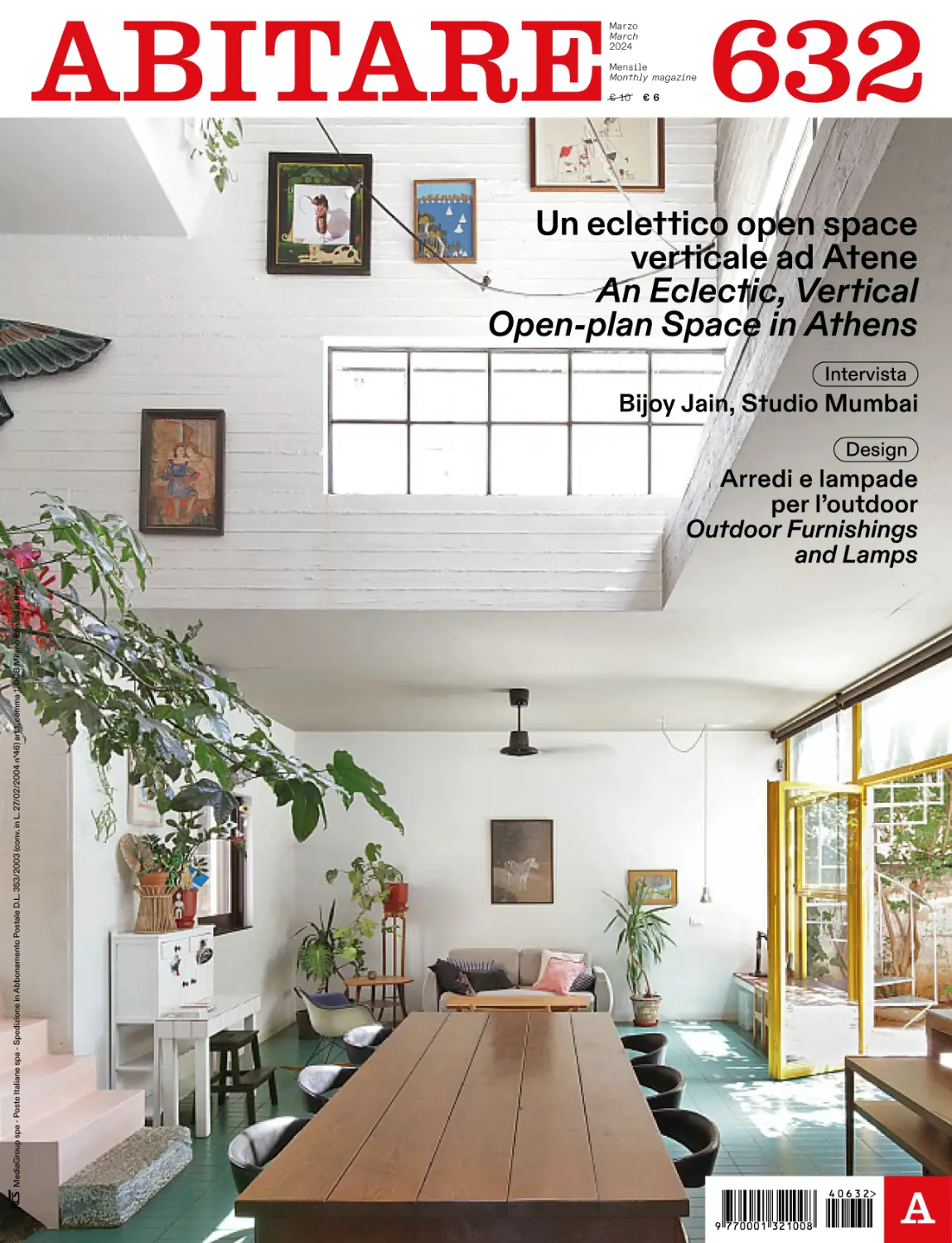
ABITARE 632
Marzo
March
2024
Mensile
Monthly magazine
€ 10
€ 6
Un eclettico open space
verticale ad Atene
An Eclectic, Vertical
Open-plan Space in Athens
Intervista
Bijoy Jain, Studio Mumbai
Design
MediaGroup spa - Poste Italiane spa - Spedizione in Abbonamento Postale D.L. 353/2003 (conv. in L. 27/02/2004 n°46) art.1, comma 1, DCB Milano Printed in Italy
Arredi e lampade
per l’outdoor
Outdoor Furnishings
and Lamps
A
moltenigroup.com
SCOPRI MODULOR BOISERIE, COVER CABINA ARMADIO, RADIUS PORTA. DESIGN GIUSEPPE BAVUSO
Sommario 632
13 Radar
24 Libri
COVER STORY
26 Fuori dagli schemi
Outside the Box
Sembra un villaggio verticale la casa progettata
da Point Supreme Architects ad Atene The house
designed by Point Supreme Architects in Athens
looks like a vertical village
▷ Silvia Icardi
36 Materioteca
Parati-murales, cementine geometriche e piastrelle 3D
dal segno grafico Wallpaper-murals, geometric cement
tiles and 3D tiles with a graphic effect
▷ Benedetto Marzullo
PROGETTI
38 Nel ventre dell’architetto
In the Belly of the Architect
Aperture come grandi occhi per il museo ipogeo di
Wutopia Lab in Manciuria Large, eye-like openings for
the underground museum of Wutopia Lab in Manchuria
▷ Matteo Zambelli
44 Rent & Repair
Nuove logiche al servizio dell’economia circolare
The new logic behind the circular economy
▷ Paola Carimati
50 L’attimo fuggente
The Fleeting Moment
Catturano l’anima delle piante le foto di Marianne Majerus
Marianne Majerus’ photos capture the soul of plants
▷ Laura Bianchi
56 Liam Lee
Il variopinto universo dell’artista che scolpisce la lana
The universe of the artist who sculpts with wool
▷ Luca Trombetta
60 Effetto boomerang
Boomerang Effect
A Boston, il nuovo aeroporto di Luis Vidal
The Boston’s new airport designed by Luis Vidal
▷ Luca Maria Francesco Fabris
66 Progetti che ‘non’ lasciano un segno
Projects that Leave ‘No’ Mark
Quando l’architettura è poesia
When architecture is poetry
▷ Paolo Bocchi
38
80
L’INTERVISTA
73 Bijoy Jain
«Il mio obiettivo? Edifici osmotici che favoriscono
gli scambi» “My goal? Osmotic buildings that encourage
interaction”
▷ Leonardo Lella
INTERIORS
80 Classicismo formato metropoli
Classicism for the Metropolis
Nicolas Schuybroek ristruttura una townhouse a Brooklyn
con esiti cinematografici Nicolas Schuybroek renovates
a townhouse in Brooklyn with cinematic results
▷ Paolo Lavezzari
90 Sogno fiammingo
A Flemish Dream
Spazi fluidi nel vecchio fienile reinterpretato dal designer
Sven Bullaert vicino a Bruxelles Fluid spaces in the old
barn reinterpreted by designer Sven Bullaert near Brussels
▷ Giuseppe Santonocito
100 Smart Ideas
Soluzioni sorprendenti e funzionali per piccoli spazi
Surprising and functional solutions for small spaces
▷ Chiara Maranzana
104 In sintonia con la storia
In Harmony with History
Mattoni al vivo e design di ispirazione nordica
nell’appartamento di studio Caal a Barcellona
Raw bricks and Nordic-inspired design in the
Caal studio apartment in Barcelona
▷ Chiara Somajni
112 Organic Pavilion
L’ampliamento di Martin Gruber in simbiosi con la natura
Martin Gruber’s enlargement in symbiosis with nature
▷ Luca Maria Francesco Fabris
DESIGN
122 Focus On
Lampade ricaricabili Rechargeable Lamps
▷ Daria Pandolfi
131 Dossier Outdoor
Tessuti tecnici, intrecci e un design che si rifà agli
archetipi Technical fabrics, weaves and a design
that harks back to archetypes
▷ Benedetto Marzullo, Francesca Tagliabue
144 Dossier Luci Outdoor
Le novità per accendere l’atmosfera in giardino
New products to light up gardens atmospherically
▷ Benedetto Marzullo, Francesca Tagliabue
146 On Show
Ho Tzu Nyen
6
Contributors
1
2
4
【1】 FILIP DUJARDIN
(Ghent, 1971) Fotografo di architettura
e visual artist. Crea fotomontaggi
utilizzando immagini di edifici reali, come
nella serie Fictions in cui megastrutture
abbandonate richiamano l’era sovietica
e lavori di architetti come Rem Koolhaas e
Frank Gehry. Rappresentato dalla galleria
Valerie_Traan di Anversa, ha partecipato
alle Biennali di Venezia e Chicago. An
architectural photographer and visual
artist. He creates photo-montages using
images of real buildings, for example in
the Fictions series, in which abandoned
mega-structures recall the Soviet era and
works by architects such as Rem Koolhaas
and Frank Gehry. Represented by the
Valerie_Traan gallery in Antwerp, he has
taken part in the Venice Biennale and the
Chicago Biennial. P.26
【2】 MATTEO ZAMBELLI
(Luino, 1968) Laureato in architettura
(IUAV), è dottore di ricerca in Ingegneria
edile (Università Politecnica delle
Marche) e ricercatore presso il
Dipartimento di Architettura di Firenze.
I temi che lo appassionano sono la teoria
dell’architettura e il design thinking.
Ama gli spazi sconfinati visibili dalle
montagne. He has a degree in
Architecture and a PhD in Architectural
Engineering, and works as a researcher
at the Department of Architecture in
Florence. The subjects he is passionate
8
3
5
about include theory of architecture and
design thinking. He loves the boundless
spaces visible from mountain tops. P.38
【3】 LAURA BIANCHI
(Como, 1972) Giornalista, ha lavorato
per 20 anni nelle redazioni moda di
Elle, Velvet e D la Repubblica. Poi ha
dato voce alla sua passione per il
giardinaggio e iniziato a scrivere di fiori
e piante dopo aver frequentato la Scuola
Agraria di Monza. Il suo primo romanzo,
L’Erba corre quando vuole (ed. LEF),
racconta il cambio vita. A journalist
who worked for 20 years in the fashion
editorial departments of Elle, Velvet and
D la Repubblica. She then indulge her
passion for gardening and began writing
about flowers and plants after attending
the Agricultural School of Monza. Her
novel L’Erba corre quando vuole (ed. LEF)
tells of this change in her life. P.50
【4】 PAOLO BOCCHI
(Milano, 1964) Si definisce 'architetto,
gemelli, sconfinante'. Ha scritto di
architettura, e non solo, sulle pagine di
Abitare, Rolling Stone, GQ, Ventiquattro,
Corriere della Sera, Kult eccetera e fa
parte della redazione di Inventario.
Autore di programmi televisivi musicali,
collabora come ‘spacciatore di idee’ per
agenzie di pubblicità, centri media e case
di produzione. Con Morellini Editore ha
pubblicato i romanzi L’Urna vagante e
Arcipelago amico. He defines himself as
'an architect and a Gemini who likes
crossing over into new field's. He has
written about architecture, among other
things, for Abitare, Rolling Stone, GQ,
Ventiquattro, Corriere della Sera, Kult
etc. and is on the editorial staff of
Inventario. He creates TV music
programmes and works as an ‘ideas
generator’ for advertising agencies, media
centres and production companies.
Morellini Editore published his novels
L’Urna vagante and Arcipelago amico. P.66
【5】 PIET-ALBERT GOETHALS
Fotografo belga, ha iniziato la sua
carriera tra paesaggi nordici e concerti
black metal, per poi passare a interni,
architettura e moda. La sensibilità si
accompagna all’attenzione alla
composizione e all’inquadratura. Insieme
alla moglie, Jessy Van Durme, ha fondato
Akt Magazine, rivista di lifestyle, design
e cultura belga. A Belgian photographer
whose career began amid Nordic
landscapes and black metal concerts,
before moving on to interiors,
architecture and fashion. He combines
sensitivity with a keen eye for
composition and image fields. Together
with his wife, Jessy Van Durme, he
founded Akt Magazine, a Belgian lifestyle,
design and architecture periodical. P.80
© ALL RIGHTS RESERVED
Staff
Direttore responsabile
Editor in chief
Francesca Taroni
Traduzioni
Translations
Shanti Evans
David Lowry
Caporedattori
Managing editors
Robert Burns
Mara Weiner-Macario
Website
Sara Banti
Architettura, attualità, sito web
Architecture, news, website
Chiara Maranzana
Sistema multimediale
Multimedia system
Benedetto Marzullo
Industrial design
Grafici
Graphic Staff
Monica Panitti
Caporedattore
Managing editor
Fabio Grazioli
Caposervizio
Senior editor
Elena Liberatore
Caposervizio
Senior editor
Segreteria di redazione
Editorial secretary
Monica Guala
Ricerca fotografica
Photo research
Progetto grafico
Graphic design
La Tigre
Collaboratori
Contributors
Stefano Benedetti
Peter Bennetts
Ornella Bergamaschi
Laura Bianchi
Paolo Bocchi
Luigina Bolis
Raul Candales
Paola Carimati
CreatAR Images
Filip Dujardin
Luca Maria Francesco Fabris
Piet-Albert Goethals
Silvia Icardi
Greta La Rocca
Paolo Lavezzari
Leonardo Lella
Mads Mogensen
Francisco Nogueira
Daria Pandolfi
Susanna Paparatti
Ema Peter
Matteo Pirola
Luc Roymans
Giuseppe Santonocito
Omar Sartor
Chiara Sessa
Chiara Somajni
Francesca Tagliabue
Luca Trombetta
Matteo Zambelli
Leonardo Zuccaro Marchi
10
è pubblicata da / is published
by RCS MediaGroup spa
Presidente e Amministratore delegato
Urbano Cairo
Brand manager
Ilaria Carnevale Miacca
ilaria.carnevalemiacca@rcs.it
Advertising manager
Connie Chiaro
connie.chiaro@rcs.it
Consiglieri
Federica Calmi, Carlo Cimbri, Benedetta Corazza
Alessandra Dalmonte, Diego Della Valle, Uberto Fornara
Veronica Gava, Stefania Petruccioli, Marco Pompignoli
Stefano Simontacchi, Marco Tronchetti Provera
Direttore generale News
Alessandro Bompieri
Content Syndication
Chiara Banfi
press@rcs.it
Ufficio tecnico
Technical office
Emanuele Marini, emanuele.marini@rcs.it
Rivista internazionale a periodicità
mensile edita in lingua italiana e in
lingua inglese e diffusa in tutto il
mondo, fondata da Piera Peroni nel
1961. An international magazine
published monthly in Italian and
English, founded by Piera Peroni
in 1961 and sold all over the world.
via Angelo Rizzoli, 8
20132 Milano
tel. +39 0225843420
redazione@abitare.rcs.it
abitare.it
Federazione Italiana Editori
Giornali
Unione Stampa Periodica Italiana
Abitare è anche su
Abitare is also available
Stampa
Rotolito, Seggiano di Pioltello (MI). Printed in Italy.
Abbonamenti Italia Per informazioni telefonare al numero
0263798520 o scrivere a RCS MediaGroup spa, Servizio
Abbonamenti, via Angelo Rizzoli 8, 20132 Milano,
fax 0225883625, abbonamenti@rcs.it, abbonamentircs.it
Il servizio è aperto da lunedì a venerdì con orario
continuato dalle 8.30 alle 18.30. L’abbonamento andrà
in corso dal primo numero raggiungibile e può avere inizio
in qualsiasi periodo dell’anno. Il cambio d’indirizzo
è gratuito: comunicare, almeno 30 giorni prima, il codice
abbonato, nome, cognome, indirizzo completo.
Abbonamenti estero Magazine subscription
Abitare (USPS 343-030) is published by RCS MediaGroup spa
in 10 issues per year.
Please contact Fastmag srl, via Portuense 1555, Commercity
Isola N/47, 00148 Roma (RM), tel. +39 0665000808,
e-mail sub@fastmag.it, fastmag.it.
Arretrati Rivolgersi al proprio edicolante oppure
ad arretrati@rcs.it o al numero 0225843604.
Il pagamento della copia, pari al doppio del prezzo
di copertina, deve essere effettuato su
IBAN IT 97 B 03069 09537 000015700117
Banca Intesa – Milano intestato a RCS MediaGroup spa,
comunicando via e-mail l’indirizzo e il numero richiesto.
Distribuzione Worldwide distribution
m-dis Distribuzione Media spa, via Cazzaniga 19, 20132
Milano tel. 0225821, fax 0225825302, info-service@m-dis.it.
Spedizione in a.p. DL. 353/2003 (conv. in L. 27/02/2004,
n. 46), art. 1, comma 1, DCB Milano – Registrazione presso
il Tribunale di Milano, n. 286 del 12.8.1976. ISSN 0001-3218
(print), ISSN 2499-3522 (online).
ABITARE 632
Marzo
March
2024
Mensile
Monthly magazine
€ 10
€ 6
Un eclettico open space
verticale ad Atene
An Eclectic, Vertical
Open-plan Space in Athens
Intervista
Bijoy Jain, Studio Mumbai
In questo numero la pubblicità è inferiore al 45%.
La riproduzione intera o parziale di testi o fotografie
è vietata: diritti riservati in tutto il mondo.
Advertising in this issue is less than 45%. All rights
reserved: reproduction of texts and photographs in whole
or part is strictly prohibited.
Design
Arredi e lampade
per l’outdoor
Outdoor Furnishings
and Lamps
A
Casa Petralona, Point
Supreme Architects, Athens
photo Filip Dujardin
I prodotti segnalati su Abitare sono una libera scelta
redazionale. I testi e le fotografie inviati alla redazione
non vengono restituiti anche se non pubblicati.
Products mentioned in Abitare are freely chosen by
the editorial staff. Texts and photographs submitted
to the magazine are not returned, even if not published.
Concessionaria esclusiva pubblicità
Exclusive Advertising Agent
CAIRORCS MEDIA spa
Sede legale: via Angelo Rizzoli 8, 20132 Milano
cairorcs@cairorcsmedia.it, tel. +39 0225845400
Vendite: Italia tel. 022584/6281 – estero +39 0225846354/6951
Radar
632
Vitra Museum
Energia creativa
Creative Energy
Nel 1957 l’Alcoa (Aluminum company of America) invitò Charles
e Ray Eames a disegnare un oggetto ludico da utilizzare
per pubblicizzare l’alluminio. Nacque così la Solar Do-nothing
Machine, un intrigante congegno che, mosso dall’energia solare,
accendeva un paio di lampadine. È un giocattolo che ancora
incanta, ma soprattutto un precursore delle future macchine
a energia solare. Fa parte degli oggetti e progetti selezionati
per la mostra Transform! Designing the Future of Energy, che
inaugura al Vitra Design Museum di Weil am Rhein il 23 marzo
(fino al primo settembre). Focus sul ruolo centrale del design
nell’ideare dispositivi e architetture per la produzione,
la conservazione e l’utilizzo dell’energia. Un percorso che
conduce dalla prima radiolina a celle solari, prodotta da Hoffman
nel 1958, ai progetti più visionari degli ultimi anni, tra i quali
spicca per originalità X-Land, firmato dallo studio francese
XTU, che propone di trasformare le piattaforme petrolifere
offshore abbandonate in ville ecologiche (in foto).
© ALL RIGHTS RESERVED
In 1957, Alcoa (the Aluminum Company of America) invited
Charles and Ray Eames to design a playful object to advertise
aluminium. Thus was born the so-called Solar Do-Nothing
Machine, an intriguing device that used solar energy to turn on
a pair of light bulbs. It remains an intriguing toy, but more
importantly it is a precursor of future solar-powered cars. It is one
of the objects and design projects selected for the Transform!
Designing the Future of Energy exhibition, which opens at the
Vitra Design Museum in Weil am Rhein on March 23rd (until
September 1st). The focus is on the central role played by design in
dreaming up devices and works of architecture for the production,
conservation and use of energy. The story can be traced back
to the first solar cell radio, produced by Hoffman in 1958, right up
to the most visionary projects of recent years, including the highly
original X_Land, designed by the French studio XTU, whose
aim is to turn abandoned offshore drilling platforms into ecofriendly villas (pictured). design-museum.de 【Chiara Sessa】
13
Londra
Il modernismo ai tropici
Modernism in the Tropics
Courtesy RIBA Collections
© Gordon Cullen Estate
Alla fine degli anni Quaranta, gli architetti britannici Maxwell Fry
e Jane Drew inventarono uno stile che adattava l’estetica
modernista europea al clima dei tropici. Grazie al finanziamento
del Colonial Welfare and Development Act, i coniugi realizzarono
scuole, università, centri comunitari e biblioteche portando
l’International style nell’Africa occidentale secondo un’ottica
coloniale. Negli anni successivi, però, sarà proprio questa nuova
architettura a diventare il simbolo della liberazione. La mostra
Tropical Modernism: Architecture and Indipendence, al Victoria
& Albert Museum di Londra fino al 22 settembre, racconta
la diffusione di questa corrente architettonica con disegni,
modellini, immagini e un filmato di mezz’ora. In the late 1940s,
the British architects Maxwell Fry and Jane Drew invented a style
that adapted European modernist aesthetics to the climate of
the Tropics. Thanks to funding arising out of the Colonial Welfare
and Development Act, the couple built schools, universities,
community centres and libraries, bringing International Style to
West Africa but taking what was very much a colonial approach.
In the years that followed it was precisely this new kind of
architecture that became the symbol of liberation. The exhibition
Tropical Modernism: Architecture and Independence, at London’s
Victoria & Albert Museum until 22 September, uses drawings,
models, pictures and a half-hour film to tell the story of how this
architectural movement spread. vam.ac.uk 【CS】
Illustrazione da The Architectural Review, 1953.
Tecnologia
Ghost Tv
Si smaterializza nell’ambiente domestico
il nuovo televisore Signature Oled T di LG.
Potrebbe essere l’inizio di una nuova
era per quello che è stato considerato per
decenni il nuovo focolare domestico.
Presentato alla scorsa edizione del Ces
di Las Vegas, dove ha fatto incetta di premi,
Signature Oled T è composto da una teca
di vetro racchiusa in una sorta di libreria,
implementabile modularmente proprio
come un arredo. Il display, dotato solo
di un cavo di alimentazione nascosto nella
struttura, riceve il segnale audio-video (4K)
grazie alla connessione wi-fi con la Zero
Connect Box, un dispositivo da posizionare
liberamente nella stanza. Per evitare
che la visione sia disturbata dalla luce
qualora la tv venga posizionata davanti
a una finestra, la struttura è dotata
di un telo scuro retrattile da utilizzare
all’occorrenza. The new LG Signature
Oled T television dematerialises in the
home environment. It could be the start of a
new era for what has been considered the
new domestic environment for decades.
Presented at the last edition of CES in Las
Vegas, where it won awards, Signature
Oled T consists of a glass case enclosed in
14
Radar
a kind of bookcase, which can be created
on a modular basis just like furniture. The
display, equipped only with a power cable
hidden inside the structure, receives the
audio-video signal (4K) thanks to the Wi-Fi
connection with the Zero Connect Box, a
device that can be positioned anywhere in
the room. To prevent viewing being
disturbed by light if the TV is positioned in
front of a window, the structure is equipped
with a retractable dark sheet to be used
when needed. lg.com 【Greta La Rocca】
ph. Olivier Baco
Ronan Bouroullec
Art-à-porter
Per la collezione Homme Plissé a/i 2024,
la maison Issey Miyake ha reclutato
il designer e artista Ronan Bouroullec.
A sfilare sotto le volte del Palais de Tokyo
di Parigi, una serie di capi dove i disegni
del creativo francese sono stati riprodotti
sui tessuti plissé, firma inconfondibile
del marchio. Serigrafati, i motivi decorano
completi dalle forme scivolate, cappotti
e poncho dai tagli trasversali, camicie
ricamate a colori vividi e accessori
di maglia da indossare in molti modi.
Voluminosi capispalla monocromatici, che
possono essere avvolti intorno al corpo su
più strati, traducono in tre dimensioni la
© ALL RIGHTS RESERVED
serie di opere a pennarello All Over di
Ronan, dando proprio l’impressione di
vestire un disegno. La versatilità creativa
del designer è anche al centro del nuovo
volume Day After Day (Phaidon), una sorta
di diario per immagini del suo mondo a
cavallo tra arte e design. For the Homme
Plissé 2024 autumn-winter collection, the
Issey Miyake fashion house enlisted the
services of the designer and artist Ronan
Bouroullec. The new series of garments
was presented in a fashion show held
beneath the vaulted ceilings of the Palais
de Tokyo in Paris: the French creative’s
designs were reproduced on the brand’s
unmistakable pleated fabrics. Screenprinted patterns decorate suits with flowing
shapes, coats and ponchos with diagonal
cuts, shirts embroidered in vivid colours
and knitted accessories to be worn in many
ways. Voluminous monochrome outerwear
that wraps around the body in multiple
layers, translate Ronan’s All Over series of
felt-tip works into three dimensions, giving
the impression of dressing a drawing. The
designer’s creative versatility is also central
to the new book Day After Day (Phaidon),
a sort of picture diary of his world that
extends across the worlds of art and
design. isseymiyake.com 【Luca Trombetta】
Radar
15
Antonio Citterio Patricia Viel
Milano Reloaded
The new Rolex boutique has opened in Galleria Vittorio
Emanuele II, in the heart of Milan. Together with Rocca, the famous
Geneva-based timepiece brand has created an elegant space
in the city’s so-called ‘living-room’, redesigned for the occasion by
the ACPV studio of Antonio Citterio and Patricia Viel, with custommade furnishings and details inspired by the famous shopping
arcade’s neo-Renaissance style. Italian artisan excellence is
showcased on all three levels of the store, from the reception area
enclosed between carved travertine walls with terrazzo flooring
to the upper floors, which are accessed via a terrazzo staircase
that winds through geometrically patterned walnut panelling. The
rooms lead back to the intimacy of a welcoming domestic living
space, embellished with velvet sofas, silk wallpaper and leather
furnishings. “The boutique defines a new language for retail
space based on a selection of refined materials and furnishings.
The project was conceived through a careful of consideration
of how people would experience the space, both inside and from
the outside,” say Citterio and Viel. rolex.com 【Luigina Bolis】
ph. Gianluca Di Ioia
Apre i battenti in Galleria Vittorio Emanuele a Milano la nuova
boutique Rolex. Insieme a Rocca, il celebre marchio di cronografi
ginevrino inaugura un elegante spazio nel cuore del ‘salotto
buono’ della città, ridisegnato per l’occasione dallo studio
ACPV di Antonio Citterio e Patricia Viel, tra arredi su misura
e dettagli ispirati alla galleria neorinascimentale. Sui tre livelli
del negozio protagonista è l’eccellenza artigianale italiana,
dall’area accoglienza racchiusa tra pareti di travertino
intagliato con pavimento in seminato fino ai piani superiori,
cui si accede tramite una scala in terrazzo che si snoda tra
boiserie di noce a motivi geometrici. Gli ambienti riconducono
all’intimità di un accogliente living domestico, impreziosito
da divanetti di velluto, parati di seta e arredi di pelle. «La boutique
definisce un nuovo linguaggio per gli spazi retail, basato
su una selezione di materiali e arredi raffinati. Il progetto è
stato concepito considerando come le persone avrebbero
percepito e vissuto lo spazio, sia all’interno che all’esterno»,
sottolineano Citterio e Viel.
16
Radar
© ALL RIGHTS RESERVED
1 Deysi Tacuri Lopez,
Luisa Dorr, 2019-2021.
2 Our Collective Beauty,
Thandiwe Muriu, 2022.
1
Mantova
Sguardi al femminile
A Female Perspective
È Private il tema portante della Biennale
della Fotografia Femminile di Mantova,
in programma dall’8 marzo al 14 aprile in
diverse location cittadine. Giunta alla terza
edizione, la manifestazione è una vetrina
per artiste internazionali che con il loro
linguaggio hanno affrontato la sfera
del privato secondo differenti accezioni.
Dalla contrapposizione tra vita pubblica
e familiare al tema della privacy, passando
per il concetto di censura e sorveglianza,
le mostre raccolgono nuove produzioni
e vecchi scatti ancora attuali. A cent’anni
dalla nascita, sono esposti lavori d’archivio
di Lisetta Carmi, ritratti ambientati che
raccontano la quotidianità delle donne
© ALL RIGHTS RESERVED
2
nella Sardegna del 1964 e nella Sicilia
del 1977. Interessanti anche le immagini
di Underland Australia, con cui Tamara
Merino racconta l’esistenza di persone che
rifiutano l’urbanizzazione, e la lotta contro il
regime delle donne iraniane immortalate da
Newsha Tavakolian. Private is the central
theme of the Mantua Biennial of Female
Photography, being held from 8th March
to 14th April in various locations around the
city. Now in its third edition, the event
showcases international artists – including
some less well-known ones in Italy – who
have used their chosen medium to present
the private sphere from a variety of
perspectives. From the contrast between
public and family life to the theme of
privacy, as well as concepts of censorship
and surveillance, the exhibitions combines
new work with old photographs that were
taken decades ago but are still relevant
today. 100 years after her birth, archive
works by Lisetta Carmi are on display,
images that tell of the everyday life of
women in Sardinia in 1964 and in Sicily in
1977. Also interesting are the images
of Underland Australia, with which Tamara
Merino explores the lives of people who
reject urbanisation, and Iranian women’s
struggle against their country’s regime,
caught on camera by Newsha Tavakolian.
bffmantova.com 【Francesca Tagliabue】
Piccoli tavolini-sgabelli di cemento
che ricordano gli ideogrammi.
Per ora ce ne sono tre (in foto
Abecedario A, di Studio Irvine,
Marialaura Rossiello Irvine).
Ma la collezione di Forma&Cemento
prevede 26 grafemi. Firmati da
altrettanti designer.
Small concrete table-stools
resembling ideograms. There are
currently three (the photo shows
Abecedario A, by Studio Irvine,
Marialaura Rossiello Irvine).
The Forma&Cemento collection
includes 26 graphemes by 26
designers. formacemento.com
Radar
17
ph. Filippo Poli
Cino Zucchi
Galateo urbano
Urban Etiquette
Si inserisce con armonia nel tessuto cittadino il nuovo complesso
residenziale progettato da Cino Zucchi in via Valtorta, a Milano.
Ripercorre una ricerca tipica dell’architetto: tasche urbane e
insenature piegano gli edifici verso la corte interna, creando una
dialettica dinamica tra spazi pubblici e privati. «Sta nel galateo
urbano della città», commenta Zucchi nell’illustrare l’impianto
composto di tre volumi con mix di funzioni commerciali e abitative,
collegati da un basamento continuo e uniforme che consolida le
relazioni spaziali con il contesto e da cui spicca una torre intagliata
ai primi piani da un ‘passage urbano’. Zucchi ricava anche spazi
‘inbetween’, come le soglie dei terrazzi-logge che a sud affondano
nei volumi con diverse profondità, in un gesto scultoreo. The
new residential complex designed by Cino Zucchi in Via Valtorta,
Milan, blends harmoniously into the city fabric. It represents the
typical research approach adopted by the architect: urban pockets
and inlets bend the buildings towards the inner courtyard, creating
a dynamic dialectic between public and private spaces. “It is
part of the urban etiquette of the city,” comments Zucchi when
18
Radar
illustrating the system composed of three volumes with a mix of
commercial and residential functions, connected by a continuous
base that consolidates the spatial relationships with their context
and from which protrudes a tower cut through on the first floors
by an ‘urban passageway’. Zucchi creates also ‘in-between’
spaces, such as the thresholds of the terrace-loggias which to the
south are sunk into the volumes at different depths, in a sculptural
gesture. zucchiarchitetti.com 【Leonardo Zuccaro Marchi】
© ALL RIGHTS RESERVED
Kennedy Nolan
Glamour industriale
Industrial Glamour
Lo store cult di sneakers e streetwear Up There si trasferisce
nella nuova sede di Flinders Lane nel centro di Melbourne. Firma
il progetto Kennedy Nolan, che per i 345 metri quadrati
dello spazio ha puntato su un massiccio utilizzo dell’acciaio
– perforato, galvanizzato o lucidissimo a foderare pareti e soffitti
– grandi superfici a specchio e un sapiente uso del colore.
Se la pavimentazione è rivestita di un tessuto verde brillante,
i tendaggi dei camerini sono di morbido velluto arancione,
mentre i banconi espositivi si illuminano di luci viola e blu cobalto.
Non manca qualche pezzo iconico di design italiano, come
la celeberrima lampada Chiara disegnata da Mario Bellini per Flos.
Illuminato da strategici tubi al neon, lo scenario industrial-glam
è la cornice perfetta per presentare le ultime collezioni, dalle
limited edition di Nike fino a Junya Watanabe. The cult sneaker
and streetwear clothing company Up There has moved to new
premises on Flinders Lane in downtown Melbourne. It was
designed by Kennedy Nolan, who for the 345-sqm space has
focused on an extensive use of steel (perforated, galvanised
or highly polished to line the walls and ceilings), large mirrored
surfaces and a skilful use of colour. While the flooring is
completely covered in bright green fabric, the fitting room curtains
are in soft orange velvet, and the display counters are illuminated
by purple and cobalt blue lights. There are also some iconic Italian
design items, such as the famous Chiara lamp designed by Mario
Bellini for Flos. With its strategically positioned tubular neon
lighting, the industrial-glam scenario is the perfect setting in which
to present the latest collections, from the limited editions from
Nike to Junya Watanabe. kennedynolan.com.au 【LB】
Era il 1954 quando Giovanni
Gariboldi disegnò per Ginori
1735 il servizio blu impilabile
Colonna, dalle linee pulite
e geometriche. Oggi l’azienda
presenta Colonna re-edition
in tre diversi set: un servizio
per la tavola, uno per il tè
e uno per il caffè.
© ALL RIGHTS RESERVED
In 1954, Giovanni Gariboldi
designed the blue Colonna
stackable service for Ginori
1735, characterised by clean,
geometric lines. Now, the
company presents Colonna Reedition in three sets: a table
service, a tea service, a coffee
service. ginori1735.com
Radar 19
Ogni elemento del set Convivium si
incastra perfettamente con gli altri, come
il tagliere che fa da base per i tegami
o il coperchio del cuoci-pane che si
trasforma in un contenitore per le cocotte
in ceramica. All the elements in the
Convivium system interlock perfectly: the
cutting board acts as a base for the pans;
the lid of the bread baker becomes
a container for the ceramic cocottes.
Mario Cucinella
Giochi
di incastri
A Slot-together
System
Mario Cucinella, insieme ad Antonella Di Luca
e Bianca Gabrielli, reinterpreta in chiave
domestica, contemporanea ed ecologica la
cucina da campo militare. Nasce così la nuova
collezione Convivium di TVS, presentata
all’ultima edizione della fiera tedesca Ambiente.
Si tratta di una gamma completa di strumenti per
la cottura e l’impiattamento del cibo contenuta
in due box richiudibili. Pentole, tegami, cestelli
per la cottura a vapore, vassoi, teglie, cocotte
e utensili come mestoli e cucchiai sono concepiti
per incastrarsi alla perfezione quando non in uso,
creando una sorta di puzzle tridimensionale.
I materiali individuati per ogni pezzo – legno
massello, alluminio riciclato, vetro e terracotta
– sono sostenibili, una scelta legata non
solo alla volontà di rispettare l’ambiente
in termini di riciclo del prodotto, ma anche
a diffondere un’idea di cottura sana degli
alimenti. Il set consente di avere tutto ciò che
serve per cucinare in pochissimo spazio.
Mario Cucinella, together with Antonella
Di Luca and Bianca Gabrielli, reinterprets the
camp kitchen from a domestic, contemporary
and ecological angle. This is the new TVS
Convivium collection, presented at the latest
edition of the German trade fair Ambiente.
It offers a complete set of items for cooking
and plating food, contained in two re-sealable
boxes. Pots, pans, steamer baskets, trays, baking
trays, casseroles and utensils such as ladles
and spoons are designed to fit together
perfectly when not in use, creating a kind of
three-dimensional puzzle. The materials chosen
for each piece – solid wood, recycled aluminium,
glass and terracotta – are sustainable, a choice
linked not only to the desire to respect the
environment in terms of product recycling, but
also to spread an idea of healthily cooked food.
The set provides everything needed for cooking
in very little space. tvs-spa.it 【FT】
20 Radar
© ALL RIGHTS RESERVED
ph. Laurent Delhourme
Parigi
Affinità elettive
Elective Affinities
Conversazione cromatica e concettuale tra haute couture e arte,
la mostra La traversée des apparences. Quand la mode s’invite
au Musée, aperta al Centre Pompidou di Parigi fino al 22 aprile,
mette in luce le connessioni tra moda e creazione artistica.
«È una storia di affinità elettive e di ossessioni», spiega la curatrice
Laurence Benaïm, che ha selezionato diciassette modelli,
associandoli a opere della collezione del Musée National d’Art
Moderne. Ecco quindi le perline al centro del quadro Liebesperlen
di Ulrike Ottinger (1967) dialogare con il corpetto di un abito dello
stilista Kevin Germanier (in foto), l’accostamento di Yves Saint
Laurent a Henri Matisse e di Iris van Herpen a Marc Chagall.
«Rendiamo omaggio a quelle forze interiori senza le quali non c’è
diritto di osare, di trascrivere i sogni vestendoli», considera
Benaïm. Chromatic and conceptual conversation between haute
couture and art, the exhibition La traversée des apparences.
Quand la mode s’invite au Musée, at the Centre Pompidou in Paris
until April 22, highlights the connections between fashion and
artistic creation. “It is a story of elective affinities and obsessions,”
explains the curator Laurence Benaïm, who selected 17 models,
associating them with works from the Musée National d’Art
Moderne collection. They include the beads at the centre
of the painting Liebesperlen by Ulrike Ottinger (1967) that interact
with the bodice of a dress by Kevin Germanier (pictured), the
juxtaposition of Yves Saint Laurent with Henri Matisse and of Iris
van Herpen with Marc Chagall. “We pay homage to those internal
forces without which there is no right to dare” says Benaïm.
centrepompidou.fr 【Susanna Paparatti】
Allan McCollum
È aperta fino al 29 marzo alla Galleria
Fumagalli di Milano Minime Variazioni.
Drawings and Plaster Surrogates,
mostra personale dedicata all’americano
Allan McCollum. Il progetto site-specific
si inserisce nel percorso di ricerca
dell’artista, che da cinquant’anni
realizza gruppi di disegni o sculture
– da pochi elementi a migliaia –
apparentemente prodotte in serie,
ma caratterizzate da sottili discromie
e differenze di forma che consentono
di distinguere il singolo dalla massa.
L’installazione milanese Collection
of Drawings, composta da 660 elementi
realizzati tra il 1988 e il 1992, come
già altri lavori riflette sul paradosso
dell’esistenza umana per cui ogni
individuo aspira a far parte di un gruppo
ma, allo stesso tempo, vuole sentirsi
unico. Allan McCollum’s solo exhibition
Minime Variazioni. Drawings and Plaster
Surrogates can be seen at the Fumagalli
© ALL RIGHTS RESERVED
Gallery in Milan until 29th March.
The site-specific project is part of
the artist’s fifty-year research process,
involving groups of drawings or
sculptures – ranging from just a few
elements to several thousand –
seemingly produced in series but
characterised by subtle discolourations
and differences in shape that make it
possible to distinguish the individual
from the mass. Like other works, the Milan
installation Collection of Drawings
(660 items created between 1988 and
1992) reflects on the paradox of human
existence, whereby each individual
aspires to be part of a group but
at the same time wants to feel unique.
galleriafumagalli.com 【FT】
ph. Lucrezia Roda, courtesy Galleria Fumagalli
Sfumature
impercettibili
Imperceptible
Nuances
Radar 21
ph. Max Touhey
New York
Il diamante
della corona
The Diamond
in the Crown
Ultimo tassello di una serie di interventi
architettonici che consolidano il tessuto
urbano newyorkese, il palazzo a uffici
The Refinery apporta le funzioni direzionali
nel Domino Park, affacciato sull’East
River a New York City. Ex zuccherificio,
il monumentale edificio ottocentesco, in
stile neoromanico, è il cosiddetto ‘diamante
della corona’, nuovo landmark di questo
brano di waterfront. Alto come i primi
grattacieli costruiti a fine Ottocento, con
un’imponente ciminiera che svetta
e diventa focale, The Refinery presenta
facciate di mattoni rossi che costituiscono
un grande scrigno, al cui interno il progetto
di ristrutturazione firmato da Pau (Practice
for Architecture and Urbanism) lavora per
contrasto solo con facciate vetrate e
trasparenti. A coronamento, una volta
panoramica: omaggio alle forme classiche,
cita, ingigantisce e rende tridimensionali
22 Radar
le piccole volte delle centinaia di finestre
che caratterizzano l’involucro. The last
in a series of interventions that consolidate
the New York urban fabric, The Refinery
office building brings management
functions to Domino Park, overlooking
the East River in New York City. A former
sugar factory, this neo-Romanesque style
building dating back to the 19th century,
and dubbed the ‘diamond in the crown’, is
the new landmark of this section of river
waterfront. The same height as the earliest
skyscrapers built in the late 1800s, and
with a chimney that stands out as the focal
point, The Refinery has red-brick façades
that create a large ‘treasure chest’, inside
which the renovation project signed
by PAU (Practice for Architecture and
Urbanism ) features glass and transparent
façades. Topping it off, a panoramic dome:
a tribute to classical forms that forms
a grand, three-dimensional backdrop to
the small arched windows on the building’s
outer walls. pau.studio 【Matteo Pirola】
© ALL RIGHTS RESERVED
EXCLUSIVE LAMPS
MADE IN ITALY
BEAM STICK GLASS
suspension lamps designed by Marc Sadler
Mouth-blown glass
made by hand.
Showrooms
and info:
OLEV - Colceresa, Italy - info@olevlight.com - www.olevlight.com
ph. DSL Studio
Libri
Triennale Milano
Cent’anni e non sentirli
Not Looking its Age
Triennale
Cento anni di manifesti
a cura di Mario Piazza
Italiano-English
Marsilio Arte, 2023
pp. 184, € 40
Nel manifesto di Tassinari/Vetta (1997), il cimitero
di Modena di Aldo Rossi fotografato da Luigi Ghirri.
24
La storia e l’evoluzione della grafica italiana attraverso le
locandine delle esibizioni allestite alla Triennale di Milano dal
1923 fino ai giorni nostri. Il volume, curato dal grafico
e architetto Mario Piazza, inizia proprio dalla manifestazione
più celebre: a fare da portabandiera sono i cartelloni
delle ventitré esposizioni internazionali che, con cadenza
triennale, hanno dettato il nome e la mission della
Fondazione fin dalle sue origini. Nell’elegante cartonato
con progetto grafico di Norm sono però centinaia le opere
presenti e altrettante le firme illustri, da Albe Steiner
a Bob Noorda, Mario Sironi, Jean-Michel Folon, da Max
Huber a Italo Lupi. Introduzione e onori di casa spettano
invece a Stefano Boeri, architetto di fama internazionale
e attuale presidente di Triennale Milano. The history
and evolution of Italian graphics through the posters for
exhibitions held at the Milan Triennale from 1923 to the
present day. This book, edited by the graphic designer and
architect Mario Piazza, begins with the most famous: the
posters of the 23 international exhibitions which, every three
years, act as standard-bearers, representing the mission
of the Foundation from its earliest days. There are,
however, hundreds of works in this elegant hardback book,
with graphic design by Norm, and just as many illustrious
designer names, from Albe Steiner and Bob Noorda
to Max Huber and Italo Lupi. The introduction is by Stefano
Boeri, the internationally-renowned architect and current
president of Triennale Milano. 【Stefano Benedetti】
© ALL RIGHTS RESERVED
Dizionario
ph. Luca Rotondo
Voce alla protesta
Protest Voices
Protest Architecture
Barricades, Camps
Spatial Tactics 1830-2023
Oliver Elser
Anna-Maria Mayerhofer
Sebastian Hackenschmidt
Jennifer Dyck, Lilli Hollein
Peter Cachola Schmal
Park Books, 2023
pp. 528, € 19
Freetown Christiania (1971), Black Lives Matter (2013),
Capitol Attack (2021). Sono solo alcune tra le più famose
proteste di massa che hanno coinvolto lo spazio pubblico
urbano, raccontate in questo originale libro organizzato
come un dizionario, risultato di una ricerca congiunta
del DAM di Francoforte e del MAK di Vienna. Dopo
un prologo illustrato che ricapitola le principali
manifestazioni di strada a partire dall’Ottocento, il volume
definisce i tanti termini – da barricata a ‘squatting’
(occupazione di edifici), a ‘toppling monuments’
(abbattimento dei monumenti) – utili e necessari
per inquadrare una materia finora poco sistematizzata,
eppure ricca di nessi generativi con i temi della
progettazione architettonica e urbana. Particolarmente
suggestiva la disamina finale dedicata a tende, baracche,
torri e altre forme di habitat provvisori realizzati per
occupare il territorio. Freetown Christiania (1971), Black
Lives Matter (2013), Capitol Attack (2021). These are just
some of the most famous mass protests that have
involved urban public space, collected and told in this
original book that is organised as a dictionary, the result
of joint research by the DAM in Frankfurt and the MAK
in Vienna. After an illustrated prologue summarising the
main street demonstrations all the way back to the
nineteenth century, the book defines many terms – from
barricade and squatting to the toppling of monuments
(usually the pulling down of statues) – in a useful exercise
that attempts to define a subject that has not been
approached in such a systematic way before, even though
it offers fascinating connections with the themes of
architectural and urban planning. The book ends with an
intriguing examination of tents, shacks, towers and other
forms of temporary dwellings occupied during
demonstrations. 【Sara Banti】
Massimiliano Locatelli
Arredi d’autore
Designer Furnishings
ph. Hans-Hermann Müller / Wendland-Archiv
Massimiliano Locatelli
Editions
Daniele Melotti
Mousse Publishing, 2024
pp. 232, € 40
Massimiliano Locatelli Editions è una collezione di
arredi che riflette l’esperienza dell’architetto milanese
nello sviluppo di progetti su misura. Raccolti
nell’omonima antologia, tavoli policromi di marmo,
sedie in alluminio laccato, lampade di tubi al neon
raccontano uno scenario contemporaneo di soluzioni
inedite per l’abitare e combinazioni innovative di forme
e materiali. Nelle parole di Locatelli, «oggetti ideati
in dialogo con lo spazio, per una casa in continua
evoluzione, per degli spazi nomadi che si adattano
a diverse realtà». Massimiliano Locatelli Editions
is a furnishing collection that reflects the Milan-born
architect’s experience in developing customised
design projects. Collected in the anthology of the same
name, polychrome marble tables, lacquered aluminium
chairs and neon tube lamps, present a contemporary
scenario of new solutions for living and innovative
combinations of shapes and materials. To quote
Locatelli himself: “Objects that interact with space, for
a continuously evolving home, for nomadic spaces that
adapt to different realities.” 【LT】
In alto, sedie ML1.2 di Massimiliano Locatelli. A sinistra,
villaggio di squatter a Gorleben, Bassa Sassonia, 1980.
25
Cover Story
Fuori dagli
schemi
Outside
the Box
Testo Silvia Icardi Foto Filip Dujardin
Sembra un villaggio su più livelli la casa ad Atene disegnata per sé dai fondatori
dello studio Point Supreme Architects. Concreto tributo alla libertà e alla fantasia, fa
convivere arredi di diversa provenienza in spazi sempre sorprendenti. Organizzati
attorno a una corte interna The house in Athens that the founders of Point Supreme
Architects, have designed for themselves resembles a village on several levels.
A concrete tribute to freedom and imagination, it brings together furniture of different
origins in surprising spaces. Laid out around an inner courtyard
26
Konstantinos Pantazis e Marianna Rentzou, proprietari e progettisti di Casa Petralona, seduti al lungo tavolo della zona giorno al piano
terreno. L’open space si affaccia sul giardino. La scala, attrezzata come libreria, conduce ai piani superiori e alla veranda. In apertura,
a sinistra, i fori nella parete di cemento a vista della copertura permettono alla luce naturale di ‘piovere’ nella sala sottostante,
a destra. Konstantinos Pantazis and Marianna Rentzou, owners and designers of Petralona House, seated at the long table of the living
area on the ground floor. The open-plan space faces onto the garden. The stairs, fitted out as a bookcase, lead to the upper floors and
the veranda. At the beginning, left, the holes in the raw-concrete wall of the roof let natural light ‘pour’ into the room beneath, right.
ph. Alina Lefa
ph. George Messaritakis
In alto, lo spazio centrale della casa misura 11 metri in altezza, coronato dalla copertura curva e correlato al giardino grazie alle
numerose porte finestre. Sopra e nella pagina accanto, il bagno e la camera da letto situati al piano ammezzato, realizzati con materiali
di recupero, dalle piastrelle alla porta. Le mensole ricavate nella nicchia sulla parete in cemento sono tipiche delle case greche. Top,
the central space of the house is 11 metres high, crowned by the curved roof and connected with the garden through numerous French
windows. Above and facing page, the bathroom and bedroom located on the mezzanine floor, realized with salvaged materials, from the tiles
to the door. The shelves set in a niche in the concrete wall are typical of Greek houses.
30
▶ Estrosa e fuori dagli schemi, Casa Petralona nasce dalla
trasformazione di una modesta residenza a un solo piano, in una
stretta via di Atene, in un’abitazione di 170 metri quadrati su tre livelli. Il perimetro dell’edificio è quello originale, ma i muri interni sono stati demoliti per dare vita a un ampio e articolato open space
verticale. I due livelli realizzati ex novo, riservati agli ambiti privati
di genitori e figli, hanno una copertura curva che abbraccia uno
spazio a tripla altezza, una sorta di corte interna su cui affacciano
tutti gli ambienti e in cui il verde è il benvenuto: un albero è stato
piantato ai piedi della scala, nicchie alle pareti ospitano piante e
fiori, e ampie vetrate inquadrano il piccolo giardino spontaneo sul
retro. La casa è l’abitazione degli architetti Konstantinos Pantazis
e Marianna Rentzou fondatori dello Studio Point Supreme Architects. «Durante la crisi finanziaria che ha travolto la Grecia il lavoro
scarseggiava, così abbiamo deciso di investire tempo ed energie
in questo progetto per noi».
Il processo realizzativo, lungo quasi dieci anni, ha visto il diretto coinvolgimento della coppia in ogni fase. «Pensiamo che l’architettura debba essere libera e inclusiva», spiegano. «Non costretta entro stili definiti, ma umana, che rispecchi chi la abita, capace
di sorprendere e divertire. In grado di celebrare ogni momento della vita familiare». Il progetto privilegia la vita sociale e la relazione
tra interno e giardino. La casa si propone come rivisitazione contemporanea della classica abitazione greca, fortemente introflessa e organizzata attorno a una corte a cielo aperto (in questo caso
invece è coperta), vero epicentro non solo per i proprietari ma anche per amici, parenti e abitanti del vicinato. Ipereclettica, la dimora è un patchwork di forme, colori, arredi e materiali diversi. Il risultato finale è un assemblaggio di spazi differenti, ognuno dei quali
sembra vivere per se stesso. Tante monadi studiate individualmen-
te a formare una sorta di villaggio, più che una singola residenza.
La libertà espressiva si traduce anche in un accostamento
non convenzionale di elementi architettonici e arredi: colori pastello affiancati al cemento a vista, finiture e tendaggi fantasiosi sposati a linee ortogonali semplici e pulite. «Ogni scelta nasce da un
motivo funzionale», precisa Pantazis. «Il tetto curvo per esempio
permette al sole di raggiungere il giardino retrostante orientato a
nord, che altrimenti sarebbe restato in ombra». L’arredamento mescola oggetti della cultura vernacolare e pezzi di design, oltre a ricordi di viaggio raccolti nel corso di una vita tra la Grecia e il resto
del mondo. «Ci diverte recuperare manufatti abbandonati cui ridiamo dignità. È un processo che ci appaga. Trattare gli oggetti senza pregiudizi e con generosità può regalare risultati sorprendenti».
L’effetto finale è un mix originale, giocoso, inaspettato. E certamente coraggioso, perché questa casa sfida le convenzioni. Sia
sociali che spaziali.
Imaginative and unconventional, Petralona House is the result of the transformation of a modest single-storey residence in a
narrow Athens street into a 170-square-metre dwelling on three
levels. The perimeter of the building is the original one, but the internal walls have been demolished to create an ample and articulated vertical open-plan space. The two newly constructed levels,
reserved for the private living areas of the parents and their children, have a curved roof that embraces a three-storey-high space,
a sort of inner courtyard onto which face all the rooms and in
which vegetation is a welcome guest: a tree has been planted at
the foot of the stairs, recesses in the walls house plants and flowers and large expanses of glass frame the small spontaneous garden at the back. The house is the home of the architects Konstantinos Pantazis and Marianna Rentzou, the founders of Studio Point
31
ph. James Mollison
Sopra, la scala tra il primo e il secondo piano. Sotto, sul muro di cemento a lato dell’ingresso, una fascia di piastrelle colorate crea
un pattern grafico. Nella pagina accanto, la camera padronale al piano superiore. Le finestre che affacciano sullo spazio coperto interno
sono schermate da un tendaggio color argento, mentre sulla destra si apre una terrazza affacciata sulla strada. La cassettiera sospesa
laccata rosa è su disegno. Above, the stairs between the first and second floor. Below, a band of coloured tiles creates a graphic
pattern on the concrete wall next to the entrance. Facing page, the master bedroom on the upper floor. The windows that face onto
the internal covered space are screened by silver curtains, while on the right there is a terrace opening onto the street. The suspended
and pink-lacquered chest of drawers is custom built.
33
Supreme Architects. “During the financial crisis that engulfed
Greece work was scarce, so we decided to invest time and energy in this project for ourselves.”
The process of its realization, which lasted almost ten years,
saw the couple’s direct involvement at every stage. “We think architecture should be unrestricted and inclusive,” they explain. “Not
constrained within clearly defined styles, but human, reflecting the
people who live in it, capable of surprising and being fun. Able to
celebrate every moment of family life.” The design puts the emphasis on social life and the relationship between interior and garden.
The house is proposed as a contemporary reappraisal of the classical Greek dwelling, highly introverted and organized around an
open-air courtyard (although in this case it is covered), the true
centre of things not just for the owners but also for friends, relatives
and neighbours. Hyper-eclectic, the building is a patchwork of
forms, colours, furnishings and materials. The end result is an assemblage of different spaces, each of which seems to exist for it-
self. Many units studied individually to form a sort of village, rather
than a single residence.
The expressive freedom has also resulted in an unconventional juxtaposition of architectural elements and furnishings: pastel colours next to raw concrete, fanciful finishes and drapes combined with simple and clean orthogonal lines. “Every choice has a
functional motivation,” says Pantazis. “The curved roof for example
allows sunshine to reach the north-facing garden at the rear, which
would otherwise have remained in shadow.” The furniture is a mix
of objects of vernacular culture and designer pieces, along with
souvenirs collected over the course of a lifetime spent travelling
between Greece and the rest of the world. “We like to salvage
abandoned things whose dignity we restore. It’s a process we find
fulfilling. Treating objects with generosity can produce surprising
results.” The final effect is that of an original, playful and unexpected mix. And certainly a courageous one, because this house defies
conventions. Both social and spatial. ■
© ALL RIGHTS RESERVED
Sopra, il retro della casa è decorato con un murale rappresentante figure astratte di atleti che si passano la torcia olimpica. Dalla
terrazza sovrastante si vede l’Acropoli. Nella pagina accanto, la facciata principale rivolta a sud è un collage di forme e colori:
il marrone e il blu richiamano la terra e il mare. Above, the back of the house is decorated with a mural depicting stylized figures
of athletes passing the Olympic torch. The Acropolis is visible from the terrace above. Facing page, the south-facing main front is
a true collage of forms and colours: the shades of brown and blue are meant to recall the land and the sea.
34
ph. George Messaritakis
Materioteca
Parati-murales, cementine geometriche
e piastrelle 3D per un mix&match
dal segno grafico Wallpaper-murals,
geometric cement tiles and 3D tiles,
mixed and matched to graphic effect
A cura di Benedetto Marzullo
GYPSUM
Pigmenti, design Marco Merendi & Diego
Vencato. Formelle di cemento colorato
dall’aspetto naturale e vellutato. La superficie
è trattata con un prodotto impermeabilizzante
e antimacchia. Dodici le varianti cromate e
numerosi i formati: da cm 3x3 a 100x100, da
3,5 a 16,5x50; spessore mm 10-18. Pigmenti,
design Marco Merendi and Diego Vencato.
Coloured cement tiles with a natural velvety
appearance. The surface is treated with a
special product to make it waterproof and stainresistant. It comes in 12 chrome-finish variants,
in numerous sizes: from 3x3 to 100x100 cm,
and from 3.5 to 16.5x50; thickness 10-18 mm.
gypsum-arte.com
36
BOERO
Idropittura lavabile Protecta
agli ioni d’argento. Previene
la formazione di batteri,
germi, funghi e muffe.
Ventotto i colori a catalogo.
Protecta is a washable,
water-based paint with silver
ions that prevents the build-up
of bacteria, germs, fungi and
mould. It comes in a choice of
28 catalogue colours. boero.it
MARCA CORONA
Miniature Fuoco, Collezione
1741. Piastrelle di grès
porcellanato smaltato. Qui
in variante Verde rame, sono
proposte in cinque sfumature
ispirate alle lamiere ossidate.
Cm 6x24, spessore mm 8,5.
Miniature Fuoco, Collezione
1741. Glazed porcelain
stoneware tiles. Seen here
in the copper green variant,
they come in five shades
inspired by the appearance
of oxidised sheet metal.
6x24 cm, thickness 8.5 mm.
marcacorona.it
WALL AND DECÒ
Out System, parato per esterni
stampato su tessuto di fibra
di vetro. Resistente alla pioggia
e all’ingiallimento, può essere
applicato su calcestruzzo,
intonaco cementizio, cartongesso
per esterno e cappotto termico.
Larghezza rollo cm 94, spessore
mm 1; altezza su misura.
Out System, outdoor wallpaper
printed on fibreglass fabric.
Resistant to rain and yellowing,
it can be applied to concrete,
cement plaster, external
plasterboard and lagging. Roll
width 94 cm, thickness 1 mm.
Available in customised heights.
wallanddeco.com
FORNACE BRIONI
Cotto tradizionale dall’aspetto omogeneo realizzato
a mano in stampi di legno. Disponibile in sette
varietà cromatiche nel formato quadrato (cm 20x20
e 30x30) o in tavelle (cm 30×15 e 20×40). Traditional
terracotta with a uniform appearance, handmade in
wooden moulds. Available in seven colour varieties
in the square format (20x20 and 30x30 cm) or in tiles
(30x15 and 20x40 cm). fornacebrioni.it
POPHAM
Formelle Oscar di cemento
arricchito da polvere di
marmo e pigmenti. Realizzate
a mano, sono decorate con
pattern geometrici da mixare
a piacere. Cm 20x20. Oscar
cement tiles enriched with
ground marble and pigments.
They are hand made and
decorated with geometric
patterns to be combined
as desired. 20x20 cm.
pophamdesign.com
MUTINA
Rombini, design Ronan & Erwan Bouroullec. Bicottura
da rivestimento, qui in variante Triangle Small
smaltata Glossy Vert. La particolare sezione dei
listelli crea una plissettatura tridimensionale.
Listello cm 31,5x3,5x2,2; anche su rete in formato
cm 18,6x31,5. Rombini, design Ronan and Erwan
Bouroullec. Double-fired cladding tiles, seen here
in the Triangle Small variant with Glossy Vert
enamel finish. The particular section of the strips
produces a three-dimensional pleated effect. The
strips measure 31.5x3.5x2.2 cm; also available
mounted on mesh measuring 18.6x31.5 cm. mutina.it
ITALGRONDA
Lamiera zincata traforata,
ideale per realizzare
schermature e serramenti.
In rotoli da cm 100 di
larghezza, spessore mm 0,5
con fori dal diametro di
mm 5. Perforated galvanised
sheet metal, ideal for making
screens, doors and windows.
It comes in rolls in widths
of 100 cm. Thickness 0.5 mm;
the holes have a diameter
of 5 mm. italgronda.it
41ZERO42
Kappa, monocottura da
rivestimento in pasta
bianca smaltata. La finitura
lucida è caratterizzata
dall’irregolarità tipica dei
prodotti artigianali. In 12
colori solidi e brillanti,
è disponibile in un unico
formato da cm 5x20 con
spessore mm 8,5. Kappa,
single-fired wall tiles in
glazed white paste. The
glossy finish is characterised
by the typical irregularities
of hand-crafted products.
In 12 dense, bright colours,
it comes in a single 5x20 cm
format with a thickness
of 8.5 mm. 41zero42.com
37
Architettura
Nel ventre
dell’architetto
In the Belly
of the Architect
Sono inusuali e maestose le forme ipogee create da Yu Ting – fondatore dello studio
Wutopia Lab di Shanghai – per un museo in Manciuria. Elementi ispiratori: l’oculus del
Pantheon di Roma e un libro di Robert Macfarlane sulla profondità come metafora The
underground forms created by Yu Ting – founder of the Wutopia Lab in Shanghai – for a
museum in Manchuria are unusual and majestic. His sources of inspiration: the oculus
of the Pantheon in Rome and a book by Robert Macfarlane on depth as a metaphor
Testo Matteo Zambelli Foto CreatAR Images
▶ Deep Time Palace – il nuovo museo d’arte di Changchun,
in Manciuria (Cina) – è un’ode alla profondità. Intesa metaforicamente come il luogo in cui riponiamo ciò che più amiamo o temiamo di perdere, ciò di cui abbiamo paura o che vogliamo abbandonare. I tre enormi spazi voltati dell’edificio – perlopiù interrato –
invitano infatti a guardare più a fondo, mentre una luce zenitale li
accende con barlumi di eternità. «L’eternità per me è Roma, una
‘città delle meraviglie’», spiega il progettista Yu Ting, fondatore
dello studio Wutopia Lab con sede a Shanghai. «Quando la luce
zenitale del Pantheon è caduta su di me per la prima volta, ho capito che l’architettura non soddisfa solo esigenze funzionali quotidiane, ma è intimamente legata al tempo, alla memoria, alla storia e alle emozioni».
Ting riconosce di essere stato influenzato anche dalla lettura di Underland. Un viaggio nel tempo profondo di Robert
Macfarlane. «Questo libro ha frantumato le mie idee preconcette
sull’architettura. Non riuscivo a staccarmi dalla classica prospettiva professionale dell’edificio come punto d’incontro tra gli spazi e le persone che li vivono. Non mi rendevo conto del fatto che
mentre dai forma all’edificio, anche l’edificio dà forma a te». Ting
dunque asseconda l’invito di Macfarlane a osservare con più attenzione il ‘mondo di sotto’, contesto fondamentale dei nostri miti e dei nostri ricordi più antichi, «con cui ogni giorno facciamo i
conti e dal quale siamo ogni giorno plasmati», continua. Altro
presupposto del progetto è stato adottare un ‘approccio modesto’, cioè rispettare e non alterare il paesaggio originario, segnato a ovest dal Museo del palazzo imperiale del Manchukuo e a
est dal Museo della storia della Cina nord-orientale sotto l’occupazione giapponese, costruzioni tra le quali il Deep Time Palace
si incunea e cui fornisce spazi accessori.
40
Project
Deep Time Palace
Architect
Wutopia Lab
Location
Changchun, Cina
In alto, la scalinata che scende dall’ingresso posto in copertura,
una cupola di maglia d’acciaio e vetro. Nella pagina accanto:
in alto, nella lounge rivestita di legno Wutopia Lab ha inserito
un’installazione di pannelli in alluminio perforato; in basso,
l’ingresso dalla piazza è segnalato da due lievi arcuature nel
profilo di cemento della copertura verde. In apertura, la hall
d’ingresso con le vetrate affacciate sulla piazza. Top, the flight
of steps that descends from the entrance set on the roof, a dome
with a grid of steel and glass. Facing page: top, in the wood-lined
lounge Wutopia Lab has inserted an installation of perforated
aluminium panels; bottom, the entrance from the plaza is marked by
two slight curves in the concrete profile of the green roof. At the
beginning, the entrance hall with glass walls facing onto the plaza.
Gli ambienti sono organizzati su due livelli: il -1 è destinato
prevalentemente a magazzino per le collezioni degli altri due musei e alle funzioni di servizio; il -2 ospita mostre temporanee. L’ingresso a nord (quota +1,80 m) è un tunnel vetrato, quello a sud
(quota -5,40 m) affaccia su un’ampia piazza ed è segnalato da due
lievi arcuature nel profilo della copertura, altrimenti piana. Al suo
interno il museo ha tre punti focali con cupole ad ala rovesciata
che mettono in risalto la potenza dello scavo (due di esse sono alte circa 17 metri) e diffondono abbondante luce naturale attraverso i caratteristici lucernari a forma di occhio, o di foglia. Una reinterpretazione dell’‘oculus’ circolare del Pantheon, elemento ispiratore dell’intero progetto.
Deep Time Palace – the new museum of art in Changchun,
Manchuria (China) – is a paean to depth. Understood metaphorically as the location where we put what we love most or are afraid
to lose, what we are frightened of or want to get rid of. In fact the
three enormous vaulted spaces of the building – most of which is
underground – invite people to look deeper down, while light from
overhead fills them with gleams of eternity. “Eternity for me is Rome, a ‘city of wonders’,” explains its designer Yu Ting, founder of
the Shanghai-based Wutopia Lab. “When the light from above fell
on me in the Pantheon for the first time, I realized that architecture
does not just satisfy the functional needs of daily life, but is intimately bound up with time, memory, history and the emotions.”
Ting acknowledges having also been influenced by his reading of Robert Macfarlane’s Underland: A Deep Time Journey. “This
book shattered my preconceived ideas about architecture. I was
unable to detach myself from the classic professional view of the
building as a meeting point between spaces and the people who
live in them. I was not aware of the fact that while you shape build-
42
ing, the building also shapes you.” So Ting has gone along with
Macfarlane’s invitation to observe with more attention the ‘underland’, the fundamental setting of our most ancient myths and memories, “with which we daily reckon and by which we are daily
shaped,” as Macfarlane puts it. Another presupposition of the project was to take a “modest approach”, i.e. to respect and not alter
the original landscape, marked to the west by the Museum of the
Imperial Palace of Manchukuo and to the east by the Museum of
the History of North-east China under Japanese Occupation, constructions between which the Deep Time Palace is wedged and
for which it provides accessory spaces.
The museum is laid out on two floors: -1 is used chiefly as a
storehouse for the collections of the other two museums and for
service functions; -2 houses temporary exhibitions. The northern
entrance (level +1.80 m) is a glass-walled tunnel, while the one to
the south (level -5.40 m) faces onto an ample plaza and is marked
by two points at which there is a slight warp in the profile of the
otherwise flat roof. On the inside the museum has three focal
points with wing-shaped swept surface domes that emphasize
the depth of the excavation (two of them are about 17 metres high)
and let in abundant natural light through the characteristic eye- or
leaf-shaped skylights. A reinterpretation of the circular ‘oculus’ of
the Pantheon, source of inspiration for the entire design. ■
© ALL RIGHTS RESERVED
Sopra, la sala espositiva principale, ipogea. Per dare forma alle volte di cemento armato, a grande campata e sezione sottile, Wutopia
Lab ha utilizzato casseforme di acciaio. Nella pagina accanto, il nuovo edificio si incunea fra il Museo del palazzo imperiale del
Manchukuo (a sinistra) e il Museo della storia della Cina nord-orientale sotto l’occupazione giapponese (a destra). Dal tetto verde
emergono i tre lucernari a forma di occhio e il tunnel di vetro dell’ingresso nord. Above, the main exhibition hall, located underground.
Wutopia Lab utilized steel formwork to shape the thin-shell and large-span reinforced-concrete vaults. Facing page, the new building
is wedged between the Museum of the Imperial Palace of Manchukuo (left) and the Museum of the History of North-east China under
Japanese Occupation (right). The three eye-shaped skylights and the glass tunnel of the northern entrance emerge from the green roof.
43
44
ph. Diego Mayon
ph. Fernando Banzi
Pensiero Circolare
ph. Francesca Ferrari
RENT
&
REPAIR
Servizio di Paola Carimati
Sperimentare il noleggio e valorizzare il reso come forma di consumo a basso impatto
ambientale: il design circolare tra teoria, ricerca e visioni domestiche dei giovani
progettisti Experimenting with rental and promoting return as a form of consumption
with a low environmental footprint: circular design between theory, research
and young designers’ visions of the home
45
Sopra, un capo della collezione Return to Sender prodotta
da Buzigahill, fashion brand ugandese con sede a Kampala.
In apertura, a sinistra, il sistema di arredi mobili e strutture
aeree Magnete di Studio Gisto riutilizza oggetti, luci e
materiali. A destra, dall’alto in senso orario: 270º Furniture,
dei brasiliani Ruína Architecture, collezione di arredi realizzati
con un unico foglio di compensato grezzo (a zero sprechi),
laminato Pet di recupero e inserti in legno tropicale Sucupira;
la seduta monumentale Throne 2 di Apartment 1007; Tavolo 2 di
From Outer Space con pannello alveolare di alluminio anodizzato,
completamente riciclabile; il coffee table Faux Baroque A
(Circular) dell’art designer greco Kostas Lambridis, realizzato
per Carpenters Workshop Gallery con un mix di materiali di
scarto, legno e ferro, inserti in vetro, e terracotta come
legante. Above, a garment from the collection Return to Sender
produced by Buzigahill, a Ugandan fashion brand based in Kampala.
At the beginning, left, Studio Gisto’s Magnete system of mobile
furniture and elevated structures, which is a reuse of objects,
forms, colours, lights and materials chosen to foster a sense of
belonging, community and identification and contribute to social
wellbeing. Right, clockwise from the top: 270º Furniture, by
the Brazilian Ruína Architecture, a collection made from a single
sheet of untreated plywood (with zero waste), recycled PET
laminate and inserts of tropical sucupira wood; Apartment 1007’s
monumental chair Throne 2; From Outer Space’s Tavolo 2 with
a honeycomb panel of completely recyclable anodized aluminium;
the Greek artist and designer Kostas Lambridis’s Faux Baroque A
(Circular) coffee table, made for Carpenters Workshop Gallery
out of a mixture of waste materials, wood and iron, glass inserts
and terracotta as a binder.
46
▶ L’uomo inquina, si sa. Secondo i dati riportati dallo studio
tedesco Wint Design Lab – che utilizza fibre prodotte biologicamente dal collagene, un biopolimero presente in natura – dal 2009
al 2021 la produzione di filati sintetici è quasi raddoppiata, con conseguente ricaduta sull’Oceano, dove tra il 2025 e il 2050 è prevista
l’immissione di circa 22 milioni di tonnellate di microplastiche. Ripensare progressivamente materiali, processi produttivi e modalità di consumo è ormai un’evidenza che trova nel ‘rent&repair’ la
pratica più virtuosa. Si può fare: ce lo insegnano la designer francese Emma Cogné, che rifunzionalizza residui di cantiere, l’artista
greco Kostas Lambridis, che trasforma materiale di scarto in sculture, e gli ugandesi di Buzigahill che, al motto ‘return to sender’, restituiscono l’usato al mittente. Reinterpretandolo.
«Il mondo del fashion è molto sensibile al tema», afferma Domenico Sturabotti, direttore di Fondazione Symbola. «Il marchio
americano Patagonia sta facendo di tutto per semplificare il più possibile la riparazione dei suoi capi, mentre l’italiano Brunello Cucinelli con il ‘servizio di riparazione gratuita’, dichiara di prendersi cura dei
suoi clienti e il francese Olivier Saillard fa degli outfit dismessi il valore aggiunto delle sue sfilate. Le maison di moda riconoscono dunque al ‘repair’ un valido strumento di fidelizzazione»: aggiustano e restituiscono gli abiti migliorati nelle prestazioni o addirittura personalizzati. Un po’ come fa Apple con i telefonini rigenerati.
«I numeri di chi compra l’usato cresceranno al doppio della cifra della vendita del nuovo», puntualizza Francesco Zurlo, preside
della Scuola del design del Politecnico di Milano. Insieme a PoliTo,
Università di Firenze e la Sapienza di Roma, sotto il cappello Mics
— Made in Italy Circolare Sostenibile, progetto sostenuto dai fondi
del Pnrr — ha attivato la ricerca Actas: «In ottica di servitizzazione
del prodotto – il modello che mette in relazione i servizi di ‘take back’
e ‘renting’ – ci siamo posti l’obiettivo di spacchettare il tema del ‘second hand’. Abbiamo immaginato, in ambito hospitality, quindi B2B,
cosa accadrebbe all’architettura della filiera se il fornitore mantenesse la proprietà degli arredi di una stanza di albergo e la responsabilità del ciclo di vita per un tempo di utilizzo concordato». Il secondo step è la riconfigurazione della filiera stessa, per poi a cascata valutarne l’impatto sul B2C. «All’estero, Ikea e Vitra — quest’ultima con i Circle Store a Weil am Rhein, Bruxelles e Amsterdam — si
sono già mosse», ammonisce Zurlo. In Italia il panorama è più timido: «Il rapporto GreenItaly 2023», conclude il direttore di Symbola,
«ha mappato i centri di riparazione di Artemide, Flexform e Poltrona Frau. Di Porro, la disponibilità di ricambio a magazzino per i prodotti a catalogo dal 2000 e di Magis l’orientamento alla disassemblabilità». Per i mobili di alta gamma italiani, dunque, l’obsolescenza programmata è un asset di investimento in progress. Il renting
segue a distanza i passi sin qui fatti dall’Olanda, le cui leggi già spingono la pubblica amministrazione ad acquistare e noleggiare mobili usati. Chi ha tempo non aspetti tempo.
As we are only too well aware, human beings pollute. According to a study cited by the German practice Wint Design Lab
– which utilizes fibres made biologically from collagen, a biopolymer found in nature – between 2009 and 2021 the production of
synthetic yarn almost doubled, with grave repercussions on the
oceans, where it is estimated that around 22 million tonnes of microplastics will end up between 2025 and 2050. Progressively rethinking materials, manufacturing processes and modes of consumption is now an evident necessity for which the practice of
‘rent & repair’ may offer the best solution. It can be done: we’ve
been shown it by the French designer Emma Cogné, who gives
building material a new function, the Greek artist Kostas Lambridis, who turns waste material into sculptures, and the Ugandans of
Buzigahill who are redistributing used clothes to the places they
came from. After reinterpreting them.
“The fashion world is very sensitive to the theme,” says Domenico Sturabotti, director of the Fondazione Symbola. “The American
A destra, la sedia Ensholm di Gio Tirotto
per Ikea: è accessibile, riciclabile
e riparabile. Sotto, la tenda di materiale
bioplastico SENSBIOM 2.1. di Crafting
plastics! e DumoLab Research, che
reagisce alle variazioni di temperatura.
Un materiale intelligente perché
riciclabile e perché riconnette l’uomo
all’urgenza della crisi climatica. Right,
the Ensholm chair designed by Gio Tirotto
for Ikea, accessible, recyclable and
repairable. Bottom, the curtain of
bioplastic material SENSBIOM 2.1. made by
crafting plastics! and DumoLab Research
that reacts to changes in temperature.
A smart material because it is recyclable
and because it reconnects people with
the urgency of the climate crisis.
Sopra, il divisorio Système T della designer francese con base a Bruxelles Emma Cogné, un lavoro di recupero e di alta decorazione che
intreccia manualità e produzione seriale. Nella pagina accanto: in alto, il tessuto sostenibile Gold dello studio tedesco Wint Design
Lab, composto da fibre prodotte biologicamente dal collagene, biopolimero rigenerabile all’infinito; un’immagine del Circle Store di Vitra
a Weil am Rhein. Come nei negozi di Bruxelles e Amsterdam è possibile comprare accessori e arredi usati di Vitra e Artek, e lasciare
in riparazione i pezzi che necessitano di interventi specifici. Above, the Système T partition of the Brussels-based French designer
Emma Cogné, a work of reutilization and haut décor that interweaves the handmade and the mass produced. Facing page: top, the Gold
sustainable fabric of the German studio Wint Design Lab, made of fibres biologically produced from collagen, a biopolymer that can be
regenerated ad infinitum; an image of Vitra’s Circle Store at Weil am Rhein. As in the stores in Brussels and Amsterdam it is possible
to buy used Vitra and Artek accessories and furniture and to leave pieces that require specific interventions for repair.
48
brand Patagonia is doing everything it can to simplify as far as possible the repair of its clothing, while the Italian company Brunello Cucinelli declares that it is taking care of its customers with its ‘free repair service’ and the French designer Olivier Saillard is making discarded outfits the added value of his shows. Thus the fashion house
recognizes ‘repair’ as a valid means of customer retention”: it mends
and returns clothing that has been improved in its quality or even personalized. A bit like Apple does with its regenerated smartphones.
“The numbers of those buying second-hand things will grow
at double the rate of those buying new ones,” says Francesco Zurlo, dean of the School of Design at Milan Polytechnic. Together with
Turin Polytechnic, the University of Florence and the Sapienza University of Rome, under the hat of MICS (Made in Italy Circolare e
Sostenibile, a project supported by NRRP funds), the School of Design has launched the Actas research programme: “With a view to
servitization of the product – the model that connects ‘take back’
and ‘renting’ services – we set ourselves the goal of unpacking the
theme of second-hand. We imagined, in the hospitality sphere, and
thus B2B, what would happen to the structure of the industry if the
supplier retained ownership of the furniture in a hotel room and responsibility for its life cycle for an agreed period of use.” The next
step is the reconfiguration of the supply chain itself, in order to evaluate its knock-on effect for B2C. “Abroad, IKEA and Vitra – this one
with the Circle Stores in Weil am Rhein, Brussels and Amsterdam
— have already made a move,” warns Zurlo. In Italy the scene is
more timid: “The GreenItaly 2023 report,” he concludes, “has
mapped the repair centres of Artemide, Flexform and Poltrona Frau.
Of Porro, the availability of spare parts in stock for products in the
catalogue since 2000, and of Magis the trend towards disassemblability.” So for Italian high-end furniture, planned obsolescence is
an investment asset in progress. Renting is a long way behind the
steps taken so far in the Netherlands, where the law already obliges the public administration to buy and rent used furniture. Don’t
put off until tomorrow what you can do today. ■
© ALL RIGHTS RESERVED
49
50
Landscape
L’attimo fuggente
The Fleeting Moment
Da oltre trent’anni la fotografa Marianne Majerus documenta per immagini la natura
in movimento, cercando di mostrare il carattere e l’anima delle piante che ritrae.
Come fossero vecchie amiche For over thirty years the photographer Marianne
Majerus has been taking pictures of nature in motion. Seeking to convey the character
and spirit of the plants she portrays. As if they were old friends
▶ Un giardino in movimento, in armonia con il paesaggio,
nel quale si fonde senza perdere l’impronta di chi lo ha immaginato e creato proprio lì. Volumi organici che si amalgamano, creando un legame tra formale e informale, tra la visione d’insieme e
ogni singolo dettaglio co-protagonista di questa visione. Un luogo che vive di luce, di vento, di colore, di forma e anche della fauna selvatica. È questo il soggetto perfetto di Marianne Majerus,
fotografa che vive in connessione con piante e fiori – osservandoli e cercando di capirli, proprio come farebbe con un amico – in
attesa dello scatto perfetto.
Nata in Lussemburgo, dove è tornata ad abitare dopo la
Brexit, Majerus ha vissuto in Inghilterra per 45 anni e proprio in
quel territorio, patria dei più conosciuti paesaggisti e giardinieri,
ha cominciato la sua carriera di fotografa, inizialmente sperimentando campi differenti come cibo, design, reportage di viaggi e ritratti (alcuni suoi scatti sono parte della collezione permanente alla National Portrait Gallery di Londra). Solo nel 1996, quando un
quotidiano inglese le propone di fotografare e pubblicare un giardino a settimana, scopre la passione – o piuttosto l’‘ossessione
buona’, come preferisce definirla lei – di raccontare per immagini
piante e fiori. Da allora non ha mai smesso di ritrarre la natura, aggiudicandosi riconoscimenti e pubblicando decine di libri che immortalano giardini di tutto il mondo, con una predilezione per
quelli della campagna italiana, dove a suo avviso i paesaggi progettati si fondono al meglio con il territorio che li ha ispirati.
Tra i tanti titoli pubblicati le piace ricordare Garden Design:
A Book of Ideas edito da Octopus Publishing Group (2015) con il
quale ha vinto il prestigioso Garden Media Guild Award per la fotografia. Le oltre seicento immagini del volume rappresentano
un’efficace documentazione sui progettisti, le loro opere e le bo-
ph. Cantra Clark
Testo Laura Bianchi Foto Marianne Majerus
Sopra, Marianne Majerus, pluripremiata fotografa di giardini.
Nella pagina accanto, per un giardino privato a Hergenrath,
in Belgio, il paesaggista Peter Berg ha scelto graminacee, piante
erbacee perenni e arbusti ornamentali. Above, Marianne Majerus,
an award-winning photographer of gardens. Facing page, for
a private garden at Hergenrath, in Belgium, landscape designer
Peter Berg has chosen grasses, perennial herbaceous plants and
ornamental shrubs.
51
Sopra, il giardino progettato da Tom Stuart-Smith all’interno della Royal Horticultural Society a RHS Wisley, nel Surrey, Regno Unito.
Il sentiero attraversa una distesa di Miscanthus sinensis ‘Starlight’ punteggiata da tronchi di faggi. Sotto, effetto prateria in un giardino
a nord di Londra progettato da Christopher Bradley-Hole. Nella pagina accanto, piante erbacee perenni e decidue, arbusti sempreverdi e
salvia ornamentale bordano Coughton Court, casa di campagna in stile Tudor nel Warwickshire. I giardini sono stati progettati da Christina
Williams. Above, the RHS Garden Wisley designed by Tom Stuart-Smith for the Royal Horticultural Society in Surrey, United Kingdom.
The path runs through a bed of Miscanthus sinensis ‘Starlight’ studded with beech trunks. Below, meadow effect in a North London garden
designed by Christopher Bradley-Hole. Facing page, perennial and deciduous herbaceous plants, evergreen shrubs and ornamental sage
border Coughton Court, a country house in the Tudor style in Warwickshire. The gardens were designed by Christina Williams.
taniche che li animano. Il tutto filtrato attraverso il suo obiettivo,
che riesce a ritrarre non solo ciò che si vede di un paesaggio, ma
anche le emozioni che provoca. «Mi piace immortalare i momenti
fugaci – spiega – rompendo le regole della composizione classica ed enfatizzando la vitalità di ciò che osservo».
Le sue immagini, infatti, cristallizzano un istante preciso e
poetico, fatto di graminacee che fluttuano al vento o di alberi e
cespugli che creano profondità di campo e formano quinte vegetali senza rubarsi mai la scena. Per Majerus il giardino è il luogo in
cui natura e cultura si incontrano, attraverso l’arte e la scienza
dell’orticoltura. «Qui il paesaggista ricrea la sua visione del Paradiso lavorando in collaborazione con le piante e sempre con il loro consenso. Solo in questo modo è possibile connettersi con la
natura, percepirne forza e fragilità attraverso le stagioni. E fare
propria la sua energia».
A garden in movement, in harmony with the landscape, inito which it blends without losing the touch of the person who has
imagined and created it in that particular place. Organic masses
that merge, establishing a link between formal and informal, between the overall view and every single detail that plays a part in
this vision. A place that thrives on light, wind, colour and form, and
on wildlife too. This is the perfect subject for Marianne Majerus, a
photographer who lives in close connection with plants and flowers – observing them and trying to understand them, just as she
would with a friend – waiting to take the perfect picture.
Born in Luxembourg, where she has returned since Brexit,
Majerus lived in England for 45 years, and it was in that land, home
of some of the best-known landscape designers and gardeners,
that she began her career as a photographer, initially experimenting with various fields such as food, design, travel reportage and
portraits (some of her photos are in the permanent collection of
53
Un prato colorato da fiori bossoli dei dadi (Fritillaria meleagris)
sulla riva di un fiume a De Wiersse, nei Paesi Bassi, fotografato
una mattina presto di aprile. A meadow dotted with flowers
of the snake’s head fritillary (Fritillaria meleagris) on the bank
of a river at De Wiersse, in the Netherlands, photographed early
on an April morning.
54
the National Portrait Gallery in London). It was only in 1996, when
a British newspaper proposed that she photograph and publish a
different garden each week, that she discovered her passion – or
rather ‘healthy obsession,’ as she prefers to call it – for capturing
images of plants and flowers. Since then she has never ceased
photographing nature, winning awards and publishing dozens of
books that have immortalised gardens all over the world, with a
predilection for those of the Italian countryside, where in her view
designed landscapes blend in best with the surroundings that
have inspired them.
Among the many books she has published, she likes to single out Garden Design: A Book of Ideas brought out by Octopus
Publishing Group (2015) with which she won the prestigious Garden Media Guild Award for Book Photographer of the Year. The
over six hundred images in the volume offer an effective documentation on the designers, their works and the botanicals that animate them. All filtered through her lens, which succeeds in capturing not just the visible side of a landscape, but also the feelings
that it stirs. “I like to immortalise the fleeting moments,” she explains, “breaking the rules of classical composition and emphasising the vitality of what I observe.”
Her pictures, in fact, fix a precise and poetic instant, made
up of grasses waving in the wind or trees and shrubs that create
depth of field and form botanical backdrops without ever stealing the scene. For Majerus the garden is a place in which nature
and culture meet, through the art and science of horticulture.
“Here landscape designers re-create their vision of Paradise
working in collaboration with plants and always with their consent. Only in this way is it possible to connect with nature, perceiving its strength and fragility through the seasons. And absorb
its energy.” ■
© ALL RIGHTS RESERVED
People
Rivisitando la tecnica dell’agugliatura della lana, l’artista newyorkese crea un universo
variopinto popolato da arazzi simili a mappe topografiche e sedie-scultura. Che ha
già conquistato gallerie, collezionisti e musei Reviving the technique of woollen
needle-felting, the New York-based artist has created a multicoloured universe peopled
with hangings that resemble topographic maps and chair-sculptures. Which have
already won the favour of galleries, collectors and museums
Liam
Lee
Testo Luca Trombetta
Sopra, un arazzo di Liam Lee esposto alla galleria inglese Make Hauser
& Wirth Somerset in occasione della mostra collettiva Selected by Make (2022).
Nella pagina accanto, l’artista tra alcune delle sue sedute-scultura di lana
infeltrita in mostra alla Patrick Parrish Gallery di New York nell’ambito della
personale Catch and Release (2023). Above, one of Liam Lee’s hangings on
show at the Make Hauser & Wirth Somerset gallery in England as part of the
group exhibition Selected by Make (2022). Facing page, the artist among some
of his seat-sculptures of felted wool on display at the Patrick Parrish Gallery
in New York during his solo exhibition Catch and Release (2023).
56
▶ Liam Lee ha chiuso un 2023 davvero formidabile: tre mostre al Fog Design + Art di San
Francisco, alla Patrick Parrish Gallery e alla Morgan Lehman Gallery di New York, ma soprattutto
la consacrazione tra i finalisti del prestigioso Loewe Foundation Craft Prize. E il 2024, con due personali in programma per il prossimo autunno, non
è da meno. Classe 1993, ex assistente alla scenografia, artista e designer autodidatta (è laureato in
letteratura inglese all’Università di Chicago), Lee
si è fatto conoscere nel mondo dell’arte e del collectible design per i suoi manufatti tessili in lana
lavorata a mano, nei quali riversa un immaginario
di forme organiche: cellule viste al microscopio simili a paesaggi topografici, fiori e foglie primitivi,
alghe e coralli che rievocano scenari sottomarini.
«Ho iniziato a sperimentare con le fibre tessili nel 2018. Prima sotto forma di arazzi, poi mi
sono reso conto che ero in grado di costruire volume sulla superficie dei tessuti per renderli più
scultorei. Nel 2020, dopo la pandemia, ho creato
le prime sedute in feltro che sono state notate da
alcuni galleristi e adesso sono in vendita al Noguchi Museum a New York», dice da Brooklyn, dove
vive e lavora. Nel suo appartamento, diventato
progressivamente un laboratorio, Lee realizza tutto da sé: raccoglie la lana mohair proveniente da
piccoli produttori irlandesi, spagnoli e del Nord
Carolina, la tinge in grandi pentole con colori brillanti e procede con la tecnica dell’agugliatura.
Partendo da una tela intrecciata, nel caso degli
arazzi, o innestando piccoli componenti infeltriti
su una struttura di compensato per dare forma
agli arredi-scultura. Strato dopo strato, è capace
di stare mesi su una sedia: «La forma finale cresce
molto lentamente, come un processo naturale»,
spiega. «Per dare l’impressione che il pezzo sia
frutto di una generazione spontanea cerco di nascondere il segno della mia mano il più possibile».
In bilico tra natura e artificio, le creazioni di
Lee suscitano un senso di meraviglia attirando
l’attenzione di collezionisti e mercanti d’arte, tanto che alcuni suoi lavori sono già entrati nelle collezioni permanenti del MoMA di San Francisco e
Sopra, le creazioni di Lee all’edizione 2021 della fiera Salon Art + Design di New York. Nella pagina accanto: in alto, Spineless, 2022,
acquerello e gouache su carta, parte della mostra Spontaneous Generation all’Ogunquit Museum of American Art (2023); in basso, alcune
sculture in grès dalle forme organiche create per Heath Ceramics (2021). Above, Lee’s creations at the 2021 Salon Art + Design fair
in New York. Facing page: top, Spineless, 2022, watercolour and gouache on paper, part of the exhibition Spontaneous Generation
at the Ogunquit Museum of American Art (2023); bottom, some stoneware sculptures with organic forms created for Heath Ceramics (2021).
58
del Denver Art Museum. Tra gli ultimi esperimenti
ci sono ceramiche fatte a mano che evocano rocce ricoperte di conchiglie e sculture simili a coralli
create con filo di rame lavorato all’uncinetto, insieme a pietre semi-preziose. «Introducendo forme
naturali astratte, che di solito non sono associate
alla dimensione domestica, cerco di conferire a
questi oggetti un’aura di drammaticità e di trasformare la casa in uno spazio onirico».
Liam Lee has concluded a truly remarkable
2023: three exhibitions, one at Fog Design + Art in
San Francisco and two at the Patrick Parrish Gallery and Morgan Lehman Gallery in New York, but
above all by making it onto the shortlist of the prestigious Loewe Foundation Craft Prize. And 2024,
with two more solo exhibitions scheduled for next
autumn, looks like being no less so. Born in 1993,
Lee is a former assistant set designer and a selftaught artist and product designer (he graduated
in English literature from the University of Chicago). He has made a name for himself in the world of
art and collectible design with his creations made
out of hand-worked wool in which he gives expression to an imagery of organic forms: views of
cells under the microscope that resemble topographic landscapes, primitive flowers, seaweeds
and corals that evoke underwater scenes.
“I started to experiment with textile fibres in
2018. First in the form of hangings, but then I realized I could construct volumes on the surface of
the textiles to make them more sculptural. In 2020,
shortly after the pandemic, I made my first seats
upholstered in felt. They were noticed straightaway by some gallerists and are now on sale at the
shop of the Noguchi Museum in New York,” he tells
us from Brooklyn, where he lives and works. In his
flat, which has gradually been turned into a workshop, Lee does everything himself: he buys mohair
from small-scale producers in Ireland, Spain and
North Carolina, dyes it in brilliant colours in large
pots and then works it with the needle-felting technique. Starting with a piece of woven cloth in the
case of the hangings, or by covering a simple plywood structure with small elements of felt to create pieces of furniture-sculpture. Adding layer after layer, the artist is capable of spending several
months on a single chair: “The final form grows
very slowly, like a natural process,” he explains “To
give the impression that the piece is the product of
spontaneous generation I try to hide the sign of my
handiwork as much as possible.”
Poised between nature and artifice, Lee’s
creations stir people’s sense of wonder, attracting
the attention of art collectors and dealers, with the
result that some of his works are already in the
permanent collections of the MoMA in San Francisco and the Denver Art Museum. Among his
most recent experiments are handmade ceramics
that evoke rocks covered with shells and sculptures resembling corals created out of crocheted
copper wire and semiprecious stones. “By introducing abstract natural forms that are not usually
associated with the domestic dimension, I try to
give these objects a dramatic aura and turn the
home into a dreamlike space.” ■ © ALL RIGHTS RESERVED
59
Architettura
Boomerang
Testo Luca Maria Francesco Fabris Foto Ema Peter
Effect
L’aeroporto di Boston si amplia grazie al fiammante e tecnologico terminal disegnato
dallo spagnolo Luis Vidal in collaborazione con Aecom. Un’elegante struttura
aerodinamica dalla pelle cangiante Boston airport has been expanded with a bright
red, high-tech terminal designed by the Spanish architect Luis Vidal in collaboration
with AECOM. An elegant aerodynamic structure with an iridescent skin
In alto, il lato nord del Terminal E, completamente rivestito
da vetri auto-oscuranti. Sullo sfondo, lo skyline di Boston.
Nella pagina accanto, dettaglio dei pannelli metallici colorati
con una speciale vernice cangiante, brevettata nei laboratori
dell’azienda svizzera Monopol Colors. In apertura, la lunga
curva rossa dell’edificio aggetta a protezione della facciata
sottostante. Top, the northern side of Terminal E, faced entirely
with self-darkening glass. In the background, the Boston skyline.
Facing page, detail of the metal panels coloured with a special
prismatic paint, developed in the laboratories of the Swiss
company Monopol. At the beginning, the long red curve
of the building projects to shelter the façade underneath.
▶ Con i suoi quasi quattrocento anni di storia, Boston è una
delle più antiche città del Nord America. Pur conservando un’immagine architettonica abbastanza tradizionalista, è sempre stata
all’avanguardia in quanto capitale del Massachusetts, sede delle
migliori università statunitensi, quelle capaci di segnare lo sviluppo mondiale della ricerca. Ora, il nuovo ampliamento dell’aeroporto Logan trasporta la città nel futuro dell’architettura, grazie alla visione scenica creata da uno dei maghi dell’ideazione e progettazione di queste infrastrutture, lo spagnolo Luis Vidal – presidente
e fondatore dello studio luis vidal + arquitectos – in collaborazione con la multinazionale Aecom, sotto la guida del vicepresidente
senior Terry Rookard. Vidal ha riconosciuto in una particolare tonalità di rosso – definita ‘Boston Red’ – l’elemento più caratteristico della città sul fiume Charles. Si tratta di una vernice tecnologica a effetto prismatico brevettata nei laboratori dell’azienda svizzera Monopol Colors, che cambia secondo l’incidenza della luce
e contiene sia le tonalità gialle del foliage autunnale dei parchi
dell’Emerald Necklace, disegnati da Frederick Law Olmsted, sia
quelle mattone dei palazzi storici.
La pelle mutevole del Terminal E, sviluppata dinamicamente
con disegno parametrico, nasconde – fra le sue trame fluide simili a quelle di un’astronave interstellare – oltre 500 metri quadrati di
pannelli fotovoltaici, aperture controllate e vetrate con cristalli auto-oscuranti che, ottimizzando il guadagno derivato dalla radiazione solare, permettono di abbassare il fabbisogno energetico del
nuovo edificio. Tanto da puntare a ottenere la certificazione Leed
63
Gold, avendo superato i relativi standard ambientali attualmente
richiesti dalla legislazione del Massachusetts. La struttura fiammante – che ospita anche una piattaforma con vista sulla città – è
sollevata da terra per rimanere operativa anche in caso di esondazioni, e la sua forma a boomerang è stata pensata per contenere
verso le piste i rumori prodotti dagli aeromobili.
Al suo interno il gigantesco opens pace inondato di luce naturale vede avvicendarsi una serie di ambienti (attesa, ristoranti,
postazioni di lavoro, un’innovativa ‘sensory room’ per chi vuole sottrarsi alla vitalità del terminal), oltre ai quattro nuovi gate d’imbarco e al percorso per il controllo sicurezza, tutte funzioni presenti
qui nella loro versione più aggiornata. L’edificio, oltre 36mila metri
quadrati che integrano il complesso completato da SOM nel
2003, ospita inoltre nuovi slot di atterraggio, di cui due per grandi
aerei, adeguando così l’offerta del Logan alle nuove crescenti necessità di traffico della capitale, diventata un vero e proprio hub
globale sulla costa atlantica orientale. «Boston è elegante e accogliente», afferma Vidal. «A questi due aggettivi ci siamo ispirati per
concepire il nuovo Terminal E. Attenti anche a creare un ambiente
confortevole e sano sia per i passeggeri che per gli operatori».
With its almost four hundred years of history, Boston is one
of the oldest cities in North America. While sticking to a fairly traditional architectural image, it has always been in the vanguard as
capital of the state of Massachusetts and home to the finest universities in the United States, able to leave their stamp on the
world’s most advanced research. Now the new extension of Logan
Airport has transported the city into the future of architecture,
thanks to the spectacular vision created by one of the wizards of
the conception and design of these works of infrastructure, the
Spaniard Luis Vidal – president and founder of the practice luis
vidal + architects – in collaboration with the multinational AECOM,
under the guidance of its senior vice president Terry Rookard.
Vidal has recognized a particular shade of red – called ‘Boston
Red’ – as the most characteristic element of the part of the city
facing onto the Charles River. It is produced by a high-tech prismatic paint developed in the laboratories of the Swiss company
Monopol Colors that changes its appearance with the incidence
of the light, shifting between the yellow tones of the autumnal foliage in the parks of the Emerald Necklace, designed by Frederick
Law Olmsted and the brick-red ones of the city’s historic buildings.
The mutable skin of Terminal E, developed dynamically by
parametric design, conceals – amid its fluid lines resembling those
of an interstellar spaceship – over 500 square metres of photovoltaic panels, remote-controlled openings and self-darkening panoramic windows that, by optimizing the gain from solar radiation,
permit a reduction in the energy requirements of the new building.
To the point where it is seeking LEED Gold certification, having exceeded the environmental standards currently required under
Massachusetts legislation. The bright red structure – which also
hosts a platform with a view of the city – is raised above the ground
so it can remain operational in the case of flooding, and its boomerang shape is designed to confine the noise produced by aircraft to the runways.
On the inside the gigantic open-plan space flooded with natural light comprises a series of facilities (waiting lounges, restaurants, workstations, an innovative ‘sensory room for those who
want to get away from the bustle of the terminal), as well as four
new boarding gates and the security check points, all functions
present here in their most up-to-date versions. The building, which
adds over 36,000 square metres of space to the complex completed by SOM in 2003, also hosts new landing slots, two of them
for large planes, adapting Logan’s capacity to the new and growing traffic needs of the state capital, which has become a global
hub on the Eastern Seaboard of the United States. “Boston is elegant and welcoming,” says Vidal. “We have taken our inspiration
from these two adjectives in our conception of the new Terminal
E. Being careful as well to create a comfortable and healthy environment for both passengers and operators.” ■
© ALL RIGHTS RESERVED
Sopra, scorcio del grande spazio interno illuminato da vetrate continue aperte su più livelli a nord e da tagli di luce a sud. Nella pagina
accanto, dettaglio delle vetrate centrali a meridione, che offrono una vista panoramica sulla città di Boston. Above, view of the large
internal space illuminated by continuous expanses of glass opening on several levels to the north and by narrower openings to the south.
Facing page, detail of the south-facing central windows, which offer a panoramic view of the city of Boston.
64
Riflessioni
Progetti che
‘non’ lasciano un segno
In un mondo-terra-pianeta
popolato
d’onniscienti onnipresenti
impegnati a voler imporre
con forza bruta
pensieri, parole e grandi opere;
in un contesto storico
in cui la costante esibizione
nelle vetrine delle nostre vite
della materiale ricchezza
diventa l’unico scopo dell’esistenza;
in un ambito socio-culturale
che vede il possesso e l’acquisto
come prove tangibili o digitali
del nostro essere ‘sapiens’,
Projects that
Leave ‘No’ Mark
eccoci improvvisamente di fronte a progetti che ‘non lasciano un segno’,
che non si possono possedere, che sono temporanei per decisa e precisa volontà,
che viaggiano controcorrente, provocando onde anomale,
incrinando, col loro moto e con il loro scarto laterale,
certezze e sicurezze di un arrogante oggi.
Ecco cinque progetti
in grado di perforare
con estrema delicatezza
il concetto stesso
di attuale bellezza.
In a world-land-planet
peopled
by the omnipresent omniscient
committed to imposing
ideas, words and grand works
by brute force;
in a historical context
in which the constant display
of material wealth
in the showcases of our lives
has become the sole purpose of our existence;
in a sociocultural sphere
that sees possession and acquisition
as tangible or digital proof
of our being ‘sapiens’,
we are unexpectedly faced with projects that ‘leave no mark’,
that cannot be possessed, that are temporary by clear and precise choice,
that swim against the tide, causing rogue waves,
undermining, with their motion and their sideways swerves,
the certainties of an arrogant present.
Here are five projects
capable of puncturing
with extreme delicacy
the very concept
of today’s beauty.
di Paolo Bocchi
66
ph. Dave Bruel
ph. Dave Bruel
Uchronia, Arne Quinze, Burning Man Festival, Black Rock Desert, Nevada, 2006
Un progetto fatto di listelli di legno e sparachiodi, che nasce nel bel mezzo di un deserto americano per partecipare a un festival
‘alla Mad Max’ popolato di nomadi tecnologici e ritmato da musica elettronica; un progetto che nasce partendo dalla fine, pensando
al rogo conclusivo mentre si inizia a disegnare l’idea: una sorta di nido primordiale che brucia nel corso dell’ultima notte del Burning
Man, illuminando la notte del Nevada mentre tutto, intorno, danza. Un progetto in cui le classiche nozioni di spazio e tempo evaporano
e svaniscono, lasciando il posto a elusive tracce di pura energia: l’essenza del tutto. A project built out of strips of wood fixed
together with a rivet gun that sprang up in the middle of an American desert in order to take part in a ‘Mad Max-style’ festival
staged by technological nomads to the beat of electronic music. A project that started out with its end in mind, its designers already
thinking about the concluding blaze while sketching out the idea: a sort of primordial bird’s nest that burned over the course of
the last night of Burning Man, lighting up the darkness of the Nevada desert while everyone danced around. A project in which the
classic notions of space and time evaporated and vanished, giving way to elusive traces of pure energy: the essence of everything.
67
ph. Alan Welner/AP Photo
The Walk, Philippe Petit, New York, 1974
In un giorno d’inverno del 1968 un giovanissimo funambolo si trova nella sala d’attesa di uno studio dentistico; sta sfogliando
distrattamente le riviste a disposizione aspettando il suo turno, quando una fotografia folgora la sua attenzione: due torri, gemelle, alte
110 piani, che sorgeranno presto a New York. Il ragazzo estrae una penna da chissà dove e traccia immediatamente una linea che unisce
i tetti delle due torri; il progetto di un sogno è iniziato. Un sogno che dura sei anni. Un sogno che diventa prima incubo e poi ancora
sogno, quando finalmente, nel 1974, a quattrocento metri d’altezza, il ragazzo diventato uomo cammina in equilibrio su di una fune, senza
cavo di sicurezza, congiungendo le due torri del World Trade Center. On a winter’s day in 1968 a very young tightrope walker was seated
in the waiting room of a dental surgery; browsing absentmindedly through the magazines on the table while waiting his turn, a photograph
grabbed his attention: two twin towers, 110 storeys high, that were about to go up in New York. The boy took out a pen from who knows
where and immediately traced a line connecting the roofs of the two towers; the project of a dream was under way. A dream that would last
six years. A dream that became first a nightmare and then a dream again, when at last, in 1974, at a height of four hundred metres, the boy
became a man balanced, with no safety net or harness, on a high wire linking the two towers of the World Trade Center.
68
ph. Wen-You Cai, courtesy Cai Studio
Sky Ladder, Cai Guo-Qiang, Quanzhou, 2015
L’artista che ritorna bambino e decide di regalare a sua nonna una scala fatta di soli fuochi d’artificio; una scala che d’incanto s’innalza
da terra verso il cielo, inerpicandosi gradino dopo gradino, esplosione dopo esplosione, nell’oscurità della notte, illuminando il cammino
che unisce la terra all’universo, indicando la via che un giorno loro stessi, nonna e nipote, percorreranno, e rendendo quel momento
una poesia crepitante d’amore puro, assoluto, eterno. Cinquecento metri di scala sospesa nel cielo notturno, quasi fosse appesa alle
stelle; una scala che magicamente appare e scompare nel volgere di pochi minuti, lasciando per sempre negli occhi di chi l’ha vista
il ricordo di un miracolo. The artist who went back to being a child and decided to give his grandmother a ladder made of nothing but
fireworks; a ladder that rose by magic from the ground into the sky, climbing rung by rung, explosion after explosion, into the darkness
of the night, lighting up the path that joins the earth to the universe, showing the way that one day they themselves, grandmother and
grandchild, would be following, and turning that moment into a poem sparkling with pure, absolute, eternal love. Five hundred metres of
ladder suspended in the night sky, looking almost as if it were hanging from the stars; a ladder that magically appeared and disappeared
in the space of a few minutes, leaving the memory of a miracle forever in the eyes of those who saw it.
69
LuceGugliaVoce, Attilio Stocchi, Duomo di Milano, 2007
Una notte da sogno, da Alice nel Paese delle Meraviglie, una notte da acido lisergico e William Burroughs, una notte impossibile da
dimenticare, a Milano. Improvvisamente la facciata del Duomo si illumina e si fa rossa, infiammando il buio; subito dopo, come in
una fiaba, i marmorei santi, là in alto, nel cielo, si accendono, a due a due, e iniziano a dialogare fra loro d’amore, e lo fanno con le
parole di Pavese, Pasolini, Gadda, e altri maestri ancora. Le loro frasi scorrono sulla facciata, proiettate nella storia, mentre a bocca
aperta e sguardo all’insù, tutti restano senza fiato, su sagrato e dintorni, quaggiù. A night of Alice in Wonderland dreams, a lysergic
acid and William Burroughs night, a night impossible to forget, in Milan. The façade of the cathedral was illuminated all of a sudden,
turning red and setting the darkness ablaze; immediately afterwards, as if in a fairy story, the marble saints, high up in the sky, lit up
two by two and began to speak to one another of love, and they did so using the words of Pavese, Pasolini, Gadda and other great writers.
Their discourse scrolled over the façade, projected into history, while with gaping mouths and upturned faces, everybody down below,
on and around the parvis, were left gasping.
70
Annual Rings, Dennis Oppenheim, Fort Kent, Usa – Maine and Clair, Canada, 1968
Unire. Quasi abbracciare. Grazie a cerchi concentrici. Come quelli che raccontano la vita degli alberi disegnando i loro tronchi. Tracciare
degli innocenti cerchi nella neve caduta sul terreno. In un angolo di mondo in cui scorre un fiumiciattolo. Un fiume che divide. Un fiume che
segna il confine fra due stati, due culture, due passaporti, due fusi orari. Da una parte il Canada, dall’altra gli Stati Uniti. Sulla bianca
coltre si evidenziano pian piano dei cerchi, opera dell’uomo-artista. Metà di loro è su di un territorio, l’altra metà su di un altro: sono
cerchi che uniscono, abbracciano, fondono. Adesso due è uno. Adesso fiume e confini sono un tutt’uno. Ma basterà un po’ di caldo
e tutto svanirà. Forse. O forse no. Unite. Almost embrace. Thanks to concentric circles. Like the rings on the trunks of trees that tell the
story of their lives. Tracing innocent circles on the snowclad ground. In a corner of the world through which a little river flows.
A river that divides. A river that marks the boundary between two states, two cultures, two passports, two time zones. On one side Canada,
on the other the United States. Rings gradually appeared on the white blanket, the work of a man and artist. Half of them were in one
territory, the other half in another: they were circles that united, embraced, fused. Two became one. River and border were one and the same.
But all it would take is a bit of warmth and it would all disappear. Perhaps. Or perhaps not.
71
Ph. Thibaut Voisin
Bijoy
Jain
«L’architettura è lo scambio
tra persone, tra entità, tra
elementi naturali. E riguarda
un’unica cosa: l’ospitalità,
la generosità»
“Architecture is an exchange
between people, between
things, between natural
elements. And it has only
one concern: hospitality,
generosity”
Intervista Leonardo Lella
73
Timeline
2015
Bijoy Jain trasforma a Mumbai
un magazzino in rovina in sei
case a corte. In una stabilisce
il suo studio. Bijoy Jain turns
a warehouse in Mumba into six
courtyard houses, in one of
which he locates his studio.
1996
Di ritorno in India dopo gli studi
e le prime esperienze professionali tra
Usa e Londra, Bijoy Jain fonda a Mumbai
il suo studio, che oggi conta 30
collaboratori. Returning to India after
his studies and first work experiences
in the USA and London, Bijoy Jain founds
his practice in Mumbai, which today
has a staff of 30.
2014
Costruita con mattoni di recupero
e calce, la Carrimjee House si articola
in nove stanze autonome, una piscina
e diversi cortili, collegati da una
tettoia. Built of recycled bricks
and lime, Carrimjee House is organized
around nine independent rooms,
a swimming pool and several courtyards,
connected by a canopy.
2016
Costituito solo da bambù, pietra naturale
e corda, il terzo MPavilion di Melbourne
celebra la riscoperta dell’artigianato e
dei materiali naturali. Built solely of
bamboo, natural stone and rope, the third
MPavilion in Melbourne celebrates the
rediscovery of craftsmanship and natural
materials.
2005
Ad Alibag (India), nasce Studio Mumbai,
dove architetti, artigiani, falegnami
lavorano a stretto contatto. Tara House
è tra le prime realizzazioni. At Alibag
(India), he sets up Studio Mumbai, where
architects, carpenter and other artisans
work in close contact. Tara House is one
of the first projects realized by the studio.
2010
La Copper House II trae il suo nome dalle
lastre di rame utilizzate per proteggerla
dalle piogge monsoniche. La casa si apre
intorno a un cortile centrale. Copper
House II takes its name from the copper
sheet used to make it waterproof from the
monsoon rains. The house is laid out
around a central courtyard.
2019
Ai piedi dell’Himalaya, il Ganga Maki
Studio, laboratorio tessile per la
designer giapponese Chiaki Maki, è
composto da quattro edifici riuniti
intorno a uno specchio d’acqua. At
the foot of the Himalayas,the Ganga
Maki Studio, a textile workshop for
the Japanese designer Chiaki Maki, is
made up of four buildings constructed
laid out around a pool of water.
2007
Immersi in una piantagione di palme da
cocco in attività, i volumi della Palmyra
House sono semplici strutture in legno
e cannucciato. Set in a plantation of
coconut palms under cultivation, the volumes
of Palmyra House are simple structures
of wood and cane.
74
2008
Nel cuore di Mumbai viene
ripensata la palazzina modernista
House on Pali Hill. In the heart
of Mumbai the small modernist
block of flats called House on
Pali Hill is refurbished.
Sopra e in apertura, alcune vedute della mostra Bijoy Jain / Studio Mumbai, Breath of an Architect aperta fino al 21 aprile alla Fondation
Cartier di Parigi. L’esposizione presenta sedute, strutture in bambù, dipinti e sculture nonché oggetti tradizionali indiani in dialogo
con le opere delle due artiste invitate: la pittrice cinese Hu Liu e la ceramista turco-danese Alev Ebüzziya Siesbye. Above and at the
beginning, some views of the exhibition Bijoy Jain / Studio Mumbai, Breath of an Architect running until 21 April at the Fondation
Cartier in Paris. The show presents seats, bamboo structures, paintings and sculptures as well as traditional Indian objects in dialogue
with the works of the two guest artists: the Chinese painter Hu Liu and the Turco-Danish ceramist Alev Ebüzziya Siesbye.
▶ Bijoy Jain non è un soggetto facile da intervistare. Risoluto
e sicuro di sé, l’architetto indiano sa eludere con grande eleganza.
Ma su questioni di filosofia del progetto si lancia in lunghe e articolate disamine, ponderando ogni termine anche diversi secondi.
Noto al grande pubblico dal 2010 – quando presentò alla Biennale
di Venezia una ricostruzione del suo fascinoso atelier Studio
Mumbai – Jain ha percorso da allora un lungo cammino. Alle incantevoli ville immerse nella lussureggiante vegetazione del
Maharashtra si sono aggiunte cantine vinicole in Francia, appartamenti a New York, così come arredi e oggetti d’arte prodotti per
gallerie e musei d’Europa. Il nucleo del suo lavoro – come racconta in questa intervista rilasciata a Parigi in occasione della sua mostra alla Fondation Cartier, aperta fino al 21 aprile – rimane però immutabile: riunire nel suo studio le competenze degli artigiani del
suo paese e di progettisti venuti da tutto il mondo. Un terreno fertile per creare e sperimentare.
Studio Mumbai non ha più sede in un tranquillo centro
fuori città, ma nel cuore della megalopoli indiana.
Che rapporto ha con lo spazio urbano?
Indiretto ma profondo, direi. In un contesto molto
denso come quello di Mumbai, si sente spesso il bisogno
di momenti di pausa, di spazi che permettano di ritirarsi.
I miei progetti vogliono rispondere a questa necessità.
E il fatto che si aprano su un vuoto interno piuttosto che
sulla strada non li rende meno urbani. In fin dei conti,
la pioggia che bagna il mio cortile è la stessa che bagna
l’asfalto solo pochi metri più in là. E poi non è mai tutto
bianco o nero, tutto urbano o rurale. Io opero anzi spesso
a cavallo tra questi concetti.
Qualche anno fa, sempre a Mumbai, stava lavorando
al progetto di una torre che non si protegge dalla pioggia
dei monsoni, ma che l’accoglie. Trovo molto bella
quest’idea di accompagnare, invece che contrastare.
Mi interessa sviluppare un’interfaccia che possa assorbire
ciò che gli elementi naturali hanno da offrire. Se li si considera
come avversità, tutto il loro potenziale è perso. Ma li si può
vedere come opportunità. Il clima monsonico, per esempio, è
in realtà estremamente piacevole, perché offre temperature
miti. In quel progetto volevamo far entrare la frescura all’interno
dell’edificio, proteggendolo allo stesso tempo dall’umidità.
Sfruttare le potenzialità di un elemento per creare uno spazio
in grado di dare e ricevere.
È questo il tema della mostra che ha allestito
alla Fondation Cartier?
In parte. Abbiamo immaginato un luogo attraversato
dall’umidità, dall’aria, dall’acqua e senza nessun tipo
di dispositivo meccanico. Non è una mostra sulla sostenibilità,
ma piuttosto su una maniera di connettersi al nostro
intorno. A partire dalla semplice azione del respirare, motivo
per il quale si chiama Breath of an Architect (il respiro
di un architetto).
Racconta che quando tornò in India dai suoi studi
negli Usa dovette completamente rivedere il metodo
appreso. Oggi come si regola?
Direi che sviluppo delle varianti. Ovviamente all’estero
uso i classici strumenti della disciplina: plastici, piante, sezioni.
Ma alla fine si tratta semplicemente di linguaggi, che servono
a comunicare un ‘ethos’. Il linguaggio può insomma essere
diverso ma il nucleo, il motivo profondo, non cambia.
75
ph. Jeroen Verrecht
Sopra, una serie di oggetti creati da Studio Mumbai
nel 2019 per la galleria Maniera di Bruxelles, che li
ha presentati nell’ambito della mostra Material
Ceremonies. Nella pagina accanto, il resort Amaya,
ultimo progetto dello studio, realizzato nel 2022
a Kausali, cittadina a nord di Chandigarh. Above,
a series of objects created by Studio Mumbai in 2019
for the Maniera Gallery in Brussels, where they were
presented as part of the exhibition Material
Ceremonies. Facing page, the Amaya Resort, the
studio’s most recent project, realized in 2022
at Kausali, a town to the north of Chandigarh.
Sopra e a sinistra, il Lantern Onomichi Garden (LOG),
boutique hotel nel sud del Giappone firmato da Bijoy
Jain nel 2019. Come sempre, l’architetto ne ha
progettato ogni dettaglio: murature, arredamenti,
maniglie, infissi e lampade, realizzati da un team di
artigiani indiani e giapponesi. Above and left,
the Lantern Onomichi Garden (LOG), a boutique hotel
in the south of Japan designed by Bijoy Jain in 2019.
As always, the architect has taken care of every
detail: walls, furnishings, door and window handles
and frames and lamps, made by a team of Indian
and Japanese artisans.
76
Gli anni passati in Occidente che influenza hanno
avuto sul suo lavoro?
Queste divisioni tra paesi e culture non mi interessano,
perché attingo da tutti i contesti.
Direbbe che esiste una differenza tra il concetto di amore
in Oriente o in Occidente?
No, l’amore è uguale a tutte le latitudini. Allo stesso
modo queste differenze sono, in fin dei conti, solo questioni di
linguaggio. Ciò che conta è lo scambio. Vede, credo che
il problema sia che lei considera gli edifici degli edifici. Io no.
Per me l’architettura non è questo.
Cos’è allora?
È lo scambio! Tra persone, tra entità, tra elementi naturali.
L’architettura riguarda una sola e unica cosa: l’ospitalità,
la generosità. Considerare gli umani, le piante, gli animali, gli
elementi naturali. Stiamo costruendo una cantina vinicola nei
pressi di Avignone. Si tratta di un progetto realizzato all’ottanta
per cento con materiali già presenti sul sito. L’edificio respirerà.
Scambierà aria e acqua, permetterà alle cose di fluire, continuerà
a esistere anche se un giorno dovesse essere abbandonato.
È forse questo ciò che mi interessa di più in questo momento:
come accogliere il tempo – passato, presente e futuro –
nell’architettura. Come creare edifici che possano muoversi
nel tempo e permettere di continuare a respirare. Mi segue?
Non sono sicuro.
Cosa succede quando non si respira? Si muore, giusto?
Ecco, la mia architettura è un’entità fisica che ha la capacità
di respirare. C’è un altro progetto sul quale stiamo lavorando,
un edificio che sarà in grado di prendersi cura di sé stesso.
Potrà un giorno essere ricoperto dalla polvere ma, nel suo
nucleo, continuerà a funzionare allo stesso modo. Che poi si tratti
di una casa, di un grattacielo o di un museo, a Mumbai, a Tokyo
o a New York, non importa. Quello è solo programma. Alla fine,
si tratta sempre della stessa, eterna questione: lo spazio.
Bijoy Jain is not an easy person to interview. Determined
and self-confident, the Indian architect is capable of evading questions with great elegance. But when those questions are on the philosophy of design he launches into long and articulate discourses,
pondering each term for long seconds. Known to the general public since 2010 – when he presented a reconstruction of his fascinating Studio Mumbai at the Venice Biennale – Jain has come a
long way since then. To the enchanting villas immersed in the lush
vegetation of Maharashtra have been added wineries in France,
apartments in New York and furniture and objets d’art produced
for galleries and museums in Europe. However, the core of his work
– as he recounts in this interview given in Paris on the occasion of
his exhibition at the Fondation Cartier, which runs until 21 April –
remains unchanged: bringing together in his studio the skills of the
artisans of his country and designers from all over the world. Fertile
terrain for creativity and experimentation.
Studio Mumbai is no longer based in a quiet location
outside the city, but in the heart of the Indian megalopolis.
What is your relationship with urban space?
Indirect but profound, I’d say. In as hectic a setting as
Mumbai, one often needs moments of pause, of spaces to
withdraw into. My projects aim to meet this need. And the fact
that they open onto an internal void rather than the street makes
them no less urban. After all, the rain that falls in my courtyard
is the same as the one that falls on the asphalt a few metres
away. And then nothing is ever black or white, wholly urban or
rural. Indeed I often work in the space between these concepts.
A few years ago you were working on the design of
a tower, also in Mumbai, that did not keep the monsoon
rain out, but let it in. I find this idea of going along with
things, instead of opposing them, very beautiful.
I’m interested in developing an interface that can absorb
what the natural elements have to offer. If you consider them
77
adversaries, all their potential is lost. But they can be seen as
opportunities. The monsoon climate, for instance, is actually
extremely pleasant, because it brings mild temperatures.
In that project we wanted to let cool air into the building, while
protecting it from the damp. To exploit the potentiality of
an element to create a space able to give and receive.
Is that the theme of the exhibition you have staged
at the Fondation Cartier?
In part. We have imagined a place permeated by humidity,
by air, by water and without any kind of mechanical device.
It is not an exhibition about sustainability, but about a way
of connecting with our surroundings. Based on the simple
act of breathing, which is why it’s called Breath of an Architect.
You’ve said that when you went back to India after
studying in the USA you had to completely revise
the method you had learnt. What do you go by today?
I’d say that I develop variations. Obviously abroad I use
the classic tools of the discipline: models, plans, sections. But
in the end these are just languages, which serve to communicate
an “ethos”. In short, the language may be different but the core,
the underlying motivation, doesn’t change.
What influence have the years you spent in the West had
on your work?
These divisions between countries and cultures don’t
interest me, because I draw on every context.
Would you say that there is a difference between the
concept of love in the East and the West?
No, love is the same at all latitudes. In the same way these
differences are, when all is said and done, just questions of
language. What counts is the exchange. You see, I think the
problem is that you consider buildings to be buildings. I don’t.
For me this is not architecture.
What is it then?
It’s exchange! Between people, between things, between
natural elements. And it has only one concern: hospitality,
generosity. Taking humans, plants, animals, natural elements into
consideration. We are constructing a winery near Avignon. It is a
project eighty per cent of which is realized with materials already
present on the site. The building will breathe. It will exchange air
and water, it will allow things to flow. It will go on existing even if
it were to be abandoned. Perhaps this is what interests me most
at the moment: how to fit time – past, present and future – into
architecture. How to create buildings that can move through time
and allow them to go on breathing. Do you follow me?
I’m not sure.
What happens when you stop breathing? You die, right?
Well, my architecture is a physical entity that has the capacity
to breathe. There’s another project we’re working on, a building
that will be able to take care of itself. One day it might end
up covered in dust but, at its heart, it will go on functioning
in the same way. Whether it is a house, a skyscraper or
a museum, in Mumbai, Tokyo or New York, doesn’t matter.
That’s just the programme. In the end, it’s always the same,
eternal question: space. ■
© ALL RIGHTS RESERVED
Attualmente in fase di ultimazione, la ristrutturazione della storica tenuta vinicola Château de Beaucastel, a nord di Avignone,
prevede la costruzione di nuovi volumi in terra cruda. L’incarico è stato affidato a Studio Mumbai nel 2018 attraverso un concorso
di progettazione, al quale hanno risposto 1200 studi. Currently nearing completion, the renovation of the historic Château
de Beaucastel wine estate, to the north of Avignon, envisages the construction of new volumes from rammed earth. The commission
was assigned to Studio Mumbai in 2018 following a competition of design in which 1200 practices took part.
78
Interior Design
Classicismo
formato
metropoli
Classicism
for the
Metropolis
Testo Paolo Lavezzari Foto Piet-Albert Goethals
A Brooklyn, l’architetto belga Nicolas Schuybroek firma la ristrutturazione di una
storica townhouse su tre livelli. Il suo stile caldo e senza tempo fa di questi ambienti un
rifugio perfetto. Con esiti cinematografici In Brooklyn, the Belgian architect Nicolas
Schuybroek has renovated a historic three-storey townhouse. His warm and timeless
style turns these interiors into a perfect refuge. With results worthy of the cinema
80
In alto, il living si sviluppa intorno al vecchio camino della townhouse, sopra il quale è esposto il dipinto Three Gentlemen di Ida
Barbarigo (1979). Divani vintage; coffee table di Axel Vervoordt; sgabello di quercia vintage. A fianco del camino, l’opera Snow Bird
(Tom Brady) di Tyrrell Winston (2021). Nella pagina accanto: in alto, la consolle di pino Utö di Axel Einar Hjorth (1932); a parete,
applique di cemento bianco Lipstick di Kalou Dubus, quadro Two figures di Ida Barbarigo (1979); in basso, l’arco attraverso il quale
si accede alla sala da pranzo del piano terreno. In apertura, nella sala da pranzo al piano terreno un’opera di Callum Innes del 1997.
Tavolo di antiquariato e sedie con rivestimento di lino. Above, the living room centres on the townhouse’s old fireplace, above which
hangs the painting Three Gentlemen by Ida Barbarigo (1979). Vintage sofas; coffee table by Axel Vervoordt; vintage oak stool. Next
to the fireplace, Tyrrell Winston’s work Snow Bird (Tom Brady) (2021). Facing page: top, Axel Einar Hjorth’s pinewood Utö console table
(1932); on the wall, Kalou Dubus’s white concrete Lipstick sconce, Ida Barbarigo’s picture Two Figures (1979); below, the arch which
provides access to the dining room on the ground floor. At the beginning, a work by Callum Innes from 1997 in the dining room on the
ground floor. Antique table and chairs upholstered in linen.
82
▶ Il detto winckelmanniano ‘nobile semplicità e quieta grandezza’ sembra un buon modo per definire lo spirito minimalista,
atemporale e avvolgente che pervade i progetti dell’architetto
quarantenne belga Nicolas Schuybroek. Prendete la recentissima
ristrutturazione (più arredo tutto su misura) dei tre livelli di questa
‘brownstone’ del 1856, che da Brooklyn Heights – quartiere definito ‘il segreto meglio custodito di New York’ – oltre le fronde degli alberi e il fiume Hudson guarda lo skyline di Manhattan. Difficile essere in disaccordo con Schuybroek quando dice che «sembra una casa da film»; o con i committenti – lei con radici europee,
lui americano – che «cercavano la casa dei loro sogni», dove accogliere una grande famiglia cosmopolita e una collezione d’arte.
«Per due giorni ho accompagnato i clienti a visitare le case che
avevano individuato», racconta l’architetto. «Ed è stata proprio l’ultima che abbiamo visto a piacermi di più».
A supportare Schuybroek nel fare fronte ai tanti problemi
strutturali emersi poco alla volta e, ovviamente, alla difficoltosa
gestione del cantiere in tempi di Covid, sono stati la sua solida formazione e l’amore per gli interni sbocciato lavorando accanto a un
altro (famoso) architetto belga, Vincent Van Duysen, da cui ha appreso il gusto per il progetto totale – dall’edificio nel suo insieme
fino ai minimi particolari decorativi. Così di questi 600 metri quadrati ha saputo reinventare geometrie, volumi e colori. «L’uso di
materiali grezzi, autentici e nobili mi aiuta a creare architetture con
un’anima calda e un temperamento forte», commenta.
In accordo con i clienti che volevano «un rifugio per la famiglia e un’atmosfera classica», il progettista ha ricavato a ogni piano
un’infilata di tre stanze adiacenti, che sfumano senza porte l’una
nell’altra. Mentre quelle su strada hanno soffitti alti e luminosi, l’ambiente centrale è più basso, con un tono ‘cocoon’. Ma non solo. Se
i vari livelli assolvono funzioni differenti – al piano terreno bibliote-
83
Sopra, la biblioteca, arredata con mobile di noce su misura disegnato da Axel Vervoordt. Tavolo di antiquariato. Nella pagina accanto,
lo spogliatoio all’ultimo piano. Poltrona Wing Chair di Märta Blomstedt (1939), coffee table Utö di Axel Einar Hjorth (1935). Above,
the library, furnished with custom-built walnut bookcases designed by Axel Vervoordt. Antique table. Facing page, the dressing room
on the top floor. Wing Chair by Märta Blomstedt (1939), Utö coffee table by Axel Einar Hjorth (1935).
Sopra a sinistra e nella pagina accanto, due scorci della sala da pranzo al primo piano. Credenza italiana del XVIII secolo; tavolo in teak
Library table di Pierre Jeanneret (1955); sedie di Børge Mogensen per Lauritsen & Søn; lampada Mobile Chandelier 1 di Michael
Anastassiades. A parete, il quadro Lost in the Stars di Volker Hüller (2014). Sopra a destra, la cucina di rovere, travertino e acciaio inox
annerito. Above left and facing page, two views of the dining room on the first floor. Italian dresser from the 18th century; teak Library
Table by Pierre Jeanneret (1955); chairs by Børge Mogensen for Lauritsen & Søn; Mobile Chandelier 1 by Michael Anastassiades.
On the wall, Volker Hüller’s painting Lost in the Stars (2014). Above right, the kitchen in oak, travertine and blackened stainless steel.
ca, sala da pranzo e living con il vecchio camino e le originali pannellature lignee; al primo la cucina, un’altra sala da pranzo e la stanza dei giochi per i bambini; al secondo le camere da letto, i due bagni più grandi e lo spogliatoio – il digradare dai marroni intensi della zona giorno ai toni sabbiosi e man mano che si sale sempre più
solari, crea una dinamica cromatica che distingue e insieme armonizza. Generando allo stesso tempo interessanti contaminazioni: la
‘nuance’ scura del pavimento del salone ricorda i mattoni della facciata, le piastrelle in cucina evocano atmosfere provenzali, mentre i
legni chiari, i tessuti e i marmi del secondo piano hanno un sapore
scandinavo. Infine una domanda prosaica – e la risposta di Schuybroek rassicura: «Sì, l’ascensore c’è». Insomma, nobile semplicità,
quieta grandezza, ma anche indispensabile senso pratico.
Winckelmann’s adage ‘noble simplicity and quiet grandeur’
seems a good way to define the minimalist, timeless and cosy spirit that pervades the projects of the 42-year old Belgian architect
Nicolas Schuybroek. Take his very recent renovation (together with
custom-built furnishings) of the three levels of this ‘brownstone’
built in 1856, which from Brooklyn Heights – a neighbourhood that
has been called ‘the best-kept secret in New York’ – has a view of
the Manhattan skyline beyond the foliage of the trees and the Hudson River. It is hard not to agree with Schuybroek when he says that
“it looks like a house in a film”; or with the clients – she has European roots, while he is American – who “were looking for the house
of their dreams” in which to accommodate a large, cosmopolitan
87
family and an art collection. “For two days I went with the clients
to visit the houses they had picked out,” says the architect. “And it
was the very last one we saw that I liked most.”
What helped Schuybroek deal with the many structural problems that emerged a bit at a time and the obvious difficulties of
managing the work in times of covid, were his sound training and
the love of interiors that had blossomed while working alongside
another (famous) Belgian architect, Vincent Van Duysen, from
whom he imbibed a taste for total design – from the building as a
whole down to the smallest decorative details. Thus he was able
to reinvent the geometries, volumes and colours of this
600-square-metre house. “The use of raw, authentic and noble
materials helps me create designs with a warm spirit and strong
temperament,” he comments.
In agreement with the clients, who wanted “a refuge for the
family and a classical ambience,” the designer laid out on each floor
an enfilade of three adjoining rooms with no doors that run into one
another. While the ones facing onto the street have high and welllit ceilings, the central room is lower, with the feel of a ‘cocoon’. But
that’s not all. If the various levels have different functions – on the
ground floor, library, dining room and living room with the old fireplace and original wood panelling; on the first, the kitchen, another dining room and the children’s playroom; on the second, the bedrooms, two bigger bathrooms and the dressing room – the shading from the deep brown tones of the living area to sandy and ever brighter tones as you go higher up in the building creates a chromatic dynamism that distinguishes and at the same time harmonizes. While generating interesting contaminations: the dark shade of
the floor in the living room recalls the bricks of the façade and the
tiles in the kitchen evoke Provençal atmospheres, whereas the pale
wood, textiles and marble of the second floor have a Scandinavian
flavour. Lastly a prosaic question – and Schuybroek’s response is
reassuring: “Yes, there is a lift.” In short, noble simplicity and quiet
grandeur, but also indispensable practicality. ■
© ALL RIGHTS RESERVED
A destra, l’architetto Nicolas Schuybroek. Classe 1981, ha aperto il suo atelier a Bruxelles
nel 2011. In alto, l’angolo studio al secondo piano. Scrivania e sedia anni Sessanta
dell’architetta danese Bodil Kjaer. Nella pagina accanto, la camera da letto padronale.
Poltrona di Vladimir Kagan; tavolino Utö di Axel Einar Hjorth (1935); sgabello da mungitura
vintage. Right, the architect Nicolas Schuybroek. Born in 1981, he opened a studio of his
own in Brussels in 2011. Top, the study area on the second floor. Desk and chair designed
by the Danish architect Bodil Kjaer in the 1960s. Facing page, the master bedroom. Armchair
by Vladimir Kagan; Utö coffee table by Axel Einar Hjorth (1935); vintage milking stool.
88
Interior Design
Sogno fiammingo
A Flemish Dream
Testo Giuseppe Santonocito Foto Luc Roymans
Nella campagna a nord di Bruxelles, l’artista Sven Bullaert ha ricavato interni organici
dal sapore anni Sessanta in un’ex fattoria con il tetto di paglia. L’effetto – straniante –
incarna una visione. Spirituale e sostenibile In the countryside to the north
of Brussels, the artist Sven Bullaert has created interiors of organic form with a 1960s
flavour in a former farmhouse with a thatched roof. The – surreal – effect embodies
a vision. One that is both spiritual and sustainable
Nella pagina accanto, il designer-artista Sven Bullaert e la scrittrice-poetessa Angel Patricks Amegbe, proprietari di Casa Umu. Poltrona
Lounge Chair degli Eames, Vitra. L’opera a parete è di Bullaert. In apertura, tre scorci di Casa Umu. La vecchia fattoria è situata tra
due fiumi: «È stato uno dei motivi per cui ce ne siamo innamorati; secondo le regole del Feng Shui, questo conferisce un’energia positiva
unica», spiega Bullaert. Lo stagno, invece, garantisce il comfort termico dell’abitazione grazie a una pompa di calore. Nel living, accanto
al tavolo, poltroncine Eames Soft Pool Group, Vitra. Facing page, the designer and artist Sven Bullaert and the writer and poet Angel
Patricks Amegbe, owners of Umu House. Lounge Chair by the Eameses, Vitra. The work on the wall is by Bullaert. At the beginning, three
views of Umu House. The old farmhouse is located between two rivers: “That was one of the reasons we fell in love with it; according to
the rules of Feng Shui, this bestows a unique positive energy,” explains Bullaert. The pond, on the other hand, ensures the house’s thermal
comfort by means of a heat pump. In the living room, next to the table, Eames Soft Pool Group chairs, Vitra.
▶ Sven Bullaert è un designer e artista belga che ha lavorato nel campo della moda per approdare, in anni più recenti, a una
filosofia di lavoro influenzata dalla spiritualità, dal contatto con la
natura e dalla sostenibilità. La sua casa-studio è un vecchio edificio rurale nelle Fiandre orientali, che lui ha fatto rivivere in modo
davvero originale. «Questa abitazione, come tutti i miei progetti
completati di recente, si fonda su principi ispirati a una vita più
semplice e sostenibile. Il primo di questi principi mi piace definirlo ‘quiete e arte’: in breve significa che una casa deve poter vivere
e respirare», spiega. Acquistata quasi vent’anni fa, l’abitazione si
trova a Eksaarde, un’ora a nord di Bruxelles, ed è stata oggetto di
un accurato processo di restauro.
L’impianto lungo e stretto è quello originario, tipico della fattoria fiamminga, e la costruzione ha mantenuto integro anche il
suo aspetto esteriore, incluso il tetto di paglia. Nel suo intervento
infatti Bullaert si è concentrato sugli interni, che ha voluto fluidi,
ispirati allo stile di grandi architetti organicisti come Antoni Gaudí
e César Manrique, e realizzati con tecniche costruttive tradizionali prese in prestito dall’Asia e dall’Africa. Le pareti, per esempio, sono modellate con una miscela di terriccio e calce spalmata a mano che crea un suggestivo effetto decorativo, ma soprattutto rende gli ambienti naturalmente traspiranti, freschi d’estate e caldi
d’inverno. Nelle zone umide del bagno, invece, è stato usato il ‘tadelakt’, l’intonaco lucido marocchino tipico degli hammam. Una
92
pompa di calore collegata allo stagno permette di modulare il
comfort termico in modo sostenibile, riscaldando e rinfrescando
le pareti e il pavimento artigianale di ciottoli appiattiti. C’è una
grande disponibilità di luce naturale in ogni stanza, fornita perlopiù da gigantesche finestre dalle forme arrotondate. La rinuncia
agli spigoli e alle porte interne, e la presenza invece di oblò tra una
stanza e l’altra, sono una precisa scelta del designer: tutto dev’essere filante, levigato, connesso.
Un approccio testimoniato anche dalla pianta, disinvolta e informale nella sequenza dei diversi ambiti, sia nella zona pubblica
del piano terreno che nelle camere al primo piano. Il living, situato
nel contesto ‘monumentale’ del vecchio fienile, è definito da una
zona conversazione ribassata rispetto al pavimento, dove dominano il camino sospeso, la moquette rossa e alcuni pezzi d’epoca: le
sedute Togo di Michel Ducaroy, una sedia lounge degli Eames e alcuni mobili etnici. Accanto alla luce del soggiorno, la sala da musica è viceversa una caverna ancestrale in cui spiccano i sinuosi altoparlanti Synthese rivestiti di corian, un vecchio progetto di Bullaert (con Ivan Schellekens) oggi in fase di rilancio. Sono sue anche
molte delle opere e dei mobili di legno disseminati lungo le stanze:
ciò conferma il fatto che questa casa sia principalmente la realizzazione di un sogno personale, quello del suo proprietario, che ha
saputo armonizzare suggestioni ed elementi molto eterogenei fra
loro generando un’insolita e straniante sinestesia abitata.
Il living racchiuso da muri realizzati con una miscela di terriccio e calce spalmata a mano dall’effetto traspirante. Il divano
è composto da una serie di Togo in pelle di Michel Ducaroy, Ligne Roset. Camino sospeso Bathyscafocus, di Focus e tappeto a pelo
lungo di Balta Carpets. The living room enclosed by walls plastered with a mixture of earth and lime laid on by hand that allows
them to breathe. The sofa is composed of a series of Michel Ducaroy’s Togo seats upholstered in leather, Ligne Roset.
Bathyscafocus suspended fireplace, from Focus, and deep-pile carpeting from Balta Carpets.
Sven Bullaert is a Belgian designer and artist who worked
in the field of fashion before adopting, in more recent years, a philosophy of work influenced by spirituality, contact with nature and
sustainability. The house-studio is an old rural building in eastern
Flanders, to which he has given a new and truly original lease of
life. “This house, like all the projects I have completed recently, is
based on principles inspired by the need for a simpler and more
sustainable way of life. I like to define the first of these principles
as ‘stillness and art’: in short it means that a house should be able
to live and breathe,” he explains. Bought almost twenty years ago,
the building is located at Eksaarde, an hour to the north of Brussels, and has undergone a process of careful restoration.
The long and narrow layout is the original one, typical of the
Flemish farmhouse, and the construction has also maintained intact its external appearance, including the thatched roof. In fact
Bullaert’s intervention has concentrated on the interiors, which he
wanted to be fluid, inspired by the style of great organicist architects like Antoni Gaudí and César Manrique and realized with traditional construction techniques borrowed from Asia and Africa.
The walls, for example, are modelled with a mixture of earth and
lime spread by hand that creates an evocative decorative effect,
but above all allows the rooms to breathe naturally, making them
cool in the summer and warm in the winter. In the wet zones of the
bathroom, tadelakt, the shiny Moroccan plaster typical of hamtmams, has been used instead. A heat pump connected to a pond
allows thermal comfort to be adjusted in a sustainable manner,
warming and cooling the walls and the hand-laid floor of flattened
pebbles. There is a large amount of natural light in every room, eno
tering for the most part through gigantic windows of a rounded
shape. The renunciation of sharp edges and internal doors, and the
In alto, la finestra della camera dei bambini incornicia
la vegetazione del giardino. Nella pagina accanto, il corridoiogalleria con le opere d’arte del proprietario. L’apertura vetrata
nel soffitto corrisponde al pavimento della sala di meditazione
soprastante. Top, the window of the children’s bedroom frames
the vegetation in the garden. Facing page, the corridor-gallery
with the owner’s works of art. The glazed opening in the ceiling
is set in the floor of the meditation room above.
presence instead of circular openings between one room and the
next, is a precise choice of the designer’s: everything has to be
sleek, smooth, connected.
An approach that is also reflected in the plan, flowing and informal in the sequence of spaces, both in the public area on the
ground floor and in the bedrooms on the first. The living room, located in the ‘monumental’ setting of the old barn, is defined by a
conversation area sunk below floor level, dominated by the suspended fireplace, red fitted carpet and a number of vintage pieces: Michel Ducaroy’s Togo seats, a lounge chair by the Eameses
and some ethnic furniture. Next to the brightly lit living room, the
music room is an ancestral cave in which what stand out are the
sinuous Corian-covered Synthese speakers, an old design of Bullaert’s (whith Ivan Schellekens) that is now being relaunched. Many of the artworks and wooden pieces of furniture scattered
around the rooms are his too: confirming the fact that this house is
principally the realization of a personal dream, that of its owner,
who has been able to harmonize influences and elements very different from one another, creating an unusual and surreally synaesthetic living space. ■
© ALL RIGHTS RESERVED
Sopra, la vista dall’entrata evidenzia il carattere fluido e organico della casa. Scultura di legno di provenienza nigeriana e opere
alle pareti di Sven Bullaert. Nella pagina accanto, la sala da musica Purple illuminata da un faretto e da due aperture, a soffitto
e a parete. Tappeto di Balta Carpets. Above, the view from the entrance shows the fluid and organic character of the house. Wooden
sculpture of Nigerian origin and works on the walls by Sven Bullaert. Facing page, the Purple music room illuminated by a spotlight
and two openings, in the ceiling and the wall. Carpet from Balta Carpets. Photos Living Inside.
99
Smart Ideas
1
L’Ufficio è mobile
The Office is Mobile
A cura di Monica Guala Testi Chiara Maranzana Foto Peter Bennetts
Sopra, le partizioni mobili realizzate con pannelli Osb non trattati si spostano su ruote per creare sale riunioni secondo le esigenze.
Nelle pareti sono integrate lavagne. Above, the mobile partitions made of untreated OSB panels can be moved around on castors
to create meeting areas as needed. The walls are fitted with whiteboards.
STUDIO EDWARDS
Fitzroy, Australia
studio-edwards.com
Diagrammi d’ombra, materiali
riciclati, prefabbricazione:
la vocazione alla sostenibilità
dello studio australiano, fondato nel 2016, è evidente.
Confermata dal lancio, nel 2018, della piattaforma alt.
material, strumento a disposizione della comunità
impegnata a esplorare i materiali del futuro.
Shadow diagrams, recycled materials, prefabrication:
the concern for sustainability shown by the Australian
practice, founded in 2016, is evident. As was confirmed by
its launch, in 2018, of the alt.material platform, a tool
placed at the disposal of a community committed to
exploring the materials of the future.
100
Innovazione, sostenibilità e soluzioni per attenuare il cambiamento climatico: questi i temi al centro
dell’attività dell’agenzia digitale Today Design, per la
quale lo studio Edwards ha progettato a Melbourne la
nuova sede all’interno di un palazzo per uffici nel dinamico quartiere Collingwood. Si tratta di 900 metri quadrati, scanditi da una trama regolare di pilastri, nei quali gli architetti hanno inserito una serie di partizioni mobili utilizzando pannelli standard di Osb di 2,4 m di altezza senza finitura applicata, per ridurre al minimo gli
scarti e l’impatto sull’ambiente. Lo stesso materiale è
stato utilizzato come rivestimento degli elementi strutturali e della base dell’ampia vetrata, conferendo uniformità allo spazio. Tavoli, sedie e pareti divisorie sono
muniti di ruote per configurare l’ambiente secondo le
esigenze, creando nell’open space uffici e salette all’insegna della privacy.
Sopra, scorcio della nuova sede dell’agenzia digitale Today Design. I pannelli di Osb sono stati utilizzati anche per ricoprire i pilastri che
scandiscono l’ambiente e lo zoccolo della vetrata. Sotto, anche gli arredi sono muniti di ruote per essere facilmente spostati. Above, view
of the open-plan space. OSB panels have also been utilized to cover the pillars and the base of the windows. Below, the furniture is also
fitted with castors to make it easy to move around.
Innovation, sustainability and solutions to mitigate climate change: these are the themes at the heart
of the activity of the digital agency Today Design, for
which Studio Edwards has designed a new headquarters in an office building in Melbourne. It has a floor
space of 900 square metres, punctuated by a regular
grid of pillars into which the architects have inserted a
series of mobile partitions using standard 2.4 m OSB
panels that have been left untreated in order to keep
waste and the impact on the environment to a minimum. The same material has been utilized as a cladding for the structural elements and for the base of the
ample windows, giving the space a uniform look.
Tables, chairs and partitions are fitted with castors so
that the open-plan space can be reconfigured to suit
requirements, creating offices and small rooms that
provide a degree of privacy. ■
© ALL RIGHTS RESERVED
101
Smart Ideas
2
Letto di passaggio
Bed of Passage
Foto Francisco Nogueira
Lunga e stretta, la camera da letto di Lapa
Apartment, al quinto piano di un palazzo di epoca pombalina a Lisbona, ha richiesto il progetto
di un letto su misura, perfettamente incastonato
tra le pareti. Per consentire l’accesso al balcone,
studio Gameiro ha incernierato alla struttura di
metallo una passerella di legno di pino, da abbassare all’occorrenza. Dietro il letto, nel vano della
finestra, sono stati restaurati gli affreschi originali. Gli architetti hanno recuperato e valorizzato anche il soffitto a doghe e il pavimento di pino di
Riga, risalenti al medesimo periodo.
Long and narrow, the bedroom of the
Lapa Apartment, on the fifth floor of a building
from the Pombaline period in Lisbon, required
the customized design of a bed to fit perfectly
into the space between the walls. To permit access to the balcony, Studio Gameiro has hinged
onto its metal frame a walkway in pinewood that
can be folded down when needed. The original
frescoes in the bay of the window behind the
bed have been preserved. The architects have
also retained and restored the timber beams of
the ceiling and the Riga pine floorboards, dating
from the same time. ■
© ALL RIGHTS RESERVED
STUDIO GAMEIRO
Lisbona
studiogameiro.com
La passerella di legno di pino incernierata alla struttura del letto si rende
facilmente disponibile per raggiungere la finestra e uscire sul balcone.
The pinewood walkway hinged to the frame of the bed makes it easy to reach
the window and go out onto the balcony.
102
Dopo gli anni di
formazione tra Lisbona
e Londra, João Gameiro
ha fondato lo studio nel
2018. Insieme al suo team,
composto da sei progettisti che definisce
«molto talentuosi», esplora le relazioni tra
artigianato tradizionale, design sostenibile
e soluzioni su misura per interni e architettura.
«Cerchiamo clienti e progetti per creare nuovi
spazi e territori che si adattino alla nostra
etica». After years of training in Lisbon and
London, João Gameiro founded his studio in
2018. Together with his team, made up of six
designers whom he describes as “very
talented”, he explores the relationship between
traditional craftsmanship, sustainable design
and tailor-made solutions for interiors and
architecture. “We look for clients and projects
in order to create new spaces and places that
are in line with our ethics.”
Interior Design
La valorizzazione dell’antica
muratura di pietra, trasformata
in elemento decorativo,
e una raffinata palette neutra
conferiscono carattere
a un mini-appartamento
di Barcellona, ristrutturato
da studio Caal. Qui arte
e design dialogano in armonia
Testo Chiara Somajni Foto Raul Candales
Utilization of the old stone
masonry as a decorative
element and a refined neutral
colour scheme impart
a unique ambience to a miniflat in Barcelona, renovated
by CAAL Architectes.
Here art and design hold
a harmonious dialogue
Sotto, Carolina Castilla, fondatrice con Rafael Aliende dello studio Caal di Losanna. Alle sue spalle, incorniciata dall’antica parete di
pietra, un’opera di Alicia Gimeno (Galería Senda). Il pavimento è di microcemento. Lampada da terra della collezione MO di Mads Odgård,
Carl Hansen & Søn. Nella pagina accanto, scorcio del living con vista sulla camera da letto. Poltrona CH25 e tavolino CH008 di Carl Hans
J. Wegner, Carl Hansen & Søn; ceramiche Ophelia e Zara Home. In apertura, la struttura originale del palazzo settecentesco con il soffitto
a volta catalana contrasta con le linee pure del design nordico. Divano Sideways Sofa di Rikke Frost, Carl Hansen & Søn, come le sedute;
tappeto Nanimarquina. Below, Carolina Castilla, founder with Rafael Aliende of the CAAL practice in Lausanne. Behind her, framed by the
old stone wall, a work by Alicia Gimeno (Galería Senda). The floor is of micro-cement. Standard lamp from Mads Odgård’s MO collection,
Carl Hansen & Søn. Facing page, view of the living room opening onto the bedroom. CH25 armchair and CH008 coffee table by Carl Hans J.
Wegner, Carl Hansen & Søn; Ophelia and Zara Home pottery. At the beginning, the original structure of the 18th-century building with its
ceiling of Catalan vaults contrasts with the pure lines of Nordic design. Sideways Sofa by Rikke Frost, Carl Hansen & Søn, as are the
chairs; Nanimarquina carpet.
▶ Liberati gli spazi da controsoffittature e mezzanino aggiunti nel tempo, «sono riapparsi gli elementi storici che hanno permesso di individuare il potenziale dello spazio». Così Rafael Aliende – architetto fondatore nel 2015 con Carolina Castilla dello studio Caal di Losanna – racconta la ristrutturazione dell’appartamento in un palazzo settecentesco di Barcellona, nel quartiere di El
Born dominato dalla basilica gotica di Santa María del Mar. Di proprietà di una coppia svizzera, il pied-à-terre, che misura in tutto
meno di 50 metri quadrati, è caratterizzato da un’altezza notevole:
quasi cinque metri. Per rendere più armoniche le proporzioni, i progettisti hanno scelto di impostare una linea orizzontale percettivamente più bassa del soffitto, usando come riferimento le ampie
portefinestre che dal soggiorno e dalla camera da letto si affacciano sul balcone. Porte, armadi e scaffali incassati sono stati dunque
disegnati in modo da sottolineare questo allineamento.
«Le tonalità calde e scure del soffitto antico, a volte catalane sorrette da travi, contribuiscono a rendere accogliente l’atmosfera», continua Aliende. Altre peculiarità dell’edificio valorizzate
dal progetto sono la pietra delle murature e i vecchi infissi di legno, salvaguardati e muniti di doppi vetri che proteggono dal rumore della strada. Tutto rigorosamente eseguito da maestranze
locali. Per liberare quanto possibile l’ambiente dalla tecnologia,
ogni impianto, incluso il sistema di condizionamento dell’aria, è
racchiuso in uno spazio ricavato lungo la parete divisoria principale, sopra porte e armadi.
Minimaliste le scelte di stile: toni chiari alle pareti – con pittura a base di argilla di cui si può apprezzare la texture ricca – e lo
stesso colore per i pavimenti di microcemento. Alla palette neutra
si allineano anche gli arredi essenziali di matrice nordica e i tessuti monocromi, che così rinforzano il gioco tra pulizia estetica nordica e il calore mediterraneo delle strutture originali. L’unico ambiente scuro è il bagno, con le pareti di stucco impermeabile verde, contrastato dal lavabo di pietra sinterizzata chiara. Vi si accede dalla camera da letto e comprende una doccia particolarmente apprezzata dai proprietari, benché angusta: «Sembra di stare
sotto la pioggia». Ispirata alle terme di Vals di Peter Zumthor, la cabina è a tutta altezza, con un suggestivo effetto di luce zenitale.
106
Il rapporto con i clienti, improntato a sintonia e collaborazione, oggi volta in amicizia, ha permesso ad Aliende e Castilla di ritagliarsi quel margine di agio e sperimentazione per loro particolarmente importante. Ne è una testimonianza l’idea di mettere in
risalto una delle opere dell’artista Alicia Gimeno utilizzando, come
cornice, le pietre del muro del soggiorno.
With the spaces freed from the false ceilings and mezzanine floor added over the course of time, “the historical elements
that have allowed us to identify the potential of the space have reappeared.” This is how Rafael Aliende – the architect who in 2015
founded the CAAL practice in Lausanne, with Carolina Castilla –
describes the renovation of the flat in an 18th-century building in
Barcelona, in the neighbourhood of El Born, dominated by the
Gothic basilica of Santa María del Mar. Owned by a Swiss couple,
the pied-à-terre, which has a total floor space of 50 square metres, is characterized by its notable height: almost five metres. To
make the proportions more harmonious, the designers have chosen to establish a horizontal line that is perceptually lower than the
ceiling, using as a reference the large French windows that face
on to the balcony from the living room and bedroom. So doors,
cupboards and built-in shelves have been designed in such a way
as to emphasize this alignment.
Nella zona giorno, per armonizzare le proporzioni dell’appartamento di circa 50 metri quadrati con altezze di 5 metri, gli architetti
hanno allineato il vano d’ingresso con armadi e scaffalature. Blocco cucina Maxima 2.2, Cesar by Nero con piano snack circolare
di legno. Alla parete un’altra opera di Alicia Gimeno. In the living area, to harmonize the proportions of the flat of around 50 square
meters with ceiling heights of 5 metres, the architects have aligned the doorway with the cupboards and shelves. Kitchen block Maxima
2.2, Cesar by Nero with circular wooden snack table. On the wall another work by Alicia Gimeno.
“The warm and dark tones of the old ceiling, with Catalan
vaults supported by beams, help to give it a cosy atmosphere,”
continues Aliende. Other distinctive features of the building highlighted by the design are the stone of the walls and the old wooden window frames, preserved and fitted with double glazing to reduce the noise from the street. All of it rigorously executed by
skilled local workers. To free the setting as much as possible from
technology, every system including the air-conditioning, has been
enclosed in a space created along the main partition wall, above
the doors and cupboards.
Minimalist the choices of style: pale shades on the walls –
using clay based paint that has a rich texture – and the same colour scheme for the micro-cement floors. This neutral palette is
matched by the essential furniture of a Nordic character and the
monochrome fabrics, reinforcing the interplay between clean
Northern European aesthetics and the Mediterranean warmth of
the original structures. The only dark space is the bathroom, with
walls plastered in waterproof green stucco, contrasted by the
washbasin of pale sintered stone. Access to it is from the bedroom
and it has a shower of which the owners are particularly fond, despite its small size: “It’s like standing under the rain.” Inspired by
Peter Zumthor’s thermal baths in Vals, the cubicle reaches all the
way to the ceiling, with an evocative effect of light from above.
The relationship with the clients, rooted in concord and collaboration, and which has now turned into friendship, has allowed
Aliende and Castilla a margin of opportunity and experimentation
that they find particularly important. This is reflected in the idea of
highlighting one of the works of the artist Alicia Gimeno by using
the stones of the living-room wall as a frame. ■
© ALL RIGHTS RESERVED
Sopra, il centro di cultura e memoria El Born – in origine un mercato coperto – situato nei pressi dell’appartamento. In alto, uno scorcio del
bagno della camera da letto. Lavabo in pietra sinterizzata Abu Dhabi di Neolith, rubinetteria Waterevolution. Nella pagina accanto, la stanza
padronale, che si affaccia sul balcone. I materiali originali – pietra, mattone e il legno degli infissi – finemente ristrutturati da maestranze
locali, rendono unica l’atmosfera. Lampada da tavolo della collezione MO di Mads Odgård, Carl Hansen & Søn; testiera Maison du Monde.
Above, El Born Cultural and Memorial Centre – originally a covered market – located near the flat. Top, a view of the bathroom. Abu Dhabi
sintered stone washbasin from Neolith, Waterevolution taps and fittings. Facing page, the master bedroom. The original materials – stone,
brick and the wood of the frames – have been renovated by local craftsmen. Table lamp from the MO collection by Mads Odgård, Carl Hansen
& Søn; headboard from Maison du Monde. Photo Vega Mg, styling Susana Ocana.
111
Organic Pavilion
Testo Luca Maria Francesco Fabris
Foto Mads Mogensen
Architettura
Abituato a disegnare edifici nel solco della tradizione tirolese, Martin Gruber
si è lasciato andare a qualcosa di diverso nel concepire un piccolo ampliamento
del maso di famiglia. Un’architettura fluida dove la libertà espressiva incontra
il genius loci Accustomed to designing buildings along traditional Tyrolean
lines, Martin Gruber has allowed himself to go for something different in his
conception of a small extension to the family farmstead. An organic structure
in which expressive freedom encounters the genius loci
Sopra, l’architetto sudtirolese Martin Gruber con la moglie Anita,
alla quale è dedicato il padiglione Freiform. Nella pagina accanto,
lo spazio outdoor coperto, arredato con le poltroncine Nolita 3659
di CMP Design e il tavolino Elliot di Patrick Jouin, entrambi
Pedrali. Oltre la vetrata, l’area relax rifinita in legno di quercia
con letto-divano su disegno rivestito in loden. In apertura,
la forma organica del padiglione si integra perfettamente nel
paesaggio dolomitico. La struttura di cemento a vista con pareti
vetrate è un omaggio alla poetica di Oscar Niemeyer, il verde
in copertura un richiamo a Le Corbusier. Above, the South
Tyrolean architect Martin Gruber with his wife Anita, to whom
the Freiform Pavilion is dedicated. Facing page, the covered
outdoor space, furnished with Nolita 3659 chairs by CMP Design
and Patrick Jouin’s Elliot table, both from Pedrali. On the other
side of the glass wall, the relaxation area finished in oak with
a sofa bed made to design and upholstered in loden. At the
beginning, the organic form of the pavilion blends perfectly
into the landscape of the Dolomites. The raw concrete structure
with glass walls is a homage to the poetics of Oscar Niemeyer,
the greenery on the roof an allusion to Le Corbusier.
114
▶ Un innesto, in termini agronomici, consiste nell’inserimento di una parte di pianta in un’altra, di specie o varietà diversa, allo scopo di migliorarne la qualità. È una tecnica applicabile
anche in architettura, importando un elemento completamente
estraneo all’interno di un contesto consolidato. Esattamente come avviene in agronomia, l’operazione potrebbe apparire banale
ma non lo è, perché le varianti sono tante ed è sempre una sfida.
Sfida che l’architetto altoatesino Martin Gruber ha portato all’estremo quando la moglie gli ha chiesto di realizzare accanto al
maso di famiglia, nel piccolo borgo di Verdignes a Chiusa (provincia di Bolzano), un padiglione nel quale immergersi nella natura
delle Dolomiti senza privarsi dei comfort cui era abituata a Monaco di Baviera, la sua città natale.
Gruber, noto per le sue architetture ricettive che reinterpretano lo stile tipico delle vette alpine del Sud Tirolo, qui procede
in modo completamente diverso dal solito, scegliendo di creare
una piccola forma organica che riprende e concentra in modo libero le lezioni di Mies van der Rohe e Le Corbusier, passando per
alcune note care a Oscar Niemeyer, che l’architetto sudtirolese
ha conosciuto a Rio de Janeiro. Progetta così un elemento estraneo – sia per materiali, sia per aspetto – a tutto quello che normalmente il termine ‘architettura montana’ porta alla mente. Eppure l’innesto funziona, perché è guidato da un approccio molto
rispettoso del contesto, nel quale la costruzione si inserisce come un atollo. La sua copertura piana, con un bordo di cemento a
vista che si contrappone al verde dell’erba che la ricopre in continuità visiva con l’intorno, cita infatti le Surrounded Islands di
Christo e Jeanne-Claude.
Posto su un declivio e ancorato alle sue rocce, l’edificio si
compone di due solette (pavimento e copertura) con struttura di
cemento armato a vista dalla forma libera e curvilinea. L’elemento orizzontale superiore è sostenuto da pilastrini d’acciaio a sezione circolare che quasi scompaiono, sommandosi alla linea
spezzata disegnata dai serramenti. All’interno, su una superficie
di 65 metri quadrati, troviamo – appoggiati al versante montano
– la camera padronale e il bagno. Un sistema mobili-pareti di legno realizzato su misura chiude la stanza e la divide da una seconda, per ospiti, che è anche uno spazio relax. Al centro, un’isola-cucina di legno di quercia si contrappone allo spazio living con
caminetto sospeso, affacciato sulla vallata e le sue vette.
Un sistema di tende scorrevoli interne e uno esterno, che
segue la linea curva della copertura, permettono di modulare la
luce all’interno del padiglione. Spiega Gruber: «In quest’opera il
dialogo tra cliente e architetto si è trasformato in un monologo,
La zona giorno comprende anche un’area relax, schermata da tende che si trasforma in stanza degli ospiti. La camera
da letto padronale, invece, è chiusa da una porta realizzata in quercia, come il blocco cucina. The living area includes
a relaxation space that, screened by curtains, can be used as a room for guests. The master bedroom, on the other hand,
is closed by a door made of oak, like the kitchen block.
In alto, il living completamente vetrato è scaldato dal caminetto Dijon, Max Blank. Poltrona Folha Lounge Plus, Albaplus. Nella pagina
accanto: in alto, dettaglio del bagno passante con lavabo a consolle in cemento. In basso, la camera padronale foderata in quercia.
Top, the fully glazed living room is heated by a Dijon fireplace, Max Blank. Folha Lounge Plus armchair, Albaplus. Facing page: top,
detail of the walk-through bathroom with concrete sink and console; bottom, the master bedroom clad with oak wood.
118
il conflitto si è svolto esclusivamente dentro di me. Ero libero e
volevo una forma libera, la cui essenza interagisse con il ‘genius
loci’». Il risultato si immerge leggero nel paesaggio, come l’ombra di una nuvola.
A graft, in the botanical sense, entails inserting part of one
plant into another, of a different species or variety, with the aim of
improving the quality of the fruit it bears. It is a technique that can
be applied in architecture, by bringing a completely extraneous element into an established context. Just as in horticulture, the operation may appear banal, but it is not, since the variations are
many and it is always a challenge. A challenge that the South Tyrolean architect Martin Gruber decided to take to the extreme
when his wife asked him to build next to the family farmstead, in
the small village of Verdings in the municipality of Klausen (province of Bozen), a pavilion in which she could immerse herself in the
nature of the Dolomites without depriving herself of the comforts
to which she was accustomed in Munich, the city of her birth.
Here Gruber, known for his design of accommodation facilities that reinterpret the typical style of the Alpine peaks of South
Tyrol, has proceeded in a completely different way from usual,
choosing to create a small organic form that takes up the lessons
of Mies van der Rohe and Le Corbusier and concentrates them in
an uninhibited manner, along with features dear to Oscar Niemeyer, whom the South Tyrolean architect met in Rio de Janeiro. Thus
he has designed an element extraneous – in both its materials and
its appearance – to everything that the term ‘mountain architecture’ normally calls to mind. And yet the graft works, for it has been
guided by an approach that is highly respectful of the setting, in
which the construction has been inserted like an atoll. Its flat roof,
with a border of raw concrete that contrasts with the green of the
grass covering it in visual continuity with the surroundings, is in
119
A destra, l’isola-cucina disegnata
da Martin Gruber. Sotto, la pianta
del padiglione: l’unico elemento
verticale non vetrato è il muro
di contenimento appoggiato
al declivio montano. Nella pagina
accanto, la contrapposizione
tra la pesantezza del cemento
e la leggerezza del cristallo
è sottolineata da sottili pilastri
in acciaio. Right, the kitchen
island designed by Martin Gruber.
Below, the plan of the pavilion:
the only vertical element that
is not glazed is the retaining wall
set against the mountainside.
Facing page, the contrast between
the heaviness of the concrete
and the lightness of the glass is
emphasized by slender steel pillars.
Feature produced by Martina
Hunglinger.
Project
Freiform Pavilion
Architect
Martin Gruber
Architektur Gestaltung
Location
Chiusa, Bolzano, Italy
4
3
2
1
1
2
3
4
Living room
Kitchen
Master bedroom
Guest room
0
1
2,5 m
fact a citation of Christo and Jeanne-Claude’s Surrounded Islands.
Set on a slope and anchored to its rocks, the building is composed of two slabs (floor and roof) with a structure of exposed reinforced concrete of a free and curved shape. The upper horizontal element is supported by slender round pillars that almost vanish from sight, blending with the broken line drawn by the door and
window frames. Inside, on a floor space of 65 square metres, we
find – abutting against the slope of the mountain – the master bedroom and the bathroom. A custom-built system of wooden storage
units and walls encloses the room and separates it from a spare
bedroom, for guests, that also serves as a space for relaxation. At
the centre, a kitchen island made of oak contrasts with the living
space and its suspended fireplace, facing onto the valley and the
peaks beyond.
A system of sliding curtains on the inside and one on the
outside that follows the curved line of the roof permits modulation of the light inside the pavilion. Gruber explains: “In this work
the dialogue between client and architect turned into a monologue The conflict took place exclusively within me. I was free to
act and wanted a free form, whose essence would interact with
the ‘genius loci’.” The result sits lightly in the landscape, like the
shadow of a cloud. ■
© ALL RIGHTS RESERVED
121
Focus On
Lampade ricaricabili
Rechargeable Lamps
cm 20,5
A cura di Daria Pandolfi Foto Omar Sartor
Il disco removibile, fissato tramite
calamita sullo stelo trasparente,
sfrutta le caratteristiche di rifrazione
delle lenti Fresnel per una maggiore
diffusione luminosa. The removable
disc, fixed by magnet to the transparent
stem, takes advantage of the refraction
characteristics of Fresnel lenses
for greater light diffusion.
122
Modello Vis à Vis
Design Michele Groppi
Brand Davide Groppi
davidegroppi.com
Luce da tavolo in metacrilato trasparente e metallo a luce calda, 2700K.
Ricaricabile tramite cavo Usb-C; 2 W; autonomia di circa 9 ore. Table lamp
in transparent methacrylate and metal with warm light, 2,700K. Rechargeable
via USB-C cable; 2 W. It has an autonomy of approximately nine hours.
cm 28
Posizionata tra la base di vetro e il cilindro
metallico, una membrana di policarbonato
scherma la fonte Led e diffonde un cerchio
di luce uniforme all’interno del bicchiere.
A polycarbonate membrane between the glass
base and the metal cylinder screens the LED
source and diffuses a uniform circle of light
inside the glass.
Modello Nui mini
Design Meneghello Paolelli
Brand Luceplan
luceplan.com
Lanterna in&outdoor dimmerabile di vetro e acciaio verniciato in tre colori: bianco,
greige e sabbia. Ricaricabile tramite cavo Usb; autonomia da 6 a 12 ore. Led 4W,
2700K CRI 90. Dimmable indoor and outdoor lantern in glass and steel, painted
in three colours: white, greige and sand. Rechargeable via USB cable; autonomy from
6 to 12 hours. LED 4W, 2700K CRI 90.
123
cm 15
Fissata allo stelo tramite calamita,
la lampada può essere staccata
all’occorrenza e utilizzata come
luce d’emergenza. Attached
to the stem by magnet, the lamp
can be detached if necessary
and used as an emergency light.
124
Modello Sister Light mini
Brand Zafferano
zafferanolampesaporter.com
Abat-jour in&outdoor di alluminio anodizzato, con autonomia fino a 58 ore. Pensata
per la ristorazione, integra una luce blu per la chiamata al tavolo. Temperatura del
colore tra 2700 e 4000K. An indoor and outdoor lamp in anodised aluminium. It has
an autonomy of up to 58 hours. Designed for restaurants, it includes a blue light
for calling to the table. Colour temperature between 2,700 and 4,000 degrees Kelvin.
cm 23,3
La funzione dim-to-warm consente di
variare la temperatura di colore della
luce per creare differenti scenari
luminosi. Per azionarla basta toccare
il pomolo colorato. The dim-to-warm
function makes it possible to vary the
colour temperature of the light to create
different lighting scenarios. To operate
it, just touch the coloured knob.
Modello Easy Peasy
Design Luca Nichetto
Brand Lodes
lodes.com
Lanterna composta da un diffusore bianco in metacrilato con sorgente Led da 5 W, CRI 90,
un pomolo in vetro opalino e una campana di vetro soffiato trasparente. Autonomia di
6 ore e ricarica tramite cavo Usb. Lantern consisting of a white methacrylate diffuser
with 5 W CRI 90 LED source, an opal glass knob and a transparent blown glass bell.
6 hour battery life and charging via USB cable.
125
cm 22
L’elemento portafiori estraibile
e la base possono essere abbinati
a contrasto, mixando i sei colori
disponibili. The extractable
flower holder element and
the base can be combined as
contrasting elements, selecting
from the six available colours.
126
Modello Bouquet
Design BrogliatoTraverso
Brand Magis
magisdesign.com
Vaso monofiore-lampada in&outdoor in Abs stampato a iniezione. Ricarica tramite
connettore magnetico e cavo Usb-C. Dimmerabile, ha un’autonomia fino a 6 ore alla massima
intensità. Luce d’atmosfera con potenza 1,5 W. Single-flower vase-indoor and outdoor
lamp in injection-moulded ABS. Charging is through a magnetic jack and USB-C cable.
It is dimmable, and has an autonomy of 6 hours. Atmospheric light with a power of 1.5 W.
cm 35
La versione mini misura esattamente
la metà del modello originario, che
è alto 70 cm. The mini version is
exactly half the size of the original
model, which is 70 cm high.
Le lampade sono sono state
fotografate su pannelli di Abet
Laminati, White Birch finitura
Papier, collezione Legni Light,
disponibili in fogli da cm 305X130
spessore mm 0,9. The lamps were
photographed against Abet Laminati
panels, White Birch Papier finish,
Legni Light collection, available
in sheets measuring 305X130 cm,
thickness 0.9 mm.
Modello Minipipistrello Cordless
Design Ga Aulenti
Brand Martinelli Luce
martinelliluce.it
Riedizione in scala ridotta e senza fili di un’icona anni Sessanta. Diffusore di
metacrilato opal bianco su struttura di alluminio verniciato. Ricaricabile tramite
Micro-Usb / Type-C, autonomia 6 ore; 3W. Small-scale and wireless re-edition
of a Sixties icon. White opal methacrylate diffuser on painted aluminium structure.
Rechargeable via Micro-USB / Type-C, six-hour battery life; 3W.
127
ABITARE
ITLAS
SPAZIO ALLA NATURA
SPACE FOR NATURE
Con la sua ultima collezione Ancestrale, Itlas dichiara tutto il suo amore per il legno
— With its latest Ancestrale collection, Itlas shows just how much it cares about wood
In omaggio alla storia delle foreste millenarie, Itlas ha lanciato la collezione Ancestrale: partendo dai listoni delle linee Tavole del Piave e Legni
del Doge, l’azienda di Cordignano (Treviso) ne propone una nuova versione in cui l’ultimo strato di rovere è caratterizzato da un florilegio di
venature, nodi, fenditure, piccoli fori e colori. Una sorta di mappa che
riassume la vita di un albero, esposto agli agenti atmosferici, all’avvicendarsi delle stagioni, alla convivenza con gli uccelli e altri animali. «Quando
quell’albero raggiunge la sua piena maturazione lascia spazio a una nuova
pianta e viene trasformato in un pavimento esteticamente bello e di carattere, proprio come la natura lo ha creato», sottolinea Patrizio Dei Tos,
presidente di Itlas. Proposta in due finiture – Nativa e Origine – Ancestrale
celebra l’impegno dell’azienda nei confronti del legno e delle foreste.
I parquet della nuova collezione Ancestrale di Itlas sono realizzati sulla base dei listoni Tavole del Piave e Legni del Doge. Vengono proposti
con due finiture: Origine, sotto a sinistra, e Nativo, a destra. — The parquet floors in the new Ancestrale collection from Itlas are made using the Tavole
del Piave and Legni del Doge floorboards. They come in two finishes: Origine (below, left) and Nativo (right).
— Itlas pays tribute to the history of ancient forests with the launch of its
Ancestrale collection. Starting with the floorboards in the Tavole del Piave
and Legni del Doge ranges, the company based in Cordignano (near
Treviso) presents a new version in which the top layer of oak displays a
miscellany of grains, knots, cracks, small holes and colours. A sort of
guide charting the life of a tree, its exposure to all kinds of weather and
changing seasons, and the birds and animals that live in it. “When that
tree reaches full maturity it makes way for a new plant and is turned into
an aesthetically beautiful floor full of character, without losing any of the
tree’s original appeal,” says Patrizio Dei Tos, the CEO of Itlas. Available
in two finishes – Nativa and Origine – Ancestrale celebrates the company’s
total commitment to timber and to the forests it comes from. itlas.com
Dossier
632
Outdoor
Tessuti tecnici dalla mano morbida, intrecci hi-tech e un design che si rifà agli
archetipi, dai salottini in bambù agli imbottiti informali degli anni Settanta Technical
fabrics with a soft feel, hi-tech weaves and designs that hark back to archetypes, from
bamboo sitting-rooms to the informal upholstery of the Seventies
A cura di Benedetto Marzullo e Francesca Tagliabue
131
MINOTTI, TORII NEST OUTDOOR
DESIGN NENDO Divano outdoor dalle
linee sinuose con schienali di corda di
polipropilene intrecciata effetto paglia
di Vienna. Struttura di teak naturale,
piedini di alluminio lucido color bronzo,
cuscinatura sfoderabile di poliuretano
espanso e viscofibra idrorepellente
ecocompatibile. Cm 225x95x90 h.
Outdoor sofa with curving lines
and backrests in woven polypropylene
rope that produce a Vienna-straw
effect. Natural teak structure, polished
bronze-coloured aluminium feet,
removable cushions in eco-friendly
expanded polyurethane and waterrepellent visco-fibre. 225x95 cm,
height 90 cm. minotti.com
ETHIMO, ALLAPERTO BISTRÒ
DESIGN MATTEO THUN
E ANTONIO RODRIGUEZ
Poltroncina dining ispirata
ai modelli dei tipici caffè
francesi. Facilmente impilabile,
è caratterizzata dal comfort
ergonomico della seduta
e dall’intreccio artigianale
di corda sintetica a spina
di pesce. Disponibile nei colori
Sand, Sand e Dark Grey, Sand
e Salvia. Dining armchair
inspired by the models of
typical French cafés. It is
easy to stack and characterized
by the ergonomic comfort of
the seat and the herringbone
pattern produced by the handwoven synthetic cord. Available
in the colours Sand, Sand
and Dark Grey, Sand and Sage.
ethimo.com
MARAZZI, LUME Rivestimento in grès che ricorda i mattoncini maiolicati fatti a mano. La superficie ne riprende la lucidità e le piccole
imperfezioni come aloni, irregolarità e lievi variazioni cromatiche. Qui in tonalità green, è adatto anche alla posa senza fughe. Cm 6x24.
Stoneware cladding resembling hand-made majolica bricks. The surface reflects its shine and small imperfections such as streaks,
irregularities and slight colour variations. Shown here in shades of green, it is also suitable for joint-free installation. 6x24 cm. marazzi.it
132
© ALL RIGHTS RESERVED
EDRA, VERONICA, DESIGN
JACOPO FOGGINI Poltroncine
basse e tavolino da caffè
realizzati con una scocca
unica di policarbonato
estruso modellato a
mano. La trasparenza e la
colorazione verde ricordano
le sfumature del vetro.
Seduta cm 74x70x38-64 h,
tavolo 70x80x38 h.
Low armchairs and coffee
table made with a unique
shell of hand-modelled
extruded polycarbonate.
The transparency and green
colour are reminiscent of the
shades of glass. Seat 74x70
cm, height 38-64 cm, table
70x80 cm, height 38 cm.
edra.com
CARL HANSEN & SØN, E008, DESIGN EOOS Poltroncina impilabile della linea Embrace, con struttura in teak
certificato Fsc non trattato, levigato e assemblato a mano. Imbottitura con rivestimento di tessuto acrilico
riciclato Agora Life. Cm 61x57,5x43-80 h. Stackable armchair from the Embrace line, with untreated FSC
certified teak structure, sanded and assembled by hand. Padding with Agora Life recycled acrylic fabric
cover. 61x57.5 cm, height 43-80 cm. carlhansen.com
FLEXFORM, ATLANTE WOOD, DESIGN ANTONIO CITTERIO Lettino impilabile su ruote. Struttura di alluminio verniciato a polvere epossidica
con doghe di massello di iroko rifinite a mano. Optional il materassino sfoderabile con imbottitura in fibra di poliestere. Cm 200x88x35 h.
Stackable daybed on wheels. Epoxy powder-coated aluminium structure with hand-finished solid iroko slats. Optional removable mattress
with polyester fibre padding. 200x88 cm, height 35 cm. flexform.it
© ALL RIGHTS RESERVED
133
GARBELOTTO, DECKING Pavimento a listoni di Ipê, essenza tropicale ideale
per la pavimentazione dei bordi piscina. Posa tramite clips a scomparsa o
con viti a vista. Singola doga cm 9x200. Plank flooring made using Ipê, a
tropical timber ideal for poolside flooring. Installation using hidden clips
or visible screws. The individual boards measure 9x200 cm. garbelotto.it
TALENTI, CASILDA, DESIGN RAMÓN ESTEVE Divano componibile extra soft con grandi cuscini in quick dry foam sostenuti da cinghie
elastiche sintetiche. Rivestimento sfoderabile color ottanio, struttura di acciaio verniciato a polvere, dettagli di pietra lavica.
Modulo minimo senza braccioli cm 95x100x46-64 h. Extra-soft modular sofa with large, quick-dry foam cushions supported by synthetic
elastic straps. Removable teal-coloured cover, powder-coated steel structure, details in lava stone. Minimal module without armrests
95x100 cm, height 46-64 cm. talentispa.com
RODA, EOLIE, DESIGN GORDON GUILLAUMIER Sistema modulare di arredi composto
da lettini prendisole reclinabili e tavolini a doghe di iroko massello, verniciato
all’acqua in tonalità accese. Cuscinatura opzionale per coprire tutta o parte della
struttura. Lettino cm 200x100x17 h, coffee table 100x100 x17 h. Modular furnishing
system composed of reclining sun loungers and tables with solid iroko slats, with
brightly-coloured, water-based painted finish. Optional cushion to cover all or part
of the structure. Sunbed 200x100 cm (height 17 cm), coffee table 100x100 cm
(height 17 cm). rodaonline.com
134
© ALL RIGHTS RESERVED
CASSINA, LIE OUT, DESIGN
RODOLFO DORDONI Lettino
a doghe di teak massello
dotato di ruote in acciaio.
Materassino sfoderabile
con rivestimento di tessuto
outdoor profilato in grosgrain grigio e alamaro per
il fissaggio alla struttura.
Impilabile e reclinabile,
cm 198x79x28 h. Daybed
with solid teak slats fitted
with steel wheels. Removable
mattress cover with outdoor
fabric profiled in grey
grosgrain and toggle for
attachment to the structure.
Stackable and reclining,
198x79 cm, height 28 cm.
cassina.com
MOLTENI&C, PETALO, DESIGN VINCENT VAN DUYSEN Poltrona con struttura di
alluminio nella colorazione merlot red, schienale alto e avvolgente in corde
di polipropilene écru. Seduta di multistrato idrofugo sostenuto da cinghie
elastiche, imbottitura di poliuretano e cuscino per schienale opzionale.
Cm 124,3x81,6x120 h. Armchair with aluminium structure in Merlot red,
with high and wrap-round backrest in ecru polypropylene cord. Seat in
water-repellent plywood supported by elastic straps, polyurethane padding
and optional back cushion. 124.3x81.6 cm, height 120 cm. molteni.it
IL GIARDINO DI CORTEN, LA STANZA CHE NON C’È Struttura prefabbricata da giardino di acciaio corten. La sauna finlandese all’interno
è rivestita in legno Aspen termotrattato; serramento con taglio termico e vetrocamera di sicurezza. Non sono necessarie particolari
autorizzazioni perché la struttura è autoportante, smontabile e non ancorata. Cm 240x280x260 h al colmo. Prefabricated garden structure
in Corten steel. The Finnish sauna inside is lined with heat-treated Aspen wood. The window features a thermal break and safety double
glazing. No special authorisation is required because the structure is self-supporting, removable and not anchored to the ground. 240x280,
maximum height 260 cm. ilgiardinodicorten.it
© ALL RIGHTS RESERVED
135
DÉCO, FIREWALL STILO Listelli di legno
composito per realizzare schermature frangisole
fisse o scorrevoli. Con orientamento verticale,
orizzontale o inclinato, sono dotati di scudo
termoplastico che li rende ignifughi (classe
B) e resistenti all’azione di raggi UV, muffe,
insetti, umidità, agenti atmosferici e chimici.
Composite wood slats to create fixed
or sliding sunshades. Installed horizontally,
vertically or at an inclination, they are equipped
with a thermoplastic shield which makes them
fireproof (class B) and resistant to the action
of UV rays, mould, insects, humidity, weathering
and chemical attack. decodecking.it
ITLAS, FUKSAS OUTDOOR, DESIGN DORIANA E MASSIMILIANO FUKSAS Tavolo
e sedie in massello di iroko. Ogni pezzo, prodotto artigianalmente, enfatizza
le venature del legno. I cuscini rivestiti in tessuto sono opzionali. Dimensioni:
tavolo cm 180x90x90 h, sedie 53x47x96 h. Table and chairs in solid iroko.
Each hand-crafted piece highlights the grain of the wood. Fabric-covered
cushions can optionally be supplied. Dimensions: table 180x90 cm, height
90 cm, chairs 53x47 cm, height 96 cm. itlas.com
B&B ITALIA, LA BAMBOLA OUTDOOR, DESIGN MARIO BELLINI Versione da giardino della storica poltrona disegnata nel 1972. Scocca interna
di polietilene stampato, imbottitura di poliuretano espanso, ovatta di poliestere da Pet di recupero e tessuto rigato acrilico. I singoli
componenti sono assemblati senza l’uso di colle per essere riciclabili a fine vita. Cm 115x90x75 h. A garden version of the iconic
1972 armchair. Inner shell in moulded polyethylene, padding in expanded polyurethane, recycled PET polyester wadding and striped
acrylic fabric. The individual components are assembled without the use of glues to ensure they can be recycled at the end of their life.
115x90 cm, height 75 cm. bebitalia.com
136
© ALL RIGHTS RESERVED
SCAVOLINI, FORMALIA OUTDOOR
DESIGN VITTORE NIOLU Cucina
modulare in linea con struttura,
ripiani, ante e profilo maniglia
di acciaio inossidabile. Top in
grès Abitum Metallo Black da cm
1,2 di spessore, con piccolo piano
in impiallacciato teak e lavabo
a una vasca di acciaio. Modular
kitchen in line with stainless
steel structure, shelves, doors
and handle profile. Top in Abitum
Black Metal stoneware, 1.2 cm
thick, with small teak veneer
top and single steel basin sink.
scavolini.com
PAOLA LENTI, STRAP, DESIGN VICTOR
CARRASCO Tavolini di alluminio verniciato
opaco color grafite con puntali di
materiale plastico. Il piano di rame Esmal
è decorato secondo l’antica tecnica della
smaltatura a ‘grande fuoco’. Diametro
cm 45 e 50x30 e 40 h. Aluminium side
tables with matt graphite-colour painted
finish and plastic spacers. The Esmal
copper top is decorated using a special
ancient enamelling technique. Diameter
45 or 50 cm, height 30, 40 or 50 cm.
paolalenti.it
VARASCHIN, NIDO EMMA, DESIGN MONICA ARMANI Poltrona sospesa con
struttura di alluminio rivestita con corda mélange di polipropilene; anima
di poliestere. La cuscinatura sfoderabile è imbottita con gomma Dryfeel.
Cm 91x66x108 h. Suspended armchair with aluminium structure covered in
mélange polypropylene rope with polyester core. The removable cushion cover
is padded with Dryfeel rubber. 91x66 cm, height 108 cm. varaschin.it
© ALL RIGHTS RESERVED
137
TECTONA, BAMBOO Tavolo con piano di marmo grigio
e poltroncine di alluminio. La struttura riprende le nodosità
dei mobili di giunco. Sedute cm 55,5x60x93 h, tavolo cm
90x90x76 h. Table with grey marble top and aluminium
armchairs. The structure calls to mind the knotty look
of rattan furniture. Seats 55.5x60 cm, height 93 cm, table
90x90 cm, height 76 cm. tectona.net
KE, KEDRY SKYLIFE Pergola bioclimatica con tetto
a lame mobili, orientabili e retrattili per regolare
l’intensità della luce e la ventilazione. Dotata di
sistema di deflusso dell’acqua integrato e strip Led
nei profili perimetrali, è comandabile tramite app.
Bioclimatic pergola with roof with movable,
adjustable and retractable blades to regulate the
intensity of light and ventilation. Equipped with an
integrated water flow system and LED strips in the
perimeter profiles, it can be operated from an app.
keoutdoordesign.com
KETTAL, SALINA, DESIGN ANTONIO CITTERIO
Poltrona lounge della linea Eolias in tubolare
di alluminio verniciato con seduta e schienale
in rattan intrecciato. Il cuscino imbottito è rivestito
in tessuto sfoderabile. Cm 72,7x81,6x37,8-75 h.
Lounge armchair from the Eolias line in painted
tubular aluminium with woven rattan seat and back.
The padded cushion is covered in removable fabric.
72.7x81.6 cm, height 37.8-75 cm. kettal.com
138
© ALL RIGHTS RESERVED
PRATIC, T-HIDE Tenda da
sole con bracci estensibili
motorizzati. Progettata
per l’installazione
a parete, quando chiusa
si ripiega in un unico box
compatto. Inclinazione
da 10 a 40 gradi,
illuminazione integrata,
dimensioni massime cm
400x700. Awning with
power-operated extendable
arms. Designed for wall
installation, when closed
it folds into a single
compact box. Inclination
from 10 to 40 degrees,
integrated lighting,
maximum size 400x700 cm.
pratic.it
MODULNOVA, SKILL GRES Cucina componibile per esterno con piano e frontali in lastre di grès Sahara Noir Raw, con uno spessore percepito di
soli mm 6. Completa il progetto la penisola di legno di frassino termotrattato. Modular outdoor kitchen with worktop and fronts in Sahara
Noir Raw stoneware slabs, with a perceived thickness of just 6 mm. The design includes a peninsula unit in heat-treated ash wood. modulnova.it
CANTORI, TWIST, DESIGN
CASTELLO LAGRAVINESE
STUDIO Poltrone di acciaio
inox e fasce in econabuk
ritorte e cucite a mano con
impuntura a vista. Scocca
interna di multistrato
marino, base di legno
pantografato, imbottitura
di gommapiuma per esterni
e rivestimento in tessuto
lavabile. Cm 110x86x83 h.
Stainless steel armchairs
with twisted, hand-sewn
Econabuk bands with visible
stitching. Inner shell in
marine plywood, pantographed
wooden base, outdoor foam
padding and washable fabric
covers. 110x86 cm, height
83 cm. cantori.it
© ALL RIGHTS RESERVED
139
CERAMICHE REFIN, COQUILLE Piastrelloni di grès porcellanato
ispirato alle pietre calcaree. In quattro nuance neutre del grigio
e del beige con finitura per esterni matt-pro, antiscivolo e morbida
al tatto. Dimensione: cm 30-60x60-120, spessore cm 0,9; cm 60x60
e 60x120, spessore cm 2. Porcelain stoneware tiles inspired by
limestone. In four neutral shades of grey and beige with a matt-pro
outdoor finish that is non-slip and soft to the touch. Size: 30-60x
60-120 cm, thickness 0,9 cm; 60x60 and 60x120 cm, thickness 2 cm.
refin.it
NARDI, TEVERE, DESIGN
RAFFAELLO GALIOTTO
Tavolo allungabile con
prolunga sottopiano. Base
di alluminio e piano a doghe
di plastica rigenerata color
terra riciclabile al 100%,
con leggere striature per
conferire un effetto vissuto.
Cm 211-275x110x76,5 h.
Sedute Doga in resina
fiberglass. Extendable table
with under-top extension.
Aluminium base and top
with 100% recyclable earthcoloured regenerated plastic
slats, lightly streaked to give
it a worn look. 211-275x110
cm, height 76.5 cm. Doga
seats in fibreglass resin.
nardioutdoor.com
RESSTENDE, STARSCREEN Tessuto filtrante in fibra Pet tinta in massa. L’assenza di Pvc spalmato rende la mano gradevole. Ignifugo,
riciclabile e privo di formaldeide è pensato per progetti su disegno. In foto, le schermature solari customizzate dell’hotel Borgo
Sant’Andrea, sulla Costiera amalfitana. Through-dyed PET fibre filter fabric. The absence of coated PVC makes it pleasant to the touch.
Fireproof, recyclable and formaldehyde-free, it is designed for use in bespoke design projects. The photo shows the customised
sunscreens at Borgo Sant’Andrea hotel, on Italy’s Amalfi Coast. resstende.it
140
© ALL RIGHTS RESERVED
BT GROUP, CODE Sistema a doghe di
alluminio che consente di creare spazi
outdoor completamente personalizzati.
Il sistema è composto da una pergola
bioclimatica e da pareti di vetro
scorrevole o metallo. Sistema di
illuminazione con ledstrip e faretti.
Aluminium slat system that makes
it possible to create fully customised
outdoor spaces. The system comprises
a bioclimatic pergola and sliding glass
or metal walls. Lighting system with LED
strips and spotlights. btgroup.it
UNOPIÙ, COCO, DESIGN ANDREA ANDRETTA
Poltroncina con braccioli di acciaio
tubolare metallico galvanizzato e verniciato
a polveri color grafite. Intreccio in corda
di polipropilene elastica e flessibile, qui
in tonalità marsala. Cm 68x77x40-77 h.
Armchair with armrests in galvanised tubular
steel with graphite-colour powder-coated
finish. The woven parts are made of elastic,
flexible polypropylene cord, shown here in
the Marsala shade. 68x77 cm, height 40-77 cm.
unopiu.com
PEDRALI,, NARÌ,, DESIGN ANDREA PEDRALI
Poltroncina impilabile che reinterpreta
le sedute da esterno degli anni Sessanta.
Struttura in tubolare d’acciaio con diametro
14 mm, intreccio in estruso di Pvc e anima di
nylon, cuscino in schiumato poliuretanico con
fodera idrorepellente. Cm 60x58,5x49-76,5 h.
This stackable armchair reinterprets the
outdoor seating of the Sixties. 14mm-diameter
tubular steel structure, woven parts in
extruded PVC with a nylon core, polyurethane
foam cushion with water-repellent lining.
60x58.5 cm, height 49-76.5 cm.
pedrali.com
PANARIA CERAMICA, LA MATIÈRE Pavimento di grès porcellanato che trae ispirazione dalla terra cruda e dal cemento spatolato. Superficie
strutturata e spessore di mm 20 adatto alla posa diretta sul prato. Piastrelloni da cm 90x90. Porcelain stoneware floor that draws
inspiration from raw earth and trowelled concrete. The textured surface and 20-mm thickness makes it suitable for direct installation
on lawns. 90x90 cm tiles. panaria.it
© ALL RIGHTS RESERVED
141
GIBUS, JOY Pergola
bioclimatica addossata
a parete con struttura
portante di alluminio estruso
verniciato a polveri e pluviali
di scarico integrati nelle
colonne. Sistema di
regolazione luce, temperatura
e ventilazione a lame
orientabili, controllabile
con telecomando o app.
Illuminazione Led e
schermature zip opzionali.
Bioclimatic pergola
placed against the wall with
a load-bearing structure in
extruded powder-coated
aluminium and drainpipes
incorporated into the columns.
The light, temperature and
ventilation are regulated
by moving blades, adjusted
via remote control or app.
Optional zip screens
and LED lighting. gibus.com
PARÀ, TEMPOTEST HOME Gamma completa di tessuti in acrilico tinto in
massa dalla mano estremamente morbida. Idrorepellenti, resistenti agli
agenti atmosferici, non stingono e non perdono elasticità. Tra motivi
fantasia e tinte unite, la linea comprende oltre 500 varianti. Cm 152 h.
A complete range of through-dyed acrylic fabrics with an extremely soft
feel. Water-repellent, resistant to weathering and fading, and never lose
their elasticity. The range includes over 500 variations, with a selection
of decorative patterns and plain colours. Height 152 cm. para.it
IDEAL WORK, SASSOITALIA Pavimento di graniglia, ruvido e antiscivolo, che riprende
l’estetica del sasso lavato. Adatto per realizzare rampe, strade con pendenza
e marciapiedi, una volta posato può essere trattato con resine protettive, antipolvere
e antiassorbimento. A rough, non-slip grit floor, similar in appearance to washed
stone. It is suitable for creating ramps, sloping roads and sidewalks, and once laid
can be treated with protective, dustproof, anti-absorption resins. idealwork.it
142
© ALL RIGHTS RESERVED
5.000 €
Dossier 632
Luci Outdoor
Applique, faretti e piantane per illuminare
il giardino, tra performance e atmosfera
Wall lights, spotlights and floor
lamps to illuminate the garden: high
performance, highly atmospheric
A cura di Benedetto Marzullo e Francesca Tagliabue
FLOS, IC LIGHT, DESIGN MICHAEL ANASTASSIADES Applique con
diffusore sferico di vetro soffiato bianco latte lucido, telaio
di acciaio inox spazzolato finitura color rosso burgundy e rosone
a parete certificato IP. Diametro cm 20x28x21,6 h. Wall
light with spherical diffuser in glossy milk-white blown glass.
Brushed stainless steel frame with burgundy red finish and
IP-certified wall rosette. Diffuser diameter 20 cm, width 28 cm,
height 21.6 cm. flos.com
LINEA LIGHT GROUP, CUBIT PRO Applique dalla forma cubica con
emissione up e down. Struttura di alluminio pressofuso disponibile
in finitura primer per essere poi verniciato nel colore desiderato.
Cm 8,9x8,9x8,8 h. Cube-shaped wall light with upward and
downward light emission. The die-cast aluminium structure comes
ready primed for painting in the required colour. 8.9x8.9 cm,
height 8.8 cm. linealight.com
144
ARTEMIDE, TRILIX, DESIGN MARIO CUCINELLA Piantana in&outdoor
con struttura leggera composta da tre elementi in metallo.
Il traliccio sostiene un disco piatto dotato di Led a emissione
diretta verso il basso. Diametro cm 23,4 o 42,5 x 87 o 180 h.
Indoor or outdoor floor lamp with light structure made up
of three metal elements. The three-rod structure supports a flat
disk fitted with LEDs that concentrate the light downwards.
Diameter 23.4 or 42.5 cm, height 87 or 180 cm. artemide.com
© ALL RIGHTS RESERVED
PLATEK, RIPPLE, DESIGN JAN VAN LIERDE Paletto pressofuso
in zama che regge un diffusore di vetro soffiato trasparente
ad alta resistenza, decorato a cerchi concentrici. Sorgente Led
non dimmerabile da 2700 o 3000 K. Diametro cm 9 o cm 12x73 h.
Die-cast post made of Zamak metal, supporting a high-resistance,
transparent, blown glass diffuser decorated with concentric
circles. Non-dimmable LED light source (2,700 or 3,000 K).
Diameter 9 or 12 cm, height 73 cm. platek.eu
REGGIANI, SISTEMA YORI IP66, DESIGN ROBERTO MARTELLO
Faretto con lenti ad alta precisione che offrono una distribuzione
ottimale della luce. Il sistema comprende il proiettore in versione
da parete e a soffitto, trasformabile in sospensione. Dimensioni
diametro mm 45 e 60. Spotlight with high precision lenses that
offer optimal light distribution. The system includes a projector
lamp in wall and ceiling versions, which can be transformed into
suspension lamps. Diameter 45 and 60 mm. reggiani.net
QUADRIFOGLIO GROUP, WARM, DESIGN ENRICO FRANZOLINI Lampada
da terra dalla forma organica. Diffusore stampato in polietilene
bianco e piedini di metallo zincato tinto nero con finitura
goffrata. In versione on/off o dimmerabile. Cm 60x160 h.
Organically-shaped floor lamp. White polyethylene moulded
diffuser and feet in black-stained galvanised metal with
embossed finish. It comes in an on-off or dimmable version.
60 cm, height 160 cm. quadrifoglio.com
NEMO, LA ROCHE, DESIGN LE CORBUSIER Applique disegnata dal
maestro del Movimento Moderno nel 1925 per illuminare le grandi
finestre di Villa La Roche, a Parigi. Corpo di alluminio verniciato
nero, diffusore di vetro opalino sagomato, sorgente Led da 2700K,
protezione IP 45. Cm 4,5x7x37 h. Wall light designed by the
master of the Modern Movement in 1925 to illuminate the large
windows of Villa La Roche, in Paris. Black painted aluminium body,
shaped opal glass diffuser, 2,700 K LED source, IP 45 protection.
4.5x7 cm, height 37 cm. nemolighting.com
© ALL RIGHTS RESERVED
145
On Show
courtesy the artist and Kiang Malingue
Ho Tzu Nyen
T for Time: Timepieces, video still, 2023-ongoing
Ho Tzu Nyen: A for Agents
Museum of Contemporary Art, Tokyo, 6 April ▷ 7 July 2024
Softcage outdoor collection, design Mario Bellini. bebitalia.com
Milan London Paris Munich New York Washington Dallas Miami Boston