/
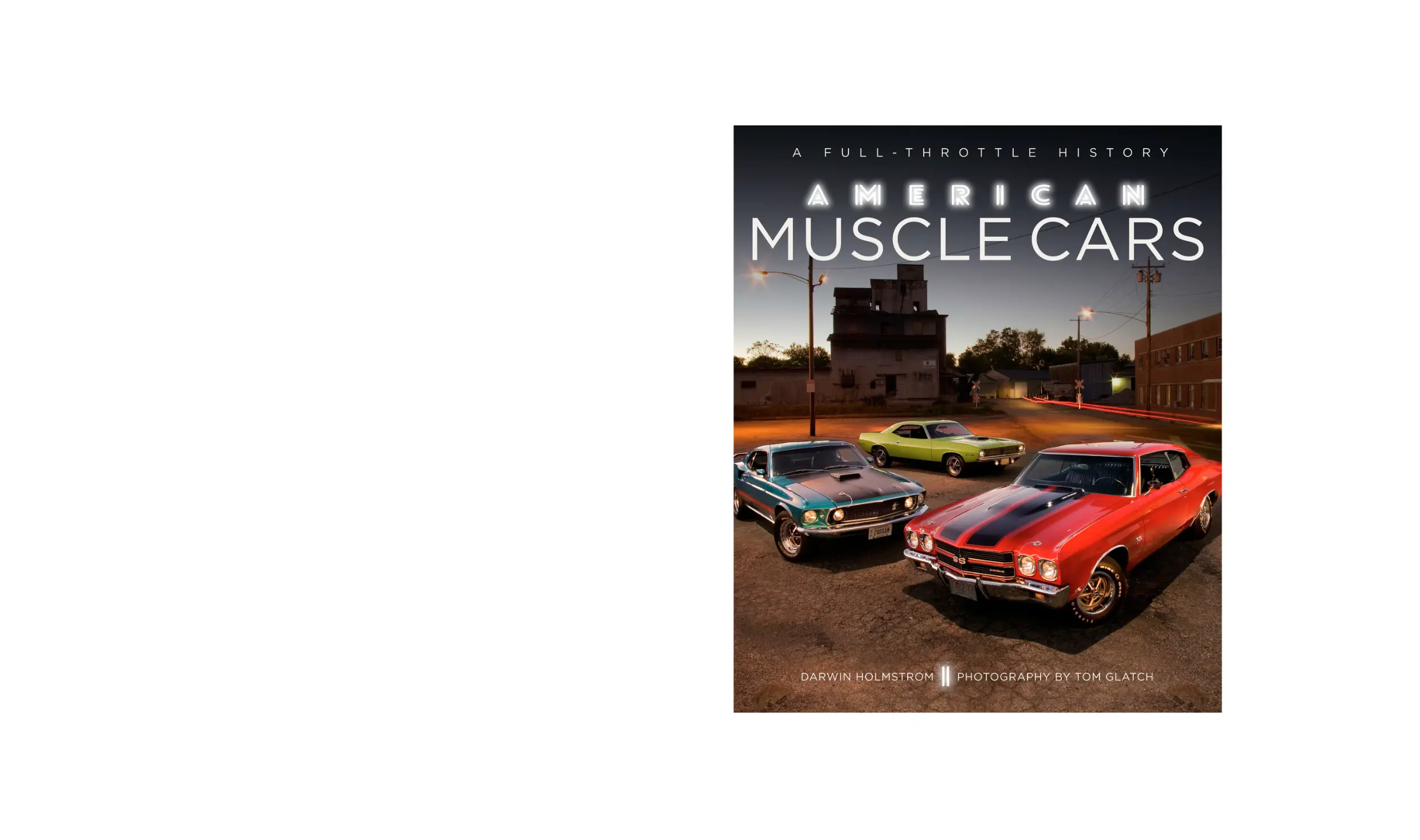


Автор: Holmstrom D. Glatch T.
Теги: cars history of cars automobile industry history of mechanics
ISBN: 978-0-76035-098-0
Год: 2016



Текст
                    A

Darwin Holmstrom

A muscle car symbolizes freedom. It was freedom that brought the muscle car into

has written, co-written, or

existence—the freedom of cheap gas and open roads, the freedom offered by the

contributed to over thirty

postwar American dream, the freedom to go just about anywhere and do just about

from Gibson Les Paul guitars

anything. When Pontiac marketed its GTO to the baby-boom generation, the cars, the

to motorcycles and muscle

people who drove them, and the times in which the two came together led to one of

cars, including the bestselling Let’s Ride: Sonny Barger’s Guide to

the greatest stories in automotive history. When those first lucky buyers cranked up the

BMW Motorcycles, The Harley-Davidson Motor

took their owners toward adventure, romance, success, the future. American Muscle

Co. Archive Collection, GTO 50 Years, The

Cars tells the story of the most amazing and desirable cars ever to come out of Detroit.

Complete Idiot’s Guide to Motorcycles, and
many others. He has also written several novels
for Gold Eagle’s popular Executioner and Mack

It’s a story of flat-out performance told at full-throttle, illustrated with beautiful modern
and historical photography.

Bolan series. Holmstrom holds a master’s
degree in creative writing and is the senior
editor for Motorbooks. Prior to that he served
as the Midwestern editor for Motorcyclist
magazine, worked as a reporter/photographer
for a daily newspaper, a factory worker, a
farm hand, and was once an assistant potato
inspector. He lives in Minneapolis, Minnesota.

Muscle
Cars
MUSCLE CARS

Tom Glatch bought his first good camera,
a 35mm Canon AE-1, in 1976, and began selling
prints to local oval track racers. His interest
in architecture resulted in him purchasing a
tilt-and-swing controls and huge film size also
took amazing automotive photos. Most of the
exterior photos in this book were taken with
the Sinar F1 with Schneider and Nikkor lenses,
though he has been one hundred percent
digital since 2008.
When his employer went on strike in 1983,
he combined his skills in photography and
writing, and began contributing stories to
major Collector, Corvette, Mustang, Muscle
Car, and Mopar magazines. Tom has also
contributed photographs to books by

MUSCLE CARS
A

F U L L - T H R O T T L E

H I S T O R Y

The classic muscle-car era began in
1964 with the introduction of Pontiac’s
GTO. Earlier cars surely deserved the
title “muscle car,” cars like the 1955
331-cubic-inch Hemi engine; the fuelinjected 1957 Chevy; and Plymouth’s
1963 Plymouth Savoy with its monstrous
426-cubic-inch Max Wedge.
The classic muscle car era began
when Pontiac’s chief engineer John Z.
DeLorean and his team bolted a big-inch
V-8 in an intermediate-sized car and
marketed it specifically to the tsunami
of Baby Boomers entering the auto
market. Pontiac unleashed the resulting
GTO upon America at a time when the
country’s potential seemed unlimited.
A marvelous system of highways opened
up to endless possibilities. The network
of two- and four-lane blacktop extending

H I S T O R Y

Sinar F1 4x5 camera, but the Swiss camera’s

A m e r i c a n

Chrysler C-300, with its 300-horsepower

MUSCLE CARS

F U L L - T H R O T T L E

360-horsepower Tri-Power 389 engines and drove their GTOs off dealer lots, those cars

A

Motorcycling, Indian Motorcycles, Top Muscle,

H I S T O R Y

A m e r i c a n

A m e r i c a n

books on subjects ranging

F U L L - T H R O T T L E

out beyond the horizon seemed as
though it could take us anywhere we
wanted to go, and the muscle car was
the perfect vehicle to take us there.
American Muscle Cars tells the complete
story of these classic vehicles. They’re
all here, from the performance cars that
preceded the muscle cars to the cars of
the classic muscle-car era, the Pontiac
GTO that kicked off the whole show,
the bodacious Road Runners and Super

other Motorbooks authors, and published

Bees, the awesome winged NASCAR-

Motorbooks’ Bloomington Gold Corvette

homologating Super Birds and Daytona

for the same Fortune 500 company for 40
years, and his wife, Kelly, newlywed daughter
Keara, and son Sean call southeastern
Wisconsin home.
ISBN: 978-0-7603-5013-3

HOLMSTROM
AND GLATCH

calendars in 2005 and 2006. Tom has worked

Chargers, the mack daddy LS6 Chevelles,
the Buick GSXs, the Hurst/Olds, and
the SC/Ramblers, to the hyper-potent
Mustang, Camaro, and Challenger muscle

EAN

DARWIN HOLMSTROM
$50.00 US / £35.00 UK / $60.00 CAN

i

cars being manufactured today.

PHOTOGRAPHY BY TOM GLATCH

A m e r i c a n

MUSCLE CARS
A

F U L L - T H R O T T L E

DARWIN HOLMSTROM

H I S T O R Y

i PHOTOGRAPHY BY TOM GLATCH

© 2016 Quarto Publishing Group USA Inc.
Text © 2016 Darwin Holmstrom
Photos © 2016 Tom Glatch except where otherwise noted
First published in 2016 by Motorbooks, a member of Quarto Publishing Group USA
Inc., 400 First Avenue North, Suite 400, Minneapolis, MN 55401 USA.
Telephone: (612) 344-8100 • Fax: (612) 344-8692
quartoknows.com
Visit our blogs at quartoknows.com
All rights reserved. No part of this book may be reproduced in any form without
written permission of the copyright owners. All images in this book have been
reproduced with the knowledge and prior consent of the artists concerned, and no
responsibility is accepted by producer, publisher, or printer for any infringement of
copyright or otherwise, arising from the contents of this publication. Every effort
has been made to ensure that credits accurately comply with information supplied.
We apologize for any inaccuracies that may have occurred and will resolve
inaccurate or missing information in a subsequent reprinting of the book.
Motorbooks titles are also available at discounts in bulk quantity for industrial or
sales-promotional use. For details contact the Special Sales Manager at Quarto
Publishing Group USA Inc., 400 First Avenue North, Suite 400, Minneapolis, MN
55401 USA.
10 9 8 7 6 5 4 3 2 1
ISBN: 978-0-7603-5013-3
Digital edition: 978-0-76035-098-0
Library of Congress Cataloging-in-Publication Data
Names: Holmstrom, Darwin, author.
Title: American muscle cars : a full-throttle history / by Darwin Holmstrom.
Description: Minneapolis, Minnesota : Motorbooks, [2016]
Identifiers: LCCN 2015036624 | ISBN 9780760350133 (hc w/jacket)
Subjects: LCSH: Muscle cars—United States—History.
Classification: LCC TL23 .H664 2016 | DDC 629.2220973—dc23
LC record available at http://lccn.loc.gov/2015036624
Acquiring Editor: Zack Miller
Project Manager: Jordan Wiklund
Art Director: James Kegley
Layout Designer: Wendy Holdman
Cover image: Dave Wendt
Title page image: Although the Mustang continued to outsell the Camaro, Ford
didn’t take the new challenger lightly and began mounting increasingly powerful
engines in the Mustang, culminating in the 428 Super Cobra Jet. Archives/TEN: The
Enthusiast Network Magazines, LLC.

Printed in China

CONTENTS
INTRODUCTION:
A Thing that Should Not Have Been

6

CHAPTER 1:
Burnouts and Back Seat Bingo

8

CHAPTER 2:
Boomer Bucks

52

CHAPTER 3:
Muscle Lite

88

CHAPTER 4:
Over-Bored

126

CHAPTER 5:
From Boneyards to Big Bucks

182

INDEX

222

Introduction

A Thing that
Should Not Have Been
The fans of a certain American motorcycle brand used

right for anything that symbolized a raised middle finger

to wear T-shirts that read: “If I have to explain, you

thrust at conformity. The Rolling Stones were recording

wouldn’t understand.” Perhaps, but perhaps if they can’t

their first album, a collection of mostly American blues

explain it, they don’t understand it so well themselves.

songs that were rarely heard on American radio unless

One could just rationalize the appeal of muscle cars

they were played on the so-called “Negro” radio stations.

with the same T-shirt soundbite—“If I have to explain,

Ken Kesey made preparations to hit the road in his

you wouldn’t understand”—but that would be selling the

psychedelic bus Further and bring his acid tests, parties

muscle car short.

in which participants were dosed with LSD-25 and

If you look at the muscle car as a technology, then
yes, the appeal of the beast makes little sense. But if you

and Huey Newton and Bobby Seale were laying the

look at the muscle car as a technology, you’re looking at

foundation for what would become the Black Panther

it through the wrong eyes. A muscle car’s appeal has as

Party. In retrospect, the muscle car seemed relatively

much to do with what it symbolizes as what it actually

tame by comparison.

is. Symbols are powerful things—people die for them

It was a different time, a time of cheap gasoline

and from them every day—and a muscle car symbolizes

and open roads that offered what many still believed

possibilities. More precisely, it symbolizes an era when

to be the postwar American dream: the freedom—or

such a monstrous thing as the muscle car was still

at least the illusion of the freedom—to go just about

a possibility.

anywhere and do just about anything. And it was the

When John Z. DeLorean and his cadre of enthusiastic

loss of that perceived freedom that brought the classic

miscreants took it upon themselves to bolt Pontiac

muscle car era to an end. In the sour aftermath of the

division’s hottest engine into a mid-sized chassis,

Vietnam War, the first war we clearly did not win, our

disobeying orders from the top of General Motors’

sense of national omnipotence began to wither. With

food chain, they created something that should never

the loss of faith in our elected officials following the

have been and will never be again: the muscle car.

Watergate break-in, we suddenly found ourselves adrift

In hindsight, who can legitimately argue that giving

without fixed stars to guide us into the future. After

teenage boys lightweight cars stuffed full of big-block

the shocking realization that oil was a finite resource,

V-8 power, crude handling abilities for harnessing that

one that depended on forces beyond our control, we

power, and virtually no braking power to bring the

confronted the fact that the tap on our economy’s

festivities to a halt once everything went south, which it

lifeblood could be shut off at any time. The freedom

did more often than not, was a good idea?

symbolized by the muscle car suddenly seemed fragile

Even though building these cars for kids was unwise,
like giving heroin to Keith Richards or a race car to

6

tripped balls, from San Francisco to the entire nation,

and transitory in the face of this terrifying trifecta.
The classic muscle car era began in 1964 with the

James Dean or Marilyn Monroe to a horny president, the

introduction of Pontiac’s GTO. The technology behind

resulting cars were pretty damned cool, and the time was

the muscle car had existed for years in cars such

as the Chrysler C-300 and the fuel-injected Chevy

of Vietnam. Given the tumultuous changes the United

Corvette. High-performance cars have been a part

States had been through in the 10 short years since the

of the auto industry as long as there’s been an auto

birth of the GTO, he needed every one of those 455

industry, but what distinguished the muscle cars of

cubic inches to outrun the chaos that seemed to be

the classic era was the confluence of the cars, the

consuming society.

people who drove them, and the times in which

Before anyone realized what was happening, the

the two came together. The people were the baby

muscle car was gone, replaced by baroque Monte

boomers, the huge generation born in the prosperous

Carlos, Cordobas swathed in yards and yards of fine

years after World War II. The time was the early 1960s,

Corinthian leather, and other landau-roofed “personal-

when the young people in the leading edge of the

luxury” cars. The word performance disappeared from

baby boom generation were coming of age, getting

the glossy brochures printed by auto manufacturers,

driver’s licenses, and striking out on their own. The

replaced by words like crushed velour and cruise control

classic muscle car era began when Pontiac marketed

in an attempt to market these ponderous, lumbering

a powerful, lightweight car specifically to this new

cars. Performance would not return to the automotive

tsunami of auto buyers.

lexicon for a generation.

Pontiac unleashed the resulting GTO upon America

One would think the muscle car, something that

at a time when the country’s potential seemed

should have never existed in the first place, would have

unlimited. A marvelous system of highways opened

become a forgotten relic of the past, but something

up to endless possibilities. The network of two- and

strange happened—they became lust objects. Today we

four-lane blacktop extending out beyond the horizon

have faster, better-handling, more-comfortable, safer

seemed as though it could take us anywhere we wanted

cars. We have cars that can run through the quarter-

to go, and the muscle car was the perfect vehicle to

mile 50 percent quicker than cars of the classic era, that

take us there. When those first lucky buyers cranked

will run circles around a classic muscle car on a road

up the 360-horsepower Tri-Power 389 engines of their

course, and do all this while coddling the driver in all

GTOs and drove off dealer lots, they were heading

the luxury of a five-star hotel suite. These are wonderful

toward something exciting, toward adventure, romance,

cars, but they’re not the same. They don’t raise their

success, the future.

middle fingers in a rousing salute to authority the way

The classic muscle car era ended when the last

real muscle cars do. Real muscle cars don’t have 19

Super Duty 455 Firebird rolled off Pontiac’s assembly

airbags. Real muscle cars don’t have traction control.

line in 1974. By the time the last buyer drove the last

Real muscle cars don’t even have power steering or

Super Duty off a dealer’s lot, he was more likely running

air conditioning. Real muscle cars don’t run every

away from something than running toward it. He may

driver input through a committee of computers before

have been running from the encroaching nanny state

obliging said driver. Real muscle cars have big engines

that deemed his choice of transportation socially

for people with big enough clackers to use them, and

reprehensible, or he may have been running from the

that’s about it.

internal demons he brought home from the jungles

What more do you need?

7

Chapter 1

BURNOUTS
AND

BACK SEAT
BINGO
I

f it seems like most muscle car books start out by discussing the
baby boom generation, there’s a reason for that: without the baby

boomers, there would never have been a muscle car. The baby boom
generation was so huge that it dictated every aspect of American
life, from popular culture to cuisine to politics, to transportation.
Between the years 1946 and 1964, Americans had approximately 76
million children. As one post–World War II bride explained, “When
my husband asked me if I wanted to go to sleep or what, I usually
replied, ‘Or what.’” The resulting rise in population reshaped society

A Chevy 409 being put to its intended use.

9

in much the same way forcing a 4-inch piston through a 3-inch cylinder bore will

The home-built hot rod was the

reshape the 3-inch cylinder bore. This “baby boom” generation contained such a

first distinctly American expression

massive number of people that it required society to bend around it rather than

of a performance automobile.

demanding that baby boomers conform to the mores of society. The prodigious

Archives/TEN: The Enthusiast

procreation of postwar Americans created a surplus of people that continues to

Network Magazines, LLC.

reshape society today and will do so for decades to come.
Baby boomers certainly reshaped the automotive industry. The classic muscle
car era—1964 to 1974—was Detroit’s direct response to the market created by the
indiscriminant genetic replication of the post–World War II generation. The parents
of the boomers had already begun the process of transforming the auto industry
even before they began the process of procreating the boomers themselves. When
young men returned from the European and Pacific theaters of World War II, they
came back restless, burning for something that polite society could not provide.
They came back with a need for speed. Testosterone-fueled daredevil driving fed a
need for excitement in young men who dodged death overseas.
The vets returning from World War II dealt with the same demons that plagued
veterans of any other war, whether it was World War I, Korea, Vietnam, the Gulf
Wars, or Afghanistan. American society is slowly finding ways to deal with the
trauma veterans experience in war, but after World War II, veterans were on their
own. They weren’t suffering from post-traumatic-stress syndrome; if anything, they

10

CHAPTER ONE

were “shell-shocked,” a condition usually attributed
to a weak person, so most vets kept their demons
to themselves. They didn’t get counseling or attend
support groups. They sucked it up, and when they
couldn’t take it anymore, they went out street racing
in hopped-up Fords. Frequently that is still how
vets deal with the inevitable trauma of war, but
today’s vets can walk into any auto or motorcycle
dealership and satisfy their need for excitement by
simply writing a check for a high-performance car
or motorcycle.
The situation in 1945 and 1946 differed vastly. At
that time, the highest-performing stock motorcycle

Hot Rod
History
“In the year 1931 hot rod builders and drivers in
Southern California received letters inviting them to
a meeting held for the purpose of organizing their
automotive interests. This meeting was held in East
Los Angeles in the early Spring of that year. The
Gilmore Oil Company, through the efforts of George
Riley and others, had consented to sponsor amateur

commonly available was the Harley-Davidson

races at the dry lakes if hot rodders could come to an

Knucklehead, which cranked out a whopping 40

agreement about rules and regulations.”

horsepower, and most passenger cars featured
anemic inline sixes or flathead V-8s that produced

Hot Rod magazine, March, 1948

less horsepower than most 600cc motorcycle
engines do today. Mounted in cars that weighed in on
the heavy side of two tons, these engines produced
less-than-stellar performance.
But returning vets were resourceful. They’d been
resourceful enough to dodge the very best that
Germany, Japan, and Italy could throw at them,
and they were resourceful enough to create fast
vehicles from the parts at their disposal. The primary
tools in their go-fast kit were bigger pistons and
lighter weight.

The Technology
of Muscle
Much of the modern speed technology we use
today was developed for military applications during
World War II, and in some cases during World
War I. Many of the returning vets had flown planes
with supercharged and turbocharged engines, but
this technology wasn’t readily available for civilian
applications. Instead, speed demons in the late
1940s resorted to stuffing bigger engines in smaller
vehicles. The biggest engine commonly available was
a V-8, so that became the performance engine of
choice. Chevy’s reliable stove-bolt six would do in a

Hot Rod magazine was the nexus for the car-crazy young
people in postwar America, a channel of communication that
homogenized the disparate communities scattered across the
nation into a single, cohesive culture of speed. Archives/TEN:
The Enthusiast Network Magazines, LLC.

pinch, but for serious speed, a hot rodder wanted
a Ford flathead V-8.
Not that a flathead’s side-valve cylinder head
was the valvetrain design of choice. Its pair of valves

BURNOUTS AND BACK SEAT BINGO

11

feeding and emptying each cylinder resided below the combustion chamber,

This 1954 Hudson Hornet equipped

which sat off to the side of the cylinders, an inefficient design in regards to energy

with full Hudson NASCAR racing

transferal. The side-valve design made sense because it inhibited detonation

kit—Twin-H engine and heavy-

when burning the low-grade fuels available during the early years of the internal-

duty suspension and brakes—was

combustion engine, but when Standard Oil introduced tetraethyl lead as a fuel

discovered in North Carolina near

additive to gasoline, the game changed. Ethyl, as it became known, inhibited

the home of NASCAR legend

detonation in the combustion chamber. Known as “knocking,” detonation—caused
by the fuel-and-air charge from the carburetor exploding in the combustion
chamber instead of burning at a controlled rate—destroyed an engine’s internal
components and was the limiting factor in the upper limits of compression ratio.
With the fuels available before 1923, compression ratios were limited to perhaps 6:1
(at most) before detonation occurred, which limited total power output. The more
compression that can be produced in a cylinder head, the more power the engine
of a given displacement will put out.

12

CHAPTER ONE

Herb Thomas and is thought
to have been a backup car for
Thomas’ fabled No. 92 Fabulous
Hudson Hornet.

Herb Thomas’ Fabulous Hudson

Because an overhead-valve engine design has a much more compact

Hornet might look familiar to

combustion chamber than a side-valve design, and thus a much more compact

younger readers; it was the

squish zone, it is capable of generating much more compression. Prior to the

inspiration for the character of Doc

introduction of ethyl, the advantages of overhead-valve combustion chambers

in the animated film, Cars, voiced

were mostly theoretical because the available fuels didn’t burn fast enough to

by Paul Newman.

prevent detonation. Ethyl made the overhead-valve engine design much more
practical because it made the air-fuel charge burn faster, taking advantage of the
overhead-valve design. When introduced in 1923, ethyl was sold by gas stations in
cans that customers poured into their tanks when they refueled their vehicles. By
1924, Standard stations sold gasoline blended with ethyl straight from the pump.
Once ethyl hit the scene, the side-valve’s days were numbered, but at the end
of World War II, the flathead Ford was still the king of hot rod engines. Though
terribly inefficient from a thermodynamic standpoint—flatheads ran hot, sapping
energy from the fuel charge and fatiguing engine components to the point of
failure—there weren’t a lot of options. Buick produced an inline overhead-valve
eight-cylinder engine, but this was heavy, large, and not all that fast. It could be
made to go fast, but had a tendency to snap its extraordinarily long crankshafts
in half when modified to produce too much power. Beginning in 1949, Cadillac
and Oldsmobile began offering modern overhead-valve V-8s. These were the
engines to have if you could afford them, but most hot rodders couldn’t. Chrysler’s
and Chevrolet’s overhead-valve V-8 engines would not debut until 1951 and 1955,
respectively, leaving Ford’s flathead V-8 as the most accessible option for postwar
hot rodders.

BURNOUTS AND BACK SEAT BINGO

13

The other tool in the hot rodder’s kit was lighter weight.

Overhead
Valve
Design

Young men had been stripping their cars of fenders and
anything else deemed unnecessary to the pursuit of speed
since before World War I, and they continued to excise as
much superfluous sheet metal and equipment as possible in
attempts to attain higher speeds.
There were a few modifications to be made to the Ford
flathead at that time. A rudimentary aftermarket had sprung
up before World War II. Popular speed equipment of the day

“Valve-in-heads for V-8s have been made

included multiple-carb intake manifolds, steel-tube exhaust

and used spasmodically over a course of

headers, and high-lift camshafts. After the war, a burgeoning

years, but no high-performance production

speed industry began to flourish in Southern California. While

model has yet been produced that has

the general population considered hot rodders sociopathic

proved entirely satisfactory. It appears from

hoodlums, people such as Vic Edelbrock Sr. realized they

the general trend, however, that the many

offered a tremendous business opportunity. Edelbrock, an

designs that are being developed might

accomplished racer himself, began producing his Slingshot

yet result in a design that incorporates the
most important advantages of the valve-inhead engine.”

Hot Rod magazine, April, 1949

manifold in 1940 and selling it from his shop in Los Angeles.
Before long, a number of companies sprang up to service the
hot rodders’ need for speed.
The cars that served as platforms for the hot rodders’
go-fast projects tended to be the least expensive and most
commonly available cars: Fords, Chevrolets, and Plymouths.
Being the most plentiful and usually the least expensive,
Ford cars became the hot rod starting point of choice. Model
Ts and Model As were both plentiful and cheap. Better yet,
Fords built after 1932 already had V-8 engines—affordable
V-8 engines (as well as stiffer frames to take additional power
without twisting into steel pretzels).
By the 1920s hot rodders were racing on the flat, hardpacked surfaces of California’s dry lakebeds. For centuries
torrential rainfall in the surrounding mountains had
flooded into the basins of lakes in the Mojave Desert—El
Mirage, Muroc, Harper, and Rosamond. The water filled in
imperfections in the sand, polishing the lakebeds smooth.
When the water evaporated, it left behind miles and miles
of glassy-smooth, hard-packed lakebed, perfect surfaces for
running hot rods at high speeds.
Races in the dry lakebeds began as anarchic affairs, groups
of hot rodders heading out with cans of gas and coolers full of
beer to have some fun, but in 1938 a group of racers formed
the Southern California Timing Association (SCTA). This group
organized the racing into individual timed runs instead of the
multicar free-for-alls that had been run in the past.
Not everyone had the resources to go to the dry lakes
to race. Even though entry fees seldom exceeded $3, not
everyone could afford $3. Nor could everyone make the
difficult trip from Los Angeles to places like Muroc. The desert

14

CHAPTER ONE

Chrysler kicked the horsepower

presented a brutal environment, and racers often spent race weekends sleeping

race into high-gear when it

under tarps, eating cold food, drinking warm beer, and fighting windblown sand.

introduced its overhead-valve

For many people, it was easier to simply find a lightly traveled stretch of public

V-8 engines with hemispherical

road and race on it.

combustion chambers. Archives/
TEN: The Enthusiast Network
Magazines, LLC.

By the late 1940s street racing had become a serious problem in Southern
California. Organization had brought some measure of order and safety to dry
lakes racing, so some far-sighted hot rodders made sporadic attempts to organize
street racers. In 1949 a group of street racers met at Goleta Air Base near Santa
Barbara, California, and competed in the first recorded organized drag race. The
track was roughly a quarter-mile long, dictated not by some edict that it must
be that length, but rather by the natural terrain. A small ridge in the runway
approximately a quarter-mile from the starting line was chosen as the arbitrary
ending point.
Organized drag racing got off to a slow start, but as dry lakes racing became
increasingly specialized and increasingly expensive, the need for a more accessible
form of racing grew. Drag strips sprang up around Southern California and
surrounding states during the early 1950s. By 1952 six drag strips were operating
in Southern California. The sport had grown to the point where it needed a

BURNOUTS AND BACK SEAT BINGO

15

Cadillac Conversion
“By the announcement almost one year ago of a new overhead valve V-8, Cadillac stimulated much interest in the
minds of the hot rod fraternity. To the author’s knowledge, the use of this engine in a competition car has not yet
taken place. Perhaps the intelligent adaptation of this new power plant to a suitable chassis will provide some eyeopening performance.”

Hot Rod magazine, October, 1949

opposite page, top: Dodge offered this

sanctioning body. In 1951 Hot Rod magazine editor Wally Parks formed the

shocking two-tone red-and-black paint

National Hot Rod Association (NHRA) and began organizing drag racing

for 1956. middle, left: With its single

on a small scale. By 1955 the scale had become much larger, with the NHRA

four-barrel carburetor, the 315-cubic-

sanctioning 68 drag strips in 31 states. The organization had become the

inch Red Ram Hemi in the 1956 Dodge

dominant force in drag racing, and remains so to this day.

D-500 cranked out 260 horsepower.
middle, right: Many people consider
the 1956 Chryslers to be the bestlooking cars of the Virgil Exner
era. bottom, left: Chrysler tried to
emulate the cockpits of jet-age fighter
planes with its interiors in the 1950s.
bottom, right: One might have thought

The Muscle Car and
the Enthusiast Press
The existence of the muscle car owes much to the existence of organized drag
racing. While a handful of modified muscle cars have competed successfully on
road-racing courses—cars such as the Shelby GT350 and Boss 302 Mustangs,

that the tailfin craze had reached its

the Z28 Camaro, the AMC Javelin, and the AAR ’Cuda and Challenger T/A

zenith in 1956, but in 1957, they got

twins, for example—drag racing has always been the muscle car’s raison d’etre.

even taller and gaudier.

If a muscle car can corner like a kart, that’s great, but it’s just gravy. If it can’t
rocket through a quarter-mile strip faster than an ordinary sedan, it’s not a
muscle car. The requirements of drag racing drove the development of the
American muscle car, and every aspect of the final product reflects the needs
of the drag racer.
Another critical factor in the development of the muscle car was the
creation of the enthusiast press. One magazine in particular—Hot Rod—became
the Bible for anyone interested in fast cars. Robert E. Petersen and his friend
Bob Lindsay cofounded Hot Rod magazine in 1947. The pair each coughed up
$200 of their own money and printed 10,000 copies of the first issue. Petersen
and Lindsay carried copies to local racetracks and drive-in restaurants around
the Los Angeles area and sold them one copy at a time.
The automotive establishment was less than enthusiastic about their daring
business venture. The American Automobile Association (AAA) considered
Petersen, Lindsay, and anyone associated with the hot rod movement juvenile
delinquents, all of whom should be locked away for the good of the country.
When the magazine sponsored a car in the Indianapolis 500, officials tried to
wipe the offending Hot Rod logo off the car.

16

CHAPTER ONE

BURNOUTS AND BACK SEAT BINGO

17

But fans loved the magazine even more than the automobile establishment
hated it. For the first time, car enthusiasts could learn the results from dry lakes

still had the old-fashioned chrome

and drag races without having to actually attend the events. Better yet, they could

strips across its hood—the infamous

learn how to make their own cars faster. Hot Rod achieved tremendous regional

old-man’s suspenders—at least that

success in its early years, and when editor Wally Parks formed the NHRA, that

hood covered a 270-horsepower

regional success translated to national success. The NHRA and Hot Rod magazine

V-8 engine.

had a symbiotic relationship; the growth of one fueled the other, and soon both
were major forces in the emerging youth culture.
The rise of the enthusiast press put in place another essential prerequisite
for the creation of the muscle car. The explosion of media information outlets in
the first half of the twentieth century—radio, television, specialty magazines—
helped to unify the tastes and attitudes of the swell of young people entering
society. In addition to its sheer size, one of the defining attributes of the baby
boom generation was its national homogeneity. The youth culture of the 1950s,
1960s, and 1970s differed from prewar generations in that it was a national culture
and not a regional culture. Kids in Atlanta, Georgia, listened to the same music
as kids from Portland, Oregon. Kids in Albuquerque, New Mexico, watched the
same television programs as kids in Ithaca, New York. And kids from Pittsburgh,

18

Though the 1956 Pontiac Star Chief

CHAPTER ONE

top: Mounting the spare tire on the rear bumper was as
trendy as tailfins in 1956. top, left: Like most American cars
on the market in 1956, Pontiac’s Star Chief instrumentation
offered only the most rudimentary information to the driver.
middle, left: For 1956 Pontiac bored out its V-8 engine to 317
cubic inches. When fitted with a pair of Rochester four-barrel
carburetors, the engine produced 285 horsepower. bottom,
left: In 1956 Pontiac was just beginning to shed its image as
the car of choice for old geezers. below: A closeup look at
Pontiac’s much-maligned hood suspenders.

BURNOUTS AND BACK SEAT BINGO

19

V-8s—From Ford
to Firepower
“The most recent addition to the rapidly increasing group of V8 engines is the Chrysler ‘Firepower.’ One would
think the Chrysler engineering department had a chip on its shoulder when it designed this outstanding
powerplant. It hardly seems a coincidence that they should use exactly the same bore and stroke as those in
the overhead valve Cadillac engine. The Firepower has a hp rating of 180—quite impressive for an American
automotive production engine. Most of this 20 hp gain over the Cadillac’s rated 160 is probably attributable to the
Firepower’s hemispherical combustion chambers and laterally inclined valves.”

Hot Rod magazine, July, 1951

Pennsylvania, read the same car magazines as kids in San Diego, California. The

opposite page, top: The Plymouth

styles and trends among young people in one part of the country moved in lock

Fury debuted as a sporty option

step with those from every other part of the country, and the need for speed

package for the Belvedere in 1956.

became a national rather than local phenomenon.

A 1957 example is shown here.

The younger generation’s need for speed did not pass unnoticed by the
country’s major automakers. Astute members of Chrysler, GM, and Ford
management teams picked up on the sea change in the auto-buying public’s taste.
They didn’t quite understand the nature of the change they were witnessing—a
coming cultural revolution fueled by a massive growth in the youth population—
and they didn’t quite understand how to capitalize on those changes . . . yet. For
the most part they continued to produce the same family-friendly sedans they
had always produced. But they did understand at least one important thing: their
customers wanted more power.
Detroit didn’t initially produce faster cars as a direct response to the needs of
the young men spreading the hot rod gospel around the country. Mounting more
powerful engines in postwar cars made practical sense. Cars were growing bigger,
a necessary evil if they were to be roomy enough to transport the large number
of children that were being cranked out. They were also becoming more luxurious,
providing owners with an increasing list of creature comforts like power steering,
power brakes, automatic transmissions, and even air conditioning, conveniences
that sapped power from already overtaxed engines. Cars needed more powerful
engines just to preserve the performance status quo.
The easiest path to more power was to build engines with more cylinders.
By the late 1940s the V-8 engine had a long history among US automakers.
Cadillac offered the first production V-8 in an American car in 1914. In 1949,
Oldsmobile offered its first overhead-valve (OHV) V-8 engine, the Rocket 88 V-8,

20

CHAPTER ONE

bottom: The 1957 Plymouth Fury
received extensive changes. The
car was longer and wider than its
predecessor, but the most notable
changes were the soaring tailfins
out back.

BURNOUTS AND BACK SEAT BINGO

21

top: In 1957 Chrysler replaced its coil-spring suspension system with a radical new torsion-bar system that would continue
in use for two decades. middle, left: Plastic seat covers were popular for protecting the fabric of the seats. Tacky, but
popular. middle, right: Plymouth was considered the entry-level brand for Chrysler Corporation, but that didn’t stop the
division’s designers from making the Fury’s interior fairly luxurious. bottom, left: The 318-cubic-inch V-8 B-block engine
cranked out 290 horsepower when fitted with dual four-barrel carburetors. bottom, right: Although Chrysler had qualitycontrol issues in the late 1950s, the 1957 Fury was still a desirable car, especially in convertible form.

22

CHAPTER ONE

which produced 135 horsepower. By comparison, the 239-cubic-inch
flathead V-8 powering 1949 Fords developed just 100 horsepower
and the 255-cubic-inch flathead powering the upscale Mercury cars
developed 110 horsepower.
In 1951, Chrysler upped the ante. The Chrysler Hemi engine came
about as a direct result of World War II, when Chrysler engineers
experimented with hemispherical combustion chambers in an
attempt to extract greater power from tank and aircraft engines.
The hemispherical combustion chamber was not a new idea. In
1904 the Welch passenger car featured a four-cylinder engine with
hemispherical heads. Offenhauser race engines used hemi heads, as
did Stutz, Duesenberg, and Miller automobiles. Hemispherical—or

Don’t
Throw
Rocks
at Your
Rocket

dome-shaped—combustion chambers provided the most possible
volume from a given surface area, leading to a very efficient design.

“Pete Coltrin was an unhappy fellow

When Chrysler began developing a V-8 engine for its passenger cars in

when he drove his 1949 Olds 88 Hydra-

the postwar years, the hemi design was a logical choice.

Matic club sedan into the Miller Brothers

Chrysler introduced the new V-8 in its top-of-the-line 1951 models:
the Saratoga, New Yorker, Imperial, and Crown Imperial. These
cars may have looked frumpy and old-fashioned, but with the new
331-cubic-inch V-8 cranking out 180 horsepower—20 more than its
nearest competitor, the 160-horsepower Cadillac V-8—Chrysler could
lay claim to producing Detroit’s hottest engine.
By 1955 a redesigned Chrysler Hemi put out 300 horsepower when
fed by a pair of dual four-barrel carburetors. It was time for Chrysler to
mount the engine in a car with some style: the legendary C-300. The
C-300 was long, low, sleek, and fast; it was a muscle car in spirit, if not
in intent. The C-300 lacked one of the most important components of
a successful muscle car: an affordable price. In 1955 the C-300 sold for
a steep $4,110. This put it out of reach of all but the most-well-heeled
hot rodders. Chrysler had most of the formula for a successful muscle

Automotive Service for a tune-up.
One of that ever-expanding group of
individuals who desire ‘just a little more
oomph’ in their automobiles, Pete, who
lives in Altadena, Calif., and is a senior at
nearby Claremont College, had already
milled the heads on his 88 .090 of an
inch, installed an Edmunds dual manifold
with two stock Carter carburetors, a 3/4
cam, Mallory ignition, and dual exhaust
pipes with Mitchell 30-inch mufflers.
But something was lacking—the car still
didn’t have the punch Pete wanted.”

Hot Rod magazine, May, 1952

car down already—a powerful engine in a sporty body—but the youth
market would have to wait a bit longer for affordable Mopar muscle.

V-8s for the Masses
For the 1954 model, Ford finally abandoned the antiquated flathead
V-8 and introduced its first overhead-valve V-8. Dubbed the Y-block,
the new OHV 292-cubic-inch powerplant generated 130 horsepower.
This might have been a more significant milestone except for the
fact that Chevrolet was about to eclipse its rivals from Dearborn
the following year. In the fall of 1954 Chevy unveiled a new line of
V-8-powered cars it called the “Motoramic Chevrolets.”
Originally Chevrolet downplayed the new engine in its ad copy,
touting the car’s comfort, convenience, and styling instead of its
performance, but anyone who knew anything about hot rodding cars

Oldsmobile was an early adapter of
overhead-valve V-8 engine technology with
its Rocket 88 engine. Archives/TEN: The
Enthusiast Network Magazines, LLC.

knew that this was an engine with significant performance potential.
Called the Turbo-Fire V-8, the new engine’s specifications don’t seem

BURNOUTS AND BACK SEAT BINGO

23

especially impressive today—265 cubic inches, a two-barrel carburetor, only 165

By 1960 Pontiac had shed its

horsepower (a little more than half that of Chrysler’s top-of-the-line Hemi)—but

suspenders and introduced the

savvy buyers at the time knew they were looking at something special. They knew

Wide Track look by moving the

that Chevy’s overhead-valve design, with its stamped, lightweight rocker arms and

tires out toward the corners of

no rocker shafts, gave the engine potential to produce many more horses.

the car.

Chevrolet engineers immediately began mining the new engine’s potential,
developing a Power Pack option consisting of a four-barrel carb and a dual-exhaust
system that bumped horsepower to 180. With this car, Chevrolet hit the mark.
Performance enthusiasts recognized the bang for the buck offered by the new
Chevy Super Turbo-Fire V-8s and took the cars straight from the showrooms to the
racetracks. The Chevrolets dominated their classes at Daytona Speed Week in 1955.
Privately entered Chevrolets (General Motors didn’t officially participate in racing at
this time) won the top four spots in the acceleration tests measured from a standing
mile. Chevys won the top two spots in the under-$2,500 class, three of the top five
spots in the two-way measured mile event, and first place in the 100-mile event on

24

CHAPTER ONE

top: While Pontiac’s Bonneville had plenty of muscle, like the Chrysler 300 it was marketed as a high-performance
personal luxury car rather than a pure muscle car. middle, left: With its lavish chrome grille, the 1960 Bonneville was as
stylish as early Pontiacs had been dowdy. middle, right: Pontiac advertised the multiple carburetors lurking beneath the
hood on its fender badging. bottom, left: Those triple two-barrel carburetors looked as good as they ran. bottom, right:
While a fast car for its time, the 1960 Bonneville didn’t skimp on luxury or comfort in the name of going faster.

BURNOUTS AND BACK SEAT BINGO

25

the short half-mile track. The only car that was consistently faster that week was

In 1960, Chevrolet’s top engine

Chrysler’s C-300, which cost almost twice as much as the Chevrolet.

option was the 348-cubic-inch

The sales success of the Power Pack option led Chevrolet’s brain trust to
sensibly conclude that more power would result in even more sales. For 1956

pumped out 350 horsepower when

Chevrolet upgraded the Super Turbo-Fire engine to 205 horsepower. The 1956

topped off by a trio of two-barrel

Chevy with a Power Pack was an inexpensive, stylish car that could barrel through

carburetors. Archives/TEN: The

the quarter-mile in 16.6 seconds, making it one of the strongest performing cars

Enthusiast Network Magazines, LLC.

a person could buy. By that time, every half-bright gearhead had figured out that
there was a lot more potential performance lurking beneath the hood of the “Hot
Ones,” as the advertising copy called the V-8 Chevrolets. Chevy’s own engineers
proved this when they released an even-more-super version of the Super Turbo
Fire, this one featuring a pair of four-barrel carbs forcing their fuel charge through
valves operated by solid lifters. This engine produced 225 horsepower, making it
Chevy’s strongest mill yet.

26

W-head big-block V-8 that

CHAPTER ONE

Full-Bore Firepower
“It may be too early to make predictions, but from all present indications the old, reliable flat-head V8 engine has
‘had it’ in the hot rod field. Although the flat-heads have made history during the last few years, the great strides
made recently by engine builders in the nation’s automobile capitals have rendered any V8 without overhead
valves nearly obsolete.”

Hot Rod magazine, December, 1952

But Chevy’s whiz-kid engineers weren’t about to stop at 225 horsepower. In
1957 they produced the most radical powerplant ever to darken an American auto’s
engine bay up until that time: a 283-cubic-inch small-block V-8 fed by a Rochester
Ramjet fuel-injection unit. Chevrolet had been experimenting with fuel injection
since the early 1950s and made the results of its work available to the public for
the 1957 model year. The injection unit consisted of a two-piece cast-aluminum
manifold incorporating tuned ram tubes running to the intake ports. Air- and
fuel-metering equipment mounted on the side of the lower casting measured and
injected the charge of fuel and air into the intake plenum just ahead of the intake
valves. Though this system proved to be a bit finicky and difficult to start, it pushed
power output to true muscle car levels. With hydraulic lifters, the “fuelie” produced
250 horsepower. When solid lifters were fitted, power jumped to 283 horses,
achieving a long hoped-for goal of one horsepower per cubic inch in an American
production engine.
With the fuel-injected 1957 Chevy, GM had almost perfected the muscle
car formula. The car was fast, stylish, and though the fuel-injection option was
relatively expensive, the total price of the car was still a bargain when one
considered the level of performance. But the fuelie proved to be a case of too
much too soon. The fuel-injection system was a bit too complicated for the
technology of the day, and people just weren’t ready for such complexity. With the
exception of the exotic Corvette, Chevrolet stopped offering passenger cars with
fuel injection after the 1959 model year.

It’s for the Kids
Ford, GM, and Chrysler all made noble attempts to serve the youth market in the
1950s, and to varying degrees all three major US auto manufacturers enjoyed
success with their sporty offerings, but the best was still to come. The baby
boomers were still preteens when US automakers made their first tentative steps
into the performance car market. These companies were just learning the craft of
marketing to young people. About the time they would perfect that craft in the

BURNOUTS AND BACK SEAT BINGO

27

top: This is one of just 10 Super Duty cars that Pontiac built in 1961. The Super Duty parts were shipped in the trunk and
installed by the owner, voiding the warranty. bottom: This is the actual 1961 Pontiac Ventura Super Duty raced by Arnie
“The Farmer” Beswick, a corn farmer from Morrison, Illinois.

28

CHAPTER ONE

top, left: Beswick, who took

following decade, there would be a waiting market of young car buyers, the size of

top honors in class at the 1961

which would astound the corporate bean counters of the 1950s.

Winternationals in this car, installed

Chevrolet introduced its small-block V-8 at a time when America needed just

snap-on white walls on his racing

the kind of excitement a fast, affordable car could provide. With the end of the

slicks to make his race cars flashier.

Korean War, the country had entered an extended period of peace and prosperity,

top, right: Beswick understood the

one with no apparent end in sight. The United States found itself in a cold war with

value of spectacle in promoting

the Soviet Union, a situation that lent an underlying sense of dread to day-to-day

his racing career, which is why

life, but it was an abstract dread with little direct effect on the comings and goings

he chose the Ventura over the
less-expensive Catalina model.
bottom, left: Beswick proved his
skill at extracting maximum power
from Pontiac engines many, many
times. bottom, right: Today this car
is restored to the condition it was
in when Beswick raced it.

of most citizens. For the most part, optimistic exuberance fueled the American
psyche, exuberance reflected in the automotive industry. During the late 1950s
and early 1960s, Detroit experienced a period of technological explosion, a period
in which the automotive industry’s best engineers perfected the overhead-valve
V-8 engine. During this time, the small-block V-8 gave way to the big-block V-8,
another element needed to bring the muscle car to iconic status.
Even though Chevrolet had developed what would become the prototype for
the muscle car—a reasonably priced stylish sedan with big V-8 power—the baby
boom generation needed to age a few more years before it would become the
8,000-pound gorilla of the car-buying public. As the 1950s gave way to the 1960s,
most boomers were still more interested in Schwinn bicycles than Detroit muscle; it
was their parents who were buying most of the new cars.
continued on page 32

BURNOUTS AND BACK SEAT BINGO

29

Ford Forsakes
the Flatheads
“Sure, you could gain by stroking your L-head Ford, but that engine in
stock form had asthma and the vacuum spark advance ignored the basic
requirements of low-speed full-throttle acceleration. Boring the new

When Ford got serious about its
Total Performance program, it

engine out is another matter.”

provided drag racers with a hot

Hot Rod magazine, February, 1954

406-cubic-inch V-8 to power its
Galaxie 500 XL. In 1963 the top
G-code version of the engine put
out 405 horsepower.

30

CHAPTER ONE

top: Even if one doesn’t know that a dual four-barrel 406 lurked under the hood, the 1963 Galaxie 500 XL had a menacing
stance. middle, left: Although the long-hood, short-rear-deck look of European sports cars would soon come to dominate
the aesthetic of the American muscle car, performance cars in the early 1960s adhered to traditional sedan proportions.
middle, right: The big G-code engine, with its monstrous carburetors, was a thing of beauty. bottom, left: The long trunk
hanging out over the back wheels put a lot of weight on the Ford’s Galaxie 500 XL’s rear wheels, which was an ideal
arrangement for drag racing. bottom, right: Although automatics would eventually become the preferred transmissions for
drag racing, in the early 1960s a four-speed was the hot ticket.

BURNOUTS AND BACK SEAT BINGO

31

continued from page 29

But things were changing. Even in this prehistory of marketing and
demographic research, carmakers noted the growing number of young

block V-8 ruled drag strips across

buyers entering the market each year. The auto manufacturers recognized the

America in 1963. Archives/TEN: The

potential sales such buyers represented and began developing cars that met the

Enthusiast Network Magazines, LLC.

needs and desires of these young drivers. Apparently they desired power and
needed speed, as witnessed by the growing popularity of racing.
The competitive atmosphere of the drag strip held a natural attraction for
the burgeoning population of young people coming of age in the late 1950s and
early 1960s. After the tumult and chaos of the first half of the twentieth century,
with its seemingly endless wars and police actions, most mature adults were
ready for a period of relative calm. But the younger generation that came of age
during the late 1950s and early 1960s hadn’t experienced the first two World Wars
and the Great Depression, and this generation was genetically predisposed to
racing fast cars.

32

Chevrolet’s hot 409-cubic-inch big-

CHAPTER ONE

Analyzing the
Chevrolet V-8
“The Chevrolet Motors Division of the General Motors Corporation has at last leaped aboard the overhead valve V8
powered bandwagon and joined the other two members of the ‘Big Three’ . . . The average American buyer is becoming
more performance minded. He expects things to happen when he punches the throttle or the brake pedal . . . The biggest
difference between the old and new is in the performance department and stems from a new overhead valve V8 engine.
This engine represents the first V8 that Chevrolet has produced in 36 years. Whatever was wrong with the 1917 through 1919
models must have scared the wits out of the engineering and management staffs because they have steadfastly refused to
build anything but fours (through 1928) and sixes until this year.”

Hot Rod magazine, January, 1955

Early overhead-valve V-8 engines only graced the engine bays of luxury or near-luxury brands like Cadillac, Chrysler, and
Oldsmobile. With its light, efficient small-block, Chevrolet brought overhead-valve V-8 technology to the masses. Archives/TEN:
The Enthusiast Network Magazines, LLC.

BURNOUTS AND BACK SEAT BINGO

33

The human animal appears to be hardwired for adventure and excitement,

Dodge
D-500
“The engine of either model is a
3.63 inch bore, 3.8 inch stroke,
315 cubic inch overhead valve
V8 embodying the now-familiar
hemispherical combustion
chamber with a 9 1/4 to 1

a feature that made us particularly adept at hunting for mammoth meat and
running away from saber-toothed bears. In periods of peace and prosperity
we get very little chance to exercise the fight-or-flight instincts that make us
suited for such work. It seems that in periods in which life is relatively easy we
manufacture the danger and excitement needed to appease those instincts.
In such times a large portion of the population creates scenarios that provide
excitement and danger; we place ourselves in situations that bring out those
instincts. When we no longer needed to kill wild animals for survival, we began
killing them for sport. When we are not risking our lives in combat, we risk
them on the freeways during our daily commute.
Some people seem to possess a thrill-seeking gene that makes this

compression ratio. The D-500 is

instinctive response even stronger. These people, often males young enough

rated at 260 brake horsepower

to lack a sense of their own mortality, take things one step further. They create

at 4800 rpm and 330 pounds-

danger by jumping out of airplanes, diving to the ocean’s floor, and racing their

feet of torque at 3000 rpm.

cars in organized competition. As the 1950s ended, this population found its

The data for the D-500-1 has

numbers increasing exponentially.

not yet been released, but it’s

The fascination younger customers had with speed and racing did not

a good bet that with its double

escape the attention of corporations that wanted to market their products to

four-barrel intake manifold

this affluent new generation. The auto manufacturers took particular interest

and carburetors, plus a ‘wilder’

in stock car racing and drag racing because racers competed in stock-bodied

camshaft, the advertised power

cars in both. Without question a Chevy, Plymouth, or Pontiac winning on a

will be about 285 at 5000 rpm

NASCAR (National Association for Stock Car Auto Racing) oval track or an

and 310 pounds-feet of torque

NHRA drag strip inspired some buyers to purchase a similar car from a Chevy,

at 3200 rpm.”

Plymouth, or Pontiac dealership; to varying degrees, manufacturers embraced

Hot Rod magazine,
May, 1956

these forms of racing.
Certain elements within the upper echelon of the auto industry hierarchy
felt uncomfortable with such a sordid activity as racing, regardless of its
marketing potential. A growing federal government occasionally glanced
toward the auto industry when cautious voters complained about speed and
accidents. In 1957 the Automobile Manufacturers Association (AMA), at the
time the primary lobbying group of American auto manufacturers, instituted
a voluntary ban on factory involvement in racing in an effort to turn away
government scrutiny. While all manufacturers paid lip service to this ban, most
simply made an end run around it and continued to be involved in racing in a
more covert fashion. Chevrolet’s and Pontiac’s clever ways of working around
the ban provided the most brazen examples of back-door factory racing
support, with factory engineers and technicians even competing themselves on
the weekends. Ford, on the other hand, followed the ban almost to the letter.

Life’s a Drag
Drag racing proved to be an exceptionally effective way of building brand
image because it was the most accessible form of racing, especially with
the 1957 introduction of the NHRA Super Stock class, in which stock-bodied
cars competed. The NHRA had experienced phenomenal growth during its
first decade. In 1957 the organization held its first national event, called the
Nationals, in Great Bend, Kansas. The NHRA held the Nationals at different

34

CHAPTER ONE

drag strips around the country each year before finding a permanent
home in Indianapolis. In 1961 the NHRA added a second national event,
the Winternationals. Drag strips became a nexus where an entire
generation of young motorsports enthusiasts came together to compete
against one another. More often than not they raced each other in the
same cars they drove to work during the week, running them in the
Super Stock class. They’d drive to the track, bolt on a set of Atlas Bucron
tires, drop the exhaust pipe, and go racing.
Automakers had a vested interest in seeing their cars winning in
this class. A young man was much more likely to plunk his hard-earned
money down on a car that won at the drag strip than one that lost. Even

The
Ardun
“When we refer to an Ardun
engine, we mean an Ardun
kit fitted to a Ford or Mercury
flathead V8 engine. This kit
consists of a pair of heat-

if the kids attending the races were too young to buy cars of their own,

treated cast aluminum alloy

their influence on the cars their parents purchased was increasing. If

heads with hemispherical

Chevrolets were beating Pontiacs at the drag strips, kids were lobbying

combustion chambers, a centrally

their parents to buy Chevys instead of Pontiacs. This was a generation

located spark plug, radially

of people whose parents seemed to indulge their every whim. Their

inclined overhead valves and

parents had been cheated of a proper childhood because of economic

aluminum-bronze valve guides

depression and war; they wanted to make their children’s childhood

and valve seats, both of which

experience a happy one. If the kids wanted their dad to buy a Chevy

are replaceable.”

instead of a Pontiac, there was a good chance he’d buy a Chevy.

Hot Rod magazine, July, 1956

Thus if a Chevrolet whipped a Pontiac on the drag strip, it meant
that Chevys would whip Pontiacs on the sales charts. It was in each
manufacturer’s best interest to develop cars that would whip the cars
built by the other manufacturers, and with the then-current technology,
the surest path to success was excess. The late 1950s saw most auto
manufacturers developing big-inch engines with which to pummel their
competition into submission.
Since introducing its revolutionary small-block V-8, Chevrolet had
perfected the combination of affordability and power, but with its
fuel-injected small-block of 1957, Chevy had pushed the outer limits of
both. In 1958 the company decided to substitute brute force for high
technology and introduced a larger V-8. Dubbed the “W-head,” this new
engine shared no parts with the small-block V-8. Originally displacing
348 cubic inches, this physically massive engine had the potential to
be bored out to a much greater displacement, earning it the nickname
“big-block.” (The original Chevrolet V-8 then became known as the
small-block.)
In stock trim, with a single four-barrel carburetor, the new bigblock cranked out a mere 250 horsepower, but much more power
was available. When ordered with three two-barrel carburetors, a
high-lift cam with mechanical lifters, and an 11.0:1 compression ratio,
the engine produced 315 horsepower. An increase in compression
ratio the following year pumped horsepower up to 335.
With this engine, General Motors had created another important
ingredient of the muscle car recipe. While there would be many
overachieving small-blocks in the muscle car pantheon, the archetype
continued on page 38

BURNOUTS AND BACK SEAT BINGO

35

Records indicate that Pontiac built approximately 14 “Swiss-cheese” Catalinas in 1963. The cars earned their nicknames
because they had weight-saving holes drilled in their frames.

36

CHAPTER ONE

top: Through extensive use of aluminum parts, the Swiss-cheese Catalinas weighed in at just 3,300 pounds. Arnie
“The Farmer” Beswick raced this example. middle, left: While that might look like a stock Catalina front clip, the fenders,
hood, inner fender wells, core support, bumpers, and bumper brackets are all aluminum. middle, right: By 1963 the
421-cubic-inch Super Duty engine featured two four-barrel carburetors rather than the three two-barrels used previously.
bottom, left: Even the high-beam headlights were removed in the interest of saving weight. bottom, right: Moving the
battery to the trunk put even more weight on the rear tires, helping to give better grip off the starting line.

BURNOUTS AND BACK SEAT BINGO

37

continued from page 35

for American muscle has always been a two-door sedan powered

Chrysler
300
“In a stoplight and drag strip competition,
it was very obvious that for a big chug,
the 300-B could move, and fastly, too. It
can, in fact, put down all stock competition
of comparable size and weight and a
considerable number of smaller ones as
well and it can do so in the first 100 feet.”

Hot Rod magazine, September, 1956

by a monster big-block engine—the bigger and more monstrous,
the better. The big-block engine is the reason a perfectly nice
Challenger convertible powered by a 318-cubic-inch engine will
never be worth more than a fraction of the value of an original
Hemi ’Cuda, even though the small-block engine makes much
more sense in a street car that will never see the business end of a
drag strip.
Intracorporate rivalry between Chevrolet and Pontiac meant
that Chevy could count on Pontiac to respond to its new big-block
engine, but the enthusiasts running Pontiac weren’t content to
simply ape Chevrolet’s “bigger-is-better” philosophy. Pontiac didn’t
need to develop a new big-block engine, since the V-8 its division
introduced in 1955 was more than up to the task. In fact, that
engine block formed the basis of every Pontiac V-8 of the classic
muscle car era.
When introduced in 1955, the engine displaced just 287
cubic inches, but engineers had left plenty of room to punch out
increasingly bigger holes, which they proceeded to do each year.
In 1956 they bored it to 316 cubic inches. In 1957 they took it to 347
cubic inches, and in 1958 to 370 cubic inches. The following year
they punched it out to 389 cubic inches, a capacity that would soon
prove to be significant. That year they also introduced a monstrous
421-cubic-inch version of the engine. By not developing separate
small-block and big-block engines, but rather developing a single
versatile engine design, Pontiac engineers had created a highly
adaptable platform. This adaptability would be advantageous once
the muscle car era began in earnest.
Pontiac also found the most creative ways to circumvent the
AMA ban on factory racing involvement. A band of mavericks ran
the Pontiac division: General Manager Semon E. “Bunkie” Knudsen
and Chief Engineer Pete Estes, along with the man would later
succeed both of them, John Z. DeLorean. These men understood
the relationship between racing success and brand image better
than any other people in the auto industry, probably because they
were all racing enthusiasts themselves.
In 1959 Pontiac began offering its Super Duty line of highperformance components. Even though the AMA banned factory
involvement in racing, a buyer could transform his Pontiac into a
full-blown factory drag racer by ordering Super Duty parts. Pontiac
had been supplying high-performance parts to buyers for years,
but the parts had come from other suppliers, not Pontiac. Bunkie
Knudsen wanted the parts designed and built in-house to keep
the profits generated within the Pontiac division, so he created a
special group within Pontiac’s engineering department: the Super
Duty Group.

38

CHAPTER ONE

The Super Duty Group developed a package of engine parts that
would withstand the stress of racing. Every Super Duty–equipped Pontiac
had the parts to do that, starting with a stout engine block with fourbolt main bearing caps. Forged crankshafts, connecting rods, and highcompression pistons meant that an owner could expect many reliable
trips through the quarter-mile traps between engine rebuilds. Tri-Power
carburetors (Pontiac’s branding of its triple two-barrel setup) pumped a
huge fuel charge through a high-flow aluminum intake manifold and into
special big-valve heads, and the spent fuel charge exited the combustion
chamber via high-flow header-type exhaust manifolds.
This was serious equipment, clearly intended for racing competition
and not for street use. (Super Duty parts carried no factory warranty.) The

Who’s
Got the
Hot One
for ’57
“Performance-minded people are

radical profiles of the cam lobes meant that at low rpm the solid lifters

sure to regard Chevrolet’s new

would pound the finish right off the surface of the cams, not a desirable

Rochester fuel injector as the

trait in a vehicle that has to idle at a traffic light. Driving Super Duty–

ultimate. To be sure, the injection

equipped cars as intended also led to problems; after cleaning the tires

system is not only the first to appear

and blasting down the drag strip, the engines produced enough heat to

on an American production car; it is

melt the aluminum intake manifolds, necessitating a cool-down period

a definite (but costly) improvement

before driving back to the pits. When Pontiac specified Super Duty parts

over the conventional carburetor.

“for racing purposes only,” it wasn’t joking.

Throttle response is almost
instantaneous and the engine

Bigger Big–Blocks
By the early 1960s, Chevrolet’s 348-cubic-inch big-block didn’t look so
big any more. Even Ford, a company that embraced the AMA ban on
factory racing involvement, offered a 390-cubic-inch big-block engine
that saw success on drag strips and stock car oval tracks around the

is extremely sensitive to changes in
throttle position, no matter
how slight.”

Hot Rod magazine,
December, 1956

country. Chevrolet needed to respond, and respond it did, in the form of
a W-head engine punched out to 409 cubic inches. Introduced late in
the 1961 model year, this stroked-and-bored engine provided inspirational
performance.
In base four-barrel form, the new 409 produced 360 horsepower and
a massive 409 lb-ft of torque. Mounted in the engine bay of a stunning
new Super Sport Impala Sport Coupe, a base 409 with proper gearing
could run through the quarter-mile traps in under 15 seconds. With a
little tuning, the right tires, and some proper performance parts, the new
engine was capable of much better times than that. The new 409 quickly
became a dominant force in NHRA drag racing, and Don Nicholson won
the Stock Eliminator class at the 1961 NHRA Winternationals.
The basic design of the car helped transfer the engine’s prodigious
torque into the tarmac. Like their Pontiac cousins, Chevy’s coupes
featured long rear overhangs, placing a large portion of the cars’ weight
directly over the rear wheels. This helped the tires hook up during quartermile runs and led to improved trap times.
Chevrolet’s success on the nation’s drag strips led to sales success, just
as it had done for Pontiac. With the performance-equals-sales equation
proven to be mathematically sound, the logical conclusion was that if a lot

BURNOUTS AND BACK SEAT BINGO

39

of power equaled strong sales, then even more power

Chevrolet
Big-Block
“Now to get to the part a lot of you have been
waiting for, Chevy’s new 348 cubic inch V8 engine.
This is not just a bored and stroked version of the
283 V8 although lots of pieces from the two engines
resemble each other. It is entirely new and about 11⁄2
inches longer, about 11⁄2 inches wider, about the same
in height and a little over 100 pounds heavier. Both
versions have 9.5:1 compression but one has a single
four-barrel carburetor and is rated at 250 horsepower

would equal more sales, so for 1962 the 409 received
a performance makeover. Power output of the base
four-barrel version jumped to 380 horsepower,
thanks to redesigned cylinder heads with larger
valves, redesigned pistons and combustion
chambers, and a redesigned intake manifold. The hot
version of the engine received a pair of four-barrel
carburetors—the famous “dual-quads” in the Beach
Boys’ song “409.” So-equipped, the “four-speed,
dual-quad, Posi-Traction 409” cranked out 409
horsepower—again a Chevy engine generated one
pony per cubic inch—and could run the quarter-mile
in the high 12-second range with very little tweaking.
When Chevy introduced its new big-block in 1958,

at 4400 with 355 lbs/ft of torque at 2800 rpm. The

it shocked the other auto manufacturers into action.

other uses three two-barrel Rochester carburetors

In short order most US automakers were promoting

and is rated at 280 hp at 4800 with 355 lbs/ft of

the performance potential of their cars. Chrysler,

torque at 3200 rpm. Both are available with hydraulic

which had long prided itself on building the ultimate

lifters only, no high performance cam.”

performance V-8 engines with its omnipotent Hemis,

Hot Rod magazine, December, 1957

found the fact that humble Chevrolet now offered
one of the most powerful automobiles on the market
especially galling. Chrysler engineers had taken the
aging Hemi engine about as far as they could by this
point, and in 1958 they countered Chevy’s big-block
with a new big-block engine of their own: the wedge
B-block engine. Because development money was
too tight to develop different engines for each of
its brands—Chrysler, Dodge, Plymouth, DeSoto—the
company used this new engine across its entire
product line. To disguise the fact that the same mill
that powered a mighty Chrysler 300 also motivated a
lowly Plymouth, each brand offered the new V-8 with
slightly different displacements ranging up to 361
cubic inches.
The new B engine would prove to be one of
Chrysler’s best and longest-lived engine designs.
Distinguished by its deep-skirted block and frontmounted distributor, the powerplant earned the
nickname “wedge” because its combustion chambers
were wedge-shaped rather than hemispherical
(dome-shaped) or polyspherical (double-dome
shaped), as were earlier Chrysler V-8 engines. Wedge
technology more closely adhered to the orthodox
thinking of the day.
Topped off by a pair of four-barrel carburetors, the
361-cubic-inch wedge cranked out 320 horsepower,

40

CHAPTER ONE

five more than Chevrolet’s hottest big-block. Chrysler offered an even more
powerful version, one fed by a Bendix electronic fuel-injection system, producing
333 horsepower, but that system was an unmitigated disaster. While Chevrolet’s
Rochester mechanical fuel injection was difficult and finicky, the Chrysler electric
system, which used delicate vacuum tubes that proved incapable of withstanding
the brutal conditions inside an engine bay, was impossible and few remained in
operation for very long, rendering the dual four-barrel-equipped version of the
B-block the top performer.
Chrysler engineers knew Chevrolet would increase the power output of its
new big-block, so for 1959 they punched out the cylinder bore of their new
wedge engine, mounting the most powerful version in the company’s premiere
performance car, the 300. When equipped with a pair of Carter AFB carburetors
feeding the combustion chambers through a pair of 30-inch manifolds, the
413-cubic-inch version of this engine produced 400 horsepower, 100 more
horsepower than the Hemi engine that powered the original Chrysler C-300
of 1955.
Chrysler marketing folks saw the results Chevrolet and Pontiac were achieving
at drag strips around the country. More importantly, they saw the effects Chevrolet
and Pontiac sales success was having on Chrysler’s corporate bottom line—people
who bought Chevrolets and Pontiacs weren’t buying Dodges and Plymouths. The
company needed to sell more cars to earn more money, and to sell more cars
it would have to go racing. The problem was its luxurious 300s and Furys and
Polaras were too big and too heavy to make good drag racing platforms. The
company needed a radical solution to this problem, and the solution it devised
was radical by any definition of the word. In 1962 Chrysler mounted its B-block
engine in its new, smaller-sized B-body cars. These were still full-sized cars and
not intermediates, but because they featured unit-construction bodies and chassis
from 1960 and on, they were smaller and lighter than the cars offered by GM and
especially Ford.
Chrysler engineers didn’t mount garden-variety B-block engines in these lighter
cars; they used high-performance engines designed strictly for drag racing. This
engine, officially called the Ramcharger when mounted in the Dodge chassis
and the Golden Commando when mounted in the Plymouth, but unofficially
called the Max Wedge, featured radical solid-lifter camshafts, large-port heads,
and dual Carter AFB carburetors mounted atop short ram intake manifolds. In its
most powerful form, this engine package produced 420 horsepower, making the
new lightweight Chrysler products the belles of the drag strip ball. Pontiac had
dominated drag racing in 1960. In 1961, Chevy’s hot 409 had been the car to beat.
In 1962, Mopars became the force to be reckoned with, and would remain so for a
very long time.
Even though Ford had been building modern overhead-valve V-8 engines since
the mid-1950s, it had never managed to recapture the performance image it had
earned with its flathead V-8 engines. Robert McNamara, who had joined Ford as
manager of planning in 1946 and had worked his way up through the ranks to
(briefly) become the first president of the company not named Ford, lacked any
passion for performance cars. He believed cars should be used for transportation
rather than something as frivolous as having fun, and he embraced the AMA

BURNOUTS AND BACK SEAT BINGO

41

ban on factory racing involvement. To create his ideal vision of pure proletarian
transportation, McNamara oversaw the creation of the Ford Falcon econocar.
In January 1961, less than five weeks after assuming the presidency of Ford
Motor Company, McNamara took his “no-fun” philosophy to Washington, DC,
where he would orchestrate US military affairs as John F. Kennedy’s, and later
Lyndon B. Johnson’s, secretary of defense. McNamara’s prosecution of the war in
Vietnam would prove disastrous for the United States (and also to the muscle car
market), but his departure worked to Ford’s advantage. McNamara’s midlife career
change put Ford back in the business of building cars that were fun.
Ford had the basics to build a solid performance car. Like Chevrolet, Ford had
developed a big-block V-8 engine, the FE series, introduced in 1958. With a top
displacement of 352 cubic inches and a peak output of 300 horsepower, the FE
big-block didn’t set the drag racing world on fire. In 1961, the year of McNamara’s
departure, Ford engineers took a boring bar to the block and punched out the
engine displacement to 390 cubic inches. With three two-barrel carburetors,
solid lifters, and a dual-point distributor, the engine produced a respectable
401 horsepower. Another overbore in 1962 raised the power output of the new
406-cubic-inch engine to 405 ponies.
This put Ford’s big-block engine in the hunt and Ford-powered cars had some
drag racing success, but the cars from GM and Chrysler still dominated the sport.
The main problem with Ford’s offering was the weight of Ford’s full-sized sedan, the
Galaxie. The Galaxie, especially the Galaxie fastback, was a handsomely styled and
comfortable car, but even the special lightweight version developed for the drag
strip weighed 100 to 150 pounds more than its competition from GM and Chrysler.
Combined with a horsepower rating that was probably optimistic (if anything, the
GM and Chrysler engines put out more power than advertised), this excess weight
relegated Ford to also-ran status in the drag racing wars of the early 1960s.

Turn Left, Repeat
The drag strip might have been the primary venue in which manufacturers could
showcase the performance of their automobiles, but stock car racing also provided
a high-profile stage upon which to promote performance cars. The premier stock
car racing organization, then as now, was NASCAR. Formed in 1948 at a time when
there were very few new cars on the road—civilian production was still ramping up
following the end of World War II—NASCAR originally consisted of races between
highly modified cars that bore little resemblance to those sold to consumers. In
1949 NASCAR president Bill France Sr. decided that fans would prefer to watch
races between cars based on the same ones they drove on the street—actual stock
cars—and he was right. Once NASCAR began featuring the same Oldsmobiles,
Pontiacs, Hudsons, and Plymouths that transported fans to the races, its popularity
began to grow.
Not only did the switch to stock cars make NASCAR more popular with fans, it
made the sport more popular with auto manufacturers. Detroit began producing
increasingly powerful engines to propel their cars to NASCAR winner’s circles. In
many ways, NASCAR racing drove V-8 engine development even more than did
drag racing.

42

CHAPTER ONE

By the late 1950s, Pontiacs performed extremely
well in NASCAR racing, thanks to Division Manager
Bunkie Knudsen’s blatant disregard for the 1957
AMA ban on racing. Pontiac’s Super Duty line of
performance parts meant that a racer could purchase
anything he needed to build a competitive stock car
from the same dealership that sold him the car. A
buyer couldn’t order a car straight from the factory

What Makes
Pontiac
Run?

equipped with Super Duty parts; he had to buy
the parts separately from the parts department

“In the period of just a few short years, Pontiac

and install them himself, instantly voiding the car’s

General Manager Semon E. (Bunky) Knudsen has

warranty. This policy helped to appease the AMA and

directed a transformation that is the talk of the

deflect government scrutiny. Knudsen and others

automotive world. He stepped into the top spot of a

regularly commented to reporters and legislators

plodding automobile company that had a reputation

that they could not stop their customers from buying

for building a solid, dependable, not too exciting

parts and modifying the cars they had purchased.

car for people of the same description. Being of the

Super Duty Pontiacs ruled NASCAR tracks by the

live-wire variety himself, Mr. Knudsen decided the

early 1960s, winning 30 Grand National races and the

reason Pontiacs were not selling too well was the fact

manufacturer’s championship in 1961. To keep one

that they were not appealing to either the young in

brand from dominating the sport, NASCAR instituted
a rule that would have a significant impact on the
classic muscle car era—it required manufacturers to
sell passenger cars with the same engines it raced.
This meant that the over-the-counter Super Duty
parts Pontiac sold would no longer be eligible for

years or the young in heart. So he made changes . . .
Pontiac and performance became synonymous . . .
He convinced car buyers that Pontiac was no longer
just for the old folks; it was a hot car for the young
set too.”

Hot Rod magazine, March, 1961

NASCAR competition, so in 1962 Pontiac made its
421-cubic-inch Super Duty engine available as an
option in its Catalina and Grand Prix models. For the
first time, a buyer could buy a Super Duty Pontiac
without having to assemble it himself. In 1962,
Pontiac won its second manufacturer’s championship.
Chevrolet didn’t fare as well in NASCAR racing.
While its 409 dominated the nation’s drag strips,
the W-head big-block engine used an antiquated
combustion chamber design in which the combustion
chamber was down in a recessed pocket in the
piston rather than in a dome within the cylinder head.
This design exhibited poor high-rpm combustion
characteristics that made it poorly suited for
the extended high-speed running required of a
successful NASCAR racer. Not that the Chevys
performed poorly in NASCAR—Chevrolets won 14
Grand National races in 1962 and placed second in

Pontiac’s Super Duty engines made the brand a formidable
competitor at drag strips and NASCAR ovals. Archives/TEN:
The Enthusiast Network Magazines, LLC.

the manufacturer’s championship behind Pontiac—
but the sell-on-Monday part of the win-on-Sunday
equation only worked if a car won; the second-place
winner was just the first loser.

BURNOUTS AND BACK SEAT BINGO

43

409: Biggest Chevy Yet
“The 409 is, in hot rod terminology, a bored and stroked version of the 348 . . . It will take some time to see how the engine
runs when placed in the hands of the drag strip enthusiasts but we guess that it will do alright for itself . . . The 409 looks just
like the muscle man to take over where the 348 leaves off.”

Hot Rod magazine, April, 1961

Although the basic design of its heads limited the potential of Chevrolet’s first big-block engine, for a short while the 409-cubicinch version dominated American drag strips. Archives/TEN: The Enthusiast Network Magazines, LLC.

44

CHAPTER ONE

Chevrolet was not content to be the first loser. For 1963 it introduced a new
big-block V-8: the Mark II. With a more modern combustion-chamber-in-head
design, the new engine featured all the hot rod tricks of the day: lightweight
valvetrain, header-style exhaust manifolds, and dual-plane aluminum high-rise
intake manifolds. Chevrolet’s new big-block displaced 427 cubic inches, placing it
right at the displacement limit allowed by NASCAR. Racing journalists and other
racers referred to the new powerplant as the “mystery engine,” because Chevrolet
erected security barriers around the garages at Daytona to prevent anyone from
seeing it up close.
The mystery surrounding the engine did not lead to racing success for
Chevrolet, but not because of any technical details of the engine. Chevrolet, as well
as Pontiac and the other GM divisions, faltered in NASCAR racing because in 1963
General Motors instituted a total ban on factory racing involvement. Ed Cole, the
father of Chevrolet’s OHV V-8 engine and by that time a vice president at General
Motors corporate headquarters, decided to halt all corporate racing activities, both
direct and indirect. A former manager of GM’s Chevrolet division, and its chief
engineer before that, Cole knew all the tricks people like Bunkie Knudsen used
to circumvent the AMA racing ban of 1957 and he was determined to stop them.
In late 1962, GM announced that the company would cease all support of racing
for 1963.

Too Much Success?
Cole had a reason for this madness. Unlike McNamara, Cole didn’t feel it was
his personal duty to end all forms of automotive fun, and he wasn’t hell-bent on
promoting a nanny state in which government and the corporate world contrived
to protect automotive enthusiasts from themselves. In fact, Cole instituted the
total racing ban in an attempt to ward off the intrusive arm of the nanny state;
by the early 1960s, GM had the federal government breathing down its corporate
neck. The Justice Department had determined that GM was getting too large a
share of the US car market. GM was in danger of getting between 57 and
60 percent of the new car market. General Motors had come dangerously close to
breaking the Sherman Antitrust Act of 1890, the federal antitrust law designed
to prevent one company from monopolizing an entire industry. The Justice
Department was threatening to break up the company as it had done it before with
Standard Oil decades earlier. General Motors had no need to race on Sunday to sell
cars on Monday because it was on the verge of selling too many cars without the
extra promotion.
Eternally the number three American automaker, Chrysler found itself in no
danger of being on the stinky end of the federal government’s trust-busting stick.
The company wanted as large a market share as it could get, and if racing success
equaled increased market share, then Chrysler Corporation would do everything
in its power to ensure racing success—even if it meant bringing an elephant to a
cockfight. That elephant took the form of a reborn Hemi.
It’s not that Chrysler vehicles had been under-armed in the performance wars
prior to the rebirth of the Hemi. The company’s Max Wedge engine used every
hot-rodding trick to dominate America’s drag strips. The Max Wedge had been

BURNOUTS AND BACK SEAT BINGO

45

bored out to 426 cubic inches for 1963, just slipping under NHRA’s limit of 427.2
cubic inches for Super Stock engines. Its parts list summarized the state of pushrod V-8 engineering art: double-row timing chain, one-piece short-ram aluminum
intake manifold topped by a pair of four-barrel carburetors, header-type exhaust
manifold, high-capacity fuel pump, dual-point distributor, forged-aluminum
pistons, Magnafluxed connecting rods, high-strength valve spring retainers, smaller
crankshaft pulley to limit belt speeds, and heavy-duty clutch with an aluminum
clutch housing. It even had a deep-sump oil pan that was baffled to prevent
oil from sloshing away from the sump when the car inevitably wheelied off the
starting line. No one accused Chrysler’s Max Wedge of being underpowered. With
an optional 13.5:1 compression ratio, the engine produced 425 horsepower.
Like Chevy’s 409 before it, Chrysler’s Max Wedge ruled American drag strips
but didn’t fare as well on NASCAR oval tracks. Chrysler president Lynn Townsend
had two sons who were performance-car enthusiasts, so he knew how important
racing success was to his company’s image. Townsend knew that to compete in an
increasingly youth-oriented market, Chrysler would have to succeed in NASCAR
as well as in drag racing. Townsend asked Bob Hoover, head of Chrysler’s race
engine group, what it would take for Chrysler to win Grand National races. Hoover’s
response? Adopt hemispherical heads to the Max Wedge engine. The conversion
proved no simple task. Chrysler engineers needed to design stronger connecting
rods to support the massive Hemi pistons and the entire head had to be rotated
inward toward the engine to provide clearance for the exhaust pushrods to clear
the head gaskets.
Chrysler’s 426 Hemi engine revolutionized motorsports in America. Although
rated at the same 425 horsepower as its Max Wedge predecessor, true output
topped 500 ponies, and when mounted in lightweight drag racing specials, the
new powerplant dominated the drag strip. The basic design continues to win races
in the Top Fuel and Funny Car classes well into the twenty-first century.
More importantly, the engine decimated the competition on NASCAR’s
superspeedways. Debuting at the 1964 Daytona 500, Hemi-powered Mopars
took all three spots on that year’s Daytona podium. Richard Petty, who stood
atop the Daytona 500 podium that year, went on to win the 1964 Grand
National championship.

The Se/X Factor
Two racing rule changes would have dramatic aftershocks in the consumer car
market. The first was NASCAR’s homologation rule requiring NASCAR race cars to
use only engines available in passenger cars sold to the public. The other was the
NHRA’s creation of the F/X (Factory Experimental) class, in which highly modified
cars powered by special low-production engines would compete.
In part, this new class represented an attempt by the NHRA to keep the
factories from dominating drag racing. The average drag racer could not hope
to compete against the low-volume drag racing specials coming out of Detroit.
Built with exotic lightweight materials like aluminum and fiberglass, these cars
included the legendary Z-11 Impala, Super Duty Pontiacs, lightweight Galaxies,
and Super Stock Dodges. Detroit produced these cars in such low volume

46

CHAPTER ONE

that they were all but unattainable for the
average drag racer. For example, Chevrolet
built just 57 Z-11s and Ford built just 11 of the
lightweight Galaxies.
General Motors’ ban on factory racing
involvement proved another factor driving

Ford’s Super
Super Stock?

the creation of the F/X class. General Motors
announced the ban late in 1962, after Pontiac
had already delivered a number of 1963-model
Super Duty drag racing cars to customers.
Because these cars would not be offered as
production cars in 1963, they didn’t qualify
for the Super Stock class. By creating the F/X
class, the NHRA created a venue in which the
owners of these cars could compete.
NASCAR’s homologation rules meant that
manufacturers would have to mount their

“There are two intake systems for the 406, single fourbarrel Holley and triple two-barrel Holleys . . . The 406
test car we had at our disposal was equipped with the
405 horsepower engine with triple carburetion. We noted
that on fast stops, the engine stalled and was sometimes
difficult to restart. The reason for this is the three Holley
two-barrel carburetors are mounted backwards on
the manifold so that the float bowls slosh fuel into the
manifold on sudden stops.”

Hot Rod magazine, April, 1962

sophisticated new V-8 engines in passenger
cars if they hoped to campaign them on
America’s superspeedways. Chrysler would
have to build street-going cars equipped with
the firm’s all-conquering Hemi. Chevy would
have to offer customers cars powered by the
new Mark II big-block engine, and Ford would
have to mount the radical new versions of
its FE-based racing engines in the bays of
cars meant for public roads. If manufacturers
wanted to campaign cars in the highly
competitive Super Stock class, they would
have to build wickedly fast street cars. In 1964,
a horsepower war was about to erupt onto
America’s streets and highways, a war that
would be fought with machines that exceeded
all expectations of even the most demented
car enthusiast.
The creation of Chrysler’s 426 Hemi
marked the end of a period of intense engine
development and the beginning of a period
of intense marketing. With the Hemi, the
pushrod overhead-valve V-8 engine reached
a technological pinnacle. In just 15 years the
OHV V-8 design had evolved from Oldsmobile’s

Ford had hung its corporate hat on safety and practicality
in the 1950s. That all changed in the 1960s when Ford
switched directions and dove headlong into its Total
Performance program. Archives/TEN: The Enthusiast
Network Magazines, LLC.

135-horsepower Rocket 88 into a fire-breathing
500-horsepower monster. If development had
continued at that pace, today’s small-block
Chevy engine would generate more than

BURNOUTS AND BACK SEAT BINGO

47

10,000 horsepower, and in the early 1960s it looked as if development might just

Arnie “The Farmer” Beswick

continue at that pace indefinitely.

might have preferred flashy cars,

In reality, the pushrod V-8 engine had been taken just about as far as was

but most drag racers wanted the

possible by 1964. The basic mechanical architecture had been developed almost

lightest, plainest, most-rigid body

to perfection; future developments would focus on electronic controls, first with

they could get. When it came to

electronic ignition and later with space-age engine management computers. Using

Chevrolets, nothing was more basic

1964 technology, which meant using imprecise points-based ignition timing, an

or lighter than a Biscayne two-door

engine could be tuned to go fast but little else, or it could be tuned to be tractable
in everyday use, but at the expense of losing peak horsepower. When an engine
was tuned for high-speed running, the spark plugs would load up with carbon
during low-speed running and the ignition didn’t have enough strength to shoot
spark through the carbon buildup. To build an engine that was both fast on-track
and also drivable in traffic on public roads would require manufacturers to develop
functional electronic ignition systems.
Solutions to ignition problems would come, but in 1964, the simplest solution
was to drive a high-performance car as if it had been stolen. Gas was cheap, so
if low-speed running causes problems, run at high speeds. A more immediate
challenge for Detroit’s auto manufacturers was developing a car to sell to the baby
boom generation, who had finally begun buying cars in numbers commensurate
with the size of their population. By 1964, the leading edge of the vast swell of

48

CHAPTER ONE

post in 1964.

top: One has to admire the purposeful nature of the 1964
Biscayne. middle, left: If the fender callouts had weighed
more than an ounce or two, they would have been stripped
off with the rest of the ornamentation. middle, right: The
Spartan nature of the drag-racing version of the Biscayne
carried over to the interior, where everything that could
be deleted was. bottom, left: In 1964 the hottest version
of Chevrolet’s 409 cranked out 425 horsepower when
equipped with a pair of four-barrel carbs.

BURNOUTS AND BACK SEAT BINGO

49

children born in the years after World War II were graduating from high school
and entering the work force. They had money to spend and they liked to spend it
on new cars. This new breed of auto buyer wanted power, but they wanted more
than just power. They wanted style. They wanted cars that turned heads when they
cruised down the Main Streets of America’s towns and cities. They wanted cars
that did not look like their parents’ cars, the cars in which Detroit manufacturers
mounted their powerful V-8 engines. They wanted smaller, sportier cars. More
often than not, they were young men who wanted cars that would impress the
opposite sex.
Sex appeal played a key role in marketing cars to boomers. In the youthoriented culture that was emerging in the early 1960s, the automobile became
a critical component in quantifying its owner’s sex appeal. This generation had a
different set of standards than their parents, and chaperones were as passé as tail
fins. To put it indelicately, the driver of a cool car was more likely to score after a
Friday-night football game than the driver of a nerdy car.
This new generation, itself the result of rampant sexual activity, scored more
often than did any previous generation since the fall of the Roman Empire,
thanks in large part to a new technology: the birth-control pill. On May 9, 1960,
the Food and Drug Administration approved the first oral contraceptive for
legal use in the United States. The pill revolutionized sexual activity. As long as
human animals have roamed the earth, young people have found themselves in a
hormonal pressure cooker, balancing intense sexual urges with fear of unwanted
pregnancies. The pill effectively blew the lid off that pressure cooker. By the time
the classic muscle car era began, American youngsters had begun to exercise their
newfound sexual freedom. While society had not quite entered the era of free love,
recreational sex had been heavily discounted by 1964.
Sex was becoming a national obsession, and smaller, sportier cars were tools
that young people used to help satisfy that obsession. Detroit offered smaller
cars, though the small autos American automakers first marketed to boomers
were far from sporty. In the 1950s, American Motors Corporation had stayed
afloat on the profits of its Rambler, one of the first compact American cars. Since
the Rambler didn’t offer a V-8 engine, a design that General Motors and Chrysler
relied on to market their cars, AMC marketed the fuel economy of the Rambler’s
inline six-cylinder engine. To boomers, the fuel-efficient Rambler was as exciting
as Grandma’s broken-English stories about pickling fish in the old country and as
sexy as the garters holding up her support hose. To reach the younger generation,
manufacturers needed to build cars that were smaller and sexy.
In typical Robert McNamara fashion, Ford grasped the smaller part but couldn’t
get its corporate head around the sexy part. On October 8, 1959, Ford introduced
the decidedly unsexy Falcon. Basically a shrunken version of its larger sedans, the
Falcon sold extremely well and earned a profit for Ford, but it failed to ignite the
passion of younger buyers. A few years later Lee Iacocca would reshape the Falcon
into one of the sexiest small cars on the market, creating a machine that would
ignite the automotive lust of nearly every member of the baby boom generation
and in the process create an entirely new market niche: the pony car. But that was
in the future; in 1960 the Falcon was simply a diminutive portion of the same-old
same-old from Ford.

50

CHAPTER ONE

Ford broke little new ground with its new small
car. However, Chevrolet not only broke new ground,
it pulverized it into fine dust. The division’s Corvair,
introduced for the 1960 model year, used technology
never before seen on an American-made automobile.
Standing only 51.3 inches tall and measuring just 66.9
inches wide, the Corvair took up less garage space
than any other car rolling out of Detroit at that time.
The Corvair was the smallest American-made car of
its day and it was easily the most peculiar. Its engine,
an air-cooled opposed six-cylinder, sat in the rear

410 HP
Short Ram
for DodgePlymouth

of the car where it drove the rear wheels through a

“Scheduled for the production line shortly before May

transaxle transmission.

1st, 413 cubic inch V8s are going to make the boys

The Corvair’s drivetrain layout may have

driving other brands in the hot stock classes wonder

looked odd when compared to the other cars

just what hit them. One engine has 11:1 compression,

Detroit offered, but when compared to the cars

410 hp at 5400 rpm and 460 lbs/ft of torque at 4400

being imported from Europe, it seemed less so.

rpm. The other has 13.5:1 compression, 420 hp at

Historically, imported cars had comprised a miniscule

5400 and 470 lbs/ft torque.”

portion of the US auto market, but as the US auto

Hot Rod magazine, May, 1962

industry entered the 1960s, that situation had begun
to change. Imported car sales doubled between
1958 and 1959, a fact that didn’t escape General
Motors. The most popular import, the Germanbuilt Volkswagen, used the same technology as the
Corvair: a rear-mounted, air-cooled engine driving
the rear wheels through a transaxle transmission.
In 1960, Volkswagen sold nearly 160,000 of its
peculiar little sedans. The Corvair sold well enough
in its first year to avoid being considered a dismal
failure—250,000 units—but just barely. Ford sold
nearly half a million Falcons in 1960, indicating that
while buyers wanted a small car, they feared peculiar.

In his final years at Chrysler, Virgil Exner designed some
genuinely strange-looking cars, but when those homely
critters were being motivated down quarter-mile drag strips
by Max Wedge engines, they looked like winners. Archives/
TEN: The Enthusiast Network Magazines, LLC.

BURNOUTS AND BACK SEAT BINGO

51

Chapter 2

BOOMER
BUCKS
I

n the early 1960s America’s automakers knew
they had to design cars that appealed to the

massive baby boom generation, and for the most
part, they had the needed ingredients. They had
hot engines and they were working on developing
cars with sex appeal. Both Ford and Chrysler were
capitalizing on the publicity generated by racing
success. Chrysler had its all-conquering Max Wedge
and Hemi engines and Ford had initiated its Total
Performance program (more about that in the next
chapter). But things were grim at General Motors
because GM’s internal racing ban meant that GM
divisions would have to find creative new ways to
market cars to performance-crazed young buyers.

By 1962, the second year of production, the original Pontiac Tempest had
earned such a bad reputation that even with dramatic improvements, it
was too late to salvage the car and it was completely redesigned for the
1964 model year. Archives/TEN: The Enthusiast Network Magazines, LLC.

53

top: Pontiac kicked off the classic muscle car era by
introducing the 1964 GTO. Archives/TEN: The Enthusiast
Network Magazines, LLC. middle, left: The GTO featured
styling cues like fake hood scoops designed to tickle the
buy lobes in the brains of the intended market—the baby
boom generation. Archives/TEN: The Enthusiast Network
Magazines, LLC. middle, right: If borrowing the name “GTO”
from Ferrari didn’t let a buyer know that Pontiac intended
this to be a new kind of American car, listing displacement
in liters instead of cubic inches should have. Archives/TEN:
The Enthusiast Network Magazines, LLC. bottom, left: Prior
to the introduction of the GTO, American manufacturers
offered sporty cars like the Nova SS, but nothing with
serious power under the hood. Archives/TEN: The Enthusiast
Network Magazines, LLC.

54

CHAPTER 2

The first part was getting the cars right.
Chevrolet’s designers realized that they had
ventured too far outside the comfort zone of most
American auto buyers with the Corvair. To cash in
on the emerging market for small cars, they would
have to create a smaller version of the large sedans
Americans were comfortable buying. That’s exactly
what Chevrolet introduced in September of 1961.

Plymouth
426 Super
Stock

The Chevy II was as conventional as the Corvair was
peculiar. The only unconventional technology that

“Our test car was a stripped model with no

Chevrolet used on the Chevy II was unitized-body

unnecessary extras to add weight and cut speed.

construction. This advanced method of building cars

Except for the fact that it didn’t have a radio or a

used an integrated frame and body instead of placing

heater, the car would have been quite pleasant to

a separate body on top of a ladder-type frame, the

drive to work every day . . . There are two ways to

method that had been in use since the birth of the

improve acceleration or reduce weight. Therefore,

horse-drawn wagon.

one of the most important performance features

The sportiest, sexiest model in the Chevy II lineup

about the Plymouth is its light weight . . . Our test

was the Nova 400, powered by a 194-cubic-inch

car weighed exactly 3400 pounds with a half tank of

inline six producing 120 horsepower. This was enough

fuel. This is 680 pounds less than a ’61 Plymouth we

to give the sub-2,600-pound coupe adequate
acceleration, but not enough to impress buyers
lusting after 409 Impalas. The Chevy II sold better
than the Corvair—Chevy dealers moved 325,000

tested a couple of years ago . . . Our first run, with
engine oil warm but radiator cool, was a good one:
12.69 seconds elapsed time and 111.97 mph.”

Hot Rod magazine, January, 1963

units for 1962—but not well enough to outsell
the Falcon.
To attract the growing number of young buyers,
the Chevy II needed V-8 power. Ford understood this,
and in 1963 it produced a V-8-powered version of
the Falcon: the Futura Sprint. Chevrolet responded
with a sporty SS package for the Chevy II, which
featured special trim, bucket seats, and enhanced
instrumentation, but still no V-8. The Nova SS
retained Chevy’s unsporting inline six.
In 1964 the Chevy II finally got a proper V-8.
Although not a fire-breather like the 427-cubicinch Mark II big-block race motor, the two-barrel
283-cubic-inch small-block V-8 in the Chevy II
produced 195 horsepower, enough to propel the
diminutive Chevrolet through the quarter-mile traps
in 18 seconds.
While the new V-8 was enough to push the
Chevy II through the quarter-mile in a respectable

Plymouth’s 426 Super Stock had all the ingredients of a
muscle car—light body, big engine, and nothing to add
weight or rob power—but it wasn’t considered the first
muscle car because it was marketed to racers rather than
specifically to the baby boom generation. Archives/TEN:
The Enthusiast Network Magazines, LLC.

time, it wasn’t enough to push it ahead of the
competition in the marketplace. Chevy II sales fell
by 48 percent in 1964. While this may have been
due in part to a lack of power and speed, a greater
factor in the slow sales of the 1964 Chevy II was

BOOMER BUCKS

55

the stiff competition the car faced for baby boomer dollars. Even Chevrolet had

Oldsmobile wasted little time

developed a sportier car for the youth market, the Chevelle, a car that undoubtedly

getting its own muscle car on

cannibalized quite a few Chevy II sales in Chevrolet dealerships around the country.

the market. Archives/TEN: The

After scaring customers away with the peculiar Corvair and then failing to
capture a large portion of the emerging youth market with the Chevy II, Chevrolet
designers wanted to avoid a third strike. The division needed to build something
small, sporty, and sexy if it wanted to secure its position as the world’s number
one auto manufacturer for the foreseeable future. It had to avoid a potentially risky
technological revolution, as with the Corvair, but it also needed to avoid creating a
car that was too conservative, like the Chevy II. The safest path to success was to
split the difference between the two: create a car that used technology the market
would accept, yet one that was also sexy enough to attract young buyers.
The quickest way to get on this safest path was to build a car using an
existing design. General Motors had the perfect design in its corporate parts
bin with the A-body, the platform under development for Buick’s Special and
Oldsmobile’s F-85. In physical mass, this platform fell midway between the little
Chevy II and Chevrolet’s full-sized models. In GM-speak this made the platform
an “intermediate” car. Pontiac was using the A-body platform to replace its
troublesome “rope-drive” Tempest and it proved the ideal design to propel
Chevrolet into the consciousness of the baby boomers. The car Chevy designers
created, the Chevelle, was everything the division needed: small, sporty, and, most
importantly, sexy.
In late August of 1963, Bunkie Knudsen, who was promoted out of Pontiac and
now headed up General Motors’ Chevrolet division, unveiled the new Chevelle to

56

CHAPTER 2

Enthusiast Network Magazines, LLC.

the automotive press to much applause. They certainly weren’t applauding the
car’s technology—with its small-block V-8 engine and conventional body-onframe construction, the car was basically a slightly smaller version of the Chevrolet
sedans that had first carried the company’s Turbo-Fire V-8 engines in 1955. What
they were applauding was the new Chevelle’s style. With its sleek lines and sporty
proportions, the car looked right for the market. It looked sexy.
The sexiest version of the new Chevelle, the Malibu SS, featured all the same
parts as the Chevy II’s new variant, the Nova SS—special trim, bucket seats,
enhanced instrumentation—but it featured the critical component the 1963 Nova
SS lacked: V-8 power, and quite a lot of it when all the right option boxes were
checked. Initially, the hottest engine was the L77, a 220-horse 283-cubic-inch
Buick was also quick to jump on

V-8 featuring a Rochester four-barrel carburetor, a 9.25:1 compression ratio, and

the muscle car bandwagon with

dual exhaust. When mated to an optional Muncie M20 four-speed transmission

its Gran Sport. Archives/TEN: The

and a 3.36:1 Posi-Traction rear differential, the Malibu SS traveled through the

Enthusiast Network Magazines, LLC.

quarter-mile a full second quicker than its smaller Chevy II brethren. Later in

BOOMER BUCKS

57

the year Chevrolet offered the optional L74 V-8,

Pontiac
GTO
“There is one particular Tempest model for ’64 which
attracted our eye on a recent trip to the GM proving
grounds and, unless we miss our guess, this might be
the ’64 model dealers will sell faster than Pontiac can
build. It’s called the LeMans GTO. The initials stand
for Grand Turissimo [sic] Omologato, and in case you
don’t understand Italian, the English translation would
be Grand Touring Homologated. In European sports
car circles, grand touring classification stands for an
enclosed coupe and the homologation terminology

a hotter 327-cubic-inch engine that generated
300 horsepower. Had the marketplace status quo
from previous years remained unchanged, this L74
package might have been the car to buy in 1964.
Like Ford and General Motors, Chrysler introduced
a small car for the 1960 model year: the Valiant.
Like the Falcon, the Valiant featured thoroughly
conventional technology, but the car’s styling, from
its trapezoidal grille to the spare tire shape embossed
into the trunk lid, pushed into unconventional
territory. The engine, another pushrod, inline six, used
no cutting-edge technology, but it was oriented in
a creative way. Chrysler engineers rotated this new
powerplant 30 degrees to the right, earning it the
nickname “slant six.” Designers rotated the engine

means that the model is a regular production model,

to make room for a lower hood, a prerequisite for

not just a limited-production option designed for

the sporty, sexy look young buyers seemed to crave.

racing or rallys [sic].”

In stock form the engine produced 101 horsepower,

Hot Rod magazine, December, 1963

but if a buyer installed the Hyper-Pak kit they
could purchase from their Chrysler dealer’s parts
man, the little 171-cubic-inch engine produced 148
horsepower. The Hyper-Pak contained enough good
stuff to put oak in any true hot-rodder’s timber: longrunner intake manifold and bigger carburetor, highcompression pistons, long duration camshaft.
Originally not branded as either a Dodge or
a Plymouth, the Valiant had been sold at both
dealerships. In 1961, Chrysler branded the Valiant as a
Plymouth and Dodge introduced its own version, the
Lancer. Chrysler’s engineers tweaked their new slantsix to produce 145 horsepower in stock form and 195
horses when equipped with a Power Pak. These were
respectable numbers, but the engine was still a sixcylinder trying to compete in a V-8 world. Chrysler
redesigned the car for 1963 and sales increased,
but the lack of a V-8 engine still hampered the car’s
reception in the marketplace.

Pontiac’s GTO earned the distinction of being the first muscle
car because while it was nowhere near as fast as a Plymouth
426 Super Stock, its goal was to capture the youth market.
Archives/TEN: The Enthusiast Network Magazines, LLC.

At the time, Chrysler’s small-block engine,
the A-block, had been in production since 1956,
almost an eternity given the fast pace of engine
development at that time. For 1964, Chrysler
engineers redesigned the A-block, creating the
compact, high-revving LA series of engines. The
main technological change in the transformation
from A-block to LA series involved the method used
to cast the engine block. Chrysler’s new thin-wall

58

CHAPTER 2

Chevrolet was more cautious about

casting technique resulted in a more-compact, lighter powerplant that easily fit in

testing the muscle car waters,

the engine bay of a small car like the Valiant. Switching from the old polyspherical

building just 201 Malibu SS Z16

head design to a more-modern wedge design also helped make the new small-

models for the 1965 model year.

block engine more contemporary. Originally displacing 273 cubic inches and

Archives/TEN: The Enthusiast

producing 180 horsepower, this new small-block engine would become one of

Network Magazines, LLC.

the most beloved powerplants of the classic muscle car era, powering such iconic
cars as the Challenger T/A and AAR ’Cuda, but it wasn’t terribly successful when
introduced.
Not that there was anything wrong with the engine, nor with the Barracuda, a
sporty, fastback version of the Valiant in which Chrysler mounted the mill. Chrysler
designers created the fastback look by grafting a large wrap-around rear window
onto the basic Valiant. The car received a sporty interior with bucket seats clad in
“glamorous gold, rich blue or black, or bright red” vinyl, according to a period sales
brochure. Other than that, only a revised grille distinguished the Barracuda from a
garden-variety Valiant. Budget constraints kept Chrysler’s designers from deviating
any further from the base car.
Perhaps the Barracuda retained a bit too much of the donor Valiant’s proletarian
styling for young buyers, which may have hurt its reception in the youth market,
but more likely Plymouth’s new sporty coupe suffered from the same problem
as Chevrolet’s V-8-powered Chevy II and Chevelle: stiff competition. Had the
V-8-powered Barracuda been unleashed upon the American public two or three
years earlier, it might have become the stuff of legends. Unfortunately for Chrysler
and Chevrolet, Pontiac had beaten them to the punch.

BOOMER BUCKS

59

The First Muscle Car
Like other American automakers, Pontiac had marketed a small car in the early
1960s. A year after Chevrolet unleashed its high-tech Corvair on the American
public, Pontiac introduced its Tempest. Developed jointly with Buick and
Oldsmobile as part of GM’s X-body program, the Tempest started life as a
front-engined derivative of Chevrolet’s peculiar rear-engined Corvair. The X-bodies
shared the Corvair’s basic unibody chassis, stretched four inches to attain a stature
more fitting for upscale nameplates like such as Pontiac, Buick, or Oldsmobile. The
engines would be mounted in the front instead of the rear, and the Pontiac, Buick,
and Oldsmobile cars would not use Chevrolet’s opposed, air-cooled, six-cylinder
engines, necessitating a taller front hood. Because of this, the profiles of GM’s
other X-bodies would bear little resemblance to the Corvair.
Bunkie Knudsen, still heading Pontiac at that time, did not want to produce
a cookie-cutter version of the small cars being introduced by sister divisions
Oldsmobile and Buick, so he had his engineers develop innovative technology to
distinguish his division’s version of the X-body platform. Pontiac engineers created
a new four-cylinder engine by splitting the automaker’s 389-cubic-inch V-8 in
half. Displacing 195 cubic inches, huge for a four-cylinder, the engine produced

The Z16 version of the 1965

ample horsepower and torque; unfortunately, it also produced excessive vibration.

Malibu SS featured a potent

Modern large-displacement four-cylinder engines can resort to technology like

396-cubic-inch engine. Archives/

balance shafts to quell engine vibration, but such technology wasn’t available

TEN: The Enthusiast Network

to Pontiac designers at that time. Instead, they resorted to an innovative system

Magazines, LLC.

Draggin’ Thunderbolt
“Thunderbolt is a Fairlane two-door sedan, Ford’s unit construction medium-size car, equipped with the 427inch high-performance engine rated 425 horsepower. Reports we’ve had from qualified persons indicate that
the 425 hp rating is actually about 75 horsepower short so this Fairlane is really endowed with approximately
500 horsepower . . . The 427 engine is the top of the line with 13:1 compression, long duration camshaft, high
rpm valve springs, and dual four-barrel carburetion . . . The best times recorded by this particular car were 11.61
seconds elapsed time and 124.88 mph top speed.”

Hot Rod magazine, February, 1964

nicknamed the rope drive because it used a flexible driveshaft woven from strands
of high-tensile steel like a rope. This flexible driveshaft, which connected the rear
engine housing to a transaxle transmission between the rear wheels, absorbed the
engine’s thunderous vibration remarkably well, keeping it from intruding on the
passenger compartment.
With the high-tech Tempest, the reach of Pontiac’s engineers exceeded their
technological grasp. Even though the passengers were isolated from the vibration,
it was still there, pounding the duck butter out of the engine and drivetrain. Engine
vibration hammered the nylon timing gears back into raw petroleum. Worse yet,
the rear-mounted transaxle wasn’t strong enough to handle the power put out
by the oversized four-banger engine. Fragile transmissions and timing-gear wear
caused by the engine vibration doomed the high-tech Pontiac in the marketplace.
For 1964, Pontiac planned to replace the Tempest with a car based on GM’s
upcoming A-body platform. With this car, Pontiac’s marketing team faced a
two-fold challenge. Not only did the team need to overcome the negative publicity
generated by the failure of the rope-drive Tempest, but it also needed to discover
an entirely new method for reaching the youth market, since the tool the division
had relied on since the 1950s—racing—was no longer an option.
General Motors’ total ban on racing involvement hurt Pontiac more than any
other GM division. Pontiac’s advertising had been built around racing success, and
that advertising was finally starting to pay off when GM announced the racing
ban for 1963. Automobile enthusiasts were just beginning to view Pontiac as GM’s
performance division. The corporate racing ban seemed like a death sentence for
Pontiac, but Pontiac’s Chief Engineer John DeLorean and his staff were hardly
surrender monkeys. One spring day in 1963, at a Saturday-morning brainstorming
session with Pontiac engineers Bill Collins and Russ Gee, DeLorean came up with
an inspired way to keep Pontiac cars in the performance limelight. While examining
a prototype 1964 Tempest Coupe equipped with a 326-cubic-inch V-8 engine on
a lift, Collins casually mentioned that Pontiac’s high-performance 389 would bolt
right into the engine bay because it used the same engine mounts as the 326.

BOOMER BUCKS

61

DeLorean didn’t need any arm twisting—he approved the experiment and within a

Although Chrysler intended the

week they had a Tempest coupe with a 389 bolted in the engine bay.

Hemi to be used primarily in

That Saturday morning in Michigan marked the exact moment the muscle car
era kicked off. It took one drive in the prototype DeLorean, Collins, and Gee had

the engine bay of a pedestrian

created to realize that this was the car that would meet the needs of the new

transportation unit. Archives/

baby boom market: a sporty, intermediate-sized car with big V-8 power. DeLorean

TEN: The Enthusiast Network

named the car GTO, which stood for “Gran Turismo Omologato,” Italian for “Grand
Touring Homologated.”
Conceiving, naming, and developing the GTO proved to be the easy part. The
hard part was getting the car approved by the fun police at General Motors, who
were more concerned with staying under the Justice Department’s radar than
creating the perfect car for the baby boom generation. In addition to banning
corporate involvement in racing, upper management had instituted a policy
limiting GM cars to 10 pounds per cubic inch. According to that formula, the largest
powerplant DeLorean could mount in his 3,500-pound GTO’s engine bay would
displace 350 cubic inches.
Pete Estes, by that time Pontiac’s division manager, and his band of mavericks
needed to find a creative loophole to save General Motors from itself. They learned
that the committee that oversaw such minutia as displacement-to-weight ratios
only scrutinized new models and didn’t inspect option packages, so Pontiac made
the GTO an option package for the two-door LeMans, which was to be Pontiac’s
counterpart to Chevrolet’s Malibu. To further ensure that the GTO would pass GM’s
corporate muster, Estes and DeLorean presold 5,000 units before GM management
found out about the car’s existence. This made it all but impossible for GM
management to kill the GTO without looking like the world’s biggest collection of
incompetents in front of its dealer network.

62

racing, it could on occasion grace

CHAPTER 2

Magazines, LLC.

Pontiac rolled out the GTO in late 1963 with minimal fanfare. Pete Estes’
outlaw division had slipped the car past GM’s corporate fun police, but just barely.
They wanted to avoid poking angered GM management with a stick and further
upsetting them. The corporation had let the rogues at Pontiac have their way,
and they were happy to sell an additional 5,000 LeMans coupes, but they made it
clear that this would be a one-time exemption. Pontiac limited initial advertising to
black-and-white inserts in enthusiast magazines.
While sexy enough to appeal to the newly important youth market, the
revolutionary nature of the car wasn’t immediately obvious. A casual glance at a
1964 GTO revealed a car that looked like an upscale version of Chevrolet’s sporty
A convertible Coronet seemed
an odd choice to house a
Hemi engine. Archives/TEN: The
Enthusiast Network Magazines, LLC.

Malibu. Popping open the hood, however, made it clear to even the most obtuse
observer that the revolution had indeed begun. Generating 325 horsepower, the
standard 389-cubic-inch GTO engine was the most massive V-8 yet seen in a car of
its size. A Carter four-barrel carburetor pumped its fuel charge through a dual-plane

BOOMER BUCKS

63

top: With the Charger, Chrysler
at last had a purpose-built
muscle car. Archives/TEN: The
Enthusiast Network Magazines,
LLC. middle, left: The Charger
featured vacuum-operated doors
that hid the headlights. This was
a popular feature during the
period but one that fell by the
wayside because of problems
keeping the doors operational.
Archives/TEN: The Enthusiast
Network Magazines, LLC.
middle, right: While a purposebuilt muscle car, the fold-down
rear seats of the Charger made
the car surprisingly useful.
Archives/TEN: The Enthusiast
Network Magazines, LLC.
bottom, left: The Charger’s giant
rear hatch opened up to reveal
a vast amount of cargo space.
Archives/TEN: The Enthusiast
Network Magazines, LLC. bottom,
right: The original Charger’s
exterior was polarizing, but the
interior appealed to everyone.
Archives/TEN: The Enthusiast
Network Magazines, LLC.

64

CHAPTER 2

intake manifold into heads pilfered from the division’s
mighty 421-cubic-inch HO (High Output) engine.
That fuel charge needed to be of the high-octane
variety to placate the 10.75:1 compression ratio
without inducing detonation. Specially hardened cast
Arma-Steel rods connected the flat-top aluminum
pistons to the cast pearlitic malleable iron crankshaft.
Serious speed freaks ordered the optional M21 close-

Modern
Hemi from
Chrysler

ratio four-speed transmission connected to a stout
3.90:1 gearset residing in the 10-bolt rear differential

“Don’t get too excited, fellows, but the day you’ve

housing. Stump-pulling ratios of 4.11:1 and 4.33:1 were

been waiting for has finally arrived! Chrysler has

available as dealer-installed options. By December

revived the ‘hemi’ engine! That’s right, the all-time

1963, Pontiac had made available the Tri-Power

champion on the drag strips—the engine that holds

engine option, which added a trio of Rochester two-

countless records at Bonneville—the must powerplant

barrel carburetors and bumped power output to

for hot boats—it’s been brought back to life in a

348 ponies.

modern version. The first public appearance was at

With this setup, the performance of the GTO was
so strong that fans invented a new nickname for the

Daytona’s Speedweeks.”

Hot Rod magazine, April, 1964

GTO: “the GreaT One.” Everything worked perfectly,
with the exception of the tires, especially on cars
equipped with the M21 transmission option. They
were just too skinny to handle all the torque the
drivetrain produced.
Because of the almost complete lack of publicity,
initial sales didn’t look as though they would break
through the 5,000-unit limit GM management had
specified, but the GTO was simply too good a car
to remain inconspicuous. Word-of-mouth proved to
be enough to generate strong sales for a car that
so perfectly captured the qualities the baby boom
market desired, at a price they could live with. With
a base price of $2,776, almost anyone could afford a
new GTO. By the time 1964 rolled around, sales had
begun to pick up.

The Ringer
A test that appeared in the March 1964 issue of
Car and Driver magazine pitted a Pontiac GTO
against a Ferrari GTO, one of the most exclusive
and exotic automobiles in the world. The cars
didn’t actually compete head to head, except in
an oil painting commissioned for the magazine’s

A half decade after the demise of the original Hemi,
Chrysler’s hemispherical-head V-8 had attained legendary
status. Chrysler capitalized on that by releasing a modern
Hemi engine just in time for the birth of the muscle car.
Archives/TEN: The Enthusiast Network Magazines, LLC.

cover, and performance numbers weren’t exactly
fair, since Jim Wangers, Pontiac’s point person at
its ad agency Campbell Ewald, later admitted he
secretly replaced the test car’s stock 389-cubic-inch

BOOMER BUCKS

65

engine with a tweaked 421-cubic-inch HO motor. Wangers, who attended the

By 1965 Chrysler was well on

test, also knew the flawed quarter-mile testing procedure the magazine used was

its way to phasing out the

producing numbers bordering on fantasy, but he had no interest in correcting

426-cubic-inch Max Wedge and

them. Quarter-mile times of 13.1 seconds in the spec box and photos of Pontiac’s

replacing it with the Street Hemi.

baby boom car sitting on the test track next to a mighty Ferrari gave the Pontiac

This Coronet 500 convertible

instant credibility. Recognizing that this story compared apples to oranges, the

was one of the last Mopars to

writer asked if, in Pontiac’s case, the GTO initials hadn’t stood for “Going Too far
Overboard?” No matter. GTO sales exploded upon publication of the article.
GTO sales for the 1964 model year totaled 32,450 units. This was on top
of sales of the base Tempest and LeMans models, and thus represented
an unbudgeted financial windfall for General Motors. While a car like the
GTO infuriated GM’s fun police, ultimately General Motors was a corporation,
and the goal of any corporation is to earn a profit. The GTO option most certainly
earned a profit for the Pontiac division.
The success of Pontiac’s GTO lit a fire under other US auto manufacturers.
Suddenly everyone wanted to jump into the muscle car game and get as many
baby boom dollars as possible. The GTO might have been a cash cow for Pontiac,
but it also became a target at which every other automaker in the United States

66

CHAPTER 2

leave the factory equipped with
the 426 Wedge; the following
year it would be replaced by the
440-cubic-inch RB engine.

top: When Chrysler brought the 426-cubic-inch Hemi online as its top performance engine, its engineers retuned the Max
Wedge engine to make it more livable on the street and renamed it the Street Wedge. bottom, left: Nothing stirred the
passions of a baby boomer like a badge proclaiming one’s ride to be a Coronet 500. Chrysler hadn’t quite cracked the
muscle car nut just yet. bottom, right: That console-mounted tachometer probably wasn’t very useful in a drag race.

BOOMER BUCKS

67

Buick Gran Sport
“Possessing a bit of the sporting blood ourselves, we looked over the situation carefully and then divined
that the smaller Skylark, equipped with 325 hp, 401 cubic inch powerplant formerly found in every Wildcat,
would probably hold the edge on performance as well as appeal for the nation’s ‘hot set’, so a test was
arranged for a thorough on-and-off-the-road evaluation.”

Hot Rod magazine, May, 1965

Buick’s Gran Sport wasn’t the fastest muscle car on the market, but it earned praise for being one of the most luxurious.
Archives/TEN: The Enthusiast Network Magazines, LLC.

68

CHAPTER 2

was about to take aim. In particular, Pontiac’s sister divisions Oldsmobile, Buick,
and Chevrolet chafed at being outsmarted by Pontiac. These divisions had a
distinct advantage over Ford and Chrysler—they had their own A-body cars that
were, for all practical purposes, versions of the GTO. However, GM’s other divisions’
earlier decisions to pursue separate small-block and big-block engine families
meant that dropping larger engines in the bays of their A-body cars would take
a lot longer than the 20 minutes it took Bill Collins and Russ Gee to create the
first GTO.
Oldsmobile wasted little time creating a GTO competitor. The division had little
time to waste. It needed all the help it could get when trying to develop a car for
the youth market. The company that had earned a reputation as General Motors’
performance division when it introduced the Rocket 88 V-8 in 1949 had become
GM’s aging spinster, selling stodgy conservative sedans that held little appeal for
the baby boomers. Olds had attempted to gain a foothold in the emerging youth
market with its F-85 version of the GM X-body platform, but that attempt was less
than successful. Even though the F-85 had the prerequisite V-8 engine from the
very beginning—the aluminum-block Rockette—the F-85 was one of the industry’s
slowest-selling small cars. Even the lowly Studebaker Lark outsold Oldsmobile’s
smallest model.
With the GTO, Pontiac had shown Oldsmobile the path to performance
redemption. In the middle of the 1964 model year, Oldsmobile introduced a muscle
car option package for its F-85 Cutlass with big V-8 power, or at least as big as
Oldsmobile could offer without extensively redesigning its version of the A-body
chassis. Dubbed the 4-4-2 (which stood for four-speed, four-barrel, dual-exhaust),
Oldsmobile initially gave its car a souped-up version of the division’s 330-cubic-inch
V-8 engine. While this engine produced 290 horsepower, putting it on par with the
300-horsepower Chevy Malibu SS, neither version of GM’s A-body could compete
with the 348-horsepower Tri-Power GTO. More importantly, neither car could touch
the massive 428 lb-ft of torque the bigger Pontiac engine produced.
For the 1965 model year, General Motors’ accountants, having tallied the
contribution the GTO had made to the corporate bottom line, twisted the arms of
GM’s corporate fun police and made them relent on the 10-pounds-per-cubic-inch
rule. GM raised the displacement limit of its intermediate cars to 400 cubic inches.
This allowed the good corporate soldiers at Oldsmobile to stuff a proper big-block
engine in the bay of the 4-4-2, a version of the 425-cubic-inch engine Oldsmobile
used in its larger sedans with the bore reduced just enough to skirt under the
new corporate displacement limit. With the bigger engine in place, the 4-4-2 (the
initial 4 now standing for 400 cubic inches, since Oldsmobile offered an optional
automatic transmission in addition to a four-speed-manual for the 1965 model
year) produced 345 horsepower, making it a match for Pontiac’s great one.
Like Oldsmobile, Chevrolet initially followed the corporate displacement
regulations and opted for a stronger small-block engine to compete with the
big-cube GTO. In 1964, Chevrolet borrowed the 350-horsepower 327-cubic-inch
V-8—one of the strongest small-blocks in its stable—from the Corvette. Regular
Production Option (RPO) L79 (as the engine was known when mounted in a
Chevelle) used a Holley four-barrel carburetor, big-valve heads, 11.0:1 compression,
and, surprisingly, hydraulic lifters to produce a whopping 360 lb-ft of torque. When
continued on page 73

BOOMER BUCKS

69

top: Plymouth’s answer to the Dodge Charger was
the GTX package for the 1967 Belvedere. middle, left:
Like the Charger, the GTX featured lush appointments.
middle, right: The only thing in the interior that belied
the GTX’s performance potential was that giant stick
shifter on the floor attached to a four-speed transmission.
left: Chrysler was ahead of the curve in mounting its most
potent engines in its muscle cars. It would take Ford and
GM a few years to catch up.

70

CHAPTER 2

top, left: Hood ornaments might have been the height
of fashion on a family sedan, but were extremely uncool
on a muscle car. top, right: While the Charger was a
designed-from-scratch muscle car, cosmetically the GTX
package, sporty though it was, consisted of little more
than muscle car–esque ornamentation for its basic sedan.
left: The Belvedere badge on the fender probably didn’t
impress muscle car buyers nearly as much as the potent
440-cubic-inch V-8 under the hood. above: To create
the GTX, Plymouth added racy trim like chrome fuel filler
caps. The dual exhaust was purely functional.

BOOMER BUCKS

71

top: The fact that this 1967 Mercury Comet 202 R-code sedan uses the two-door post body style instead of the lessrigid two-door hardtop body style tells you that its intended purpose was drag racing. bottom, left: Yes, that is the
same 427 side oiler engine that dominated NASCAR racing in the mid-1960s. While rated at 425 horsepower in R-code
form, actual output was probably closer to 500 horsepower. bottom, right: The steel-wheel-dog-dish-hubcap setup
was a trademark look for drag racers, but it was a case of form following function; the torquey engines used in drag racing
produced so much twisting force that the strength of steel wheels was a necessity. The engines would have twisted
lightweight aluminum rims to ribbons.

72

CHAPTER 2

continued from page 69

the power was transmitted through a 3.70:1 rear end, the tires proved the
limiting factor in getting good quarter-mile times.
Chevelles equipped with RPO L79 made great street racers, but Pontiac’s
GTO had created the archetype for the muscle car: a big engine in a midsized

GTO
“Some amazing things occur

car. Once the buying public developed a craving for such a beast, nothing

when you get this 115-inch

less would satisfy that craving. To compete, Chevrolet needed a bigger

wheelbase animal on the road,

powerplant, something Chevy designers had been toying with for some time.

not the least of which is the

As early as 1963, Vince Piggins, who headed up the development of Chevrolet’s

admiring glances passed out,

performance products, had begun working on a Chevelle with a version of

especially from the young

the Mark II racing engine that had effectively been killed when GM banned

people. It’s plain enough from

corporate involvement in racing. When GM raised the displacement limit for

the strategically placed insignia

the A-body cars to 400 cubic inches, Piggins’ team had its design ready,

that the car is a GTO, but that

and in February 1965, Chevrolet unveiled a version of the Chevelle that was a

cool hood scoop marks it as

true muscle car.

the three-carb charger. On

The car, the Malibu SS 396, equipped with what Chevrolet coded the

twisty, short-radius-turn roads,

Z16 package, contained everything needed to make baby boomers salivate.

where driving as the average

Designed as a luxury-performance car, the Z16 Malibus featured every creature

person would, the car handled

comfort on Chevrolet’s option list: clock, tachometer, 160-miles-per-hour

beautifully; tracks well and

speedometer, four-speaker AM/FM stereo. But the feature that really

goes where it’s pointed without

triggered the Pavlovian responses of younger buyers lurked under the hood:

complaint. Increase the speed

a street-going version of the infamous big-block Mark II mystery motor. The

from 40 to 55 or 60 mph in

396-cubic-inch engine, which pumped out a class-leading 375 horsepower,

an identical situation and that

retained all the best high-performance bits of the race-only engine, right
down to the high-tech porcupine heads, so named because of the staggered
arrangement of the valves.
Unfortunately, the Z16 version of the Malibu SS 396 was expensive—the
price topped $4,100—and exclusive. Chevrolet built just 201 examples, making
the model one of the rarest muscle cars of the era. Volume production

big hunk of cast iron under
the bonnet begins to exert
Newtonian influences, causing
noticeable understeer.”

Hot Rod magazine,
May, 1965

of Chevelles equipped with 396-cubic-inch big-block engines would not
commence until a restyled version of the car debuted for the 1966 model year.
In 1964, Pontiac owned its title as GM’s performance division, having
wrestled it from Oldsmobile. But prior to Oldsmobile’s usurping of that title
on the strength of the division’s Rocket 88 OHV V-8, Buick had held it for
decades. Buick’s Fireball Eight, an inline eight-cylinder—a design known as the
straight eight—had powered performance cars like the Century since the 1930s.
Throughout the intervening years, Buick had always kept sporty performance
cars in its lineup and the division jumped at the opportunity to battle Pontiac
in the intra-corporate muscle car wars that raged within General Motors after
the introduction of the GTO.
When GM relaxed the ban on larger displacement engines in the corporate
A-body chassis for 1965, Buick followed the lead of Chevrolet and Oldsmobile
and mounted a 401-cubic-inch engine in its Gran Sport, which was a GTO-like
option package for the division’s A-body car, the Skylark. Although the
engine’s 325 horsepower put it at the bottom rung of the A-body performance
ladder, the engine made up for its relative lack of peak power with a
prodigious torque output of 445 pounds. This made the Gran Sport a real tire
shredder when taking off from a stoplight. Smokey burnouts impressed the

BOOMER BUCKS

73

neighborhood kids a lot more than did esoteric dyno charts. Besides, if an owner
wanted to do some serious drag racing with his Gran Sport, he could purchase a
dual carburetor manifold and a pair of four-barrel carbs from his Buick parts man.

The Street Hemi
General Motors’ other divisions weren’t the only competition the GTO faced.
Chrysler also saw an opportunity to fatten its corporate coffers by marketing
extreme performance to the budding baby boom generation. Extreme
performance was something Chrysler Corporation had in abundance. In addition to
the small-block and big-block wedge engines, it had the all-conquering Hemi.
Chrysler’s decision to build a production street car with the 426 Hemi came
about as a result of NASCAR’s rules. For the Hemi to be eligible to run on
NASCAR’s superspeedways, it would have to grace the engine bay of a specific
number of road-going cars to be sold to the general public. Hemi-powered cars
had dominated NASCAR racing in 1964. In all, Hemi-powered Plymouths won 12
Grand National races that year and Hemi-powered Dodges won 14. The Hemi so
overwhelmed the competition that the situation bordered on ludicrous. To keep the
Grand National series from turning into the Chrysler Cup races, NASCAR banned
the Hemi from competition for 1965 on the grounds that it was not a regular
production engine.
And it was not. Chrysler had equipped a handful of pedestrian Plymouths
and Dodge street cars with Hemi engines in 1964, the exact number of which
is unknown, but the number was so low that few people at the time ever saw
one outside of the confines of a drag strip. And calling them “street cars” was
a stretch. The cars were not created on a factory assembly line, but rather were
shipped to Automotive Conversions, a company that manufactured ambulances
and limousines, where they were converted to stock-looking drag racing cars. The
only visual clues as to what madness lurked beneath the hoods of these cars were
shovel-shaped hood scoops that funneled huge amounts of fresh air to the hungry
pair of four-barrel carburetors feeding the engines.
Chrysler manufactured more Hemi-powered “street cars” in 1965, but these
were even further removed from the cars the company manufactured for actual
street use. By this time the F/X class had superseded the Super Stock class as the
premiere drag racing class. (The F/X class would eventually morph into the Funny
Car classes.) The Hemi-powered cars Chrysler built in 1965 featured the altered
wheelbases and lightweight materials allowed in the F/X class. More of these cars
found their way to private enthusiasts, but Hemi sightings in the wild were still
extremely rare, and every Hemi Chrysler built was intended as a tool for racing.
Chrysler had yet to follow Pontiac’s lead and design a muscle car specifically for
marketing to baby boomers.
Hemis were about to become less rare. NASCAR’s banishment of the Hemi from
its super speedways so angered Chrysler that it pulled all factory NASCAR-racing
support for the 1965 season. In its attempt to avoid turning the Grand National
series into the Chrysler Cup, NASCAR had inadvertently turned it into the Ford
Cup, since Ford was the only factory still actively competing in the series. But
Chrysler still wanted to race in the Grand National series, and the only way that

74

CHAPTER 2

above: There was nothing fancy
about the interior of a car intended
solely for blasting down drag
strips a quarter of a mile at a time,
given that the ride would only last
a few seconds. right: The proper
number of pedals for a muscle car.

BOOMER BUCKS

75

would happen would be for the company to offer a version of its insane Hemi race

Plymouth took everyone by

engine in its passenger cars on a wider basis.

surprise with its hugely popular

By late 1965, Hemi-powered Mopars finally roamed free on American streets;
the Hemi had become a regular production option on Chrysler’s new B-body cars

its competitors at Ford and

for the 1966 model year. One new B-body model in particular was aimed squarely

General Motors. Archives/TEN: The

at the emerging muscle car market: the Dodge Charger. While the other B-body

Enthusiast Network Magazines, LLC.

cars featured styling that wouldn’t scare anyone’s grandmother, the Charger had
the sleek, sexy look a car needed to go up against the likes of the GTO and Malibu
SS, thanks to its sculpted fastback roofline. The Charger had other styling touches
that set it apart from the crowd besides the roofline, like headlights hidden behind
doors in the grille and bucket seats not only in the front, but in the back as well.
The same budget constraints that kept much of the Valiant’s sheet metal on the
1964 Barracuda also kept much of the Coronet’s sheet metal on the Charger, but
no one would confuse the two. Visually the Charger had enough unique content to
distinguish it from Grandma’s grocery getter.
The Charger was a true muscle car, a sporty intermediate-sized car with big V-8
power. Pedestrian Chargers featured V-8s ranging up to a 383-cubic-inch version

76

Road Runner in 1968, especially

CHAPTER 2

of the big-block wedge. If a buyer was rich enough and brave enough to spend
the extra $1,105 needed to check the Hemi box on the option sheet, the Charger
had the biggest V-8 power available. Given that Chrysler engineers only made
minor changes in the transition from race engine to street engine, the street Hemi’s
horsepower rating, which remained the same as the race engine at 425 ponies,
was still a conservative estimate by any measure. The 1966 street Hemi so closely
mirrored the specifications of the earlier racing versions that Chrysler used the
street version in the 110 cars it built for Super Stock drag racing in 1967, testifying
to the performance potential of the design.
While the Charger sold well for Dodge, the vast majority of buyers opted for
Pontiac went further upscale with
its redesigned GTO in 1968, but the
top engine option was still only a
400-cubic-inch Ram Air IV—potent,

one of the wedge engines rather than the almighty Hemi. For most people the
Hemi was simply too much engine and cost too much money. Even those people
who could afford the steep asking price seldom had the skill to handle what
was without question the single most powerful regular production engine of the

to be sure, but a bit small in the

muscle car era. The few people who did check the Hemi box on the option sheet

face of 428-cubic-inch Fords

ended up with one of the biggest, baddest powerplants ever offered for public

and 440-cubic-inch Mopars.

consumption. Any discussion about who had the fastest car in town ended the

Archives/TEN: The Enthusiast

instant someone said, “I’ve got a Hemi . . . ” The street Hemi might not have been

Network Magazines, LLC.

the most popular choice for Charger power, but its very existence escalated the

BOOMER BUCKS

77

Dodge Charger
“Attention! Beat the troops to station. One if by land, two if by sea, and all that. In case you didn’t know it, there is a rebellion
underway in our country, aimed at attracting supporters from all factions, left and right. At least that’s what the Dodge boys
hope will be the effect of their advertising to allow further flanking movements on the competition in the medium-price
field. Hottest secret weapon in their stratagem bag is a sporty, new, full-sized fastback dubbed the Charger from an earlier
machine of the same name that was shown around the country last year. It takes about a season longer to bring out a new
design this way, exhibiting an advance prototype, but it allows the distinct advantage of accurately pre-gauging public
acceptance. The fact of the matter is that some critics assayed the original one-off Charger as being a bit too bulbous in
a few spots. Evidently word got back to the farm because the finished car that we previewed at Riverside International
Raceway early in October appeared to be a happier blend and anything but bulbous.”

Hot Rod magazine, January, 1966

Dodge had been building cars to the muscle car formula since it
introduced the 300-C in 1955, but the 1966 Charger was the first
car the brand developed specifically to capture the youth market.
Archives/TEN: The Enthusiast Network Magazines, LLC.

78

CHAPTER 2

When GM restyled its A-body

muscle car performance war to a level no one could have imagined when Pontiac

muscle cars for 1968, the lineup

bolted together the first GTO.

still included convertibles like this

The year 1964 saw the birth of the muscle car, a vehicle that was more of a

Chevelle. Because the GM A-body

recombination of existing parts designed for and marketed to the largest, most

was the only muscle car of the era

affluent generation in American history than it was a technological innovation.

to use a traditional body-on-frame

While it may have been more of a marketing triumph than an engineering triumph,

design, as opposed to unit
construction (or partial unit
construction in some cases),
it made a more rigid platform
for chop tops than did most of
the muscle cars built by the

without a doubt the GTO changed automotive history. It also touched off a
performance war the likes of which the US auto market had never seen before and
has not seen since.
That year also saw an escalation of US involvement in Southeast Asia. On
August 2, North Vietnamese patrol boats attacked the American destroyer USS

competition. Archives/TEN: The

Maddox in the Gulf of Tonkin, 10 miles off the coast of North Vietnam. They fired

Enthusiast Network Magazines, LLC.

three torpedoes, but only a single machine-gun round actually struck the Maddox,
resulting in no causalities. This began a series of events that ultimately led to
Secretary of Defense Robert McNamara lobbying congress to give President
Johnson a free hand in dealing with the Vietnamese situation. The resulting
Gulf of Tonkin Resolution gave Johnson unprecedented powers to wage war in
Vietnam. During his 1964 reelection campaign Johnson vowed not to get the
US military involved in a war 10,000 miles away from the US mainland. But even
before the election, he and his advisors planned an escalation of US involvement
in Vietnam. By the end of the year, 23,000 US “military advisors” fought alongside
the South Vietnamese against the North Vietnamese Army and the Viet Cong
guerrilla fighters.

BOOMER BUCKS

79

top: Oldsmobile’s redesigned 1968 4-4-2 was much cleaner and more purposeful-looking than the car it replaced.
left: Perhaps the least flattering angle of the 1968 4-4-2 was its face. While the car was genuinely beautiful from most
angles, its wide-set headlights made it look a bit like Garrison Keillor from the front. right: While “4-4-2” no longer stood
for “four-speed, four-barrel, dual-exhaust,” the 1968 car still sported dual exhaust.

80

CHAPTER 2

Most Americans were more concerned with the horsepower
ratings of the new crop of muscle cars than they were with
political turmoil in a part of the world many of them had never
even heard of. Few people imagined that tens of thousands
of American youths would die in that part of the world by the
end of the decade, decimating the generation of people for
which the muscle cars had been designed. Fewer still could
have foreseen that the political backlash against this war would

What Is
a Muscle
Car?

stack the federal government with people as opposed to highperformance cars as they were to the Vietnam War.

“Just what is a Muscle Car? Exactly what
the name implies. It is a product of the

Total Performance
For the time being, American auto enthusiasts enjoyed the

American car industry adhering to the
hot rodder’s philosophy of taking a small
car and putting a BIG engine in it. To

bumper crop of high-performance muscle cars resulting from

balance this out, handling, braking and

the performance war between Chrysler and the various divisions

related essentials are modified to result

of General Motors. Chrysler in particular had escalated the

in a performance machine for the streets.

conflict with the introduction of its street Hemi, the muscle car

They tack racy names to the car: GTA,

equivalent of a tactical nuclear weapon.

GTO, GTX, or just plain GT, R/T, SST, SS,

Ford produced some cars with respectable performance

GS or, for the lack of better initials, 4-4-2.

during this period, but most of them were homologation

They doll the car up with fancy trimmings

specials built in ultralow volumes to qualify cars and engines for

and put it up for sale. And it sells like

racing programs. In the muscle car war raging in Detroit, Ford

crazy. It is part and parcel of America’s

appeared to be neutral, an automotive Switzerland watching the

unending quest for youthfulness. It is a

battles from the sidelines.

sexy car, in the Detroit sense of the word,

But Ford wasn’t absent from the performance war. The

though some of the cars lean toward the

company might not have been competing in the battle between

Rubenesque rather the Hefnerian. But,

the classic muscle cars—intermediate-sized cars powered by big

most of all, the Muscle Car is Charles

cubic-inch engines—but it was competing in different battles.

Atlas kicking the sand in the face of the

Ford let other manufacturers define the muscle car in part

98 HP weakling. It is the American man’s

because the company’s designers were busy creating an entirely

answer to Susan B. Anthony, Wally Cox

new breed of performance car: the pony car.

and Don Knotts reign supreme and Woody

“Did we sit out the muscle car era? Well, in a sense we did,”
Ford’s former product planning manager Don Frey said. While

Allen can go home again.”

Road Test magazine, June, 1967

it’s true that Ford never really pursued the classic muscle car
formula as dictated by Pontiac’s GTO—big V-8 engine in an
intermediate-sized coupe—that doesn’t mean Ford Motor
ignored the needs and desires of the emerging baby boom
market. A casual observer might have thought the company was
asleep at the wheel, but people inside Ford clearly understood
what this huge new market wanted.
Lido “Lee” Iacocca was one such person. Iacocca had
pondered the sales potential of an attractively styled Falcon since
the car’s introduction, but questioning anything about the Falcon
was not a popular stance to take within the company. The two
most influential people at Ford—Henry Ford II, or “the Deuce,”
as he was known, and Robert McNamara—had micromanaged
the styling of the Falcon. First-year Falcon sales of 417,174 cars,

BOOMER BUCKS

81

a record number of units, indicated that their

Pontiac GTO
“Performance has been the byword with Pontiac for
several years. The Pontiac line-up of powerplants

vision had been spot on for the market. It
would have remained the right car for the
market, had the market not changed around
the car.
But, as always happens, the market did

includes four versions of the same 400 cubic inch engine.

change. Chevrolet took its Corvair in a more

Horsepower ratings start at 335 and go to 360 ‘advertised

sporting direction in its sophomore year,

horsepower.’ We point out advertised because the hottest

creating the Corvair Monza, which featured

engine, the Ram Air 400, has been conservatively dynoed

bucket seats and a four-speed transmission

at over 400 HP, but there’s a GM edict of not advertising

as standard equipment. Falcon sales rose

more than 10 lbs. of horsepower ratings, which prevents

during the car’s second year on the market,

them from claiming any more than the conservative 360

but not at the rate Corvair sales rose. Falcons

horses. The Ram Air is designed to meet the large Chrysler

still outsold Corvairs nearly two-to-one, but

performers on common ground, though, at this writing,

the peculiar little Chevy had closed the gap

they have yet to lock horns.

at a rapid pace in just one year.

“The standard engine for the performance enthusiast is

By that time McNamara had left

the one we have had the most experience with: the Quadra-

for Washington, DC, Iacocca had been

Power 400 with 4-barrel carburetor. It puts out 360 HP

promoted to vice president and general

at 5,100 RPM and is torque rated at 438 ft/lbs at 3,600

manager of Ford Division and was now in

RPM. It is a very docile engine, well behaved yet ample to

a position to pursue his idea of a better-

meet any task. It is probably the best engine of the recent

looking Falcon.

GTO series.”

Iacocca not only questioned the

Road Test magazine, June, 1967

direction his predecessor had taken with
Falcon styling; he questioned the direction
in which McNamara had taken the entire
company. McNamara’s pursuit of utilitarian
transportation had been so single-minded
and dogged that some within the company
secretly wondered if he yearned for the
days of cars painted only in black. Iacocca
formed what became known as the Fairlane
Committee, a team assigned to brainstorm
ideas for Ford’s future direction, a team
that included Don Frey. One of the issues
concerning the committee was the increasing
share of the small car market that Chevrolet’s
Corvair was eating up since the introduction
of the Monza.
The committee agreed that Ford needed

Pontiac’s GTO achieved its peak popularity with the 1966-1967 body
style, which was far more curvaceous and sensual than the boxy
original. Archives/TEN: The Enthusiast Network Magazines, LLC.

to develop a sporty car to help shed the
stodgy image McNamara had cultivated,
coining the phrase “The Lively Ones” to
encompass the company’s new performanceoriented philosophy. In February of 1962, the
committee’s philosophy first took the form
of a car made available to the public: the

82

CHAPTER 2

top: Buick’s Gran Sport wasn’t the fastest muscle car in 1968, but it was one of the most luxurious and made an ideal
car for relaxed topless cruising. middle, left: The 400-cubic-inch V-8 in Buick’s Gran Sport put out just 340 horsepower
in base form. middle, right: Buick’s angular dash design didn’t allow for gauges such as a functional tachometer.
bottom, left: With red highlights everywhere, the Gran Sport was more about form than function. bottom, right: Though it
had a sufficiently angry front end to be a muscle car, the rest of the design was decidedly friendly.

BOOMER BUCKS

83

84

left: While the big-block engine
of the SS396 was plenty stout,
it seemed a bit puny compared
to the engines coming from GM’s
competitors and enthusiasts
clamored for more power.
right: The year 1969 would be the
last one in which General Motors
muscle cars were hampered by
corporate limitations on engine
sizes. In 1970 the GM divisions
would be freed to unleash their
full fury.
(opposite page) top: The 1969
Chevelle SS396 was a decidedly
handsome car, but it was
underpowered compared to the
competition. middle, left: The
interior of the Chevelle was a
bit less opulent than GM’s other
A-body muscle cars and it was
frequently denigrated in the
enthusiast press for its lack of

Falcon Futura. Like the Corvair Monza, the Futura featured bucket seats and a fourspeed transmission, prerequisites for a sporty car. Unfortunately the public was
developing another prerequisite for a sporty car: a V-8 engine. The Futura featured
a tarted-up 170-cubic-inch inline six that generated 101 horsepower, quite a few

creature comforts. For its lack of

more than the standard 144-cubic-inch engine, but it was still a six. The following

comfort in general, really. middle,

year, Ford unveiled the Sprint version of the Falcon Futura. The Sprint featured

right: In the early-to-mid-1960s, the

Ford’s newly developed small-block V-8 that used advanced thin-wall casting

SS badge often meant the fastest

techniques, resulting in a lightweight powerplant perfectly suited for installation in

car in town. By 1969 cars from

a compact car like the Falcon.

Ford and Chrysler were handing

The Futura Sprint proved to be one of the pivotal cars of the era, not because it

Chevrolet its bow-tied bottom.

was the most exciting vehicle on the market—it was far from that—but because

bottom: In 1969 Chevrolet’s top

it represented a dramatic change in Ford’s corporate philosophy. A philosophy of

muscle car was the Chevelle SS396.

conservatism had been championed not only by Robert McNamara, but also by
Ford’s young chairman, Henry Ford II. The Deuce directed his company’s resources
toward promoting an image of safety rather than performance.
But by 1962 even the chairman realized his philosophy needed changing.
Chevrolet and Pontiac dominated NASCAR’s superspeedways and Chrysler’s
new Max Wedge controlled NHRA drag strips. Ford had become practically
invisible to the car-crazy baby boomers. Lee Iacocca convinced Ford that
he needed to act decisively or risk losing the emerging youth market to the
competition. The Deuce contacted his counterparts at General Motors and
complained about the blatant violations of the AMA racing ban that were taking
place at GM’s Pontiac and Chevrolet divisions. The top GM brass responded that
the violations had been the result of actions by rogue division managers and
corporate headquarters had no way of reining in these outlaws. Ford responded
with a letter stating that Ford Motor would no longer be part of the voluntary ban
on factory involvement in motorsports.
By this time the Fairlane Committee’s “Lively Ones” concept had evolved into
“Total Performance,” and the Deuce’s letter, which effectively told the AMA to stuff

BOOMER BUCKS

85

its ban, meant that the committee could pursue total

Plymouth
GTX

performance at the highest levels of motor racing. The
team wasted no time planning Ford’s return to NASCAR
stock car racing and NHRA drag racing, but team members
didn’t stop there. They also planned to build an engine to
run in the Indianapolis 500 as well as getting involved in
international racing series like Formula 1 and the World

“Dodge and Plymouth provide the same
engine, a 440 cubic inch monster. Dodge
calls theirs the Magnum V8 while Plymouth
uses Super Commando. The only other
engine in the Chrysler stable that will
outperform it is the 426 Hemi. This engine is
the performance winner of the cars featured
in this study. The 440 Super Commando
(nee Magnum) develops 375 HP at 4,600
RPM, with a torque rating of 480 ft/lbs at
3,200 RPM. This is the largest displacement
high performance engine in the country, but

Rally championship. They even planned to beat prestigious
automakers like Ferrari at the 24 Hours of Le Mans.
The committee also began working on a car that would
bring the concept of total performance to the masses. The
V-8-powered Falcon Futura Sprint represented the first
tentative efforts to making such a car a reality, but the
committee had a much more exciting car in the wings. Lee
Iacocca wanted his Ford division to produce a consumer
car that truly embodied the concept of total performance
and encouraged his designers to develop a sporty fourseat car. The assignment eventually fell to Frey and his

it is not as ‘rough’ as the Chevy engine. It is

assistant Hal Sperlich. Frey and Sperlich were charged with

extremely docile in town, quiet and smooth.

creating a special Falcon, a sporty 2+2-seat car (a car

Only when you unleash all that power does

with minimal rear seats) based on the Falcon chassis. The

the engine show its competition heritage

car was to cost no more than $2,500 and weigh no more

and performance potential. The engine

than 2,500 pounds.

powered the GTX to fastest speed and

The Deuce did not share Iacocca’s enthusiasm for

lowest ET on the Irwindale quarter mile drag

such a car. The Falcon Futura Sprint had not sold in huge

strip. In the Dodge, it powered the car into

numbers and he saw no reason why the project Frey

the number one handling rating around the

was working on would fare any better. This meant that

Willow Springs road course. We attribute

Frey did not receive a lot of support from Ford’s top

the fast Plymouth times on the strip to lighter

brass. Where the Deuce went, so did most of the rest of

weight overall. The Dodge is no slouch at the

corporate management.

strip, but the heavier weight makes it a far

“Nobody wanted the car,” Frey recalled. “The car

superior handling car. But both cars benefit

came before the executive committee five times, and

from this very fine engine.”

each time it got shot down. Everyone was afraid of the

Road Test magazine, June, 1967

Edsel.” The Edsel debacle still loomed large in everyone’s
consciousness at Ford in the early 1960s. An utter
marketing and sales failure, the disastrous Edsel line of
cars had drained Ford Motor coffers of more than $350
million in the two short years the car had been on the
market. The company was only starting to recover from
the fiasco by the time Frey tried to sell his new car to the
executive committee.
“Each time I proposed it,” Frey continued, referring to
his new sporty car design, “Mr. Ford said no. Then, finally,
the afternoon after the fifth meeting, we were in the
design studio looking at some new proposals. Mr. Ford
walked up behind me and whispered in my ear—I’m going
to use, exactly, the same language he did—‘Frey,’ he said,

86

CHAPTER 2

‘I’m tired of your fucking car. I’m going to approve it this afternoon,
and it’s your ass if it doesn’t sell.’ Of course it did sell. It sold and sold.”
Frey did not exaggerate. The car of which he speaks—the Mustang—
did sell and sell. Ford introduced the Mustang as a 1964 1/2 model on
April 17, 1964. By the end of that day Ford had sold more than 22,000
copies. By year’s end it had sold 263,434 units, and by the end of the
Mustang’s first full year on the market, Ford had sold 418,812 of the
sporty 2+2 machines, an all-time sales record for the company.
In its most basic form, the Mustang represented little more than
a Falcon with pretty sheet metal. In addition to its chassis, it shared
its standard 170-cubic-inch, 101-horsepower inline six with the donor
Falcon, but with its short trunk, long hood, and aggressive stance,
it shared none of the Falcon’s meek economy-car demeanor. When
outfitted with one of the optional V-8 engines, it had the berries to
back up its good looks. The penny-pinching speed freak could opt
for the F-code 260-cubic-inch V-8 engine from the Futura Sprint.

Dodge
R/T
“First choice when it comes right down
to the hardpan is the Dodge. It has as
much muscle, for practical purposes as
the Plymouth, it is more docile at slow
speeds and has a slight edge in handling.
But, mainly, your best chance of getting a
good one off the floor are at your Dodge
dealer’s. We cannot praise the Chrysler
quick-ratio power steering too highly. It is
by far the best of all. As to a comparison

In the Mustang, this mill was tuned to produce 164 horsepower, an

between these cars and the imported

acceptable output for the lightweight coupe, but the serious power

sports sedans, it’s like rock and roll vs. jazz.

junky opted for the 210-horsepower, 289-cubic-inch D-code engine,

You can’t really compare them.”

which made Frey’s Mustang one quick car.
With the Mustang, Ford Motor had not just developed the perfect

Road Test magazine, June, 1967

automobile for the emerging baby boom market; it had developed the
perfect automotive genre: the pony car. In its original form the pony
car represented a fun, fast, sporty alternative to the hairy-chested
muscle car typified by cars like Pontiac’s GTO. Still, Iacocca and
company knew there was a market for hairy-chested muscle cars, and
for 1965 they offered a couple of optional 289-cubic-inch engines that
made the Mustang a bit hairier: the 225-horsepower A-code and the
271-horsepower K-code
The K-code engine in particular had the Mustang nipping at the
heels of the muscle car crowd. Its solid lifters, which needed periodic
valve-lash adjustments, meant that an owner best be comfortable
with grease-stained fingernails, but if a speed freak wanted a Mustang
that would run with thenew muscle cars coming from various GM
divisions, the K-code was the only way to go.
When crunching the pony car formula, the math worked. The
Mustang’s success took just about everyone in the auto industry by
surprise, including Henry Ford II. Before the Mustang had been on
the market two full years, sales topped the one-million-unit mark.
Compare that number to the fewer than 30,000 Sprints sold over
roughly the same span of time and the answer to Lee Iacocca’s
rhetorical question—would the Falcon sell better if it looked better?—
was clearly yes. Iacocca had been correct, the Deuce was wrong, and
Frey’s ass was safe.

BOOMER BUCKS

87

Chapter 3

MUSCLE
LITE
I

nitially, Chevrolet responded to the Mustang
by doing what had worked in 1961—building a

sportier version of the Corvair. The restyled 1965
Corvair was sportier, and by this time its flat-six
could be ordered with a space-age turbocharger,
giving it impressive acceleration for a six, but it
was still a six. Some people within the company
understood that this car would not be enough
to attract the growing number of young buyers
and had been working on a concept similar to the
Mustang since around the same time that Iacocca
commissioned the Fairlane Committee.

While the 1970 Boss 429 was a handsome car, the lack of
development of its racing engine for street use strangled
performance of the car in stock form.

89

top: In mid-model-year 1964
Ford introduced its revolutionary
Mustang. Archives/TEN: The
Enthusiast Network Magazines, LLC.
left: The Mustang broke no new
technological ground, but its
European-like styling changed
the way Americans looked at
automobiles. Archives/TEN: The
Enthusiast Network Magazines, LLC.

90

CHAPTER 3

Chevrolet’s Design Vice President Bill Mitchell and Chief Designer Irv Rybicki
began secretly working on their own pony car in 1962. Like the Mustang, the
car used the underpinnings of an economy car as a starting point, in this case
Chevrolet’s Chevy II, and like the Mustang, the car featured a short rear deck and
a long hood. The resulting clay mockup bore a remarkable resemblance to Ford’s
upcoming Mustang, though Mitchell and his team had no idea what their rivals in
Dearborn were doing.
Division Manager Bunkie Knudsen liked their concept car but worried that
it would dilute a line of cars that was already being stretched thin. Chevrolet
offered the Corvette sports car, the Corvair and Chevy II compacts, the full-sized
Impala, and for 1964 was planning to introduce its version of the intermediate
A-body chassis, the Chevelle. Add to that the bewildering array of sub models in
production or development, like Monza, Nova, Malibu, Bel Air, and Caprice, and it’s
easy to see why Knudsen worried about adding another model to the mix.
Late the following year Hank Haga, chief of Chevrolet’s Number Two Studio,
developed a similar concept: the Super Nova. Mitchell and retired design vice
president Harley Earl liked the car enough to develop a running prototype for the
show car circuit. The public reacted well to the new car when it debuted at the
World’s Fair held in New York in early 1964, but GM’s upper management was less
Of course the Mustang was

enthusiastic. Members of management wanted to maximize return on the money

available as a convertible. Archives/

they had invested developing the Corvair and rightly feared that a car like Haga’s

TEN: The Enthusiast Network

would cannibalize Corvair sales. If the automotive status quo that existed at the

Magazines, LLC.

time the Super Nova made its debut had remained the same, this decision might

Comparing
the Corvair,
Falcon, and
Valiant

have been wise. But just a few short weeks after
GM displayed the Super Nova, Iacocca and Frey
dropped an atomic bomb on the automotive
status quo in the form of the new Mustang.
GM management was slow to accept the
dramatically changing times. When the Mustang
hit the market, most managers at General Motors
were underwhelmed and didn’t expect the new
car to sell well. Some found the boxy styling and
flat body panels old fashioned and unappealing,

“All three cars tested had their good and bad points . . .

but more astute managers like Pete Estes knew

Corvair’s fuel economy, although not bad, is not as good as

the car would cause problems for General Motors.

Falcon’s, premium fuel is required and the fuel tank is just

It was easy for GM’s top executives to ignore

about half as large as it should be. The seats are much too

the Mustang at first, because they existed in

low for comfortable driving and hard to get in and out of.

such rarified isolation that they genuinely didn’t

Interior finish and quality is only fair, the floor-mounted shift

know that Ford was selling Mustangs faster than

lever is awkward, the car handles badly on tight corners, has

it could build them. They had been misinformed

rear wheel ‘steer’ on rough roads at high speeds and has

that the Mustang wasn’t selling well, so when

poor luggage space without the optional cost folding

they learned that Ford had sold more than

seat . . . The Falcon will deliver the best fuel economy, has

100,000 Mustangs in two months, it shook the

comfortable seats, has the best interior finish, is easy to get

hidebound corporation to its very core.

in and out of, has convenient shift lever, handles good on

Even the most obtuse, self-absorbed

smooth roads and has ample luggage space . . . Valiant’s

corporate suit could no longer ignore the

economy is nothing to brag about . . . In ride and handling,

Mustang’s sales numbers. The new pony car

the Valiant is the best of the three on all types of roads . . .

market Ford had created was just too lucrative

Lugging power is much better than Corvair or Falcon and

for General Motors to remain on the sidelines;

the optional three-speed automatic transmission has a solid
edge over the two-speed units offered by the others.”

Hot Rod magazine, February, 1960

GM would have to swallow its corporate pride
and admit that the Corvair could never be a
player in the pony car game. In August 1964,
GM management finally gave Bunkie Knudsen
official approval to develop Chevy’s answer to
the Mustang.
Given that the Mustang would have more than
two years to develop a market and a reputation
on the street, the new Chevy would have to be
more than another good car; it would have to
be better than the Mustang in every measure.
It would have to be sportier, more comfortable,
better looking, and, most importantly, better
performing. It would have to be quicker in a
quarter-mile, have a faster top-end speed, and
handle better than the Ford.
Given that the new car would be based on
the lowly Chevy II platform, this would be a
tall order for Chevy’s engineers and designers.
To improve on the Chevy II’s less-than-stellar
handling and noise and vibration isolation,

92

CHAPTER 3

While the Mustang looked sporting,

Chevy engineers redesigned the unit-body chassis, focusing their efforts on the

its on-track performance was far

connection between the front subframe and the main body. They also modified the

from sporty. Archives/TEN: The

suspension extensively.

Enthusiast Network Magazines, LLC.

Internally, Chevrolet coded the car the F-body, perhaps a nod to the obvious
fact that it had come into existence as a direct response to competitor Ford’s pony
car. The new Chevy needed to be in dealer showrooms as soon as possible to
capture some of the Mustang’s record-breaking sales, so Chevrolet engineers put in
a lot of overtime to achieve all their design objectives in as short a time as possible.
In March 1966, just 18 months after official development began and before
an official name had been chosen for the car, Chevrolet presented a fleet of 20
cars to the press. The press and public had already taken to calling the upcoming
Chevrolet the Panther, though internally it was still called the F-body. This fleet
of cars was the beginning of an unprecedented public relations blitz that led
up to the official unveiling of Chevy’s new pony car on September 12 of that year.
The blitz worked, and the press and public were in a frothy lather by the time the
car that Chevy called—after much internal debate—the Camaro hit the streets.

MUSCLE LITE

93

Technologically, the Camaro broke little new ground, but neither had the
Mustang before it, and the lack of technical innovation hadn’t hampered Mustang
sales. For the most part, engine choices came from Chevrolet’s existing stable
of powerplants, ranging from a 230-cubic-inch inline six that generated 140
horsepower to a 275-horsepower 327-cubic-inch V-8. Only one engine—the
350-cubic-inch small-block V-8—was unique to the Camaro.
General Motors Group Vice President Ed Cole, who had overseen the
development of original Chevy small-block V-8 when he had been the general
manager of Chevrolet a decade earlier, personally ordered engineer Don
McPherson to bore out the 327 and create a 350-cubic-inch version of the
venerable powerplant. Unfortunately, the basic architecture of the block precluded
such overboring and McPherson had to resort to increasing piston stroke, which
created a number of additional challenges for McPherson’s team of engineers.
A longer stroke leads to higher peak piston speeds at a given rpm. A piston
traveling up and down along a 3.48-inch stroke 3,000 times each minute is
moving a lot faster than a piston traveling along a 3.25-inch stroke during that
same amount of time. Increased piston speeds lead to all kinds of engineering
challenges, challenges McPherson and his team worked long hours to overcome.
The planned introduction of the top-of-the-line Camaro SS 350, which would
feature a high-output 295-horse version of the new engine, made McPherson’s

94

assignment even more challenging, but there seemed to be no choice but to

It took Chevrolet over two years to

develop a stronger engine. By 1965, as Camaro development was running at top

field a Mustang challenger, which

speed, US auto buyers had developed what seemed like an insatiable appetite for

took the form of the 1967 Camaro.

CHAPTER 3

top: Camaro buyers could order the RS appearance package
that featured vacuum-operated sliding doors that hid the
headlights when not in use. left: The 1967 Camaro could be
had as a Sport Coupe with a 327 engine. It wasn’t the fastest
car around, but it certainly wasn’t a slouch. above: The
327-powered Camaro Sport Coupe was a performance
bargain in 1967.

MUSCLE LITE

95

more and more power. A Camaro with a Nova-like SS trim package that was still

The Camaro had everything

powered by the same engines found in the pedestrian versions of the car would no

needed to compete with the

longer cut it.

Mustang, including optional

The Camaro debuted to a generally positive response, but sales started off a
bit slow. Overall reviewers liked the new car, though most agreed that it was no
improvement over the Mustang. The SS version in particular was well received,
even though the 350 engine suffered some early teething problems, but the
Camaro was not the home run General Motors had hoped for. The primary
reason was that in the Mustang, Chevy had taken a shot at a moving target. In
most respects the Camaro represented an improvement, however slight, over
the 1964 1⁄2 Mustang. If the Camaro had debuted at the same time as Ford’s
Mustang 2 1⁄2 years earlier, it may have been the defining automobile of the baby
boom generation. But the Camaro was not competing against that earlier Mustang;
it was competing against a redesigned 1967 Mustang. The new Mustang had more
contemporary styling, more features, and most importantly, a new engine: the
big-block 390.
While Ford’s advanced thin-wall casting technique had resulted in a lightweight
V-8 engine that fit within the tight confines of the Falcon engine bay, its bigblock engines were still large and heavy and needed a lot of space in any engine
bay in which they might reside. Fitting one of the beasts in a 1964 1/2 to 1966
Mustang was out of the question, so for the 1967 model year Ford designers
widened the Mustang by more than 2.5 inches, opening up just enough space
in the engine bay to drop in a big-block V-8. And, of course, this is exactly what

96

CHAPTER 3

drop tops.

they did. For an additional $232 a buyer could
order a 320-horsepower 390-cubic-inch big-block
and transform his pony car into a genuine muscle
car. While the new mill only generated 25 more
horsepower than the Camaro’s small-block 350, it
pumped out excessive torque, the twisting force
that made exiting a drive-in a much more impressive
event than did peak horsepower.

Excess as the
Path to Success
Clearly excessive power and torque sold cars. In 1967,
Chevrolet sold 220,906 Camaros, enough to make
the car profitable for the division but well short of the
projected 300,000 unit sales. Meanwhile, Ford sold
more than two Mustangs for every Camaro sold by

Ford
Mustang
“ . . . This new Mustang, introduced quite late in the
model year, will be known as a ’65 and will continue
unchanged stylewise all through the upcoming
model year. During this 16-month period, Ford has
geared Mustang production to more than 100,000
units, so it’s obvious they have intentions of selling a
lot of wild ponies . . . Unless we miss our guess, the
exploding youth market will have the assembly lines
working nights and weekends trying to keep up.”

Hot Rod magazine, May, 1964

Chevrolet. Making the Mustang bigger and badder
had been a good move. By this time America had
entered an era of excess. Excess defined every aspect
of life in the United States, both public and private.
Americans had excessive appetites and excessive
income with which to feed those appetites. The
biggest bulge of the baby boom—what sociologists
call the pig in the python—was in their late teens and
early twenties, a time of life when hormones play a
much larger role in decision making than restraint
and common sense. By 1967 they had formed the
most indulgent society since the heyday of ancient
Rome. They indulged in excessive artistic expression,
excessive sexual activity, and excessive abuse of
mood-altering substances. Their love of excessive
cars with excessive engines capable of attaining
excessive speeds fit in perfectly with their fast-paced
sex-drugs-and-rock-and-roll lifestyles.
If the Camaro was to compete in this atmosphere
of excess, it too would have to feature an excessively

The long hood was crucial in giving the Mustang its
sporting looks. Archives/TEN: The Enthusiast Network
Magazines, LLC.

large engine. A couple of months after unveiling the
car, Chevrolet engineers gave the Camaro exactly
that. Like the Chevelle before it, the Camaro received
the division’s Mark IV engine, a 396-cubic-inch,
325-horsepower street-going version of Chevrolet’s
awe-inspiring 427-cubic-inch Mark II racing motor, as
a $263.30 option. If an owner was willing to deal with
the hassle of mechanical lifters instead of hydraulic
lifters and had the financial means to shell out an
additional $237, he could get the 375-horsepower

MUSCLE LITE

97

L78 version of the engine. Like the 390-cubic-inch rendition of the Mustang, the
396-cubic-inch version of the Camaro pushed Chevy’s pony car squarely into
the muscle car ranks.
If the Mustang was the undisputed champion of the pony car market and the
Camaro its up-and-coming challenger, then Plymouth’s Barracuda was its sad
clown. From the timing of the car’s introduction, just two weeks before Ford
dropped its atomic-bomb Mustang into the market, things had not rolled the
Barracuda’s way. Unlike the Mustang and later Camaro, the Barracuda’s humble
economy-car origins were clearly evident in the car’s sheet metal and shape.
Though the optional small-block V-8 engine held huge potential, its initial output
of 180 horsepower put its performance more in the league of the Falcon Futura
Sprint than the 271-horsepower K-code Mustang. Its massive glass fastback design
gave it a class-leading 23.7 cubic feet of cargo capacity when the rear seatback
was folded down, but this feature failed to stir the average baby boomer’s
automotive libido.
The one area where Plymouth’s new fish outshone the competition was
handling. Chrysler’s unique torsion-bar front suspension helped give the compact

98

To tame the Camaro chassis
when the top was removed, GM
engineers added oil-filled weights
at all four corners of the car.

top: The top of the Camaro line in 1967 was the SS396,
though that was introduced several months after the
original launch. above, left: Initially the top engine offering
was a 350-cubic-inch unit in the SS350 version of the
Camaro. above, right: Dropping in the 396-cubic-inch V-8
turned the Camaro into a genuine muscle car. left: The new
Camaro was as stylish inside as out.

MUSCLE LITE

99

Plymouth Barracuda
“One thing stressed by Plymouth’s management was that the Barracuda was not designed to be a sports car. Styling
fits the theme for performance but it is strictly on the conservative side. Even with the V8 engine, the Barracuda does
not have the blazing acceleration that performance enthusiasts might expect.”

Hot Rod magazine, July, 1964

Plymouth’s Barracuda earned a reputation for its relatively good handling, both on and off the track. Archives/TEN: The Enthusiast
Network Magazines, LLC.

100

CHAPTER 3

By the time the Camaro hit the

Barracuda excellent ride and handling characteristics. These skills would be put to

streets, Ford had already launched

good use on the racetrack in coming years. Chrysler engineer Scott Harvey was

its second-generation Mustang,

an accomplished amateur road and rally racer, and his experience and expertise

so Chevrolet was shooting at a

showed in the Barracuda’s chassis design.

moving target. Archives/TEN: The
Enthusiast Network Magazines, LLC.

In 1965, Plymouth tried to make the Barracuda more competitive with the
Mustang and introduced a sportier Formula S version of its little fish. The
Formula S capitalized on the Barracuda’s strength—handling—and improved
its weaknesses. Harvey used his racing Barracuda as a test bed for developing
performance-enhancing features like quicker-geared steering, improved
transmission ratios, better shocks and springs, and most importantly the
Commando 273 version of the small-block V-8. With its four-barrel carburetor,
dual exhaust, dual-point distributor, high-lift camshaft, and 10.5:1 compression ratio,
the little engine’s power output rose from 180 to 235 horsepower. This put the
Barracuda slightly above the A-code version of Ford’s 289-cubic-inch Mustang.
While the Barracuda’s performance was on par with the Mustang, its looks
weren’t. The members of the sex-drugs-and-rock-and-roll generation were in
no mood to compromise. They were more interested in the Mustang’s flash than
the Barracuda’s virtues. With the help of the sporty Formula S, Plymouth
sold 65,596 Barracudas for 1965, making it the top-selling model in Plymouth’s
lineup that year. But for the 1965 model year, Ford sold 559,451 Mustangs. In
an attempt to capture some of the Mustang’s sales, Plymouth revamped the
Barracuda for 1966, giving it a restyled interior, a new instrument panel with a
150-mile-per-hour speedometer, and optional front disc brakes. But by this time
the car’s Valiant-based styling was looking even more dated than in previous
years and sales plummeted 42 percent, to 38,029 cars. Meanwhile Ford sold an
astonishing 607,568 Mustangs for the 1966 model year.

MUSCLE LITE

101

top: Even in convertible form, the new Camaro outperformed the original Mustang. Archives/TEN: The Enthusiast Network
Magazines, LLC. middle, left: When equipped with a 396 V-8, the Camaro could outrun the fastest Mustang in 1967.
Archives/TEN: The Enthusiast Network Magazines, LLC. middle, right: The new Camaro was easily the most exciting car of
1967. Archives/TEN: The Enthusiast Network Magazines, LLC. bottom, left: Because it had been designed as a sporting car
from the outset, the Camaro wasn’t hampered with a pedestrian dash lifted from a sedan. Archives/TEN: The Enthusiast
Network Magazines, LLC. bottom, right: With the handsome Camaro, Chevrolet had a hit on its hands. Archives/TEN: The
Enthusiast Network Magazines, LLC.

102

CHAPTER 3

Although the Mustang continued

At this point, Chrysler made the decision to develop a distinct pony car,

to outsell the Camaro, Ford didn’t

internally coded the E-body. While this program would eventually yield the most

take the new challenger lightly

outrageous pony cars of all time—the Plymouth ’Cuda and Dodge Challenger—it

and began mounting increasingly

would be several years before these cars hit the market. In the meantime,

powerful engines in the Mustang,

Plymouth would have to have an interim car to compete with the Mustang and

culminating in the 428 Super Cobra

the upcoming General Motors F-cars.

Jet. Archives/TEN: The Enthusiast
Network Magazines, LLC.

In November 1966, Plymouth introduced a dramatically redesigned Barracuda,
available as a coupe, a fastback, or a convertible—the same body configurations
as the rival Mustang. With its curvaceous bodywork, the Barracuda finally broke
away from its economy-car roots. Mechanically, the new car was even further
removed from its Valiant ancestor. Both versions of the 273 engine returned for
1967—the 180-horsepower standard version and the 235-horsepower Commando
version—but the big news was the inclusion of a big-block V-8 engine option. With
some clever packaging that included the mandatory deletion of air conditioning,
power steering, and power brakes, Chrysler’s engineers had managed to stuff a
383 B-block engine between the front wheels of the Formula S version of the little
Barracuda. Restrictive exhaust headers necessitated by the lack of space in the
engine compartment limited total horsepower output to 280. Peak horsepower
may have been less than its big-block competition, but a massive 400 lb-ft of
torque made the 383-equipped Formula S a burnout champion. When the 383
option was checked on the order sheet, front disc brakes were automatically
included as part of the option. The 10-inch drum brakes found on the pedestrian

MUSCLE LITE

103

versions of the Barracuda would not suffice for a car with the performance
potential of the Formula S.
For 1968, Chrysler’s engineers upped the power output of the 383-cubic-inch
engine to an even 300, but the real news was a new small-block, the 340. While
this engine shared the same basic engineering as the smaller members of the LA
series of motors, the 340 featured more efficient cylinder heads with better flow
characteristics and huge 2.02-inch valves. While only rated at 275 horsepower, the
high-revving, overachieving small-block cranked out an impressive 340 lb-ft of
torque. This made 340-equipped cars some of the most entertaining vehicles of
the muscle car era, easily capable of running with the big-block competition.
The weight the big-block engine placed over the front tires had not done much
to help the Formula S maintain the handling reputation developed by earlier
Barracudas. Mounting the lightweight 340 small-block in the engine bay helped
bring balanced handling back to the Barracuda nameplate.
Though it was one of the most balanced and best performing cars of the era,
the original Barracuda never made much of a mark in the automotive world. It
suffered from being the rear-guard camp follower of the early pony car era, a day
late and a dollar short of marketing trends of the time. This would not change until
Chrysler introduced the E-body series for 1970.

Pontiac’s Reluctant Pony Car
Midway through development of its upcoming F-car, GM management decided
Pontiac should build its own version of the platform. John DeLorean, who had

While no longer the new kid on

succeeded Pete Estes as manager of Pontiac Division, had been trying to get

the block, the GTO ruled the

a European-style, lightweight, two-seat sports car approved for several years.

sales charts through the mid-

DeLorean pursued this project with his trademark relentlessness, which ultimately

1960s. Archives/TEN: The Enthusiast

led to a falling out between him and GM’s executive Vice President Ed Cole.

Network Magazines, LLC.

Because he knew it would gall DeLorean to develop
a cookie-cutter version of a Chevrolet, Cole got his
revenge on him by ordering Pontiac to release a
version of the F-car in the fall of 1966, at the same
time as Chevrolet released the Camaro. This would
not be possible unless Pontiac simply rebadged
a version of the Chevy. DeLorean insisted that his
division’s F-car be uniquely Pontiac and not simply
a rehashed Chevrolet. He arranged for a six-month
delay in the introduction of Pontiac’s interpretation of
the F-car.
Chevrolet had already released a small fleet of

Driving
Ford’s
Hottest
Mustang
“Few cars in history have made their entrance with

preproduction cars to select members of the press

more heraldry, or have been ushered in under more

by the time Pontiac engineers even began working

ideal circumstances, than Ford’s new Mustang.

on the car, so the basic design was finalized for all

It’s timing couldn’t have been more perfect, nor

practical purposes. The Pontiac division didn’t have

could the overall concept, which includes a basic

a lot of options for making its version of the F-car

plan around which can be built a multitude of

unique, given the advanced state of development of

performance options keyed strictly to the buyer’s

the Camaro and the short amount of time available,

whim—from mild to wild.”

even with a six-month extension. Reshaping sheet

Hot Rod magazine, June, 1964

metal was out of the question, so Pontiac designers
were relegated to reshaping the nose and tail
sections of the car.
DeLorean thought the Camaro looked too tall
and ungainly, so he had the Pontiac F-car lowered
by an inch and insisted that all Pontiac F-cars roll
on Firestone’s new 70-series Wide-Oval tires. This
gave the Pontiac a harsher ride than the Camaro,
but it also gave the new pony car a much more
aggressive stance.
Pontiac used most of the limited time available
in an attempt to improve the Camaro’s suspension.
Pontiac engineers did not believe that the Camaro’s
handling was up to Pontiac standards. The rear
suspension received the bulk of Pontiac engineers’
attention. Chevrolet had used a pair of single-leaf
tapered springs to suspend the rear axle. This reduced
manufacturing costs dramatically but reduced the
ability to tune the rear suspension in equal measure.
Pontiac developed a more-expensive multileaf spring
that allowed variable spring ratios in its F-car, but
these weren’t ready in time for the car’s debut in early

While the Mustang looked sporting, in base form it was
anything but. Ordering the hot K-code 289-cubic-inch V-8
engine helped wonders with straight-line performance,
though not so much with the handling. Archives/TEN:
The Enthusiast Network Magazines, LLC.

1967. The more advanced multileaf springs didn’t
appear until the advent of the 1968 model.
Pontiac’s chassis engineers made a number
of other suspension changes to address the
ferocious wheel hop the Camaro experienced under

MUSCLE LITE

105

top: Chrysler was selling as many B-body muscle cars as it could build in the late 1960s, but it wasn’t ignoring the pony
car market. By the end of the decade, the Barracuda had evolved into a very nice car. middle, left: In 1969 the ’Cuda was
still based on the compact A-body platform, making it a light, balanced car. middle, right Although the ’Cuda could be had
with bigger engines in 1969, the high-revving 340-cubic-inch V-8 was the hot ticket. bottom, left: Chrysler was ahead of its
competition in creating sporty interiors for its cars. bottom, right: Although Chrysler’s A-body cars have aged well, in the
1960s the design was considered a bit old-fashioned.

106

CHAPTER 3

acceleration, and to a lesser degree under braking.
By the time the Pontiac F-car went on sale, division
engineers had installed an adjustable radius rod
on all but the base model (Pontiac used a pair
of rods on the high-performance models). This
helped tame the rear end somewhat, but Pontiac
had a more effective cure under development.
Using a staggered-shock arrangement, with the

Plymouth
Barracuda
Formula S

passenger-side shock ahead of the rear axle and the
driver-side shock behind it, prevented the axle from

“A hefty chrome shank of a Hurst shift lever

rotating, largely eliminating the tendency of the axle

protruded from the aluminum pattern floor plate

to hop under stress. Like the multileaf springs, this

and arched slightly rearward to a spot where the ball

design would not be ready in time for the initial car’s

was ideally aligned with the driver’s palm . . . The

debut but would appear on the 1968 model. Except

Commando V8 came all dressed up in its Sunday suit

for the addition of radius rods, 1967 Pontiac F-cars

of tastefully chromed air cleaner, and an aluminum

had to make due with the Camaro’s econo-car rear

ribbed section on the top of each black, crackle-finish

suspension design.

valve cover. Filling station attendants never failed to

In addition to handling better, DeLorean wanted
the Pontiac F-car, which would ultimately be named

comment on this . . . ”

Hot Rod magazine, February, 1965

Firebird, to feature a selection of engines unique to
the Pontiac. These ranged from an advanced inline
six-cylinder to the big GTO engine, which by that
time had grown to 400 cubic inches.
Technologically, the economical six-cylinder
powerplant, which featured an advanced overhead
cam (OHC) design, was the most interesting of
the group. The engine had first appeared in the
1966 Tempest, but Pontiac had developed it as a
potential engine for its hoped-for two-seat sports car.
High-revving OHC six-cylinders were the powerplants
of choice for lightweight European sports cars such
as those built by Jaguar and Triumph, the Pontiac’s
intended competition, and Pontiac’s advanced design
had the potential to compete with the best of them.
The version of the 230-cubic-inch engine mounted
in the basic Firebird coupe used a one-barrel
Rochester carburetor to develop a respectable
165 horsepower, as much as the small-block V-8s of
just a few years earlier. If a buyer wanted to fork over
an extra $105.60, he or she could upgrade to a Sprint
model of the Firebird, which featured a high-output
version of the high-revving engine. This engine

Initially Plymouth didn’t market the Barracuda as a
performance car, but when Pontiac unleashed the GTO and
then Ford introduced the Mustang, Plymouth’s options were
to either introduce a sportier version of the car or step aside
and let Ford and General Motors have the youth market.
Archives/TEN: The Enthusiast Network Magazines, LLC.

used all the standard hot rodder tricks—four-barrel
carburetor, higher compression, hotter cams,
larger valves, freer breathing intake and exhaust
systems—to develop 215 horsepower. When mated
to a Muncie four-speed transmission, this hyper

MUSCLE LITE

107

above: The Z28’s popularity
continued with a mild redesign in
1968. Archives/TEN: The Enthusiast
Network Magazines, LLC. left: Not
wanting to produce a Camaro
clone, Pontiac took extra time to
design its version of GM’s F-body
platform. Archives/TEN: The
Enthusiast Network Magazines, LLC.

108

CHAPTER 3

high-performance package provided enough power to push
the 3,300-pound coupe through the quarter-mile in the low-17second bracket.
With the Firebird Sprint, Pontiac had produced a world-class
sporty car, but the model failed to strike a chord with the buying
public. Pontiac was trying to provide a balanced car to a youth
market drunk on excess. To such buyers, balance was another
word for compromise, and the baby boomers chose excess and

Super
Street
Chevelle

extremes over balance and compromise every time.
For the unwashed masses, Pontiac offered a number of

“Chevrolet hs been kind of out of it for the

engines to satiate buyers’ hedonistic cravings for excess power.

last couple of years, as far as having their

Beginning with a two-barrel version of the division’s 326-cubic-

own hottest hot dog, but . . . it’s apparent

inch engine, which generated 250 horsepower and 333 lb-ft of

that guys still remember when she was

torque, buyers could move up to a series of increasingly potent

real fine, that 409, and how Dyno Don

V-8s. The HO version of the 326 used dual-exhaust, a four-barrel

Nicholson and Frank Sanders put ’em back

carburetor, and higher compression to achieve 285 horsepower

on their heels at the drags in ’61 with their

and 359 lb-ft of torque, but for a public that preferred extremes,

first demonstrations of what a stocker

the engine of choice was the 400. For this engine Pontiac

could do . . . Of all the things the SS 396

developed a high-end package worthy of the powerplant: the

should be, it is competitive at the drags . . .

Firebird 400.
The Firebird 400 made the suits at GM headquarters nervous.
They had given up trying to enforce the old 10-pounds-percubic-inch rule, but the thought of mounting the powerful GTO
engine in such a small car made them go moist with fear. Strong

All the time we drove the SS 396 it drew a
great deal of attention from the younger
set, who seemed to dig everything about
it—especially the simulated hood scoops.”

Hot Rod magazine, February, 1966

GTO sales had forced General Motors to back away from the
old 10-pounds-per-cubic-inch rule. In an attempt to reassert its
misguided authority, GM management changed the rule to limit
cars to 1 horsepower for every 10 pounds. GM also banned the
use of multiple carburetors on passenger cars at this time. As a
result of this futile, unilateral attempt to quash the horsepower
wars raging in Detroit, the corporate mother ship ordered Pontiac
to detune the 400-cubic-inch engine for use in the Firebird.
Pontiac rated both the standard 400 and the version
equipped with the optional ram air functional hood scoop at
325 horsepower. In part, this relatively low rating was the result
of a half-hearted attempt to detune the engine, a token act
that consisted of such easily disabled pieces as a tab on the
carburetor linkage that prevented the throttle from opening
fully. Simply breaking off the tab unleashed an additional
25 horsepower. But there was more to this low rating than
a token attempt to placate corporate safetycrats. In part,
the 325-horsepower rating was fictitious. Pontiac purposely
underrated the 400-cubic-inch powerplant to avoid frightening

Chevrolet initially thought it could compete in
the youth market with its weird Corvair, with its
rear-mounted air-cooled engine. It thought wrong
and went from being the Hot One to being almost
forgotten. The Chevelle SS396 reminded everyone
that the Bowtie brand wasn’t dead yet. Archives/
TEN: The Enthusiast Network Magazines, LLC.

the timid souls running General Motors and their equally mousy
counterparts in the insurance industry, and also to avoid pissing
off GTO drivers. These folks preferred to think of their muscle
cars as superior to the new breed of pony cars, and a Firebird

MUSCLE LITE

109

110

with a horsepower rating identical to that of a GTO would make it difficult for the

top: Pontiac introduced the

GTO drivers to maintain that illusion.

Trans Am version of its Firebird

Underrated or not, the new Firebird 400 hauled ass.

for the 1969 model year.

A bone stock Firebird 400 could slip below the 15-second bracket at the drag

bottom: The 1969 Trans Am

strip and a mildly tweaked example could easily break into the 12-second bracket.

was the top version of Pontiac’s

Even if buyers had no intention of racing their Firebird 400s, they could impress

F-car for that year and would

their friends with big, smoky burnouts. The engine’s 410 lb-ft of torque meant that

soon eclipse the mighty GTO

such antics were merely a mashing of the accelerator away.

in popularity.

CHAPTER 3

top: Not wanting to produce a Camaro clone, Pontiac took
extra time to design its version of GM’s F-body platform.
middle, left: The bird-shaped side marker light was a
clever touch on the 1969 Trans Am. middle, right: Pontiac
continued the elegant exterior styling of the 1969 Trans Am
in the interior. left: The rear spoiler of the 1969 Trans Am
looked stylish, but it didn’t provide much useful downforce.

MUSCLE LITE

111

Pontiac came late to the pony car party, but it had done its

427
Wedge
Shots

homework. It had learned from the mistakes of its predecessors
and had made the car as right as possible from the start. Within a
few months, the division would excise most of the Camaro’s ill
handling with the introduction of an improved rear suspension,
but even without such improvements, the Firebird 400 was a true
muscle car straight out of the box. First-year sales of more than
80,000 units—an impressive number given the car’s February 1967
introduction—indicated that the Firebird was just the car the baby

“It’s all a game, this ‘youth market’

boom market wanted. Used to being a distant third to Chevrolet and

high-performance stuff. First it was

Ford, Pontiac found itself nipping at the heels of its more prolific

the GTO . . . and it was followed by

competitors in the pony car market.

a bunch of others . . . Then carrottopped Charlie Gray, the taskmaster
of Ford Performance Division,
whose firm handshake lets you
know he’s 110 percent committed
to total performance, calls up and
says they’re about to spring a 427

Rebel Yelp
The new pony car market proved so lucrative that it even
attracted the attention of American Motors Corporation.
The redheaded stepchild of the American auto industry, AMC
had stayed in business primarily on the success of its economical

Fairlane ‘street package’ on the

Rambler line of cars while other small US automakers like Studebaker

world and would we like a crack at

and Packard went teats up. AMC had unwittingly almost invented

it. Would somebody dying of thirst

the pony car a decade earlier when it had dropped its then-new

like a drink?”

327-cubic-inc OHV V-8 into a Rambler and called it a Rebel. This

Hot Rod magazine, July, 1966

255-horsepower engine made the lightweight Rambler Rebel the
second-fastest car built in America, bested only by Chevrolet’s
potent fuel-injected Corvette. Had the Rambler been blessed with
one iota of the style of Chevy’s ’Vette, the car may well have changed
automotive history. Unfortunately for AMC, the car looked like the
same toady Rambler your weird bachelor uncle drove to the Elks club
every Tuesday night. It was not the stuff of which legends are made,
and after a limited production run of 1,500 units, the sad-looking little
car motored off into the sunset.
American Motors limped into the 1960s selling economical
Ramblers to the Vicks-VapoRub-and-hemorrhoid-pillow crowd, but
in marketing surveys the emerging youth market was most likely
to respond to a question about the Rambler with: “Do they still
make those?” Homely economy might have been enough to keep

Though Ford’s Fairlane is not the first
name that pops up when the conversation
turns to muscle cars, when equipped
with the fierce 427-cubic-inch NASCAR
engine, it was one of the fastest cars on
the market. Archives/TEN: The Enthusiast
Network Magazines, LLC.

the company alive in the past, but by the time Ford introduced
its Mustang, AMC cars were under serious pressure from the
competition. Not only had the domestic competition gotten into
the small car act with cars like the Falcon, Chevy II, Corvair, and
Valiant, but automakers from Germany and Japan were importing
increasingly popular cars. American Motors found itself in a position
where it had to evolve, and evolve quickly, or face extinction. By
1965, AMC was losing money and in serious danger of going out of
business. In the spring of 1966, about the same time as Cole told
DeLorean to stuff his two-seat concept car and build a Pontiac

112

CHAPTER 3

top: In 1967 Ford’s top engine for
its Mustang was the aging (and
heavy) 390. Shelby, however, saw
fit to offer a potent 428 engine
in its top Mustang, the GT500.
right: The sleek Shelby GT500 cut
a sinister profile.

MUSCLE LITE

113

top: The trick taillights of the 1967 Shelby GT500 were borrowed from the Ford Thunderbird. middle, left: As the base
Mustang became more performance-oriented, Shelby had to make fewer functional changes to the interior to turn the car
into a performance vehicle. middle, right: The inboard headlights of the 1967 Shelbys violated some states’ motor-vehicle
codes and were abandoned mid-year. bottom, left: The base 428-cubic-inch engine of the Shelby GT500 was the
biggest game in the pony car town in 1967. bottom, right: Shelby considered the GT500 more of a grand-touring car
than a muscle car and the well-appointed interior reflected this mission.

114

CHAPTER 3

version of the Camaro, AMC finally approved the
development of a car that would become the
1968 Javelin.
Designing a car for the youth market would be
a Herculean task for AMC designers. They had the
talent to craft a car that had the sporty looks
the baby boomers craved, but providing sporty
performance would be difficult using the engines

’67
Barracuda:
Superfish

AMC had in its stable. The only V-8 engine the
company built at the time had been designed in

“‘If they’d only put the 383 in it,’ the auto editors

the mid-1950s, and its antiquated technology made

chorused back in July when we first saw the car. ‘It

it an implausible choice for performance tuning.

would fit, too; the body’s 2 inches wider than in ’66.

Any serious attempt to turn around AMC’s fortunes

But they probably won’t. You know Chrysler.’ Well,

would require a modern V-8 engine, so a team

apparently we didn’t know Chrysler too well, because

headed by engineer Dave Potter began working on

that’s exactly what they went and did—dropped

a lightweight V-8 that used state-of-the-art thin wall

in their 280 hp 383-incher. You’re talking about a

casting technology.

3200-pound car, son, with almost 400 inches and

The engine design Potter and his team developed
had serious performance potential. When introduced

425 pounds-feet of torque. Why, that’s C/Stock.”

Hot Rod magazine, December, 1966

halfway through 1966, it displaced 290 cubic inches
and generated 225 horsepower when equipped
with a four-barrel carburetor, but the smoothrunning lightweight powerplant had the potential to
produce much more than that. The engine debuted
in the AMC Rogue, a sporty version of the Rambler
American compact. Because the venerable Rambler
name had negative connotations for the youth
market, this sporty version of the American was
not called a Rambler. Had the Rogue debuted five
years earlier, it might have been able to compete
against the likes of the Chevy II Nova SS and the
Falcon Futura Sprint, but by the summer of 1966
it was competing against the established Mustang
and the soon-to-be-released Chevrolet Camaro.
Sales amounted to about a quarter of the sales of
Plymouth’s slow-selling Barracuda and less than

Plymouth realized it needed to go big or go home if it was
to compete in the pony car market that Ford had created
with its phenomenally successful Mustang, so it dropped a
383-cubic-inch engine into its Barracuda. Archives/TEN:
The Enthusiast Network Magazines, LLC.

two-tenths of 1 percent of Mustang sales.
While cars like the Rogue and the 1967 Super
American did not make enough of an impression
on the market to remind baby boomers that AMC
was still in business, they did serve as test beds for
developing the new V-8 engine. By the time the
1968 cars were made available to the public, the
engine had grown into a 390-cubic-inch torque
monster. While the engine only generated 315 peak
horsepower, it produced a class-leading 425 lb-ft of
torque. The torque-heavy nature of the engine may

MUSCLE LITE

115

have been due to the fact that AMC management, which still harbored prejudice

American Motors got in the muscle

toward performance cars and the youth market in general, originally intended

car game for real in 1968 with its

to offer the engine only in its large Ambassador sedan as part of an optional

new Javelin pony car. Archives/

towing package.

TEN: The Enthusiast Network

Ultimately, greed overcame management’s prejudices and the engine was made
available in AMC’s new-for-1968 pony car, the Javelin. The new car, introduced
on September 26, 1967, shared a few basic drivetrain and suspension bits with
the lowly Rambler American, but the unit-body structure was much stiffer, to
better handle the 390’s prodigious torque, though that optional engine was not
available when the car was first introduced. Initially, the top engine offered was
a 280-horsepower 343-cubic-inch V-8 with a four-barrel carburetor and dual
exhaust. To appeal to the youth market, AMC offered a sportier trim package, the
SST. The SST consisted of additional pieces of trim and high-back bucket seats;
there was nothing in the package to contribute to the car’s performance. For
that, a potential owner would have to order the Go package. In addition to the
high-output 343 V-8, this package included power front disc brakes, wide-profile
tires, front anti-sway bar, heavy-duty springs and shocks, and, of course, a sporty
racing stripe.

116

CHAPTER 3

Magazines, LLC.

In February 1968, AMC finally made the 390-cubic-inch version of the engine
available as an option for the Javelin. The addition of this engine elevated the
Javelin to the status of muscle car. When equipped with a four-speed transmission,
a stock 390 Javelin could break the 15-second barrier in the quarter-mile, making
it one of the fastest cars on the market. Like Pontiac with its Super Duty program,
AMC offered a wide assortment of performance parts from its parts catalog. Unlike
Pontiac, which had instituted its Super Duty program in part due to corporate
pride, AMC offered its Group 19 parts (named after the section of the AMC parts
Had it been properly developed,

catalog in which they appeared) due to necessity. Because the V-8 engine was

Ford’s 1969 Boss 429 Mustang

such a new design and because AMC’s market share was so low, the aftermarket

might have been the all-time

hadn’t developed a lot of performance parts for AMC cars. AMC had no option

king of the muscle cars; in reality
it was just thrown together to
homologate the 429 engine
for NASCAR racing. Archives/
TEN: The Entertainment Network
Magazine, LLC.

other than to develop its own line of performance parts if it wanted to sell cars to
the hot rod market.
The Javelin earned a profit for AMC, but the company had hoped to sell more
than the 56,462 units it sold for the 1968 model year. American Motors needed a
car that would do more than turn a profit. In 1966, the company lost $12.6 million

MUSCLE LITE

117

dollars and its sales declined 12 percent. The

Firebird
400
Right off the bat we expected that the
400 Firebird ought to be a shorter-fused
GTO and then some. After all, our test
Camaro went into the high-14s with only a
350-inch powerplant and those 4.3 inches

company’s earlier attempt at building a car for the
youth market—the Rambler Marlin introduced for the
1965 model year—had tanked. The profits the Javelin
generated were appreciated, but they barely were
enough to keep the company afloat.

Trans-Am
It didn’t take the Total Performance folks at Ford
long to realize that their newly invented pony car had
racing potential, and not just at NHRA drag strips

of length that Pontiac Styling added on

and NASCAR oval tracks. The new Mustang had the

front couldn’t make that much difference.

hidden potential to go road racing as well.

Well, it wasn’t just the extra sheet metal, it

But early testing indicated that any road racing

was a little bit of this and a little bit of that

potential might be hidden a bit too well. When Ford

and the bright red prototype convertible

Engineer Joe Mulholland first decided to take the

we snagged came in at 3855 pounds . . .

Mustang racing in the summer of 1964, he, Ford

That it ran as quick as 15.4 and as fast as

product planner Joe Onken, and Australian racer

92 mph is remarkable.”

Allan Moffat took a couple of production notchbacks

Hot Rod magazine, February, 1967

to a tight (13 turns in 1.5 miles) road course for some
testing. As Onken recalls it, the two cars went off the
road everywhere. By the end of the day, both cars
were completely spent.
If the Mustang was to be anything but a joke on
a racetrack, it needed serious help. Onken went to
Don Frey and outlined the problems he faced. Frey
proposed an inspired solution: bring in Carroll Shelby
on the project. Shelby had already been building his
Cobras, small English sports cars powered by Ford
engines. These cars were sold through select
Ford dealerships, and even though they didn’t sell
in huge numbers, dealers liked having Cobras on their
showroom floors because they generated excitement
and brought in customers. This endeared Shelby to

Magazine testers expected the Firebird 400 to be
a faster version of the GTO. It wasn’t. Archives/
TEN: The Enthusiast Network Magazines, LLC.

Ford boss Lee Iacocca, and Frey thought he would be
the best choice for converting a Mustang into a race
car. Besides, Shelby owed Ford a favor. The company
had been selling him Cobra engines at a loss and Frey
thought it might be time for the ex-racer from Texas
to give something back to the company.
Shelby and Phil Remington, Shelby’s head
development mechanic, scoured Ford’s special parts
catalog, finding items for police cars and NASCAR
racers that would turn Ford’s wallowing “secretary’s
car,” as Shelby called the Mustang, into a competitive
racer. Shelby’s engineering team tightened up the

118

CHAPTER 3

Ford built 857 Boss 429 Mustangs

front suspension to prevent the front tires from rolling under the car in hard

in 1969, but in 1970 production fell

cornering. In the back they installed different springs and drag-type traction bars

to 499 units.

that required cutting slots through the floorpan so the long bars could be mounted
inside the cab. This required removing the rear seats, but the seats had to be
removed anyway for the car to comply with SCCA (Sports Car Club of America)
racing regulations. Shelby commandeered heavy-duty brakes and a heavy-duty
rear axle from Ford’s station-wagon towing package. Shelby’s team decided to
give the Mustang an alphanumeric name. According to a story Shelby often told,
when the team was unable to settle on a name, Shelby asked Remington how far it
was from the company’s race shop to its production shop. Remington said it was
about 350 feet, so that’s what Shelby named the car. Whether true or not, it was a
good story and Carroll Shelby loved a good story.
On the competition R Model version of the GT350, Shelby’s team gutted the
interior, removing everything possible to save weight. Toward that same end, they
removed the rear bumper and replaced the steel front bumper with a fiberglass
piece. They also replaced the glass rear window with a Plexiglas unit. Shelby
constructed two prototypes for the R Model, and then built an additional 34
customer cars as well as four versions specially modified for drag racing. The R
Model GT350s featured K-code motors tweaked to produce 306 horsepower. The
Sports Car Club of America (SCCA) rules for B/Production class allowed Shelby to
modify either the engine or the chassis, but not both. Shelby chose to focus on the
chassis and left the engine basically stock. He chose right; the R Models dominated

MUSCLE LITE

119

top: Ford didn’t produce the Boss
429 itself; instead, it sent the
cars to Kar Kraft facility where
the racing engines were installed.
bottom, left: The Boss 429’s
engine featured semi-hemispherical

B/Production and Shelby driver Jerry Titus took the national championship in
the class.
In 1966, the SCCA began running a road-racing series that would prove the
ideal arena in which muscle cars could compete. This series featured sedans
with four permanent seats competing in two classes: an amateur class and

heads, similar to those used by a

a professional class. A series of regional races comprised the amateur class,

certain rival automaker. bottom,

culminating with the top three finishers from six separate regions competing in the

right: The interior of the Boss 429

American Road Race of Champions (ARRC). The professional races consisted of

was stock Mustang, which, by 1970,

longer events, called the Trans-American Sedan Championship, or Trans-Am races.

meant it was relatively lavish.

This series would have a tremendous effect on the development of production

opposite page: While the actual

cars, because in addition to awarding a championship to the winning driver at

performance didn’t live up to the

the end of a season, it awarded a championship to the winning manufacturer.

image, the Boss 429 had image

This made competing in the series an attractive marketing proposition for US

in spades.

automakers trying to sell cars to baby boomers, and in 1966 every manufacturer
was either selling or developing such a car. The SCCA enforced strict rules in the
Trans-Am series, rules intended to keep the cars on the tracks as close as possible
to the cars manufactured for street use. This made the series extremely popular

MUSCLE LITE

121

with fans across the United States right from the initial series of seven races, and

Like the Boss 429, the 1969 Boss

the popularity of the series increased throughout the 1960s.

302 was created to homologate

The predictable result was that every manufacturer produced a model or option
package designed to homologate the car for Trans-Am racing. Plymouth developed

for the SCCA’s Trans-Am series.

the Formula S version of its Barracuda into a competitive Trans-Am racer and even

Unlike the Boss 429, the Boss 302

struggling American Motors got into the act with its Javelin. Before Chevy’s pony

was one of the finest muscle cars

car entrant even hit the market, the Bowtie Division had begun developing a TransAm homologation package for its Camaro.
At Chevrolet, Vince Piggins managed a department called product promotion.
This was really code for “racing department,” a deception necessitated by the
fact that General Motors had not followed Ford’s lead and told the AMA to selffornicate with its racing ban, with much success. By 1966, GM was losing market
share to Ford, thanks in large part to the phenomenal sales success of the Mustang.
General Motors corporate management had began to unbunch its undies a bit
regarding its racing ban, but Pete Estes and his Chevrolet division still felt it wise to
keep its racing activities as clandestine as possible. But those activities had to take
place. Given the fierce competition the upcoming Camaro would be facing from
the Ford Mustang, the Chevy needed all the promotion it could get, so in August
1966, Piggins convinced Estes to develop a racing version of the Camaro for the
new Trans-Am series.
Piggins faced a major engineering challenge in finding a suitable engine for the
Camaro. The smallest V-8 available in the car—the 327-cubic-inch version—was too
large to comply with SCCA’s displacement limit of five liters, or roughly 305 cubic
inches. Piggins answer was to put a crankshaft from the 283-cubic-inch small-block
V-8 into a modified 327-cubic-inch block, leading to a 302-cubic-inch engine with a
bore of four inches and a stroke of three inches. This massively over-square design
meant the engine would have relatively lower piston speeds at any given rpm,
allowing the engine to have a higher redline.

122

the Mustang for racing, in this case

CHAPTER 3

of the era right out of the box, and
it was possibly the best handling
muscle car of the period. Archives/
TEN: The Enthusiast Network
Magazines, LLC.

Z/28: Wide-Awake Sleeper
“Chevy’s Z/28 runs a tight race, on a dollar-for-dollar basis, with Plymouth’s ’Cuda 340 for first place in performance
machinery. By performance, we’re talking about low 13s with open headers and sticky tires. Or high 13s with street
tires and closed headers. This includes some pretty conventional tuning methods too, not ‘untouched’ show-room
stock . . . The Z/28 is . . . probably the biggest sleeper ever to hit a new-car showroom.”

Hot Rod magazine, February, 1967

Although it had a relatively tiny engine (302 cubic inches), the quick-revving Z/28 proved to be one of the fastest cars on the
market. Archives/TEN: The Enthusiast Network Magazines, LLC.

MUSCLE LITE

123

top: People who really knew how to
manipulate Chevrolet’s COPO program
could get the ultimate Camaro: the
1969 ZL1. middle, left: Outwardly very
little distinguished the ZL1 Camaro.
middle, right: In fact, because they
were intended solely for racing, the
ZL1 Camaros were, with a notable
exception or two, extremely plainlooking cars. bottom, left: Under
the hood was a different story.
The all-aluminum 427-cubic-inch
ZL1 engine was a high-tech racing
powerplant. bottom, right: The
Camaro ZL1’s interior reflected its
drag-racing intent.

124

CHAPTER 3

When the Camaro was redesigned

A good suspension meant even more to the Camaro’s racing success than

for 1970, the Z28 received a hot

did a fast engine. Piggins’ team started with the best suspension available for

350-cubic-inch engine.

the Camaro—the F41—and improved it. The racing version received stiffer rear
springs, a thicker front anti-roll bar, and a radius rod similar to the one Pontiac was
developing for its upcoming Firebird. Quicker steering gears and a stronger rear
axle that allowed the use of disc brakes in the back as well as the front rounded
out the suspension changes.
This engine and suspension package would appear on a street car designed
to homologate the Camaro for racing, and Chevrolet planned to build enough to
qualify the car for SCCA’s Trans-Am series. Cars intended for actual track use
received further modifications, like heavy-duty spindles, axles, and shafts, along
with special bushings and a 37-gallon fuel cell, a requirement if the car was to be
competitive in the long-distance Trans-Am events.
Chevrolet’s selection of a name wasn’t quite as arbitrary as Carroll Shelby’s
selection of a name for his SCCA racer; Pete Estes didn’t have Vince Higgins
pace off the distance between the Chevrolet commissary and the front
receptionist’s desk or anything of that sort. Chevrolet had designated the TransAm homologation package as “option Z-28.” Chevrolet displayed the prototype
Z28 at Riverside, California, on November 26, 1966, and built the first production
model on December 29 of that year. Drivers who knew how to wring out a peaky,
high-revving engine liked the new car. Car and Driver magazine called the engine’s
horsepower rating of 290 “ridiculously conservative,” comparing the acceleration
of the Z28 to a 426 Hemi. But most drivers preferred cars with big engines that
produced big, tire-burning torque and Chevrolet sold just 602 Z28s for the 1967
model year.

MUSCLE LITE

125

Chapter 4

OVERBORED
C

ars like the Shelby GT350, Formula S
Barracuda, and Z28 Camaro held terrific

potential as world-beating automobiles. Though
rather crude in their original form (in a Car and
Driver road test, an automotive journalist called the
Shelby GT350 “a brand-new, clapped-out race
car”), the Trans-Am homologation specials, with
their lightweight engines and sporting suspensions,
represented the most balanced performance cars
built by the US auto industry in the mid-1960s. But
this was not an era defined by balance. It was an era
defined by excess. Wretched excess.

Whether equipped with a 440 or a 426 Hemi, Plymouth’s GTX was one
of the fastest cars a person could buy in the late 1960s. Archives/TEN:
The Enthusiast Network Magazines, LLC.

127

Chrysler kicked off the era of wretched excess when it introduced the street
Hemi as a regular production option for its redesigned 1966 B-body cars. Chrysler
hadn’t intended to create a street-racing legend when it unleashed the Hemi on an
unsuspecting public, and it certainly hadn’t intended to ignite a horsepower war
between itself and its larger, better-funded rivals. It simply planned to homologate
the engine for NASCAR racing. Chrysler never intended to sell many Hemis for
street use.
And it didn’t. Chrysler sold more street Hemis than expected in 1966, but
Hemi sales were eclipsed by the sales of B-body cars with other engines. Of the
37,344 Chargers Dodge sold in 1966, a mere 468—1.2 percent of total Charger
production—featured Hemi engines. The 325-horsepower 383-cubic-inch B-block,
the next step down on the Chrysler engine hierarchy in 1966, made much more
sense for the average driver. The 383 cost significantly less than the Hemi, putting
it within the price range of the average buyer. Though it cost much less than the
Hemi, the torquey 383 proved more satisfying in normal driving conditions. It had
been designed for the stop-and-go driving encountered on city streets, and from
0-to-60, it was as quick as the expensive Hemi. Of course, at that point, a welltuned Hemi disappeared into the distance, leaving the 383 for dead, but the Hemi
was never engineered for normal street use. It was designed to blast through the
quarter-mile in as short a time as possible—or to run flat out for hours on end on
superspeedways. Like so many racing homologation engines of the 1960s, the
Hemi hadn’t received an expensive redesign before seeing street use. It had merely
been detuned, and driving one was like trying to modulate an on-off switch that
unleashed a 500-horsepower explosion. To check the $1,000 Hemi box on the
option sheet meant an owner wanted to do some serious drag racing, or else that
he really, really wanted to have bragging rights, because he certainly wasn’t buying
a car for practical transportation.
A Charger equipped with the 383 B-block engine, on the other hand, provided
extremely practical transportation, as well as thrilling burnouts when cruising Main
Street on a Friday night, thanks to the engine’s 425 lb-ft of torque.
The new B-body cars sold well enough for Chrysler, though the model
designed for the youth market—the Charger—failed to strike a chord with baby
boomers. Compared to the 72,272 Chevelle SS 396s Chevrolet sold, the 96,946
GTOs Pontiac sold, and the breathtaking 607,568 Mustangs Ford sold, the 37,344
Chargers sold indicated that Dodge’s interpretation of a sporty car wasn’t
connecting with baby boomers.
The easiest way for Chrysler to make its B-body cars more appealing to younger
buyers was to rely on the company’s engineering expertise and expand the car’s list
of optional engines. In 1966 Chrysler had introduced a 350-horsepower 440-cubicinch engine for its full-sized luxury cars, the Imperial and New Yorker. Because
it gained its extra displacement in part through an increased stroke, Chrysler
dubbed the engine family the RB series, “RB” standing for “raised block.” Chrysler
made this engine available for the B-body cars starting in 1967. When used in
the B-body muscle cars, the engine received a hot-rodding treatment consisting
of special heads with 10 percent larger valves and stiffer valve springs, hotter
camshafts, and a huge Carter AFB four-barrel carburetor. These tricks raised the
horsepower rating to 375, the highest of any engine equipped with hydraulic lifters.

128

CHAPTER 4

But peak horsepower was not what this engine
was all about. It was about torque, lots and lots
of tire-smoking torque. The engine, labeled 440
Magnum when mounted in a Dodge and the 440
Super Commando when mounted in a Plymouth,
churned out a class-leading 480 lb-ft of torque.

Buick
GS 400

In addition to a new engine for 1967, Chrysler
offered a pair of new B-body models aimed squarely

“Gran Sport styling is an either/or proposition—

at the muscle car market: The Dodge Coronet R/T,

either you like it or you don’t—seemingly in a ratio

which stood for “Road and Track,” and the Plymouth

of 5-to-1 for. The machine doesn’t have the Skylark

GTX, which apparently stood for nothing in particular
but sounded like a car that could kick a GTO’s ass.
When equipped with either the 440 or the 426 Hemi,
it certainly had the stones to accomplish that task.
The new Mopars looked like they were ready to
whup some ass too. Where the Charger had been
a well-equipped personal-luxury car, these new
B-body models were bareknuckle street brawlers.
The styling of these crisp, clean, purposeful cars
has weathered the test of time much better than

custom chrome side strip, and that’s a good thing.
GM Divisions seem predisposed to bring out trend
setters like the Riviera and then style the rest of their
line after it. How well this tack works can be partially
appreciated by a surprising majority of casual
observers who thought the GS 400 was really a ’68
Riviera or at least some mini-sport version . . . The GS
400 is the kind of car you can drive and drive and
not get tired of. The cold-air packages, cams, forged
pistons—all of them very important in this market—
but you’ve got to be able to live with the car, too. For

some of the cars’ outrageous competitors, but in

a while there may be a few machines that put the GS

1967, outrageous was in. Confused youngsters from

down at the track, but on the way to the track, that’s

across America and around the world were putting

a horse of a different color.”

flowers in their hair and heading off to San Francisco,
most of them without even knowing why they were

Hot Rod magazine, January 1968

going. The nation was about to experience the
Summer of Love, a time in which young people would
engage in acts so outrageous that their parents
could not even imagine such despicable behavior
a generation earlier. The year 1967 was not a good
one for restraint, and Chrysler’s B-bodies, with their
restrained styling, suffered mightily. Charger sales fell
to just 14,980 units, and sales of all three B-bodied
muscle cars—the Charger, Coronet R/T, and GTX—
totaled a mere 37,176 units, less than the Charger
had sold alone the previous year. One bright spot
for fans of Mopar muscle was that Hemi sales more
than doubled. In 1967, 1,121 buyers found the testicular
fortitude to equip their cars with the expensive
Hemi engine.
Up until this point, Chrysler had relied on
its engineering prowess to compensate for its

The Buick Gran Sport wasn’t the fastest car the
magazines ever tested at the racetrack, but it was one
of the most comfortable cars to use going to and from
said racetrack. Archives/TEN: The Enthusiast Network
Magazines, LLC.

shortcomings in styling. As far as many younger
buyers were concerned, Chrysler’s B-bodies were
only slightly more stylish than AMC Ramblers. This
was a difficult fall from grace for a company that had
become famous for its stylish cars a decade earlier.

OVER-BORED

129

When the Charger hit the streets in 1966, it found itself in much the same
situation as the Barracuda of a couple years earlier. Had the competition been
the 1964 A-bodies from General Motors—the GTO, Chevelle, Skylark, and 4-4-2—the
Charger might have appeared more contemporary. Instead, Chrysler dropped
the Charger into a market where it would have to compete with restyled A-bodies
from General Motors. Instead of the slab-sided body panels of the original A-cars,
the 1966 models featured what was referred to as Coke-bottle styling. Cars earned
this nickname by having more rounded body panels with arcs over the wheelwells,
making them resemble bottles of Coca-Cola laid on their sides. Chevrolet
introduced this style to the American auto market with its 1963 Corvette and took
it to its illogical extreme with the 1968 Corvette, though that car more closely
resembled a prosthetic phallus than a Coke bottle. General Motors applied this
style to its A-body cars for 1966 and experienced record sales.
Chrysler had applied Coke-bottle styling to its 1967 Barracuda, but it wasn’t
enough to make the newly handsome little car stand out among the long-hood,
short-deck pony car competitors from General Motors and Ford. For 1968, Chrysler
applied its interpretation of the Coke-bottle styling treatment to its struggling
B-body cars. The resulting machines, with their smooth lines, subtly rounded
curves, and near-perfect proportions, were some of the most stunning automobiles
of the classic muscle car era. The cars still looked as if they were itching for a fight,
but they looked more like a brawny Hollywood movie star itching for a fight than a
cauliflower-nosed ex-pugilist itching for a fight.
Engines remained unchanged for the most part—it was pretty hard to improve
on the torque-monster 440 or the brutal Hemi. The 383-cubic-inch B-block
received the improved heads off the 440 Magnum, bumping power output up to
335 horses. When mated to a four-speed transmission, B-bodies equipped with the
new 383 Magnum made for entertaining rides.
Dodge introduced a restyled Charger and Coronet R/T for 1968, along with a
new R/T rendition of the Charger. The Charger R/T package consisted primarily
of the addition of a few cosmetic badges, though it did include one critically
important piece of standard equipment: the 375-horsepower 440.
Plymouth added a companion model for the GTX, a raw street racer even more
barebones than the R/T. This represented a move in the opposite direction from
the trends muscle cars had been following throughout the decade. They had grown
larger, heavier, more luxurious—in other words, flabbier. Plymouth thought there
might be a market for a trimmed-down hot rod in the mold of the original GTO.
The automaker took the lightest, least-expensive version of the B-body
chassis—the coupe—and stripped it of all frills like bucket seats and carpeting.
Plymouth endowed the car with the heavy-duty suspension from Chrysler’s
police package and gave it the 335-horsepower version of the 383 as standard
equipment. Best of all, the automaker priced the car at $2,896, making it the
performance bargain of the classic muscle car era.
Chrysler had had enough of restraint. In one of the most outrageous marketing
moves of the period, Plymouth licensed the use of a popular Warner Brothers’
cartoon character and named the car Road Runner. The hot rod Plymouth featured
graphics of the cartoon bird as well as a dual-toned horn designed to ape the Road
Runner’s distinctive “meep-meep” voice. This was not a car for a shrinking violet

130

CHAPTER 4

top: In 1968 Oldsmobile partnered with Hurst Performance Products to produce something that General Motors
wouldn’t allow Oldsmobile to produce on its own: a 4-4-2 with a monster 455-cubic-inch engine. GM limited its division’s
intermediate-sized cars to 400-cubic-inch engines at that time. middle, left: According to legend, Oldsmobile shipped
4-4-2s to Hurst’s facilities, where the big engines would be installed. In reality the cars were shipped with the big engines
intact and were only modified by Hurst. The story was made up so that GM executives wouldn’t put the kibosh on the
program. middle, right: The interior of the Hurst/Olds was as lavish as the rest of the car. bottom, left: The Dual-Gate Hurst
shifter in the Hurst/Olds was given the politically incorrect nickname “his-and-hers shifters,” because apparently testicles
were required to figure out how to use the performance setting. bottom, right: The beating heart of the Hurst/Olds was
the 390-horsepower 455-cubic-inch V-8 engine.

OVER-BORED

131

who wanted a restrained, inconspicuous

Ford Mustang
428 Cobra Jet
“The C.J. will be the utter delight of every Ford lover and the
bane of all the rest because, quite frankly, it is probably
the fastest regular production sedan ever built . . . Ford has
had the good pieces right along, but getting them into a
package was the problem . . . Of course our car was not quite
representative. By special order, all of the sound-deadening
material was omitted during manufacture, so this Mustang
was a light 3240 pounds. As a result, it was quite noisy
inside—perhaps in the same decibel range as the Mark IV GT

car. If an owner wanted to abandon any
semblance of restraint, he could order a
426 Hemi. When equipped with a Hemi, the
lightweight Road Runner became the fastest
regular production stock car of the 1960s.
The new models from Chrysler seemed
perfect for the market, but there was no
guaranteeing they would not suffer the same
fate as earlier Chrysler attempts at reaching
baby boomers, especially since they dropped
at the same time as a new intermediate from
Ford and dramatically restyled A-bodies from
General Motors.

that Gurney and Foyt won Le Mans with last May. Motoring

The Aero Wars

about the countryside in a 50-gallon steel echo chamber can

In 1968, Ford introduced its first new entrant

have a tiring effect in doses of 300 miles, but we got used to

aimed directly at the youth market since

it. We also adapted to the high-effort steering that a nose-

the Mustang: the Torino GT. The Torino was

heavy car like this has without power (it’s a drag car, right?),

part of a plan to phase out the Fairlane

and in the long run everybody ought to have biceps like Steve

nameplate. Pedestrian Torinos still carried

Reeves . . . On very tight downhill curves there was noticeable

Fairlane badges, but these were absent on

understeer . . . You can get the whole thing sliding at unique
angles quite easily.”

the GT. The Torino was slightly larger than the
Fairlane and featured fastback styling that

Hot Rod magazine, March 1968

resembled the 1966–1967 Charger. While
the style was already somewhat dated,
Ford designers were more interested in
aerodynamic efficiency than gaining market
share, since the Torino would form the basis
for the company’s NASCAR racing efforts.
By this time, engineers had reached the
upper limits of horsepower using normally
aspirated push-rod V-8 technology, at
least until perfecting advanced electrical
controls and fuel injection technology. This
would not happen for a few more years,
so Ford had to resort to methods other

Ford enthusiasts had been frustrated with the fact that Ford
seemed to be sitting out the muscle car wars raging in the mid1960s. Their frustration came to an end when Ford introduced
the potent 428 Cobra Jet as an optional engine in the Mustang.
Archives/TEN: The Enthusiast Network Magazines, LLC.

than raw horsepower to attain a top-speed
advantage over the competition. The most
promising way to attain extra speed was to
improve aerodynamic design. A small increase
in aerodynamic efficiency increased top
speed as much as a large increase in total
horsepower output. The Torino may have
featured styling that would not set the
muscle car world on fire, but it worked on

132

CHAPTER 4

top: While the COPO program might have gotten a buyer a killer big-block performance engine, because of the
clandestine nature of the COPO program, it didn’t get the buyer stripes or engine callouts announcing what lurked
beneath the hood. bottom, left: What lurked under the hood was one of the most potent engines in Chevrolet’s arsenal:
the 427-cubic-inch L72 V-8. bottom, right: The interior of the COPO Chevelle was as proletariat as the exterior.

OVER-BORED

133

NASCAR’s superspeedways. Driver David Pearson dominated the 1968 season in a

top: As delivered from the factory,

Holman-Moody-prepared Torino GT, winning 16 races and finishing in the top five

the 426 Street Hemi was not a

36 times. The Torino’s aerodynamic design had helped Ford finally break the Hemi’s

great street engine; it was basically

dominance of NASCAR’s Grand National series.

an unfinished race engine waiting

Ford listed an optional big-block engine for the Torino GT, a hydraulic-valve
version of the 427-cubic-inch FE-block engine that powered Pearson’s car to

the right tuner dialed it in, holy

victory, but most customers ordered the same 390 big-block engine found in

hell. bottom, left: The GTX was

the Mustang.

Plymouth’s upscale muscle car,

Pearson’s 1968 result validated Ford’s Total Performance concept. Throughout
the 1960s, Total Performance manifested itself in two distinct ways: performance
cars for the street and performance engines for racing. In the mid-1960s,
Ford laid most of its total street performance eggs in the Mustang’s basket.
When it came to total racing performance, Ford cast its seed across a broader

134

for a good tune-up. But when

a more luxurious version of its
bare-bones street-fighting Road
Runner. bottom, right: Although
this 1969 GTX was equipped with
Mopar’s monstrous Hemi engine, it
didn’t advertise that fact with giant

furrow, competing in sports car, stock car, open wheel, and drag racing events.

billboard stickers plastered across

Ford Motor developed high-performance V-8 engines that often were the ones

its flanks. The only clues as to the

to beat on a racetrack. Its first race engine to attain dominance was the 427-

madness that lurked beneath

inch NASCAR engine, a development of the 406 FE-block engine. Released in

the hood were discrete callouts

1963, this engine used such exotic technology as cross-bolted main bearing caps,

on the hood and rear trunk lid.

CHAPTER 4

impact-extruded pistons, forged-steel exhaust valves with chrome stems, and
transistorized electronic ignition. The drag racing version of this engine, which
used a pair of four-barrel carburetors, developed 425 horsepower. When equipped
with a single four-barrel carb, as required by NASCAR’s regulations, it generated
410 horsepower. Galaxies powered by the new Ford engine captured the top five
spots at the Daytona 500 in 1963, and Ford went on to win the manufacturer’s
championship that year. Ford homologated the engine by building lightweight
Galaxies equipped with the engine, but these were pure race cars with fiberglass
hoods and fenders. They lacked the most basic accoutrements of a passenger car,
like heaters and sound-deadening insulation.
While Ford dominated NASCAR’s Grand National series in 1963, it had less
success in NHRA drag racing. The problem was its car, the Galaxie. Even with all
the drastic weight-saving measures taken with the lightweight models, the basic
car was still too big and too heavy to be successful against the lighter competition
from Chrysler. For 1964, Ford mounted the engine in its intermediate-sized
Fairlane. With the use of fiberglass body panels, Ford lowered the weight down to
a bit more than 3,200 pounds. The resulting car, dubbed the Thunderbolt, was fast
enough to bring home a couple of NHRA titles that year.
It seemed as if Ford could either succeed at drag racing or stock car racing, but
not at both. In 1964, Ford lost the lead it had held in NASCAR racing the previous
Anyone who knew cars in 1969
knew that the steel wheels with
dog-dish hubcaps and the Hemi
callout on the trunk lid meant
this GTX was a force to be
reckoned with.

year, thanks to the introduction of Chrysler’s new Hemi-powered cars, which
handed Ford’s Galaxies their asses on superspeedways around the country. Since
Ford’s “Performance” would be less than “Total” without NASCAR championships,
the company pulled out all stops in an effort to build a motor to outpower the
Hemi. The result became known as the Cammer, thanks to the camshafts

perched atop each cylinder head. This overhead-cam engine, with its massive
eight-foot-long timing chain spinning each cam in front of the block, cranked out
an estimated 600 horsepower. Its size, weight, and insane power output made
the Cammer wholly unsuitable for use in a street-going production car, and as a
result Ford was unable to homologate the engine to meet NASCAR’s requirements
for eligibility. In NHRA drag racing the engine was only eligible for the F/X class.
For NASCAR racing, Ford went back to using a slightly redesigned 427, a version
nicknamed the “side oiler” because it featured oil passages machined into the sides
of the engine block.
Like Chrysler’s 426 Hemi, the heavy, brutish, temperamental side oiler engine
had not been engineered for street use and made a poor choice for daily driving.
Still, Ford had to sell passenger cars equipped with the engine to make it legal
for racing. Versions of the side oiler occasionally appeared in passenger cars
over the years. Most of these were full-sized vehicles like the Mercury Marauder,
with one notable exception. In 1967, Ford sold a version of the intermediate
Fairlane equipped with a version of the side oiler. Other than a small fender badge
announcing the engine’s 427-cubic-inch displacement, the Fairlane XL500 427R
looked exactly like the car Grandma drove to church on Sunday morning, a car that
could get lost when parked next to a sporty Mustang on a dealer’s lot, monster
motor or not.
In 1965, Ford developed a more streetable version of the FE-block engine for its
large sedans. With milder tuning and hydraulic lifters, this 345-horsepowere engine
was more tractable in the stop-and-go driving conditions encountered outside
the confines of a racetrack. The engine lacked the durability of the side oiler when
subjected to the extreme conditions of competition driving, but it made a good
powerplant for use in a muscle car thanks to the 462 lb-ft of torque it generated.
Though this engine displaced 426.9 cubic inches, Ford marketers, knowing that
bigger numbers sounded better to customers’ ears, dubbed the engine the 428
Cobra Jet. Midway through the 1968 model year, Ford made a version of this
engine available in its Torino GT. When mounted in the Torino, the engine was rated
at 335 horsepower, though this was a conservative estimate designed to prevent a
buyer’s insurance agent from totally freaking out.
The new Torino GT was just one of the cars Chrysler’s new B-bodies were up
against when vying for youth-market dollars in 1968. General Motors provided even
more serious competition with its redesigned A-bodies. These cars applied pony
car proportions—long hood, short rear deck, small passenger compartment—to
GM’s lineup of intermediate cars. Since the Mustang had grown in size for 1967, the
distinction between the pony car genre and the muscle car genre was starting to
blur. The cars still featured curves over the wheelwells, but by blending the roofline
into the rear deck in a semi-fastback style, designers moved away from a design
that could reasonably be compared to a bottle of Coca-Cola.
Pontiac produced the most outrageously styled version of the new A-body
platform. The 1968 GTO featured what Pontiac called an Endura bumper, a
body-colored, close-cell, urethane foam bumper bonded to a metal frame. The
absence of a chrome bumper gave the GTO’s front end a futuristic appearance
unlike any car Detroit had ever produced.

136

CHAPTER 4

AMC AMX
“Plain driving brings out the ultra-firm ride, yet proves it’s

drivers who might find out how the road looks while

not abusive to one’s physical well-being. Firmness is there

traveling backward if they put too much emphasis on the

for a reason. Whip it through a tight turn or a sweeping

gas and not enough on their thinking. ’Course these are

curve and you’ll soon know the exact reason. It’s called

the guys who can cause trouble in a parking lot, but it’s

handling, and the AMX displays it. The short 97-inch

best that everyone knows just how temperamental the car

wheelbase can get you in trouble, though, if caution isn’t

can become. ”

one of your driving habits. While the vehicle is completely
controllable when operated correctly, there are a few

Hot Rod magazine, August 1968

Though it only had two seats, American Motors’ AMX was really more of a muscle car than a sports car. Archives/TEN:
The Enthusiast Network Magazines, LLC.

OVER-BORED

137

Pontiac had introduced a revised V-8 engine for 1967 with better flowing
cylinder heads. When mounted in the GTO, this engine displaced 400 cubic inches,
the maximum capacity a nervous GM management would allow in its intermediate
cars at the time. These timid souls also put the kibosh on multiple carburetion
in 1967, in an attempt to mollify a growing number of safety zealots hell-bent
on saving hot rodders from themselves. This group, led by Unsafe at Any Speed

below, top: Pontiac used a

author Ralph Nader, rattled the cages of GM corporate management. General

vacuum-operated solenoid to

Motors tried to find a compromise between Nader’s safety Nazis and the public’s

open ram-air vents; Chrysler used

demand for more power. Pontiac’s 400-cubic-inch engine was one example of such

a mechanical button on the dash.

a compromise. While the triple-two-barrel carb setup was history, the increased
displacement and freer-flowing heads meant that the high-output version of
the new engine retained the 360-horsepower rating of its Tri-Power 389-cubicinch predecessor.

Ram It up Your Hood Scoop
Pontiac introduced an interesting option for the GTO in 1967: the ram air
system. Pontiac supplied this system in the trunks of ram air–equipped GTOs and
specified it for use only in dry weather. This system consisted of a second ornament
for the hood scoop, one that lacked the block-off plates of the standard scoop. This
effectively turned the fake hood scoop into a real one. A driver could remove the
standard plate with three speed screws and install the ram air system, though he or
she was supposed to replace the standard plate in the event of any precipitation.

138

CHAPTER 4

below, bottom: For street use, a
bone-stock 440 was torquier, more
tractable, and, to be honest, faster
than the vaunted 426 Hemi.

top: The Plymouth GTX was the most restrained
example of Chrysler’s B-body muscle cars in 1970,
with just a faux scoop in front of the rear wheels
accounting for fake ornamentation. above, left:
The manually operated hood scoop was anything
but fake; it fed fresh air to the 440 engine lurking
beneath the hood. above, right: Chrysler offered
optional rear spoilers for its muscle cars, but
the original owner of this example must have
appreciated the clean lines of the GTX. left: When
the dash-mounted button was pulled, a flap in the
hood opened to feed fresh air to the engine.

OVER-BORED

139

When Pontiac introduced the restyled GTO for 1968, it included what it
called the Ram Air II option. Like the original Ram Air, the breathing equipment

handling characteristics when we

Pontiac supplied came in the car’s trunk. But the scoop inlets were the least

think of muscle cars today, the

important part of Ram Air II. Of more importance to a driver’s right foot were new

Chrysler muscle cars of the late

round-port cylinder heads with polished and tuliped valves, a wilder camshaft, and

1960s, like this Plymouth GTX, were

freer-flowing exhaust manifolds. In addition, Pontiac moved the air inlets up higher

often praised for their cornering

on the hood of the redesigned GTO, where they could scoop more air into the
engine compartment. The result of all this fine tuning was that when equipped with
Ram Air II, the 400-cubic-inch engine generated 366 horsepower.
The results paid off. Motor Trend magazine picked the GTO as its car of the year
and sales rose to 87,684 units, up nearly 6,000 units over the previous year. More
importantly for Pontiac, the division sold more than 340,000 Tempest models,
including the GTO, putting Pontiac second behind Chevrolet in the intermediate
car market and ahead of every other brand.
Rival GM divisions Oldsmobile and Buick were just bit players in the muscle car
melodrama in the late 1960s. Buick especially struggled to connect to the youth
market. The division’s marketers resorted to outright deception in an attempt to
siphon off some baby boom dollars. Buick’s marketing team wanted to cash in on
Pontiac’s strong GTO sales, and it knew that big numbers sold cars in a market
obsessed with more of everything. Even though its 401-cubic-inch muscle car engine

140

Though we seldom think about

CHAPTER 4

prowess. Archives/TEN: The
Enthusiast Network Magazines, LLC.

above: The coupe versions might
have had more rigid bodies for
drag racing, but a 1969 GTX
convertible had the edge in cool.
right: The skinny bias-ply tires of
the era were the Achilles heels of
muscle cars on the drag strip, but
on the street they were the bomb
for smoky burnouts.

OVER-BORED

141

displaced more cubic inches than the Pontiac engine, the souped-up Pontiac

Although a capable car, Ford’s

mill produced more power than the 335-horsepower Buick. The one area where

1969 Torino CJ428 didn’t resonate

the Buick engine excelled was in torque production. The Buick engine produced an

with the muscle car market as

impressive 445 lb-ft of twisting force. To capitalize on that, Buick’s marketing team
named the 1966 version of the engine the Wildcat 445.
This ruse did not help Buick’s cause. Sales plummeted for the 1966 model
year, falling 80 percent from 1965 levels. The original GM performance division
desperately needed to create a car that the youth market would covet if it wanted

Ford’s competitors. That’s because
the styling of the car wasn’t
designed to appeal to buyers; it
was designed to be as slippery
as possible on NASCAR ovals.

to avoid getting a reputation as GM’s Rambler division. Buick’s rendition of the

Archives/TEN: The Enthusiast

1968 A-body had to stand apart from the crowd if it was to sell to baby boomers.

Network Magazines, LLC.

The lines Buick’s designers penned certainly made the car stand out among its
A-body brethren. Rather than the smooth curves of the other A-bodies, they split
the sides of the car with an accent ridge that started at the top of the headlight,
ran over the fender, then curved down toward the rear wheelwell, giving the car a
droopy-jowl look. The market responded as one would expect; while sales of the
A-body muscle cars from other GM divisions rose for the 1968 model year, Gran
Sport sales continued to flatline. The addition of a functional fresh-air induction
system in 1969 wasn’t enough to overcome the Gran Sport’s frowning-octogenarian
profile, and sales fell another 40 percent that year. With total Gran Sport sales
of just 8,132 units in 1969, Buick’s position in the youth market couldn’t have
been grimmer if division stylists had drilled portholes in the car’s unfortunate
front flanks.

142

well as did the cars produced by

CHAPTER 4

For Oldsmobile, the stakes in the intermediate
market were even higher than they had been for
Buick, and the success of its new-for-1968 A-body
was critically important to the division. While
Oldsmobile’s total sales fell in 1967 and the company
slipped from fifth to sixth place in the marketplace,
sales of the division’s A-body cars had actually risen
that year. Olds did not want to mess up the one
model in its lineup that sold well.
Even though Oldsmobile sold large numbers
of its rendition of the A-body, most of the nearly
half-million F-85s the division sold in 1966 and
1967 went to elderly buyers. The Cutlass was the

Plymouth
GTX Hemi
“Bomb—that’s what it is. The fastest quarter-mile
full-size Supercar you can buy off a showroom floor.
Without touching the 426-cid/425-bhp Hemi V-8, we
handily turned the quarter in 13.43 sec. While we didn’t
touch the engine, we . . . proceeded to swap (the stock
F70-15) tires to Goodyear 9.00-15 drag slicks, and we
stuck in a 4.56:1 rear axle (replacing the stock 3.23:1

intermediate car of choice for the blue-haired

gears). Of all the cars we’ve tested this year, none but

crowd. Barely 10 percent of its F-85 customers

the 435-bhp Corvette has beat these figures. . . . With

purchased the sporty 4-4-2 version. Even at that

the 4.56 gears, it’s nearly impossible to use the GTX

early date, the division’s customer average age was

for street purposes. Switching back to its standard

getting dangerously high. Its cars just didn’t connect

3.23 gears, though, the car becomes at least livable,

with baby boomers. The 4-4-2 was a capable car with

if slightly thrilling at times. Wet pavement demands

arguably the best suspension of any A-body variant,

the utmost care in leaving stop signals, and even dry

but its conservative styling meant that most young

concrete can sometimes produce a lot of noise and

buyers didn’t even notice the car existed.

smoke if you don’t exercise proper restraint on take-

Oldsmobile designers did a commendable job

off. The Hemi makes a lot of noise so it’s not a car

in making the 4-4-2 version of the 1968 Cutlass

well-suited to restful cross-country touring. Besides,

distinctive-looking, perhaps not as distinctive as

gas mileage (9-15 mpg) isn’t the sort you’d like to take

Pontiac’s GTO, but on par with Chevrolet’s restyling

on long trips.”

effort and leaps and bounds ahead of Buick’s

Car Life magazine, September 1968

sad-faced Gran Sport. Performance was on par
with the muscle cars from competing GM divisions
too, at least when the car was equipped with the
W-30 package, which featured a 360-horsepower,
400-cubic-inch engine.

Going Rogue
Three hundred and sixty horses were good, but
by this time GM’s A-bodies were starting to earn a
reputation as underpowered. Compared to Chrysler’s
440 Magnum and 426 Hemi, and Ford’s soon-to-bereleased 428 Cobra Jet and rare 427 Side Oiler, the
400-cubic-inch displacement dictated by corporate
headquarters was starting to seem a bit puny. George
Hurst, owner of Hurst Performance Products, sensed
there might be an opportunity to capitalize on the
squeamishness of GM management and approached
Olds with a proposal to build some special editions of
its 4-4-2. Hurst guessed—rightly—that Oldsmobile’s

OVER-BORED

143

above: In 1970 sales of Dodge’s Charger,

desperation to reach the youth market might make his proposal an

which had grown a bit long in the tooth,

easy sell.

began to sag, but by then sales of all muscle
cars were beginning to sag. Archives/TEN:
The Enthusiast Network Magazines, LLC.
opposite page, top: Chrysler did not factor
in considerations like usefulness, practicality,

The plan was simple: do an end run around GM’s corporate baby
sitters and build a muscle car with the biggest engine to date.
Oldsmobile shipped Cutlasses without engines to Hurst’s facilities
in Lansing, Michigan. It also shipped Hurst its largest engines, the
455-cubic-inch big-blocks used in the division’s luxury sedans. Hurst

or potential unit sales when designing its

mildly hot-rodded the engines, bumping power to 390 horses and

insane 1969 Charger Daytona. The extended

torque to 500 lb-ft.

nose and exaggerated airfoil in back were

In addition to power, the Hurst/Olds cars featured every luxury in the

designed for one purpose only: to dominate

Oldsmobile catalog, and quite a few options unique to Hurst. It seemed

the competition in NASCAR racing.

to be exactly the kind of car the market wanted. Hurst sold cars as fast

middle: Holy crap. Really, what else can you

as he could build them, which, unfortunately for fans, was not very

say about this car? A car like this had never

fast. His Lansing facility produced slightly less than 1,500 cars in 1968

been built anywhere before, and changes in

and 1969. The baby boomers’ reception of these Hurst/Olds proved that

NASCAR rules meant that there would never

there was a market for a GM muscle car with a monster V-8 engine, a

be anything like it built again.
bottom, left: The Daytona Charger could be
had with a 440 engine, but anyone who
really wanted the full NASCAR experience
ordered the Hemi. bottom, right: The
interior of the Daytona Charger wasn’t much

lesson GM management was not yet willing to learn.
Chevrolet fared much better than Buick and Olds with its redesigned
1968 A-body. Beginning with the ultra-low-volume Z16 package of 1965,
Chevy had developed a reputation for high performance that translated
into sold cars. When it restyled the Chevelle for 1966, it introduced

different from the Dodge Coronet that your

a new model: the SS396. As the name implies, the 396-cubic-inch

spinster aunt drove to church every Sunday,

version of the Mark IV big-block became the standard engine for the

but since the interior was gutted for

SS model. The base engine for this car was the 325-horsepower L35

NASCAR racing, that wasn’t a problem.

version of the engine, and an optional 360-horsepower L34 version was

OVER-BORED

145

Pontiac GTO Judge
“The GTO has led the field in sales and prestige since its

our opinion soon afterward, though. Like anything unusual,

introduction in ’64. And . . . here they are in ’69 with their

it takes getting used to. Drag racers will quickly realize a

own idea of an economy supercar. . . . We first met the

benefit from the fiberglass spoiler, as its rear placement

Judge at Ubly Dragway. . . . As were the first few thousand

on the car adds weight to the tail end, desirable for weight

off the line, this one was finished in an eye-catching Dayglo

transfer on acceleration . . . Our best quarter-mile clocking

red (Carousal Red). From the front we could tell very little

was a 14.41-second e.t., and top speed wound up at 99.55

different between the Judge and a standard GTO . . . but

mph . . . Worth noting in regard to our test is the fact that

from the backside, there’s no mistaking it. A full-width

this particular car had power steering, front disc brakes

rear deck spoiler is a standard item, and it’s as different

with power assist, electric windows, and a couple of other

from current air-spoiler designs as is this car . . . At first

weight-adding, performance-robbing extras. ”

we considered the spoiler a bit ostentatious. We changed

Hot Rod magazine, December 1968

While initial tests of Pontiac’s new 1969 Judge indicated the car might be a bit down on power compared to the competition, when
one had been treated to the full Royal Bobcat treatment, as had this example, no one complained of lack of power. Archives/TEN:
The Enthusiast Network Magazines, LLC.

146

CHAPTER 4

Chrysler’s 1970 B-body muscle

available as an option. The 375-horsepower L37 engine from the Z16 of 1965 didn’t

cars entered the new decade

make the option list in 1966. The 1966 Chevelle SS396 received a stiffer suspension

unchanged, which, in the case of

to cope with the added weight and power, and to help tame the A-bodied cars’

the Super Bee, was not necessarily

tendency to understeer in corners.

a bad thing. Archives/TEN: The
Enthusiast Network Magazines, LLC.

In the spring of 1966 Chevrolet released another optional engine, the L78. With
a bump in compression, solid lifters, and the big-valve cylinder heads off of the
Corvette’s 427-cubic-inch engine, the L78 generated 375 horsepower. A good
selection of engines combined with the lowest base price of any of GM’s A-bodied
muscle cars helped Chevrolet sell 72,272 Chevelle SS396 models for 1966.
In a move that typified how truly out of touch GM’s top management
was with the car-buying public, the only major change to the SS396 for 1967 was
a decrease in the horsepower rating for the optional L34 engine, the most popular
powerplant in the SS396 stable. The decreased rating doesn’t appear to have been
the result of any engineering changes. Rather, it seems to have been an attempt
by GM’s corporate management to throw the safety crowd a bone. In 1966, GM
had changed the 10-pounds-per-cubic-inch rule to 10-pounds-per-horsepower.
Instead of messing with the engine of one of its most popular models, Chevrolet
simply changed the horsepower rating of the L34 from 360 to 350, which, when
mounted in the 3,500-pound Chevelle SS396, skirted under the corporate limit.

OVER-BORED

147

The 375-horsepower L78 disappeared from the regular production option list
entirely. The effects this move would have on sales were obvious to anyone but
the oblivious suits running General Motors—Chevelle SS396 sales decreased
dramatically in 1967.
Fortunately for performance fans, GM’s arbitrary new rules proved even more
difficult to enforce than the old 10-pounds-per-cubic-inch rule. Zora Arkus-Duntov
managed to continue mounting multiple carburetors on his Corvette sports car,
and options like the L78, while not advertised as regular production options,
continued to be available as unadvertised dealer-installed options. This loophole
would open the door to all kinds of mayhem and madness in the final years
of the decade by allowing clever Chevrolet dealers to mix and match parts,
quietly encouraged by GM’s merriest prankster Vince Piggins, to create the
most outrageous muscle cars of the era.
In the face of decreasing sales, Chevrolet felt pressure to nail the design of
its 1968 A-bodies. The basic shape of the new A-body had the right pony car
proportions for the period. Somehow Buick managed to screw up the clean
lines of the basic design, but division stylists had to work at it. Chevrolet kept it
simple and the new cars looked great. Engine options remained unchanged for
1968, though management relented and allowed the division to offer the L78 as a
regular production option toward the end of the model year. This saved the engine
from the clandestine gulag of the dealer installation program, where only wellconnected gearheads knew how to find it.

Run Through the Jungle
The 1968 redesign of the Chevelle was generally well received, and the SS396
version of the car made a solid base for hot rodders wanting to build serious street
fighters, but sales once again declined. Part of the sales decline can be attributed
to the failure of General Motors management to fully engage in the horsepower
wars raging in Detroit at the time, but another reason for the decline was occurring
half a planet away, in the jungles of Vietnam.
Throughout the mid-1960s the US military had been sending troops to Vietnam
in increasing numbers. By the summer of 1965 more than 125,000 US troops
were stationed in the far-off little country in Southeast Asia. A year later that
number had risen to nearly half a million. In January 1968 the North Vietnamese
army began what became known as the Tet Offensive, the bloodiest battle of the
entire Vietnam War. To replenish troop strength, the US army began to increase
the number of young males it conscripted into military service. The bulk of these
conscripts were young blue-collar males from the very demographic group that
bought muscle cars. As the war droned on, these potential muscle car customers
were being killed in alarming numbers. More than 58,000 US soldiers perished
in the conflict. Shipping a half-million potential Chevelle SS396 customers to the
other side of the world at any given did not make Chevrolet’s job of selling muscle
cars any easier, either.
Still another factor in declining Chevelle SS396 sales was an increasingly
crowded muscle car market. Ford offered the Torino GT along with a bewildering
array of Mustangs. The other General Motors divisions all had their A-body muscle

148

CHAPTER 4

cars, and Pontiac had its hot-selling Firebird. In addition to its own F-body Camaro,
the Chevelle had to contend with another Chevrolet product cannibalizing SS396
sales: a redesigned Chevy II Nova SS.
Chevrolet based the new car on the Camaro platform, which made sense since
the Camaro had been based on the previous Chevy II platform. The Nova SS looked
a bit like a swollen Camaro, thanks to its enlarged passenger compartment, but it
was a handsome, well-proportioned car nonetheless. All sense of proportion went
out the window, however, if a buyer opted for the newly available 375-horse L78
engine. This motor turned the lightweight Nova into a smoking-fast muscle car that
could eat GTOs for breakfast. Chevy II sales nearly doubled for 1968, an increase
that came in part at the expense of the Chevelle.
One source of competition in the 1968 muscle car market came from an
unexpected direction: Mopar’s newly energized B-body lineup. Mopar had long
had a corner on the “muscle” part with its Hemi and wedge engines, but the
stodgy styling of the cars themselves made them the choice of mainly foaming
Part of the reason Chrysler didn’t

speed freaks hell-bent on tearing up quarter-mile drag strips. The average baby

restyle the B-body muscle cars for

boomer opted for something more stylish from Ford or General Motors. Its

1970 was that it was preparing new
E-body challengers for the pony car
market. The Dodge version of the
E-body was called, appropriately
enough, the “Challenger.” Archives/
TEN: The Enthusiast Network
Magazines, LLC.

restyled-for-1968 B-body lineup failed to adopt trendy pony car proportions,
but apparently that was just fine by baby boomers. Sales of the redesigned
1968 Charger exploded to nearly 100,000 units, topping the sales of Pontiac’s
car of the year, the GTO. Nearly 75,000 Charger buyers chose the standard
383-equipped car, and the bulk of the rest selected the 440-equipped R/T,
while a handful of nut jobs selected the expensive Hemi option. Chrysler’s other

top: Unlike Pontiac’s Judge, which quickly moved upscale
after originally being conceived as a bargain muscle car,
Plymouth’s Road Runner stayed true to its economy roots,
as this base 1970 example illustrates. middle, left: The
stock 383 Magnum engine found in the Road Runner might
not have been the fastest powerplant available in 1970,
but it was still capable of overpowering the car’s modest
handling capabilities. middle, right: This 1970 example
features the Spartan interior that was originally conceived
of as part of the low-cost muscle car package the Road
Runner embodied. left: By 1970, stripper Road Runners
that had the base 383 Magnum engine and bench seats
like this example were getting thin on the ground; most
buyers were loading their cars up with options.

150

CHAPTER 4

B-bodied muscle cars sold well, too, especially the barebones Road Runner.
Plymouth moved 44,595 examples of its outrageous cartoon cars for 1968.
Encouraged by the success of the Road Runner, Dodge developed its own
cartoon car midway through the 1968 sales year. Rather than license an
existing cartoon character, Dodge created its own: the Super Bee. Like the Road
Runner, the Super Bee was a stripped-down version of Dodge’s B-body coupe—the
Coronet—that came with a standard 383 Magnum engine and a four-speed
transmission. And like the Road Runner, the Super Bee could be ordered with an
optional 426 Hemi engine. Sales of the Super Bee helped push total sales
of B-body muscle cars to 173,872 units. This was on top of the sales of pedestrian
B-body Coronets, Belvederes, and Satellites, which totaled 582,315 units. The year
1968 was a very good one for Chrysler Corporation.
Perhaps the most remarkable statistic for all of 1968, at least regarding
The AAR package for Plymouth’s

automobile sales, was the number of buyers selecting Chrysler’s optional Hemi

version of the E-body, the 1970

engine. Chrysler sold 2,276 Hemi-powered B-bodies in 1968, an all-time record.

Barracuda, was a homologation

Almost half of those elephant engines ended up in the lightweight Road Runner.

special for the SCCA’s Trans-Am

Apparently a lot of people were willing to pay a steep entrance fee and undertake

racing series. Archives/TEN: The

the challenges associated with owning and maintaining a street Hemi in return

Enthusiast Network Magazines, LLC.

for the privilege of driving the baddest-assed car on the road.

top: Chrysler developed its 1970 E-body pony cars simultaneously with its 1971 B-body muscle cars. The E-bodies shared
major components with the larger B-bodies, including the firewalls, which meant that the ’Cuda was much wider than cars
like the Mustang, Camaro, and Firebird. above, left: The shaker scoop poking through the hood of 1970 E-body cars was
functional, unlike the similar-looking scoop used on 1970 1/2 Trans Ams. above, right: When Chrysler got into the pony car
market in a serious way for the 1970 model year, it offered the company’s full range of performance engines, including the
Hemi that powered this ’Cuda.

152

CHAPTER 4

For 1969, Chrysler chose not to mess with a good thing and the lineup returned
largely unchanged, although the Super Bee and Road Runner models received
an engine option that was outrageous even by 1969 standards: the A12 Six-Pack.
This was a version of the high-performance 440-cubic-inch engine with a trio of
Holley two-barrel carburetors mounted atop its specially designed, Edelbrockbuilt, aluminum intake manifold. In stock form this engine cranked out 390
horsepower. To cope with the added 15 horsepower, the engine received beefier
valvetrain components. Although expensive at $462.80, a Six-Pack-equipped
Mopar cartoon car provided its owner with more easily accessible power than any
other muscle car on the market, at least when properly tuned. As these cars aged, it
became challenging to keep the three Holleys running in perfect unison, and they
did not respond well to the meddling of ham-fisted would-be backyard mechanics.
After Chrysler had eaten Pontiac’s muscle car lunch in 1968, Pontiac General
Manager John DeLorean formed a committee to brainstorm ideas for the 1969
model year. One of the challenges the committee faced was developing Pontiac’s
answer to the Road Runner, which had cut into GTO sales. Focusing on Plymouth’s
initial marketing of the Road Runner as a low-priced muscle car, the committee
originally devised a car called the E/T, a budget-priced GTO with a hopped-up
350-cubic-inch engine. While this car could beat a 383-equipped Road Runner
through the quarter-mile, DeLorean was less than happy with the committee’s
engine choice, saying that there was no place for a 350-cubic-inch engine in a
400-cubic-inch world.
This forced the committee to entirely rethink its approach. DeLorean’s edict
made sense—initially the Road Runner had been marketed as a budget-priced car
but most buyers had loaded it up with enough options to bring the price up to
GTO levels. The committee began adding standard equipment to the new package,
transforming it from the least expensive GTO into the most expensive GTO. The
group made the 366-horsepower Ram Air III engine standard equipment, and the
Ram Air IV engine, conservatively rated at 370 horsepower, was the only optional
engine. The Ram Air IV option put the GTO on par with a 440-Six-Pack-equipped
Road Runner when it came to quarter-mile times.
When the committee showed the revised car to DeLorean, he liked the upscale
concept, still called the E/T, though he renamed it “The Judge” after a skit on the
popular televisions show Laugh In. The Judge succeeded in its intended mission of
raising the GTO’s profile in an increasingly crowded muscle car market. Perhaps it
succeeded too well. Pontiac had difficulty in filling all the orders it received, which
caused problems with the division’s dealer network. At the end of 1969, Pontiac
had sold 6,833 Judges, nearly 10 percent of the 72,287 GTOs it sold that year.
In late 1967, GM’s directors passed over Semon E. “Bunkie” Knudsen for
the position of corporation president. When Henry Ford II learned this top GM
executive was available, he recommended his board promote Ford corporation
president, Arjay Miller, to vice chairman, opening a key spot for Knudsen. Bunkie, a
product-oriented and innovative car enthusiast, had encouraged the creation of the
Camaro and its Trans-Am-race-series-inspired Z28 while at GM. He had vigorously
pushed Pontiac division’s GTO and other John DeLorean–directed inspirations.
Now Knudsen, who knew GM’s plans for a few years ahead, was in a position to
wreak terrible vengeance on his former employer.

OVER-BORED

153

When Chevrolet was allowed to
put its most powerful motor in
the Chevelle, which in 1970 meant
the mighty 454-cubic-inch LS6, it
created the most potent muscle
car of the classic muscle car
era. Archives/TEN: The Enthusiast
Network Magazines, LLC.

On February 6, 1968, Knudsen arrived at Ford World Headquarters and moved
into the president’s office there. To him, this was the chance to get as much
good-looking, fine-handling Ford horsepower into the market place as possible,
and to do it fast. He quickly learned that the corporation already had several
projects ready that would race toward that goal. Of particular interest to the
muscle car–friendly Knudsen was the mating of the 428 Cobra Jet engine with the
intermediate Torino GT and the Mustang pony car.
Knudsen wasted no time, and within months of his arrival, Ford division had
the 428 Cobra Jet Mustang ready for introduction as a mid-year 1968 model.
As a rather costly ($434) option, the 428 offered only 335 horsepower, which
disappointed some enthusiasts. However, buyers and drivers quickly learned how
conservative this number was. Hot Rod magazine tested a 428CJ in a Mustang
fastback and achieved 0–60 miles per hour in 5.9 seconds, and standing start
quarter-mile runs at 106.6 miles per hour in 13.56 seconds. From the factory, the
engine developed more than 400 actual horsepower, yet its deceptive rating
granted it more competitive placement in lower classes for NHRA and AHRA
(American Hot Rod Association) amateur and professional events.
Ford offered it only in the GT package, which included a ram air functional coldair induction hood scoop (the CJ-R) and power front disc brakes. Buyers could

154

CHAPTER 4

order the car with either an automatic three-speed transmission or a fourspeed manual. While Ford assembled 654 notchbacks, it produced 2,253
fastbacks, and a handful of convertibles emerged as well. To keep it on the
road, Goodyear introduced its wider F70 poly-glass tires for the Cobra Jet.
A stealth version of the Cobra Jet Mustang arrived in 1969, and Ford
offered it only through 1970. Known as the Super Cobra Jet, buyers had to
understand the dealer order forms to find it hidden among option codes.

Chevy
Nova
SS396

While it was never specifically labeled the SCJ, buyers received it when they
ordered the Drag Pack Axle option. The base hardtop or SportsRoof retailed

“An odd thing is revealed when

for $2,618 in 1969, and adding the normal Ram Air 428 Cobra Jet was a $421

trying to get sales information

option. After selecting the transmission and whatever other items the buyer

for a 396/375-horsepower Nova:

desired, spending that last $155 replaced the CJ with the SCJ and added

it isn’t listed in any of the Chevy

a 3.91:1 Traction-Lok rear end. The primary functional improvement of the

sales literature. The 375-horse

Super Cobra Jet engine over the regular 428 Cobra Jet was more durable

engine is conveniently omitted

crankshafts, rods, pistons, along with a harmonic balancer, all designed

from every listing in salesroom

to help the engine better withstand the higher RPM requirements of drag

brochures. But the thing is there.

racing. If absolute performance with no road comfort compromise was the
goal, Ford’s knowledgeable dealers suggested spending yet another $52 for
a 4.30:1 Detroit Locker differential and rear axle.
In 1969, Ford offered a pair of Mustangs that carried the nickname Larry
Shinoda, a designer Knudsen had brought with him from General Motors,
used for Knudsen: “Boss.” The first car, the Boss 302, was a purposeful
racer designed to win Trans-Am championships. The second, the Boss 429,
was a balls-to-the-wall muscle car designed to homologate Ford’s new
NASCAR engine.
With many engine parts from Ford’s GT40 race car installed in the 302
racing blocks, the factory racing version of the Boss 302 developed 500

A 375 engine is an L-78 option
which costs over $300 extra
on a Chevy II. The Turbo Hydro
is an M40. The Nova is model
11427. Chevrolet may not admit
they build the engine to general
audiences, but every informed
hot rodder knows about it. NHRA
knows about it, too, and the
combination Chevy II and 396
engine is stock in their books . . .
It can be had with a four-cylinder

reliable horsepower at an astronomical 9,000 rpm. Production versions put

engine, though it’s hard to see

out 290 horsepower at 5,800 rpm, but even those gained 20 horsepower

why . . . It needs power front disc

if a driver dared rev the engine to 7,000 rpm. The street 302 engine also

brakes and gets them; because

adopted many of the technologies Ford engineering had invented and

the Nova SS optional equipment,

proven in the first 289-based engines for the GT40s as well.

which includes discs, is a

Ford’s desire for superiority in NASCAR sparked the idea for the Boss

mandatory item with big-engined

429. While Ford’s 427-cubic-inch engines had been doing well enough in

Chevy IIs . . . Quarter-mile tryouts

NASCAR’s Grand National series, much of that success was attributable to

at Orange County Raceway

aerodynamic efficiency. The engine itself was getting a bit long in the

were gratifying, even though the

tooth and engineering envisioned the 429 as its successor. Ford’s 429

car didn’t show full strength. It

was a semi-hemi, a design sometimes called a crescent head because the

consistently bested the 103-mph

flat areas around the valve seats are crescent-shaped. NASCAR required

mark, reaching 105-plus for a top

minimum production numbers of any engine to qualify it for racing, so Ford

record. A low e.t. of 13.87 seconds

offered the 429 in the Boss, beginning in 1969.

couldn’t be duplicated or bettered,

Ford assembled the first 279 of the Boss 429 street engines with

and the very worst e.t. was 14.47. ”

hydraulic lifters and cams. Sometime in mid-1969 Ford had revised the

Hot Rod magazine, July 1969

engine to use a mechanical cam. Rated conservatively at 375 horsepower,
these Boss engines were assembled in Ford’s Lima, Ohio, engine facility.
However, once engines were completed, car assembly became quite
complex. Engines left Lima and went to Kar Kraft, a kind of official-unofficial

OVER-BORED

155

Ford fabrication and racing shop that had first developed the Boss 302 and

opposite page, top: This 1970 GTO

429 engines for racing. Everything was sent to the Kar Kraft facility in Brighton,

Judge is as close to original as it is

Michigan. The engines came in from Ohio and completed cars arrived from Ford’s

possible to get. middle: Though it

River Rouge plant.

had the obligatory Boeing 747-

Complication arose because Rouge refused to build cars without engines,
even though Kar Kraft didn’t want the 428s the Rouge plant assembled. To keep
peace, Kar Kraft accepted the Boss 429s off the assembly line with 428CJ engines
installed, along with all the modifications necessary for the CJ package to become
the big Bosses. Kar Kraft’s people drove the cars onto transporters, trucked them
to Brighton, and removed their engines, which were placed in storage. The Kar

fender stripes, the 1970 GTO
Judge was still an understated
car compared to the competition,
which may be why it was outsold
by Pontiac’s Trans Am, which
had a fire-belching chicken on its

Kraft crews did some suspension modifications, installed the 429 engines and

hood. bottom, left: At the time

oil coolers, relocated the batteries to the trunk, and fitted the huge, front hood

this photo was taken in 2006, the

scoops, racing mirrors, and decals. Then Kar Kraft returned the completed Boss

Judge had covered just 50,246

429s to the Rouge plant for distribution.

miles since new. The owner drives

Ford and Kar Kraft produced 859 of the Boss 429s in 1969, but production

it just 200 miles per year, meaning

only reached 499 in 1970. By comparison, the Boss 302 sold 1,934 in 1969.

it now has less than an estimated

Magazine reviewers loved the performance, handling, and balance of the 302

53,000 miles on the clock.

version. Production jumped to 6,318 in 1970. The Boss 302 was a $676 option in

bottom, right: This headlight,

1969, while the 429-ci engine added $1,208 to the sticker. In 1970, Ford product

which was replaced in 1971, is one

planners made the Boss 302 a separate package, pricing it at $3,720 (compared to
the $2,771 base price for a SportsRoof, Ford’s 1969 and 1970 designation for its 2+2
fastback body style). The 429 remained an option and its price went unchanged.

General Mothers
Of the big three US automakers, only General Motors hadn’t made the leap to
wretched excess when it came to engine displacement. Chrysler’s muscle cars,
led by the Hemis, had already attained legendary status, and Ford had redeemed
its early aversion to high performance by producing cars like the Torino GT and
the Boss Mustangs. Meanwhile, General Motors continued to operate under rules
designed to enforce its corporate notions of the public good. The baby boom
generation had rejected such rules when they were put forth by their parents,
law-enforcement agencies, and political leaders; they certainly weren’t about to
accept such intrusions from a car manufacturer. Auto enthusiasts joked that GM
stood for “General Mothers,” and viewed the company’s attitude as unwanted
nagging. These buyers might have had to tolerate such nagging from their
mothers, but they didn’t have to take it from a multinational corporation. They
could simply buy their cars from other manufacturers, and that’s exactly what
hundreds of thousands of them did.
In the late 1960s it seemed everyone was jumping on the cubic-inch
bandwagon except General Motors. General Motors’ timidity about building muscle
cars with excessive muscle meant that Chevrolet never officially supplied its
427-cubic-inch Mark IV engine as a regular production option in a traditional
muscle car—those would have to make do with the 396-cubic-inch rendition of the
engine. But the Bowtie Division did develop the 427-cubic-inch powerplant for use in
full-sized production cars and trucks, and also for the Corvette sports car,
providing the fiberglass two-seater plenty of muscle.

156

wing rear spoiler and exaggerated

CHAPTER 4

of the few items on the car that is
not original factory equipment.

OVER-BORED

157

In 1966, Chevrolet made the 427-cubic-inch engine available in two forms:
the 390-horsepower L36 pedestrian version and the 425-horsepower L72 for
the Corvette and full-sized Impala SS. The L72 version featured forged aluminum
pistons, forged crankshaft journals, and four-bolt main bearing caps. Mechanical
lifters meant that the owner would have to deal with valve-lash adjustments.
Chevrolet only offered the L72 in the Corvette for one year.
The L72 disappeared from Chevy’s engine stable in 1967 (it would reappear as
an option for the Impala SS in 1968 and 1969), but the Corvette got a selection of
optional 427-cubic-inch engines that provided even more horsepower. The L68,
a version with hydraulic lifters and a trio of Holley carburetors, produced 400
horsepower. The L71 was essentially the 1966 L72 with the triple-carb setup from
the L68. For $368.65 a Corvette buyer could order regular production option
L89 and get a pair of optional aluminum cylinder heads attached to his or her L71
engine. But the most radical version of the 427-cubic-inch engine Chevy offered
Corvette buyers in 1967 was the L88. It wasn’t listed in the standard Corvette
brochure, but the L88 was a regular production option in 1967. Chevrolet sold
only 20 Corvettes equipped with the L88 in 1967, but those 20 cars have achieved
mythological status.
The L88 represented the crowning achievement of Zora Arkus-Duntov, the
father of the Corvette, and his engineering team. By 1966 the team had developed
a number of exotic big-block V-8 engines, but none that ever saw production.
These included a 660-horsepower 427 that used a chain-driven overhead cam,
much like Ford’s Cammer, and a pushrod 427 hemi that generated 628 horsepower.
The L88 grew out of this development program. This engine could be described
as an L71 with standard aluminum heads, but the L88 was much more than that.
It was strengthened for racing use wherever needed, and wherever possible it
used weight-saving aluminum parts. Since this engine was intended for racing use
instead of street driving, buyers who selected it could not get air conditioning,
power steering, power windows, or radios. Chevrolet rated the L88 at 430
horsepower at 5,200 rpm, but if a driver had the nerve to explore the upper ranges
of the tachometer, it produced much more than that. The Corvette had been
designed as America’s sports car, but with the addition of engines like the L88, it
also served as a hyper-performance muscle car.
The ultimate expression of the 427-cubic-inch big-block Mark IV engine—
and the most exotic pushrod V-8 engine ever produced by an American auto
manufacturer—was the ZL-1, which was essentially an all-aluminum L88. The
Chaparral racing organization originally developed the aluminum version of the
Mark IV for use in a Can-Am racing chassis. Chaparral manufactured and built
a dry-sump big-block based on the Mark IV design. This engine used aluminum
heads with an aluminum block and featured iron cylinder liners. Chevrolet
decided to develop a version of the Chaparral motor as a production racing
engine, a task that fell to Arkus-Duntov. It took much detail engineering to craft
a 427-cubic-inch engine out of mostly aluminum, and the engine wasn’t ready
for production until the 1969 model year. Chevrolet rated the engine at the same
430 horsepower as the L88, but every engine built produced an honest 500
horsepower on the dyno.

158

CHAPTER 4

Pontiac Firebird 400
“Pontiac and GM styling have successfully bridged a

the fact that the driveshaft tunnel in the rear is higher, which

long open breach between European styling and U.S.

allows more suspension travel . . . The Trans-Am Firebird

functionality with the Firebird . . . The latest Firebird appears

we drove at the introduction session had one of last year’s

smaller than earlier models because of its single side glass. It

3.90:1 gear sets, and a close-ratio four speed, which is a

really is 1.2 inches longer than a ’69 ’Bird, though it is a half-

special order item . . . Don Evans, slick-shifting editor of Hot

inch narrower . . . Handling and ride are the most significant

Rod, did the honors here, bringing the Trans-Am through the

aspects of the ’70 Firebird. Ride is generally smoother and

quarter-mile in 13.9 seconds at a speed of 102 mph.”

softer on all models because of reduced spring rates and

Hot Rod magazine, February 1970

With the 1970 1/2 Trans Am, General Motors produced a car that was like a gaudier version of the grand-touring cars produced by
European manufacturers.

OVER-BORED

159

The ZL-1 was one of the most technologically advanced engines produced in
the 1960s. Except for the forged-steel crankshaft, connecting rods, and camshaft,
almost every part of the engine was made of aluminum, including the 12.25:1
compression pistons and cylinder heads. The entire engine weighed about the
same as one of Chevrolet’s small-block V-8s. It was easily the most exclusive
engine ever offered by an American auto manufacturer. The only car ever to
receive the ZL-1 engine as a regular production option was the 1969 Corvette, and
only two buyers checked the ZL-1 option box when ordering cars that year. This
was not a surprising number, given that the $4,718.35 engine roughly doubled the
price of the already-expensive Corvette. In all, Chevrolet built a total of 154 ZL-1
engines, most of which ended up in purpose-built racing cars.
General Motors’ reluctance to provide its customers with the big-cube engines
they demanded frustrated many Chevy fans, but where most saw obstacles others
saw opportunities. Chevrolet had the stylish Super Sports: the Camaros, Novas, and
Chevelles. And the Bowtie Division possessed the engines, the Mark IV family of
427-inchers ranging from the pedestrian L36 to the insane ZL-1. It also had a little
known system for combining the two: the Central Office Production Order (COPO)
program. This program provided equipment not deemed useful for cars sold to the
general public. Usually this took the form of special paint schemes for fleet vehicles
and heavy-duty suspension parts and durable interior fabrics for taxicabs, but it
also included high-performance parts for police use. This program provided an
ideal means through which Chevrolet’s renegade engineers could circumvent the
corporate ban on racing and supply speed equipment to racers.
Vince Piggins made good use of the COPO program. Essentially, once Piggins
and his cadre of engineers created some wild and wonderful prototype, Piggins
worked the phones. He called dealers around North America, usually one in each
major metropolitan area. He knew the owners already had high-performance
customers with deep pockets. Piggins told each dealer about the new car or a new
engine, and asked the dealers how many they would take.
Piggins and other renegades within Chevrolet plotted ways to use this program
to build the image of Chevy cars like the Camaro. Sales of the division’s pony car
had been strong, but Ford still sold more Mustangs than Chevrolet sold Camaros.
Building a credible Camaro counterpart to the Boss 429 Mustang would have
helped remake the Camaro’s image, but GM management had yet to relent on its
policies concerning horsepower-to-weight ratios.
Installing the mighty ZL-1 engine in the Camaro would make it a Mustang
stomper, but there was no way corporate brass would allow such a reprehensible
act. Not only would it make Ralph Nader and his cronies apoplectic; it would not
result in a very good street car. The engine had never been developed for street
use and lacked such amenities as a choke. It had never been designed to use
restrictive street exhaust systems and the open-plenum manifold meant it would
be all but undrivable on the street.
Mounting a ZL-1 engine in the lightweight Camaro body presented problems,
but the idea was just too cool not to try it. The engine was given COPO code 9560
for Camaro use and offered through Piggins’ clandestine program. If someone was
brave enough or foolhardy enough to plunk down an extra $4,160 over the base
price of the Camaro and request COPO option 9560, he received a ZL-1 engine

160

CHAPTER 4

top: Oldsmobile’s 4-4-2 offered a muscle car for drivers with more discriminating tastes. above, left: By 1970 4-4-2
buyers could get Oldsmobile’s 455-cubic-inch V-8 without having to buy a Hurst/Olds. The red fender linings mean this is
the 365-horsepower W-30 version. above, right: 4-4-2 buyers who opted for an automatic transmission could order the
optional air conditioning, which felt pretty good on a hot day, even in a convertible.

OVER-BORED

161

top: A young gentleman pulling into the drive-in aboard a 1970 Olds 4-4-2 was more likely to select his potential life
partner from a higher class of young ladies than, say, the driver of a clapped-out ’32 Ford with a built-up flathead.
middle, left: The locking hood clips looked cool, but more importantly they kept the hood from flying open at the high
speeds this car was capable of generating. middle, right: The giant air snorkels in the hood were functional when the W-30
package was ordered. bottom, left: The original owner of this car didn’t check a lot of the flashy option boxes, but couldn’t
resist ordering the exaggerated rear wing. bottom, right: Unlike the Spartan interiors of most muscle cars, the 4-4-2
coddled its riders in genuine luxury.

162

CHAPTER 4

with a Z28 body wrapped around it, including the
Z28’s racing suspension but without the Z28 stripes.
The cars featured street mufflers, which robbed the
awe-inspiring engine of a bit of its thunder, but not
enough to tame it. Even with its restrictive exhaust
system, the car still possessed enough snort to
make a trip to a burger joint a genuinely terrifying
experience. Chevrolet hoped the high price of the
ZL-1 engine would be enough to keep people from
buying the car for anything but racing use.
Chevrolet produced an estimated 69 of these

Chevrolet
Camaro
Z/28
“The street version of the Z/28 is quite an impressive
little package over last year’s car—and brother, that’s
saying somethin‘. We were afforded an opportunity

outlandish cars, none of which made their mark at

to wring out the car (no sense in calling it driving)

the drag strip. Although intended for racing use, ZL-1

around Riverside’s twisting course, and you didn’t

Camaros were not very successful in NHRA racing.

have to be Mark Donohue to turn in a few quick

It wasn’t because the cars were slow; a well-tuned

laps—that car really worked. The power felt strong,

ZL-1 Camaro could easily break into the 10-second

but was somewhat weak at low rpm; however, it’s still

bracket. The problem was the competition. Chevrolet

an improvement over the low-throttle response of the

rated ZL-1 horsepower at a ridiculously low 425

smaller 302. Our car was equipped with a standard

ponies so it could compete in Super Stock C and D

3.73 rear gear ratio, but we strongly recommend

classes, but the sanctioning bodies saw through this

ordering the optional 4.10 gear—even for the street.

cheap ploy and classified it as a modified, where it

After all, who would buy this car for economy

would have to run against purpose-built race cars. By

purposes anyway?”

this time the F/X class had morphed into the Funny

Hot Rod magazine, March 1970

Car classes and the 10-second ZL-1 Camaro found
itself racing against all-out dragsters running through
the quarter-mile traps in the seven-second bracket.
Don Yenko, a resourceful Chevrolet dealer from
Cannonsburg, Pennsylvania, discovered the hidden
secrets of the COPO program and exploited it to
produce the cars General Motors should have built in
the first place. Yenko was also a lifelong hot rodder
and had achieved some success as a drag racer. In
1967, Yenko removed the engines from 54 SS350
Camaros and replaced them with the L72 version
of Chevy’s 427-cubic-inch engines. Those sold well
so in 1968 he performed the same transplant on
another 64 Camaro SS396s. Again, these cars sold
well, but transplanting the engine required a lot of
work and expense. Plus there was the issue of what
to do with the leftover stock engines. In 1969, Yenko
approached Chevrolet about forming a partnership
for building 427-cubic-inch Camaros and Chevelles
and selling them around the country. He convinced
Chevrolet that he could sell 500 cars, enough to
earn both Yenko and Chevrolet a profit.
Having seen the success Oldsmobile had with
the Hurst/Olds, Chevrolet took Yenko up on his

OVER-BORED

163

offer. Yenko souped up L72 versions of the 427 to produce 450 horsepower and
mounted these engines in most of the Yenko Camaros and Chevelles he produced.
He also built a few 427-powered Yenko Novas in 1969, but he felt these cars
were unbalanced, and in 1970 he produced a small run of Yenko Novas with the
350-cubic-inch LT1 engine from the Corvette.
Yenko and other dealers, like Baldwin Chevrolet in New York, Nickey in Chicago,
and Dana in California, filled a market need that General Motors was unwilling to
fill. But the day of the dealer-prepped special was rapidly coming to a close, since
General Motors was soon to relent and give its muscle cars some real muscle.

The Faulknerian Idiot
Manchild Awakens
If American Motors Corporation was the red-headed stepchild of the US auto
industry, then the Rambler was AMC’s Faulknerian idiot manchild. The company’s
successful Trans-Am racing effort, which culminated in national championships in
1971 and 1972, had drawn some much needed attention in the press, but it hadn’t
translated into the massive Javelin sales AMC hoped for. Meanwhile, the Rambler
droned on in its monotone fashion, babbling non sequiturs about fuel economy to
a world that wanted to hear about nothing but performance. By 1969, AMC had
pulled the feeding tube from the Rambler’s brain-dead carcass and the nameplate
was in the process of wasting away.
Some elements within the company secretly fought to keep the Rambler alive.
Deep within the corporate closets of American Motors was a small contingent
of fetishists who harbored a love for the Rambler. These folks believed that AMC
was making a mistake by killing the Rambler nameplate, and they plotted for
its survival. Keeping the Rambler name alive was not an acceptable orientation
to have as far as AMC’s corporate hierarchy was concerned, and the company’s
Rambler cowboys had to go outside corporate halls to practice their love that dare
not speak its name.
George Hurst of Hurst/Olds fame offered these corporate deviants sanctuary.
Hurst agreed to take stripped-down Ramblers, strengthen their chassis, and drop
in a 315-horsepower version of AMC’s 390-cubic-inch engine. To differentiate these
cars from the pedestrian Ramblers that drove the nursing home set mad with
automotive lust, Hurst gave the car one of the most outspoken paint schemes of
the entire muscle car era. The red-and-white car, called the SC/Rambler/Hurst,
featured a blue stripe across the roof and rear deck. The stripe began with an
arrow on the hood pointing to the huge, blocky hood scoop, with the phrase “390
CU-IN” at the base of the arrowhead.
The cheap ($3,000), light SC/Rambler was a rocket, easily capable of turning
in quarter-mile times in the mid-14-second bracket. With a few Group 19 parts, it
could break into the 12-second bracket. After the first batch of 500 sold out, Hurst
built a second run of 500 cars, this time with toned-down paint. Some AMC dealers
had been so offended by the outrageous paint of the original that they refused
to put the cars on their lots. Realizing that such attitudes probably contributed
heavily to AMC’s financial woes, when the company ordered a third batch of SC/
Ramblers, it specified the original paint scheme. In all, AMC sold 1,512 SC/Ramblers.

164

CHAPTER 4

top: The 1970 1/2 Trans Am had

It wasn’t enough to save the Rambler nameplate, but at least it sent the old man

the same wheelbase as the 1969

off in fine style.

car, but it was slightly longer and

By 1970, everyone in the automotive industry knew the muscle car era was

slightly narrower. middle: The

coming to an end. Smog, which was a slang term for smoky fog, had become a

redesigned Trans Am had a rear

major health concern in metropolitan areas. The federal government had taken

spoiler that was less flashy than the
1969 example, but unlike the earlier
version, the new one actually
contributed useful downforce.

action to curb the air pollution that was choking American cities, and this action
had the support of the majority of the American people. President Richard Nixon
created the Environmental Protection Agency (EPA), a federal department that
sniffed out sources of smog and tried to eliminate them. As a major source of
smog creating pollutants, passenger cars became a primary focus of the EPA’s
attention. The federal government began requiring increasingly stringent emissions
control equipment on cars, equipment that robbed the engines of power. To
maintain higher power levels, engines grew larger.

OVER-BORED

165

In 1970, Chevrolet raised the displacement of its biggest big-block to 454 cubic
inches through an increased stroke. The bore on the original Mark II racing
engine was about as big as the block could handle from the beginning of its
development. Increasing the stroke was the only option for building a larger engine
with any reliability. Rather than casting a taller block, as Chrysler had done with the
383 B-block to create the 440 RB-block, Chevrolet engineers installed a crankshaft
with a longer throw. Motorcyclists had used this trick to increase the displacement
of Harley-Davidson motorcycle engines for years. Other than an increased stroke,
Chevy engineers didn’t change much when converting the 427 engines to 454
cubic inches. Even the camshafts of the various engine packages remained virtually
unchanged. The LS4, the basic package that went in passenger cars and trucks,
was rated at 345 horsepower. The LS5 had a hotter camshaft and produced 360
horsepower. The hottest version, the one everyone wanted to have powering their
Chevy muscle car, was the LS6 version, rated at 450 horsepower and a massive
500 lb-ft of torque.
Muscle car sales had declined across the board in 1969. General Motors’
offerings had suffered even greater sales drops than had the big-engined cars from
rivals Chrysler and Ford. When faced with a choice between protecting customers
from themselves and losing money or giving the market what it seemed to want,
GM’s management chose the bottom line over what it believed to be the greater
good. For 1970, management allowed its divisions to mount their biggest engines
in their intermediate-sized muscle cars.
Chevrolet responded to this newfound freedom by stuffing the new 454-cubicinch engine under the Chevelle’s hood. When composing the list of regular
production options for the 1971 Chevelle, the division saw fit to include the
450-horsepower LS6 version of the big engine. If a Chevelle buyer could scrape
up an additional $1,004.36 to add a regular production option Z15 to his car’s build
sheet, he could drive off with one of the most iconic cars of the entire muscle
car era.
The LS6-equipped 1970 Chevelle SS454 was also one of the fastest cars of the
era. Even the most ham-fisted magazine tester could get the car into the 13-second
bracket on stock tires, and with the right driver and the right tires, 12-second times
were possible. This was a regular production Chevrolet that would run with the
COPO cars and the dealer specials.

Beginning of the End
In 1971 General Motors ordered its divisions to lower compression ratios across the
board. The EPA had warned US automakers that it was soon going to ban the use
of tetraethyl lead as an additive in gasoline. Lead had been added to gasoline
since before World War II to prevent engine detonation, allowing the use of
higher compression ratios. Leaded fuel technology reached maturity during the
war, allowing fighter and bomber aircraft engine makers to develop much more
power, but lead was a nasty carcinogenic substance that caused birth defects,
developmental disabilities, and all sorts of problems with the environment, though
its role in these problems wasn’t clearly understood at the time. What was known
was that the EPA planned to institute emissions requirements beginning in 1975

166

CHAPTER 4

top, left: In an attempt to offer performance cars that weren’t hammered by high insurance premiums, some
manufacturers offered their top engines in models that weren’t considered muscle cars, like this 1971 Cutlass SX, which
featured the same potent version of Oldsmobile’s 455-cubic-inch V-8 found in the division’s 4-4-2. top, right: All Cutlass
SX models came with a TH 400 transmission. When the W-32 performance package was ordered, the stock 2.56:1 rear
gearset was changed to 3.08:1. bottom, left: The 1971 Cutlass SX might have had all the power of Oldsmobile’s 4-4-2
muscle car, but it also had all the amenities found in Grandma’s Cutlass luxury coupe. bottom, right: In 1971 Oldsmobile
measured its 455-cubic-inch V-8 at 250 horsepower using the SAE net measuring method, but when using the SAE
gross method of previous years, that number translated to 320 horsepower. Likewise the SAE net 370 pounds of torque
translated to 460 using SAE gross, meaning that the emissions equipment and lower compression hadn’t decreased
performance quite as much as it might have seemed on the surface.

OVER-BORED

167

that would require most automakers to install catalytic converters in their exhaust

Chrysler introduced bigger, heavier

systems. These converters used platinum-coated beads to reduce the toxic

B-body muscle cars for the 1971

emissions in automotive exhaust. Lead stuck to these beads and plugged up the

model year, and the popular

exhaust system.

Road Runner was part of that

General Motors’ decision to reduce compression levels was the first step
in preparing its passenger cars for the upcoming catalytic converters and the
lower-octane gasoline their use would mandate. In 1971, the LS6 engine only lost
25 horsepower. The big engines would lose far more power before General Motors
started installing converters for the 1975 model year. The coming of the catalytic
converter meant the classic muscle car era would soon be over.
In the meantime, Chevrolet was determined to produce the best muscle cars
it had ever built. The same was true for other General Motors divisions. When
word came down from on high proclaiming that GM’s muscle cars would finally
have engines equal to or better than those of their competitors, Oldsmobile had
no problems mounting its 455-cubic-inch engine in the division’s 4-4-2. Since
1968, the 4-4-2 had featured a 400-cubic-inch engine that was simply a 455 with
reduced cylinder bores.
In 1969, Olds’ W-30 option featured improved suspension components, a plastic
hood with functional air induction, a hotter camshaft, higher compression, and
a larger carburetor. Olds rated the 400-cubic-inch W-30 at 360 horsepower. In
1970, Oldsmobile applied this same treatment to the 455-cubic-inch version of
the W-30 package. The extra 55 cubic inches of displacement only brought a 10
horsepower increase in the power rating, but this was more a result of Oldsmobile’s
desire to fool insurance companies than any tendencies toward underachievement
of the W-30 engine. Artificially low horsepower ratings were becoming almost

168

CHAPTER 4

line. Although the cars retained
the potent engine lineup from
the previous year, including the
omnipotent 426 Hemi, the added
weight led to slower quarter-mile
times. Archives/TEN: The Enthusiast
Network Magazines, LLC.

standard practice for muscle car manufacturers.
Insurance companies were starting to exert a
negative influence on muscle car sales. The equation
of high-horsepower, low-weight cars plus young male
drivers yielded the sum of exorbitantly high insurance
premiums. While many baby boomers could afford
the relatively low prices the manufacturers charged
for muscle cars, they were starting to have problems
affording the steep costs of insuring the beasts.

Mercury
Cyclone
C-J

Oldsmobile had built one of the finest
interpretations of the muscle car concept with the
1970 4-4-2. It provided exceptional power, in spite of
the low horsepower rating the manufacturer gave it,
and it was one of the best handling of all the A-body
cars from General Motors, but sales disappointed the
division. Olds sold 33,607 4-4-2 models when the
car was redesigned for 1968. When GM management
finally allowed the division to bore the engine out to
full strength in 1970, sales fell to just 19,330 units. The
following year sales fell to just 7,589 units.
Part of the problem was that the A-body design

“Montego Cyclones have a 351 engine as their
base powerplant. But the 429 is what turns
them into supercars. In Cyclones, Cyclone GTs
and Cyclone Spoiler Mercurys, there is a choice
of C-J 429s. One is a non-ram-air version. Then
there’s the ram-air variety, and finally a Super
Cobra Jet design that is part of the Drag Pack
option. The Super C-J has mechanical valve
train, 4-bolt bottom end, forged aluminum
pistons and remote oil cooler, and is supplied
with either a 3.91:1 limited-slip axle or a 4.30:1
Detroit Locker-equipped rear cog. All the C-J

that had seemed so fresh and contemporary in 1968

engines offer either a four-speed stick or a

was starting to look dated, but a larger problem was

three-speed automatic. There’s also a limited-

that the classic muscle car era was coming to an

production option containing the NASCAR

end. Gas prices were rising, insurance was becoming

crescent-head 429 in street-operable form. In

prohibitively expensive, and the big-motored

street form, the engine isn’t at its peak, and the

intermediates were turning into dinosaurs. Also,

limited-production restraint causes it to have

the market was changing. The Vietnam War raged

a rather high price tag. It is offered as much to

throughout President Nixon’s first term, and the

qualify it for use in stock car racing as it is to

young men who formed the bulk of muscle car

be sold. Most, if not all, NASCAR 429-powered

buyers continued to be shipped to the other side

Cyclones will end up on some type of

of the planet by the hundreds of thousands. No

race track.”

industry can withstand a half-million customers from

Hot Rod magazine, April 1970

its prime demographic group being removed from
the market at any given time without experiencing
drastic changes.
Another factor in the impending demise of
the classic muscle car era was the fact that baby
boomers were aging. The customers who had been in
their teens and early 20s when the muscle car market
exploded were now in their late 20s and early 30s.
More often than not, they had families of their own
to support. The Mustang had been the perfect car
for these people in the previous decade. Now they
needed something a bit more practical for hauling
the kids to football practice.

OVER-BORED

169

In 1968, when DeLorean said that it was a 400-cubic-inch world, he was guilty
of understatement. In truth, the auto industry was well on its way to becoming a
440-plus-cubic-inch world. When GM management finally decided to enter the
mega-cubic-inch engine frenzy in 1970, Pontiac found the transition a bit more
difficult than Oldsmobile, which already had a sleeved-down 455-cubic-inch V-8
engine powering its A-body muscle cars. The largest engine Pontiac offered in any
of its cars in 1969 displaced 428 cubic inches. There was no way the performance
division was going to let rival Oldsmobile have a larger engine in its muscle car, so
Pontiac’s engineers increased both the bore and the stroke of the 428 to create a
455-cubic-inch monster motor.
At least everyone expected Pontiac to produce a monster motor. Instead,
the division left the 370-horsepower Ram Air IV engine as the top performance
engine in the GTO, reasoning that with its shorter stroke the higher-revving
400-cubic-inch Ram Air IV would provide livelier performance. Pontiac rated the
new 455 HO option at just 360 horsepower and marketed it on the strength of its
500 lb-ft of torque. After internalizing the “more-horsepower-is-better” mantra
for a generation, the market did not buy Pontiac’s logic, and GTO sales fell nearly
50 percent in 1970. For 1971 Pontiac relented and used the freer-flowing round-port
heads from the Ram Air IV package in the 455 HO, but by this time it was too late.

170

General Motors management had ordered its divisions to reduce compression

While the 1971 Road Runner

ratios in all their engines to prepare for the coming of unleaded, lower-octane

was a much larger car than its

gasoline, and the 1971 455 HO put out just 335 horsepower. Pontiac had missed a

predecessor, it was also more

very brief window in which the division had the opportunity to produce the killer

stylish, with the obligatory long

GTO of all time.

hood and short rear deck.

CHAPTER 4

top: The Plymouth version of the 1971 B-body platform was more rounded and less edgy than the Dodge version, looking
more like an airplane fuselage and less like a shark. bottom, left: When equipped with the Hemi engine, the 1971 Road
Runner was still a fierce muscle car with massive performance potential. bottom, right: The interior of the 1971
Road Runner was as over-the-top as the striping on the exterior.

OVER-BORED

171

’Cuda 340
“Plymouth’s Barracuda is offered in many
configurations, but there’s one that is best of all: the
’Cuda 340 . . . The ’Cuda 340 is a far better-driving
machine than either the 440 or 426 V8-equipped
’Cudas, and at least equals the performance you
might expect from an assembly-line-stock hemi
’Cuda. Both of the larger engines cost several hudred
dollars more, weight is greater, and the cost of

General Motors’ conservative Buick division had
been a bit quicker to capitalize on this opportunity in
1970, producing one of the greatest muscle cars ever
built. That year the Gran Sport received aesthetically
pleasing bodywork, ditching the bizarre accent
crease along its side that gave it the profile of a surly
Norwegian bachelor farmer. More importantly, it
received one of the great engines of the muscle car
era. A quick glance at the spec sheet didn’t reveal
the 455-cubic-inch engine’s greatness. The engine’s
350-horsepower rating fell below the ratings of its

operating is a little harder to live with than with

big-engined competitors, but given the artificially

the 340. An odd thing that goes in favor of the

low ratings of the period, this number had little

’Cuda 340 handling is that it depreciates overall car

relationship with the engine’s actual output. To get

weight by 100 pounds when compared to the stock

an idea of how underrated the engine was, consider

383 V8 (standard engine) ’Cuda. Only the 383 and

that the same engine in the same state of tune was

the 340 ’Cuda are fitted with rear stabilizers, which

rated at 370 horsepower when mounted in the Buick

does much to get them around a curve fast. The 440

Riviera. But like the engines powering earlier versions

6-bbl engine will run away from a 340 ’Cuda, but

of the GS, the 1970 GS455 engine wasn’t about

not enough so for it to be an easy contest. A 340

peak horsepower. The GS455 had one of the highest

’Cuda is such an appealing supercar that it demands

torque ratings of any engine ever to power a muscle

comparison to its foes.”

car: 510 lb-ft of the twisting force. This is enough

Hot Rod magazine, January 1971

torque, according to the late astrophysicist and
muscle car fanatic Carl Sagan, to measurably change
the earth’s rotation.
Starting in 1970, Buick offered a GSX package for
the GS455 consisting of a 455-cubic-inch Stage I
engine rated at 360 horsepower and some cosmetic
upgrades. This car was Buick’s answer to Pontiac’s
Judge. The car was quick as hell, capable of breaking
into the 13-second quarter-mile bracket with the
right tires, but unlike Pontiac, Buick put almost no
effort into promoting the package. Buick built fewer
than 1,000 GSX models, including a miniscule run
produced at the beginning of the 1972 model year.

While the ’Cudas with the big engines, especially the 440
6-BBLs and 426 Hemis, garner the most love in the collector
market, Hot Rod magazine picked the 340 version as the best
of all. Archives/TEN: The Enthusiast Network Magazines, LLC.

Winged Wonders
In 1970 one didn’t need to be a professional
clairvoyant with the supernatural ability to scry into
a crystal ball to see that the muscle car era was
ending, but Chrysler was on a roll and continued to
develop ultra-high-performance machines. Chrysler
intended to build its powerful street fighters until
the federal government pried the last Hemi from its
corporate fingers.

172

CHAPTER 4

Much of Chrysler’s single-minded focus on performance came about as a
result of the company’s determination to regain the NASCAR Grand National
championship from Ford. Like Ford, Chrysler had developed its racing Hemi about
as far as possible, given the technological limitations of the day. And like Ford, any
increase in performance would have to come through increases in aerodynamic
efficiency. In 1968, Chrysler’s designers took the aerodynamically awful Dodge
Charger into the wind tunnel and began crafting a car as slippery as the Ford
Torino and Mercury Cyclone twins. The most notable features of the car that
resulted from this work, the Charger 500, were a flush-mounted front grille and
a flush-mounted rear window in place of the tunnel-type rear window used on
the regular production Charger. Though stylish, this tunnel contributed to terrible
airflow over the car and held down top speeds on NASCAR tracks.
With the Charger 500, Chrysler took a much-improved aerodynamic package to
Daytona for the running of the 1969 Daytona 500. Unfortunately for Chrysler, Ford
presented an even more aerodynamic version of the Torino and Cyclone couplet,
the Torino Talladega and the Cyclone Spoiler. The Ford cars used the same basic
aerodynamic tricks as the Charger 500—flush grille, flush-mounted glass—to
greater effect. A Ford Talladega won the 500 that year.
At this point Chrysler declared all-out war on Ford, as well as any other
company impudent enough to challenge Mopar supremacy on NASCAR’s
superspeedways. Its designers went back to the wind tunnel and emerged with the
single most insane automobile of the entire muscle car era: the Dodge Daytona. At
its front the new Daytona featured an 18-inch prosthetic nose, designed to reduce
frontal area and provide downforce at speed. In back, to balance the downforce
up front, the car featured a huge wing placed on 23-inch-tall uprights. To provide
downforce in racing, the wing only needed to be raised 12 inches from the rear
deck, but Dodge designers placed it almost twice that high to allow the trunk lid
to open on street-going versions of the car. This aerodynamic package made the
racing version of the car good for top speeds of nearly 250 miles per hour.
Plymouth created its own version of the winged car, the Superbird, later in the
year. The Plymouth used a similar wing and nose, but had to improvise a bit on the
roof design. Though the stock Road Runner had a more aerodynamically efficient
rear window area than the stock Charger, the Charger’s tunnel design lent itself to
creating a more efficient fastback by simply covering the tunnel with a window.
The rear sail area of the Road Runner had to be extended to create as efficient a
design. To cover up the cobbled-together bodywork around the rear window, all
Superbirds featured vinyl roof covers.
Both cars were built offsite by a company called Creative Industries, which
had to hustle to build enough street-legal cars by the January 1, 1970, deadline to
homologate the car for NASCAR racing for that year, but the results were worth
the effort. The Mopars humiliated Ford on NASCAR tracks, winning 38 of 48 Grand
National races. They would have won more, had tire technology been up to the
speeds produced by the amazing winged cars, but it wasn’t. Tire failure led to
some of the hairiest crashes in NASCAR history. The combined threat of deadly
crashes and total Chrysler domination led NASCAR’s sanctioning body to ban the
winged cars following the 1970 season.

OVER-BORED

173

Olds
W-30
4-4-2

When Chrysler redesigned the B-body lineup for 1971, the winged cars
disappeared. Since they were ineligible for NASCAR racing, there was little
point in spending the money to develop winged versions of the new cars.
While NASCAR domination was a major focus at Dodge, the division
had not been neglecting its customers who wanted to drag race. In 1969,
it had followed Oldsmobile’s lead and had contracted George Hurst to build
a super hot rod version of its compact car, the Dart. Hurst built a handful
of Dodge Dart GTS models with four-barrel versions of the 440-cubic-inch

“The 455 W-30 has an almost

RB engines. These cars, along with a handful of Plymouth Barracudas that

unholy torque capability,

featured the same engine, were built largely for promotional reasons and

reaching a pinnacle of 640

were not regular production options. Chrysler was still not a player in the

lbs-ft. at the same point where

lucrative pony car market. But Chrysler had big plans for changing all that.

maximum horsepower of 370 is

The corporation finally had a bit of extra cash with which to develop cars for

obtained at 5200 rpm. Usable

the youth market, thanks to the success of its B-body intermediates. Chrysler

torque range comes in around

designers took the cowl under development for the next generation B-body

3600 rpm, and that is the point
take for advertised torque of
500 lbs.-ft. transferring this
amount of turning power
calls for more than just street
tires. Moving the 455-engined
4-4-2 off the Orange County
Starting line called for deft
throsttle work.”

cars—along with a number of other B-body chassis components to keep
development costs down—and built a pony car around them. Internally coded
the E-body, the car featured classic pony-car proportions: long hood, short
deck, small passenger compartment. With its beautifully sculpted lines and
purposeful stance, the car turned out to be one of the classic designs in all of
automotive history.
The car was actually a pair of cars: the Dodge Challenger and Plymouth
Barracuda, introduced for the 1970 model year. The Dodge Challenger rode on
a wheelbase that was stretched 2 inches over its Plymouth counterpart—112

Hot Rod magazine,
April 1970

inches versus 110 inches—and overall, the Dodge pony car was 4.3 inches
longer than the Plymouth. This gave the Challenger more traditional
proportions than the Barracuda, but it gave the Barracuda a more muscular
stance. Technically they broke little new ground, but they did blur the line
between pony car and muscle car. Because they used the basic front cowl
from the impending B-body redesign, the new E-bodies were larger than their
pony-car competitors from Ford or General Motors, but they were smaller
than Chrysler’s B-body muscle cars. Using B-body components also allowed
Chrysler’s engineers to mount any engine in the company’s stable in the
engine bays, including the Hemi, which, when mounted in the new E-body cars,
created the most potent muscle car package in the Mopar lineup.
Although offered in basic models with slant-six or 318-cubic-inch V-8
engines, the performance models of the cars were the ones that attracted the
interest of muscle car fans. The sporty version of the 1970 Challenger was
the R/T. The R/T featured the 383-cubic-inch B-block engine with Magnum
heads as its base powerplant, though a buyer could chose an optional
440-cubic-inch engine with either a single four-barrel or three two-barrel
carburetors. If that buyer wanted to have the fastest car in town, he could
order the optional 426 Hemi. The performance version of the Barracuda
was simply called the ’Cuda and had the same selection of engines, with the
addition of a high-performance 340-cubic-inch four-barrel-equipped engine.
The smaller engine could be ordered as a no-cost option.

174

CHAPTER 4

By 1972 the Pontiac GTO was no

The one engine option unique to the E-bodies came as standard equipment

longer a free-standing model.

on a pair of cars built to homologate the chassis for the SCCA Trans-Am racing

Instead, it had once again become

series, which was still extremely popular in 1970. The engine was a 340-cubic-inch

an option package for the Le

unit topped by three Holley two-barrel carburetors, and the cars were the AAR

Mans. It did still have that terrific

’Cuda and the Challenger T/A. The T/A in the Challenger special’s name stood for

aggressive face, however. Archives/

Trans-Am, obviously, but the AAR name is a bit less obvious to those not steeped

TEN: The Enthusiast Network
Magazines, LLC.

in American racing history. The letters stood for All American Racers, the name of
racing legend Dan Gurney’s company. Chrysler and Gurney formed a partnership
in 1969, an arrangement that saw Gurney heading Plymouth’s factory Trans-Am
racing team.
Chrysler’s Trans-Am racing efforts met with limited success, but the
homologation cars were home runs. The cars equipped with the high-revving
small-block 340 engines handled much better than their big-block counterparts
because there was significantly less weight over the front wheels. In AAR and T/A
forms the E-body cars received upgraded suspensions that further improved their
handling, making them the best handling muscle cars Chrysler ever produced.
Though not on par with the monstrous big-blocks in sheer power output, the
six-barrel-equipped 340s, conservatively rated at 290 horsepower, were faster

OVER-BORED

175

than many of the big-block cars produced by the competition. Their lightweight

top: The 1972 Trans Am looks as

fiberglass hoods proved to be delicate and prone to cracking and their side-exiting

fresh today as it did when new.

exhaust pipes could deafen passengers on a long ride, but these were still some of

bottom, left: Although the HO

the most desirable cars of the classic muscle car era.

455’s horsepower rating fell to

Chrysler’s last big money shot in the muscle car wars was its redesigned 1971
B-body platform. The new B-body models retained the Coke-bottle styling of
the previous generation of cars, but adopted long-hood-short-deck pony-car
proportions. Chrysler maintained the Charger, Super Bee, Road Runner, and GTX
versions of the B-body chassis, but the Coronet R/T didn’t make the cut. The killer
big-block engines that had earned Mopar its legendary performance reputation
all made the cut for 1971, including the Six-Pack versions of the 440 and the

176

CHAPTER 4

300 in the 1972 Trans Am, torque
actually increased, from 410 lb-ft
to 415 lb-ft. bottom, right: While
it lacked the power of the muscle
cars from the previous decade, the
1972 Trans Am handled better than
any of its muscular predecessors.

omnipotent 426 Hemi. Chrysler followed the lead of General Motors and reduced the
compression ratio of the RB-block engines for 1971 but held the line with the Hemi.
Though hampered by increasing emissions equipment, the Hemi’s horsepower rating
remained unchanged in 1971, making it the last original combatant standing in the
muscle car battlefield.

The Death of Fun
In 1972, Chrysler further detuned its engines and the mighty 426 Hemi disappeared
from the lineup. The B-body cars could still be ordered with big-block engines, but
these engines struggled to put out as much power as the small-block engines of
a few years earlier. The 340-cubic-inch engine was the top offering in the E-body
cars for 1972; the big-block engine had disappeared from their option lists. Almost
before anyone realized what was happening, one of the most exciting periods in
automotive history had all but come to an end.
The year 1970 went down as the peak year for muscle car performance.
Beginning in 1971, US automakers began to detune their engines with lower
compression, retarded ignition, milder camshafts, and increasingly restrictive
intake and exhaust systems in an attempt to meet toughening pollution-control
standards. Horsepower ratings began to drop and would continue to decrease for a
generation. Chevrolet lowered the compression ratio of its engines in 1971 to cope
with the removal of lead additives from gasoline. Horsepower of its LS6 454 fell
from 450 to 425 that year, though torque rose to an astounding 575 lb-ft. For 1972
the LS6 disappeared entirely.
Part of the decrease in the horsepower ratings manufacturers applied to their
engines involved the way in which they measured horsepower output. Prior to
1972, most American automakers rated their engines in terms of SAE (Society of
Automotive Engineers) gross horsepower, which was measured using a blueprinted
test engine running on a stand without accessories, mufflers, or emissions control
devices. This did not provide an accurate measurement of the power output
of an installed engine in a street car. Gross horsepower figures were also easily
manipulated by carmakers. They could be inflated to make a car appear more
muscular or deflated to appease corporate and insurance safetycrats or to qualify a
car for a certain class of racing.
By 1972, US carmakers quoted power exclusively in SAE net horsepower, which
rated the power of the engine with all accessories and standard intake and exhaust
systems installed. This provided a more accurate measurement of a given car’s
potential, but the overall numbers were lower. Even engines that had received no
mechanical changes or additional emissions-control equipment suddenly had lower
horsepower ratings in 1972. For example, a 1971 Plymouth ’Cuda equipped with
a 340-cubic-inch four-barrel was rated at 275 SAE gross horsepower. The same
car with no significant mechanical changes was rated at 240 SAE net horsepower
in 1972. The 35-horsepower drop was almost entirely due to the different
measurement method. To this day, the 1972–1973 versions of the 340-four-barrel
engines have reputations as “smog motors,” even though they are virtually
identical to the 1970–1971 engines.

OVER-BORED

177

Pontiac Goes Out Swinging
The psychological effect this had on what was left of the muscle car buying
public was a final nail in the coffins of these cars. This was a time before online
communities argued ad nauseum about the merits of different brands of valve
springs. It was before the Internet, before cable television even, and geniune
information was hard to come by. Most hot rodders operated in a fog of
misinformation and old wives’ tales. People believed the power ratings printed
in advertising brochures because often this was the only information available
regarding power output. The average buyer didn’t know SAE gross from SAE net;
he only knew that the horsepower number had suddenly become smaller, and
bigger was better than smaller. As a result, some very quick cars built between
1972 and 1974 earned undeserved reputations as underpowered.
As bad as this was, it wasn’t the worst thing to happen to the market for
high-performance cars. If an aging demographic, Draconian insurance premiums,
and increasing encroachment by the federal government weren’t enough to kill
off muscle cars, the 1973 oil crisis was. This began on October 17, 1973, when
Arab members of the Organization of Petroleum Exporting Countries (OPEC)
announced that they would no longer ship petroleum to nations that had supported
Israel in its conflict with Egypt, which meant the United States and its allies in
Western Europe. The effects of the embargo were immediate, and the price of oil
quadrupled by 1974. The embargo ended on March 17, 1974, but the aftermath would
have a chilling effect on the performance-car market well into the next decade.
By 1973 it seemed to everyone that the muscle car era was dead and gone.
Chrysler’s Hemi had disappeared, and Chevrolet’s 454 was a faint shadow of its
former self. When GM management ordered its divisions to drop compression
ratios on all the company’s engines, muscle car sales plummeted. GTO sales
fell from 40,149 in 1970 to 10,532 in 1971. The year 1972 saw an even more
drastic decrease in power output from the big engines along with a corresponding
decrease in sales. Discounting the measurement differences created by the
change from SAE gross to SAE net, Oldsmobile’s 455-cubic-inch engine lost
50 horsepower in 1972. The classic muscle car era appeared to be over. But
Pontiac, the brand that had kicked off the muscle car movement in the first
place, wasn’t about to roll over in submission and urinate on its soft corporate
underbelly just yet. In a final act of defiance, the division thrust one last mighty
middle finger in the face of the automotive establishment. In 1973, when every
other manufacturer had jumped the sinking high-performance ship, Pontiac built
something that everyone else thought impossible: a true muscle car.
By this time the last performance car in Pontiac’s lineup was the Firebird. The
GTO was just a sad option on the restyled LeMans model. The following year it
would migrate to the Ventura, Pontiac’s version of the lowly Nova, and after that
it would disappear for the next two decades. The sportiest Pontiacs were the
Formula and Trans Am Firebirds. The Trans Am package had debuted midway
through the 1969 model year, the last year of Pontiac’s original Camaro-derived
F-car. Even though the name “Trans Am” implies that the car was designed for the
SCCA’s Trans-American Sedan Racing series, the car was built for the street and
never homologated for racing. The name just sounded cool.

178

CHAPTER 4

Dodge Super Bee 440-6
“Our test subject, a Super Bee with a Six-Pack 440 engine,

short of the clocking a nearly identically equipped Coronet

isn’t going to carry any low insurance rates for under-25

Six-Pack 440 ran for a feature in our August ’69 issue. That

buyers, but if you can afford the tab—whatever your age—

car weighed 3850 pounds and ran a 13.56-second e.t. at

then you’ll no doubt enjoy the car. This car’s performance

105.63 mph in full street trim. This ’71 Super Bee tipped the

fell short of our expectations. Best we could manage was a

scales at 4135 pounds.”

14.28-second elapsed time at Orange County International
Raceway’s quarter-mile, with a top end of 99.55 mph. This is

Hot Rod magazine, February 1971

The test car that Hot Rod magazine used in its test of the 1971 Dodge Super Bee 440 6-Pack had been abused by virtually every
automotive magazine in America before the magazine’s editors got their greasy-nailed hands on it, partially explaining its dismal
quarter-mile times. Archives/TEN: The Enthusiast Network Magazines, LLC.

OVER-BORED

179

In 1970, Pontiac introduced a redesigned Firebird. This redesign allowed Pontiac
to build the F-car it had always wanted to build, and the new Firebird quickly
earned a reputation for killer handling, especially in Trans Am trim. In addition
to sporty bodywork and stripes, the Trans Am package included a number of
suspension improvements. The top engine in the 1970 car was a 345-horsepower,
400-cubic-inch Ram Air IV, similar to the top engine offered in that year’s GTO.
As with the GTO, Firebird power levels started to drop in 1971. That year
Pontiac offered a low-compression version of the 455 HO with an SAE gross
horsepower rating of 335 as an optional engine in the Trans Am. Horsepower
ratings fell again in 1972, though Pontiac used the better-breathing round-port
heads to help compensate for the power drained off by new emissions control
equipment. Power appeared to fall yet again in 1973, but that was the case only
for those living in the rarified world of numbers on paper. In the real world, 1973
marked a resurgence of Pontiac performance, in the form of the Super Duty 455
option available on the Formula and Trans Am versions of the Firebird.
The SD455 engine combined every high-performance piece remaining in
Pontiac parts catalog—radical camshaft, big carburetor, four-bolt main-bearing
caps, forged connecting rods, aluminum flat-top pistons—in a last-ditch effort not
to let the encroaching nanny state strangle the fun out of performance cars. With
a low 8.4:1 compression ratio, the engine was only rated at 290 horsepower, not,
seemingly, the stuff of which muscle car legends are made. But that horsepower
rating told only part of the Super Duty story.
Consider this: While the SD455 was rated at only 290 horsepower, it was rated at
390 lb-ft of torque, and that was using the SAE net measurement. To put that figure
in perspective, while a 426 Hemi had a SAE gross torque rating of 490 lb-ft, when
measured using the SAE net method, that same engine generated 390 lb-ft of
torque, as did the SD455. Any engine that generates as much torque as a 426 Hemi
deserves a place in the pantheon of great motors. Without question the SD455
Firebirds were true muscle cars, as their 13-second quarter-mile times bear out.
They were the last of the true muscle cars, as it turned out. Pontiac got a late
start building SD455 Firebirds and only produced 396 examples in 1973. In 1974,
Pontiac built 943 SD455 Formulas and Trans Ams before the engine fell victim to
the OPEC-induced oil shock. After that, the Super Duty engine disappeared from
Pontiac’s option list and with it the last of the true big-engine muscle cars. Pontiac
would continue trying to maintain its reputation as GM’s performance division,
producing some admirable cars along the way. Pontiac engineers managed to
massage 220 horsepower from the 400-cubic-inch engine used in the 1978 Trans
Am, and even resorted to turbocharging when the automaker was forced to scale
back to a small 301-cubic-inch engine for the 1980 Trans Am. But Pontiac was
fighting a losing battle. It would be nearly two decades before performance once
again rose to SD455 levels.

Pontiac was the last manufacturer to keep the performance flame alive, releasing
the potent Super Duty 455 engine option for its Firebird Formula and Trans Am
models in 1973. Archives/TEN: The Enthusiast Network Magazines, LLC.

180

CHAPTER 4

Chapter 5

FROM
BONEYARDS
TO BIG BUCKS
F

ollowing the demise of the SD455, the
performance car market in the United States

entered its Dark Ages. After offering a series
of huge-displacement engines that generated
embarrassingly small amounts of horsepower—
imagine a 455-cubic-inch engine that produced
just 160 ponies—the big motors disappeared
entirely. Various manufacturers attempted to stir
interest in the youth market by putting legendary
nameplates like Road Runner, 4-4-2, and Cobra on
lowly econocars and pimped-out personal luxury
cars, but no one cared anymore.

General Motors wasn’t going to sit out the new muscle-car wars;
Chevrolet resurrected the Camaro as its entrant. David Newhardt

183

Pontiac persisted with performance cars longer than most, but not with
the original muscle car, the GTO. The demise of Pontiac’s Super Duty 455
coincided with the demise of the GTO nameplate entirely. In 1972 the GTO had
gone back to being an option on the LeMans rather than a stand-alone model. In
1973 GM redesigned the entire line of A-body cars, including the LeMans. The new
cars no longer came in multiple body styles. No GM division offered a convertible
version of the new intermediate chassis and the hardtop was history. Increasingly
stringent government safety requirements meant that the pillar-less coupe body
would no longer meet minimum crash protection standards set by the federal
Department of Transportation. Pontiac’s LeMans coupe, the base car upon which
the GTO would continue to be built, featured a sleek, low roofline with a fixed
triangular window behind the large post between it and the driver’s window.
If buyers ordered the optional (and extra-cost) sport coupe, that window was
replaced by a louvered metal panel.
The GTO featured a pair of trendy NACA (National Advisory Committee for
Aeronautics) ducts in its hood. (Pontiac’s original 1973 GTO brochure mistakenly
called these “NASA ducts.”) These had been designed as part of a ram air package
that had been developed for the car. This system never saw production because
it made the GTO too loud to pass new drive-by noise laws that were being
passed at both the state and federal levels, so the ducts on the production version
of the GTO were nonfunctional. It was a handsome car, but just a mere shadow of
what it should have been.
Before GTO sales had tanked, Pontiac had been developing a new GTO that
would have been a separate model from the LeMans. When the GTO became an
option package on the LeMans, Pontiac had gone too far and spent too much

184

CHAPTER 5

The 1973 Z28 certainly looked the
part of a muscle car.

top: The dual exhaust pipes
sprouting out the back gave the
illusion that a free-breathing
engine powered the car.
bottom, left: Chevrolet engineers
went to great lengths to keep

money on what was to have been the redesigned GTO to kill the new car, so the
division made it a completely new model; the car that was originally supposed to
have been the GTO became the Grand Am.
The 1973 Grand Am was everything the 1973 GTO should have been. Instead
of the economy interior from the LeMans, the Grand Am had the more luxurious

Camaros equipped with the

Grand Prix interior, which consisted of an elegant dash layout, a Rally Gauge

RS package from having to

Cluster with full instrumentation (tachometer optional), a three-spoke Formula

feature ugly safety bumpers.

steering wheel, genuine Crossfire Mahogany trim on the dash facing, radio, and

bottom, right: The problem

clock surrounds, and a center console between the front seats. Those Strato

with the 1973 Z28 resided

bucket seats included recliners and adjustable lumbar support, features common

under the hood, in the form of a

on European sports and grand-touring cars but virtually unheard of on American

strangled engine producing just

cars of that time. In keeping with its high-end European theme, the Grand Am

245 horsepower.

was one of the first US-built cars to come with a turn-signal-mounted headlight
dimmer switch, a feature that had been common on imported cars for decades.
continued on page 188

FROM BONEYARDS TO BIG BUCKS

185

186

CHAPTER 5

top: The front-end styling treatment was as fearsome as the engine was tame. bottom, left: The fastback roofline was
fading fast by 1972. bottom, right: While the 1972 Torino was as sleek and stylish as its predecessor, it was no longer a
muscle car.
opposite page, top: When Ford introduced an all-new Gran Torino for 1972, the big 429 Super Cobra Jet engine was
history. The top engine was a hopped-up 351 Windsor. middle, left: Hood scoops do not a muscle car make. middle, right:
The top-performing version of the 351 Windsor in the 1972 Grand Torino produced just 266 horsepower. bottom, left: The
crude emissions-control equipment of the early 1970s was the main culprit for the anemic performance. bottom, right:
Though it was not a real muscle car engine, the 351 Windsor could still light up the tires when hooked to a four-speed
transmission, thanks to 301 lb-ft of torque.

FROM BONEYARDS TO BIG BUCKS

187

continued from page 185

The suspension of the Grand Am, which featured

Trans Am:
Still Super
After All
These Years

variable-ratio power steering that allowed the car
to have a quicker steering ratio at slower speeds
without being twitchy at higher speeds, nearly
equaled the suspension on the Trans Am. As a result
of its European-inspired performance and luxurious
interior appointments, the Grand Am was popular
among magazine editors. Meanwhile the magazines
all but ignored the GTO. The Grand Am came with
every performance part in Pontiac’s catalog either
as standard equipment or as an available option,

“Oh, things were touch-and-go for a while there. In

including the division’s strongest engines and

fact, as Pontiac learned to grapple with the smog

four-speed transmission. The new model received all

situation, T/A performance got pretty pathetic. Even

the available funds when it came to marketing and

then the cars kept right on selling, and eventually

advertising, but even with some marketing muscle

the factory bounced back with a 20-horsepower

behind it, the Grand Am proved a poor seller. Pontiac

increase for 1977. This little move contrasted nicely

sold just 43,164 units for the 1973 model year, 17,083

with what had been happening all through the

1974 versions, and killed the car after the 1975 model

sluggish seventies; namely, drastic compromises in

year, when it sold just 10,679 Grand Ams.

new-car performance. They made the same move this

accessories and every conceivable creature comfort

The Death of the
Original Muscle Car

included, this American motorcar loses ground to

Instead of being the car it was supposed to be—the

practically nothing on the road—any road—today.”

European-inspired Grand Am—the GTO package

year, the unpredictable devils, by injecting another
20 horses for the ’78 edition. Even with AC, power

Hot Rod magazine, April 1978

returned for the 1973 model year as an option on
Pontiac’s new LeMans order sheet. Pontiac planned
to return the GTO to its street-fighting roots with
the new car. According to the original plan, the GTO
was to receive the new Super Duty 455 engine when
that became available later in the model year. But just
about the time the car hit the market, Pontiac
got cold feet. It limited the application of the 310
horsepower SD 455 engine to the F-body Formula
and Trans Am after production delays prevented
Pontiac from building enough engines for the
F-bodies, much less supplying them for the A-body
GTO and Grand Am.
This meant the top engine offered in the GTO
would be the 250-horsepower 455-cubic-inch D-port

In 1978 the fastest car in America was Pontiac’s Trans Am.
During that grim era, 220 horsepower seemed like a lot.
Archives/TEN: The Enthusiast Network Magazines, LLC.

engine because the round-port 455 HO engine was
no longer available. The base engine would remain
the 400-cubic-inch D-port engine, which had now
dropped to 230 horsepower thanks to a lower
compression ratio (8.1:1) and the installation of the
exhaust gas recirculation (EGR) system, which
consisted of new pollution-control equipment that

188

CHAPTER 5

In the early 1970s car

sent unburned exhaust gases back into the intake manifold to be burned with

manufacturers were becoming

the incoming fuel-air mixture. Pontiac tried to pull a fast one on the EPA and

more interested in building

designed the system with a solenoid to shut it off after running for 53 seconds.

personal-luxury coupes like the

This was because the EPA only tested an engine in 50-second cycles. The EPA

Pontiac Grand Prix than in building

saw through this ploy and on March 15, 1973, ordered Pontiac to revise the system

muscle cars.

immediately. Cars built after that date featured a version of the EGR system
without the solenoid.
A four-speed transmission was available, but only with the 400-cubic-inch
engine. This was the M20 wide-ratio transmission; the M21 transmission had gone
the way of the Ram Air IV engine. Pontiac quit equipping the manual-transmission
cars with Hurst shifters for the 1973 model year and reverted to the clumsy (but
less expensive) Inland shifters. Pontiac again failed to promote the new GTO at
all. In an eight-page press release on the 1973 lineup, much of which was devoted
the new Grand Am, the only mention of the GTO was buried in a section with the
heading “Other Intermediates.” The entire text read: “The GTO—offered as an
option on the LeMans coupe and LeMans sports coupe.” The 1973 LeMans GTO
never had a chance. It was a decent car with a lot of potential, but it had too
many factors working against it. People just never warmed up to the styling of the
new A-bodies. It never received the bodywork, interior appointments, or proper
powertrain it should have received: the Endura bumper, Grand Prix interior, and
SD 455 engine. And most of all, people didn’t know the 1973 GTO existed because
Pontiac failed to promote the car.
All things considered, it’s surprising that Pontiac managed to sell 4,806
examples of the 1973 GTO. Most buyers—4,312—choose the $3,376 sport coupe,
while 494 buyers bought the $3,288 coupe. The optional engine was even less
popular than the base coupe; 212 cars featured the 455 engine in 1973. It’s hard
to justify the extra cost of the big 455 and its increased thirst for fuel when it

FROM BONEYARDS TO BIG BUCKS

189

top: As overwrought as styling was becoming in 1972, it would become much, much more so as the decade progressed.
middle, left: The Grand Prix SSJ had luxury up the old wazoo. middle, right: Hurst teamed up with Pontiac to build the
1972 Grand Prix SSJ. bottom, left: Yes, it had an engine. bottom, right: Although most of the 1972 Grand Prix SSJ’s styling
cues were pure 1970s, the wheels were decidedly retro.

190

CHAPTER 5

netted the buyers a mere 20 horsepower gain. Just 1,113 buyers equipped their cars
with the four-speed manual tranny. Because of the increasing emphasis being put
on fuel economy, the lowest-geared rear end available was a wimpy 3.23:1. Fuel
economy was about to get a whole lot more important, and the fate of the GTO
was about to get a whole lot worse.
After suffering the worst sales year yet for the GTO, Pontiac decided to move
the GTO package to the Ventura’s option sheet. The Ventura was Pontiac’s version
of GM’s X-body economy-car platform, which included the Chevrolet Nova, the
Oldsmobile Omega, and the Buick Apollo. For the bean counters who had taken
over the auto industry after all the loose-cannon car guys had been squeezed
out of Detroit, this might have seemed like a good idea. The oil crunch had
caused the buying public to purchase smaller cars with lower-displacement
engines, and the lightweight X-body platform was almost 800 pounds lighter
than the A-body platform. In theory this should have made the new GTO a decent
performer, even with a smaller engine, and the Ventura GTO should have gotten
more miles out of every gallon of gas. At least in theory . . .
The problem was that the X-bodies were truly awful cars: crude, cheap, tinny,
loud, uncomfortable little beasts. When driving in a crosswind, an owner could
actually see the sheet metal in the hood rippling in the wind. The GTO was available
on both the post coupe and the post hatchback versions of the Ventura. The car’s
The idea of a Hurst/Olds “muscle
car” with a 455-cubic-inch engine
producing just 260 horsepower

handling characteristics were considered marginal in the mid-1960s, when the
X-body architecture had first appeared, and the design hadn’t aged like fine wine.
The new GTO represented everything that was wrong with the way American cars

would have been inconceivable just

handled. The only engine available was a 200-horsepower 350. When hitched to

a couple of years earlier.

the optional four-speed manual transmission, the engine should have motivated

191

the 3,400-pound car in a spritely fashion, but that was not the case. Performance
was dismal; even when equipped with the four-speed transmission and Safe-T-Track
rear end, the GTO was barely able to break into the 15-second quarter-mile bracket.
Sixteen-second quarter-mile times were an embarrassment for the once-proud GTO.
And the loss in performance didn’t come with an increase in fuel mileage. The little
Ventura GTO managed to coax a mere 12 miles out of each gallon.
Part of the problem was the engine’s low 7.6:1 compression ratio. Another factor
contributing to the car’s leisurely acceleration was that even with the optional
Safe-T-Track limited-slip differential, the only available gearing was a tall 3.08:1.
This long-legged gearing combined with the lousy Inland shift linkage and the
underachieving engine ensured that the 1974 GTO would be a slug in the quartermile. In every way the Ventura GTO was a step down not just from the previous
year, but from every GTO ever built, including the original model introduced a
decade earlier, and it gave buyers very little reason to purchase a new GTO rather
than purchase a used one. Even though the car had evolved dramatically during
its first 10 years, the GTO produced in the final year of the car’s original production
run was the crudest, least-sophisticated one of them all.

Keeping the Flame Alight
Throughout the 1970s and early 1980s, which was the bleakest era in American
automotive history, Pontiac tried to maintain its reputation as GM’s performance
division, producing some admirable cars along the way.
Pontiac engineers massaged 220 horsepower from the 400-cubic-inch engine
used in the 1978 Trans Am, and they even resorted to turbocharging when it was
forced to scale back to a small 301-cubic-inch engine for the 1980 Trans Am. Even
though the rest of the US auto industry was urinating on itself in submission,
Pontiac refused to give up on its performance image. The division may have had
to give up its big cubic-inch engines, but if it had to run a small V-8 in the Trans
Am, then it would extract maximum performance from that engine by any means
necessary. In 1980 that meant turbocharging the gutless little economy motor.
Pontiac’s engineers mounted a Garrett TB305 turbocharger—the same unit
used by Buick and Ford at the time—on the 301-cubic-inch engine and dialed boost
up to nine pounds. The turbocharger utilized a primitive draw-through design; that
is, the turbocharger sucks in the fuel-air charge through the carburetor rather than
forcing air through the carburetor and letting it mix its fuel charge just prior to
entering the combustion chamber. This prevented the turbocharger from working
to its full potential and also created intolerable turbo lag.
It was a compromised system, at best, but the possibility of a fuel leak
causing a fire was too great to use a blow-through system on a carbureted car.
Turbocharging would not become a practical solution on American cars until
US automakers developed advanced fuel-injection systems. The blown engine
produced 210 horsepower and 345 lb-ft of torque—impressive numbers for the
period, at least on paper; in reality, the turbo lag inherent in the design meant a
driver almost had enough time to chug a refreshing beverage between the moment
he stepped on the accelerator and when the little engine came to a boil. In 1981,
output fell to 200 horsepower and 340 lb-ft of torque. The engine was dropped
after that.

192

CHAPTER 5

In 1973 Hurst once again teamed

In what was perhaps the most damning indictment of the US auto industry

with Oldsmobile to produce a

at the time, the most muscular car of 1979–1980 wasn’t even a car: it was a

Hurst/Olds 442.

pickup truck. It was Dodge’s Li’l Red Express truck, to be precise. With its
gaudy red-and-gold paint and outrageous Peterbilt smokestack exhaust,
the Li’l Red Express continued Chrysler’s long-standing tradition of building
cartoonish cars. But unlike other so-called performance cars of that time,
which were mere caricatures of the muscle cars of old, the Li’l Red Express
had some real snort. A huge Carter Thermoquad four-barrel carburetor fed
the 360-cubic-inch engine through a high-rise intake manifold. With an 8.2:1
compression ratio, the engine produced 225 horsepower and 295 lb-ft of torque,
enough to send the outrageous little pickup through the quarter-mile in 15 seconds.
While it might not seem like much today, compare the Li’l Red Express’ power
output to that of the 1979 Trans Am. With the exception of a small run of cars using
220-horsepower 400-cubic-inch Pontiac engines left over from 1978, the Trans
Am’s top engine offering for 1979 was a 403-cubic-inch Oldsmobile engine that
pumped out a pathetic 185 horsepower.
The Li’l Red Express was an entertaining hot rod. With all the weight over the
front wheels, handling was abysmal, but the frontal weight bias meant that a
seriously antisocial owner could put all the torque to good use. To this day, no one
has ever built a vehicle that can burn through a pair of rear tires as quickly as the
Li’l Red Express. Entertaining or not, the fact that a truck was the top-performing
vehicle on the market in 1979 illustrates the incredible malaise the US auto industry
was in at the end of the 1970s.
Things began to look up for fans of high-performance automobiles in the
1980s. After years of limping along, the economy finally began to pick up and
the price of gas began to fall. Automakers started to figure out how to meet

FROM BONEYARDS TO BIG BUCKS

193

top: The 1973 Hurst/Olds showcased GM’s new colonnade body style for its A-body cars. middle, left: The swivel bucket
seats in the 1973 Hurst/Olds looked cool, but they were not very supportive. middle, right: The faux vents on the hood
mimicked the performance potential of the faux muscle car engine that lurked beneath. bottom, left: The enormous
(455-cubic-inch) V-8 engine produced just 250 horsepower. bottom, right: In case a buyer forgot that the car under his
half-vinyl landau top was a Hurst/Olds, the inscription on the opera window would remind him.

194

CHAPTER 5

Pontiac moved the GTO option

emissions standards without sacrificing performance, and horsepower ratings

package from the A-body platform

began to rise. New technological developments like computerized ignition and fuel

to the economy X-body platform

injection systems began to improve both performance and fuel economy. Forced

for 1974. This spelled doom for the

induction systems, such as turbocharging and supercharging, led to significant

original GTO. Archives/TEN: The

increases in horsepower.

Enthusiast Network Magazines, LLC.

With the help of advanced technology, Buick made one last blip on the radar of
muscle car fans in the 1980s. Buick had experimented with turbocharged engines
since the dawn of the muscle car era. In the early 1960s the division had developed
a turbocharged version of its all-aluminum V-8 engine that had been installed in
Oldsmobile’s F-85. Buick engineers continued to experiment with turbocharging,
but such technology wouldn’t appear on a production Buick until the 1978
model year.
The engine Buick boosted for its 1978 Regal was its venerable 231-cubic-inch
V-6, a design it had developed in the 1960s, then sold to Jeep during the heyday
of the muscle car era because there was little market for economical V-6 engines.
In 1974, during the height of the gas crisis caused by the OPEC oil embargo, Buick
bought the design back from Jeep and began updating it. The turbocharging
system introduced for the 1978 model year was primitive, with an exhaust-driven
air compressor drawing air through a carburetor, but when that carburetor was

FROM BONEYARDS TO BIG BUCKS

195

a four-barrel, the little engine produced 165 horsepower, as much as some of the
huge-displacement V-8s of the day.
In 1982, Buick first called its Regal the Grand National, a nod to NASCAR’s top
stock car racing series. Originally the Grand National was just a cosmetic package
for the Regal and didn’t even use the turbocharged engine from the Regal T-type.
Instead, it used a 125-horsepower, 4.1-liter version of the normally aspirated
V-6. When the Grand National name returned for 1984, the car had something
more to offer than just exciting trim. Not only did the 1984 Grand National use a
turbocharged engine, it featured sequential fuel injection instead of carburetors.
The addition of a modern fuel injection system made the turbocharged Buick
engines much more tractable in daily driving and also much more powerful. A
stock 1984 Grand National produced 200 horsepower, putting it on par with the
small-block V-8s found in Camaros and Mustangs of the era.

Rebirth of the American
Muscle Supercar
In 1987, the division introduced the ultimate version of the Grand National, the
one-year-only GNX. The GNX followed in the tradition of specialty cars built by
outside firms, like the Shelby Mustangs and Hurst/Olds cars of the 1960s. Buick
sent fully optioned Grand Nationals to ASC/McLaren Specialty Products, where
they received more efficient Garrett air-to-air intercoolers, front fender vents to
pull away engine heat, and a special Garrett turbocharger that used a lightweight
ceramic impeller. ASC/McLaren set maximum boost at 15 psi, bumping the
horsepower output to 275. The company also beefed up the suspension and body
structure, but the handling still wasn’t on par with other performance cars of the
day. One magazine wag writing for Car and Driver described the GNX as a great
engine looking for a decent car. That great engine didn’t come cheap, either. The
GNX package added $11,000 to the car’s base price, bringing the total cost of
purchasing the car to $29,900.
The Buick turbos grew into true muscle cars by the time they disappeared,
along with all the GM rear-wheel-drive intermediates following the 1987 model
year. A stock GNX could turn in 13-second quarter-mile times. Today the cars have
developed a cult status, in part because of what they were capable of when new,
but mostly because of their potential. A stock GNX might have developed 275
horsepower, but with the addition of a few electronic components and a bit of fuel
injection tweaking, the engines were capable of producing more than twice that
much horsepower.
Ford’s Mustang and Chevrolet’s Camaro share responsibility for restarting the
performance wars in Detroit. Beginning in the mid-1980s, competition between the
two traditional pony cars caused horsepower ratings to begin climbing back up to
acceptable levels.
General Motors redesigned its F-cars for 1982. Chevrolet’s suspension engineers
did such a good job with the Z28 that it earned a reputation as the best-handling
car built in America (at least until a redesigned Corvette appeared for the 1984
model year). It stole this title from rival Pontiac’s Trans Am. At that time the
Mustang couldn’t compete with the Camaro when it came to handling. The

196

CHAPTER 5

top: Although one of the slowest

Mustangs of the era had been redesigned in 1979, but the resulting car was based

Z28s ever made, the 1979 version

on what Ford called its Fox platform, the basic underpinning of such universally

was also one of the best selling,

reviled cars as the Ford Fairmont. When any amount of power was applied to this

indicating that buyers were

chassis, the rear end would hop like a 1962 Chevy II on methamphetamine.

more interested in style than
performance. bottom, left: By 1979
horsepower ratings for the Z28’s
350-cubic-inch V-8 had fallen to
just 175 horsepower. Today’s frontwheel-drive subcompacts produce

Ford’s engineers worked to solve the car’s handling issues throughout the 25
years the Fox-based Mustang was in production. In 1984, Ford’s Special Vehicle
Operations (SVO) team made great strides toward taming rear-wheel hop when
it introduced a revised rear suspension for the Mustang. Originally mounted on a
special turbocharged four-cylinder Mustang called the SVO, this system used four

more power from their four-

shocks instead of two to control axle hop. When applied to the standard Mustang,

cylinder engines. bottom, right:

it allowed the use of increasingly powerful V-8 engines.

Even though power output was

Increasingly powerful V-8 engines were exactly what people wanted. The SVO

meager, the Z28’s cockpit was still

was one of the sportiest American cars produced in the early 1980s, but a four-

a sporty place to hang out.

cylinder engine powered it. Sure, the engine was turbocharged to produce 175
horsepower, but it was still a four-cylinder engine. Everyone knew that a proper
muscle car needed a proper V-8 engine.

FROM BONEYARDS TO BIG BUCKS

197

For 1993, GM restyled its F-cars once again. The Camaro adopted distinctively
Japanese-looking lines, while the Firebird adopted a wild array of exaggerated
curves and angles that all seemed to compete with one another for attention.
When Ford redesigned its Mustang the following year, its designers did not
follow GM’s lead and adopt postmodern styling. Rather than looking to Japan for
inspiration, as Chevrolet had done, or designing a vehicle that looked like a child’s
toy, as Pontiac had done (when equipped with the WS6 package, a last-generation
Trans Am received not two, but four ram air intake openings stacked up on the
front of the hood, resulting in an alien-looking vehicle that John Travolta might
drive in Battlefield Earth), Ford mined its own rich heritage. The new Mustang
combined a modern look with inspired elements from the car’s past.
Performance-wise, the car was far from the equal of the new F-cars from
General Motors. The new Mustang was just a reskinning of the old car, wart-like Fox
chassis and all. The 302-cubic-inch engine was tuned to produce 215 horsepower,
roughly equal to the Camaro’s high-output 305, but by that time General Motors
was offering the new 348-cubic-inch LT1 small-block V-8 engine developed for the
Corvette in the F-body cars. This engine developed 275 horsepower in the Z28,
and some versions developed much more than that. In 1986, Ed Hamburger
started a company that developed automotive aftermarket parts to improve
performance while still meeting emissions standards, called, appropriately, Street
Legal Performance (SLP). The company’s first collaboration with an automaker
occurred in 1992, when SLP and Pontiac worked together to produce the SLP
Firebird Firehawk. The 1992 SLP Firehawk produced 350 horsepower and 390 lb-ft
of torque. This 13-second quarter-mile terror was a true muscle car, though a very
expensive one at $40,000.
Meanwhile the Mustang traded on its 215 horsepower and good looks. Magazine
writers weren’t especially kind to the new Mustang, preferring the more powerful
and better-handling pony cars from General Motors. Unfortunately for GM,
magazine writers seldom buy cars of their own. They analyze cars with their heads.
The buying public analyzes cars with their hearts. The new F-cars were superior
to the Mustang by any empirical measurement—speed, handling, comfort—but the
Mustang outsold the Camaro two-to-one and the Firebird three-to-one.

The New Pony Wars
For 1996, Ford introduced a new engine for the Mustang, a 281-cubic-inch V-8 that
abandoned traditional pushrods for overhead cams. Initially the engine produced
the same horsepower and torque as the aging 302 it replaced. However, a version
was tuned by Ford’s Special Vehicles Team (SVT) for the limited-production (and
expensive) Cobra version of the Mustang that produced 300 horsepower and 300
lb-ft of torque, which was quite a lot compared to the dismal power ratings of
the Mustangs Ford had produced for the previous 25 years, but compared to the
competition from General Motors, it was a bit on the lame side. In 1996 Chevrolet
joined Pontiac in partnering with SLP to produce the Bowtie Division’s own
Mustang-slaying pony car, the Camaro SS.
Chevrolet shipped Z28s to SLP’s facility in Quebec, where the cars were given
fresh-air induction systems and treated to a host of other hot-rodding tricks to

198

CHAPTER 5

Trucks California Style:
Dodge Li’l Red Truck
“The bright-red bomb from Dodge was the fastest piece on the beach, and also the noisiest (thanks to its low-restriction
intake and exhaust systems). If all the engine racket won’t turn your head, the bright cosmetics are sure to catch your eye.
Chrome stacks, steps, bumpers and wheels (not to mention valve covers), super-wide Goodyear GT radials and the exterior
woodwork are all factory-direct with the Li’l Red Truck.”

Hot Rod magazine, June 1978

In 1978 the fastest car in America might have been Pontiac’s Trans Am, but the fastest
passenger vehicle wasn’t a car; it was a truck. Dodge’s Li’l Red Express, to be precise.
Archives/TEN: The Enthusiast Network Magazines, LLC.

FROM BONEYARDS TO BIG BUCKS

199

top: In 1978 the Trans Am had been the most powerful muscle car on the market, but that was not the case in 1979.
bottom, left: The interior of the 1979 Trans Am was as sporty as ever, though. bottom, right After Pontiac used
up its existing stock of 400-cubic-inch 220-horsepower V-8 engines in 1979, it began installing a 403-cubic-inch
Oldsmobile engine rated at 185 horsepower. Buyers could receive a $195 credit if they ordered a 4.9-liter engine rated at
150 horsepower.
opposite page, top: Even though the 1979 Trans Am with a 4.9-liter engine didn’t have the snort of the car driven by Burt
Reynolds in Smokey and the Bandit, buyers still got the fire-breathing chicken hood decal. bottom: In many ways, 1979
marked an all-time low point in muscle car performance.

200

CHAPTER 5

bump output of the 5.7-liter LT1 V-8 to 305 horsepower and torque to 325 lb-ft.
The result was a genuine 154-miles-per-hour supercar. The car absolutely smoked
even the hottest version of the Mustang, the SVT Cobra. Even so, Ford sold
almost twice as many of its pretty Mustangs as Chevrolet sold of its odd-looking
Camaros (107,891 units versus 61,362 units). In 1998 the Camaro Z28 got an even
more potent engine, the LS1 from the Corvette. General Motors originally mounted
the 5.7-liter (346-cubic-inch) LS1 in the 1997 Corvette. It was the first GM regular
production V-8 engine to feature an aluminum block. This clean-sheet design—the
first complete redesign of the Chevrolet small-block engine since the first Chevy
V-8 in the 1950s—was designed to be powerful, emissions-friendly, and easy on
fuel. Even though it retained the classic two-valve, pushrod architecture, bucking
the modern trend of four-valve overhead-cam performance engines, the LS1 was a
thoroughly modern powerplant, capable of giving any car in which it was mounted
world-class performance. In the 1998 Camaro, the LS1 was tuned to produce 305
horsepower and 335 lb-ft of torque.
In 2001 the engine was retuned to produce 325 horsepower and 350 lb-ft of
torque, but it no longer mattered. Sales of GM’s pony cars had fallen to such dismal
levels that the only things keeping them in the lineup were tradition and entropy.
The year 2002 saw the death of both the Firebird and Camaro nameplates. Interest
in the cars had fallen to such a low point that, like the Rambler before it, few
people noticed when the cars finally shuffled off this mortal coil.

201

Unlike GM’s F-cars, the Mustang continued to thrive. For 2005, Ford

a comeback, and Buick’s Grand

on the Lincoln LS platform, the most sophisticated rear-wheel-drive chassis in

National GNX was at the top of the

Ford’s lineup at that time, the new Mustang was, like the best pony cars of the

heap. Its turbocharged V-6 engine

past, a true muscle car. It featured a version of the overhead cam 281-cubic-inch

cranked out 276 horsepower, but

powerplant that produced 300 horsepower and 320 lb-ft of torque, enough to

with a little tuning it was capable of

propel the 3,600-pound Mustang through the quarter-mile in the high 13-second

producing three times that amount.

range, making the Mustang GT one of the fastest cars ever to carry the Ford
nameplate up until that time.

Return of Carroll Shelby
Between the mid-1980s and the mid-2000s, American muscle cars had gradually
been returning to form, and by the time Ford unleashed the new 2005 Mustang,
muscle car mania was in full swing. The muscle cars from the classic era had
become some of the most valuable collector cars on the market, with pristine
examples of the rarest models fetching seven-figure prices at auction. With a
resurgent interest in muscle cars and a new Mustang platform, the time was perfect
for the return of one of the most iconic figures in the history of the automobile:
Carroll Shelby. The first new Shelby Mustang in 35 years was a collaboration with
a company that had first partnered with Shelby at the dawn of the muscle car
era: Hertz Rent-a-Car. In 1966 Hertz had purchased modified Shelby GT 350s to
rent to customers as part of its Hertz Sports Car Club, which offered prequalified

202

By 1987 performance was making

introduced an all-new Mustang with its first new chassis since the 1970s. Based

CHAPTER 5

renters who were at least 25 years old the opportunity to rent a variety of
high-performance cars. Forty years later Hertz once again collaborated with
Shelby for another batch of cars based on the new Mustang.
Ford shipped 500 standard Mustang GTs to Shelby’s Las Vegas facilities to
be converted to GT-H cars for Hertz. All were finished in black with gold stripes,
fitted with a new front fascia and body side scoops, a special Shelby hood with
hood pins, and a standard Mustang GT rear deck lid spoiler. All interiors were
finished in dark charcoal gray, with doorsill plates that read “Hertz Shelby GT-H”
and serialized Shelby GT-H dash plaques mounted between the center dash vents.
Once at Shelby, the standard Mustang GT 4.6-liter 300-horsepower engines
were fitted with a Ford Racing Performance Parts cold-air intake, a performance
exhaust, and a special computer that adjusted fuel mixture and ignition timing,
resulting in a gain of 25 horsepower. Shelby swapped the standard Ford rear axle
ratio of 3.25:1, standard on all automatic-equipped Mustang GTs, for the same
3.55:1 gear sets fitted to five-speed manual cars. Special dampers, stiff springs that
lowered the car significantly, beefier anti-roll bars, and a strut tower brace in the
engine compartment brought handling up to Shelby’s standards. For 2007, Hertz
purchased 500 Shelby GT-Hs, but this time the model was topless. Gone was the
fastback coupe; all GT-Hs were convertibles.
Because of the strong interest in the GT-H Hertz cars, Shelby and Ford
produced a version of the car to sell to the general public, the Shelby GT. Unlike
the GT-H, the Shelby GT could be ordered with a five-speed manual transmission,
which was fitted with a Hurst short-throw shifter. Rather than the aggressive hood
of the GT-H, the GT featured a standard Mustang hood with a nonfunctional hood
scoop riveted on. Only available in a coupe for 2007, for 2008 the car was available
in either coupe or convertible form.
Cool as these cars were, they were just the appetizers; the main course was
on its way: The 2007 Shelby Mustang GT 500. Although the new Shelby GT 500
featured every luxury imaginable, the heart and soul of the beast was its 5.4-liter,
32-valve, supercharged engine that produced 500 horsepower, the highest
horsepower ever in a production Mustang. The only transmission available was
a special heavy-duty Tremec TR6060 six-speed manual with a GT500-specific
clutch. Cosmetically the car hearkened back to the 1968 GT500. As one would
expect, performance was astounding, with 0–60 coming in just 4.5 seconds. When
Ford updated the Mustang’s sheet metal for the 2010 model year, power output of
the Shelby GT 500’s supercharged 5.4-liter engine rose to 540 horsepower.
In 2008 Ford commemorated the 40th anniversary of the original 1968 Shelby
GT500 KR by producing a modern version. Ford shipped 2008 GT500s to Shelby’s
Las Vegas facility where they were upgraded with a Ford Racing Performance
Package that raised supercharger boost and other modifications to produce
540 horsepower. If that wasn’t enough, customers could opt for the Super Snake
Package. Available as either a 605-horsepower model that carried a limited
warranty or a 725-horsepower version that had no warranty, the 605-horsepower
Super Snakes used a Ford Racing engine upgrade kit to bump the power and the
725-horsepower versions used aftermarket Kenne Bell superchargers to get the
job done. Carroll Shelby died in 2012, but that didn’t spell the death of the Shelby
Mustang. In 2013 the GT 500 received an all-new supercharged 5.8-liter aluminum

FROM BONEYARDS TO BIG BUCKS

203

above: By 1991 the output of the
Mustang GT’s 5.0-liter V-8 had
grown to 225 horsepower with an
even 300 lb-ft of torque. left: In
1991 the Mustang could once again
be called a muscle car.

V-8 engine that cranked out 662 horsepower and 631 lb-ft of torque, making it the
most powerful production V-8 engine in the world at that time.
Although Carroll was gone, Shelby’s Las Vegas operation continued at full
steam. For 2014 Shelby American offered two Super Snake packages, one that
primarily upgraded the suspension and cosmetics and a second that added a
3.6-liter Kenne Bell supercharger that boosted engine output to 850 horsepower.
But even that wasn’t the ultimate Shelby Mustang. That honor went to the
Shelby 1000. The 1000 name was somewhat misleading; actual output was
1,100 horsepower.

204

CHAPTER 5

The Resurrection
and Crucifixion
of the Goat
Ford’s Mustang isn’t the only legendary
muscle car nameplate left on the market.
Pontiac revived the GTO for the 2004
model year. When Pontiac decided to
revive its original muscle car concept, it
had no rear-drive platform to which it
could turn, having killed off the Firebird a
couple of years earlier. While some great
front-wheel-drive performance cars are on
the market, such cars are sport compacts
and not muscle cars. Even when you stuff

Delivering
Ford
Performance
“While pushing ahead forcefully in in high-tech 4-cylinder
engine development and superior handling in vehicles like the
Mustang SVO, the SVO group has carefully implemented a
program that gives current and long-standing Ford enthusiasts
everything they need to be competitive.”

Hot Rod magazine, February 1984

a V-8 engine in them, as Pontiac did with
the last iteration of its front-wheel-drive
Grand Prix, they are not muscle cars. And
if it was not a muscle car, it most certainly
wouldn’t have been a GTO.
While Pontiac lacked a proper muscle
car platform, Holden, General Motors’
Australian division, had the Monaro,
a great potential muscle car. This car
made a logical choice as a starting point
for building a modern GTO. Swiss-born
Robert A. “Bob” Lutz, a man who has held
high-ranking positions at each of the big
three US automakers, championed the
new GTO and made it a reality through the
sheer force of his will. The 2004 GTO rode
on a 109.8-inch wheelbase and harkened
back to the Wide Track Pontiacs of yore.
The front track measured 61.4 inches
across and the rear track measured 62.1
inches wide. Like the Monaro from which
it sprang, the new GTO had a world-class
suspension, a thoroughly modern design
with independent rear suspension, unlike
classic American muscle cars (as well
as the 2004 GTO’s only real muscle car

Ford’s SVO division pushed hard to get the public to accept
high-performance four-cylinder cars like the SVO Mustang,
but the public much preferred good-old V-8 motivation.
Archives/TEN: The Enthusiast Network Magazines, LLC.

competitor at the time, the Ford Mustang),
which transferred their power to their rear
wheels through solid rear axles.
The fully independent suspension
featured MacPherson struts in front and

FROM BONEYARDS TO BIG BUCKS

205

Motor Trend on ’98
Pontiac Firebird Trans Am
“Pontiac’s Trans Am is about two things: absolute pavement-eating performance and flashy styling. For 1998 there’s a new
305-horse aluminum V-8 ready to crank up the wick under the car’s already attention-grabbing look. If you’re crying about
the end of the LT1 or the LT4, dry your eyes and gander at a 5.1-second 0-to-60 time, and a quarter-mile in 13.4 seconds at
better than 107 mph.”

Hot Rod magazine, February 1998

Pontiac teamed up with Street Legal Performance to bring back real muscle-car performance
with the Firehawk. Archives/TEN: The Enthusiast Network Magazines, LLC.

206

CHAPTER 5

top: In the mid-1990s a company

a semi-trailing arm design in the rear, with specially tuned strut valving and spring

called SAAC, which was associated

rates. Direct-acting stabilizer bars and a variable ratio power steering system were

with Shelby, produced the Shelby

tuned to provide a sporty feel and increased driver feedback. Seventeen-inch alloy

Mk. II Mustang. bottom: The

wheels and performance tires, a performance-tuned suspension, and a limited slip

SAAC Shelby Mk. II produced

differential also came as standard equipment. In addition to delivering power to

295 horsepower.

the correct pair of tires through a sophisticated suspension, the new GTO had a
true muscle car engine: the Chevrolet-sourced LS1 that had been used in the final
generation of Firebirds. In GTO trim, the LS1 engine produced 350 horsepower at
5,200 rpm and 365 lb-ft of torque at 4,000 rpm.
The fit and finish of the new car were top notch inside and out. The elegant
interior of the new GTO brought to mind the best sports and grand-touring cars
from Europe. The problem with the Monaro was that it didn’t look like a real

FROM BONEYARDS TO BIG BUCKS

207

American muscle car. Lutz had an extremely limited budget when bringing the car
to the US market, and his team burned up most of the available funds converting
the car from right-hand drive to left-hand drive. When they finished, there was
little money left for restyling efforts. Pontiac added some GTO badges and a
Pontiac-style front-end treatment and brought the Monaro to the US market as
the Pontiac GTO.
The 2004 GTO was a solid performer, but the car’s appearance was nondescript

208

at best and the cars sold as slowly as the last generation of Firebirds. Pontiac

top: Kar Kraft also got in the

imported 15,728 cars from Australia (where they were built by Holden) for the

specialized Mustang game in the

2004 model year but sold just 13,569 of them. By the middle of the 2004 model

mid-1990s. bottom: Kar Kraft built

year, it had become clear that buyers weren’t responding to the new GTO and

just six Boss by Kar Kraft Mustangs

dealers were discounting the car by 30 percent of their original retail price or more.

in 1992.

When the muscle-car wars of the

Pontiac designers made a few token efforts at giving the GTO more presence

twenty-first century hit their stride,

for 2005, like punching a couple of ram air–style holes in the hood and bolting a

Chrysler was in the thick of things

Judge-like wing to the rear deck, but there was only so much they could do with a

with a new Dodge Challenger.

car that looked like a coupe-version of the 1996 Ford Taurus.

David Newhardt

The designers might have been hamstrung by the car’s basic shape, but
Pontiac’s engineers had a terrific car to develop. For 2005, Pontiac borrowed
the new LS2 engine from the just-released C6 version of the Corvette and stuck
it in the GTO. The 2005 GTO’s LS2 V-8 incorporated several significant changes
compared to the LS1 used in the previous year’s car. The aluminum block was an
all-new casting with revised oil galleries. Cylinder bore and stroke was increased
to 4.00 inches and 3.22 inches, respectively, for a total displacement of 6 liters
(364 cubic inches). The engineering team developing the LS2 reduced weight and
mass wherever possible, from the water pump to the exhaust headers, making the
LS2 the quickest revving pushrod V-8 ever built up until that time. More efficient
ignition coils required less energy to provide a comparable spark. The compression
was raised to 10.9:1 and engine redline rose to 6,500 rpm. All of this resulted in an
engine that generated 400 horsepower at 6,000 rpm and 400 lb-ft of torque
at 4,400 rpm, making it the most powerful GTO that Pontiac ever produced.
The 2005 GTO cranked out more SAE net horsepower than the old Ram Air IV
produced using SAE gross horsepower measurements. The addition of the LS2
engine turned the 3,800-pound car into a genuine rocket. MotorWeek ran one
through the quarter-mile in 13.5 seconds at 108 miles per hour, the quickest any
as-delivered production GTO with stock tires had ever gone.
The new GTO may not have had the visual flash of its illustrious GTO
predecessors, but it had enough muscle to spank each and every one of them
in a stoplight drag race. Besides, many people believe nondescript looks aren’t
necessarily a bad thing for a car capable of going 160 miles per hour. Sometimes
it’s better not to draw too much attention to yourself. Unfortunately for Pontiac,

FROM BONEYARDS TO BIG BUCKS

209

the general public seemed uninterested in buying a nondescript car and GTO sales
remained dismal. An almost complete lack of advertising undoubtedly contributed
to these low numbers, but it seems unlikely that even the most outrageous
advertising campaign could have generated much interest in the last iteration
of the GTO. Automobile magazine summed up the situation: “Sad to say, but if
Pontiac put some ridiculous ‘Judge’ stickers on it, made it less pleasant to drive,
and added a big stupid wing, it might even sell some.” By then it was too late to
make the car look like a classic Judge. Pontiac sold just 11,069 units for the 2005
model year. In 2006, that number jumped to 13,948 units, but that still wasn’t
enough to save the car. The last new GTO rolled off the Holden production line in
Port Melbourne, Australia, on June 14, 2006. After building just 40,808 cars over a
three-year period, Pontiac once again pulled the plug on the GTO.

That Thing Got a Hemi?
Pontiac wasn’t the only US automaker getting back in the muscle car game.
Dodge revived the Charger name for the 2006 model year, and the Chrysler
division gave the car some serious muscle. In R/T form, the car was powered by
a 350-horsepower Hemi. Once again the Hemi had been brought back from the
dead. This 345-cubic-inch pushrod V-8 topped its fabled predecessor’s SAE net
horsepower rating and equaled the 390 lb-ft of torque (SAE net) that the older

210

426 cubic-inch version produced. But the new car had an even hotter version: The

Would a Challenger R/T be a real

Charger SRT8 featured a 370-cubic-inch Hemi that produced 425 horsepower

muscle car without period-correct

and 420 lb-ft of torque. This modern Hemi produced net ratings that equal the

stripes? David Newhardt

CHAPTER 5

old engine’s gross ratings. The new Charger tore through the quarter-mile in the
13-second bracket, despite weighing a hefty 4,200 pounds. Everyone expected
Dodge to bring back the Charger. What no one expected was that the new car
would have four doors. In the past, all muscle cars have had two doors, or possibly
three if the car was a hatchback.
Many people wondered if a four-door sedan could be a true muscle car. Chrysler
had an answer for those people in the form of a reborn Challenger. There would
be no new ’Cuda version, since DaimlerChrysler—the temporary and unhappy
company that formed when Daimler Benz bought Chrysler in the 1990s and
dissolved when Daimler sold Chrysler to the investment group Cerebus in 2007—
pulled the plug on the Plymouth brand after the 2001 model year, but the reborn
Challenger did an excellent job of appeasing Mopar fans jonesing for a modern
muscle car. The new Challenger was larger than its illustrious ancestor. Its 116-inch
wheelbase was 6 inches longer than that of the original 1970 E-body Challenger
(8 inches longer than Plymouth’s Barracuda) and its overall length of 197.8 inches
was almost 9 inches longer than the original car. (The new Challenger was more
than 11 inches longer than the original ’Cuda.) Even with larger proportions, Dodge
designers did a commendable job re-creating the classic E-body look in a car with
modern aerodynamic efficiency. Perhaps the most visible differences were the
shorter front and rear overhangs on the new car.
One area where the new Challenger paid faithful tribute to the original was in
its engine bay; therein resided an SRT8 Hemi, at least on the first batch of cars
produced in early 2008. Chrysler introduced this car at the January 2006 North
American International Auto Show in Detroit, to universally positive response. In
August of that year the company announced it would build production versions.
SRT8 examples began rolling off the assembly line in early 2008, all equipped with
automatic transmissions, and production of standard 5.7-liter versions began for
the 2009 model year. After the initial run of automatic-transmission SRT8 versions,
Chrysler offered a six-speed automatic with a classic Hurst-style pistol-grip shifter,
a design that became a hallmark of Chrysler muscle cars from the 1970s.
The first Challenger SRT8—serial number one—was auctioned off at the
Barrett-Jackson Collector Car Auction for $400,000 on January 18, 2008. This
auction took place several weeks before the February 6, 2008, public unveiling
of the production car at the Chicago Auto Show. Another Challenger SRT8 bearing
the serial number 43—Richard Petty’s racing number—was auctioned on eBay on
February 13, 2008, as part of the celebration of Petty Enterprises 50th anniversary.
As could be expected, that car was painted B5 Blue, otherwise known as Petty
Blue. Chrysler donated proceeds from both auctions to charity.

The Great Recession
The rebirth of the Challenger should have been cause for major celebration at
Chrysler had it not popped from the company’s womb at the most financially
challenging time in the company’s entire history. The year 2008 marked the
beginning of the worst economic crisis since the Great Depression. Dubbed
the “Great Recession,” this crisis saw the demise of a host of manufacturing
corporations, including Chrysler, at least as an independent automaker. On

FROM BONEYARDS TO BIG BUCKS

211

October 23, 2008, Daimler announced that its stake in Chrysler had a book value

top: The new Camaro was

of zero dollars and the following day Chrysler announced a 25 percent cut (5,000

designed to be a convertible right

jobs) in its salaried and contract workforce. Several days later, the big three US

from the start. David Newhardt

automakers sought financial aid at a Congressional hearing in Washington, DC.

bottom: This 2011 Camaro

In December 2008, Chrysler announced that it was dangerously low on cash and

convertible would not have looked

may not survive past 2009 and would most likely file for bankruptcy and shut
down all operations permanently. On January 20, 2009, Fiat S.p.A. and Chrysler
LLC announced that they had a nonbinding term sheet to form a global alliance.
Under the terms of the potential agreement, Fiat could take a 35 percent stake
in Chrysler. Chrysler filed for chapter 11 bankruptcy protection at the Federal
Bankruptcy Court of the Southern District of New York, in Manhattan, on April 30,
2009, and announced its alliance with Fiat.

212

CHAPTER 5

out of place sitting on a beach in
1969. David Newhardt

Camaro Reborn
The Camaro’s death in the early years of the twenty-first century seemed logical.
No nameplate lives forever, but one car bucked that trend: Ford’s Mustang. While
Camaro sales withered and the car died of neglect, the Mustang continued to
sell. The success of Ford’s Mustang proved that there was still a viable market
for a muscular rear-wheel-drive sport coupe, one that General Motors should
not ignore. But the situation at GM was radically different than it had been four
decades earlier, when Chevrolet Division only had to raid its parts bin to create
the Camaro. This time around, the only rear-wheel-drive platform in Chevrolet’s
automotive stable was the exotic and expensive-to-produce Corvette sports car.
To resurrect the GTO, Pontiac Division had addressed this problem by raiding the
stable of Holden, General Motors’ Australian subsidiary. Chevrolet went to the same
well to develop a new Camaro.
The Bowtie Division began working on a Camaro concept car in early 2005. The
project grew out of a conversation Ed Welburn, GM vice president of global design,
had with designer Bob Boniface over beers not long after Boniface took charge
of Chevrolet’s Advanced Design Studio. Welburn asked Boniface what he planned
The new crop of muscle cars came

to build as his first project, and Boniface said he’d like to do a new Camaro. Like

in stunning colors that would

Boniface, Welburn was a huge Camaro fan, but he knew that such a project would

have made a GTO Judge blush.

meet resistance from GM management. “Just don’t tell anybody,” Welburn advised.

David Newhardt

FROM BONEYARDS TO BIG BUCKS

213

Boniface began working on a concept in April 2005. About halfway through the
year, designer Tom Peters, who had led the development of the sixth-generation

powerful non-Shelby standard-

Corvette, joined the project. His team built a concept car using the Cadillac STS

production Mustang Ford had built

architecture, though the plan was to base any possible production Camaro on

up until that time. David Newhardt

the new Holden Zeta architecture, which provided the platform for the
Monaro/GTO. When the Australian Division redesigned the Zeta architecture for
the next-generation Monaro, it engineered the car to be either right-hand or
left-hand drive, which meant that developing versions for the North American
market was a much-less-expensive proposition.
Peters’ crew produced a modern design that was unmistakably a Camaro. The
concept car measured 186.2 inches long, almost identical to the original Camaro,
but it was 79.4 inches wide, almost 5 inches wider than the original, reflecting
a more modern performance car aesthetic. With its strong lines and powerful
stance, the concept was a tour de force of automotive design. It captured the
details of the iconic 1969 Camaro, such as the pointed grille and vents in front of
the rear-wheel openings, in a design that was both a classical muscle car and a
modern, forward-thinking performance car.
When Bob Lutz, GM’s North American chairman at the time, drove the concept
onto the stage at the 2006 North American International Auto Show in Detroit
on January 8, 2006, he ignited a furor among the automotive world that wouldn’t
subside until August 10, 2006, when GM officially announced plans to put the
fifth-generation Camaro into production. Chevrolet scheduled production to begin
in late 2008, with customer cars being delivered in early 2009. In automotive
terms, there was a remarkably short period between the show car’s 2006 debut
and the scheduled 2008 production date. Development time had been condensed
in part because of the use of the existing Holden Zeta architecture, though
Chevrolet didn’t just tweak this architecture, as Pontiac had done with the GTO,
but rather borrowed components to create an entirely new car. In January 2007,
Chevrolet showed a convertible version of the Camaro at that year’s Detroit Auto

214

Ford’s 2012 Boss 302 was the most

CHAPTER 5

Show. This car generated even more excitement than the concept coupe had the
previous year.
The rebirth of the wildly anticipated new Camaro should have been the big
news coming out of Chevrolet in the spring of 2009, but as with Chrysler’s new
Challenger, the Camaro’s introduction was overshadowed by a far bigger story—
the impending bankruptcy of General Motors. By the time production of the
new Camaro ramped up, what had been unthinkable just a few short years ago
had become a looming reality: General Motors was on the brink of going out of
business. In 2005 GM reported a loss of $10.6 billion. In 2007 losses grew to $38.7
billion. Then in 2008 the United States experienced another oil shock. Gas prices
spiked up near five dollars per gallon and the bottom fell out of the auto market.
This led directly into the Great Recession. GM sales fell by 45 percent.
In December of 2008, GM told Congress that it needed a $4.6 billion loan
just to keep its doors open for the next several weeks. The government had no
choice; it had to bail out GM in order to keep millions of Americans employed.
Like the auto industry, the US economy as a whole was in a major downward
spiral in 2008. The banking industry experienced a crisis that rivaled the crash
of 1929 and unemployment skyrocketed. In better times, the federal government
might not have bailed out GM. But as 2008 gave way to 2009, the powerbrokers
in Washington, DC, could not afford to have another one to two million people
thrown out of work; thus the government bailed out both GM and Chrysler. While
When Ford enlarged its overhead-

it basically gave Chrysler away to Fiat, it kept control of General Motors. Camaro

cam V-8 to 302 cubic inches it

production began on March 16, 2009, rather than the originally planned fall 2008

was able to revive another iconic

target date.

Mustang: the Boss 302. David
Newhardt

Fans of Chevrolet’s new pony car were lucky it was built at all. The government
bureaucrats running GM at the time had no interest in building muscle cars.

215

Fortunately the car was too far along to kill and the car belatedly became available

When Ford redesigned the

in LS, LT, and SS trim levels. The LS and LT versions were only available with a

Mustang for 2015, it had to

V-6 engine, but what a V-6: a 3.6-liter (220-cubic-inch) direct-injection unit that

completely reinterpret the

pumped out 304 horsepower, just 1 horsepower less than the 4.6-liter V-8 in the

entire concept of a muscle car.

rival Mustang GT. The engine could be mated to either an automatic or a six-speed

David Newhardt

manual transmission. In automatic form, the V-6 even returned an estimated 29
miles per gallon.
Of course the version everyone wanted—the SS—came with something a bit
more potent under the hood: either an L99 V-8 or an even more powerful LS3
unit, both of which displaced 6.2 liters. The L99, which was used in tandem with
an automatic transmission, generated 400 horsepower and 410 lb-ft of torque.
The LS3, which was mated to the Tremec TR6060 six-speed manual transmission,
pumped out 426 horsepower and 420 lb-ft of torque. As with the Camaros of the
1960s, the LT and SS models could be upgraded with an RS appearance package.
This consisted of 20-inch aluminum wheels, special taillights, HID headlights with
auxiliary lights that GM called halo rings, and a rear spoiler. All Camaros, from
the base LS to the top-of-the-line SS, came with a modern independent rear
suspension as standard equipment.
The car was a hit, one of the few bright spots for GM in what was otherwise the
company’s most dismal year ever. For the first 12 months it was on sale, GM sold
121,653 copies—more than 20,000 units over GM’s perceived mandate to make
the car profitable. During that same period, Ford sold just 109,872 Mustangs, even
though that car had received a major redesign for the 2009 model year. Like the
1969 Camaro, the 2010 model benefitted from an extended production run and

216

CHAPTER 5

The 2015 Ford Mustang featured

ultimately went on to sell 154,329 units before the introduction of the 2011 models

styling that both honored the

in the fall of 2010. The Camaro continued to outsell the Mustang, even though

original and captured the essence

the 2011 Mustang (released in early 2010) featured a new 5.0-liter V-8 engine

of modern design. David Newhardt

that nearly matched the Camaro’s LS3 output with 412 horsepower and 390 lb-ft
of torque.
Things were looking up for the Camaro and they were also looking up for
General Motors. With a steady stream of new and desirable vehicles coming to
market, GM was able to emerge from bankruptcy and resurrect the convertible
version. The ragtop Camaro began rolling off the assembly line in the fall of 2010.
Then in July 2010 the company dropped an even bigger bombshell—it would
produce a ZL1 version of the car for the 2012 model year. This car, easily the
most potent Camaro ever built, featured a supercharged version of the 6.2-liter
V-8 that GM uses in its Cadillac CTS-V and Corvette ZR1. The Cadillac used an
LSA version of the engine, which cranked out 556 horsepower. The Corvette
ZR1 used an LS9 version of the engine that pumped out 638 horsepower. In the
Camaro ZL1 the engine was tuned to produce 580 horsepower and 550 lb-ft
of torque.
While Chrysler managed to survive with new Italian ownership and General
Motors was able to emerge from bankruptcy and get out from under the thumb
of governmental ownership, the Pontiac nameplate, which had given birth to the
original muscle car, did not survive the transition. General Motors simply didn’t
have the resources to keep its myriad brands afloat, especially in Pontiac’s case.
Instead GM cherry-picked Cadillac, Chevrolet, Buick, and GMC to survive. This
meant that there would be no Firebird counterpart to the reborn Camaro.

FROM BONEYARDS TO BIG BUCKS

217

Meet the New Boss
After what basically amounted to a cosmetic revamp for the Mustang in 2010,
Ford responded to the Camaro challenge with an upgrade that really resonated
with buyers: a powerful new engine for 2011. In place of the aging 4.6-liter V-8,
Ford mounted an all-aluminum 5.0-liter V-8 it dubbed the “Coyote.” Generating
412 horsepower, the new engine put the Mustang within spitting distance of
Chevrolet’s popular Camaro. The following year Ford produced an even hotter
version for a new Boss 302 Mustang. In Boss form, the Coyote engine cranked out
444-horsepower, enabling Motor Trend magazine to hit 60 miles per hour in 4
seconds and get through the quarter-mile in 12.3 seconds.
For 2015 Ford put that potent powerplant to even better use in the first all-new
Mustang in a decade. Ford already had the engine—a mild reworking of the 5.0-liter

218

Coyote pumped power up to 435 horses, but what really excited car buffs was that

Chevrolet brought back a legend

the Mustang was finally joining the Camaro and Challenger (and most of the rest

with the supercharged ZL1.

of the modern automotive world) by using an independent rear suspension. This

Archives/TEN: The Enthusiast

wasn’t the first Mustang to use an independent rear suspension. The 1999–2004

Network Magazines, LLC.

CHAPTER 5

Ford’s Mustang is the only

SVT Cobra featured such a system, but the independent rear suspension used on

muscle car to remain in

the 2015 Mustang was much more thoroughly developed and far better sorted. It

continuous production since its

brought handling up to standards unheard of in any previous American muscle car.

introduction. Archives/TEN: The

While 435 horsepower might have seemed incredibly potent back in the classic

Enthusiast Network Magazines, LLC.

era, by 2015 it seemed almost pedestrian. Ford had initiated the supercharged
horsepower wars with its Shelby GT500, and Chevrolet had upped the ante in
2011 with the 580-horsepower Camaro ZL1. In 2013 Ford responded with the
662-horsepower GT500. In 2015 Chrysler finally got in on the mega-horsepower
market with a supercharged version of its Challenger, the 707-horsepower
SRT Hellcat.
This was one of the most powerful cars a person could buy at any price,
beaten only by the 1,200-horsepower Bugatti Veyron, the 950-horsepower Ferrari
LaFerrari, the 903-horsepower McLaren P1, the 887-horsepower Porsche 918
Spyder, the 730-horsepower Ferrari F12, and the 720-horsepower Pagani Huayra.
With the exception of the Ferrari F12, each of those cars cost more than $800,000.
With a manufacturer’s suggested retail price of $58,295, the Challenger Hellcat
represented a savings of more than $270,000 over its next cheapest rival, the
$330,000 F12. Certainly the two-seat supercars had a handling advantage over the
Dodge Hellcat, but a buyer could perform a lot of chassis upgrading for $270,000.
All the money in the world probably wouldn’t get the Challenger to match the

FROM BONEYARDS TO BIG BUCKS

219

stop speeds of its exotic competitors, given the barn-door aerodynamics of the

Chevrolet introduced an all-new

Challenger’s retro shape, but Chrysler estimated the Hellcat version can achieve a

Camaro for 2016. Archives/TEN: The

top speed of 199 miles per hour, which should be fast enough for most mortals.

Enthusiast Network Magazines, LLC.

Not to be outdone, Chevrolet introduced an all-new Camaro for 2016. While
the new Camaro looked a lot like the model it replaced, it was a completely new
car. Rather than basing the new car on the Holden Zeta platform, which was very
heavy, the new Camaro was built on GM’s Alpha architecture. As mentioned above,
the 2006 Camaro concept car had also been built using Alpha architecture, which
also provided the basis for such cars as the Cadillac CTS. The Alpha was light,
stiff, and modern. While the Alpha architecture was much more rigid than the
Zeta platform, it was also much lighter. As a result, the V-8 SS version of the new
Camaro weighed about 200 pounds less than model it replaced. Like the seventhgeneration Corvette, the Camaro SS used the new direct-injected LT1 of Chevrolet’s
small-block V-8. Rated at 455 horsepower and 455 lb-ft of torque, the standard
Camaro SS engine was more powerful than the base V-8s offered in the Challenger
RT and Mustang GT. Better yet, the hood vents on the SS were fully functional; they
relieved under-hood pressure to reduce lift.
In 2014 the muscle car celebrated a half century of existence. As it entered its
second half century, its future seemed brighter than ever. Each of the big three US
automakers cranked out the best muscle cars it had ever produced. Base versions
of the Mustang, Camaro, and Challenger each came with standard V-8s that
cranked out more power than the most potent engines of the classic muscle car

220

CHAPTER 5

era, and each offered specialty versions with supercharged engines that generate
amounts of power that were unimaginable back in the classic muscle car era.
We have cars today that will outperform the classic muscle cars in every
measurable way. We have faster cars. We have better handling cars. We have
more comfortable cars. We have safer cars. We have cars that can run through the
quarter-mile 50 percent quicker than cars of the classic era. We have cars that will
halve the time a classic muscle car took to get through a slalom course. We have
cars that will do all this while coddling the driver in as much comfort as he or she
would find in the luxury suite of a five-star hotel and keeping him or her as safe as
it is possible to be in a moving vehicle. These are wonderful cars, but they are not
the same. They do not raise their middle fingers in a rousing salute to authority the
way real muscle cars do. Real muscle cars don’t run every driver input through a
committee of computers to decide if said input is really a good idea. Real muscle
When Chrysler resurrected

cars don’t have 19 airbags. Real muscle cars don’t have traction control. Real

the Charger, the car had four

muscle cars don’t even have power steering or air conditioning. Instead they have

doors, pushing the very definition

big engines for people daring enough to use them. And that’s about it.

of “muscle car.” Archives/TEN: The
Enthusiast Network Magazines, LLC.

What more do you need?

FROM BONEYARDS TO BIG BUCKS

221

INDEX
American Automobile Association
(AAA), 16
American Hot Rod Association
(AHRA), 154
American Motors Corporation (AMC)
Ambassador, 116
AMX, 137
Javelin, 16, 115, 116–118, 122
Rambler, 50, 112, 129, 164–165, 201
Rambler American, 115, 116
Rambler Marlin, 118
Rambler Rebel, 112
Rogue, 115
SC/Rambler, 164–165
Super American, 115
American Road Race of Champions
(ARRC), 121
Ardun engine, 35
Arkus-Duntov, Zora, 148, 158
ASC/McLaren Specialty Products,
196
Atlas Bucron, 35
Automobile Manufacturers
Association (AMA), 34, 38, 39,
41–42, 85–86
Automotive Conversions, 74
Bendix fuel injection, 41
Beswick, Arnie “The Farmer”, 28, 29,
37, 48
Boniface, Bob, 213–214
Bugatti Veyron, 219
Buick, 13, 60, 69, 140, 142, 148, 195–
196, 217
Apollo, 191
Fireball Eight, 73
Gran Sport, 57, 68, 73–74, 83, 129,
142, 143, 172
Grand National, 196
Grand National GNX, 196, 202
Regal, 196
Riviera, 172
Skylark, 68, 73, 130
Special, 56
Cadillac, 13, 16, 20, 33, 214
CTS, 220
CTS-V, 217
Cammer, 135–136, 158

222

Carter carburetors, 23, 41, 63, 193
Chaparral, 158
Chevrolet, 13, 14, 26–27, 29, 32, 33,
34, 35, 39, 40, 69, 177
409, 8–9, 40, 41, 43, 44
Biscayne, 48–49
Camaro, 93–97, 99, 101, 102, 105,
108, 112, 115, 122, 124–125, 149, 153,
160, 163–164, 182–183, 185, 196, 198,
212, 213, 214–217, 218, 219, 220–221
Camaro SS, 198
Camaro Z/28, 16, 123, 125, 127, 163,
197, 198, 201
Chevelle, 56–57, 59, 73, 79, 109,
128, 130, 145, 147–148, 154, 163–164,
166
Chevelle SS396, 84–85
Chevy II, 55–56, 59, 91, 112, 149, 197
COPO program, 133, 160, 163, 166
Coronet, 63
Corvair, 51, 55, 56, 60, 82, 89, 91,
92, 109, 112
Corvair Monza, 82, 85
Corvette, 27, 69, 91, 112, 130, 147,
148, 158, 160, 164, 196, 198, 201, 208,
214, 217, 220
Coyote, 218
F-body, 93
Impala SS, 158
LS1, 201, 206
LS2, 208
Malibu SS, 57–58, 59, 60, 62, 63,
69, 73, 76
Mark II, 45, 47–48, 55, 73, 97, 166
Mark IV, 97, 156, 160
Nova, 164
Nova 400, 55
Nova SS, 57, 115, 149, 155, 191
Super Nova, 91–92
Super Sport Impala Sport Coupe,
39
Super Turbo-Fire V-8, 24
Turbo-Fire V-8, 23–24, 57
Z-11 Impala, 46–47
Z16 Malibu, 73
ZL-1 engine, 158, 160, 163
Chrysler, 13, 15, 16–17, 22, 27, 33, 42,
45, 47, 50, 64, 69, 98, 103–104, 106,
115, 130, 138, 139, 144–145, 147, 172–

173, 208, 211, 212, 215
300-B, 38, 40
426 Hemi, 47, 74, 86, 177
B-body, 168, 174, 176–177
C-300, 23, 25, 26, 41
E-body cars, 151, 152, 174–176, 177
‘Firepower’, 20
Hemi engine, 23, 40–41, 46, 53, 62,
65, 76, 81, 128, 132
Max Wedge, 41, 45–46, 51, 53,
66–67, 85
Street Wedge, 67
Super Turbo-Fire V-8, 26
Valiant, 58–59
Cole, Ed, 45, 94, 104–105, 112
Collins, Bill, 61–62, 69
Coltrin, Pete, 23
Creative Industries, 173
Daimler, 212
Daimler Benz, 211
Daimler-Chrysler, 211
Daytona 500, 135, 173
DeLorean, John Z., 38, 61–62, 104–
105, 107, 112, 153, 169–170
DeSoto, 40
Dodge, 16–17, 40, 74
Challenger, 38, 149, 174, 209, 211,
218, 219–221
Challenger T/A, 16, 59, 103, 175
Charger, 64, 70, 76–77, 78, 79, 128,
129–130, 132, 145, 149, 173, 176, 209,
211, 221
Charger 500, 173
Charger Daytona, 144–145
Coronet, 66–67, 151
Coronet R/T, 129, 130, 176
D-500, 16–17, 34
Dart, 174
Daytona, 173
Lancer, 58
Li’l Red Express, 193, 199
Magnum V8, 86, 129, 130
Polara, 41
Ramcharger, 41
R/T, 87
SRT Hellcat, 219–220
Super Bee, 147, 151, 153, 176, 179
Super Stock, 46

Duesenberg, 23
Earl, Harley, 91
Edelbrock, Vic, Sr., 14
Edmunds manifold, 23
Estes, Pete, 38, 62–63, 92, 104, 122,
125
Ewald, Campbell, 65
Exner, Virgil, 51
Fairlane Committee, 82, 85, 89
Ferrari, 86
F12, 219
GTO, 65–66
LaFerrari, 219
Firestone, 105
Ford, 14, 23, 27, 35, 41, 69, 74
428 Super Cobra Jet, 103
Camaro, 218
Cobra, 183, 198
Edsel, 86
Fairlane, 61, 112, 132, 135, 136
Fairmont, 197
Falcon, 42, 50, 55, 81–82, 87, 92,
96, 112
Falcon Futura, 85
Falcon Futura Sprint, 55, 85, 86,
87, 98, 115
flathead, 13, 14
Fox platform, 197
Galaxie, 30, 31, 42, 46–47, 135
GT-H, 203
Model A, 14
Model T, 14
Mustang, 87, 90–91, 92–94, 96–97,
98, 101, 102, 103, 105, 107, 112, 113–
114, 115, 118, 122, 128, 148, 160, 169,
196–197, 198, 202, 207, 213, 216–217,
220–221
Mustang 428 Cobra Jet, 132, 136,
154–155
Mustang Boss 302, 16, 122, 155–
156, 214, 215, 218–219
Mustang Boss 429, 88–89, 117,
119–121, 155–156, 160
Mustang GT, 204
Mustang SVO, 205
Mustang SVT Cobra, 219
Shelby, 118–119

Shelby GT350, 16, 119, 127, 202
Shelby GT500, 113–114, 203, 219
Shelby Mk. II Mustang, 206
Super Cobra Jet, 155, 186–187
SVO, 197
SVT Cobra, 201
Taurus, 208
Thunderbolt, 61
Torino, 142, 173
Torino GT, 132, 134, 136, 148, 186–
187
Torino Talladega, 173
Total Performance program, 53,
85–86, 118, 134
Ford, Henry, II, 81, 85–87, 153
Formula 1, 86
France, Bill, Sr., 42
Frey, Don, 81, 82, 86–87, 92, 118
F/X (Factory Experimental) class,
46–47, 74
Garrett turbocharger, 192, 196
Gee, Russ, 61–62, 69
General Motors, 27, 35, 41, 42, 45, 47,
50, 53, 56, 60, 61, 62–63, 65–66, 69,
73, 79, 84–85, 92, 109, 122, 130, 131,
138, 148, 156, 166, 168, 170, 215, 216,
217
Alpha architecture, 220
A-body, 169
F-cars, 103, 196, 198
Rocket 88, 69
Gilmore Oil Company, 11
GMC, 217
Grand Prix, 190–191
Gray, Charlie, 112
Gurney, Dan, 175
Haga, Hank, 91
Hamburger, Ed, 198
Harley-Davidson, 166
Harvey, Scott, 101
Hertz Sports Car Club, 202–203
Holden, 209, 213
Monaro, 205–206, 214
Holden Zeta, 214, 220
Holley, 47, 69, 153, 175
Hoover, Bob, 46
<I>Hot Rod<m>, 16, 18

Hudson, Hornet, 12, 13
Hurst, George, 143, 145, 164, 174
Hurst Performance Products, 131, 143,
145, 189, 190–191, 193
Hurst/Olds, 194
442, 193
Hyper-Pak kit, 58
Iacocca, Lee, 50, 81, 82, 85, 87, 89,
92, 118
Indianapolis 500, 86
Jaguar, 107
Johnson, Lyndon, 79
Kar Kraft, 121, 155–156, 207
Kenne Bell supercharger, 203, 204
Knudsen, Semon E. “Bunkie”, 38, 43,
45, 56, 60, 91, 92, 153–154, 155
Lindsay, Bob, 16
Lutz, Robert A. “Bob”, 205, 207, 214
MacPherson struts, 205
Mallory ignition, 23
McLaren P1, 219
McNamara, Robert, 41–42, 50, 79, 81,
82, 85
McPherson, Don, 94
Mercury, 23, 35
Comet, 72
Cougar, 114
Cyclone, 169, 173
Cyclone Spoiler, 173
Marauder, 136
Miller, Arjay, 153
Miller Brothers Automotive Service,
23
Mitchell, Bill, 91
Mitchell mufflers, 23
Moffat, Allan, 118
Muncie M20 transmission, 57
Mulholland, Joe, 118
Nader, Ralph, 138, 160
National Advisory Committee for
Aeronautics (NACA), 184
National Association for Stock Car
Auto Racing (NASCAR), 34, 42–43,

INDEX

223

45, 46, 47, 72, 74, 85, 86, 134–135,
144–145, 155, 173–174
National Hot Rod Association
(NHRA), 16, 18, 34, 39, 46–47, 85,
86, 135–136, 154, 163
Nationals, 34–35
Nicholson, Don, 39, 109
North American International Auto
Show, 211, 214–215
Offenhauser, 23
Oldsmobile, 13, 33, 60, 69, 73, 140,
170, 178, 193
4-4-2, 69, 80, 130, 131, 143, 161–162,
168, 169, 174, 183
88 HydraMatic, 23
Cutlass, 143, 145
Cutlass SX, 167
F-85, 56, 69, 143
F-85 Cutlass, 69
Omega, 191
Rocket, 20, 23
Rocket 88, 47
W-30, 168, 174
Onken, Joe, 118
Packard, 112
Pagani Huayra, 219
Parks, Wally, 16, 18
Pearson, David, 134
Peters, Tom, 214
Peterson, Robert E., 16
Petty, Richard, 46, 211
Piggins, Vince, 73, 122, 125, 148, 160
Ply, Road Runner, 153
Plymouth, 14, 34, 40, 74, 107, 141
426 Super Stock, 55
AAR Barracuda, 59, 175
Barracuda, 16, 76, 98, 100–101,
103–104, 106, 115, 122, 127, 130, 151,
172, 174, 177, 211
Belvedere, 20–21, 70, 151
Fury, 20–21, 22
Golden Commando, 41
GTX, 70–71, 86, 126–127, 129, 134–
135, 139, 140, 176
GTX Hemi, 143
Road Runner, 76, 130, 132, 134, 150,
151, 168, 170–171, 173, 176, 183
Satellite, 151

224

INDEX

Super Commando, 86, 129
Superbird, 173
Valiant, 58–59, 76, 92, 101, 103, 112
Pontiac, 34, 38, 39, 41, 43, 69, 73, 85,
142
Bonneville, 25
Catalina, 36–37, 43
F-cars, 105, 107
Firebird, 107, 109–110, 112, 125, 149,
178, 180–181, 198, 201, 205, 206, 207
Firebird 400, 118, 159
Firebird Firehawk, 198, 210
Firebird Sprint, 109
Fury, 41
Grand Am, 185, 188, 189
Grand Prix, 43, 189, 205
GTO, 54, 58, 62–63, 65–66, 69,
73, 76, 77, 79, 81, 82, 87, 104, 107,
109–110, 128, 130, 136, 138, 140, 149,
153, 170, 175, 178, 184–185, 188–189,
191–192, 195, 205–206, 207–209
GTO Judge, 146, 153, 156–157, 172,
209, 213
GTX, 130
LeMans, 184, 188, 189
Ram Air II, 140
Ram Air III, 153
Ram Air IV, 77, 153, 170, 180, 189,
208
Star Chief, 18, 19
Super Duty, 28, 38–39, 43, 46–47,
117
Super Duty 455, 184, 188
Tempest, 52–53, 56, 60–61, 140
Tempest Coupe, 61–62
Trans Am, 110–111, 118, 156–157, 159,
165, 176, 188, 192, 193, 196, 200–201,
210
Tri-Power engine, 65
Ventura, 178, 191, 192
Ventura Super Duty, 28
Wide Track, 24
Porsche 918 Spyder, 219
Posi-Traction, 57
Potter, Dave, 115
Remington, Phil, 118–119
Riley, George, 11
Rochester carburetors, 19, 57, 65, 107
Rochester fuel injector, 39, 41

Rochester Ramjet, 27
Rybicki, Irv, 91
SAAC, 206
Safe-T-Track, 192
Sagan, Carl, 172
Sanders, Frank, 109
Shelby, Carroll, 118–119, 121, 125, 202–
204
Shelby American, 204
Sherman Antitrust Act (1890), 45
Shinoda, Larry, 155
Slingshot manifold, 14
Society of Automotive Engineers
(SAE), 177–178, 180
Southern California Timing
Association (SCTA), 14
Sperlich, Hal, 86
Sports Car Club of America (SCCA),
119, 121, 125, 151, 175, 178
Standard Oil, 12, 45
Street Legal Performance (SLP), 198,
210
Studebaker, 112
Lark, 69
Stutz, 23
Thomas, Herb, 12, 13
Titus, Jerry, 121
Townsend, Lynn, 46
Trans-Am series, 121–122, 125, 127, 151,
175, 178
Tri-Power carburetor, 39
Triumph, 107
24 Hours of Le Mans, 86
Volkswagen, 51
Wangers, Jim, 65–66
Welburn, Ed, 213
Welch passenger car, 23
Winternationals, 29, 35, 39
World Rally, 86
Yenko, Don, 163–164