/
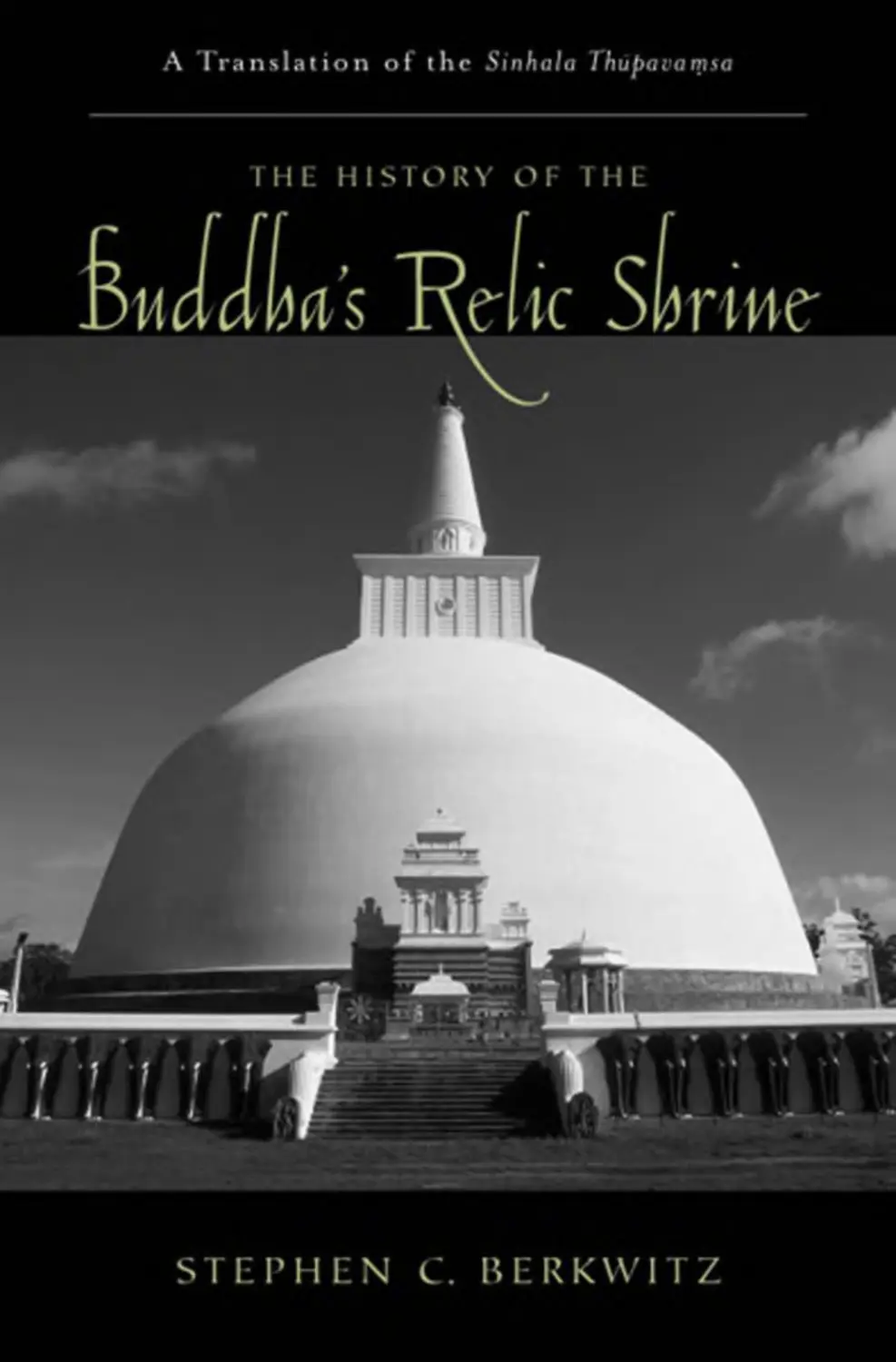


Автор: Berkwitz S.C.
Теги: history religion buddhism culture spirituality religious studies
ISBN: 0-19-530139-0
Год: 2007



Текст
                    the history of the
buddha’s relic shrine

texts and translations series
series editor
Mark Csikszentmihalyi, University of Wisconsin-Madison
A Publication Series of The American Academy of Religion
and Oxford University Press
THE SABBATH JOURNAL OF
JUDITH LOMAX
Edited by Laura Hobgood-Oster
THE ANTICHRIST LEGEND
A Chapter in Jewish and Christian Folklore
Wilhelm Bousset
Translated by A. H. Keane
Introduction by David Frankfurter
LANGUAGE, TRUTH, AND
RELIGIOUS BELIEF
Studies in Twentieth-Century Theory
and Method in Religion
Edited by Nancy K. Frankenberry
and Hans H. Penner
BETWEEN HEGEL AND
KIERKEGAARD
Hans L. Martensen’s Philosophy of Religion
Translations by Curtis L. Thompson
and David J. Kangas
Introduction by Curtis L. Thompson
EXPLAINING RELIGION
Criticism and Theory from Bodin to Freud
J. Samuel Preus
DIALECTIC
or, The Art of Doing Philosophy
A Study Edition of the 1811 Notes
Friedrich D. E. Schleiermacher
Translated with Introduction
and Notes by Terence N. Tice
THE SOURCE OF HUMAN GOOD
Henry N. Wieman
With an Introduction by Marvin C. Shaw
RELIGION OF REASON
Out of the Sources of Judaism
Hermann Cohen

Translated, with an Introduction
by Simon Kaplan
Introductory essay by Leo Strauss
Introductory essays for the second edition by
Steven S. Schwarzchild and Kenneth Seeskin
DURKHEIM ON RELIGION
Émile Durkheim
Edited by W. S. F. Pickering
ON THE GLAUBENSLEHRE
Two Letters to Dr. Lücke
Friedrich D. E. Schleiermacher
Translated by James Duke
and Francis Fiorenza
HERMENEUTICS
The Handwritten Manuscripts
Friedrich D. E. Schleiermacher
Edited by Heina Kimmerle
Translated by James Duke and Jack Forstman
THE STUDY OF STOLEN LOVE
Translated by David C. Buck
and K. Paramasivam
THE DAOIST MONASTIC MANUAL
A Translation of the Fengdao Kejie
Livia Kohn
SACRED AND PROFANE BEAUTY
The Holy in Art
Garardus van der Leeuw
Preface by Mircea Eliade
Translated by David E. Green
With a new introduction and bibliography
by Diane Apostolos-Cappadona
THE HISTORY OF THE BUDDHA’S
RELIC SHRINE
A Translation of the Sinhala Thūpavamsa
_
Stephen C. Berkwitz

X

the history of the
buddha’s relic shrine
A Translation of the Sinhala Thūpavamsa
_

Stephen C. Berkwitz

1

2007

1

Oxford University Press, Inc., publishes works that further
Oxford University’s objective of excellence
in research, scholarship, and education.
Oxford New York
Auckland Cape Town Dar es Salaam Hong Kong Karachi
Kuala Lumpur Madrid Melbourne Mexico City Nairobi
New Delhi Shanghai Taipei Toronto
With offices in
Argentina Austria Brazil Chile Czech Republic France Greece
Guatemala Hungary Italy Japan Poland Portugal Singapore
South Korea Switzerland Thailand Turkey Ukraine Vietnam

Copyright # 2007 by The American Academy of Religion
Published by Oxford University Press, Inc.
198 Madison Avenue, New York, New York 10016
www.oup.com
Oxford is a registered trademark of Oxford University Press
All rights reserved. No part of this publication may be reproduced,
stored in a retrieval system, or transmitted, in any form or by any means,
electronic, mechanical, photocopying, recording, or otherwise,
without the prior permission of Oxford University Press.
Library of Congress Cataloging-in-Publication Data
Parakrama Pandita, 13th cent.
[Sinhala Thupavamsa. English]
The history of the Buddha’s relic shrine : a translation of the Sinhala Thupavamsa /
Stephen C. Berkwitz.
p. cm.—(American Academy of Religion texts and translations series)
Translated from Sinhalese.
Includes bibliographical references and index.
ISBN-13 978-0-19-530139-7
ISBN 0-19-530139-0
1. Ruwanweliseya (Anuradhapura, Sri Lanka)—History.
2. Buddhism—Sri Lanka—History. 3. Gautama Buddha—Relics—Sri Lanka—
Anuradhapura—History. I. Berkwitz, Stephen C., 1969– II. Title. III. Series.
BQ6333.A582R88713 2006
294.3'435095493—dc22
2006046363

1 3 5 7 9 8 6 4 2
Printed in the United States of America
on acid-free paper

Dedicated with my deep appreciation and respect to
Professor W. S. Karunatillake and Professor G. D. Wijayawardhana

This page intentionally left blank

acknowledgments

The production of The History of the Buddha’s Relic Shrine, from the initial
translation through its publication, was a long process that depended on
the kind assistance and encouragement of many people. This work grew
out of doctoral research that I conducted in Sri Lanka between 1995 and
1997 under the auspices of a Fulbright Junior Fellowship and the University of Kelaniya, which served as my host institution at that time. Tissa
Jayatilaka of the U.S.-S.L. Fulbright Commission was instrumental in
facilitating the arrangements that allowed me to spend many months in
Sri Lanka learning to read Classical Sinhala one page at a time. I was
extremely fortunate to have been assigned to work with Professor W. S.
Karunatillake at Kelaniya, who generously committed to working with
me for several months and provided invaluable encouragement and support with this project. My good fortune continued when Professor G. D.
Wijayawardhana agreed to assist me with my work. I undertook this
translation under the guidance of these two professors, although I am
solely responsible for any errors or deficiencies herein. Both professors are
truly extraordinary scholars and wonderful human beings. I feel a tremendous amount of gratitude to them for opening up the rich corpus of
classical Sinhala literature to me.
I must also acknowledge the support and encouragement I received
for my work on the Sinhala Thūpavamsa from my dissertation committee:
_

viii

acknowledgments

Ninian Smart, Gerald J. Larson, Barbara Holdrege, and Charles Hallisey.
Charles Hallisey played a particularly important role in turning my attention to this particular Sinhala text and persuading me to focus more
narrowly on a single vamsa text, rather than on the entire genre of Bud_ is unlikely that this translation would have ever
dhist historical writing. It
been made, much less published, if it were not for the guidance of these
four scholars. Their respective examples and confidence in me continues
to be inspiring.
The publication process has been long, but ultimately worthwhile. Preparing a complete English translation of a lengthy, thirteenth-century
Sinhala history is not easy, especially since there are precious few conventions and standards to use. And given the limited familiarity with this
literature in the West, it was not easy finding a publisher. Thus I am
extremely grateful to Cynthia Read at Oxford University Press for her
interest, patience, and support concerning this work. Working with Cynthia, Julia TerMaat, Linda Donnelly, Margaret Case, and many others at
OUP has been a delightful experience. Likewise, I owe a great deal of
thanks to Mark Csikszentmihalyi, former editor of the American Academy of Religion’s Texts and Translations Series and the person who first
expressed interest in my work and then shepherded it through the review
process. The anonymous reviewers of my translation devoted their time to
going through my manuscript and making numerous suggestions for its
improvement. I wish to thank them for committing themselves to the often
thankless job of reviewing a book manuscript.
Brill Academic Publishers, the publisher of my book Buddhist History
in the Vernacular: The Power of the Past in Late Medieval Sri Lanka (2004),
generously allowed me to reproduce many quotations here that also appear in my book-length study of Buddhist history writing as a form of
religious and ethical practice. In this earlier work, I analyze and theorize
about the writing of historical narratives in Sri Lankan Buddhism. Although some of the arguments from Buddhist History in the Vernacular
appear in the introduction to this translation, I encourage readers to consult this work in its entirety to see how I interpret works such as the
Sinhala Thūpavamsa.
_
Finally, as always,
I wish to acknowledge my family and friends for
believing in me and not questioning my sanity while I dedicated many
years to the task of reading and translating Sinhala texts. My wife, Imali,
has been a constant and invaluable source of encouragement, while my

acknowledgments

ix

daughter, Rashmi, reminds me of the satisfaction to be gained outside of
my work. My parents, Robert and Pamela Berkwitz, and my parents-inlaw, Somasiri and Sumanaseeli Dabare, gave me their support and took
pleasure in my accomplishments along the way. And there have been many
others who have contributed to this work, including some who probably do
not even realize it. Suffice it to say, I am grateful to all those who showed an
interest in my translation and those who helped me to accomplish it.

This page intentionally left blank

contents

Notes on the Translation

xiii

3

Introduction

The Text in Translation: The History of the Buddha’s
Relic Shrine 33
Prologue 35
1.

The Career of the Bodhisattva 37

2.

The Story of Prince Siddhārtha 52

3.

The Defeat of Māra 71

4.

The Awakening of the Buddha

5.

The Enshrining of the Relics

6.

The Story of King Aśoka

7.

Establishing the Dispensation in Lan_ kā 145

98

112

133

xii

c o n t e nt s

8.

10.

The Early Career of King Dut.ugämunu 159
_
The Victory of King Dut.ugämunu 179
_
The Commencement of the Relic Shrine 194

11.

The Description of the Relic Chamber 208

12.

The Relic Deposit 230

9.

13.

The Death of King Dut.ugämunu
_
Epilogue 253
Notes

255

Bibliography 289
Index

294

245

notes on the translation

Although I consulted a number of printed editions of the Sinhala
Thūpavamsa, I have relied primarily on the recent edition prepared by
_
W. S. Karunatillake.
My inspection of over two dozen manuscript editions
of the Sinhala Thūpavamsa has led me to conclude that producing a translation from such works_ would be impractical and no more accurate, since
such manuscripts date back no further than about two or three centuries,
and many of them are filled with scribal errors and variants that appear
mostly in spellings rather than substantial details. Since Sinhala versions of
paracanonical texts were not bound by the same close attention to accurate
transmission as the texts of the Pāli Canon, some innovation and alterations inevitably appear between editions. A reader is likely to find different spellings for names and words; indeed, sometimes in the very same
text. I have retained many of these variations, so the reader will find
proper names and technical terms that alternate between Sanskrit, Pāli
and Sinhala versions. The edition by Karunatillake was chosen for its
reliability and the fact that it contains some acknowledgment of the variants among other modern printed editions.
Since there is no standard version or original manuscript left that
could be treated as authoritative, I have attempted to compensate for this
lack by comparing several modern editions to check for variations or
omissions. Although this method may seem unsatisfying to the critical
xiii

xiv

notes on the translation

reader, it is nevertheless consistent with the ways that premodern
Sri Lankan Buddhists encountered these texts—as works with fluid
boundaries that were subject to continual revision as they were copied by
hand and sometimes condensed into shorter excerpts in ad hoc anthologies of diverse texts bound together in one manuscript. In short, in an
environment where critical editions were virtually unknown, the use of a
single text for reading and editing was fairly typical.
Another challenge I face with this work is the absence of universal
standards or accepted conventions in the translation of Sinhala works.
The relative paucity of English translations of medieval Sinhala texts has
prevented the development of a common critical apparatus upon which
I could base my work. (Three notable exceptions include Jewels of the
Doctrine and Portraits of Buddhist Women, which present selected stories
from the thirteen-century Saddharmaratnāvaliya in English, by Ranjini
Obeyesekere, as well as Udaya Meddegama’s translation of the Anāgatavamsa Desanā.) As one might expect in a South Asian Prakrit language,
many_ Sinhala words are polysemantic and bear the varied impressions of
Buddhist technical terms, Sanskrit poetics, and overlapping etymologies
that together conspire to make precise translations difficult. However,
rather than leaving important Sinhala texts to wallow in obscurity, I have
striven to translate Parākrama’s Sinhala Thūpavamsa in as accurate and
consistent manner as possible. It is hoped that in _time, as more Sinhala
works are translated into Western languages, new conventions and a
critical apparatus will emerge to guide those who will produce translations in the coming years.
The major interests guiding my translation of the Sinhala Thūpavamsa
reflect my desire to convey something of both the style and meaning_ of
Parākrama’s text. Although the ornate style of Sanskritized Sinhala prose
from the thirteenth century can make for some awkward and lengthy
English sentences, I have tried to retain occasional traces of the grandiloquence with which Parākrama crafted his historical narrative. Nevertheless, I have taken the liberty of rewording and rearranging some
particularly complex sentences to render a translation that is more comprehensible and that adheres more to the conventions of idiomatic English.
The balance between retaining style and preserving meaning may not
always be achieved, but I feel that this tension is a productive one that
ultimately contributes to a translation that manages to transmit a semblance of both the style and meaning of the original work.

n o t e s o n th e t r a n s l a t i o n

xv

Readers should also note that I have reorganized the text into clearly
marked chapters of fairly consistent lengths. This decision to divide the
text into chapters that highlight certain events marks a departure from
more traditional forms of the Sinhala Thūpavamsa. Early modern manu_
script editions typically lack chapter headings altogether.
Although there
are some instances where the text clearly identifies certain sections in the
narrative by stating that such-and-such an account is finished, this
practice is inconsistently done and would result in chapters ranging wildly
in length from just a few paragraphs to several dozen pages. As a compromise, I have included the concluding statements where they appear in
the text, but I have not always used them to mark out chapters. My
defense for this decision is that adding chapters is like adding punctuation. There are limited traces of either in traditional Sinhala palm-leaf
manuscripts, but it is useful to add them to a translation so that modern
English speakers may read and use this work more easily.

This page intentionally left blank

the history of
the buddha’s relic shrine

This page intentionally left blank

introduction

The Vamsa Tradition in
_
Theravāda
Buddhism
In the latter part of the thirteenth century, a lay scholar named Parākrama
Pandita composed a text that is little known in the West, but that is
__
recognizable
and influential in the Theravāda Buddhist community of Sri
Lanka. Parākrama’s work is often referred to as the Sinhala Thūpavamsa or
_ this
simply the Thūpavamsaya, but the former title is preferred here so that
_
work may be easily distinguished from a Pāli work of a similar nature called
the Thūpavamsa, which was composed around the twelfth or thirteenth
century ce. As_ the name implies, this late medieval text was composed in the
language of Sinhala, a language native only to the island of Sri Lanka but
derived from the Indo-Aryan language family of India, albeit with numerous
Tamil language borrowings. Broadly speaking, the subject of Parākrama’s
work is the Buddhist cult of relics as historically practiced in the Theravāda
tradition of Sri Lanka. More specifically, however, the text deals with a
revered, 120-foot stūpa or relic shrine called by various names—such as the
Mahāthūpa (Great Relic Shrine), Ruvanväli Sä¯ya (Relic Shrine of Golden
Sand), and Ratnamāli Dāgäba (Relic Shrine of Golden Garlands)—that is
still standing in the northern Sri Lankan city of Anurādhapura. This relic
shrine was built in approximately the second century bce, but it remains an
3

4

introduction

important focal point for the sacred geography of the island and for contemporary expressions of Sri Lankan Buddhist devotional practice.
In order to understand the significance of this text and the relic shrine
it describes, it would be helpful first to place Parākrama’s work within
broader literary developments in Theravāda Buddhism. The class of historical writings known as vamsas, that is to say chronicles or histories,
_
comprises an important and sizable
genre of Theravāda Buddhist literature. Scholars recognize that such texts were produced from an early
date in the history of Buddhism, with the oldest extant example being
the Dı̄pavamsa from around the fourth century ce. It is fair to say that
Theravāda _Buddhists have maintained a long-standing interest in these
types of texts, as Buddhist histories concerning a variety of subjects have
been produced and copied in fits and starts up to the present day in
Theravāda communities. Western scholars have also shown considerable
interest in these works. Many orientalist and colonial researchers in the
nineteenth and twentieth centuries eagerly translated and read Buddhist
vamsas, and these texts were among the earliest subjects of modern In_
dological
research. This was probably because Buddhist vamsas contained
_
literary accounts of past kings and historical events connected
with several archaeological remains that were found in India and Sri Lanka,
which at the time was called Ceylon by the British.
Scholars preoccupied with reconstructing the ancient history of the
Indian subcontinent have consistently affirmed the historical value of these
texts. Heinz Bechert, a notable German Indologist, writes to this effect,
‘‘[I]t cannot be doubted that the only early historical literature within the
realm of South Asian culture which ever has existed is that of Ceylon, and
that historical writing in the strict sense of the word did start on the subcontinent only after the first Muslim invasions had disturbed the traditional establishment of Indian life and culture.’’1 The privileged status
ascribed to Buddhist vamsas as ‘‘historical’’ literature turned works like
_
the Dı̄pavamsa and Mahāvam
sa into prized historical documents. In con_
trast to the Hindu purānas, _the epic tales of Hindu gods and goddesses,
_ believed to contain narratives that were more
the Theravāda vamsas were
_
factual and realistic since they tend to deal with historical figures and
places. However, even the alleged historicity of the vamsas did not prevent
scholars from cautioning others against accepting _everything in their
narratives as factual. In discussing the historical value of the Dı̄pavamsa
and the Mahāvamsa, Wilhelm Geiger asserted the need for researchers_ to
_

introduction

5

read such works with a critical eye. In commenting on the tendencies of
vamsas to embellish the historical record with fantastic and legendary
_
accounts,
he wrote, ‘‘Whoever writes the history of Ceylon will have to
separate the real kernel of fact from this traditional material.’’2 Geiger
and other historians who consulted Buddhist vamsas for historical
_
information emphasized the need for scholars to employ
the historicalcritical method for evaluating one’s sources in order to reconstruct an
accurate picture of the past as it really happened.
Although one cannot deny that Buddhist vamsas are useful for historical research into the South Asian past, it will_ be become clear below
that works like the Sinhala Thūpavamsa show us that Buddhist history
_ purposes. The various concerns
writing reflects a variety of interests and
informing Buddhist historiography stem, in part, from the fact that such
writings grew out of an ancient literary tradition. The Pāli commentaries,
or At.t.hakathās, are said to have been based upon older literary sources
written in an ancient form of the Sinhala language, as well as other Prakrit sources. Tradition holds that commentaries on the Tipit.aka, or the
Theravāda Buddhist canon said to comprise the Buddha’s word, were
brought from India to Lan_ kā by the monk Mahinda (Sinhala: Mihiňdu)
around the third century bce. The significant additions made to those
texts in the island include accounts of the establishment of Buddhism
locally. These commentaries are widely believed to have contained the
narratives from which later vamsa texts were composed.
_
A number of these commentaries,
which are no longer extant, are mentioned in the Vamsat..thappakāsanı̄, the commentary written on the Mahāvamsa sometime _ around the eighth or ninth century ce. The works
_
mentioned
include the Dı̄pavamsat..thakathā (The Commentary on the His_
tory of the Island), the Cetiyavam
sat..thakathā (The Commentary on the
_
History of the Relic Shrine), and the Mahābodhivamsat..thakathā (The Com_ several others. G. P.
mentary on the History of the Bodhi Tree), among
Malalasekera holds that these ancient sources were used in composing later
Pāli historical works on the same subjects. He points out, for example, that
the author of the Vamsat..thappakāsanı̄ advises readers to consult the Cetiyavamsat..thakathā for _information regarding what was deposited in the
Great_ Relic Shrine, or Mahāthūpa.3 Not coincidentally, the Pāli Thūpavamsa
_
also provides a detailed description of the offerings deposited in the shrine.
As such, he concludes that this ancient commentary was one of the sources
used to compile the Pāli version of the history of the Great Relic Shrine.

6

introduction

Other textual antecedents for vamsas that were composed by Theravāda Buddhists include the extant_ Pāli At.t.hakathā texts written by
Buddhaghosa and others during the fifth and sixth centuries ce. These
works are traditionally held to have been based upon many of the same
Sinhala At.t.hakathā composed around the beginning of the Common Era
in the island of Lan_ kā. But since these Pāli works have survived, we are
able to trace some accounts of the Buddha’s life story and the transfer
of his relics from India to Lan_ kā that appear in later vamsas back to these
_
commentaries. For instance, the lengthy historical narrative
that opens
the Samantapāsādikā, the commentary on the Vinaya written by Buddhaghosa, contains an account of the lineage of monks who transmitted
the Buddha’s teaching as well as descriptions of events surrounding the
establishment of Buddhism in Lan_ kā. Parts of this narrative were reiterated by works like the Mahāvamsa and the Pāli Thūpavamsa afterward.
Likewise, the Jātakat..t hakathā and_ the Madhurat..t havilāsinı̄,_ the commentaries on the Jātaka and Buddhavamsa, respectively, include accounts re_
lated to the Buddha’s career that occasionally
appear in later vamsas.
_
The precise development of this early historiographical tradition
in
Theravāda, however, remains fairly speculative. We have reason to believe that later vamsas adopted material from earlier commentaries in Sin_
hala, Pāli, and Dravidian
languages, but it is likely that these narratives
were substantially revised as they were rewritten in later centuries. The
Dı̄pavamsa and Mahāvamsa, the earliest works included in the vamsa genre,
_ reflect transitional
_
_
probably
works in this historiographical tradition,
as
they comprise works of verse that deal with allegedly historical events at
the expense of commentary on the Tipit.aka. Of these two works, the
Mahāvamsa has been singled out for its accomplished composition and its
_
rich content.
Composed in the latter part of the fifth or early sixth century, the Mahāvamsa traces the lineage of kings in Lan_ kā and records the
good deeds they _performed to promote the Buddha’s Dispensation (sāsana). Significantly, the Mahāvamsa was extended several times in typical
chronicle style by authors who_ added to its original chapters in the
twelfth, eighteenth, nineteenth, and twentieth centuries. Its open-ended
style and lack of a single narrative plot is indicative of the ‘‘chronicle’’
style of historical writing, and it may be for this reason that scholars have
typically referred to vamsas as ‘‘chronicles’’ despite the fact that the Pāli
term is better translated_ as ‘‘lineage.’’ It is noteworthy that although later
vamsas frequently cite material from the Mahāvamsa, most of them depart
_
_

introduction

7

from the chronicle style of writing and are therefore better known as
histories, inasmuch as they aspire toward narrativity and contain a wellmarked beginning, middle, and end.4
Several centuries later, Buddhist histories written in the Pāli language
about one or another relics of the Buddha were composed. These relic
vamsas, which tended to be more narrowly circumscribed in terms of sub_ than the expansive coverage found in the Dı̄pavamsa and the Majects
_
hāvamsa, represent a new stage in the writing of Buddhist
history in
_
Theravāda. Works like the tenth-century Mahābodhivamsa, the twelfthcentury Dāt. hāvamsa, and the Thūpavamsa focused their _attention on the
_
arrival of the Buddha’s
relics in Lan_ kā._ Thus, important sites and objects
of veneration including the Bodhi Tree in Anurādhapura, the Tooth Relic,
and the Mahāthūpa, in which a sizable portion of the Buddha’s bodily
relics were said to have been enshrined, become the primary subjects of
these medieval texts. Although the authors of these works often consulted
the Mahāvamsa, they in no way relied on it exclusively for adducing
_ out their own narratives. Other sources of written and
material to fill
perhaps even oral traditions provided additional information.
Later during the same period of literary production in Sri Lanka,
authors began to translate and compose new vamsas in the Sinhala lan_
guage, making them more accessible to local audiences.
The Sinhala Thūpavamsa is probably the first such work to be rendered into a literary form
of _the local Sinhala vernacular. This work, which most scholars date to
the latter half of the thirteenth century, advanced the development of
Sinhala literature and inaugurated a trend whereby other authors translated various Pāli vamsas into Sinhala. Thus, in the fourteenth century,
_
Buddhist authors composed
texts such as the Sinhala Bōdhivamsa, the
Daladā Sirita, and the Sinhala Dhātuvamsa, among others, for the_ sake of
_
_ the Tooth Relic, and Forehead
relating
the histories of the Bodhi Tree,
Bone Relic to broader and more localized audiences in Lan_ kā.5
It is important to note that several Sri Lankan vamsas and their his_ Southeast Asia
toriographical conventions were also spread to peninsular
into countries known today as Burma (Myanmar), Thailand, Cambodia,
and Laos. There is ample evidence, for instance, that the Mahāvamsa was
_
transmitted to Southeast Asian lands where Theravāda was adopted.
Other Pāli histories such as the Thūpavamsa and Dhātuvamsa were also
_ of their narratives
_
transmitted to these lands, so that elements
likewise
found their way into local Buddhist histories. A good example of this

8

introduction

borrowing of historiographical content and form is seen in the Jinakālamāli. This Buddhist historical narrative was composed in Thailand
during the sixteenth century and borrows liberally from Sri Lankan works
such as Buddhavamsa, Mahāvamsa, and Thūpavamsa.6 As such, this later
_
_
_
Pāli text from Thailand
represents
an historiographical
method whereby
local historical events were added to older Sri Lankan accounts of kings
and relics. Such literary activity resulted in a fairly coherent Theravāda
tradition of history writing that forged conceptual and sometimes institutional links between Buddhist communities in Sri Lanka and Southeast
Asia. Of course, like their Sri Lankan counterparts, Buddhists in Southeast Asia employed various strategies to make their histories reflect local
concerns and interests, domesticating the historical narratives they received
by emphasizing native heroes and a local topography marked by shrines
and monasteries found closer to home.

Locating the Sinhala Thūpavamsa
_
Parākrama Pandita’s Sinhala Thūpavamsa occupies an important posi_ _tradition of Theravāda_Buddhism. This work represents
tion in the vamsa
_
an early effort to narrate the establishment of Buddhism in Lan_ kā in a
literary dialect of the vernacular. As such, this work maintains a somewhat
ambiguous and complicated relationship with the Pāli Thūpavamsa com_
posed by a monk called Vācissara Thera a few generations earlier. Although
people once thought that Parākrama Pandita’s Sinhala Thūpavamsa pre_ _ makes reference to _an older
dates Vācissara’s Pāli version, since the latter
edition composed in the language of ‘‘Sı̄hala,’’ most scholars now conclude
_
that Parākrama’s version reflects a later expansion
upon the extant Pāli
text. N. A. Jayawickrama makes a persuasive argument on the basis of a
combination of internal and external evidence in favor of dating Vācissara,
the author of the Pāli Thūpavamsa, between roughly 1236 and 1270 ce,
_ probably appeared a generation or two
whereas Parākrama Pandita’s text
_
_
later, in the latter half of the thirteenth century.7 The difficulty in dating
both of these texts stems in part from the fact that we know relatively little
about their respective authors. The colophon of the Pāli Thūpavamsa
_
suggests that its author worked in the royal library during King Parākramabāhu II’s reign and composed a few other Buddhist works in both
Pāli and Sinhala. The original colophon in the Sinhala Thūpavamsa does
_

introduction

9

little more than mention the name of Parākrama Pandita along with the
_ _ Wheel-Turner of
honorary title Sakala Vidyācakravarti, which means the
All Knowledge.
Nevertheless, the decision to assign a later date to the Sinhala Thūpavamsa is justified in part by the fact that Parākrama’s work contains a surplus
_ material that is not found in Vācissara’s Pāli text, although it obviously
of
borrowed the plot and much description from the Pāli version.8 As such,
Parākrama’s text fits the pattern wherein older Pāli narratives were translated into Sinhala between the twelfth and fifteenth centuries, an era when
the production of written works in the Sinhala language overshadowed
the writing of Pāli texts in Sri Lanka. The Sinhala Thūpavamsa elaborates
substantially upon certain sections of Vācissara’s text, while_ sticking closely to other parts of its narrative. Both Thūpavamsas, however, employ
prose narratives that expand upon details found in _the terse poetic style of
the Mahāvamsa. Vācissara added to the Mahāvamsa’s record of King
_ ı̄’s career and the construction of the _Mahāthūpa in AnurDut.t.hagāman
_ of his additions come from Pāli material lifted from the
ādhapura. Many
Samantapāsādikā and adapted from other sources such as the canonical
Mahaparinibbāna Sutta. Parākrama’s Sinhala version continued the trend
of elaborating upon older narrative traditions, as it embellishes the historical accounts even further, illustrating a tendency among Sinhala works
beginning from around the thirteenth century to imitate the ornate style
and poetic sensibilities of Sanskrit works. At the same time, this move
also made classical literature more accessible to local Sinhala-speaking
audiences, transforming a technical Sanskritic style into an idiom that
approached the vernacular language.
Although we are unable to date the Sinhala Thūpavamsa more precisely
_
than the latter part of the thirteenth century, we do know
at least that
9
Parākrama Pandita was a layperson rather than a monk. This information
_
comes chiefly _from
brief remarks in the late fourteenth-century Nikāya
San_grahaya and the sixteenth-century Rājaratnākaraya. This first work recalls the history of the Buddhist Sangha in Sri Lanka. The author of this text
also lists the names of famous lay scholars ( grhasthapandita janayō) who
_
_ _ of the nine lay
eighth
produced various treatises on the Dharma.10 The
authors mentioned here is Parākrama Pandita. The Rājaratnākaraya also
_ _ that follows a separate list of
includes a similar list of scholars ( panditavaru)
_
_
monastic authors and mentions Parākrama Pandita by name.11 This evi_ _ himself, suggests that he
dence, along with the title by which he identifies

10

introduction

was a learned scholar who might have had some connection to a royal court,
although this cannot be definitively shown.
Unfortunately, we have yet to find other information that could help
us in identifying Parākrama Pandita further. We can at least dispel a the_ our author was the same person as
ory once held, which claimed _that
Vidyācakravarti, the author of Butsarana. Wimal Balagalle has refuted this
by pointing out the stylistic differences_ between Butsarana and the Sinhala
_
Thūpavamsa, even though the author of the latter evidently
borrowed
_
some material from the former in composing its narrative.12 For his part,
Ananda Kulasuriya notes that the Sinhala Thūpavamsa contains noticeably more infelicities of style when compared to_ Vidyācakravarti’s
Butsarana, and that the words sakala vidyācakravarti refer to an honorary
_
title rather
than a personal name.13 Ven. Welivitiye Sorata also argues
that differences in the language used in the two works point to two different authors.14 In sum, we may safely deduce that the ‘‘Vidyācakravarti’’ appearing before the name of Parākrama Pandita in the colophon
_ _ esteemed author of
signifies a title he claimed, perhaps in imitation of the
Butsarana, which served as a kind of paradigmatic work for subsequent
Sinhala_ prose works.
Other questionable theories about the identity of Parākrama Pandita
__
attempt to associate him with certain learned kings in medieval Sri Lanka.
To complicate matters, there is a handful of kings from this period who
were nicknamed pandita due to their erudition. An earlier scholar wrote
_
that one such king _named
Vijayabāhu II (r. 1186–1187), or Pandita Vi_ _ disjayabāhu, was Parākrama Pandita. However, this view has been
_
_
credited, since there is no evidence that this king had ever been called Parākrama and the language of the Sinhala Thūpavamsa resembles thirteenth_
century works more than twelfth-century Sinhala
compositions.15 An
argument could be made that King Parākramabāhu II (r. 1236–1270),
also known as Pandita Parākramabāhu I, was the author of the Sinhala
Thūpavamsa. This_ _king was celebrated as a great patron of learning
_
and authored
works such as the Sinhala poem Kavsilumina and the Vi_
_for identifying
śuddhimārga Sannaya. Again, however, there is no evidence
this king with Parākrama Pandita. The king identifies himself in verse
_
770 of Kavsiluminia as ‘‘King_ Kalilkal
Säväni,’’ which appears to have
_
_ to a royal author in the
16 _
been his title. There is no comparable reference
Sinhala Thūpavamsa, nor is there any mention of other works composed
_ that could link him with Parākramabāhu II. It is
by the same author

introduction

11

entirely possible, however, that Parākrama Pandita was one of the many
__
scholars supported directly or indirectly by that king’s
sponsorship of learning and letters during his reign. To identify our author with King
Parākramabāhu IV (r. 1302–1326), or ‘‘Pandita Parākramabāhu II,’’ is
_ _ a patron of works such as
also likely mistaken, even though this king was
Daladā Sirita and may have initiated the translation of the Pāli Jātaka into
_
Sinhala.
Sinhala prose works in the early fourteenth century typically
display a more marked Sanskrit influence and, unlike those other works
mentioned above, there is no clear indication that this king either wrote
or sponsored the writing of the Sinhala Thūpavamsa.
If the person of Parākrama Pandita remains_ largely a mystery, the
historical context behind the Sinhala_ _Thūpavamsa is equally obscure due
to the gaps in our historical knowledge of late_ medieval Sri Lanka more
generally. The period of time between the fall of the Sinhala kingdom in
Polonnaruwa in the early part of the thirteenth century and the arrival of
the Portuguese in 1505 is under-researched, with most scholars of Sri
Lankan history choosing to focus either on the ancient glories of the northern capitals or the later influences of European colonialism. Consequently,
our understanding of the period in which the Sinhala Thūpavamsa was
_
composed is incomplete. The fact that this period was characterized
by
shifting centers of political power and comparable weakness in Sinhala
kingship also contributes to the relative lack of historical knowledge about
this era.
Although one cannot be completely sure about the context behind the
composition and transmission of Parākrama’s text, the major challenges
faced by medieval Sinhala polities offer some clues for understanding
why the Sinhala Thūpavamsa was produced. First, a conqueror named
_
Māgha from the Kalin_ ga country
in India invaded Lan_ kā with an army
from the Malabar region around 1215. Having deposed the king at the
time, Māgha ruled the northern region of the island up to his death in
1255. Buddhist literature records that during this time, Māgha and his
soldiers terrorized the people of Lan_ kā, destroying monasteries and books
on the one hand, and repressing and stealing wealth from the island’s
inhabitants on the other hand.17 Even if these accounts of an aggressive
non-Buddhist invader are somewhat exaggerated, it seems safe to conclude that there was a massive displacement of material and intellectual
resources in Lankan Buddhist communities in this period. The disunity
among Sinhala chieftains in the southern and western parts of the island

12

introduction

negated attempts to resist and expel the invaders in the north. This woeful
state of affairs limited the amount of patronage that the Sinhala rulers
could give to the Sangha. And even after Māgha’s death, internal revolt
and political intrigue prevented any single Sinhala leader from commanding the loyalties of the majority of the island’s inhabitants, at least until
the fifteenth century.
It is against this backdrop that the writing of the Sinhala Thūpavamsa
_
appears as an attempt to imagine and bring a new social formation into
being. Rather than assuming that historical narratives are always written
by the ‘‘winners’’ of history and function to legitimate the elite powers of
the day, we may hypothesize that the Sinhala Thūpavamsa was a text de_ unite a broader
signed in part to rectify a problematic present situation and
population through a shared language and historical inheritance.18 It is
possible that Parākrama’s descriptions of powerful Buddhist kings and
a populace united in their devotion to the Triple Gem of Buddhism were
nostalgic recollections of a past that stood in stark contrast from the
island’s then-current state of affairs. We know, for instance, that by 1262
the Great Relic Shrine in Anurādhapura had fallen into disrepair, like
many other ancient shrines in the old capital, and that efforts were being
made to restore the shrine around the same time that the Sinhala Thūpavamsa was composed.19
_The descriptions of a Buddhist community united in its esteem for the
Buddha’s Dispensation and its proclivity to engage in large-scale communal acts of devotion under the leadership of pious kings evinces an imagined, rhetorical ideal that could be used to mobilize a larger collectivity of
Sinhala-speaking Buddhists in the island. Although we cannot be sure of
the motives that informed the production and dissemination of the Sinhala Thūpavamsa in medieval Sri Lanka, it stands to reason that the writ_ past in a literary dialect of the vernacular coincided with
ing of a glorious
efforts to reorganize the Sinhala kingdom in the midst of an emergent
culture, wherein new social and political identities were being formed in
response to the historical exigencies of the time.20
Nevertheless, it is well known that literary accounts of the building of
the Great Relic Shrine in Sri Lanka were sometimes read aloud on
ceremonial occasions. An inscription in the stone courtyard of the Great
Relic Shrine from the second year of Queen Kalyānavatı̄’s reign (1202–
_
1208) describes a great gift of alms given by a noble minister
at the site of
the relic shrine. Among the detailed list of objects offered to the shrine,

introduction

13

we learn that the Thūpavam_ śa was read aloud during the ritual offerings
that were made at that time.21 It is probable that the text read at this
occasion was not Parākrama’s version but an earlier Sinhala account of
the traditional narrative describing the origins of the shrine. This particular text may have been instead the Sinhala work mentioned by Vācissara in the prologue to his Pāli Thūpavamsa.22 What is most significant
_
about this inscription, however, is that it confirms
that historical narratives akin to Parākrama’s text had ritual associations and public lives
as works in which sections or even a few folios could be recited aloud
to groups and not only read by solitary individuals. The fact that many
of the Buddhist histories written in the medieval period of Sri Lankan
history are concerned with one or more relics of the Buddha—including
the Tooth Relic, the Bodhi Tree Relic, the Forehead Bone Relic, the Footprint Relic, and the bodily relics enshrined in the Great Relic Shrine—
supports this connection made between historical narrative and ritual
practice in Theravāda Buddhism.

The Buddhist Cult of Relics
Parākrama Pandita’s Sinhala Thūpavamsa represents a text that deals pri_
marily with the_Buddhist
cult of relics as_ traditionally practiced in Sri Lanka.
Recent scholarship has shown that practices of enshrining and venerating
objects associated with the historical Buddha are ancient and widespread
throughout the Buddhist world. Whereas earlier generations of Buddhologists often ignored or derided relic veneration as superstitious and extraneous to the moral teachings of the Dharma, scholars now write with more
interest and tolerance for Buddhist relics. Archeological research in India
supports the view that the earliest material evidence of the Buddhist tradition is directly linked with the cult of relic veneration, a cult observed at least
as far back as the time of the Mauryan emperor Aśoka (c. 270–230 bce), if not
before.23 It therefore seems that Buddhist devotees began venerating a range
of relics associated with the Buddha shortly after his death, which scholars
believe occured sometime between the sixth and fourth centuries bce.
Parākrama Pandita’s text is of value here, since it offers some explanation as
_ _ relics of the Buddha were traditionally venerated.
to why and how
Theravāda Buddhism has traditionally employed a threefold classification in discussing relics. This system divides relics into bodily relics or

14

introduction

the corporeal remains of the Buddha (and sometimes of enlightened
monks called arahants), relics of use or objects believed to have been used
by the Buddha when he was alive, and commemorative relics or images
made of the Buddha after his death. This classification has led to circumstances in which numerous relics of the Buddha have been attested to
throughout Asia. Although there is plenty of evidence for relics as objects
of esteem and desire in countries other than Sri Lanka, the vamsa liter_ cult in
ature supplies ample textual referents to the importance of the relic
Sri Lankan Buddhism. For instance, the Sinhala Thūpavamsa highlights
_ what it calls
the deposit of an eighth of the Buddha’s corporeal remains in
the Relic Shrine of Golden Garlands (Sinhala: Ruvanmäli Dāgäba) in
Anurādhapura. The history of the Bodhi Tree, considered a relic of use,
is detailed in the Pāli and Sinhala versions of the Mahābodhivamsa. These
_
and several other vamsas are significant for their representations
of the
_
events and veneration of particular relics of the Buddha said to have been
obtained by ancient kings and enshrined in the island.
While the Buddhist cult of relics in Sri Lanka has been exceptionally
well described and highlighted in several vamsas, relic veneration there
shares several similarities with the worship of _relics in other lands. Relics
of the Buddha are frequently believed to possess miraculous powers and
attributes, and may be venerated for both worldly and otherworldly ends.
In Japan, for instance, relics came to be associated early on with apotropaic powers for protecting the imperial family and the state.24 Generally
speaking, monarchs in largely Buddhist lands could reinforce their image
as devout rulers by public displays of stūpa building and ceremonies honoring relics in their possession, which served to legitimate their power
and authority in society. Indeed, legendary accounts of King Aśoka’s
construction of 84,000 relic shrines throughout his reign testify to both
his piety and his attempt to make visible his authority throughout the
empire.
At the same time, relic veneration in Buddhism is intimately linked
with acts of merit ( punyakarma), whereby people who venerate objects
_
associated with the historical
Buddha may expect to earn some good fortune in the future for a sincere display of devotion in the present. According to the logic of Theravāda, even though the historical Buddha
passed away from this world into an unconditioned, transmundane state
called parinirvāna, which is held to be totally beyond the realm of repeated
rebirth known _as samsāra in Indic thought, a person may give devotional
_

introduction

15

offerings ( pūjā) of items such as flowers and incense or even make simple
gestures of respect to relics and receive something beneficial in return.
The benefits thought to come from venerating relics are not the result of
any intervention on the part of the Buddha, but rather are taken to be the
results of the well-intentioned, well-performed act itself through the impersonal karmic workings of cause and effect. In other words, the Buddhist theory of karma (Pāli: kamma) affirms that certain wholesome
actions will inevitably produce good effects sometime in the future. The
unripened consequences of good karma are also known as ‘‘merit,’’ which
constitutes one of the desired ends to which many Buddhist practitioners
aspire when venerating relics.
As a Buddhist goal, merit is exceedingly popular throughout all Buddhist communities in Asia. Deliberate acts of moral righteousness and
devotion are routinely performed by people of all backgrounds in the
expectation that they will earn merit and benefit from their actions in
their present lifetime or a future rebirth. From the Theravāda perspective, merit gained from venerating relics or any other such act can be
conducive to good health and good fortune in the present, and it may
even help to effect a good rebirth in the future. However, strictly speaking, it cannot help one to achieve nirvana—the total extinction of suffering and rebirth—as only selfless, morally wholesome conduct such as that
which is found in higher states of meditation is conducive to the ultimate
transcendence of desire and ignorance to a blissful, indescribable state.
Nevertheless, meritorious acts may still set the stage for spiritual progress
at a later time, as such acts are sometimes held to purify a person’s mind
and reinforce morality, both of which are accomplishments that serve to
bring people closer to nirvana.
Parākrama’s Sinhala Thūpavamsa is a work that extols acts of merit
_
performed at relic shrines. As such,
its narrative encourages relic veneration, while tending to ignore the practice of meditation and austere
living associated with forest monks in the tradition. However, it would be
misleading to conclude that this work was therefore a text directed only
to the laity. Gregory Schopen has convincingly shown that monastic
participation in the relic cult appears in the earliest eras. He finds evidence in ancient inscriptions from the earliest stūpas that monks actively
participated in the construction and worship of relic shrines.25 The view
affirming monastic involvement in relic veneration is substantiated further in the Sinhala Thūpavamsa’s accounts of monks who fashioned and
_

16

introduction

donated bricks to build the Great Relic Shrine. Parākrama’s text asserts
that monks have many appropriate roles to play in the construction and
veneration of relic shrines. As such, it intervenes in medieval debates
over the proper duties of monks and suggests that even ‘‘forest-dwelling’’
monks who spend the greater part of their time in meditation should also
actively support and participate in the relic cult.
According to the Sinhala Thūpavamsa, there are various reasons for
Buddhist practitioners to venerate relics._ Since such acts are defined as meritorious, it is in a person’s own interest to make offerings with a focused and
composed mind. At many points the text explicitly spells out the benefits of
venerating relics of the Buddha, making it nearly impossible for a reader or
listener of the text to overlook the merit gained from doing so. The text also
reinforces scholarly arguments which hold that relics function to make a
Buddha, who is absent from the world, materially present for devotees who
wish to honor him and experience his power.26 Although it remains to be
seen whether the Buddha’s passing away in nirvana actually constitutes a
‘‘problem’’ for Buddhists that is overcome through the presence of his relics,
as some have claimed, the Sinhala Thūpavamsa ascribes to relics miraculous
_ equates relics to the living
powers to take the form of the Buddha and,
Buddha in other ways. In one account, for instance, the monk Mihiňdu
requests a king to obtain relics in order to satisfy his wish to ‘‘see’’ the
Buddha. Another reason for venerating relics in the Sinhala Thūpavamsa is
_ to
to fulfill one’s obligations to the historical Buddha. Devotees are obliged
act out of indebtedness to the Buddha for his unlimited giving and selfsacrifice on behalf of all sentient beings.27 Parākrama’s text highlights this
moral obligation to show gratitude as a beneficiary of the Buddha’s past acts
and turns relic veneration into an ethical practice, an idea that is discussed in
more detail below.
In sum, the Sinhala Thūpavamsa provides us with important insights into
_ Buddhist relic cult. We learn that relics
the multivalent significance of the
were popular focal points for Buddhist devotion, giving rise to sometimes
elaborate ritual activity performed in honor of the Buddha. We also see how
kings such as Aśoka and Dut.ugämunu employed relics to display their
power and piety. The text also portrays_ Buddhist relics as instruments for
spreading the Buddhist religion to new lands and defining local landscapes
with centers of devotional activity and sacred power. The Sinhala Thūpavamsa depicts in vivid detail how relics are used, in John S. Strong’s words, to
_
express
and extend the ‘‘life-and-death story’’ of the Buddha, connecting

introduction

17

durable physical objects of veneration to specific incidents in the Buddha’s
biography while continuing to spread his presence to new locales long after
his death.28 Numerous other texts address and exemplify the Buddhist relic
cult, but the Sinhala Thūpavamsa is additionally important since it appears to
_
be the oldest extant text composed
in a literary form of a vernacular language to emphasize relics and their associated practices in Theravāda Buddhism. This notion suggests that Parākrama’s text may have coincided with,
or even helped to inaugurate, the beginnings of a medieval upsurge of
interest and activity in the Buddhist relic cult in Sri Lanka.

Writing History in a Local Language
The question of language choice in literary production and the ways in
which different languages were conceptually linked or distinguished from
each other are fruitful areas for examining the cultural significance of
textuality in communities where bilingualism and trilingualism were the
norm. Sheldon Pollock’s work examining the various entailments of producing literature in cosmopolitan versus vernacular languages has been
particularly productive in this regard. Pollock contrasts the ‘‘transportability’’ of Sanskrit literary culture, which represented a universalizing order
of culture and power directed toward an unlimited audience that stretches
across many lands, with various South Asian vernacular literary cultures,
which renounced the larger world for more localized polities.29 Whereas
works written in languages such as Sanskrit and Pāli were produced
with an awareness that they could be disseminated throughout a larger
world wherein these languages were in currency among elites, vernacular
writing was content with targeting a more geographically bounded audience.
Pollock persuasively argues that the decision to produce literature in
local languages, a choice made with increasing frequency in southern
Asia between 1000 and 1500 ce, signaled attempts to fashion new forms
of communities. The use of a local language to communicate through
literature reflects a move toward generating local cultures and identities
for the sake of ordering societies and polities in new ways.30 Pollock’s
analysis is helpful for reminding us that the choice to write in a local,
vernacular dialect is not as innocent or natural as it may sometimes seem.
Rather, the production of local literatures signals important transitions in

18

introduction

the cultural histories of social communities. The appearance of locallanguage texts may thus reflect efforts to imagine and bring new groups
into being. From this perspective, Parākrama Pandita’s translation of the
_ _ in the medieval effort
Thūpavamsa into Sinhala marks an important event
_
to constitute an islandwide Buddhist identity through representing history in a local language.
The importance of Parākrama’s text derives in part from the scholarly
consensus that identifies it as the earliest ‘‘translation’’ of a Pāli chronicle into Sinhala during the vernacularization of Sri Lankan Buddhist
literature after the twelfth century.31 The style of writing employed by
Parākrama Pandita resembles what is found in other thirteenth-century
_ _ as Butsarana and Pūjāvaliya. Scholars have dated most
prose works such
_ sas, however, to the fourteenth century on
of the other extant Sinhala vam
_
the basis of both textual evidence
and the more pronounced Sanskrit
style of their compositions. Inasmuch as we can rely on the dates commonly assigned to the early examples of Sinhala prose, it is possible to see
Parākrama Pandita’s text as a model that inaugurated the composition of
__
other Sinhala histories
concerning particular relics of the Buddha. Thus,
after the appearance of the Sinhala Thūpavamsa, the Pāli Mahabodhivamsa
_
was rendered into Sinhala in the fourteenth_ century. Kakusandha’s Sinhala Dhātuvamsa, which narrated the story of the Buddha’s Forehead Bone
_
Relic, also appears
during the same century. And two works that drew
upon the Pāli Dāt. hāvamsa to reconstruct a Sinhala prose narrative of the
Buddha’s Tooth Relic, _the Daladā Sirita and the Daladā Pūjāvaliya, were
likewise composed at this time._ This preponderance_ of history writing in
a local language suggests that these texts marked attempts to invoke new
social and political formations at a time when older ones were falling
apart.
In rewriting the ‘‘History of the Buddha’s Relic Shrine’’ into Sinhala,
Parākrama Pandita added several distinctive features to what is found in
__
the older Pāli account.
His text can be said to exemplify the paradox of
translation, wherein a translator at once pays homage to the original text
yet transforms it into a new work that reflects the translator’s own voice
and cultural location.32 Parākrama based his Sinhala Thūpavamsa on received Pāli narratives, particularly the Thūpavamsa, but he did_ not hes_ of literary expression.
itate to craft an account with original flourishes
The Sinhala Thūpavamsa is thereby representative of several larger trends
_ of the thirteenth and fourteenth centuries. Most
in Sinhala prose writing

introduction

19

notably, we see evidence of where the Sinhala account incorporates various conventions associated with Sanskrit aesthetics, such as ornate imagery,
poetic phrases, and a ‘‘Sanskritized’’ Sinhala vocabulary.
A comparison of the Sinhala Thūpavamsa and Vācissara’s text under_ to deviate from received Pāli
scores the willingness Parākrama displayed
narratives in significant ways. On numerous occasions Parākrama asserted
the freedom to emend and elaborate upon Pāli material found in the
Thūpavamsa, Mahāvamsa, and other authoritative texts. The degree to
_ finds new versions
_
which one
and descriptions of historical events testifies
to Parākrama’s decision to revise the historical record in his narrative. In
general, several of the scenes related by the Sinhala Thūpavamsa are more
embellished and descriptive than in the corresponding Pāli_ accounts. A
clear example of the liberty with which Parākrama rewrote traditional
narratives is seen in the section on the Buddha’s life story. Parākrama’s
account of the Buddha’s life and Bodhisattva career, during which he is
said to have cultivated the Ten Perfections ( pāramı̄s), is more than three
times as long, roughly speaking, as Vācissara’s treatment. In Parākrama’s
account, we find a detailed description of the events surrounding the
Buddha’s Awakening, including a lengthy discussion of how Siddhārtha
defeats Māra, the God of Death, when the latter attempts to prevent him
from attaining liberation from samsāra.
The Pāli Thūpavamsa displays a_ somewhat conservative manner of com_
position, wherein material
found in other texts was compiled to form a new
narrative. Vācissara’s text regularly lifts out verse quotations and even lengthy
prose passages from other Pāli texts such as the Mahāvamsa, Samantapāsā_
dikā, Buddhavamsa, Jātakat..thakathā, and the Mahāparinibbāna
Sutta.33 This
_
makes the Pāli Thūpavamsa fairly derivative or, in B. C. Law’s opinion,
_ to its stereotyped and conventional manner of
‘‘dull and monotonous’’ due
34
expression. In the Sinhala Thūpavamsa, however, the mechanics of trans_ to compose a new narrative while
lation effectively permitted Parākrama
rendering older Pāli materials into Sinhala. Certain sections of his text, such
as the accounts of Kung Dut.ugämunu’s battles against the south Indian
invader’s fortifications in Lan_ kā, are_ often just as concise as Vācissara’s
accounts. Yet other events in the narrative have become enriched by vivid
descriptions and supplementary passages to create stories that could capture
the interest of broader audiences that sought entertainment as well as instruction. In sum, the production of local language histories permitted authors to stray occasionally from authoritative Pāli accounts for the sake of

20

introduction

composing texts that could be more affective and suggestive for the people
who read and listened to them.
The artistic license claimed by Parākrama resulted in an alternative
version of the history surrounding the Great Relic Shrine at Anurādhapura. His Sinhala Thūpavamsa is marked by features that reveal an interest in revivifying, not just_ recording, the past. By attempting to bring
the past back to life, as it were, Parākrama models a form of Buddhist
historiography that was directed toward showing how the past continues
to impinge upon the present. Among the techniques used to make the past
seem more immediate to a contemporary audience, Parākrama employed
various aesthetic conventions borrowed from Sanskrit poetics. Among the
poetic interpolations contained in the Sinhala Thūpavamsa, we can iden_ vivid descriptify places where serial similes, conventional tropes, and
tions of the natural world are used to embellish Parākrama’s narrative.
Thus, for example, in describing women who try to tempt the Buddha or
Bodhisattva, the Sinhala Thūpavamsa often presents lengthy passages
_
wherein the various features of the women’s
bodies are sensually compared
to various flowers, plants, and other stock images to accentuate their
physical attractiveness. The extended use of poetic flourishes and figurative language to describe characters and landscapes is reminiscent of the
ornate kāvya style and functions to make the historical narrative more
evocative, like poetry.
The Sinhala Thūpavamsa exhibits another feature that sets it apart from
_
the Pāli version. Parākrama’s
text frequently employs dialogical and monological speech, often supplying quotations fabricated to enliven scenes in the
narrative. Once again, Vācissara’s Pāli text usually sticks closely to its
sources, preferring to ‘‘cut and paste’’ narrative material found elsewhere.
The spoken exchanges in the Pāli Thūpavamsa tend to be concise and
_ shows little hesitation in
straightforward. Parākrama, on the other hand,
embellishing his account with lively exchanges and reflective monologues
that supplement the often terse statements found in the Pāli version. A notable example of this is found in the section where the mythical, snakelike
nāgas come to lodge a complaint against the monks who had recently taken
some relics of the Buddha away from them. The Pāli Thūpavamsa recalls
_
their lamentation in a few simple sentences.35 The Sinhala Thūpavam
sa,
however, focuses on this dramatic moment to insert impassioned pleas_ of
grief into the mouths of the nāgas. These snakelike beings, who were prominent in ancient Indic mythology, are depicted as woefully asserting that the

introduction

21

Buddha had compassion for all beings including them, and that they too
benefit from venerating him. The nāgas’ evocative words are used to make a
persuasive argument that eventually convinces the monks to return a portion of the Buddha’s relics to them. Moreover, this account also exemplifies
the Sinhala text’s tendency to elaborate upon spoken words in the narrative.
Whereas the Pāli Thūpavamsa often simply resorts to quoting from the
_ Parākrama displays a preference for utilizing
Mahāvamsa to fill in dialogue,
_
grandiloquent statements in Sinhala to express sentiments in a markedly
more affective way.
The Sinhala Thūpavamsa shows us that writing history in a local language invited authors to _employ interjections and other forms of spoken
dialogue in their narratives. We can deduce that such additions to Buddhist histories were largely motivated by stylistic considerations, since the
oral presentation of Sinhala narratives would have encouraged embellishments mimicking the forms of spoken speech. On a number of occasions, Parākrama inserts statements of direct speech in places where the
Pāli Thūpavamsa simply offers indirect, third-person narration. On some
_ changes are minor and do not add anything substantially
occasions, such
different from what is found in the Pāli version. In other parts, however,
the novel use of quotations permits Parākrama to elaborate considerably
upon the comparable account in the Pāli version. The scene of the nāgas’
lament mentioned above is one example of the kinds of innovations found
in the Sinhala Thūpavamsa. Elsewhere, the Sinhala account of why the
_
young prince Gämunu becomes
known as Wicked Gämunu includes the
_
petulant and colorful rejoinder of a son unhappy with his_ father’s reluctance to make war. In many instances, the liberal and novel use of quotation in the Sinhala text serves to incorporate elements of spoken speech
that transforms the account into a more dramatic retelling that is well
suited for oral recitations.
Such comments and interjections in the Sinhala Thūpavamsa also work
_
to captivate the interest and attention of an audience, making
the narrative seem more realistic due to the presence of material rendered in
dialogical form. In this way, history written in a local language appears
designed to attract readers and listeners with a more lively narrative than
that found in the corresponding Pāli text. Evidence of such concerns is
also seen in the insertion of rhetorical questions into the Sinhala text. On
numerous occasions we find short interrogative adverbs introducing brief
asides made to the audience. The narrator often asks, ‘‘How was that?’’

22

introduction

and then launches into a lengthy description to answer the question just
posed. Such interjections reflect rhetorical techniques to startle the audience and draw their attention back to the narrative. On other occasions,
the rhetorical questions employed by the Sinhala Thūpavamsa focus the
audience’s attention upon a specific detail in the story. For_ example, in
the midst of describing how King Ajāśatru was venerating the relics he
acquired, the narrator suddenly exclaims: ‘‘How many days did King
Ajāsat, who was making offerings to the relics and conducting them to
his city in this manner, conduct them? They were conducted for seven
months and seven days.’’36 By inserting a rhetorical question into the narrative, the text simultaneously emphasizes a particular ‘‘fact’’ while making the audience temporarily assume the role of interlocutors. Whether or
not the audience is given a chance to reply, the strategy of posing questions in the narrative has the effect of making readers and listeners aware
of themselves, spurring reflection and participation in narrating past
events.
The above innovations in form and content in Parākrama Pandita’s
_ _ and
Sinhala Thūpavamsa account for a narrative that is considerably longer
_
more detailed than that found in Vācissara’s Pāli Thūpavamsa. As such, the
Sinhala Thūpavamsa displays some important features_ of Theravāda
_
Buddhist historiography
written in a local language. The decision to use
Sinhala as the primary language of historical writing led to the creation of,
in effect, a new text organized around a more vivid and linguistically
complex narrative. Such Sinhala ‘‘translations’’ of Pāli texts often make use
of Sinhala prose as well as some Pāli quotations, while frequently combining ornate description with more realistic dialogue. The end result is a
text motivated by slightly different interests, sometimes sacrificing strict
adherence to the accounts of authoritative Pāli sources in order to craft a
work that was better equipped to delight and transform a local audience of
Buddhist monastics and laypersons alike.

The Ethics of Buddhist Historiography
Many of the distinctive characteristics of Parākrama’s Sinhala Thūpavamsa
_
underscore some of the ethical interests behind the writing of premodern Buddhist histories. In contrast to those scholars who have read the
Theravāda vamsa literature as documents for reconstructing the past as it
_

introduction

23

really was or as mythic charters for legitimating an ideology for Buddhist
statehood, we can detect in this work some distinctly different concerns
motivating the production and transmission of historical narratives. The
Sinhala Thūpavamsa allows one to see how historical narrative could be
_ readers and listeners feel that past events have had a
fashioned to make
significant and direct impact upon their present lives and future destinies.
Parākrama’s text may thus function as a case study for examining how
Buddhist historiography could be used to generate habits of thought,
structures of feeling, and modes of action that effect changes in the world
outside the text. By seeking to transform the ways people think, feel, and
act with respect to what allegedly happened in the past, this text demonstrates how history and ethics were once part of a related project to
fashion people into a community of ‘‘virtuous persons’’ obliged to venerate
the Buddha’s relics in shrines across Sri Lanka.37
The practical interests in producing and disseminating Buddhist histories appear to be to transform the audiences of texts into persons who
are conditioned by knowledge of the past to partake in meritorious acts
of rejoicing in what the Buddha did through ritualized pūjā. According
to the logic of the text, such acts are performed out of gratitude for how
the Buddha and other virtuous agents in the past have made it possible
for people in the present to attain desired Buddhist felicities such as
long life, good rebirths, and nirvana. Several vamsas express similar goals,
both within their texts and in the colophons_ written by authors and
scribes. A close reading of the Sinhala Thūpavamsa, however, goes a long
_
way to show how such aims could be accomplished
in encounters with
historical narratives. A crucial point is that Buddhist authors like Parākrama Pandita did not write histories merely to record the past for
__
posterity. Rather
they composed and compiled accounts to remember and
revivify the past, making it seem as if events that happened long ago
continue to benefit people’s lives in the present.
The ability of a text like the Sinhala Thūpavamsa to be conducive to the
attainment of merit and the development of _a moral subjectivity was
closely linked with its ability to generate ethically productive emotions in
an audience. The history Parākrama relates in his text highlights generalized emotional states such as serene joy ( prasāda) and pious confidence (śraddhā), which are celebrated attributes of the characters in the
narrative as well as the implied readers and listeners of the text. The Sinhala Thūpavamsa repeatedly suggests that virtuous persons, or satpurus.as,
_

24

introduction

are those who feel wholesome emotions in response to encounters with
the ‘‘Triple Gem’’ or ‘‘Three Jewels’’ of Buddhism, namely, the Buddha,
the Dharma or his Teaching, and the Sangha, or the community of monks
and nuns. Virtuous persons are said to give rise to morally beneficial
emotions while performing even the simplest acts of merit. Accordingly,
whenever the Sinhala Thūpavamsa inserts brief remarks on the emotional
_ it indicates that a person’s feelings can
states of characters from the past,
determine the moral quality of his or her deeds. Moral exemplars in this
text such as King Aśoka and King Dut.ugämunu (Pāli: Dut.t.hagāmanı̄)
_
_
are routinely portrayed as feeling ‘‘happy’’ or ‘‘serenely
joyful’’ as they set
about to perform acts of merit. In this sense, the Sinhala Thūpavamsa
_
suggests that the ideal Buddhist devotees delight in honoring the Buddha
and adhering to his teachings.
The focus on the emotional states of characters within the narrative is
matched by the text’s apparent interest in generating analogous emotions
in its audience. The ethical transformations prefigured by premodern
Buddhist histories are rooted in efforts to instill certain emotions in those
who encounter their narratives. At times, overt statements directed to the
reader by the narrator affirms how such and such an account ‘‘was
composed for the serene joy of virtuous persons.’’ Elsewhere, the Sinhala
Thūpavamsa crafts its narrative in such a way as to prefigure feelings of
happiness_ and gratitude in its readers and listeners for what happened in
the past. Once again, the interpolations that Parākrama has made to
received Pāli narratives illustrate his attempts to elaborate upon historical
events in emotive ways, stirring his audience to participate in the narration of the past in a more personal and immediate fashion. Like the
characters mentioned in the narrative who feel joy in encounters with relics of the Buddha and pious confidence in the prospect of benefiting from
what other virtuous agents have done previously, readers and listeners of
the Sinhala Thūpavamsa are expected to celebrate their good fortune for
_
having learned how they
stand to benefit from what the Buddha and others once did for them.
Parākrama’s accounts of how the Bodhisattva suffered innumerable
sacrifices in order to become Gautama Buddha in the present age illustrate a means in which ethically productive emotions may be generated by
a text. It should come as no surprise that one of the most embellished
sections in Parākrama’s text is the account of the Buddha’s previous lives
as a bodhisattva. Narrative accounts in which it is said that the Bodhisattva

introduction

25

made incredible sacrifices for all beings portray the deep compassion and
care that led the Buddha to teach the Dharma for the welfare of the many.
The text illustrates this commitment by, among other things, portraying
how the Buddha and, before him, the Bodhisattva articulated the deeply
felt need to rescue all beings from the dangers of rebirth in samsāra, even
_
if it means denying himself and his immediate family happiness.
Such
comments on the painful decision to renounce one’s family and lay life
demonstrate that the Buddha and Bodhisattva underwent numerous
trials to accomplish the welfare of the world. Such accounts reinforce the
devotional stance that the Buddha sacrificed the things dearest to himself—
his family, parts of his body, and even his life—to help other beings gain
release from samsāra. Depicted as a parent who puts the interests of one’s
children before_ oneself, the Bodhisattva and, by extension, the Buddha,
are cast as benefactors to whom all beings, or their ‘‘children,’’ are obliged
to feel grateful.38
The Sinhala Thūpavamsa gives additional emphasis to the efforts made
_
by the Buddha over innumerable
lifetimes to attain his Awakening and
work for the welfare of the world. The considerable attention that the
text gives to the Buddha’s career as a bodhisattva is understandable, given
what this idea underscores about an ethics of care, which the Buddha
comes to embody here and in other medieval Theravāda texts from Sri
Lanka. In this sense, the celebration of generalized emotions such as
serene joy and gratitude, feelings that are not restricted to the sensory experiences of an individual, amounts to a call for recognizing that one has
been cared for by the Buddha and other virtuous agents in the past. The
great joy that various kings and other individuals are said to have felt as a
result of venerating the relics of the Buddha and recalling what the Buddha
did is, at once, a description of the past and a glimpse of the response
anticipated in the readers and listeners of the narrative.
Reports of predictions about the future in Parākrama’s narrative make
up a particularly important means for instilling the feeling that one has
been cared for by others. Theravāda Buddhist thought has long maintained that beings who attain the highest wisdom (sambodhi), namely,
Buddhas and arahants, acquire the ‘‘Divine Eye,’’ which allows them to
see into the past and future without obstruction. This particular quality
justifies the insertion of various predictions made by Buddhas and highly
attained monks in the text. When those beings who can allegedly see
into the future make predictions on what various people will do decades,

26

introduction

centuries, and even eons later, the text’s audience is persuaded to view
their present lives as dependent to some extent on the past. One crucial
prediction in the Sinhala Thūpavamsa deals with the Buddha anticipating
the needs of his devotees after his_ death.
Because our Buddha did not remain for much time, desiring the
welfare of the world and thinking, ‘‘My Dispensation has not been
spread everywhere. Taking the relics that measure even a mustard seed
from me when I have passed away in parinirvāna, making relic shrines
_ the relics in caskets,
in the places where people dwell, and enshrining
the many beings who make offerings will enjoy the happiness of the
divine world, the brahmā world, and the human world,’’ he thus made
a resolution for the dispersal of the relics.39

The narrative asserts that even while the Buddha was alive, he foresaw the
needs of later devotees and arranged for his bodily relics to be spread to
various lands for beings to venerate. In other words, this prediction portrays the dispersal of his relics as something he preordained in order to
supply the world with a means to earn merit and attain worldly and
world-transcending felicities. It is partly because the Sinhala Thūpavamsa
claims that virtuous agents such as the Buddha intentionally worked _for
the welfare of future generations, undertaking acts in conjunction with
predictions made about their future results, that readers and listeners of
the text could be expected to feel joy and gratitude for having been anticipated and cared for by others.
Such predictions serve to move the narrative along, linking past acts
with subsequent effects to lend a sense of purpose to the diachronic movement of Buddhist history. Moreover, when these predictions are put into
the mouths of the Buddha and various enlightened monks, they create
certain obligations in those said to be the beneficiaries of past events. Like
the Buddhist kings who delight in reports that they have been foreseen by
others in the past and who, consequently, feel compelled to reciprocate for
the care and assistance they have received, the implied readers and listeners of the Sinhala Thūpavamsa were likewise assumed to feel implicated in past events and obliged_ to respond accordingly. Parākrama’s text
therefore displays something critically important about the motives associated with Buddhist historiography in premodern Sri Lanka. To the degree that historical narratives work to link the present with the past
through the purposeful acts of enlightened beings, Buddhist histories

introduction

27

created obligations for people to venerate those who facilitated their efforts to enjoy more comforts in the present and future. By drawing explicit connections between the past acts of the Buddha and the ability of
present-day devotees to attain good rebirths and nirvana, texts like the
Sinhala Thūpavamsa encouraged both relic veneration and ethical reflec_
tion among its readers
and listeners.
It thus appears that Parākrama Pandita composed a more elaborate
narrative by retelling select past events_ _for the sake of making his audience feel both grateful and obligated to great beings in the past. This
potential ethical transformation was made possible inasmuch as historical
narratives demonstrate how latter-day audiences were affected by and
subject to what the Buddha and others had done earlier. Thus, this work
moves in a direction away from earlier canonical Pāli texts that highlight
individual moral agency and responsibility—themes that resurface again
in many modernist interpretations of Buddhism in Asia and the West.40
Whereas statements in texts such as the Dhammapada and Sutta Nipāta
affirm the virtues of individual effort and the purification of the mind
through disciplined meditation, the Sinhala Thūpavamsa prefers to con_ have with beings
centrate on the relationships that people in the present
in the past—relationships that are both devotional and ethical. As such,
Parākrama’s text works to fashion a moral subjectivity wherein readers
and listeners are made to feel that they have been acted upon by others in
the past and provided with the necessary tools to attain worldly comforts,
heavenly rebirths, and liberation from samsāra. With its more vivid and
_ sa exemplifies how Buddhist
elaborate narrative, the Sinhala Thūpavam
_
histories could be composed and disseminated
to fashion new realities in
the present, making readers and listeners more virtuous as a result of
making them feel dependent on the past and obligated to acknowledge
the help they have received from past actors.

The Contents of the ‘‘History of
the Buddha’s Relic Shrine’’
Parākrama Pandita’s Sinhala Thūpavamsa generally follows the same plot
__
found in Vācissara’s
Pāli version. The_action starts in the ancient land of
Jambudvı̄pa (India; Sinhala: Dam̌badiva), wherein the ascetic Sumedha
aspires to become a Buddha in the future, thereby setting in motion a series

28

introduction

of lifetimes that culminate in the Awakening of Gautama Buddha. Many
medieval Sri Lankan vamsas typically begin with at least a brief recounting
_
of the Buddha’s life, starting
with his bodhisattva career. Parākrama imitates this convention, but greatly elaborates upon the brief account in
Vācissara’s text. The vow Sumedha makes before the former Buddha
Dı̄pan_ kara is followed by a series of predictions whereby subsequent
Buddhas encounter the Bodhisattva and confirm that he will one day become a Buddha named Gautama. And the text’s focus on relics is anticipated by remarks regarding the fate of the bodily relics of all the previous
Buddhas.
The next section of the text deals with the life story of Siddhārtha
Gautama, beginning with his penultimate rebirth as a god in the Tus.ita
heaven. After having chosen the manner and timing of his rebirth into the
human realm, Siddhārtha is born to Queen Mahāmāyā in the midst of many
miraculous events in nature that signify the birth of a Great Being. Siddhārtha’s upbringing and eventual renunciation is recounted quickly in the
text, before the narrative lingers over his acceptance of a gift of milk-rice
and his monumental confrontation with the God of Death named Māra.
These events are among the most ornately written descriptions in the entire
text. A highlight here is the personification of the Bodhisattva’s Ten Perfections as warriors who come to Siddhārtha’s aid to fend off the battalions
in Māra’s army. Each Perfection-Warrior begins by recounting a particular
Jātaka tale that signifies how the Bodhisattva cultivated the virtue specific to
him, and then expresses his obligation to serve the Bodhisattva as he chases
away some of the demons in Māra’s army.
Thereupon, Siddhārtha attains complete Buddhahood, fends off the
amorous advances of Māra’s daughters who make several futile attempts
to seduce him, and decides to preach the Dharma he has discovered to
others. However, the material devoted to his career as the Buddha is subsumed in a longer, more detailed account of his funeral and the dispersal
of his relics. The Sinhala Thūpavamsa identifies the seven relics that were
_
not scattered into smaller pieces—namely,
the four Tooth Relics, the two
Collar Bone Relics, and the Forehead Bone Relic—thus substantiating
analogous traditions wherein the Buddha’s tooth, right collar bone, and
forehead bone are said to have been enshrined in Lan_ kā. The dispersal of
the relics is arranged by a determined resolution made by the Buddha
before he dies. His devotee King Ajātaśatru subsequently shows great

introduction

29

veneration and care for the portion of the Buddha’s bodily relics that he
acquires. The text also asserts that the king collected most of the relics
and deposited them in a single relic shrine to protect them from enemies.
The Sinhala Thūpavamsa goes on to describe King Aśoka’s service to the
_ in many Theravāda texts, Aśoka is depicted as
Buddha’s Dispensation. As
a pious follower of the Buddha who devotes great energy and resources
to spread relics and the Dharma throughout his empire and beyond.
His conversion to Buddhism comes about after having observed a wellcomposed novice monk, and the king later tracks down the relic deposit
of Ajātaśatru and builds 84,000 relic shrines throughout Jambudvı̄pa. The
next section concerns the ordination of the king’s son and daughter as
Buddhist monastics. The son Mihiňdu becomes an arahant, and he later
leads a small group of Buddhist monks to the island of Lan_ kā in order to
spread the Buddha’s Dharma. The story of Mihiňdu serves as a point of
transition, whereupon the focus of the text shifts to Sri Lanka proper. At
this point, we are introduced to King Devanapä¯tis (Pāli: Devānampiyatissa), who established the institutional support for promoting the Buddha’s teaching in the island. At the request of Mihiňdu, the king arranges
for the building of the Thūpārāma relic shrine to house the Buddha’s
Right Collar Bone Relic. The miracles that accompany this act are then
followed by an account of how a sapling from the Bodhi Tree, under
which the Buddha sat during his Awakening (or Enlightenment), is
transported by Aśoka’s daughter San_ ghamitrā and enshrined in Lan_ kā.
The final major section of Parākrama’s work is devoted to the life
and work of King Dut.ugämunu. This narrative section, the longest in the
_
text, depicts this king as a virtuous
lay devotee for whom service to the
Triple Gem is of paramount concern. The story begins with a short tale
describing how his father, King Kāvantissa, meets his mother, Queen
Vihāramahādēvı̄, after she had been cast adrift at sea by her father to
appease the gods. Dut.ugämunu is born, along with his younger brother
_ kingdom of Ruhunu. However, at this
Tissa, to the pair in the southern
_ part of the island
time, south Indian (Demala) invaders rule the northern
_
under King Elāra, including the territory where the first relic shrines
_ impetuous Dutugämunu seeks to do battle with the
were built. The
.
Demalas, and finally gets his chance when_ he ascends the throne after the
death _of his father and a temporary conflict with his brother. He leads
an army that includes ten great warriors into battle on the back of a

30

introduction

magnificent elephant. The Sinhala Thūpavamsa goes on to describe his
_
military victories, highlighting his acts of pious
devotion to the Triple
Gem, until he defeats the invaders once and for all. An important account regarding the moral crisis Dut.ugämunu experiences as a result of
having killed so many people is resolved in a_ way that deviates from the
Mahāvamsa, as the king learns that the accumulation of his meritorious
_ prevent the negative results of killing from coming to frudeeds will
41
ition.
After gaining sovereignty over the entire island, Dut.ugämunu turns
his attention toward building a large monastic residence for the_ Sangha
and the Relic Shrine of Golden Garlands (Pāli: Mahāthūpa) in Anurādhapura. The text extols these acts of merit and reinforces the virtue of
such deeds by noting how arahants and deities lent their assistance to the
king. Furthermore, the accounts wherein the materials used for building
the Great Relic Shrine was obtained highlights the Sinhala Thūpavamsa’s
_
close attention to specific geographical locations in the island. Several
villages, rivers, and tanks are mentioned by name with reference to the
miraculous discoveries of the precious metals and jewels used in the construction of the shrine. The text gives, a lengthy description of the offerings left in the relic chamber of the dāgäba (Pāli: thūpa; Skt.: stūpa) and
recounts a story of how a later king was magically brought inside the
shrine to view the offerings left by Dut.ugämunu generations earlier. Then
_ shrine in Anurādhapura.
we learn how the relics were obtained for the
The text narrates how a novice monk took the relics away from the
subterranean kingdom of the nāgas. After the nāgas pursue the novice,
they make an impassioned plea to have at least some of the relics returned
to them. The account of their lamentation to the monks marks another
place where Parākrama embellished older narrative traditions.
The deposit of the relics in the Relic Shrine of Golden Garlands is
vividly described along with the fantastic miracles displayed by the relics
and the large numbers of beings who venerated at the shrine and arrived
at the higher attainments leading up to nirvana. However, before the shrine
is finished, Dut.ugämunu falls ill. One of his former warriors, who became a monk, returns to_ Dut.ugämunu’s deathbed and consoles him while
_ is recited aloud. The king gives rise
a record of the king’s meritorious acts
to feelings of serene joy in his deeds and charges his younger brother with
the duty of finishing the shrine. When the king dies while gazing upon
the relic shrine, he is instantaneously reborn as a deity who venerates the

introduction

31

relics once more and admonishes the crowd of people to do merit so that
they may attain a heavenly rebirth too. Finally, the Sinhala Thūpavamsa
_ u
ends with a short epilogue describing a prediction wherein Dut.ugämun
and various members of his family and court will be reborn to attend _to
the future Buddha Maitreya.

This page intentionally left blank

the text in translation
the history of the buddha’s
relic shrine

This page intentionally left blank

X
prologue

Reverence to the Meritorious One,
the Worthy One, the Fully
Awakened Buddha
I will describe the relic shrine named Golden Garlands [ratnamāli] that
shines with various jewels, and wherein are enshrined about a bushel
of the relics of that Buddha who was endowed with endless compassion and possessed knowledge with the types of knowledge such as the
Sixfold Incomparable Knowledge, and the Fourfold Confident Knowledge, and the Unshakeable Knowledge before the Eight Audiences,1
and who was confident and who overcame any method of dispute, and
who was like a lamp raised to the three worlds, and who has tamed
violent, rough, wrathful, and untamable beings such as Ālavaka,
An_gulimāla, Sucirōma, and Khararōma,2 and who was endowed with
all the unlimited, incomparable, and indescribable virtues. Let virtuous
persons hear my description of the Relic Shrine of Golden Sand [ruvanväli
dāgäba], turning their ears attentively and unwaveringly in my direction [to hear it].3

35

This page intentionally left blank

X
1

the career of the bodhisattva

Four incalculable world-periods and a hundred thousand eons ago in
Dam̌badiva [Jambudvı̄pa],1 our great Bodhisattva was born as a brahmin
prince named Sumēdha in a very wealthy brahmin family in a royal city
called Amaravatı̄, perhaps because there was a group of people similar to
the gods, who are said to be immortal [amara] in terms of their beautiful
features and wealth. After the demise of both his mother and father, the
accountant brought the account book, showed the limitless wealth of seven
generations in succession, and said, ‘‘Aside from an intelligent person like
yourself who knows income and expenditures, even if someone who does
not know income and expenditures were to throw a thousand gold pieces
into the ocean day after day, it is wealth that cannot be exhausted. May you
please attend to it.’’ Having heard his speech, Sumēdha thought, ‘‘The
relatives in generations including my father and forefathers, having
amassed this wealth, died and went away without taking anything, perhaps because those going to the next world are generous. It would be better
for me to take this ‘wealth’ [of merit].’’2
Alms recipients gathered like swarms of bees at the scent of the
sounding drums and sipped the pollen of the seven precious materials for
seven days.3 Then seeing that even the snow clouds of his generous giving
could not lessen the radiant solar heat [of their desire] for the jewels, he
thought, ‘‘What good is it to sit and watch this taking of wealth as if it
37

38

t h e hi s t o r y o f t h e b u d d h a ’ s r e l i c s h r i n e

were a game? They will take away the wealth I have given. I will go forth
into the ascetic life.’’ So like a rutting elephant running from a blazing
forest, he left his household. Arriving at a rocky peak named Dhārmika
[righteous] perhaps because it was purified by his righteous presence,4 he
lived as an ascetic in a leaf hut constructed by Viśvakarma,5 on the order
of Śakra, the king of the gods,6 that had within it all the requisites for a
monk. Then he thought, ‘‘After giving up the comforts of the palace
replete with every delight and pleasure, living in this leaf hut is like living
in a second household.’’ He left the hut and moved beneath a tree. Then
he thought, ‘‘Having given up foods so special that they seemed divine,
living now under trees, it is not right for me to eat all manner of fruits
that are around. I will eat only the bark and leaves of just one tree.’’ And
so doing, he developed the Eight Meditative Attainments and the Five
Higher Knowledges within one week.7
While he was spending the day in the playful bliss of meditation, Dı̄pan_ kara Buddha, who vanquished the Five Māras,8 fulfilled the full Thirty
Perfections,9 and had obtained Buddhahood, entered samsāra with lovingkindness, thinking, ‘‘May the sufferings experienced by _all sentient beings
fall on me alone, and may the happiness experienced by me be experienced
by all sentient beings.’’ And while journeying for the welfare of the world to
villages and market towns in the kingdom, being surrounded by four hundred thousand arahants, Dı̄pan_ kara Buddha came in due course to the
Sudarśana Monastery near the city of Ram̌bagam [Pāli: Ramma].
On hearing the news that the Buddha had come, the dwellers of the city
Ram̌bagam, taking articles of worship in their hands, went to the Great
Sudarśana Monastery. And seeing the Buddha, who had a shining and
beautiful appearance that soothed their eyes, hearing the Dharma preached
like a flooded river, revealing this world and the next world, and being
pleased, they requested, ‘‘May you please come tomorrow.’’ The Buddha,
who heard those words said, ‘‘Noble lay devotees! How many monks would
you like to come?’’ And after the lay devotees inquired how many monks
were with him, the Buddha said, ‘‘four hundred thousand arahants have
assembled in this place.’’ The lay devotees who heard those words said,
‘‘Well, since there are not that many monks, we can arrange for the gift of
alms [dāna]. We will decorate the road for your arrival.’’
Having slept that night, when the sun rose above the peak of the
Udaya Mountain like a ruby placed in the crown of a king,10 they began
to clear the path beginning from the Great Sudarśana Monastery up to

th e ca ree r o f th e bodh isat tv a

39

the city of Ram̌bagam like an assembly of deities who decorate the Great
Sudarśana Highway for the journey of Śakra, the king of the gods. At that
time, the ascetic Sumēdha, while traveling north to Himavat through the
sky above the city of Ram̌bagam while seeking salt and sour foods,
illuminating the sky with golden rays as if dividing the surface of a blue
sapphire jewel, having marked it with a red marking thread,11 and seeing
those delighted ones clearing the road, asked, ‘‘You, who are meritorious
and who cover the ten directions with shouts of joy as if starting out on a
journey and beating the auspicious drums, for whom do you decorate this
very attractive road?’’ The people who heard those words, said, ‘‘Why,
Ascetic Sumēdha! Don’t you know? Dı̄pan_ kara Buddha, who is like the
disk of the young sun in dispelling the darkness of delusion—a substance
compared to the insubstantial samsāra, a column of forest fire to the
_
tender sprout, namely, the ‘‘Defilement
Māra’’; an auspicious charm for
speech, namely, the ‘‘Conditioned Phenomena Māra’’; a season of drought
to the stream of water, namely, the ‘‘Aggregates Māra’’; and a thunderbolt that has fallen upon the head of Vasavarti Māra,12—has appeared in
the world of beings, releasing all beings from suffering. And while
journeying throughout the lands, he is now coming from that Great
Sudarśana Monastery to this city to eat a gift of alms. We are clearing the
road for his arrival.’’
Hearing this, the Noble One thought, ‘‘It is difficult to hear the sweet
speech or catch a glimpse of a Buddha, the Teacher of the Three Worlds,
who has not appeared in the world for a hundred thousand crores
of eons.’’ Then with a mind filled with the taste of joy [ prı̄ti rasa] like a
horn filled with jaggery and saying, ‘‘Now if you are clearing the road for
the Buddha’s arrival, give me a place to prepare also,’’ he descended to the
ground like a ball of jewels that has fallen to the earth, dropped from the
hands of a goddess. Upon being given a gorge, deep as the side of a
mountain and filled with cold water, which could not be prepared by
anyone other than a Great Being, thinking, ‘‘I have the power to prepare
this with parasatu flowers that please the gods, or with kadupul flowers
that please the nāgas, or by fetching the jewels underneath _Mount Meru,
or by bringing divine cloth from the Wish-fulfilling Tree [kap ruka]. But
that kind of decoration does not fully satisfy me. I will prepare it by my
physical exertion,’’ and having the power to fill the great pit of samsāra
_ he
with the earth of good conduct, he began filling that pit with the earth
carried with his hands.

40

t h e hi s t o r y o f t h e b u d d h a ’ s r e l i c s h r i n e

At that time, the inhabitants of the city prepared the alms and announced, ‘‘It is time for the Buddha to go forth.’’ Then Dı̄pan_ kara
Buddha, being accompanied by four hundred thousand arahants, proceeded along with the gods and brahmās of the ten thousand worldrealms, illumining the nearby forest like a golden row of trees with the
mass of golden rays that emanated from his resplendent body. The ascetic
Sumēdha, who was observing the path ahead while seeing the golden rays
with a mind filled with wonder, and seeing the Buddha coming, shining
with six-colored rays13 like a golden Mount Meru that has caught fire at
the end of an eon,14 thought, ‘‘Although I could say that the Noble One
[Dı̄pan_ kara] who approaches surrounded by the arahants is like the king
of elephants named Chaddanta, who has undertaken a journey surrounded
by his army of elephants, I would not compare him to a beast. Although I
could equate him with Śakra, the king of the gods, surrounded by the
deities of the two divine realms, I would not compare him to the one who
blows the conch. Although I could say that he is like the Great Brahmā
Sahampati surrounded by the retinue of brahmās, I would not compare
him to one who holds an umbrella.
‘‘Although I could say that he is like the ocean because he is the support
for the rivers of all good actions, and because he is a mine for the jewels of
the Seven Constituent Factors of Awakening,15 and because he has a series
of vitues like waves, which do not transgress the shore of wisdom, I would
not compare the ocean, which is mixed with the taste of salt, to the Omniscient One, who is sweet with the taste of loving-kindness. Although I
could say that he is like a raincloud that has appeared in the sky of the
world—with dark clouds of blue rays decorated by the rainbow of the
fathom-length rays, shining with the lightning of glory, raining showers of
the drops of the Dharma, destroying the accumulation of the dust of the
defilements on the earth, namely, the minds of sentient beings, and producing thunderous sounds of joyful utterances [udāna] along with the row
of clouds of his fame—I would not compare a cloud that at times causes fear
of thunderbolts to the noble one, who is a giver of fearlessness at all times.
Although I could say that he is like Mount Meru because he is established on
the three-peaked summit of the three worlds, and because he is surrounded
by the four great oceans of the fourfold assembly,16 with the seven terraces
of the seven conditions [for Awakening],17 and because he shines forth with
the four colors of the knowledge of the Four Paths,18 and because he is not
shaken by the wind that blows from the eight directions of the eight kinds of

th e ca ree r o f th e bodh isat tv a

41

worldly phenomena, I would not compare Mount Meru, which has rough
features throughout, to the Dear Lord [svāmidaruvō], who has gentle qualities.19 Although I could compare the size of the limitless sky to the Noble
One [uttamayānan vahansē], who has virtues that are limitless, I would not
_ comparing him with the sky, which has the quality of
degrade him by
emptiness.’’
And concluding that making a worldly simile for the Noble One, who
has qualities that transcend the world, is not appropriate, [he thought,]
‘‘The very highest simile for him is that the Buddha is like the Venerable
One himself. And the arahants are just like arahants themselves.’’ With a
mind pleased from considering various similes, [he thought,] ‘‘This noble
one is as delicate as a king.20 He is as delicate as a Buddha. But since
the path I am preparing is half-finished, it is still muddy. It would not be
proper for me to allow him to squish the mud with his resplendent feet,
which shine with the one hundred and eight auspicious marks, and which
resemble the radiant splendor of all the red lotus flowers gathered together
in the entire world. But if the Buddha and the arahants walked on my back
as if treading on a gold-plated bridge, it would contribute to my longlasting benefit and happiness,’’ and having spread his garments of bark and
deer-skin on top of the mud, he lay down, becoming a bridge for the
Buddha, who is like a bridge for the ocean of samsāra.
And thinking, ‘‘When a resolute one like me, _who is able to follow the
Buddha as an arahant having the Fourfold Discriminating Knowledge,21
enters the city of nirvana, leaving behind the mass of sentient beings who
experience the sorrow of samsāra, who else will help the forlorn world?
I will become a Buddha and_ deliver twenty-four incalculables of beings
like this Buddha,’’ he lay down like a seed planted in the mud to yield the
immortal fruit of omnisicence on the Wish-fulfilling Tree of the condition of Awakening.
The Buddha, seeing the Great Being who lay there, while looking into
the future, considered, ‘‘This being wishes to attain Buddhahood. Will
this person’s wish be fulfilled or not?’’ And realizing, ‘‘It will be fulfilled,’’ in the midst of the Great Sangha of arahants, he spoke these verses
with a voice endowed with the eight aspects:22
Do you see this ascetic, having matted hair and doing severe
austerities?
In immeasurable eons from now, this one will become a Buddha.

42

t h e hi s t o r y o f t h e b u d d h a ’ s r e l i c s h r i n e
Setting off from the delightful city called Kapila, the Tathāgata,
exerting himself in striving and doing what is difficult to be done,
Sitting at the foot of the Ajapāla tree, the Tathāgata,
having accepted the milk-rice, will come to the Nerañjarā [River].
Eating the milk-rice at the bank of the Nerañjarā,
he will come to the Seat of Awakening by a well-prepared path.
Thereupon circling the Seat of Awakening with his right side, the
Unequaled One,
invincible, [will sit] in the supreme place, the highest seat of
wisdom.
Sitting with crossed legs, the great glorious one will be enlightened.
The mother who gives birth to him will be named Māyā,
the father will be King Suddhodana, and this one will be Gotama.23

‘‘Monks, look upon this ascetic with matted hair, severe austerities,
and splendor.24 After four incalculable world-periods and one hundred
thousand eons in the future, this wondrous person, conceived in the
womb of a queen named Mahāmāyā by a king named Suddhodana in a
kingdom called Kim̌bulvat [Pāli: Kapilavatthu], born in a grove called
Lumbini, living in the home of a householder for twenty-nine years,
_
and making
the Great Renunciation, performing severe acts [of selfmortification] for six years, accepting a ball of milk-rice given by the
wealthy man’s daughter Sujātā at the foot of a fig tree called Ajapāla, and
eating it at the bank of a river called Nerañjarā, going to the foot of the
Bodhi tree by a path prepared by the gods, and circling it with his right side
three times, having his back against the Äsatu Bodhi tree, looking eastward, and sitting on a grassy seat surrounded by the gods and brahmās of
the ten thousand world-realms, will become a Buddha at daybreak under
the Visā asterism on a Tuesday during the full-moon day of the month of
Vesak. Two persons called Kolita and Upatissa will be his chief male
disciples. Two persons called Khemā and Uppalavannā will be the chief
_
female disciples. The Mahāthera Ānanda will be the_chief
attendant.’’
Having predicted that, he circumambulated to the right three times,
encircling the Bodhisattva just as the great Meru is encircled by the
Yugaňduru [Mountain], and venerating him with eight handfuls of jasmine flowers, he went away. Having received offerings from the Buddha,
I think that, at that time, my Dear Lord was [like] a Buddha. The four

th e ca ree r o f th e bodh isat tv a

43

hundred thousand arahants, also having individually offered garlands and
circumambulated to the right, went away. Also the gods and brahmās of
the ten thousand world-realms, having venerated and made offerings to
that noble one, wishing, ‘‘If we do not attain the highest knowledge [of the
path and fruit of Arahantship] during the Dispensation of this Buddha,
may we attain the highest knowledge during your Dispensation, Sir,’’ went
away. After the Buddha, the gods, and the brahmās had gone, the Great
Being, sitting up on that heap of flowers and reflecting on the conditions
leading to Buddhahood, making a resolution to attain the virtues of the
Ten Perfections, causing the great earth to shake sixty times, and rising
from his seat, he then proceeded to Himavat.
Dı̄pan_ kara Buddha, being surrounded by four hundred thousand great
arahants, entered the city of Ram̌bagam by the path that was finished and
decorated by the dwellers of Ram̌bagam, and was seated on the best seat
arranged for the Buddha, like the disk of the young sun risen from the
peak of the Udaya Mountain. The four hundred thousand arahants sat
around the Buddha. Those lay devotees who lived in Ram̌bagam gave a
great gift of alms to the Great Sangha headed by the Buddha. And making
offerings with garlands and scents after they ate, requesting to hear the
Dharma, they sat together on one side.
When they were seated, the meritorious Buddha, while preaching the
benedictory sermon, first delivered a discourse on giving. Second, he delivered a discourse on morality. Third, having delivered a discourse on
heaven, he next spoke of the disadvantages of the sense desires. Next, having
spoken on the low condition and the impure condition, lecturing on the life
of a monk who has abandoned the householder’s life, he preached the
Dharma concluding with nirvana. Having preached the sermon in this way,
he established some persons from among the multitude in the Refuges.
He established some in the Five Precepts. He established some in the Path
and the Fruit of the Stream-winner. He established some in the Path and the
Fruit of the Once-returner. He established some in the Path and the Fruit
of the Non-returner. And he established some in the Four Paths and
the Four Fruits and the Threefold Knowledge,25 some in the Six Higher
Knowledges,26 and some in the Eight Meditative Attainments. Then rising
from his seat, he departed from the city of Ram̌bagam and went directly to
the Great Sudarśana Monastery. Thus Dı̄pan_ kara Buddha, having remained
alive for a hundred thousand years,27 caused all beings to be released from
the ocean of samsāra, and having accomplished all the acts of a Buddha,
_

44

t h e hi s t o r y o f t h e b u d d h a ’ s r e l i c s h r i n e

passed away into the condition of nirvana without any material substratum
remaining.
Thus the relics of Dı̄pan_ kara Buddha, not having been scattered,
remained in one mass like a golden image. At that time, all the inhabitants of Dam̌badiva built a golden relic shrine 144 gavus high with pure
gold bricks solidly made.28 And taking the relics of the bowl and the robe
that were used by Dı̄pan_ kara Buddha, they built a golden relic shrine 12
gavus high in the vicinity of the Bodhi Tree where he became a Buddha.
When an incalculable eon had passed in which there was no Buddha
after Dı̄pan_ kara Buddha, the Buddha named Kondañña was born in the
__
world. At that time, our Bodhisattva, born as a Universal
Monarch [Pāli:
cakkavattin] named Vijitāvı̄, bestowed a great gift of alms to Kondañña
__
Buddha, who headed the Order of Monks measuring about one hundred
lakhs. Kondañña Buddha, also making a prediction, ‘‘This king will be a
_ _ like me in the future,’’ preached the Dharma. Having heard
Buddha just
the sermon delivered by that Buddha, and having offered the kingdom of
a Universal Monarch to him, ordained as a monk by that Buddha, and
learning the Three Baskets, that is, the Sūtra Pit.aka, the Abhidharma
Pit.aka, and the Vinaya Pit.aka, he developed the Five Higher Knowledges
and the Eight Meditative Attainments and was reborn in the brahmā
world due to his undiminished meditation. Kondañña Buddha, having
__
remained one hundred thousand years and accomplished
all the acts of a
Buddha, passed away in parinirvāna while in the city called Mandāra.
_ dispersed. At that time, all the inThe relics of that Buddha were not
habitants of Dam̌badiva built a relic shrine twenty-eight gavus high out of
the seven kinds of precious materials, using sesame oil for water and using
yellow orpiment for clay.
Thereafter, when one incalculable eon had passed following the demise of that Buddha Kondañña, four Buddhas were born in a single eon.
_ _ ones? They were the Buddha named Man_ gala,
Who were these venerable
the Buddha named Sumana, the Buddha named Revata, and the Buddha
named Sobhita. At the time of Man_ gala Buddha, our great Bodhisattva
was born as a brahmin called Suruci. Thinking, ‘‘I will invite that Man_ gala
Buddha [for a meal],’’ and approaching the Buddha, hearing a pleasing
sermon, and inviting the one hundred thousand arahants headed by the
Buddha for a meal on the following day, he gave a gift of sweet milk-rice
for a whole week. Man_ gala Buddha, while delivering the benedictory
sermon, made a prediction to the Bodhisattva, ‘‘After two incalculable

th e ca ree r o f th e bodh isat tv a

45

eons and one hundred thousand years in the future, you will become a
Buddha named Gautama.’’ The Bodhisattva, having heard the prediction
thus given, thought, ‘‘Well then, it is said I will become a Buddha. What
use do I have for the household life when I will become a Buddha?’’
Then abandoning his great wealth as if it were a lump of spittle spat out
in the early morning, he was ordained as a monk by the Buddha. Then
having developed the Five Higher Knowledges and the Eight Meditative
Atttainments, he was reborn in the brahmā world at the end of his
lifespan. When Man_ gala Buddha passed away in parinirvāna, his relics
were not dispersed. The inhabitants of Dam̌badiva built a _ golden relic
shrine 120 gavus high with solid gold bricks.
After the demise of Man_ gala Buddha, Sumana Buddha was born. At
that time, our Bodhisattva was born as a nāga king named Atula. Hearing
that a Buddha with great psychic powers and great glory was born in the
world of humans, coming from the nāga realm along with his relatives,
and making an offering with a celestial drum to Sumana Buddha, who
was surrounded by a hundred thousand crores of arahants, giving a great
gift of alms, and giving divine cloth to each one, he was established in the
Refuges and the Precepts. Sumana Buddha also made the prediction,
‘‘This individual will in the future become a Buddha just like me.’’ When
that Buddha passed away, his relics were not dispersed. At that time, the
inhabitants of Dam̌badiva built a golden relic shrine sixteen gavus high,
just as before.
After the demise of Sumana Buddha, the Buddha named Revata was
born. At that time, our great Bodhisattva was born as a brahmin called
Atideva. Hearing a very pleasing sermon that was preached by Revata
Buddha, being established in the Refuges and the Precepts, venerating
the Buddha, extolling the manner in which that Buddha had destroyed
the defilements, he offered him the upper robes [of a monk]. Revata Buddha also declared, ‘‘This individual will in the future become a Buddha
just like me.’’ When Revata Buddha passed away in parinirvāna, his relics
_
were dispersed.
After the demise of Revata Buddha, the Buddha named Sobhita was
born. Our Bodhisattva, born as a brahmin called Ajita, hearing a sermon
delivered by the Buddha, being established in the Refuges and Precepts,
bestowed a great gift of alms to the Great Sangha headed by the Buddha.
Sobhita Buddha also made a prediction, ‘‘This individual will in the
future become a Buddha just like me.’’ His relics were dispersed.

46

t h e hi s t o r y o f t h e b u d d h a ’ s r e l i c s h r i n e

In the incalculable eon following Sobhita Buddha, no Buddhas were
born. Subsequently, three Buddhas were born in a single eon. Who were
those venerable ones? They were the Buddha named Anomadassı̄, the
Buddha named Paduma, and the Buddha named Nārada. Thus, three
venerable ones were born in a single eon. In the time of Anomadassı̄ Buddha, our Dear Lord, born as the leader of an army of yakas, having great
psychic powers and great glory, while abiding as the supreme ruler for
many crores of yakas, hearing that a Buddha has been born in the world,
approaching the Buddha and venerating his resplendent feet, gave a great
gift of alms to the Great Sangha headed by the Buddha. Anomadassı̄
Buddha also predicted, ‘‘This individual will in the future become a
Buddha just like me.’’ When Anomadassı̄ Buddha passed away, all the
inhabitants of Dam̌badiva, hearing that the relics of the venerable one were
not dispersed, built a golden relic shrine one hundred gavus high.
After the demise of Anomadassı̄ Buddha, the Buddha named Paduma
was born. That Omniscient One resided in a forest away from the village.
At that time, our great Bodhisattva was born as a lion. Seeing the Omniscient One named Paduma who was seated and had entered into the
meditative trance state of cessation [nirodha], venerating the Buddha with
a serenely joyful mind, and circling him to the right, making offerings to
the Buddha by roaring three times, and not searching for prey for a
whole week out of joy and happiness, having given over his life to the
Buddha, he remained near him. Then Paduma Buddha, rising out from
the trance state of cessation and seeing the lion there, thinking, ‘‘May he
venerate the Sangha, arousing serene joy in his mind toward the assembly
of monks,’’ then he thought, ‘‘Let the Great Sangha come to this place.’’
In that instant, the Great Sangha assembled there. The lion, seeing and
venerating the monastic community, aroused serene joy in his mind. That
Buddha, perceiving the mind of the lion that thought, ‘‘I will become a Buddha,’’ predicted, ‘‘This lion will in the future become a Buddha named
Gautama.’’ The relics of that Buddha were dispersed.
Following that Paduma Buddha, a Lord of the World named Nārada
was born. At that time, our great Bodhisattva—having gone forth as an
ascetic, developing the Five Higher Knowledges and the Eight Meditative
Attainments, and while residing as an ascetic who has obtained the trance
states, giving a great offering to the Great Sangha headed by Nārada
Buddha—made an offering with a block of red sandalwood. That Nārada

th e ca ree r o f th e bodh isat tv a

47

Buddha, who was a refuge to those without refuge and a help to the
helpless, declared, ‘‘This ascetic will in the future become a Buddha just like
me.’’ The relics of Nārada Buddha were not dispersed, but were left in one
mass like a golden image. The gods and brahmās together with the people,
having gathered together, taking the relics of that Buddha and building a
golden relic shrine sixteen gavus high, made offerings.
After the demise of Nārada Buddha, when one incalculable eon passed
without the birth of a Buddha, the Buddha named Padumuttara was born
one hundred thousand eons before this very auspicious age.29 At that time,
our great Bodhisattva, born as a provincial chieftain named Jat.ila, gave the
three robes and bowl to the Great Sangha headed by Padumuttara Buddha.
That Padumuttara Buddha, the peerless Lord of the World, declared, ‘‘This
individual will become a world-transcending Buddha just like me.’’ The
relics of Padumuttara Buddha remained in one mass and were not dispersed. All the gods and humans gathered together and built a relic shrine
of precious materials forty-eight gavus high.
Following that Padumuttara Buddha, when thirty thousand eons had
passed without a Buddha, two Buddhas were born in a single eon. Who
were these venerable ones? The Buddha named Sumedha and the Buddha
Sujāta. At the time of Sumedha Buddha, who came first, our Bodhisattva
was born as a brahmin youth named Uttara. Spending a treasure of eighty
crores that had been deposited away, bestowing a great gift of alms to the
Great Sangha headed by Sumedha Buddha, and hearing a sermon, he was
established in the Refuges and the Precepts as a monk. That Sumedha
Buddha also predicted, ‘‘This individual will in the future become a
Buddha just like me.’’ The relics of Sumedha Buddha were dispersed.
That Buddha named Sujāta was born after Sumedha Buddha. At that
time, our Bodhisattva was born as a Universal Monarch. Hearing that a
Buddha has appeared in the world, approaching the Buddha, and hearing
a sermon, he offered the seven precious materials and sovereignty over
the four great continents to the Great Sangha headed by the Buddha.
Then he became a monk in the presence of the Buddha. The subjects,
having brought the kingdom’s wealth, building a new monastery, bestowed
a great gift of alms [for seven days] without interruption to the great
Sangha with the Buddha as its chief. That Sujāta Buddha also predicted,
‘‘This king will in the future, become a Buddha just like me.’’ Taking his
relics, they built a golden relic shrine twelve gavus high.

48

t h e hi s t o r y o f t h e b u d d h a ’ s r e l i c s h r i n e

Following that Sujāta Buddha, three Buddhas were born in the 118th
eon before this one. Who were they? The Buddha named Piyadassı̄, the
Buddha named Atthadassı̄, and the Buddha named Dhammadassı̄. At
the time of Piyadassı̄ Buddha, who came first, our great Bodhisattva was
born as a brahmin youth named Kāśyapa who learned the Three Vedas.
Then hearing a sermon delivered by the Buddha, spending one hundred
lakhs of wealth to endow a monastery for the Sangha, and giving a gift of
alms to the Buddha, he was established in the Refuges and Precepts. That
Piyadassı̄ Buddha also predicted, ‘‘When the 118th eon has passed after
this eon, this individual will become a Buddha named Gautama.’’ The
relics of that Piyadassı̄ Buddha remained in one mass. The inhabitants of
Jambudvı̄pa, gathering together and taking his relics, built a relic shrine
out of precious materials that was twelve gavus high.
Following the demise of the venerable one [Piyadassı̄], a Buddha named
Atthadassı̄ was born in the world. At that time, our great Bodhisattva was
an ascetic named Susı̄ma who had great powers and great fame. Then
hearing a sermon from that Buddha, arousing serene joy, and bringing
divine madārā, lotus, parasatu, and kobalı̄la flowers,30 he poured out a rain
of flowers like a great thundercloud that rains over the four great continents, making a pavilion of flowers, festoons of flowers, and archways of
flowers, while venerating that Atthadassı̄ Buddha, who was the Bearer of
the Ten Powers,31 with a parasol of flowers. That meritorious Buddha
also predicted, ‘‘This ascetic will in the future become a Buddha named
Gautama.’’ When that Atthadassı̄ Buddha, who was without peer and
who was a refuge to those without refuge, passed away in parinirvāna, his
_
relics were dispersed.
Next a Buddha named Dhammadassı̄ was born in the world. Our Bodhisattva, born as Śakra, king of the gods, made offerings to the Buddha
with heavenly flowers, heavenly scents, and heavenly music. Dhammadassı̄ Buddha predicted, ‘‘This Śakra, king of the gods, will become a
Buddha just like me.’’ When that Buddha passed away in parinirvāna, his
_ enrelics, remaining in one mass that had not been dispersed, were
shrined. At that time, the inhabitants of Dam̌badiva took the relics of that
Dhammadassı̄ Buddha and built a relic shrine of precious materials
twelve gavus high.
Following the demise of the venerable one, a Buddha named Siddhārtha
was born ninety-four eons before this eon. At that time, our great Bodhisattva, born as an ascetic named Man_ gala, practicing severe austerities,

th e ca ree r o f th e bodh isat tv a

49

developing the Five Higher Knowledges and the Eight Meditative Attainments, and attaining the trance states, having brought and presented a
rose-apple from a great rose-apple tree, offered the rose-apple with the desired aim to the Buddha, who was the Tathāgata. That Buddha, who was a
refuge to those without refuge, who was the protector to those without
protection, and who was the Lord of the World, ate that rose-apple. Then
he called the Bodhisattva forth and predicted, ‘‘After ninety-four eons in the
future, you will become a Buddha named Gautama.’’ When that Siddhārtha
Buddha passed away in parinirvāna, his relics were not dispersed. The
_ relics along with bricks made entirely
inhabitants of Dam̌badiva, taking the
out of precious objects, built a relic shrine of precious materials twelve gavus
high.
Following Siddhārtha Buddha, ninety-two eons before this eon, two
Buddhas were born. Who were they? The Buddha named Tissa and the
Buddha named Phussa. Therein, in the time of Tissa Buddha, our great
Bodhisattva was born as a king called Sujāta with endless wealth and a
large and renowned retinue. Then abandoning his royal prosperity and
going forth as an ascetic, he obtained great psychic powers and glory. At
that time, hearing that a Buddha named Tissa has been born, bringing
divine madārā, lotus, and parasatu flowers, proceeding into the middle of
the fourfold assembly, he offered them to the Budddha. These flowers he
offered remained like a flower canopy in the sky. That Tissa Buddha also
predicted, ‘‘At the end of ninety-two eons from this eon, the ascetic Sujāta
will become a Buddha like me.’’ When that Tissa Buddha passed away in
parinirvāna, his relics were not dispersed. At that time, the inhabitants of
_ took his relics and built a relic shrine of precious materials
Dam̌badiva
twelve gavus high.
After Tissa Buddha, the Buddha named Phussa was born. At that time,
our Bodhisattva was born as a king named Vijitāvı̄. That king, having
completely abandoned the prosperity of kingship, being ordained by the
Buddha, learning the Three Pit.akas, and delivering sermons to many
people, guarded his moral conduct. That Phussa Buddha also predicted,
‘‘This King Vijitāvı̄ will become a Buddha in the future.’’ The relics of that
Buddha were dispersed.
Following him, the Buddha named Vipassı̄ was born ninety-one eons
before this eon. At that time, our Bodhisattva was born as a nāga king
named Atula with great psychic powers and great glory. He offered a
golden throne made entirely out of the seven precious materials to the

50

t h e hi s t o r y o f t h e b u d d h a ’ s r e l i c s h r i n e

Buddha. That Vipassı̄ Buddha said, ‘‘Ninety-one eons after I have become a Buddha, this nāga king named Atula will in the future become a
Buddha named Gautama just like me.’’ When that Buddha passed away
in parinirvāna, his relics, remaining in one mass that was not dispersed,
_ like a gold image. The gods and deities gathered together
were enshrined
and built a relic shrine twenty-eight gavus high.
Following him, thirty-one eons prior to this one, the two venerable
ones Sikhı̄ and Vessabhū were born. Thereupon, in the time of Sikhı̄
Buddha, who was first, our Bodhisattva was the renowned King Arindama, who gave a great gift of alms and robes to the monks headed by
the Buddha. Giving the royal elephant that shone with the seven precious
materials as alms, he also gave appropriate objects worth as much as that
elephant. That Omniscient One also predicted, ‘‘In the thirty-first eon
after this eon, he will become a Buddha named Gautama.’’ When that
Sikhı̄ Buddha passed away in parinirvāna, his relics remained in one mass.
_ his relics, built a relic shrine out
All the inhabitants of Dam̌badiva, taking
of the seven precious materials, twelve gavus high and splendid like the
Himāla Mountain.
Following that Omnisicient One named Sikhı̄, the Buddha named
Vessabhū was born in the world. At that time, our Bodhisattva, born as a
king named Sudassı̄, giving a great gift of alms with robes to the Sangha
led by the Buddha, abandoned the prosperity of kingship. Then being
ordained by the Buddha, and being endowed with the virtue of good
conduct, he illumined the Dispensation of that Buddha. That Vessabhū
Buddha also predicted, ‘‘Thirty one eons after this eon, he will in the future
become a Buddha named Gautama.’’ When Vessabhū Buddha passed
away in parinirvāna, his relics were dispersed.
_
Next four Buddhas
were born in this auspicious eon. Who were those
venerable ones? They were the Buddha named Kakusaňda, the Buddha
named Konāgamana, the Buddha named Kāśyapa, and the Buddha named
Gautama. Therein, in the time of Kakusaňda Buddha, who was first, the
Bodhisattva, who is our Dear Lord, was born as a king called Khema. At
that time, inviting the Great Sangha led by the Buddha, making offerings
of bowls and robes, collyrium ointment to daub the eyes, and medicines in
the event of sickness to that Kakusaňda Buddha, and listening to a sermon, he became a monk in that Buddha’s Dispensation. That Kakusaňda
Buddha also predicted, ‘‘In this eon in which I have become a Buddha,
he will become a Buddha named Gautama.’’ When that Buddha passed

th e ca ree r o f th e bodh isat tv a

51

away in parinirvāna, his relics were not dispersed. The inhabitants of
_
Dam̌badiva, assembling
and taking the relics, built a relic shrine one gavu
high.
Next the Buddha named Konāgamana was born. At that time, our
Bodhisattva, being a king named Parvata, approached Konāgamana Buddha accompanied by his assembly of ministers. Then hearing the sermon
being delivered, inviting the Great Sangha led by the Buddha, giving a
great gift of alms, and offering cloth from the country of Pattunna, cloth
_ _ golden
from the country of Cı̄na, Koseyya cloth, blankets, woven silk, and
cloth, he was ordained by the Buddha as a monk. That Konāgamana
Buddha, who was without peer, predicted, ‘‘This king will in this eon
become a Buddha named Gautama.’’ When that Buddha passed away in
parinirvāna, his relics were dispersed.
Next _the Buddha named Kāśyapa was born. At that time, our great
Bodhisattva was born as a brahmin youth named Jotipāla, who learned
the Three Vedas and was renowned in the divine and human worlds.
Then going to Kāśyapa Buddha along with his friend, the potter named
Ghat.ı̄kāra, hearing the sermon being delivered by that Buddha, he became a monk. And while increasing his effort, learning the Three Baskets, he illumined the Dispensation of that Buddha with his good conduct.
That Kāśyapa Buddha predicted, ‘‘This individual will in this very eon
become a Buddha named Gautama.’’ That Kāśyapa Buddha, having
accomplished all the acts of a Buddha, passed away in parinirvāna with
_
no material substratum remaining. When that Buddha passsed away
in
32
parinirvāna, his relics remained as one mass. At that time, the inhabitants of _Dam̌badiva assembled, each with one golden brick, decorated
with jewels and worth a crore, to be placed on the outside, and each with
a golden brick worth half a crore made for the interior filling, and taking
yellow orpiment for clay and sesame oil for water, they built the relic
shrine four gavus high.
The manner in which the predictions were received by our Dear Lord
from all the Buddhas and the Account of the Relic Shrines of the Living
Buddhas in this Thūpavamsa, which has been composed for the sake of
arousing serene joy in the_ minds of virtuous persons, having been narrated, are concluded.

X
2

the story of prince siddhārtha

After this Fully Awakened Buddha named Kāśyapa passed away, no other
Buddha was born aside from our Buddha. Therefore our great Bodhisattva,
who received predictions from the twenty-four Buddhas beginning with the
Omniscient One named Dı̄pan_ kara, having fulfilled the full thirty constituent perfections, and while existing as Viśvantara [Pāli: Vessantara], thought,
‘‘This great earth, which has no mind, knowing neither happiness nor
misery, shook seven times from the power of my generosity,’’ and thus
having accumulated merit that caused the great earth to shake, passing away
from his existence as Viśvantara, and being reborn in the Tus.ita (Pāli:
Tusita) heaven, he excelled the other deities in terms of the ten conditions.
What are those ten conditions? His life in the divine world surpassed all the
gods in terms of these ten conditions: divine life span, divine complexion, divine happiness, divine splendor, divine lordship, divine form, divine
voice, divine smell, divine taste, and divine touch. And while he was enjoying divine prosperity throughout his life in the divine world, being
invited by the gods of the ten thousand world-realms:
Now is the time for you Great Hero to be reborn in the womb of your
mother,
Causing the gods and the humans to cross over, awaken into the
immortal state,1
52

t h e st o r y o f p r i n c e s i d d h ā r th a

53

and while investigating [the conditions for his rebirth], he determined the
time: ‘‘When beings have a life span of more than a hundred thousand
years, decay and death will not be perceived. For beings who do not
perceive decay and death, the Dharma, which is spoken by a Buddha in
terms of the Three Marks of impermanence, suffering, and selflessness,
will not appear as something that must be heard or as something that must
be believed. And because of that, there is no realization possible. When
there is no realization, the Dispensation is not conducive to emancipation.
Now the life span of beings does not exceed one hundred thousand years.
[But] since beings with a life span of less than one hundred years have
more defilements, the exhortations they receive cannot be retained and
disappear rapidly like a line drawn in water. But now is not that time
either. A medium life span that lasts from one hundred thousand years to
one hundred years is certainly the time for a Buddha to appear. Now
beings have a life span of one hundred years. Now is the time for me to be
reborn.’’
And he determined the continent: ‘‘Omniscient Ones are surely not
born in the three other directions of Mount Meru. They are born only in
Dam̌badiva.’’ And considering, ‘‘Dam̌badiva is ten thousand leagues in
size, including water and land. Where might Omniscient Ones be born?’’
he determined, ‘‘It is in the Middle Country.’’ And considering, ‘‘That
Middle Country is three hundred leagues in length, two hundred and fifty
leagues in width, and nine hundred leagues in circumference. Where
should I be born?’’ he determined the country, ‘‘I will be born in this kingdom of Kim̌bulvat.’’ Then he determined, ‘‘Not being born in the Vais. ya
class or the Ks. udra (Skt.: Śūdra) class, Buddhas are surely born in the class
of kings or the class of brahmins. Now the class of kings is the preferred
one in the world. I will be born in the class of kings.’’ Then he determined
the family, ‘‘King Śuddhodana will be my father,’’ and determined his
mother, ‘‘Mothers who give birth to Omniscient Ones are certainly not
desirous of men. They are not addicted to liquor. Queen Mahāmāya,
having vowed for a hundred thousand eons to give birth to a Buddha,
cultivating the Five Precepts from that point on without interruption, has
the virtue. She will give birth after ten months and live for seven days.’’
Thus making the Five Great Determinations, showing favor to the gods,
he vowed, ‘‘I will go and become a Buddha,’’ and dismissing the gods of the
ten thousand world-realms, he entered the Naňdun Park surrounded by
the gods of the Tus. ita city.2

54

t h e hi s t o r y o f t h e b u d d h a ’ s r e l i c s h r i n e

Queen Mahāmāya, spending the days during the nakat festival by
abstaining from liquor beginning from the ninth day of the waxing moon
in the month of Äsala, bathing with sixteen pots of scented water in the early
_
morning on the full-moon
day, eating the royal food, adorning herself
with golden jewelry, observing the Eightfold Precepts,3 and while reflecting on the purity of her precepts, spending the day in joy, she saw a
dream like this in the early morning. How was that?
The four regent deities,4 lifting the bed on which the queen was sleeping,
placing it on their heads, and having taken it to the Anavatapta Lake,5
placed it on a crystal slab and stood away at a respectful distance. The
queens of those regent deities washed Mahāmāya’s head and bathed her to
remove the human impurities, dressed her in divine cloth, adorned her
with divine ornaments, and had her lie on the bed. The regent deities,
again placing that bed on their heads, went and placed it in a golden
chamber inside a nearby silver mountain. A majestic elephant, white like
the Kailasa Mountain, 120 cubits long, with a trunk of fifty-eight cubits,
and with a mouth and four feet as if painted with red lac, which was feeding
on a golden mountain, descended from the golden mountain, climbed up
the silver mountain, descended from that also, and entering into the golden
chamber, circumambulating the queen three times, splitting her right side
with its right tusk, entered her womb.
At that time, the Bodhisattva, who was walking and observing the
park in the Naňdun Grove in the Tus. ita realm, having shown this dream
to the mother, and because of his great resultant consciousness [mahāvipāka-cittaya]6 along with the unprompted meritorious consciousness
[asan_skārakuśala-cittaya], which is accompanied by joy [somnas-sahagata],
preceded by loving-kindness, and is associated with knowledge [ jñānasam_ prayukta], he took conception in his mother’s womb. Worldly beings
are not aware of themselves taking conception in the womb of the
mother, of themselves in gestation, and of themselves being born. The Eighty
Great Disciples of the Buddha are aware of themselves taking conception.
They are not aware of themselves in gestation and of themselves being
born. The chief disciples and the paccekabuddhas are aware of themselves
taking conception and in gestation. They are not aware of themselves being
born. As for bodhisattvas, they are aware of themselves taking conception.
They are aware of themselves being born. They know at the moment
of passing away, ‘‘I will pass away.’’ They are aware of the consciousness of
passing away [cuticittaya].7 And while taking conception, they know, ‘‘At

t h e st o r y o f p r i n c e s i d d h ā r th a

55

such and such a place I will take conception.’’ They are aware of the
consciousness of the rebirth-link [ pratisandhi-cittaya]. Thus having taken
conception in the mother’s womb by the fourth kind of transition into the
womb, putting his back against the back of the mother, putting his stomach
against her stomach, crossing his legs like a Dharma preacher seated on a
Dharma seat, and while appearing to his mother like a thread from a red
blanket that is passed through a naturally polished gem, he remained in the
mother’s womb for ten months.
At that time, Queen Mahāmāya, informing King Śuddhōdana, ‘‘I wish
to go to the city of Devdaha to see my relatives,’’ and—accompanied by
an army of eighty-four thousand elephants resembling a mass of rainclouds that had fallen on that royal road, as if the Great Sudarśana
Highway, decorated for the journey of Śakra, king of the gods, had fallen
from the weight of its opulence, and by an army of that many horses,
resembling a series of waves in the ocean during the world-dissolution
wind,8 and by an army of that many chariots that had poles with rows of
flapping banners, as if inviting the gods and brahmās by hand to ‘‘Come
and see, for there is no festival like this,’’ and by an army of foot soldiers
like a series of waves rising up in the great ocean, and by a row of women
who proceeded, surrounding her as if a forest of golden creepers surrounding the wish-fulfilling creeper had taken to travel, and accompanied by the sound of drums as if announcing to the entire world, ‘‘The
fruit of merit is like this’’—journeying thus, she came midway between
the two cities.
Midway between the two cities there is a royal grove of sal trees called
the Lumbinı̄ Grove, where the inhabitants of the two cities go and celebrate festivals held for the enjoyment of their kings. At that time, the sal
trees of that sal grove were decorated with flowers beginning from their
feet up to the highest branches. Swarms of five kinds of bees and many
kinds of colorful birds with melodious songs, intoxicated with joy, traveled among the flowers and in between the branches. The entire Lumbinı̄
Grove was like the Citralatā Garden in the city of the gods. Seeing that,
Queen Mahāmāya desired to play in the sal grove. Ten thousand attendants, bearing the queen in a golden palanquin, entered the sal grove.
Enjoying the pleasures of the sal grove, the queen approached the foot of
the royal sal tree and stretched out her hand to a branch. At that time,
observing the row of trees moving with the wind, as if saluting her with
affection and thinking, ‘‘The noble lady has come after a long time,’’ and

56

t h e hi s t o r y o f t h e b u d d h a ’ s r e l i c s h r i n e

observing the peacocks dancing to the thundering of the drums, as if
trembling because they were outdone by the beauty of her tresses of hair,
and observing the does running, overmatched by the queen’s glances while
looking around, as if garlands of blue water lilies were rotating around
the ten directions, and observing the female swans entering the pond,
overwhelmed by her slow and graceful gait, and then noticing the tender
shoot of the highest branch on the royal sal tree, stretching forth her hand
as if comparing, ‘‘Is the tender shoot of my hand or the tender shoot of
this tree more lovely?’’ grasping the branch of the tree, which was bowing
out of reverence, as if saying, ‘‘This is the mother of the Great Being who
will become a Buddha,’’ and putting on a linen cloth embroidered with
gold, covering herself with a shawl that was like the color of fish eyes,9
standing and looking east, she gave birth to my Dear Lord, who dispels
the suffering of the three worlds, untouched by the defilements of bodily
impurities and without as much pain as the bite of a female bedbug. Then
the Dear Lord, stretching out his two feet like a mahāthera descending
from a preaching seat, was born.10
At that time, four brahmās who dwell in the Pure Abodes [of heaven],
whose desire for sense-pleasures had been destroyed, received the Dear
Lord in a golden net and uttered joyful words as if pouring honey in the
ears of gods, brahmās, and so on, ‘‘The mother has given birth to a Great
Being who will become a Buddha.’’ The four regent deities received him
with a leopard skin that had a comfortable feel and placed him on their
heads. The people, saying, ‘‘Are you the royal servants? Are we not also
royal servants?’’ received him with a silken head cushion. Then he descended from their hands, remained near his mother like a golden shoot
that has risen out from a golden branch, and thinking, ‘‘Is there anyone in
the entire world equal to me?’’ he looked around. Then hearing the
words spoken by the gods and brahmās in the ten directions, which had
become a single open space, and whose hands were placed on their heads,
bowing down repeatedly, joyful and eager, and who said, ‘‘Unafflicted
One! There is no one in this entire world equal to you. Sir, we are all
your royal servants. Why take the trouble to look in the ten directions?’’
Then thinking, ‘‘There is no one in the entire world equal to me. I am
the highest,’’ he took seven steps in the northern direction, stood upon a
white lotus, which was covered with seven thousand lotus petals and had
burst through the earth as if the earth goddess was kissing his resplendent

t h e st o r y o f p r i n c e s i d d h ā r th a

57

feet with a happy face, thinking, ‘‘A Great Being has come to the foremost place in the entire world.’’
Having witnessed this wonder, the earths in the ten thousand worldrealms, including this world-realm, shook. Immeasurable light filled the
ten thousand world-realms. The blind received the power of sight to see
the wonders of my Lord [svāmiyā]. The mute sang. The deaf heard sweet
music. The lame danced with joy on the dancing stage. The hunchbacked
obtained bodies that were attractive. Beings who were tightly bound in
prison went free. The fire of the hell-regions in the ten thousand worldrealms was extinguished. Lotuses bloomed in the hell-regions. The hunger and thirst of the pretas were quenched.11 Animals lost their fear. The
ninety-eight diseases such as coughing and asthma, and the ninety-nine
illnesses, and the thirty-two types of ailments of all beings disappeared.
All beings, looking at each other’s faces with happiness, spoke joyful
words. Elephants trumpeted happily. Horses neighed in a sweet manner.
Lions roared. All the drums sounded while remaining hung without any
persons beating them. The ornaments and nettings of small bells worn
by the gods and people who were not moving let out pleasing sounds. Every
region became illumined, and the cool, fragrant breeze blew comfortably
and gently for all beings. An unseasonal raincloud rose up and poured
rain. Also, streams of water, rising up from the earth, gave a watery blessing to the world of the gods. Birds remained suspended in the air. Rivers and streams remained motionless. The water of the ocean, which is
pungent because of its salt, became sweetened like a pot of sweet milk
boiled with jaggery. Every single place was decorated with the five kinds of
lotuses.12 Flowers bloomed on water and on land. The trunk, forks, and
branches on every single tree became decorated with the five kinds of
lotuses. Lotuses with two layers, three layers, and seven layers of petals
bloomed, splitting open the earth and rocks. The sky became a canopy of
lotuses. A shower of flowers fell on all sides. Celestial drums thundered in
the sky. All the ten thousand world-realms became like a ball of flowers.
They became like a flower altar [malasnak] upon which offerings were
placed. They became like a single garland of flowers. They became like a
shining whisk fan, and became scented with the fragrance of flowers and
the fragrance of incense.13 The lions’ weariness was removed by the spray
of water that issued forth from the trunks of elephants.14 The lionesses fed
the elephant cubs with milk from their own breasts. The she-elephants fed

58

t h e hi s t o r y o f t h e b u d d h a ’ s r e l i c s h r i n e

the lion cubs with their own milk. Frogs and centipedes were seated by
cobras beneath the white parasols of their hoods. Cobras and garudas be_
came friendly. Cats and mice danced on the same circular stage. Leopards
scratched their necks with the horns of deer. Crows and owls looked into
each other’s face with long-standing affection. Horses and buffalo, having
forsaken their enmity [for each other], licked each other’s body out of love.
When these endless wonders were displayed for my Dear Lord, the
Great Brahmā Sahampatı̄, who was surrounded by ten lakhs of brahmās,
created a golden surface for the sake of kneeling, placed his right kneecap
there, repeatedly offered the buds of water lilies, namely his fingers, on
the flower altar of his forehead, and while sprinkling the water of gentle
words, said, ‘‘Lord! All beings including myself are your royal servants.
Why then are you standing?’’ When thus informed, he made the fearless
lion’s roar, ‘‘I am the chief of the world. I am the foremost one of the world.
I am the best of the world. This is my final birth. Now there is no subsequent rebirth.’’ Therefore it has been said by this verse,
Just like the bull who, at the moment of birth, touches the earth
with even feet,
So Gotama, with strength, taking seven steps, instantly uttered speech.
When he was taking seven steps, the Great Brahmā held a white parasol,
which had a golden handle, a thousand ringlets, a circumference of twelve
gavus, and a height of forty-eight gavus. The god Santus. ita [Pāli: Santusita]
shook a golden chowrie, which had a circumference of three gavus and
was like the glory of the Dear Lord’s.15 The god Suyāma waved a jeweled
palm-leaf fan that had a circumference of three gavus.16 One god carried the royal headress. Another god took up the royal sword. One god
took up a pair of sandals outfitted with gems. Śakra, king of the gods,
who is the ruler of all the gods in the two divine worlds, blew the Victory
Conch, which was 120 cubits. Around that conch, sixty-eight thousand
conches resounded in the sky and deafened the three worlds. Mahakela,
_
the nāga king, accompanied by eighty thousand nāga maidens, came and
began to shout praise to my Dear Lord like a bard. The god Pañcaśikha,
with a golden body three gavus high, put on a crown of precious materials a
gavu high and wore a garment similar to a tum̌ba flower or a creeperflower that spread radiance persistently throughout an area of two hundred gavus, which had a length of forty-eight gavus when cut and folded,

t h e st o r y o f p r i n c e s i d d h ā r th a

59

descending and wafting fragrance for four hundred gavus. Then—
adorning himself in ornaments that filled one thousand carts, annointing
his body with four yālas and ten amunus of scents,17 adorning himself with
one and one-half yāl_ as of fragrant _flowers such as the campaka, iron_
wood, jack, sihin, jasmine,
the two iddas, fragrant water lilies, parasatu,
kovilāra, lotus, dunukē, vät. akē, karākē, rose, white water lilies, maruvaka,
and vidä¯vana—he fitted and decorated seven strings: namely, a string made
of gold, a string made of rubies, a string made of cat’s-eye gems, a string
made of coral, a string made of silver, and a string made of the seven
precious materials, on a vı̄nā called Beluvapandu, which is three gavus
_ vı̄nā, the sound _of_ which when played for
high. He played this wondrous
one moment lasts for seven months_ and seven days for my Dear Lord with
10,999 sounds, enchanting the ear of the whole world. The articles of
worship so mentioned appeared, but the gods who held them were not
seen. Therefore it has been said,
The gods held a parasol with one thousand rings
and many spokes in the air,
Chowries with golden handles are fanning,
[but] those holding the parasol and fans were not seen.
The crowd from the two cities along with the gods and brahmās of the
ten thousand world-realms next brought that Noble One to Kim̌bulvat.
On that day, an ascetic named Kāladēvala, who was eating regularly in
the home of King Śuddhodana, having gone to Śakra’s realm for the sake
of spending the midday rest, and while resting in the Naňdunvana
Garden, seeing the gods playing, he asked, ‘‘Why are you playing eagerly
with joy?’’ And hearing the words that were spoken by the gods, ‘‘A
beloved son of King Śuddhodana has been born. Having sat at the foot of
the Bodhi Tree, defeating the Five Māras, and attaining Buddhahood, he
will set forth the Wheel of Dharma. Hearing his sweet sermon, we will
be released from samsāra. It is because we will see his psychic powers and
_ playing with joy,’’ and returning, he sat in the
wonders that we are
throne of King Śuddhodana. At that instant, [the king,] thinking, ‘‘By
making my son bow down to the ascetic who sees eighty eons into the
future and has attained meditative states of this measure, may the sins of
my son be wiped away,’’ and taking the Bodhisattva along, he placed him
near the ascetic.

60

t h e hi s t o r y o f t h e b u d d h a ’ s r e l i c s h r i n e

The two little soles of my little Dear Lord, who has feet that play on
top of the three worlds, were placed in the matted hair of the ascetic, like
an evening cloud at the top of the Astagiri Mountain.18 Instantly, the
ascetic got down from the seat, and placing both hands against his head,
venerating the Dear Lord, laughed happily and then wept. The attendants who saw that, thinking, ‘‘Our ascetic who has the Divine Eye
laughed then wept. Is it perhaps because a misfortune will befall the
prince?’’ and distressed, questioned the ascetic. The ascetic said, ‘‘This
Great Being will certainly become a world-transcending Buddha. When
he becomes a Buddha, I will not be able to see him. I am weeping with
pity for myself.’’ The great father-king who saw this wonder got down,
prostrated, and paid homage to his son. Again, five days later, decorating
the royal palace, sprinkling the five decorative ‘‘flowers’’ including puffed
rice,19 spreading out very costly seats, inviting 108 brahmins who had
learned the Veda, having them sit in the seats, and putting milk-rice in
gold dishes worth one hundred thousand coins, covering them with silver
plates equal in value, and feeding the rice to the brahmins, he said, ‘‘Give
them the dishes and their remaining meals.’’ Then having given the dishes,
the seats, new silken clothes, and tawny-colored cows to the brahmins, he
asked about the signs [on his son’s body]. Eight persons among them,
including the brahmin Rāma, interpreted the signs. Seven persons among
them, raising two fingers, said, ‘‘He will either be a Universal Monarch or
he will be a Buddha.’’ A brahmin youth named Kondañña, who was the
_
youngest of those eight, raising one finger, said, ‘‘This_ Great
Being, having
abandoned the kingdom of a Universal Monarch, and having seen four
omens, will become a Buddha.’’
Then the father-king, giving him the name Prince Siddhārtha because
he was born to accomplish the welfare of the world, and choosing the
wet-nurses, thinking, ‘‘The neck of a child who drinks milk sitting on the
lap of a very tall woman becomes lengthened. The neck of a child who
drinks milk sitting on the lap of one who is very short becomes shortened. The legs of a child who drinks milk sitting on the lap of a very fat
woman become bow-legged. Because there is little flesh on the thighs of a
very feeble woman, the thighs ache on a child who drinks milk from her.
Since the breasts affect the nose of a child who drinks milk, the nose will
become flat if a woman has fallen breasts. Because the body of a very
light woman is warm, the milk will be warm. Because the body of a
very dark woman is cool, the milk will be cold. The milk of some women

t h e st o r y o f p r i n c e s i d d h ā r th a

61

will have a bitter taste,’’ and avoiding these said defects, he chose sixtyfour wet-nurses who were not tall, not short, had fair complexions, and
had sweet milk.
And [later,] when he was one month old, going to the Vap festival,20
placing the Bodhisattva on a decorated couch beneath a rose-apple tree,
stationing sixteen thousand female attendants, draping a silken cloth around
him, and yoking a thousand bullocks with gold and silver ploughs, the
king stood in the ceremony. The female attendants went outside to watch
the ploughing of the king. The Bodhisattva, who saw that there was no
one else inside [with him], rose to the fourth level of trance consisting of
inhalation and exhalation and sat in the air. Noticing that no one was
with the Dear Lord, the attendants came quickly, saw the prince seated in
the air, and informed the king. The king, who heard those words,
coming quickly, seeing his son who was seated in the air and the tree with
a shadow that remained without moving from this side to that side like
other shade-giving trees, becoming astonished, bowing down, prostrated
and venerated him.
From that point, after seven years, having played water sports in the
[lotus-shaped] pond created by Śakra, king of the gods, with one thousand bends, with one hundred fords, and which was decorated with the
five kinds of lotuses, he reached sixteen years of age like the full moon
that has increased [in size] from digit to digit. The great King Śuddhodhana who saw that illustrious form [of his son], thinking, ‘‘I see my son
enjoying fame and glory,’’ sent word to the forty thousand kings of the
Śākya clan, saying, ‘‘May you send your own daughters, who have come
of age, as wives for my son.’’
The kings who heard that replied, ‘‘Although Prince Siddhārtha excels
others in terms of delicate form and prosperity, he does not know any
branches of learning. Therefore, he is unable to support a wife. We will not
give our daughters.’’ The Noble One, who heard that message from the
father-kings, sitting on the throne in the royal courtyard, having the bow
that can only be drawn by one thousand people brought, and placing the tip
of the bow on the top of the toenail of his big toe on his left foot, fixing the
bowstring on the bow with just his left hand, and raising the bowstring like
a bow that cleans cotton, plucked it with his hand. The kings, having heard
that sound, deafening all of Kim̌bulvat, which measured a league, thinking, ‘‘That is the sound of a thunderbolt striking,’’ went into the palace
with fear. Hearing the words spoken by those who knew the real situation,

62

t h e hi s t o r y o f t h e b u d d h a ’ s r e l i c s h r i n e

‘‘Please do not be afraid. It is the noise of Prince An_ gı̄rasa plucking the
bowstring with his hand,’’21 and having strung their own bows respectively, they came quickly.
The Bodhisattva, displaying various arts of archery, depicting pavilions and palaces [symbolically] like the city of the gods with the arrows he
shot, depicting the series of rungs on a ladder to the world of the gods
with arrows, depicting the lotus ponds in the autumn season with arrows,
and tying a bat.u fruit to a horse’s hair, hanging it four gavus away in the
thick darkness of night, in which the directions were obscured by a mass
of rainclouds, he fully illumined it with the tip of the [first] arrow that
he shot, and shooting an arrow again, splitting the horse’s hair through
the middle without cutting it, he managed to bury the same arrow in the
earth. Then exhibiting all the branches of learning that exist in the world,
he became king, accompanied by 196,000 harem women and 40,000
royal princesses offered by the kings who were pleased, including Queen
Yaśōdharā, who was the chief of them all.
And [the Bodhisattva,] having lived the household life for twenty-nine
years, seeing divine messengers, namely, old age, sickness, and death in
succession when he was going to the park, becoming disillusioned about
samsāra, again returned to the palace. And while on the path to the park
on_ the fourth day, happily seeing a recluse created by the gods, he sported
in the park for the rest of the day. And desiring to be adorned, sitting on
the royal stone slab, being adorned like Śakra, king of the gods, with
divine and human ornaments by Viśvakarma, who had been ordered
by Śakra to come, and while going [through the city] and fulfilling the
wishes of the multitude of city women longing for the sight of him and
offering the blue water lily flowers of their glances on the flower altar of
the raised platforms by the road in the afternoon, and sprinkling the
water of their glimmering fingernails, the Bodhisattva, hearing the verse
spoken by a female cousin named Kisāgotamı̄,
Surely the mother is contented, surely the father is contented,
surely the wife who has a lord such as this is contented,22
that is, ‘‘If any mother received a gem of a son like this, she would be
contented. She would not wish for children again. If there were any father
who received a son like this, he would be contented. For whatever woman
who did merit, if this ocean of beauty personified became her husband,

t h e st o r y o f p r i n c e s i d d h ā r th a

63

that woman would be contented. She would not wish for another husband,
even secretly,’’ and he, thinking, ‘‘I have been made to hear the verse on
nirvana, which I am seeking,’’ and sending a pearl necklace that was like a
beam of moon rays, which caused the milky ocean of her joy to rise, went
to the palace while attracting and satisfying the eyes of the crowd of people
throughout that city like the offerings of eyes he gave in his previous
births.
And while lying on the bed that was white and soft like a mound
of cotton, seeing the transformation of the group of women who were
sleeping,23 becoming dispassioned about royal prosperity, thinking that
the three worlds were like a bundle of grass that was ablaze, and rising
from the bed, he dispatched [his servant] Channa who was sleeping on
the threshold, saying, ‘‘Prepare the horse.’’ Then going to the sleeping
chamber of Bim̌bādēvı̄ [i.e., his wife Yaśōdharā], opening the door with
the blade of his sword, and while placing one foot inside the threshold
and looking, seeing the prince who had not yet discarded his attachment
to the womb and was close to Bim̌bādēvı̄ like a branch of coral in the
milky ocean, and who slept on the golden bed that was worth a crore and
was covered with one and one-half amunus of jasmine flowers, and
having lifted twenty-five blankets of fine _ cloth and the one hundred
sheets on the golden bed, placing Bim̌bādēvı̄’s hands aside, he thought,
‘‘Should I stroke the child?’’ and ‘‘Were the small palm of this child, who
is tender and delicate, to touch my neck, it would be like a noose placed
around my neck to prevent me from becoming a Buddha. How can
I rescue twenty-four incalculables of children with affection directed toward a single son? Having attained Buddhhood, I will come and see my
child.’’ And when he pulled his foot back outside the chamber, I think
my Dear Lord was on the way to becoming a Buddha.24
Having departed from that place, going to where the horse was prepared, climbing and sitting on the back of the horse Kanthaka, who was
eighteen cubits long, and traveling with Channa about four gavus on the
road whereupon the [royal] drum is sent for proclamations, and coming
to the palace gate, he thought, ‘‘Taking along my attendant and horse,
I will jump over the wall of eighteen cubits and go.’’ [Meanwhile] the
gods thought, ‘‘Should we not open this gate for the Dear Lord, who has
never closed his door upon seeing the sixteen kinds of alms recipients,
such as the orator, the wayfarer, the Purāna storyteller, the debater, the
traveler, the speaker, the rogue, the mute_ person, the war veteran, the

64

t h e hi s t o r y o f t h e b u d d h a ’ s r e l i c s h r i n e

actor, the crippled person, the blind person, the deaf person, the lame
person, the diseased person, and the poor person for four incalculables
and 100,000 eons?’’ And when he departed from the gate that had been
opened by the gods,25 Vaśavarti Māra, coming and remaining in the air,
interrupted him with this verse,
Do not renounce, Great Hero. On the seventh day from now,
The divine Wheel-Gem will certainly appear.26
That is, ‘‘Hey! Prince Siddhārtha, on the seventh day from today, the
kingdom of a Universal Monarch will appear to you. Rule over the worldrealm, arranged into four great continents and surrounded by two thousand small islands! Do not go to become a Buddha! Obstacles will befall
my four hells. The path there will be lost. When you become a Buddha,
upon hearing your sermon, the six divine worlds will become filled [with
beings reborn in heaven]. Do not go!’’ Then the Bodhisattva asked, ‘‘Who
are you?’’ ‘‘I am Vaśavarti Māra,’’ he said. Thus having heard the words
that Māra spoke, my Dear Lord recited these verses:
Look Māra, I know the appearance of your wheel,
I am not a seeker of kingship. Go Māra! Do not stay here.
Having caused the entire ten thousand world-realms to resound,
I will become a Buddha, the great leader in the world.27
That is, ‘‘Māra, I know that your kingship of a Universal Monarch will
appear. But I do not desire the kingship of a Universal Monarch. Do not
stay, Māra! Shaking the earth in the ten thousand world-realms as if
shaking your heart with sorrow, I will become a Buddha. Do not remain
here, rise and flee.’’ Then hearing the words that were spoken, Māra said,
‘‘From this point on, I will know if any thought such as lust arises in you.
You watch your step.’’
Having spoken thus, when he rose and went, the Bodhisattva, not
regarding the kingdom that had come into his hands even as much as a
lump of spittle spat out in the early morning, set off on the full-moon day
in the month of Äsala at midnight under the Uturusala asterism.28 At
_ with the gods,
that time, he traveled _120 gavus in the early morning along
who remained [close by], taking sixty-eight lakhs of lamps in that direction, thinking, ‘‘May the darkness be dispelled,’’ and decorated the

t h e st o r y o f p r i n c e s i d d h ā r th a

65

world-realm up to its rim with a procession of offerings.29 And making
the horse jump across to the other bank of the river Anomā, which was
108 cubits wide, the venerable one, standing upon a white sand bank,
cutting the knot of head-hair along with the flower chaplet with the royal
sword, and thinking, ‘‘If I become a Buddha on the journey on which
I am embarking, may [this topknot] remain in the sky,’’ threw it. Seeing
that knot of head-hair rise up four gavus in the air and remain decorating
the air with blue rays, Śakra, king of the gods, received it with a gold
casket four gavus in length and width, and built a relic shrine with blue
sapphire gems twelve gavus high called the ‘‘Crest-Gem Shrine’’ [silumini
_
_
sä¯ ]. Therefore it has been said,
Cutting the topknot that was perfumed with an excellent scent,
The Bull of the Sakyas threw it into the sky.
The One Thousand-Eyed One, [Śakra] the king of the gods,
received it
With an excellent casket on his head.30
Thereupon the Great Brahmā Ghat.ikāra, who was an old friend at the
time of Kasup [Kāśyapa] Buddha, thinking because of the friendship [he
had with the Bodhisattva] that had continued for one Buddha-interval,
‘‘Today my esteemed friend has set off for the Great Renunciation. I will
go and take the requisites to him,’’ namely,
Three robes and a bowl, a razor, needle, belt, and water strainer,
These are the eight things suitable for the use of a monk,31
and bringing the requisites thus mentioned, he gave them [to Siddhārtha].
Putting on the robes, he threw the two garments he had worn into the air.
Those two garments rose up in the sky as if declaring, ‘‘When he becomes
a Buddha, the beams of his Buddha rays will radiate in this manner.’’
With clothes that have been worn and discarded by other kings, washerpersons put them in their bundle and go away. But the Great Brahmā,
who illumines the ten thousand world-realms with his ten fingers, carrying the clothes that had been worn and abandoned by my Dear Lord
upon his head, went away and built a relic shrine out of the seven precious materials called the Jeweled Shrine of the Garments [salumini sä¯]
_
_ One
forty-eight gavus high in the brahmā-world. Thereupon, the Noble

66

t h e hi s t o r y o f t h e b u d d h a ’ s r e l i c s h r i n e

performed acts of severe asceticism for six years. In the seventh year, when
the time of the alms-round under the Visā asterism came on a Tuesday on
the full-moon day of Vesaňga [Vesak], having come to the foot of the
Ajapal [Ajapāla] banyan tree, he sat down, shining with the joy of his
attainments.
In a market town named Senānı̄ in the country of Uruvel, a maiden
named Sujātā, the daughter of the wealthy householder Senānı̄, had gone
[earlier] to the foot of that very banyan tree and said, ‘‘If I were to receive
a son as my first-born, being betrothed in my young age to a boy with a
birth [ jāti] like mine, I will spend a lakh of wealth each year and give
milk-rice [as an offering].’’ Having thus propitiated the diety of that banyan
tree, coming of age, marrying a wealthy nobleman in Baranäs [Benares],
and upon receiving a son named Yasa, feeding 1,000 cows _in a grove of
liquorice creepers, feeding the milk of those 1,000 cows to 500 cows, and
milking those 500 cows, feeding it to 250 cows, and milking the milk of
those 250 cows, feeding it to 125 cows, and milking the milk of those 125
cows, feeding 64 cows, and milking their milk, feeding it to 32 cows, and
milking the milk of the 32 cows, feeding 16 cows, and milking the milk
of those 16 cows, feeding 8 cows, and when the essence of milk-fat from
the 8 cows was produced in this manner, rising in the morning of the
full-moon day of Vesaňga, and when the new vessels that had been placed
[under the cows] were filled with milk even before the calves came to
their udders to milk them, Sujātā, who saw that miracle, taking the milk
with her own hands, putting it in a fresh clay pot, and building a fire with
wood from the aloe, pine, camphor, sandlewood, and dark creeper trees,
began to cook the milk-rice.
When that rice was being cooked, bubbles like big balls of crystal
boiled up and moved to the right [around in the pot]. Not even a single
drop of milk spilled out from the clay pot. Not even a little bit of smoke
from that hearth rose upward. Then the four regent deities, having come,
stood guarding the four directions at the hearth. King Śakra, who is the
ruler of the gods of the two divine worlds, having come, pushed the burning bamboo firebrands into the hearth and kindled the fire. The Great
Brahmā stood raising a jeweled white parasol with a circumference of
twelve gavus and a height of forty-eight gavus over the top of the hearth.
The gods of the ten thousand world-realms, each having brought all the
sweet tastes in the divine world and human world, as if pressing a wild
bee hive and taking the honey, put them in that milk vessel. Sujātā,

t h e st o r y o f p r i n c e s i d d h ā r th a

67

having seen that wonder, calling a maid-servant named Pūrnā, said,
‘‘Sister, I have not seen a wonder like this before. Go today very_early in
the morning, sweep the shrine of the god, and come back.’’
The maid-servant Pūrnā, accepting the words spoken by Sujātā with
the utmost respect, going to_ the foot of the Ajapāla banyan tree, seeing the
Noble One who was seated toward the east and was decorating the tree
with golden rays like the disk of the young sun near a dark blue raincloud, thinking, ‘‘Today our deity has come down from the tree. He sat
down to accept the milk-rice by hand,’’ and becoming afraid, she went
away hurriedly and told the mistress. Hearing that account, Sujātā promoted that maid-servant to a position [in the household] second to herself.
Then adorning herself with all these ornaments such as gold bracelets, an
ornamented girdle, anklets, ear-ornaments, a single-strand necklace, toerings, foot bracelets, ankle rings, foot ornaments, toe ornaments, toenail
ornaments, foot plates, nettings of small bells, rings for the hands, bangles, a gold waist-chain, jeweled hand bracelets, jeweled bangles, gold
bangles, ornaments around her ears, pamutuliňga, necklaces, and cloth
embroidered with gold, filling a solid gold bowl worth a lakh with milkrice for him, covering it with a similar gold dish, and having covered it
with a white cloth, placing it on her head like the disk of the young sun
that rises in the morning, and while causing the face-lotuses of beings to
bloom with happiness, accompanied by sixteen thousand women and the
sound of sixty-eight thousand drums being beaten throughout the worldrealm, going to the foot of the banyan tree, handing the bowl to one of the
women, she bowed her face to his feet as if turning a lotus over upon
another lotus. And while she continued worshiping, seeing how the Noble
One looked at her without stretching out his hand because the bowl given
to him by Brahmā had disappeared, and opening the dish that covered
[the offering], saying ‘‘I give you this dish to partake of food,’’ and having
offered it to his hands, she spoke joyful words, ‘‘May your wish, Sir, be
fulfilled just as my wish has been fulfilled.’’
And after they had gone, he took the bowl and put it on a sand bed on
the bank named Supratis. t.hı̄ta along the river Nerañjarā. And when he
bathed, scrubbing with the hands of the waves on the girl of the river, which
had a line of hair of the flow of water running in reverse, an ornamented
necklace of drops of water running in a row, and hips of river-banks, and
then ascending out of the water on to land, going like the disk of the
young sun that rises up from the summit of the Yugaňduru Mountain,

68

t h e hi s t o r y o f t h e b u d d h a ’ s r e l i c s h r i n e

sitting on the sand bed, making forty-nine balls and eating the rice, he
thought, ‘‘If I am to become a Buddha today, may the dish float upstream.’’
Then the golden bowl he placed on top of the blue water, going upstream
like a disk of the sun in autumn, remaining a moment, [then] entering the
realm of the nāga king Kāla, raising the three bowls of the three Buddhas
called Kakusaňda, Konāgamana, and Kāśyapa above it, settled at the
bottom, making the sound krı̄n_. Mahākela, the nāga king, heard that sound
_ day before, and the day prior to
and awoke. Then saying, ‘‘Yesterday, the
that we eulogized the virtues of the three Buddhas. Hasn’t a Buddha
appeared today as well? Let us go forth,’’ and being accompanied by eighty
thousand nāga maidens and ten thousand crores of nāgas, creating one
thousand mouths, he began to eulogize the virtues of the Buddha.
The Dear Lord, having spent the day in the fully blossomed sal grove
on that bank, and while receiving offerings in the afternoon through the
pollen of heavenly flowers scattered by gods, brahmās, nāgas, and garudas
_
along the path decorated with rows of various multicolored banners and
with white parasols of gold from the sal grove up to the Bodhi Seat,
placing golden water pots on the jeweled ground over which was spread
golden robes and golden sand in a place that was about eight isbas in
width,32 decorating it with garlands of divine blue water lilies, raising
here and there golden archways, silver archways, flowered archways, cloth
archways, gold festooned pillars, jewel festooned pillars, flower festooned
pillars, and festooned pillars of lamps, and tying nettings of small tinkling
bells that tinkle with a pleasing sound, and while the heavenly drums and
heavenly dancing continued, while the ten thousand world-realms became like one flower-altar, like a single casket of perfumes, like a single
vessel of perfumes, like a single vessel of camphor, and while they resounded together with the sounds of the sādhukāra,33 accepting eight
handfuls of kusa grass given by a brahmin named Sotthı̄ya, who fulfilled
perfections for a hundred thousand eons, approaching the Bodhi Tree,
putting his back to the south, sat facing north.
At that moment, it appeared as if the southern world-realm sank and
hit the netherworld. And the northern world-realm rose up and appeared
to strike the highest point of existence. The Dear Lord, thinking, ‘‘I cannot
become a Buddha in this spot,’’ circumambulating the Bodhi Tree, which
was like an umbrella of blue sapphires with a silver handle, three times,
proceeded to the west and saw that region also shaking in that manner.
Thus seeing the earth in the three regions shake like a dewdrop on a lotus

t h e st o r y o f p r i n c e s i d d h ā r th a

69

leaf, thinking, ‘‘My virtues cannot be fully supported here,’’ going to the
east, and seeing the ground lie there without shaking, realizing, ‘‘This is
the place where the previous Buddhas dispelled the darkness of the defilements,’’ and taking the grass with his hand, scattering it on the grassy
seat of fourteen cubits that rose up and split open the earth as if demarcating it with the tip of a painter’s brush, he sat on top of the seat
toward the east, putting his back to the trunk of the Great Bodhi Tree
with a resolution for vigor accompanied by the four aspects.34
Śakra, the great king of the gods, surrounded by ten thousand śakras,
took his own conch, which was 120 cubits [long]. And having taken
the Jayaturā Conch that, when blown once, makes a sound that spreads
throughout the city of the gods for ten thousand leagues [yodun] and
subsides only after four months,35 began to blow on behalf of the Dear
Lord. Sixty-eight conches, encircling that conch, sounded by themselves
in the sky for him as if deafening the three worlds. Ten thousand śakras
like that one began to blow conches. The ten thousand santus.ita gods
shook sixty thousand golden chowries that were three gavus high. The
ten thousand suyāma gods shook ten thousand jeweled palm-leaf fans that
had a circumference of three gavus. How were the ten thousand pañcaśikha
gods decorated? Their bodies that were three gavus high like a mountain
were decorated, as they adorned themselves with a crown of precious
materials one gavu high and with ornaments that filled one thousand
carts, and they put on a scented, silken cloth the length of forty gavus—
and if that cloth were placed in one spot, its fragrance would spread the
distance of two hundred gavus. A perfumed scent wafted and descended
throughout four hundred [ gavus]. Only after three crores and sixty lakhs
of years have passed, will the cloth become dirty. When put down and
rolled up it is like the tum̌ba flower or the dummä¯lla flower. Each wore a
wondrous garment like that. Each daubed four yālas and ten amunas of
_ and one-half_ yālas
perfumes on his body. Each adorned himself with one
_
of fragant flowers such as the campaka, ironwood, sihingenda, jasmine,
the two iddas, fragrant water lilies, parasatu, kovilāra, blue water lily,
dunukē, vät. akē, karākē, saugandhika, maruvaka, and the vidävana.
Thus the ten thousand pañcaśikha gods, decorating and fitting strings
made of gold jewels, rubies, cat’s-eye gems, and the seven precious materials on the Beluvapandu vı̄nā, which has a height of three gavus, a
_ _ made
_
cover made of coral, strings
of silver, and frets made of blue sapphires, and produces ambrosia for the ears of the entire world when it is

70

t h e hi s t o r y o f t h e b u d d h a ’ s r e l i c s h r i n e

played once, began to play with 10,991 notes. Fifty thousand groups assembled individually along with one thousand female deities who were
singing along with sixty-eight thousand drums, and began to dance while
reciting the virtues of the Buddha. Divine princes and divine princesses
numbering three hundred and twenty thousand each stood up with
jeweled caskets and lighted torches. Ten thousand great sahampatı̄ brahmās,
surrounded by one million brahmās, stood holding white umbrellas that
were twelve gavus wide. Forty thousand regent deities, surrounded by
four hundred prakot. is of armies and two hundred and eighty thousand
yaks.a generals,36 saying, ‘‘We will not let any enemies enter,’’ stood taking
watch in the four directions.

X
3

the defeat of māra

Vaśavarti Māra said, ‘‘Prince Siddhārtha wishes to crush and transcend
my domain. Now he is seated at the foot of the Bodhi Tree. Seizing his two
feet right now, I will throw him to the other world-realm. I will not allow
him to transcend my domain.’’ Then having brought an army of ten
battalions,1 he stationed eight battalions in each of the eight directions
along the rim of the World-realm Mountain. And he said, ‘‘Let one battalion take a position in the sky not allowing the little gods and brahmās to
escape. Going by land and taking one battalion, as much as the earth can
sustain, I know what to say to Prince Siddhārtha.’’ The armies who heard
that speech, assuming different appearances from one another, and with
ears filled with the cruel words of Māra, who said, ‘‘Take Prince Siddhārtha, bind him, beat him, do not release him, and taking him by the
feet, launch him into the other world-realm,’’ thinking, ‘‘Having been
stationed in the the ten directions in accordance with this speech, is it not
proper to stand guard for one’s own leader?’’ took watch up to a distance
of forty-eight gavus on the right side. The god Māra sat on the back of the
majestic elephant named Girimēkhalā, who had a height of 150 leagues,
who was like a mountain of dark collyrium, with columns of fire shooting
out from the two sides of his mouth, who was like another Māra in appearance, who deafened the interior of the world-realm with his trumpeting, and who held aloft a fiery iron bar. Then Māra, having created one
71

72

t h e hi s t o r y o f t h e b u d d h a ’ s r e l i c s h r i n e

thousand arms for himself, taking up various shining weapons, yelled out,
‘‘I am Vaśavarti Māra!’’
That cry deafened the interior of the world-realm from the Avı̄ci hell
up to the tip of the highest brahmā world. The battle drums that were
beaten by the army, which stood in the eight directions, split the ears of
the gods who were within one thousand gavus. The gods who heard that
tumult, looking on inquisitively, seeing the army of Māra, broke apart
and ran in different directions like a heap of cotton balls struck by the
world-dissolution wind at the end of an eon. The nāga king Mahakela,
_
without even turning around and looking at the eighty thousand nāga
maidens, thinking, ‘‘I can look after the wives later,’’ diving into the earth
and fleeing, fell flat on his face in the nāga abode. The forty thousand
regent deities, thinking, ‘‘Where did they go?’’ with respect to each of
their own retinues, and not knowing [where], thought, ‘‘We can stand
guard for the Buddha later. Let us protect our lives,’’ and went away to
hide in their respective abodes.
Śakra, king of the gods, being unable to ascertain the top or bottom of
the conch he held in his hand, throwing it on the World-realm Mountain,
broke away and fled with the army of ten thousand śakras. The Great
Brahmā, having flung the white umbrella he held in his hand to the rim
of the World-realm Mountain, not knowing where his brahmā retinue
went, fled to the brahmā-world. As for the Bodhisattva, the Teacher of the
Three Worlds, who is my Dear Lord, he sat alone in the middle of Māra’s
army like a radiant majestic swan in the middle of a flock of crows, not
regarding that army even as a bunch of locusts falling into the mass of fire
of his radiance. The great earth lurched to the left and began to shake. A
great wind broke the trunks of a multitude of trees, decorated the sky with
a heap of soil that hurled along, being spun together with the [tree] trunks
where they rose up and revolved around, made a deep noise like the
thunder of a new raincloud above some mansions, obstructed the vision of
travelers with a heap of gravel that rose up from the highways, and producing the echoing sound sat, sat, blew very violently. People say that when
a thousand people have been slain, one figure dances in the air with its face
on its belly. At that moment thousands of such figures started to dance. The
disk of the sun set as if it was hiding in fear of the army of Māra. The ten
directions were smoking and became dark. Thousands of terrifying meteorites fell from the sky.

th e def ea t o f m ār a

73

During these terrifying sights, a troop wielding the sword charged,
saying, ‘‘I will strike and split Prince Siddhārtha in two halves.’’ A troop
wielding the bow charged, saying, ‘‘We will shoot and bore holes in
him like a lattice window.’’ Then squeezing the bow-handle and taking
the feathers of the arrow very softly as it if were a flower being offered,
thinking, ‘‘Now is the time to shoot,’’ and covering [the target] with the
handle of the bow, decorating their ear with the shine of their fingernail
that had fully drawn the bowstring along with their breath, and turning
the finger that became red, putting it inside the feathers of the bow,
aiming the tip of the arrow up, and while looking and closing one eyelid
from below it, they continued to charge. A troop wielding axes charged,
saying, ‘‘We will split and cut the bones of his body into little pieces.’’
Another one charged taking lances and said, ‘‘We will pierce and lift him
up [in the air].’’ Another one charged wielding ploughs and said, ‘‘We
will throw him on the earth and plough right through him.’’ Another one
charged wielding pestles and said, ‘‘We will crush him like a measure of
paddy on the ground.’’ Another one charged wielding iron bars and said,
‘‘We will throw him on the ground and fix pegs into him as if making
a hide taut.’’ Another one charged wielding two-pointed javelins and
said, ‘‘We will stab and make two holes in him.’’ Another one charged
wielding spears and said, ‘‘We will throw [these] forcefully and pierce
him.’’ Another one charged wielding heavy rocks and said, ‘‘We will
crush him like sandlewood on a grinding stone.’’ Another one charged
wielding fiery iron balls and said, ‘‘We will drop these and burn his
skull.’’ Another one charged wielding serrated quoits and said, ‘‘We will
cut his throat all around.’’ Another one charged wielding javelins and
said, ‘‘We will split him in the middle.’’ Another one charged wielding
shining iron chains and said, ‘‘We will imprison him and chain his hands
and feet.’’ Another one charged wielding ropes and said, ‘‘We will tie him
up, put him on the ground, beat him, and kill him.’’ Another one charged
wielding the thunderbolt weapon [vajrāyudha] and said, ‘‘We will split his
heart and take his flesh.’’ Another one charged wielding tridents and said,
‘‘We will split his belly and expose his entrails.’’ And some others charged,
saying, ‘‘Having split his belly and taken his entrails out, while circling
them around my neck, I will drink the blood with both hands.’’ Some
others charged, having assumed the forms of yaks.as, pretas, and piśācas.
Still others charged, having assumed the forms of elephants, horses, bears,

74

t h e hi s t o r y o f t h e b u d d h a ’ s r e l i c s h r i n e

leopards, mules, dogs, cats, jackals, and owls. Then Māra said, ‘‘Why are
you hesitating? Kill Prince Siddhārtha immediately!’’ The army, who
heard those words, shouting out a cry that deafened the three worlds,
launched the weapons they held in their hands. But all those weapons fell
down like a rain of flowers pouring from the sky.
Having seen that wonder, my Dear Lord reflected, ‘‘This army of
Māra stands before me in ten divisions. But did I not raise a following
too? Won’t the ten warriors, namely my perfections [ pāramitā], which
were developed and increased over four incalculable world-periods and
one hundred thousand eons, utterly defeat this army?’’2
And with that thought, the warrior, namely the Perfection of Giving [dāna], became very determined. ‘‘Lord! Please do not entertain any
doubts. The fact that you have cultivated me cannot be ignored. The Dear
Lord, having been born in a family of nobles [long ago],3 while being
seated to finish a meal of rice, seeing a paccekabuddha who came requesting alms, taking and filling his bowl, then turned to offer it. Vaśavarti
Māra, thought, ‘If I block that gift of alms, it will be an obstacle to
this one’s Buddhahood. It will also be an obstacle to the life of the
paccekabuddha. Today there will be two gains for me. I will block the gift
of alms.’ Then having created a fire pit eighty cubits in length and width,
wielding a shining iron hammer that was lit on fire and remaining in the
sky, he said, ‘If that bowl of rice is given, I will split your head into seven
pieces with my shining iron hammer that is on fire. Do not give it!’ The
Dear Lord said, ‘Who are you?’ And having heard him say, ‘I am Vaśavarti Māra,’ he replied, ‘Even a thousand māras like you cannot block
my gift of alms.’ Māra said, ‘You, Great Being, who aspires to become a
Buddha, won’t you jump into the fire and fulfill my intentions?’ Saying,
‘If that is the case, I will jump into the fire and fulfill your intentions,’ and
turning to the paccekabuddha, saying, ‘I offer this, having realized the
three aspects in me, and with the two aspects that are in you. May you
accept this offering endowed with the five aspects,’4 and having thus
invited him [to accept it], you leapt into the fire pit.
‘‘A white lotus flower that was covered with seven thousand petals,
splitting open that fire pit, showing the white filaments of its teeth, sprang
up as if laughing from having defeated Māra. Treading on that flower
pedicle, standing and having given alms, you did not do anything else to
defeat Māra. You did this so that there would not be any deficiency in me,
whom they call the ‘Perfection of Giving.’ Will I not perform an act of

th e def ea t o f m ār a

75

service for the Dear Lord who is like that? Please stay seated,’’ and
having said that, one battalion, toward which the Perfection of Giving
warrior ran, broke up and fell off the rim of the world-realm.5 Seeing the
assembly of nine battalions who remained ready [for battle] and saying,
‘‘Look! One battalion from among us has been broken up. We ourselves
will fight the battle they were fighting,’’ he recalled, ‘‘Where might my
warrior, namely the Perfection of Morality [śı̄la], be?’’
The warrior, namely the Perfection of Morality, appeared before him
and said, ‘‘Why! Did you think that I had fallen behind and left? Sir,
[when you were born] as a nāga king,6 who abandoned the attachment to
prosperity and abided by the precepts, a brahmin snake charmer who was
passing by on the road, having seen you reclining on a white ants’ hill,
endowed with a series of white coils like the disk of the full moon on top
of an evening cloud, thought, ‘It would be good if I catch this nāga king
and earn some wealth.’ Then approaching while reciting charms and chewing medicine, he spat at your body. Pain arose on the places where the
spittle hit you as if boils were rising up. However, because you did not even
look at him in anger, aside from the feeling of physical pain, I do not think
you felt any mental suffering. Having seized your tail, having thrashed
your length on the earth as if the heavenly river were to fall on the ground,
having squeezed you with a forked stick like a goat’s hoof, seizing your tail,
circling you around his head in the manner that heretics might say, ‘Could
this be Īśvara dancing together with the heavenly river?’ and weakening
you, then putting a soft stick in your mouth, he broke your fangs.
‘‘Your mouth filled with blood like the affection that you felt toward
him. When you suffered this much pain, not being seized by nor looking
with even a trace of anger toward him, you did not think of anything else.
You did not see any deficiency in me, whom they call the ‘Perfection of
Morality.’ Would I not perform an act of service now for the Dear Lord
who helped like that?’’ And one battalion, toward which the Perfection of
Morality warrior ran, broke up and fell off the rim of the world-realm.
Having observed the army of eight battalions who remained ready [for
battle] and saying, ‘‘Look! Another troop from among us has broken up.
We will fight the battle that they were fighting,’’ he recalled, ‘‘Where
then is my Perfection of Renunciation [nais.kramya]?’’
The warrior, namely the Perfection of Renunciation, turned and ran
up. ‘‘Lord, when you were born as King Cullasutasōma,7 having seen a
grey hair on your head, you thought, ‘When old age has seized the hair

76

t h e hi s t o r y o f t h e b u d d h a ’ s r e l i c s h r i n e

on my head, should I reign as a slave to craving?’ And on that very day,
having abandoned all your wealth like a cesspit filled with excrement,
with the intention ‘I will become ordained,’ calling your son who had
been the viceroy, handing over the kingdom, you did not consent to the
words of the queen, who spoke with grief, ‘Please take us along too.’ The
queen, out of grief felt for her husband whom she knew from her youth,
with hands beating her chest, shaking the hair on her head that had been
let down her back, and while weeping, said, ‘Dear son, your father is
leaving us to go away for the ascetic life. Can’t you stop him?’
‘‘Hearing the words of his mother and saying, ‘Mother, I will stop my
father. Please do not grieve,’ and having stemmed his mother’s weeping, then going up to his father, saying, ‘Father, are you going away for
the ascetic life, leaving a young, tender, affectionate son like me for good?’
and having embraced your neck with both arms, he said, ‘If you are clever
enough, may you remove my arms, rise up and go.’ My Dear Lord, who
heard these words, thought, ‘What this one has said is true. I cannot remove
against his will the two arms of my young, tender, affectionate child that
have fallen around my neck. But if I remain out of affection toward this
one son, how then will I release about twenty-four incalculables of children who will experience suffering in samsāra in the future?’ And while
_ a wet-nurse and saying, ‘Now
thinking of ways to remove his arms, calling
I will give this gem [of a son] to you. Having loosened [the grip of ] the
child, go and take him away to play,’ and saying, ‘Here is the gem,’ handing
over the gem to her, and after she carried the child away, going forth into
the forest, practicing austerities there for many days, and not regarding
royal prosperity and your child even [as much] as a lump of spittle that
is spat out in the early morning, you made that sacrifice for me, whom
they call ‘Renunciation.’ Will I not perform an act of service for the
Dear Lord, who protected me while giving up royal prosperity in crores of
births like this?’’ And one battalion, toward which the Perfection of Renunciation warrior ran, broke up and fell away from the World-realm
Mountain. Having seen the army of seven battalions that remained ready
[for battle], he recalled, ‘‘Where then might my Perfection of Wisdom
[ prajñā] be?’’
The warrior, namely the Perfection of Wisdom, ran up to him. Saying,
‘‘I have not gone away. I remain nearby,’’ he became emboldened. ‘‘One
time when you were giving a sermon as the Pandit Senaka,8 the young

th e def ea t o f m ār a

77

wife of a certain brahmin, employing a female trick [ gä¯nu māyamak] in
order to send him away to make room in the house [for _her paramour],
said, ‘Brahmin, if you do not find a girl or boy helper for me, I will not
remain in your house even for a moment.’ Having heard what the brahmin woman said, he answered, ‘Good Lady! I know no branch of learning.
Nor do I have any other wealth. How am I to bring you a girl or boy
helper?’ The brahmin woman who heard those words, thinking, ‘When
this fellow is near me, he certainly suspects me, [so] having sent him away
by some kind of trick, I will dwell without worry,’ she said, ‘Brahmin,
do you not have the strength to go by foot? Was it not for begging that
you were born a brahmin? You stupid, broken-toothed old man! Without remaining at home, curling up and making the bed sag, walk around
the country and beg for gold. Then take it and get a girl or boy helper
for me.’
‘‘Having heard those words, the brahmin, taking provisions for the road
such as sweetcakes and edibles made by the female brahmin, strengthening
the weak parts of the house, fetching wood and storing it in the house,
fetching water also, filling the pots, storing rice and betel, strengthening the
door so that it could not be opened by the hand-bolt by young men at dusk,
and calling his young wife, saying, ‘Dear wife, death is surely something
that cannot be predetermined. If there is something that I have said [to
upset you], please forgive me. Be mindful of your life until I return. Do not
venture outside at odd times. If a thief were to harm you, it would be a
[great] loss to me. Also do not engage in any intimate conversation with
others, but even if you do, remember in the meantime that you have a
husband who adores you,’ and circumambulating his wife three times,
lowering himself on the ground in the four directions, he prostrated and
venerated her. And going down [from the house] reluctantly, having
embraced, kissed and consoled her, taking his leave, and taking these such
articles that are appropriate for brahmins, namely, a string of beads, a cloth
umbrella, a book of mantras, a bag of pills, a water jug, a pair of sandals
with a single strap, a walking stick, and a conch, and putting the sack over
his shoulder, he set off, begging throughout the country. Then having
acquired seven hundred gold coins, coming back toward the village, and
being afflicted with hunger, sitting at a convenient spot where there was
water, loosening the sack, and eating a portion of the sweetcakes, he went
to drink water without tying up the sack.

78

t h e hi s t o r y o f t h e b u d d h a ’ s r e l i c s h r i n e

‘‘At that time, a poisonous and fearsome cobra who was living in a
white ants’ hill nearby, slithering into the sack because of the smell of the
sweetcakes, coiled himself up inside. The brahmin, returning from drinking water, tying up the sack without looking inside, put it on his shoulder
and set off. A certain deity, thinking, ‘I will speak to the brahmin in a
riddle for the sake of showing the gods and humans the incomparable
wisdom of the Pandit Senaka, who is my Dear Lord,’ said, ‘Brahmin, if you
go to your home, your wife will die. If you remain on the path, you will
die.’ Having heard the words spoken by a diety, he thought, ‘I am unable to
go home, and I am unable to remain on the path. What then shall I do?’
And while weeping and wiping his tears with the tips of his fingernails,
seeing those who were going to listen to the preaching of my Pandit Senaka
with flowers and lamps in their hands, he asked, ‘Where are you going?’
Having heard the words of the women and men who said, ‘We are going
to listen to the preaching of the Pandit Senaka,’ the brahmin thought,
‘Pandits are certainly able to dispel any amount of grief and suffering with
their wisdom.9 I will go there and then resume my journey.’ Then having
gone, having placed the sack on his shoulder, he remained weeping at the
edge of the sermon audience.
‘‘At that time, my Dear Lord, whose graceful form was mindcaptivating like the disk of the young sun that has risen up from the peak
of the Udayagiri Mountain, preached a sermon pointing out this world
and the next world as if taking the stream of water in the heavenly river
and bathing all beings. They say the voice of that Noble One was acquired from the power of his good deeds accomplished during four
incalculable world-periods and one hundred thousand eons. They say it
was a sweet sermon spoken as if he was opening his mouth to expel the
affection [snēhaya] that had accumlated for endless and immeasurable
beings because it cannot be held in his stomach.10 What a speech! What
learnedness! What insight into this world and the next world! What a
moving exposition of the Dharma! Was it not pleasing as if honey had
been poured into the ear of whoever heard his sermon? Whose eyes were
not moistened with tears of joy? Whose eyes did not dance on their
forehead [in amazement]. Whose hair on their body did not stand on end
out of happiness? Whose mouth did not become talkative with the sādhukāra?11 Who did not think, ‘I have reaped the fruits of my existence’?
‘‘Thus in the midst of the sermon audience that was amazed like this,
the Dear Lord, while delivering the sermon, looking far and near, brought

th e def ea t o f m ār a

79

joy to the faces that were not joyous, and brought further joy to the
joyous faces. And while giving the sermon and looking around, having
seen a single brahmin who remained weeping at the edge of the sermon
audience, he inquired, ‘Brahmin, why are you weeping?’ ‘Meritorious
Great Being! Having heard from a deity, ‘‘If you go home your wife will
die, if you remain on the path you will die,’’ I am unable to go home,
since if I go home my little wife who has a beautiful face might then die,
and I am unable to stay on the path, since if I stay on the path and if I die,
I might then not be able to see my wife again. Please advise me,’ he said.
‘‘Having heard that, the Noble One, perceiving the cause of dying and
calling the brahmin forward, asked, ‘Are there sweetcakes in that sack in
your hand?’ And when [the brahmin] said, ‘There are,’ he asked again,
‘Have you eaten today?’ And when he said, ‘I ate,’ you asked, ‘While
going to drink water, did you tie the sack tightly when you left? And
having finished drinking water and coming back, did you look [in the
sack] and tie it?’ And having heard his words, ‘I went without tying it.
I tied it without looking,’ you said, ‘In that case, Brahmin, when you were
going to drink water, a snake entered the sack because of the smell of the
sweetcakes. You tied it up without having looked inside it. Having placed
it on your shoulder, when you go home your wife, thinking, ‘What is
inside the sack?’ would insert her hand in it. Then the snake would bite
her hand and kill her. This is how your wife would die if you were to go
home. But if you remain on the path, untying the sack and thinking,
‘I will eat a piece of sweetcake,’ it would bite your hand and kill you. This
is how you would die if you were to remain on the path. Put the sack on
the ground and poke it with a long stick.’
‘‘The brahmin who heard that, standing as he was and shaking with
fear, thinking, ‘Could it be in the sack?’ dropped it abruptly on the
ground. At that time, the brahmin remained afraid, thinking, ‘Without
receiving even a thing for which I have begged, I will not see my wife
either.’ At that time, seeing the cobra that came out hissing with a forked
tongue, everyone said, ‘It is like the speech of an Omniscient One,’ cried
out in cheers of joy, and began to throw cloths and ornaments. The
brahmin offered his seven hundred gold coins for which he had begged to
the Bodhisattva. The Bodhisattva, adding three hundred coins from his
side, making it one thousand [coins in all], asked, ‘Brahmin, who sent you
begging?’ Having heard him say, ‘My little wife,’ and replying, ‘She sent
you away in order to make room in the house. She intends to give the

80

t h e hi s t o r y o f t h e b u d d h a ’ s r e l i c s h r i n e

gold that you have begged for with great trouble to a paramour. Hiding
the gold along the road and going home, do not tell your wife about the
place where it is hidden,’ and having thus admonished him, [you] sent
him off.
‘‘The brahmin, having gone at night, paused at the doorway and
called out, ‘Good Lady!’ The other man who had the affection of the
female brahmin was also in the house. The female brahmin, rising up and
covering the lamp in the guise of moving around, dressing in a baggy
cloth, hiding the [other] brahmin behind her, standing aside at the base of
the lock post, opening the door and calling out, ‘Why! Good Brahmin!
You know about our helpless condition. Was the country where you went
for such a long time pleasurable? Did you not remember me?’ And while
speaking thus, taking her husband’s hand, making him squat with one
knee in the middle of the house, and raising her foot that was pressed
down [to conceal her paramour], sending the paramour through the doorway, grabbing and loosening the sack, but not seeing anything, became
irritated and said, ‘Have you come in the same manner that you left?’
‘‘The brahmin, at that time, being unable to adhere to the instructions
given by the Dear Lord because of the fear he felt, said, ‘Dear Wife! Do
not be angry with me. I put the one thousand gold coins that I brought at
the foot of such and such a tree. There is no grove or foot of a tree that
you do not know outside this village. Go in the morning and take a little
gold.’ At that time, the female brahmin, carrying water with her hands
in the guise of washing her hands, going to the door, whispered in the ear
of the paramour who stood at the door. Then he went and snatched away
the gold from the spot where it was hidden by the brahmin. The brahmin, having gone in the morning and looked, not seeing the gold, [but]
seeing the empty hole, with sorrow that was kindled in his heart and
escaping from his mouth, sighing with an upturned face and thinking, ‘If
I go home, I will not recover this gold. There is no clever person to help
me recover this gold except for the Pandit Senaka, who extinguishes the
fire in the heart of all beings,’ and running to the Dear Lord, he venerated him and stood panting on one side.
‘‘At that time, because of the behavior of the brahmin, my Dear Lord
said, ‘Why Brahmin! Did you tell your wife what I had told you not to
tell? Do not grieve. I will recover your gold. Taking the expenses from
me and going back home, you shall invite seven brahmins and your wife
shall invite seven brahmins for a gift of alms. Then remove one from

th e def ea t o f m ār a

81

your side and one from her side each day in this manner. On the final
day, when two persons, one from yours and one from hers are [left] eating
the alms, come and inform me,’ and sent him away. When the brahmin,
having gone and acted in just that way, returned and spoke, the Bodhisattva had the brahmin who was eating alms from the female brahmin
brought forth. Then he said, ‘Brahmin, give back the one thousand coins
that you took from the foot of such and such a tree immediately. If you do
not return it, you know what will happen, don’t you?’ and having
frightened him, he made him give back the one thousand coins.
‘‘All the people who heard that news became happy. The Dear Lord
amonished the brahmin who had stolen the gold, saying, ‘Because of the
wicked action you did in the past, you were born poor now. Because
of the theft you committed now, you will come to suffering in the Four
Miserable States, such as hell, in the future. Don’t do anything like this
hereafter.’ At that time, the youths who were close by him, saying, ‘Lord!
He is not a brahmin who will adhere to this admonition. The trouble that
the wicked brahmin did to the old brahmin was great,’ and seizing him
by the hand and neck, taking him outside, said, ‘Without keeping a wife
as your own, will you watch for an open door or closed door of others for
the appropriate time and the inappropriate time [to engage in affairs]? Or
will you not watch?’ And having frightened the brahmin like a rooster
that has fallen into the hands of a savage yaks.a, hitting him with their
hands and feet like [the sound of] a palmyra fruit that falls from a withered stalk when the dry season rains fall in a grove of palmyra trees when
fruit is produced during the months of Nikini and Binara, they worked
_
him over. The Dear Lord, having him brought
[back], said, ‘Brahmin,
leaving aside the suffering that you will experience going to the next
world as a result of your adulterous deed, have you not seen suffering also
in this very world? Do not do this type of thing in the future,’ and having
admonished him, you established him in the Five Precepts. To the
brahmin who had the wife, you said, ‘Do you need this dishonest female
brahmin who has no faithfulness or attachment to you?’ ‘Yes, Sir! If she were
to be taken away, would I be cared for? It is like saying to someone asking
for mangoes that there are this many breadfruits in the tree at the back
door.12 If I did not have my dear wife, who has a face like the moon, how
will I be looked after?’ And having heard what he said, the Dear Lord,
having a house erected nearby, putting the brahmin and the wife there, and
giving a boy or girl helper, looked after them. That also, Sir, you did not do

82

t h e hi s t o r y o f t h e b u d d h a ’ s r e l i c s h r i n e

for anything else. You did it to increase my fame, whom they call the
‘Perfection of Wisdom.’ Now please be seated and watch,’’ and one battalion, toward which the Perfection of Wisdom warrior ran, broke up and
slammed [against] the World-realm Mountain.
Seeing the army of six battalions that remained ready [for battle] and
saying, ‘‘Hey, look here! Another troop has broken up. Remain firm,’’ he
recalled the Perfection of Effort [vı̄rya].
At that time, [the Perfection of Effort,] saying, ‘‘You, Sir, having been
born as King Mahājanaka,13 and having boarded a ship, when the ship
was wrecked at a time the ocean rose up, you jumped into the sea and
swam for seven nights and seven days like a streak of lightning sporting in
a dark blue rain cloud. When the goddess Manimekhalā came and said,
_ see the further shore?
‘What use is there in an act in which you cannot
Isn’t it only exhausting for your body? What is the use of such an effort?’
you answered, ‘Do not say that. Perishing without making an effort
would be a cause for disgrace. But if one were to perish, having made the
effort that is only right for people to do, there is no disgrace. Have you
seen the fruit in the effort that I have made? Those who boarded the boat
along with me, not having made an effort, drowned in the ocean. Having
made the effort, I have received the sight and speech of a goddess like
you. Isn’t that the fruit in this effort?’
‘‘And the goddess, hearing the words you said, praised you and said,
‘What you said is true.’ Then extending her divine touch, carrying you
away, putting you on a stone slab in King Janaka’s royal park, she took
her leave and departed. The royal subjects, including the chief brahmin,
sent a pleasure carriage out to you, ready to be ascended. When the
brahmin who saw that happily invited you, ‘May you become king and
wear the crown,’ having ruled for seven thousand years and having done
austerities for three thousand years, you were born in the brahmā world
at the end. Having made an effort by swimming in the ocean, arriving at
this much prosperity, you did not display any deficiency in me, whom
they call ‘Effort.’ Would I not do an act of service now for the Dear
Lord who is like that?’’ And one battalion, toward which the Perfection of
Effort warrior ran, broke up and scattered away from the World-realm
Mountain.
Seeing the army of five battalions that remained ready [for battle] and
saying, ‘‘Look here! Another troop from among us has broken up. We

th e def ea t o f m ār a

83

will fight that battle ourselves,’’ he recalled the warrior, namely the
Perfection of Forbearance [ks.ānti].
‘‘At that time, Lord, when you were the ascetic Ks. āntivādi,14 while
dwelling in the park of King Kalābu at the request of the general, the
king who sported in the park along with the royal harem put his head on
the lap of a consort beneath a mango tree and went to sleep. The other
women were seated near the Bodhisattva to hear a sermon. The consort,
having shifted her lap, woke the king. The king looked here and there,
and aside from that consort, did not see the sixteen thousand courtesans.
He asked, ‘Where did those mischievous girls go?’ The young woman
said, ‘They are listening to a sermon from an ascetic.’ And the king heard
those words and said, ‘I know what to do to him.’15 Then having gone
with sword in hand, he asked, ‘Recluse! What doctrine do you profess?’
The Dear Lord who heard that replied, ‘I profess forbearance.’ The king
heard those words and said, ‘Bring the whip of thorns to test this one’s
doctrine of forbearance.’ And having it brought, pulling my precious
Dear Lord from your seat, throwing you to the ground and saying,
‘There will be one thousand lashes on his right side and one thousand
lashes on his left side,’ he had two thousand lashes delivered.
‘‘When the welts were being formed, the Dear Lord, considering them
as lines of victory over the heap of defilements that are vanquished in
the kingdom of Buddhahood [buddha rājyaya], said, ‘Forbearance is not
found on my two sides.’ Then saying, ‘If that is so, cut off the two hands,
the two feet, ears, and nose,’ the king had them cut off. Then when you
spoke words [as if ] extending loving-kindness toward one who grasps the
hands, feet, ears, and nose to massage them, ‘Well, it is not in my hands,
feet, ears, and nose that forbearance exists. It is established in my heart in
a manner that cannot be disturbed even by one thousand māras, much less
by you,’ the king replied, ‘Is it in this place that forbearance has been
established?’ and began to stomp on your chest with his heel. I think that
this king oppressed him, stomping with his heel, because the virtue of
forbearance in the [Bodhisattva’s] heart, which has been accumulated and
retained toward the beings in the whole world, could not be contained.16
‘‘Thus having finished afflicting various tortures, when the king left
the sight of the Dear Lord, who was looking at him like a father who
looks on with joy at a son to whom the wealth of kingdom has been conferred, and who thought, ‘May that king not suffer because of the crime

84

t h e hi s t o r y o f t h e b u d d h a ’ s r e l i c s h r i n e

he did to me,’ the fiery flames from the great Avı̄ci hell came rushing
forth, split open the earth, covered the king’s entire body, and dragged
him down to hell. Although he had gone this way because of the force of
his own karma, the Dear Lord, while bearing that much suffering and
great anguish, did not display to the gods and humans any deficiency in
me, whom they call ‘Forbearance.’ Would I not do an act of service now
for you who are like that? Please observe,’’ and one battalion, toward
which the Perfection of Forbearance warrior ran, broke up and scattered
away from the World-realm Mountain.
Seeing the assembly of the four battalions that remained ready [for
battle] and saying, ‘‘Look! Yet another troop has been broken up. We will
fight that battle ourselves also,’’ he recalled the Perfection of Truth [satya].
At that moment, [the Perfection of Truth] saying, ‘‘Lord, when you
were King Sutasōma,17 while you were going to the garden to bathe under
the Pusa asterism, the brahmin named Nanda said, ‘I came traveling a
long way to deliver a sermon called the ‘‘Satāraha Gāthā.’’ Please listen to
the sermon.’ And having heard what he said, replying, ‘On this day I
must go and bathe under the Pusa asterism. I will come back and listen to
the sermon. Please rest until then,’ and having arranged food and a tent
for the brahmin, having gone to the park and bathed, you sat down on
the royal stone slab with the intention of adorning yourself. The king
named Pōrisāda [or Man-eater], thinking that an adorned king is too
heavy [to carry], emerging like a water-demon, dividing the water into
two parts, putting the palm of his hand on his forehead, causing his
sword to dance around his head, and announcing his name, ‘Hey! I am
Pōrisāda,’ came running quickly like a column of fire that roars and runs
at the time of the destruction of an eon.
‘‘The elephant drivers who saw him fell down with their elephants.
The horsemen fell down with their horses. The charioteers fell right on
top of their chariots. The army of foot soldiers, having dropped their
weapons, fell right where they stood. Although the retinue had broken
up, [Pōrisāda] having seen the Bodhisattva, who was seated motionless
like a majestic lion who has seen a baby elephant, had the affectionate
thought, ‘He is my teacher. I will not take him away by his two feet like
I have taken away the other kings, their heads hitting against the calf of
my leg.’ Then having moved to the side and having venerated you, seating
you on his shoulder, leaping over a nearby wall that was eighteen cubits
high as if it was a section of a low dike because going through the gate

th e def ea t o f m ār a

85

would take time, and while crushing the rows of elephants and horses
that had fallen like a pile of rock peaks, crushing the poles of the chariots,
making them dance like a hand top, and crushing the shields, bows, and
so on, which were scattered like the dried leaves of a banyan tree, seeing
that the army that stood guard about twelve gavus away did not come
following behind, and while going very slowly, he noticed that a drop of
water from the face of the Dear Lord fell on his own chest. Thinking it
was a tear drop, he thought, ‘There is surely no one who does not fear
death in this world. Even King Sutasōma who has world-transcending
knowledge weeps because of his fear of death. I will ask about the cause.’
He asked, ‘Are you weeping because of the love for yourself? Or else are
you weeping because of your relatives’ grief? Or else are you weeping
because of your attachment to kingship?’ When you replied, ‘I am not
weeping for any of those things. I had decided to listen to a sermon from
Nanda brahmin on the following day when I fell into your hands. I grieve
thinking that those words will become a lie,’ he said, ‘Without thinking
of protecting yourself and your great wealth, you are thinking only to
protect the truth. What advantage do you see in truthfulness?’
‘‘And after he asked, you replied, ‘Look here Pōrisāda! If there is any
kind of excellent taste among the various kinds of tastes on this earth,
there is none that excels the taste of truth. Merely being established in the
virtue of truthfulness, having gone to the other shore across the ocean of
birth and death, people go to the fearless port, namely nirvana. If you let
me go now to listen to the sermon, having attended to the Dharmapreacher, I will come back for your sacrifice and maintain the truth of my
speech. Having promised I would listen to the sermon and give him
hospitality, if I did not do so now, I would be like one who puts a noose
that was lying on the ground around my neck. If you have doubts about
my return, lowering me from your shoulder and putting me down, I will
swear an oath.’
‘‘And having thus spoken, having been lowered from his shoulder,
having sworn an oath on the sword and the spear [of his rule], when you
made a vow that truthful kings should not have to make, agreeing to the
words spoken by Pōrisāda, who said, ‘Having gone, please do not stay
there. The deity will not accept the sacrifice without you. Come back
immediately tomorrow without hindering [my sacrifice],’ you took your
leave and went. Then washing the head of the brahmin and bathing him,
dressing him in clothes, feeding him food in a fine manner, and seating

86

t h e hi s t o r y o f t h e b u d d h a ’ s r e l i c s h r i n e

him in the throne beneath a white parasol, while sitting at a low place
yourself, honoring him with perfumes and flowers, listening to that
sermon with reverence, you made an offering of four thousand gold coins
to equal the measure of his merit. Then going back to Pōrisāda for the
sake of maintaining the truth, seeing him build up the flames of the fire
in a place not far from the banyan tree and his sharpening of the spit to
roast the flesh until it falls off into the embers, you preached a sermon to
dissuade him from eating human flesh. Then releasing the one hundred
kings who were seated and tied to the banyan tree [for the sacrifice],
sending these kings, including Pōrisāda, to their respective countries, you,
who adorned them with crowns, offered your life for me, whom they call
‘Truth.’ Now would I not do an act of service for the sake of truth for
you, who is like that?’’ And one battalion, toward which the the Perfection of Truth warrior ran, broke up and scattered away from the Worldrealm Mountain.
Seeing the assembly of three battalions who remained ready [for
battle], and saying, ‘‘Why, look! Another troop has broken up. Aren’t we
three troops enough for the three worlds?’’ he then recalled the Perfection
of Resolution [adhis.t. hāna].
‘‘Lord, when you were Prince Tēmiya,18 while lying down [as a child],
being ornamented under the white parasol [as a future king], you reflected with the knowledge from remembering former births, ‘Formerly,
having ruled this city for twenty years, and having cooked in hell for
eighty thousand years, I have been born again in this same prison. How
might I save myself from the prison [of kingship]?’ And being addressed
by a goddess, ‘Prince Tēmiya, if you wish to be saved, pretend to be mute,
pretend to be deaf, and pretend to be crippled,’ and when this was
spoken, you said, ‘The divine mother has spoken for my benefit. I will act
in that very way.’ Then making a resolution in the three aspects,19 you
did not make a sound. You did not hear words. You did not stretch out
your hands and feet. The wet-nurse who became aware of that situation
told the king. And when the order was made by the father-king, ‘If that is
so, examine him thoroughly,’ those who were examining you returned and
said, ‘The edge of his jaw is not like that of those who are mute. The hole in
his ears is not like that of those who are deaf. So it must be something he is
doing deliberately. We will test him.’ And they did not give you milk for a
while. Although they did that, thinking, ‘If I were to cry out for this milk,
how indeed would I be able to feed twenty-four incalculables of children

th e def ea t o f m ār a

87

the milk of the Dharma, which is particularly pleasing? I will endure this,’
you did not cry. Then the wet nurse and the mother fed you milk. While
testing you in this such manner, testing you [by witholding] big and small
fruits and items for eating and drinking, thinking to yourself, ‘Prince
Tēmiya! Having been born as a preta,20 the amount of time in which I did
not even hear the names of foods and drinks was immeasurable. Now, too,
do not think about food and drink,’ and having admonished your mind,
because you did not cry, they could not expose you.
‘‘Again, saying, ‘We will test him with fire,’ and thatching a house
having many doors with palm leaves, they placed the Dear Lord in the
middle of the house surrounded by [other] young children. When the fire
had been lighted in the house, although the young children who saw
the fire cried and fled in every direction, you thought, ‘When a column
of fire has emerged from the great Avı̄ci hell, burning several leagues of
water inside the great ocean, and when the water roars and falls from the
sky, it is said to be low tide. Then, when water becomes divided in two
while flowing, it is said to be high tide. This has become well known in the
world of beings. When one thinks of that fire,21 which would burst the
eyes of those who stand four hundred gavus away like puffed rice, this
fire is like cool sandalwood.’ And seeing you remain seated without trembling, as if seeing an omen for when you cool the mass of fire created by
Vaśavarti Māra, the wet-nurses removed you [from the burning house].
‘‘Again, saying, ‘There are no young children who do not fear serpents,’
and seating you in one place surrounded by young children, removing the
fangs of the serpents and putting gags over their mouths, they sent them
toward you. When the young children saw the serpents, crying and falling
down they ran off in every direction. The serpents came and wrapped your
entire body with rows of coils, putting their hoods over your head. While
you remained there, [the wet-nurses] having seen you seated without
trembling, as if seeing an omen for when you sit within the coils of the nāga
king Mucaliňdu, removed the serpents.
‘‘Just like this, having made sixteen great examinations along with
various small examinations in between, and not being able to expose you,
when you became sixteen years old, the trees that produce flower and fruits
were at that time yielding flowers and fruits, and there was the rising of the
morning sun, as is the nature of the world.22 When coming to this age, it is
natural for thoughts to arise regarding the five sense pleasures.23 Having
made the harem women approach, saying, ‘If any woman captures his

88

t h e hi s t o r y o f t h e b u d d h a ’ s r e l i c s h r i n e

mind, she will become the chief queen among them,’ and hearing the
words that were spoken by the father-king, the women—who were outfitted in various ways, who were skilled in dancing, singing, and playing
instruments, with fine tresses of black hair like the tamalu creeper, with
teeth that were even and like a white water lily, with a neck like the neck of
a golden water pot, with soles and palms that were very red like the petals
of the red lotus, with pearl necklaces that were worn as if putting to shame
the stream of water into which fell golden swans looking at the face of a
lotus,24 with a thin waist that may be grasped with a clenched hand, with
three lines that were a support for the grove of creepers, namely the line of
hair [above the navel], with a deep navel like a pedicle of white lotus
flowers, with hips adorned with girdles of gold and jewels and were
widened, so to speak, by the desire of men, and with two golden thighs that
resembled the trunk of an elephant,25 with calves like dunukē buds, with
feet adorned with anklets, ankle bracelets, and toe-rings that make noise at
each footstep, and having various beautiful forms that could not be fully
described, and having a fresh young age and great splendor, trying to
entice you in various ways—came close to the bed on which the Dear Lord,
having held your breath, stiffened your body as if it was a corpse. ‘‘Then
those women said, ‘This prince, who is unable to enjoy physical contact, has
a rigid nature in every way. Truly, this one is not a sensitive person.’
Hearing that, the father-king said, ‘Let him be lame and crippled! Let him
be mute and deaf! At this point I know just what to do. I will be freed from
the contempt expressed by other kings who say, ‘‘Look at the kind of son
obtained by the chief king of Dam̌badiva.’’ Carry him in a funeral carriage,
dig a pit in a burial site, strike his head with the head of a hoe, cover him
with earth and return.’
‘‘The queen heard those words, went up to the king, and said, ‘You
have given me a boon [varayak], haven’t you? I should like to receive it
now. Please give the kingdom to my dear son.’ And although he said to
the queen, ‘Your son has become lame, crippled, mute, and deaf. How
can I give him the kingdom?’ she said, ‘If you will not give it to him until
the end of his life, please give it to him for seven years.’ And having
gradually lowered [her request], receiving it for seven days, having had
the city decorated as if putting Śakra’s Sudarśana Highway to shame, and
adorning the Dear Lord like a divine prince, seating him on the back of
an elephant, she had it announced by the drum in the city that ‘This is

th e def ea t o f m ār a

89

King Tēmiya’s sphere of command.’ Then having him circumambulate
the city in a large procession, taking him along to the palace, saying,
‘Dear Son! I know how you became mute without really being mute, the
way you became crippled without really being crippled, and the way you
became deaf without really being deaf. Don’t make me helpless. Abandon
the false appearance you have assumed and rule with the crown,’ she pleaded
with him for seven days in a row.
‘‘On that day the father-king summoned the charioteer Sunanda and
ordered, ‘Dear boy, in the early morning tomorrow, yoke the funeral
horses to the chariot, carry him out the west gate, dig a square pit in a
burial site, put the prince in it, smash him on the head with the head of
the hoe, killing him outright, put earth on top of him, wash your head
and bathe, and then return.’ That night the mother-queen wept and
pleaded, ‘Son! Prince Tēmiya! The king of Kası̄ has said to bury you in a
cemetery. Will you save yourself from death tomorrow? Son!’ Having
heard those words, the five kinds of joy arose in the Dear Lord,26 who
was thinking, ‘Prince Tēmiya, the suffering you have endured for sixteen
years will come to a head.’ Then thinking, ‘My mother feels sorrow to the
point of bursting her heart. But it would be bad if my wish was not
fulfilled,’ you did not speak up.
‘‘In the early morning, the charioteer Sunanda, harnessing the chariot
and leaving it at the gateway, came to the royal bed chamber and said,
‘Queen, please do not be angry with me. I have received the order from
the king. Please move aside.’ Then moving the queen, who had slept
embracing her beloved son, to one side with the back of his hand, carrying the prince in his arms like a heap of flowers, he started to descend
from the palace. The mother-queen, pounding her hands against her
chest, crying with great sobs, fell on the floor of the palace terrace. Having
seen your mother who fell, thinking, ‘If her heart were to burst if I do not
speak up, it would be a loss. Should I speak up? But if I were to speak up,
the suffering I have endured for sixteen years would have gone for
naught. If I do not speak up, it would be a help to my parents and to me
[in the future],’ you endured it. The charioteer placed the Dear Lord in
the chariot and went out through the west gate. After having gone sixteen
gavus, deciding upon a fully blossomed thicket as the burial site, saying,
‘This place will be good to bury him,’ and moving the chariot away from
the main road, taking a hoe, he began to dig a pit nearby.

90

t h e hi s t o r y o f t h e b u d d h a ’ s r e l i c s h r i n e

‘‘The Dear Lord thought, ‘This is the time to make my effort. For
sixteen years I have not moved my hands and feet. How about it? Will
my hands and feet respond or will they not respond?’ Then standing up
to examine them, rubbing your right hand with your left hand, rubbing
your your left hand with your right hand, and rubbing your two feet with
your two hands, you thought about alighting from the chariot. Then
seeing the earth rise up [to meet your step] like a blacksmith’s bellows that
is filled with air and strike the rear of the chariot, alighting from the
chariot, looking side to side, walking a few steps, you thought, ‘In this very
condition I have the power to go four thousand gavus in one day. If the
charioteer Sunanda were to wrestle with me, would I have the power to
seize him?’ And in order to find out, lifting up the chariot along with the
four horses like a swing on which children play, realizing, ‘I have the
power to seize him,’ he thought, ‘It would be good if I was decorated with
the royal ornaments.’ With that thought, the seat of Śakra, king of the gods,
which has a color comparable to the color of the petal of the baňduvada
flower, and is sixty leagues in length, fifty leagues in width, and fifteen
leagues thick,27 and becomes warm if one desires warmth, and becomes
cold if one desires cold, became warm unexpectedly.
‘‘Śakra, king of the gods, thought, ‘What could this be?’ And investigating, he thought, ‘The wish of Prince Tēmiya has come to a head. It
would be good if I adorned him with ornaments before he becomes a
monk.’ And thinking, ‘What use are human ornaments for him?’ he sent
Viśvakarma with divine ornaments. Viśvakarma, having come, tying a
turban with one thousand cloths, adorning him like Śakra, king of the
gods, with various [divinely] created ornaments, departed. After he left,
going to the spot where the charioteer was digging the pit, standing nearby,
and while speaking with the charioteer in a voice that surpasses the
thunder of a raincloud that is full of water, you asked, ‘Charioteer! Why
are you digging the pit hurriedly? I do not see any kind of yam that must
be dug up. Nor do I see anything unusual that must be fully hidden in a
pit. Friend! I am asking you. Tell me, what is this pit for?’
‘‘The charioteer who heard that speech, without looking up while he
was digging the pit, said, ‘A son of the King of Kası̄ was born lame,
crippled, mute, and deaf like someone who has no mind. Having received
the order to bury him, having taken him by chariot, and having left him
there, I am digging the pit.’ ‘Look here, Charioteer! I am not mute. I am

th e def ea t o f m ār a

91

not lame or crippled. If there is any doubt, look at my thighs that are like
the trunk of a golden banana tree! Look at my pair of arms that are
like the trunk of Śakra’s elephant Airāvana! Hear my speech that is as
_ the king gave the order to
sweet as the sound of the cuckoo! Although
bury a lame, crippled, mute, and deaf son, my father did not say to bury a
son who is like a divine prince and is endowed with characteristics like
me. You, who are doing what he has not said, are doing an unrighteous
deed,’ you replied. Hearing the words you said, stopping from digging
the pit, raising his face to look, and seeing your figure that was foremost
in terms of physical form, he thought, ‘Could it be a deity or a person?’
And not being able to decide, he asked, ‘Lord, are you a gāndharva deity?
Are you Śakra, king of the gods? Whose son are you?’
‘‘Having heard those words, you said, ‘I am not a gāndharva deity. I
am not Śakra, king of the gods. If you brought a son of a certain king
to bury, I am, that Prince Tēmiya. I am the son of the king of Kası̄, of
whom you are speaking. Picking a leaf from the tree under which you
have slept is not an attribute of friendship. The king who gives food to
you is like a tree that gives you shade to sleep. I am like a branch of that
tree. You are like one who has slept in the shade of that tree. When
picking a leaf from a tree under which one has slept, one becomes a traitor.
How will you, who are considering an offence of this magnitude toward
me, the son of the king who gives you food and protects you, not become
a traitor?’ Having heard your words, but not believing them, going up to
the chariot, looking for but not seeing you, and having come back again,
looking and recognizing you, breaking down and falling at your feet,
venerating repeatedly, he said, ‘Lord! May you prosper! I will take you to
the kingdom again. What is the use of dwelling in the forest? Please rule
with the crown. If you go back, I will receive magnificent gifts.’
‘‘ ‘Look here! Having ruled this city for twenty years, I was cooked in
hell for eighty thousand years. I remember that suffering. I consider all
royal prosperity as misery in hell. Therefore, I will become a recluse and
not return to the city. Take the ornaments, chariot, and horse back with
you, hand them over, and come back if you have the desire to become a
recluse! Also, tell my parents that I bow down at their feet,’ and thus
having spoken, lowering yourself in the direction of your parents like
a golden banner bent by the wind, prostrating and venerating them [at
a distance], allowing the charioteer to leave, and accepting the requisites

92

t h e hi s t o r y o f t h e b u d d h a ’ s r e l i c s h r i n e

given by gods in a leaf hut that had a length of about twelve gavus and
was created by Viśvakarma, you remained having developed the Five
Higher Knowledges and Eight Meditative Attainments.
‘‘At that time, ordaining the retinue who had come, including your
parents who heard that news, you, who performed the acts of a Buddha
[buddha krtya], did not do it for any other purpose. You acted so there
would not_ be any deficiency in me, whom they call ‘Resolution.’ Would
I not do an act of service now for you who are like that?’’ And a battalion,
toward which the Perfection of Resolution ran, broke up and fled beyond
the World-realm Mountain. Having seen the army of two battalions that
remained ready [for battle] and saying, ‘‘Look! Troop after troop is breaking up. Remain firm,’’ he recalled, ‘‘Where might my Perfection of
Loving-Kindness [maitrı̄] be?’’
Then saying, ‘‘Is it necessary to recall me in particular? When you, Sir,
were born as the golden deer known as Nigrōdha the Deer King,28 you
were living in a park surrounded by a great herd of deer along with
Devadatta [who was born as Śākhā, the other deer king]. Because the
king of Baranäs, being addicted to deer hunting, did not allow his sub_ work, the inhabitants of the country, having gathered
jects to do their
together and discussed it, surrounding the forest in which the Bodhisattva
and the herd of deer stayed, approaching from the outside while leaving
an opening toward the city, driving the herd of deer into the park, and
while standing guard, going to the royal palace and saying to the king,
‘Lord! From this point on, may you go to the park and shoot the deer.
We have put many deer in the park,’ they took their leave and went
away. From that point on, either the king himself or the cook shot a deer
a day. Having seen one or two being shot with one arrow, the Dear Lord,
saying, ‘What is the reason for everyone to suffer when [only] one has to
die by necessity? I will establish a sequence of turns,’ assigned a sequence
of turns for one from the venerable one’s side on one day and one from
Śākhā the Deer King’s side on the following day. The deer whose turn
comes up will stand alone on one side. The cook, shooting the deer, will
go without harming the other deer. Then the king himself said, ‘No one
is allowed to kill the two golden deer kings’ and gave them the freedom
from fear [abhaya].
‘‘At that time, the turn that came for one from Śākhā the Deer King’s
side fell to a pregnant deer. That female deer, going along and seeing
Śākhā the Deer King, venerated him and said, ‘Lord! I am with child.

th e def ea t o f m ār a

93

When I give birth to the child, the child will grow up and answer one
turn. I will answer one turn. Please don’t let both child and mother die on
the same day. Until I deliver the child tomorrow or another day, please
assign this turn to another at this time.’ And hearing the words of Śākhā
the Deer King who said, ‘How can I assign your death to another? You
go yourself,’ she became terrified with fear. Then seeing Nigrōdha the
Deer King who, although not being her leader, was freeing others from
their suffering, was giving the comfort he experienced to others, and had
a heart that was gentle and a mind of loving-kindness, and thinking,
‘I will tell him of my plight,’ she came up, venerating and prostrating
herself, and informed you of her situation. And the Dear Lord, having
heard that situation, said, ‘Even I cannot give your death to another. Look!
There is one thing. The king has given me the freedom from fear and
has said, ‘I will not kill you.’ I will give you that freedom from fear.
Having given birth to the child and having become free from suffering,
may you remain living for the sake of my merit,’ and having consoled her,
you lay down putting your head on the chopping block.
‘‘The beings in this world do not think of others besides themselves.29 A
woman with a young child who was traveling in a desert along with a
caravan of carts lay down in a place along with a merchant who was sleeping
until the sand cooled. While she slept, the merchant got up and went away.
Because there was no one who woke her, she slept and woke up herself.
And not being able to find the path that the five hundred carts had taken,
since it was invisible like a courtyard leveled by a strong wind, spending the
night walking in this and that direction, and when the sun rose, as her feet
were being burned by the sand, lowering the basket that was on her head,
she stood on top of it. Soon her feet were burning again through the basket.
[Incidentally,] if one compared the attachment felt for a heap of the seven
precious materials, which filled the entire three worlds, with the love that
exists as a result of gaining the tender affection of children, it is like comparing the mustard seed with the Himālaya Mountains. Yet without considering, even for an instant, such love toward a child, thinking, ‘If I am
protected, I can protect the child,’ and putting the child that she was carrying down on the ground, she stood crushing its chest. However, the heat,
rising up from the sand, burned the child and also the mother.
‘‘Thus, in contrast to the beings of the world who desire their own
benefit and inflict pain on children, who were born out of love, my Dear
Lord gives your own comfort to others and takes the suffering that others

94

t h e hi s t o r y o f t h e b u d d h a ’ s r e l i c s h r i n e

experience upon yourself.30 Therefore taking the death that was appointed
for the female deer upon yourself, you lay down. You did not receive this
much comfort even during the time when, as King Kusa,31 you were
sleeping, putting the soft hand of Queen Prabhāvatı̄ like a pillow to your
head. You did not receive this much comfort even during the time, when
born as Vessantara,32 you were sleeping with your face against the two
breasts, which were like two golden cygnets drifting toward the red lotus
flower of Madridēvı̄’s face. Because you suffer from the suffering of others,
and with your thought of loving-kindness, that is, ‘I will release the female deer from death,’ you thought that the chopping block on which you
placed your head was indeed a comfort.
‘‘The king, having heard that you lay down, came running and asked,
‘Why, Noble One! Did I not bestow the freedom from fear to you earlier?
What is the reason for lying down like this?’ Having heard you say, ‘I
bestowed the freedom from fear to that female deer who is with child.
I have taken her death upon myself,’ he then answered, ‘If that is the case,
I will bestow the freedom from fear to the female deer and to you. Please
get up.’ ‘When only the two of us are protected, what will the other deer
do? Killing them is like killing me,’ and having heard you speak these
words, the king said, ‘I will bestow the freedom from fear to them also.’ In
this manner, having procured the freedom from fear for all the four-footed
animals, birds, and fish; and having accomplished the welfare of the world,
rising up from the chopping block, establishing the king in the Five Precepts, releasing all creatures from suffering, having made a sacrifice of your
life, you, who extended loving-kindness, did not do it for anything else.
You did this so as not to show any deficiency in me, whom they call
‘Loving-Kindness.’ Will I not do an act of service for you, Sir, who was like
that?’’
And one battalion, toward which the Perfection of Loving-Kindness
warrior ran, broke up and scattered away from the top of the Worldrealm Mountain. ‘‘Look! The [other] troop that was left has also broken
up. When Māra’s retinue has been broken up, would it be warfare if we
remained motionless? Taking up the battle that was fought by these boys,
we will vanquish the kingship of the Buddha for our king,’’ and deafening the world-realm with the noise that was struck up instantaneously,
making the earth and sky a single tumult from the sound of war drums
that were beaten as if the sounds of the thunderbolts of the rain clouds in
one hundred thousand crores of world-realms when the eon is destroyed

th e def ea t o f m ār a

95

were collected in one world-realm, they struck each others’ weapons to
generate fire that was indistinguishable from the fire that destoys the eon.
Seeing the retinue of the battalion that charged led by Māra, [the Bodhisattva] thought, ‘‘What may be the reason for the Perfection of Equanimity [upeks.ā] to be delayed until these ones approach?’’
At that time, [the Perfection of Equanimity] said, ‘‘Please do not think
like that. One time when you went to the place where young children
were playing and sat down, [the children] thought, ‘This one has come to
our place and sat down.’ Then beating you with such things as fists, clubs,
pebbles, and shards of pots, they cut and broke your entire body. Even
when they made you bleed, they noticed how you endured it and said,
‘Look! He is a virtuous and gentle person.’ Then having rubbed and
washed you, having applied perfumes, they decorated and adorned you
with flowers.33 When you were beaten and when you were decorated,
you had only one thought. In births like this numbering one hundred
crores, when they were applying sandalwood in one hand and shreading
your flesh with a razor in the other hand, maintaining one mind toward
the person applying sandalwood and toward the person shredding your
flesh, being without ill-will and being impartial to both happiness and
suffering, you appointed me, whom they call ‘Equanimity,’ as foremost to
all the perfections. Would I not thoroughly break up that assembly for
you who are like that?’’
And the assembly, toward which the Perfection of Equanimity warrior ran, broke up and went, leaving Māra alone, and while looking back
and saying, ‘‘Doesn’t one become a Buddha to release all beings from
suffering? Please do not kill us. We will venerate at your feet. We are
your servants. Please understand that very Māra who, not knowing his
own power, has come and brought all of us here. Please kill just him.
Please put just him in prison. Please bond the hands and feet of just him.
Please cut off the hands, feet, ears, and nose of just him,’’ and having put
their fingers in their mouth [out of fear], the assembly of the ten battalions scattered away off the World-realm Mountain.
At that time, noticing that the assembly had broken up, Māra thought,
‘‘Should I take an assembly and fight? Am I not enough for Prince Siddhārtha, who is alone?’’ Then sitting on the back of the majestic elephant
Girimekhalā, who was six hundred gavus in height and had one thousand
frontal globes, creating for himself one thousand arms and various fiery,
shining weapons, he filled the three worlds with his roar, ‘‘I am Vaśavarti

96

t h e hi s t o r y o f t h e b u d d h a ’ s r e l i c s h r i n e

Māra!’’ And thinking, ‘‘I will kill this one with my power,’’ showering a
rain of fiery, shining weapons that had fine edges, and seeing them being
made to fall as garlands of flowers; showering a rain of stones that had
whirls of fire and roared down with a sound that deafened the ten directions, and seeing them being made to fall as flowers; creating a gale that
lifted a mountain range into the air like a ball of cotton and pulverized it
into dust, but could not disturb even a thread from the edge of his robes;
creating a flood that flows four hundred gavus in an instant, but could not
raise even a measure of the dust at the foot of the Bodhi Tree; creating a
thick darkness throughout the entire world, and seeing it become illumined as if one thousand suns and one thousand moons had risen; creating
a rain of fiery, glowing sand, and seeing it fall away like sandalwood dust;
pouring down a rain of ashes, and seeing it become like perfumed powder; pouring down a rain of hot mud, and seeing it become like scented
paste; pouring down a rain of fiery, glowing embers, and seeing it fall as a
heap of golden flowers; and with an enraged mind, launching the fiery,
shining weapons that were held in his one thousand hands, and seeing
them also drop as flowers; saying, ‘‘I will kill him with the elephant,’’ he
sent forth the majestic elephant that was deafening the interior of the
world-realm with his trumpeting and had taken up shining, iron clubs in
his trunk. At that time, my Dear Lord directed his loving-kindness, which
is directed toward the entire world, toward the one elephant, as if pouring
the water of the ocean into the shell of a mustard seed.34
At that time, Vaśavarti Māra, who rose up and remained [in the air],
thought, ‘‘Now why should I keep on looking?’’ before concluding, ‘‘I will
launch the discus weapon [cakrāyudha] that I have kept for self-defense.’’
If one were to describe its power, if it were to strike the air, no rain would
fall for twelve years. If it were to strike the great [Mount] Meru, it would
cut it like a bamboo shoot. If it were to strike the ground, it would burn
the trees and vegetation. And if it were to strike the ocean, it would dry
up the water. And spinning the discus on the tip of his finger, while covering the three worlds with a mass of fire which rose out from its edge, he
wound up and threw it. That discus rose up and remained as an umbrella
of flowers over the head of the Dear Lord. Having seen that along with the
victory banner that had fallen, he said, ‘‘Prince Siddhārtha! That seat is
mine. Stand up!’’
Having heard those words, he said, ‘‘Have a witness testify that it is
yours.’’ Māra heard those words, caused his army to testify like the

th e def ea t o f m ār a

97

thunderous noise of the raincloud at the time of the destruction of an eon,
and said, ‘‘Didn’t you hear? Either have a witness testify that it belongs to
you or give the seat to me.’’ Having heard those words, he thought,
‘‘There is no other person fit to testify for me here. Why doesn’t the earth
goddess [mahı̄kāntāva] who thundered seven times for the alms I gave
while in the existence of Viśvantara [Pāli: Vessantara] speak up now?’’
He put his golden, resplendent hand out from inside his robe down to the
ground like a band of lightning that shot out from an evening cloud. At
that time, the earth goddess, rising up [from the earth], taking a golden
water pot with her right hand near the right knee of the Dear Lord,
raising one hand, and announcing three times, ‘‘The seat belongs to
Prince Siddhārtha. It does not belong to Vaśavarti Māra,’’ then departed.
At that time, the majestic elephant, having dropped Māra who was seated
on his back, saluting and venerating [the Bodhisattva], went off. Then
Vaśavarti Māra, having hung his head in shame, was defeated.

X
4

the awakening of the buddha

At that time, the gods of the ten thousand world-realms, while filling
the three worlds with a tumult, saying, ‘‘Vaśavarti Māra is defeated! The
Buddha has won!’’ returned with offerings they had prepared and assembled. From among them, some deities took up a row of hourglass
drums.1 Some deities took up a row of chowries. Some deities took up a
row of silver goads. Some deities took up a row of gold conches. Some
deities took up a row of silver conches. Some deities took up a row of
victory conches. Some deities took up a row of golden pots. Some deities
took up a row of silver pots. Some deities took up a row of gold banners.
Some deities took up a row of silver banners. Some deities took up a row of
gold caskets. Some deities took up a row of of gold festoons. Some deities
took up a row of silver festoons. Some deities took up a row of jeweled
festoons. Some deities raised gold archways. Some deities raised silver
archways. Some deities raised jeweled archways. Some deities took up a row
of walking sticks made of precious materials. Some deities took up a row of
mirrors made of precious materials. Some deities took up torches that had
gem-studded handles. A row of brahmās stood, having taken up white
umbrellas that had a height of forty-eight gavus and a circumference of
twelve gavus around the World-realm Mountain, which has a circumference of 3,610,350 leagues. A canopy of lotus flowers above the ten thousand
world-realm mountains was formed.
98

t h e a w a k e n i n g of t h e b u d d h a

99

Thus divinities such as the gods, brahmās, nāgas, suparnas, garudas, and
_
_
gāndharvas of the ten thousand world-realms, taking numerous
articles
of
2
worship that cannot be fully described, except by a Buddha, and while
they stood encircling him, my Dear Lord, having attained the Knowledge
from the Remembrance of Former Existences [ pūrvenivāsānusmrti_
jñānaya] in the first watch of the night; having attained the Higher
Knowledge of the Divine Eye [divyacaks.ur-abhijñānaya] in the middle
watch of the night; and in the last watch of the night, having penetrated, entered, and investigated Dependent Co-origination [ pratı̄tyasamutpādaya]
from the beginning to the end, from the end to the beginning, from the
beginning again to the middle, and from the middle to the two extremities, like a rutting elephant the size of the great Meru stirring up the
great ocean; and attaining the Path of the Stream-enterer, then attaining
the Fruit of the Stream-enterer, attaining the Path of the Once-returner,
then attaining the Fruit of the Once-returner, attaining the Path of the
Non-returner, then attaining the Fruit of the Non-returner, attaining the
Path of the arahant, and then attaining the Fruit of the arahant, being
filled and overflowing with all the infinite and immeasurable virtues of a
Buddha like a great ocean that is filled and overflows from 11,500 great
rivers, spoke this verse:
I passed through many births in samsāra,
_
Seeking but not finding the housebuilder.
Birth again and again is suffering.
Housebuilder, you have now been seen.
You will not make an abode again.
All the rafters are broken off, the ridge pole is destroyed.
My mind has gone away from all material things,
And has attained the destruction of cravings.3
And having exclaimed this joyful utterance and so forth, looking at the
Diamond Seat [vajrāsanaya] of fourteen cubits upon which he sat, saying,
‘‘Innumerable are the times that, having cut with the sword in my hand,
I gave my own head adorned with a crown, excelling the Great Meru
Mountain that is 168,000 leagues high, for the sake of this seat. Innumerable
are the times when I plucked out and gave my eyes that shone with the five
colors, excelling the stars in the sky. Innumerable are these many births in
which, having split open my own chest, having given over my heart,

100

th e hist ory of the b uddh a’s re lic s hr ine

falling down, and moistening my eyes with joyful tears, I experienced a
happy death. Having bound and given away to beggars a gem of a son like
Prince Jāliya, a gem of a daughter like Krs.najinā, and a wife like Ma_ _ enemies, and having made
dridēvı̄, as if one had bound and brought one’s
them slaves and given them to outcastes, I remained joyful,’’ and thus if
one were to narrate the number of births like this that I had, one could not
count them until one passes away in parinirvāna.4
Therefore saying, ‘‘Having taken on this _much suffering, I will not
forsake the Seat [of Wisdom] that I have obtained,’’ he sat for an entire week.
While he was sitting and enjoying the bliss of nirvana, some gods thought,
‘‘Not having risen at all, the Dear Lord is sitting as if he still has a task to do.’’
Then the Venerable One, having risen upward into the sky, indicating that
all of his tasks were completed, thinking, ‘‘I will perform the Twin Great
Miracle that, aside from a Buddha, cannot be done by any god or brahmā,’’
and while emitting from all ninety-nine thousand pores throughout his
entire body, from all his head hair, from both armpits, from both nostrils,
from the openings in both ears, from both shoulder blades, from the nipples
on both breasts, from the ten fingers on both resplendent hands, and from
every single place, a jet of fire the size of the trunk of a young palmyra tree,
and a jet of water from the places where the jets of fire fell, and a jet of fire
from the places where the jets of water fell, and thus having displayed the
Twin Great Miracle, he dispelled the doubt of the gods.
And saying, ‘‘Shaking the hundred-league parasatu tree of the gods and
shaking the palol tree of the asuras, I am able to offer endless flowers to the
_
Bodhi Tree, which
did not abandon me when Vaśavarti Māra came
charging while all the gods and brahmās were fleeing. Having drained the
body of water in the great ocean, scooping out the seven precious materials
[therein], I am able to offer and spread them over the entire world. Having
overturned the Great Meru of 168,000 leagues like a ball of cotton, taking
the powder of the seven precious materials kept underneath, I am able to
spread it from the foot of this tree up to the World-realm Mountain. But all
these are not fitting offerings for me. I will make an offering with my eyes
to this Bodhi Tree, which has given rise to the eye of omniscience for me,’’
and without closing his two eyes for seven days, making an offering to the
Bodhi Tree with the radiance of the five colors that shone forth from them,
and walking for a week in a jeweled walkway created by Śakra in the sky
between the place where he remained for seven days and the seat, and
going from there, sitting in a jeweled chamber that was created by the gods

the awakening of the buddha

101

west of the Bodhi Tree, spending a week examining the Abhidharma
Pit.aka in various ways, and rising from that place, going to the foot of the
Ajapāla banyan tree, he sat down.
At that time, Vaśavarti Māra who was defeated and went, assuming
the appearance of a madman, loosening the hair on his head and letting
it fall down his back, sitting at the junction of three roads, placing
both hands on his chin, and while drawing lines on the ground, thought,
‘‘Prince Siddhārtha has overcome my domain and will become a Buddha.
When he becomes a Buddha, little gods and brahmās along with people,
listening to his teaching, filling the divine world, experiencing endless
and immeasureable happiness, will realize the immortal great nirvana.
When that happens, obstacles will fall before the four miserable states of
existence under my command.5 The pathway will disappear. Grass will rise
up. Might I still overcome his domain?’’ Then, shaking like a tree that
sways in the wind, drawing lines on the ground, he sat looking at the dirt
road.
The three daughters of Māra, having the names of Craving, Aversion,
and Lust, seeing Māra who appeared to have gone mad, said, ‘‘We will
remove our father’s disgrace.’’ They went up to him and asked, ‘‘Father,
who has caused you suffering like this?’’ [Māra] replied, ‘‘Why, my daughters! Don’t you know when there are snakes slithering around your
cheeks?6 Prince Siddhārtha, having shown contempt for my five sense
pleasures, caused my army to run in various directions. Having disgraced
me, he was seated at the foot of the Bodhi Tree, increasing the strength of
the little gods and brahmās of the ten thousand world-realms, as if putting
soot in my face. That is why I have lost my way.’’
Hearing his words, [the Māra daughters] said, ‘‘Please do not grieve.
Does someone with three children like us feel such suffering? Please sit
and watch. Aren’t you thinking of binding Prince Siddhārtha with iron
chains and putting him in prison? We will put him in the prison of our
laps, bound with the chains of our soft hands. Didn’t you take a strong
cord, Sir, to put around his neck and pull him? Having put the shawl of
flower garlands, which are around our necks, around his neck, we will
drag him back. Didn’t you, Sir, sharpen arrows in a bow to shoot him?
We will shoot him with the arrows of our enticing glances from the bows
of our eyebrows.’’ And so boasting, they set off, making the minds of
everyone who saw them desirous by their slow, graceful gait, producing desire among everyone who saw them by their pairs of full breasts,

102

th e hist ory of the b uddh a’s re lic s hr ine

causing the minds of everyone who looked to dance toward them by the
sensuous glance that danced at the edge of their eyes. How were the three
Māra-women, who prepared themselves and came to break the morality
of the Buddha, adorned?7
That is to say, drawing the minds of everyone who looked at them with
their tresses of hair bent by the weight of flowers; attracting the mind of
amorous persons with their long, wide, water lily eyes, which extended to
the edge of their ear; and causing the fortitude of everyone who looked [at
them] to collapse by their glancing eyes with the pair of eyebrows, which were
attractive like rainbows, at the very moment that the pitch-black rainclouds
of hair shook and rose up, and while opening the door to love-play with
every glance of their eyes; excelling the majesty of the new Bak moon,8
which rests on an evening cloud, with the rays from the tips of their teeth
that spread across their reddish lips; and putting a noose around the neck of
those going to nirvana with the large pearl necklaces around their necks,
pulling them toward their heels; and with the sound of the jeweled bracelets
on their arms, as if calling out to amorous persons, ‘‘Let anyone who is
meritorious feel us and satisfy your mind’’; and obscuring this world and the
next world for everyone who looked [at them] with their two large, round,
smooth, full, uplifted breasts; with slender waists that are good to be held;
with wide hips that had become enlarged by the wishes of men, and with
pairs of round, smooth thighs that disgraced the trunk of the golden banana
tree; and shining with the moonstone gems of their fingernails that drip the
water of the beams of white rays when the moon disks of their faces rise,
possessing the smiling rays of the new moon, the three Māra-women named
Craving, Aversion, and Lust—like a blindfold on one’s eyes, like a maddening medicine in one’s mind; who are an enemy to steadfastness; who are
an obstacle to nirvana; who are an aid to samsāra; who are a receptacle for
_
worldly pleasure; who are a poison for displeasure
[of sensual enjoyments];
who are a mine for attachment; who are a birth place for love-play; who are
a fire pit for modesty; who are a festival hall for youth—came and stood,
kneading with bashfulness, immersing in sweetness, mixing with tenderness, moistening with sentiment, making oily with affection.9
Then saying, ‘‘This one, who has assumed a form like this alone in the
great forest, displays youthfulness and vigor. How very good it is that he
has come before our eyes! Noble Lord! Having seen your beauty, it would
be fitting for you to calm these trembling hearts. It would not be fitting
for you to burn up your youth and your appearance by taking the path of

the awakening of the buddha

103

a recluse. It would not be fitting for you to put poison in the eyes of those
who look, with the robe that has been draped over and covers a body like
yours. It would be fitting for you to cast a sensuous glance in our direction,
even for a moment, cooling down and calming our minds, which have
followed our eyes toward you, and which are slaves to your beauty. Unless
you were carved out of stone, unless you were shaped out of clay, unless you
were made from straw, unless you were carved from wood, it is not fitting
to observe our suffering without acknowledging it. In springtime like this,
in a pavilion of fully bloomed creepers, there is no misfortune like a woman
who does not have a playmate like you.
‘‘Listen to the delightful sound of the majestic swan who is intoxicated,
having drunk the nectar of lotuses, and cries out here and there! Listen to the
gentle buzz of bees buzzing and descending into sal flowers! Listen to the
happy voices of cuckoos singing in the fully bloomed mango tree! Look at
the intoxicated peacocks who, opening their tail-umbrellas in the midst of
pea hens, have taken to a dancing competition and cry kekā! Look at the
young male deer who, intoxicated by the spring, pushing with the tips of
their horns, choosing a female deer from the deer herd, go forth to the
thicket! Look at the pavilion of creepers that have been made! Look at the
pure white sand bank! Look at the great waterfall that is like a silver sheet
falling from the mountain top! Enjoy the sweetness in the breeze that
blows, descending upon a tender shoot at the end of a branch and pulling
on the weight of the flower nectar! Smell the fragrance that descends,
wafting from these kinds of flowers, such as the campaka, ironwood, jack,
palol, sihin genda, jasmine, the two iddas, fragrant water lilies, parasatu,
_
kovilāra,
dunukē, vät. akē, karākē, sēvandi, white water lily, maruvaka, and
vidävana! See how all these things are torturing us, since we have not
received any gestures from you! Come, Noble One! Comfort your poor
slave girls and embrace us in your broad chest,’’ and not receiving even a
word from the Buddha, who is my Dear Lord, and who was seated at the
foot of the Ajapāla fig tree and not paying attention, they said, ‘‘Enticing
people who have a mind like this is very difficult. We will assume various disguises.’’ Then assuming various desireable [female] forms, they approached him individually and attempted to entice him.
Then two adult women, coming and looking at the Buddha, who was
seated at the foot of the banyan tree, thought, ‘‘We will loosen his austerities and create an opportunity for the woman who comes later.’’ Then
the two, while talking to each other, said, ‘‘Do tell, friend, how has he

104

th e hist ory of the b uddh a’s re lic s hr ine

destroyed his graceful appearance endowed with excellent youthfulness?’’
‘‘Why! Don’t you know? It is like a flower garland placed in the hand of
a monkey. It is like a lotus flower that is crushed under the foot of a
rutting elephant. It is like water from the heavenly river that has entered
the ocean.10 It is like a shoot on a white sandalwood tree enveloped by a
forest fire. This Noble One does not even think of himself. And he does
not think of us. Not thinking of ourselves, we say, ‘Let not this young,
tender person perish’ [from austerities].’’
While talking, they spoke thus to the Lord, ‘‘You who are seated at the
foot of this tree like a contented person, like a destroyer of men, why should
we believe you? When you were King Kusa,11 dripping sweat from your
chest for the sake of winning back Queen Prabhāvati, drawing water,
placing an axe on your shoulder, splitting wood with great effort, bringing
pingo-loads of wood, covering your loins and dressing in clothes that were
black with soot, sleeping on top of a plank, washing pans using a ball of
straw, throwing the water outside, and stirring up your strength, pounding
the rice so that no husks remained, removing the pebbles and paddy seeds,
sifting the rice, putting the rice-water aside for the curry, maintaining the
correct measure of water [for cooking], putting the firewood equally between the three hearthstones, and not overcooking the rice, not burning it,
not destroying the flavor, not boiling it halfway, and cooking the rice in this
manner without making lumps like myrobalan fruit, stirring with the
handle, putting [the rice] in vessels and covering them, taking the grinding
stone, picking and grinding the mint leaves,12 taking spicy items including
peppers, salt, cumin seed, and mustard, and putting the salt in equal measure with the sour items, preparing and seasoning it, mixing the dish,
boiling the water dry in the earthen pot, and when the pot became hot,
putting in the peppers, oil, salt, and curry leaves, stirring so as not to burn
it, mixing it with the handle of the ladle, and having stirred and prepared it
thus, having cooked the dish in this manner, putting it in the vessels,
cooling yourself off, drying the perspiration on your body, placing the
vessels in the pingo, putting the pingo on your shoulder, carrying it down
to the main road, and not having received a word [from the queen] when
you came and set up the food, sighing with an upturned face, and improving the flavor day after day—and one day for the sake of examining
whether or not the queen had any affection for you, you dropped the
pingo-load of pots and fell down.

the awakening of the buddha

105

‘‘When you were lying down appearing to be dead, at that time,
Prabhāvatı̄, who heard that noise, came, put her hand behind your neck
and lifted it, thinking, ‘Is he dead or alive?’ And while she examined
[you], placing her hand on your heart and putting her hand to your nose,
and while placing her hand over her own heart, saying, ‘While ruling ten
thousand leagues over Dam̌badiva, he accepted this suffering for the sake
of me—a female adversary,’ she swayed back and forth like a gold creeper
that shakes in the wind. Then when you filled the face of the queen, who
was wiping her tears with the tips of her fingernails, with spittle like a row
of dew drops that fell on a lotus; Prabhāvatı̄, thinking, ‘It would be bad if
he were to pull and squeeze my hand,’ and dropping her hand that she had
given to your neck, ran and entered her chamber leaving the door ajar.
Having seen Prabhāvatı̄, who had reached the pinnacle of beauty, standing
there, although you do not recall the suffering you felt on that day when
you were stretching out your hands and feet, that is something we remember.’’ But he did not let the words spoken by the two female deities
even touch the outer part of his ear.
After they had gone, a group of old bawds, showing a small girl, said,
‘‘Lord, leaving aside this birth in which you have reached the pinnacle of
compassion, when you were in the stages of the perfections, it seems that you
released women from suffering. Having been born as the golden deer king,
you took upon yourself the flame of the fire of death, which had come for the
female deer. If you are thinking, ‘I am established in the austerities,’ having
been born as King Vessantara, while dwelling on the Van_ ka Mountain, not
having observed the austerities as soon as Madridēvı̄ had become unconscious, sprinkling water on her face, you caressed her. And when you were
King Pı̄yum,13 carrying a woman on your shoulder, having split your
shoulder, giving her blood to drink, you protected her from the fear of your
younger brothers. Now, also make this young woman, who is afflicted by
desire, experience her first sensual pleasure, immersing her in the lake,
namely that body of yours. It is very noble to do what many people say, and
since all of us have said it, please extinguish this girl’s grief. Protecting those
with whom you have come into contact is indeed a virtue of the Bodhisattva.
And since we have come into contact with you, please protect us. Fulfilling
the urgent requests and desires of children is certainly a virtue of those who
have compassion. Please fulfill the urgent requests of this young girl’’; but he
did not let the words that were spoken even touch the outer part of his ear.

106

th e hist ory of the b uddh a’s re lic s hr ine

After they had left, a certain older woman, having come weeping before
the Buddha, creating a sixteen-year-old girl, said, ‘‘Stupid girl! Prince
Siddhārtha will not be affected by looking at your flower-bud breasts. Do
not redden your pair of eyes that excel the petal of the blue water lily,
weeping like a water fountain issuing forth from a red gem, blackening the
tender shoot of your lower lip, which excels the gourd fruit, by sighing with
an upturned face. For the sake of women such as Yaśōdharā, this Prince
Siddhārtha, not having regarded the bow pulled by one thousand persons
even as a cotton bow, has pulled and become fatigued.14 When that is so, if
one were to say to him, ‘Having risen in the night and left behind that
Queen Yaśōdharā, you came here,’ then it is because men do not show
affection to young women when they have children. When that is so, if one
were to say, ‘He does not give me even a little glance,’ then it is since, when
the hot season is overbearing, it is natural for the energy of Anan_ ga to
dissipate.15 Although it is the hot season, he is not without affection. Look!
Before long when the rainy season appears you will see the affection he has
toward you’’; but he did not consider the words that the Māra women
spoke to be even like gibberish.
After the two of them left, another two persons, having come before
him, said, ‘‘They say that the person who [now] does not even give a mere
nod of his head out of pleasure, even for our darling and tender speech,
has given offerings of his head that exceed Mount Meru! They say that
the person who does not give even a slight touch has given offerings of
the flesh of his body that exceed the earth! Are we to believe those offerings? They say that the person who is reluctant to give even a glance
from the corner of his eye has given offerings of his eyes that exceed the
stars in the sky! They say that the person who does not give even a few
words with his own sweet voice has given offerings of blood that exceed
the water of the ocean. Are we to believe those offerings? That is not his
fault. Look! It is the lack of merit in us, who have committed immoral
deeds. Nevertheless, continually desiring the person who is devoid of this
sentiment of love, our shameless minds struggle. How do we admonish
our minds that have no shame? Our struggling for this one is like feeding
a grinding stone with the milk touched by gold.’’16
After the Māra women had left, having thus spoken, one woman, having taken the form of a familiar female attendant of Yaśōdharā, coming
and venerating before him, and standing at one side, announced, ‘‘Lord,
for what fault of Yaśōdharā did you abandon her? The suffering that

the awakening of the buddha

107

pitiful woman experiences from remembering you has no limit. Having
seen Prince Rāhula not drinking milk, because when she remembers you
the hair on her whole body stands on end, and the circle of hair on her
nipple stabs his mouth, and because warm tears that pour from her long
and wide eyes come to her nipple and burn his mouth, I do not know even
now the condition of your darling Yaśōdharā, who grieves from your
absence. Please do not destroy the best of women in samsāra. Please do not
_
destroy the marvel among Brahmā’s created forms.17 Having
destroyed the
trust of one who is without deceit, please do not set fire to the household.’’
And the three Māra women who were speaking like this in order to
break the morality of the Buddha, having created 1,800 forms for themselves, 600 apiece, with those various forms of young, adult, and older
[women], who were appealing to the eye, who were mind-captivating, not
dark, not light, not tall, not short, not large, and not skinny—and while
boasting that ‘‘We will wipe the dirt off our father’s face,’’ and loosening
and letting down their hair that was adorned throughout the three watches
of the night, flicking their fingernails in their hair, which had been loosened and let down, raising their hands, leaning to the side, and while tying
and decorating [their hair again], smiling from the corner of the mouth,
looking on affectionately with their eyes, raising their eyebrows, making
noise by snapping their fingers, while looking and puckering their lips,
loosening the clothes in which they were dressed, then tying the clothes
that had been made loose, and having exhibited various devices such as
these—did not receive even a mere word from him.
Thereupon, what did my Dear Lord think of their flirtatious manners?
He regarded them like the foolish play shown by a group of female
monkeys who are wrinkled and grey, and who have become very old.
Again, he regarded that not even as [much as] the appearance of a bunch of
worms writhing in a pit of excrement. When they ran off without receiving
even a mere glance from the Buddha, who remained far removed from
lust, my Buddha, proceeding toward Mucalinda in the sixth week, sat in
the coils of the nāga king Mucalinda during a great rain that poured
continuously for seven days, as if sitting in a house built with silver bricks.
Then setting out after that, sitting at the foot of the Kiripalu tree like a
full moon that shines beneath a new black raincloud, and _having spent
seven weeks [in all], on the forty-ninth day of becoming a Buddha, using a
teeth-cleaning stick from a nā creeper, which was brought by Śakra, accepting the rice cake with honey that was given by two merchants named

108

th e hist ory of the b uddh a’s re lic s hr ine

Tapassu and Bhalluka, and the four bowls that were made of stone and the
color of green gram given by the four regent deities, making them into one
[bowl] by means of his resolution [adhis.t. hāna], and eating from that bowl,
administering the Buddha Refuge and the Dhamma Refuge to those two
persons, gave his Hair Relic so that they may continuously make offerings
[to it].
And setting out on foot after that, sitting at the foot of the Ajapāla
banyan tree, he thought, ‘‘Although the Excellent Teaching that I have
understood is subtle, and although the defilements of the inhabitants of the
world are dense, and although they are very ignorant, if I preach the
Excellent Teaching, which is subtle like this, and if their minds do not
comprehend it, it will be exhausting for me.’’ And when he became reluctant to preach the Excellent Teaching, the Great Brahmā Saham
_ pati,
who ascertained that fact, coming with a crowd of gods and brahmās from
among the ten thousand world-realms, prostrating and venerating at his
resplendent feet, invited him by saying, ‘‘Lord! Please deliver the sermon.
Mine is the wheel of command, yours is the wheel of Dharma.’’ And
accepting this invitation, [the Buddha] thought, ‘‘To whom should I preach
the sermon first?’’ And having ascertained that the two persons called
Ālāra Kālāma and Uddaka Rāmapūtra had died,18 he thought, ‘‘Where
now are the group of five [ascetics], who did much service to me?’’ And
while looking, ‘‘They are residing at the Isipatana Monastery in Bārānasi,’’
_ of
and going off toward them, thinking, ‘‘I will set forth the Wheel
Dharma,’’ and traveling a path of eighteen leagues, he went along, having taken up the bowl and robe on the full-moon day in the month of
Äsala.
_ while he was on the road [to Bārānasi], an Ājı̄vika named Upaka,
And
_
seeing with happiness the form of the venerable
one, said, ‘‘Reverend! You,
being someone more gentle than the moon, being someone with more radiance than the sun, being someone deeper than the ocean, being someone
steadier than the Great Meru, combining and displaying as much brilliance
as there is in all jewels, all flowers, all stars, all lightning, all rainbows, all
evening clouds, and all autumn clouds, when compared to the soles of your
feet, even if—having collected the gold from the golden shoots that have
risen up from the places where rose-apples have fallen from the Great
Jambu Tree, mixing and grinding that—there was [made] a solid gold
statue which was polished with leopard teeth, that form would bring forth
displeasure to the eye of those who have looked at your form. You, who are

the awakening of the buddha

109

one hundred times, one thousand times, one hundred thousand times, ten
billion times, an incalculable number [ prakōt. i] of times better that that, who
are your teachers?’’
When this was asked, my Dear Lord, saying, ‘‘Ājı̄vika! There is no
rock taller than the Great Meru. There is no well deeper than the great
ocean. There is no land larger than the great earth. There is no space
more empty than the sky. There are no jackals that are more proud than
a maned lion. There are no village pigs that rival musk elephants. There
are no fireflies that rival the disk of the moon or the disk of the sun.
Therefore, similarly, there is no one equal to me in this whole world. I
completely chased away Māra. I completely destroyed all the defilements
like a bunch of tiny ants under the foot of an elephant. I filled my mind
until I had every virtue of a Buddha. I removed the things that ought to
be removed. I acquired the things that ought to be acquired. Now I am
going to Bārānasi to set forth the Wheel of Dharma at the invitation of
_
the Great Brahmā
Saham
_ pati,’’ and having thus spoken, coming to the
city of Baranäs on that very day, he went to the Isipatana Monastery.
_ of five monks who saw the Dear Lord coming from a disThe group
tance, not knowing that the Dear Lord had become a Buddha, thinking,
‘‘The meritorious recluse Gautama, having made great efforts for six years
without being able to obtain Buddhahood, comes toward us. We will not
venerate him. We will not go forth to receive him. We will not rise up after
seeing him. But because he is a person born to a royal family, we will give
him a place to sit if he wishes to sit.’’ When this was thought, my Dear
Lord, having ascertained the thoughts of that group of five monks, reflected, ‘‘What else would I consider suitable to break the arrogance of
these ones? Isn’t it always with the power of loving-kindness that I break
the dense arrogance of others?’’
And when he showed those five persons more and more lovingkindness, which he shows to all beings, the five persons who were arrogant at first, being unable to remain sitting, rising and venerating him,
going forth to receive him, taking his bowl and robe, washing his resplendent feet, seating him, and because they did not know the manner in
which one speaks with a Buddha, they talked with the venerable one as if
speaking with equals. Then the Buddha, thought, ‘‘I will reveal that I
have become a Buddha,’’ and saying, ‘‘Monks! Do not address Buddhas,
who are the Teachers of the Three Worlds, in the manner of speaking
with equals,’’ he ascended to the Dharma Seat, which appeared at the place

110

th e hist ory of the b uddh a’s re lic s hr ine

where all the Buddhas set forth the Wheel of Dharma, like the disk of the
sun that is equal to fifty leagues, rises over the rows of waves, and appears
at the top of the Yugaňduru Mountain.
Causing [all] the great Merus of the ten thousand world-realms to
dance, making the seven mountain peaks strike peak to peak, causing the
World-realm Mountain that has a circumference of 3,610,350 leagues to
turn like a spindle, making the waves of the ocean motionless and disappear like an animal hide on which a weight has been placed, covering the
entire sky with lotuses that burst through rocks and rose up, with lotuses
that burst through the earth and rose up, and with lotuses that burst
through the trunks of trees and rose up, and while covering the entire
world up to the Akanit.ā brahmā world with offerings, [namely,] with the
canopy of lotuses that appeared, covering the sky and causing the pedicles
to look to the ground, as if they turned their necks to look at the splendor of
the Buddha; and with a flood of water the size of the trunk of a full-grown
palmyra tree that rose up and burst through the great earth without there
having first been rain; and with the ‘‘lotus shower’’ [ pokuru vässa] that wets
those who wish it to and does not wet those who do not wish it to; and with
the moon disks of the ten thousand world-realms that were there in order;
and with the sun disks of the ten thousand world-realms; and with the
multitude of water pots with which goddesses numbering lakhs and crores
came, placing them on their heads and venerating; and with the sixteen
auspicious signs that were drawn by deities who entered the great ocean
and scooped out pearls; and with parasatu flowers being sprinkled by the
gods of the ten thousand world-realms; with kadupul flowers that were
_
strewn by the nāga king Mahakela, who came to honor
him, bringing along
_
his eighty thousand nāga maidens; and with palol flowers that were thrown
by the asuras of the ten thousand world-realms_to honor him; and with gold
archways that were raised by the gods of the ten thousand world-realms
to honor him; and with silver archways, with jeweled archways, and
with archways of dazzling cloth from the five groups of colors; with
gold-festooned columns, with silver-festooned columns, and with jewelfestooned columns; and with rows of gold water pots, with rows of silver
water pots, and with rows of jeweled water pots; with gold banners, with
silver banners, with banners of gems, and with banners of the seven precious materials; and while deities measuring [in groups of ] sixty, seventy,
eighty, and ninety remained, having crowded together throughout the
entire world-realm—in the holes of rocks and trees in the earth, amid

the awakening of the buddha

111

branches, on top of leaves, and in any place where one could insert a point
of a needle—having sat shining under the middle of a parasol that was
raised by the ten thousand great brahmās of the ten thousand world-realms,
in the middle of whisk-fans that were being waved by gods, in the middle
of gem-covered fans that had a circumference of three gavus and were
being waved, [further] at the time when the ten thousand śakras of the ten
thousand world-realms, having blown the conches that open to the right,
putting the conches on their back, and raising their twenty thousand
hands, saying, ‘‘Hey, listen to the sermon without making noise,’’ completely cutting the clamor of the assembly, and right along with the saying
of ‘sādhu,’ which rose 240,000 leagues from the great earth up to the
Akanit.ā brahmā world, [the Buddha] said,
Monks, these two extremes should not be practiced by the recluse, that
which is the indulgence in sense-pleasures with regard to the senses,
which is low, vulgar, of ordinary folk, ignoble, and unprofitable; and
that which is the indulgence in self-mortification while striving, which
is painful, ignoble, and unprofitable. Monks, without undertaking both
these extremes, the middle path, which is fully realized by the Tathāgata, producing insight, producing knowledge, leads to tranquillity,
higher knowledge, full awakening, and nirvana,19

and so forth, and by means of the auspicious first sermon, fixed eighteen
crores of brahmās, headed by the five venerable ones named the Mahāthera
Aññākondañña, the Mahāthera Mahānāma, the Mahāthera Bhaddiya, the
_ _ Vappa, and the Mahāthera Assaji, in the immortal great nirMahāthera
vana.

X
5

the enshrining of the relics

From then on, having remained for forty-five years, preaching the eightyfour thousand sections of the Dharma, revealing the immortal great nirvana to innumerable beings, releasing them from the suffering in samsāra,
and having completed all the acts of a Buddha, which were done _by all
[former] Buddhas, and while in the vicinity of the city of Kusinārā, he lay
down without rising on a couch arranged between two fully blossomed sal
trees, putting his head toward the sal tree in the northern direction and
putting his feet toward the sal tree in the southern direction, and putting
his back to the east and his face to the west, retaining full consciousness
under the Visā asterism on a Tuesday on the full-moon day in the month
of Vesak in a sal grove of the Malla kings that was called Upavartana,
either because his kinsmen and friends follow and stop [there] or because
turning to the east, [the trees] leaned toward the northern direction.
When he lay down, those two sal trees became fully decorated with
flowers from top to bottom for the sake of honoring my Dear Lord.
Those two sal trees were not the only ones. All the trees in that grove
became decorated with flowers from top to bottom. It was not only that
grove. All the fruit-producing trees in the ten thousand world-realms
produced fruit. The flower-producing trees produced flowers. The trunk
lotuses burst through the trunks and the creeper lotuses burst through the
creepers. Lotuses with two layers [of petals] and seven layers [of petals]
112

t h e e n s h r i n i n g o f t h e r e li c s

113

burst through the earth, and there were no gaps in between. The entire
great ocean was decorated with the five types of lotuses. The Himāla
forest of three thousand leagues became very beautiful like a tightly tied
bundle of peacock feathers, and like a lattice window that was made with
flower garlands, and like a well-tied flower chaplet for the head, and like
a filled casket of flowers. At the time when those two sal trees were
grasped and shaken by terrestrial deities, they sprinkled the gold body of
the Buddha with pollen. And divine maňdārā flowers were falling from
the sky. Those bunches of flowers, having petals that were gold in color
and were the size of a large leaf-umbrella, having about a tim̌ba of pollen,
were falling. It was not only maňdārā flowers. The gods who were in Śakra’s
[heavenly] city and the brahmās who were in the brahmā world, continuously
filling gold caskets and silver caskets, dropped the other kinds of parasatu
and kobōlı̄la flowers.
Thus the flowers that were dropped sprinkled the body of the Buddha
with petals, with filaments, and with pollen without being scattered on
the way down. Divine sandalwood powder was raining from the sky.
There were not only gods. And it was not only sandalwood powder that
was being offered by nāgas, humans, and garudas. Again, what were [the
other offerings]? The gods who stood on the_ rim of the World-realm
Mountain were filling and dropping caskets of aloe [kaluv€al], frankincense, camphor, and these sandalwoods such as red sandalwood, golden
sandalwood, white sandalwood, and gōsı̄ya sandalwood, and scented powder, gold orpiment, collyrium, gold powder, and silver powder. The
scented powder in the gold caskets being dropped by the gods sprinkled
only upon the body of the Buddha and was not scattered on the way
down. The gods who remained in the sky beat divine drums. But it was
not just those alone. Van_gi vı̄nās, nakula vı̄nās, and bhrn_ga vı̄nās that were
_
_ And the_ drums_ of the gods,
being played produced the sounds
of strings.
nāgas, and garudas of the ten thousand world-realms, with drums such as
_
the Kandyan drum
[g€at. a bera], panā drum, one-sided drum [ek€as bera],
tabor drum [mihiňgu bera], maha _drum, loho drum, the tappu, tappara,
virandam, tantiri, tom-tom drum [tamm€at. a], nı̄sāna, ranaraňga ghos. ā, d€akki,
_
hourglass drum [ud€akki], maddala, davura, and the saksinnam,
having_gath_
_
1
ered in this single auspicious world-realm, remaining in the sky, were
struck.
In the Dı̄gha Nikāya,2 a deity named Varavārana, having heard that
_
‘‘The Great Person, being born in the world of humans,
will become a

114

th e hist ory of the b uddh a’s re lic s hr ine

Buddha,’’ and thinking, ‘‘On the day that he takes conception in the
womb of the mother, I will bring a flower garland,’’ proceeded to thread
a flower garland. When the gods said, ‘‘That Great Person has arisen in
the womb of the mother. For whom do you thread the flower garland?’’
he said, ‘‘I have not finished threading the flower garland. I will bring it
on the day he is brought forth from the womb of the mother.’’ Again the
gods, having gone up to him, said, ‘‘He has been brought forth from the
mother’s womb. For whom do you thread the flowers?’’ and having
heard that, he replied, ‘‘If that is so, I will bring it on the day he makes
the Great Renunciation.’’ Having heard, ‘‘Today he has set off on the
Great Renunciation,’’ he said, ‘‘If that is so, I will bring it on the day he
becomes a Buddha.’’ Having heard, ‘‘Just today he has become a Buddha,’’ he said, ‘‘I will bring it on the day he sets forth the Wheel of
Dharma.’’ Having heard, ‘‘Just today he set forth the Wheel of Dharma,’’
he said, ‘‘If that is so, I will bring it on the day he performs the Twin
Miracle.’’ Having heard, ‘‘Just today he has performed the Twin Miracle,’’ he said, ‘‘I will bring it on the day he descends from heaven.’’
Having heard, ‘‘Just today he has descended from heaven,’’ he said, ‘‘I will
bring it on the day he relinquishes the life-aggregate to Māra.’’3 Having
heard, ‘‘Just today he has relinquished the life-aggregate to Māra,’’ and
having not yet finished threading the flower garland, he said, ‘‘I will
bring it on the day that he passes away in parinirvāna.’’ They said, ‘‘Just
today the Buddha, lying in the lion’s posture on his _right side in the bed
that was arranged in betweeen two sal trees, retaining full consciousness
and awareness, passed away in parinirvāna at the time of the early
_
morning. For whom do you thread this flower
garland?’’
Having heard the words of the gods, [the deity] said, ‘‘Just today they
say he has taken conception in the womb of the mother! Just today
they say he has been brought forth from the womb of the mother! Just
today they say he has made the Great Renunciation! Just today they say
he has become a Buddha! Just today they say he has set forth the Wheel
of Dharma! Just today they say he has performed the Twin Miracle! Just
today they say he has gone to the divine world to preach the Abhidhamma! Just today they say he has descended from the divine world! Just
today they say he has relinquished his life-aggregate to Māra! Just today
they say he has passed away in parinirvāna! It is not at all fitting—having
come up to Divakuru [Pāli: Dı̄pan_ kara]_ Buddha out of compassion felt
toward all beings, having rejected the nirvana that had come into his hand,

t h e e n s h r i n i n g o f t h e r e li c s

115

having entered samsāra, having given his head, eyes, flesh, and blood for
_
four incalculable world-periods
and one hundred thousand eons, having
bound and given over his wife and children, having become a worldtranscending Buddha—shouldn’t he be living at least until he eats rice
gruel on the second day?’’ And while saying that, weeping profusely and
bringing the flower garland, standing on the rim of the World-realm
Mountain because he did not obtain a space in the interior of the worldrealm, he offered the flower garland.
At that time, the gods who assembled for the offering, having filled
up the world-realm, joining hand in hand, embracing [each other] neck
by neck, ran while reciting the virtues of the Buddha. The gods, while
singing in honor of the Triple Gem, the Thirty-Two Marks of the Great
Person, the solid, six-colored Buddha-rays, the Five Hundred and Fifty
Birth Stories, and in honor of the Fourteen Buddha Knowledges,4 and
while reciting the Nine Virtues of a Buddha that begin with ‘‘Worthy,’’
that is: ‘‘The Blessed One is the Worthy One, the Fully Awakened One,
Endowed with Wisom and Good Conduct, the Well-farer, a Knower of
the World, the Incomparable Charioteer for Taming People, the Teacher
of the Gods and Humans, the Awakened One, and the Meritorious One,’’
and so forth, were running from this and that intersection calling out
‘‘Friend! Friend!’’
Thereupon, when great offerings such as these were continuing, my
Dear Lord, who is the Bearer of the Ten Powers, delivering a sermon to the
sixty thousand Malla kings during the first watch of the night, and
preaching the Dharma to a monk named Subhadra during the middle
watch of the night, established him in the Path and the Fruit [of Arahantship].5 In the early morning, having admonished the monks on diligent living, and then at dawn causing the ten thousand world-realms,
the great Mount Meru of 168,000 leagues, the Seven Mountain Peaks,
the Himālaya Lake, and the entire earth to shake like a top that was made
to dance, causing them to tremble greatly while emitting hundreds and
thousands of sounds, the Mother of Ambrosia [amāmä¯niyan vahansē], who is
_
my Lord, passed away in parinirvāna with no rebirth-substratum
left.
_
The sixty thousand Malla kings who heard those words, swaying back
and forth like a row of trees being shaken by the wind, beating their
chests with their hands, and draping their head hair down their backs,
taking fragrant flowers, scented powder, the sounds of the five kinds of
drums, and five hundred silken cloths along with the harem women,

116

th e hist ory of the b uddh a’s re lic s hr ine

coming to the two sal trees, surrounding the Buddha, wept and lamented.
And having been consoled by the restraining of the arahants, wrapping
the body of the Buddha once with excellent cotton that had been cleaned
one hundred times, and having thus wrapped it one thousand times,
giving great offerings and reverence with dancing that was pleasing to
the eye, with singing that was sweet to the ear, with the music of drums
that were beaten, and with many kinds of perfumes and flowers, they
spent the first day showing respect, reflecting, venerating, and making
offerings.
Then the Malla kings who lived in the city of Kusinārā had a thought:
‘‘Now it has become evening. Tomorrow we shall cremate the body of
the Buddha, who is the Meritorious One.’’ Then spending the second day
also by making offerings in the same manner, and spending the third,
fourth, fifth, and sixth days with great offerings, and on the seventh day,
conducting [the body of the Buddha] through the middle of the city,
where all the deities in the ten thousand world-realms showed reverence
with offerings of perfumes, flowers, and lamps, and so on, and placing it
in the hall for the crowning of the Malla kings, which was an honorable
place, they began to make more offerings.
At that time, the city of Kusinārā was decorated with parasatu and
maňdārā flowers up to the knee in these places, namely, in this and that
intersection, in sewers that drained excrement, and on trash heaps. The
Malla kings of Kusinārā, wrapping him one thousand times in this way,
with five hundred layers of cotton and with five hundred layers of fine
cloth, like a great [funeral] ceremony being held for a Universal Monarch,
and conducting the body of that Meritorious Buddha into a gold vat that
was filled with scented oil, covering that gold vat with a lid, conducted it
to the top of the sandalwood funeral pyre, which was 120 cubits high.
At that time, our Mahāthera Mahasup [Pāli: Mahākassapa], having
eaten in the city Pāvā, and while going to the city of Kusinārā, proceeded
along the way. At that time, many deities who were born in the divine
world, arousing serene joy in mind with respect to the Mahāthera Mahasup, not seeing the Mahāthera Mahasup in that assembly of worship,
thought, ‘‘Where might our dear thera be?’’6 And while looking around,
seeing him proceeding along the way, they made a resolution, thinking,
‘‘May the fire on this sandalwood funeral pyre not be kindled for these
kings until after our Mahāthera Mahasup, who is our Dear Lord, comes
and venerates the Buddha.’’ At that time, four leading Malla kings, bathing

t h e e n s h r i n i n g o f t h e r e li c s

117

and washing their heads, dressing in clothes like divine cloth, saying, ‘‘Let
us kindle the fire on the sandalwood funeral pyre of 120 cubits,’’ and taking
four golden palm-leaf fans that were decorated, and fanning them, were
not able to kindle the fire. Again, when eight persons fanned it, it did not
catch fire for them either. After that sixteen persons, and after that thirtytwo persons, gathered together, took small torches in groups of two, fanned
the gold palm-leaf fans, inserted torches, squeezed bellows, but were not
able to kindle the fire.
Then the kings thought, ‘‘What could be the reason for the fire not to
be kindled on the funeral pyre?’’ Then having gone up to the Mahāthera
Anuruddha, who was foremost among those having the Divine Eye, they
asked him. At that time, the Mahāthera Anuruddha said, ‘‘Lay Devotees!
The deities have made a resolution saying, ‘May the fire not be kindled
until the Mahāthera Mahasup comes.’ That venerable one is now coming
along with five hundred persons to venerate the resplendent feet of that
Buddha, who is the Bearer of the Ten Powers and who is confident with
the Fourfold Confident Knowledge. Until the venerable one comes, the
fire on this funeral pyre will not be kindled.’’ At that time, many people
including the kings who heard those words, said, ‘‘Perhaps that Great
Being is dark. Perhaps he is fair. Perhaps he is short. Perhaps he is tall.
What kind of powerful monk is he? When a person like that remains
living, what loss is there to us when the Buddha, who is the Lion of the
Śākyas, the Bearer of the Ten Powers, and the Lord of the World, passes
away in parinirvāna?’’ Then while giving the sādhukāra and putting both
_ they continued to venerate in the direction in which
hands on their head,
he was coming. Some persons, having held perfumes, flowers, and lamps,
hurried toward the oncoming path. Some persons, while looking at the
path on which he was coming, decorating it, remained looking without
blinking their eyes.
Thereupon the Mahāthera Mahasup, having dressed and covered himself properly, being accompanied by five hundred venerable ones, said,
‘‘We will find the fragrant funeral pyre of the Buddha at the crown hall
of those Malla kings.’’ And having gone there, fixing his robe over one
shoulder, putting both hands on his head, circumambulating the funeral
pyre three times, and ascertaining, ‘‘The resplendent lotus-like feet of the
Buddha are in this spot,’’ and standing near the resplendent feet, entering
into the fourth meditative trance, which forms the basis of the Higher
Knowledges, and rising out from that meditative trance, made a resolution

118

th e hist ory of the b uddh a’s re lic s hr ine

saying, ‘‘May the two resplendent feet that shine with one thousand spokes
and are endowed with the 108 auspicious marks of the Buddha, who is the
Bearer of the Ten Powers, who has unobstructed knowledge, and who is
confident in the Fourfold Confident Knowledge, penetrate the five hundred sheets of cotton, the five hundred fine cloths, the gold vat, and the
sandalwood funeral pyre, and be established on my head.’’ Along with that
resolution, streching out his lotus-like hands toward the golden resplendent feet of the Buddha, which came forth in that manner, clutching the
calves of the legs, he established them on top of his own head.
The many people who saw that wonder, immediately giving the
sādhukāra, made offerings with perfumes, garlands, and so on, according
to their wishes. The thera and five hundred monks who came along with
him, having gone from various directions to the place where the Buddha
passed away in parinirvāna, and the head theras [nāyaka terun vahansē] for
_
[monastic orders of ] ten thousand,
the head theras for twenty thousand, the
head theras for thirty thousand, the head theras for forty thousand, the head
theras for fifty thousand, the head theras for sixty thousand, and the one
hundred thousand theras who were heads of the congregation [ gananāyaka
_ heads
terun vahansē], who were each accompanied by arahants, namely, the
for [orders of] a lakh, one hundred thousand crores, and a kōt.i, venerated the
resplendent feet of the Buddha at that time. The other worldly [ prthagjana]
_ people,
monks, who were innumerable, the gods and brahmās, the many
the nāgas and suparnas, and the garudas and gāndharvas, while giving the
_
_ Dear Lord, venerated and made
sādhukāra to the resplendent
feet of my
offerings.
When this veneration concluded, the two resplendent feet, having
slipped out of the hands of the mahāthera without moving even a stick in
the funeral pyre, returned to where they were before. He thought, ‘‘Let the
resplendent feet of the Buddha come forth from the funeral pyre. Let
them return into the funeral pyre. Let not a fiber of cotton that is wrapped
over the resplendent body, a thread from the five hundred fine cloths, a
drop of oil from the fragrant oil that filled the gold vat, a stick of wood in
the sandalwood funeral pyre that has been piled up, or a splinter of wood
be moved even a hair [out of place].’’ Everything was placed in just the
way it was before. When those two resplendent feet of the Buddha returned inside the gold vat, as if both the sun and moon, having risen and
dispelled the darkness, set behind the Astagiri Mountain, the worldly

t h e e n s h r i n i n g o f t h e r e li c s

119

monks—including the Mahāthera Ānanda, the sixty thousand Malla
kings, and the many male and female lay devotees lamented with sorrow
and cried out, ‘‘Today, whereupon the Dear Lord has passed away in
parinirvāna, we are without refuge and helpless!’’ At that time, the arahants
spoke to_ those who were lamenting, ‘‘Conditioned dharmas are impermanent, subject to suffering, and without Self,’’ and having thus proclaimed the Doctrine [bana], they comforted everyone.
_ kindled instantly on all sides of the funeral
Thereupon the fire was
pyre by the power of the deities. When the fire was kindled in this way,
consuming the skin, tissue, flesh, and veins of the golden body of the
Buddha, which was covered by the fire, not even a little ash remained.
And there were no embers. Having burned thus, when it was extinguished, the relics that were like jasmine buds and a pile of polished
pearls remained. The bodies of the Buddhas who lived for one hundred
thousand years remained as one mass similar to a pile of gold. Because
our Buddha did not remain [in the world] for much time, desiring the
welfare of the world, and thinking, ‘‘My Dispensation has not been spread
everywhere. Taking the relics measuring even a mustard seed from me
when I have passed away in parinirvāna, making relic shrines in the places
_ relics in caskets, the many beings
where people dwell, and enshrining the
who make offerings will enjoy the happiness of the divine world, the
brahmā world, and the human world,’’ he thus made a resolution for the
dispersal of the relics. Which relics of my Dear Lord were not scattered?7
Seven relics, namely, the four Tooth Relics, the two Collar Bone Relics,
and the Frontal Bone Relic, were not scattered. The remaining relics
were scattered. Among all those relics, the small broken relics were equal
in size to the mustard seed. The large broken relics were equal in size to
broken rice. The very large broken relics were equal in size to half a pea.
At that time, when the body of that Buddha was burned, streams of water
about the size of a forearm, about the size of a lower leg, and about the
size of the trunk of a palm tree, having rained down from the sky,
extinguished the fire on that funeral pyre. It was not only the streams of
water that fell from the sky. Streams of water issued forth from the trunk
and branches of the sal trees that encircled the funeral pyre. Water drops
that had fallen from the stream of water that was about the size of a
plough-beam and that burst through the earth and shot upward, moving
along like balls of crystal, were falling on the funeral pyre. The Malla

120

th e hist ory of the b uddh a’s re lic s hr ine

kings also extinguished the fire on that sandalwood funeral pyre with
scented water that was brought in gold and silver pots and by stirring it
with rakes that had ivory handles. At the time this funeral pyre, having
caught on fire, was blazing and burning, the flames of the fire were rising
in between the branches and in between the trunks and forks of the sal
trees that stood encircling it. But there was not even a leaf or a branch
from those trees that became withered or burned. At that time, many
kinds of creatures such as small ants and poisonous spiders roamed happily right in the midst of the rising flames of the fire like they were
playing, as if cooled in the cool, fragrant breeze.
The fire on that funeral pyre was extinguished not by the power of the
deities but rather by the stream of water that fell from the sky, the stream
of water that fell from the sal trees, and the stream of water that ran
through the earth. Thus when the fire on the funeral pyre was extinguished, the Malla kings, annointing the assembly hall with the four
kinds of naturally fragrant scents,8 decorating that ground with the ‘‘five
decorative flowers,’’ namely, white mustard, broken rice, jasmine buds,
arrow grass, and puffed rice, fixing a beautiful white canopy that was
decorated with gold stars and silver stars, hanging garlands of perfumes,
garlands of flowers, and garlands of jewels, enclosing it attractively with
curtains on the two sides beginning from the assembly hall up to the
ceremonial hall for adorning the crown, and attaching a ‘‘sky-canopy’’ on
top of and between those two, suspending beautiful hanging garlands,
fixing flags and banners composed of the five colors upon jeweled staffs,
sprinkling water and settling the dirt on the ground, setting up banana
trees along the road that had been swept, completely removing the black
sand and sprinkling white sand, placing large and small filled pots,
kindling torches, and having carried the gold vat with the relics on the
back of the royal elephant that was decorated, taking it to the inner city
while performing relic observances with great offerings that were being
made, and placing the relics in a jeweled seat that was beautifully decorated in the assembly hall, raising the ivory-handled white parasol over
them, stationing persons who held spears side by side, then arranging the
elephants frontal globe to frontal globe and the horses neck to neck, then
stationing the chariots touching chariot wheel to chariot wheel, then stationing the soldiers in the manner touching shoulder to shoulder, and after
them, stationing the archers in a compact manner, bow-tip to bow-tip,
thus set up protection by means of a mass of soldiers who were endowed

t h e e n s h r i n i n g o f t h e r e li c s

121

with armor, whose hands were filled with numerous kinds of weapons,
and [endowed] with great courage like a herd of elephants having minds
that were excited by a strong rut, and who were forceful with power and
valor, and who were skilled in war, up to a distance of four gavus on all
sides so as not to show an opportunity for enemies.
Why did they set up protection like that? In the week before, having
arranged things such as places for sitting and meals of rice gruel for the
Great Sangha, including the Mahāthera Mahasup, the Malla kings who
had come to make offerings did not receive an opportunity to worship the
relics. The Malla kings who did not receive that chance reflected in this
manner: ‘‘In the first week after the passing away of the Buddha, while
making arrangements for the four requisites such as a dwelling place to
sleep for the Great Sangha, who were coming to the cremation ground
from various directions, we have not received the opportunity to make
offerings to the relics. Now it would be dreadful if an enemy, who was
aware of an opening among us, came and snatched away the relics while
we were distracted by ritual veneration,’’ and having thus thought, setting
up protection all around up to four gavus on all sides with the fourfold
army, the sixty thousand kings began the ritual veneration.
Thereupon King Ajāsat [Pāli: Ajātasattu, Skt.: Ajātaśatru], who was
the ruler for the Magadha country, heard that ‘‘The Buddha, who is the
welfare for the world, passed away in parinirvāna while in the city of
_ king hear that? First,
Kusinārā, where the Malla kings are.’’ How did the
the ministers of King Ajāsat, having heard that the Buddha had passed
away in parinirvāna, thought thus, ‘‘The Buddha, the Teacher of the
_ passed away in parinirvāna. The Buddha who has
Three Worlds, has
_
passed away in parinirvāna may not be born again.
Therefore even now
_
among the unenlightened humans, there is no one who has as much pious
confidence as our king. If our king heard it like this, his heart will split in
two. Isn’t it for a time like this that he has knowledgeable ministers like
us? Shouldn’t we protect our king?’’ And thus reflecting, having three
gold vats brought, filling those three gold vats with four cool, sweet substances,9 and going before the king, venerating him and standing on one
side, they said, ‘‘Lord, we have something to say.’’ When the king said,
‘‘Speak,’’ they said, ‘‘We saw a dreadful dream last night. In order [for us]
to tell that dream, Sir, it would be appropriate for you to put on a
garment of fine cloth and lie in this vat, which has been filled with the
four sweet substances, exposing only the tip of your nose.’’

122

th e hist ory of the b uddh a’s re lic s hr ine

Hearing the words of the ministers who were looking after his welfare,
the king consented, ‘‘Very well, dear boys,’’ and did just that. Then one
minister, removing the ornaments that adorned him, untying the hair on
his head, letting it down his back, facing the direction in which the Buddha
had passed away in parinirvāna, putting both hands on his head [in rev_
erence], informed the king: ‘‘Lord!
There is no being who is free from
death in this world. Because of that, our Buddha, who is our Dear Lord,
who is superior to the gods, who is superior to śakras, who is superior to
brahmās, who is superior to māras, who is worthy of a shrine, who is a Lord
of Dharma, who is the Flag of Dharma, and who is the Tathāgata, passed
away in parinirvāna while in the city of Kusinārā,’’ he said.
_ who heard those words fainted and sank into the vat
King Ajātaśatru
filled with the four sweet substances. Then when he had sunk up to the tip
of his nose, boiling the four sweet substances that filled the vat with the
air emitted from his nose, heat was emitted from the surface [of the liquid].
At that time, the ministers lifted the king up from the vat and laid him
down in the second vat filled with the four sweet substances. Then the king
who lay in the vat, regaining consciousness, asked, ‘‘Dear boys, what did
you say?’’ ‘‘Lord, the Buddha passed away in parinirvāna while in the city
_
of Kusinārā,’’ they announced. And at that moment, fainting
from grief, he
heated the four sweet substances in that vat from the warm air emitted
from his nose. Lifting him from that vat, they laid him down in the third
vat. Then when the king regained consciousness and asked, ‘‘Dear boys,
what are you saying?’’ the ministers, facing toward the direction of the
Buddha, placing both hands on their heads, announced, ‘‘Lord! The Buddha who is the refuge for those without refuge, who is the helper to the
helpless, who is the Ruler of the World, who is the Lion of the Śākyas, and
who is the Bearer of the Ten Powers, passed away in parinirvāna while in
_
the city of the Malla kings.’’ At that time, he fell unconscious again.
Thereupon the ministers, lifting the king from that vat, washing him
with scented water, and sprinkling cold water on his head, informed the
king who had thus regained consciousness that the Buddha had passed
away in parinirvāna. The king, who heard those words, rising up from
the seat in which _he sat, releasing the tresses of hair on his head, which
was anointed with the scent from various kinds of perfumes such as
musk-lime, camphor, aloe, the takul nut, and musk, and which was very
black, smooth, and soft; and letting [his hair] down his wide back, which
was like a golden plank; and while beating on his chest with his palms,

t h e e n s h r i n i n g o f t h e r e li c s

123

which were red, soft, and had a color like a red lotus, started to weep
from the grief that split open his heart. The king, as if unable to bear this,
saying, ‘‘How is this? Dear Lord,’’ and weeping with great sobs in the
manner of a madman, going down to the royal road being accompanied
by his ministers and sixteen thousand female dancers, and setting off
from the city, went to Jı̄vaka’s mango grove.10
Looking at the place where the Buddha had sat while delivering a
sermon, and rolling around in that place, beating his hands on his chest,
and swaying back and forth, the king wept and cried out thus, ‘‘Fully
Awakened Buddha! Having sat in this place while releasing a mass of
six-colored Buddha rays, bringing joy to the faces that had no joy, and
bringing more and more joy to faces that were already joyful; while
making the entire world a tumult from the sādhukāra, and preaching the
Dharma to me, Dear Lord, you comforted me by removing the arrow of
grief from my heart. Sir, having heard your pleasing sermon, I went to
your refuge because you removed such grief. But now, because considering that to be freed from suffering, going begging, carrying a gourd
on your shoulder, and guarding true speech is more valuable than the
prosperity of kingship received by falsehood, you, who fulfilled the perfections in samsāra for such a devotee [as me], having opened the lid of
_ on the gold casket of your mouth, which was daubbed
your lower lip
with the fragrant perfume of the Perfection of Truth, why will you not
give me the jewel of your reply, such as ‘Great King!’ and so forth?’’
And while weeping and saying ‘‘Lord,’’ [the king] again said, ‘‘Meritorious Buddha! I was thinking that you, Sir, were wandering in Jambudvı̄pa accompanied by the Great Sangha all these days. But today
I heard a report that is improper and unfit, and which does not fall
[pleasantly] in the ear of those who have pious confidence,’’ and so forth.
And while speaking those words, recalling the virtues of the Dear Lord
with about sixty verses, the weeping king thought, ‘‘My weeping accomplishes no purpose. Although the Buddha, who is endowed with the
Ten Physical Powers and the Ten Mental Powers, has passed away in
parinirvāna, isn’t it fitting that I too obtain a share of his relics?’’ Then he
_ along with messengers to the sixty thousand Malla kings who
sent letters
were living in the city of Kusinārā. What message did he send?
‘‘Meritorious kings! The Buddha was a king too. He was five years
older than my father, King Bimsara [Pāli: Bimbisāra]. They were close
friends beginning from childhood. Having come to my father’s city on his

124

th e hist ory of the b uddh a’s re lic s hr ine

journey to become a Buddha, he ate and gave his assurance, ‘When
I become a Buddha, Great King, I will come to your city first.’ Then,
having become a Buddha, coming back and preaching the Dharma to
110,000 brahmin householders, including my father, he caused my father
to become a Stream-enterer. Therefore, they were close. I am also a king
just like the Buddha.11 And I am also a closely related devotee who has
gone for the refuge of the Buddha. Although the Buddha has passed away,
I wish to obtain a share of his bodily remains. I am a fit recipient for them.
Therefore, having obtained relics from the Buddha’s body and having built
relic shrines, I am fit to worship them. I am able. Send the relics to me,’’ and
having written letters saying that, he first sent messengers. Then the king
thought, ‘‘If they do not send the relics [in response] to the letters I have
sent, isn’t it proper to acquire them by an expedient means?’’ and set off
accompanied by his fourfold army like an army of Māra.
Having heard that they had set off, the Licchavi kings of the great city
of Viśālā also set off in that [same] manner. Having heard that they had
set off, the Śākya kings in the city of Kim̌bulvat also set off in that manner.
Having heard that they had gone, the Buli kings in the city of Allakappa
set off accompanied by their own army. Having heard that they had gone,
the Koliya kings in Rāmagrāma, the brahmins of the brahmin village
_
Vet.hadı̄paka,
and the Malla kings in the city of Pāvā set off. These said
kings, having first sent messengers with letters to the city of Kusinārā,
each taking their own fourfold army, set off behind the messengers. From
among them, the Pāvā kings were residing three gavus away from the city
of Kusinārā, [which was] closer than the other kings. The Buddha, while
proceeding along to pass away in parinirvāna, having come to the city of
Pāvā, went to the city Kusinārā. The kings_ in the city of Pāvā had large
retinues. Therefore, while making great preparations, they left after all
the other kings. And all these kings of the seven countries, having surrounded the city of Kusinārā, saying, ‘‘Either give the relics to us or else
make war,’’ and not allowing anyone in the city of Kusinārā to go out,
they set up encampments and remained [there]. And to the seven kings
who sent word like that, the sixty thousand Malla kings of Kusinārā sent
word like this. How so?
‘‘The Buddha passed away in parinirvāna while in our city. We did not
invite him, nor did we send a messenger _to bring the Buddha back. The
Buddha, who is the Lion of the Śākyas, who is a storehouse of compassion, who is an abode for loving-kindness and a lord of wisdom, and

t h e e n s h r i n i n g o f t h e r e li c s

125

who has virtues that are endless like the ocean, having come to our city,
sending word to us that he had come, called upon us. Because of that, we
are the rightful owners of the relics. And furthermore, kings, if a certain
treasure such as pearls, gems, gold, and silver—which are not carried along
when one goes to the next world at death—arises in the territory of your
respective kingdoms, or if there is a treasure on a boat that has floated
and arrived at a ford in the territory of your respective kingdoms, would
you give a share to us? There is no greater gem in this world of gods and
persons than the Buddha-Gem. Having obtained a great gem such as this,
why would we give it to you, even for our own lives?’’ and so forth, they
sent word increasing the dispute.
Again saying, ‘‘It is not only you who sat on the lap of mothers, grasped
the breast filled with milk, and suckled it. But all of us too grasped the
breast of mothers and drank milk. It is not only you who were born as
males. All of us were born as males too. So be it. Although we did not go in
search of a battle, nobody ignores a battle that has come to their door,’’ and
having challenged one another, sending letters to one another, they sent
boastful words again. Thus they shouted out of pride at one another. If
there was a battle between them, there would be a victory for the Malla
kings in the city of Kusinārā, and there would not be a defeat. Why?
Because, the infinite and limitless deities of the ten thousand world-realms
who had gathered for the worship of the relics, being loyal to the Malla
kings, remained on guard. Because of that, victory would have indeed gone
to the Malla kings.
At that time, a brahmin teacher named Drona, hearing the quarrel
_ are quarreling at the
between the two sides, thinking, ‘‘All of these kings
place where the Buddha, who is the Teacher of the Three Worlds, passed
away in parinirvāna. Such a quarrel is not proper in a place where the
Noble One, who is_ without lust, without hatred, without delusion, who is
tranquil, who is disciplined, and who is the support for all beings, passed
away in parinirvāna. Today they must be pacified by me,’’ and standing
_
on a tall hill, he uttered
a cry called ‘‘Drona’s Roar’’ in about five hundred
_ first banavara from the two
12
granthas. At the time he was reciting the
banavaras, not one word was heard amid the noise_ of the crowd.13 But
_ the end of the second banavara, every person, saying, ‘‘Ah! Good
after
_ became quiet. There was no one who
sirs, he speaks like our teacher,’’
was not a pupil of that brahmin from the majority of those born in the
houses of noble families in the entire land of Dam̌badiva.

126

th e hist ory of the b uddh a’s re lic s hr ine

Thereupon, having noticed that those kings were not speaking, that
brahmin teacher Drona spoke thus, ‘‘Meritorious kings! May you all
_ Omniscient One extolled forbearance in many
listen to my speech. Our
births—as the ascetic Ks. antivāda,14 as Prince Dharmapāla,15 and when he
was born as the nāga king Sakpa.16 It would not be proper if you fought
with weapons here for the bodily relics of the Buddha, [who is] the ruby
adorning the top of the crown, namely, the noble Perfection of Forbearance. Kings, being united with each other, dividing the relics into eight
shares, taking the relics to your respective kingdoms, and building relic
shrines, may you all make offerings. When that is so, many persons
will arouse serene joy with regard to the Omniscient One, who has the
Five Eyes.’’17 The brahmin, having thus explained the many reasons [to
make peace], convinced those kings. All those kings said to the brahmin,
‘‘Teacher, if that is so, divide the bodily relics of the Buddha into eight
equal portions for all of us.’’ And the brahmin, having consented and said,
‘‘I will do what everyone has said,’’ divided the relics equally. How were
they divided? It was in this way:
Drona brahmin removed the cover of the gold vat. At that moment, all
_ coming up to the gold vat, seeing the relics that lay in the gold
the kings,
vat, wept and spoke thus, ‘‘Venerable Buddha! Previously we saw you,
but now only the gold-colored relics are left. Sir, this is not suitable for
you.’’ And while speaking, they wept in a very pitiful manner. At that
time, Drona brahmin, noticing the preoccupation of the kings who were
_
weeping pitifully,
taking the Right Tooth Relic of the Lord, hiding it in
[the top-knot of] the hair on his head, then divided the remaining relics
equally into eight portions. How much were all those relics? There were
about sixteen n€alis of relics as measured by the n€ali of Magadha.18 The
_ received two n€alis apiece. While_ the brahmin was dikings of each city
viding the relics, Śakra, the king of_ the gods, who is the ruler of the gods
in the two divine worlds, thought, ‘‘Who took the Right Tooth Relic of
the Fully Awakened Buddha, who dispels the doubt of all beings including
gods and humans?’’ And directing his one thousand eyes of knowledge,
while looking around, he ascertained, ‘‘It was pilfered by the brahmin who
is dividing the relics,’’ and while examining him, thinking, ‘‘Is this brahmin able to make offerings to the Right Tooth Relic or not?’’ and having
realized that he is not able, thinking, ‘‘I will take the relic from him,’’ and
taking away the Right Tooth Relic that was kept in the hair on his head,
placing it in a gold casket, putting it on top of his head, and carrying it

t h e e n s h r i n i n g o f t h e r e li c s

127

away to the divine world, he deposited it in the ‘‘Crest Gem Shrine’’
[silumini sä¯ya].
_ Having
_
divided the relics, the brahmin, not seeing the Tooth Relic and
not being able to ask who took the Right Tooth Relic that he kept on his
head, because he pilfered the Right Tooth Relic and because he had not
taken a portion from the portions of relics that he divided before, he
thought, ‘‘If I ask for relics from the kings, they will say, ‘Teacher, it was
you who divided the relics. Didn’t you know there were no relics for you?
We won’t give you any relics from our portions.’ ’’ And not being able to
ask for the relics, he thought, ‘‘If the kings gave me the n€aliya that
divided the relics,19 taking that n€aliya and building a relic shrine,_ I would
_
make offerings.’’ Then he requested,
‘‘Meritorious Kings! Give me the
n€aliya that divided the relics.’’ All those kings gave that gold n€aliya to
_ the
the_ brahmin. The kings of a city named Pipphali, having heard that
Buddha had passed away in parinirvāna, at first sending messengers with
letters saying, ‘‘The Omniscient One_ was a king and we too are kings.
We also deserve to receive relics from the body of the Buddha,’’ then after
having prepared themselves for battle, they set off and came. Those kings
of the eight countries spoke thus to the kings who had come late. ‘‘Look,
Kings! We have divided the relics of the Buddha among us. Therefore,
we have no relic to give. If it is necessary, scoop up the embers from the
cremation ground and go,’’ they said. Because the kings who heard that
speech were not able to fight that many kings themselves, they went and
scooped up the embers in the cremation ground.
Thereupon King Ajātaśatru, thinking, ‘‘Making offerings to the relics
along the road of one hundred gavus from the city of Kusinārā to the city
of Rajagahā [Pāli: Rājagaha], I will convey them to my city,’’ and having
had markets built on the two sides all along the length of the road of one
hundred gavus so that the people would not become displeased, carrying
the relics to the golden vat, surrounding them with a cage of spears,
assembling the people in the kingdom that measured two thousand gavus
and that belonged to him, conveyed the relics. Having departed from the
city of Kusinārā, setting off while making offerings to the relics, and at
whatever place they saw trees of colorful flowers, resting the relics at that
place, surrounding them with weapons of many kinds such as spears, offering those flowers, and when the flowers of those trees were finished, the
king and his retinue set off from those places. Again when the rear part of
the chariot reached the place where the front part had been, keeping it

128

th e hist ory of the b uddh a’s re lic s hr ine

there, they made offerings for seven days. For how many days did King
Ajāsat make offerings to the relics and conduct them to his city? They were
conducted for seven months and seven days.
Having conveyed the relics with offerings such as these, while they
were going, the arahants, ascertaining that heretics lacking faith were
distressed by the thought, ‘‘Beginning from where the ascetic Gautama
passed away in parinirvāna, this king said coercively, ‘Make offerings to
_
the relics.’ Therefore we have
become oppressed. Not being able to do our
many labors, we shall perish,’’ concluded that ninety-six crores of persons
will be reborn in hell. Having thought, ‘‘Many persons, having had their
minds distressed, will be reborn in hell. Seeing Śakra, the king of the
gods, we will employ an expedient means to take the relics away.’’ The
arahants, having gone before Śakra, the king of the gods, explaining the situation, said, ‘‘Great King! Employ a means for carrying the relics away
quickly.’’
Having heard that speech, Śakra, the king of the gods, saying, ‘‘Reverends! There is no king among the worldly beings who has as much pious
confidence as King Ajāsat. Therefore that king will not do what I have said
because of the power of his faith. Look! There is one way. I will do just
that. I will present cruel yaks. as that are equal to the terror of Māra. I will
create this much sickness—such as insanity, phlegmatic colds, and aversion
to food for people—brought about by yaks. as. Then, Sirs, approaching the
king, may you say, ‘‘Great King! The demons [amanus. yayō] have been
angered. Take the relics away to the city very quickly.’ When that is so, the
king will take the relics away quickly,’’ and having thus spoke, sending the
arahants back, he presented both the terror of the yaks. as and the terror of
disease that he described. And the arahants, having approached the king in
exactly that manner, said, ‘‘Why, Great King! The demons have been
angered. Take the relics away to the city quickly!’’ The king who heard
those words said, ‘‘Reverends! Taking the relics away quickly does not
please my mind. But nevertheless, it is proper for devotees like me to do
what the Sons of the Omniscient One have said.’’20 Then accepting their
words with the utmost respect and saying, ‘‘I will take them away quickly,’’
he took them away to his city within seven days. Thus having taken the
relics that were conducted with great offerings, he built a relic shrine in the
city of Rajagahā.
The other kings, also having taken them away and having made
offerings each according to his own ability, conducting the relics to their

t h e e n s h r i n i n g o f t h e r e li c s

129

respective cities, built relic shrines and made offerings. The brahmin
teacher Drona and the kings of the city of Pipphali built relic shrines
_
in their respective
cities and made offerings. In which cities were relic
shrines made? One relic shrine was established in the city of Rajagahā.
One relic shrine was established in the great city of Viśālā. One relic
shrine was established in the city of Kim̌bulvat. One relic shrine was
established in the city of Allakappa. One relic shrine was established in
Rāmagrāma. One relic shrine was established in the city of Vet.hadı̄paka.
One relic shrine was established in the city of Pāvā, of the Malla kings. One
relic shrine was established in the city of Kusinārā. Thus ten relic shrines,
including the eight relic shrines that enshrined the bodily relics of of my
Dear Lord, the relic shrine that enshrined the embers, and the n€aliya relic
_
shrine that enshrined the n€aliya that divided the relics were established
in
_
Jambudvı̄pa. All the kings according to their ability venerated these ten
relic shrines, which enshrined the relics of our Buddha. May all the
worldlings including gods and humans, venerating and making offerings
to those ten relic shrines always, enjoying prosperity in the divine world,
attain nirvana.
Thus when the relic shrines were built establishing the relics in
Dam̌badiva, the Mahāthera Mahasup, perceiving danger to the relics from
heretics in the future, approached King Ajāsat and said, ‘‘Great King! It
appears that heretics will harm the relics in the future. When there is a
pious king like you, it is better to make a single deposit of relics in order
to prevent that coming danger.’’ The king who heard those words,
having received the words he spoke with the utmost respect, said, ‘‘The
work of enshrining the relics is certainly possible for this devotee. How
will the relics be acquired?’’ At that time, the Mahāthera Mahasup said,
‘‘Great King, I will bring the relics from the various places. That is not a
task for you, it is a task for us.’’ And the king said, ‘‘Since you say that
you will bring the relics of the Dear Lord, all the work of enshrining the
relics is the task of [lay] devotees.’’
Thereupon the Mahāthera Mahasup, leaving only as many relics for
the kings of this and that country needed to make offerings, taking away
the other relics, gave them to the king. Thinking, ‘‘Because the relics at
Rāmagrāma are protected by nāgas, there is no danger,’’ and ascertaining
that in the future those relics would be established in a relic shrine named
Golden Garlands [ruvanm€ali] in the Great Monastery [mahāvihāra] in
Lan_ kādvı̄pa, he did not bring those relics. Taking away the relics of the

130

th e hist ory of the b uddh a’s re lic s hr ine

other seven countries, placing the relics southeast of the city of Rajagahā,
he resolved, ‘‘If there are any rocks in that place, may those rocks vanish.
May the earth become pure. And may water not arise.’’ King Ajāsat,
having had the ground at that place dug up, having bricks made from the
earth that was raised, had relic shrines built for the Eighty Great Disciples.
Apart from saying to those who asked, ‘‘What is the king doing here?’’
that ‘‘He is building relic shrines for the Eighty Great Disciples,’’ they did
not reveal that they were enshrining the relics to anyone. Having dug up
that earth to a depth of eighty cubits, spreading a metal sheet underneath,
having had a copper [relic] house constructed equal in size to the Thūpārāma Relic Shrine in Anurādhapura, having laid the relics down in
seven caskets of red sandalwood, covering those seven caskets, having had
seven relic shrines made, putting those relics in the seven relic shrines,
again putting them in seven sandalwood caskets and covering them with
seven red sandalwood caskets, again putting them in seven sandalwood
caskets, and laying these such sandalwood caskets again in seven sandalwood relic shrines, again putting those relic shrines in seven ivory caskets,
covering them, and placing them in seven relic shrines carved entirely out
of the tusks of elephants, again putting them in seven caskets that were
made out of the seven precious materials, covering them with seven relic
shrines of the seven precious materials that were similarly made, again
covering them with seven gold caskets,21 and again putting those seven
gold caskets in seven gold relic shrines, again covering those gold relic
shrines with seven silver caskets, and covering those seven silver caskets
with seven silver relic shrines, again covering them with seven caskets of
gems, again covering them with seven relic shrines of gems, and putting
those seven relic shrines of gems in seven caskets made of crystal, again
covering the seven crystal caskets with seven crystal relic shrines, he covered all these said relic shrines and caskets with relic shrines. Furthermore,
the crystal relic shrine on top was equal in size to the Thūpārāma Relic
Shrine.22
Thereupon, having had a [relic] house made entirely out of jewels
built over the top of the relic shrines, having a house made of the seven
precious materials built over that, having built a house out of silver covering that house of the seven precious materials, he had a house built out
of copper covering that silver house. Spreading dust made from the seven
precious materials over that entire floor, spreading flowers that bloom on

t h e e n s h r i n i n g o f t h e r e li c s

131

water and flowers that bloom on land, he had [images of ] the 550 Jātakas,
the Eighty Great Disciples, the seven beings described thus as King
Suddhodana, Queen Mahāmāya, the Bodhi Tree that arose on the day the
Buddha was born, Queen Yaśodharā, the minister Kāludāyi, the minister
Channa, and the majestic horse Kanthaka, and the Four Great Treasures
made entirely out of the seven precious materials.23 Again he had five
hundred gold images made in the form of these gods such as Śakra,
Brahmā, Pañcaśikha, Mātali, and Santus. ita. Likewise he had five hundred silver images made. Again he had five hundred gold pots and five
hundred silver pots made and arranged. He raised five hundred gold
flags and five hundred silver flags. In this same manner, having had five
hundred gold lamps and five hundred silver lamps made, having filled
them with scented oil, and having twisted wicks made out of fine cloth,
he made offerings of lamps. At the end of the offerings that were made in
this way, the Mahāthera Mahasup made a resolution, saying, ‘‘So that this
offering that the king has made lasts for five thousand years, let these
flowers that were offered not wither, let these perfumes that were rubbed
on the ground remain without drying up—as if they had been rubbed
today, and let these five hundred gold lamps and five hundred silver
lamps not be extinguished.’’ Thereupon he had letters inscribed with
vermillion on a gold plate. What did they say?
‘‘In the future, a prince named Piyadāsa, having raised the white parasol, will become the righteous King Aśoka. That king, taking these relics
and building eighty-four thousand monasteries throughout Jambudvı̄pa,
which is ten thousand leagues [in size], he will illumine both the world and
the Dispensation,’’ he thus had it inscribed. And King Ajātaśatru, offering
the crown and the sixty-four ornaments in which he was adorned, locking [the relic chambers] beginning from the innermost house made of jewels
in order, having closed the door on the house that was made of copper and
covered everything, putting on the lock, tying the keyring for the key on
the cord for pulling the latch, and having hung it, placing a large gem at the
top of the threshold, he had letters inscribed on a gold plate saying, ‘‘In the
future may needy kings take this gem and make offerings to the relics.’’
Thereupon Śakra, the king of the gods, who is the ruler of the gods of the
two divine worlds, summoning the deity Viśvakarma, said, ‘‘Dear boy!
The enshrining of the relics has beeen done by King Ajātaśatru. Create a
suitable defense for them.’’ The deity Viśvakarma, who heard those words,
came and prepared a device outfitted with figures of wild beasts, and

132

th e hist ory of the b uddh a’s re lic s hr ine

created a device in the relic chamber out of wooden forms that held shining
swords of crystal and that whirled around with a speed equal to that of the
wind. Then fixing the connection with only one pin, bulding and surrounding it with stone on all sides like a brick house, covering it on top
with a stone slab, and making it level with the ground, he built a stone relic
shrine on top of it. The act of enshrining the relics that was directed by
King Ajātaśatru ought to be understood in this way.
The Account of the Enshrining of the Relics is finished.

X
6

the story of king aśoka

Thus when this enshrining of the relics was finished, the Mahāthera
Mahasup fulfilled his lifespan and passed away in parinirvāna. King Ajā_ who were
taśatru also went in accordance with his karma.1 And the people
living at that time passed away. When much time had elapsed, a king
named Piyadāsa was born, raised the white parasol [of sovereignty], and
became the righteous King Aśoka, who later took those relics and established eighty-four thousand relic shrines. How were they established?
There were one hundred princes of King Bindusāra. From among
those one hundred princes, Prince Aśoka killed all except for Prince Tissa,
who was born from the same womb as himself.2 While killing in this way,
he ruled without adorning the crown for four years. And when four years
passed, in the 218th year after the Buddha’s passing away in parinirvāna,
_
that Great King Aśoka became the supreme king of the entire Dam̌badı̄va
of ten thousand leagues. And along with becoming king, he also became
preeminent in terms of great royal majesty [rājardhiya]. What was his royal
majesty like?
His command extended four gavus beneath the earth. Likewise his
command extended four gavus up in the sky. Because of the king’s past
merit, the gods would bring eight pingo-loads carrying sixteen water pots
from the Anotatta Lake. From the sixteen pots of water brought by those
gods, that king would give eight pots of water to the monks each day out
133

134

th e hist ory of the b uddh a’s re lic s hr ine

of piety shown toward the Dispensation of the Omniscient One. He
would give two pots of water to the sixty theras who were the Bearers of
the Tripit.aka. He would take two pots of water solely for his own use.
Likewise, each day the deities would bring and give teeth-cleaning roots
from Himālaya called nāgalatā, which were endowed with a mild taste.
Toothpicks from those teeth-cleaning roots were used each day by the king,
his chief queen, the sixteen thousand harem women, and sixty thousand
monks. Furthermore the gods would bring myrobalan fruits [äm̌bulu],
medicinal myrobalan fruit [behet aralu], and sweet golden mangoes each
day. Likewise, taking the under robe,_ outer robe, and golden cloth, which
were endowed with the five colors from the Chaddanta Lake,3 a facewashing cloth, and divine drink, they would give them [to him].
Each day nāgas from the nāga realm, taking perfumes to apply on the
body of the king, and in addition, sheets of jasmine flowers that were not
woven with thread for his robe, and very costly collyrium, would give
them to the king. Each day parrots, bringing nine thousand yālas of selfgrown śāli rice that sprang up in the Chaddanta Lake every_ day, put
them in the granary.4 Rats removed the husks from the nine thousand
yālas of rice that were brought without leaving the husk and inner coating
_ without breaking them, cleaned it for him like the stalk of the idda
and,
flower. Every single day they would take the fragrant śāli rice to the king
for his consumption. Honeybees, coming from the forest, built honeycombs in the kitchen. Bears entered the workshops and pounded sledgehammers. Tigers squeezed the bellows. Deities performed the night duties
[to watch over the work]. Cuckoos came and made offerings of their
sweet voices to the king.
One day, that great King Dharmāśoka, who was endowed with such
various kinds of royal majesty, being surrounded by his council of ministers, and speaking in connection with the virtues of the Buddha, spoke
thus, ‘‘How is it, Good Ministers! Are there any persons here who are
acquainted with the Buddha?’’ The ministers who heard that said, ‘‘O
King! Now the limit of the human lifespan is 120 years. It has been 218
years since the Buddha passed away in parinirvāna. Accordingly, two
_
generations have passed by. Therefore there are no persons
left who were
acquainted with the Buddha.’’ Then when they said, ‘‘Lord! Among the
nāgas who dwell in the netherworld, the nāga king Mahakela—on the
_ this eon,
very days that the four venerable ones who became Buddhas in
namely Kakusaňda, Konāgama, Kāśyapa, and Gautama, having fully

t h e st o r y o f k i n g a śo k a

135

extinguished the defilements and become world-transcending Buddhas,
were leaving the Bodhi Seat—being accompanied by his eighty thousand
nāga maidens, honored the four venerable ones with great offerings such
as dancing and singing, and with festive games. He will also make offerings to the Omniscient One Maitreya, who will become a Buddha in
the future,’’ [the king] considered this and said, ‘‘If that is so, bring that
nāga king Mahakela so that my eyes may see the graceful form of the
Buddha.’’ On that_ same day, that king had a gold chain made and
brought, and resolved, ‘‘By my power, may this bind the hands of the
nāga king Mahakela who has the lifespan of an eon and who has great
_ threw the gold chain into the ocean. That gold chain
pyschic powers,’’ and
entered the nāga realm named Māñjerika and bound the hands of the
nāga king. The nāga king, who understood that situation, thinking, ‘‘The
king wishes to see me,’’ came taking along his nāga maidens.
At that time, the king seated the nāga king Mahakela upon the Lion
_ ivory-handled
Throne,5 which was beautifully decorated and had an
white parasol raised above it, and made offerings with several hundreds
of flowers that bloom in water and on land, and with gold and silver
flowers. He instructed sixteen thousand harem women adorned with ornaments such as gold bracelets, ornamented girdles, anklets, toe-rings,
netted stockings, earrings, tādan_ga ear-ornaments, gold rings, gold ankle
_
bracelets, gold waist chains, golden
cloth, pearl necklaces, pearly cloth, ear
hoops, pamutilin_gam ornaments, and hair garlands to stand around [the
nāga king] and said, ‘‘Show all of us the form of the noble Fully Awakened Buddha, the Teacher of the Three Worlds, who is the Universal
Monarch of the Excellent Teaching, who is the Tathāgata, and who, if
one were to gather together the knowledge of the gods and humans in
endless and immeasurable world-realms and compare it with his
knowledge, it would be diminutive like a very small pebble next to the
Great Meru Mountain, which has a height of 168,000 leagues.’’
That nāga king displayed a mass of six-colored Buddha rays that
emanated, shining from the resplendent body of the Buddha, who shines
with the Thirty-two Marks of a Great Person and with the Eighty Secondary Characteristics that arose from the power of his merit, and that
spread across the body of the Buddha he thus created for King Dharmāśoka. How was that? A heap of blue-colored rays, having shot upward
164,000 leagues to the top of the World-realm Mountain, emanated in all
directions as if covering the entire world with clusters of kasa flowers,

136

th e hist ory of the b uddh a’s re lic s hr ine

decorating it with diyaberaliya flowers, decorating it with the plumage of
peacocks, and spreading out blue sapphire gems. An expanse of golden
rays emanated as if sprinkling the petals of the kinihiri flower over the
whole world, covering it with fully blossomed sapu_ petals, and covering
the entire world with gold sprouts that rise up from the foot of the great
Dam̌ba tree enjoyed by the gods. [Those rays] painted the great earth like
a lump of gold, making the great ocean gold as if liquid gold had melted,
struck the World-realm Mountain, then spilling over and falling down
from the tops of one hundred thousand lakhs of mountains, emanated
into the next world-realm.
A great heap of red rays, like a bunch of baňduvada flowers, like the
evening cloud, which put to shame red orpiment paste and the color of
the ruby gem, rose up, covering the entire sky, and remained like a red
canopy set up as an offering to the Buddha. A heap of white Buddharays, emanating like the evening star, like one hundred thousand streams
of silver rays, like one hundred thousand autumn clouds, twisting and
producing a whirlpool of light, making the Lokāntarika hell, which is
dark throughout the days of an eon, a single light like a tree of lamps
[ pahan rukak] on which a lakh of lamps were lit, began to emanate.
A heap of scarlet-colored [ maňdat. a-van] rays began to diffuse, making the
Great Meru red like a ratiňdugovva worm, instantly making the Seven
Mountain Ranges red like a bracelet of maňdat. a seeds offered to the
Buddha, spreading the virtues of the Buddha and overwhelming the ten
directions, filling the height of the entire world. A heap of the radiant
mixture of rays [ pabasara] began to diffuse, like a mixture obtained by
combining the many colors of all that exists in the entire world, measuring [the size of ] the trunk of a palmyra tree, measuring [the size of ]
gabled houses, covering the entire city like a ball of the seven precious
materials picked up and blown through a bamboo horn.
Thus while that nāga king was displaying the beams of the wondrous
mass of six-colored Buddha rays of my Dear Lord, King Dharmāśoka
and all the inhabitants of the city chanted the sādhukāra. They also began
to snap their fingers and twirl cloths above their heads. Likewise all
beings such as śakras, brahmās and gods, nāgas and suparnas, yaks.as and
raks.asas, clapping their hands, made offerings with the _ tumult of the
endless sādhukāra. The form of the Buddha he created was like a collyrium balm for everyone’s eyes. Thereupon King Dharmāśoka made an

t h e st o r y o f k i n g a śo k a

137

offering called the ‘‘Eye-offering’’ for seven days.6 Then the great King
Dharmāśoka, having cuckoos brought, listening to their sweet voices that
were like the voice of the Buddha, made an offering to that too.
Thus King Dharmāśoka received his royal consecration and gave alms to
heretics for three years. In the fourth year he aroused serene joy toward
the Dispensation of the Buddha. King Bindusāra, who was the father
of this king, was devoted to Brahmā and gave alms continually to sixty
thousand brahmins who held heretical views. While inside the palace,
King Dharmāśoka offered alms that were given [likewise] by his father.
One day the king opened the ‘‘lion window’’ [in his palace] and looked
outside.7 Seeing the sixty thousand mendicants coming to the royal palace
for food, lacking tranquillity, engaged in immoral behavior, with unrestrained sense-faculties such as sight, and so on, and with undisciplined
demeanors, he thought, ‘‘It is fitting to give my alms to a proper recipient.’’
Then he spoke to his ministers, ‘‘Dear boys! Bring recluses and brahmins
who attract your devotion to eat in the inner palace.’’ Everyone who heard
his words said, ‘‘Very well, Lord.’’ Then bringing this and that ash-smeared
ascetic, mendicant, Ājı̄vaka, and Jain, and so forth, they announced to the
king, ‘‘All these ones are arahants who will deliver us.’’
The king, who heard those words, had high and low seats arranged in
the inner palace, and sent word of that news. He said to the mendicants
and Jains who heard that message and came, ‘‘Sit in the seats that are
appropriate for you.’’ Some heard those words and sat on the king’s
throne. Some sat in the peacock-shaped seats. Having spent that day
giving hard and soft food to those who sat in that manner, he had the
seats arranged high and low in the same manner the following day.
Having invited the heretics to come again, he said, ‘‘Sit in the seats that
are appropriate for you.’’ On that day the heretics who were seated in
the high seats on the first day sat in the low seats on the following day
without any distinction between young and old. Those who were sitting
in the low seats the day before sat in the high seats on the day after. The
king, who noticed that their manners of eating, sitting, and standing
were erratic, then realized, ‘‘There is no trace of virtue in the minds of
mendicants like this.’’ And on that day he offered the appropriate food
and drink and sent them back to their respective places.
When many days had passed, the king, upon opening the lion window
one day and looking out at the road, saw the novice Nigrōdha, who

138

th e hist ory of the b uddh a’s re lic s hr ine

dressed well and covered himself, endowed with full consciousness and
awareness, with a tranquil mind, with restrained sense-faculties, and endowed with a composed demeanor, walking through the royal courtyard.
How did he see that novice Nigrōdha?
This very novice Nigrōdha was the son of the prince named Sumana,
who was the eldest of King Bindusāra’s one hundred sons. When that
King Bindusāra became feeble, this Prince Aśoka, rejecting the Udēni
country that was allotted to him, killed every one of the princes who were
born to his father, and took possession of the kingdom himself. On the
day when Prince Sumana was killed, his queen Sumanā, who was with
child, departed from the city in disguise and heard the words, ‘‘Sumanā,
come here,’’ spoken by a deity dwelling in a banyan tree close to the house
of a candāla who had seen her going by an outcaste village close to the
__
gone to the foot of the banyan tree, seeing a dwelling that
city.8 Having
had been created for her by the deity, who felt compassion for her, she
entered it and gave birth to a son right then. Because she gave birth in the
dwelling made by the deity of the banyan tree, that queen named her son
Prince Nigrōdha. The elder candāla of that village, thinking of her as his
_ day he first saw the princess, provided
noble lady [svāmi diyanı̄] from _the
_
for her livelihood. That princess lived at the foot of the banyan tree for
seven years. Prince Nigrōdha became seven years old.
At that time, a thera named Mahāvaruna, perceiving the child’s potential to become an arahant, saying to the_ queen, ‘‘The prince is now
seven years old. It is time to ordain him,’’ ordained Prince Nigrōdha. At
the very time he was ordained, he became an arahant. One day the novice
who had become an arahant attended to his bodily needs early in the
morning, performed the obligatory customs and observances for his teacher
and preceptor,9 and taking up the bowl and the robe, and thinking, ‘‘I
will go to the village where Mother lives,’’ set off from the monastery. His
mother was living at a place in the east. Therefore having come to the
inner city through the southern gate, going through the middle of the
city, he went out from the eastern gate.
At that time, King Dharmāśoka opened the lion window in the eastern
direction and looked out. The king saw that novice Nigrōdha proceeding
through the royal courtyard and thought, ‘‘All these people have minds
that are scattered. They are like frightened deer. This young child is not
like that. He does not look too far in front of him or on the two sides. He
does not bend or stretch his arms and legs [erratically]. He does not look

t h e st o r y o f k i n g a śo k a

139

more than about four cubits ahead of him. He is endowed with manifest
virtue. He is appealing to everyone who sees him. Certainly this child
must have attained to some transcendent state.’’ Then that king aroused
serene joy in his mind toward the novice when he saw him. What was the
reason for such affection to arise in the very instant he saw him? In the
past when they were doing merit, he was King Dharmāśoka’s elder
brother [in a previous birth]. One should understand it because of that.
The king with thoughts of esteem from the affection he felt, said, ‘‘Invite
the novice here’’ and dispatched a minister. Again he said, ‘‘Invite him
here without delay’’ and dispatched a [second] minister. In this way he
sent two or three persons ahead to meet him. Those ministers who had
gone venerated and invited him, saying, ‘‘Reverend! The king wishes to
see you. Please come straight away.’’ And when they invited him, the
novice came with a natural stride because, being an arahant, he had
destroyed the immoral defilements such as lust. All the people on both
sides of the main road, putting their hands on their head [in reverence],
chanted the sādhukāra and spoke thus. How so?
‘‘This is a very young child. He still has the smell of milk on his
mouth. He does not look ahead even four cubits. He does not raise his
voice loudly. He has a stride that is soft and tranquil when he walks,
placing one foot after the other. Whose child is this? What is his name?
Indeed the Dispensation of the Buddha is a wondrous thing. Indeed, the
Sangha-Gem has virtue,’’ and thus having realized this, while [the novice]
was causing a tumult from the sound of praise spoken by those having
pious confidence and from the simultaneous chanting of the sādhukāra
along the main road, drawing the wishes of all beings toward himself and
fulfilling them, that novice Nigrōdha, who was like an attractive young
sprout on the Wish-fulfilling Tree of the Buddha’s Dispensation, went to
the upper floor of the royal palace in his natural stride with the virtues of
contentment and joy shorn of defilements.
The king, who saw the novice come, said, ‘‘Please take a seat that is
fitting for you, Sir.’’ The novice, having thought, ‘‘Is there or isn’t there a
venerable one who is senior [to me],’’ and looking from one side to the
other, concluded, ‘‘There is no venerable one senior to me in this place.’’
Then going up to the throne that had a white parasol raised above it, he
looked at the king’s face so that he would take his alms-bowl. The king
saw him go up to the throne and thought, ‘‘Even today the novice occupies the foremost place in this royal palace.’’ The novice, placing the

140

th e hist ory of the b uddh a’s re lic s hr ine

alms-bowl in the king’s hands, ascended to the throne and sat down.
King Dharmāśoka, feeding the novice from the royal meal that had been
prepared for himself, spoke thus at the end of the meal: ‘‘Reverend! Do
you know the instruction that that the Buddha has given, Sir?’’ he asked.
‘‘Yes, Great King! I know a little bit of the instruction that the Buddha,
the Teacher of the Three Worlds, has given us,’’ he said. ‘‘If that is so,
Reverend, please expound it to me also,’’ he said. ‘‘Very well, Great
King,’’ he said. And while preaching the Dharma as suitable for the king,
he delivered a sermon based on this verse from the Chapter on Diligence
in the Dhammapada:
Diligence is the path to immortality, sloth is the path to death,
The vigilant do not die, those who are slothful are as if dead.10
And the king said, ‘‘Reverend, I have understood this much. Please
conclude.’’ At the end of the sermon he delivered, he received confirmation for a meal for thirty-two [monks]. On the following day, bringing
along thirty-two venerable ones, he ate while in the royal palace. The king
said ‘‘Please come bringing another thirty-two venerable ones tomorrow.’’
And in this manner, increasing the number of monks day by day, he gave
alms to sixty thousand monks and stopped giving food to the sixty
thousand brahmins and heretics. The novice Nigrōdha, while establishing
King Dharmāśoka along with his retinue in the Three Refuges and the
Five Precepts, established the worldly persons in unwavering pious confidence in the Buddha’s Dispensation.11 Again the king, having built a
great monastery named the Aśokārāma, setting out alms for sixty thousand monks, having eighty-four thousand monasteries built in all eightyfour thousand cities in Jambudvı̄pa, had eighty-four thousand relic shrines
built. He did not have them built unrighteously. He only had them built
righteously.
One day the king, giving a great gift of alms at the Aśokārāma, having
sat in the middle of sixty thousand monks, entrusting them with the
Fourfold Requisites,12 asked, ‘‘Reverends! I will ask you a question, Sirs.
What is the extent of the Dharma preached by the Meritorious Buddha?’’ Hearing that, the monks said, ‘‘Lord! According to its branches, it is
nine.13 According to its sections, there are eighty-four thousand sections
of the Dharma.’’ That king became serenely joyful in the Dharma of the
Buddha and said, ‘‘I will make offerings to each section of the Dharma

t h e st o r y o f k i n g a śo k a

141

with a monastery,’’ and on that same day, having spent a fortune of
ninety-six crores, and giving directions to his ministers, he spoke thus,
‘‘Ministers! Let eighty-four thousand monasteries be built by you with
one monastery in each city,’’ he commanded. The king started to have
a monastery called the Aśokārāma built himself. The Great Sangha decided that a thera named Indagutta, who had great ability in psychic
powers, would direct the work on that monastery. And if any tasks were
not finished, that thera finished those tasks by means of his power. Those
tasks were finished within three years. On that same day, letters were sent
indicating that the monasteries in every city had been finished.
Thereupon the king read the letters and approached the Great Sangha, saying, ‘‘Reverends! The eighty-four thousand monasteries that I am
building are finished. How do I obtain the relics?’’ ‘‘Lord! We have only
heard that there is a relic deposit. But we do not know where it is,’’ they
said. Thereupon the king, accompanied by his retinue, taking hoes and
pickaxes, breaking into the relic shrines in the city of Rajagahā, but not
seeing relics inside those relic shrines, rebuilt those relic shrines just as
they were before. Then taking along the entire [fourfold] community of
monks, nuns, and male and female lay devotees, breaking into the relic
shrines in the great city of Viśālā, but not seeing the relics in those relic
shrines either, he rebuilt those relic shrines just as they were before. Then
going to the city of Kim̌bulvat, breaking into the relic shrines there, but
not seeing relics there either, fixing them also, and then going to Rāmagrāma, he began to break into that relic shrine.
At that time, the hoes and pickaxes employed to break the relic shrine
shattered into bits and pieces because the nāgas did not permit it to be
broken. And giving up the desire for [those] relics, not having obtained
the [other] relics, having gone to the city of Allakappa, breaking into that
relic shrine, not obtaining relics from that one either, he rebuilt it just like
before. Then going to the city of Kusinārā, breaking into that relic shrine
also, not seeing the relics there either, he fixed that relic shrine. Then
coming to the city of Rajagahā on the following day, assembling the
inhabitants of the city, he asked, ‘‘Is there any elderly man or elderly
woman who has previously heard of or previously seen the relic deposit at
such and such a place?’’ Everyone there said, ‘‘We do not know.’’ And
when the king went to the monastery and asked, ‘‘Is there a venerable
one in the Great Sangha who knows where there is a relic deposit?’’
From among the monks who were assembled, a venerable one 120 years

142

th e hist ory of the b uddh a’s re lic s hr ine

old pleased the king’s mind by saying, ‘‘Great King! I do not know whether
the relic deposit is at such and such a place. But look, there is one thing.
When I was seven years old, my preceptor, having me bring flowers, said,
‘Novice! Come here. There is a relic shrine in the middle of such and
such thorny trees. Let us go to that place.’ Thus having brought me along
and made offerings at that place, I only know that he spoke these words,
‘Novice! Keep this place in mind.’ ’’
The Great Sangha and the King who heard the words of the reverend
said, ‘‘If that is so, the relics are at that very spot!’’ [The king] took along
the Sangha, including that monk, and his retinue and went to the place
he described. Then having the trees that covered it cut away, breaking
into the relic shrine and removing the earth, seeing the limestone floor,
removing the limestone bricks, and moving gradually into the inner chamber, seeing the sand of the seven precious materials and the contraption
with hands that held swords, and employing exorcists [yakäduran] and
having made offerings [biliyam_ ] to yaks.as because those figures did not let
him enter, but not obtaining a result in that way either, and invoking the
deities, he said, ‘‘Taking these relics and establishing the relics in eightyfour thousand monasteries, I will honor them. Let the deities not make
any impediment or obstacle.’’
At that time, Śakra, king of the gods, saw that while wandering on a
journey. Then summoning the deity Viśvakarma and saying, ‘‘Dear boy!
King Dharmāśoka is trying to remove the deposit and take the relics,
thinking, ‘I will remove the relic deposit, take the relics, and establish and
honor them in the eighty-four thousand monasteries’ that he built. Because of the power of the contraption you made, he cannot obtain them.
Now go and remove that,’’ he commanded. At Śakra’s command, Viśvakarma, assuming the appearance of a young boy, tying five knots in the
hair on his head, standing in front of the king with a bow in his hands,
said, ‘‘Shall I open the ring of wooden figures, Lord?’’ And the king said,
‘‘Open it if you can.’’
Thereupon Viśvakarma fixed the arrow, struck the pin that held the
entire connection, and knocked it down completely. The happy king,
taking the key that had been tied on the cord for pulling the latch, and
seeing the gems that were placed at the top of the threshold, read the letters inscribed on the gold plate, ‘‘In the future, may needy kings take
these gems and make offerings to the relics.’’ And saying, ‘‘Is it proper for
a king like me to be called needy?’’ and opening the door, going into the

t h e st o r y o f k i n g a śo k a

143

inner chamber, seeing the lamps that had been set up 218 years earlier
burning as if they were set up at that moment, seeing the flowers that
remained unwithered like flowers that had been picked and offered at
that moment, seeing the perfumes that had been smeared without drying
up as if they were smeared at that moment, he read the gold plate that
said, ‘‘In the future, a king named Dharmāśoka, having become king and
raised the white parasol, will take these relics and build eighty-four thousand monasteries.’’ Then exclaiming happily, ‘‘I have been seen by the
Mahāthera Mahasup,’’ and folding his left hand and clapping with his
right hand, leaving [enough] relics suitable for that place, having set every
lock on the doors in the chamber just as before, and establishing a stone
relic shrine on top of that, taking the relics to the eighty-four thousand
monasteries, he had offerings made to them. In this way, King Dharmāśoka had eighty-four thousand relic shrines built in Jambudvı̄pa.
The manner in which those relic shrines were built ought to be understood from this.
Thus King Dharmāśoka, having built eighty-four thousand relic
shrines, venerating the mahātheras, asked, ‘‘Reverends! Am I included in
the Dispensation of the Buddha?’’ The Great Sangha said to the king,
‘‘Great King! You are still an outsider to the Dispensation.’’ ‘‘Reverends!
When a king like me who has built eighty-four thousand monasteries and
spent ninety-six crores of wealth is not included in the Dispensation, who is
included?’’ he said. ‘‘Great King! You are a donor of the requisites. If
anyone has either a son or daughter ordained, that one is included in the
Dispensation,’’ they said. The king, who heard those words, desiring inclusion in the Dispensation, seeing Prince Mihiňdu [Pāli: Mahinda] who
stood nearby, asked, ‘‘What of that, Son? Can you be ordained?’’ The
prince, having desired to be ordained even earlier, hearing with happiness
the words his father-king spoke, said, ‘‘Very well! Father, having me
ordained, may you be included in the Dispensation.’’ Thus having heard
his son’s words, next seeing his daughter San_ ghamitrā [Pāli: San_ ghamittā]
standing nearby, he asked, ‘‘And would you also like to become ordained?’’
That princess agreed too, saying, ‘‘Very well! Father, I too will become
ordained in the Order of Nuns.’’ The king, having obtained the consent of
his children, happily going up to the Great Sangha, said, ‘‘Please ordain my
two children and include me within the Dispensation.’’
The Great Sangha, having heard the king’s words, ordained Prince
Mihiňdu with the Mahāthera Moggalı̄puttatissa as his preceptor and

144

th e hist ory of the b uddh a’s re lic s hr ine

Mahādeva Thera as his teacher. Later they administered the higher ordination with Majjhantika Thera as his teacher and Mahādeva Thera as
his preceptor. While he was still in the higher ordination hall, he became
an arahant with the Fourfold Discriminating Knowledge. And Sanghamitra, having been taken to the nunnery, was ordained with the arahant
nun [bhiks.unı̄] Āyupāli as her preceptor and the nun Dhammapālı̄ as her
_ the point when the Mahāthera Mihiňdu received higher
teacher. From
ordination, while learning the Dhamma and Vinaya from his preceptor,
having learned all this, namely, the recital of the Tripit.aka that was
incorporated in the two councils and the entire Theravāda along with the
commentaries [arthakathā],14 within three years, he became the leader of
the one thousand monastic pupils of his preceptor.
At that time, the Mahāthera Moggalı̄puttatissa reflected, ‘‘Where may
the Dispensation of the Buddha be established in the future?’’ And having
ascertained that it would be established in the borderlands, he sent the
monks to this and that country. How was that? He sent Majjhantika Thera
to the Kāśmı̄ra-Gandhāra region. He sent Dhammarakkhita Thera to the
Vanavāsı̄ country. He sent the Yonaka Dhammarakkhita Thera to the
Aparanta region.15 He sent Mahādeva Thera to Mahimandala. He sent
__
Mahādhammarakkhita Thera to Maharat.a. He sent Mahārakkhita
Thera
to the Yona kingdom. He sent Majjhima Thera to the Himālaya forest
region. He sent Sona Thera and Uttara Thera to Svarnabhūmi.16 And
_ five venerable ones including his_ coresident the
while speaking to the
Mahathera Mihiňdu, the Thera It.t.hiya, the Thera Uttiya, the Thera
Bhaddasāla, and the Thera Sambala, he directed them, ‘‘Go to Lan_ kādvı̄pa
and establish the Dispensation there.’’17 And all the venerable ones who
were going in this and that direction, went as the fifth one [in their respective groups].18

X
7

establishing the
dispensation in lan_ kā

The theras who went to this and that country delivered sermons to the
people in the various countries where they went, aroused their serene joy,
and established the Dispensation. Again the Mahāthera Mihiňdu, while
being requested by his preceptor and by the other monks, ‘‘Go to Lan_ kā
and establish the Dispensation,’’ thought thus, ‘‘Is this the time to go to
Lakdiva or not?’’ And while concluding that King Mut.ası̄va, who was
ruling Lakdiva at that time, was old, he thought, ‘‘It is not possible to
establish the Dispensation with this elderly king. [But] his son Devanapä¯tis
[Pāli: Devānam
_ piyatissa] will accede to the king’s throne. It will be possible to establish the Dispensation with him. I will visit my relatives until
he becomes king. It would be good to visit my relatives since I do not know
whether I will come to this region again.’’ Then venerating his preceptor
and the other monks, taking his leave, and setting off from the Aśokārama
where he stayed, while traveling in the region named Daks. ināgiri near the
city of Rajagahā along with the Thera It.t.hiya, the novice _Sumana, who
was the son of his younger sister, the Therı̄ San_ ghamitrā, and the lay devotee Bhanduka, he spent six months visiting relatives. While traveling, he
_ city of Vēdisa where his mother was staying. His mother,
came to _the
having seen the thera who had come, venerating at his feet and giving him
food, taking the thera to the Vēdisagiri monastery that she had built, made
him rest.
145

146

th e hist ory of the b uddh a’s re lic s hr ine

The Mahāthera Mahinda [mahinda mahā sthavirayō] who was living in
that monastery reflected, ‘‘I have finished what I should do here. Now it
is time for me to go to Lakdiva.’’ And then he again reflected, ‘‘Let King
Devanapä¯tis, having experienced the joy of consecration with the five
articles of royal insignia—namely, the white parasol, the royal sword, the
golden diadem, the pair of golden sandals, and the yak-tail whisk-fan,
that were sent by my father King Dharmāśoka; having heard about the
virtue in the Three Refuges, set off from the city for the festival and climb
the Sä¯giri Mountain! Let him see us while he is there.’’ He then dwelt
there one [more] month. When that month passed, Śakra, king of the
gods, approached the Mahāthera Mihiňdu, venerated at his feet, and
announced, ‘‘Reverend! King Mut.ası̄va of Lakdiva has passed away. Now
his son Devanapä¯tis has acceded to the king’s throne. Having received the
insignia of royalty that were sent to him by your father King Dharmāśoka, he held a second consecration. Having also heard about the virtue of
the Three Refuges, he has become happy. When the Buddha, the Teacher
of the Three Worlds, was living, he declared, ‘In the future a thera named
Mihiňdu, having aroused serene joy among the people of Lakdiva,
causing them to remove the five sins [ pas pav], will establish the Dispensation that will continue for five thousand years in this and that
place.’1 Therefore, Sir, may you go to Lakdiva. I too will assist you,’’
he said.
And the thera, having heard the words spoken by Śakra, king of the
gods, said, ‘‘Very well.’’ Then ascending into the sky with six others from
the Vēdisagiri monastery, he alighted on the peak of the Sä¯giri Mountain
east of Anurādhapura as quickly as it takes a spider web to become
blackened by fire. On that day in Lakdiva, the Mula asterism [nakata]
arrived for the festival celebrating the full-moon day in Poson.2 The king
said to his ministers, ‘‘Let us celebrate that asterism.’’ Then setting off
from the city accompanied by forty thousand persons, the king went to the
Sä¯giri Mountain. Next, the deity residing there, thought, ‘‘I will reveal
the theras to the king.’’ Then assuming the form of a rohita deer, it wandered around as if eating grass in a nearby spot. The king saw that and
thought, ‘‘It is not proper to shoot a deer eating grass,’’ so he plucked his
bowstring. The deer heard that sound and set off toward the mountain.
The king followed behind the deer and ascended the mountain. The
deer, having gone up toward the theras, disappeared. The Mahāthera
Mihiňdu, having seen the king who was coming, resolved, ‘‘Let the king

e s t a b l i s h i n g t h e d i s p e n s a t i o n i n l a n_ k ā

147

see me but let him not see the others.’’ And then he said, ‘‘Come here,
Tissa.’’3
The king who heard those words, thought, ‘‘There is no one born in
Lakdiva who is able to address me by name. But this person, covered in
saffron robes consisting of cut and torn cloth, addresses me as ‘Tissa.’ Is
he a human? Or perhaps he is a nonhuman?’’ the king thought. At that
time, the thera recited this verse:
We are recluses, Great King, disciples of the King of Dhamma,
We have come here from Jambudı̄pa out of compassion for you.4
Although King Devanapä¯tis had never seen King Dharmāśoka, he
was his friend. By the power of King Devanapä¯tis’s merit, three bamboo
poles arose in a bamboo thicket close to the Chāta Mountain. One was called
the ‘‘creeper pole,’’ one was called the ‘‘flower pole,’’ and one was called the
‘‘bird pole.’’ From among them, that creeper pole was silver-colored.
The creeper that arose decorating it appears like a gold creeper.5 On the
flower pole, well-apportioned stems, petals, and filaments of flowers that
are blue, yellow, red, black, and white appear. On the bird pole, such
birds as swans, roosters, pheasants, and many additional birds appear as if
alive. Many kinds of pearls, gems, and cat’s-eye gems rose up from the
ocean. In the island of Tam̌bapän [Pāli: Tambapanni, i.e., Lan_ kā], eight
_ _ were the ‘‘elephant
kinds of pearls arose. What were those pearls? They
pearl,’’ the ‘‘horse pearl,’’ the ‘‘chariot pearl,’’ the pearl that was like the
myrobalan fruit, the ‘‘bracelet pearl,’’ the pearl that is put on the finger,
the pearl like the kum̌būk fruit, and the ‘‘natural pearl.’’ King Devanapä¯tis sent those three poles, the pearls, and other precious objects not
mentioned to King Dharmāśoka as a gift. King Dharmāśoka, happily
seeing those gifts, sent the Five Insignia of Royalty for the sake of consecration and many other gifts. But it was not only these gifts. He also sent
a gift, namely the Dharma. And how was that?
He spoke and sent a message [to King Devanapä¯tis], ‘‘Having heard
the Dharma of the Buddha, I have gone for refuge in the Three Refuges.
Taking up the refuge of the Three Refuges, may you also become a lay
devotee just like me.’’ King Devanapä¯tis, recalling how he heard about
the Dispensation not long before,6 hearing the words, ‘‘We are recluses’’
and so forth as spoken by the thera, and thinking that arahants had come,
cast aside the bow and arrow in his hands, venerated him, and sat on one

148

th e hist ory of the b uddh a’s re lic s hr ine

side. Thus while he was seated and making friendly conversation with
the thera, the forty thousand soldiers came and gathered around the king.
At that time, the thera revealed the other theras who had come along with
him. The king saw the venerable ones and asked, ‘‘When did they come?’’
‘‘Great King! They came right along with me,’’ he said. Then the king
asked, ‘‘What! Reverend, are there more recluses like this in Dam̌badiva?’’
At that time the thera said, ‘‘Lord! Dam̌badiva shines with saffron robes.’’
At that time the king, venerating the five venerable ones including the
mahāthera, saying, ‘‘Reverend! Tomorrow morning I will send a chariot.
Please ascend into that chariot and come,’’ and having thus invited them,
he went to the city.
Not long after the king had gone, the Mahāthera Mihiňdu summoned
the novice Sumana and said, ‘‘Sumana, now is the proper time for a
sermon. Announce that it is time for listening to the sermon.’’ The novice
entered into the fourth trance state that is the basis for the Higher Knowledges, rose out of it, made a resolution with a one-pointed mind, and
cried out the proper time in a voice heard throughout the whole of Lakdiva. The terrestrial deities, hearing that cry, announced it [in turn]. In this
very manner the sound rose up to the brahmā world. The thera, seeing the
great assembly of gods who came because of that sound, preached the
Samacitta Sūtra.7 At the end of that sermon, innumerable gods achieved
nirvana. Many nāgas and garudas became established in the Refuges and
_
Precepts.
When the dawn came, the king sent a chariot. At that time the thera
said to the charioteer, ‘‘We will not ascend into the chariot. You go ahead!
We will come.’’ And having thus sent him away, ascending into the sky, he
proceeded to the site where the first relic shrine would be built east of
Anurādhapura. The king, having sent the charioteer, adorned a pavilion
in the inner royal palace and thought, ‘‘Will the Noble Ones sit in seats or
not?’’ And while he was thinking, the charioteer who had come to the
gateway of the city, seeing the theras who had arrived before him and were
adjusting their robes, became astonished, and went to tell the king, ‘‘Lord!
The theras have come.’’ The king asked, ‘‘Did the theras climb into the
chariot and come?’’ ‘‘Lord! They did not climb into the chariot. They left
after me, but arrived at the palace gate before me,’’ he reported. The king,
hearing how they came without climbing into the chariot, ordering, ‘‘If
that is so, look here! Arrange the seats on the ground,’’ went forth to meet
them. The ministers spread leaves on the ground as directed by the king,

e s t a b l i s h i n g t h e d i s p e n s a t i o n i n l a n_ k ā

149

spread fleece rugs on top of the leaves, and arranged the seats attractively.
The king, having venerated the theras, taking the bowl from the hands of
the Mahāthera Mihiňdu, inviting and escorting them into the city with
great honor, bringing them into the royal palace, having seated them respectfully, fed them delicious rice gruel and cakes with his very own hand.
Five hundred women being led by Queen Anulā, giving offerings and
hospitality to the theras, venerating them, sat on one side surrounding the
king. The Mahāthera Mihiňdu, while preaching the Dharma to the king
and his retinue, delivered a sermon consisting of the Petavatthu, Vimānavatthu, and the Saccasamyutta.8 Five hundred women heard that ser_
mon and became Stream-enterers.
At that time the inhabitants of the city heard about the virtues of the
theras and made an uproar, saying, ‘‘We don’t get to see the theras!’’ At
that time the king, having thought, ‘‘There is no room in here,’’ said,
‘‘Now look! Go! Preparing the elephant stable, spreading sand, sprinkling the Five Auspicious Flowers, and setting up the white canopies,
arrange seats for the theras where the royal elephant is kept.’’ The ministers did just that. The theras, having gone there and sat, preached the
Devadūta Sutta.9 At the end of the sermon, one thousand persons became
Stream-enterers. Again, concluding that the elephant stable was crowded,
they arranged seats in the Naňdun Park at the southern gate. The theras,
having gone there and sat, preached the Āsivisopama Sutta.10 At the end
of that sermon, one thousand persons became Stream-enterers. On the
following day, 2,500 persons became Stream-enterers. The theras, having
made pleasant conversation with the noblewomen, daughters-in-law of
noble families, and girls of noble families who had come to the Nandana
Grove, realizing that it was time to go because it had become evening,
said, ‘‘We will go to Mihintalā,’’ and went away. The ministers housed
them in the Great Park.11
When morning came, the king thought, ‘‘I will go to Mihintalā where
the theras are residing.’’ Then going there, venerating them and sitting on
one side, he inquired, ‘‘Was the night spent comfortably?’’ He again
asked, ‘‘Reverend, is a hermitage appropriate for monks?’’ And hearing
him say, ‘‘It is appropriate,’’ the king, happily escorting the thera, having a
gold pitcher brought, pouring water on the hand of the thera, dedicated
the Mahamevunā Park. On the following day the thera ate in the royal
palace and delivered a sermon from the Anamatagga Sutta while in the
Nandana Grove.12 And again on the following day he delivered a sermon

150

th e hist ory of the b uddh a’s re lic s hr ine

from the Aggikkhandhopama Sutta.13 In this very manner he preached
the Dharma for seven days. Thus 8,500 persons realized the immortal
great nirvana from the sermon he delivered. On the seventh day, he delivered a sermon to the king in the inner palace from the Appamāda Sutta
and then went to the Mihintalā rock.14
Thereupon the king thought, ‘‘The thera came even without an invitation. Because he came without word, perhaps he will be going [likewise].’’ He then ascended into the chariot and went to Mihintalā. When
he was approaching the thera breathless and fatigued, the thera inquired,
‘‘Great King, why have you come so very fatigued?’’ And [the king]
replied, ‘‘Reverend! I came thinking that you, Sir, having given important instruction, might now perhaps be going.’’ And the thera said, ‘‘Lord!
We did not come with the intention of returning to Dam̌badiva. However, the proper time for spending the rains retreat is near. It behooves
monks to go and look for a place to spend the rains retreat.’’ The king
heard that and said, ‘‘Reverend, I will have a relic shrine built at the place
where you stay, Sir.’’ At that moment he began the work, having dripledges in sixty-eight caves carved on Mihintalā peak, encircling the
Kant.aka relic shrine. The thera spent the rains retreat on Mihintalā while
_ instruction to many people. When all the work was completed, the
giving
Mahāthera Mihiňdu, having spent the rains retreat [there], spoke again to
the king on the full-moon day of the month of Il.15
‘‘King! We have not seen the Fully Awakened Buddha for a long
time. We are despondent because there is no place for venerating and
making offerings,’’ he said. The king heard those words and asked,
‘‘Why, Reverend! Didn’t you say that the Buddha, the Teacher of the
Three Worlds, passed away in parinirvāna?’’ The thera said, ‘‘Great King!
Although the Buddha has passed away, _the relics of the Buddha remain.’’
At that time the king said, ‘‘Reverend, I understand. I will have relic
shrines built.16 Where do I obtain the relics?’’ At that time the novice
Sumana said, ‘‘Great King, do not strain yourself. When you have made
the main road in the city attractive, removed the refuse and dirt, removed
the black sand, sprinkled white sand, raised flags and banners, decorated the main road with banana trees, archways, and filled water pots,
and so on, readied yourself along with the army, provided all the fivefold
drums and instruments, decorated the royal elephant with the elephant
ornaments, and raised the white parasol on the back of the elephant, you
will obtain the relics this afternoon after going to the Mahamevunā

e s t a b l i s h i n g t h e d i s p e n s a t i o n i n l a n_ k ā

151

Park.’’ The king, having agreed, saying, ‘‘Very well,’’ departed. The thera
went to Mihintalā.
The Mahāthera Mihiňdu summoned his nephew, the novice Sumana,
and said, ‘‘Sumana, go to Dam̌badiva to your grandfather, King Dharmāśoka, and speak these words. ‘Lord, King Devanapä¯tis, who is your
friend, having aroused much serene joy in the Dispensation of the Buddha, wishes to build relic shrines. You have Buddha relics. Please give
them to me.’ And having thus requested, taking them and going to Śakra,
king of the gods, say, ‘Śakra! It is said that you possess both the Right
Tooth Relic and the Right Collar Bone Relic. Of the two, making offerings and venerating the Right Tooth Relic, give the Right Collar Bone
Relic to me.’ And if he says, ‘Why?’ say, ‘Śakra, king of the gods, having
sent us to Lan_ kādvı̄pa, why do you hesitate?’ ’’
The novice Sumana heard those words and assented, ‘‘Very well, Sir.’’
Then taking up the bowl and robe at that instant, ascending into the air,
and then descending at the entrance of the royal palace at the city of
Pälalup in the time it takes to bend one’s arm, he went before the king
and_ related that news. The king, happily hearing that news, taking the
bowl from the hand of the novice, feeding him, anointing the bowl with
perfume and filling it with relics akin to excellent pearls, gave it to him.
The venerable one took those relics and went up to Śakra, king of the
gods, in the blink of an eye. When Śakra, king of the gods, having seen
the novice and venerated his resplendent feet, asked, ‘‘Reverend Novice!
Why have you come?’’ he answered, ‘‘Śakra, King of the Gods! Having
sent us to Lan_ kādvı̄pa, why do you hesitate?’’ Hearing those words,
Śakra, king of the gods, said, ‘‘I do not hesitate.’’ Thereupon the novice
said, ‘‘If that is so, both the Right Tooth Relic and the Right Collar Bone
Relic are in your hands. Of these, leaving aside the Right Tooth Relic,
give the Right Collar Bone Relic to me.’’17 Śakra, king of the gods, who
heard that speech, receiving the words he spoke with the utmost respect,
said, ‘‘Very well, Sir.’’ Then lifting up the jeweled relic shrine four gavus
in height, taking the Collar Bone Relic, he gave it to the novice. And the
novice turned and went to Mihintalā. Thereupon the other theras led by
the Mahāthera Mihiňdu, depositing the bowl of relics that was given by
King Dharmāśoka on the Mihintalā rock, took the Right Collar Bone
Relic and proceeded to the Mahamevunā Park in the afternoon.
At that time King Devanapä¯tissa venerated the novice, made offerings
to the relic in the very manner he was instructed, placed the white parasol

152

th e hist ory of the b uddh a’s re lic s hr ine

on the elephant’s back and went to the Mahamevunā Park. At that time a
thought like this occurred to the king. What was it? He thought, ‘‘If this
is the relic of the Fully Awakened Buddha, let this white parasol I have
raised lean over, let the royal elephant drop his right knee down on the
ground, and let this relic casket become established on my head.’’ And
when he thought this, the parasol that he had raised became lowered. The
elephant dropped his knee down to the ground. And the relic casket became established on the king’s head. At that time the king, being filled
with extraordinary joy like a cup of tolabō leaves filled by the wind, again
said, ‘‘Reverend! What should I do with this relic?’’
At that time, the Mahāthera Mihiňdu said, ‘‘Great King! Put the relic
casket on the elephant’s back.’’ He put the relic casket on the elephant’s
back just as the thera said. That majestic elephant, delighted, made a
trumpeting sound. At that time, the ‘‘lotus shower’’ began to fall. The earth
with a thickness of 240,000 leagues rumbled and quaked up to the surrounding ocean. At that time the majestic elephant, surrounded by the
beating of various kinds of several hundred drums and by the sound of
several hundred trumpets, retreated backward with great honor and reverence while facing the west. And having gone up to the western gate,
entering the inner city by the eastern gate,18 and while all the city dwellers
were making abundant offerings, it departed from the southern gate.
There is a place named Prabhejavastu west of the site where the Thūpārāma Relic Shrine would be established [in the future]. Going to that
place, it stopped and again faced the site of the Thūpārāma.
On that site, from among the three venerable ones who became Buddhas earlier, the Water Strainer Relic of Kakusaňda Buddha had been
established. The Belt Relic of Konāgamana Buddha had been established.
The Bathing Robe of Kāśyapa Buddha had been established. When the
relic shrines that enshrined the relics of these three Buddhas were destroyed at that place, it remained surrounded by numerous trees covered
with thorns by the power of the gods. Why? So it would not become
unclean with something such as excrement, urine, or rubbish.
Thereupon the royal officers, having gone in front of the elephant,
having cut and removed the trees, made the ground even like the face of a
drum. The majestic elephant went to that site and stood facing the site
where the Sacred Bodhi Tree [śrı̄ mahābodhı̄n vahansē] is now established
to the west of it. Thereupon, having grasped the relic on the elephant’s back,
they began to take it down. But the majestic elephant did not permit the

e s t a b l i s h i n g t h e d i s p e n s a t i o n i n l a n_ k ā

153

relic to be taken down. [The king] went and related that fact to the thera.
‘‘Reverend, why doesn’t the elephant permit the relic to be taken down
from his back?’’ he asked. The thera replied, ‘‘Great King, it is not proper
to climb up and take down the relic.’’ At that time the water in the Abā
tank had dried up. The entire tank had become cracked into lumps [of
clay]. The king, employing many people, having them bring lumps of
clay, placed it in a pile as high as the frontal globes of the elephant. At
that moment he began to have bricks cut for building the relic shrine. Up
until the bricks had been cut and finished, the majestic elephant continued to remain in the elephant stable for a few days during the daytime.
At nighttime it walked around the place where the relic shrine was being
built.
At that time the king asked the thera, ‘‘Reverend! How shall I have
the relic shrine built?’’ ‘‘Lord! In the manner of a heap of paddy,’’ he
replied. ‘‘Very good, Reverend,’’ and having thus assented, building the
foundation as high as the knee [of the elephant], he showed great honor
for the sake of establishing the relic. Thereupon the citizens and villagers
assembled for the relic offering. While many persons continued looking,
the relic rose up into the air about seven palm trees in height from the
elephant’s frontal globes, performed the Twin Miracle, emitting a multitude of six-colored Buddha-rays, and again released a jet of water and a
column of fire. That relic also displayed diverse kinds of miracles that the
Buddha displayed when he was alive to overwhelm the arrogance of heretics. And those miracles [appeared] neither by the power of the Mahāthera
Mihiňdu or by the power of the gods. Then how did those miracles appear?
It was solely by the power of the Buddha.
Again, when the Buddha was alive, he made a resolution saying, ‘‘In
the future, on the day when my Right Collar Bone Relic is established
where relic shrines were built for the relics of the three previous Buddhas
in the region south of Anuradhapura in Lan_ kādvı̄pa, let the display of
the Twin Miracle make the gods and people happy.’’19 On that day, there
was no place in this Lan_ kādvı̄pa that was not made wet by the jet of
water that issued forth from the relic. Thus having performed the Twin
Miracle, extinguishing the heat in all of Lan_ kādvı̄pa and wetting the
entire land with the stream of water, descending from the sky, it settled
on the head of King Devanapä¯tissa. At that time the king, thinking
happily, ‘‘My human condition has surely borne its fruit,’’ and making
great offerings, he established the relic. When he established the relic, the

154

th e hist ory of the b uddh a’s re lic s hr ine

great earth rumbled and quaked. When the requisite tasks for that relic
shrine were completed, the king, the king’s younger brother, and the
queen-consorts made offerings to the relic individually, astounding all of
the deities, nāgas, and yaks.as.
The Account of the Thūpārāma in the Thūpavamsa, which was composed for the sake of arousing serene joy in the minds_ of virtuous persons,
ought to be understood in this way.
The Account of the Thūpārāma is finished.
Thus when the construction of the Thūpārāma Relic Shrine was finished, the Mahāthera Mihiňdu resided there during the rains retreat.20 At
that time Queen Anulā informed the king that she wished to be ordained.
And the king, hearing the queen’s words, went up to the thera and announced, ‘‘Reverend! Queen Anulā wishes to be ordained. Please ordain
her.’’ ‘‘Great King! It is not proper for us to ordain women. In the city of
Pälalup, there is a theri named Sammı̄t [Pāli: San_ ghamittā], who is my
_
younger
sister. Invite her and let her ordain the queen,’’ and again [the
mahāthera] said, ‘‘Great King! The Bodhi Trees of the Fully Awakened
Buddhas in the past were established in Lan_ kādvı̄pa. It is fitting to establish the Bodhi Tree of our Buddha in this Lan_ kādvı̄pa. Therefore send
messengers with letters to the Therı̄ San_ ghamittā so that she will come
bringing the Sacred Bodhi Tree [śrı̄ mahā bōdhı̄n vahansē].’’
And the king, hearing the words of the thera, conferring with his
ministers, spoke thus to the prince named Arit.t.ha, who was his nephew.
‘‘Nephew! Are you able to go to the city of Pälalup and bring back the
_ he asked. The prince
Sacred Bodhi Tree and the Therı̄ San_ ghamittā?’’
said to the king, ‘‘Lord! I am able if you allow me to be ordained when I
have completed this task.’’ The king said, ‘‘May you be ordained after
bringing back the therı̄ and the Bodhi Tree.’’
At that time, Prince Arit.t.ha, taking the messages from the thera and the
king, going to the port village called Jambukola in the same day by the
_ crossing the ocean, went
power of the thera’s resolution, boarding a ship and
to the city of Pälalup, and told King Dharmāśoka why he came. What did
_ Mahāthera Mihiňdu, who is your son, has said, ‘Queen
he say? ‘‘Lord! The
Anulā, the wife of the younger brother of your friend King Devanapä¯tissa,
wishes to be ordained. Please send the noble Therı̄ San_ ghamitrā to ordain her and please send the Sacred Bodhi Tree along with her.’ ’’ Next,
the prince, appearing before the Therı̄ San_ ghamitrā, venerating at her

e s t a b l i s h i n g t h e d i s p e n s a t i o n i n l a n_ k ā

155

resplendent feet, putting both hands against his head, said, ‘‘Noble One!
The Mahāthera Mihiňdu, who is your brother, has sent me. Queen Anulā,
the wife of the younger brother of King Devanapä¯tissa, wishes to be ordained along with five hundred women of the court. Please go and ordain
them.’’ Listening to the message sent by her brother, rising up immediately
from her seat, going up to King Dharmāśoka, she said, ‘‘Lord! I will go to
Lan_ kādvı̄pa.’’
The king, who heard those words, said, ‘‘Daughter, if that is so, may
you also take along the Sacred Bodhi Tree.’’ Then assembling a crowd
measuring twenty-eight gavus in length and twelve gavus in width between the city of Pälalup and the Bodhi Seat, setting off from the city of
_
Pälalup with great ceremony,
inviting the Great Sangha along, and going
_
before
the Victorious Sacred Bodhi Tree, making offerings with numerous kinds of flowers, incense, and perfumes to the Bodhi Tree, which
had golden flags and banners raised [around it], which shone with jewels,
and which was decorated with various dazzling ornaments, and making
offerings to the Sacred Bodhi Tree with the sound of drums and the
sound of trumpets numbering in the hundreds of thousands, they gathered around it.
Thereupon the king, having made offerings with flowers and perfumes, circumambulated it three times, prostrating fully and venerating it
in eight places. Rising up, placing both hands on his head and venerating
it, and making an act of truth [satyakriyā],21 ascending a golden ladder
to take [a branch of ] the Great Bodhi Tree, taking a brush of precious
material with his hand, drawing a line with the brush and circling the
girth of the southern branch with gold orpiment, saying, ‘‘If the Bodhi
Tree is destined to be established in Lan_ kādvı̄pa, and if I have no doubts
toward the Buddha, let the Bodhi Tree be separated at the line I have
drawn and be established in this gold vessel,’’ he made the act of truth.
Following that act of truth, the Bodhi Tree separated its branch as if it
were cut off by a saw and was established in the gold vessel that had been
set up and filled with scented mud.
Thereupon the king, taking [the branch] from the Bodhi Seat with
abundant offerings and honor to the city of Pälalup, carrying the Bodhi
Tree with the entire ceremonial procession to _a ship on the river, and
setting off from the city, crossing the great Vindhyā Forest, he arrived at
the port of Tamalin_ gamu in seven days. On the way, deities, nāgas, and
humans made great offerings to the Bodhi Tree. And the king, placing it

156

th e hist ory of the b uddh a’s re lic s hr ine

at the edge of the sea, showing it great honor for seven days, conducting
the Bodhi Tree, the Therı̄ Sammit, and the remaining retinue up to the
ship, thought, ‘‘The Bodhi Tree that emits the six-colored rays of the
Buddha, the Bearer of the Ten Powers, is going to Lan_ kā.’’ And while
venerating with happiness, having put both hands on his head, he stood
while shedding streams of tears from his eyes. While everyone stood looking, the ship upon which that Bodhi Tree ascended, flying across the
surface of the ocean, set off like a majestic garuda, six hundred leagues in
height, going through the air. The waves of the_ great ocean were quieted
in an area about four gavus on all sides of that ship. It was decorated with
the five kinds of lotuses. The gods in the sky beat heavenly drums. There
were endless offerings presented by the gods in the sky, on the sea, and on
land. Thus while great offerings were being made, that ship came in sight
of the port village Jambukola [Sinhala: Dam̌bakola].
_
_ had descended into
King Devanapä¯tissa, hearing
that the Bodhi Tree
the port, decorating the road from the north gate up to the port of
Dam̌bakola like a heavenly city, and set off from the city. And because he
_
saw the ocean
while standing near the city, the hall built on that site was
named the Samudraśālā for the sake of proclaiming that marvel. While
he was standing in that hall, seeing the Bodhi Tree that was coming across
the ocean with great reverence by means of the power of the thera, and
setting off with a happy mind, decorating the entire road with the fivecolored flowers, setting up festooned pillars of flowers at intervals in
between, and he traveled to the port in a single day. Then having endless
kinds of drums beaten, and having hundreds of trumpets sounded,
making offerings with flowers and perfumes, descending into the water
up to his neck, thinking, ‘‘The Bodhi Tree that emits the six-colored rays
of the Buddha, the Bearer of the Ten-Powers, has arrived,’’ and while
having a happy mind, lifting the Bodhi Tree with its gold vessel and putting it on his head, bringing it out from the ocean along with the nobles
made up of sixteen families who had come along with the Bodhi Tree,
placing the Bodhi Tree on the seashore, making an offering of Lan_ kādvı̄pa
to the Bodhi Tree for three days, he took the Bodhi Tree away on the
fourth day.
Having come to Anurādhapura in due course with great honor, making
great offerings while in the city, taking the Bodhi Tree on the fourteenth
day of the lunar month, and having entered into the inner city by the
north gate, conducting it through the middle of the city, having set off

e s t a b l i s h i n g t h e d i s p e n s a t i o n i n l a n_ k ā

157

from the south gate, [the king] established the Bodhi Tree at the gateway
to the royal garden, which had landscaping that was done in the Mahamevunā Park, at a spot close to the south gate about five hundred bowlengths away from where our Buddha and the three [previous] Buddhas
had been sitting when they entered into the Attainment of Cessation
[nirodha samāpattiya], and at which place the Maharı̄ Bodhi Tree of
Kakusaňda Buddha, the Dim̌bul Bodhi Tree of Konāgamana Buddha,
and where the Nigrodha Bodhi Tree of Kāśyapa Buddha were all situated.
The Account of the Arrival of the Bodhi Tree is finished.
Thereupon Queen Anulā, having been ordained with five hundred queenconsorts and five hundred harem women in the presence of the Therı̄
Sanghamittā, became an arahant with her retinue after a few days. Thereupon the king’s nephew Arit.t.ha, having been ordained with five hundred
royal officers by the Mahāthera Mihiňdu, became an arahant after a few
days.
One day, while the king, having venerated the Bodhi Tree, was going
to the Thūpārāma with the thera [Mihiňdu], royal officers brought and
gave campaka flowers to the king, who had come near the site where the
Great Copper-Roofed Mansion [lōvāmahāpāya] would be built [in the
future].22 The king gave those flowers to the thera. The thera took those
flowers and offered them on the ground where the Great Copper-Roofed
Mansion would be established. At that moment when the flowers were
offered on the ground, the great earth shook. The king saw the earth
shake and asked, ‘‘Reverend! Why did the earth shake?’’ ‘‘Great King,
the Buddha was present at the spot where I offered these flowers. In the
future an uposatha house will be built for the Sangha.23 This is the omen
for that,’’ he said.
Again, one day the thera came with the king to the place where the
Relic Shrine of Golden Garlands would be constructed. On that day too
they brought and gave campaka flowers to the king. And the king gave
those campaka flowers to the thera. The thera venerated and offered the
flowers at the site where the Relic Shrine of Golden Garlands would be
established. At that time, the great earth shook. Then the king asked,
‘‘Reverend! Why did the earth shake?’’ And the thera said, ‘‘Lord, our
Buddha remained at this site for a moment’s time. At this site in the
future, they will build a great and wondrous relic shrine enshrining the

158

th e hist ory of the b uddh a’s re lic s hr ine

relics of the world-transcending Buddha. This is the omen for that.’’ The
king who heard those words said, ‘‘Reverend! If that is so, I will build
that relic shrine.’’ ‘‘King! There are other meritorious acts that you must
do. A king named Dut.ugämunu [Pāli: Dut.t.hagāmanı̄], who will be your
_
grandson, will build the relic shrine,’’
he said. The king who heard those
words said, ‘‘Reverend! If my grandson builds it, then it will be as if I did
it.’’ Saying thus, having a stone pillar of twelve cubits brought, having
letters inscribed that, ‘‘In the future a king named Dut.ugämunu Abā,
who will be the grandson of King Devanapä¯tissa, will build a relic_ shrine
at this site,’’ he had it erected.
Thereupon King Devanapä¯tissa, taking the bowlful of relics left at
Mihintalā, having them brought by an elephant, building relic shrines
every four gavus throughout Lan_ kādvı̄pa, having the relics enshrined,
and making offerings, kept the Bowl Relic in the royal palace and made
offerings to it.24
The Account of the Thūpas by the League is finished.
Thereupon King Devanapä¯tissa, having done many other meritorious
acts, ruled for forty years.25 When he died, his younger brother, King
Uttiya, ruled for ten years. Following him, his younger brother, King Mahāsı̄va, ruled for ten years. His younger brother, King Sūratissa, ruled for ten
years. After King Sūratissa, two Demalas who were the sons of a horse_
freighter, having killed King Sūratissa, ruled
righteously and peacefully for
twenty-three years. Subsequently a king named Asel, who was the son of
King Mut.ası̄va, having seized and killed the two of them, ruled for ten years.
Subsequently a king named Elāra of the Soli [Cola] country, having killed
_ years. King_ Dutugämun
_
King Asel, ruled for forty-four
u, having fought
.
_
with King Elāra, killing King Elāra, became king.
_
_

X
8

the early career of
king dut ugämun u
_
_

This is the story in chronological order of that King Dut.ugämunu:
_
There was once a viceroy named Mahānāga, who was the second younger
brother of King Devanapä¯tissa. The chief queen of the king, desiring to give
the kingdom to her own son, having put poison in a mango, putting it in a
pot with other mangoes, placed the poisoned mango on top and sent it to the
younger brother-viceroy who was building the Tarasnā tank. At that time,
upon removing the seal of the container that carried the mangoes, the prince
himself, taking with his hand the posioned mango fruit that was placed on
top, ate it and died instantly. The viceroy, realizing what happened, cut off
his desire [for the kingdom] out of fear of the queen, abandoned the strong
desire for ruling, took his queen and army, and fled to the Rūnu [Pāli:
Rohana] country without telling King Devanapä¯tis, who was his _brother.
On the way, the queen of the king who was fleeing gave birth to a son while
at the monastery Yat.āla. They gave his brother’s name to the son who was
born. After the queen had bathed, having set off from there, [Mahānāga]
killed the king who was living in Māgama and ruled Rūnu.
After his demise, his son, the prince named Yat.ālatis,_ ruled Māgama.
Thereafter his son, the king named Got.hābhaya, ruled Māgama. Then
King Kāvantis [Pāli: Kavantissa], the son of King Got.hābhaya, ruled that
Māgama.
159

160

th e hist ory of the b uddh a’s re lic s hr ine

As for King Kavantissa, he had a queen named Vihāramahādevı̄.
What kind of person was she? There once was a king named Kälanitissa.
He had a younger brother Uttiya. That younger brother had an_ illicit
relationship with King Kälanitis’s chief queen-consort. When that became known, having fled out _of fear of his brother, and while living at a
safe place, he sent a secret message to the queen out of the love he felt for
her. How did he do it? Summoning a man, dressing him in robes, and
handing the letter to him, he sent him to [the city of ] Kälaniya. The
person who took that secret letter arrived at the royal palace of_the king.
A thera who was an arahant always came to eat at that royal palace.
Without having disclosed it to the thera, the accomplice who carried that
letter entered the inner palace along with him, sat at the end, and ate.
When the king set off to follow behind the thera at the end of the meal,
[the accomplice], having been behind them, dropped the letter on the
ground in a manner apparent to the queen. The king, having given his
hand out of affection to the thera, heard the sound of the letter hitting the
ground and looked back. Seeing the letter, that King Kälanitis, who
lacked knowledge said, ‘‘The handwriting of this letter could_ be of no
one else but this thera.’’ Being unable to recognize the handwriting of his
younger brother because of his anger,1 killing the accomplice who carried
the letter, having him thrown into the ocean, and saying, ‘‘Seize the
thera!’’ put him into a cauldron of oil. But while heating the oil, he was
unable to make the oil hot.
While remaining in the cauldron of oil, the thera thought, ‘‘Why
doesn’t the oil become hot?’’ And while looking with his Divine Eye, he
realized, ‘‘When I was born as a cowherd in a former birth, I dropped a
fly in a pot of boiling hot milk and killed it. It is not the king’s fault. It is
the karma I did in a former birth.’’ Then discarding his resolve, he boiled
in the oil and passed away in parinirvāna.2 At that time the deities, be_ the thera, said, ‘‘We will flood
coming angered by the sorrow they felt for
and destroy this king and his kingdom.’’ And making the ocean rise up,
they began to flood the city. At that time King Kälanitissa, adorning his
_ a goddess, seating
own daughter Devı̄, who had extraordinary beauty like
her in a pot, and having an inscription written on the pot explaining that
she was a princess, released her upon the ocean water.3
At that time the fishermen of King Kāvantissa saw the pot in which
the princess was floating and related that news to the king. The king,
reacting with happiness to those words, came and had the inscription on

t h e ea r l y c a r e e r o f k i n g d u t. u g äm u n u
_

161

the pot stating that she was a princess read aloud. Then taking the
princess, going to Māgama in a great procession, having her washed and
bathed from the head down with sixteen pots of scented water, having
her dressed in golden clothing, having her adorned with every ornament,
having her stand on top of a pile of precious materials, pouring the water
of consecration from a golden conch, having announced her by the name
Vihāradēvı̄, because he erected a monastery at the port where she landed,
appointed her as his chief queen.
At that time Vihāradēvı̄ was very dear and delightful to King Kāvantissa.
One day when those two were living happily, Vihāradēvı̄ gave many alms to
the Sangha at the royal palace, fed the monks, had such things as perfumes,
flowers, oil, and medicine brought at the end of the meal, and went to the
monastery in a great procession. Having gone, giving those gifts of medicines, and so on, to the Great Sangha, venerating at their resplendent feet and
requesting, ‘‘I wish to hear of the fruit of the alms I have given,’’ she sat on
one side with her retinue to listen to the sermon. At that time the thera who
was preaching the Dharma to Vihāradēvı̄ was seated and spoke thus. How
did he speak?
‘‘Having received prosperity like this by the force of the merit you did
in days gone by, now also if you do merit without being negligent, receiving prosperity greater than this in the future, you will perceive nirvana,’’ he said.
Vihāradēvı̄ heard those words and spoke thus to the thera. ‘‘Reverend!
I am barren. I do not have a child. What use is there of prosperity?’’ she
said. The thera who heard this—being a Son of the Omniscient One, who
had devoted his life to moral conduct, and who was a noble achiever of
the paths and fruits, thinking, ‘‘Could there be a fortunate cause for her
to have a son?’’ and while examining with his Divine Eye, perceiving that
she would have a child—said, ‘‘Meritorious queen! Talk with the novice
dwelling in that house, who is sick and close to death.’’ The queen who
heard those words, going to the living quarters, approaching the novice
who lay in that house, venerating him by putting both hands on her head,
entreated him saying, ‘‘Reverend. My prosperity is very great. Having
passed away from this existence, please become my child.’’ The novice,
who heard those words, thinking that the human condition is loathsome,
did not consent. That Vihāradēvı̄, who was knowledgeable, ascertained
that fact, and having many perfumes and flowers brought, making the
novice touch them,4 offering the flowers, again entreated him to become

162

th e hist ory of the b uddh a’s re lic s hr ine

her child. The novice did not consent. Then that Vihāradēvı̄, who knew
the novice’s intention, having had medicinal goods such as myrobalan,
sugarcane jaggery, and cow’s ghee, as well as robes and fine cloth brought,
made the novice touch them with his hand and said, ‘‘Reverend. I will
give these offerings in your name.’’ Then giving them to the Great Sangha,
she again entreated him to become her child. At that time the novice
thought, ‘‘If I was born poor, I would not be able to make merit. But if
I was born as a king, taking conception in the womb of this queen, I
could make a lot of merit.’’ Then looking with loving-kindness at the face
of the queen as if saying, ‘‘I will become your child,’’ he consented.5
Then the queen, who had a happy mind, venerating and taking her
leave, ascended into the carriage. At the very moment she departed, the
novice expired and took conception in the queen’s womb as if her womb
was filled with diamonds, even before the queen reached the palace. At
that moment the queen, realizing that the novice had died, halting the
journey on which she going, returning to the monastery, sending word to
King Kāvantissa that the novice had died, had the king brought. The
couple, making offerings and showing respect, thought, ‘‘Residing in the
monastery, we will not go back to the royal palace without giving a great
gift of alms to the Great Sangha.’’
Thereupon the meritorious queen had a craving of this kind. What
was her craving? Cravings to this extent arose in the queen, namely, to
eat from a giant honeycomb that is one hundred cubits long while resting
on a couch on her left side, after having given alms of honey to twelve
thousand monks, and breaking off the remaining honey for herself; to
drink the water that washed the sword that severed the head of the chief
warrior to the twenty great warriors of King Elāra, who was ruling in
Anurādhapura, and trample his head; and again to_ wear fresh lotus flowers
from the field of lotuses in the Tisā tank of the Demala [Pāli: Damila;
_
_
English: Tamil] king in Anurādhapura.6
King Kāvantis, hearing of the queen’s cravings, having the soothsayers
brought, asked [about their meaning]. The soothsayers, examining with
their knowledge and speaking [perceptively] like one with the Divine
Eye, said, ‘‘Lord! A son with great merit has taken conception in your
queen’s womb. Being born after ten and one-half months, coming of age,
conquering Lan_ kādvı̄pa in the future, and killing the Demalas, he will
establish the Dispensation of the Buddha in Lakdiva.’’ The _king, who
heard those words, having the drum of proclamation beaten in Māgama,

t h e ea r l y c a r e e r o f k i n g d u t. u g äm u n u
_

163

spoke thus. How did he speak? ‘‘I will give great wealth to whoever sees
a honeycomb that is one hundred cubits in length and tells me,’’ he
proclaimed.
Thereupon honeybees on an old ship, which had been overturned off
the coast in the shallow ocean, made it into a hive. One person saw that
and informed King Kāvantis. The king, reacting with happiness to those
words, conducting the queen to that place with great ceremony, erecting
and decorating a pavilion there in a fine manner, and arranging the
couch, he gave an offering of honey to twelve thousand arahants in order
to make the queen eat the honey. Then, having fed the queen the remaining honey, King Kāvantis, who wished to fulfill the other cravings
for the queen, summoned the warrior Velusumana and ordered him to
_
bring the [objects of her] cravings.
At that time Velusumana consented to the king’s order, set off from
Māgama, and came_ to Anurādhapura on the same day. Then becoming friends with the horse trainer who cared for the royal horse of the
Demala king Elāra, doing everything that he was doing, he succeeded in
_
_ to the horse keeper. One morning, having plucked
becoming
familiar
flowers from the field of blue water lily flowers, hiding the flowers and
the sword near the Kolom River, jumping on the back of the royal horse
of King Elāra without_ fear or concern for anyone else nearby, he announced his_ warrior-name, said ‘‘Catch me, clever fellow!’’ and set off on
the horse in haste. The Demala king, who heard that, providing a second
horse for the sake of catching _Velusumana, saying, ‘‘Catch him quickly!’’
_ a warrior Veldeva, venerating the king
gave leave. At that time the Demal
and taking his leave, jumped on _the back of the horse and chased after
him in haste.
At that time Velusumana, having seen the Demala warrior who came
_ hiding himself in a jungle, remaining
_
chasing behind him,
on the back of
his horse, holding the sword across the path of the one who was chasing
him, and severing his head, putting it on the back of the horse, seizing the
horse that had brought him, went to Māgama that evening. At that time
King Kāvantis happily fulfilled the cravings of his queen and gave much
wealth to Velusumana.
_ at the time when she was due to give birth, the queen gave
Thereupon,
birth to a noble son with great merit. On that day, because of the prince’s
merit, seven ships filled with precious objects came and descended onto the
shore. Moreover, because of the prince’s merit, a she-elephant from the

164

th e hist ory of the b uddh a’s re lic s hr ine

Chaddanta Lake in Himālaya brought her male white elephant calf, placed
him on the shore, and departed.
An angler named Kadola who had gone fishing saw the white elephant
_ The king, who heard this, sent elephant hancalf and informed the king.
dlers to bring back the elephant calf and held a protective ceremony for it.
That elephant found by the angler Kadola was named the elephant
_
Kadol. Moreover, on the same day of the prince’s
birth, a ship filled with
_
gold pots also descended onto shore. The king had that also brought and
stored. King Kāvantis, having assembled twelve thousand monks in the
ceremony to name his son, thought, ‘‘If this son of mine will vanquish the
Demalas throughout all of Lan_ kādvı̄pa and establish the Dispensation of
_
the Buddha,
then let the Thera Gautama clasp the hand of my son. May
the venerable one establish him in the Refuges and Precepts.’’ That happened in the very manner that the king thought. The king, happily
observing all those omens, gave an offering of milk rice to the Sangha and
named his son Gämunu. Next, he took his queen and son from the
monastery and went to_ the royal palace. Through union with the queen
on the third day after they went to the royal palace, another son was born.
He named the son Tissa. Thus the two brothers were brought up with
great care. The king gave offerings of milk rice to about five hundred
monks in all those ceremonies for the two children.
Again during the ceremony of feeding the princes solid food, having
thus invited five hundred venerable ones, taking away the gold dishes at
the end of the meal, the king and queen took five hundred lumps of food
from those five hundred venerable ones, seated the two children, and
spoke, ‘‘Children! If you two will do merit in the Dispensation of the
Buddha, may this food digest well in your belly.’’ Then they gave it to
them. The brothers ate that food as if it was ambrosia. When the two
brothers became twelve years old, they tested the children again. Having
fed the Great Sangha like before, placing the remaining food in a dish at
the end of the meal, seating the two brothers, making three portions of
the food in the dish, King Kāvantis spoke thus:
‘‘Say ‘We two brothers will not offend the Sangha, which is our family
deity [kuladevatā]’ and eat one of these three portions,’’ he said.7 At that
time the two brothers said, ‘‘The two of us will always honor the Sangha,
Father! We will act in the very manner you have said,’’ and they ate the
first portion. Again the king said, ‘‘Say, ‘We two brothers will not become
adversaries’ and eat the second portion.’’ Thus having said that, they ate

t h e ea r l y c a r e e r o f k i n g d u t. u g äm u n u
_

165

that portion as if it was ambrosia. Again, concerning the third portion,
he said, ‘‘Swear, ‘We will not make war with the Demalas’ and eat that.’’
_
Thus when the king gave the instruction, Prince Tissa dropped
the lump
of food in his hand on the dish and ran off. Prince Gämunu dropped the
_ bedchamber,
lump of food he had taken on the dish too, went to his
jumped on the bed, and lay down in a ball.
At that time Vihāradēvı̄, seeing her son who lay down, trembling with
sorrow and sighing with an upturned face, said, ‘‘Why, dear son! Prince
Gämunu! Won’t you stretch out your hands and feet and lie down on this
_
bed comfortably?
Why have you lain down in a ball without speaking?’’
Prince Gämunu replied, ‘‘What are you saying? Mother, if there are
fierce Demalas_ on the other side of the river, and if the sea on this side is
_ can I stretch out my hands and feet and lie down comshallow, how
fortably?’’ The mother-queen, who heard that and who knew Prince
Gämunu’s intention, did not speak up. Prince Gämunu, having grown up
in due _course, became sixteen years old. That prince,_ having great merit
and arriving at great fame, was endowed with steadfastness, glory, prowess, and valor. He was skilled in arts such as the art of elephants, the art
of chariots, the art of the sword, and the art of the bow. That powerful
Prince Gämunu lived in Māgama.
Thereupon_ King Kāvantis gave ten men including the warrior Nandimitra to his son, Prince Gämunu, for the sake of raising an army. What
_
were the names of those warriors?
He handed over to his son, Prince
Gämunu, the Ten Great Warriors, namely, the warrior Nandimitra,
_
the warrior
Suranimala, the warrior Mahāsona, the warrior Got.hayim_
bara, the warrior Theraputtābhaya, the warrior
Bharana, the warrior
_
Velusumana, the warrior Khañjadeva, the warrior Phussadeva,
and the
_
warrior Labhiyavasabha. And how should one understand the births
of those Ten Great Warriors, their villages and lands, and the merit
they did?
Of those Ten Great Warriors, the warrior Nandimitra was the son of
the younger sister of King Elāra’s general named Mitra, who ruled east of
Anurādhapura. He was born_ in a village called Kadadora near the Sitpav
_ boy Mitra after his
Mountain east of Anurādhapura. They named the
maternal uncle. When that boy Mitra was crawling on his knees, the
mother became tired of stopping him because the boy was traveling far
and exclaimed, ‘‘I know what to do to you.’’ Then taking a leather strap,
tying it around the waist of the boy, she tied the [other] end of that leather

166

th e hist ory of the b uddh a’s re lic s hr ine

strap to the grinding stone. Saying, ‘‘Mother! Although you try to make
me stay, I will not stay,’’ the boy pulled the grinding stone as far as the
threshold. Then thinking, ‘‘I will go and pull the stone too,’’ when he
pulled the stone, the leather strap that was tied to his waist snapped.
Because that leather strap snapped, from that day on he became known
as Nandimitra.8 That boy Nandimitra came of age in due course, and
would possess the strength of ten elephants. Going to Anurādhapura, he
served the general Mitra, who was his maternal uncle.
At that time, in Anurādhapura, the Demalas of King Elāra would go
_
to the courtyard of the Thūpārāma and the courtyard
of the_Sacred Bodhi
Tree in the morning and afternoon to defecate and urinate.9 Having seen
them, the warrior Nandimitra thought, ‘‘It is not proper for a servant to
the Triple Gem who has pious confidence like me to watch this and not
act.’’ And having gone running, seeing the Demalas who were destroying
the monastery, seizing them and making them _cry out, throwing them
down like bali figures,10 shaking them, and pressing their thighs with his
right foot, lifting their other foot with his hand, that Nandimitra who
had great strength, tore the Demalas into two pieces and threw them
outside the wall. Seeing the Demal_as being thrown, the gods thought,
‘‘Danger will come to Nandimitra,’’_ and they made [those bodies] disappear. Thus when many Demalas were being killed, fifty or sixty each
_ of the Demalas, went to King Elāra,
day, the ministers noticed the loss
_ being eaten by yaks
_ as
and spoke thus, ‘‘Lord! We do not know if they are
.
and rāks. asas. Nor do we know if they are being eaten by lions and tigers.
If they were eaten like this, wouldn’t we see their head hair, and so on?
What is the reason for this?’’ they asked the king.
The king, who heard those words, spoke thus. What did he say?
‘‘Hiding here and there during the night, seeing those who are causing
that harm, seize and bring them before me. I know what should be done
to them,’’ he ordered the ministers. At that time the ministers who were
investigating the city were unable to capture Nandmitra, who continued killing Demalas. One day Nandimitra, who was killing Demalas,
_ to kill the Demalas like this to the end of my life,
_
thought, ‘‘If I were
_
I would not be able to finish killing them. When can I maintain the
Buddha’s Dispensation while killing Demalas in this way?’’ Again, he
_
thought like this. What did he think? ‘‘There
are many kings ruling
Rūna. Doing service to the king who has faith in the Triple Gem, de_
stroying
all these Demalas who have filled Lan_ kādvı̄pa, and acquiring the
_

t h e ea r l y c a r e e r o f k i n g d u t. u g äm u n u
_

167

kingdom for that king, I will illumine the Dispensation of the Buddha,
which shall remain for five thousand years, along with him.’’ And setting
off from Anurādhapura, coming to Māgama in the afternoon, and seeing
Prince Gämunu, he told this account and resided near the king. Prince
_ discussed it with his mother, showed great honor to the
Gämunu, having
_
warrior Nandimitra and gave him wealth. From that point on, that warrior Nandimitra resided near the king.
The account of the birth of the warrior Nandimitra ought to be understood thus.
Again, King Kāvantis stationed guards throughout the length of the Māväli
River’s bank in order to prevent the Demalas from crossing the river. The
_ the son of one of his queens,
king arranged them and stationed Dı̄ghābhaya,
on guard at a place called Kasatot.a. And Prince Dı̄ghābhaya, saying, ‘‘Let
one son from each great family in the villages within four gavus of Kasatot.a
stand before me,’’ had them brought.
At that time there were seven sons of a very wealthy householder in a
village called Kadavit.i in the Kelivāra region. The prince heard that the
_
wealthy householder
named San__ gha had seven sons and sent a letter
saying, ‘‘Please send someone to serve under me.’’ The youngest son of
the seven brothers was named Nimala. That boy had the strength of ten
elephants. Although he had strength such as that, he did not do any work
for his parents. Therefore the other six brothers, regarding the youngest
brother Nimala, having said to their parents, ‘‘He has never done any
work, and he does not even leave the house. Please send that lazy fellow
to the prince,’’ displeased their younger brother. Because no matter how
many children parents have, they feel great affection for the youngest
child, so Nimala’s parents did not wish to send him. But the boy Nimala,
being angry with his six brothers, setting off from the village Kadavit.i
_ on
before dawn, traveling twelve gavus [i.e., approximately 20–24 miles]
the road, arriving at Kasātot.a when the sun was rising, appeared before
Prince Dı̄ghābhaya.
The prince saw Nimala and asked, ‘‘What time did you speak to your
parents and leave the village?’’ Because he said, ‘‘I left before dawn this
morning and came,’’ when [the prince] asked, ‘‘How many gavus [did you
travel]?’’ and because he said, ‘‘Twelve gavus,’’ in order to test his ability to travel, thinking, ‘‘It would be good to assign him a distant errand
and test his ability to travel,’’ he said, ‘‘Go up to my friend the brahmin

168

th e hist ory of the b uddh a’s re lic s hr ine

Kundala in the village Dvāramandala near the Mihintalā rock, give him
_
_
this_ message,
and bring back the _scents
such as sandalwood, musk, camphor, aloe, and frankincense that he will give.’’ Then feeding Nimala and
giving him the letter, he sent him off to the brahmin.
It was thirty-six gavus from Kasātot.a to Anurādhapura. Having
traveled those thirty-six gavus, reaching the village called Dvāramandala
__
before noon, and seeing the brahmin, he gave him the letter. The brahmin asked Nimala, ‘‘When did you set off?’’ Nimala said to the brahmin,
‘‘I ate food this morning and came.’’ The brahmin who heard those words
said, ‘‘Amazing! Go to the Tisā Tank, bathe, and hurry back to eat.’’
Nimala, who heard those words, going to Anurādhapura, bathing in
the Tisā Tank, offering flowers to the Sacred Bodhi Tree, going to the
courtyard of the Thūpārāma, venerating the Thūpārāma as well, and
entering the inner city (where one meets the western gate when one
has gone four gavus from the eastern gate, and one meets the northern
gate when one has gone four gavus from the southern gate), looking
around the entire city, walking through the four gateways, picking up
perfumes from the market, and then setting off from the northern
gateway, going to the field of water lilies, picking water lily flowers and
decorating himself, he went for food to the brahmin’s house in time before
noon.
The brahmin asked, ‘‘Where did you go?’’ and hearing of his journey,
becoming happy and astonished, thought, ‘‘This person is an extraordinary man. If King Elāra were to know of his power, he would have him
brought before him. _Therefore it would not be good to let him remain
near these Demalas. It would be good for him to live near the father of
_
Prince Dı̄ghābhaya.’’
And writing a letter for him to reside near King
Kāvantissa, handing it to Nimala, giving gifts that included a pair of
robes called pūrnavardhana, feeding him and giving items of perfume for
_
Prince Dı̄ghābhaya,
he sent him back. That Nimala saw the prince in
that same afternoon.
And again the prince, who saw the letter and gifts carried by him, becoming happy, giving very costly gifts worth one thousand gold coins,
cutting the hair of Nimala’s head, having him bathed in the Māväli River,
giving the pair of robes called pūrnavardhana and the perfumes along
with the flowers sent by the brahmin_ to Nimala himself, draping him in
fine cloth, feeding him in the manner that he himself eats, gave him a

t h e ea r l y c a r e e r o f k i n g d u t. u g äm u n u
_

169

very costly couch worth one thousand gold coins. Thereupon Nimala,
gathering together all the gifts that were given to him, taking them under
his arms, arriving on that very day in the village where his parents were
staying, giving the pair of robes to his mother and giving the very costly
couch to his father, venerating his mother and father, and taking his
leave, he came again that night to the place where he stood guard.
The prince, having heard in the morning of how Nimala had come to
stand guard without remaining in the village of his parents, being happy,
giving him one thousand gold coins, saying, ‘‘Reside near King Kāvantissa,’’ and gave him leave. Nimala, having given those one thousand
gold coins to his parents, traveling along the road in just one day, and having gone to Māgama, saw King Kāvantissa. The king, seeing him and
becoming happy, giving many gifts to Nimala, announcing him as, ‘‘the
warrior Suranimala,’’ handed him over to his son Prince Gämunu for
service. From that point on, he was called Suranimala because he_ possessed heroic effort.
The account of the birth of the warrior Suranimala ought to be understood in this way.
Again, there were eight sons of a wealthy householder named Tissa in a
village named Karavit.i north of the Malvatu region. The youngest son of
the eight was uprooting short palmyra trees as high as his head while he
was seven years old. When he was ten years old, he was uprooting large
palmyra trees. Growing up in due course, when he was sixteen years old,
he had the strength of ten elephants. That one became known as ‘‘the
warrior Mahāsona.’’ At that time, the king, having heard of his strength,
_
sending much wealth
to his parents, having him brought, and saying, ‘‘It is
not proper for him to reside near me. It is proper for him to reside near my
son, Prince Gämunu,’’ handed him over to Prince Gämunu.
_
_ a.
This is the account
of the birth of the warrior Mahāson
_
Furthermore, in a village called Nit.ulvit.i near the Giruvā River in the
[region of ] Twelve Thousand [villages], a son of a wealthy householder
named Mahānāga was referred to as Got.haya because he was short.11
Although people spoke to him like that, he had the strength of ten elephants. His six elder brothers ridiculed the youth, insulting him and
laughing while calling him Got.haya because he was short.

170

th e hist ory of the b uddh a’s re lic s hr ine

One day the six brothers, who were working in the paddy fields for
the major harvest season, while cutting trees and counting each one, left
half for the younger brother. The six of them cut the bottoms of the trees,
came home, and said to the younger brother, ‘‘Got.haya! Don’t think you
can lie down from now on, just as you have been eating and lying down
in the house for this long. We have left a kiriya [of trees] for you and have
returned.’’12 Got.haya, hearing the boastful words of his elder brothers,
going to the field, uprooting a grove of im̌buru trees as if pulling up a
rhubarb plant, building a fence of trunks, leveling the low and high parts
of the field, and having come home, told the six brothers who had boasted
to him [about his deeds]. The six brothers heard that account, looked at
each other’s faces, and said, ‘‘Not allowing Got.haya to remain eating and
sitting in the house, we sent him to work. Let us see the work he did.’’
Then going to the field, the six brothers saw the incredible work done by
Got.haya and became astonished.
From that point on, Got.haya was known as ‘‘the warrior Got.hayimbara’’ because he uprooted the im̌buru trees. King Kāvantissa, having heard
of Got.hayimbara’s strength, sending gifts to both his parents, having sent
for Got.hayimbara, handed him over to Prince Gämunu.
This is the account of the birth of the warrior Got._hayimbara.
Again, when a son of a wealthy householder named Rōhana was born in
the village of Käti near Kot.agala in Ruhunu, they named the_ boy Abā after
the name of the king named Got.hābhaya._When that boy was twelve years
old, he had great power. Lifting up a circular stone, which four or five
people could not move, as if it was a playing ball, he threw it without
effort. When he was sixteen years old, having taken an iron club with a
circumference of thirty-eight inches and a length of twelve carpenter’s
cubits that his father made and gave to him,13 he would strike and fell
palmyra and coconut trees with the iron club. Therefore he was known as
the warrior Got.hābhaya. Again, the householder Rōhana, who was the
father of that son named Abā, having heard a sermon _from the Thera
Mahāsumma, arriving at the Fruit of the Stream-enterer, and thinking on
the Kela Rock, ‘‘I will be ordained as a monk by the Thera Summa,’’ gave
up the_ household life, sent word to King Kāvantissa requesting permission, and having become a monk, practiced meditation and became an
arahant. Therefore, that son who was named Abhaya after the king became known as Theraputtābhaya because his father had become a monk.

t h e ea r l y c a r e e r o f k i n g d u t. u g äm u n u
_

171

King Kāvantissa, having heard about the warrior Theraputtābhaya, sent
for him and handed him over to his son Prince Gämunu.
_
This is the account of the birth of the warrior Theraputtābhaya.
Again, in the village called Kapkaňduru, a boy named Bharana was born as
the son of a wealthy householder named Kumāra. When that_ Bharana was
_
twelve years old, he was endowed with strength and speed. While walking
in the forest along with youths, he chased down hares, struck them with his
foot, and killed them. Likewise when he was twelve years old, he went to
the forest along with the villagers, chased down deer and stags, grabbed
their lower legs, struck them on the ground with his strength, and killed
them. Because he had strength like this, he was known as the warrior
Mahābharana. Thereupon King Kāvantissa, having heard of his strength,
_ his parents, and had him brought and handed over to Prince
sent riches to
Gämunu.
This_ is the account of the birth of the warrior Mahābharana.
_
Again, a son of a wealthy householder named Vasabha was born in a
village named Kelem̂biyaňgana in the Girinil province. In that province,
_ Velu, the wealthy householder named Velu and the
in a village named
_
_
chief of the district named
Sumana lived as mutual friends. The
friend
Sumana, hearing that a son of his friend Vasabha was born, came to his
friend’s village having brought many provisions. Then seeing the son who
had been born to his friend, combining his name Sumana with his friend’s
name Velu and naming him Velusumana, brought him back to his village.
_ Velusumana came of
_ age and obtained great fame.
Thereupon
_
At that time, there was a Sindh horse that did not allow anyone to
climb on its back. Then that Sindh horse saw Velusumana and thought,
‘‘A warrior is fit to climb on my back.’’ He became_ pleased and looked at
the face of Velusumana. The uncle saw that and said, ‘‘Son! Velusumana!
Climb on the _back of this horse,’’ and he gave the horse to Vel_ usumana.
At that time Velusumana jumped on the back of the horse and_ made the
horse run. And _how fast did the horse run? It was like a ring of horses
encircled by horses. Again, making the horse run thus, straightening
the horse out, standing on the back of the galloping horse, and not
having even a small doubt toward him, he loosened the robes in which
he was dressed fold by fold while the horse was galloping. Again, he put
it on fold by fold. Many people saw that and let out cries of joy. At that

172

th e hist ory of the b uddh a’s re lic s hr ine

time the uncle of Velusumana, having seen his ability, becoming
_
pleased, giving ten thousand
gold coins to him, decided it was not proper
for him to reside near himself or to reside near his friend. Taking
him and going to Māgama, he handed him over to King Kāvantissa.
King Kāvantissa gave him much wealth and retained Velusumana near
_
himself.
This is the account of the birth of the warrior Velusumana.
_
Furthermore, a son of a wealthy householder named Abhaya was born in a
village named Mı̄deni near the Añjani Mountain. Because the son who was
_
born was slightly crippled,
he became known by the name Khañjadeva.14
Khañjadeva, having great strength, went with the villagers to a deer grove
in a forest, and seeing wild buffaloes running in the forest, he grabbed their
lower legs, twirled them around his head, smashed them against the
ground, and shattered their bones. King Kāvantissa heard of his strength,
sent wealth to the parents, had him brought, and handed him over to
Prince Gämunu.
This is the_ account of the birth of the warrior Khañjadeva.
Furthermore, in a village called Godigamuva near the Cittala Mountain, a
_
son named Phussa was born to a householder
named Utpala. That son,
going to the monastery along with [other] youths, grasping the conch that
was kept in the monastery for the sake of [making] offerings to the Bodhi
Tree, blew it. The sound of the conch that he blew spread out like hundreds of thunderbolts that struck. The young children who heard that,
becoming afraid, fell flat on their faces. From that point on, he became
known as Unmāda Phussadeva.15
Thereupon the father of Phussadeva taught him the art of archery. That
boy, shooting by [the sense of] sound,16 having shot a cart filled with sand,
drove the arrow right through. Having shot a cart of hides that was made
from hides [itself], and planks of piyā wood that were eight inches thick and
planks of dim̌bul wood that were sixteen inches thick, drove the arrow right
through. Having shot an iron plate that was four inches thick, he drove it
through from one side to the other side. An arrow he released would travel
eight isbas over land.17 It would travel an isba under water. King Kāvantissa
heard of his skill in archery, gave much wealth to his parents, had him
brought, and handed him over to his son Prince Gämunu.
_
This is the account of the birth of the warrior Unmāda
Phussadeva.

t h e ea r l y c a r e e r o f k i n g d u t. u g äm u n u
_

173

Furthermore, a son named Vasabha was born to a householder named
Matta in the village Veravä¯ near the Taral Mountain. Because that Vasabha had a fine body, he was known as, Labhiyavasabha. That Labhiyavasabha became twenty years old. He had the strength of ten elephants.
Taking a few men along to build a large tank, raising up earth with a hoe
that could not be lifted by twenty or thirty people, he finished building
the tank. King Kāvantissa heard of that Labhiyavasabha’s strength, sent
wealth to his parents, had him brought, and handed him over to his son
Prince Gämunu.
This is the_ account of the birth of the warrior Labhiyavasabha.
Of these ten warriors, the warrior Nandimitra, having been born in a
noble, wealthy household at the time of Kōnāgamana Buddha, who be_ were serenely joyful and
came a Buddha in this eon, saw many people who
were giving great offerings to the Sangha. And he too, wishing to give
alms to a monk, giving three coins, bringing deer meat, preparing a meal
with fragrant and perfumed sahal rice, giving the offering to an arahant,
and passing away from that existence, having been reborn in the divine
world, enjoying prosperity for an endless period, and again having been
born in the human world at the time of Kāśyapa Buddha, enjoyed prosperity for twenty thousand years. At that time, he gave a ticket meal [lā
batak] with milk rice to the Sangha.18 Because of that gift of alms he gave,
having passed away from that existence, being reborn in the divine world,
experiencing prosperity for an endless period, again having passed away
from the divine world, he was reborn with strength like this.
What merit did the warrior Suranimala do? In the time of Kāśyapa
Buddha, who became a Buddha prior to the current Buddha-interval,
having been born in a family with endless wealth, doing acts of merit
conducive to developing strength, such as [giving] milk-rice, a garment of
tree bark, a stove, and blankets to cover oneself in the cold season, having
been reborn in the divine world, enjoying prosperity [there], he became
endowed with strength like this in this birth.
It ought to be understood that the other warriors, each having done
acts of merit conducive to developing their strength, were born with
strength like this.19
King Kāvantissa, giving wealth, soldiers, and vehicles along with the required hospitality to the Ten Great Warriors and to his son, handed the Ten

174

th e hist ory of the b uddh a’s re lic s hr ine

Great Warriors over to Prince Gämunu. He sent the second son [Prince
_
Tissa] to Digāmadulla in order to guard
the country. Prince Gämunu,
_
_
seeing his endless army of foot soldiers, thinking, ‘‘It would be good to take
this army along and make war with the Demalas,’’ sent word [to the king],
‘‘Father, it would be good to make war with_ the Demalas.’’ The king,
_ in order to
thinking with grief, ‘‘My son might perish in battle,’’ and
protect him, forbade him [from making war], saying, ‘‘We do not have any
reason for battle on this side of the river.’’ Because of his strong desire to
make war, Prince Gämunu sent word to his father three times. Because he
could not get his consent,_ he sent word to his father a fourth time, saying,
‘‘If my father was a man, he would not be forbidding me and speaking
thus. Is it because he is a woman that he is speaking like this? From this day
on he shall not wear male ornaments such as the single string of beads, the
sacrificial thread, the waist chain, and the golden earring. Indeed, he shall
wear female ornaments such as the toe-ring, the ankle bracelet, the jeweled
corset, the foot ornament, and the necklace,’’ and thus speaking, he sent
them to his father.
Having seen that, King Kāvantissa became angry with Prince Gämunu
_
and said, ‘‘I will not be able to protect my son apart from chaining and
binding him with gold chains.’’ Prince Gämunu heard those words, be_ country without telling
came angry, and ran off to Kotmala in the Māyā
his father. Because he left angrily and wickedly without telling his father,
he became known as Dus. t.agāminı̄.20
King Kāvantissa thought, ‘‘If_ there is a quarrel between my two
children out of greed for prosperity and the country when I am gone, one
would die if the Ten Great Warriors were aligned with [the other] one. It
would be good to make the Ten Great Warriors swear not to side with
one [of them] during battle.’’ Then he made the Ten Great Warriors
swear [to this]. King Kāvantissa, having built sixty-four monasteries and
having been adorned with sixty-four crowns, died after sixty-four years
[of rule].21 Prince Tissa, hearing that his father had died, coming from
Dı̄gāmadulu, having his father cremated and having the cremation
_
ground cleared,
taking his mother Vihāradēvı̄, the elephant Kadol, and
_ died,
the wealth without sending word to his brother that their father had
[but] not having adorned the crown out of fear of his brother, went up to
Dı̄gāmadulu [Pāli: Dı̄ghavāpi]. The ministers who remained in Māgama
_ to Prince Gämunu of that fact. The prince, having read the
sent word
_
message, lamenting and weeping
out of grief since his father had died,

t h e ea r l y c a r e e r o f k i n g d u t. u g äm u n u
_

175

and setting off from Kotmala in the morning, came and entered Buthala
before noon.
Thereupon, sending a letter to his younger brother Prince Tissa in
Dı̄gāmadulu, [telling him] to come, going to Māgama, but not adorning
_ sending letters three times to send their mother and the elethe crown,
phant Kadol [back], and because the younger brother did not send them in
_ with the three letters that he sent, Prince Gämunu said, ‘‘This
accordance
time I will go,’’ and he set off for battle with his army. And_ Prince Tissa,
without stopping to think, ‘‘Isn’t he my brother? Isn’t there a family
relation? Isn’t he the chief king?’’ and being accompanied by his army,
climbed upon the back of the elephant Kadol and set off prepared for
_ brothers commenced. Bebattle. On the battlefield, the battle of the two
cause the Ten Great Warriors swore an oath to the king earlier, saying, ‘‘If
there is a battle between the two brothers, we will not be aligned with
either one,’’ they did not participate in the battle between the two brothers.
On that day several thousands from the army of King Dut.ugämunu fell
dead in battle. King Dut.ugämunu, having been defeated in the _battle
_ only a minister named Tissa and a
against his younger brother, taking
mare named Dı̄ghatūnikā, broke off and fled. Prince Tissa, taking his
army behind his brother who broke off and fled, said, ‘‘Hey! Give chase
quickly!’’ The arahants created a stone mountain across [the path] where
the army was quickly chasing him and blocked the army. Prince Tissa,
seeing that stone mountain, realizing that ‘‘The arahants have done this,’’
rose up and went back to Dı̄gamadulu with his army.
_ away and fled, going to a bathing
King Dut.ugämunu, having broken
_
ford at a river named Kapkaduru, asked his minister, ‘‘Brother! Tissa!
There is no affliction greater than hunger. Do you have any food?’’ The
minister Tissa said, ‘‘Lord, I have food that I brought in a gold dish.
Please finish the food.’’ Then bringing over the food in the gold dish, he
gave it to the king. At that time the king saw the food, realized what time
it was, and thought, ‘‘I will not eat this food without [first] giving alms to
the Sangha.’’ Then directing [his minister], ‘‘Tissa! Announce that it is
time for the Sangha to come and receive alms,’’ and taking up that food
in his hand, he divided it, making four portions to give alms to the
Sangha, himself, his minister, and the mare.
At that time the Mahāthera Kut.umbiyatissa in the Puvaňgu Island,
having heard that cry with his Divine Ear, having come by means of
psychic powers, appeared in front of the king. The king offered his food

176

th e hist ory of the b uddh a’s re lic s hr ine

to the thera. At that time the minister Tissa, thinking, ‘‘Will I enjoy this
food while the king remains hungry?’’ also gave the food he received as
alms. At that time the mare, also wishing to give the portion of food that
she received, looked at the face of the king. The minister, ascertaining her
intention [abhiprāya], gave her portion of food as alms also. The thera,
having lowered and accepted the bowl, rising up into the sky, proceeding
to Puvaňgu Island, gave it to the Thera Gotama. The Thera Gotama,
eating that food along with five hundred venerable ones, taking a morsel
of food from each monk, filling the bowl, made a resolution saying, ‘‘May
this bowl of food go by air and land in front of the king so that he can
stretch out his hand and grab it.’’
At that time, the minister Tissa, having seen the bowl that came and
appeared before them, taking the bowl, feeding the food to the king, and
having eaten the food himself, fed food also to the mare. Thereupon the
king, washing the bowl and drying the water, making a pad of his armor
in which he was wrapped, placing the bowl on top of that, thought, ‘‘May
this bowl be established in the hands of the thera.’’ Along with the king’s
thought, the bowl went away by air and was established in the hands
of the thera.
The king having eaten the food, resting at the side of the river, returning to Māgama and assembling an army, taking a host of sixty thousand, made war with his younger brother again. During the battle that
was fought on that day, many thousands in the army of Prince Tissa were
killed. King Dut.ugämunu, seeing the army that was being killed in
_ a battle against the Demalas in the future.
battle, thought, ‘‘I will fight
_
How can I triumph in battle when the army is destroyed?’’
And while
making war with his younger brother, he sent word to Prince Tissa, who
was seated on the back of the elephant Kadol, saying, ‘‘Come [surrender]
to me without making war and destroying_ the army.’’ Prince Tissa who
heard those words became angry with his brother, took up a spear, and
charged the elephant to the fore.
At that time King Dut.ugämunu thought, ‘‘Prince Tissa does not approach me with a good intention.’’_ Then leaping on the back of the mare
Dı̄ghatūnikā, holding his sword firmly, deflecting the spear that was
_ the younger king, made the mare run and jump over the
thrown by
elephant and the head of the younger brother who was seated on its back.
At that time, having made the mare jump, he struck the back of the
younger brother’s armor with the dull edge of his sword. Then the

t h e ea r l y c a r e e r o f k i n g d u t. u g äm u n u
_

177

elephant Kadol thought, ‘‘Isn’t it because of the unmanliness of Prince
Tissa, who is_ seated on my back, that the manly king caused the female
mare to jump over my head?’’ Then becoming angry, it shook the prince
who was seated on his back and made him climb into a tree. The elephant
Kadol also came and looked at King Gämunu [out of respect].
_
Seeing
Prince Tissa descending from the_ tree and running toward a
monastery, King Gämunu, taking his army and saying, ‘‘Bring Tissa
_ them give chase. That prince who was runwithout killing him,’’ made
ning entered the monastery, venerated the feet of the thera, and said,
‘‘Reverend! Please protect your servant.’’ And being unable to remain in
the middle of the dwelling, he hid under the thera’s bed out of fear of his
brother. At that time, the thera covered the bed with robes so that the
prince was not visible under the bed. King Dut.ugämunu, having come
_
following behind, stationed the army surrounding the monastery,
came
into the monastery, venerated the feet of the thera, and asked, ‘‘Where is
Tissa, Reverend?’’ The thera said to the king, ‘‘Lord! Tissa is not on the
bed.’’22 The king, thinking, ‘‘I too am aware that Tissa is not on the bed.
Nevertheless it is not fitting for servants of the Triple Gem like me to
interrogate our family deity, is it?’’ and again having venerated at his feet,
asking for permission [to leave], he set off from that place, stationed a
strong watch surrounding the monastery, and stood guard at the gateway
himself. At that time the thera, putting the prince on a bed and covering
him in a yellow robe, sent the prince out from the monastery with four
young monks [who carried him] as if they were carrying an honored
monk who had died.
At that time, having seen him being carried by the shoulders of the
venerable ones, King Dut.ugämunu spoke thus, ‘‘Hey! Are servants like
_ of Dear Lords [svāmidaruvan], who
you, Tissa, carried by the shoulders
are our family deity?’’ And he thought, ‘‘It is not proper for servants of
the Triple Gem like me who are serenely joyful in the Dispensation of the
Buddha to snatch something forcefully out of the hands of Dear Lords.’’
Then saying, ‘‘Tissa! Remember in the future the assistance the Dear
Lords have given you,’’ and taking his army, he returned to Māgama.
The king thought, ‘‘If I bring my mother to Māgama now, it will seem
like I brought her by force. That will be disgraceful according to those
who see or hear of it in the future,’’ and having gone to Māgama himself,
he had his mother who was in Digāmaňdulu brought reverently with
_
great ceremony.

178

th e hist ory of the b uddh a’s re lic s hr ine

Thereupon Prince Tissa, going before a thera named Gotama, venerating and standing at one side, announced thus, ‘‘Reverend! I have done
many offences to my brother. Therefore I am unable to go see him. Reverend, taking me along and presenting me [to him], please have me
pardoned.’’ At that time Gotama Thera, who heard those words, being
accompanied by about five hundred of the Great Sangha, taking Prince
Tissa to Māgama, coming to the royal palace and leaving the prince at the
base of the stairs, went before the king accompanied by the five hundred
monks.
The king, venerating the five hundred monks including the thera,
seating them and washing their feet, brought forth meals of gruel and
rice to eat. The thera covered the mouth of the bowl with the lid of the
bowl.23 When the king asked, ‘‘Why, Reverend?’’ he replied, ‘‘Great
King! We have come in order to present Prince Tissa.’’ Then the king
said, ‘‘Reverend! Where is Tissa?’’ The thera said, ‘‘We have left Tissa at
the bottom of the stairs.’’ At that time Vihāradēvı̄, hearing those words,
going quickly and seeing her son who was at the bottom of the stairs,
cried and wept. King Dut.ugämunu, while informing the thera, said,
‘‘Reverend! Is it because [you think]_ my support for the monks is lacking
that you come with this many of the Sangha after having sent him by
seven-year-old novices to your servant without saying so?’’
And the king again announced to the thera, ‘‘Reverend! Had you given
this advice at the beginning, the army numbering many thousands would
not have been destroyed, would it? It is not the fault of the servants, it is
indeed the fault of the Dear Lords.’’ Then having his younger brother
brought, embracing his brother in the middle of the Great Sangha, and
remembering the virtue of their father, crying and weeping, washing his
hair and bathing, eating food, venerating and honoring the Great Sangha,
walking behind them respectfully, and taking his leave, he came back to
the palace. From then on, King Dut.ugämunu, ordering everyone to cul_
tivate crops, sending his younger brother Prince
Tissa to Digāmaňdulu,
ordering him to have an abundance of crops cultivated, and giving_ him
leave for the sake of protecting the country, he himself had an abundance
of crops cultivated in Māgama.

X
9

the victory of
king dut ugämun u
_
_

Thereupon the king, winning the minds of the army with gifts of gold,
silk, and cloth, fitting a relic onto the royal victory spear [ jayakuntaya],
adorning himself like Śakra, king of the gods, went with his army to
Tissamahārāma, venerated the Sangha, and announced, ‘‘Reverends! I will
go to the other side of the Māväli River in order to revive the Buddha’s
Dispensation. Please contribute monks to come along with me, so that
I may venerate and make offerings [to them].’’ The Sangha gave five
hundred monks. King Dut.ugämunu, taking the monks along, ascended
_ his mother Vihāradēvı̄, and set off
upon the elephant Kadol, invited along
_
from Māgama with great splendor and ceremony, accompanied by the
Ten Great Warriors including Nandimitra and a large body of troops.
Then he came to Kaluvala and took lodging there.1 The king set off from
_ next
_ in Ēhala. Resting in Ēhala, having venerated,
there and took lodging
made offerings, and given alms to the Sangha, he took lodging in Gı̄kitta,
having come in a ceremonial procession [ perahara] accompanied by the
army. The king set off from there, and then took lodging in Guttala.
Having set off from there, he took lodging in Kirigama. The king, who set
off from Kirigama, took lodging in Niyamulla. Having set off from that
place, he took lodging in Mädagamuyantot.a. Having set off from Mädagamuyantot.a, he took lodging next in Tangamkasat.apit.iya.

179

180

th e hist ory of the b uddh a’s re lic s hr ine

How large was the army that banded together there, having put on
armor and prepared themeselves to strike, to stab, and to shoot? The
army was four gavus [or nearly eight miles] from its eastern edge to its
western edge when standing shoulder to shoulder. At that time, the king
saw the line of troops and thought, ‘‘This army is barely a few people
[when compared] to the large size of the Demala army. Won’t the gods
_
certainly assist me if I have unshakeable confidence
in the Buddha’s
Dispensation and if I continually aspire to vanquish the Demalas and to
_
restore the Dispensation and the monasteries that were destroyed?’’
And
having slept that night, in the morning, venerating and making offerings
to the relic [kept in the royal spear], and giving alms to the five hundred
arahants, the king, ate, drank, and readied himself. Then having the
army, including the Ten Great Warriors, fed and given drink, he gave
gifts to the army, which was dressed and adorned in silken cloth and
headbands.
And while having hundreds and thousands of drums beaten, such as
gät.abera, panābera, ekäsbera, mihiňgubera, maddala, pat.aha, lohobera, yu_
valabera, mahabera,
dädurubera, rōdabera, karaňdibera, ghos.abera, talappara,
_
_
virandam_ , tammät.t.a, nisāna, ranaraňgaghos.a, samudraghos
. a, anukkattuli davul,
_
morasu, mallari, sirivili, tappu, tatsara, däkki, udäkki, maňdala, nāgasara, uc_
_ akāladam
__ , dārā, dalaham_ ,
cabhayān_gi, kombu, dalaham_ , sakunaviridu,
sūran
_
_
_ and
lōham_ ,2 sinnam_ , kintara,_ kayitālam_ , sammuttālam
_ , gı̄tālam
_ pat.aha, damaru,
_
dindimadhavani, and while these types of horns, saksinnam_ , ransinnam_ ,
_ridı̄sinnam
__
_ , ruvansinnam_ , randārā, ridı̄dārā, dalaham_ , lōham_ , gavaraham_ , vi_
jayoddhavani, ottu, tantiri, and pat.asiri were playing
with a great tumult like
the sound of the ocean near the Yugandhara Mountain, the great army
accompanying the king like a host of gods that accompanied Śakra, king of
the gods, when he set off for the city of the asuras, having set off from
Tungam
_ kasat.apit.iya, went to Miyuňgunu [Pāli: Mahiyan_ gana], fought with
_ in the river, and _built a ‘‘mantle
the Demala Putra, killed him, threw him
_
relic shrine’’ [kasu dāgabak] in Miyuňgunu.
This is the chronological account to _describe how they built that relic
shrine in Miyuňgunu. How did it happen?
_ to this Lan_ kā on the full moon day of Durutu nine
Our Buddha came
months after he became a Buddha. Coming to a place where an assembly of
yaks.as were in a park called Mahānāgavana, which had a length of twelve
gavus and a width of four gavus on the bank of the Mahaväli River,
remaining in the air over the heads of those yaks.as where the Miyuňgunu
_

t h e vi c t o r y o f k i n g d u t u g äm un u
_
_

181

relic shrine would be established [in the future], creating rain, winds, and
thick darkness, he produced fear in the yaks.as. Then when he was addressed by those yaks.as, ‘‘Please give us freedom from fear, Lord,’’ he
declared, ‘‘As for me, I will give you freedom from fear. Let all of you
together give a place for me to sit.’’ Those yaks.as said, ‘‘Lord! All of us
together will give you this entire Lan_ kādvı̄pa. Sir, may you please give us
freedom from fear.’’
Thereupon the Buddha, having dispelled the fear that had come over
them, spreading out a piece of leather on the ground, which they all gave,
was seated on the piece of leather. Then entering into the meditative
attainment with the object of fire [tejo kasina], he made a resolution, ‘‘May
_ the piece of leather.’’ At that
the flames of fire shoot off from all sides of
time, the yaks.as, seeing the flames of the fire, became terrified by the fear
of death and gathered at the ocean shore. Thereupon the Buddha, who is
comparable to the incomparable and who is without equal, created an
island called Giridivayina with his psychic powers, brought that island
over, had the yaks.as ascend it, put that island back in its place, and folded
up the piece of leather. At that time there was an assembly of deities
there. The Buddha delivered a sermon to that assembly of deities. Then
the deities, who numbered many crores, heard that sermon and were established in the Refuges and Precepts. Innumerable gods became Streamenterers.
On the Samantakūt.a Mountain the majestic god Mahāsumana,3 having
obtained the fruit of the Stream-Enterer, and venerating the resplendent
feet of the Omniscient One, asked for an object from the Buddha in order
to venerate and make offerings. At that time the Omniscient One, who
benefits all beings, stroked his head with his resplendent right hand and
gave a handful of Hair Relics to the majestic god. That majestic god
Sumana received those Hair Relics in an excellent gold casket, established
it where the Buddha had sat, made offerings to those Hair Relics with a
heap of the seven precious materials that was seven cubits in height, and
built a relic shrine made of blue sapphire gems.
Again, when the Buddha passed away in parinirvāna, a thera named
_ Sāriputta], the
Sarabhū who was the pupil of the Mahāthera Säriyut [Pāli:
Dharma General, took the Neckbone Relic even before the fire on the
funeral pyre was extinguished, came with the Great Sangha, deposited
the relic in that Miyuňgunu Relic Shrine, covered it, and made a mantle
_ stones twelve cubits high.4
relic shrine with fat-colored

182

th e hist ory of the b uddh a’s re lic s hr ine

Thereupon King Cūlābhaya, who was the younger brother of King
Devanapä¯tissa, having seen that wondrous relic shrine, built [up] the relic
shrine to be thirty cubits high. Now this King Dut.ugämunu, having
_ built a
come, killing the Demalas there and putting them in the river,
_
relic shrine eighty cubits high. Thus even those with wisdom, who do
battle quickly, who are mines of virtues, and who have fear of samsāra,
_ the
performed acts of merit and experienced happiness in the world of
gods. Therefore all of you should always do merit without delay.
The Account of the Miyuňgunu Relic Shrine is finished.
_
Thereupon King Gämunu set off from Miyuňgunu, went to Am̌bat.uva,
_ a Am̌batu after four months.
_
and vanquished the Demal
And having set
.
_
off from that city, being accompanied
by the great army, surrounding the
fort of the seven brothers, who had great strength, vanquishing the army
of many Demalas, which included the seven Demala brothers, in just one
_ of gold and won the favor of his_ army. Having set off
day, he gave gifts
from there, going to Äturoba, doing battle with and killing the Demala
Mahatunda, and [then] going to Denagam
_ , he vanquished the Demal_a
_
_
_
Gavara. And having set off from there, ascending onto the back of the
elephant Kadol, being accompanied by the great army of soldiers, he went
_
to the city Mahākōla
while sporting and laughing. Then doing battle with
and vanquishing the Demala Mahissariya Tissa on the road leading to that
city, then vanquishing the _Demala Nāliya at Polvatta, he went to Dı̄gh_
ābhayagalla, where he vanquished_ the Demal
a Dı̄ghābhaya. Then having
set off from there, doing battle with and_ vanquishing the Demala
_
Kiñcı̄sı̄sa, who was residing in Kasātot.a, after four months, setting off
from there, vanquishing the Demala Vet.ha in the city named Vet.ha,
_ village named Bhānaka, and the
fighting the Demala Bhānaka in the
_
_
_ a Gāmani
Demala Vet.haka in the village named Vet.haka, and the Demal
_ village
_
in the_ village named Gāmani, and the Demala Kum̌ba in the
_
_
named Kum̌ba, and the Demala Nandika in the village named Nandika,
_ village named Khānuka, and the Demala
and the Demala Khānuka in the
_
_
_
_
uncle and nephew named Tam̌ba and Unna in the village
Tam̌bunna, and
thus having killed many Demalas, he set off. And while they were fight_
ing the Demalas in Dam̌bunnaruya,
[since his army was] thinking, ‘‘The
_
whole army is the enemy’’ because they were dressed the same, upon
hearing that his army was not able to distinguish themselves from [the

t h e vi c t o r y o f k i n g d u t u g äm un u
_
_

183

Demalas] and were killing each other, King Dut.ugämunu made an act of
_ that battlefield. How was that?
_
truth on
‘‘Never will I fight for the comforts of kingship. It is for the sake of
establishing the Dispensation of the Fully Awakened Buddha, which will
remain for five thousand years. If I always have such an intention, may
the clothes worn by my army, the ornaments they adorn, and the shields
they have taken up blaze and shine. May it not be the same way for the
Demalas’’; he thus made the act of truth. At that time that king’s act of
truth _happened in that very manner. Then destroying the city in that
way, he gave gifts of gold to his army. King Dut.ugämunu, being ac_ Warriors,
companied by the great army that included the Ten Great
cleared all the Demala camps beginning from the bank of the river and
_
set off toward Vijitapura.
Thereupon all the Demalas who escaped from
_
every city that had been destroyed came and gathered
in Vijitapura,
which had great strength.
At that time King Dut.ugämunu set up camp near Vijitapura, wishing
to take that city. Then having his_ elephant Kadol drink toddy, speaking
words to anger him, pounding stones on top_ of his toenails,5 sounding drums and horns, sent the elephant off toward the warrior Nandimitra, who was coming to see him, in order to test the strength of the Ten
Great Warriors.
At that moment the elephant Kadol, fierce like a column of fire in the
_
Avı̄ci hell that exited the Mare’s Mouth
and burned the water in the
ocean, making the great earth resound like a metal dish struck by an iron
bar, making it rumble from his trumpeting, and at the moment in which
he yanked his foot angrily, shattering the iron chain that bound him as if
breaking a spider’s thread, having overturned the post to which he was
tied as if pulling up a lotus stalk, stomping and breaking it into pieces,
striking and pulverizing the elephant stable, having rolled up the broken
post, placing it between his tusks, and splitting the earth by stomping at
his own shadow, running and chasing people down, and while lifting and
piercing the corpses that he split in two on the tips of his tusks, chasing
down cattle and buffalo with a blood-smeared face and the bloody tips of
his tusks, piercing and splitting them in two, and while causing the eyes
of those who were looking to shut because of their entrails, putting his
trunk in his mouth out of anger, shaking his head and roaring, entered
upon the main road.6

184

th e hist ory of the b uddh a’s re lic s hr ine

At that time the warrior Nandimitra, seeing the army running here
and there out of fear of the elephant, thought, ‘‘Because this elephant
Kadol was born into the Chaddanta breed, he possesses the strength of one
_
hundred
crores of elephants compared to the [normal] Kālāvaka elephant.
Having seen the elephant like that, it would not be proper for warriors
like me to let my hair fall down my back and run. Now, majestic elephant! I know what to do to you.’’ Then folding his left hand and clapping
with his right hand, shouting loudly, pulling the trunk of the elephant
who came charging and putting it on top of his shoulders, taking the two
tusks firmly with his hands, he caused him to sit back on his haunches. At
that time King Dut.ugämunu became very pleased. The great army too,
_ ‘‘The manly strength and valor of Nanwhile being pleased, thinking,
dimitra is marvelous,’’ let out a great cheer.
King Dut.ugämunu, thinking, ‘‘I have tested the strength of Nandi_
mitra and have no doubt
about the battle at Vijitapura,’’ and making the
army don their armor, he urged them on. Thereupon the warriors and
the Demalas battled at the south gate. At the east gate, the warrior Velusumana _leapt upon the back of a horse and killed many Demalas. Then
_the Demalas threw down their weapons out of fear of the_ warrior
_ went into the inner city, closed the gates, released the doorVelusumana,
_
bolts, climbed up into the watchtowers, and remained there. Thereupon
while giving orders to the warriors, King Gämunu sent the elephant
Kadol, Nandimitra, and Suranimala into battle at_ the south gate. He
_
ordered
the warriors Mahāsona, Got.hayimbara, and Theraputtābhaya into
_
battle at the north gate.
What was that city of Vijitapura like? It was endowed with three
moats. It had a strong metal wall that was eighteen cubits in height, with
wide gates, and with iron doors. At that time the elephant Kadol, having
run up, pressing his two front knees on the ground, breaking_ the bricks
in the wall, went over to the iron door. At that time the Demalas who
were above it struck the elephant with various kinds of weapons. _And [as
he was] thus unchecked, they threw red-hot iron balls on the one who
was breaking [the iron door]. Then they poured heated dross onto the
elephant’s back. At that time the elephant Kadol, being afflicted with
_ into the moat. Then
pain and sounding a great cry, went and plunged
seeing the elephant who had plunged into the water, the warrior Got.hayimbara went up to the side of the elephant and said, ‘‘It is not like the
toddy you’ve been drinking these days. Don’t stay here thinking that

t h e vi c t o r y o f k i n g d u t u g äm un u
_
_

185

breaking the gate of these Demalas is a difficult thing to do. Go on and
_
break down the iron door.’’ The elephant,
who heard those words, making
a trumpeting sound from the pride that arose [in him], climbed out of the
water on to the land. Thereupon the elephant doctors cleaned the dross
that adhered to the back of the elephant and applied medicine.
King Gämunu ascended upon the back of the elephant, rubbed its
_ his hand, and said, ‘‘Majestic elephant, born on the
frontal globes with
same day that I was born because of my merit, I will give you sovereignty
over this entire Lakdiva.’’ And having thus spoken pleasing speech, making the elephant happy, feeding the elephant with the food set up for a
noble king, covering the wound on his back with cloth, spreading one
hundred pieces of buffalo hide on top of that, tying oiled hides on top of
that, he prepared him to break down the door. At that time that majestic
elephant, roaring like thunder and terrifying the Demalas in the inner
_ his tusks. At
city, charged, punctured, and demolished the iron door with
that time the warrior Nandimitra, who had great strength and who saw
door and the door frame falling down on the elephant’s back like a trap,
thought, ‘‘If the elephant, who is the royal vehicle of my king, is destroyed, it would be a [great] loss.’’ Then having struck it with his own
shoulder, he threw it about an isbak.7
On that day, the elephant Kadol abandoned his enmity toward
Nandimitra, who had taken his two _tusks and caused him to sit upright
on the ground. At that time the elephant Kadol looked at Nandimitra to
have him climb on his back. Then the warrior_ Nandimitra, saying, ‘‘Why
would I enter on the path made by an animal?’’ and striking the metal
wall that was eighteen cubits high with his shoulder, breaking and casting
aside a piece of the wall measuring about eight isbaks, looked at the warrior
Suranimala. At that time these Ten Great Warriors, namely, the warrior Suranimala, the warrior Theraputtābhaya, the warrior Velusumana, the
_
warrior Bharana, the warrior Khañjadeva, the warrior Phussadeva,
the
_
warrior Mahāsona, the warrior Got.hayimbara, and the warrior Labhiya_
vasabha, each broke
open spaces about eight isbaks [wide] and entered
through the opening that they themselves had made.
At that time the elephant Kadol took up a carriage wheel and beat the
Demalas. Nandimitra took hold_ of a carriage frame and beat them. The
_ Gothayimbara broke off a coconut tree for himself and beat
warrior
.
them. The warrior Suranimala took up an excellent sword and cut them.
The warrior Mahasona broke off a palm tree for himself and beat them.

186

th e hist ory of the b uddh a’s re lic s hr ine

The warrior Theraputtābhaya took up an iron club and beat them.
Therefore it has been said:
The elephant, having taken up the wheel of a carriage; Mitta, the
frame of a wagon;
Got.ha, a coconut tree; Nimmala, an excellent sword;
Mahāsona, a palm tree; Theraputta, a great iron bar;
_ who went into streets individually, crushed the Damilas
And they
_
there.8
Thus conquering Vijitapura after four months, having killed many Demalas
_
there, and setting off from there, saying, ‘‘Let us take the city of Girinil,’’ and
preparing [for battle], going to the city of Girinil, he entered it and killed
the Demalas in Girinil. Then setting off from there, going to the city of
Mānel and_ doing battle with the Demala [chief] at Mānel, he conquered that
Demala after four months. Then setting_ off from there, King Dut.ugämunu,
_
giving_ gifts of gold to the army, venerating and honoring the five hundred
arahants, and accompanied by the great army, ascended upon the elephant
Kadol, crossed Elillankada, and set off for the battle in Anurādhapura while
_
sporting
and laughing in_ the road. Then setting up camp and building a
tank there in the month of Poson along with his army, he began to play
water sports with great ceremony.
At that time King Elāra, hearing that King Dut.ugämunu had arrived,
_ ministers, asked, ‘‘Why, Ministers!
_ Isn’t it for a
while consulting with his
time such as this that you advise me? King Dut.ugämunu, having routed
_
every Demala fortress beginning from Miyuňgunu, saying
he will now
_
_
take the city where we are, and having made preparations, he has set up
camp in a place called Kasāgalu. How will we do battle with that king?’’
The ministers who heard those words assured him by saying, ‘‘Surrounded by ministers like us, Sir, and having examined this world with
intelligence and having mastered whatever there is to be done, may you
fight tomorrow without any hesitation.’’ King Elāra, who heard that speech,
_ by twenty great warriors
winning the favor of the large Demala army, led
_
including the warrior Dı̄ghajattuka, giving gifts of gold and jewels, sent a
letter to King Dut.ugämunu saying, ‘‘Having come to do battle, why do
you remain there? Come _to battle immediately!’’
King Dut.ugämunu heard those words and sent a letter saying, ‘‘Is it
_
necessary to send word?
We are coming. Be ready for battle tomorrow!’’

t h e vi c t o r y o f k i n g d u t u g äm un u
_
_

187

Then calling his Ten Great Warriors including Nandimitra to him,
saying, ‘‘It will not be like the battles we have fought up till now. How
will we do battle tomorrow with King Elāra, whose great army is like the
_ twenty great warriors who are
army of Māra, and who is accompanied by
the leaders of the thirty-two Demala fortresses?’’ he asked. The Ten
Great Warriors said, ‘‘Lord! Leaving_ aside Elāra’s one army, even if the
_
entire army of Dam̌badiva were to come, they
would not be able to
9
vanquish the ten of us. Please do not worry,’’ and King Dut.ugämunu,
_
having heard those words with happiness, giving gifts to the army,
donned his armor and set off to battle.
King Elāra, hearing the news that King Dut.ugämunu had come,
_
donning armor
the next day, ascended upon the back of_ the elephant
Mahāparvata and came accompanied by a great army of Demalas. At that
_
time King Dut.ugämunu consulted with his mother Vihāramahādēvı̄
and
_
had thirty-two fortresses built on her advice in order to [check] the
warrior Dı̄ghajattu. Then raising white parasols, and making thirty-two
replicas of the king from the core of kihiri wood and decorated with all
the ornaments, set them up [in each fortress], while the king himself
remained in the thirty-second great fortress. Thereupon while the two
armies were fighting, the warrior of King Elāra named Dı̄ghajattu,
_
taking his sword and shield, jumping eighteen cubits
into the air, having
shattered the replicas of the king, destroying the first fortress, and destroying the other fortresses also, started toward the fortress where the
king was. Then the warrior Suranimala, who saw Dı̄ghajattu heading
toward the king, announced his name and shouted, ‘‘Where are you
going while I am here? Stupid Demala!’’
_
At that time the warrior Dı̄ghajattu,
hearing those words, angrily
saying, ‘‘Once I have killed this one by splitting him in two, I will then
kill the king,’’ jumped into the air. [Then] the warrior Suranimala, seeing
him descend above his own head, took his shield by the handle and
covered his head. The warrior Dı̄ghajattu, seeing the shield that covered
his head, thinking, ‘‘I will strike the shield and this person together,’’
struck the shield. At that time the warrior Suranimala, releasing the
shield from his hand, sent a sword-blow to his head. Dı̄ghajattu fell to the
ground with the shield. Before he rose up again, Suranimala cut him
into two pieces with his sword. At that moment the warrior Phussadeva blew the conch as loud as a thunderbolt. Then the Demalas became like madmen. Thereupon the Demala army broke up. King_ Elāra,
_
_

188

th e hist ory of the b uddh a’s re lic s hr ine

thinking, ‘‘What [use] are battles when Dı̄ghajattu has fallen?’’ broke off
and fled.
On that day they killed innumerable Demalas. The blood of the slain
_
Demalas flowed into the water of the tank, which
became mixed with
_
blood. From then on that tank became known as the Kalatā Tank.10 King
Dut.ugämunu, sent a drum around the land announcing, ‘‘Let no one
_ King Elāra,’’ and donning his armor, ascending on to the
except me kill
_ ol, who was [also] fitted with armor, pursued
back of the elephant Kad
_ and was running, and came to the south gate
King Elāra, who broke off
_
of Anurādhapura. The battle of the two kings occurred there. How was
the battle fought?
King Elāra, thinking, ‘‘I will throw a spear and kill him,’’ threw the
spear. King_ Dut.ugämunu deflected the spear thrown by King Elāra. At
_ elephant Kadol gore King Elāra’s elephant
_
that moment, having his
_
_
Parvata with his tusks, he threw the spear at King Elāra. The spear
_
stabbed that king through the heart, went through his back,
and he fell
together with the elephant at that very spot. Thereupon the great King
Dut.ugämunu, who had won the battle, accompanied by the fourfold
_ Lan_ kādvı̄pa under one parasol [of rule] and entered Anarmy, brought
urādhapura with great ceremony like Śakra, king of the gods, surrounded by the gods of the two divine worlds.
Thereupon King Dut.ugämunu sent a drum around the city, assem_
bling people in places [up to] about
four gavus on all sides of the city,
having great honor and respect given to the dead body of King Elāra,
_
taking it in a golden palanquin, clearing the cremation ground, burning
it, had a relic shrine built on the spot where he was burned. Then saying,
‘‘May no one in the future, including kings such as me, travel by this
place while on elephants, horses, and palanquins such as idōlis, dōlis, and
kūnamas. May no drums, and so on, be struck,’’ and having given the
order, he had a stone inscription set up.
Thus King Dut.ugämunu eliminated the thirty-two Demala camps
_ one parasol. On the very day in which
_ King
and brought the island under
Dut.ugämunu leveled Vijitapura, the warrior Dı̄ghajattu, having gone
before King_ Elāra and having told the king of the power of the warrior
Bhalluka, who_ was his own nephew, sent a message to Dam̌badiva for
him to come.11 And Bhalluka, who heard that news, having boarded
boats accompanied by sixty thousand warriors, descending upon the port
of Māvat.u on the seventh day after King Elāra had been cremated,
_

t h e vi c t o r y o f k i n g d u t u g äm un u
_
_

189

hearing the news that King Elāra had been killed, said, ‘‘I will not return
to my country in shame. I will_ fight.’’ And having set off from the port of
Māvat.u, he set up camp in a village named Kolam̌bahālaka. And the
_ come, donning his
great King Dut.ugämunu, hearing that Bhalluka had
_
armor, ascending upon the back of the elephant Kadol, and surrounding
himself with the Ten Great Warriors, set off with _great glory and ceremony. The warrior Phussadeva, equipped with the five weapons,12 was
seated in the rear seat of the elephant on which the king had ascended.
The warrior Bhalluka, having donned armor, came toward King Gämunu,
_
who was seated on the back of the elephant. On that day the elephant
Kadol retreated backward slowly in order to diminish his velocity. And the
_ of Gämunu retreated backward along with the elephant. At that
army
_ u spoke thus to the warrior Phussadeva. How did he
time King Gämun
_
speak?
‘‘This majestic elephant did not retreat when he fought twenty-eight
great battles before. Why does he now retreat from the battle with
Bhalluka?’’ he asked. The warrior Phussadeva spoke thus to the king,
‘‘Lord! This majestic elephant, retreating backward and searching for the
right place for our victory, will stay in that spot when he comes to the
victory ground.’’ Thereupon that elephant Kadol, having retreated backward, halted at the limit of the boundary of _the Great Monastery [mahāvihāra] near Anurādhapura. At that time Bhalluka, coming toward
King Gämunu, saying, ‘‘I will shoot right in the mouth the king who
_
killed my uncle,’’
and fixing the arrow, shouted out. King Gämunu,
_
covering his mouth with the blade of his sword, shouted, ‘‘What, stupid
Demala?’’ Shouting, ‘‘I will shoot this into the king’s mouth,’’ Bhalluka
_ the arrow. That arrow hit the side of the sword before falling to
released
the ground. At that time the king spit out red lac dye that was in his
mouth. Bhalluka saw that, thought, ‘‘I shot King Dut.ugämunu solidly in
_
the mouth,’’ and happily cried out in joy.
At that time the warrior Phussadeva, seated behind the king, shot an
arrow into Bhalluka’s mouth, having [first] struck the ear-ornament
worn by the king. Then shooting an arrow again at the knees of the one
who, struck by the [first] arrow, was falling with his feet toward the king,
he made him fall with his head toward the king. On that day the great
King Dut.ugämunu entered the city in victory. Thereupon the warrior
_ blood from his own ear lobe for the mistake he
Phussadeva, taking
made when he shot his arrow and struck the ear-ornament of the king,

190

th e hist ory of the b uddh a’s re lic s hr ine

announced to the king, ‘‘Lord, this is the punishment for the mistake I
made when I shot my arrow and struck your ear-ornament.’’ At that time
the king, saying, ‘‘You are not to blame for something done to defeat my
foes,’’ had the arrow that was shot brought, and placing the arrow on its
end, he had a pile of gold coins covering the feathers of the arrow awarded
to Phussadeva.
Thus having defeated the foes and having brought this Lan_ kādvı̄pa
under one parasol, the king had as much gold, jewels, and official titles
as possible awarded to the Ten Great Warriors. At the time he was
awarding the official titles, the warrior Theraputtābhaya did not accept
the office offered to him. When asked by the king, ‘‘Why don’t you accept it?’’ he said, ‘‘Lord, there are more foes.’’ The king heard those
words and asked, ‘‘Now when Sin_ hala has become one kingdom under
me, what foe is there?’’13 The warrior Theraputtābhaya said to the king,
‘‘Lord! One cannot conquer the foe of the defilements at just any time.
Therefore, I am going to battle against that foe.’’ The king, who heard
those words, objected three times, and because he would not assent, saying, ‘‘Very well, may you then be ordained,’’ he granted his permission.
The warrior Theraputtābhaya, who was given permission by the king,
being ordained, developing insight and becoming an arahant with the
Fourfold Discriminating Knowledge, resided along with five hundred
arahants in the monastery called Añjalipavva in Guttala located in the
Ruhunu country.
_
Thereupon
the great King Dut.ugämunu, lying down in the palace on
_
a beautifully decorated royal couch, reflecting
on his prosperity equal to
the prosperity of the gods, was happy and thought, ‘‘I have obtained such
great prosperity from the acts of merit and good conduct from previous
births.’’ Next reflecting on the eighteen kalandas of Demalas who were
killed, he became very sad.14 At that time an arahant who_ lived on the
island of Puvaňgu ascertained the king’s thought and dispatched eight
arahants to console the king. Those eight venerable ones, having come,
sent word to the king of their arrival and ascended into the palace.
At that time the king, venerating the theras, preparing their seats, and
seating them, asked, ‘‘Why have you come?’’ While declaring the reason
they came, the theras said, ‘‘Great King! We have come to dispel your
doubt that perhaps your attainment of both heaven and liberation is
hindered because of the eighteen kalandas of Demalas you killed.’’ The
_
king, who heard those words, said, ‘‘Of course, Reverends,
having killed

t h e vi c t o r y o f k i n g d u t u g äm un u
_
_

191

about eighteen kalandas of Demalas, your servant has accumulated much
sin [ pav] from fighting a battle _of this magnitude. Kindly resolve this
doubt, namely, is there or is there not an obstacle to both heaven and
emancipation because of this unwholesome karma?’’
And the theras who heard those words said, ‘‘Great King! You will not
encounter an obstacle to heaven and liberation because of this.’’ ‘‘Why,
Reverends? Why do you say there is no obstacle? When it is said that
even when killing small creatures such as male and female ants, nits, and
lice there is sin, why do you say that there is no obstacle to both my
[rebirth in] heaven and liberation because of the sin in which I killed this
many humans?’’ he asked.15 ‘‘Great King! You are a Great Being [mahatānōya] who has made an aspiration and who has fulfilled the perfections_ for one incalculable [world-period] and one hundred thousand eons.
You will be the right-hand disciple of the Fully Awakened Buddha
Maitreya, who will become a Buddha in the future. Therefore, since you
will not abide in the cycle of rebirth, there will be no occasion for sin [to
bear fruit],’’ they said.16
At that time the king was consoled by the words of the theras, and
becoming happy, venerated the theras, obtained their consent, and sent
them away. Reclining again on the royal couch, [the king] thought, ‘‘At
no time have I eaten food without [first] giving alms to the Sangha. When
I was young, both of my parents said, ‘Do not eat anything without giving
alms,’ and made us two brothers promise this. Have I or have I not eaten
something without giving alms to the Sangha?’’ And while examining
[this question], he pictured some pickled peppers that he ate forgetfully
without giving alms and thought, ‘‘I have done a wrong. Therefore it
would be good if I did penance.’’ When the week during which he was
crowned passed, endowed with great royal splendor and accompanied by
the army, he went to bathe in the Tisā Tank in order to sport in the water
and also to preserve the custom of kings who received the royal consecration.
At that time, having left gold ornaments, bundles of clothing, and
other such possessions he had taken along at the site where the Mirisavät.i
[Pāli: Maricavat.t.i] monastery would be built, he initiated water sports
in the tank. Then the king’s officers, who went along with the king, fixed
the king’s victory spear with the relic straight up on its end at the place
they would build the Mirisavät.i Relic Shrine. King Gämanu, having
played in the water throughout the day along with the harem _women, at

192

th e hist ory of the b uddh a’s re lic s hr ine

evening said, ‘‘Let us go to the city. Set off with the precious spear containing the relic before us.’’17 The king’s officers who heard those words,
saying, ‘‘Let us take up the victory spear,’’ were unable to move it, let alone
take it from the place where it was fixed. The crowd, including the king,
that saw that marvel made offerings to that victory spear and the relic with
perfumes and garlands. Next, King Dut.ugämunu, with a joyous mind,
stationing guards at that place on all sides, went _to the city and returned.
Then building a relic shrine covering the royal victory spear, he had a great
monastery constructed. The king finished building that monastery after
three years.
Again, the great King Dut.ugämunu had the Great Sangha assemble
_
for the offering of the monastery. How
many people assembled? One
hundred thousand monks and ninety thousand nuns assembled. At that
time, observing the Sangha, the king who was happy, venerated them,
stood on one side, and announced thus. What did he announce? ‘‘Reverends! [Once] I ate pickled peppers forgetfully without giving alms.
Because of that, this will be my penance. I had this Mirisavät.i Monastery
and the relic shrine built. Please accept it so that your servant may earn
merit,’’ and having thus announced, giving the gift of the monastery and
the relic shrine as alms, pouring water in the hand [of the chief monk for
the dedication], he offered the monastery to the Sangha. He had a large
pavilion set up for the Sangha to be seated around that Mirisavät.i Monastery. The roof of that pavilion extended up to the water of the Bayā
Tank. Why talk of the remaining space?18 Having seated about one
hundred thousand monks and about ninety thousand nuns in the pavilion,
which was arranged like that, pouring water on the hand [of the chief
monk], giving a great gift of alms to the monks, he also gave all the
requisites such as robes, and so on, as alms. The requisites received by the
eldest thera of the Sangha were worth a lakh.
Thus, it is said that King Dut.ugämunu, heroic in battle and in giving,
_ serenely joyful in the Triple
endowed with wisdom, with a pure mind
Gem, made great efforts toward illuminating the world and the Dispensation, and knowing the virtue of gratitude, beginning with the building of the first relic shrine and ending with the offering of the Mirisavät.i,
besides priceless riches that he gave away, he made offerings to the Triple
Gem [in which] the remaining riches had a value of about ninety-one
crores. If there is [any] attachment toward the body or wealth, which are
insubstantial and subject to disintegration, those who have knowledge

t h e vi c t o r y o f k i n g d u t u g äm un u
_
_

193

dispel that [attachment] in order to experience happiness in this world
and the next world, and having accumulated every heap of merit like the
great King Dut.ugämunu, in the end, one ought to realize the condition of
_ described as ‘‘Immortality without old age and
nirvana that the Buddha
death.’’
The Account of the Mirisavät.i Monastery is finished.

X
10

the commencement
of the relic shrine

Thereupon King Dut.ugämunu thought thus. What did he think? ‘‘The
_ grandfather King Devanapä¯tissa, ‘Great
Mahāthera Mihiňdu said to my
King! A king named Dut.ugämunu, who will be your grandson, will build
a relic shrine of 120 cubits called_the ‘‘Golden Garlands.’’ He will build a
mansion called the ‘‘Great Copper-Roofed Mansion’’ [lōvāmahāpāya] with
nine stories for the Sangha to hold the pōya observances,’ ’’ and while
investigating this, seeing an inscription on a gold plaque in a casket in the
royal palace, he had it read aloud. Hearing the message that was written,
‘‘In the future when 140 years have passed, a king named Dut.t.hagāmanı̄
_
Abhaya, the son of a king named Kāvantissa, will build these two monasteries [vihāra],’’ that King Dut.ugämunu, happily, folding his left hand
and clapping with his right hand, said, ‘‘I_ have been seen by the Mahāthera
Mihiňdu, who is my Dear Lord.’’ The next morning, going to the Mahamevunā Park accompanied by the great assembly, assembling and
venerating the Sangha, standing on one side, and putting his two hands on
his head [in reverence], he announced, ‘‘Reverends! I will build a pōya hall
resembling a divine mansion for the monastic community. Send arahants
to the divine world, have them draw a sketch of the palace on a canvas,
and have it brought back and given to me,’’ he announced.
Thereupon the Sangha, conveying those instructions to eight arahants,
sent them to the divine world. Those eight venerable ones, going to the
194

th e co m m en ce m en t o f t he r el i c shr i n e

195

Tavtisā [Pāli: Tāvatimsa] heaven, saw the palace of precious materials
_
that was forty-eight gavus
in height and decorated with one thousand
chambers of precious materials; [belonging to] the divine maiden Bı̄rani,
_
who was there and had a body three gavus high, adorned with a gold
crown one gavu high, wearing a divine dress eighteen gavus long, adorned
with ornaments that completely filled sixty carts, having applied nine
amunas of fragrant ointment, adorned with one and one-half yālas of
_
_
fragrant
flowers such as campaka, ironwood, panā, sihin genda, jasmine,
the two kinds of iddas, surabi, water lilies, parasatu, kovilāra, blue water
lilies, dunukē, vät. akē, karākē, sēvandi, saugandhika, maruvaka, and vidävana, and surrounded by sixty thousand dancing women; and which arose
from the merit when she cooked alms with a composed mind as a slave.1
And drawing a sketch with vermillion, [the eight arahants] brought it back
and gave it to the monastic community. The Sangha gave that sketch to the
king.
The king, seeing that diagram with happiness, built the Great CopperRoofed Mansion like that [divine] mansion. How was it built? On the day
he began the mansion, he placed eight thousand gold coins at the four
gates. Again at the four gateways he put one thousand bundles of clothes
and pots numbering several hundreds of thousands, which were arranged
and filled with sugar cane jaggery, cow ghee, and mı̄ oil. That Dut.ugämunu,
_
sending a drum around Anurādhapura proclaiming, ‘‘Let no one work
on this Great Copper-Roofed Mansion without receiving wages,’’ again
ordered, ‘‘If any one does work without receiving wages, appraise their
work and give wages.’’
That Great Copper-Roofed Mansion was one hundred cubits in length
on each side. It was also one hundred cubits in height. It was made with nine
stories, and there were one hundred chambers [ gabadā geval] in each story.
_
Every single chamber was constructed in silver and encircled
with nettings
of gold bells. Those chambers were endowed with platforms made of coral
that shone from the many dazzling canopies. The lotuses on those platforms
were made with an abundance of the seven precious materials. Similarly,
having constructed the one thousand chambers with numerous precious
objects,2 having finished the ‘‘lion windows’’ [sivumäduru] with precious
materials, and hearing of the Nāri chariot of King Vesavunu,3 he built a
_ chariot. He
jeweled pavilion in the middle of the palace as a replica of that
had that pavilion surrounded with pillars of precious materials that shone
with many images, such as images of lions, tigers, and deities, and also with

196

th e hist ory of the b uddh a’s re lic s hr ine

a netting of pearls resembling myrobalan fruits that hung on all sides. The
platform made of coral on that pavilion was made in the same manner as
said before. In the middle of the platform decorated with the seven precious
materials, he made a seat with a backrest made out of ivory on the floor
made out of crystal. He also had sun disks made out of gold. Likewise he
had moon disks made out of silver. And further it was decorated with stars
that were made with pearls. In this and that place, as appropriate, he had
lotuses made of precious materials and Jātaka [reliefs], which evoked serene
joy, and in intervals between them he had golden creepers made. Having
laid out a very costly carpet in that pavilion, he placed a beautiful fan that
was made out of ivory. And he had steps embedded with coral made.
Likewise, on top of the seat, lotuses made of coral were fixed. And he had a
jeweled, white parasol that had a handle made out of silver set up. Therein
he had the Eight Auspicious Marks [at.amaňgala] that were made out of the
seven precious materials and rows of four-footed creatures that were made
of gems and pearls fashioned in the intervals in between.4 Around the edge
of the white parasol he hung rows of bells made of precious materials.
These four things, namely, the mansion, the white parasol, the seat,
and the pavilion, were priceless. Having arranged very costly couches and
seats, having covered them in very costly blankets, he had very costly
carpeting spread out on the floor. He had water vessels that can hold the
water from sixty water pots and a gold ladle for sprinkling water made.
All the remaining requisites for the enjoyment [of the Sangha] were
beyond measure. And the gateway was encircled with a delightful wall.
Because the mansion was covered with copper tiles [lōhulu] it was called
_
‘‘The Great Copper-Roofed Mansion.’’5
Thus having built the mansion like the divine assembly hall called
Sudharmā in the Tavtisā heaven, he assembled the Sangha. The Great
Sangha assembled as [they did] for the offering of the Mirisavät.i Monastery. The worldly venerable ones resided on the bottom floor.6 Those
venerable ones who maintained the Three Pit.akas, namely, the Sūtra
Pit.aka, the Abhidharma Pit.aka, and the Vinaya Pit.aka, resided on the second floor. The Stream-enterer, Once-returner, and Non-returner monks
stayed on the third, fourth, and fifth floors. The arahants resided beginning from the sixth floor up. Thereupon King Dut.ugämunu, having
thus assembled and seated the Sangha, pouring water in their_ hand [for
the dedication], offering it to the Sangha, gave a great gift of alms for
seven days as at the offering of the Mirisavät.i Monastery.

th e co m m en ce m en t o f t he r el i c shr i n e

197

Aside from the priceless riches for that mansion, the wealth that was
donated for the mansion by the great King Dut.ugämunu, whose gener_ knowledgeable
osity was great, was worth about thirty crores. Therefore,
beings! One should understand with reference to the accumulation of
wealth that must be given up when one goes to the next world, that king,
having given alms, took it along into the next world.7
The Account of the Great Copper-Roofed Mansion is finished.
Again, one day that great King Gämunu, spending a lakh of wealth,
making an offering to the Bodhi Tree, and_ while entering the city, saw the
stone inscription that had been set up by King Devanapä¯tissa at the place
where the Relic Shrine of Golden Garlands would be established [in the
future]. Then recalling the words that were spoken by the Mahāthera
Mihiňdu, thinking, ‘‘I will build the Great Relic Shrine,’’ and having
made his decision, entering the inner city, climbing up to the terrace in the
royal palace, eating a meal that included soups, curries, and sweetcakes,
having lain down on the bed, he thought thus. What did he think?
‘‘The kingdom’s residents fought the Demalas along with me and
_ might I have bricks
have come upon great hardship. By what means
formed righteously and fairly, in a manner appropriate for the Great
Relic Shrine, without causing hardship to the people?’’ he thought. At
that moment the goddess who was dwelling in the white parasol ascertained his thoughts, and shouted loudly, ‘‘King Dut.ugämunu has thought
thus.’’ That sound, traveling in succession, spread through _the Six Divine
Worlds.8 Śakra, king of the gods, learning of that fact, summoned the
deity Viśvakarma, and said, ‘‘Dear boy! King Dut.ugämunu has thought,
_
‘How might I obtain the bricks to build the Relic Shrine
of Golden
Garlands?’ Go create a heap of bricks on the bank of the Gäm̌buru River
about four gavus north of Anurādhapura and come back,’’ and sent him
off. Viśvakarma, who heard that speech, coming [to this world], creating
bricks appropriate for the Great Relic Shrine near that river, went back to
the divine world.
On the following day a hunter with dogs went into the forest, released
his dogs, and wandered here and there. Having gone to where the bricks
had been left, but not seeing them, he turned back toward the city. At
that instant a terrestrial deity, having seen this, assuming the form of a
large iguana in order to reveal those bricks to the hunter, showing
himself to the hunter and the dogs, being chased by them, went to the

198

th e hist ory of the b uddh a’s re lic s hr ine

place where the heap of bricks had been left and disappeared. Thus the
hunter who went chasing after it saw the bricks and thought, ‘‘Our king
wishes to build a relic shrine. I have obtained a great gift.’’ And coming to
the city with a happy mind, coming to the palace the next morning,
seeing the king, he told the king of the gift of bricks he had seen. The
great King Dut.ugämunu, who heard those words, becoming happy,
_ hunter with the dogs, ordered the hunter to
giving much wealth to that
guard the bricks. King Dut.ugämunu said, ‘‘I myself will go see the
bricks. Place the precious royal spear_ out in front [of the royal expedition].’’ At that instant, another message was brought and relayed to the
king.
When rain had fallen during the three watches of the night in a village
named Avuruvit.i twelve gavus northeast of Anurādhapura, golden shoots
[ran päla] arose in an area for sowing three yālas and four amunas of
_ to
seeds. How high did the golden shoots rise? The _tall golden shoots rose
a height of about a span. The short golden shoots rose up having a height
of about four finger-breadths. When morning came, those villagers, seeing
the golden shoots with happiness, saying, ‘‘An object fitting for our king
has arisen,’’ and having stationed guards at that place, filling a bowl with
golden shoots, brought and showed it to the king. The king, becoming
happy, giving wealth that was fitting to the villagers, assigned those very
villagers as the guards of it. Again, in that same instant, another message
was brought and relayed to the king.
Copper arose in a village named Tam̌bavit.i on the bank of the river
about twenty-eight gavus east of the city. Those villagers, happily saying,
‘‘We have received an object suitable for the king,’’ and thereafter filling a
bowl with copper, they brought and showed it to the king. And the king,
having seen that with happiness, giving wealth that was fitting to them,
stationed those villagers as guards. Following that message, they reported
yet another message.
Numerous gems mixed with lily-colored rubies appeared near the
Sumana tank sixteen gavus southeast of Anurādhapura. Those villagers,
filling a bowl with them, brought and showed it to the king. And the
king, happily seeing that gift, giving abundant wealth as was fitting to
them, stationed them as the guards of that treasure. And following that
message, they brought another message and announced it to the king.
Silver appeared in a cave in the Ämtot.a district thirty-two gavus south of
Anurādhapura. At that time a merchant who was staying in Anurādhapura,

th e co m m en ce m en t o f t he r el i c shr i n e

199

taking along many carts for ginger, turmeric, and so on, and while going
through a mountain forest, unharnessing the carts at a place not far from the
cave entrance where the silver was, looking for goad sticks and firewood,
and while going up that mountain, saw a jack tree. On a branch of the jack
tree, a single jackfruit as big as a cooking pot had ripened and was bending
the branch. That merchant, having seen the jackfruit that rested on top of
the rocks, going up to the jackfruit, looking at and squeezing it with his
hand, realizing that it was ripe, cut the stalk with his adze. Then the branch
of that jack tree became straight just as it was before. Thereupon the
merchant, cutting that jackfruit for himself, thinking, ‘‘I will not eat without
giving an offering of what I have obtained,’’ called out to the Sangha, ‘‘It is
time to come and receive alms.’’
At that time, four arahants appeared before the merchant. That merchant, seeing the four venerable ones who had come, becoming happy,
venerating the resplendent feet of those four venerable ones, seating them,
and slicing around the stalk of the jackfruit with the adze, plucked out
and removed the core. At that time all the juice in the jackfruit flowed
down and filled up the space from which the core had been removed.
That merchant, filling four bowls of jack liquid, which was the color of
gold, gave alms. Those four arahants, while continuing to look at that
merchant, rose up into the sky and went away. Again that merchant
called out, ‘‘It is time to come and recieve alms.’’ And at that time, four
more venerable ones went up to the merchant in the same way. Having
taken the bowls from the hands of those four venerable ones, filling the
bowls with the pods of the jack that were golden in color, he offered
them. At that time three venerable ones from among those four theras
went away by air. The other thera, who was named Indagutta, wishing to
reveal the silver in that mountain cave, descending the mountain, sitting
in a place not far from the entrance of the cave with the silver, ate the
jack pods.
When the venerable ones had turned and gone, that merchant ate
[some of ] the remaining jack pods himself and tied up the leftover jack
pods in a bundle. Then while coming [back], seeing the thera who was
eating the jack pods, becoming happy, he gave him water for cleaning his
hand and leaves for cleaning the bowl. Making a path that went by the
entrance of the cave where the silver was kept to the place where the carts
were, the thera said, ‘‘Lay devotee! Go along this path.’’ And that merchant, receiving the words he spoke with the utmost respect, venerating

200

th e hist ory of the b uddh a’s re lic s hr ine

him, and taking his leave, going along the path and coming to the entrance of the cave, and while looking inside the mountain cave, seeing the
silver that lay before him, picking up a lump of silver, cutting it with his
adze and looking, happily realizing that it was silver, and picking up a
large lump of silver, going to where he had left the carts, leaving the carts
in a place with grass and water [for the bullocks], going quickly to
Anurādhapura, and showing the silver to the king, announced that fact.
The great King Gämunu heard those words and gave great wealth to that
_ message, they announced another message.
merchant. Following that
About sixty cartloads of coral and large pearls equal in size to large
myrobalan fruits came out of the ocean and were pushed ashore at the
port village named Uruvel twenty gavus west of Anurādhapura. The fishermen in that port village saw that and said, ‘‘An object suitable for our
king has appeared.’’ Then becoming happy, scooping up those pearls and
coral, making a pile, and stationing guards [to watch over it], filling a
bowl with that, they brought it to the king. The king showed those fishermen much favor in return. Again, they brought and announced another
message.
Four gems about the size of a plank [ pōru], which were one carpenter’s cubit, one span, and four finger-breadths in length, and which were
like the color of diyaberaliya flowers,9 appeared on top of a sandbank in
a mountain stream that ran down into the tank in a village named
Pelavāpi, twenty-eight gavus northwest of the city. Thereupon a hunter
_
named
Matta with dogs, taking his dogs, and happily seeing those four
gems while walking along the bank of the stream, thought, ‘‘This is a gift
suitable for my king.’’ Then burying those four gems in the sand, coming
to the city, and going before the king, he announced that news. The
king, who heard that news with happiness, gave a present to that hunter.
Thus the great King Dut.ugämunu, having heard in just one day that
_
these things such as the bricks appeared
for the relic shrine, went to those
places where the bricks and silver appeared. The places where these various treasures appeared became known by those respective names [of the
treasures].
The Account of Acquiring the Material for the Thūpa is finished.
Thereupon King Dut.ugämunu had all the precious objects such as the
_
gold brought for the relic shrine
and collected them in his storeroom.
Next, when all those collections were finished, beginning the work to lay

th e co m m en ce m en t o f t he r el i c shr i n e

201

the foundation for the Great Relic Shrine under the Visā asterism on the
full-moon day of Vesak, the king removed the stone inscription set up by
King Devanapä¯tissa in the place where the relic shrine would be established, dug and removed seven carpenter’s cubits of earth up to the surrounding elephant wall for the foundation, and had soldiers spread out
round stones, pounding and crushing them with sledge hammers. After
that, having curriers sew leather casings for the elephants’ feet, having
them put on the elephants, and having them crush [the rocks further], then
he had butter clay spread on top of the rock powder. What was that butter clay?
At the place where the Heavenly River fell, drops of water were
sprinkled in an area of about 120 gavus on all sides.10 And where rice
spontaneously grew [without being cultivated], that place was named
Tintası̄sakolaya because that place was continuously moistened. Because
the clay in that area was soft, they called it ‘‘butter clay.’’ Novices who
had extinguished the mental defilements brought that clay from there.11
They did all the clay work with that clay. On top of that clay, [the king]
had pieces of brick spread, and on top of that, he put crushed gravel.
Spreading kuruňdu stones on top of that gravel, spreading an iron netting
on top of the kuruňdu stones, spreading fragrant mud that was brought
from Himālaya by the novices on top of that iron netting, spreading
kirivāna stone on top of that, and spreading cystal on top of the kirivāna
_
stone,_ he had a stone layer made on top of that crystal. Everywhere he
used that butter clay for the plasterwork. Spreading a copper sheet eight
finger-breadths thick on top of a layer of clay that was mixed with
rasadiya and with wood-apple gum on top of where he spread that
stone,12 and spreading yellow orpiment that was mixed with sesame oil
on top of that copper sheet, and spreading a silver sheet four fingers thick
on top of that, the great King Dut.ugämunu prepared the foundation in
_
every way, assembled the monastic community
on the fourteenth day of
the month of Äsala, venerated them, and stood on one side, announc_
ing thus.
‘‘Reverends! Tomorrow on the full-moon day under the Uturusala
_
asterism, I will lay the ceremonial brick of the Great Relic Shrine on the
ground. May the Sangha assemble at the building site of the relic shrine
tomorrow,’’ and having thus announced, entering Anurādhapura, and
while sending the drum [of proclamation] around the city, he had words
proclaimed in this manner. ‘‘Tomorrow let everyone observe the Eight

202

th e hist ory of the b uddh a’s re lic s hr ine

Precepts, take things such as perfumes, garlands, lamps, and oil, and
assemble at the building site of the relic shrine.’’13 And having thus sent
the drum around, he then instructed two ministers named Visākha and
Sirideva, ‘‘Let the two of you go and decorate the building site of the relic
shrine,’’ and sent them away. Spreading sand on all sides like a sheet of
silver, and spreading these five things, namely, white mustard, broken
rice, jasmine buds, arrow grass, and puffed rice on top of that sand,
raising archways of banana trees, having large and small filled pots set
up, having flags and banners endowed with the five colors, such as red,
blue, and so on, tied at the top of blue bamboo poles that were like blue
sapphire gems, and spreading gold flowers, silver flowers, and many kinds
of flowers that emit fragrance on the ground, they decorated that building
site of the relic shrine in various ways.
Thereupon that great King Dut.ugämunu decorated all of Anurādhapura and the road to the monastery like_ the Sudarśana road in the
Tavtisā heaven. When morning came, placing barbers at the four gateways of the city in order to decorate the women and men who were
coming for the offering, trimming the beards and moustaches of the
villagers and the citizens who were coming and washing them with
warm water; bath attendants for the sake of washing their heads and
bathing them; and valets for the sake of adorning them with objects
containing medicinal oils and perfumes, as well as clothes and ornaments;
and [thus] having bathed, dressed, and adorned them, he gave tasty rice
and curries for people to eat, and these things suitable for eating such as
jaggery, bananas, sugarcane stalks, coconuts, areca nut, and soft and hard
jackfruit, and also these eight kinds of drinks that may be drunk such as
bee honey, sugarcane juice, the water of the young coconut, and the juice
of ät. a bananas, and so on,14 and betel with these five breath-freshening
ingredients—namely, camphor, cloves, takul nuts, nutmeg rinds, and the
iňguru piyali root—[all] placed at the four gateways. That king instructed,
‘‘Let these inhabitants of my Lan_ kādvı̄pa who are coming for the offering
at this site of the relic shrine enjoy all the goods left by me and come for the
offering.’’ At that time, [The king] having said, ‘‘May all persons, in accordance with their own will, trim their beards and moustaches, wash their
heads and bathe, eat rice and curry, drink the sweet liquids infused with
fragrance, be adorned with clothes and ornaments, and go to the building
site of the relic shrine,’’ they came for the offering in the manner written by
the scribes.15

th e co m m en ce m en t o f t he r el i c shr i n e

203

Thereupon the great King Dut.ugämunu—bathing with sixteen pots
_
of scented water, dressing in gold-embroidered
clothes, being adorned
with the sixty-four ornaments such as the gold forehead plate [ranpat. a],
the precious headband [ruvansōlu], the single-thread necklace [ekāväla],
_ _ka ear ornament, the kādukāppu _ear
the kundala ear ornament, the tādan
_
_
ornament, the string of pearls [mutupat. a], the kat. t. ōdam_ , the arm band
[bāhudandi], the bracelet of gems [minivalalu], the hand bracelet [kai_
_ _am_ ], the fivefold ornament
valalu], _ the
jeweled bangle [minikayivad
_
_
[ pasrū], the necklace of precious materials_ [ruvanvaäla], the gold waist_
foot ornament
chain [ransavadi], the foot chain [ pādasan_khalā], the
_
[ pādābharana], the jingling anklet [ pāsalam̌ba], and the netting of small
_ ikajālā], and a gold crown with these five ‘‘crowns’’ [i.e.,
bells [kin_kin
_
diadems] described
as the siddha crown, the gem crown, the gold crown,
the lion crown, and the tiger crown, and thus being decorated like Śakra,
king of the gods, who is the ruler for the gods of the two divine worlds,16
being accompanied by forty thousand men who were headed by the
warriors such as Nandimitra, and so on, who were brave heroes, who
took up weapons such as swords that had beautifully painted handles,
javelins, and spears, and who were skilled in the eighteen arts such as the
art of elephant lore, the art of horsemanship, the art of swordmanship,
and the art of archery, and taking the pōya observances, having officials
who numbered several thousands stand guard, and being accompanied by
sixteen thousand dancing women who resembled the goddess Sujātā,17
and who were adorned with ornaments such as the gold bracelet [kanaka
kat. aka],18 the ornamental girdle [rasanā], anklets [nūpura], the tādan_ka ear
ornament, toe ornaments [ pādān_guli], foot ornaments [ pādapat. a], the
fivefold protective ornament [ pasperahara], the necklace of a single strand
[ekvät. i], toe rings [ pāmudu], jingling anklets, the foot-lotus ornament
[ pāpiyum], the ornament with two rows of jingling bells [depat. avidyā], the
breast plate [oravasum_ ], the gold waist-chain, jeweled bangles, the ratnapat. a ornament, pearl kat. t. ōdam_ ornaments, the pamutilin_gam_ ornament,
kādukāppu ear ornaments, precious hanging earings [ruvan tōdu], the
_
sirikan ear ornament, and hair-garlands [kondamāl]—while delighting
_
many people with his glory and prosperity like Śakra, king of the gods,
set off for the building site of the relic shrine in the afternoon amid a great
ceremonial procession with great glory and splendor along with drums
such as Kandyan drums [ gät. a bera], panā, one-sided drums [ekasbera],
maddala, tabor drums [mihiňgu], kettle _ drums [ pat. aha], metal drums

204

th e hist ory of the b uddh a’s re lic s hr ine

[lohobera], tappu, talappara, virandam_ , large hourglass drums [däkki], small
_ ā, samudra
hourglass drums [udäkki], tom-toms [tammät. a], ranaran_ga ghos
.
_
_
ghos.a, and the davura sinnam_ , and with horns such as gold conches, silver
conches, victory_ conches, jeweled conches, gold trumpets, silver trumpets,
jeweled trumpets, randārā, ridı̄dārā, dalaham_ , lōham_ , gavaraham_ , vi_ sounds such as those of the
jayodhvani, ottu, tantiri, and pat. asiri, and with
nakula vı̄nā, the bhrn_ga vı̄nā, the ks.udra vı̄nā, the ālavatti, the van_gi, and
_
the flute,_ like the _ocean’s _ roar near the Yugandhara
Mountain. Thereupon he set up 1,008 piles of clothes tied in bundles for the ceremony at
the building site of the relic shrine. He had ghee, honey, jaggery, sugar
cane, bananas, soft and hard jackfruit, and edibles of various kinds
gathered.19 At that time, many assemblies of monks came from various
lands. How did they come?
The Mahāthera Indagutta, who was residing near the city of Rajagahā, came by air accompanied by 80,000 arahants. Likewise the Mahāthera Dhammasena, who was residing at the Isipatana Monastery in
the city of Baranäs, came accompanied by 18,000 arahants. The Thera
_
Piyadassi came accompanied
by 18,000 arahants from the Jetavana Monastery, where the Buddha had stayed in the city of Sävät [Pāli: Sāvatthi].
The Thera Mahābuddharakkhita came accompanied by 18,000 monks
from the Mahāvana [Monastery] in the great city of Viśālā. The Mahāthera Dhammarakkhita came accompanied by 30,000 arahants from the
Ghos. ita Hermitage in the city of Kosam̌bä¯. Likewise the Mahāthera
Mahādhammarakkhita came accompanied by 40,000 arahants from the
Dakunugiri Monastery in the city of Udeni. The Mahāthera Mittinna
came _accompanied by 160,000 arahants from the Aśoka Hermitage_ _in
the city of Pälalup. A mahāthera named Uttinna came accompanied by
__
_ from Gandhāra. The Mahāthera
280,000 arahants
Mahādeva came accompanied by about 460,000 arahants from the country called Mahāpallavabhogga. The Mahāthera Dhammarakkhita the Yonaka came
accompanied by 30,000 arahants from the city called Alasandā in the
Yon country. A thera named Uttara came accompanied by 80,000 arahants
from the residence named Vattanı̄ya in the Vindhya Forest. The Mahāthera
Cittagutta came accompanied by 30,000 arahants from the Mahābodhimandala Monastery. The Mahāthera Vandagutta came accompanied by
_ _ arahants from the Vanavāsı̄bhoga Monastery. The Mahāthera Sūr80,000
iyagutta came accompanied by 96,000 arahants from the Great Monastery at
Kosala. The monks who were lacking in attainments and were dwelling in

th e co m m en ce m en t o f t he r el i c shr i n e

205

the island were innumerable. It ought to be understood that of the
monks who gathered in that assembly, about ninety-six crores of monks
were arahants who had destroyed the mental intoxicants and who had come
by air.
Thus the Great Sangha that assembled, surrounding King Dut.ugämunu like a ring of coral, stood in a manner so as not to bump into
_ leaving aside some ground for a person in the middle. In the
each other,
eastern direction, the Mahāthera Buddharakkhita stood surrounded by
five hundred arahants [also] named Buddharakkhita. Likewise in the
southern direction the Mahāthera Dhammarakkhita stood with five hundred arahants named Dhammarakkhita. The Mahāthera Sangharakkhita
stood in the western direction with five hundred arahants named Sangharakkhita. The Mahāthera Ānanda stood accompanied by five hundred
arahants named Ānanda in the northern direction. The Thera Piyadassi
stood with a great assembly of monks in the northeastern corner. King
Dut.ugämunu, who was in the middle of the assembly, thought, ‘‘If this
relic shrine_ that I am building will be finished without impediment,
may the theras who have the names of Buddharaks.ita, Dharmaraks.ita,
San_ gharaks.ita, and Ānanda stand in the eastern direction, the southern
direction, the western direction, and the northern direction.’’ That happened in that very manner.
The Mahāthera Indagutta ascertained the intention of the king and had
them stand in that very manner. Again, eleven venerable ones, namely, the
thera named Siddhārtha, the thera named Man_ gala, the thera named Paduma, the thera named Sı̄valı̄, the thera named Candagutta, the thera
named Sūriyagutta, the thera named Indagutta, the thera named Sāgara,
the thera named Cittasēna, the thera named Jayasēna, and the thera named
Acala, each being accompanied by their monks, stood facing the east with
filled pots in front of them.
Thereupon the great King Dut.ugämunu, seeing the assembly of monks
who stood in that manner, and while _having a serenely joyful mind,
making offerings [to the monks] with such things as perfumes and
garlands, circumambulating them, prostrating himself on the ground in
the four directions to venerate them, and going to where the filled pots
were—having a minister’s son whose parents were living, who was wellborn on his mother’s side and his father’s side, who was decorated, and
who was regarded as auspicious, take hold of the cubit-long staff made of
silver that was tied to a gold post—began to mark a large circumference

206

th e hist ory of the b uddh a’s re lic s hr ine

for the relic shrine. When they began to make it large in that manner, the
Mahāthera Siddhārtha stopped them. Why?
That thera had this such thought, ‘‘If this king builds the relic shrine
on a large scale, he will die even before he completes it. Moreover, if it is
built very large, one cannot maintain it in the future,’’ and thus he
stopped them. At that time the Great Sangha said, ‘‘Lord! The thera
is powerful. Therefore agree to what the thera says.’’ The great King
Dut.ugämunu, realizing the intention of the Great Sangha, said, ‘‘Re_ how large shall I build it?’’ Siddhārtha Thera said, ‘‘Great
verend! Then
King! Have the circumference for the relic shrine drawn along the path
I travel.’’ When the thera set off, the great King Gämunu, having the
_ of the thera,
circumference of the relic shrine drawn right along the path
and going up to the thera, venerating at his resplendent feet, he asked,
‘‘Reverend! What is your name, Sir?’’ And hearing him say, ‘‘Siddhārtha
is my name,’’ he thought happily, ‘‘This relic shrine that I am building
will be accomplished.’’20 Then making offerings to him with perfumes,
garlands, and so on, and venerating him, going up to the eleven venerable
ones who stood around him, venerating their resplendent feet also, making
offerings with perfumes and with flowers, asking the names of those
eleven venerable ones, and having walked around the circumference of
the relic shrine, he asked the minister’s son who stood holding the silver
staff, ‘‘What is your name?’’ And that minister’s son said, ‘‘Lord! I am a
brahmin named Supratis. t.hı̄ta [Well-established].’’ Then when he asked,
‘‘What is the name of your father?’’ [the boy] said, ‘‘Lord! My father is
the brahmin named Nandisēna.’’ ‘‘What is the name of your mother?’’ he
asked. ‘‘It is Sumanādēvı̄,’’ he said. King Dut.ugämunu, who heard those
_ auspicious. The
words, thought happily, ‘‘All of their names are very
work on this relic shrine that I am building will certainly reach completion.’’
Thereupon that King Dut.ugämunu, having become happy, having
_
eight gold pots and eight silver pots placed
in the middle, put 108 filled
pots around those pots. Thereupon, having eight gold bricks set up,
placing 108 silver bricks around each gold brick, he placed 108 garments
for each gold brick. Again, having the minister’s son named Supratis. t.hı̄ta
take a gold brick, and having seven other ministers’ sons who had the
same name as that minister’s son and whose parents were living, take
the other seven gold bricks, they set off to lay the ceremonial bricks. At
that moment a thera named Cittasēna placed a lump of scents on the

th e co m m en ce m en t o f t he r el i c shr i n e

207

ground on which the line had been drawn for the circumference on the
eastern side. The Thera Jayasēna sprinkled water on top of that lump of
scents and mixed it with his hand. That brahmin Supratis. t.hı̄ta established the ceremonial brick under the Uturusala asterism, which had
good conjunctions, along with great offerings and_ reverence. And a mahāthera named Sumana made offerings at that spot with jasmine flowers.
At that instant the great earth with a thickness of 240,000 [leagues] rumbled and shook. In this same way the other seven bricks were also established.
Thereupon King Dut.ugämunu established the eight silver bricks also,
made offerings with perfumes _ and flowers, and finished making the
auspicious arrangements.21 Again, at the conclusion of the arrangements
for the offerings, that King Dut.ugämunu, having flowers brought for
_ Thera Mahābuddharakkhita,
himself with a gold basket, going up to the
who stood in front of the monks who were in the eastern direction,
venerating and making offerings to him with perfumes, flowers, and
so on, asked the name of that thera and the names of the five hundred
theras who stood around him. Next, having gone up to the Thera Mahādhammarakkhita who stood in the southern direction, the Thera
Mahāsangharakkhita who stood in the western direction, and the Thera
Ānanda who stood in the northern direction, making offerings with perfumes, flowers, and so on, and asking their names, going to the northeastern
corner, venerating and making offerings to the Mahāthera Piyadassi who
was there, asking his name too, he stood near him. That Mahāthera
Piyadassi preached the pleasing Dharma to the Fourfold Assembly including the king on the day those ceremonial bricks were laid. Having
heard his Dharma sermon, forty thousand people from among the
householders became arahants with the Fourfold Discriminating Knowledge. Again, forty thousand people, having destroyed fifteen hundred
defilements, obtained the fruit of the Stream-enterer, illuminated by one
thousand methods. Again, one thousand people were established in the
fruit of the Once-returner. One thousand people were established in the
fruit of the Non-returner. Eighteen thousand monks arrived at Arahantship. Fourteen thousand nuns became arahants.
The Account of the Commencement of the Relic Shrine is finished.

X
11

the description of
the relic chamber

Thereupon the great King Dut.ugämunu venerated the monks and said,
_
‘‘Reverends! Until the day my relic shrine
is finished, I will provide the
four requisites to these ninety-six crores of arahants and to the assembly of
innumerable worldly monks.’’ The Great Sangha did not consent to this.
Then saying, ‘‘If that is the case, may you consent to it for ten years,’’ and
thus entreating them and being refused repeatedly in this manner, [but]
receiving their permission for seven days [of alms-giving], inviting them,
erecting pavilions in eighteen places around the building site of the relic
shrine, seating the Great Sangha, giving a great gift of alms for seven days,
he gave alms such as ghee, honey, sugarcane jaggery, the bowl and robe,
and medicines to the entire Great Sangha.
Thereupon, when he went into the city and assembled about five
hundred brick masons by the sound of the drum he sent around, one brick
mason from among them, thinking, ‘‘I will win the favor of the king and
build the relic shrine,’’ went and saw the king. At that time the king
asked, ‘‘Dear boy, how will you build the relic shrine?’’ ‘‘Lord! Taking
along one hundred apprentices, I will do the work using a cartload of
earth per day,’’ he announced. The king, who heard those words, saying,
‘‘Dear boy! If it is done like that, my relic shrine will become a mound of
earth. Grass, trees, and so on, will grow. It will not last a long time.
Therefore you cannot build the relic shrine,’’ he sent him away. When he
208

th e des cript ion of th e re lic c ham be r

209

had gone away from there, another brick mason venerated him and
announced, ‘‘Lord! Taking along one hundred laborers, I will have the
work done with ten amunas of earth per day.’’1 And without choosing
him either, [the king] sent_ him away. Another brick mason respectfully
venerated him and announced, ‘‘Lord! Taking along one hundred laborers and taking five amunas of earth, I will do the work.’’ Then when
he had sent him away also,_ another brick mason, respectfully venerating
the king, announced, ‘‘Lord! Taking two amunas of earth, I will do the
_ another knowledgeable,
work.’’ And when he did not choose him either,
2
skillful, and young brick mason, came, venerated the king, and announced, ‘‘Lord! Taking an amuna of earth per day, putting it on a
_
mortar, pounding it, putting that earth
in a winnowing basket, sifting it,
then putting that earth that was sifted upon a grinding stone, and
grinding it, I will do the work each day with that earth.’’ King Gämunu
_
heard those words and said happily, ‘‘Dear boy, if it is done like that,
grass and trees will not grow on my relic shrine. It will last a long time.’’
Then giving his consent, again the king asked that brick mason, ‘‘Dear
boy! How will you build the relic shrine?’’
At that time the deity Viśvakarma, entering the body of the brick
mason [äňga āvēśava],3 having a gold bowl brought, filling it with water,
taking some water in his hand, splashed it on the surface of the water in
the bowl. At that moment a large water bubble like a ball of crystal rose
up. Then that brick mason announced, ‘‘Lord! I will make the relic
shrine round like this water bubble.’’ King Gämunu, who heard these
_ having thus conwords, becoming very happy, said, ‘‘Very well!’’ And
sented, giving to him a pair of garments worth one thousand [gold coins],
a gold ornament called pūrnaka worth one thousand, a pair of gold sandals
worth one thousand, and _twelve thousand gold coins, and having given
all of these things with serene joy, including a very costly home in a
suitable place for him and a very valuable field, he sent him home.
Again, in the nighttime the king thought, ‘‘How could I have the bricks
to build the Great Shrine brought without causing the people to suffer?’’
Thereupon the deities, having ascertained the king’s thought, brought and
left a sufficient amount of bricks each day at the four gates of the relic
shrine to build it. In the morning, the people saw the four piles of bricks at
the four gates and went to inform the king. King Dut.ugämunu heard
those words and had the brick mason begin the work. In this very_manner,
until the relic shrine was finished and built, the deities brought and left the

210

th e hist ory of the b uddh a’s re lic s hr ine

necessary amount of bricks each day. [The people] did work throughout
the entire day. In order that neither clay nor bits of brick would appear in
that place, the deities themselves made them disappear at night.
Thereupon the king had these things such as sixteen thousand gold
coins, bundles of clothes, ornaments, perfumes, fineries, flowers, ghee,
honey, jaggery, sugarcane, bananas, soft and hard jackfruit, the juice of
young coconuts, and all these things such as salt, peppers, ginger, cumin,
and mustard collected at each of the of the four gateways for payment to
the entire group doing the work. Again he had rice gruel and cooked rice
accompanined by many kinds of soups, curries, cakes, and sweetmeats,
and so on, and cool, refeshing, scented water arranged. And having
arranged betel with the five breath-freshening ingredients, which comprise camphor, takul nuts, nutmeg rinds, cloves, and the iňguru piyali root,
saying, ‘‘Let neither laypersons nor renunciates who work on my relic
shrine, enjoying all these things in accordance with their wish, go without
taking payment for the work they have done,’’ and having directed them,
he had it arranged.
Thereupon a thera, wishing to join in on the work on the king’s relic
shrine, taking with one hand a lump of clay that he made similar to the
clay being used in the work on the relic shrine, and taking a handful of
flowers with the other hand, going up to the relic shrine, tricking the
workers on the king’s relic shrine, he gave them to the brick mason. And
that brick mason, while taking the lump of clay, thinking, ‘‘This is not
like the clay that I have used till now,’’ and looking into the thera’s face,
noticing his humble look, used the lump of clay in the work. As a result,
an uproar occurred at the deception over the lump of clay.
The king, hearing that uproar, came and asked the brick mason, ‘‘Say!
Did a thera give you a lump of clay for the work on my relic shrine without
accepting payment?’’ The brick mason announced to the king, ‘‘Lord!
Many noble ones, each bringing flowers with one hand and a lump of clay
with the other hand, offer them. Therefore, I used the lump of clay in the
work without realizing it. However, I know one thing. I only know
whether a venerable one is a visitor or a resident.’’ The king said, ‘‘If that
is so, dear boy, point out the thera who gave you the lump of clay to this
person,’’ stationing an older guard near the brick mason. The next day
when the thera who gave the lump of clay came to the building site of the
relic shrine, the brick mason pointed him out to the guard, saying, ‘‘This
is the venerable one who offered the lump of clay.’’

th e des cript ion of th e re lic c ham be r

211

At that time the guard, having identified that venerable one, went
before the king and announced, ‘‘Lord! I have identified the thera who
put in the lump of clay for the relic shrine without taking payment.’’
Thereupon the king, who heard that news, while speaking to the guard,
‘‘Dear boy! Take along one and one-half yālas of jasmine buds that I have
_ of the Bodhi Tree, place a
given, make a pile out of them in the courtyard
lump of scents [there], and when that venerable one goes to the courtyard
of the Bodhi Tree, go venerate at his resplendent feet and offer them,’’
gave them to the guard. Then the guard, taking along those flowers and
perfumes, announced, ‘‘Reverend! These are the perfumes and flowers
that the king has given in order to honor the thera who has come as a
visitor.’’ The thera, who happily heard that news, cleaning the flower
pedestal, smearing it with the scents, offering the flowers, standing at the
four points [in worship], circumambulating [the Bodhi Tree], venerating
it, and standing at the eastern gate, remained looking at the offering of
flowers and evoking delight.
At that time the guard, going up to the thera and venerating at his
resplendent feet, announcing, ‘‘Reverend! May you know that the perfumes and the one and one-half yālas of jasmine flowers were sent as
payment for the lump of clay that you_ placed in the king’s relic shrine for
the sake of merit. I venerate you on behalf of the king,’’ he venerated him.
The thera, who heard that speech, becoming unhappy, said, ‘‘Why have
you destroyed the act of merit that I performed with great difficulty?’’
Then the guard, who heard those words, saying, ‘‘Reverend! Please do
not think like that. Aside from the one and one-half yālas of jasmine
buds, even if the king had given that much gold flowers, it_ would not be
worth the lump of clay you have given to build the relic shrine. Reverend! May you arouse serene joy in your mind,’’ and having thus informed
him, departed.4
Again, a thera who was residing at the Kot.asara Piyangalu Monastery
was a close friend of the brick mason who was building the relic shrine.
Therefore the thera, having come to the city, talking with the brick mason,
measuring for himself the length, thickness, and width of the bricks for
the relic shrine, went away. Then pressing and preparing the clay with
his own hands, removing the pebbles, forming the clay, cutting the brick,
drying and firing that brick, taking and putting it in the sack for his
bowl, he returned to the city. On the following day, taking one of the
king’s bricks with one hand and a handful of flowers with the other

212

th e hist ory of the b uddh a’s re lic s hr ine

hand, he gave the king’s brick along with his own brick. The brick
mason accepted the bricks and used them in the work. At that time, the
thera, thinking happily, ‘‘I myself have joined in the work of the Great
Relic Shrine,’’ proceeded to the Ulugal Monastery.
_ of that deed done by the venerable
Thereupon the king came to know
one. The king, having heard that news, asked the brick mason, ‘‘Say! Has
a thera placed a brick in my relic shrine without accepting payment from
me?’’ And [the mason] announced, ‘‘It is true. Lord, because the thera
gave a brick that was similar to our bricks, I used it in the work.’’ ‘‘If that
is the case, would you recognize the brick placed by that venerable one?’’
the king asked. Out of sympathy for the thera, the brick mason said,
‘‘Lord! I would not recognize the brick.’’ Saying, ‘‘If you do not recognize
the brick, point out the thera who placed the brick to this guard,’’ [the
king] stationed a guard near the brick mason. That brick mason, saying,
‘‘This is the thera who put in the lump of clay before,’’ pointed that thera
out to the guard.
At that time the guard, having identified the thera, going to the Ulugal
Monastery where he was residing, venerating at his resplendent _ feet,
sitting on one side and exchanging friendly greetings, asked, ‘‘Reverend!
Are you a visitor or a resident?’’ Then the thera said, ‘‘Lay devotee
[upāsaka]! I am a visitor.’’ ‘‘Reverend! In which district do you live?’’ he
asked. He said to the guard, ‘‘I reside in the Piyangalu Monastery in
Kot.asara, lay devotee.’’ The lay devotee who heard those words, asked
‘‘Reverend! Will you reside right here or will you go to Kot.asara?’’ ‘‘I will
not reside here, I will go on such and such a day,’’ he said. The old guard
who heard those words, addressed the thera, ‘‘I will come along with you,
Sir. My village is also such and such a village in Kot.asara.’’ And the thera
said, ‘‘Very well. We will go together.’’ Thereupon that old guard went to
the king and informed him of that news. The king, hearing that news
and saying, ‘‘Give this as payment to the thera who put in the brick
without accepting payment,’’ gave to the guard a pair of garments worth
one thousand gold coins, a very costly blanket worth one thousand, a pair
of sandals, an oil vessel filled with scented oil, a palm leaf umbrella, and
the other requisites of a recluse.
Thereupon that guard, taking along those requisites given by the king,
going to the Ulugal Monastery where that thera was, venerating the
thera, stayed the_ night there. Then setting off in the morning with him,
traveling the road in due course, arriving in Kot.asara, seating him in a

th e des cript ion of th e re lic c ham be r

213

comfortable spot with cool shade and where the Piyangalu Monastery was
visible, washing his resplendent feet, rubbing his resplendent feet with the
scented oil, feeding him sugarcane jaggery and serving cool water, and
having put the pair of sandals on his resplendent feet, announcing, ‘‘Reverend! Although these requisites were taken for a thera known to me, now
I offer them to you, Sir. Although this pair of garments was taken for the
ceremony being held at my son’s wedding, may you, Sir, make a robe from
these,’’ he set them at the thera’s feet. And the thera, putting that pair of
garments and the very costly blanket in the sack for his bowl, making a
bundle out of the other requisites, wearing the pair of sandals on his feet,
holding the palm-leaf umbrella over his head, and taking the walking stick
with his hand, set off toward the road.
At that time the guard, having gone a short distance with the thera,
announcing, ‘‘Reverend, please wait a little. This is the road on which
I am going,’’ informed the thera of what the king had said in the very
manner that he informed the thera who placed the lump of clay before.5
At that time the thera, hearing the guard’s speech, trembled with great
sorrow and said, ‘‘The act of merit [kuśalakarmaya] that I did with difficulty at a wondrous relic shrine like this one is now undone.’’ Then
shedding streams of tears from his eyes, saying, ‘‘Why, lay devotee! Why
have you ruined the merit that I did with difficulty? Take back your
requisites,’’ he threw aside all the requisites. That old guard, who was
skillful and knew matters, announced thus to the thera who had thrown
aside the requisites, ‘‘Reverend! What are you saying, Sir? Aside from the
fact that this King Dut.ugämunu is acting out of the strong desire for
_ bowls [were piled] up to the Akanitā
merit,6 even if the three robes and
.
brahmā world and given as payment for the brick that you placed, Sir, he
is not able to make that [payment] equal the brick that you placed.
Therefore, Sir, you earn merit from placing the brick. And the king earns
merit from giving the requisites.’’7 Thus speaking and consoling the
thera, giving all the requisites to him, venerating at his resplendent feet,
taking his leave, he turned and went back to the city.
It is said that innumerable beings did paid work like this on the relic
shrine, aroused serene joy in their minds, and were reborn in the divine
world from that merit. At that time a female deity who was reborn in
the Tavutisā [Pāli: Tāvatimsa] heaven, happily considering her own di_
vine prosperity that was unmatched,
and while reflecting, ‘‘What act of
merit did I do while in the human world to receive this prosperity?’’

214

th e hist ory of the b uddh a’s re lic s hr ine

perceived the way in which she, having done paid work in the past at
King Dut.ugämunu’s Relic Shrine of Golden Garlands with serene joy in
_ such prosperity. And becoming happy, she thought,
her mind, obtained
‘‘Without taking something that belongs to another, what would be the
fruit of a well-performed act of merit done with the next world in mind
and with something that belongs to oneself?’’ At that time the divine
maiden, taking along divine perfumes, divine flowers, and divine cloth,
coming that night, annointing that relic shrine with the perfumes that she
brought, honoring that Relic Shrine of Golden Garlands with the fragrant flowers, continued venerating with joy.
At that time a thera named Mahāsı̄valı̄ who was residing at Bälavaka,
_ built
while going to venerate the Relic Shrine of Golden Garlands being
by the king, seeing that female deity who was venerating, and while
standing at the foot of a large attana tree, venerating that female deity,
and while asking her as she was leaving, spoke thus to the female deity.
How did he speak? ‘‘This entire Lan_ kādvı̄pa has become fully illumined
by the radiance of your body, as if one thousand suns and one thousand
moons have risen. What act of merit did you do in your past birth to
obtain the great fortune of such beauty?’’ he asked. ‘‘Reverend! It is not
merit that I did with an object of my own. Having aroused serene joy in
my mind at this relic shrine from doing paid work, I obtained this
prosperity,’’ she declared.
Thus there is great benefit and great reward even in merit done for
wages with a mind that is serenely joyful toward the Dispensation of the
Buddha. Therefore, when one obtains such prosperity by merely arousing
serene joy in one’s mind toward the Fully Awakened Buddha, who is my
Dear Lord, may virtuous persons who are knowledgeable always make
offerings diligently to this Relic Shrine of Golden Garlands.
Thus the great King Dut.ugämunu, while having the work done on
the relic shrine, finished building the_ three-tiered terrace.8 The arahants
caused the three-tiered terrace to sink by means of their own power,
making it level with the ground to make it very firm.9 While being built,
it was made to sink nine times. Thereupon King Dut.ugämunu, not
_ the
knowing what caused this, having an unhappy mind, said, ‘‘Tell
Great Sangha, my family deity, to assemble,’’ and dispatched his royal
officials. At that time eighty thousand venerable ones assembled at the request of the royal officials. And the great King Dut.ugämunu, being deco_
rated with every ornament, bringing along perfumes, flowers,
medicines,

th e des cript ion of th e re lic c ham be r

215

and wholesome foods, and so on, going to the monastery accompanied by
a large assembly, donating the medicines and wholesome foods to the
eighty thousand venerable ones who assembled, making offerings with
the perfumes and flowers, and standing on one side, asked, ‘‘Reverends!
The three-tiered terrace for the Great Relic Shrine has sunk into the great
earth nine times. I do not know whether this happening signifies a danger to my life or to the relic shrine that I am building. Please tell me,’’
he said.
The Great Sangha, who heard that speech, spoke thus to the king,
‘‘Lord! There is no danger either to the work on the relic shrine or to
your life. The arahants have done this to prevent the dangers that could
arise in the future from heretics and to ensure that the relic shrine lasts
firmly for a long time,’’ they declared. The king, who heard those words,
while rejoicing with happiness, receiving the words that were spoken
with the utmost respect, restarting the work on the Great Relic Shrine,
finished building the three-tiered terrace with ten crores of bricks. Thus
when the three-tiered terrace had been built, the Great Sangha, calling
upon two arahant novices named Uttara and Sumana, spoke thus to the
two venerable ones. ‘‘Go to the island of Uturukuru and bring back six
fat-colored stones,10 which are equal on their four sides, have a thickness
of eight carpenter’s cubits, and have a length of eighty cubits on each
side,’’ they said. At that time the two novices, having thus consented by
saying ‘‘Very well,’’ going to the Ututukuru island right then, fetching six
fat-colored stones that were like the color of baňduvada flowers in just the
way the Great Sangha had said, laying out one stone in the relic chamber
of the relic shrine, arranging four other stones across the four sides,
placed the other stone so as not to be seen near the wall of the sand
courtyard east of the relic shrine in order to cover the relic chamber.
Thereupon the great King Dut.ugämunu had an attractive Bodhi Tree
built in the middle of the relic chamber_ out of the seven precious materials.11 That Bodhi Tree was established on a floor made of blue sapphire gems. The roots of the Bodhi Tree were made of coral. He had the
trunk made of silver. He had the sirivasa [mark] made out of gold.12 He
also had the Eight Auspicous Marks made out of the seven precious
materials. Again, he had rows of flowers, rows of four-footed animals,
and rows of swans beautifully made out of the seven precious materials.
Moreover, that Bodhi Tree had a height of eighteen carpenter’s cubits.
These five major branches, namely, the major branch that went upward

216

th e hist ory of the b uddh a’s re lic s hr ine

and the major branches that went in the four directions of the Bodhi
Tree, which was thus made out of the seven precious materials, were
eighteen carpenter’s cubits long. He had the bō leaves of that Bodhi Tree
made out of blue sapphire gems. He had the pale-colored leaves made out
of gold. He had a white canopy fixed above that Bodhi Tree. He had a
netting of gold bells that were threaded in combination with pearls tied
around the edge of that canopy. Again, a row of gold bells and gold
chains were hanging in various places. He had four bundles of pearls
worth nine hundred thousand [gold coins] hung at the four corners of
that canopy. And both suns and moons, the stars of asterisms, and gold
lotuses were made out of the seven precious materials each in the proper
manner inside that relic chamber. And 1,008 very costly cloths composed
of the five kinds of colors were hung.
Thereupon he also placed a retaining wall made of the seven precious
materials around the base of that Bodhi Tree. On top of that retaining
wall, he had very costly pearls the size of myrobalan fruits spread out.
Adjacent to those piles of pearls he had rows of pots [made] of the seven
precious materials and filled with scented water arranged. In the row of
gold pots, he put flowers made of coral. In those pots made of coral, he
put flowers made of gold. In the pots made of blue sapphire gems, he put
flowers made of silver. In the pots made of silver, he put flowers made of
blue sapphire gems. In the pots of the seven precious materials, he put
flowers of the seven precious materials. Again, on the eastern side of that
Bodhi Tree he had a seated Buddha image about the height of the living
Buddha made out of the seven precious materials upon a seat made of the
seven precious materials and worth a crore. He had the twenty fingernails
and toenails and the white places in the pair of eyes on the Buddha image
made out of crystal gems. He had the soles, the pair of lips, and the red
places on the eyes made out of coral. Again, he had the head-hair, the pair
of eyebrows, and the pupils in the eyes of that image made out of blue
sapphire gems. Furthermore, he had the tuft of the hair-relic on the
forehead of that image made out of silver.13
Thereupon in that place he had [an image of ] the Great Brahmā
Sahampatı̄ made so that he stood holding the silver umbrella. Likewise in
that place he had Śakra, king of the gods, who is the ruler for the gods of
the two divine worlds, made so that he stood surrounded by the gods,
blowing the Victory Conch [that has a length] of 120 cubits. Likewise in
that place he had the Pañcaśikha deity made so that, having taking up the

th e des cript ion of th e re lic c ham be r

217

vı̄nā named Beluvapandu, he played music. And in that place he made
_ nāga king named _Mahakel
_
the
a, who shouted praise like a bard to the
_
Buddha with diverse songs of praise, surrounded by many nāga maidens.
Thereupon in that place too he had Vasavarti Māra made so that, having
created one thousand arms, having taken up various weapons such as the
trident and club, having sat on the back of the elephant Girimekhalā,
who had a height of six hundred gavus and was decked with one thousand
frontal globes, and taking the ten troops in the Māra army, running
toward the Bodhi Seat while displaying much horror, but not being able
to cause any harm, he was vanquished and left. Having also made seats
worth a crore and similar to the Bodhi Seat in the eastern direction, he
had fans made of coral with an ivory handle placed in those seats in the
other three directions.
He also had a silver bed that shone with various jewels and was worth a
crore made in front of the Bodhi Tree. He had the depiction made out of
the seven precious materials of the scene in which my Dear Lord—who
has the Ten Physical Powers and the Ten Mental Powers—having become a world-transcending Buddha, not closing his eyes throughout seven
days, made a bodhi pūjā with the five kinds of colors that emanated from
them. And he had all these things14—namely, the scene where, having sat
in the jeweled chamber, he reflected on the Dharma; the scene where he
sat at the foot of the Ajapāla banyan tree; the scene where he sat in the row
of coils of the nāga king Mucalinda; the scene where he sat at the foot of the
Kiripalu tree; the scene where he was given a lump of honeyed cake by the
merchants, namely Tapassu and Bhalluka; and then the depiction where,
having made the four bowls, which were donated by the Four Regent
Deities into one bowl by his mental resolution, he received the lump of
honeyed cake with that bowl; and then the depiction of setting forth
the Wheel of Dharma at the invitation of the Great Brahmā; and the
ordaining of the fifty-five persons who were headed by the noble son
Yasa; and the ordaining of the thirty princes in the ‘‘Happy Band’’ [bhadravarga]; and the ordaining of the one thousand ascetics who were headed
by the three fraternal, matted-hair ascetics; and the arrival of King
Bimsara to the place where he was seated in the Lat.t.hı̄vana park; and the
entering into the city of Rajagahā; and the depiction where he aceepted
the Veluvana Park; and the Eighty Great Disciples, who were headed by
the two_ chief disciples, and the five hundred venerable ones who were his
constant companions—made out of the seven precious materials alone.

218

th e hist ory of the b uddh a’s re lic s hr ine

Following that he had the depiction in which [the Buddha], accompanied by twenty thousand persons from the two countries of Aňgu and
Magada, and from the city of Kim̌bulvat, having traveled the road of 250
gavus, entered the city at the request of Kāludāyi, who lived in the city of
_ [at first] stood and thought,
Rajagahā; and [he had] the Śākya kings who
‘‘We will not venerate him,’’ and [the Buddha] having seen them, overcoming their conceit and walking on the jeweled cloister-walk, and the
venerating of the kings, including his father King Śuddhōdana, who saw
that wonder; and the depiction of the ‘‘lotus shower’’; and the ordaining
of Prince Rāhula; and the ordaining of Prince Nanda; and the accepting
of the Jētavana Park; and the Twin Miracle that was performed at the
foot of the Gandamba tree; and the scene in which, having gone from that
__
jeweled cloister-walk
to the Tavutisā heaven by three footsteps, sitting in
Śākra’s throne, he preached the Abhidharma in three months; and the
depiction in which, having accepted the request of the people, going to
the underside of the Great Mount Meru, the Mahāthera Mugalan [Pāli:
Mogallana], splitting the Great Meru, raising his head at [the Buddha’s]
resplendent feet, circumambulating him, declared the requests of the
people; and the miracle called the Descent from the Divine World; and
the depiction where he entered the gate of Sakaspura; and the scene
where the Mahāthera Säriyut, the Dharma General, asked him questions,
[all] made in that place.
Again, he had the preaching of sūtras such as the preaching of the
Mahāsamaya Sūtra, the preaching of the Rāhulovāda Sūtra, the preaching
of the Man_ gla Sūtra, the preaching of the Tirokudda Sūtra, the preaching of
__
Sūtra, and
the Khadiran_ gāra Sūtra, the preaching of the Jambukājı̄vaka
the preaching of the Cakka Sūtra, as well as the taming of the elephant
Dhanapāla, the taming of Ālavaka, the taming of An_ gulimāla, the taming
of Baka Brahmā, the taming of Saccaka, and the the taming of Porisāda
made out of the seven precious materials alone.
Then he had the depiction of [the time] when the Buddha relinquished his life-aggregate to Māra; and the scene where he accepted the
soft pig meat;15 and the scene where he accepted the pair of golden garments; and the scene where he partook of the clear water; and the scene in
the city of Kusinārā where, having lain down on the bed that was arranged in the middle of two sal trees, which blossomed from the roots up
to the tips (of their branches), putting his head toward the northern
direction, putting his feet toward the southern direction, putting his back

th e des cript ion of th e re lic c ham be r

219

toward the eastern direction, and putting his face toward the western
direction, and not rising up from the bed, he passed away in parinirvāna;
_
and the scene where the Mahāthera Ānanda went to the city of Kusinārā
and told the sixty thousand Malla kings that the Buddha passed away in
parinirvāna in the early morning; and the scene where the kings along
with the _harem women who heard that speech fell down and wept with
their hands on their heads; and the scene where [the Buddha] was carried
to the gold vat; and the scene where the gods, brahmās, and people paid
homage to him; and the scene where they carried the gold vat to the
sandalwood funeral pyre of twenty cubits; and the depiction in which the
leaders of the orders, including the Mahāthera Mahasup, and the remaining Great Sangha including seven hundred thousand mahātheras,
were venerating the resplendent feet of the Buddha when his body was
burned; and the scene where the cremation ground was cleared; and the
depiction in which King Ajātaśatru, the ruler of the Magadha country,
first heard the news that the Buddha had passed away in parinirvāna; and
the depiction in which, having admonished the kings of the seven_ countries who came prepared for war, the relics were distributed by the brahmin Drona, made out of the seven precious materials alone.16
_
Furthermore,
he had the Five Hundred and Fifty Jātaka stories made
there also. From the Vessantara Jātaka, he had [depicted] the great King
Saňda [Pāli: Sañjaya], Queen Phusati, Madradēvı̄, Prince Jāliya, and
Kr.s. najinā; and the depiction in which he gave the gift of the elephant
Häli;_ and the depiction of the great gift of the seven hundreds and the
manner in which, setting off from the city, he looked back at the city; and
the depiction in which he gave the four horses to the four brahmins who
came, and the depiction in which the gods were ordered by Śakra to
assume the appearance of rōhita deer and pull the chariot; and again the
depiction in which he gave the chariot to the brahmins who came; and
the depiction in which, while carrying the two children on the journey
they were taking, the children—having seen various kinds of fruit and
begging for some—raised and pointed their fingers; and the scene where
the trees that bore fruit bent over like a bow, and plucking various sweet
fruits from it, he gave them to the children; and the scene where they
stayed in a hall in the Cetiya country; and the depiction in which Madridēvı̄ was alone on the road; and the scene where the inhabitants of the
city, having seen Madridēvı̄, wept and said, ‘‘What is this helpless journey?’’ and the depiction in which the sixty thousand kings in Cetiya who

220

th e hist ory of the b uddh a’s re lic s hr ine

heard that story [of his], having come to the hall, weeping at the feet of
the Bodhisattva, being allayed, and continuing to venerate [him], invited
him to go to their city; and the scene where the kings—having decorated
that hall like a divine mansion, and because he did not accept [their
invitation], having bathed the Bodhisattva and washed his head, changed
his clothes and dressed him, fed him excellent royal food, and hosted him
in their city for seven days—cut a clearing in the great forest, and at the
time the sixty thousand kings and the Bodhisattva set off with their swords
and shields, traveling about sixty gavus on the path, and relating the signs
of the path about sixty gavus away from the Van_ kagiri Mountain, venerating the Bodhisattva, stationing a bowman at the entrance of the forest,
took their leave to go to their own kingdoms—[all] made out of the seven
precious materials in that relic chamber.
In addition, that great King Dut.ugämunu had all these things, such as
_ his gold hairpin when the
the depiction in which [Viśvantara] gave away
archer who stood at the forest entrance, having seen the Bodhisattva
coming, gave him honey and game meat; and the bank of the lake named
Mucalinda, and the scene where he came to the Van_ kagiri Mountain;
and the scene where, having assumed the appearance of an ascetic along
with his wife and children, he stayed in a leaf hut; and the scene where
Madridēvı̄ did all manners of work, collecting various kinds of fruit,
feeding them, sweeping the yard, arranging tooth-cleaning sticks and water, and picking flowers for them to offer; and the scene where the
brahmin named Jūjaka came to the city of Jayaturā at the insistance of his
brahmin wife Amittatāpā and inquired after the Bodhisattva; and the
depiction in which the citizens who heard that, said, ‘‘Won’t you stop
taking more alms?’’ took up sticks and clubs, and chased him [away]; and
the depiction in which the brahmin set off from the north gate and ran
along the road going toward the Van_ kagiri Mountain by the power of the
gods; and the depiction in which the hunting dogs of the bowman who
stood at the forest entrance saw the brahmin and surrounded him; and
the scene where the bowman came and had the brahmin climb down
from the tree; and the scene where he described the path to the brahmin
who set off, having eaten honey and game meat and having drunk water;
and the scene where the brahmin came to the leaf hut of an ascetic named
Accuta; and the scene where the ascetic described the path to Van_ kagiri
to the brahmin, who set off the next day; and the scene where on that day,
it became late while going on the way, and he slept on a high mound; and

th e des cript ion of th e re lic c ham be r

221

the scene where Madradēvı̄ saw a bad dream, went to the leaf hut of
the Bodhisattva, wept, and told him of the dream she saw; and then the
scene where the Bodhisattva analyzed the dream, became happy, consoled
Madridēvı̄, and sent her away; and the scene where she, when morning
came, did her duties and observances, fed the Bodhisattva and her two
children various kinds of fruit, admonished the two children, entrusted
them to the Bodhisattva, venerated [him], and took her leave, and having
taken things such as a hooked pole for picking various fruits, an iron
spade for digging up yams and roots, and a basket, propitiated the gods,
and went into the forest; and the scene where thereupon the brahmin
Jūjaka came to the leaf hut; and the scene where Prince Jāliya saw that
brahmin and went up to take the requisites from his hands out of respect;
and the scene where the brahmin became angry; and the scene where
then Prince Jāliya, trembling with fear, hid behind the Bodhisattva; and
the scene where then the brahmin went up to the Bodhisattva, praised
him, and requested the children as alms; and the scene where the great
Bodhisattva who heard those words, said, ‘‘Very well, Brahmin. I will
give alms. Take the children,’’ and the two siblings who heard his words
went away to a pond and hid out of fear; and the scene where the Bodhisattva followed the marks of the children’s footprints, stood on the
bank of the pond, and called out to the children; and the scene where the
children who heard that call walked out and fell crying on his feet; and
the scene where he carried them along, stated their [inestimable] worth,17
and gave the children as alms to the brahmin; and the scene where then
the two children, having been bound, set off while continuing to look
back at the Bodhisattva; and the scene where at the opportunity when the
brahmin stumbled and fell, they broke the bonds that tied their hands,
came running back, and fell crying at their father’s feet; and the scene
where again the brahmin came back, bound the children, and went; and
the scene where Madridēvı̄, who went looking for various fruits, having
seen bad signs while in the forest, was not able to return to the leaf hut on
the journey back because three gods assumed the forms of a lion, a tiger,
and a bear at the command of Śakra and lay down to block the path;18
and the scene where Madridēvı̄, who was unable to go to that leaf hut until
after they departed, then went to the leaf hut when the moon had risen at
night, but did not see her children where they normally played, and with
a mind that shrank from the sorrow which filled her heart, went up
to the Bodhisattva and asked the king, ‘‘Where are the children, Lord?’’

222

th e hist ory of the b uddh a’s re lic s hr ine

and because the king did not reply, Madridēvı̄ searched rocks and hills
throughout the night, but did not see her children, and fell at the Bodhisattva’s feet out of sorrow that filled her heart and with tears that
filled her eyes like a hen seized by a dog; and the scene where then he put
her head in his lap, sprinkled water on her face, and caressed her with his
hand; and the scene where she regained her senses, stood up and asked
about the children, and hearing that he gave them away as alms, put both
hands on her head, said, ‘‘Why did you not tell me right away that you
gave them as alms, Lord?’’ and venerated him happily;19 and the scene
where Śakra assumed the form of a brahmin and received Madridēvı̄ as
alms; and the scene where again he handed Madridēvı̄ over to the Bodhisattva; and the scene where the brahmin Jūjaka tied the two children
to the foot of a tree, climbed up into the tree, and slept; and the scene
where the brahmin mistook the path by the power of the gods, came to
the city of Jayaturā, and took the children and showed them to the great
King Saňda, who was their grandfather; and the scene where he gave various riches to the brahmin and freed the grandchildren; and the scene
where again the great King Saňda came to Van_ kagiri Mountain; and the
scene where the cluster rain fell on the great congregation [including]
the two children and his relatives; and the scene where both King Viśvantara and Madridēvı̄ were consecrated [as king and queen]; and the
scene where, when they came into the city of Jayaturā, a rain consisting of
the seven precious materials fell; and the scene where, having passed away
from that existence as Viśvantara, he was born in the Tus. ita abode—[all]
made in detail out of the seven precious materials in that relic chamber.20
Thereupon he had all these things, namely, the depiction in which he
was requested to become a Buddha by the gods of the ten thousand world
realms; and the depiction in which, by their request, he took conception in
the womb of the mother; and the depiction in which two streams of water
came from the sky and bathed the Bodhisattva and his mother; and the
scene where at that very moment he stood and took seven steps toward the
northern direction; and the depiction in which his two small feet were
fixed upon the matted hair of the ascetic Kāladēvala; and again the depiction in which he observed the carelessness of_ the wet nurses, crossed his
legs in the seated posture in that shade, and sat absorbed in meditation,
[all] made out of the seven precious materials in the relic chamber.
Thereupon he had these many things, namely, Queen Yaśodharā, who
was the mother of Prince Rāhula, Prince Rāhula, the Four Great Treasures;

th e des cript ion of th e re lic c ham be r

223

and the three palaces that were suited for the three seasons; and the scene
when in his twenty-ninth year, while on the journey going for the sake of
sporting in the park, he stopped and saw the three divine messengers of
the old figure, the sick figure, and the dead figure; and the scene where, on
the fourth time, he saw the figure of a monk, thought that renunciation is
good, went to the park in prosperity, bathed in the royal pond in the evening,
and was adorned by the deity Viśvakarma as he sat on the royal stone slab;
and the scene where thereupon, in the middle of the night, having seen the
transformation of the dancers, he ascended upon the back of the majestic
horse Kanthaka and made the Great Departure; and the scene where he
enjoyed the offerings made by the gods of the ten thousand world-realms
and was ordained [into asceticism] on the bank of the Anomā River, while
the majestic horse Kanthaka grieved; and the scene where he went to
receive alms in the city of Rajagahā and ate the alms; and the scene where
King Bimsara came and invited him with [an offer of ] the kingdom; and
the depiction in which he accepted the milk-rice that was offered by a
wealthy householder’s daughter named Sujātā while at the foot of the
Ajapāla banyan tree; and the depiction in which he ate that milk-rice while
at the bank of the Nerañjarā River; and the depiction in which he sent the
bowl upstream; and the depiction in which he spent the midday rest in the
forest; and the depiction in which he received the kusa grass that was given
by the brahmin Sotthı̄ya; and the depiction in which he shook and spread
that [grass] out; and the scene where he ascended the Diamond Seat of
fourteen cubits, which had burst up through the great earth, put his back
against the trunk of the Bodhi Tree, looked east, and sat crossing his legs—
[all] made in detail out of the seven precious materials.
Thereupon he had all these things, namely, the scene where the theras,
including the Mahāthera Mihiňdu, came to Mihintalā and received the
Mahamevunā Park from King Devanapä¯tissa; and the scene where
he donated sixty-eight caves at the Mihintalā Rock and had drip-ledges
carved; and the scene where the four regent deities stood guard with
swords—[all] made out of the seven precious materials.
Thereupon he had the thirty-two deities made there.21 He had female
deities who stood holding lamps made like creepers. Then he had twentyeight yakkha generals made there.22 Again, that great King Dut.ugämunu
_
had all these things, namely, gods who were placing both hands on their
heads [in reverence]; and gods who were holding gold flowers; and gods
who were holding gold water pots; and gods who were holding jeweled

224

th e hist ory of the b uddh a’s re lic s hr ine

water pots; and deities who were dancing; and deities who were beating
drums; and deities who were holding musical instruments; and deities
who were holding sun disks; and deities who were holding moon disks;
and deities who were holding gold lotuses; and deities who were holding
silver lotuses; and deities who were holding flowered archways; and deities who were holding parasols; and deities who were colorfully dressed
wrestlers; and deities who were twirling cloths above their heads; and
deities who were holding Dharma wheels; and deities who were holding
swords; and deities who stood placing on their heads bowls of lamps that
had a height of five cubits, that were filled with fragrant flowers and were
burning wicks of fine cloth—[all] made out of the seven precious materials in the relic chamber.
Thereupon, having had four festooned columns made of crystal built
in the four corners in that relic chamber, he had four large gems the size
of tiyam̌barā fruits placed on top of those four festooned columns. Again,
he had four piles of these said precious materials, namely, gold, silver,
pearls, gems, coral, and diamonds, made in the four corners of that relic
chamber. Thereupon he had diamond creepers made on the four walls of
fat-colored stone. Again, he had gold creepers and whisk-fans made here
and there out of the seven precious materials alone. Again, that great
King Dut.ugämunu had all these things, such as nāga maidens holding
_
blue water lily flowers
and nāga maidens holding kadupul flowers, made
_
out of solid gold, five cubits in height. And the remaining
offerings in
array were made out of the seven precious materials. These articles of
worship described in that relic chamber cannot be calculated. How was
this so?
While a thera named Cittagutta, who lived in Am̌bapahana, was delivering a sermon in the middle of twelve thousand people who_ had gathered on the ground floor in the Great Copper-Roofed Mansion, having
begun the Rathavinı̄ta Sūtra, and while describing the great relic deposit,
thinking that ‘‘Perhaps some people in the audience who are seated and
listening to this sermon will not believe this array of offerings that this
great King Dut.ugämunu made,’’ spoke [only] of a portion of the array of
offerings. At that time,_ a thera named Tissa, who was residing on the
Kot.asara Mountain in Guthala, sitting in a spot not far from the Dharma
seat, said to the thera who was the Dharma preacher, ‘‘Brother! There are
things you have omitted from your address. Speak without holding
[anything] back!’’

th e des cript ion of th e re lic c ham be r

225

Again, in this Lakdiva, a king named Bhātiya, who was the tenth
[king] after Dut.ugämunu, had great faith.23 He had a mind that was
_ Triple Gem. In the evening and morning he
serenely joyful toward the
would not eat his food until he venerated and made offerings to the Relic
Shrine of Golden Garlands. That King Bhātiya, having two screens
made out of fine cloth beginning from the pinnacle [kotkäralla] to the
base; diverting revenue brought to his treasury from the inhabitants of
Lan_ kādvı̄pa; having the ground dug up to four gavus on each side of the
city; planting gardens of idda flowers and gardens of jasmine flowers,24
and at the time when the flowers were all blossoming in those flower
gardens, bringing forth the sandalwood that had been stored in the
treasury, smearing sandalwood paste that had a thickness of about four
finger-breadths beginning from the three-tiered terrace up to the pinnacle, having had flowers placed closely stem by stem;25 having decorated
that Relic Shrine of Golden Garlands, 120 cubits in height, in this manner
like a crown of flowers, fetching water from the Tisā Tank with a device
for carrying water [ jalayantrayen];26 sprinkling water on the top of the
pinnacle, and making offerings in this manner for one week; pouring out
an abundance of flowers from hundreds and thousands of baskets from
the four gates of the relic shrine up to the pinnacle, covering that Relic
Shrine of Golden Garlands, 120 cubits in height, in this way; making
a great heap of flowers, and sprinkling the water from the device for
carrying water, and making offerings in this manner for one week—
thereupon that King Bhātiya, who had great merit, burning one hundred
cartloads of pearls that were stored in the treasury, mixing the powdered
pearl, had a whitewash applied over the relic shrine.
Thereupon, having a coral net made out of precious materials, covering the relic shrine of 120 cubits, offering gold lotuses the size of cart
wheels at each junction, decorating them with clusters of pearls, he made
offerings in that way for one week. Thereupon he had a rain of perfumes
poured around the relic shrine. He had a rain of scented water poured for
one week.27 He had a rain of yellow orpiment paste poured for one week.
He had sandalwood paste poured for one week. When the rain of sandalwood paste was spread there in the stone-paved courtyard of the relic
shrine, settling up to the calf of one’s leg, he had offerings made with blue
water lily flowers for seven days. In that very manner, filling the courtyard of the relic shrine with scented paste, spreading a netted mat on top
of that, having had blue water lily flowers placed upon the holes in that

226

th e hist ory of the b uddh a’s re lic s hr ine

mat, he had offerings made in this manner for one week. Thereupon,
covering the drains in the courtyard of the relic shrine, bringing the oil
that was stored in the treasury, having the courtyard filled, making the
middle of the three-tiered terrace disappear, he made offerings with cow
ghee for seven days. Likewise he made offerings with mı̄ oil for seven
days. Likewise he made offerings with just sesame oil for one week.
Every year he gave wealth equaling his weight to the Triple Gem of the
Buddha-Gem, the Dharma-Gem, and the Sangha-Gem.28
One day while King Bhātiya, hearing a law case that had been presented incorrectly in court, was mediating and giving a judgment, it
became very late in the evening. At that time the king, who rose and went
to eat his food without remembering to venerate the Relic Shrine of
Golden Garlands, sat down and took a bite of food in his hand. But
before putting it in his mouth, he asked those people standing nearby,
‘‘Did I or didn’t I venerate my Grandfather [muttanuvan vahansē] today?’’
_
That is the way it was. In the past, kings would refer
to the Buddha as
29
‘‘Our Grandfather.’’ The people who heard those words declared,
‘‘Lord! You did not venerate the relic shrine today.’’ At that time, dropping the lump of food from his hand into the gold dish, rising up, and
having the southern gate opened, coming to the monastery, ascending to
the courtyard by the eastern entrance, and while venerating the relic
shrine, he heard the sound of arahants who were inside the relic chamber
reciting the Doctrine [bana] and circumambulating.30 And in order to
_
check that out, King Bhātiya,
stationing men at the four gateways,
walking around the relic shrine himself, [but] not seeing them, asking the
men who stood guard and realizing that the sound of reciting the doctrine was not on the outside, ascertaining that [they were] inside the relic
chamber, and lying down facing the relic shrine near the gate in the east,
that king, making an offering of his life by saying, ‘‘I will not rise up
unless I see the recital of the doctrine inside the relic chamber,’’ lay down
very resolutely.
By the power of that king’s virtue, the seat of Śakra, king of the gods,
became warm. Thereupon Śakra, king of the gods, having directed his
thousand eyes of knowledge, and while looking at the human world,
seeing that cause, came from the divine world, entered into the relic chamber, and announced thus to the theras who were reciting the doctrine:
‘‘Reverends! This King Bhātiya is righteous and has serene joy toward
the Triple Gem. Therefore that king, having heard the sound of the

th e des cript ion of th e re lic c ham be r

227

reciting of the doctrine inside the relic chamber, made a resolution,
saying, ‘I will not rise up unless I see the relic chamber,’ and has lain
down. Reverends! If that king does not see the relic chamber, he will die
in that very spot. May you bring him into the interior and show him the
relic chamber,’’ he said.
The arahants who heard those words, directing a thera to display the
relic chamber out of compassion for the king, said, ‘‘Bring King Bhātiya
and have him venerate inside the relic chamber.’’ Then the thera, saying, ‘‘Very well,’’ coming out, taking the hand of the king who had lain
down, taking him into the interior of the relic chamber, having that king
venerate according to his pleasure, and when he had observed everything
inside the relic chamber, sent him outside. That King Bhātiya, going to
the royal palace, having had miniature gold figures made after the images
he saw in the relic chamber, setting up a great pavilion in the courtyard of
the royal palace, arranging those figures by rows, and gathering the citizens, said to everyone, ‘‘These are like the images I saw in the relic chamber.’’ Since they were made in imitation of those images in the relic
chamber, they were called the ‘‘replica figures’’ [niyāmaka rū]. Every year
that king, bringing forth those figures from the treasury and arranging
them in the pavilion, displayed them to the citizens. On the first day
when he displayed those figures, the citizens became serenely joyful, took
one child from each family, and had them ordained. Then thinking,
‘‘There are many among the great assembly of monks who have not seen
these figures. I will speak to the Great Sangha,’’ and going to the monastery, assembling the monastic community on the bottom floor in the
Great Copper-Roofed Mansion, venerating the Sangha, the king sat himself on the seat, spoke throughout the three watches [of the night] of the
revered offerings he had seen in the relic chamber, and descended from
the seat, being unable to finish.
A monk who was seated in that assembly asked the king, ‘‘Lord!
Having eaten your lunch and come before noon, you were unable to
finish describing the relic chamber throughout the three watches [of the
night]. Are there still more offerings that you have not described?’’ King
Bhātiya replied, ‘‘What are you saying? Reverend, I could not relate even
as much as one-tenth of those offerings in the relic chamber to you, Sir.
But, Reverend, I have described only what I have observed. Reverend!
The objects of worship in the relic chamber are endless.’’31 When one
cannot pile together the entire mass of objects of worship in the relic

228

th e hist ory of the b uddh a’s re lic s hr ine

chamber that measures about eighty cubits on each side, what can be said
when they are arranged in a manner appropriate for each one? Let alone
the relic chamber, one cannot even pile them together up to the edge of
the outer wall in the sand courtyard of the Great Relic Shrine. Therefore,
how were all those objects of worship deposited in that relic chamber?
Therein, it should be said that [the answer] was related by the ancients.
A thera of Nugapit.a named Mahāsı̄va, who had memorized the Tripit.aka [Pāli: Tipit.aka], having sat in the royal palace, and while delivering
the Sı̄hanāda Sūtra of the Ten-powered One to the king,32 expounded on
the relic deposit and concluded the sūtra. And the king declared thus to
the thera, ‘‘Reverend! The relic chamber has four equal sides. It is eighty
cubits by eighty in length. Who would believe that there are these many
offerings in this [relic shrine]?’’ Then the thera asked, ‘‘Lord! On the day
our Buddha was preaching the Śakrapraśna sermon in the Indraśālā
Cave,33 what was the extent of the assembly of gods who descended into
the crowd and gathered in that cave? Have you heard?’’ The king, who
heard those words said, ‘‘Reverend! I hear that the gods of the two divine
worlds were there.’’ Then the thera said, ‘‘Great King, it ought to be
believed because of that.’’34
The king, who heard those words declared, ‘‘Reverend! Was it not
due to the psychic powers of the deities?’’ Thereupon the thera said,
‘‘Lord! It was due to the divine psychic powers of the deities at that time,
wasn’t it? But as for this, [the offerings] were established due to the
psychic powers of King Dut.ugämunu, who made the Relic Shrine of
_ of the arahants, and the psychic
Golden Garlands,35 the psychic powers
powers of the deities.’’ The king, having heard the words of the thera,
saying, ‘‘Very well, Reverend,’’ and having thus agreed, offered the white
parasol to the Triple Gem and had it set up in the monastery.36 And the
thera, fixing the white parasol that had been offered to him on the pinnacle of the Relic Shrine of Golden Garlands, made offerings with jasmine flowers for seven days. This great King Dut.ugämunu had great
_
power because he fulfilled the perfections during one incalculable
world
period and one hundred thousand eons. Therefore, the psychic powers of
the king ought to be understood thus.
Because it was built after the deity Viśvakarma entered the body of
the brick mason by the order of Śakra, king of the gods, one ought to
understand this when it is said, ‘‘His divine psychic powers.’’ Although
the Mahāthera Indagutta was directing the minor and major work being

th e des cript ion of th e re lic c ham be r

229

done, it was not only [this] thera alone. Since all the arahants made efforts
in the tasks they themselves did, it ought to be understand that it was
firmly done by these three psychic powers. That is also stated in the
Mahāvamsa. The Mahāthera Indagutta, who attained the Six Higher
_
Knowledges
and had great power, directed and completed the work on
this relic shrine.
The Account of the Description of the Relic Chamber is finished.

X
12

the relic deposit

Thus the great King Dut.ugämunu, completing the work on the relic
chamber, went to the monastery on_ the fourteenth day of the lunar month
and requested, ‘‘Let the Great Sangha assemble!’’ At that time thirty
thousand venerable ones assembled. Then King Dut.ugämunu venerated
_ doing the
the Great Sangha and announced, ‘‘Reverends! I have finished
requisite work on the relic chamber. I will enshrine the relics tomorrow on
the full-moon day of the month of Äsala under the Uturusala asterism.
_ the relics for me.’’_ And thus
Therefore, may the venerable ones acquire
having assigned the task to the Great Sangha, he returned to his city.
Thereupon the monastic community, while looking for an able venerable one to bring the relics, seeing the arahant novice Sonuttara, who was
_
sixteen years of age and was residing in the Puda Monastery,
summoned
him and said, ‘‘Sonuttara! The great King Dut.ugämunu has done the
_
_
work on the relic chamber
and has assigned the task of bringing
the relics
to the Great Sangha. Therefore may you bring the relics.’’ The novice,
who heard what the Great Sangha said, then asked, ‘‘Reverends! I will
bring the relics. Where are the relics?’’ The Great Sangha replied,
‘‘Sonuttara! Our Buddha, having lain down for the final time on the bed
_
arranged
in the middle of the two sal trees in the city of Kusinārā, called
upon Śakra, king of the gods, and said, ‘About one drona of my relics that
_
measure about eight dronas will be venerated by the Koliya
kings. In the
_
230

t h e r e l i c d e po s i t

231

future that drona of relics will be established in a relic shrine named
_
‘‘Golden Garlands’’
in Lan_ kādvı̄pa.’ When the Buddha passed away in
parinirvāna, the brahmin teacher Drona made eight portions of relics and
_ them to the kings of eight_ kingdoms.
distributed
‘‘Those kings, making offerings and paying homage to them according to their own abilities, conducting the relics [back to their kingdoms],
had relic shrines built. Of those relic shrines, a great flood destroyed the one
built by the Koliya kings in Rāmagrāma. The relic casket, shining with the
six-colored rays, entered the sea and came to rest on top of the golden sand.
At that time nāgas in the nāga realm called Māñjerika, seeing the relic
casket, went and informed the nāga king Mahakela. The nāga king Ma_
hakela, having come accompanied by ten crores of nāgas,
showing reverence
_
and making
great offerings with perfumes and flowers, raising gold flags,
silver flags, pearl flags, coral flags, gem flags, and flags of the seven precious
materials, showing reverence and making great offerings with the sound of
the five kinds of instruments, placing the relic casket in a casket of blue
sapphire gems, carrying it on his head, and taking the relics away to the
nāga realm with great offerings and reverence, offering ninety-six crores
of wealth to the relics, having a relic house built with the seven precious
materials, establishing the relics in that relic house, showed reverence and
made offerings.
‘‘Again, the Mahāthera Mahasup, while arranging for King Ajāsat to
enshrine the relics, left the relics in Rāmagrāma aside, but removed the
relics in the other seven countries and gave them to the king. That King
Ajāsat, not seeing the relics from Rāmagrāma, asked, ‘Reverend! Why
weren’t the relics at Rāmagrāma brought?’ At that time, he informed the
king, ‘Lord! There is no danger to those relics at Rāmagrāma from heretics. In the future, those relics will be established in a great relic shrine
called ‘‘Golden Garlands’’ in Lan_ kādvı̄pa.’
‘‘Again, King Dharmāśoka, unearthing the relic deposit that King
Ajāsat had made, while looking at the relics, seeing seven dronas of relics,
but not seeing the eighth drona of relics, asked the Sangha, _‘Reverends!
_
Where is the other drona of relics?’
The arahants replied, ‘Lord! When a
_
great flood destroyed the relic shrine, the relics that were established in the
shrine built by the Koliya kings entered into the great sea, [remaining] in
the relic casket that had been placed in the relic chamber. The nāgas saw
that relic casket, took it along to the nāga realm called Māñjerika, gave it
to the nāga king Mahakela, and are making offerings [to the relics],’ they
_

232

th e hist ory of the b uddh a’s re lic s hr ine

said. King Dharmāśoka, who heard those words, venerated the Great
Sangha and announced, ‘Reverends! If it is the nāga realm, my [sphere
of ] command exists [there too]. I will have the relics brought.’ The
arahants addressed the king, ‘Lord! In the future a king named
Dut.ugämunu in Lan_ kādvı̄pa will establish those relics in the relic shrine
_ Garlands.’’ Therefore there is no purpose in having those
called ‘‘Golden
relics brought.’ They thus prevented him [from doing so].’’
The arahants then continued, ‘‘Therefore Sonuttara, going to the nāga
realm called Māñjerika, relating this account to _the nāga king Mahakela,
_
fetch the relics for the enshrining of the relics tomorrow.’’ The novice
Sonuttara, who heard that speech, said, ‘‘Very well,’’ and went to the
_ Monastery where he was residing. The great King Dutugämunu
Puda
.
_
returned to the city and sent the drum around proclaiming, ‘‘Tomorrow
I will enshrine the relics in the relic shrine. Therefore let the citizens
adorn themselves in accordance with their wealth, take along perfumes,
flowers, and so on, and assemble in the courtyard.’’
Thereupon Śakra, king of the gods, summoned the deity Viśvakarma
and directed thus: ‘‘Tomorrow the relics will be enshrined in the Great
Relic Shrine. Go and decorate all of Lan_ kādvı̄pa in a special manner,’’
he ordered. On the following day, Viśvakarma made all the pits, hills,
and mountains vanish in Lan_ kādvı̄pa, which measures about ninety-nine
leagues, so that it was even like the face of a drum. Then spreading sand
resembling a silver sheet, decorating it with flowers of five colors, setting up rows of filled pots on all sides, drawing a curtain around all of
Lakdiva, fixing a canopy on top, displaying lotuses on the surface of the
earth, lotuses in the water, and lotuses that hung suspended in the sky, he
decorated it like the divine Sudharmā Hall, which is decorated magnificently. The waves in the great ocean subsided and became sweet, cool
water like a large pot of buffalo milk into which jaggery is added and
boiled. That ocean also became decorated with the five kinds of lotuses.
By the power of my Buddha’s relics, the interior of the entire worldrealm was decorated like the day when the Buddha arose in his mother’s
womb and like the day he became a Buddha.
Thereupon the citizens, gathering according to the king’s royal decree,
sweeping and removing the dirt from the royal road, spreading white
sand resembling crushed pearls and the five ceremonial flowers, and so
on, raising flags and banners that were shining with various colors, setting up filled water pots, and constructing rows of banana-tree archways,

t h e r e l i c d e po s i t

233

flowered archways, cloth archways, and festooned columns of flowers and
festooned columns of lamps, they decorated the city. At that time King
Dut.ugämunu had sweet food; several varieties of food; and eighteen va_ such as bee honey, sugarcane juice, the juice of the young
rieties of drink
coconut, and the juice of ät. a bananas, and so on; and fragrant, cool drinks;
and flowers and perfumes; cloths and ornaments; and chews of betel
accompanied by the five breath-freshening ingredients set up at the four
gateways for the sake of feeding poor people.
Thereupon that great King Dut.ugämunu, bathing with sixteen pots of
scented water in the morning, dressing in_ golden clothes, adorned with
the sixty-four ornaments, eating sweet food, ascending into a splendid
chariot that was yoked with four horses that were like the color of white
water lilies, putting the decorated elephant Kadol in front of the chariot
into which he had climbed, and placing the gold_ casket on his head, stood
under the white parasol. At that instant sixteen thousand queens and
great numbers of women who were adorned with diverse kinds of ornaments and who resembled the goddesses of Śakra, king of the gods,
set off accompanying the king. Following them, all of these said persons, namely, the Ten Great Warriors beginning with Nandimitra, about
11,100 soldiers, the Fourfold Army, short and hunch-backed persons,1
and royal officials, set off accompanying the king. Again, 1,008 men and
1,008 women, taking up caskets of flowers, lighted torches, and flags and
banners in the five colors, accompanied the king.
On that day the great King Dut.ugämunu, endowed with royal splen_ like Śakra, king of the gods,
dor, set off toward the site of the relic deposit
who started out on a journey to the Nandana Grove. At that time dancers
and singers had set off in front of the king. The noise from these sounds,
such as the sound of bhrn_ga vı̄nās, nakula vı̄nās, dadara vı̄nās, brahma vı̄nās,
_
_ _ , and hastatālam
_ _ , and drums
_
cymbals, rasutālam_ , samuttālam
such as _the
däduru drum, panā drum, gät. a drum, rōda drum, maha drum, ekäs
drum, loho drum, talappara, vı̄randam_ , tammättam_ , nisāna, samudraghos.ā,
ranaraňgaghos.ā, däkki, udäkki, daura, and the sak pañca,_ and from these
_ such as the_ gold conch,
_
_
horns
silver
conch, jeweled conch, tälisak, karasak,
yuvalasak, dakunusak, ransinnam_ , ridı̄sinnam_ , ruvansinnam_ , randārā, ridı̄dārā,
_
ruvandārā, daladārā,
dalaham_ , lōham_ , gavaraham_ , vijayoddhavani, ottu, tan_
_ and from the trumpeting of elephants and the
tiri, and the pat. asirivili,
neighing of horses, and from the sound of the rims on chariot wheels, and
from the powerful sound that struck like the sound of a thunderbolt—[all]

234

th e hist ory of the b uddh a’s re lic s hr ine

reverberated like the noise of the ocean near the Yugandhara Mountain, as
if the earth had split apart.
At that time the sixteen-year-old novice Sonuttara, who was residing
in the Puda Monastery, hearing the sound of_ the drums when King
Dut.ugämunu set off to enshrine the relics in the relic shrine, entering
_
into the fourth
meditative trance that forms the basis for the Higher
Knowledges, splitting open the great earth and diving into the earth like
a cormorant diving into the water, appeared in the nāga realm Māñjerika
in front of the nāga king Mahakela. At that time the nāga king Mahakela,
_ in front of him, quickly rising from
_
seeing the novice who was standing
his seat, venerating at his resplendent feet, washing his feet with scented
water, making offerings to him with perfumes and flowers, and conversing with him in a friendly manner, sat down on one side and asked,
‘‘Reverend! From where have you come to our nāga realm?’’ The novice Sonuttara said to the nāga king, ‘‘Great King! I have come from
_
Lan_ kādvı̄pa.’’
The nāga king asked the novice, ‘‘Reverend! Why have
you come from Lan_ kādvı̄pa to my nāga realm?’’ And replying to the nāga
king, he said, ‘‘The great King Dut.ugämunu who rules Lakdiva built a
_
relic shrine called ‘Golden Garlands’ and assigned
the task of enshrining
the relics to the Great Sangha. About thirty thousand monks who reside
in the Great Monastery and who heard that news from the king assembled in one place and told me, ‘Novice! About a drona of relics kept for
_
this Relic Shrine of Golden Garlands, which the great King
Dut.ugämunu
_
is building, remains with the nāga king Mahakela. Therefore, go up to that
_
king, tell him of this account that all of us have related, and bring the
relics,’ and thus having spoken, they sent me to you. I have come before you
because of that.’’
The nāga king Mahakela, hearing the words that the novice spoke,
feeling tremendous sorrow _ as if being crushed by a mountain, thought,
‘‘We thought that by showing reverence and making offerings to these
relics, we would become liberated from this animal state and experience
the prosperity of the divine world in the future. This novice Sonuttara
_ were
has great strength in psychic powers. Therefore if this venerable one
to see the relics in this relic shrine, he would be able to overwhelm us and
take them away. Therefore it would be good if I removed the relics from
the relic house without giving them to this venerable one.’’ Then seeing
his nephew Vāsuladatta, who stood at the edge of the assembly of nāgas,
and making a gesture to him, he gave a signal to hide the relics. At that

t h e r e l i c d e po s i t

235

time his nephew Vāsuladatta, seeing the sign that his uncle made, going
to the relic house and taking the relic casket out, swallowing it, and
going to the base of the Great Meru Mountain, lay down and assumed the
form of a large nāga. How was that? Having created many thousands of
hoods, which had a circumference of four hundred gavus and a length of
twelve hundred gavus, the lordly nāga who had great psychic powers,
while blazing with fire and posionous smoke next to the Great Meru
Mountain, winding his coils and reclining on the golden sand, lay down
surrounded by many thousands of serpents resembling him. At that time
many deities, nāgas, and suparnas gathered there, saying, ‘‘Let us see who
will win and who will lose in_ the battle between the novice Sonuttara, a
_ his life
son of the Omniscient One who is a noble person and who gives
over to moral conduct, and the nāga king Mahakela.’’
Thereupon the nāga king Mahakela, realizing _that his nephew had
hidden the relics away, announced to _the novice, ‘‘Reverend! I have no
relics with me. Therefore, without wasting time in this nāga realm, may
you go quickly and tell this to the monks. That being the case, the Great
Sangha will seek the relics from another place.’’ The novice, who heard
those words, narrating the way in which the relics had come to the nāga
king from the beginning, as the Great Sangha told him, said, ‘‘The relics
are surely with you. Give them without delay.’’ Then the nāga king, who
heard what the novice said, thinking, ‘‘This venerable one has great
power. It would be fitting to send him away by some means without
giving the relics to him,’’ and inviting the novice along, going to the relic
house, he showed the relic house [dāgeya] that sparkled with the seven
precious materials and likewise the relic shrine of the seven precious
materials [contained] in the relic house to the novice. The description of
that relic house has been related in the Mahāvamsa. How was it de_
scribed?
‘‘May you look upon the relic house that has been attractively made
with many kinds of precious materials and the relic shrine that was has
been beautifully made in the very same manner.’’2 And inviting the novice
along, coming to the near side of the relic house, standing on top of a
lotus made out of coral on the moonstone, he declared, ‘‘Reverend! Please
assess the value of this relic shrine and this relic house.’’ The novice said
to the nāga king, ‘‘I am unable to assess their value. All the jewels in
Lan_ kādvı̄pa, which is of 191 leagues, are not worth even this moonstone
over which one treads to enter your relic house.’’ The nāga king who

236

th e hist ory of the b uddh a’s re lic s hr ine

heard those words said, ‘‘Reverend! In that case, it is not proper to take
the relics away from a place that has great offerings and reverence like
this to a place with very few offerings.’’
Again, the novice said to the nāga king, ‘‘Lord! The Fully Awakened
Buddha himself lived honoring the Excellent Teaching. He did not live
honoring material things. Therefore, leaving aside this much [wealth] of
yours, even if you had construct a house of the seven precious materials
that equaled the size of the World-realm Mountain, filled that house with
the seven precious materials, made offerings to the relics, and safeguarded
them, you are unable to receive the Dharma-consecration [dharmābhis.ekayak].’’3 Thereupon, the novice [again] said to the nāga king, ‘‘Today the
great King Dut.ugämunu will enshrine the relics. Therefore give the
_
relics to me quickly without
delay.’’ Not backing down before the words
spoken by the novice, and concluding that his nephew had hidden the
relics, he announced to the novice, ‘‘Reverend! Without knowing whether
the relics are in my relic shrine or not, [you] say, ‘Lord! Give the relics to
me,’ [but] I say that I do not have them. Therefore, what is the use of
talking like this? If you see my relics, take them away and venerate
them,’’ he announced. At that time the novice, who heard the words
spoken by the nāga king, while standing in front of that nāga king, creating an extremely fine arm, stretching out the arm in that very instant
into the mouth of the nephew who lay surrounded by a bunch of nāgas at
the base of Meru, and removing the relic casket, said, ‘‘Nāga king! I have
completed that for which I had come. Stay!’’ Then as quickly as it takes
the topside of a fine spider web to become blackened by fire underneath
it, he dove into the earth and returned to the Puda Monastery where he
was residing.
On that day the crowd of deities and nāgas who gathered, saying, ‘‘Let
us watch the battle between the novice and the nāga king,’’ happily seeing
how the novice achieved victory, and returning along with the novice
while showing reverence and making offerings to the relics, entered the
monastery. When the novice had left, the nāga king Mahakela thought,
_
‘‘I deceived the novice and sent him away,’’ and became happy.
And
addressing those who were standing nearby, he sent servants to his nephew, saying, ‘‘He should come quickly with the relics to return them to
the relic shrine.’’ At that time the lordly nāga Vāsuladatta, not perceiving
the relic casket that had been kept in his belly, coming and weeping with
his hands on his head, falling on the feet of his uncle, informed his uncle

t h e r e l i c d e po s i t

237

that the relic casket had been removed from his belly. The nāga king,
who heard what his nephew said, wept and said, ‘‘We have been deceived. We did not know this fact.’’ All the snakes who heard his weeping
gathered and wept in sorrow over the relics. Thereupon all the snakes in
the nāga realm, tearing loose their hair and letting it fall down their
backs, grabbing their chests with both hands, and while shedding streams
of tears, as if liquifying their grief, from their blue-lotus eyes, coming from the nāga realm and gathering at the novice Sonuttara’s Puda
_
Monastery, lamented thus. How did they lament?
‘‘Son of the Omniscient One, who reached the pinnacle of compassion
toward all beings! Is this suffering of samsāra acute only for humans? Is
nirvana attractive only for humans? Did_ the Dear Lord fulfill the perfections and become a Buddha only for humans? Does that Excellent
Teaching become ambrosia only for humans? Does that Sangha-Gem
eliminate suffering and unhappiness only for humans? Are the relics from
the body of that Dear Lord like poison to our eyes because of our fearsome poison? Are they like a camphor stick just for the eyes of humans?
Is the splendor of that Dear Lord’s form attractive only to humans?
Merely by venerating and making offerings to the relics of the Dear Lord,
obstructing rebirths in the four miserable states, does the great road of
nirvana become the great royal road only for humans [to traverse]?4
Why! Aren’t we also in samsāra? Aside from the fact the he became a
_
Buddha, thinking, ‘I will dispel
the suffering of humans,’ did he not
think ‘I will dispel the suffering of the snakes in the nāga world’? Thus
should it be so hard for us that because of our fearsome poison, the compassion of that Buddha, which spreads throughout the entire world, gets
checked and does not come to us? Again, when the Dear Lord, who was on
the way to becoming a Buddha, relinquished the bowl in which he ate and
released it on the river, traveling ten cubits upstream and entering a
whirlpool, did it not come to the realm of one of our kin? When a great
downpour was raining for seven days in the first period of his Awakening,
was it not a snake from our kin who seated him inside his coils like a seat
constructed with silver bricks, and who made a perfumed hut with his
hood?5
‘‘Was it not a devotee from our kin who created one thousand mouths
during the celebration when he became a Buddha and shouted praise like
a panegyrist for the Lord? Therefore considering these proprietary rights
for [the relics of ] the Dear Lord, surely we too are devotees. Therefore

238

th e hist ory of the b uddh a’s re lic s hr ine

may you show us benevolence. Sirs, we are tormented by your removal of
the relics,’’ and having related the many reasons in the middle of the
Sangha, the snakes wept in this manner.6
Those snakes wept and again announced to the monastic community,
‘‘Reverends! Having received those relics by the power of our merit
without harming anyone, why have you taken them away without leaving
even a small amount of relics from those that we safeguarded for a long
time? Why have you made an obstacle to our [attainment of ] heaven and
release?’’ In this way those snakes wept in despair and increased the
monks’ feelings of affection. Thus, after the snakes had wept, the Great
Sangha gave a few relics to those snakes out of benevolence. At that time
those snakes, receiving the relics and becoming happy, going to their nāga
realm and bringing along articles of worship, showing reverence and
making great offerings to the relics that they obtained, took them away to
the nāga realm and conducted them to the relic house.
Thereupon Śakra, king of the gods, summoned the deity Viśvakarma
and ordered, ‘‘Dear boy! Create a pavilion of the seven precious materials
in the place where the novice, having taken the relics, rose up and split
the earth.’’ At that moment the deity Viśvakarma, created a pavilion of
the seven precious materials at that place. Thereupon Śakra, king of the
gods, accompanied by the deities of the two divine worlds, taking along a
jeweled seat and a gold casket, placing the jeweled seat in the pavilion of
the seven precious materials, which was created by that deity Viśvakarma, and the gold casket on top of that, taking the relic casket from the
hand of the novice, established it on the jeweled seat mentioned first.
Then the Great Brahmā held the white parasol, which had a circumference of twelve gavus and a height of forty-eight gavus, above those
relics. The santusita god, taking the yak-tail whisk fan, stood waving it.
The suyāma god stood holding the palm-leaf fan of gems. Śakra, king of
the gods, stood blowing the Victory Conch of 120 cubits. Thereupon the
four regent deities, holding swords in their hands, saying, ‘‘We will not
allow enemies to get near the relics,’’ and having come accompanied by
twenty-eight yaks.a generals with 280,000 yaks.as, stood guard over those
relics. The thirty-two deities who have great psychic powers, holding
gold caskets in their hands, stood there while making offerings with
parasatu and madārā flowers. The thirty-two female deities also stood
holding lighted torches. And the pa~ncasikha god, having plucked the
seven strings on the Beluvapandu Vı̄nā, which has a length of three gavus,
_
__
_

t h e r e l i c d e po s i t

239

stood and venerated while making offerings of ambrosia with 10,991
sounds for the ears of the entire world. Again, the gandharva king Timbarū created a circular stage and stood venerating while making offerings
to those relics with the sounds of various kinds of drums.
Again, fifty thousand pairs of drummers and ten thousand divine
damsels who were singing songs with sixty-eight thousand drums, each
reciting the virtues of the Buddha, began to beat the drums and dance
before those relics; 320,000 divine princes and that many divine princesses
stood holding lighted torches. Endless and innumerable gods, circumambulating those relics, joining hands, embracing each other around the
neck, running and reciting the virtues of the Buddha, and—while they
were declaring the Triple Gem, the Thirty-two Marks of the Great Person,
the six-colored, solid Buddha-rays, the Five Hundred and Fifty Jātakas
[ pansiyapanas jātakayan], the Fourteen Knowledges, and the Nine Attributes of the_ Buddha beginning with araham—saying, ‘‘Friend! Friend!’’ to
_ offerings to the relics in this
each other at this and that junction, made
manner. Also the nāga king Mahākāla, while sounding out various kinds of
_
praise, accompanied by eighty thousand
crores of nāga maidens, remained
7
venerating those relics. Again, the endless and immeasurable gods, surrounding those relics, blew horns [made] of the seven precious materials.
What did they say while blowing those horns?
‘‘Lion of the Śākyas, who is auspicious in every way! He who suffers
for others! He who is the flood of the river of the Excellent Teaching!
The maker of joy in hearts! The destroyer of the conceit of Māra! The
diamond cage in which to take refuge for those without refuge! The
crest-gem of the three worlds! He who is fit to be venerated and esteemed! Superior to the gods! Superior to śakras! Superior to brahmās!’’
And while praising [him] as such, how many gods were blowing victory
horns for those relics? They were like the stars that appeared in the
evening sky. The seven precious materials emerged and spread out upon
the earth. The fish in the ocean rose up to the water’s surface and reclined
without moving their fins, ready to watch the miracles of those relics.
Thereupon, the Mahāthera Indagutta, while thinking, ‘‘If Vaśavarti
Māra comes in order to quash these offerings, I will check him,’’ created a
metal umbrella that was forty-eight gavus thick and covered the Worldrealm Mountain of 3,610,350 leagues. Ninety-six crores of arahants headed
by the theras, who were well-versed in the five nikāyas, sat all around in
five places and chanted pirit.

240

th e hist ory of the b uddh a’s re lic s hr ine

At this time King Dut.ugämunu, coming to that spot, conducting the
_
relics with the casket in which they
were kept, and lowering the gold
casket from his head, placed them on the seat of the seven precious materials. Again, making offerings to the relics with perfume, scented
powder, and fragrant flowers, and so on, circumambulating them, venerating them by touching the five points of his body to the ground,8
putting his two hands on his head, and while opening both eyes wide and
looking on with great happiness, he continued venerating. At that time
the relics and a white parasol that was fixed above them were visible. The
Great Brahmā who held the umbrella was not visible. Likewise the palmleaf fan and yak-tail whisk, and so on, while fanning the relics, were
visible. The gods who were holding each of those things were not visible
to the people. The sound of the divine drums struck by the gods and the
divine singing were heard. The deities were not visible to the people.
Thereupon the great King Dut.ugämunu, seeing those wonders, an_
nounced to the Mahāthera Indagutta. ‘‘Reverend!
The gods have made
an offering with the divine parasol. Therefore I too will make an offering
with the human parasol that belongs to me,’’ he announced. And the
Mahāthera Indagutta, who heard those words, said, ‘‘Great King! It is
proper to make an offering in that very manner.’’ King Gämunu, who
_
heard those words, making an offering to the relics with his gold-handled
white parasol, pouring water from a gold pitcher, offering Lakdiva, and
making offerings to those relics with the sound of the five kinds of instruments, namely, one-sided drums, two-sided drums, leather-covered
drums, cymbals, and horns, the great King Dut.ugämunu again announced thus to the Mahāthera Indagutta. ‘‘Reverend! Did_ our Buddha
bear these two parasols, namely, the divine and human ones?’’ he announced. The thera said to the king, ‘‘Great King! The Buddha bore not
only those two parasols.’’ The king asked the thera, ‘‘Reverend! I am not
aware of another parasol. What is it?’’ Then the thera replied to the king,
‘‘Indeed, the other parasol is like this—raising the exalted parasol of
liberation [vimukti], which has the support of the four ethical practices of
purity [catuparisuddhisı̄la],9 the handle of concentration [samādhi], the
spokes of the twenty sense faculties, the row of leaves of the ten powers,
and the covering of the paths and fruits, and obtaining the consecration of
wisdom, setting forth the precious wheel of the precious Excellent Teaching, he ruled possessing the sovereignty of Buddhahood [buddharājyaya]
in the ten thousand world-realms, didn’t he?’’10 King Dut.ugämunu, who
_

t h e r e l i c d e po s i t

241

heard that, said, ‘‘I will make an offering with this Lan_ kādvı̄pa of 191
leagues, which belongs to me, to the relics of the Buddha who bore three
white parasols.’’ He then offered [sovereignty over] Lan_ kādvı̄pa three
times.
Thereupon when the gods and humans were offering divine flowers,
divine perfumes, and divine lamps, and while they were continuing to
make offerings with divine music, divine singing, and so on, the great
King Dut.ugämunu, taking the relic casket on his head, bringing it out
from the pavilion _of precious materials, circumambulating the Relic Shrine
of Golden Garlands three times accompanied by ninety-six crores of arahants, ascending toward the relic shrine on the eastern side, descended into
the relic chamber. The ninety-six crores of arahants also descended into the
relic chamber and stood in order. Then the great King Dut.ugämunu
_
lowered the relic casket from his head and thought, ‘‘I will place the relics
on the very costly silver bed worth a crore.’’ The moment the king thought
that, the relics, rising up in the air [the height of ] about seven palm trees
from the head of that king, emerging from the casket by themselves, fixing
the Great Meru Mountain of the ten thousand world-realms as the golden
post from the rim of the eastern world-realm to the rim of the western
world-realm, creating the eighteen-cubit-high Buddha-body in the jeweled walkway above that, and assuming the form of the Buddha, which
was shining with the Thirty-two Marks of a Great Being, including
‘‘firmly established feet, one thousand wheels with rims and hubs, which
appeared on the soles of his feet,’’ and so forth,11 with the Eighty Secondary
Marks, with the ornament of the fathom-length halo, and with a garland of
the six-colored Buddha-rays, namely, blue, yellow, red, white, scarlet, and
the radiant mixture, . . . and didn’t he perform the Twin Miracle at the foot
of the gandamba mango tree for the sake of breaking the arrogance of the
heretics?_12_
These relics displayed the Twin Miracle in the middle of the entire
assembly headed by the great King Dut.ugämunu. About twelve crores
_
of women and men who saw the wondrous miracle
of those relics became arahants and obtained the Fourfold Discriminating Knowledge. One
cannot count the many beings who attained the other three paths and
three fruits of the Stream-enterer, Once-returner, and Non-returner. The
relics, thus displaying these various kinds of miracles, such as streams of
water and streams of fire, dissolving the image of the Buddha they had created, going back into the precious casket, descending from the sky, settled

242

th e hist ory of the b uddh a’s re lic s hr ine

on the head of that great King Dut.ugämunu. At that time that king—
_
being filled with joy like the fine cup of the tolabō
plant when filled by the
wind, thinking, ‘‘I have obtained the fruit of my existence. I am surely a
person who has done merit in former births,’’ like at the time when he was
consecrated—taking the relic casket with his hands, going up to the silver
bed that was decorated and worth a crore accompanied by his sixteen
thousand consorts, placing the relic casket again on top of the casket of
precious materials, washing his hands with water that had been strained
and scented, rubbing his hands with the four fragrant things opening the
precious casket, and taking the relics out—thought thus. What did he
think?
‘‘Can these relics not succumb to any danger from anyone for five
thousand years? Will they remain established for all beings? If they will,
may these relics recline on this bed like the way the world-transcending
Buddha passed away in parinirvāna while reclining without getting up
from the bed, which was arranged_ in the middle of the two twin sal trees
in the city of Kusinārā, having put his head toward the sal tree in the
north, having put his feet toward the sal tree in the south, having put his
back toward the east, and having put his face toward the west.’’ Then he
placed those relics on top of that splendid bed. At that instant the relics
reclined on that very costly bed in just the manner thought by the king,
pleasing and delighting the minds of everyone with the form of the
Buddha, while illuminating the entire world.
On what day were the relics enshrined in the relic shrine? They were
enshrined on the pōya of the full-moon day in the month of Äsala under
_ earth
the Uturusala asterism. When the relics were enshrined, the great
_
jumped up and resounded like a bunch of metal dishes struck by an iron
bar. The Great Meru Mountain also continued to bow down and venerate. The seven mountains danced and struck each others’ peaks. The
seven great lakes were decorated with the five kinds of lotuses. The great
ocean, which has a salty taste, became sweetened water. The gods and
brahmās who inhabit the six divine worlds chanted the sādhukāra. Lightning appeared in the sky. At that instant an unseasonal rain cloud rose up
and poured down the ‘‘cluster rain.’’ The ten thousand world-realms
became a tumult. Seeing these wonders, the great King Dut.ugämunu,
_
who was happy, offering sovereignty over this entire Lan_ kādvı̄pa with
the white parasol with the gold handle fixed above his head to those relics
for seven days, again unfastened and offered his ornaments worth thirty

t h e r e l i c d e po s i t

243

thousand [gold coins], with which he was adorned. When the king had
thus made the offerings, the king’s sixteen thousand consorts, various
royal officials, the Ten Great Warriors beginning with Nandimitra, about
eleven thousand soldiers with swords, many women and men, gods and
brahmās, nāgas and suparnas, yaks.as and rāks.asas, siddhas and vidyādharas
all unfastened their own _ornaments with which they were adorned and
made offerings to the relics.
Therefore if anyone were to make an offering with reverence to the
living Omniscient One, who is honored by the inhabitants of the three
worlds, and if anyone were to make an offering to a relic of that Omniscient One measuring [even] about a mustard seed, knowing that the
wholesome fruit in that serenely joyful mind equals the offering made to
the living Omniscient One, all beings should offer flowers and lamps to
those relics.
Thereupon the great King Dut.ugämunu, donating robes, cloths, and
_ ghee to the ninety-six crores
medicines such as sugarcane jaggery and cow
of arahants, putting both hands on his head, requested, ‘‘Reverends! May
you surround these relics and chant pirit throughout the three watches of
the night.’’ And because of that king’s request, the arahants chanted pirit
throughout that same night. The following day the king sent the drum
around the city. What did he proclaim by the drum?
‘‘May all beings take along things such as fragrant incense, scented oil,
fragrant flowers, and lamp oil, venerate, and make offerings to the relics
for seven days,’’ and thus proclaiming, he sent the drum around in this
manner. Indagutta Thera made a resolution saying, ‘‘Let every woman
and man in Lan_ kādvı̄pa, taking along and making offerings of flowers
and lamps, observing the precepts, setting off from their respective homes
without any difficulty, and coming to the sermon hall, listen to the sermon and become mentally composed. And venerating the relics again
before going to their respective homes, may they go [back] at this very
time.’’ By the power of his resolution, all the beings in this Lan_ kā, coming
on that very day, venerating and making offerings to the relics, went back
to their respective villages and localities on that same day. Thereupon the
king gave a great gift of alms to the ninety-six crores of arahants for seven
days. And on the eighth day, he announced thus to the Great Sangha,
‘‘Reverends! The work I had to do on the relic chamber is finished.
Therefore may the venerable ones cover the relic chamber with the fatcolored stone.’’

244

th e hist ory of the b uddh a’s re lic s hr ine

The Great Sangha, who heard those words, summoned the two novices
Uttara and Sumana, and said, ‘‘Cover the relic chamber with the fatcolored stone that you brought earlier.’’ The two venerable ones, hearing
that exhortation spoken by all the venerable ones, fetching the fat-colored
stone that had been hidden in the sand courtyard, covered the relic
chamber. Thereupon about ninety-six crores of arahants resolved, ‘‘May
the scented paste that King Dut.ugämunu has rubbed in this relic chamber not dry up for five thousand years._ May the flowers offered in the
relic chamber not whither. May the light of the fragrant oil that burns in
the gold lamps not be extinguished. May dirt not adhere to the jewels that
have been offered. May these articles of worship not be moved even by
Māra. May the fat-colored stones also be firmly sealed without even a gap
measuring the tip of a hair. And may the fat-colored stones not even be
seen by enemies.’’
Thus that great King Dut.ugämunu, completing the enshrining of the
relics, coming [back] to the city, sent _the drum around proclaiming, ‘‘Let
anyone wishing to make a deposit of relics in the Great Relic Shrine,
which I have built, bring their own relics and make a deposit on top of
the fat-colored stones.’’ And having proclaimed that, he sent the drum
around. Many people who heard that news, making gold caskets and
silver caskets according to their ability, laying each of their relics in those
caskets and bringing them, deposited them on top of the fat-colored
stones. Thus it ought to be understood that the relics everyone brought
for the deposit numbered one thousand.
‘‘The Account of the Relic Deposit’’ in the Thūpavamsa, which has
_ of virtuous
been recited for the sake of arousing serene joy in the minds
persons, is finished.

X
13

the death of king dut ugämun u
_
_

That great King Dut.ugämunu, having enshrined all those relics [in the
chamber], and while building_the relic shrine, finished the dome and fourcornered platform. Thereupon, before wholly finishing the spire of the
relic shrine, the finishings on the pinnacle, the white parasol, and the
whitewashing on the relic shrine, that great King Dut.ugämunu fell sick
_
with a fatal illness. Having his younger brother Prince Tissa brought
from
Digāmaňdulla, pulling his younger brother to him and placing his head
against his breast, kissing and consoling him, he said, ‘‘Younger brother!
In this world, a companion is very difficult to find. Therefore, the companions among one’s relatives and friends are the real companions for the
next world.1 Finish all the work on this relic shrine, show it to me before
I die, and make me happy.’’ He directed his younger brother Prince Tissa
in this manner.
Prince Tissa, who heard what his brother said, while shedding tears,
thought, ‘‘My brother is very weak indeed. Therefore, I cannot finish the
work on this relic shrine for him in any other way except by an expedient
means [upāya].’’ And having retrieved a bundle of cloth from the storehouse, having washermen wash and make them very white, having them
hoisted onto timber, having tailors sew them, having wicker-workers
build a stūpa-house to resemble a spire, and having the relic shrine, which
has a height of 120 cubits, covered at first with the white cloths and sewn
245

246

th e hist ory of the b uddh a’s re lic s hr ine

by the tailors, having the painters do various kinds of paintings, having
them decorate it in this manner like a piece of work done by Viśvakarma,
finishing all the work on the relic shrine, fixing the pinnacle and raising
the white parasol on top, he went and informed the king, ‘‘Lord! I have
finished all the requisite work on the relic shrine.’’
Then King Gämunu, who heard those words with happiness said, ‘‘If
_ brother, show me the relic shrine.’’ Then Prince
that is the case, younger
Tissa, bringing his brother along in a golden palanquin, having him
circumambulate the Relic Shrine of Golden Garlands, spreading a fine rug
over the ground near the gate in the south, had him lie on top of that. The
king, turning on his right side, was venerating the Relic Shrine of Golden
Garlands. Turning on his left side, he looked at the Great Copper-Roofed
Mansion, which had nine stories. Thus while gazing at those two things,
he aroused serene joy in his mind. When he reclined while rejoicing with
joy, about ninety-six crores of arahants, ascertaining the king’s illness,
coming by air from this and that place to inquire about the condition of
King Dut.ugämunu—who had rendered great service to both the world
_ of the Buddha, which will remain for five thousand
and the Dispensation
years—stood around the king. It is said that one could not even measure
the worldly monks who came by land. Thereupon the Great Sangha, who
assembled around the king in various groups, chanted pirit.
At that time the great King Gämunu, not seeing the Thera Ther_ ‘‘Not leaving my side and not
aputtābhaya in that assembly, thought thus.
retreating when he undertook the twenty-eight great battles beginning in
Miyuňguna against the Demalas with me, perhaps having ascertained
that I am_ now losing the battle_ that I wage with Māra [i.e., death], the
thera does not come,’’ he thought. In the very instant the king thought
this, the Mahāthera Theraputtābhaya, while residing with five hundred
arahants on Añjaliparvata near the Kiriňdi River in Guthala, having ascertained the king’s thought by his knowledge of knowing the minds of
others, coming by air accompanied by the five hundred arahants, appeared in front of King Dut.ugämunu. Seeing with happiness the thera
who had come, having him seated in_ front of himself, and announcing,
‘‘Reverend! Having taken along the Ten Great Warriors, which included
you, I waged battle with the twenty great warriors who came along with
the Demalas. Now I have begun the battle with Māra alone. I am not able
_ enemy of Māra. Therefore, Sir, please speak congenially to
to defeat that
me,’’ he informed the thera.

t h e de a t h o f ki n g d u t u g äm un u
_
_

247

Thereupon the Mahāthera Theraputtābhaya, who heard those words,
said, ‘‘Great King! Do not be afraid. The enemy, namely the defilements,
is not able to defeat you. But you cannot win against the enemy Māra.’’2
Again that thera instructed the king in this way: ‘‘Lord! All the inhabitants of the world have gone according to their birth. They have been
trampled by old age. They have been overwhelmed by death.’’ Then while
explicating impermanence to the king, he spoke thus. ‘‘Just as in the eon
destroyed by the wind, first things such as fine sand, gravel, pebbles,
stones, and large rocks are lifted up like balls, and then things such as the
Himālaya Mountain, the World-realm Mountain, and the Great Meru
Mountain are uprooted from the earth, rise up in the air like a top with
which children play, strike and pulverize [each other], and are destroyed
in the sky. They will [all] disappear without even a trace of dust falling to
the ground. In that very manner, Great King, all these beings, gods,
brahmins, and so on, meet with both old age and death.’’
‘‘When Universal Monarchs and provincial kings, endowed with great
power equal to those who ruled in the days when the seven precious
materials appeared, and who journeyed by air to the four great continents, gave exhortations, and ate the midday meal [back] in their own
households in Dam̌badiva; and noble kings of incalculable lifespans, such
as Mahāsammata, Rōja, Vararōja, and Kalyāna;3 and wealthy householders such as Jōtiya, who had great merit,4 and_ Mäňda [Pāli: Mendaka]
_ as Vāsudēv and
the great millionaire;5 and the ten brother-kings such
6
Baladēv, who had great strength; and those who possess psychic powers
such as the Mahāthera Mugalan, who came to the foremost place of those
with psychic powers; and those who possess wisdom such as Mahāthera
Säriyut, the Dharma General, who came to the foremost place of those
with wisdom; and paccekabuddhas who had special virtues that were
attained by their self-produced knowledge; and Fully-awakened Buddhas
who are incomparable and limitless with respect to every virtue, have [all]
been trampled by the great elephant of death, it is no wonder that all the
remaining beings who are covered by all the defilements, such as lust, and
so on, fall into the Submarine Fire and arrive at destruction’’; and having
thus spoken, he again admonished the king,
‘‘Great King! Because of your great intention toward doing merit in past
births, rejecting the divine happiness in the the divine world to which you
were approaching, coming to this human world, being born in this royal
line, and performing great merit, you caused the Buddha’s Dispensation to

248

th e hist ory of the b uddh a’s re lic s hr ine

shine. Therefore Great King, without harboring any doubt, recall all the
acts of merit you have done up to this fortnight,’’ he said. Then the king,
who heard those words with happiness, saying, ‘‘Reverend! You, Sir, have
assisted me in the battle I am waging with Māra too,’’ and being consoled, he
ordered the record of his meritorious deeds to be read.7
Thereupon the scribes, who were reading the record of his meritorious
deeds, spoke thus to the great King Gämunu. ‘‘Lord! Up till today, Sir,
_ monasteries you built, you
you have built ninety-nine monasteries. Of the
spent nineteen crores of wealth to build the Mirisavät.i Monastery.8 Again,
you spent thirty crores of wealth to build the majestic Great CopperRoofed Mansion. Again, leaving aside the twenty-four invaluable objects
in the Great Relic Shrine of Golden Garlands, the remaining work was
worth one thousand crores of wealth. Again, at these four instances, namely,
during the seven days when you donated the Mirisavät.i Monastery, during the seven days when you donated the Great Copper-Roofed Mansion,
during the seven days when you had the ceremonial brick laid in the
Relic Shrine of Golden Garlands, and during the seven days when you
enshrined the relics, bestowing great gifts of alms to the community of
monks and nuns who came from all directions, you gave the three robes
and a bowl [to them all]. You held twenty-four great Vesak festivals.
Again, on three occasions you distributed the three robes and a bowl to
the entire monastic community in Sin_ haladvı̄pa. On five occasions you
offered the kingdom of Lan_ kā to the Triple Gem for seven days. Twisting
in lamp wicks made from white cloth prepared with cow ghee, you made
an offering continually of seven thousand lamps at twelve places. Erecting
hospitals at eighteen places in Lakdı̄va, giving money from the treasury to
physicians, arranging medical treatment for all the diseased and sick
persons, you continually distributed requisites as well as food as stated by
the physicians. Again, at forty-four places you gave alms of well-prepared
honey-cakes. Likewise at forty-four places, you separated the ghee and
distributed milk-rice continually to everyone. Again, in those many places
you continually distributed fried cakes [ pulup baňdanā], which were made
_ you distributed oil for lamps
with cow ghee. For twelve days each month,
to all the monasteries that are said to exist in this entire Lan_ kādvı̄pa.
Likewise in every place you set up law courts to mediate and adjudicate
cases.9 You had black pepper and salt given to all the pregnant women in
Lan_ kādvı̄pa, and clothes given to the midwives who assist in giving birth.
You had straw that was mixed in honey given to all the elephants in

t h e de a t h o f ki n g d u t u g äm un u
_
_

249

Lan_ kādvı̄pa and to the bullocks that, having pulled carts in the daytime,
were hungry at night.
‘‘Hearing that the gift of the Teaching [dharmadāna] of the Worldtranscending Buddha is superior to all these gifts, thinking that it would
be good to give a gift of the Teaching in the middle of the ninety-six
crores of arahants who assembled and were seated in the Great CopperRoofed Mansion, ascending up to and sitting down in the Dharma seat,
and while beginning to recite the Man_ gala Sutta, looking at the Great
Sangha, and not being able to finish reciting the sutta out of respect, you
thought, ‘Expounding the Doctrine [bana] is indeed a very difficult thing.’
_
Then beginning from that point, supplying
a pandit to each village so that
everyone in this entire Lan_ kādvı̄pa would hear the doctrine, having
distributed wages, livelihood, and expenditures to all those pandits, and
paying homage to them, you had the Doctrine expounded everywhere in
Lan_ kādvı̄pa.10 Again, giving four nälis of ghee per month—one measure
per pōya day, and sugarcane jaggery,_ sugarcane stalks, bananas, soft and
hard jackfruit, a piece of licorice that had the length of four fingerbreadths, and a pair of cloths for a pōya day to pandits who expound the
doctrine, you had the Gift of the Teaching distributed to everyone.
‘‘Again, during the famine in Kolomhala when they were eating the
_ ear ornaments on your ears, and
bran of rice, giving the two very costly
receiving a parcel of sour millet as food, you gave it with a serenely joyful
mind to five arahants.
‘‘Again, while in Yudaňganapit.iya, having been defeated in the battle
_ brother, you fled and slept for a while at
you fought against your younger
the Sappaňduru River. Then saying, ‘I will eat after I give alms with the
food I have received,’ and directing your attendant, having the announcement made that it was time to come and receive alms, then seeing the
arahants who came by air, you gave the food in your dish without having
any desire toward the food.’’ When the record of his meritorious deeds
had been recited by the scribes, the great King Dut.ugämunu, who heard
that and became happy, giving limitless wealth to those_ scribes who
pleased his mind by reading the record of his meritorious deeds, said,
‘‘Leaving aside that much in the record of the meritorious deeds, because
all the acts of merit thus described were performed with the prosperity of
kingship, they cannot fully please my mind.11 There were no two gifts
equal to the two gifts I gave while being destitute and without regard for
my life. These are just enough for me.’’

250

th e hist ory of the b uddh a’s re lic s hr ine

And the Thera Theraputtābhaya, who heard what the king said,
saying, ‘‘Lord! You aroused serene joy in the very place that one ought to.
Therefore because of these five factors, namely, because these two gifts
were things obtained righteously and peacefully without doing harm to
anyone, and because they were given without consideration for oneself
and without hesitation, and because they were given to fulfill the interests
of the recipients, and because they were given with great joy and pious
confidence, and because the gifts were enjoyed fully, they yield great
results,’’ and saying [further], ‘‘Of the theras who took the gift of sour
millet, the Thera Maliyadeva, having taken away the portion of food he
accepted, gave it to five hundred venerable ones who were residing on the
Samanala Mountain while eating a portion of it.12 Another thera named
Dhammagutta, the Earth-shaker, having taken away the portion of food
he accepted, gave it to five hundred venerable ones in the great Kälani
_
Monastery while eating a portion of it. The Thera Dhammagutta, a resident of the Talaguru Monastery, having taken away the portion of food
he accepted, distributed it to the twelve thousand arahants on the Puvaňgu Island while eating a portion of it. The Thera Tissa, a resident of
Mahāvana, having taken away the portion of food he accepted, distributed it to the sixty thousand arahants who were residing in the Kelāsakut.a Monastery while eating a portion of it. The Thera Mahābhaggava,
having taken away the portion of food he accepted, distributed it to the
seven hundred arahants residing in the Ukkānagara Monastery while
eating a portion of it. The thera who accepted the food in the dish, having
taken it away to the Puvaňgu Island, distributed it to twelve thousand
venerable ones while eating a portion of it,’’ and thus speaking, the
Mahāthera Theraputtābhaya aroused serene joy in the king’s mind.
Thereupon the great King Dut.ugämunu announced, ‘‘Reverend!
_ of service to the monastic
While I ruled for twenty-four years, I have been
community. Therefore, let my body also be of service to the Sangha.
When I am dead, please cremate my body in the compound for observing
the pōya near the Relic Shrine of Golden Garlands.’’ Thereupon the great
King Dut.ugämunu, having his younger brother Prince Tissa brought,
and while saying,_ ‘‘Younger brother Tissa! If there is any work that has
not been finished on my Great Relic Shrine, have that work done well.
Venerate and offer flowers and lamps to the Great Relic Shrine in the
evening and morning, and have offerings made three times a day with
such things as the sakpa~nca drum.13 Give without interruption the series

t h e de a t h o f ki n g d u t u g äm un u
_
_

251

of alms that I have established. Do not neglect your requisite services for
the Great Sangha. And be mindful of keeping your life! Rule righteously
and peacefully without doing harm to the inhabitants of Lan_ kā,’’ and
having admonished his younger brother in this way, he lay down without
speaking.
Then the ninety-six crores of arahants began to recite the Doctrine
[bana] to the king. At that time gods from the Six Divine Worlds, coming
_ six chariots, arranging them in order, remaining in the sky and
with
saying, ‘‘Lord! Our divine world is exquisite. Also the lifespan in our
divine world is great. Therefore please come to our divine world,’’ each
invited the king. The king who heard what the gods said, while addressing the gods, ‘‘Bear with me as long as I am listening to the Doctrine,’’ raised his right hand in a gesture. Seeing the gesture that the king
made, the Great Sangha stopped reciting the Doctrine. Then the king,
seeing that they had interrupted the Doctrine, asked, ‘‘Reverends! Why
have you stopped reciting the Doctrine to the end?’’ Then the Great Sangha
said to the king, ‘‘Lord! It is because you made a gesture with your hand
and stopped us.’’ The king, who heard those words, saying, ‘‘Reverends! I
did not make a gesture to stop the Doctrine that you were reciting. The
deities, having brought six divine chariots from the divine worlds, wishing
to take me away to their respective divine worlds, invited [me to come
with them]. Therefore I said, ‘Wait until I am finished listening to the
Doctrine,’ and made a gesture,’’ he declared.
Having heard that, some persons thought, ‘‘This great King
Dut.ugämunu is afraid of death and speaks nonsense. Of course, there is
no one who_ does not fear death.’’ The Mahāthera Theraputtābhaya, who
ascertained their thoughts, while addressing the king, said, ‘‘Lord! Dispel
the doubts of everyone and affix flower garlands on the six chariots that
have come from the six divine worlds.’’ Then the great King Dut.ugämunu,
who heard the words spoken by the thera, ordered them to throw _six
flower garlands into the sky. The six flower garlands, which were thrown
upward, hung from each of the chariots. At that time many people, seeing
the flower garlands that were hanging on the poles of the chariots, dispelled their doubts.
Thereupon the king, while addressing the thera, asked, ‘‘Reverend!
Which divine world from among the Six Divine Worlds is exquisite?’’
The thera said, ‘‘Lord! The Tus. ita abode is delightful. The Bodhisattva
Maitreya, who remains looking for the time to become a Buddha, dwells

252

th e hist ory of the b uddh a’s re lic s hr ine

in that very place.’’ The king who heard those words, forming an inclination toward the Tus. ita abode, and while looking at the Relic Shrine
of Golden Garlands, which he had built, passed away while reclining and
was reborn as a deity, spontaneously born,14 in the chariot that was brought
from the Tus. ita abode, like someone who awakes from sleep. Then
standing in the chariot, being decorated with ornaments filling sixty
cartloads, he showed the people the fruit of the merit he had done. And
descending from the chariot while the many people were looking on at
him, venerating and circumambulating the Relic Shrine of Golden Garlands three times, venerating the ninety-six crores of arahants, and requesting permission [to take his leave], speaking to his subjects including
his younger brother, ‘‘Seeing the divine prosperity I have obtained, perform acts of merit without hesitation at all times,’’15 and thus exhorting
everyone, he went to the divine world called the Tus. ita abode.
Thereupon, after King Gämunu had died, the king’s sixteen thousand
harem women, learning that he_ had died, loosened the hair on their
heads, let it fall down their backs and wept. The hall that was built in
that place was named the Hall of Releasing the Tiaras. Moreover, when
the king was raised on to the funeral pyre, many people put both hands
on their heads and wept. The hall that was built in that place became
known as the Hall Where They Wept. The compound in which the king
was cremated was called the Royal Courtyard. Thereupon Prince Tissa,
the younger brother of King Dut.ugämunu, having adorned the crown,
_
finishing the unfinished spire and whitewashing
that relic shrine, which
was built by his brother, adorning it with the pinnacle, made great offerings.
Therefore the Account of the Relic Shrine of Golden Garlands recited
in the Thūpavamsa, which was compiled for the sake of arousing serene
joy in the minds_ of virtuous persons in this world, is finished.

X
epilogue

King Kāvantissa, the father of this King Dut.ugämunu, will be the father
_ in the future.
to Metē [Maitreya] Buddha, who will become a Buddha
Vihāramahādēvı̄, the mother of King Dut.ugämunu, will be the mother to
that Metē Buddha. This King Dut.ugämunu will _be the disciple on the
_ will be the disciple on the left
right side for him.1 The younger brother Tissa
side for that Metē Buddha. Anulādēvı̄, who was the younger sister of
King Kāvantissa and the paternal aunt to King Dut.ugämunu, will be his
_
chief queen consort for the one hundred thousand queens when
that Metē
Buddha is living as a householder in the birth when he will become a
Buddha. The son of King Dut.ugämunu, Prince Sāliya, will be the son to that
_ _ gha, who maintained the treasury
Metē Buddha. The minister named San
of this King Dut.ugämunu, will be the chief male attendant to that Metē
Buddha. The daughter of_ that treasurer will be the chief female attendant to
that Buddha. Thus all of these persons, doing valuable acts of merit, hearing the Doctrine from that Metē Buddha and becoming great arahants with
the Fourfold Discriminating Knowledge, passing away in parinirvāna
_ city of
without any material substratum remaining in the end, will enter the
nirvana.
The Account of the Thūpavamsa, which was composed by
_
Parākrama Pandita, the Wheel-turner
in All Branches of Learning
_
_
[sakalavidyācakravarti], is finished.
May there be success [siddhirastu].2
253

This page intentionally left blank

notes

introduction
1. Bechert, ‘‘The Beginnings of Buddhist Historiography in Ceylon,’’ 84.
2. Geiger, The Dı̄pavamsa and Mahāvamsa, 2.
_
_
3. Malalasekera, Vamsatthappakāsinı̄,
lxix.
_
4. These characteristics serve to define the difference between a ‘‘chronicle’’ and ‘‘historical narrative’’ in White, The Content of the Form, 2, 21. For a
discussion of this distinction in Buddhist literature, see Berkwitz, Buddhist
History in the Vernacular, 25–27.
5. An interesting fact here is that the Dı̄pavamsa and the Mahāvamsa, the
_
earliest Pāli histories, were only translated into Sinhala
in the modern_ period
after they became valued as documents to trace the history of the Sri Lankan
nation.
6. See Jayawickrama, The Sheafs of Garlands of the Epochs of the Conqueror,
xix–xxi.
7. Jayawickrama, The Chronicle of the Thūpa and the Thūpavamsa, xviii–
_
xxiv.
8. See Godakumbura, Sinhalese Literature, 109.
9. The arguments for dating Parākrama’s work to the thirteenth century
are supported in large part by stylistic evidence. For example, the Sinhala
Thūpavamsa contains linguistic features resembling other thirteenth-century
_
Sinhala prose
works such as Mayūrapāda’s Pūjāvaliya, which is known to have
been composed in 1266 ce.

255

256

no t es t o p age s 9– 20

10. See Dharmakirthi, Nikāya San_graha hevat Śāsanāvatāraya, 22.
11. Valgampaye Mahāthera, Rājaratnākaraya, 39.
12. Wimalabuddhi, Gät.apada Vivaranaya sahita Sinhala Thūpavamsa,
_
_
xxxix.
13. Kulasuriya, Sin_hala Sāhityaya I, 202, 213.
14. Sorata, Amrtāvaha nam_ vū Butsarana, i.
_ sa, 84.
15. Geiger, The_ Dı̄pavamsa and Mahāvam
16. Sannasgala, Sin_hala _Sāhitya Vam_ śaya,_ 159.
17. See, for example, the short accounts excerpted from Cūlavamsa in Ray,
_ _
University of Ceylon History of Ceylon, 525–527.
18. For more details of this argument, see Berkwitz, Buddhist History in
the Vernacular, 312–325.
19. Ray, University of Ceylon History of Ceylon, 628.
20. Note the discussion of an ‘‘emergent culture’’ in Williams, Marxism
and Literature, 123–126.
21. Paranavitana, Epigraphia Zeylanica, 258–260.
22. Jayawickrama, The Chronicle of the Thūpa and the Thūpavamsa, 147.
23. Trainor, Relics, Ritual, and Representation in Buddhism, 45. _
24. Ruppert, Jewel in the Ashes, 62.
25. Schopen, Bones, Stones, and Buddhist Monks, 92–93.
26. For arguments on the presence of the Buddha in his relics, see Strong,
The Legend of King Aśoka, 101–109; and Trainor, Relics, Ritual, and Representation, 145–152.
27. Ruppert, Jewel in the Ashes, 37. See also Berkwitz, ‘‘History and
Gratitude in Theravāda Buddhism,’’ 592–597.
28. Strong, Relics of the Buddha, 5–7.
29. Pollock, ‘‘Cosmopolitan and Vernacular in History,’’ 592–594.
30. Ibid., 592.
31. Several scholars of Sinhala literature have stated that the Sinhala
Thūpavamsa precedes the other extant Sinhala translations of Pāli historical
_ See, for example, Godakumbura, Sinhalese Literature, 107; Kulanarratives.
suriya, ‘‘The Minor Chronicles and Other Traditional Writings in Sinhalese
and Their Historical Value,’’ 9; and Sannasgala, Sin_hala Sāhitya Vam_ śaya, 226.
32. Greenblatt, Renaissance Self-Fashioning, 120.
33. See Geiger, The Dı̄pavamsa and Mahāvamsa, 85, 104. Note also the
_
_ Pāli Thūpavamsa in Jayacomments acknowledging the derivative
style of the
_ Law, The
wickrama, The Chronicle of the Thūpa and the Thūpavamsa, xxv; and
_
Legend of the Topes (Thūpavamsa), vi.
_ Topes (Thūpavamsa), vi.
34. Law, The Legend of the
35. See Jayawickrama, The Chronicle of the _ Thūpa and the Thūpavamsa,
_
130–131.

n o t e s t o p a g e s 22 – 3 5

257

36. Karunatillake, Sinhala Thūpavamsa, 81.
37. A detailed analysis of the ethics_ of Buddhist historiography is presented in chapter six of Berkwitz, Buddhist History in the Vernacular. See also
a shorter discussion of the use of historiography to make people more virtuous in Berkwitz, ‘‘Emotions and Ethics in Buddhist History,’’ 156.
38. See a similar discussion in Berkwitz, ‘‘History and Gratitude in Theravāda Buddhism,’’ 591–592.
39. Karunatillake, Sinhala Thūpavamsa, 72–73. Cf. Berkwitz, ‘‘Emotions
and Ethics in Buddhist History,’’ 161. _
40. Among the many works of modernist Buddhists emphasizing the
need and capacity of individuals to follow the Buddhist path, see Rahula,
What the Buddha Taught, and Batchelor, Buddhism without Beliefs. On the
impact of modernity on Buddhist ethics in general, see Hallisey, ‘‘Buddhist
Ethics: Trajectories,’’ 315.
41. Cf. Buddhadatta, ed. The Mahāvamsa, XXV.108–110. Parākrama’s
_
text deliberately revises the controversial remarks
in the Mahāvamsa, wherein
a group of supposedly enlightened arahants console the king by_ saying that
among the many Damilas he killed, only one and a half could be considered
_
more important than beasts,
that is, one of the enemies accepted the Refuges
and another one also embraced the Five Precepts. Numerous scholars have
cited the Mahāvamsa account as evidence that Buddhist vamsas were re_
_ nationalism
sponsible for the development
of an ancient form of Buddhist
and Sinhala chauvinism. However, the different treatment of this episode in
the Sinhala Thūpavamsa makes such an inference difficult to sustain.
_

prologue
1. The ‘‘eight audiences’’ have been variously described in different
Buddhist sources. In Welivitiye Sorata’s Śrı̄ Suman_gala Śabdakōs. aya, the at.a
piris or as.t. a pars.ad are said to include: 1) ks.atriyas, 2) brāhmanas, 3) householders, 4) recluses, 5) the gods of the Cāturmahārājika heaven,_6) the gods of
the Tāvatimsa heaven, 7) māras, and 8) brahmās.
_
2. The figures
named here refer to terrifying beings who were all pacified
by the preaching and loving-kindess of the Buddha. An_ gulimala was a muderous bandit. The other three figures named are yaks. as (Pāli: yakkha), which
are malevolent or demonic beings from Indic mythology.
3. The narrator refers to the relic shrine that forms the major focus of the
text as both ratnamāli and ruvanväli. As such, one could call the same shrine a
variety of names, including Golden Garlands and Golden Sand. One finds a
variety of names used for this relic shrine in Anurādhapura throughout Sri
Lankan Buddhist literature.

258

no t es t o p age s 37 –38

1 . t he c a re er o f t he b od hi sa tt va
1. The Sinhala name ‘‘Dam̌badiva’’ refers to Jambudvı̄pa, which is one of
the classical names used for the Indian subcontinent in precolonial texts.
2. The word vastu here is a play on the word ‘‘wealth.’’ In this instance,
Sumēdha is refering to the kind of wealth that can be taken along with
someone at death, which is to say, merit.
3. The seven precious materials refer to: 1) gold, 2) silver, 3) pearls,
4) gems, 5) cat’s-eye jewels, 6) diamonds, and 7) coral.
4. Note this explanation for the name of the Dhārmika mountain differs
from that given in the commentary to the Buddhavamsa. Therein, it is said
that the mountain was called Dhammaka because it_ is a support for righteousness among recluses in general. See Paññananda, Madhuratthavilāsinı̄
nāma Buddhavamsat.t. hakathā, 62.
5. The deity_ Viśvakarma is the ‘‘divine architect’’ who is repeatedly ordered by Śakra, the king of the gods, to create things and accomplish various
tasks on earth.
6. The name of the god Śakra also appears as Sak or Sakka, and refers to
the divine overlord of the gods in the Tāvatimsa Heaven. He is traditionally
_
held to be one of the most faithful of the Buddha’s
divine devotees.
7. The Eight Meditative Attainments (Pāli: samāpatti) include: 1) the first
jhāna without sense desires, 2) the second jhāna characterized by rapture and
joy, 3) the third jhāna characterized by joy only, 4) the fourth jhāna characterized by equanimity, 5) infinite space, 6) infinite consciousness, 7) nothingness, and 8) cessation. The Five Higher Knowledges comprise a variation
on the list of Six Higher Knowledges (see n. 26 below). These five abhijñā
include: 1) supernormal powers, 2) the Divine Ear, 3) knowing the thoughts
of others, 4) remembering one’s previous existences, and 5) the Divine Eye. As
such, the list of Five Higher Knowledges replicates the list of six with the
exception of the knowledge of having destroyed the defilements, which is the
key characteristic of attaining nirvana.
8. The Five Māras are the obstacles to enlightenment and are enumerated
as: 1) the mental and physical aggregates of existence, 2) death, 3) the personification of death, or Vaśavarti Māra, 4) defilements, and 5) conditioned
phenomena.
9. The Thirty Perfections represent a development of the pāramitās or
‘‘perfections’’ found in Theravāda Buddhism. Therein the Ten Perfections of
giving (dāna), morality (śila), renunciation (nais.kramya), wisdom ( prajñā),
effort (vı̄rya), forbearance (ks.anti), truth (satya), resolution (adhis. t.hāna), lovingkindness (maitreya), and equanimity (upeks. a) are divided into three categories
based upon the degree of sacrifice performed to attain them. The first ten

n o t e s t o p a g e s 38 – 4 1

259

perfections are called pāramitā, and refer to times when the Bodhisattva
sacrifices his external wealth and possessions to fulfill a perfection. The second ten are called upapāramitā and refer to the sacrificing of parts of one’s
body to fufill a perfection. The final ten perfections are called paramārthapāramitā and refer to times when the Bodhisattva sacrifices his own life for
the sake of fulfilling the perfection.
10. The udaya giri or Rising Mountain refers to a mythical mountain at
the edge of the universe from behind which the sun is said to rise each day.
11. The use of a marking thread refers to an ancient practice of measuring wood by stretching a piece of string that had been placed in charcoal
over a plank and snapping it against its surface, leaving a line marking where
the cut should be made.
12. This list of different types of Māra comprises four of the Five Māras
alluded to above (see n. 8).
13. The six colors of the rays emanated by the Buddha are: 1) blue,
2) yellow, 3) red, 4) white, 5) copper, and 6) the radiant mix of the other five
colors together.
14. This image refers to a description of the destruction of the universe
(kalpa vināśaya) at the end of one kalpa in the cosmic cycle of generation and
destruction. Mt. Meru, being the great peak at the center of the universe,
might reasonably be taken as the brightest and most visible place consumed
by fire during a cosmic dissolution.
15. The seven bodhyan_gas (Pāli: bojjhan_gas) are: 1) mindfulness, 2) investigation into the Dhamma, 3) exertion, 4) joy, 5) serenity, 6) concentration,
and 7) equanimity.
16. The fourfold assembly (Pāli: catuparisā) traditionally refers to the
monks (bhikkhus), nuns (bhikkhunı̄s), male lay devotees (upāsakas), and female
lay devotees (upāsikās).
17. That is, the bodhyan_gas (see n. 15 above).
18. The Four Paths refer to the sotapatti-magga (Path of the Stream-winner),
the sakadāgāmı̄-magga (Path of the Once-returner), the anāgāmı̄-magga (Path of
the Non-returner), and the arahatta-magga (Path of the arahant).
19. There is great difficulty in translating the Sinhala honorific term
svāmidaruvō, which is often used to refer to the Buddha, bodhisattvas, and
monks. The translation ‘‘Dear Lord’’ is intended to convey, however imperfectly, both honor and affection, which are implied by the Sinhala term.
Sinhala Buddhists today often refer to monks as hāmuduruvō, which is a
variant of the term.
20. This remark refers to the delicate features of royal personnages who
have abstained from hard, physical labor and thus have soft hands and other
features.

260

no t es t o p age s 41 –47

21. The Fourfold Discriminating Knowledge (Pāli: catupat.isambhidā)
comprises: 1) the analysis of meanings of words (attha), 2) the analysis of
causal relations (dhamma), 3) the analysis of philological derivations (nirutti),
and 4) the insightful knowledge of that which is known by the above three
processes ( pat. ibhāna).
_
22. The Buddha’s
voice is said to be brahmasvara (Pāli: brahmassara), or
‘‘having a heavenly sound’’ or ‘‘having the divine voice (of Brahmā).’’ This
voice is endowed with eight characteristics, described in Pāli as: 1) distinct
(vissat. t. ha), 2) sweet (mañju), 3) not diffuse (avisārin), 4) full (bindu), 5) discernible (viññeyya), 6) pleasing to hear (savanı̄ya), 7) deep ( gambhı̄ra), and
_
8) resonant (ninnādin).
23. This Pāli quotation appears in several older texts. See, for example,
Jayawickrama, Buddhavamsa and Cariyāpit. aka, 13; Fausboll, The Jātaka, 15–
_ part 1, 16; Paññananda, Madhuratthavilāsinı̄, 76;
16; Piyatissa, Jātakat.t. hakathā,
and Jayawickrama, The Chronicle of the Thūpa and the Thūpavamsa, 151.
24. Typically, Parākrama supplies a Sinhala translation or _parapahrase
after each Pāli quotation that is inserted into the narrative. In this instance,
the Sinhala paraphrase elaborates upon the Pāli verses and supplies more
information regarding Dı̄pan_ kara Buddha’s prediction.
25. The Threefold Knowledge (Pāli: tevijja) includes: 1) remembering
one’s previous existences ( pubbe-nivāsānussati-ñāna), 2) knowledge of the
_
dissloutions and rebirths of all beings (cuti-upapatti-ñān
a), and 3) knowledge
_
of having destroyed one’s defilements (āsavānam-khaya-ñān
a).
_
26. The concept of the Six Higher Knowledges
(Pāli:_ chalabhiññā) adds
_ 3) knowing
1) supernormal powers (iddhi), the ‘‘Divine Ear’’(dibba-sota), and
the thoughts of others ( paracitta viññāna) to the above Threefold Knowledge.
_ substituted for, and roughly equivThe ‘‘Divine Eye’’ (dibbacakkhu) is often
alent to, the cuti-upapatti-ñāna.
_
27. The incredibly long lifespan
of Dı̄pan_ kara Buddha is also noted in the
Buddhavamsa. See Jayawickrama, Buddhavamsa and Cariyāpit. aka, 23.
_ note in their Pāli Text Society’s
28. T. _W. Rhys Davids and William Stede
Pāli-English Dictionary that Buddhaghosa has described eight gāvutas (Sinhala: gavu) as equivalent to one league, or yojana. A yojana (Sinhala: yodun) is
said to equal about seven or eight miles. Thus, one gavu is a distance of about
two miles or slightly less.
29. A mahābhadra kalpa refers specifically to an age wherein five Buddhas
have come into existence. Such a period of time is considered to be very
auspicious because there are five periods in a single age when a Buddha lives
and teaches the Dharma. Therefore, it follows that there are more opportunities to be liberated from samsāra during this age.
_

n o t e s t o p a g e s 48 – 5 4

261

30. The madārā flower refers to the five-petaled, brilliant red flowers of
the Coral Tree (erythrina indica), which according to Indic mythology are also
located in heaven. The parasatu flower has wide, crinkly yellow petals and is
found on the wormia suffruiticosa. The kobolı̄la (bauhinia purpurea) has large,
pink orchidlike flowers. Specific information on the type of flowers mentioned here and elsewhere in the Sinhala Thūpavamsa can be found largely in
_
Kottegoda, Flowers of Sri Lanka.
31. The ten powers (daśabala) of a Buddha include: 1) knowing possibilities from impossibilities, or correct and faulty conclusions (t.hānāt. hāna),
2) knowing the fruits of karma (kamma-vipāka), 3) knowing the courses of
action leading to all states of existence (sabbatthagāminipat. ipadā), 4) knowing
_
all the worlds composed of various elements (nānādhātu-pat
. ivedha), 5) knowing the various dispositions of all beings (nānādhı̄muttika), 6) knowing the level
of development for the faculties of all beings (indriya-paroparı̄ya), 7) knowing
the levels of meditation and the defilements ( jhānādi-samkilesa), 8) knowing past existences ( pubbenivāsa), 9) possessing the Divine_ Eye that sees the
births and deaths of all beings according to their karma (dibbacakkhu),
10) knowing that one’s mental intoxicants have been destroyed (āsavakkhaya).
32. The fact that this account mentions the relics of the Buddha Kāśyapa
being left as one mass to be enshrined in a dāgäba appears to contradict the
previous statement, where it is said that he passed away into nirupadiśes.a
nirvāna, that is, nirvana, without any material substratum (such as relics) re_
maining.
It appears, however, that Parākrama Pandita has interpreted nir_ become extinct (such
upadiśes.a nirvāna as the state where all life properties _have
_
as at death).

2 . t h e st o r y o f p r i n c e s i d d h ā r tha
1. This Pāli quotation also appears in Paññananda, Madhuratthavilāsinı̄,
225, and Jayawickrama, The Chronicle of the Thūpa and the Thūpavamsa, 164.
_ in the
2. In Pāli literature, the deities who go to this park for amusement
Tāvatimsa heaven disappear at their death in the middle of their revels. See
_
Malalasekera,
Dictionary of Pāli Proper Names, vol. 2, 21.
3. The Eightfold Precepts to be observed by laypersons on the full-moon
days are listed in the Dhammika Sutta of Sutta Nipāta, vv. 400–402: 1) refrain
from taking life, 2) refrain from taking what is not given, 3) refrain from
lying, 4) refrain from drinking alcohol, 5) refrain from unchastity, 6) refrain
from eating at an improper time (after noon), 7) refrain from wearing ornaments, garlands, and perfumes, 8) refrain from lying on a high bed. See
Andersen and Smith, Sutta Nipāta, 70.

262

no t es t o p age s 54 –60

4. Sinhala: Sataravaram_ rajadaruvō. These are traditionally said to include
Dhrtarāstra, Virūdha, Virūpāksa, and Vaiśravana. Alternatively, they com_ Visnu, Saman,
_ Vibhı̄s ana, and Kataragama.
_
prise
.
.
_
_
5. Pāli: Anotatta. This is one of the seven great lakes of the Himālayas
that gets it name from the fact that it is surrounded by mountains that block
the rays of the sun and moon, and thus its waters are always cool.
6. This term marks the first of a sequence of notions used to describe the
forms of consciousness in Mahāmāya that reflect technical expressions used in
Abhidhamma literature. For further information on these complex notions,
see Nārada, A Comprehensive Manual of Abhidhamma.
7. The term used here refers to the last moment of consciousness before
passing away at death.
8. Literally, the ‘‘wind at the end of an eon’’ refers to the cosmological
idea wherein the world is destroyed at the end of an eon by one of three great
catastrophes, namely, fire, water, and wind.
9. The beauty of a woman’s eyes, or beauty in general, is traditionally
compared with the eyes of fish, the eyes of a doe, and with a blue water lily in
Sinhala literature.
10. Mahāthera is the title used for a senior Buddhist monk who underwent the higher ordination ceremony at least twenty years earlier.
11. The term preta (Pāli: peta) refers to a class of beings made up of
departed spirits or ghosts who are thought to wander the world in a constant
state of hunger and thirst as a result of negative karma in previous existences.
12. The ‘‘five kinds of lotuses’’ refer to the blue water lily, red water lily,
white water lily, red lotus, and white lotus.
13. It is also possible to take pus.pa dhūpa gandha dhūpa as three items—
namely, flowers, incense sticks, and strings of incense. The word dhūpa
normally refers to sticks of incense that are burned, while gandha dhūpa is
now the Sinhala name of strings that are rolled in incense paste, and then
suspended and burned.
14. Here, and in what follows, traditional enemies in the animal realm
become friendly and affectionate with one another, testifying to the miraculous event of the future Buddha being born in the world.
15. Santus.ita is the name of the god said to be the chief of the devas in the
Tus. ita heaven.
16. Suyāma is a god who is said to be the chief of the Yāma devas.
17. A yāla is the Sinhala word for a measurement that is roughly
equivalent to_ the capacity of a bullock cart. An amunu equals rougly five or
_ yāla.
six bushels. Twenty amunus are said to be equal to one
_
18. The Astagiri Mountain is the mythical mountain in_ the west behind
which the sun is believed to set.

n o t e s t o p a g e s 60 – 6 5

263

19. The lada pasmal includes: 1) white jasmine buds, 2) white mustard
seeds, 3) broken rice, 4) arrow grass, and 5) puffed rice. These items are all
white in color and are frequently mentioned as having been used to decorate
the site of ceremonies and festivals. The ‘‘five decorative flowers’’ are thus
associated with auspiciousness and purification.
20. Vap is the lunar month that falls between September and October
when the chief harvest is sowed.
21. In this instance, the term an_gı̄rasa kumārayan vahansē appears as an
honorific refering to the Buddha and not Jupiter, the teacher of the gods, who
is also known by the name An_ gı̄rasa.
22. These Pāli verses are also found in Fausboll, The Jātaka, 60; Piyatissa,
Jātakat.t. hakathā, part 1, 59; Paññananda, Madhuratthavilāsinı̄, 233; and Jayawickrama, The Chronicle of the Thūpa and the Thūpavammsa, 165.
_ tried to delight
23. This ‘‘group of women’’ refers to the dancing girls who
him earlier that same evening. The fact that the author gives only a bare outline
of the story at this point may indicate that he assumes widespread familiarity
with the account of Siddhartha’s renunciation.
24. Here the narrator presents Siddhārtha’s great sacrifice of leaving behind his adorable newborn son as evidence that he had perfected the virtue of
renunciation, and therefore was able to obtain Buddhahood later.
25. The gods are portrayed here as feeling obliged to assist the Bodhisattva since he had continually displayed tremendous generosity to various
beings who were in need during his previous births.
26. See also Fausboll, The Jātaka, 63; Piyatissa, Jātakat.t. hakathā, part 1, 61;
Paññananda, Madhuratthavilāsinı̄, 234.
27. See also Fausboll, The Jātaka, 63; Piyatissa, Jātakat.t. hakathā, part 1, 61;
Paññananda, Madhuratthavilāsinı̄, 234–235.
28. Äsala is the lunar month that falls between June and July.
29. The_ rim of the world-realm (sakvala muvavit.a) refers to a common
_ surrounding Mount Meru and
Buddhist cosmological view that the universe
including the great continent of Jambudvı̄pa is surrounded by a circular
range of iron mountains called the cakkavāla pabbata in Pāli sources. This
circular range of mountains lying around the_ perimeter of the universe might
thus be pictured as forming a kind of rim that forms the boundary between
this world-realm and other realms.
30. See also Fausboll, The Jātaka, 65; Piyatissa, Jātakat.t. hakathā, part 1, 63;
Paññananda, Maduratthavilāsinı̄, 235; and Jayawickrama, The Chronicle of the
Thūpa and the Thūpavammsa, 165.
_ Jātaka, 65; Piyatissa, Jātakatt hakathā, part 1, 63;
31. See also Fausboll, The
..
Paññananda, Maduratthavilāsinı̄, 236; and Jayawickrama, The Chronicle of the
Thūpa and the Thūpavammsa, 166.
_

264

no t es t o p age s 68 –74

32. An isba (Pāli: usabha) is said to equal about 120 cubits in length. As
such, eight isbas is approximately one thousand feet.
33. This term refers to the joyful uttering of the word sādhu, as in the
chant sādhu, sādhu, sā expressing happiness and reverence.
34. This particular type of resolution consists of a determined refusal to
give up one’s goal even if one’s 1) skin, 2) sinews, 3) bones, and 4) flesh and
blood were to dry up and wither away before achieving it.
35. A yodun or yojana refers to a distance of about seven miles or about the
length that a person is able to walk in one day.
36. A prakot.i is variously defined as an extremely large number equivalent
to one hundred crores (i.e., 100  10,000,000), ten thousand crores, one hundred thousand crores, and even as one hundred lakhs of crores.

3. th e def ea t of m ār a
1. These ten battalions are indentified in the Padhāna Sutta of the Sutta
Nipāta with particular unwholesome qualities: 1) sense-desires, 2) boredom,
3) hunger and thirst, 4) craving, 5) sloth and laziness, 6) cowardice, 7) doubt,
8) malice and obstinancy, 9) gain, honor, and fame obtained by wrongful means,
and 10) self-praise and denigrating others. See Anderson and Smith, Sutta Nipāta, 75–76.
2. From this point on, the author introduces a series of narrators personifying the Ten Perfections, which have led Siddhārtha up to the brink of
attaining Buddhahood, as ten warriors who recount select Jātaka stories and
dispel the battalions of Māra’s army. This section elaborates considerably
upon the account in the Nidānakathā, wherein the Bodhisattva thinks, ‘‘In this
place, there is no mother, father, brother, or other relative. But these Ten
Perfections alone have been like followers to me for a long time. Therefore,
making a shield of the perfections, and striking with the sword of the perfections, it behooves me to destroy this mass of troops.’’ See Piyatissa, Jātakat. t. hakathā part 1, 70.
3. Here the narrative begins to summarize the Khadiran_ gāra Jātaka
(no. 40 in the Pāli Jātaka collection) to illustrate how the Bodhisattva perfected the virtue of giving in former lives. In contrast, the Jātakat.t. hakathā cites
the Sasapandita Jātaka (no. 316) to illustrate the Bodhisattva’s perfection of
__
giving.
4. The ‘‘three aspects’’ refer to the three conditions that make up a righteous act of giving: 1) the gift is something earned by the giver, 2) it is given
without consideration to oneself, and 3) it is given out of confidence in the
karmic effects of giving. The ‘‘two aspects’’ refer to the qualities in the recipient that are required for the righteous act to be completed: 1) the recipient

n o t e s t o p a g e s 75 – 8 7

265

accepts the gift, and 2) the recipient enjoys the gift. Taken together, the
various qualities in the giver and recipient make up the ‘‘five aspects’’ that
render an act of giving righteous.
5. The image of a battalion from Māra’s army falling off the rim of the
World-realm Mountain again reflects the ancient Indian cosmological vision
of a universe bounded by a circular mountain ridge.
6. Although there are several Jātaka tales in which nāgas are found lying
on white ant hills, and then thrashed about by snake charmers and villagers,
this particular account appears to summarize the Campeyya Jātaka (no. 506),
which is also among the Jātakas listed for the Perfection of Morality in the
Jātakat.t. hakathā.
7. Cf. Cullasutasoma Jātaka (no. 525).
8. Cf. Sattubhasta Jātaka (no. 402).
9. Of course, by praising pandits such as Senaka, Parākrama Pandita is
__
also extolling himself.
10. This simile plays on the world snehaya, which not only refers to
affection and love but also can mean oil. The image evoked is not a pleasant
one, however, as it alludes to the inability of keeping down some oil, presumably medicine, and having to throw it up.
11. This suggests that the sermon audience repeatedly exclaimed ‘‘Sādhu,
Sādhu, Sā’’ to express their religious fervor that was stimulated by the Bodhisattva.
12. This expression appears to illustrate the idea that the answer given is
judged not to be helpful or appropriate.
13. Cf. Mahājanaka Jātaka (no. 539).
14. Cf. Khantivāda Jātaka (no. 313).
15. Note that this Sinhala phrase can also be translated as ‘‘I know what to
say to him.’’
16. This comment seems to be the narrator’s parenthetical expression
rather than the words of the Perfection of Forbearance.
17. Cf. Mahāsutasoma Jātaka (no. 537).
18. Cf. Mūgapakkha Jātaka (no. 538).
19. This adhis. t. hāna refers to a determined resolution wherein not even the
loss of one’s wealth, limbs, and life will dissuade a person from attaining his
or her goal.
20. The idea that the Bodhisattva was born as a preta does not fit in with
the traditional enumeration of the Eighteen Improper Abodes (at.alos abha_
vyasthāna), which maintains that a bodhisattva is never born as a preta.
21. The fire being referred to in Prince Tēmiya’s soliloquy is the submarine
fire of Indian mythology known as the ‘‘Mare’s Mouth’’ (valabhāmukha) be_
cause the hole in the bottom of the ocean through which the flames
of the Avı̄ci

266

no t es t o p age s 87 –96

Hell shoot out is said to be shaped like a horse’s mouth. Wendy Doniger has
discussed the symbolism and alleged origins of the submarine fire in her book
Śiva: The Erotic Ascetic. She points out that Hindu myths found in the Śiva
Purāna and the Mahābhāgavata Purāna describe how the fire generated by Śiva
when_ he was disturbed from his _meditation by Kāma, the god of love,
threatened to destroy the world until the god Brahmā made the fire into a
mare with flames issuing forth from her mouth and convinced the ocean to
contain it until the time came for the destruction of the world (289–290).
22. These comments are meant euphemistically to refer to the arising of
romantic feelings among young men.
23. The Five Sense Pleasures ( pañcakāma) are those directed toward
physical forms (rūpa), sounds (śabda), smells ( gandha), tastes (rasa), and objects
of touch (spras.t. avya).
24. The image of the golden swans is a conventional symbol for the breasts
of women that, in this case, are said to have been uplifted toward their faces,
which are in turn represented by the metaphor of a lotus flower.
25. The comparison of the thighs of the women to the trunk of an elephant is conventionally used to highlight their tapered shape.
26. The ‘‘five kinds of joy,’’ listed in increasing levels of intensity, include:
1) slight joy (khuddika-pı̄ti), 2) momentary joy (khanika-pı̄ti), 3) oscillating joy
_ rapturous joy ( pharana(okkantika-pı̄ti), 4) thrilling joy (ubbega-pı̄ti), and 5)
_
pı̄ti).
27. Also known as the ‘‘shoe flower’’ (Hibiscus rosa-sinensis), the baňduvada
is bright red in color. If one uses the formula in which one yodun (Pāli: yojana)
equals approximately seven miles, Śakra’s seat would be 420 miles long, 350
miles wide, and 105 miles thick.
28. Cf. Nigrodhamiga Jātaka (no. 12).
29. At this point, the narrator interrupts the account recalled by the personification of the Perfection of Loving-Kindness with a short sermon about
people’s selfish attachment to their own lives while neglecting the welfare of
others.
30. The analogy here is slightly flawed, although it appears that Parākrama is attempting to contrast the loving-kindness of the Bodhisattva with
the heartlessness of Śākhā, the Devadatta character.
31. Cf. Kusa Jātaka (no. 531).
32. Cf. Vessantara Jātaka (no. 547).
33. The following story symbolizing the perfection of equanimity is
similarly referred to in the Nidānakathā, albeit without the title of the specific
Jātaka from which it was taken.
34. Presumably, the Bodhisattava’s thoughts of loving-kindness were
enough to stop the elephant from charging him.

notes to pages 98–105

267

4. th e awa kening of t he b ud dha
1. The term sirivas, translated here as ‘‘hourglass drums,’’ often refers to
an auspicious mark, but that meaning appears unlikely here.
2. In other words, the articles of worship were so numerous that only a
Buddha, who is said to have extraordinary powers of speech and knowledge,
could fully recount them.
3. These Pāli verses are found in the Dhammapada. See Norman and von
Hinüber, Dhammapada, vv. 153–154.
4. This analogy can be taken to mean that one must develop the omniscience that comes with nirvana in order to count or recall all the previous
births of Gautama Buddha. Alternatively, one could infer that the lengthy
period typically required for people to obtain nirvana is just long enough to
count his previous births.
5. The ‘‘four miserable states of existence’’ (satara apāya) refer to 1) hell,
2) animal, 3) hungry ghost ( preta), and 4) titan (asura). These particular types
of rebirth are to be avoided since they comprise states of greater suffering and
an inability to perform moral action to make progress along the path laid out
by the Buddha.
6. This is an idiomatic expression used metaphorically to signify obvious
danger or distress.
7. The following poetic description of the amorous advances of the three
Māra daughters adheres closely to a similar description in Vidyācakravarti’s
Butsarana. See Sorata, Amrtāvaha nam vū Butsarana, 21–23.
_ moon in the month
_
_ is said to be exceptionally
8. The
of Bak_ (April–May)
clear and bright.
9. This particular description of the flirtatious behavior of the Māra daughters uses words and images likened to the preparation of both food and medicine
in traditional Sri Lankan culture.
10. That is to say, the beautiful form of Prince Siddhārtha, which has
been allegedly spoiled by austerities, is compared to the pure water of the
heavenly river that has entered the ocean and become salty.
11. Cf. Kusa Jātaka (no. 531). Note that the Māra daughters employ a
strategy similar to the Perfections who were personified as warriors by recalling some notable Jātaka stories. In this case, the Māra daughters turn the
significance of the Buddha’s former lives around to argue that he should
embrace them and show his affection.
12. The word talapat is translated here as ‘‘mint leaves’’ rather than palm
leaves, because it is the curry leaf from the tulası̄ plant that is commonly used
in cooking curries in Sri Lanka.
13. Cf. Cullapaduma Jātaka (no. 193).

268

not es t o page s 10 6–1 15

14. These words refer back to Prince Siddhārtha’s show of strength to
dispel the doubt of other kings about his prowess and valor. However, the
Māra daughters imply here that Siddhārtha is less virile and masculine than
he was earlier.
15. Anan_ ga is the mythical Cupid of ancient Indian lore. Thus lacking
energy, he is unable to stir up Siddhārtha’s amorous feelings.
16. The milk referred to as rankiri relates to a custom traditionally practiced at the first feeding of milk to an infant. The milk is first rubbed with a
gold ring or spoon and then fed to the child. Thus, this simile appears to signify
the giving of something valuable to a recipient that has no use for it and does
not even acknowledge receiving it.
17. This sentence may be connected with the idea present in Indian mythology that the female form is regarded as the best form that was created by
Brahmā, the Lord of Creation in Hindu thought.
18. Ālāra Kālāma and Uddaka Rāmapūtra are traditionally held to be
Prince Siddhārtha’s two, successive gurus who instructed him in the practice of yoga. An account of his encounters with these teachers is given in the
Ariyapariyesanā Sutta in Chalmers, The Majjhima Nikāya, vol. 1, 163–166,
169–170.
19. See the original Pāli quotation in Oldenberg, The Vinaya Pit.akam, vol.
_
1, 10.

5 . t h e en s h r i n i n g o f t h e r e l i c s
1. The auspiciousness of the world-realm, like the auspicousness of an
eon, derives from the presence of a Buddha.
2. In fact, the following story of the Varavārana deity is based upon an
_
account found in the commentary to the Dı̄gha Nikāya.
Note, however, that
the commentary speaks of a number of Varavārana deities rather than just
_
one. See Davids, Carpenter, and Stede, Suman_galavilāsinı̄,
part 2, 576–577.
3. Or the day he relinquishes the will to live and promises to give up the
aggregate of his current existence to Māra. In other words, he is allowing
himself to die without extending his own life.
4. The caturdaśa buddha jñāna is, by one account, said to include the
knowledge of: 1) the sense-faculties of others (indriyaparopariyatti), 2) intentions and dispositions (āsayānusaya), 3) the Twin Miracle ( yamaka pāt. ihariya),
4) the attainment of great compassion (mahā karunā samāpatti), 5) omniscience
_ a), 7) the truth of suffering
(sabbaññutā), 6) unobstructed knowledge (anāvaran
_ sacca), 9) the cessation of
(dukkha sacca), 8) the origin of suffering (samudaya
suffering (nirodha sacca), 10) the truth of the Path (magga sacca), 11) the
discrimination of meanings (atthapat. hisambhidā), 12) the discrimination of

note s t o p ag es 11 5– 12 6

269

ideas (dhammapat.hisambhidā), 13) the discrimination of language (niruttipat. hisambhidā), and 14) the discriminative discernment of expression and
knowledge ( pat.ibhānapat.hisambhidā).
_
5. The story of Subhadda’s
going for refuge on the eve of the Buddha’s passing
away is related in Davids and Carpenter, The Dı̄gha Nikāya, vol. 2, 148–153.
6. The title kulupaga terun vahansē literally means ‘‘the thera who visits
_
our home,’’ but appears
to signify in this passage feelings of intimacy and
favor that the gods have for the Mahāthera Mahasup.
7. I have translated the subsequent uses of the verb visirenavā with the
_
verb ‘‘to scatter’’ rather than ‘‘to disperse’’ as found in the preceding
quote
from the Buddha. Although the Sinhala word is the same, the uses of it in this
section appears to reflect, on the one hand, the conscious decision of the
Buddha to have his relics spread to different lands and, on the other hand,
the involuntary breaking apart of most of his relics into smaller pieces.
8. There are two different sets of ‘‘four kinds of naturally fragrant scents’’
identified in Sorata’s Suman_gala Śabda Kōs. aya. First, there are: 1) sandalwood
(saňdun), 2) camphor (kapuru), 3) saffron (kokum), and 4) frankincense (tuvaralā). A second list contains: 1) saffron (kokum), 2) Greek incense ( yonpup),
3) frankincense (tuvaralā), and 4) very fragrant oil (turuk tel).
9. The catumadhura include: 1) ghee ( gı̄tel), 2) butter (veňdaru), 3) bee
_
honey (mı̄päni), and 4) jaggery (hakuru).
_ is described in Theravāda literature as the renowned physician
10. Jı̄vaka
of King Bimbisāra and a faithful devotee of the Buddha. The Sāmaññaphala
Sutta in Dı̄gha Nikāya describes how Jı̄vaka persuaded King Ajātasattu to go
listen to the Buddha preach at the time he was residing with his monks in
Jı̄vaka’s mango grove. It was in this spot that Ajātasattu was first comforted
and converted by the Buddha.
11. This statement implies that both the king and the Buddha belong to
the ks. atriya class.
12. A grantha is a line or verse containing twelve syllables.
13. One banavara is equivalent to a text or recitation of 250 granthas or
3,000 syllables. _
14. Cf. Khantivādi Jātaka (no. 313).
15. Cf. Culladhammapāla Jātaka (no. 358).
16. Cf. San_ khapāla Jātaka (no. 524).
17. The ‘‘Five Eyes’’ of the Buddha are said to include: 1) the bodily
eye (mamsacakkhu), 2) the divine eye (dibbacakkhu), 3) the eye of wisdom
_
( paññācakhhu),
4) the Buddha eye (buddhacakkhu), and 5) the universal eye
(samantacakkhu).
18. The näli is an ancient measure of capacity in South Asia. One source
mentions that _a näli (P: nāli) equals half a dona (Jayawickrama, The Chronicle
_
_
_

270

not es t o page s 12 7–1 34

of the Thūpa and the Thūpavamsa, 41). T. W. Rhys Davids cites the Andha
_ nāli is said to equal thirteen and one-half
Commentary, where a Magadha
_ Coins and Measures of Ceylon, 19. He
handfuls ( pasatas), in his On the Ancient
also notes, however, that there have been considerable variations in the ancient measurements of Sri Lanka throughout history.
19. Here the word näliya refers to the measuring vessel used by the
_
brahmin for distributing equal
shares of the relics.
20. The term ‘‘Sons of the Omniscient One’’ (sarvajna putrayan vahansē) is
an epithet used to refer to Buddhist monks, who may be said to be the ‘‘sons’’
of the Buddha both in terms of monastic lineage and outward resemblance.
21. Although the Sinhala word ruvan may refer to gold, jewels, or any
precious material in general, I have chosen to translate it as ‘‘gold’’ on the
basis of the equivalent section in the Pāli Thūpavamsa, which lists this and
_
the following item as suvannakaranda and suvannathūpa,
respectively. See
_
Jayawickrama, The Chronicle_ _of the _Thūpa
and the_ _Thūpavammsa, 182.
_ point in the
22. Although the Thūpārāma has not yet been built at this
narrative, tradition holds that this relic shrine contains the Right Collar Bone
Relic of the Buddha and was the first one to be built in the island of Lan_ kā.
23. The Four Great Treasures of Prince Siddhārtha are enumerated as:
1) the conch treasure (sankha nidhāna), 2) the fruit treasure ( phala nidhāna),
3) the water lily treasure (uppala nidhāna), and 4) the lotus treasure ( pundarı̄ka
__
nidhāna).

6 . t h e st o r y o f k i n g a śo k a
1. This allusion to King Ajātaśatru following his karma acknowledges
that his act of patricide against his father King Bimbisāra generated unripened negative fruits. The Buddha allegedly said as much in the Sāmaññaphala Sutta when, after Ajātaśatru confessed his crime of killing his
father and was comforted by the Buddha, the Buddha tells his assembly of
monks, ‘‘Monks, this king has been uprooted. Monks, this king is ruined. If
this king, monks, did not deprive his father, the righteous king of Dhamma,
of life, the stainless, undefiled Dhamma-eye would have arisen while he was
in this very seat.’’ See Davids and Carpenter, Dı̄gha Nikāya, vol. 17, 86.
2. In other words, Aśoka and Tissa were born from the same mother.
Therefore, Aśoka is said to have killed his stepbrothers, who were his contenders to the throne.
3. Along with the Anōtatta Lake, the Chaddanta Lake is one of the seven
great lakes once thought to exist in the Himālayas.
4. A yāla is a measure of capacity roughly equivalent to a cartload or
_ u (Pāli: ammana).
twenty amun
_
_

note s t o p ag es 13 5– 14 4

271

5. The sin_hāsana is the exalted term for a king’s throne, which presumably
resembled a lion.
6. This offering is reminiscent of the unblinking gaze that the newly
awakened Buddha offered to the Bodhi Tree during the first week after
attaining Enlightenment.
7. The term ‘‘lion window,’’ which is also mentioned in Pāli literature
(sı̄hapañjara), refers to a large window that could be opened and walked
through in royal palaces.
8. Candāla is a term used to designate a low-caste or outcaste person in the
__
Indic world.
9. The titles of Teacher and Preceptor (ācārya upādhyāyayan vahansē) refer
to the elder monks charged with instructing a novice monk in the Dhamma
and the disciplinary rules of the Sangha.
10. Cf. Norman and von Hinüber, Dhammapada, v. 21.
11. This sentence essentially claims that the young novice strengthened
the ‘‘faith’’ (śraddhā) of those persons who had not yet arrived at one of the
higher attainments leading up to nirvana ( prthagjana).
12. The Fourfold Requisites refer to that_which is required by a monk to
sustain his life. These consist of the robe, food, a dwelling place, and medicine.
13. This number refers to the Ninefold Teaching of the Buddha (Pāli:
navan_gabuddhasāsana) as preserved in writing, and it includes: 1) discourses
(suttam), 2) poetry of mixed prose and verse ( geyyam), 3) exposition
_
(veyyākaran
am), 4) verse ( gāthā), 5) an emotional utterance _(udānam), 6) quo_
_
_
tations (itivuttakam
), 7) birth stories ( jātakam), 8) marvels (abbhutadhammam
),
_
_
_
and 9) analyses (vedallam).
14. The two councils_ mentioned here are the First Council at Rājagaha
and the Second Council at Vesāli, where the Theravāda tradition holds that
the Vinaya Pit.aka and the Sutta Pit.aka were rehearsed and standardized.
15. This Dhammarakkhita Thera was evidently from the Yona kingdom,
which is commonly identified with Bactria in western Asia or perhaps Greece.
16. The precise location of the land called Svarnabhūmi is in dispute.
_
Burmese tradition asserts that it refers to Mon lands in southern
Burma, and thus
such remarks allegedly demonstrate the antiquity of Buddhism in Burma. However, a number of scholars have suggested that this reference to Svarnabhūmi
_
probably refers to the land around Bengal in northeastern India.
17. The island called Lan_ kādvı̄pa or, at times, Lakdiva refers to Sri
Lanka.
18. In other words, the theras who were sent to the above-mentioned
countries went in groups of five, which would allow them to hold the higher
ordination ceremony (Pāli: upasampadā) to induct new monks into the monastic order.

272

not es t o page s 14 6–1 50
7 . e s t a b l i s h i n g t h e d i s p e n s a t i o n i n l a n_ kā

1. This quote from the Buddha is one of the few here in which he is
depicted as having spoken in the Sinhala language rather than Pāli. The ‘‘five
sins’’ correspond to the acts that are prohibited under the Five Precepts, that
is to say, 1) killing living beings, 2) stealing, 3) improper sexual conduct,
4) speaking falsely, and 5) taking intoxicants.
2. The Sinhala month of Poson corresponds to the lunar month between
June and July.
3. Elsewhere, the author of the Pūjāvaliya explains Mihiňdu’s resolution
by quoting him as thinking, ‘‘The king will not recognize the appearance of
monks. If I were to appear along with everyone, the king would take fright.’’
See Ñanavimala, Pūjāvaliya, 763.
4. This Pāli verse is found both in the Mahāvamsa and the Pāli Thūpa_ of the Thūpa and the
vamsa. See, for example, Jayawickrama, The Chronicle
_
Thūpavamsa, 193.
_ verb in this sentence shifts suddenly to the present tense.
5. The
6. This statement could be read to indicate that Buddhism was in existence in Sri Lanka before the arrival of Mahinda. E. W. Adikaram similarly
argues that Mahinda’s arrival in Sri Lanka led to the public and formal
declaration of adherence to Buddhism, which prior to that time had existed in
the island among many of its inhabitants in a more private capacity. The
importance attached to Mahinda and the account of the quick conversion of
the island, Adikaram argues, is less an historical fact than the legendary
embellishment built up around the personage of Mahinda. See Adikaram,
Early History of Buddhism in Ceylon, 51.
7. The Samacitta Sutta (Skt.: Sūtra), which appears in the An_guttara Nikāya
I.61–69, likewise depicts the Buddha as preaching a sermon to an assembly of
gods.
8. These works refer to texts from the Pāli Canon, including the last
section of the Samyutta Nikāya entitled Saccasamyutta.
_
_
9. The Devadūta
Sutta is found in both Majjhima
Nikāya III.178 ff., and
An_guttara Nikāya I.138 ff.
10. According to Malalasekera in the Dictionary of Pāli Proper Names, the
Āsivisopama Sutta probably refers to the Āsivisa Sutta in Samyutta Nikaya
_
IV.172 ff.
11. The ‘‘Great Park’’ in Mihintalā south of Anurādhapura is called the
Mahāmeghavana Park in Pāli texts.
12. The Anamatagga Sutta is found in Samyutta Nikāya II.178 ff.
13. The Agghikkhandhopama Sutta is _found in An_guttura Nikāya,
IV.128 ff.

note s t o p ag es 15 0– 15 7

273

14. There are several Appamāda Suttas in the Pāli Canon. See, for example, Samyutta Nikāya, I.86, 87; II.132; V.30, 32; V.33; and An_guttara Nikāya,
_
II.119f.; III.364;
IV.27f.; V.21f.
15. The month of Il corresponds to the lunar month of November–
December and traditionally marks the end of the vassa, or ‘rains retreat’ for
monks in Sri Lanka.
16. Although the Sinhala Thūpavamsa refers to relic shrines here in the
plural dāgap, the Pāli version points to _a single thūpa. See Jayawickrama, The
Chronicle of the Thūpa and the Thūpavamsa, 64, 197.
_ Sakka [Śakra] continues to ven17. The Pāli Thūpavamsa explains that
_
erate the Right Tooth Relic, so the novice Sumana asks for the Right Collar
Bone Relic, which presumably receives less worship. See Jayawickrama, The
Chronicle of the Thūpa and the Thūpavamsa, 65, 198.
18. Apparently the elephant walked _backward to the western gate while
facing east, and then circled around the city to enter by the eastern gate. This
is consistent with Sri Lankan tradition that holds the east, or the direction of
the rising sun, to be an auspicious direction.
19. The miracle of the Collar Bone Relic appears as the result of a previous
resolution that the Buddha made. The Sinhala Bōdhivamsa includes this resolution
_
in a list of Five Great Resolutions wherein: 1) the Mahābodhi
shall cut itself in
order to be sent to Lan_ kādvı̄pa, 2) six-colored rays shall emanate from the leaves
and fruits of the Mahābodhi, 3) the Mahābodhi shall enter up into a cloud and
remain there for a week, 4) his Right Collar Bone Relic shall perform the Twin
Miracle on the day it is to be established in the Thūpārāma, and 5) a drona of his
_
relics shall perform the Twin Miracle on the day that they are to be established
in
the Ruvanwäli relic shrine. See Senadhira, Sinhala Bōdhivam_ śaya, 220.
20. This statement should be understood as saying that the monk resided
in the Mahamevunā Park in which the Thūpārāma was built. The Pāli
Thūpavamsa specifies that Mahinda returned to the Mahāmeghavana Park
_ there during the rains retreat. See Jayawickrama, The Chronicle
and resided
of the Thūpa and the Thūpavamsa, 201.
_
21. What appears to characterize
an ‘‘act of truth’’ is the invocation of
the moral efficacy of truth to achieve some noble purpose. In other words, the
king makes use of his power of his righteousness to obtain a sapling of the
Bodhi Tree without actually cutting it himself.
22. This site is called the Lohapāsāda in Pāli. The remains of this site in
Anurādhapura are commonly called the Brazen Palace today.
23. This refers to a hall where the Sangha observes the uposatha (Sinhala:
pōya) or full-moon day ritual of reciting the monastic disciplinary code before
the monastic community.

274

not es t o page s 15 8–1 66

24. In the early period of Sri Lankan history, there is evidence that the
Bowl Relic functioned as a kind of national palladium along with the Tooth
Relic. However, in the medieval period, literary references to the Bowl Relic
become scarce, and the Tooth Relic assumes its preeminent role as the symbol
of kingship over the island.
25. The Pūjāvaliya elaborates more upon the career of King Devanapä¯tissa, who is said to have built 84,000 relic shrines and monastic residences,
one every league, in the manner that Aśoka is credited with doing in Jambudvı̄pa. Owing to his immeasurable offerings, the king is said to have
gone to the world of the gods upon his death. See Ñanavimala, Pūjāvaliya,
770.

8 . t h e ea r l y c a r e e r o f k i n g d u t ug äm u n u
_
_
1. Elsewhere, this incident is explained by the fact that the handwriting of
the thera and that of the younger brother were similar and thus difficult to
distinguish. See Vedeha, Rasavāhinı̄, 57.
2. That is to say, the thera entered a state of samādhi to determine the
karmic causes for his present fate. The term adhis. t. hāna here represents the
attempt to discern the cause of his current situation, and not to prevent the oil
from boiling. The inability of the oil to boil is instead the result of his
temporary state of samādhi. One he rises out of his trance, the oil begins to
boil.
3. The king presumably set his daughter adrift upon the ocean as an
offering to appease the angry deities who flooded the kingdom.
4. The act of making the sick novice’s hand touch the offering signals that
he too will share in the merit. It also signals his acceptance and approval of
the offering.
5. In contrast, the Pāli Thūpavamsa explains the novice’s eventual accep_
tance of the queen’s request by having
him conclude that if he were to be
born to the queen, he could be of service to the Dispensation. See Jayawickrama, The Chronicle of the Thūpa and the Thūpavamsa, 76, 207.
_
6. These cravings of the queen resemble omens inasmuch
as they are
portents of events to come. The Pāli version does not contain a comparable
episode describing the queen’s prescient cravings.
7. By calling the Sangha ‘‘our family deity,’’ the king is indicating that the
Sangha looks after the welfare of the family and admonishes its members for
their benefit. It also implies that the royal family enjoy a special relationship
with the Buddhist Sangha as a whole.
8. This is a case of folk etymology, deriving the word ‘‘Nandi’’ from the
past participle naddha meaning ‘‘tied’’ or ‘‘harnessed.’’

note s t o p ag es 16 6– 17 7

275

9. Here the author of the Sinhala Thūpavamsa appears to be making
_
a distinction between a particular group of invading
Demalas and other
Demalas, who are not specified and who may have already lived_ in the island.
10._ These bali figures refer to clay figurines that are made for ceremonies
to avert maleficent planetary influences.
11. This Twelve Thousand refers to the Ruhunu region in the southern
part of the island, which was said to contain twelve_ thousand villages. I wish
to acknowledge G. D. Wijayawardhana for his assistance in interpreting this
statement. Additionally, the narrator continues to give folk etymologies to
explain the names of the ten warriors of Dut.ugämunu. The warrior’s short
stature is said to explain his name Got.haya, since it_ resembles the Sinhala
word got.ayā, which refers to a dwarf.
12. A kiriya is a measure equal to four amunus, or roughly one acre of
_
land.
13. A cubit as measured by a carpenter (vaduvā) is roughly equivalent to
_
one yard in length.
14. The word khañja in the Pāli language can be translated as ‘‘lame’’ or
‘‘crippled.’’ However, due to the narrative’s description of Khañjadeva’s great
feats of strength and speed, it would seem that this is another case of folk
etymology.
15. The Sinhala word unmāda translates as ‘‘insanity’’ or ‘‘madness.’’
16. That is to say, he practiced shooting without seeing the target.
17. An isba is a measure of length equal to 140 cubits, with one cubit roughly
equal to one and one-half feet. Thus, one may estimate an isba as being equivalent to about 210 feet, and eight isbas measuring approximately 1,680 feet.
18. This ‘‘ticket meal’’ refers to the custom of having monks drawing lots
to ascertain which monk or monks will receive a particular meal that has
been donated to the Sangha. In this manner, the donors and the monks are
excused from having to directly choose who will receive alms.
19. This brief discourse on merit not only explains the great prowess of the
Ten Great Warriors individually but also illustrates the idea that past karma
contributes to an individual’s special abilities in the present. These brief narrative episodes detailing the karmic causes for the strength of Nandimitra and
Suranimala do not appear in the Mahāvamsa, Vamsatthapakāsinı̄, or the Pāli
_
_
Thūpavamsa.
_
20. Pāli: Dut.t.hagāmanı̄. The Mahāvamsa (XXIV.7) contains a similar
_ as ‘‘wicked Gāman
_
etymology that refers to him
ı̄.’’
_
21. To be adorned with sixty-four crowns signifies
that the king underwent a consecration ceremony during each year of his rule.
22. The answer of the thera reflects the contradictory position in which he
finds himself. On the one hand, he is obligated to help a devotee who has come

276

not es t o page s 17 8–1 88

to him for help. But on the other hand, he is unable to lie to the king-in-waiting.
Historically in Sri Lanka, monasteries sometimes functioned as safe houses for
fugitives from authorities who would be reluctant to dishonor the temples and
monks by asserting their power and supremacy in these religious sites.
23. Such a display whereby a monk refuses to accept alms has historically
carried strong symbolic weight as an expression of displeasure or protest
among the monks of the Sangha. Significantly, the refusal of alms also blocks
one of the most efficacious acts that lay donors perform to earn merit.

9 . t h e vi c t o r y o f k i n g d ut u g äm u n u
_
_
1. In contrast to the Pāli Thūpavamsa and the Mahāvamsa, the Sinhala
_ King Dutugämunu
_ travels on the
Thūpavamsa traces the precise route that
.
_
_
way to his battles with the Demala armies. This detailed geographical account
_
of places in the island is a distinctive
feature of this work.
2. The two drums listed here as the dalaham and loham are listed again in
the following list of horns.
3. The epithet dēvēndrayō usually refers to Śakra, who is acknowledged in
Sri Lankan Budhist literature as the ‘‘Lord of the Gods.’’ In this case, when
used with reference to the local deity Mahāsumana, who is associated with
shrine at Śrı̄ Pāda (or Adam’s Peak), it implies a ‘‘majestic’’ or ‘‘lordly’’ god.
4. The Sinhala term used to describe the stones is mēvan, but there is considerable uncertainty over what it means. The word mē can be derived from both
megha (cloud) and medha (fat). However, elsewhere in the Sinhala Thūpavamsa,
the word mēvan is likened to the reddish color of the baňduvada flower, and _it is
reasonable to assume that the author was being consistent in his usage.
5. The toenails of an elephant are particularly sensitive areas. Mahouts
will routinely use their goads against the toenails of elephants to control them.
6. This vivid description of the elephant Kadol’s rage appears to be
_ a, wherein the elephant
adapted from an account in the Sinhala text Butsaran
Nālāgiri is made to charge the Buddha. See Sorata,_ Amrtāvaha nam vū Butsarana, 79–80. For an illustration of this adaptation, see_ Berkwitz,_ Buddhist
_ in the Vernacular, 117–120.
History
7. An isbak is roughly equivalent to 140 cubits or 210 feet.
8. This Pāli quotation is found in Mahāvamsa XXV.45–46 and the Pāli
Thūpavamsa. See Jayawickrama, The Chronicle of _the Thūpa and the Thūpavamsa,
_
_
212.
9. This sentence may be read as identifying Elāra’s army as having come
from India. As such, the author here specifies the_ foreign nature of the invading army, and not the Demala people in general.
10. The Sinhala word kalatā _means to be stirred or mixed.

note s t o p ag es 18 8– 19 5

277

11. Neither the Pāli Thūpavamsa nor the Mahāvamsa specifies that the
_
message for Bhalluka was sent to_ Dam̌badiva. This remark
reinforces the
idea that Elāra’s force was made up of invaders from outside the island.
12. The_ five weapons are listed as: 1) bow, 2) sword, 3) spear, 4) club or
hammer, and 5) discus.
13. The narrator here refers to the island as sin_halaya, which is consistent with the traditional description of the kingdom in Lan_ kā as Trisin_ hala,
consisting of the three major principalities of the island, namely Rajarat.a,
Ruhunu, and Malaya. In contrast, the Pāli Thūpavamsa simply reads, ‘‘Now
_
when _the kingdom has been united, what [other] battle
is there?’’ See Jayawickrama, The Chronicle of the Thūpa and the Thūpavamsa, 215.
14. A kalanda is an immeasurably large number. _
15. The Sinhala Thūpavamsa refers to the slain enemies as humans
_
(manus. yayan) and directly confronts
the ethical questions that underlie war,
wickedness, and the value of human life. This dialogue does not appear in
either the Mahāvamsa or Pāli Thūpavamsa, and it differs from the earlier texts
_
by reflecting seriously
upon this moral_ dilemma and elevating the Demalas
_
from the level of ‘‘beasts’’ whom one need not worry about killing. Cf.
Mahāvamsa XXV.110–111.
_
16. Unlike
earlier Pāli versions of this episode, this account does not
portray the monks as excusing the act of killing itself, but rather shows them
trying to reassure the king that his aspiration and accumulation of merit in
former births is so great that his destined rebirths in heaven and then as the
chief disciple of the future Maitreya Buddha will not be undone by the killing
he did in his current life. The negative effects of sin are delayed while in
heaven, and although they may be visited upon him in his final human birth,
his destiny as a disciple of the future Buddha virtually guarantees his eventual
liberation. Thus, it is allegedly the king’s merit, and not the inhumanity of his
foes, that provides him with reassurance.
17. In this section, the victory spear or lance with the relic appears to refer
to something more akin to a royal scepter or standard, which is the argument
in Dhammavihari, Critical Studies in the Early History of Buddhism in Sri
Lanka, 36–37, 111.
18. Here the narrator interjects with a rhetorical question to stress that the
large size of the pavilion can be inferred from the size of the roof alone.

1 0 . th e c o m m e n c e m e n t o f t h e r e l i c s h r i n e
1. This long description of the divine maiden Bı̄rani appears to borrow a
fairly standard list of flowers found elsewhere in the text._ The Pāli Thūpavamsa
_
gives no details about her appearance, but provides only the same description

278

not es t o page s 19 5–1 97

of the palace itself. See Jayawickrama, The Chronicle of the Thūpa and the
Thūpavamsa, 91, 217. However, the Mahāvamsa (XXVII.11–17) includes
_
_
more background
on the story of the divine maiden,
as well as additional
descriptive material about the palace that the Sinhala Thūpavamsa lacks.
_ and the one
2. The difference, if any, between these thousand chambers
hundred chambers on each of the nine stories mentioned directly above is
unclear, aside from the discrepancy in number.
3. The god Vesavunu (Pāli: Vessavana) is the Hindu god Vaiśravana, who
_
_
assumed the place as one_ of the four guardian
deities of Sri Lanka. Traditionally
Vaiśravana is identified as Kuvera, the Hindu god associated with wealth.
_ eight auspicious figures are said to include the 1) lion, 2) bull,
4. These
3) elephant, 4) filled waterpot, 5) whisk-fan, 6) flag, 7) conch or drum, and
8) lamp.
5. The Sinhala word lō means metal in general, but also has the more
specific meanings of copper or bronze.
6. The monks described as prthag jana vahansēvaru are those who have not
yet attained at least the path of_ the Stream-Enterer in their practice of the
Buddhist path. This attainment is traditionally interpreted to mean that a
person is guaranteed to attain fortunate rebirths and nirvana in no more than
seven rebirths from the present lifetime.
7. By using King Dut.ugämunu as a concrete example of the benefits of
_
almsgiving, the Sinhala text supplies
evidence of the fruits of merit and
enjoins the audience to perform such acts. In contrast, the Pāli Thūpavamsa
_
reads: ‘‘Giving away that accumulation of wealth that is abandoned when one
leaves [this life], the wise thus make use of a gift and the wealth that follows
it.’’ See Jayawickrama, The Chronicle of the Thūpa and the Thūpavamsa, 218.
_ passes
Thus while the Pāli Thūpavamsa stresses that wealth is lost when one
_
away, it is more circumspect about taking merit along to one’s next birth. The
Mahāvamsa is even less concerned with rebirth in this particular instance, as it
_
reads: ‘‘The
wise who think, ‘The accumulation of wealth is without substance [but] giving alms is especially good,’ being rid of the attachment in
their minds, they give alms in abundance for the highest welfare of beings’’
(XXVII.48).
8. These refer to the six heavens that appear in the kāmabhava, or ‘‘realm
of sense-desires.’’ These include, starting from the lowest heaven and proceeding upward in the Theravāda cosmological scheme: 1) the heaven belonging to the Four Guardian Kings (catummaharājika), 2) the heaven of the
Thirty-three Gods (tāvatimsa), 3) the Yāma heaven ( yāma), 4) the heaven of
the Delighted (tusita), 5) _the heaven of those who Delight in Their Own
Creations (nimmāna-ratin), and 6) the heaven of those who Delight in the
Creation of Others ( paranimmita-vasavattin).

note s t o p ag es 20 0– 20 7

279

9. Also called flax flowers, they are said to be blue in color.
10. This remark appears to refer to the Ganges River, which Hindu
mythology claims has fallen from the heavenly realm down to the earth at
Mount Kailasa, where the god Śiva catches it in his matted hair and allows it
to fall down to the ground harmlessly.
11. In other words, these novices are said to have become arahants before
undergoing full monastic ordination.
12. Jayawickrama notes that the conventional translation of rasadiya as
‘‘mercury’’ is unlikely here. Instead, he prefers the traditional explanation
that this substance refers to ‘‘the water of the king coconut.’’ See Jayawickrama, The Chronicle of the Thūpa and the Thūpavamsa, 101.
_ on pōya days typically
13. The Eight Precepts followed by laypersons
include abstaining from: 1) taking life, 2) stealing, 3) sexual misconduct,
4) false speech, 5) intoxicants, 6) eating at improper times, 7) seeing shows and
adorning oneself with garlands, perfumes, and cosmetics, and 8) high and
large beds.
14. These beverages are traditionally permissible for monks to drink even
after the midday fast.
15. This phrase seems to indicate that Parākrama Pandita was using a
__
written source for this information. However, such a reference
to a written
source does not appear in either the extant Pāli Thūpavamsa or Mahāvamsa.
_ a fine description
_
16. See Ariyapala’s Society in Medieval Ceylon, 68–84, for
of the ornamentation of ancient and medieval kings in Sri Lanka.
17. The goddess Sujātā appears in the Pāli commentaries as Śakra’s chief
consort in the Tāvatimsa heaven.
_ these words may also refer to a gold ornament and a
18. It is possible that
bracelet.
19. Usually meaning ‘‘sesame oil,’’ tel in this context appears to refer to
ghee, which is an edible product normally included with the other items
mentioned in the text.
20. The Sinhala Thūpavamsa inserts a pun on the thera’s name, Sid_ concludes that his goal (artha) will be acdhārtha, from which the king
complished (siddha).
21. The elaborate arrangements mentioned here refer to the elements that
made up the ceremony for laying the first brick of the relic shrine. The
performance of this ceremony under an auspicious asterism, the careful selection of young brahmins named ‘‘Well-established’’ to perform it, the exact
arrangement of bricks and pots, and the offerings made all serve to highlight the exceptional attention given to building a relic shrine in ancient
Sri Lanka, and the desire to engage in acts that would ensure its successful
completion.

280

not es t o page s 20 9–2 15

1 1 . th e d e s c r i pt i o n o f t h e re li c c h a m b e r
1. Pāli: ammana. A. P. Buddhadatta states in his Concise Pali-English
Dictionary that one ammana is a standard measure of grain equal to about five
bushels (31).
2. Only the Sinhala Thūpavamsa specifies that this brick mason is young.
_
The Mahāvamsa (XXX.8) describes
him as ‘‘wise’’ and ‘‘accomplished,’’
_
whereas the Pāli Thūpavamsa describes him only as ‘‘wise.’’ See Jayawickrama, The Chronicle of the _Thūpa and the Thūpavamsa, 107, 227.
_
3. That is to say, the deity temporarily ‘‘possesses’’
the brick mason and
responds to the king’s question.
4. Here, in an interesting reversal of roles, the old guard instructs the
thera on the intricacies of earning merit by encouraging him to arouse a
mental state of serene joy to enhance the karmic fruitfulness of his offering.
5. This sentence appears to confirm that it is the same guard who compensated both of the theras who freely donated their work to the relic shrine.
6. The implication here is that the king’s strong desire for merit not only
leads him to embark upon the construction of the relic shrine but also makes
him insist upon paying all who contribute to its construction. Furthermore, by
saying that the king acted out of desire for merit, the guard makes it incumbent upon the thera to accept the gifts.
7. Here the author confirms the idea that it is the intention behind the
offering that counts in determining whether or not merit is accumulated, and
how much is obtained. Thus the fact that the monk receives payment for his
work need not compromise the merit earned through the act. Note the expansion in the narrative here compared to the Pāli Thūpavamsa, wherein the
_ done on the
reason for the king’s insistence on compensating all the work
relic shrine is left unclear. See Jayawickrama, The Chronicle of the Thūpa and
the Thūpavamsa, 230.
_
8. The ‘‘three-tiered
terrace’’ (tun māl piyavasāva) refers to the three circular platforms upon which relic shrines are commonly built in Sri Lanka.
9. Here the term ānubhāva refers to the psychic powers of the arahants
that are generated by moral conduct and meditation. The implication is that
they made a mental resolution (adhis.t. hāna) that the three-tiered terrace would
sink.
10. The etymological derivation of mē is ambiguous, and can refer either
to a cloud (megha) or to fat (medha). However, the author describes this color
below as comparable to the color of the baňduvada flower (Hibiscus rosasinensis), which is red in color. The Sinhala Bodhivamsa borrows this simile to
describe the stones used to enclose the relic chamber _of the Great Thupa: ‘‘fatcolored stones that had a reddish color similar to the color of a petal on the

note s t o p ag es 21 5– 21 9

281

baňduvada flower.’’ See Senadhira, Sinhala Bōdhivam_ śaya, 198. Moreover, in
the fifteenth-century poem called the Guttila Kāvya, the author compares the
Buddha’s lower robe, which is dyed with red lac, to the same flower: ‘‘Taking
the lower robe which was dyed / With red lac like baňduvada flowers, /
Shining and pleasing to the mind, / And covering the three circles (on the
body), . . .’’ See Gunawardhana, ed. Guttila Kāvya Varnanā, v. 62. Meanwhile,
_
the Pāli Thūpavamsa mentions that the two novices brought
‘‘six fat-colored
stones resembling_ bhandi flowers.’’ See Jayawickrama, The Chronicle of the
Thūpa and the Thūpavamsa, 232. Jayawickrama prefers to take medavanna as
_ Geiger’s interpolation that fat is golden or _cream
_
‘‘gold coloured,’’ following
colored (5, 203). The Ven. A. P. Buddhadatta’s edition of the Mahāvamsa
_
reads: ‘‘In that instant they brought from there six cloud-colored stones
(meghavannapāsāne) eight finger-breadths thick, resembling gant. hi flowers’’
_
_ flowers re(XXX.59)._ _ However,
the Vamsatthappakāsinı̄ explains that gant. hi
_ In his Concise Pali-English Dictionary,
_
fer to the bandhujı̄vaka flower.
Buddhadatta gives the meaning of the bandhujı̄vaka as the China-rose plant,
which is the same Hibiscus rosa-sinensis mentioned above.
11. The following description of artistic reminders of the Buddha’s life
story, including material representations of whole narrative accounts, comprises what John S. Strong has called ‘‘bioramas’’ or the visual depictions of
the Buddha’s biography that are sometimes enshrined along with relics of his
body. See Strong, Relics of the Buddha, 6.
12. The sirivasa can refer to an hourglass-shaped drum, but here it appears to refer to a similarly shaped mark of two triangles overlapping vertically at their tips. Sorata mentions in Śrı̄ Suman_gala Śabdakos.aya that the
sirivasa is one of the marks on the feet of the Buddha, the mark on the chest of
Vis. nu, and is sometimes included in the list of the Eight Auspicious Marks.
_ The tuft of whitish hair on the forehead of the Buddha has tradi13.
tionally been regarded as one of the Thirty-two Marks of a Great Person.
14. The following descriptions of scenes from the Buddha’s life story are
notable since they were not included in the narrative earlier. By mentioning
them here, the author fills in the parts relating to his career after attaining
Buddhahood and before his death.
15. Parākrama Pandita suggests that it was pig meat (sūkara maddavaya),
_ _ that led to the Buddha’s death. Whereas the tradirather than mushrooms,
tional Pāli account of this event is somewhat ambiguous, the Sinhala account
clearly identifies the kind of tainted food that made the Buddha sick.
16. Again, the Sinhala Thūpavamsa provides a longer and more detailed
_
description of the images made and enshrined
in the relic chamber of the Great
Relic Shrine. The Pāli Thūpavamsa, by contrast, adheres closely to the more
concise description found in the_ Mahāvamsa (XXX.86–87). The additional
_

282

not es t o page s 22 1–2 25

descriptive elements found in the Sinhala Thūpavamsa not only recall the
_ also serve to identify
longer narratives from which they are excerpted but
which parts of the narrative are deemed to be of special importance to the
author of the text.
17. The implication here is that the Bodhisattva explained that his children are invaluable to him.
18. This element in the narrative illustrates how the god Śakra, as a
devotee of the Buddha, intervenes to assist the future Buddha in giving away
the children dear to him and perfecting the virtue of giving.
19. Madridēvı̄’s abrupt change of heart represents her devotion to the will
of her husband and also her estimation of the virtue of giving. Whereas up to
this point the narrative displays the great love and grief of a mother who
loses her children, the narrator then depicts the Bodhisattva’s act of giving away the children Jāliya and Krs.najinā as a justifiable moral act that
_ _
pleases her.
20. It is significant that the Sinhala Thūpavamsa renarrates the Vessantara
Jātaka at length in describing some of the reliefs_and decorations deposited by
the king in the relic chamber of the Mahāthūpa. This section is longer and
more detailed than even the previous account of the life of the Buddha. By
contrast, the Pāli Thūpavamsa offers an account of the Vessantara Jātaka
that is considerably shorter _ in length. See, for example, Jayawickrama, The
Chronicle of the Thūpa and the Thūpavamsa, 234. Moreover, note that the
_
account in the Mahāvamsa is even briefer: ‘‘Also
he had the Vessantara Jātaka
_
made in detail’’ (XXX.88). Thus it would appear that the Sinhala Thūpavamsa
presents a shift in intention from simply noting what treasures were left_ in
the relic chamber to retelling the basic narrative of the Vessantara Jātaka
in order to promote reflection on the virtues and sacrifices of the Bodhisattva
in the past. For a discussion of this theme in Buddhist vamsas more generally,
_
see Berkwitz, ‘‘History and Gratitude in Theravāda Buddhism,’’
590–592.
21. This refers to the thirty-two deities who are headed by Śakra in the
Tāvatimsa heaven. Formerly, according to tradition, they were the ‘‘Happy Band’’
_
(Pāli: bhaddavaggiya)
who were among the earliest lay devotees of the Buddha.
22. The Ādānatiya Sutta in the Pirit Pota mentions twenty-eight yakkhas,
yet enumerates more than thirty such beings. The remark here in the Sinhala
Thūpavamsa may refer to these very yakkhas.
_ Bhātikābhaya is thought to have ruled Lan_ kā in approximately
23. King
38–66 ce.
24. Both idda and jasmine flowers are characteristically used for making
offerings to the Buddha.
25. A variant reading substitutes tat.uven tat.uva (petal by petal) for nat.uven
nat.uva.

note s t o p ag es 22 5– 22 8

283

26. There is no hint as to what kind of machine was used to fetch water.
The Mahāvamsa is equally vague on this measure: ‘‘Having water brought up
by a machine_ from the Abhaya Tank . . .’’ (XXXIV.45).
27. The text literally reads ‘‘mercury’’ (rasadiya), but this meaning is
doubtful.
28. This lengthy account of the offerings made by a later king represents
an embellishment of a shorter account found in Mahāvamsa XXXIV.40–48.
_ the extant Pāli
Interestingly, a comparable description is absent from
Thūpavamsa of Vācissara.
_ appellation supports the traditional claim that Sri Lankan kings
29. This
were the descendants of the same royal Sakya clan as the Buddha. The second
chapter of the Mahāvamsa supplies the lineage (vamsa) of King Mahāsammata
_ to this lineage: ‘‘In the _unbroken lineage of Mahāand connects the Buddha
sammata, the Great Sage was born in succession at the head of all rulers’’ (XX.23).
30. The reciting or chanting of the Dhamma without any particular
audience may signify that the alleged arahants were actually chanting protective pirit verses.
31. The sentence svāmı̄ni dhātugarbhayehi ananta vū pūjābhānda yayi kı̄ha
_ _ into the
is another example where colloquial structures were introduced
dialogical portions of the narrative. In this case, there is the absence of an
overt verb of existence. It seems likely that such colloquialisms, which are
consistently found in dialogues throughout the text, were inserted for reasons
of style and to reproduce the sound of the language as it was spoken. I wish to
thank W. S. Karunatillake for pointing this out to me.
32. Jayawickrama suggests that this sutta is the Tathāgatası̄hanāda Sutta
in the An_guttara Nikāya, iii.417 ff.
33. In Pāli, this discourse refers to the Sakkapañhā Sutta, which is found
in Dı̄gha Nikāya.
34. Both the Sinhala and Pāli Thūpavamsas employ a story from the Vam_
satthappakasinı̄ that attempts to prove the_ possibility of fitting an endless
number of objects into a limited space by referring to an analogous canonical
account. By portraying the king (who is identified as King Vasabha [124–168
ce] by Jayawickrama) as a skeptic and refuting his doubts within the narrative, the authors use a rhetorical strategy to refute the same doubt that could
be held by members of their respective audiences.
35. This statement represents an unusual comment upon the power of the
king. Normally psychic powers are reserved for monastics who have attained
the Higher Knowledges, or otherwise nonhuman forms such as gods and
nāgas. The explanation given for King Dut.ugämunu’s psychic powers is
_
provided below, where it is claimed that his fulfillment
of the perfections
generated great power.

284

not es t o page s 22 8–2 40

36. The offering of the white parasol to the Sangha is a symbolic gesture
indicating that the Sangha is sovereign in the king’s realm.

12. the relic deposit
1. This curious addition to the king’s retinue does not appear in either the
Pāli Thūpavamsa or the Mahāvamsa. It may be that kurun kudun was intended
to refer to the_ palace attendants_ who served the king.
2. This is a close Sinhala paraphrase of the Pāli quote found in Mahāvamsa XXXI.60. The Pāli Thūpavamsa also cites and quotes this same verse.
See_ Jayawickrama, The Chronicle of_ the Thūpa and the Thūpavamsa, 242.
_
3. That is to say, the nāga king and his nāga subjects are incapable
of fully
understanding the Dharma in the way that humans are capable of doing.
4. Phrased differently, this statement suggests that the veneration of relics
can prevent a rebirth in the four negative realms of asuras, pretas, animals,
and hells, and thus leads people along toward nirvana like the largest road in
a kingdom upon which people travel.
5. This passage refers to the nāga king Mucalinda who, as tradition has it,
sheltered the newly awakened Buddha from a storm while he was meditating.
6. This lengthy speech skillfully manipulates reason and emotion in support of claims for the efficacy of relic veneration and the generation of compassion for others. As such, this passage represents a considerable elaboration
of the account which appears in the Pāli Thūpavamsa: ‘‘And lamenting, they
spoke thus to the monastic community. ‘Venerable_ Sirs! Why did you take
away, without leaving any remaining, the relics which have long been cared
for by us and obtained by the power of our merit without causing hardship to
anyone? You are making an obstacle to our heaven and release’ ’’ (244). The
Mahāvamsa, as one might expect, contains an even briefer passage: ‘‘While
_ the nāgas, having come before the Sangha, lamented in various
lamenting,
ways, and grieved over the removal of the relics’’ (XXXI.73).
7. Note that the nāga king Mahākāla is the panegyrist said to have sung
songs of praise when the Buddha first _became enlightened. He thus differs
from the nāga king Mahakela who was formerly in possession of the relics.
_
8. The five points of the body
include the two knees, the two elbows, and
forehead. This action represents a full prostration.
9. The four ethical practices of purity comprise: 1) the pat. imokkha rules
for monastics, 2) the restraint of the senses, 3) purity of livelihood, and 4) the
correct use of the requisites.
10. This description of the command of the Buddha closely reflects the
classic organization of the Noble Eightfold Path in terms of sı̄la (morality),

note s t o p ag es 24 1– 24 8

285

samādhi (concentration), and paññā (wisdom). The author then overlays
the imagery of kingship to suggest the glory and power attained by the
Buddha.
11. Here the Sinhala Thūpavamsa quotes the first two marks of a ‘‘Great
_ in the Lakkhana Sutta in Davids and
Being’’ (Pāli: mahāpurisa) as found
_
Carpenter, Dı̄gha Nikāya I.30.
12. At this point the narrator abruptly interrupts the narrative by posing a
rhetorical question directly to the audience. As such, this part of the narrative
resembles the verbal style of a sermon.

1 3 . th e d ea t h o f k i n g d u t u g ä m u n u
_
_
1. That is to say, relatives and friends are those who assist one most in the
efforts to attain a better rebirth. This may point both to the idea that keeping
good company enhances one’s virtuous qualities and conduct, and the idea
that relatives and friends perform merit and transfer it on one’s behalf. This
brief commentary on kinship and friendship does not appear in either the
Pāli Thūpavamsa or the Mahāvamsa. In addition, the Sinhala Thūpavamsa
describes the _interaction between _ the two brothers in a markedly more _affectionate tone than the other texts.
2. Here the Sinhala Thūpavamsa makes a distinction between two kinds of
enemies: the defilements, which_ the king has overcome as a pious Buddhist,
and death or Māra, to which everyone including him must succumb. In other
words, Theraputtābhaya comforts the king by affirming that he will not be
reborn in a condition lower than a human, and that he is destined to attain
nirvana in the future.
3. This list describes the first king of the present world-period named
Mahāsammata, and the three kings in his lineage that were said to have
succeeded him.
4. The story of Jōtiya (or Jotika), the treasurer of Rājagaha. who had
measureless wealth that he gave up to become a monk and subsequently an
arahant, is found in the Dhammapada At. t. hakathā.
5. The story of Mendaka is found in various places in the Pāli Canon and
its commentaries, but he is generally described as one who obtained great
wealth due to good deeds performed in the past.
6. Pāli: Vasudeva and Baladeva. These names refer to two of the ten
brothers who are mentioned in the Jātaka as very strong brigands who became the kings of Jambudı̄pa before succumbing to violent deaths.
7. This pinkiriyavat is synonymous with the pinpota, or ‘‘merit-book,’’
which Sri Lankan Buddhists traditionally kept and had recited during
their last moments. Again, the rationale for this practice is the idea that

286

not es t o page s 24 8–2 53

encouraging positive mental states and confidence in one’s good deeds will aid
in obtaining a good rebirth in the next lifetime.
8. Karunatillake’s edition reads ekānū kelak or ninety-one crores, but this
_ the Sinhala Thūpavamsa specifies
appears to be incorrect. Saranan_ kara’s edition of
_
_
that the king spent nineteen crores of wealth on the Mirisavät.i Monastery,
which
is consistent with what is found in the Pāli Thūpavamsa. See also Saranan_ kara,
_
Sitiyam_ sahita Sinhala Thūpavamsa, 209; and Gamlat,_ Thūpavamsaya, 234.
_
_ to pregnant
9. This detail and the following
descriptions of gifts given
women, midwives, elephants, and working bullocks are not mentioned in either the Pāli Thūpavamsa or the Mahāvamsa.
_
_
10. Note that the Pāli
Thūpavamsa refers
to the people whom the king
_
arranged to recite the doctrine as ‘‘Dhamma-preachers’’ (dhammadesaka and
dhammakathika) and recounts how the king gave ghee, molasses, jaggery,
licorice, and robes to each one. See Jayawickrama, The Chronicle of the Thūpa
and the Thūpavamsa, 251. In contrast, Parākrama Pandita broadens this cat_
_ which not coincidentally includes _himself.
egory to ‘‘pandits,’’
While the gifts
specified in the Pāli version are items commonly given to monks, the ‘‘wages’’
(divel), ‘‘livelihood’’ (vät. up), and ‘‘expenditures’’ (viyadam_ ) mentioned in the
Sinhala Thūpavamsa are clearly items to be given to lay scholars.
_
11. The implication
here is that merit done in a state of wealth and
comfort is less pleasing to the king because it was less of a sacrifice. By this the
author implicitly maintains that the size or value of a gift given as alms to
the Triple Gem is irrelevant to the merit earned from such an act.
12. The Pāli name of this mountain is Samāntakūt.a, which is one of the
names given to the well-known pilgrimage site in Sri Lanka called Śrı̄ Pada
or Adam’s Peak whereupon the sacred footprint relic of the Buddha is allegedly found.
13. Offerings of instruments such as drums signify music offered in honor
of the Buddha’s relics.
14. According to Buddhist thought, the gods constitute a class of beings
believed to arise fully formed and developed without any gestation or maturation period.
15. This direct exhortation from the king, who has been newly reborn as
a deity, is not found in either the Pāli Thūpavamsa or the Mahāvamsa. As such
_
it represents another interpolation by the author
made for the _sake of enjoining the audience to perform meritorious acts.

epilog ue
1. The disciple on the right side of the Buddha is a euphemism for his
chief disciple. Note that the Pūjāvaliya specifies that Dut.ugämunu made an
_

notes to page 252

287

aspiration to become the future Buddha’s chief disciple before he dies. See
Ñanavimala, Pūjāvaliya, 773.
2. This stock ending, which is found in many Buddhist manuscripts from
Sri Lanka, functions as a sort of benedictory blessing for the accomplishment
of all religious aims.

This page intentionally left blank

bibliography

Adikaram, E. W. Early History of Buddhism in Ceylon. 1946. Reprint. Dehiwala, Sri Lanka: Buddhist Cultural Centre, 1994.
Andersen, Dines, and Helmer Smith, eds. Sutta Nipāta. 1913. Reprint.
Oxford: Pali Text Society, 1997.
Ariyapala, M. B. Society in Medieval Ceylon. Colombo and Kandy: K.V.G. De
Silva, 1956.
Batchelor, Stephen. Buddhism without Beliefs: A Contemporary Guide to Awakening. New York: Riverhead Books, 1997.
Bechert, Heinz. ‘‘The Beginnings of Buddhist Historiography: Mahāvamsa
and Political Thinking.’’ In Religion and Legitimation of Power in _Sri
Lanka, edited by Bardwell L. Smith, 1–12. Chambersburg, Pa.: Anima
Books, 1978.
—. ‘‘The Beginnings of Buddhist Historiography in Ceylon.’’ Journal of
the Bihar Research Society 58, nos. 1–4 (1972): 83–94.
Berkwitz, Stephen C. Buddhist History in the Vernacular: The Power of the Past
in Late Medieval Sri Lanka. Leiden: Brill, 2004.
—. ‘‘Emotions and Ethics in Buddhist History: The Sinhala Thūpavamsa
_
and the Work of Virtue.’’ Religion 31, no. 2 (2001): 155–173.
—. ‘‘History and Gratitude in Theravāda Buddhism.’’ Journal of the
American Academy of Religion 71, no. 3 (September 2003): 579–604.
Buddhadatta, A. P. Concise Pali-English Dictionary. 1957. Reprint Delhi:
Motilal Banarsidass, 1994.

289

290

bibliography

———, ed. The Mahāvamsa: Pali Text Together with Some Later Additions.
_
Colombo: M. D. Gunasena,
1959.
Carter, John Ross, and Mahinda Palihawadana, trans. The Dhammapada.
Oxford: Oxford University Press, 2000.
Chalmers, Robert, ed. Majjhima Nikāya. Volume 1. London: Pali Text Society,
1888.
Cowell, E. B., ed. The Jātaka: Or the Stories of the Buddha’s Former Births.
Cambridge: Cambridge University Press, 1895.
Davids, T. W. Rhys. On the Ancient Coins and Measures of Ceylon. 1877.
Reprint New Delhi: Asian Education Services, 1996.
Davids, T. W. Rhys, and J. Estlin Carpenter, eds. The Dı̄gha Nikāya. Volumes
1–3. 1890–1911. Reprint London: Pali Text Society, 1955.
Davids, T. W. Rhys, J. Estlin Carpenter, and W. Stede, eds. Suman_galavilāsinı̄.
Part 2. London: Pali Text Society, 1931.
Deraniyagala, P.E.P. ‘‘Sinhala Weapons and Armor.’’ Journal of the Ceylon
Branch of the Royal Asiatic Society 25, no. 95 (1942): 97–142.
Dhammavihari Thera. Critical Studies on the Early History of Buddhism in
Sri Lanka. Dehiwala, Sri Lanka: Buddhist Cultural Centre, 2003.
Dharmakirthi, Dewamittha. Nikāya San_graha: Hevat Śāsanāvatāraya. Edited
by E. S. Perera. Sri Lanka: n.p., 1934.
Disanayaka, J. B. Ruvanväli Sä¯ya. Colombo: S. Godage, 1999.
Doniger, Wendy. Śiva: The Erotic Ascetic. Oxford: Oxford University Press,
1973.
Fausboll, V., ed. The Jātaka: Together with Its Commentary. Vol. 1. Reprint,
Oxford: Pali Text Society, 1990.
Gamlat, Sucaritha. Thūpavamsaya. Colombo: S. Godage, 1994.
_ sa and Mahāvamsa: And Their Historical DeGeiger, Wilhelm. The Dı̄pavam
_
_ Coomarawamy. Colombo:
velopment in Ceylon. Translated
by Ethel M.
H. C. Cottle, Government Printer, 1908.
Geiger, Wilhelm, and Mabel Haynes Bode, trans. The Mahāvamsa: Or The
Great Chronicle of Ceylon. 1912. Reprint New Delhi: Asian_ Education
Services, 1993.
Godakumbura, C. E. Sinhalese Literature. Colombo: Colombo Apothecaries’
Co., 1955.
Greenblatt, Stephen. Renaissance Self-Fashioning: From More to Shakespeare.
Chicago: University of Chicago Press, 1980.
Gunawardhana, W. S., ed. Guttila Kāvya Varnanā. 4th edition. Colombo:
_
United Newspaper Company, 1962.
Hallisey, Charles. ‘‘Buddhist Ethics: Trajectories.’’ In The Blackwell Companion to Religious Ethics, edited by William Schweiker, 312–322. Malden,
Mass.: Blackwell Publishing, 2005.

bibliography

291

—. ‘‘Roads Taken and Not Taken in the Study of Theravāda Buddhism.’’ In Curators of the Buddha: The Study of Buddhism under Colonialism, edited by Donald S. Lopez, Jr., 31–61. Chicago: University of
Chicago Press, 1995.
Jayawickrama, N. A., ed., Buddhavamsa and Cariyāpit. aka. Oxford: Pali Text
_
Society, 1995.
———, trans. and ed. The Chronicle of the Thūpa and the Thūpavamsa: Being
a Translation and Edition of Vācissaratthera’s Thūpavamsa._ London:
_
Luzac, 1971.
———, trans. The Sheafs of the Garlands of the Epochs of the Conqueror: Being a
Translation of Jinakālamālipakaranam
_ . London: Pali Text Society, 1968.
_
Karunaratna, Upali. ‘‘Bala.’’ In Encyclopaedia
of Buddhism. Vol. 2, Fasc. 4.
Edited by G. P. Malalasekera, 511–513. Colombo: Government of
Ceylon, 1968.
Karunatillake, W. S., ed. Sinhala Thūpavamsa. Colombo: M. D. Gunasena,
_
1994.
Kottegoda, S. R. Flowers of Sri Lanka. Colombo: Royal Asiatic Society of Sri
Lanka, 1994.
Kulasuriya, Ananda. ‘‘The Minor Chronicles and Other Traditional Writings
in Sinhalese and Their Historical Value.’’ Ceylon Historical Journal 25,
nos. 1–2. (1978): 1–33.
—. Sin_hala Sāhityaya I. Maharagama, Sri Lanka: Saman Press, 1961.
Kulatillake, C. de S. Musical Instruments in Sri Lanka’s History. Colombo:
Department of Cultural Affairs, n.d.
Law, Bimala Churn, trans. The Legend of the Topes (Thūpavamsa). 1945.
_
Reprint New Delhi: Munshiram Manoharlal, 1986.
Malalasekera, G. P. Dictionary of Pāli Proper Names. 2 volumes. Reprint New
Delhi: Munshiram Manoharlal, 1995.
—. ed. Vamsatthappakāsinı̄: Commentary on the Mahāvamsa. 2 volumes.
_ Text Society, 1935.
_
London: Pali
Meddegama, Udaya, trans. Anāgatavamsa Desanā: The Sermon of the Chronicle_ 1993.
To-Be. Delhi: Motilal Banarsidass,
Medhananda, Vataddara, ed. Sinhala Thūpavamsa. Nugegoda, Ceylon: N. J.
_
Cooray and N. E. Cooray, 1950.
Minayeff, J., ed. ‘‘Anāgatavamsa.’’ Journal of the Pali Text Society (1886):
_
33–53.
Morris, Richard, ed. Buddhavamsa. London: Pali Text Society, 1882.
_
Ñanavimala, Kiriälle, ed. Pūjāvaliya.
Colombo: M. D. Gunasena, 1986.
Narāda, Mahāthera, ed. and trans. A Comprehensive Manual of Abhidhamma:
The Abhidhammattha Sangaha of Ācariya Anuruddha. Revised by Bhikkhu
Bodhi. Kandy, Sri Lanka: Buddhist Publication Society, 1993.

292

bibliography

Norman, K. R., and Oskar von Hinüber, eds. Dhammapada. Oxford: Pali
Text Society, 1995.
Nyanatiloka, Ven. Buddhist Dictionary: Manual of Buddhist Terms and Doctrines. Fourth Revised Edition. Edited by Ven. Nyanaponika. Kandy, Sri
Lanka: Buddhist Publication Society, 1988.
Obeyesekere, Ranjini, trans. Jewels of the Doctrine: Stories of the Saddharma
Ratnāvaliya. Albany: State University of New York Press, 1991.
———, trans. Portraits of Buddhist Women: Stories from the Saddharmaratnāvaliya. Albany: State University of New York Press, 2001.
Oldenberg, Hermann, ed. The Vinaya Pit.akam: One of the Principal Buddhist
_
Holy Scriptures in the Pāli Language. Volume
1. 1879. Reprint Oxford:
Pali Text Society, 1997.
Paññananda, Yagirala, ed. Madhuratthavilāsinı̄ nāma Buddhavamsat.t. hakathā.
_ Somawati
Revised by Mahagoda Siri Ñanissara. Reprint Colombo:
Hewavitarane Trust, 1992.
Paranavitana, S., ed. and trans. Epigraphia Zeylanica: Being Lithic and Other
Inscriptions of Ceylon. Volume 4. London: Oxford University Press, 1939.
Piyatissa, Widurupola, ed. Jātakaat.t. hakathā. Part 1. Reprint Colombo:
Somawati Hewavitarane Trust, 1988.
Pollock, Sheldon. ‘‘Cosmopolitan and Vernacular in History.’’ Public Culture
12, no. 3 (2000): 591–625.
———, ed. Literary Cultures in South Asia: Reconstructions from South Asia.
Berkeley: University of California Press, 2003.
Prajñasara, Kirivattuduve Sri, ed. Sinhala Thūpavamsa saha Granthapada
Vivaranaya. Sandalanka, Sri Lanka: Samupakara _Printers, 1957.
_
Rahula, Walpola.
What the Buddha Taught. Revised edition. New York:
Grove Press, 1974.
Ray, H. C., ed. University of Ceylon History of Ceylon. Volume 1, part 2.
Colombo: Ceylon University Press, 1960.
Ruppert, Brian D. Jewel in the Ashes: Buddha Relics and Power in Medieval
Japan. Cambridge: Harvard University Press, 2000.
Saddhatissa, H., trans. The Sutta-Nipāta. London: Curzon, 1985.
Sannasgala, Puñcibandara. Sin_hala Sāhitya Vam_ śaya. Reprint Colombo:
Department of Cultural Affairs, 1994.
Saranan_ kara, Galagama, ed. Sitiyam_ sahita Sin_hala Thūpavamsa. Colombo: Rat_nakara Printers, 1955.
_
Schopen, Gregory. Bones, Stones, and Buddhist Monks: Collected Papers on
the Archaeology, Epigraphy, and Texts of Monastic Buddhism in India.
Honolulu: University of Hawai’i Press, 1997.
Senadhira, Gunapala, ed. Sin_hala Bōdhivam_ śaya. Second edition. Colombo:
Anula Printers, 1965.

bibliography

293

Sorata, Welivitiye, ed. Amrtāvaha nam vū Butsarana. Galkisse, Sri Lanka:
_
_
Abhaya Printers, 1966._
———, ed. Daladā Sirita. Colombo: M. D. Gunasena, 1950.
_
———, ed. Kalpalatā
Vyākhyā Sahita Kavsilumina. Galkisse, Sri Lanka:
_
_
Abhaya Printers, 1966.
———, ed. Śrı̄ Suman_gala Śabdakos. aya (Sin_hala-Sin_halārttha). 2 parts. Mount
Lavinia, Sri Lanka: P. Abhayawickrama, 1963.
Strong, John S. The Legend of Aśoka: A Study and Translation of the Aśokāvadāna. Princeton: Princeton University Press, 1983.
—. ‘‘Relics.’’ In The Encyclopedia of Religion, edited by Mircea Eliade.
New York: Macmillan, 1987.
—. Relics of the Buddha. Princeton: Princeton University Press, 2004.
Suraweera, A. V. Sin_hala Itihāsa Lēkhana. Edited by Ratnasiri Arangala and
Udeni Padmananda Dissanayaka. Colombo: Department of Cultural Affairs, 1996.
Trainor, Kevin. Relics, Ritual, and Representation in Buddhism: Rematerializing
the Sri Lankan Theravāda Tradition. Cambridge: Cambridge University
Press, 1997.
Valgampaye, Mahathera. Rājaratnākaraya. Edited by M. D. Hendrick Appuhamy. Sri Lanka: Lankabhinava Vishruta Press, 1929.
Vedeha, Mahathera. Rasavāhinı̄. Edited by Saranatissābhidhāna Thera.
Colombo: Jinalankara Press, 1923.
White, Hayden. The Content of the Form: Narrative Discourse and Historical
Representation. Baltimore: Johns Hopkins University Press, 1987.
Williams, Raymond. Marxism and Literature. Oxford: Oxford University
Press, 1977.
Wimalabuddhi, Balagalle, ed. Gät.apada Vivaranaya sahita Sinhala Thūpavamsa.
_
Colombo: Ratna Book Publishers, 1966. _

index

act of truth (satyakriyā), 155, 183,
273 n. 21
Adikaram, E. W., 272 n. 6
Ajapāla (Ajapal) banyan tree, 66–67, 108
Ajātaśatru (Ajāsat, Ajātasattu)
death of, 133
enshrining of relics by, 131–132
grief of, 122–123
and news of the Buddha’s death,
121–123
offerings made by, 127–128
patricide of, 270 n. 1
pious confidence of, 121, 128
protection of relics by, 129
relic shrines built by, 130
Ājı̄vika, 108–109, 137
Ānanda, Mahāthera, 119, 219
An_ gulimāla, 35, 218
Anulā, Queen, 154–155, 157
Anurādhapura, 3, 148, 156, 162, 168, 202
Anuruddha, Mahāthera, 117
arahant(-s)
alms given to, 199
ascension into heaven by, 194–195
at ceremony for shrine, 204
and conducting the relics, 128

consolation of Dut ugämunu by,
_
_
190–191
householders who became, 207
as incomparable, 41
nuns who became, 207
offerings made by, 43
path and fruit of, 99
at relic deposit, 241
sinking of the three-tiered terrace by,
214–215
Aśoka, King
act of truth by, 155
adoption of Buddhism by, 140
alms given by, 137
building of stūpas by, 14
dating of, 13
efforts to obtain relics by, 141–143,
231–232
eye-offering of, 136–137
as foreseen by Mahasup, 131
killing of step-brothers by, 133, 138
majesty of, 133–134
as moral exemplar, 24
offerings made by, 140
outline of story of, 29
relic shrines built by, 140, 143

294

index
as righteous king, 133
San_ ghamitrā and Bodhi Tree sent by,
155
sight of novice monk by,
138–139
At t hakathā, 5, 6, 144
__
auspicious
eon, 50, 260 n. 29
Avı̄ci hell, 72, 84, 87
Bechert, Heinz, 4
Bhātiya, King, 225–227
bilingualism, 17
Bodhisattva
alms given by, 44, 63–64
birth of, 56–57
consciousness in, 54–55
defeat of Māra by, 74
deities honoring, 58–59
and Māra’s army, 72
mistaken for Śakra, 91
as rescuers of beings, 25
sacrifices of, 24–25, 99–100, 115
as Sumēdha, 37–43
trance state developed by, 61
Bodhi Seat
decorations for, 68
locating the proper seat at, 68–69
Bodhi Tree(-s)
arrival in Sri Lanka of, 155–157
the Buddha’s offering to, 100, 217
desecration of, 166
emission of Buddha-rays by, 156
literature on, 7
offering made to, 211
of previous Buddhas, 157
and relics of use, 14
replica made of, 215–216
site of, 152
Bowl Relic, 274 n. 24
Brahmā, Great Saham
_ pati
compared to a Buddha, 40
flight from Māra’s army by, 72
homage paid to Bodhisattva by, 58
invisibility of, 240
invitation to preach by, 108
offering assisted by, 66
relic casket honored by, 238

295

relic shrine built by, 65
umbrella held by, 70
brahmin
ceremonial brick laid by, 206–207
as class Buddhas may be born into, 53
offerings given to, 60
rebirth of Bodhisattva as, 45,
47–48, 51
sent by wife to beg, 77, 79–80
Buddha, The
beauty of, 102–103
compassion of, 25, 35, 114, 237
cremation of, 119–120
deliverance by, 41
feet of, 118
first sermon of, 111
Five Eyes of, 126, 269 n. 17
form of, 135–136, 216, 241
funeral of, 116–119
as grandfather, 226
as great gem, 125
how to speak to, 109
kingship of, 94, 123–124, 240
knowledge of, 35, 99, 115, 268 n. 4
as Mother of Ambrosia, 115
nirvana of, 99–100
parinirvāna of, 115, 122, 134, 150,
281 n._ 15
praise of, 115, 124, 135
predictions of, 26
powers of, 99, 123, 153, 261 n. 31
rare appearance of, 39
resolution of, 26
six-colored rays of, 65, 123, 135–136,
153, 156, 241, 259 n. 13
trials of, 25
veneration of, 35, 118
virtues of, 99, 115, 239
visit to Sri Lanka by, 180
Buddhaghosa, 6
Butsarana, 10, 18, 267 n. 7, 276 n. 6
_
cessation (nirodha), 46
Cetiyavamsatthakathā, 5
children _ _ _
administering oaths to, 164
of the Buddha, 25

296

index

children (continued)
compassion for, 105
feeding Milk of Dharma to, 86–87
pain inflicted on, 93
rescuing from samsāra of, 63, 76
Vessantara’s gift _of his, 221–222
Collar Bone Relic(-s)
collected from funeral pyre, 119
given by Śakra, 151
Twin Miracle displayed by, 153
consciousness, 54–55
cult of relics, 13, 15–16
Daladā Sirita, 7, 11, 18
_
Dam̌badiva
(Jambudvı̄pa), 53, 125, 148
Dāthavamsa, 7
_ Lord
_ (svāmidaruvō)
Dear
Ajātaśatru comforted by, 123
birth of, 56
Bodhisattva as, 51
the Buddha as, 103, 214
feet of, 60
gods’ praise of, 63
honored by flowers, 112–113
as incomparable, 41
like a Buddha, 42
Mihiňdu as, 194
monks regarded as, 177
offerings received by
torture of, 83
translation from Sinhala of, 259 n. 19
Demala(-s)
_
casualties
among, 188, 190–191
as humans rather than ‘‘beasts,’’
277 n. 15
king in Anurādhapura, 162
qualified as invaders, 275 n. 9, 276 n. 9
vanquishing of, 182–188
warriors, 163, 182, 187, 188–189
Dependent Co-origination, 99
Devanapä¯tis (Devānampiyatissa)
accession to throne by, 145–146
establishing the relic by, 153–154
friendship with Aśoka of, 147
offerings to Bodhi Tree by, 156
meritorious acts of, 158
promotion of Buddhism by, 29

relic shrines built by, 150, 153,
274 n. 25
veneration of Mihiňdu by, 147–148
veneration of relics by, 151
Dhammapada, 27, 140
Dharma (Dhamma)
consecration of, 236
gift of, 147, 249
as milk, 87
offerings to, 140–141
preached at commencement
ceremony, 207
preached by Dı̄pan_ kara, 38, 43
as rain, 40
sections of, 112, 140
setting forth the Wheel of, 108–110,
114
Three Marks of, 53
Dhātuvamsa, 7
Diamond_ Seat, 99–100. See also Bodhi
Seat
Dı̄gha Nikāya, 113, 269 n. 10
Dı̄pan_ kara Buddha
alms given to, 38
attainments of, 38
and the Bodhisattva’s vow, 41, 114
discourses of, 43
nirvana of 43–44
prediction of, 41–42
relics of, 44
Dı̄pavamsa, 4, 6, 7
_
Dispensation
(sāsana)
Aśoka’s inclusion in, 143
of Buddhas, 43
Dut ugämunu’s illumination of,
_
_
247–248
esteem for, 12
as lasting for five thousand years, 167
proper time for, 53
and relics, 119
spread of, 144, 147
as Wish-fulfilling Tree, 139
Divine Eye
of ascetic Kāladeva, 60
attaining knowledge of, 99
of Buddhas and arahants, 25
of thera, 160

index
Doctrine (bana)
expounded_ by pandits, 249
proclaimed by arahants, 119
recited by arahants, 226, 251
Drona (Dona), 125–127, 129
_
_ u (Dut t hagāmanı̄)
Dut ugämun
_
_ of, 250–252
__
_
admonition
adornment of, 203
alms given by, 175–176, 191, 192,
208, 215, 243
anxiety of, 30, 165, 190–191
and battle with Elāra, 188
battles of, 182–188_
birth of, 163–164
as chief disciple of Maitreya, 253
and the conflict with his brother,
175–178
death of, 30, 252
desire for war in, 174
divine rebirth of, 252
encouragement given to Kadol by, 185
_ 194
as foreseen by Mihiňdu, 158,
generosity of, 197
as Great Being, 191
honor shown to army by, 180
merit done by, 163, 242, 247, 277 n. 16
as moral exemplar, 24
naming of, 164
nickname for, 174
offerings given by, 205, 213, 215–224,
240–241, 242, 248–250
omens for career of, 164
outline of story of, 29–31
preparation for battle by, 186–187
psychic powers of, 228, 283 n. 35
reaction to father’s death by, 174–175
and the reconciliation with Prince
Tissa, 178
relic deposit by, 241
royal splendor of, 233
skills of, 165
virtues of, 192
wages paid by, 195
Eight Meditative Attainments
developed by Bodhisattva, 44, 92
developed by Sumēdha, 38

297

as established by Dı̄pan_ kara, 43
listing of, 258 n. 7
Eighty Great Disciples, 54, 130
Elāra, King
_ death of, 188
as king of Demalas, 163
_
preparation for battle
by, 186
retreat of, 187–188
as ruler of Anurādhapura, 162
ethics of care, 25
Five Great Determinations, 53
Five Higher Knowledges, 38, 44, 92, 148,
258 n. 7
Five Precepts, 43, 81, 272 n. 1
five sense pleasures, 87, 266 n. 23
Fourfold Discriminating Knowledge
of arahants, 241
arahant possessing, 41
developed by Theraputtābhaya, 190
householders who attained, 207
listing of, 260 n. 21
Four Paths, 40, 43, 259 n. 18
four regent deities, 56, 262 n. 4
Frontal Bone Relic, 119
gavu, 260 n. 28
Geiger, Wilhelm, 4–5
Got hayimbara, the warrior, 169–170
_
gratitude,
16, 23, 26
Great Being, 56, 191. See also
Bodhisattva
Great Copper-Roofed Mansion
(lōvāmahāpāya)
account of, 194–197
also known as the Brazen Palace,
273 n. 22
monks residing in, 196
prediction for, 194
sermon delivered at, 224, 227
venerating the site of, 157
Great Monastery (mahāvihāra),
129, 234
Great Relic Shrine
bricks brought by deities for, 209
decorating the site of, 202
foundation for, 200–201

298

index

Great Relic Shrine (continued)
laying the ceremonial brick for,
201–207, 279 n. 21
inscription at, 12
relic deposit in, 5
restoration of, 12
selecting the mason to build, 208–209
three-tiered terrace on, 215, 280 n. 8
various names for, 257 n. 3
work done by monks on, 210–212
Great Renunciation, 42, 65, 114
group of five (monks), 108–109, 111
Hair Relics, 181
heretics, 128, 129, 215
Indagutta, Mahāthera
arrangement of Sangha by, 205
at ceremony for shrine, 204
praise of Buddha by, 240
psychic powers of, 228–229
relics protected by, 239
resolution of, 243
Indagutta, Thera, 141, 199
India, cult of relics in, 13. See also
Jambudvı̄pa
Jain, 137
Jambudvı̄pa. See Dam̌badiva
Jātaka, 11, 219
Jātakatthakathā, 6
__
Jinakālamāli,
8
Kadol, the elephant
_
affront
to, 176–177
attack on city by, 185–186
ferocity displayed by, 183
injury to, 184–185
miraculous appearance of, 164
submission to Nandimitra of, 184
Kāladeva, 59–60
karma (kamma)
Dut ugämunu’s question about, 191
_ of, 275
_ n. 19
effects
of King Ajātaśatru, 133
hell and, 84
theory of, 15

Karunatillake, W. S., 283 n. 31
Kāśyapa Buddha, 51, 52, 65, 152,
261 n. 32
Kāvantissa (Kāvantis)
as ruler of Māgama, 159
death of, 174
fulfillment of queen’s cravings by,
163
giving gifts to warriors by, 169,
172, 173
monasteries built by, 174
raising an army by, 167
Kavsilumina, 10
kāvya,_ 20 _
Khañjadeva, the warrior, 172
Kisāgotami, 62
Kusa, King, 94, 104–105
Kusinārā, 112, 116, 129
Labhiyavasabha, the warrior, 173
Lan_ kādvı̄pa (Lan_ kā, Lakdiva)
Bodhi Trees of previous Buddhas
established in, 154
Dispensation to be established in, 146,
162
as filled by Demalas, 166
_
as given to the Buddha,
181
Mihiňdu’s journey to, 145–146
monks sent to, 144
relic shrines for previous Buddhas in,
153
See also Sri Lanka
lay devotee(-s), 119, 199, 212
loving-kindness
to dispel arrogance, 109
of novice toward queen, 162
perfection of, 92–94
used to tame elephant, 96
Lumbinı̄ Grove, 55
Madhuratthavilāsinı̄
__
the Buddha’s
career in, 6
Māgha, 11–12
Mahābharana, the warrior, 171
_ sa
Mahābodhivam
focus of, 7 _

translation into Sinhala of, 18

index
Mahākela
_ to trick the novice by,
attempt
234–237
flight from Māra’s army by, 72
honor shown to the Buddha by,
134–135
image of Buddha shown by, 135–136
offerings made by, 110
praise to Bodhisattva by, 58
praise of Buddhas by, 68
worship of relics by, 231
Mahāmāyā, Queen
conception of the Bodhisattva in, 54
in Lumbinı̄ Grove, 55–56
prediction concerning, 42
virtue of, 53
Mahāparinibbāna Sutta, 9
Mahāsona, the warrior, 169
Mahasup_ (Mahākassapa), Mahāthera
advice on relics from, 129
alms given to, 121
deities’ fondness for, 116
depiction of, 219
parinirvāna of, 133
_ 117
praise for,
prediction of Aśoka by, 131, 143
resolution of, 131
Mahāthūpa, size and date of, 3. See also
Great Relic Shrine
Mahāvamsa
_ of, 7
coverage
date of, 6
as historical document, 4, 7
narrative in, 6
reference to, 235
translation into Sinhala of, 255 n. 5
writing style in, 9
Mahinda. See Mihiňdu
Maitreya (Metē) Buddha
as future Buddha, 135, 191, 253
in Tusita heaven, 251–252
_
Māra, Vaśavarti
account of the defeat of, 19
army of, 73–74
attack on Siddhārtha by, 95–97, 100
daughters of, 28, 101–107, 267 n. 11
as death, 246–247

299

defeat of, 97, 98
disgrace of, 101
fire created by, 87
form made of, 217
orders given to army by, 71
symbolism of, 38
taunting of Siddhārtha by, 64
Mare’s Mouth. See Submarine Fire
meditation, 15, 38, 117, 148
merit
beauty obtained by, 214
benefits of, 15
guard’s discourse on, 213, 280 n. 4
heavenly rebirth from, 213, 252
of nāgas, 238
and nirvana, 15, 161
novice’s desire for, 162
recitation of Dut ugämunu’s acts of,
_
248–249, 285 _n. 7
in relic veneration, 14
self-sacrifice for, 93
transfer of, 285 n. 1
as wealth, 37
work done for, 211, 280 n. 7
Meru, Mount
compared to a Buddha, 40
cosmology of, 263 n. 29
jewels underneath, 39
as symbol for Bodhisattva, 42
Mihiňdu (Mahinda)
commentaries brought by, 5
compassion of, 147
longing for relics in, 150
ordination of, 143–144
outline of story of, 29
predictions of, 157–158
request for relics by, 16
request for female ordination by,
154–155
resolution of, 146–147
sermons preached by, 148, 149–150
Mihintalā, 149–151, 158
Moggalı̄puttatissa, Mahāthera,
143–144
Mucaliňdu, nāga king, 87
Mugalan (Mogallana), Mahāthera,
218, 247

300

index

nāga(-s)
Bodhisattva reborn as, 49, 75
Established in Refuges and Precepts, 148
honor shown to Aśoka by, 134
in Indic mythology, 20
lamentation of, 20, 30, 236–238
protection of relics by, 129, 141
worship of relics by, 231
Nandimitra, the warrior
account of 165–167
alms given by, 173
feats of strength by, 185
killing of Demalas by, 166
merit of, 173 _
participation at commencement
ceremony of, 203
testing the strength of, 183–184
Neckbone Relic, 181
Nigrōdha, 137–140
Nikāya San_grahaya, 9
nirvana
as described by the Buddha, 193
as enjoyed by the Buddha, 100
as fearless port, 85
city of, 41, 253
as ultimate transcendence, 15
Noble One, 67, 78
paccekabuddha(-s), 54, 74, 247
Pāli, 17
pandit(-s)
employed by king to preach, 249
named Senaka, 76, 78–81
praise of, 265 n. 9
wages given to, 286 n. 10
wisdom of, 78
Parākramabāhu II, King, 8, 10
Parākramabāhu IV, King, 11
Parākrama Pandita
as author, 3 _ _
colophon naming, 253
historical information on, 9–10
originality of, 19
title of, 9
quotation, use of, 21
view of the past of, 12, 27
writing style of, 18, 20–21, 24

parinirvāna
of the _Buddha, 114, 115
depiction of, 219
final passing away in, 100, 121
of previous Buddhas, 44–51
of thera burned in oil, 160
as unconditioned state, 14
perfection(-s)
fulfilled by Dut ugämunu, 191
_
of effort, 82 _
enumerated as thirty, 38, 258 n. 9
of equanimity, 95
of forbearance, 83–84
of giving, 74–75
of loving-kindness, 92–94
of morality, 75
personified as warriors, 74–95
of renunciation, 75–76
of resolution, 86–92
of truth, 84–86, 123
of wisdom, 76–82
See also Ten Perfections
Petavatthu, 149
pious confidence (śraddhā), 23, 24,
121, 123, 128
pirit ( paritta), 239, 243, 246
Pollock, Sheldon, 17
Polonnaruwa, 11
Pōrisāda, 84–86, 218
Poson full-moon day, 146
prediction(-s)
of brahmins, 60
of Dı̄pan_ kara Buddha, 41–42
about Dut ugämunu’s career, 162
_
of Dut ugämun
u’s_ rebirth, 31, 191
_
_
of enlightened beings, 25–26
of establishing the Dispensation in
Sri Lanka, 146
of Great Copper-Roofed Mansion,
157
of Great Relic Shrine, 157–158
of Mihiňdu, 157–158
of previous Buddhas, 44–51
for Relic Shrine of Golden Garlands,
129
preta(-s), 73, 87, 262 n. 11
psychic powers, 141, 228

index
Pūjāvaliya, 18, 255 n. 9, 272 n. 3
Pure Abodes, 56
Rājaratnākaraya, 9
readers and listeners
ethical reflection in, 27
as implicated in past events, 26–27
response of, 25
rebirth-link, 55
relic(-s)
classification of, 13–14
deposited by people in the relic
shrine, 244
dispersal of, 119
division of, 126–127, 231
enshrined in Sri Lanka, 28
as equivalent to the living Buddha,
16, 243
from the funeral pyre, 119
in Japan, 14
kings’ desire for, 123–125
nāgas’ attempt to conceal, 234–236
obtained from Śakra, 151
power of, 232
of previous Buddhas, 28
on royal victory spear, 179, 191–192,
277 n. 17
and spread of Buddhism, 16
as subjects of historiography, 13
relic shrine(-s)
of Aśoka, 140
breaking into, 141–142
Crest-Gem Shrine, 65
of Dı̄pan_ kara, 44
of Drona, 129
for the _Eighty Great Disciples, 130
images fashioned in, 131
in Jambudvı̄pa, 129
Jeweled Shrine of the Garments,
65
Kant aka, 150
_
for _legitimation,
14
at Mirisavät i, 191–193
_ u, 180–182
at Miyuňgun
_
of previous Buddhas,
44–51
of Sumana, 181
veneration of, 129

301

Relic Shrine of Golden Garlands
acquiring the materials for, 197–200
building of, 30
corporeal remains in, 14
description of, 35
Dut ugämunu’s veneration of, 252
_
honored
by_ female deity, 214
king’s circumambulation of, 246
offerings of King Bhātiya to, 225–226
prediction for, 129, 231
See also Great Relic Shrine
renunciation, 38 45, 64
resolution (adhisthāna)
__
69
to attain Awakening,
of deities, 117
for dispersal of relics, 26, 119
to form one bowl, 108
of King Bhātiya, 226–227
of the Mahāthera Mahasup, 117–118
for protection of relics, 244
for Ten Perfections, 43
in three aspects, 86
for Twin Miracle, 153
Ruhunu (Rūnu), 159, 170
_
Ruvanväli
Sä¯_ya, 3. See also Great
Relic Shrine
sādhukāra
at funeral for the Buddha, 118
in honor of the Mahāthera Mahasup,
117
for image of the Buddha, 136
for novice monk Nigrōdha, 139
recitation of, 264 n. 33
of sermon audience, 78, 111, 123
world-realms resounding with, 68
Śakra
assistance to Aśoka by, 142
assistance to Dut ugämunu by, 197
_
assistance to Mihiňdu
by,_ 146
Bodhisattva reborn as, 48
compared to a Buddha, 40
expedient means of, 128
flight from Māra’s army by, 72
offering assisted by, 66
relic casket honored by, 238
relic shrine built by, 65

302

index

Śakra (continued)
relics in possession of, 151
seat of, 90, 226
Victory Conch blown by, 58, 69, 238
Samantapāsādikā
narrative in, 6
as a source for the Thūpavamsa, 9
_
samsāra
_disillusionment with, 62
as a great pit, 39
as an ocean, 41, 43
suffering of, 237
Sangha
as gem, 139
as family deity, 164
faulted by Dut ugämunu, 178
_
limits on patronage
to_ the, 12
San_ ghamitrā (San_ ghamittā)
bringing the Bodhi Tree by, 154–155
ordination of, 143–144
request for women to be ordained by,
154
son of, 145
Sanskrit, 17, 19
Säriyut (Sāriputta), Mahāthera, 181,
218, 247
serene joy ( prasāda)
benediction for, 211, 244, 252
benefit in arousing, 214
in Bodhisattva, 48
fruit of, 243
as highlighted in the Sinhala
Thūpavamsa, 23–24
Thūpavamsa_ recited for, 51
_
Seven Constituent
Factors of
Awakening (bodhyan_gas), 40,
259 n. 15
Siddhārtha Gautama
defeat of Māra by, 101
life story of, 28
meaning of the name of, 60
skills and strength of, 61–62
Sinhala Bōdhivamsa, 7, 273 n. 19, 280 n. 10
_ sa, 7, 18
Sinhala Dhātuvam
Sinhala language_
derivation of, 3
in historiography, 22

literature in, 7, 19,
translation of Pāli into, 9
Sinhala Thūpavamsa
author of, 3 _
and Buddhist identity, 18
dating of, 8
description in, 20, 22
dialogue in, 20–21
emotions prefigured by, 24
ethical interests in, 22–23, 27
historical context of, 11, 17
literary form of the vernacular in, 7
merit in, 15, 278 n. 7
as model for historiography, 18–19
moral subjectivity in, 23, 27
the plot of, 27–31
predictions in, 26
recitation of, 13
relic veneration in, 16
revision of Pāli sources in, 19
and social formation, 12
Six Higher Knowledges, 43, 260 n. 26
Sonuttara, the novice, 230, 232, 234–236
_
Southeast
Asia, 7–8
Sri Lanka
as Ceylon, 4
history of, 11
relics in, 7, 17
Sinhala writing in, 9
texts brought to, 5
Śrı̄ Pāda (Adam’s Peak), 276 n. 3,
286 n. 12
Stream-enterer (or Stream-winner)
established by Mihiňdu, 149
god Sumana as, 181
King Bimbisāra as, 124
path and fruit of, 43, 99, 170, 241
people who became, 207
Strong, John S., 16, 281 n. 11
stūpa. See relic shrine
Submarine Fire, 87, 183, 247, 265 n. 21
Suddhodana (Śuddhodana), King
as father determined by the
Bodhisattva, 53
prediction concerning, 42
Sujātā, 66, 67
Sumana (Mahāsumana), 181, 276 n. 3

index
Sumēdha
alms given by, 37–38
Bodhisattva born as, 37
praise of Dı̄pan_ kara by, 40
preparations made by, 39
Suranimmala, the warrior, 167–169,
173, 187
Sutta Nipāta, 27, 261 n. 3, 264 n. 1
Svarnabhūmi, 144
_
Tavtisā (Tavutisā, Tāvatimsa), 195, 202,
_
213
Tēmiya, Prince, 86–92
Ten (Great) Warriors
awards given to, 190
at battle of Vijitapura, 185–186
merit done by, 173
names of, 165
neutrality sworn by, 174
offerings made by, 243
strength of, 173
Ten Perfections, 19, 28, 264 n. 2
Ten Powers, 48, 156
Theraputtābhaya
account of the warrior, 170–171
consolation of Dut ugämunu by,
_
_
246–248
discourse on giving by, 250
renunciation of, 190
request to dispel doubts by, 251
Theravāda, 15, 144
Three Baskets. See Tipit aka
_
Threefold Knowledge, 43,
260 n. 25
Three Jewels. See also Triple Gem
Three Marks, 53, 119
Three Refuges, 43
Thūpārāma Relic Shrine
account of, 150–154
desecration of, 166
other shrines compared to, 130
tradition surrounding, 270 n. 22
venerating the site of, 152
Thūpavamsa (Pāli)
dating_ of, 3
description of offerings in, 5
focus of, 7

sources for, 19
transmission of, 7
Tipit aka (Tripit aka)
_
as_ Buddhist canon,
5
learned by the Bodhisattva, 44
learned by Mihiňdu, 144
memorized by a thera, 228
Tissa, Prince
battle between Dut ugämunu and,
_
_
175–177
completion of relic shrine by, 252
birth of, 164
expedient means of, 245–246
hiding in a monastery by, 177
seizure of kingship by, 174
Triple Gem, 24, 192, 226, 248
Tooth Relic(-s)
collected from funeral pyre, 119
kept by Śakra, 151
literature on, 7
theft of, 126–127
Tusita (Tusita) heaven, 52, 54,
_ 251–252
Twin (Great) Miracle, 100, 241
Universal Monarch(-s) (cakkavattin)
abandoning the kingdom of,
60, 64
death of, 247
of the Excellent Teaching, 135
funeral for, 116
rebirth of Bodhisattva as, 44, 47
Unmāda Phussadeva, the warrior,
172, 189–190
Vācissara Thera,
historical information on, 8
sources used by, 19
vamsa(-s)
_bodhisattva career in, 28
goals of, 23
as a genre, 4
narrative forms of, 6–7
on the cult of relics, 14
textual antecedents for, 6
Vam satthappakāsanı̄, 5, 283 n. 34
_ _ _ 48, 51, 60
Veda(-s),

303

304

index

Velusumana, the warrior
_
account
of, 171–172
at battle of Vijitapura, 184
slaying of Demala warrior by, 163
_
Vesak, 66, 112
Vessantara
affection for Madridēvı̄ in, 105
comfort experienced by, 94
depiction of story of, 219–222, 282 n.
20
merit accumulated by, 52
testimony of earth goddess for, 97
Vidyācakravarti, 9, 10
Vihāramahādēvı̄ (Vihāradēvı̄), Queen
account of, 160–161
conception of a child in, 162
cravings of, 162–163
desire for a child in, 161
military counsel from, 187
as future mother of Maitreya Buddha,
253
weeping of, 178
Vijayabāhu II, King, 10
Vijitapura, 183–186
Vimānavatthu, 149
virtuous persons (satpurusas)
as audience of the text,_ 51, 244, 252
emotions felt by, 23
invocation to, 35
Viśvakarma
assistance to Aśoka by, 142
Bodhisattva adorned by, 62, 90
bricks created by, 197
decoration of Lan_ kādvı̄pa by, 232
design of relic shrine by, 209
leaf hut constructed by, 38, 92

pavilion created by, 238
protection of relics by, 131
Viśvantara. See Vessantara
Wijayawardhana, G. D., 275 n. 11
Wish-fulfilling Tree, 39, 41, 139
women
adorned for commencement
ceremony, 203
in Aśoka’s harem, 135
as created by Brahmā, 268 n. 17
desire of, 105
flirtatious manner of, 107
of Māra, 101–102
lack of merit in, 106
seductive appearance of, 88, 102
transformation of sleeping, 63
wonders
displayed at first sermon, 110
displayed at Bodhisattva’s birth, 57–58
displayed at Māra’s army, 72
displayed by relics, 241–242
of the Buddha’s feet at funeral
pyre, 118
yaksa(-s) (yaka, yakkha)
_
dispelled
by the Buddha, 180–181
in Indic mythology, 255 n. 2
in Māra’s army, 73
offerings made to, 142
rebirth of Bodhisattva as, 46
relics guarded by, 238
sickness caused by, 128
Siddhārtha guarded by, 70
symbolism of, 81
Yaśodharā, 62, 63, 106–107