/


Автор: Шах-Назарова В.С.
Теги: языки мира лингвистика английский язык иностранный язык изучение языков
Год: 1987



Текст
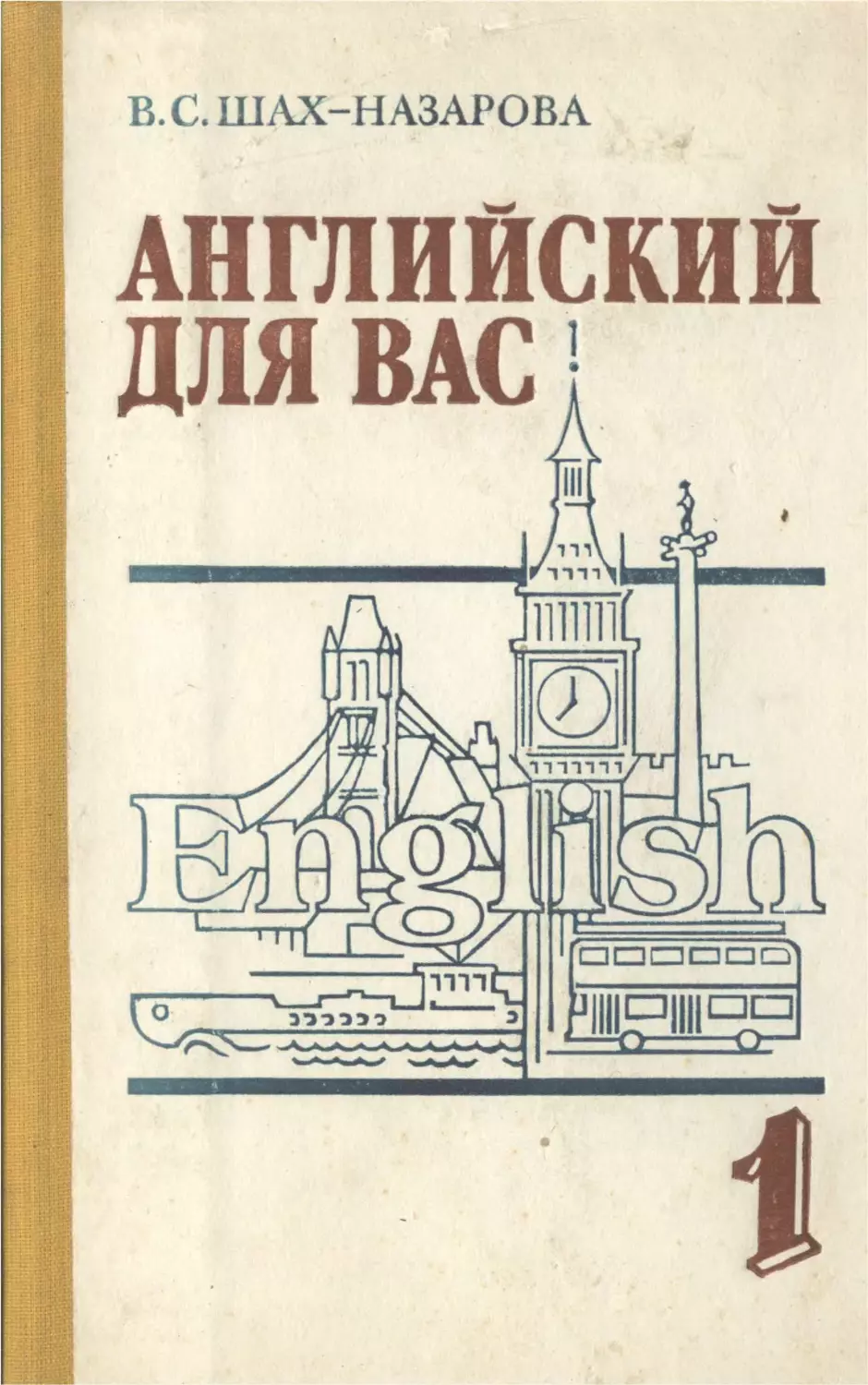
                    В. С. ШАХ-НАЗАРОВА
АНГЛИЙСКИЙ
ДЛЯ ВАС I
В. С. ШАХ-НАЗАРОВА
АНГЛИЙСКИЙ
ДЛЯ ВАС
1
ИЗДАНИЕ ТРЕТЬЕ,
ИСПРАВЛЕННОЕ
И ДОПОЛНЕННОЕ
МОСКВА
«ВЫСШАЯ ШКОЛА»
1987
ББК 81.2 Англ
Ш31
Рецензент:
кафедра английского языка Яд 1 Московского государственного
института международных отношений (зав. кафедрой Г. Г. Юдина)
Разрешено к изданию Учебно-методическим управлением
по высшему образованию Минвуза СССР
Шах-Назарова В. С.
Ш31 Английский для вас: В 2-х частях. Ч. 1.—
3-е изд., испр. и доп.— М.: Высш, шк., 1987.—351 с.
Пособие представляет собой курс английского языка для взрослых
учащихся, ранее не изучавших английский язык, и имеет целью обеспе-
чить практическое овладение английским языком как средством общения.
В 3-м издании (2-е— 1983 г.) увеличено число диалогических текстов
и коммуникативных упражнений, внесен ряд изменений структурного
характера.
Для слушателей курсов иностранных языков, студентов неязыковых
вузов и лиц, самостоятельно изучающих английский язык.
, 4602010000-508	ББК 81.2Англ
Ш 001 (01)-87	КБ-7-36-86	4И (Англ)
© Издательство «Международные отношения», 1977
© Издательство «Высшая школа», 1987, с изменениями
ПРЕДИСЛОВИЕ
Настоящее пособие предназначено для взрослых учащихся, ранее
не изучавших английский язык или имеющих слабые знания, умения и
навыки в области практического владения им. Оно может быть исполь-
зовано на курсах иностранных языков, на факультетах иностранных
языков в качестве учебника по второму языку, в неязыковых вузах
в специальных группах, готовящих специалистов для работы за рубе-
жом, а также самостоятельно изучающими английский язык.
Пособие обеспечивает практическое овладение английским языком
как средством общения. В результате работы по данному пособию уча-
щиеся овладевают главными видами коммуникативной деятельности:
говорения, чтения и понимания, аудирования, письма и перевода в объ-
еме материала учебника.
Пособие базируется на материалах пособия «Английский для всех»1,
В 3-е издание внесен ряд исправлений, значительно увеличено число
диалогических текстов и коммуникативных упражнений, заменены от-
дельные описательные тексты и включены новые упражнения к ним.
Структура пособия
Вводный курс
Вводный курс рассчитан на 40—45 часов аудиторных занятий.
Целью вводного курса является постановка произношения, овла-
дение основными интонационными моделями и ритмом английского
предложения на материале лексико-грамматических структур, обеспе-
чивающих развитие умений и навыков устной речи, чтения и понимания.
Поскольку описание артикуляции звуков британского варианта 1 2
английского языка имеется во многих учебниках по фонетике англий-
ского языка и в других пособиях по английскому языку, автор счел
возможным не отягощать пособие подробным описанием артикуляции
звуков, а ограничился лишь краткими замечаниями в отношении спе-
цифики того или иного звука.
Вводный курс состоит из шести уроков. Каждый урок содержит
шесть разделов: I. Буквы и звуки, в котором вводятся правила чтения
букв и буквосочетаний (в виде таблиц), даются сведения об ассимиля-
ции, редуцированных формах и т. п. II. Интонация, в котором описы-
ваются основные компоненты интонации. III. Фонетические упражне-
ния, содержащие упражнения для выработки навыков произношения
и интонации. IV. Грамматика, в котором вводятся грамматические яв-
ления, подлежащие активному усвоению. V. Лексико-грамматический
материал, в котором содержатся лексика для активного овладения и
1 Шах-Назарова В. С., Федина М. С. Английский для всех (“English
for Everyone”).— М.: Высш, шк., 1983.— Ч. 1.
2 Данное пособие построено на британском варианте английского
языка.
3
два вида текстов — описательный и диалогический—и упражнения.
Диалогические тексты и сопровождающие их коммуникативные упраж-
нения позволяют развивать навык ведения беседы с самого начального
этапа. Поскольку описательные тексты вводного курса в отличие от
текстов основного курса не содержат всех лексических единиц, подле-
жащих активному усвоению, то часть из них вводится и закрепляется
в предтекстовых упражнениях. Поэтому слова и словосочетания к дан-
ному разделу располагаются в алфавитном порядке. Перед диалогами
дается список слов, выражений и речевых моделей в том порядке, в ко-
тором они появляются в диалогах. VI раздел — Домашнее задание,
которое включает упражнения для самостоятельной работы учащихся.
Основной курс
Основной курс состоит из восемнадцати уроков (7—24). Нечет-
ные уроки состоят из двух или трех разделов, которые вводят грамма-
тику и содержат тематические тексты с системой лексико-грамматиче-
ских и речевых упражнений:
I.	Грамматический, в котором вводится грамматический материал,
подлежащий активному усвоению, и содержатся упражнения для за-
крепления этого материала.
II.	Словообразование (в шести уроках) с соответствующими уп-
ражнениями.
III.	Тематический описательный текст с системой тренировочных
и речевых упражнений.Тематический текст содержит все грамматичес-
кие явления, вводимые в разделе I.
Речевые образцы (сложные грамматические явления, вводимые
лексически, глагольно-адвербиальные и другие сочетания), активные
слова и словосочетания предшествуют тексту. Активные слова и слово-
сочетания даются в той последовательности, в которой они встречаются
в тексте. Это позволит при работе над текстом делить его на несколько
частей.
Непосредственно после текста даются примечания, содержащие
контекстуальный перевод отдельных слов и словосочетаний, объяснение
незнакомых грамматических явлений, встречающихся в тексте, но не
подлежащих активному усвоению, перевод реалий и т. д.
Цель данного раздела — овладение навыками говорения (в основ-
ном монологической речи), чтения и понимания, аудирования, письма
и перевода.
Автор рекомендует на прохождение каждого нечетного урока вы-
делить б—8 часов аудиторных занятий.
Четные уроки — это тематические диалогические тексты
с системой речевых упражнений. В самостоятельные (четные) уроки вы-
делен III (IV) раздел уроков пособия «Английский для всех» (издание
2-е). Автор посчитал необходимым внести данное структурное измене-
ние, т. к. это позволило усилить коммуникативную направленность
пособия.
Четные уроки ставят своей целью развитие навыка говорения (диа-
логической речи) и аудирования. Основная часть диалогов построена
на теме, пройденной в предыдущем нечетном уроке. Кроме того, вклю-
чены диалогические тексты, повторяющие и расширяющие пройден-
ные ранее темы, а также тексты, содержащие дополнительные темы.
Диалогические тексты содержат разговорные образцы, фразеоло-
гизмы и лексико-грамматические структуры, характерные для разго-
ворной речи. Активные слова и словосочетания вводятся в той последо-
вательности, в которой они встречаются в текстах, что позволяет рабо-
4
тать над текстами постепенно (в этой же последовательности активные
слова и словосочетания используются и в упражнениях). Система уп-
ражнений обеспечивает закрепление разговорных образцов, фразеоло-
гизмов и лексико-грамматических структур сначала в микроситуациях
и постепенно подводит учащихся к творческому их использованию в
естественной беседе.
Целесообразно начинать работу над четными уроками до заверше-
ния работы над нечетными, в этом случае может быть обеспечено более
гармоничное развитие навыков монологической и диалогической речи.
На прохождение четного урока автор рекомендует предусмотреть
от 4 до б часов аудиторных занятий.
Объем активного лексического минимума, вводимого в двадцати
четырех уроках 1-й части, составляет примерно 1600—1700 лексем.
В грамматический материал включены основные времена глагола
в действительном залоге, сведения об артикле, существительном, при-
лагательном, наречии, предлогах и т. д.— т, е. основной материал
практической грамматики.
Автор
УСЛОВНЫЕ СОКРАЩЕНИЯ
а — adjective ['aedsiktiv] имя
прилагательное
adv — adverb ['aedvo:b] наречие
Ат.—American [a'menkn] амери-
канский (вариант английского
языка)
Ant.— antonym ^«ntammj анто-
ним
Br.— British ['bnti J] британ-
ский (вариант английского
языка)
cnj — conjunction [ksn'ctjArjkjn]
союз
etc.— et cetera [it'setrs] и так
далее
indef — indefinite [in'definit] не-
определенный
n — noun [naun] имя существи-
тельное
num — numeral ['njumaral] чис-
лительное
part— particle ['pcutikl] частица
pl.— plural ['р1итэ1] множест-
венное число
predic.— predicative [pn'dikativ]
предикативное употребление,
предикативно
prep — preposition [^prepa'zijn]
предлог
pron — pronoun ['prounaun] мес-
тоимение
sing.— singular ['siggjula] един-
ственное число
Syn.— synonym ['sinanim] сино-
ним
v — verb [vs:b] глагол
CONTENTS
ВВОДНЫЙ КУРС
Английский алфавит.....................................   11
УРОК 1.................................................   12
I.	Буквы и звуки. 1. Фонетическая транскрипция (12).
2.	Гласные звуки (12). 3. Чтение гласных букв (13).
4.	Согласные звуки (13). 5. Буквы и их алфавитное на-
звание: А а, В b, С с, D d, Е е, Н h, I i, К k, L 1, М тп,
N п, Р р, S s, Т t, Y у (14). 6. Звуки: [i], [ai], [е], [ае],
[ei], Ы; [t], [d], [n], [fl, [p], Im], [k], [h], [si, [z], [6] (14).
7.	Редуцированные формы служебных слов (16).
II.	Интонация. 1. Мелодика (16). 2. Ударение (18). 3. Ритм
(19).
III.	Фонетические упражнения (19).
IV.	Грамматика. 1. Понятие об артикле. Неопределенный
артикль (22). 2. Личные местоимения (23). 3. Притяжа-
тельные местоимения (23). 4. Указательные местоимения
this, that, it (24). 5. Глагол be быть (24). 6. Прилага-
тельное (24). 7. Понятие о предложении. Простое пред-
ложение (25).
V.	Лексико-грамматический материал (25).
VI.	Домашнее задание (28).
УРОК 2................................................... 29
I.	Буквы и звуки. 1. Буквы и их алфавитное название: F f,
G g, О о, R г, V v, W w, X х, Z z (29). 2. Звуки: [i:j,
[u:], [ju:], [и], [си], [ои], [аи]; [fl, [v], [j], [0], [w], [r],
[g] (29). 3. Ассимиляция (31). 4. Редуцированные формы
служебных слов (31).
II.	Интонация. 1. Словесное ударение (32). 2. Мелодика:
а) восходящий тон (32); б) нисходящий тон (33). 3. Синтаг-
ма (35).
III.	Фонетические упражнения (34).
IV.	Грамматика. 1. Определенный артикль (37). 2. Прила-
гательное в функции именной части составного сказуе-
мого (38). 3. Личное местоимение it (38). 4. Указатель-
ные местоимения this и that в функции определения (38).
5.	Неопределенная форма глагола (инфинитив) (38).
6.	Утвердительная форма повелительного наклоне-
ния (39).
V.	Лексико-грамматический материал (39).
VI.	Домашнее задание (45).
7
LESSON 3................................................... 47
I.	Буквы и звуки. 1. Буквы и их алфавитное название: J i,
U и (47). 2. Звуки: [д], [о], [о:], [си]; [fl, [tj], [ds], [rj],
[gk] (47). 3. Связующее г (48).
II.	Интонация. 1. Мелодика: а) нисходящий тон (49); б) вос-
ходящий тон (49).
III.	Фонетические упражнения (49).
IV.	Грамматика. 1. Множественное число существительных
(51). 2. Неопределенный артикль (52). 3. Личные ме-
стоимения: именительный падеж (53). 4. Глагол to be
в простом настоящем времени (53). 5. Множественное
число указательных местоимений (54). 6. Специальные
вопросы с глаголом to be (55). 7. Количественные чис-
лительные 1—12 (55). 8. Дополнение (55).
V.	Лексико-грамматический материал (56).
VI.	Домашнее задание (64).
LESSON 4................................................... 66
I.	Буквы и звуки. Звуки: [э:], [oi], [ia], [еэ] (66).
II.	Интонация. Мелодика: нисходяще-восходящий тон или
сочетание нисходящего тона с восходящим (67).
III.	Фонетические упражнения (68).
IV.	Грамматика. 1. Образование причастий настоящего вре-
мени (70). 2. The Present Continuous Tense (71). 3. Кон-
струкция “to be going + инфинитив” (72). 4. Альтер-
нативные вопросы (73). 5. Артикль перед неисчисляе-
мыми существительными (73). 6. Количественные чис-
лительные 13—19 (74). 7. Обстоятельство (74).
V.	Лексико-грамматический материал (75).
VI.	Домашнее задание (85).
LESSON 5................................................... 88
I.	Буквы и звуки. 1. Буквы и их алфавитное название: Q q
(88). 2. Звуки: [ua], [jua] (88).
II.	Интонация. Употребление эмфатического ударения (88).
III.	Фонетические упражнения (89).
IV.	Грамматика. 1. Глагол to have иметь, обладать в Simple
Present Tense (90). 2. Неопределенные местоимения
some, any, no (91). 3. Падежи имен существительных (92).
4. Выражение отношений родительного падежа при помо-
щи предлога of (93).
V.	Лексико-грамматический материал (93).
VI.	Домашнее задание (104).
LESSON 6.................................................. 107
I.	Буквы и звуки. Звуки: [aia], [aua]; [3] (107).
II.	Фонетические упражнения (108).
III.	Грамматика. 1. Конструкция there is/are (109). 2. При-
тяжательные местоимения (НО). 3. Специальные во-
просы (НО). 4. Специальные вопросы к подлежаще-
му (111).
IV.	Лексико-грамматический материал (112).
V.	Домашнее задание (120).
8
BASIC COURSE
LESSON SEVEN............................................... 126
I. New Grammar Structures: 1. Objective Case of Personal
Pronouns (126). 2. Indirect Object (127). 3. Tag Ques-
tions (128). 4. Negative Form of Imperative Mood (130).
5. Tenses (131). 6. The Simple Present Tense (133). 7. Or-
dinal Numerals (137). 8. No Article before the Names of
Streets, Squares, Parks, Underground Stations and Air-
ports (138).
II. Text: му Family (139).
LESSON EIGHT............................................. 147
Conversations: A. Introductions (149). B. Greetings and
Asking about Health (150). C. In the Canteen (150).
LESSON NINE.............................................. 153
I.	New Grammar Structures: 1. Modal Verbs “can”, “may”,
“must” (153). 2. Indefinite Pronouns/Adjectives (157).
3. Imperative Sentences (158).
II.	Word-building: Composition (159).
III.	Text: Mr Payne Goes Shopping (160).
LESSON TEN................................................... 166
Conversations: A. Shopping (166). B. Congratulations (166).
C. Saying Goodbye (166).
LESSON ELEVEN................................................ 174
I.	New Grammar Structures: 1. The simple Past Tense (174).
2.	The Verb “to be” in the Simple Past Tense (176).
3.	Complex Sentence (181).
II. Text: George Volkov (181).
LESSON TWELVE................................................ 187
Conversations: N. At a Reception (187). B. After a Visit
to London (187). C. A Cup of Tea (187).
LESSON THIRTEEN.............................................. 194
I. New Grammar Structures: 1. The Present Perfect Tense (194).
2. The Gerund (199).
II. Word-building: 1. Affixation (200). 2. Conversion (200).
III. Text: Going Out (201).
LESSON FOURTEEN.............................................. 208
Conversations: N. Talk on Theatre and Cinema (208).
B. Invitations (208). C. Tea Party (208).
LESSON FIFTEEN............................................... 216
I. New Grammar Structures: 1. The Simple Future Tense (216).
2. Equivalents of Modal Verbs “can” and “must” in the
Simple Future and the Simple Past Tense (220). 3. Ways
of Expressing Future Actions (223). 4. Attributive Clauses
(223). 5. Adjectives “another” and “other” (225). 6. The
Use of the Definite Article before the Nouns “sun”, “moon”,
“sky” (226).
II. Text: Plans for the Summer Holiday (226).
9
LESSON SIXTEEN.............................................
Conversations: N. Transport: At a Railway Station (235).
Booking Airline Tickets. At the Airport (235). B. An
Enjoyable Holiday (235). C. It is Nice to See You again
(235).
LESSON SEVENTEEN ..........................................
I.	New Grammar Structures: 1. The Simple Present Tense in
Clauses of Time and Condition (243). 2. The Future Contin-
uous Tense (245). 3. Comparative Structures (247). 4. “It”
as Subject (249). 5. The Article with Uncountable Nouns
(250). 6. The Past Continuous Tense (250).
II.	Word-building: Affixation: Noun-forming Suffix “-ion” (254).
III.	Text: A Football Match (255).
LESSON EIGHTEEN............................................
Conversations: A. A Football Match (264). B. Wales v.
England (264). С. I Can’t Accept Your Invitation (264).
LESSON NINETEEN............................................
I.	New Grammar Structures: 1. Impersonal “it” (272). 2. Ab-
solute Form of Possessive Pronouns (274). 3. Degrees of
Comparison of Adjectives and Adverbs (275). 4. Com-
parative Structures (279). 5. The Use of the Article with
Some Nouns (280). 6. “To get”, “to become”, “to grow”,
“to turn”, “to look”, “to feel” as Link-verbs (281).
II.	Word-building: 1. Adjective-forming Suffixes “-al”, t:-ful”,
“-y” (281). 2. Adverb-forming Suffix “-ly” (282).
III.	Text: Climate of Great Britain and the Soviet Union (282).
LESSON TWENTY..............................................
Conversations: N. Weather (290). B. It’s Too Wet to Go for
a Walk (290). C. A Visit to an Exhibition (290).
LESSON TWENTY-ONE..........................................
I. New Grammar Structures: 1. The Present Perfect Tense (301).
2. The Present Perfect Continuous Tense (303). 3. Com-
pounds of “some”, “any”, “no”, “every” (306). 4. Present
Participle in the Function of an Attribute (310). 5. Article
with an Apposition (311).
II. Word-building: Noun-forming Suffix “-ing” (311).
III. Text: A Visit to the Houses of Parliament (312).
LESSON TWENTY-TWO..........................................
Conversations: A. Telephone Conversations (319). B. You
Should Spend a Holiday in the Highlands (319).
LESSON TWENTY-THREE........................................
I.	New Grammar Structures: 1. The Past Perfect Tense (329).
2. Reflexive' and Emphatic Pronouns (331). 3. Substan-
tivized Adjectives (333).
II.	Word-building: Prefix “-un” (333).
III.	Text: George Bernard Shaw (334).
LESSON TWENTY-FOUR.........................................
Conversations: N. Can You Tell Me about Soviet Writers?
(342). B. Tell Me about British Writers, Please (342).
C. Could you advise me an English Novel to Read? (342).
D. I am Fond of Music (342).
235
243
264
272
290
301
319
329
342
вводный курс
АНГЛИЙСКИЙ АЛФАВИТ
Печатный шрифт	Письменный шрифт	Алфавитное название	Печатный шрифт	Письменный шрифт	Алфавитное название
А а	(2 a	[eij	Nn	пъ	[еп]
вь		[bi:]	Oo	O' Ch	[ои]
Сс	C C	[si:]	Pp		[pi:]
Dd		[di:]	Qq	Q F	[kju:]
Ее		M	Rr	ft*	и
Ff	?/	[ef]	Ss	A <1	[es]
Gg		[<#]	Tt	гГг	[ti:J
Hh	VA	[eitj]	Uu	Пль	Du:]
li	Л A	M	Vv	K«-	[vi:]
Jj	£/-	[ф]	Ww		[<Mbgu:]
Kk	KA	[kei]	Xx	%	[eks]
LI	KA	[el]	Yy	[у 'Ц'	[wai]
M m	m.	[em]	Zz		[zed]
и
УРОК 1
I. БУКВЫ и звуки
1.	Фонетическая транскрипция
В английском алфавите 26 букв; 6 гласных букв пере-
дают 20 гласных звуков, а 20 согласных букв — 24 со-
гласных звука. Для обозначения звуков используется фоне-
тическая транскрипция — значки, обозначающие звуки.
Для большей части значков фонетической транскрипции
используются буквы латинского алфавита и лишь для не-
которых— особые значки (например, [0], [3], [зе] и дру-
гие). Значки фонетической транскрипции обычно заклю-
чаются в квадратные скобки.
2.	Гласные звуки
В английском языке выделяют 12 монофтонгов и 8 диф-
тонгов. Монофтонги: [i:], [1], [е], [зе], [а], [э], [э:], [л],
[и], [и:], [о:], [э].
ЛАонофтонги подразделяются на долгие: [i:], [а], [э:],
[и:], [о:] и краткие: [i], [е], [зе], [э], [л], [и], [о]. Долгота
гласных имеет смыслоразличительный характер (напри-
мер: Pete [pi:t] Пит (мужское имя) и pit [pit] шахта).
Дифтонги: [ei], [ai], [au], [oi], [ou], [тэ], [еэ] и [ио].
Дифтонги — это звуки, при произнесении которых язык
сначала занимает положение для одного гласного, а затем
передвигается в направлении положения для другого глас-
ного, причем это передвижение происходит в пределах
одного слога. Более сильный, напряженный, слогообразую-
щий элемент дифтонга называется ядром, а слабый, нена-
пряженный элемент — скольжением.
Все гласные звуки (монофтонги и дифтонги) различаются
по длительности в зависимости от положения в слове и
звуков, следующих за ними:
1)	в ударном слоге гласный звук более долог, чем в не-
ударном, длительнее всего гласные звуки произносятся в
12
односложных словах, если за ними не следуют согласные
(например, my [mai], day [del], те [mi:]);
2)	гласные звуки в ударном слоге произносятся более
длительно перед сонантами и звонкими согласными, чем
перед глухими согласными (например, main [mem] — made
[meid]—mate [meit]).
3.	Чтение гласных букв
Гласные буквы под ударением читаются по-разному в
зависимости от типа слога и сочетания гласных и соглас-
ных букв.
В английском языке различаются два типа ударных сло-
гов: открытый и закрытый слог.
В открытом слоге гласная обычно имеет алфавитное
звучание. К данному типу слога относятся:
а)	односложные слова типа be [bi:] и слова, оканчиваю-
щиеся на немое е, которое обычно не читается: Pete [pi:t];
б)	слова типа table I'teibl], в которых гласная буква
отделена от немого е двумя согласными, одна из которых 1.
В закрытом слоге гласная буква читается как краткий
гласный звук. К закрытому типу слога относятся;
а)	односложные слова, оканчивающиеся на одну или
несколько согласных: pen [pen], desk [desk];
б)	ударный слог, в котором гласная отделена от после-
дующей гласной двумя или несколькими согласными:
apple I'aepl].
4.	Согласные звуки
1.	Глухие согласные звуки [р], [t], [к] произносятся
с аспирацией (т. е. придыханием) в начале слова и в середи-
не, а в конце слова — энергично
2.	Звонкие согласные звуки [b], [d], [g] на конце слова
не оглушаются.
3.	При произнесении конечных английских звуков [d],
[z], [m], [п] не следует допускать гласного призвука после
них.
4.	Если в слове или в речи два смычных звука следуют
друг за другом, то наблюдается явление, называемое «по-
терей взрыва»; это означает, что первый из звуков произно-
сится без размыкания органов речи; размыкание происхо-
дит при произнесении второго смычного звука (например,
act [aekt], a black desk [a 'blaek'desk]).
13
5.	Буквы и их алфавитное название
A a	[ei]	H h	[eitf]	N n	[en]
В b	[bi:]	I i	[ai]	P p	[pi:1
С c	[si:]	К k	[kei]	S s	[es]
D d	[di:]	L 1	[el]	T t	[ti:l
E e	[i:]	M m	[em]	Y у	[wai]
6.	Звуки
[i], [ai], [е], he], led, [э]; [t], [d], In], [1], [р], [b], [ш],
[k], [h], [s], [z], 13]
Правила чтения гласных букв
Буква	Алфавитное название	Ударный открытый слог	Ударный закрытый слог	Безударный слог
a	[ei]	[ei] name	[ге] bad	[э] а'реп
e	[Ч		[е] desk
i	[ai]	[ai] nice	41
У	[wai]	[ai] my	[I]
Правила чтения гласных буквосочетаний
и сочетаний гласных с согласными
Буквосоче- тание	Звук	Примечание	Пример
ai ay	[ei]	во многих словах	main [mein]
		в односложных словах	day [dei]
ie	[ai]	в односложных словах	tie [tai]
H-{S	[add] [aind]	в ударном слоге	mild [maild] kind [kaind]
Правила чтения согласных букв
b —[b], d — [d], h —[h], k —[k], 1 —[1], m— [m],
n— [n], P— [p], t— [t]
14
Буква	Звук	Примечание	Пример
с	[S]	перед гласными е, i, у	cent [sent] pencil ['pensl]
	[к]	перед остальными гласными и согласными	cat [kaet] pact [paekt]
S	is]	1. в начале слов перед гласными и согласными	sat [saet] step [step]
		2. в середине слова перед глухой согласной	desk [desk]
		3. в конце слова после глухой согласной	desks [desks] cats [kaets]
	[zl	в конце слов после гласных и звонких согласных	ties [taiz] beds [bedz]
ПРИМЕЧАНИЯ: 1. Английские согласные, как правило, не смяг-
чаются перед гласными звуками, а произносятся твердо. Сравните:
пить и pit [pit]. Исключение представляет сонант (1), смягчающийся
Перед гласными, например: Will you...?
2.	Удвоенная согласная буква в слове произносится как один
звук: Bill [bil].
Правила чтения согласных буквосочетаний
Буквосо- четание	Звук	Примечание	Пример
ck	|k]	в конце односложных слов с предшествующей краткой глас- ной звук [к] передается букво- сочетанием ck	black [blaek]
kn	[nl	в начале слов	knit [nit]
11	11]	в конце односложных слов с предшествующей гласной звук [1] передается буквосочетанием 11	till [til] knell [nel] all [э:1]
th	[Э]	1. в начале служебных слов	that [daet]
		2. между двумя гласными	bathe [beid]
ss	[s]	в конце слов	less [les]
s	И	между двумя гласными	easy ['i;zi]
15
7.	Редуцированные формы служебных слов
Поскольку в речи служебные слова (вспомогательные
глаголы, предлоги, артикли и другие) неударны, они, как
правило, подвергаются редукции (сокращаются долгие
гласные, выпадают некоторые гласные и согласные, от-
дельные гласные произносятся как звук [э]).
Служеб- ное слово	Транскрипция		Пример	Транскрипция
	полная форма	редуци- рованная форма
а ап is	[ei] [аеп] [IZ]	[э] [эп], [п] [z], [s]	'This is a ^desk. 'That’s an Л ap- ple. 'That’s a tie. His 'name’s ^Bill.	['dis iz э "idesk] ['Oaets эп Лжр1] ['daets э tai] [hiz 'neimz ^bil]
II. ИНТОНАЦИЯ
Интонация — это сложное единство мелодики, ударе-
ния, ритма, темпа и тембра. Каждому языку свойственна
своя присущая только ему интонация, овладение которой
является необходимым условием при изучении иностран-
ного языка.
Наиболее важными компонентами интонации являются
мелодика, ударение и ритм.
1.	Мелодика
Под мелодикой понимают последовательное изменение
в высоте тона различных слогов предложения. Это изме-
нение в высоте тона в зависимости от его общего направле-
ния движения в предложении может быть нисходящим,
восходящим и ровным.
В английском языке выделяют два основных тона:
нисходящий и восходящий (см. урок 2).
Падение тона принято графически изображать стрелкой
вниз которая ставится перед ударным слогом (словом),
а восходящий — стрелкой вверх у,
16
Для английского языка характерно резкое падение тона,
напоминающее тон, которым произносятся приказания
в русском языке.
Дай!
Повышение тона в английском
леннее, чем в русском.
Сравните: в английском
языке происходит мед-
в русском
Да?
Если предложение произносится с нисходящим тоном,
то первый ударный слог произносится самым высоким то-
ном, а все последующие слоги образуют постепенно нис-
ходящую шкалу. Резкое, интенсивное падение тона проис-
ходит в последнем ударном слоге.
Если последнее ударное слово односложное, то нисхо-
дящее направление движения тона осуществляется в нем
самом. В том же случае, когда за последним ударным сло-
гом следуют безударные слоги, то нисходящее направле-
ние движения тона может осуществляться либо в ударном
слоге и безударные слоги произносятся на том же уровне,
что и предшествующий ударный слог, либо последний удар-
ный слог может произноситься с ровным тоном, а нисходя-
щее направление тона осуществляется в безударных сло-
гах. Нисходящий тон выражает законченность мысли и
категоричность.
Нисходящий тон употребляется:
1)	в повествовательных утвердительных и отрицатель-
ных предложениях (в конечных синтагмах),
2)	в повелительных предложениях (см. урок 2),
3)	в специальных вопросах (см. урок 3),
4)	во второй части альтернативных вопросов (см. урок 4),
5)	в первой части разъединительных вопросов (см. урок
5),
6)	в приветствиях при встрече (см. урок 2).
Начальные неударные слоги, стоящие перед первым
ударным слогом, произносятся либо на том же высотном
уровне, либо несколько ниже первого ударного слога.
17
2.	Ударение
Словесное ударение. Выделение в слове одного или двух
слогов среди других называется словесным ударением.
В двусложных словах ударение, как правило, падает на
первый слог. В многосложных словах часто встречаются
два ударных слога: один слог имеет главное ударение, а
второй — второстепенное. Если в многосложном слове
только один ударный слог, то это, как правило, третий слог
от конца слова.
В транскрипции ударение обозначается значком [']
перед ударным слогом: pencil 1'pensl], table ['teiblj. Второ-
степенное ударение обозначается значком [,], который ста-
вится снизу перед соответствующим слогом: intonation
[,intou'neijnj.
Фразовое ударение. Более сильное произнесение, т. е.
выделение голосом одних слов в предложении среди дру-
гих (неударных), называется фразовым ударением. В анг-
лийском предложении под ударением, как правило, стоят
знаменательные слова (смысловые глаголы, существитель-
ные, прилагательные, числительные, наречия, вопроси-
тельные и указательные местоимения); служебные слова
(вспомогательные глаголы, артикли, предлоги, союзы, лич-
ные и притяжательные местоимения) обычно бывают не-
ударными. Ударные слоги графически изображаются тире,
а неударные слоги — точкой.
Для обозначения границ диапазона голоса используются
две параллельные линии.
Между этими лини-
ями ставятся знаки ударных и неударных слогов.
'This is а pencil.
Логическое ударение. Выделение в предложении одного
или нескольких слов, важных по смыслу для говорящего,
называется логическим ударением. Логическое ударение
часто не совпадает с фразовым ударением. Под логическим
ударением могут стоять любые слова, как знаменательные,
так и служебные.
18
This is a black pencil.
Это черный (а не красный, не зеленый и т. д.) карандаш.
3.	Ритм
Для ритма английской речи характерно чередование
ударных и безударных слогов через более или менее рав-
ные промежутки времени, независимо от количества не-
ударных слогов между ними. Чем больше количество без-
ударных слогов между ударными, тем, соответственно,
быстрее темп речи говорящего, т. е. тем быстрее говорящий
«проговаривает» безударные слоги.
III. ФОНЕТИЧЕСКИЕ УПРАЖНЕНИЯ
Упражнение 1. Произнесите следующие слова *. Следите за тем, чтобы
при произнесении звуков [t], [d], [п] и [1] кончик языка прижимался
к альвеолам, чтобы после звонких согласных в конце слов не было
гласного призвука. Помните, что звуки [Ь] и [ш] произносятся
энергично.
Jin	din	dim	it
Jill	tin	Tim	lit
^nil**	till	mill	bit
Упражнение 2. Произнесите следующие слова. Следите за тем, чтобы
второй элемент дифтонга [ai] произносился кратко.
_JI	die	line	lime	bind
_Jmy	lie	dine	dime	mind
"^by	tie	mile	time	mild
Упражнение 3. Произнесите следующие слова.	Следите за тем, чтобы
звуки [р], [t], [к] произносились с аспирацией перед ударным глас-
ным, а на конце слов энергично и отчетливо.
_7pine	time	kind	kite	Pipe	like
Jpile	tile	kin	lit	type	lick
Jpin	tin	kill	bit	lip	kick
^pill	till	kid	Pit	dip	Dick
* Слова читаются по колонкам (сверху вниз), если между ними
нет знака тире. (Сравните: in — din — dim).
** Слова в остальных колонках произносятся с теми же тонами,
которые указаны в первой колонке.
19
Упражнение 4. Произнесите следующие слова. Следите за тем, чтобы звуки [si и [z] произносились у альвеол.
[S] __/sin side nice _/silk site miss ~^,sick sit kiss	[zl kites	—/lies	dimes	pins bits	_/dies	lines	bills sits	-/ties	miles	sides "^.pies binds lids
Упражнение 5. Протранскрибируйте и произнесите следующие слова.
-/my mile _/by mild -/die mind "^.tie kind	in	pies	nice	bits ill	ties	mice	lips is	lines	miss	kicks it	sides	kiss	sits
Упражнение 6. Произнесите следующие слова. Следите за тем, чтобы
согласные звуки перед е не смягчались. Следите также за позицион-
ной долготой гласного [е] *.
-/end	pen	let	set
_/den	dell	met	desk
~Ven	tell	net	best
Упражнение 7. Произнесите следующие слова, обращая внимание на
то, что слогообразующие [1) и [п] произносятся слитно с предше-
ствующими согласными.
^middle ['midi]	settle ['setl]
_7pencil ['pensl]	kitten ['kitn]
^little ['litl]	mitten ['mitn]
Упражнение 8. Произнесите следующие слова. Следите, чтобы при
произнесении гласного [ае] расстояние между челюстями было боль-
шое. Следите также за позиционной долготой гласного.
Jfman	lad	mat	map
^ban	bad	cat	back
"^can	sad	cap	black
Упражнение 9. Произнесите следующие слова. Внимательно следите
за тем, чтобы при произнесении звука [б] кончик языка находился
между зубами и чтобы между поверхностью языка и верхними
зубами была щель.
_7than then this [3is] lithe
"^that them 'this is	tithe
* Английские гласные (долгие и краткие) произносятся длительнее
в ударном конечном слоге, длительно перед сонантами и звонкими со-
гласными и кратко перед глухими согласными. (Сравните: ten — Ted —
tet.)
20
Упражнение 10. Произнесите следующие слова. Следите, чтобы второй
элемент дифтонга [ei] произносился кратко, следите также за по-
зиционной долготой дифтонга.
^may	main	name	date	table
_/day	lain	pale	late	cable
~^say	plain	tale	cake	stable
Упражнение 11. Произнесите следующие слова. Следите за тем, чтобы
звук [hi произносился со слабым придыханием.
him	help	his
_Jham	hen	hide	hat
~^hand	hint	has	hit
Упражнение 12. Прочитайте следующие слова,		соблюдая правила чте-
ния буквы с и буквосочетания ск.
_Jcent	can	lack
_/cite	cane	back
J pencil	came	neck
~^.nice	candle	deck
Упражнение 13. Произнесите следующие группы слов. Следите за пра-
вильностью артикуляции звуков.
[i] — [e] — [ae] fpin — _/pen—~^pan tin — ten — tan lid — led — lad bid— bed— bad pit — pet — pat		[ei] — [ai] Jbay — ’Vy may — my pay — pie main— mine pain — pine
[b] - [pl	[d] -	[tl	[dj - [31
_7bale—"^.pale	_/die —	“Vie	_/day —“^.they
bin — pin	dine —	tine	den — then
bit — pit	dime—	time	Dan— than
bet — pet	din —	tin	dad — that
bat — pat	dim —	Tim
Упражнение 14. Прочитайте следующие группы слов, следите за измене-
ниями в длительности гласных в зависимости от согласных, следую-
щих за ними.
[ei]
_7may—main—made—mate
_71ay—lain—laid—late
_/pay—pale—paid—pace
~^say—same—spade—space
[ail
_/my — _^mine—_^mind—^mice
by — bine — bide — bite
21
tie — time — tide — kite
lie — line — lithe — like
[ael
_/ban — _^bad —"^.bat
man	—	mad	—	mat
clan	—	clad	—	clap
pan	—	pad	—	pat
Упражнение 15. Протранскрибируйте и произнесите следующие слова.
day, man, mail, than, kind, name, hi, sick, knelt, desks,
ties, pay, him, his, lines, middle, kitten, that, them
Упражнение 16. Прочитайте следующие существительные в сочетании
с неопределенным артиклем. Обратите внимание на ударение. Пом-
ните, что артикль перед согласными произносится как нейтральный
гласный [э]. Произнесите эти слова с нисходящим тоном.
a	~\pie	a	"Vamp	a	~^cat
a	“Vie	a	“^.bed	a	^hat
a	~^pen	а	“^тар	а	~^,сар
Упражнение 17. Произнесите следующие слова и сочетания слов. Обра-
тите внимание на потерю взрыва.
act	a 'black	^.desk	a 'bad	Лреп
pact	a 'black	~^cat	a 'bad	2cap
tact	a 'black	^tie	a 'bad	~Vie
Упражнение 18. Прочитайте следующие сочетания слов. Следите за тем,
чтобы ударное слово произносилось с нисходящим тоном.
my ~\hat
ту ~\сар
ту 'Yname
ту “Vie
ту ~\арр1е
his ~\1атр
his ~\реп
his "^.pencil
his ~^,desk
his ~^name
IV. ГРАММАТИКА
1.	Понятие об артикле. Неопределенный артикль
Артиклями называются особые слова-определители, упо-
требляемые перед существительными. Артикли являются
служебными словами и обычно самостоятельного значения
не имеют.
22
В современном английском языке имеются два артикля:
определенный the и неопределенный а (ап). Неопределенный
артикль а (ап) употребляется с исчисляемыми существи-
тельными в форме единственного числа.
Неопределенный артикль а употребляется перед су-
ществительными, начинающимися с согласного звука, и
произносится как звук [э]: а тар [э'таер], a bed [o'bed].
Перед существительными, начинающимися с гласного зву-
ка, употребляется форма ап, которая произносится [ап]:
an apple [ап 'аер1].
Неопределенный артикль имеет классифицирующее зна-
чение; он обозначает, что существительное, определяемое
им, относится к классу предметов, является одним из по-
добного рода предметов.
Существительное с неопределенным артиклем отвечает
на вопросы: “что за предмет?”, “какого рода предмет?”,
“как его можно назвать?”, “к какого рода предметам его
можно отнести?”.
'This is an ^apple. Это яблоко, (а не груша, не апель-
син)
'That’s а tie. То галстук, (а не шарф, не косынка)
ПРИМЕЧАНИЕ. Перед именами собственными артикль не употреб-
ляется.
'This is Л Ben. Это Бен.
Му 'name’s ^Bill. Меня зовут Билл.
2.	Личные местоимения
Личное местоимение he он употребляется, как правило,
для обозначения людей.
He’s Ben. Его зовут Бен. (Он Бен.)
В разговорной речи личные местоимения, как правило,,
безударны.
3.	Притяжательные местоимения
Притяжательные местоимения ту мой, his его и др.
обозначают принадлежность и употребляются в качестве
определений перед существительными. Притяжательные
местоимения, как правило, в устной речи безударны.
Му 'name is Ben. Меня зовут Бен.
His 'name’s Tim. Его зовут Тим.
23
4.	Указательные местоимения this, that, it
Указательные местоимения this этот, эта, это и that
тот, та, то употребляются при указании на лицо или
предмет. This употребляется при указании на лицо или
предмет, находящийся вблизи от говорящего, that — при
указании на лицо или предмет, находящийся вдали от го-
ворящего.
В предложении this и that могут выполнять функции:
а) подлежащего.
'This is а table. Это стол.
'That is а desk. То письменный стол.
'This is	Ben. Это Бен.
'That is	Tim. То Тим.
Местоимение it в ответе на вопрос What is this? Что это
такое? является указательным и переводится на русский
язык это.
It is а table. Это стол.
б)	определения (перед существительным) (см. урок 2).
5.	Глагол be быть
В настоящем времени (The Present Indefinite Tense)
глагол be имеет три различных формы для разных лиц:
форма 3-го лица единственного числа — is. Глагол be часто
используется в качестве глагола-связки.
'This is а pencil. Это карандаш.
His 'name is Ted. Его зовут Тед. (Его имя Тед.)
'That 'isn't а pencil. То (это) не карандаш.
В русском языке соответствующая форма глагола
быть — есть обычно опускается.
ПРИМЕЧАНИЕ. Сокращенная отрицательная форма isn’t в пред-
ложении всегда ударна.
6.	Прилагательное
Имена прилагательные в английском языке не имеют
формы числа, родовых окончаний и не склоняются по паде-
жам.
'This is a 'nice tie. Это красивь/u галстук.
'That’s a 'nice hat. То красивая шляпа.
24
'This is a 'nice dapple. Это красивое яблоко.
ПРИМЕЧАНИЕ. Если прилагательное употребляется перед суще-
ствительным, то артикль ставится перед прилагательным.
Прилагательные чаще всего употребляются в предло-
жении в функции:
а)	определения (перед существительными).
'That is a 'nice hat.
б)	именной части составного сказуемого (см. урок 2).
7.	Понятие о предложении. Простое предложение
Для английского повествовательного (утвердительного
и отрицательного) предложения характерен твердый по-
рядок слов: подлежащее всегда предшествует сказуемому.
Русское предложение отличается от английского относи-
тельно свободным порядком слов.
Меня зовут Бен. I	D
Зовут меня Бен. / ^У name 1S еп-
Это стол. I ZT, . .	. ,.
Стол это. / Th,s ,s а stable.
Подлежащее чаще всего выражается существительным
или местоимением (личным или указательным).
'This is an apple.
Му 'name is Bill.
Сказуемое может быть простым (выраженным смысло-
вым глаголом в личной форме) или составным (именным или
глагольным).
Составное именное сказуемое состоит из глагола-связки
и именной части, которая, как и в русском языке, может
быть выражена существительным, прилагательным или
другой частью речи.
This is a desk, (существительное)
His name is Ben. (существительное)
V. ЛЕКСИКО-ГРАММАТИЧЕСКИЙ МАТЕРИАЛ
А. Словарь
apple ['aeplj п яблоко
bad [baed] а плохой
bed [bed] п кровать
black [blaek] а черный
cat [kaet] п кот, кошка
desk [desk] п письменный стол,
парта
hat [haet] п шляпа
25
his [hiz, iz] pron его (притяжат.
местоим.)
is [iz, s, z] 3-е лицо ед. ч. от гла-
гола be быть (есть, находится,
стоит, лежит и т.п.)
it [it] pron 1. это (указат. место-
им.); 2. он, она, оно (личн.
местоим.)
lamp [laemp] п лампа
тар [таер] п карта (географиче-
ская)
ту [mai] pron мой, моя, мое
name [neim] п имя, фамилия;
Му name’s Ben. Меня зовут
Бен.
nice [nais] а хороший, приятный,
милый
реп [реп] п ручка
pencil ['pensi] п карандаш
pie [pai] п 1. пирожок; 2. (неисч.)
пирог
table ['teibl] п стол
that [Oaet] pron тот, та, то
this [6is] pron этот, эта, это
tie [tai] п галстук
Имена
Ann [аеп] Анна
Ben [ben] Бен
Bill [bil] Билл
Dick [dik] Дик
Ted [ted] Тед
Tim [tim] Тим
В. Основные модели предложений
1. a) 'This ('tnat) is a ('nice) ~^tie. 'This is my ~^tie. b) 'This 'isn’t a ('nice) ^tie. 'This 'isn’t my ^tie.	It’s a ('nice) ^tie. It’s my ^tie. It 'isn’t a ('nice) tie. It 'isn’t my ^tie.
2. a) 'This is "^Bill. b) 'This 'isn’t ^Bill.	It’s ~>Bill. It 'isn’t ^Bill.
3. a) My 'name’s ^Tim. b) His 'name 'isn’t ^Ted.
С. Упражнения
Упражнение 1. Прочитайте следующие предложения, употребляя нис-
ходящий тон.
1. This is a pen. It’s а реп. 2. That’s a pencil. It’s a pen-
cil. 3. This is a map. It’s a map. 4. That’s a lamp. It’s a
lamp. 5. That’s an apple. It’s an apple. 6. This is a black
hat. It’s a black hat. 7. That’s a bad apple. It’s a bad apple.
8. This is a nice tie. It’s a nice tie. 9. That’s a black pencil.
It’s a black pencil. 10. This is a black desk. It’s a black
desk. 11. This is my desk. It’s my desk. 12. That’s my bed.
It’s my bed. 13. That’s his cat. It’s his cat.
Упражнение 2. Произведите подстановку и добавление по следующему
образцу. Прочитайте получившиеся предложения, употребляя
нисходящий тон.
26
'This is a hat.
'That’s a hat. It’s a	hat.
1. This is an apple. 2. This is a bed. 3. This is a map.
4. This is a black desk. 5. This is a nice hat. 6. This is a
black cat. 7. This is a bad lamp. 8. This is a nice tie.
Упражнение 3. Составьте предложения по следующему образцу. Про-
читайте их.
tie (his)
'This is а tie. ('That’s a tie.) It’s his tie.
desk (my), hat (my), pencil (his), lamp (his), pie (my),
map (his), apple (my)
Упражнение 4. Добавьте прилагательные к существительным по следую-
щему образцу. Не забывайте о месте неопределенного артикля.
Прочитайте получившиеся предложения.
'This is а tie. (nice)
'That’s a 'nice tie. It’s a 'nice tie.
1. This is an apple, (nice) 2. This is a desk, (black) 3. This
is a cap. (black) 4. This is a hat. (nice) 5. This is a cat.
(black) 6. This is a lamp, (bad)
Упражнение 5. Сделайте следующие предложения отрицательными.
Прочитайте их, используя нисходящий тон.
1. This is a tie. 2. That’s a desk. 3. This is a table.
4. This is a nice apple. 5. That’s a black hat. 6. This is a bad
map. 7. That’s his pencil. 8. That’s an apple.
Упражнение в. He согласитесь co следующими утверждениями.
This is a pen. (pencil)
It ‘'visn’t a pen. It’s a "^pencil.
1. This is a desk, (table) 2. That’s a pencil, (pen) 3. This
is a hat. (lamp) 4. That’s an apple, (pie) 5. This is a bad lamp,
(nice) 6. That’s a nice hat. (bad) 7. This is his-tie. (my)
8. That’s his pencil, (my) 9. This is his map. (my)
Упражнение 7. Составьте 6 микродиалогов по следующему образцу.
A:	'That’s his ^.desk.
В:	It isn’t his desk. It’s "^my desk.
Упражнение 8. Составьте предложения, используя данные таблицы.
а) Му
His
'name’s
~^.Веп.
~\Ted.
^Bill.
"\Tim.
~^,Len.
b) My 'name isn’t ~\Ted.
His	~^,Dick.
"^Ben.
Упражнение 9. Скажите, как зовут вашего друга.
VI. ДОМАШНЕЕ ЗАДАНИЕ
Упражнение 1. Напишите буквы, введенные в уроке.
А а, В b, С с, D d, Е е, Н h, I i, К k, L 1, М m, N п,
Р р, S s, Т t
Упражнение 2. Прочитайте фонетические упражнения. Отработайте их.
Упражнение 3. Выучите правила чтения гласных и согласных букв и
буквосочетаний.
Упражнение 4. Протранскрибируйте следующие слова. Произнесите их.
cable, space, time, day, back, late, them, miss, mind, by,
knelt, lines, middle, little, plain, hide, hand, candle, than
Упражнение 5. Напишите буквами слова, данные в транскрипции.
[neim], [said], I'aepl], [kamd], [desk], [mai], [tai], [mem],
[mis], [daim], [peij, [silk], ['htl], [help], [keim], I'eibl]
Упражнение 6. Напишите следующие слова в транскрипции и обозначьте
тон в соответствии с данными тонограммами.
Упражнение 7. Напишите 7 микродиалогов по следующим образцам.
Прочитайте их, следя за ударением и нисходящим тоном.
a)	A: 'This is a ’Stable.
В: It "Vsn’t a table. It’s a ~^,desk.
b)	A: 'That’s a 'bad "^hat.
B: It ^isn’t a bad hat. It’s a ~^nice hat.
Упражнение 8. Переведите следующие предложения и прочитайте их.
1. Это яблоко. Это хорошее яблоко. 2. Это не письмен-
ный стол. Это обеденный стол. 3. Эго моя лампа. То его
лампа. 4. Это не его карандаш. Это мой карандаш. 5. Его
зовут Билл. 6. Меня зовут Тед. 7. Его имя не Бен. Его
зовут Дик.
28
УРОК 2
I. БУКВЫ И ЗВУКИ
1.	Буквы и их алфавитное название
F	f	[ef]	V	v	[vi:]
G	g	[dgi:]	W	w	['dAblju:]
О	о	[ou]	X	x	[eks]
R	г	[a]	Z	z	[zed]
2.	Звуки
H:l, [u:I, [ju:], [u], [a], [ou], [au]; [f], [v], [j], [0], [w],
Ir], [g]
Правила чтения гласных букв
Буква	Алфавитное название	Ударный открытый слог	Ударный закры- тый слог	Ударный слог 1. перед г 2. перед г + согласная	Безударный сдог
а	[ei]	[ei]	[ae]	[а] саг	[э]
е	[И	he	[el
о	[ou]	[ou] close
и	[М	[ju.], [u.] student rule
У	[wai]	[aij	Id	[I] в безударном конечном слоге easy	[j] перед гласной в начале слова yellow
ПРИМЕЧАНИЕ. Буква и в открытом ударном слоге после г, 1, j
читается [и:]. Например, rule [ги;1].
29
Правила чтения гласных буквосочетаний
и сочетаний гласных с согласными
Букво- сочетание	Звук	Примечание	Пример
еа ее	[1=]	в ударном слоге	meat [mi:t] meet [mid]
00	[U]	в односложных словах перед к, в некоторых однослож- ных словах перед d	book [buk] good [gud]
00	[U:]	в большинстве слов	too [tu:] room [ru:m]
ew	[JU:]	в большинстве слов	new [nju:]
OU	[au]	в ударном слоге	sound [saund]
ow ♦	[au]	в ударном слоге	now [nau]
оа	[ou]	в ударном слоге (во многих словах)	coat [kout]
ow	[ou]	1. в ударном слоге 2. в безударном конечном слоге	snow [snou] yellow ['jelou]
0-4- Id	[ould]	в ударном слоге	old [ould]
(ss a + < st (th	[as] [ast] [aO]	во многих словах	class [klas] past [past] path [paO]
Правила чтения согласных букв и буквосочетаний
f — [f], v — [v], х — [ks], z — [z]
* Следует проверять по словарю произношение слов, содержащих
в ударном слоге буквосочетание ow.
30
Буква или бук- восоче- тание	Звук	Примечание	Пример
g	[9]	1.	перед гласными а, о, u 2.	перед согласными 3.	в конце слов	game [geim] glad [gloed] big [big]
г	[И	1. в начале слов перед гласной 2. после согласной	red [red] green [grbn]
th	[01	1. в начале значимых слов 2. в конце слов	thin [Om] teeth [ti:0]
ve	[v]	в конце слов	twelve [twelv]
w	[w]	в начале слов перед глас- ными	we [wk]
wh	[w]	в начале слов	white [wait]
	[h]	перед о	who [hu:]
wr	[r]	в начале слов	write frait]
3.	Ассимиляция
Альвеолярные звуки [t], [d], [nJ, [1], [s] и [z], стоящие
непосредственно перед [д] или [0], уподобляются послед-
ним по месту образования, т. е. произносятся у зубов.
4.	Редуцированные формы служебных слов
Служеб- ное слово	Транскрипция		Пример
	полная форма	редуциро- ванная форма
the and	[01] [send]	[0э], [31I [and], [an], [n]	Open the book, ['oupn do ^buk] The apple is good, [di- 'aepl iz ^gud] This is his book and that’s his notebook, ['dis iz hiz Jbuk on 'daets hiz ‘\noutbuk]
31
II. ИНТОНАЦИЯ
1. Словесное ударение
В сложных существительных ударение, как правило,
падает на первое из составляющих слов: notebook ['nout-
buk], classroom ['klasrumj.
2. Мелодика
а) восходящий тон
Восходящий тон выражает незаконченность, незавер-
шенность высказывания, сомнение, неуверенность и т. п.
Восходящий тон употребляется в общих вопросах (об-
щими вопросами называются вопросы, требующие ответа
«да» или «нет»).
4s 'this a _/map?
Как и в предложениях с нисходящим тоном, первый
ударный слог произносится самым высоким тоном, осталь-
ные слоги образуют постепенно нисходящую шкалу, за-
канчивающуюся повышением тона на последнем ударном
слоге. Если же последний ударный слог не является по-
следним слогом в предложении, то он произносится самым
низким тоном, а последующий безударный (или безударные
слоги) произносится выше, чем предшествующий ударный;
таким образом, повышение тона происходит на конечных
безударных слогах.
'Is 'this a _/table? — •
Восходящий тон употребляется
1)	в начальных и срединных синтагмах:
'This is my -/textbook and 'that’s his ^textbook.
2)	в конце общих вопросов:
'Is the 'notebook _/thick?
3)	при перечислении (см. урок 4),
4)	в первой части альтернативных вопросов (см. урок 4),
5) во второй части разъединительных вопросов (см.
урок 6),
32
6)	в приветствиях при прощании (см. урок 3),
7)	в просьбах:
'Will you _/help me, please?
8)	в переспросах:
-/What did you say?
б) нисходящий тон
Приветствия при встречах произносятся с нисходящим
тоном:
He^llo. 'How do you ~^do.
3.	Синтагма
Синтагмой, или смысловой группой, называется грам-
матически и интонационно оформленное минимальное, не-
делимое далее смысловое объединение слов в предложении.
Смысловыми группами или синтагмами могут быть
1)	простые предложения (утвердительные, отрицатель-
ные, вопросительные, побудительные):
'That’s a 'nice ~^hat.
'This 'isn’t a black ^pen.
2)	распространенное подлежащее, т. e. подлежащее, со-
стоящее более, чем из одного слова:
Л\у 'pen and his -/pencil...
3)	каждый однородный член предложения при много-
численных перечислениях:
'Take 'this _/pen, 'that 'black -/pencil and his ~^map.
4)	любое обстоятельство, стоящее в начале предложения
перед подлежащим:
On Sunday 'Pete and -/Ann...
5)	распространенные определительные обороты,
6)	составные части сложносочиненного предложения,
входящие в состав сложного,
7)	составные части сложноподчиненного предложения,
т. е. главное и придаточное.
Синтагмы * могут быть начальными, срединными и ко-
нечными. В первых двух видах синтагм обычно употребля-
ется восходящий тон, а в конечной синтагме тон обуслов-
* Имеются в виду синтагмы, перечисленные в пунктах 2, 3, 4, 5.
2 № 2518	33
ливается коммуникативным типом предложения. Смысловые
группы отделяются друг от друга небольшими паузайи, ко-
торые в естественной речи почти незаметны.
III.	ФОНЕТИЧЕСКИЕ УПРАЖНЕНИЯ
Упражнение 1. Произнесите следующие слова. Следите за тем, чтобы
при произнесении звуков [f] и [v] верхняя губа была немного при-
поднята.
_/fine	felt	live	vim	cave
plaint	fed	life	vise	slave
~^fan	fit	stiff	vice	save
Упражнение 2. Произнесите следующие слова. Следите за тем, чтобы
при произнесении звука [j] вы не производили много шума.
_/jell	yes
~/JaP	yet
Упражнение 3. Произнесите следующие слова. Помните, что буква у
в безударном положении произносится [i].
^/mainly	Nelly	pygmy
"^tiny	telly	happy
Упражнение 4. Произнесите следующие слова. Следите за тем, чтобы
при произнесении [1:] губы были слегка растянуты и зубы обнажены.
_/be	been	deed	Pete
_/me	dean	bead	deep
~\knee	keen	plead	keep
Упражнение 5. Произнесите следующие слова. Следите за тем, чтобы
между верхними зубами и поверхностью кончика языка была узкая
щель при произнесении глухого звука [0].
_/thane	thimble	teeth
_/theme	theft	myth
^thin	thick	fifth
Упражнение 6. Произнесите следующие пары слов. Помните, что [t]
и [d] произносятся у альвеол, а [0] и [б] — межзубные звуки.
_/day —~\they	_/tin —~\thin
den — then	tick —thick
seed— seethe	meet—myth
Упражнение 7. Произнесите следующие слова, правильно артикулируя
звуки [sj — [0J — [б].
_/seem—_/theme—~\them
sin — thin — then
sick — thick — this
34
Упражнение 8. Произнесите следующие слова. Не забудьте округлить
и выдвинуть вперед губы при прризнесении звука [wj.
_/way _/we 7 wine },win	well	why	twin went	when	twenty wife	while	twelve west	white	twist
Упражнение 9. Произнесите следующие пары слов. Обратите внимание
на различия в артикуляции звуков [w] и [у].
_/wain—‘'\vein	wine—vine	wise—vice
wail — veil went—vent west—vest
Упражнение 10. Произнесите следующие слова. Следите за тем, чтобы
кончик языка находился за альвеолами при произнесении звука [г).
_/rain	raise	train	write	'marry
_/rail	rag	green	wreath	'carry
"Van	red	French	wrap	'ferry
Упражнение 11. Прочитайте следующие слова, произнося звук [и:]
протяженно.
_/loo	moon spoon rule	plume
^noon soon	mood	rude	flute
Упражнение 12. Произнесите следующие слова, следя за‘тем, чтобы
звук [j] произносился очень кратко.
_/new sew muse tube	mute
^few news fuse 'student 'pupil
Упражнение 13. Произнесите следующие слова. Следите за тем, чтобы
губы не выдвигались вперед при произнесении ненапряженного
краткого гласного [и].
-/good	look	took
~\goody	book	nook
Упражнение 14. Произнесите следующие пары слов, содержащие звуки
[и] и [и:];
_/nook—“^noon look — moon book— boot	foot —food cook—cool took—spoon
Упражнение 15. Произнесите следующие слова, следя за тем, чтобы
второй элемент дифтонга [ou] не удлинялся.
_/no	know	tone	old	note	coat	'yellow
_/so	mow	open	cold	hope	boat	'fellow
^go	snow	close	told	smoke	float	'mellow
Упражнение 16. Произнесите следующие слова. Следите за тем, чтобы
при произнесении звука [al кончик языка был оттянут от нижних
зубов.
2*
35
_/bar	arm	art	ask	class
Jfar	'army	part	mask	pass
_7car	farm	start	task	last
~>star	barn	park	path	past
Упражнение 17. Произнесите следующие слова. Следите за тем, чтобы
второй элемент дифтонга [аи] произносился кратко.
_/now	brown	sound
_/how	round	count
^down	found	out
Упражнение 18. Произнесите следующие слова. Следите, чтобы в конце
слов после [д] не было гласного призвука.
J gay	game	gleam	glaze	egg
Jgo	gamble	gloom [u:]	glide	big
"Win	glad	good [u]	globe	bag
Упражнение 19. Произнесите следующие слова: а) буква х читается [ks]; б) буква z читается [z].
a) _Jmix	six
ix	text
б) JZoo	zeal
_7zoom	zip
Л zone	'zippy
Упражнение 20. Произнесите следующие сложные слова. В сложных
словах ударение, как правило, падает на первую часть.
classroom I'klasrum]
notebook ['noutbukj
textbook I'tekstbuk]
Упражнение 21. а) Произнесите следующие сочетания слов. Следите
за тем, чтобы на стыке двух смычных согласных был только один
взрыв (после второго смычного).
a 'good "ДЬоок
a 'thick ’^textbook
a 'good "^textbook
б) Произнесите следующие предложения с восходящим тоном, следите
за тем, чтобы звук [z] произносился у зубов.
'Is 'this а
^/реп?
'Is 'that a ^/pencil?
36
•Is 'that a 'good _7textbook?
'Is
'Is
в) Произнесите следующие предложения в соответствии с указанным
тоном. Следите за тем, чтобы звуки [n], [dj, [s] перед [б] и [0] произ-
носились у зубов.
It’s^thin.
IV.	ГРАММАТИКА
1.	Определенный артикль
Определенный артикль the употребляется с существи-
тельными как в единственном, так и во множественном
числе. Определенный артикль имеет индивидуализирующее
значение; он показывает, что речь идет именно о данном
предмете (или предметах), и близок по значению к таким
словам, как этот, тот, тот самый.
The map is good. Карта (эта карта) хорошая.
This is an apple. The apple is red. Эиго — яблоко. Яблоко
(это яблоко) красное.
37
Определенный артикль читается [di:] перед существи-
тельными, начинающимися с гласного звука, и [do] перед
существительными, начинающимися с согласного звука:
the apple [di: 'aepl], the book [da 'bukj.
2.	Прилагательное в функции именной части
составного сказуемого
Прилагательное очень часто употребляется в функции
именной части составного сказуемого.
This pencil is red. Этот карандаш красный.
The textbook is good. Учебник хороший.
Bill is ill. Билл болен.
3.	Личное местоимение it
Личное местоимение 3-го лица единственного числа it
он, она, оно часто замещает отдельные слова или группы
слов в предложении.
This is a textbook. It is good. Это учебник. Он хороший.
That is an apple. It is red. Это яблоко. Оно красное.
Read the text, please. Read it, please. Читайте текст,
пожалуйста. Читайте его, пожалуйста.
It в предложении, как правило, не ударно.
4.	Указательные местоимения this и that
в функции определения
Указательные местоимения this и that часто употребля-
ются в функции определения перед существительным (они
заменяют определенный артикль the).
This hat is white. Эта шляпа белая.
That pen is green. Та ручка зеленая.
5.	Неопределенная форма глагола (инфинитив)
В английском языке инфинитив употребляется с особым
показателем to. В устной речи to не ударно и произносится
[to] перед согласными звуками и [tu] перед гласными:
to take [to 'teik]- брать, to open [tu 'oupn] открывать.
38
6.	Утвердительная форма повелительного наклонения
Утвердительная форма глагола в повелительном накло-
нении совпадает с формой инфинитива глагола без to.
Повелительные предложения произносятся с нисходя-
щим тоном.
'Close the *^book.
Закройте книгу.
'Give me a "^tie.
Дай(те) мне галстук.
Если же побудительное предложение имеет характер
вежливой просьбы, то к нему прибавляется слово please
[pliiz] пожалуйста, которое произносится с восходящим
тоном.
'Give me a "^pen, ^/please.
V. ЛЕКСИКО-ГРАММАТИЧЕСКИЙ МАТЕРИАЛ
А. Словарь (к тексту и упражнениям)
ат [ает, эт, т] v 1-е лицо ед,
числа глагола be быть
and [aend, and, an, n] cnj и
book [buk] n книга
car [kcu] n автомобиль
classroom ['klcusrum] n класс
(классная комната, аудитория)
close [klouz] v закрывать
easy [Zi:zi] а легкий
give [giv] v давать
green [grkn] а зеленый
good [gud] а хороший
he [hi:] pron он
him [him] pron ему, его; Give
him this book.
I [ai] pron я; I am Ben. Меня
зовут Бен.
ill [il] a, predic. больной; be
ill болеть; He is ill. Он болен,
in [in] prep в (указывает на на-
хождение в пределах или внут-
ри чего-л.); Не is in the class-
room.
me [mi:] pron мне, меня; Give me
that pencil.
no [nou] part нет
notebook ['noutbuk] n тетрадь
old [cr d] а старый; This is an
old notebook.
open ['oupn] v открывать
please [plirz] пожалуйста; Open
the book, please.
read [ri:d] v читать
red [red] а красный
room [rum] n комната
student ['stjwdont] n студент
take [teik] v брать; Take my pen,
please.
text [tekst] n текст; Read the
text, please.
textbook ['tekstbuk] n учебник
thick [Oik] а толстый
thin [Ош] а тонкий
too [tu:] adv тоже, также (стоит,
как правило, в конце предло-
жения); Не is a student too.
white [wait] а белый
yellow ['jelou] а желтый
39
В. Основные модели предложений
1. 'Is 'this a J1 pencil?	'Yes, it ~Yis. 'No, it ~Y isn’t.
2. a) 'This 'pencil is ~Ved. The 'pencil is ~Yred. b) 'This 'pencil Y. isn’t red. The 'pencil isn’t red.	It’s "Yred. It 'isn’t ~Yred.
c) 'Is 'this 'pencil ^red? 'Is the 'pencil ^red?	'Yes, it "Yis. 'No, it ^isn’t.
3. a) 'Bill’s a ('good) ^student. b) 'Bill 'isn’t a ('good) ^student.	He’s a ('good) ~Y student. He 'isn’t a ('good) "Ystudent.
c) 'Is 'Bill a ('good) ^student? 'Is he a ('good) ^student?	'Yes, he Y.is. 'No, he 'Лisn’t.
4. 'Open the ~Ybook, J please. 'Read the ’Ytext, please. 'Please 'read the ~Ytext. 'Give me the ~^book, J please.	~YOpen it, J'please. "YRead it, J'please. 'Please ‘Yread (~Aopen) it.
С. Упражнения
Упражнение 1. Составьте вопросительные предложения, используя
таблицу. Дайте краткие и полные утвердительные и отрицательные
ответы на них.
	'this	a a a a a a	?book? textbook? coat? room? classroom? thick book?
'Is	'that	a	thick textbook?
		an easy text?
		a	green coat?
		a	white hat?
		a	red apple?
		a	yellow pencil?
'Yes, it “^is.
'No, it isn't.
Упражнение 2. Измените предложения по следующему образцу.
This is а саг. (Yes.)
Is this а саг? Yes, it is.
40
1. That’s a lamp. (No) 2. This is a green coat. (Yes)
3. That’s a thin book. (No) 4. This is a white hat. (Yes)
5. That’s an easy text. (No) 6. This is an old tie. (Yes)
7. That’s a green pencil. (No) 8. This is a red apple. (Yes)
Упражнение 3. Составьте все возможные утвердительные предложения,
используя таблицу, и произнесите их, употребляя нисходящий тон.
Переведите их.
This That	textbook book		old. thick.
The	car	is	green.
Му His	text classroom coat apple pencil hat	isn’t	easy, good, white, red. yellow, black.
Упражнение 4. Выразите свое несогласие.
This coat is green, (yellow)
This coat isn’t green. It’s yellow.
1. That pencil’s black, (red) 2. This textbook is thin,
(thick) 3. That apple’s red. (green) 4. This classroom is bad.
(good) 5. His cat’s white, (black) 6. His tie’s yellow, (green)
Упражнение 5. Составьте вопросительные предложения, используя
таблицу. Произнесите их, употребляя восходящий тон. Дайте крат-
кие ответы на них, используя нисходящий тон.
Is	the desk his hat the text that coat this pencil the classroom this tie the notebook that book	black? green? easy? black? yellow? good? nice? thin? thick?	Yes, it is. No, it isn’t.
Is	Ben Bill	a student?	Yes, he is.
	Ted		No, he isn’t.
41
Упражнение 6. Составьте 5 утвердительных, 5 отрицательных и 5 вопро-
сительных предложений. Произнесите их.
Упражнение 7. Составьте повелительные предложения. Произнесите
их, употребляя нисходяще-восходящий тон.
'Open Close Take	the book, the textbook, the notebook, it,	please.
Give me Give him	the pen, that pencil, that red apple, that green tie,
Read	the text, it,
Упражнение 8. Замените существительные местоимением it.
Read the text, please.
Read it, please.
1. Open the textbook, please. 2. Close the notebook,
please. 3. Read this text, please. 4. Open the notebook,
please. 5. Please close the book.
D. Техт
Прочитайте следующий текст. Следите за правильностью артикуляции
звуков, мелодикой и ритмом.
I’m 'Dick "\Green. I’m a "^.student. I’m in the "^class-
room. 'This is my "^desk. 'This is my "^.textbook and 'that’s
my ~\notebook. My 'textbook is _Jlhick and my 'notebook
is "\thin.
'That is 'Tim -\Brown. 'Tim is a 'student ~\too. He is
a "\good student. 'That is his ~^,desk. 'This is his "^text-
book and 'that is his “^notebook. His 'textbook is _^thick
and his 'notebook is ~^thin.
'Ted 'Black is ~\not in the classroom. He is ~^,ill.
Dick: ~\Tim, 'is 'this 'textbook _^good?
Tim: 'Yes, it ~^,is. 'Is 'that a _/black pencil?
42
Dick: 'No, it ^isn’t. It’s a ^red pencil.
Tim: 'Give me 'that pencil, ^/please.
Упражнение 1. Прочитайте текст и переведите его.
Упражнение 2. Ответьте на вопросы по тексту.
1. Is Dick a student? 2. Is Dick in the classroom? 3. Is
his textbook thin? 4. Is his notebook thick? 5. Is Tim Brown
a student too? 6. Is he in the classroom? 7. Is his notebook
thin? 8. Is Ted Black in the classroom too? 9. Is he ill?
10. Is Dick a good student?
Упражнение 3. Расскажите о себе (о своем товарище), используя актив-
ные слова урока.
Е. Словарь (к диалогам)
dialogue ['daihg] п диалог, бе-
седа
hello [he^lou] здравствуйте
Mr (сокр. от mister ['mists])
м-р, мистер, г-н, господин
'This is 'Mr 'Brown. Позна-
комьтесь, это г-н Браун.
How do you do. ['hau dju:
Здравствуйте, (употребляется
при представлении)
Soviet ['souviot] а советский
diplomat ['diplomat] п дип-
ломат
day [dei] п дриъ
today [to'dei] adv сегодня
It’s a nice day today, isn’t it?
[its э 'nais 'dei ts^dei, J'lznt
it] Сегодня хороший день, не
так ли?
friend [trend] п друг
from [from]: be from быть из;
He’s from Kiev, [hiz from
~^Kiev] Он из Киева.
cold [kould] а холодный
It’s a 'cold 'day to-day, J^isn’t
it? Сегодня холодный день,
не так ли?
F. Dialogues
1
Mr Brown: He^llo, 'Mr _7Smith. 'This is 'Mr Pet^rov.
Mr Smith: 'How do you ^do. 1
Petrov: 'How do you ^.do.
Mr Brown: 'Mr Pet'rov is a 'Soviet "^diplomat.
2
Mr Smith: He^Ho.
Petrov: He^llo. It’s a 'nice 'day to-day, _/isn’t it?
Mr Smith: 'Yes, it "\is.
3
Bill: He^llo, _^Dick. 'This is my 'friend 'Tim "^Glebov.
Dick\ 'How do you "^do.
Tim: 'How do you ~^do.
Bill: 'Tim’s from "^Kiev.
43
4
Tim: He^llo.
Dick: He“^llo. It’s a 'cold 'day to-day, J isn’t it?
Tim: 'Yes, it "^is.
Note (Примечание)
L 'How do you "^do. Здравствуйте. Данное приветствие
обычно употребляется при знакомстве, представлении
и носит официальный характер. В ответ на How do you
do представляемый также говорит How do you do. Тот,
кто представляет, должен сообщить что-нибудь о том,
кого он представляет (He’s from Kiev и т. п.).
Упражнение 1. Прочитайте диалоги и переведите их.
Упражнение 2. Закончите реплики собеседников. Проверьте себя,
сравнив свои варианты с диалогами (постепенно выучите диалоги
наизусть).
1.	Mr Brown: Hello, Mr Smith. This...
Mr Smith: How...
Petrov: How...
Mr Brown: Mr Petrov is...
2.	Mr Smith: Hello.
Petrov: Hello. It’s a...
Mr Smith: Yes,...
3.	Bill: Hello, Dick. This...
Dick: How...
Tim: How...
Bill: Tim,...
4.	Tim: Hello.
Dick: Hello. It’s a...
Tim: Yes,...
Упражнение 3. Воспроизведите диалоги.
Упражнение 4. Какие реплики вы бы употребили, если бы вы были
собеседником в следующих диалогах?
1.	Petrov: Hello, Mr Brown. This is Mr Lunev.
Mr Brown: ...
Lunev: How do you do?
Petrov: Mr Lunev is from Kiev.
2.	A: Hello.
B: ...
A: It’s a nice day today, isn’t it?
B:...
3.	A: Hello.
B: ...
44
A: It’s a cold day today, isn’t it?
B: ...
4.	Ben: Hello, Dick. This is my friend Ted Smith.
Ted: How do you do.
Dick: ...
Упражнение 5. Переведите реплики одного из собеседников на англий-
ский язык.
1.	Mr Smith: Hello, Mr Lunev. This is Mr Brown.
Lunev: Здравствуйте.
Mr Brown: How do you do.
2.	Lunev: Здравствуйте.
Mr Smith: Hello. It’s a cold day today, isn’t it?
Lunev: Да.
3.	Mr Smith: Hello.
Petrov: Здравствуйте. Сегодня хороший день, не так ли?
Mr Smith: Yes, it is.
4.	Petrov: Здравствуйте, г-н Браун. Познакомьтесь, это
г-н Лунев.
Mr Brown: How do you do.
Lunev: Здравствуйте.
Упражнение 6. Составьте речевые ситуации.
1.	Представьте друг другу своих знакомых, которые
незнакомы между собой.
2.	Представьте своего коллегу г-ну Смиту.
3.	Поздоровайтесь с коллегой и скажите, что сегодня
хороший день (что сегодня холодный день).
VI. ДОМАШНЕЕ ЗАДАНИЕ
Упражнение 1. Напишите буквы, введенные в уроке.
F f, G g, J j, О о, R г, V v, W w, X x, Z z
Упражнение 2. Прочитайте фонетические упражнения. Отработайте их.
Упражнение 3. Выучите правила чтения гласных и согласных букв и
буквосочетаний.
Упражнение 4. Протранскрибируйте следующие слова и произнеси-
те их.
fine, yet, 'mainly, dean, fifth, thick, that, well, when,
rail, write, soon, new, 'student, old, close, art, car, snow,
last, now, brown, out, glad, good, game, bag, zone
Упражнение 5. а) Напишите следующие слова в транскрипции, обо-
значьте ударение и тон в соответствии с данными тонограммами.
45
thick
twenty
textbook
happy
б) Дайте тонограммы следующих слов.
_7Tim	“^pencil
_/thin ^/notebook "^open
Упражнение 6. Поставьте ударения и тоны в соответствии с тонограм-
мами и прочитайте следующие предложения.
Му name’s Ann.
Is this a nice tie?
Упражнение 7. Определите, какой артикль следовало бы поставить
перед выделенными существительными при переводе на английский
язык (не переводите эти предложения).
1. Это учебник. Это новый учебник. 2. Это тетрадь? —
Да. Это тонкая тетрадь. 3. Где черная ручка'? — На пись-
менном столе. 4. Мы в аудитории. Наша аудитория боль-
шая и светлая комната. 5. Это легкий текст? — Нет.
Текст трудный. 6. Хороший ли студент Билл? — Да. Он
хороший студент. 7. Откройте книгу, пожалуйста. 8. Чи-
тайте текст, пожалуйста.
Упражнение 8. Заполните пропуски неопределенным или определен-
ным артиклем.
1. This is ... textbook. ... textbook is old. 2. “Is that
... easy text?” “Yes, it is. ... text is very easy.” 3. This is
... apple. ... apple is good. 4. “Is that ... cat?” “Yes, it
is. ... cat’s white.” 5. “Is ... pencil red?” “No, it isn't.
... pencil is black.” 6. Open ... textbook, please. Read
,.. text, please. 7. “Is Bill ... good student?” “Yes, he is.
He’s ... very good student.” 8. Mr Petrov is ... Soviet
diplomat.
Упражнение 9. Переведите следующие предложения.
1. Это учебник? — Да. Это хороший учебник. 2. Это
его книга? — Нет. Это моя книга. 3. Эта книга хорошая?
4. Этот карандаш черный? — Нет. Это красный карандаш.
46
5. Тим, возьмите книгу и откройте ее. Читайте текст. Лег-
кий ли текст? —Да. Текст легкий. 6. Дайте мне учебник,
пожалуйста. 7. Это зеленая машина, а та черная.
Упражнение 10. Переведите следующие диалоги.
1.	Г-н Смит: Здравствуйте. Познакомьтесь, это г-н Петров.
Г-н Браун: Здравствуйте.
Петров: Здравствуйте.
2.	А: Здравствуйте.
В: Здравствуйте. Сегодня хороший день, не так ли?
А: Да.
3.	А: Здравствуй (те).
В: Здравствуй(те). Сегодня холодный день, не так ли?
А: Да.
LESSON* 3
I. БУКВЫ и звуки
1. Буквы и их алфавитное название
J j [d$ei] U u [ju:J
2. Звуки
[л], [о], [о:], [о:]; [J*], [tf], [d3], [g], [gk]
Правила чтения гласных букв
Буква	Алфавит- ное название	Ударный открытый слог	Ударный закры- тый слог	Ударный слог 1. перед г 2. перед г + согласная	Безударный слог 1. перед со- гласной 2. перед г
а	[ет]	[ei]	[ге]	[а]	[э] woman
е	[И	[М	[е]		[э] 'absent
i	[ai]	[ai]	[О		[э]
0	[ои]	[ou]	[о] on	[ос] fork	[о] factory
и	[ju:]	[jit], [it]	[А] cup		'minus
lesson ['lesnl п урок
47
Правила чтения гласных букв перед некоторыми согласными
Гласная бук- ва +согласная	Звукосочетание	Примечание	Пример
а+ {th	[ЛП] [лЗ]	в ударном слоге (в некоторых словах)	son [блп] mother ['тлбэ]
ore cor	[э:]	в односложных словах	тоге [то:] door [do:]
а + 1 +соглас- ная	[э:] +согласная	в ударном слоге	small [smo:l] talk [to:k]
wa	[W3]	в ударном слоге (во многих сло- вах)	wash [woj]
Правила чтения согласных букв и буквосочетаний
Буква или буквосоче- тание	Звук	Примечание	Пример
j	[d3]	перед гласными	jam [dsaem]
g	[da]	перед е, i, у	page [peid3]
sh	[П	перед гласными и в кон- це слов	she [Ji:] fish [fij].
ch	[‘П	1. в начале слов 2. в конце односложных слов после долгого гласного звука	chess [tjes] teach [tbtj]
tch	[tn	в конце односложных слов после краткого гласного звука	match [maetj]
ture	[tM	в конце слов	picture ['piktja]
3. Связующее г
Если после слова, оканчивающегося на г или на ге,
следует слово, начинающееся с гласного звука, то буква г
48
и буквосочетание re читаются как звук [г]. Слово, начинаю-
щееся с гласного звука, в этом случае произносится слитно
с предшествующим словом.
The 'teacher is "^good. [da 'ti:tfar^iz "^gud]
'What 'colour is the "^pen? ['wot 'kAlar^iz da ^penl
II. ИНТОНАЦИЯ
1. Мелодика
а) нисходящий тон
Специальные вопросы произносятся с нисходящим тоном.
'What’s this?
'What’s your ^name?
'What 'colour is the ~^cup?
'How ^old is she?
б) восходящий тон
При прощании приветствия произносятся с восходящим
тоном. Следует помнить, что употребление нисходящего
тона в приветствиях при прощании рассматривается как
грубое, неуважительное отношение к собеседнику.
Good _>bye.
Вуе ^/Ьуе.
III. ФОНЕТИЧЕСКИЕ УПРАЖНЕНИЯ
Exercise 1.* * Произнесите следующие слова. Следите, чтобы звук [63]
артикулировался у альвеол.
_jJane	jam	jet	gym	page
 ~"\Jim	jazz	joke	gin	stage
* exercise ['eksasaiz] n упражнение
49
Exercise 2. Произнесите следующие слова. Помните, что звук [J] мягкий.
_Jshine
J she
^show
shave shift
shell sheep
shelf sheet
fish 'Swedish
dash 'Danish
dish 'Finnish
Exercise 3. Произнесите следующие слова. Следите за тем, чтобы этот
звук был тверже соответствующего русского звука.
Jchild	chose	beach	match	'lecture
Jell in	chat	teach	catch	'picture
Rehill	chess	speech	'kitchen	'mixture
Exercise 4. Произнесите следующие слова. Следите за тем, чтобы звук
[л] звучал кратко.
_Jfrun	lunch	bus	cup	'funny
Jfsun	luck	plus	cut	'sunny
^fun	puck	fuss	shut	'lucky
son
month
'London
'other
'mother
'brother
Exercise 5. Произнесите следующие слова. Буквосочетание er в конеч-
ном безударном слоге произносится как звук [э].
^summer	'other	'teacher	'letter
^number	'mother	'chatter	'better
"^winter	'brother	'matter	'butter
Exercise 6. Произнесите следующие слова. Следите за тем, чтобы при
произнесении [э] кончик языка был дальше оттянут от нижних зубов
и губы не выдвигались вперед (за исключением звукосочетания
[wo]).
Jon	not	clock	want	what
_JTom	lot	rock	'wanton	watch
_Jrob	got	sock	'wander	wash
"J, rod	hot	box	'waddle	waffle
Exercise 7. Произнесите следующие слова. Следите за тем, чтобы губы
были округлены и слегка выдвинуты вперед при произнесении звука [о:].
_Jdoor	wore	born	ball	'corner
floor	tore	corn	wall	'former
_Jmore	store	torn	tall	'border
^,bore	score	form	small	'scorer
_/halt	sort	short	north
_/salt	port	fork	'forty
^talk	sport	forth	'shorter
Exercise 8. Произнесите следующие слова. Обратите внимание на раз-
личия в артикуляции гласных [си] и Ы.
_J1ar —^for	barn—born	part —port
jHarm—~^form	card—cord	farce — force
50
Exercise 9. Выпишите в колонки слова, в которых содержатся звуки
[Л], [э]. [э:], [tfl И №].
child, fork, clock, class, 'yellow, jam, stage, room, new,
sheet, born, not, 'funny, chess, door, box, snow, meet, bold,
'summer, 'butter
Exercise 10. Произнесите следующие слова. Следите за тем, чтобы при
произнесении [rj] задняя стенка языка смыкалась с опущенным мяг-
ким нёбом. Не допускайте призвука [д] после звука [г)1.
Jbring	'evening	'talking
Jring	'reading	'meeting
J sing	'opening	'greeting
~\thing	'closing	'skating
ПРИМЕЧАНИЕ. Буква о перед буквосочетанием ng произносится
как звук [о].
J long J gong J song Лthrong
Exercise 11. Произнесите следующие слова. Следите за тем, чтобы после
[rj] звучал звук [к].
_7bank	link	drink
_7sank	rink	tank
-^thank	think	zink
Exercise 12. Произнесите следующие предложения с нисходящим тоном.
Следите за тем, чтобы в безударном положении вы произносили сл i
бую форму аге [э, эг], а в отрицательных предложениях — сильную
форму aren’t [cunt].
1. These аге books. ['di:z э ^,buks]
These books are good. I'Si:z 'buks э ~^gud]
Those are apples, ['douz or "^aeplz]
Those apples are red. ['douz 'aeplz э ~Ved]
2. These aren’t desks. ['di:z 'ant ~^desks]
These desks aren’t brown. ['di:z 'desks 'ant "^braun]
They aren’t students, [dei 'ant ^stju:dants]
IV. ГРАММАТИКА
1.	Множественное число существительных
В английском языке существительные, обозначающие
исчисляемые, т. е. поддающиеся счету предметы, имеют
два числа: единственное и множественное.
1.	Множественное число большинства существительных
образуется путем прибавления окончания -s к существи-
тельному в единственном числе.
61
-s
Az] после гласных и звонких согласных
читается^ звуков
*[s] после глухих согласных звуков
a tie галстук — ties [taizl галстуки
a teacher преподаватель — teachers f'tktfoz] препода-
ватели
a room комната — rooms [rumz] комнаты
а тар карта — maps [mseps] карты
2.	Существительные, оканчивающиеся на согласные s,
ss, sh, ch, х, во множественном числе принимают оконча-
ние -es, которое читается [iz].
a match спичка — matches ['maetfiz] спички
3.	К именам существительным, оканчивающимся на у
с предшествующей согласной, прибавляется окончание -es
и у меняется на I.
a factory фабрика, завод — factories ['faektarizl фабрики,
заводы
Если перед у стоит гласная, то никаких изменений не
происходит, и множественное число образуется путем при-
бавления окончания -s.
a day день — days [deizj дни
4.	Множественное число имен существительных, окан-
чивающихся на f, fe, образуется путем замены f согласной
v и прибавлением окончания -es.
shelf полка — shelves [Jelvz] полки
5.	У некоторых существительных сохранились архаич-
ные формы множественного числа.
a man [msen] мужчина — men [men] мужчины
a woman I'wumon] женщина — women ['wimin] женщи-
ны
a child [tfaild] ребенок — children I'tfildron] дети
2.	Неопределенный артикль
Неопределенный артикль не употребляется с исчисляе-
мыми существительными во множественном числе.
This is a book.—These are books.
52
3. Личные местоимения: именительный падеж
Единственное число	I you he she it	я ты, вы он она оно
	we	мы
Множественное число	you	вы
	they	они
Личные местоимения имеют формы двух падежей: име-
нительного и объектного.
Личные местоимения 3-го лица различаются по роду:
he (мужской род) употребляется для обозначения лиц муж-
ского пола, she (женский род)—для обозначения лиц
женского пола и it (средний род) —для обозначения всего
того, что не входит в понятие “лицо”.
Во множественном числе имеется только одно местоиме-
ние 3-го лица — they как для одушевленных, так и неоду-
шевленных предметов.
Личные местоимения в именительном падеже в предло-
жении чаще всего выступают в функции подлежащего.
Не is ill. Он болен.
ПРИМЕЧАНИЕ. Если местоимение I входит в группу подлежаще-
го в качестве одного из однородных членов, оно ставится в конце группы
подлежащего перед сказуемым.
Mary, Peter and / аге students.
4. Глагол to be в простом настоящем времени
(The Simple Present Tense ['simpl 'preznt 'tens])
I	am	('not)	a ^student.
You	are
Не	is
She
It			a ~^pen.
We You They	are	('not)	^students.
53
П родолжение
'Ат	I		a ^student?	'Yes, I Лат. 'No, I am ~4not.
'Аге	you
'Is	he she			'Yes, he "^is. 'No, he \isn’t.
	it		a _7pen?	'Yes, it *^is. 'No, it "^isn’t.
'Аге	we you they		^/students?	'Yes, we Лаге. 'No, we are ЛлоЬ 'Yes, they Лаге. 'No, they are ЛпоС
Форма 1-го лица единственного числа — ат.
Лает] в ударном положении
ат произносится^
*[эт, т] в безударном положении
Форма 3-го лица единственного числа — is.
is
произносится
[iz] в ударном положении
[z, s] в безударном положении
Во множественном числе глагол to be имеет форму аге
для всех лиц.
аге произносится
[а]
[аг]
в ударном положении
перед согласным звуком
в ударном положении
перед гласным звуком
в безударном положении
перед согласным звуком
в безударном положении
перед гласным звуком
5. Множественное число указательных местоимений
this этот, эта, это — these [3i:z] эти
that тот, та, то — those [Souz] те
These так же, как this, употребляется при указании на
предметы, расположенные ближе к говорящему, those так
же, как that,— на предметы, расположенные дальше от
говорящего.
54
’ В предложении these и those выполняют те же функции,
что this и that:
а)	подлежащего.
These аге shelves. ['di:z э ^Jelvz] Это полки.
Those are apples. I'Souz or "\aeplz] То яблоки.
ПРИМЕЧАНИЕ. В вопросе, начинающемся с вопросительного мес-
тоимения who [hu:J (кто), these и those обычно не употребляются.
Who are they? [^hu: э 6ei?l Кто они? (Кто они по профессии?)
They are teachers. Они преподаватели.
В ответе также обычно употребляется местоимение they.
б)	определения.
These pictures are nice. Эти картины хорошие.
Those books аге good. Те книги хорошие.
6. Специальные вопросы с глаголом to be
Специальными вопросами называются вопросы, начи-
нающиеся с вопросительных слов: who [hu:J кто, what
[wot] что, какой и т. д.
В письменной речи на специальные вопросы даются,
как правило, полные ответы; для разговорной речи харак-
терны краткие ответы.
ПРИМЕЧАНИЕ. Специальные вопросы обычно произносятся с
нисходящим тоном.
What is this? ['wot iz ^5is] Что это?
7. Количественные числительные 1—12
1—one [wah] 2—two [tu:] 3—three [Ori:] 4—four [fo:] 5—five [faiv] 6—six [siks]	7—seven ['sevn] 8—eight [eit] 9—nine [nam] 10—ten [ten] 11—eleven [flevn] 12—twelve [twelv]
8. Дополнение
В английском языке, как и в русском, дополнение под-
разделяется на прямое и косвенное.
Give те that textbook, please. Дайте мне тот учебник,
пожалуйста.
55
Прямое дополнение обычно ставится после косвенного
дополнения.
Show Jim my picture, please. Покажите Джиму мою кар-
тину, пожалуйста.
ПРИМЕЧАНИЕ. Если прямое дополнение выражено местоимением
it, то оно ставится после глагола, а косвенное дополнение заменяется
предложным — с предлогом to.
Show it to Jim. Покажите ее (картину) Джиму.
V. ЛЕКСИКО-ГРАММАТИЧЕСКИЙ МАТЕРИАЛ
A. Vocabulary* (Text and Exercises)
absent ['aebsont] а отсутствую-
щий; to be absent отсутство-
вать; 'Is 'Ben ^absent today?
blackboard ['blaekbo:d] n класс-
ная доска
blue [blu:] а голубой; This is
a blue hat.
brown [braun] а коричневый
child [tjaild] (pl. children
['tJildran]) n ребенок
colour ['кл1э] n цвет; 'What
[wot] 'colour is the ~^hat?
Какого цвета шляпа?
cup [клр] n чашка
dark [deck] а темный; dark blue
темно-синий; dark brown тем-
но-коричневый
factory ['faekton] n фабрика,
завод
fork [fo:k] n вилка
glass [glees] n стакан
grey [grei] а серый
'How ^old is he? Сколько ему
лет?
knife [naif] n нож
large [leuds] а большой; This is
a large room.
late [leit] а запоздавший, за-
поздалый; to be late опазды-
вать; 'Is 'Ann _/late?
man [maen] (pl. men [men]) n
1. мужчина; 2. человек; Dick
is a good man.
match [maetj*] n спичка
new [nju:] а новый
o’clock [o'klok]: It is four o’clock.
Четыре часа.
on [on] prep на (в пространствен-
ном отношении указывает на
нахождение на поверхности
другого предмета); His books
are on the desk.
page [peidsJ n страница; Open the
textbooks at [at] page ten.
picture ['piktjo] n картина, кар-
тинка
plate [pleit] n тарелка
she [Jk] pron она
shelf [Jelf] n полка
show [ Jou] v показывать; Show
me the new cups, please.
son [sah] n сын; My son is a stu-
dent.
spoon [spu:n] n ложка
teacher ['tidjo] n учитель(ница),
преподаватель(ница)
they [6ei] pron они
time [taim] n время; 'What [wot]
~>time is it? Который час?
wall [wod] n стена
what [wot] pron что, какой;
'What is ^this? Что это?
'What "vs he? Кто он (по
профессии)? 'What 'colour is
the ~^hat? Какого цвета шля-
па?
who [hu:] pron кто; Who’s she?
Кто она (по профессии, по
занимаемой должности)?
woman ['wumon] (pl. women
['wimm]) n женщина
you [ju:] pron вы (ты); 'Are you
a jieacher? Вы преподава-
тель?
your [jo:] pron ваш, ваши
* vocabulary [vo'kaebjulan] n словарь
56
В. Basic Sentences *
1. a) 'These are ('new) ebooks. b) 'These 'aren’t ('new) ebooks.		They’re ('new) Лbooks. They 'aren’t ('new) Лbooks.
c) 'Are 'these ('new) J books? 'Yes, they Лаге. 'Are they ('new) J'books?	'No, they ^aren’t.
2. a) 'These 'books are "^new. b) 'These 'books 'aren’t "^new.		The 'books are Лnew. The 'books 'aren’t Лnew.
c) 'Are 'these 'books J1 new? 'Yes, they Лаге. 'Are the 'books J1 new? 'Are they ^Znew?	'No, they Л aren’t.
3. a) I am (I’m) a ^student, b) I’m 'not a ^student.		They are (They’re) Л5^еп15. They 'aren’t ^students.
c) 'Are you a J'student?	'Are they ^students? 'Yes, I Лат.	'Yes, they Лаге. 'No, I am ЛпоЬ	'No, they ЛагепЧ.
4. Special questions (специальные вопросы)	Ответы
	в официальной речи		в разговорной речи
a) 'What ) Кто она (по Лis she?	!	профессии, ЛWho’s	[	по занима- she?	J	емой долж- ности)?	She’s а Л teacher.		А Лteacher.
b) 'What’s л this? | „ТП 'What аге Л these?	/это?	It’s а Лсир. 'This is а Лсир. 'These (they) are Л cups.		А Лсир. Л Cups.
с) 'What’s his Л name? Как его зовут?	His 'name’s ЛО1ск. 'Dick Л$тИЬ. He’s SDick ('Dick Л$тИЬ).		Л Dick. ('Dick Л Smith.)
d) 'What 'colour’s the Лсир? Какого цвета чашка?	It’s ЛЫие.		ЛВ1ие.
basic sentences ['beisik 'sentonsiz] основные модели предложений
57
Продолжение
e) 'What "Mime is it? Ко- торый час?	It’s seven o’clock.	ЛSeven.
f) 'How *^old is he? Сколь- ко ему лет?	He’s ten.	'^Ten.
g) 'How 'old are 'Bill and ">Tim? Сколько лет Бил- лу и Тиму?	'Bill’s ./ten and 'Tim’s "^seven.	./Ten and г seven.
С. Exercises
Exercise 1. Образуйте множественное число от следующих существи-
тельных.
bed, classroom, friend, name, pencil, table, book, cat,
desk, diplomat, hat, map, student, day, pie, tie, factory,
picture, teacher, shelf, child, woman, man, spoon
Exercise 2. Прочитайте следующие предложения и переведите их.
1. These are notebooks. These are thin notebooks. They’re
thin. 2. Those are cups. Those are blue cups. They’re blue.
3. These are apples. These are green apples. They are green.
4. Those are pictures. Those are good pictures. They’re good.
6. These are shelves. These are brown shelves. They’re brown.
6. Those are coats. Those are grey coats. They’re grey.
Exercise 3. Измените предложения по следующему образцу.
This is a (thick) notebook.
These are (thick) notebooks.
1. This is a blue plate. 2. That’s a match. 3. This is a
brown shelf. 4. That’s a glass. 5. This is a large factory.
6. That’s an easy text. 7. That’s a good textbook. 8. This is
a grey hat. 9. That’s a blackboard. 10. That’s a spoon.
Exercise 4. Составьте общевопросительные предложения и ответьте на
них по следующему образцу. Употребите слова, данные ниже.
Are those (blue) cups?
Yes, they are.
No, they aren’t.
a fork, a glass, a large classroom, a lamp, a brown hat,
a green wall, a white shelf, a large factory
58
Exercise 5. Скажите, что говорящий ошибается.
These coats are blue, (dark blue)
Oh no. They aren’t blue. They are dark blue.
1. These hats are grey, (black) 2. Those textbooks are new.
(old) 3. These notebooks are thick, (thin) 4. Those matches
are bad. (good) 5. Those shelves are yellow, (brown) 6. These
maps are old. (new) 7. Those children are bad. (nice) 8. Those
plates are green, (grey) 9. Those blackboards are yellow,
(brown)
Exercise 6. Сделайте следующие предложения общевопросительными и
дайте краткие и полные ответы на них.
His friends are students. (No)
Are his friends students? No, they aren’t. They aren’t
students.
1. His friends are teachers. (Yes) 2. They are students. (No)
3. He is a teacher. (Yes) 4. She is a teacher. (No) 5. They are
teachers. (No) 6. These men are teachers. (Yes) 7. Those
women are teachers. (No)
Exercise 7. Сделайте следующие предложения общевопросительными и
дайте полные и краткие ответы на них.
1. These pictures are nice. 2. Those books are old. 3. These
maps are new. 4. These walls are dark green. 5. Those fac-
tories are large. 6. These cups are red. 7. Those hats’are dark
blue. 8. His children are nice.
Exercise 8. Составьте вопросы по следующему образцу, используя дан-
ные ниже слова.
What are these? These (they) are pencils.
What are those? Those (they) are pencils too.
cups, plates, knives, forks, pictures, desks, spoons,
shelves, matches
Exercise 9. Дайте полные и краткие ответы на следующие специальные
вопросы. Употребите в ответах слова, данные в скобках.
1. What’s this? (a hat, a fork, a knife, a picture, a tie,
a cat) 2. What are those? (knives, glasses, matches, coats,
factories, ties, shelves) 3. Who’s he? (a student, a teacher)
4. Who are they? (students, teachers) 5. What’s his name?
(Jim, Bill, Ben) 6. What colour’s the cup? (blue, dark blue,
red, yellow, dark brown) 7. What colour’s his coat? (green,
dark green, dark blue, grey, black, brown, dark brown)
8. What colour are the shelves? (white, brown, dark blue,
green, grey, red) 9. How old is his son? (two, four, six, seven,
59
nine, eleven, twelve) 10. How old are his sons? (2 and 5,
3 and 6, 4 and 8, 7 and 12) 11. What time is it? (2, 3, 5, 6, 8,
9, 11, 12 o’clock)
Exercise 10. Задайте друг другу 12 специальных вопросов, начинающих-
ся со слов what, who, what colour, what time, how old, и ответьте
на них.
D. Text
My 'son is a "^student. His 'name is "^.Nick. 'This is his
-^classroom. It is "Ylarge. The 'walls are "Ygrey 'Those are
"^.pictures. They are on the "Ywalls. 'These are "Ydesks.
The 'desks are ~Ybrown.
'This is his ~\desk. 'These are his ^/notebooks and "^.text-
books. They are on the "\desk. The 'textbooks are "Ynew.
'These are "^shelves. They are 'brown and "^yellow. 'That is
a "^blackboard. It is "Ybrown.
It is 'nine o’"Yclock. 'Nick and his ^/friends are in the
"^.classroom. His 'friends are 'students "Ytoo. 'Dick is ^.ab-
sent today. He is "Yill. 'Ann is ’Ynot in the classroom. She
is "Ynot ill. She is ~\late.
The 'teacher is in the "^classroom. 'What ~\time is it?
It’s nine o’^clock. 'Is 'Dick ^absent today? 'Yes, he "Yis.
He’s "Yill. 'Is 'Ann 'ill _/too? 'No, she "Yisn’t. She is "Ylate.
'What are ~Ythose? 'Those (they) are "^.shelves. 'What ^col-
our are they? They are 'brown and "^.yellow.
'Are you a ^student? 'Yes, I "Yam.
'What ’Yare you? I’m a "Ystudent. (We’re ~\students.)
'Are 'Nick and his 'friends 'students _/too? 'Yes, they
"Yare.
'Are they in the _7classroom? 'Yes, they "Yare.
~\Nick, 'show me the 'new "Ytextbook, _/please. 'Open it
at 'page "Yten.
'Read 'text "\3, _/please.
Exercise 1. Прочитайте текст и переведите его.
Exercise 2. Выберите правильный ответ (проверьте по тексту).
1.	The walls are
a) blue, b) grey.
2.	These are his notebooks and
a) textbooks, b) pencils.
3.	Nick and his friends are
a) in the room, b) in the classroom.
4.	Ann is
a) ill, b) late.
60
Are Nick and his friends
a) teachers too? b) students too?
6. Nick, show me
a) the. notebook, please, b) the new textbook, please.
7. Read text
a) 3, please, b) 7, please.
Exercise 3. Ответьте на вопросы по тексту.
1. Is Nick a teacher? 2. What is he? 3. Is his classroom
large? 4. What colour are the walls? 5. Are the pictures on
the walls? 6. Are his notebooks and textbooks on his desk?
7. Are his textbooks new? 8. What colour are the shelves?
9. What colour is the blackboard? 10. What time is it? 11. Is
Dick absent? 12. Is he ill? 13. Is Ann ill too? 14. Is the
teacher in the classroom?
Exercise 4. а) Расскажите о Нике, b) Расскажите о себе, опишите свою
аудиторию.
Exercise 5. Задайте друг другу вопросы о своей аудитории. Употребите
общие и специальные вопросы.
Е. Vocabulary (Dialogues)
meet [mid] v знакомиться с
(кем-л.); 'Meet (my friend)
Mr \ Brown. Познакомьтесь
с (моим другом) г-ном Брау-
ном.
British ['britifl а британский,
английский
businessman ['biznismon] n биз-
несмен, делец, коммерсант
How are you? ['hau ju:]
Как вы себя чувствуете?
fine [fain] а прекрасный, хоро-
ший; Pm “Mine. Я хорошо
себя чувствую.
thank [Oaejjk] v благодарить;
thank you благодарю, спа-
сибо
And "^you? (And 'how are \you?)
А как вы себя чувствуете?
Sorry. (Гт "^sorry.) Прости-
те. Извините, (обычно упо-
требляется после совершенно-
го проступка)
That’s all right. ['6aetS э:1 ~^rait]
Ничего (все в порядке), (упо-
требляется в ответ на извине-
ние)
excuse [iks'kju:z] v извинять, про-
щать; Expense Jme. Прости-
те, извините, (обычно употреб-
ляется перед просьбой, когда
прерывают разговор и т. п.)
goodbye [gudybai] (разг, [go
У bad) до свидания
bye [ybai], bye-bye [baij'bai]
разг, до свидания, пока
Hope to see you soon, ['houp to
A si: ju* su*n] Надеюсь скоро
увидеться с вами.
F. Dialogues
1
Mr Brown: He'llo, Mr Pet~Vov. 'Meet (my 'friend) Mr
Smith.
Petrov: 'How do you ~^do.
61
Mr Smith: 'How do you “Ydo.
Mr Brown: 'Mr 'Smith is a 'British “^businessman.
2
Ben: He“\llo.
Peter: Не"Д11о. How ~^are you?
Ben: I’m “Yfine, “Ythank you. And “Yyou?
Peter: I’m 'fine “Ytoo. It’s a 'nice “Yday today, _/isn’t it?
Ben: 'Yes, it "Yis.
3
Student: “YSorry, I’m “Ylate.
Teacher: “YThat’s all fright.
4
Ben: Ex“Ycuse _Дте. 'Is this _Jyour textbook?
Peter: 'No, it “Yisn’t. “YThat is my ^/textbook.
5
Bill: Good-bye.
Peter: _JBye. 'Hope to “Ysee you soon.
Exercise 1. Прочитайте диалоги и переведите их.
Exercise 2. Выпишите начальные слова реплик собеседников из диалогов
и устно закончите их *. Выучите диалоги наизусть.
Exercise 3. Прочитайте диалоги. Замените выделенные слова словами,
стоящими в скобках, и воспроизведите диалоги.
1.	Др Hello, Mr Smith. Meet Mr J ones.
S:	How do you do.
J: How do you do.
A2: Mr Jones is a British businessman.
(Др- Brown, Benson; A2: Brown, diplomat; Benson,
businessman)
2.	A: Hello.
Br: Hello. How are you?
A2: I’m fine, thank you. And you?
B2:	Гт fine too. It’s a nice day today, isn’t it?
Д3: Yes, it is.
(Д2: And how is your son? And how’s your wife?
B2:	He’s fine, thank you. She’s fine, thank you.)
* В последующих уроках данного задания не будет. Предполагает-
ся, что вы самостоятельно будете составлять и выполнять это задание,
62
3.	A: Excuse me. Is this his notebook?
B: No, it isn’t. It’s my notebook.
(A: pen, pencil, textbook; B: pen, pencil, textbook)
Exercise 4. Воспроизведите диалоги.
Exercise 5. Какие реплики вы бы употребили, если бы вы были собесед-
ником в следующих диалогах? Воспроизведите получившиеся диа-
логи.
1.	A: Hello, Mr Brown. Meet Mr Petrov.
B: ...
P: How do you do.
A: Mr Petrov is a Soviet diplomat.
2.	A: Hello, Peter.
P: ...
A: I’m fine, thank you. And you?
P: ...
3.	S: Sorry, I’m late.
T: ...
4.	A: Hello, Ben. This is Mr Petrov.
B: ...
P: How do you do.
A: Mr Petrov is from Moscow I'moskou],
6. A: Hello.
B: ...
A:	How are you?
B:	...
A: I’m fine too. It’s a nice day today, isn’t it?
B: ...
6.	A: What are you?
B: ...
A:	And what is your friend?
B:	...
7.	A: Excuse me. Is this your pencil?
B: ...
8.	A: It’s a cold (nice) day today, isn’t it?
B: ...
9.	A: Goodbye. Hope to see you soon.
B: ...
Exercise 6. Переведите реплики одного из собеседников на английский
язык. Воспроизведите получившиеся диалоги.
1.	Mr Smith: Hello. Meet my friend, Mr Brown.
Petrov: Здравствуйте.
Mr Brown: How do you do.
Mr Smith: Mr Brown is a British businessman.
63
2.	Ben: Hello.
Tim: Здравствуй. Как поживаешь?
Ben: I’m fine, thank you. And you?
Tim: Я тоже хорошо себя чувствую. Сегодня чудесный
день, не так ли?
Ben: Yes, it is.
3.	S: Sorry, I’m late.
T: Ничего.
4.	Mr Brown: Hello.
Petrov: Здравствуйте. Как вы себя чувствуете?
Mr Brown: I’m fine, thank you. And you?
Petrov: Я тоже хорошо себя чувствую. А как себя чувст-
вует ваш сын?
Mr Brown: He’s fine, thank you.
5.	Bill: Goodbye.
Peter: До свидания. Надеюсь скоро увидеться.
Exercise 7. Составьте речевые ситуации.
1.	Поздоровайтесь с г-ном Брауном, английским биз-
несменом, и представьте ему своего коллегу. Спросите г-на
Брауна, как он себя чувствует. Скажите, что сегодня
очень хороший день.
2.	Поздоровайтесь со своим одноклассником, спросите,
как он себя чувствует (как себя чувствует его отец). Скажите,
что сегодня теплый день. Попрощайтесь с ним и скажите,
что вы надеетесь скоро увидеться с ним.
3.	Вы опоздали, извинитесь перед преподавателем.
VI. ДОМАШНЕЕ ЗАДАНИЕ
Exercise 1. Напишите каждую из следующих букв по строчке, Назовите
их.
J j, Q q, U U
Exercise 2. Выучите алфавит.
Exercise 3. Выучите правила чтения гласных и согласных букв и букво-
сочетаний.
Exercise 4. Протранскрибируйте и прочитайте следующие слова.
shame, sham, joke, jam, cage, chess, peach, stretch, row,
rainy, tune, but, butter, June, found, card, pass, past, park,
port, call, walk, mixture, ladder, when, common, write,
wrench, wheat
Exercise 5. Напишите следующие предложения во множественном числе.
64
1.	This is a child. 2. That is a man. 3. Who’s that?
4.. What’s this? 5. This is his notebook. 6. That coat is blue.
7. That classroom is large.
Exercise 6. Заполните пропуски соответствующей формой глагола
to be.
1. ... these women old? 2. My teacher ... a nice man.
3. Ann ... absent today. Tom ... absent today too. 4. These
... knives and forks. 5. His son ... ill. 6. “What colour
... those cups?” “They ... blue.” 7. Those ties ... dark
green. 8. “What ... this?” “This ... a new factory.” 9. “Who
... they?” “They ... students.” 10. “... the factory large?”
“Yes, it ... .”
Exercise 7. Заполните пропуски артиклями, требующимися по смыслу.
1. Peter Brown is ... teacher. He is in ... classroom.
These are ... desks. ... desks are dark brown. Those are
... books and ... textbooks. They are on ... desks. That
is ... blackboard. ... blackboard is dark green.
This is Tom and that is Bill. Tom and Bill are ... stu-
dents. They are ... good students. They are in ... class-
room. 2. “What’s Mr Brown?” “He’s ... British diplomat.”
3. “Is Mr Hill ... diplomat too?” “No, he isn’t.” “He’s ...
businessman.” 4. “What colour is ... desk?” “It’s brown.”
Exercise 8. Поставьте вопросы к выделенным словам.
1. The plates are white. (1) 2. These are green glasses. (2)
3. She is a teacher. (1) 4. His name is Jim. (1) 5. It’s ten
o’clock. (1) 6. My son is six. (1)
Exercise 9. Составьте письменно 15 вопросов, начинающихся с
what is (are)..., who is..., what colour..., how old..., what time... .
Exercise 10. Переведите следующие предложения.
1. Меня зовут Петр Лавров (Lavrov). Я студент. Это
мой друг Николай Иванов (Nick Ivanov). Он тоже студент.
Мы в аудитории. 2. Кто г-н Браун (по профессии)? — Он
английский бизнесмен. 3. Как его зовут? — Бен Смит.
4. Какого цвета полки? — Коричневые. 5. Его друзья
тоже студенты? — Да. 6. Ваши друзья тоже преподава-
тели?— Да. 7. Сколько лет вашему сыну? — Двенадцать.
8. Петр болеет?—Да. 9. Джим тоже болен? — Нет. Он
опаздывает. 10. Откройте книги на одиннадцатой стра-
нице. 11. Читайте новый текст, пожалуйста. Легкий ли
новый текст? — Да, текст легкий. 12. Кто вы (по профес-
сии)? — Мы студенты.
Exercise 11. Переведите следующие диалоги.
3 № 2v18	65
1.	Г-н Смит: Здравствуйте, г-н Лавров. Познакомьтесь,
это г-н Браун.
Лавров: 3 др а в ству йте.
Г-н Браун: Здравствуйте.
Г-н Смит: Г-н Браун — английский бизнесмен.
2.	А: Здравствуйте.
Б: Здравствуйте. Как вы себя чувствуете?
А: Хорошо, спасибо. А как вы себя чувствуете?
Б: Я тоже хорошо себя чувствую. Сегодня чудесный
день, не так ли?
А: Да, очень хороший день.
3.	С: Простите, я опоздал.
А: Ничего.
LESSON 4
I. БУКВЫ И ЗВУКИ
Звуки
[a:], biJ, Ею!, [еэ]
Правила чтения гласных букв
Буква	Алфавитное название	Ударный открытый слог	Ударный закрытый слог	Ударный слог перед 1. г 2. г 4-со- гласная		Безударный слог перед 1. согласной 2. г	Примечание
а	[ei]	[ei] name	[ж] bad	[а] large		beggar
е	14	в	[el реп	term \ girl Byrd turn ,	• [э:1	[9] better
i	[ai]	[ai] nice	[«1 ill			[э], [i]
У	[wai]	[ai] my	HI myth			[ij в без- ударном конечном слоге easy	[j] перед гласной в начале слова 'yellow
и	[ju:]	[ju:], [IT.] student, rule	[A] cup
О	[ou]	[ou] note	[0} on	[о:] fork		[4 'doctor
66
Правила чтения буквосочетаний
Букво- сочетание	Звук	Примечание	Пример
oi °y	[=>l]	в ударном слоге	voice [vois] boy [boi]
ear eer ere	[is]	в некоторых односложных сло- вах и в ударном слоге мно- госложных слов	clear [klia] deer [diaj here [hia]
air are	[еэ]	в некоторых односложных сло- вах и в ударном слоге мно- госложных слов	chair [tjea] care [kea]
wor	[wa:]	в начале слов в ударном сло- ге	work [wa:k]
II. ИНТОНАЦИЯ
Мелодика: нисходяще-восходящий тон или сочетание
нисходящего тона с восходящим
В некоторых синтагмах вместо простого восходящего
тона очень часто употребляется более сложный тон — нис-
ходяще-восходящий тон или сочетание нисходящего с
восходящим, придающее высказыванию большую эмфа-
тичность. Графически первый тип тона обозначается знач-
ком а второй Эти тоны обычно употребляются
для выделения какого-тослова с целью привлечения к нему
особого внимания или когда это слово противопоставляется
другим.
(and Air Brown is sitting and reading a book).
3*
67
Выражение Thank you Благодарю вас, спасибо часто
произносится с нисходяще-восходящим тоном.
"^Thank ./you.
Однако в этом случае благодарность звучит довольно
сухо и формально. Если говорящий хочет выразить искрен-
нюю благодарность, Thank you произносится с нисходящим
тоном.
“^.Thank you.
III. ФОНЕТИЧЕСКИЕ УПРАЖНЕНИЯ
Exercise 1. Произнесите следующие слова. Следите, чтобы после [р] не
было гласного призвука.
-/long	ring	'answering	'morning
_/gong	bring	'doing	'evening
./song	sing	'playing	'opening
_/throng	thing	'showing	'closing
^reading	'writing	'giving	'sitting
-^standing	'taking	'asking	'watching
Exercise 2. Произнесите следующие слова. Обратите внимание на то,
что в каждом слове по два задненёбных звука (о).
^/banging	'ringing	'flinging
-^.bringing	'singing	'springing
Exercise 3. Произнесите следующие пары слов, обращая внимание на
альвеолярную артикуляцию [п] и задненёбную артикуляцию lol.
_/ran —"Vang	sin —sing
rain—ring	kin —king
sun —sung	thin—thing
Exercise 4. Произнесите следующие слова. Следите за долготой звука
Ы.
_/her	turn	nerve	'certain	world
_/sir	term	serve	'curtain	word
_/fur	girl	third • nurse	work
~^,bum	bird	first	curse	'worker
Exercise 5. Произнесите следующие пары слов. Обратите внимание на
различия в артикуляции звуков [е] и Ы.
68
_/Ben —''vburn
ten — turn
stem— term
get —girl
set —serve
bet—birth
well —world
wet —work
west—worst
Exercise 6. Произнесите следующие слова. Следите за тем, чтобы второй
елемент дифтонга [oil произносился кратко.
_/boy	coin	noise
_7^joy	coil	voice
_/toy	soil	choice
~\coy	point	hoist
Exercise 7. Произнесите следующие слова. Следите за тем, чтобы второй
элемент дифтонга [гэ] не удлинялся и дифтонг произносился слитно.
-/dear clear mere beer peer
"Vear hear here cheer steer
Exercise 8. Произнесите следующие слова. Следите за тем, чтобы дифтонг
[еэ] произносился слитно.
-/mare	fare	chair
_Jbare	hare	hair
-^.dare	stare	pair
Exercise 9. Произнесите следующие пары слов, обращая внимание на
различия в дифтонгах [гэ] и [еэ].
_/mere—~^mare	cheer—chair
beer—bare	steer—stare
deer —dare	here —hair
Exercise 10. Повторите следующие звуки. Обратите внимание на различия
в артикуляции звуков [э:] и [а].
-/burn — -^born
turn — torn
firm — form
world—warn
curl —corn
worm—warm
word —ward
shirt —short
third — thorn
Exercise 11. Произнесите сочетания числительных с существительными:
а) ударение падает на первую часть сложного числительного.
thirteen students ['0a:ti:n 'stju:dants]
fourteen girls l'fo:ti:n 'ga:lz]
fifteen teachers I'fiftim 'tiitfaz]
sixteen women I'sikstim 'wimin]
seventeen men ['sevntim 'men]
eighteen boys ['eitim 'boiz]
nineteen books I'namtim 'buks]
b) ударение падает на вторую часть сложного числительного.
room fourteen ['rum fo:'ti:n]
room eighteen ['rum ei'timj
69
page sixteen I'peids siks'tim)
page seventeen I'peidj sevn'tun]
Exercise 12. Прочитайте следующие предложения, произнося с ударени-
ем вторую часть сложного числительного.
'Read 'lesson sixteen.
'Write 'exercise eighteen.
'Open your 'books at 'page nineteen.
'Open your 'books at 'page thirteen.
Exercise 13. Произнесите следующие альтернативные вопросы, употреб-
ляя восходящий тон в первой части вопроса и нисходящий — во
второй.
4s 'this a _/pen or a “^pencil?
'Is 'this a /black or a ^blue pencil?
'Is Mr 'Brown a /teacher or a /diplomat?
'Is 'this 'pencil -/black or /bhie?
'Is 'Ann 'reading a /book or a /textbook?
'Is 'Ann 'reading a /book or 'writing a /letter?
'Is 'Jim 'going to 'play /chess or 'watch T/V?
IV. ГРАММАТИКА
1. Образование причастий настоящего времени
(Present Participle ['preznt 'pataiplj)
Причастие настоящего времени (Present Participle) об-
разуется от основы глагола путем прибавления суффикса
-ing.
Английское причастие настоящего времени соответству-
ет либо русскому причастию действительного залога насто-
ящего времени, оканчивающемуся на -ирш, либо, реже,
действительному причастию прошедшего времени, оканчи-
вающемуся на -вший.
to open открывать — opening открывающий, открывав-
ший
to read читать — reading читающий, читавший
Обратите внимание на орфографические изменения,
которые происходят при прибавлении суффикса -ing к ос-
нове глагола:
а) конечная немая буква е отбрасывается.
to give—giving I'givirj]
to take—taking ['teikirjl
70
. б) для того, чтобы сохранить краткое чтение гласной,
конечная согласная перед суффиксом -ing удваивается.
to sit—sitting I'sitig]
ПРИМЕЧАНИЕ. Конечная у не изменяется при прибавлении суф-
фикса -ing.
to play — playing ['pleuol
to study — studying {'stAdugJ
Причастие настоящего времени смысловых глаголов
является составной частью временной формы the Present
Continuous Tense.
2. The Present Continuous Tense
(Настоящее продолженное время)
I	am	('not)	'reading	a ^book.
You	are
He She (It)	is
We You They	are
'Am	I	'reading	a J“book?	'Yes, I ^am. 'No, I am ~>not.
'Are	yOU
'Is	she	। he (it)	I			'Yes, he 'No, be Лisn’t.
'Are	we ! you ! they			'Yes, they ^are. 'No. they are ~^not.
'What ,	are is	1		doing?.	J am 'reading a Abook. He’s 'reading a ^book.
71
The Present Continuous Tense употребляется для вы-
ражения действия, которое совершается в момент речи.
Момент речи часто подчеркивается употреблением наречия
now [паи] сейчас, в настоящий момент.
Не is reading a book now. Он читает книгу сейчас.
ПРИМЕЧАНИЯ: 1. В словосочетаниях to have breakfast зав-
тракать, to have dinner обедать и др. глагол to have не имеет самостоя-
тельного значения и может употребляться в Present Continuous Tense.
They are having dinner now. Сейчас они обедают.
2. Глаголы, выражающие чувства, восприятия и умственную дея-
тельность, обычно не употребляются в формах Continuous. Запомните
некоторые из них: to hear [to 'hio] слышать, to see [to 'si:] видеть, to
feel [to 'fid] чувствовать, to know [to 'nou] знать, to understand [to ,Ando~
'staend] понимать, to like [to 'laik] нравиться.
3. В формах Continuous также не употребляются глаголы to be
быть и to have [haev] иметь (в значении «владеть, обладать»).
3. Конструкция “to be going [bi: 'going] + инфинитив”
I’m 'going to 'watch T"^V tonight. He is 'not going to 'play chess tomorrow. 'Are you 'going to 'watch T_>V tonight?	Я собираюсь посмотреть (я по- смотрю) телепередачу сегодня вечером. Он не собирается играть (он не будет играть) в шахматы завтра. Вы собираетесь посмотреть (вы бу- дете смотреть) телепередачу се- годня вечером?
Конструкция «to be going + инфинитив» употребляется
для выражения заранее намеченного действия, которое
должно совершиться в недалеком будущем.
С этой конструкцией часто употребляются следующие
наречия времени: tonight [to'nait] сегодня вечером, tomorrow
[Ь'тэгои] завтра.
ПРИМЕЧАНИЕ. В британском варианте английского языка глагол
to go [дои] идти, ходить обычно не употребляется в сочетании с кон-
струкцией to be going.
Гт going to the Zoo tomorrow. Я собираюсь пойти (я пойду) в зоо-
парк завтра.
72
4. Альтернативные вопросы
Вопрос	Ответ
'Is 'this a J'pen or a ^pencil? 'Is 'Ann a J teacher or a ^student? 'Is this 'pencil J red or ^green? 'Is 'Peter in ^Moscow or in ^Minsk? 'Is 'Jim 'playing ^chess or 'watching T^V?	It’s a^pencil. She’s a ^student. It’s green. He’s in ^Minsk. He’s 'playing Лchess.
Альтернативный вопрос — это вопрос, который предла-
гает отвечающему сделать выбор между двумя предметами,
качествами, действиями и т. д., которые в предложении
выражены однородными членами (именной частью состав-
ного сказуемого, дополнением, обстоятельством и т. д.).
На альтернативный вопрос, как правило, дается полный
ответ.
Союз or [э:] в альтернативном вопросе имеет редуциро-
ванную форму:
Jo] перед согласными
ог\
* [эг] перед гласными
Первая из противопоставляемых однородных частей
альтернативного вопроса произносится с восходящим тоном,
вторая часть — с нисходящим тоном.
'Is 'this a _7pen or а
^pencil?
'Is 'this 'desk brown or
“^yellow?
5. Артикль перед неисчисляемыми существительными
Неисчисляемые существительные имеют только форму
единственного числа и не употребляются с неопределенным
артиклем.
This is coffee. Это кофе.
Не is having bacon and eggs, toast, jam and tea. Он ест
ветчину с яичницей и пьет чай с тостами и вареньем.
73
Перед неисчисляемыми существительными может упот-
ребляться определенный артикль, если из контекста ясно,
что речь идет об определенном количестве данного вещест-
ва или о веществе, которое уже упоминалось.
This is coffee. The coffee is very good. Это кофе. Этот кофе
очень хороший.
основных ударения.
17—seventeen ['sevn'tkn]
18—eighteen ['ei'tim]
19—nineteen {'namrti:n]
6. Количественные числительные 13—19
(Cardinal numerals,* 13—19)
Количественные числительные от 13 до 19 образуются
путе"м прибавления суффикса -teen.
Поскольку суффикс -teen ударный, числительные с
этим суффиксом имеют два
13 —thirteen ['9a:'ti:n]
14 — fourteen ffo:'ti:n]
15—fifteen ('fif'tnn]
16 — sixteen ['siks'tim]
В разговорной речи под влиянием ритма одно из ударе-
ний снимается. Если числительному предшествует ударное
слово, то снимается первое ударение: 'Room fifteen ['rum
fif'timl; если ударное слово следует за числительным, то
снимается второе ударение: 'seventeen 'boys ['senvtim
'boiz].
ПРИМЕЧАНИЕ. Если за существительным следует числительное,
обозначающее номер, то артикль перед существительным не употреб-
ляется: 18-я страница Page 18, комната номер 5 Room 5.
7. Обстоятельство
В функции обстоятельства места могут употребляться:
а) наречия.
Peter is at home. Петр дома.
б) существительные с предлогом.
Peter is in Omsk. Петр в Омске.
The books are on the shelf. Книги на полке.
Обстоятельство места отвечает на специальный вопрос,
начинающийся с вопросительного слова where Ыеэ! где,
куда.
cardinal numerals ikcudinl ^njiwuarlzj
74
Вопрос	Полный ответ	Краткий ответ
'Where are the Лbooks?	The 'books are on the ^desk. They’re on the '"vdesk.	On the "\desk.
'Where is 'Vim?	‘ He’s at "^home.	At Thorne.
'Where is he "Vrom?	He’s from ~^Kiev.	From ^Kiev.
V. ЛЕКСИКО-ГРАММАТИЧЕСКИЙ МАТЕРИАЛ
A. Vocabulary (Text and Exercises)
about [a'baut] prep о, относитель-
но (указывает на объект раз-
говора, обсуждения и т. п.)
after pcufta] prep после (указы-
вает на последовательную сме-
ну явлений)
answer ['ounsa] v отвечать; to
answer a letter (a question
['kwestfn]) отвечать на письмо
(на вопрос)
ask [cusk] v спрашивать; to ask
a question задать вопрос; The
teacher is asking questions and
we are answering them, to
ask smb. about smth. спраши-
вать кого-л. о чем-л.
bacon ['beikn] n копченая сви-
ная грудинка, бекон
boy [boi] n мальчик
breakfast ['brekfast] n завтрак;
to have [haev, hav] breakfast
завтракать; They are having
breakfast now. for breakfast
на завтрак; She fs having
butter, toast and coffee for
breakfast.
butter ['bAta] n масло
chess fties! л шахматы; to play
[plei] chess играть в шахматы;
Peter and Tom are playing
chess now.
coffee ['kofi] n кофе; to have
coffee пить кофе; Are you
going to have coffee now?
daughter ['doda] п дочь; How old
is your daughter?
do [du:] v делать; What is he do-
ing now?
dog [dog] n собака
door [do:] n дверь; Close the door,
please.
egg n яйцо; bacon and eggs яич-
ница с грудинкой; to have
bacon and eggs есть яичницу
с грудинкой
evening ['iwnig] n вечер; It is
evening. Вечер, m the evening
вечером; Good evening. Доб-
рый вечер.
French [frentj] а французский;
a French teacher* преподава-
тельница) французского язы-
ка; Is Jane a French teacher?
girl [gad] n девочка, девушка
home [houm] n дом, жилище; at
home дома, у себя; Mr and Mrs
Green are at home now.
jam n варенье, , джем
letter ['lets] n письмо; to write
(to answer) a fetter писать
(отвечать на), письмо; Is Peter
writing a letter?
little ['litlj а маленький, неболь-
шой (о размере)
morning [zmo:nig] n утро; It is
morning. Утро, in the morning
утром; Good morning. Доброе
утро.
orange [zorin(d)31 n апельсин;
orange juice [djiis] апельсино-
вый сок; Is this orange juice?
question n вопрос; to answer
(to ask) a question отвечать на
вопрос (задавать вопрос);
Mary is answering a question.
75
Saturday ['saetadi] п суббота;
Is it Saturday?
schoolboy ['skwlboi] n школьник
schoolgirl ['skwlgadj n школьница
sit v сидеть; to sit in an arm-
chair (at a table) сидеть в крес-
ле (за столом); Is Jane sitting
in an armchair?
studies ['stAdiz] n pl. занятия;
Mary is asking Peter about
his studies.
tea [ti:] n чай; to have tea пить
чай
their [беэ] pron их, свои (притя-
жат. местоим.); Their books
are on the desks.
B. Basic
toast [toust] n тост, гренок, лом-
тик хлеба, подрумяненный на
огне (в тостере)
visit ['vizit] v навещать (кого-л.),
заходить (к кому-л.); to visit
an old friend навестить старого
друга; They are going to visit
their old friends tomorrow.
watch TV ['wotj* ti:'vi:] смотреть
телепередачи; I’m going to
watch TV in the evening.
wife [waif] n жена; His wife is
a French teacher.
write [rait] v писать; to write
a letter (exercises) писать пись-
мо (упражнения)
Sentences
I. a) He’s (he is) 'reading a ЛЬоок. We’re (we are) 'watching T“^V. b) He 'isn’t (is 'not) 'reading a ЛЬоок. We aren’t (are 'not) 'watching T^V.
c) 'Is he 'reading a ./book? Yes, he "Vs. 'No, he Лisn’t.	'Are you 'watching T./V? 'Yes, we Лаге. 'No’ we are ЛпоГ
2. a) She’s 'going to 'write a Лletter in the evening. They’re 'going to 'play ^chess tonight.
b) She 'isn’t 'going to 'write a Лletter in the evening. They 'aren’t 'going to 'play Schess tonight.
c) 'Is she 'going to 'write a J letter in the evening? 'Yes, she Л/s. 'No, she Лisn’t.	'Are they going to 'watch T-/V tonight? ’Yes, they Лаге. 'No, they are ЛпоС
d) 'What are they Лdoing?	They are 'playing "xchess.
3. 'Is 'this a -/desk or a stable? 'Is 'this 'coat ./grey or "\blue? 'Is 'this a -/green or a ЛЬ1ие pencil? 'Is 'Jim -/opening or Л closing the door?	It’s a ^desk. It’s ^grey. It’s а ЛЬ1ие pencil. He’s Лopening the door.
76
C. Exercises
Exercise 1. Образуйте причастия настоящего времени (Present Parti-
ciple) от инфинитивов следующих глаголов. Произнесите их.
to close, to give, to take, to have, to write, to play, to do,
to show, to answer, to open, to read, to ask, to sit, to watch
Exercise 2. Прочитайте следующие диалоги. Замените выделенные слова
словами, данными в скобках. Воспроизведите диалоги.
1.	A: 'Are 'Ann and 'Peter 'watching T_/V now?
В: 'No, they are ~^,not.
A:	'What are they doing?
B:	They’re 'playing \chess.
(B: writing letters, reading books)
2.	A: 'Is 'Bill at _/home now?
B: 'Yes, he ^.is.
A: 'What’s he ~\doing?
B:	He’s 'reading a 'French ~\book.
(B: writing a letter, watching TV, showing Ann his
picture, playing chess)
3.	A: 'Are you Jtopening or "^.closing the book?
B:	I’m ~$closing it.
(A: notebook, textbook, door)
4.	A: 'Is 'Peter 'writing Ja letter or 'reading a ~\book now?
B: He’s 'reading a ~ybook.
(A: watching TV, playing chess; B: watching TV,
playing chess)
Exercise 3. Выполните следующие приказания и ответьте на вопросы,
используя образец.
Close the book, please.
T: What are you doing?
Sp I’m closing the book.
T: What’s Peter doing?
He’s closing the book.
1.	Open the textbook, please. 2. Show me that picture,
please. 3. Give him your notebook, please. 4. Close the door,
please. 5. Give me your textbook, please. 6. Read text 4,
please.
Exercise 4. Ответьте на вопросы, используя образец,
77
Is Tom reading a book? (to watch TV)
No, he isn’t. He’s watching TV.
1. Is he opening the door? (to close the door) 2. Is Jim
asking questions? (to answer questions) 3. Is he reading
text 2? (to read text 3). 4. Are they playing chess? (to watch
TV) 5. Is Bill showing his new picture to Peter? (to show it
to Nick) 6. Are they reading the new text? (to answer ques-
tions)
Exercise 5. Ответьте на следующие альтернативные вопросы. Употре-
бите в ответах выделенную часть вопроса.
1. Are you opening or closing the door? 2. Is Mr Green
reading a book or writing a letter? 3. Are they playing chess
or watching TV? 4. Is he opening his notebook or closing it?
5. Is he giving his picture to Jane or to Jill? 6. Is she showing
her textbook to Peter or to Nick?
Exercise 6. Употребите глаголы, стоящие в скобках, в соответствующем
лице и числе Present Continuous.
1. Peter and Ben are at home now. They (to play) chess.
Nick is at home too. He (to watch) TV. 2. Ben (to show) me
his new picture now. His picture is very good. 3. “What is
Ann (to do) now?” “She (to write) a letter to her friend.”
4. “Peter, close the door, please.” “What Peter (to do)?”
“He (to close) the door.” 5. “Open your books at page nine-
teen and read the new text.” “What the students (to do)?”
“They (to read) the new text.”
Exercise 7. Соедините два общевопросительных предложения в альтер-
нативный вопрос по следующему образцу. Ответьте на них.
Is Mr Brown a teacher? Is Mr Brown a doctor?
Is Mr Brown a teacher or a doctor?
1. Is Ann a student? Is Ann a teacher? 2. Is this shelf
brown? Is this shelf black? 3. Is this a new book? Is this an
old book? 4. Are they answering questions? Are they asking
questions? 5. Are you opening the notebook? Are you closing
the notebook? 6. Are Peter and Bill playing chess? Are Peter
and Bill watching TV? 7. Is Jane reading text 3? Is Jane
reading text 4? 8. Is Ben giving his new picture to Tom?
Is he giving his new picture to Jane?
Exercise 8, Составьте предложения, используя таблицу,
78
I	am	going	to watch TV tonight. to read this book tomorrow. to write a letter to him to- night. to show Peter the new pic- tures tomorrow. to play chess tomorrow. to have coffee now. to go to the Zoo tomorrow. to the theatre tonight. to Minsk tomorrow.
He, she	is
We You They	are
Exercise 9. Скажите, что вы собираетесь сделать, используя образец.
Т: Read text 4, please. What are you going to do?
S; I’m going to read text 4.
1. Read the new text, please. 2. Close the book, please.
3. Open your notebook, please. 4. Show Peter that picture,
please. 5. Take that textbook, please. 6. Give George a pen-
cil, please.
Exercise 10. Произведите изменения по следующему образцу.
Peter is not reading the new text now. (tonight)
Peter is going to read the new text tonight.
1. They are not playing chess, (tomorrow) 2. I’m not
watching TV now. (tonight) 3. Ann is not writing a letter
now. (tomorrow). 4. The children are not watching TV. (to-
night) 5. We are not reading the new text, (tomorrow) 6. They
are not having breakfast now. (in the morning) 7. We are not
having tea now. (at five o’clock) 8. They are not answering
my questions, (tomorrow)
Exercise 11. Поставьте вопросы к выделенным членам предложения.
1. Jane is answering his questions. (1) 2. He is asking
Peter questions. (2) 3. They are going to watch TV tonigh t. (3)
4. He's going to Minsk tomorrow. (3)
Exercise 12. Прочитайте диалоги и воспроизведите их.
1.	A: 'Are you 'going to 'watch T_JV tonight?
В: 'No, I’m "^.not. I’m 'going to 'write "^letters to my
friends.
2.	A: 'What are you 'going to ~\do in the evening?
B: I’m 'going to 'play chess.
79
3.	A: 'Are you 'going to the _^Zoo tomorrow?
B: 'No, I’m ~A,not. I’m 'going to the ~Atheatre.
Exercise 13. Вставьте недостающие реплики.
1.	A: What are you going to do tonight?
B: ...
2.	A: Are they going to read text 5 or 6?
B: ...
3.	A: . . .
B:	Ben’s going to play chess in the evening.
Exercise 14. Прочитайте следующие предлоа;ения, употребив числитель-
ные, стоящие в скобках.
1. I’m going to read text 12. (14, 17, 18, 19) 2. Please
open your books at page 7. (9, 11, 13, 15, 16, 18) 3. Please
go to room 4. (8, 10, 12, 14, 17, 19)
D. Text
It is Saturday. It is nine o’clock in the morning. The
Greens are at home. Mr George* Green is a British diplomat.
His wife Laura ** is a French teacher. Their son David*** is
a student. Their daughter Amy is a schoolgirl.
The Greens are sitting at the table. They are having
breakfast. Mr Green and David are having bacon and eggs,
toast, butter, jam and tea. Mrs Green and Amy are having
orange juice, toast, jam and coffee. Mr Green is asking Amy
and David about their studies. Amy and David are answer-
ing his questions.
After breakfast they are going to visit the Browns. Amy
is going to show her new little dog to her friend Jane Brown.
It is ~Aevening.
“'What’s 'Mr 'Green "^.doing now?” “He’s 'reading a
book.”
“'Is Mrs 'Green 'reading a book or 'watching T^\V?”
“She is 'watching T~^V.”
“'Is 'Amy ' watching T_/V or 'playing^,chess?”
“She’s 'watching T"AV.”
“'What’s David doing?”
“He’s 'writing a "A letter to his friend.”
Exercise 1. Прочитайте текст и переведите его.
* George Мзэ:с1з]
'** Laura ['1этэ]
*** David ['deivid]
80
Exercise 2. Выберите правильный ответ (проверьте по тексту).
1.	It is
a) nine o’clock in the morning, b) ten o’clock in the even-
ing.
2.	Mr George Green is
a) a British businessman, b) a British diplomat.
3.	Their daughter Amy is
a) a student, b) a schoolgirl.
4.	Air Green is asking
a) Mrs Green questions, b) Amy and David about their
studies.
5.	After breakfast they are going to visit
a) the Petrovs, b) the Browns.
6.	Mrs Green is
a) writing a letter, b) watching TV.
Exercise 3. Ответьте на вопросы по тексту.
1.	What time is it? 2. Is Mr Green a British businessman
or a British diplomat? 3. Is his wife Laura a French teacher?
4. What is their son David? 5. Is Amy a student or a school-
girl? 6. Are the Greens sitting at the table? 7. What are they
doing? 8. What are Mr Green and David having for break-
fast? 9. What are Mrs Green and Amy having for breakfast?
10. What is Mr Green asking Amy and David about? 11. Are
Amy and David answering his questions? 12. What is Amy
going to show her friend?
Exercise 4. Задайте друг другу вопросы по тексту и ответьте на них.
Exercise 5. Расскажите, чем заняты члены семьи Гринов,
Е. Vocabulary (Dialogues)
where [wcs] adv где, куда; Where
is Jane? Where are you going
on Saturday? Куда вы едете
в субботу?
garden ['gcudn] п сад; in the
garden в саду
with [wi5] prep c; to play chess
with играть в шахматы с;
Jane is playing chess with
Peter.
her [ho:] ее (притяжат. местоим.);
Her son is a teacher.
sitting-room ['sitigrum] n гости-
ная; Is Jane in the sitting-
room?
Sunday ['sAndi] n воскресенье;
on Sunday в воскресенье
take smb. to отвезти (отвести,
повести) кого-л. куда-л.;
“Where are you going to take
your children on Sunday?” “I am
going to take them to the Zoo.”
the Zoo [zw] n зоопарк
theatre ['Gists] n театр; to go to
the theatre пойти в театр; Are
you going to the theatre on
Sunday?
be well быть здоровым, хорошо
себя чувствовать; “How are
you?” “I’m well, thank you.”
81
Спасибо. Я хорошо себя чув-
ствую. “Very well, thank you.”
Благодарю, я очень хорошо
себя чувствую.
weekend ['wkkendj п конец не-
дели (суббота и воскресенье);
Have a nice weekend. Желаю
хорошо провести выходные
дни.
The same to you. Желаю вам
того же.
F. Dialogues
1
Peter: It’s a 'nice ~\day today, _7isn’t it?
George: 'Yes, it ~\is. Ex~\cuse _/me, 'where’s ~\Jane?
Peter: She’s in the “^garden. She’s 'playing with her ~^dog.
2
George: 'Where are 'Tom and "\David?
Peter: They are in the "^sitting-room. They’re 'playing
chess. Your 'David is a 'very 'nice "\boy.
George: Your 'Tom is a "\very nice boy, "^.too.
3
George: 'What are you 'going to 'do on "\Sunday?
Peter: I’m 'going to 'take 'Jane to the~YZoo. 'Are you 'going
to the 'Zoo _/too?
George: ^.No, I’m 'going to 'take 'Amy to the "^.theatre.
4
Petrov: Good Jtmorning. How "^are you?
Mr Brown: I’m "^fine, _^thank you. And _^you?
P.: 'Very ~Ywell. _/Thank you.
Mr B.: Good _/bye. Have a nice weekend.
P.: "^.Thank you. The 'same to ~^.you.
Exercise 1. Прочитайте диалоги и переведите их.
Exercise 2. Прочитайте диалоги. Замените выделенные слова словами,
стоящими в скобках, и воспроизведите диалоги.
1.	A: Expense _/me, 'where’s ~\Petefi
В: He’s in the ~"\sitting-room. He’s 'watching TyV.
(A: John, David; B: the garden, playing with his dog;
the sitting-room, playing chess with Tom)
2.	A: 'What are you 'going to 'do on ~\Sunday?
B: I’m 'going to 'take 'Jane to the "\theatre.
(A: Saturday; B: the Zoo)
82
3.	A: 'How is your ~~\mother?
B: She’s	thank you.
(A: daughter, Ann; B: fine, very well)
Exercise 3. Какие реплики вы бы употребили, если бы вы были собесед-
ником в следующих диалогах? Воспроизведите получившиеся диа-
логи.
1. A: Good morning, Mr Green. This is Mr Stankov.
G: . . .
S: How do you do.
A: Mr Stankov is a Soviet teacher.
2. A: It’s a very nice day, isn’t it?
B: ...
A: Goodbye.
8. A: Hello. How are you?
B: . . .
A: Very well, thank you.
4. A: Excuse me, where’s Peter?
B: . . .
A: What’s he doing?
6. A: What are you going to do on Saturday?
B:	. . .
6.	A: Are you going to take your daughter to the theatre on
Sunday?
B: . . .
7.	A: Are Tom and David in the sitting-room?
B: . . .
A:	Are they playing chess or watching TV?
B:	. . .
A:	And where are Jane and Amy?
B:	. . .
8.	A: Goodbye. Have a nice weekend.
B: . . .
Exercise 4. Ответами на какие вопросы являются следующие реплики?
1.	А: . . .
В:	Good morning. How are you?
A: . . .
B:	Very well. Thank you.
2.	A: . . .
B:	Peter’s in the garden. He’s playing with his dog.
3.	A: . . .
B:	Bye. Hope to see you soon.
4.	A: . . .
B:	Thank you. The same to you.
83
5.	A: . . .
В: We’re going to visit the Greens.
6.	A: . . .
B:	Mrs Green is a French teacher.
Exercise 5. Переведите реплики одного из собеседников с русского язы-
ка на английский (и реплики другого собеседника с английского
языка на русский). Воспроизведите получившиеся диалоги.
1.	А: Доброе утро. Как вы себя чувствуете?
В: I’m fine, thank you. And you?
А: Очень хорошо, спасибо. Желаю хорошо провести
субботу и воскресенье.
В: The same to you. Bye.
2.	S: Доброе утро. Простите, я опоздал.
Т: That’s all right. Good morning. Now open your book
at page 19 and read the new text.
3.	А: Простите, а где Джейн?
В: She’s in the sitting-room. She’s watching TV.
А: А Эми тоже в гостиной?
В: No, she isn’t. She is in the garden. She’s playing with
her new dog.
4.	А: Как зовут вашего друга?
В: David Green.
А: Кто он?
В: He’s a student. David is a very nice boy.
5.	A: What are you going to do now?
В: Я собираюсь читать 4-й текст.
A:	Is the text easy?
В:	Да, текст очень легкий. 5-й текст тоже очень легкий.
6.	A: What are you going to do on Sunday?
В: Я собираюсь пойти в театр со своим сыном. А вы?
A:	I’m going to take ту daughter to the Zoo. Good-bye.
Have a nice weekend.
В:	Желаю вам того же. До свидания.
Exercise 6. Составьте речевые ситуации.
1.	Поздоровайтесь с г-ном Грином. Представьте ему
своего коллегу. Спросите, как он себя чувствует. Попро-
щайтесь с ним и пожелайте ему хорошо провести субботу
и воскресенье.
2.	Спросите своего коллегу, что он собирается делать
в субботу. Скажите, что вы собираетесь повести свою дочь
в зоопарк. Спросите, не собирается ли он тоже пойти
с сыном в зоопарк.
3.	Вы в гостях у Гринов. Спросите г-на Грина, где дети.
84
4.	Поздоровайтесь со своим английским коллегой,
спросите, как он себя чувствует, попрощайтесь и по-
желайте ему хорошо провести выходные дни.
5.	Спросите своего друга (коллегу), что он и его жена
собираются делать в воскресенье. Скажите, что вы идете
в театр.
VI. ДОМАШНЕЕ ЗАДАНИЕ
Exercise 1. Выучите правила чтения гласных и согласных букв и букво-
сочетаний, введенных в уроке.
Exercise 2. Прочитайте фонетические упражнения. Отработайте их.
Exercise 3. Протранскрибируйте следующие слова и произнесите их.
thing, song, 'singing, 'turning, 'parcel, worst, voice,
'curtain, toy, dear, dare, beer, bare, warm, short, 'eigh'teen,
peach, snow, 'newspaper, zone, game, 'happy, white, 'twen-
ty, told, 'fellow, 'rainy, last, park, mix, out, 'moisture, 'com-
mon, chair
Exercise 4. а) Прочитайте следующие слова согласно проставленному
тону и дайте их тонограммы.
^breakfast
^.daughter
^orange
on "^Sunday
-/well
^/sitting-room
-/schoolgirl
“^garden
b) Произнесите следующие слова согласно тонограмме.
Bob Smith
Thank you
85
Exercise 5. Проставьте ударения и тоны в соответствии с тонограммами
и произнесите следующие предложения.
Exercise 6. Заполните пропуски артиклями, где необходимо.
1. “Is this . . . new plate?” “No, it isn’t.” 2. “Is he reading
. . . book?” “No, he isn’t. He is playing chess.” 3. “Is he going
to write . . . letter tonight?” “Yes, he is. He is going to write
. . . letter to his friend.” 4. “What colour is . . . coat?” “It’s
black.” 5. Show me . . . picture, please. 6. Open. . . . textbook
at . . . page 15, please. 7. He’s closing . . . door. 8. Ann is
going to . . . Zoo on . . . Sunday. 9. Bill is having . . . bacon
and eggs, . . . toast, . . . butter, . . . jam and coffee. 10. Is
she going to have . . . tea or . . . coffee? 11. It is ... Sunday.
It is morning. It is ten o’clock in ... morning. 12. Mrs Smith
is ... French teacher. 13. Have ... nice weekend. Thank you.
... same to you.
Exercise 7. Заполните пропуски соответствующей формой глагола to be.
1. The books and notebooks ... on the desk. 2. “...
you going to the theatre tonight?” “Yes, I ....” 3. “Good
morning. How ... you?” “I ... well, thank you.” 4. “How
.. . he?” “He ... fine, thank you.” 5. “... it Saturday to-
day?” “Yes, it ... .” 6. “How old ... your son?” “He ...
fourteen.” 7. “... you a teacher or a student?” “I ... a stu-
dent.” 8. ... those classrooms large? 9. “... she a French
teacher?” “Yes, she ... .” 10. “What ... Amy doing now?”
“She ... writing a letter.” 11. “... you going to play chess
with Mike or with Peter?” “I ... going to play chess with
Peter.” 12. He ... having toast, jam and tea. 13. ... it
Saturday or Sunday today? 14. ... you going to the theatre
on Sunday?
Exercise 8. Заполните пропуски предлогами.
1. “Where’s Bill?” “He’s ... the sitting-room. He’s watch-
ing TV.” 2. “Where’re the books?” “They’re ... the shelves.”
86
3. “Are the students ,.. the classroom?” “Yes, they are.”
4. “Where is Mr Petrov ...?” “He’s ... Kiev.” 5. The teacher
is asking Peter ... his studies. 6. The Browns are sitting
... the table. 7. ... breakfast they are going ... the Zoo.
8. Bill is going to show his new books ... his friends.
Exercise 9. Поставьте вопросы к выделенным членам предложения.
1. She is having orange juice, toast, butter, jam and coffee
for breakfast. (1) 2. Jim is asking Bill about his studies.
(1) 3. Their daughter Amy is a schoolgirl. (1) 4. On Sunday
he’s going to visit the Smiths. (1) 5. David is writting a letter
to his friend. (2)
Exercise 10. Переведите следующие предложения.
1. Олег Иванов — врач. Его жена Анна — препода-
вательница французского языка. Его дочери Ольге четыре
года. Его сыну Игорю шесть лет. Сейчас 8 часов вечера.
Дети смотрят телепередачу. Олег читает книгу. Анна
пишет письмо. 2. Сегодня суббота. 9 часов утра. Джон и
Мери дома. Они сидят за столом. Они завтракают. Джон
ест яичницу с грудинкой и пьет чай с тостами и вареньем.
Мери пьет кофе с тостами, маслом и вареньем. Их детей
нет дома. Они играют в саду. Мери и Джон собираются
повести детей в театр сегодня вечером. 3. Студенты в ауди-
тории. Преподаватель задает студентам вопросы и они
отвечают на них. 4. Завтра мы собираемся навестить Гри-
нов. 5. Джейн собирается показать Анне своего нового
щенка (маленькую собаку). 6. Который сейчас час? — 6 ча-
сов вечера. 7. Где учебник французского языка? — На
полке. 8. Это синее или черное пальто? — Темно-синее.
9. Ваша дочь школьница или студентка? — Школьница.
10. Они собираются пойти в театр или в зоопарк завтра? —
В театр. 11. Где 19-я комната? 12. Это 17-я аудитория?
13. Том и Бен играют в шахматы или смотрят телепере-
дачу? — Играют в шахматы.
Exercise II. Переведите следующие диалоги.
1. — Доброе утро.
— Здравствуйте. Как вы себя чувствуете?
— Спасибо. Очень хорошо. А вы?
— Благодарю, я тоже хорошо себя чувствую. Что вы
собираетесь делать в субботу?
— Я собираюсь повести своего сына в зоопарк. Соби-
раетесь ли вы повести дочь в зоопарк?
— Нет. Я собираюсь пойти с ней в театр. До свидания.
87
Желаю хорошо провести субботу и воскресенье.
— Спасибо. Желаю вам того же. До свидания.
2. — Простите, я опоздал.
— Ничего. А теперь откройте книгу на 18-й странице
и читайте новый текст.
LESSON 5
I. БУКВЫ И ЗВУКИ
1. Буквы и их алфавитное название
Q q [kju:]
2. Звуки
[иэ], Циэ]
Правила чтения буквосочетаний
Буквосочетание	Звук	Примечание	Пример
оог *	[иэ]	в ударном слоге	poor [pua]
иг-{-гласная *	/[иэ] X'-[jua]	в ударном слоге	sure [JuaJ pure [pjua]
qu-j- гласная	[ k w] -(-гласная	в ударном слоге	quite [kwait]
II. ИНТОНАЦИЯ
Употребление эмфатического ударения
В утвердительных и повествовательных предложениях
вместо фразового ударения часто употребляется эмфати-
ческое ударение, т. е. более высокий и ровный тон по
сравнению с предшествующим ударным слогом. Эмфати-
ческое ударение обозначается вертикальной стрелкой f ,
которая заменяет знак ударения. Слоги, следующие за
эмфатическим ударением, образуют нисходящую шкалу.
* Рекомендуется проверять по словарю произношение слов, содер-
жащих эти буквосочетания.
88
Эмфатическое ударение употребляется для выделения слов,
выражающих какое-либо особое качество, число, размер
и т. д.
'Nick is a f very
'good ^doctor.
III. ФОНЕТИЧЕСКИЕ УПРАЖНЕНИЯ
Exercise 1. Произнесите следующие слова. Следите за тем, чтобы второй
элемент дифтонгов [иэ] и [juo] звучал кратко.
[иэ]
moor tour
poor sure [Juo]
[jua]
mure cure
pure 'mural
Exercise 2. Произнесите следующие слова, обращая внимание на округ-
ление губ при произнесении согласного перед [w]. Звуки [к] и [t]
должны произноситься отчетливо перед [w].
J queen	twin	twill
_7quite	twinned	'twilight
_7quest	twirl	twelfth
^question	twelve	twice
"^.quick	'twenty	twist
Exercise 3. Повторите гласные звуки [Ь], [е], [зе], [о], [л], [ai] и [ou] *.
Следите за правильностью артикуляции.
[i:]	[el
Jme green _Jbe 'easy ^she 'evening ""\tea please	_/ten	well jfpen	'yellow ^pencil French "^friend 'twenty	e'leven 'textbook 'breakfast 'question
[®]	[Э]	[A]
_jYnan 'absent _J\jam match _Jlhank 'factory “^lamp 'Saturday	_/on	from	_/son ^/orange	dog	^/Sunday _/sorry	clock	^colour to-morrow what	"^butter
[ai]	[ou]
_7I	time	Jno	'Soviet _/my	'minus	jtgo	those _Jbye	to'night	_/show	hope ~^,tie write	he^yllo 'notebooks
* В упражнение включены активные слова 1-		-4 уроков.
89
Exercise 4. Протранскрибируйте следующие слова и произнесите их.
cloud, 'bedroom, see, work, flat, fond, uncle, mine, cold,
small, quite, 'moment, mild, 'doctor, Uni'versity, them,
a'bout, 'lesson, re'peat, sir, 'twilight, 'horror, 'husband,
ar'rive, poor, blow, toast, door, 'corner, 'envy, sure, 'centre,
pound, a'gree
Exercise 5. Поставьте фразовое ударение и проинтонируйте следующие
предложения. Произнесите их. Объясните, почему вы употребляете
нисходящий или восходящий тон.
а)	1. Peter has a nice dog. 2. John has a daughter and a son.
3. Jane has some French books. 4. His daughter Ann is a
schoolgirl. 5. It’s six o’clock now. 6. They are sitting at the
table now.
b)	1. Is this a brown or a black pencil? 2. Is that an Eng-
lish or a French book? 3. Is that coat blue or green? 4. Is it
Saturday or Sunday today? 5. Is Jane writing a letter or
reading the text? 6. Are you going to see the Browns or the
Smiths on Sunday? 7. Have you a brother or a sister? 8. Has
he got a new or an old car?
Exercise 6. Произнесите следующие предложения, употребляя эмфати-
ческое ударение.
1. Tom has a very nice dog. 2. Jane is fond of mathemat-
ics. 3. They have two bedrooms and a sitting-room in their
flat. 4. Their father is a very interesting man.
IV. ГРАММАТИКА
1. Глагол to have иметь, обладать
в Simple Present Tense
I You We They		have	'not	a ^son. ^children.
He She It		has
'Have	I you we ! they			a J son?	'Yes, I *4have. 'No, I ^haven’t.
'Has	he she (it)	a J1 son?		'Yes, he Yhas. 'No, he "^hasn’t.
90
Отрицательная форма глагола to have образуется:
а) с помощью отрицательной частицы not В разговорной
речи обычно употребляются сокращенные формы: haven't
['hcevntj и hasn't I'haezntJ.
1 haven’t a book, lai 'haevnt a ^bukj
He hasn’t a pencil, [hr 'haeznt a ^pensl}
б) с помощью отрицательного местоимения no никакой.
No ставится перед существительным, и артикль в этом слу-
чае не употребляется.
I have по pencil. У меня нет карандаша, (нет никакого
карандаша)
Му elder sister has по children. У моей старшей сестры
нет детей.
ПРИМЕЧАНИЯ: 1. Глагол to have в значении иметь, обладать
не употребляется в Present Continuous.
2. В британском варианте английского языка в разговорной речи
часто употребляется сочетание to have got вместо глагола to have в зна-
чении иметь, обладать. То have got не употребляется, однако, когда
речь идет о членах семьи.
Не has a mother and a father.
В разговорной речи в утвердительной и отрицательной
формах обычно употребляются сокращенные формы соче-
тания: I’ve got, he’s got, they’ve got, I haven’t got, she
hasn’t got и т. n.
He’s got (=he has) a new French textbook.
I haven't got a thin notebook. (=1 haven’t a thin note-
book.^! have no thin notebook.)
Have you got a red pencil? (=Have you a red pencil?)
2. Неопределенные местоимения some, any, no
I have some 'English ebooks. He has some coffee in his cup. 'Give me some pencils, У please.	У меня есть несколько англий- ских книг. У него в чашке есть кофе, (не- которое количество кофе) Дайте мне, пожалуйста, несколь- ко карандашей.
I 'haven’t any pictures. She 'hasn’t any ^butter at home.	У меня нет картин. У нее дома нет масла.
'Have you any 'French J books? 'Yes, I ^have. 'No, I ^haven’t	У вас есть какие-нибудь (сколь- ко-нибудь) французские книги? Да. Нет.
91
1.	Неопределенное местоимение some, как правило,
употребляется в утвердительных предложениях:
а)	перед исчисляемыми существительными во множест-
венном числе и имеет значение некоторые, несколько.
Не has some English textbooks. У него несколько анг-
лийских учебников.
б)	перед неисчисляемыми существительными со значе-
нием «некоторое количество». В этом значении some на
русский язык не переводится.
Give me some butter, please. Дайте мне масло, пожалуй-
ста.
2.	a) Any чаще всего употребляется в вопросительных
и отрицательных предложениях как перед исчисляемыми,
так и перед неисчисляемыми существительными.
They haven’t any French textbooks. У них нет француз-
ских учебников.
Have you got any milk at home? У вас есть дома молоко?
б) в утвердительных предложениях any может употреб-
ляться в значении любой, всякий.
Give him any book, please. Дайте ему, пожалуйста,
любую книгу.
3.	No никакой употребляется в отрицательных предло-
жениях как перед исчисляемыми, так и перед неисчисляе-
мыми существительными. В этом случае с глаголом не
употребляется отрицание not.
Не has по tea in his cup. (=He hasn’t (got) any tea in
his cup.)
I have no French books. (=1 haven’t (got) any French
books.)
3. Падежи имен существительных
В английском языке существительные имеют только
два падежа: общий и притяжательный.
Существительные в общем падеже не принимают ни-
каких окончаний и выполняют в предложении функции
подлежащего, именной части составного сказуемого, до-
полнения (прямого, косвенного и предложного) и обстоя-
тельства.
Существительное в притяжательном падеже, являясь
определением к другому существительному, обозначает
92
принадлежность и отвечает на вопрос whose [hu:z]? чей?
чья? чье? чьи? Как правило, в притяжательном падеже упо-
требляются только существительные, обозначающие лица.
Существительное в притяжательном падеже принимает
окончание -’s (произносится по правилам чтения буквы s
в конце слов) и стоит перед определяемым существитель-
ным: my sister’s coat [mai 'sistaz 'kout] пальто моей сестры,
Peter’s room ['pi:taz 'rum] комната Петра.
Притяжательный падеж существительных во множест-
венном числе (за исключением таких существительных,
как men, women, children) образуется путем прибавления
на письме знака ’ (апострофа): her daughters’ notebooks
[ha: 'dotaz 'noutbuks] тетради ее дочерей, his sons’ books
[hiz 'sahz 'buks] книги его сыновей, но: their chidren’s room
[Зеа 'tfildranz 'rum] комната их детей.
4. Выражение отношений родительного падежа
при помощи предлога of
Отношения, передаваемые русским родительным паде-
жом, выражаются в английском языке при помощи пред-
лога of: the room of my son комната моего сына.
Любые существительные, как одушевленные, так и не-
одушевленные, могут употребляться с предлогом of.
V. ЛЕКСИКО-ГРАММАТИЧЕСКИЙ МАТЕРИАЛ
A. Vocabulary (Text and Exercises)
bedroom ['bedrum] n спальня
brother ['Ьглбэ] n брат
come [клт] v приходить; My
brother is coming tomorrow.
Мой брат придет (приедет,
приезжает) завтра.
doctor ['dokto] п врач, доктор
family ['faemili] п семья
father ['Га:бэ] п отец
flat [flaet] п квартира; a two-
(three-, four-) room flat двух-
(трех-, четырех-) комнатная
квартира; They have a three-
room flat.
fond [fond] а (употр. предика-
тивно); to be fond of любить,
увлекаться; Ann is fond of
English.
guest [gest] n гость; to have a
guest (guests) принимать гостя
(гостей); We are going to have
guests on Saturday.
how many ['hau meni] сколько
(об исчисл. сущ.); How many
children has your brother?
interesting ['mtnstiij] а интерес-
ный, вызывающий интерес, за-
нимательный; an interesting
man (book, etc.); Peter Hornby
is a very interesting man.
journalist [>d3a:nlist] n журна-
лист; His father is a journalist,
lesson [lesn] n урок, занятие; to
have a lesson заниматься
(иметь урок); They are having
an English lesson now.
93
magazine [,maego'zi:n] n журнал
mathematics [,maDOo'maetiks],
maths [mae0s] разг, n матема-
тика; My brother is fond of
mathematics (maths).
mother ['тлба] n мать
newspaper I'njuspeipo] n газета
school [skirl] n школа; to be at
school 1. учиться в школе;
His sisters are at school. (They
are schoolgirls.) 2. находиться
на занятиях в школе; Is Jane
at school now?
second-year student ['sekand jia
'stjttdont] второкурсник; сту-
дент второго курса
see [si:] v 1. видеть; 2. видеться,
встречаться; навещать; Peter
is coming to see us tonight.
sister ['sista] n сестра
small [smo:l] а маленький
them [бет] pron (косв. падеж от
they) им, их
TV set ['ti: vi; 'set] телевизор
uncle [zAijkl] n дядя; His uncle
Ben is a programmer.
university [Jumi'vatsiti] n уни-
верситет; to be at university
1. учиться в университете;
2. находиться в университете;
Is John at university now?
ПРИМЕЧАНИЕ: Если в на-
звание университета входит
собственное имя, то артикль
перед сочетанием не употреб-
ляется: Moscow University
Московский университет. Ox-
ford ['oksfad] University Окс-
фордский университет; Не is
a student at Moscow Univer-
sity. John is at Oxford (Uni-
versity).
work [wa:k] n работа; Mary is
fond of her work.
B. Basic Sentences
1. a) I have а Лmother (a father, a brother, etc.). He has 'two ^children. They have some 'French ‘Abooks.
b) I 'haven’t a ^brother. He 'hasn’t 'two ^children. They 'haven’t 'got any 'French books.	1 have 'no brother. He has 'no ^children. They have 'no 'French Ebooks.
c) 'Have you a ^sister? 'Has he any ^/children? , 'Have they any ./notebooks?	'Yes, I ^have. 'No, 1 ^haven’t. 'Yes, he ~Ahas. 'No, he ^hasn’t. 'Yes, they 'Xhave. 'No, they have 'X.not.
2. 'Have you a у brother or a "X sister? 'Has he a J French or an "^English textbook?	I have a ^brother» He has ап ЛEnglish textbook.
3, 'Whose 'book is 'xthis?	It’s ЛMary’s book.
94
C. Exercises
Exercise 1. Прочитайте и переведите следующие предложения,
а)	1. I have a large family. 2. Му sister has a small fam-
ily. 3. Ann has two brothers. 4. My friend has a sister and
a brother. 5. John has three children. 6. I have some French
magazines. 7. They have a three-room flat. 8. He has some
thick notebooks.
b)	9. I have no brother. 10. My sister hasn’t a family.
11. They haven’t any French books. 12. We have no coffee
at home. 13. He hasn’t any newspapers. 14. She has no but-
ter at home.
c)	15. “Have you a large family?” “Yes, I have. I have
a wife and four chidren.” 16. “Has Helen a brother?” “No,
she hasn’t. She has a sister.” 17. “Have you any thin note-
books?” “No, 1 haven’t.” 18. “Has she a green coat?” “Yes,
she has.” 19. “Have you any butter at home?” “Yes, I have.”
20. “Has she any coffee at home?” “No, she hasn’t. She has
no coffee at home.”
Exercise 2. Переделайте следующие предложения, используя образец.
Произнесите получившиеся предложения.
а)	Му friend has a son.
Му friend hasn’t a son. Му friend has no son.
1.	Peter has a brother. 2. John has a sister. 3. Jane has
a cat. 4. Peter has a dog. 5. Ann has a pencil. 6. They have
four English textbooks.
b)	Ann has a brother. (Yes) (No)
“Has Ann a brother?” “Yes, she has.” (“No, she hasn’t.”)
7.	Jane has a sister. (Yes) 8. Tom has two brothers. (Yes)
9. His friend has a sister. (No) 10. My brother has some
English books and magazines. (Yes) 11. They have some
friends at school. (Yes) 12. We have some coffee at home.
(No) 13. Jane has some tea in her cup. (Yes)
c)	John has an apple.
John’s got an apple.
1.	Jane has some oranges. 2. I have four English maga-
zines. 3. He has some butter on his plate. 4. She has five
shelves in her bedroom. 5. They have some new English
books. 6. He has some toast on his plate.
d)	Have you a fork and a knife?
Have you got a fork and a knife?
95
1.	Have you any matches? 2. Has he any bacon on his
plate? 3. Has she any coffee in her cup? 4. Have they any
French books at home? 5. Has she any new pictures? 6. Has
Peter a dog? 7. Has Mary a cat?
e)	Bill has no pencil.
Bill hasn’t got a pencil.
1.	Mary has no fork. 2. John has no dog. 3. She has no
green pencil. 4. He has no flat in Moscow. 5. I have no car.
6. Jane has no spoon.
Exercise 3. Прочитайте диалоги. Замените выделенные слова словами,
стоящими в скобках, и воспроизведите получившиеся диалоги.
1. A: Have you any children?
В: Yes, I have. I have two children.
(Л, B: brothers, sisters, friends)
2. A: Have you got a red pencil?
B: Yes, I have, but it isn’t very good.
(Л: a black pen, a brown pencil, a thin notebook)
3. A: Have they got a Z^o-room flat?
B: No, they haven’t. They have a three-room flat.
(Л: three, three; B: four, two)
4. A: Has he a brother or a sister?
B: He has a sister.
(B: a brother)
Exercise 4. Заполните пропуски, употребив some и any. Прочитайте эти
предложения и переведите их.
1. Не has ... French books at home. 2. Have you got ...
knives and forks? 3. I have ... friends. 4. My friend has
... maps. 5. I haven’t ... pencils. 6. Jane hasn’t ... broth-
ers. 7. “Have you ... children?” “Yes, I have.” 8. “Has he
got ... new pictures?” “No, he hasn’t.” 9. “Has he ... Eng-
lish magazines at home?” “Yes, he has.” 10. Show him ...
pictures, please. 11. She hasn’t got ... coffee in her cup.
Exercise 5. Соедините два общевопросительных предложения в альтер-
нативный вопрос по следующему образцу.
Have you a brother? Have you a sister?
Have you a brother or a sister?
1. Has John a brother? Has John a sister? 2. Has Jack
a dog? Has Jack a cat? 3. Has Jane a black cat? Has Jane
a white cat? 4. Has your friend a new car? Has your friend
an old car? 5. Have they a new flat? Have they an old flat?
Exercise 6. Ответьте на вопросы и суммируйте ответы.
а) 1. Have you a large or a small family? 2. Have you any
96
children? 3. How old are your children? 4. What is your wife?
5. Have you a two-room or a three-room flat?
b) 1. Have you any friends? 2. What are their names?
3. Have your friends large or small families? 4. Are your
friends in Moscow?
Exercise 7. Задайте друг другу вопросы, употребив в них глагол
to have и сочетание to have got.
Exercise 8. Составьте предложения, используя таблицы.
Is	Peter’s son Mrs Brown’s daughter Mrs Black’s sister Mrs Smith’s brother	playing chess now? having an English class now? having breakfast now?
		a student?
Аге	Mr Smith’s children your friend’s children her brothers’ sons	watching TV now? having dinner now?
		students?
Whose	book picture pen hat	is this?	It is	Mr Brown’s book. my friend’s picture. her daughter’s pen. his brother’s hat.
	pencils notebooks newspapers	are these?	They are	his sister’s pen- cils. her son’s note- books. Mr Brown’s newspapers.
4 № 2518
97
Exercise 9. Прочитайте диалоги. Замените выделенные слова словами,
данными в скобках. Воспроизведите диалоги.
1. A: Is this Mr Smith's new car?
B: No, it isn’t. It’s his brother's car.
(A: Ben’s, Mary’s, Mrs Green’s; B: his sister’s, her
brother’s, her mother’s)
2. A: Whose book is this?
B: It’s Tom's book.
(A: dog, magazine, cat, newspaper; B: my brother’s
dog, Ann’s magazine, Peter’s cat, Jane’s newspa-
per)
Exercise 10. Ответьте на вопросы, употребляя слова, данные в скобках,
в притяжательном падеже.
1. Whose room is this? (Jane) 2. Whose children are they?
(my brother) 3. Whose car is this? (Mr Brown) 4.Whose TV
set is this? (Peter) 5. Whose books are these? (her son)
6. Whose flat is this? (my friend)
D. Text
ANDREW* SNEGOV’S FAMILY
'Andrew 'Snegov is a "^.teacher. He has a 'small "^fam-
ily: a _Jwife and 'two "^.children. His 'wife _7Jane is a
doctor. His 'son Peter is a 'student at 'Moscow Univer-
sity. 'Peter is a 'second-year "^.student. His 'daughter _JAnn
is at "^.school. She is fif^teen. 'Ann is 'going to be a ^.school-
teacher, She is 'fond of mathe'^matics.
The 'Snegovs have a f three-room ~^flat. They have
'two bedrooms and a "'^sitting-room in their flat. Their
'sitting-room is large.
It is "^Sunday. The 'Snegovs are 'going to have "^.guests
today. 'Andrew’s 'father and ^mother and 'Jane’s ^broth-
er are 'coming to "Ysee them.
It is 'six oiclock now. The 'Snegovs and their ^/guests
are 'sitting at the stable. They are 'having "^.dinner. 'Peter
and _^Ann are 'asking their 'uncle _/Paul about his "^.work.
Their 'uncle is a "^journalist. He is a 'very 'interesting "^man.
Exercise 1. Прочитайте текст и переведите его.
Exercise 2. Выберите правильный ответ (проверьте по тексту).
1.	Andrew Snegov is
a) a teacher, b) a doctor.
* Andrew ['®ndnt)
98
2.	His son Peter is
a) a student at Moscow University, b) at university now.
3.	Ann is going to be
a) a schoolteacher, b) a journalist.
4.	Ann is fond of
a) English, b) mathematics.
5.	The Snegovs have
a) three-room flat, b) a four-room flat.
6.	Andrew’s father and mother and Jane’s brother are coming
to see
a) the Browns, b) them.
7.	They are having
a) dinner, b) breakfast.
8.	Paul is
a) a very good man, b) a very interesting man.
Exercise 3. Ответьте на вопросы по тексту.
1.	What is Andrew Snegov? 2. Has he a large or a small
family? 3. What is his wife? 4. How many children have
the Snegovs? 5. What are their children’s names? 6. How
old are their children? 7. What’s Ann going to be? 8. Is
Ann fond of mathematics or English? 9. Have the Snegovs
a two-room or a three-room flat? 10. Is their sitting-room
small or large? 11. Who is coming to see the Snegovs today?
12. About what are Peter and Ann asking their uncle Paul?
13. What is Paul?
Exercise 4, Задайте друг другу вопросы по тексту и ответьте на них.
Exercise 5. Перескажите текст.
Exercise 6. Составьте рассказ о своей семье, о семье своего друга, ис-
пользуя активные слова урока.
Е. Vocabulary (Dialogues)
That’ll do. I'Saetl 'ydud Доста-
ТОЧНО, довольно.
Shall I read text 5? ['jael ai
'ri:d 'tekst yfaiv] Должен ли
я читать 5-й текст? Читать ли
мне 5-й текст?
repeat [n'pfet] v повторять
sentence f'sentsns] n предложе-
ние; Repeat this sentence,
please.
after ['cufta] prep 1. за (указыва-
ет на следование по порядку
или по важности); Repeat
this sentence after me; 2. после
4*
(во временном значении ука-
зывает на последовательную
смену явлений); after classes
после занятий
be over f'ouvo] окончиться, за-
вершиться; The lesson is over.
Урок окончен.
class [klcus] n занятие; an Eng-
lish ['igglij] (French) class
занятие по английскому
(французскому) языку; They
are having an English class
now. Are Nick and Paul going
to play chess after classes?
99
Собираются ли Ник и Пол
сыграть в шахматы после за-
нятий?
busy ['bizi] а занятый; to be
busy быть занятым; Are you
busy tonight? Вы сегодня ве-
чером заняты (намечено ли
у вас что-нибудь на сегодняш-
ний вечер)? to be busy with
smth. быть занятым чем-л.
help [help] v помогать; Help
me, please; to help smb. with
smth. помочь кому-л. в чем-л.;
John’s sister is going to help
him with his French. Сестра
Джона собирается помочь ему
в его занятиях французским
языком.
when [wen] adv когда; When are
the Browns going to see them?
F. Dialogues
In the Classroom
1
Teacher: "^Peter, 'read the ~"\text, Jfplease.
Peter: 'Shall I 'read 'text J5?
Teacher: ^Yes, please. ... 'That’ll ""\do. Re'peat this 'sen-
tence after ^me, J please. It’s all fright now.
2
Teacher: ~^John, 'go to the ^blackboard and 'write the "^sen-
tence, please, “The 'Browns are 'going to have 'guests on
"^Sunday.”
John: Ex^cuse _7me. Re"^peat the sentence, Jfplease.
3
Teacher: The 'lesson is ^over. Good-bye. Have a 'nice
^weekend.
Students: ^Thank you. The 'same to "^you. Good_Jbye.
After Classes
1
Peter: 'Are you _Jbusy tonight?
John: "^Yes, I’m 'going to 'see my 'uncle James.
Peter: 'Is he ^ill?
John: ""\No, he isn’t. He is 'going to 'help me with my
"^English.
Peter: 'Is he an 'English ^teacher?
John: 'Yes, he "^is.
100
2
Bill: 'Have you 'got the 'new 'English ^textbook?
Nick: 'Yes, I ~\have. It’s a 'very ^.good textbook. 'When
are you 'going to 'play 'chess with "Y,Tom?
Bill: 'After 'classes to-morrow.
Exercise 1. Прочитайте диалоги и переведите их.
Exercise 2. Прочитайте диалоги. Замените выделенные слова словами,
стоящими в скобках, и воспроизведите диалоги.
1.	Т: Peter, read the text, please.
S:	Shall I read text 5?
T: Yes, please.
(T: John, Mike, Nick; S: 6, 8, 12)
2.	T: John, go to the blackboard and write these words, please.
S: Excuse me. Repeat the words, please.
(T: this sentence, these sentences; S: the sentence, the
sentences)
3.	A: Are you busy tonight?
B: Yes, I'm going to see my brother.
(A: Is Paul, Is Jane; B: He’s, his; She’s, her)
4.	A: When are you going to play chess with John?
B: After classes.
(A: Tom, Bill, Ben)
Exercise 3. Воспроизведите диалоги.
Exercise 4. Какие реплики вы бы употребили, если бы вы были собесед-
ником в следующих диалогах? Воспроизведите получившиеся диа-
логи.
1.	Teacher: Good morning.
Students: ...
Teacher: Open your books at page 17. Bill, read the text,
please.
B: ...
Teacher: Yes, please. ... That’ll do.
2.	Teacher: John, repeat this sentence after me, please.
J: ...
3.	Teacher: Peter, go to the blackboard and write the sen-
tence “Nick’s brother is going to see the Browns tonight.”
P: ...
4.	Teacher: The lesson is over. Goodbye.
S: ...
5.	Ben: Goodbye. Have a nice weekend.
G. ...
6.	A: It’s a very nice day today, isn’t it?
B: ...
101
A: Are you busy tonight?
B: ...
7.	A: Is your sister a French teacher?
B: ...
A: Is she going to help you with your French?
B: ...
8.	A: Excuse me. Where’s Harry?
B: ...
9.	A: Bye. Hope to see you soon.
B: ...
A: Thank you. The same to you.
10.	A: How are you?
B: ...
A:	I’m fine too. Thank you. What are you going to do
tonight?
B:	...
11.	A: Are you going to take your brother to the Zoo on
Sunday?
B: ...
Exercise 5. Ответами на какие вопросы являются следующие реплики?
1.	А: ...
В: Yes, it’s a very nice day.
2.	A: ...
В: I’m going to see my sister tonight.
3.	A: ...
B: I’m going to the theatre tomorrow.
4.	A: ...
B:	Nick’s brother and his wife are going to see them to-
night.
A: ...
B: Nick’s brother is a doctor.
5.	A: ...
B:	They are watching TV now.
6.	A: ...
B:	He’s having coffee.
7.	A: ...
B: Bye. The same to you.
8.	A: ...
B:	Bve. Hope to see you soon.
9.	A: /.
В: I have three English books.
Exercise 6. Переведите реплики одного из собеседников на английский
язык и реплики другого с английского языка на русский. Воспро-
изведите получившиеся диалоги.
102
1.	Teacher: Good morning.
Студент: Доброе утро. Как вы себя чувствуете?
Teacher: Гт fine, thank you. Now open your book and
read the text, please.
Студент: Мне читать 12-й урок?
Teacher: Yes, please. . . . That’ll do. Repeat this sentence,
please.
Студент: Простите, повторите, пожалуйста, предло-
жение.
2.	Teacher: Ben, go to the blackboard and write the sentence
“We are having an English class”.
Студент: Простите, повторите, пожалуйста, предло-
жение.
3.	Ben: Простите, закончен ли урок?
Teacher: Yes, the lesson is over. Goodbye. Have a nice
weekend.
Ben: Спасибо. Желаю вам того же. До свидания.
4.	Пит: Ты занят сегодня вечером?
Bill: Yes, I am. I’m going to see my sister.
Пит: Она больна?
Bill: No, she isn’t. She’s going to help me with my Eng-
lish.
5.	Andrew: Когда ты собираешься сыграть в шахматы
с Томом?
Ben: After classes today.
6.	Andrew: When are you going to take your children to
the Zoo?
Peter: После занятий в субботу.
7.	Ник: Что сейчас делают Джейн и Анна?
Peter: They are having coffee.
8.	С: Доброе утро. Простите, я опоздал.
Т: That’s all right. Good morning.
9.	А: Как зовут друга вашего брата?
В:	Jack Green. He’s a student too.
10.	A: What are you going to do tonight?
В:	Я собираюсь навестить своего дядю. Он болен.
11.	A: Has Volkov a large family?
В:	Нет. У него не очень большая семья. У него жена
и двое детей.
12.	A: And how many friends have you?
В:	У меня пятеро друзей.
Exercise 7. Составьте речевые ситуации,
1.	В аудиторию вошел преподаватель. Поздоровайтесь
с ним. Преподаватель просит вас открыть учебник и про-
103
читать упражнение. Спросите его, должны ли вы читать
девятое упражнение.
2.	Преподаватель просит вас пройти к доске и написать
предложение “The Smiths are coming to see me tomorrow.”
Вы не запомнили предложение. Попросите преподавателя
повторить его. Поблагодарите преподавателя.
3.	Вы опоздали на занятие. Поздоровайтесь и извини-
тесь перед преподавателем.
4.	Преподаватель говорит, что занятие окончено и же-
лает вам хорошо провести выходные дни. Поблагодарите
преподавателя.
5.	Ваш друг (коллега) спрашивает, заняты ли вы се-
годня вечером. Вы отвечаете, что собираетесь навестить
своего брата. Ваш брат — преподаватель английского язы-
ка, и он собирается помочь вам.
6.	Поздоровайтесь со своим коллегой, спросите, как он
себя чувствует. Скажите, что сегодня очень хороший день.
Попрощайтесь. Пожелайте ему хорошо провести выходные
дни.
7.	Спросите своего друга, что он собирается делать
в воскресенье. Скажите, что вас собираются навестить
ваши отец и мать.
VI. ДОМАШНЕЕ ЗАДАНИЕ
Exercise 1. Выучите правила чтения буквосочетаний, введенных в уроке.
Exercise 2. Прочитайте фонетические упражнения. Отработайте их.
Exercise 3. Протранскрибируйте следующие слова и произнесите их.
'cloudy, quite, queer, sure, nurse, a'gree, 'elder, hot,
lump, 'hungry, in'vite, mild, coast, ball, ad'vice, ar'rive,
'dirty, new, 'agreement, 'action, 'Africa, 'factor, con'sist,
art, 'danger
Exercise 4. Поставьте ударения в данных предложениях, выделите важ-
ные по смыслу слова с помощью эмфатического ударения. Произ-
несите их.
1. Nick has three English books. 2. The Browns are going
to have fifteen guests on Sunday. 3. John Smith is a very
interesting man.
Exercise 5. Вставьте some и any.
1. “Have you ... English newspapers at home?” “No,
I haven’t.” 2. “Has Peter ... sisters?” “No, he hasn’t.” 3.
Show me ... new pictures, please. 4. Give him ... thin
notebooks. He hasn’t got .... 5. Mike has got ... new
104
French books. 6. They are going to have ... guests tomor-
row. 7. Write ... sentences on the blackboard, please.
Exercise 6. Заполните пропуски соответствующей формой глагола
to have (to have got) или to be.
1. My brother ... a new TV set. 2. Mary ... Mr Brown’s
wife. 2. Ann ... a university student. She ... some friends.
4. Mr and Mrs Green ... three children: two boys and a
girl. Their sons ... nine and eleven, their daughter ... five.
5. “Where ... your son?” “He ... at school now. He ...
having an English class.” 6. ... they ... a four-room flat
or a three-room flat? 7. “... Peter’s brother a journalist?”
“Yes, he is. He ... a very interesting man.” 8. How many
English books ... she ...? 9. The Petrovs ... a two-room
flat. They ... a bedroom and a sitting-room in their flat.
10. ... you going to have guests on Saturday? 11. Who ...
coming to see your mother tomorrow?
Exercise 7. Заполните пропуски предлогами at, on, after, of, about.
1. Ben’s two sons are ... school and his daughter is ...
Oxford (University). 2. Is your mother ... home now? 3. Mr
and Mrs Brown and their guests are sitting ... table now.
4. Peter and Jane are asking their friend ... his work. 5. Is
your brother fond ... mathematics? 6. Bill and Mary are
going to see the Browns ... Sunday. 7. Tom and Nick are
going to play chess ... classes. 8. Bill is writing a sen-
tence ... the blackboard.
Exercise 8. Поставьте вопросы к выделенным членам предложения.
1. Jane is coming to see them on Sunday. (2) 2. Andrew
Snegov is a teacher. (2) 3. Ann is fifteen. (1) 4. Jane is going
to be a doctor. (2) 5. George's father and mother are coming
to see them today. (2) 6. They are having dinner. (1) 7. Paul
is having a French class now. (1) 8. I have got ten French
books. (1)
Exercise 9. Ответьте на вопросы и суммируйте ответы.
а)	1. Have you any brothers or sisters? 2. Have your
brothers (sisters) families? 3. Are their families large or
small? 4. How many children have they? 5. How old are their
children? 6. What are their names? 7. Are they schoolchil-
dren or students?
b)	1. Have you any friends? 2. Have your friends any
English books? 3. Are your friends fond of English? 4. Are
your friends going to be English teachers?
105
с)	1. What time is it now? 2. Are you having an English
class now? 3. Are you asking or answering questions? 4. Is
your teacher asking you questions? 5. What are you doing
now?
Exercise 10. Переведите следующие тексты и предложения.
1. У Николая Степанова большая семья. У него жена и
трое детей. Его жена Ольга (Olga) — преподаватель мате-
матики (a teacher of mathematics). Его дочери Зое (Zoya)
восемнадцать лет. Она студентка второго курса МГУ.
Его сыну Олегу одиннадцать лет, а Борису четырнадцать
лет. Они учатся в школе.
Сегодня суббота. 9 часов утра. Ольга и Николай сидят
за столом. Они завтракают, сейчас они пьют кофе.
У Степановых четырехкомнатная квартира. У них
в квартире три спальни и гостиная.
У Степановых сегодня вечером будут гости. Брат и
сестра Ольги собираются навестить их.
2. У моего брата есть собака. У него хорошая собака.
3. Чья это машина? — Это машина г-на Смита. 4. Друзья
Ольги Степановой — учителя. Борис Петров тоже учи-
тель. Он преподает английский язык. Борис очень любит
английский язык. 5. Есть ли у него друзья в Киеве? 6. Есть
ли у вас несколько толстых тетрадей? — Нет. У меня есть
несколько тонких тетрадей. 7. Чьи это газеты? — Это
газеты моего брата. 8. Джон учится в школе или в универ-
ситете? — Он учится в Оксфордском университете. 9. Есть
ли у Бродовых дети? — Нет. 10. У меня нет сестры, у меня
есть брат. 11. Сколько у него английских книг? — Пят-
надцать.
Exercise 11. Переведите следующие диалоги.
1.	— Здравствуйте. Откройте книги на 15-й странице.
— Простите, я опоздал.
— Хорошо. Мы собираемся читать новый текст. Петр,
читайте текст.
— Мне читать 5-й текст?
— Да, пожалуйста. ... Достаточно. Повторите это
предложение, пожалуйста.
2.	— Джон, идите к доске и напишите предложение “They
are going to see the Browns tomorrow.”
— Простите, повторите предложение, пожалуйста.
3.	— Урок окончен. До свидания. Желаю хорошо провести
выходные дни.
106
— Спасибо. Желаем вам того же.
— До свидания.
4.	— Что ты собираешься делать сегодня вечером?
— Я собираюсь навестить своего дядю.
— Кто твой дядя по профессии?
— Он журналист. Он очень интересный человек.
5.	— Вы заняты завтра вечером (tomorrow night)?
— Нет.
6.	— Есть ли у вас новый учебник французского языка?
— Нет. А у вас?
— Есть. Это очень хороший учебник.
LESSON 6
I. БУКВЫ И ЗВУКИ
Звуки
[аю], [аиэ]; [5]
Правила чтения буквосочетаний
Буквосоче- тание	Звук	Примечание	Пример
ire уге	faia]	в ударном слоге	'tired ['taiad] 'tyre [Чаю]
our ower	|auo]	в ударном слоге	our ['аиэ] 'flower ['Паиэ]
tion sion ssion	Un]	в конце слов	'station f'steiJ*n]	4 'tension I'tenjn] 'session ['sejh]
sure	[39]	в конце слов	'pleasure ['р!езэ]
sion	[3n]	в конце слов пос- ле гласных	'television ['telivisn]
107
II. ФОНЕТИЧЕСКИЕ УПРАЖНЕНИЯ
Exercise 1. Произнесите следующие слова. Следите за тем, чтобы второй
элемент звукосочетания [ais] не заменялся звуками [j] или [й].
—/wire	lyre	tired
_/fire	byre	fired
J, hire	tyre	hired
Exercise 2. Произнесите следующие слова; не выдвигайте вперед губы
при произнесении звукосочетания [аиэ] — не заменяйте второй
элемент звуком [w].
Jfour	'flower
^flour	'power
_Jsour	'tower
^hour ['aua]	'vowel
Exercise 3. Повторите гласные звуки [ae], [си], [э;], [u:], [ju:], [о:], [au],
[ou], [ю]. Следите за изменениями в длительности гласных в зави-
симости от положения в слове, а также в зависимости от согласных,
которые следуют за гласными.
[<e]	[a]	[o:J
—/ran	shall	—/large grass	_/raw re'corder
_/ban tank	—/hard class	Jail salt
_/can thank	—/after last	_/wall su'pport
J,stand happy	particle 'basket	Jcorner chalk
[u:l	[ju:]	[э:]
J do	boom _/you	_/early work
Jt°°	pool —/new	Jlearn 'dirty
^through [Oru:]	food _/pupil	__/girl 'thirty
~^soon	boot exjcuse	J, word 'thirsty
[au]	[ou]	[1Э]
Jhow round	_/low 'over	—/near real
a _/llow pound	_/show smoke	_/hear 'really
_Jbrown sound	/own 'yellow	/spear 'nearly
~Vown out	Thorne window ^tear nearby
Exercise 4. Произнесите следующие предложения. Следите за тем, чтобы
звуки [dj, [t], [s], [z], [n] перед [б] и [0] произносились у зубов.
1.	The 'textbook is^thick and^the 'notebook is^^thin.
2.	The 'textbook is on^the ^desk. 3. 'Is^the 'book on^the
^/desk? 4. 'Repeat ^'these"^ words, ^please. 5. 'Read^the
-^dialogues, _7please. 6. 'Learn_the 'new words, ^please.
7.	'Shall we trans'late^the ^/dialogues? 8. It’s round^the
“^corner.
108
Exercise 5. Прочитайте следующие предложения, произнося соедини-
тельный звук [г] перед гласными.
1.	We are^in the ^classroom. 2. 'Peter^is 'smoking a
"^cigarette. 3. We are^'imitating the “^sounds. 4. Thereare
t ten 'desks in the "^classroom.
HI. ГРАММАТИКА
1. Конструкция there is/are
There		is			a ^book		on the desk.
		are			ebooks some ebooks
There		is 'no "^book 'isn’t a ~^book are 'no Ebooks 'aren’t any ebooks				on the desk.
'Is 'Are	there		a J" book			on the desk?		'Yes, there ~4is. 'No, there isn’t.
			Уbooks any ybooks					'Yes, there "^are. 'No, there Л aren’t.
'What is there				on the ~^desk?				There is a ^book on the desk. There are (some) ebooks on the desk.
Конструкция there is/are используется для указания на
наличие (или отсутствие) какого-либо предмета (предметов)
в определенном месте.
Английскому предложению с конструкцией there is/are
соответствует русское предложение, которое обычно начи-
нается с обстоятельства места. Конструкция there is/are
переводится словами есть, имеется, находится, лежит-,
в отдельных случаях она может не переводиться.
There's a boy in the room. В комнате мальчик.
There are some desks and chairs in the classroom. В ауди-
тории имеется несколько столов и стульев.
109
ПРИМЕЧАНИЕ. В разговорной речи there is обычно произно-
сится в редуцированной форме: there’s {бег] и there же ['беэгэ] или
[ 'бэгэ].
Если в предложении с there is/are имеется несколько
однородных членов, то глагол to be обычно согласуется
с существительным, непосредственно следующим за ним.
There is a textbook and notebooks on the desk.
There are two notebooks and a textbook on the desk.
Если используется отрицательное местоимение по ни-
какой, то артикль перед существительным не употреб-
ляется.
There is по cup on the table. На столе нет чашки.
2.	Притяжательные местоимения
Личные местоимения	Притяжательные местоимения
I	my	мой
you	your	ваш (твой)
he	his	его
she	her	ее
it	its	его (ее)
we	our	наш
you	your	ваш
they	their	их
3.	Специальные вопросы
'How many ebooks аге there on the desk? Сколько книг на сто- ле?	There аге three books on the. desk.	Л Three.
'How many ebooks have you? Сколько у вас книг?	I have ten books.	^Ten.
'Which 'book are you 'going to "^take? Какую книгу {которую из имеющихся) вы собираетесь взять?	I’m 'going to 'take the ^thin book, г	t The ^thin book.
110
4.	Специальные вопросы к подлежащему
'Who is 'listening to the ~^tape? Кто сейчас слушает	магнитофонную запись?	am. Л Peter is. ^They are.
'Which of the J'children is 'going to the ^Zoo orr Sunday? Кто из детей собирается пойти в зоопарк в воскре- сенье?	"Volin is. 'Peter and ’Vim are.
'Whose 'children are having ^dinner now? Чьи дети обедают сейчас?	Peter’s children are. ^His children are.
Вопросы к подлежащему или к его определению начи-
наются с вопросительных местоимений who кто, what
что, which который и whose чей. В вопросах к подлежащему
сохраняется порядок слов повествовательного предложе-
ния.
Вопросительные слова who, what, which согласуются
обычно со сказуемым в форме 3-го лица единственного
числа.
ПРИМЕЧАНИЕ. Вопросительное слово which который предпола-
гает выбор из определенного: числа предметов (или лиц). Оно часто упо-
требляется в сочетании с существительным или местоимением, перед
которым стоит предлог of.
Which of ['witJ ov]	the children ... the students ... you ... the books .., the pens ... them ...	Кто из Какие из	детей ... студентов вас ... книг ... ручек ... них ...
На вопросы к подлежащему или к его определению
даются краткие ответы, которые состоят из подлежащего,
выраженного существительным или местоимением, и соот-
ветствующего вспомогательного глагола.
111
IV. ЛЕКСИКО-ГРАММАТИЧЕСКИЙ МАТЕРИАЛ
A.	Vocabulary (Text and Exercises)
article ['cutikl] n статья; Are you
going to read this article?
break [breik] n перерыв, перемена
(в школе); We are going to
have a break now.
but [bAt, bat] cnj но, a; Tom
isn’t at home but his brother
is.
ceiling ['srlir)] n потолок
chair [tjco] n стул
chalk [tjo:k] n мел; a stick of
chalk кусочек мела; Peter is
writing on the blackboard with
a stick of chalk.
cigarette [,siga'ret] n сигарета
duster ['dAsto] n тряпка
Great Britain ['greit 'bntn] Ве-
ликобритания
imitate ['imiteit] v имитировать,
подражать, копировать
intonation [,inta'neifn] n инто-
нация; Please imitate the into-
nation.
light green ['lait grim] а светло-
зеленый; The classroom walls
are light green.
listen to ['lisn to] v слушать ко-
го-л.; We are listening to the
teacher.
look through ['luk 'Опт] v про-
сматривать; Nick is looking
through the magazine.
the other ['лбэ] а второй, другой
(из двух); I have two brothers,
one is a schoolboy and the
other is a student.
our [auo] pron наш, наша, наше,
наши; This is our classroom.
smoke [smouk] v курить; Peter
is smoking a cigarette now.
sound [saund] n звук; Imitate
these sounds, please.
speaker ['sprko] n зд. диктор
tape [teip] n магнитофонная лен-
та (пленка), магнитофонная
запись; Are they listening to
the new tape?
tape-recorder ['teipnyko:d9] n маг-
нитофон; Is this John’s tape-
recorder?
the United States of America
[61: ju/naitid 'steits ov э'тепкэ]
Соединенные Штаты Америки;
the USA [бэ 'ju: 'es zei] США
wall newspaper стенгазета
window ['wmdou] n окно; There
are two windows in our class-
room.
B.	Basic Sentences
a)	There is a ^textbook on the desk.
There are some ^textbooks on the desk.
b)	There is 'no "^textbook on the desk.
There 'isn’t a "^textbook on the desk.
There are 'no "^textbooks on the desk.
There 'aren’t any "^textbooks on the desk.
c)	'Is there a ^textbook on the I 'Yes, there ^is.
desk?	I 'No, there "^isn’t.
•Are there any ^textbooks on I 'Yes, there ^are.
the desk?	| 'No, there ^aren’t.
112
C. Exercises
Exercise 1. Прочитайте следующие предложения. Переведите их на
русский язык.
а)	1. There’s an English magazine on her desk. 2. There’s
a bed in his bedroom. 3. There’s some butter on the table.
4. There’s a TV set in their sitting-room. 5. There’s some
bacon on his plate. 6. There are some red and green apples
on the plate. 7. There are four desks and eight chairs in our
classroom. 8. There is a map and two pictures on the walls.
9. There are four newspapers and a magazine on his desk.
b)	10. There is no TV set in their sitting-room. 11. There
is no coffee at home. There isn’t any coffee at home. 12. There
isn’t a fork on the table. 13. There are no children in the sit-
ting-room. 14. There aren’t any cups on the table. 15. There
aren’t any chairs in their classroom.
c)	16. “Is there a blackboard in their classroom?” “Yes,
there is.” 17. “Is there any butter at home?” “No, there isn’t.”
18. “Are there any notebooks on the desks?” “Yes, there are.”
19. “Are there any students in the classroom?” “No, there
aren’t.”
Exercise 2. Переделайте следующие предложения по данному образцу.
There is a pencil on his desk, (some)
There are some pencils on his desk.
1. There is an English textbook on the teacher’s desk,
(some) 2. There is a pencil on his desk, (three) 3. There is a
girl in the classroom, (ten) 4. There is a bedroom in their
flat, (two) 5. There is a magazine on her desk, (some)
Exercise 3. Переделайте следующие утвердительные предложения в об-
щевопросительные и отрицательные. Произнесите их, обращая
внимание на мелодику и ударение. Переведите их.
1. There is a blackboard in our classroom. 2. There is
a map on the wall. 3. There is a desk in his room. 4. There
are some pictures on the walls. 5. There are two windows in
our classroom. 6. There are four sounds in the word. 7. There
are three bedrooms in their flat.
Exercise 4. Ответьте на вопросы. Употребите в ответах числительные,
стоящие в скобках.
How many English magazines are there on her desk? (4)
There are four magazines on her desk.
1. How many schoolchildren are there in the classroom?
(12) 2. How many sounds are there in the word “woman”?
113
(5) 3. How many bedrooms are there in your flat? (3) 4. How
many bookshelves are there in his bedroom? (8) 5. How
many forks and knives are there on the table? (6) 6. How
many sisters have you? (2) 7. How many brothers has John?
(4) 8. How many friends has Peter? (10) 9. How many English
books has he? (18) 10. How many red pencils have you? (2)
Exercise 5. Задайте друг другу вопросы, начинающиеся с how many,
и ответьте на них.
Exercise 6. Ответьте на вопросы по данному образцу.
Which of the students is reading the text? (John)
John is. (John’s reading the text.)
1. Which of the boys is watching TV? (Nick) 2. Which
of the girls is going to the theatre? (Ann) 3. Which of the
students are reading the dialogues? (Peter and Nick) 4. Which
of your sisters is coming to see you tonight? (Mary) 5. Which
of your daughters is going to be a teacher? (Jane) 6. Which
of your sons is going to be a journalist? (Michael) 7. Which
of the newspapers are you going to read? (“The Morning Star”*)
Exercise 7. Задайте друг другу вопросы, начинающиеся с which of, и
ответьте на них.
Exercise 8. Замените выделенные слова словами, данными в скобках.
Воспроизведите диалоги. Составьте диалоги по данному образцу.
1. A: 'Who’s 'watching T~\V now?
В: Peter is.
(A: listening to the tape, playing chess with'Nick, having
dinner; B: Michael, John, Bill)
2. A: 'What’s there on the 'teacher’s “^.desk?
B: There’s a maga~\zine on it.
(B: a tape, a tape-recorder)
D. Text
OUR CLASSROOM
Our 'classroom is 'not ~^large. There is'one 'big"\window
in it. The 'walls are 'light _7green and the 'ceiling is white.
There are 'no 7\pictures on the walls but there is a 'blackboard
and 'two ~^,maps. 'One is a 'map of 'Great ^/Britain and
the 'other is a 'map of the U'nited 'States of A^merica.
* Перед названиями английских газет и журналов, как правило,
употребляется определенный артикль. Например, “The Morning Star”,
“The Times”.
114
There is a 'stick<rf _7chalkand a "\duster on the ^blackboard.
There are 'seven desks and 'twelve ^.chairs in the class-
room. There is a ^.tape-recorder on the teacher’s desk.
There are 'ten -/students and a teacher in the classroom.
We are 'having an 'English ^.class. We are 'listening to the
_/tape and re'peating -/sentences after the ^speaker. We
are 'imitating the 'sounds and the Jnto^nation.
л/Now ] we are 'having a "/break. 'Peter is 'smoking a
ciga~/rette. 'Michael is 'reading the"/wall newspaper. There
are some 'interesting "/articles in it. 'I am 'looking through
“The 'Morning "/Star”.
Exercise 1. Прочитайте текст и переведите его.
Exercise 2. Выберите правильный ответ (проверьте по тексту).
1.	On the walls there are no
a) maps, b) pictures.
2.	One is a map
a) of France [frans], b) of Great Britain.
3.	We are listening to
a) the teacher, b) the tape.
4.	We are imitating
a) the sounds, b) the sounds and the intonation.
5.	Now we are having
a) a French class, b) a break.
6.	Michael is reading
a) the new text, b) the wall newspaper.
7.	I’m looking through
a) the new English book, b) “The Moming Star”.
Exercise 3. Ответьте на вопросы по тексту.
1. Is the classroom large? 2. How many windows are there
in the classroom? 3. What colour are the walls? 4. What
colour is the ceiling? 5. Are there any pictures on the walls?
6. How many maps are there on the walls? 7. What is there
on the blackboard? 8. How many desks (chairs) are there in
the classroom? 9. What is there on the teacher’s desk?
10. How many students are there in the classroom? 11. Are they
having an English or a French lesson? 12. What are they
listening to? 13. What are they doing? 14. What is Peter
doing? 15. What is Michael reading? 16. What is John *
looking through?
Exercise 4. Задайте друг другу вопросы по тексту и ответьте на них.
Exercise 5. Перескажите текст.
Exercise 6. Составьте рассказ о своей аудитории и занятиях, используя
активные слова урока.
♦ John — имя для I.
115
E. Vocabulary
translate [traens'leit] v перево-
дить (что-л.); Shall I translate
the new text? Мне перевести
новый текст? to translate smth.
from ... into ['into] переводить
что-л. с одного языка на дру-
гой; Peter is translating the
new text from English into
Russian now.
Russian ['rAfn] n русский язык
take down ['teik 'daun] v записы-
вать; Take down these sen-
tences.
homework ['houmwo:k] n домаш-
нее задание; Take down your
homework, please.
learn [lorn] v учить, изучать
(что-л.); Ben is going to learn
French.
word [wo:d] n слово; Learn the
new words, please.
do [du:] v делать, выполнять; to
do one’s work (homework, exer-
cises); Do exercise 3 on page 15.
street [strld] n улица; in the
street на улице
bus [bAs] n автобус
Hurry up! ['hAn ^лр] Скорее!
(Поторопитесь!)
busstop ['bASstop] n остановка
автобуса; Where’s the busstop?
nearby ['niobai] adv поблизости,
рядом
(Dialogues)
corner ['komo] п угол
round [raund] prep разг^ около
(указывает на нахождение по
соседству, рядом, в окрест-
ности); round the corner за
углом; There is a busstop round
the corner.
What day is it today? Какой се-
годня день недели?
week [wi:k] n неделя
What time is it? Который час?
watch [wotfl n часы (наручные,
карманные); She has a very
nice watch. У нее очень кра-
сивые часы; What time is it
by your watch? Который час
по вашим часам?
fast [fcust] а быстрый, скорый;
Му watch is fast. Мои часы
спешат.
slow [slou] а медленный; Му
watch is slow. Мои часы от-
стают.
Days of the week
Monday ['mAndi] понедельник
Tuesday ['tjuzdi] вторник
Wednesday ['wenzdi] среда
Thursday ['Oo^di] четверг
Friday ['fraidi] пятница
Saturday ['saetadi] суббота
Sunday [zsAndi] воскресенье
F. Dialogues
In the Classroom
1
Teacher: 'Peter and "^John, 'read the ^dialogues, lease.
... ^That’ll Jdo.
Student: 'Shall we trans_^late the dialogues?
Teacher: "^Yes, please.
2
Teacher: 'Please, re'peat these 'words Rafter me: “Jban,
Jean, Jlank, ^thank.”
Student: “JBan, _Jcan, ^tank, ^thank.” 'is it all fright
now?
116
T: "^Yes. 'Take 'down your ^.homework. 'Learn the 'new
words and 'read the ^dialogues. ~YDo 'exercises
and ~\2. The 'lesson is ~Yover. 'Good _^bye.
Students: 'Good_Jbye.
In the Street
1
John: Good "^evening. How “^are you?
Peter: Good "^.evening. ~\Fine, 'Y.thank _7you. And 'how are
_Jyou?
John: 'Very ~\well, ‘Y.thank you. And 'what about your
J wife?
Peter: She’s 'fine, ~\too. ^Oh, "^.there’s your _/bus.1 'Hurry
_7up. Bye-_/bye.
John: _^Bye.
2
A:	Ex^,cuse _/me. 'Is there a ^busstop nearby?
B:	~\Yes. It’s 'round the "^.corner.
A:	~YThank you.
3
A: 'What ~\day is it today?
B:	It’s "^.Monday.
4
A:	What time is it by your watch?
B:	I’m afraid, my watch is fast. It’s twenty-five minutes
to twelve.
A: Nick, and what time is it by your watch?
N: My watch is slow. It’s twenty minutes past eleven.
Note
1.	Oh, there’s your bus. Вот ваш автобус.
Exercise 1. Прочитайте диалоги и переведите их.
Exercise 2. Прочитайте диалоги. Замените выделенные слова словами,
стоящими в скобках, и воспроизведите диалоги.
1. Т: John, read the text, please.
117
J: Shall I translate the text?
(T: exercise 7, the dialogue; J: the exercise, the dialo-
gue)
2.	T: Take down your homework. Do exercises 3 and 4.
S: Excuse me. Repeat the homework, please.
(T: 8 and 10, 13 and 16, 18 and 19)
3.	A: How are you?
B: Fine, thank you.
(B: Very well, thank you. I’m well, thank you.)
4.	A: What day is it today?
B:	It’s Sunday.
(B: Tuesday, Thursday, Wednesday)
Exercise 3. Воспроизведите диалоги.
Exercise 4. Какие реплики вы бы употребили, если бы были собеседником
в следующих диалогах? Воспроизведите получившиеся диалоги.
1.	Teacher: Good morning.
Students: ...
Teacher: Open your books at page 19. John and Peter,
read the dialogues, please.
Peter: ...
Teacher: Yes, translate them, please.
2.	Teacher: John, read the text, please.
John: ...
Teacher: Yes, please. ... That’ll do. Please repeat the
words “this, these, that, bathe”.
John: ...
Teacher: Yes, it’s all right now.
3.	Teacher: Close your books. The lesson is over.
Bill: ...
Teacher: Take down your homework. Learn the new words.
Read text 6 and do exercises 1 and 2. Goodbye.
Students: ...
4.	Teacher: Michael, go to the blackboard, please.
Michael: ...
Teacher: Write the sentence “John is going to see them
tonight”.
5.	A: Good morning. How are you?
B: ...
6.	A: How’s your wife?
B: ...
7.	A: Oh, there’s your bus. Hurry up. Bye.
B: ...
8.	A: What time is it by your watch?
B: ...
118
9.	A: It’s a cold day today, isn’t it?
B: ...
10.	A: I’m going to see my sister tonight.
B: ...
A: No, she isn’t.
11.	A: What day is it today?
B: ...
12.	A: Is there a busstop nearby?
B: ...
A: Thank you.
Exercise 5. Ответами на какие вопросы или указания являются следую-
щие реплики?
1.	А: ...
В:	Shall I translate the text?
2.	A: ...?
В:	Very well, thank you.
3.	A: ...?
B:	It’s Wednesday.
4.	A: ...?
B:	Yes, it’s round the corner.
5.	A: ...?
B:	I’m going to the theatre on Friday.
6.	A: ...?
B: I’m afraid my watch is slow, it’s ten to one.
Exercise 6. Переведите реплики одного из собеседников на английский
язык и реплики другого — на русский язык. Воспроизведите полу-
чившиеся диалоги.
1.	Teacher: Good morning.
Студенты: Доброе утро.
Teacher: John and Tom, read the dialogues, please.
Джон: Нам читать 2-й и 3-й диалоги?
Teacher: Yes, please.
Том: Нужно ли перевести диалоги?
Teacher: Yes, please.
2.	Teacher: Take down your homework. Learn the new words
and do exercises 3 and 5.
Student: Закончился ли урок?
Teacher: Yes. Goodbye. Have a nice weekend.
Student: Желаю вам того же. До свидания.
3.	Тот: Good evening. How are you?
Петр: Добрый вечер. Я хорошо себя чувствую. А как
вы себя чувствуете?
Тот: Fine, thank you. And what about your mother?
119
Петр: Она тоже хорошо себя чувствует. Вот и ваш ав-
тобус. Скорее. До свидания.
Тот: Bye. Hope to see you soon.
4.	A: Excuse me. Is there a busstop nearby?
В: Да. За углом.
A: Thank you.
5.	A: What day is it today?
В: Вторник.
A:	When are you going to see the Browns?
В:	В четверг.
6.	А: Когда вы собираетесь пойти в театр?
В: On Saturday.
7.	Т: What are you doing?
S: Я читаю новый текст.
Exercise 7. Составьте речевые ситуации.
1.	На занятии преподаватель просит Петра и Николая
прочитать новые диалоги. Петр спрашивает, нужно ли
перевести диалоги. Преподаватель отвечает утвердительно.
2.	Вы встретили знакомого на автобусной остановке.
Спросите, как он себя чувствует, как себя чувствует его
жена (дочь). Подъезжает его автобус, и вы говорите ему
об этом.
3.	Спросите своего друга, какой сегодня день недели.
4.	На улице прохожий спрашивает вас, есть ли побли-
зости автобусная остановка. Вы отвечаете, что остановка
за углом.
5.	Заканчивается занятие, преподаватель прощается
с вами и желает вам хорошо провести выходные дни. Вы
тоже желаете преподавателю хорошо отдохнуть.
Exercise 8. Придумайте речевые ситуации и составьте диалоги,
V. ДОМАШНЕЕ ЗАДАНИЕ
Exercise 1. Выучите правила чтения буквосочетаний, введенных в уроке.
Exercise 2. Прочитайте фонетические упражнения. Отработайте их,
Exercise 3. Протранскрибируйте следующие слова и произнесите их.
'office, 'elder, floor, dic'tate, 'paper, can'teen, roast,
beef, stay, 'latest, know, 'German, meet, ice, cream, talks,
'problem, prime, re'turn, France, ar'riving, 'learning, re'port,
'party, 'central, Spain, trade, May
Exercise 4. а) Произнесите следующие слова согласно тонограммам, По-
ставьте ударение и интонацию в словах.
120
Bill
thank you
b) Дайте тонограммы следующих слов согласно предложенной интона-
ции.
^/tape-recorder	"^nearby
R ussian	_/W ednesday
/л/homework	expense
Exercise 5. Выберите из приведенных ниже предложений один специаль-
ный, один общий и два альтернативных вопроса и дайте их интона-
ционную разметку. Произнесите их.
1. Our classroom is large. 2. Is it a map of Great Britain?
3. What is his daughter doing now? 4. Who is playing chess
now? 5. Is Tom or is Nick taking down the homework? 6. Are
you going to be a teacher of mathematics? 7. Is it Wednesday
or Thursday today? 8. When are you going to see them?
9. Is there a busstop nearby? 10. How many sounds are there
in the word “street”? 11. Is the busstop round the corner?
12. John isn’t at school but Bill is.
Exercise 6. Поставьте вопросы к выделенным членам предложения.
1. The busstop is round the corner. (1) 2. It is Tuesday
today. (1) 3. There are three maps on the classroom walls. (1)
121
4. Peter is fond of French. (1) 5. The Browns are going to have
guests tomorrow. (2)
Exercise 7. Вставьте артикли или some, any, no.
1. There is ... big window in our classroom ... ceiling
is white and ... walls are light blue. There are ... desks
and chairs in it. On ... walls there are two maps. One is
... map of the Soviet Union and ... other is ... map of
... United States of America. 2. Is there ... tape-recorder
on your teacher’s desk? 3. There are four students and ...
teacher in ... classroom. They are listening to ... tape.
... students are repeating ... sentences after ... speaker.
4. There are ... interesting articles in our wall newspaper.
5. Shall we translate ... dialogues? 6. I have two sisters
but I have ... brother. My brother is at school. 7. Peter is
looking through “... Morning Star”. 8. “Is there ... busstop
nearby?” “Yes, it’s round ... corner.”
Exercise 8. Заполните пропуски предлогами или наречиями.
1.	Take ... your homework, please. Do exercises 3 and
5 ... pages 10 and 11. 2. There are four desks and seven
chairs ... the classroom. 3. John is looking ... “The Times”.
4. The students are repeating sentences ... the speaker.
5. ... the walls there are some pictures and two maps. 6. Is
* this a map ... Great Britain? 7. “Is there a busstop nearby?”
“Yes, it’s ... the corner.” 8. “There’s your bus. Hurry ....
Bye.” 9. Please translate the dialogues ... English ...
Russian.
Exercise 9. Переведите на английский язык и перескажите тексты.
1.	Наша аудитория — большая комната. В ней два
окна. На стенах висят картины, доска и карта Советского
Союза. В аудитории четыре стола и девять стульев.
У нас занятие по английскому языку. Петр и Николай
читают диалоги и переводят их на русский язык.
Сейчас мы записываем домашнее задание.
2.	В комнате Петра кровать, письменный стол и стул.
На стенах висят книжные полки и две карты. Одна —
карта Советского Союза, а другая — карта Соединенных
Штатов Америки.
Сейчас Петр слушает магнитофонную запись и повторяет
предложения за диктором. Петр очень любит английский
язык. Он собирается стать преподавателем английского
языка.
122
3.	Моя сестра — врач. У нее небольшая семья: муж,
дочь и сын. Ее муж — журналист. Сын — студент МГУ,
дочь учится в школе.
Сейчас они дома. Они в гостиной. Муж просматривает
английский журнал, дочь и сын играют в шахматы, сестра
смотрит телепередачу.
4.	У нас сейчас перемена. Петр и Николай курят. Ми-
хаил читает стенгазету. В ней есть несколько интересных
статей. Я просматриваю новый учебник английского языка.
5.	Прослушайте магнитофонную запись. Теперь пов-
торяйте предложения за диктором. Подражайте звукам и
интонации.
Exercise 10. Переведите следующие диалоги.
1.	— Джон, читайте новый текст.
— Нужно ли мне переводить его?
— Да, пожалуйста.
2.	— Петр и Михаил, читайте диалоги.
— Нужно ли нам переводить их?
— Да, пожалу йста.
3.	— Запишите, пожалуйста, домашнее задание. Прочи-
тайте диалоги 2 и 4 на страницах 17 и 19. Выучите
новые слова и напишите их.
— Простите, повторите, пожалуйста, домашнее зада-
ние.
4.	— Какой сегодня день недели?
— Четверг.
5.	— Повторите за мной следующие слова: there, throw,
thrill, Thursday.
— Простите, повторите, пожалуйста, слова.
6.	— Что делает Джон?
— Он читает стенную газету.
— Есть ли в ней интересные статьи?
— Да, есть несколько интересных статей.
7.	— Есть ли здесь поблизости автобусная остановка?
— Да, за углом.
8.	— Урок окончен. До свидания.
— До свидания. Желаем вам хорошо провести выходные
дни.
— До свидания. Я вам тоже желаю хорошо провести
выходные дни.
9.	— Доброе утро.
— Доброе утро, Анна. Как ты себя чувствуешь?
— Спасибо, хорошо. А как ты себя чувствуешь?
— Хорошо. Ты собираешься завтра в театр?
— Нет. Я очень занята.
BASIC COURSE
ЗАДАНИЯ К УПРАЖНЕНИЯМ ОСНОВНОГО КУРСА
Act as interpreter [in'to:prito]. Выступите в роли пере-
водчика.
Answer these questions. Ответьте на эти вопросы.
Ask questions to which the italicized ii'taelisaizd] words
are the answers. Задайте вопросы, ответами на которые бу-
дут выделенные слова.
Ask your colleagues f'koliigz] these questions and sum up
the answers. Задайте вопросы своим коллегам и суммируйте
их ответы.
Choose [tfu:z] the proper 1'ргэрэ] adverb ['aedvQ:b] or
the adverbial [aed'vo:bial] phrase [freiz]. Выберите нужное
наречие или обстоятельственный оборот.
Complete [kam'pliit] the sentences. Закончите эти пред-
ложения.
Fill in the blanks with missing remarks [n'maks]. За-
полните пропуски недостающими репликами.
Fill in the missing active I'aektiv] words. Вставьте про-
пущенные активные слова.
Find in the text (in the dialogues) English equivalents
Ii'kwivolonts] for these words and word combinations [,кэт-
bi'neijnz]. Найдите в тексте (в диалогах) английские экви-
валенты следующих слов и словосочетаний.
Form ... from these nouns [naunz], verbs, etc. Образуйте
... от следующих существительных, глаголов и т. д.
Give a summary ['sAmori] of the text. Перескажите текст.
(Передайте содержание текста.)
Give a summary of the text and discuss [dis'kAs] it. Пере-
скажите текст и обсудите его.
Insert [in'sa-.t] articles where necessary I'nesosori]. Вставь-
те артикли, где необходимо.
Insert prepositions [^repo'zij'nz] or adverbs. Вставьте
предлоги или наречия.
Join these sentences using... Соедините следующие пред-
ложения, употребив...
124
Learn these speech patterns ['paetnz]. Выучите следую-
щие разговорные образцы.
Look up the words you do not know in the dictionary.
Найдите в словаре слова, значения которых вы не знаете.
Make the necessary substitutions [,SAbsti'tju:Juz] and re-
produce [,ripra'dju:s] the dialogues. Произведите соответ-
ствующие подстановки и воспроизведите диалоги.
Make up eight (ten, etc.) sentences using... Составьте
десять (восемь и т. д.) предложений, используя...
Make up sentences using the table and translate them.
Составьте предложения, используя таблицу, и переведи-
те их.
Make up ten (twelve) questions based [beist] on the text
and answer them. Составьте десять (двенадцать) вопросов
к тексту и ответьте на них.
Make up situations [,sitfu'eiJuz]. Составьте ситуации.
Make up stories ['stoirizj on these topics ['topiksj. Со-
ставьте рассказы на следующие темы.
Open the brackets ['braekits] and put [put] the verbs in
the proper tenses. Откройте скобки и поставьте глаголы
в соответствующее время.
Pay attention h'tenjn] to... Обратите внимание на...
Point out the suffixes ['sAfiksiz]... Укажите суффиксы...
Put these sentences into... Поставьте следующие предло-
жения в...
Quote [kwout] the sentences in which these words and
word combinations are used in the text (in the dialogues).
Найдите и произнесите предложения, в которых исполь-
зуются в тексте (в диалогах) следующие слова и словосоче-
тания.
Read and translate these sentences. Прочитайте и пере-
ведите эти предложения.
Replace [n'pleis]... with... Замените (что-л.) (чем-л.).
Respond [ri'spond] to these statements ['steitmonts].
Ответьте на следующие утверждения.
Substitute the words given in brackets for the italicized
words. Замените выделенные слова словами, данными
в скобках.
Think of the questions and statements to which the fol-
lowing ['folouig] sentences are the answers (responses [ri-
'sponsiz]. Ответами на какие вопросы (утверждения) явля-
ются следующие предложения?
Transform [traens'foim] these sentences according [э'кэ:-
diij] to the model ['modi]. Измените следующие предложе-
ния по данному образцу.
125
Translate into English. Переведите на английский язык.
Use active words and word combinations. Употребите
активные слова и словосочетания.
Use the words given I'givnJ below [bi'loul. Употребите
слова, приведенные ниже.
LESSON SEVEN
I. NEW GRAMMAR STRUCTURES
1. Objective Case of Personal Pronouns*
(Объектный падеж личных местоимений)
Nominative ** Case (Именительный падеж)	Objective Case (Объектный падеж)
I	me	меня, мне
you	you	вас, вам
he	him	его, ему
she	her	ее, ей
it	it	его, ему (ее, ей)
we	us	нас, нам
you	you	вас, вам
they	them	их, им
Личные местоимения в объектном падеже употребляются
в функции предложного и беспредложного дополнения.
Give her this book, please. Дайте ей эту книгу, пожа-
луйста.
Look at them, please. Посмотрите на них, пожалуйста.
ПРИМЕЧАНИЯ: 1. Если И (объектный падеж) выступает в предло-
жении в функции прямого дополнения, то оно предшествует косвенному
дополнению, перед которым в это»м случае ставится предлог to. Сравните:
Give те that book, please.— Give it to me, please.
Show them the picture, please.— Show it to them, please.
Show Peter the new magazines, please.— Show them to Peter, please.
Pass Ann the cup, please. — Pass it to Ann, please.
* objective [ab'cfeektiv], case [keis], personal I'posnl]
♦* nominative I'nommativ]
126
2. Вопросительное местоимение who также имеет форму whom,
которая, однако, редко употребляется в современной английской разго-
ворной речи.
Who (вместо whom) аге you going to see tonight?
Кого вы собираетесь навестить сегодня вечером?
Exercise 1. Transform these sentences according to the model.
Show Ann your new picture, please.
Show it to Ann, please.
1.	Give Mary that brown pencil, please. 2. Pass Peter
the new textbook, please. 3. Give John those magazines,
please. 4. Show them .your new coat, please. 5. Show us
Peter’s letter, please. 6. Pass Nick a cup of coffee, please.
Exercise 2. Translate into English.
1.	Передайте Анне чашку чая, пожалуйста. 2. Передайте
ее Анне, пожалуйста. 3. Покажите Петру тот английский
журнал, пожалуйста. 4. Покажите его Петру, пожалуйста.
5. Дайте им эти журналы, пожалуйста. 6. Дайте их им, по-
жалуйста.
2.	Indirect Object * (Косвенное дополнение)
После глаголов to take, to give, to pass [pasl переда-
вать, to show (to bring, to pay, to send, to tell** и др.)
косвенное дополнение может предшествовать прямому до-
полнению. В этом случае предлог to перед косвенным до-
полнением не употребляется. Сравните:
Give the book to Nick, please.— Give Nick (him) the
book, please.
Pass the fork to your sister, please.— Pass your sister (her)
the fork, please.
ПРИМЕЧАНИЕ. Обратите внимание на то, что после глаголов to
read и to write косвенное дополнение, как правило, употребляется пос-
ле прямого.
Read the letter to him (to Peter), please.
Exercise 3. Make up sentences using the verbs to give, to show, to take,
to pass, to read, to write and the nouns spoon, knife, a cup of coffee,
letter, plate, newspaper, magazine.
* indirect object [jndi'rekt 'obdjiktJ
Данные глаголы будут введены в последующих уроках.
127
3.	Tag Questions (Разъединительные вопросы)
Tag questions	Ожидаемый ответ	.Может быть дан и следующий ответ
1. a) You аге a ^stu- dent, ^aren’t you? Вы сту- дент, не так ли?	'Yes, I ‘Yam. Да.	'No, I am ~>not. Нет.
b) There is an 'Eng- lish ^magazine ' on the desk, _7isn’t there? На письменном столе лежит английский журнал, не так ли?	'Yes, there is. Да.	'No, there isn’t. Нет.
с) 'Peter has а ^large family, ^hasn’t he? У Питера ведь большая семья?	'Yes, he ~^has. Да.	'No, he ^hasn’t. Нет.
2. a) You ^aren’t а student, Даге you? Вы не сту- дент, не так ли?	'No, I am ^not Да (я не студент).	'Yes, I ~^am. Но я студент. (Нет, я студент.)
b) There Л isn’t ап English maga- zine on the desk, J4s there? На письменном столе ведь нет английского журнала?	'No, there ^isn’t. Да (там нет анг- лийского журна- ла).	'Yes, there Л is. Но там лежит англий- ский журнал.
с) Не ^hasn’t а large family, J^has he? У него ведь не большая семья?	'No, he Л hasn’t. Да. (У него не большая семья.)	'Yes, he Л has. Но у него большая семья.
Разъединительные вопросы состоят из двух частей: ут-
верждения (положительного или отрицательного) и крат-
кого общего вопроса. В кратком вопросе употребляются
128
смысловые глаголы to be, to have или вспомогательные
глаголы соответствующих временных форм и личные ме-
стоимения (в именительном падеже).
Первая часть разъединительных вопросов произносится
с нисходящим тоном, вторая часть — с восходящим тоном.
'John is 'watching T"\V now, _/isn’t he? Джон сейчас
смотрит телепередачу, не так ли?
Обычно разъединительные вопросы задаются, когда го-
ворящий уверен в точности своего заявления и ждет под-
тверждения (утвердительного, если первая часть вопроса
утвердительная, и отрицательного, если первая часть во-
проса отрицательная).
ПРИМЕЧАНИЕ. Обратите внимание на несовпадение английского
и русского ответов на вопрос, требующий подтверждения отрицатель-
ного заявления.
“Не isn’t a teacher, Jis he?” “'No, he	Он не преподава-
тель, не так ли? — Да (он не преподаватель).
В случае отрицания отрицательного заявления в русском
языке обычно дается полный ответ.
“Не ^hasn’t an English textbook, Jbas he?” “'Yes, he ^has.”
У него нет английского учебника, не так ли? — Но у
него есть английский учебник. (Нет, у него есть англий-
ский учебник).
Exercise 4. Read these tag questions and answer them.
1. Peter is going to the theatre tonight, isn’t he? 2. John
has some friends at college, hasn’t he? 3. Your friend’s fam-
ily is large, isn’t it? 4. Your brother is well now, isn’t he?
5. There are ten pupils in the classroom, aren’t there? 6. His
brother isn’t a physicist, is he? 7. John’s wife isn’t a French
teacher, is she? 8. You haven’t any French books, have you?
9. There aren’t any pictures on the walls, are there?
Exercise 5. Substitute the words given in brackets for the italicized words.
Reproduce the dialogues.
1.	A: Peter is absent today, isn’t he?
B: Yes, he is. He's ill.
(Л: late, happy; B: Their bus is very slow. His mother
is well now.)
2.	A: His wife isn’t a teacher, is she?
B: No, she isn’t. She is a student.
(Л: worker, student, doctor; B: engineer, doctor,
worker)
3.	A: You haven’t a red pencil, have you?
5 № 2513	129
В: No, I haven’t.
(A: any cigarettes, a watch, any chalk)
4.	A: You are going to the theatre tomorrow, aren’t you?
B: Yes, I am.
(A: the Zoo, school, college)
5.	A: Mary’s going to play tennis, isn’t she?
B: Yes, she is.
(A: chess)
6.	A: They have no children, have they?
B: No, they haven’t.
(A: French books, car, flat in Moscow)
Exercise 6. Translate into English.
1.	В вашей гостиной два окна, не так ли? — Да. 2. Квар-
тира Петра не очень большая, не так ли? — Да. 3. Анна
ведь дочь вашей сестры? — Нет, она дочь моего брата.
4. Его дочь — врач, не так ли?—Да. 5. Они ведь собираются
пойти в театр в пятницу? — Да. 6. У вас ведь нет тонких
тетрадей, не так ли? — Да, у меня нет. 7. У Петра трехком-
натная квартира, не так ли? — Нет, у него двухкомнатная
квартира.
4.	Negative Form of Imperative Mood*
(Отрицательная форма повелительного наклонения)
Please do 'not close the ^window. He закрывайте окно,
пожалуйста.
Please 'don’t open your ^books. He закрывайте книги,
пожалуйста.
Please 'don’t give him 'this ^.magazine. He давайте
ему этот журнал, пожалуйста.
Отрицательная форма повелительного наклонения обра-
зуется при помощи глагола do [du:] и отрицательной части-
цы not. В разговорной речи обычно употребляется сокра-
щенная форма don’t [dount].
ПРИМЕЧАНИЕ. Формы повелительного наклонения (как утвер-
дительная, так и отрицательная) обычно используются как приказания:
родителями в отношении детей, учителями в отношении учеников и т. п.
Причем рекомендуется добавлять слово please.
Exercise 7. Change these sentences according to the model,
Close the door, please.
Don’t close the door, please.
1.	Open the window, please. 2. Please take those newspa-
pers off the table. 3. Read John’s letter, please. 4. Go into
the sitting-room, please. 5. Give this magazine to Bill, please.
* negative I'negshv], imperative [im'perativ], mood [mad]
1Э0
6.	Pass it to her, please. 7. Show them the new textbook,
please. 8. Play chess with Ben, please. 9. Go to the black-
board, please.
5.	Tenses (Времена глагола)
Английский глагол, в отличие от русского глагола, ко-
торый имеет 3 грамматические формы времени: настоящее
(я читаю), прошедшее (я читал), будущее (я буду читать),
имеет довольно сложную систему времен.
У английского глагола имеется 4 группы времен: (Simple,
Continuous, Perfect, Perfect Continuous), каждая из кото-
рых в действительном залоге имеет по 3 временных формы
(Present l/preznt] — настоящее, Past [past] — прошедшее
и Future ['fju:tfo] — будущее), т. е. в действительном зало-
ге 12 временных форм. В страдательном залоге имеется
только 8 временных форм в трех группах времен (Simple —
3, Continuous — 2, Perfect — 3). Даже поверхностное зна-
комство с системой времен английского глагола показывает,
что временные формы образуются с помощью вспомога-
тельных глаголов to be, to do, to have, will, shall. Поэтому
необходимо очень хорошо знать все личные формы глаго-
лов to be, to have и to do.
Ниже приводится таблица, показывающая соответст-
вие временных форм действительного залога английского
и русского глаголов.
Соответствие английских временных форм
временным формам русского глагола
Времена действи- тельного залога русского глагола	The Active Voice	 Пример на анг- лийском языке	Соответствующее предложение на русском языке
НАСТОЯЩЕЕ ВРЕМЯ	the Simple Present Tense the Present! Continuous Tense the Present Perrect Tense the Present Perfect Continu- ous Tense	They play chess on Saturday and Sunday. They are play- ing chess now. They have lived in Moscow for twenty years. They have been playing chess for	th see hours.	Они играют в шахматы но суб- ботам и воскре- сеньям. Они играют в шахматы сейчас. Они живут в Мо- скве двадцать лет. Они играют в шахматы уже три часа.
5*
131
Продолжение
Времена действи- тельного залога русского глагола	The Active Voice	Пример на анг- лийском языке	Соответствующее предложение на русском языке
ПРОШЕДШЕЕ ВРЕМЯ	the Simple Past Tense the Past Continu- ous Tense the Present Perfect Tense the Past Perfect Tense the Past Perfect Continu- ous Tense	They played chess last Sat- urday. They were play- ing chess at twelve o’clock last Sunday. They have al- ready played chess today. They had played chess before we returned. They had been playing chess for three hours before we returned.	Они играли в шах- маты в прошлую субботу. В прошлое вос- кресенье в 12 ча- сов они играли в шахматы. Они сегодня уже играли в шах- маты. Они играли в шах- маты до того, как мы верну- лись. Они играли в шах- маты уже три часа до того, как мы верну- лись.
БУДУЩЕЕ ВРЕМЯ	the Simple Future Tense the Future Continu- ous Tense the Future Perfect Tense the Future Perfect Continu- ous Tense	They will play chess tomor- row. They will be playing chess at this time tomorrow. They will have played chess by the time we return home. They will have been playing chess for about three hours by the time we return home.	Они будут играть в шахматы завт- ра. Завтра в это вре- мя они будут играть в шах- маты. Они уже сыграют в шахматы (к тому времени), когда мы вер- немся домой. Они будут играть в шахматы око- ло трех часов (к тому време- ни), когда мы вернемся домой.
Временные формы будут вводиться постепенно, однако
представление о полной системе времен английского гла-
гола поможет раньше приступить к самостоятельному чте-
нию и облегчит усвоение временных форм.
132
6.	The Simple Present Tense (Простое настоящее время)
		1, we You They	'read		the 'news- papers	every ^day.
		He, she (it)	'reads
		I, we You They	do 'not 'don’t	'read	the 'news- papers	every Лс1ау.
		He, she (it)	does'not 'doesn’t
'Do		I, we you they	'read		the 'news- papers	./every day?	'Yes, Hdo. 'No, I Л don’t.
'Does		he, she (it)					'Yes, he ^does. 'No, he Л doesn’t.
'When	do	you	'read		the news- papers?		I 'read them in the \morn- ing.
	does	he					He 'reads them in the^ morn- ing.
Утвердительная форма Simple Present для всех лиц (кро-
ме 3-го лица единственного числа) совпадает с формой ин-
финитива (без to).
В 3-м лице единственного числа глаголы принимают
окончание -s или -es.
[z] после гласных: plays [pleiz]
и звонких согласных: reads [ri:dz]
[s] после глухих согласных: writes
[raits]
' после свистящих: passes ['pctsiz]
’ и шипящих согласных: watches
[ 'wotjiz]
У глаголов, оканчивающихся на у с предшествующей
согласной, в 3-м лице у меняется на i и прибавляется окон-
чание -es: to study — studies I'stAdiz].
-s произносится
-es произносится [iz]
133
Глаголы to do и to go принимают в 3-м лице единствен-
ного числа окончание -es: to go—goes [gouz], to do—does
[dAzJ.
Вопросительная и отрицательная формы Simple Pres-
ent образуются с помощью вспомогательного глагола to do.
В разговорной речи часто употребляются сокращенные
формы don’t [dount] u doesn’t [dAznt].
Вопросительная и отрицательная формы глагола to have,
употребляющегося в сочетаниях с существительными, в
которых он утрачивает свое основное значение и составляет
с ними единое смысловое целое: to have breakfast (lunch,
dinner, supper) завтракать (обедать, ужинать), образу-
ются с помощью вспомогательного глагола to do.
Do you have lunch at home?
He doesn't have lunch at home.
Simple Present Tense употребляется для выражения по-
стоянного повторяющегося действия, для констатации фак-
та. Сравните:
I 'learn 'grammar'rules'every ~^day. Я учу грамматические
правила каждый день.— I am 'learning a 'grammar
"^rule (now). Я учу грамматическое правило (сейчас).
Для Simple Present Tense характерно употребление сле-
дующих адвербиальных словосочетаний: every day (eve-
ning, morning) каждый день (вечер, утро), in the evening ве-
чером, in the morning утром, in the afternoon [,afto'nu:n]
днем.
Эти словосочетания ставятся либо в конце, либо в нача-
ле предложения.
In the ^morning he 'listens to the "^radio.
My 'son 'watches tele ^vision every ^evening.
C Simple Present часто употребляются наречия неопре-
деленного времени: always I'diIwiz] всегда, usually I'jurgua-
lij обычно, often I'ofn] часто, seldom ['seldom] редко, never
I'nevo] никогда, sometimes I'sAmtaimz] иногда.
Наречия неопределенного времени обычно ставятся
перед смысловым глаголом. Исключение представляет гла-
гол to be — наречия ставятся после него.
I 'always 'read the 'newspapers in the ^morning.
He 'usually 'comes 'home at ^seven o’clock in the eve-
ning.
H o: He is ^seldom late.
134
Наречие never употребляется с глаголом в утвердитель-
ной форме, поскольку в английском предложении возможно
только одно отрицание.
Не 'never 'watches T^V in the morning. Он никогда не
смотрит телепередачи утром.
Exercise 8. Write the 3rd person singular form of the following verbs.
Transcribe them.
to see, to show, to play, to give, to learn, to listen, to
open, to read, to smoke, to take, to thank, to write, to watch,
to pass, to do, to go
Exercise 9. Make up sentences using the table and translate them.
	I You We They	usually always often seldom	write letters watch TV learn grammar rules play chess	in the evening, after classes. in the morning.
	He She	always sometimes	listens to the radio has dinner	in the morning. at seven in the evening.
	I You We They	do not don’t	watch TV go to school have lunch at home smoke	in the morning. on Sunday. on Tuesday and Thursday.
	He She	does not doesn’t	have a French class go to college go to the theatre	on Friday. on Sunday. every Saturday.
Do	you we they	often	go to the theatre have lunch at home play chess with Ben	on Sunday?
135
П родолжение
Does	he she	always usually	listen to the ra- dio have an English class	in the morning? on Wednesday?
Exercise 10. Change these sentences according to the model.
He 'opens the 'window in the ^morning. (always)
He "^always opens the window in the morning.
1. He listens to the radio in the evening, (always) 2. They
have tea in the morning, (often) 3. Peter has coffee in the
morning, (usually) 4. She watches TV in the afternoon, (never)
5. My friend and I play chess on Sunday, (sometimes) 6. He
goes to the theatre on Saturday, (often) 7. She listens to the
radio in the morning, (always)
Exercise 11. Transform these sentences according to the model. Give short
answers to the questions.
He “^often watches _/TV on "^Friday.
“'Does he ^often watch TV on Friday?” “'Yes, he does.”
1. He opens his window every morning. 2. They often play
chess on Saturday. 3.We always listen to the radio in the morn-
ing. 4. She watches TV every evening. 5. He has breakfast
at seven o’clock in the morning. 6. I have an English class
every Tuesday. 7. He usually has lunch at twelve o’clock.
8. He often goes to the theatre on Sunday.
Exercise 12. Transform these sentences into tag questions and give answers
to them.
He 'always has 'dinner at ~^home.
“He 'always has 'dinner at ~^home, ^/doesn’t he?” “'Yes,
he ^does. ('No, he "^doesn’t.)”
1. They usually play chess in the evening. 2. She often
watches TV on Saturday. 3. They don’t listen to the radio in
the evening. 4. They always have breakfast at home. 5. He
doesn’t have a French class on Tuesday. 6. She doesn’t go to
college on Sunday. 7. He always opens the window in the
morning.
Exercise 13. Transform these sentences into negative.
She 'writes 'letters to her ^mother 'every "^Friday.
She “^doesn’t write letters to her mother every Friday.
1. We have a French class every Tuesday. 2. My sister goes
to college every day. 3. Her brothers play chess every day.
135
4. They always have breakfast at home. 5. She goes to the
theatre every Saturday.
Exercise 14. Make the necessary substitutions and reproduce the dialogues.
1.	A: Do you play chess every day?
B: No, I don’t. I play chess every Tuesday.
(А, B: have an English class, go to college)
2.	A: Tom seldom watches TV in the afternoon. And do you?
В: I often watch TV in the afternoon.
(A: listens to the radio, has a French class; B: listen to
the radio, have a French class)
3.	A: Do you always listen to the radio in the evening?
B: No, very seldom. I usually listen to the radio in the
morning.
(A: in the morning; B: in the afternoon)
Exercise 15. Translate into English.
1. Я часто слушаю радио по утрам. 2. Мы обычно смо-
трим телепередачи по субботам. 3. Мой отец и брат часто
играют в шахматы по вторникам. 4. Она пишет мужу пись-
ма каждый понедельник. 5. Открываете ли вы окна каждый
вечер? — Да. 6. Анна ведь читает английские газеты каж-
дый день? — Да. 7. Джон редко болеет. 8. Ник никогда не
опаздывает. 9. Петр не курит, не так ли? 10. Ходите ли вы
в театр каждое воскресенье? 11. Она редко пьет чай по ут-
рам. Она обычно пьет кофе.
Exercise 16. Say what you usually do on week-days * and on Sunday.
7. Ordinal** Numerals (Порядковые числительные)
Cardinal (коли- чественные)	Ordinal (поряд- ковые)	Cardinal (коли- чественные)	Ordinal (поряд- ковые)
one	first	seven	seventh
two	second	eight	eighth
three	third	nine	ninth
four	fourth	ten	tenth
five	fifth	eleven	eleventh
six	sixth	twelve	twelfth
Порядковые числительные, за исключением первых
трех (first, second, third), образуются от соответствующих
количественных путем прибавления суффикса -th.
* week-days будни, рабочие дни
** ordinal [zo:dinl]
137
Существительное, которое определяется порядковым
числительным, употребляется с определенным артиклем.
The second lesson is very difficult.
The twelfth lesson is easy.
В порядковых числительных, обозначающих десятки,
буква у меняется на ie: twenty — twentieth ['twentiaO],
thirty — thirtieth l'0a:tio0], etc.
При образовании составных порядковых числительных
суффикс -th прибавляется к конечному числительному:
twenty-fifth, two hundred and seventy-sixth.
Обратите внимание на написание сокращенных числи-
тельных: 1st, 2nd, 3rd, 5th (с цифрой пишутся две послед-
ние буквы).
ПРИМЕЧАНИЕ. Порядковые числительные употребляются го-
раздо реже, чем количественные. Так, при обозначении номеров домов,
комнат, автобусов, размеров обуви и предметов одежды обычно употреб-
ляются количественные числительные.
Room 12 (twelve) двенадцатая комната
Bus 78 (seventy-eight) семьдесят восьмой автобус
Exercise 17. Pronounce and put in writing the following ordinal numerals,
3-й, 8-й, 2-й, 5-й, 12-й, 14-й, 17-й, 21-й, 34-й, 33-й, 99-й,
837-й, 2582-й
8. No Article before the Names of Streets, Squares, Parks,
Underground Stations and Airports
(Отсутствие артикля перед названиями улиц, площадей,
парков, станций метро и аэропортов)
Перед названиями улиц, площадей., парков, станций
метро и аэропортов артикль не употребляется: Oxford Street
['oksfad stri:t] Оксфорд стрит, Gorky Street ['go:ki stri:t]
улица Горького, Red Square ['red skwea] Красная площадь,
Trafalgar Square [tra'faelga skwea] Трафальгарская площадь,
Hyde Park ['haid рак] Гайд-Парк, Sokolniki Park парк
Сокольники, Bond Street Underground Station [bond stri:t
'Andograund steijn] станция метро «Бонд стрит*, Rev-
olution Square Underground Station [,rev9'lu:Jn skwea
'Andograund steijn] станция метро «Площадь Революции»,
London (Heathrow) Airport PlAndon ('hi:0rou) 'вэрэ:Н Лон-
донский аэропорт (аэропорт Хитроу), Vnukovo Airport
аэропорт Внуково.
ПРИМЕЧАНИЕ. Обратите внимание на то, что в сочетании с име-
нем собственным существительные street к square обычно не находятся
под ударением.
138
П. TEXT
Learn these speech patterns
1. At ten minutes past eight we leave home for work or school.
В десять минут девятого мы уходим из дома на работу
или в школу.
Exercise 1. Make up sentences using the table and translate them.
He leaves for school
She	work
college
the factory
at half past seven.
2. It takes us five minutes to get there. Нам требуется (нужно)
пять минут, чтобы добраться (дойти) туда.
How long does it take you to get to college? Сколько вам
требуется (нужно) времени, чтобы добраться до инсти-
тута?
Exercise 2. Make up sentences using the tables and translate them.
It takes	him her them me Peter	ten minutes forty minutes twenty minutes an hour	to get		to college. to school. to Gorky Street. to Vnukovo Airport. to the factory. home.
How long does it take you to get				to school? to the factory? to Sokolniki Park?
3. Nick likes reading books. Нику нравится читать книги.
Exercise 3. Make up sentences using the table and translate them.
He likes I coming to school early.
I waking up early.
She 1 doesn’t like
smoking.
playing chess.
Exercise 4. Translate into English.
1. Мне требуется двадцать минут, чтобы добраться до
станции метро Сокольники. 2. Им нужно сорок минут,
чтобы добраться до Красной площади. 3. Нам требуется
пятнадцать минут, чтобы добраться до улицы Кирова.
4. Ему требуется два часа, чтобы добраться до аэропорта
Домодедово. 5. Петр часто уходит в школу в четверть де-
139
вятого. 6. Когда вы обычно уходите в университет? —
В восемь утра. 7. Я люблю переводить с английского языка
на русский. 8. Он любит играть в шахматы. 9. Я не люблю
(мне не нравится) курить. 10. Ей нравится приходить в
школу рано. И. Ему не нравится ездить в университет
на автобусе.
Exercise 5. Make up eight sentences using patterns 1, 2 and 3.
Learn these words and word combinations
chief [tJTf] а главный, руководя-
щий, старший; chief engineer
главный инженер; My brother
is chief engineer in a big
factory.
member ['memba] n член; mem-
ber of a party (family) член
партии (семьи)
Communist Party ['komjunist
'pcuti] коммунистическая пар-
тия
the Soviet Union ['souviat
'ju:njan] Советский Союз; the
USSR ['jw es es *0.:] (the
Union of Soviet Socialist
['souJalist] Republics [п'рлЬ-
hks]) СССР (Союз Советских
Социалистических Республик);
George is a member of the Com-
munist Party of the Soviet
Union.
work [wa:k] v 1. работать, тру-
диться; 2. работать, служить,
иметь место; Where does your
mother work? to work in a
factory (in an office) работать
на заводе (в учреждении);
Does your son work in a fac-
tory?
same pron тот же самый, этот же,
один и тот же; We work in
the same factory.
secretary ['sekratn] n секретарь
office [zofis] n учреждение, кон-
тора, канцелярия; to work in
an office; Her sister works in
an office.
eldest ['eldist] а (самый) старший
(среди братьев, сестер, в тех
случаях, когда их больше
двух); Му eldest sister is а
secretary in an office.
programmer ['prougraemo] n про-
граммист
Komsomol 'komsomol] n ком-
сомол; Komsomol member ком-
сомолец; Is your eldest daugh-
ter a Komsomol member? Kom-
somol organization [,o:gonai-
'zeijn] комсомольская орга-
низация; Komsomol organi-
zation activities [aek'tivitiz]
деятельность (общественная
работа) комсомольской орга-
низации
take part in принимать участие
в (чем л.); Do you take part
in Komsomol organization ac-
tivities? to take an active
['aektiv] part in принимать
активное участие в (чем-л.)
younger ['jArjga] а младший (по
возрасту); Ann is Mary’s
younger daughter.
go to school ходить в школу,
учиться в школе; Does your
younger son go to school?
form п класс (в школе); Her
daughter is in the first form,
isn’t she?
pioneer [^аю'шэ] n пионер, пио-
нерка; Jane is a pioneer.
live [liv] v жить; Where does he
live?
block of flats многоквартирный
дом
floor [fb:] п этаж; the ground
[graund] (first, second, etc.)
floor (Br.) первый (второй,
третий и т. д.) этаж; the first
(second, etc.) floor (Ат.) пер-
вый (второй и т. д.) этаж; Their
flat is on the ninth floor (Br.).
Их квартира на десятого этаже.
140
house [haus] n дом, здание
get up v вставать, подниматься;
When do you usually get up?
early t'odi] adv рано; My younger
sister always gets up very early.
shave v бриться
have (take) a shower ['Jaua]
принимать душ; Do you have
a shower every morning?
wake up и 1. будить; When do
you usually wake up Jane and
Peter? ПРИМЕЧАНИЕ. Обра-
тите внимание на место up
в предложении: When do you
wake up your children? When
do you wake them up? 2. про-
сыпаться; I often wake up at
five in the morning.
underground ['Andagraund] n мет-
ро; Oxford Street Under-
ground Station станция метро
Оксфорд стрит; to go by un-
derground ездить в метро
tube [tju:b] n (in London) метро;
to go by tube ездить в метро;
He’s going there by tube,
isn’t he?
get v добираться, попадать; I’m
going to get home by under-
ground; to get to добираться
до (чего-л.); Is John going to
get to the factory by tube?
tliere [5ea] adv там, туда; How
are you going to get there?
dictate [dik'teit] v диктовать;
Please dictate these letters
to Jane.
paper f'peipa] n документ
translation [traensHeiJn] n пере-
вод; переведенное произведе-
ние; When are you going to
look through the papers and
translations?
receive [n'slw] v 1. принимать
(посетителей); 2. получать; He
receives letters from his mother
every Wednesday.
visitor ['vizita] n посетитель;
Are you going to receive vis-
itors after lunch?
canteen [kaen'ttn] n столовая,
буфет (на заводе, в учебном
заведении и т. п.)
roastbeef ['roustblJl п рост-
биф
steak [steikl п бифштекс; Аге
you going to have roastbeef
or steak for lunch?
from prep из, с (указывает на
исходный пункт действия или
движения); Nick usually
comes home from school at one
o’clock.
go for a walk пойти погулять;
They often go for a walk after
dinner.
come back v возвращаться; When
are you going to come back?
rule [ru:lj n правило; He doesn’t
like learning grammar rules.
hour f'aua] n час; half an hour
полчаса; a quarter of an hour
четверть часа; an hour and
a half полтора часа; two
(three, four, etc.) hours and
a half два (три, четыре и т. д.)
часа с половиной; It takes
my son two hours and a half
to do his homework.
like v любить, нравиться; He
likes apples; to like doing smth.
любить делать что-л.; She
likes playing chess.
borrow ['borou] v брать (на вре-
мя), одалживать; to borrow
books from smb. брать книги
у кого-л. (на время, для чте-
ния); Don’t borrow* books from
him.
library ['laibran] n библиотека;
I often borrow books from the
school library.
stay v оставаться, не уходить;
On Sunday she often stays at
home and reads books.
till prep до (указывает на момент,
вплоть до которого совершает-
ся действие); I’m going to
work till six o’clock in the
evening.
college ['kolidsJ n (Br.t Am,)
университетский колледж;
(USSR) институт; to be at
college учиться в колледже;
At what college is John?
society [sa'saiati] n кружок;
What school societies are you
a member of?
the latest news ['leitist njuzl по-
следние известия
radio ['reidiou] n радио (прием-
ник); on the radio по радио;
141
They are listening to the latest
news on the radio.
go to bed ложиться спать; When
do you usually go to bed?
ministry ['ministn] n министер-
ство
foreign ['form] а иностранный;
Ministry of Foreign Affairs
[a'feoz} Министерство ино-
странных дел; His eldest
brother works in the Ministry
oi Foreign Affairs.,
know fnou) v знать; иметь поня-
тие или представление, быть
в курсе дела; Do you know
Peter Brown? He knows French,
doesn’t he?
language ['lasrjgwKb) л язык;
Does your brother know any
foreign languages?
Spanish Tspaem/j n испанский
язык
Exercise 6» Read these sentences and translate them into Russian. Pay
attention to active words and word combinations.
1. My father is a member of the Communist Party of the
Soviet Union. 2. Her eldest sister is a programmer. She works
in a big factory. 3. “Does your younger sister go to school?”
“Yes, she does. She’s in the second form." 4. My mother
usually gets up at a quarter to six. 5. My eldest sister usually
wakes me up at half past six. 6. “How is he going to get
there?” “He’s going to get there by underground.” 7. He
always leaves for work at a quarter to eight. 8. Whose trans-
lation is this? 9. I usually have roastbeef or steak and a cup
of coffee for lunch. 10. Does he usually come home from school
at half past one? 11. Do you often borrow books from the
school (university) library? 12. He is going to stay at univer-
sity till eight o’clock today. 13. Do you listen to the latest
news on the radio every morning? 14. My younger sister is a
secretary in the Ministry ai Foreign Affairs. 15. How many
foreign languages do you know?
Exercise 7. Make the necessary substitutions and reproduce the dialogues.
1. A: Do Peter and Nick work in the same office?
B: Yes, they do.
(A live in the same house, go to the same school, have
lunch in the same canteen)
2. A: I often have bacon and eggs for breakfast.
В: I never have bacon and eggs. I usually have tea and
toast.
(A: coffee; B: coffee)
M¥ FAMILY
My 'name is 'Peter Se^dov. I am *forty-'six years "\old.
I am 'chief engineer in a “^factory? I am a 'member of the
'Communist 'Party of the 'Soviet Union. I have a 'wife
and [three ^sons. My 'wife J Mary is ' fort y-~^ two. 'Mary and
142
SI 'work in the 'same "yfactory. She is a ^secretary in the
office.
Our “^eldest son Boris is 'twenty-"^,two. He is a ^prog-
rammer. 'George, our 'second _/son, is nineS teen. He is
a 'first-year 'student at 'Moscow UniS versify. 'Boris and
7George are 'Komsomol ^members. They take an 'active
’part in 'Komsomol organization activities.
Our ^younger son Nick is | twelve. He 'goes to '^.school.
He is in the 'fifth t°rm. Nick is a pioSneer.
We 'live in ^Moscow. We have a 'four-'room _/flat J
in a 'new 'block of ^.flats. Our 'flat is 'on the 'second SHoor.
Our 'house is in MetroSstroevskaya Street.
'Mary and j 'usually 'get _/up early, at 'half past
tix. I 'shave and have a ^shower. Then I 'wake up 'Boris
and ~\Nick.
At ShaIf past _/seven we have "^.breakfast. We 'usually
have 'bacon and _7eggs, j _/toast ) and 'tea or feoffee for
breakfast.
At 'ten 'minutes past _^eight j we 'leave 'home for
_/work | or "^school. Our 'house is 'near 'Gorky Park "^.Un-
derground ^Station, j and it 'takes us ffive ~>,minutes to
get there.
My 'wife and SI j 'get to the _/factory j at a 'quarter
to "^.nine.
I 'usually have a flot of ^things to do 2 in the office.
I dic'tate _/letters, | 'look through 'papers and trans sta-
tions j and re'ceive "^visitors.
'Mary and SI ! 'always have 'lunch in the 'factory Can-
’S teen. We 'usually have 'roastbeef or Ssteak I and Sc°Ifee
for lunch.
'Nick 'comes 'home fromSschool j at 'half past Sone
or at 'two o’Sdock. He has _S'lunch and 'then 'goes for a
'walk in S-Gorky Park. At Sf°ur o’Sdock I he 'comes Shack 1
and 'does his Shomework. He 'writes Sexerc*ses> I
trans'lates 'English 'texts into S^uss*an i and 'learns
Srules. It 'takes him ftwo 'hours and a 'half to 'do his
Shomework. 'Nick 'likes 'reading Shooks. He 'often
'borrows Spooks from the School library.’
'Mary and SI! 'come 'home at a 'quarter past Ssix.
At Sseven o’Sclock { we have Skinner. After Skinner j
I 'usually 'look through the SnewsPaPers f 'watch tele-
Svision.
SGeorge 'often 'stays at S1111’Sversity HU
o’Sclock. He 'reads 'books in the fcollege Slibrary. 'George
is a 'member of some university soScieties.
143
At 'ten o’Jfclock we 'listen to the 'latest 'news on the
^radio j and at 'half past eEleven J we 'go to ^bed.
To-night we 'have a "^guest. ^Michael, my 'younger
"^brother, is 'coming to ""\see us. ^Michael is a ^diplomat.
He 'works in the 'Ministry of 'Foreign Af^fairs. 'Michael
knows fthree'foreign ^languages: ^/English, _JSpanish and
"^German.
Notes
1.	I am chief engineer in a factory. Я главный инженер
завода.
Артикль не употребляется перед именной частью сос-
тавного сказуемого, выраженной существительным, обо-
значающим должность, которую может занимать только
одно лицо.
2.	I have a lot of things to do. У меня очень много работы.
3.	from the school library из школьной библиотеки; univer-
sity societies университетские кружки. В английском
языке существительные часто употребляются в функции
определения к другому существительному.
Exercise 8. Read and translate the text.
Exercise 9. Find in the text English equivalents for these word combina-
tions and sentences.
1. Мария и я работаем на одном и том же заводе. 2. На-
шему старшему сыну Борису двадцать два года. 3. Борис
и Георгий (Джордж) — комсомольцы. 4. Они принимают
активное участие в общественной работе комсомольской
организации. 5. Наша квартира на третьем этаже. 6. при-
ходим на завод без четверти девять. 7. Он часто берет книги
в школьной библиотеке. 8. член нескольких университет-
ских кружков.
Exercise 10. Quote the sentences in which the following words and word
combinations are used in the text.
a member of the Communist Party, at Moscow University,
to go to school, block of flats, early, to leave for, canteen,
from school, to learn, to like, on the radio, Spanish
Exercise 11. Answer these questions using active words.
1. What is Peter Sedov? 2. Is Peter a member of the Com-
munist Party of the Soviet Union? 3. How many people are
there in Peter’s family? 4. What is Peter’s wife? 5. What are
Peter’s sons? 6. At what time does Peter usually get up?
144
7. Who wakes up their sons? 8. At what time do the Sedovs
leave home for work or school? 9. What does Peter usually
do in the office? 10. Does Nick do his homework after lunch
or after a walk? 11. Nick often borrows books from the school
library, doesn’t he? 12. Do Boris and George take an active
part in Komsomol organization activities? .13. Why does
George often stay at university till nine o’clock? 14. Who is
coming to see the Sedovs tonight? 15. What is Michael?
Exercise 12. Insert prepositions from...into, till, through, in, near, for,
at, up, to.
Mike is a university student. He goes ... the university
every day. ... the morning his mother wakes him ....
He gets ..., washes and shaves. Then he has breakfast. He
often has bacon and eggs, coffee and toast ... breakfast.
He does not look ... newspapers ... the morning, he looks
them..........the evening. Mike usually leaves ... the uni-
versity ... a quarter ... eight. He lives ... Taganskaya
Underground Station and it takes him ten minutes to get
there. Mike often has lunch ... the University canteen. He
often stays ... the library ... 8 p.m. He translates texts
... French ... Russian and does exercises.
Exercise 13. Make up ten questions based on the text and answer them.
Exercise 14. Give a summary of the text.
Exercise 15. Make the necessary substitutions and reproduce the dialogues.
1.	AT: You usually get up at seven in the morning, don’t you?
B:	Yes, I do. And what about you?
A2: I get up at half past seven,
(AT: six, half past six; A2: a quarter to seven, ten minutes
past seven)
2.	A: Does Peter Bodrov live in Minsk?
B:	Yes, he does. He works in the Ministry of Foreign Affairs
there.
(A: Kiev, Leningrad; B: in a big factory, in an office)
3.	A: When do you come home from the office?
B: At half past six. It takes me an hour to get home.
(A: the factory, the ministry, the university; B: a quar-
ter to seven, a quarter past six, half past four)
Exercise 16. Open the brackets using the verbs in Simple Present or Present
Continuous.
1. My friend’s name (to be) George Lobov. He (to live)
in Leningrad. He (to be) chief engineer in a big factory. He
usually (to come) to the factory at a quarter past eight.
145
George (to have) a lot of'things to do. He (to read) papers, (to
write) business letters and (to receive) visitors. George {to be)
a member of the Communist Party. He (to take) an active
part in Communist Party activities.
His wife Jane (to work) in the same factory. She (to be)
a programmer. Jane (io be) a Komsomol member. Jane (to
like) reading. She often (to borrow) books from the factory
library. There (to be) a lot of interesting books there.
2. My brother and sister (to have) lunch in the canteen
now. 3. “What Nick (to do) now?” "He (to do) his homework.
It usually (to take) him an hour and a half to do his homework.”
Exercise 17. Ask questions to which the italicized words are the answers.
1. His elder sister lives in Omsk. (1) 2. His younger son
often goes for a walk in Gorky Park. ,(1) 3. His elder brother is
a doctor. (1) 4. Mary usually comes home at half past five.
(1) 5. It takes my daughter three hours and a half to do her
homework. (1)
Exercise 18. Insert articles where necessary.
1. This is ... nice street. It’s ... Kirov Street. 2. Mr Brown
lives near ... Hyde Park. He often goes for a walk there.
3. They are going to leave for ... Sheremetyevo Airport now.
4. It takes him ten minutes to get to ... Kirov Underground
Station. 5. His elder sister is ... chief engineer in ... big fac-
tory. 6. At half past seven we leave ... home for ... work or
... school. 7. He usually gets to ... office at ... quarter to
nine. 8. He usually looks through ... newspapers after ...
lunch.
Exercise 19. Make up situations using the verbs given below.
a)	My Friend’s Morning: to wake up, to get up, to shave,
to have a shower, to have breakfast, to have coffee, to leave
home for work.
b)	My Friend’s (Sister’s, Brother’s) Day: to wake up,
to get up, to take a shower, to have breakfast, to leave for
school (work, the factory, university), to have classes (to
have a lot of work), to come back, to have lunch, to go for
a walk, to do one’s homework (to watch TV, to read books).
Exercise 20. Make up ten sentences using the verbs to get, to take, to go,
to come in the word combinations that you know.
Exercise 21. Translate into English and give a summary of the texts.
1. Анне 26 лет. Она работает секретарем в учрежде-
нии. Она встает в 7 часов, завтракает и уходит на работу.
Ем требуется час, чтобы добраться до работы.
И6
У Анны много дел утром. Она работает до 12 часов. За-
тем она обедает в столовой. После обеда она возвращается
в контору и работает до пяти.
Анна — комсомолка. Она принимает активное участие
в общественной работе и иногда (sometimes ['sAmtaimzl)
остается в учреждении после пяти.
Анна обычно приходит домой в 6 часов. Она редко бы-
вает дома вечером. У нее много друзей. По субботам и
воскресеньям она часто ходит в театр. В воскресенье ут-
ром она обычно ходит гулять в парк Сокольники.
2. Я просыпаюсь в 7 часов утра и бужу сына. Сын уходит
в институт, а я на завод.
Я инженер. Я прихожу на завод без десяти минут во-
семь, просматриваю документы и деловые письма. В 12
часов я обедаю. После обеда я возвращаюсь в цех и работаю
до 5 часов вечера. Прихожу домой в шесть. Сын обычно
возвращается из института в это же время. Вечером мы слу-
шаем последние известия и просматриваем газеты.
Я ложусь спать в половине одиннадцатого, а сын
после одиннадцати.
Exercise 22. Read and translate the text. Look up the words you do not
know in the dictionary. Give a summary of the text.
Today we have a house-warming party.* We have a three-
room flat in a new building in the centre of Moscow. Our
house is quite near Pushkin Square. Our flat is on the ninth
floor. My parents are going to come to the house-warming
party.
My parents do not live with us. They live in a small town
near Moscow. They are old. They do not work. They are
pensioners. We often go to see them. They have a two-room
flat on the ground floor in a new block of flats. There is
a nice lawn in front of their house.
Exercise 23. a) Make up a story on one of the topics, b) Write a story on
one of the topics.
I. My family. 2. My friend’s family. 3; My day. 4. My
friend'’s day.
LESSON EIGHT
Conversations: A. Introductions. B. Greetings and Asking
about Health. C. In the Canteen.
* a house-warming party f'hauswxmiij "p-cutij новоселье
147
Learn these speech patterns
1. rd like some salad, steak and a cup of coffee.
Exercise 1. Make up sentences using the table and translate them.
I’d like
He’d like
a cup of coffee.
a cup of tea.
some ice-cream.
some apple-pie.
to go for a walk.
to look through the papers.
to meet Mr Brown.
2. Would you like some apple-pie? ['wud ju 'laik sam _7aeplpai]
Exercise 2. Make up sentences using the table and translate them.
	a cup of tea?
	a cup of coffee?
	some ice-cream?	Yes, thank you
Would you like	steak now?	No, thank you
	to go for a walk?
	to have lunch now?
Exercise 3. Translate into English.
1. He хотелось бы вам посмотреть телепередачу сейчас?
2. Мне хотелось бы пойти в театр сегодня вечером. 3. Петру
хотелось бы послушать последние известия сейчас. 4. Не
хотели бы вы выпить чашечку чая? 5. Не хотели бы вы по-
обедать сейчас? 6. Не хотелось бы вам поехать туда в мет-
ро?
Exercise 4. Make up six sentences using patterns 1 and 2.
Learn these words and
introduction [,intro'dAkjnl n
(официальное) представление,
знакомство
embassy ['embosi] n посольство;
the Soviet Embassy (the Em-
bassy of the USSR) Советское
посольство (посольство СССР)
introduce [, intro'dju:s] v пред-
ставлять, знакомить; Mr Kto-
rov, I’d like to introduce Mr
Black to you.
Russian I'rAjn] а русский
quite [kwaitj adu совсем, совер-
шенно; That house is quite
148
word combinations
new. I don’t quite know.
Я точно не знаю, я не совсем
уверен.
feel v (+ predic.) чувствовать
себя; to feel well чувствовать
себя хорошо; I’m not feeling
very well today; to feel cold;
I feel cold. Мне холодно.
well а здоровый; Are you well?
Вы хорошо себя чувствуете?
really ['riohl (в грам. знач. меж-
дометие) разг. Правда? Вот
как! Вот что!
cold п простуда, насморк; ка-
тар верхних дыхательных пу-
тей (острое респираторное за-
болевание); to catch (a) cold
простудиться; I’m afraid Гт
catching a cold; to have а
cold быть простуженным; Jane
has a cold.
too adv слишком; That’s too bad.
Очень плохо. Дело плохо.
How are you? Not too well.
Я не очень хорошо себя чув-
ствую. (Не очень хорошо.)
hear [hia] v слышать, услышать;
I can hear you very well.
Я хорошо вас слышу. Гт
sorry to hear that. Жаль (слы-
шать это). Do you hear me?
salad ['saelad] n салат; Would
you like some salad?
ice-cream n мороженое; I’d like
some ice-cream.
apple-pie ['aeplpai] яблочный пи-
рог; I’d like a cup of tea and
some apple-pie.
pass [pa:s] v передавать; Pass her
the letter, please.
salt [so:lt] n (неисчисл.) соль;
Pass him the salt, please.
Here you are. [^hia ju cd)
Вот, пожалуйста. Вот то, что
вам нужно.
bread [bred] п (неисчисл.) хлеб;
rye [rai] (black) bread ржаной
хлеб; Pass me the rye bread,
please.
Not at all. ['not at ~>э:1] He за
что! Пожалуйста, (в ответ
на благодарность)
A. INTRODUCTIONS*
1
Mr Holt: Good morning, Mr Morris. This is Mr Bobrov.
Bobrov: How do you do.
Mr Morris: How do you do.
Mr Holt: Mr Bobrov is from the Soviet Embassy.1
2
Mr Black: Good evening, Mr Norris. Meet Mr Popov.
Mr Norris: How do you do.
Popov: How do you do.
Mr Black: Mr Popov is from Moscow.
3
Mr White: Mrs Norris, I’d like to introduce my Russian friend
Mr Ktorov.
Mrs Norris: How do you do.
Ktorov: How do you do.
Mrs Norris: How do you like London?
Ktorov: It’s quite different from what I expected.*
* Обобщение материала
149
В. GREETINGS AND ASKING ABOUT HEALTH"
1
Mr Green: Hello.
Bobrov: Hello. How are you?
Mr Green: I’m not feeling very well.
Bobrov: Really? What’s the trouble?4
Mr Green: I’m afraid I’m catching a cold.
2
Mr Norris: Hello. How are you?
Bobrov: Fine, thank you. And what about you?
Mr Norris: Not too well, I’m afraid.
Bobrov: I’m sorry to hear that.
C. IN THE CANTEEN
1
A:	I’d like some salad, steak and a cup of coffee for lunch.
And what about you?
B:	I’d like roastbeef and some ice-cream.
A:	Would you like some apple-pie?
B:	Yes, thank you.
2
A:	Excuse me, pass me the butter and the salt, please.
B:	Here you are. Pass me the rye bread, please.
A:	Here you are.
B:	Thank you.
A: Not at all.
Notes
I.	Mr Bobrov is from the Soviet Embassy. Г-н Бобров —
работник Советского посольства. При представлении,
как правило, сообщаются некоторые сведения о пред-
ставляемом.
2.	It’s quite [kwait] different ['difrant] from what I expected
[iks'pektid]. Очень отличается от того, что я ожидал.
3.	Greetings and Asking about Health: greetings ['gri:tirjz]
приветствия; to ask about health [hel0] справиться о
здоровье
4.	What’s the trouble [ЧглЫ]? Что вас беспокоит (тревожит)?
150
Exercise 5. Read and translate the dialogues.
Exercise 6. Find in the dialogues English equivalents for these sentences.
1.	Как вам нравится Лондон? 2. Вот как! 3. Боюсь,
что я простудился. 4. Не хотели бы вы съесть кусочек яб-
лочного пирога. 5. Пожалуйста (не за что).
Exercise 7. Quote the sentences in which these words are used in the dia-
logues.
to be from, to introduce, too, salad, to pass, here you are
Exercise 8. Fill in the missing remarks. Reproduce the dialogues.
1.	A: Good morning, Mrs Smith. I’d like to introduce Mr
Tabakov to you.
Mrs S: ...
T: ...
2.	A: Good evening, Mr White. Meet Mr Krotov.
Mr W: ...
K: ...
A: Mr Krotov is a Soviet businessman.
3.	A: How do you like Irkutsk?
B: ...
4.	A: How are you feeling today?
B: ...
A:	I’m sorry to hear that.
B:	...
A: Really? What’s the trouble?
B:	...
5.	A: What would you like to have for lunch?
B: ...
A:	What about some ice-cream?
B:	...
6.	A: Pass me some toast, please.
B: ...
A:	Thank you.
B:	...
Exercise 9. Think of the questions to which the following sentences are the
answers.
1.	A: ...?
B:	It’s quite different from what I expected.
2.	A: ...?
B:	Not too well, I’m afraid.
A: ...?
В: I think I’m catching a cold.
3.	A: ...?
В:	Гт not feeling very well.
A: ...
4.	A: ...?
B: I’d like some salad, steak and a cup of coffee.
A:	...?
B:	No, thank you.
5.	A: ...?
B:	Here you are.
A:	...?
B:	Not at all.
Exercise 10. Reproduce the dialogues in pairs.
Exercise 11. Translate these dialogues.
1.	— Здравствуйте, г-н Смит. Как вы себя чувствуете?
— Не совсем хорошо.
— Что же беспокоит вас?
— Боюсь, что я простудился.
2.	— Как вы себя чувствуете?
— Хорошо, спасибо.
3.	— Как себя чувствует ваш отец?
— Не очень хорошо.
— Жаль.
4.	— Что бы вы хотели взять на обед (ленч)?
— Салат, бифштекс и чашечку кофе.
— А как насчет мороженого?
— Спасибо, да.
5.	— Простите, передайте мне, пожалуйста, соль.
— Пожалуйста.
— Спасибо.
— Пожалуйста. (Не стоит благодарности.)
6.	— Не хотите ли чашечку кофе?
— Спасибо, нет.
Exercise 12. Make up dialogues based on these situations.
1.	На конференции (в университете, институте и т. д.) вы
встретили знакомого иностранного коллегу. Представьте
ему своего коллегу (однокурсника).
2.	На конференции вы встретили знакомого иностран-
ного коллегу. Расспросите его, как он себя чувствует, как
себя чувствуют его жена и дети.
3.	Вы зашли с английским коллегой в московское кафе.
Спросите, что он хочет взять на обед (ленч). Во время ленча
попросите коллегу передать вам соль, поблагодарите его.
152
LESSON NINE
I. NEW GRAMMAR STRUCTURES
1. Modal Verbs “can”, “may”, “must”
(Модальные глаголы can, may, must)
can
'cannot
'can’t
I, you
He, she
We, they
may
may 'not
'mayn’t
must
must 'not
'needn’t
'Can
'Yes, I Лсап.
‘No, I "^cannot.
'No, I Лcan’t.
'May
I, you
he, she
we, they
'Yes, he ~^may.
'No, he Лmustn’t.
'No, he mayn’t.
'Must
'Yes, he ~>must.
'No, he Лneedn’t.
'No, he ^mustn’t.
Модальные глаголы, к которым относятся can, may,
must, показывают отношение говорящего к действию, вы-
раженному смысловым глаголом (возможность, способ-
ность, необходимость совершения действия). В английском
языке модальные глаголы часто называются недостаточны-
ми, так как у них нет всех тех форм, которые имеются у
других глаголов. Так, глаголы сап и may не имеют формы
будущего времени, глагол must имеет только форму настоя-
щего времени. В 3-м лице единственного числа в Simple
Present модальные глаголы не имеют окончания -s. Инфи-
нитив, следующий за этими глаголами, употребляется без
to. Вопросительную и отрицательную формы они образу-
ют без вспомогательного глагола to do.
153
В повествовательных, утвердительных и отрицательных
предложениях (в полной форме) модальные глаголы не удар-
ны, в вопросительных и отрицательных (в краткой форме)
предложениях они ударны.
В разговорной речи обычно употребляются следующие
сокращенные отрицательные формы модальных глаголов:
can’t [kcnnt], mayn’t [memt], mustn’t ImAsnt}.
Модальный глагол can употребляется для выражения
способности, возможности или разрешения совершить дей-
ствие.
'Can you read 'English Jbooks? Можете ли вы читать
английские книги? (Знаете ли вы английский язык
и умеете ли читать?)
Не 'cannot 'play chess. Он не может играть в шахматы.
(Он не знает правил и не имеет навыков игры.)
You can 'go ~^now. Вы можете идти сейчас. (Вам разре-
шают, вы имеете возможность пойти сейчас.)
ПРИМЕЧАНИЕ. В отрицательной форме глагол сап пишется
слитно с not — cannot ['kaenotj.
Модальный глагол may употребляется для выражения
разрешения или предположения, относящегося к настоя-
щему или будущему времени. В последнем случае он пере-
водится на русский язык может быть, возможно.
You may 'go ""piow. Вы можете идти сейчас. (Я разре-
шаю вам идти сейчас.)
Не may 'come 'back to-morrow. Он, возможно, вер-
нется завтра.
ПРИМЕЧАНИЯ: 1. Разрешение, выраженное глаголом сап, носит
менее официальный характер.
2. В отрицательном ответе на вопрос с глаголом may употребляется
must not, mustn’t [mAsnt] для выражения категорического запрещения
и реже mayn’t для выражения вежливого отказа.
'May I 'take 'this ^book? Можно ли мне взять эту книгу?
'No, you ~\mustnt. Нет, нельзя. 'No, you ^mayn't. Нет (не могу
Дать).
Модальный глагол must употребляется для выражения
долженствования и эмоционально окрашенного совета.
Must также употребляется для выражения предположе-
ния, относящегося к настоящему времени, и переводится
на русский язык вероятно, должно быть.
You must "\do it. Вы должны сделать это. (Ваш долг сде-
лать это.)
154
You must see the 'new ^library. Вы должны посмотреть
новую библиотеку. (Я вам очень советую посмотреть
новую библиотеку.)
Не must be at ^home now. Он, вероятно, сейчас дома.
ПРИМЕЧАНИЕ. В отрицательном ответе на вопрос с глаголом
must обычно употребляется отрицательная форма модального глагола
need — needn’t. Needn’t означает не нужно, нет необходимости.
'Must I 'show him the ^/letter? 'No, you ^needn't. He нужно, (в
этом нет необходимости)
Needn’t может также употребляться в отрицательных предложе-
ниях.
You 'needn't ^\do it now. He нужно (в этом нет необходимости) де-
лать это сейчас.
Exercise 1. Make up sentences using the table and translate them.
I He His friend They	can	play chess. read English. give you the book. show'you the pictures.
Can	you he she	play chess? write English? translate this text into English?	Yes, I (he) can. No, I (he) can’t.
Must	I he she	do the homework now? write the letter? get up at six in the morning?	Yes, you (he) must. No, you (he) needn’t.
May	I he she	go there? work there? look through these papers?	Yes, you (she) may. No,	you	(she) mustn’t. No,	you	(she) mayn’t.
155
Exercise 2. Read these dialogues and translate them. Make the necessary
substitutions and reproduce the dialogues.
1.	A: 'May I 'have a 'cup of J ted?
B: "^Here you _Jare.
(A: a cup of coffee, a cake, a blue pencil)
2.	A: 'May I _Jgo now?
B: 'Yes, you ~^may.
(Л: stay in the college library, have lunch now, smoke
here)
3.	A: 'Must I 'look through the 'papers _Jnow?
B: 'No, you needn’t.
(Л: learn the new words, do it, translate this text)
4. A: 'Where’s 'Peter ~^now?
B: He must be in the ^library.
(B: at home, at college at school, in the canteen)
Exercise 3. Answer these questions.
1. Can you play chess? 2. Can your wife (sister, brother)
write English? 3. Can you show me the new textbook? 4. Must
you stay in the library tonight? 5. Must pupils do their
homework every day? 6. May I take your pencil? 7. May the
children go for a walk now? 8. May I stay here till seven?
9. May he go home? 10. May I smoke here?
Exercise 4. Make up twelve affirmative, interrogative and negative sen-
tences using the modal verbs must, can, may and the words given
below.
to smoke, to leave for work, to come back, to have lunch,
to go for a walk, to go home, to stay till six, to go there, to
look through, to go to see, to translate, to read
Exercise 5. Translate into English.
1. Можно здесь курить? — Нет, нельзя. 2. Должен ли
Петр сделать домашнее задание сейчас? — Нет, не обяза-
тельно. Он может сделать его вечером. 3. Вы должны за-
учивать новые слова каждый день. 4. Можно мне пойти по-
гулять? — Да, пожалуйста. 5. Где Анна? — Она, вероятно,
в институтской библиотеке. 6. Где Петр? — Он, возмож-
но, в столовой. 7. Должны ли вы выходить на работу в
семь утра? — Нет, не обязательно. Я могу выходить в
четверть восьмого. Мне требуется полчаса, чтобы добрать-
ся до завода. 8. Может ли он переводить с английского
языка на русский? — Да. 9. Вы можете принять посети-
телей после обеда? — Нет, я очень занят.
156
2. Indefinite Pronouns/Adjectives*
(Неопределенные местоимения / прилагательные)
Неопределенные местоимения	Исчисляемые существительные
many ['mem] многие, много few [fju:] мало (очень мало)	books pencils newspapers men children
a few немного, несколько
Неопределенные местоимения	Неисчисляемые существительные
much [тлЩ много little мало (очень мало)	time coffee tea bread butter meat fish
a little немного
I 'haven’t 'many English
^books.
'Have they _Jmany friends?
There were a 'few ^stu-
dents in the library.
There 'isn’t 'much “^tea in
your cup.
'Have you got JI'much time?
There’s a little ^butter on
his plate.
ПРИМЕЧАНИЯ: 1. В современном английском языке имеется тен-
денция избегать употребления many и much в утвердительных предло-
жениях. Вместо них обычно употребляется словосочетание a lot of
(много).
There аге a lot of books on the shelves. На полках много книг.
They have a lot of time. У них масса времени.
Н о: They haven’t much time. У них не очень много времени.
Many и much могут употребляться перед подлежащим в утверди-
тельных предложениях.
Many students are listening to the tape. Много студентов прослуши-
вает магнитофонную запись.
2. Употребление few и little характерно для официальной речи.
В разговорной речи чаще употребляются сочетания not many, not much
или very Tew, very little.
I have very little time. У меня очень мало времени.
Не has very few friends. У него очень мало друзей.
* adjective ['aedsiktiv]. Нет единого мнения по вопросу отнесения
перечисленных выше слов к частям речи: одни грамматисты относят их
к неопределенным местоимениям, другие — к прилагательным.
157
Exercise 6. Read and translate these sentences. Play attention to the use
ofr the indefinite pronouns.
1. We have very little butter at home. 2. Peter has very
few friends at school. 3. He hasn't got much work to do.
4. Have they many children? 5. Do you see many people
in the street? 6. “Is there much or little coffee in Ann’s cup?”
“There’s a little coffee in her cup.” 7. There are a few English
books on the shelf. 8. There are a lot of English and French
books in the college library. 9. He usually has a lot of work
to do in the office.
Exercise 7. Fill in the blanks with many, much, few, a few, little, a little
and a lot of.
1. There are not ... books on the desk. 2. Mr Brown re-
ceives very ... visitors on Tuesday. 3. She types ... letters
every day. 4. There are ... students in the canteen. 5. I’d
like ... coffee, please. 6. There is not ... butter at home.
7. There are very ... children in the park. 8. I have ...
cigarettes at home.
Exercise 8. Translate into English.
1. У Петра есть несколько друзей в институте. 2. У нее
очень много работы сегодня. 3. У него не очень много дел
сегодня. 4. В его книжном шкафу не очень много немецких
книг. 5. У нас есть несколько хороших картин. 6. На та-
релке очень мало хлеба. 7. У меня очень мало времени.
8. У него очень много работы.
3. Imperative Sentences (Побудительные предложения)
'Let	him her them	"\do it.	1 он сделает это. Пусть < она сделает это. t они сделают это.
'Let us 'Let’s	Л go there. have Лdinner now. 'read the new ^text.	Пойдемте туда. Давайте пообедаем сейчас. Давайте прочитаем новый текст.
Exercise 9. Transform these sentences according to the model- Translate
them into Russian.
a)	He may watch TV tonight.
Let him watch TV tonight
158
1.	He may close the window. 2. He may look through the
papers. 3. They can play chess. 4. They may see the picture.
5. The children may go home now.
b)	We can play chess after dinner.
Let’s play chess after dinner.
1.	We can have steak and coffee for lunch. 2. We can trans-
late the text after lunch. 3. We can leave home at eight
o’clock. 4. We can listen to the radio after breakfast. 5. We
can have a cup of tea now.
Exercise 10. Make up eight imperative sentences.
Exercise 11. Translate into English.
1.	Пусть Анна приготовит уроки сейчас. 2. Пусть Петр
разбудит Николая. 3. Пусть ваш брат переведет этот текст
сегодня. 4. Пусть дети пообедают сейчас. 5. Пойдемте в
зоопарк в воскресенье. 6. Давайте выпьем по чашечке кофе.
7. Давайте сделаем эти грамматические упражнения сей-
час. 8. Давайте сегодня пообедаем в столовой.
II.	WORD-BUILDING* (СЛОВООБРАЗОВАНИЕ)
Composi tion ** (Словосложение)
Словосложением называется образование новых слов
путем соединения двух или более слов в сложное слово.
book + shop = bookshop
(книга) (магазин) (книжный магазин)
Сложные слова пишутся либо слитно: grandfather,
либо через дефис: cigarette-box.
В сложных словах наблюдаются три вида ударения:
1)	одно основное ударение на первом компоненте: note-
book 1'noutbuk];
2)	два ударения: главное — на первом компоненте и
второстепенное — на втором компоненте: shop-assistant
1' Jop^sistont].;
3)	два одинаковых по силе ударения на обоих компо-
нентах (наименее распространенное): armchair ['ат'-д'еэ].
* word-building '['woidbfldig]
** composition [,kompo'zijnj
159
Exercise 1. Read these compound * words. Pay attention to the stress.
Translate them.
'bathroom, 'bookcase, 'bedroom, 'coffee-table, 'notebook,
'newspaper, 'underground, 'textbook, 'birthday, 'two-room
Exercise 2. Read these compound words and translate them (see the dic-
tionary).
handbag, shopwindow, pay-day, airport, handbook, hand-
work, grandchild, granddaughter, grandson
III.	TEXT
Learn this speech pattern
Mr Payne wants Jane (her) to go there. Г-н Пейн хочет, чтобы
Джейн (она) пошла туда.
Exercise 1. Make up sentences using the table and translate them.
	Peter	to	come back at ten.
	you	to	translate the new text.
I want	him	to	look through this translation.
He wants	her	to	dictate some letters to the secretary.
	us	to	go for a walk now.
	them	to	come home for lunch.
	me
Exercise 2. Translate into English.
1.	Я хочу, чтобы вы посмотрели это письмо. 2. Он хочет,
чтобы Анна сделала это упражнение сейчас. 3. Я хочу,
чтобы ты побыл дома сегодня. 4. Он хочет, чтобы мы пере-
вели этот текст после обеда.
Exercise 3. Make up ten sentences using the speech pattern to want smb.
to do smth.
Learn these words
go shopping ['Topirj] делать по-
купки; My mother usually
goes shopping on Tuesday
morning.
teach [tktj] v учить, обучать; to
teach smth. to smb. (to teach
smb. smth.) учить кого-л.
чему-л.; Does your mother
teach French to foreign stu-
dents?
time [taim] n раз; He goes to
see his mother three times
a week.
* compound [kom'paund] a c
word combinations
supermarket [,sju:ps'ma:kit] n
универсам; I go shopping to
the supermarket two times a
week.
buy [bai] v покупать; What are
you going to buy in the super-
market?
all [o:l] indef pron все; Would
you like to take all? That’s
all. (Это) все. Вот и все.
need [ni:d] v нуждаться; Do you
need these books?
walk [wo’k] v ходить, идти пеш-
160
ком; Аге you going to walk
there?
along [o'log] prep вдоль; There
are some shelves along the
bedroom walls.
counter ['kaunta] n прилавок
put[put] v класть, ставить; Please
put the books on that desk.
purchase ['padjosj n покупка
bascart ['bcuskcut] n тележка
с установленной на ней корзи-
ной (используется в магазинах
самообслуживани я)
loaf [louf] п (pl. loaves); white
loaf батон (белого хлеба); rye
[rai] loaf буханка ржаного
хлеба
fresh [frej] а свежий; fresh
bread (eggs, fruit, etc.); Is
the bread fresh?
meat [mid] n (неисчисл.) мясо;
We need some meat for dinner.
fish [fiJ] n (неисчисл.) рыба;
Please buy some fish in the
supermarket.
sausage ['soxsids] n (неисчисл.)
колбаса; Is there any sausage
at home?
cereals ['sianalz] n pl. крупы
(овсянка, рис и т. д.)
vegetables [' vedsatablz] п pl.
овощи; What vegetables аге
you going to buy in the super-
market?
fruit [frud] n (собир.) фрукты;
Would you like to have some
fruit?
potato [pe'teitou] n картофелина;
potatoes картофель
tomato [to'mcutou] n помидор;
tomatoes помидоры
cucumber ['kjttkambo] n огурец
lemon ['lemon] n лимон
department [di'pcidmont] n от-
дел, отделение; Men’s Depart-
ment отдел мужской одежды;
department store [sto:] универ-
сальный магазин
birthday ['ba:0dei] n день рожде-
ния; Tomorrow is my mother’s
birthday; birthday party
['pcuti] прием гостей по поводу
дня рождения
invite [in'vait] v приглашать,
звать, просить; Who are you
going to invite to your birth-
day party?
present ['preznt] n подарок
for [fo:, fa] prep для; Can you
buy a present for Jane today?
want [want] v хотеть, желать;
I don’t want to go there.
clothes [klou6z] n (собир.) одеж-
да; women’s clothes отдел жен-
ской одежды
shoe [Ju:] n туфля, полуботинок
goods [gudz] n pl. товары, товар;
sports [spods] goods спортив-
ные товары; leather [Чебэ]
goods кожаные изделия
and so on и так далее, и тому по-
добное; You can buy there
pens, pencils, notebooks and
so on.
glove [glAv] n перчатка; a pair
of gloves (shoes) [a 'pear av
glAvz] пара перчаток (туфель)
sweater ['sweta] n свитер; What
colour is that sweater?
like [laik] v нравиться, любить;
Do you like this colour?
box of paints набор красок (ко-
робка с красками); I’m look-
ing for a box of paints.
tired [taiad] а усталый, утомлен-
ный; to be tired быть усталым,
уставать; You are very tired,
aren’t you?
cafe ['kaefei] n кафе; Is there
a cafe nearby?
Exercise 4. Read and translate these sentences. Pay attention to active
words and word combinations.
1. How many times a week do you have an English class?
2. I can buy all I need in the supermarket. 3. Are white loaves
fresh? 4. How much meat do we need? 5. You must buy toma-
toes and potatoes here. They are very good. 6. “Where can I
buy a present for my sister?” “In the department store. It’s
round the corner.” 7. “Where’s the sports goods department?”
6 № 2518	161
“It’s on the fourth floor.” 8. “May I see those shoes, please?”
“Here you are.” 9. How many friends are you inviting to
your birthday party? 10. “He isn’t very tired, is he?” “I’m
afraid, he is.”
MR PAYNE GOES SHOPPING
Mr 'Roger 'Payne lives in '^London. He is a 'teacher of
"^English. He 'teaches 'English to 'foreign -/students at
St 'Giles 'School of ^.Languages.1 Mr 'Payne has f four
'classes 'four 'times a ~^,week. He ~Ylikes teaching English.
Mr 'Payne has a -/wife, a -/daughter and a ~Yson. His
'wife, 'Grace _/Payne, is a 'teacher ~Ytoo. She 'teaches
'French at 'London University. His 'daughter 'Jane is
fifteen and his 'son _/Dick is '/.twelve. They are at com-
pre~/,hensive school.2
'Mrs -/Payne 'usually goes 'shopping on -/Monday and
'/Wednesday. "/Mr -/Payne goes 'shopping on 'Saturday
morning.
It is ^Saturday today. Mr 'Payne is 'going "/.shopping
now. He 'usually 'goes to the super"/market. He can 'buy
f all they '/need there. He 'walks along the -/counters and
'puts his 'purchases into the "/bascart. He 'buys 'two 'white
_/loaves and 'one ~/rye loaf. The 'bread is "/.always
fresh there. 'Then he 'buys some -/meat, _/fish, -/bacon,
_/sausage and "/.cereals. He 'also buys 'vegetables and
"/fruit: po_/tatoes, to_/matoes, -/cucumbers, _/apples,
_/oranges and ^lemons.
Today Mr Payne must go to a department store. Tomor-
row is his son’s birthday. Dick is inviting a few friends to
his birthday party. Mr Payne must buy a present for his son.
He wants Jane to go to the department store with him.
They are going to a big department store in Oxford Street.
There are a lot of departments in the store: women’s clothes,
men’s clothes, shoes, sports goods, leather goods and so on.
On the ground floor Mr Payne buys a tie and Jane buys
a pair of gloves. Then they go to the second floor, to the Men’s
Department and buy a blue sweater for Dick. Dick likes that
colour. They also buy a box of paints for him. They are very
tired. Now they can go to a cafe and have tea.
Names
Roger Payne ['rodja 'peinj Роджер Пейн
Grace Igreis] Грейс
162
Notes
1. St Giles ['semt 'dsailz] School of Languages — Курсы
иностранных языков, на которых иностранцев обучают
английскому языку, а англичане имеют возможность
изучать иностранные языки.
2. comprehensive [,kompri'hensiv] school — единая сред-
няя школа (государственная, соединяет три типа школ:
классическую — grammar school, среднюю современ-
ную — secondary modern school и техническую — tech-
nical school)
Exercise 5. Find in the text English equivalents for these word combina-
tions and sentences.
1. Он обучает английскому языку иностранных студен-
тов. 2. У него бывает по четыре занятия (урока) четыре раза
в неделю. 3. Г-н Пейн ходит за покупками (ходит в мага-
зин). 4. все, что им нужно. 5. должен пойти в универсаль-
ный магазин. 6. Он хочет, чтобы Джейн пошла с ним. 7. на
первом этаже. 8. Дику нравится этот цвет.
Exercise 6. Quote the sentences in which the following words and word
combinations are used in the text.
to live, School of Languages, to teach, department store,
supermarket, to need, along the counters, fresh, sausage,
birthday, to need, gloves, tired, cafe
Exercise 7. Answer these questions.
1. Where do the Paynes live? 2. What is Roger Payne?
3. Who does he teach English to? 4. How many times a week
does he have English classes? 5. Is Mr Payne’s family large?
6. What is his wife? 7. Are his children at college or at school?
8. How many times a week does Mrs Payne go shopping?
9. What day is it today? 10. Who is going shopping today?
11. Where does he usually go shopping? 12. Can he buy in the
supermarket all they need? 13. Where does Mr Payne put
his purchases? 14. What does he usually buy? 15. Why * must
Mr Payne go to the department store today? 16. Whose birth-
day is it tomorrow? 17. What do they buy in th§ department
store? 18. What colour does Dick like? 19. Where do Mr Payne
and Jane have tea?
Exercise 8. Make the necessary substitutions and reproduce the dialogues.
♦ why [wai] adv почему
6*	163
1. A: Must I go shopping now?
B: Yes, I want you to go now.
(A: invite John to my birthday party, go to see them to-
night; B: to invite him, to go to see them tonight)
2. A: Where’s Mart/? I don’t see her here.
B: She must be in the leather goods department.
(Л: Bill, him; B: in the sports goods department)
3.	А: Гт afraid I can’t go to the theatre tonight.
B:	I’m sorry to hear that.
(Л: go shopping after classes, go to the department
store with you)
4.	A: Can Ben go to the Zoo today?
B: No, he can't.
(A: come to the party, buy a present for John; B: Yes,
he can. No, he can’t.)
5.	A: May I invite Fred to the party?
B: Yes, you may.
(Л: smoke here, have lunch now, see Mr Brown today)
Exercise 9. Answer these questions using modal verbs.
1.	May I go shopping after ten? 2. Must he buy fruit too?
3. May I put my books on the desk? 4. May they come and see
you tonight? 5. What departments must we go to? 6. We can
have tea in the cafe, can’t we? 7. Who can help me with my
homework? 8. What exercises must we do? 9. Can you bring
me the books tomorrow? 10. Can they come and see us to-
night? 11. May I introduce Mr Brown to you?
Exercise 10. Insert prepositions where necessary.
1. I usually go shopping ... the supermarket ... Monday
and Thursday. 2. “Is there a supermarket nearby?” “Yes,
it’s ... the corner.” 3. Who teaches German ... your broth-
er? 4. Let the children go ... a walk ... Izmailovo Park.
5. How many people are you going to invite ... your birth-
day party? 6. There is a big department store ... Sokol Un-
derground Station. 7. Do you want Peter and John to go ...
Sheremetyevo Airport tonight? 8. Can you buy a brown sweat-
er ... Fred? 9. “... which floor is the Men’s Depart-
ment?” “It’s ... the fourth floor.” 10. We can have coffee
... the cafe.
Exercise 11. Make up twelve questions based on the text and answer them.
Exercise 12. Give a summary of the text.
Exercise 13. Substitute personal pronouns in the objective case for the
italicized nouns.
164
1. Let Peter buy some oranges and lemons. 2. Let Mary
go shopping today. 3. Let Mike buy a pair of gloves. 4. I want
John to read this book too. 5. Do you want Ben to invite
Tom and Peter to his birthday party? 6. Let Mary walk along
the counters and buy all she needs.
Exercise 14. Open the brackets using the proper tenses. Give a summary of
the texts.
1. Today (to be) Monday. Mrs Brown (to go) shopping
every Monday afternoon. Now she (to be) in the supermarket.
She (to buy) some cakes and two white loaves. Her daughter
Susan (to like) cakes. Mr Brown (not to like) cakes, he (to
like) fruit: apples, oranges, lemons and so on. Mr Brown (not
to be) at home now. He (to work) in the City. * Susan (to be)
at school. She (to have) a French class now.
Mrs Brown (to walk) along the counters. She can buy all
they (to need) in the supermarket.
2. It (to be) Sunday morning. Mrs Brown (to be) in the
kitchen. She (to cook **) the Sunday dinner. Her husband
and children (to be) at home and they can have dinner in the
afternoon.
Mr Brown (not to go) to the office on Sunday and he can
work in the garden. He (to grow***) vegetables and flowers.
His flowers (to be) very nice.
Exercise 15. Make up situations using modal verbs and the active words
given below.
a)	three times a week, to go shopping, to buy, purchases,
to put into a bascart;
b)	to teach, a School of Languages, four times a week, to
like teaching, to help, a foreign language;
c)	supermarket, meat, fish, cereals, vegetables, fruit, to
like, to need;
d)	birthday, to invite friends to a birthday party, to buy a
present, a big department store.
Exercise 16. Translate into English.
1. Джейн ходит за покупками во вторник и пятницу.
Она обычно ходит за покупками в универсам. Она покупает
там апельсины и яблоки. Ее дочь очень любит апельсины,
а сын — яблоки. Затем она покупает мясо, рыбу, колбасу,
* the City ['siti] Сити (исторический центр Лондона; в нем находят-
ся банки и многочисленные конторы акционерных обществ)
** cook [kuk] v готовить
*** grow [grou] v выращивать
165
масло, крупу и ,т. д. Она также покупает белый и черный
хлеб. Хлеб в универсаме всегда свежий. 2. У Анны завтра
день рождения. Она собирается пригласить нескольких
друзей. Ее брат собирается пойти в универмаг. Он должен
купить ей подарок. Он хочет купить ей темно-синие пер-
чатки. 3. Не можете ли вы пойти со мной в универмаг? —
Простите, не могу. Я очень занят сегодня. 4. Простите,
где можно купить туфли и перчатки? — На третьем этаже.
5. Вам нравится этот свитер? — Да, очень нравится.
Я люблю этот цвет. 6. Где Том? — Он, должно быть, в шко-
ле.— А Анна? — Она, возможно, в институте. Она часто
остается в библиотеке.
купим несколько пирожных.
7. Давайте пригласим Мери и Дика на обед,
пойдем за покупками в четверг,
зайдем в отдел спорттоваров,
он купит подарок для Анны.
8. Пусть она съест мороженое сейчас,
они позавтракают в кафе.
Exercise 17. a) Make up stories on these topics, b) Write a story on one of
the topics.
1. I am going shopping today. 2. I am buying a present
for my friend. 3. My mother goes shopping.
LESSON TEN
Conversations: A. Shopping. B. Congratulations. C. Saying
goodbye.
Learn this speech pattern
1. Гт looking for a navy blue raincoat. Я ищу темно-синий
плащ.
Exercise 1. Make up sentences using the table and translate them.
I’m He’s She’s	a blue tie. a brown hat. looking for a French textbook. his pen. her notebook.
Exercise 2. Make up three sentences using pattern 1,
166
Learn these words and
shop-assistant ['fops^istont] n
продавец, продавщица
customer ['kAstama] n покупа-
тель, заказчик
navy blue ['neivi'blu:] а темно-
синий
raincoat ['reinkout] n плащ
coat [kout] n пальто
size [saiz] n размер; What’s your
size? Какой у вас размер?
try on ['trai 'on] v примерять;
Can I try on those brown shoes?
pay [pei] v платить; Where must
I pay?
cashier’s [ka'Jiaz] desk касса;
Please pay at the cashier’s
desk.
bookshop ['bukjopl n книжный
магазин
help v помогать, оказывать по-
мощь; to help smb. do smth.
помочь кому-л. сделать что-л.;
I can help you translate the
text. Can I help you? Чем
могу быть полезен? Помочь
вам?
street-guide ['strrtgaid] п путе-
водитель; a (street-) guide
to London путеводитель по
Лондону; I’m looking for а
guide to Moscow.
altogether [,o:lta'ge6a] adv всего;
How much is it altogether?
Сколько всего это стоит?
change [tjemds] n сдача; Here is
your change.
It’s a pleasure ['р!езэ]. Это для
меня удовольствие. (= По-
жалуйста.)
congratulations [kan,graetju-
'leijnz] п pl. поздравления
Many happy ['haepi] returns
[n'tamz] of the day. С днем
рождения.
happy ['haepi] а счастливый;
I’m happy to hear that. Рад
слышать это. Happy birthday.
Поздравляю с днем рождения,
collect [ka'lekt] v собирать, кол-
лекционировать; Does Jane
collect guides to cities?
stamp [staemp] n (почтовая) мар-
ка
think [Gigk] v думать, полагать,
word combinations
считать, предполагать; I think
Peter can help John. I think
so. (Я) думаю, что это так.
(Думаю, что да.) I don’t
think so. Я этого не думаю.
I don’t think he collects stamps.
Думаю (полагаю), что он не
собирает марки. ПРИМЕЧА-
НИЕ. Обратите внимание на
место отрицания в русском и
английском предложениях.
wonderful ['wAndafl] а замеча-
тельный, чудесный; Old Tal-
linn f'tculin] is wonderful.
say [sei] v говорить, сказать;
to say to smb. сказать кому-л.;
He can say that to George; to
say goodbye to smb. попро-
щаться с (кем-л.); I’d like
to say goodbye to you, I’m
leaving for home tomorrow.
well int ну! ну вот, ладно (в от-
дельных случаях не перево-
дится); Well, I can do it today.
Ну что же, я могу сделать это
сегодня.
so [sou] adv 1. так, до такой сте-
пени, столь; столько, так мно-
го (указывает на степень ка-
чества или на большое количе-
ство); Must you go so soon?
It takes so much time. На это
уходит так много времени;
2. (именно) так, таким обра-
зом; I’m afraid so. Боюсь, что
это именно так.
How are you getting on? Как вы
поживаете?
be the way [wei] между прочим;
By the way, would you like
some apple-pie?
class [klas] n занятие, занятия,
курс обучения; an English
(a French) class занятия no
английскому (французскому)
языку; I have an English class
on Tuesday and Friday.
in prep через; Гт having an
English class in an hour. У
меня через час занятие по
английскому языку.
See you later. Увидимся позже.
See you soon. Скоро увидимся.
ПРИМЕЧАНИЕ. See you lat-
167
er, See you soon употребля-
ются, когда речь идет о встре-
че в тот же день.
fly v летать (на самолете); Гт
going to fly to London on
Thursday.
then adv в таком случае, тогда;
Goodbye then. В таком случае
(тогда) до свидания; Then why
are you leaving? Зачем же
тогда вы уходите?
A. SHOPPING
Shop-assistant: Are you being served? 1
Customer: No. I’m looking for a navy blue raincoat, size 44.
Shop-assistant: How do you like this raincoat?
Customer: Well, I like it. How much is it?
Shop-assistant: £ 55.99 p. 2
Customer: Where must I pay?
Shop-assistant: At the cashier’s desk over there.
* * *
Shop-assistant: Can I help you?
Customer: Yes. How much is this street-guide to London?
Shop-assistant: It’s 99 p.
Customer: I’d like two guides, please. How much is it alto-
gether?
Shop-assistant: £ 1.98 p. Here’s your change: £ 3.02 p.
Customer: Thank you.
Shop-assistant: It’s a pleasure.
B. CONGRATULATIONS
Peter: Hello, John. Many happy returns of the day.
Dick: Happy birthday, John. We know you’re collecting
stamps. Here are a few foreign stamps. I don’t think you
have them.
John: Oh, thank you very much. They’re wonderful.
C. SAYING GOODBYE
Mr Brown: Well, I’m afraid I must be going.8
John: Oh, must you go so soon?
Mr Brown: I’m afraid so. My mother isn’t very well.
John: I’m sorry to hear that. Please, give her my best regards.4
Mr Brown: Thank you. Goodbye.
John: Goodbye.
168
♦ ♦ ♦
Michael: Hello, Jill. How are you getting on?
Jill: Fine, thanks. And how’re you?
Michael: I’m fine too. By the way I’m having a French class
in half an hour. Goodbye. See you later.
Jill: See you soon.
* ♦ ♦
Ivanov: I’d like to say goodbye to you.
Mr Green: When are you leaving?
Ivanov: Гт flying home on Saturday.
Mr Green: Goodbye then, and all the very best.5
Notes
1.	Are you being served [so:vdj? Вас обслуживают? (Вас
кто-нибудь обслуживает?) Использована форма Present
Continuous Passive.
2.	£ 55.99 р = fifty-five pounds ninety-nine pence пять-
десят пять фунтов и девяносто девять пенсов.
3.	I must be going. Я должен идти. Мне нужно уходить.
4.	give her my best regards [ri'ga:dz] Передайте ей мои
наилучшие пожелания (привет от меня).
5.	all the very best всего наилучшего
Exercise 3. Read and translate the dialogues.
Exercise 4. Find in the dialogues English equivalents for these word com-
binations and sentences.
1.	Как вам нравится этот плащ? 2. В кассу вон там. 3.
Сколько всего это стоит? 4. Пожалуйста. (Это для меня удо-
вольствие.) 5. Поздравляю с днем рождения. 6. Думаю,
что их у вас нет. 7. Боюсь, что я должен идти. 8. Передайте
ей привет (наилучшие пожелания) от меня.
Exercise 5. Quote the sentences in which these words are used in the dia-
logues.
169
size, to try on, to pay, street-guide, change, pleasure, hap-
py, afraid, to get on, a French class, soon, to say goodbye, to
fly
Exercise 6. Make the necessary substitutions and reproduce the dialogues.
1.	Customer: Гт looking fer a brown sweater.
Shop-assistant: How do you like this sweater?
(A: a blue raincoat, a grey coat, light brown shoes; B: this
raincoat, this coat, these shoes)
2.	Shop-assistant: Can I help you?
Customer^ I’d like a pair of brown leather gloves.
Shop-assistant: What’s your size?
Customer 2: Eight.
(Customer^ a pair of dark brown shoes, a blue hat, a navy
blue raincoat; Customer^ Eight and a half, twelve, six-
teen)
3.	Customer: How much is it altogether?
Shop-assistant: £ 1.85 p. Here’s your change: £ 3.15 p.
(Shop-assistant: £ 24.85 p, £ 5.15 p; £ 2.70 p, £ 2.30 p;
£ 99.99 p, £ 0.01 p)
4.	A: I’m afraid, I must be going.
B: It’s so early. Don’t go, please.
(B: Oh, must you go so soon?)
5.	A: How are you getting on?
B: Fine, thanks.
(B: Not too well, I’m afraid. I’m not feeling very well.)
6. A: I’m afraid I must be going. My mother isn’t very well.
B: I’m sorry to hear that. Give her my best regards.
(A: father, daughter, wife; B: him, her, her)
7. A: By the way I’m having an English class in ten minutes.
Goodbye. See you later.
B: See you soon.
(A: a French class, a Spanish class, a German class)
8. A: When are you leaving?
B: I’m flying home on Sunday.
(B: on Thursday, on Wednesday, on Monday)
Exercise 7. Fill in the missing remarks. Reproduce the dialogues.
1.	Shop-assistant: Are you being served?
Customer: ...
S-a: Would you like to try on this coat?
C: ...
2.	C: Well, I like this coat. How much is it?
170
S-a: . . .
C: Where must I pay?
S-a: .. .
3.	C: May I try on those black shoes?
S-a: ...
С: I don’t like them. I’d like to try on those brown shoes.
S-a: ...
C: They’re all right. How much are they?
S-a: .. .
4.	A: Can you tell me how to get to the Sports Goods Depart-
ment?
B: ...
A: Thank you.
5.	C: How much is this street-guide to Leeds?
S-a: . . .
C: And how much is this book?
S-a: ...
C: How much is it altogether?
S-a: ...
C: Thank you.
S-a: ...
6.	A: Hello, John. Can you go to the department store with
me?
J: ...
A: Let’s go there after lunch.
J: ...
7.	A: Hello, George. Many happy returns of the day.
G: ...
A: I know you’re collecting stamps. Here are a few stamps.
I don’t think you have them.
G: ...
8.	A: I’m having an English class in ten minutes. Goodbye.
See you later.
B: ...
9.	A: I’d like to say goodbye to you.
B: ...
A:	I’m flying home on Tuesday.
B:	...
Exercise 8. Think of the questions and statements to which the following
sentences are the answers.
1.	Shop-assistant: ...?
Customer: No. I’d like a pair of brown leather gloves.
2.	S-a: ...?
171
C: I’m looking for a light green sweater.
3.	S-a: *...
C: Yes, I’d like to try it on.
4.	S-a: ...?
C: No. I’m looking for a grey coat size 40.
5.	C: ...?
S-a: £ 3.25. Here’s your change: £ 1.75 p.
6.	A: ...
B: Thank you very much. Come into the living-room,
please.
7.	A: ...
B: Oh, must you go so soon?
8.	A: ...?
B:	I’m afraid so. My father isn’t feeling very well.
9.	A: ...?
B:	Fine, thanks.
10.	A: ...?
B:	I’m flying to Leningrad on Wednesday and I’d like
to say goodbye to you.
Exercise 9. Reproduce the dialogues in pairs.
Exercise 10. Act as interpreter.
1.	S-a: Can I help you?
С: Я ищу светло-серое пальто, размер 42.
S-a: I don’t think we have light-grey coats this size. We
have navy blue coats. Would you like to try on a navy
blue coat?
С: Нет, спасибо.
2.	С: Сколько стоят эти туфли?
S-a: £ 33.99 р.
С: Где нужно платить?
S-a: At the cashier’s desk.
3.	C: I’d like these two books. How much is it altogether?
S-a: 2 фунта 50 пенсов.
C: Where must I pay?
S-a: В кассу (вон там).
4.	A: I’m afraid I must be going.
В:	Неужели вам нужно так рано уходить?
А: Му wife isn’t feeling very well. I’m afraid she’s
catching a cold.
В:	Очень жаль. Передайте ей мои наилучшие пожелания.
5.	А: Мне хотелось бы попрощаться с вами.
В:	When are you leaving?
172
А: Я вылетаю в пятницу.
В: Goodbye then, and all the very best.
Exercise 11. Translate into English.
1.	— Вас обслуживают?
— Нет. Я ищу коричневый галстук.
— Вот, пожалуйста, несколько галстуков.
— Мне нравится вот этот галстук. Сколько он стоит?
- £ 3.17 р.
— Где платить?
— В кассу, вон там.
2.	— Могу я вам помочь?
— Да, пожалуйста. Мне хотелось бы купить этй две
книги. Сколько это будет всего?
— £ 4.78 р.
— Вот пять фунтов.
— Получите сдачу £ 0.22 р.
— Спасибо.
3.	— Здравствуй, Дик. Поздравляю тебя с днем рождения.
— Большое спасибо.
— Между прочим, я думаю, что у тебя нет этой книги.
— Большое спасибо. Это очень интересная книга.
4.	— Боюсь, что мне нужно идти.
— Неужели вам нужно уходить так рано?
— Боюсь, что да. У меня очень много работы.
— Передайте мои наилучшие пожелания вашей маме.
5.	— Здравствуй, Бен. Как поживаешь?
— Я не очень хорошо себя чувствую. Боюсь, что заболе-
ваю гриппом.
— Очень жаль.
6.	— Когда у тебя занятие по английскому языку?
— Через полчаса. Пойдем в кафе и выпьем по чашечке
кофе.
— С удовольствием.
7.	— До свидания. Скоро увидимся.
— До свидания. До скорой встречи.
8.	— Я пришел попрощаться с вами.
— Когда вы уезжаете?
— Я вылетаю в четверг. До свидания.
— До свидания и желаю вам всего наилучшего.
Exercise 12. Make up dialogues based on these situations.
1.	In a department store. 2. In a bookshop. 3. Saying good-
bye.
173
LESSON ELEVEN
I. NEW GRAMMAR STRUCTURES
1. The Simple Past Tense (Простое прошедшее время)
		I, you He, she We, they	'lived	in 'Leningrad last
		I, you He, she We, they	did 'not live 'didn’t live	^year.
	'Did	you he, she they	'live	in 'Lenin- grad last ./year?	'Yes, I did. 'No, I ^didn’t.
‘ Where	did	you	'live	last ^year?	I 'lived in ^Lenin- grad last year.
'When	did	you	'live	in ^Lenin- grad?	I 'lived in 'Leningrad ^last year.
		'Who	lived	in 'Lenin- grad last ^year?	V did. Peter did.
По способу образования Simple Past Tense глаголы де-
лятся на стандартные (standard) и нестандартные (non-
standard). Стандартные глаголы образуют форму прошед-
шего времени путем прибавления к инфинитиву глагола
(без to) окончания -(e)d.
-(e)d произносится
[id]
[d]
to shave — shaved [Jeivd]
to open—opened [oupnd]
to play —played [pleid]
после гласных и звонких со-
гласных
после глухих согласных
после конечных звуков [d], [t]
[t]
to smoke—smoked [smoukt]
to work—worked [wo:kt]
to wash—washed [wojt]
174
{id]
to want — wanted ['wantid]
to translate — translated [traens'leitid]
ПРИМЕЧАНИЯ: 1. В глаголах, оканчивающихся на букву у с
предшествующей согласной, буква у заменяется буквой 1 и прибавля-
ется окончание -ed: to try — tried [traid].
2. Согласная буква удваивается, если ей предшествует краткая
гласная: to stop — stopped [stopt].
У нестандартных глаголов сохранились архаичные фор-
мы Simple Past, образованные главным образом с помощью
изменения корневой гласной. Эти формы следует заучивать
наизусть.
Запомните формы Simple Past Tense следующих нестан-
дартных глаголов:
to be — was [waz, waz], were [wa:, wa]
to buy — bought [bad]
to come — came [keim]
to do — did [did]
to drive — drove [drouv]
to get — got [gat]
to give — gave [geiv]
to go — went [went]
to have—had [haed, had]
to hear—heard [ha:d]
to know—knew [nju:]
to learn—learnt [la:nt], learned [la:nd]
to leave—left [left]
to make—made [meid]
to pay — paid [peid]
to put—put [put]
to read—read [red]
to say—said [sed]
to see—saw [so:]
to take—took [tuk]
to teach—taught [ta:t]
to tell—told [tould]
to think—thought [0a:t]
to wake—woke [wouk]
to write—wrote [rout]
175
2. The verb “to be” in the Simple Past Tense
I Не She	was [waz] was 'not 'wasn’t ['woznt]			at Thorne			yesterday.
We You	were [wa] were 'not 'weren’t [wa:nt]
'Was [waz]		1 he she	at Thorne		yester- day?	'Yes, I ~^was. 'No, I ^wasn’t.
'Were [wa:]		we you they				'Yes, they "^were. 'No, they Л weren’t.
'Who	was		at ^home		yester- day?	"V was. Л Peter was.
'When	were	you	at Thorne?			I ^was at Thorne yesterday.
Все глаголы, за исключением to be, образуют вопроси-
тельную и отрицательную формы с помощью вспомога-
тельного глагола to do, в прошедшем времени — did.
Did you go to see them last Sunday? Вы навещали их в
прошлое воскресенье?
Yes, I did. Да.
No, I did not. (No, I didn't.) Нет.
He did not (didn't) go to the department store yesterday.
Вчера он не ходил в универмаг.
They didn't have lunch at home yesterday. Вчера они не
обедали дома.
Глагол to have в своем основном значении иметь (обла-
дать) обычно употребляется в вопросительной и отрица-
тельной форме без вспомогательного глагола to do.
Had you that textbook last year? Был ли у вас этот учеб-
ник в прошлом году?
Не hadn't any friends there. Там у него не было друзей.
Н о: We didn't have a French class last Friday. В прошлую
пятницу у нас не было занятия по французскому
языку.
176
Глагол to be образует вопросительную и отрицательную
форму без вспомогательного глагола to do.
“Were they at home yesterday?” “Yes, they were.” “No,
they were not (weren’t).”
Simple Past обозначает действие как факт прошлого.
Оно употребляется:
1)	для выражения прошедшего действия, время совер-
шения которого обозначается следующими наречиями вре-
мени: yesterday ['jestadi] вчера, the day before yesterday
позавчера, yesterday morning (afternoon) вчера утром
(днем), last night [nait] вчера вечером, last week (month
[тлп0], year [jo:]) на прошлой неделе (в прошлом месяце,
году), an hour (a week, a month, a year) ago [э'дои] час (не-
делю, месяц, год) тому назад.
Не worked in a factory last year. В прошлом году он ра-
ботал на фабрике.
They lived in Tomsk two years ago. Два года тому назад
они жили в Томске.
Was he busy yesterday? Был ли он вчера занят?
ПРИМЕЧАНИЕ. В вопросительных предложениях, начинающихся
с наречия when когда, всегда употребляется Simple Past Tense.
When did he buy that textbook? Когда он купил этот учебник?
Не bought it a week ago. Он купил его неделю тому назад.
2)	для выражения ряда последовательно совершав-
шихся действий в прошлом.
Не opened the window, did his physical exercises, shaved
and washed and then had breakfast. Он открыл окно,
сделал зарядку, побрился и умылся, а затем позав-
тракал.
3)	для выражения обычного, повторяющегося действия
в прошлом.
Не always played chess on Sunday mornings. Он всегда
играл в шахматы по воскресеньям утром.
Exercise 1. a) Give the Simple Past Tense form of the following standard
verbs. Transcribe and pronounce them.
to close, to excuse, to listen, to live, to open, to receive,
to shave, to show, to play, to stay, to collect, to dictate, to
translate, to start, to help, to like, to look, to pass, to smoke,
to thank, to work, to wash, to watch
b) Give the Simple Past Tense form of the following non-standard verbs.
Transcribe and pronounce them.
177
to be, to buy, to teach, to think, to come, to give, to do,
to get, to go, to have, to hear, to leave, to know, to make, to
learn, to pay, to put, to read, to take, to tell, to wake, to
write, to drive.
Exercise 2. Read and translate these sentences. Pay attention to the use of
the Simple Past Tense.
a)	1. His elder brother worked in a big factory two years
ago. 2. Her younger sister lived in Kiev a few years ago.
3.They watched TV last night. 4. Mary helped us to type the
letters yesterday. 5. They got to the department store in the
afternoon. 6. They went to see the Browns last night. 7. Pe-
ter’s mother taught French to us last year. 8. He did his
homework and then went for a walk in Hyde Park. 9. My elder
brother was ill last week.
b)	10. He did not receive any visitors yesterday. 11. They
did not translate the new text the day before yesterday.
12. She did not listen to the latest news last night. 13. Peter did
not write a letter to his father last Monday. 14. Jane did not
tell us about that yesterday. 15. He did not teach French last
year. 16. She was not ill last week.
c)	17. “Did you show them your new pictures yesterday?”
“Yes, I did.” 18. “Did Peter stay in the college library the day
before yesterday?” “No, he didn’t.” 19. “Did they look through
the newspapers yesterday morning?” “Yes, they did.” 20. “Did
he buy the new textbook yesterday?” “No, he didn’t.” 21. “Did
you read the book last week?” “Yes, I did.” 22. “Did you have
lunch in the factory canteen yesterday?” “No, I didn’t.” 23.“Did
they leave for work at half past seven yesterday morning?”
“Yes, they did.” 24. “Was he very tired yesterday?” “Yes, he
was.”
Exercise 3. Make the necessary substitutions and reproduce the dialogues.
1.	A: Mary showed me her new gloves yesterday.
B:	Did you like them?
A: Yes, I did.
(A: hat, coat, watch; B: it, it, it)
2.	A: Did they have a German class last Friday?
B: No, they didn’t and did you?
A: I didn’t either.
(A: watch TV, translate the new text, look through the
magazines)
3.	A: Peter went for a walk last night, didn’t he?
B:	Yes, he did.
(A: last Sunday, after dinner, after classes)
178
4.	A: How long did it take you to get to the office?
B:	It took me half an hour.
(A: the ministry, the airport, the factory; B: forty min-
utes, an hour and a half, twenty minutes)
5.	A: You had lunch in our factory canteen yesterday, didn’t
you?
B: Yes, I did.
A:	How did you like it?
B:	It was very good.
(Л: last Tuesday, two days ago)
6.	A: Mr Brown is in London, isn’t he?
B: No, he isn’t. He was there a month ago.
(Л: Paris, Moscow; B: a week ago, two months ago)
7. A: The people there were wonderful, weren’t they?
B: Yes, they certainly were.
(A: very, good, very nice)
Exercise 4. Transform these sentences into tag questions and give answers
to them.
He stayed at home last Sunday.
“He stayed at home last Sunday, didn’t he?” “Yes, he did.”
1. He liked your new picture. 2. John dictated a few let-
ters to the secretary yesterday morning. 3. My younger broth-
er collected foreign stamps last year. 4. His mother woke him
up at six yesterday morning. 5. They came to see us last
night. 6. My brother had a lot of friends at school. 7. Jane
was ill last week. 8. He did not watch TV last night. 9. She
did not go to school the day before yesterday. 10. He did not
know about the textbook. 11. They did not have lunch in
the factory canteen last Friday. 12. She was not very tired
yesterday. 13. They had no English books last year.
Exercise 5. Make up questions according to the model.
His brother collected stamps last year, (his sister)
Did his sister collect stamps too?
I. His elder sister worked in a big factory two years ago.
(his younger sister) 2. He listened to the latest news last
night, (they) 3. His friend lived in London last year, (his
friend’s family) 4. We played chess last night, (they) 5. Pe-
ter bought some white and brown bread. (John) 6. Nick did
his homework after classes. (Bill) 7. Mr Brown took his chil-
dren to the Zoo last Sunday. (Mr Smith) 8. He had lunch at one
o’clock, (they) 9. He went shopping yesterday. (Mrs Brown)
10. Peter was ill last week. (Ben) 11. Jill was here yesterday.
(Jane)
179
Exercise 6. Answer these questions according to the model.
Did you see Peter in college yesterday?
No, I didn’t. He wasn’t in college yesterday.
1. Did you see Nick at Bill’s birthday party? 2. Did you
see Mary in the library last night? 3. Did you see Mr Brown in
the canteen? 4. Did you see them at the party 5. Did you see
John and Peter in the cafe?
Exercise 7. Answer these questions according to the model.
Do you usually get up at seven o’clock? (yesterday)
I usually do, but I didn’t get up at seven yesterday.
1. Do you usually play chess on Saturday? (last Saturday)
2. Does your sister go shopping every day? (yesterday)
3. Do you write letters to Peter every Friday? (last Friday)
4. Do you usually have lunch in the factory canteen? (the day
before yesterday) 5. Does Jim go to see his mother every Sat-
urday? (last Saturday) 6. Is your son usually tired after
classes? (yesterday)
Exercise 8. Use these sentences in the Simple Past Tense. Add adverbial
modifiers of time given in brackets.
The bread and the cakes are fresh, (yesterday)
The bread and the cakes were fresh yesterday.
1. He is at home, isn’t he? (last night) 2. There are not
many students in the library, (last Tuesday) 3. Are there many
people in the sports goods department? (yesterday afternoon)
4. Is Dick there, too? (last Saturday) 5. Jane is ill. (last
month) 6. He works in an office, (last year) 7. I often go to
the theatre on Sunday, (last Saturday) 8. Jane goes shopping
three times a week, (last week)
Exercise 9. Use the italicized verbs in the Simple Past Tense. Give a sum-
mary of the text.
Peter is a student at Moscow University. He usually gets
up at seven o’clock, shaves and washes in the bathroom and
has breakfast. At a quarter to eight he leaves for college. He
goes there by bus. It takes him half an hour to get there. He
usually has lunch in the University canteen. Peter often stays
in the library till nine o’clock in the evening. At half past
nine he comes home.
Exercise 10. Translate into English.
1. Они жили в Москве два года тому назад. 2. Вам
ведь понравилась его новая книга? — Нет. 3. Какие жур-
налы он хотел показать мне вчера вечером? 4. Мы ведь
180
не переводили этот текст на прошлой неделе? — Нет, пере-
водили! 5. Работал ли он на заводе три года тому назад?
6. Просмотрели ли вы эти документы вчера? — Да. 7. Сколь-
ко писем вы напечатали вчера? — Двенадцать. 8. Вы ведь
поблагодарили его?—Да. 9. Он ведь показал вам свою
новую картину? — Да. 10. Он ведь работал на заводе в
прошлом году? — Да. А сейчас он учится в институте (сту-
дент колледжа). 11. Когда он вернулся из Ленинграда? —
Неделю тому назад.—Сколько времени он там пробыл? —
Пять дней. 12. Куда вы ходили вчера после занятий? —
В универмаг. Я хотела, чтобы Анна пошла со мной, но ее
не было дома. 13. Кто купил подарок для Джейн? — Билл.
3. Complex* Sentence (Сложноподчиненное предложение)
Сложноподчиненное предложение состоит из главного
и одного или нескольких придаточных. Придаточное пред-
ложение присоединяется к главному при помощи соедини-
тельных союзов. Например: that что вводит дополнитель-
ные придаточные предложения, союз if если — условные
придаточные предложения.
I saw that he was very happy. Я видел, что он был очень
счастлив.
If Tom can’t do that, let Nick do it. Если Том не может
сделать это, пусть сделает Ник.
ПРИМЕЧАНИЕ. В разговорной речи союз that, вводящий допол-
нительные придаточные предложения, часто опускается.
I saw he was very tired.
II. TEXT
Learn this speech pattern
She goes to school by bus (by tube, etc.). Она ездит в школу
автобусом (на метро и т. д.).
Exercise 1. Make up sentences using the table and translate them.
I, They	go went	to school to college to the library to the supermarket	by bus. by tube. by underground.
He She	goes went
* complex ['kompleks]
181
Learn these words and word combinations
return [n'toxn] v возвращаться;
to return home возвращаться
домой (на родину); When are
the Petrovs going to return
home?
head-master ['hed'mcusta] n ди-
ректор школы
for [for, fэ] prep в течение, в про-
должение; They lived in Lon-
don for two years.
lecturer ['lek Vara] n лектор,
преподаватель (колледжа, уни-
верситета в Англии, соответ-
ствует должности доцента или
старшего преподавателя); Is
Mr Wilson a lecturer at Lon-
don University?
Teacher Training College педа-
гогический институт
geography [dsi'agrafi] n геогра-
фия; a teacher of geography
преподаватель (учитель) гео-
графии; Who is your son’s
teacher of geography? When
do you usually have a geograp-
hy class?
physical ['fizikl] exercises за-
рядка; to do physical exercises
делать зарядку; Do you do
physical exercises every morn-
ing?
hand [haend] n рука; to wash
one’s hands мыть руки
face [feis] n лицо; Did Paul wash
his hands and face?
tooth [tu:0] n (pl. teeth [tbO])
зуб; to brush one’s teeth чис-
тить зубы; “Paul, brush your
teeth and wash your face and
hands,” said Jane.
during ['djuongj prep в продол-
жение, в течение, во время;
They usually listen to the lat-
est news during breakfast.
ПРИМЕЧАНИЕ. Обстоятель-
ство времени с предлогом dur-
ing отвечает на вопрос when
(когда)'. “When did you trans-
late the text?” “During our
English class.” Обстоятельст-
во времени с предлогом for
отвечает на вопрос how long
(как долго, сколько времени):
“How long did he stay there?”
182
“He stayed there for three
years.”
start [stcut] v 1. начинаться;
When did your English class
start yesterday? 2. начинать
(что-л.); When does he start
work?
also ['э-lsou] adv тоже, также;
Peter is also a student. He
also came back yesterday.
go by bus (by tube [tju:b], by
car, etc.) ехать автобусом (на
метро, на машине и т. п.);
Did you go there by bus or by
tube? ПРИМЕЧАНИЕ. Обра-
тите внимание на то, что в раз-
ных странах для выражения
ехать на метро употребляют-
ся разные слова: в Англии —
to go by tube, в CHIA — to go
by underground, в СССР —
to go by underground (by metro
['metroul).
drive, drove [draiv, drouv] v
1. ездить, ехать; He usually
drives to the Embassy in his
car; 2. водить, вести, править,
управлять; to drive a car
вести (водить) машину; Can
your brother drive a car?
class register ['redsista] классный
журнал
call [кэ:1] n телефонный звонок,
вызов или разговор (тж. phone
[foun] call); to make a phone
call позвонить; Did he make
any phone calls yesterday?
twice [twais] adv дважды (два
раза); twice a week (a month)
два раза в неделю (в месяц);
J im goes to see his mother twice
a month.
time n раз; He stays in the col-
lege library three times a week.
Три раза в неделю он остает-
ся в институтской библиотеке.
visit ['vizit] v посещать, наве-
щать; How many times a week
does he visit his brother?
go back v возвращаться; After
lunch he went back to college
yesterday.
go out v бывать в гостях, ходить
в гости, в театр и т. п.
Exercise 2. Read these sentences and translate them. Pay attention to
active words and word combinations.
1.	The Volkovs returned home from London last month.
2.	Did Jane’s father return to Moscow from Kiev last week?
3.	Who teaches geography to you? 4. He did his physical exer-
cises and then took a shower. 5. He always brushes his teeth
in the evening. 6. When did they start work? 7. You went to
college by tube yesterday, didn’t you? 8. He made a few phone
calls last morning. 9. When did he go back to his office?
10. Did you go out last night? 11. Did they drive to the office
in Peter’s car?
GEORGE VOLKOV
Last month George Volkov and his family returned to
Moscow from Great Britain. George was Head-master of the
Soviet Embassy school in Great Britain for four years. Now
George is a lecturer at the Teacher Training College.
George and his family lived in London. They had a three-
room flat in a new block of flats in Kensington High Street.
George has a wife and two children—his son Paul is eight
and his daughter Ann is twelve. His wife Helen is a teacher
of geography. She taught geography at the Embassy school.
Paul and Ann went to school.
'George and j Helen 'usually 'got 'up at a 'quarter to
"'Yseven. They 'did their 'physical ^exercises. 'Then 'George
^shaved and 'took a '^shower. At a 'quarter past J'seven
rHelen 'woke 'up 'Ann and _7Paul. 'Ann and ^Paul 'washed
their 'hands and places, and 'brushed their ''Yteeth.
At a 'quarter to height the 'Volkovs had ^breakfast.
During jTbreakfast they 'listened to the 'latest ~Vnews.
At 'ten minutes past height the 'school bus 'took 'Ann and
'Paul to "^school. Their 'classes 'started at ~^,half past eight.
If 'Helen had a ge'ography class in the ^morning she
^also went to school by the school bus. If she had a 'class in
the ^afternoon, she 'went to 'school by 'bus or by ~^tube.
'George 'usually 'left for 'work at 'eight o’^clock. He
'drove to the 'school in his ^car. It 'took him only ^ten
'minutes to "^get there.
George usually had a lot of things to do. He looked
through class registers, made phone calls and spoke to the
teachers and pupils. Twice or three times a week he visited
classes.
George often had lunch at home. He usually had salad,
roastbeef or steak and a cup of coffee for lunch. After lunch
he went back to the school.
183
In the evening George and Helen sometimes went out or
had guests at home.
On Saturdays the Volkovs often went for a walk in Hyde
Park.
Names
Kensington High Street ['kensirjtan hai stri:t] Кенсингтон-
Хай-Стрит (название улицы)
Exercise 3. Read and translate the text.
Exercise 4. Find in the text English equivalents for these word combina-
tions and sentences.
1. вернулся в Москву из Великобритании. 2. учитель-
ница географии. 3. Павел и Анна учились в школе. 4. Они
делали зарядку. 4. Без четверти восемь Волковы завтрака-
ли. 6. Занятия начинались в половине девятого. 7. Она
ехала в школу на метро. 8. звонил по телефону. 9. два или
три раза в неделю. 10. После обеда он возвращался в школу.
Exercise 5. Quote the sentences in which the following words and word
combinations are used in the text.
last month, for three years, to teach, physical exercises,
to take a shower, to wake up, teeth, during, the school bus,
a geography class, by bus, ten minutes, phone calls, after
lunch, to go out, to go for a walk
Exercise 6. Write out all the combinations in which the verbs to go, to
take, to have, to get are used in the text.
Exercise 7. Answer the questions.
1. When did George Volkov and his family return to Mos-
cow from Great Britain? 2. How long did the Volkovs stay
in Great Britain? 3. What did George Volkov do in Great
Britain? 4. In what street did the Volkovs live? 5. Where did
Helen work in London? 6. What subject* did she teach at
the Embassy school? 7. Paul and Ann went to school, didn’t
they? 8. When did George and Helen usually get up? 9. Did
George usually take a shower in the morning or in the eve-
ning? 10. At what time did the Volkovs have breakfast?
11. They listened to the latest news during breakfast, didn’t
they? 12. At what time did Ann and Paul leave for school?
13. At what time did their classes start? 14. Did Helen always
go to school by the school bus? 15. How long did it take George
to get to the school? 16. Where did George usually have
* subject ['sAbdsikt] n предмет
184
lunch? 17. What did he often have for lunch? 18. Did George
go back to the school after lunch? 19. Did the Volkovs often
have guests? 20. They sometimes went out, didn’t they?
21. What did they often do on Saturdays? 22. What is George
doing now?
Exercise 8. Make the necessary substitutions and reproduce the dialogues.
1.	A: Does your geography class start at 8.30?
B:	It starts at 8.30 on Tuesday and at 11.30 on Thursday.
(A: English, German, French)
2.	A: Did you go there by bus or by tube?
B2:	I went there by tube.
A: How long did it take you to get there?
B2:	It took me forty minutes (to get there).
(Bv- bus, trolley-bus I'trolibAs], underground; B2: half
an hour, fifty minutes, fifteen minutes)
3.	A: How often did Peter go to the library?
B:	Twice a week.
(A: go to see his mother, go for a walk; B: three times,
four times)
4.	A: Do you often go out?
B:	No, not very often. Three or four times a month.
(B: two or three, four or five)
5.	A: Did you drive to the office in Peter's car?
B: No, I didn’t. I went there by bus.
(Л: Nick’s, Ben’s; B: by underground, by tube)
6.	A: Your son is also at college, isn’t he?
B: Yes, he is. He’s a second year student.
(A: Peter, John, his son; B: first, third, fourth)
7.	A: You also go to the office by bus, don’t you?
B: No, I don’t. I always go by tube.
(A: tube; B: bus)
Exercise 9. Insert prepositions or adverbs where necessary. Give a summary
of the text.
Mr Brown is a British business man. He works ... a firm.
Yesterday Mr Brown woke ..............seven o’clock. He got
... and did his physical exercises. ... that he went ... the
bathroom. He washed, brushed his teeth and shaved. Then
he went ... the sitting-room. It was half ... seven.
His wife brought him his breakfast. ... breakfast Mr
Brown looked ... the “Financial [fai'nsenJ*l] Times.”
... ten minutes ... eight he left ... work. Mr Brown
drove ... his office. It took him an hour to get there.
185
Mr Brown said “good morning” to his colleagues. He had
a lot of things to do. He dictated letters ... his secretary,
looked ... the letters and telegrams, made phone calls and
received visitors.
... half past four Mr Brown finished (['fmiJt] закончил)
work and drove home. He got home ... half past five. His
wife and children were ... home. He had dinner ... his
family. ... dinner he played chess ... his son.
At ten o’clock he listened ... the latest news. Then he had
a shower and went . . . bed.
Exercise 10. Insert articles or possessive pronouns wherever necessary.
1. “I have ... lot of things to do today.” “Can I help you?”
“I’m afraid you can’t. Thank you.” 2. ... classes started at
8.30. 3. We usually listen to ... latest news in ... morning.
4. “Is Mr Green receiving ... visitors now?” “No, he isn’t.
He’s making ... phone calls.” 5. “Is Peter having break-
fast?” “No, he isn’t.” “He is doing ... physical exercises.”
6. “Is your sister ... teacher of English?” “Yes, she is.” “Does
she teach English at school or at college?” “She teaches it
at college.” 7. “Many happy returns of ... day.” “Thank you
very much.” 8. You bought ... present for your daughter,
didn’t you? 9. “When do you usually listen to ... latest
news?” “In ... morning.” 10. “Does he drive to ... office
in ... car every day?” “No, he doesn’t.” “On Monday and
Thursday his wife goes shopping in ... car.” 11. Peter said
“goodbye” to ... friends and left for ... home. 12. “When
does ... French class start?” “At ... quarter to nine.”
13. If she has ... class in ... afternoon she goes to college by
bus. 14. Please wash ... hands and face and brush ... teeth.
15. He was very tired and went to ... bed at half past nine
yesterday. 16. My friend is ... student at Leningrad Univer-
sity.
Exercise 11. Ask twelve questions based on the text and answer them.
Exercise 12. Give a summary of the text “George Volkov”.
Exercise 13. Make up questions to which the italicized words are the ans-
wers.
1. They returned to Moscow from Sochi two months ago.
(1) 2. He has an English class four times a week. (1) 3. My eldest
brother can drive a car. (1) 4. The Browns went out yesterday.
(1) 5. My father came back from the office at a quarter to seven
yesterday. (1) 6. John's wife is also a teacher of French.
(1) 7. George Volkov is a lecturer at the Teacher Training
College. (1)
186
Exercise 14. Open the brackets using the verbs in Simple Present or Past,
or Present Continuous.
1. “When the Browns (to return) to London from Paris?”
“I think they (to come back) two months ago.” 2. “When you
usually (to start) work?” “I usually (to start) work at nine
o’clock in the morning.” 3. “He (to drive) to the office in his
car every day?” “No, he doesn’t. Sometimes he (to go) there
by tube.” 4. “How long the Volkovs (to stay) in London?”
“They (to stay) there for four years.” 5. “What Mr Smith (to
do) now?” “He (to look) through the letters and telegrams.”
6. “Can your younger sister drive a car?” “Yes, she can. She (to
drive) to the office in her car every morning.” 7. “The Vol-
kovs (to have) breakfast now?” “Yes, they are. They always
(to have) breakfast at this time.”
Exercise 15. Translate these sentences.
1. Вы делали сегодня утром зарядку? — Да, я делаю за-
рядку каждое утро. 2. Поедемте домой на моей машине.—
Спасибо. 3. Николай поздоровался со своими коллегами
и принялся за работу. 4. Хорошо ли Петр говорит по-фран-
цузски? (Может ли Петр...) 5. Вы можете сейчас продикто-
вать письма? — Нет. Я собираюсь принять несколько по-
сетителей сейчас. 6. Сколько вам потребовалось времени,
чтобы доехать до школы? — Я думаю, полчаса. 7. Должен
ли я сейчас сделать домашнее задание? — Нет, ты можешь
пойти погулять в парк, а затем сделать домашнее задание.
8. Знаете ли вы, как пройти на площадь Пушкина (Push-
kin Square)? — К сожалению, я не знаю.
Exercise 16. a) Make up stories on these topics, b) Write a story on one of
the topics.
1. What I did yesterday. 2. What my friend (my son, my
brother) did yesterday.
LESSON TWELVE
Conversations: A. At a Reception. B. After a Visit to London.
C. A Cup of Tea.
Learn these speech patterns
1. Could you introduce me to some of your collegues ['kali:gz]?
He могли бы вы меня представить некоторым из своих
коллег?
187
Exercise 1. Make up sentences using the table and translate them.
Could you
introduce me to Mr Brown?
help me?
show me that navy blue raincoat?
come to our French class?
translate this letter into English?
play chess with Jim?
Exercise 2. Translate into English.
He могли бы вы
помочь им?
представить меня Петрову?
передать ему мои наилучшие пожелания?
передать ей это письмо?
купить подарок для Анны?
2. When could I see you? Когда бы я мог увидеться (встре-
титься) с вами?
Exercise 3. Make up sentences using the table and translate them.
When could
I
we
she
they
see your stamps?
have an English class?
go for a walk?
come to see us?
Exercise 4. Make up six sentences using patterns 1 and 2.
Learn these words and word combinations
reception [n'sepjh] n прием;
Could you go to tomorrow’s
reception?
arrive [s'raiv] v прибывать; to
arrive in Moscow (London, the
USSR, etc.) прибывать в Мос-
кву (Лондон, СССР и т. д.);
The Soviet Foreign Minister
['minista] arrived in London
yesterday; to arrive at an
airport (a station, a small
town); When did they arrive
at Vnukovo Airport?
here [his] adv здесь, сюда; I live
here. Put it here, please.
only ['ounli] adv только; He ar-
rived in Moscow only yesterday.
Only she knows. Только она
одна знает.
professor [pro'fess] п профессор
country ['kAntn] n страна; The
Soviet Union is a very large
country.
colleague ['kolkg] n коллега,
сотрудник, сотрудница
with pleasure с удовольствием
free [fri:] а свободный, не заня-
тый делом (о людях); Are you
free tonight? Could we go out?
between [bi'twfcn] prep между
(промежуток времени между
какими-л. двумя моментами);
Could you come between elev-
en and twelve in the morning?
suit [sju:t] v удовлетворять тре-
бованиям, быть удобным,
устраивать; to suit smb. удов-
летворять, устраивать кого-л.;
Does this time suit you? Это
время устраивает вас (подхо-
дит для вас)?
perfectly ['pa-fiktli] adv совер-
шенно, вполне; It suits me
perfectly.
visit ['vizit] n визит; to be (to
go) on a visit to the USSR
188
(Great Britain, Moscow, etc.)
находиться (поехать) с визи-
том в СССР (Великобритании,
Москве и т. д.); A Foreign
Minister is on a visit to Great
Britain now.
call smb. up ['ko:l 'лр] v звонить
кому-л. по телефону; Could
you call me up tomorrow morn-
ing?
answer ['cunsa] n ответ
long [log] adv долго, длительно;
How long were you there?
Сколько времени вы пробыли
там?
stay [stei] v останавливаться,
гостить; How long did he stay
there? He stayed there for ten
days. Он пробыл (погостил)
там десять дней.
exam [iq'zasm] п сокр, от ex-
amination [ig,zaemi'nei jn] эк-
замен; an exam (examination)
in mathematics (English, etc.)
экзамен по математике (ан-
глийскому языку и т. п.); to
take an examination сдавать
экзамен; When are you going
to take an examination in
geography? to fail an examina-
tion провалиться на экзамене;
Jane failed the geography ex-
amination yesterday. How are
your exams going? Как дела
с экзаменами?
the best of luck Желаю (вам)
удачи! Счастливо!
sugar ['jugal n сахар; a lump of
sugar кусок сахара
A. AT A RECEPTION
1
Volkov: Mr Shastri, this is Mr Ivanov, a Soviet teacher. He
arrived here only the day before yesterday. Mr Ivanov,
this is Mr Shastri, a professor from India.
Ivanov: How do you do, Mr Shastri.
Mr Shastri: How do you do. It’s a nice day today, isn’t it?
Ivanov: Yes, it’s a very nice day. How do you like it here?
Mr Shastri: It is a very interesting country.
Ivanov: By the way, could you introduce me to some of your
colleagues, Mr Shastri?
Mr Shastri: With pleasure.
2
Ivanov: When can I see you?
Mr Shastri: I’m free between ten and eleven tomorrow. Does
that suit you?
Ivanov: Perfectly.
B. AFTER A VISIT TO LONDON
A:	Where were you last week? I called you up but there was
no answer.
В:	I was in London.
A:	How long were you there?
189
В: I stayed there for ten days and came back last night. By
the way, I met George Volkov there and we went to the
theatre together.
A: What did you see?
B:	Othello [a'0elou] at Covent Garden.1
C. A CUP OF TEA
Jane: Would you like a cup of tea?
Mary: Only, if it’s not too much trouble.3
Jane: How do you like it?
Mary: A little milk and no sugar.
Notes
1. Covent I'kovant] Garden от Covent Garden Theatre
«Ковент—Гарден» (название королевского оперного теат-
ра Royal ['гэю1] Opera ['эргэ] House)
2. if it’s not too much trouble если это вас не очень затруд-
нит
Exercise 5. Read and translate the dialogues.
Exercise 6. Find in the dialogues English equivalents for these word com-
binations and sentences.
1. Он только позавчера приехал сюда. 2. Очень интерес-
ная страна. 3. Не могли бы вы представить меня некоторым
из своих коллег? 4. между десятью и одиннадцатью.
5. Я пробыл там десять дней. 6. Какой вы любите чай?
Exercise 7. Quote the sentences in which the following words and word com-
binations are used in the text.
professor, to suit, before, to call up, how long, sugar
Exercise 8. Make the necessary substitutions and reproduce the dialogues.
1.	A: Mr Brown, this is Mr Petrov, a Moscow University pro-
fessor. Mr Petrov, please meet Mr Brown, a London
Un ivers i tу professor.
B: How do you do.
P: How do you do.
(A: Pankov, Pavlov, Popov)
2.	A: It’s a cold day today, isn’t it?
B: Yes, it is. By the way, how do you like it here?
A: Well, it’s a very interesting country.
(A: nice, very cold, very nice)
3.	A: Could you introduce me to some of your colleagues?
B: With pleasure.
(A: Mr Benson, your brother, Mrs Smith)
4.	A: When could I see you?
190
В:	I’m free between two and three in the afternoon. Does
it suit you?
A: Perfectly.
(A: Mr Benson, Ivanova; B: He’s, She’s)
5.	A: Can you come at ten tomorrow morning?
B:	Yes, it suits me perfectly.
(A: at two in the afternoon, at five tomorrow, between
ten and eleven tomorrow)
6.	A: Where were you last night? I called you up but there
was no answer.
В:	I went to a birthday party.
(Л: yesterday morning, last Sunday; B: shopping, for
a walk in the park)
7.	A: Did you stay there long?
B:	For ten days.
(B: two weeks, a month, a month and a half)
8.	A: Would you like a cup of tea?
B:	Only, if it’s not too much trouble.
(A: a cup of coffee, to have lunch now)
Exercise 9. Fill in the blanks with missing remarks. Reproduce the dia-
logues.
1.	A: Professor Brown, meet my colleague Professor Tenson.
B:....
2.	A: How do you like Leningrad?
B: ...
3.	A: Could you introduce me to Professor Garin?
B: ...
4.	A: When can I see you?
B: ...
A: Perfectly.
5.	A: Where were you last Sunday? I called you up but
there was no answer.
B: ...
A:	Did you stay there long?
B:	...
6.	A: Is Great Britain an interesting country?
B: ...
7.	A: Hello, Tom. Many happy returns of the day.
T: ...
8.	A: Would you like a cup of coffee?
B: ...
A:	How do you like your coffee?
B:	...
9.	A: Are you being served?
191
В: ...
A:	How much is it?
В:	...
10.	A: How is your mother?
B: ...
A:	Give her my best regards.
B:	...
11.	A: When do you have an English class?
B: ...
A:	Well, goodbye then. See you later.
B:	...
12.	A: I’d like to say goodbye to you.
B: ...
A:	I’m flying home on Thursday.
B:	...
Exercise 10. Think of the questions and statements to which the following
sentences are the answers.
1.	A: ...?
B: Yes, it’s a cold day todav.
2.	A: ...?
B:	They arrived only yesterday.
3.	A: ...?
B:	The Soviet Union is a very interesting country.
4.	A: ...?
B:	With pleasure. Would you like to meet Professor
Stolbov? He’s from Moscow.
5.	A: ...?
B:	No thanks. I’m trying to give up.
6.	A: ...?
B:	Yes, please. And have you a light?
A: ...
7.	A: ...?
В: I was in Leningrad. I arrived only this morning.
A: ...?
В: I stayed there for a week.
8.	A: ...?
B:	They start tomorrow.
9.	A: ...?
B:	Only if it’s not too much trouble.
10.	A: ...?
B:	No milk and no sugar.
11.	A: ...
B:	Thank you for the stamps. They’re wonderful.
A: ...
192
12.	A: ...?
В: At the cashier’s desk over there.
13.	A: ...?
B: I’m afraid so. My mother isn’t very well.
Exercise 11. Reproduce the dialogues in pairs.
Exercise 12. Act as interpreter.
1. А: Г-н Стоун, разрешите представить вам моего нового
коллегу г-на Петрова.
S: How do you do, Mr Petrov.
P: Здравствуйте.
2. A: When did you arrive in London?
P: Я прибыл в прошлое воскресенье. Как вам нравится
здесь?
A: I like it very much. It’s a very interesting country.
3. A: He могли бы вы представить меня некоторым своим
коллегам, г-н Смит?
S: With pleasure. When could you come to my office?
What about ten o’clock tomorrow morning?
А: Я свободен в это время. Меня это вполне устраивает.
Благодарю вас.
S: Goodbye.
А: До свидания.
4. А: Передайте мои самые добрые пожелания вашей
супруге.
В: Thank you.
Exercise 13. Translate into English.
1.	— Разрешите представить вам г-на Панкова.
— Здравствуйте, г-н Стоун.
— Здравствуйте, г-н Панков.
— Г-н Панков прибыл сюда на прошлой неделе.
2.	— Не могли бы вы представить меня некоторым из ва-
ших коллег?
— С удовольствием. Когда мы бы могли встретиться с
вами? Свободны ли вы завтра утром от десяти до
одиннадцати?
— Да, я свободен. Это время меня вполне устраивает.
— Благодарю вас.
— До свидания.
— До свидания.
3.	— Как вам здесь нравится?
— Мне очень нравится здесь. Это очень интересная
страна.
7 № 2518	193
4.	— Нам очень повезло и мы заказали билеты в Большой
театр.
— Что вы видели?
— Новый балет «Чайка». (The new ballet I'baelei] “Sea
Gull” [дл1].)
5.	— Сколько времени вы пробыли там?
— Полтора месяца.
6.	— Что-нибудь случилось с Мери? Я не вижу ее здесь.
— Болен наш сын.
— Надеюсь, что ему лучше. Передайте Мери самый сер-
дечный привет.
7.	— Звонили ли вы мне вчера?
— Да, я звонил вам три раза, но телефон не отвечал.
— Простите, я ездил навестить своего отца. Он болен
сейчас.
Exercise 14. Make up dialogues based on these situations.
1.	Introduce your colleague to a foreign colleague. 2. Ask
Mr Stone when you could see him. 3. Ask your friend why he
did not answer your phone call last Saturday. 4. Offer a cup
of tea to your guest.
LESSON THIRTEEN
I. NEW GRAMMAR STRUCTURES
1. The Present Perfect Tense
(Настоящее совершенное время)
I, you We, they		have		'looked through		the Лрарегз<
He She		has
I, you We, they		have 'not 'haven’t		'looked through		the Л papers yet.
He She		has 'not 'hasn’t
Have	I, you we, they		'looked through		the papers yet?		' Yes, I Yhave, 'No, I ^haven’t.
Has	he she						'Yes, he Yhas. 'No, he Yhasn’t.
Ш4
Present Perfect Tense образуется при помощи вспомога-
тельного глагола to have в форме Simple Present (have, has)
и Past Participle (причастия прошедшего времени) смыс-
лового глагола.
Форма Past Participle стандартных глаголов совпадает
с формой Simple Past, т. е. к инфинитиву смыслового гла-
гола (без to) прибавляется окончание -(e)d: to live—lived,
to stay—stayed, to study—studied, to wash—washed, to
translate—translated.
Форма Past Participle большинства нестандартных гла-
голов образуется путем изменения корневой гласной. Эти
формы следует заучивать наизусть. В словарях обычно да-
ются три формы нестандартных глаголов: инфинитив,
прошедшее время (Simple Past), причастие прошедшего
времени (Past Participle).
Для разговорной речи характерно употребление сокра-
щенных форм вспомогательного глагола to have в утверди-
тельных и отрицательных предложениях: I’ve, we’ve,
they’ve, he’s, she’s, it’s, haven’t, hasn’t.
He’s read that book. Он (уже) прочитал эту книгу.
She’s gone for a walk. Она пошла погулять.
Present Perfect Tense употребляется для выражения
действия или явления, имевшего место до момента речи и
каким-то образом связанного с моментом речи, имеющего
для него актуальное значение.
We’ue done our homework and can go for a walk now. Мы
выполнили домашнее задание и сейчас можем пойти по-
гулять.
Has your brother left for Leningrad? Выехал ли ваш брат в
Ленинград?
Present Perfect может употребляться:
а)	без указания времени совершения действия.
Have you dictated the letter? Вы продиктовали письмо?
б)	с наречиями неопределенного времени ever I'eva]
(когда-либо), never f'neva] (никогда), often ['o:fnj (часто),
already forl'redil (уже), yet (eup — в отрицательных
предложениях, уже — в вопросительных предложениях),
just [djAst] (только что), lately I'leitli] (за последнее вре-
мя, недавно).
7*
195
He’s just come back from London. Он только что вернулся
из Лондона.
Vve already seen his new picture. Я уже видел его новую
картину.
Have you ever had lunch in this cafe? Вы когда-нибудь
завтракали в этом кафе?
ПРИМЕЧАНИЕ. Наречия неопределенного времени ставятся меж-
ду вспомогательным и смысловым глаголами. Исключение составляют
yet и lately.
I haven’t seen him lately. Я не встречал его последнее время.
Не hasn’t listened to the latest news yet. Он еще не слушал последние
известия.
Has he got up yet? Он уже встал?
в)	с обстоятельственными словами, обозначающими еще
не истекшие периоды времени: today, this week, this month,
this year и т. д.
He hasn't made any phone calls today. Он никому не
звонил сегодня.
Present Perfect не употребляется в вопросительных
предложениях, начинающихся с наречия when, поскольку
в данном случае должно быть указано точное время совер-
шения действия.
When did the geography class start? It began an hour
ago. When did you see him? I saw him yesterday.
Present Perfect чаще всего переводится на русский язык
глаголом совершенного вида в прошедшем времени.
Has he соте back yet? Он уже вернулся?
Exercise 1. Give the Past Participle of the following standard verbs. Trans-
cribe and read them.
to answer, to stay, to play, to study, to try, to book, to
like, to work, to walk, to introduce, to help, to hope, to type,
to wash, to pass, to brush, to watch, to live, to arrive, to re-
ceive, to shave, to open, to return, to call, to invite, to dic-
tate, to translate, to visit
Exercise 2. Make up sentences using the table and translate them»
196
	I You We They	have	often just already never	helped them. translated texts into Eng- lish. returned from Leningrad. told him about that. read this book. written a letter to them.
	He She	has
	I You We They	haven’t	invited them listened to the latest news answered his letter met Mr Brown seen them done her homework		yet. today, this week, this month, lately.
	He She	hasn’t
Have	I you we they	(ever)	passed your exam in English typed the letters looked through the pa- pers met Mr Smith arrived		yet? already? today? this month?
Has	he she
Exercise 3. Make the necessary substitutions and reproduce the dialogues.
1.	A: I haven’t read this book yet. Have you?
B: No. I haven’t read it either.
(A: done my homework, had lunch, shaved; B: done it,
had it, shaved)
2.	Ap What’s Peter doing?
B:	He’s reading a book.
A2: Has he done his homework yet?
B: Yes, he has.
(A2: written the letter, listened to the latest news,
looked through the papers)
3.	A: I met Peter yesterday.
B:	How’s he? I haven’t seen him lately.
A: He’s fine.
(A: Nick, John; B: this month, this week)
4.	A: Peter has just come back from Minsk.
197
В:	Oh, has he? How did he like it? I was there last year
and I liked it very much.
(Д: London, Kiev, Samarkand)
Exercise 4. Respond to these requests according to the model.
Please help Peter do his homework, (already)
I’ve already helped him.
1. Please close the window, (already) 2. Please show Mike
your coat, (just) 3. Please translate this text into Russian,
(just) 4. Please take a shower, (already) 5. Please wake up
John, (just) 6. Please look through these telegrams, (already)
Exercise 5. Respond to these questions according to the model.
Ann’s going to buy a new coat. And Alary? (today)
Mary’s bought a new coat today.
1. John’s going to play the piano. And Mike? (just)
2. He’s going to read this book. And Bill? (this week) 3. Jane
went for a walk an hour ago. And Peter? (just) 4. He’s going to
take a shower. And John? (already) 5. They were very busy
last week. And Mr Green? (this week) 6. They came home two
hours ago. And Peter? (just)
Exercise 6. Respond to these statements according to the model.
Mr Smith has already stayed there for a week. (Mr Brown)
Has Mr Brown stayed there for a week, too?
1. Peter has just gone for a walk. (Tom) 2. John has re-
turned from Moscow this week. (Bill) 3. Jane has typed a lot
of letters today. (Mary) 4. My brother has bought the new
French textbook today, (your friend) 5. I’ve already spoken
to him. (he) 6. My mother has just gone to bed. (your mother)
7. She’s seen them today, (you) 8. My friend has read this
book this month, (youi friend)
Exercise 7. Open the brackets and use the proper tenses (Simple Present,
Simple Past, Present Continuous and Present Perfect Tense).
1. I (to be) a student. I (to have) an English class now. We
(to do) just exercise five and now we (to answer) the teacher’s
questions. 2. “You (to buy) already fruit and vegetables?”
“Yes, I have.” “When you (to go) shopping?” “I (to go) shop-
ping after lunch yesterday.” 3. “He (to come) just to the office.
It’s five minutes to nine.” “And when he (to come) to the of-
fice yesterday?” “He (to come) at ten to nine yesterday.”
4. Peter (to leave) for school fifteen minutes ago but Ann (not
198
to leave) for college yet. 5. Peter (not to go) to see his mother
yesterday. His elder brother Nick (to go) just to see her. She
(to be) ill lately. 6. “When you (to go) to the theatre?” “I (to
go) to the theatre last Saturday.” 7. “She ever (to drive) a
car?” “Yes, she has. She can drive a car very well.” 8. “He
(to ask) me to write a letter to Peter last week.” “You (to
write) a letter yet?” “Yes, I have.”
Exercise 8. Translate into English.
1. Закройте, пожалуйста, окно.— Я уже закрыл. 2. Ку-
пили ли вы фрукты и овощи?—Да. Я ходила за покупка-
ми вчера после обеда. 3. Сколько занятий посетил директор
школы вчера? 4. Могли бы вы перевести этот текст сейчас?—
Я уже перевел его. 5. Вы когда-нибудь играли в шахматы
с Петром? Хорошо ли он играет? — Я не знаю. Я никогда
с ним не играл. 6. Вы еще не обедали? Давайте пообедаем
в кафе. Оно за углом. 7. Что вы читаете? — «Мать». Это
очень интересная книга. Вы читали ее? — Нет еще.
8. Я не видел Николая последнее время.— Я тоже. 9. Вы
сегодня были в библиотеке? — Нет. Я был там позавчера.
2. The Gerund* (Герундий)
Герундий — это неличная форма глагола. В русском
языке соответствующей формы нет. Образуется герундий
от инфинитива глагола (без to) при помощи окончания
-ing.
Герундий часто употребляется после глаголов и пред-
ложных сочетаний (например, to like, to enjoy, to be fond
of, to give up и др.). Он может переводиться на русский язык
инфинитивом, существительным и т. д.
I like reading books. Мне нравится читать книги. (Мне
нравится чтение книг.)
She likes watching TV. Ей нравится смотреть телепере-
дачи.
Не enjoyed seeing his old friends. Он с удовольствием
повидался со своими старыми друзьями. (Он получил удо-
вольствие от встречи...)
I am fond of translating from English into Russian. Я люб-
лю переводить с английского языка на русский.
gerund ['dserand]
199
II. WORD-BUILDING
1.	Affixation* (Аффиксация)
В английском языке, как и в русском, широко исполь-
зуется аффиксация — образование новых слов от основ
существующих слов при помощи суффиксов и префиксов.
Знание значений суффиксов и префиксов помогает опреде-
лить значение незнакомых слов, образованных при их по-
мощи от знакомых слов.
Суффиксы -ег, -ог используются для образования от
глагольных основ существительных, обозначающих про-
фессию или свойственное данному лицу действие.
to work работать — worker рабочий
to sleep спать — sleeper соня
Префикс ге- используется для образования от глаголь-
ных основ новых слов, имеющих значение повторности
действия или совершения его заново.
to read читать —.to reread перечитать
to do делать — to redo переделать
Exercise 1. Translate these words. Say what verbs they are formed from.
a) listener, reader, translator, driver, player, visitor;
b) to rewrite, to rename, to replay.
Exercise 2. a) Form nouns from these verbs using the suffix -er. Translate
them.
to drive, to pay, to buy, to receive, to translate, to walk
b) Add the prefix re- and translate the verbs.
to open, to write, to name, to do, to play
2.	Conversion** (Конверсия)
Конверсия — один из наиболее распространенных спо-
собов словообразования в английском языке. Конверсией
называется образование новых слов от слов, принадлежа-
щих к другой части речи, без добавления аффиксов (суф-
фиксов или префиксов). При помощи конверсии главным
образом образуются существительные от глаголов, глаголы
от существительных и глаголы от прилагательных.
* affixation [,aefik'seiJn]
** conversion tkon'vo.Jn]
200
to look смотреть — a look взгляд
to sleep спать — sleep сон
a hand рука — to hand вручать
Exercise 3. Form nouns from these verbs by means of conversion. Translate
them.
to work, to visit, to answer, to walk, to shave, to wash,
to stay, to study, to help, to hope, to return, to drive
ПРИМЕЧАНИЕ. Знание способов словообразования поможет
вам развить языковую догадку (т. е. умение догадаться о значении но-
вых слов) в процессе самостоятельного чтения.
III. TEXT
Learn these speech patterns
1. It's very nice of you to ask us. Очень любезно (мило) с ва-
шей стороны, что вы нас пригласили.
Exercise 1. Make up sentences using the table and translate them.
It
is
was
nice of
you
him
Peter
them
to invite us.
to say so.
to come and see us.
to help us.
2. It was time to leave for the cinema. Было пора отправлять-
ся в кино.
Exercise 2. Make up sentences using the table and translate them.
It	is	time	to leave for college, to leave for work, to go to bed.
	was		to start work.
			to get up.
3.	a) They enjoyed the film. Им очень понравился фильм,
b) Не enjoyed rereading that book. Он с большим удоволь-
ствием перечитал эту книгу.
Exercise 3. Make up sentences using the table and translate them.
I Peter Mrs Brown They	enjoyed	the book, the party, the film.
		seeing him. reading the book.
201
• 4. We’d "^love to come, [wid “^Iav to клт] (We would
[wad] “^love to come.) Мы с удовольствием (охотно)
придем.
Exercise 4. Make up sentences using the table and translate them.
I’d
He’d
We’d
love
to meet him.
to have lunch with you.
to see the new film.
to stay in Leningrad.
Exercise 5. Complete these sentences using patterns 1, 2, 3, 4.
1)1. ... to go and see them. 2. ... to do that. 3. ...
to give me the book. 4. ... to show us your, new pictures.
5. ... to invite them.
2)	6. It’s time to... . 7. It was time to... . 8. I think it’s
time to... . 9. He says it’s time to... .
3)	10. He enjoyed... .11. Did they enjoy...? 12. The chil-
dren enjoyed..., didn’t they?
4)	13. I’d love to... . 14. We’d love to... . 15. He’d love
to... .
Exercise 6. Translate into English.
1. Вам очень понравился фильм, не так ли?—Да.
2. Благодарю вас, мне очень понравился вечер по случаю
вашего дня рождения. 3. Который сейчас час? — Восемь.—
Пора отправляться в школу. 4. Мне очень нравится пере-
водить с английского языка на русский. 5. Я с удовольст-
вием познакомлюсь с г-ном Стоуном. 6. Ник с удовольст-
вием повидается с вами.
Exercise 7. Make up eight sentences using patterns 1, 2, 3 and 4,
Learn these words and word combinations
lecture ['lektjo] v читать лекции;
to lecture on smth. читать лек-
ции no...; What does Mr Wil-
son lecture on?
lecture n лекция; Did you listen
to Mr Wilson’s lecture yester-
day?
Russian n 1. русский, русская;
Is he a Russian?
literature ['litrotfo] n литерату-
ра; English (Russian, French,
etc.) literature
be fond of [bi 'fond ovl любить,
увлекаться чем-л.; Mr Wilson
is fond of Russian literature,
isn’t he? to be fond of doing
smth. любить делать что-л.;
He is fond of driving a car.
art [ad] n искусство; My eldest
brother is fond of art.
be about to do smth. собираться
(намереваться) сделать что-л.;
Не was about to leave for work.
Он как раз собирался уходить
на работу.
when [wen] cnj когда (вводит
временные придаточные пред-
ложения); John was about to
start work when Mr Brown came
into the room.
202
telephone ['telifounj n телефон;
syn. phone
ring (rang, rung) [raeg, гдд] v
звонить (о телефоне, звонке
и т. д.); She was in the kitchen
when the telephone rang.
answer a call отвечать по телефо-
ну; Who answered your call
yesterday?
about adv около, приблизитель-
но; It was about five o’clock
then. I think Peter’s father is
about fifty.
invitation [,mvi'teijn] n пригла-
шение; at the invitation of
по приглашению кого-л.; Mr
Brooks came to the Soviet
Union at the invitation of
Moscow University.
spoken f'spoukn] а разговор-
ный; spoken English (Russian,
German, French, etc.) разго-
ворный английский язык (рус-
ский, немецкий, французский
и т. д.); ant. written; I think
spoken English is very diffi-
cult.
speak (spoke, spoken) v говорить;
говорить на каком-л. языке;
Can he speak English? to speak
to smb. about smth. говорить
(разговаривать) с кем-л. о
чем-л.; What did Jonn speak
to Peter about?
cinema ['smimo] n кинотеатр;
Let’s go to the cinema tonight,
film [film] n фильм
ask [cLsk] v приглашать; to ask
smb. to dinner; It is nice of
you to ask us to dinner.
talk [to:k] v разговаривать, бе-
седовать; to talk to (with)
smb. about smth. беседовать
(разговаривать) с кем-л. о
чем-л.; What are they talking
about?
plan n план, замысел; plan(s)
for план(ы) на; What are your
plans for the weekend?
summer ['saibo] n лето; What
are your plans for the summer?
Каковы ваши планы на это
лето? in summer летом; I
usually get up at six o’clock in
summer.
dub [dAb] v дублировать; Is the
film dubbed?
subtitles ['sAbtaitlz] n pl. титры
acting ['aektig] n театр, игра
excellent ['eksalont] а отличный
beautiful ['bjirtafl] а прекрас-
ный, красивый
marvellous ['mavlas] а изуми-
тельный удивительный, чудес-
ный; His acting is marvellous.
reread [ri/rfcd] v перечитывать
novel ['novi] n роман; Would you
like to read this novel?
favourite ['feivrit] а -любимый,
излюбленный
writer ['raita] n писатель; My
favourite English writer is
С. P. Snow. Мой любимый ан-
глийский писатель — Чарлз
П. Сноу*
Exercise 8. Read and translate these sentences. Pay attention to active
words and word combinations.
1. “Did Mr Scanlon lecture on French literature yesterday?”
“Yes, he did. Why didn’t you come?” 2. 1 know she is fond
of Russian literature. 3. The telephone is ringing. Please ans-
wer the call. 4. Did she teach spoken French at Oxford?
5. “Have you see the new film?” “Yes, 1 have. I liked it very
much. It’s marvellous. And have you seen it?” “Oh, yes, I
enjoyed seeing it too.” 6. “Can Peter speak English?” “He cer-
tainly can.” 7. “What are they talking about?” “I don’t know.”
8. “Have you read Aitmatov’s new novel?” “Yes, I have. It’s
excellent, I think. By the way, Aitmatov is my favourite
203
writer.” 9. “Is spoken English difficult?” “I don’t think so.”
10. “Did Mike talk to Peter about our plans yesterday?”
“I think so.” 11. “Is the film dubbed?” “I don’t think so.”
GOING OUT1
Mr and Mrs Wilson were at home last Saturday afternoon.
Mr Wilson is a lecturer at Edinburgh University. He lec-
tures on Russian literature. Mr Wilson and his wife are fond
of Russian literature and art.
They were about to have dinner when the telephone rang.
Mrs Wilson answered the call. It was Air Petrov, a Soviet
teacher of Russian. Mr Petrov came to Scotland about a year
ago at the invitation of Edinburgh University. He teaches
spoken Russian to English students. Mr Pet_/rov ( in'vited
the _/Wilsons ( to 'come and have “/dinner with him j
'next “/Friday.
He 'said, “'Would you 'like to 'go to the _/cinema after
dinner? They are 'showing2 a “/Soviet _/film “'Crime and
"/.Punishment”3 at the Odeon.”
“It’s 'very "/.nice of -/you to “/ask us,” said Mrs Wilson.
“We’d“/love to come. 'John’s 'been f so "/.busy lately, j
we 'haven’t gone 'out "/much. 'Thank you f very “/much.”
(Next Friday)
At /^/dinner j the 'Wilsons and Mr Pet_/rov J 'talked
about their 'plans for the “/summer. 'Then it was 'time to
'leave for the “/cinema.
The 'film was “/not dubbed ( but there were 'English
“/subtitles. The 'acting was “/excellent ( and the z-\/colours
were “/beautiful. Mr Pet'rov and the 'Wilsons en"/joyed
the film.
“'Wasn’t Smoktu'novsky “/marvellous?” J Mrs zWilson
zsaid when they ,came ,out of the-/cinema.
“He “/certainly was, j “/wasn’t he?” Mr Wilson said.
“His 'acting is “/wonderful. You -/know4 I’ve just re“/read
the -/novel,” he zwent zon to “/say,5 “Dostc/^/yevski j is
my 'favourite 'Russian “/writer.”
Names
Dostoyevski [dosta'jevski] Достоевский
Edinburgh ['ednbsraj г. Эдинбург
Scotland f'skotland] Шотландия
Wilson I'wilsn] Уилсон
204
Notes
1.	Going out. Выход в гости.
2.	They are showing ... at the Odeon ['oudianl В «Одеоне»
идет ...
3.	“Crime and Punishment” I'pAniJmont] «Преступление и
наказание»
4.	You know... Видите ли... Понимаете ли...
5.	he went on to say продолжал он; to go on to do smth.
продолжать делать что-л.
Exercise 9. Read and translate the text.
Exercise 10. Find in the text English equivalents for these word combina-
tions and sentences.
1.	работает преподавателем в Эдинбургском университе-
те. 2. очень любят русскую литературу и искусство. 3. от-
ветила на телефонный звонок. 4. около года тому назад.
5. пообедать с ним.-6. в последнее время был очень занят,
и мы очень редко бывали в обществе (выбирались в гости).
7. Краски великолепные. , 8. Играет он замечательно.
9. Я только что перечитал роман.
Exercise 11. Quote the sentences in which these words and word combina-
tions are used in the text.
to lecture, to be about to, to ring, spoken, to show* to ask,
lately, plans, to enjoy, certainly, favourite
Exercise 12. Answer these questions.
1. When did the telephone ring? 2. Who answered the
call? 3. It was Mr Petrov, wasn’t it? 4. Who does Mr Petrov
teach spoken Russian to? 5. What did Mr Petrov say to Mrs
Wilson? 6. At dinner they talked about their plans for the
summer, didn’t they? 7. Did they enjoy the film? 8. The
film was dubbed, wasn’t it? 9. How did they like Smoktu-
novsky’s acting? 10. Were the colours good? 12. Who is Mr
Wilson’s favourite Russian writer?
Exercise 13. Make the necessary substitutions and reproduce the dialogues.
1.	A: Mr Petrov has lectured on Soviet literature to our stu-
dents this month.
B:	How did you like his lectures?
A: They were excellent.
(A: Mr Wilson, on English literature; Mr Bell on
French literature)
2.	A: Would you like to see the new Soviet film?
205
В: It’s nice of you to invite me. I’d love to come.
(4: English, French)
3.	A: Did you like the film?
В: I enjoyed it.
(A: the novel, the book, the ballet)
4.	A: Could you come to see us next Saturday?
B: We’d love to. We’ve been very busy lately and haven’t
gone out much. Thank you very much.
(4: Friday, Sunday)
5.	A: I know you like reading books.
B: Oh yes, I’m fond of reading.
(A: driving a car, watching TV, playing chess; B: driving,
watching TV, playing chess)
6.	A: When did he call you up?
В: I was about to leave for work when he called me up.
(A: get up, come back; B: got up, came back)
Exercise 14. Insert articles where necessary.
1.	It’s ... French film, isn’t it? 2. Mr Wilson is ... lec-
turer at ... Edinburgh University. 3. Mr Black answered
... call. 4. The Greens came to Moscow about ... year ago
at ... invitation of Moscow University. 5. We have invited
... Petrovs to have dinner with us. 6. Would you like to
go to ... cinema? They’re showing ... new film at ... Met-
ropole. My brother has already seen it. He enjoyed it very
much. 7. ... film is excellent. ... colours are beautiful and
... acting is wonderful. 8. ... Browns were about to leave
for ... London Airport when ... telephone rang.
Exercise 15. Insert prepositions and adverbs.
1. “Do the Sedovs often go ...?” “No, they don’t. Mr Se-
dov has been very busy lately.” 2. “When did you go ... the
cinema?” “I went ... the cinema the day ... yesterday.”
3. “Have you got any plans ... the summer?. “No, I haven’t.
And what ... you?” “I haven’t either.” 4. “Have you talked
... Mr Petrov ... his work?” “No, not yet ” 5. “What is Mrs
Brown?” “She’s a teacher ... French ... school.” 6. Mr Green
lectures ... English literature ... Moscow University. He
came ... Moscow ... two years ago. 7. “I’m fond ... Leo
Tolstoy’s novels. He is my favourite Russian writer,” said
Mr Green. 8. When the telephone rang she went ... the sit-
ting-room to answer the call.
Exercise 16. Ask questions based on the text and answer them,
Exercise 17. Give a summary of the text “Going Out”,
206
Exercise 18. Open the brackets and use the verbs in Present Perfect or Sim-
ple Past.
1. Last Sunday my friend (to invite) me to have lunch
and then to go to the cinema together. “It (to be) nice of you
to ask me. I (to be) very busy lately and (not to go) out much,”
I said to him. 2. He (to be) in the bathroom when the tele-
phone (to ring). 3. “Can he speak English well?” “Yes, he
can. He (to stay) in England for three years and (to study)
English literature at Oxford University”. 4. “He (to teach)
ever at shool?” “Yes. It was fifteen years ago.” 5. “You (to
buy) an excellent present for Peter.” “Гт glad you like it.”
6. “Who (to answer) the call when Mr Brown (to ring) you
up?” “My sister did.”
Exercise 19. Ask questions to which the italicized words are the answers.
1. She enjoys teaching at school. (2) 2. Tikhonov's acting
was marvellous. (J) 3. Peter is fond of buying presents for his
friends. (2) 4. The Orlovs haven’t gone out much lately. (1)
Exercise 20. Translate into English.
1. Павловы редко ходят в гости. Их дочь болеет послед-
нее время. 2. Пойдемте в кино сегодня вечером.— Очень
любезно с вашей стороны пригласить меня, но, к сожале-
нию, я не могу. У меня очень много работы. 3. Звонит те-
лефон. Это, должно быть, Николай. Он хотел позвонить нам
в семь вечера. 4. Вы читали последний роман Хеллера
(Heller)?—Да, я прочел его в прошлом месяце.— Как
он вам понравился? — Замечательный роман. 5. Кто ваш
любимый английский писатель?—Сноу. Я очень люблю
читать его романы. 6. Вам понравился фильм, не так ли? —
Да, фильм изумительный. 7. Вы уже поговорили с ним
о планах на лето? — Нет еще. 8. Когда мы вышли из уни-
вермага, мы увидели Петровых. 9. Что вы делали на уроке
(в течение урока)? — Мы переводили текст с русского язы-
ка на английский, задавали вопросы и отвечали на них,
затем побеседовали о последнем романе Айтматова. 10. Пи-
тер Браун читает лекции по французскому искусству в
Оксфордском университете. Он замечательный лектор.
И. Трудно ли научиться разговорному английскому язы-
ку?— Думаю, что да. 12. Он только собирался позвонить
мне, как пришли его друзья.
Exercise 21. Answer these questions and sum up the answers.
a)	1. Do you often go out? 2. Have you often gone out
lately? 3. Do you ever invite friends to dinner? 4. When did
207
you invite friends to dinner? 5. Are you going to invite any
friends to your birthday party?
b)	1. Do you often go to the cinema? 2. What films have
you seen this month? 3. Which of them did you like? 4. Who
is your favourite actor?
Exercise 22. Make up situations using the words given below.
a)	Invitation to Dinner: to ring up, to answer a call, to
invite, it’s very mce of you to..., I’d love to... .
b)	Two Friends Talk about Their Plans for...: to meet,
to talk about, plans for, together, I want you to go.
c)	A Talk about ". Film: favourite, wonderful, subtitles,
you know, to go on to say.
Exercise 23. a) Make up stories on these topics, b) Write a story on one of
the topics.
1. Going out. 2. A visit to the cinema. 3. What I have
done this week.
LESSON FOURTEEN
Conversations: A. Talk on Theatre and Cinema. B. Invita-
tions. C. Tea Party.
Learn these speech patterns
I.	I’d (I would) advise TV to repeat the play. Я бы посовето-
вал телевидению вновь показать (повторить) эту пьесу.
Exercise 1. Make up sentences using the table and translate them,
you to invite the Browns to dinner.
,,,	, . him to call her up in the evening.
I d advise her to reread the novel
them to go there by bus.
2.	It’s (It was) very kind of you to invite us. Очень любезно
с вашей стороны пригласить нас.
Exercise 2. Make up sentences using the table and translate them,
you to help her.
It’s very kind of him to buy a present for Mary.
It was	you to come to my birthday party,
you to introduce me to Professor Sokolov.
208
3.	How about a piece of cake? He хотели бы вы съесть кусо-
чек торта?
Exercise 3. Make up sentences using the table and translate them.
How about
a piece of apple-pie?
some ice-cream?
a cup of coffee?
some salad?
Exercise 4. Make up nine sentences using patterns 1, 2, 3.
Learn these words and word combinations
TV; to see smth. on TV смотреть
(видеть) что-л. по телевизору;
I saw a very interesting film
on TV last night.
play [plei] n пьеса
enjoy every minute of it получить
огромное удовольствие; “How
did you like the play?” “We
enjoyed every minute of it.”
part [pci:t] n роль; to play the part
of играть роль (кого-л.); Who
played the part of Othello?
the leading [4i:dirjl part глав-
ная роль; Who plays the lead-
ing part in the film?
brilliantly ['bri 1 jontli] adv блес-
тяще, великолепно; He plays
the part of Hamlet brilliantly,
be based [beist] on основываться
на; The film is based on Dosto-
yevski’s novel “The Brothers
Karamazov”.
documentary Ldokju'mentn] a
документальный; documentary
film документальный фильм;
documentary material [mo'tio-
пэ1] документальный матери-
ал; His last book is based on
documentary material.
believe [bi'ltv] v верить; Do you
believe him?
true [tru:] а верный, правиль-
ный, истинный; Is the news
true? It’s true to life. Это
жизненно достоверно (прав-
диво).
repeat [n'pid] v повторять; Repeat
after me, please. Повторяйте
за мной, пожалуйста. They are
going to repeat that programme
tomorrow.
musical ['mjtrzikl] n мюзикл, му-
зыкальная комедия
local ['loukl] а местный; the
local cinema местный (недалеко
расположенный от дома) ки-
нотеатр; What’s on at the
local cinema (at our local)?
book v заказывать; to book seats
заказывать места (билеты); to
book tickets ['tikits] for the
theatre (concert, cinema, etc.)
заказывать билеты в театр
(на концерт, в кинотеатр)
screen version ['vo:jn] экраниза-
ция; This film is a.screen ver-
sion of Turgenev’s novel.
famous ['feimos] а знаменитый,
известный
playwright ['pleirait] n драматург
near [mo] prep недалеко от, око-
ло; He lives near University
Underground Station.
actress ['aektns] n актриса
show n 1. сеанс (в кино).; When
does the show start at our
local? 2. шоу, представление
(в цирке, по телевидению, ра-
дио и т. п.); Have you seen
any good shows lately? Видели
ли вы за последнее время что-
нибудь интересное (в театре,
цирке и т. п.)?
everyone ['evriwAn] pron все,
каждый (употр. с глаголом
в ед. ч.); Everyone is here.
Все здесь.
flop [flop] п провал, фиаско, не-
удача; complete [kom'plidl flop
полный провал; The play was
a complete flop. Пьеса с тре-
ском провалилась.
2091
concert ['konsst] n концерт
meet (met) v встречать; to meet
smb. встречать кого л., встре-
чаться с кем-л.; She met one
of her old friends in Moscow,
drive [draiv] п прогулка, поезд-
ка; to go for a drive поехать
покататься (на машине); We
аге going for a drive after
lunch.
in the country за городом; в
сельской местности; They live
in the country. Let’s go for
a drive in the country.
pick up v заезжать (за кем-л.),
заходить (за кем-л.); Could
you pick me up at two o’clock?
be able to мочь, быть в состоянии;
Are you able to come?
fire [Таю] п камин
cosy ['kouzi] а уютный; This is
a very cosy room.
piece [pks] n кусок, кусочек;
a piece of meat (bread, apple
pie, cake, etc.) but a lump of
sugar
A. TALK ON THEATRE AND CINEMA
1
A:	Would you like to come to the cinema tonight?
B:	I’d love to. What’s on?1
A:	They’re showing 2 the musical “My Fair Lady”3 at our lo-
cal. I’ve booked two seats.
B:	Isn’t the film a screen version of “Pygmalion”, a play by
Bernard Shaw, the famous English playwright?
A:	Yes, it is. By the way, Audrey Hepburn plays the leading
part. She’s my favourite actress. Let’s meet near the
cinema at 6.15. The show starts at 6.30.
B:	Fine. See you later.
A: See you soon.
2
Mary: John, we’re going to the show tonight. I’ve booked two
seats.
John: Peter Smith went there last night and he didn’t like it.
Mary: I don’t care about Peter’s opinion.4
John: Well, everyone says the show’s a complete flop. There
were only a few people there last night.
Mary: What a pity! 5
B. INVITATIONS
1
George: Would you like to come to a concert with me tomorrow
afternoon?
Alice: I’d love to. Thank you very much.
210
George: Fine. Let’s meet here about one o’clock.
Alice: Good. See you tomorrow»
George: Goodbye.
2
Michael: Why don’t we go for a drive in the country today?
Ann: That would be very nice. Thank you.
Michael: I can pick you up at 11 o’clock.
Ann: Good. See you soon.
Michael: Bye.
C. TEA PARTY
(The Browns invited the Ivanovs to tea.)
Mrs Brown: I’m so glad you were able to come.
Ivanova: It’s very kind of you to invite us.
Ivanov: Yes. This is the first time we’re in an English home.
Mrs Brown: Please, make yourselves comfortable.® Sit here
in this armchair, Mrs Ivanov. It’s near the fire.
Ivanova: I must say this is a very cosy room.
Mrs Brown: Yes, I like it too. Now, Mrs Ivanov, do you take
milk and sugar in your tea?7
Ivanova: Yes, please. Two lumps.
Mrs Brown: How about a piece of cake?
Ivanova: Yes, thank you.
Mrs Brown: And how do you like your tea, Mr Ivanov?
Ivanov: Not too much milk and two lumps, please.
Notes
1.	What’s on? Что идет? (в кино, театре)
2.	They’re showing... Там идет...
3.	the musical “Му Fair Lady” музыкальная кинокомедия
«Моя прекрасная леди».
4.	I don’t care [kea] about Peter’s opinion [a'pmjan]. Меня не
интересует мнение Питера.
5.	What a pity I'piti]! Как жаль! Как жалко!
6.	Please, make yourselves [jo:'selvz] comfortable ['клтЫ-
эЫ]. Пожалуйста, располагайтесь поудобнее (как вам
будет удобно).
7.	Do you take milk and sugar in your tea? Пьете ли вы чай
с молоком и сахаром?
211
Exercise 5. Read and translate the dialogues.
Exercise 6. Find in the dialogues English equivalents for these word com-
binations and sentences.
1. Там идет музыкальная комедия. 2. играет главную
роль. 3. Шоу с треском провалилось. 4. Я заеду за вами.
5. Мы впервые в английском доме. 6. Не хотели бы вы
съесть кусочек торта?
Exercise 7. Quote the sentences in which the following words and word
combinations are used in the dialogues.
to be based on, acting, advise, to book a seat, screen ver-
sion, playwright, actress, everyone, concert, in the country,
cosy, piece, lump.
Exercise 8. Make the necessary substitutions and reproduce the dialogues,
1. A: How did you like the film?
В: I enjoyed every minute of it.
(A: the play, the show; В: I didn’t like it. It was a com-
plete flop.)
2. A: Who played the part of Peter I* in the film “Young
Russia”?
B: Zolotukhin did.
(A: Donatas, “None Wanted to Die”;** B: Adomaitis)
3. A: Would you like to come to the cinema tonight?
B: I’d love to. What’s on?
(A: the theatre)
4. A: When does the show start?
B: At seven o’clock.
(B: eight, six-thirty, six)
5. A: Why don’t we go for a drive in the country today?
B: That would be very nice.
(A: go for a walk after lunch, go to a concert tonight)
6. A: I can pick you up at 10 o’clock.
B: Good. See you soon.
(A: 12, 3, 4)
7. A: How about a piece of cake?
B: Yes, thank you.
(A: apple-pie, meat)
8. A: How do you like your tea?
B: A little milk and no sugar.
* Peter I ['рНэ бэ 'foist]
** Используйте названия фильмов, которые вы недавно посмотрели.
212
(В: Not too much milk and two lumps, please. No milk
and no sugar, please.)
Exercise 9. Fill in the blanks with missing remarks. Reproduce the dia-
logues.
1.	A: Did you see the film “Young Russia” on TV?
B: . . .
A:	How did you like the film?
B:	. . .
2.	A: How did you like his acting?
B:	...
3.	A: The play is based on documentary material, isn’t it?
B:	. . .
4.	A: Would you like to come to the cinema tonight?
B:	. . .
5.	A: What’s on at our local?
B:	. . .
6.	A: Whose novel is the film “Blockade” a screen version
of?
B:	. . .
7.	A: Who’s you favourite actor?
B: ...
8.	A: Would you like to come to the show tonight? I’ve
booked two seats.
B:	...
9.	A: How did you like the show? Some people say it’s a
complete flop.
B:	...
10.	A: Why don’t we go for a drive in the country today?
B: ...
A:	When could I pick you up?
B:	...
11.	A: I’m so glad you were able to come.
B:	...
12.	A: I’d advise you to sit in this armchair. It’s near the
fire.
B:	...
13.	A: Do you take milk and sugar in your coffee?
B: ...
14.	A: How do you like your coffee?
B:
Exercise 10. Think of the questions and statements to which the follow-
ing sentences are the answers.
1.	A: ...?
В:	I enjoyed every minute of it. It’s an excellent film.
213
2.	A: ...?
В:	I think it’s one of the best plays about V. I. Lenin.
A: ...?
B:	He played his part brilliantly.
3.	A: ...?
B:	Yes, I’ve booked two seats.
4.	A: ...?
B:	Well, everyone says the play is a complete flop.
5.	A: ...?
B:	I’d love to. Thank you very much.
6.	A: ...?
B:	That would be very nice. Thank you.
7.	A: ...?
B:	It’s very kind of you to invite us.
8.	A: ...?
B:	A little milk and a lump of sugar.
9.	A; ...?
B:	No milk, please. I like black coffee.
10.	A: ...?
B:	No, thank you. I’m trying to give up.
11.	A: ...?
B:	Only if it’s not too much trouble.
12.	A: ...?
B:	Yes, it suits me perfectly.
13.	A: ...?
В:	I stayed there for a week.
14.	A: ...?
B:	Yes, I passed it.
Exercise 11. Act as interpreter.
1.	Peter (a Soviet student): Видели ли вы многосерийный •
телефильм «Россия молодая»?
James (a British student): Yes. It’s the first time I’ve
seen a Soviet film.
Peter: Как вам понравился фильм?
James: I enjoyed every minute of it. I learned so much
about Russia.
Peter: Как вам понравился актер, который играет Пет-
ра I?
James: Не plays his part brilliantly. I must say I liked
all the actors. Their acting is marvellous.
2.	Nick: He хотели бы вы пойти в театр в следующую
субботу?
James: I’d love to. What’s on?
214
Nick: У меня есть билеты на «Спящую красавицу» (“The
Sleeping Beauty” ['bju:ti]) в Большой театр.
James: I’ve never seen this ballet. I’d be very glad to see it.
Thank you very much.
3.	A: Would you like to see a new American film tonight?
В: С удовольствием. А в котором часу сеанс?
A: At eight o’clock at the Odeon (['oudi^n]).
Exercise 12. Translate into English.
1.	— He хотели бы вы пойти со мной в театр завтра?
— С удовольствием. А что идет?
— «Так победим» (“Thus We will Win”) в Московском
художественном театре (at the Moscow Art Theatre).
— Я слышала, что это одна из лучших пьес о В. И. Ле-
нине.
— Да. Калягин играет роль В. И. Ленина. Моя сестра
видела эту пьесу и получила огромное удовольствие.
Она говорит, что Калягин блестяще сыграл роль
В. И. Ленина.
— Давайте встретимся около театра в 6.40.
— Хорошо. До встречи (завтра).
— До свидания.
2.	— Я бы посоветовал вам посмотреть фильм «Блокада».
Это экранизация романа Чаковского. Роман основан
на документальном материале. Это жизненно до-
стоверно.
— С удовольствием. Когда телевидение собирается
показывать его?
— Они начинают завтра в 7.20.
— Спасибо.
3.	— Джеймс, вы видели это шоу?
— Нет. Мой брат видел его. Он говорит, что шоу про-
валилось с треском.
— Жаль.
4.	— Почему бы нам не пойти погулять в парк после ленча?
— Это было бы очень хорошо.
5.	— Очень любезно с вашей стороны пригласить нас.
— Мы очень рады видеть вас. Располагайтесь поудоб-
нее. Не хотели бы вы выпить по чашечке чая?
— Спасибо, да.
— Как вы пьете чай, г-жа Браун?
— Без молока и два кусочка сахара.
— А вы, г-н Браун?
— Немного молока и без сахара.
Exercise 13. Make up dialogues based on these situations,
215
1.	Invite a British colleague to the Bolshoi ballet per-
formance.*
2.	Invite a foreign colleague to see a Soviet film.
3.	Exchange impressions** about a Soviet (British, French,
etc.) film (play) with a foreign colleague.
LESSON FIFTEEN
I. NEW GRAMMAR STRUCTURES
1. The Simple Future Tense (Простое будущее время)
	I We	shall shall not shan’t [Jant]	'go	there	' next Л month.
	He She (И) You They	will will not won’t [wo- unt]
'Shall	I we		‘go	there	'next ./month?	'Yes, we shall. 'No, we '^shan’t.
'Will	he she (it) you they					'Yes, they ^will. 'No, they won’t.
1. Для образования простого будущего времени (Simple
Future Tense) используются вспомогательные глаголы
shall (для 1-го лица единственного и множественного числа)
и will (для всех остальных лиц) и инфинитив смыслового
глагола без to.
ПРИМЕЧАНИЕ. В современном английском языке имеется тенден-
ция к употреблению вспомогательного глагола will для всех лиц.
I will do it tomorrow. Я сделаю это завтра.
We won't go there tonight. Мы не пойдем туда сегодня вечером.
♦ performance [po'tanans] п спектакль
♦♦ exchange impressions [iks'tjeinds jm'prejnzl поделитесь впечатле-
ниями
216
В разговорной речи в утвердительных и отрицательных
предложениях употребляются обычно сокращенные формы
вспомогательных глаголов: I’ll, we’ll, he’ll, you’ll; shan’t
[Ja:nt], won’t [wount].
Simple Future употребляется для выражения обычных,
привычных (повторяющихся) действий в будущем:
Children will come to school again [э'деп]. Дети вновь
придут в школу.
Students will come to colleges. Студенты придут в коллед-
жи.
В официальных сообщениях о будущих планах или со-
бытиях также употребляется Simple Future.
The minister I'mmisto] will open the new University
tomorrow. Завтра министр откроет новый универси-
тет.
В разговорной речи в этом случае была бы употреблена
форма Present Continuous.
Mr Brown said, “The minister is opening the new Univer-
sity tomorrow.”
C Simple Future Tense обычно употребляются следующие
наречия будущего времени: tomorrow завтра, the day after
tomorrow послезавтра, next Monday (Tuesday, etc.) в сле-
дующий понедельник (вторник и т. д.), next week на сле-
дующей неделе, next month в следующем месяце, next year
в следующем году, tomorrow morning (afternoon, night)
завтра утром (днем, вечером).
В вопросительных предложениях глагол shall в 1-м и
3-м лице выражает просьбу к собеседнику дать распоряже-
ние, указание в отношении дальнейших действий. В отве-
тах на такие вопросы употребляются выражения Do,
please, Yes, please. “Shall I read the text?”	— Читать ли мне текст? (Нужно ли мне читать текст?)
“Do, please." “Shall he bring the maga- zines here?” “Yes, please.” Will часто используется просьбы.	— Да, пожалуйста. — Принести ли ему жур- налы сюда? — Да, пожалуйста. для выражения вежливой
217
Will you close the door, please? Закройте, пожалуйста,
дверь.
Will you pass me the book, please? Передайте мне, по-
жалуйста, книгу.
Exercise 1. Make up sentences using the table and translate them.
I’ll You’ll He’ll She’ll We’ll :	leave for London see the new Soviet film stay at home hear his lecture go to see them		next week, next month, next Friday, next Monday, the day after tomorrow. ।
I We	shan’t	study French meet them teach geography to them have any classes tell them about it go there by bus	next week, next year, in summer, tomorrow.
You He She	won’t
Shall	I we	introduce him to Mr Brown? invite them to my birthday party?	next Monday? tomorrow? next year? next month?
Will	you he she they	type these letters work in the office return from Paris stay there long?
Exercise 2. Make the necessary substitutions and reproduce the dialogues.
1.	A: Has Peter already left for London?
B: No, he hasn’t. He’ll leave next month.
(Л: Jim, Nick, Mr Brown, Mr Volkov)
2.	A: I think Smoktunovsky will play this part.
В: I think so, too.
(A: Ulyanov, Lavrov)
218
3.	A: I’m sorry to say I shan’t go to see them next week.
B: Then I’ll ask Peter to go with me.
(B: John, Mary)
4.	A: Shall I read text 5?
B: Yes, please. (Do, please.)
(A: do exercise 4, do my homework now, answer
his questions)
5.	A: Will you pass me the book, please?
B: Here you are.
(A: bread, butter, salt, apples, cup of tea)
Exercise 3. Transform these sentences into tag questions and translate
them. Give short answers to them. Pay attention to intonation.
He’ll reread the novel next week.
“He’ll reread the novel next week, won’t he?” “Yes, he
will.”
1.	They’ll come to see us next week. 2. You’ll have some
free time tomorrow. 3. He won’t help them. 4. She won’t
look through the papers before lunch. 5. I’ll go to his lecture
next Wednesday. 6. He won’t go for a walk in the park next
Saturday. 7. He’ll help them do their homework next Tues-
day.
Exercise 4. Respond to these sentences according to the models.
a)	He often leaves home for work at 7.30. (tomorrow)
And will he leave home for work at 7.30 tomorrow?
1.	Ann usually gets up at half past six. (on Sunday) 2. He
seldom plays tennis on Wednesday, (next Wednesday) 3. Bob
sometimes plays hockey after classes, (tomorrow) 4. They
often go out on Saturdays, (next Saturday) 5. Mr Green of-
ten listens to the latest news in the evening, (tomorrow eve-
ning) 6. He is often at home on Saturday, (next Saturday)
b)	The Browns didn’t go out last Saturday, (next Satur-
day)
And they won’t go out next Saturday.
1. They didn’t play chess yesterday, (tomorrow) 2. I didn’t
go shopping last Friday, (next Friday) 3. She didn’t go to
see her mother last Wednesday, (next Wednesday) 4. He
stayed in the library yesterday, (tomorrow) 5. He didn’t have
any free time yesterday, (tomorrow) 6. He did not go for a
walk last Sunday, (next Sunday)
Exercise 5. Ask questions to which the italicized words are the answers.
219
1. They will go to the new show next week. (1) 2. My
elder brother will lecture on French art next year. (2) 3. The
Browns will come back next month. (2) 4. He will have some
free time tomorrow. (2)
Exercise 6. Translate into English.
1. Я надеюсь, он позвонит мне в следующее воскресенье.
2. Боюсь, что Петр не будет играть в теннис в следующую
субботу. Он болен. 3. Кто будет читать лекции по француз-
скому искусству в следующем году? 4. Когда вы его уви-
дите? — Я думаю, что я его увижу в следующий вторник.
5. Кто будет играть Отелло в следующую субботу? — Не
знаю. 6. Примите его, пожалуйста. 7. Передайте мне,
пожалуйста, ручку. 8. Закрыть окно? — Да, пожалуй-
ста. 9. Принести вам завтра новый учебник? — Да, пожа-
луйста. 10. Я не пойду туда в следующий вторник. У меня
нет времени.
Exercise 7. Make up ten sentences using Simple Future.
2. Equivalents of Modal Verbs “can” and “must”
in the Simple Future and the Simple Past Tense
(Эквиваленты модальных глаголов can и must
в Simple Future и Simple Past)
Present	Past	Future
I must do it now.	I had to do it yesterday.	I’ZZ have to do it next week.
I can do it now.	I was able to do it yesterday. I couldn't do it yesterday. I was not able to do it yester- day. Could you do it yesterday?	I’ZZ be able to do it tomorrow.
1. Для выражения долженствования в будущем и про-
шедшем времени вместо модального глагола must употреб-
ляется глагол have to. Глагол have to в прошедшем времени
обозначает действие, которое должно было совершиться
и совершилось.
Глагол have to образует вопросительную и отрицатель-
ную форму с помощью вспомогательного глагола do.
220
Did he have to do it yesterday? Должен ли был он сделать
это вчера? (Нужно ли ему было (пришлось ли ему)
сделать это вчера?)
Не didn't have to do it yesterday. Ему не нужно было
делать это вчера.
ПРИМЕЧАНИЕ. Глагол have to в модальном значении употреб-
ляется также в Simple Present. Он обозначает необходимость совершения
действия в силу сложившихся обстоятельств; как правило, это вынуж-
денная необходимость (на русский язык have to переводится приходится).
Не has to get up at six every morning as it takes him two hours to get
to college. Ему приходится вставать в шесть часов каждое утро,
так как ему требуется два часа, чтобы добраться до института.
You don't have to do it. Вам не нужно делать это. (нет необходимости
делать это)
2. Модальный глагол сап имеет форму прошедшего вре-
мени could [kud, kod]. В будущем времени он обычно за-
меняется сочетанием be able to быть в состоянии, быть спо-
собным сделать что-л. Сочетание be able to может также
употребляться в Simple Present и Simple Past.
We'll be able to hear Mr Brown’s lecture on British art
next Tuesday. Мы сможем послушать лекцию г-на
Брауна об английском искусстве в следующий втор-
ник.
ПРИМЕЧАНИЕ. Глагол could сравнительно редко употребляется
в утвердительных предложениях; в этих случаях он используется для
обозначения обычного, повторяющегося действия, характерного для
субъекта в какой-то период его жизни или деятельности.
Не could play tennis well when he was a student. Он мог хорошо
играть в теннис (он хорошо играл в теннис), когда был студентом.
Не could speak French very well when he was at school. Он очень хо-
рошо говорил по-французски, когда учился в школе.
Н о: Не was able to play tennis yesterday. Он смог поиграть в теннис
вчера.
I was able to get his new book last week. Я смог достать его новую
книгу на прошлой неделе.
Exercise 8. Read and translate these sentences. Pay attention to modal
verbs.
1. “Could you translate the text last Friday?” “No, I
couldn’t. I was able to do it only yesterday.” 2. He could speak
English very well when he was at school. 3. She could drive
a car very well when she was young. 4. 1 couldn’t book any
seats for the film. There weren’t any. 5. “Will you be able
to call me up tonight?” “Yes, I shall.” 6. You’ll have to
221
take them to the airport. 7. They’ll have to have a meeting
next week. 8. He won’t have to drive the car. Peter will do
it. 9. You won’t have to stay there.
Exercise 9. Make the necessary substitutions and reproduce the dialogues,
1. A: I shan’t be able to go for a walk tomorrow.
B: Why?
A: 1’11 have to do my homework.
(A: to come to see you, to go out; to drive Peter to
the department store, to answer a few letters)
2. A: Did you have to receive visitors after lunch?
B: Yes, I did and I couldn’t ring you up.
(A: to look through the papers, to speak about the plans
for the summer; B: dictate any letters, translate the
text)
Exercise 10. Transform these sentences into the Simple Future or Simple
Past Tense. Use the adverbial modifiers of time given in brackets.
1. They can visit Leningrad, (next month) 2. She must
study French, (next year) 3. He can’t lecture on French art.
(last year) 4. You must stay in the college library, (the day
before yesterday) 5. Can she bring me a few books? (next Fri-
day)
Exercise 11. Ask questions to which the italicized words are the answers.
1. Sedov had to stay in Rome for a week. (3) 2. John could
play tennis well when he was a student. (2) 3. You’ll be able
to book seats for the theatre the day after tomorrow. (2) 4. You’ll
have to teach your daughter English. (2)
Exercise 12. Translate into English.
1. Нужно ли вам идти за покупками завтра? — Нет,
мне пришлось (я должен был) сделать их вчера. 2. Вы смо-
жете позвонить ему завтра утром? — Нет. Завтра утром мне
нужно будет поехать в аэропорт Шереметьево встретить
старшего брата. 3. Я надеюсь, что вы сможете хорошо го-
ворить по-французски в следующем году. Вы с удоволь-
ствием занимаетесь им. (Вы получаете удовольствие от за-
нятий.) 4. Смогли ли вы поговорить о планах на лето? —
Нет. Мы не смогли этого сделать, потому что мне пришлось
выехать в Омск.
Exercise 13. Make up six sentences using equivalents of the modal verbs
can and must in the Simple Future and Simple Past Tense.
222
3.	Ways of Expressing Future Actions*
(Способы выражения будущих действий)
Временная форма	Пример	Характеристика обозна- чаемого действия
Simple Fu- ture	They will leave for Lon- don next month.	выражает действие в отда- ленном или неопределен- ном будущем
to be going to	I am going to leave for London.	выражает намерение совер- шить действие в буду- щем
Present Continu- ous	They are leaving for Lon- don tomorrow.	выражает запланированное действие в ближайшем будущем
Exercise 14. Read and translate these sentences. Compare the future ac-
tions.
1.	A famous British writer is speaking on TV tonight.
2.	Some French actors are arriving in Moscow tomorrow.
3.	He is meeting Mr Brown tomorrow afternoon. 4. “When
are you having your next lesson?” “I’m having it on Monday.”
5. “Are you going to buy any butter?” “No, we have a lot of
butter at home.” 6. Are you going to reread that book? When
will you be able to give it to Peter? 7. I hope the Browns
will arrive before dinner. 8. “Tom’s sister has just come
back from Samarkand.” “Good, we’ll invite her to our next
party.” 9. Will you have time to help me tomorrow? 10. Will
you see them next week?
Exercise 15. Make up twelve sentences expressing future actions»
4.	Attributive Clauses**
(Определительные придаточные предложения)
Среди определительных придаточных предложений раз-
личают два основных типа.
1)	Ограничительные определительные предложения (de-
fining relative *** clauses), конкретизирующие и ограничи-
вающие существительное или местоимение главного предло-
* Обобщение материала
** attributive clauses (o'tribjutiv 'klxzrz]
*** defining relative [di'fainig 'relotrv]
223
жения, к которому они относятся. Ограничительные опре-
делительные предложения не отделяются от главного запя-
той.
2)	Описательные определительные предложения (non-
defining relative clauses), которые не ограничивают значе-
ние определяемого слова, а сообщают дополнительные,
несущественные данные о нем. Описательные определитель-
ные предложения отделяются от главного запятой.
Как ограничительные, так и описательные определи-
тельные предложения вводятся союзными местоимениями
who который, whom которому, которого, whose чей и
which который', who и whom обычно определяют одушев-
ленные существительные, which — неодушевленные суще-
ствительные. Кроме того, ограничительные определитель-
ные предложения могут вводиться союзными наречиями
where, when и союзным местоимением that, которое может
определять как одушевленные, так и неодушевленные су-
ществительные.
ПРИМЕЧАНИЕ. В современной английской разговорной речи
вместо whom обычно употребляется who.
Ограничительные опреде-
лительные предложения
The man who(m) we met
yesterday is chief engineer
of this factory.
The boy whose mother you
saw at the meeting is not
well.
The son who works in the
office is twenty.
I want to speak to the girl
that typed my letter.
What is the name of the
street where you live?
Описательные определи-
тельные предложения
John, who came back yester-
day, is leaving for Paris
today.
George, whose mother you
met, is not well.
His eldest son, who is at
college, is twenty-two.
В ограничительных определительных предложениях со-
юзные местоимения who, whom и that могут опускаться,
если они не являются подлежащими определительных пред-
ложений. В описательных определительных предложениях
союзные местоимения никогда не опускаются. Сравните:
The man you met yesterday is my father.— Mr Smith,
who(m) you met yesterday, is a teacher.
В ограничительных определительных предложениях
предлог, употребляющийся с союзными местоимениями,
224
может быть перенесен в конец предложения. В описатель-
ных предложениях предлог всегда стоит перед союзным
местоимением. Сравните:
This is the man (that) I spoke to you about.— This is
Mr Roberts, about whom I spoke to you.
Exercise 16. Read and translate these sentences. Pay attention to attribu-
tive clauses.
1. The man (that) you want has just left. 2. The engineer
who was here yesterday has gone to London. 3. The magazine
(that) you gave me is very interesting. 4. The doctor (who)
she visited is very famous. 5. The book (that) my friend
gave me is interesting. 6. The man (that) you spoke to in the
street is my French teacher. 7. Fd like to see the books (that)
you bought yesterday. 8. What’s the music (that) you’re lis-
tening to? 9. The man (who) you are talking about left last
week. 10. The steak (that) we had for lunch was very good.
11. My sister, whom you met yesterday, wants to speak to
you. 12. Her father, who stayed in London for a month, has
just come back. 13. Thursday is the day when we have an
English class. 14. Thank you very much for the present (that)
you bought for Peter.
Exercise 17. Combine these two sentences into one sentence.
I met a man yesterday. This is the man.
This is the man (that) I met yesterday.
1. These are the books. I spoke about them. 2. Here are
the exercises. You must do them. 3. Where are the papers?
You wanted to show them to me. 4. I didn’t like the house.
He lives in it. 5. What’s the name of the girl? You’ve just
spoken to her. 6. What’s the name of the book? John is read-
ing it.
5. Adjectives “another” and “other” (Прилагательные
another и other)
Прилагательное another означает другой., еще один и
употребляется с существительным в форме единственного
числа.
Will you have another cup of tea? Выпейте еще чашку чая.
1 don’t like this book. Give me another book, please. Мне не
нравится эта книга. Дайте мне другую книгу, пожа-
луйста.
8 № 2518	225
Other означает еще* другой (дополнительно) и употреб-
ляется с сутTifiCTвительным в форме множественного числа.
How many other brothers have you? Сколько у вас еще брать-
ев?
There are some other people in the sitting-room. В гостиной
еще несколько человек, (есть еще другие люди)
Exercise 18. Translate into English.
	ей	другую (еще одну) газету.
Дайте	ему	несколько других учебников.
Покажите	Петру	несколько других тетрадей.
Передайте	мне	еще одну пару перчаток.
	нм	несколько других галстуков.
6. Th	s Use of the Definite Article before
the Noons “san”, umowi”, “sky** (Употребление
определенного артикля перед существительными sun,
moon, sky)
Перед существительными, которые обозначают предме-
ты, являющиеся единственными в своем роде, употребля-
ется определенный артикль: the sun солнце, the moon
луна, the sky небо.
Learn these
holiday ['hoiodeij л 1. (часто pl.}
отпуск; What are your plans
for the summer hoi i day (s)?
2. праздник, день отдыха;
Sunday is a holiday in many
countries; 3. pl. каникулы;
Where is your son going for
his summer holidays?
conking а будущий, наступаю-
щий, приближающийся; We
shall have a lot to do in the
coming year.
town (faun) n город; the town
of Sochi (Batumi) город Сочи
(Батуми); Are they going to
visit the town of Sochi?
spend (spent) v 1. тратить, рас-
ходовать (деньги); How much
did you spend yesterday? 2. про-
водить (время); They spent
a week in Leningrad last month.
226
П. TEXT
words and word combinations
again [a*gen] adv снова, вновь,
опять; Say it again, please.
be to (a place) посещать, бывать
(где-л.) (обычно употр. в Pres-
ent Perfect): Have you ever
been to Paris?
love [Iav] v любить кого-л.; He
loves his mother.
sea [st} n море; the Black Sea
Черное море
bathe [beih] v купаться (в реке,
в море); Let’s go and bathe
after classes.
boat [bout] n лодка; to go boat-
ing кататься на лодке; Will
you go boating tomorrow morn-
ing?
swim (swam, swum) v плавать;
Can you swim?j to go swim-
ming (пойти) поплавать; Shall
we go swimming before dinner?
lie [lai] (lay, lain [lei, leinl) v
лежать; to lie in the sun греть-
ся на солнце, загорать; Let’s
lie in the sun before breakfast,
beach n пляж; on the beach на
пляже
attend (Уtend] v посещать, при-
сутствовать; to attend a lec-
ture (a meeting, a party);
Sorry, I cannot attend the lec-
ture today.
festival ['festivl] п фестиваль;
Music Festival фестиваль му-
зыки
song [sag] n песня; a Festival
of Song фестиваль песни
sing (sang, sung) v петь; Can you
sing this song?
music ['mjirzik] n музыка
trip ti поездка, путешествие; to
go on a trip отправиться в по-
ездку (в путешествие); The
Browns went on a trip to
France last year.
taxi ['taeksi] n такси; to take
a taxi (a bus, etc.) ездить на
такси (на автобусе и т. д.);
Let’s take a taxi.
plane п самолет; to go by plane,
to take a plane полететь на са-
молете; Is he going to take
a plane?
show smb. round v показывать
кому-л. (город, выставку, до-
стопримечательности и т. п.);
Can you show them round the
city after lunch?
be famous for быть известным,
славиться чем-л.; Leningrad is
famous for its monuments.
museum [mju/ziam] n музей
places of interest [' mtnstj досто-
примечательности
even ('fcvn] adv даже; He never
even said a word.
Opera House ['эрэгэ haus] опер-
ный театр
interrupt [into'rApt] v прерывать,
перебивать (говорящего); May
1 interrupt you?
ticket t'tikrt] л билет; to book
a plane (boat) ticket заказы-
вать билет на самолет (паро-
ход); to book a ticket for a
plane (a boat, a train, the cin-
ema, the theatre); Could you
book two boat tickets for us?
in advance lod'vaois] заранее,
заблаговременно; They book-
ed tickets for the Opera House
in advance.
settle ['setl] о решать, урегули-
ровать
matter ['maeta] n дело, вопрос;
to settle the matter урегули-
ровать, решить вопрос; They
want to settle the matter to-
day.
calm [kcum] а спокойный; The
sea was calm yesterday.
deck n палуба; on deck на палубе;
There were a lot of people on
deck.
lounge chair Ilaundj tjaa] шезлонг
botanical [bo'taerukl] а ботаниче-
ский
garden ['goudnl n сад; botanical
gardens ботанический сад
hike [haik] д; to go for a hike
пойти на прогулку, в поход;
Let’s go for a hike tomorrow.
mountain ['mauntml n гора; in
toe mountains в горах (в горы) ;
They went for a hike hi the
mountains yesterday.
warm [worn] а теплый
weather ('we5o| n погода; We
had very warm weather last
July. What is the weather like
today? Какая сегодня погода?
resort [n'zTxt] n курорт
high (hail а высокий; These
mountains are very high.
protect [pra'tekt] v защищать; to
protect from smth. защищать
от чего-л.
north (пзЮ| а северный
wind (wind] n ветер; The high
Caucasian Mountains protect
the Black Sea coast from the
cold north winds.
sunny ['sAni] а солнечный; It’s
a very sunny day today.
water LwataJ n вода
tempera tore ('tempntfoj n тем-
пература; What’s the tempera-
ture now?
that’ll do достаточно
8*
227
PLANS FOR THE SUMMER HOLIDAYS
'Last -/night 'Michael 'Pavlov and his 'wife _/Helen j
'talked about their _/plans 1 for the 'coming "/.holiday.
“'Let’s go to "/Sochi, -/.shall we?” 1 said Michael. “It’s a
'beautiful "/town. I 'spent my 'holidays in -/Sochi) when
I was a "/student. I’d -/.like to go there again.”
“'That’s a "/wonderful idea,” said Helen. “I’ve "/.never
been to _/Sochi, j and I 'love the "/sea. We’ll -/bathe,
we’ll 'go _/boating and "/swimming. We’ll 'lie in the 'sun
on the "/beach.”
“And we’ll be 'able to at'tend the 'Festival of _JSong I
that 'takes _/place in Sochi | 'every “/summer, ( we’ll
'hear 'new _/songs and 'new "/music,” said Michael. “Our
'trip may be f very "/interesting. 'Here’s what we’ll "/do.2
We’ll 'take a 'plane to O^/dessa ( and I’ll 'show you 'round
the “/city. There are 'beautiful 'monuments to the 'famous
/л/people, who 'lived in O,dessa, | mu-/seums and pother
places of interest.”
“We may 'even 'go to the f famous -/Opera House,”
Helen interrupted him.
“We’ll 'never be 'able to 'get to “/Sochi, you _/know,”
Michael said. “Well, "/from O/dessa, j we’ll 'go to J Sochi
by "/boat.” “We’ll 'have to 'book 'plane and "/boat -/ti-
ckets in ad"/vance, {"/shan’t we?” asked Helen. “We’ll
“/certainly have to do that,” said Michael. “I’ll 'have to 'go
to the f Travel _/Agency 3 j and “/settle -/that {to'morrow
/.morning. By the _/way, I’ve 'got a f guide to “/Sochi.
'Let’s 'read what it 'says about the "/.town.”
Michael started reading, “Sochi is the largest and most
beautiful resort 4 in the Caucasus. The high Caucasian Moun-
tains protect Sochi from the cold north winds. There are a
lot of sunny days there. The sea water temperature is between
24-28°C in summer.
About two million people come to Sochi every year.”
“That’ll do,” Helen interrupted him. “I realize Sochi is
the town we should go to.” ?
* * *
The Pavlovs enjoyed the trip from Odessa to Sochi. The
Black Sea was calm. They sat on deck in the lounge chairs
and looked at the sea.
Helen liked Sochi very much. Michael showed her the
famous Botanical Gardens, they went for hikes in the moun-
tains, they saw the beautiful Augura Waterfalls.8
228
The sea was nice and warm. The weather was fine.
When it was time to go home they were sorry to leave
the beautiful town of Sochi.
Notes
1. Let’s go to Sochi I'sotfi], shall we? Давай поедем в Сочи.
2. Here’s what we’ll do. Вот что мы сделаем.
3. the Travel Agency ['traevl 'eidsonsi] Бюро путешествий
4. the largest ['ladjist] and most [moust] beautiful resort
самый большой и самый красивый курорт
5. Sochi is the town we should go to. Сочи — это тот город,
куда нам следует поехать.
6. the Augura Waterfalls ['аедэгэ 'wo:tofo:lz] Агурские
водопады
Exercise 1. Read and translate the text.
Exercise 2. Find in the text English equivalents for these word combi-
nations and sentences.
1. планы на предстоящий отпуск. 2. снова поехать туда.
3. Я люблю море. 4. мы сможем посетить. 5. который про-
исходит. 6. Мы услышим новые песни. 7. и другие досто-
примечательности. 8. знаменитый оперный театр. 9. Я дол-
жен буду пойти. 10. ходили на экскурсии в горы. 11. за-
щищают от холодного ветра. 12. около двух миллионов
человек. 13. нам следует поехать. 14. им жаль было по-
кидать.
Exercise 3. Answer these questions.
1. Why do the Pavlovs want to go to Sochi for their holi-
day? 2. How will they get to Sochi? 3. Why will they have
to book plane and boat tickets in advance? 4. They’ll see many
interesting places in Odessa, won’t they? 5. Will they be able
to attend the Festival of Song in Sochi? 6. What will they do
in Sochi? 7. Will they go boating and swimming? 8. Sochi
is the most beautiful resort in the Caucasus, isn’t it? 9. What
mountains protect Sochi from the cold north winds? 10. How
many people come to Sochi every year? 11. The Pavlovs
enjoyed their stay in Sochi, didn’t they?
Exercise 4. Respond to these statements according to the models.
a)	Do you want me to go there with you?
Yes. Will you go there with me?
1.	Do you want me to attend the Festival of Song? 2. Do
you want me to spend my holiday in Sochi? 3. Do you want
229
me to show them round the city tomorrow? 4. Do you want
me to sit in a lounge chair on deck? 5. Do you want me to
book plane tickets for them? 6. Do you want me to speak
English now?
b)	I’m sorry I can’t finish the book today, (tomorrow)
Will you be able to finish it tomorrow?
1.	I’m sorry I can’t take you to the Botanical Gardens
today, (tomorrow) 2. I’m sorry I can’t book train tickets be-
fore lunch, (after lunch) 3. He’s sorry he can’t go for a hike
after breakfast, (after lunch) 4. She’s sorry she can’t attend
his lecture today, (tomorrow) 5. He’s sorry he can’t go boat-
ing today, (tomorrow) 6. I’m sorry I can’t go swimming be-
fore breakfast, (before lunch)
c)	Did you go shopping yesterday? (Peter)
No, I didn’t have to. Peter did it.
1.	Did you go to the Travel Agency yesterday? (John)
2. Did you book seats for the Opera House? (Mike) 3. Did
Jane show them round the city? (John) 4. Did you show them
round the college? (Peter) 5. Did Mike settle that matter?
(Jane) 6. Did you take a taxi for them? (John)
d)	Will you have to speak to him about that?
Yes, I’ll have to. (Yes, I’ll have to speak to him about
that.)
1.	Will you have to attend Mr Black’s lecture? 2. Will she
have to sing at the party? 3. Will they have to go on tour next
month? 4. Will they have to book boat and plane tickets In
advance? 5. Will he have to settle that matter? 6. Will they
have to take a plane there?
e)	Could you go to see them yesterday? (I had a lot of things
to do last night.)
No, I couldn’t. (No, I couldn’t go to see them yesterday.)
I had a lot of things to do last night.
1.	Could you go swimming yesterday? (The weather was
bad.) 2. Could you speak about the plans for the coming holi-
day? (Peter was very busy.) 3. Could you go boating last
night? (We were very tired.) 4. Could they go on a trip to the
Crimea* last month? (Peter didn’t have a holiday last month.)
5. Could you go swimming yesterday? (The sea was stormy.**)
* the Crimea [krai'nna] Крым
•* stormy ['stamu) а бурный, грозовой, штормовой
230
f)	Should I go to the show tomorrow? I’d advise you to go.
(I’d advise you to go to the show.)
1.	Should we go for a hike in the mountains? 2. Should
I attend his lecture? 3. Should they go on a trip? 4. Should
I book plane tickets in advance? 5. Should we go there again?
Exercise 5. a) Compare the meanings of the verbs to say, to tell, to speak
and to talk.
say tel!
say
1.	to say smth. сказать
что-л.
2.	to say that... сказать,
что... (дополнит, прида-
точное предлож.)
3.	to say smth. to smb.
сказать что-л. кому-л.
4.	to say, “...” (вводит
прямую речь) сказать:
«...»
speak
1. to speak говорить; to
speak English (French,
etc.) говорить по-англий-
ски (по-французски и
т. д.)
2. to speak to smb. about
smth. разговаривать, по-
говорить с кем-л. о
чем-л.
8. to speak at a meeting
выступать на собрании
(заседании и т. д.)
speak talk
tell
1. to tell smb. smth. (about
smth.) говорить, сооб-
щать кому-л. что-л.
2. to tell smb. to do smth.
приказать (велеть)
кому-л. сделать что-л.
talk
1. to talk to smb. (about
smth.) разговаривать,
беседовать,	говор ить
с кем-л. (о чем-л.)
b) Read and translate these sentences. Pay attention to the verbs to say,
to tell, to speak and to talk.
1. What did you say? 2. He says (that) it is time to start
work. 3. “Every morning say “hello” to your friends,” the young
231
mother said to her little son. 4. I have a lot to say to you. 5. I
have a lot to tell you. 6. He told me his name. 7. Tell me where
you live. 8. Did he tell you to translate that article? 9. Will
you speak slowly*, please. 10. Can your sister speak German?
11. Do you know Mr Brown well? Can you speak to him about
John? 12. He spoke at the meeting for forty minutes. 13. Bill
is talking to a friend now. 14. What are they talking about?
15. They talked for two hours.
Exercise 6. Translate into English. Use the verbs to say, to tell, to speak
and to talk.
1. Кто сказал вам об этом? 2. «Вы должны всегда гово-
рить «здравствуйте» своим учителям»,— сказала учитель-
ница первоклассникам. 3. Он говорит, что пора идти на ра-
боту. 4. Они проговорили два часа о планах на предстоя-
щий отпуск. 5. Сказал ли он вам свое имя? 6. Что он сказал
вам? 7. Можете ли вы сказать мне, где сейчас Петр? 8. Го-
ворите, пожалуйста, медленно. 9. Не могли бы вы погово-
рить с г-ном Брауном о моей книге? 10. Выступал ли г-н
Браун на последнем собрании? 11.0 чем беседуют эти два
друга? 12. Сколько времени вы проговорили (беседовали)
вчера.
Exercise 7. Make up twelve sentences using the verbs to say, to tell, to
speak and to talk.
Exercise 8. Complete these sentences. Use active words and word combina-
tions.
1. Will you attend...? 2. I hope the weather... . 3. I’d like
to spend... . 4. The sea was... . 5. They went for... . 6. The
city is famous for... . 7. Every year a Festival of Song... .
8. He hopes he will be able to... . 9. They didn’t have to... .
10. They even... . 11. May I interrupt you? I’d like to... .
12. Here’s what we’ll do ... :
Exercise 9. Insert articles where necessary.
1. They talked to us about their plans for ... coming
holiday. 2. She says that she loves ... sea. 3. They’ll go on
... trip to ... Caspian Sea. 4. We’ll take ... plane to Pa-
ris. 5. They’ll go to London by ... train. 6. You’ll have
to go to ... Travel Agency and book ... train tickets.
7. There are a lot of lounge chairs on ... deck. You may sit
there and enjoy ... sea. 8. I hope ... weather will be fine
on Sunday. Then we shall be able to go to ... country. 9. They
slowly ['slouli] adv медленно
232
lived in ... town of Vilnius. 10. I hope they enjoyed ... holi-
day that they spent in Sochi last month. 11. They liked
... places of interest they visited in Leningrad.
Exercise 10. Insert prepositions or adverbs.
1. What is this town famous ... ? 2. I’ve never been ...
New York. 3. We’ll lie ... the sun ... the beach. 4. “Our
trip may be very interesting,” he said. 5. “I’ll show you ...
the city. I lived there a few years ago and I know it very
well,” said Ann. 6. There is a monument ... Karl Marx ...
Sverdlov Square. 7. ... Odessa they will go ... Sochi ...
boat. 8. Shall we have to book seats ... advance? 9. She
is going to sit ... deck and look ... the sea.
Exercise 11. Make up ten questions based on the text and answer them.
Exercise 12. Give a summary of the text “Plans for the Summer Holiday*.
Exercise 13. Open the brackets and put the verbs in the proper tenses.
1. “You (to see) Peter and Nick this morning?” “Yes, I
(to meet) them a few minutes ago. They (to go) for a hike in
the mountains.” “They (to come back) today?” “I (not to know).
They may come back in the evening.” 2. “You ever (to be) to
Odessa?” “Yes, I (to spend) my holiday there last year.”
“Where you (to go) for your holiday this summer?” “I (to go)
on a trip to Siberia in August.” 3. “That’s a beautiful song,
isn’t it? Who (to sing) it?” “Some students from Kiev.”
4. “You (to go) to attend the Festival of Song in Sochi, aren’t
you? When the Festival (to take) place?” “It (to begin) the
day after tomorrow.” 5. “The sea (to be) calm today. Let’s go
on deck.” “That’s a good idea. We (to sit) in lounge chairs
and enjoy the sun and the sea.”
Exercise 14. Ask questions to which the italicized words are the answers.
1. Nick will spend his summer holidays in Riga. (2) 2. They
attended the conference in Paris. (2) 3. He will show you some
interesting places tomorrow. (3) 4. The Music Festival will take
place in Moscow next year. (3)
Exercise 15. Make up sentences using the following word combinations
with the verbs to go and to come.
to go (by boat, by plane, by train, by bus), to go for a
walk, to go to school (to college), to go to bed, to go out, to go
to see, to go boating (swimming), to go on a trip, to go on tour,
to come back, to come home, to come to see, to come from
Exercise 16. Translate into English.
233
1. Куда вы едете в отпуск? — В Таллин. Мы никогда
там не были, и нам бы хотелось осмотреть достопримеча-
тельности этого интересного города. 2. Прошлое лето мы
провели в Крыму. Мы остановились в Ялте на неделю, а
потом поехали в Феодосию. Мы купались в море, загорали
на пляже и катались на лодке. 3. Вы будете присутствовать
на лекции сегодня? — Да. Где она будет? — В 25-й аудито-
рии. 4. Завтра Петр должен будет пойти в Бюро путешест-
вий и заказать билеты на пароход. 5. Они надеются, что
путешествие доставит им большое удовольствие. 6. Нам
нужно будет решить эти (деловые) вопросы завтра. 7. «Мы
собираемся пойти на прогулку в горы. Хотите пойти с на-
ми?»— прервал его Петр. «С удовольствием. Я очень люблю
бродить по горам (ходить на прогулки в горы)»,— ответил
Николай. 8. Город Сухуми славится своим Ботаническим
садом. 9. Вам понравилось путешествие? — Да, погода
была теплая, море спокойное. Мы останавливались в боль-
ших городах и осматривали достопримечательности. 10. Ка-
кая сегодня погода? —День очень теплый. 11. Мне пока-
зать им дорогу в Ботанический сад? — Да, пожалуйста.
Exercise 17. Ask your colleagues these questions and sum up the answers.
a)	1. What are your plans for the coming holiday? 2. Where
will you go for your holiday? 3. How long are you going to
stay there? 4. What other places are you going to visit? 5. Will
your family go together with you? 6. How will you go there:
by plane or by train?
b)	1. Where is your friend going to spend his holiday?
2. Has he ever been there before? 3. What places of interest
will he be able to see there? 4. Will he be able to go swim-
ming and boating? 5. Is he fond of swimming? 6. Will he
have to stay in a hotel?
Exercise 18. Make up situations using the words given below.
a)	Plans for Holidays: coming, to talk about, to interrupt,
to go on a trip, to hope, the weather, to book tickets, to spend,
to enjoy, again.
b)	On the Beach: to be famous for, fine beaches, in the
sun, to bathe, warm, calm, to be fond of, even, to go boating.
c)	A Trip by Boat: to go by boat, on deck, lounge chairs,
in the sun, calm, to listen to music, to sing songs, to play
chess, to enjoy.
Exercise 19. a) Make up stories on these topics, b) Write a story on one of
the topics.
234
1. Plans for the coming holiday (holidays). 2. My friend’s
plans for his holiday(s). 3. How I spent my last summer
holiday (my last winter* holiday).
LESSON SIXTEEN
Conversations: A. Transport: At a Railway Station. Booking
Airline Tickets. At the Airport. B. An Enjoyable Holi-
day. C. It is Nice to See You Again.
Learn these speech patterns
1.	It's nice to see you again. Приятно вновь встретиться
с вами.
Exercise 1. Make up sentences using the table and translate them.
to see you again.
It is nice to meet you again.
to talk to you again.
2.	You are looking (look) very well. Вы очень хорошо вы-
глядите.
Exercise 2. Make up sentences using the table and translate them.
You I are looking
| look
very well,
fine.
He	is looking
She	looks
tired,
wonderful.
3.	We're looking forward to showing you around. Я с нетерпе-
нием жду момента, когда смогу показать вам город,
Гт looking forward to the trip. Я с нетерпением жду
поездки.
Exercise 3. Make up sentences using the table and translate them.
W*e’re f looking forward to
your visit.
his lecture.
your birthday party.
seeing you.
reading his new novel,
flying home.
* winter ['wmtaj n зима; winter holiday отпуск зимой) winter holi-
days зимние каникулы
236
Exercise 4. Translate into English.
1. Приятно вновь встретиться с вами. 2. Анна очень
хорошо выглядит, не так ли? 3. Вы очень хорошо выгля-
дите сегодня. 4. Мы с нетерпением ждем поездки в Самар-
канд. 5. Мы с нетерпением ждем, когда сможем прочитать
вашу новую книгу.
Exercise 5. Make up nine sentences using patterns 1, 2 and 3.
Learn these words and
railway station ['reilwei 'steijn]
железнодорожная станция,
вокзал
train [trein] n поезд; to go by
train ехать на поезде (поездом);
Will you go there by train or
by plane? through [Oru:] train
прямой поезд
platform ['plaetfoTn] n платфор-
ма; Which platform does the
Leningrad train leave from?
change [tjeinds] v делать пере-
садку, пересаживаться (на же-
лезной дороге, в метро и т. п.);
You’ll have to change at Leeds
for Hull.
next [nekst] а следующий; When
does the next train for Bristol
leave? What’s the name of the
next stop? But: next week
(month, year, Monday)
single ['siggl] n (сокр. от
single ticket) билет, годный
в одном направлении, билет
в один конец; first (second,
etc.) class single билет в один
конец в первом (втором и т. д.)
классе; I’d like three first
class singles to Leeds, please.
return [ri'tom] (сокр. от re-
turn ticket) билет в оба конца,
туда и обратно; I’d like one
two month return to Leeds.
Мне хотелось бы один билет
туда и обратно в Лидс сроком
на два месяца.
flight [flait] и рейс; flight 207
from Moscow to Paris; a non-
stop flight беспосадочный пере-
лет; Is this a non-stop flight?
to book a flight заказать билет
на самолет; Could I book a
flight to London?
236
word combinations
just a minute ['mimt] (одну) ми-
нуточку, подождите минуту;
Just a minute. I’m finishing
the letter.
travel ['traevl] v путешествовать,
ездить; to travel by ship (air,
train, car) плыть морем (ле-
теть самолетом, ехать поездом,
ехать на машине); Did they
travel by ship or by air? They
travelled for twenty days.
economy [i'konomi] n (сокр.
от economy class) туристиче-
ский (самый дешевый) класс
в самолете; to travel economy
лететь (ехать) в туристическом
классе; Would you like to tra-
vel economy?
coach [koutj*] п туристский меж-
дугородный автобус; автобус,
обслуживающий аэропорт;
When does the next coach
leave for the airport?
announcer [a'naunso] n диктор
announce [o'nauns] v объявлять,
сообщать (по радио, на собра-
нии и т. п.)
departure [di'pcvtjo] п отъезд;
отправление поезда (самолета
и т. п.); Aeroflot announces
the departure of Flight 207
from Moscow to Paris.
Gate Number ['плшЬэ] 7 (Gate
No. f 7) Выход № 7
copy ['kopi] n экземпляр; Here’s
a copy of Pravda.
everything ['evnOirjl pron все;
Everything is ready.
enjoyable [in'dsoiobl] а прият-
ный; Her birthday party was
really enjoyable.
fairly ['fesli] adv довольно, в из-
вестной степени; The weather
was fairly good. Погода была
довольно хорошей.
though [dou] cnj хотя; He went
for a walk in the park though
it was very cold.
rain п дождь; We had a lot of
rain last month.
shine (shone) [fain, fon] v све-
тить; The sun is shining bright-
ly ['braithj. Солнце светит
ярко.
lovely ['IavIi] а очаровательный,
прелестный, чудесный; It’s a
lovely day today.
on the whole [houl] в общем,
в общем и целом; On the whole
I liked the film.
scientist ['saiantist] n ученый
carry ['kaen] v носить; Where
are you carrying the books?
bag n сумка, чемодан, саквояж
manage ['maenidsl v справляться,
обходиться; I can manage all
right [rait]. Я вполне могу
справиться (сам).
hotel [hou'tel] п отель, гостиница
while [wail] cnj в то время как;
What places of interest would
you like to see while you are
here?
certainly ['so:tnli] adv конечно,
безусловно; He’s certainly a
very good man. Certainly not!
Ни в коем случае. Конечно,
нет. “Will you invite Jonn to
your birthday party?” “Cer-
tainly, not.”
A. TRANSPORT
AT A RAILWAY STATION
1
A:	When does the Kiev train leave, please?
B:	At 10 o’clock, platform 3.
A:	What time does it arrive?
B:	Five o’clock in the evening. It takes about seven hours
to get there.
A:	Do I have to change?
B:	No, it’s a through train.
2
A: Is there a through train to Aberdeen? *
B: No, there isn’t. You have to change at Edinburgh.**
A:	What time is the next train to Edinburgh, please?
B:	At 10.35 in the evening. •
BOOKING AIRLINE TICKETS
Passenger: I’d like to book a flight to Geneva for Monday the
twelfth.
Booking clerk: Just a minute, I’ll see what there is.
Passenger: I’d like to travel economy class, please.
* Aberdeen [,aeba'di:n] г. Абердин
♦♦ Edinburgh ['edinbsra] г. Эдинбург
237
Booking clerk: Aeroflot Flight 048 leaves at 0920.*
Passenger: What time do I have to be there?
Booking clerk: You’ll have to be at Air Terminal by 0810.
The coach leaves for the airport at 0815.
AT THE AIRPORT
Announcer: Aeroflot announces the departure of Flight Num-
ber 502 * to Vienna at Gate Number 7.
Mr Wilson) rm afraid I must be going.
Mr Brown: Here’s a copy of the today’s newspaper. You
may find something interesting in it. Goodbye and all
the best.
Mr Wilson: Goodbye. Thanks for everything.
B. AN ENJOYABLE HOLIDAY
(Mr Brown has just returned from Italy, and is talking
to Petrov.)
Petrov: How did you enjoy your holiday?
Mr Brown: Oh, I liked Italy very much.
Petrov: What about the weather?
B: Well, it was fairly good, though we had quite a lot of rain.
P: Oh, what a pity.
B; Well, when the sun shone it was really lovely. On the
whole it was a very enjoyable holiday.
C. IT IS NICE TO SEE YOU AGAIN
(John Masters meets Paul Ivanov, a Soviet scientist, at
the airport.)
John: Hello, Paul. Nice to see you again.
Paul: Hello, John. You’re looking very well.
John: Here,* let me carry those bags.
Paul: Oh, no, please don’t bother. I can manage all right.
John: Well, we’re going to the hotel now. By the way, what
would you like to see while you are here? We’re looking
forward to showing you around.
Paul: Thank you. That’s certainly very nice of you.
Notes
1.	0920 =9.20. Обратите внимание на то, как указывается
время в расписаниях авиалиний.
2.	Flight Number 502 Рейс № 502
3.	Неге послушайте (давайте)
238
Exercise 6. Read and translate the dialogues.
Exercise 7. Find in the dialogues English equivalents for these word com-
binations and sentences.
1. Когда отправляется ленинградский поезд? 2. Два
билета в один конец в первом классе... 3. Один обратный
билет сроком на три дня. 4. Объявляет об отправлении
рейса Ns 502. 5. Она (погода) была довольно хорошая. 6. ког-
да светило солнце. 7. Вы очень хорошо выглядите. 8. Не
беспокойтесь. 9. действительно очень любезно с вашей
стороны.
Exercise 8. Quote the sentences in which these words and word combina-
tions are used in the dialogues.
a through train, to change, single, platform, pleasure,
to book a flight, to travel economy class, coach, gate, to
manage
Exercise 9. Make the necessary substitutions and reproduce the dialogues.
1.	A: When does the Edinburgh train leave?
B: At 10 o’clock, platform 3.
(B: 9.25, 4; 6.45 in the evening, 6)
2.	A: Do I have to change?
B: No, it’s a through train.
(B: Yes, you have to change at Leeds.)
3.	Л: I’d like to book a flight to Moscow for Sunday the fifth.
B: Just a minute, I’ll see what there is.
(A: London for Monday the thirteenth, Tbilisi for
Thursday the twenty third)
4.	A: What time do I have to be at the Air Terminal?
B:	You’ll have to be there by 0920. The coach leaves for
the airport at 0930.
(B: 0315, 0325, 1140, 1150)
5.	A: What about the weather?
B: Well, it was fairly good.
(B: we had a lot of rain, it was wonderful, the sun
shone all the time)
6.	A: How did you like your holiday?
B: It was a very enjoyable holiday.
(B: good, interesting)
7.	J: Hello, Bill. Nice to see you again.
B; Hello, John. You’re looking very well.
(B: fine, very tired)
8.	A: Let me carry those bags.
B: Oh no, please don’t bother. I can manage all right.
239
(A: do it for you, carry those books, take a taxi for
you, book you a hotel)
9.	A: I’m looking forward to showing you round the town.
B:	That’s certainly very nice of you.
(A: showing you our country, taking you to the Bo-
tanical Gardens)
Exercise 10. Fill in the blanks with missing remarks. Reproduce the dia-
logues.
1.	A: When does the Kiev train leave, please?
B: ...
2.	A: Do I have to change?
B: ...
3.	A: How much do I have to pay for two six-day returns
to London?
B: ...
4.	A: Which platform does the London train leave from?
B: ...
5.	A: Could I book a flight to Moscow for Sunday the
nineteenth? I’d like to travel first class, please.
B: ...
6.	A: Did the radio announce my flight?
B: ...
Exercise 11. Think of the questions and statements to which the following
sentences are the answers.
1.	A: ...?
B:	At 9.25. Platform 5.
2.	A: ...?
B:	No, it’s a through train.
3.	A: ...?
B:	You have to change at Kiev.
4.	A: ...?
B:	Just a minute, I’ll see what there is.
5.	A: ...?
B:	You’ll have to be at the Air Terminal by 1215. The
coach leaves for the airport at 1225.
6.	A: ...?
B:	The radio says “Aeroflot announces the departure of
Flight Number 048 to Leningrad at Gate Number 3”.
7.	A: ...?
B: Oh, I liked Samarkand very much.
8.	A: ...?
B:	The weather was wonderful. The sun shone brightly
all the time.
240
9.	A: ...?
В:	On the whole it was an enjoyable holiday.
10.	A: ...?
B:	Hello, Peter. You look fine.
11.	A: ...?
B:	Oh, no, please don’t bother, I can manage all right.
12.	A: ...?
B:	I’d like to see the city.
13.	A: ...
B:	That’s certainly very nice of you.
Exercise 12. Reproduce the dialogues in pairs.
Exercise 13. Act as interpreter.
А:	Где вы собираетесь провести свой отпуск?
В:	Му wife and I are going to the Soviet Union for our sum-
mer holiday.
А:	Вы когда-нибудь бывали в Советском Союзе?
В:	No, we’ve never been there.
А:	Где бы вы хотели побывать? В каких городах?
В:	We’d like to see Moscow, Leningrad, Samarkand and some
other cities and towns.
А:	Вы полетите самолетом или поедете пароходом?
В:	We’ll go by plane. It won’t take us much time.
А:	Сколько времени вы собираетесь пробыть в Советском
Союзе?
В:	I think we’ll stay there for three weeks.
Exercise 14. Translate into English.
1.	— Когда отходит лондонский поезд?
— В 8.35 утра от 5-й платформы.
— Когда он прибывает в Лондон?
— Около 4 часов дня. Требуется 7 часов, чтобы до-
ехать до Лондона.
2.	— Есть ли прямой поезд до Баку?
— Да, конечно.
— От какой платформы он отходит?
— От шестой.
3.	— Есть ли прямой поезд до Каунаса (Kaunas I'kaunas])?
— Нет. Вам нужно будет сделать пересадку в Виль-
нюсе (Vilnius I'vilniasl).
— Спасибо.
— Пожалуйста.
4.	— Мне хотелось бы заказать билет (на самолет) до
Москвы на 15 сентября.
— Одну минуточку, я посмотрю, что у нас есть. Есть
241
два места в первом классе и три места в туристиче-
ском классе. Какое бы вы хотели взять?
— Я возьму место в первом классе.
5.	— Когда я должен быть на аэровокзале?
— Вам нужно быть на аэровокзале к 9.30. В 9.40
отправляется автобус в аэропорт.
6.	— Боюсь, что я должен идти. По радио объявили о
моем рейсе.
— Какой выход?
— Выход 9.
— Возьмите эту книгу. Она довольно интересная. До
свидания и всего наилучшего.
— До свидания. Спасибо за все.
7.	— Довольны ли вы своим отпуском?
— Да, я очень доволен. Я провел отпуск в Советском
Союзе.
— В каких городах вы побывали?
— В Бухаре, Самарканде, Баку и Тбилиси,
— Какая была погода?
— Солнце светило ярко все время. Это был очень при-
ятный отдых (отпуск).
8.	— Я никогда не был в Италии.
— Я был там два года тому назад.
9.	— Какая была погода?
— Шли сильные дожди в течение недели.
— Как жаль.
10.	— Здравствуйте, Петр. Мне очень приятно вновь уви-
деться с вами.
— Здравствуйте, Билл. Мне тоже очень приятно
встретиться с вами. Вы очень хорошо выглядите.
— Спасибо. А вот вы выглядите усталым»
— У меня болен сын.
— Как жаль.
11.	— Разрешите мне заказать комнату в гостинице для
вас.
— Спасибо, не беспокойтесь. Я сам сделаю это.
12.	— Я о удовольствием покажу вам город.
— Очень любезно с вашей стороны.
Exercise 15. Make up dialogues based on these situations.
1.	Buying (booking) tickets for a train. 2. At a railway
station: asking about the platform the train leaves from.
3. Booking airline tickets. 4. Talking about plans for the
coming holiday. 5. Exchanging impressions about summer
holidays. 6. Meeting a foreign colleague at the airport.
242
LESSON SEVENTEEN
1. NEW GRAMMAR STRUCTURES
1. The Simple Present Tense in Clauses of Time
and Condition * (The Simple Present Tense во временных
и условных придаточных предложениях)
В обстоятельственных придаточных предложениях ус-
ловия и времени, вводимых союзами if если, when коада,
after после того, как, before прежде чем, as soon as как толь-
ко, until, till пока не; до тех пор, пока (не), для выражения
будущих действий употребляется Simple Present вместо
Simple Future.
If I have my holiday in July, I shall go to Yalta. Если у меня
отпуск будет в июле, я поеду в Ялту.
If the sea is calm tomorrow, they will go boating. Если завтра
море будет спокойное, они поедут кататься на лодке.
I shall phone you as soon as he gives an answer. Я позвоню
вам, как только он даст ответ.
Please wake me up when you get up. Разбуди меня, когда
встанешь.
ПРИМЕЧАНИЕ. Если придаточное предложение предшествует
главному, то оно отделяется запятой.
If he calls me up, I shall tell him about it,
H о: I shall tell him about it if he calls me up.
* condition [kon'dijn]
243
Exercise 1. Read and translate these sentences. Pay attention to the use
of tenses.
1. “Г11 call you up as soon as I buy tickets for the train,”
Peter said. 2. If the weather is fine, we shall be able to go to
the mountains. 3. Please book a return ticket if you go to
Sochi. 4. If he returns home before Friday, he will help us to
do the translation. 5. If you want to see all these places, you
will have to stay here for a week. 6. Please drive us to the
airport if you have time tomorrow morning. 7. As soon as you
return home, call me up. 8. They will go for a walk before
they go to bed. 9. Speak to him about it when you see him.
10. She will not be able to tell him about it till he phones
her. 11. Will you wait until he comes back?
Exercise 2. Join these sentences according to the model.
We shall go out on Friday. We shall not be tired, (if)
We shall go out on Friday if we are not tired.
1. I shall write you a letter. I shall arrive in London, (as
soon as) 2. He will have to speak to the manager. He will
leave for Rome, (before) 3. He will stay there for another
week. He will not settle the matter, (if) 4. We shall have to
wait for Peter. He will be late, (if) 5. I shall receive visitors.
We shall discuss the plan, (after) 6. She will give you the
book. She will read it. (when) 7. I shall tell him about it.
I shall see him. (when) 8. He will not be able to settle the
matter. The manager will come back from a business trip,
(till)
Exercise 3. Respond to the statements according to the model.
If Tom meets us at the station, he’ll take us to the hotel.
But what’ll we do if he doesn’t meet us?
1. If they help us, it’ll take us half an hour to translate
the text. 2. If it is fine tomorrow, we’ll go for a walk. 3. If
he calls me up tonight, I’ll ask him to book tickets for a
plane. 4. I’ll be able to settle the matter if I stay there for
another week.
Exercise 4. Complete these sentences.
1. If there are return tickets to Tashkent... 2. After you
return from Sochi... 3. As soon as the festival begins... 4. He
will have to stay there for another week if... 5. I shall bring
you some other books when... 6. They will go on a trip next
summer if...
Exercise 5. Translate into English.
244
1. Если у вас есть время, позвоните Петру. 2. После
того, как вы закажете билеты, скажите Михаилу об этом.
3. Поедем ли мы купаться, если погода будет хорошая?
4. Я не смогу написать вам, пока не вернусь из Сочи. 5. Ес-
ли вы останетесь еще на три дня, вы сможете осмотреть все
достопримечательности города. 6. Когда вы увидите г-на
Грина, попросите его позвонить мне. 7. Я просмотрю газе-
ты после того, как мы позавтракаем. 8. До того, как мы
выедем, нам нужно будет купить подарки для друзей.
9. Давайте зайдем в кафе после того, как осмотрим досто-
пр имечател ьности.
Exercise 6. Make up six sentences using clauses of time and condition.
2. The Future Continuous Tense
	I We	shall shall 'not \ i 'shan’t f be ^see!ng		him tomorrow.
	He She You They	will will 'not 1 i	„ 'won’t / be ^see,ng
'Shall	I we	be Jseeing	him tomor- row?	'Yes, I ~;shall. 'No, I ^shan’t.
'Will	he she you they			'Yes, he ‘Ywill. 'No, he won’t.
Future Continuous образуется при помощи вспомога-
тельного глагола to be в форме Simple Future и Present
Participle смыслового глагола. Future Continuous употребля-
ется для выражения действия, которое будет совершаться,
протекать в то или иное время в будущем. Эта форма выра-
жает действие, хотя и реальное, но всего лишь планируе-
мое, ожидаемое или предполагаемое.
“I’ZZ be seeing them tomorrow morning,” he said. «Я увижу их
завтра утром»,— сказал он.
“Гт afraid Vll be having a lecture at that time on Wed-
nesday,” she answered. «Боюсь, что у меня будет лекция
в это время в среду»,— ответила она.
245
Сравните:
Will you visit him tomorrow, please? Навестите его завтра,
пожалуйста. (Я прошу вас навестить его.) — Will you
be visiting him tomorrow? Вы навестите его завтра?
(Вопрос в вежливой форме.)
ПРИМЕЧАНИЯ: 1. В современной разговорной речи Present
Continuous и Future Continuous могут быть взаимозаменяемы.
Не is not coming to the party. ) o ппипет на
He will not be coming to the party. / и ие “P1 11^ иа	eP*
2. Следует иметь в виду, что Future Continuous имеет сравнительно
узкую сферу употребления.
Exercise 7. Read and translate these sentences.
1. “He’ll be leaving next week,” John said. 2. She says
she’ll be having lunch in a cafe at that time. 3. We’ll be
having coffee after dinner. 4. “He’ll be lecturing on Russian
art next year,” she said. 5. “Hurry up! The train will be leav-
ing in a minute,” Mary said. 6. Will you be staying here
long? 7. What will they be having for breakfast? 8. Where
will you be spending your holiday? 9. Will you be writing
to her next week? 10. When will you be having your next
French class?
Exercise 8. Transform these sentences according to the model,
a)	Are you going to help him?
Will you be helping him?
1.	Are you going to stay in Tallinn for a week? 2. Are you
going to have fruit for lunch? 3. When are they going back
to the University? 4. Is he going to visit the Browns again
this week? 5. When are you going to have your next lecture
(Mi French art? 6. What are they going to have for lunch?
b)	You will cal! her up tomorrow.
Will you be calling her up tomorrow?
1. You will write to him again. 2. You’re going to see your
mother next week. 3. She’s going to take the children to the
Zoo. 4. He’ll look through the papers. 5. They’re going to
have tea.
Exercise 9. Make up seven sentences using the Future Continuous Tense,
246
3. Comparative* Structures (Сравнительные конструкции)
as...as... not as (so).. .as	такой же..., как; так же..., как не такой..., как; не так..., как
This book is as good as that one. Эта книга такая же хо-
рошая, как и та.
These books are as good as those. Эти книги такие же хо-
рошие, как и те.
Mary has as many books as Peter (has). У Мери столько
же книг, сколько у Петра.
Nick speaks French as well as John (does). Ник говорит
по-французски так же хорошо, как и Джон.
The sea is as calm today as it was yesterday. Море сегодня
такое же спокойное, как и вчера.
This book is not as good as that one. Эта книга не такая
хорошая, как та.
These books are not as good as those. Эти книги не такие
хорошие, как те.
Mary hasn't as many books as Peter (has). У Мери не так
много книг, как у Петра.
Nick doesn't speak French as well as Peter (does). Ник го-
ворит по-французски не так хорошо, как Петр.
Не won' t be able to work as much as he did a few years ago.
Он не сможет так много работать, как работал не-
сколько лет тому назад.
При сравнении для замены ранее упомянутого исчисля-
емого существительного в единственном числе употребля-
ется местоимение one.
This book is as good as that one.
H o: These books are as good as those.
Если перед сравниваемым существительным (во второй
части сравнительной конструкции) стоит существительное
в притяжательном падеже, то сравниваемое существитель-
ное опускается.
Му holiday is not as long as Peter’s. У меня не такой длин-
ный отпуск, как у Петра.
При сравнении действий во второй части сравнительной
конструкции обычно употребляется соответствующий вспо-
могательный или модальный глагол.
* comparative [kam'paerativ]
247
He can play chess as well as John can. Он играет в шах-
маты так же хорошо, как и Джон.
Не cannot play chess as well as John can. Он не умеет иг-
рать в шахматы так же хорошо, как Джон.
Exercise 10. Read and translate these sentences.
1. “I don’t think these pictures are as good as his,” Bill
said. 2. This sweater is as nice as your red one. 3. The film is
not as interesting as the novel. 4. I am as busy today as I
was yesterday. 5. I cannot play tennis as well as Peter can.
6. He does not speak German as well as Mary does. 7. I do not
get up on Sunday as early as I do on Monday. 8. He did not
stay there as long as you did. 9. This song is as good as the
one we heard yesterday. 10. This film is not as interesting
as the one we saw last Sunday. 11. Ann cannot sing as well as
you can. 12. This lecture is as important as the one we had
last week.
Exercise 11. Respond to these questions according to the models.
a)	John is young. And Ben?
Ben is as young as John. Ben isn’t as young as Ben.
1.	Peter is busy. And Bill? 2. Bill is tired. And Dick?
3. German is difficult. And French? 4. Lesson 12 is easy.
And lesson 14? 5. Max has many English books. And Tom?
b)	Jane can speak French well. And Mary?
Mary can speak French as well as Jane can. Mary can’t
speak French as well as Jane can.
1.	Jack plays tennis well. And Ted? 2. Peter saw many
interesting places there. And John? 3. Mary can speak Eng-
lish well. And Helen? 4. The Browns will be able to stay in
Rome long. And the Smiths? 5. My brother often goes to the
theatre. And you?
Exercise 12. Join these sentences using the pronoun one. Translate them.
a)	This novel is interesting. That novel is interesting, too.
This novel is as interesting as that one.
1.	This magazine is interesting. That magazine is interest-
ing, too. 2. The blue coat is nice. The dark brown coat is nice,
too. 3. The old textbook is good. The new textbook is good,
too. 4. The new sofa is comfortable. The old sofa is comfort-
able, too.
b)	This novel is interesting. The novel you gave me last week
is interesting, too.
248
This novel is as interesting as the one you gave me last
week.
1. This story is long. The story you told us yesterday was
long, too. 2. This picture is good. The picture you showed me
yesterday was good, too. 3. This film is interesting. The film
we saw last Sunday was interesting, too. 4. This article is
difficult. The article we translated yesterday was difficult,
too.
Exercise 13. Translate into English.
1. Этот (многоквартирный) дом такой же большой, как
и тот. 2. У Петра такая же хорошая квартира, как и у Ни-
колая. 3. Я так же часто обедаю в институтской столовой,
как и вы. 4. День сегодня такой же чудесный, как и вчера.
5. Вы выглядите таким же усталым, как и он. 6. Мой брат
встает так же рано, как и вы. 7. Вы не пробыли там так
долго, как мы. 8. Это кресло не такое удобное, как то.
9. Анна говорит по-французски не так хорошо, как вы.
10. Встаете ли вы в воскресенье так же рано, как и во втор-
ник? 11. Эта книга не такая интересная, как та, которую
вы принесли мне на прошлой неделе.
4. “It” as Subject (It в функции подлежащего)
Местоимение it используется в качестве формально-
грамматического подлежащего в предложениях, в которых
имеется логическое подлежащее, выраженное инфинитивом.
It is difficult to answer your question. Трудно ответить
на ваш вопрос.
Exercise 14. Answer these questions.
1. Is it difficult or easy to learn spoken English? 2. Was
it easy to book seats for the Bolshoi Theatre? 3. Is it easy or
difficult to settle business matters? 4. Was it difficult to
learn French? 5. Is it interesting to listen to lectures on
English literature? 6. Is it easy or difficult for you to get up
early?
Exercise 15. Respond to these questions according to the model.
Peter is learning spoken English, (difficult)
Is it difficult to learn spoken English?
1. My younger brother is learning spoken French, (easy)
2. They settled the matter yesterday, (difficult) 3. He booked
seats for the Bolshoi Theatre, (difficult) 4. I usually get up
249
early in the morning, (easy) 5. He bought tickets for the foot-
ball match, (easy)
Exercise 16. Translate into English.
1. Очень трудно вставать рано. 2. Трудно ли научиться
водить машину? 3. Боюсь, что этот вопрос будет нелегко
решить. 4. Надеюсь, что будет не трудно заказать билеты
на новый фильм. 5. «Всегда очень трудно купить подарок
для жены»,— сказал Петр. 6. Мне очень трудно вставать
рано. 7. Не будет ли вам трудно помочь мне перевести
статью завтра?
5. The Article with Uncountable Nouns (Употребление
артикля с неисчисляемыми существительными)
Артикль не употребляется перед абстрактными и веще-
ственными существительными, когда они выражают поня-
тие в самом общем смысле.
Work first, pleasure afterwards*. Сначала работа, потом
удовольствие.^Кончил дело, гуляй смело, (пого-
ворка)
Не likes tea. Он любит пить чай.
Определенный артикль употребляется перед веществен-
ными и абстрактными существительными в тех случаях,
когда их значение индивидуализируется ограничивающим
определением, а также при помощи ситуации или контекста.
I like the music of his new opera. Мне нравится музыка
его новой оперы.
Pass me the butter, please. Передайте мне, пожалуйста,
масло (то, которое находится на столе).
I have bought some brown bread. The bread is fresh. Я ку-
пил немного черного хлеба. Хлеб мягкий (свежий).
6. The Past Continuous Tense
I He She We You They	was was 'not 'wasn’t were were ' not 'weren’t	'watching T^V	at 7 o’clock yesterday.
* afterwards ['cuftawadz] adv потом, впоследствии
250
'Was	he she	'watching TJV	at 7 o’clock yesterday?	'Yes, he "\was. 'No, he wasn’t.
'Were	we you they			'Yes. they ~^were. ' No, they Sweren’t.
Past Continuous образуется при помощи вспомогатель-
ного глагола to be в форме Simple Past и Present Participle
(причастия настоящего времени) смыслового глагола.
Вопросительная и отрицательная форма, а также крат-
кие ответы на вопросы строятся аналогично соответствую-
щим формам Present Continuous (см. урок 5).
Past Continuous употребляется для выражения конкрет-
ного действия в процессе его совершения в определенный
момент в прошлом. Момент в прошлом может быть обозна-
чен:
а)	точным указанием времени.
I was translating ап article at seven o'clock last night. Вчера
в 7 часов вечера я переводил статью.
б)	другим действием, выраженным глаголом в Simple
Past.
Peter and John were playing chess when I came back from
college. Питер и Джон играли в шахматы, когда я
вернулся из колледжа.
Past Continuous может также употребляться для выра-
жения двух или более параллельных действий, происходив-
ших одновременно.
I was doing my homework while he was writing a letter.
Я делал домашнее задание в то время, как он писал
письмо.
Past Continuous иногда употребляется для выражения
действия, происходившего в течение сравнительно длитель-
ного периода времени в прошлом, причем подчеркивается
именно длительность действия. Период времени в прошлом
обозначается такими обстоятельствами времени, как all
day (night) long весь день (всю ночь). all the time все время^
the whole Ehotrl) evening (morning, afternoon) весь вечер
(все утро, весь день), from five to six с пяти до шести часов
и т. д.
Я51
John said: “They were discussing* the problem the whole
morning yesterday.” Джон сказал: «Вчера они обсуж-
дали эту проблему все утро», (подчеркивается дли-
тельность действия)
She was typing letters from nine to twelve yesterday morn-
ing. Вчера она печатала письма с 9 до 12 часов утра.
ПРИМЕЧАНИЕ: В тех случаях, когда констатируется лишь факт
совершения действия, употребляется Simple Past.
John said, “They discussed the problem the whole morning yester-
day.” Джон сказал: «Вчера они обсуждали эту проблему все
утро», (длительность действия несущественна)
Past Continuous, как правило, переводится на русский
язык глаголом прошедшего времени несовершенного вида.
The brothers were playing chess while their sister was
watching TV. Братья играли в шахматы в то время,
как их сестра смотрела телевизор.
Exercise 17. Make up sentences using the table and translate them.
I He She	was wasn’t	having dinner having an English class answering a tele- phone call telling John about her studies	at six o’clock yesterday. at 11 o’clock yesterday morning. when Peter came into the room. when the tele- phone rang.
We You They	were weren’t	discussing	the problem listening to his lecture talking about Mr Brown’s lecture	when he came into the of- fice. at 10 o’clock yesterday morning. when I came up to them.
discuss [dis'kAs] v обсуждать, дискутировать
252
Was	(I) he she	doing his home- work writing a letter having a French class	at 5 o’clock yesterday? when you came home? at 9 o’clock last Tues- day?
Were	you they	watching TV driving in a car having breakfast	the whole eve- ning yester- day? when you saw them? at 7.30 yester- day morn- ing?
Exercise 18. Make the necessary substitutions and reproduce the dialogues.
1.	Лр What were you doing at 12.30 yesterday afternoon?
В: I was having lunch. And you?
A2: I was having a lecture.
(B: having a French class, taking Peter to the Travel
Agency; A2: looking through the papers, showing
Mary round the city)
2.	A: Was John leaving when you came home?
B: No, he wasn’t. He was just going to.
(A: reading a book, speaking on the phone, watching
television, doing his homework, making a phone call)
3.	A: Did you watch television last night?
B: Yes, I was watching TV the whole evening.
(A: play chess, translate the text, read that novel;
B: playing chess, translating it, reading it)
Exercise 19. Transform these sentences according to the models.
a)	Are they having an English class now? (at 11 o’clock yes-
terday)
No, they aren’t. They were having an English class at
11 o’clock yesterday.
1.	Is Mr Brown looking through the papers now? (at 10
o’clock yesterday) 2. Is Ann typing a letter? (at 4 o’clock
yesterday) 3. Is she looking for her textbook? (at 6 o’clock
253
last night) 4. Are they playing chess now? (at 11 o’clock yes-
terday morning) 5. Is John reading the new text? (at 2 o’clock
yesterday afternoon)
b)	Is he doing his homework now? (when I came home)
No, he isn’t. He was doing his homework when I came
home.
|. Is Jane writing a letter? (when her son came from col-
lege) 2. Is Peter learning the new words? (when his sister
called him up) 3. Is Mary reading a book? (while her hus-
band was translating an article) 4. Is Helen watching televi-
sion? (while her father was looking through the newspapers)
Exercise 20. Translate into English.
1.	Вчера дети весь день играли в футбол. 2. Что вы де-
лали, когда пришли ваши друзья? — Я читала пьесу Че-
хова. 3. Когда Петр возвращался домой вчера, он встретил
Джейн. 4. Мы ужинали, когда мой старший брат вернулся
из университета. 5. Вчера весь вечер они обсуждали планы
на летний отпуск. 6. Петр просматривал газеты в то время,
как Анна смотрела телепередачу. 7. Вы переводили статью
весь вечер, не так ли? — Да, статья довольно трудная, и
мне пришлось многие слова смотреть по словарю. 8. Где
вы встретили Анну? — Я встретил ее около библиотеки,
когда возвращался домой вчера.
II.	WORD-BUILDING
Affixation: noun-forming suffix “-ion”
Иоп (также -tion, -ation, -sion) — суффикс существи-
тельного. С помощью этого суффикса от основы глагола об-
разуются существительные, обозначающие:
I) действие или процесс: preparation t,prepa'reifn] под’
готовка, приготовление, cooperaton [kouppa'reijnl сот-
рудничество, discussion [dis'kAjn] обсуждение, дискуссия',
2) состояние или качество: attention {a'tenfn] внимание',
3) конкретный результат действия: translaton Itraens-
'lei/nj.
Exercise. Find the suffix in these words and translate them.
Invitation, delegation, declaration, cooperation, dicta-
tion, station, presentation, transformation
254
III.	TEXT
Learn these speech patterns
1. 1 wonder if Harris is playing today. Интересно, играет
ли Гаррис сегодня.
Exercise 1. Make up sentences using the table and translate them.
I wonder	if	they enjoyed the concert. Mary is going there tomorrow, he has booked tickets for the theatre.
	when they will come to see us. how long they stayed in London, who is going to help them.
2. Please tell n как он это Exercise 2, Make i Please tell me Exercise X Transl	ie how he did it. Пожалуйста, скажите мне, сделал. ip sentences using the table and translate them. where Mr Brown is. who called me up last night. how much that sweater is. what time it is. how long it will take us to get there. ate into English,
сколько стоит этот галстук.
Интересно, присутствовали ли они на лекции.
Скажите мне, когда мы пойдем осматривать достоприме-
пожа луйста,	чател ьности.
когда вы собираетесь вернуться.
3. They аге sure to win the match. Они несомненно (наверня-
ка, обязательно) выиграют матч.
Exercise 4. Make up sentences using the table and translate them.
He She	is	sure	to help them. to show them round the city. to enjoy the performance. to like him.
They You	are
A *
255
Exercise 5. Translate into English.
1. Он несомненно ответит на ваше письмо. 2. Она обя-
зательно придет на конференцию. 3. Им наверняка по-
нравится этот фильм. 4. Вам несомненно доставит большое
удовольствие его последний роман.
Learn these words and word combinations
football f'futbo:!] n футбол; foot-
ball fan болельщик (футбола);
My brother is a football fan;
football ground [graund] фут-
больное поле, стадион; foot-
ball player футболист; Is Peter
a very good football player?
football match футбольный
матч; Are you going to the
football match today? football
team футбольная команда
team n спорт, команда; home
team хозяева (футбольного
поля, баскетбольной площад-
ки и т. д.); to play for a team
играть за команду
beat (beat, beaten [bid, 'bidn]) v
1. бить, ударять; 2. спорт.
победить, побить; I wonder if
Spartak beat Tractor yester-
day.
crowded ['kraudid] а перепол-
ненный; Was the football gro-
und crowded yesterday?
crowd [kraud] n толпа; There was
a crowd of people in the street.
that’s why вот почему, поэтому;
Peter was absent yesterday,
that’s why I was not able to
tell him about it.
be on business быть в команди-
ровке; Are you here on busi-
ness? to go on business поехать
в командировку (поехать по
делам); When do you plan to
go on business?
bring (brought [brad]) v приво-
дить, привозить; Will you
bring your elder daughter to
the party, please?
later on (= later) позже; We
shall see what will happen lat-
er on.
find [faind] (found [faund]) v
находить, отыскивать; I can-
not find my English textbook.
256
park v парковать, ставить на
стоянку (автомобиль, самолет
и т. п.); to park a car (a plane,
etc.); Where did you park your
car? parking-place n место сто-
янки автомобилей
seat n место; to take a seat са-
диться; Will you take a seat,
please? Садитесь, пожалуй-
ста.
stand n трибуна (на стадионе);
It did not take them long to
find their seats in the stand,
scorer [zkso:ra] n игрок, заби-
вающий мяч, «автор» гола;
top scorer лучший бомбардир;
I wonder who their top scorer
is.
goal [goul] n гол; to score a
goal забить гол; Who scored
the last goal yesterday?
score [sko:J n спорт, счет; What
was the score? to open the
score открывать счет; Which
team opened the score? goal-
keeper n вратарь
in one’s favour ['feiva) в чью-л.
пользу; The score is two to one
(2—1) in Spartak's favour. Счет
два—один в пользу «Спарта-
ка».
leg п нога (от бедра до ступни);
голень
injury ['шбзэп] п травма; to
get a leg injury получать трав-
му ноги (поранить ногу)
couple 1'клр1] п 1. пара, два;
2. разг, несколько; I think he
has a couple of English novels;
a couple of weeks (months,
years) две-три недели (месяца,
года); Не is going to Kiev for
a couple of weeks.
field [fi:ld] n спорт, футбольное
поле; to come onto the field
выходить на поле; “Look! The
t$ams are coming onto the
field.” Peter said.
referee [refa'ri:] n спорт, судья,
рефери
blow [blou] (blew, blown [blu:,
blounl) v дуть
whistle ['wisl] n свисток; to
blow a whistle дать свисток;
The referee blew the whistle
and the match started.
shout [Jaut] v кричать; “Come
here and help me,” he shouted;
to shout for спорт, болеть за
команду (на стадионе во время
игры)
support [so'port] v спорт, болеть
за команду; What team do you
support?
understand [,Ando'staend] (un-
derstood [,Anda'stu:d]) и 1. по-
нимать; I’m sorry to say I
don’t understand this rule;
2. узнать, заключить из услы-
шанного; Mr Smith has gone
on business, I understand.
popular ['popjuls] а популярный,
пользующийся известностью;
Spartak are a very popular team.
Come on! воскл. Давай, давай!
centre forward ['sento Jo-wod]
спорт, центральный нападаю-
щий
shoot [Ju.t] (shot [Jot]) v спорт.
с силой посылать мяч (шайбу);
to shoot at the goal бить no
воротам (в футболе, хоккее);
Shoot! воскл. Шайбу!
lose [lutz] (lost [lost]) v терять; He
lost his notebook yesterday;
to lose the game (the match)
проиграть игру (матч); They
have lost the game. Они про-
играли.
win (won [wAn]) v выиграть, по-
бедить, одержать победу; to
win a match выиграть матч
(соревнование); I wonder who
won the last match.
exciting [ik'saitirj] а волнующий,
захватывающий, увлекатель-
ный; It was an exciting match.
Exercise 6. Read and translate these sentences. Pay attention to active
words and word combinations.
1. “Which team won the game yesterday?” “Spartak did.
They beat Tractor 3—1 (three to one).” “The football ground
was crowded, I understand.” “Yes. Those are very popular
teams, you know. It was quite an exciting match. Unfortu-
nately* a Spartak player got a bad leg injury.” “I’m sorry
to hear that. Does it mean he won’t be able to play for a
couple of weeks now?” “I don’t know. It will be very bad if
he isn’t able to play in October when they go to Tashkent.
He’s one of Spartak's top scorers.” 2. The players are coming
onto the field. The game will begin as soon as the referee blows
his whistle. 3. “Our home team is not as good as it was last
year. I can’t understand why.” ‘Til tell you why. Two very
good players have left the team. That’s why they aren’t play-
ing as well as they did last year.” 4. If we win this game we
shall play in Luzhnilq next week. 5. The referee will speak
to the players before* the match begins.
A FOOTBALL MATCH
Mr Green is very fond of football. He is a football fan. He
thinks that the Blackpool team 1 are very good. But he knows
* unfortunately [An'fottfnitli] adv к сожалению
9 № 2518
257
that they are not as good as the Manchester City team. Man-
chester City beat Blackpool three to one in the last match.
When the Manchester City players come to Blackpool
next Saturday the Football Ground will be crowded.
If the day is fine it will be very difficult to get tickets.
That’s why Mr Green has booked tickets in advance.
Next Friday Mr Green is going to have a Russian guest:
Sedov is coming to Blackpool on business. Mr Green will
meet him at the station and bring him to the hotel in his car.
On Saturday they will go to the Blackpool Football Ground.
* * ♦
'Here they come,4 Mr 'Green and Se~\dov. They are
a 'little~\early, but it is "^always good to 'come "pearly
for a 'football "\match. Later on | there will be crowds j
and it 'may be "^difficult to 'find a pl ace to 'park the
~Var.
They 'take their 'seats in the _/stand and 'wait for the
'match to be"\gin.»
“I 'wonder if "^.Harris is playing,” says Mr Green. “'Who
does he ~^,play for?” ,asks Se,dov. “^Manchester City. He’s
their top "^.scorer. He 'got a 'leg "^injury a couple of weeks
ago. If he 'plays to _/day ) the "\Manchester City -/team
are 'sure to ~^,win.”
“Oh, ~^here they _/come,” says Sedov. The 'players
'come 'onto the ~\field. The 'referee 'blows his -/whistle
and the 'match be~\gins.
“'Black ~\рооП 'Black ~\pool\” shout Blackpool fans.
“^Manchester?’ shout Manchester City fans.
“A 'lot of "^.people are shouting for 'Manchester JCity,
I understand,” says Sedov. “Well, they’re a ~^,very pop-
ular _/team,” says Mr Green. “'Come ~^.on, -/Jackson,
'come ‘"\on,” he shouts. -/Jackson, the 'Blackpool 'centre
/forward, is 'going to ~\score. 'If he _/scores | it will 'give
'Blackpool a ~\lead.4 “"^.Shoot, ~\shoot!” the crowd shouts.
“-/Well, "^.there’s the 'first /goal. 'Jackson has "^.opened
the -/score,” says Mr Green. u 'Blackpool don’t 'lose the
-/spirit ? | the 'match may be f very ex^citing.”
He hopes that his "^.home _/team will 'win the match.
Notes
1.	the Blackpool I'blaekpu:!] team, the Manchester I'maen-
tfisto] City team. Команды названы по имени городов —
Блэкпула и Манчестера.
258
Собственные имена существительные, выступающие
в качестве названия футбольной (хоккейной) команды,
обычно согласуются с глаголом в форме множественного
числа и заменяются личным местоимением they. Су-
ществительное team (чаще в сочетании с собственным
именем) также может согласовываться с глаголом в фор-
ме множественного числа, если говорящий хочет под-
черкнуть, что речь идет об игроках команды.
2.	Here they come! Вот они идут! Неге he comes! Вот он
идет!
3.	they wait for the match to begin они ждут начала матча
4. will give Blackpool a lead даст команде Блэкпула пре-
имущество
5. if they don’t lose the spirit ['spirit] если команда Блэкпу-
ла не падет духом
Exercise 7. Read and translate the text.
Exercise 8. Find in the text English equivalents for these word combina-
tions and sentences.
1. Он очень любит футбол. 2. Он болельщик футбола.
3. если день будет хороший. 4. приезжает в Блэкпул в ко-
мандировку. 5. отвезет его в гостиницу. 6. Будет трудно
поставить машину на стоянку. 7. Интересно, играет ли
Гаррис. 8. недели две тому назад. 9. Судья дает свисток.
10. если он забьет гол. 11. Матч может быть очень-интерес-
ным. 12. Хозяева поля обязательно одержат победу в этом
матче.
Exercise 9. Quote the sentences in which the following words and word
combinations are used in the text.
last match, crowded, that’s why, guest, early, stand,
couple, field, to shout for, to score, to open the score
Exercise 10. Answer these questions.
1. What is Mr Green fond of? 2. What team does he sup-
port? 3. Are the Blackpool team as good as the Manchester
City team? 4. Will the football ground be crowded when the
Manchester City team come to Blackpool for a match? 5. Will
it be easy or difficult to get tickets? 6. Has Mr Green booked
tickets in advance? 7. Who is coming to Blackpool next
Friday? 8. Where is Mr Green going to take Sedov on Satur-
day? 9. Why did Mr Green and Sedov come early to the
football ground? 10. Was it easy or difficult to park the car?
11. Did it take them long to find their seats? 12. Who does
Harris play for? 13. What happened to him a couple of weeks
259
ago? 14. Is the match going to be exciting? 15. Who is sure
to win the game?
Exercise 11. Transform these sentences according to the models.
a)	Is Mr Green fond of football?
I wonder if Mr Green is fond of football.
1.	Are the Manchester City team very good? 2. Did Spar-
tak beat Dynamo I'dainamou] in the last match? 3. Was the
Sokolniki Football Ground crowded last Saturday? 4. Did
Mr Brown go there on business? 5. Have you told them about
Spartak's new centre forward? 6. Shall we be able to find a
place to park the car?
b)	Where is he going to take Sedov next Saturday?
I wonder where he is going to take Sedov next Saturday.
1.	Where are you going to park the car? 2. When will
the match begin? 3. How many goals have the Spartak players
scored already? 4. How long did it take them to get to the
Football Ground? 5. What are the football fans shouting?
c)	Who is aiting for the match to begin?
I wonder who is waiting for the match to begin.
1.	Who is going to have a Russian guest? 2. Whose team
will win the match? 3. Which of the teams won the match
yesterday? 4. Which of the Manchester City players got a leg
injury? 5. Who opened the score?
d)	He is going to help them.
He is sure to help them.
1.	The Blackpool team is going to win the match. 2. Mr
Green is going to book tickets for the match. 3. Mr Green is
going to bring Sedov to the hotel. 4. Mr Green is going
to take Sedov to the Blackpool Football Ground. 5. They
are going to find a place to park the car. 6. A lot of people
are going to shout for Manchester City.
Exercise 12. Join these sentences using the conjunctions given in brackets.
1.	The football players will come onto the field. The time
will come, (when) 2. The day will be fine. The football ground
will be crowded, (if) 3. The referee will blow his whistle.
The match will begin, (as soon as) 4. The home team will
give a warm welcome to the visitors’ team. The match will
begin, (before) 5. Dick will play chess with Jack. He will
beat Jack, (if)
260
Exercise 13. Join these sentences using the conjunctions as ... as, not as
(so) ... as.
1. The Blackpool team are good. The Bishopton ['bijap-
t(o)n] team are good, too. 2. The Sokolniki Football Ground
is good. The Dynamo Football Ground is good, too. 3. Dick
Harris has scored many goals this summer. Roy Smith has
scored many goals this summer, too. 4. It is difficult to find
a place to park the car today. It was difficult to find a place
to park the car yesterday. 5. The Manchester City team is
popular. The Blackpool team is not so popular. 6. My elder
brother plays football well. Mary’s younger brother does not
play football so well. 7. Today’s match* is exciting. Yester-
day’s match was not so exciting.
Exercise 14. Insert articles where necessary.
1. “I wonder why Jenkins is not playing today.” “He got a
leg injury in ... last match.” 2. They will stay in Odessa
for ... couple of weeks when they go to ... Black Sea for
their holiday. 3. It was not easy to find ... place to park ...
car. 4. If ... day is fine it will be very difficult to get ...
tickets for ... match. 5. My sons are fond of ... football.
They are ... football fans. They support ... same team.
6. I have come here on ... business. I shall go home as soon
as I settle some business matters. 7. “Dixon has opened ...
score,” John shouted. 8. Has he gone to Sochi for .. ..pleasure
or on ... business? 9. ... music we heard last night was
beautiful.
Exercise 15. Insert prepositions or adverbs.
1. The players are coming ... the field. 2. “We beat Ca-
nada six ... three a couple ... days ago,” said Peter. 3. I shall
meet you ... the station and bring you home ... my car.
4. Who does John play ... ? 5. Dick has told me ... the
match. 6. “Come ... , Mike, shoot!” shouted the crowd. 7. “I
wonder where Olga is. I called her ... but there was no ans-
wer.” “She has gone ... Tashkent ... business.” 8. “It’s time
to leave ... the airport. You’ll have to take a taxi if you
don’t want to be late,” said Jane. 9. “What are you doing
tonight?” “We’re going .... John has invited us ... his
birthday party. We’ll go as soon as Tom comes home ...
work.” 10. When Jane calls ... , please ask her to meet me
... the station the day ... tomorrow. 11. “I did not see
you ... the Football Ground yesterday.” “I was very tired,
* today’s (yesterday’s) match сегодняшний (вчерашний) матч
261
that’s why I did not go ... the match.” 12. I wonder if we
shall be able to get ... the Football Ground ... the match
begins.
Exercise 16. Fill in the blanks with the verbs to tell, to say, to speak, to
talk.
1. “I’ll ... you about it as soon as you do your homework,”
Jane... to her younger brother. 2. “What are you ... about?”
“John is ... us about the football match he watched on
television a couple of days ago.” 3. What did she ...? 1 didn’t
quite understand her. 4. “When you ... about your plans to
Peter, please... him that I’d like to ... to him too, later on.”
“All right, I’ll be seeing him tomorrow and I’ll ... him.”
5. The lecturer ... for half an hour. 6. They ... French,
that’s why I didn’t understand them. 7. When they score the
first goal, I shall ... you which team is sure to win. 8. “I
hope they’ll be watching our game tonight,” he ... ,
Exercise 17. Give a summary of the text “A Football Match”.
Exercise 18. Ask twelve questions based on the text and answer them.
Exercise 19. Make up sentences using as ... as, not as (so) ... as and the
words given below.
1. team, good; 2. fond of, football (tennis, etc.); 3. the new
referee, not so good; 4. the football ground, crowded; 5. match,
exciting; 6. football (tennis, etc.) player, popular; 7. centre
forward, good; 8. to watch football matches on TV, often;
9. theatre, early
Exercise 20. Ask questions to which the italicized words are the answers.
1. Our team has won the match. (1) 2. The centre forward
is our top scorer. (1) 3. He parked his car near the Football
Ground. (1) 4. The cafe was crowded that’s why he went to a
restaurant. (2)
Exercise 21. Think of statements or questions to which these sentences
may be responses.
1. The home team is sure to win. 2. Well, a lot of people
are shouting for Spartak. 3. If they don’t lose the spirit they
may win the match. 4. I’ll be seeing them tonight.
Exercise 22. Translate into English.
1. Вы любите футбол? — Да, я болельщик. Я болею
за «Динамо». 2. Наша команда победила команду Тбилиси
со счетом 3 : 2. 3. Кто выиграл последнюю игру? — Коман-
да Манчестера. 4. Сегодня интересный матч, поэтому ста-
262
дион переполнен.— Да, вчера матч был не такой инте-
ресный, как сегодня, и было мало народу на стадионе.
5. Я не собираюсь идти на стадион сегодня, я очень устал.
Я посмотрю матч по телевизору. 6. Понравился вам матч? —
Да, я получил большое удовольствие. Игроки «Арарата»
были так же сильны, как и игроки «Динамо». 7. Я думаю,
завтра будет трудно купить билеты на матч.— Давайте
купим билеты сегодня. 8. Интересно, почему команда так
плохо играет сегодня.— Я слышал, что несколько хороших
игроков ушли из команды. 9. На стадион приехало очень
много народу, поэтому было трудно найти место, чтобы
поставить машину. 10. Центральный нападающий получил
травму. Где же врач? — Вон он идет! И. Наша команда
несомненно выиграет этот матч, и на следующей неделе она
будет играть в Алма-Ате. 12. Как только футболисты вый-
дут на поле, судья даст свисток, и игра начнется. 13. Когда
игрок собирается бить по воротам, болельщики кричат:
«Шайбу, шайбу!» 14. Когда наша команда прилетит домой
из Ташкента, мы поедем в аэропорт встречать ее. 15. Изви-
ните, я не слышал вас, повторите, пожалуйста, свой во-
прос. 16. Если вы не поймете вопроса, попросите препода-
вателя повторить его.
Exercise 23. Make up situations using the words given below.
a)	My Friend Watches a Football Match on Television:
a match, the football ground, to find seats, later on, to shout
for, not as good as, to get a leg injury, to stop the game,
a doctor, to leave the field, that’s why, did not enjoy.
b)	An Exciting Match: let me tell you, exciting, a couple
of minutes after, to open the score, fans, popular, a top scorer,
a centre forward, to shoot at the goal, to beat, the score was
in favour of.
Exercise 24. Read the story filling in the missing active words and discuss
it.
A few minutes after the ... began, a girl about seventeen
and a young man came to the................
“What’s the ... ?” the girl asked the young man.
“Nil—nil,”* he answered.
“Oh, then we are not really late.”
“Well, we are a little,” the young man said and looked at
the .... He thought he could watch the ... now.
“.......!” he shouted.
* nil — nil ['nil 'nil] ноль — ноль
263
“Look,” she said. “May I have a cigarette, please?”
“Now, where did I put them? Excuse me a moment.” He
started searching for* cigarettes in his pockets. At last he
found the cigarettes. It took the young man some time to
light the cigarette. The girl started smoking. Now the young
man was able to watch the match.
“Look,” he ... . “We’re going to ... ! Shoot, shoot!”
“Jake,” the girl said “I can smell something burning.”**
It was the neighbour’s coat burning from the girl’s cigarette.
A few minutes later she said she was hungry.***14 Well,
can’t you wait till the break?” the young man asked.
“I think I can, but I’m awfully hungry,” said the girl.
A moment later she said: “Jake, look at that little boy. He
bothers his father every minute. Why do fathers bring chil-
dren here? The boy’s father can’t watch the match.”
“No, he can’t,” said the young man and sighed.
score, to score, players, to shout, football ground, match (2),
come on
LESSON EIGHTEEN
Conversations: A. A Football Match. B. Wales v.****
England. C. Can’t Accept Your Invitation.
Learn this speech pattern
1. I didn’t hear the telephone ring. Я не слышал, как зво-
нил телефон.
ПРИМЕЧАНИЕ. Обратите внимание на то, что после дополнения
к глаголу hear употребляется инфинитив без частицы to. Дополнение
с инфинитивом переводится на русский язык дополнительным придаточ-
ным предложением.
Exercise 1. Make up sentences using the table and translate them.
him speak on the radio.
the crowd shout, “come on”.
her ask Mary to help them,
the referee blow his whistle,
them talk about the coming holiday.
* search [sa:tf] for smth. искать что-л.
** I can smell something burning. Я чувствую, что-то горит (пах-
нет паленым).
♦♦* she was hungry ['hAjjgri] она (была) голодна (она хотела есть)
**♦♦ v.= versus ['vasas] prep лат. против
I heard
264
Exercise 2. Translate into English.
1. Я слышал, как Джон разговаривал с Анной. 2. Он слы-
шал, как Майк сказал «До свидания». 3. Я слышал, как
мой любимый актер выступал по радио. 4. Мы слышали,
как судья дал свисток.
Exercise 3. Make up four sentences using pattern 1.
Learn these words and word combinations
Cup Final ['fami] финальный матч
на кубок; semi-final полуфи-
нал (полуфинальный матч);
to win (to lose) the Cup Final;
I hope that Spartak will win
the cup Final.
game n игра, партия; football
game футбольный матч; a game
of chess партия в шахматы;
a game of tennis гейм (в тенни-
се); games спортивные игры;
the Olympic [o'limpik] Games
Олимпийские игры
programme ['prougraem] n про-
грамма (радио-, теле-, теат-
ральная и т. п.); souvenir
[,su.-vo'nio] programme про-
грамма-сувенир
photo f'foutou] n фотография
(pl. photos) (сокр. от photo-
graph ['foutagrcuf])
look v смотреть, глядеть; to
look at smth. смотреть на
что-л.; Look at this photo,
please.
footballer ['futbodo] n футболист
on form в хорошей форме (в хо-
рошем состоянии); All the
footballers аге on form now,
aren’t they? Ant. off form
в плохой форме (в плохом со-
стоянии); I’m afraid their
goalkeeper is off form today,
impression [im'prefn] n впечат-
ление; I have the impression
their team is off form today;
to make an impression on smb.
производить впечатление на
кого-л.; The match made a
great impression on everyone.
kick n удар; freekick спорт, сво-
бодный удар; penalty ['penol-
ti] kick штрафной удар; That’ll
be a penalty kick; goal-kick
удар от ворот
score [sko:] v (= to score a goal)
забить гол; Look, Adams is
going to score.
top n верх, верхняя часть; The
ball went over the top. Мяч
пролетел над воротами.
shot [Jot] n удар; Good shotl
(в футболе, теннисе) Хороший
удар!
v., vs (сокр. от versus ['vosos])
prep лат. против; the Soviet
Union v. Finland ['finlond]
матч Советский Союз — Фин-
ляндия
rugby ['rAgbi] n спорт, регби;
Can you play rugby?
international [,into'naejnl] а меж-
дународный; Will it be an
international match?
still adv все еще; I still play ten-
nis.
keen а страстный, увлеченный;
He’s still a keen footballer.
Он все еще страстно увлечен
футболом. (Он страстный фут-
болист.) to be keen on smth.
увлекаться чем-л.; He’s keen
on chess.
cricketer ['knkito] n игрок в кри-
кет; Is he still a keen cricketer?
end v заканчиваться, оканчи-
ваться, кончаться; How did
the game end? to end in a draw
[dro:] окончиться вничью; Did
the game end in a draw? to
end with a score 1—0 (one to
nil), 3—2 (three to two), etc.
закончиться co счетом 1—0
(3—2) и т. д.; The game ended
with a score 6—3 (six to three),
invitation n приглашение; to
accept [ok'sept] an invitation
принять приглашение; Did
they accept the Brown’s in-
vitation?
265
event [1'vent] n спорт, соревно-
вание; swimming events сорев-
нования по плаванию; What
events are you going to attend?
Join [dsoin] v присоединяться;
May I join you? Можно к вам
присоединиться?
engagement [in'geidjmant] n до-
говоренность (о встрече), сви-
дание; I have another engage-
ment. Я буду занят (у меня
другое свидание; я уже при-
глашен). I have no engage-
ments till Saturday. До суб-
боты я совсем свободен
A. A FOOTBALL MATCH
Jane and Peter came to the football ground to watch the
“Cup Final”.
a)	Before the game started
Programme Seller: Souvenir programmes! Read all about your
favourite team! Photos of all the players.
Jane: I’d like to get one.
Programme Seller: Programme, Miss!
Peter: Look and see if Adams is playing.
Jane: Who does he play for?
Peter: Oh really, Jane, he’s Peruvale's* top scorer. He got
a leg inj'ury two weeks ago.
Jane: Yes, he’s playing today. Look at this. There are pho-
tographs of all the players here.
Peter: That’s Harry Creed. He plays for Liverpool. One of
the best footballers 1 I’ve ever seen—when he’s on form.
If he is the Liverpool team are sure to win.
Jane: Oh, good, they’re coming out onto the field now.
b)	The match
Crowd: Liverpool Liverpool
Jane: I have the impression that half Liverpool’s here.
Peter: Well, they’re a very popular team. What a kick!
Jane: Adams’ll never get to it. Come on, Adams, come on!
Peter: Adams is there. He’s going to score.
Jane: It’s over the top.
Peter: It’s a goal-kick. Creed has got the ball.
Crowd: Shoot! Shoot!
Jane: It’s a goal. What a shot!
* * *
News Announcer: Here is the ten o’clock news. Liverpool
won the Cup Final. The final score was Liverpool 4, Pe-
ruvale 0.
* Peruvale [рэ'ги-vl] Перуваль (название футбольной команды)
266
В. WALES V. ENGLAND
(After a rugby match)
David: It’s the best match I’ve ever watched.
John: It certainly is.
David: Rugby can be wonderful when it’s an international
match.
John: Oh yes. By the way, are you still a very keen cricketer?
David: Yes. It’s a very good game. I’m always sorry when the
summer ends.
John: What were you doing at 8 o’clock last night? I called
you up but there was no answer.
David: I was watching a rugby match on TV. I’m afraid I
didn’t hear the telephone ring.
John: How did the match end?
David: It ended with a score 6—3 (six to three).
С. I CAN’T ACCEPT YOUR INVITATION
John: Hello, Michael.
Michael: Hello. How are you?
John: I’m fine, thank you. And what about you?
Michael: I’m O.K. John, I’d like to invite you and Helen
to attend the swimming events next Thursday.
John: Thanks a lot. We’d be happy to join you but we have
another engagement. I’m really sorry.
Michael: I’m sorry, too. My best regards to Helen.
John: And give my regards to Susan. Goodbye.
Michael: Goodbye.
Notes
1. one of the best footballers один из самых лучших футбо-
листов; the best match самый лучший матч
Exercise 4. Read and translate the dialogues.
Exercise 5. Find in the dialogues English equivalents for these word com-
binations and sentences.
1. посмотреть финальный матч на кубок. 2. когда он в
хорошей форме. 3. Они выходят на поле сейчас. 4. Какой
удар! 5. Мяч пролетел над воротами. 6. окончательный
счет: Ливерпуль — 4 и Перуваль — 0. 7. матч «Уэльс —
Англия». 8. Вы все еще страстно увлечены крикетом?
9. Мы были бы счастливы присоединиться к вам.
267
Exercise 6. Quote the sentences in which these words and word combina-
tions are used in the dialogues.
programme, photos, to play for, impression, to score,
goal, shot, rugby, international, engagement
Exercise 7. Make the necessary substitutions and reproduce the dialogues.
1.	A: Who does Adams play for?
B:	For Peruvale. He’s their top scorer.
(A: Newman ['nju:man], Thomson ['tomsan])
2.	A: Are you going to watch the “Cup Final” on TV tonight?
B:	No. I’m going to the Football Ground. I managed to
book a ticket.
(A: the semi-final, Oxford v. Coventry, Watford
I'wotfad] v. Brighton ['braitnl)
3.	A: I wonder if Michael Davies ['deivis] is on form today?
B:	I’m afraid he’s off form. 1 don’t think their team’ll
win the game.
(Ar Peter Newman, Harry Thomson)
4.	A: Newman is there. He’s going to score.
B:	It’s over the top.
(A: Thomson, Adams; Bi It’s a goal. What a kick!
Shoot! Shoot!)
5.	A: Are you still keen on hockey?
B: Oh yes. It’s my favourite sport.
(A: football, tennis, cricket, chess)
6.	A: What were you doing at seven o’clock last night?
В: Гщ afraid I didn’t hear the phone ring. I was watch-
ing Dynamo I'dainamou] v. Spartak.
(B: Dуnamov.Yenisei [Jeni'sei]; Youth. [ju:0] (Юность)
v. Yenisei)
7.	A: How did the game end?
B: It ended in a draw.
(B: with a score 4—0, with a score 6—4)
8.	A: Would you like to see the swimming events?
B:	I’m sorry, I have another engagement.
(A: the match, the semi-final)
Exercise 8. Reproduce the dialogues in pairs.
Exercise 9. Fill in the blanks with missing remarks. Reproduce the dia-
logues.
1.	A: Would you like a souvenir programme, sir?
B: ...
2.	A: Who is Dynamo's top scorer?
B: ...
268
3.	A: When did Adams score the first goal?
B: ...
4.	A: Are you going to watch Dynamo v. Spartak on TV
tonight?
B: ...
5.	A: Is their goalkeeper on form?
B: ...
6.	A: What a pity! The ball went over the top. Will there
be a goal-kick?
B: ...
7.	A: Was the game exciting?
B: ...
A:	Who scored the goals?
B:	...
8.	A: Who was playing last night?
B: ...
A:	How did you like the game?
B:	...
9.	A: How did the game end?
B: ...
10.	A: Are you still keen on chess?
B: ...
11.	A: Is your brother still a keen footballer?
B: ...
12.	A: Were you watching TV at seven o’clock last night?
B: ...
13.	A: Did you hear the phone ring?
B: ...
14.	A: Did the last hockey game make a great impression
on you?
B: ...
15.	A: Would you like to attend the hockey match next
Tuesday?
B: ...
16.	A: Can you join us?
B: ...
17.	A: Did they accept her invitation?
B: ...
Exercise 10. Think of the questions and statements to which the following
sentences are the answers.
1. A: ...?
B: Adams is. He’s the best footballer I’ve ever seen.
2. A: ...?
B: He scored it a few minutes before the end of the game.
269
8. A: ...?
В: Oh yes. All their players are on form today.
4. A: ...?
B: I’m afraid Dynamo's goalkeeper is off form today.
5. A: ...?
В: I think there’ll be a goal-kick now.
6. A: ...?
B: It ended with a score 3—1 in Liverpool’s favour.
7. A: ...?
B: Dynamo is sure to win the game.
8.	A: ...?
B:	Thomson scored two goals and Adams scored one.
9.	A: ...?
B:	It was exciting.
10.	A: ...?
B:	Oh yes. I’m still very keen on cricket. I’m always
sorry when the summer ends.
11.	A: ...?
В:	I was reading an article about hockey. I’ve always
been keen on hockey.
12.	A: ...?
B:	Yes, it made a great impression on me. The game
was really exciting.
13.	A: ...
B:	I’ll be happy to join you but I have another engagement.
Exercise 11. Open the brackets and put the verbs in the Present and Past
Continuous Tenses.
1. “What John (to do) now?” “He (to watch) television.
There’s a hockey match on.” 2. “What you (to do) at eight
o’clock last night?” “I (to read) a very interesting article
about Olympic Games.” 3. John and Bill (to play) a game
of chess when I returned home yesterday. 4. “What they (to
talk) about?” “They (to discuss) the football semi-finals.”
5. “What your brother (to do) from seven to nine last night?”
“He (to play) basketball. He’s a very good basketball play-
er.” 6. “Who (to swim) now?” “Two swimmers from the Soviet
Union and two (swimmers) from the GDR.”
Exercise 12. Act as interpreter.
Peter Volkov: Г-н Смит, не хотели бы вы поехать в Лужники
сегодня вечером и посмотреть хоккейный матч между
«Динамо» и «Спартаком»?
Mr Smith: With pleasure. I haven’t been to Luzhniki yet.
And I haven’t seen any of your hockey teams.
27?
V:	Это очень сильные команды и я надеюсь, что вы получите
удовольствие от игры.
S; Thank you very much. Are you a hockey fan? Which of
the teams do you support?
V:	Я болею за «Спартак». Когда я учился в университете,
я играл в университетской хоккейной команде.
S; And I played for the college football team. My son is
a very good football player too. All our family supports
his team. By the way, when does the game begin?
V:	В 7 часов. Вот билет.
S: Thank you. See you later.
V; До встречи.
Exercise 13. Translate into English.
1.	— Играет ли сегодня Томсон?
— Да. Он ведь самый лучший бомбардир в ливерпуль-
ской команде, не так ли?
— Да. В матче с «Брайтоном» (Brighton) он забил три
гола.
— А как закончился матч «Ливерпуль» — «Брайтон»?
— «Ливерпуль» выиграл со счетом 6 : 2.
2.	— Команды выходят на поле.
— «Спартак»! Давай! Давай!
— У меня впечатление, что все спартаковские болель-
щики сегодня на стадионе.
— «Спартак» очень популярная команда.
— Мяч пролетел над воротами.
— Петров захватил мяч. Он собирается бить.
— Гол! Какой замечательный удар!
3.	— Как закончился финальный матч на кубок?
— «Динамо» выиграло со счетом 4 : 2. Поздравляю вас!
Вы ведь динамовский болельщик.
- Да.
4.	— Вы все еще увлекаетесь теннисом?
— Да. И мне бывает очень грустно, когда кончается
лето. Зимой я увлекаюсь лыжами (skiing I'skngl).
5.	— Не хотели бы вы сыграть партию в шахматы?
— С удовольствием.
6.	— Что вы делали вчера в семь часов вечера? Я звонил
вам, но никто не ответил.
— Боюсь, что я не слышал, как звонил телефон.
Я смотрел футбольный матч «Спартак» — «Трактор».
— Как вам понравилась игра?
— Это был один из самых лучших матчей, который я
когда-либо видел.
271
— Как закончился матч?
— 6—0 в пользу «Спартака».
7.	— Не хотели бы вы посмотреть соревнования по плава-
нию в следующую пятницу?
<— Я был бы счастлив присоединиться к вам, но я занят
(я уже приглашен).
Exercise 14. Make up dialogues based on these situations.
1. Exchange impressions about a football (hockey, etc.)
game. 2. You are inviting a foreign colleague to see the
swimming events but he can’t accept your invitation as he
has another engagement. 3. Invite a foreign colleague to a
hockey (football, etc.) game. Tell him about the teams.
LESSON NINETEEN
1. NEW GRAMMAR STRUCTURES
1. Impersonal “it” (Безличное it)
It is	cold today. very early, isn’t it? early morning, a fine evening. summer. Thursday today. 10 p.m. now.	Сегодня холодно. Очень рано, не так ли? Раннее утро. Чудесный (хороший) вечер. Лето. Сегодня четверг. Сейчас 10 часов вечера.
It seldom rains ♦ here. It is snowing * ** now. It may rain tomorrow.	Здесь редко идут дожди. Сейчас идет снег. Завтра, возможно, будет дождь.
Личное местоимение it употребляется в качестве фор-
мально-грамматического подлежащего в предложениях,
сообщающих о явлениях природы, о погоде, о временах
года и т. п.
ПРИМЕЧАНИЕ. Обратите внимание на несоответствие грамматиче-
ских структур в английском и русском языках.
* rain [rein] о: It rains. Идет дождь.
** snow [snou] v; It snows. Идет снег.
272
It is cold, (предложение с формально-грамматическим подлежа-
щим) — Холодно, (безличное предложение)
It is raining, (формально-грамматическое подлежащее it) — Сейчас
идет дождь, (подлежащее дождь)
Exercise 1. Make the necessary substitutions and reproduce the dialogues.
1.	A: It was hot* yesterday, wasn’t it?
B:	Yes, it was very hot.
(А, B: cold, warm)
2.	A: It’s a fine day today, isn’t it?
B: Yes, I like it.
(A: cold, warm; B: don’t like, like)
3.	A: It often rains in October here, doesn’t it?
B: Yes. It’s very bad, isn’t it?
(A: November, April, September)
4.	Ap It’s Friday today, isn’t it?
B:	Yes. By the way, what time is it?
A2: It’s three o’clock now.
(Ap Thursday, Wednesday, Tuesday; A2: half past
four, four, half past three)
Exercise 2. Transform these sentences according to the models,
a)	It seldom rains in October here.
It seldom snows in October here.
I.	It is raining now. 2. It often rained last month. 3. It
may rain tomorrow. 4. If it rains we shall stay at home.
b)	It often snows in Omsk in March.
Does it often snow in Omsk in March?
1.	It seldom rains in November there. 2. It often snowed
last month. 3. It is snowing now. 4. It will rain a lot in Octo-
ber.
c)	Does it often rain there in October?
No, it doesn’t. It doesn’t often rain there in October.
1.	Does it often snow in Moscow in March? 2. Did it of-
ten snow last January? 3. Is it raining now? 4. Is it snowing
now? 5. Will it often rain next month?
Exercise 3. Translate into English.
1.	Завтра будет очень тепло. 2. Чудесное утро, не прав-
да ли? 3. В прошлом месяце часто шел снег. 4. Сейчас
идет дождь. 5. Который сейчас час? — Без четверти семь.
* hot [hot] а жаркий
273
6. Раннее утро, тепло. 7. Сегодня очень жарко. 8. Очень
поздно, не так ли? — Да, уже 11 часов (вечера). 9. Идет
ли сейчас снег?
2. Absolute Form of Possessive Pronouns
(Абсолютная форма притяжательных местоимений)
This is	my book.	It is mine.
This is	your book.	It is yours.
This is	her book.	It is hers.
This is	his book.	It is his.
This is	our book.	It is ours.
This is	their book.	It is theirs.
Whose	book is this?	It is mine.
Whose 1		books are these?	They are ours.
Притяжательные местоимения в абсолютной форме вы-
полняют в предложении те же функции, что и существи-
тельные:
1)	подлежащего —
This is John’s pencil. Mine is on the desk. Это карандаш
Джона. Мой на столе.
2)	прямого дополнения —
I haven’t got a pencil. Will you give me yours, please.
У меня нет карандаша. Дайте мне, пожалуйста, свой.
3)	именной части составного сказуемого —
That textbook is hers. Тот учебник ее.
4)	определения с предлогом of —
Не is a friend of mine. Он мой друг. (Он один из моих
друзей.)
Exercise 4. Transform these sentences according to the model,
a)	This book is mine. And that one? (she)
That one is hers.
1.	This room is mine. And that one? (she) 2. This book is
yours. And that one? (he) 3. This ticket is his. And that one?
(you) 4. These pencils are hers. And those? (they) 5. Those
textbooks are ours. And those? (I)
b)	My notebook is (not) thick, (as ... as, your)
My notebook is as thick as yours.
My notebook isn’t as thick as yours.
1.	His letter is long, (as ... as, my) 2. Their team is not
good, (as ... as, our) 3. Their football ground was crowded.
274
(as .,, as, our) 4. His story Is interesting, (as ... as, her)
5. My brother is not busy, (as .,. as, your) 6. Their football
ground is not large, (as ... as, your)
Exercise 5. Translate into English.
1. Те книги его. А где ваши? — Мои на столе. 2. Их
команда такая же хорошая, как и ваша.— Я думаю, что
их команда не такая сильная, как наша. 3. Чья это ма-
шина? — Моя. Я только что купил ее. 4. Это ее газеты? —
Нет, ее на книжной полке. 5. Один из моих друзей приедет
в Шереметьево, чтобы встретить вас. 6. Наш вратарь такой
же хороший, как и их. 7. Петр Иванов — мой друг.
8. Degrees of Comparison of Adjectives and Adverbs
(Степени сравнения прилагательных и наречий)
	Positive (Положитель- ная степень)	Comparative (Сравнительная степень)	Superlative (Превосходная степень)
	—	-er	-est [ist]
однослож- ные и не- которые двуслож- ные	thick а large а thin а near а late a, adv early a, adv	thicker larger thinner nearer later earlier	thickest largest thinnest nearest latest earliest
	—	more [ma]	most [moust]
двусложные и много- сложные	difficult а exciting а easily adv slowly adv	more difficult more exciting more easily more slowly	most difficult most exciting most easily most slowly
особые случаи	good a 1 well adv f bad a ) badly adv f much a, adv 1 many a	f little a, adv old a	better worse more less I older (elder	best worst most least 1 oldest \ eldest
275
1.	Односложные прилагательные и наречия, а также
двусложные прилагательные, оканчивающиеся на -у, -ег,
-ow, -Ые, образуют сравнительную степень путем прибав-
ления к положительной степени суффикса -ег и превосход-
ную степень — путем прибавления суффикса -est:
large—larger—largest	большой — больше — наибольший
(самый большой)
2.	Если прилагательное или наречие оканчивается на
согласную с предшествующим кратким гласным звуком,
то при образовании сравнительной и превосходной степеней
сравнения конечная согласная удваивается: thin—thinner—
thinnest, hot—hotter—hottest.
3.	У прилагательного или наречия, оканчивающегося
на -у с предшествующей согласной, в сравнительной и пре-
восходной степенях у переходит в i: easy—easier—easiest,
early—earlier—earliest.
4.	Большая часть двусложных, а также многосложные
прилагательные и наречия образуют сравнительную сте-
пень при помощи слова more, а превосходную — most,
которые ставятся перед прилагательными и наречиями в
положительной степени.
That text is more difficult. Тот текст труднее.
This is the most difficult text. Это самый трудный (наи-
труднейший) текст.
Next time you will be able to find it most easily. В сле-
дующий раз вы сможете найти это совсем легко.
5.	Для образования сравнительной и превосходной
степеней сравнения целого ряда английских прилагатель-
ных (так же, как и в русском языке) используются слова
другого корня. Сравните:
good хороший — better лучше — best лучший
bad плохой — worse хуже — worst худший
6.	У прилагательного old имеются две формы сравни-
тельной и превосходной степеней: older, oldest и elder, eldest
(устаревшие формы). Последние означают старший и самый
старший среди членов семьи (сестер, братьев).
Nick is Peter’s eldest brother, isn’t he? Ник ведь самый
старший брат Питера?
John, his elder brother, is a journalist. Джон, его старший
брат (тот, который постарше его),— журналист.
276
7.	Перед существительным, определяемым прилагатель-
ным в превосходной степени, как правило, употребляется
определенный артикль. Определенный артикль сохраняется
перед прилагательным и в том случае, когда существитель-
ное опускается.
Mary has the largest flat.
Mary’s flat is the largest.
8.	После прилагательного в превосходной степени часто
употребляется предлог of (в значении из).
This is the most interesting of the texts. Это самый интерес-
ный из текстов.
Ted is the best of my friends. Тед — мой самый лучший
друг (самый лучший из моих друзей).
9.	Перед существительным, определяемым прилага-
тельным в превосходной степени, часто употребляется соче-
тание one of (один из).
Mrs Clark is one of our best teachers. Миссис Кларк —
одна из наших лучших учителей.
Lesson 17 is one of the most difficult lessons. 17-й урок —
один из наиболее трудных уроков.
Exercise 6. Give the degrees of comparison of these adjectives and adverbs.
a) calm, fresh, happy, near, short, fast, thick, thin, few,
busg, long, small, slow, hot, warm, cold, easy, young, late,
nicfi, early;
B) beautiful, charming, exciting, popular, favourite,
worfflerful, brightly, difficult, easily, slowly, happily;
c) good, well, many, much, old, little, badly, bad
Exercise 7. Read and translate these sentences.
a)	1. That room is larger, isn’t it? 2. I think lesson 12 is
the easiest. 3. Mary is the youngest girl in her class. 4. He says
he is the happiest man now. 5. Have you got fresher bread?
6. ‘tome nearer” the teacher said. 7. Dick came an hour
later. 8. I got up earlier that day.
b)	9. Her birthday party was more enjoyable. 10. His
last story is more exciting. 11. I think exercise 8 is the most
difficult. 12. Mary says this is the most interesting film she
has seen lately. 13. Jack London is one of the most popular
American [a'menkan] writers in this country. 14. Next time
yojj will be able to find it most easily.
277
с)	15. A friend of mine is one of the best doctors here. 16.
Jane has more English books. 17. Think more, say less.
Exercise 8. Transform these sentences according to the model.
I have a thin notebook. And what about Peter and Nick?
Peter has a thinner notebook and Nick has the thinnest
(notebook).
1. John is a small boy. And what about Peter and Max?
2. Peter has a large flat. And what about his brother and
sister? 3. My sister is young. And what about John’s and
Peter’s? 4. Mary has a small room. And what about Jane
and Ann?
Exercise9. Make the necessary substitutions and reproduce the dialogues.
1.	A: Are you doing exercise 10?
B:	Yes. And I think this is the most difficult exercise.
(Л: reading text 19, learning the new grammar rule;
B: text, rule)
2.	A: What do you think of the film}
B; It’s one of the most interesting films.
(Л: book, lecture, novel; B: books, lectures, novels)
3.	A: This lesson is difficult. And what about lesson 16?
В: I think it’s more difficult.
(A, B: interesting)
4.	A: I hear your brother is ill. Is he better today?
B; I’m afraid he’s worse.
(Л: sister, wife, husband; B: she, she, he)
5.	A: Mike has little time today. And Ben?
B:	I’m afraid he has less time.
(A: Bill, Peter, George)
6.	A: Is there a bookshop nearby?
B:	Yes, it’s round the corner. You can find it most easily.
(A: a department store, a library)
Exercise 10. Translate into English.
1. Джон говорит, что это был один из самых интересных
матчей. 2. Новое кресло — самое удобное. 3. Его друг —
один из лучших врачей. 4. Я думаю, что у Джона сегодня
меньше (свободного) времени. Попросите Питера помочь
вам. 5. Как себя чувствует ваша сестра сегодня? Ей луч-
ше? — К сожалению, хуже. 6. Где здесь ближайший уни-
версам? — Он за углом. Вы легко найдете его. 7. Джейн
говорит, что это один из самых захватывающих романов.
8. Кто из них лучше говорит по-английски? — Петр.
9. К сожалению, ваш перевод самый неудачный (плохой).
278
4. Comparative Structures
(Сравнительные конструкции)
This novel is better These exercises are easier His elder brother is two years older	than	that one. those, he (is).
I usually get up earlier		my sister does.
При сравнении двух предметов одного качества употреб-
ляется союз than [dan] чем.
Your father is older than mine. Ваш отец старше моего.
Если перед сравниваемым существительным в качестве
определения употреблено другое существительное в при-
тяжательном падеже, то сравниваемое существительное
опускается.
Му flat is larger than Peter’s. Моя квартира больше
квартиры Петра.
Вместо смыслового глагола во второй части сравни-
тельной конструкции употребляется соответствующий вспо-
могательный глагол, который, однако, может опускаться.
I woke up earlier than my brother (did). Я проснулся
раньше брата.
Exercise 11. Transform these sentences according to the models.
a)	Nick is nice. And John?
John is nicer than Nick.
1.	Ben is young. And Dick? 2. His brother is short. And
Ben’s brother? 3. Lesson 14 is easy. And lesson 13? 4. Our
team is good. And their team? 5. My father is old. And Ted’s
father? 6. Peter has many English books. And Max? 7. Ann
has few friends at college. And Mary?
b)	Does John get up as early as Ben does?
I think he gets up earlier than Ben does.
1.	Did John come home as late as Dick did? 2. Does John
speak French as well as Bill does? 3. Can he play hockey as
well as football? 4. Can she speak French as well as English?
5. I don’t like oranges as much as apples.
c)	This novel isn’t as interesting as that one.
That novel is more interesting than this one.
279
1.	This exercise isn’t as difficult as that one. 2. This film
isn’t as exciting as that one. 3. Mary’s father isn’t as old as
John’s. 4. It isn’t as hot today as it was yesterday. 5. It
isn’t as cold today as it was last Sunday. 6. He hasn’t as
much free time as John (has).
Exercise 12. Translate into English.
1. Я написал более длинное письмо, чем вы.— У меня
было меньше времени, чем у вас. 2. Г-н Грин так же хорошо
говорит по-испански, как и г-н Смит, не так ли? — Я ду-
маю, что г-н Смит говорит по-испански лучше г-на Гри-
на.— Я не знал этого. 3. Как вам понравился матч? —
Не очень. (Мне он не очень понравился.) В воскресенье
игра была интереснее. 4. Садитесь, пожалуйста. Кстати,
это кресло удобнее того. 5. Сегодня теплее, чем вчера.
Пойдемте погулять в парк. 6. У Анны меньше друзей в
институте, чем у Елены, не так ли? — Да. Но у Анны
больше друзей по школе. 7. Я слышала, что Чехов (Che-
khov) — один из наиболее популярных русских писателей
в Англии.— Да, его книги очень популярны. 8. Это был
самый увлекательный матч, который я когда-либо видел.
5.	The Use of the Article with Nouns “morning”, “day”,
“evening”, “night” (Употребление артикля
с существительными morning, day, evening, night)
1.	Перед существительными morning, day, evening,
night употребляется определенный артикль:
а)	когда речь идет об определенном, данном периоде
суток.
The morning is wonderful. Утро (это утро) чудесное.
The day was warm. День (тот день) был теплый.
б)	когда существительные morning, evening употребля-
ются в сочетании с предлогом in.
Let’s go for a walk in the evening. Пойдемте погулять
вечером.
2.	Эти существительные употребляются без артикля:
а) в функции предикатива и иногда дополнения.
It was evening. Был вечер.
I like early morning. Мне нравится раннее утро.
б) в сочетаниях с предлогами at (at night ночью), by
(by day днем), from ... to (till) (from morning to/till night
с утра до вечера).
280
He came back at night. Он вернулся ночью.
He read the book from morning till night. Он читал книгу
с утра до вечера.
3.	С этими существительными употребляется неопреде-
ленный артикль, если перед ними стоит описательное Опре-
деление (за исключением прилагательного early).
It was a wonderful black night. Это была чудесная темная
ночь.
Но: It was early morning. Было раннее утро.
6.	“То get”, “to become”, “to grow”, “to turn”,
“to look”, “to feel” as link-verbs (Глаголы to get, to
become, to grow, to turn, to look, to feel в качестве связок)
Глаголы to get, to become, to grow, to turn в значении
становиться, to look в значении выглядеть, to feel в значе-
нии чувствовать употребляются в качестве глагола-связки
составного именного сказуемого.
Не felt very tired yesterday. Он чувствовал себя очень
усталым вчера.
You look quite ill. Вы выглядите совсем больным.
It is getting cold. Становится холодно.
It is growing hotter. Становится жарче.
My father is growing old. Мой отец стареет.
Your daughter has become a very good teacher. Ваша дочь
стала очень хорошим преподавателем.
Не turned red. Он покраснел.
Exercise 13. Read and translate these sentences.
1. Your brother has become a very good hockey player.
2. Moscow is becoming more and more beautiful. 3. She turned
red when she heard the news. 4. The trees in your garden have
grown quite tall. 5. These flowers look beautiful, don’t they?
6. IV s getting dark, isn’t it? 7. I hope you feel quite comfortable
in this armchair. 8. I feel very tired today.
II. WORD-BUILDING
1. Adjective-forming suffixes “-al”, “-ful”, “-y”
-al, -ful, -y — суффиксы, при помощи которых обра-
зуются прилагательные, -al служит для образования отно-
сительных прилагательных от основ существительных:
281
national I'nsefnl] национальный, -fill служит для образова-
ния прилагательных от основ существительных, а также
от некоторых глагольных основ со значением «обладающий
(в полной мере) качеством», выраженным основой: beauti-
ful красивый, прекрасный, awful ['o:fl] ужасный, wonderful
замечательный, -у служит для образования прилагательных
от основ существительных со значением «имеющий качество
того, что обозначено основой»: rainy дождливый, sunny
солнечный.
Exercise 1. Point out the suffixes in these adjectives and translate them.
fruitful l'fru:tfl], happy, frosty, musical, political [pa'li-
tikl], wonderful, busy, easy
Exercise 2. Form adjectives from these nouns and translate them.
a)	-ful: use, help, thank;
b)	-y: cloud, fog, snow, luck, glass, ice, flower, wind;
6) -al: continent, music, industry
2. Adverb-forming suffix “-ly”
-ly — суффикс наречий. С его помощью образуются ка-
чественные наречия от основ прилагательных, сохраняя в
большинстве случаев значение прилагательного: usually
обычно, easily легко, badly плохо.
Exercise 3. Form adverbs from these adjectives and translate them.
occasional, real, bad, fruitful, happy, useful, helpful,
beautiful, bright, slow, nice
III. TEXT
Learn these words and word combinations
climate ['klaimit] n климат;
What is the climate like in the
Crimea? Какой климат в Кры-
му?
western ['westan] а западный
blow (blew, blown) [blou, blu:,
bloun] v дуть; Western winds
often blow in summer.
influence ['influans] v оказывать
влияние (воздействие) на
(кого-л., что-л.); влиять, воз-
действовать; His words in-
282
fluenced me greatly. Его слова
произвели (оказали) на меня
сильное влияние. Western
winds influence the climate of
Great Britain.
mild [maild] а мягкий; The
climate of Great Britain is
mild.
strong [strogl а сильный; A
strong wind is blowing.
frost [frost] n мороз; The frost is
strong today.
гаге [геэ] а редкий; Strong frosts
are rare in the Crimea.
average ['aevorkbl а средний;
What’s the average tempera-
ture in Moscow in May?
low [lou] а низкий; What’s the
lowest average summer tem-
perature in London?
part n часть; What is the coldest
part of the country?
frosty ['frosti) а морозный; Is
it as frosty in Leningrad as it
is in Moscow?
snow [snou] n снег; There was
a lot of snow last winter.
long adv долго; long ago давно!
I read that novel long ago;
for long в течение длительного
времени; Snow never lies for
long in the Crimea.
almost I'odmoust] adv почти,
чуть не, едва не; Не has al-
most done his homework.
from day to day изо дня в день;
It’s getting colder from day
to day. ПРИМЕЧАНИЕ. Об-
ратите внимание на отсутствие
артикля перед существитель-
ным day в этом сочетании.
hard [hcud] adv сильно; It rained
(snowed) hard yesterday. Вчера
шел сильный дождь (снег).
They are working hard. Они
напряженно работают.
world [waddj; the world n мир,
свет; This is a map of the world,
occupy ['okjupai] v занимать;
The Soviet Union occupies one-
sixth of the land surface of the
globe.
land [laendj n земля, суша
per cent [po'sent] n процент
temperate ['temporot] а умерен-
ный; a temperate zone [zoun]
умеренная зона; a temperate
climate умеренный климат;
The country has a temperate
climate.
subtropical [,sAb'tropikl] а суб-
тропический; a subtropical cli-
mate (zone) субтропический
климат (-ая зона)
great [greit] а большой, сильный;
The greater part of the Soviet
Union Is in the temperate zone,
mass [mses] n масса
air [еэ] n воздух; vast [vcust]
masses of cold air огромные
массы холодного воздуха!
fresh air свежий воздух; I
must get some fresh air. Мнё
нужно прогуляться.
flow [flou] v течь, струиться,
литься
over ['ouvo] prep над; Vast
masses of cold air are flowing
over the land.
lower ['louo] v снижать, пони-
жать; to lower the temperature
понизить температуру
central ['sentrol] а центральный;
Is your house in the central
part of the city?
region ['rhfoon] n область, край,
район (об очень большой тер-
ритории)
continental [,konti'nentl] а кон-
тинентальный; In most regions
of the Soviet Union the cli-
mate is continental. Siberia
has a more continental climate.
hot а жаркий; Summers are very
hot in Baku.
short а короткий; Summer is
very short in the north of the
country.
long а долгий, продолжительный;
It was a very long winter.
extreme [iks'trtm] а крайний,
самый дальний; in the extreme
north на крайнем севере
bare [Ьеэ] а пустой, голый, ли-
шенный (чего-л.)
tundra [Чап dr э] п тундра; The
tundra is a cold bare region, it
occupies the extreme north of
the country.
around [o'raund] prep вокруг,
около; She is around forty.
Ей около сорока (либо сорок,
либо немногим меньше соро-
ка).
zero ['ziarou] п ноль; above
[o'bAv] zero выше нуля; below
[bi'lou] zero ниже нуля; The
temperature is around 15°C
above (below) zero. Темпера-
тура около 15Q выше (ниже)
нуля по Цельсию.
cool [ku:l] а прохладный; Nights
are rather cool in Central Asia
in summer.
283
coast [koust] n берег, побережье;	is on the south coast. Их ro-
the Black Sea coast Черномор-	род расположен на южном
ское побережье; Their town берегу.
Exercise 1. Read and translate these sentences. Pay attention to active
words and word combinations.
1. The climate of Scotland is not as mild as the climate
of England. 2. The warm winds of the Atlantic and Pacific
Oceans do not influence the climate of the greater part of
the Soviet Union. 3. The July average temperature in Lon-
don is lower than in Paris. 4. Strong frosts are rare in this
part of the country. 5. “It’s as frosty today as it was yester-
day, isn’t it?” “I think (the) frost was even worse yesterday.”
6. It snows more in February than in March in Leningrad.
7. In Great Britain the weather changes from day to day.
8. It rained hard all day yesterday. 9. About 80 per cent
of the Soviet Union is in the temperate zone. 10. Winters
in the south are not as cold as they are in the central part of
the country. 11. Siberia has a more continental climate,
summers are hotter and shorter, winters are colder and long-
er, 12. The tundra occupies the extreme north of the country.
13. Winters are milder and summers are hotter on the Black
Sea coast. 14. It is rather cool here in early spring. 15. The
temperature is around 40°C above zero.
CLIMATE OF GREAT BRITAIN AND THE SOVIET
UNION
Western winds that blow from the Atlantic Ocean influ-
ence the climate of Great Britain. The climate is mild and
strong frosts are rare. The January average temperature is
higher and the July temperature is lower than in most Euro-
pean countries.
The coldest part of the country is the Highlands of Scot-
land. It is as frosty in Scotland as it is in Leningrad. In
January south-western England (Devon and Cornwall) is
the warmest part in Great Britain. There snow is rare and
it never lies for long. In summer the south-eastern part of
England is the warmest.
Britain has rain almost in every month of the year. In
Great Britain the weather changes from day to day or even
during the day. It may be sunny in the morning and it may
start raining hard 1 in the afternoon.
The Soviet Union is one of the largest countries in the
world, it occupies one-sixth of the land surface of the globe.2
284
About 80 per cent of the USSR is in the. temperate zone,
18 per cent in the Arctic and 2 per cent is subtropical.
The greater part of the Soviet Union is not influenced
by the warm winds 3 of the Atlantic and Pacific Oceans.
There are no mountains in the north to protect the country
from the cold north winds. Vast masses of cold air from the
Arctic flow over the land and lower the temperature in the
northern and central regions of the European and Asian parts
of the country. In most regions the climate is continental
with hot, short summers and cold, long winters.
The tundra is a cold bare region, it occupies the extreme
north of the country.
The lowest average winter temperature in the tundra is
around 30°C below zero?
In the European part of the country the coldest months
are January and February and the hottest months are July
and August. There is often a lot of rain in autumn.
In the Baltic the climate is less continental, summers
are cooler and winters are warmer than in the central regions
of the European part of the country.
Siberia has a more continental climate than the European
part of the country, winters are colder and longer, summers
are hotter and shorter.
In Central Asia summers are very hot and winters are
rather cold.
The southern coast of the Crimea and the Black Sea
coast have a subtropical climate. Winters are mild and
summers are hot there.
Names
the Atlantic Ocean [at'laentik 'oujn] Атлантический океан
European [Juara'pian] европейский
the Highlands of Scotland ['hailandz av 'skatland] север
Шотландии
Devon 1'devan] Девон
Cornwall l'ko:nwo:l] п-ов Корнуолл
the Arctic ['aktik] Арктика
the Arctic Ocean Северный Ледовитый океан
the Pacific [pa'sifik] Ocean Тихий океан
the Baltic l'ba:ltik] Прибалтика
Siberia [sai'biana] Сибирь
Central Asia I'sentral 'eija] Средняя Азия (в Советском
Союзе)
285
Notes
1. it may start raining hard может начаться сильный дождь
2. occupies one-sixth of the land surface l'sa:fis] of the globe
занимает одну шестую часть суши земного шара
8. is not influenced by the warm winds теплые ветры не
оказывают воздействия (влияния)
4. is around 30°С (thirty degrees [di'griiz] centigrade I'sen-
tigreidl) below zero около 30° (градусов) ниже нуля по
Цельсию
В Советском Союзе и во многих других странах исполь-
зуется термометр Цельсия.
В Англии, США и в некоторых других странах наряду
с термометром Цельсия используется термометр Фарен-
гейта. Точка замерзания воды по Фаренгейту +326, а
точка кипения +212°.
Exercise 2. Read and translate the text.
Exercise 3. Find in the text English equivalents for these word combina-
tions and sentences.
1. оказывают влияние на климат. 2. сильные морозы
бывают редко. 3. В Шотландии так же холодно, как и в
Ленинграде. 4. В Англии дожди идут почти в каждом
месяце. 5. Советский Союз — одна из самых больших
стран в мире. 6. Около 80% территории СССР находится
в умеренной зоне. 7. чтобы защитить страну от холодных
северных ветров. 8. снижают температуру в северных и
центральных областях (районах). 9. в большинстве обла-
стей. 10. Самая низкая средне-зимняя температура в тундре
около 30° ниже нуля. 11. и самые жаркие месяцы. 12. менее
континентальный.
Exercise 4. Quote the sentences in which these words and word combina-
tions are used in the text.
mild, average, part, snow, from day to day, to start rain-
ing, to occupy, the Atlantic Ocean, vast masses of cold air,
continental, rain, cool, the European part of the country,
the southern coast of the Crimea
Exercise 5. Answer these questions.
1. How do western winds that blow from the Atlantic
Ocean influence the climate of Great Britain? 2. What part
of Great Britain is the coldest? 3. Is it as frosty in Scotland
as it is in Leningrad? 4. What part of England is the warmest
in summer? 5. What is the weather like in Britain? 6. How
286
large is the Soviet Union? 7. What climatic * zones are there
in the USSR? 8. Why do northern winds that blow fronj
the Arctic Ocean influence the climate of the USSR? 9. What
is the climate like in most regions? 10. What part of the
country does the tundra occupy? 11. What is the lowest
average winter temperature in the tundra? 12. What are
the coldest and the hottest months in the European part o|
the country? 13. What is the climate like in the Baltic?
14. Are summers in the European part of the country as hoi
as (they are) in Siberia? 15. What is the weather like in Cen-
tral Asia in winter? 16. What part of the country has a sub-
tropical climate?
Exercise в. Give the degrees of comparison of these adjectives and adverbs.
mild, strong, high, low, cold, warm, frosty, sunny, large?
great, bad, brilliant, good, little, long, short, much, many,
badly, well, exciting, thick, thin, hot, cool, continental,
temperate, difficult, early, easy, easily
Exercise 7. Transform these sentences according to the models. Translate
them.
a)	It is not as cold in February as it is in January.
It is colder in January than in February.
1.	It is not as hot in August as it is in July in Moscow.
2. It is not as cool in the morning as it is in the evening
here. 3. W’inters in Moscow are not as frosty as they are in
Siberia. 4. The climate in Central Asia is not as continental
as in Siberia. 5. Cold northern winds in the central regions
of the country are not as strong as they are in the tundra.
6. Summers in the Highlands of Scotland are not as warm as
they are in the south-eastern part of England.
b)	1 do not like autumn as much as (I like) spring.
I like spring more than autumn.
1.	She does not like winter as much as summer. 2. It
does not rain as much in summer as (it does) in autumn.
3. It does not snow as much in December as (it does) in Jan-
uary. 4. I do not like rain as much as snow. 5. I do not
like the continental climate as much as I like the subtrop-
ical climate.
Exercise 8. Insert appropriate form of the adjectives and adverbs given in
brackets.
* climatic [klai'msetik] а климатический
287
1. The January average temperature in Great Britain is
(high) than in some European countries. 2. Where are win-
ters (long): in Moscow or in Paris? 3. It rained (hard) yes-
terday than it is raining today. 4. Today it is (cool) than
it was yesterday. 5. There snow lies (long) than in the south
of the country. 6. The USSR is one of (large) countries in the
world. 7. If the climate is subtropical, then summers are
(long). 8. February is (short) month of the year. 9. The cli-
mate of Ireland ['aiolandl is (mild) than the climate of some
European countries. 10. Summers in Central Asia are (hot)
in the Soviet Union. 11. Finland has a (continental) climate
than Norway l'no:wei].
Exercise 9. Ask questions to which the italicized words are the answers.
1. In the Baltic the climate is less continental. 2. Siberia
has a more continental climate. 3. The winter average tem-
perature in the tundra is around 30°C below zero. 4. The
greater part of Australia [ois'treilja] has a subtropical cli-
mate. 5. In the Crimea winters are milder than in the central
regions of the country. 6. There are four seasons in the year.
7. Spring is the best season of the year in England.
Exercise 10. Insert articles where necessary.
1. ... greater part of Australia has ... subtropical cli-
mate. Some regions have ... tropical climate. In ... south
of ... country ... January average temperature is 20°C
above zero and ... July average temperature is 9°C above
zero. It rains hard in ... tropical north in summer. 2. Ca-
nada I'kaenado] is one of ... largest countries in ... world.
It occupies ... northern part of ... continent I'kontmant]
of North America [э'тепкэ]. ... northern winds that blow
from ... Arctic Ocean influence ... climate of Canada.
Canada has ... continental climate with cold winters and
hot summers. 3. It was ... frosty morning. 4. ... morning
was warm and sunny and they went for ... hike in ...
mountains. 5. July is... warmest month in... central regions
of ... country. 6. Did they come back at ... night? 7. ...
winter is coming. It is getting colder and colder. 8. It was
... very cold winter. ... average temperature was around
22°C below zero. 9. It was ... Friday before he left for ...
south.
Exercise 11. Insert prepositions or adverbs.
1. Northern winds that blow ... Arctic Ocean influence
the climate ... Finland. ... the south-western part ...
288
the country the climate is milder. The lowest average Feb-
ruary temperature is ... 15°C ... zero ... the north-west-
ern part ... Finland. Snow lies ... 250 days ... the ex-
treme north-west. 2. ... 70 per cent ...
the subtropical zone. 3. Snow does not lie
Black Sea coast. 4. The weather changes .
even ... the day in New York ['nju: 'jo:k] ..
masses ... cold air ... the Arctic flow
lower the temperature. 6. It rained hard .
are going ... a drive ... the country .
8. They left the town
Exercise 12. Open the brackets and put the verbs in the proper tenses.
Australia is ...
... long ... the
. day ... day or
. autumn. 5. Vast
.. the land and
. night. 7. They
. the afternoon,
a sunny Wednesday... May.
1. “Where you (to spend) your holidays last summer?”
“We (to go) to Riga. I (to have) my holidays in July. The
weather (to be) wonderful there. It (to be) as hot there as it
(to be) in Yalta. I (to enjoy) my holidays.” 2. “You (to have
got) any plans for the week-end?” “Well, if the weather (to be)
fine and it (not to rain) we (to go) for a walk. Would you like
to come with us?” 3. It (to rain) hard now. We (not to be able)
to go for a hike in the mountains. 4. “You (to be) ever to Lon-
don?” “Yes, I (to be) there last summer.” “How you (to like)
the weather there?” “Well, the weather (to be) wonderful
when I (to be) there. It never (to rain).” 5. I wonder if they
(to arrive) at the station before the train (to leave). 6. It
(to be) very cold lately. 7. Summer (to come). It (to grow)
warmer and warmer. 8. The cold northern wind (to blow)
all day long yesterday. 9. Snow (to lie) for about 200 days
that winter. 10. It (to be) the best holiday I ever (to have).
Exercise 13. Give a summary of the text “Climate of Great Britain and
the Soviet Union”.
Exercise 14. Translate into English.
1. Какой климат в Шотландии? — Климат в Шотландии
не такой мягкий, как в Англии. Зимой в Шотландии идет
снег и на севере так же холодно, как и в Ленинграде.
Зима в Шотландии не такая длинная, как в Ленинграде
или Москве. Лето более прохладное, чем в Москве. 2. По-
года в Лондоне меняется изо дня в день и даже в течение
дня. Утро может быть солнечным, а днем может начаться
дождь. 3. Советский Союз — одна из самых больших
стран в мире. 80% территории Советского Союза находится
в умеренной зоне. В большинстве районов климат конти-
нентальный, лето жаркое и короткое, зима холодная и
длинная. Самая теплая часть страны — Крым и Черно-
10 № 2318	289
морское побережье. Там зима мягкая и не очень длинная,
а лето очень жаркое и длинное. В Сибири более континен-
тальный климат, чем в Европейской части Советского
Союза. Зима там холоднее и длиннее, а лето жарче и ко-
роче. 4. Северные ветры, которые дуют с Северного Ледо-
витого океана, оказывают влияние на климат Финляндии.
5. Огромные массы холодного воздуха из Арктики прохо-
дят над Канадой и снижают температуру в ее северных
районах. 6. Какая сегодня температура? — 23°С выше
нуля. Сегодня жарче, чем вчера, не так ли? 7. Я не люблю
осени, осенью часто идут сильные дожди и становится
холоднее. 8. Приближается весна. Дни стали длиннее,
с каждым днем (изо дня в день) теплее. 9. Собираетесь
ли вы поехать на прогулку за город днем? — Если день
будет солнечный и теплый, мы поедем на прогулку. 10. Ка-
кой самый холодный месяц в Москве? — Январь. И. Он
вернется будущей весной. 12. Сегодня ветер западный (с
запада).
Exercise 15. a) Speak on these topics, b) Write a story on one of the topics,
1. Climate of Great Britain. 2. Climate of the USSR.
3. Climate of Canada (Australia, Finland, etc.). 4. My fa-
vourite season.
LESSON TWENTY
Conversations: A. Weather. B. It’s Too Wet to Go for a
Walk. C. A Visit to an Exhibition.
Learn these speech patterns
1. a) I like it when it is warm. Мне нравится, когда тепло,
b) I hate it when it rains. Ненавижу (терпеть не могу),
когда идет дождь.
Exercise 1. Make up sentences using the table and translate them,
I They We	like don’t like hate	If	when it snows, when it rains, when it is hot.
He	likes	11	when	you are late.
x 1C She	doesn’t like		when	my team loses the game.
Peter	hates		when	the game is exciting.
290
Exercise 2. Translate into English.
Мне Им Ему Ей	(не) нравится,	когда идет дождь. когда моя команда проигрывает когда стоит жаркая погода. когда очень холодно. когда мой сын опаздывает. когда лето жаркое.
Я Он	терпеть не могу, не может,
2. a) “I like it when it is warm.” “So do I.” Мне нравится,
когда тепло.— Мне тоже.
b) “I do not like it when it is cold.” “Neither ['naiSoJ
do I.” Мне не нравится, когда холодно.— Мне тоже.
ПРИМЕЧАНИЕ. Обратите внимание на порядок слов: вспомога-
тельный или модальный глагол обычно ставится перед подлежащим.
Exercise 3. Read these statements and responses to them. Translate them
into Russian,
a)	1. “John is fond of French.” “So am I.” 2. “They are
football fans.” “So are we.” 3. “I go to the football-ground
every Saturday.” “So does Bill.” 4. “We attended the semi-
finals last Saturday.” “So did they.” 5. “I was watching a
football match on TV at that time.” “So was John.” 6. “I
have read this book.” “So has Jane.” 7. “He can play chess
very well.” “So can Jim.”
b)	8. “Peter is not a student.” “Neither am I.” 9. “He
doesn’t like it when it’s hot.” “Neither does my father.”
10. “Spartak didn’t win the game yesterday.” “Neither did
Tractor." 11. “I didn’t have to go there yesterday.” “Neither
did he.” 12. “He hasn’t had a holiday yet.” “Neither have I.”
Exercise 4. Give responses according to the model.
Peter lost a game of chess yesterday. (John)
So did John.
1. Spartak won the game last Saturday. (Dynamo) 2. John
Henley scored two goals in the last match. (Peter Brooke)
3. I was translating the new text at that time. (Ben) 4. Their
goalkeeper is excellent. (Ours) 5. He enjoyed every minute
of it. (I) 6. I haven’t seen this film yet. (They) 7. John
doesn’t speak French. (I) 8. She cannot write French. (He)
9. They didn’t have an English class yesterday. (We)
Exercise 5. Translate into English.
1. Вчера он был на финальном матче по хоккею.— Я
тоже. 2. Она уже посмотрела этот фильм.— Мы тоже.
10«	291
3. Он очень хорошо играет в теннис.— Она тоже. 4. Мне
не нравится, когда стоит очень жаркая погода.— Ему
тоже. 5. Он еще не перевел этот текст.— Они тоже. 6. В про-
шлом году они не умели играть в футбол.— Он тоже.
7. «Спартак» не выиграл игру на кубок.— «Динамо» тоже.
8. В следующую пятницу Петр уедет в командировку.—
Я тоже. 9. Вчера в 7 часов вечера мы смотрели хоккейный
матч по телевидению.— Он тоже.
3. It's too wet to go for a walk. Слишком мокро, чтобы идти
на прогулку.
Exercise 6. Make up sentences using the table and translate them.
It’s too cool
It was too cold
He was too busy
It was too hot
It was too frosty
to go swimming today.
to go for a drive.
to listen to her.
to go for a hike in the mountains.
to go for a walk.
Exercise 7. Make up four sentences using pattern 2.
Learn these words and word combinations
bright [brait] а яркий; ясный;
The sky was bright. Небо было
ясное.
brightly adv ярко; The air was
fresh and the sun was shining
brightly.
cloud [klaud] over покрываться
тучами (облаками); The sky
has clouded over. Небо покры-
лось тучами.
cloudy ['klaudi] а облачный;
The sky was cloudy and it was
growing cooler,
last [leust] v длиться, продол-
жаться; I wonder how long the
fine weather will last.
(weather) forecast ['fakcust] n
прогноз погоды; Do you know
the weather forecast for the
weekend?
foggy ['fogi] а туманный; The
morning was foggy and cool.
rainy ['reini] а дождливый; Au-
tumn is a rainy season in that
part of the country.
windy ['windi] а ветреный; It
was a very windy day.
stop v переставать, прекращать-
ся, останавливаться; The clock
has stopped. Часы останови-
лись. Has it stopped raining?
Перестал (кончился) ли дождь?
at last adv наконец; At last it
stopped raining.
wet а мокрый; сырой, дождли-
вый; October is the wettest
month in Moscow.
hope [houpl v надеяться; ожи-
дать; I hope (that) you’ll come
to see us next week. We hope
to see you soon.
take off v снимать; Take off your
raincoat, please.
coat [kout] n пальто; Will you
take off your coat, please.
It’s warm here.
too adv слишком; It’s too wet
today. That’s too bad. Очень
плохо (дело плохо).
go out v выходить; He went out
of the room.
enough [i'nAf] а достаточный
(обычно переводится наречи-
ем достаточно); Have we enough
time for a game of chess?
Есть ли у нас время (достаточ-
но времени), чтобы сыграть
партию в шахматы? I nave
292
enough chalk. У меня доста-
точно мела.
room п место; Is there enough
room in your car for us? Доста-
точно ли места в вашей маши-
не для нас? There is enough
room for everything here.
all pron все; All of us are here.
Мы все здесь.
decide [di'said] v решать, решить;
He could not decide what to
do. They decided not to go
for a holiday to Scotland.
wait [weit] v ждать, ожидать;
Wait a minute. Подождите
минутку; to wait for ждать
(кого-л., что-л.); Whom are
you waiting for?
get (got) v приносить, брать,
взять; Get me a pencil, please.
Принесите мне карандаш, по-
жалуйста. I’ll get you a cup
of coffee now.
black coffee черный кофе; I like
black coffee.
white coffee кофе с молоком; Do
you like your coffee black or
white?
without [wi'6aut] prep без; I’d
like black coffee without sugar.
help yourself [ja/self] to smth.
угощайтесь (кушайте, берите),
пожалуйста; Help yourself to
some ice-cream.
go swimming (пойти) купаться;
They went swimming every
day last month.
unusual [лп']и:з1] а необычный,
необыкновенный; He is an
unusual man. Он человек не-
обыкновенный; It is unusual
for him to be late. Обычно он
не опаздывает. Ant. usual
['ju:sl] а обычный, обыкновен-
ный
let in впускать; Let him in.
Впустите его. Ant. to let out
выпускать
exhibition [,eksi'bijn] n выстав-
ка, демонстрация, показ; art
exhibition выставка картин,
скульптуры
entrance ['entrans] n вход; дверь,
въезд; at the entrance to
у входа; Let’s meet at the
entrance to the university.
automobile ['odamabH] n авто-
мобиль
be interested ['intristid] in smth.
интересоваться чем-л.; Are
you interested in art? Вас ин-
тересует искусство? (Интере-
суетесь ли вы искусством?)
A. WEATHER
1
A:	Nice and bright this morning.1
В:	Yes. Much better than yesterday.21 like it when it’s warm.
A: So do I. I’m afraid it may cloud over this afternoon.
В: I don’t think it’ll last.
2
A:	What’s the weather like today?
B:	It’s a lovely day. Let’s go for a drive in the country.
3
A:	Fairly mild for the time of year.3
B; Yes. Quite different from the forecast.
293
A: They say we’re in for snow.4
B:	What a pity! I shan’t be able to go for a hike in the
mountains.
4
A: Cold this morning, isn’t it?
B: Yes. And I’m afraid it’s going to get even colder.
5
A:	1 think the wind’s getting stronger.
B:	Yes, it’s much stronger now than in the morning.
A:	Do you know the forecast for tomorrow?
B:	Cold and foggy in the morning, rainy and windy in the
afternoon.
6
A: Is it still raining?
B: No, it’s stopped at last. I think it’s going to be a beauti-
ful day.
B. IT’S TOO WET TO GO FOR A WALK
A: Oh, there you are. I’m glad you’ve come. Is John with you?
B: No, he isn’t. I don’t know where he is.
A: Oh well, he’ll be here in a few minutes, I hope. Come in
and take your coat off.
B: Thanks.
A: You’re very wet. Is it raining?
B: Yes, it’s raining hard. It’s too wet to go for a walk, I’m
afraid.
A: Oh well, we can go out in the car. There’s enough room
in the car for all of us. We’ll decide when John comes.
Would you like some coffee while we’re waiting for him?
B: Yes, please.
A: I’ll go and get you some. Do you like it black or white?
B: White, please, but without too much milk.
A: Here you are. And here’s the sugar. Help yourself.
B: Thanks.
A: What did you do yesterday? Did you go swimming?
B: No, it was too cold to swim.
A: I wonder when John’s coming. It’s unusual for him to be
so late.
B: There he is.
A: Oh good. I’ll go and let him in.
294
C. A VISIT ТО AN EXHIBITION
Bobrov, a Soviet businessman, meets Mr Chandler, a
British businessman, at the entrance to the Soviet Automo-
bile Exhibition in London.
Bobrov: Hello, Mr Chandler.
Mr Chandler: Hello, Mr Bobrov. It’s a lovely morning, isn’t
it?
B: Yes, it’s a wonderful morning. It’s so warm and sunny.
Going to see the exhibition?5
Ch: Yes, I heard so much about it. I’m fond of cars, you
know. You’re going in, too, aren’t you?
B: Yes, I haven’t seen it yet. Let’s go in.
(They go into the hall.)
Ch: Why, it’s crowded! I must say a lot of people seem to be
interested in Soviet cars.*
B: That’s nice to know.
Notes
1.	Nice and bright this morning, (разг.) = It’s nice and
bright this morning.
2.	Much better than yesterday, (разг.) = It is much better
than yesterday. Значительно (гораздо) лучше, чем вчера.
3.	for the time of year для этого времени (периода) года
4. They say we’re in for snow. В прогнозе говорится, что
ожидается снег.
5. Going to see the exhibition? (разг.) = Are you going to
see the exhibition?
6. a lot of people seem to be interested in Soviet cars ка-
жется очень многих интересуют советские автомобили
Exercise 8. Read and translate the dialogues.
Exercise 9. Find in the dialogues English equivalents for these word com-
binations and sentences.
1. Гораздо лучше, чем вчера. 2. Боюсь, что небо затя-
нется тучами. 3. Довольно тепло (теплая погода) для этого
времени года. 4. Ожидается снег. 5. Ветер становится
сильнее. 6. дождь и ветер во второй половине дня. 7. Да,
идет сильный дождь. 8. достаточно места в машине. 9. Уго-
щайтесь (берите), пожалуйста. 10. впущу его. 11. Чудесное
утро, не так ли?
295
Exercise 10. Quote the sentences in which these words and word combina-
tions are used. Translate them.
bright, to last, forecast, to get, foggy, to stop, to hope,
to take off, too wet, without, unusual, sunny, to go in
Exercise 11. Make the necessary substitutions and reproduce the dialogues.
1.	A: Nice and bright this morning.
B:	Yes. Much better than yesterday.
(A: cold and foggy, rainy and windy; B: worse, worse)
2.	A: I like it when it’s nice and bright.
B:	So do I.
(B: does Peter, does Jane, do they)
3.	A: I don’t like it when it’s rainy and windy.
B: Neither does he.
(B: does she, does Ann, do we, do I)
4.	A: I’m afraid it may cloud over this afternoon.
В: I hope it won’t last.
(A: rain, get windy, turn foggy)
5.	A: Fairly mild for the time of year.
B: Yes. Quite different from the forecast.
(A: rather cold, fairly warm, very hot)
6.	A: Do you know the weather forecast for the weekend?
B: They say we’re in for snow.
(B: rain, fog, a snowstorm)
7.	A: The wind is rather strong this morning, isn’t it?
B: Yes, and it’s going to get even stronger.
(A: frost)
8.	A: Is it still snowing?
B:	No, the snow has stopped at last.
(A: it raining; B: the rain)
9.	A: What’s the weather forecast for tomorrow?
B:	Sunny and warm.
(B: cold and foggy, rainy and windy, frosty and windy,
sunny and hot)
10.	A: What’s the weather like this morning?
B:	It’s a beautiful morning. The sun is shining brightly
and it’s fairly warm.
(A: afternoon; B: afternoon)
11.	A: The weather is awful * today, isn’t it?
B: Yes. Much worse than yesterday.
(A: nice, bad; B: better, worse)
12.	A: Is there enough room for all of us in your car?
B: Oh, yes.
(A: boat, sitting-room)
* awful [zo:flJ а ужасный
296
13.	A: Help yourself to some apple-pie.
B: Thank you.
(Л: ice-cream, roastbeef, apples, oranges)
14.	A: Why didn’t you swim yesterday?
B: It was too cold to swim.
(Л; go for a walk, bathe, go for a drive, go out, go
boating; B: to go for a walk, to bathe, to go for a
drive, to go out, to go boating).
15.	A: Michael hasn’t come yet, has he?
B: No, he hasn’t. It’s unusual for him to be late.
(A: John, Peter, Ben)
16.	A: I must say a lot of people seem to be interested in
Soviet cars.
B: That’s nice to know.
(Л: tractors, art, books)
Exercise 12. Fill in the blanks with missing remarks. Reproduce the dia-
logues.
1.	A: Nice and bright this morning.
B: ...
2.	A: Sunny and warm this morning.
B: ...
3.	A: Cold and rainy this afternoon.
B: ...
4.	A: I don’t like it when it’s rainy and windy.
B: ...
5.	A: I like it when it’s sunny and warm.
B: ...
6.	A: I’m afraid it may cloud over this afternoon.
B: ...
7.	A: I hope it won’t rain tomorrow.
B: ...
8.	A: Fairly hot for the time of year.
B: ...
9.	A: Do you know the weather forecast for tomorrow?
B: ...
10.	A: They say we’re in for a snowstorm.
B: ...
11.	A: The wind is getting stronger.
B: ...
12.	A: The morning is frosty. Do you like it when it’s frosty?
B: ...
13.	A: Is it still snowing?
B: ...
297
14.	A: What’s the weather forecast for tomorrow?
B: ...
15.	A: I hope the fog won’t get thicker.
B: ...
16.	A: I hope it’ll get warmer next week.
B: ...
17.	A: What’s the weather like today?
B: ...
18.	A: Is there enough room in your boat for all of us?
B: ...
19.	A: Why didn’t you go boating yesterday?
B: ...
20.	A: Mary hasn’t come yet, has she?
B: ...
21.	A: I know you’re interested in art.
B: ...
Д: Let’s meet at the entrance to the exhibition.
B: ...
Exercise 13. Think of the questions or statements to which the following
sentences are the answers.
1.	A: ...?
B:	Yes. Much warmer than yesterday.
2.	A: ...?
B:	It’s sunny and warm.
3.	A:
B:	So do I.
4.	A: ...
B:	Neither does George.
5.	A: ...
В:	I hope the wind won’t last long.
6.	A: ...?
B:	They say we’re in for rain.
7.	A: ...?
B: Yes, the wind is much stronger now than it was in
the morning.
8.	A: ...
B:	It’s a pity. I shan’t be able to go boating.
9.	A: ...?
B:	No, it’s stopped at last. It’s going to be sunny and
warm.
10.	A: ...?
B:	Rainy and windy in the morning, cold and foggy in
the evening.
298
11.	A: ...?
В: Oh yes. Quite different from the forecast. It’s warm
and sunny.
12.	A: ...?
B: Yes, I hate it when it’s cold and foggy.
13.	A: ...?
B:	They say it’ll rain all day tomorrow.
14.	A: ...?
B:	Yes, there’s enough room in the boat for all of us.
15.	A: ...?
B:	It was too cold and windy to go boating.
16.	A: ...
B:	It’s unusual for him to be late. I hope he’ll be here
in a few minutes.
17.	A: ...?
B:	Yes, Jane is interested in Soviet art.
18.	A: ...
B:	See you at the entrance to the exhibition tomorrow
morning.
Exercise 14. Reproduce the dialogues in pairs.
Exercise 15. Translate into English.
1.	— Чудесное, ясное утро, не так ли?
— Да. Значительно лучше, чем было вчера.
— Вчера весь день шел сильный дождь. Надеюсь, что
сегодня не будет дождя.
— Я тоже.
2.	— Чудесный день, не так ли?
— Да, день замечательный. Значительно теплее, чем
вчера.
— Вы слышали прогноз на сегодня?
— Да. Обещают, что к вечеру небо затянется тучами
и пойдет сильный дождь.
— Будем надеяться, он не будет продолжительным.
3.	— Довольно холодно для этого времени года.
— Да. Май обычно значительно теплее у нас (здесь),.
— Знаете ли вы прогноз погоды на завтра?
— Дождь и туман.
— Надеюсь, плохая погода скоро кончится.
4.	— Какой ужасный (awful) день. Совсем не такой, как
обещали (по прогнозу).
— Идет дождь, холодно и туманно.
— Если дождь не пройдет до 5 часов, мы не сможем
поехать на стадион.
299
5.	— Какая сегодня погода?
— Чудесный день. Солнце светит ярко, тепло. Я ду-
маю, что станет гораздо теплее.
— Какая сейчас температура?
— Около 20°С.
— Поедемте после ленча за город.
— С удовольствием.
6.	— Все еще ветрено?
— Да, и ветер усиливается.Сейчас он гораздо сильнее,
чем был утром.
7.	— Знаете ли вы прогноз погоды на субботу?
— Говорят, что ожидается метель (snowstorm).
8.	— Все еще идет дождь?
— Нет. Наконец перестал. Я думаю, что будет хоро-
ший день.
9.	— Я не люблю, когда холодно и туманно.
— Я тоже.
10.	— Становится теплее и теплее.
— Да, очень приятный день. Пойдемте искупаемся
и покатаемся на лодке.
11.	— Как вы промокли! Идет дождь?
— Да, идет очень сильный дождь.
— Снимайте пальто и садитесь поближе к камину.
— Боюсь, что слишком сыро, чтобы идти на прогулку.
— Я думаю, мы не пойдем на прогулку. Давайте
выпьем по чашечке кофе.
— С удовольствием.
— Вы пьете кофе с молоком или без?
— С молоком, но молока очень немного.
— Вот, пожалуйста, ваш кофе. Берите, пожалуйста,
яблочный пирог.
— Спасибо.
12.	— Катались ли вы на лодке вчера?
— Было слишком ветрено, чтобы кататься на лодке.
13.	— Достаточно ли места в этом зале для нас всех?
— Думаю, что да.
14.	— Интересно, почему Майкл все еще не пришел?
— Обычно он не опаздывает.
15.	— Вы уже были на выставке советских автомобилей?
— Да, я был там вчера. Очень интересная выставка.
16.	— Джон интересуется советской школой.
— Я тоже.
17.	— Давайте встретимся у входа в театр.
— Хорошо. До скорой встречи.
— До свидания.
300
Exercise 16. Make up dialogues based on these situations.
1.	Speak to your colleague (friend) about the weather.
2. Ask your colleague (friend) about the weather forecast
for the weekend and discuss your plans for the weekend.
3. Speak about the climate in the Soviet Union (or some
part of the Soviet Union) and Great Britain (Australia,
Canada, etc.).
Exercise 17. Make up dialogues based on this picture.
LESSON TWENTY-ONE
I. NEW GRAMMAR STRUCTURES
1.	The Present Perfect Tense
Present Perfect употребляется:
1)	с предлогами since с (с какого-то прошлого момента
до настоящего времени) и for в течение, в продолжение.
We have had rainy weather since Thursday. Дождливая по-
года стоит с четверга.
You have lived in Moscow for five years now, haven’t you?
Вы живете в Москве уже пять лет, не так ли?
Не has been very busy for the last two days. В течение двух
последних дней он был очень занят.
Since when have you known them? С какого времени вы
знаете их?
301
2)	с наречием since с тех пор.
They left for Tomsk two years ago and I have not seen them
since. Они уехали в Томск два года тому назад и с тех
пор я их не видел.
3)	в главном предложении, придаточное которого вво-
дится союзом since с тех пор, как. В придаточном предло-
жении сказуемое стоит в форме Simple Past.
They have been good friends since they met in Leningrad in
1978. Они большие друзья еще с 1978 г., с тех пор, как
встретились (познакомились) в Ленинграде.
Exercise 1. Read and translate these sentences. Pay attention to the Pres-
ent Perfect Tense.
1. I have been a student for a year and a half now. 2. Mr
Nelson has been my doctor for a long time. 3. Mr Jenkins has
been in Moscow for two weeks now. 4. We have had rainy
weather since Wednesday. 5. It has been very hot since June,
hasn’t it? 6. I have not gone boating since last Wednesday.
7. You have lived in London for two years now, haven’t you?
8. “Since when have you had that car, Bill?” “Since 1978.”
9. We met in 1979 and have been good friends since.
Exercise 2. Make the necessary substitutions and reproduce the dialogues.
I. A: How long have you known the Greens, John?
J: About five years. I’ve known them since they came
to live here in 1981.
(Л: the Browns, the Johnsons)
2. A: Have you seen John lately?
B: No, I haven’t seen him since he left for his holiday.
{A: Peter, Bill, Ben)
Exercise 3. Transform these sentences according to the models.
a)	Do you know the Smiths? (for five years)
Yes. I’ve known them for five years.
1.	Does Mr Brooks work in this office? (for two years)
2. Do they live in Leningrad? (since 1975) 3. Is it cold here?
(for three weeks) 4. Is that film on at our local? (since last
Sunday) 5. Is your son at Moscow University? (for a year now)
b)	Did it snow last week? (for two weeks)
No. It hasn’t snowed for two weeks.
1.	Did it rain last Tuesday? (for a week now) 2. Did you
see John yesterday? (since last Thursday) 3. Was the sky
302
cloudy yesterday? (for a couple of days) 4. Did they score
a goal? (since the match began)
Exercise 4. Complete these sentences.
1.	I have been awfully busy since... 2. The sky has been
cloudy since... 3. It has been very cold for... 4. It has been
hot for... 5. The film has been on since... 6. They have lost
five matches since... 7. It has not rained since...
Exercise 5. Translate into English.
1.	Это у вас новая машина? — Нет, она у меня уже два
года. 2. Они были очень заняты в течение этих двух недель.
3. Я не видел несколько лет старшую сестру и буду очень
рад, когда она приедет навестить меня этим летом. 4. Се-
годня так же холодно, как и вчера, не правда ли? — Да,
холодная погода держится уже неделю (уже неделю хо-
лодно). Надеюсь, что на следующей неделе будет теплее.
5. Сегодня жарче, чем вчера, не так ли? — Да. Весь месяц
стоит жара (уже месяц жарко). 6. Я знаком с Петровыми
десять лет. 7. Они забили три гола с тех пор, как началась
игра. 8. Наша команда выиграла четыре встречи (игры)
с конца декабря.
Exercise 6. Make up ten sentences using Present Perfect.
2.	The Present Perfect Continuous Tense (Настоящее
совершенное длительное время)
I You We They	have		been writing letters	since nine o’clock in the morn- ing. for an hour now. since Peter went out for a walk.
He She	has
How long	have	you they	been writing letters?	Since 9 o’clock in the morn- ing. For an hour.
	has	he she
Present Perfect Continuous образуется при помощи вспо-
могательного глагола to be в форме Present Perfect и Present
Participle смыслового глагола.
303
Present Perfect Continuous употребляется для выраже-
ния длительного действия, которое началось в прошлом
и продолжается в настоящий момент или продолжалось
в течение некоторого времени и закончилось перед настоя-
щим моментом. Период времени обозначается обстоятель-
ствами времени, выраженными сочетаниями с предлогами
for (for a long time, for a week, for a month и др.) и since
(since early morning, since two o’clock и др.).
Начальный момент может также обозначаться времен-
ным придаточным предложением, вводимым союзом since.
Present Perfect Continuous переводится на русский язык
либо настоящим, либо прошедшим временем глагола не-
совершенного вида.
It has been raining hard since early morning. Идет силь-
ный дождь с раннего утра.
The north wind has been blowing for three days now. Вот
уже три дня дует северный ветер.
John is very tired as he has been translating an article for
four hours. Джон очень устал, так как он в течение
четырех часов переводил (переводит) статью.
В отдельных случаях — с глаголами to live, to learn,
to work и др.— формы Present Perfect и Present Perfect Con-
tinuous могут быть взаимозаменяемы. Сравните:
Не has lived here for six years.—He has been living here
for six years.
How long have you learnt English?—How long have you
been learning English?
Целый ряд глаголов, как правило, не употребляется
в Present Perfect Continuous. К ним относятся глаголы,
выражающие восприятие органов чувств: to see, to hear,
to feel, to watch и др.; эмоциональные восприятия: to hate,
to love, to want, to like, to dislike и др.; умственные восприя-
тия: to think, to understand, to know и др. Эти глаголы
обычно употребляются в Present Perfect.
I have not seen my brother for a long time. Я давно не
видел своего брата.
They have known our family since we came to live here.
Они знают нашу семью (знакомы с ...) с тех пор,
как мы приехали сюда.
I have always liked his music. Мне всегда нравилась
его музыка.
304
ПРИМЕЧАНИЯ: 1. В разговорной речи, однако, эти глаголы могут
употребляться в Present Perfect Continuous в том случае, если говоря-
щий хочет подчеркнуть временной характер процесса.
I have been thinking about it all day long. Я весь день думаю об этом.
2.	В отрицательных предложениях вместо Present Perfect Continu-
ous обычно употребляется Present Perfect.
It has not rained since last Tuesday. Дождя не было с прошлого втор-
ника.
Exercise 7. Respond to these sentences according to the models.
a)	Have you been staying here long? (for a month)
I’ve (I have) been staying here for a month.
1.	Have you been learning English long? (for a year and
a half) 2. Has it been raining long? (since early morning)
3. Has it been snowing long? (since yesterday) 4. Has he been
collecting stamps long? (for five years)
b)	She is teaching at Moscow University.
How long has she been teaching at the university?
1.	Peter is waiting for them. 2. They are playing football
now. 3. He is watching a rugby match on TV. 4. She’s read-
ing an article. 5. Vast masses of cold air are flowing over
the land. 6. They are working hard.
Exercise 8. Put the verbs in brackets in Present Perfect Continuous or Pres-
ent Perfect.
1.	He (to be) very busy lately. 2. I (to wait) for you since
one o’clock in the afternoon. 3. How long you (to know) Jane?
4. I (not to meet) the Marchands since last year. 5. It (to
snow) since early morning. 6. We (to work) hard for two
hours. 7. “How long your mother (to teach) at college?”
“For fifteen years.” 8. The north wind (to blow) since early
morning.
Exercise 9. Translate into English.
1.	Кого вы ждете? — Петра. Я жду его уже около часа.
Интересно, что случилось с ним. 2. Весь день идет снег.
Так много снега давно не выпадало. (Мы не имели...)
3. Сколько времени вы живете здесь? — Около пяти лет.
4. Что вы сегодня делали с утра? — Я переводил очень
интересную статью. 5. Сколько времени они обсуждают
этот вопрос? — Более получаса. 6. Северный ветер дует уже
целую неделю.
Exercise 10. Make up ten sentences using Present Perfect Continuous and
Present Perfect,
305
3.	Compounds of “some”, “any”, “no”, “every”
(Сложные местоимения и наречия)
	+?	4-?-	—	+?-
	some	any	по	every
one body	someone somebody кто-то кто-либо кто-нибудь	anyone anybody кто-то кто-либо кто-нибудь	по one nobody никто	everyone everybody все, каждый
thing	something что-то что-либо что-нибудь	anything что-нибудь что-либо	nothing ничто ничего	everything всё
where	somewhere где-то где-нибудь куда-нибудь	anywhere где-нибудь куда-нибудь	nowhere нигде никуда	everywhere везде повсюду
Неопределенные местоимения some, any, no, every в со-
четании со словами one, body, thing образуют сложные
местоимения; в сочетании со словом where — сложные
наречия.
Сложные местоимения подчиняются тем же правилам,
что и местоимения some, any (см. урок 6).
1.	Сложные местоимения могут употребляться в пред-
ложении в функции подлежащего или дополнения. Если
сложное местоимение выступает в функции подлежащего,
оно сочетается со сказуемым в форме единственного числа.
Everyone has come. Все пришли.
Has anyone read this book? Читал ли кто-нибудь эту
книгу?
Can you hear anything? Вы слышите что-нибудь?
Не brought nothing yesterday. Он ничего не принес
вчера.
2.	В тех случаях, когда подлежащим являются место-
имения no one, nobody, nothing, глагол-сказуемое употреб-
306
ляется в утвердительной форме, поскольку в английском
предложении может быть только одно отрицание.
No one knows how to get there. Никто не знает, как
пройти туда.
3.	В отрицательных предложениях в качестве дополне-
ния могут употребляться no one, nobody, nothing с глаго-
лом-сказуемым в утвердительной форме и anyone, anybody,
anything с глаголом-сказуемым в отрицательной форме.
Сравните:
I found по one there yesterday.— I did not find anyone
there yesterday.
He could see nothing.—He could not see anything.
4.	Сложные местоимения, содержащие в своем составе
one, body или thing (someone, somebody, anyone, anybody
и т. д.), не употребляются в сочетаниях с предлогом. Вме-
сто них употребляются соответствующие неопределенные
местоимения some, any, one, none, each (каждый).
Some of us will be able to go swimming. Некоторые из
нас смогут пойти поплавать.
One of us will have to go to the airport. Одному из нас
придется поехать в аэропорт.
Each of us is ready to help him. Каждый из нас готов
помочь ему.
I want none of these books. Из этих книг мне ничего не
нужно.
5.	В функции подлежащего попе может согласовывать-
ся с глаголом как в форме единственного, так и множествен-
ного числа, однако в современной английской разговорной
речи наблюдается тенденция к употреблению глагола в
форме единственного числа.
None of them is (are) here. Никого из них здесь нет.
6.	Местоимения anyone, anybody, anything со значением
всякий, любой могут употребляться в утвердительных
предложениях.
Anybody can do that. Любой (всякий) может это сделать.
You may take anything. Можете взять все (любое), что
хотите.
307
7.	В условных придаточных предложениях, вводимых
союзом if, в значении кто-нибудь, что-нибудь употребля-
ются неопределенные местоимения anyone, anybody, any-
thing.
If anyone rings me up, tell him I shall be back at 2 p.m.
Если мне кто-нибудь позвонит, скажите, что я вер-
нусь в 2 часа (дня).
8.	В специальных вопросах, а также в общих вопросах,
в которых что-нибудь предлагается или выражается какая-
нибудь просьба, употребляются местоимения someone,
somebody, something.
Why didn’t you ask someone to help you? Почему вы не
попросили кого-нибудь помочь вам?
Will you take something to read? Вы не возьмете что-ни-
будь почитать?
9.	После сложных местоимений и наречий может упо-
требляться наречие else еще, кроме.
Did you see anybody else there? Вы видели там кого-ни-
будь еще?
10.	Неопределенные местоимения someone, somebody,
anyone, anybody, nobody, everybody могут принимать окон-
чание притяжательного падежа.
I saw somebody's textbook there. Is it Mike’s? Я видел
чей-то учебник там. Это не учебник Майкла?
Н о: That must be somebody else's book.
11.	После сложных местоимений могут употребляться
прилагательное или инфинитив в функции определения
к ним.
There was nothing new in his lecture. В его лекции не
было ничего нового.
I have got something to tell you. Я хочу вам кое о чем
рассказать.
12.	Сложные наречия somewhere и nowhere обычно
употребляются в функции обстоятельства места.
The bookshop must be somewhere near here. Книжный
магазин, должно быть, где-то здесь поблизости.
I can see him nowhere. Я нигде не вижу его.
We went nowhere else. Мы больше никуда не пошли.
308
Exercise 11. Make up sentences using the table and translate them.
	Someone Somebody	told him about it. called you up this morning. has already trans- lated this arti- cle.
	Nobody No one	went swimming yesterday. came to see us last Sunday. has seen the play, will go shopping tomorrow.
Has	anyone anybody	read the text? translated the ar- ticle?	Yes, someone (somebody) has. No, no one (no- body) has.
Will	anyone anybody	go there?	Yes, someone (somebody) will. No, no one (no- body) will.
Exercise 12. Read and translate these sentences.
1. He put something on the desk and went out. 2. No one
scored a goal during the match yesterday. 3. I have never seen
him and I know nothing about him. 4. Can you tell me some-
thing about the matter? 5. “Did Peter tell you anything about
his trip?” “Yes, he did.” 6. When I saw him he was talking to
somebody. 7. Is there a department store anywhere near here?
8. You will find the book somewhere in that bookcase. 9. “Did
any of them come to the library yesterday?” “No, none did.”
10. In a small town everyone knows everyone else. 11. Have
you got anything to tell me? 12. Did you find anything new
in the novel? 13. Shall we take something to read? 14. If anyone
comes to see me ask him to wait for me.
309
Exercise 13. Make the necessary substitutions and reproduce the dialogues.
1.	A: Is there anything else to do?
B: Yes. You can help Peter do his homework.
(B: translate this article, look through the papers, dic-
tate some letters)
2.	A: Will anyone else come?
В: I hear Mary and Peter were going to come.
(B: Ben and Jack, Jane and Bill)
3.	A: Is it difficult to learn to swim?
B: Certainly not. Anyone can learn to swim.
(A, B: to type, spoken French, to drive a car)
Exercise 14. Translate into English.
1.	Кто-то звонил вам по телефону сегодня утром. 2. Мне
хотелось бы куда-нибудь поехать на зимние каникулы.
3. Больше я ничего о нем не знаю. 4. Купила ли Анна еще
что-нибудь в универсаме? 5. Вы можете купить этот учеб-
ник везде. 6. Он ничего не сказал и вышел из комнаты.
7. Расскажите мне все об этом. 8. Никто из них не поехал
туда на пароходе. Все полетели самолетом. 9. Сказал ли он
что-нибудь новое об этом в своей лекции? 10. Вы видели
кого-нибудь из них там? — Нет, никого. 11. Я никуда
больше не хочу идти. 12. Каждый из них может помочь
вам.
4.	Present Participle in the Function of an Attribute*
(Причастие настоящего времени в функции определения)
Present Participle ** очень часто употребляется в функ-
ции определения:
а)	перед существительным:
She is a loving little girl. Она любящая маленькая
девочка.
б)	после существительного (в этом случае группа при-
частия эквивалентна русскому причастному обороту или
придаточному определительному предложению):
The actress playing the part of Eliza li'laizo] is brilliant.
Актриса, которая играет роль Элизы, великолепна.
The man sitting over there is our new French teacher.
Человек, сидящий (который сидит) вон там, наш новый
преподаватель французского языка.
*	attribute ['aetribjud] п определение
*	* Об образовании причастий настоящего времени см. ур. 4.
310
Exercise 15. Form present participles from these verbs.
to write, to blow, to do, to give, to leave, to put, to read,
to speak, to wait, to stand, to shout, to flow
Exercise 16. Read and translate these sentences. Pay attention to pres-
ent participles.
1. The Soviet Union occupying one-sixth of the land
surface of the globe is one of the largest countries in the
world. 2. The northern winds blowing from the Arctic in-
fluence the climate of the USSR. 3. Vast masses of cold air
flowing over the land lower the temperature. 4. The tundra
occupying the extreme north of the country is a cold bare
region. 5. The boy writing on the blackboard is Ann’s broth-
er. 6. “I’m afraid the boy waiting for his father has got
wet. It’s raining hard,” he said. 7. The girl standing next
to Ann is one of the best pupils.
Exercise 17. Make up three sentences using present participles.
5. Article with an Apposition*
(Употребление артикля перед приложением)
1. Перед приложением, характеризующим лицо или
предмет, употребляется неопределенный артикль.
Michael Petrov, a teacher of English, is coming to see them
tonight.
2. Если приложение относится к лицу или предмету,
пользующемуся широкой известностью, то перед ним
употребляется определенный артикль.
Moscow, the capital ** of the Soviet Union, is a beautiful
city.
II.	WORD-BUILDING
Noun-forming suffix “-ing”
С помощью суффикса -ing образуются от глагольных
основ существительные, обозначающие:
а)	процесс или действие: swimming плавание, teaching
обучение^
б)	конкретный результат действия: writing произведение.
* apposition [,aeps'zijn]
** capital i'kaepitl] n столица
311
Exercise. Form nouns from these verbs using the suffix -ing and translate
them into Russian.
to shop, to act, to greet, to begin, to live, to hear
III.	TEXT
Learn these words and word combinations
postgraduate ['poust'graedjuit] n
аспирант; exchange postgra-
duate аспирант-стажер по об-
мену (в другой стране)
dialect ['daialekt] n диалект
a great deal of (очень) много; He
spent a great deal of money
last month.
make (made) friends подру-
житься, стать друзьями; She
has made a lot of friends since
she came to Moscow.
quite a few довольно много; I
know quite a few workers from
that factory.
Houses of Parliament ['p ada-
mant] здание парламента (в
Великобритании)
look round v осмотреть; Will
you look round the town?
М.Р. сокр. от Member of
Parliament член парламента
(член палаты общин в Велико-
британии)
Strangers’ Gallery ['stremdsaz
'gaelan] галерея для публики
(в палате общин и в палате
лордов)
first adv сначала, сперва; First
we had lunch and then looked
round the new school.
House of Lords палата лордов
(верхняя палата парламента,
невыборная, состоит из «свет-
ских» и «духовных» лордов)
throne [Broun] п трон
queen [kwl:n] п королева
session ['sejn] п сессия, заседа-
ние; session of Parliament сес-
сия парламента; to open а
session of Parliament открыть
сессию парламента (королева
произносит тронную речь в
палате лордов, когда пригла-
шаются члены палаты общин)
312
Lord Chancellor ['tf cunsolэ] лорд-
канцлер (один из ведущих чле-
нов кабинета)
House of Commons ['komonz]
палата общин (нижняя палата
парламента; играет главную
роль в осуществлении его за-
конодательных функций)
Speaker п спикер (старшее долж-
ностное лицо в палате общин,
председательствует на ее за-
седаниях)
Speaker’s chair кресло спикера
(в палате общин)
front [frAnt] а передний; front
seats места в первом ряду (в
палате общин) предназнача-
ются для членов правитель-
ства (справа от спикера) и
для членов «теневого кабине-
та» (слева от спикера)
bench п скамья, скамейка; front
bench передняя скамья (одна
из двух передних скамей в
палате общин справа и слева
от спикера)
right [rait] п правая сторона;
to sit on the Speaker’s right
(on the right of the Speaker)
сидеть справа (с правой сто-
роны) от спикера
Prime Minister ['praim 'ministo]
премьер-министр
leading [zli:dig] а ведущий, руко-
водящий; главный, основной
government ['gAvsnmant] n пра-
вительство
left n левая сторона; to sit on
the Speaker’s left (on the left
of the Speaker) сидеть слева
(с левой стороны) от спикера
leader ['li:do] п руководитель,
лидер, глава
opposition [Zopa'ziJn] п оппози-
ция; the Opposition оппозиция
(обыкн. главная оппозицион-
ная партия в парламенте);
Leader of the Opposition лидер
оппозиции
shadow cabinet ['Jaedou 'kaebinitj
«теневой кабинет» (парламент-
ский комитет главной оппози-
ционной партии)
face [feis] v стоять, сидеть, рас-
полагаться лицом к; The school
faces the cinema. Школа на-
ходится напротив кино. Му
window faces the south. Мое
окно выходит на юг.
cross-bench ['krosbentf] п попе-
речная скамья (в палате об-
щин и в палате лордов) для
членов парламента, не при-
надлежащих к какой-л. пар-
ламентской фракции
belong [bi'log] v (to) принадле-
жать; Who does this book
belong to? What party do you
belong to?
either ['aids] pron любой из
двух; You can take either of
the books. Вы можете взять
любую книгу. Either of them
is good.
main [mein] а главный, основ-
ной; the main street главная
улица
political [po'htikl] а политиче-
ский; There are two main polit-
ical parties in the USA.
Exercise 1. Read and translate these
words and word combinations.
sit (sat) v заседать; The House
of Commons will sit tomorrow,
foot [fut] n (pl. feet) ступня,
стопа; It’s wet under feet.
Под ногами сыро. Is it good
to sit with your feet on the
table?
in front of prep перед; There is
a nice garden in front of our
house.
next to prep рядом c; He is sit-
ting next to Professor Ivanov,
bow [bau] v кланяться, покло-
ниться; What’s the name of
the man who’s just bowed to
you?
debate [di'beit] n дискуссия, де-
баты, прения
late adv поздно; Better late than
never. Лучше поздно, чем ни-
когда. We arrived too late to
see him.
take up v занимать, отнимать;
We won’t take up more of
your time. Мы больше не
будем отнимать у вас время,
as cnj когда, в то время как;
As we were leaving home, it
started snowing.
along [o'log] prep вдоль (no), no;
They walked along Gorky
Street.
embankment [im'baerjkmont] n
набережная
sentences. Pay attention to active
1. Most postgraduates spend a great deal of time in li-
braries. 2. He is sure to make quite a few friends there. 3. Would
you like to look round the Houses of Parliament? 4. I won-
der if her brother is an M.P.? 5. First we shall go to the House
of Lords and then to the House of Commons. 6. Mr Brown
took them to the House of Lords. 7. The queen never comes
into the House of Commons. 8. Do you know who opens a
session of Parliament in Great Britain? 9. The Prime Minis-
ter sits on the front bench on the right of the Speaker. 10. The
Leader of the Opposition walked to the front bench on the
left of the Speaker and sat down. 11. I wonder how often
the Shadow Cabinet meets. 12. He does not belong to either
of the two main political parties of the USA. 13. When is
the cabinet going to sit again? 14. Does your window face
313
the north? 15. Do the cross-benches face the Speaker? 16. The
debate lasted till late at night. 17. I’m sorry, I’ve taken up
too much of your time.
A VISIT TO THE HOUSES OF PARLIAMENT
Mary Frolova, a Soviet exchange postgraduate is study-
ing English dialects at Oxford University. Mary has been
staying at Oxford for three months now. She has spent a
great deal of her time in the University library. Mary has
made quite a few friends since she came to England.
Last week Mary visited the Houses of Parliament. One
of her English friends, Alice Bromhead, asked Mary if she
would like to look round the Houses of Parliament. Alice’s
brother is an M.P. and he got two tickets for the Strangers’
Gallery.
Alice and Mary arrived at Westminster at half past elev-
en and went to the entrance to the Victoria Tower. Alice’s
brother met them there. He took them first to the House of
Lords. There they saw the Throne on which the Queen sits
when she opens a session of Parliament and the woolsack 1
on which the Lord Chancellor sits.
Then Mr Bromhead took them to the House of Commons.
They saw the speaker’s Chair where the Speaker usually
sits. The front bench on the Speaker’s right is for the Prime
Minister and the leading members of his government. The
front bench on the Speaker’s left is for the Leader of the Op-
position and members of his Shadow cabinet. There are some
cross-benches facing the Speaker for members who do not
belong to either of the two main political parties.
After lunch Mr Bromhead took the girls to the Strangers’
Gallery. Then he went to the House of Commons which was
going to sit in a few minutes.
Mary was amused to see 2 members in the front seats
sitting with their feet on the table in front of them. Some
members were talking to those sitting next to them. Mem-
bers were coming in and out all the time, everyone bowed
to the Speaker as he came in or out.
If the members liked what a Speaker was saying, they
shouted, “Hear, hear!3” If they did not like something they
shouted, “No!”
Alice and Mary listened to the debate until late in the
afternoon. When the debate was over, Mr Bromhead found
them. Mary said to him, “Thank you very much for an en-
314
joyable visit and for the excellent lunch. I hope we haven’t
taken up too much of your time.”
Mr Bromhead answered, “It’s sometimes nice to put pleas-
ure before work.4 I’m glad you enjoyed the visit. Good-
bye.”
Mary and Alice decided to take a walk. As they walked
along the embankment, Alice asked Mary, “I wonder how
you managed to learn English so well. How long have you
been learning it?” “For five years at the Teacher Training
College. There are quite a few very good teachers of English
at our college.”
Names
Alice Bromhead ['sells 'bromhedl Алиса Бромхед
Westminster I'westmmsta] Вестминстер (перен. английский
парламент)
Victoria Tower [vik'toiria 'taua] башня Виктории (главная
башня здания парламента)
Notes
1.	woolsack I'wulsaek] мешок с шерстью (набитая шерстью
красная бархатная подушка, на которой сидит лорд-
канцлер в палате лордов)
2.	Mary was amused [a'mju:zd] to see Мери очень насме-
шило, когда она увидела
3.	“Hear, hear!” «Правильно! Правильно!» (возглас одоб-
рения)
4.	pleasure before work перевернута поговорка “Work be-
fore pleasure.” Сначала работа, а потом удовольствие.
Exercise 2. Read and translate the text.
Exercise 3. Find in the text English equivalents for these word combina-
tions and sentences.
1.	она проводила много времени. 2. Мери подружилась
с довольно многими. 3. справа от спикера для премьер-
министра и ведущих членов правительства. 4. для членов,
которые не принадлежат ни к одной из двух главных по-
литических партий. 5. когда прения (дискуссия) закон-
чились. 6. Надеюсь, что мы не отняли у вас слишком много
времени. 7. Сколько лет ты учила его (английский язык)?
Exercise 4. Quote the sentences in which these words and word combina-
tions are used in the text.
315
postgraduate, the Houses of Parliament, the Strangers’
Gallery, session, his Shadow cabinet, to sit, in front of,
next to, to be over, to walk along, quite a few
Exercise 5. Answer these questions.
1. What is Mary Frolova? 2. Has Mary made quite a few
friends since she came to England? 3. Who invited Mary
to look round the Houses of Parliament? 4. Where did Mr
Bromhead take Mary and Alice first? 5. What did they see
in the House of Lords? 6. What did they see in the House
of Commons? 7. Where do the leading members of the gov-
ernment sit? 8. Where do the members of the Opposition
sit? 9. Where did Mr Bromhead take the girls after lunch?
10. What was Mary amused to see? 11. What did members
of Parliament do during the debate? 12. The House of Lords
is less important than the House of Commons, isn’t it? 13. Mary
thanked Mr Bromhead for an enjoyable visit, didn’t she?
14. What did Mary and Alice speak about as they walked
along the embankment?
Exercise 6. Give the three forms of the following verbs.
to make, to stay, to spend, to look, to be, to get, to go,
to take, to sit, to meet, to see, to belong, to come, to bow, to
say, to find, to enjoy, to decide, to learn
Exercise 7. iMake the necessary substitutions and reproduce the dialogues.
1. A; I wonder how Mary’s getting on?
B: She’s all right. She’s made quite a few friends since
she came to Oxford.
(A: Jane, Alice, Ann; B: London, Leeds, Moscow)
2. A: How long has the House of Commons been sitting
today?
B: For over three hours.
(A: the House of Lords, the cabinet, the Shadow cab-
inet)
3. A: You’re still looking round.
B: Yes, we’ve been looking round the Houses of Parlia-
ment since 11 o’clock in the morning.
(B: the town, the University)
Exercise 8. Give the degrees of comparison of these adjectives and adverbs.
great, few, long, leading, late, much, many, enjoyable,
excellent, well, good
316
Exercise 9. Insert articles where necessary.
1. John Din, ... British exchange postgraduate, is study-
ing ... Russian dialects. He has been staying at ... Moscow
University for over six months. John has spent ... great deal
of his time in ... Lenin Library. He has made quite ...
few friends since he came to Moscow. 2. Mr Brown invited
Victorov, ... Soviet diplomat, to visit ... Houses of Par-
liament. Mr Brown is ... M. P. for Leeds. 3. There are over
900 peers * in ... House of Lords. 4. There are 630 members
in ... House of Commons. 5. No ... King or ... Queen of
England can come into ... House of Commons. 6. They
saw ... front bench on ... Speaker’s right. This bench is
for ... Prime Minister and ... leading members of ... gov-
ernment. 7. ... debate lasted until late in ... afternoon.
8. I wonder what ... members of Parliament shout when
they like what ... speaker is saying. 9. “Thank you for ...
most enjoyable evening,” she said. 10. They decided to take
... walk along ... embankment after lunch.
Exercise 10. Insert prepositions or adverbs.
1. Would you like to look ... the University? 2. Who
is sitting ... the left ... the Leader ... the Opposition?
3. “The Queen sits ... this throne when she opens a session
... Parliament,” he said. 4. “Did you see the woolsack ...
which the Lord Chancellor usually sits?” she asked. 5. What
political party do you belong ...? 6. There was a beautiful
garden ... front ... the house. 7. Who is sitting next ...
the Prime Minister? 8.1 hope I haven’t taken ... too much ...
your time. Thank you very much.
Exercise 11. Make up ten questions based on the text “A Visit to the Hous-
es of Parliament” and answer them.
Exercise 12. Open the brackets and use the proper tenses.
1. The Leader of the Opposition (to leave) just. His Shad-
ow cabinet (to sit) at twelve. 2. I (to be interested) in Brit-
ish political parties. 3. He (to spend) a great deal of time
in the British Library since he (to come) to London. 4. I hope
I (to make) quite a few friends there. 5. I don’t think he (to
belong) to either of the two main political parties. 6. “The
debate (to last) for three hours already. Do you know when
it (to be over)?” he asked. 7. They (to walk) along the embank-
ment for an hour already. 8. I hope I (not to take) too much
of your time. 9. He (to go) to Sochi for quite a few days.
* peer [pisj n пэр
317
Exercise 13. Open the brackets and use present participles, Translate the
sentences.
1. The man (to sit) over there is an M.P. for Liverpool.
2. Alice’s brother (to stand) near the Victoria Tower was
waiting for them. 3. The windows (to face) the north are too
large, I think. 4. The girl (to study) English dialects is a
Soviet exchange postgraduate. 5. The cross-benches (to face)
the Speaker are for members of Parliament who do not be-
long to either of the two main political parties. 6. They
saw some members (to sit) with their feet on the table in
front of them. 7. Members (to talk) to those (to sit) next to
them were not listening to the speaker. 8. The girls (to walk)
along the embankment are Alice and Mary.
Exercise 14. Fill in the blanks with somebody, everybody, something,
some, any, etc.
1. I cannot say ... is interested in English dialects but
some people are. 2. We were unable to see ... in the Houses
of Parliament during one visit. 3. Please ask ... of the stu-
dents to take you to the University Library. 4. Did you hear
... the speaker said? 5. If the members liked..., they shout-
ed, “Hear! Hear!” 6. If the members did not like ..., they
shouted, “No!” 7. Did ... of your colleagues take part in
the debate? 8. ... could answer that question.
Exercise 15. Give a summary of the text “A Visit to the Houses of Parlia-
ment”.
Exercise 16. Ask questions to which the italicized words are the answers,
1. If the members liked something, they shouted, “Hear\
Hear\” 2. They have been looking round the British Library
for two hours already. 3. The windows facing the south are
too small. 4. She has bought quite a few English books since
she began to study English. 5. The main thing is to work
hard.
Exercise 17. Translate into English.
1. Алиса пригласила Марию осмотреть здание парла-
мента. Ее брат — член парламента, и он достал два билета
на галерею для публики. Мария поблагодарила Алису за
приглашение. 2. В палате лордов более 900 пэров (peers),
а в палате общин — 630 членов. 3. В настоящее время
палата лордов имеет меньшее значение, чем палата общин.
4. Кстати, в палате лордов нет спикера. 5. Марию очень
насмешила подушка с шерстью, на которой обычно сидит
лорд-канцлер. «Думаю, что на ней не очень удобно си-
318
деть»,— сказала Мария. 6. Человек, стоящий у окна,—
член парламента от Ливерпуля. Он член лейбористской
(Labour ['leibo]) партии. 7. «Теневой кабинет» заседает уже
более четырех часов. Интересно, когда закончится засе-
дание. 8. Королева никогда не входит в палату общин. Она
открывает новую сессию парламента в палате лордов, и
туда приходят члены палаты общин. 9. Прения продолжа-
лись до позднего вечера. 10. В какую из двух основных
политических партий входит м-р Браун? 11. Мы не смогли
увидеть все в здании парламента во время одного посе-
щения. 12. Если членам парламента что-то нравилось,
они кричали: «Правильно! Правильно!» Если же им что-то
не нравилось, они кричали: «Нет». 13. Она прочла до-
вольно много английских книг с тех пор, как начала изу-
чать английский язык. 14. Как фамилия студента, который
сидит рядом с Алисой? 15. Простите, я отнял у вас слишком
много времени.— Нисколько. Я рад, если посещение до-
ставило вам удовольствие.
Exercise 18. a) Make up stories on these topics, b) Write a story on one of
the topics.
1. A Visit to the Houses of Parliament. 2. A visit to the
Palace of Congresses. 3. A visit to the Grand Kremlin Palace.
LESSON TWENTY-TWO
Conversations: A. Telephone Conversations. B. You should
spend a Holiday in the Highlands.
Learn this speech pattern
You should spend a holiday in the Highlands. Вам следует
(необходимо) провести отпуск на севере Шотландии.
Exercise 1. Make up sentences using the table and translate them.
You		wait for them a little longer.
He She	should	go for a drive in the country. The weath- er is wonderful. have a cup of hot tea. You’re wet. visit the exhibition. It’s really inter- esting. stay here for three more days.
Exercise 2, Make up sentences using the pattern.
819
Learn these words and word combinations
speaking; Speaking. Слушаю (при
разговоре по телефону). (This
is) Ann speaking. Говорит
Анна.
special, ['spejl] а особенный;
nothing special ничего особен-
ного; It’s a special day for me.
Сегодня для меня особенный
день.
as far as I know насколько я
знаю; He is a very good teacher
as far as I know.
care [kso] v иметь желание, хо-
теть; Would you care to go
for a drive? He хотели бы вы
поехать прокатиться?
look (в грам. знач. междометия)
Послушайте! (привлекает вни-
мание собеседника); Look,
would you саге to come to the
football game with me?
whether ['we6o] cnj ли (вводит
косвенный вопрос)} I wonder
whether he is leaving London
tonight.
engaged [in'geidsd] а занятый;
Mr Brown is engaged. Г-н
Браун занят. This seat is
engaged. Это место занято. -
all right 1. predic. удовлетвори-
тельный, достаточный; Are you
all right in this room? 2. predic,
подходящий, не вызывающий
возражений; Would 11.30 be all
right? 11.30 вас устроит?
That’s all right. Хорошо (меня
это устраивает и т. п.). Ничего
(в ответ на извинение).
place п место; at one’s place
у кого-л. дома; They were
at my place when John came,
sound [saund] v звучать, созда-
вать впечатление, казаться;
That sounds very exciting.
sure [Jus] а уверенный; I’m
sure you’ll like the film. She
says she’ll do it but I’m not
so sure. Она говорит, что сде-
лает это, но я не очень уверен.
I’m pretty ['pnti] sure. Я очень
уверен.
call [кэ:1] (up) v звонить; Did he
call you from Kiev yesterday?
to call back перезвонить (no-
320
звонить снова); I’ll call you
back later.
1 hear разг, я слышал (что);
I hear you’ve been to Edin-
burgh lately.
have a good time хорошо про-
вести время; I hope you had
a good time in Scotland.
expect [iks'pekt] v предполагать,
полагать, думать; I expect
he’s engaged now.
so ini так, ну; So what. Ну вот.
be in находиться, быть на месте,
дома. Is he in? Ant. be out не
быть на месте, дома, отсутство-
вать; He’s out; to be away
быть в отъезде
message ['mesids] n сообщение; to
give a message to smb. пере-
дать (что-л.) кому-л.; Will
you give a message to Mr
Smith, please?
wrong number ['год 'плтЬэ] не
тот номер; You’ve got the
wrong number. Вы ошиблись
номером.
be born [Ьэ:п] родиться; Charles
Dickens was born in 1812.
abroad [s'brad] adv за границей,
за границу; Не lived abroad
for many years; to go abroad
ехать за границу
mistake [mis'teik] n ошибка; to
make a mistake сделать ошиб-
ку; She’s made a few mista-
kes in her translation. He’s
making a big mistake. Он со-
вершает большую ошибку.
sunshine ['sAnjain] n солнечный
свет
loch [1эк] n шотл. озеро; Loch
Ness озеро Лох-Несс
late а поздний, в конце (какого-л.
периода и т. п.); in late sum-
mer (winter) в конце лета
(зимы); In late autumn
(spring) поздней осенью (вес-
ной); They returned home in
late autumn. Ant. early а ран-
ний, в начале (какого-л.' пе-
риода и т. п.); in early winter
(summer) в начале зимы (лета);
in early spring (autumn) ран-
ней весной (осенью)
A. TELEPHONE CONVERSATIONS
1.	INVITATION TO VISIT THE HOUSES OF PARLIAMENT
Mary: 875—216.1
Alice: Is that you, Mary? Alice speaking.
Mary: Hello, Alice. How are you?
Alice: I’m well, thanks. And you?
Mary: I’m fine, too, thank you.
A lice: By the way, what are you doing tomorrow?
Mary: Nothing special as far as I know.
Alice^ Would you care to look round the Houses of Parlia-
ment? My elder brother is an M.P. and he’s got two tick-
ets for the Strangers’ Gallery.
Mary: I’d love to. Thank you very much.
Alice: We must be at the entrance to the Victoria Tower at
ten to eleven. George will be waiting for us there. I can
come and pick you up at 9 tomorrow morning. We’ll
have enough time to get there. Does it suit you?
Mary: Yes, it suits me perfectly. Thank you very much.
A lice: See you tomorrow.
Mary: Bye-bye.
2.	MAKING AN APPOINTMENT
Petrov: Petrov speaking.
Mr Snyder: Hello. This is John Snyder. How are you?
Petrov: Fine. Thank you. And what about you?
Mr Snyder: I’m fine, thank you. Look, I wanted to ask
you—I wonder whether you could come out to lunch
with me some day?
Petrov: Yes, I’d like to very much.
Mr Snyder: How about tomorrow?
Petrov: Thank you, but I’m afraid I’m engaged tomorrow.
Mr Snyder: What about Thursday then?
Petrov: Just a minute. Let me see. Yes, Thursday would be
fine. What time?
Mr Snyder: Would twelve thirty be all right?
Petrov: Yes, that’ll be fine.
3.	AN INVITATION TO A PARTY
Volkov: Volkov speaking.
Mr Brown: Good morning. Robert Brown here. We’re hav-
ing a little party at our place next Friday. 1 wonder if
.11 № 2518	321
you and your wife would care to come.
Volkov: That sounds very nice. What time would that be?
Mr Brown: About half past seven, if that suits you.
Volkov: Well, I’ll have to check with my wife,2 though I’m
pretty sure we’re free then. Shall I call you back?
Mr Brown: That’ll be fine. By the way, I hear you’ve been
over to Moscow lately. I hope you had a good time.
Volkov: Very nice, thank you.
Mr Brown: Well, I expect you’re busy, so goodbye for now.
Volkov: Goodbye.
4,	NOT AT HOME
Voice: 434—6729.
Petrov: I wonder if I could speak to Mr Hart, please.
Voice: I’m afraid he isn’t in just now.
Petrov: Would you give him a message, please? Would you
tell him that Michael Petrov called, and that I’m very
sorry but I can’t come to his dinner-party tomorrow.
Voice: I’ll tell him. What was the name, please?
Petrov: Michael Petrov.
Voice: Would you please repeat that?
Petrov: Petrov—P-E-T-R-O-V.3
Voice: All right, Mr Petrov.
Petrov: Thank you. Goodbye.
5.	WRONG NUMBER’
A: 384—5629.
B: Can I speak to Mr Smith, please?
A: I’m afraid you’ve got the wrong number.
B: Oh, I’m sorry.
A: That’s all right.
B. YOU SHOULD SPEND A HOLIDAY IN THE
HIGHLAND
John Black: Have you lived in Edinburgh all your life?
Jan Macdonald: No. I was born in the Highlands, not far
from Aberdeen. Have you been to the Highlands?
John Black: No. We usually go abroad for our holidays.
Jan Macdonald: That is sometimes a mistake. There are
many beautiful parts of Britain that you should see.
You should certainly spend a holiday in the Highlands
one year.
322
John Black: But you get a lot of rain there, don’t you?
Jan Macdonald: Not as much as people think. We have
more hours of sunshine than many other places in Brit-
ain. The mountains and lochs are very beautiful in the
late summer and early autumn. You should certainly
go to the Highlands and see the places Robert Burns
wrote about.
Names
Snyder 1'snaido] Снайдер
Robert ['robot] Brown Роберт Браун
Hart [ha:t] Харт
Jan Macdonald [dgaen mok'donold] Ян Макдональд
Aberdeen [,aebo'di:n] г. Абердин
Robert Burns ['robot 'bo:nz] Роберт Бернс (шотландский
поэт, 1759—1796)
Notes
1.	'8'7^5—'2'1^6. По-английски телефонный номер про-
износится по отдельным цифрам: 'eight-'seven-_JJive-
'two-'one-^six. Если в номере рядом стоят две одина-
ковые цифры, то употребляется слово double [МлЫ]
двойной: 223—'double 'two-^three. О произносится
[ои]. Цифры обычно группируются в ритмические груп-
пы по две или три цифры.
2.	Г 11 have to check with my wife Я должен буду проверить
(узнать) у жены.
3.	P-E-T-R-O-V. Когда фамилия диктуется по буквам,
то используются имена: Р for Paul [рэ:1], Е for Ernest
['o:nist], Т for Tony, R for Robert, О for Oscar I'osko],
V for Victor — Petrov.
Поднимая трубку, нужно назвать свое учреждение
и фамилию.
Exercise 3. Read and translate the dialogues.
Exercise 4. Find in the dialogues English equivalents for these word com-
binations and sentences.
1.	Говорит Алиса. 2. Да, меня это очень устраивает.
3. Послушайте, я хотел спросить вас. 4. занят завтра.
5. Это очень приятно (это звучит привлекательно). 6. Пере-
звонить ли мне вам? 7. Передайте, пожалуйста, ему. 8. Вы
ошиблись номером. 9. Мы обычно ездим за границу в от-
пуск. 10. У нас больше солнечных дней. 11. Вам следует,
конечно, поехать.
11*	323
Exercise 5. Quote the sentences in which these words and word combina-
tions are used in the dialogues.
special, whether, speaking, all right, place, to sound,
to check, to have a good time, to expect, to be in, to call, to
get the wrong number, to be born, mistake, late summer
Exercise 6. Make the necessary substitutions and reproduce the dialogues.
1. A: 341—6625.
B: Is that you, Peter? John speaking.
(A: 738—2246, 231—407, 272—0238; B: Michael,
Robert, Oscar).
2.	Ay What are you doing tomorrow afternoon?
B:	Nothing special as far as 1 know.
A2: Would you care to go for a drive in the country?
B: I’d love to. Thank you very much.
(A2: to look round the Houses of Parliament, to go
boating, to go for a walk, to play tennis)
3.	A: I wonder whether you could come out to lunch with
me tomorrow?
B: Yes, I’d like to very much.
(B: I’m afraid I’m engaged tomorrow. I’m sorry, I’m
leaving on business tomorrow.)
4.	A: Would 12.30 be all right?
B: Yes, that’ll be fine.
(A: 10.30, 11.45, 1.45, 2.30)
5.	A: We’re having a little party at our place next Thurs-
day. I wonder whether you and your wife would care
to come.
B: I’ll have to check with my wife though I’m sure we’re
free then.
(A: next Friday, next Saturday, next Tuesday)
6.	Ay Could I speak to Mr Snyder, please?
B: I’m afraid he isn’t in just now.
A:	Would you give him a message?
B:	Yes, certainly. What’s the message?
(Яр Mr Merriman, Pavlov, Bobrov)
7.	A: Can I speak to Mr Pavlov, please?
B: Speaking.
(B: I’m afraid you’ve got the wrong number. I’m
afraid he isn’t in just now. He’s out and he’ll be back
after lunch.)
8.	Have you ever been to the Highlands?
B:	No. We usually go abroad for our holiday.
A2: You should certainly spend a holiday in the High-
lands one year.
(Ль A2: Siberia, the Baltic; B: to Sochi, to the Crimea)
324
Exercise 7. Fill in the blanks with missing remarks, Reproduce the dia-
logues.
1.	A: 364—5512.
T: ...
A: Hello, Tom. How are you?
T: ...
A: By the way, what are you doing next Saturday?
T: ...
A: Would you care to go for a drive in the country?
T: ...
2.	A: I can come and pick you up at 10. Does it suit you?
B: ...
3.	A: I wonder if you could come out to lunch with me on
Wednesday.
B: ...
A:	What about Friday then?
B:	...
A:	Would 12 be all right?
B:	...
4.	A: We’re having a dinner-party next Friday. I wonder
whether you and your wife would care to come.
B: ...
5.	A: I hear you’ve been to Leningrad lately. I hope you
had a good time.
B: ...
6.	A: I wonder if I could speak to Mr Smith, please?
Secretary: ...
A: Would you give him a message, please?
S; ...
A: Would you tell him that Victor Volkov called and
that I’m very sorry but I can’t come to the exhibi-
tion with him tomorrow.
S: ...
7.	A: Can I speak to Mr Black, please?
B: ...
A: Oh, I’m sorry.
B: ...
8.	A: Did anyone leave a message for me?
B: ...
9.	A: Have you lived in Central Asia all your life?
B: ...
A:	No. We usually go to the Crimea for our holidays.
B:	...
10.	A: You should certainly spend a holiday in Central
Asia one year.
325
В: ...
A: It isn’t very hot in early spring though there’s a
lot of sunshine.
11.	A: When were you born?
B: ...
Exercise 8. Think of the questions and statements to which the following
sentences are the answers.
1.	G: ...
P: Is that you, John? Peter speaking.
2.	A: ...?
B:	Nothing special as far as I know.
A:	...?
B:	I’d love to. I like boating.
3.	P: ...
H: Hello, Mr Pavlov. Hart speaking. How are you?
P: ...
H: Look, I wonder whether you could come out to lunch
with me next Tuesday.
P: ...
4.	A: ...?
B:	Yes, 11.30 will be fine. It suits me perfectly,
5.	A; ...
B:	That sounds very nice. I haven’t been to the theatre
for a month. What’s on?
A:	...
B:	Thank you. See you tomorrow.
6.	A: ...?
В:	I spent my holiday in the Baltic last summer. There
was a lot of sunshine. I had a very good time there.
A: ...
B:	You should certainly spend a holiday in the Baltic
one year.
7.	A: ...
B:	Would you give him a message, please?
A: ...
8.	A: ...
B:	Can I speak to Mr Volkov, please?
A:	...
B:	Oh, I’m sorry.
A: ...
9.	A: ...?
B:	I’m afraid she isn’t in just now.
A: ...?
B:	She’ll be back at four o’clock.
326
10.	Al ...?
В; Certainly, what’s the message?
A:	...
B:	Yes, I’ll give him the message. Goodbye.
11.	A: ...
B:	You’ve got the wrong number.
A:	...
B:	That’s all right.
12.	A: ...?
B:	George Byron was born in 1788.
Exercise 9. Reproduce the dialogues in pairs.
Exercise 10. Translate into English,
1.	_ 448—6601.
— Это ты, Джейн? Говорит Анна.
— Здравствуй, Анна. Как ты себя чувствуешь?
— Я чувствую себя лучше. А ты?
— Спасибо, хорошо.
— Джейн, не хотела бы ты посмотреть балет «Лебеди-
ное озеро»? Он идет во Дворце Съездов. У меня
есть билеты на завтра. Мы сможем посмотреть балет
и осмотреть Дворец Съездов.
— С огромным удовольствием.
— Давай встретимся в семь вечера у входа в . Кремль.
Тебя это устраивает?
— Да, вполне устраивает. До встречи завтра.
— До свидания.
2.	— Не хотели бы вы позавтракать со мной завтра?
— Боюсь, что я занят.
— А как насчет следующего вторника?
— С удовольствием.
— Я заеду за вами в 12.30. Вас устраивает это время?
— Да, вполне.
— Я думаю, что вы сейчас заняты. До свидания.
— До свидания.
3.	— В следующий четверг у нас небольшой вечер. Не
хотели бы вы и ваш брат прийти?
— Спасибо за приглашение. Я должна узнать у брата,
свободен ли он, хотя я уверена, что он не занят
вечером в четверг. А в котором часу?
— В семь вечера.
— Мне перезвонить вам?
— Да, пожалуйста.
4.	— Не могли бы вы передать г-ну Брауну, что звонил
Петров. Я не смогу пойти на стадион завтра.
327
— Хорошо. Я передам это г-ну Брауну.
5.	— Попросите, пожалуйста, Петра.
— Вы ошиблись номером.
— Простите.
— Ничего.
6.	— Попросите, пожалуйста, Анну»
— Ее сейчас нет.
— А когда она вернется?
— Полагаю, что часам к двум.
7.	— Что вы завтра делаете?
— Ничего особенного.
— Не хотели бы вы пойти на прогулку в горы?
— С удовольствием. Спасибо.
8.	— Где вы провели свой отпуск прошлым летом?
— В Прибалтике.
— Но там же прохладно и часто идут дожди.
— В прошлом году погода была великолепная. Было
очень тепло. Мы купались, катались на лодке и
много гуляли. Я получил огромное удовольствие.
— Я никогда не бывал в Прибалтике.
— Вам следует как-нибудь провести там отпуск.
9.	— Когда родился Джеймс Олдридж (James Aldridge
['oldnds])?
— В 1918 году.
Exercise 11. Make up telephone conversations. Think of situations,
Exercise 12. Make up dialogues based on this picture,
“Speaking!”
328
LESSON TWENTY-THREE
I. NEW GRAMMAR STRUCTURES
1. The Past Perfect Tense
	I You Не, she We They	had had not (hadn’t)	written an article	by last Friday.
Had	I you he, she we they		written an article	by last Friday?	Yes, she had. No, she hadn’t.
Past Perfect образуется при помощи вспомогательного
глагола to have в форме Simple Past и Past Participle (при-
частия прошедшего времени) смыслового глагола.
Past Perfect употребляется для выражения прошедшего
действия, которое совершилось до определенного момента
в прошлом. Этот момент может обозначаться:
а)	обстоятельством времени с предлогом by к (by the
end of the month, by 5 o’clock yesterday, by that time и др.).
The Spartak players had scored three goals by the end of
the first period. К концу первого периода спартаковцы
забили три шайбы.
By that time he had already signed the letters. К тому
времени он уже подписал письма.
б)	другим (более поздним по времени) прошедшим дей-
ствием, которое выражается глаголом в Simple Past.
Не knew that Arsenal had won the game. Он знал, что
«Арсенал» выиграл встречу.
Не thought that they had completed the work. Он думал,
что они уже закончили работу.
Past Perfect может употребляться и в том случае, когда
время, до которого совершилось действие, не указано
в самом предложении, а определяется контекстом.
329
My friend left for Divnogorsk yesterday. He had never
been there before. Вчера мой друг выехал в Дивногорск.
Он никогда не бывал там раньше.
ПРИМЕЧАНИЯ: 1. Обратите внимание на употребление временных
форм в сложноподчиненных предложениях с союзом when. Сказуемые
главного и придаточного предложений могут выражать:
а)	два последовательных действия: Simple Past — Simple Past.
When he came into the room, he heard the phone ring. Когда он вошел
в комнату, он услышал, как зазвонил телефон.
б)	два действия, одно из которых продолжается в тот момент, когда
происходит второе действие: Simple Past — Past Continuous.
When he left home, it was raining. Когда он уходил из дома, шел
Дождь.
в)	два действия, из которых одно предшествует по времени второму:
Simple Past — Past Perfect.
When he got to the station, the train had already left. Когда он при-
ехал на вокзал, поезд уже ушел.
г)	два действия, одно из которых предшествует по времени второму:
Past Perfect — Simple Past; в этом случае вместо when по смыслу можно
употребить after.
When (after) they had looked round the Houses of Parliament, they
had lunch.
2. После союза after может употребляться Simple Past, если нет
необходимости подчеркивать предшествование.
After she returned home she called him back. После того как она
вернулась домой, она перезвонила ему.
Exercise 1. Read and translate these sentences. Pay attention to the Past
Perfect Tense.
1. By that time they had settled the matter. 2. No one had
scored a goal by the end of the first period. 3. She had finished
the book by last Wednesday and gave it back to Jane.
4. Peter Lobov had known Mr Wilson for many years. 5. Af-
ter he had walked round the city for two hours, he felt aw-
fully tired. 6. They had attended the Festival of Song before
they left for Odessa. 7. He went for a walk after he had fin-
ished the translation. 8. After the manager had received
all the visitors, he dictated a few letters. 9. He knew that
the Browns had gone to Scotland by car. 10. I hoped that
Peter had not gone out. I wanted him to help me.
Exercise 2. Transform these sentences according to the models.
a)	John saw the new film. (I knew)
I knew (that) John had seen the new film.
330
1.	She did her homework. (I knew) 2. Mr Brown, a Brit-
ish businessman, has already arrived. (He knew) 3. They
did everything. (I was sure) 4. They have already called the
doctor. (I hoped) 5. Jane made an appointment. (I was sure)
6. The rain has stopped. (I hoped)
b)	We had lunch at two o’clock.
We had had lunch by two o’clock.
1.	They had dinner at seven o’clock. 2. They left Edinburgh
in October. 3. We finished work at six. 4. We attended the
art exhibition. 5. He gave the secretary the message. 6. He
called them back at five o’clock.
c)	He looked through the papers. He dictated some
letters, (after)
After he had looked through the papers, he dictated some
letters.
1.	We arrived. The concert started, (when) 2. He came
to the station. The train left, (after) 3. I received a letter
from him. I went to see him. (after) 4. Peter came to see us.
We left for London, (before) 5. I talked to him. I phoned
you. (before)
Exercise 3. Translate into English.
1. Я знал, что Анна никогда не бывала в Сочи. 2. Я пе-
резвонил ему после того, как договорился о встрече с
г-ном Брауном. 3. Он знал, что Джон заказал билеты
туда и обратно. 4. Они приехали на вокзал, когда поезд
уже ушел. 5. К этому времени он уже сдал все экзамены.
6. Петр выехал в Ленинград до того, как Михаил вернулся
из Киева. 7. К этому времени Джейн подружилась со мно-
гими русскими студентами. 8. Он надеялся, что они уже
закончили работу.
2. Reflexive and Emphatic Pronouns
(Возвратные и эмфатические местоимения)
I—myself [mai'self]
you — yourself [pj'self]
he — himself [him'self]
she—herself [ho:'self]
it — itself [it'self]
we—ourselves [auo'selvz]
you — yourselves [jo/selvz]
they — themselves [3am-
'selvz]
В английском языке возвратные и эмфатические место-
имения совпадают по форме.
331
У неопределенного местоимения one также имеется со-
ответствующее возвратное местоимение oneself [wAn'selfk
Возвратные местоимения употребляются:
а)	для передачи возвратного значения глаголов (в рус-
ском языке возвратное значение глаголам придает частица
-ся): to wash oneself умываться, to shave oneself бриться,
to dress oneself одеваться,
Peter washed himself. Петр умылся.
Ann dressed herself. Анна оделась.
ПРИМЕЧАНИЕ. В современной английской разговорной речи
возвратные местоимения употребляются довольно редко.
Не usually washes in the morning with cold water. По утрам он обыч-
но умывается холодной водой.
б)	в функции дополнения (прямого, косвенного и пред-
ложного) и переводятся в этом случае русскими возвратны-
ми местоимениями себя, себе, собой.
Не bought himself a pair of gloves. Он купил себе пер-
чатки.
She never talked about herself. Она никогда не говорила
(не рассказывала) о себе.
Эмфатические местоимения употребляются с существи-
тельными и личными местоимениями для усиления их зна-
чения и соответствуют русским местоимениям сам, сама,
само, сами.
Эмфатические местоимения могут стоять как после
определяемого слова, так и в конце предложения. В пред-
ложении эмфатические местоимения всегда находятся под
ударением.
John himself told me about it. 1 Джон сам рассказал мне
John told me about it himself. | об этом.
Mr Green himself signed the paper. I Г-н Грин сам подписал
Mr Green signed the paper himself. J этот документ.
Exercise 4. Read and translate these sentences. Pay attention to the use
of reflexive and emphatic pronouns.
1. Has Ann ever told you anything about herself? 2. Did
John buy himself a new pair of shoes? 3. They never talk about
themselves. 4. “Who received visitors yesterday?” “Mr Brook
himself received them.” 5. Excuse me, will’you find the book
or shall I look for it myself? 6. I hear you are going to Yalta.
I hope you will enjoy yourselves there. 7. He will do every-
thing himself. 8. Are you going to buy yourself a new hat?
332
Exercise 5. Insert reflexive or emphatic pronouns.
1. I hope you will buy ... the new textbook. 2. Soon he
found ... before a big department store. 3. Go to the show
next Sunday and I am sure you will enjoy .... 4. If he comes
to see us tonight, I shall speak to him about it .... 5. He
wanted to show her round the city .... 6. I’d like to see
him .... I have got something to tell him.
Exercise 6. Translate into English.
1. Кто помог вам перевести эту статью? — Я перевел ее
сам. 2. В прошлое воскресенье мы выезжали за город. Мы
хорошо провели время. 3. Мне не пришлось делать перевод,
Петр сам перевел все. 4. Можете ли вы сами ответить на
мои вопросы? 5. Кто собирается вести машину? — Я сам
поведу ее. 6. Вскоре она очутилась перед старым парком.
Exercise 7. Make up eight sentences using reflexive and emphatic pronouns.
3. Substantivized Adjectives
(Субстантивированные прилагательные)
Некоторые прилагательные могут употребляться в зна-
чении существительных (субстантивироваться). В этом слу-
чае перед ними стоит определенный артикль, и они употреб-
ляются с глаголом-сказуемым в форме множественного
числа. Такие субстантивированные прилагательные обо-
значают группу лиц, объединенных общим признаком.
young а молодой — the young п молодые, молодежь
old а старый — the old п старые, старики
poor а бедный — the poor п бедные, бедняки
unemployed [лшт'рlaid] а безработный — the unemploy-
ed п безработные
II.	WORD-BUILDING
Prefix “un-”
Отрицательный префикс un- может соединяться с при-
лагательными, причастиями, глаголами и, реже, с сущест-
вительными:
а)	при соединении с прилагательными и причастиями
суффикс un- придает им отрицательное значение: unpleas-
ant неприятный, unlucky неудачный, unpublished [лп'рлЬ-
lijt] неопубликованный}
333
б)	при соединении с глагольными основами образуются
глаголы со значением действия обратного или противопо-
ложного выраженному основой: unmake разрушать, унич-
тожать (сделанное).
Exercise. Form new adjectives, participles and verbs by adding the prefix
un-. Translate them into Russian.
friendly, fruitful, musical, happy, real, true, known,
published, paid, written, to think, to make
HI. TEXT
Learn these words and word combinations
outstanding [aut'staendirj] а вы-
дающийся, знаменитый; Lo-
monosov was an outstanding
Russian scientist.
dramatist ['draematist] n драма-
тург
drunkard ['drAgkad] n пьяница
poor [риэ] а бедный, неимущий
gifted ['giftid] а одаренный, та-
лантливый, способный
musician [mju:'zijn] n музыкант
leave [Irv] (left) v покидать, бро-
сать; to leave school бросить
школу; I hear John left school
last year.
age [eidsl n возраст; at the age
of ten (twenty, etc.) в возрасте
десяти (двадцати и т. д.) лет;
At what age did your brother
leave school?
hate v ненавидеть; не выносить,
не терпеть; испытывать от-
вращение; I hate it when it
rains.
join [dsoml v 1. присоединяться;
входить в компанию; Не will
join us later; 2. вступать в чле-
ны (общества, партии и т. п.);
Dreiser joined the American
Communist Party in 1945.
for a long time в течение длитель-
ного времени, долго; Не has
not seen his brother for a long
time.
make a living (as smb.; by do-
ing smth.) зарабатывать на
жизнь (в качестве кого-л.;
делая что-л.); Shaw had to
make a living as a cashier in
a land agency.
334
publish ['pAblij*] v издавать,
опубликовывать; to be pub-
lished быть опубликованным;
When was Shaw’s first novel
published?
success [sok'ses] n успех; to be
a success пользоваться успе-
хом, иметь успех; Their plan
was a great success.
profession [pra'fefnl n профес-
сия, род занятий
as cnj в качестве, как (вводит
предикатив и др. члены пред-
ложения); to work as teacher
(journalist, etc.). ПРИМЕЧА-
НИЕ. Обратите внимание на
то, что в сочетании с work as
(в значении как, в качестве)
артикль перед существитель-
ным часто не употребляется:
At the age of twenty he began
to work as teacher.
critic ['kritik] n критик
meantime ['mimtaim] adv тем
временем, между тем
interested ['mtnstid] а заинтере-
сованный, интересующийся; to
be (to become) interested in
smth. интересоваться (заинте-
ресоваться) чем-л.; He is in-
terested in art, isn’t he?
socialist ['soujalist] а социали-
стический; socialist movement
['mwvmont] социалистическое
движение
work n произведение, сочинение
impress [im'pres] v произво-
дить впечатление (на кого-л.),
поражать (кого-л.); Did his
last novel impress you?
fail to do smth. не суметь, не
быть в состоянии, оказаться
неспособным сделать что-л.;
Не failed to understand them.
Он оказался не в состоянии
понять их.
realize ['nolaiz] v 1. сознавать,
понимать; Does she realize
that her father is very ill?
2. осуществлять, выполнять,
реализовать (план, замысел);
They failed to realize their
plan.
necessity [ni'sesiti] n необходи-
мость
revolutionary [,геуэ'1иТпэп] a
революционный
reconstruction ['rrkons'trAkjn] n
перестройка, переустройство;
реконструкция
pamphlet ['paemflit] n памфлет
creator [kri'eito] n творец, созда-
тель
publicist I'pAblisist] а публици-
стический
title ['taitl] n название, заглавие
criticize ['kritisaiz] v критико-
вать
bourgeois ['buo3wa:] а буржуаз-
ный
society [so'saioti] n общество; In
his works Gorky criticized
Russian bourgeois society.
attack [o'taek] v нападать, ата-
ковать
landlord ['laendb:d] n домовладе-
лец, сдающий квартиры; slum
landlord владелец домов-тру-
щоб, сдающий в них комнаты
и квартиры
rob [rob] v грабить
period f'pioriod] п период, про-
межуток времени
war [wo:] п война; World War I
(One), the First World War
первая мировая война
criticism ['kntisizm] n критика;
drastic ['draestik] criticism рез-
кая (решительная) критика
imperialist [im'pioriolist] а им-
периалистический
policy ['polisi] n политика
existence [ig'zistons] п существо-
вание
true [tru*] а верный, преданный;
a true friend верный друг
several f'sevrl] а несколько; sev-
eral days (boys, books, etc.);
I have read his letter several
times.
describe [di'skraibj v описывать,
изображать; In his book the
writer describes the life of
college students.
achievement [o'tJTvmont] n до-
стижение
devote [di'vout] v посвящать; от-
давать (себя) целиком; Не
devoted his life to art; to be
devoted to быть посвященным
чему-л.; His new book is de-
voted to the life of a famous
actor.
be out выйти из печати, вы-
ходить; His book is out, isn’t
it?
stage v ставить (пьесу, оперу
и т. n.); to be staged быть по-
ставленной (о пьесе, опере
и т. п.); Where was his last
play staged?
performance [po'fomons] n спек-
такль, представление; The
performance begins at 7 o’clock
tonight. Спектакль сегодня на-
чинается в 7 часов вечера.
the public ['pAblik] п собир,
публика; the reading public
читающая публика, читатели;
the theatre-going public теат-
ралы
tour [tuo] n поездка, экскурсия;
to make a tour of совершить
поездку no; When did you make
a tour of Scotland?
award [o'word] v награждать; to
be awarded быть награжден-
ным; Shaw was awarded the
Nobel Prize for Literature in
1925. В 1925 г. Шоу был на-
гражден Нобелевской преми-
ей за достижения в области
литературы.
die [dai] v умирать; Byron died
at the age of 36.
death [de6] n смерть
GEORGE BERNARD SHAW
'George'Bernard _/Shaw, an 'outstanding'British _/dram-
atist, was 'born in -/Dublin, 'Ireland, on '26 Ju_/ly,
' 185^6. His 'father was a f runkard and the 'family was
~^,poor. 'Shaw’s -/mother, a 'gifted mu_/sician, f eft her
-/husband and 'went to ~\London where she 'started to 'work
as music teacher.
'As the 'family was 'very _/poor 'Shaw had to ~^,leave
_/school at the 'age of fifteen. He be'came a ca^,shier in a
'Dublin 'land f gency.1 He 'hated his _/job and after he
had 'worked for 'five years he 'gave it _/up and 'left for
fondon. 'There he 'joined his -/mother whom he had 'not
'seen for a 'long ~\time.
'Shaw 'tried to 'make a 'living by "^.writing. He wrote
'four _>novels which were 'published in 'magaf ines but
they were 'not a suc'/.cess. The fest of _/them is “'Cashel
'Byron’s Profession”.2 In '188_/5 'Shaw be'came a music
critic. From '18_/85 to '18_/98 he 'wrote a f lot as critic
of _/art, _/music, 'literature and _/drama and was 'very
"^.popular with the readers.
~/Mean-/time he be'came 'interested in the 'socialist
"^.movement. He 'studied the 'works of 'Marx and f ngels.
They 'made a 'great imf ression on him but he had 'failed
to/-\/realize the ne'cessity of the revo'lutionary reconstruc-
tion of the world.
After ,Shaw had ,joined the,Fabian So_/ciety3 he 'took
'part in de_/bates and 'wrote many ^pamphlets.
In the -/nineties 4 'Shaw be'gan to 'write for the '^.thea-
tre. He was the cre'ator of a 'new 'publicist fra ma. In
'1892—_/93 'three 'plays 'grouped under the 'title “'Plays
Unf leasant” 6 were published. In 'these _/plays 'Shaw
'criticized 'British 'bourgeois sof iety: in ‘f Widowers’
-/Houses’’6 he attacked f lum -/landlords who 'robbed
the "'vpoor. 'During the 'period of '1894—_/97 'Shaw 'pub-
lished three -/plays 'grouped under the title “'Plays^,Pleas-
ant”.
'When 'World 'Waf I -/started 'Shaw 'published “'Com-
monsense about the “^.War” г (1914), a 'drastic -/criticism
of the 'British 'government’s im'perialist f olicy.
From the 'very 'first 'days of the e'xistence of the 'Soviet
-/Union 'Shaw be'came a t true friend of the 'first 'social-
ist f tate. In '19-/28 'Shaw f isited the Soviet Union.
'After he had returned to -/England he 'published 'several
336
"^articles in which he des'cribed a'chievements of the
USS~\R.
Shaw wrote over twenty plays. One of his most popular
plays is “Saint Joan” 8 (1923). The play is devoted to Joan
of Arc (the Maid of Orleans). The play had not been out a
few months when some theatres staged it. Since its first per-
formance the play has always been a great success with the
public everywhere. Shaw himself liked this play very much.
In 1931 he made a world tour visiting India, China, Africa
and America.
In 1925 he was awarded the Nobel Prize for Literature
and in 1934 the medal of the Irish Academy of Letters.8
Shaw died at the age of 94 in 1950.
Names
Dublin I'dAbhn] г. Дублин
Ireland I'aialand] Ирландия
Joan of Arc ['djoun av'ak] Жанна д’Арк
the Maid of Orleans [o:,lei'arj] Орлеанская дева
China I'Vama] Китай
Africa t'sefnka] Африка
Notes
1.	Dublin land agency ['eidjansi] Дублинское агентство по
продаже и покупке земельных участков и домов
2.	“Cashel Byron’s I'kaejl 'bairanz] Profession” «Профессия
Кэшеля Байрона»
3.	the Fabian I'feibian] Society Фабианское общество —
реформистская организация в Великобритании, кото-
рая проповедует постепенный переход к социализму
путем частичных реформ; основана в 1884 г.
4.	in the nineties ['nainti:z] в девяностые годы
5.	grouped [gru:pt] under the title “Plays Unpleasant” объ-
единенные под названием «Пьесы неприятные»
6.	“Widowers’ ['widouaz] Houses” «Дома вдовца»
7.	“Commonsense I'komansans] about the War” «Здравый
смысл о войне»
8.	“Saint Joan” [seint 'djoun] «Святая Иоанна», пьеса, по-
священная Жанне д’Арк
9.	the medal ['medl] of the Irish I'airiJ] Academy [a'kaeda-
mi] of Letters медаль Ирландской академии литературы
Exercise 1. Read and translate the text,
337
Exercise 2. Find in the text English equivalents for these word combina-
tions.
1.	где она начала работать преподавателем музыки.
2. пытался зарабатывать на жизнь. 3. но они не имели ус-
пеха. 4. и пользовался популярностью среди читателей.
5. заинтересовался социалистическим движением. 6. но он
не смог понять (осознать). 7. в девяностые годы. 8. стал
верным другом. 9. пьеса посвящена. 10. всегда пользуется
успехом. И. был награжден.
Exercise 3. Quote the sentences in which these words and word combina-
tions are used in the text.
to be born, at the age of, to give up, to make a living, to be
published, to become a music critic, to be popular with, to
make an impression on smb., to fail, bourgeois society, achieve-
ments, to be devoted to, to be out, to be a success with,
himself, to be awarded, to die
Exercise 4. Answer these questions.
1. When was Shaw born? 2. Why did he have to start to
make a living at the age of fifteen? 3. How long did he work
as cashier in a Dublin land agency? 4. Why did he leave for
London? 5. Were his first four novels a success? 6. What did
he do from 1885 to 1898? 7. When did Shaw become interested
in the socialist movement? 8. Under what title were his first
three plays published? 9. What did Shaw describe in those
plays? 10. What pamphlet did Shaw publish when World War
I started? 11 .When did Shaw visit the Soviet Union? 12. What
did he write about his visit to the first socialist state?
13. What prizes was Shaw awarded? 14. Which of his plays
have you seen?
Exercise 5. Substitute the active words from the vocabulary for the itali-
cized parts of these sentences. The words are given below the exercise.
1. 1 think he does not understand how important this plan
is. 2. Not long before he died Dreiser ['draizal joined the Amer-
ican communist party. 3. Jack London got interested in
socialist literature and later on he joined the American social-
ist party. 4. In many of his books Dickens I'dikinz] wrote
about the life of poor and unhappy people. 5. In 1835 Dickens
became a reporter of the “Alorning Chronicle” ['kronikll.
6. Conan Doyle ['кэпэп doilj began to write at the age of
twenty.
to become, to start to work as reporter, death, to start, to
describe, to realize
338
Exercise 6. Insert articles where necessary.
1. John Galsworthy ['go:lzwa:0i], ... outstanding English
novelist and dramatist, was born in 1867. He was awarded
... Nobel Prize for... Literature in 1932. 2. First* Dickens
worked as ... reporter for “... True Sun”. 3. After “Oliver
['oliva] Twist” had been out, all Dickens’s works were
great success with ... readers. 4. In 1841 Dickens made ...
tour of ... United States. ... tour made ... great impres-
sion on him. After he had returned to England he published
“American Notes” in which he criticized ... American bour-
geois society. 5. Conan Doyle became famous when ... col-
lection of short stories under ... title “Adventures of Sher-
lock Holmes”** was published in 1892.
Exercise 7. Insert prepositions or adverbs where necessary.
1. Jerome K. Jerome [dsa'roum kei d^a'roum], a British
novelist and dramatist, was born ... 1859. He had to leave
... school ... an early age and start to make a living ..,
himself. He had worked ... clerk, actor and teacher before
he became a writer. His book “Three Men in a Boat” has been
popular ... the readers since it was ... in 1889. 2. In 1932
Priestley ['pri:stli] began to write... the theatre and publish-
ed his first play “Dangerous Corner”.*** 3. Graham ['greiam]
Greene’s “Quiet American”**** is devoted... the war-in Viet-
nam [viat'naem], 4. Sean O’Casey was born ... a poor work-
er’s family ... 1880 ... Dublin. In his youth he became
interested ... socialist literature. ... 1913 he took an active
part ... the strike ... the Dublin transport workers. ...
the twenties he began to make a living ... writing. Sean
O’Casey wrote plays. ... the thirties he joined the British
communist party .’His best play is“Juno and the Peacock”*****
... which he was awarded Hawthornden Prize.******
Exercise 8. Respond to these statements according to the model.
a)	His mother has been ill for a month.
By that time his mother had been ill for a month.
* first adv сначала, вначале
** “Adventures of Sherlock Holmes” [od'ventjoz av 'jadok
'houmz] «Приключения Шерлока Холмса»
*** “Dangerous ['deindsoras] Corner” «Опасный поворот»
**** “Quietf'kwaiot] American” «Тихий американец»
***** “Juno ['djumou] and the Peacock” «Юнона и павлин»
****** Hawthornden ['ho:03:ndon) Prize премия Хоторндена — еже-
годная литературная премия за лучшее художественное произведение
в прозе или стихах, написанное английским автором не старше 40 лет
339
1.	He has worked as art critic for the “Times” for a year.
2. He gave up studying English literature. 3. He made a tour
of the Soviet Union. 4. They have already realized their plan.
5. They have published two of his novels.
b)	The new performance was a success, (to hope)
I hoped that the new performance had been a success.
1.	He failed to realize the new plan, (to know) 2. Shaw’s
play “Saint Joan” made a great impression on him. (to be
sure) 3. He was awarded the Nobel Prize, (to know) 4. They
have staged his new play, (to think) 5. He has always been
their true friend, (to be sure) 6. He tried to make a living by
writing, (to know)
Exercise 9. Make up ten sentences using Past Perfect and the active words
given below.
an outstanding dramatist, to leave school, to try, to be-
come interested in, to take part in, to describe, several, to
be out, to be devoted to, to make an impression on
Exercise 10. Open the brackets using the proper tenses.
1.	A. Cronin (to be born) in 1896. After he (to finish)
school he (to go) to Glasgow I'glasgou] University. From 1921
to 1930 he (to work) as doctor first in South Wales* and then
in London. In 1930 Cronin (to fall ill).** When he (to leave)
hospital he (to go) to the country. While he (to stay) in the
country he (to write) a novel. After the novel (“Hatter’s
Castle”***) (to be out), it (to be) a great success with the read-
ing public. It (to be translated) into five languages. Cronin
(to give up) medicine and (to begin) to make a living by
writing. Several of his novels (to be translated) into Russian.
2. I knew that Chekhov and Tolstoy (to be popular) always
with the British reading public. 3. She was sure that John
(to fail) to understand them. 4. I am sure they (can) realize
their plan next month. 5. He thought that Jill and Ben (to
take part) in the debate.
Exercise 11. Make up twelve questions based on the text “George Bernard
Shaw” and answer them.
Exercise 12. Give a summary of the text “George Bernard Shaw”.
* South Wales Южный Уэльс
** to fall ill заболеть
*♦* "Hatter’s Castle” «Замок Броуди»
340
Exercise 13. Make up situations, using the words given below.
a)	The Life Story* of a Famous Man: to be born, to
make a living, to give up, to devote to, to take part in, to
become famous.
b)	My Life Story: to be born, to go to school, to leave
(to finish) school, to go to college, to have true friends, to
enjoy one’s work, to realize, to be a success.
Exercise 14. Translate into English.
1. Константин Паустовский, известный советский пи-
сатель, родился 31 мая 1892 г. в Москве. Затем его семья
переехала в (to move [mu:vl to) Киев, где он начал учиться
в школе. Когда Паустовский учился в шестом классе, его
отец оставил семью, и Паустовскому пришлось зарабаты-
вать на жизнь. В возрасте восемнадцати лет Паустовский
написал свой первый рассказ, и он был напечатан в киев-
ском литературном журнале «Огни» (“Flares”). После того
как Паустовский закончил школу, он поступил в Киевский
университет, а затем переехал в Москву и учился в Мос-
ковском университете. В 1916 г. Паустовский начал рабо-
тать журналистом. Он был в Москве, когда произошла
Великая Октябрьская социалистическая революция. С са-
мых первых дней существования Советского государства
Паустовский принимал активное участие в работе журна-
листов. 2. Максим Горький, выдающийся русский и совет-
ский писатель, пользуется популярностью и известностью
не только в Советском Союзе, но и за рубежом. В своих
произведениях Горький критиковал буржуазное общество
царской (tsarist ['zccnst]) России. Встречи с большевиками
(Bolshevik) произвели большое впечатление на Горького.
В своем романе «Мать» Горький говорит о необходимости
революционной перестройки общества. 3. Джеймс Олдридж
(James Aldridge ['эПдгкЭД), прогрессивный английский пи-
сатель, родился в Австралии в 1918 г. В 1938 г. он переехал
в Англию и с тех пор живет там. В 1949 г. Олдридж опубли-
ковал свой наиболее известный роман «Дипломат». В рома-
не описывается жизнь английских дипломатов в Москве
во время второй мировой войны. Олдридж критикует бур-
жуазных дипломатов, которые не хотели помочь советскому
народу, борющемуся против фашизма (fighting against fa-
scism ['faitiij o'gemst 'fsejizm]).
Exercise 15. a) Make up stories on these topics, b) Write a story on one of
the topics.
* life story биография
341
1. The life story of my favourite Soviet (Russian, English,
American, etc.) writer. 2. The life story of a friend of mine.
3. My life story.
LESSON TWENTY-FOUR
Conversations: A. Can you Tell me about Soviet Writers?
B. Tell me about British Writers, Please. C. Could you
Advise me an English Novel to Read? D. I am Fond
of Music.
Learn these words and word combinations
name v называть; Will you name
the most popular actors? to
name only a few и это лишь
немногие (из них)
modern ['modon] а современный;
Who’s your favourite modern
writer?
be translated v быть переведен-
ным; Last year his novel was
translated into English.
unfortunately [An'fo.-tjmtli] adv
к сожалению; Unfortunately,
he’s late.
at present ['prezont] в настоя-
щее время; I don’t need any
more books at present.
fiction ['fikjn] ti лит. художе-
ственная литература, белле-
тристика; a book of fiction
художественное произведение
in translation в переводе
especially [i'speJli] adv особенно;
He likes the country, especial-
ly in spring.
republish [n'pAbhJ] v переизда-
вать; to be republished быть
переизданным; When was his
novel republished?
classic ['klaesik] n классик
surprise [so'praiz] v удивлять;
to be surprised at smb., smth.
удивляться кому-л., чему-л.;
We are surprised at you. Вы
нас удивляете.
stand the test of time выдержать
испытание временем; Leo
Tolstoy’s novels have stood
the test of time.
subject-matter ['sAbd3ikt,maeto] n
основное содержание; What’s
the subject-matter of Bonda-
rev’s “Bank”?
problem ['problom] n проблема,
вопрос
conscience ['konjonsj n совесть
duty ['djirti] n долг; обязан-
ность; You’ll have to do your
duty. Вам нужно будет вы-
полнить свой долг.
responsibility [ns,ponso'biliti] п
ответственность
action ['aekjn] п действие, раз-
вертывание событий (в рома-
не, пьесе и т. п.)
take place происходить, иметь
место, случаться; Where does
the action of the novel take
place? Где происходит дей-
ствие романа?
bomb [bom] n бомба; atomic
[a'tomik] bomb атомная бомба
village ['vilids] n деревня
test v испытывать, опробовать;
The USA tested its first atomic
bomb in 1945.
Japanese [^aepo'nte] а япон-
ский
sign ['sain] v подписывать; Did
the manager sign all the papers?
protest ['proutest] n протест; зд.
письмо ученых, выражающих
протест против использования
атомной бомбы
event [I'vent] п событие; These
are the main events of this
year.
342
message ['mesids] n главная идея
(романа, повести, пьесы
и т. п.); What’s the message
of the novel?
attention [a'tenjn] n внимание;
to draw smb.’s attention to
smth. привлекать чье-л. вни-
мание к чему-л.; The writer
draws the attention of the read-
ers to the duties and respon-
sibilities of scientists.
danger ['demdsa] n опасность
to my mind [maind] по-моему,
на мой взгляд; То my mind
the play is sure to be a success.
(the) social value ['souJI 'vael-
jud of the novel общественная
(социальная) ценность (значи-
мость) романа
undoubted [An'dautid] а несом-
ненный
opinion [a'pinjon] п мнение;
What’s your opinion of the
A. CAN YOU TELL ME
novel? to form an opinion со-
ставить мнение; Read the
novel and form your own [oun]
(собственный) opinion.
finish ['fmijj v закончить, окон-
чить; When did you finish
work yesterday? Has he fin-
ished the picture yet?
lend (lent) v одалживать, давать
взаймы; Can you lend me that
book? Можете ли вы дать мне
эту книгу почитать?
concert ['konsat] п концерт
pianist ['pjaenist] п пианист
splendid ['splendid] а великолеп-
ный; The performance was
splendid.
have a look at smth. взглянуть на
что-л.; Will you have a look
at the books I’ve just bought.
tour n турне; to be on tour быть
на гастролях; The Bolshoi
ballet is on tour in France now.
ABOUT SOVIET WRITERS?
(A talk between Bill Anderson, a lecturer at London
University, and Peter Sedov, a Soviet teacher, who is teach-
ing Russian at London University.)
Bill Anderson: Peter, could you do me -a favour? 1
Peter Sedov: You’re welcome.
Bill: Could you name most popular modern Soviet writers?
Peter: Well, you know, tastes differ. My favourite modern
writers are Bondarev, Rasputin, Aitmatov, Granin and
Lipatov to name only a few.
Bill: Were any of their works translated into English?
Peter: I think so. I have Bondarev’s “Bank” and Aitmatov’s
“White Steamship” 2 in English.
Bill: May I borrow them?
Peter: Yes, certainly. I’ll bring them tomorrow.
Bill: Thank you very much. Unfortunately I don’t know
any of your modern writers.
Peter: I hope you’ll enjoy these novels.
B. TELL ME ABOUT BRITISH WRITERS, PLEASE
A:	Who are the most popular writers in Great Britain at
present?
B:	It’s a diffucult question. Tastes differ, you know. I’d
say the most popular fiction writers are Graham Greene,
Iris Murdoch, Alan Sillitoe, to name only a few.
343
A: As to Graham Greene, Iris Murdoch and Alan Sillitoe
I’ve read some of their books in translation. They im-
pressed me greatly. I especially liked Graham Greene’s
novels “The Comedians” and “The Honorary Consul”.3
I wonder whether John Galsworthy, Bernard Shaw, So-
merset Maugham and Arnold Bennett are as popular as
they used to be.4
В: I don’t think so though many of their books are repub-
lished. Galsworthy is my favourite writer. He’s a classic.
I hear most of Galsworthy’s novels were translated into
Russian.
A:	Oh, yes. I think I’ve read all the books that were trans-
lated.
B:	I’m surprised at you, Russians. You seem to know Eng-
lish literature better than we do.6
C. COULD YOU ADVISE ME AN ENGLISH NOVEL
TO READ?
Peter Rostov: Could you advise me an English novel to read?
John Brown: I’d advise you to read C.P. Snow’s novel “The
New Men”.* Though C.P. Snow wrote it over thirty years
ago, the book has stood the test of time.
Rostov: What’s the subject-matter of the book?
Brown: As far as I understand it’s the problem of conscience,
duties and responsibilities of scientists.
Rostov: Who are the main characters?
Brown: To my mind the two brothers—Lewis and Martin
Eliot.
Rostov: When and where does the action take place?
Brown: During the Second World War and a year after.
A group of British scientists worked on the atomic bomb
in a small village, a few miles from Stratford-on-Avon.*
Late in July 1945 they learned that the USA had tested
an atomic bomb and that the American military were
planning to drop an atomic bomb on a Japanese town.
Rostov: Excuse my interrupting you. Did the scientists
try to do something?
Brown: Yes, they did. They signed a protest and took it to
Washington.
Rostov: But the American military didn’t listen to the scien-
tists as the events showed.
Brown: Unfortunately, they didn’t.
* Stratford-on-Avon ['straetfad on 'erven) г, Стратфорд-он-Эйвон
344
Rostov: What do you think the message of the novel is?
Brown: I think the writer wanted to draw the attention of
the people to the danger of atomic bombs. To my mind
the social value of the novel is undoubted. Look, I ad-
vise you to read the novel yourself and form your own
opinion. When you finish it we’ll be able to discuss it.
I could lend you the book, by the way.
Rostov: Thank you.
D. I AM FOND OF MUSIC
(Jane, an English student has just returned from a con-
cert. She meets Alary, a Soviet exchange postgraduate.)
Mary: Hello. How are you?
Jane: Fine, thanks. I’ve just been to Richter’s concert. He’s
a Soviet pianist, isn’t he?
Mary: Yes. Did you enjoy the concert?
Jane: It was splendid.
Mary: What did he play?
Jane: Tchaikovsky, Rachmaninov and ... Here, have a look
at the programme. I believe Richter is one of the most
brilliant pianists of today.
Mary: Yes, he certainly is. By the way, the Soviet Chamber
Orchestra “Moscow Virtuosos”* is on tour in Great Brit-
ain now. Would you care to attend their concert next
Friday? I’ve got two tickets.
Jane: I’d love to. Thank you very much. I’ve read a review
about the concert. It says they’re marvellous. I’m fond
of music.
Names
Graham Greene ['greiam zgri:n] Грэм Грин
Iris Murdoch ['aiaris 'maidakl Айрис Мердок
Alan Sillitoe ['aelan 'silitoul Алан Силлитоу
John Galsworthy I'dson 'gorlzwadd Джон Голсуорси
Somerset Maugham ['somasat 'тэ:эт] Сомерсет Моэм
Arnold Bennett l'a:nld 'benatl Арнольд Беннет
С. P. Snow ['si: 'pi: 'snou] Чарльз Перси Сноу
* the Soviet Chamber Orchestra ['tjeimba 'o:kistra] “Moscow Virtuo-
sos” [/vo;tju'ouzouz] Советский (государственный) камерный оркестр
«Виртуозы Москвы»
345
Notes
1.	Could you do me a favour t'feivo]? He могли бы вы сде-
лать мне одолжение?
2.	“Bank” and “White Steamship” I'stiimjip] «Берег» и
«Белый пароход»
3.	“The Comedians” [ko'mi:dionz] and “The Honorary Con-
sul” ['onoran 'konsl] «Комедианты» и «Почетный консул».
4.	as they used [ju:st] to be как были раньше (как бывало)
5. You seem to know English literature better than we do.
Кажется, вы знаете английскую литературу лучше нас.
6. “The New Men” «Новые люди»
Автор учебника рекомендует учащимся прочитать эту
книгу, так как во 2-й части они встретятся с материалом
из нее.
Exercise 1. Read and translate the dialogues.
Exercise 2. Find in the dialogues English equivalents for these word com-
binations and sentences.
1.	He могли бы вы назвать наиболее известных современ-
ных советских писателей? 2. Можно мне взять почитать
их? 3. в настоящее время. 4. и это только немногие из них.
5. мне особенно понравились. 6. я прочитал все книги,
которые были переведены. 7. Я советую вам прочитать
роман Ч. П. Сноу «Новые люди». 8. Каково основное со-
держание романа? 9. к сожалению, нет. 10. Писатель
хотел привлечь внимание людей к... 11. Это было велико-
лепно. 12. Один из самых блестящих пианистов нашего
времени.
Exercise 3. Quote the sentences in which these words and word combina-
tions are used in the dialogues and translate them.
tastes differ, fiction, to republish, to surprise, to stand
the test of time, conscience, to take place, protest, atten-
tion, social value, to be on tour
Exercise 4. Make the necessary substitutions and reproduce the dialogues*
1. A: Could you name most popular modern Soviet writers?
B: My favourite modern writers are Bondarev, Raspu-
tin, Nagibin, Shukshin and Prokhanov, to name
only a few.
(A: poets I'pouits]; B: Rozhdestvensky, Voznesensky,
Abashidse, Evtushenko and Gamsatov)
2.	A: Is Leo Tolstoy as popular as he used to be?
B: Oh, yes. His works have stood the test of time.
(A; Gogol, Pushkin, Chekhov)
346
3.	A: Where does the action take place?
B:	In a small village, a few miles from Stratford-on-Avon
and in London.
(B: in London, in Moscow, in a small town)
4.	A: What’s the message of the novel?
B:	The writer wants to draw the attention of the readers
to the danger of atomic bombs.
(B: to show that moral standards* are important)
5.	A: I hear the Bolshoi ballet is on tour in France.
B:	Yes. And it’s a great success.
(A: the Moscow Art Theatre, the Soviet Chamber
Orchestra “Moscow Virtuosos”)
Exercise 5. Fill in the blanks with missing remarks. Reproduce the dia-
logues.
1.	A: Michael, could you do me a favour?
M: ...
A: Could you name most popular modern Soviet writers?
M: ...
2.	A: Could you lend me Bondarev’s novel “Choice”?
B: ...
A:	Thank you very much. Unfortunately, I know only
a few of your modern writers.
B:	...
3.	A: Could you name most popular modern British writers?
B: ...
A:	Which of them are your favourite writers?
B:	...
4.	A: Are Dickens and Thackeray** as popular as they
used to be?
B: ...
A:	Which of Dickens’s novels do you like best?
B:	...
5.	A: I hear most of Dickens’s novels were translated
into Russian.
B: ...
6.	A: Could you advise me an English novel to read?
B: ...
7.	A: You’ve read Graham Greene’s novel “The Comedians”,
haven’t you?
B: ...
A:	Where does the action of the novel take place?
* moral standards ['moral 'strendadzl этические нормы
** Thackeray I'Otekan] Теккерей
347
В:	...
A:	Who аге the main characters?
В:	...
A:	What’s the message of the book?
B:	...
8.	A: So you’ve finished Bondarev’s novel “Choice”. What’s
the subject-matter of the novel?
B: ...
A:	What’s your impression of the book?
B:	...
9.	A: Can you say that Chekhov’s works have stood the
test of time?
B: ...
10.	A: Did you enjoy the concert?
B: ...
A:	What did he play?
B:	...
11.	A: Who are the main characters of Shaw’s play “Wid-
owers’ Houses”?
B: ...
A:	Was the play staged at any of the Moscow theatres?
B:	...
12.	A: Would you like to see the Bolshoi ballet? It’s on
tour in Great Britain now.
B: ...?
A:	Shedrin’s ballet “Anna Karenina”.
B:	...
13.	A: Have you read any English novels in the original?*
B: ...
A:	Was it easy or difficult for you?
B:	...
Exercise 6. Think of the questions or statements to which the following
sentences are the answers.
1.	A: ...?
B:	Tastes differ, you know. My favourite modern writ-
ers are Aitmatov, Bondarev, Abramov, Granin and
Lipatov to name only a few.
2.	A: ...?
B: Yes, there’s a magazine. It’s called “Soviet Litera-
ture”. It’s published in English, French, German
and Spanish. The magazine publishes works of So-
viet writers, poets and critics.
in the original [a'ndsanl] в оригинале
348
3.	A: ...?
В: My favourite poets are Pushkin, Lermontov, Maya-
kovski, Block and Esenin, to name only a few.
A:	...?
B:	Yes, they are. Their works have stood the test of time.
4.	A: ...?
B:	I’ve just finished Graham Greene’s novel “The Co-
medians”.
A:	...?
B:	It impressed me greatly.
5.	A: ...?
B:	The writer wants to draw the attention of the readers
to problems of peace* and war.
6.	A: ...?
B:	The main character is David Copperfield.**
7.	A: ...?
В: I haven’t finished the novel and I haven’t formed
an opinion yet.
8.	A: ...?
B:	Yes, I have. I could lend it to you.
9.	A: ...?
B:	The concert was splendid.
10.	A: ...?
B:	The Bolshoi Ballet is on tour in Great Britain now.
Exercise 7. Reproduce the dialogues.
Exercise 8. Act as interpreter,
Gerald Nelson: Hello.
Петр Иванов: Здравствуйте. Как вы себя чувствуете?
Gerald: Fine, thank you. And what about you?
Петр: Спасибо, хорошо.
Gerald: Could you do me a favour?
Петр: Да, конечно.
Gerald: Could you tell me about most popular modern So-
viet writers?
Петр: У нас много писателей, пользующихся известно-
стью. Но ведь на вкус и цвет товарища нет. Мои лю-
бимые писатели — Симонов, Бондарев, Астафьев, Шук-
шин, Айтматов, и это только немногие из них.
Gerald: Were any of their works translated into English?
Петр: Да, конечно. У меня есть роман Бондарева «Выбор»
(“Choice”) на английском языке.
* peace ['pfcs] п мир
** David Copperfield t'deivid 'kopafrld]
34d
Gerald: May I borrow it?
Петр: Я с удовольствием дам вам его почитать.
Gerald: Thank you very much. Could you name most popular
modern poets?
Петр: Многим очень нравятся стихи Рождественского,
Гамзатова, Казаковой, Евтушенко, и я мог бы назвать
еще массу имен. Между прочим, журнал «Советская
литература» печатается на английском языке.
Gerald: What does it publish?
Петр: В нем публикуются переводы рассказов, отрывков
из произведений современных писателей, стихи и пуб-
лицистические статьи.
Gerald: It’s very interesting. I’ve never heard about it.
Exercise 9. Translate into English.
1,	— He могли бы вы назвать своих любимых советских
писателей?
— Мои любимые писатели Шолохов, Симонов, Бон-
дарев, Распутин, Астафьев, Айтматов, и это лишь
немногие из них. Мне нравятся очень многие моло-
дые писатели.
2.	— Кого из русских писателей знают английские сту-
денты?
— Большинство знает Льва Толстого, Чехова, Досто-
евского и Тургенева.
— Знают ли они советских писателей?
— Очень немногие знают Шолохова и Леонова.
3.	— Кто из современных английских писателей вам
нравится?
— Я люблю читать произведения Айрис Мердок, Грэма
Грина, Пристли (Priestley I'priistliJ), Олдриджа
(Aldridge ['oildnds]) и многих других писателей.
— Читали ли вы уже книги в оригинале (in the original)?
— Нет еще.
4,	— Видели ли вы пьесу Пристли «Визит инспектора»
(“An Inspector [in'spekte] Calls”) по телевидению?
— Да, и спектакль произвел на меня большое впечат-
ление.
— Каково основное содержание пьесы?
— По-моему, протест против социальной несправед-
ливости (social injustice).
5.	— Где происходит действие романа Ч. П. Сноу «Новые
люди»?
— В маленькой деревне недалеко от Стрэтфорда-он-
Эйвоне и в Лондоне.
850
— Каково основное содержание романа?
— Это проблема совести, долга и ответственности уче-
ных.
6.	— Каково основное содержание романа?
— Конфликт отцов и детей.
— Какова главная идея романа?
— Писатель хочет привлечь внимание читателей к тому
(to the fact that), что этические нормы очень важны
в настоящее время.
7.	— Как называется книга, которую вы читаете?
— «Портрет Дориана Грея», роман Оскара Уайльда
(“The Picture of Dorian I'doirian] Gray”, a novel
by Oscar Wilde 1'waild]).
— Кто главные действующие лица романа?
— Дориан Грей и его друзья: Безил (Basil I'baezl]),
художник, и лорд Генри.
— Где происходит действие?
— В основном в Лондоне.
— Вам понравился роман?
— Да, хотя мне не понравилась основная идея произ-
ведения.
Exercise 10. Atake up conversations based on these situations.
1.	Speak about modern Soviet writers (poets). 2. Speak
about Russian and Soviet writers. 3. Speak about British
writers. 4. Discuss the novel you have read. Exchange your
impressions.
Учебное издание
Валентина Сергеевна Шах-Назарова
Английский для вас
Часть I
Заведующий редакцией И. Э. Волкова. Редактор И. А. Краснова. Млад-
ший редактор Е. П. Политова. Художник Ю. Д. Федичкин. Художест-
венный редактор В. И. Пономаренко. Технический редактор А. К« Несте-
рова. Старший корректор Н. А. Каджардузова.
ИБ № 5807
Изд. № А-9. Сдано в набор 30.04.86. Подп. в печать 30.09.86. Формат
84xl081/sr Бум. тип. Nal. Гарнитура литературная. Печать высокая.
Объем 18,48 усл. печ. л. 18,48 усл. кр.-отт. 19,02 уч.-изд. л. Тираж
70 000 экз. Заказ Хе 2518. Цена 80 коп.
Издательство «Высшая школа», 101430, Москва, ГСП-4,
Неглинная ул., д. 29/14
Ордена Октябрьской Революции и ордена Трудового Красного Знамени
МПО «Первая Образцовая типография» имени А. А. Жданова
Союзполиграфпрома при Государственном комитете СССР
по делам издательств, полиграфии и книжной торговли,
113054, Москва, Валовая, 28