/



Текст
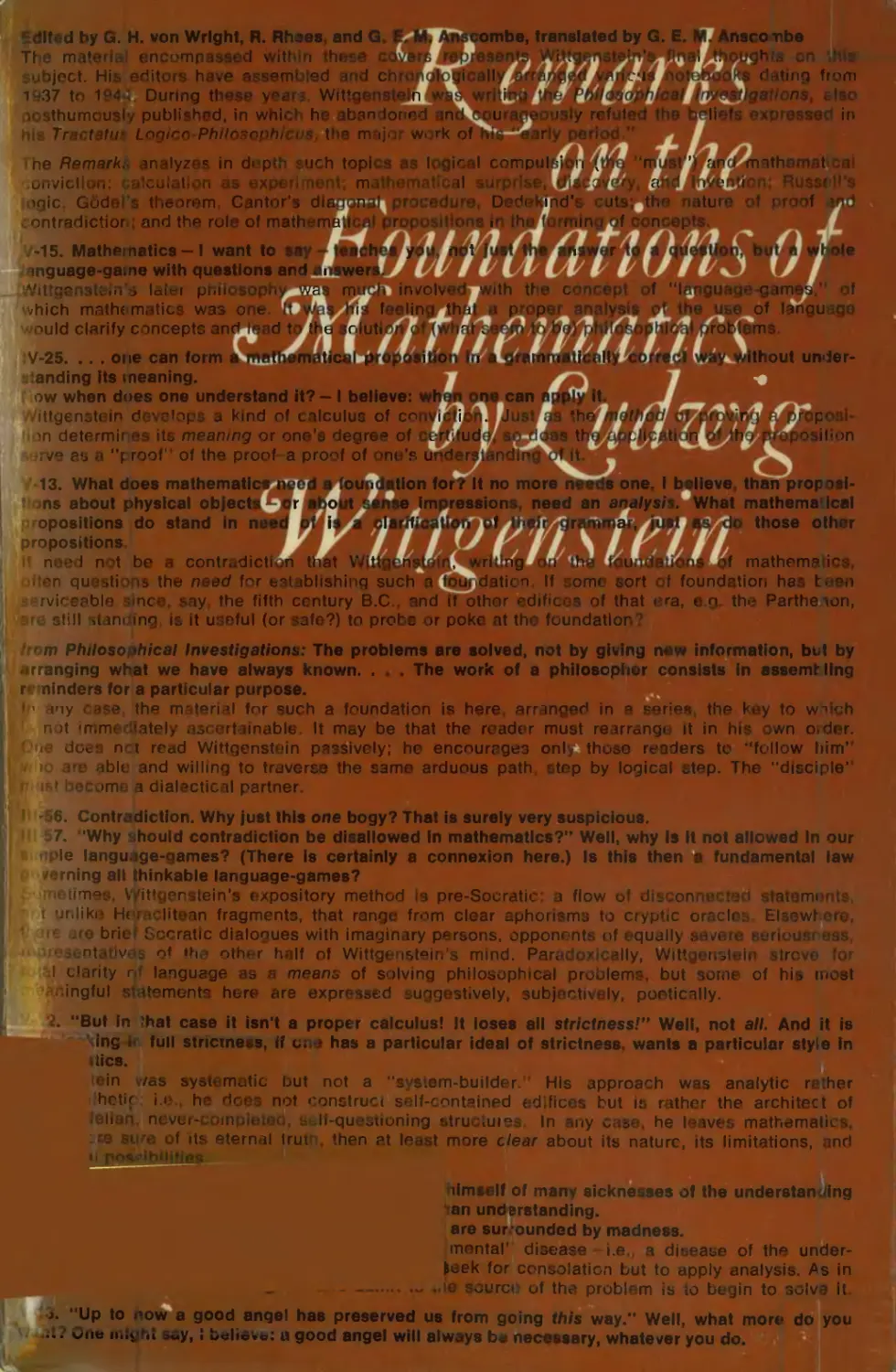
                    It d hy G. H. von Wright, R. Rhaes and G
ombe, translated by G. E.
Tf
mi*
joct. Hi
i 37 t( 1
thumc u~l
Tr -f tn
ne Rprntrk,
ui.viol .1.
inic God
ontradictior
\ it»
nrv
hi
öd i en I i II . . tci
Wit*" n * i . • ■
h ban lonr j n u .; i ./ref t-
t ~ m ij> wi rkof i r
n lyz «= in d< p- lirh topi I \r I cornpul •" >i , 'rr
,^w. t, .. m il »a
tlicwm Cantor',, dia n D di ind* Jt th
and thp rul of math ma I r i h i iin f n
(n nrnr
Hit h ,
During tl v
publi b"d, in wni
Lnqirn Phflr-m hi
in d< p-
nsro nbe
h
d ♦mo fr^m
n
li ir.
an math t
i
itui
n 1
-15. Mathematics-I want to
inguage-gaine with questions and
lA'it — ■•■ j Icii i pi.li ■■ Vi
vhich mnthe m< tic was o e.
^uld clarify cinceptc and
V-25. ... one can form
anding its meaning,
ow when does one understand it? — I believe: h n
ittyenctt in d ■ ~i% j kind of oalculue of en i i
-»n determir it„ mpanmg or onr'^ degree of ^r , ud
.vp ps "f roof of th° proof a pro^f of ^n< 's uph r
wer
m
i f
d t tr & oluti
i m tic p
involv
Iin thi
-t
i o i
ith tr
P P
f "I
roh
ndin
i II
it
*he
th -
it
t
• i
ti n
r
- of
t m
im s f
lanqu
ithout unier-
-•
r» :
h.
! r p
n ii.on
ou i tion for/ It no more n 8 one. I b lieve than prop a i-
o t e im ression need an aralysi . What mathema ical
i If i f • r i a , I those oth r
f mathemp i"
f foundation ha t. °ii
ra, i n th»- Parthe ion,
13. What does mathematic r
t ns about physical object
opositions do stand in n
propositions
i n iJ n t be contn dicti n that Vi n , n ng \ h u.
■*n qu jti » the n ad f~r b~ublishinq such a oundaticn If omi ^ort
rvif cable nc ay the fifth century B.C and if othnr rdific - of that
ctill »iin< inn ic it u ^ful (or afr?) to pro^r >r poke at th foundatior
m Philoso hical Investigation!,: The problems are solved, not by giving n information, but by
. rranqing what we have always known. . The work of a philosopher consists in assembling
r ninders for a particular purpose.
' my ■» thp m »°ri >l for cuch a foundation is h*?re arnn^d in a c°rio« the k y to w^h
n >t -n.m »atel, . oi rt mablb It may be that the rtadtr must re irrang< it in hi* wn o.d« r.
t doc n t read Wittqenst »in p~csivcly; ho encourngt»3 onl those readers tc "follow him'
) able and willmq to travcrsa the camo arduous path top by logical wt^p. The "dicciple"
f >m a diahctical partner
- 6. Contr diction. Why just this one bogy? That is surely very suspicious.
7. 'Why hould contradiction be disallowed in mathematics?" Well, why is it not allowed in our
t le langu ge- ames? (There is certainly a connexion here.) Is this then fundamental law
rning all thinkable language-games?
[imö V it* °r tein's t xpository method j pre-Souratk j flow o Ji_ on. i
t 'jr.liki H< lit an fragments, that range fr^m clear cphorrmj to cryptic or~clr
brio £ erratic dialogues with imaginary persons, opponont of quall> , ^r
nt iv nf »h oth r h If of Wittgr istöir. mind. Par« ally, Wit» r,=,1 i.
I chrity r language „ mean» of solving philosophical proulemc but jOMl
..ingful fombnt° htrt are expr Jöod ^ung stively, aubj rtiv |y, poetically.
. "But in ?hat case it isn't a proper calculus! It loses all strictness!" Well, not all. And it is
ing full stneme s, if c. has a particular ideal of strictness wants a particular style in
tics.
in /as syoi mutic but not a "z cam-builder. His approach was analytic r her
hetir ü hr dr not ^onctru^c s lf-^ontained i d fie «, hut u r ither the architect of
h n< vor- m li-qu «uoning «tru ajr° In ny ^ a he I ive mathemalit
- f it« etornl| irui »hen at le t more clear about its nature, its limitations, nd
ai mi
El—wr
Tl™
tre
Of \)\j> IHLdt
lim If of man sickne ses of the understan ing
an understanding.
are surounded by madness.
montaf dioea?° i.e a di- °ase of the under-
kek for consolation Lut to apply analysis. As in
sA'rc of thcx prob! m is iO btjin to 'Julv it
». "Up to »ow a good angel has preserved us from going this way." Well, what more do you
.. one ii..< .i «y,; i><*li0»«: u good angel will alw ys b nee sary, whatever you do.

BEMERKUNGEN ÜBER DIE GRUNDLAGEN DER
MATHEMATIK
REMARKS ON THE FOUNDATIONS OF
MATHEMATICS

BEMERKUNGEN
• •
ÜBER DIE GRUNDLAGEN
DER MATHEMATIK
von
LUDWIG WITTGENSTEIN
Herausgegeben und bearbeitet von
G. H. von WRIGHT
R. RHEES
G. E. M. ANSCOMBE

REMARKS
ON THE FOUNDATIONS
OF MATHEMATICS
By
LUDWIG WITTGENSTEIN
Edited by
G. H. von WRIGHT
R. RHEES
G. E. M. ANSCOMBE
Translated by
E. M. ANSCOMBE
THE M.I.T. PRESS
Massachusetts Institute of Technology
Cambridge, Massachusetts, and London, England

First published 1956 in Great Britain
by Basil Blackwell
Second printing 1964
First M.I.T. Paperback Edition, June 1967
Library of Congress Catalog Card Number: 67-26366
Printed in the United States of America

TRANSLATOR'S NOTE
I am indebted to Professor von Wright, Mr. R. Rhees, Miss L.
Labowsky, and Mr. P. Geach, who have read the translations here
published and have pointed out mistakes and suggested improvements;
and to Mr. P. G. Winch who helped with proof-reading.
Acknowledgment is also due to the Rockefeller Foundation for financial support
during the time I have taken to work on this book, and also for
supplying the funds needed for the photography and typing of MSS.
and for editorial meetings.
V

VORWORT DER HERAUSGEBER
Die Bemerkungen zur Philosophie der Mathematik und Logik, die
hier veröffentlicht werden, sind in den Jahren von 1937 bis 1944
entstanden. Nach dieser Zeit ist Wittgenstein nicht mehr zu diesem
Gegenstand zurückgekehrt. Dagegen hat er im Zeiträume von 1929
bis etwa 1932 vieles zum selben Thema Gehöriges verfaßt; einen Teil
davon hoffen wir zusammen mit anderem Material aus jenen Jahren
später zu veröffentlichen.
Diese früheren Arbeiten gehören einer Entwicklungsstufe
Wittgensteins an, die noch der Denkweise seiner "Logisch-philosophischen
Abhandlung" nahe steht. Die hier vorliegenden Bemerkungen sind von
der Denkart der "Philosophischen Untersuchungen".
Es scheint ursprünglich Wittgensteins Absicht gewesen zu sein,
seine Gedanken über Mathematik und Logik in die "Philosophischen
Untersuchungen" mit einzubeziehen. In der Tat war das erste der
hier veröffentlichten Bruchstücke (I) Teil einer früheren Fassung des
Manuskriptes der "Untersuchungen". Es fängt mit zwei Abschnitten
an, die mit §§ 189 und 190 der "Untersuchungen" im Wesentlichen
identisch sind.
Dieser Teil I ist augenscheinlich das früheste der hier
wiedergegebenen Bruchstücke. Er dürfte im Jahre 1937 entstanden sein. Es ist
der einzige Teil dieser Sammlung, der in Maschinenschrift vorlag,
und wohl von allen der am meisten durchgearbeitete. Der letzte
Abschnitt des Manuskriptes ist hier weggelassen: sein Inhalt findet
sich in den "Untersuchungen", §§ 547-568, in verbesserter Fassung
wieder. Die Abschnitte 122-130 sind mit §§ 193-197 der
"Untersuchungen" zum großen Teil identisch, wurden aber wegen des
Zusammenhangs mitaufgenommen.
Dem Teil I waren zwei Anhänge beigefügt. Der eine handelte vom
Überraschenden in der Mathematik. Er ist nicht aufgenommen worden.
Der andere bespricht Gödels Satz über die Existenz von unbeweisbaren,
aber wahren Sätzen im System der "Principia Mathematical (Anhang I.)
Es dürfte die Absicht Wittgensteins gewesen sein, seinen für die
"Philosophischen Untersuchungen" geplanten Beiträge zum
Grundlagenproblem der Mathematik — neben dem Anhang über Gödels
Satz — auch Anhänge über Cantors Lehre von der
Unendlichkeit und Russell's Logik beizufügen. Unter dem Titel "Ansätze"
hat er, wahrscheinlich zu Anfang des Jahres 1938 einiges zum
Problemkreis der Mengenlehre niedergeschrieben: über das Diagonalverfahren
und die verschiedenen Arten der Zahlbegriffe. Einige dieser "Ansätze"
vi

EDITORS' PREFACE
The remarks on the philosophy of mathematics and logic, which are
published here, were written in the years 1937-1944. After that time
Wittgenstein did not again return to this topic. He had written a great
deal on the subject in the period 1929 to roughly 1932, part of which we
hope to publish later, together with other material.
This earlier work belongs to a stage of Wittgenstein's development
which is still fairly close to the thought of his Tractatus Logico-Philoso-
phicus. The remarks presented in this volume are of a piece with the
thought of Philosophical Investigations.
It appears to have been Wittgenstein's original intention to
incorporate his ideas on mathematics and logic in Philosophical
Investigations. In fact the first of the fragments here published (Part I) was
part of an earlier version of the MS. of the Investigations. It begins with
two entries which are in all essentials identical with §§ 189 and 190 of
the Investigations.
This Part I is obviously the earliest of the fragments presented here.
It must have been written in 1937. It is the only part of this collection
which existed in typescript, and is certainly the most worked over
of them all. The last portion of the MS. has been left out; its contents
occur in an improved version in the Investigations, §§ 547-568. The
entries 122-130 are in great part the same as §§ 193-197 of the
Investigations,—but have been retained on account of their context.
Two appendices were attached to Part I. One dealt with surprise
in mathematics. It has not been included in this volume. The other
discusses GödePs theorem about the existence of unprovable but true
propositions in the system of Principia Mathematica. (Appendix I.)
It must have been Wittgenstein's intention to attach appendices on
Cantor's theory of infinity and on Russell's logic, as well as the appendix
on GödePs theorem, to the contributions to the problem of the
foundations of mathematics which he planned for Philosophical Investigations.
Under the heading * Addenda' (probably at the beginning of 1938) he
wrote a certain amount on problems of set theory: namely on the
diagonal procedure and the different kinds of number-concepts.
vie

vii
VORWORT DER HERAUSGEBER
werden hier zusammen mit einer Auswahl aus einem anderen ähnliche
Gegenstände behandelnden Manuskript veröffentlicht, das in der
Zeit von April 1938 bis Januar 1939 entstanden ist. (Anhang II.)
Wittgensteins Auseinandersetzung mit Russell, d. h. mit dem
Gedanken von der Herleitbarkeit der Mathematik (Arithmetik) aus
dem Logikkalkül, findet sich im Teil II dieser Sammlung. Dieser
Teil stammt aus der Zeit von Oktober 1939 bis April 1940. Das
Manuskript war das umfangreichste von allen und zugleich, stilistisch
und wohl auch sachlich, das am wenigsten vollendete. Immer von
neuem wiederholt der Verfasser den Versuch, seine Gedanken über
die Natur des mathematischen Beweises klar zu machen: was es heißt,
daß der Beweis übersichtlich sein soll, daß er uns ein Bild vorführe,
daß er einen neuen Begriff schaffe u. dgl.. Er ist bestrebt, "die Buntheit
der Mathematik" zu erklären und den Zusammenhang der
verschiedenen Rechentechniken klarzulegen. Mit diesem Streben widersetzt
er sich zugleich der Idee einer "Grundlage" der Mathematik, sei es in
der Form des Russellschen Logikkalküls oder in der der Hilbertschen
Konzeption einer Metamathematik. Die Idee des Widerspruchs und
des Widerspruchsfreiheitsbeweises wird ausfuhrlich besprochen.
Die Herausgeber waren der Meinung, dieses Manuskript enthalte
eine Fülle wertvoller Gedanken, die nirgendwo sonst in Wittgensteins
Aufzeichnungen anzutreffen seien. (Der Standpunkt, der hier von
ihm eingenommen wird, ist sogar zum Teil von seinen späteren
Gedanken prinzipiell verschieden.) Andererseits war es auch klar, daß
das Manuskript nicht ungekürzt veröffentlicht werden konnte. Eine
Auslese war deshalb vonnöten. Die Aufgabe war sehr schwer, und die
Herausgeber fühlen sich von dem Resultat wenig befriedigt.
Im Herbst 1940 hat sich Wittgenstein von neuem mit der Philosophie
der Mathematik befaßt und einiges zur Frage des Regelfolgens —
eines seiner am häufigsten wiederkehrenden Gedankenthemata —
niedergeschrieben. Diese Aufzeichnungen haben wir hier nicht
veröffentlicht. Im Mai 1941 wurde die Arbeit wieder aufgenommen
und führte bald zu Untersuchungen, aus denen hier — als Teil V —
eine beträchtliche Auswahl veröffentlicht wird.
Dieser Teil V wurde zu verschiedenen Zeiten verfaßt. Dir erste
Hälfte (§§ 1-16) wurde größtenteils im Juni 1941 geschrieben. Sie
bespricht das Verhältnis zwischen mathematischem Satz und
Erfahrungssatz, zwischen Rechnung und Experiment, behandelt von neuem
den Begriff des Widerspruchs und der Widerspruchsfreiheit und endet
in der Nähe des Gödelschen Problems. Die zweite Hälfte stammt aus
dem Frühjahr 1944. Sie handelt hauptsächlich vom Begriff des
Regelfolgens, des mathematischen Beweises und des logischen Schließens.

EDITORS' PREFACE
viie
Some of these 'Addenda' are here published together with a selection
from another MS. treating of the same topics, and written in the period
April 1938-January 1939. (Appendix II.)
Wittgenstein's working out of his position in regard to Russell,
i.e. in regard to the idea of the derivability of mathematics (arithmetic)
from the calculus of logic, is to be found in Part II of this collection.
This part derives from the period October 1939-April 1940. The
manuscript was the most extensive of all, and also the least perfect in
style and indeed in content. The author repeatedly attempts to clarify
his ideas on the nature of mathematical proof, on what it means to say
that a proof must be perspicuous; that it presents us with a picture,
that it creates a new concept, and the like. His endeavour is to explain
"the motley of mathematics" and to set forth the connexion between
different calculating techniques. Simultaneously with this endeavour
he sets himself against the idea of a 'foundation' of mathematics,
whether in the form of the Russellian logical calculus or of the
Hilbertian conception of a metamathematics. The idea of contradiction
and of a consistency proof is discussed at length.
The editors were of the opinion that this manuscript contained a
large number of valuable ideas which are not to be found elsewhere in
Wittgenstein's writings. (The point of view which he adopts here is
even in part quite different from that of his later ideas.) On the other
hand it was also clear that the manuscript could not be published
without cuts. For this reason it was necessary to make a selection.
The task was very difficult, and the editors feel little satisfaction with
the result.
In the autumn of 1940 Wittgenstein occupied himself anew with
the philosophy of mathematics, and wrote a certain amount on the
subject of 'following a rule'—one of the subjects to which his thoughts
most frequently returned. We have not published these writings here.
Work on this was resumed in May 1941 and led to investigations of
which a considerable selection is here published as Part V.
This Part V was written at various times. The first half (§§ 1-16)
was written mainly in June 1941. It deals with the relation between
mathematical and empirical propositions, between calculation and
experiment; it gives a fresh treatment of the notion of contradiction
and consistency; and in conclusion it skirts around Gödel's problem.
The second half belongs to the spring of 1944. It treats mainly of
the concepts of following a rule, of mathematical proofs, and of

viii
VORWORT DER HERAUSGEBER
Es finden sich hier zahlreiche Berührungspunkte mit den in der
Zwischenzeit entstandenen Manuskripten einerseits (Teile III und IV)
und mit Gedanken der "Philosophischen Untersuchungen"
andererseits. Eine Anzahl von Bemerkungen haben die Herausgeber hier
fortgelassen, weil sie sich in den "Untersuchungen" wörtlich
wiederfinden. — Die beiden Hälften waren in demselben Manuskriptbuch
eingetragen, was ein Anzeichen unter anderen dafür sein dürfte,
daß der Verfasser sie als zusammengehörig betrachtet hat.
Teil III ist einem Manuskript aus dem Jahre 1942, Teil IV zwei
Manuskripten aus den Jahren 1942 und 1943 entnommen. Manches
in diesen Abschnitten trägt den Charakter von "Vorstudien" zur
zweiten Hälfte des Teiles V, sie enthalten' aber auch eine Fülle von
Material, das der Verfasser dort nicht benutzt hat.
Im Teil IV bespricht Wittgenstein Gegenstände, die sich mit
Brouwer und dem s.g. Intuitionismus berühren: das Gesetz vom
ausgeschlossenen Dritten und mathematische Existenz; denDedekind-Schnitt
und die extensionale und die intensionale Betrachtungsweise in der
Mathematik.
Die chronologische Anordnung des Stoffes hatte zur Folge, daß ein
und dasselbe Thema manchmal an verschiedenen Stellen behandelt
wird. Hätte Wittgenstein seine Aufzeichnungen zu einem Buche
zusammengestellt, so hätte er wohl manche dieser Wiederholungen
vermieden. Eine derartige Zusammenstellung zu versuchen, haben
sich die Herausgeber nicht zugetraut.
Es muß noch einmal betont werden: was hier veröffentlicht wird, ist
eine Auswahl aus umfangreicheren Manuskripten. Vielleicht wird es
später wünschenswert erscheinen, daß auch das hier Weggelassene,
oder jedenfalls ein Teil desselben, gedruckt wird. Wir glauben aber,
es war nicht unsere Aufgabe, dieses Bedürfnis nach Veröffentlichung
eines umfangreicheren Materials vorwegzunehmen.
Für die Numerierung der ausgewählten Stücke sind die Herausgeber
verantwortlich. Die Gliederung der Aufzeichnungen in
'Bemerkungen' — hier durch weitere Abstände von einander getrennt — ist
dagegen Wittgensteins eigene. Die Ordnung der Abschnitte haben wir
mit wenigen Ausnahmen nicht antasten wollen. Jedoch haben wir
manchmal, besonders am Schluß des dritten und vierten Teiles, zum
selben Thema Gehöriges aus verschiedenen Stellen der Aufzeichnungen
zusammengebracht.
Die Inhaltsverzeichnisse und das Register sollen dem Leser zu einem
Überblick verhelfen und zu leichterem Wiederfinden der Stellen beim
Nachsuchen dienen. Für die in den Inhaltsverzeichnissen angedeutete
thematische Gliederung des Stoffes sind die Herausgeber allein
verantwortlich.

EDITORS' PREFACE
viiie
logical inference. There are here numerous points of contact with
the manuscripts written in the intervening period (Parts III and IV)
on the one hand, and with the ideas of Philosophical Investigations on
the other. The editors have here omitted a number of remarks because
they occur verbatim in the Investigations. The two halves were written
in the same notebook, which is an indication that the author regarded
them as belonging together.
Part III is taken from a manuscript of 1942, Part IV from two
manuscripts of 1942 and of 1943. Much in these parts has the character
of preliminary studies for the second half of Part V, but they also
contain a quantity of material that the author did not use there.
In Part IV Wittgenstein discusses topics relating to Brouwer and
'Intuitionism': the law of excluded middle and mathematical existence;
the Dedekind cut and the extensional and intensional points of view in
mathematics.
The chronological arrangement of material has had the consequence
that one and the same subject is sometimes dealt with in different
places. If Wittgenstein had himself arranged his material into a single
work, he would presumably have avoided some of these repetitions.
The editors have not ventured to aim at such an arrangement.
We must emphasize once more that what is here published is a
selection from more extensive manuscripts. It will perhaps later appear
desirable to publish what is omitted here, or part of it. We believe,
however, that it was not our business to anticipate such a demand for
the publication of more extensive material.
The editors are responsible for the numbering of the selected
sections, but the division into separate 'remarks*, here indicated by a
space between them, is Wittgenstein's own. With few exceptions, we
have not interfered with their order. Sometimes, however, especially
at the end of Part HE and of Part IV, we have brought together remarks
on the same topic that occurred in different places in the manuscripts.
The tables of contents and the index are intended to help the reader
to survey the whole, and also to make it easier to look up passages.
The editors have the sole responsibility for the division of the material
by subjects suggested in the tables of contents.

INHALTSVERZEICHNIS
Teil I
1-5. Das Problem des Regelfolgens. (Vgl. "Philosophische
Untersuchungen" §§189, 190, etc.) — Übergänge durch eine Formel
bestimmt (1-2). Fortsetzung einer Reihe (3). Unerbittlichkeit der
Mathematik; Mathematik und Wahrheit (4-5). Bemerkung über
das Messen (5).
6-23. Das logische Schließen. — Das Wort "alle"; der Schluß aus
'(x).fx' auf fa' (10-16). Schließen und Wahrheit (17-23).
24-74. Der Beweis. — Der Beweis als Figur oder Muster, Paradigma.
Hand-und-Drudenfuß-Beispiel (25, etc.). Der Beweis als Bild
eines Experiments (36). Das 100-Kugeln-Beispiel (36, etc.).
Zusammenlegen von Figuren aus Teilen (42-72). Die
mathematische Überraschung. Beweis und Überzeugung. Mathematik
und Wesen (32, 73, 74). Die Tiefe des Wesens: das tiefe Bedürfnis
nach der Übereinkunft (74).
75-105. Rechnung und Experiment. — Das 'Entfalten* von
mathematischen Eigenschaften. Das 100-Kugeln-Beispiel (75, 86, 88).
Entfalten von Eigenschaften eines Vielecks (76), einer Kette (79,
80, 91, 92). Messen (93, 94). Geometrische Beispiele (96-98).
Interne Eigenschaften und Relationen (102-105); farbenlogische
Beispiele.
106-112. Der mathematische Glaube.
113-141. Der logische Zwang. — Inwiefern ist das logische Argument
ein Zwang? (113-117). Die Unerbittlichkeit der Logik mit der
des Gesetzes verglichen (118). Die 'logische Maschine* und die
Kinematik starrer Körper (119-125). 'Die Härte des logischen
Muß' (121). Die Maschine als Symbol für ihre Wirkungsweise
(122). Die Verwendung eines Wortes mit einem Schlag erfassen
(123-130). Die Möglichkeit als Schatten der Wirklichkeit (125).
Die unverstandene Verwendung des Wortes als seltsamer Vorgang
gedeutet (127). (Zu 122-130 vgl. "Philosophische
Untersuchungen" §§ 191-197.) Die Gesetze der Logik als "Denkgesetze"
(131-133). Sich in einer Rechnung irren (134-136). Bemerkung
über Messen (139). Logische Unmöglichkeit (140). "Was wir
liefern, sind eigentlich Bemerkungen zur Naturgeschichte des
Menschen" (141).
ix

TABLE OF CONTENTS
Part I
1-5. Following a rule (Cf. Philosophical Investigations §§ 189-90 ff.).—
Steps determined by a formula (1-2). Continuation of a series (3).
Inexorability of mathematics; mathematics and truth (4-5).
Remark on measuring (5).
6-23. Logical inference.—The word "all"; inference from '(x).fi?to
'fa3 (10-16). Inference and truth (17-23).
24-74. Proof.—Proof as pattern or model (paradigm). Example: hand
and pentacle (25 ff.). Proof as picture of an experiment (36).
Example: 100 marbles (36 ff.). Construction of figures out of their
parts (42-72). Mathematical surprise. Proof and conviction.
Mathematics and essence (32, 73, 74). The depth of the essence:
the deep need for the convention (74).
75-105. Calculation and experiment.—The 'unfolding' of
mathematical properties. Example of 100 marbles (75, 86, 88).
Unfolding the properties of a polygon (76), and of a chain (79, 80,
91, 92). Measuring (93, 94). Geometrical examples (96-98).
Internal properties and relations (102-105); examples from the
logic of colour.
106-112. Mathematical belief.
113-141. Logical compulsion.—In what sense does logical argument
compel? (113-117). The inexorability of logic compared with that
of the law (118). The 'logical machine' and the kinematics of rigid
bodies' (119-12 5). 'The hardness of the logical musf (121). The
machine as symbolizing its way of working (122). The
employment of a word grasped in a flash (123-130). Possibility as a
shadow of reality (125). The employment of a word
misunderstood and interpreted as a queer process (127). (For 122-130 see
also Philosophical Investigations §§ 191-197.) The laws of logic as
'laws of thought' (131-13 3). Going wrong in a calculation (134-
136). Remark on measuring (139). Logical impossibility (140).
"What we are supplying is really remarks on the natural history
of man" (141).
ixe

X
INHALT
142-155. Begründung eines Rechenvorgangs und eines logischen
Schlusses. — Rechnen ohne Sätze (142-144). Das Holzverkaufen-
Beispiel (142-151). "Sind unsre Schlußgesetze ewig und
unveränderlich?" (154). Die Logik ist vor der Wahrheit (155).
156-169. Mathematik, Logik und Erfahrung. — Beweis und
Experiment (15 6-161). Was an der Mathematik Logik ist: sie bewegt
sich in den Regeln unserer Sprache (164). Der Mathematiker ist
ein Erfinder, kein Entdecker (167).
Anhang I
1-4. Arten der Sätze. — Arithmetik ohne Sätze betrieben (4).
5-7. Wahrheit und Beweisbarkeit im System der "Principia
Mathematical.
8-19. Diskussion eines Satzes 'P', der seine eigene Unbeweisbarkeit
im System der "Principia Mathematica" behauptet. — Rolle des
Widerspruchs im Sprachspiel (11-14, 17).
20. Die Sätze der Logik. 'Satz' und 'satzartiges Gebilde'.
Anhang II
1-3. Das Diagonalverfahren. — Der Begriff 'unabzählbar* (2).
Vergleich der Begriffe der reellen Zahl und der Kardinalzahl (3).
4. Die Krankheit einer Zeit.
5. Diskussion des Satzes: "Es gibt keine größte Kardinalzahl".
6-7. Irrationalzahlen.
8-9. H0.
10-13. Diskussion des Satzes: "Man kann die Brüche nicht ihrer
Größe nach ordnen". -
14. Vergleich von verschiedenen Spielen.
15-16. Diskussion des Satzes, daß die Brüche (Zahlenpaare) in eine
unendliche Reihe geordnet werden können.
17. Das Wort "unendlich".
18. Finitismus, Behaviourism. Allgemeine Bemerkungen.

CONTENTS xe
142-155. Foundation of a calculating procedure and of a logical
inference.—Calculating without propositions (142-144). Example:
sale of timber (142-151). "Are our laws of inference eternal and
unalterable"? (154). Logic precedes truth (155).
156-169. Mathematics, logic, and experience.—Proof and experiment
(15 6-161). What in mathematics is logic: it moves in the rules of
our language (164). The mathematician is an inventor, not a
discoverer (167).
Appendix I
1-4. Kinds of proposition.—Arithmetic done without propositions
(4).
5-7. Truth and provability in the system of Principia Mathematica.
8-19. Discussion of a proposition *P' which asserts its own
unprovability in the system of Principia Mathematica.—The role of
contradiction in the language-game (11-14, 17).
20. The propositions of logic. 'Proposition' and 'propositional
formation\
Appendix II
1-3. The diagonal procedure.—The concept 'non-denumerable' (2).
Comparison of the concepts of real number and cardinal number
(3)-
4. The sickness of a time.
5. Discussion of the proposition "There is no greatest cardinal
number".
6-7. Irrational numbers.
8-9. H0.
10-13. Discussion of the proposition "Fractions cannot be arranged in
order of magnitude".
14. Comparison of different games.
15-16. Discussion of the proposition that the fractions (number-pairs)
can be arranged in an infinite series.
17. The word "infinite".
18. Finitism, Behaviourism. General remarks.
b

zi
INHALT
Teil H
1-2. Der Beweis. — Der mathematische Beweis muß übersichtlich
sein. Rolle der Definitionen (2).
3-8. Russells Logik und die Idee von der Zurückführung der
Arithmetik auf symbolische Logik. — Die Anwendung der Rechnung
muß für sich selber sorgen (4). Beweis im Russell-Kalkül, im
Dezimalkalkül, und im Einserkalkül.
9-11. Der Beweis. — Der Beweis als einprägsames Bild (9). Die
Reproduktion einer Beweisfigur (10-11).
12-20. Russells Logik und das Problem von der Verhältnis
verschiedener Rechentechniken zu einander. — Was ist die Erfindung
des Dezimalsystems? (12). Beweis im Russell-Kalkül und im
Dezimalsystem (13). Übersehbare und unübersehbare Zahlzeichen
(16). Verhältnis von gekürzten und ungekürzten Rechentechniken
zu einander (17-20).
21-44. Der Beweis. — Identität und Reproduzierbarkeit eines
Beweises (21). Der Beweis als Vorbild; Beweis und Experiment
(22-24). Beweis und mathematische Überzeugung (25-26). Im
Beweis haben wir uns zu einer Entscheidung durchgerungen (27).
Der bewiesene Satz als Regel. Er soll uns zeigen was zu sagen
Sinn hat (28). Die Sätze der Mathematik als 'Instrumente der
Sprache' (29). Das mathematische Muß: eine Gleise in der
Sprache gelegt (30). Der Beweis fuhrt einen neuen Begriff ein
(31). Welchen Begriff schafft 'pop'? 'pop' als Angelpunkt der
sprachlichen Darstellungsweise (32-33). Der Beweis als Teil einer
Institution (36). Bedeutung des Unterschieds von
Sinnbestimmung und Sinnverwendung (37). Anerkennung eines Beweises;
die 'geometrische' Auffassung des Beweises (38-40). Der Beweis
als Bekenntnis zu einer bestimmten Zeichenverwendung (41).
"Der Beweis muß ein anschaulicher Vorgang sein" (42). "Die
Logik als Grundlage aller Mathematik tut's schon darum nicht,
weÜ die Beweiskraft der logischen Beweise mit ihrer
geometrischen Beweiskraft steht und fällt" (43). In der Mathematik
können wir den logischen Beweisen entlaufen (44).
45-64. Russells Logik. — Verhältnis der gewöhnlichen Beweistechnik
zu der Russellschen (45). Kritik der Auffassung von der Logik
als 'Grundlage' der Mathematik. Die Mathematik ist ein buntes
Gemisch von Rechentechniken. Die abgekürzte Technik als neuer
Aspekt der unabgekürzten (46-48). Bemerkung zur
Trigonometrie (50). Die Dezi mal notation ist unabhängig von dem

CONTENTS
sie
Part II
1-2. Proof.—Mathematical proof must be perspicuous. Role of
definitions (2).
3-8. Russell's logic and the idea of the reduction of arithmetic to
symbolic logic.—The application of the calculation must take
care of itself (4). Proof in the Russellian calculus, in the decimal
calculus, and in the stroke calculus.
9-11. Proof.—Proof as a memorable picture (9). The reproduction
of the pattern of a proof (10-11).
12-20. Russell's logic and the problem of the mutual relation of
different calculating techniques.—What is the invention of the
decimal system? (12). Proof in the Russellian calculus and in the
decimal system (13). Signs for numbers that can, and that cannot,
be taken in (16). Relation of abbreviated and unabbreviated
calculating techniques to one another (17-20).
21 -44. Proof.—Identity and reproducibility of a proof (21). The proof
as model. Proof and experiment (22-24). Proof and
mathematical conviction (25-26). In the proof we have won through to a
decision (27). The proved proposition as a rule. It serves to shew
us what it makes sense to say (28). The propositions of
mathematics as 'instruments of language' (29). The proof introduces a
new concept (31). What concept does 'p3p' produce? (32).
'pDp* as pivot of the linguistic method of representation (33).
The proof as part of an institution (3 6). Importance of the
distinction between determining and using a sense (37). Acceptance of
a proof; the 'geometrical' conception of proof (3 8-40). The proof
as adoption of a particular employment of signs (41). "The proof
must be a procedure plain to view" (42). "Logic as foundation of
mathematics does not work if only because the cogency of the
logical proof stands and falls with its geometrical cogency" (43).
In mathematics we can get away from logical proofs (44).
45-64. Russell's logic.—Relation between the ordinary and the
Russellian technique of proof (45). Criticism of the conception
of logic as the 'foundation' of mathematics. Mathematics is a
motley of calculating techniques. The abbreviated technique as a
new aspect of the unabbreviated (46-48). Remark on
trigonometry (50). The decimal notation is independent of calculation

xii
INHALT
Rechnen mit Einerstrichen (51). Warum Russells Logik uns
nicht dividieren lehrt (5 2). Warum die Mathematik nicht Logik ist
(53). Der rekursive Beweis (54). Beweis und Experiment (55).
Das Entsprechen verschiedener Kalküle; Strichnotation und
Dezimalnotation (56-57). Mehrere Beweise eines und desselben
Satzes; Beweis und Sinn eines mathematischen Satzes (58-62).
Die genaue Entsprechung eines überzeugenden Übergangs in der
Musik und in der Mathematik (63).
65-76. Rechnung und Experiment. — Sind die Sätze der Mathematik
anthropologische Sätze? (65). Mathematische Sätze als
Prophezeiungen von übereinstimmenden Rechenresultaten aufgefaßt
(66). Zum Phänomen des Rechnens gehört Übereinstimmung
(67). Wenn eine Rechnung ein Experiment ist, was ist dann ein
Fehler in der Rechnung? (68). Die Rechnung als Experiment und
als Weg (69). Ein Beweis dient der Verständigung. Ein
Experiment setzt sie voraus (71). Mathematik und die Wissenschaft von
den konditionierten Rechenreflexen (72). Der Begriff des
Rechnens schließt Verwirrung aus (75-76).
77-90. Der Widerspruch. — Ein Spiel, in dem, wer anfängt, immer
gewinnen muß (77). Rechnen mit (a—a). Die Abgründe in einem
Kalkül sind nicht da, wenn ich sie nicht sehe (78). Diskussion
des heterologischen Paradoxes (79). Der Widerspruch vom
Standpunkt des Sprachspiels betrachtet. Der Widerspruch als
'heimliche Krankheit' des Kalküls (80). Widerspruch und
Brauchbarkeit eines Kalküls (81). Der Widerspruchsfreiheitsbeweis und
der Mißbrauch der Idee der mechanischen Sicherung gegen den
Widerspruch (82-89). "Mein Ziel ist, die Einstellung zum
Widerspruch und zum Beweis der Widerspruchsfreiheit zu ändern"
(82). Die Rolle des Satzes: "Ich muß mich verrechnet haben" —
der Schlüssel zum Verständnis der 'Grundlagen' der Mathematik
(90).
Teil m
1-7. Über Axiome. — Das Einleuchten der Axiome (1-3).
Einleuchten und Verwendung (2-3). Axiom und Erfahrungssatz
(4-5). Die Negation eines Axioms (5). Der mathematische Satz
steht auf vier Füßen, nicht auf dreien (7).
8-9. Regelfolgen. — Beschreibung mit Hilfe einer Regel (8).
10. Die arithmetische Annahme ist nicht an der Erfahrung gebunden.

CONTENTS
xiie
with unit strokes (51). Why Russell's logic does not teach us
to divide (52). Why mathematics is not logic (53). Recursive
proof (54). Proof and experiment (55). The correspondence of
different calculi; stroke notation and decimal notation (56-57).
Several proofs of one and the same proposition; proof and the
sense of a mathematical proposition (58-62). The exact
correspondence of a convincing transition in music and in mathematics
(63)-
65-76. Calculation and experiment.—Are the propositions of
mathematics anthropological propositions? (65). Mathematical
propositions conceived as prophecies of concordant results of
calculating (66). Agreement is part of the phenomenon of
calculating (67). If a calculation is an experiment, what in that
case is a mistake in calculation? (68). The calculation as an
experiment and as a path (69). A proof subserves mutual
understanding. An experiment presupposes it (71). Mathematics and
the science of conditional calculating reflexes (72). The concept
of calculation excludes confusion (75-76).
77-90. Contradiction.—A game in which the one who moves first
must always win (77). Calculating with (a — a). The chasms in a
calculus are not there if I do not see them (78). Discussion of the
heterological paradox (79). Contradiction regarded from the
point of view of the language-game. Contradiction as a 'hidden
sickness' of the calculus (80). Contradiction and the usability of a
calculus (81). The consistency proof and the misuse of the idea of
mechanical insurance against contradiction (82-89). "My aim is to
change the attitude towards contradiction and the consistency
proof." (82) The role of the proposition: "I must have
miscalculated"—the key to understanding the 'foundations' of mathematics
(90).
Part III
1-7. On axioms.—The self-evidence of axioms (1-3). Self-evidence
and use (2-3). Axiom and empirical proposition (4-5). The
negation of an axiom (5). The mathematical proposition stands
on four legs, not on three (7).
8-9. Following a rule.—Description by means of a rule (8).
10. The arithmetical assumption is not tied to experience.

xiii INHALT
11-13. Die Auffassung der Arithmetik als Naturgeschichte der
Zahlen. — Die Beurteilung der Erfahrung mittels des Bildes (12).
14. Beziehung des logischen (mathematischen) Satzes nach außen.
15-19. Die Möglichkeit angewandte Mathematik ohne reine
Mathematik zu treiben. — Mathematik muß nicht in Sätzen getrieben
werden; der Schwerpunkt kann ganz im Tun liegen (15). Das
kommutative Gesetz als Beispiel (16-17).
20. Das Rechnen als maschinelle Tätigkeit.
21. Das Bild als Beweis.
22. 27. Intuition.
26. Was ist der Unterschied zwischen nicht Rechnen und falsch
Rechnen?
29-33. Beweis und mathematische Begriffsbildung. — Der Beweis
ändert die Begriffsbildung. Die Begriffsbildung als Grenze der
Empirie (29). Der Beweis zwingt nicht, sondern führt (30). Der
Beweis leitet unsere Erfahrungen in bestimmte Kanäle (31, 33).
Beweis und Vorhersage (33).
34. Das philosophische Problem ist: Wie können wir die Wahrheit
sagen, und dabei diese starken Vorurteile beruhigen?
35-36. Der mathematische Satz. — Wir erkennen ihn an, indem wir
ihm den Rücken drehen (35). Die Wirkung des Beweises: man
stürzt sich in die neue Regel hinein (36).
39. 42. Synthetischer Charakter der mathematischen Sätze. — Die
Verteilung der Primzahlen als Beispiel (42).
40. Das Resultat als Äquivalent der Operation gesetzt.
41. Daß der Beweis übersichtlich sein muß, heißt, daß Kausalität im
Beweise keine Rolle spielt.
43-44. Intuition in der Mathematik.
47. Der mathematische Satz als Begriffsbestimmung, die auf die
Entdeckung einer neuen Form folgt.
48. Das Arbeiten der mathematischen Maschine ist nur das Bild des
Arbeitens einer Maschine.
49. Das Bild als Beweis.
50-51. Das Umkehren eines Wortes.

CONTENTS xüie
i i-i 3. The conception of arithmetic as the natural history of numbers.
—Judging experience by means of the picture (12).
14. External relation of the logical (mathematical) proposition.
15-19. The possibility of doing applied mathematics without pure
mathematics.—Mathematics need not be done in propositions; the
centre of gravity may lie in action (15). The commutative law as
an example (16-17).
20. Calculation as a mechanical activity.
21. The picture as a proof.
22. 27. Intuition.
26. What is the difference between not calculating and calculating
wrong?
29-33. Proof and mathematical concept formation.—Proof alters
concept formation. Concept formation as the limit of the empirical
(29). Proof does not compel, but guides (30). Proof conducts our
experience into definite channels (31, 33). Proof and prediction
(33)-
34. The philosophical problem is: how can we tell the truth and at
the same time pacify these strong prejudices?
35-36. The mathematical proposition.—We acknowledge it by turning
our back on it (3 5). The effect of the proof: one plunges into the
new rule (36).
39. 42. Synthetic character of mathematical propositions.—The
distribution of primes as an example (42).
40. The result set up as equivalent to the operation.
41. That proof must be perspicuous means that causality plays no
part in proof.
43-44. Intuition in mathematics.
47. The mathematical proposition as determination of a concept,
following upon the discovery of a new form.
48. The working of the mathematical machine is only the picture of
the working of a machine.
49. The picture as a proof.
50-51. Reversal of a word.

xiv
INHALT
52-53. Mathematischer Satz und Erfahrungssatz. — Die Annahme
eines mathematischen Begriffes drückt die sichere Erwartung
gewisser Erfahrungen aus; aber die Festsetzung dieses Maßes ist
dem Aussprechen der Erwartungen nicht äquivalent (53).
55-60. Der Widerspruch. — Der Lügner (58). Der Widerspruch als
etwas Über-propositionales aufgefaßt, als Denkmal mit einem
Januskopf über den Sätzen der Logik thronend (59).
Teil IV
1-4. Die Mathematik als Spiel und als maschinenhafte Tätigkeit. —
Rechnet die Rechenmaschine? (2). Wieweit muß man einen
Begriff vom 'Satz' haben, um die Russellsche mathematische
Logik zu veistehen? (4).
5-8. Tut ein Mißverständnis, die mögliche Anwendung der
Mathematik betreffend, der Rechnung als einem Teil der Mathematik
Eintrag? — Mengenlehre (7).
9-13. Der Satz vom ausgeschlossenen Dritten in der Mathematik. —
Wo kein Entscheidungsgrund vorliegt, muß er erst erfunden
werden, um der Anwendung des Satzes vom ausgeschlossenen
Dritten einen Sinn zu geben.
14-16 und 21-23. 'Alchemic' des Unendlichkeitsbegriffes und anderer
mathematischen Begriffen mit unverstandenen Anwendungen. —
Unendliche Vorhersagungen (23).
17-20. Der Satz vom ausgeschlossenen Dritten. Der mathematische
Satz als Gebot. Mathematische Existenz.
24-27. Existenzbeweis in der Mathematik. — "Der unheilvolle
Einbruch der Logik in die Mathematik" (24; siehe auch 46 u. 48).
Das mathematisch Allgemeine steht zum mathematisch
Besonderen nicht in dem Verhältnis wie sonst das Allgemeine zum
Besonderen (25). Existenzbeweise die keine Konstruktion des
Existierenden zulassen (26-27).
28. Der Beweis durch reductio ad absurdum.
29-40. Vom Extensionalen und Intensionalen in der Mathematik; der
Dedekind-Schnitt. — Die geometrische Illustration der Analysis
(29). Dedekinds Satz ohne Irrationalzahlen (30). Wie kommt
dieser Satz zu einem tiefen Inhalt? (31). Das Bild der
Zahlengeraden (32, 37). Diskussion des Begriffs des Schnittes (33-34).
Die Allgemeinheit der Funktionen eine ungeordnete Allgemein-

CONTENTS
xivc
52-53. Mathematical and empirical propositions.—The assumption of
a mathematical concept expresses the confident expectation of
certain experiences; but the establishment of this measure is not
equivalent to the expression of the expectations (53).
55-60. Contradiction.—The liar (58). Contradiction conceived as
something supra-propositional, as a monument with a Janus head
enthroned above the propositions of logic (59).
Part IV
1-4. Mathematics as a game and as a machine-like activity.—Does the
calculating machine calculate? (2). How far is it necessary to have
a concept of 'proposition* in order to understand Russell's
mathematical logic? (4).
5-8. Is a misunderstanding about the possible application of
mathematics any objection to a calculation as part of mathematics?—
Set theory (7).
9-13. The law of excluded middle in mathematics.—Where there is
nothing to base a decision on, we must invent something in order
to give the application of the law of excluded middle a sense.
14-16 and 21-23. 'Alchemy' of the concept of infinity and of other
mathematical concepts whose application is not understood.—
Infinite predictions (23).
17-20. The law of excluded middle. The mathematical proposition as
a commandment. Mathematical existence.
24-27. Existence proofs in mathematics.—"The harmful invasion of
mathematics by logic" (24; see also 46 and 48). The
mathematically general does not stand to the mathematically particular in
the same relation as does the general to the particular elsewhere
(25). Existence proofs which do not admit of the construction of
what exists (26-27).
28. Proof by reductio ad absurdum.
29-40. On the extensional and intensional in mathematics; Dedekind's
theorem without irrational numbers (30). How does this theorem
come by its deep content? (31). The picture of the number line
(32, 37). Discussion of the concept of a cut (33-34). Generality
in the realm of functions is an unordered generality (38). Dis-
b*

XV
INHALT
heit (38). Diskussion des mathematischen Funktionsbegriffs;
Extension und Intension in der Analysis (39-40).
41. Begriffe die in 'notwendigen' Sätzen vorkommen, müssen auch in
nicht notwendigen eine Bedeutung haben.
42-46. Vom Beweis und Verstehen des mathematischen Satzes. —
Der Beweis als Bewegung von einem Begriff zum andern aufgefaßt
(42). Einen mathematischen Satz verstehen (45-46). Der Beweis
führt einen neuen Begriff ein. Der Beweis soll mich von etwas
überzeugen (45). Existenzbeweis und Konstruktion (46).
47. Ein Begriff ist nicht wesentlich ein Prädikat.
48. Die 'mathematische Logik' hat das Denken von Mathematikern
und Philosophen gänzlich verblendet.
49. Das Zahlzeichen gehört zu einem Begriffszeichen und ist nur mit
diesem ein Maß.
50. Vom Begriff der Allgemeinheit.
51. Der Beweis zeigt, wie das Resultat sich ergibt.
52-53. Allgemeine Bemerkungen. — Der Philosoph ist der, der in
sich viele Krankheiten des Verstandes heilen muß, ehe er zu den
Notionen des gesunden Menschenverstandes kommen kann (53).
Teil V
1. Die Rolle der Sätze, die von Maßen handeln und nicht
Erfahrungssätze sind. Ein solcher Satz (z.B., 12 Zoll = 1 Fuß) ruht in
einer Technik, und also in den Bedingungen dieser Technik; hat
aber nicht den Sinn, diese Bedingungen auszusprechen.
2. Die Rolle der Regel. Mittels ihrer kann man auch Voraussagungen
machen. Dies beruht auf Eigenschaften der Maßstäbe und der
Menschen, die sie gebrauchen.
3. Ein mathematischer Satz — eine Umformung des Ausdrucks.
Die Regel in ihrer Nützlichkeit und in ihrer Würde betrachtet.
Wie sollen zwei arithmetische Ausdrücke dasselbe sagen? Die
Arithmetik setzt sie einander gleich.
4. Einer, der Arithmetik lernt, indem er nur meinen Beispielen folgt.
Sage ich, "Wenn du mit diesen Zahlen machst, was ich dir auf den
andern vorgemacht habe, wirst du das und das erhalten" — so
scheint das sowohl eine Vorhersage wie auch ein mathematischer
Satz zu sein.

CONTENTS
xvc
cussion of the mathematical concept of a function; extension and
intension in analysis (39-40).
41. Concepts occurring in 'necessary' propositions must also have a
meaning in non-necessary ones.
42-46. On proof and understanding of a mathematical proposition.—
The proof conceived as a movement from one concept to another
(42). Understanding a mathematical proposition (45-46). The
proof introduces a new concept. The proof serves to convince
one of something (45). Existence proof and construction (46).
47. A concept is not essentially a predicate.
48. 'Mathematical logic' has completely blinded the thinking of
mathematicians and philosophers.
49. The numerical sign goes along with the sign for a concept and
only together with this is it a measure.
50. On the concept of generality.
51. The proof shews how the result is yielded.
5 2-5 3. General remarks.—The philosopher is the man who has to cure
himself of many sicknesses of the understanding before he can
reach the notions of the healthy human understanding.
Part V
1. The role of propositions that treat of measures and are not
empirical propositions. Such a proposition (e.g. 12 inches = 1
foot) is embedded in a technique, and so in the conditions of this
technique; but it is not a statement of those conditions.
2. The role of a rule. It can also be used to make predictions. This
depends on properties öf the measuring rods and of the people
who use them.
3. A mathematical proposition—a transformation of the expression.
The rule considered from the point of view of usefulness and from
that of dignity. How are two arithmetical expressions supposed
to say the same thing? They are made equivalent in arithmetic.
4. Someone who learns arithmetic simply by following my examples.
If I say, "If you do with these numbers what I did for you with
the others, you will get such-and-such a result"—this seems to
be both a prediction and a mathematical proposition.

xvi
INHALT
5. Ist nicht der Gegensatz zwischen Regeln der Darstellung und
Sätzen, welche beschreiben, einer, der nach allen Richtungen hin
abfällt?
6. Was ist einem mathematischen Satz und einem mathematischen
Beweis gemein, daß sie beide "mathematisch" heißen?
Der Beweis als Bild. Nicht die Approbation allein macht dies
Bild zur Rechnung, sondern die Übereinstimmung der
Approbationen.
7. Ändert sich der Sinn des Satzes, wenn ein Beweis gefunden wird?
Der neue Beweis reiht den Satz in eine neue Ordnung ein.
8. Der Russellsche <^/C/")^
Sagen wir, wir erhielten manche unserer Rechenresultate durch
einen versteckten Widerspruch. Sind sie dadurch illegitim?
Könnte man nicht einen Widerspruch gelten lassen?
9. "Eine Methode, die einen Widerspruch mechanisch vermeidet.'*
Nicht schlechte Mathematik wird hier verbessert, sondern ein
neues Stück Mathematik erfunden.
10. Müssen die logischen Axiome immer überzeugend sein?
11. Die Leute, die gelegentlich durch Ausdrücke vom Werte o kürzen.
12. Wenn die Rechnung für mich ihren Witz verloren hat, sobald ich
weiß, wie ich nun alles Beliebige errechnen kann — hat sie keinen
gehabt, so lang ich das nicht wußte?
Man denkt, der Widerspruch muß sinnlos sein.
13. Wozu braucht die Mathematik eine Grundlegung?
Ein guter Engel wird immer nötig sein.
14. Der praktische Wert des Rechnens. Rechnung und Experiment.
Eine Rechnung als ein Teil der Technik eines Experiments.
Die Rechnungshandlung kann auch ein Experiment sein.
15. Soll die Mathematik Tatsachen zu Tage bringen? Bestimmt sie
nicht erst den Charakter dessen, was wir 'Tatsache* nennen?
Lehrt sie uns nicht nach Tatsachen zu fragen?
In der Mathematik gibt es keine kausalen Zusammenhänge, nur
die Zusammenhänge des Bildes.
16. Bemerkungen.
17. Das Netz von Fugen einer Mauer. Warum nennen wir dies ein
mathematisches Problem?
Macht die Mathematik Experimente mit Einheiten}

CONTENTS
xvie
5. Does not the contrast between rules of description and descriptive
propositions shade off on every side?
6. What is common to a mathematical proposition and a
mathematical proof, that they should both be called "mathematical"?
The proof as a picture. It is not assent alone which makes
this picture into a calculation, but the consensus of assents.
7. Does the sense of the proposition change when a proof has been
found? The new proof gives the proposition a place in a new
system.
8. Russell's c~f(f)\
Let us say we have got some of our results because of a hidden
contradiction. Does that make them illegitimate?
Might we not let a contradiction stand?
9. "A method for avoiding a contradiction mechanically.'' It is
not bad mathematics that is amended here, but a new bit of
mathematics is invented.
10. Must logical axioms always be convincing?
11. The people who sometimes reduce by expressions of value o.
12. If the calculation has lost its point for me, as soon as I know that
I can get any arbitrary result from it—did it have no point as long
as I did not know this?
One thinks that contradiction has to be senseless.
13. What does mathematics need a foundation for?
A good angel will always be necessary.
14. The practical value of calculating. Calculation and experiment.
A calculation as part of the technique of an experiment.
The activity of calculating can also be an experiment.
15. Is mathematics supposed to bring facts to light? Does it not take
mathematics to determine the character of what we call a 'fact'?
Does it not teach us to ask about certain facts?
In mathematics there are no causal connexions, only the
connexions of the pattern.
16. Remarks.
17. The network of joins in a wall. Why do we call this a mathematical
problem?
Does mathematics make experiments with units?

xvü INHALT
18. "Der Satz, der von sich selbst aussagt, er sei unbeweisbar" — wie
ist das zu verstehen?
19. Die Konstruktion eines Satzzeichens aus Axiomen, nach Regeln;
und es scheint, wir haben den wirklichen Sinn des Satzes als falsch
demonstriert, und ihn zu gleicher Zeit bewiesen.
20. Rechnung und Erfahrung.
21. Zeigt der Widerspruch von "heterologisch" eine logische
Eigenschaft dieses Begriffs?
22. Ein Spiel; und nach einem gewissen Zug, erweist sich jeder
Versuch, weiterzuspielen, als den Regeln entgegen.
23. Das logische Schließen ist ein Teil eines Sprachspiels.
Logischer Schluß, und nicht-logischer Schluß.
Die logischen Schlußregeln können weder falsch noch richtig sein.
Sie bestimmen die Bedeutung der Zeichen.
24. Ein zweckmäßiger Vorgang mit Zahlzeichen muß nicht sein, was
wir "Rechnen" nennen.
25. Ist Mathematik mit rein phantastischer Anwendung nicht auch
Mathematik?
26. Daß sie Begriffe bilde, kann einem großen Teil der Mathematik
wesentlich sein; und in anderen Teilen keine Rolle spielen.
27. Die Leute sehen einen Widerspruch nicht, und ziehen Schlüsse
aus ihm.
Kann es eine mathematische Aufgabe sein, die Mathematik zur
Mathematik zu machen?
28. Wenn wirklich in der Arithmetik ein Widerspruch gefunden
würde, so bewiese das, eine Arithmetik mit einem solchen
Widerspruch könnte sehr gute Dienste leisten.
29. "Die Klasse der Löwen ist nicht ein Löwe, die Klasse der Klassen
aber eine Klasse."
30. "Ich lüge immer." Welche Rolle könnte dieser Satz im
menschlichen Leben spielen?
31. Logischer Schluß. Ist nicht eine Regel etwas willkürliches?
"Es ist den Menschen unmöglich, einen Gegenstand als von sich
selbst verschieden anzuerkennen."

CONTENTS xvüe
18. "The proposition that says of itself that it is unprovable"—how
is this to be understood?
19. The construction of a propositional sign from axioms according
to rules; it appears that we have demonstrated the actual sense of
the proposition to be false, and at the same time proved it.
20. Calculation and experience.
21. Does the "heterological" contradiction shew a logical character of
this concept?
22. A game. And after a certain move any attempt to go on playing
proves to be against the rules.
23. Logical inference is part of a language game.
Logical inference and non-logical inference.
The rules of logical inference can be neither wrong nor right.
They determine the meaning of the signs.
24. A reasonable procedure with numerals need not be what we call
"calculating".
25. Is not a mathematics with an application that is sheer fantasy, still
mathematics?
26. The formation of concepts may be essential to a great part of
mathematics; and have no role in other parts.
27. A people who do not notice a contradiction, and draw
conclusions from it.
Can it be a mathematical task to make mathematics into
mathematics?
28. If a contradiction were actually found in arithmetic, this would
show that an arithmetic with such a contradiction can serve us
very well.
29. "The class of lions is not a lion, but the class of classes is a class."
30. "I always lie." What part might this sentence play in human
life?
31. Logical inference. Is not a rule something arbitrary?
"It is impossible for human beings to recognize an object as
different from itself."

xviii INHALT
32. "Richtig — d.h., das stimmt mit der Regel überein."
33. "Das Gleiche bringen" — wie kann ich das Einem erklären?
34. Wann soll man von einem Beweis der Existenz von '777' in einer
Entwicklung reden?
35. "Begriffsbildung" kann verschiedenes heißen.
Der Begriff der Regel zur Bildung eines unendlichen
Dezimalbruchs.
36. Gehört es zum Begriff des Rechnens, daß die Menschen im
allgemeinen zu diesem Resultat gelangen?
37. Wenn ich etwa frage, ob ein gewisser Körper sich einer
Parabelgleichung gemäß bewegt — was tut die Mathematik in diesem
Fall?
38. Fragen über die Weise, wie die Mathematik Begriffe bildet.
39. Kann man aber nicht doch mathematisch experimentieren?
40. Eine Addition von Formen. Möglichkeiten im Falten eines
Stücks Papier. Wie, wenn man keine Spaltung zwischen der
geometrischen Möglichkeit und der physikalischen Möglichkeit
machte?
Könnten nicht Leute u. U. mit Ziffern rechnen, ohne daß ein
bestimmtes Resultat herauskommen müßte?
Wem die Rechnung einen kausalen Zusammenhang entdeckt, der
rechnet nicht.
Die Mathematik ist normativ.
41. Die Einführung einer neuen Schlußregel als Übergang zu einem
neuen Sprachspiel.
42. Beobachtung, daß eine Fläche rot und blau gefärbt ist, aber nicht,
daß sie rot ist. Schlüsse davon.
Kann die Logik uns sagen, was wir beobachten müssen?
43. Eine Fläche mit Streifen von wechselnden Farben.
Könnte man Implikationen beobachten?
44. Einer sagt, er sieht einen rot und gelben Stern, aber nichts Gelbes.
45. "Ich halte mich an eine Regel."

CONTENTS xviüe
32. "Correct—i.e. it conforms to the rule."
33. "Bringing the same"—how can I explain this to someone?
34. When should we speak of a proof of the existence of '777* in an
expansion?
3 5. "Concept formation" may mean various things.
The concept of a rule for forming an infinite decimal.
36. Is it essential to the concept of calculating, that people generally
reach this result?
37. If I ask, e.g., whether a certain body moves according to the
equation of a parabola—what does mathematics do in this case?
38. Questions about the way in which mathematics forms concepts.
39. Can one not make mathematical experiments after all?
40. Adding shapes. Possibilities in folding a piece of paper. Suppose
we did not separate geometrical and physical possibility?
Might not people in certain circumstances calculate with figures,
without a particular result's having to come out?
If the calculation shews you a causal connexion, you are not
calculating.
Mathematics is normative.
41. The introduction of a new rule of inference as a transition to a
new language game.
42. Observation that a surface is red and blue, but not that it is red.
Inferences from this.
Can logic tell us what we must observe?
43. A surface with stripes of changing colours.
Could implications be observed?
44. Someone says he sees a red and yellow star, but not anything
yellow.
. "I hold to a rule."

rix INHALT
46. Das mathematische Muß — der Ausdruck einer Einstellung zur
Technik der Rechnens.
Der Ausdruck dafür, daß die Mathematik Begriffe bildet.
47. Der Fall, man sehe den Komplex von A und B, aber weder A
noch B.
Kann ich A und B sehen, aber nur A v B beobachten?
Und umgekehrt.
48. Erfahrungen und zeitlose Sätze.
49. Inwiefern kann man sagen, ein Satz der Arithmetik gebe uns einen
Begriff?
50. Nicht in jedem Sprachspiel gibt es etwas, was man "Begriff"
nennen will.
51. Beweis und Bild.
46. The mathematical must—the expression of an attitude towards the
technique of calculating.
The expression of the fact that mathematics forms concepts.
47. The case of seeing the complex formed from A and B, but seeing
neither A nor B.
Can I see A and B, but only observe A v B?
And vice versa.
48. Experiences and timeless propositions.
49. In what sense can a proposition of arithmetic be said to give us a
concept?
50. Not every language-game contains something that we want to call
a "concept".
51. Proof and picture.

BEMERKUNGEN ÜBER DIE GRUNDLAGEN DER
MATHEMATIK
REMARKS ON THE FOUNDATIONS OF
MATHEMATICS

I
Circa 1937-193 8
1. Wir verwenden den Ausdruck: "die Übergänge sind durch die
Formel... bestimmt". Wie wird er verwendet?—Wir können etwa
davon reden, daß Menschen durch Erziehung (Abrichtung)
dahingebracht werden, die Formel y = x2 so zu verwenden, daß Alle, wenn
sie die gleiche Zahl für x einsetzen, immer die gleiche Zahl für y
herausrechnen. Oder wir können sagen: "Diese Menschen sind so
abgerichtet, daß sie alle auf den Befehl '-J- 3* auf der gleichen Stufe den
gleichen Übergang machen." Wir könnten dies so ausdrücken: "Der
Befehl '+ 3* bestimmt für diese Menschen jeden Übergang von einer
Zahl zur nächsten völlig." (Im Gegensatz zu andern Menschen, die
auf diesen Befehl nicht wissen, was sie zu tun haben, oder die zwar
mit Sicherheit, aber ein jeder in anderer Weise, auf ihn reagieren.)
Wir können anderseits verschiedene Arten von Formeln und zu
ihnen gehörige verschiedene Arten der Verwendung (verschiedene
Arten der Abrichtung) einander entgegensetzen. Wir nennen dann
Formeln einer bestimmten Art (und der dazugehörigen
Verwendungsweise) "Formeln, welche eine Zahljy für ein gegebenes x
bestimmen", und Formeln anderer Art, solche, "die die Zahlj für ein
gegebenes x nicht bestimmen", (j = x2 -f- 1 wäre von der ersten Art,
y > x2 -f- i,j = x2 ± i,j = x2 -f- % von der zweiten.) Der Satz: "die
Formel... bestimmt eine Zahlj" ist dann eine Aussage über die Form
der Formeln—und es ist nun ein Satz "Die Formel, die ich
hingeschrieben habe, bestimmt j", oder "Hier steht eine Formel, diej
bestimmt", zu unterscheiden von einem Satz wie: "Die Formel j = x2
bestimmt die Zahlj für ein gegebenes x". Die Frage "Steht dort eine
Formel, die y bestimmt?" heißt dann dasselbe wie: "Steht dort eine
Formel dieser Art, oder jener Art?"; was wir aber mit der Frage
anfangen sollen: "Istj =x2 eine Formel, diej für ein gegebenes x
bestimmt?"—ist nicht ohne weiteres klar. Diese Frage könnte man
etwa an einen Schüler stellen, um zu prüfen, ob er die Verwendung
des Ausdrucks "bestimmen" versteht; oder es könnte eine
mathematische Aufgabe sein, zu berechnen, ob auf der rechten Seite der Formel
nur eine Variable steht, wie z.B. im Fall:y = (x2 + ^)2 — %(zx2 + %).
2. "Wie die Formel gemeint wird, das bestimmt, welche Übergänge
zu machen sind." Was ist das Kriterium dafür, wie die Formel gemeint
2

I
Circa 1937-193 8
1. We use the expression: "The steps are determined by the
formula ...". How is it used?—We may perhaps refer to the fact that
people are brought by their education (training) so to use the formula
y = x2, that they all work out the same value forj when they substitute
the same number for x. Or we may say: "These people are so trained
that they all take the same step at the same point when they receive
the order 'add 3' ". We might express this by saying: for these people
the order "add 3" completely determines every step from one number
to the next. (In contrast with other people who do not know what
they are to do on receiving this order, or who react to it with perfect
certainty, but each one in a different way.)
On the other hand we can contrast different kinds of formula, and
the different kinds of use (different kinds of training) appropriate to
them. Then we call formulae of a particular kind (with the appropriate
methods of use) "formulae which determine a number y for a given
value of x'\ and formulae of another kind, ones which "do not
determine the numbery for a given value of x". (y =x2 -f- l would be of the
first kind, j > x2 + 1» J = -X"2 ± *> J = *2 + Z °^ ^ second.) The
proposition "The formula.. . determines a number y" will then be
a statement about the form of the formulae—and now we must
distinguish such a proposition as "The formula which I have written down
determines j", or "Here is a formula which determines j", from one
of the following kind: "The formulay = x2 determines the number y
for a given value of x". The question "Is the formula written down
there one that determines j?" will then mean the same as "Is what is
there a formula of this kind or that?"—but it is not clear off-hand what
we are to make of the question "Isy =x2z formula which determines
y for a given value of x?" One might address this question to a pupil
in order to test whether he understands the use of the word "to
determine"; or it might be a mathematical problem to work out
whether there was only one variable on the right-hand side of the
formula, as e.g. in the case: y = (x2 + ^)2 — ^(z*2 + %)-
2. "The way the formula is meant determines which steps are to
be taken." What is the criterion for the way the formula is meant?
2C

3
GRUNDLAGEN DER MATHEMATIK
1-3
ist? Doch wohl die Art und Weise, wie wir sie ständig gebrauchen,
wie uns gelehrt wurde, sie zu gebrauchen.
Wir sagen z.B. Einem, der ein uns unbekanntes Zeichen gebraucht:
"Wenn du mit 'xlz' meinst: x2, so erhältst du diesen Wert fur j, wenn
du damit \/x meinst,^//*»."—Frage dich nun: Wie macht man es, mit
"x-U" das eine, oder das andere meinen?
So kann also das Meinen die Übergänge zum voraus bestimmen.
3. Wie weiß ich, daß ich im Verfolg der Reihe -f- 2 schreiben muß
"20004, 20006"
und nicht
"20004, 20008"?
—(Ahnlich ist die Frage: "Wie weiß ich, daß diese Farbe 'rot' ist?")
"Aber du weißt doch z.B., daß du immer die gleiche Zahlenfolge in
den Einern schreiben mußt: 2, 4, 6, 8, o, 2, 4, u.s.w."—Ganz richtig!
das Problem muß auch schon in dieser Zahlenfolge, ja auch schon in
den 2, 2, 2, 2, u.s.w. auftreten.—Denn wie weiß ich, daß ich nach der
joosten "2" "2" schreiben soll? daß nämlich an dieser Stelle "2" 'die
gleiche Ziffer' ist? Und wenn ich es t(uvor weiß, was hilft mir dies
Wissen für später? Ich meine: wie weiß ich dann, wenn der Schritt
wirklich zu machen ist, was ich mit jenem früheren Wissen anzufangen
habe?
(Wenn zur Fortsetzung der Reihe + 1 eine Intuition nötig ist, dann
auch zur Fortsetzung der Reihe + o.)
"Aber willst du sagen, daß der Ausdruck '+ 2' es fur dich
zweifelhaft läßt, was du, nach 2004 z.B., schreiben sollst?"—Nein; ich antworte
ohne Bedenken: "2006". Aber darum ist es ja überflüssig, daß dies
schon früher festgelegt wurde. Daß ich keinen Zweifel habe, wenn
die Frage an mich herantritt, heißt eben nicht, daß sie früher schon
beantwortet worden war.
"Aber ich weiß doch auch, daß, welche Zahl immer man mir geben
wird, ich die folgende gleich mit Sicherheit werde angeben können."
—Ausgenommen ist doch gewiß der Fall, daß ich sterbe, ehe ich dazu
komme, und viele andere Fälle. Daß ich aber so sicher bin, daß ich
werde fortsetzen können, ist natürlich sehr wichtig.—
4. "Worin liegt dann aber die eigentümliche Unerbittlichkeit der
Mathematik?"—Wäre für sie nicht ein gutes Beispiel die
Unerbittlichkeit, mit der auf eins zwei folgt, auf zwei drei, usw.?—Das heißt doch
wohl: in der Kardinal^ahlenreihe folgt; denn in einer andern Reihe folgt
ja etwas anderes. Und ist denn diese Reihe nicht eben durch diese
Folge definiert?—"Soll das also heißen, daß es gleich richtig ist, auf
welche Weise immer Einer zählt, und daß jeder zählen kann, wie er
will?"—Wir würden es wohl nicht "zählen" nennen, wenn jeder

1—4 FOUNDATIONS OF MATHEMATICS 3e
Presumably the way we always use it, the way we were taught to use it.
We say, for instance, to someone who uses a sign unknown to us:
"If by 'xli' you mean x2, then you get this value for j, if you mean
-\/x, that one".—Now ask yourself: how does one mean the one thing
or the other by "x!2"?
That will be how meaning it can determine the steps in advance.
3. How do I know that in working out the series + 2 I must write
"20004, 20006"
and not
"20004, 20008"?
—(The question: "How do I know that this colour is 'red'?" is similar.)
"But you surely know for example that you must always write the
same sequence of numbers in the units: 2, 4, 6, 8, o, 2, 4, etc."—Quite
true: the problem must already appear in this sequence, and even in
this one: 2, 2, 2, 2, etc.—For how do I know that I am to write "2"
after the five hundredth "2"? i.e. that 'the same figure' in that place
is "2"? And if I know it in advance, what use is this knowledge to me
later on? I mean: how do I know what to do with this earlier
knowledge when the step actually has to be taken?
(If intuition is needed to continue the series + 1, then it is also
needed to continue the series + o.)
"But do you mean to say that the expression *-}- 2' leaves you in
doubt what you are to do e.g. after 2004?"—No; I answer "2006"
without hesitation. But just for that reason it is superfluous to suppose
that this was determined earlier on. My having no doubt in face of
the question does not mean that it has been answered in advance.
"But I surely also know that whatever number I am given I shall
be able, straight off and with certainty, to give the next one.—Certainly
my dying first is excluded, and a lot of other things too. But my being
so certain of being able to go on is naturally very important.—
4. "But then what does the peculiar inexorability of mathematics
consist in?"—Would not the inexorability with which two follows one
and three two be a good example?—But presumably this means:
follows in the series of cardinal numbers; for in a different series
something different follows. And isn't this series just defined by this
sequence?—"Is that supposed to mean that it is equally correct
whichever way a person counts, and that anyone can count as he pleases?"—
We should presumably not call it "counting" if everyone said the

4
GRUNDLAGEN DER MATHEMATIK
1-5
irgendwie Ziffern nacheinander ausspräche; aber es ist freilich nicht
einfach eine Frage der Benennung. Denn das, was wir "zählen"
nennen, ist ja ein wichtiger Teil der Tätigkeiten unseres Lebens. Das
Zählen, und Rechnen, ist doch—z.B.—nicht einfach ein Zeitvertreib.
Zählen (und das heißt: so zählen) ist eine Technik, die täglich in den
mannigfachsten Verrichtungen unseres Lebens verwendet wird. Und
darum lernen wir zählen, wie wir es lernen: mit endlosem Üben, mit
erbarmungsloser Genauigkeit; darum wird unerbittlich darauf
gedrungen, daß wir Alle auf "eins" "zwei", auf "zwei" "drei" sagen, u.s.f.
—"Aber ist dieses Zählen also nur ein Gebrauch; entspricht dieser
Folge nicht auch eine Wahrheit?" Die Wahrheit ist, daß das Zählen
sich bewährt hat.—"Willst du also sagen, daß 'wahr-sein' heißt:
brauchbar (oder nützlich) sein?"—Nein; sondern, daß man von der
natürlichen Zahlenreihe—ebenso wie von unserer Sprache—nicht
sagen kann, sie sei wahr, sondern: sie sei brauchbar und, vor allem,
sie werde verwendet.
5. "Aber folgt es nicht mit logischer Notwendigkeit, daß du zwei
erhältst, wenn du zu eins eins zählst, und drei, wenn du zu zwei eins
zählst, u.s.f.; und ist diese Unerbittlichkeit nicht dieselbe, wie die des
logischen Schlusses?"—Doch! sie ist dieselbe.—"Aber entspricht denn
der logische Schluß nicht einer Wahrheit? Ist es nicht wahr, daß das
aus diesem folgt?"—Der Satz: "es ist wahr, daß das aus diesem folgt",
heißt einfach: das folgt aus diesem. Und wie verwenden wir diesen
Satz?—Was würde denn geschehen, wenn wir anders schloßen—wie
würden wir mit der Wahrheit in Konflikt geraten?
Wie würden wir mit der Wahrheit in Konflikt geraten, wenn unsere
Zollstäbe aus sehr weichem Gummi wären, statt aus Holz und Stahl?—
"Nun, wir würden nicht das richtige Maß des Tisches kennen lernen."
—Du meinst, wir würden nicht, oder nicht zuverlässig, die Maßzahl
erhalten, die wir mit unsern harten Maßstäben erhalten. Der wäre also
im Unrecht, der den Tisch mit dem dehnbaren Maßstab gemessen
hätte und behauptete, er mäße i.8o m nach unserer gewöhnlichen
Meßart; sagt er aber, der Tisch mißt i.8o m nach der seinen, so ist das
richtig.—"Aber das ist dann doch überhaupt kein Messen!"—Es ist
unserm Messen ähnlich und kann unter Umständen 'praktische
Zwecke* erfüllen. (Ein Kaufmann könnte auf diese Weise verschiedene
Kunden verschieden behandeln.)
Einen Maßstab, der sich bei geringer Erwärmung außerordentlich
stark ausdehnte, würden wir—unter gewöhnlichen Umständen—
deshalb unbrauchbar nennen. Wir könnten uns aber Verhältnisse
denken, in denen gerade dies das Erwünschte wäre. Ich stelle mir vor,
wir nehmen die Ausdehnung mit freiem Auge wahr; und wir legen
Körpern in Räumen von ungleicher Temperatur die gleiche Maßzahl

1—5 FOUNDATIONS OF MATHEMATICS 4e
numbers one after the other anyhow; but of course it is not simply a
question of a name. For what we call "counting" is an important part
of our life's activities. Counting and calculating are not—e.g.—simply
a pastime. Counting (and that means: counting like this) is a technique
that is employed daily in the most various operations of our lives.
And that is why we learn to count as we do: with endless practice,
with merciless exactitude; that is why it is inexorably insisted that we
shall all say "two" after "one", "three" after "two" and so on.—But
is this counting only a use, then; isn't there also some truth
corresponding to this sequence?" The truth is that counting has proved to pay.—
"Then do you want to say that 'being true' means: being usable (or
useful)?"—No, not that; but that it can't be said of the series of natural
numbers—any more than of our language—that it is true, but: that it
is usable, and, above all, /'/ is used.
5. "But doesn't it follow with logical necessity that you get two
when you add one to one, and three when you add one to two? and
isn't this inexorability the same as that of logical inference?"—Yes! it
is the same.—"But isn't there a truth corresponding to logical
inference? Isn't it true that this follows from that?"—The proposition: "It
is true that this follows from that" means simply: this follows from
that. And how do we use this proposition?—What would happen if
we made a different inference—how should we get into conflict with
truth?
How should we get into conflict with truth, if our footrules were
made of very soft rubber instead of wood and steel?—"Well, we
shouldn't get to know the correct measurement of the table."—You
mean: we should not get, or could not be sure of getting, that
measurement which we get with our rigid rulers. So if you had measured the
table with the elastic rulers and said it measured five feet by our usual
way of measuring, you would be wrong; but if you say that it measured
five feet by your way of measuring, that is correct.—"But surely that
isn't measuring at all!"—It is similar to our measuring and capable, in
certain circumstances, of fulfilling 'practical purposes'. (A
shopkeeper might use it to treat different customers differently.)
If a ruler expanded to an extraordinary extent when slightly heated,
we should say—in normal circumstances—that that made it unusable.
But we could think of a situation in which this was just what was
wanted. I am imagining that we perceive the expansion with the naked
eye; and we ascribe the same numerical measure of length to bodies in

5
GRUNDLAGEN DER MATHEMATIK
1—6
der Länge bei, wenn sie auf den Maßstab, der fürs Auge bald länger
bald kürzer ist, gleich weit reichen.
Man kann dann sagen: Was hier "messen" und "Länge" und
"längengleich" heißt, ist etwas Anderes, als was wir so nennen. Der
Gebrauch dieser Wörter ist hier ein anderer als der unsere; aber er ist mit
ihm verwandt', und auch wir gebrauchen diese Wörter auf vielerlei Weise.
6. Man muß sich klar machen, worin Schließen eigentlich besteht.
Man wird etwa sagen, es besteht im Übergang von einer Behauptung
zu einer andern. Aber heißt das, daß Schließen etwas ist, was stattfindet
beim Übergang von der einen zur andern Behauptung, also ehe die
andere ausgesprochen ist—oder, daß Schließen darin besteht, die eine
Behauptung auf die andere folgen zu lassen, d.h., z.B. nach ihr
auszusprechen? Wir stellen uns, verleitet durch die besondere Verwendung
des Verbums "schließen", gern vor, das Schließen sei eine
eigentümliche Tätigkeit, ein Vorgang im Medium des Verstandes, gleichsam
ein Brauen der Nebel, aus welchem dann die Folgerung auftaucht.
Sehen wir aber doch zu, was dabei geschieht!—Da gibt es einen
Übergang von einem Satz zum andern auf dem Weg über andere
Sätze, also durch eine Schlußkette; aber von diesem brauchen wir nicht
zu reden, da er ja eine andere Art von Übergang voraussetzt, nämlich
den von einem Glied der Kette zum nächsten. Es kann nun zwischen
den Gliedern ein Vorgang der Überleitung stattfinden. An diesem
Vorgang ist nun nichts Okkultes; er ist ein Ableiten des einen
Satzzeichens aus dem andern nach einer Regel; ein Vergleichen der beiden
mit irgendeinem Paradigma, das uns das Schema des Übergangs
darstellt; oder dergleichen. Das kann auf dem Papier, mündlich, oder
'im Kopf vor sich gehen.—Der Schluß kann aber auch so gezogen
werden, daß der eine Satz, ohne Überleitung, nach dem andern
ausgesprochen wird; oder die Überleitung besteht nur darin, daß wir
"Also", oder "Daraus folgt" sagen, oder dergl.... Man nennt es dann
"Schluß", wenn der gefolgerte Satz sich tatsächlich aus der Prämisse
ableiten läßt.
7. Was heißt es nun, daß sich ein Satz aus einem andern, vermittels
einer Regel, ableiten läßt? Läßt sich nicht alles aus allem vermittels
irgend einer Regel—ja nach jeder Regel mit entsprechender Deutung—
ableiten? Was heißt es, wenn ich z.B. sage: diese Zahl läßt sich durch
die Multiplikation jener beiden erhalten? Dies ist eine Regel, die sagt,
daß wir diese Zahl erhalten müßen, wenn anders wir richtig
multiplizieren; und diese Regel können wir dadurch erhalten, daß wir die
beiden Zahlen multiplizieren, oder auch auf andere Weise (obwohl man
auch jeden Vorgang, der zu diesem Ergebnis führt, eine
'Multiplikation' nennen könnte). Man sagt nun, ich habe multipliziert, wenn

1—7 FOUNDATIONS OF MATHEMATICS 5e
rooms of different temperatures, if they measure the same by the ruler
which to the eye is now longer, now shorter.
It can be said: What is here called "measuring" and "length" and
"equal length", is something different from what we call those things.
The use of these words is different from ours; but it is akin to it; and
we too use these words in a variety of ways.
6. We must get clear what inferring really consists in: We shall
perhaps say it consists in the transition from one assertion to another.
But does this mean that inferring is something that takes place when
we are making a transition from one assertion to another, and so
before the second one is uttered—or that inferring consists in making
the one assertion follow upon the other, that is, e.g., in uttering it
after the other? Misled by the special use of the verb "infer" we readily
imagine that inferring is a peculiar activity, a process in the medium
of the understanding, as it were a brewing of the vapour out of which
the deduction arises. But let's look at what happens here.—There is a
transition from one proposition to another via other propositions, that
is, a chain of inferences; but we don't need to talk about this; for it
presupposes another kind of transition, namely that from one link of
the chain to the next. Now a process of forming the transition may
occur between the links. There is nothing occult about this
process; it is a derivation of one sentence from another according to a
rule; a comparison of both with some paradigm or other, which
represents the schema of the transition; or something of the kind. This
may go on on paper, orally, or 'in the head'.—The conclusion may
however also be drawn in such a way that the one proposition is
uttered after the other, without any such process; or the process may
consist merely in our saying "Therefore" or "It follows from this", or
something of the kind. We call it a "conclusion" when the inferred
proposition can in fact be derived from the premise.
7. Now what does it mean to say that one proposition can be
derived from another by means of a rule? Can't anything be derived
from anything by means of some rule—or even according to any rule,
with a suitable interpretation? What does it mean for me to say e.g.:
this number can be got by multiplying these two numbers? This is a
rule telling us that we must get this number if we multiply correctly,
and we can obtain this rule by multiplying the two numbers, or again
in a different way (though any procedure that leads to this result might
be called 'multiplication'). Now I am said to have multiplied when

6
GRUNDLAGEN DER MATHEMATIK
1—8
ich die Multiplikation 265 X 463 ausgeführt habe, aber auch, wenn
ich sage: "4 mal 2 ist 8", obwohl hier kein Rechnungsvorgang zum
Produkt geführt hat (das ich aber auch hätte ausrechnen können). Und
so sagen wir auch, es werde ein Schluß gezogen, wo er nicht errechnet
wird.
8. Ich darf aber doch nur folgern, was wirklich folgt\—Soll das
heißen: nur das, was den Schlußregeln gemäß folgt; oder soll es
heißen: nur das, was solchen Schlußregeln gemäß folgt, die irgendwie
mit einer Realität übereinstimmen? Hier schwebt uns in vager Weise
vor, daß diese Realität etwas sehr abstraktes, sehr allgemeines und sehr
hartes ist. Die Logik ist eine Art von Ultra-Physik, die Beschreibung
des 'logischen Baus* der Welt, den wir durch eine Art von Ultra-
Erfahrung wahrnehmen (mit dem Verstände etwa). Es schweben uns
hier vielleicht Schlüsse vor wie dieser: "Der Ofen raucht, also ist das
Ofenrohr wieder verlegt." (Und so wird dieser Schluß gezogen!
Nicht so: "Der Ofen raucht, und wenn immer der Ofen raucht, ist
das Ofenrohr verlegt; also ...".)
9. Was wir 'logischer Schluß' nennen, ist eine Transformation des
Ausdrucks. Z.B. die Umrechnung von einem Maß auf ein anderes.
Auf der einen Kante eines Maßstabes sind Zoll aufgetragen, auf der
andern cm. Ich meße den Tisch in Zoll und gehe dann auf dem Maßstab
zu cm über.—Und freilich gibt es auch beim Übergang von einem
Maß zum andern richtig und falsch; aber mit welcher Realität stimmt
hier das Richtige überein? Wohl mit einer Abmachung, oder einem
Gebrauch, und etwa mit den praktischen Bedürfnissen.
10. "Aber muß denn nicht—z.B.—aus \x).fxy 'fa* folgen, wenn
'(x)-/*' so gemeint ist, wie wir es meinen?"—Und wie äußert es sich,
wie wir es meinen? Nicht durch die ständige Praxis seines Gebrauchs?
und etwa noch durch gewiße Gesten—und was dem ähnlich ist. Es
ist aber, als hinge dem Wort "alle", wenn wir es sagen, noch etwas an,
womit ein anderer Gebrauch unvereinbar wäre; nämlich die Bedeutung.
" 'Alle' heißt doch: alleV möchten wir sagen, wenn wir sie erklären
sollen; und dabei machen wir eine gewisse Geste und Miene.
Hacke alle diese Bäume um! Ja, verstehst du nicht, was 'alle* heißt?
(Er hatte einen stehen lassen.) Wie hat er gelernt, was 'alle' heißt? Doch
wohl durch Übung.—Und freilich diese Übung hat nun nicht nur
bewirkt, daß er auf den Befehl das tut,—sondern sie hat das Wort mit
einer'Menge von Bildern (visuellen und andern) umgeben, von denen
das eine oder das andere auftaucht, wenn wir das Wort hören und

I—IO
FOUNDATIONS OF MATHEMATICS
6e
I have carried out the multiplication 265 X 463, and also when I say:
"twice four is eight", although here no calculating procedure led to
the product (which, however, I could also have worked out). And so
we also say a conclusion is drawn, where it is not calculated.
8. But still, I must only infer what really followsl—Is this supposed
to mean: only what follows, going by the rules of inference; or is it
supposed to mean: only what follows, going by such rules of inference
as somehow agree with some (sort of) reality? Here what is before our
minds in a vague way is that this reality is something very abstract,
very general, and very rigid. Logic is a kind of ultra-physics, the
description of the 'logical structure' of the world, which we perceive
through a kind of ultra-experience (with the understanding e.g.).
Here perhaps inferences like the following come to mind: "The stove
is smoking, so the chimney is out of order again". (And that is how
this conclusion is drawn! Not like this: "The stove is smoking, and
whenever the stove smokes the chimney is out of order; and so ...".)
9. What we call 'logical inference' is a transformation of our
expression. For example, the translation of one measure into another.
One edge of a ruler is marked in inches, the other in centimetres. I
measure the table in inches and go over to centimetres on the ruler.—
And of course there is such a thing as right and wrong in passing
from one measure to the other; but what is the reality that 'right'
accords with here? Presumably a convention, or a use, and perhaps our
practical requirements.
10. "But doesn't e.g. 'fa3 have to follow from \x).fx3 if'(x).fx3 is
meant in the way we mean it?"—And how does the way we mean it
come out? Doesn't it come out in the constant practice of its use?
and perhaps further in certain gestures—and similar things. But it is
as if there were also something attached to the word "all", when we
say it; something with which a different use could not be combined;
namely, the meaning. " 'All' surely means: a//\" we should like to say,
when we have to explain this meaning; and we make a particular
gesture and face.
Cut down all these trees! But don't you understand what '#//'
means? (He had left one standing.) How did he learn what 'all'
means? Presumably by practice.—And of course this practice did not
only bring it about that he does this on receiving the order—it
surrounded the word with a whole lot of pictures (visual and others) of
which one or another comes up when we hear and speak the word.

7 GRUNDLAGEN DER MATHEMATIK I—n
aussprechen. (Und wenn wir Rechenschaft darüber geben sollen, was
die 'Bedeutung' des Wortes ist, greifen wir zuerst ein Bild aus dieser
Masse heraus—und verwerfen es dann wieder als unwesentlich, wenn
wir sehen, daß einmal dies, einmal jenes auftritt, und manchmal keines.)
Man lernt die Bedeutung von "alle", indem man lernt, daß aus
<(x)fxi fa* folgt.—Die Übungen, die den Gebrauch dieses Wortes
einüben, seine Bedeutung lehren, zielen immer dahin, daß eine
Ausnahme nicht gemacht werden darf.
ii. Wie lernen wir denn schließen? Oder lernen wir es nicht?
Weiß das Kind, daß aus der doppelten Verneinung die Bejahung
folgt?—Und wie überzeugt man es davon? Wohl dadurch, daß man ihm
einen Vorgang zeigt (eine doppelte Umkehrung, zweimalige Drehung
um 180, u.dergl.) den es nun als Bild der Verneinung annimmt.
Und man macht den Sinn von <(x)fxi klar, indem man darauf
dringt, daß aus ihm fa* folgt.
12. "Aus 'alle', wenn es so gemeint ist, muß doch das folgen."—
Wenn es wie gemeint ist? Überlege es dir, wie meinst du es? Da
schwebt dir etwa noch ein Bild vor—und mehr hast du nicht.—Nein,
es muß nicht—aber es folgt: Wir vollziehen diesen Übergang.
Und wir sagen: Wenn das nicht folgt, dann waren es eben nicht
alle—und das zeigt nur, wie wir mit Worten in so einer Situation
reagieren.—
13. Es kommt uns vor, daß außer dem Gebrauch des Wortes
"alle" noch etwas anderes sich geändert haben muß, wenn aus
\x)fx' nicht mehr fa* folgen soll; etwas, was dem Wort selbst anhängt.
Ist das nicht ähnlich, wie wenn man sagt: "Wenn dieser Mensch
anders handelte, dann müßte auch sein Charakter ein anderer sein."
Nun das kann in manchen Fällen etwas heißen und in manchen nicht.
Wir sagen: "aus dem Charakter fließt die Handlungsweise", und so
fließt aus der Bedeutung der Gebrauch.
14. Das zeigt dir—könnte man sagen—wie fest verbunden gewisse
Gesten, Bilder, Reaktionen, mit einem ständig geübten Gebrauch sind.
'Es drängt sich uns das Bild auf. . . .' Es ist sehr interessant, daß
Bilder sich uns aufdrängen. Und wäre das nicht, wie könnte ein Satz
wie der "What's done cannot be undone" uns etwas sagen?
15. Wichtig ist, daß in unserer Sprache—in unserer natürlichen
Sprache—'alle' ein Grundbegriff ist und 'alle außer einem' weniger
fundamental; d.h., es gibt dafür nicht ein Wort, auch nicht eine
charakteristische Geste.

I—15 FOUNDATIONS OF MATHEMATICS 7e
(And if we are supposed to give an account of what the 'meaning' of
the word is, we first pull out one from this mass of pictures—and then
reject it again as non-essential when we see that now this, now that,
picture presents itself, and sometimes none at all.)
One learns the meaning of "all" by learning that fa' follows from
\x)fx\—The exercises which practise one in the use of this word,
which teach its meaning, always aim at the disallowance of any
exception.
ii. For how do we learn to infer? Or don't we learn it?
Does a child know that an affirmative follows from a double
negative?—And how does one shew him that it does? Presumably by
shewing him a process (a double inversion, two turns through i8o°
and similar things) which he then takes as a picture of negation.
And the meaning of \x)fx' is made clear by our insisting on
fa' 's following from it.
12. "From 'all', if it is meant like this, this must surely follow!"—
If it is meant like what} Consider how you mean it. Here perhaps a
further picture comes to your mind—and that is all you have got.—
No, it is not true that it must—but it does follow: we perform this
transition.
And we say: If this does not follow, then it simply wouldn't be all—
and that only shews how we react with words in such a situation.—
13. It strikes us as if something else, something over and above the
use of the word "all", must have changed if fa9 is no longer to
follow from ((x)fx'; something attaching to the word itself.
Isn't this like saying: "If this man were to act differently, his character
would have to be different". Now this may mean something in some
cases and not in others. We say "behaviour flows from character" and
that is how use flows from meaning.
14. This shews you—it might be said—how closely certain
gestures, pictures, reactions, are linked with a constantly practised use.
'The picture forces itself on us ....' It is very interesting that
pictures do force themselves on us. And if it were not so, how could
such a sentence as "What's done cannot be undone" mean anything
to us?
15. It is important that in our language—our natural language—
'all' is a fundamental concept and 'all but one' less fundamental;
i.e. there is not a single word for it, nor yet a characteristic gesture.

8
GRUNDLAGEN DER MATHEMATIK
I—16
16. Der Wit^ des Wortes "alle" ist ja, daß es keine Ausnahme
zuläßt.—Ja, das ist der Witz seiner Verwendung in unserer Sprache;
aber welche Verwendungsarten wir als 'Witz' empfinden, das hängt
damit zusammen, welche Rolle diese Verwendung in unserm ganzen
Leben spielt.
17. Auf die Frage, worin denn das Schließen besteht, hören wir
etwa: "Wenn ich die Wahrheit der Sätze ... erkannt habe, so bin ich
nun berechtigt,. . . hinzuschreiben."—Inwiefern berechtigt? Hatte ich
früher kein Recht, es hinzuschreiben?—"Jene Sätze überzeugen mich
von der Wahrheit dieses Satzes." Aber darum handelt sich's natürlich
auch nicht.—"Nach diesen Gesetzen vollführt der Geist die besondere
Tätigkeit des logischen Schließens." Das ist gewiß interessant und
wichtig; aber ist es denn auch wahr? schließt er immer nach diesen
Gesetzen? Und worin besteht die besondere Tätigkeit des Schließens?
—Darum ist es notwendig, zu schauen, wie wir denn in der Praxis der
Sprache Schlüsse vollziehen; was das Schließen im Sprachspiel für ein
Vorgang ist.
Z.B.: In einer Vorschrift steht: "Alle, die über 1.80 m hoch sind,
sind in die... Abteilung aufzunehmen." Ein Kanzlist verliest die
Namen der Leute, dazu ihre Höhe. Ein anderer teilt sie den und den
Abteilungen zu.—"N.N. 1.90 m."—"Also N.N. in die ... Abteilung."
Das ist Schließen.
18. Was nennen wir, nun, 'Schlüsse* bei Russell, oder bei Euklid?
Soll ich sagen: die Übergänge von einem Satz zum nächsten im
Beweis? Aber wo steht der Übergang?—Ich sage, bei Russell folge ein
Satz aus einem andern, wenn jener aus diesem gemäß der Stellung der
beiden in einem Beweise, und den ihnen beigefugten Zeichen,
abzuleiten ist,—wenn wir das Buch lesen. Denn, dieses Buch zu lesen ist
ein Spiel, welches gelernt sein will.
19. Man ist sich oft im Unklaren, worin das Folgen und Folgern
eigentlich besteht; was für ein Sachverhalt, und Vorgang, es ist. Die
eigentümliche Verwendung dieser Verben legt uns nahe, daß Folgen
das Bestehen einer Verbindung zwischen Sätzen ist, der wir beim
Folgern nachgehen. Dies zeigt sich sehr lehrreich in Russell's
Darstellung ("Principia Mathematica"). Daß ein Satz \-q aus einem Satz
\~P D 4mP folgt» *st ^er ^ logisches Grundgesetz:
9.12. What is implied by a true premiss is true. Pp.
Dieses berechtige uns nun, heißt es, \-q aus \-p d q.p zu schließen. Aber
worin besteht denn 'schließen', die Prozedur, zu der wir berechtigt
werden? Doch darin, den einen Satz—in irgendeinem Sprachspiel—

I—19 FOUNDATIONS OF MATHEMATICS 8e
16. The point of the word "all" is that it admits no exception.—
True, that is the point of its use in our language; but the kinds of use
we feel to be the 'point' are connected with the role that such-and-such
a use has in our whole life.
17. When we ask what inferring consists in, we hear it said e.g.:
"If I have recognized the truth of the propositions ..., then I am
justified in further writing down ...".—In what sense justified? Had
I no right to write that down before?—"Those propositions convince
me of the truth of this proposition." But of course that is not what is
in question either.—"The mind carries out the special activity of
logical inference according to these laws." That is certainly interesting
and important; but then, is it true? Does the mind always infer
according to these laws? And what does the special activity of inferring
consist in?—This is why it is necessary to look and see how we carry
out inferences in the practice of language; what kind of procedure in
the language-game inferring is.
For example: a regulation says "All who are taller than five foot six
are to join the . .. section". A clerk reads out the men's names and
heights. Another allots them to such-and-such sections.—"N.N. five
foot nine." "So N.N. to the ... section." That is inference.
18. Now, what do we call 'inferences' in Russell or Euclid? Am I
to say: the transitions from one proposition to the next one in the
proof? But where is the passage to be found?—I say that in Russell one
proposition follows from another if the one can be derived from the
other according to the position of both in a proof and the appended
signs—when we read the book. For reading this book is a game that
has to be learnt.
19. One is often in the dark about what following and inferring
really consists in; what kind of fact, and what kind of procedure, it is.
The peculiar use of these verbs suggests to us that following is the
existence of a connexion between propositions, which connexion we
follow up when we infer. This comes out very instructively in
Russell's account (Principia Mathematicd). That a proposition \-q follows
from a proposition \-p d q.p is here a fundamental law of logic:
9.12. What is implied by a true premiss is true. Pp.
Now this, one says, justifies us in inferring \-q from \-p d q.p. But
what does 'inferring', the procedure that is now justified, consist
in? Surely in this: that in some language-game we utter, write down

9 GRUNDLAGEN DER MATHEMATIK I—20
nach dem andern als Behauptung auszusprechen, anzuschreiben, und
dergl.; und wie kann mich jenes Grundgesetz da%u berechtigen?
20. Russell will doch sagen: "So werde ich schließen und so ist es
richtig" Er will uns also einmal mitteilen, wie er schließen will: das
geschieht durch eine Kegel des Schließens. Wie lautet sie? Daß dieser
Satz jenen impliziert? Doch wohl, daß in den Beweisen dieses Buchs
ein solcher Satz nach einem solchen stehen soll.—Aber es soll ja ein
logisches Grundgesetz sein, daß es richtig ist, so zu schließen!—Dann
müßte das Grundgesetz lauten: "Es ist richtig von.. . auf... zu
schließen"; und dieses Grundgesetz sollte nun wohl einleuchten aber
dann wird uns eben die Regel selbst als richtig, oder berechtigt,
einleuchten. "Aber diese Regel handelt doch von Sätzen in einem
Buch, und das gehört doch nicht in die Logik!"—Ganz richtig; die
Regel ist wirklich nur eine Mitteilung, daß in diesem Buche nur dieser
Übergang von einem Satz zum andern gebraucht wird (gleichsam eine
Mitteilung aus dem Index); denn die Richtigkeit des Übergangs muß
an Ort und Stelle einleuchten; und der Ausdruck des 'logischen
Grundgesetzes' ist dann die Folge der Sät^e selbst.
21. Russell scheint mit jenem Grundgesetz von einem Satz zu
sagen: "Er folgt schon—ich brauche ihn nur noch zu folgern.,, So
heißt es einmal bei Frege, die Gerade, welche je zwei Punkte verbindet,
sei eigentlich schon da, ehe wir sie zögen und so ist es auch, wenn wir
sagen, die Übergänge, der Reihe + 2 etwa, wären eigentlich bereits
gemacht, ehe wir sie mündlich oder schriftlich machen,—gleichsam
nachzögen.
22. Einem, der dies sagt, könnte man antworten: Du verwendest
hier ein Bild. Man kann die Übergänge, die Einer in einer Reihe machen
soll, dadurch bestimmen, daß man sie ihm vormacht. Indem man z.B.
die Reihe, die er schreiben soll, in einer anderen Notation hinschreibt,
daß er sie nur noch zu übertragen hat, oder indem man sie wirklich
ganz dünn vorschreibt und er hat sie nachzuziehen. Im ersten Fall
können wir auch sagen, wir schreiben nicht die Reihe an, die er zu
schreiben hat, machen also die Übergänge dieser Reihe selbst nicht;
im zweiten Falle aber werden wir gewiß sagen, die Reihe, die er
schreiben soll, sei schon vorhanden. Wir würden dies auch sagen,
wenn wir ihm, was er hinzuschreiben hat, diktieren, obwohl wir dann
eine Reihe von Lauten hervorbringen und er eine Reihe von
Schriftzeichen. Es ist jedenfalls eine sichere Art, die Übergänge, die Einer
zu machen hat, zu bestimmen, sie ihm, in irgendeinem Sinne, schon
vorzumachen.—Wenn wir daher diese Übergänge in einem ganz

1—22 FOUNDATIONS OF MATHEMATICS 9e
(etc.), the one proposition as an assertion after the other; and how can the
fundamental law justify me in this?
20. Now Russell wants to say: "This is how I am going to
infer, and it is right". So he means to tell us how he means to
infer: this is done by a rule of inference. How does it run? That
this proposition implies that one? Presumably that in the proofs
in this book a proposition like this is to come after a proposition like
this.—But it is supposed to be a fundamental law of logic that it is
correct to infer in this way!—Then the fundamental law would have to
run: "It is correct to infer . . . from . . ."; and this fundamental law
should presumably be self-evident in which case the rule itself will
self-evidently be correct, or justified. "But after all this rule deals with
sentences in a book, and that isn't part of logicI"—Quite correct, the
rule is really only a piece of information that in this book only this
move from one proposition to another will be used (as it were a piece
of information in the index); for the correctness of the move must be
evident in its own place; and the expression of the 'fundamental law
of logic' is then the sequence of propositions itself.
21. In his fundamental law Russell seems to be saying of a
proposition: "It already follows—all I still have to do is, to infer it". Thus
Frege somewhere says that the straight line which connects any two
points is really already there before we draw it; and it is the same
when we say that the transitions, say in the series + 2, have really
already been made before we make them orally or in writing—as it
were tracing them.
22. One might reply to someone who said this: Here you are using
a picture. One can determine the transitions which someone is to make
in a series, by doing them for him first. E.g. by writing down in
another notation the series which he is to write, so that all that remains
for him to do is to translate it; or by actually writing it down very
faint, and he has to trace it. In the first case we can also say that we
don't write down the series that he has to write, and so that we do not
ourselves make the transitions of that series; but in the second case
we shall certainly say that the series which he is to write is already
there. We should also say this if we dictate what he has to write down,
although then we are producing a series of sounds and he a series of
written signs. It is at any rate a sure way of determining the transitions
that someone has to make, if we in some sense make them first.—If,

IO
GRUNDLAGEN DER MATHEMATIK
I-23
andern Sinne bestimmen, indem wir nämlich unserm Schüler einer
Abrichtung unterziehen, wie z.B. Kinder sie im Einmaleins und im
Multiplizieren erhalten, so nämlich, daß Alle, die so abgerichtet sind,
nun beliebige Multiplikationen, die sie nicht in ihrer Lehrzeit gemacht
haben, auf die gleiche Weise und mit übereinstimmenden Resultaten
ausfuhren—wenn also die Übergänge, die Einer auf den Befehl '+ 2'
zu machen hat, durch Abrichtung so bestimmt sind, daß wir mit
Sicherheit voraussagen können, wie er gehen wird, auch wenn er
diesen Übergang bis jetzt noch nie gemacht hat,—dann kann es uns
natürlich sein, als Bild dieses Sachverhalts den zu gebrauchen: die
Übergänge seien bereits alle gemacht, er schreibe sie nur noch hin.
23. "Aber wir folgern doch diesen Satz aus jenem, weil er
tatsächlich folgtI Wir überzeugen uns doch, daß er folgt."—Wir überzeugen
uns, daß, was hier steht, aus dem folgt, was dort steht. Und dieser
Satz ist Reiflich gebraucht.
24. Trenne die Gefühle (Gebärden) der Übereinstimmung, von
dem, was du mit dem Beweise machstX
25. Wie ist es aber, wenn ich mich davon überzeuge, daß das
Schema dieser Striche:
ll I 1 1
00
gleichzahlig ist mit dem Schema dieser Eckpunkte:
(b)
(ich habe die Schemata absichtlich einprägsam gemacht), indem ich
zuordne:
(c)
Nun, wovon überzeuge ich mich denn, wenn ich diese Figur ansehe?
Ich sehe einen Stern mit fadenförmigen Fortsätzen.—

1-25
FOUNDATIONS OF MATHEMATICS
loe
therefore, we determine these transitions in a quite different sense,
namely, by subjecting our pupil to such a training as e.g. children get
in the multiplication tables and in multiplying, so that all who are so
trained do random multiplications (not previously done in the course
of being taught) in the same way and with results that agree—if, that is,
the transitions which someone is to make on the order 'add i' are so
determined by training that we can predict with certainty how he will
go, even when he has never up to now taken this step—then it may be
natural to us to use this as a picture of the situation: the steps are all
already taken and he is just writing them down.
23. "But we surely infer this proposition from that because it
actually follows! We ascertain that it follows."—We ascertain that
what is written here follows from what is written there. And this
proposition is being used temporally.
24. Separate the feelings (gestures) of agreement, from what you
do with the proof.
25. But how about when I ascertain that this pattern of lines:
il I I
1
<»;
is like-numbered with this pattern of angles:
k\\ (b>
(I have made the patterns memorable on purpose) by correlating them:
(c)
Now what do I ascertain when I look at this figure? What I see is a
star with threadlike appendages.—

II
GRUNDLAGEN DER MATHEMATIK
I—26
26. Aber ich kann von der Figur so Gebrauch machen: Fünf Leute
stehen im Fünfeck aufgestellt; an der Wand stehen Stäbe, wie die
Striche in (a); ich sehe auf die Figur (c) und sage: "ich kann jedem der
Leute einen Stab geben."
Ich könnte die Figur (c) als schematisches Bild davon auffassen, daß
ich den fünf Leuten je einen Stab gebe.
27. Wenn ich nämlich erst ein beliebiges Vieleck zeichne
und dann eine beliebige Reihe von Strichen
imiiiimmiiiiimiiiiiimi
so kann ich nun durch Zuordnung herausfinden, ob ich oben soviele
Ecken habe, wie unten Striche. (Ich weiß nicht, was herauskommen
würde.) Und so kann ich auch sagen, ich habe mich durch das Ziehen
der Projektionslinien davon überzeugt, daß am oberen Ende der Figur
(c) soviele Striche stehen, wie der Stern unten Ecken hat. (Zeitlich I)
In dieser Auffassung gleicht die Figur nicht einem mathematischen
Beweise (so wenig wie es ein mathematischer Beweis ist, wenn ich
einer Gruppe von Leuten einen Sack Äpfel austeile und finde, daß
Jeder gerade einen Apfel kriegen kann).
Ich kann die Figur (c) aber als mathematischen Beweis auffassen.
Geben wir den Gestalten der Schemata (a) und (b) Namen! Die
Gestalt (a) heiße "Hand", H, die Gestalt (b) "Drudenfuß", D. Ich
habe bewiesen, daß H soviel Striche hat, wie D Ecken. Und dieser
Satz ist wieder unzeitlich.
28. Der Beweis—könnte ich sagen—ist eine Figur, an deren einem
Ende gewisse Sätze stehen und an derem andern Ende ein Satz steht
(den wir den 'bewiesenen* nennen).
Man kann als Beschreibung so einer Figur sagen: in ihr folge der
Satz ... aus.... Das ist eine Form der Beschreibung eines Musters•,
das z.B. auch ein Ornament (Tapetenmuster) sein könnte. Ich kann
also sagen: "In dem Beweise, welcher auf jener Tafel steht, folgt der
Satz p aus q und r", und das ist einfach eine Beschreibung dessen, was
dort zu sehen ist. Es ist aber nicht der mathematische Satz, daß p aus

1—28 FOUNDATIONS OF MATHEMATICS ue
26. But I can make use of the figure like this: five people stand
arranged in a pentagon; against the wall are wands, like the strokes in
(a); I look at the figure (c) and say: "I can give each of the people a
wand".
I could regard figure (c) as a schematic picture of my giving the five
men a wand each.
27. For if I first draw some arbitrary polygon:
and then some arbitrary series of strokes
iiiiiiiiiiiiimniiiimiMMii
I can find out by correlating them whether I have as many angles in
the top figure as strokes in the bottom one. (I do not know how it
would turn out.) And so I can also say that by drawing projection-
lines I have ascertained that there are as many strokes at the top of
figure (c) as the star beneath has points. (Temporally!) In this way
of taking it the figure is not like a mathematical proof (any more than
it is a mathematical proof when I divide a bag of apples among a
group of people and find that each can have just one apple).
I can however conceive figure (c) as a mathematical proof. Let us
give names to the shapes of the patterns (a) and (b): let (a) be called
a "hand", H, and (b) a "pentacle", P. I have proved that H has as
many strokes as P has angles. And this proposition is once more
non-temporal.
28. A proof—I might say—is a single pattern, at one end of which
are written certain sentences and at the other end a sentence (which
we call the 'proved proposition'.)
To describe such a pattern we may say: in it the proposition. ..
follows from.... This is one way of describing a design, which might
also be for example an ornament (a wallpaper design). I can say, then,
"In the proof on that blackboard the proposition p follows from q
and r", and that is simply a description of what can be seen there.

12
GRUNDLAGEN DER MATHEMATIK
I—29
q und r folgt. Dieser hat eine andere Anwendung. Er sagt—so könnte
man es ausdrücken—daß es Sinn hat, von einem Beweise (Muster) zu
reden, in welchem p aus q und r folgt. Wie man sagen kann, der Satz
"weiß ist heller als schwarz" sage aus, es habe Sinn, von zwei
Gegenständen zu reden, von denen der hellere weiß, der andere schwarz sei,
aber nicht von zwei Gegenständen, von denen der hellere schwarz,
der andere weiß sei.
29. Denken wir uns, wir hätten das Paradigma fur "heller" und
"dunkler" in Form eines weißen und schwarzen Flecks gegeben, und
nun leiten wir mit seiner Hilfe sozusagen ab: daß Rot dunkler ist als
Weiß.
30. Der durch (c) bewiesene Satz dient nun als neue Vorschrift
zum Konstatieren der Gleichzahligkeit: Hat man eine Menge von
Gegenständen in Form der Hand angeordnet und eine andere als die
Ecken eines Drudenfußes, so sagen wir, die beiden Mengen seien
gleichzahlig.
31. "Aber ist das nicht bloß, weil wir H und D schon einmal
zugeordnet haben und gesehen, daß sie gleichzahlig sind?"—Ja aber,
wenn sie es in einem Fall waren—wie weiß ich, daß sie es jetzt wieder
sein werden?—"Weil es eben im Wesen der Hund des D liegt, daß
sie gleichzahlig sind."—Aber wie konntest du das durch die Zuordnung
herausbringen? (Ich dachte, die Zählung, oder Zuordnung, ergibt nur,
daß diese beiden Gruppen, die ich jetzt vor mir habe, gleichzahlig—
oder ungleichzahlig—sind.)
—"Aber wenn er nun eine H von Dingen hat und einen D von
Dingen, und er ordnet sie nun tatsächlich einander zu, so ist es doch
nicht möglich, daß er etwas anders erhält, als daß sie gleichzahlig sind.—
Und, daß es nicht möglich ist, das sehe ich doch aus dem Beweis."—
Aber ist es denn nicht möglich? Wenn er z.B.—wie ein Anderer sagen
könnte—eine der Zuordnungslinien zu ziehen übersiebt. Aber ich gebe
zu, daß er in der Ungeheuern Mehrzahl der Fälle immer das gleiche
Resultat erhalten wird und, erhielte er es nicht, sich für irgendwie
gestört halten würde. Und wäre es nicht so, so würde dem ganzen
Beweis der Boden entzogen. Wir entscheiden uns nämlich, das
Beweisbild statt einer Zuordnung der Gruppen zu gebrauchen; wir
ordnen sie nicht zu, sondern vergleichen statt dessen die Gruppen mit
denen des Beweises (in welchem allerdings zwei Gruppen einander
zugeordnet sind.)
32. Ich könnte als Resultat des Beweises auch sagen: "Eine H und
ein D heißen von nun an 'gleichzahlig\"
Oder: Der Beweis erforscht nicht das Wesen der beiden Figuren, aber
er spricht aus, was ich von nun an zum Wesen der Figuren rechnen

1—32 FOUNDATIONS OF MATHEMATICS ize
But it is not the mathematical proposition that p follows from q and
r. That has a different application. It says—as one might put it—that
it makes sense to speak of a proof (pattern) in which p follows from
q and r. Just as one can say that the proposition "white is lighter than
black" asserts that it makes sense to speak of two objects, the lighter
one white and the other black, but not of two objects, the lighter one
black and the other white.
29. Let us imagine that we had given a paradigm of 'lighter' and
'darker' in the shape of a white and a black patch, and now, so to speak,
we use it to deduce that red is darker than white.
30. The proposition proved by (c) now serves as a new prescription
for ascertaining numerical equality: if one set of objects has been
arranged in the form of a hand and another as the angles of a pentacle,
we say the two sets are equal in number.
31. "But isn't that merely because we have already correlated H
and P and seen that they are the same in number?"—Yes, but if they
were so in one case, how do I know that they will be so again now?—
"Why, because it is of the essence of H and P to be the same in
number."—But how can you have brought that out by correlating them?
(I thought the counting or correlation merely yielded the result that
these two groups before me were—or were not—the same in number.)
—"But now, if he has an H of things and a P of things, and he
actually correlates them, it surely isn't possible for him to get any result
but that they are the same in number.—And that it is not possible can
surely be seen from the proof."—But isn't it possible? If, e.g., he—as
someone else might say—omits to draw one of the correlating lines.
But I admit that in an enormous majority of cases he will always get
the same result, and, if he did not get it, would think something had
put him out. And if it were not like this the ground would be cut
away from under the whole proof. For we decide to use the proof-
picture instead of correlating the groups; we do not correlate them,
but instead compare the groups with those of the proof (in which
indeed two groups are correlated with one another).
32. I might also say as a result of the proof: "From now on an H
and a P are called 'the same in number' ".
Or: The proof doesn't explore the essence of the two figures, but it
does express what I am going to count as belonging to the essence of

i3 GRUNDLAGEN DER MATHEMATIK I—33
werde. Was zum Wesen gehört, lege ich unter den Paradigmen der
Sprache nieder.
Der Mathematiker erzeugt Wesen.
33. Wenn ich sage: "Dieser Satz folgt aus jenem", so ist das die
Anerkennung einer Regel. Sie geschieht auf Grund des Beweises.
D.h., ich lasse mir diese Kette (diese Figur) als Beweis gefallen. "Aber
könnte ich denn anders? Muß ich mir sie nicht gefallen lassen?"—
Warum sagst du, du müssest? Doch darum, weil du am Schlüsse des
Beweises etwa sagst: "Ja—ich muß diesen Schluß anerkennen." Aber
das ist doch nur der Ausdruck deiner unbedingten Anerkennung.
D.h., glaube ich: die Worte "Das muß ich zugeben" werden in
zweierlei Fällen gebraucht: wenn wir einen Beweis erhalten haben—
aber auch in Bezug auf den einzelnen Schritt selber des Beweises.
34. Und worin äußert es sich denn, daß der Beweis mich ^wingfi
Doch darin, daß ich so und so darauf vorgehe, daß ich mich weigere,
einen anderen Weg zu gehen. Als letztes Argument, gegen Einen,
der so nicht gehen wollte, würde ich nur noch sagen: "Ja siehst du
denn nicht... !"—und das ist doch kein Argument.
3 5. "Aber, wenn du recht hast, wie kommt es dann, daß sich alle
Menschen (oder doch alle normale Menschen) diese Figuren als
Beweise dieser Sätze gefallen lassen?"—Ja, hier besteht eine große—
und interessante—^Übereinstimmung.
36. Denk' dir, du hättest eine Reihe von Kugeln vor dir; du
numerierst sie mit arabischen Ziffern und es geht von 1 bis 100; dann
machst du nach je 10 einen größern Abstand; in jedem Reihenstück
von je 10 einen etwas kleineren Abstand in der Mitte, zwischen 5 und
5—so werden die 10 übersichtlich; nun nimmst du die Zehnerstücke
und legst sie unter einander, und machst in der Mitte der Kolonne
einen größeren Abstand, also zwischen fünf Reihen und fünf Reihen;
nun numerierst du die Reihen von 1 bis 10.—Es wurde, sozusagen,
mit den Kugeln exerziert. Ich kann sagen, wir haben Eigenschaften
der hundert Kugeln entfaltet.—Nun aber denk* dir, daß dieser ganze
Vorgang, dies Experiment mit den hundert Kugeln, gefilmt wurde.
Ich sehe nun auf der Leinwand doch nicht ein Experiment, denn das
Bild eines Experiments ist doch nicht selbst ein Experiment.—Aber
das 'mathematisch Wesentliche' am Vorgang sehe ich nun auch in der
Projektion! Denn es erscheinen da zuerst 100 Flecke, dann werden sie
in Zehnerstücke eingeteilt, usw., usw.
Ich könnte also sagen: der Beweis dient mir nicht als Experiment,
wohl aber als Bild eines Experiments.

I— 36 FOUNDATIONS OF MATHEMATICS 13c
the figures from now on. 1 deposit what belongs to the essence
among the paradigms of language.
The mathematician creates essence.
33. When I say "This proposition follows from that one", that is
to accept a rule. The acceptance is based on the proof. That is to
say, I find this chain (this figure) acceptable as a proof. "But could
I do otherwise? Don't I have to find it acceptable?"—Why do you say
you have to? Because at the end of the proof you say e.g.: "Yes—I
have to accept this conclusion". But that is after all only the expression
of your unconditional acceptance.
I.e. (I believe): the words "I have to admit this" are used in two
kinds of case: when we have got a proof—and also with reference to
the individual steps of the proof themselves.
34. And how does it come out that the proof compels me? Well, in
the fact that once I have got it I go ahead in such-and-such a way,
and refuse any other path. All I should further say as a final argument
against someone who did not want to go that way, would be: "Why,
don't you see ...!"—and that is no argument.
3 5. "But, if you are right, how does it come about that all men (or at
any rate all normal men) accept these patterns as proofs of these
propositions?"—It is true, there is great—and interesting—agreement here.
36. Imagine you have a row of marbles, and you number them with
Arabic numerals, which run from 1 to 100; then you make a big gap
after every 10, and in each 10 a rather smaller gap in the middle with
5 on either side: this makes the 10 stand out clearly as 10; now you
take the sets of 10 and put them one below another, and in the middle
of the column you make a bigger gap, so that you have five rows
above and five below; and now you number the rows from 1 to 10.—
We have, so to speak, done drill with the marbles. I can say that
we have unfolded properties of the hundred marbles.—But now
imagine that this whole process, this experiment with the hundred
marbles, were filmed. What I now see on the screen is surely not an
experiment, for the picture of an experiment is not itself an
experiment.—But I see the 'mathematically essential' thing about the process
in the projection too! For here there appear first a hundred spots,
and then they are arranged in tens, and so on and so on.
Thus I might say: the proof does not serve as an experiment; but it
does serve as the picture of an experiment.

14
GRUNDLAGEN DER MATHEMATIK
1-37
37. Lege 2 Äpfel auf die leere Tischplatte, schau daß niemand in
ihre Nähe kommt und der Tisch nicht erschüttert wird; nun lege noch
2 Äpfel auf die Tischplatte; nun zähle die Äpfel, die da liegen. Du hast
ein Experiment gemacht; das Ergebnis der Zählung ist wahrscheinlich
4. (Wir würden das Ergebnis so darstellen: wenn man unter den und
den Umständen erst 2, dann noch 2 Äpfel auf einen Tisch legt,
verschwindet zumeist keiner, noch kommt einer dazu.) Und analoge
Experimente kann man, mit dem gleichen Ergebnis, mit allerlei festen
Körpern ausführen.—So lernen ja die Kinder bei uns rechnen, denn
man läßt sie 3 Bohnen hinlegen und noch 3 Bohnen und dann zählen,
was da liegt. Käme dabei einmal 5, einmal 7 heraus, (etwa darum weil,
wie wirjet^t sagen würden, einmal von selbst eine dazu-, einmal eine
wegkäme), so würden wir zunächst Bohnen als für den Rechenunterricht
ungeeignet erklären. Geschähe das Gleiche aber mit Stäben, Fingern,
Strichen und den meisten andern Dingen, so hätte das Rechnen damit
ein Ende.
"Aber wäre dann nicht doch noch 2 + 2 = 4?"—Dieses Sätzchen
wäre damit unbrauchbar geworden.—
38. "Du brauchst ja nur auf die Figur
00
zu sehen, um zu sehen, daß 2 + 2 = 4 ist-"—Dann brauche ich nur
auf die Figur
zu schauen, um zu sehen, daß 2 + 2+2=4 Ist«
39. Wovon überzeuge ich Einen, der jene Abbildung im Film des
Versuchs mit den hundert Kugeln verfolgt?
Man könnte sagen: davon, daß sich dies so zugetragen hat.—Aber
das wäre keine mathematische Überzeugung. Aber kann ich denn
nicht sagen: ich präge ihm einen Vorgang ein? Dieser Vorgang ist die

1—59 FOUNDATIONS OF MATHEMATICS i4e
37. Put two apples on a bare table, see that no one comes near
them and nothing shakes the table; now put another two apples on
the table; now count the apples that are there. You have made an
experiment; the result of the counting is probably 4. (We should
present the result like this: when, in such-and-such circumstances, one
puts first 2 apples and then another 2 on a table, mostly none disappear
and none get added.) And analogous experiments can be carried out,
with the same result, with all kinds of solid bodies.—This is how our
children learn sums; for one makes them put down three beans and
then another three beans and then count what is there. If the result
at one time were 5, at another 7 (say because, as we should now say, one
sometimes got added, and one sometimes vanished of itself), then the
first thing we said would be that beans were no good for teaching
sums. But if the same thing happened with sticks, fingers, lines and
most other things, that would be the end of all sums.
"But shouldn't we then still have 2 -f- 2 = 4?"—This sentence would
have become unusable.
38. "You only need to look at the figure
00
to see that 2 + 2 are 4."—Then I only need to look at the figure
to see that 2 -}- 2 -{- 2 are 4.
39. What do I convince anyone of, if he has followed the film
projection of the experiment with the hundred marbles?
One might say, I convince him that it happened like that.—But this
would not be a mathematical conviction. But can't I say: Impress a
procedure on him} This procedure is the regrouping of 100 things in

15
GRUNDLAGEN DER MATHEMATIK
I—40
Umgruppierung einer Reihe von 100 Dingen in 10 Reihen zu 10. Und
dieser Vorgang ist tatsächlich immer wieder durchzuführen. Und davon
kann er mit Recht überzeugt sein.
40. Und so prägt der Beweis (25) durch Ziehen der
Projektionslinien einen Vorgang ein, den der eins-zu-eins Zuordnung der H und
des D.—"Aber überzeugt er mich nicht auch davon, daß diese1
Zuordnung möglich ist?"—Wenn das heißen soll: daß du sie immer ausführen
kannst—, so muß das durchaus nicht wahr sein. Aber das Ziehen der
Projektionslinien überzeugt uns davon, daß oben soviele Striche sind,
wie unten Ecken; und es liefert eine Vorlage, um danach solche
Figuren einander zuzuordnen.—"Aber zeigt die Vorlage dadurch
nicht, daß es geht? nicht, daß es diesmal ging! In dem Sinne, in
welchem es nicht ginge, wenn oben statt 1 | 11 1 die Figur | | | | | |
stünde."—Wieso? geht es denn da nicht? So z.B.:
Diese Figur könnte doch auch als Beweis für etwas angewandt werden 1
Und zwar um zu zeigen, daß man Gruppen dieser Formen nicht 1-1
zuordnen kann.2 'Eine 1-1 Zuordnung ist hier unmöglich' heißt
etwa: die Figuren und 1-1 Zuordnung passen nicht zusammen.
"So hab' ich's nicht gemeint!"—Dann zeig' mir, wie du's meinst,
und ich werde es machen.
Aber kann ich denn nicht sagen, die Figur zeige, wie eine solche
Zuordnung möglich ist—und muß sie darum nicht auch zeigen, daß
sie möglich ist?—
41. Was war denn damals der Sinn davon, daß wir vorschlugen,
den Formen der 5 parallelen Striche und des Fünfecksterns Namen
beizulegen? Was ist damit geschehen, daß sie Namen erhalten haben?
Es wird dadurch etwas über die Art des Gebrauchs dieser Figuren
angedeutet. Nämlich—daß man sie auf einen Blick als die und die
1 Heißt hier "diese Zuordnung" die der Figuren des Beweises selbst? Es kann nicht
etwas zugleich Maß und Gemessenes sein. (Randbemerkung.)
* Ich werde etwa auf die Figur hin die eine Zuordnung zu machen versuchen, aber
nicht die andere, und werde sagen, jene sei nicht möglich. (Randbemerkung.)

I—4i FOUNDATIONS OF MATHEMATICS i5e
io rows of io. And this procedure can as a matter offact always be
carried out again. And he can rightly be convinced of that.
40. And that is how the proof (25) impresses a procedure on us by
drawing projection-lines: the procedure of one-one correlation of the
H and the P.—"But doesn't it also convince me of the fact that this1
correlation is possible?"—If that is supposed to mean: you can always
carry it out—, then that doesn't have to be true at all. But the drawing
of the projection-lines convinces us that there are as many lines above
as angles below; and it supplies us with a model to use in correlating
such patterns.—"But surely what the model shews in this way is that it
does work, not that it did work this time? In the sense in which it
wouldn't have worked if the top figure had been | | | | | | instead of
I I I I |"—How is that? doesn't it work then? Like this e.g.:
This figure too could be used to prove something. It could be used
to shew that groups of these forms cannot be given a 1-1 correlation.2
'A 1-1 correlation is impossible here' means, e.g., "these figures and
1-1 correlation don't fit together."
"I didn't mean it like that!"—Then shew me how you mean it, and
I'll do it.
But can't I say that the figure shews how such a correlation is possible
—and mustn't it for that reason also shew that it is possible?—
41. Now what was the point of our proposal to attach names to
the five parallel strokes and the five-pointed star? What is done by
their having got names? It will be a means of indicating something
about the kind of use these figures have. Namely—that we recognize
them as such-and-such at a glance. To do so, we don't count their
1 Is 'this correlation' here the correlation of the patterns in the proof itself? A thing
cannot be at the same time the measure and the thing measured. (Note in margin.)
* On the strength of the figure I shall e.g. try to effect one correlation, but not the other,
and shall say that that one is not possible. (Note in margin.)

X6 GRUNDLAGEN DER MATHEMATIK I—42
erkennt. Man zählt dazu nicht ihre Striche oder Ecken; sie sind für
uns Gestalttypen, wie Messer und Gabel, wie Buchstaben und Ziffern.
Ich kann also auf den Befehl: "Zeichne eine H!" (z.B.)—diese Form
unmittelbar wiedergeben.—Nun lehrt mich der Beweis eine Zuordnung
der beiden Formen. (Ich möchte sagen, es seien in dem Beweis nicht
bloß diese individuellen Figuren zugeordnet, sondern die Formen
selbst. Aber das heißt doch nur, daß ich mir jene Formen gut einpräge;
als Paradigmen einpräge.) Kann ich nun, wenn ich die Formen Hund
D einander so zuordnen will, nicht in Schwierigkeiten geraten—indem
etwa eine Ecke unten zuviel, oder oben ein Strich zuviel ist?—"Aber
doch nicht, wenn du wirklich wieder H und D gezeichnet hast!—
Und das läßt sich ja beweisen; sieh diese Figur an!"
—Diese Figur lehrt mich eine neue Art der Kontrolle dafür, daß ich
wirklich die gleichen Figuren hingezeichnet habe; aber kann ich, wenn
ich mich nun nach dieser Vorlage richten will, nicht dennoch in
Schwierigkeiten geraten? Ich sage aber, ich bin sicher, daß ich
normalerweise in keine Schwierigkeiten kommen werde.
42. Es gibt ein Geduldspiel, das darin besteht, eine bestimmte
Figur, z.B. ein Rechteck, aus gegebenen Stücken zusammenzusetzen.
Die Teilung der Figur ist eine solche, daß es uns schwer wird, die
richtige Zusammenstellung der Teile zu finden. Sie sei etwa diese:

1-42
FOUNDATIONS OF MATHEMATICS
i6e
strokes or angles; for us they are typical shapes, like knife and fork,
like letters and numerals.
Thus, when given the order "Draw an H" (for example)—I can
produce this shape immediately.—Now the proof teaches me a way of
correlating the two shapes. (I should like to say that it is not merely
these individual figures that are correlated in the proof, but the shapes
themselves. But this surely only means that these shapes are well
impressed on my mind; are impressed as paradigms.) Now isn't it
possible for me to get into difficulties when I want to correlate the
shapes H and P—say by there being an angle too many at the bottom
or a stroke too many at the top?—"But surely not, if you have really
drawn H and P again!—And that can be proved; look at this figure."
—This figure teaches me a new way of checking whether I have really
drawn the same figures; but can't I still get into difficulties when I now
want to use this model as a guide? But I say that I am certain I shall
not normally get into any difficulties.
42. There is a puzzle which consists in making a particular figure,
e.g. a rectangle, out of given pieces. The division of the figure is such
that we find it difficult to discover the right arrangement of the parts.
Let it for example be this:

17
GRUNDLAGEN DER MATHEMATIK
1-43
Was findet der, dem die Zusammenstellung gelingt?—Er findet: eine
Lage—an welche er früher nicht gedacht hat.—Gut; aber kann man
also nicht sagen: er überzeugt sich davon, daß man diese Dreiecke so
zusammensetzen kann?—Aber 'diese Dreiecke': sind es die, welche oben
im Rechteck liegen, oder sind es Dreiecke, die erst so zusammengesetzt
werden sollen?
43. Wer sagt: "Ich hätte nicht geglaubt, daß man diese Figuren so
zusammensetzen kann", dem kann man doch nicht, auf das
zusammengesetzte Geduldspiel zeigend, sagen: "So, du hast nicht geglaubt, daß
man die Stücke so zusammensetzen kann?"—Er würde antworten:
"Ich meine, ich habe an diese Art der Zusammensetzung garnicht
gedacht."
44. Denken wir uns die physikalischen Eigenschaften der Teile
des Geduldspiels so, daß sie in die gesuchte Lage nicht kommen
können. Aber nicht, daß man einen Widerstand empfindet, wenn man
sie in diese Lage bringen will; sondern man macht einfach alle andern
Versuche, nur den nicht und die Stücke kommen auch durch Zufall
nicht in diese Lage. Es ist gleichsam diese Lage aus dem Raum
ausgeschlossen. Als wäre hier ein 'blinder Fleck', etwa in unserm
Gehirn.—Und ist es denn nicht so, wenn ich glaube, alle möglichen
Stellungen versucht zu haben und an dieser, wie durch Verhexung,
immer vorbeigegangen bin?
Kann man nicht sagen: die Figur, die dir die Lösung zeigt, beseitigt
eine Blindheit; oder auch, sie ändert deine Geometrie? Sie zeigt dir
gleichsam eine neue Dimension des Raumes. (Wie wenn man einer
Fliege den Weg aus dem Fliegenglas zeigte.)
45. Ein Dämon hat diese Lage mit einem Bann umzogen und aus
unserm Raum ausgeschlossen.
46. Die neue Lage ist wie aus dem Nichts entstanden. Dort, wo
früher nichts war, dort ist jetzt auf einmal etwas.
47. Inwiefern hat dich denn die Lösung davon überzeugt, daß man
dies und dies kann?—Du konntest es ja früher nicht—und jetzt kannst
du es etwa.—
48. Ich sagte, "ich lasse mir das und das als Beweis eines Satzes
gefallen"—aber kann ich mir die Figur, die die Stücke des Geduldspiels
zusammengefügt zeigt, nicht als Beweis dafür gefallen lassen, das man
jene Stücke zu diesem Umriß zusammensetzen kann?
49. Aber denk nun, eines der Stücke liege so, daß es das Spiegelbild
des entsprechenden Teils der Vorlage ist. Er will nun die Figur nach

1—49 FOUNDATIONS OF MATHEMATICS i-jc
What do you discover when you succeed in arranging it?—You
discover a position—of which you did not think before.—Very
well; but can't we also say: you find out that these triangles can be
arranged like this?—But 'these triangles': are they the actual ones in
the rectangle above, or are they triangles which have yet to be arranged
like that?
43. If you say: "I should never have thought that these shapes
could be arranged like that", we can't point to the solution of the
puzzle and say: "Oh, you didn't think die pieces could be arranged
like that?"—You would reply: "I mean, I didn't think of this way of
arranging them at all".
44. Let us imagine the physical properties of the parts of the
puzzle to be such that they can't come into the desired position. Not,
however, that one feels a resistance if one tries to put them in this
position; but one simply tries everything else, only not this, and the
pieces don't get into this position by accident either. This position
is as it were excluded from space. As if there were e.g. a 'blind spot'
in our brain here.—And isn't it like this when I believe I have tried
all possible arrangements and have always passed this one by, as if
bewitched?
Can't we say: the figure which shews you the solution removes a
blindness, or even changes your geometry? It as it were shews you a
new dimension of space. (As if a fly were shewn the way out of the
fly-bottle.)
45. A demon has cast a spell round this position and excluded it
from our space.
46. The new position has as it were come to be out of nothingness.
Where there was nothing, now there suddenly is something.
47. In what sense has the solution shewn you that such-and-such
can be done? Before, you could not do it—and now perhaps you can.—
48. I said, "I accept such-and-such as proof of a proposition"—but
is it possible for me not to accept the figure shewing the arrangement
of the pieces as proof that these pieces can be arranged to have this
periphery?
49. But now imagine that one of the pieces is lying so as to be
the mirror-image of the corresponding part of the pattern. Now you

18
GRUNDLAGEN DER MATHEMATIK
I-50
der Vorlage zusammensetzen, sieht, es muß gehen, kommt aber nicht
auf den Einfall, das Stück umzuwenden und findet, daß ihm das
Zusammensetzen nicht gelingt.
50. Man kann ein Rechteck aus zwei Parallelogrammen und zwei
Dreiecken zusammensetzen. Beweis:
Ein Kind würde die Zusammensetzung eines Rechtecks aus diesen
Bestandteilen schwer treffen und davon überrascht sein, daß zwei
Seiten der Parallelogramme in eine gerade Linie fallen, wo doch die
Parallelogramme schief sind.—Es könnte ihm vorkommen, daß das
Rechteck gleichsam durch Zauberei aus diesen Figuren wird. Ja, es
muß zugeben, daß sie nun ein Rechteck bilden, aber durch einen Trick,
durch eine vertrackte Stellung, auf unnatürliche Weise.
Ich kann mir denken, daß das Kind, wenn es die beiden
Parallelogramme in der Weise zusammengelegt hat, seinen Augen nicht traut,
wenn es sieht, daß sie so zusammenpassen. 'Sie sehen nicht aus, als ob sie
so zusammenpaßten.' Und ich könnte mir denken, daß man sagte:
Es erscheint uns nur durch ein Blendwerk, als gäben sie das Rechteck—
in Wirklichkeit haben sie ihre Natur verändert, sie sind nicht mehr die
Parallelogramme.
51. "Du gibst das zu—dann mußt du das zugeben."—Er muß es
zugeben—und dabei ist es möglich, daß er es nicht zugibt! Du willst
sagen: "wenn er denkt, muß er es zugeben."
"Ich werde dir zeigen, warum du es zugeben mußt."—Ich werde
dir einen Fall vor Augen führen, welcher, wenn du ihn bedenkst, dich
bestimmen wird, so zu urteilen.
5 2. Wie können ihn denn die Manipulationen des Beweises dazu
bringen, etwas zuzugeben?
53. "Du wirst doch zugeben, daß 5 aus 3 und 2 besteht."
Ich will es nur zugeben, wenn ich damit nichts zugebe. Außer—daß
ich dieses Bild verwenden will.

1—53 FOUNDATIONS OF MATHEMATICS i8e
want to arrange the figure according to the pattern; you see it must
work, but you never hit on the idea of turning the piece over, and you
find that you do not succeed in fitting the puzzle together.
50. A rectangle can be made of two parallelograms and two
triangles. Proof:
A child would find it difficult to hit on the composition of a rectangle
with these parts, and would be surprised by the fact that two sides of
the parallelograms make a straight line, when the parallelograms are,
after all, askew. It might strike him as if the rectangle came out of these
figures by something like magic. True, he has to admit that they do
form a rectangle, but it is by a trick, by a distorted arrangement, in an
unnatural way.
I can imagine the child, after having put the two parallelograms
together in this way, not believing his eyes when he sees that they fit
like that. 'They dotft look as if they fitted together like that.' And I
could imagine its being said: It's only through some hocus-pocus that
it looks to us as if they yielded the rectangle—in reality they have
changed their nature, they aren't these parallelograms any more.
51. "You admit this—then you must admit this too."—He must
admit it—and all the time it is possible that he does not admit it!
You want to say: "if he thinks\ he must admit it".
"I'll shew you why you have to admit it."—I shall bring a case
before your eyes which will determine you to judge this way if you
think about it.
5 2. Now, how can the manipulations of the proof make him admit
anything?
53. "Now you will admit that 5 consists of 3 and 2."
I will only admit it, if that is not to admit anything. Except—that I
want to use this picture.

GRUNDLAGEN DER MATHEMATIK I—54
54. Man könnte z.B. die Figur
als Beweis dafür nehmen, daß 100 Parallelogramme, so
zusammengesetzt, einen geraden Streifen geben müssen. Wenn man dann
wirklich 100 zusammenfügt, erhält man nun etwa einen schwach
gebogenen Streifen.—Der Beweis aber hat uns bestimmt, das Bild und
die Ausdrucksweise zu gebrauchen: Wenn sie keinen geraden Streifen
geben, waren sie ungenau hergestellt.
55. Denke nur, wie kann mich das Bild, das du mir zeigst (oder
der Vorgang) dazu verpflichten, nun so und so immer zu urteilen!
Ja, liegt hier ein Experiment vor, so ist eines ja doch zu wenig, mich
zu irgendeinem Urteil zu verbinden.
56. Der Beweisende sagt: "Schau diese Figur an! Was wollen wir
dazu sagen? Nicht, daß ein Rechteck aus ... besteht?—"
Oder auch: "Das nennst du doch 'Parallelogramme* und das
'Dreiecke' und so sieht es doch aus, wenn eine Figur aus andern
besteht.—"
57. "Ja, du hast mich überzeugt: ein Rechteck besteht immer
aus. .."—Würde ich auch sagen: "Ja du hast mich überzeugt: dieses
Rechteck (das des Beweises) besteht aus ..."? Und dies wäre ja doch
der bescheidenere Satz; den auch der zugeben sollte, der etwa den
allgemeinen Satz noch nicht zugibt. Seltsamerweise aber scheint der,
der das zugibt, nicht den bescheideneren geometrischen Satz zuzugeben,
sondern gar keinen Satz der Geometrie. Freilich,—denn bezüglich des
Rechtecks des Beweises hat er mich ja von nichts überzeugt. (Über
diese Figur, wenn ich sie früher gesehen hätte, wäre ich ja in keinem
Zweifel gewesen.) Ich habe aus freien Stücken, was diese Figur
anbelangt, alles zugestanden. Und er hat mich nur mittels ihrer
überzeugt.—Aber anderseits, wenn er mich nicht einmal bezüglich
dieses Rechtecks von etwas überzeugt hat, wie dann erst von einer
Eigenschaft andrer Rechtecke?
58. "Ja, die Form sieht nicht so aus, als könnte sie aus zwei
windschiefen Teilen bestehen."

1—58 FOUNDATIONS OF MATHEMATICS 19c
54. One might for example take this figure
as a proof of the fact that 100 parallelograms arranged like this must
yield a straight strip. Then, when one actually does put 100 together,
one gets e.g. a slightly curved strip.—But the proof has determined us
to use this picture and form of expression: if they don't yield a straight
strip, they were not accurately constructed.
5 5. Just think, how can the picture (or procedure) that you shew
me now oblige me always to judge in such-and-such a way?
If what we have here is an experiment, then surely one is too little
to bind me to any judgment.
56. The one who is offering the proof says: "Look at this figure.
What shall we say about it? Surely that a rectangle consists of. . .?—"
Or again: "Now, surely you call this a 'parallelogram' and this a
'triangle', and this is what it is like for one figure to consist of others".
57. "Yes, you have convinced me that a rectangle always consists
of..."—Should I also say: "Yes, you have convinced me that this
rectangle (the one in the proof) consists of..."? For wouldn't this
be the more modest proposition, which you ought to grant even if
perhaps you don't yet grant the general proposition? But oddly enough
if that is what you grant, you seem to be granting, not the more modest
geometrical proposition, but what is not a proposition of geometry at
all. Of course not—for as regards the rectangle in the proof he didn't
convince me of anything. (I shouldn't have been in any doubt about
this figure, if I had seen it previously.) As far as concerns this figure I
acknowledged everything of my own accord. And he merely used it
to make me realize something.—But on the other hand, if he didn't
convince me of anything as regards this rectangle, then how has he
convinced me of a property of other rectangles?
5 8. "True, this shape doesn't look as if it could consist of two skew
parts."

2o GRUNDLAGEN DER MATHEMATIK I—59
Was überrascht dich? Doch nicht, daß du jetzt diese Figur vor dir
siehst! Mich überrascht etwas in dieser Figur.—Aber in dieser Figur
geht ja nichts vor!
Mich überrascht die Zusammenstellung des Schiefen mit dem
Graden. Mir wird, gleichsam, schwindlich.
59. Ich sage aber doch wirklich: "Ich habe mich überzeugt, daß
man die Figur aus diesen Teilen legen kann", wenn ich nämlich etwa
die Abbildung der Lösung des Geduldspiels gesehen habe.
Wenn ich nun Einem das sage, so soll es doch heißen: "Versuch
nur! diese Stücke, richtig gelegt, geben wirklich die Figur." Ich will
ihn aufmuntern etwas zu tun und sage ihm einen Erfolg voraus. Und
die Vorhersage beruht auf der Leichtigkeit, mit der man die Figur aus
den Stücken zusammensetzen kann, sobald man weiß wie.
60. Du sagst, du bist erstaunt über das, was dir der Beweis zeigt.
Aber bist du erstaunt darüber, daß sich diese Striche haben ziehen
lassen? Nein. Du bist erstaunt nur, wenn du dir sagst, daß zwei solche
Stücke diese Form geben. Wenn du dich also in die Situation
hineindenkst, du habest dir etwas anderes erwartet und nun sähest du das
Ergebnis.
61. "Aus dem folgt unerbittlich das."—Ja, in dieser Demonstration
geht es aus ihm hervor.
Und eine Demonstration ist dies für den, der sie als Demonstration
anerkennt. Wer sie nicht anerkennt, wer ihr nicht als Demonstration
folgt, der trennt sich von uns, noch ehe es zur Sprache kommt.
Hier haben wir etwas, was unerbittlich ausschaut. Und doch:
'unerbittlich' kann es nur in seinen Folgen sein! Denn sonst ist es
nur ein Bild.
Worin besteht denn die Fernwirkung—wie man's nennen könnte—
dieses Schemas?
63. Ich habe einen Beweis gelesen—nun bin ich überzeugt.—Wie,
wenn ich diese Überzeugtheit sofort vergäße!
Denn es ist ein eigentümliches Vorgehen: daß ich den Beweis
durchlaufe und dann sein Ergebnis annehme. Ich meine: so machen
wir es eben. Das ist so bei uns der Brauch, oder eine Tatsache unserer
Naturgeschichte.

1—63 FOUNDATIONS OF MATHEMATICS zoe
What are you surprised at? Surely not at seeing this figure. It is
something in the figure that surprises me.—But there isn't anything
going on in the figure!
What surprises me is the way straight and skew go together. It
makes me as it were dizzy.
59. But I do actually say: "I have convinced myself that this figure
can be constructed with these pieces", e.g. I have seen a picture of the
solution of the puzzle.
Now if I say this to somebody it is surely supposed to mean: "Just
try: these bits, properly arranged, really do yield the figure". I want to
encourage him to do something and I forecast that he will succeed.
And the forecast is founded on the ease with which we can construct
the figure from the pieces as soon as we know how.
60. You say you are astonished at what the proof shews you. But
are you astonished at its having been possible to draw these lines?
No. You are only astonished when you tell yourself that two bits like
thisyield this shape. When, that is, you think yourself into the situation
of seeing the result after having expected something different.
61. "This follows inexorably from that."—True, in this
demonstration this issues from that.
This is a demonstration for whoever acknowledges it as a
demonstration. If anyone doesn't acknowledge it, doesn't go by it as a
demonstration, then he has parted company with us even before it comes to talk.
Here we have something that looks inexorable—. And yet it can be
'inexorable' only in its consequences! For otherwise it is nothing but
a picture.
What does the action at a distance—as it might be called—of this
pattern consist in?
63. I have read a proof—and now I am convinced.—What if I
straightway forgot this conviction?
For it is a peculiar procedure: I go through the proof and then accept
its result.—I mean: this is simply what we do. This is use and custom
among us, or a fact of our natural history.

21 GRUNDLAGEN DER MATHEMATIK I—64
64. 'Wenn 1ch.funfh.2bc, so habe ich drei, und %wei.' Aber woher
weiß ich, daß ich fünf habe?—Nun, wenn es so | | | | | ausschaut.—Und
ist es auch gewiß, daß, wenn es so ausschaut, ich es immer in solche
Gruppen zerlegen kann?
Es ist eine Tatsache, daß wir das folgende Spiel spielen können:
Ich lehre Einen, wie eine Zweier-, Dreier-, Vierer-, Fünfergruppe
aussieht, und ich lehre ihn, Striche einander eins-zu-eins zuzuordnen;
dann lasse ich ihn immer je zweimal den Befehl ausfuhren: "Zeichne
eine Fünfergruppe"—und dann den Befehl: "Ordne die beiden
Gruppen einander zu"; da zeigt es sich, daß er, so gut wie immer, die Striche
restlos einander zuordnet.
Oder auch: es ist Tatsache, daß ich bei der eins-zu-eins Zuordnung
dessen, was ich als Fünfergruppen hinzeichne, so gut wie nie in
Schwierigkeiten komme.
65. Ich soll das Geduldspiel zusammenlegen, ich versuche hin und
her, bin zweifelhaft, ob ich es zusammenbringen werde. Nun zeigt
mir jemand das Bild der Lösung: Nun sage ich—ohne irgendeinen
Zweifel—"jetzt kann ich's!"—Ist es denn sicher, daß ich es nun
zusammenbringen werde?—Aber die Tatsache ist: ich zweifle nicht daran.
Wenn nun jemand fragte: "Worin besteht die Fernwirkung jenes
Bildes?"—Darin, daß ich es anwende.
66. In einer Demonstration einigen wir uns mit jemand. Einigen
wir uns in ihr nicht, so trennen sich unsere Wege, ehe es zu einem
Verkehr mittels dieser Sprache kommt.
Es ist ja nicht wesentlich, daß der Eine den Andern mit der
Demonstration überrede. Es können ja beide sie sehen (lesen), und
anerkennen.
67. "Du siehst doch—es kann doch keinem Zweifel unterliegen,
daß eine Gruppe wie A wesentlich aus einer
Oül
B C
wie B und einer wie C besteht."—Auch ich sage—d.h., auch ich
drücke mich so aus—daß die Gruppe, die du hingezeichnet hast, aus
den beiden kleineren besteht; aber ich weiß nicht, ob jede Gruppe, die
ich eine von der Art (oder Gestalt) der ersten nennen würde, unbedingt
aus zwei Gruppen von der Art jener kleineren zusammengesetzt sein
wird. Ich glaube aber, es wird wohl immer so sein (meine Erfahrung
hat mich dies vielleicht gelehrt) und darum will ich als Regel
annehmen: Ich will eine Gruppe dann, und nur dann, eine von der Gestalt

1—67 FOUNDATIONS OF MATHEMATICS 21c
64. 'If I have five, then I have three and two' But how do I know
that I have five?—Well, if it looks like this: | | | | | .—And is it also
certain that when it looks like this, I can always split it up into groups
like those}
It is a fact that we can play the following game: I teach someone
what a group of two, three, four, or five, is like, and I teach him how to
put strokes into one-to-one correspondence; then I always make him
carry out the order "Draw a group of five" twice—and then I teach
him to carry out the order: "Correlate these two groups"; and here
it proves that he practically always correlates the strokes without
remainder.
Or again: it is a fact that I practically never get into difficulties in
correlating what I have drawn as groups of five.
65. I have to assemble the puzzle, I try it this way and that, am
doubtful whether I shall do it. Next someone shows me a picture of
the solution, and I say without any sort of doubt—"Now I can do it!"
—Then am I certain to do it now?—The fact, however, is: I don't have
any doubt.
Suppose someone now asked: "What does the action at a distance
of the picture consist in?"—In the fact that I apply it.
66. In a demonstration we get agreement with someone. If we do
not, then our roads part before it comes to traffic by means of this
language.
It is not essential that one should talk the other over by means of the
demonstration. Both might see it (read it), and accept it.
67. "But you can see—there can't be any doubt, that a group like
A consists essentially of one like B and one like C."—I too say—i.e.
A
this is how I too express myself—that the group drawn there consists
of the two smaller ones; but I don't know whether every group which
I should call the same in kind (or form) as the first will necessarily
be composed of two groups of the same kind as the smaller ones.
But I believe that it will probably always be so (perhaps experience has
taught me this), and that is why I am willing to accept the rule: I will

22
GRUNDLAGEN DER MATHEMATIK
1—68
A nennen, wenn sie in zwei Gruppen wie jB und C zerlegt werden
kann.
68. Und so wirkt auch die Zeichnung 50 als Beweis. "Ja
wahrhaftig! zwei Parallelogramme stellen sich zu dieser Form zusammen!"
(Das ist sehr ähnlich, wie wenn ich sagte: "Ja wirklich! eine Kurve
kann aus graden Stücken bestehen.")—Ich hätte es nicht gedacht.
Ja—nicht, daß die Teile dieser Figur diese Figur ergeben. Das heißt
ja nichts.—Sondern ich staune nur, wenn ich denke, ich hätte das obere
Parallelogramm ahnungslos auf das untere gestellt und sähe nun dieses
Ergebnis.
69. Und man könnte sagen: Der Beweis hat mich von dem
überzeugt—was mich auch überraschen kann.
70. Denn warum sage ich, jene Figur 5o überzeugt mich von etwas,
und nicht geradeso auch diese:
rW
Sie zeigt doch auch, daß zwei solche Stücke ein Rechteck geben.
"Aber das ist uninteressant", will man sagen. Und warum ist es
uninteressant?
71. Wenn man sagt: "Diese Form besteht aus diesen Formen"—
so denkt man sich die Form als eine feine Zeichnung, ein feines Gestell
von dieser Form, auf das gleichsam die Dinge gespannt sind, die diese
Form haben. (Vergleiche: Piatos Auffassung der Eigenschaften als
Ingredientien eines Dings.)
72. "Diese Form besteht aus diesen Formen. Du hast mir eine
wesentliche Eigenschaft dieser Form gezeigt."—Du hast mir ein neues
Bild gezeigt.
Es ist, als hätte Gott sie so zusammengesetzt. Wir bedienen uns also
eines Gleichnisses. Die Torrn wird zum ätherischen Wesen, welches diese
Form hat; es ist, als wäre sie ein für allemal so zusammengesetzt worden
(von dem, der die wesentlichen Eigenschaften in die Dinge gelegt hat).
Denn, wird die Form zum Ding, das aus Teilen besteht, so ist der
Werkmeister der Form der, der auch Licht und Dunkelheit, Farbe und
Härte, etc., gemacht hat. (Denke, jemand fragte: "Die Form... ist
aus diesen Teilen zusammengesetzt; wer hat sie zusammengesetzt?
Du?")

1—72 FOUNDATIONS OF MATHEMATICS 22e
say that a group is of the form A if and only if it can be split up into
two groups like B and C.
68. And this too is how the drawing (50) works as a proof. "True
enough! Two parallelograms together do make this shape!" (That is
very much as if I were to say: "Actually, a curve can consist of straight
bits.")—I shouldn't have thought it. Thought what? That the parts
of this figure yield this figure? No, not that. For that doesn't mean
anything.—My surprise is only when I think of myself unwittingly
fitting the top parallelogram on to the bottom one, and then seeing
the result.
69. And it could be said: What the proof made me realize—thafs
what can surprise me.
70. For why do I say that the figure (50) makes me realize
something any more than this one:
pw
After all it too shews that two bits like that yield a rectangle. "But
that isn't interesting", we want to say. And why is it uninteresting?
71. When one says: "This shape consists of these shapes"—one is
thinking of the shape as a fine drawing, a fine frame of this shape, on
which, as it were, things which have this shape are stretched.
(Compare Plato's conception of properties as ingredients of a thing.)
72. "This shape consists of these shapes. You have shewn the
essential property of this shape."—You have shewn me a new
picture.
It is as if God had constructed them like that. So we are employing
a simile. The shape becomes an ethereal entity which has this shape;
it is as if it had been constructed like this once for all (by whoever put
the essential properties into things). For if the shape is to be a thing
consisting of parts, then the pattern-maker who made the shape is he
who also made light and dark, colour and hardness, etc. (Imagine
someone asking: "The shape ... is made up of these parts; who made
it? You?")

25 GRUNDLAGEN DER MATHEMATIK I—73
Man hat das Wort "Sein" für eine sublimierte, ätherische Art des
Existierens gebraucht. Betrachte nun den Satz: "Rot ist" (z.B.).
Freilich, niemand gebraucht ihn je; wenn ich mir aber doch einen
Gebrauch für ihn erfinden sollte, so wäre es: als einleitende Formel zu
Aussagen, die dann vom Wort "rot" Gebrauch machen sollen. Beim
Aussprechen der Formel blicke ich auf ein Muster der Farbe Rot.
Einen Satz, wie "Rot ist" ist man versucht auszusprechen, wenn man
die Farbe mit Aufmerksamkeit betrachtet: also in der gleichen Situation
in welcher man die Existenz eines Ding's feststellt (eines blattähnlichen
Insekts z.B.).
Und ich will sagen: wenn man den Ausdruck gebraucht, "der
Beweis hat mich gelehrt—hat mich davon überzeugt—daß es sich so
verhält", ist man noch immer in jenem Gleichnis.
73. Ich hätte auch sagen können: 'Wesentlich' ist nie die
Eigenschaft des Gegenstandes, sondern das Merkmal des Begriffes.
74. "War die Gestalt der Gruppe dieselbe, so muß sie dieselben
Aspekte, Möglichkeiten der Teilung, haben. Hat sie andere, so ist es
nicht die gleiche Gestalt; sie hat dir dann vielleicht irgendwie den
gleichen Eindruck gemacht; aber dieselbe Gestalt ist sie nur, wenn du
sie auf gleiche Weise zerteilen kannst."
Es ist doch, als würde dies das Wesen der Gestalt aussprechen.—
Aber ich sage doch: Wer über das Wesen spricht—, konstatiert bloß
eine Übereinkunft. Und da möchte man doch entgegnen: es gibt
nichts Verschiedeneres, als ein Satz über die Tiefe des Wesens und
einer—über eine bloße Übereinkunft. Wie aber, wenn ich antworte:
der Tiefe des Wesens entspricht das tiefe Bedürfnis nach der
Übereinkunft.
Wenn ich also sage: "es ist, als spräche dieser Satz das Wesen der
Gestalt aus"—so meine ich: es ist doch, als spräche dieser Satz eine
Eigenschaft des Wesens Gestalt aus!—Und man kann sagen: Das
Wesen, von dem er eine Eigenschaft aussagt, und das ich hier das
Wesen 'Gestalt' nenne, ist das Bild, das ich nicht umhin kann, mir
beim Wort "Gestalt" zu machen.
75. Aber was für Eigenschaften der 100 Kugeln hast du entfaltet,
oder vorgeführt? Nun, daß man diese Dinge mit ihnen tun kann.
Aber welche Dinge? Meinst du: daß du sie hast so bewegen können,
daß sie nicht an der Tischfläche festgeleimt waren? Nicht so sehr dies,
als daß diese Formationen aus ihnen entstanden und dabei keine von
ihnen weg- oder dazukam. Du hast also physikalische Eigenschaften
der Reihe gezeigt. Aber warum hast du den Ausdruck "entfalten"

1—75 FOUNDATIONS OF MATHEMATICS 23e
The word "being" has been used for a sublimed ethereal kind of
existence. Now consider the proposition "Red is" (e.g.). Of course
no one ever uses it; but if I had to invent a use for it all the same, it
would be this: as an introductory formula to statements which went
on to make use of the word "red". When I pronounce the formula I
look at a sample of the colour red.
One is tempted to pronounce a sentence like "red is" when one is
looking attentively at the colour; that is, in the same situation as that in
which one observes the existence of a thing (of a leaflike insect, for
example).
And I want to say: when one uses the expression, "the proof has
taught me—shewn me—that this is the case", one is still using this
simile.
73. I could also have said: it is not the property of an object that
is ever 'essential', but rather the mark of a concept.
74. "If the form of the group was the same, then it must have had
the same aspects, the same possibilities of division. If it has different
ones then it isn't the same form; perhaps it somehow made the same
impression on you; but it is the same form only if you can divide it up
in the same way."
It is as if this expressed the essence of form.—I say, however: if you
talk about essence—, you are merely noting a convention. But here
one would like to retort: there is no greater difference than that
between a proposition about the depth of the essence and one about—
a mere convention. But what if I reply: to the depth that we see in
the essence there corresponds the deep need for the convention.
Thus if I say: "It's as if this proposition expressed the essence of
form"—I mean: it is as if this proposition expressed a property of the
entity form\—and one can say: the entity of which it asserts a property,
and which I here call the entity 'form', is the picture which I cannot
help having when I hear the word "form".
75. But what sort of properties of the hundred marbles did you
unfold, or display? Well, that these things can be done with them.
But what things? Do you mean that you were able to move them
about like that, that they weren't glued on to the table top? Not so
much that, as that they have gone into these formations without any
loss or addition. So you have shewn the physical properties of the
row. But why did you use the expression "unfolded"? You would

24
GRUNDLAGEN DER MATHEMATIK
I-76
gebraucht? Du hättest doch nicht gesagt, du entfaltest die
Eigenschaften einer Eisenstange, indem du zeigst, daß sie bei so und soviel
Grad schmilzt. Und könntest du nicht ebenso gut sagen, du habest
die Eigenschaften unseres Zahlengedächtnisses entfaltet wie die
Eigenschaften der Reihe (z.B.)? Was du eigentlich entfaltest, ist ja
wohl die Reihe der Kugeln.—Und du zeigst z.B., daß eine Reihe, wenn
sie so und so ausschaut, oder so römisch numeriert ist, auf einfache
Weise, und ohne daß eine Kugel dazu- oder wegkommt, in jene andere
einprägsame Form gebracht werden kann. Aber ebenso gut konnte
das doch ein psychologisches Experiment sein, das zeigt, daß du jetrtf
gewisse Formen einprägsam findest, in die 100 Flecke durch bloßes
Verschieben gebracht werden.
"Ich habe gezeigt, was sich mit 100 Kugeln machen läßt."—Du hast
gezeigt, daß sich diese 100 Kugeln (oder diese Kugeln dort) so entfalten
ließen. Das Experiment war eines des Entfaltens (im Gegensatz etwa
zu einem des Verbrennens).
Und das psychologische Experiment konnte z.B. zeigen, wie leicht
man dich betrügen kann: Daß du es nämlich nicht merkst, wenn man
Kugeln in die Reihe, oder aus ihr herausschmuggelt. Man könnte ja
auch so sagen: Ich habe gezeigt, was sich mit einer Reihe von 100
Flecken durch scheinbares Verschieben machen läßt,—welche Figuren
sich durch scheinbares Verschieben aus ihr erzeugen lassen.—Was aber
habe ich in diesem Fall entfaltet?
76. Denk dir, man sagte: wir entfalten die Eigenschaften eines
Vielecks, indem wir je 3 Seiten durch eine Diagonale
zusammennehmen. Es zeigt sich dann als 24-Eck. Will ich sagen: ich habe eine
Eigenschaft des 24-Ecks entfaltet? Nein. Ich will sagen, ich habe eine
Eigenschaft dieses (hier gezeichneten) Vielecks entfaltet. Ich weiß
jetzt, daß hier ein 24-Eck steht.
Ist dies ein Experiment? Es zeigt mir etwa, was für ein Polygon
jetzt da steht. Man kann, was ich getan habe, ein Experiment des
Zählens nennen.
Ja, wie aber, wenn ich so einen Versuch an einem Fünfeck anstelle,
das ich ja schon übersehen kann? Nun, nehmen wir einen Augenblick
an, ich könnte es nicht übersehen,—was (z.B.) der Fall sein kann, wenn
es sehr groß ist. Dann wäre das Ziehen der Diagonalen ein Mittel, um
mich davon zu überzeugen, daß das ein Fünfeck ist. Ich könnte
wieder sagen, ich habe die Eigenschaften des Polygons, das da
gezeichnet ist, entfaltet. Kann ich es nun übersehen, dann kann sich
doch daran nichts ändern. Es war etwa überflüssig, diese Eigenschaft
zu entfalten, wie es überflüssig ist, zwei Äpfel, die vor mir liegen, zu
zählen.
Soll ich nun sagen: "es war wieder ein Experiment, aber ich war des

I—76 FOUNDATIONS OF MATHEMATICS 24c
not have spoken of unfolding the properties of a bar of iron by shewing
that it melts at such and such a temperature. And mightn't you as well
say that you unfolded the properties of our memory for numbers, as
the properties of the row (e.g.)? For what you really do unfold, or
lay out, is the row of marbles.—And you shew e.g. that if a row looks
thus and thus, or is numbered with roman numerals in this way, it
can be brought into that other memorable arrangement in a simple
way, and without addition or loss of any marble. But this could
after all equally well have been a psychological experiment shewing
that you now find memorable certain patterns into which 100 spots
are made merely by shifting them about.
"I have shewn what can be done with 100 marbles."—You have
shewn that these 100 marbles (or those marbles over there), can be laid
out in this way. The experiment was one of laying out (as opposed
say to one of burning).
And the psychological experiment might for example have shewn
how easy it is for you to be deceived: i.e. that you don't notice if
marbles are smuggled into or out of the row. One could also say
this: I have shewn what can be made of a row of 100 spots by means
of apparent shifts,—what figures can be got out of it by apparent
shifts.—But what did I unfold in this case?
76. Imagine it were said: we unfold the properties of a polygon by
using diagonals to take the sides together three at a time. It then
proves to be a figure with 24 angles. Do I want to say I have unfolded
a property of the 24-angled polygon? No. I want to say I have
unfolded a property of this polygon (the one drawn here). I now know
that there is drawn here a figure with 24 angles.
Is this an experiment? It shews me e.g. what kind of polygon is
drawn here now. What I did can be called an experiment in counting.
But what if I perform such an experiment on a pentagon, which I
can already take in at a glance? Well, let us assume for a moment that
I could not take it in at a glance,—which (e.g.) may be the case if it is
very big. Then drawing the diagonals would be a way of finding out
that this is a pentagon. I could once more say I had unfolded the
properties of the polygon drawn here. Now if I can take it in at a
glance then surely nothing about it can be changed. It was, perhaps,
superfluous to unfold this property, as it is superfluous to count two
apples which are before my eyes.
Ought I to say now: "It was an experiment again, but I was certain

25
GRUNDLAGEN DER MATHEMATIK
1-77
Ausgangs sicher"? Aber bin ich des Ausgangs in der Weise sicher,
wie des Ausgangs der Elektrolyse einer Wassermenge? Nein; sondern
anders! Ergäbe die Elektrolyse der Flüssigkeit nicht..., so würde ich
mich für närrisch halten, oder sagen, ich wisse jetzt überhaupt nicht
mehr, was ich sagen soll.
Denk dir, ich sagte: "Ja, hier steht ein Viereck,—aber schauen wir
doch nach, ob es durch eine Diagonale in zwei Dreiecke zerlegt wird!"
Ich ziehe dann die Diagonale und sage: "Ja, hier haben wir zwei
Dreiecke." Da würde man mich fragen: Hast du denn nicht gesehen^
daß es in zwei Dreiecke zerlegt werden kann? Bist du erst jetzt
überzeugt, daß hier ein Viereck steht; und warum traust du jetzt deinen
Augen mehr als früher?
77. Aufgaben: Zahl der Töne—die innere Eigenschaft einer
Melodie; Zahl der Blätter—äußere Eigenschaft eines Baumes. Wie
hängt das mit der Identität des Begriffes zusammen? (Ramsey.)
78. Was zeigt uns der, der 4 Kugeln in 2 und 2 trennt, sie wieder
zusammenschiebt, wieder trennt, etc.? Er prägt uns ein Gesicht ein
und eine typische Veränderung dieses Gesichts.
79. Denke an die möglichen Stellungen einer Gliederpuppe. Oder
denk, du hättest eine Kette mit, sagen wir, 10 Gliedern und du zeigst,
was für charakteristische (d.h. einprägsame) Figuren man mit ihr legen
kann. Die Glieder seien numeriert; dadurch werden sie zu einer leicht
einprägbaren Struktur, auch wenn sie in gerader Reihe liegen.
Ich präge dir also charakteristische Lagen und Bewegungen dieser
Kette ein.
Wenn ich nun sage: "Sieh', man kann auch das aus ihr machen" und
es vorführe, zeige ich dir da ein Experiment?—Es kann sein; ich
zeige z.B., daß man sie in diese Form bringen kann; aber daran hast
du nicht gezweifelt. Und was dich interessiert, ist nicht etwas, was
diese individuelle Kette betrifft.—Zeigt aber, was ich vorführe, nicht
doch eine Eigenschaft dieser Kette? Gewiß; aber ich führe nur solche
Bewegungen, solche Umformungen, vor, die einprägsamer Art sind;
und dich interessiert, diese Umformungen %u lernen. Es interessiert dich
aber darum, weil es so leicht ist, sie immer wieder, an verschiedenen
Gegenständen vorzunehmen.
80. Die Worte "Sieh, was ich aus ihr machen kann—" sind
allerdings dieselben, die ich auch verwenden würde, wenn ich dir zeigte,
was ich alles aus einem Klumpen Ton z.B. formen kann. Etwa daß
ich geschickt genug bin, solche Dinge aus diesem Klumpen zu formen.
In einem andern Fall: daß dies Material sich so behandeln läßt. Hier
würde man kaum sagen: 'ich mache dich darauf aufmerksam', daß ich

I—80 FOUNDATIONS OF MATHEMATICS 25e
of the result"? But am I certain of the result in the way I am certain
of the result of the electrolysis of a mass of water? No, but in another
way. If the electrolysis of the liquid did not yield ..., I should
consider myself crazy, or say that I no longer have any idea what to say.
Imagine I were to say: "Yes, here is a square,—but still let's look
and see whether a diagonal divides it into two triangles". Then I draw
the diagonal and say: "Yes, here we have two triangles". Here I should
be asked: Couldn't you see that it could be divided into two triangles?
Have you only just convinced yourself that there is a square here; and
why trust your eyes now rather than before?
77. Exercises: Number of notes—the internal property of a tune;
number of leaves—the external property of a tree. How is this
connected with the identity of the concept? (Ramsey.)
78. If someone splits up four marbles into two and two, puts them
together again, splits them up again and so on, what is he shewing us?
He is impressing a physiognomy, and a typical alteration of this
physiognomy, on us.
79. Think of the possible postures of a puppet. Or suppose you had
a chain of, say, ten links, and you were shewing what kind of
characteristic (i.e. memorable) figures it can be made into. Let the links be
numbered; in this way they become an easily memorable structure
even when they lie in a straight line.
So I impress characteristic positions and movements of this chain
on you.
When I now say: "Look, this can be made of it too" and display it,
am I shewing you an experiment?—It may be; I am shewing for
example that it can be got into this shape: but that you didn't doubt.
And what interests you is not something to do with this individual
chain.—But all the same isn't what I am displaying a property of this
chain? Certainly: but I only display such movements, such
transformations, as are of a memorable kind; and it interests you to learn these
transformations. But the reason why it interests you is that it is so
easy to reproduce them again and again in different objects.
80. The words "look what I can make with it—" are indeed the
same as I should use if I were shewing what I can make with a lump
of clay, for example. E.g. that I am clever enough to make such things
with this lump. In another case: that this material can be dealt with
like this. Here I should hardly be said to be 'drawing your attention

26
GRUNDLAGEN DER MATHEMATIK
I—81
dies machen kann, oder daß das Material dies aushält,—während man
im Fall der Kette sagen würde: ich mache dich darauf aufmerksam,
daß sich dies mit ihr machen läßt.—Denn du hättest es dir auch
vorstellen können. Aber du kannst natürlich keine Eigenschaft des
Materials durch Vorstellen erkennen.
Das Experimenthafte verschwindet, indem man den Vorgang bloß
als einprägsames Bild ansieht.
81. Was ich entfalte, kann man sagen, ist die Rolle, die 'ioo' in
unserm Rechensystem spielt.
82. (Ich schrieb einmal:1 "In der Mathematik sind Prozeß und
Resultat einander äquivalent.")
83. Und doch fühle ich, daß es eine Eigenschaft von '100' sei, daß
es so erzeugt wird, oder werden kann. Aber wie kann es denn eine
Eigenschaft der Struktur 'ioo' sein, daß sie so erzeugt wird, wenn sie
z.B. garnicht so erzeugt würde? Wenn niemand so multiplizierte?
Doch nur, wenn man sagen könnte, es ist eine Eigenschaft dieses
Zeichens, Gegenstand dieser Regel zu sein. Z.B., es ist Eigenschaft
der '5', Gegenstand der Regel '34-2 = 5' zu sein. Denn nur als
Gegenstand der Regel ist die Zahl das Resultat der Addition jener
andern Zahlen.
Wenn ich aber nun sage: es ist Eigenschaft der Zahl..., das Resultat
der Addition von ... nach der Regel... zu sein?—Es ist also eine
Eigenschaft der Zahl, daß sie bei der Anwendung dieser Regel auf
diese Zahlen entsteht. Die Frage ist: würden wir es 'Anwendung der
Regel' nennen, wenn diese Zahl nicht das Resultat wäre? Und das ist
dieselbe Frage wie: "Was verstehst du unter der 'Anwendung dieser
Regel': das, was du etwa mit ihr machst (und du magst sie einmal so,
einmal so anwenden), oder ist 'ihre Anwendung' anders erklärt?"
84. "Es ist eine Eigenschaft dieser Zahl, daß dieser Prozeß zu ihr
fuhrt."—Aber, mathematisch gesprochen, fuhrt kein Prozess zu ihr,
sondern sie ist das Ende eines Prozesses (gehört noch zum Prozeß).
85. Aber warum fühle ich, es werde eine Eigenschaft der Reihe
entfaltet, gezeigt?—Weil ich abwechselnd, was gezeigt wird, als der
Reihe wesentlich, und nicht wesentlich, ansehe. Oder: weil ich an
diese Eigenschaften abwechselnd als externe und interne denke. Weil
ich abwechselnd etwas als selbstverständlich hinnehme und es
bemerkenswert finde.
1 Vgl. "Log.-phil. Abhandlung" 6.1261: In der Logik sind Prozeß und Resultat
äquivalent. Anm. d. Herausq.

1—85 FOUNDATIONS OF MATHEMATICS z6e
to' the fact that I can do this, or that the material can stand this;—
while in the case of the chain one would say: I draw your attention to
the fact that.this can be done with it.—For you could also have
imagined it. But of course you can't get to know any property of the
material by imagining.
The experimental character disappears when one looks at the process
simply as a memorable picture.
81. What I unfold may be said to be the role which 'ioo' plays in
our calculating system.
82. (I once wrote: "In mathematics process and result are
equivalent.")1
83. And yet I feel that it is a property of '100' that it is, or can be,
produced in this way. But then how can it be a property of the
structure 'ioo* to be produced in this way, if e.g. it didn't get produced
in this way at all? If no one multiplied in this way? Surely only if one
could say, it is a property of this sign to be the subject of this rule.
For example it is the property of '5' to be the subject of the rule
'3 -J- 2 = 5'. For only as the subject of the rule is this number the
result of the addition of the other numbers.
But suppose I now say: it is a property of the number ... to be the
result of the addition of.. . according to the rule ... ?—So it is a
property of the number that it arises when we apply this rule to these
numbers. The question is: should we call it 'application of the rule',
if this number were not the result? And that is the same question as:
"What do you understand by 'application of this rule': what you e.g.
do with it (and you may apply it at one time in this way, at another in
that), or is 'its application' otherwise explained?"
84. "It is a property of this number that this process leads to it."—
But, mathematically speaking, a process does not lead to it; it is the
end of a process (is itself part of the process).
8 5. But why do I feel that a property of the row is unfolded, is shewn?
—Because I alternately look at what is shewn as essential and as
nonessential to the row. Or again: because I think of these properties
alternately as external and as internal. Because I alternately take
something as a matter of course and find it noteworthy.
Cf. Tractatus 6. 1261: In logic process and result are equivalent. Edd.

27
GRUNDLAGEN DER MATHEMATIK
1—86
86. "Du entfaltest doch die Eigenschaften der ioo Kugeln, indem
du zeigst, was aus ihnen gemacht werden kann."—Wie gemacht werden
kann? Denn, daß das aus ihnen gemacht werden kann, daran hat ja
niemand gezweifelt, es muß also um die Art und Weise gehen, wie dies
aus ihnen erzeugt wird. Aber sieh' diese an! ob sie nicht etwa das
Resultat schon voraussetzt.—
Denn denke dir, es entsteht auf diese Weise einmal dies, einmal ein
anderes Resultat; würdest du das nun hinnehmen? Würdest du nicht
sagen: "Ich muß mich geirrt haben; auf dieselbe Art und Weise mußte
immer das Gleiche entstehen." Das zeigt, daß du das Resultat der
Umformung einbeziehst in die Art und Weise der Umformung.
87. Aufgabe: Soll ich es Erfahrungstatsache nennen, daß dieses
Gesicht durch diese Veränderung zu jenem wird? (Wie muß 'dieses
Gesicht', 'diese Veränderung' erklärt sein, damit...?)
88. Man sagt: diese Einteilung macht klar, was da für eine Reihe
von Kugeln steht. Macht sie klar, was für eine Reihe vor der Einteilung
da stand, oder macht sie klar, was für eine Reihe jetzt da steht?
89. "Ich sehe auf den ersten Blick, wieviele es sind." Nun wieviele
sind es? Ist die Antwort "So viele"?—(wobei man auf die Gruppe der
Gegenstände zeigt). Wie lautet sie aber? Es sind '50', oder '100', etc.
90. "Die Einteilung macht mir klar, was da für eine Reihe steht."
Nun, was für eine steht da? Ist die Antwort "Diese"? Wie lautet eine
sinnvolle Antwort?
91. Ich entfalte doch die geometrischen Eigenschaften dieser Kette
auch, indem ich die Umformungen einer andern, gleich gebauten Kette
vorführe. Aber dadurch zeige ich doch nicht, was ich tatsächlich mit
der ersten tun kann, wenn diese sich tatsächlich als unbiegbar, oder
sonstwie physikalisch ungeeignet erweist.
Also kann ich doch nicht sagen: ich entfalte die Eigenschaften dieser
Kette.
92. Kann man Eigenschaften der Kette entfalten, die sie garnicht
besitzt?
93. Ich messe einen Tisch, und er ist im lang.—Nun lege ich
einen Meterstab an einen andern Meterstab. Messe ich ihn dadurch?
Finde ich, daß jener zweite Meterstab im lang ist? Mache ich das
gleiche Experiment der Messung, nur mit dem Unterschied, daß ich
des Ausgangs sicher bin?
94. Ja, wenn ich den Maßstab an den Tisch anlege, messe ich
immer den Tisch; kontrolliere ich nicht manchmal den Maßstab? Und

1—94 FOUNDATIONS OF MATHEMATICS 27c
86. "You surely unfold the properties of the hundred marbles
when you shew what can be made of them."—Can be made of them
bow} For, that it can be made of them no one has doubted, so the point
must be the kind of way it is produced from them. But look at that, and
see whether it does not perhaps itself presuppose the result.—
For suppose that in that way you got one time this and another time
a different result; would you accept this? Would you not say: "I must
have made a mistake; the same kind of way would always have to produce
the same result". This shows that you are incorporating the result of
the transformation into the kind of way the transforming is done.
87. Exercise: am I to call it a fact of experience that this face turns
into that through this alteration? (How must 'this face', 'this alteration'
be explained so as to ... ?)
88. One says: this division makes it clear what kind of row of
marbles we have here. Does it make it clear what kind of row it was
before the division, or does it make it clear what kind of row it is now?
89. "I can see at a glance how many there are." Well, how many
are there? Is the answer "so many"?—(pointing to the group of objects).
How does the answer go, though? There are '50', or '100', etc.
90. "The division makes it clear to me what kind of row it is."
Well, what kind of row is it. Is the answer "this kind"? How does a
significant answer run?
91. Now I am surely also unfolding the geometrical properties
of this chain, if I display the transformations of another, similarly
constructed, chain. What I do, however, does not shew what I can in
fact do with the first one, if it in fact should prove inflexible or in some
other way physically unsuitable.
So after all I cannot say: I unfold the properties of this chain.
92. Can one unfold properties of the chain which it doesn't possess
at all?
93. I measure a table; it is one yard long.—Now I put one yardstick
up against another yardstick. Am I measuring it by doing that? Am
I finding out that the second yardstick is a yard long? Am I making
the same experiment of measuring, only with the difference that I am
certain of the outcome?
94. And when I put the ruler up against the table, am I always
measuring the table; am I not sometimes checking the ruler? And in

28 GRUNDLAGEN DER MATHEMATIK I—95
worin liegt der Unterschied zwischen dem einen Vorgehen und dem
andern?
95. Das Experiment des Entfaltens einer Reihe kann uns, unter
anderem, zeigen, aus wievielen Kugeln die Reihe besteht, oder aber,
daß wir diese (sagen wir) 100 Kugeln so und so bewegen können.
Die Rechnung aber des Entfaltens zeigt uns, was wir eine
'Umformung durch bloßes Entfalten' nennen.
96. Prüfe den Satz: es sei keine Erfahrungstatsache: daß die Tangente
einer visuellen Kurve ein Stück mit dieser gemeinsam läuft; und wehn
dies eine Figur zeige, so nicht als das Resultat eines Experiments.
Man könnte auch sagen: Du siehst hier, daß Stücke einer
kontinuierlichen visuellen Kurve gerade sind. Aber sollte ich nicht sagen:—
"Das nennst du doch eine 'Kurve'.—Und nennst du dieses Stückchen
nun 'krumm' oder 'gerade'?—Das nennst du doch eine 'Gerade', und
sie enthält dieses Stück."
Aber warum sollte man nicht für visuelle Strecken einer Kurve, die
selbst keine Krümmung zeigen, einen neuen Namen gebrauchen?
"Das Experiment des Ziehens dieser Linien hat doch gezeigt, daß
sie sich nicht in einem Punkt berühren." Daß sie sich nicht in einem
Punkt berühren? Wie sind 'sie' definiert? Oder: Kannst du mir ein
Bild davon zeigen, wie es ist, wenn sie sich 'in einem Punkt berühren'?
Denn warum soll ich nicht einfach sagen: das Experiment hat ergeben,
daß sie—nämlich eine krumme und eine gerade Linie—einander
berühren? Denn ist dies nicht, was ich "Berührung" solcher Linien
nenne?
97. Zeichnen wir einen Kreis aus schwarzen und weißen Stücken,
die kleiner und kleiner werden.

1—97 FOUNDATIONS OF MATHEMATICS 28e
what does the distinction between the one procedure and the other
consist?
95. The experiment of laying a row out may shew us, among other
things, how many marbles the row consists of, or on the other hand that
we can move these (say) ioo marbles in such-and-such ways.
But when we calculate how the row can be laid out, the calculation
shews us what we call a 'transformation merely by laying out'.
96. Examine this proposition: it is not an empiral fact that the
tangent of a visual curve partly coincides with the curve; and if a figure
shews this, then it does not do so as the result of an experiment.
It could also be said: here you can see that segments of a continuous
visual curve are straight. But ought I not to have said:—"Now you
call this a 'curve'.—And do you call this little bit of it 'curved' or
'straight'? —Surely you call it a 'straight line'; and the curve contains
this bit."
But why should one not use a new name for visual stretches of a
curve which themselves exhibit no curvature?
"But the experiment of drawing these lines has shewn that they do
not touch at a point" That they do not touch at a point? How are
'they* defined? Or again: can you point to a picture of what it is like
for them to 'touch at a point'? Why shouldn't I simply say the
experiment has yielded the result that they, i.e. a curved and a straight line,
touch one another? For isn't this what I call a "touching" of such lines?
97. Let us draw a circle composed of black and white segments
getting smaller and smaller.

29 GRUNDLAGEN DER MATHEMATIK I—98
"Welches dieser Stücke—von links nach rechts—erscheint dir schon
als gerade?" Hier mache ich ein Experiment.
98. Wie, wenn jemand sagte: "Die Erfahrung lehrt dich, daß diese
Linie
krumm ist"?—Da wäre zu sagen, daß hier die Worte "diese Linie",
den auf dem Papier gezogenen Strich bedeutet. Man kann ja tatsächlich
den Versuch anstellen und diesen Strich verschiedenen Menschen
zeigen, und fragen: "was siehst du; eine gerade, oder eine krumme
Linie?"—
Wenn aber jemand sagte: "Ich stelle mir jetzt eine krumme Linie
vor", und wir ihm darauf sagen: "Da siehst du also, daß diese Linie
eine krumme ist"—was für einen Sinn hätte das?
Nun kann man aber auch sagen: "Ich stelle mir einen Kreis vor aus
schwarzen und weißen Stücken, eines ist groß, gekrümmt, die
folgenden werden immer kleiner, das sechste ist schon gerade." Wo Hegt
hier das Experiment?
In der Vorstellung kann ich rechnen, aber nicht experimentieren.
99. Was ist die charakteristische Verwendung des Vorgangs der
Ableitung als Rechnung—im Gegensatz zur Verwendung des Vorgangs
als Experiment?
Wir betrachten die Berechnung als Demonstration einer internen
Eigenschaft (eine Eigenschaft des Wesens) der Strukturen. Aber was
heißt das?
Als Urbild der 'internen Eigenschaft' könnte dieses dienen:
I 2 3
I 2 3 I 2 3"
2 3 I
10 = 3 X 3 + 1
I 23 4 56789 10
Wenn ich nun sage: 10 Striche bestehen notwendig aus 3 mal 3 Strichen
und einem Strien—das heißt doch nicht: wenn 10 Striche dastehen,
so stehen immer die Ziffern und Bogen rund herum.—Setze ich sie
aber zu den Strichen hinzu, so sage ich, ich demonstrierte nur das
Wesen jener Gruppe von Strichen.—Aber bist du sicher, daß sich die
Gruppe beim Dazuschreiben jener Zeichen nicht verändert hat?—"Ich
weiß nicht; aber eine bestimmte Zahl von Strichen stand da; und wenn
nicht 10, so eine andre und dann hatte die eben andre Eigenschaften.—"

1—99 FOUNDATIONS OF MATHEMATICS 29c
"Which is the first of these segments—going from left to right—that
strikes you as straight?" Here I am making an experiment.
98. What if someone were to say "Experience tells me that this line
is curved"?—Here it would have to be said that the words "this line"
mean the line drawn on the paper. The experiment can actually
be made, one can show this line to different people and ask: "What do
you see, a straight line or a curved one?"—
But suppose someone were to say: "I am now imagining a curved
line", whereupon we tell him: "So you see that the line is a curved one"
—what kind of sense would that make?
One can however also say: "I am imagining a circle made of black
and white segments; one is big and curved, the ones that come after it
keep on getting smaller, the sixth is quite straight". Where is the
experiment here?
I can calculate in the medium of imagination, but not experiment.
99. What is the characteristic use of the derivation procedure as a
calculation—as opposed to its use as an experiment?
We regard the calculation as demonstrating an internal property (a
property of the essence} of the structures. But what does that mean?
The following might serve as a model of an 'internal property':
I I I I I I I I I I IO = 3X3 + 1
I 23456789 10
Now when I say: 10 strokes necessarily consist of 3 times 3 strokes
and 1 stroke—that does not mean: if there are 10 strokes there, then
they have always got these figures and loops round them.—But if I
put them in, I say that I was only demonstrating the nature of the group
of strokes.—But are you certain that the group did not change while
you were writing those symbols in?—"I don't know; but a definite
number of strokes was there; and if it was not 10 then it was another
number, and in that case it simply had different properties.—"

3o GRUNDLAGEN DER MATHEMATIK I—ioo
ioo. Man sagt: die Rechnung 'entfaltet' die Eigenschaft der
Hundert.—Was heißt es eigentlich: ioo bestehe aus 50 und 50? Man sagt:
der Inhalt der Kiste besteht aus 50 Äpfeln und 50 Birnen. Aber wenn
Einer sagte: "der Inhalt der Kiste besteht aus 50 Äpfeln und 50
Äpfeln"—, wir wüßten zunächst nicht, was er meint.—Wenn man
sagt: "Der Inhalt der Kiste besteht aus 2 mal 50 Äpfeln", so heißt das
entweder, es seien da zwei Abteilungen zu 50 Äpfeln; oder es handelt
sich etwa um eine Verteilung, in der Jeder 50 Äpfel erhalten soll, und
ich höre nun, daß man aus dieser Kiste zwei Leute beteilen kann.
101. "Die 100 Äpfel in der Kiste bestehen aus 50 und 50"—hier
ist wichtig der unzeitliche Charakter von 'bestehen'. Denn es heißt
nicht, sie bestünden jet^t, oder für einige Zeit aus 50 und 50.
102. Was ist denn das Charakteristikum der 'internen
Eigenschaften'? Daß sie immer, unveränderlich, in dem Ganzen bestehen,
das sie ausmachen; gleichsam unabhängig von allen äußeren
Geschehnissen. Wie die Konstruktion einer Maschine auf dem Papier nicht
bricht, wenn die Maschine selbst äußeren Kräften erliegt.—Oder ich
möchte sagen: daß sie nicht Wind und Wetter unterworfen sind, wie
das Physikalische der Dinge; sondern unangreifbar wie Schemen.
103. Wenn wir sagen: "dieser Satz folgt aus jenem", so ist hier
"folgen" wieder unsittlich gebraucht. (Und das zeigt, daß dieser Satz
nicht das Resultat eines Experiments ausspricht.)
104. Vergleiche damit: "Weiß ist heller als Schwarz." Auch dieser
Ausdruck ist unzeitlich und auch er spricht das Bestehen einer internen
Relation aus.
105. "Diese Relation besteht aber eben"—möchte man sagen.
Aber die Frage ist: Hat dieser Satz einen Gebrauch—und welchen?
Denn einstweilen weiß ich nur, daß mir dabei ein Bild vorschwebt
(aber dies garantiert mir die Verwendung nicht) und daß die Worte
einen deutschen Satz geben. Aber es fällt dir auf, daß die Worte hier
anders gebraucht werden, als im alltäglichen Fall einer nützlichen
Aussage. (Wie etwa der Radmacher bemerken kann, daß die Aussagen,
die er gewöhnlich über Kreisförmiges und Gerades macht, anderer Art
sind, als die, die im Euklid stehen.) Denn wir sagen: dieser Gegenstand
ist heller als jener, oder, die Farbe dieses Dings ist heller als die Farbe
jenes, und dann ist etwas jetzt heller und kann später dunkler sein.
Woher die Empfindung, "Weiß ist heller als Schwarz" sage etwas
über das Wesen der beiden Farben aus?—

I—105 FOUNDATIONS OF MATHEMATICS 3oe
100. One says: calculation 'unfolds' the property of a hundred.—
What does it really mean to say that 100 consists of 50 and 50? One
says: the contents of the box consist of 50 apples and 50 pears. But if
someone were to say: "The contents of the box consist of 50 apples and
50 apples"—, to begin with we shouldn't know what he meant.—If one
says: "The contents of the box consist of twice 50 apples", this means
either that there are two compartments each containing 50 apples; or
what is in question is, say, a distribution in which each person is
supposed to get 50 apples, and now I hear that two people can be given
their share out of this box.
101. "The 100 apples in this box consist of 50 and 50"—here the
non-temporal character of 'consist' is important. For it doesn't mean
that now, or just for a time, they consist of 50 and 50.
102. For what is the characteristic mark of 'internal properties'?
That they persist always, unalterably, in the whole that they constitute;
as it were independently of any outside happenings. As the
construction of a machine on paper does not break when the machine itself
succumbs to external forces.—Or again, I should like to say that they
are not subject to wind and weather like physical things; rather are they
unassailable, like shadows.
103. When we say: "This proposition follows from that one" here
again "to follow" is being used non-temporally. (And this shews that
the proposition does not express the result of an experiment.)
104. Compare "White is lighter than black". This expression too
is non-temporal and it too expresses the existence of an internal relation.
105. "But this relation holds"—one would like to say. The
question is: has this proposition a use—and what use? For at the moment
all I know is that a picture comes before my mind as I say it (but that
does not guarantee the use for me) and that the words form an English
sentence. But it sticks out that the words are being used otherwise
here than in the everyday case of a useful statement. (As, say, a
wheelwright may notice that the statements that he ordinarily makes about
what is circular and straight are of a different kind from what are to be
found in Euclid.) For we say: this object is lighter than that one, or
the colour of this thing is lighter than the colour of that one, and in
this case something is lighter now and may be darker later on.
Whence comes the feeling that "white is lighter than black"
expresses something about the essence of the two colours?—

3i
GRUNDLAGEN DER MATHEMATIK
I—106
Aber ist die Frage überhaupt richtig gestellt? Was meinen wir denn
mit dem 'Wesen' von Weiß oder Schwarz? Wir denken etwa an 'das
Innere', 'die Konstitution',.aber das ergibt hier doch keinen Sinn. Wir
sagen etwa auch: "Es liegt im Weiß, daß es heller ist...."
Ist es nicht so: das Bild eines schwarzen und eines weißen Flecks
dient uns zugleich als Paradigma dessen, was wir unter "heller" und
"dunkler" verstehen und als Paradigma für "weiß" und für "schwarz".
In so fern 'liegt' nun die Dunkelheit 'im' Schwarz, als sie beide von
diesem Fleck dargestellt werden. Er ist dunkel, dadurch daß er schwarz
ist.—Aber richtiger gesagt: er heißt "schwarz" und damit, in unserer
Sprache, auch "dunkel". Jene Verbindung, eine Verbindung der
Paradigmen und Namen ist in unsrer Sprache hergestellt. Und unser
Satz ist unzeitlich, weil er nur die Verbindung der Worte "weiß",
"schwarz" und "heller" mit einem Paradigma ausspricht.
Man kann Mißverständnisse vermeiden, dadurch daß man erklärt, es
sei Unsinn, zu sagen: "die Farbe dieses Körpers ist heller, als die Farbe
jenes", es müsse heißen: "dieser Körper ist heller als jener". D.h.,
man schließt jene Ausdrucksform aus unserer Sprache aus.
Wem sagen wir "Weiß ist heller als Schwarz"? Was teilt ihm das
mit?
106. Aber kann ich den Satz der Geometrie nicht auch ohne Beweis
glauben, z.B. auf die Versicherung eines Andern hin?—Und was
verliert der Satz, wenn er seinen Beweis verliert?—Ich soll hier wohl
fragen: "Was kann ich mit ihm anfangen?", denn darauf kommt es an.
Den Satz auf die Versicherung des Andern annehmen—wie zeigt sich
das? Ich kann ihn z.B. in weiteren Rechenoperationen verwenden,
oder ich verwende ihn bei der Beurteilung eines physikalischen
Sachverhalts. Versichert mich jemand z.B., 13 mal 13 sei 196, und ich
glaube ihm, so werde ich mich nun wundern, daß ich 196 Nüsse nicht
in 13 Reihen zu je 13 Nüssen legen kann und vielleicht annehmen, die
Nüsse hätten sich von selbst vermehrt.
Aber ich fühle mich versucht zu sagen: man könne nicht glauben, daß
13 X 13 = 196 ist, man könne diese Zahl nur mechanisch vom
Andern annehmen. Aber warum soll ich nicht sagen, ich glaube es?
Ist denn, es glauben, ein geheimnisvoller Akt, der sozusagen
unterirdisch mit der richtigen Rechnung in Verbindung steht? Ich kann
doch jedenfalls sagen: "ich glaube es", und nun danach handeln.
Man möchte fragen: "Was tut der, der glaubt, daß 13 x 13 = 196
ist?" Und die Antwort kann sein: Nun, das wird davon abhängen, ob

I—io6 FOUNDATIONS OF MATHEMATICS 3ie
But is this the right question to ask? For what do we mean by
the 'essence' of white or black? We think perhaps of 'the inside', 'the
constitution', but this surely makes no sense here. We also say e.g.:
"It is part of white to be lighter than ...".
Is it not like this: the picture of a black and a white patch
serves us simultaneously as a paradigm of what we understand by "lighter"
and "darker" and as a paradigm for "white" and for "black". Now
darkness 'is part of black inasmuch as they are both represented by this
patch. It is dark by being black.—But to put it better: it is called
"black" and hence in our language "dark" too. That connexion,
a connexion of the paradigms and the names, is set up in our
language. And our proposition is non-temporal because it only expresses
the connexion of the words "white", "black" and "lighter" with a
paradigm.
Misunderstandings can be avoided by declaring it nonsense to say:
"the colour of this body is brighter than the colour of that one";
what would have to be said is "this body is brighter than that one".
I.e. the former way of putting it is excluded from our language.
Whom do we tell "White is lighter than black"? What information
does it give?
106. But can't I believe the geometrical proposition even without
a proof, for example on someone else's assurance?—And what does
the proposition lose in losing its proof?—Here I presumably ought to
ask: "What can I do with it?", for that is the point. Accepting the
proposition on someone else's assurance—how does my doing this
come out? I may for example use it in further calculating operations,
or I use it in judging some physical fact. If someone assures me, for
example, that 13X13 are 196 and I believe him, then I shall be
surprised that I can't arrange 196 nuts in 13 rows of 13 each, and I shall
perhaps assume that the nuts have increased of themselves.
But I feel a temptation to say: one can't believe that 13 X 13 =196,
one can only accept this number mechanically from somebody else.
But why should I not say I believe it? For is believing it a mysterious
act with as it were an underground connexion with the correct
calculation? At any rate I can say: "I believe it", and act accordingly.
One would like to ask: "What are you doing in believing that
13 x 13 = 196?" And the answer may be: Well, that will depend

32
GRUNDLAGEN DER MATHEMATIK
I—107
er z.B. die Rechnung selber gemacht und sich dabei verschrieben
hat,—oder ob sie zwar ein Andrer gemacht hat, er aber doch weiß,
wie man so eine Rechnung macht,—oder ob er nicht multiplizieren
kann, aber weiß, daß das Produkt die Zahl der Leute ist, die in 13
Reihen zu je 13 stehen,—kurz davon, was er denn mit der Gleichung
13 x 13 = 196 anfangen kann. Denn, sie prüfen, ist etwas mit ihr
anfangen.
107. Denkt man nämlich an die arithmetische Gleichung als den
Ausdruck einer internen Relation, so möchte man sagen: "Er kann ja
garnicht glauben, daß 13x13 dies ergibt, weil das ja keine
Multiplikation von 13 mit 13, oder kein Ergeben ist, wenn 196 am Ende steht."
Das heißt aber, daß man das Wort "glauben" für den Fall einer
Rechnung und ihres Resultats nicht anwenden will,—oder nur dann,
wenn man die richtige Rechnung vor sich hat.
108. "Was glaubt der, der glaubt 13 X 13 ist 196?"—Wie tief
dringt er—könnte man sagen, mit seinem Glauben in das Verhältnis
dieser Zahlen ein? Denn bis zum Ende—will man sagen—kann er
nicht dringen; oder er könnte es nicht glauben.
Aber wann dringt er in die Verhältnisse der Zahlen ein? Gerade
während er sagt, daß er glaubt. . . ? Darauf wirst du nicht bestehen—
denn es ist leicht zu sehen, daß dieser Schein nur durch die
Oberflechenform unsrer Grammatik (wie man es nennen könnte) erzeugt
wird.
109. Denn ich will sagen: "Man kann nur sehen, daß 13 X 13 =169
ist, und man kann auch das nicht glauben. Und man kann—mehr oder
weniger blind—eine Regel annehmen." Und was tue ich, wenn ich
dies sage? Ich mache einen Schnitt; zwischen der Rechnung mit ihrem
Resultat (d.i. einem bestimmten Bild, einer bestimmten Vorlage), und
einem Versuch mit seinem Ausgang.
110. Ich möchte sagen: "Wenn ich glaube, daß a X b = c ist—
und es kommt ja vor, daß ich so etwas glaube—sage, daß ich es glaube
—so glaube ich nicht den mathematischen Satz, denn er steht am Ende
eines Beweises, ist das Ende eines Beweises; sondern ich glaube: daß
dies die Formel ist, die dort und dort steht, die ich so und so erhalten
werde u. dergl."—Und dies klingt ja, als dränge ich in den Vorgang
des Glaubens eines solchen Satzes ein. Während ich nur—in
ungeschickter Weise—auf den fundamentalen Unterschied, bei scheinbarer
Ähnlichkeit, der Rollen deute eines arithmetischen Satzes und eines
Erfahrungssatzes.
Denn ich sage eben unter gewissen Umständen: "ich glaube, daß
a x b = c ist." Was meine ich damit?—Was ich sagel Wohl aber ist

I—no FOUNDATIONS OF MATHEMATICS 32e
on whether, for instance, you did the sum and made a slip of the pen
in doing so,—or whether somebody else did it, but you yourself know
how such a calculation is done,—or whether you cannot multiply but
know that the product is the number of people to be found in 13 rows
of 13 each,—in short it depends on what you can do with the equation
13 X 13 = 196. For testing it is doing something with it.
107. The thing is, if one thinks of an arithmetical equation as the
expression of an internal relation, then one would like to say: "You
can't believe at all that 13X13 yields this, because that isn't a
multiplication of 13 by 13, or is not a case of something yielded, if 196 comes at
the end." But that means that one is not willing to use the word
"believe" for the case of a calculation and its result,—or is willing
only in the case in which one has a correct calculation before one.
108. "What are you believing if you believe 13 x 13 = 196?"—
How deep do you penetrate, one might say, with your belief, into
the relation of these numbers? For—one wants to say—you cannot
be penetrating all the way, or you could not believe it.
But when have you penetrated into the relations of the numbers?
Just while you say that you believe . . . ? You will not take your stand
on that—for it is easy to see that this appearance is merely produced by
the superficial form of our grammar (as it might be called).
109. For I want to say: "One can only see that 13 x 13 = 169, and
even that one can't believe. And one can—more or less blindly—accept
a rule". And what am I doing if I say this? I am drawing a line between
the calculation with its result (that is to say a particular picture, a
particular model), and an experiment with its outcome.
no. I should like to say: "When I believe that a x b = c—and I
do sometimes have such beliefs—do say that I have them—I am not
believing the mathematical proposition, for that comes at the end of
a proof, is the end of a proof; I am believing that this is the formula
that comes in such-and-such a place, which I shall obtain in such-and-
such a way, and so on".—And this does sound as if I were penetrating
the process of believing such a proposition. Whereas I am merely—in
an unskilful fashion—pointing to the fundamental difference, together
with an apparent similarity, between the roles of an arithmetical
proposition and an empirical proposition.
For in certain circumstances I do say: "I believe that a X b = c".
What do I mean by this?—What I say\ But what is interesting is the

33
GRUNDLAGEN DER MATHEMATIK
I—in
die Frage interessant: unter was fur Umständen sage ich dies, und wie
sind sie charakterisiert, im Gegensatz zu denen einer Aussage: "ich
glaube, es wird regnen"? Denn was uns beschäftigt, ist ja dieser
Gegensatz. Wir verlangen danach, ein Bild zu erhalten von der
Verwendung der mathematischen Sätze und der Sätze "ich glaube,
daß ...", wo ein mathematischer Satz der Gegenstand des Glaubens
ist.
in. "Du glaubst doch nicht den mathematischen Satz."—Das
heißt: 'mathematischer Satz' bezeichnet mir eine Rolle fur den Satz,
eine Funktion, in der ein Glauben nicht vorkommt.
Vergleiche: "Wenn du sagst: 'ich glaube, daß das Rochieren so und
so geschieht', so glaubst du nicht die Schachregel, sondern du glaubst
etwa, daß so eine Regel des Schachs lautet."
112. "Man kann nicht glauben, die Multiplikation 13 x 13 liefere
169, weil das Resultat zur Rechnung gehört."—Was nenne ich "die
Multiplikation 13 x 13"? Nur das richtige Multiplikationsbild, an
dessen unterem Ende 169 steht? oder auch eine 'falsche
Multiplikation'?
Wie ist festgelegt, welches Bild Multiplikation 13x13 ist?—Ist es
nicht durch die Multiplikationsregeln bestimmt?—Aber wie, wenn dir
mit Hilfe dieser Regeln heute etwas anderes herauskommt, als was in
allen Rechenbüchern steht? Ist das nicht möglich?—"Nicht, wenn du
die Regeln anwendest, wie siel"—Freilich nicht! aber das ist ja ein
Pleonasmus. Und wo steht, wie sie anzuwenden sind—und wenn es
wo steht: wo steht, wie dies anzuwenden ist? Und das heißt nicht nur:
in welchem Buch steht es, sondern auch, in welchem Kopf?—Was ist
also die Multiplikation 13 x 13—oder, wonach soll ich mich beim
Multiplizieren richten: nach den Regeln, oder nach der Multiplikation,
die in den Rechenbüchern steht wenn diese beiden nämlich nicht
übereinstimmen?—Nun, es kommt tatsächlich nie vor, daß der, welcher
rechnen gelernt hat, bei dieser Multiplikation hartnäckig etwas anderes
herausbringt, als was in den Rechenbüchern steht. Sollte es aber
geschehen; so würden wir ihn für abnorm erklären, und von seiner
Rechnung weiter keine Notiz nehmen.
113. "Aber bin ich also in einer Schlußkette nicht gezwungen, zu
gehen, wie ich gehe?"—Gezwungen? Ich kann doch wohl gehen, wie
ich will!—"Aber wenn du im Einklang mit den Regeln bleiben willst,
mußt du so gehen."—Durchaus nicht; ich nenne das 'Einklang'.—
"Dann hast du den Sinn des Wortes 'Einklang' verändert, oder den
Sinn der Regel."—Nein;—wer sagt, was hier 'verändern' und was
'gleichbleiben' heißt?

I—ii3 FOUNDATIONS OF MATHEMATICS 33e
question in what kind of circumstances I say this and what is
characteristic of them, in contrast to the circumstances of such a statement
as: "I believe it is going to rain". For what preoccupies us is this
contrast. What we require is a picture of the employment of
mathematical propositions and of sentences beginning "I believe that...",
where a mathematical proposition is the object of belief.
in. "But you surely don't believe a mathematical proposition."
—That means: 'Mathematical proposition' signifies a role for the
proposition, a function, in which believing does not occur.
Compare: "If you say: 'I believe that castling takes place in such
and such a way', then you are not believing the rule of chess, but
believing e.g. that a rule of chess runs like that".
112. "One can't believe that the multiplication 13 x 13 yields 169,
because the result is part of the calculation."—What am I calling "the
multiplication 13 x 13"? Only the correct pattern of multiplication,
at the end of which comes 169? Or a 'wrong multiplication' too?
How is it established which pattern is the multiplication 13 x 13?
—Isn't it defined by the rules of multiplication?—But what if, using these
rules, you get different results to-day from what all the arithmetic
books say? Isn't that possible? —"Not if you apply the rules as they
do!" Of course notl But that is a mere pleonasm. And where does it
say how they are to be applied—and if it does say somewhere, where
does it say how that is to be applied? And that does not mean only:
in what book does it say, but also: in what head?—What then is the
multiplication 13x13—or what am I to take as a guide in multiplying
—the rules, or the multiplication that comes in the arithmetic books
if, that is, these two do not agree?—Well, it never in fact happens that
somebody who has learnt to calculate goes on obstinately getting
different results, when he does a given multiplication, from what
comes in the arithmetic books. But if it should happen, then we should
declare him abnormal, and take no further account of his calculation.
113. "But am I not compelled, then, to go the way I do in a chain
of inferences?"—Compelled? After all I can presumably go as I
choose!—"But if you want to remain in accord with the rules you
must go this way."—Not at all, I call this 'accord'.—"Then you have
changed the meaning of the word 'accord', or the meaning of the
rule."—No;—who says what 'change' and 'remaining the same' mean
here?

34
GRUNDLAGEN DER MATHEMATIK
I—114
Wieviele Regeln immer du mir angibst—ich gebe dir eine Regel,
die meine Verwendung deiner Regeln rechtfertigt.
114. Wir könnten auch sagen: Wenn wir den Schlußgesetzen
(Schlußregeln) folgen, so liegt in einem Folgen immer auch ein Deuten.
115. "Du darfst doch das Gesetz jetzt nicht auf einmal anders
anwenden!"—Wenn ich darauf antworte: "Ach ja, ich hatte es ja so
angewandt!" oder: "Ach, so sollte ich es anwenden—!"; dann spiele
ich mit. Antworte ich aber einfach: "Anders?—Das ist doch nicht
anders I"—was willst du tun? D.h. er kann antworten, wie ein
verständiger Mensch und doch das Spiel mit uns nicht spielen.
116. "Nach dir könnte also jeder die Reihe fortsetzen, wie er will;
und also auch auf irgend eine Weise schließen." Wir werden es dann
nicht "die Reihe fortsetzen" nennen und auch wohl nicht "schließen".
Und Denken und Schließen (sowie das Zählen) ist für uns natürlich
nicht durch eine willkürliche Definition umschrieben, sondern durch
natürliche Grenzen, dem Körper dessen entsprechend, was wir die Rolle
des Denkens und Schließens in unserm Leben nennen können.
Denn, daß ihn Schlußgesetze nicht wie die Gleise den Zug zwingen,
das und das zu reden, oder zu schreiben, darüber sind wir einig. Und
wenn du sagst, er könne es zwar reden, aber er kann es nicht denken, so
sage ich nur, das heiße nicht: er könne es, quasi trotz aller Anstrengung,
nicht denken, sondern es heißt: zum 'Denken' gehört für uns
wesentlich, daß er—beim Reden, Schreiben, etc.—solche Übergänge macht.
Und ferner sage ich, daß die Grenze zwischen dem, was wir noch
"denken" und dem, was wir nicht mehr so nennen, so wenig scharf
gezogen ist, wie die Grenze zwischen dem, was noch
"Gesetzmäßigkeit" genannt wird und dem, was wir nicht mehr so nennen.
Man kann aber dennoch sagen, daß die Schlußgesetze uns zwingen;
in dem Sinne nämlich, wie andere Gesetze in der menschlichen
Gesellschaft. Der Kanzlist, der so schließt, wie in (17), muß es so tun; er
wäre bestraft worden, wenn er anders schlösse. Wer anders schließt,
kommt allerdings in Konflikt: z.B. mit der Gesellschaft; aber auch mit
andern praktischen Folgen.
Und auch daran ist etwas, wenn man sagt: er kann es nicht denken.
Man will etwa sagen: Er kann es nicht mit persönlichem Inhalt
erfüllen: er kann nicht wirklich mitgeben—mit seinem Verstand, mit
seiner Person. Es ist ähnlich, wie man sagt: Diese Tonfolgen geben
keinen Sinn, ich kann sie nicht mit Ausdruck singen. Ich kann nicht
mitschwingen. Oder, was hier auf dasselbe hinauskommt: ich schwinge
nicht mit.
"Wenn er es redet—könnte man sagen—kann er es nur gedankenlos

I—n6 FOUNDATIONS OF MATHEMATICS 34e
However many rules you give me—I give a rule which justifies my
employment of your rules.
114. We might also say: when we follow the laws of inference
(inference-rules) then following always involves interpretation too.
115. "But you surely can't suddenly make a different application
of the law now!"—If my reply is: "Oh yes of course, that is how I was
applying it!" or: "Oh! That's how I ought to have applied it—!";
then I am playing your game. But if I simply reply: "Different?—But
tibis surely isn't different!"—what will you do? That is: somebody may
reply like a rational person and yet not be playing our game.
116. "Then according to you everybody could continue the series
as he likes; and so infer anyhowl" In that case we shan't call it
"continuing the series" and also presumably not "inference". And thinking
and inferring (like counting) is of course bounded for us, not by an
arbitrary definition, but by natural limits corresponding to the body
of what can be called the role of thinking and inferring in our life.
For we are at one over this, that the laws of inference do not compel
him to say or to write such and such like rails compelling a locomotive.
And if you say that, while he may indeed say it, still he can't think
it, then I am only saying that that means, not: try as he may he
can't think it, but: it is for us an essential part of 'thinking' that—in
talking, writing, etc.—he makes this sort of transition. And I say
further that the line between what we include in 'thinking' and what
we no longer include in 'thinking' is no more a hard and fast one than
the line between what is still and what is no longer called "regularity".
Nevertheless the laws of inference can be said to compel us; in the
same sense, that is to say, as other laws in human society. The clerk
who infers as in (17) must do it like that; he would be punished if he
inferred differently. If you draw different conclusions you do indeed
get into conflict, e.g. with society; and also with other practical
consequences.
And there is even something in saying: he can't think it. One is
trying e.g. to say: he can't fill it with personal content; he can't really
go along with it—personally, with his intelligence. It is like when one
says: this sequence of notes makes no sense, I can't sing it with
expression. I cannot respond to it. Or, what comes to the same thing
here: I don't respond to it.
"If he says it"—one might say—"he can only say it without think-

35
GRUNDLAGEN DER MATHEMATIK
I-117
reden." Und hierzu muß nur bemerkt werden, daß das 'gedankenlose'
Reden sich von einem anderen wohl auch manchmal durch das
unterscheidet, was beim Reden im Redenden an Vorstellungen,
Empfindungen, und anderem, vor sich geht, daß aber diese Begleitung nicht
das 'Denken' ausmacht und ihr Fehlen noch nicht die
'Gedankenlosigkeit'.
117. Inwiefern ist das logische Argument ein Zwang?—"Du gibst
doch das zu,—und das zu; dann mußt du auch das zugeben!" Das ist
die Art, jemanden zu zwingen. D.h., man kann so tatsächlich Menschen
zwingen, etwas zuzugeben.—Nicht anders, als wie man Einen etwa
dazu zwingen kann, dorthin zu gehen, indem man gebietend mit dem
Finger dorthin zeigt.
Denke, ich zeige in so einem Fall mit zwei Fingern zugleich in zwei
verschiedenen Richtungen und stelle es damit dem Andern frei, in
welcher der beiden Richtungen er gehen will—ein andermal zeige ich
nur in einer Richtung; so kann man das auch so ausdrücken: mein
erster Befehl habe ihn nicht gezwungen, in einer Richtung zu gehen,
wohl aber der zweite. Das ist aber eine Aussage, die angeben soll,
welcher Art meine Befehle waren; aber nicht, in welcher Art sie
wirken, ob sie den und den tatsächlich zwingen, d.h., ob er ihnen
gehorcht.
118. Es schien zuerst, als sollten diese Überlegungen zeigen, daß,
'was ein logischer Zwang zu sein scheint, in Wirklichkeit nur ein
psychologischer ist'—und da fragte es sich doch: kenne ich also beide
Arten des Zwanges?!—
Denke dir, es würde der Ausdruck gebraucht: "Das Gesetz §...
bestraft den Mörder mit dem Tode." Das könnte doch nur heißen:
dieses Gesetz laute: so und so. Jene Form des Ausdrucks aber könnte
sich uns aufdrängen, weil das Gesetz Mittel ist, wenn der Schuldige
der Bestrafung zugeführt wird.—Nun reden wir von 'Unerbittlichkeit'
bei denen, die jemand bestrafen. Da könnte es uns einfallen, zu sagen:
"das Gesetz ist unerbittlich—die Menschen können den Schuldigen
laufen lassen, das Gesetz richtet ihn hin." (Ja auch: "das Gesetz richtet
ihn immer hin.")—Wozu ist so eine Ausdrucksform zu gebrauchen?—
Zunächst sagt dieser Satz ja nur, im Gesetz stehe das und das, und die
Menschen richten sich manchmal nicht danach. Dann aber zeigt er
doch das Bild des einen unerbittlichen—und vieler laxer Richter. Er
dient darum als Ausdruck des Respekts vor dem Gesetz. Endlich aber
kann man die Ausdrucksform auch so gebrauchen, daß man ein Gesetz
'unerbittlich' nennt, wenn es eine Möglichkeit der Begnadigung nicht
vorsieht, und im entgegengesetzten Fall etwa 'einsichtig'.

I—n8
FOUNDATIONS OF MATHEMATICS
35e
ing". And here it merely needs to be noticed that 'thoughtless' talk
and other talk do indeed sometimes differ as regards what goes on
in the talker, his images, sensations and so on while he is talking, but
that this accompaniment does not constitute the thinking, and the lack
of it is not enough to constitute 'thoughtlessness*.
117. In what sense is logical argument a compulsion?—"After all
you grant this and this; so you must also grant thisl" That is the way
of compelling someone. That is to say, one can in fact compel people
to admit something in this way.—Just as one can e.g. compel someone
to go over there by pointing over there with a bidding gesture of the
hand.
Suppose in such a case I point with two fingers at once in different
directions, thus leaving it open to the man to go in which of the two
directions he likes,—and another time I point in only one direction;
then this can also be expressed by saying: my first order did not compel
him to go just in one direction, while the second one did. But this is
a statement to tell us what kind of orders I gave; not the way they
operate, not whether they do in fact compel such-and-such a person,
i.e. whether he obeys them.
118. It looked at first as if these considerations were meant to shew
that 'what seems to be a logical compulsion is in reality only a
psychological one*—only here the question arose: am I acquainted with both
kinds of compulsion, then?!
Imagine that people used the expression: "The law § ... punishes a
murderer with death". Now this could only mean: this law runs so
and so. That form of expression, however, might force itself on us,
because the law is an instrument when the guilty man is brought to
punishment.—Now we talk of 'inexorability' in connexion with people
who punish. And here it might occur to us to say: "The law is
inexorable—men can let the guilty go, the law executes him". (And even:
"the law always executes him".)—What is the use of such a form of
expression?—In the first instance, this proposition only says that
such-and-such is to be found in the law, and human beings sometimes
do not go by the law. Then, however, it does give us a picture of a
single inexorable judge, and many lax judges. That is why it serves to
express respect for the law. Finally, the expression can also be so used
that a law is called inexorable when it makes no provision for a
possible act of grace, and in the opposite case it is perhaps called
'discriminating'.

36
GRUNDLAGEN DER MATHEMATIK
I—119
Wir reden nun von der 'Unerbittlichkeit' der Logik; und denken
uns die logischen Gesetze unerbittlich, unerbittlicher noch, als die
Naturgesetze. Wir machen nun darauf aufmerksam, wie das Wort
"unerbittlich" auf mehrerlei Weise angewendet wird. Es entsprechen
unsern logischen Gesetzen sehr allgemeine Tatsachen der täglichen
Erfahrung. Es sind die, die es uns möglich machen, jene Gesetze
immer wieder auf einfache Weise (mit Tinte auf Papier z.B.) zu
demonstrieren. Sie sind zu vergleichen mit jenen Tatsachen, welche
die Messung mit dem Metermaß leicht ausführbar und nützlich machen.
Das legt den Gebrauch gerade dieser Schlußgesetze nahe, und nun
sind wir unerbittlich in der Anwendung dieser Gesetze. Weil wir
'messen'; und es gehört zum Messen, daß Alle das gleiche Maß haben.
Außerdem aber kann man unerbittliche, d.h. eindeutige, von
nichteindeutigen Schlußregeln unterscheiden, ich meine von solchen, die uns
eine Alternative freistellen.
119. "Ich kann doch nur folgern, was wirklich folgt."—D.h.: was
die logische Maschine wirklich hervorbringt. Die logische Maschine,
das wäre ein alles durchdringender ätherischei Mechanismus.—Vor
diesem Bild muß man warnen.
Denk dir ein Material härter und fester als irgend ein anderes. Aber
wenn man einen Stab aus diesem Stoff aus der horizontalen in die
vertikale Lage bringt, so zieht er sich zusammen; oder er biege sich,
wenn man ihn aufrichtet und ist dabei so hart, daß man ihn auf keine
andre Weise biegen kann.—(Ein Mechanismus aus diesem Stoff
hergestellt, etwa eine Kurbel, Pleuelstange und Kreuzkopf. Andere
Bewegungsweise des Kreuzkopfs.)
Oder: eine Stange biegt sich, wenn man ihr eine gewisse Masse
nähert; gegen alle Kräfte aber, die wir auf sie wirken lassen, ist sie
vollkommen starr. Denk dir, die Führungsschienen des Kreuzkopfs
biegen sich und strecken sich wieder, wenn die Kurbel sich ihnen nähert
und sich wieder entfernt. Ich nähme aber an, daß keinerlei besondere
äußere Kraft dazu nötig ist, dies hervorzurufen. Dieses Benehmen
der Schienen würde wie das eines lebenden Wesens anmuten.
Wenn wir sagen: "Wenn die Glieder des Mechanismus ganz starr
wären, würden sie sich so und so bewegen", was ist das Kriterium
dafür, daß sie ganz starr sind? Ist es, daß sie gewissen Kräften
widerstehen? oder, daß sie sich so und so bewegen?
Denke, ich sage: "das ist das Bewegungsgesetz des Kreuzkopfes
(die Zuordnung seiner Lage zur Lage der Kurbel etwa), wenn sich
die Länge der Kurbel und der Pleuelstange nicht ändern." Das heißt
wohl: Wenn sich die Lagen der Kurbel und des Kreuzkopfes so
zueinander verhalten, dann sage ich, daß die Länge der Pleuelstange
gleich bleibt.

I—119 FOUNDATIONS OF MATHEMATICS 36e
Now we talk of the 'inexorability' of logic; and think of the laws of
logic as inexorable, still more inexorable than the laws of nature. We
now draw attention to the fact that the word "inexorable" is used in
a variety of ways. There correspond to our laws of logic very general
facts of daily experience. They are the ones that make it possible for
us to keep on demonstrating those laws in a very simple way (with ink
on paper for example). They are to be compared with the facts that
make measurement with a yardstick easy and useful. This suggests
the use of precisely these laws of inference, and now it is we that are
inexorable in applying these laws. Because we 'measure'; and it is part
of measuring for everybody to have the same measures. Besides this,
however, inexorable, i.e. unambiguous rules of inference can be
distinguished from ones that are not unambiguous, I mean from such as
leave an alternative open to us.
119. "But I can infer only what actually does follow."—That is to
say: what the logical machine really does produce. The logical machine
—that would be an all-pervading ethereal mechanism.—We must give
warning against this picture.
Imagine a material harder and more rigid than any other. But if a
rod made of this stuff is brought out of the horizontal into the vertical,
it shrinks; or it bends when set upright and at the same time it is so hard
that there is no other way of bending it.—(A mechanism made of this
stuff, say a crank, connecting-rod and crosshead. The different way
the crosshead would move.)
Or again: a rod bends if one brings a certain mass near it; but it is
completely rigid in face of all forces that we subject it to. Imagine that
the guide-rails of the crosshead bend and then straighten again as the
crank approaches and retreats. My assumption would be, however,
that no particular external force is necessary to cause this. This
behaviour of the rails would give an impression as of something alive.
When we say: "If the parts of the mechanism were quite rigid, they
would move so and so", what is the criterion for their being quite
rigid? Is it that they resist certain forces? Or that they do move so
and so?
Suppose I say: "This is the law of motion of the crosshead (the
correlation of its position and the position of the crank perhaps) when
the lengths of the crank and connecting-rod remain constant". This
presumably means: If the crank and crosshead keep these relative
positions, I say that the length of the connecting-rod remains constant.

37
GRUNDLAGEN DER MATHEMATIK
I—120
120. "Wenn die Teile ganz starr wären, würden sie sich so
bewegen": ist das eine Hypothese? Es scheint, nein. Denn wenn wir
sagen: "die Kinematik beschreibt die Bewegungen des Mechanismus
unter der Voraussetzung, daß seine Teile vollkommen starr sind", so
geben wir einerseits zu, daß diese Voraussetzung in der Wirklichkeit
nie zutrifft, anderseits soll es keinem Zweifel unterliegen, daß
vollkommen starre Teile sich so bewegen würden. Aber woher diese
Sicherheit? Es handelt sich hier wohl nicht um Sicherheit, sondern
um eine Bestimmung, die wir getroffen haben. Wir wissen nicht, daß
Körper, wenn sie (nach den und den Kriterien) starr wären, sich so
bewegen würden; wohl aber würden wir (unter Umständen) Teile
'starr* nennen, die sich so bewegen—denke in so einem Fall immer
daran, daß ja die Geometrie (oder Kinematik) keine Meßmethode
spezifiziert, wenn sie von gleichen Längen oder vom Gleichbleiben
einer Länge spricht.
Wenn wir also die Kinematik etwa die Lehre von der Bewegung
vollkommen starrer Maschinenteile nennen, so liegt hierin einerseits
eine Andeutung über die (mathematische) Methode: wir bestimmen
gewisse Distanzen als die Längen der Maschinenteile, die sich nicht
ändern; anderseits eine Andeutung über die Anwendung des Kalküls.
121. Die Härte des logischen Muß. Wie, wenn man sagte: das
Muß der Kinematik ist viel härter, als das kausale Muß, das einen
Maschinenteil zwingt, sich so zu bewegen, wenn der andere sich so
bewegt?—
Denk dir, wir würden die Bewegungsweise des 'vollkommen
Starren* Mechanismus durch ein kinematographisches Bild, einen
Zeichenfilm, darstellen. Wie, wenn man sagen würde, dies Bild sei
vollkommen hart, und damit meinte, wir hätten dieses Bild als
Darstellungsweise genommen,—was immer die Tatsachen seien, wie
immer sich die Teile des wirklichen Mechanismus biegen, oder dehnen
mögen.
122. Die Maschine (ihr Bau) als Symbol für ihre Wirkungsweise:
Die Maschine—könnte ich zuerst sagen—scheint ihre Wirkungsweise
schon in sich zu haben. Was heißt das?—
Indem wir die Maschine kennen, scheint alles Übrige, nämlich die
Bewegungen, die sie machen wird, schon ganz bestimmt zu sein.
"Wir reden so, als könnten sich diese Teile nur so bewegen, als
könnten sie nichts andres tun."
Wie ist es—: vergessen wir also die Möglichkeit, daß sie sich biegen,
abbrechen, schmelzen können, etc.? Ja; wir denken in vielen Fällen
garnicht daran. Wir gebrauchen eine Maschine, oder das Bild einer
Maschine, als Symbol für eine bestimmte Wirkungsweise. Wir teilen

I—122 FOUNDATIONS OF MATHEMATICS 37e
120. "If the parts were quite rigid this is how they would move";
is that a hypothesis? It seems not. For when we say: "Kinematics
describes the movements of the mechanism on the assumption that its
parts are completely rigid", on the one hand we are admitting that
this assumption never squares with reality, and on the other hand it
is not supposed to be in any way doubtful that completely rigid parts
would move in this way. But whence this certainty? The question
here is not really one of certainty but of something stipulated by us.
We do not know that bodies would move in these ways if (by such and
such criteria) they were quite rigid; but (in certain circumstances) we
should certainly call 'rigid' such parts as did move in those ways.—
Always remember in such a case that geometry (or kinematics) does
not specify any method of measuring when it talks about the same, or
constant, length.
When therefore we call kinematics the theory, say, of the movement
of perfectly rigid parts of a mechanism, on the one hand this contains
an indication as to (mathematical) method—we stipulate certain
distances as the lengths of machine parts that do not alter—and on the
other hand an indication about the application of the calculus.
121. The hardness of the logical must. What if one were to say:
the must of kinematics is much harder than the causal must compelling
a machine part to move like this when another moves like this}—
Suppose we represented the movement of the 'perfectly rigid'
mechanism by a cinematographic picture, a cartoon film. Suppose
this picture were said to be perfectly hard, and this meant that we had
taken this picture as our method of description—whatever the facts
may be, however the parts of the real mechanism may bend or expand.
122. The machine (its structure) as symbolizing its action: the
action of a machine—I might say at first—seems to be there in it from
the start. What does that mean?—
If we know the machine, everything else, that is its movement, seems
to be already completely determined.
"We talk as if these parts could only move in this way, as if they
could not do anything else."
How is this—do we forget the possibility of their bending, breaking
off, melting, and so on? Yes; in many cases we don't think of that at all.
We use a machine, or the picture of a machine, to symbolize a particular
action of the machine. For instance, we give someone such a picture

38 GRUNDLAGEN DER MATHEMATIK I—123
z.B. Einem dieses Bild mit und setzen voraus, daß er die Erscheinungen
der Bewegungen der Teile aus ihm ableitet. (So wie wir jemand eine
Zahl mitteilen können, indem wir sagen, sie sei die fünfundzwanzigste
der Reihe, 1, 4, 9, 16,...)
"Die Maschine scheint ihre Wirkungsweise schon in sich zu haben"
heißt: Du bist geneigt, die künftigen Bewegungen der Maschine in
ihrer Bestimmtheit Gegenständen zu vergleichen, die schon in einer
Lade liegen und von uns nun herausgeholt werden.
So aber reden wir nicht, wenn es sich darum handelt, das wirkliche
Verhalten einer Maschine vorauszusagen; da vergessen wir, im
allgemeinen, nicht die Möglichkeiten der Deformation der Teile etc.
Wohl aber, wenn wir uns darüber wundern, wie wir denn die
Maschine als Symbol einer Bewegungsweise verwenden können—da
sie sich doch auch ganz anders bewegen kann.
Nun, wir könnten sagen, die Maschine, oder ihr Bild, stehe als
Anfang einer Bilderreihe, die wir aus diesem Bild abzuleiten gelernt
haben.
Wenn wir aber bedenken, daß sich die Maschine auch anders hätte
bewegen können, so erscheint es uns leicht, als müßte in der Maschine
als Symbol ihre Bewegungsart noch viel bestimmter enthalten sein,
als in der wirklichen Maschine. Es genüge da nicht, daß dies die
erfahrungsmäßig vorausbestimmten Bewegungen seien, sondern sie
müßten eigentlich—in einem mysteriösen Sinne—bereits gegenwärtig
sein. Und es ist ja wahr: die Bewegung des Maschinensymbols ist in
anderer Weise vorausbestimmt, als die einer gegebenen wirklichen
Maschine.
123. "Es ist, als könnten wir die ganze Verwendung des Wortes
mit einem Schlag erfassen."—Wie was z.B.?—Kann man sie nicht—in
gewissem Sinne—mit einem Schlag erfassen? Und in welchem Sinne
kannst du dies nicht? Es ist eben, als könnten wir sie in einem noch
viel direkteren Sinne mit einem Schlag erfassen. Aber hast du dafür
ein Vorbild? Nein. Es bietet sich uns nur diese Ausdrucksweise an.
Als das Resultat sich kreuzender Gleichnisse.
124. Du hast kein Vorbild dieser übermäßigen Tatsache, aber du
wirst dazu verfuhrt, einen Über-Aus druck zu gebrauchen.
125. Wann denkt man denn: die Maschine habe ihre möglichen
Bewegungen schon in irgendeiner mysteriösen Weise in sich?—Nun,
wenn man philosophiert. Und was verleitet uns, das zu denken? Die
Art und Weise, wie wir von der Maschine reden. Wir sagen z.B., die
Maschine habe (besäße) diese Bewegungsmöglichkeiten, wir sprechen
von der ideal starren Maschine, die sich nur so und so bewegen könne.

I—125 FOUNDATIONS OF MATHEMATICS 38e
and assume that he will derive the movement of the parts from it.
(Just as we can give someone a number by telling him that it is the
twenty-fifth in the series i, 4, 9, 16,....)
"The machine's action seems to be in it from the start" means: you
are inclined to compare the future movements of the machine in
definiteness to objects which are already lying in a drawer and which
we then take out.
But we do not say this kind of thing when we are concerned with
predicting the actual behaviour of a machine. Here we do not in
general forget the possibility of a distortion of the parts and so on.
We do talk like that, however, when we are wondering at the way
we can use a machine to symbolize a given way of moving—since it
can also move in quite different ways.
Now, we might say that a machine, or the picture of it, is the first
of a series of pictures which we have learnt to derive from this one.
But when we remember that the machine could also have moved
differently, it readily seems to us as if the way it moves must be
contained in the machine-as-symbol far more determinately than in the
actual machine. As if it were not enough here for the movements in
question to be empirically determined in advance, but they had to be
really—in a mysterious sense—already present. And it is quite true: the
movement of the machine-as-symbol is predetermined in a different
sense from that in which the movement of any given actual machine
is predetermined.
123. "It is as if we could grasp the whole use of the word in a flash."
Like what e.g.?—Can't the use—in a certain sense—be grasped in a
flash? And in what sense can it not? The point is, that it is as if we
could 'grasp it in a flash' in yet another and much more direct sense
than that.—But have you a model for this? No. It is just that this
expression suggests itself to us. As the result of crossing similes.
124. You have no model of this superlative fact, but you are
seduced into using a super-expression.
125. When does one have the thought: the possible movements of
a machine are already there in it in some mysterious way?—Well, when
one is doing philosophy. And what leads us into thinking that? The
way we talk about machines. We say, for example, that a machine has
(possesses) such-and-such possibilities of movement; we speak of the
ideally rigid machine which can only move in such-and-such a way.

39
GRUNDLAGEN DER MATHEMATIK
I—126
Die Bewegangsmöglichkeif, was ist sie? Sie ist nicht die Bewegung;
aber sie scheint auch nicht die bloße physikalische Bedingung der
Bewegung zu sein, etwa, daß zwischen Lager und Zapfen ein gewisser
Zwischenraum ist, der Zapfen nicht zu streng ins Lager paßt. Denn
dies ist zwar erfahrungsmäßig die Bedingung der Bewegung, aber man
könnte sich die Sache auch anders vorstellen. Die
Bewegungsmöglichkeit soll eher ein Schatten der Bewegung selber sein. Aber kennst du
so einen Schatten? Und unter Schatten verstehe ich nicht irgendein
Bild der Bewegung; denn dies Bild müßte ja nicht das Bild gerade
dieser Bewegung sein. Aber die Möglichkeit dieser Bewegung muß
die Möglichkeit gerade dieser Bewegung sein. (Sieh', wie hoch die
Wellen der Sprache hier gehen!)
Die Wellen legen sich, sowie wir uns fragen: wie gebrauchen wir
denn, wenn wir von einer Maschine reden, das Wort "Möglichkeit der
Bewegung"?—Woher kamen aber dann die seltsamen Ideen? Nun,
ich zeige dir die Möglichkeit der Bewegung etwa durch ein Bild der
Bewegung: 'also ist die Möglichkeit etwas der Wirklichkeit Ähnliches/
Wir sagen: "es bewegt sich noch nicht, aber es hat schon die
Möglichkeit sich zu bewegen",—'also ist die Möglichkeit etwas der Wirklichkeit
sehr Nahes'. Wir mögen zwar bezweifeln, ob die und die physikalische
Bedingung diese Bewegung möglich macht, aber wir diskutieren nie,
ob dies die Möglichkeit dieser oder jener Bewegung seh 'also steht die
Möglichkeit der Bewegung zur Bewegung selbst in einer einzigartigen
Relation, enger, als die des Bildes zu seinem Gegenstand', denn es kann
bezweifelt werden, ob dies das Bild dieses oder jenes Gegenstandes ist.
Wir sagen: "die Erfahrung wird lehren, ob dies dem Zapfen diese
Bewegungsmöglichkeit gibt", aber wir sagen nicht: "die Erfahrung
wird lehren, ob dies die Möglichkeit dieser Bewegung ist": 'also ist
es nicht Erfahrungstatsache, daß diese Möglichkeit die Möglichkeit
gerade dieser Bewegung ist.'
Wir achten auf unsere eigene Ausdrucksweise, diese Dinge
betreffend, verstehen sie aber nicht, sondern mißdeuten sie. Wir sind,
wenn wir philosophieren, wie Wilde, wie primitive Menschen, die die
Ausdrucksweise zivilisierter Menschen hören, sie mißdeuten und nun
seltsame Schlüsse aus dieser Deutung ziehen.
Denke dir, es verstünde Einer unsre Vergangenheitsform nicht: "er
ist hier gewesen." Er sagt: " 'er ist9, das ist die Gegenwart, also sagt
der Satz, daß die Vergangenheit in einem gewissen Sinne gegenwärtig
ist."
126. "Aber ich meine nicht, daß, was ich jetzt (beim Erfassen) tue,
die künftige Verwendung kausal und erfahrungsmäßig bestimmt,
sondern daß, in einer seltsamen Weise, diese Verwendung selbst in

I—iz6 FOUNDATIONS OF MATHEMATICS 39e
What is this possibility of movement? It is not the movement, but it does
not seem to be the mere physical conditions for moving either, e.g.
that there is a certain space between socket and pin, the pin not fitting
too tight in the socket. For while this is the empirical condition for
movement, one could also imagine it to be otherwise. The possibility
of a movement is, rather, supposed to be a shadow of the movement
itself. But do you know of such a shadow? And by a shadow I do
not mean some picture of the movement; for such a picture would
not necessarily be a picture of just this movement. But the possibility
of this movement must be the possibility of just this movement. (See
how high the seas of language run here!)
The waves subside as soon as we ask ourselves: how do we use the
phrase "possibility of movement" when we are talking about a given
machine?—But then where did our queer ideas come from? Well, I
shew you the possibility of a movement, say by means of a picture of
the movement: 'so possibility is something which is like reality'. We
say: "It isn't moving yet, but it already has the possibility of moving"—
'so possibility is something very near reality'. Though we may doubt
whether such-and-such physical conditions make this movement
possible, we never discuss whether this is the possibility of this or of
that movement: 'so the possibility of the movement stands in a unique
relation to the movement itself; closer than that of a picture to its
subject'; for it can be doubted whether a picture is the picture of this
thing or that. We say "Experience will shew whether this gives the
pin this possibility of movement", but we do not say "Experience will
shew whether this is the possibility of this movement": 'so it is not an
empirical fact that this possibility is the possibility of precisely this
movement*.
We pay attention to the expressions we use concerning these
things; we do not understand them, however, but misinterpret them.
When we do philosophy we are like savages, primitive people, who
hear the expressions of civilized men, put a false interpretation on them,
and then draw queer conclusions from it.
Imagine someone not understanding our past tense: "he has had
it".—He says: " 'he has*—that's present, so the proposition says that
in some sense the past is present.'
126. "But I don't mean that what I do now (in grasping a sense)
determines the future use causally and as a matter of experience, but
that in a queer way, the use itself is in some sense present." But of

40
GRUNDLAGEN DER MATHEMATIK
I—127
irgend einem Sinne, gegenwärtig ist."—Aber 'in irgend einem Sinne'
ist sie es ja! (Wir sagen ja auch: "die Ereignisse der vergangenen Jahre
sind mir gegenwärtig.") Eigentlich ist an dem, was du sagst, falsch
nur der Ausdruck: "in seltsamer Weise." Das Übrige ist richtig; und
seltsam erscheint der Satz nur, wenn man sich zu ihm ein anderes
Sprachspiel vorstellt, als das, worin wir ihn tatsächlich verwenden.
(Jemand sagte mir, er habe sich als Kind darüber gewundert, wie denn
der Schneider 'ein Kleid nähe'—er dachte, dies heiße, es werde durch bloßes
Nähen ein Kleid erzeugt, indem nämlich Faden an Faden genäht würde.)
127. Die unverstandene Verwendung des Wortes wird als
Ausdruck eines seltsamen Vorgangs gedeutet. (Wie man sich die Zeit als
seltsames Medium, die Seele als seltsames Wesen denkt.)
Die Schwierigkeit aber entsteht hier in allen Fällen durch die
Vermischung von "ist" und "heißt".
128. Die Verbindung, die keine kausale, erfahrungsmäßige,
sondern eine viel strengere und härtere sein soll, ja so fest, daß das Eine
irgendwie schon das Andere ist, ist immer eine Verbindung in der
Grammatik.
129. Woher weiß ich, daß dies Bild meine Vorstellung von der
Sonne ist?—Ich nenne es Vorstellung von der Sonne. Ich verwende es als
Bild der Sonne.
130. "Es ist, als könnten wir die ganze Verwendung des Wortes
mit einem Schlag erfassen."—Wir sagen ja, daß wir es tun. D.h., wir
beschreiben ja, manchmal, was wir tun, mit diesen Worten. Aber es
ist an dem, was geschieht, nichts Erstaunliches, nichts Seltsames.
Seltsam wird es, wenn wir dazu geführt werden, zu denken, daß die
künftige Entwickelung auf irgendeine Weise schon im Akt des
Erfassens gegenwärtig sein muß und doch nicht gegenwärtig ist.—
Denn wir sagen, es sei kein Zweifel, daß wir das Wort... verstehen
und anderseits liegt seine Bedeutung in seiner Verwendung. Es ist
kein Zweifel, daß ich jetzt Schach spielen will; aber das Schachspiel ist
dies Spiel durch alle seine Kegeln (u.s.f.). Weiß ich also nicht, was ich
spielen wollte, ehe ich gespielt habet Oder aber, sind alle Regeln in
meinem Akt der Intention enthalten? Ist es nun Erfahrung, die mich
lehrt, daß auf diesen Akt der Intention für gewöhnlich diese Art des
Spielens folgt? Kann ich also doch nicht sicher sein, was ich zu tun
beabsichtigte? Und wenn dies Unsinn ist, welcherlei über-starre
Verbindung besteht zwischen dem Akt der Absicht und dem
Beabsichtigten? Wo ist die Verbindung gemacht zwischen dem Sinn der
Worte "Spielen wir eine Partie Schach!" und allen Regeln des Spiels?
—Im Regelverzeichnis des Spiels, im Schachunterricht, in der täglichen
Praxis des Spielens.

I—130 FOUNDATIONS OF MATHEMATICS 4oe
course it is, 'in some sense'1 (And don't we also say: "the events of the
years that are past are present to me"?) Really the only thing wrong
with what you say is the expression "in a queer way". The rest is
correct; and the sentence only seems queer when one imagines a
different language-game for it from the one in which we actually use it.
(Someone once told me that as a child he had wondered how a tailor
* sewed a dress*—he thought this meant that a dress was produced/^/ by
sewing, by sewing one thread on to another.)
127. In our failure to understand the use of a word we take it as
the expression of a queer process. (As we think of time as a queer
medium, of the mind as a queer kind of being.)
The difficulty arises in all these cases through mixing up "is" and "is
called".
128. The connexion which is not supposed to be a causal, experiential
one, but much stricter and harder, so rigid even, that the one thing
somehow already is the other, is always a connexion in grammar.
129. How do I know that this picture is my image of the sun?—I
call it an image of the sun. I use it as a picture of the sun.
130. "It's as if we could grasp the whole use of the word in a flash."
—And that is just what we say we do. That is to say: we sometimes
describe what we do in these words. But there is nothing astonishing,
nothing queer, about what happens. It becomes queer when we are
led to think that the future development must in some way already be
present in the act of grasping the use and yet isn't present.—For we say
that there isn't any doubt that we understand the word . . ., and on the
other hand its meaning lies in its use. There is no doubt that I now
want to play chess, but chess is the game it is in virtue of all its rules
(and so on). Don't I know, then, which game I wanted to play until
I have played it? Or are all the rules contained in my act of intending?
Is it experience that tells me that this sort of play usually follows this
act of intention? So is it impossible for me to be certain what I am
intending to do? And if that is nonsense, what kind of super-strong
connexion exists between the act of intending and the thing intended?
Where is the connexion effected between the sense of the
expression "Let's play a game of chess" and all the rules of the game?—
Well, in the list of rules of the game, in the teaching of it, in the day-
to-day practice of playing.

4i GRUNDLAGEN DER MATHEMATIK I—131
131. Die logischen Gesetze sind allerdings der Ausdruck von
'Denkgewohnheiten', aber auch von der Gewohnheit %u denken. D.h.,
man kann sagen, sie zeigten: wie Menschen denken und auch, was
Menschen "denken" nennen.
132. Frege nennt 'ein Gesetz des menschlichen Fürwahrhaltens':
"Den Menschen ist es . . . unmöglich, einen Gegenstand als von ihm
selbst verschieden anzuerkennen."1—Wenn ich denke, daß mir das
unmöglich ist, so denke ich, daß ich versuche, es zu tun. Ich schaue also
auf meine Lampe und sage: "diese Lampe ist verschieden von ihr
selbst." (Aber es rührt sich nichts.) Ich sehe nicht etwa, daß es falsch
ist, sondern ich kann damit garnichts anfangen. (Außer, wenn die
Lampe im Sonnenlicht flimmert, dann kann ich das ganz gut durch
diesen Satz ausdrücken.) Man kann sich auch in eine Art Denkkrampf
versetzen, in welchem man tut: als versuchte man, das Unmögliche zu
denken und es gelänge nicht. Ahnlich, wie man auch tun kann, als
versuchte man (vergeblich) einen Gegenstand aus der Ferne durch
bloßes Wollen an sich heran zu ziehen. (Dabei schneidet man etwa
gewisse Gesichter, so, als wollte man dem Ding durch Mienen zu
verstehen geben, es solle herkommen.)
133. Die Sätze der Logik sind 'Denkgesetze', 'weil sie das Wesen
des menschlichen Denkens zum Ausdruck bringen'— richtiger aber:
weil sie das Wesen, die Technik, des Denkens zum Ausdruck bringen,
oder zeigen. Sie zeigen, was das Denken ist, und auch Arten des
Denkens.
134. Denk dir diese seltsame Möglichkeit: Wir hätten uns bisher
immer in der Multiplikation 12 x 12 verrechnet. Ja, es ist
unbegreiflich, wie das geschehen konnte, aber es ist geschehen. Also ist
alles falsch, was man so ausgerechnet hat! Aber was macht es? Es
macht ja garnichts!—Dann muß also etwas falsch sein in unsrer Idee
von Wahrheit und Falschheit der arithmetischen Sätze.
135. Aber ist es denn unmöglich, daß ich mich in der Rechnung
geirrt habe? Und wie, wenn mich ein Teufel irrt, so daß ich irgend
etwas immer wieder übersehe, so oft ich auch, Schritt für Schritt
nachrechne. Sodaß, wenn ich aus der Verhexung erwachte, ich sagen
würde: "Ja, war ich denn blind!"—Aber welchen Unterschied macht
es, wenn ich dies 'annehme'? Ich könnte dann sagen: "Ja ja, die
Rechnung ist gewiß falsch—aber so rechne ich. Und das nenne ich
nun addieren, und diese Zahl 'die Summe dieser beiden'."
1 Grundgesetz der Arithmetik I, xviii.

I—135 FOUNDATIONS OF MATHEMATICS 4ie
131. The laws of logic are indeed the expression of 'thinking
habits' but also of the habit of thinking. That is to say they can be
said to shew: how human beings think, and also what human beings
call "thinking".
132. Frege calls it 'a law about what men take for true' that 'It
is impossible for human beings ... to recogni2e an object as different
from itself".1—When I think of this as impossible for me, then I
think of trying to do it. So I look at my lamp and say: "This lamp is
different from itself". (But nothing stirs.) It is not that I see it is
false, I can't do anything with it at all. (Except when the lamp
shimmers in sunlight; then I can quite well use the sentence to
express that.) One can even get oneself into a thinking-cramp, in
which one does someone trying to think the impossible and not
succeeding. Just as one can also do someone trying (vainly) to draw an object
to himself from a distance by mere willing (in doing this one makes
e.g. certain faces, as if one were trying, by one's expression, to give
the thing to understand that it should come here.)
133. The propositions of logic are 'laws of thought', 'because they
bring out the essence of human thinking'—to put it more correctly:
because they bring out, or shew, the essence, the technique, of
thinking. They shew what thinking is and also shew kinds of
thinking.
134. Imagine the following queer possibility: we have always gone
wrong up to now in multiplying 12 x 12. True, it is unintelligible
how this can have happened, but it has happened. So everything
worked out in this way is wrong! But what does it matter? It does
not matter at all!—And in that case there must be something wrong in
our idea of the truth and falsity of arithmetical propositions.
135. But then, is it impossible for me to have gone wrong in my
calculation? And what if a devil deceives me, so that I keep on
overlooking something however often I go over the sum step by step?
So that if I were to awake from the enchantment I should say: "Why,
was I blind?"—But what difference does it make for me to 'assume'
this? I might say: "Yes to be sure, the calculation is wrong—but that
is how I calculate. And this is what I now call adding, and this 'the
sum of these two numbers'."
1 Grundgesetze der Arithmetik I, xviii.

42 GRUNDLAGEN DER MATHEMATIK I—136
136. Denke, jemand würde so behext, daß er rechnete:
3 3 3 3 2
123456789 10 also 4 X 3 + 2 = 10.
Nun soll er seine Rechnung anwenden. Er nimmt viermal 3 Nüsse
und noch 2, und verteilt sie unter 10 Leute; und jeder erhält eine Nuß:
denn er teilt sie, den Bögen der Rechnung entsprechend, aus und so
oft er Einem eine zweite Nuß gibt, ist sie verschwunden.
137. Man könnte auch sagen: Du schreitest in dem Beweis von
Satz zu Satz; aber läßt du dir auch eine Kontrolle dafür gefallen, daß
du richtig gegangen bist?—Oder sagst du bloß, "Es muß stimmen"
und mißt alles andere mit dem Satz, den du erhältst?
138. Denn, wenn es so ist, dann schreitest du nur von Bild zu Bild.
139. Es könnte praktisch sein, mit einem Maßstab zu messen, der
die Eigenschaft hat, sich auf etwa die Hälfte seiner Länge zusammen
zu ziehen, wenn er aus diesem Raum in jenen gebracht wird. Eine
Eigenschaft, die ihn unter andern Verhältnissen zum Maßstab
untauglich machen würde.
Es könnte praktisch sein, beim Abzählen einer Menge, unter
gewissen Umständen, Ziffern auszulassen; sie abzuzählen: 1, 2, 4, 5,
7, 8, 10.
140. Was geht da vor, wenn Einer versucht, eine Figur mit ihrem
Spiegelbild durch Verschieben in der Ebene zur Deckung zu bringen
und es ihm nicht gelingt? Er legt sie in verschiedener Weise
aufeinander; blickt auf die Teile, die sich nicht decken, ist unbefriedigt, sagt
etwa: "es muß doch gehen", und legt die Figuren wieder anders
zusammen.
Was geht vor, wenn Einer versucht, ein Gewicht aufzuheben und
es ihm nicht gelingt, weil das Gewicht zu schwer ist? Er nimmt die
und die Stellung ein, faßt das Gewicht an und spannt die und die
Muskeln an, dann läßt er es los und gibt etwa Zeichen der Unbe-
friedigung.
Worin zeigt sich die geometrische, logische Unmöglichkeit der
ersten Aufgabe?
"Nun er hätte doch an einem Bild oder in andrer Weise zeigen
können, wie das aussieht, was er im zweiten Versuch anstrebt."—Aber
er behauptet, das auch im ersten Fall zu können, indem er zwei gleiche,
kongruente, Figuren miteinander zur Deckung bringt.—Was sollen wir

I—140 FOUNDATIONS OF MATHEMATICS 42e
136. Imagine someone bewitched so that he calculated:
3 3 3 3 2
iTmnTiTi
123456789 10 i.e. 4 X 3 + 2 = 10.
Now he is to apply this calculation. He takes 3 nuts four times over,
and then 2 more, and he divides them among 10 people and each one
gets one nut; for he shares them out in a way corresponding to the
loops of the calculation, and as often as he gives someone a second
nut it disappears.
137. One might also say: in a proof you advance from one
proposition to another; but do you also accept a check on whether you
have gone right?—Or do you merely say "It must be right" and
measure everything else by the proposition you arrive at?
138. For if that is how it is, then you are only advancing from one
picture to another.
139. It might be practical to measure with a ruler which had the
property of shrinking to, say, half its length when it was taken from
this room to that. A property which would make it useless as a ruler
in other circumstances.
It might be practical, in certain circumstances, to leave numbers out
when you were counting a set: to count them: 1, 2, 4, 5, 7, 8, 10.
140. What goes on when someone tries to make a shape coincide
with its mirror-image by moving it about in the plane, and does not
succeed? He puts them one on top of the other in various ways; looks
at the parts that don't coincide; is dissatisfied; says perhaps: "But it
must work", and puts the figures together again in another way.
What happens when someone tries to lift a weight and does not
succeed because the weight is too heavy? He assumes such and such
a posture, takes hold of the weight, tenses such and such muscles, and
then lets go and perhaps shews dissatisfaction.
How does the geometrical, logical impossibility of the first task
come out?
"Well, he could surely have shewn, in a picture or in some other
way, what the thing he is attempting in the second case looks like."
But he asserts that he can do that in the first case too by putting two
similar congruent figures together so that they coincide.—What are we

43
GRUNDLAGEN DER MATHEMATIK
I—141
nun sagen? Daß diese beiden Fälle eben verschieden sind? Aber das
sind ja auch Bild und Wirklichkeit im zweiten Fall.
141. Was wir liefern, sind eigentlich Bemerkungen zur
Naturgeschichte des Menschen; aber nicht kuriose Beiträge, sondern
Feststellungen von Fakten, an denen niemand gezweifelt hat, und die
dem Bemerktwerden nur entgehen, weil sie sich ständig vor unsern
Augen herumtreiben.
142. Wir lehren jemand eine Methode, Nüsse unter Leute zu
verteilen; ein Teil dieser Methode ist das Multiplizieren zweier Zahlen
im Dezimalsystem.
Wir lehren jemand ein Haus errichten; dabei auch, wie er sich die
genügenden Mengen von Material, etwa Brettern, anschaffen soll, hiezu
eine Technik des Rechnens. Die Technik des Rechnens ist ein Teil
der Technik des Hausbaues.
Leute verhaufen und kaufen Scheitholz; die Stöße werden mit einem
Maßstab gemessen, die Maßzahlen der Länge, Breite, Höhe multipliziert,
und was dabei herauskommt, ist die Zahl der Groschen, die sie zu
fordern und zu geben haben. Sie wissen nicht, 'warum' dies so
geschieht, sondern sie machen es einfach so: so wird es gemacht.—
Rechnen diese Leute nicht?
143. Wer so rechnet, muß er einen 'arithmetischen Saug
aussprechen? Wir lehren freilich die Kinder das Einmaleins in Form von
Sät^chen, aber ist das wesentlich? Warum sollten sie nicht einfach:
rechnen lernen} Und wenn sie es können, haben sie nicht Arithmetik
gelernt?
144. Aber in welchem Verhältnis steht dann die Begründung eines
Rechenvorgangs zu der Rechnung selbst?
145. "Ja, ich verstehe, daß dieser Satz aus diesem folgt."—Verstehe
ich, warum er folgt, oder verstehe ich nur, daß er folgt?
146. Wie, wenn ich gesagt hätte: Jene Leute zahlen für's Holz auf
Grund der "Rechnung;, sie lassen sich die Rechnung als Beweis dafür
gefallen, daß sie soviel zu zahlen haben.—Nun, es ist einfach eine
Beschreibung ihres Vorgehens (Benehmens).
147. Jene Leute—würden wir sagen—verkaufen das Holz nach
dem Kubikmaß aber haben sie darin recht? Wäre es nicht richtiger,
es nach dem Gewicht zu verkaufen—oder nach der Arbeitszeit des
Fällens—oder nach der Mühe des Fällens, gemessen am Alter und an

I—147 FOUNDATIONS OF MATHEMATICS 43e
to say now? That the two examples are different? But so are the
picture and the reality in the second case.
141. What we are supplying are really remarks on the natural
history of man: not curiosities however, but rather observations on
facts which no one has doubted and which have only gone unremarked
because they are always before our eyes.
142. We teach someone a method of sharing out nuts among
people; a part of this method is multiplying two numbers in the
decimal system.
We teach someone to build a house; and at the same time how he is
to obtain a sufficient quantity of material, boards, say; and for this
purpose a technique of calculation. The technique of calculation is
part of the technique of house-building.
People pile up logs and sell them, the piles are measured with a ruler,
the measurements of length, breadth and height multiplied together,
and what comes out is the number of pence which have to be asked and
given. They do not know 'why' it happens like this; they simply do it
like this: that is how it is done.—Do these people not calculate?
143. If somebody calculates like this must he utter any
'arithmetical proposition^ Of course, we teach children the multiplication
tables in the form of little sentences, but is that essential? Why shouldn't
they simply: learn to calculate} And when they can do so haven't they
learnt arithmetic?
144. But in that case how is thefoundation of a calculating procedure
related to the calculation itself?
145. "Yes, I understand that this proposition follows from that."
—Do I understand why it follows or do I only understand that it
follows?
146. Suppose I had said: those people pay for wood on the ground
of calculation; they accept a calculation as proof that they have to pay so
much.—Well, that is simply a description of their procedure (of
their behaviour).
147. Those people—we should say—sell timber by cubic measure
but are they right in doing so? Wouldn't it be more correct to sell
it by weight—or by the time that it took to fell the timber—or by the
labour of felling measured by the age and strength of the woodsman?

44
GRUNDLAGEN DER MATHEMATIK
I—148
der Stärke des Holzfällers? Und warum sollten sie es nicht für einen
Preis hergeben, der von alledem unabhängig ist: jeder Käufer zahlt ein
und dasselbe, wieviel immer er nimmt (man hat etwa gefunden, daß
man so leben kann). Und ist etwas dagegen zu sagen, daß man das
Holz einfach verschenkt?
148. Gut; aber wie, wenn sie das Holz in Stöße von beliebigen,
verschiedenen Höhen schlichteten und es dann zu einem Preis
proportional der Grundfläche der Stöße verkauften?
Und wie, wenn sie dies sogar mit den Worten begründeten: "Ja,
wer mehr Holz kauft, muß auch mehr zahlen"?
149. Wie könnte ich ihnen nun zeigen, daß—wie ich sagen würde
—der nicht wirklich mehr Holz kauft, der einen Stoß von größerer
Grundfläche kauft?—Ich würde z.B. einen, nach ihren Begriffen,
kleinen Stoß nehmen und ihn durch Umlegen der Scheiter in einen
'großen' verwandeln. Das konnte sie überzeugen—vielleicht aber
würden sie sagen: "ja, jetzt ist es viel Holz und kostet mehr"—und
damit wäre es Schluß.—Wir würden in diesem Falle wohl sagen: sie
meinen mit "viel Holz" und "wenig Holz" einfach nicht das Gleiche,
wie wir; und sie haben ein ganz anderes System der Bezahlung, als
wir.
150. (Eine Gesellschaft, die so handelt, würde uns vielleicht an die
"Klugen Leute" in dem Märchen erinnern.)
151. Frege sagt im Vorwort der "Grundgesetze der Arithmetik":
".. . hier haben wir eine bisher unbekannte Art der Verrücktheit"—
aber er hat nie angegeben, wie diese 'Verrücktheit' wirklich aussehen
würde.
152. Worin besteht die Übereinstimmung der Menschen bezüglich
der Anerkennung einer Struktur als Beweis? Darin, daß sie Worte als
Sprache gebrauchen? Als das, was wir "Sprache" nennen.
Denke dir Menschen, die Geld im Verkehr gebrauchten, nämlich
Münzen, die so aussehen wie unsere Münzen, aus Gold oder Silber sind
und geprägt; und sie geben sie auch für Waren her aber jeder gibt
fur die Waren, was ihm gerade gefällt und der Kaufmann gibt dem
Kunden nicht mehr, oder weniger, je nachdem er bezahlt; kurz, dies
Geld, oder was so aussieht, spielt bei ihnen eine ganz andere Rolle als
bei uns. Wir würden uns diesen Leuten viel weniger verwandt fühlen,
als solchen, die noch gar kein Geld kennen und eine primitive Art des
Tauschhandels treiben.—"Aber die Münzen dieser Leute werden doch
auch einen Zweck haben!"—Hat denn alles, was man tut, einen Zweck?
Etwa religiöse Handlungen—.

I—152 FOUNDATIONS OF MATHEMATICS 44«
And why should they not hand it over for a price which is independent
of all this: each buyer pays the same however much he takes (they
have found it possible to live like that). And is there anything to be
said against simply giving the wood away?
148. Very well; but what if they piled the timber in heaps of
arbitrary, varying height and then sold it at a price proportionate to
the area covered by the piles?
And what if they even justified this with the words: "Of course, if
you buy more timber, you must pay more"?
149. How could I shew them that—as I should say—you don't
really buy more wood if you buy a pile covering a bigger area?—I
should, for instance, take a pile which was small by their ideas and, by
laying the logs around, change it into a 'big' one. This might convince
them—but perhaps they would say: "Yes, now it's a lot of wood and
costs more"—and that would be the end of the matter.—We should
presumably say in this case: they simply do not mean the same by "a
lot of wood" and "a little wood" as we do; and they have a quite
different system of payment from us.
150. (A society acting in this way would perhaps remind us of the
Wise Men of Gotham.)
151. Frege says in the preface to the Grundgesetze der Arithmetik:
"... here we have a hitherto unknown kind of insanity"—but he
never said what this 'insanity' would really be like.
152. What does people's agreement about accepting a structure as
a proof consist in? In the fact that they use words as language? As
what we call "language".
Imagine people who used money in transactions; that is to say coins,
looking like our coins, which are made of gold and silver and stamped
and are also handed over for goods but each person gives just what
he pleases for the goods, and the merchant does not give the customer
more or less according to what he pays. In short this money, or what
looks like money, has among them a quite different role from among
us. We should feel much less akin to these people than to people who
are not yet acquainted with money at all and practise a primitive kind
of barter.—"But these people's coins will surely also have some
purpose!"—Then has everything that one does a purpose? Say
religious actions—.

45
GRUNDLAGEN DER MATHEMATIK
I—153
Es ist schon möglich, daß wir geneigt wären, Menschen, die sich so
benehmen, Verrückte zu nennen. Aber doch nennen wir nicht alle die
Verrückte, die in den Formen unserer Kultur ähnlich handeln, Worte
'zwecklos' verwenden. (Denke an die Krönung eines Königs!)
153. Zum Beweis gehört Übersichtlichkeit. Wäre der Prozeß,
durch den ich das Resultat erhalte, unübersehbar, so könnte ich zwar
das Ergebnis, daß diese Zahl herauskommt, vermerken—welche
Tatsache aber soll es mir bestätigen? ich weiß nicht: 'was
herauskommen soll\
154. Wäre es möglich, daß Leute heute eine unsrer Berechnungen
durchgingen und von den Schlüssen befriedigt wären, morgen aber
ganz andre Schlüsse ziehen wollen, und einen andern Tag wieder
andere?
Ja, kann man sich nicht denken, daß dies mit einer Gesetzmäßigkeit
so geschehe; daß, wenn er einmal diesen Übergang macht, er 'eben darum*
das nächste Mal einen andern macht, und darum (etwa) das nächste
Mal wieder den ersten? (Ähnlich, wie wenn in einer Sprache die Farbe,
die einmal "rot" genannt wird, darum beim nächsten Male anders
genannt würde und beim übernächsten wieder "rot", u.s.f.; dies könnte
Menschen so natürlich sein. Man könnte es ein Bedürfnis nach
Abwechslung nennen.)
[Randbemerkung. Sind unsre Schlußgesetze ewig und unveränderlich?]
155. Ist es nicht so: Solange man denkt, es kann nicht anders sein,
zieht man logische Schlüsse.
Das heißt wohl: solange das und das gar nicht in Frage gebogen wird.
Die Schritte, welche man nicht in Frage zieht, sind logische Schlüsse.
Aber man zieht sie nicht darum nicht in Frage, weil sie 'sicher der
Wahrheit entsprechen*—oder dergl.—sondern, dies ist es eben, was
man 'Denken', 'Sprechen', 'Schließen', 'Argumentieren', nennt. Es
handelt sich hier garnicht um irgendeine Entsprechung des Gesagten
mit der Realität; vielmehr ist die Logik vor einer solchen Entsprechung;
nämlich in dem Sinne, in welchem die Festlegung der Meßmethode
vor der Richtigkeit oder Falschheit einer Längenangabe.
156. Wird es nun experimentell festgestellt, ob sich ein Satz aus
dem andern ableiten läßt?—Es scheint, ja! Denn ich schreibe gewisse
Zeichenfolgen hin, richte mich dabei nach gewissen Paradigmen—dabei
ist es allerdings wesentlich, daß ich kein Zeichen übersehe, oder daß
es sonstwie abhanden kommt—und was bei diesem Vorgang entsteht,
davon sage ich, es folge. Dagegen ist ein Argument dies: Wenn 2
und 2 Äpfel nur 3 Äpfel geben, d.h., wenn 3 Äpfel daliegen, nachdem

I—156 FOUNDATIONS OF MATHEMATICS 45c
It is perfectly possible that we should be inclined to call people who
behaved like this insane. And yet we don't call everyone insane who
acts similarly within the forms of our culture, who uses words 'without
purpose'. (Think of the coronation of a King.)
153. Perspicuity is part of proof. If the process by means of which
I get a result were not surveyable, I might indeed make a note that this
number is what comes out—but what fact is this supposed to confirm
for me? I don't know 'what is supposed to come out'.
154. Would it be possible that people should go through one of
our calculations to-day and be satisfied with the conclusions, but
to-morrow want to draw quite different conclusions, and other ones
again on another day?
Why, isn't it imaginable that it should regularly happen like that:
that when we make this transition one time, the next time, 'just for
that reason', we make a different one, and therefore (say) the next
time the first one again? (As if in some language the colour which is
called "red" one time is for that reason called another name the next
time, and "red" again the next time after that and so on; people might
find this natural. It might be called a need for variety.)
[Note in margin: Are our laws of inference eternal and immutable?]
155. Isn't it like this: so long as one thinks it can't be otherwise,
one draws logical conclusions. This presumably means: so long as
such-and-such is not brought in question at all.
The steps which are not brought in question are logical inferences.
But the reason why they are not brought in question is not that they
'certainly correspond to the truth'—or something of the sort,—no, it
is just this that is called 'thinking', 'speaking', 'inferring', 'arguing'.
There is not any question at all here of some correspondence between
what is said and reality; rather is logic antecedent to any such
correspondence; in the same sense, that is, as that in which the establishment of
a method of measurement is antecedent to the correctness or
incorrectness of a statement of length.
156. Is it experimentally settled whether one proposition can
be derived from another?—It looks as if it were. For I write down
certain sequences of signs, am guided in doing so by certain paradigms
—in doing which it is indeed essential that no sign should get
overlooked or otherwise lost—and of what I get in this procedure I say:
it follows. One argument against this is: If 2 and 2 apples add

46
GRUNDLAGEN DER MATHEMATIK
I-X57
ich zwei und wieder zwei hingelegt habe, sage ich nun nicht: "2 -j- 2
ist also doch nicht immer 4"; sondern: "Einer muß irgendwie
weggekommen sein".
157. Aber inwiefern mache ich ein Experiment, wenn ich dem
schon hingeschriebenen Beweis nur folge? Man könnte sagen: "Wenn
du diese Kette von Umformungen ansiehst,—kommt es dir nicht auch
so vor, als stimmten sie mit den Paradigmen?"
158. Wenn das also ein Experiment genannt werden soll, dann
wohl ein psychologisches.—Der Anschein des Stimmens kann ja auf
einer Sinnestäuschung beruhen. Und so ist es ja auch manchmal, wenn
wir uns verrechnen.
Man sagt auch: "Das kommt mir heraus." Und es ist doch wohl
ein Experiment, das zeigt, daß dies mir herauskommt.
159. Man könnte sagen: Das Resultat des Experiments ist dies,
daß ich, am Ende, beim Resultat des Beweises angelangt, mit
Überzeugung sage: "Ja, es stimmt."
160. Ist eine Berechnung ein Experiment?—Ist es ein Experiment,
wenn ich morgens aus dem Bett steige? Aber könnte dies nicht ein
Experiment sein,—welches zeigen soll, ob ich nach so und soviel
Stunden Schlafes die Kraft habe, mich zu erheben?
Und was fehlt dieser Handlung dazu, dies Experiment zu sein?—
Bloß, daß sie nicht zu diesem Zwecke, d.h., in der Verbindung mit
einer solchen Untersuchung ausgeführt wird. "Experiment ist etwas
durch den Gebrauch, der davon gemacht wird.
Ist ein Experiment, in welchem wir die Beschleunigung beim freien
Fall beobachten, ein physikalisches Experiment, oder ist es ein
psychologisches, das zeigt, was Menschen, unter solchen Umständen, sehen?
Kann es nicht beides sein? Hängt das nicht von seiner Umgebung
ab: von dem, was wir damit machen, darüber sagen?
161. Wenn man einen Beweis als Experiment auffaßt, so ist das
Resultat des Experiments jedenfalls nicht das, was man das Resultat
des Beweises nennt. Das Resultat der Rechnung ist der Satz, mit
welchem sie abschließt; das Resultat des Experiments ist: daß ich von
diesen Sätzen durch diese Regeln zu diesem Satz geführt wurde.
162. Aber nicht daran haftet unser Interesse, daß die und die (oder
alle) Menschen von diesen Regeln so geleitet worden sind (oder so
gegangen sind); es gilt uns als selbstverständlich, daß die Menschen—
'wenn sie richtig denken können'—so gehen. Wir haben jetzt aber
einen Weg erhalten, sozusagen durch die Fußtapfen derer, die so

I—162 FOUNDATIONS OF MATHEMATICS 46e
up to only 3 apples, i.e. if there are 3 apples there after I have put
down two and again two, I don't say: "So after all 2 -f- 2 are not
always 4"; but "Somehow one must have gone".
157. But how am I making an experiment when I merely follow
a proof which has already been written out? It might be said: "When
you look at this chain of transformations,—don't they strike you as being
in agreement with the paradigms?".
158. So if this is to be called an experiment it is presumably a
psychological one. For the appearance of agreement may of course be
founded on sense-deception. And so it sometimes is when we make a
slip in calculating.
One also says: "This is my result". And what shews that this is my
result is presumably an experiment.
159. One might say: the result of the experiment is that at the end,
having reached the result of the proof, I say with conviction: "Yes,
that's right".
160. Is a calculation an experiment?—Is it an experiment for me
to get out of bed in the morning? But might it not be an experiment,—
to shew whether I have the strength to raise myself up after so and so
many hours' sleep?
And how does the action fall short of being this experiment?—
Merely by not being carried out with this purpose, i.e. in connexion
with an investigation of this kind. It is the use that is made of
something that turns it into an experiment.
Is an experiment in which we observe the acceleration of a freely
falling body a physical experiment, or is it a psychological one shewing
what people see in such circumstances?—Can't it be either? Doesn't
it depend on its surroundings: on what we do with it, say about it?
161. If a proof is conceived as an experiment, at any rate the result
of the experiment is not what is called the result of the proof. The
result of the calculation is the proposition with which it concludes; the
result of the experiment is that from these propositions, by means of
these rules, I was led to this proposition.
162. But our interest does not attach to the fact that such-and-such
(or all) human beings have been led this way by these rules (or have
gone this way); we take it as a matter of course that people—'if they
can think correctly*—go this way. We have now been given a road, as

47 GRUNDLAGEN DER MATHEMATIK I—163
gegangen sind. Und auf diesem Weg geht nun der Verkehr vor sich
—zu verschiedenen Zwecken.
163. Erfahrung lehrt mich freilich, wie die Rechnung ausgeht; aber
damit erkenne ich sie noch nicht an.
164. Die Erfahrung hat mich gelehrt, daß das diesmal
herausgekommen ist, daß es für gewöhnlich herauskommt; aber sagt das der
Satz der Mathematik? Die Erfahrung hat mich gelehrt, daß ich diesen
Weg gegangen bin. Aber ist das die mathematische Aussage?—Was
sagt er aber? In welchem Verhältnis steht er zu diesen
Erfahrungssätzen? Der mathematische Satz hat die Würde einer Regel.
Das ist wahr daran, daß Mathematik Logik ist: sie bewegt sich in
den Regeln unserer Sprache. Und das gibt ihr ihre besondere
Festigkeit, ihre abgesonderte und unangreifbare Stellung.
(Mathematik unter den Urmaßen niedergelegt.)
165. Aber wie—, dreht sie sich in diesen Regeln bin und her?—Sie
schafft immer neue und neue Regeln: baut immer neue Straßen des
Verkehrs; indem sie das Netz der alten weiterbaut.
166. Aber bedarf sie denn dazu nicht einer Sanktion? Kann sie
das Netz denn beliebig weiterführen? Nun, ich könnte ja sagen: der
Mathematiker erfindet immer neue Darstellungsformen. Die einen,
angeregt durch praktische Bedürfnisse, andre aus ästhetischen
Bedürfnissen,—und noch mancherlei anderen. Und denke dir hier einen
Gartenarchitekten, der Wege für eine Gartenanlage entwirft; es kann
wohl sein, daß er sie bloß als ornamentale Bänder auf dem Reißbrett
zieht und garnicht daran denkt, daß jemand einmal auf ihnen gehen
wird.
167. Der Mathematiker ist ein Erfinder, kein Entdecker.
168. Erfahrung lehrt, daß beim Auszählen, wenn wir die Finger
einer Hand brauchen, oder irgend eine Gruppe von Dingen, die so
| | | | | ausschaut, und an ihnen abzählen: Ich, Du, Ich, Du, etc., das
erste Wort auch das letzte ist. "Aber muß es denn nicht so sein?"
Ist es denn so unvorstellbar, daß Einer die Gruppe | | | | | (z.B.) als
Gruppe | | || | | sieht, in der die beiden Mittelstriche verschmolzen
sind und dementsprechend den Mittelstrich zweimal zählt? (Ja, das
Gewöhnliche ist es nicht.—)
169. Wie aber ist es, wenn ich Einen erst darauf aufmerksam
mache, daß das Ergebnis des Auszählens durch den Anfang
vorausbestimmt ist, und er es nun versteht und sagt: "Ja freilich,—es muß

I—169 FOUNDATIONS OF MATHEMATICS 47e
it were by means of the footsteps of those who have gone this way.
And the traffic now proceeds on this road—to various purposes.
163. Certainly experience tells me how the calculation comes out;
but that is not all there is to my accepting it.
164. I learned empirically that this came out this time, that it
usually does come out; but does the proposition of mathematics say
that? I learned empirically that this is the road I travelled. But is that
the mathematical statement?—What does it say, though? What relation
has it to these empirical propositions? The mathematical proposition
has the dignity of a rule.
So much is true about saying that mathematics is logic: its movement
is within the rules of our language. And this gives it its peculiar
solidity, its unassailable position, set apart.
(Mathematics deposited among the standard measures.)
165. What, then—does it just twist and turn about within these
rules?—It forms ever new rules: is always building new roads for
traffic; by extending the network of the old ones.
166. But then doesn't it need a sanction for this? Can it extend the
network arbitrarily? Well, I could say: a mathematician is always
inventing new forms of description. Some, stimulated by practical
needs, others, from aesthetic needs,—and yet others in a variety of
ways. And here imagine a landscape gardener designing paths for the
layout of a garden; it may well be that he draws them on a drawing-
board merely as ornamental strips without the slightest thought of
someone's sometime walking on them.
167. The mathematician is an inventor, not a discoverer.
168. We know by experience that when we count anything off on
the fingers of one hand, or on some group of things that looks like
this I I I I |, and say: I, you, I, you, etc., the first word is also the last.
"But doesn't it have to be like that, then?" Well, is it unimaginable
for someone to see the group | | | | | (e.g.) as the group | | || | | with
the two middle strokes fused, and should accordingly count the middle
stroke twice? (True, it is not the usual case.—)
169. But how about when I draw someone's attention for the first
time to the fact that the result of counting off is determined in advance
by the beginning, and he understands and says: "Yes, of course,—

48
GRUNDLAGEN DER MATHEMATIK
I—169
ja so sein." Was ist das für eine Erkenntnis?—Er hat sich etwa das
Schema aufgezeichnet:
I D I D I
11111
Und sein Raisonnement ist etwa: "Es ist doch so, wenn ich auszähle.—
Also muß. ..."

I—169 FOUNDATIONS OF MATHEMATICS 48e
that's how it has to be". What sort of knowledge is this?—He e.g.
drew himself the schema:
I Y I Y I
I I I I I
and his reasoning is e.g.: "Tbafs what it's like when I count off.—So
it has to.. .."

ANHANG I
i. Man kann sich leicht eine Sprache denken, in der es keine Frage-
und keine Befehlsform gibt, sondern in der Frage und Befehl in der
Form der Behauptung ausgedrückt wird, in Formen z.B., entsprechend
unserem: "Ich möchte wissen, ob . . ." und "Ich wünsche, daß . ..".
Niemand würde doch von einer Frage (etwa, ob es draußen regnet)
sagen, sie sei wahr oder falsch. Es ist freilich deutsch, dies von einem
Satz, "ich wünsche zu wissen, ob . ..", zu sagen. Wenn nun aber diese
Form immer statt der Frage verwendet wird?—
2. Die große Mehrzahl der Sätze, die wir aussprechen, schreiben
und lesen, sind Behauptungssätze.
Und—sagst du—diese Sätze sind wahr oder falsch. Oder, wie ich
auch sagen könnte, mit ihnen wird das Spiel der Wahrheitsfunktionen
gespielt. Denn die Behauptung ist nicht etwas, was zu dem Satz
hinzutritt, sondern ein wesentlicher Zug des Spiels, das wir mit ihm
spielen. Etwa vergleichbar dem Cnaracteristikum des Schachspiels,
daß es ein Gewinnen und Verlieren dabei gibt, und daß der gewinnt,
der dem Andern den König nimmt. Freilich, es könnte ein dem Schach
in gewissem Sinne sehr verwandtes Spiel geben, das darin besteht, daß
man die Schachzüge macht, aber ohne daß es dabei ein Gewinnen und
Verlieren gibt, oder die Bedingungen des Gewinnens sind andere.
3. Denke, man sagte: Ein Befehl besteht aus einem Vorschlag
('Annahme') und dem Befehlen des Vorgeschlagenen.
4. Könnte man nicht Arithmetik treiben, ohne auf den Gedanken
zu kommen, arithmetische Säf^e auszusprechen, und ohne daß uns die
Ähnlichkeit einer Multiplikation mit einem Satz je auffiele?
Aber würden wir nicht den Kopf schütteln, wenn Einer uns eine
falsch gerechnete Multiplikation zeigte, wie wir es tun, wenn er uns
sagt, es regne, wenn es nicht regnet?—Doch; und hier liegt ein Punkt
der Anknüpfung. Wir machen aber auch abwehrende Gesten, wenn
unser Hund z.B. sich nicht so benimmt, wie wir es wünschen.
Wir sind gewohnt, zu sagen "2 mal 2 ist 4" und das Verbum "ist"
macht dies zum Satz und stellt scheinbar eine nahe Verwandschaft her
mit allem, was wir 'Satz* nennen. Während es sich nur um eine sehr
oberflächliche Beziehung handelt.
49

APPENDIX I
i. It is easy to think of a language in which there is not a form for
questions, or commands, but question and command are expressed in
the form of statements, e.g. in forms corresponding to our: "I should
like to know if.. ." and "My wish is that...".
No one would say of a question (e.g. whether it is raining outside)
that it was true or false. Of course it is English to say so of such a
sentence as "I want to know whether. . .". But suppose this form
were always used instead of the question?—
2. The great majority of sentences that we speak, write and read,
are statement sentences.
And—you say—these sentences are true or false. Or, as I might
also say, the game of truth-functions is played with them. For assertion
is not something that gets added to the proposition, but an essential
feature of the game we play with it. Comparable, say, to that
characteristic of chess by which there is winning and losing in it, the winner
being the one who takes the other's king. Of course, there could be
a game in a certain sense very near akin to chess, consisting in making
the chess moves, but without there being any winning and losing in it;
or with different conditions for winning.
3. Imagine it were said: A command consists of a proposal
('assumption') and the commanding of the thing proposed.
4. Might we not do arithmetic without having the idea of uttering
arithmetical propositions, and without ever having been struck by the
similarity between a multiplication and a proposition?
Should we not shake our heads, though, when someone shewed us
a multiplication done wrong, as we do when someone tells us it is
raining, if it is not raining?—Yes; and here is a point of connexion.
But we also make gestures to stop our dog, e.g. when he behaves as
we do not wish.
We are used to saying "2 times 2 is 4", and the verb "is" makes this
into a proposition, and apparently establishes a close kinship with
everything that we call a 'proposition'. Whereas it is a matter only of
a very superficial relationship.
49e

5o GRUNDLAGEN DER MATHEMATIK I— j
5. Gibt es wahre Sätze in Russell's System, die nicht in seinem
System zu beweisen sind?—Was nennt man denn einen wahren Satz
in Russell's System?
6. Was heißt denn, ein Satz 'ist wahr'? 'p9 ist wahr = p. (Dies ist
die Antwort.)
Man will also etwa fragen: unter welchen Umständen behauptet man
einen Satz? Oder: wie wird die Behauptung des Satzes im Sprachspiel
gebraucht? Und die 'Behauptung des Satzes' ist hier entgegengesetzt
dem Aussprechen des Satzes etwa als Sprachübung,—oder als Teil
eines andern Satzes, u. dergl..
Fragt man also in diesem Sinne: "Unter welchen Umständen
behauptet man in Russell's Spiel einen Satz?", so ist die Antwort: Am
Ende eines seiner Beweise, oder als 'Grundgesetz' (Pp.)- Anders
werden in diesem System Behauptungssätze in den Russellschen
Symbolen nicht verwendet.
7. "Kann es aber nicht wahre Sätze geben, die in diesem
Symbolismus angeschrieben sind, aber in dem System Russell's nicht
beweisbar?"—'Wahre Sätze', das sind also Sätze, die in einem andern
System wahr sind, d.h. in einem andern Spiel mit Recht behauptet
werden können. Gewiß; warum soll es keine solchen Sätze geben;
oder vielmehr: warum soll man nicht Sätze—der Physik, z.B.—in
Russell's Symbolen anschreiben? Die Frage ist ganz analog der: Kann
es wahre Sätze in Euklids Sprache geben, die in seinem System nicht
beweisbar, aber wahr sind?—Aber es gibt ja sogar Sätze, die in Euklids
System beweisbar, aber in einem andern System falsch sind. Können
nicht Dreiecke—in einem andern System—ähnlich (sehr ähnlich) sein,
die nicht gleiche Winkel haben?—"Aber das ist doch ein Witz! Sie
sind ja dann nicht im selben Sinne einander 'ähnlich'1"—Freilich nicht;
und ein Satz, der nicht in Russell's System zu beweisen ist, ist in
anderm Sinne 'wahr' oder 'falsch', als ein Satz der "Principia
Mathematica".
8. Ich stelle mir vor, es fragte mich Einer um Rat; er sagt: "Ich habe
einen Satz (ich will ihn mit 'P' bezeichnen) in Russell's Symbolen
konstruiert, und den kann man durch gewisse Definitionen und
Transformationen so deuten, daß er sagt: 'P ist nicht in Russell's
System beweisbar'. Muß ich nun von diesem Satz nicht sagen:
einerseits er sei wahr, anderseits er sei unbeweisbar? Denn angenommen,
er wäre falsch, so ist es also wahr, daß er beweisbar istl Und das kann
doch nicht sein. Und ist er bewiesen, so ist bewiesen, daß er nicht
beweisbar ist. So kann er also nur wahr, aber unbeweisbar sein."

1—8
FOUNDATIONS OF MATHEMATICS
5oe
5. Are there true propositions in Russell's system, which cannot be
proved in his system?—What is called a true proposition in Russell's
system, then?
6. For what does a proposition's 'being true9 mean? *p9 is true = p.
(That is the answer.)
So we want to ask something like: under what circumstances do we
assert a proposition? Or: how is the assertion of the proposition used
in the language-game? And the 'assertion of the proposition' is here
contrasted with the utterance of the sentence e.g. as practice in
elocution,—or as part of another proposition, and so on.
If, then, we ask in this sense: "Under what circumstances is a
proposition asserted in Russell's game?" the answer is: at the end of one
of his proofs, or as a 'fundamental law' (Pp.)- There is no other way in
this system of employing asserted j>ropositions in Russell's symbolism.
7. "But may there not be true propositions which are written in
this symbolism, but are not provable in Russell's system?"—'True
propositions', hence propositions which are true in another system,
i.e. can rightly be asserted in another game. Certainly; why should
there not be such propositions; or rather: why should not propositions
—of physics, e.g.—be written in Russell's symbolism? The question
is quite analogous to: Can there be true propositions in the language
of Euclid, which are not provable in his system, but are true?—Why,
there are even propositions which are provable in Euclid's system, but
are false in another system. May not triangles be—in another system—
similar (very similar) which do not have equal angles?—"But that's just
a joke! For in that case they are not 'similar' to one another in the same
sense!"—Of course not; and a proposition which cannot be proved in
Russell's system is "true" or "false" in a different sense from a
proposition of Principia Matbematica.
8. I imagine someone asking my advice; he says: "I have constructed
a proposition (I will use CP' to designate it) in Russell's symbolism,
and by means of certain definitions and transformations it can be so
interpreted that it says: 'P is not provable in Russell's system'. Must I
not say that this proposition on the one hand is true, and on the other
hand is unprovable? For suppose it were false; then it is true that it is
provable. And that surely cannot be! And if it is proved, then it
is proved that it is not provable. Thus it can only be true, but
unprovable."

5i
GRUNDLAGEN DER MATHEMATIK
1-9
So wie wir fragen: "in welchem System 'beweisbar'?", so müssen
wir auch fragen: "in welchem System 'wahr'?". 'In Russell's System
wahr' heißt, wie gesagt: in Russell's System bewiesen; und 'in Russell's
System falsch' heißt: das Gegenteil sei in Russell's System bewiesen.—
Was heißt nun dein: "angenommen, er sei falsch"? In Russell's Sinne
heißt es: 'angenommen das Gegenteil sei in Russell's System
bewiesen'; ist das deine Annahme, so wirst du jetzt die Deutung, er sei
unbeweisbar, wohl aufgeben. Und unter dieser Deutung verstehe ich
die Übersetzung in diesem deutschen Satz.—Nimmst du an, der Satz
sei in Russell's System beweisbar, so ist er damit in Russell's Sinne wahr
und die Deutung "P ist nicht beweisbar" ist wieder aufzugeben.
Nimmst du an, der Satz sei in Russell's Sinne wahr, so folgt das
Gleiche. Ferner: soll der Satz in einem andern als Russell's Sinne falsch
sein: so widerspricht dem nicht, daß er in Russell's System bewiesen
ist. (Was im Schach "verlieren" heißt, kann doch in einem andern
Spiel das Gewinnen ausmachen.)
9. Was heißt es denn: P und "P ist unbeweisbar" seien der gleiche
Satz? Es heißt, daß diese %wei deutschen Sätze in der und der Notation
einen Ausdruck haben.
10. "Aber P kann doch nicht beweisbar sein, denn, angenommen es
wäre bewiesen, so wäre der Satz bewiesen, er sei nicht beweisbar."
Aber wenn dies nun bewiesen wäre, oder wenn ich glaubte—vielleicht
durch Irrtum—ich hätte es bewiesen, warum sollte ich den Beweis
nicht gelten lassen und sagen, ich müsse meine Deutung "unbeweisbar"
wieder zurückziehen?
11. Nehmen wir an, ich beweise die Unbeweisbarkeit (in Russell's
System) von P; so habe ich mit diesem Beweis P bewiesen. Wenn
nun dieser Beweis einer in Russell's System wäre,—dann hätte ich
also zu gleicher Zeit seine Zugehörigkeit und Unzugehörigkeit zum
RusselPschen System bewiesen.—Das kommt davon, wenn man solche
Sätze bildet.—Aber hier ist ja ein Widerspruch!—Nun so ist hier ein
Widerspruch. Schadet er hier etwas?
12. Schadet der Widerspruch, der entsteht wenn Einer sagt: "Ich
lüge.—Also lüge ich nicht.—Also lüge ich.—etc."? Ich meine: ist
unsere Sprache dadurch weniger brauchbar, daß man in diesem Fall
aus einem Satz nach den gewöhnlichen Regeln sein Gegenteil und
daraus wider ihn folgern kann?—der Satz selbst ist unbrauchbar, und
ebenso dieses Schlüsseziehen; aber warum soll man es nicht tun?—Es
ist eine brotlose Kunst!—Es ist ein Sprachspiel, das Ähnlichkeit mit
dem Spiel des Daumenfangens hat.

I—12 FOUNDATIONS OF MATHEMATICS 5ie
Just as we ask: " 'provable' in what system?", so we must also ask:
" 'true' in what system?" 'True in Russell's system' means, as was
said: proved in Russell's system; and 'false in Russell's system' means:
the opposite has been proved in Russell's system.—Now what does
your "suppose it is false" mean? In the Russell sense it means 'suppose
the opposite is proved in Russell's system'; if that is jour assumption,
you will now presumably give up the interpretation that it is
unprovable. And by 'this interpretation' I understand the translation into
this English sentence.—If you assume that the proposition is provable
in Russell's system, that means it is true in the Russell sense, and the
interpretation "P is not provable" again has to be given up. If you
assume that the proposition is true in the Russell sense, the same thing
follows. Further: if the proposition is supposed to be false in some
other than the Russell sense, then it does not contradict this for it to
be proved in Russell's system. (What is called "losing" in chess may
constitute winning in another game.)
9. For what does it mean to say that P and "P is unprovable" are
the same proposition? It means that these two English sentences have
a single expression in such-and-such a notation.
10. "But surely P cannot be provable, for, supposing it were
proved, then the proposition that it is not provable would be proved."
But if this were now proved, or if I believed—perhaps through an
error—that I had proved it, why should I not let the proof stand and
say I must withdraw my interpretation "unprovable"?
11. Let us suppose I prove the unprovability (in Russell's system)
of P; then by this proof I have proved P. Now if this proof were one
in Russell's system—I should in that case have proved at once that it
belonged and did not belong to Russell's system.—That is what comes
of making up such sentences.—But there is a contradiction here!—
Well, then there is a contradiction here. Does it do any harm here?
12. Is there harm in the contradiction that arises when someone
says: "I am lying.—So I am not lying.—So I am lying.—etc."? I mean:
does it make our language less usable if in this case, according to the
ordinary rules, a proposition yields its contradictory, and vice versa?—
the proposition itself is unusable, and these inferences equally; but why
should they not be made?—It is a profitless performance!—It is a
language-game with some similarity to the game of thumb-catching.

52
GRUNDLAGEN DER MATHEMATIK
J-13
13. Interesse erhält so ein Widerspruch nur dadurch, daß er
Menschen gequält hat und dadurch zeigt, wie aus der Sprache quälende
Probleme wachsen können; und was für Dinge uns quälen können.
14. Ein Beweis der Unbeweisbarkeit ist quasi ein geometrischer
Beweis; ein Beweis, die Geometrie der Beweise betreffend. Ganz
analog einem Beweise etwa, daß die und die Konstruktion nicht mit
Zirkel und Lineal ausführbar ist. Nun enthält so ein Beweis ein
Element der Vorhersage, ein physikalisches Element. Denn als Folge
dieses Beweises sagen wir ja einem Menschen: "Bemüh* dich nicht,
eine Konstruktion (der Dreiteilung des Winkels, etwa) zu finden,—
man kann beweisen, daß es nicht geht." Das heißt: es ist wesentlich,
daß sich der Beweis der Unbeweisbarkeit in dieser Weise soll anwenden
lassen. Er muß—könnte man sagen—für uns ein triftiger Grund sein,
die Suche nach einem Beweis (also einer Konstruktion der und der
Art) aufzugeben.
Ein Widerspruch ist als eine solche Vorhersage unbrauchbar.
15. Ob etwas mit Recht der Satz genannt wird "Xist unbeweisbar",
hängt davon ab, wie wir diesen Satz beweisen. Nur der Beweis zeigt,
was als das Kriterium der Unbeweisbarkeit gilt. Der Beweis ist ein
Teil des Systems von Operationen, des Spiels, worin der Satz gebraucht
wird, und zeigt uns seinen 'Sinn'.
Es ist also die Frage ob der 'Beweis der Unbeweisbarkeit von P9 hier
ein triftiger Grund ist zur Annahme daß ein Beweis von P nicht
gefunden werden wird.
16. Der Satz "P ist unbeweisbar" hat einen andern Sinn, nachdem
—als ehe er bewiesen ist.
Ist er bewiesen, so ist er die Schlußfigur des Unbeweisbarkeits-
beweises.—Ist er unbewiesen, so ist ja noch nicht klar, was als Kriterium
seiner Wahrheit zu gelten hat, und sein Sinn ist—kann man sagen—
noch verschleiert.
17. Wie, soll ich nun annehmen, ist P bewiesen? Durch einen
Unbeweisbarkeitsbeweis? Oder auf eine andere Weise? Nimm an,
durch einen Unbeweisbarkeitsbeweis. Nun, um zu sehen, was bewiesen
ist, schau an den Beweis! Vielleicht ist hier bewiesen, daß die und die
Form des Beweises nicht zu P führt.—Oder, es sei P auf eine direkte
Art bewiesen—wie ich einmal sagen will—, dann folgt also der Satz
"P ist unbeweisbar", und es muß sich nun zeigen, wie diese Deutung
der Symbole von P mit der Tatsache des Beweises kollidiert und
warum sie hier aufzugeben sei.
Angenommen aber, nicht-P sei bewiesen.—Wie bewiesen? Etwa

I—17 FOUNDATIONS OF MATHEMATICS 52c
13. Such a contradiction is of interest only because it has tormented
people, and because this shews both how tormenting problems can
grow out of language, and what kind of things can torment us.
14. A proof of unprovability is as it were a geometrical proof; a
proof concerning the geometry of proofs. Quite analogous e.g. to a
proof that such-and-such a construction is impossible with ruler and
compass. Now such a proof contains an element of prediction, a
physical element. For in consequence of such a proof we say to a man:
"Don't exert yourself to find a construction (of the trisection of an
angle, say)—it can be proved that it can't be done". That is to say: it
is essential that the proof of unprovability should be capable of being
applied in this way. It must—we might say—be a. forcible reason for
giving up the search for a proof (i.e. for a construction of such-and-
such a kind).
A contradiction is unusable as such a prediction.
15. Whether something is rightly called the proposition "X is
unprovable" depends on how we prove this proposition. The proof
alone shews what counts as the criterion of unprovability. The proof
is part of the system of operations, of the game, in which the
proposition is used, and shews us its 'sense'.
Thus the question is whether the 'proof of the unprovability of P'
is here a forcible reason for the assumption that a proof of P will not
be found.
16. The proposition "P is unprovable" has a different sense
afterwards—from before it was proved.
If it is proved, then it is the terminal pattern in the proof of
unprovability.—If it is unproved, then what is to count as a criterion of
its truth is not yet clear, and—we can say—its sense is still veiled.
17. Now how am I to take P as having been proved? By a proof of
unprovability? Or in some other way? Suppose it is by a proof of
unprovability. Now, in order to see what has been proved, look at the
proof. Perhaps it has here been proved that such-and-such forms of
proof do not lead to P.—Or, suppose P has been proved in a direct
way—as I should like to put it—and so in that case there follows the
proposition "P is unprovable", and it must now come out how this
interpretation of the symbols of P collides with the fact of the proof,
and why it has to be given up here.
Suppose however that not-P is proved.—Proved how} Say by P's

53 GRUNDLAGEN DER MATHEMATIK I—18
dadurch, daß P direkt bewiesen ist—denn daraus folgt, daß es
beweisbar ist, also nicht-P. Was soll ich nun aussagen: "P", oder "nicht-P"?
Warum nicht beides? Wenn mich jemand fragt: "Was ist der Fall—P,
oder nicht-P?", so antworte ich: P steht am Ende eines RusselPschen
Beweises, du schreibst also im RusselPschen System: P; anderseits ist
es aber eben beweisbar und dies drückt man durch nicht-P aus, dieser
Satz aber steht nicht am Ende eines RusselPschen Beweises, gehört
also nicht zum RusselPschen System.—Als die Deutung "P ist
unbeweisbar" für P gegeben wurde, da kannte man ja diesen Beweis für
P nicht und man kann also nicht sagen, P sage: dieser Beweis existierte
nicht.—Ist der Beweis hergestellt, so ist damit eine neue Lage geschaffen:
Und wir haben nun zu entscheiden, ob wir dies einen Beweis {noch einen
Beweis), oder ob wir dies noch die Aussage der Unbeweisbarkeit
nennen wollen.
Angenommen nicht-P sei direkt bewiesen; es ist also bewiesen, daß
sich P direkt beweisen läßt! Das ist also wieder eine Frage der Deutung
—es sei denn, daß wir nun auch einen direkten Beweis von P haben.
Wäre es nun so, nun, so wäre es so.—
(Die abergläubische Angst und Verehrung der Mathematiker vor
dem Widerspruch.)
18. "Aber angenommen, der Satz wäre nun falsch—und daher
beweisbar!—"Warum nennst du ihn 'falsch'? Weil du einen Beweis
siehst?—Oder aus andern Gründen? Dann macht es ja nichts. Man
kann ja den Satz des Widerspruchs sehr wohl falsch nennen, mit der
Begründung z.B., daß wir sehr oft mit gutem Sinn auf eine Frage
antworten: "Ja, und nein". Und desgleichen den Satz '~n*.p = p':
weil wir die Verdoppelung der Verneinung als eine Verstärkung der
Verneinung verwenden und nicht bloß als ihre Aufhebung.
19. Du sagst: " . .., also ist P wahr und unbeweisbar." Das heißt
wohl: "Also P". Von mir aus—aber zu welchem Zweck schreibst du
diese 'Behauptung' hin? (Das ist, als hätte jemand aus gewissen
Prinzipien über Naturformen und Baustil abgeleitet, auf den Mount
Everest, wo niemand wohnen kann, gehöre ein Schlößchen im
Barockstile.) Und wie könntest du mir die Wahrheit der Behauptung
plausibel machen, da du sie ja zu nichts weiter brauchen kannst als zu
jenen Kunststückchen?
20. Man muß sich hier daran erinnern, daß die Sätze der Logik so
konstruiert sind, daß sie als Information keine Anwendung in der Praxis
haben. Man könnte also sehr wohl sagen, sie seien garnicht Sät^e; und

I—20 FOUNDATIONS OF MATHEMATICS 53e
being proved directly—for from that follows that it is provable, and
hence not-P. What am I to say now, "P" or "not-P"? Why not both?
If someone asks me "Which is the case, P, or not-P?" then I reply: P
stands at the end of a Russellian proof, so you write P in the Russellian
system; on the other hand, however, it is then provable and this is
expressed by not-P, but this proposition does not stand at the end of
a Russellian proof, and so does not belong to the Russellian system.
When the interpretation "P is unprovable" was given to P, this
proof of P was not known, and so one cannot say that P says: this proof
did not exist. Once the proof has been constructed, this has created
a new situation: and now we have to decide whether we will call this
a proof (a. further proof), or whether we will still call this the
statement of unprovability.
Suppose not-P is directly proved; it is therefore proved that P can
be directly proved! So this is once more a question of interpretation—
unless we now also have a direct proof of P. If it were like that, well,
that is how it would be.
(The superstitious fear and awe of mathematicians in face of
contradiction.)
18. "But suppose, now, that the proposition were false—and hence
provable?"—Why do you call it 'false'? Because you can see a
proof?—Or for other reasons? For in that case it doesn't matter. For
one can quite well call the Law of Contradiction false, on the grounds
that we very often make good sense by answering a question "Yes and
no". And the same for the proposition l~r^,p = p> because we
employ double negation as a strengthening of the negation and not merely
as its cancellation.
19. You say: "..., so P is true and unprovable". That presumably
means: "Therefore P". That is all right with me but for what
purpose do you write down this 'assertion'? (It is as if someone had
extracted from certain principles about natural forms and architectural
style the idea that on Mount Everest, where no one can live, there
belonged a chalet in the Baroque style. And how could you make the
truth of the assertion plausible to me, since you can make no use of it
except to do these bits of legerdemain?
20. Here one needs to remember that the propositions of logic are so
constructed as to have no application as information in practice. So it
could very well be said that they were not propositions at all; and one's

54
GRUNDLAGEN DER MATHEMATIK
II— i
daß man sie überhaupt hinschreibt, bedarf einer Rechtfertigung. Fügt
man diesen 'Sätzen' nun ein weiteres satzartiges Gebilde andrer Art
hinzu, so sind wir hier schon erst recht im Dunkeln darüber, was dieses
System von Zeichenkombinationen nun für eine Anwendung, fur
einen Sinn haben soll, denn der bloße Sat^klang dieser
Zeichenverbindungen gibt ihnen ja eine Bedeutung noch nicht.
ANHANG n
i. Wenn einem auf die Aufforderung: "Zeige mir eine Zahl, die von
allen diesen verschieden ist", die Diagonalregel zur Antwort gegeben
wird, warum soll er nicht sagen: "Aber so hab ich's ja nicht gemeint!"?
Was du mir gegeben hast, ist eine Regel, Zahlen successive herzustellen,
die von jeder von diesen nach der Reihe verschieden sind.
"Aber warum willst du das nicht auch eine Methode nennen, eine
Zahl zu kalkulieren?"—Aber was ist hier die Methode des Kalkulierens
und was das Kalkulierte? Du wirst sagen, sie seien eins, denn es hat
nun Sinn zu sagen: die Zahl D ist größer als . .. und kleiner als ...;
man kann sie quadrieren etc. etc..
Ist die Frage nicht eigentlich: Wozu kann man diese Zahl brauchen?
Ja, das klingt sonderbar.—Aber es heißt eben: In welcher
mathematischen Umgebung steht sie?
Es heißt hier immer: Blicke weiter um dich!
Das Resultat einer Kalkulation in der Wortsprache ausgedrückt, ist
mit Mißtrauen zu betrachten. Die Rechnung beleuchtet die Bedeutung
des Wortausdrucks. Sie ist das feinere Instrument zur Bestimmung der
Bedeutung. Willst du wissen, was der Wortausdruck bedeutet, so
schau auf die Rechnung; nicht umgekehrt. Der Wortausdruck wirft
nur einen matten allgemeinen Schein auf die Rechnung: die Rechnung
aber ein grelles Licht auf den Wortausdruck. (Als wolltest du die
Höhen zweier Berge nicht durch Höhenmessung vergleichen sondern
durch ihr scheinbares Verhältnis, wenn man sie von unten anschaut.)
2. Wozu läßt sich der Begriff 'unabzählbar' verwenden?
Man könnte doch sagen—wenn Einer tagaus tagein versuchte 'alle
Irrationalzahlen in eine Reihe zu bringen': "Laß das! es heißt nichts;
siehst du nicht: wenn du eine Reihe aufgestellt hättest, so käme ich dir
mit der Diagonalreihe!" Das könnte ihn von seinem Unternehmen

II—2 FOUNDATIONS OF MATHEMATICS 54e
writing them down at all stands in need of justification. Now if we
append to these 'propositions' a further sentence-like structure of
another kind, then we are all the more in the dark about what kind of
application this system of sign-combinations is supposed to have; for
the mere ring of a sentence is not enough to give these connexions of
signs any meaning.
APPENDIX II
i. If someone says: "Shew me a number different from all these",
and is given the diagonal rule for answer, why should he not say:
"But I didn't mean it like thatl"? What you have given me is a rule
for the step-by-step construction of numbers that are different from
each of these successively.
"But why aren't you willing to call this too a method of calculating
a number?"—But what is the method of calculating and what the
result here? You will say that they are one, for it makes sense now to
say: the number D is bigger than . . . and smaller than . . .; it can
be squared etc. etc..
Is the question not really: What can this number be used for? True,
that sounds queer.—But what it means is: what are its mathematical
surroundings?
The motto here is: Take a wider look round.
The result of a calculation expressed verbally is to be regarded with
suspicion. The calculation illumines the meaning of the expression in
words. It is the finer instrument for determining the meaning. If you
want to know what the verbal expression means, look at the
calculation; not the other way about. The verbal expression casts only a dim
general glow over the calculation: but the calculation a brilliant light
on the verbal expression. (As if you wanted to compare the heights of
two mountains not by the technique of measurement of heights but
by their apparent relation when looked at from below.)
2. What can the concept 'non-denumerable' be used for?
Now—if someone tried day-in day-out 'to put all irrational numbers
into a series' we could say: "Leave it alone; it means nothing; don't
you see, if you established a series, I should come along with the
diagonal series!" This might get him to abandon his undertaking.

55
GRUNDLAGEN DER MATHEMATIK
II—z
abbringen. Nun, das wäre ein Nutzen. Und mir kommt vor, das wäre
auch der ganze und eigentliche Zweck dieser Methode. Sie bedient
sich des vagen Begriffes dieses Menschen, der gleichsam idiotisch
drauflos arbeitet und bringt ihn durch ein Bild zur Ruhe. (Man könnte
ihn aber durch ein andres Bild auch wieder zur Weiterfuhrung seines
Unternehmens bringen.)
Das Verfahren fuhrt etwas vor,—was man auf sehr vage Weise die
Demonstration davon nennen kann, daß sich diese Rechnungsmethoden
nicht in eine Reihe ordnen lassen. Und die Bedeutung des "diese" ist
hier eben vag gehalten.
Ein gescheiter Mann hat sich in diesem Sprachnetz gefangen! Also
muß es ein interessantes Sprachnetz sein.
Der Fehler beginnt damit, daß man sagt, die Kardinalzahlen ließen
sich in eine Reihe ordnen. Welchen Begriff hat man denn von diesem
Ordnen? Ja, man hat natürlich einen von einer unendlichen Reihe,
aber das gibt uns ja hier höchstens eine vage Idee, einen Leitstern für
die Bildung eines Begriffs. Der Begriff selbst ist ja von dieser und
einigen andern Reihen abstrahiert; oder: der Ausdruck bezeichnet eine
gewisse Analogie von Fällen, und man kann ihn etwa dazu benützen,
um ein Gebiet, von dem man reden will, vorläufig abzugrenzen.
Damit ist aber nicht gesagt, daß die Frage einen klaren Sinn hat:
"Ist die Menge R in eine Reihe zu ordnen?". Denn diese Frage
bedeutet nun etwa: Kann man mit diesen Gebilden etwas tun, was dem
Ordnen der Kardinalzahlen in eine Reihe entspricht? Wenn man also
fragt: "Kann man die reellen Zahlen in eine Reihe ordnen?" so könnte
die gewissenhafte Antwort sein: "Ich kann mir vorläufig gar nichts
Genaues darunter vorstellen."—"Aber du kannst doch z.B. die
Wurzeln und die algebraischen Zahlen in eine Reihe ordnen; also
verstehst du doch den Ausdruck!"—Richtiger gesagt, ich habe hier
gewisse analoge Gebilde, die ich mit dem gemeinsamen Namen
'Reihen' benenne. Aber ich habe noch keine sichere Brücke von
diesen Fällen zu dem 'aller reellen Zahlen'. Ich habe auch keine
allgemeine Methode um zu versuchen, ob sich die und die Menge 'in
eine Reihe ordnen läßt*.
Nun zeigt man mir das Diagonalverfahren und sagt: "Hier hast du
nun den Beweis, daß dieses Ordnen hier nicht geht." Aber ich kann
antworten: "Ich weiß—wie gesagt—nicht, was es ist, was hier nicht
geht." Wohl aber sehe ich: Du willst einen Unterschied zeigen in der
Verwendung von "Wurzel", "algebraische Zahl", etc. einerseits und
"reelle Zahl" anderseits. Und zwar etwa so: Die Wurzeln nennen wir
"reelle Zahlen" und die Diagonalzahl, die aus den Wurzeln gebildet
ist, auch. Und ähnlich mit allen Reihen reeller Zahlen. Daher hat es
keinen Sinn, von einer "Reihe aller reellen Zahlen" zu reden, weil man

II— 2 FOUNDATIONS OF MATHEMATICS 55e
Well, that would be useful. And it strikes me as if this were the whole
and real purpose of this method. It makes use of the vague notion of
this man who goes on, as it were idiotically, with his furious work, and
brings him to a stop by means of a picture. (But one could get him to
resume his undertaking by means of another picture.)
The procedure exhibits something—which can in a very vague way
be called the demonstration that these methods of calculation cannot be
ordered in a series. And here the meaning of "these" is just kept vague.
A clever man got caught in this net of language! So it must be an
interesting net.
The mistake begins when one says that the cardinal numbers can be
ordered in a series. For what concept has one of this ordering? True,
one has of course got one of an infinite series, but here that gives us at
most a vague idea, a guiding light for the formation of a concept. For
the concept itself is abstracted from this and from other series; or: the
expression stands for a certain analogy between cases, and it can e.g.
be used to define provisionally a domain that one wants to talk about.
That, however, is not to say that the question: "Can the set R be
ordered in a series?" has a clear sense. For this question means e.g.:
Can one do something with these formations, corresponding to the
ordering of the cardinal numbers in a series? So if it is asked: "Can
the real numbers be ordered in a series?" the sure answer might be:
"For the time being I can't form any precise idea of that".—"But you
can order the roots and the algebraic numbers for example in a series; so
you surely understand the expression!"—To put it better, I have got
certain analogous formations, which I call by the common name
'series'. But so far I haven't any certain bridge from these cases to
that of 'all real numbers'. Nor have I any general method of trying
whether such-and-such a set 'can be ordered in a series'.
Now I am shewn the diagonal procedure and told: "Now here you
have the proof that this ordering can't be done here". But I can reply:
"I don't know—to repeat—what it is th&t can't be doneh.tiz". Though I
can see that you want to shew a difference between the use of "root",
"algebraic number", etc. on the one hand, and "real number" on the
other. Such a difference as e.g. this: roots are called "real numbers",
and so is the diagonal number formed from the roots. And similarly
for all series of real numbers. For this reason it makes no sense to
speak of a "series of all real numbers", just because the diagonal

5 6 GRUNDLAGEN DER MATHEMATIK IT—3
ja auch die Diagonalzahl der Reihe eine "reelle Zahl" nennt. Wäre
das nicht etwas ähnliches, wie wenn man gewöhnlich jede Reihe von
Büchern selbst ein Buch nennte und nun sagte: "Es hat keinen Sinn,
von 'der Reihe aller Bücher' zu reden, da diese Reihe selbst ein Buch
ware.
3. Es ist hier sehr nützlich, sich vorzustellen, daß das
Diagonalverfahren zur Erzeugung einer reellen Zahl längst vor der Erfindung
der Mengenlehre bekannt und auch den Schulkindern geläufig gewesen
wäre, wie es ja sehr wohl hätte sein können. So wird nämlich der
Aspekt der Entdeckung Cantors geändert. Diese Entdeckung hätte
sehr wohl bloß in der Interpretation dieser altbekannten, elementaren
Rechnung liegen können.
Die Rechnungsart selbst ist ja nützlich. Die Aufgabe wäre etwa:
Schreibe eine Dezimalzahl an, die verschieden ist von den Zahlen:
0.1246798
0.3469876
0.0127649
0.3426794
.. (Man denke sich eine lange Reihe.)
Das Kind denkt sich: Wie soll ich das machen, ich müßte ja auf alle die
Zahlen zugleich schauen um zu vermeiden, daß ich nicht doch eine von
ihnen anschriebe? Die Methode sagt nun: Durchaus nicht; ändere die
erste Stelle der ersten Zahl, die zweite der zweiten, etc. etc. und du bist
sicher, eine Zahl hingeschrieben zu haben, die mit keiner der gegebenen
übereinstimmt. Die Zahl, die man so erhält, könnte immer die
Diagonalzahl genannt werden.
Das Gefährliche, Täuschende der Fassung: "Man kann die reellen
Zahlen nicht in eine Reihe ordnen" oder gar "Die Menge ... ist nicht
abzahlbar" Hegt darin, daß sie das, was eine Begriffsbestimmung,
BegrifTsbildung ist, als eine Naturtatsache erscheinen lassen.
Bescheiden lautet der Satz: "Wenn man etwas eine Reihe reeller
Zahlen nennt, so heißt die Entwicklung des Diagonalverfahrens auch
eine 'reelle Zahl' und zwar sagt man, sie sei von allen Gliedern der
Reihe verschieden."
Unser Verdacht sollte immer rege sein, wenn ein Beweis mehr
beweist, als seine Mittel ihm erlauben. Man könnte so etwas 'einen
prahlerischen Beweis' nennen.
Der gebräuchliche Ausdruck fingiert einen Vorgang, eine Methode
des Ordnens, die hier zwar anwendbar ist, aber nicht zum Ziele führt

II—3 FOUNDATIONS OF MATHEMATICS 50e
number for each series is also called a "real number". Would this
not be as if any row of books were itself ordinarily called a book, and
now we said: "It makes no sense to speak of 'the row of all books', as
this row would itself be a book."
3. Here it is very useful to imagine the diagonal procedure for the
production of a real number as having been well-known before the
invention of set theory, and familiar even to school-children, as indeed
might very well have been the case. For this changes the aspect of
Cantor's discovery. The discovery might very well have consisted
merely in the interpretation of this long familiar elementary calculation.
For this kind of calculation is itself useful. The question set would
be perhaps: write down a decimal number which is different from the
numbers:
0.1246798...
0.3469876...
0.0127649...
0.3426794...
(Imagine a long series.)
The child thinks to itself: how am I to do this, when I should have to
look at all the numbers at once, to prevent what I write down from
being one of them? Now the method says: Not at all; change the first
place of the first number, the second of the second one etc. etc., and
you are sure of having written down a number that does not coincide
with any of the given ones. The number got in this way might always
be called the diagonal number.
The dangerous, deceptive thing about the idea: "The real numbers
cannot be arranged in a series", or again "The set. . . is not denumer-
able" resides in its making what is a determination, formation, of a
concept, look like a fact of nature.
The following sentence sounds sober: "If something is called a
series of real numbers, then the expansion given by the diagonal
procedure is also called a 'real number', and is moreover said to be
different from all members of the series".
Our suspicion ought always to be aroused when a proof proves more
than its means allow it. Something of this sort might be called 'a
puffed-up proof.
The usual expression simulates a procedure, a method of ordering
which is indeed applicable here, but does not lead to the goal because

57 GRUNDLAGEN DER MATHEMATIK II—4
wegen der Zahl der Gegenstände, die größer ist als selbst die aller
Kardinalzahlen.
Wenn gesagt würde: "Die Überlegung über das Diagonalverfahren
zeigt Euch, daß der Begriff' reelle Zahl' viel weniger Analogie mit dem
Begriff 'Kardinalzahl' hat, als man, durch gewisse Analogien verführt,
zu glauben geneigt ist", so hätte das einen guten und ehrlichen Sinn.
Es geschieht aber gerade das Gegenteil: indem die 'Menge' der reellen
Zahlen angeblich der Größe nach mit der der Kardinalzahlen verglichen
wird. Die Artverschiedenheit der beiden Konzeptionen wird durch
eine schiefe Ausdrucksweise als Verschiedenheit der Ausdehnung
dargestellt.
4. Die Krankheit einer Zeit heilt sich durch eine Veränderung in
der Lebensweise der Menschen und die Krankheit der philosophischen
Probleme konnte nur durch eine veränderte Denkweise und
Lebensweise geheilt werden, nicht durch eine Medizin die ein einzelner
erfand.
Denke, daß der Gebrauch des Wagens gewisse Krankheiten
hervorruft und begünstigt und die Menschheit von dieser Krankheit
geplagt wird, bis sie sich, aus irgendwelchen Ursachen, als Resultat
irgendeiner Entwicklung, das Fahren wieder abgewöhnt.
5. Wie macht man denn von dem Satz Verwendung: "Es gibt keine
größte Kardinalzahl"? Wann und bei welcher Gelegenheit würde man
ihn sagen? Diese Verwendung ist jedenfalls eine ganz andere, als die
des mathematischen Satzes '25 x 25 =625'.
Vor allem ist zu bemerken, daß wir das überhaupt fragen, was darauf
deutet, daß die Antwort nicht auf der Hand liegt.
Und ferner, wenn man die Frage rasch beantworten will, gleitet man
leicht aus. Es ist hier ähnlich wie mit der Frage, welche Erfahrung uns
zeigt, daß unser Raum dreidimensional ist.
Von einer Erlaubnis sagen wir, sie habe kein Ende.
Und man kann sagen, die Erlaubnis Sprachspiele mit Kardinalzahlen
zu spielen habe kein Ende. Dies würde man etwa Einem sagen, den
wir unsere Sprache und Sprachspiele lehrten. Es wäre also wieder ein
grammatischer Satz, aber vongaw£ anderer Art als'25 x 25 =625'.
Er wäre aber von großer Bedeutung, wenn der Schüler etwa geneigt
wäre (vielleicht weil er in einer ganz anderen Kultur erzogen worden
wäre) ein definitives Ende dieser Reihe von Sprachspielen zu erwarten.
6. Warum sollen wir sagen: Die Irrationalzahlen können nicht
geordnet werden?—Wir haben eine Methode, jede Ordnung zu stören.

II—6 FOUNDATIONS OF MATHEMATICS 57e
of the number of objects involved, which is greater even than the
number of all cardinal numbers.
If it were said: "Consideration of the diagonal procedure shews you
that the concept 'real number' has much less analogy with the concept
'cardinal number* than we, being misled by certain analogies, are
inclined to believe", that would have a good and honest sense. But
just the opposite happens: one pretends to compare the 'set* of real
numbers in magnitude with that of cardinal numbers. The difference
in kind between the two conceptions is represented, by a skew form
of expression, as difference of extension.
4. The sickness of a time is cured by an alteration in the mode of
life of human beings, and it was possible for the sickness of
philosophical problems to get cured only through a changed mode of thought
and of life, not through a medicine invented by an individual.
Suppose the use of the motor-car produces or encourages certain
illnesses, and mankind is plagued by such illness until, from some cause
or other, as the result of some development or other, it abandons the
habit of driving.
5. For how do we make use of the proposition: "There is no greatest
cardinal number"? When and on what occasion would it be said? This
use is at any rate quite different from that of the mathematical
proposition '25 x 25 = 625'.
First and foremost, notice that we ask this question at all; this
points to the fact that the answer is not ready to hand.
Moreover, if one tries to answer the question in a hurry, it is easy
to trip up. The case is like that of the question: what experience shews
us that our space is three-dimensional?
We say of a licence that it does not terminate.
And it can be said that the licence to play language-games with
cardinal numbers does not terminate. This would be said e.g. to
someone to whom we were teaching our language and language-
games. So it would again be a grammatical proposition, but of an
entirely different kind from '25 x 25 = 625'. It would however be
of great importance if the pupil were, say, inclined to expect a definitive
end to this series of language-games (perhaps because he had been
brought up in a different culture).
6. Why should we say: The irrational numbers cannot be ordered?—
We have a method of upsetting any order.

5»
GRUNDLAGEN DER MATHEMATIK
77-7
Das Cantorsche Diagonalverfahren zeigt uns nicht eine Irrationalzahl,
die von allen im System verschieden ist, aber es gibt dem
mathematischen Satz Sinn, die Zahl so und so sei von allen des Systems
verschieden. Cantor könnte sagen: Du kannst dadurch beweisen, daß eine
Zahl von allen des Systems verschieden ist, daß du beweist, daß sie in
der ersten Stelle von der ersten Zahl, in der zweiten Stelle von der
zweiten Zahl u.s.f. verschieden ist.
Cantor sagt etwas über die Multiplizität des Begriffs 'reelle Zahl,
verschieden von allen eines Systems'.
Cantor zeigt, wenn wir ein System von Extensionen haben, daß es
dann Sinn hat, von einer Extension zu reden, die von ihnen allen
verschieden ist.—Aber damit ist die Grammatik des Wortes
"Extension" noch nicht bestimmt.
Cantor gibt dem Ausdruck "Extension die von. allen Extensionen
eines Systems verschieden ist" einen Sinn, indem er vorschlägt, eine
Extension solle so genannt werden, wenn von ihr bewiesen werden kann,
daß sie von den Extensionen eines Systems diagonal verschieden ist.
Es gibt also eine Aufgabe-. Finde eine Zahl deren Entwicklung von
denen dieses Systems diagonal verschieden ist.
7. Man könnte sagen: Außer den rationalen Punkten befinden sich
auf der Zahlenlinie diverse Systeme irrationaler Punkte.
Es gibt kein System der Irrationalzahlen—aber auch kein
ÜberSystem, keine 'Menge der irrationalen Zahlen' von einer Unendlichkeit
höherer Ordnung.
Cantor definiert eine Verschiedenheit höherer Ordnung, nämlich eine
Verschiedenheit einer Entwicklung von einem System von
Entwicklungen. Man kann diese Erklärung so benützen, daß man zeigt, daß
eine Zahl in diesem Sinne von einem System von Zahlen verschieden
ist: sagen wir tt von dem System der algebraischen Zahlen. Aber wir
können nicht gut sagen, die Regel, die Stellen in der Diagonale so und
so zu verändern, sei dadurch als von den Regeln des Systems
verschieden bewiesen, weil diese Regel selbst 'höherer Ordnung' ist, denn
sie handelt von der Veränderung eines Systems von Regeln und daher
ist es von vornherein nicht klar, in welchem Fall wir die Entwickelung
so einer Regel von allen Entwicklungen des Systems verschieden
erklären wollen.
8. 'Diese Überlegungen können uns dahin führen, %u sagen, daß 2^0 > X0.'
D.h.: wir können die Überlegungen uns dahin führen lassen.
Oder: wir können dies sagen, und dies als Grund dafür angeben.
Aber wenn wir es nun sagen—was ist weiter damit anzufangen? In
welcher Praxis ist dieser Satz verankert? Er ist vorläufig ein Stück

II— 8 FOUNDATIONS OF MATHEMATICS 58e
Cantor's diagonal procedure does not shew us an irrational number
different from all in the system, but it gives sense to the mathematical
proposition that the number so-and-so is different from all those of the
system. Cantor could say: You can prove that a number is different
from all the numbers in the system by proving that it differs in its first
place from its first number and in its second place from its second
number and so on.
Cantor is saying something about the multiplicity of the concept
"Real number different from all the ones of a system".
Cantor shews that if we have a system of expansions it makes sense
to speak of an expansion that is different from them all.—But that is
not enough to determine the grammar of the word "expansion".
Cantor gives a sense to the expression "expansion which is different
from all the expansions in a system", by proposing that an expansion
should be so called when it can be proved that it is diagonally different
from the expansions in a system.
Thus it can be set as a question: Find a number whose expansion is
diagonally different from those in this system.
7. It might be said: Besides the rational points there are diverse
systems of irrational points to be found in the number line.
There is no system of irrational numbers—but also no super-system,
no 'set of irrational numbers' of higher-order infinity.
Cantor defines a difference of higher order, that is to say a difference of
an expansion from a system of expansions. This definition can be used
so as to shew that a number is in this sense different from a system of
numbers: let us say n from the system of algebraic numbers. But we
cannot very well say that the rule of altering the places in the diagonal
in such-and-such a way is as such proved different from the rules of the
system, because this rule is itself of 'higher order'; for it treats of the
alteration of a system of rules, and for that reason it is not clear in
advance in which cases we shall be willing to declare the expansion of
such a rule different from all the expansions of the system.
8. 'These considerations may lead us to say that 2^0 > x0.9
That is to say: we can make the considerations lead us to that.
Or: we can say this and give this as our reason.
But if we do say it—what are we to do next? In what practice is this
proposition anchored? It is for the time being a piece of mathematical

59
GRUNDLAGEN DER MATHEMATIK
IJ-9
mathematischer Architektur, die in der Luft hängt, so aussieht als
wäre es, sagen wir, ein Architrav, aber von nichts getragen wird und
nichts trägt.
Gewisse Überlegungen können uns dahin führen zu sagen, daß io10
Seelen in einem cm3 Platz haben. Warum sagen wir es aber trotzdem
nicht? Weil es zu nichts nütze ist. Weil es zwar ein Bild herauf ruft,
aber eins, womit wir weiter nichts machen können.
Der Satz gilt soviel, als seine Gründe gelten.
Er trägt soviel, wie seine Gründe tragen, die ihn stützen.
9. Eine interessante Frage ist: Welchen Zusammenhang hat N0 mit
den Kardinalzahlen, deren Zahl es sein soll? N0 wäre offenbar das
Prädikat "endlose Reihe", in seiner Anwendung auf die Reihe der
Kardinalzahlen und ähnliche mathematische Bildungen. Es ist hier
wichtig, das Verhältnis zwischen einer Reihe im nicht-mathematischen
Sinn und einer im mathematischen Sinn zu erfassen. Es ist natürlich
klar, daß wir in der Mathematik das Wort "Zahlenreihe" nicht im
Sinne von "Reihe von Zahlzeichen" gebrauchen, wenn, natürlich,
auch ein Zusammenhang zwischen dem Gebrauch des einen Ausdrucks
und des andern besteht. Eine Eisenbahn ist nicht ein Eisenbahnzug;
sie ist auch nicht etwas einem Eisenbahnzug ähnliches. 'Reihe* im
mathematischen Sinn ist eine Konstruktionsart für Reihen sprachlicher
Ausdrücke.
Wir haben also eine grammatische Klasse "endlose Folge" und
äquivalent mit diesem Ausdruck ein Wort, dessen Grammatik (eine
gewisse) Ähnlichkeit mit der eines Zahlworts hat: "Endlos** oder
"H0". Dies hängt damit zusammen, daß wir unter den Kalkülen der
Mathematik eine Technik haben, die wir mit einem gewissen Recht
"1-1 Zuordnung der Glieder zweier endlosen Folgen** nennen
können, da sie mit einem solchen gegenseitigen Zuordnen der Glieder
sogenannter 'endlicher' Klassen Ähnlichkeit hat.
Daraus aber, daß wir Verwendung für eine Art von Zahlwort haben,
welches, gleichsam, die Anzahl der Glieder einer endlosen Reihe
angibt, folgt nicht daß es auch irgend einen Sinn hat von der Anzahl
des Begriffes 'endlose Folge' zu reden, daß wir hier irgend welche
Verwendung fut etwas zahlwort-ähnliches haben. Es gibt eben keine
grammatische Technik, die die Verwendung so eines Ausdrucks
nahelegte. Denn ich kann freilich den Ausdruck bilden: "Klasse aller
Klassen, die mit der Klasse 'endlose Folge' zahlengleich sind" wie
auch den: "Klasse aller Engel, die auf einer Nadelspitze Platz haben"
aber dieser Ausdruck ist leer, solang es keine Verwendung für ihn
gibt. Eine solche ist nicht: noch zu entdecken, sondern: erst zu
erfinden.

II— 9 FOUNDATIONS OF MATHEMATICS 59e
architecture which hangs in the air, and looks as if it were, let us say,
an architrave, but not supported by anything and supporting nothing.
Certain considerations may lead us to say that io10 souls fit into a
cubic centimetre. But why do we nevertheless not say it? Because it
is of no use. Because, while it does conjure up a picture, the picture
is one with which we cannot go on to do anything.
The proposition is worth as much as its grounds are.
It supports as much as the grounds that support it do.
9. An interesting question is: what is the connexion of N0 with the
cardinal numbers whose number it is supposed to be? J?0 would
obviously be the predicate "infinite series" in its application to the series
of cardinal numbers and to similar mathematical formations. Here it is
important to grasp the relationship between a series in the non-
mathematical sense and one in the mathematical sense. It is of course
clear that in mathematics we do not use the word "series of numbers"
in the sense "series of numerical signs", even though, of course, there
is also a connexion between the use of the one expression and of the
other. A railway is not a railway train; nor is it something similar to
a railway train. A 'series' in the mathematical sense is a method of
construction for series of linguistic expressions.
Thus we have a grammatical class "infinite sequence", and
equivalent with this expression a word whose grammar has (a certain)
similarity with that of a numeral: "infinity" or "H0". This is connected
with the fact that among the calculi of mathematics we have a technique
which there is a certain justice in calling "1-1 correlation of the
members of two infinite series", since it has a similarity to such a
mutual correlation of the members of what are called 'finite' classes.
From the fact, however, that we have an employment for a kind of
numeral which, as it were, gives the number of the members of an
infinite series, it does not follow that it also makes some kind of sense
to speak of the number of the concept 'infinite series'; that we have
here some kind of employment for something like a numeral. For there
is no grammatical technique suggesting employment of such an
expression. For I can of course form the expression: "class of all
classes which are equinumerous with the class 'infinite series'" (as
also: "class of all angels that can get on to a needlepoint") but this
expression is empty so long as there is no employment for it. Such
an employment is not: yet to be discovered, but: still to be invented.

6o
GRUNDLAGEN DER MATHEMATIK
II— io
Denke, ich legte ein in Felder geteiltes Spielbrett vor dich, setzte
Schachfiguren-ähnliche Stücke darauf,—erklärte: "Diese Figur ist der
'König', das sind die 'Ritter', das die 'Bürger'.—Mehr wissen wir von
dem Spiel noch nicht; aber das ist immerhin etwas.—Und mehr wird
vielleicht noch entdeckt werden."
io. "Man kann die Brüche nicht ihrer Größe nach ordnen."—Dies
klingt vor allem höchst interessant und merkwürdig.
Es klingt interessant im ganz anderem Sinne, als, etwa, ein Satz aus
der Differentialrechnung. Der Unterschied liegt, glaube ich, darin,
daß ein solcher sich leicht mit einer Anwendung auf Physikalisches
assoziiert, während jener Satz einzig und allein der Mathematik
anzugehören, gleichsam die Naturgeschichte der mathematischen
Gegenstände selbst zu betreffen scheint.
Man möchte von ihm etwa sagen: er führe uns in die Geheimnisse
der mathematischen Welt ein. Es ist dieser Aspekt vor dem ich warnen
will.
Wenn es den Anschein hat,. . ., dann ist Vorsicht geboten.
ii. Wenn ich mir bei dem Satz, die Brüche können nicht ihrer
Größe nach in eine Reihe geordnet werden, das Bild einer unendlichen
Reihe von Dingen mache, und zwischen jedem Ding und seinem
Nachbar werden neue Dinge sichtbar, und wieder zwischen jedem
Ding und seinem Nachbar neue, und so fort ohne Ende, so haben wir
hier sicher etwas, wovor Einem schwindlich werden kann.
Sehen wir aber, daß dieses Bild, wenn auch sehr aufregend, doch
aber kein treffendes ist, daß wir uns nicht von den Worten "Reihe",
"ordnen", "existieren", und andern, fangen lassen dürfen, so werden
wir auf die Technik des Bruchrechnens zurückgreifen, an der nun
nichts seltsames mehr ist.
Daß in einer Technik der Berechnung von Brüchen der Ausdruck
"der nächst größere Bruch" keinen Sinn hat, daß wir ihm keinen Sinn
gegeben haben, ist nichts erstaunliches.
Wenn wir eine Technik des fortgesetzten Interpolierens von Brüchen
anwenden, so werden wir keinen Bruch den "nächst größeren" nennen
wollen.
12. Von einer Technik zu sagen, sie sei unbegrenzt, heißt nicht, sie
laufe ohne aufzuhören weiter—wachse ins ungemessene; sondern, es
fehle ihr die Institution des Endes, sie sei nicht abgeschlossen. Wie
man von einem Satz sagen kann, es mangle ihm der Abschluß, wenn
der Schlußpunkt fehlt. Oder von einem Spielfeld es sei unbegrenzt,

II—12
FOUNDATIONS OF MATHEMATICS
6oe
Imagine that I put a playing-board divided into squares in front of
you, and put pieces like chess pieces on it—and stated: "This piece is
the 'King', these are the 'Knights', these the 'Commoners'.—So far that's
all we know about the game; but that's always something.—And
perhaps more will be discovered."
10. "Fractions cannot be arranged in an order of magnitude."—
First and foremost, this sounds extremely interesting and remarkable.
It sounds interesting in a quite different way from, say, a proposition
of the differential calculus. The difference, I think, resides in the fact
that such a proposition is easily associated with an application to
physics, whereas this proposition belongs simply and solely to
mathematics, seems to concern as it were the natural history of
mathematical objects themselves.
One would like to say of it e.g.: it introduces us to the mysteries of
the mathematical world. This is the aspect against which I want to give
a warning.
When it looks as if. . ., we should look out.
ii. When, on hearing the proposition that the fractions cannot be
arranged in a series in order of magnitude, I form the picture of an
unending row of things, and between each thing and its neighbour new
things appear, and more new ones again between each of these things
and its neighbour, and so on without end, then certainly there is
something here to make one dizzy.
But once we see that this picture, though very exciting, is all the
same not appropriate; that we ought not to let ourselves be trapped
by the words "series", "order", "exist", and others, we shall fall back
on the technique of calculating fractions, about which there is no longer
anything queer.
The fact that in a technique of calculating fractions the expression
"the next greatest fraction" has no sense, that we have not given it
any sense, is nothing to marvel at.
If we apply a technique of continuous interpolation of fractions, we
shall not be willing to call any fraction the "next biggest".
12. To say that a technique is unlimited does not mean that it goes
on without ever stopping—that it increases immeasurably; but that
it lacks the institution of the end, that it is not finished off. As one can
say of a sentence that it is not finished off if it has no period. Or of a

6i GRUNDLAGEN DER MATHEMATIK II—13
wenn die Spielregeln keine Begrenzung—etwa durch einen Strich—
vorschreiben.
Eine neue Rechentechnik soll uns ja eben ein neues Bild liefern,
eine neue Ausdrucksweise; und wir können nichts Absurderes tun, als
dieses neue Schema, diese neue Art von Gerüst, vermittels der alten
Ausdrücke beschreiben zu wollen.
13. Was ist die Funktion eines solchen Satzes wie: "Es gibt zu einem
Bruch nicht einen nächst größern Bruch, aber zu einer Kardinalzahl
eine nächst größere"? Es ist doch gleichsam ein Satz, der zwei Spiele
vergleicht. (Wie: im Damespiel gibt es ein Überspringen eines Steines,
aber nicht im Schachspiel.)
Wir nennen etwas "die nächst größere Kardinalzahl konstruieren"
aber nichts "den nächst größeren Bruch konstruieren".
14. Wie vergleicht man Spiele? Indem man sie beschreibt—indem
man das eine als Variation des andern beschreibt—indem man sie
beschreibt und die Unterschiede und Analogien hervorhebt.
"Im Damespiel gibt es keinen König"—was sagt das? (Es klingt
kindisch.) Heißt es nur, daß man keinen Damestein "König" nennt;
und wenn man nun einen so nennte, gäbe es nun im Damespiel einen
König? Wie ist es aber mit dem Satz: "Im Damespiel sind alle Steine
gleichberechtigt, aber nicht im Schach"? Wem teile ich dies mit? Dem,
der die beiden Spiele schon kennt, oder einem der sie noch nicht kennt.
Da scheint es, daß der erste unsere Mitteilung nicht bedarf und der
zweite mit ihr nichts anfangen kann. Aber wie wenn ich sagte: Schau!
im Damespiel sind alle Steine gleichberechtigt,..." oder noch besser:
"Schau! in diesen Spielen sind alle Steine gleichberechtigt, in jenen
nicht". Aber was tut so ein Satz? Er führt einen neuen Begriff'ein,
einen neuen Einteilungsgrund. Ich lehre dich, die Aufgabe
beantworten: "Nenne mir Spiele der ersten Art!" etc.. Ähnlich aber könnte
man Aufgaben stellen: "Erfinde ein Spiel, in dem es einen König
gibt".
15. 'Wir können die Brüche nicht ihrer Größe nach in eine Reihe,
aber wir können sie in eine unendliche Reihe ordnen.'
Was hat der gelernt, der das nicht wußte? Er hat eine neue Art
der Rechnung gelernt, z.B.: "Bestimme die Nummer des Bruches
»
• • • .
Er lernt diese Technik—aber lernt er nicht auch, daß es so eine
Technik gibt?

II—15 FOUNDATIONS OF MATHEMATICS 6ie
playing-field that it is unlimited, when the rules of the game do not
prescribe any boundaries—say by means of a line.
For the point of a new technique of calculation is to supply us with
a new picture, a new form of expression-, and there is nothing so absurd
as to try and describe this new schema, this new kind of scaffolding,
by means of the old expressions.
13. What is the function of such a proposition as: "A fraction has
not a next biggest fraction but a cardinal number has a next biggest
cardinal number"? Well, it is as it were a proposition that compares
two games. (Like: in draughts pieces jump over one another, but not
in chess.)
We call something "constructing the next biggest cardinal number"
but nothing "constructing the next biggest fraction".
14. How do we compare games? By describing them—by describing
one as a variation of another—by describing them and emphasising their
differences and analogies.
"In draughts there isn't a rook"—what does this mean? (It sounds
childish.) Does it only mean that none of the pieces in draughts is
called "rook"; and if we did call one of the pieces that, would there
be a rook in draughts? But what about this proposition: "In draughts
all the pieces have the same powers, but not in chess"? Whom am I
telling this? Someone who already knows both games, or someone
who does not yet know them. Here it looks as if the first one stands in
no need of our information and the second can do nothing with it.
But suppose I were to say: "Seel In draughts all the pieces have the
same powers,. . ." or better still: "See! In these games all the pieces
have the same powers, in those not." But what does such a proposition
do? It introduces a new concept\ 3. new ground of classification. I teach
you to answer the question: "Name games of the first sort" etc.. But in
a similar way it would be possible to set questions like: "Invent a game
with a rook".
15. 'We cannot arrange fractions in a series in order of magnitude,
but we can order them in an infinite series.'
If someone did not know this, what has he learnt? He has learned
a new kind of calculation, e.g.: "Determine the number of the fraction
... .
He learns this technique—but doesn't he also learn that there is such
a technique?

62
GRUNDLAGEN DER MATHEMATIK
II—16
Ich habe allerdings in einem wichtigen Sinne gelernt, daß es so eine
Technik gibt; ich habe nämlich eine Technik kennen gelernt, die sich
jetzt auf alles mögliche Andre anwenden läßt.
16. 'Wie würdest du nun das nennen?'
1234...
I
2
4
7
•
3
5
8
•
6
_9_
•
10
•
•
Nicht, "eine Methode die Zahlenpaare fortlaufend zu numerieren"?
Und könnte ich nicht auch sagen: "die Zahlenpaare in eine Reihe zu
ordnen"?
Lehrt mich nun die Mathematik, daß ich die Zahlenpaare in eine
Reihe ordnen kann? Kann ich denn sagen: sie lehrt mich, daß ich das
machen kann? Hat es denn Sinn zu sagen, ich lehre ein Kind, daß man
multiplizieren kann—indem ich es lehre zu multiplizieren? Eher
könnte man natürlich sagen, ich lehre ihn daß man Brüche
multiplizieren kann, nachdem er Kardinalzahlen miteinander zu multiplizieren
gelernt hat. Denn nun, könnte man sagen, weiß er schon was
"multiplizieren" heißt. Aber wäre nicht auch das irreführend?
Wenn Einer sagt, ich habe den Satz bewiesen, daß man Zahlenpaare
in eine Reihe ordnen könne; so ist zu antworten, daß dies ja kein
mathematischer Satz ist, da man mit den Worten "man", "kann",
"die", "Zahlenpaare" etc. nicht rechnet. Der Satz "man kann die ..."
ist vielmehr nur eine beiläufige Beschreibung der Technik die man
lehrt, etwa ein nicht unpassender Titel, eine Überschrift zu diesem
Kapitel. Aber ein Titel mit dem man, vorderhand, nicht rechnen
kann.
Aber, sagst du, das ist es eben, was der logische Kalkül Freges und
Russells tut: in ihm hat jedes Wort, was in der Mathematik gesprochen
wird, exakte Bedeutung, ist ein Element des Kalküls. In diesem
Kalkül kann man also wirklich beweisen: "man kann multiplizieren".
Wohl, nun ist er ein mathematischer Satz; aber wer sagt, daß man mit
diesem Satz etwas anfangen kann? Wer sagt, wo^u er nütze sein kann?
Denn, daß er interessant klingt, ist nicht genug.
Weil wir im Unterricht vielleicht den Satz gebrauchen: "Du siehst
also, man kann die Brüche in eine Reihe ordnen", sagt nicht, daß wir
für diesen Satz andere Verwendung haben, als die, ein einprägsames
Bild mit dieser Rechnungsart zu verknüpfen.

II-i6
FOUNDATIONS OF MATHEMATICS
62e
I have indeed, in an important sense, learned that there is such a
technique; that is, I have got to know a technique which can now be
applied to all sorts of other things.
16. 'What would you call this?
i 2 34...
I
2
4
7
•
3
5
8
•
6
_9_
•
IO
•
•
Surely "a method of numbering the pairs of numbers"? And might
I not also say: "of ordering pairs of numbers in a series"?
Now does mathematics teach me that I can order the pairs of numbers
in a series? Can I say: it teaches me that I can do this? For does it
make sense to say that I teach a child that it is possible to multiply—
by teaching him to multiply? It would rather be natural to say I teach
him that it is possible to multiply fractions, after he has learned to
multiply cardinal numbers together. For now, it might be said, he
knows what "multiplying" means. But wouldn't this be misleading too?
If someone says I have proved the proposition that we can order
pairs of numbers in a series, it should be answered that this is not a
mathematical proposition, since one doesn't calculate with the words
"we", "can", "the", "pairs of numbers", etc. The proposition "one
can ..." is rather a mere approximate description of the technique one
is teaching, say a not unsuitable title, a heading to this chapter. But a
titie with which it is not possible to calculate.
But, you say, this is just what the logical calculus of Frege and Russell
does: in it every word that is spoken in mathematics has exact
significance, is an element of the calculus. Thus in this calculus we can really
prove that "multiplying is possible". Very well, now it is a
mathematical proposition; but who says that anything can be done with this
proposition? Who says what use it can be? For its sounding interesting
is not enough.
Our perhaps using the proposition: "And so you see that we can
order the fractions in a series", in teaching, does not mean that we have
any other use for this proposition than that of attaching a memorable
picture to this sort of calculation.

63
GRUNDLAGEN DER MATHEMATIK
71-17
Wenn hier das Interesse an dem Satz haftet, der bewiesen wurde, so
haftet es en einem Bild, das eine äußerst schwächliche Berechtigung
hat, uns aber durch seine Seltsamkeit reizt, wie etwa das Bild von der
'Richtung' des Zeitverlaufs. Es bewirkt einen leisen Taumel der
Gedanken.
Ich kann hier nur sagen: Trenne dich so bald wie möglich von
diesem Bild, und sieh das Interesse der Rechnung in ihrer Anwendung.
(Es ist als wären wir auf einem Maskenball auf dem jede Rechnung
in seltsamer Verkleidung erscheint.)
17. "Soll man das Wort 'unendlich' in der Mathematik vermeiden?"
Ja; dort, wo es dem Kalkül eine Bedeutung zu verleihen scheint; statt
sie erst von ihm zu erhalten.
Die Redeweise: "Wenn man aber in den Kalkül sieht, ist gar nichts
Unendliches da"—natürlich eine ungeschickte Redeweise—aber sie
bedeutet: Ist es wirklich nötig das Bild des Unendlichen (der
Ungeheuern Größe) hier heraufzubeschwören? Und wie ist dieses Bild
mit dem Kalkül in Verbindung? denn seine Verbindung ist nicht die
des Bildes | | | | mit 4.
So zu tun, als sei man enttäuscht, nichts Unendliches im Kalkül
gefunden zu haben ist freilich komisch; nicht aber zu fragen: welches
ist denn die alltägliche Verwendung des Wortes "unendlich", die ihm
seine Bedeutung für uns gibt, und was ist nun seine Verbindung mit
diesen mathematischen Kalkülen?
18. Finitismus und Behaviourismus sind ganz ähnliche Richtungen.
Beide sagen: hier ist doch nur. . . . Beide leugnen die Existenz von
etwas, beide zu dem Zweck, um aus einer Verwirrung zu entkommen.
Was ich tue ist nicht Rechnungen als falsch zu erweisen; sondern
das Interesse von Rechnungen einer Prüfung zu unterziehen. Ich prüfe
etwa die Berechtigung, hier noch das Wort... zu gebrauchen.
Eigentlich aber: ich fordere immer wieder zu so einer Untersuchung
auf. Zeige, daß es sie gibt, und was da etwa zu untersuchen ist. Ich
darf also nicht sagen: "So darf man sich nicht ausdrücken", oder
"Das ist absurd", oder "Das ist uninteressant", sondern: "Prüfe
diesen Ausdruck in dieser Weise auf seine Berechtigung". Man kann
die Berechtigung eines Ausdrucks, weil seine Verwendung, damit nicht
übersehen, daß man eine Facette seiner Verwendung ansieht; etwa ein
Bild, das sich mit ihm verbindet.

II— 18 FOUNDATIONS OF MATHEMATICS 63e
If the interest here attaches to the proposition that has been proved,
then it attaches to a picture which has an extremely weak justification,
but which fascinates us by its queerness, like e.g. the picture of the
"direction" of time. It makes one's thoughts reel mildly.
Here I can only say: depart as quickly as possible from this picture,
and see the interest of this calculation in its application. (It is as if we
were at a masked ball at which every calculation appears in a queer
guise.)
17. "Ought the word 'infinite' to be avoided in mathematics?"
Yes; where it appears to confer a meaning upon the calculus; instead
of getting one from it.
This way of talking: "But when one examines the calculus there is
nothing infinite there" is of course clumsy—but it means; is it really
necessary here to conjure up the picture of the infinite (of the
enormously big)? And how is this picture connected with the calculus?
For its connexion is not that of the picture | | | | with 4.
To act as if one were disappointed to have found nothing infinite
in the calculus is of course funny; but not to ask: what is the everyday
employment of the word "infinite", which gives it its meaning for us;
and what is its connexion with these mathematical calculi?
18. Finitism and behaviourism are quite similar trends. Both say,
but surely, all we have here is. . . . Both deny the existence of
something, both with a view to escaping from a confusion.
What I am doing is, not to shew that calculations are wrong, but to
subject the interest of calculations to a test. I test e.g. the justification
for still using the word . . . here. Or really, I keep on urging such an
investigation. I shew that there is such an investigation and what there
is to investigate there. Thus I must say, not: "We must not express
ourselves like this", or "That is absurd", or "That is uninteresting",
but: "Test the justification of this expression in this way". You cannot
survey the justification of an expression unless you survey its
employment; which you cannot do by looking at some facet of its employment,
say a picture attaching to it.

n
1939-40
1. 'Ein mathematischer Beweis muß übersichtlich sein/ "Beweis"
nennen wir nur eine Struktur, deren Reproduktion eine leicht lösbare
Aufgabe ist. Es muß sich mit Sicherheit entscheiden lassen, ob wir
hier wirklich zweimal den gleichen Beweis vor uns haben, oder nicht.
Der Beweis muß ein Bild sein, welches sich mit Sicherheit genau
reproduzieren läßt. Oder auch: was dem Beweise wesentlich ist, muß
sich mit Sicherheit genau reproduzieren lassen. Er kann z.B. in zwei
verschiedenen Handschriften oder Farben niedergeschrieben sein. Zur
Reproduktion eines Beweises soll nichts gehören, was von der Art
einer genauen Reproduktion eines Farbtones oder einer Handschrift
ist.
Es muß leicht sein, genau diesen Beweis wieder anzuschreiben.
Hierin liegt der Vorteil des geschriebenen im Vergleich zum
gezeichneten Beweis. Dieser ist oft seinem Wesen nach mißverstanden
worden. Die Zeichnung eines Euklidischen Beweises kann ungenau
sein, in dem Sinne, daß die Geraden nicht gerade sind, die Kreisbögen
nicht genau kreisförmig etc. etc. und dabei ist die Zeichnung doch ein
exakter Beweis und daraus sieht man, daß diese Zeichnung nicht—z.B.
—demonstriert, daß eine solche Konstruktion ein Vieleck mit 5 gleich
langen Seiten ergibt, daß sie einen Satz der Geometrie, nicht einen
über die Eigenschaften von Papier, Zirkel, Lineal und Bleistift beweist.
[Hängt zusammen mit: Beweis ein Bild eines Experiments.]
2. Ich will sagen: Wenn man eine nicht übersehbare Beweisfigur
durch Veränderung der Notation übersehbar macht, dann schafft man
erst einen Beweis, wo früher keiner war.
Denken wir uns nun einen Beweis für einen Russellschen
Additionssatz der Art 'a + b = c* der aus ein paar tausend Zeichen bestünde.
Du wirst sagen: Zu sehen, ob dieser Beweis stimmt oder nicht, ist eine
rein äußerliche Schwierigkeit, die von keinem mathematischen
Interesse ist. ("Ein Mensch übersieht leicht, was ein anderer schwer oder
gar nicht übersieht" etc. etc..)
Die Annahme ist, daß die Definitionen nur zur Abkürzung des
Ausdrucks dienen, zur Bequemlichkeit des Rechnenden; während sie
doch ein Teil der Rechnung sind. Mit ihrer Hilfe werden Ausdrücke
erzeugt, die ohne ihre Hilfe nicht erzeugt werden könnten.
65

n
1939-40
1. 'A mathematical proof must be perspicuous.' Only a structure
whose reproduction is an easy task is called a "proof". It must be
possible to decide with certainty whether we really have the same proof
twice over, or not. The proof must be a configuration whose exact
reproduction can be certain. Or again: we must be sure we can exactly
reproduce what is essential to the proof. It may for example be written
down in two different handwritings or colours. What goes to make
the reproduction of a proof is not anything like an exact reproduction
of a shade of colour or a hand-writing.
It must be easy to write down exactly this proof again. This is where
a written proof has an advantage over a drawing. The essentials of the
latter have often been misunderstood. The drawing of a Euclidian
proof may be inexact, in the sense that the straight lines are not
straight, the segments of circles not exacdy circular, etc. etc. and
at the same time the drawing is still an exact proof; and from this it
can be seen that this drawing does not—e.g.—demonstrate that such
a construction results in a polygon with five equal sides; that what it
proves is a proposition of geometry, not one about the properties of
paper, compass, ruler and pencil.
[Connects with: proof a picture of an experiment.]
2. I want to say: if you have a proof-pattern that cannot be taken in,
and by a change in notation you turn it into one that can, then you
are producing a proof, where there was none before.
Now let us imagine a proof for a Russellian proposition stating an
addition like 'a + b = c\ consisting of a few thousand signs. You will
say: Seeing whether this proof is correct or not is a purely external
difficulty, of no mathematical interest. ("One man takes in easily what
someone else takes in with difficulty or not at all" etc. etc..)
The assumption is that the definitions serve merely to abbreviate
the expression for the convenience of the calculator; whereas they are
part of the calculation. By their aid expressions are produced which
could not have been produced without it.
65c

66
GRUNDLAGEN DER MATHEMATIK
n-3
3. Wie ist es aber damit: "Man kann zwar im Russellschen Kalkül
nicht 234 mit 537 multiplizieren—im gewöhnlichen Sinn—aber es gibt
eine Russellsche Rechnung, die dieser Multiplikation entspricht."—
Welcher Art ist diese Entsprechung? Es könnte so sein: Man kann
auch im Russellschen Kalkül diese Multiplikation ausführen, nur in
einem andern Symbolismus—wie wir ja auch sagen würden, wir
könnten sie auch in einem andern 1-ahlensystem ausführen. Wir
könnten dann also z.B. die praktischen Aufgaben, zur deren Lösung
man jene Multiplikation benützt, auch durch die Rechnung im
Russellschen Kalkül lösen, nur umständlicher.
Denken wir uns nun die Kardinalzahlen erklärt als 1, 1 -f- 1,(1 -{- 1)
+ 1, ((1 + 1)+ 1)+ 1> un<^ so fort« Du sagst, die Definitionen,
welche die Ziffern des Dezimalsystems einführen, dienen bloß zur
Bequemlichkeit; man könnte die Rechnung 703000 X 40000101 auch
in jener langwierigen Schreibweise ausfuhren. Aber stimmt das?—
"Freilich stimmt es! Ich kann doch eine Rechnung in jener Notation
anschreiben, konstruieren, die der Rechnung in der Dezimalnotation
entspricht."—Aber wie weiß ich, daß sie ihr entspricht?—Nun, weil
ich sie nach einer gewissen Methode aus der andern abgeleitet habe.—
Aber wenn ich sie nun nach einer halben Stunde wieder anschaue, kann
sie sich da nicht verändert haben? Sie ist ja nicht übersehbar.
Ich frage nun: Könnten wir uns von der Wahrheit des Satzes
7034174 + 6594321 = 13628495 auch durch einen Beweis überzeugen,
der in der ersten Notation geführt wäre?—Gibt es so einen Beweis
dieses Satzes?—Die Antwort ist: nein.
4. Aber lehrt uns Russell nicht doch eine Art des Addierens?
Angenommen wir bewiesen auf Russell's Methode, daß (Eä. ..g)
(3ä.../)d(3ö...;) eine Tautologie ist; könnten wir nun unser
Resultat dahin ausdrücken, g 4- / sei s? Das setzt doch voraus, daß
ich die drei Stücke des Alphabets als Repräsentanten des Beweises
nehmen kann. Aber zeigt denn das Russell's Beweis? Den Russellschen
Beweis hätte ich doch offenbar mit solchen Gruppen von Zeichen in
den Klammern fuhren können, deren Reihenfolge für mich nichts
Charakteristisches gehabt hätten, so daß es nicht möglich gewesen
wäre, die Zeichengruppe in einer Klammer durch ihr letztes Glied zu
repräsentieren.
Angenommen sogar, der Russellsche Beweis werde mit einer
Notation der Art x-$c% .. . XmfCn... *i0o... als in der Dezimalnotation
geführt, und es seien 100 Glieder in der ersten, 300 Glieder in der
zweiten und 400 Glieder in der dritten Klammer, zeigt der Beweis
selbst dann, daß 100 + 300 = 400 ist?—Wie, wenn dieser Beweis

H—4 FOUNDATIONS OF MATHEMATICS 66e
3. But how about the following: "While it is true that we cannot—
in the ordinary sense—multiply 234 by 537 in the Russellian calculus,
still there is a Russellian calculation corresponding to this
multiplication. "—What kind of correspondence is this? It might be like this: we
can carry out this multiplication in the Russellian calculus too, only
in a different symbolism,—just as, as we should certainly say, we can
carry it out in a different number system. In that case, then, we could
e.g. solve the practical problems for which we use that multiplication
by means of the calculation in the Russellian calculus too, only in a
more roundabout way.
Now let us imagine the cardinal numbers explained as 1, 1 + 1,
(1 + 1) + 1, ( (1 + 1) + 1) + 1, and so on. You say that the
definitions introducing the figures of the decimal system are a mere matter
of convenience; the calculation 703000 x 40000101 could be done in
that wearisome notation too. But is that true?—"Of course it's true!
I can surely write down, construct, a calculation in that notation
corresponding to the calculation in the decimal notation."—But how
do I know that it corresponds to it? Well, because I have derived it
from the other by a given method.—But now if I look at it again
half an hour later, may it not have altered? For one cannot command
a clear view of it.
Now I ask: could we also find out the truth of the proposition
7034174 -|- 6594321 = 13628495 by means of a proof carried out in
the first notation?—Is there such a proof of this proposition?—The
answer is: no.
4. But still doesn't Russell teach us one way of adding?
Suppose we proved by Russell's method that (3 a. . . g)
(3 a . . . /) d (3 a ... s) is a tautology; could we reduce our result to
g -f- /'s being s? Now this presupposes that I can take the three bits of
the alphabet as representatives of the proof. But does Russell's proof
shew this? After all I could obviously also have carried out Russell's
proof with groups of signs in the brackets whose sequence made no
characteristic impression on me, so that it would not have been possible
to represent the group of signs between brackets by its last term.
Even assuming that the Russellian proof were carried out with a
notation such the decimal notation,
and there were 100 members in the first pair of brackets, 300 in the
second and 400 in the third, does the proof itself shew that 100 -{- 300

67 GRUNDLAGEN DER MATHEMATIK II— 5
einmal zu diesem, einmal zu einem andern Resultat führte, zum
Beispiel 100 -f- 300 = 420? Was bedarf es, um zu sehen, daß das
Resultat des Beweises, wenn er richtig geführt ist, immer nur von den
letzten Ziffern der ersten zwei Klammern abhängt?
Aber für kleine Zahlen lehrt uns doch Russell addieren; denn dann
übersehen wir eben die Zeichengruppen in den Klammern und können
sie als Zahlzeichen nehmen; zum Beispiel lxy\ 'xy%\ (xy%uv\
Russell lehrt uns also einen anderen Kalkül, um von 2 und 3 zu 5 zu
gelangen; und das stimmt auch dann, wenn wir sagen, der logische
Kalkül sei nur—Fransen, die dem arithmetischen Kalkül angehängt
seien.
Die Anwendung der Rechnung muß für sich selber sorgen. Und das
ist, was am 'Formalismus' richtig ist.
Die ZurückfiLihrung der Arithmetik auf symbolische Logik soll die
Applikation der Arithmetik zeigen; gleichsam das Ansatzstück, mit
welchem sie an ihrer Anwendung angebracht ist. So als zeigte man
Einem erst eine Trompete ohne das Mundstück—und nun das
Mundstück, welches uns lehrt, wie eine Trompete verwendet, mit dem
menschlichem Körper in Kontakt gebracht wird. Das Ansatzstück
aber, das uns Russell gibt, ist einerseits zu eng, anderseits zu weit—
zu allgemein und zu speziell. Die Rechnung sorgt für ihre eigene
Anwendung.
Wir dehnen unsre Ideen von den Rechnungen mit kleinen Zahlen
auf die mit großen Zahlen aus, ähnlich wie wir uns vorstellen, daß,
wenn die Distanz von hier zur Sonne mit dem Zollstock gemessen
werden könnte, dann eben das herauskäme, was wir heute auf ganz
andere Art herausbringen. D.h., wir sind geneigt, die Längenmessung
mit dem Zollstab zum Modell zu nehmen auch für die Messung des
Abstands zweier Sterne.
Und man sagt, etwa in der Schule: "Wenn wir uns Zollstäbe von
hier bis zur Sonne gelegt denken,. . ." und scheint damit zu erklären,
was wir unter dem Abstand zwischen Sonne und Erde verstehen. Und
die Verwendung eines solchen Bildes ist ganz in Ordnung, so lange
es uns klar ist, daß wir den Abstand von uns zur Sonne messen können,
und daß wir ihn nicht mit Zollstäben messen können.
5. Wie, wenn jemand sagen würde: "Der eigentliche Beweis von
1000 + 1000 = 2000 ist doch erst der Russellsche, der zeigt, daß der
Ausdruck ... eine Tautologie ist"? Kann ich denn nicht beweisen,
daß eine Tautologie herauskommt, wenn ich in den beiden ersten
Klammern je 1000 Glieder und in der dritten 2000 habe? Und wenn

II—5 FOUNDATIONS OF MATHEMATICS 67c
= 400?—What if this proof led at one time to this result, and at
another to a different one, for example 100 -f- 300 = 420? What is
needed in order to see that the result of the proof, if it is correctly
carried out, always depends solely on the last figures of the first two
pairs of brackets?
But still for small numbers Russell does teach us to add; for then
we take the groups of signs in the brackets in at a glance and we can
take them as numerals; for example '*/, '-vy^', 'xy%uv\
Thus Russell teaches us a new calculus for reaching 5 from 2 and 3;
and that is true even if we say that a logical calculus is only—frills
tacked on to the arithmetical calculus.
The application of the calculation must take care of itself. And that is
what is correct about 'formalism'.
The reduction of arithmetic to symbolic logic is supposed to shew
the point of application of arithmetic, as it were the attachment by
means of which it is plugged in to its application. As if someone were
shewn, first a trumpet without the mouthpiece—and then the
mouthpiece, which shews how a trumpet is used, brought into contact with
the human body. But the attachment which Russell gives us is on the
one hand too narrow, on the other hand too wide; too general and too
special. The calculation takes care of its own application.
We extend our ideas from calculations with small numbers to ones
with large numbers in the same kind of way as we imagine that, if the
distance from here to the sun could be measured with a footrule, then
we should get the very result that, as it is, we get in a quite different
way. That is to say, we are inclined to take the measurement of length
with a footrule as a model even for the measurement of the distance
between two stars.
And one says, e.g. at school: "If we imagine rulers stretching from
here to the sun ..." and seems in this way to explain what we
understand by the distance between the sun and the earth. And the use of
such a picture is all right, so long as it is clear to us that we can measure
the distance from us to the sun, and that we cannot measure it with
footrules.
5. Suppose someone were to say: "The only real proof of 1000 +
1000 = 2000 is after all the Russellian one, which shews that the
expression ... is a tautology"? For can I not prove that a tautology
results if I have 1000 members in each of the two first pairs of brackets

68
GRUNDLAGEN DER MATHEMATIK
H—6
ich dies beweisen kann, so kann ich das als Beweis des arithmetischen
Satzes ansehen.
In der Philosophie ist es immer gut, statt einer Beantwortung einer
Frage eine Frage zu setzen.
Denn eine Beantwortung der philosophischen Frage kann leicht
ungerecht sein; ihre Erledigung mittels einer andern Frage ist es nicht.
Soll ich also zum Beispiel hier eine Frage setzen statt der Antwort,
man könne jenen arithmetischen Satz mit Russell's Methode nicht
beweisen?
12 3
6. Der Beweis, daß ( ) ( ) d ( ) eine Tautologie ist, besteht
darin, daß man immer ein Glied der dritten Klammer für ein Glied
von (i) oder (2) abstreicht. Und es gibt ja viele Arten und Weisen dieses
Kollationierens. Oder man könnte auch sagen: Es gibt viele Arten
und Weisen, das Gelingen der 1-1 Zuordnung festzustellen. Eine
Art wäre z.B. sternförmige Muster, eines für die linke, eines für die
rechte Seite der Implikation zu konstruieren und diese wieder dadurch
zu vergleichen, daß man ein Ornament aus beiden bildet.
Man könnte also die Regel geben: "Wenn du wissen willst, ob die
Zahlen A und B zusammen wirklich C ergeben, schreib einen Ausdruck
der Form ... an und ordne die Variablen in den Klammern einander
zu, indem du den Beweis dafür anschreibst (oder anzuschreiben
trachtest), daß der Ausdruck eine Tautologie ist."
Mein Einwand dagegen ist nun nicht, daß es willkürlich ist, gerade
diese Art des Kollationierens vorzuschreiben, sondern, daß man auf
diese Weise nicht feststellen kann, daß 1000 + 1000 = 2000 ist.
7. Denke, du hättest eine meilenlange 'Formel' angeschrieben, und
zeigtest durch Transformation, daß sie tautologisch ist ('wenn sie sich
inzwischen nicht verändert hat' müßte man sagen). Nun fahlen wir die
Glieder in den Klammern oder teilen sie ab und machen den Ausdruck
übersichtlich, und es zeigt sich, daß in der ersten Klammer 7566, in der
zweiten 2434, in der dritten 10000 Glieder stehen. Habe ich nun
gezeigt, daß 2434 + 7566 = 10000 ist?—Das kommt drauf an—könnte
man sagen—ob du sicher bist, daß das Zählen wirklich die Zahlen der
Glieder ergeben hat, die während des Beweises in den Klammern
standen.
Könnte man so sagen: "Russell lehrt uns in die dritte Klammer so
viele Variablen schreiben als in den beiden ersten zusammen stehen"?
Aber eigentlich: er lehrt uns für je eine Variable in (1) und in (2) eine
Variable in (3) schreiben.

n—7 FOUNDATIONS OF MATHEMATICS 68e
and 2000 in the third? And if I can prove that, then I can look at it
as a proof of the arithmetical proposition.
In philosophy it is always good to put a question instead of an answer
to a question.
For an answer to the philosophical question may easily be unfair;
disposing of it by means of another question is not.
Then should I put a question here, for example, instead of the answer
that that arithmetical proposition cannot be proved by Russell's
method?
12 3
6. The proof that ( )( )d( )isa tautology consists in always
crossing out a term of the third pair of brackets for a term of (i) or (2).
And there are many methods for such collating. Or one might even
say: there are many ways of establishing the success of a 1-1
correlation. One way, for example, would be to construct a star-shaped
pattern for the left-hand side of the implication and another one for
the right-hand side and then to compare these in their turn by making
an ornament out of the two of them.
Thus the rule could be given: "If you want to know whether the
numbers A and B together actually yield C, write down an expression
of the form . .. and correlate the variables in the brackets by writing
down (or trying to) the proof that the expression is a tautology".
My objection to this is not that it is arbitrary to prescribe just this
way of collating, but that it cannot be established in this way that
1000 -j- 1000 = 2000.
7. Imagine that you had written down a 'formula' a mile long, and you
shewed by transformation that it was tautologous ('if // has not altered
meanwhile', one would have to say). Now we count the terms in the
brackets or we divide them up and make the expression into one that
can be taken in, and it comes out that there are 7566 terms in the first
pair of brackets, 2434 in the second, 10000 in the third. Now have I
proved that 2434 -j- 7566 = 10000?—That depends—one might say—
on whether you are certain that the counting has really yielded the
number of terms which stood between the brackets in the course of
the proof.
Could one say: "Russell teaches us to write as many variables in the
third pair of brackets as were in the first two together"? But really:
he teaches us to write a variable in (3) for every variable in (1) and (2).

69 GRUNDLAGEN DER MATHEMATIK II—8
Aber lernen wir dadurch, welche Zahl die Summe zweier gegebener
Zahlen ist? Vielleicht sagt man: "Freilich, denn in der dritten Klammer
steht nun das Paradigma, Urbild der neuen Zahl". Aber inwiefern ist
| | | | 11 | | | 11 | 11 | | das Paradigma einer Zahl? Bedenke, wie man
es als solches verwenden kann.
8. Die Russellsche Tautologie, die dem Satz a + b — c entspricht,
zeigt uns vor allem nicht in welcher Notation die Zahl c zu schreiben
ist, und es ist kein Grund, warum sie nicht in der Form a + h
geschrieben werden soll.—Denn Russell lehrt uns ja nicht die Technik
des Addierens, etwa, im Dezimalsystem.—Aber könnten wir sie
vielleicht aus seiner Technik ableiten?
Fragen wir einmal so: Kann man die Technik des Dezimalsystems
aus der des Systems i, i-f-i, (i-f-i)-fi, etc. ableiten?
Könnte man diese Frage nicht auch so stellen: Wenn man eine
Rechentechnik in dem einen System und eine im andern System hat,—
wie zeigt man, daß die beiden äquivalent sind?
9. "Ein Beweis soll nicht nur zeigen, daß es so ist, sondern daß es
so sein muß."
Unter welchen Umständen zeigt dies das Zählen?
Man möchte sagen: "Wenn die Ziffern und das Gezählte ein
einprägsames Bild ergeben. Wenn dieses Bild nun statt jedes neuen Zählens
dieser Menge gebraucht wird."—Aber hier scheinen wir nur von
räumlichen Bildern zu reden: wenn wir aber eine Reihe von Wörtern
auswendig wissen und nun zwei solche Reihen einander eins zu eins
zuordnen, indem wir zum Beispiel sagen: "der erste—Montag; der
zweite—Dienstag; der dritte—Mittwoch; etc."—können wir so nicht
beweisen, daß von Montag zum Donnerstag vier Tage sind?
Es fragt sich eben: Was nennen wir ein "einprägsames Bild"? Was
ist das Kriterium davon, daß wir es uns eingeprägt haben? Oder
ist die Antwort hierauf: "Daß wir es als Paradigma der Identität
benützen!"?
10. Wir machen nicht Versuche an einem Satz oder Beweis, um seine
Eigenschaften festzustellen.
Wie reproduzieren wir, kopieren wir einen Beweis?—Nicht zum
Beispiel, indem wir Messungen an ihm anstellen.
Wie, wenn ein Beweis so ungeheuer lang wäre, daß man ihn
unmöglich übersehen könnte? Oder sehen wir einen andern Fall an:

H— io
FOUNDATIONS OF MATHEMATICS
69c
But do we learn from this what number is the sum of two given
numbers? Perhaps it is said: "Of course, for in the third pair of brackets
we have the paradigm, the prototype of the new number". But in
what sense is | | | | | | | | | | | | | | | | the paradigm of a number?
Consider how it can be used as such.
8. Above all, the Russellian tautology corresponding to the
proposition a + b = c does not shew us in what notation the number c is to be
written, and there is no reason why it should not be written in the
form a + b.—For Russell does not teach us the technique of, say,
adding in the decimal system.—But could we perhaps derive it from
his technique?
Let us just ask the following question: Can one derive the technique
of the decimal system from that of the system 1,1 + 1,(1 + 1)4-1,
etc.?
Could this question not also be formulated as follows: if one has one
technique of calculation in the one system and one in the other,—how
is it shewn that the two are equivalent?
9. "A proof ought to shew not merely that this is how it is, but this
is how it has to be."
In what circumstances does counting shew this?
One would like to say: "When the figures and the thing being
counted yield a memorable configuration. When this configuration is
now used in place of any fresh counting."—But here we seem to be
talking only of spatial configurations: but if we know a series of words
by heart and then co-ordinate two such series, one to one, saying for
example: "First—Monday; second—Tuesday; third—Wednesday;
etc."—can we not prove in this way that from Monday to Thursday is
four days?
For the question is: What do we call a "memorable configuration"?
What is the criterion for its being impressed on our minds? Or is the
answer to that: "That we use it as a paradigm of identity!"?
10. We do not make experiments on a sentence or a proof in order
to establish its properties.
How do we reproduce, how do we copy, a proof?—Not e.g. by
taking measurements of it.
Suppose a proof were so hugely long that it could not possibly be
taken in? Or let us look at a different case: Let there be a long row of

7°
GRUNDLAGEN DER MATHEMATIK
II—ii
Man habe als Paradigma der Zahl, die wir iooo nennen, eine lange
Reihe von Strichen in einen harten Fels gegraben. Diese Reihe nennen
wir die Urtausend und um zu erfahren, ob tausend Menschen auf einem
Platz sind, ziehen wir Striche oder spannen Schnüre (i-i Zuordnung).
Hier hat nun das Zahlzeichen für iooo nicht die Identität einer
Gestalt sondern eines physikalischen Gegenstandes. Wir könnten uns
ähnlich eine Ur-Hundert etc. denken und einen Beweis, daß 10 x ioo
= iooo ist, den wir nicht übersehen könnten.
Die Ziffer für iooo imi + i + i + i... System kann nicht durch
ihre Gestalt erkannt werden.
ii. II MIM IM IM INI HUMUM II MIM MM MIM
Ist diese Figur ein Beweis für 27 + 16 = 43, weil man zu '27'
kommt, wenn man die Striche der linken Seite zählt, zu '16' auf der
rechten Seite, und zu '43', wenn man die ganze Reihe zählt?
Worin liegt hier das Seltsame—wenn man die Figur den Beweis
dieses Satzes nennt? Doch in der Art, wie dieser Beweis zu
reproduzieren oder wiederzuerkennen ist; darin, daß er keine
charakteristische visuelle Gestalt hat.
Wenn nun jener Beweis auch keine visuelle Gestalt hat, so kann ich
ihn dennoch genau kopieren (reproduzieren)—ist die Figur also nicht
doch ein Beweis? Ich könnte ihn etwa in ein Stahlstück einritzen und
von Hand zu Hand geben lassen. Ich würde also Einem sagen: "Hier
hast du den Beweis, daß 27 + 16 = 43 ist." Nun, kann man nicht
doch sagen: er beweise den Satz mit Hilfe der Figur? Doch; aber die
Figur ist nicht der Beweis.
Das aber würde man doch einen Beweis von 250 -|- 3220 = 3470
nennen: Man zählt über 250 hinaus und fängt zugleich auch bei 1 zu
zählen an und ordnet die beiden Zählungen einander zu:
251 .... 1
252 .... 2
253 3
etc.
3470 .... 3220
Man könnte das einen Beweis nennen, der durch 3220 Stufen
fortschreitet. Das ist doch ein Beweis—und kann man ihn übersichtlich
nennen??
12. Was ist die Erfindung des Dezimalsystems eigentlich? Die
Erfindung eines Systems von Abkürzungen aber was ist das System
der Abkürzungen? Ist es bloß das System der neuen Zahlen oder auch
ein System ihrer Anwendungen zur Abkürzung? Und ist es das Zweite,
dann ist es ja eine neue Anschauungsart des alten Zeichensystems.

H—12 FOUNDATIONS OF MATHEMATICS 70c
strokes engraved in hard rock which is our paradigm for the number
that we call iooo. We call this row the proto-thousand and if we want
to know whether there are a thousand men in a square, we draw lines
or stretch threads, (i-i correlation.)
Now here the sign of the number iooo has the identity, not of a
shape, but of a physical object. We could imagine a 'proto-hundred'
similarly, and a proof, which we could not take in at a glance, that
io x ioo = iooo.
The figure for iooo in the system ofi + i-f-i + i... cannot be
recognized by its shape.
"• .iiiiimiiiiniiiimimii iiimmimiii
Is this pattern a proof of 27 + 16 = 43, because one reaches '27'
if one counts the strokes on the left-hand side, '16' on the right-hand
side, and '43' when one counts the whole row?
Where is the queerness of calling the pattern the proof of this
proposition? It lies in the kind of way this proof is to be reproduced
or known again; in its not having any characteristic visual shape.
Now even if that proof has not any such visual shape, still I can
copy (reproduce) it exacdy—so isn't the figure a proof after all? I
might e.g. have it engraved on a bit of steel and passed from hand to
hand. So I should tell someone: "Here you have the proof that 27+16
= 43".—Well, can't one say after all that he proves the proposition
with the aid of the pattern? Yes; but the pattern is not the proof.
This, however, would surely be called a proof of 250+ 3220 =
3470: one counts on from 250 and at the same time begins counting
from 1 and co-ordinates the two counts:
251 1
252 2
253 .... 3
etc.
3470 3220
That could be called a proof in 3220 steps. It is surely a proof—and
can it be called perspicuous?
12. What is the invention of the decimal system really? The
invention of a system of abbreviations but what is the system of the
abbreviations? Is it simply the system of the new signs or is it also a
system of applying them for the purpose of abbreviation? And if it is
the latter, then it is a new way of looking at the old system of signs.

7i GRUNDLAGEN DER MATHEMATIK II—13
Können wir, vom 1 + 1 + 1 ... System kommend, durch bloße
Abkürzungen der Schreibweise im Dezimalsystem rechnen lernen?
13. Angenommen ich habe nach Russell einen Satz der Form
(3*7^; •..) (3 uvw . . .) d (3 abc...) bewiesen—und nun 'mache ich ihn
übersichtlich', indem ich über die Variablen Zeichen xlt >r2, x3. ..
schreibe—soll ich nun sagen, ich habe nach Russell einen arithmetischen
Satz im Dezimalsystem bewiesen?
Aber jedem Beweis im Dezimalsystem entspricht doch einer im
Russellschen System—Woher wissen wir, daß es so ist? Lassen wir die
Intuition beiseite.—Aber man kann es beweisen.—
Wenn man eine Zahl im Dezimalsystem aus 1, 2, 3,... 9, o definiert
und die Zeichen o, 1 . . ., 9 aus 1, 1 -f- *> (j + *) + l> • • •» kann man
dann durch die rekursive Erklärung des Dezimalsystems hindurch
von irgend einer Zahl zu einem Zeichen der Form 1 + 1 + 1 ...
gelangen?
Wie, wenn Einer sagte: Die Russellsche Arithmetik stimmt mit der
gewöhnlichen bis zu Zahlen unter io10 überein; dann aber weicht sie
von ihr ab. Und nun führt er uns einen R-Beweis dafür vor, daß
ioio _|_ j _ I0io ist# Warum soll ich nun einem solchen Beweis nicht
trauen? Wie wird man mich davon überzeugen, dass ich mich im
R-Beweis verrechnet haben muß?
Brauche ich denn aber einen Beweis aus einem andern System, um
mich zu überzeugen, ob ich mich in dem ersten Beweis verrechnet
habe? Genügt es nicht, daß ich diesen Beweis übersehbar anschreibe?
14. Liegt denn nicht meine ganze Schwierigkeit darin, einzusehen,
wie man, ohne aus Russell's logischen Kalkül herauszutreten, zum
Begriff der Menge der Variablen im Ausdruck '(3 xy% ...)' kommen
kann dort, wo dieser Ausdruck nicht übersehbar ist?—
Nun kann man ihn aber doch übersehbar machen, indem man
schreibt: (3 xl9 x2> xz • • •)• Und dennoch verstehe ich etwas nicht:
man hat doch nun das Kriterium für die Identität so eines Ausdrucks
geändert. Ich sehe jetzt auf andere Weise, daß die Menge der Zeichen
in zwei solchen Ausdrücken dieselbe ist.
Ich bin eben versucht zu sagen: Russell's Beweis kann wohl Stufe
für Stufe weitergehen, aber am Schluß wisse man nicht recht, was man
bewiesen habe—wenigstens nicht nach den alten Kriterien. Indem ich
den Russellschen Beweis übersichtlich mache, beweise ich etwas über
diesen Beweis.

II—14 FOUNDATIONS OF MATHEMATICS 7ie
Can we start from the system of i + i -f- i . .. and learn to calculate
in the decimal system through mere abbreviations of the notation?
13. Suppose that following Russell I have proved a proposition of
the form (3 xy^ . . .) (3 uvw . ..) d (3 abc.. .)—and now 'I make it
perspicuous' by writing signs xly x2) xz... over the variables—am I to
say that following Russell I have proved an arithmetical proposition
in the decimal system?
But for every proof in the decimal system there is surely a
corresponding one in Russell's system!—How do we know there is? Let us
leave intuition on one side.—But it can be proved.—
If a number in the decimal system is defined in terms of 1, 2, 3,. . .
9, o, and the signs o, 1 ... 9 in terms of 1, 1 + 1, (1 + 1) -f- 1,. . . can
one then use the recursive explanation of the decimal system to reach a
sign of the form 1 + 1 -J- 1 . . . from any number?
Suppose someone were to say: Russellian arithmetic agrees with
ordinary arithmetic up to numbers less than io10; but then it diverges
from it. And now he produces a Russellian proof that io10 + 1
= io10. Now why should I not trust such a proof? How will anybody
convince me that I must have miscalculated in the Russellian proof?
But then do I need a proof from another system in order to ascertain
whether I have miscalculated in the first proof? Is it not enough for
me to write down that proof in a way that makes it possible to take
it in?
14. Is not my whole difficulty one of seeing how it is possible,
without abandoning Russell's logical calculus, to reach the concept of
the set of variables in the expression '(3 xy% .. .)', where this expression
cannot be taken in?—
Well, but it can be made surveyable by writing: (3 xly x2, xs, etc.).
And still there is something that I do not understand: the criterion
for the identity of such an expression has now surely been changed: I
now see in a different way that the set of signs in two such expressions
is the same.
What I am tempted to say is: Russell's proof can indeed be continued
step by step, but at the end one does not rightly know what one has
proved—at least not by the old criteria. By making it possible to
command a clear view of the Russellian proof, I prove something about
this proof.

72 GRUNDLAGEN DER MATHEMATIK II—15
Ich will sagen: man brauche die Russellsche Rechentechnik gar nicht
anzuerkennen—und könne mit einer andern Rechentechnik beweisen,
daß es einen Russellschen Beweis des Satzes geben müsse. Dann aber
ruht der Satz freilich nicht mehr auf dem R-Beweis.
Oder: Daß man sich zu jedem bewiesenen Satz der Form m -\- n = l
einen Russellschen Beweis vorstellen kann, zeigt nicht, daß der Satz
auf diesem Beweis ruht. Denn der Fall ist denkbar, daß man den
R-Beweis eines Satzes vom R-Beweis eines andern Satzes gar nicht
unterscheiden kann und nur darum sagt, sie seien verschieden, weil
sie die Übersetzungen zweier erkennbar verschiedener Beweise sind.
Oder: Etwas hört auf, Beweis zu sein, wenn es aufhört, Paradigma
zu sein, z.B. Russell's logischer Kalkül; und anderseits ist jeder andere
Kalkül annehmbar, der uns als Paradigma dient.
15. Es ist eine Tatsache, daß verschiedene Methoden der Zählung
so gut wie immer übereinstimmen.
Wenn ich die Felder eines Schachbretts zähle, komme ich so gut wie
immer zu '64'.
Wenn ich zwei Reihen von Wörtern auswendig weiß, z.B.
Zahlwörter und das Alphabet, und ich ordne sie nun einander 1-1 zu
a 1
b 2
c 3
etc.
so komme ich bei'%' so gut wie immer zu cz6\
Es gibt so etwas wie: eine Reihe von Wörtern auswendig können.
Wann sagt man, ich wisse das Gedicht... auswendig? Die Kriterien
sind ziemlich kompliziert. Übereinstimmung mit dem gedruckten
Texte ist eines. Was müßte geschehen, das mich zweifeln machte, daß
ich wirklich das ABC auswendig weiß? Es ist schwer vorzustellen.
Aber ich verwende nun das Aufsagen oder Anschreiben aus dem
Gedächtnis einer Wortfolge als Kriterium der Zahlengleichheit,
Mengengleichheit.
Soll ich nun sagen: Das macht ja alles nichts—die Logik bleibt doch
der Grundkalkül, nur wird freilich, ob ich zweimal dieselbe Formel
vor mir habe, von Fall zu Fall verschieden festgestellt?
16. Es ist nicht die Logik, die mich zwingt—möchte ich sagen—
einen Satz von der Form (H ) (H ) d (3 ) anzuerkennen, wenn
in der ersten beiden Klammern je eine Million Variablen ist und in der

n— 16 FOUNDATIONS OF MATHEMATICS -jze.
I want to say: one need not acknowledge the Russellian technique
of calculation at all—and can prove by means of a different technique
of calculation that there must be a Russellian proof of the proposition.
But in that case, of course, the proposition is no longer based upon
the Russellian proof.
Or again: its being possible to imagine a Russellian proof for every
proved proposition of the form m -+- n = I does not shew that the
proposition is based on this proof. For it is conceivable that the
Russellian proof of one proposition should not be distinguishable from
the Russellian proof of another and should be called different only
because they are the translations of two recognizably different proofs.
Or again: something stops being a proof when it stops being a
paradigm, for example Russell's logical calculus; and on the other hand
any other calculus which serves as a paradigm is acceptable.
15. It is a fact that different methods of counting practically always
agree.
When I count the squares on a chess-board I practically always
reach '64'.
If I know two series of words by heart, for example numerals and
the alphabet, and I put them into one-one correspondence:
a 1
b 2
* 3
etc.
at '3;' I practically always reach '26'.
There is such a thing as: knowing a series of words by heart. When
am I said to know the poem... by heart? The criteria are rather
complicated. Agreement with a printed text is one. Wliat would have
to happen to make me doubt that I really know the ABC by heart? It
is difficult to imagine.
But I use reciting or writing down a series of words from memory
as a criterion for equality of numbers, equality of sets.
Ought I now to say: all that doesn't matter—logic still remains the
fundamental calculus, only whether I have the same formula twice is
of course differendy established in different cases?
16. It is not logic—I should like to say—that compels me to accept
a proposition of the form (3 ) (H ) 3 (H ), when there are
a million variables in the first two pairs of brackets and two million

73
GRUNDLAGEN DER MATHEMATIK
n-17
dritten zwei Millionen. Ich will sagen: die Logik zwänge mich in
diesem Falle gar nicht, irgend einen Satz anzuerkennen. Etwas anderes
zwingt mich, so einen Satz als der Logik gemäß anzuerkennen.
Die Logik zwingt mich nur, sofern mich der logische Kalkül
zwingt.
Aber es ist doch dem Kalkül mit ioooooo wesentlich, daß sich diese
Zahl muß in eine Summe i + i + i • • • auflösen lassen! Und um
sicher zu sein, daß wir die richtige Anzahl von Einsern vor uns
haben, können wir die Einser numerieren: ' * ~*~ "t" • • • •"
' 1234 ioooooo.
Diese Notation wäre ähnlich der: ' 100,000.000,000', die ja auch das
Zahlzeichen übersehbar macht. Und ich kann mir doch denken,
jemand hätte große Summen Geldes in Pfennigen in ein Buch
eingetragen, wo sie etwa als ioostellige Zahlen erschienen, mit denen ich
nun zu rechnen hätte. Ich finge nun damit an, sie mir in eine
übersehbare Notation zu übersetzen, würde sie aber doch 'Zahlzeichen'
nennen, sie als Dokumente von Zahlen behandeln. Ja ich würde es
sogar als Dokument einer Zahl ansehen, wenn mir einer sagte, N hat
soviele Schillinge, als Erbsen in dieses Faß gehen. Anders wieder:
"Er hat soviele Schillinge als das Hohe Lied Buchstaben hat."
17. Die Notation (xlt x2i x3i...' macht den Ausdruck '(3 ...)' zur
Gestalt und damit die R-bewiesene Tautologie.
Laß mich so fragen: Ist es nicht denkbar, daß die 1-1 Zuordnung
im Russellschen Beweis nicht verläßlich vollzogen werden kann, daß
j^.B., wenn wir sie zum Addieren benutzen wollen, regelmäßig sich ein
dem gewöhnlichen Resultate widersprechendes ergibt, und daß wir
das auf eine Ermüdung schieben, die, ohne daß wir's merken, uns
gewisse Schritte überspringen läßt? Und könnten wir dann nicht
sagen:—wenn wir nur nicht ermüdeten, würde sich das gleiche
Resultat ergeben—? Darum, weil es die Logik fordert? Fordert sie es
denn? Berichtigen wir hier nicht die Logik mit einem anderen Kalkül?
Nehmen wir an, wir nähmen immer 100 Schritte des logischen Kalküls
zusammen und erhielten nun verläßliche Resultate, während wir sie
nicht erhalten, wenn wir alle Schritte einzeln auszuführen versuchen
man möchte sagen: die Rechnung basiert ja doch auf
Einerschritten, da ein Hundertschritt durch Einerschritte definiert ist.—Die
Definition sagt doch: einen Hundertschritt machen, sei dasselbe
wie..., und doch machen wir den Hundertschritt und nicht die
hundert Einerschritte.
Beim abgekürzten Rechnen folge ich doch einer Kegel und wie
wurde diese Regel begründet? Wie, wenn der gekürzte und der
ungekürzte Beweis verschiedene Resultate ergeben?

n—17 FOUNDATIONS OF MATHEMATICS 73e
in the third. I want to say: logic would not compel me to accept any
proposition at all in this case. Something else compels me to accept
such a proposition as in accord with logic.
Logic compels me only so far as the logical calculus compels me.
But surely it is essential to the calculus with ioooooo that this
number must be capable of resolution into a sum i + i + i .. ., and
in order to be certain that we have the right number of units before
, , . I + I-4-I-4-I + ... + I
us, we can number the units: ,_„ .
1234 ioooooo. This
notation would be like: '100,000.000,000' which also makes the
numeral surveyable. And I can surely imagine someone's having a
great sum of money in pennies entered in a book in which perhaps they
appear as numbers of 100 places, with which I have to calculate. I
should now begin to translate them into a surveyable notation, but
still I should call them 'numerals', should treat them as a record of
numbers. For I should even regard it as the record of a number if
someone were to tell me that N has as many shillings as this vessel
will hold peas. Another case again: "He has as many shillings as the
Song of Songs has letters".
17. The notation 'xlt x2i x3,...' gives a shape to the expression
'(H . . .)', and so to the R-proved tautology.
Let me ask the following question: Is it not conceivable that the
1-1 correlation could not be trustworthily carried out in the
Russellian proof, that when, for example, we try to use it for adding,
we regularly get a result contradicting the usual one, and that we blame
this on fatigue, which makes us leave out certain steps unawares? And
might we not then say:—if only we didn't get tired we should get the
same result—? Because logic demands it? Does it demand it, then?
Aren't we here rectifying logic by means of another calculus?
Suppose we took 100 steps of the logical calculus at a time and now
got trustworthy results, while we don't get them if we try to take all
the steps singly one would like to say: the calculation is still based
on unit steps, since 100 steps at a time is denned by means of unit
steps.—But the definition says: to take 100 steps at a time is the same
thing as ..., and yet we take the 100 steps at a time and not 100 unit
steps.
Still, in the shortened calculation I am obeying a rule and how
was this rule justified?—What if the shortened and the unshortened
proof yielded different results?

74 GRUNDLAGEN DER MATHEMATIK II—18
18. Was ich sage, kommt doch darauf hinaus: daß ich z.B. '10' als
'i + i + i + i . . .' definieren kann und 'ioo x 2' als '2 -f- 2 -j- 2 ...',
aber darum nicht notwendig '100 x 10' als '10 -j- 10 -j- 10 . . .' oder
gar als '1 -f- 1 -f- 1 -j- 1 ...'.
Ich kann mich davon, daß 100 x 100 = 10000 ist, durch ein
'abgekürztes' Verfahren überzeugen. Warum soll ich dann nicht dieses
als das ursprüngliche Beweisverfahren betrachten?
Ein abgekürztes Verfahren lehrt mich, was bei dem unabgekürzten
herauskommen soll. (Statt das es umgekehrt wäre.)
19. "Die Rechnung basiert ja doch auf den Einerschritten. . . ." Ja;
aber auf andre Weise. Der Beweisvorgang ist eben ein anderer.
Ich könnte zum Beispiel sagen: io = i + i + i + i + i-|-i-f-
1 -j- 1 + 1 -{- * und gleichermaßen 100 = 10 + 10 -j- 10 -j- 10 -{- 10 +
10 -|- 10 -|- 10 -j- i° + i°- Habe ich nicht die Erklärung von 100 auf
die successive Addition von 1 basiert? Aber in derselben Weise, als
hätte ich 100 Einser addiert? Braucht es in meiner Notation überhaupt
ein Zeichen der Form—'1 -j- 1 + 1 . . .' mit 100 Summanden geben?
Die Gefahr scheint hier zu sein, das gekürzte Verfahren als einen
blassen Schatten des ungekürzten anzusehen. Die Regel des Zählens
ist nicht das Zählen.
20. Worin besteht es, ico Schritte des Kalküls
'zusammenzunehmen'? Doch darin, daß man nicht die Einerschritte sondern einen
andern Schritt als maßgebend ansieht.
Beim gewöhnlichen Addieren von ganzen Zahlen im Dezimalsystem
machen wir Einerschritte, Zehnerschritte, etc.. Kann man sagen, das
Verfahren basiere auf dem, nur Einerschritte zu machen? Und man
könnte es so begründen: Das Resultat der Addition schaut allerdings
so aus—'7583', aber die Erklärung dieses Zeichens, seine Bedeutung,
die endlich auch in seiner Anwendung zum Ausdruck kommen muß,
ist doch dieser Art: i + i + i + i + i u.s.f. Aber ist dem so? Muß
das Zahlzeichen so erklärt werden oder diese Erklärung implizite in
seiner Anwendung zum Ausdruck kommen? Ich glaube, wenn wir
nachdenken, zeigt sich's, es ist nicht der Fall.
Das Rechnen mit Kurven oder mit dem Rechenschieber.
Freilich wenn wir die eine Art des Rechnens mit der anderen
kontrollieren, kommt normalerweise dasselbe heraus. Wenn es nun
aber mehrere Arten gibt—wer sagt, wenn sie nicht übereinstimmen,
welches die eigentliche, an der Quelle der Mathematik sitzende
Rechnungsweise ist?

H—20 FOUNDATIONS OF MATHEMATICS 74e
18. What I am saying surely comes to this: I can e.g. define '10' as
'1 + 1 + 1 + 1 . . .' and '100 x zy as '2 + 2 + 2 . . .' but I cannot
therefore necessarily define '100 x io' as'10+ 10+10...', nor yet
as'i + 1 + 1 + 1....'
I can find out that 100 X 100 equals 10000 by means of a 'shortened'
procedure. Then why should I not regard that as the original proof
procedure?
A shortened procedure tells me what ought to come out with the
unshortened one. (Instead of the other way round.)
19. "But the calculation is surely based on the unit steps...." Yes;
but in a different way. For the procedure of proof is a different one.
I could say for example: 10 = 1 + 1 + 1 + 1 + 1 + 1 + 1 + 1 + 1
+ 1 and in like manner 100 = 10+10+10+10+10+10+10
+ 10+ 10+ 10. Have I not based the definition of 100 on the
successive addition of 1? But in the same way as if I had added 100
units? Is there any need at all in my notation for a sign of the form—
'1 + 1 + 1 . . .' with 100 components of the sum?
The danger here seems to be one of looking at the shortened
procedure as a pale shadow of the unshortened one. The rule of counting is
not counting.
20. What does taking 100 steps of the calculus 'at once* consist in?
Surely in one's regarding, not the unit step, but a different step, as
decisive.
In ordinary addition of whole numbers in the decimal system we
make steps in units, steps in tens, etc. Can one say that the procedure
is founded on one of only making unit steps? One might justify it
like this: the result of the addition does indeed look so—'7583'; but the
explanation of this sign, its meaning, which must ultimately receive
expression in its application too, is surely of this sort: 1 + 1 + 1 + 1
+ 1 and so on. But is it so? Must the numerical sign be explained in
this way, or this explanation receive expression implicitly in its
application? I believe that if we reflect it turns out that that is not the case.
Calculating with graphs or with a slide-rule.
Of course when we check the one kind of calculation by the other,
we normally get the same result. But if there are several kinds—who
says, if they do not agree, which is the proper method of calculation,
with its roots at the source of mathematics?

75
GRUNDLAGEN DER MATHEMATIK
II—21
21. Wo ein Zweifel darüber auftauchen kann, ob dies wirklich das
Bild dieses Beweises ist, wo wir bereit sind, die Identität eines Beweises
anzuzweifeln, dort hat die Ableitung ihre Beweiskraft verloren.
Denn der Beweis dient uns ja als Maß.
Könnte man sagen: Zu einem Beweise gehört ein von uns
anerkanntes Kriterium der richtigen Reproduktion des Beweises?
Das heißt z.B.: wir müssen sicher sein können, es muß uns als
sicher feststehen, daß wir beim Beweisen kein Zeichen übersehen
haben. Daß uns kein Teufelchen betrogen haben kann, indem es
Zeichen ohne unser Wissen verschwinden ließ, hinzusetzte, etc..
Man könnte sich so ausdrücken: Wo man sagen kann: "auch wenn
uns ein Dämon betrogen hätte, so wäre doch alles in Ordnung", dort
hat der Schabernack, den er uns antun wollte, eben seinen Zweck
verfehlt.
22. Der Beweis, könnte man sagen, zeigt nicht bloß, daß es so ist,
sondern: wie es so ist. Er zeigt, wie 13 + 14 27 ergeben.
"Der Beweis muß übersehbar sein"—heißt: wir müssen bereit sein,
ihn als Richtschnur unseres Urteilens zu gebrauchen.
Wenn ich sage "der Beweis ist ein Bild"—so kann man sich ihn als
kinematographisches Bild denken.
Den Beweis macht man ein für alle Mal.
Der Beweis muß natürlich vorbildlich sein.
Der Beweis (das Beweisbild) zeigt uns das Resultat eines Vorgangs
(der Konstruktion); und wir sind überzeugt, das ein so geregeltes
Vorgehen immer zu diesem Bild führt.
(Der Beweis führt uns ein synthetisches Faktum vor.)
23. Mit dem Satz, der Beweis sei ein Vorbild,—dürfen wir natürlich
nichts Neues sagen.
Der Beweis muß ein Vorgang sein, von dem ich sage: Ja, so muß es
sein; das muß herauskommen, wenn ich nach dieser Regel vorgehe.
Der Beweis, könnte man sagen, muß ursprünglich eine Art
Experiment sein wird aber dann einfach als Bild genommen.
Wenn ich 200 Äpfel und 200 Äpfel zusammenschütte und zähle, und
es kommt 400 heraus, so ist das kein Beweis für 200 -f- 200 = 400.
Das heißt, wir würden dieses Faktum nicht als Paradigma zur
Beurteilung aller ähnlicher Situationen verwenden wollen.
Zu sagen: "diese 200 Äpfel und diese 200 Äpfel geben 400"—sagt:

n—25 FOUNDATIONS OF MATHEMATICS 75e
21. Where a doubt can make its appearance whether this is really the
pattern of this proof, where we are prepared to doubt the identity of
the proof, the derivation has lost its proving power. For the proof
serves as a measure.
Could one say: it is part of proof to have an accepted criterion for
the correct reproduction of a proof?
That is to say, e.g.: we must be able to be certain, it must hold as
certain for us, that we have not overlooked a sign in the course of the
proof. That no demon can have deceived us by making a sign
disappear without our noticing, or by adding one, etc.
One might say: When it can be said: "Even if a demon had deceived
us, still everything would be all right", then the prank he wanted to
play on us has simply failed of its purpose.
22. Proof, one might say, does not merely shew that it is like this,
but: how it is like this. It shows how 13 + 14 yield 27.
"A proof must be capable of being taken in" means: we must be
prepared to use it as our guide-line in judging.
When I say "a proof is a picture"—it can be thought of as a
cinematographic picture.
We construct the proof once for all.
A proof must of course have the character of a model.
The proof (the pattern of the proof) shews us the result of a
procedure (the construction); and we are convinced that a procedure
regulated in this way always leads to this configuration.
(The proof exhibits a fact of synthesis to us.)
23. When we say that a proof is a model,—we must, of course, not
be saying anything new.
Proof must be a procedure of which I say: Yes, this is how it has
to be; this must come out if I proceed according to this rule.
Proof, one might say, must originally be a kind of experiment—but
is then taken simply as a picture.
If I pour two lots of 200 apples together and count them, and the
result is 400, that is not a proof that 200 -f- 200 = 400. That is to say,
we should not want to take this fact as a paradigm for judging all
similar situations.
To say: "these 200 apples and these 200 apples come to 400"—

76 GRUNDLAGEN DER MATHEMATIK II—24
Wenn man sie zusammenschüttet, kommt keiner weg noch dazu, sie
verhalten sich normal.
24. "Das ist das Vorbild der Addition von 200 und 200"—nicht:
"Das ist das Vorbild davon, daß 200 und 200 addiert 400 ergeben".
Der Vorgang des Addierens ergab allerdings 400, aber dies Resultat
nehmen wir nun zum Kriterium der richtigen Addition—oder einfach:
der Addition—dieser Zahlen.
Der Beweis muß unser Vorbild, unser Bild, davon sein, wie diese
Operationen ein 'Ergebnis haben.
Der 'bewiesene Satz* drückt aus, was aus dem Beweisbild abzulesen
ist.
Der Beweis ist unser Vorbild des richtigen Zusammenzählens von
200 Äpfeln und 200 Äpfeln. Das heißt, er bestimmt einen neuen
Begriff: 'das Zusammenzählen von 200 und 200 Gegenständen*. Oder
man könnte auch sagen: "ein neues Kriterium dafür, daß nichts
weggekommen oder dazugekommen ist".
Der Beweis definiert das 'richtige Zusammenzählen'.
Der Beweis ist unser Vorbild eines bestimmten Ergebens, welches
als Vergleichsobjekt (Maßstab) für wirkliche Veränderungen dient.
2 5. Der Beweis überzeugt uns von etwas aber nicht der
Gemütszustand des Überzeugtseins interessiert uns—sondern die
Anwendungen, die diese Überzeugung belegen.
Daher läßt uns die Aussage kalt: der Beweis überzeuge uns von der
Wahrheit dieses Satzes,—da dieser Ausdruck der verschiedensten
Auslegungen fähig ist.
Wenn ich sage: "der Beweis überzeugt mich von etwas", so muß
aber der Satz, der dieser Überzeugung Ausdruck gibt, nicht im
Beweise konstruiert werden. Wie wir z.B. multiplizieren, aber nicht
notwendigerweise das Ergebnis in Form des Satzes '. .. X ... = ...'
hinschreiben. Man wird also wohl sagen: die Multiplikation gebe uns
diese Überzeugung, ohne das der Sat^ der sie ausdrückt, je
ausgesprochen wird.
Ein psychologischer Nachteil der Beweise, die Säf^e konstruieren,
ist, daß sie uns leichter vergessen lassen, daß der Sinn des Resultats
nicht aus diesem allein abzulesen ist, sondern aus dem Beweis. In dieser
Hinsicht hat das Eindringen des Russellschen Symbolismus in die
Beweise viel Schaden getan.
Die Russellschen Zeichen hüllen die wichtigen Formen des Beweises

H—25 FOUNDATIONS OF MATHEMATICS rfe
means: when one puts them together, none are lost or added, they
behave normally.
24. "This is the model for the addition of 200 and 200"—not: "this
is the model of the fact that 200 and 200 added together yield 400".
The process of adding did indeed yield 400, but now we take this
result as the criterion for the correct addition—or simply: for the
addition—of these numbers.
The proof must be our model, our picture, of how these operations
have a result.
The 'proved proposition' expresses what is to be read off from the
proof-picture.
The proof is now our model of correctly counting 200 apples and
200 apples together: that is to say, it defines a new concept: 'the
counting of 200 and 200 objects together*. Or, as we could also say:
"a new criterion for nothing's having been lost or added".
The proof defines 'correctly counting together'.
The proof is our model for a particular resulfs beingyielded, which
serves as an object of comparison (yardstick) for real changes.
2 5. The proof convinces us of something though what interests
us is, not the mental state of conviction, but the applications attaching
to this conviction.
For this reason the assertion that the proof convinces us of the truth
of this proposition leaves us cold,—since this expression is capable of
the most various constructions.
When I say: "the proof convinces me of something", still the
proposition expressing this conviction need not be constructed in the
proof. As e.g. we multiply, but do not necessarily write down the
result in the form of the proposition '. .. x ... = ....' So we shall
presumably say: the multiplication gives us this conviction without our
ever uttering the sentence expressing it.
A psychological disadvantage of proofs that construct propositions is
that they easily make us forget that the sense of the result is not to be
read off from this by itself, but from the proof. In this respect the
intrusion of the Russellian symbolism into the proofs has done a great
deal of harm.
The Russellian signs veil the important forms of proof as it were

77
GRUNDLAGEN DER MATHEMATIK
H—26
gleichsam bis zur Unkenntlichkeit ein, wie wenn eine menschliche
Gestalt in viele Tücher gewickelt ist.
26. Bedenken wir, wir werden in der Mathematik von grammatischen
Sätzen überzeugt; der Ausdruck, das Ergebnis, dieser Überzeugtheit
ist also, daß wir eine Kegel annehmen.
Nichts ist wahrscheinlicher, als daß der Wortausdruck des Resultats
eines mathematischen Beweises dazu angetan ist, uns einen Mythus
vorzuspiegeln.
27. Ich will etwa sagen: Wenn auch der bewiesene mathematische
Satz auf eine Realität außerhalb seiner selbst zu deuten scheint, so ist
er doch nur der Ausdruck der Anerkennung eines neuen Maßes (der
Realität).
Wir nehmen also die Konstruierbarkeit (Beweisbarkeit) dieses
Symbols (nämlich des mathematischen Satzes) zum Zeichen dafür, daß
wir Symbole so und so transformieren sollen.
Wir haben uns im Beweis zu einer Erkenntnis durchgerungen? Und
der letzte Satz spricht diese Erkenntnis aus? Ist diese Erkenntnis nun
frei vom Beweis (ist die Nabelschnur abgeschnitten)?—Nun, der Satz
wird jetzt allein und ohne das Anhängsel des Beweises verwendet.
Warum soll ich nicht sagen: ich habe mich im Beweis zu einer
Entscheidung durchgerungen?
Der Beweis stellt diese Entscheidung in ein System von
Entscheidungen.
(Ich könnte natürlich auch sagen: "der Beweis überzeugt mich von
der Zweckmäßigkeit dieser Regel". Aber das zu sagen könnte leicht
irreführen.)
28. Der durch den Beweis bewiesene Satz dient als Regel, also als
Paradigma. Denn nach der Regel richten wir uns.
Aber bringt uns der Beweis nur dazu, daß wir uns nach dieser Regel
richten (sie anerkennen), oder zeigt er uns auch, wie wir uns nach ihr
richten sollen?
Der mathematische Satz soll uns ja zeigen, was zu sagen Sinn hat.
Der Beweis konstruiert einen Satz; aber es kommt eben drauf an,
wie er ihn konstruiert. Manchmal z.B. konstruiert er zuerst eine Zahl
und dann folgt der Satz, daß es eine solche Zahl gibt. Wenn wir sagen,
die Konstruktion müsse uns von dem Satz überzeugen, so heißt das,
daß sie uns dazu bringen muß, diesen Satz so und so anzuwenden.
Daß sie uns bestimmen muß, das als Sinn, das nicht als Sinn
anzuerkennen.

E—28 FOUNDATIONS OF MATHEMATICS 77e
to the point of unrecognizability, as when a human form is wrapped up
in a lot of cloth.
26. Let us remember that in mathematics we are convinced of
grammatical propositions; so the expression, the result, of our being
convinced is that we accept a rule.
Nothing is more likely than that the verbal expression of the result
of a mathematical proof is calculated to delude us with a myth.
27. I am trying to say something like this: even if the proved
mathematical proposition seems to point to a reality outside itself,
still it is only the expression of acceptance of a new measure (of reality).
Thus we take the constructability (provability) of this symbol (that
is, of the mathematical proposition) as a sign that we are to transform
symbols in such and such a way.
We have won through to a piece of knowledge in the proof? And
the final proposition expresses this knowledge? Is this knowledge now
independent of the proof (is the navel string cut)?—Well, the
proposition is now used by itself and without having the proof attached
to it.
Why should I not say: in the proof I have won through to a decision?
The proof places this decision in a system of decisions.
(I might of course also say: "the proof convinces me that this rule
serves my purpose". But to say this might easily be misleading.)
28. The proposition proved by means of the proof serves as a rule—
and so as a paradigm. For we go by the rule.
But does the proof only bring us to the point of going by this rule
(accepting it), or does it also shew us how we are to go by it?
For the mathematical proposition is to shew us what it makes sense
to say.
The proof constructs a proposition; but the point is how it constructs
it. Sometimes, for example, it first constructs a number and then comes
the proposition that there is such a number. When we say that the
construction must convince us of the proposition, that means that it must
lead us to apply this proposition in such-and-such a way. That it must
determine us to accept this as sense, that not.

78 GRUNDLAGEN DER MATHEMATIK II—29
29. Was hat der Zweck einer euklidischen Konstruktion, etwa der
Halbierung der Strecke, mit dem Zweck der Ableitung einer Regel
aus Regeln mittels logischer Schlüsse gemein?
Das Gemeinsame scheint zu sein, daß ich durch die Konstruktion
eines Zeichens die Anerkennung eines Zeichens erzwinge.
Könnte man sagen: "Die Mathematik scharrt neue Ausdrücke, nicht
neue Sätze"??
Insofern nämlich, als die mathematischen Sätze ein für allemal in die
Sprache aufgenommene Instrumente sind—und ihr Beweis die Stelle
zeigt, an der sie stehen.
Inwiefern sind aber zum Beispiel Russell's Tautologien 'Instrumente
der Sprache'?
Russell hätte sie jedenfalls nicht für solche gehalten. Sein Irrtum,
wenn ein solcher vorlag, konnte aber nur darin bestehen, daß er auf
die Anwendung nicht acht hatte.
Der Beweis läßt ein Gebilde aus einem anderen entstehen.
Er führt uns die Entstehung von einem aus anderen vor.
Das ist alles recht gut—aber er leistet doch damit in verschiedenen
Fällen ganz Verschiedenes! Was ist das Interesse dieser Überleitung?!
Wenn ich auch den Beweis in einem Archiv der Sprache niedergelegt
denke—wer sagt, wie dies Instrument zu verwenden ist, wozu er
dient?
30. Der Beweis bringt mich dazu zu sagen: das müsse sich so
verhalten. Nun, das verstehe ich im Fall eines euklidischen Beweises
oder eines Beweises von '25 x 25 = 625', aber ist es auch so im Fall
eines Russellschen Beweises etwa von i]rp d q. p : d : #'? Was heißt
hier 'es müsse sich so verhalten', im Gegensatz zu 'es verhält sich so'?
Soll ich sagen: "Nun, ich nehme diesen Ausdruck als Paradigma für
alle nichtssagenden Sätze dieser Form an"?
Ich gehe den Beweis durch und sage: "Ja, so muß es sein; ich muß
den Gebrauch meiner Sprache so festlegen".
Ich will sagen, daß das Muß einem Gleise entspricht, das ich in der
Sprache lege.
31. Wenn ich sagte, ein Beweis führe einen neuen Begriff ein, so
meinte ich so etwas wie: der Beweis setze ein neues Paradigma zu den
Paradigmen der Sprache; ähnlich wie wenn man ein besonderes
rötlichblau mischte, die besondere Farbmischung irgendwie festlegte
und ihr einen Namen gäbe.

H—31 FOUNDATIONS OF MATHEMATICS 78e
29. What is in common between the purpose of a Euclidean
construction, say the bisection of a line, and the purpose of deriving a
rule from rules by means of logical inferences?
The common thing seems to be that by the construction of a sign I
compel the acceptance of a sign.
Could we say: "mathematics creates new expressions, not new
propositions"?
Inasmuch, that is, as mathematical propositions are instruments
taken up into the language once for all—and their proof shews the
place where they stand.
But in what sense are e.g. Russell's tautologies 'instruments of
language'?
Russell at any rate would not have held them to be so. His mistake,
if there was one, can however only have consisted in his not paying
attention to their application.
The proof makes one structure generate another.
It exhibits the generation of one from others.
That is all very well—but still it does quite different things in
different cases! What is the interest of this transition?
Even if I think of a proof as something deposited in the archives of
language—who says how this instrument is to be employed, what
it is for?
30. A proof leads me to say: this must be like this. Now, I
understand this in the case of a Euclidean proof or the proof of '25
times 25 =625', but is it also like this in the case of a Russellian proof,
e.g. of *|- p D q .p : D : q'? What does 'it must be like this' mean here
in contrast with 'it is like this'? Should I say: "Well, I accept this
expression as a paradigm for all non-informative propositions of this
form"?
I go through the proof and say: "Yes, this is how it has to be; I must
fix the use of my language in this way".
I want to say that the must corresponds to a track which I lay down
in language.
31. When I said that a proof introduces a new concept, I meant
something like: the proof puts a new paradigm among the paradigms
of the language; like when someone mixes a special reddish blue,
somehow settles the special mixture of the colours and gives it a name.

79
GRUNDLAGEN DER MATHEMATIK
II—32
Aber, wenn wir auch geneigt sind, einen Beweis ein solches neues
Paradigma zu nennen—was ist die genaue Ähnlichkeit eines Beweises
zu so einem BegrifFsvorbild?
Man möchte sagen: der Beweis ändert die Grammatik unserer
Sprache, ändert unsere Begriffe. Er macht neue Zusammenhänge, und
er schafft den Begriff dieser Zusammenhänge. (Er stellt nicht fest, daß
sie da sind, sondern sie sind nicht da, ehe er sie nicht macht.)
3 2. Welchen Begriff schafft 'p d p'? Und doch ist es mir als könnte
man sagen *p d p9 diene uns als Begriffszeichen.
*p d p9 ist eine Formel. Legt eine Formel einen Begriff fest? Man
kann sagen: "daraus folgt nach der Formel... das und das". Oder
auch: "daraus folgt auf die Art. .. das und das". Aber ist das ein
Satz, wie ich ihn wünsche? Wie ist es aber damit: "Zieh* daraus die
Konsequenz auf die Art..."?
33. Wenn ich vom Beweis sage, er sei ein Vorbild (ein Bild), so
muß ich es auch von einem Russellschen Pp. sagen können (als der
Eizelle eines Beweises).
Man kann fragen: Wie ist man darauf gekommen, den Satz 'p d f
als eine wahre Behauptung auszusprechen? Nun, man hat ihn nicht
im praktischen Sprachverkehr gebraucht,—aber dennoch war man
geneigt, ihn unter besonderen Umständen (wenn man zum Beispiel
Logik betrieb) mit Überzeugung auszusprechen.
Wie ist es aber mit (p d p9} Ich sehe in ihm einen degenerierten Satz,
der auf der Seite der Wahrheit ist.
Ich lege ihn als wichtigen Schnittpunkt von sinnvollen Sätzen fest.
Ein Angelpunkt der Darstellungsweise.
34. Die Konstruktion des Beweises beginnt mit irgend welchen
Zeichen, und unter diesen müssen einige, die 'Konstanten', in der
Sprache schon Bedeutung haben. So ist es wesentlich, daß V und
c~9 schon eine uns geläufige Anwendung besitzen, und die
Konstruktion eines Beweises in der "Principia Mathematica" nimmt ihre
Wichtigkeit, ihren Sinn, daher. Die Zeichen aber des Beweises lassen
diese Bedeutung nicht erkennen.
Die 'Verwendung' des Beweises hat natürlich mit jener Verwendung
seiner Zeichen zu tun.
35. Wie gesagt, ich bin ja auch schon von den Pp. Russell's in
gewissem Sinne überzeugt.
Die Überzeugung also, die der Beweis hervorbringt, kann nicht nur
von der Beweiskonstruktion herrühren.

H—35 FOUNDATIONS OF MATHEMATICS 79e
But even if we are inclined to call a proof such a new paradigm—
what is the exact similarity of the proof to such a concept-model?
One would like to say: the proof changes the grammar of our
language, changes our concepts. It makes new connexions, and it
creates the concept of these connexions. (It does not establish that
they are there; they do not exist until it makes them.)
32. What concept is created by lp dj&'? And yet I feel as if it would
be possible to say that *p z>py serves as the sign of a concept.
'p Dp' is a formula. Does a formula establish a concept? One
can say: "by the formula . . . such-and-such follows from this". Or
again: "such-and-such follows from this in the following way: . . ."
But is that the sort of proposition I want? What, however, about:
"Draw the consequences of this in the following way: . .."?
33. If I call a proof a model (a picture), then I must also be able
to say this of a Russellian primitive proposition (as the egg-cell of a
proof).
It can be asked: how did we come to utter the sentence 'p z>p' as
a true assertion? Well, it was not used in practical linguistic
intercourse,—but still there was an inclination to utter it in particular
circumstances (when for example one was doing logic) with conviction.
But what about 'p z>p'? I see in it a degenerate proposition, which
is on the side of truth.
I fix it as an important point to divide significant sentences at. A
pivotal point of our method of description.
34. The construction of a proof begins with some signs or other,
and among these some, the 'constants', must already have meaning in
the language. In this way it is essential that V and '~' already
possess a familiar application, and the construction of a proof in
Principia Mathematka gets its importance, its sense, from this. But the
signs of the proof do not enable us to see this meaning.
The 'employment* of the proof has of course to do with that
employment of its signs.
3 5. To repeat, in a certain sense even Russell's primitive propositions
convince me.
Thus the conviction produced by a proof cannot simply arise from
the proof-construction.

8o GRUNDLAGEN DER MATHEMATIK II—36
36. Wenn ich das Urmeter in Paris sähe, aber die Institution des
Messens und ihren Zusammenhang mit jenem Stab nicht kennte—
könnte ich sagen, ich kenne den Begriff des Urmeters?
Ist nicht auch so der Beweis ein Teil einer Institution?
Der Beweis ist ein Instrument—aber warum sage ich: "ein
Instrument der Sprache"?
Ist denn die Rechnung notwendigerweise ein Instrument der
Sprache?
37. Was ich immer tue, scheint zu sein—zwischen Sinnbestimmung
und Sinnverwendung einen Unterschied hervorzuheben.
38. Den Beweis anerkennen: Man kann ihn anerkennen als
Paradigma der Figur, die entsteht, wenn diese Regeln richtig auf gewisse
Figuren angewandt werden. Man kann ihn anerkennen als die richtige
Ableitung einer Schlußregel. Oder als eine richtige Ableitung aus
einem richtigen Erfahrungssatz; oder als die richtige Ableitung aus
einem falschen Erfahrungssatz; oder einfach als die richtige Ableitung
aus einem Erfahrungssatz, von dem wir nicht wissen, ob er wahr oder
falsch ist.
Kann ich nun aber sagen, daß die Auffassung des Beweises als
'Beweises der Konstruierbarkeit' des bewiesenen Satzes in irgendeinem
Sinn eine einfachere, primärere, als jede andre Auffassung ist?
Kann ich also sagen: "Ein jeder Beweis beweist vor allem', daß diese
Zeichenform herauskommen muß, wenn ich diese Regel auf diese
Zeichenformen anwende"? Oder: "Der Beweis beweist vor allem,
daß diese Zeichenform entstehen kann, wenn man nach diesen
Transformationsregeln mit diesen Zeichen operiert."—
Das würde auf eine geometrische Anwendung deuten. Denn der
Satz, dessen Wahrheit, wie ich sage, hier bewiesen ist, ist ein
geometrischer Satz—ein Satz Grammatik die Transformierungen von Zeichen
betreffend. Man könnte zum Beispiel sagen: es sei bewiesen, daß es
Sinn habe zu sagen, jemand habe das Zeichen .. . nach diesen Regeln
aus . .. und .. . erhalten; aber keinen Sinn etc. etc..
Oder: Wenn man die Mathematik jedes Inhalts entkleide, so bleibe,
daß gewisse Zeichen aus andern nach gewissen Regeln sich
konstruieren lassen.—
Das Mindeste, was wir anerkennen müssen, sei: daß dies Zeichen
etc. etc.—und diese Anerkennung lege jeder anderen zu Grunde.—
Ich möchte nun sagen: Die Zeichenfolge des Beweises zieht nicht

H— 38 FOUNDATIONS OF MATHEMATICS 8oe
36. If I were to see the standard metre in Paris, but were not
acquainted with the institution of measuring and its connexion with
the standard metre—could I say, that I was acquainted with the
concept of the standard metre?
Is a proof not also part of an institution in this way?
A proof is an instrument—but why do I say "an instrument of
language"?
Is a calculation necessarily an instrument of language, then?
37. What I always do seems to be—to emphasize a distinction
between the determination of a sense and the employment of a sense.
38. Accepting a proof: one may accept it as the paradigm of the
pattern that arises when these rules are correctly applied to certain
patterns. One may accept it as the correct derivation of a rule of
inference. Or as a correct derivation from a correct empirical
proposition; or as the correct derivation from a false empirical proposition;
or simply as the correct derivation from an empirical proposition, of
which we do not know whether it is true or false.
But now can I say that the conception of a proof as 'proof of con-
8001^^0^' of the proved proposition is in some sense a simpler,
more primary, one than any other conception?
Can I therefore say: "Any proof proves first and foremost that this
formation of signs must result when I apply these rules to these
formations of signs"? Or: "The proof proves first and foremost that this
formation can arise when one operates with these signs according to
these transformation-rules".—
This would point to a geometrical application. For the proposition
whose truth, as I say, is proved here, is a geometrical proposition—a
proposition of grammar concerning the transformations of signs. It
might for example be said: it is proved that it makes sense to say that
someone has got the sign ... according to these rules from . .. and
...; but no sense etc. etc.
Or again: when mathematics is divested of all content, it would
remain that certain signs can be constructed from others according to
certain rules.—
The least that we have to accept would be: that these signs etc.
etc.—and accepting this is a basis for accepting anything else.
I should now like to say: the sequence of signs in the proof does

8i
GRUNDLAGEN DER MATHEMATIK
n-39
notwendigerweise irgendein Anerkennen nach sich. Wenn wir aber
einmal mit dem Anerkennen anfangen, dann braucht es nicht das
<geometrische, zu sein.
Ein Beweis könnte doch aus bloß zwei Stufen bestehen; etwa einem
Satz '(x).fx' und einem 'fc?—spielt hier das richtige Übergehen nach
einer Regel eine wichtige Rolle?
39. Was ist unerschütterlich gewiß am Bewiesenen?
Einen Satz als unerschütterlich gewiß anzuerkennen—will ich sagen
—heißt, ihn als grammatische Regel zu verwenden: dadurch entzieht
man ihn der Ungewißheit.
"Der Beweis muß übersehbar sein" heißt eigentlich nichts andres
als: der Beweis ist kein Experiment. Was sich im Beweis ergibt, nehmen
wir nicht deshalb an, weil es sich einmal ergibt, oder weil es sich oft
ergibt. Sondern wir sehen im Beweis den Grund dafür zu sagen, daß
es sich so ergeben muß.
Nicht, daß dies Zuordnen zu diesem Resultat führt, beweist—sondern
daß wir überredet werden, diese Erscheinungen (Bilder) als Vorlagen
zu nehmen dafür, wie es ausschaut, wenn... .
Der Beweis ist unser neues Vorbild dafür wie es ausschaut, wenn
nichts weg- und nichts dazukommt, wenn wir richtig zählen, etc..
Aber diese Worte zeigen, daß ich nicht recht weiß, wovon der Beweis
ein Vorbild ist.
Ich will sagen: mit der Logik der "Principia Mathematica" könnte
man eine Arithmetik begründen, in der 1000 + 1 = 1000 ist; und alles,
was dazu nötig ist, wäre die sinnliche Richtigkeit der Rechnungen
anzuzweifeln. Wenn wir sie aber nicht anzweifeln, so hat daran nicht
unsre Überzeugtheit von der Wahrheit der Logik die Schuld.
Wenn wir beim Beweis sagen: "Das muß herauskommen"—so nicht
aus Gründen, die wir nicht sehen.
Nicht, daß wir dieses Resultat erhalten, sondern, daß es das Ende
dieses Weges ist, läßt es uns annehmen.
Das ist der Beweis, was uns überzeugt: Das Bild, was uns nicht
überzeugt, ist der Beweis auch dann nicht, wenn von ihm gezeigt
werden kann, daß es den bewiesenen Satz exemplifiziert.
Das heißt: es darf keine physikalische Untersuchung des
Beweisbildes nötig sein, um uns zu zeigen, was bewiesen ist.
40. Wir sagen von zwei Menschen auf einem Bild nicht vor allem,
der eine erscheint kleiner als der andre und erst dann, er erscheine
weiter hinten zu sein. Es ist, kann man sagen, wohl möglich, daß uns

n—40 FOUNDATIONS OF MATHEMATICS 8ie
not necessarily carry with it any kind of acceptance. If however we do
begin by accepting, this does not have to be 'geometrical' acceptance.
A proof could surely consist of only two steps: say one proposition
\x)Jxy and one *fa'—does the correct transition according to a rule
play an important part here?
39. What is unshakably certain about what is proved?
To accept a proposition as unshakably certain—I want to say—
means to use it as a grammatical rule: this removes uncertainty from it.
"Proof must be capable of being taken in" really means nothing but:
a proof is not an experiment. We do not accept the result of a proof
because it results once, or because it often results. But we see in the
proof the reason for saying that this must be the result.
What proves is not that this correlation leads to this result—but
that we are persuaded to take these appearances (pictures) as models
for what it is like if. ... .
The proof is our new model for what it is like if nothing gets
added and nothing taken away when we count correctly etc.. But these
words shew that I do not quite know what the proof is a model of.
I want to say: with the logic of Principia Mathematica it would be
possible to justify an arithmetic in which 1000 + 1 = 1000; and all
that would be necessary for this purpose would be to doubt the
sensible correctness of calculations. But if we do not doubt it, then
it is not our conviction of the truth of logic that is responsible.
When we say in a proof: "This must come out"—then this is not
for reasons that we do not see,
It is not our getting this result, but its being the end of this route,
that makes us accept it.
What convinces us—that is the proof: a configuration that does not
convince us is not the proof, even when it can be shewn to exemplify
the proved proposition.
That means: it must not be necessary to make a physical investigation
of the proof-configuration in order to shew us what has been proved.
40. If we have a picture of two men, we do not say first that the
one appears smaller than the other, and then that he seems to be further
away. It is, one can say, perfecdy possible that the one figure's being

82
GRUNDLAGEN DER MATHEMATIK
n—41
das Kürzersein gar nicht auffällt sondern bloß das Hintenliegen. (Dies
scheint mir mit der Frage der 'geometrischen' Auffassung des Beweises
zusammen zu hängen.)
41. "Er ist das Vorbild fur das, was man so und so nennt."
Von was soll aber der Übergang von '(x).fx' auf efa' ein Vorbild
sein? Höchstens davon, wie von Zeichen der Art \x).fx' geschlossen
werden kann.
Das Vorbild dachte ich mir als eine Rechtfertigung, hier aber ist es
keine Rechtfertigung. Das Bild (x).fx .-. Ja rechtfertigt den Schluß
nicht. Wenn wir von einer Rechtfertigung des Schlusses reden wollen,
so liegt sie außerhalb dieses Zeichenschemas.
Und doch ist etwas daran, daß der mathematische Beweis einen
neuen Begriff schafft.—Jeder Beweis ist gleichsam ein Bekenntnis zu
einer bestimmten Zeichenverwendung.
Aber zu was ist er ein Bekenntnis? Nur zur dieser Verwendung der
Übergangsregeln von Formel zu Formel? Oder auch ein Bekenntnis
zu den 'Axiomen' in irgend einem Sinn?
Könnte ich sagen: ich bekenne mich zu p d p als einer Tautologie?
Ich nehme 'p d p' als Maxime an, etwa des Schließens.
Die Idee, der Beweis schaffe einen neuen Begriff, könnte man
ungefähr so ausdrücken: Der Beweis ist nicht seine Grundlagen plus
den Schlußregeln, sondern ein neues Haus—obgleich ein Beispiel dieses
und dieses Stils. Der Beweis ist ein neues Paradigma.
Der Begriff, den der Beweis schafft, kann zum Beispiel ein neuer
Schlußbegriff sein, ein neuer Begriff des richtigen Schließens. Warum
ich aber das als richtiges Schließen anerkenne, hat seine Gründe
außerhalb des Beweises.
Der Beweis schafft einen neuen Begriff—indem er ein neues Zeichen
schafft oder ist. Oder—indem er dem Satz, der sein Ergebnis ist, einen
neuen Platz gibt. (Denn der Beweis ist nicht eine Bewegung sondern
ein Weg.)
42. Es darf nicht vorstellbar sein, daß diese Substitution in diesem
Ausdruck etwas anderes ergibt. Oder: ich muß es für nicht vorstellbar
erklären. (Das Ergebnis eines Experiments aber kann so und anders
ausfallen.)
Man könnte sich doch aber den Fall vorstellen, daß der Beweis sich
dem Ansehen nach ändert—er ist in einen Fels gegraben und man sagt,
es sei der gleiche, was immer der Anschein sagt.
Sagst du eigentlich etwas anderes als: der Beweis wird als Beweis
genommen?

H—42 FOUNDATIONS OF MATHEMATICS 82e
shorter should not strike us at all, but only its being behind. (This
seems to me to be connected with the question of the 'geometrical'
conception of proof.)
41. "It (the proof) is the model for what is called such-and-such."
But what is the transition from ({x)fxi to fa3 supposed to be a model
for? At most for how inferences can be drawn from signs like \x)fx\
I thought of the model as a justification, but here it is not a
justification. The pattern (x)fx .'.fa does not justify the conclusion. If we
want to talk about a justification of the conclusion, it lies outside this
schema of signs.
And yet there is something in saying that a mathematical proof
creates a new concept.—Every proof is as it were an avowal of a
particular employment of signs.
But what is it an avowal of? Only of this employment of the rules
of transition from formula to formula? Or is it also an avowal in
some sense, of the 'axioms'?
Could I say: I avow p op as a tautology?
I accept 'p Dp' as a maxim, e.g. of inference.
The idea that proof creates a new concept might also be roughly
put as follows: a proof is not its foundations plus the rules of inference,
but a new building—although it is an example of such and such a style.
A proof is a new paradigm.
The concept which the proof creates may for example be a new
concept of inference, a new concept of correct inferring. But as for
why I accept this as correct inferring the reasons for that lie outside the
proof.
The proof creates a new concept by creating or being a new sign.
Or—by giving the proposition which is its result a new place. (For
the proof is not a movement but a route.)
42. It must not be imaginable for this substitution in this expression
to yield anything else. Or: I must declare it unimaginable. (The result
of an experiment, however, can turn out this way or that.)
Still, the case could be imagined in which a proof altered in
appearance—engraved in rock, it is stated to be the same whatever the
appearance says.
Are you really saying anything but: a proof is taken as proof?

83
GRUNDLAGEN DER MATHEMATIK
H-43
Der Beweis muß ein anschaulicher Vorgang sein. Oder auch: der
Beweis ist der anschauliebe Vorgang.
Nicht etwas hinter dem Beweise, sondern der Beweis beweist.
43. Wenn ich sage: "es muß vor allem offenbar sein, daß diese
Substitution wirklich diesen Ausdruck ergibt"—so könnte ich auch
sagen: "ich muß es als unzweifelhaft annehmen"—aber dann müssen
dafür gute Gründe vorliegen: z.B., daß die gleiche Substitution so gut
wie immer das gleiche Resultat ergibt etc.. Und besteht darin nicht
eben die Übersehbarkeit?
Ich möchte sagen, daß, wo die Übersehbarkeit nicht vorhanden ist,
wo also für einen Zweifel Platz ist, ob wirklich das Resultat dieser
Substitution vorliegt, der Beweis zerstört ist. Und nicht in einer
dummen und unwichtigen Weise, die mit dem Wesen des Beweises
nichts zu tun hat.
Oder: Die Logik als Grundlage aller Mathematik tut's schon darum
nicht, weil die Beweiskraft der logischen Beweise mit ihrer
geometrischen Beweiskraft steht und fällt.1
Das heißt: Der logische Beweis, etwa von der Russellschen Art, ist
beweiskräftig nur so lange, als er auch geometrische Überzeugungskraft
besitzt.1 Und eine Abkürzung eines solchen logischen Beweises kann
diese Überzeugungskraft haben und durch sie ein Beweis sein, wenn
die voll ausgeführte Konstruktion nach Russellscher Art es nicht ist.
Wir neigen zu dem Glauben, daß der logische Beweis eine eigene,
absolute Beweiskraft hat, welche von der unbedingten Sicherheit der
logischen Grund- und Schlußgesetze herrührt. Während doch die so
bewiesenen Sätze nicht sicherer sein können, als es die Richtigkeit der
Anwendung jener Schlußgesetze ist.
Die logische Gewißheit der Beweise—will ich sagen—reicht nicht
weiter, als ihre geometrische Gewißheit.
44. Wenn nun der Beweis ein Vorbild ist, so muß es darauf
ankommen, was als eine richtige Reproduktion des Beweises zu gelten
hat.
Käme zum Beispiel im Beweis das Zeichen '| | | | | | | | | |' vor, so
ist es nicht klar, ob als Reproduktion davon nur eine 'gleichzahlige'
Gruppe von Strichen (oder etwa Kreuzchen) gelten soll, oder
ebensowohl auch eine andere, wenn nicht gar zu kleine Anzahl. Etc.
Es ist doch die Frage, was als Kriterium der Reproduktion des
Beweises zu gelten hat,—<ler Gleichheit von Beweisen. Wie sind sie
1 Vergl. aber §58 Anm. d. Herausg.

II—44 FOUNDATIONS OF MATHEMATICS 83e
Proof must be a procedure plain to view. Or again: the proof is the
procedure that is plain to view.
It is not something behind the proof, but the proof, that proves.
43. When I say: "it must first and foremost be evident that this
substitution really yields this expression"—I might also say: "I must
accept it as indubitable"—but then there must be good reasons for
this: for example, that the same substitution practically always yields
the same result etc. . And isn't this exactly what surveyability consists
in?
I should like to say that where surveyability is not present, i.e. where
there is room for a doubt whether what we have really is the result of
this substitution, the proof is destroyed. And not in some silly and
unimportant way that has nothing to do with the nature of proof.
Or: logic as the foundation of all mathematics does not work, and
to shew this it is enough that the cogency of logical proof stands and
falls with its geometrical cogency.1
That is to say: logical proof, e.g. of the Russellian kind, is cogent
only so long as it also possesses geometrical cogency.1 And an
abbreviation of such a logical proof may have this cogency and so be a proof,
when the Russellian construction, completely carried out, is not.
We incline to the belief that logical proof has a peculiar, absolute
cogency, deriving from the unconditional certainty in logic of the
fundamental laws and the laws of inference. Whereas propositions
proved in this way can after all not be more certain than is the
correctness of the way those laws of inference are applied.
The logical certainty of proofs—I want to say—does not extend
beyond their geometrical certainty.
44. Now if a proof is a model, then the point must be what is to
count as a correct reproduction of the proof.
If, for example, the sign *| | | | | | | | | |* were to occur in a proof,
it is not clear whether merely 'the same number* of strokes (or perhaps
litde crosses) should count as the reproduction of it, or whether some
other, not too small, number does equally well. Etc.
But the question is what is to count as the criterion for the
reproduction of a proof—for the identity of proofs. How are they to be
But compare §38. Edd.

84
GRUNDLAGEN DER MATHEMATIK
n—45
zu vergleichen, um die Gleichheit festzustellen? Sind sie gleich, wenn
sie gleich ausschaun?
Ich möchte, sozusagen, zeigen, daß wir den logischen Beweisen in
der Mathematik entlaufen können.
45. "Mittels entsprechender Definitionen können wir'25 x 25 =
625' in der Russellschen Logik beweisen."—Und kann ich die
gewöhnliche Beweistechnik durch die Russellsche erklären? Aber wie kann
man eine Beweistechnik durch eine andere erklären? Wie kann die eine
das Wesen der andern erklären? Denn ist die eine eine 'Abkürzung'
der anderen, so muß sie doch eine systematische Abkürzung sein. Es
bedarf doch eines Beweises, daß ich die langen Beweise systematisch
abkürzen kann und also wieder ein System von Beweisen erhalte.
Die langen Beweise gehen nun zuerst immer mit den kurzen einher
und bevormunden sie gleichsam. Aber endlich können sie den kurzen
nicht mehr folgen und diese zeigen ihre Selbständigkeit.
Das Betrachten der langen unübersehbaren logischen Beweise ist nur
ein Mittel um zu zeigen, wie diese Technik—die auf der Geometrie
des Beweisens ruht—zusammenbrechen kann und neue Techniken
notwendig werden.
46. Ich möchte sagen: Die Mathematik ist ein buntes Gemisch von
Beweistechniken.—Und darauf beruht ihre mannigfache
Anwendbarkeit und ihre Wichtigkeit.
Und das kommt doch auf das Gleiche hinaus, wie zu sagen: Wer ein
System, wie das Russellsche, besäße und aus diesem durch
entsprechende Definitionen Systeme, wie den Differentialkalkül, erzeugte, der
erfände ein neues Stück Mathematik.
Nun, man könnte doch einfach sagen: Wenn ein Mensch das Rechnen
im Dezimalsystem erfunden hätte—der hätte doch eine mathematische
Erfindung gemacht!—Auch wenn ihm Russell's "Principia Mathe-
matica" bereits vorgelegen wären.—
Wie ist es, wenn man ein Beweissystem einem anderen
koordiniert? Es gibt dann eine Übersetzungsregel mittels derer man die im
einen bewiesenen Sätze in die im andern bewiesenen übersetzen kann.
Man kann sich doch aber denken, daß einige—oder
alle—Beweissysteme der heutigen Mathematik auf solche Weise einem System,
etwa dem Russellschen zugeordnet wären. Sodaß alle Beweise, wenn
auch umständlich, in diesem System ausgeführt werden könnten.
So gäbe es dann nur das eine System—und nicht mehr die vielen
Systeme?—Aber es muß sich doch also von dem einen System zeigen
lassen, daß es sich in die vielen auflösen läßt.—Ein Teil des Systems
wird die Eigentümlichkeiten der Trigonometrie besitzen, ein anderes

n—46 FOUNDATIONS OF MATHEMATICS 84e
compared to establish the identity? Are they the same if they look the
same?
I should like, so to speak, to shew that we can get away from logical
proofs in mathematics.
45. "By means of suitable definitions, we can prove '25 x 25 = 625'
in Russell's logic."—And can I define the ordinary technique of proof
by means of Russell's? But how can one technique of proof be defined
by means of another? How can one explain the essence of another? For
if the one is an 'abbreviation' of the other, it must surely be a systematic
abbreviation. Proof is surely required that I can systematically shorten
the long proofs and thus once more get a system of proofs.
Long proofs at first always go along with the short ones and as it were
tutor them. But in the end they can no longer follow the short ones
and these shew their independence.
The consideration oilong unsurveyable logical proofs is only a means
of shewing how this technique—which is based on the geometry of
proving—may collapse, and new techniques become necessary.
46. I should like to say: mathematics is a motley of techniques of
proof. And upon this is based its manifold applicability and its
importance.
But that comes to the same thing as saying: if you had a system like
that of Russell and produced systems like the differential calculus out
of it by means of suitable definitions, you would be producing a new
bit of mathematics.
Now surely one could simply say: if a man had invented calculating
in the decimal system—that would have been a mathematical invention!
—Even if he had already got Russell's Principia Mathematica.—
What is it to co-ordinate one system of proofs with another? It
involves a translation rule by means of which proved propositions of
the one can be translated into proved propositions of the other.
Now it is possible to imagine some—or all—of the proof systems
of present-day mathematics as having been co-ordinated in such a way
with one system, say that of Russell. So that all proofs could be carried
out in this system, even though in a roundabout way. So would there
then be only the single system—no longer the many?—But then it must
surely be possible to shew of the one system that it can be resolved
into the many.—One part of the system will possess the properties of

85 GRUNDLAGEN DER MATHEMATIK II—46
die der Algebra, und so weiter. Man kann also sagen, daß in diesen
Teilen verschiedene Techniken verwendet werden.
Ich sagte: der, welcher das Rechnen in der Dezimalnotation erfunden
hat, habe doch eine mathematische Entdeckung gemacht. Aber hätte
er diese Entdeckung nicht in lauter Russellschen Symbolen machen
können? Er hätte, sozusagen einen neuen Aspekt entdeckt.
"Aber die Wahrheit der wahren mathematischen Sätze kann dann
dennoch aus jenen allgemeinen Grundlagen bewiesen werden."—Mir
scheint, hier ist ein Haken. Wann sagen wir, ein mathematischer Satz
sei wahr?—
Mir scheint, als fahrten wir, ohne es zu wissen, neue Begriffe in die
Russellsche Logik ein. Zum Beipiel, indem wir festsetzen, was für
Zeichen der Form '(H *", J, Z • • •)' ^s emander äquivalent und welche
nicht als äquivalent gelten sollen.
Ist es selbstverständlich, daß '(H x, y, ^)' nicht das gleiche Zeichen
ist wie '(H x,y, ^, //)'?
Aber wie ist es—: Wenn ich zuerst cp v q* und tr^>p> einführe und
einige Tautologien mit ihnen konstruiere—und dann zeige ich etwa
die Reihe r^pt r^r+^p, r^r^,r+^py etc. vor und führe eine Notation ein
wie *-+Jp, ~*py. . . r^A^p. . .. Ich möchte sagen: wir hätten vielleicht
an die Möglichkeit so einer Reihenordnung ursprünglich gar nicht
gedacht, und wir haben nun einen neuen Begriff in unsre Rechnung
emgeführt. Hier ist ein 'neuer Aspekt'.
Es ist ja klar, daß ich den Zahlbegriff, wenn auch in sehr primitiver
und unzureichender Weise, hätte so einführen können—aber dieses
Beispiel zeigt mir alles, was ich brauche.
Inwiefern kann es richtig sein zu sagen, man hätte mit der Reihe
r^p9 ~~py ~r^,~py etc. einen neuen Begriff in die Logik eingeführt?
—Nun, vor allem könnte man sagen, man habe es mit dem 'etc.9 getan.
Denn dieses 'etc.' steht für ein mir neues Gesetz der Zeichenbildung.
Dafür charakteristisch—die Tatsache, daß eine rekursive Definition zur
Erklärung der Dezimalnotation nötig ist.
Eine neue Technik wird eingeführt.
Man kann es auch so sagen: Wer den Begriff der Russellschen
Beweis- und Satzbildung hat, hat damit noch nicht den Begriff jeder
Reihe Russellscher Zeichen.
Ich möchte sagen: Russell's Begründung der Mathematik schiebt die
Einfuhrung neuer Techniken hinaus,—bis man endlich glaubt, sie sei
gar nicht mehr nötig.

H—46 FOUNDATIONS OF MATHEMATICS 85e
trigonometry, another those of algebra, and so on. Thus one can say
that different techniques are used in these parts.
I said: whoever invented calculation in the decimal notation surely
made a mathematical discovery. But could he not have made this
discovery all in Russellian symbols? He would, so to speak, have
discovered a new aspect.
"But in that case the truth of true mathematical propositions can still
be proved from those general foundations."—It seems to me there is a
snag here. When do we say that a mathematical proposition is true?—
It seems to me as if we were introducing new concepts into the
Russellian logic without knowing it. For example, when we settle
what signs of the form '(3 x, j, % . . .)' are to count as equivalent to one
another, and what are not to count as equivalent.
Is it a matter of course that '(3 at, j, ^)' is not the same sign as
<(3 x,j, fc *)'?
But suppose I first introduce 'p v qy and '<~^ p' and use them to
construct some tautologies—and then produce (say) the series ~p,
r^> ~p, <-^ /-^ ^p, etc. and introduce a notation like ^p, ~2p,
. . . ~10p. ... I should like to say: we should perhaps originally
never have thought of the possibility of such a sequence and we have
now introduced a new concept into our calculation. Here is a 'new
aspect'.
It is clear that I could have introduced the concept of number in
this way, even though in a very primitive and inadequate fashion—but
this example gives me all I need.
In what sense can it be correct to say that one would have introduced
a new concept into logic with the series ~p, ~~py ~~ ~py etc.?
—Well, first of all one could be said to have done it with the 'etc.'.
For this 'etc/ stands for a law of sign formation which is new to me.
A characteristic mark of this is the fact that recursive definition is
required for the explanation of the decimal notation.
A new technique is introduced.
It can also be put like this: having the concept of the Russellian
formation of proofs and propositions does not mean you have the
concept of every series of Russellian signs.
I should like to say: Russell's foundation of mathematics postpones
the introduction of new techniques—until it is finally believed that this
is no longer necessary at all.

86 GRUNDLAGEN DER MATHEMATIK II—47
(Es wäre vielleicht so, als philosophierte ich über den Begriff der
Längenmessung so lange, bis man vergäße, daß zur Längenmessung
die tatsächliche Festsetzung einer Längeneinheit nötig ist.)
47. Kann man nun, was ich sagen will, so ausdrücken: "Wenn wir
von Anfang an gelernt hätten, alle Mathematik in Russell's System
zu betreiben, so wäre natürlich mit dem Russellschen Kalkül die
Differentialrechnung z.B. noch nicht erfunden. Wer also diese
Rechnungsart im Russellschen Kalkül entdeckte ."
Angenommen, ich hätte Russellsche Beweise der Sätze
•p = ~~p>
(~p = ~ /
vor mir und fände nun einen abgekürzten Weg, den Satz
'p = ~wp'
zu beweisen. Es ist, als habe ich eine neue Rechnungsart innerhalb des
alten Kalküls gefunden. Worin besteht es, daß sie gefunden wurde?
Sage mir: Habe ich eine neue Rechnungsart entdeckt, wenn ich
multiplizieren gelernt hatte und mir nun Multiplikationen mit lauter
gleichen Faktoren als ein besonderer Zweig dieser Rechnungen
auffallen und ich daher die Notation einführe 'an = . . .'?
Offenbar die bloß 'abgekürzte', oder andere, Schreibweise—'i62' statt
'16 x 16'—macht's nicht. Wichtig ist, daß wir jetzt die Faktoren bloß
fahlen.
Ist '1615' nur eine andere Schreibweise für '16 x 16 X 16 x i6x
16 X 16 X 16 X 16 X 16 X 16 X 16 X 16 X 16 X 16 X 16'?
Der Beweis, daß 1615 = . . . ist, besteht nicht einfach darin, daß ich
16 fünfzehnmal mit sich selbst multipliziere, und daß dabei dies
herauskommt—sondern der Beweis muß es zeigen, daß ich die Zahl \ymal
zum Faktor setze.
Wenn ich frage: "Was ist das Neue an der 'neuen Rechnungsart' des
Potenzierens"—so ist das schwer zu sagen. Das Wort 'neuer Aspekt'
ist vag. Es heißt, wir sehen die Sache jetzt anders an—aber die Frage
ist: was ist die wesentliche, die wichtige Äußerung dieses 'anders-
Ansehens'?
Zuerst will ich sagen: "Es hätte einem nie auffallen brauchen, daß in
gewissen Produkten alle Faktoren gleich sind"—oder: " 'Produkt
lauter gleicher Faktoren' ist ein neuer Begriff"—oder: "Das Neue
besteht darin, daß wir die Rechnungen anders zusammenfassen".

n-47
FOUNDATIONS OF MATHEMATICS
86e
(It would perhaps be as if I were to philosophize about the concept
of measurement of length for so long that it was forgotten that the
actual establishment of a unit of length is necessary for the
measurement of length.)
47. Can what I want to say be put like this-. "If we had learnt
from the beginning to do all mathematics in Russell's system, the
differential calculus, for example, would not have been invented just
by our having Russell's calculus. So if someone discovered this kind
of calculation in Russell's calculus ."
Suppose I had Russellian proofs of the propositions
p == /->^ /-^/ p
r+*j p ^= /^^ /^^ /^^ p
p = /-^/ /^^ /^^ /^»/ p
and I were now to find a shortened way of proving the proposition
(p = ~ ™p\
It is as if I had discovered a new kind of calculation within the old
calculus. What does its having been discovered consist in?
Tell me: have I discovered a new kind of calculation if, having once
learnt to multiply, I am struck by multiplications with all the factors
the same, as a special branch of these calculations, and so I introduce
the notation V = ...'?
Obviously the mere 'shortened', or different, notation—'162' instead
of '16 x 16'—does not amount to that. What is important is that we
now merely count the factors.
Is *i615' merely another notation for '16 X 16 X 16 X 16 X 16 x 16
X 16 X 16 X 16 X 16 X 16 X 16 X 16 X 16 X 16'?
The proof that 1615 = .. . does not simply consist in my multiplying
16 by itself fifteen times and getting this result—the proof must shew
that I take the number as a factor 15 times.
When I ask "What is new about the 'new kind of calculation'—
exponentiation"—that is difficult to say. The expression 'new aspect' is
vague. It means that we now look at the matter differently—but the
question is: what is the essential, the important manifestation of this
'looking at it differently?
First of all I want to say: "It need never have struck anyone that in
certain products all the factors are equal"—or: " 'Product of all equal
factors' is a new concept"—or: "What is new consists in our classifying

«7
GRUNDLAGEN DER MATHEMATIK
H-47
Beim Potenzieren ist es offenbar das Wesentliche, daß wir auf die Zahl
der Faktoren sehen. Es ist doch nicht gesagt, daß wir auf die Zahl
der Faktoren je geachtet haben. Es muß uns nicht aufgefallen sein, daß
es Produkte mit 2, 3, 4 etc. Faktoren gibt, obwohl wir schon oft solche
Produkte ausgerechnet haben. Ein neuer Aspekt—aber wieder: Was
ist seine wichtige Seite? Wozu benütze ich, was mir aufgefallen ist?—
Nun vor allem lege ich es vielleicht in einer Notation nieder. Ich
schreibe also zum Beispiel statt (a X a' 'a2\ Dadurch beziehe ich mich
auf die Zahlenreihe (spiele auf sie an), was früher nicht geschehen war.
Ich stelle also doch eine neue Verbindung her!—Eine Verbindung—
zwischen welchen Dingen? Zwischen der Technik des Zählens von
Faktoren und der Technik des Multiplizierens.
Aber so macht ja jeder Beweis, jede einzelne Rechnung neue
Verbindungen!
Aber der gleiche Beweis, der zeigt, daß axaxaxa...=b ist,
zeigt doch auch, daß ä1 = b ist; nur, daß wir den Übergang nach der
Definition von V machen müssen.
Aber dieser Übergang ist ja gerade das Neue. Aber wenn er nur ein
Übergang zum alten Beweis ist, wie kann er dann wichtig sein?
'Es ist nur eine andere Schreibweise/ Wo hört es auf—bloß eine
andere Schreibweise zu sein?
Nicht dort: wo nur die eine Schreibweise und nicht die andre so und
so verwendet werden kann?
Man könnte es "einen neuen Aspekt finden" nennen, wenn Einer
statt (f{a)y schreibt <(a)fi; man könnte sagen: "Er sieht die Funktion als
Argument ihres Arguments an". Oder wenn Einer statt ca x ä*
schriebe 'x (a)' könnte man sagen: "Was man früher als Spezialfall
einer Funktion mit zwei Argumentstellen ansah, sieht er als Funktion
mit einer Argumentstelle an".
Wer das tut, hat gewiß in einem Sinn den Aspekt verändert, er hat
z.B. diesen Ausdruck mit anderen zusammengestellt, verglichen, mit
denen er früher nicht verglichen wurde.—Aber ist das nun eine
wichtige Aspektänderung? Nicht, solange sie nicht gewisse
Konsequenzen hat.
Es ist schon wahr, daß ich durch das Hineinbringen des Begriffs der
Anzahl der Negationen den Aspekt der logischen Rechnung geändert
habe: "So habe ich es noch nicht angeschaut"—könnte man sagen.
Aber wichtig wird diese Änderung erst, wenn sie in die Anwendung
des Zeichens eingreift.
Ein Fuß als 12 Zoll auffassen, hieße allerdings den Aspekt des Fußes

11—47 FOUNDATIONS OF MATHEMATICS 87c
calculations differently". In exponentiation the essential thing is
evidently that we look at the number of the factors. But who says we
ever attended to the number of factors? It need not have struck us that
there are products with 2, 3, 4 factors etc. although we have often
worked out such products. A new aspect—but once more: what is
important about it? For what purpose do I use what has struck me?—
Well, first of all perhaps I put it down in a notation. Thus I write e.g.
'a2' instead of 'a x a\ By this means I refer to the series of numbers
(allude to it), which did not happen before. So I am surely setting up
a new connexion!—A connexion—between what objects? Between the
technique of counting factors and the technique of multiplying.
But in that way every proof, each individual calculation makes new
connexions!
But the same proof as shews that axaxaXa...=b, surely also
shews that an = b; it is only that we have to make the transition
according to the definition of *aa\—
But this transition is exacdy what is new. But if it is only a transition
to the old proof, how can it be important?
'It is only a different notation.' Where does it stop being—just
a different notation?
Isn't it where only the one notation and not the other can be used
in such-and-such a way?
It might be called "finding a new aspect", if someone writes 'a (/)'
instead of '/(a)'; one might say: "He looks at the function as an
argument of its argument". Or if someone wrote ' x (af instead of ''a x #'
one could say: "he looks at what was previously regarded as a special
case of a function with two argument places as a function with one
argument place".
If anyone does this he has certainly altered the aspect in a sense, he
has for example classified this expression with others, compared it with
others, with which it was not compared before.—But now, is that an
important change of aspect? No, not so long as it does not have certain
consequences.
It is true enough that I changed the aspect of the logical calculation by
introducing the concept of the number of negations: "I never looked at
it like that"—one might say. But this alteration only becomes important
when it connects with the application of the sign.
Conceiving one foot as 12 inches would indeed mean changing the

88 GRUNDLAGEN DER MATHEMATIK II—48
ändern, aber wichtig würde diese Änderung erst, wenn man nun auch
Längen in Zoll mäße.
Wer das Zählen der Negationszeichen einführt, führt eine neue Art
der Reproduktion der Zeichen ein.
Es ist zwar für die Arithmetik, die doch von der Gleichheit von
Anzahlen spricht, ganz gleichgültig, wie Anzahlengleichheit zweier
Klassen festgestellt wird—aber es ist für ihre Schlüsse nicht
gleichgültig, wie ihre Zeichen mit einander verglichen werden, nach welcher
Methode also z.B. festgestellt wird, ob die Anzahl der Ziffern zweier
Zahlzeichen die gleiche ist.
Nicht die Einführung der Zahlzeichen als Abkürzungen ist wichtig,
sondern die Methode des Zählens.
48. Ich will die Buntheit der Mathematik erklären.
49. "Ich kann auch im Russell's System den Beweis führen, daß
127 : 18 = 7-05 ist." Warum nicht.—Aber muß beim Russellschen
Beweis dasselbe herauskommen, wie bei der gewöhnlichen Division?
Die beiden sind freilich durch eine Rechnung (durch Übersetzungsregeln
etwa) mit einander verbunden; aber ist es nicht doch gewagt, die
Division nach der neuen Technik auszuführen,—da doch die Wahrheit
des Resultats nun abhängig wird von der Geometrie der Übertragung?
Aber wenn nun Einer sagte: "Unsinn—solche Bedenken spielen in
der Mathematik gar keine Rolle".
—Aber nicht um die Unsicherheit handelt sich's, denn wir sind
unsrer Schlüsse sicher, sondern darum, ob wir noch (Russellsche)
Logik betreiben, wenn wir z.B. dividieren.
50. Die Trigonometrie hat ihre Wichtigkeit ursprünglich in ihrer
Verbindung mit Längen- und Winkelmessungen: sie ist ein Stück
Mathematik, das zur Verwendung auf Längen- und Winkelmessungen
eingerichtet ist.
Man könnte die Anwendbarkeit auf dieses Gebiet auch einen
'Aspekt' der Trigonometrie nennen.
Wenn ich einen Kreis in gleiche Teile teile und den Cosinus eines
dieser Teile durch Messung bestimme—ist das eine Rechnung oder ein
Experiment?
Wenn eine Rechnung—ist sie denn übersehbar?
Ist das Rechnen mit dem Rechenschieber übersehbar?
Wenn man den Kosinus eines Winkels durch Messung bestimmen

II— 5o FOUNDATIONS OF MATHEMATICS 88e
aspect of 'a foot', but this change would only become important if one
now also measured lengths in inches.
If you introduce the counting of negation signs, you bring in a new
way of reproducing signs.
For arithmetic, which does talk about the equality of numbers, it is
indeed a matter of complete indifference how equality of number of
two classes is established—but for its inferences it is not indifferent
how its signs are compared with one another, and so e.g. what is
the method of establishing whether the number of figures in two
numerical signs is the same.
It is not the introduction of numerical signs as abbreviations that is
important, but the method of counting.
48. I want to give an account of the motley of mathematics.
49. "I can carry out the proof that 127 : 18 = 7-05 in Russell's
system too." Why not.—But must the same result be reached in the
Russellian proof as in ordinary division? The two are of course
connected by means of a type of calculation (by rules of translation, say—);
but still, is it not risky to work out the division by the new technique,
—since the truth of the result is now dependent on the geometry of
the rendering?
But now suppose someone says: "Nonsense—such considerations
play no part in mathematics".—
—But the question is not one of uncertainty, for we are certain of
our conclusions, but of whether we are still doing (Russellian) logic
when we e.g. divide.
50. Trigonometry has its original importance in connexion with
measurements of lengths and angles: it is a bit of mathematics adapted
to employment on measurements of lengths and angles.
Applicability to this field might also be called an 'aspect' of
trigonometry.
When I divide a circle into equal sectors and determine the cosine
of one of these sectors by measurement—is that a calculation or an
experiment?
If a calculation—is it surveyable?
Is calculation with a slide-rule surveyable?
If the cosine of an angle has to be determined by measurement, is

89 GRUNDLAGEN DER MATHEMATIK II—51
muß,—ist dann ein Satz der Form 'cos a = ri ein mathematischer Satz?
Was ist das Kriterium dieser Entscheidung? Sagt der Satz etwas
Äusseres über unsre Lineale und dergleichen aus; oder etwas Internes
über unsre Begriffe?—Wie ist das zu entscheiden?
Gehören die Figuren (Zeichnungen) in der Trigonometrie zur reinen
Mathematik, oder sind sie nur Beispiele einer möglichen Anwendung?
51. Wenn an dem, was ich sagen will, irgend etwas Wahres ist, so
muß—z.B.—das Rechnen in der Dezimalnotation sein eigenes Leben
haben.—Man kann natürlich jede Dezimalzahl darstellen in der Form:
llllllllllllllllll
und daher die vier Rechnungsarten in dieser Notation ausrühren. Aber
das Leben der Dezimalnotation müßte unabhängig sein von dem
Rechnen mit Einerstrichen.
52. In diesem Zusammenhang fällt mir immer wieder dies ein:
Daß man in Russell's Logik zwar einen Satz ia:b = c beweisen kann, daß
sie uns aber einen richtigen Satz dieser Form nicht konstruieren lehrt,
d.h. daß sie uns nicht dividieren lehrt. Der Vorgang des Dividierens
entspräche z.B. dem eines systematischen Probierens Russellscher Beweise
zu dem Zweck etwa, den Beweis eines Satzes von der Form '37 x 15
= x* zu erhalten. "Aber die Technik eines solchen systematischen
Probierens gründet sich doch wieder auf Logik. Man kann doch
wieder logisch beweisen, daß diese Technik zum Ziel führen muß."
Es ist also ähnlich, wie wenn wir im Euklid beweisen, daß sich das und
das so und so konstruieren läßt.
5 3. Was will Einer zeigen, der zeigen will, daß Mathematik nicht
Logik ist? Er will doch etwas sagen wie:—Wenn man Tische, Stühle,
Schränke etc. in genug Papier wickelt, werden sie gewiß endlich
kugelförmig ausschauen.
Er will nicht zeigen, daß es unmöglich ist, zu jedem mathematischen
Beweis einen Russellschen zu konstruieren, der ihm (irgendwie)
'entspricht', sondern, daß das Anerkennen so einer Entsprechung sich
nicht auf Logik stützt.
"Aber wir können doch immer auf die primitive logische Methode
zurückgehen!" Nun, angenommen, daß wir es können—wie kommt
es, daß wir es nicht tun müssen? Oder sind wir vorschnell, unvorsichtig,
wenn wir es nicht tun?
Aber wie finden wir denn zurück zum primitiven Ausdruck? Gehen
wir z.B. den Weg durch den sekundären Beweis und von seinem Ende

H—53 FOUNDATIONS OF MATHEMATICS 89c
a proposition of the form 'cos a = r? a mathematical proposition? What
is the criterion for this decision? Does the proposition say something
external about our rulers etc.; or something internal about our
concepts?—How is this to be decided?
Do the figures (drawings) in trigonometry belong to pure
mathematics, or are they only examples of a possible application?
51. If there is something true about what I am trying to say, then—
e.g.—calculating in the decimal notation must have its own life.—One
can of course represent any decimal number in the form:
iiiiiiiiiiiiiiiiiiiiini
llilillliiiiilliii
and hence carry out the four species of calculation in this notation.
But the life of the decimal notation would have to be independent of
calculating with unit strokes.
52. In this connexion I am constantly struck by the following:
while indeed a proposition 'a: b = c' can be proved in Russell's logic,
still that logic does not teach us to construct a correct sentence of this
form, i.e. does not teach us to divide. The procedure of dividing would
correspond e.g. to that of a systematic testing of Russellian proofs with
a view, say, to getting the proof of a proposition of the form '37 x 15
= x\ "But the technique of such a systematic testing is in its
turn founded on logic. It can surely be logically proved in turn that
this technique must lead to the goal." So it is like proving in Euclid
that such-and-such can be constructed in such-and-such a way.
53. If someone tries to shew that mathematics is not logic, what is
he trying to shew? He is surely trying to say something like:—If tables,
chairs, cupboards, etc. are swathed in enough paper, certainly they
will look spherical in the end.
He is not trying to shew that it is impossible that, for every
mathematical proof, a Russellian proof can be constructed which (somehow)
'corresponds* to it, but rather that the acceptance of such a
correspondence does not lean on logic.
"But surely we can always go back to the primitive logical methodl"
Well, assuming that we can—how is it that we don't have to? Or are
we hasty, reckless, if we do not?
But how do we get back to the primitive expression? Do we e.g.
take the route through the secondary proof and back from the end of

9o GRUNDLAGEN DER MATHEMATIK II—54
aus zurück ins primäre System und sehen zu, wo wir so hingelangen;
oder gehen wir in beiden Systemen vor und machen dann die
Verbindung der Endpunkte? Und wie wissen wir, daß wir im primären
System in beiden Fällen zum gleichen Resultat gelangen?
Führt das Vorgehen im sekundären System nicht Überzeugungskraft
mit sich?
"Aber wir können uns doch beim jeden Schritt im sekundären
System denken, daß er auch im primären gemacht werden könnte!"—
Das ist es eben: wir können uns denken, daß er gemacht werden könnte—ohne,
daß wir ihn machen.
Und warum nehmen wir den einen an Stelle des andern an? Aus
Gründen der Logik?
"Aber kann man nicht logisch beweisen, daß beide Umwandlungen
zum gleichen Resultat gelangen müssen?"—Aber es handelt sich doch
hier um das Ergebnis von Umwandlungen von Zeichen! Wie kann
die Logik dies entscheiden?
54. Wie kann der Beweis im Strichsystem beweisen, daß der
Beweis im Dezimalsystem ein Beweis ist?
Nun,—ist es hier mit dem Beweis im Dezimalsystem nicht so, wie
mit einer Konstruktion bei Euklid, von der bewiesen wird, daß sie
wirklich eine Konstruktion dieses und dieses Gebildes ist?
Darf ich es so sagen: "Die Übertragung des Strichsystems ins
Dezimalsystem setzt eine rekursive Definition voraus. Diese Definition
führt aber nicht die Abkürzung eines Ausdrucks durch einen andern
ein. Der induktive Beweis im Dezimalsystem aber enthält natürlich
nicht die Menge jener Zeichen, die durch die rekursive Definition in
Strichzeichen zu übertragen wären. Dieser allgemeine Beweis kann
daher durch die rekursive Definition nicht in einen Beweis des
Strichsystems übertragen werden"?
Der rekursive Beweis führt eine neue Zeichentechnik ein.—Er muß
also den Übergang in eine neue 'Geometrie' machen. Es wird uns eine
neue Methode gelehrt, Zeichen wiederzuerkennen. Es wird ein neues
Kriterium für die Gleichheit von Zeichen eingeführt.
5 5. Der Beweis zeigt uns, was herauskommen soll.—Und da jede
Reproduktion des Beweises das Nämliche demonstrieren muß, so muß
sie einerseits also das Resultat automatisch reproduzieren, anderseits
aber auch den Zwang, es zu erhalten.
D.h.: wir reproduzieren nicht nur die Bedingungen, unter welchen sich
dies Resultat einmal ergab (wie beim Experiment), sondern das

11—55 FOUNDATIONS OF MATHEMATICS 9oe
it into the primary system, and then look to see where we have got; or
do we go forward in both systems and then connect the end points?
And how do we know that we reach the same result in the primary
system in the two cases?
Does not proceeding in the secondary system carry the power of
conviction with it?
"But at every step in the secondary system, we can imagine that it
could be taken in the primary one too!"—That is just it: we can imagine
that it could be done—without doing it.
And why do we accept the one in place of the other? On grounds
of logic?
"But can't one prove logically that both transformations must lead
to the same result?"—But what is in question here is surely the result
of transformations of signs! How can logic decide this?
54. How can the proof in the stroke system prove that the proof in
the decimal system is a proof?
Well—isn't it the same for the proof in the decimal system, as it is
for a construction in Euclid of which it is proved that it really is the
construction of such-and-such a figure?
Can I put it like this: "The translation of the stroke system into the
decimal system presupposes a recursive definition. This definition,
however, does not introduce the abbreviation of one expression to
another. Yet of course inductive proof in the decimal system does
not contain the whole set of those signs which would have to be
translated by means of the recursive definition into stroke signs.
Therefore this general proof cannot be translated by recursive
definition into a proof in the stroke system."?
Recursive definition introduces a new sign-technique.—It must
therefore make the transition to a new 'geometry'. We are taught a
new method of recognmng signs. A new criterion for the identity
of signs is introduced.
55. A proof shews us what ought to come out.—And since every
reproduction of the proof must demonstrate the same thing, while on
the one hand it must reproduce the result automatically, on the other
hand it must also reproduce the compulsion to get it.
That is: we reproduce not merely the conditions which once yielded
this result (as in an experiment), but the result itself. And yet the

9i
GRUNDLAGEN DER MATHEMATIK
H—56
Resultat selbst. Und doch ist der Beweis kein abgekartetes Spiel,
insofern er uns immer wieder muß fuhren können.
Wir müssen einerseits den Beweis automatisch ganz reproduzieren
können, und anderseits muß diese Reproduktion wieder ein Beweis des
Resultats sein.
"Der Beweis muß übersehbar sein" will unsre Aufmerksamkeit
eigentlich auf den Unterschied richten der Begriffe: 'einen Beweis
wiederholen', 'ein Experiment wiederholen'. Einen Beweis
wiederholen, heißt nicht: die Bedingungen reproduzieren, unter denen einmal
ein bestimmtes Resultat erhalten wurde, sondern es heißt, jede Stufe
und das Resultat wiederholen. Und obwohl so der Beweis also etwas
ist, was sich ganz automatisch muß reproduzieren lassen, so muß doch
jede solche Reproduktion den Beweiszwang enthalten, das Resultat
anzuerkennen.
56. Wann sagen wir: ein Kalkül 'entspräche' einem andern, sei nur
eine abgekürzte Form des ersten?—"Nun, wenn man die Resultate
dieses durch entsprechende Definitionen in die Resultate jenes
überfuhren kann." Aber ist schon gesagt, wie man mit diesen Definitionen
zu rechnen hat? Was läßt uns diese Übertragung anerkennen? Ist sie
am Ende ein abgekartetes Spiel? Das ist sie, wenn wir entschlossen
sind, nur die Übertragung anzuerkennen, die zu dem uns gewohnten
Resultat fuhrt.
Warum nennen wir einen Teil des Russellschen Kalküls den der
Differentialrechnung entsprechenden?—Weil in ihm die Sätze der
Differentialrechnung bewiesen werden.—Aber doch nicht am Ende
post hoc?—Aber ist das nicht gleichgültig? Genug, daß man Beweise
dieser Sätze im Russellschen System finden kann! Aber sind es Beweise
dieser Sätze nicht nur dann, wenn ihre Resultate sich nur in diese
Sätze übersetzen lassen? Aber stimmt das sogar im Fall des
Multiplizierens im Strichsystem mit numerierten Strichen?
57. Nun muß klar gesagt werden, daß die Rechnungen in der
Strichnotation normalerweise immer mit denen der Dezimalnotation
übereinstimmen werden. Vielleicht werden wir, um sichere
Übereinstimmung zu erzielen, an einem Punkt dazu greifen müssen, die
Rechnung mit Strichen von mehreren Leuten nachrechnen zu lassen.
Und das Gleiche werden wir bei Rechnungen mit noch höheren
Zahlen im Dezimalsystem vornehmen.
Aber das zeigt freilich schon: daß nicht die Beweise im Strichsystem
die Beweise im Dezimalsystem zwingend machen.
"Hätte man aber nun diese nicht, so könnte man jene gebrauchen,
um das gleiche zu beweisen."—Das Gleiche? Was ist das Gleiche?—

11—57 FOUNDATIONS OF MATHEMATICS 9ie
proof is not a stacked game, inasmuch as it must always be capable of
guiding us.
On the one hand we must be able to reproduce the proof in toto
automatically, and on the other hand this reproduction must once more
be proof of the result.
"Proof must be surveyable": this aims at drawing our attention to
the difference between the concepts of 'repeating a proof, and
'repeating an experiment'. To repeat a proof means, not to reproduce the
conditions under which a particular result was once obtained, but to
repeat every step and the result. And although this shews that proof is
something that must be capable of being reproduced in toto
automatically, still every such reproduction must contain the force of proof,
which compels acceptance of the result.
5 6. When do we say that one calculus 'corresponds' to another, is
only an abbreviated form of the first?—"Well, when the results of the
latter can be translated by means of suitable definitions into the results
of the former." But has it been said how one is to calculate with these
definitions? What makes us accept this translation? Is it a stacked
game in the end? It is, if we are decided on only accepting the
translation that leads to the accustomed result.
Why do we call a part of the Russellian calculus the part
corresponding to the differential calculus?—Because the propositions of the
differential calculus are proved in it.—But, ultimately, after the event.
—But does that matter? Sufficient that proofs of these propositions
can be found in the Russellian system! But aren't they proofs of these
propositions only when their results can be translated only into these
propositions? But is that true even in the case of multiplying in the
stroke system with numbered strokes?
57. Now it must be clearly stated that calculations in the stroke
notation will normally always agree with those in the decimal notation.
Perhaps, in order to make sure of agreement, we shall at some point
have to take to getting the stroke-calculation worked over by several
people. And we shall do the same for calculations with still higher
numbers in the decimal system.
But that of course is enough to shew that it is not the proofs in the
stroke notation that make the proofs in the decimal system cogent.
"Still, if we did not have the latter, we could use the former to
prove the same thing."—The same thing? What is the same thing?—

92
GRUNDLAGEN DER MATHEMATIK
n—58
Also, der Strichbeweis wird mich vom Gleichen, wenn auch nicht auf
die gleiche Weise, überzeugen.—Wie, wenn ich sagte: "Der Platz, an
den uns ein Beweis führt, kann nicht unabhängig von diesem Beweis
bestimmt werden."—Bin ich durch einen Beweis im Strichsystem
davon überzeugt worden, daß der bewiesene Satz die Anwendbarkeit
besitzt, die der Beweis im Dezimalsystem ihm gibt ist z.B. im
Strichsystem gezeigt worden, daß der Satz auch im Dezimalsystem
beweisbar ist?
58. Es wäre natürlich Unsinn zu sagen, daß ein Satz nicht mehrere
Beweise haben kann—denn so sagen wir eben. Aber kann man nicht
sagen: Dieser Beweis zeigt, daß . . . herauskommt, wenn man das tut;
der andere Beweis zeigt, daß dieser Ausdruck herauskommt, wenn man
etwas andres tut?
Ist denn z.B. das mathematische Faktum, daß 129 durch 3 teilbar ist,
unabhängig davon, daß dies Resultat bei dieser Rechnung herauskommt?
Ich meine: besteht das Faktum dieser Teilbarkeit unabhängig von dem
Kalkül, in dem es sich ergibt; oder ist es ein Faktum dieses Kalküls?
Denke, man sagte: "Durch das Rechnen lernen wir die Eigenschaften
der Zahlen kennen."
Aber besteben die Eigenschaften der Zahlen außerhalb des Rechnens?
"Zwei Beweise beweisen dasselbe, wenn sie mich von dem Gleichen
überzeugen."—Und wann überzeugen sie mich von dem Gleichen?
Wie weiß ich, daß sie mich vom Gleichen überzeugen? Natürlich nicht
durch Introspektion.
Man kann mich auf verschiedenen Wegen dazu bringen, diese Regel
anzunehmen.
59. "Jeder Beweis zeigt nicht nur die Wahrheit des bewiesenen
Satzes, sondern auch, daß er sich so beweisen läßt."—Aber dies letztere
läßt sich ja auch anders beweisen.—"Ja, aber der Beweis beweist es
auf eine bestimmte Weise und beweist dabei, daß es sich auf diese
Weise demonstrieren läßt."—Aber auch das ließ sich durch einen
andern Beweis zeigen.—"Ja, aber eben nicht auf diese Weise."—
Das heißt doch etwa: Dieser Beweis ist ein mathematisches Wesen,
das sich durch kein anderes Wesen ersetzen läßt; man kann sagen, er
könne uns von etwas überzeugen, wovon uns nichts Anderes
überzeugen kann, und man kann dies zum Ausdruck bringen, indem man
ihm einen Satz zuordnet, den man keinem andern Beweis zuordnet.
60. Aber mache ich nicht einen groben Fehler? Den Sätzen der
Arithmetik und den Sätzen der Russellschen Logik ist es ja geradezu
wesentlich, daß verschiedene Beweise zu ihnen fuhren. Ja, sogar, daß
unendlich viele Beweise zu einem jeden von ihnen führen.

H—60 FOUNDATIONS OF MATHEMATICS 92e
Well, the stroke proof will convince me of the same thing, though not
in the same way.—Suppose I were to say: "The place to which a proof
leads us cannot be determined independently of this proof."—Did a
proof in the stroke system demonstrate to me that the proved
proposition possesses the applicability given it by the proof in the decimal
system—was it e.g. proved in the stroke system that the proposition
is also provable in the decimal system?
58. Of course it would be nonsense to say that one proposition cannot
have two proofs—for we do say just that. But can we not say: this
proof shews that. . . results when we do this; the other proof shews
that this expression results when we do something else?
For is e.g. the mathematical fact that 129 is divisible by 3 independent
of the fact that this is the result in this calculation? I mean: is the fact
of this divisibility independent of the calculus in which it is a result; or
is it a fact of this calculus?
Suppose it were said: "By calculating we get acquainted with the
properties of numbers".
But do the properties of numbers exist outside the calculating?
"Two proofs prove the same when what they convince me of is the
same."—And when is what they convince me of the same?—How do I
know that what they convince me of is the same? Not of course by
introspection.
I can be brought to accept this rule by a variety of paths.
59. "Each proof proves not merely the truth of the proposition
proved, but also that it can be proved in this way."—But this latter can
also be proved in another way.—"Yes, but the proof proves this in
a particular way and in doing so proves that it can be demonstrated
in this way."—But even that could be shewn by means of a different
proof.—"Yes, but then not in this way."—
But this means e.g.: this proof is a mathematical entity that cannot
be replaced by any other; one can say that it can convince us of
something that nothing else can, and this can be given expression by our
assigning to it a proposition that we do not assign to any other proof.
60. But am I not making a crude mistake? For just this is essential
to the propositions of arithmetic and to the propositions of the
Russellian logic: various proofs lead to them. Even: infinitely many
proofs lead to any one of them.

93
GRUNDLAGEN DER MATHEMATIK
n—61
Ist es richtig zu sagen, daß jeder Beweis uns von etwas überzeugt,
wovon nur er uns überzeugen kann? Wäre dann nicht—sozusagen—
der bewiesene Satz überflüssig, und der Beweis selbst auch das
Bewiesene?
Überzeugt mich der Beweis nur vom bewiesenen Satz?
Was heißt: "ein Beweis ist ein mathematisches Wesen, das sich durch
kein anderes ersetzen läßt"? Es heißt doch, dass jeder besondere
Beweis einen Nutzen hat, den kein anderer hat. Man könnte sagen:
"—daß jeder Beweis, auch eines schon bewiesenen Satzes, eine
Kontribution zur Mathematik ist". Warum aber ist er eine Kontribution,
wenn es bloß darauf ankam, den Satz zu beweisen? Nun, man kann
sagen: "der neue Beweis zeigt (oder macht) einen neuen
Zusammenhang". (Aber gibt es dann nicht einen mathematischen Satz, welcher
sagt, daß dieser Zusammenhang besteht?)
Was lernen wir, wenn wir den neuen Beweis sehen,—außer den Satz,
den wir ohnehin schon kennen? Lernen wir etwas, was sich nicht in
einem mathematischen Satz ausdrücken läßt?
61. Inwiefern hängt die Anwendung eines mathematischen Satzes
davon ab, was man als seinen Beweis gelten läßt und was nicht?
Ich kann doch sagen: Wenn der Satz '137 X 373 =46792* im
gewöhnlichen Sinne wahr ist, dann muß es eine Multiplikationsfigur geben,
an deren Enden die Seiten dieser Gleichung stehen. Und eine
Multiplikationsfigur ist ein Muster, das gewissen Regeln genügt.
Ich will sagen: Erkennte ich die Multiplikationsfigur nicht als einen
Beweis des Satzes an, so fiele damit auch die Anwendung des Satzes
auf Multiplikationsfiguren fort.
6z. Bedenken wir, daß es nicht genug ist, daß sich zwei Beweise
im selben Satzzeichen treffen! Denn wie wissen wir, daß dies Zeichen
beidemale dasselbe sagt? Dies muß aus anderen Zusammenhängen
hervorgehen.
63. Die genaue Entsprechung eines richtigen (überzeugenden)
Übergangs in der Musik und in der Mathematik.
64. Denke, ich gäbe jemandem die Aufgabe: "Finde einen Beweis
des Satzes ..."—die Lösung wäre doch, daß er mir gewisse Zeichen
vorlegt. Nun gut: welcher Bedingung müssen diese Zeichen genügen?
Sie müssen ein Beweis jenes Satzes sein—aber ist das etwa eine
geometrische Bedingung? Oder eine psychologische? Manchmal könnte man
es eine geometrische Bedingung nennen; dort, wo die Beweismittel

II—64 FOUNDATIONS OF MATHEMATICS 93c
Is it correct to say that every proof demonstrates something to us
which it alone can demonstrate? Would not—so to speak—the proved
proposition then be superfluous, and the proof itself also be the thing
proved?
Is it only the proved proposition that the proof convinces me of?
What is meant by: "A proof is a mathematical entity which cannot
be replaced by any other"? It surely means that every single proof has
a usefulness which no other one has. It might be said: "—that every
proof, even of a proposition which has already been proved, is a
contribution to mathematics". But why is it a contribution if its only
point was to prove the proposition? Well, one can say: "the new proof
shews (or makes) a new connexion". (But in that case is there not a
mathematical proposition saying that this connexion exists?)
What do we learn when we see the new proof—apart from the
proposition, which we already know anyhow? Do we learn something
that cannot be expressed in a mathematical proposition?
61. How far does the application of a mathematical proposition
depend on what is allowed to count as a proof of it and what is not?
I can surely say: if the proposition '137 x 373 = 46792' is true in
the ordinary sense, then there must be a multiplication-sum, at the ends of
which stand the two sides of this equation. And a multiplication-sum
is a pattern satisfying certain rules.
I want to say: if I did not accept the multiplication-sum as one proof
of the proposition, then that would mean that the application of the
proposition to multiplication-sums would be gone.
62. Let us remember that it is not enough that two proofs meet
in the same propositional sign. For how do we know that this sign
says the same thing both times? That must proceed from other
connexions.
6 3. The exact correspondence of a correct (convincing) transition in
music and in mathematics.
64. Suppose I were to set someone the problem: "Find a proof of
the proposition. .."—The answer would surely be to shew me
certain signs. Very well: what condition must these signs satisfy? They
must be a proof of that proposition—but is that, say, a geometrical
condition? Or a psychological one? Sometimes it could be called a

94 GRUNDLAGEN DER MATHEMATIK II—65
schon vorgeschrieben sind und nur noch eine bestimmte
Zusammenstellung gesucht wird.
65. Sind die Sätze der Mathematik anthropologische Sätze, die
sagen, wie wir Menschen schließen und kalkulieren?—Ist ein Gesetzbuch
ein Werk über Anthropologie, das uns sagt, wie die Leute dieses
Volkes einen Dieb etc. behandeln? Könnte man sagen: "Der
Richter schlägt in einem Buch über Anthropologie nach und
verurteilt hierauf den Dieb zu einer Gefängnisstrafe"? Nun, der Richter
gebraucht das Gesetzbuch nicht als Handbuch der Anthropologie.
66. Die Prophezeiung lautet nicht, daß der Mensch, wenn er bei
der Transformation dieser Regel folgt, das herausbringen wird—
sondern, daß er, wenn wir sagen, er folge der Regel, das herausbringen
werde.
Wie, wenn wir sagten, daß mathematische Sätze in diesem Sinne
Prophezeiungen sind: indem sie vorhersagen, was Glieder einer
Gesellschaft, die diese Technik gelernt haben, in Übereinstimmung
mit den übrigen Gliedern der Gesellschaft herausbringen werden?
'25 x 25 =625* hieße also, daß Menschen, wenn sie unsrer Meinung
nach die Regeln des Multiplizierens befolgen, bei der Multiplikation
25 X 25 zum Resultat 625 kommen werden.—Daß dies eine richtige
Vorhersage ist, ist zweifellos; und auch, daß das Wesen des Rechnens
auf solche Vorhersagen gegründet ist. D.h., daß wir etwas nicht
'rechnen' nennen würden, wenn wir so eine Prophezeiung nicht mit
Sicherheit machen könnten. Das heißt eigentlich: das Rechnen ist
eine Technik. Und was wir gesagt haben, gehört zum Wesen einer
Technik.
67. Zum Rechnen gehört wesentlich dieser Consensus, das ist sicher.
D.h.: zum Phänomen unseres Rechnens gehört dieser Consensus.
In einer Rechenttchxük müssen Prophezeiungen möglich sein.
Und das macht die Rechentechnik der Technik eines Spieles, wie des
Schachs, ähnlich.
Aber wie ist das mit dem Consensus—heißt das nicht, daß ein
Mensch allein nicht rechnen könnte? Nun, ein Mensch könnte
jedenfalls nicht nur einmal in seinem Leben rechnen.
Man könnte sagen: alle möglichen Spielstellungen in Schach können
als Sätze aufgefaßt werden, die sagen, sie (selbst) seien mögliche
Spielstellungen; oder auch als Prophezeiungen: die Menschen werden diese
Stellungen durch Züge erreichen können, welche sie übereinstimmend

H—67 FOUNDATIONS OF MATHEMATICS 94e
geometrical condition; where the means of proof are already prescribed
and all that is being looked for is a particular arrangement.
65. Are the propositions of mathematics anthropological
propositions saying how we men infer and calculate?—Is a statute book a work
of anthropology telling how the people of this nation deal with a thief
etc.? Could it be said: "The judge looks up a book about
anthropology and thereupon sentences the thief to a term of imprison-
ment,,? Well, the judge does not use the statute book as a manual of
anthropology.
66. The prophecy does not run, that a man will get this result when
he follows this rule in making a transformation—but that he will get
this result, when we say that he is following the rule.
What if we said that mathematical propositions were prophecies in
this sense: they predict what result members of a society who have
learnt this technique will get in agreement with other members
of the society? '25 x 25 = 625' would thus mean that men, if
we judge them to obey the rules of multiplication, will reach the
result 625 when they multiply 25 x 25.—That this is a correct
prediction is beyond doubt; and also that calculating is in essence
founded on such predictions. That is to say, we should not call
something 'calculating' if we could not make such a prophecy with
certainty. This really means: calculating is a technique. And what we
have said pertains to the essence of a technique.
67. This consensus belongs to the essence of calculation, so much
is certain. I.e.: this consensus is part of the phenomenon of our
calculating.
In a technique of calculating prophecies must be possible.
And that makes the technique of calculating similar to the technique
of a game, like chess.
But what about this consensus—doesn't it mean that one human
being by himself could not calculate? Well, one human being could at
any rate not calculate just once in his life.
It might be said: all possible positions in chess can be conceived as
propositions saying that they (themselves) are possible positions, or
again as prophecies that people will be able to reach these positions
by moves which they agree in saying are in accordance with the

95
GRUNDLAGEN DER MATHEMATIK
H—68
den Regeln gemäß erklären. Eine so erhaltene Spielstellung ist dann
ein bewiesener Sat2 dieser Art.
"Eine Rechnung ist ein Experiment.,, Eine Rechnung kann ein
Experiment sein. Der Lehrer läßt der Schüler eine Rechnung machen
um zu sehen, ob er rechnen kann; das ist ein Experiment.
Wenn in der Früh im Ofen Feuer gemacht wird, ist das ein
Experiment? Aber es könnte eins sein.
Und so sind auch Schachzüge nicht Beweise und Schachstellungen
nicht Sätze. Und mathematische Sätze nicht Spielstellungen. Und so
sind sie auch nicht Prophezeiungen.
68. Wenn eine Rechnung ein Experiment ist; was ist dann ein
Fehler in der Rechnung? Ein Fehler im Experiment? nicht doch; ein
Fehler im Experiment wäre es gewesen, wenn ich die Bedingungen des
Experiments nicht eingehalten hätte, wenn ich also jemanden etwa bei
furchtbarem Lärm hätte rechnen lassen.
Aber warum soll ich nicht sagen: Ein Rechenfehler ist zwar kein
Fehler im Experiment aber ein—manchmal erklärliches, manchmal
nicht erklärliches—Fehlgehen des Experiments?
69. "Eine Rechnung, z.B. eine Multiplikation, ist ein Experiment:
wir wissen nicht, was herauskommen wird und erfahren es nun, wenn die
Multiplikation fertig ist."—Gewiß; wir wissen auch nicht, wenn wir
spazieren gehen, an welchem Punkt wir uns in 5 Minuten befinden
werden—aber ist Spazierengehen deshalb ein Experiment?—Gut; aber
in der Rechnung wollte ich doch von vornherein wissen, was
herauskommen werde; das war es doch, was mich interessierte. Ich bin doch
neugierig auf das Resultat. Aber nicht, als auf das, was ich sagen
werde, sondern, was ich sagen soll.
Aber interessiert dich nicht eben an dieser Multiplikation, wie die
Allgemeinheit der Menchen rechnen wird? Nein—wenigstens für
gewöhnlich nicht—wenn ich auch zu einem gemeinsamen Treffpunkt
mit Allen eile.
Aber die Rechnung zeigt mir doch eben experimentell, wo dieser
Treffpunkt liegt. Ich lasse mich gleichsam ablaufen und sehe, wo ich
hingelange. Und die richtige Multiplikation ist das Bild davon, wie
wir alle ablaufen, wenn wir so aufgezogen werden.
Die Erfahrung lehrt, daß wir Alle diese Rechnung richtig rinden.
Wir lassen uns ablaufen und erhalten das Resultat der Rechnung.
Aber nun—will ich sagen—interessiert uns nicht, daß wir—etwa unter
diesen und diesen Bedingungen—dies Resultat erzeugt haben uns
interessiert das Bild des Ablaufs, allerdings als ein überzeugendes,

II—69 FOUNDATIONS OF MATHEMATICS 95c
rules. A position reached in this way is then a proved proposition of
this kind.
"A calculation is an experiment." A calculation can be an
experiment. The teacher makes the pupil do a calculation in order to see
whether he can calculate; that is an experiment.
When the stove is lit in the morning, is that an experiment? But it
could be one.
And in the same way moves in chess are not proofs either, and chess
positions are not propositions. And mathematical propositions are not
positions in a game. And in this way they are not prophecies either.
68. If a calculation is an experiment, then what is a mistake in
calculation? A mistake in the experiment? Surely not; it would have
been a mistake in the experiment, if I had not observed the conditions
of the experiment—if, e.g., I had made someone calculate when a
terrible noise was going on.
But why should I not say: while a mistake in calculating is not a
mistake in the experiment, still, it is a miscarriage of the experiment—
sometimes explicable, sometimes inexplicable?
69. "A calculation, for example a multiplication, is an experiment: we
do not know what will result and we learn it once the multiplication is done."
—Certainly; nor do we know when we go for a walk where exactly
we shall be in five minutes' time—but does that make going for a walk
into an experiment?—Very well; but in the calculation I surely wanted
from the beginning to know what the result was going to be; that was
what I was interested in. I am, after all, curious about the result. Not,
however, as what I am going to say, but as what I ought to say.
But isn't this just what interests you about this multiplication—how
the generality of men will calculate? No—at least not usually—even if
I am running to a common meeting point with everybody else.
But surely this is just what the calculation shews me experimentally
—where this meeting point is. I as it were start myself working and
see where I get. And the correct multiplication is the pattern of the
way we all work, when we are set like this.
Experience teaches that we all find this calculation correct.
We start ourselves off and get the result of the calculation. But
now—I want to say—we aren't interested in having—under such and
such conditions say—actually produced this result, but in the pattern

96
GRUNDLAGEN DER MATHEMATIK
H—70
sozusagen wohlklingendes, aber nicht als das Resultat eines Experiments
sondern als ein Weg.
Wir sagen nicht: "also so gehen wir!", sondern: "also so geht es!"
70. Unsre Zustimmung läuft gleich ab,—aber wir bedienen uns
dieser Gleichheit des Ablaufs nicht bloß, um Zustimmungsabläufe
vorauszusagen. Wie wir uns des Satzes "dies Heft ist rot" nicht nur
da%u bedienen um vorherzusagen, daß die meisten Menschen das Heft
'rot* nennen werden.
"Und das nennen wir doch 'dasselbe'." Bestünde keine
Übereinstimmung in dem, was wir 'rot* nennen, etc., etc., so würde die Sprache
aufhören. Wie ist es aber bezüglich der Übereinstimmung in dem, was
wir 'Übereinstimmung' nennen?
Wir können das Phänomen einer Sprachverwirrung beschreiben;
aber welches sind für uns die Anzeichen einer Sprachverwirrung?
Nicht notwendigerweise Tumult und Wirrwarr im Handeln. Dann
also: daß ich mich, wenn die Leute sprechen, nicht auskenne; nicht
übereinstimmend mit ihnen reagieren kann.
"Das ist für mich kein Sprachspiel." Ich könnte dann aber auch
sagen: Sie begleiten zwar ihre Handlungen mit Sprachlauten, und ihre
Handlungen kann ich nicht 'verwirrt* nennen, aber doch haben sie
keine Sprache.—Vielleicht aber würden ihre Handlungen verwirrt,
wenn man sie daran hinderte, jene Laute von sich zu geben.
71. Man könnte sagen: Ein Beweis dient der Verständigung. Ein
Experiment setzt sie voraus.
Oder auch: Ein mathematischer Beweis formt unsre Sprache.
Aber es bleibt doch bestehen, daß man mittels eines mathematischen
Beweises wissenschaftliche Voraussagen über das Beweisen anderer
Menschen machen kann.—
Wenn mich Einer fragt: "Was für eine Farbe hat dieses Buch?" und
ich antworte: "Es ist grün"—hätte ich ebensowohl die Antwort geben
können: "Die Allgemeinheit der Deutschsprechenden nennt das
grun r
Könnte er darauf nicht fragen: "Und wie nennst du es?" Denn er
wollte meine Reaktion hören.
'Die Grenzen des Empirismus.''
jz. Es gibt doch eine Wissenschaft von den konditionierten
Rechenreflexen;—ist das die Mathematik? Jene Wissenschaft wird sich
auf Experimente stützen: und diese Experimente werden Rechnungen
sein. Aber wie, wenn diese Wissenschaft recht exakt und am Ende gar
eine 'mathematische, Wissenschaft würde?
Ist das Resultat dieser Experimente nun, daß Menschen in ihren

11—72 FOUNDATIONS OF MATHEMATICS 96e
of our working; it interests us as a convincing, harmonious, pattern-
not, however, as the result of an experiment, but as a path.
We say, not: "So thafs how we go I", but: "So thafs how it goesl"
70. In what we accept we all work the same way, but we do not
make use of this identity merely to predict what people will accept.
Just as we do not use the proposition "this notebook is red" only to
predict that most people will call it 'red'.
"And that's what we call 'the same'." If there did not exist an
agreement in what we call 'red', etc. etc., language would stop. But
what about the agreement in what we call 'agreement'?
We can describe the phenomenon of a confusion of language; but
what are our tokens of confusion of language? Not necessarily tumult
and muddle in action. But rather that, e.g. I am lost when people talk,
I cannot react in agreement with them.
"For me this is not a language-game." But in this case I might also
say: though they accompany their actions with spoken sounds and I
cannot call their actions 'confused', still they haven't a language.—But
perhaps their actions would become confused if they were prevented
from emitting those sounds.
71. It could be said: a proof subserves mutual understanding. An
experiment presupposes it.
Or even: a mathematical proof moulds our language.
But it surely remains the case that we can use a mathematical proof
to make scientific predictions about the proving done by other
people.—
If someone asks me: "What colour is this book?" and I reply: "It's
green"—might I as well have given the answer: "The generality of
English-speaking people call that 'green' "?
Might he not ask: "And what 6.0you call it?" For he wanted to get
my reaction.
'The limits of empiricism..'
72. But there is such a thing as a science of conditioned calculating
reflexes;—is that mathematics? That science will rely on experiments:
and these experiments will be calculations. But suppose this science
became quite exact and in the end even a 'mathematical' science?
Now is the result of these experiments that human beings agree in

97
GRUNDLAGEN DER MATHEMATIK
H-73
Rechnungen übereinstimmen, oder, daß sie darin übereinstimmen, was
sie 'übereinstimmen' nennen? Und das geht so weiter.
Man könnte sagen: jene Wissenschaft würde nicht funktionieren,
wenn wir in Bezug auf die Idee der Übereinstimmung nicht
übereinstimmten.
Es ist doch klar, daß wir ein mathematisches Werk zum Studium
der Anthropologie verwenden können. Aber eines ist dann nicht
klar:—ob wir sagen sollen: "diese Schrift zeigt uns, wie bei diesem
Volk mit Zeichen operiert wurde", oder ob wir sagen sollen: "diese
Schrift zeigt uns, welche Teile der Mathematik dieses Volk beherrscht
hat".
73. Kann ich, am Ende einer Multiplikation angelangt, sagen:
"Also damit stimm* ich überein!—"?—Aber kann ich es bei einem
Schritt der Multiplikation sagen? Etwa bei dem Schritt '2X3= 6'?
Nicht ebensowenig, wie ich, auf dies Papier sehend, sagen kann:
"Also das nenne ich 'weiß' "?
Ähnlich scheint mir der Fall zu sein, wenn jemand sagte: "Wenn
ich mir ins Gedächtnis rufe, was ich heute getan habe, mache ich ein
Experiment (ich lasse mich ablaufen) und die Erinnerung, die dann
kommt, dient dazu, mir zu zeigen, was Andere, die mich gesehen
haben, auf die Frage, was ich getan habe, antworten werden."
Was geschähe, wenn es uns öfter so ginge, daß wir eine Rechnung
machen und sie als richtig finden; dann rechnen wir sie nach und
finden, sie stimmt nicht: wir glauben, wir hätten früher etwas übersehen
—wenn wir sie wieder nachrechnen, scheint uns unsre zweite Rechnung
nicht zu stimmen, u.s.f.?
Sollte ich das nun ein Rechnen nennen oder nicht?—Er kann
jedenfalls nicht die Voraussage auf seine Rechnung bauen, daß er das
nächste Mal wieder dort landen wird.—Könnte ich aber sagen, er habe
diesmal falsch gerechnet, weil er das nächste Mal nicht wieder so
gerechnet hat? Ich könnte sagen: wo diese Unsicherheit bestünde, gäbe
es kein Rechnen.
Aber ich sage doch anderseits wieder: "Wie man rechnet—so ist es
richtig." Es kann kein Rechenfehler in '12 x 12 = 144' bestehen.
Warum? Dieser Satz ist unter die Regeln aufgenommen.
Ist aber '12 x 12 = 144' die Aussage, es sei allen Menschen
natürlich, 12 x 12 so zu rechnen, daß 144 herauskommt?
74. Wenn ich eine Rechnung mehrmals nachrechne, um sicher zu
sein, daß ich richtig gerechnet habe, und wenn ich sie dann als richtig
anerkenne,—habe ich da nicht ein Experiment wiederholt um sicher
zu sein, daß ich das nächste Mal wieder gleich ablaufen werde?—Aber

H—74 FOUNDATIONS OF MATHEMATICS 97e
their calculations, or that they agree in what they call "agreeing"?
And so on and so on.
It could be said: that science would not function if we did not agree
regarding the idea of agreement.
It is clear that we can make use of a mathematical work for a study
in anthropology. But then one thing is not clear:—whether we
ought to say: "This writing shews us how operating with signs was
done among these people", or: "This writing shews us what parts of
mathematics these people had mastered".
73. Can I say, on reaching the end of a multiplication: "So this is
what I agree with!—"?—But can I say it at a single step of the
multiplication? E.g. at the step '2X3= 6'? Any more than I can say:
"So this is what I callc white* Y\ looking at this paper?
It seems to me it would be a similar case if someone were to say:
"When I call to mind what I have done to-day, I am making an
experiment (starting myself off), and the memory that then comes serves to
shew me what other people, who saw me, will reply to the question
what I did".
What would happen if we rather often had this: we do a calculation
and find it correct; then we do it again and find it isn't right; we believe
we overlooked something before—then when we go over it again our
second calculation doesn't seem right, and so on.
Now should I call this calculating or not?—At any rate he cannot
use this calculation to predict that he will land there again next time.—
But could I say that he calculated wrong this time, because the next time
he did not calculate again the same way? I might say: where this
uncertainty existed there would be no calculating.
But on the other hand I say again: 'Calculating is right—as it is
done'. There can be no mistake of calculation in '12 x 12 = 144'.
Why? This proposition has assumed a place among the rules.
But is '12 x 12 = 144' the assertion that it is natural to all men
to work out 12 x 12 in such a way that the answer is 144?
74. If I go over a calculation several times so as to be sure of
having done it right, and if I then accept it as correct,—haven't I
repeated an experiment so as to be sure that I shall tick the same way
the next time?—But why should going over the calculation three times

98 GRUNDLAGEN DER MATHEMATIK II—75
warum sollte mich dreimaliges Nachrechnen davon überzeugen, daß
ich das vierte Mal ebenso ablaufen werde?—Ich würde sagen: ich habe
nachgerechnet, um sicher zu sein, 'daß ich nichts übersehen habe*.
Die Gefahr ist hier, glaube ich, eine Rechtfertigung unsres
Vorgehens zu geben, wo es eine Rechtfertigung nicht gibt und wir einfach
sagen sollten: so machen wir's.
Wenn Einer wiederholt ein Experiment anstellt, 'immer wieder mit
dem gleichen Resultat', hat er dann zugleich ein Experiment gemacht,
das ihn lehrt, was er 'das gleiche Resultat' nennt, wie er also das Wort
"gleich" gebraucht? Mißt der, der den Tisch mit dem Zollstock mißt,
auch den Zollstock? Mißt er den Zollstock, so kann er dabei den Tisch
nicht messen.
Wie, wenn ich sagte: "Wenn Einer den Tisch mit dem Zollstock
mißt, so macht er dabei ein Experiment, welches ihn lehrt, was bei der
Messung dieses Tisches mit allen andern Zollstäben herauskäme"? Es
ist doch gar kein Zweifel, daß man aus der Messung mit einem Zollstab
voraussagen kann, was die Messung mit andern Zollstäben ergeben
wird. Und ferner, könnte man es nicht tun—daß dann unser ganzes
System des Messens zusammenfiele.
Kein Zollstab, könnte man sagen, wäre richtig, wenn sie nicht
allgemein überemstimmten.—Aber wenn ich das sage, so meine ich
nicht, daß sie dann alle falsch wären.
75. Das Rechnen verlöre seinen Witz, wenn Verwirrung einträte.
Wie der Gebrauch der Worte "grün" und "blau" seinen Witz verlöre.
Und doch scheint es Unsinn zu sein zu sagen—daß ein Rechensatz
sage\ es werde keine Verwirrung eintreten.—Ist die Lösung einfach die,
daß der Rechensatz nicht falsch werde sondern nutzlos, wenn
Verwirrung einträte?
Sowie der Satz, dies Zimmer ist 16 Fuß lang, dadurch nicht falsch
würde, daß Verwirrung in den Maßstäben und im Messen einträte.
Sein Sinn, nicht seine Wahrheit, basiert auf dem ordnungsgemäßen
Ablauf der Messungen. (Sei aber hier nicht dogmatisch. Es gibt
Übergänge, die die Betrachtung erschweren.)
Wie, wenn ich sagte: der Rechensatz drückt die Zuversicht aus, es
werde keine Verwirrung eintreten.—
Dann drückt der Gebrauch aller Worte die Zuversicht aus, es werde
keine Verwirrung eintreten.
Man kann aber dennoch nicht sagen, der Gebrauch des Wortes
"grün" besage, es werde keine Verwirrung eintreten—weil dann der

H—75 FOUNDATIONS OF MATHEMATICS 98e
convince me that I shall tick the same way the fourth time?—I'd say:
I went over the calculation 'so as to be sure of not having overlooked
anything'.
The danger here, I believe, is one of giving a justification of our
procedure where there is no such thing as a justification and we ought
simply to have said: that's how we do it.
When somebody makes an experiment repeatedly 'always with the
same result', has he at the same time made an experiment which tells
him what he will call 'the same result', i.e. how he uses the word "the
same"? If you measure a table with a yardstick, are you also measuring
the yardstick? If you are measuring the yardstick, then you cannot be
measuring the table at the same time.
Suppose I were to say: "When someone measures the table with a
yardstick he is making an experiment which tells him the results of
measuring this table with all other yardsticks"? It is after all beyond
doubt that a measurement with one yardstick can be used to predict
the results of measurement with others. And, further, that if it could
not—our whole system of measuring would collapse.
No yardstick, it might be said, would be correct, if in general they
did not agree.—But when I say that, I do not mean that then they
would all be false.
75. Calculating would lose its point, if confusion supervened. Just
as the use of the words "green" and "blue" would lose its point.
And yet it seems to be nonsense to say—that a proposition of arithmetic
asserts that there will not be confusion.—Is the solution simply that
the arithmetical proposition would not be. false but useless, if confusion
supervened?
Just as the proposition that this room is 16 foot long would not
become false, if rulers and measuring fell into confusion. Its sense,
not its truth, is founded on the regular working of measurements.
(But don't be dogmatic here. There are transitional cases which
complicate the discussion.)
Suppose I were to say: an arithmetical proposition expresses
confidence that confusion will not supervene.
Then the use of all words expresses confidence that confusion will
not supervene.
We cannot say, however, that use of the word "green" signifies
that confusion will not supervene—because then the use of the word

99 GRUNDLAGEN DER MATHEMATIK H—76
Gebrauch des Wortes "Verwirrung" wieder eben dasselbe über dieses
Wort aussagen müßte.
Wenn '25 x 25 =625' die Zuversicht ausspricht, wir werden uns
immer wieder leicht dahin einigen können, daß der Weg, der mit
diesem Satz endet, zu nehmen sei—wie drückt dann dieser Satz nicht
die andere Zuversicht aus, wir würden uns immer wieder über seinen
Gebrauch einigen können?
Wir spielen mit den beiden Sätzen nicht das gleiche Sprachspiel.
Oder kann man sowohl zuversichtlich sein, man werde dort die
gleiche Farbe sehen, wie hier—und auch: man werde die Farbe, wenn
sie die gleiche ist, gleich zu benennen geneigt sein?
Ich will doch sagen: Die Mathematik ist als solche immer Maß und
nicht Gemessenes.
76. Der Begriff des Rechnens schließt Verwirrung aus.—Wie, wenn
Einer beim Rechnen einer Multiplikation zu verschiedenen Zeiten
Verschiedenes herausbrächte und dies sähe, aber in der Ordnung
fände?—Aber dann könnte er doch das Multiplizieren nicht zu den
Zwecken verwenden, wie wir es tun!—Warum nicht? Und es ist auch
nicht gesagt, daß er dabei übel fahren müßte.
Die Auffassung der Rechnung als Experiment kommt uns leicht als
die einzige realistische vor.
Alles andere, meinen wir, sei Gefasel. Im Experiment haben wir
etwas Greifbares. Es ist beinahe, als sagte man: "Ein Dichter, wenn
er dichtet, stellt ein psychologisches Experiment an. Nur so ist es zu
erklären, daß ein Gedicht einen Wert haben kann." Man verkennt das
Wesen des ' Experiments'^—indem man glaubt, jeder Vorgang, auf
dessen Ende wir gespannt sind, sei, was wir "Experiment" nennen.
Es scheint wie Obskurantismus, wenn man sagt, eine Rechnung sei
kein Experiment. In gleicher Weise auch die Feststellung, die
Mathematik handle nicht von Zeichen, oder Schmerz sei nicht eine Form des
Benehmens. Aber nur, weil die Leute glauben, man behaupte damit
die Existenz eines ungreifbaren, d.i. schattenhaften, Gegenstands
neben dem uns Allen greifbaren. Während wir nur auf verschiedene
Verwendungsweisen der Worte hinweisen.
Es ist beinahe als sagte man: 'blau' müsse einen blauen Gegenstand
bezeichnen der Zweck des Wortes wäre sonst nicht einzusehen.
77. Ich habe ein Spiel erfunden—komme drauf, daß, wer anfängt,
immer gewinnen muß: Es ist also kein Spiel. Ich ändere es ab; nun ist
es in Ordnung.

11—77 FOUNDATIONS OF MATHEMATICS 99c
"confusion" would have in its turn to assert just the same thing about
this word.
If'25 x 25 =625' expresses the confidence that we shall always find
it easy to agree on taking the road that ends with this proposition—
then why doesn't this last clause express confidence in something
different, vi2. that we should always be able to agree about its use?
We do not play the same language-game with the two propositions.
Or can one equally well be confident that one will see the same
colour over there as here—and also: that one will be inclined to call the
colour the same, if it is the same?
What I want to say is: mathematics as such is always measure, not
thing measured.
76. The concept of calculating excludes confusion.—Suppose someone
were to get different results at different times when he did a
multiplication, and saw this, but found it all right?—But then surely he could not
use the multiplication for the same purposes as we!—Why not? Nor
is there anything to say that he would necessarily fare ill if he did.
The conception of calculation as an experiment tends to strike us as
the only realistic one.
Everything else, we think, is moonshine. In an experiment we have
something tangible. It is almost as if one were to say: "When a poet
composes he is making a psychological experiment; that is the only
way of explaining how a poem can have value". We mistake the
nature of 'experiment',—believing that whenever we are keen on
knowing the end of a process, it is what we call an "experiment".
It looks like obscurantism to say that a calculation is not an
experiment. And in the same way so does the statement that mathematics
does not treat of signs, or that pain is not a form of behaviour. But
only because people believe that one is asserting the existence of an
intangible, i.e. a shadowy, object side by side with what we all can
grasp. Whereas we are only pointing to different modes of employment
of words.
It is almost as if one were to say: 'Blue* has to stand for a blue
object otherwise we could not see what the word was for.
77. I have invented a game—realize that whoever begins must
always win: so it isn't a game. I alter it; now it is all right.

IOO
GRUNDLAGEN DER MATHEMATIK
H—78
Habe ich ein Experiment gemacht, und war das Ergebnis, daß, wer
anfängt, immer gewinnt? Oder: daß wir so zu spielen geneigt sind,
daß dies geschient? Nein. Aber das Resultat hättest du dir doch
nicht erwartet! Freilich nicht; aber das macht das Spiel nicht zum
Experiment.
Was heißt es aber: Nicht wissen, woran es liegt, daß es immer so
ausgehen muß? Nun, es Hegt an den Regeln.—Ich will wissen, wie ich
die Regeln abändern muß, um zu einem richtigen Spiel zu gelangen.—
Aber du kannst sie ja z.B. gam^ abändern—also statt deinem ein gänzlich
anderes Spiel angeben.—Aber das will ich nicht. Ich will die Regeln
im großen ganzen beibehalten und nur einen Fehler ausmerzen.—Aber
das ist vag. Es ist nun einfach nicht klar, was als dieser Fehler zu
betrachten ist.
Es ist beinahe, wie wenn man sagt: Was ist der Fehler in diesem
Musikstück? es klingt nicht gut in den Instrumenten.—Nun, den
Fehler muß man nicht in der Instrumentation suchen; man könnte ihn
in den Themen suchen.
Nehmen wir aber an, das Spiel sei so, daß, wer anfängt, immer durch
einen bestimmten einfachen Trick gewinnen kann. Darauf aber sei
man nicht gekommen;—es ist also ein Spiel. Nun macht uns jemand
darauf aufmerksam;—und es hört auf, ein Spiel zu sein.
Wie kann ich das wenden, daß es mir klar wird?—Ich will nämlich
sagen: "und es hört auf ein Spiel zu sein"—nicht: "und wir sehen nun,
daß es kein Spiel war".
Das heißt doch, ich will sagen, man kann es auch so auffassen: daß
der Andre uns nicht auf etwas aufmerksam gemacht hat; sondern daß er
uns statt unseres ein andres Spiel gelehrt hat. Aber wie konnte
durch das neue das alte obsolet werden?—Wir sehen nun etwas anderes
und können nicht mehr naiv weiterspielen.
Das Spiel bestand einerseits in unsern Handlungen (Spielhandlungen)
auf dem Brett; und diese Spielhandlungen könnte ich jetzt so gut
ausfuhren wie früher. Aber anderseits war dem Spiel doch wesentlich,
daß ich blind versuchte zu gewinnen; und das kann ich jetzt nicht
mehr.
78. Nehmen wir an: die Menschen haben ursprünglich die 4 Species
in gewöhnlicher Weise gepflogen. Dann fingen sie an, mit
Klammerausdrücken zu rechnen und auch mit solchen von der Form (a—a). Sie
bemerkten nun, daß z.B. Multiplikationen vieldeutig wurden. Müßte
sie das in Verwirrung stürzen? Müßten sie sagen: "Nun erscheint der
Grund der Arithmetik zu wanken"?

II—78
FOUNDATIONS OF MATHEMATICS
iooe
Did I make an experiment, whose result was that whoever begins
must always win? Or that we are inclined to play in such a way that
this happens? No. But the result was not what you would have
expected! Of course not; but that does not make the game into an
experiment.
But what does it mean not to know wby it always has to work
out like that? Well, it is because of the rules.—I want to know how I
must alter the rules in order to get a proper game.—But you can e.g.
alter them entirely—and so give a quite different game in place of this
one.—But that is not what I want. I want to keep the general outline
of the rules and only eliminate a mistake.—But that is vague. It is
now simply not clear what is to be considered as the mistake.
It is almost like when one says: What is the mistake in this piece
of music? It doesn't sound well on the instruments.—Now the mistake
is not necessarily to be looked for in the instrumentation; it could be
looked for in the themes.
Let us suppose, however, that the game is such that whoever begins
can always win by a particular simple trick. But this has not been
realized;—so it is a game. Now someone draws our attention to it;
—and it stops being a game.
What turn can I give this, to make it clear to myself?—For I want to
say: "and it stops being a game"—not: "and we now see that it wasn't
a game".
That means, I want to say, it can also be taken like this: the other man
did not draw our attention to anything; he taught us a different game in
place of our own. But how can the new game have made the old one
obsolete?—We now see something different, and can no longer naively
go on playing.
On the one hand the game consisted in our actions (our play) on the
board; and these actions I could perform as well now as before. But
on the other hand it was essential to the game that I blindly tried to
win; and now I can no longer do that.
78. Let us suppose that people originally practised the four kinds of
calculation in the usual way. Then they began to calculate with
bracketed expressions, including ones of the form (a — a). Then they
noticed that multiplications, for example, were becoming ambiguous.
Would this have to throw them into confusion? Would they have
to say: "Now the solid ground of arithmetic seems to wobble"?

ioi GRUNDLAGEN DER MATHEMATIK II—78
Und wenn sie nun einen Beweis der Widerspruchsfreiheit fordern,
weil sie sonst bei jedem Schritt in Gefahr wären, in den Sumpf zu
fallen was fordern sie da? Nun, sie fordern eine Ordnung. Aber war
früher keine Ordnung?—Nun, sie fordern eine Ordnung, die sie jetzt
beruhigt.—Aber sind sie wie Kinder und sollen nur eingelullt werden?
Nun, die Multiplikation würde doch durch ihre Vieldeutigkeit
praktisch unbrauchbar—d.h.: für die früheren normalen Zwecke.
Voraussagen, die wir auf Multiplikationen basiert hätten, träfen nicht
mehr ein.—(Wenn ich voraussagen wollte, wie lang eine Reihe von
Soldaten ist, die aus einem Carre von 50 x 50 gebildet werden kann,
käme ich immer wieder zu falschen Resultaten.)
Also ist diese Rechnungsart falsch?—Nun, sie ist für diese Zwecke
unbrauchbar. (Vielleicht für andre brauchbar.) Ist es nicht, wie wenn
ich einmal statt zu multiplizieren, dividierte? (Wie dies wirklich
vorkommen kann.)
Was heißt das: "Du mußt hier multiplizieren; nicht dividieren!"—
Ist nun die gewöhnliche Multiplikation ein rechtes Spiel, ist es
unmöglich auszugleiten? Und ist die Rechnung mit (a—a) kein rechtes
Spiel—ist es unmöglich nicht auszugleiten?
{Beschreiben, nicht erklären, ist, was wir wollen!)
Nun, wie ist das, wenn wir uns in unserem Kalkül nicht auskennen?
Wir gingen schlafwandelnd den Weg zwischen Abgründen dahin.—
Aber wenn wir auch jetzt sagen: "Jetzt sind wir wach",—können wir
sicher sein, daß wir nicht eines Tages aufwachen werden? (Und dann
sagen: wir haben also wieder geschlafen.)
Können wir sicher sein, daß es nicht jetzt Abgründe gibt, die wir
nicht sehen?
Wie aber, wenn ich sagte: Die Abgründe in einem Kalkül sind nicht
da, wenn ich sie nicht sehe!
Irrt uns jetzt kein Teufelchen? Nun wenn es uns irrt,—so macht's
nichts. Was ich nicht weiß, macht mich nicht heiß.
Nehmen wir an: dividierte ich manchmal so durch 3:
I I I I I
manchmal so:
I I I I I I 1
11111T1111 iTfTi 11
und merkte es nicht.—Dann macht mich jemand darauf aufmerksam.

H—78 FOUNDATIONS OF MATHEMATICS ioie
And if they now demand a proof of consistency, because otherwise
they would be in danger of falling into the bog at every step what
are they demanding? Well, they are demanding a kind of order. But
was there no order before?—Well, they are asking for an order which
appeases them now.—But are they like small children, that merely have
to be lulled asleep?
Well, multiplication would surely become unusable in practice
because of its ambiguity—that is for the former normal purposes.
Predictions based on multiplications would no longer hit the mark.—
(If I tried to predict the length of the line of soldiers that can be
formed from a square 50 x 50, I should keep on arriving at wrong
results.)
Is this kind of calculation wrong, then?—Well, it is unusable for
these purposes. (Perhaps usable for other ones.) Isn't it as if I were
once to divide instead of multiplying? (As can actually happen.)
What is meant by: "You have to multiply here; not divide!"—
Now is ordinary multiplication a proper game; is it impossible to trip
up? And is the calculation with (a — a) not a proper game—is it
impossible not to trip up?
(What we want is to describe, not to explain.)
Now, what is it for us not to know our way about in our calculus?
We went sleepwalking along the road between abysses.—But even
if we now say: "Now we are awake",—can we be certain that we shall
not wake up one day? (And then say:—so we were asleep again.)
Can we be certain that there are not abysses now that we do not see?
But suppose I were to say: The abysses in a calculus are not there if
I don't see them!
Is no demon deceiving us at present? Well, if he is, it doesn't matter.
What the eye doesn't see the heart doesn't grieve over.
Suppose I were to divide by 3 sometimes like this:
I I I I I
sometimes like this
I I I I I I !
111111 MiTiTfTi 11
without noticing it.—Then someone draws my attention to it.

I02
GRUNDLAGEN DER MATHEMATIK
11-79
Auf einen Fehler? Ist es unbedingt ein Fehler? Und unter welchen
Umständen nennen wir es so?
79- -/(/)= <K/)Def.
Die Sätze '<£(<£)' und '/-^(<£y scheinen uns einmal das Gleiche und
einmal Entgegengesetztes zu sagen. Je nachdem wir ihn ansehen, scheint
der Satz '<£(<£)' einmal zu sagen ~<£(<£), einmal das Gegenteil davon.
Und zwar sehen wir ihn einmal als das Substitutionsprodukt
f
<Kf)
ein andermal als
f
Wir möchten sagen: " 'heterologisch* ist nicht heterologisch; also kann
man es nach der Definition 'heterologisch* nennen." Und klingt ganz
richtig, geht ganz glatt, und es braucht uns der Widerspruch gar nicht
auffallen. Werden wir auf den Widerspruch aufmerksam, so möchten
wir zuerst sagen, daß wir mit der Aussage, f ist heterologisch, in den
beiden Fällen nicht dasselbe meinen. Einmal sei es die unabgekürzte
Aussage, das andre mal die nach der Definition abgekürzte.
Wir möchten uns dann aus der Sache ziehen, indem wir sagen:
'"^(<£) = <t>i(<f>Y- Aber warum sollen wir uns so belügen? Es fuhren
hier wirklich zwei entgegengesetzte Wege—zu dem Gleichen.
Oder auch:—es ist ebenso naturlich, in diesem Falle t^>(<f>y zu sagen,
wie l<j>{<j>)\
Es ist, der Regel gemäß, ein ebenso natürlicher Ausdruck zu sagen
C liege vom Punkte A rechts, wie, es liege links. Dieser Regel gemäß
—welche sagt, ein Ort liege in der Richtung des Pfeils, wenn die
Straße, die in dieser Richtung beginnt, zu ihm fuhrt.
Sehen wir's vom Standpunkt der Sprachspiele an.—
Wir haben ursprünglich das Spiel nur mit geraden Straßen gespielt.

n-79
FOUNDATIONS OF MATHEMATICS
io2e
To a mistake? Is it necessarily a mistake? And in what
circumstances do we call it one?
The propositions '</>(<{>)' and '^ <f>(<f>)y sometimes seem to say the
same thing and sometimes opposite things. According as we look at it
the proposition '<£(<£)' sometimes seems to say ^ <£(<£), sometimes the
opposite. And we sometimes see it as the product of the substitution:
u
At other times as:
4(f)
f(f)
f
4>
We should like to say: " 'HeterologicaP is not heterological; so by
definition it can be called 'heterologicaF." And it sounds all right,
goes quite smoothly, and the contradiction need not strike us at all.
If we become aware of the contradiction, we should at first like to
say that we do not mean the same thing by the assertion, f is
heterological, in the two cases. The one time it is the unabbreviated assertion,
the other time the assertion abbreviated according to the definition.
We should then like to get out of the thing by saying: *<^ <f>(<f>) =
faf&Y' But why should we lie to ourselves like this? Here two
contrary routes really do lead—to the same thing.
Or again:—// is equally natural in this case to say *~ </>(</>)' and '^(<£)'.
According to the rule it is an equally natural expression to say that
C lies to the right of the point A and that it lies to the left.
According to this rule—which says that a place lies in the direction of
the arrow if the street that begins in that direction leads to it.
Let us look at it from the point of view of the language-games.—
Originally we played the game only with straight streets.

IO}
GRUNDLAGEN DER MATHEMATIK
H—80
80. Könnte man sich etwa denken, daß, wo ich blau sehe, das
bedeutet, daß der Gegenstand, den ich sehe, nicht blau ist—daß die
Farbe, die mir erscheint, immer als die gilt, die ausgeschlossen ist? Ich
könnte z.B. glauben, daß Gott mir immer eine Farbe zeigt um zu
sagen: Die nicht.
Oder geht es so: Die Farbe, die ich sehe, sage mir bloß, daß diese
Farbe in der Beschreibung des Gegenstands eine Rolle spielt. Sie
entspricht nicht einem Satz, sondern nur dem Wort "blau". Und die
Beschreibung des Gegenstands kann also ebenso gut heißen: "er ist
blau", als auch "er ist nicht blau". Man sagt dann: das Auge zeigt mir
nur Bläue, aber nicht die Rolle dieser Bläue.—Wir vergleichen das
Sehen der Farbe mit dem Hören des Wortes "blau", wenn wir das
Übrige des Satzes nicht gehört haben.
Ich möchte zeigen, daß man dahin geführt werden könnte, daß
etwas blau ist, mit den Worten beschreiben zu wollen, es sei blau und
auch, es sei nicht blau.
Daß wir also, unter der Hand, die Projektionsmethode so
verschieben könnten, daß ep9 und tr^p> den gleichen Sinn erhalten.
Wodurch sie ihn aber verlieren, wenn ich nicht etwas Neues als
Negation einführe.
Ein Sprachspiel kann nun durch einen Widerspruch seinen Sinn
verlieren, den Charakter des Sprachspiels.
Und hier ist es wichtig zu sagen, daß dieser Charakter nicht dadurch
beschrieben ist, daß man sagt, die Laute müssen eine gewisse Wirkung
haben. Denn das Sprachspiel (2)1 würde den Charakter des
Sprachspiels einbüßen, wenn statt der 4 Befehle immer wieder andere Laute
vom Bauenden ausgestoßen würden; auch wenn etwa physiologisch
gezeigt werden könnte, daß immer wieder diese Laute es seien, die den
Helfer dazu bewegen, die Bausteine zu bringen, die er bringt.
Auch hier könnte man sagen, daß freilich die Betrachtung der
Sprachspiele ihre Wichtigkeit darin hat, daß Sprachspiele immer wieder
funktionieren. Daß also ihre Wichtigkeit darin liegt, daß die Menschen
sich zu einer solchen Reaktion auf Laute abrichten lassen.
Damit hängt, scheint mir, die Frage zusammen, ob eine Rechnung
ein Experiment ist zum Zweck, Rechnungsabläufe vorauszusagen.
Denn wie, wenn man eine Rechnung ausführte und—richtig—
voraussagte, man werde das nächste Mal anders rechnen, da ja die
Umstände sich beim nächsten Mal schon dadurch geändert haben, daß
man die Rechnung nun bereits so und so oftmal gemacht hat?
Das Rechnen ist ein Phänomen, das wir vom Rechnen her kennen. Wie
die Sprache ein Phänomen ist, das wir von unsrer Sprache her kennen.
'Philosophische Untersuchungen," § 2.

n—80 FOUNDATIONS OF MATHEMATICS io3e
80. Could it perhaps be imagined that where I see blue, this means
that the object that I see is not blue—that the colour that appears to
me always counts as the one that is excluded? I might for example believe
that God always shews me a colour in order to say: not this.
Or does this work: the colour that I see merely tells me that this
colour plays a part in the description of the object. It corresponds, not
to a proposition, but merely to the word "blue**. And the description
of the object can then equally well run: "it is blue**, and "it is not
blue**. Then one says: the eye only shows me blue, but not the role
of this blue.—We compare seeing the colour with hearing the word
"blue'* when we have not heard the rest of the sentence.
I should like to shew that we could be led to want to describe
something's being blue, both by saying it was blue, and by saying it
was not blue.
And so that it is in our hands to make such a shift in the method
of projection that 'p' and 'r^p' get the same sense. By which,
however, they lose it, if I do not introduce something new as negation.
Now a language-game can lose its sense through a contradiction,
can lose the character of a language-game. .
And here it is important to say that this character is not described
by saying that the sounds must have a certain effect. For our language-
game (2)1 would lose the character of a language-game if the builders
kept on uttering different sounds instead of the 4 orders; even if it
could be shewn, say physiologically, that it was always these noises
that moved the assistant to bring the stones that he did bring.
Even here it could be said that of course the examination of language-
games gets its importance from the fact that language-games continue
to function. And so that it gets its importance from the fact that human
beings can be trained to such a reaction to sounds.
It seems to me that there is a connexion between this and the question
whether a calculation is an experiment made with a view to predicting
the course of calculations. For suppose that one did a calculation and
—correctly—predicted that one would calculate differently the next
time, since the circumstances have changed then precisely by one's
already having done the calculation so-and-so many times.
Calculating is a phenomenon which we know from calculating. As
language is a phenomenon which we know from our language.
1 Philosophical Investigations, § 2.

I04
GRUNDLAGEN DER MATHEMATIK
n—81
Kann man sagen: "Der Widerspruch ist unschädlich, wenn er
abgekapselt werden kann"? Was aber hindert uns, ihn abzukapseln?
Daß wir uns im Kalkül nicht auskennen. Das also ist der Schaden.
Und das ist es, was man meint, wenn man sagt: der Widerspruch zeige
an, daß etwas in unserem Kalkül nicht in Ordnung sei. Er sei bloß
das lokale Symptom einer Krankheit des ganzen Körpers. Aber der
Körper ist nur krank, wenn wir uns nicht auskennen.
Der Kalkül hat eine heimliche Krankheit, heißt: was wir vor uns
haben, ist, wie es ist, kein Kalkül, und wir kennen uns nicht aus—d.h., wir
können keinen Kalkül angeben, der diesem Kalkül-Ähnlichen 'im
Wesentlichen, entspricht und nur das Faule in ihm ausschließt.
Aber wie ist es möglich, sich in einem Kalkül nicht auszukeimen;
liegt er denn nicht offen vor uns?!
Denken wir uns den Fregeschen Kalkül mitsamt dem Widerspruch
in ihm gelehrt. Nicht aber so, daß man diesen als etwas Krankhaftes
hinstellt. Er ist vielmehr ein anerkannter Teil des Kalküls, es wird
mit ihm gerechnet. (Die Rechnungen dienen nicht dem gewöhnlichen
Zweck logischer Rechnungen.)—Nun wird die Aufgabe gestellt,
diesen Kalkül, von dem der Widerspruch ein durchaus wohlanständiger
Teil ist, in einen andern umzuwandeln, in dem es diesen Widerspruch
nicht geben soll, da man den Kalkül nun zu Zwecken verwenden will,
die einen Widerspruch unerwünscht machen.—Was ist das für eine
Aufgabe? Und was ist das für ein Unvermögen, wenn wir sagen:
"Wir haben einen Kalkül, der dieser Bedingung entspricht, noch nicht
gefunden"?
Mit: "ich kenne mich in dem Kalkül nicht aus"—meine ich nicht
einen seelischen Zustand, sondern ein Unvermögen, etwas zu tun.
Es ist oft zur Klärung eines philosophischen Problems sehr nützlich,
sich die historische Entwicklung, in der Mathematik, z.B., ganz anders
vorzustellen, als sie tatsächlich war. Wäre sie anders gewesen, so
käme niemand auf die Idee zu sagen, was man tatsächlich sagt.
Ich möchte etwas fragen, wie: "Gehst du bei deinem Kalkül auf
Nützlichkeit aus?—dann erhältst du auch keinen Widerspruch. Und
wenn du nicht auf Nützlichkeit ausgehst—dann macht es schließlich
nichts, wenn du einen erhälst."
81. Unsre Aufgabe ist es nicht, Kalküle zu finden, sondern den
gegenwärtigen Zustand zu beschreiben.
Die Idee des Prädikats, das von sich selber gilt, etc., stützt sich
freilich auf Beispiele—aber diese Beispiele waren ja Dummheiten, sie
waren ja gar nicht ausgedacht. Aber das sagt nicht, daß solche Prädi-

II—81
FOUNDATIONS OF MATHEMATICS
io4e
Can we say: 'Contradiction is harmless if it can be sealed off'? But
what prevents us from sealing it off? That we do not know our way
about in the calculus. Then that is the harm. And this is what one
means when one says: the contradiction indicates that there is
something wrong about our calculus. It is merely the (local) symptom of
a sickness of the whole body. But the body is only sick if we do not
know our way about.
The calculus has a secret sickness, means: what we have got is, as it
is, not a calculus, and we do not know our way about—i.e. cannot give a
calculus which corresponds 'in essentials' to this simulacrum of a
calculus, and only excludes what is wrong in it.
But how is it possible not to know one's way about in a calculus:
isn't it there, open to view?!
Let us imagine having been taught Frege's calculus, contradiction
and all. But the contradiction is not presented as a disease. It is, rather,
an accepted part of the calculus, and we calculate with it. (The
calculations do not serve the usual purpose of logical calculations.)—Now
we are set the task of changing this calculus, of which the contradiction
is an entirely respectable part, into another one, in which this
contradiction is not to exist, as the new calculus is wanted for purposes
which make a contradiction undesirable.—What sort of problem is
this? And what sort of inability is it, if we say: "We have not yet
found a calculus satisfying this condition"?
When I say: "I don't know my way about in the calculus"—I do not
mean a mental state, but an inability to do something.
It is often useful, in order to help clarify a philosophical problem, to
imagine the historical development, e.g. in mathematics, as quite
different from what it actually was. If it had been different no one
would have had the idea of saying what is actually said.
I should like to ask something like: "Is it usefulness you are out for
in your calculus?—In that case you do not get any contradiction. And
if you aren't out for usefulness—then it doesn't matter if you do get
one."
81. Our task is, not to discover calculi, but to describe the.present
situation.
The idea of the predicate which is true of itself etc. does of course
lean on examples—but these examples were stupidities, for they were
not thought out at all. But that is not to say that such predicates could

io5
GRUNDLAGEN DER MATHEMATIK
H—81
kate nicht verwendet werden könnten, und daß dann nicht der
Widerspruch seine Verwendung hätte!
Ich meine: wenn man sein Augenmerk wirklich auf die Verwendung
richtet, so kommt man gar nicht auf die Idee '/(/)' zu schreiben.
Anderseits kann man, wenn man die Zeichen im Kalkül, sozusagen,
vorausset^ungslos gebraucht, auch '/(/)' schreiben, und muß dann die
Konsequenzen ziehen und darf nicht vergessen, daß man von einer
eventuellen praktischen Verwendung dieses Kalküls noch keine
Ahnung hat.
Ist die Frage die: "Wo haben wir das Gebiet der Brauchbarkeit
verlassen?"—
Wäre es denn nicht möglich, daß wir einen Widerspruch
hervorbringen wollten? Daß wir—mit dem Stolz auf eine mathematische
Entdeckung—sagten: "Sieh, so erzeugen wir einen Widerspruch". Wäre
es nicht möglich, daß z.B. viele Leute versucht hätten, einen
Widerspruch im Gebiet der Logik zu erzeugen, und daß es dann endlich
einem gelungen wäre?
Aber warum hätten Leute das versuchen sollen? Nun, ich kann
vielleicht jetzt nicht den plausibelsten Zweck angeben. Aber warum
nicht z.B. um zu zeigen, daß alles auf dieser Welt ungewiß sei?
Dies Leute würden dann Ausdrücke von der Form '/(/)' zwar nie
wirklich verwenden, wären aber doch froh, in der Nachbarschaft eines
Widerspruchs zu leben.
"Sehe ich eine Ordnung, die mich verhindert, unversehens zu einem
Widerspruch zu kommen?" Das ist so, wie wenn ich sage: Zeige mir
eine Ordnung in meinem Kalkül, die mich überzeugt, daß ich auf diese
Weise nicht einmal zu einer Zahl kommen kann, die.... Ich zeige
ihm dann etwa einen Rekursionsbeweis.
Ist es aber falsch zu sagen: "Nun, ich gehe meinen Weg weiter.
Sehe ich einen Widerspruch, so ist es Zeit, etwas zu machen."?—Heißt
das: nicht wirklich Mathematik betreiben? Warum soll das nicht
Kalkulieren sein?! Ich gehe ruhig diesen Weg weiter; sollte ich an
einen Abgrund kommen, so werde ich versuchen, umzukehren. Ist
das nicht 'gehen'?
Denken wir uns folgenden Fall: Die Leute eines gewissen Stammes
können nur mündlich rechnen. Sie kennen die Schrift noch nicht. Sie
lehren ihre Kinder im Dezimalsystem zählen. Es kommen bei ihnen
sehr häufige Fehler im Zählen vor, Ziffern werden wiederholt oder
ausgelassen, ohne daß sie es bemerken. Ein Reisender aber nimmt ihr
Zählen phonographisch auf. Er lehrt sie die Schrift und schriftliches
Rechnen und zeigt ihnen dann, wie oft sie sich beim bloß mündlichen
Rechnen verrechnen.—Müssen diese Leute nun zugeben, sie hätten

n—81 FOUNDATIONS OF MATHEMATICS 105c
not be applied, and that the contradiction would not then have its
application!
I mean: if one really fixes one's eye on the application, it does not
occur to one at all to write '/(/)'. On the other hand, if one is using
the signs in the calculus, without presuppositions so to speak, one may
also write '/(/)', and must then draw the consequences and not forget
that one has not yet an inkling of a possible practical application of
this calculus.
Is the question this: "Where did we forsake the region of
usability?,,?—
For might we not possibly have wanted to produce a contradiction?
Have said—with pride in a mathematical discovery: "Look, this
is how we produce a contradiction"? Might not e.g. a lot of people
possibly have tried to produce a contradiction in the domain of logic,
and then at last one person succeeded?
But why should people have tried to do this? Perhaps I cannot at
present suggest the most plausible purpose. But why not e.g. in order
to show that everything in this world is uncertain?
These people would then never actually employ expressions of the
form/(/), but still would be glad to lead their lives in the neighbourhood
of a contradiction.
"Can I see an order which prevents me from unwittingly arriving
at a contradiction?,, That is like saying: shew me an order in my
calculus to convince me that I can never in this way arrive at a number
which.... Then I shew him e.g. a recursive proof.
But is it wrong to say: "Well, I shall go on. If I see a contradiction,
then will be the time to do something about it."?—Is that: not
really doing mathematics? Why should that not be calculating?! I
travel this road untroubled; if I should come to a precipice I shall
try to turn round. Is that not 'travelling'?
Let us imagine the following case: the people of a certain tribe only
know oral calculation. They have no acquaintance with writing. They
teach their children to count in the decimal system. Among them
mistakes in counting are very frequent, digits get repeated or left out
without their noticing. Now a traveller makes a gramophone record
of their counting. He teaches them writing and written calculation,
and then shews them how often they make mistakes when they calculate
just by word of mouth.—Would these people now have to admit that

io6
GRUNDLAGEN DER MATHEMATIK
H— 82
früher eigentlich nicht gerechnet? Sie wären nur herumgetappt,
während sie jetzt gehen? Könnten sie nicht vielleicht sogar sagen:
früher seien ihre Sachen besser gegangen, ihre Intuition sei nicht durch
die toten Schreibmittel belastet gewesen. Man könne den Geist nicht
mit Maschinen fassen. Sie sagen etwa: "Wenn wir damals, wie deine
Maschine behauptet, eine Ziffer wiederholt haben, so wird es schon
wohl so recht gewesen sein."
Wir vertrauen etwa 'mechanischen* Mitteln des Rechnens oder
Zählens mehr als unserm Gedächtnisse. Warum?—Muß das so sein?
Ich mag mich verzählt haben, die Maschine, von uns einmal so und so
konstruiert, kann sich nicht verzählt haben. Muß ich diesen
Standpunkt einnehmen?—"Nun, Erfahrung hat uns gelehrt, daß das Rechnen
mit der Maschine verläßlicher ist, als das mit dem Gedächtnisse. Sie
hat uns gelehrt, daß unser Leben glatter geht, wenn wir mit Maschinen
rechnen." Aber muß das Glatte unbedingt unser Ideal sein (muß es
unser Ideal sein, daß alles in Zellophan gewickelt sei)?
Könnte ich nicht auch dem Gedächtnis trauen und der Maschine
nicht trauen? Und könnte ich nicht der Erfahrung mißtrauen, die mir
'vorspiegelt', die Maschine sei verläßlicher?
82. Vorher war ich nicht sicher, daß unter den Arten des
Multiplizierens, die dieser Beschreibung entsprechen, keine ist, die ein anderes
Resultat als das anerkannte liefert. Nehmen wir aber an, meine
Unsicherheit sei eine solche, die erst in einer gewissen Entfernung von
der normalen Art des Rechnens anfing; und nehmen wir an, wir
sagten: Da schadet sie nichts; denn rechne ich auf sehr abnormale
Weise, so muß ich mir eben alles noch einmal überlegen. Wäre das
nicht ganz in Ordnung?
Ich will doch fragen: Muß ein Beweis der Widerspruchsfreiheit (oder
Eindeutigkeit) mir unbedingt eine größere Sicherheit geben, als ich
ohne ihn habe? Und, wenn ich wirklich auf Abenteuer ausgehe, kann
ich dann nicht auch auf solche ausgehen, in denen dieser Beweis mir
keine Sicherheit mehr bietet?
Mein Ziel ist, die Einstellung zum Widerspruch und zum Beweis der
Widerspruchsfreiheit zu ändern. {Nicht zu zeigen, daß dieser Beweis
mir etwas Unwichtiges zeigt. Wie könnte das auch so sein!)
Wäre es mir z.B. daran gelegen, Widersprüche etwa zu ästhetischen
Zwecken zu erzeugen, so würde ich nun den Induktionsbeweis der
Widerspruchsfreiheit unbedenklich annehmen und sagen: es ist
hofmungslos, in diesem Kalkül einen Widerspruch erzeugen zu
wollen; der Beweis zeigt dir, daß es nicht geht. (Beweis in der
Harmonielehre.)

n—8z
FOUNDATIONS OF MATHEMATICS
io6e
they had not really calculated before? That they had merely been
groping about, whereas now they walk? Might they not perhaps even
say: our affairs went better before, our intuition was not burdened
with the dead stuff of writing? You cannot lay hold of the spirit with
a machine. They say perhaps: "If we repeated a digit then, as your
machine asserts—well, that will have been right".
We may trust 'mechanical' means of calculating or counting more
than our memories. Why?—Need it be like this? I may have
miscounted, but the machine, once constructed by us in such-and-such a
way, cannot have miscounted. Must I adopt this point of view?—
"Well, experience has taught us that calculating by machine is more
trustworthy than by memory. It has taught us that our life goes
smoother when we calculate with machines." But must smoothness
necessarily be our ideal (must it be our ideal to have everything
wrapped in cellophane)?
Might I not even trust memory and not trust the machine? And
might I not mistrust the experience which 'gives me the illusion' that
the machine is more trustworthy?
82. Earlier I was not certain that, among the kinds of multiplication
corresponding to this description, there was none yielding a result
different from the accepted one. But say my uncertainty is such as
only to arise at a certain distance from calculation of the normal kind;
and suppose that we said: there it does no harm; for if I calculate in a
very abnormal way, then I must just reconsider everything. Wouldn't
this be all right?
I want to ask: must a proof of consistency (or of non-ambiguity)
necessarily give me greater certainty than I have without it? And, if I
am really out for adventures, may I not go out for ones where this proof
no longer offers me any certainty?
My aim is to alter the attitude to contradiction and to consistency
proofs. (Not to shew that this proof shews something unimportant.
How could that be so?)
If for example I were anxious to produce contradictions, say for
aesthetic purposes, then I should now unhesitatingly accept the
inductive proof of consistency and say: it is hopeless to try and produce
a contradiction in this calculus; the proof shews that it won't work.
(Proof in theory of harmony.)

io7 GRUNDLAGEN DER MATHEMATIK II—83
83. Es ist ein guter Ausdruck zu sagen: "dieser Kalkül kennt diese
Ordnung (diese Methode) nicht, dieser Kalkül kennt sie."
Wie, wenn man sagte: "ein Kalkül, der diese Ordnung nicht kennt,
ist eigentlich kein Kalkül"?
(Ein Kanzleibetrieb, der diese Ordnung nicht kennt, ist eigentlich
kein Kanzleibetrieb.)
Die Unordnung—möchte ich sagen—wird zu praktischen, nicht zu
theoretischen Zwecken vermieden.
Eine Ordnung wird eingeführt, weil man ohne sie üble Erfahrungen
gemacht hat—oder auch, sie wird eingeführt wie die Stromlinienform
bei Kinderwagen und Lampen, weil sie sich etwa irgendwo anders
bewährt hat und so der Stil oder die Mode geworden ist.
Der Mißbrauch der Idee der mechanischen Sicherung gegen den
Widerspruch. Wie aber, wenn die Teile des Mechanismus mit einander
verschmelzen, brechen oder sich biegen?
84. "Der Beweis der Widerspruchsfreiheit erst zeigt mir, daß ich
mich dem Kalkül anvertrauen kann."
Was ist das für ein Satz: Du kannst dich dem Kalkül erst dann
anvertrauen? Wenn du dich ihm aber nun ohne jenen Beweis
anvertraust!? Welche Art von Fehler hast du begangen?
Ich mache Ordnung; ich sage: "Es sind nur diese Möglichkeiten:...".
Es ist, wie wenn ich die möglichen Permutationen der Elemente
A, B, C bestimme: ehe die Ordnung da war, hatte ich etwa nur einen
nebelhaften Begriff von dieser Menge.—Bin ich jetzt ganz sicher, daß
ich nichts übersehen habe? Die Ordnung ist ein Mittel, nichts zu
übersehen. Aber: keine Möglichkeit im Kalkül zu übersehen, oder:
keine Möglichkeit in der Wirklichkeit zu übersehen?—Ist nun sicher,
daß Leute nie werden anders rechnen wollen? Daß Leute unsern
Kalkül nie so ansehen werden, wie wir das Zählen der Wilden, deren
Zahlen nur bis fünf reichen?—daß wir die Wirklichkeit nie anders
werden betrachten wollen? Aber das ist gar nicht die Sicherheit, die
uns, diese Ordnung geben soll. Nicht die ewige Richtigkeit des Kalküls
soll gesichert werden, sondern nur die zeitliche, sozusagen.
"Diese Möglichkeiten meinst du doch!—Oder meinst du andre?"
Die Ordnung überzeugt mich, daß ich mit diesen 6 Möglichkeiten
keine übersehen habe. Aber überzeugt sie mich auch davon, daß
nichts meine gegenwärtige Auffassung solcher Möglichkeiten wird
umstoßen können?

II—84 FOUNDATIONS OF MATHEMATICS io7e
83. It is a good way of putting things to say: "this order (this
method) is unknown to this calculus, but not to that one".
What if one said: "A calculus to which this order is unknown is
really not a calculus"?
(An office system to which this order is unknown is not really an
office system.)
It is—I should like to say—for practical, not for theoretical purposes,
that the disorder is avoided.
A kind of order is introduced because one has fared ill without it—or
again, it is introduced, like streamlining in perambulators and lamps,
because it has perhaps proved its value somewhere else and in this
way has become the style or fashion.
The misuse of the idea of mechanical insurance against contradiction.
But what if the parts of the mechanism fuse together, break or bend?
84. "Only the proof of consistency shews me that I can rely on the
calculus."
What sort of proposition is it, that only then can you rely on the
calculus? But what if you do rely on it without that proof! What sort
of mistake have you made?
I introduce order; I say: "There are only these possibilities:...". It is
like determining the set of possible permutations of A, B, C: before
the order was there, I had perhaps only a foggy idea of this set.—Am
I now quite certain that I have overlooked nothing? The order is a
method for not overlooking anything. But—for not overlooking any
possibility in the calculus, or: for not overlooking any possibility in
reality?—Is it now certain that people will never want to calculate
differently? That people will never look at our calculus as we look at
the counting of aborigines whose numbers only go up to 5?—that we
shall never want to look at reality differendy? But that is not at all
the certainty that this order is supposed to give us. It is not the eternal
correctness of the calculus that is supposed to be assured, but only, so
to speak, the temporal.
'But these are the possibilities that you mean\—Or do you mean
other ones?'
The order convinces me that I have overlooked nothing when I have
these 6 possibilities. But does it also convince me that nothing is
going to be able to upset my present conception of such possibilities?

io8
GRUNDLAGEN DER MATHEMATIK
n—85
85. Könnte ich mir denken, daß man sich vor einer Möglichkeit
der Siebenecks-Konstruktion ebenso fürchtete, wie vor der
Konstruktion eines Widerspruchs, und daß der Beweis, daß die Siebenecks-
Konstruktion unmöglich ist, eine beruhigende Wirkung hätte, wie der
Beweis der Widerspruchsfreiheit?
Wie kommt es denn, daß wir überhaupt versucht sind (oder in der
Nähe davon) in (3 — 3) X 2= (3 —3) x 5 durch (3 — 3) zu kürzen?
Wie kommt es, daß dieser Schritt nach den Regeln plausibel erscheint,
und wie kommt es, daß er dann dennoch unbrauchbar ist?
Wenn man diese Situation beschreiben will, ist es ungeheuer leicht,
in der Beschreibung einen Fehler zu machen. (Sie ist also sehr schwer
zu beschreiben.) Die Beschreibungen, die uns unmittelbar in den
Mund kommen, sind irreleitend—so ist, auf diesem Gebiet, unsre
Sprache eingerichtet.
Man wird dabei auch immer vom Beschreiben ins Erklären fallen.
Es war oder scheint ungefähr so: Wir haben einen Kalkül, sagen wir,
mit Kugeln einer Rechenmaschine; ersetzen den durch einen Kalkül
mit Schriftzeichen; dieser Kalkül legt uns eine Ausdehnung der
Rechnungsweise nahe, die der erste Kalkül uns nicht nahegelegt hat—
oder vielleicht besser: der zweite Kalkül verwischt einen Unterschied,
der im ersten nicht zu übersehen war. Wenn es nun der Witz des
ersten Kalküls war, daß dieser Unterschied gemacht werde, und er im
zweiten nicht gemacht wird, so hat dieser damit seine Brauchbarkeit
als Äquivalent des ersten verloren. Und nun könnte das Problem
entstehen—so scheint es—: wo haben wir uns von dem ursprünglichen
Kalkül entfernt, welche Grenzen in dem neuen entsprechen den
natürlichen Grenzen des alten?
Ich habe ein System von Rechenregeln, die nach denen eines andern
Kalküls gemodelt waren. Ich habe mir ihn zum Vorbild genommen.
Bin aber über ihn hinausgegangen. Dies war sogar ein Vorzug; aber
nun wurde der neue Kalkül an gewissen Stellen (zum mindesten für
die alten Zwecke) unbrauchbar. Ich suche ihn dann abzuändern: d.h.,
durch einen einigermaßen anderen zu ersetzen. Und zwar durch einen,
der die Vorteile des neuen ohne die Nachteile hat. Aber ist das eine
klar bestimmte Aufgabe?
Gibt es—könnte man auch fragen—den richtigen logischen Kalkül,
nur ohne die Widersprüche?
Könnte man z.B. sagen, daß Russell's "Theory of Types" zwar
den Widerspruch vermeidet, daß aber Russell's Kalkül doch nicht
der allgemeine logische Kalkül ist, sondern etwa ein künstlich
eingeschränkter, verstümmelter? Könnte man sagen, daß der reine,
allgemeine logische Kalkül erst gefunden werden muß??

11—85 FOUNDATIONS OF MATHEMATICS io8e
85. Could I imagine our fearing a possibility of constructing the
heptagon, like the construction of a contradiction; and that the proof
that the construction of the heptagon is impossible should have a
settling effect, like a consistency proof?
How does it come about that we are at all tempted (or at any rate
come near it) to divide through by (3 — 3) in (3 — 3) X 2 = (3 — 3) X 5?
How does it come about that by the rules this step looks plausible, and
that even so it is still unusable?
When one tries to describe this situation it is enormously easy to
make a mistake in the description. (So it is very difficult to describe.)
The descriptions which immediately suggest themselves are all
misleading—that is how our language in this field is arranged.
And there will be constant lapses from description into explanation
here.
It was, or appears to be, roughly like this: we have a calculus, let us
say, with the beads of an abacus; we then replace it by a calculus with
written signs; this calculus suggests to us an extension of the method
of calculating which the first calculus did not suggest—or perhaps
better: the second calculus obliterates a distinction which was not to be
overlooked in the first one. Now if it was the point of the first calculus
that this distinction was made, and it is not made in the second one
then the latter thereby lost its usability as an equivalent of the former.
And now—it seems—the problem might arise: where did we depart
from the original calculus, what frontiers in the new one correspond
to the natural frontiers of the old?
I formed a system of rules of calculation which were modelled on
those of another calculus. I took the latter as a model. But exceeded
its limits. This was even an advantage; but now the new calculus
became unusable in certain parts (at least for the former purposes). I
therefore seek to alter it: that is, to replace it by one that is to some
extent different. And by one that has the advantages without the
disadvantages of the new one. But is that a clearly defined task?
Is there such a thing—it might also be asked—as the right logical
calculus, only without the contradictions?
Could it be said, e.g., that while Russell's Theory of Types avoids
the contradiction, still Russell's calculus is not the universal logical
calculus but perhaps an artificially restricted, mutilated one? Could it
be said that the pure, universal logical calculus has yet to be found?

io9 GRUNDLAGEN DER MATHEMATIK U—86
Ich spielte ein Spiel und richtete mich dabei nach gewissen Regeln:
aber wie ich mich nach ihnen richtete, das hing von Umständen ab und
diese Abhängigkeit war nicht schwarz auf weiß niedergelegt. (Dies ist
eine einigermaßen irreführende Darstellung.) Nun wollte ich dies
Spiel so spielen, daß ich mich 'mechanisch* nach Regeln richtete und
ich 'formalisierte' das Spiel. Dabei aber kam ich an Stellen, wo das
Spiel jeden Witz verlor; diese wollte ich daher 'mechanisch' vermeiden.
—Die Formalisierung der Logik war nicht zur Zufriedenheit gelungen.
Aber wozu hatte man sie überhaupt versucht? (Wozu war sie nütze?)
Entsprang dies Bedürfnis und die Idee, es müsse sich befriedigen
lassen, nicht einer Unklarheit an anderer Stelle?
Die Frage "wozu war sie nütze?" war eine durchaus wesentliche
Frage. Denn der Kalkül war nicht für einen praktischen Zweck
erfunden worden, sondern dazu, 'die Arithmetik zu begründen'. Aber
wer sagt, daß die Arithmetik Logik ist; oder was man mit der Logik
tun muß, um sie in irgend einem Sinne zum Unterbau der Arithmetik
zu machen? Wenn wir etwa von ästhetischen Überlegungen dazu
geführt worden wären, dies zu versuchen, wer sagt, daß es uns gelingen
kann? (Wer sagt, das sich dieses englische Gedicht zu unsrer
Zufriedenheit ins Deutsche übersetzen läßt?!)
(Wenn es auch klar ist, das es zu jedem englischen Satz, in einem
Sinne, eine Übersetzung ins Deutsche gibt.)
Die philosophische Unbefriedigung verschwindet dadurch, daß wir
mehr sehen.
Dadurch, daß ich das Kürzen durch (3 — 3) gestatte, verliert die
Rechnungsart ihren Witz. Aber wie, wenn ich z.B. ein neues
Gleichheitszeichen einführte, das ausdrücken sollte: 'gleich, nach dieser
Operation'? Hätte es aber einen Sinn zu sagen: "Gewonnen in dem
Sinne", wenn in diesem Sinne jedes Spiel von mir gewonnen wäre?
Der Kalkül verleitete mich an gewissen Stellen zur Aufhebung
seiner selbst. Ich will nun einen Kalkül, der dies nicht tut und schließe
diese Stellen aus.—Heißt das nun aber, daß jeder Kalkül, in dem eine
solche Ausschließung nicht stattfindet, ein unsicherer ist? "Nun, die
Entdeckung dieser Stellen war uns eine Warnung".—Aber hast du
diese 'Warnung' nicht mißverstanden?
86. Kann man beweisen, daß man nichts übersehen hat?—Gewiß.
Und muß man nicht vielleicht später zugeben: "Ja, ich habe etwas
übersehen; aber nicht in dem Feld, wofür mein Beweis gegolten hat"?
Der Beweis der Widerspruchsfreiheit muß uns Gründe für eine
Voraussage geben; und das ist sein praktischer Zweck. Das heißt nicht,

H—86 FOUNDATIONS OF MATHEMATICS 109c
I was playing a game and in doing so I followed certain rules: but
as for how I followed them, that depended on circumstances and the
way it so depended was not laid down in black and white. (This is to
some extent a misleading account.) Now I wanted to play this game
in such a way as to follow rules 'mechanically' and I 'formalized' the
game. But in doing this I reached positions where the game lost all
point; I therefore wanted to avoid these positions 'mechanically'.—
The formalization of logic did not work out satisfactorily. But what
was the attempt made for at all? (What was it useful for?) Did not
this need, and the idea that it must be capable of satisfaction, arise
from a lack of clarity in another place?
The question "what was it useful for?" was a quite essential question.
For the calculus was not invented for some practical purpose, but in
order 'to give arithmetic a foundation'. But who says that arithmetic
is logic, or what has to be done with logic to make it in some sense into
a substructure for arithmetic? If we had e.g. been led to attempt this
by aesthetic considerations, who says that it can succeed? (Who
says that this English poem can be translated into German to our
satisfaction?!)
(Even if it is clear that there is in some sense a translation of any
English sentence into German.)
Philosophical dissatisfaction disappears by our seeing more.
By my allowing the cancelling of (3 — 3) this type of calculation loses
its point. But suppose that, for example, I were to introduce a new
sign of equality which was supposed to express: 'equal after this
operation'? Would it, however, make sense to say: "Won in this
sense", if in this sense I should win every game?
At certain places the calculus led me to its own abrogation. Now I
want a calculus that does not do this and that excludes these places.—
Does this mean, however, that any calculus in which such an exclusion
does not occur is an uncertain one? "Well, the discovery of these
places was a warning to us."—But did you not misunderstand this
'warning'?!
86. Can one prove that one has not overlooked
anything?—Certainly. And must one not perhaps admit later: "Yes, I did overlook
something; but not in the field for which my proof held"?
The proof of consistency must give us reasons for a prediction; and
that is its practical purpose. That does not mean that this proof is a

no
GRUNDLAGEN DER MATHEMATIK
H—87
daß dieser Beweis ein Beweis aus der Physik unsrer Rechentechnik
ist—also ein Beweis aus der angewandten Mathematik—aber es heißt,
daß die uns nächstliegende Anwendung, und die, um derentwillen uns
an diesem Beweis liegt, eine Voraussagung ist. Die Voraussagung ist
nicht: "auf diese Weise wird keine Unordnung entstehen" (denn das
wäre keine Voraussagung, sondern das ist der mathematische Satz)
sondern: "es wird keine Unordnung entstehen".
Ich wollte sagen: Der Beweis der Widerspruchsfreiheit kann uns nur
dann beruhigen, wenn er ein triftiger Grund für diese Voraussage ist.
87. Wo es mir genügt, daß bewiesen wird, daß ein Widerspruch
oder eine Dreiteilung des Winkels auf diese Weise nicht konstruiert
werden kann, dort leistet der induktive Beweis, was man von ihm
verlangt. Wenn ich mich aber fürchten müßte, daß irgend etwas
irgendwie einmal als Konstruktion eines Widerspruchs gedeutet werden
könnte, so kann kein Beweis mir diese unbestimmte Furcht nehmen.
Der Zaun, den ich um den Widerspruch ziehe, ist kein Über-Zaun.
Wie konnte der Kalkül durch einen Beweis prinzipiell in Ordnung
kommen?
Wie konnte es kein rechter Kalkül sein, solange man diesen Beweis
nicht gefunden hatte?
"Dieser Kalkül ist rein mechanisch; eine Maschine könnte ihn
ausführen." Was für eine Maschine? Eine, die aus gewöhnlichen
Materialien hergestellt ist—oder eine Über-Maschine? Verwechselst
du nicht die Härte einer Regel mit der Härte eines Materials?
Wir werden den Widerspruch in einem ganz andern Lichte sehen,
wenn wir sein Auftreten und seine Folgen gleichsam anthropologisch
betrachten—als wenn wir ihn mit der Entrüstung des Mathematikers
anblicken. D.h., wir werden ihn anders sehen, wenn wir nur zu beschreiben
versuchen, wie der Widerspruch Sprachspiele beeinflußt; als wenn wir
ihn vom Standpunkt des mathematischen Gesetzgebers ansehen.
88. Aber halt! Ist es nicht klar, daß niemand zu einem Widerspruch
gelangen will? Daß also der, dem du die Möglichkeit eines
Widerspruchs vor Augen stellst, alles tun wird, um einen solchen unmöglich
zu machen? (Daß also, wer das nicht tut, eine Schlafmütze ist.)
Wie aber, wenn er antwortete: "Ich kann mir einen Widerspruch in
meinem Kalkül nicht vorstellen.—Du hast mir zwar einen Widerspruch
in einem andern gezeigt, aber nicht in diesem. In diesem ist keiner, und
ich sehe auch nicht die Möglichkeit."
"Sollte sich einmal meine Auffassung von dem Kalkül ändern; sollte,
durch eine Umgebung, die ich jetzt nicht sehe, sich sein Aspekt ändern
—dann wollen wir weiter reden."

n—88
FOUNDATIONS OF MATHEMATICS
HOC
proof from the physics of our technique of calculation—and so a proof
from applied mathematics—but it does mean that that prediction is
the application that first suggests itself to us, and the one for whose
sake we have this proof at heart. The prediction is not: "No disorder
will arise in this waf (for that would not be a prediction: it is the
mathematical proposition) but: "no disorder will arise".
I wanted to say: the consistency-proof can only set our minds at rest,
if it is a cogent reason for this prediction.
87. Where it is enough for me to get a proof that a contradiction or
a trisection of the angle cannot be constructed in this way, the recursive
proof achieves what is required of it. But if I had to fear that something
somehow might at some time be interpreted as the construction of a
contradiction, then no proof can take this indefinite fear from me.
The fence that I put round contradiction is not a super-fence.
How can a proof have put the calculus right in principle?
How can it have failed to be a proper calculus until this proof was
found?
"This calculus is purely mechanical; a machine could carry it out."
What sort of machine? One constructed of the usual materials—or a
super-machine? Are you not confusing the hardness of a rule with the
hardness of a material?
We shall see contradiction in a quite different light if we look at its
occurrence and its consequences as it were anthropologically—and
when we look at it with a mathematician's exasperation. That is to
say, we shall look at it differently, if we try merely to describe how the
contradiction influences language-games, and if we look at it from the
point of view of the mathematical law-giver.
88. But wait—isn't it clear that no one wants to reach a
contradiction? And so that if you shew someone the possibility of a
contradiction, he will do everything to make such a thing impossible?
(And so that if someone does not do this, he is a sleepyhead.)
But suppose he replied: "I can't imagine a contradiction in my
calculus.—You have indeed shewn me a contradiction in another, but
not in this one. In this there is none, nor can I see the possibility of one."
"If my conception of the calculus should sometime alter; if its aspect
should alter because of some context that I cannot see now—then we'll
talk some more about it."

Ill
GRUNDLAGEN DER MATHEMATIK
H—89
"Ich sehe die Möglichkeit eines Widerspruches nicht. So wenig, wie
du—scheint es—die Möglichkeit, daß in deinem Beweis der
Widerspruchsfreiheit einer ist."
Weiß ich denn, ob, wenn ich je einen Widerspruch dort sehen sollte,
wo ich jetzt die Möglichkeit eines solchen nicht sehe, er mir dann
gefährlich erscheinen wird?
89. "Was lehrt mich ein Beweis, abgesehen von seinem Resultat?"
—Was lehrt mich eine neue Melodie? Bin ich nicht in Versuchung zu
sagen, sie lehre mich etwas?—
90. Die Rolle des Verrechnens habe ich noch nicht klar gemacht.
Die Rolle des Satzes: "Ich muß mich verrechnet haben". Sie ist
eigentlich der Schlüssel zum Verständnis der 'Grundlagen' der
Mathematik.

n—90 FOUNDATIONS OF MATHEMATICS me
"I do not see the possibility of a contradiction. Any more than you—
as it seems—see the possibility of there being one in your consistency-
proof."
Do I know whether, if I ever should see a contradiction where at
present I can see no possibility of such a thing, it will then look
dangerous to me?
89. "What does a proof teach me, apart from its result?"—What
does a new tune teach me? Am I not under a temptation to say it
teaches me something?—
90. I have not yet made the role of miscalculating clear. The role
of the proposition: "I must have miscalculated". It is really the key to
an understanding of the 'foundations' of mathematics.

m
1942
1. "Die Axiome eines mathematischen Axiomsystems sollen
einleuchtend sein." Wie leuchten sie denn ein?
Wie wenn ich sagte: So kann ich mir's am leichtesten vorstellen.
Und hier ist vorstellen nicht ein bestimmter seelischer Vorgang bei
dem man zumeist die Augen schließt, oder mit den Händen bedeckt.
2. Was sagen wir, wenn uns so ein Axiom dargeboten wird, z.B.
das Parallelenaxiom? Hat Erfahrung uns gezeigt, daß es sich so
verhält? Nun vielleicht; aber welche Erfahrung? Ich meine: Erfahrung
spielt eine Rolle; aber nicht die, die man unmittelbar erwarten würde.
Denn man hat ja doch nicht Versuche gemacht und gefunden, daß
wirklich durch den Punkt nur eine Gerade die andre Gerade nicht
schneidet. Und doch leuchtet der Satz ein.—Wenn ich nun sagte: es
ist ganz gleichgültig, warum er einleuchtet. Genug: wir nehmen ihn
an. Wichtig ist nur, wie wir ihn gebrauchen.
Der Satz beschreibt ein Bild. Nämlich dieses:
Dies Bild ist uns annehmbar. Wie es uns annehmbar ist, die
beiläufige Kenntnis einer Zahl durch Abrunden auf ein Vielfaches von 10
anzudeuten.
'Wir nehmen diesen Satz an.' Aber als was nehmen wir ihn an?
3. Ich will sagen: Wenn der Wortlaut des Parallelen-Axioms, z.B.,
gegeben ist (und wir die Sprache verstehen) so ist die Art der
Verwendung dieses Satzes und also sein Sinn, noch gar nicht bestimmt.
Und wenn wir sagen, er leuchtet uns ein, so haben wir damit, ohne es
zu wissen, schon eine bestimmte Art der Verwendung des Satzes
gewählt. Der Satz ist kein mathematisches Axiom, wenn wir ihn nicht
gerade da%u verwenden.
Daß wir nämlich hier nicht Versuche machen, sondern das
Einleuchten anerkennen, legt schon die Verwendung fest. Denn wir sind
ja nicht so naif, das Einleuchten statt des Versuchs gelten zu lassen.
113

in
1942
1. "The axioms of a mathematical axiom-system ought to be self-
evident." How are they self-evident, then?
What if I were to say: this is how I find it easiest to imagine.
And here imagining is not a particular mental process during which
one usually shuts one's eyes or covers them with one's hands.
2. What do we say when we are presented with such an axiom, e.g.
the parallel axiom? Has experience shewn us that this is how it is?
Well perhaps; but what experience? I mean: experience plays a part; but
not the one that one would immediately expect. For we haven't made
experiments and found that in reality only one straight line through a
given point fails to cut another. And yet the proposition is evident.—
Suppose I now say: it is quite indifferent why it is evident. It is enough
that we accept it. All that is important is how we use it.
The proposition describes a picture. Namely:
We find this picture acceptable. As we find it acceptable to indicate
our rough knowledge of a number by rounding it off at a multiple of 10.
'We accept this proposition.' But as what do we accept it?
3. I want to say: when the words of e.g. the parallel-axiom are given
(and we understand the language) the kind of use this proposition has
and hence its sense are as yet quite undetermined. And when we say
that it is evident, this means that we have already chosen a definite kind
of employment for the proposition without realizing it. The
proposition is not a mathematical axiom if we do not employ it precisely for
this purpose.
The fact, that is, that here we do not make experiments, but accept
the self-evidence, is enough to fix the employment. For we are not so
naif as to make the self-evidence count in place of experiment.
113c

ii4
GRUNDLAGEN DER MATHEMATIK
IE—4
Nicht, daß er uns als wahr einleuchtet, sondern daß wir das
Einleuchten gelten lassen, macht ihn zum mathematischen Satz.
4. Lehrt uns die Erfahrung, daß zwischen je 2 Punkten eine Gerade
möglich ist? Oder, daß zwei verschiedene Farben nicht an einem Orte
sein können?
Man könnte sagen: die Vorstellung lehrt es uns. Und darin liegt die
Wahrheit; man muß es nur recht verstehen.
Vor dem Satz ist der Begriff noch geschmeidig.
Aber könnten nicht Erfahrungen uns bestimmen, das Axiom zu
verwerfen?! Ja. Und dennoch spielt es nicht die Rolle des
Erfahrungssatzes.
Warum sind die Newtonschen Gesetze keine Axiome der
Mathematik? Weil man sich ganz wohl vorstellen könnte, daß es sich anders
verhielte. Aber—will ich sagen—dies weist jenen Sätzen nur eine
gewisse Rolle im Gegensatz zu einer anderen zu. D.h.: von einem
Satz zu sagen: 'man könnte sich das auch anders vorstellen* oder 'man
kann sich auch das Gegenteil davon vorstellen', schreibt ihm die
Rolle des Erfahrungssatzes zu.
Der Satz, den man sich nicht anders als wahr soll vorstellen können,
hat eine andere Funktion als der für den es sich nicht so verhält.
5. Die mathematischen Axiome funktionieren dergestalt, daß,
wenn Erfahrung uns dazu bewegte, ein Axiom aufzugeben, sein
Gegenteil damit nicht zum Axiom würde.
'2 x 2 -/= 5* heißt nicht,
'2x2 = 5' habe sich nicht bewährt.
Man könnte den Axiomen, sozusagen, ein spezielles
Behauptungszeichen vorsetzen.
Axiom ist etwas nicht dadurch, daß wir es als äußerst wahrscheinlich,
ja als gewiß, anerkennen, sondern dadurch, daß wir ihm eine
bestimmte Funktion zuerkennen und eine, die der des Erfahrungssatzes
widerstreitet.
Wir geben dem Axiom eine andere Art der Anerkennung als dem
Erfahrungssatz. Und damit meine ich nicht, daß der 'seelische Akt des
Anerkennens' ein andrer ist.
Das Axiom ist, möchte ich sagen, ein andrer Redeteil.
6. Man nimmt, wenn man das mathematische Axiom, das und das
sei möglich, hört, ohne weiters an, man wisse, was hier 'möglich sein'
bedeutet; weil diese Satzform uns natürlich geläufig ist.

m—6 FOUNDATIONS OF MATHEMATICS u4c
It is not our finding the proposition self-evidently true, but our
making the self-evidence count, that makes it into a mathematical
proposition.
4. Does experience tell us that a straight line is possible between
any two points? Or that two different colours cannot be at the same
place?
It might be said: imagination tells us it. And the germ of truth is
here; only one must understand it right.
Before the proposition the concept is still pliable.
But might not experience determine us to reject the axiom?! Yes.
And nevertheless it does not play the part of an empirical proposition.
Why are the Newtonian laws not axioms of mathematics? Because
we could quite well imagine things being otherwise. But—I want to
say—this only assigns a certain role to those propositions in contrast
to another one. I.e.: to say of a proposition: 'This could be imagined
otherwise' or 'We can imagine the opposite too', ascribes the role of
an empirical proposition to it.
A proposition which it is supposed to be impossible to imagine as
other than true has a difterent function from one for which this does not
hold.
5. The functioning of the axioms of mathematics is such that, if
experience moved us to give up an axiom, that would not make its
opposite into an axiom.
'2 x 2 =^= 5* does not mean:
'2X2 = 5' has not worked.
One might, so to speak, preface axioms with a special assertion
sign.
Something is an axiom, not because we accept it as extremely
probable, nay certain, but because we assign it a particular function, and
one that conflicts with that of an empirical proposition.
We give an axiom a different kind of acknowledgment from an
empirical proposition. And by this I do not mean that the 'mental act
of acknowledgment' is a different one.
An axiom, I should like to say, is a different part of speech.
6. When one hears the mathematical axiom that such and such is
possible, one assumes offhand that one knows what 'being possible'
means here; because this form of sentence is naturally familiar to us.

ii5 GRUNDLAGEN DER MATHEMATIK III—7
Man wird nicht gewahr, wie verschiedenerlei die Verwendung der
Aussage, ".. . ist möglich", ist! und kommt darum nicht auf den
Gedanken, nach der besonderen Verwendung in diesem Fall, zu
fragen.
Ohne die Verwendung im Geringsten zu übersehen, können wir hier
gar nicht zweifeln, daß wir den Satz verstehen.
Ist der Satz, daß es keine Wirkung in die Ferne gibt, von dem
Geschlecht der mathematischen Sätze? Man möchte da auch sagen:
der Satz ist nicht dazu bestimmt eine Erfahrung auszudrücken, sondern
daß man sich etwas nicht anders vorstellen könne.
Zu sagen, zwischen zwei Punkten sei—geometrisch—immer eine
Gerade möglich, heißt: der Satz "die Punkte... liegen auf einer
Geraden" ist eine Aussage über die Lage von Punkten nur, wenn er
von mehr als 2 Punkten handelt.
So wie man sich auch nicht fragt, was ein Satz der Form "Es gibt
kein ..." (z.B. "Es gibt keinen Beweis dieses Satzes") im besonderen
Fall bedeutet. Auf die Frage was er bedeutet, antwortet man dem
Anderen und sich selbst mit einem Beispiel des Nichtexistierens.
7. Der mathematische Satz steht auf vier Füßen, nicht auf dreien;
er ist überbestimmt.
8. Wenn wir das Tun eines Menschen, z.B., durch eine Regel
beschreiben, so wollen wir, daß der, dem wir die Beschreibung geben,
durch Anwendung der Regel wisse, was im besonderen Fall geschieht.
Gebe ich ihm nun durch die Regel eine indirekte Beschreibung?
Es gibt natürlich einen Satz, der sagt: wenn einer die Zahlen...
nach den und den Regeln zu multiplizieren trachtet, so erhält er....
Eine Anwendung des mathematischen Satzes muß immer das
Rechnen selber sein. Das bestimmt das Verhältnis der Rechentätigkeit
zum Sinn der mathematischen Sätze.
Wir beurteilen Gleichheit und Übereinstimmung nach den
Resultaten unseres Rechnens, darum können wir nicht das Rechnen mit
Hilfe der Übereinstimmung erklären.
Wir beschreiben mit Hilfe der Regel. Wozu? Warum? das ist eine
andere Frage.
'Die Regel, auf diese Zahlen angewandt, gibt jene' könnte heißen:

IE—8 FOUNDATIONS OF MATHEMATICS n5e
We are not made aware how various the employment of the assertion
".. . is possible*' is! And that is why it does not occur to us to ask
about the special employment in this case.
Lacking the slightest survey of the whole use, we are here quite
unable to doubt that we understand the proposition.
Does the proposition that there is no such thing as action at a distance
belong to the family of mathematical propositions? Here again one
would like to say: the proposition is not designed to express any
experience, but rather to express the impossibility of imagining
anything different.
To say that between two points a straight line is—geometrically—
always possible means: the proposition "The points ... lie on a
straight line** is an assertion about the position of the points only if
more than 2 points are involved.
Just as one does not ask oneself, either, what is the meaning of a
proposition of the form "There is no ..." (e.g. "there is no proof of
this proposition**) in a particular case. Asked what it means, one
replies both to someone else and to oneself with an example of
nonexistence.
7. A mathematical proposition stands on four feet, not on three; it
is over-determined.
8. When we describe what a man does, e.g., by means of a rule,
we want the person to whom we give the description to know, by
applying the rule, what happens in the particular case. Now do I give
him an indirect description by means of the rule?
There is of course such a thing as a proposition saying: if anyone
tries to multiply the numbers ... according to such and such rules, he
gets....
One application of a mathematical proposition must always be the
calculating itself. That determines the relation of the activity of
calculating to the sense of mathematical propositions.
We judge identity and agreement by the results of our calculating;
that is why we cannot use agreement to explain calculating.
We describe by means of the rule. What for? Why? That is another
question.
'The rule, applied to these numbers, yields those* might mean: the

n6
GRUNDLAGEN DER MATHEMATIK
IE—9
der Regelausdruck auf den Menschen angewendet läßt ihn aus diesen
Zahlen jene erzeugen.
Man fühlt ganz richtig, daß dies kein mathematischer Satz wäre.
Der mathematische Satz bestimmt einen Weg; legt für uns einen Weg
fest.
Es ist kein Widerspruch, daß er eine Regel ist und nicht einfach
festgesetzt, sondern nach Regeln erzeugt wird.
Wer mit einer Regel beschreibt, weiß selbst auch nicht mehr als er
sagt. D.h., er sieht auch nicht die Anwendung voraus, die er im
besonderen Fall von der Regel machen wird. Wer "u.s.w." sagt,
weiß selbst auch nicht mehr als "u.s.w.".
9. Wie könnte man einem erklären, was der zu tun hat, der einer
Regel folgen soll?
Man ist versucht, zu erklären: vor allem tu das "Einfachste (wenn die
Regel z.B. ist immer das gleiche zu wiederholen). Und daran ist
natürlich etwas. Es ist von Bedeutung, daß wir sagen können, es sei
einfacher eine Zahlenreihe anzuschreiben, in der jede Zahl gleich der
vorhergehenden ist, als eine Reihe, in der jede Zahl um 1 größer ist
als die vorhergehende, und wieder, daß dies ein einfacheres Gesetz ist
als das, abwechselnd 1 und 2 zu addieren.
10. Ist es denn nicht übereilt, einen Satz, den man an Stäbchen und
Bohnen erprobt hat, auf Wellenlängen des Lichts anzuwenden? Ich
meine: daß 2 x 5000 = 10000 ist.
Rechnet man wirklich damit, daß, was sich in soviel Fällen
bewahrheitet hat, auch für diese stimmen muß? Oder ist es nicht vielmehr,
daß wir uns mit der arithmetischen Annahme noch gar nicht binden?
11. Die Arithmetik als die Naturgeschichte (Mineralogie) der
Zahlen. Wer spricht aber so von ihr? Unser ganzes Denken ist von
dieser Idee durchsetzt.
Die Zahlen sind Gestalten (ich meine nicht die Zahlzeichen) und die
Arithmetik teilt uns die Eigenschaften dieser Gestalten mit. Aber die
Schwierigkeit ist da, daß diese Eigenschaften der Gestalten
Möglichkeiten sind; nicht die gestaltlichen Eigenschaften der Dinge solcher
Gestalt. Und diese Möglichkeiten wieder entpuppen sich als
physikalische, oder psychologische, Möglichkeiten (der Zerlegung,
Zusammensetzung, etc.). Die Gestalten aber spielen nur die Rolle der Bilder,
die man so und so verwendet. Nicht Eigenschaften von Gestalten ist
es, was wir geben, sondern Transformationen von Gestalten, als
irgendwelche Paradigmen aufgestellt.

HI— ii
FOUNDATIONS OF MATHEMATICS
n6c
expression of the rule, applied to a human being, makes him produce
those numbers from these.
One feels, quite rightly, that that would not be a mathematical
proposition. The mathematical proposition determines a path,
lays down a path for us.
It is no contradiction of this that it is a rule, and not simply laid
down, but produced according to rules.
If you use a rule to give a description, you yourself do not know
more than you say. I.e. you yourself do not foresee the application
that you will make of the rule in a particular case. If you say "and so
on", you yourself do not know more than "and so on".
9. How could one explain to anybody what you have to do if you
are to follow a rule?
One is tempted to explain: first and foremost do the simplest thing
(if the rule e.g. is always to repeat the same thing). And there is of
course something in this. It is significant that we can say that it is
simpler to write down a sequence of numbers in which each number is
the same as its predecessor than a sequence in which each number is
greater by 1 than its predecessor. And again that this is a simpler law
than that of alternately adding 1 and 2.
10. Isn't it over-hasty to apply a proposition that one has tested on
sticks and stones, to wavelengths of light? I mean: that 2 x 5000 =
10,000.
Does one actually count on it that what has proved true in so many
cases must hold for these too? Or is it not rather that with the
arithmetical assumption we have not committed ourselves at all?
11. Arithmetic as the natural history (mineralogy) of numbers.
But who talks like this about it? Our whole thinking is penetrated with
this idea.
The numbers (I don't mean the numerals) are shapes, and arithmetic
tells us the properties of these shapes. But the difficulty here is that
these properties of the shapes are possibilities, not the properties in
respect to shape of the things of this shape. And these possibilities in
turn emerge as physical, or psychological possibilities (of separation,
arrangement, etc.). But the role of the shapes is merely that of pictures
which are used in such-and-such a way. What we give is not properties
of shapes, but transformations of shapes, set up as paradigms of some
kind or other.

ii7 GRUNDLAGEN DER MATHEMATIK III—12
12. Wir beurteilen nicht die Bilder, sondern mittels der Bilder.
Wir erforschen sie nicht, sondern mittels ihrer etwas anderes.
Du bringst ihn zur Entscheidung dies Bild anzunehmen. Und zwar
durch Beweis, d.i. durch Vorführung einer Bilderreihe, oder einfach
dadurch, daß du ihm das Bild zeigst. Was zu dieser Entscheidung
bewegt ist hierbei gleichgültig. Die Hauptsache ist, daß es sich um
das Annehmen eines Bildes handelt.
Das Bild des Zusammensetzens ist kein Zusammensetzen; das
Bild des Zerlegens kein Zerlegen; das Bild eines Passens kein Passen.
Und doch sind diese Bilder von der größten Bedeutung. So sieht es
aus, wenn zusammengesetzt wird; wenn zerlegt wird; u.s.w. .
13. Wie wäre es, wenn Tiere oder Krystalle so schöne Eigenschaften
hätten wie die Zahlen? Es gäbe also z.B. eine Reihe von Gestalten,
eine immer um eine Einheit größer als die andere.
Ich möchte darstellen können, wie es kommt, daß die Mathematik
jetzt uns als Naturgeschichte des Zahlenreiches, jetzt wieder als eine
Sammlung von Regeln erscheint.
Könnte man aber nicht Transformationen von Tiergestalten (z.B.)
studieren? Aber wie 'studieren'? Ich meine: könnte es nicht nützlich
sein, sich Transformationen von Tiergestalten vorzuführen? Und doch
wäre dies kein Zweig der Zoologie.—
Ein mathematischer Satz wäre es dann (z.B.), daß diese
Transformation diese Gestalt in diese überleitet. (Die Gestalten und die
Transformation wiedererkennbar.)
14. Wir müssen uns aber dessen erinnern, daß der mathematische
Beweis durch seine Umformungen nicht nur zeichengeometrische
Sätze, sondern Sätze des verschiedenartigsten Inhalts beweist.
So beweist die Umformung eines Russellschen Beweises, daß dieser
logische Satz mit Hilfe dieser Regeln sich aus den Grundgesetzen
bilden lasse. Aber der Beweis wird als Beweis der Wahrheit des
Schlußsatzes angesehen, oder als Beweis dafür, daß der Schlußsatz
nichts sagt.
Das ist nun nur durch eine Beziehung des Satzes nach außen
möglich; d.h. durch seine Beziehung zu andern Sätzen, z.B., und deren
Anwendung.
"Die Tautologie ('pvyp9, z.B.) sagt nichts" ist ein Satz, der sich auf
das Sprachspiel bezieht, worin der Satz p angewendet wird. (Z.B.:

HI—14 FOUNDATIONS OF MATHEMATICS 117c
12. We do not judge the pictures, we judge by means of the
pictures.
We do not investigate them, we use them to investigate something
else.
You get him to decide on accepting this picture. And you do so by
means of the proof, i.e. by exhibiting a series of pictures, or simply by
shewing him the picture. What moves him to decide does not matter
here. The main thing is that it is a question of accepting a picture.
The picture of an arrangement is not an arrangement; the picture
of a separation is not a separation; the picture of something's fitting
not a case of fitting. And yet these pictures are of the greatest
significance. That is what it is like, if an arrangement is made; if a separation;
and so on.
13. What would it be for animals or crystals to have as beautiful
properties as numbers? There would then be e.g. a series of forms,
each bigger than another by a unit.
I should like to be able to describe how it comes about that
mathematics appears to us now as the natural history of the domain of
numbers, now again as a collection of rules.
But could one not study transformations of (e.g.) the forms of
animals? But how 'study'? I mean: might it not be useful to pass
transformations of animal shapes in review? And yet this would not
be a branch of zoology.
It would then be a mathematical proposition (e.g.), that this shape
is derived from this one by way of this transformation. (The shapes
and transformations being recognizable.)
14. We must remember, however, that by its transformations a
mathematical proof proves not only propositions of sign-geometry,
but propositions of the most various content.
In this way the transformation in a Russellian proof proves that this
logical proposition can be formed from the fundamental laws by the
use of these rules. But the proof is looked at as a proof of the truth of
the conclusion, or as a proof that the conclusion says nothing.
Now this is possible only through a relation of the proposition to
something outside itself; I mean, e.g., through its relation to other
propositions and to their application.
"A tautology (e.g. 'pv~p') says nothing" is a proposition referring
to the language-game in which the proposition p has application.

n8
GRUNDLAGEN DER MATHEMATIK
III—15
"Es regnet, oder regnet nicht" ist keine Mitteilung über das
Wetter.)
Die Russellsche Logik sagt nichts darüber, welcher Art und
Verwendung Sät^e, ich meine nicht logische Sätze, sind: Und doch enthält
die Logik ihren ganzen Sinn nur von der supponierten Anwendung
auf die Sätze.
15. Man kann sich denken, daß Leute eine angewandte
Mathematik haben ohne eine reine Mathematik. Sie können z.B.—nehmen
wir an—die Bahn berechnen, welche gewisse sich bewegende Körper
beschreiben und deren Ort zu einer gegebenen Zeit vorhersagen.
Dazu benützen sie ein Koordinatensystem, die Gleichungen von
Kurven {eine Vorm der Beschreibung wirklicher Bewegung) und die Technik
des Rechnens im Dezimalsystem. Die Idee eines Satzes der reinen
Mathematik kann ihnen ganz fremd sein.
Diese Leute haben also Regeln, denen gemäß sie die betreifenden
Zeichen (insbesondere z.B. Zahlzeichen) transformieren zum Zweck
der Voraussage des Eintreffens gewisser Ereignisse.
Aber wenn sie nun z.B. multiplizieren, werden sie da nicht einen
Satz gewinnen, des Inhalts, daß das Resultat der Multiplikation dasselbe
ist, wenn man die Faktoren vertauscht? Das wird keine primäre
Zeichenregel sein, aber auch kein Satz ihrer Physik.
Nun, sie brauchen so einen Satz nicht zu erhalten—selbst wenn sie
das Vertauschen der Faktoren erlauben.
Ich denke mir die Sache so, daß diese Mathematik ganz in Form
von Geboten betrieben wird. "Du mußt das und das tun"—um nämlich
die Antwort darauf zu erhalten, 'wo wird sich dieser Körper zu der
und der Zeit befinden?' (Wie diese Menschen zu dieser Methode der
Vorhersagung gekommen sind, ist ganz gleichgültig.)
Der Schwerpunkt ihrer Mathematik liegt fur diese Menschen gan%
im Tun.
16. Ist das aber möglich? Ist es möglich, daß sie das kommutative
Gesetz (z.B.) nicht als Sat^ ansprechen?
Ich will doch sagen: Diese Leute sollen nicht zu der Auffassung
kommen, daß sie mathematische Entdeckungen machen,—sondern nur
physikalische Entdeckungen.
Frage: Müssen sie mathematische Entdeckungen als Entdeckungen
machen? Was geht ihnen ab, wenn sie keine machen? Könnten sie
(z.B.) den Beweis des kommutativen Gesetzes gebrauchen, aber ohne
die Auffassung, er gipfle in einem Sato^ er habe also ein Resultat, das
ihren physikalischen Sätzen irgendwie vergleichbar sei?

m—16
FOUNDATIONS OF MATHEMATICS
n8e
(E.g. "It is raining or it is not raining" tells us nothing about the
weather.)
Russellian logic says nothing about kinds of propositions—I don't
mean logical propositions—and their employment: and yet logic gets
its whole sense simply from its presumed application to propositions.
15. People can be imagined to have an applied mathematics without
any pure mathematics. They can e.g.—let us suppose—calculate the
path described by certain moving bodies and predict their place at a
given time. For this purpose they make use of a system of co-ordinates,
of the equations of curves (a form of description of actual movement) and
of the technique of calculating in the decimal system. The idea of a
proposition of pure mathematics may be quite foreign to them.
Thus these people have rules in accordance with which they transform
the appropriate signs (in particular, e.g., numerals) with a view to
predicting the occurrence of certain events.
But when they now multiply, for example, will they not arrive at
a proposition saying that the result of the multiplication is the same,
however the factors are shifted round? That will not be a primary rule
of notation, nor yet a proposition of their physics.
They do not need to obtain any such proposition—even if they allow
the shift of factors.
I am imagining the matter as if this mathematics were done entirely
in the form of orders. "You must do such-and-such"—so as to get the
answer, that is, to the question 'where will this body be at such-and-
such a time?' (It does not matter at all how these people have arrived
at this method of prediction.)
For these people the centre of gravity of mathematics is found
wholly in doing.
16. But is this possible? Is it possible that they should not
pronounce the commutative law (e.g.) to be a proposition}
But I want to say: these people are not supposed to arrive at the
conception of making mathematical discoveries—but only of making
physical discoveries.
Question: Must they make mathematical discoveries as discoveries?
What do they miss if they make none? Could they (for example) use
the proof of the commutative law, but without the conception of its
culminating in a proposition, and so having a result which is in some
way comparable with their physical propositions?

119 GRUNDLAGEN DER MATHEMATIK III—17
17. Das bloße Bild
00000
00000
00000
00000
einmal als 4 Reihen zu 5 Punkten, einmal als 5 Kolumnen zu 4 Punkten
betrachtet, könnte jemand vom kommutativen Gesetz überzeugen.
Und er könnte daraufhin Multiplikationen einmal in der einen, einmal
in der anderen Richtung ausführen.
Ein Blick auf die Vorlage und die Steine überzeugt ihn, daß er mit
ihnen die Figur wird legen können, d.h. er unternimmt daraufhin, sie
zu legen.
"Ja, aber nur, wenn die Steine sich nicht ändern."—Wenn sie sich
nicht ändern und wenn wir keinen unbegreiflichen Fehler machen,
oder Steine unbemerkt verschwinden oder dazukommen.
"Aber es ist doch wesentlich, daß sich die Figur tatsächlich allemal
aus den Steinen legen läßt! Was geschähe wenn sie sich nicht legen
ließe?"—Vielleicht würden wir uns dann für irgendwie gestört halten.
Aber—was weiter?—Vielleicht würden wir die Sache auch hinnehmen,
wie sie ist. Und Frege könnte dann sagen: "Hier haben wir eine neue
Art der Verrücktheit!"
18. Es ist klar, daß die Mathematik als Technik des Umwandeins
von Zeichen zum Zweck des Vorhersagens mit Grammatik nichts zu
tun hat.
19. Jene Leute, deren Mathematik nur eine solche Technik ist,
sollen nun auch Beweise anerkennen, die sie von der Ersetzbarkeit
einer Zeichentechnik durch eine andere überzeugen. D.h., sie finden
Transformationen, Bilderreihen, auf welche hin sie es wagen können,
statt einer Technik eine andere zu verwenden.
20. Wenn uns das Rechnen als maschinelle Tätigkeit erscheint, so
ist der Mensch, der die Rechnung ausführt, die Maschine.
Die Rechnung wäre dann gleichsam ein Diagramm, das ein Teil der
Maschine aufzeichnet.
21. Und das bringt mich darauf, daß ein Bild uns sehr wohl davon
überzeugen kann, ein bestimmter Teil eines Mechanismus sich so und
so bewegen werde, wenn man den Mechanismus in Gang setzt.

in—2i FOUNDATIONS OF MATHEMATICS 119c
17. The mere picture
00000
00000
00000
00000
regarded now as four rows of five dots, now as five columns of four
dots, might convince someone of the commutative law. And he might
thereupon carry out multiplications, now in the one direction, now in
the other.
One look at the pattern and pieces convinces him that he will be
able to make them into that shape, i.e. he thereupon undertakes to do so.
"Yes, but only if the pieces don't change."—If they don't change, and
we don't make some unintelligible mistake, or pieces disappear or get
added without our noticing it.
"But it is surely essential that the pieces can as a matter of fact
always be made into that shape! What would happen if they could
not?"—Perhaps we should think that something had put us out. But—
what then?—Perhaps we should even accept the thing as it was. And
then Frege might say: "Here we have a new kind of insanity!"
18. It is clear that mathematics as a technique for transforming
signs for the purpose of prediction has nothing to do with grammar.
19. The people whose mathematics was only such a technique, are
now also supposed to accept proofs convincing them of the replace-
ability of one sign-technique by another. That is to say, they find
transformations, series of pictures, on the strength of which they can
venture to use one technique in place of another.
20. If calculating looks to us like the action of a machine, it is the
human being doing the calculation that is the machine.
In that case the calculation would be as it were a diagram drawn
by a part of the machine.
21. And that brings me to the fact that a picture may very well
convince us that a particular part of a mechanism will move in such-
and-such a way when the mechanism is set in motion.

i20 GRUNDLAGEN DER MATHEMATIK HI—22
So ein Bild (oder eine Bilderreihe) wirkt wie ein Beweis. So könnte
ich z.B. konstruieren, wie der Punkt X des Mechanismus
sich bewegen werde.
Ist es nicht seltsam', daß es nicht augenblicklich klar ist, wie uns das
Bild der Periode beim Dividieren von der Wiederkehr der Ziffernreihe
überzeugt?
(Es ist so schwer für mich, die innere Beziehung von der äußeren
zu scheiden—und das Bild von der Vorhersage.)
Der Doppelcharakter des mathematischen Satzes—als Gesetz und
als Regel.
zz. Wie, wenn man statt "Intuition" sagen würde "richtiges
Erraten"? Das würde den Wert einer Intuition in einem ganz anderen
Lichte zeigen. Denn das Phänomen des Ratens ist ein psychologisches,
aber nicht das des richtig Ratens.
23. Daß wir die Technik gelernt haben, macht, daß wir sie nun,
auf den Anblick dieses Bildes hin, so und so abändern.
'Wir entschließen uns zu einem neuen Sprachspiel.'
'Wir entschließen uns spontan' (möchte ich sagen) 'zu einem neuen
Sprachspiel.'
24. Ja;—es scheint: wenn unser Gedächtnis anders funktionierte,
daß wir dann nicht so wie wir's tun, rechnen könnten. Könnten wir
aber dann Definitionen geben, wie wir es tun; so reden und schreiben,
wie wir es tun?
Wie aber können wir die Grundlage unserer Sprache durch
Erfahrungssätze beschreiben?!
25. Angenommen, eine Division, wenn wir sie ganz ausfuhren,
würde nicht zu demselben Resultat führen wie das Kopieren der
Periode. Das könnte z.B. daherkommen, daß wir die Rechen-
gesetzchen, ohne uns dessen bewußt zu sein, veränderten. (Es könnte
aber auch daher kommen, daß wir anders kopieren.)
26. Was ist der Unterschied zwischen nicht rechnen und falsch
rechnen?—Oder: ist eine scharfe Grenze zwischen dem, die Zeit nicht
zu messen und sie falsch messen? Keine Zeitmessung zu kennen und
eine falsche?

Ill—26
FOUNDATIONS OF MATHEMATICS
i2oe
The effect of such a picture (or series of pictures) is like that of a
proof. In this way I might e.g. make a construction for how the point
X of the mechanism
will move.
Is it not queer that it is not instantly clear how the picture of the
period in division convinces us of the recurrence of that row of digits?
(I find it so difficult to separate the inner from the outer—and the
picture from the prediction.)
The twofold character of the mathematical proposition—as law and
as rule.
22. Suppose that one were to say "guessing right" instead of
"intuition"? This would shew the value of an intuition in a quite
different light. For the phenomenon of guessing is a psychological
one, but not that of guessing right.
23. Our having learned a technique brings it about that we now
alter it in such and such a way after seeing this picture.
'We decide on a new language-game.'
'We decide spontaneously (I should like to say) 'on a new language-
game.'
24. True;—it looks as though, if our memory functioned differently,
we could not calculate as we do. But in that case could we give
definitions as we do; talk and write as we do?
But how can we describe the foundation of our language by means
of empirical propositions?!
25. Suppose that when we worked out a division it did not lead to
the same result as the copying of its period. That might arise e.g. from
our altering our tables, without being aware of it. (Though it might
also arise from our copying in a different way.)
26. What is the difference between not calculating and calculating
wrong?—Or: is there a sharp dividing line between not measuring time
and measuring it wrong? Not knowing any measurement of time and
knowing a wrong one?

i2i GRUNDLAGEN DER MATHEMATIK HI—27
27. Gib auf das Geschwätz acht, wodurch wir jemand von der
Wahrheit eines mathematischen Satzes überzeugen. Es gibt einen
Aufschluß über die Funktion dieser Überzeugung. Ich meine das
Geschwätz, womit die Intuition geweckt wird.
Womit also die Maschine einer Rechentechnik in Gang gesetzt
wird.
28. Kann man sagen, daß, wer eine Technik lernt, sich dadurch
von der Gleichheit der Resultate überzeugt??
29. Die Grenze der Empirie—ist die Begriffsbildung.
Welchen Übergang mache ich von "es wird so sein" zu "es muß so
sein"? Ich bilde einen andern Begriff. Einen, in dem inbegriffen ist
was es früher nicht war. Wenn ich sage: "Wenn diese Ableitungen
gleich sind, dann muß .. .", dann mache ich etwas zu einem Kriterium
der Gleichheit. Bilde also meinen Begriff der Gleichheit um.
Wie aber, wenn Einer nun sagt: "Ich bin mir nicht dieser %wei
Vorgänge bewußt, ich bin nur der Empirie bewußt, nicht einer von
ihr unabhängigen Begriffsbildung und Begriffsumbildung; alles scheint
mir im Dienste der Empirie zu stehen"?
Mit andern Worten: Wir scheinen nicht bald mehr, bald weniger
rational zu werden, oder die Form unseres Denkens zu verändern, so
daß damit sich das ändert, was wir "Denken" nennen. Wir scheinen nur
immer unser Denken der Erfahrung anzupassen.
Das ist klar: daß wenn Einer sagt: "Wenn du der Regel folgst, so
muß es so sein," er keinen klaren Begriff von Erfahrungen hat, die
dem Gegenteil entsprächen.
Oder auch so: Er hat keinen klaren Begriff davon, wie es aussähe,
wenn es anders wäre. Und das ist sehr wichtig.
30. Was zwingt uns den Begriff der Gleichheit so zu formen, daß
wir etwa sagen: "Wenn du beidemale wirklich das Gleiche tust, muß
auch dasselbe herauskommen"?—Was zwingt uns, nach einer Regel
vorzugehen, etwas als Regel aufzufassen? Was zwingt uns, mit uns
selbst in den Formen der von uns gelernten Sprache zu reden?
Denn das Wort "muß" drückt doch aus, daß wir von diesem Begriff
nicht abgehen können. (Oder soll ich sagen "wollen"?)
Ja, auch wenn ich von einer Begriffsbildung zu einer andern
übergegangen bin, so bleibt der alte Begriff noch im Hintergrund.

in— 30 FOUNDATIONS OF MATHEMATICS izie
27. Pay attention to the patter by means of which we convince
someone of the truth of a mathematical proposition. It tells us
something about the function of this conviction. I mean the patter by
which intuition is awakened.
By which, that is, the machine of a calculating technique is set in
motion.
28. Can it be said that if you learn a technique that convinces you
of the uniformity of its results??
29. The limit of the empirical—is concept-formation.
What is the transition that I make from "It will be like this" to "it
must be like this*'? I form a different concept. One involving
something that was not there before. When I say: "If these derivations
are the same, then it must be that.. .*', I am making something into
a criterion of identity. So I am recasting my concept of identity.
But what if someone now says: "I am not aware of these two
processes, I am only aware of the empirical, not of a formation and
transformation of concepts which is independent of it; everything
seems to me to be in the service of the empirical"?
In other words: we do not seem to become now more, now less,
rational, or to alter the form of our thinking, so as to alter what we
call "thinking". We only seem always to be fitting our thinking to
experience.
So much is clear: when someone says: "If you follow the rule, it
must be like this**, he has not any clear concept of what experience
would correspond to the opposite.
Or again: he has not any clear concept of what it would be like for
it to be otherwise. And this is very important.
30. What compels us so to form the concept of identity as to say,
e.g., "If you really do the same thing both times, then the result must
be the same too**?—What compels us to proceed according to a rule,
to conceive something as a rule? What compels us to talk to ourselves
in the forms of the languages we have learnt?
For the word "must*' surely expresses our inability to depart from
this concept. (Or ought I to say "refusal'*?)
And even if I have made the transition from one concept-formation
to another, the old concept is still there in the background.

122
GRUNDLAGEN DER MATHEMATIK
HI—31
Kann ich sagen: "Ein Beweis bringt uns zu einer gewissen
Entscheidung, und zwar zu der, eine bestimmte Begriffsbildung
anzunehmen"??
Sieh den Beweis nicht als einen Vorgang an, der dich %n>ingt, sondern
der duck führt.—Und zwar führt er deine Auffassung eines (gewissen)
Sachverhalts.
Aber wie kommt es, daß er jeden von uns so führt, daß wir
übereinstimmend von ihm beeinflußt werden? Nun, wie kommt es, daß wir
übereinstimmend fahlen? "Wir sind eben so abgerichtet", kann man
sagen "und die Übereinstimmung, die so erzeugt wird, setzt sich durch
die Beweise fort".
Während dieses Beweises haben wir eine Anschauungsweise von der
3-Teilung des Winkels gebildet, die eine Konstruktion mit Lineal und
Zirkel ausschließt.
Dadurch daß wir einen Satz als selbstverständlich anerkennen,
sprechen wir ihn auch von jeder Verantwortung gegenüber der
Erfahrung frei.
Während des Beweises wird unsere Anschauung geändert—und daß
das mit Erfahrungen zusammenhängt, tut dem keinen Eintrag.
Unsere Anschauung wird umgemodelt.
31. Es muß so sein, heißt nicht, es wird so sein. Im Gegenteil:
'Es wird so sein' wählt eine aus anderen Möglichkeiten. 'Es muß so
sein* sieht nur eine Möglichkeit.
Der Beweis leitet unsere Erfahrungen sozusagen in bestimmte
Kanäle. Wer das und das immer wieder versucht hat, gibt den Versuch
nach dem Beweis auf.
Es versucht Einer ein gewisses Bild aus Steinen zusammenzulegen.
Er sieht nun eine Vorlage, in welcher ein Teil jenes Bildes aus allen
seinen Steinen zusammengelegt erscheint, und gibt nun seinen Versuch
auf. Die Vorlage war der Beweis dafür, daß sein Vorhaben unmöglich ist.
Auch die Vorlage, sowie die, die ihm zeigt, daß er wird ein Bild aus
diesen Steinen zusammensetzen können, ändert seinen Begriff. Denn
er hat, könnte man sagen, die Aufgabe des Zusammensetzens des
Bildes aus den Steinen noch nie so angesehen.
Ist es gesagt, daß Einer, der sieht, daß man mit diesen Steinen einen
Teil des Bildes legen kann, einsieht, daß man also auf keine Weise das
ganze Bild aus ihnen wird legen können? Ist es nicht möglich, daß er
versucht und versucht, ob nicht doch eine Stellung der Steine dies
Ziel erreicht? und ist es nicht möglich, daß er sein Ziel erreicht?
(Doppelte Verwendung eines Steins z.B.)

in—3i FOUNDATIONS OF MATHEMATICS i22e
Can I say: "A proof induces us to make a certain decision, namely
that of accepting a particular concept-formation"?
Do not look at the proof as a procedure that compels you, but as one
that guides you.—And what it guides is your conception of a (particular)
situation.
But how does it come about that it guides each one of us in such a
way that we agree in the influence it has on us? Well, how does it come
about that we agree in counting? "That is just how we are trained" one
may say, "and the agreement produced in this way is carried further by
the proofs."
In the course of this proof we formed our way of looking at the
trisection of the angle, which excludes a construction with ruler and
compass.
By accepting a proposition as a matter of course, we also release it
from all responsibility in face of experience.
In the course of the proof our way of seeing is changed—and it does
not detract from this that it is connected with experience.
Our way of seeing is remodelled.
31. It must be like this, does not mean: it will be like this. On the
contrary: 'it will be like this, chooses between one possibility and
another. 'It must be like this' sees only one possibility.
The proof as it were guides our experience into definite channels.
Someone who has tried again and again to do such-and-such gives the
attempt up after the proof.
Someone tries to arrange pieces to make a particular pattern. Now
he sees a model in which one part of that pattern is seen to be
composed of all his pieces, and he gives up his attempt. The model was
the proof that his proposal is impossible.
That model too, like the one that shews that he will be able to make
a pattern of these pieces, changes his concept. For, one might say,
he never looked at the task of making the pattern of these pieces in
this way before.
Is it obvious that if anyone sees that part of the pattern can be made
with these pieces, he realizes that there is no way of making the whole
pattern with them? May it not be that he goes on trying and trying
whether after all some arrangement of the pieces does not achieve this
end? And may he not achieve it? (Use of one piece twice over, e.g.)

123
GRUNDLAGEN DER MATHEMATIK
III—32
Muß man hier nicht zwischen Denken und dem praktischen Erfolg
des Denkens unterscheiden?
32. "... die nicht, wie wir, gewisse Wahrheiten unmittelbar
einsehen, sondern vielleicht auf den langwierigeren Weg der Induktion
angewiesen sind", so sagt Frege. Aber was mich interessiert ist das
unmittelbare Einsehen, ob es nun das einer Wahrheit ist, oder einer
Falschheit. Ich frage: was ist das charakteristische Gebahren von
Menschen, die etwas 'unmittelbar einsehen'—was immer der praktische
Erfolg dieses Einsehens ist?
Mich interessiert nicht das unmittelbare Einsehen einer Wahrheit,
sondern das Phänomen des unmittelbaren Einsehens. Nicht (zwar) als
einer besonderen seelischen Erscheinung sondern als einer Erscheinung
im Handeln der Menschen.
33. Ja; es ist, als ob die Begriffsbildung unsere Erfahrung in
bestimmte Kanäle leitete, so daß man nun die eine Erfahrung mit der
anderen auf neue Weise zusammensieht. (Wie ein optisches
Instrument Licht von verschiedenen Quellen auf bestimmte Art in einem
Bild zusammenkommen läßt.)
Denke dir, der Beweis wäre eine Dichtung, ja ein Theaterstück.
Kann mich das Ansehen eines solchen nicht zu etwas bringen?
Ich wußte nicht wie es gehen werde,—aber ich sah ein Bild, und
nun wurde ich überzeugt, daß es so gehen werde, wie im Bilde.
Das Bild verhalf mir zur Vorhersage. Nicht als ein Experiment
es war nur der Geburtshelfer der Vorhersage.
Denn, was immer meine Erfahrungen sind, oder waren, ich muß
doch noch die Vorhersage machen. (Die Erfahrungen machen sie nicht
für mich.)
Dann ist es ja kein großes Wunder, daß der Beweis uns zur
Vorhersage hilft. Ohne dieses Bild hätte ich nicht sagen können, wie es werden
wird, aber wenn ich es sehe, so ergreife ich es zur Vorhersage.
Welche Farbe eine chemische Verbindung haben wird kann ich
nicht mit Hilfe eines Bildes vorhersagen, das mir die Substanzen in
der Proberöhre und die Reaktion veranschaulicht. Zeigt das Bild ein
Aufschäumen und am Ende rote Krystalle, so könnte ich nicht sagen:
"Ja, so muß es sein", oder "Nein, so kann es nicht sein". Anders aber
ist es wenn ich das Bild eines Mechanismus in Bewegung sehe; dieses
kann mich lehren, wie ein Teil sich wirklich bewegen wird. Stellte
aber das Bild einen Mechanismus dar, dessen Teile aus einem sehr
weichen Material (etwa Teig) bestünden, und sich daher im Bild auf
verschiedene Art verbögen, so würde mir das Bild vielleicht wieder
nicht zu einer Vorhersage verhelfen.

in—33 FOUNDATIONS OF MATHEMATICS i23e
Must we not distinguish here between thinking and the practical
success of the thinking?
32. "... who do not realize certain truths immediately, as we do,
but perhaps are reduced to the roundabout path of induction", says
Frege. But what interests me is this immediate realization, whether it
is of a truth or of a falsehood. I am asking: what is the characteristic
demeanour of human beings who 'realize' something 'immediately',
whatever the practical result of this realizing is?
What interests me is not the immediate realization of a truth, but the
phenomenon of immediate realization. Not indeed as a special mental
phenomenon, but as one of human action.
3 3. Yes: it is as if the formation of a concept guided our experience
into particular channels, so that one experience is now seen together
with another one in a new way. (As an optical instrument makes light
come from various sources in a particular way to form a pattern.)
Imagine that a proof was a work of fiction, a stage play. Cannot
watching a play lead me to something?
I did not know how it would go,—but I saw a picture and became
convinced that it would go as it does in the picture.
The picture helped me to make a prediction. Not as an experiment
it was only midwife to the prediction.
For, whatever my experience is or has been, I surely still have to
make the prediction. (Experience does not make it for me.)
No great wonder, then, that proof helps us to predict. Without this
picture I should not have been able to say how it will be, but when I
see it I seize on it with a view to prediction.
I cannot predict the colour of a chemical compound by means of a
picture exhibiting the substances in the test-tube and the reaction. If
the picture shewed frothing, and finally red crystals, I should not be
able to say: "Yes, that is how it has to be" or "No, it cannot be like
that,\ It is otherwise, however, when I see the picture of a mechanism
in motion; that can tell me how a part actually will move. Though if
the picture represented a mechanism whose parts were composed of a
very soft material (dough, say), and hence bent about in various ways
in the picture, then the picture would perhaps again not help in
making a prediction.

124
GRUNDLAGEN DER MATHEMATIK
ni-34
Kann man sagen: ein Begriff werde so geformt, daß er einer gewissen
Vorhersage angepaßt ist, d.h., sie in den einfachsten Terminis
ermöglicht—?
34. Das philosophische Problem ist: Wie können wir die Wahrheit
sagen, und dabei diese starken Vorurteile beruhigen?
Es ist ein Unterschied: ob ich etwas als eine Täuschung meiner
Sinne oder als ein äußeres Ereignis denke, ob ich diesen Gegenstand
zum Maß jenes nehme oder umgekehrt, ob ich mich entschließe, zwei
Kriterien entscheiden zu lassen, oder nur eins.
35. Wenn richtig gerechnet wurde, so muß das herauskommen.
Muß es dann immer so herauskommen? Natürlich.
Indem wir zu einer Technik erzogen sind, sind wir es auch zu einer
Betrachtungsweise, die ebenso fest sitzt als jene Technik.
Der mathematische Satz scheint weder von den Zeichen, noch von
den Menschen zu handeln, und er tut es daher auch nicht.
Er zeigt die Verbindungen die wir als starr betrachten. Wir schauen
aber gewissermaßen von diesen Verbindungen weg und auf etwas
anderes. Wir drehen ihnen sozusagen den Rücken. Oder: wir lehnen
uns an sie oder fußen auf ihnen.
Nochmals: Wir sehen den mathematischen Satz nicht als einen Satz,
der von Zeichen handelt an, er ist es daher auch nicht.
Wir erkennen ihn an, indem wir ihm den Rücken drehen.
Wie ist es, z.B. mit den Grundgesetzen der Mechanik? Wer sie
versteht, muß wissen, auf welche Erfahrungen sie sich stützen. Anders
verhält es sich mit den Sätzen der reinen Mathematik.
36. Ein Satz kann ein Bild beschreiben und dieses Bild mannigfach
in unserer Betrachtungsweise der Dinge, also in unserer Lebens- und
Handlungsweise verankert sein.
Ist nicht der Beweis ein %u dünner Grund, die Suche nach einer
Konstruktion der 3Teilung ganz aufzugeoen? Du bist nur ein oder
zweimal die Zeichenreihe durchgegangen und daraufhin willst du
dich entschliessen? Nur weil du diese eine Transformation gesehen
hast, willst du die Suche aufgeben?
Der Effekt des Beweises sei, so meine ich, daß der Mensch sich in
die neue Regel hineinstürzt.
Er hatte bisher nach der und der Regel gerechnet; nun zeigt ihm
einer den Beweis, man könne auch anders rechnen, und er schaltet nun

m—36
FOUNDATIONS OF MATHEMATICS
124c
Can we say that a concept is so formed as to be adapted to a certain
prediction, i.e. it enables it to be made in the simplest terms—?
34. The philosophical problem is: how can we tell the truth and
pacify these strong prejudices in doing so?
It makes a difference whether I think of something as a deception
of my senses or an external event, whether I take this object as a measure
of that or the other way round, whether I resolve to make two criteria
decide or only one. •
35. If the calculation has been done right, then this must be the
result. Must this always be the result, in that case? Of course.
By being educated in a technique, we are also educated to have a
way of looking at the matter which is just as firmly rooted as that
technique.
Mathematical propositions seem to treat neither of signs nor of
human beings, and therefore they do not.
They shew those connexions that we regard as rigid. But to a certain
extent we look away from these connexions and at something else.
We turn our back upon them, so to speak. Or: we rest, or lean, on
them.
Once more: we do not look at the mathematical proposition as a
proposition dealing with signs, and hence it is not that.
We acknowledge it by turning our back on it.
What about e.g. the fundamental laws of mechanics? If you
understand them you must know how experience supports them. It is
otherwise with the propositions of pure mathematics.
36. A proposition may describe a picture and this picture be
variously anchored in our way of looking at things, and so in our way
of living and acting.
Is not the proof too flimsy a reason for entirely giving up the search
for a construction of the trisection? You have only gone through the
sequence of signs once or twice; will you decide on the strength of
that? Just because you have seen this one transformation, will you
give up the search?
The effect of proof is, I believe, that we plunge into the new rule.
Hitherto we have calculated according to such and such a rule; now
someone shews us the proof that it can also be done in another way,

125
GRUNDLAGEN DER MATHEMATIK
m-37
(auf die andere Technik) um—nicht weil er sich sagt, es werde so auch
gehen, sondern weil er die neue Technik mit der alten als identisch
empfindet, weil er ihr denselben Sinn geben muß, weil er sie als gleich
anerkennt wie er diese Farbe als grün anerkennt.
D.h.: Das Einsehen der mathematischen Relationen spielt eine
ähnliche Rolle wie das Einsehen der Identität. Man könnte beinahe
sagen, es ist eine kompliziertere Art von Identität.
Man könnte sagen: Die Gründe warum er nun auf eine andere
Technik umschaltet, sind von gleicher Art wie die, die ihn eine neue
Multiplikation so ausführen lassen, wie er sie ausführt; indem er die
Technik als die gleiche anerkennt, wie die, die er bei andern
Multiplikationen angewandt hatte.
37. Ein Mensch ist in einem Zimmer gefangen, wenn die Tür
unversperrt ist, sich nach innen öffnet; er aber nicht auf die Idee kommt
zu fliehen, statt gegen sie zu drücken.
38. Wenn Weiß zu Schwarz wird, sagen manche Menschen "Es
ist im Wesentlichen noch immer dasselbe". Und andere, wenn die
Farbe um einen Grad dunkler wurde, sagen "Es hat sich gan%
verändert".
39. Die Sätze 'a = a\ 'p d /, "Das Wort 'Bismarck' hat 8
Buchstaben", "Es gibt kein rötlichgrün", sind alle einleuchtend und Sätze
über das Wesen: was haben sie gemeinsam? Sie sind offenbar jeder
von andrer Art und anderem Gebrauch. Der vorletzte ist einem
Erfahrungssatz am ähnlichsten. Und es ist verständlich, daß man ihn
einen synthetischen Satz a priori nennen kann.
Man kann sagen: wenn einer die Zahlenreihe mit der Buchstabenreihe
nicht zusammenhält, kann er nicht wissen, wieviel Buchstaben das Wort
hat.
40. Eine Figur aus der andern nach einer Regel abgeleitet. (Etwa
die Umkehrung vom Thema.)
Dann das Resultat als Äquivalent der Operation gesetzt.
41. Wenn ich schrieb "der Beweis muß übersichtlich sein" so hieß
das: Kausalität spielt im Beweis keine Rolle.
Oder auch: der Beweis muß sich durch bloßes Kopieren
reproduzieren lassen.
42. Man könnte vielleicht sagen, daß der synthetische Charakter
der mathematischen Sätze sich am augenfälligsten im unvorhersehbaren
Auftreten der Primzahlen zeigt.

in—42 FOUNDATIONS OF MATHEMATICS 125c
and we switch to the other technique—not because we tell ourselves
that it will work this way too, but because we feel the new technique as
identical with the old one, because we have to give it the same sense,
because we recognize it as the same just as we recognize this colour as
green.
That is to say: realizing mathematical relations has a role similar to
that of realizing identity. It might almost be said to be a more
complicated kind of identity.
It might be said: the reasons why we now shift to a different
technique are of the same kind as those which make us carry out a new
multiplication as we do; we accept the technique as the same as we
have applied in doing other multiplications.
37. A human being is imprisoned in a room, if the door is unlocked
but opens inwards; he, however, never gets the idea oi pulling instead of
pushing against it.
38. When white turns black some people say "Essentially it is still
the same"; and others, when the colour turns a shade darker: "It is
completely different".
39. The proposition 'a = a\ 'p op\ "The word 'Bismarck' has
8 letters", "There is no such thing as reddish-green", are all obvious
and are propositions about essence: what have they in common? They
are evidently each of a different kind and differently used. The last
but one is the most like an empirical proposition. And it can
understandably be called a synthetic a priori proposition.
It can be said: unless you put the series of numbers and the series
of letters side by side, you cannot know how many letters the word has.
40. One pattern derived from another according to a rule. (Say the
reversal of a theme.)
Then the result put as equivalent to the operation.
41. When I wrote "proof must be perspicuous" that meant:
causality plays no part in the proof.
Or again: a proof must be capable of being reproduced by mere
copying.
42. It might perhaps be said that the synthetic character of the
propositions of mathematics appears most obviously in the
unpredictable occurrence of the prime numbers.

I2Ö
GRUNDLAGEN DER MATHEMATIK
ni-43
Aber weil sie synthetisch sind (in diesem Sinne), sind sie drum nicht
weniger a priori. Man könnte sagen, will ich sagen, daß sie nicht aus
ihren Begriffen durch eine Art von Analyse erhalten werden können,
wohl aber einen Begriff durch Synthese bestimmen, etwa wie man durch
die Durchdringung von Prismen einen Körper bestimmen kann.
Die Verteilung der Primzahlen wäre ein ideales Beispiel für das was
man synthetisch a priori nennen könnte, denn man kann sagen, daß
sie jedenfalls durch eine Analyse des Begriffs der Primzahl nicht zu
finden ist.
43. Daß bei der Fortsetzung der Division von 1 : 3 immer wieder
3 herauskommen muß, wird ebenso wenig durch Intuition erkannt,
wie, daß die Multiplikation 25 x 25, wenn man sie wiederholt, immer
wieder dasselbe Produkt liefert.
44. Könnte man nicht wirklich von Intuition in der Mathematik
reden? Nicht so aber, daß eine mathematische Wahrheit intuitiv erfaßt
würde, wohl aber eine physikalische oder psychologische. So weiß ich
vait großer Sicherheit, daß ich jedesmal 625 errechnen werde, wenn ich
zehnmal 25 mit 25 multipliziere. D.h. ich weiß die psychologische
Tatsache, daß mir immer wieder diese Rechnung als richtig erscheinen
wird; so wie ich weiß, wenn ich die Zahlenreihe von 1 bis 20 zehnmal
nacheinander aus dem Gedächtnis aufschreibe, die Aufschreibungen
sich beim Kollationieren als gleich erweisen werden.—Ist das nun eine
Erfahrungstatsache? Freilich—und doch wäre es schwer Experimente
anzugeben, die mich von ihr überzeugen würden. Man könnte so
etwas eine intuitiv erkannte Erfahrungstatsache nennen.
45. Du willst sagen, daß jeder neue Beweis in einer oder der
anderen Weise den Begriff des Beweises ändert.
Aber nach welchem Prinzip wird denn etwas als neuer Beweis
anerkannt? Oder vielmehr gibt es da gewiß kein 'Prinzip'.
46. Soll ich nun sagen: "wir sind überzeugt, daß immer wieder
dasselbe Resultat herauskommen wird"? Nein, das ist nicht genug.
Wir sind überzeugt, daß immer dieselbe Rechnung herauskommen,
gerechnet werden, wird. Ist das nun eine mathematische Überzeugung?
Nein—denn würde nicht immer dasselbe gerechnet, so könnten wir
nicht folgern, daß die Rechnung einmal ein Resultat das andre mal
ein anderes ergibt.
Wir sind freilich auch überzeugt, daß wir beim wiederholten
Rechnen das Bild der Rechnung wiederholen werden.—
47. Könnte ich nicht sagen: wer die Multiplikation macht, findet
jedenfalls nicht das mathematische Faktum, aber den mathematischen
Satz? Denn, was erfindet, ist das nicht-mathematische Faktum, und so

m—47 FOUNDATIONS OF MATHEMATICS 126c
But their being synthetic (in this sense) does not make them any
the less a priori. They could be said, I want to say, not to be got out
of their concepts by means of some kind of analysis, but really to
determine a concept by synthesis, e.g. as crossing prisms can be made
to determine a body.
The distribution of primes would be an ideal example of what could
be called synthetic a priori, for one can say that it is at any rate not
discoverable by an analysis of the concept of a prime number.
43. That, if you go on dividing 1:3, you must keep on getting 3
in the result is not known by intuition, any more than that the
multiplication 25 x 25 yields the same product every time it is repeated.
44. Might one not really talk of intuition in mathematics? Though
it would not be a mathematical truth that was grasped intuitively, but a
physical or psychological one. In this way I know with great certainty
that if I multiply 25 by 25 ten times I shall get 625 every time.
That is to say I know the psychological fact that this calculation will
keep on seeming correct to me; as I know that if I write down the
series of numbers from 1 to 20 ten times my lists will prove identical
on collation.—Now is that an empirical fact? Of course—and yet it
would be difficult to mention experiments that would convince me of
it. Such a thing might be called an intuitively known empirical fact.
45. You want to say that every new proof alters the concept of
proof in one way or another.
But then by what principle is something recognized as a new proof?
Or rather there is certainly no 'principle' here.
46. Now ought I to say: "we are convinced that the same result will
always come out"? No, that is not enough. We are convinced that the
same calculation will always come out, be calculated. Now is that a
mathematical conviction? No—for if it were not always the same that
was calculated, we could not conclude that the calculation yields at one
time one result and at another time another.
We are of course also convinced that when we repeat a calculation
we shall repeat the pattern of the calculation.—
47. Might I not say: if you do a multiplication, in any case you do
not find the mathematical fact, but you do find the mathematical
proposition? For what you find is the non-mathematical fact, and in

127
GRUNDLAGEN DER MATHEMATIK
m—48
den mathematischen Satz. Denn der mathematische Satz ist eine
BegrifFsbestimmung, die auf eine Entdeckung folgt.
Du findest eine neue Physiognomie. Du kannst dir sie z.B. jetzt
merken oder sie kopieren.
Es ist eine neue Form gefunden, konstruiert worden. Aber sie wird
dazu benützt, mit der alten einen neuen Begriff zu geben.
Man ändert den Begriff so, daß das hat herauskommen müssen.
Ich finde nicht das Resultat; sondern ich finde, daß ich dahin gelange.
Und nicht das ist eine Erfahrungstatsache, daß dieser Weg da
anfängt und da endet, sondern, daß ich diesen Weg, oder einen Weg zu
diesem Ende, gegangen bin.
48. Aber könnte man nicht sagen, daß die fLegeln diesen Weg
fuhren, auch wenn niemand ihn ginge?
Denn das ist es ja, was man sagen möchte—und hier sehen wir die
mathematische Maschine, die, von den Regeln selbst getrieben, nur
mathematischen Gesetzen gehorcht und nicht physikalischen.
Ich will sagen: das Arbeiten der mathematischen Maschine ist nur
das Bild des Arbeitens einer Maschine.
Die Regel arbeitet nicht, denn, was immer der Regel nach geschieht,
ist eine Deutung der Regel.
49. Nehmen wir an, ich habe die Stadien der Bewegung von
im Bilde vor mir, so verhilft mir das zu einem Satz, den ich von diesem
Bild gleichsam ablese. Der Satz enthält das Wort "ungefähr" und ist
ein Satz der Geometrie.

Ill 49 FOUNDATIONS OF MATHEMATICS 127c
this way the mathematical proposition. For a mathematical proposition
is the determination of a concept following upon a discovery.
You find a new physiognomy. Now you can e.g. memorize or copy
it.
A new form has been found, constructed. But it is used to give a
new concept together with the old one.
The concept is altered so that this had to be the result.
I find, not the result, but that I reach it.
And it is not this route's beginning here and ending here that is an
empirical fact, but my having gone this road, or some road to this
end.
48. But might it not be said that the rules lead this way, even if
no one went it?
For that is what one would like to say—and here we see the
mathematical machine, which, driven by the rules themselves, obeys only
mathematical laws and not physical ones.
I want to say: the working of the mathematical machine is only the
picture of the working of a machine.
The rule does not do work, for whatever happens according to the
rule is an interpretation of the rule.
49. Let us suppose that I have the stages of the movement of
in a picture in front of me; then this enables me to form a proposition,
which I as it were read off from this picture. The proposition contains
the word "roughly" and is a proposition of geometry.

128
GRUNDLAGEN DER MATHEMATIK
III—50
Es ist seltsam, daß ich einen Satz von einem Bild soll ablesen können.
Der Satz aber handelt nicht von dem Bild das ich sehe. Er sagt
nicht, daß auf diesem Bild das und das zu sehen ist. Er sagt aber auch
nicht, was der wirkliche Mechanismus tun wird, obwohl er dies
andeutet.
Aber könnte ich von der Bewegung des Mechanismus, wenn ihre
Teile sich nicht ändern, auch andere Zeichnungen anfertigen? D.h.,
bin ich nicht gezwungen eben dies als Bild der Bewegung, unier diesen
Bedingungen, anzunehmen?
Denken wir uns die Konstruktion der Stadien des Mechanismus mit
Strichen von wechselnder Farbe ausgeführt. Die Striche seien zum
Teil schwarz auf weißem Grund, zum Teil weiß auf schwarzem Grund.
Denke dir die Konstruktionen im Euklid so ausgeführt; sie werden
allen Augenschein verlieren.
50. Das umgekehrte Wort hat ein neues Gesicht.
Wie, wenn man sagte: Wer die Folge 123 umgekehrt hat, lernt über
sie, daß sie umgekehrt 321 ergibt? Und zwar ist, was er lernt, nicht
eine Eigenschaft dieser Tintenstriche, sondern der Folge von Formen.
Er lernt eine formale Eigenschaft von Formen. Der Satz, welcher
diese formale Eigenschaft aussagt, wird durch die Erfahrung bewiesen,
die ihm die Entstehung der einen Form auf diese Weise aus der andern
zeigt.
Hat nun, wer das lernt, %wei Eindrücke? Einen davon, daß die
Reihenfolge umgekehrt wird, den andern davon, daß 321 entsteht? Und
könnte er die Erfahrung, den Eindruck, daß 123 umgekehrt wird,
nicht haben und doch nicht den, daß 321 entsteht? Vielleicht wird man
sagen: "nur durch eine seltsame Täuschung".—
Warum man eigentlich nicht sagen kann, daß man jenen formalen
Satz aus der Erfahrung lernt—weil man es erst dann diese Erfahrung
nennt, wenn dieser Prozess zu diesem Resultat führt. Die Erfahrung,
die man meint, besteht schon aus diesem Prozess mit diesem Resultat.
Darum ist sie mehr wie die Erfahrung: Ein Bild zu sehen.
Kann eine Buchstabenreihe zwei Umkehrungen haben?
Etwa eine akustische und eine andere optische Umkehrung.
Angenommen, ich erkläre jemandem was die Umkehrung eines Wortes auf
dem Papier ist, was man so nennt. Und nun stellt sich heraus, daß er
eine akustische Umkehrung des Wortes hat, d.h., etwas was er so
nennen möchte, was aber nicht ganz mit dem geschriebenen
übereinstimmt. So daß man sagen kann: er hört das als Umkehrung des
Wortes. Gleichsam als verzerrte sich ihm das Wort beim Umkehren.

Ill—50 FOUNDATIONS OF MATHEMATICS i28e
It is queer that I should be able to read off a proposition from a
picture.
The proposition, however, does not treat of the picture that I see.
It does not say that such-and-such can be seen in this picture. But nor
does it say what the actual mechanism will do, although it suggests it.
But could I draw the movement of the mechanism in other ways
too, if its parts do not alter? That is to say, am I not compelled, under
these conditions, to accept just this as the picture of the movement?
Let us imagine the construction of the phases of the mechanism
carried out with lines of changing colour. Let the lines be partly
black on a white ground, partly white on a black ground. Imagine
the constructions in Euclid carried out in this way; they will lose all
obviousness.
50. A word in reverse has a new face.
What if it were said: If you reverse the sequence 123, you learn about
it that it yields 321 when reversed? And what you learn is not a
property of these ink-marks, but of the sequence of forms. You learn
a formal property of forms. The proposition asserting this formal
property is proved by experience, which shews you the one form
arising in this way out of the other.
Now, if you learn this, do you have two impressions? One of the
fact that the sequence is reversed, the other of the fact that 321 arises?
And could you not have the experience, the impression, of 123'$ being
reversed and yet not of 32i's arising? Perhaps it will be said: "Only
by a queer illusion".—
The reason why one really cannot say that one learns that formal
proposition from experience is—that one only calls it this experience
when this process leads to this result. The experience meant consists
as such of this process with this result.
That is why it is more than the experience: seeing a pattern.
Can one row of letters have two reverses?
Say one acoustic, and another, optical, reverse. Suppose I explain to
someone what the reverse of a word on paper is, what we call that.
And now it turns out that he has an acoustic reverse of the word, i.e.,
something that he would like to call that, but it does not quite agree
with the written reverse. So that one can say: he hears this as the
reverse of the word. As if, as it were, the word got distorted for him

129
GRUNDLAGEN DER MATHEMATIK
HI—51
Und dies könnte etwa eintreten, wenn er das Wort und die Umkehrung
fließend ausspricht im Gegensatz zu dem Fall, wenn er es buchstabiert.
Oder die Umkehrung könnte anders scheinen, wenn er das Wort in
einem Zuge vor- und rückwärts spricht.
Es wäre möglich, daß man das genaue Spiegelbild eines Profils
sogleich nach diesem gesehen nie für das gleiche und nur in die andere
Richtung gedrehte erklärte, sondern daß, um den Eindruck der genauen
Umkehrung zu machen, das Profil in den Maßen ein wenig geändert
werden mußte.
Ich will doch sagen, man habe kein Recht zu sagen: wir mögen zwar
über die korrekte Umkehrung, eines langen Wortes z.B., im Zweifel
sein, aber wir wissen, daß das Wort nur eine Umkehrung hat.
"Ja, aber wenn es eine Umkehrung in diesem Sinne sein soll, dann kann
es nur eine geben." Heißt hier 'in diesem Sinne': nach diesen Regeln,
oder: mit dieser Physiognomie? Im ersten Falle wäre der Satz tauto-
logisch, im zweiten muß er nicht wahr sein.
51. Denk dir eine Maschine, die 'so konstruiert ist', daß sie eine
Buchstabenreihe umkehrt. Und nun den Satz, daß das Resultat im
Falle ABER
R E B A ist.—
Die Regel, wie sie wirklich gemeint ist, scheint eine treibende Kraft
zu sein, die eine ideale Reihe so umkehrt,—was immer ein Mensch mit
einer wirklichen Reihe tun mag.
Dieser ist also der Mechanismus, der für den wirklichen der Maßstab,
das Ideal ist.
Und das ist verständlich. Denn wird das Resultat der Umkehrung
zum Kriterium dafür daß die Reihe wirklich umgekehrt wurde, und
drücken wir dies so aus, daß wir es einer idealen Maschine nachtun, so
muß diese Maschine unfehlbar dies Resultat erzeugen.
52. Kann man nun sagen: daß die Begriffe, die die Mathematik
schafft, eine Bequemlichkeit sind, daß es wesentlich auch ohne sie
ginge?
Zuvörderst drückt die Annahme dieser Begriffe die sichere Erwartung
gewisser Erfahrungen aus.
Wir nehmen es £.£. nicht hin, daß eine Multiplikation nicht jedesmal
immer das gleiche Resultat ergibt.
Und was wir mit Sicherheit erwarten, ist für unser ganzes Leben
wesentlich.
53. Warum soll ich aber dann nicht sagen, daß die mathematischen
Sätze eben jene bestimmten Erwartungen, d.h. also Erfahrungen,

IE—53 FOUNDATIONS OF MATHEMATICS 129c
in being turned round. And this might perhaps occur if he pronounced
the word and its reverse fluently, as opposed to the case of spelling it
out. Or the reverse might seem different when he spoke the word
forwards and backwards in a single utterance.
It might be that the exact mirror-image of a profile, seen immediately
after it, was never pronounced to be the same thing, merely turned in
the other direction; but that in order to give the impression of exact
reversal, the profile had to be altered a little in its measurements.
But I want to say that we have no right to say: though we may
indeed be in doubt about the correct reverse of, for example, a long
word, still we know that the word has only one reverse.
"Yes, but if it is supposed to be a reverse in this sense there can be
only one." Does 'in this sense' here mean: by these rules, or: with this
physiognomy? In the first case the proposition would be tautological,
in the second it need not be true.
51. Think of a machine which 'is so constructed' that it reverses a
row of letters. And now of the proposition that in the case of
OVER
the result is REV O.—
The rule, as it is actually meant, seems to be a driving power which
reverses an ideal sequence like this,—whatever a human being may do
with an actual sequence.
This is the mechanism which is the yardstick, the ideal, for the
actual mechanism.
And that is intelligible. For if the result of the reversal becomes the
criterion for the row's really having been reversed, and if we express
this as our imitating an ideal machine, then this machine must produce
this result infallibly.
5 2. Now can it be said that the concepts which mathematics
produces are a convenience, that essentially we could do without them?
First and foremost the adoption of these concepts expresses the
sure expectation of certain experiences.
We do not accept e.g. a multiplication's not yielding the same result
every time.
And what we expect with certainty is essential to our whole life.
53. Why, then, should I not say that mathematical propositions
just express those special expectations, i.e., therefore, that they express

130
GRUNDLAGEN DER MATHEMATIK
ni-54
ausdrücken? Nur weil sie es eben nicht tun. Die Annahme eines
Begriffes ist eine Maßregel, die ich vielleicht nicht ergreifen würde,
wenn ich nicht das Eintreten gewisser Tatsachen mit Bestimmtheit
erwartete; aber darum ist die Festsetzung dieses Maßes nicht äquivalent
mit dem Aussprechen der Erwartungen.
54. Es ist schwer, den Tatsachenkörper auf die richtige Fläche zu
stellen: das Gegebene als gegeben zu betrachten. Es ist schwer den
Körper anders aufzustellen als man gewöhnt ist, ihn zu sehen. Ein
Tisch in einer Rumpelkammer mag immer auf der Tischplatte liegen,
aus Gründen der Raumersparnis, z.B. So habe ich den Tatsachenkörper
immer so aufgestellt gesehen, aus mancherlei Gründen; und nun soll
ich etwas anderes als seinen Anfang und etwas anderes als sein Ende
ansehen. Das ist schwer. Er will gleichsam nicht so stehen, es sei denn
daß man ihn in dieser Lage durch andere Vorrichtungen unterstützt.
55. Es ist eines eine mathematische Technik zu gebrauchen, die
darin besteht, den Widerspruch zu vermeiden, und ein anderes gegen
den Widerspruch in der Mathematik überhaupt zu philosophieren.
56. Der Widerspruch. Warum grad dieses eine Gespenst? Das ist
doch sehr verdächtig.
Warum sollte eine Rechnung, zu einem praktischen Zweck angestellt,
die einen Widerspruch ergibt, nur nicht sagen: "Tu wie dir's beliebt,
ich, die Rechnung, entscheide darüber nicht"?
Der Widerspruch könnte als Wink der Götter aufgefaßt werden, daß
ich handeln soll und nicht überlegen.
5 7. "Warum soll es in der Mathematik keinen Widerspruch geben
dürfen?"—Nun, warum darf es in unsern einfachen Sprachspielen
keinen geben? (Da besteht doch gewiß ein Zusammenhang.) Ist das
also ein Grundgesetz, daß alle denkbaren Sprachspiele beherrscht?
Angenommen ein Widerspruch in einem Befehl z.B. bewirkt
Staunen und Unentschlossenheit—und nun sagen wir: das eben ist
der Zweck des Widerspruchs in diesem Sprachspiel.
58. Einer kommt zu Leuten und sagt: "Ich lüge immer". Sie
antworten: "Nun, dann können wir dir trauen!"—Aber könnte er
meinen, was er sagte? Gibt es nicht ein Gefühl: man sei unfähig, etwas
wirklich Wahres zu sagen; sei es was immer?
"Ich lüge immer!"—Nun, und wie war's mit diesem Satz?—"Der
war auch gelogen!"—Aber dann lügst du also nicht immer!—"Doch,
alles ist gelogen!"
Wir würden vielleicht von diesem Menschen sagen, er meint mit
"wahr" und mit "lügen" nicht dasselbe, was wir meinen. Er meine

Ill— 58 FOUNDATIONS OF MATHEMATICS 130c
matters of experience? Only because they just do not. Perhaps I should
not take the measure of adopting a certain concept if I did not quite
definitely expect the occurrence of certain facts; but for that reason
laying down this measure and expressing the expectations are not
equivalent.
54. It is difficult to put the body of fact right side up: to regard
the given as given. It is difficult to place the body differently from the
way one is accustomed to see it. A table in a lumber room may
always lie upside down, in order to save space perhaps. Thus I have
always seen the body of fact placed like this, for reasons of various
kinds; and now I am supposed to see something else as its beginning
and something else as its end. That is difficult. It as it were will
not stand like that, unless one supports it in this position by means of
other contrivances.
55. It is one thing to use a mathematical technique consisting in
the avoidance of contradiction, and another to philosophize against
contradiction in mathematics.
56. Contradiction. Why just this one bogy? That is surely very
suspicious.
Why should not a calculation made for a practical purpose, with a
contradictory result, tell me: "Do as you please, I, the calculation, do
not decide the matter"?
The contradiction might be conceived as a hint from the gods that
I am to act and not consider.
57. "Why should contradiction be disallowed in mathematics?"
Well, why is it not allowed in our simple language-games? (There is
certainly a connexion here.) Is this then a fundamental law governing
all thinkable language-games?
Let us suppose that a contradiction in an order, e.g. produces
astonishment and indecision—and now we say: that is just the purpose
of contradiction in this language-game.
58. Someone comes to people and says: "I always lie". They
answer: "Well, in that case we can trust you!"—But could he mean
what he said? Is there not a feeling of being incapable of saying
something really true; let it be what it may?—
"I always lie!"—Well, and what about that?—"It was a lie too!"—
But in that case you don't always lie!—"No, it's all lies!"
Perhaps we should say of this man that he doesn't mean the same

I3I
GRUNDLAGEN DER MATHEMATIK
IH-59
vielleicht, so etwas wie: was er sage, flimmere; oder nichts komme
wirklich vom Herzen.
Man könnte auch sagen: sein "ich lüge immer" war eigentlich keine
Behauptung. Eher war es ein Ausruf.
Man kann also sagen: "Wenn er jenen Satz nicht ohne Gedanken
aussprach,—so mußte er die Worte so und so meinen, er konnte sie nicht
auf die gewöhnliche Weise meinen"?
5 9. Warum sollte man den Russellschen Widerspruch nicht als etwas
Über-propositionales auffassen, etwas das über den Sätzen thront und
noch nach beiden Seiten, wie ein Januskopf, zugleich schaut? N.B.
Der Satz F(F)—in welchem F(£) = ~g(£)—enthält keine Variablen
und könnte also als etwas Über-logisches, als etwas Unangreifbares,
dessen Verneinung es nur wieder selber aussagt, gelten. Ja, könnte man
nicht sogar die Logik mit diesem Widerspruch anfangen? Und von ihm
gleichsam zu den Sätzen niedersteigen.
Der sich selbst widersprechende Satz stünde wie ein Denkmal (mit
einem Januskopf) über den Sätzen der Logik.
60. Nicht dies ist perniziös: einen Widerspruch zu erzeugen in der
Region, in der weder der widerspruchsfreie noch der widerspruchsvolle
Satz irgend welche Arbeit zu leisten hat; wohl aber das: nicht zu
wissen, wie man dorthin gekommen ist, wo der Widerspruch nicht
mehr schadet.

Ill—60 FOUNDATIONS OF MATHEMATICS 131c
thing as we do by "true" and by "lying". He means perhaps something
like: What he says flickers; or nothing really comes from his heart.
It might also be said: his "I always lie" was not really an assertion.
It was rather an exclamation.
And so it can be said: "If he was saying that sentence, not
thoughtlessly—then he must have meant the words in such-and-such a way,
he cannot have meant them in the usual way"?
59. Why should Russell's contradiction not be conceived as
something supra-propositional, something that towers above the
propositions and looks in both directions like a Janus head? N.B. the
proposition F(F)—in which F(£) = ~£(£)—contains no variables
and so might hold as something supra-logical, as something
unassailable, whose negation itself in turn only asserts it. Might one not even
begin logic with this contradiction? And as it were descend from it to
propositions.
The proposition that contradicts itself would stand like a monument
(with a Janus head) over the propositions of logic.
60. The pernicious thing is not, to produce a contradiction in the
region in which neither the consistent nor the contradictory
proposition has any kind of work to accomplish; no, what is pernicious is:
not to know how one reached the place where contradiction no longer
does any harm.

IV
1942-1943
i. Es ist natürlich klar, daß der Mathematiker, insofern er wirklich
'ein Spiel spielt* keine Schlüsse %ieht. Denn 'Spielen' muß hier heißen:
in Übereinstimmung mit gewissen Regeln handeln. Und schon das
wäre ein Heraustreten aus dem bloßen Spiel: wenn er den Schluß zöge,
daß er hier der allgemeinen Regel gemäß so handeln dürfe.
2. Rechnet die Rechenmaschine?
Denk dir, eine Rechenmaschine wäre durch Zufall entstanden; nun
druckt Einer durch Zufall auf ihre Knöpfe (oder ein Tier läuft über
sie) und sie rechnet das Produkt 25 x 20.—
Ich will sagen: Es ist der Mathematik wesentlich, daß ihre Zeichen
auch im Zivil gebraucht werden.
Es ist der Gebrauch außerhalb der Mathematik, also die Bedeutung
der Zeichen, was das Zeichenspiel zur Mathematik macht.
So, wie es ja auch kein logischer Schluß ist, wenn ich ein Gebilde
in ein anderes transformiere (eine Anordnung von Stühlen etwa in eine
andere), wenn diese Anordnungen nicht außerhalb dieser
Transformation einen sprachlichen Gebrauch haben.
3. Aber ist nicht das wahr, daß Einer, der keine Ahnung von der
Bedeutung der Russellschen Zeichen hätte, Russell's Beweise nachrechnen
könnte? Und also in einem wichtigen Sinne prüfen könnte, ob sie
richtig seien oder falsch?
Man könnte eine menschliche Rechenmaschine so abrichten, daß
sie, wenn ihr die Schlußregeln gezeigt und etwa an Beispielen
vorgeführt wurden, die Beweise eines mathematischen Systems (etwa des
Russellschen) durchliest und nach jedem richtig gezogenen Schluß mit
dem Kopf nickt, bei einem Fehler aber den Kopf schüttelt und zu
rechnen aufhört. Dieses Wesen könnte man sich im übrigen
vollkommen idiotisch vorstellen.
Einen Beweis nennen wir etwas, was sich nachrechnen, aber auch
kopieren läßt.
4. Wenn die Mathematik ein Spiel ist, dann ist ein Spiel spielen
Mathematik treiben, und warum dann nicht auch: Tanzen?
133

IV
1942-3
i. It is of course clear that the mathematician, in so far as he really
is 'playing a game' does not infer. For here 'playing' must mean: acting
in accordance with certain rules. And it would already be something
outside the mere game for him to infer that he could act in this way
according to the general rule.
2. Does a calculating machine calculate?
Imagine that a calculating machine had come into existence by
accident; now someone accidentally presses its knobs (or an animal
walks over it) and it calculates the product 25 x 20.
I want to say: it is essential to mathematics that its signs are also
employed in mufti.
It is the use outside mathematics, and so the meaning of the signs,
that makes the sign-game into mathematics.
Just as it is not logical inference either, for me to make a change
from one formation to another (say from one arrangement of chairs to
another) if these arrangements have not a linguistic function apart from
this transformation.
3. But is it not true that someone with no idea of the meaning
of Russell's symbols could work over Russell's proofs? And so could
in an important sense test whether they were right or wrong?
A human calculating machine might be trained so that when the
rules of inference were shewn it and perhaps exemplified, it read
through the proofs of a mathematical system (say that of Russell), and
nodded its head after every correctly drawn conclusion, but shook its
head at a mistake and stopped calculating. One could imagine this
creature as otherwise perfectly imbecile.
We call a proof something that can be worked over, but can also
be copied.
4. If mathematics is a game, then playing some game is doing
mathematics, and in that case why isn't dancing mathematics too?
i}3e

134
GRUNDLAGEN DER MATHEMATIK
IV-j
Denke dir, daß Rechenmaschinen in der Natur vorkämen, ihre
Gehäuse aber für die Menschen undurchdringlich wären. Und diese
Menschen benützten nun diese Vorrichtungen etwa wie wir das
Rechnen, wovon sie aber gar nichts wissen. Sie machen also etwa
Vorhersagungen mit Hilfe der Rechenmaschinen, aber für sie ist das
Handhaben dieser seltsamen Gegenstände ein Experimentieren.
Diesen Leuten fehlen Begriffe, die wir haben; aber wodurch sind
diese bei ihnen ersetzt?—
Denke an den Mechanismus, dessen Bewegung wir als geometrischen
(kinematischen) Beweis ansahen: Das ist klar, daß normalerweise von
einem, der das Rad umtreibt, nicht gesagt würde, er beweist etwas.
Ist es nicht ebenso mit dem, der zum Spiel Zeichen aneinander reiht
und diese Reihen verändert; auch wenn, was er hervorbringt, als
Beweis angesehen werden könnte?
Zu sagen, die Mathematik sei ein Spiel, soll heißen: wir brauchen
beim Beweisen nirgends an die Bedeutung der Zeichen appellieren,
also an ihre außermathematische Anwendung. Aber was heißt es denn
überhaupt: an diese appellieren? Wie kann so ein Appell etwas
fruchten?
Heißt das, aus der Mathematik heraustreten und wieder in sie
zurückkehren, oder heißt es aus einer mathematischen Schlußweise in
eine andre treten?
Was heißt es, einen neuen Begriff von der Oberfläche einer Kugel
gewinnen? In wiefern ist das dann ein Begriff von der Oberfläche einer
Kugel? Doch nur insofern er sich auf wirkliche Kugeln anwenden
läßt.
Wieweit muß man einen Begriff vom 'Satz* haben, um die Russell-
sche mathematische Logik zu verstehen?
5. Wenn die intendierte Anwendung der Mathematik wesentlich
ist, wie steht es da mit Teilen der Mathematik, deren Anwendung—
oder doch das, was Mathematiker für die Anwendung halten,—
gänzlich phantastisch ist? So daß man, wie in der Mengenlehre, einen
Zweig der Mathematik treibt, von dessen Anwendung man sich einen
ganz falschen Begriff macht. Treibt man nun nicht doch Mathematik?
Wenn die arithmetischen Operationen lediglich zur Konstruktion
einer Chiffre dienten, wäre ihre Anwendung natürlich grundlegend von
der unsern verschieden. Wären diese Operationen dann aber überhaupt
mathematische Operationen?
Kann man von dem, der eine Regel des Entziiferns anwendet, sagen,
er vollziehe mathematische Operationen? Und doch lassen sich seine

IV—5 FOUNDATIONS OF MATHEMATICS 134c
Imagine that calculating machines occurred in nature, but that
people could not pierce their cases. And now suppose that these people
use these appliances, say as we use calculation, though of that they
know nothing. Thus e.g. they make predictions with the aid of
calculating machines, but for them manipulating these queer objects is
experimenting.
These people lack concepts which we have; but what takes their
place?
Think of the mechanism whose movement we saw as a geometrical
(kinematic) proof: clearly it would not normally be said of someone
turning the wheel that he was proving something. Isn't it the same
with someone who makes and changes arrangements of signs as a
game; even when what he produces could be seen as a proof?
To say mathematics is a game is supposed to mean: in proving, we
need never appeal to the meaning of the signs, that is to their extra-
mathematical application. But then what does appealing to this mean
at all? How can such an appeal be of any avail?
Does it mean passing out of mathematics and returning to it again,
or does it mean passing from one method of mathematical inference to
another?
What does it mean to obtain a new concept of the surface of a
sphere? How is it then a concept of the surface of a sphere? Only in so
far as it can be applied to real spheres.
How far does one need to have a concept of 'proposition', in order
to understand Russellian mathematical logic?
5. If the intended application of mathematics is essential, how
about parts of mathematics whose application—or at least what
mathematicians take for their application—is quite fantastic? So that,
as in set theory, one is doing a branch of mathematics of whose
application one forms an entirely false idea. Now, isn't one doing
mathematics none the /ess?
If the operations of arithmetic only served to construct a cipher, its
application would of course be fundamentally different from that of
our arithmetic. But would these operations then be mathematical
operations at all?
Can someone who is applying a decoding rule be said to be
performing mathematical operations? And yet his transformations can be

135
GRUNDLAGEN DER MATHEMATIK
IV-5
Umformungen so auffassen. Denn er könnte doch sagen, er berechne,
was bei der Entzifferung des Zeichens . .. gemäß dem und dem
Schlüssel herauskommen müsse. Und der Satz: daß die Zeichen...
dieser Regel gemäß entziffert. . . ergeben, ist ein mathematischer.
Sowie auch der Satz: daß man beim Schachspiel von dieser Stellung zu
jener kommen kann.
Denke dir die Geometrie des vierdimensionalen Raums zu dem
Zweck betrieben, die Lebensbedingungen der Geister kennen zu
lernen. Ist sie darum nicht Mathematik? Und kann ich nun sagen, sie
bestimme Begriffe?
Würde es nicht seltsam klingen, von einem Kinde zu sagen, es
könne bereits tausende und tausende von Multiplikationen machen—
womit nämlich gemeint sein soll, es könne bereits im unbegrenzten
Zahlenraum rechnen. Und zwar könnte das noch als eine äußerst
bescheidene Ausdrucksweise gelten, da er nur 'tausende und tausende'
statt 'unendlich viele' sagt.
Könnte man sich Menschen denken, die im gewöhnlichen Leben
etwa nur bis iooo rechnen und die Rechnungen mit höheren Zahlen
zu mathematischen Untersuchungen über die Geisterwelt vorbehalten
haben?
"Ob das nun von einer wirklichen Kugelfläche gilt—von der
mathematischen gilt es"—das erweckt den Anschein, als unterschiede sich
der mathematische Satz von einem Erfahrungssatz insbesondere darin,
daß wo die Wahrheit des Erfahrungssatzes schwankend und ungefähr
ist, der mathematische Satz sein Objekt exact und unbedingt wahr
beschreibt. Als wäre eben die 'mathematische Kugel' eine Kugel.
Und man könnte sich etwa fragen ob es nur eine solche Kugel, oder
ob es mehrere gebe (eine Fregesche Fragestellung).
Tut ein Mißverständnis, die mögliche Anwendung betreffend, der
Rechnung als einem Teil der Mathematik Eintrag?
Und abgesehen von einem Mißverständnis,—wie ist es mit der
bloßen Unklarheit?
Wer glaubt, die Mathematiker haben ein seltsames Wesen, die
■\/ — i, entdeckt, die quadriert nun doch — i ergebe, kann der nicht
doch ganz gut mit komplexen Zahlen rechnen und solche Rechnungen
in der Physik anwenden? Und sind's darum weniger Rednungen?
In einer Beziehung steht freilich sein Verständnis auf schwachen
Füßen; aber er wird mit Sicherheit seine Schlüße ziehen, und sein
Kalkül wird auffesten Füßen stehen.
Wäre es nun nicht lächerlich, zu sagen, dieser triebe nicht
Mathematik?

IV—5 FOUNDATIONS OF MATHEMATICS 135c
so conceived. For he could surely say that he was calculating what had
to come out in decoding the symbols . . . with such-and-such a key.
And the proposition: the signs . . ., decoded according to this rule,
yield ... is a mathematical one. As is the proposition that you can get
to this position from that one in chess.
Imagine the geometry of four-dimensional space done with a view
to learning about the living conditions of spirits. Does that mean that
it is not mathematics? And can I now say that it determines concepts?
Would it not sound queer to say that a child could already do
thousands and thousands of multiplications—by which is supposed to
be meant that it can already calculate in the unlimited number domain.
And indeed this might be reckoned an extremely modest way of
putting it, as it says only 'thousands and thousands' instead of 'infinitely
many*.
Could people be imagined, who in their ordinary lives only calculated
up to 1000 and kept calculations with higher nurnbers for mathematical
investigations about the world of spirits?
"Whether or not this holds of the surface of a real sphere—it does
hold for the mathematical one"—this makes it look as if the special
difference between the mathematical and an empirical proposition was
that, while the truth of the empirical proposition is rough and
oscillating, the mathematical proposition describes its object precisely and
absolutely. As if, in fact, the 'mathematical sphere* were a sphere. And
it might e.g. be asked whether there was only one such sphere, or several
(a Fregean question).
Does a misunderstanding about the possible application constitute
an objection to the calculation as a part of mathematics?
And apart from misunderstanding,—what about mere lack of clarity?
Imagine someone who believes that mathematicians have discovered
a queer thing, ^ — 1, which when squared does yield — 1, can't he
nevertheless calculate quite well with complex numbers, and apply
such calculations in physics? And does this make them any the less
calculations?
In one respect of course his understanding has a weak foundation;
but he will draw his conclusions with certainty, and his calculus will
have a solid foundation.
Now would it not be ridiculous to say this man wasn't doing
mathematics?

z36
GRUNDLAGEN DER MATHEMATIK
IV—6
Es erweitert Einer die Mathematik, gibt neue Definitionen und
findet neue Lehrsätze und in gewisser Beziehung kann man sagen,
er wisse nicht was er tut.—Er hat eine vage Vorstellung, etwas
entdeckt zu haben wie einen Raum (wobei er an ein Zimmer denkt), ein
Reich erschlossen zu haben, und würde, darüber gefragt, viel Unsinn
reden.
Denken wir uns den primitiven Fall, daß Einer ungeheure
Multiplikationen ausführte um, wie er sagt: dadurch neue riesige Provinzen
des Zahlenreichs zu gewinnen.
Denk dir das Rechnen mit der -y/ — i wäre von einem Narren
erfunden worden, der, bloß vom Paradoxen der Idee angezogen, die
Rechnung als eine Art Gottes- oder Tempeldienst des Absurden
treibt. Er bildet sich ein, das Unmögliche aufzuschreiben und mit ihm
zu operieren.
Mit andern Worten: Wer an die mathematischen Gegenstände glaubt,
und ihre seltsamen Eigenschaften,—kann der nicht doch Mathematik
betreiben? Oder:—treibt der nicht auch Mathematik?
'Idealer Gegenstand.' "Das Zeichen V bezeichnet einen idealen
Gegenstand" soll offenbar etwas über die Bedeutung, also den
Gebrauch von V aussagen. Und es heißt natürlich, daß dieser Gebrauch
in gewisser Beziehung ähnlich ist dem eines Zeichens, das einen
Gegenstand hat, und daß es keinen Gegenstand bezeichnet. Es ist aber
interessant, was der Ausdruck 'idealer Gegenstand' aus diesem Faktum
macht.
6. Man könnte unter Umständen von einer endlosen Kugelreihe
reden.—Denken wir uns eine solche gerade, endlose Reihe von
Kugeln in gleichen Abständen und wir berechnen die Kraft, die alle
diese Kugeln nach einem bestimmten Attraktionsgesetz auf einen
bestimmten Körper ausüben. Die Zahl, die diese Rechnung liefert,
betrachten wir als das Ideal der Genauigkeit für gewisse Messungen.
Das Gefühl des Seltsamen kommt hier von einem Mißverständnis.
Der Art von Mißverständnis, die ein Daumenfangen des Verstandes
erzeugt—und dem ich Einhalt gebieten will.
Der Einwand, daß 'das Endliche nicht das Unendliche erfassen kann'
richtet sich eigentlich gegen die Idee eines psychologischen Aktes des
Erfassens oder Verstehens.
Oder denke dir, wir sagen einfach: "Diese Kraft entspricht der
Anziehung einer endlosen Kugelreihe, die so und so angeordnet sind
und den Körper nach diesem Attraktionsgesetz anziehen". Oder
wieder: "Berechne die Kraft, die eine endlose Kugelreihe, von der und

IV—6 FOUNDATIONS OF MATHEMATICS i36e
Someone makes an addition to mathematics, gives new definitions
and discovers new theorems and in a certain respect he can be said
not to know what he is doing.—He has a vague imagination of having
discovered something like a space (at which point he thinks of a room),
of having opened up a kingdom, and when asked about it he would
talk a great deal of nonsense.
Let us imagine the primitive case of someone carrying out enormous
multiplications in order, as he says, to conquer gigantic new provinces
of the domain of numbers.
Imagine calculating with y'- i invented by a madman, who,
attracted merely by the paradox of the idea, does the calculation as a
kind of service, or temple ritual, of the absurd. He imagines that he is
writing down the impossible and operating with it.
In other words: if someone believes in mathematical objects and their
queer properties—can't he nevertheless do mathematics? Or—isn't he
also doing mathematics?
'Ideal object.' "The symbol V stands for an ideal object" is evidently
supposed to assert something about the meaning, and so about the use,
of V. And it means of course that this use is in a certain respect
similar to that of a sign that has an object, and that it does not stand
for any object. But it is interesting what the expression 'ideal object'
makes of this fact.
6. In certain circumstances we might speak of an endless row of
marbles.—Let us imagine such an endless straight row of marbles at
equal distances from one another; we calculate the force exerted by all
these marbles on a certain body according to a certain law of attraction.
We regard the number yielded by this calculation as the ideal of
exactness for certain measurements.
The feeling of something queer here comes from a misunderstanding.
The kind of misunderstanding that is produced by a thumb-catching of
the intellect—to which I want to call a halt.
The objection that 'the finite cannot grasp the infinite' is really
directed against the idea of a psychological act of grasping or
understanding.
Or imagine that we simply say: "This force corresponds to the
attraction of an endless row of marbles which we have arranged in
such-and-such a way and which attract the body according to such-
and-such a law of attraction". Or again: "Calculate the force which

J37
GRUNDLAGEN DER MATHEMATIK
IV-7
der Beschaffenheit, auf einen Körper ausübt!"—Dieser Befehl hat doch
gewiss Sinn. Eine bestimmte Rechnung ist beschrieben.
Wie wäre es mit dieser Aufgabe: "Berechne das Gewicht einer Säule
von so vielen aufeinanderliegenden Platten, als es Kardinalzahlen
gibt; die unterste Platte wiegt i kg, jede höhere immer die Hälfte der
vorhergehenden."
Die Schwierigkeit ist nicht die, daß wir uns keine Vorstellung machen
können. Es ist leicht genug sich irgend eine Vorstellung einer
unendlichen Reihe, z.B., zu machen. Es fragt sich: was nützt uns die
Vorstellung.
Denke dir unendliche Zahlen in einem Märchen gebraucht. Die
Zwerge haben soviele Goldstücke aufeinander getürmt als es
Kardinalzahlen gibt—etc. Was in diesem Märchen vorkommen kann, muß doch
Sinn haben.—
7. Denke dir die Mengenlehre wäre als eine Art Parodie auf die
Mathematik von einem Satiriker erfunden worden.—Später hätte man
dann einen vernünftigen Sinn gesehen und sie in die Mathematik
einbezogen. (Denn wenn der eine sie als das Paradies der
Mathematiker ansehen kann, warum nicht ein andrer als einen Scherz?)
Die Frage ist: ist sie nun als Scherz nicht auch offenbar Mathematik?—
Und warum ist sie offenbar Mathematik?—Weil sie ein Zeichenspiel
nach Regeln ist?
Werden hier nicht doch offenbar Begriffe gebildet—auch wenn man
sich über deren Anwendung nicht im Klaren ist?
Aber wie kann man einen Begriff haben und sich über seine
Anwendung nicht klar sein?
8. Nimm die Konstruktion des Kräftepolygons: ist das nicht ein
Stück angewandte Mathematik? und wo ist der Satz der reinen
Mathematik der bei dieser graphischen Berechnung zu Hülfe genommen wird?
Ist dies nicht ein Fall wie der des Stammes, welcher eine rechnerische
Technik zum Zweck gewisser Vorhersagungen hat, aber keine Sätze
der reinen Mathematik?
Die Rechnung, die zur Ausführung einer Zeremonie dient. Es
werde z.B. nach einer bestimmten Technik aus dem Alter des Vaters
und der Mutter und der Anzahl ihrer Kinder die Anzahl der Worte
einer Segensformel abgeleitet, die auf das Haus der Familie anzuwenden
ist. In einem Gesetz wie dem Mosaischen könnte man sich
Rechenvorgänge beschrieben denken. Und könnte man sich nicht denken,
daß das Volk, das diese zeremoniellen Rechenvorschriften besitzt, im
praktischen Leben nie rechnet?

IV—8 FOUNDATIONS OF MATHEMATICS 137c
an endless row of marbles of such-and-such a kind exerts on the body".
—It certainly makes sense to give such an order. It describes a
particular calculation.
What about the following question: "Calculate the weight of a
pillar composed of as many slabs lying on top of one another as there
are cardinal numbers; the undermost slab weighs 1 kg., and every
higher one weighs half of the one just below it".
The difficulty is not that we can't form an image. It is easy enough
to form some kind of image of an endless row, for example. The
question is what use the image is to us.
Imagine infinite numbers used in a fairy tale. The dwarves have
piled up as many gold pieces as there are cardinal numbers—etc.
What can occur in this fairy tale must surely make sense.—
7. Imagine set theory's having been invented by a satirist as a kind
of parody on mathematics.—Later a reasonable meaning was seen in
it and it was incorporated into mathematics. (For if one person can
see it as a paradise of mathematicians, why should not another see it
as a joke?)
The question is: even as a joke isn't it evidently mathematics?—
And why is it evidently mathematics?—Because it is a game with
signs according to rules?
But isn't it evident that there are concepts formed here—even if we
are not clear about their application?
But how is it possible to have a concept and not be clear about its
application?
8. Take the construction of the polygon of forces: isn't that a bit
of applied mathematics? And where is the proposition oipure
mathematics which is invoked in connexion with this graphical calculation?
Is this case not like that of the tribe which has a technique of calculating
in order to make certain predictions, but no propositions of pure
mathematics?
Calculation that belongs to the performance of a ceremony. For
example, let the number of words in a form of blessing that is to be
applied to a home be derived by a particular technique from the ages of
the father and mother and the number of their children. We could
imagine procedures of calculating described in such a law as the Mosaic
law. And couldn't we imagine that the nation with these ceremonial
prescriptions for calculating never calculated in practical life?

i38 GRUNDLAGEN DER MATHEMATIK IV—9
Dies wäre zwar ein angewandtes Rechnen, aber es würde nicht dem
Zwecke einer Vorhersage dienen.
Wäre es ein Wunder, wenn die Technik des Rechnens eine Familie
von Anwendungen hätte?!
9. Wie seltsam die Frage ist, ob in der unendlichen Entwicklung
von tt die Figur <f> (eine gewisse Anordnung von Ziffern, z.B. '770')
vorkommen wird, sieht man erst, wenn man die Frage in einer ganz
hausbackenen Weise zu stellen versucht: Menschen sind darauf
abgerichtet worden, nach gewissen Regeln Zeichen zu setzen. Sie
verfahren nun dieser Abrichtung gemäß und wir sagen es sei ein
Problem, ob sie der gegebenen Regel folgend jemals die Figur <f>
anschreiben werden.
Was aber sagt der, der sagt, eines sei klar: man werde oder werde
nicht, in der endlosen Entwicklung auf <f> kommen?
Mir scheint, wer dies sagt, stellt schon selbst eine Regel, oder ein
Postulat auf.
Wie, wenn man auf eine Frage hin erwiderte: 'Auf diese Frage gibt
es bis jetzt noch keine Antwort'?
So könnte etwa der Dichter antworten, der gefragt wird, ob der Held
einer Dichtung eine Schwester hat oder nicht—wenn er nämlich noch
nicht darüber entschieden hat.
Die Frage—will ich sagen—verändert ihren Status, wenn sie
entscheidbar wird. Denn ein Zusammenhang wird dann gemacht,
der früher nicht da war.
Man kann von dem Abgerichteten fragen: 'Wie wird er die Regel
für diesen Fall deuten?', oder auch 'wie soll er die Regel für diesen
Fall deuten?' Wie aber, wenn über diese Frage keine Entscheidung
getroffen wurde?—Nun, dann ist die Antwort nicht: 'er soll sie so
deuten, daß <f> in der Entwicklung vorkommt' oder: 'er soll sie so
deuten, daß es nicht vorkommt', sondern: 'darüber ist noch nichts
entschieden'.
So seltsam es klingt, die Weiterentwicklung einer irrationalen Zahl
ist eine Weiterentwicklung der Mathematik.
Wir mathematisieren mit den Begriffen.—Und mit gewissen
Begriffen mehr als mit andern.
Ich will sagen: Es scheint^ als ob ein Entscheidungsgrund bereits
vorläge; und er muß erst erfunden werden.
Käme das darauf hinaus, zu sagen: Man benutzt beim Denken über
die gelernte Technik des Entwickeins das falsche Bild einer vollendeten

IV—9 FOUNDATIONS OF MATHEMATICS 138c
This would indeed be a case of applied calculation, but it would not
serve the purpose of a prediction.
Would it be any wonder if the technique of calculating had a family
of applications?
9. We only see how queer the question is whether the pattern <f>
(a particular arrangement of digits e.g. '770') will occur in the infinite
expansion of 17, when we try to formulate the question in a quite
common or garden way: men have been trained to put down signs
according to certain rules. Now they proceed according to this training
and we say that it is a problem whether they will ever write down the
pattern <j> in following the given rule.
But what are you saying if you say that one thing is clear: either one
will come on <f> in the infinite expansion, or one will not?
It seems to me that in saying this you are yourself setting up a rule
or postulate.
What if someone were to reply to a question: 'So far there is no
such thing as an answer to this question'?
So, e.g., the poet might reply when asked whether the hero of his
poem has a sister or not—when, that is, he has not yet decided anything
about it.
The question—I want to say—changes its status, when it becomes
decidable. For a connexion is made then, which formerly was not there.
Of someone who is trained we can ask 'How will he interpret the rule
for this case?', or again 'How ought he to interpret the rule for this
case?'—but what if no decision about this question has been made?—
Well, then the answer is, not: 'he ought to interpret it in such a way
that <f> occurs in the expansion' or: 'he ought to interpret it in such a
way that it does not occur', but: 'nothing has so far been decided about
this'.
However queer it sounds, the further expansion of an irrational
number is a further expansion of mathematics.
We do mathematics with concepts.—And with certain concepts more
than with other ones.
I want to say: it looks as if a ground for the decision were already
there; and it has yet to be invented.
Would this come to the same thing as saying: in thinking about the
technique of expansion, which we have learnt, we use the false picture

139 GRUNDLAGEN DER MATHEMATIK IV—10
Entwicklung (dessen, was man für gewöhnlich "Reihe" nennt) und
wird dadurch gezwungen unbeantwortbare Fragen zu stellen?
Denn schließlich müßte sich doch jede Frage über die Entwicklung
von ^/l auf eine praktische Frage, die Technik des Entwickeins
betreffend, bringen lassen.
Und es handelt sich hier natürlich nicht nur um den Fall der
Entwicklung einer reellen Zahl oder überhaupt die Erzeugung mathematischer
Zeichen, sondern um jeden analogen Vorgang, er sei ein Spiel, ein
Tanz, etc., etc..
10. Wenn Einer uns den Satz vom ausgeschlossenen Dritten
einhämmert, dem nicht zu entgehen sei,—so ist klar, daß mit seiner
Frage etwas nicht in Ordnung ist.
Wenn einer den Satz vom ausgeschlossenen Dritten aufstellt, so legt
er uns gleichsam zwei Bilder zur Auswahl vor und sagt, eins müsse
der Tatsache entsprechen. Wie aber wenn es fraglich ist, ob sich die
Bilder hier anwenden lassen?
Und wer da von der endlosen Entwicklung sagt, sie müsse die Figur
<f> enthalten oder sie nicht enthalten, zeigt uns sozusagen das Bild einer
in die Ferne verlaufenden unübersehbaren Reihe.
Wie aber, wenn das Bild in weiter Ferne zu flimmern anfinge?
ii. Von einer unendlichen Reihe zu sagen, sie enthielte eine
bestimmte Figur nicht, hat nur unter ganz speziellen Bedingungen Sinn.
Das heißt: Man hat diesem Satz für gewisse Fälle Sinn gegeben.
Ungefähr den: Es ist im Gesetz dieser Reihe, keine Figur... zu
enthalten.
Ferner: So wie ich die Entwicklung weiterrechne, leite ich neue
Gesetze ab, denen die Reihe folgt.
"Nun gut,—so können wir sagen: 'Es muß entweder im Gesetz der
Reihe liegen, daß die Figur vorkommt, oder das Gegenteil'." Aber ist
das so?—"Nun, determiniert das Entwicklungsgesetz die Reihe denn
nicht vollkommen? Und wenn es das tut, keine Zweideutigkeiten
läßt, dann muß es, implizite alle Fragen die Struktur der Reihe
betreffend entscheiden."—Du denkst da an die endlichen Reihen.
"Aber es sind doch alle Glieder der Reihe vom isten bis zum
iooosten, bis zum io10-ten und so fort, bestimmt; also sind doch alle
Glieder bestimmt." Das ist richtig, wenn es heißen soll, es sei nicht

IV— ii FOUNDATIONS OF MATHEMATICS 139c
of a completed expansion (of what is ordinarily called a "row") and
this forces us to ask unanswerable questions?
For after all in the end every question about the expansion of -\/~2
must be capable of formulation as a practical question concerning the
technique of expansion.
And what is in question here is of course not merely the case of the
expansion of a real number, or in general the production of
mathematical signs, but every analogous process, whether it is a game, a
dance, etc., etc..
10. When someone hammers away at us with the law of excluded
middle as something which cannot be gainsaid, it is clear that there is
something wrong with his question.
When someone sets up the law of excluded middle, he is as it were
putting two pictures before us to choose from, and saying that one
must correspond to the fact. But what if it is questionable whether the
pictures can be applied here?
And if you say that the infinite expansion must contain the pattern
</> or not contain it, you are so to speak shewing us the picture of an
unsurveyable series reaching into the distance.
But what if the picture began to flicker in the far distance?
11. To say of an unending series that it does not contain a particular
pattern makes sense only under quite special conditions.
That is to say: this proposition has been given a sense for certain
cases.
Roughly, for those where it is in the rule for this series, not to
contain the pattern....
Further: when I calculate the expansion further, I am deriving new
rules which the series obeys.
"Good,—then we can say: 'It must either reside in the rule for this
series that the pattern occurs, or the opposite'." But is it like that?—
"Well, doesn't the rule of expansion determine the series completely?
And if it does so, if it allows of no ambiguity, then it must implicitly
determine all questions about the structure of the series."—Here you
are thinking of finite series.
"But surely all members of the series from the ist up to 1,oooth, up
to the io10-th and so on, are determined; so surely all the members are
determined." That is correct if it is supposed to mean that it is not

i4o
GRUNDLAGEN DER MATHEMATIK
IV—12
etwa das so-und-so-vielte nicht bestimmt. Aber du siehst ja, daß das
dir keinen Aufschluß darüber gibt, ob eine Figur in der Reihe
erscheinen wird (wenn sie soweit nicht erschienen ist). Wir sehen alsoy
daß wir ein irreführendes Bild gebrauchen.
Willst du mehr über die Reihe wissen, so mußt du, sozusagen in
eine andere Dimension (gleichsam wie aus der Linie in eine sie
umgebende Ebene) gehen.—Aber ist die Ebene nicht eben da, so wie die
Linie, und nur zu erforschen, wenn man wissen will, wie es sich verhält?
Nein, die Mathematik dieser weitern Dimension muß so gut erfunden
werden, wie jede Mathematik.
In einer Arithmetik, in der man nicht weiter als 5 zählt, hat die
Frage, wieviel 4+3 ist, noch keinen Sinn. Wohl aber kann das
Problem existieren, dieser Frage einen Sinn zu geben. Das heißt: die
Frage hat so wenig Sinn, wie der Satz vom ausgeschlossenen Dritten,
auf sie angewendet.
12. Man meint in dem Satz vom ausgeschlossenen Dritten schon
etwas Festes zu haben, was jedenfalls nicht in Zweifel zu ziehen ist.
Während in Wahrheit diese Tautologie einen ebenso schwankenden
Sinn (wenn ich so sagen darf) hat, wie die Frage, ob p oder ~p der
Fall ist.
Denke, ich fragte: Was meint man damit "die Figur. .. kommt in
dieser Entwicklung vor"? So wird man antworten: "Du weißt doch
was das heißt. Sie kommt vor, wie die Figur ... in der Entwicklung
tatsächlich vorkommt"—Also so kommt sie vor?—Aber wie ist das?
Denke dir, man sagte: "Entweder sie kommt so vor, oder sie
kommt nicht so vor"!
"Aber verstehst du denn wirklich nicht, was gemeint ist?!"—Aber
kann ich nicht glauben, ich verstehe es, und mich irren?—
Wie weiß ich denn, was es heißt: die Figur... komme in der
Entwicklung vor? Doch durch Beispiele—die mir zeigen, wie das ist,
wenn.. .. Diese Beispiele zeigen mir aber nicht, wie es ist, wenn die
Figur in der Entwicklung vorkommt!
Könnte man nicht sagen: Wenn ich wirklich ein Recht hätte zu
sagen, diese Beispiele lehren mich, wie es ist, wenn die Figur in der
Entwicklung vorkommt, so müßten sie mir auch zeigen, was das
Gegenteil des Satzes bedeutet.
13. Der allgemeine Satz, die Figur kommt in der Entwicklung
nicht vor, kann nur ein Gebot sein.
Wie wenn man die mathematischen Sätze als Gebote ansieht und sie
auch als solche ausspricht? "25* gebe 625".

IV—13 FOUNDATIONS OF MATHEMATICS i4oe
the case that e.g. the so-and-so-many'th is not determined. But you can
see that that gives you no information about whether a particular
pattern is going to appear in the series (if it has not appeared so far).
And so we can see that we are using a misleading picture.
If you want to know more about the series, you have, so to speak,
to get into another dimension (as it were from the line into a
surrounding plane).—But then isn't the plane there, just like the line, and merely
something to be explored, if one wants to know what the facts are?
No, the mathematics of this further dimension has to be invented
just as much as any mathematics.
In an arithmetic in which one does not count further than 5 the
question what 4+3 makes doesn't yet make sense. On the other hand
the problem may very well exist of giving this question a sense.
That is to say: the question makes no more sense than does the law of
excluded middle in application to it.
12. In the law of excluded middle we think that we have already
got something solid, something that at any rate cannot be called in
doubt. Whereas in truth this tautology has just as shaky a sense (if I
may put it like that), as the question whether p or ~p is the case.
Suppose I were to ask: what is meant by saying "the pattern. . .
occurs in this expansion"? The reply would be: "you surely know what
it means. It occurs as the pattern ... in fact occurs in the expansion."
—So that is the way it occurs?—But what way is that?
Imagine it were said: "Either it occurs in that way, or it does not
occur in that way"!
"But don't you really understand what is meant?"—But may I not
believe I understand it, and be wrong?—
For how do I know what it means to say: the pattern . . . occurs in
the expansion? Surely by way of examples—which shew me what it is
like for. . . . But these examples do not shew me what it is like for this
pattern to occur in the expansion!
Might one not say: if I really had a right to say that these examples
tell me what it is like for the pattern to occur in the expansion, then
they would also have to shew me what the opposite means.
13. The general proposition that that pattern does not occur in the
expansion can only be a commandment.
Suppose we look at mathematical propositions as commandments,
and even utter them as such? "Let 252 be 625."

I4i
GRUNDLAGEN DER MATHEMATIK
IV—14
Nun—ein Gebot hat eine innere und eine äußere Verneinung.
Die Symbole "(*)•<£*" und "(£*)•<£*" sind wohl nützlich in der
Mathematik, wenn man im übrigen die Technik der Beweise der
Existenz oder Nicht-Existenz kennt, auf den sich die Russellschen
Zeichen hier beziehen. Wird dies aber offen gelassen, so sind diese
Begriffe der alten Logik äußerst irreführend.
Wenn Einer sagt: "Aber du weißt doch was 'die Figur kommt in
der Entwicklung vor* bedeutet, nämlich das"—und zeigt auf einen
Fall des Vorkommens,—so kann ich nur erwidern, daß was er mir
zeigt, verschiedene Fakten illustrieren kann. Man kann daher nicht sagen,
ich wisse was der Satz heißt, weil ich weiß, daß er ihn in diesem Fall
gewiß anwenden wird.
Das Gegenteil von "es besteht ein Gesetz, daß p" ist nicht: "es
besteht ein Gesetz, daß ~p". Drückt man aber das erste durch P, das
andere durch /-^ P aus, so wird man in Schwierigkeiten geraten.
14. Wie, wenn den Kindern beigebracht wird, die Erde sei eine
unendliche Ebene; oder Gott habe eine unendliche Reihe von Sternen
geschaffen; oder ein Stern fliege in einer geraden Linie gleichförmig
immer weiter und weiter ohne je aufzuhören.
Seltsam: wenn man so etwas als selbstverständlich, gleichsam ganz
ruhig, aufnimmt, so verliert es alles Paradoxe. Es ist als sagte mir
jemand: Beruhige dich, diese Reihe oder Bewegung läuft fort ohne je
aufzuhören. Wir sind sozusagen der Mühe überhoben an ein Ende zu
denken.
*Wir werden ein Ende nicht in Betracht ziehen* (we won't bother
about an end).
Man könnte auch sagen: 'für uns ist die Reihe endlos*.
'Wir werden uns um ein Ende der Reihe nicht bekümmern; für uns
ist es immer unabsehbar.'
15. Man kann die rationalen Zahlen nicht abwählen, weil man sie nicht
zählen kann, aber man kann mittels der rationalen Zahlen zählen—
so nämlich wie mit den Kardinalzahlen. Die schielende
Ausdrucksweise gehört mit zu dem ganzen System der Vorspiegelung, daß wir
mit dem neuen Apparat die unendlichen Mengen mit der gleichen
Sicherheit behandeln, wie bis dahin nur die endlichen.
'Abzahlbar' dürfte es nicht heißen, dagegen hätte es Sinn zu sagen
'numerierbar.' Und dieser Ausdruck läßt auch eine Anwendung des
Begriffs erkennen. Denn man kann zwar die rationalen Zahlen nicht
abzählen wollen, wohl aber kann man ihnen Nummern zulegen wollen.

IV—15 FOUNDATIONS OF MATHEMATICS 141c
Now—a commandment has an internal and an external negation.
The symbols "(x).</>x" and "(H*").^*'" are certainly useful in
mathematics so long as one is acquainted with the technique of the proofs
of the existence or non-existence to which the Russellian signs here
refer. If however this is left open, then these concepts of the old logic
are extremely misleading.
If someone says: "But you surely know what 'this pattern occurs in
the expansion' means, namely this"—and points to a case of occurring,
—then I can only reply that what he shews me is capable of illustrating
a variety of facts. For that reason I can't be said to know what the
proposition means just from knowing that he will certainly use it in
this case.
The opposite of "there exists a law that p" is not: "there exists a
law that ~p". But if one expresses the first by means of P, and the
second by means of ^ P, one will get into difficulties.
14. Suppose children are taught that the earth is an infinite flat
surface; or that God created an infinite number of stars; or that a star
keeps on moving uniformly in a straight line, without ever stopping.
Queer: when one takes something of this sort as a matter of course,
as it were in one's stride, it loses its whole paradoxical aspect. It is
as if I were to be told: Don't worry, this series, or movement, goes on
without ever stopping. We are as it were excused the labour of thinking
of an end.
'We won't bother about an end.'
It might also be said: 'for us the series is infinite'.
'We won't worry about an end to this series; for us it is always
beyond our ken.'
15. The rational numbers cannot be enumerated, because they cannot
be counted—but one can count with them, as with the cardinal numbers.
That squint-eyed way of putting things goes with the whole system
of pretence, namely that by using the new apparatus we deal with
infinite sets with the same certainty as hitherto we had in dealing with
finite ones.
It should not have been called 'denumerable', but on the other hand
it would have made sense to say 'numberable'. And this expression
also informs us of an application of the concept. For one cannot set
out to enumerate the rational numbers, but one can perfectly well set
out to assign numbers to them.

i42 GRUNDLAGEN DER MATHEMATIK IV—17
16. Der Vergleich mit der Alchemie liegt nahe. Man könnte von
einer Alchemie in der Mathematik reden.
Charakterisiert schon das die mathematische Alchemie, daß die
mathematischen Sätze als Aussagen über mathematische Gegenstände
betrachtet werden,—also die Mathematik als die Erforschung dieser
Gegenstände?
In einem gewissen Sinn kann man in der Mathematik darum nicht
an die Bedeutung der Zeichen appellieren, weil die Mathematik ihnen
erst die Bedeutung gibt.
Es ist das Typische der Erscheinung von welcher ich rede, daß das
Mysteriöse an irgendeinem mathematischen Begriff nicht sofort als irrige
Auffassung, als Fehlbegriff gedeutet wird; sondern als etwas, was
jedenfalls nicht zu verachten, vielleicht sogar eher zu respektieren
ist.
Alles was ich machen kann, ist einen leichten Weg aus dieser
Unklarheit und dem Glitzern der Begriffe zeigen.
Man kann seltsamerweise sagen, daß an allen diesen glänzenden
Begriffsbildungen ein sozusagen solider Kern ist. Und ich möchte
sagen, daß der es ist, der sie zu mathematischen Produkten macht.
Man könnte sagen: Was du siehst schaut freilich mehr wie eine
glänzende Lufterscheinung aus; aber sieh sie von einer anderen Seite
an und du siehst den soliden Körper, der nur von jener Richtung wie
ein Glanz ohne körperliches Substrat aussieht.
17. 'Die Figur ist in der Reihe oder sie ist nicht in der Reihe' heißt:
entweder schaut die Sache so aus oder sie schaut nicht so aus.
Wie weiß man, was das Gegenteil des Satzes "</> kommt in der Reihe
vor", oder auch des Satzes "<f> kommt nicht in der Reihe vor" bedeutet?
Diese Frage klingt unsinning, hat aber doch einen Sinn.
Nämlich: wie weiß ich, daß ich den Satz, "<f> kommt in der Reihe
vor", verstehe?
Es ist wahr, ich kann Beispiele geben für den Gebrauch solcher
Aussagen, und auch der gegenteiligen. Und sie sind Beispiele dafür,
daß es eine Regel gibt, die das Vorkommen in einer bestimmten Zone,
oder einer Reihe von Zonen, vorschreibt; oder bestimmt, daß dies
Vorkommen ausgeschlossen ist.
Wenn "du tust es" heißt: du mußt es tun, und "du tust es nicht"
heißt: du darfst es nicht tun—dann ist "du tust es, oder du tust es
nicht" nicht der Satz vom ausgeschlossenen Dritten.

IV—17 FOUNDATIONS OF MATHEMATICS I4*e
16. The comparison with alchemy suggests itself. We might speak
of a kind of alchemy in mathematics.
Is it the earmark of this mathematical alchemy that mathematical
propositions are regarded as statements about mathematical objects,—
and so mathematics as the exploration of these objects?
In a certain sense it is not possible to appeal to the meaning of the
signs in mathematics, just because it is only mathematics that gives
them their meaning.
What is typical of the phenomenon I am talking about is that a
mysteriousness about some mathematical concept is not straight away
interpreted as an erroneous conception, as a mistake of ideas; but rather
as something that is at any rate not to be despised, is perhaps even
rather to be respected.
All that I can do, is to shew an easy escape from this obscurity and
this glitter of the concepts.
Strangely, it can be said that there is so to speak a solid core to all
these glistening concept-formations. And I should like to say that that
is what makes them into mathematical productions.
It might be said: what you see does of course look more like a
gleaming Fata Morgana; but look at it from another quarter and you
can see the solid body, which only looks like a gleam without a
corporeal substrate when seen from that other direction.
17. "The pattern is in the series or it is not in the series' means:
either the thing looks like this or it does not look like this.
How does one know what is meant by the opposite of the
proposition "<£ occurs in the series", or even of the proposition "<j> does not
occur in the series"? This question sounds like nonsense, but does
make sense all the same.
Namely: how do I know that I understand the proposition "<f> occurs
in this series"?
True, I can give examples illustrating the use of such statements, and
also of the opposite ones. And they are examples of there being a rule
prescribing the occurrence in a definite region or series of regions, or
determining that such an occurrence is excluded.
If "you do it" means: you must do it, and "you do not do it" means:
you must not do it—then "Either you do it, or you do not" is not the
law of excluded middle.

143
GRUNDLAGEN DER MATHEMATIK
IV—18
Jeder fühlt sich ungemütlich bei dem Gedanken, ein Satz könne
aussagen, in der endlosen Reihe komme das und das nicht vor—
dagegen hat es gar nichts befremdliches, ein Befehl sage: in dieser Reihe
dürfe, so weit sie auch fortgesetzt werde, das nicht vorkommen.
Woher aber dieser Unterschied zwischen: "soweit du auch gehst,
wirst du das nie finden"—und "soweit du auch gehst, darfst du das
nie tun"?
Auf jenen Satz kann man fragen: "wie kann man so etwas wissen?",
aber nichts analoges gilt vom Befehl.
Die Aussage scheint sich zu übernehmen, der Befehl aber gar nicht.
Kann man sich denken, daß alle mathematischen Sätze im Imperativ
ausgesprochen würden? Zum Beispiel: "10 x 10 sei ioo!".
Und wer nun sagt: "Es sei so, oder es sei nicht so", der spricht nicht
den Satz vom ausgeschlossenen Dritten aus—wohl aber eine Rege/.
(Wie ich es schon weiter oben einmal gesagt habe.)
18. Aber ist das wirklich ein Ausweg aus der Schwierigkeit? Denn
wie verhält es sich dann mit allen andern mathematischen Sätzen, sagen
wir *252 = 625'; gilt für diese nicht der Satz vom ausgeschlossenen
Dritten innerhalb der Mathematik?
Wie wendet man den Satz vom ausgeschlossenen Dritten an?
"Es gibt entweder eine Regel, die es verbietet, oder eine, die es
gebietet."
Angenommen, es gibt keine Regel, die das Vorkommen verbietet,—
warum soll es dann eine geben, die es gebietet?
Hat es Sinn zu sagen: "Es gibt zwar keine Regel die das Vorkommen
verbietet, die Figur kommt aber tatsächlich doch nicht vor"?—Und
wenn das nun keinen Sinn hat, wie kann das Gegenteil davon Sinn
haben, nämlich, die Figur komme vor?
Nun, wenn ich sage, sie kommt vor, schwebt mir das Bild der Reihe
vor, von ihrem Anfang bis zu jener Figur—wenn ich aber sage, die
Figur komme nicht vor, so nützt mir kein solches Bild, und die Bilder
gehen mir aus.
Wie, wenn die Regel sich beim Gebrauch unmerklich biegen würde?
Ich meine so, daß ich von verschiedenen Räumen sprechen könnte, in
denen ich sie gebrauche.
Das Gegenteil von "es darf nicht vorkommen" heißt "es darf
vorkommen". Für ein endliches Stück der Reihe aber scheint das
Gegenteil von "es darf in ihm nicht vorkommen" zu sein: "es muß darin
vorkommen".
Das Seltsame in der Alternative "<f> kommt in der unendlichen Reihe
vor, oder es kommt nicht vor" ist, daß wir uns die beiden Möglich-

IV—18 FOUNDATIONS OF MATHEMATICS 143c
Everyone feels uncomfortable at the thought that a proposition can
state that such-and-such does not occur in an infinite series—while on
the other hand there is nothing startling about a command's saying
that this must not occur in this series however far it is continued.
But what is the source of this distinction between: "however far
you go you will never find this"—and "however far you go you must
never do this"?
On hearing the proposition one can ask: "how can we know
anything like that?" but nothing analogous holds for the command.
The statement seems to overreach itself, the command not at all.
Can we imagine all mathematical propositions expressed in the
imperative? For example: "Let 10 x 10 be 100".
And if you now say: "Let it be like this, or let it not be like this",
you are not pronouncing the law of excluded middle—but you are
pronouncing a rule. (As I have already said above.)
18. But is this really a way out of the difficulty? For how about all
the other mathematical propositions, say '25 s = 625'; isn't the law of
excluded middle valid for these inside mathematics?
How is the law of excluded middle applied?
"Either there is a rule that prescribes it, or one that forbids it."
Assuming that there is no rule forbidding the occurrence,—why is
there then supposed to be one that prescribes it?
Does it make sense to say: "While there isn't any rule forbidding the
occurrence, as a matter of fact the pattern does not occur"?—And if
this does not make sense, how can the opposite make sense, namely,
that the pattern does occur?
Well, when I say it occurs, a picture of the series from its beginning
up to the pattern floats before my mind—but if I say that the pattern
does not occur, then no such picture is of any use to me, and my supply
of pictures gives out.
What if the rule should bend in use without my noticing it? What
I mean is, that I might speak of different spaces in which I use it.
The opposite of "it must not occur" is "it can occur". For a finite
segment of the series, however, the opposite of "it must not occur in
it" seems to be: "it must occur in it".
The queer thing about the alternative "<f> occurs in the infinite series
or it does not", is that we have to imagine the two possibilities indivi-

144
GRUNDLAGEN DER MATHEMATIK
IV—19
keiten einzeln vorstellen müssen, daß wir nach einer Vorstellung für
jedes besonders suchen, und daß nicht wie sonst eine für den negativen
und für den positiven Fall zureicht.
19. Wie weiß ich, daß der allgemeine Satz "Es gibt. .." hier Sinn
hat? Nun, wenn er zu einer Mitteilung über die Technik des
Entwickeins in einem Sprachspiel verwendet werden kann.
Eine Mitteilung heißt: "es darf nicht vorkommen"—d.h.: wenn es
vorkommt, hast du falsch gerechnet.
Eine heißt: "es darf vorkommen", d.h., es existiert so ein Verbot
nicht. Eine: "es muß in der und der Region (an dieser Stelle immer in
diesen Regionen) vorkommen". Das Gegenteil davon aber scheint zu
sein: "es darf dort und dort nicht vorkommen"—statt "es muß dort
nicht vorkommen".
Wie aber, wenn man die Regel gäbe, daß, z.B., überall, wo die
Bildungsregel von tt 4 ergibt, statt der 4 auch eine beliebige andere
Ziffer gesetzt werden kann?
Zieh auch die Regel in Betracht, die an gewissen Stellen eine Ziffer
verbietet, aber im übrigen die Wahl offen läßt.
Ist es nicht so: Die Begriffe in den mathematischen Sätzen von den
unendlichen Dezimalbrüchen sind nicht Begriffe von Reihen, sondern
von der unbegrenzten Technik des Entwickeins von Reihen?
Wir lernen eine endlose Technik: D.h., es wird uns etwas
vorgemacht, wir machen es nach; es werden uns Regeln gesagt und wir
machen Übungen in ihrer Befolgung; es wird dabei vielleicht auch ein
Ausdruck wie "u.s.f. ad inf." gebraucht, aber es ist damit von keiner
riesenhaften Ausdehnung die Rede.
Das sind die Fakten. Und was heißt es nun: "<f> kommt entweder in
der Entwicklung vor, oder es kommt nicht vor"?
20. Aber heißt das nun, daß es kein Problem gibt: "Kommt die
Figur <f> in dieser Entwicklung vor?"?—Wer das fragt, fragt nach einer
Regel, das Vorkommen von <f> betreffend. Und die Alternative des
Existierens oder Nichtexistierens so einer Regel ist jedenfalls keine
mathematische.
Erst innerhalb einem erst zu errichtenden mathematischen Gebäude
läßt die Frage eine mathematische Entscheidung zu, und wird somit zur
Forderung einer solchen Entscheidung.
21. Ist denn das Unendliche nicht wirklich—kann ich nicht sagen:
"diese zwei Kanten der Platte schneiden sich im Unendlichen"?
Nicht "der Kreis hat diese Eigenschaft weil, er durch die beiden
unendlich fernen Punkte . . . geht"; sondern: "die Eigenschaften des
Kreises lassen sich aus dieser (merkwürdigen) Perspektive betrachten".

IV—2i FOUNDATIONS OF MATHEMATICS i44e
dually, that we look for a distinct idea of each, and that one is not
adequate for the negative and for the positive case, as it is elsewhere.
19. How do I know that the general proposition "There is . . ."
makes sense here? Well, if it can be used to tell something about
the technique of expansion in a language game.
In one case what we are told is: "it must not occur"—i.e.: if it occurs
you calculated wrong.
In one case what we are told is: "it can occur", i.e., no such interdict
exists. In another: "it must occur in such-and-such a region (always
in this place in these regions)". But the opposite of this seems to be:
"it must not occur in such-and-such places"—instead of "it need not
occur there".
But what if the rule were given that, e.g., everywhere where the
formation rule for 77 yields 4, any arbitrary digit other than 4 can be
put in its place?
Consider also the rule which forbids one digit in certain places, but
otherwise leaves the choice open.
Isn't it like this? The concepts of infinite decimals in mathematical
propositions are not concepts of series, but of the unlimited technique
of expansion of series.
We learn an endless technique: that is to say, something is done for
us first, and then we do it; we are told rules and we do exercises in
following them; perhaps some expression like "and so on ad inf." is
also used, but what is in question here is not some gigantic extension.
These are the facts. And now what does it mean to say: "cf> either
occurs in the expansion, or does not occur"?
20. But does this mean that there is no such problem as: "Does
the pattern <f> occur in this expansion?"?—To ask this is to ask for a
rule regarding the occurrence of <f>. And the alternative of the existence
or non-existence of such a rule is at any rate not a mathematical one.
Only within a mathematical structure which has yet to be erected
does the question allow of a mathematical decision, and at the same
time become a demand for such a decision.
21. Then is infinity not actual—can I not say: "these two edges of
the slab meet at infinity"?
Say, not: "the circle has this property because it passes through the
two points at infinity . . ."; but: "the properties of the circle can be
regarded in this (extraordinary) perspective".

i45 GRUNDLAGEN DER MATHEMATIK IV—22
Es ist wesentlich eine Perspektive, und eine weit hergeholte. (Womit
kein Tadel ausgesprochen ist.) Aber es muß immer ganz klar sein,
wie weit hergeholt diese Anschauungsart ist. Denn sonst ist ihre
eigentliche Bedeutung im Dunkeln.
22. Was heißt das: "der Mathematiker weiß nicht was er tut", oder
"er weiß was er tut"?
2 3. Kann man unendliche Vorhersagungen machen?—Nun, warum
soll man nicht z.B. das Trägheitsgesetz eine solche nennen? Oder den
Satz, daß ein Komet eine Parabel beschreibt?
In gewissem Sinne wird freilich ihre Unendlichkeit nicht sehr ernst
genommen.
Wie ist es nun mit einer Vorhersagung: daß, wer it entwickelt, so weit
er auch gehen mag, nie auf die Figur <f> stoßen wird?—Nun, man
könnte sagen, daß dies entweder eine unmathematische Vorhersagung
ist, oder aber eine mathematische Regel.
Jemand, der -y/I entwickeln gelernt hat, geht zu einer Wahrsagerin,
und sie weissagt ihm, daß, soweit er auch die ^/z entwickeln mag,
er nie zu einer Figur. .. gelangen wird.—Ist ihre Weissagung ein
mathematischer Satz? Nein.—Außer sie sagt: "Wenn du immer
richtig entwickeln wirst, kommst du nie... ". Aber ist das noch eine
Vorhersage?
Es scheint nun, daß so eine Vorhersage des richtig Entwickelten
denkbar wäre und sich von einem mathematischen Gesetz, daß es sich
so und so verhalten muß, unterschiede. So daß es in der mathematischen
Entwicklung einen Unterschied gäbe zwischen dem, was tatsächlich
so herauskommt—gleichsam zufällig—und dem, was herauskommen
muß.
Wie soll man es entscheiden, ob eine unendliche Voraussage Sinn
hat?
So jedenfalls nicht, indem man sagt: "ich bin sicher, ich meine etwas,
wenn ich sage... ".
Auch ist wohl nicht so sehr die Frage, ob die Voraussage irgendeinen
Sinn hat, als: was fur eine Art von Sinn sie hat. (Also, in welchen
Sprachspielen sie vorkommt.)
24. "Der unheilvolle Einbruch" der Logik in die Mathematik.
In dem so vorbereiteten Feld ist das ein Existenzbeweis.
Das Verderbliche der logischen Technik ist, daß sie uns die spezielle
mathematische Technik vergessen läßt. Während die logische Technik

IV—24 FOUNDATIONS OF MATHEMATICS 145c
It is essentially a perspective, and a far-fetched one. (Which does
not express any reproach.) But it must always be quite clear bow
/^-fetched this way of looking at it is. For otherwise its real significance
is dark.
22. What does it mean to say: "the mathematician does not know
what he is doing", or: "he knows what he is doing"?
23. Can one make infinite predictions?—Well, why should one not
for example call the law of inertia one? Or the proposition that a
comet describes a parabola?
In a certain sense of course the infinity of the prediction is not taken
very seriously.
Now what about a prediction that if you expand it, however far you
go, you will never come across the pattern <f>?—Well, we could say
that this is either a non-mathematical prediction, or alternatively a
mathematical rule.
Someone who has learned to expand -y/I goes to a fortune-teller,
and she tells him that however far he may expand y/~z he will never
arrive at the pattern... .—Is her soothsaying a mathematical
proposition? No.—Unless she says: "If you always expand correcdy you will
never reach it". But is that still a prediction?
Now it looks as if such a prediction of the correct expansion were
imaginable and were distinct from a mathematical law that it must be
thus and thus. So that in the mathematical expansion there would be
a distinction between what as a matter of fact comes out like this—as
it were accidentally—and what must come out.
How is it to be decided whether an infinite prediction makes sense?
At any rate not by one's saying: "I am certain I mean something when
I say ...".
Besides, the question is not so much whether the prediction makes
some kind of sense, as: what kind of sense it makes. (That is, in what
language games it occurs.)
24. "The disastrous invasion" of mathematics by logic.
In a field that has been prepared in this way this is a proof of
existence.
The harmful thing about logical technique is that it makes us forget
the special mathematical technique. Whereas logical technique is only

i46 GRUNDLAGEN DER MATHEMATIK IV—25
nur eine Hilfstechnik in der Mathematik ist. Z.B. gewisse
Verbindungen zwischen anderen Techniken herstellt.
Es ist beinahe als wollte man sagen, daß das Tischlern im Leimen
besteht.
25. Der Beweis überzeugt dich davon, daß es eine Wurzel der
Gleichung gibt (ohne dir eine Ahnung zu geben wo) wie weißt
du, daß du den Satz verstehst, es gebe eine Wurzel? Wie weißt du
daß du wirklich von etwas überzeugt bist? Du magst davon überzeugt
sein, daß sich die Anwendung des bewiesenen Satzes finden lassen
wird. Aber du verstehst ihn nicht, solange du sie nicht gefunden hast.
Wenn ein Beweis allgemein beweist, es gebe eine Wurzel, so kommt
alles darauf an, in welcher Form er das beweist. Was es ist, das hier
zu diesem Wortausdruck führt, der ein bloßer Schemen ist und die
Hauptsache verschweigt. Während er den Logikern nur die Nebensache
zu verschweigen scheint.
Das mathematisch Allgemeine steht zum mathematisch Besonderen
nicht in dem Verhältnis wie sonst das Allgemeine zum Besondern.
Alles was ich sage, kommt eigentlich darauf hinaus, daß man einen
Beweis genau kennen und ihm Schritt für Schritt folgen kann, und
dabei doch, was bewiesen wurde, nicht versteht.
Und das hängt wieder damit zusammen, daß man einen
mathematischen Satz grammatisch richtig bilden kann ohne seinen Sinn zu
verstehen.
Wann versteht man ihn nun?—Ich glaube: wenn man ihn anwenden
kann.
Man könnte vielleicht sagen: wenn man ein klares Bild von seiner
Anwendung hat. Dazu aber genügt es nicht, daß man ein klares Bild
mit ihm verbindet. Vielmehr wäre besser gewesen, zu sagen: wenn
man eine klare Übersicht von seiner Anwendung hat. Und auch das
ist schlecht, denn es handelt sich nur darum, daß man die Anwendung
nicht dort vermutet, wo sie nicht ist; daß man sich von der Wortform
des Satzes nicht täuschen läßt.
Wie kommt es aber nun, daß man einen Satz, oder Beweis, auf diese
Weise nicht verstehen, oder mißverstehen kann? Und was ist dann
nötig um das Verständnis herbeizuführen?
Es gibt da, glaube ich, Fälle in denen Einer den Satz (oder Beweis)
zwar anwenden kann, über die Art der Anwendung aber nicht klar
Rechenschaft zu geben im Stande ist. Und der Fall, daß er den Satz
auch nicht anzuwenden weiß. (Multipükativ-Axiom.)

IV— 25 FOUNDATIONS OF MATHEMATICS 146c
an auxiliary technique in mathematics. For example it sets up certain
connexions between different techniques.
It is almost as if one tried to say that cabinet-making consisted in
glueing.
25. A proof convinces you that there is a root of an equation
(without giving you any idea where) how do you know that you
understand the proposition that there is a root? How do you know
that you are really convinced of anything? You may be convinced
that the application of the proved proposition will turn up. But you
do not understand the proposition so long as you have not found the
application.
When a proof proves in a general way that there is a root, then
everything depends on the form in which it proves this. On what it is
that here leads to this verbal expression, which is a mere shadow, and
keeps mum about essentials. Whereas to logicians it seems to keep
mum only about incidentals.
The mathematical general does not stand in the same relation to the
mathematical particular as elsewhere the general to the particular.
Everything that I say really amounts to this, that one can know a
proof thoroughly and follow it step by step, and yet at the same time
not understand what it was that was proved.
And this in turn is connected with the fact that one can form a
mathematical proposition in a grammatically correct way without
understanding its meaning.
Now when does one understand it?—I believe: when one can apply it.
It might perhaps be said: when one has a clear picture of its
application. For this, however, it is not enough to connect a clear picture
with it. It would rather have been better to say: when one commands
a clear view of its application. And even that is bad, for the matter is
simply one of not imagining that the application is where it is not; of
not being deceived by the verbal form of the proposition.
But how does it come about that one can fail to understand, or can
misunderstand, a proposition or proof in this way? And what is then
necessary in order to produce understanding?
There are here, I believe, cases in which someone can indeed apply
the proposition (or proof), but is unable to give a clear account of the
kind of application. And the case in which he is even unable to apply
the proposition. (Multiplicative axiom.)

147
GRUNDLAGEN DER MATHEMATIK
IV— 26
Wie ist es in der Beziehung mit 0X0=0?
Man möchte sagen, das Verständnis eines mathematischen Satzes sei
nicht durch seine Wortform guarantiert, wie im Fall der meisten
nicht-mathematischen Sätze. Das heißt—so scheint es—daß der Wortlaut
das Sprachspiel nicht bestimmt, in welchem der Satz funktioniert.
Die logische Notation verschluckt die Struktur.
26. Um zu sehen, wie man etwas 'Existenzbeweis' nennen kann
was keine Konstruktion des Existierenden zuläßt, denke an die
verschiedenartigen Bedeutungen des Wortes "wo". (Z.B. des topo-
logischen und des metrischen.)
Es kann ja der Existenzbeweis nicht nur den Ort des 'Existierenden'
unbestimmt lassen, sondern es braucht auf einen solchen Ort gar nicht
anzukommen.
D.h.: Wenn der bewiesene Satz lautet "es gibt eine Zahl, für die . .."
so muß es keinen Sinn haben zu fragen, "und welches ist diese Zahl?",
oder zu sagen, "und diese Zahl ist.. . ".
27. Ein Beweis, daß 777 in der Entwicklung von tt vorkommt,
der nicht zeigt, wo, müßte diese Entwicklung von einem ganz neuen
Standpunkt ansehen, sodaß er etwa Eigenschaften von Regionen der
Entwicklung zeigte, von denen wir nur wüßten, daß sie sehr weit
draußen hegen. Es schwebt nur dabei vor, daß man sehr weit draußen
in tt sozusagen eine dunkle Zone von unbestimmter Länge annehmen
müßte, wo unsere Rechenhilfsmittel nicht mehr verläßlich sind, und
noch weiter draußen dann eine Zone, wo man auf andere Weise wieder
etwas sehen kann.
28. Vom Beweis durch reductio ad absurdum kann man sich
immer vorstellen, er werde im Argument mit jemandem gebraucht,
der eine nicht-mathematische Behauptung aufstellt (etwa: er habe
gesehen, daß A den B mit den und den Figuren matt gesetzt habe), die
sich mathematisch widerlegen läßt.
Die Schwierigkeit, die man bei der reductio ad absurdum in der
Mathematik empfindet ist die: Was geht bei diesem Beweis vor? Etwas
mathematisch Absurdes, also Unmathematisches? Wie kann man—
möchte man fragen—das mathematisch Absurde überhaupt nur
annehmen? Daß ich das physikalisch Falsche annehmen und ad
absurdum führen kann macht mir keine Schwierigkeiten. Aber wie
das sozusagen Undenkbare denken?!
Der indirekte Beweis sagt aber: "Wenn du es so willst, darfst du
das nicht annehmen: denn damit wäre nur das Gegenteil dessen
vereinbar, wovon du nicht abgehen willst".

IV—28
FOUNDATIONS OF MATHEMATICS
i47e
How is it as regards 0X0 = 0?
One would like to say that the understanding of a mathematical
proposition is not guaranteed by its verbal form, as is the case with
most non-mathematical propositions. This means—so it appears—that
the words don't determine the language-game in which the proposition
functions.
The logical notation suppresses the structure.
26. In order to see how something can be called an 'existence-
proof', though it does not permit a construction of what exists, think
of the different meanings of the word "where". (For example the
topological and the metrical.)
For it is not merely that the existence-proof can leave the place of
the 'existent' undetermined: there need not be any question of such a
place.
That is to say: when the proved proposition runs: "there is a number
for which . . ." then it need not make sense to ask "and which number
is it?", or to say "and this number is . . .".
27. A proof that 777 occurs in the expansion of 77, without shewing
where, would have to look at this expansion from a totally new point
of view, so that it shewed e.g. properties of regions of the expansion
about which we only knew that they lay very far out. Only the picture
floats before one's mind of having to assume as it were a dark zone of
indeterminate length very far on in 77-, where we can no longer rely on
our devices for calculating; and then still further out a zone where in
a different way we can once more see something.
28. We can always imagine proof by reductio ad absurdum used
in argument with someone who puts forward a non-mathematical
assertion (e.g. that he has seen a checkmate with such-and-such pieces)
which can be mathematically refuted.
The difficulty which is felt in connexion with reductio ad absurdum in
mathematics is this: what goes on in this proof? Something
mathematically absurd, and hence unmathematical? How—one would like to
ask—can one so much as assume the mathematically absurd at all? That
I can assume what is physically false and reduce it ad absurdum gives me
no difficulty. But how to think the—so to speak—unthinkable?!
What an indirect proof says, however, is: "If you want this then
you cannot assume that: for only the opposite of what you do not want
to abandon would be combinable with that".

148
GRUNDLAGEN DER MATHEMATIK
IV—29
29. Die geometrische Illustration der Analysis ist allerdings
unwesentlich, nicht aber die geometrische Anwendung. Ursprünglich
waren die geometrischen Illustrationen Anwendungen der Analysis. Wo
sie aufhören, dies zu sein, können sie leicht gänzlich irreführen.
Hier haben wir dann die phantastische Anwendung. Die eingebildete
Anwendung.
Die Idee des 'Schnittes* ist so eine gefährliche Illustration.
Nur soweit, als die Illustrationen auch Anwendungen sind, erzeugen
sie nicht jenes gewisse Schwindelgefühl, das die Illustration erzeugt,
im Moment, wo sie aufhört eine mögliche Anwendung zu sein; wo
sie also dumm wird.
30. So könnte man Dedekinds Theorem ableiten, wenn, was wir
irrationale Zahlen nennen gam^ unbekannt wäre, wenn es aber eine
Technik gäbe, die Stellen von Dezimalzahlen zu würfeln. Und dieses
Theorem hätte dann seine Anwendung, auch wenn es die Mathematik
der irrationalen Zahlen nicht gäbe. Es ist nicht, als sähen die
Dedekindschen Entwicklungen alle besonderen reellen Zahlen schon voraus.
Es scheint nur so, sobald man den Dedekindschen Kalkül mit den
Kalkülen der besonderen reellen Zahlen vereinigt.
31. Man könnte fragen: Was könnte ein Kind von 10 Jahren am
Beweis des Dedekindschen Satzes nicht verstehen?—Ist denn dieser
Beweis nicht viel einfacher, als alle die Rechnungen, die das Kind
beherrschen muß?—Und wenn nun jemand sagte: den tieferen Inhalt
des Satzes kann es nicht verstehen—dann frage ich: wie kommt dieser
Satz zu einem tiefen Inhalt?
32. Das Bild der Zahlengeraden ist ein absolut natürliches bis
zu einem gewissen Punkt: nämlich soweit man es nicht zu einer
allgemeinen Theorie der reellen Zahlen gebraucht.
33. Wenn du die reellen Zahlen in eine höhere und eine niedere
Klasse teilen willst, so tu's erst einmal roh durch
P
Q
■4-
zwei rationale Punkte P und Q. Dann halbiere PQ und entscheide, in
welcher Hälfte (wenn nicht im Teilungspunkt) der Schnitt liegen soll;
wenn z.B. in der unteren, halbiere diese und mache eine genauere
Entscheidung; u.s.f..

IV—33 FOUNDATIONS OF MATHEMATICS i48e
29. The geometrical illustration of Analysis is indeed inessential;
not, however, the geometrical application. Originally the geometrical
illustrations were applications of Analysis. Where they cease to be this
they can easily be wholly misleading.
What we have then is the imaginary application. The fanciful
application.
The idea of a 'cut' is such a dangerous illustration.
Only in so far as the illustrations are also applications do they avoid
producing that special feeling of dizziness which the illustration
produces in the moment at which it ceases to be a possible application;
when, that is, it becomes stupid.
30. Dedekind's theorem could be derived, if what we call irrational
numbers were quite unknown, but if there were a technique of deciding
the places of decimals by throwing dice. And this theorem would then
have its application even if the mathematics of irrational numbers did
not exist. It is not as if Dedekind's expansions already foresaw all the
special real numbers. It merely looks like that as soon as Dedekind's
calculus is joined to the calculi of the special real numbers.
31. It might be asked: what is there about the proof of Dedekind's
theorem that a child 10 years old could not understand?—For isn't this
proof far simpler than all the calculations which the child has to
master?—And if now someone were to say: it can't understand the
deeper content of the proposition—then I ask: how does this
proposition come to have a deep content?
32. The picture of the number line is an absolutely natural one up
to a certain point; that is to say so long as it is not used for a general
theory of real numbers.
33. If you want to divide the real numbers into an upper and lower
class, then do it first crudely by means of
P
■+-
Q
-+■
two rational points P and Q. Then halve PQ and decide in which
half (if not at the point of division) the cut is supposed to lie; if for
example in the lower one, halve this and make a more exact decision
and so on.

149
GRUNDLAGEN DER MATHEMATIK
IV-34
Hast du ein Prinzip der unbegrenzten Fortsetzung, so kannst du
von diesem Prinzip sagen, es führe einen Schnitt aus, da es von jeder
Zahl entscheidet, ob sie rechts oder links liegt.—Nun ist die Frage,
ob ich durch ein solches Prinzip der Teilung überall hin gelangen kann,
oder ob noch eine andere Art der Entscheidung nötig ist; und man
könnte fragen, ob nach der vollendeten Entscheidung durch das
Prinzip, oder vor der Vollendung. Nun, jedenfalls nicht vor der
Vollendung; denn solange noch die Frage ist, in welchem endlichen Stück
der Geraden der Punkt liegen soll, kann die weitere Teilung
entscheiden.—Aber nach der Entscheidung durch ein Prinzip, ist noch Raum
für eine weitere Entscheidung?
Es ist mit dem Dedekindschen Satz wie mit dem Satz vom
ausgeschlossenen Dritten: Er scheint ein Drittes auszuschliessen, während
von einem Dritten in ihm nicht die Rede ist.
Der Beweis des Dedekindschen Satzes arbeitet mit einem Bild, das
ihn nicht rechtfertigen kann, das eher vom Satz gerechtfertigt werden
soll.
Ein Prinzip der Teilung siehst du leicht für eine unendlich
fortgesetzte Teilung an, denn es entspricht jedenfalls keiner endlichen
Teilung und scheint dich weiter und weiter zu fuhren.
34. Könnte man nicht die Lehre vom Limes, den Funktionen, den
reellen Zahlen, mehr, als man es tut, extensional vorbereiten? auch wenn
dieser vorbereitende Kalkül sehr trivial und an sich nutzlos erscheinen
sollte?
Die Schwierigkeit der bald intensionalen, bald wieder extensionalen
Betrachtungsweise beginnt schon beim Begriff des 'Schnittes'. Daß
man jede rationale Zahl ein Prinzip der Teilung der rationalen Zahlen
nennen kann, ist wohl klar. Nun entdecken wir etwas anderes, was wir
Prinzip der Teilung nennen können, etwa das, welches der -y/l
entspricht. Dann andere ähnliche—und nun sind wir mit der Möglichkeit
solcher Teilungen schon ganz wohl vertraut, und sehen sie unter dem
Bild eines irgendwo entlang der Geraden geführten Schnittes, also
extensional. Denn wenn ich schneide, so kann ich ja wählen, wo ich
schneiden will.
Ist aber ein Prinzip der Teilung ein Schnitt, so ist es dies doch nur
weil man von beliebigen rationalen Zahlen sagen kann, sie seien
oberhalb oder unterhalb des Schnittes.—Kann man nun sagen, die Idee des
Schnitts habe uns von der rationalen Zahl zu irrationalen Zahlen
geführt? Sind wir denn z.B. zur yfz durch den Begriff des Schnitts
gelangt?
Was ist nun ein Schnitt der reellen Zahlen? Nun, ein Prinzip der
Teilung in eine untere und eine obere Klasse. So ein Prinzip gibt also

IV—34 FOUNDATIONS OF MATHEMATICS 149c
If you have a principle for unlimited repetition of this procedure
then you can say that this principle executes a cut, as it decides for
each number whether it lies to the right or to the left.—Now the
question is whether I can go all the way by means of such a principle
of division, or whether some other way of deciding is still needed; and
again, whether this would be after finishing the use of the principle,
or before. Now in any case, not before the completion; for so long as
the question still is, in which finite bit of the straight line the point is
supposed to lie, further division may decide the matter.—But after the
decision by a principle is there still room for a further decision?
It is the same with Dedekind's theorem as with the law of excluded
middle: it seems to exclude a third possibility, whereas a third
possibility is not in question here.
The proof of Dedekind's theorem works with a picture which cannot
justify //; which ought rather to be justified by the theorem.
You readily see a principle of division as an unendingly repeated
division, for at any rate it does not correspond to any finite division
and seems to lead you on and on.
34. Couldn't we make a more extensional preparation for the theory
of limits, functions, real numbers, than we do? Even if this preparatory
calculus should seem very trivial and in itself useless?
The difficulty of looking at the matter now in an intensional, now
again in an extensional way, is already there with the concept of a
'cut'. That every rational number can be called a principle of division
of the rational numbers is perfectly clear. Now we discover something
else that we can call a principle of division, e.g. what corresponds to
yfi. Then other similar ones—and now we are already quite familiar
with the possibility of such divisions, and see them under the aspect
of a cut made somewhere along the straight line, hence extensionally.
For if I cut, I can of course choose where I want to cut.
But if a principle of division is a cut, it surely is so only because it is
possible to say of any arbitrary rational number that it is on one side
or the other of the cut. Can the idea of a cut now be said to have led
us from the rational to the irrational numbers? Are we for example
led to -y/2 by way of the concept of a cut?
Now what is a cut of the real numbers? Well, a principle of division
into an upper and a lower class. Thus such a principle yields every

I50
GRUNDLAGEN DER MATHEMATIK
IV-35
jede rationale und irrationale Zahl ab. Denn wenn wir auch kein
System der irrationalen Zahlen haben, so zerfallen doch die, die wir
haben, in obere und untere in Bezug auf den Schnitt (soweit sie mit ihm
nämlich vergleichbar sind).
Nun ist aber die Dedekindsche Idee, daß die Einteilung in eine obere
und untere Klasse (mit den bekannten Bedingungen) die reelle Zahl
ist.
Der Schnitt ist eine extensive Vorstellung.
Es ist freilich wahr, daß, wenn ich ein mathematisches Kriterium habe
um für eine beliebige rationale Zahl festzustellen, ob sie zur oberen
oder unteren Klasse gehört, es ein Leichtes ist mich dem Ort
systematisch beliebig zu nähern, wo die beiden Klassen sich treffen.
Wir machen bei Dedekind einen Schnitt nicht dadurch, daß wir
schneiden, also auf den Ort zeigen, sondern daß wir,—wie beim Finden
der -y/J—uns den einander zugekehrten Enden der oberen und unteren
Klasse nähern.
Nun soll bewiesen werden, daß keine andere Zahlen, als nur die
reellen so einen Schnitt ausführen können.
Vergessen wir nicht, daß ursprünglich die Teilung der rationalen
Zahlen in zwei Klassen keinen Sinn hatte, bis wir auf Gewisses
aufmerksam machten, was man so beschreiben konnte. Der Begriff ist
vom täglichen Sprachgebrauch hergenommen und scheint darum auch für die
Zahlen unmittelbar einen Sinn haben zu müssen.
Wenn man nun die Idee eines Schnitts der reellen Zahlen einführt,
indem man sagt, es sei jetzt einfach der Begriff des Schnitts von den
rationalen auf die reellen Zahlen auszudehnen, alles was wir brauchen
ist eine Eigenschaft, die die reellen Zahlen in zwei Klassen einteilt
(etc.)—so ist zunächst nicht klar, was mit so einer Eigenschaft
gemeint ist, die alle reellen Zahlen so einteilt. Nun kann man uns
darauf aufmerksam machen, daß jede reelle Zahl dazu dienen kann.
Aber das führt uns nur soweit und nicht weiter.
35. Die extensionalen Erklärungen der Funktionen, der reellen
Zahlen, etc. übergehen alles Intensionale—obwohl sie es voraussetzen
—und beziehen sich auf die immer wiederkehrende äußere Form.
36. Unsre Schwierigkeit fängt eigentlich schon mit der unendlichen
Geraden an; obwohl wir schon als Knaben lernen, eine Gerade habe
kein Ende, und ich weiß nicht, daß diese Idee irgend jemandem
Schwierigkeiten bereitet habe. Wie, wenn ein Finitist versuchte, diesen
Begriff durch den einer geraden Strecke von bestimmter Länge zu
ersetzen?!
Aber die Gerade ist ein Gesetz des Fortschreitens.

IV—36 FOUNDATIONS OF MATHEMATICS 150c
rational and irrational number. For even if we have no system of
irrational numbers, still those that we have divide into upper and lower
by reference to the cut (so far, that is, as they are comparable with it).
But now Dedekind's idea is that the division into an upper and
lower class (under the known conditions) is the real number.
The cut is an extensional image.
It is of course true that, if I have a mathematical criterion for
establishing, for any arbitrary rational number, whether it belongs to the
upper or the lower class, then it is easy for me systematically to
approximate as close as I like to the place where the two classes meet.
In Dedekind we do not make a cut by cutting, i.e. pointing to the
place, but—as in finding ^/I—by approaching the adjacent ends of
the upper and the lower class.
The thing now is to prove that no other numbers except the real
numbers can perform such a cut.
Let us not forget that the division of the rational numbers into two
classes did not originally have any meaning, until we drew attention to
a particular thing that could be so described. The concept is taken over
from the everyday use of language and that is why it immediately looks as
if it had to have a meaning for numbers too.
When the idea of a cut of the real numbers is now introduced by
saying that we simply have to extend the concept of a cut of the
rational numbers to the real numbers—all that we need is a property
dividing the real numbers into two classes (etc.)—then first of all it is
not clear what is meant by such a property, which thus divides all real
numbers. Now our attention can be drawn to the fact that any real
number can serve this purpose. But that gets us only so far and no
further.
3 5. The extensional definitions of functions, of real numbers etc.
pass over—although they presuppose—everything intensional, and
refer to the ever-recurring outward form.
36. Our difficulty really already begins with the infinite straight
line; although we learn even as children that a straight line has no end,
and I do not know that this idea has ever given anyone any difficulty.
Suppose a finitist were to try to replace this concept by that of a
straight segment of definite length?!
But the straight line is a law for producing further.

I5i
GRUNDLAGEN DER MATHEMATIK
IV-37
37. Das Irreführende an der Dedekindschen extensionalen
Auffassung ist die Idee, daß die reellen Zahlen in der Zahlenlinie ausgebreitet
daliegen. Man mag sie kennen oder nicht; das macht nichts. Und so
braucht man nur zu schneiden, oder in Klassen zu teilen, und hat ihnen
allen ihren Platz angewiesen.
Es ist durch die Kombination der Tkßchnung und der Konstruktion, daß
man die Idee erhält, es müßte auf der Geraden ein Punkt ausgelassen
werden, nämlich P,
°\
1
P 2
wenn man nicht die \/~z als ein Maß der Entfernung von 0 zuließe.
'Denn, wenn ich wirklich genau konstruierte, so müßte dann der
Kreis die Gerade ^wischen ihren Punkten hindurch schneiden.'
Das ist ein schrecklich verwirrendes Bild.
Die irrationalen Zahlen sind—sozusagen—Einzelfalle.
Was ist die Anwendung des Begriffes der Geraden, der ein Punkt fehlt?!
Die Anwendung muß 'hausbacken' sein. Der Ausdruck "Gerade, der
ein Punkt fehlt" ist ein fürchterlich irreleitendes Bild. Der klaffende
Spalt zwischen Illustration und Anwendung.
38. Die Allgemeinheit der Funktionen ist sozusagen eine
ungeordnete Allgemeinheit. Und unsere Mathematik ist auf so einer
ungeordneten Allgemeinheit aufgebaut.
39. Wenn man sich den allgemeinen Funktionen-Kalkyl ohne die
Existenz von Beispielen denkt, dann sind eben die vagen Erklärungen
durch Wertetafeln und Zeichnungen, wie man sie in den Lehrbüchern
findet, am Platz, als Andeutungen, wie etwa diesem Kalkül einmal ein
Sinn zu geben sein möchte.
Denk dir Einer sagte: "Ich will eine Komposition hören, die so geht:"

IV—39 FOUNDATIONS OF MATHEMATICS i5ie
37. The misleading thing about Dedekind's conception is the idea
that the real numbers are there spread out in the number line. They
may be known or not; that does not matter. And in this way all that
one needs to do is to cut or divide into classes, and one has dealt
with them all.
It is by combining calculation and construction that one gets the idea that
there must be a point left out on the straight line, namely P,
o\
]
1 P 2
if one does not admit \/z as a measure of distance from O. 'For, if I
were to construct really accurately, then the circle would have to cut
the straight line between its points.'
This is a frightfully confusing picture.
The irrational numbers are—so to speak—special cases.
What is the application of the concept of a straight line in which a
point is missing?! The application must be 'common or garden'. The
expression "straight line with a point missing" is a fearfully misleading
picture. The yawning gulf between illustration and application.
3 8. The generality of functions is so to speak an unordered generality.
And our mathematics is built up on such an unordered generality.
39. If one imagines the general calculus of functions without the
existence of examples, then the vague explanations by means of value-
tables and diagrams, such as are found in the textbooks, are in place as
indications of how e.g. a sense might sometime be given to this calculus.
Imagine someone's saying: "I want to hear a composition which
goes like this":

i52 GRUNDLAGEN DER MATHEMATIK IV— 39
Müßte das unsinnig sein? Könnte es nicht eine Komposition geben,
von der sich zeigen ließe, daß sie, in irgend einem wichtigen Sinne,
dieser Linie entspräche?
Oder wie, wenn man die Stetigkeit als Eigenschaft des Zeichens
**"2 + J2 = Z2' ansähe—natürlich nur, wenn diese Gleichung und
andere gewohnheitsmäßig einer bekannten Art der Prüfung unterzogen
würden. 'So stellt sich diese Regel (Gleichung) zu dieser bestimmten
Prüfung.' Eine Prüfung, die mit einem Streifblick auf eine Art
Extension geschieht.
Es wird bei jener Prüfung der Gleichung etwas vorgenommen, was
mit gewissen Extensionen zusammenhängt. Aber nicht als handelte es
sich da um eine Extension, die der Gleichung selbst irgendwie
äquivalent wäre. Es wird nur auf gewisse Extensionen sozusagen angespielt.
—Nicht die Extension ist hier das Eigentliche, das nur faute de mieux
intensional beschrieben wird; sondern die Intension wird beschrieben—
oder dargestellt—vermittels gewisser Extensionen, die sich da und
dort aus ihr ergeben.
Der Verlauf gewisser Extensionen wirft ein Streiflicht auf die
algebraische Eigenschaft der Funktion. In diesem Sinne könnte man
also sagen, es werfe die Zeichnung einer Hyperbel ein Streiflicht auf
die Hyperbelgleichung.
Dem widerspricht nicht, daß jene Extensionen die wichtigste
Anwendung der Regel wären; denn es ist eines, eine Elipse zeichnen,
und ein anderes, sie mittels ihrer Gleichung konstruieren.—
Wie, wenn ich sagte: Die extensionalen Überlegungen (z.B. der
Heine-Borelsche Satz) zeigen: so soll man die Intensionen behandeln.
Das Theorem gibt uns in großen Zügen eine Methode, wie mit
Intensionen zu verfahren ist. Es sagt etwa: 'So wird es ausschauen
müssen'.
Und man wird dann etwa zu einem Verfahren mit bestimmten
Intensionen eine bestimmte Illustration zeichnen können. Die
Illustration ist ein Zeichen, eine Beschreibung, die besonders übersichtlich,
einprägsam, ist.
Die Illustration wird hier eben ein Verfahren angeben.
Lehre, wie Figuren in einem Bilde (Gemälde) zu plazieren sind,—aus
allgemeinen ästhetischen Gründen etwa—abgesehen davon, ob diese
Figuren nun kämpfen oder einander liebkosen, etc..
Die Lehre von den Funktionen als ein Schema, in das, einerseits
eine Unmenge von Beispielen paßt, und das anderseits, als ein Standard
zur Klassifikation von Fällen dasteht.

IV—39 FOUNDATIONS OF MATHEMATICS 152c
Would that necessarily be senseless? Couldn't there be a composition
whose correspondence to this line, in some important sense, could be
shewn?
Or suppose one looked at continuity as a property of the sign
'x2 -f- j2 = %2'—of course only if this equation and others were
ordinarily subjected to a known method of testing. 'This is the relation
of this rule (equation) to this particular test.' A test, which goes with
a sidelong glance at a kind of extension.
In this test of the equation something is undertaken which is
connected with certain extensions. Though not as if what were in question
here were an extension which would be somehow equivalent to the
equation itself. It is just that certain extensions are, so to speak, alluded
to.—The real thing here is not the extension, which is only faute de
mieux described intensionally; rather is the intension described—or
presented—by means of certain extensions, which are yielded by it
then and there.
The range of certain extensions casts a sidelight on the algebraic
property of the function. In this sense, then, the drawing of a hyperbola
could be said to cast a sidelight on the equation of the hyperbola.
It is no contradiction of this for those extensions to be the most
important application of the rule; for it is one thing to draw an ellipse,
and another to construct it by means of its equation.—
Suppose I were to say: extensional considerations (for example the
Heine-Borel theorem) shew: This is how to deal with intensions.
The theorem gives us the main features of a method of proceeding
with intensions. It says e.g.: lthis is what it will have to be like'.
And it will then be possible to attach a diagram as a particular
illustration, e.g. to a procedure with particular intensions. The
illustration is a sign, a description, which is particularly easy to take in,
particularly memorable.
To give the illustration here will in fact be to give a procedure.
A theory of the placing of figures in a picture (a painting),—say on
general aesthetic grounds—apart from whether these figures are engaged
in fighting, or love-making etc..
The theory of functions as a schema, into which on the one hand a
host of examples fits, and which on the other hand is there as a standard
for the classification of cases.

i55 GRUNDLAGEN DER MATHEMATIK IV—40
Das Irreführende der üblichen Darstellung besteht darin, daß es
scheint, als ließe sich die allgemeine auch ohne alle Beispiele, ohne einen
Gedanken an Intensions» (im Plural) ganz verstehen, da sich eigentlich
alles extensional abmachen ließe, wenn es aus äußeren Gründen nicht
unmöglich wäre,
40. Dedekind gibt ein allgemeines Schema der Ausdrucksweise;
sozusagen eine logische Form des Raisonements.
Eine allgemeine Formulierung eines Vorgangs. Der Effekt ist ein
ähnlicher, wie der der Einführung des Wortes "Zuordnung" zur
allgemeinen Erklärung der Funktionen. Es wird eine allgemeine
Redeweise eingeführt, die zur Charakterisierung eines mathematischen
Vorgangs sehr nützlich ist. (Ähnlich wie in der Aristotelischen Logik).
Die Gefahr aber ist, daß man mit dieser allgemeinen Redeweise die
vollständige Erklärung der einzelnen Fälle zu besitzen glaubt (die
gleiche Gefahr wie in der Logik).
Wir bestimmen den Begriff der Kegel zur Bildung eines unendlichen
Dezimalbruchs weiter und weiter.
Aber der Inhalt des Begriffes?!—Nun, können wir denn nicht das
Begriffsgebäude ausbauen als Behältnis für welche Anwendung immer
daherkommt? Darf ich denn nicht die Form ausbauen (die Form zu
der mir irgend ein Inhalt die Anregung geboten hat) und gleichsam eine
Sprachform vorbereiten für mögliche Verwendung? Denn diese Form
wird auch, soweit sie leer bleibt, die Form der Mathematik bestimmen
helfen.
Ist denn nicht die Subjekt-Prädikat Form in dieser Weise offen und
wartet auf die verschiedensten neuen Anwendungen?
D.h.: ist es wahr, daß die ganze Schwierigkeit, die Allgemeinheit
des mathematischen Funktionsbegriffs betreffend, schon in der
Aristotelischen Logik da ist, da die Allgemeinheit der Sätze und Prädikate von
uns ebensowenig überblickt werden kann, wie die der mathematischen
Funktionen?
41. Begriffe, die in 'notwendigen* Sätzen vorkommen, müssen auch
in nicht notwendigen auftreten und eine Bedeutung haben.
42. Würde man von Einem sagen, er verstehe den Satz '563 + 437
= iooo', der nicht wüßte, wie man ihn beweisen kann? Kann man
leugnen, daß es ein Zeichen des Verstehens des Satzes ist, wenn Einer
weiß, wie er zu beweisen wäre?
Das Problem, eine mathematische Entscheidung eines Theorems zu
finden, könnte man mit gewissem Recht das Problem nennen, einer
Formel mathematischen Sinn zu geben.

IV—42 FOUNDATIONS OF MATHEMATICS 153c
The misleading thing about the usual account consists in its looking
as if the general account could be quite understood even without
examples, without a thought of intension/ (in the plural), since really
everything could be managed extensionally, if that were not impossible
for external reasons.
40. Dedekind gives a general pattern of expression; so to speak a
logical form of reasoning.
A general formulation of a procedure. The effect is similar to that
of introducing the word "correlation" with a view to the general
explanation of functions. A general way of talking is introduced, which
is very useful for the characterization of a mathematical procedure (as
in Aristotelian logic). But the danger is that one will think one is in
possession of the complete explanation of the individual cases when
one has this general way of talking (the same danger as in logic).
We determine the concept of the rule for the construction of a non-
terminating decimal further and further.
But the content of the concept?!—Well, can we not complete the
construction of the concept as a receptacle for whatever application
may turn up? May I not complete the construction of the form (the
form for which some content has supplied me with the stimulus) and
as it were prepare a form of language for possible employment? For,
so long as it remains empty, the form will contribute to determining
the form of mathematics.
For isn't the subject-predicate form open in this way; and waiting
for the most various new applications?
That is to say: is it true that the whole difficulty about the generality
of the concept of a mathematical function is already to be found in
Aristotelian logic, since we can no more survey the generality of
propositions and of predicates than that of mathematical functions?
41. Concepts which occur in 'necessary' propositions must also
occur and have a meaning in non-necessary ones.
42. Would one say that someone understood the proposition
'563 + 437 = 1000' if he did not know how it can be proved? Can
one deny that it is a sign of understanding a proposition, if a man
knows how it could be proved?
The problem of finding a mathematical decision of a theorem might
with some justice be called the problem of giving mathematical sense
to a formula.

154
GRUNDLAGEN DER MATHEMATIK
IV-43
Die Gleichung kuppelt zwei Begriffe; sodaß ich nun von einem zum
andern übergehen kann.
Die Gleichung bildet eine Begriffsbahn. Aber ist eine Begriffsbahn
ein Begriff?? Und wenn nicht, ist eine scharfe Grenze zwischen ihnen?
Denke, du hast jemanden eine Technik des Multiplizierens gelehrt.
Er verwendet sie in einem Sprachspiel. Damit er nun nicht immer von
neuem multiplizieren muß, schreibt er sich die Multiplikation in
verkürzter Form, als Gleichung nämlich, auf und benutzt diese, wo er
früher multipliziert hat.
Von der Technik des Multiplizierens nun sagt er, daß sie
Verbindungen zwischen den Begriffen schlägt. Er wird dasselbe auch von
der Multiplikation als Bild dieses Übergangs sagen. Und endlich auch
von der Gleichung: Denn es ist ja wesentlich, daß sich der Übergang
auch einfach durch das Schema der Gleichung muß darstellen lassen.
Daß also der Übergang nicht immer von Neuem gemacht werden muß.
Wird er nun aber geneigt sein, vom Prozeß des Multiplizierens zu
sagen, dieser sei ein Begriff?
Er ist doch eine Bewegung. Eine Bewegung scheint es, zwischen
zwei Ruhepunkten; diese sind die Begriffe.
Fasse ich den Beweis als meine Bewegung von einem Begriff zum
andern auf, dann werde ich von ihm nicht auch sagen wollen, er selbst
sei ein neuer Begriff. Aber kann ich nicht die Multiplikation als ein
Bild auffassen, vergleichbar einem Zahlzeichen, und kann sie nicht
auch als Begriffszeichen funktionieren?
43. Ich möchte sagen: Wenn wir einmal die eine, einmal die andre
Seite der Gleichung verwenden, verwenden wir zwei Seiten desselben
Begriffs.
44. Ist der begriffliche Apparat ein Begriff?
45. Wie zeigt denn einer, daß er einen mathematischen Satz
versteht? Darin, etwa, daß er ihn anwendet. Also nicht auch darin,
daß er ihn beweist?
Ich möchte sagen: der Beweis zeigt mir einen neuen Zusammenhang,
daher gibt er mir auch einen neuen Begriff.
Ist der neue Begriff nicht der Beweis selbst?
Du kannst doch gewiß, wenn der Beweis erbracht ist, ein neues
Urteil bilden. Denn du kannst doch nun von einem bestimmten Muster
sagen, es sei oder sei nicht dieser Beweis.
Ja, aber ist der Beweis als Beweis betrachtet, gedeutet, eine Figur?
Als Beweis, könnte ich sagen, soll er mich von etwas überzeugen. Ich

IV—45 FOUNDATIONS OF MATHEMATICS i54e
An equation links two concepts; so that I can now pass from one to
the other.
An equation constructs a conceptual path. But is a conceptual path
a concept? And if not, is there a sharp distinction between them?
Imagine that you have taught someone a technique of multiplying.
He uses it in a language-game. In order not to have to keep on
multiplying afresh, he writes the multiplication in an abbreviated form
as an equation, and he uses this where he multiplied before.
Now he says that the technique of multiplying establishes connexions
between the concepts. He will also say the same thing about a
multiplication as a picture of this transition. And finally he will say the same
thing about the equation itself: for it is essential that the transition
should be capable of being represented simply by the pattern of the
equation. That is, that the transition should not always have to be
made anew.
Now will he also be inclined to say that the process of multiplying
is a concept?
It is surely a movement. It seems to be a movement between two
stationary points; these are the concepts.
If I conceive a proof as my movement from one concept to another,
then I shall not want also to say that it is a new concept. But can I not
conceive the written multiplication as one picture, comparable to a
number-sign, and may not its functioning include functioning as a
concept-sign?
43. I should like to say: when we employ now the one, now the
other side of the equation, we are employing two sides of the same
concept.
44. Is the conceptual apparatus a concept?
45. How does anyone shew that he understands a mathematical
proposition? E.g. by applying it. So not also by proving it?
I should like to say: the proof shews me a new connexion, and hence
it also gives me a new concept.
Is not the new concept the proof itself?
But a proof certainly does enable you to form a new judgment. For
you can after all say of a particular pattern that it is or is not this proof.
Yes, but is the proof, regarded, interpreted, as a proof, a pattern?
As a proof, I might say, it has to convince me of something. In conse-

155 GRUNDLAGEN DER MATHEMATIK IV—46
will, auf ihn hin, etwas tun oder lassen. Und auf einen neuen Begriff
hin tue oder lasse ich nichts. Ich will also sagen: der Beweis ist das
Beweisbild in bestimmter Art verwendet.
Und das, wovon er mich überzeugt, kann nun sehr verschiedener
Art sein. (Denke an Beweise Russellscher Tautologien, Beweise in
der Geometrie und in der Algebra.)
Der Mechanismus kann mich von etwas überzeugen (kann etwas
beweisen). Aber unter welchen Umständen—in welcher Umgebung
von Tätigkeiten und Problemen—werde ich sagen, er überzeuge mich
von etwas?
"Aber ein Begriff überzeugt mich doch von nichts, denn er zeigt mir
nicht eine Tatsache."—Aber warum soll mich ein Begriff nicht vor
allem davon überzeugen, daß ich ihn gebrauchen will?
Warum soll der neue Begriff, einmal gebildet, mir nicht unmittelbar
den Übergang zu einem Urteil gestatten?
46. 'Einen mathematischen Satz verstehen'—das ist ein sehr vager
Begriff.
Sagst du aber "Aufs Verstehen kommt's überhaupt nicht an. Die
mathematischen Sätze sind nur Stellungen in einem Spiel" so ist das
auch Unsinn! 'Mathematik' ist eben kein scharf umzogener Begriff.
Daher der Streit, ob ein Existenzbeweis, der keine Konstruktion ist,
ein wirklicher Existenzbeweis ist. Es fragt sich nämlich: verstehe ich
den Satz "Es gibt..." wenn ich keine Möglichkeit habe zu finden,
wo es existiert? Und da gibt es zwei Gesichtspunkte: Als deutschen
Satz z.B. verstehe ich ihn, soweit ich ihn nämlich erklären kann (und
merke, wie weit meine Erklärung geht!). Was aber kann ich mit ihm
anfangen? Nun, nicht das was mit einem Konstruktionsbeweis. Und
soweit, was ich mit dem Satz machen kann, das Kriterium seines
Verstehens ist, soweit ist es nicht von vornherein klar, ob und wie weit
ich ihn verstehe.
Das ist der Fluch des Einbruchs der mathematischen Logik in die
Mathematik, daß nun jeder Satz sich in mathematischer Schreibung
darstellen läßt, und wir uns daher verpflichtet fühlen, ihn zu verstehen.
Obwohl ja diese Schreibweise nur die Übersetzung der vagen
gewöhnlichen Prosa ist.
47. Ein Begriff ist nicht wesentlich ein Prädikat. Wir sagen zwar
manchmal: "dieses Ding ist keine Flasche" aber es ist dem Sprachspiel
mit dem Begriff 'Flasche' gar nicht wesentlich, daß solche Urteile darin

IV—47 FOUNDATIONS OF MATHEMATICS 155c
quence of it I will do or not do something. And in consequence of a
new concept I don't do or not do anything. So I want to say: the
proof is the pattern of proof employed in a particular way.
And what it convinces me of can be of very various kinds. (Think
of the proofs of Russellian tautologies, or proofs in geometry and in
algebra.)
A mechanism can convince me of something (can prove something).
But under what circumstances—in the context of what activities and
problems—shall I say that it convinces me of something?
"But a concept surely does not convince me of anything, for it does
not shew me a fact."—But why should a concept not first and foremost
convince me that I want to use //?
Why should not the new concept, once formed, immediately license
my transition to a judgment?
46. 'Understanding a mathematical proposition*—that is a very
vague concept.
But if you say "The point isn't understanding at all. Mathematical
propositions are only positions in a game" that too is nonsense!
'Mathematics' is not a sharply delimited concept.
Hence the issue whether an existence-proof which is not a
construction is a real proof of existence. That is, the question arises: Do
I understand the proposition "There is ..." when I have no possibility
of finding where it exists? And here there are two points of view: as
an English sentence for example I understand it, so far, that is, as I
can explain it (and note how far my explanation goes). But what
can I do with it? Well, not what I can do with a constructive proof.
And in so far as what I can do with the proposition is the criterion
of understanding it, thus far it is not clear in advance whether and to
what extent I understand it.
The curse of the invasion of mathematics by mathematical logic is
that now any proposition can be represented in a mathematical
symbolism, and this makes us feel obliged to understand it. Although of
course this method of writing is nothing but the translation of vague
ordinary prose.
47. A concept is not essentially a predicate. We do indeed
sometimes say: "This thing is not a bottle" but it is certainly not essential
to the language-game with the concept 'bottle' that such judgments

i56
GRUNDLAGEN DER MATHEMATIK
IV—48
gefällt werden. Achte eben darauf, wie ein Begriffswort (zum Beispiel
"Platte") in einem Sprachspiel gebraucht wird.
Es brauchte zum Beispiel gar keinen Satz "dies ist eine Platte"
geben; sondern etwa nur den: "hier ist eine Platte".
48. Die 'mathematische Logik* hat das Denken von
Mathematikern und Philosophen gänzlich verbildet, indem sie eine oberflächliche
Deutung der Formen unserer Umgangsprache zur Analyse der
Strukturen der Tatsachen erklärte. Sie hat hierin freilich nur auf der
Aristotelischen Logik weiter gebaut.
49. Es ist schon wahr: das Zahlzeichen gehört zu einem
Begriffszeichen und nur mit diesem ist es sozusagen ein Maß.
50. Wenn du dieser Maus ins Maul schaust, wirst du zwei lange
Schneidezähne sehen.—Wie weißt du das?—Ich weiß, daß alle Mäuse
sie haben, also auch diese. (Und man sagt nicht: "und dieses Ding ist
eine Maus, also hat auch sie.. .") Warum ist das eine so wichtige
Bewegung? Nun, wir untersuchen z.B. Tiere, Pflanzen etc. etc., bilden
allgemeine Urteile und wenden sie im einzelnen Fall an.—Es ist aber
doch eine Wahrheit, daß diese Maus die Eigenschaft hat, wenn alle
Mäuse sie haben! Das ist eine Bestimmung über die Anwendung des
Wortes "alle". Die tatsächliche Allgemeinheit liegt wo anders.
Nämlich z.B. in dem allgemeinen Vorkommen jener
Untersuchungsmethode und ihrer Anwendung.
Oder: "Dieser Mann ist ein Student der Mathematik." Wie weißt
du das?—"Alle Leute in diesem Zimmer sind Mathematiker; es sind
nur solche zugelassen worden."—
Das interessante Allgemeine ist, daß wir oft ein Mittel haben, uns
vom allgemeinen Satz zu überzeugen, ehe wir besondere Fälle in
Betracht ziehen: und daß wir dann mittels der allgemeinen Methode
den besondern Fall beurteilen.
Wir haben dem Pförtner den Befehl gegeben, nur Leute mit
Einladungen hereinzulassen und rechnen nun darauf, daß dieser Mensch,
der hereingelassen wurde, eine Einladung hat.
Das interessante Allgemeine am logischen Satz ist nicht die Tatsache,
die er auszusprechen scheint, sondern die immer wiederkehrende
Situation, in der dieser Übergang gemacht wird.
51. Wenn man vom Beweis sagt, er zeige wie (z.B.) 25 x 25 625
ergeben; so ist das natürlich eine seltsame Redeweise, da das
arithmetische Ergebnis ja kein zeitlicher Vorgang ist. Aber nun zeigt ja
der Beweis auch keinen Vorgang.

IV—5i FOUNDATIONS OF MATHEMATICS i56e
occur in it. The thing is to pay attention to how a concept word
("slab", e.g.) is used in a language-game.
There need not e.g. be such a sentence as "This is a slab" at all;
but e.g. merely: "Here is a slab."
48. 'Mathematical logic' has completely deformed the thinking of
mathematicians and of philosophers, by setting up a superficial
interpretation of the forms of our everyday language as an analysis of the
structures of facts. Of course in this it has only continued to build on
the Aristotelian logic.
49. It is quite true: the numerical sign belongs with a concept-sign,
and only together with this is it, so to speak, a measure.
50. If you look into this mouse's jaw you will see two long incisor
teeth.—How do you know?—I know that all mice have them, so this
one will too. (And one does not say: "And this thing is a mouse, so
it too .. .") Why is this such an important move? Well, we investigate
e.g. animals, plants etc. etc.; we form general judgments and apply
them in particular cases.—But it surely is a truth that this mouse has
the property, if all mice have it! That is a determination about the
application of the word "all". The factual generality is to be found
somewhere else. Namely, for example, in the general occurrence of
that method of investigation and its application.
Or: "This man is a student of mathematics." How do you know?—
"All the people in this room are mathematicians; only such people have
been admitted."
The interesting case of generality is this: we often have a means of
ascertaining the general proposition before considering particular cases:
and we then use the general method to judge the particular case.
We gave the porter the order only to admit people with invitations
and now we count upon it that this man, who has been admitted, has
an invitation.
The interesting generality in the case of the logical proposition is not
the fact that it appears to express, but the ever-recurring situation in
which this transition is made.
51. If it is said that the proof shews how (e.g.) 25 x 25 yield 625,
that is of course a queer way of talking, since for this to be the
arithmetical result is not a temporal process. But the proof does not shew
any temporal process either.

157
GRUNDLAGEN DER MATHEMATIK
IV—52
Denke dir eine Reihe von Bildern. Sie zeigen, wie zwei Leute nach
den und den Regeln mit Rapieren fechten. Eine Bilderreihe kann das
doch zeigen. Hier bezieht sich das Bild auf eine Wirklichkeit. Man
kann nicht sagen, es zeige, daß so gefochten wird, aber wie gefochten
wird. In einem andern Sinne kann man sagen, die Bilder zeigen, wie
man in drei Bewegungen von dieser Lage in jene kommen kann. Und
nun zeigen sie auch, daß man auf diese Weise in jene Lage kommen
kann.
52. Der Philosoph muß sich so drehen und wenden, daß er an den
mathematischen Problemen vorbeikommt, nicht gegen eines rennt,—
das gelöst werden müßte, ehe er weiter gehen kann.
Sein Arbeiten in der Philosophie ist gleichsam eine Faulheit in der
Mathematik.
Nicht ein neues Gebäude ist aufzuführen, oder eine neue Brücke zu
schlagen, sondern die Geographie, wie siejet^t ist, zu beurteilen.
Wir sehen wohl Stücke der Begriffe, aber nicht klar die Abhänge,
die den einen in andere übergehen lassen.
Darum hilft es in der Philosophie der Mathematik nichts, Beweise in
neue Formen umzugießen. Obwohl hier eine starke Versuchung liegt.
Auch vor 500 Jahren konnte es eine Philosophie der Mathematik
geben, dessen, was damals die Mathematik war.
53. Der Philosoph ist der, der in sich viele Krankheiten des
Verstandes heilen muß, ehe er zu den Notionen des gesunden
Menschenverstandes kommen kann.
Wenn wir im Leben vom Tod umgeben sind, so auch in der
Gesundheit des Verstands vom Wahnsinn.

IV—53 FOUNDATIONS OF MATHEMATICS 157c
Imagine a sequence of pictures. They shew how two people fence
with rapiers according to such-and-such rules. A sequence of pictures
can surely shew that. Here the picture refers to a reality. It cannot be
said to shew that fencing is done like this, but how fencing is done. In
another sense we can say that the pictures shew how one can get from
this position into that in three movements. And now they also shew
that one can get into that position in this way.
5 2. The philosopher must twist and turn about so as to pass by the
mathematical problems, and not run up against one,—which would
have to be solved before he could go further.
His labour in philosophy is as it were an idleness in mathematics.
It is not that a new building has to be erected, or that a new bridge
has to be built, but that the geography, as it now is, has to be judged.
We certainly see bits of the concepts, but we don't clearly see the
declivities by which one passes into others.
This is why it is of no use in the philosophy of mathematics to recast
proofs in new forms. Although there is a strong temptation here.
Even 500 years ago a philosophy of mathematics was possible, a
philosophy of what mathematics was then.
53. The philosopher is the man who has to cure himself of many
sicknesses of the understanding before he can arrive at the notions of
the sound human understanding.
If in the midst of life we are in death, so in sanity we are surrounded
by madness.

V
1941 und J944
i. Die Rolle der Sätze, die von den Maßen handeln und nicht
'Erfahrungssätze' sind.—Jemand sagt mir: "Diese Strecke ist 240 Zoll
lang." Ich sage: "Das sind 20 Fuß, also ungefähr 7 Schritte" und habe
nun einen Begriff von der Länge erhalten.—Die Umformung beruht
auf arithmetischen Sätzen und auf dem Satz, daß 12 Zoll = 1 Fuß
ist.
Diesen letzteren Satz wird niemand, für gewöhnlich, als
Erfahrungssatz aussprechen. Man sagt, er drücke ein Übereinkommen aus. Aber
das Messen würde seinen gewöhnlichen Charakter gänzlich verlieren,
wenn nicht z.B. die Aneinanderreihung von 12 Zollstücken für
gewöhnlich eine Länge ergäbe, die sich wieder besonders aufbewahren
läßt.
Muß ich darum sagen, der Satz *i2 Zoll = 1 Fuß' sage alle diese
Dinge aus, die dem Messen seine gegenwärtige Pointe geben?
Nein. Der Satz ruht in einer Technik. Und, wenn du willst, in den
physikalischen und psychologischen Tatsachen, die diese Technik
möglich machen. Aber darum ist sein Sinn nicht, diese Bedingungen
auszusprechen. Das Gegenteil jenes Satzes, '12 Zoll = 1 Fuß', sagt
nicht, daß die Maßstäbe nicht starr genug sind, oder wir nicht Alle in
gleicher Weise zählen und rechnen.
2. Der Satz spielt die typische (damit aber nicht einfache) Rolle der
Regel.
Ich kann mittels des Satzes '12 Zoll = 1 Fuß* eine Voraussage
machen; nämlich daß 12 zoll-lange Stücke Holz aneinandergelegt sich
gleich lang mit einem auf andere Weise gemessenen Stück erweisen
werden. Also ist der Witz jener Regel etwa, daß man mittels ihrer
gewisse Voraussagen machen kann. Verliert sie nun dadurch den
Charakter der Regel?—
Warum kann man jene Voraussagen machen? Nun,—alle Maßstäbe
sind gleich gearbeitet; sie verändern ihre Länge nicht beträchtlich;
Stücke Holz, die man auf einen Zoll oder Fuß zugeschnitten hat, tun
dies auch nicht; unser Gedächtnis ist gut genug, damit wir beim
Zählen bis '12* Ziffern nicht zweimal zählen und nicht auslassen;
u.a. .
159

V
1941 and J944
i. The role of propositions which deal with measures and are not
'empirical propositions'.—Someone tells me: "this stretch is two
hundred and forty inches long". I say: "that's twenty foot, so it's roughly
seven paces" and now I have got an idea of the length.—The
transformation is founded on arithmetical propositions and on the
proposition that 12 inches = i foot.
No one will ordinarily see this last proposition as an empirical
proposition. It is said to express a convention. But measuring would
entirely lose its ordinary character if, for example, putting 12 bits each
one inch long end to end didn't ordinarily yield a length which can in
its turn be preserved in a special way.
Does this mean that I have to say that the proposition '12 inches =
1 foot' asserts all those things which give measuring its present point?
No. The proposition is grounded in a technique. And, if you like,
also in the physical and psychological facts that make the technique
possible. But it doesn't follow that its sense is to express these
conditions. The opposite of that proposition, 'twelve inches = one foot'
does not say that rulers are not rigid enough or that we don't all count
and calculate in the same way.
2. The proposition has the typical (but that doesn't mean simple)
role of a rule.
I can use the proposition '12 inches = 1 foot' to make a prediction;
namely that twelve inch-long pieces of wood laid end to end will turn
out to be of the same length as one piece measured in a different way.
Thus the point of that rule is, e.g., that it can be used to make certain
predictions. Does it lose the character of a rule on that account?
Why can one make those predictions? Well,—all rulers are made
alike; they don't alter much in length; nor do pieces of wood cut up
into inch lengths; our memory is good enough for us not to take
numbers twice in counting up to '12', and not to leave any out; and
so on.
159c

i6o GRUNDLAGEN DER MATHEMATIK V—3
Aber kann man denn nicht die Regel durch einen Erfahrungssatz
ersetzen, der sagt, daß Maßstäbe so und so gearbeitet sind, daß Leute
sie so handhaben? Man gäbe etwa eine ethnologische Darstellung
dieser menschlichen Einrichtung.
Nun ist es offenbar, daß diese Darstellung die Funktion der Regel
übernehmen könnte.
Wer einen mathematischen Satz weiß, soll noch nichts wissen. Ist
Verwirrung in unsern Operationen, rechnet jeder anders und einmal
so, einmal so, so liegt noch kein Rechnen vor; stimmen wir überein,
nun dann haben wir nur unsre Uhren gestellt, doch noch keine Zeit
gemessen.
Wer einen mathematischen Satz weiß, soll noch nichts wissen.
D.h., der mathematische Satz soll nur das Gerüst liefern für eine
Beschreibung.
3. Wie kann die bloße Umformung des Ausdrucks von praktischer
Konsequenz sein?
Daß ich 25 X 25 Nüsse habe, läßt sich verifizieren indem ich 625
Nüsse zähle, aber es läßt sich auch auf andre Weise herausfinden, die
der Ausdrucksform '25 x 25' näher steht. Und es ist natürlich die
Verknüpfung dieser beiden Arten der "ZakÜbestimmung, in der ein
Zweck des Multiplizierens beruht.
Die Regel ist als Regel losgelöst, steht, sozusagen, selbstherrlich da;
obschon, was ihr Wichtigkeit gibt, die Tatsachen der täglichen
Erfahrung sind.
Was ich zu tun habe, ist etwas, wie: das Amt eines Königs zu
beschreiben;—wobei ich nicht in den Fehler verfallen darf, die
königliche Würde aus der Nützlichkeit des Königs zu erklären; und doch
weder Nützlichkeit noch Würde außer Acht lassen darf.
Ich richte mich beim praktischen Arbeiten nach dem Resultat der
Umformung des Ausdrucks.
Wie kann ich dann aber noch sagen, daß es dasselbe heißt, ob ich
sage "hier sind 625 Nüsse", oder "hier sind 25 x 25 Nüsse"?
Wer den Satz "hier sind 625 . . ." verifiziert, verifiziert damit auch
"hier sind 25 x 25 ..."; u.a.. Doch steht die eine Form einer Art der
Verifikation, die andre einer andern näher.
Wie kannst du behaupten, daß "... 625 . . ." und "... 25 x 25 ..."
dasselbe sagen?—Erst durch unsere Arithmetik werden sie eins.

V—3 FOUNDATIONS OF MATHEMATICS i6oe
But then can the rule not be replaced by an empirical proposition
saying that rulers are made in such and such ways, that people do this
with them? One might give an ethnological account of this human
institution.
Now it is evident that this account could take over the function of
a rule.
If you know a mathematical proposition, that's not to say you yet
know anything. If there is confusion in our operations, if everyone
calculates differently, and each one differently at different times, then
there isn't any calculating yet; if we agree, then we have only set our
watches, but not yet measured any time.
If you know a mathematical proposition, that's not to say you yet
know anything.
I.e., the mathematical proposition is only supposed to supply a
framework for a description.
3. How can the mere transformation of an expression be of
practical consequence?
The fact that I have 25 x 25 nuts can be verified by my counting
625 nuts, but it can also be discovered in another way which is closer
to the form of expression '25 x 25'. And of course it is in the linking
of these two ways of determining a number that one point of multiplying
lies.
A rule qua rule is detached, it stands as it were alone in its glory;
although what gives it importance is the facts of daily experience.
What I have to do is as it were to describe the office of a king;—in
doing which I must never fall into the error of explaining the kingly
dignity by the king's usefulness, but I must leave neither his usefulness
nor his dignity out of account.
I am guided in practical work by the result of transforming an
expression.
But in that case how can I still say that it means the same thing
whether I say "here are 625 nuts", or "here are 25X25 nuts"?
If you verify the proposition "here are 625 . . ." then in doing that
you are also verifying "here are 25 x 25 . .."; etc. But the one form
is closer to one kind of verification, the other closer to another.
How can you say that ". . . 625 . . ." and ". . . 25 x 25 . .." say
the same thing?—Only through our arithmetic do they become one.

i6i
GRUNDLAGEN DER MATHEMATIK
V-4
Ich kann einmal die eine, einmal die andere Art der Beschreibung,
durch Zählen z.B., erhalten. D.h., ich kann jede der beiden Formen
auf jede Art erhalten; aber auf verschiedenem Weg.
Man könnte nun fragen: Wenn der Satz "... 625 ..." einmal so,
einmal anders verifiziert wurde, sagte er da beidemale dasselbe?
Oder: Was geschieht, wenn eine Methode des Verinzierens '625',
die andre nicht '25 x 25' ergibt?—Ist da "... 625 . . ." wahr und
"...25X25.. ." falsch? Nein!—Das eine anzweifeln heißt, das andre
anzweifeln: das ist die Grammatik, die unsre Arithmetik diesen Zeichen
gibt.
Wenn die beiden Arten des Zählens die Begründung einer Zahlangabe
sein sollen, dann ist nur eine Zahlangabe, wenn auch in verschiedenen
Formen, da. Dagegen kann man ohne Widerspruch sagen: "Mir
kommt bei der einen Art des Zählens 25 x 25 (und also 625) heraus,
bei der andern nicht 625 (also nicht 25 X 25)". Die Arithmetik hat
hiegegen keinen Einwand.
Daß die Arithmetik die beiden Ausdrücke einander gleichsetzt, ist,
könnte man sagen, ein grammatischer Trick.
Sie sperrt damit eine bestimmte Art der Beschreibung ab und leitet
sie in andere Kanäle. (Und daß dies mit den Tatsachen der Erfahrung
zusammenhängt, braucht nicht erst gesagt zu werden.)
4. Nimm an, ich habe jemand multiplizieren gelehrt, aber nicht mit
Hilfe einer formulierten allgemeinen Regel, sondern nur dadurch, daß
er sieht, wie ich ihm Beispiele vorrechne. Ich kann ihm dann eine neue
Aufgabe anschreiben, und sagen: "Mach dasselbe mit diesen beiden
Zahlen, was ich mit den früheren getan habe". Aber ich kann auch
sagen: "Wenn du mit diesen beiden machst, was ich mit den andern
gemacht habe, so wirst du zu der Zahl.. . kommen". Was ist das für
ein Satz?
"Du wirst das und das schreiben" ist eine Vorhersage. 'Wenn du
das und das schreiben wirst, wirst du's so gemacht haben, wie ich dir's
vorgemacht habe* bestimmt, was er "seinem Beispiel folgen" nennt.
'Die Lösung dieser Aufgabe ist...'.—Wenn ich das lese, ehe ich
die Aufgabe gerechnet habe,—was ist das für ein Satz?
"Wenn du mit diesen Zahlen machst, was ich dir mit den andern
vorgemacht habe, wirst du . . . erhalten"—das heißt doch: "Das
Resultat dieser Rechnung ist..."—und das ist keine Vorhersage,
sondern ein mathematischer Satz. Aber es ist dennoch auch eine
Vorhersage!—Eine Vorhersage besonderer Art. Wie der, der am Ende
findet, daß sich beim Addieren der Kolumne wirklich das und das
ergibt, wirklich überrascht sein kann; z.B. ausrufen kann: ja, bei Gott,
es kommt heraus!

V-4
FOUNDATIONS OF MATHEMATICS
i6ie
I can at one time arrive at the one, and at another time at the other
kind of description, e.g. by counting. That is to say, I can arrive at
either of these forms in either way; but by different routes.
It might now be asked; if the proposition "... 625 . . ." was verified
at one time in this way and at another time in a different way, then did
it mean the same thing both times?
Or: what happens if one method of verification gives '625', but
the other not '25 x 25'?—Is "... 625 ..." true and ".. . 25 times
25 . . ." false? No.—To doubt the one means to doubt the other: that
is the grammar given to these signs by our arithmetic.
If both ways of counting are supposed to justify giving a number
then giving one number, even though in different forms, is all that is
provided for. On the other hand there is no contradiction in saying:
"By one method of counting I get 25X25 (and so 625), by the other
not 625 (and so not 25 x 25)". Arithmetic has no objection to this.
For arithmetic to equate the two expressions is, one might say, a
grammatical trick.
In this way arithmetic bars a particular kind of description and
conducts description into other channels. (And it goes without saying
that this is connected with* the facts of experience.)
4. Suppose I have taught somebody to multiply; not, however, by
using an explicit general rule, but only by his seeing how I work out
examples for him. I can then set him a new question and say: "Do the
same with these two numbers as I did with the previous ones". But I
can also say: "If you do with these two what I did with the others, then
you will arrive at the number ...". What kind of proposition is that?
"You will write such-and-such" is a prediction. 'If you write such-
and-such, then you will have done it as I shewed you' determines what
he calls "following his example".
'The solution to this problem is .. .\—If I read this before I have
worked out the sum,—what sort of proposition is it?
"If you do with these numbers what I did with the others, you will
get..."—that surely means: "The result of this calculation is ..."—
and that is not a prediction but a mathematical proposition. But it is
none the less a prediction too—A prediction of a special kind. Just as
someone who at the end finds that he really does get such-and-such
when he adds up the column may be really surprised; for example may
exclaim: Good Lord, it does come out!

162 GRUNDLAGEN DER MATHEMATIK V—4
Denke dir nur diesen Vorgang des Vorhersagens und der Bestätigung
als ein besonderes Sprachspiel—ich meine: isoliert von dem Übrigen
der Arithmetik und ihrer Anwendung.
Was ist an diesem Vorhersagespiel so sonderbar? Was mir sonderbar
vorkommt, würde entfernt, wenn die Vorhersage lautete: "Wenn du
glauben wirst, meinem Beispiel gefolgt zu sein, wirst du das
herausgebracht haben" oder: "Wenn dir alles richtig scheinen wird, wird das
das Resultat sein." Dieses Spiel könnte z.B. mit dem Eingeben eines
bestimmten Giftes verbunden sein, und die Vorhersage wäre, daß die
Injektion unsre Fähigkeiten, unser Gedächtnis z.B. in der und der
Weise beeinflußt.—Aber, wenn wir uns das Spiel mit dem Eingeben
eines Giftes denken können, warum nicht mit dem Eingeben eines
Heilmittels? Aber auch dann kann das Schwergewicht der Vorhersage
noch immer darauf ruhen, daß der gesunde Mensch das als Resultat
ansieht. Oder, vielleicht: daß den gesunden Menschen das befriedigt.
"Folge mir, so wirst du das herauskriegen" sagt natürlich nicht:
"Folge mir, dann wirst du mir folgen"—noch: "Rechne so, dann wirst
du so rechnen."—Aber was heißt "Folge mir"? Im Sprachspiel kann
es einfach ein Befehl sein: "Folge mir jetzt!"
Was ist der Unterschied zwischen dem Vorhersagen: "Wenn du
richtig rechnest, wirst du das erhalten"—und: "Wenn du glauben
wirst, daß du richtig rechnest, wirst du das erhalten"?
Wer sagt nun, daß in meinem obigen Sprachspiel die Vorhersage
nicht das letztere bedeutet? Es scheint, sie bedeutet das nicht aber
wie %eigt sich das? Frage dich, unter welchen Umständen würde die
Vorhersage das eine, unter welchen das andere vorherzusagen scheinen.
Denn es ist klar: es kommt hier auf die übrigen Umstände an.
Wer mir vorhersagt, daß ich das herausbringen werde, sagt der nicht
eben vorher, daß ich dieses Resultat für richtig halten werde?—"Aber"
—sagst du vielleicht—"nur eben weil es wirklich richtig ist\"—Aber
was heißt das: "Ich halte die Rechnung für richtig, weil sie richtig ist"?
Und doch kann man sagen: in meinem Sprachspiel denkt der
Rechnende nicht daran, daß die Tatsache—daß er dies herausbringt—
eine Eigentümlichkeit seines Wesens ist; die Tatsache erscheint ihm
nicht als eine psychologische.
Eben stelle ich mir ihn unter dem Eindruck vor, daß er nur einem
bereits vorhandenen Faden gefolgt ist. Und das Wie des Folgens als
eine Selbstverständlichkeit hinnimmt; und nur eine Erklärung seiner
Handlung kennt, nämlich: den Lauf des Fadens.

V—4 FOUNDATIONS OF MATHEMATICS i62e
Just think of this procedure of prediction and confirmation as a
special language-game—I mean: isolated from the rest of arithmetic
and its application.
What is so singular about this game of prediction? What strikes me
as singular would disappear if the prediction ran: "If you believe that
you have gone by my example, then you will have produced this" or:
"If everything seems correct to you, this will be the result". This game
could be imagined in connexion with the administration of a particular
poison and the prediction would be that the injection affects our
faculties, our memory for example, in such-and-such a way.—But if
we can imagine the game with the administration of a poison, then
why not with the administration of a medicine? But even then the
weight of the prediction may still always rest on the fact that the
healthy man sees this as the result. Or perhaps: that this satisfies the
healthy man.
"Do as I do, and this is what you will get" doesn't of course mean:
"If you do as I do then you will do as I do"—nor: "Calculate like this,
and you will calculate like this".—But what does "Do as I do" mean?
In the language game—it can simply be an order: "Now do as I do!"
What is the difference between these predictions: "If you calculate
correctly you will get this result"—and: "If you believe you are
calculating correctly you will get this result"?
Now who says that the prediction in my language-game above does
not mean the latter? It seems not to but what shews this? Ask
yourself in what circumstances the prediction would seem to predict
the one thing and in what circumstances the other. For it is clear
that it all depends on the rest of the circumstances.
If you predict that I shall get this, are you not simply predicting that
I shall take this result as correct?—"But"—perhaps you say—"only
because it really is correct!"—But what does it mean to say: "I take the
calculation as correct because it is correct"?
And yet we can say: the person who is calculating in my language-
game does not think of it as a peculiarity of his nature that he gets
this; the fact does not appear to him as a psychological one.
I am imagining him as under the impression that he has only followed
a thread that is already there, and accepting the How of the following
as something that is a matter of course; and only knowing one
explanation of his action, namely: how the thread runs.

163
GRUNDLAGEN DER MATHEMATIK
V-5
Er läßt sich allerdings ablaufen, indem er der Regel oder den
Beispielen folgt, aber was er tut, betrachtet er nun nicht als Besonderheit
seines Ablaufs, er sagt nicht: "also so bin ich abgelaufen", sondern:
"also so läuft es ab".
Aber wenn nun Einer dennoch am Ende der Rechnung in unserem
Sprachspiel sagte: "also so bin ich abgelaufen!"—oder: "also dieser
Ablauf befriedigt mich!"—kann ich nun sagen, er habe das ganze
Sprachspiel mißverstanden? Doch gewiß nicht! Wenn er nicht sonst
eine unerwünschte Anwendung von ihm macht.
Ist es nicht die Anwendung der Rechnung, die jene Auffassung
hervorruft: daß die Rechnung abläuft und nicht wir?
Warum willst du die Mathematik immer unter dem Aspekt des
Findens und nicht des Tuns betrachten?
Von großem Einflüsse muß es sein, daß wir die Wörter "richtig"
und "wahr" und "falsch", und die Form der Aussage, im Rechnen
gebrauchen. (Kopfschütteln und Nicken.)
Warum soll ich sagen, daß das Wissen, daß alle Menschen, die
Rechnen gelernt haben, so rechnen, kein mathematisches Wissen ist?
Weil es auf einen andern Zusammenhang hinzudeuten scheint.
Ist also Berechnen, was Einer durch Rechnung herauskriegen wird,
schon angewandte Mathematik? und also auch: Berechnen, was ich
selber herauskriegen werde?
5. Es ist ja gar kein Zweifel, daß mathematische Sätze in gewissen
Sprachspielen die Rolle von Regeln der Darstellung spielen, im
Gegensatz zu Sätzen, welche beschreiben.
Aber das sagt nicht, daß dieser Gegensatz nicht nach allen
Richtungen hin abfällt. Und das wieder nicht, daß er nicht von großer
Wichtigkeit ist.
Was der mathematische Beweis zeigt, wird als interne Relation
hingestellt, und dem Zweifel entzogen.
6. Was ist einem mathematischen Satz und einem mathematischen
Beweis gemein, daß sie beide "mathematisch" heißen?
Nicht: daß der mathematische Satz mathematisch bewiesen sein muß;
nicht: daß der mathematische Beweis einen mathematischen Satz
beweisen muß.
Was hat der unbewiesene Satz (das Axiom) Mathematisches? was
hat er gemein mit einem mathematischen Beweis}
Soll ich antworten: "Die Schlußregeln des mathematischen Beweises
sind immer mathematische Sätze"? Oder: "Mathematische Sätze und
Beweise dienen dem Schließen"? Das wäre schon näher dem Wahren.

V—6 FOUNDATIONS OF MATHEMATICS 163c
He does indeed set himself off when he follows the rule or the
examples; however, he does not regard what he does as a peculiarity
of his course; he says, not: "so thafs how I went", but: "so thafs how
it goes".
But now, suppose someone did say at the end of the calculation in
our language-game: "so thafs how I went"—or: "so this course
satisfies me"—can I say he has misunderstood the whole language-
game? Certainly not! So long as he does not make some further
unwelcome application of it.
Isn't it the application of the calculation that produces this conception
of its being the calculation, not ourselves, that takes this course?
Why do you want always to consider mathematics under the aspect
of discovering and not of doing?
It must influence us a great deal that in calculating we use the words
"correct" and "true" and "false" and the form of statements. (Shaking
and nodding one's head.)
Why ought I to say that the knowledge that all human beings who
have learned to calculate calculate like this is not mathematical
knowledge? Because it points to a different context.
Then is calculating the results of someone else's calculating already
applied mathematics?—and hence calculating my own results too?
5. There is no doubt at all that in certain language-games mathematical
propositions play the part of rules of description, as opposed to
descriptive propositions.
But that is not to say that this contrast does not shade off in all
directions. And that in turn is not to say that the contrast is not of
the greatest importance.
What is proved by a mathematical proof is set up as an internal
relation and withdrawn from doubt.
6. What is common to a mathematical proposition and a
mathematical proof, that they are both called "mathematical"?
Not, that the mathematical proposition has to be proved
mathematically; not, that the mathematical proof has to prove a mathematical
proposition.
What is mathematical about an unproved proposition (an axiom)?
what has it in common with a mathematical proof?
Should I answer: "The inference rules of mathematical proof are
always mathematical propositions"? Or: "Mathematical propositions
and proofs subserve inference"? That would be closer to the truth.

164
GRUNDLAGEN DER MATHEMATIK
V-7
Wir sagen: der Beweis sei ein Bild. Aber dies Bild bedarf doch der
Approbation, die wir ihm beim Nachrechnen erteilen.—
Wohl wahr; aber wenn es von dem Einen die Approbation erhielte,
von dem Andern nicht, und sie sich nicht verständigen könnten—hätten
wir dann ein Rechnen?
Also ist es nicht die Approbation allein, die es zur Rechnung macht,
sondern die Übereinstimmung der Approbationen.
Denn es ließe sich ja auch ein Spiel denken, in welchem Menschen
durch Ausdrücke, etwa ähnlich denen allgemeiner Regeln, angeregt,
für bestimmte praktische Aufgaben, also ad hoc, sich Zeichenfolgen
einfallen lassen, und daß sich dies sogar bewährte. Und hier brauchen
die 'Rechnungen', wenn man sie so nennen wollte, nicht mit einander
übereinstimmen. (Hier könnte man von 'Intuition' reden.)
Die Übereinstimmung der Approbationen ist die Vorbedingung
unsers Sprachspiels, sie wird nicht in ihm konstatiert.
Wenn die Rechnung ein Experiment ist, und die Bedingungen sind
erfüllt, dann müssen wir als Ausgang anerkennen, was kommt; und
wenn die Rechnung ein Experiment ist, so ist der Satz, daß sie das und
das ergibt, doch der Satz, daß unter solchen Bedingungen diese Art von
Zeichen entsteht. Und entsteht also unter diesen Bedingungen einmal
ein, einmal ein anderes Resultat, so darf man nun nicht sagen "da
stimmt etwas nicht", oder "beide Rechnungen können nicht in
Ordnung sein", sondern man müßte sagen: diese Rechnung ergibt
nicht immer das gleiche Resultat (warum muß nicht bekannt sein).
Aber obwohl der Vorgang nun ebenso interessant, ja vielleicht noch
interessanter geworden ist, ist keine Rechnung mehr vorhanden. Und
das ist wieder eine grammatische Bemerkung über den Gebrauch des
Wortes "Rechnung". Und natürlich hat diese Grammatik eine
Pointe.
Was heißt es, sich über einen Unterschied im Resultat einer
Rechnung verständigen} Es heißt doch, zu einem gleichförmigen Rechnen
zu gelangen. Und kann man sich nicht verständigen, so kann nun
Einer nicht sagen, der Andre rechne auch; nur eben mit anderen
Ergebnissen.
7. Wie ist es nun,—soll ich sagen: Der gleiche Sinn könne nur
einen Beweis haben? Oder: wenn ein Beweis gefunden wird, ändere
sich der Sinn?
Freilich würden Einige sich dagegen wehren, sagen: "So kann man
also nie den Beweis eines Satzes finden, denn, hat man ihn gefunden,
so ist er nicht mehr Beweis dieses Satzes." Aber das sagt noch gar
nichts.—

V—7 FOUNDATIONS OF MATHEMATICS 164c
We say that a proof is a picture. But this picture stands in need of
ratification, and that we give it when we work over it.—
True enough; but if it got ratification from one person, but not from
another, and they could not come to any understanding—would what we
had here be calculation?
So it is not the ratification by itself that makes it calculation but the
agreement of ratifications.
For another game could quite well be imagined, in which people
were prompted by expressions (similar perhaps to general rules) to
let sequences of signs come to them for particular practical purposes,
i.e. ad hoc; and that this even proved to pay. And here the 'calculations'
if we choose to call them that, do not have to agree with one another.
(Here we might speak of 'intuition'.)
The agreement of ratifications is the pre-condition of our language-
game, it is not affirmed in it.
If a calculation is an experiment and the conditions are fulfilled, then
we must accept whatever comes, as the result; and if a calculation is an
experiment then the proposition that it yields such and such a result is
after all the proposition that under such conditions this kind of sign
makes its appearance. And if under these conditions one result appears
at one time and another at another, we have no right to say "there's
something wrong here" or "both calculations cannot be all right", but
we should have to say: this calculation does not always yield the same
result (why need not be known). But although the procedure is now
just as interesting, perhaps even more interesting, what we have here now
is no longer calculation. And this is of course a grammatical remark
about the use of the word "calculation". And this grammar has of
course a point.
What does it mean to reach an understanding about a difference in the
result of a calculation? It surely means to arrive at a calculation that is
free of discrepancy. And if we can't reach an understanding, then the one
cannot say that the other is calculating too, only with different results.
7. Now how about this—ought I to say that the same sense can
only have one proof? Or that when a proof is found the sense alters?
Of course some people would oppose this and say: "Then the proof
of a proposition cannot ever be found, for, if it has been found, it is
no longer the proof of this proposition". But to say this is so far to say
nothing at all.—

i65 GRUNDLAGEN DER MATHEMATIK V—7
Es kommt eben darauf an, was den Sinn des Satzes festlegt. Wovon
wir sagen wollen, es lege den Sinn des Satzes fest. Der Gebrauch der
Zeichen muß ihn festlegen; aber was rechnen wir zum Gebrauch?—
Die Beweise beweisen denselben Satz, heißt etwa: beide erweisen ihn
als ein passendes Instrument zu dem gleichen Zweck.
Und der Zweck ist eine Anspielung auf Außermathematisches.
Ich sagte einmal: 'Wenn du wissen willst, was ein mathematischer
Satz sagt, schau was sein Beweis beweist.' Nun, ist darin nicht Wahres
und Falsches? Ist der Sinn, der Witz eines mathematischen Satzes
wirklich klar, sobald wir nur dem Beweis folgen können?
Wenn zwei Beweise denselben Satz beweisen, so kann man sich
allerdings Umstände denken, in denen die ganze diese Beweise
verbindende Umgebung wegfiele, sodaß sie allein und nackt dastünden,
und kein Grund vorhanden wäre, zu sagen, sie hätten eine gemeinsame
Pointe, sie bewiesen denselben Satz.
Man muß sich nur denken, daß die Beweise ohne den sie beide
umhüllenden und verbindenden Organismus der Anwendungen,
sozusagen nackt und bloß dastünden. (Wie zwei Knochen aus dem
umgebenden mannigfachen Zusammenhang des Organismus gelöst;
in dem allein wir gewohnt sind, an sie zu denken.)
Wenn wir von verschiedenen Bilderreihen sagen, sie demonstrierten,
z.B., daß 25 X 25 =625, so ist leicht genug zu erkennen, was den
Ort dieses Satzes fixiert, den beide Wege erreichen.
Der neue Beweis reiht den Satz in eine neue Ordnung ein; dabei
findet oft ein Übersetzen einer Art von Operationen in eine gänzlich
andere statt. Wie wenn wir Gleichungen in Kurven übertragen. Und
dann sehen wir etwas für die Kurven ein, und dadurch für die
Gleichungen. Aber mit welchem Rechte überzeugen wir uns durch
Gedankengänge, die dem Gegenstand unsrer Gedanken scheinbar ganz
fernliegen?
Nun, unsre Operationen liegen jenem Gegenstand auch nicht ferner
als, etwa, das Dividieren im Dezimalsystem dem Verteilen von
Nüssen. Besonders, wenn man sich vorstellt (was man leicht kann)
daß jene Operation ursprünglich zu einem andern Zweck als dem des
Teilens u. dergl. erfunden worden wäre.
Fragst du: "Mit welchem Recht?" so ist die Antwort: Vielleicht mit
gar keinem.—Mit welchem Recht sagst du, daß die Fortsetzung dieses
Systems mit jenem immer parallel laufen wird? (Es ist als ob du Zoll
und Fuß beide als Einheit festsetztest und behauptetest, 12» Zoll werden
immer mit n Fuß gleichlang sein.)

V—7 FOUNDATIONS OF MATHEMATICS 165c
It all depends what settles the sense of a proposition, what we choose
to say settles its sense. The use of the signs must settle it; but what
do we count as the use?—
That these proofs prove the same proposition means, e.g.: both
demonstrate it as a suitable instrument for the same purpose.
And the purpose is an allusion to something extra-mathematical.
I once said: 'If you want to know what a mathematical proposition
says, look at what its proof proves*. Now is there not both truth and
falsehood in this? For is the sense, the point, of a mathematical
proposition really clear as soon as we can follow the proof?
When two proofs prove the same proposition it is possible to
imagine circumstances in which the whole surrounding connecting
these proofs fell away, so that they stood naked and alone, and there
were no cause to say that they had a common point, proved the same
proposition.
One has only to imagine the proofs without the organism of
applications which envelopes and connects the two of them: as it were stark
naked. (Like two bones separated from the surrounding manifold
context of the organism; in which alone we are accustomed to think of
them.)
When we say of different sequences of configuration that they shew
e.g. that 25 X 25 =625, it is easy enough to recognize what fixes the
place of this proposition, which is reached by the two routes.
A new proof gives the proposition a place in a new system; here
there is often a translation of one kind of operation into a quite different
kind. As when we translate equations into curves. And then we
realize something about curves and, by means of that, about equations.
But what right have we to be convinced by lines of thought which are
apparently quite remote from the object of our thought?
Well, our operations are not more remote from that object than is,
say, dividing in the decimal system from sharing out nuts. Especially
if one imagines (what is quite easy to imagine) that operation as
originally invented for a different purpose from that of making
divisions and the like.
If you ask: "What right have we?" the answer is: perhaps none.—
What right have you to say that the development of this system will
always run parallel with that one? (It is as if you were to fix both inch
and foot as units, and assert that 12» inches will always be the same
length as n feet.)

166
GRUNDLAGEN DER MATHEMATIK
V—8
8. Dem Russellschen *'>/(/)' fehlt vor allem die Anwendung, und
daher der Sinn.
Wendet man diese Form aber dennoch an, dann ist nicht gesagt,
daß (f(fy ein Satz in irgendeinem gewohnten Sinn sein muß, oder
(f(iy eine Satzfunktion. Denn der Begriff des Satzes, außer dem des
Satzes der Logik, ist ja durch Russell nur in allgemeinen,
herkömmlichen Zügen erklärt.
Man sieht hier auf die Sprache, ohne auf das Sprachspiel zu sehen.
Nimm an, man rechnete mit Zahlen und verwendet manchmal auch
die Division durch Ausdrücke von der Form {n—n), und erhielte auf
diese Weise hie und da andere als unsere normalen Resultate des
Multiplizierens, etc.. Das störe aber niemand.—Vergleiche damit: Man
legt Listen, Verzeichnisse, von Personen an, aber nicht wie wir es tun,
alphabetisch; und so kommt es, daß der gleiche Name in mancher
Liste öfter als einmal vorkommt. Aber nun kann man annehmen:
daß das niemandem auffällt; oder, daß die Leute es sehen, es aber ruhig
hinnehmen. Wie man Leute eines Stammes denken könnte, die, wenn
sie Münzen zur Erde fallen lassen, es nicht der Mühe wert halten, sie
aufzuheben. (Sie haben dann etwa eine Redensart: "Es gehört den
Andern," oder dergleichen.)
Nun aber ändert sich die Zeit und die Menschen fangen an (zuerst
nur wenige) Exaktheit zu fordern. Mit Recht? mit Unrecht?—Waren
die früheren Verzeichnisse nicht eigentlich Verzeichnisse?—
Sagen wir, wir erhielten manche unsrer Rechenresultate durch einen
versteckten Widerspruch. Sind sie dadurch illegitim? Aber wenn
wir nun solche Resultate durchaus nicht anerkennen wollen und doch
fürchten, es könnten welche durchschlüpfen.—Nun, dann haben wir
also eine Idee, die einem neuen Kalkül als Vorbild dienen könnte. Wie
man die Idee zu einem neuen Spiel haben kann.
Der Russellsche Widerspruch ist nicht, weil er ein Widerspruch ist,
beunruhigend, sondern weil das ganze Gewächs, dessen Ende er ist,
ein Krebsgewächs ist, das ohne Zweck und Sinn aus dem normalen
Körper herauszuwachsen scheint.
Kann man nun sagen: "Wir wollen einen Kalkül, der uns sicherer die
Wahrheit sagt"?
Aber du kannst doch einen Widerspruch nicht gelten lassen!—
Warum nicht? Wir gebrauchen diese Form ja manchmal in unsrer
Rede, freilich selten—aber man könnte sich eine Sprachtechnik
denken, in der er ein ständiges Implement wäre.

V—8
FOUNDATIONS OF MATHEMATICS
i66e
8. What Russell's l~f(jy lacks above all is application, and hence
meaning.
If we do apply this form, however, that is not to say that'/(/)' need
be a proposition in any ordinary sense or '/(£)' a propositional
function. For the concept of a proposition, apart from that of a
proposition of logic, is only explained in Russell in its general
conventional features.
Here one is looking at language without looking at the language-
game.
Suppose that people calculated with numbers, and sometimes did
divisions by expressions of the form (n—n), and in this way
occasionally got results different from the normal results of multiplying etc..
But that nobody minded this.—Compare with this: lists, rolls, of people
are prepared, but not alphabetically as we do it; and in this way it
happens that in some lists the same name appears more than once.
But now it can be supposed that this does not strike anyone; or that
people see it, but accept it without worrying. As we could imagine
people of a tribe who, when they dropped coins on the ground, did
not think it worth while to pick them up. (They have, say, an idiom
for these occasions: "It belongs to the others" or the like.)
But now times have changed and people (at first only a few) begin
to demand exactness. Rightly, wrongly?—Were the earlier lists not
really lists?—
Say we quite often arrived at the results of our calculations through
a hidden contradiction. Does that make them illegitimate? But
suppose that we now absolutely refuse to accept such results, but still
are afraid that some might slip through.—Well then, in that case we
have an idea which might serve as a model for a new calculus. As one
can have the idea of a new game.
The Russellian contradiction is disquieting, not because it is a
contradiction, but because the whole growth culminating in it is a cancerous
growth, seeming to have grown out of the normal body aimlessly and
senselessly.
Now can we say: "We want a calculus which more certainly tells us
the truth"?
But you can't allow a contradiction to stand!—Why not? We do
sometimes use this form in our talk, of course not often—but one
could imagine a technique of language in which it was a regular
instrument.

i67
GRUNDLAGEN DER MATHEMATIK
V-9
Man könnte z.B. von einem Objekt in Bewegung sagen, es existiere
und existiere nicht an diesem Ort; Veränderung könnte durch den
Widerspruch ausgedrückt werden.
Nimm ein Thema wie das Haydnsche (Chorale St. Antons), nimm
den Teil einer der Brahmsschen Variationen, der dem ersten Teil des
Themas entspricht, und stell die Aufgabe, den zweiten Teil der
Variation im Stil ihres ersten Teiles zu konstruieren. Das ist ein Problem
von der Art der mathematischen Problemen. Ist die Lösung gefunden,
etwa wie Brahms sie gibt, so zweifelt man nicht;—dies ist die Lösung.
Mit diesem Weg sind wir einverstanden. Und doch ist es hier klar,
daß es leicht verschiedene Wege geben kann, auf deren jedem wir
einverstanden 'sein können, deren jeden wir konsequent nennen
könnten.
'Wir machen lauter legitime—d.h. in den Regeln erlaubte—Schritte,
und auf einmal kommt ein Widerspruch heraus. Also ist das
Regelverzeichnis, wie es ist, nichts nutz, denn der Widerspruch wirft das
ganze Spiel um.' Warum läßt du ihn es umwerfen?
Aber ich will, daß man nach der Regel soll mechanisch weiterschließen
können, ohne zu widersprechenden Resultaten zu gelangen. Nun,
welche Art der Voraussicht willst du? Eine, die dein gegenwärtiger
Kalkül nicht zuläßt? Nun, dadurch ist er nicht ein schlechtes Stück
Mathematik, oder, nicht im vollsten Sinne Mathematik. Der Sinn des
Wortes "mechanisch" verführt dich.
9. Wenn du zu einem praktischen Zweck einen Widerspruch
mechanisch vermeiden willst, wie dein Kalkül es jetzt nicht kann, so
ist das etwa, wie wenn du nach einer Konstruktion des.. .-Ecks
suchst, das du bis jetzt nur durch Probieren hast zeichnen können; oder
nach einer Lösung der Gleichung dritten Grades, die du bisher nur
approximiert hast.
Nicht schlechte Mathematik wird hier verbessert, sondern ein neues
Stück Mathematik erfunden.
Nimm an, ich wollte eine Irrationalzahl so bestimmen, daß in ihrer
Entwicklung nicht die Figur '777' vorkommt. Ich könnte n nehmen
und bestimmen: wenn jene Figur entsteht, setzen wir statt ihr 'ooo\
Nun sagt man mir: das genügt nicht, denn der, welcher die Stellen
berechnet, ist verhindert, auf die früheren zurückzuschauen. Nun
brauche ich einen anderen Kalkül; einen in dem ich mich zum Voraus
versichern kann, er könne '777* nicht liefern. Ein mathematisches
Problem.
'Solange die Widerspruchsfreiheit nicht bewiesen ist, kann ich nie
ganz sicher sein, daß mir jemand, der gedankenlos, aber gemäß den
Regeln, rechnet, nicht irgend etwas Falsches herausrechnen wird.'

V—9 FOUNDATIONS OF MATHEMATICS 167c
It might for example be said of an object in motion that it existed
and did not exist in this place; change might be expressed by means
of contradiction.
Take a theme like that of Haydn's (St. Antony Chorale), take the
part of one of Brahms's variations corresponding to the first part of
the theme, and set the task of constructing the second part of the
variation in the style of its first part. That is a problem of the same
kind as mathematical problems are. If the solution is found, say as
Brahms gives it, then one has no doubt;—that is the solution.
We are agreed on this route. And yet, it is obvious here that there
may easily be different routes, on each of which we can be in agreement,
each of which we might call consistent.
'We take a number of steps, all legitimate—i.e. allowed by the rules—
and suddenly a contradiction results. So the list of rules, as it is, is of
no use, for the contradiction wrecks the whole game!' Why do you
have it wreck the game?
But what I want is that one should be able to go on inferring
mechanically according to the rule without reaching any contradictory
results. Now, what kind of provision do you want? One that your
present calculus does not allow? Well, that does not make that calculus
a bad piece of mathematics,—or not mathematics in the fullest sense.
The meaning of the word "mechanical" misleads you.
9. When, for some practical purpose, you want to avoid a
contradiction mechanically, as your calculus so far cannot do, this is e.g.
like looking for a construction of the .. .-gon, which you have up to
now only been able to draw by trial and error; or for a solution of a
third degree equation, to which you have so far only approximated.
What is done here is not to improve bad mathematics, but to create
a new bit of mathematics.
Suppose I wanted to determine that the pattern '777' did not occur
in the expansion of an irrational number. I might take rr and settle
that if that pattern occurs, we replace it by '000'. Now I am told: that
is not enough, for whoever is calculating the places is prevented from
looking back to the earlier ones. Now I need another calculus; one in
which I can be assured in advance that it cannot yield '777'. A
mathematical problem.
'So long as freedom from contradiction has not been proved I can
never be quite certain that someone who calculates without thinking,
but according to the rules, won't work out something wrong.' Thus

i68
GRUNDLAGEN DER MATHEMATIK
V— io
Solange also jene Voraussicht nicht gewonnen ist, ist der Kalkül
unzuverläßig.—Aber denke, ich fragte: "Wie unzuverläßig?"—Wenn
wir von Graden den Unzuverläßigkeit redeten, könnten wir ihr nicht
dadurch den metaphysischen Stachel nehmen?
Waren die ersten Regeln des Kalküls nicht gut? Nun, wir gaben
sie nur, weil'sie gut waren.—Wenn sich später ein Widerspruch ergibt,—
haben sie nicht ihre Pflicht getan? Nicht doch, sie waren für diese
Anwendung nicht gegeben worden.
Ich kann meinem Kalkül eine bestimmte Art der Voraussicht geben
wollen. Sie macht ihn nicht zu einem eigentlichen Stück Mathematik,
aber, etwa, zu gewissem Zweck brauchbarer.
Die Idee des Mechanisierens der Mathematik. Die Mode des
axiomatischen Systems.
io. Aber nehmen wir an, die 'Axiome' und 'Schlußweisen' seien
nicht nur irgendwelche Konstruktionsweisen, sondern auch durchaus
überzeugende! Nun, dann heißt das, daß es Fälle gibt, in denen die
Konstruktion aus diesen Bausteinen nicht überzeugt.
Und tatsächlich sind die logischen Axiome gar nicht überzeugend,
wenn wir für die Satzvariablen Strukturen einsetzen, die niemand
ursprünglich vorhergesehen hat, als man nämlich der Wahrheit der
Axiome (im Anfang) die unbedingte Anerkennung gab.
Wie aber, wenn man sagt: die Axiome und Schlußweisen sollen doch
so gewählt werden, daß sie keinen falschen Satz beweisen können?
'Wir wollen nicht nur einen ziemlich zuverlässigen, sondern einen
absolut zuverlässigen Kalkül. Die Mathematik muß absolut sein.'
Nimm an, ich hätte die Regeln für's Spiel 'Fuchs und Jäger'
aufgestellt—stellte mir das Spiel unterhaltlich und hübsch vor.—Später aber
finde ich, daß die Jäger immer gewinnen können, wenn man einmal
weiß, wie.
Ich bin nun, sagen wir, mit meinem Spiel unzufrieden. Die von mir
gegebenen Regeln haben ein Resultat gezeitigt, das ich nicht
vorausgesehen hatte und das mir das Spiel verdirbt.
ii. "N. kam darauf, daß man bei Berechnungen oft durch
Ausdrücke der Form '(«—«)' gekürzt hatte. Er wies die dadurch
entstehende Diskrepanz der Resultate nach und zeigte, wie Menschenleben
durch diese Art des Rechnens verloren worden waren."
Aber nehmen wir an, auch die Andern hätten jene Widersprüche
gemerkt, nur sich nicht darüber Rechenschaft geben können, woher
sie kämen. Sie hätten, sozusagen, mit schlechtem Gewissen gerechnet.
Sie hätten zwischen widersprechenden Resultaten eins gewählt, aber

V—ii
FOUNDATIONS OF MATHEMATICS
i68e
so long as this provision has not been obtained the calculus is
untrustworthy.—But suppose that I were to ask: "How untrustworthy?"
—If we spoke of degrees of untrustworthiness mightn't this help us
to extract the metaphysical thorn?
Were the first rules of the calculus not good? Well, we gave them
only because they were good.—If a contradiction results later,—have
they failed in their office? No, they were not given for this application.
I may want to supply my calculus with a particular kind of provision.
This does not make it into a proper piece of mathematics, but e.g. into
one that is more useful for a certain purpose.
The idea of the mecharrization of mathematics. The fashion of the
axiomatic system.
io. But suppose the 'axioms' and 'methods of inference' are not
just some kind of construction, but are absolutely convincing. Well,
this means that there are cases in which a construction out of these
elements is not convincing.
And the logical axioms are in fact not at all convincing if for the
propositional variables we substitute structures which no one originally
foresaw as possible values, when, that is, we began by acknowledging
the truth of the axioms absolutely.
But what about saying: the axioms and methods of inference surely
ought to be so chosen that they cannot prove any false proposition?
'We want, not just a fairly trustworthy, but an absolutely trustworthy
calculus. Mathematics must be absolute."
Suppose I had erected rules for a game of 'hare and hounds'—
fancying it to be a nice amusing game.—Later, however, I find that the
hounds can always win once one knows how.
Now, let's say, I am dissatisfied with my game. The rules which I
gave brought forth a result which I did not foresee and which spoils
the game for me.
ii. "N. came upon the fact that in calculations there is often
reduction by expressions of the form '(«—ä)'. He pointed out the
consequent discrepancy of results and shewed how many human lives
had been lost through this way of calculating."
But let us suppose that other people too had noticed these
contradictions, only they had not been able to give any account of their
source. They calculated as it were with a bad conscience. They had
chosen one among contradictory results but with uncertainty, whereas

169
GRUNDLAGEN DER MATHEMATIK
V—12
mit Unsicherheit, während ihnen N's Entdeckung vollkommene
Sicherheit gegeben hätte.—Aber sagten sie sich: "Mit unserm Kalkül
ist etwas nicht in Ordnung"? War ihre Unsicherheit von der Art der
unseren, wenn wir eine physikalische Berechnung anstellen, aber nicht
sicher sind, ob diese Formeln hier wirklich das richtige Resultat ergeben?
Oder war es ein Zweifel darüber, ob ihr Rechnen wirklich ein Rechnen
sei? In diesem Falle: was taten sie, um den Übelstand abzustellen?
Die Leute haben bisher nur verhältnismäßig selten vom Kürzen
durch Ausdrücke vom Werte o Gebrauch gemacht. Einmal aber
entdeckt jemand, daß sie auf diese Weise wirklich jedes beliebige
Resultat ausrechnen können.—Was tun sie nun? Nun, wir könnten
uns sehr verschiedenes vorstellen. Sie können, z.B. nun erklären, diese
Art des Rechnens habe damit ihren Witz verloren, und so sei künftig
nicht mehr zu rechnen.
'Er glaubt, er rechnet'—möchte man sagen—'er rechnet tatsächlich
nicht.'
12. Wenn die Rechnung für mich ihren Witz verloren hat, sobald
ich weiß, wie ich nun alles Beliebige errechnen kann—hat sie keinen
gehabt, solang ich das nicht wußte?
Ich mag freilich jetzt alle diese Rechnungen als nichtig erklären—
ich führe sie eben jetzt nicht mehr aus aber waren es darum keine
Rechnungen?
Ich habe einmal, ohne es zu wissen, über einen versteckten
Widerspruch geschlossen. Ist mein Resultat nun falsch, oder doch unrecht
erworben?
Wenn der Widerspruch so gut versteckt ist, daß ihn niemand merkt,
warum sollen wir nicht das, was wir jetzt tun, das eigentliche Rechnen
nennen?
Wir sagen, der Widerspruch würde den Kalkül vernichten. Aber wenn
er nun sozusagen in winzigen Dosen aufträte, gleichsam blitzweise,
nicht als ein ständiges Rechenmittel, würde er da den Kalkül auch
vernichten?
Denk* dir, die Leute hätten sich eingebildet (a -\- b)2 müsse gleich
sein a2 -{- b2. (Ist das eine Einbildung von der Art: es müsse eine
Dreiteilung des Winkels mit Lineal und Zirkel geben?) Kann man sich
also einbilden, zwei Rechnungsweisen müßten dasselbe ergeben, wenn
es nicht dasselbe ist?
Ich addiere eine Kolumne, addiere sie auf verschiedene Weise,
nehme z.B. die Zahlen in verschiedener Reihenfolge und kriege immer
wieder, regellos, etwas anderes heraus.—Ich werde vielleicht sagen:
"Ich bin ganz verwirrt; ich mache entweder regellos Rechenfehler,

V—12 FOUNDATIONS OF MATHEMATICS 169c
N's discovery would have made them quite certain.—But did they tell
themselves: "There's something wrong with our calculus"? Was their
uncertainty of the same kind as ours when we do a physical calculation
but are not certain whether these formulae really give the correct result
here? Or was it a doubt whether their calculating was really
calculating? In this case: what did they do to get over the difficulty?
So far those people have only used reduction by expressions of value
o fairly seldom. But at some time somebody discovers that they can
actually arrive at any arbitrary result in this way.—What do they do
now? Well, we could imagine very different things. They may now,
e.g., state that this kind of calculation has lost its point, and that in
future people are not to calculate in this way any more.
'He believes that he is calculating'—one would like to say—*but as a
matter of fact he is not calculating.'
12. If the calculation lost its point for me as soon as I knew I could
work out any arbitrary result—did it have none so long as I did not
know that?
I may of course now declare all these calculations to be null—for I
have given up doing them now but does that mean that they
weren't calculations?
I at one time inferred via a contradiction without realizing it. Is my
result then wrong, or at any rate wrongly got?
If the contradiction is so well hidden that no one notices it, why
shouldn't we call what we do now proper calculation?
We say that the contradiction would nullify the calculus. But suppose
it only occurred in tiny doses in lightning flashes as it were, not as a
constant instrument of calculation, would it nullify the calculus?
Imagine people had fancied that (a -f- b)2 must be equal to a2 -f- b2.
(Is this a fancy of the same kind as that there must be a trisection of the
angle by ruler and compass?) Is it possible, then, to fancy that two
ways of calculating had to yield the same result, if it is not the same?
I add up a column, doing it in a variety of ways (e.g. I take the
numbers in a different order), and I keep on getting random different
results.—I shall perhaps say: "I am in a complete muddle, either I am
making random mistakes in calculating, or I am making certain

170
GRUNDLAGEN DER MATHEMATIK
V—12
oder ich mache gewisse Rechenfehler in bestimmten Verbindungen:
etwa auf '6+3=9' sage *cn immer '7 + 7 = 15'."
Oder ich könnte mir denken, daß ich plötzlich einmal in der
Rechnung subtrahiere statt zu addieren, aber nicht denke, daß ich nun
etwas anderes tue.
Nun könnte es so sein, daß ich den Fehler nicht fände und mich
für geistesgestört hielte. Aber das müßte meine Reaktion nicht sein.
'Der Widerspruch hebt den Kalkül auf'—woher diese
Sonderstellung? Sie ist, glaube ich, durch etwas Phantasie gewiß zu
erschüttern.
Um diese philosophischen Probleme zu lösen, muß man Dinge
miteinander vergleichen, die zu vergleichen noch niemandem ernstlich
eingefallen ist.
Man kann auf diesem Gebiete allerlei fragen, was zwar zur Sache
gehört, aber nicht durch die Mitte derselben fuhrt.
Eine bestimmte Reihe von Fragen führt durch die Mitte, ins Freie.
Die andern werden nebenbei beantwortet.
Den Weg durch die Mitte zu finden ist ungeheuer schwer.
Er geht über neue Beispiele und Vergleiche. Die abgebrauchten
zeigen uns ihn nicht.
Nehmen wir an, der Russellsche Widerspruch wäre nie gefunden
worden. Nun—ist es ganz klar, daß wir dann einen falschen Kalkül
besessen hätten? Gibt es denn hier nicht verschiedene Möglichkeiten?
Und wie, wenn man den Widerspruch zwar gefunden, sich aber
weiter nicht über ihn aufgeregt und etwa bestimmt hätte, es seien aus
ihm keine Schlüsse zu ziehen. (Wie ja auch niemand aus dem 'Lügner'
Schlüsse zieht.) Wäre das ein offenbarer Fehler gewesen?
"Aber dann ist doch das kein eigentlicher Kalkül! Er verliert ja alle
Strenget Nun, nicht alle. Und er hat nur dann nicht die volle Strenge,
wenn man ein bestimmtes Ideal der Strenge verfolgt, einen bestimmten
Stil der Mathematik baut.
'Aber ein Widerspruch in der Mathematik verträgt sich doch nicht
mit der Anwendung der Mathematik.
'Er macht, wenn er konsequent, d.h. zum Erzeugen beliebiger
Resultate verwendet wird, die Anwendung der Mathematik zu einer
Farce, oder einer Art überflüssiger Zeremonie. Seine Wirkung ist
etwa die, unstarrer Maßstäbe, die durch Dehnen und
Zusammendrücken verschiedene Messungsresultate zulassen.' Aber war das
Messen durch Abschreiten kein Messen? Und wenn die Menschen mit
Maßstäben aus Teig arbeiteten, wäre das an sich schon falsch zu
nennen?

V—12 FOUNDATIONS OF MATHEMATICS 170c
mistakes in particular connexions: e.g. always saying '7 -\- 7 = 15*
after '6 + 3 = 9'."
Or I might imagine that suddenly, once in the sum, I subtract
instead of adding, but don't think I am doing anything different.
Now it might be that I didn't find the mistake and thought I had
lost my wits. But this would not have to be my reaction.
'Contradiction destroys the calculus'—what gives it this special
position? With a little imagination, I believe, it can certainly be
demolished.
To resolve these philosophical problems one has to compare things
which it has never seriously occurred to anyone to compare.
In this field one can ask all sorts of things which, while they belong
to the topic, still do not lead through its centre.
A particular series of questions leads through the centre and out
into the open. The rest get answered incidentally.
It is enormously difficult to find the path through the centre.
It goes via new examples and comparisons. The hackneyed ones don't
shew us it.
Let us suppose that the Russellian contradiction had never been
found. Now—is it quite clear that in that case we should have
possessed a false calculus? For aren't there various possibilities here?
And suppose the contradiction had been discovered but we were
not excited about it, and had settled e.g. that no conclusions were to
be drawn from it. (As no one does draw conclusions from the 'Liar'.)
Would this have been an obvious mistake?
"But in that case it isn't a proper calculus! It loses all strictnessV
Well, not all. And it is only lacking in full strictness, if one has a
particular ideal of strictness, wants a particular style in mathematics.
'But a contradiction in mathematics is incompatible with its
application.
'If it is consistently applied, i.e. applied to produce arbitrary results,
it makes the application of mathematics into a farce, or some kind of
superfluous ceremony. Its effect is e.g. that of non-rigid rulers which
permit various results of measuring by being expanded and contracted.'
But was measuring by pacing not measuring at all? And if people
worked with rulers made of dough, would that of itself have to be
called wrong?

i7i GRUNDLAGEN DER MATHEMATIK V—13
Könnte man sich nicht leicht Gründe denken, weshalb eine gewisse
Dehnbarkeit der Maßstäbe erwünscht sein könnte?
"Aber ist es nicht richtig, die Maßstäbe aus immer härterem,
unveränderlicherem Material herzustellen?" Gewiß ist es richtig; wenn man
so will!
"Also redest du dem Widerspruch das Wort?!" Durchaus nicht; so
wenig, wie den weichen Maßstäben.
Ein Fehler ist zu vermeiden: Man denkt, der Widerspruch muß
sinnlos sein: d.h., wenn man z.B. die Zeichen 'p\ 'z^', '.' konsequent
benützt, so kann 'p.^p* nichts sagen.—Aber denke: was heißt, den
und den Gebrauch 'konsequent' fortsetzen? ('Dieses Kurvenstück
konsequent fortzusetzen.')
13. Wozu braucht die Mathematik eine Grundlegung?! Sie braucht
sie, glaube ich, ebenso wenig, wie die Sätze, die von physikalischen
Gegenständen—oder die, welche von Sinneseindrücken handeln, eine
Analyse. Wohl aber bedürfen die mathematischen, sowie jene andern
Sätze, eine Klarlegung ihrer Grammatik.
Die mathematischen Probleme der sogenannten Grundlagen liegen
für uns der Mathematik so wenig zu Grunde, wie der gemalte Fels die
gemalte Burg trägt.
'Aber wurde die Fregesche Logik durch den Widerspruch zur
Grundlegung der Arithmetik nicht untauglich?' Doch! Aber wer
sagte denn auch, daß sie zu diesem Zweck tauglich sein müsse?!
Man könnte sich sogar denken, daß man die Fregesche Logik einem
Wilden als Instrument gegeben hätte, um damit arithmetische Sätze
abzuleiten. Er habe den Widerspruch abgeleitet, ohne zu merken, daß
es einer ist, und aus ihm nun beliebige wahre und falsche Sätze.
'Ein guter Engel hat uns bisher bewahrt, diesen Weg zu gehen.'
Nun, was willst du mehr? Man könnte, glaube ich, sagen: Ein guter
Engel wird immer nötig sein, was immer du tust.
14. Man sagt: das Rechnen sei ein Experiment, um dadurch zu
zeigen wie es so praktisch sein kann. Denn vom Experiment weiß
man, daß es wirklich praktischen Wert hat. Nur vergißt man, daß es
diesen Wert besitzt vermöge einer Technik, die ein naturgeschichtliches
Faktum ist, deren Regeln aber nicht die Rolle von Sätzen der
Naturgeschichte haben.
"Die Grenzen der Empirie."—(Leben wir, weil es praktisch ist zu
leben? Denken wir, weil Denken praktisch ist ?)

V—14 FOUNDATIONS OF MATHEMATICS iyie
Couldn't reasons be easily imagined, on account of which a certain
elasticity in rulers might be desirable?
"But isn't it right to manufacture rulers out of ever harder, more
unalterable material?" Certainly it is right; if that is what one wants!
"Then are you in favour of contradiction?' Not at all; any more than
of soft rulers.
There is one mistake to avoid: one thinks that a contradiction must be
senseless: that is to say, if e.g. we use the signs */>', fr*St V consistently>,
then 'p. ~p' cannot say anything.—But think: what does it mean to
continue such and such a use 'consistently'? ('A consistent continuation
of this bit of a curve.')
13. What does mathematics need a foundation for? It no more
needs one, I believe, than propositions about physical objects—or about
sense impressions, need an analysis. What mathematical propositions
do stand in need of is a clarification of their grammar, just as do those
other propositions.
The mathematical problems of what is called foundations are no more
the foundation of mathematics for us than the painted rock is the
support of a painted tower.
'But didn't the contradiction make Frege's logic useless for giving a
foundation to arithmetic?' Yes, it did. But then, who said that it had
to be useful for this purpose?
One could even imagine a savage's having been given Frege's logic
as an instrument with which to derive arithmetical propositions. He
derived the contradiction unawares, and now he derives arbitrary true
and false propositions from it.
'Up to now a good angel has preserved us from going this way.'
Well, what more do you want? One might say, I believe: a good angel
will always be necessary, whatever you do.
14. One says that calculation is an experiment, in order to shew
how it is that it can be so practical. For we do know that an experiment
really does have practical value. Only one forgets that it possesses this
value in virtue of a technique which is a fact of natural history, but
whose rules do not play the part of propositions of natural history.
"The limits of empiricism."—(Do we live because it is practical to
live? Do we think because thinking is practical?)

172 GRUNDLAGEN DER MATHEMATIK V—15
Daß ein Experiment praktisch ist, das weiß er; also ist die Rechnung
ein Experiment.
Unsre experimentellen Handlungen haben allerdings ein
charakteristisches Gesicht. Wenn ich jemand in einem Laboratorium eine
Flüssigkeit in eine Proberöhre gießen und über einer Bunsenflamme
erhitzen sehe, bin ich geneigt zu sagen, er mache ein Experiment.
Nehmen wir an, Leute, welche zählen können, wollen—so wie wir—
zu verschiedenerlei praktischen Zwecken Zahlen wissen. Und dazu
fragen sie gewisse Leute, die, wenn ihnen das praktische Problem
erklärt wurde, die Augen schließen, und sich die dem Zweck
entsprechende Zahl einfallen ließen so läge hier keine Rechnung vor, wie
verläßlich immer die Zahlangabe sein mag. Ja diese Zahlbestimmung
könnte praktisch viel verläßlicher sein, als jede Rechnung.
Eine Rechnung—könnte man sagen—ist etwa ein Teil der Technik
eines Experiments, aber allein kein Experiment.
Vergißt man denn, daß zum Experiment eine bestimmte Anwendung
des Vorgangs gehört? Und die Rechnung vermittelt die Anwendung.
Würde denn jemand daran denken, das Übersetzen einer Chiffre
mittels eines Schlüssels ein Experiment zu nennen?
Wenn ich zweifle, ob die Zahlen n und m multipliziert / ergeben
werden, so bin ich nicht darüber im Zweifel, ob eine Verwirrung in
unserm Rechnen ausbrechen wird, und etwa die Hälfte der Menschen
eines—die andre Hälfte etwas andres für richtig halten werden.
'Experiment' ist eine Handlung nur von einem gewissen
Gesichtspunkt gesehen. Und es ist klar, daß die Rechnungshandlung auch ein
Experiment sein kann.
Ich kann z.B. prüfen wollen, was dieser Mensch unter solchen
Umständen, auf diese Aufgabestellung hin, rechnet.—Aber, ist es nicht
eben das, was du fragst wenn du wissen willst, wieviel 52 X 63 ist!
Das mag ich wohl fragen—meine Frage mag sogar in diesen Worten
ausgedrückt sein. (Vgl. damit: Ist der Satz "Horch, sie stöhnt!" ein
Satz über ihr Benehmen, oder über ihr Leiden?)
Aber wie ist es nun, wenn ich seine Rechnung vielleicht nachrechne?—
'Nun, dann mache ich noch ein Experiment um ganz sicher
herauszufinden, daß alle normalen Menschen so reagieren.'—Und wenn sie
nun nicht gleichförmig reagieren—: welches ist das mathematische
Resultat?
15. "Soll die Rechnung praktisch sein, so muß sie Tatsachen zu
Tage bringen. Und das kann nur das Experiment."

V—15 FOUNDATIONS OF MATHEMATICS i72e
He knows that an experiment is practical; and so calculation is an
experiment.
Our experimental activities have indeed a characteristic
physiognomy. If I see somebody in a laboratory pouring a liquid into a test
tube and heating it over a Bunsen burner, I am inclined to say he is
making an experiment.
Let us suppose that people, who know how to count, want—just as
we do—to know numbers for practical purposes of various kinds.
And to this end they ask certain people who, having had the practical
problem explained to them, shut their eyes, and let the appropriate
number occur to them here there wouldn't be any calculation,
however trustworthy the numbers given might be. This way of
determining numbers might be even more trustworthy in practice than any
calculation.
A calculation—it might be said—is perhaps a part of the technique
of an experiment; but is by itself not an experiment.
Do we forget that a particular application is part of a procedure's
being an experiment? And the calculation is an instrument of the
application.
For would anyone think of calling the translation of a cipher by means
of a key an experiment?
When I doubt whether n and m multiplied yield /, my doubt isn't
about whether our calculating is going to fall into confusion, and e.g.
half of mankind say one thing is right and the other half another.
An action is an 'experiment' only as seen from a certain point of
view. And it is obvious that the action of calculating can also be an
experiment.
I may for example want to test what this man calculates, in such-and-
such circumstances, when set this question.—But isn't that exactly
what you are asking when you want to know what 52 X 63 is? I may
very well ask that—my question may even be expressed in these words.
(Compare: is the sentence "Listen, she's groaning!" a proposition
about her behaviour or about her suffering?)
But suppose I work over his calculation?—'Well, then I am making
a further experiment so as to find out with complete certainty that
all normal human beings react like that.'—And if they do not react
uniformly—which one is the mathematical result?
15. "If calculation is to be practical, then it must uncover facts.
And only experiment can do that."

173
GRUNDLAGEN DER MATHEMATIK
V-15
Aber welches sind 'Tatsachen'? Glaubst du, du kannst zeigen,
welche Tatsache gemeint ist, indem du etwa mit dem Finger sie zeigst?
Macht das schon die Rolle klar, welche die 'Feststellung' einer Tatsache
spielt?—Wenn nun die Mathematik erst den Charakter dessen
bestimmte, was du 'Tatsache' nennst!
'Es ist interessant zu wissen wieviele Schwingungen dieser Ton hat.'
Aber die Arithmetik hat dich diese Frage erst gelehrt. Sie hat dich
gelehrt, diese Art von Tatsachen zu sehen.
Die Mathematik—will ich sagen—lehrt dich nicht einfach die
Antwort auf eine Frage; sondern ein ganzes Sprachspiel, mit Fragen
und Antworten.
Sollen wir sagen, die Mathematik lehre uns zählen?
Kann man von der Mathematik sagen, sie lehre uns experimentelle
Forschungsreisen? Oder sie helfe uns, solche Forschungsweisen finden?
'Die Mathematik, um praktisch zu sein, muß uns Tatsachen lehren.'
—Aber müssen diese Tatsachen die mathematischen Tatsachen sein?—
Aber warum soll sie nicht, statt uns 'Tatsachen zu lehren', die Formen
dessen schafTen, was wir Tatsachen nennen?
"Ja, aber es bleibt doch empirische Tatsache, daß die Menschen so
rechnen!"—Ja, aber damit werden ihre Rechensätze nicht zu
empirischen Sätzen.
"Ja, aber es muß doch unser Rechnen auf empirischen Tatsachen
beruhen!" Gewiß. Aber welche meinst du jetzt? Die psychologischen
und physiologischen, die es möglich machen, oder die, die es zu einer
nützlichen Tätigkeit machen? Der Zusammenhang mit diesen besteht
darin, daß die Rechnung das Bild eines Experiments ist, wie es nämlich,
so gut wie immer, abläuft. Von den anderen erhält es seine Pointe,
seine Physiognomie: aber das sagt durchaus nicht, daß die Sätze der
Mathematik die Funktionen der empirischen Sätze haben. (Das wäre
beinahe, als glaubte Einer: weil doch nur die Schauspieler im Stücke
auftreten, so könnten auf der Bühne des Theaters auch keine andern
Leute nützlich beschäftigt sein.)
In der Rechnung gibt es keine kausalen Zusammenhänge, nur die
Zusammenhänge des Bildes. Und daran ändert es nichts, daß wir die
Beweisfigur nachrechnen, um sie anzuerkennen. Daß wir also versucht
sind, zu sagen, wir ließen sie durch ein psychologisches Experiment
entstehen. Denn der psychische Ablauf wird beim Rechnen nicht
psychologisch untersucht.
'Die Minute hat 60 Sekunden.' Das ist ein Satz ganz ähnlich einem
mathematischen. Hängt seine Wahrheit von der Erfahrung ab?—Nun:
könnten wir von Minuten und Stunden reden, wenn es keinen Zeitsinn

V—15 FOUNDATIONS OF MATHEMATICS 173c
But what things are 'facts'? Do you believe that you can shew what
fact is meant by, e.g., pointing to it with your finger? Does that of
itself clarify the part played by 'establishing' a fact?—Suppose it takes
mathematics to define the character of what you are calling a 'fact'!
'It is interesting to know how many vibrations this note has! But it
took arithmetic to teach you this question. It taught you to see this
kind of fact.
Mathematics—I want to say—teaches you, not just the answer to a
question, but a whole language-game with questions and answers.
Are we to say that mathematics teaches us to count?
Can mathematics be said to teach us experimental methods of
investigation? Or to help us to discover such methods of investigation?
'To be practical, mathematics must tell us facts/—But do these facts
have to be the mathematical facts?—But why should not mathematics,
instead of 'teaching us facts', create the forms of what we call facts?
"Yes but surely it remains an empirical fact that men calculate like
this!"—Yes, but that does not make the propositions used in
calculating into empirical propositions.
"Yes, but surely our calculating must be founded on empirical
facts!" Certainly. But what empirical facts are you now thinking of?
The psychological and physiological ones that make it possible, or
those that make it a useful activity? The connexion with the latter
consists in the fact that the calculation is the picture of an experiment
as it practically always turns out. From the former it gets its point, its
physiognomy; but that is certainly not to say that the propositions of
mathematics have the functions of empirical propositions. (That would
almost be as if someone were to believe that because only the actors
appear in the play, no other people could usefully be employed upon
the stage of the theatre.)
There are no causal connexions in a calculation, only the connexions
of the pattern. And it makes no difference to this that we work over
the proof in order to accept it. That we are therefore tempted to say
that it arose as the result of a psychological experiment. For the
psychical course of events is not psychologically investigated when we
calculate.
'There are 60 seconds to a minute.' This proposition is very like
a mathematical one. Does its truth depend on experience?—Well,
could we talk about minutes and hours, if we had no sense of time; if

174
GRUNDLAGEN DER MATHEMATIK
V—16
gäbe; wenn es keine Uhren gäbe, oder, aus physikalischen Gründen
nicht geben könnte; wenn alle die Zusammenhänge nicht statt hätten,
die unsern Zeitmaßen Sinn und Bedeutung geben? In diesem Falle—
würden wir sagen—hätte das Zeitmaß seinen Sinn verloren (wie die
Handlung des Mattsetzens, wenn das Schachspiel verschwände)—oder
es hätte dann einen ganz anderen Sinn.—Macht aber die eine so
beschriebene Erfahrung den Satz falsch, die andre wahr? Nein; das
beschriebe nicht seine Funktion. Er funktioniert ganz anders.
'Das Rechnen, um praktisch sein zu können, muß auf empirischen
Tatsachen beruhen.' Warum soll es nicht lieber bestimmen, was
empirische Tatsachen sind}
Erwäge: 'Unsre Mathematik wandelt Experimente in Definitionen
um.'
16. Aber können wir uns keine menschliche Gesellschaft denken,
in der es ebensowenig ein Rechnen, ganz in unserm Sinn, wie ein
Messen, ganz in unserm Sinne, gibt?—Doch.—Aber wozu will ich
mich denn bemühen, was Mathematik ist, herauszuarbeiten?
Weil es bei uns eine Mathematik gibt, und eine besondere Auffassung
derselben, ein Ideal, gleichsam, ihrer Stellung und Funktion,—und
dieses muß klar herausgearbeitet werden.
Fordere nicht zuviel, und fürchte nicht, daß deine gerechte
Forderung ins Nichts zerinnen wird.
Meine Aufgabe ist es nicht, Russell's Logik von innen anzugreifen,
sondern von außen.
D.h.: nicht, sie mathematisch anzugreifen—sonst triebe ich
Mathematik—sondern ihre Stellung, ihr Amt.
Meine Aufgabe ist es nicht, über den Gödelschen Beweis, z.B., zu
reden; sondern an ihm vorbei zu reden.
17. Die Aufgabe, die Zahl der Wege zu finden, auf denen man den
Fugen dieser Mauer:
ohne abzusetzen und ohne Wiederholung entlang fahren kann,
erkennt jeder als mathematische Aufgabe.—Wäre die Zeichnung viel
komplizierter und größer, nicht zu überblicken, so könnte man
annehmen, sie andre sich, ohne daß wir's merken, und dann wäre

V—17 FOUNDATIONS OF MATHEMATICS i74e
there were no clocks, or could be none for physical reasons; if there
did not exist all the connexions that give our measures of time meaning
and importance? In that case—we should say—the measure of time
would have lost its meaning (like the action of delivering check-mate
if the game of chess were to disappear)—or it would have some quite
different meaning. But suppose our experience were like that—then
would experience make the proposition false; and the contrary
experience make it true? No; that would not describe its function. It
functions quite differently.
'Calculating, if it is to be practical, must be grounded in empirical
facts.' Why should it not rather determine what are empirical facts?
Consider: 'Our mathematics turns experiments into definitions\
16. But can't we imagine a human society in which calculating
quite in our sense does not exist, any more than measuring quite in our
sense?—Yes.—But then why do I want to take the trouble to work out
what mathematics is?
Because we have a mathematics, and a special conception of it, as it
were an ideal of its position and function,—and this needs to be clearly
worked out.
Don't demand too much, and don't be afraid that your just demand
will dwindle into nothing.
It is my task, not to attack Russell's logic from within, but from
without.
That is to say: not to attack it mathematically—otherwise I should be
doing mathematics—but its position, its office.
My task is, not to talk about (e.g.) Gödel's proof, but to pass it by.
17. The problem: find the number of ways in which we can trace
the joins in this wall:
without omission or repetition, will be recognized by everyone as a
mathematical problem.—If the drawing were much bigger and more
complicated, and could not be taken in at a glance, it could be supposed
to change without our noticing; and then the problem of finding that

175 GRUNDLAGEN DER MATHEMATIK V—17
die Aufgabe, jene Zahl (die sich vielleicht gesetzmäßig ändert) zu
finden, keine mathematische mehr. Aber auch wenn sie
gleichbleibt, ist die Aufgabe dann nicht mathematisch. Aber auch
wenn die Mauer zu überblicken ist, so kann man nicht sagen, die
Aufgabe wird dadurch zu einer mathematischen—wie man sagt: diese
Aufgabe ist nun eine der Embryologie. Vielmehr: hier brauchen wir
eine mathematische Lösung. (Wie: hier ist, was wir bedürfen, eine
Vorlage.)
'Erkannten* wir das Problem als ein mathematisches, weil die
Mathematik vom Nachfahren von Zeichnungen handelt?
Warum sind wir also geneigt, dieses Problem schlechtweg ein
'mathematisches' zu nennen? Weil wir es ihm gleich ansehen, daß hier
die Beantwortung einer mathematischen Frage so gut wie alles ist, was
wir brauchen. Obschon man das Problem, z.B., leicht als ein
psychologisches sehen könnte.
Ähnliches von der Aufgabe, aus einem Blatt Papier das und das zu
falten.
Es kann so ausschauen, als ob die Mathematik hier eine Wissenschaft
ist, die mit "Einheiten Experimente macht; Experimente, bei welchen es
nämlich nicht auf die Arten der Einheiten ankommt, also nicht darauf,
ob sie Erbsen, Glaskugeln, Striche, usw., sind.—Nur was von allen
diesen gilt findet sie heraus. Also z.B. nichts über ihren Schmelzpunkt,
aber, daß 2 und 2 von ihnen 4 sind. Und das Problem der Mauer ist
eben ein mathematisches, d.h.: kann durch diese Art von Experiment
gelöst werden.—Und worin das mathematische Experiment besteht?
Nun, im Hinlegen und Verschieben von Dingen, Ziehen von Strichen,
Anschreiben von Ausdrücken, Sätzen, etc. Und man muß sich dadurch
nicht stören lassen, daß die äußere Erscheinung dieser Experimente
nicht die physikalischer, chemischer, etc. ist, es sind eben andersartige.
Nur eine Schwierigkeit ist da: das, was vorgeht, ist leicht genug zu
sehen, zu beschreiben,—aber wie ist es als Experiment anzuschauen?
Welches ist hier der Kopf, welches der Fuß des Experiments? Welches
sind die Bedingungen des Experiments, welches sein Resultat? Ist das
Resultat das Rechnungsergebnis, oder das Rechnungsbild, oder die
Zustimmung (worin immer diese besteht) des Rechnenden?
Werden aber, etwa, die Prinzipien der Dynamik zu Sätzen der reinen
Mathematik dadurch, daß man ihre Interpretation offen läßt und sie
nun zum Erzeugen eines Maßsystems verwendet?
'Der mathematische Beweis muß übersichtlich sein'—das hängt mit
der Übersichtlichkeit jener Figur zusammen.

V—17 FOUNDATIONS OF MATHEMATICS 175c
number (which perhaps changes according to some law) would no
longer be a mathematical one. But even if it does not change, the
problem is, in this case, still not mathematical. But even when the
wall can be taken in at a glance, that cannot be said to make the question
mathematical, as when we say: this question is now a question in
embryology. Rather: here we need a mathematical solution. (Like:
here what we need is a model.)
Did we 'recognize' the problem as a mathematical one because
mathematics treats of making tracings from drawings?
Why, then, are we inclined to call this problem straight away a
'mathematical' one? Because we see at once that here the answer to a
mathematical question is practically all we need. Although the problem
could easily be seen as, for example, a psychological one.
Similarly with the task of folding a piece of paper in such-and-such
a way.
It may look as if mathematics were here a science that makes
experiments with units; experiments, that is, in which it does not matter what
kind of units they are, whether for instance they are peas, glass marbles,
strokes and so on.—Mathematics discovers only what holds for all
these things. And so it does not discover anything about e.g. their
melting point, but that 2 and 2 of them are 4. And the first problem
of the wall is a mathematical one, i.e. can be solved by means of this
kind of experiment.—And what does the mathematical experiment
consist in? Well, in setting things out and moving them about, in
drawing lines, writing down expressions, propositions, etc. And we
must not be disturbed by the fact that the outward appearance of these
experiments is not that of physical or chemical experiments, etc.; they
just are of a different kind. Only there is a difficulty here: the procedure
is easy enough to see, to describe,—but how is it to be looked at as an
experiment? What is the head and what the tail of the experiment
here? What are the conditions of the experiment, what its result? Is
the result what is yielded by the calculation; or the pattern of
calculation; or the assent (whatever that consists in) of the person doing the
calculation?
But does it make the principles of dynamics, say, into propositions
of pure mathematics if we leave their interpretation open, and then
use them to produce a system of measurement?
'A mathematical proof must be perspicuous'—this is connected
with the perspicuousness of that figure.

i76 GRUNDLAGEN DER MATHEMATIK V—18
18. Vergiß nicht: der Satz, der von sich selbst aussagt, er sei
unbeweisbar, ist als mathematische Aussage aufzufassen denn das ist
nicht selbstverständlich.
Es ist nicht selbstverständlich, daß der Satz, die und die Struktur
sei nicht konstruierbar, als mathematischer Satz aufzufassen ist.
D.h.: wenn man sagte: "er sagt von sich selbst aus"—so ist das auf
eine spezielle Weise zu verstehen. Hier nämlich entsteht leicht
Verwirrung durch den bunten Gebrauch des Ausdrucks "dieser Satz sagt
etwas von . .. aus".
In diesem Sinne sagt der Satz '625 = 25 x 25' auch etwas über sich
selbst aus: daß nämlich die linke Ziffer erhalten wird, wenn man die
rechts stehenden multipliziert.
Der Gödelsche Satz, der etwas über sich selbst aussagt, erwähnt sich
selbst nicht.
'Der Satz sagt, daß diese Zahl aus diesen Zahlen auf diese Weise
nicht erhältlich ist.'—Aber bist du auch sicher, daß du ihn recht ins
Deutsche übersetzt hast? Ja gewiß, es scheint so.—Aber kann man da
nicht fehlgehen?
Könnte man sagen: Gödel sagt, daß man einem mathematischen
Beweis auch muß trauen können, wenn man ihn, praktisch, als den
Beweis der Konstruierbarkeit der Satzfigur nach den Beweisregeln
auffassen will?
Oder: Ein mathematischer Satz muß als Satz einer auf sich selbst
wirklich anwendbaren Geometrie aufgefaßt werden können. Und tut
man das, so zeigt es sich, daß man sich auf einen Beweis in gewissen
Fällen nicht verlassen kann.
Die Grenzen der Empirie sind nicht unverbürgte Annahmen, oder
intuitiv als richtig erkannte; sondern Arten und Weisen des Ver-
gleichens und des Handelns.
19. 'Nehmen wir an, wir haben einen arithmetischen Satz, der sagt,
eine bestimmte Zahl.. . könne nicht aus den Zahlen . . ., . .., ...,
durch die und die Operationen gewonnen werden. Und nehmen wir
an, es ließe sich eine Übersetzungsregel geben, nach welcher dieser
arithmetische Satz in die Ziffer jener ersten Zahl—die Axiome, aus
denen wir versuchen, ihn zu beweisen, in die Ziffern jener andern
Zahlen—und unsere Schlußregeln in die im Satz erwähnten
Operationen sich übersetzen ließen.—Hätten wir dann den arithmetischen Sat%
aus den Axiomen nach unsern Schlußregeln abgeleitet, so hätten wir

V—19 FOUNDATIONS OF MATHEMATICS i76e
18. Do not forget that the proposition asserting of itself that it is
unprovable is to be conceived as a mathematical assertion for that
is not a matter of course.
It is not a matter of course that the proposition that such-and-such
a structure cannot be constructed is to be conceived as a mathematical
proposition.
That is to say: when we said: "it asserts of itself"—this has to be
understood in a special way. For here it is easy for confusion to occur
through the variegated use of the expression "this proposition asserts
something of. ..".
In this sense the proposition '625 = 25 X 25' also asserts something
about itself: namely that the left-hand number is got by the
multiplication of the numbers on the right.
GödePs proposition, which asserts something about itself, does not
mention itself.
"The proposition says that this number cannot be got from these
numbers in this way.'—But are you also certain that you have
translated it correctly into English? Certainly it looks as if you had.—But
isn't it possible to go wrong here?
Could it be said: Gödel says that one must also be able to trust a
mathematical proof when one wants to conceive it practically, as the
proof that the propositional pattern can be constructed according to
the rules of proof?
Or: a mathematical proposition must be capable of being conceived
as a proposition of a geometry which is actually applicable to itself.
And if one does this it comes out that in certain cases it is not possible
to rely on a proof.
The limits of empiricism are not assumptions unguaranteed, or
intuitively known to be correct: they are ways in which we make
comparisons and in which we act.
19. 'Let us assume that we have an arithmetical proposition saying
that a particular number... cannot be obtained from the numbers ...,
...,..., by means of such and such operations. And let us assume that
a rule of translation can be given according to which this arithmetical
proposition is translatable into the figures of the first number—the
axioms from which we are trying to prove it, into the figures of the
other numbers—and our rules of inference into the operations
mentioned in the proposition.—If we had then derived the arithmetical
proposition from the axioms according to our rules of inference, then by

177
GRUNDLAGEN DER MATHEMATIK
V—19
dadurch seine Ableitbarkeit demonstriert, aber auch einen Satz bewiesen,
den man nach jener Übersetzungsregel dahin aussprechen kann: dieser
arithmetische Satz (nämlich unserer) sei unableitbar.'
Was wäre nun da zu tun? Ich denke mir, wir schenken unserer
Konstruktion des Satzzeichens Glauben, also dem geometrischen Beweis.
Wir sagen also, diese 'Satzfigur' ist aus jenen so und so gewinnbar.
Und übertragen, nur, in eine andre Notation, heißt das: diese Ziffer ist
mittels dieser Operationen aus jenen zu gewinnen. Soweit hat der Satz
und sein Beweis nichts mit einer besonderen Logik zu tun. Hier war
jener konstruierte Satz einfach eine andere Schreibweise der
konstruierten Ziffer; sie hatte die Form eines Satzes, aber wir vergleichen
sie nicht mit andern Sätzen als Zeichen, welches dies oder jenes sagt,
einen Sinn hat.
Aber freilich ist zu sagen, daß jenes Zeichen weder als Satzzeichen
noch als Zahlzeichen angesehen werden braucht.—Frage dich: was
macht es zu dem einen, was zu dem anderen?
Lesen wir nun den konstruierten Satz (oder die Ziffer) als Satz der
mathematischen Sprache (etwa auf Deutsch), so spricht er das
Gegenteil von dem, was wir eben als bewiesen betrachten. Wir haben also
den wirklichen Sinn des Satzes als falsch demonstriert und ihn zu
gleicher Zeit bewiesen—wenn wir nämlich seine Konstruktion aus den
zugelassenen Axiomen mittels der zugelassenen Schlußregeln als
Beweis betrachten.
Wenn jemand uns einwürfe, wir könnten solche Annahmen nicht
machen, da es logische oder mathematische Annahmen wären, so antworten
wir, daß nur nötig ist anzunehmen, jemand habe einen Rechenfehler
gemacht und sei dadurch zu dem Resultat gelangt, das wir 'annehmen',
und er könne diesen Rechenfehler vorderhand nicht finden.
Hier kommen wir wieder auf den Ausdruck "der Beweis überzeugt
uns" zurück. Und was uns hier an der Überzeugung interessiert, ist
weder ihr Ausdruck durch Stimme oder Gebärde, noch das Gefühl der
Befriedigung oder ähnliches; sondern ihre Bestätigung in der
Verwendung des Bewiesenen.
Man kann mit Recht fragen, welche Wichtigkeit GödeFs Beweis für
unsre Arbeit habe. Denn ein Stück Mathematik kann Probleme von
der Art die uns beunruhigen, nicht lösen.—Die Antwort ist: daß die
Situation uns interessiert, in die ein solcher Beweis uns bringt. 'Was
sollen wir nun sagen?'—<las ist unser Thema.
So seltsam es klingt, so scheint meine Aufgabe, das Gödelsche
Theorem betreffend, bloß darin zu bestehen, klar zu stellen, was in
der Mathematik so ein Satz bedeutet, wie: "angenommen, man könnte
dies beweisen".

V—19 FOUNDATIONS OF MATHEMATICS 177c
this means we should have demonstrated its derivability, but we should
also have proved a proposition which, by that translation rule, can be
expressed: this arithmetical proposition (namely ours) is not derivable/
What would have to be done here? I am supposing that we trust
our construction of the propositional sign, and hence trust the geometrical
proof. So we say that this 'propositional pattern, can be obtained
from those in such and such ways. And, merely translated into another
notation, this means: this number can be got from those by means of
these operations. So far the proposition and its proof have nothing
to do with any special logic. Here the constructed proposition was
simply another way of writing the constructed number; it had the
form of a proposition but we don't compare it with other propositions
as a sign saying this or that, making sense.
But it must of course be said that that sign need not be regarded
either as a propositional sign or as a number sign.—Ask yourself: what
makes it into the one, and what into the other?
If we now read the constructed proposition (or the figures) as a
proposition of mathematical language (in English, say) then it says the
opposite of what we regard as proved. Thus we have demonstrated
the falsity of the real sense of the proposition and at the same time
proved it—if, that is, we look at its construction from the admitted
axioms by means of the admitted rules of inference as a proof.
If someone objects to us that we couldn't make such assumptions, as
they would be logical or mathematical assumptions, then we reply that
we need only assume that someone has made a mistake in calculating
and so has reached the result we 'assume', and that for the time being
he cannot find the mistake.
Here once more we come back to the expression "the proof convinces
us". And what interests us about conviction here is neither its
expression by voice or gesture, nor yet the feeling of satisfaction or anything
of that kind; but its ratification in the use of what is proved.
It might justly be asked what importance GödePs proof has for our
work. For a piece of mathematics cannot solve a problem of the sort
that trouble us.—The answer is that the situation, into which such a
proof brings us, is of interest to us. 'What are we to say now?'—That
is our theme.
However queer it sounds, my task as far as concerns Gödel's proof
seems merely to consist in making clear what such a proposition as:
"Suppose this could be proved" means in mathematics.

i78 GRUNDLAGEN DER MATHEMATIK V—20
20. Es kommt uns viel zu selbstverständlich vor, daß wir
"wieviele?" fragen und darauf zählen und rechnen!
Zählen wir, weil es praktisch ist zu zählen? Wir zählen!—Und so
rechnen wir auch.
Man kann auf Grund eines Experiments—oder wie man es sonst
nennen will—manchmal die Maßzahl des Gemessenen, manchmal aber
auch das geeignete Maß bestimmen.
So ist also die Maßeinheit das Resultat von Messungen? Ja und
nein. Nicht das Messungsresultat, aber vielleicht die Folge von
Messungen.
Es wäre eine Frage: "hat uns die Erfahrung gelehrt, so zu rechnen?"
—und eine andre: "ist die Rechnung ein Experiment?"
21. Warum soll man nicht sagen, der Widerspruch, z.B.:
'heterologisch' e heterologisch = ^ ('heterologisch' e heterologisch), zeige
eine logische Eigenschaft des Begriffs 'heterologisch'?
" 'Zweisilbig' ist heterologisch", oder " 'dreisilbig' ist nicht
heterologisch" sind Erfahrungs sätze. Es könnte in irgendeinem
Zusammenhang wichtig sein, herauszufinden, ob Eigenschaftswörter die
Eigenschaften besitzen, die sie bezeichnen, oder nicht. Man gebraucht
dann in einem Sprachspiel das Wort "heterologisch". Aber soll nun
der Satz " '^' e b" ein Erfahrungssatz sein? Er ist es offenbar nicht und
wir würden ihn auch, wenn wir den Widerspruch nicht gefunden
haben, nicht als einen Satz in unserm Sprachspiel zulassen.
'hy e h = ^ ('^' e h) könnte man 'eine wahre Kontradiktion'
nennen.—Aber diese Kontradiktion ist doch kein sinnvoller Satz!
Wohl, aber die Tautologien der Logik sind es ja auch nicht.
"Die Kontradiktion ist wahr" heißt hier: sie ist bewiesen; abgeleitet
aus den Regeln für das Wort "Ä". Ihre Verwendung ist, zu zeigen,
daß " 'Ä' " ein Wort ist, welches in '£ e fr eingesetzt keinen Satz ergibt.
"Die Kontradiktion ist wahr" heißt: Das ist wirklich ein
Widerspruch, und du darfst also das Wort " *>&' " als Argument von '£ e F
nicht verwenden.
22. Ich bestimme ein Spiel und sage: "Machst du diese Art Zug,
so ziehe ich so, machst du jene, so ziehe ich so.—Jetzt spiele!" Und
nun macht er einen Zug, oder etwas, was ich auch als Zug anerkennen
muß und wenn ich nach meinen Regeln daraufhin ziehen will, so
erweist sich, was immer ich tue, als den Regeln nicht gemäß. Wie
konnte das geschehen? Als ich Regeln aufstellte, da sagte ich etwas:

V—22 FOUNDATIONS OF MATHEMATICS i78e
20. We take it much too much for granted that we ask "How
many?" and thereupon count and calculate.
Do we count because it is practical to count? We count!—And in
the same way we calculate.
An experiment—or whatever one likes to call it—can be what we
go on, sometimes in determining the measurement of the thing
measured, and sometimes even in determining the appropriate measure.
Then is the unit of measurement in this way the result of
measurements? Yes and no. Not the result reached in measuring but perhaps
the consequence of measurements.
"Has experience taught us to calculate in this way?" would be one
question and: "Is calculation an experiment?" another.
21. Why shouldn't it be said that such a contradiction as: 'hetero-
logicaT e heterological = ^ ('heterological' e heterological), shews a
logical property of the concept 'heterological'?
" 'Two-syllabled' is heterological", or " Tour-syllabled' is not
heterological" are empirical propositions. It might be important in
some contexts to find out whether adjectives possess the properties
they stand for or not. The word "heterological" would in that case
be used in a language-game. But now, is the proposition " ih> e b"
supposed to be an empirical proposition? It obviously is not one, nor
should we admit it as a proposition in our language-game even if we
had not discovered the contradiction.
'tf e h = ^ ('# e h) might be called 'a true contradiction'.—But
this contradiction is not a significant proposition! Very well, but nor
are the tautologies of logic.
"The contradiction is true" means: it is proved; derived from the
rules for the word "Ä". Its employment is, to shew that " cb9 " is one of
those words which do not yield a proposition when inserted into
'£ € b\
"The contradiction is true" means: this really is a contradiction, and
so you cannot use the word " 'b' " as an argument in '£ e b\
22. I am defining a game and I say: "If you move like this, then I
move like this, and if you do that, then I do this.—Now play." And
now he makes a move, or something that I have to accept as a move
and when I want to reply according to my rules, whatever I do proves
to conflict with the rules. How can this have come about? When I

179 GRUNDLAGEN DER MATHEMATIK V—23
Ich folgte einem gewissen Brauch. Ich sah nicht voraus, was wir
weiter tun würden, oder sah nur eine bestimmte Möglichkeit. Es war
nicht anders, als hätte ich Einem gesagt: "Gib das Spiel auf; mit diesen
Figuren kannst du nicht matt setzen" und hätte eine bestehende
Möglichkeit des Mattsetzens übersehen.
Die verschiedenen, halb scherzhaften, Einkleidungen des logischen
Paradoxes sind nur insofern interessant als sie einen daran erinnern,
daß eine ernsthafte Einkleidung des Paradoxes von Nöten ist, um seine
Funktion eigentlich zu verstehen. Es fragt sich: Welche Rolle kann
ein solcher logischer Irrtum in einem Sprachspiel spielen?
Man gibt jemandem etwa Instruktionen, wie er in dem und dem
Fall zu handeln hat; und diese Instruktionen erweisen sich später als
unsinnig.
23. Das logische Schließen ist ein Teil eines Sprachspiels. Und zwar
folgt, der im Sprachspiel logische Schlüsse ausführt, gewissen
Instruktionen, die beim Lernen des Sprachspiels selber gegeben wurden.
Baut der Gehilfe etwa nach gewissen Befehlen ein Haus, so hat er das
Herbeitragen der Baustoffe etc. von Zeit zu Zeit zu unterbrechen
und gewisse Operationen mit Zeichen auf einem Papier
auszuführen; worauf er, dem Resultat entsprechend, wieder seine Bauarbeit
aufnimmt.
Denke dir einen Vorgang, in welchem jemand, der einen Karren
schiebt, daraufgekommen ist, daß er die Radachse reinigen muß, wenn
der Karren sich zu schwer schieben läßt. Ich meine nicht, daß er zu
sich sagt: "immer, wenn der Karren sich nicht schieben läßt,. . .".
Sondern er handelt einfach so. Und nun kommt er darauf einem Andern
zuzurufen: "Der Karren geht nicht; reinige die Achse!", oder auch:
"Der Karren geht nicht. Also muß die Achse gereinigt werden." Nun,
das ist ein Schluß. Kein logischer, freilich.
Kann ich nun sagen: "Der nicht-logische Schluß kann sich als falsch
erweisen; der logische nicht"?
Ist der logische Schluß richtig, wenn er den Regeln gemäß gezogen
wurde; oder, wenn er richtigen Regeln gemäß gezogen wird? Wäre es
z.B. falsch, wenn man sagte, aus ~p solle immer p gefolgert werden?
Aber warum soll man nicht lieber sagen: so eine Regel gäbe den
Zeichen (r^p> und *p9 nicht ihre gewöhnliche Bedeutung?
Man kann es so auffassen—will ich sagen—daß die Schlußregeln den
Zeichen ihre Bedeutung geben, weil sie Regeln der Verwendung dieser
Zeichen sind. Daß die Schlußregeln zur Bestimmung der Bedeutung

V—23 FOUNDATIONS OF MATHEMATICS i79e
set the rules up, I said something: I was following a certain use. I did
not foresee what we should go on to do, or I saw only a particular
possibility. It was just as if I had said to somebody: "Give up the
game; you can't mate with these pieces" and had overlooked an
existing possibility of mating.
The various half joking guises of logical paradox are only of interest
in so far as they remind anyone of the fact that a serious form of the
paradox is indispensable if we are to understand its function properly.
The question arises: what part can such a logical mistake play in a
language-game?
E.g. one instructs someone what to do in such-and-such a case; and
these instructions later prove nonsensical.
23. Logical inference is part of a language-game. And someone
who carries out logical inferences in the language-game follows certain
instructions which were given him in the actual learning of the
language-game. If, say, a builder's mate is building a house in
accordance with certain orders, he has to interrupt his cartage of materials
etc. from time to time and carry out certain operations with signs on
paper; and then he takes up his work again in conformity with the
result.
Imagine a procedure in which someone who is pushing a
wheelbarrow comes to realize that he must clean the axle of the wheel when
the wheelbarrow gets too difficult to push. I don't mean that he says
to himself: "Whenever the wheelbarrow can't be pushed ...", but he
simply acts in this way. And he happens to shout to someone else:
"The wheelbarrow won't push; clean the axle", or again: "The
wheelbarrow won't push. So the axle needs cleaning." Now this is an
inference. Not a logical one, of course.
Can I now say: "Non-logical inference can prove wrong; but logical
inference not"?
Is logical inference correct when it has been made according to
rules; or when it is made according to correct rules? Would it be wrong,
for example, if it were said thztp should always be inferred from ^^>?
But why should one not rather say: such a rule would not give the
signs e/-s^)' and cp9 their usual meaning?
We can conceive the rules of inference—I want to say—as giving
the signs their meaning, because they are rules for the use of these
signs. So that the rules of inference are involved in the determination

i8o
GRUNDLAGEN DER MATHEMATIK
V—24
der Zeichen gehören. In diesem Sinne können die Schlußregeln nicht
falsch oder richtig sein.
A hat beim Bau die Länge und Breite einer Fläche gemessen und
gibt dem B den Befehl: "Bring 15 x 18 Platten." B ist dazu
abgerichtet zu multiplizieren und dem Resultat entsprechend eine Menge
von Platten abzuzählen.
Der Satz '15 x 18 = 270* braucht natürlich nie ausgesprochen zu
werden.
Man könnte sagen: Experiment—Rechnung sind Pole, zwischen
welchen sich menschliche Handlungen bewegen.
24. Wir konditionieren einen Menschen in dieser und dieser Weise;
wirken dann auf ihn durch eine Frage ein; und erhalten ein Zahlzeichen.
Dieses verwenden wir weiter zu unsern Zwecken und es erweist sich
als praktisch. Das ist das Rechnen.—Noch nicht! Dies könnte ein
sehr zweckmäßiger Vorgang sein—muß aber nicht sein, was wir 'Rech-
nen' nennen. Wie man sich denken könnte, daß zu Zwecken, denen
heute unsre Sprache dient, Laute ausgestoßen wurden, die doch keine
Sprache bildeten.
Zum Rechnen gehört, daß alle die richtig rechnen dasselbe
Rechnungsbild erzeugen. Und 'richtig rechnen' heißt nicht: bei klarem
Verstände, oder ungestört rechnen, sondern so rechnen.
Jeder mathematische Beweis gibt dem mathematischen Gebäude
einen neuen Fuß. (Ich dachte an die Füße eines Tisches.)
25. Ich habe mich gefragt: Ist Mathematik mit rein phantastischer
Anwendung nicht auch Mathematik?—Aber es fragt sich: Nennen wir
es 'Mathematik' nicht etwa nur darum weil es hier Übergänge, Brücken,
gibt von der phantastischen zur nicht-phantastischen Anwendung?
D.h.: würden wir sagen, Leute besäßen eine Mathematik, die das
Rechnen, Operieren mit Zeichen bloß zu okkulten Zwecken benützten?
26. Aber ist es dann doch nicht unrichtig zu sagen: das der
Mathematik Wesentliche sei, daß sie Begriffe bilde?—Denn die Mathematik ist
doch ein anthropologisches Phänomen. Wir können es also als das
Wesentliche in einem großen Teil der Mathematik (dessen was
'Mathematik' genannt wird) erkennen und doch sagen, es spiele keine Rolle
in anderen Gebieten. Diese Einsicht allein wird freilich nicht ohne
Einfluß auf die sein, die die Mathematik nun so sehen lernen.
Mathematik ist also eine Familie; aber das sagt nicht, daß es uns also gleich
sein wird, was alles in sie aufgenommen wird.

V—26
FOUNDATIONS OF MATHEMATICS
i8oe
of the meaning of the signs. In this sense rules of inference cannot be
right or wrong.
In the course of building A has measured the length and breadth of
an area and gives B the order: "bring 15X18 slabs". B is trained to
multiply and to count out a number of slabs in conformity with the
result.
The sentence '15 x 18 = 270' need of course never be uttered.
It might be said: experiment—calculation are poles between which
human activities move.
24. We condition a man in such-and-such ways; then bring a
question to bear on him; and get a number-sign. We go on to use
this for our purposes and it proves practical. That is calculating.—No,
it isn't enough! It might be an eminently sensible procedure—but need
not be what we call 'calculating'. As one could imagine sounds being
emitted for purposes now served by language, which sounds yet did
not form a language.
It is essential to calculating that everyone who calculates right
produces the same pattern of calculation. And 'calculating right' does
not mean calculating with a clear understanding or smoothly; it means
calculating like this.
Every mathematical proof gives the mathematical edifice a new leg
to stand on. (I was thinking of the legs of a table.)
25. I have asked myself: if mathematics has a purely fanciful
application, isn't it still mathematics?—But the question arises: don't
we call it 'mathematics' only because e.g. there are transitions, bridges
from the fanciful to non-fanciful applications? That is to say: should
we say that people possessed a mathematics if they used calculating,
operating with signs, merely for occult purposes?
26. But in that case isn't it incorrect to say: the essential thing about
mathematics is that it forms concepts?—For mathematics is after all an
anthropological phenomenon. Thus we can recognize it as the essential
thing about a great part of mathematics (of what is called
'mathematics') and yet say that it plays no part in other regions. This insight
by itself will of course have some influence on people once they learn
to see mathematics in this way. Mathematics is, then, a family; but
that is not to say that we shall not mind what is incorporated into it.

i8i GRUNDLAGEN DER MATHEMATIK V—27
Man könnte sagen: Verstündest du keinen mathematischen Satz besser
als du das Multiplikativ Axiom verstehst, so verstündest du
Mathematik nicht.
27. —Hier ist ein Widerspruch. Aber wir sehen ihn nicht und
ziehen Schlüsse aus ihm. Etwa auf mathematische Sätze; und auf
falsche. Aber wir erkennen diese Schlüsse an.—Und bricht nun eine
von uns berechnete Brücke zusammen, so finden wir dafür eine andere
Ursache, oder sagen, Gott habe es so gewollt. War nun unsre
Rechnung falsch; oder war es keine Rechnung?
Gewiß, wenn wir als Forschungsreisende die Leute beobachten, die
es so- machen, werden wir vielleicht sagen: diese Leute rechnen
überhaupt nicht. Oder: in ihren Rechnungen sei ein Element der
Willkür, welches das Wesen ihrer Mathematik von dem der unsern
unterscheidet. Und doch würden wir nicht leugnen können, daß die
Leute eine Mathematik haben.
Was fur Regeln muß der König* geben, damit er der unangenehmen
Situation von nun an entgeht, in die ihn sein Gefangener gebracht
hat?—Was für eine Art Problem ist das?—Es ist doch ähnlich diesem:
Wie muß ich die Regeln dieses Spiels abändern, daß die und die
Situation nicht eintreten kann? Und das ist eine mathematische
Aufgabe.
Aber kann es denn eine mathematische Aufgabe sein, die
Mathematik zur Mathematik zu machen?
Kann man sagen: "Nachdem dies mathematische Problem gelöst
war, begannen die Menschen eigentlich zu rechnen."?
28. Was ist das für eine Sicherheit, wenn sie darauf beruht, daß
unsre Banken tatsächlich im allgemeinen nicht von allen ihren Kunden
auf einmal überrannt werden; aber bankrott würden, wenn es doch
geschähe?! Nun es ist eine andere Art von Sicherheit als die primitivere;
aber es ist doch eine Sicherheit.
Ich meine: wenn nun wirklich in der Arithmetik ein Widerspruch
gefunden würde—nun so bewiese das nur, daß eine Arithmetik mit
einem solchen Widerspruch sehr gute Dienste leisten könnte; und es
besser sein wird, wenn wir unsern Begriff der nötigen Sicherheit
modifizieren, als zu sagen, das wäre eigentlich noch keine rechte
Arithmetik gewesen.
"Aber es ist doch nicht die ideale Sicherheit!"—Ideal, fur welchen
Zweck?
Die Regeln des logischen Schließens sind Regeln des Sprachspiels.
* Gemeint ist wohl der König, der folgendes Gesetz machte: "Jeder Fremde mur den
Zweck seiner Einreise angeben; wer die Unwahrheit sagt wird gehängt." Ein Sophist
sagte, er sei angekommen um auf Grund dieses Gesetzes gehängt zu werden. Anm. der
Herausg.

V—28
FOUNDATIONS OF MATHEMATICS
i8ie
We might say: if you did not understand any mathematical
proposition better than you understand the Multiplicative Axiom, then you
would not understand mathematics.
27. —There is a contradiction here. But we don't see it and we
draw conclusions from it. E.g. we infer mathematical propositions;
and wrong ones. But we accept these inferences.—And now if a
bridge collapses, which we built on the basis of these calculations, we
find some other cause for it, or we call it an Act of God. Now was our
calculation wrong; or was it not a calculation?
Certainly, if we are explorers observing the people who do this we
shall perhaps say: these people don't calculate at all. Or: there is an
element of arbitrariness in their calculations, which distinguishes the
nature of their mathematics from ours. And yet we should not be
able to deny that these people have a mathematics.
What kind of rules must the king* give so as to escape henceforward
from the awkward position, which his prisoner has put him in?—What
sort of problem is this?—It is surely like the following one: how must
I change the rules of this game, so that such-and-such a situation cannot
occur? And that is a mathematical problem.
But can it be a mathematical problem to make mathematics into
mathematics?
Can one say: "After this mathematical problem was solved, human
beings began really to calculate"?
28. What sort of certainty is it that is based on the fact that in
general there won't actually be a run on the banks by all their
customers; though they would break if it did happen?! Well, it is a
different kind of certainty from the more primitive one, but it is a kind
of certainty all the same.
I mean: if a contradiction were now actually found in arithmetic—
that would only prove that an arithmetic with such a contradiction in
it could render very good service; and it will be better for us to modify
our concept of the certainty required, than to say that it would really
not yet have been a proper arithmetic.
"But surely this isn't ideal certainty!"—Ideal for what purpose?
The rules of logical inference are rules of the language-game.
* Presumably the king who made the law that all who came to his city must state their
business and be hanged if they lied. A sophist said he came to be hanged under that
law.—Edd.

182
GRUNDLAGEN DER MATHEMATIK
V—29
29. Was für eine Art von Satz ist dies: "Die Klasse der Löwen ist
doch nicht ein Löwe, die Klasse der Klassen aber eine Klasse"? Wie
wird er verifiziert? Wie könnte man ihn verwenden?—So viel ich sehe,
nur als grammatischen Satz. Einen darauf aufmerksam zu machen,
daß das Wort "Löwe" grundverschieden gebraucht wird von dem
Namen eines Löwen; das Gattungswort "Klasse" aber ähnlich wie die
Bezeichnung für eine der Klassen, die Klasse Löwe etwa.
Man kann sagen, das Wort "Klasse" werde reflexiv gebraucht, auch
wenn man z.B. die Russellsche Theorie der Typen anerkennt. Denn
es wird ja doch auch in ihr reflexiv verwendet.
Freilich ist, in diesem Sinn zu sagen, die Klasse der Löwen kein
Löwe etc., ähnlich, als sagte jemand, er habe ein "e" für ein "u"
gehalten, wenn er eine Kugel für einen Kegel ansieht.
Das plötzliche Umwechseln der Auffassung des Bildes eines
Würfels und die Unmöglichkeit 'Löwe' und 'Klasse' als vergleichbare
Begriffe zu sehen.
Der Widerspruch sagt: "Nimm dich in Acht... . ".
Wie aber wenn man einem bestimmten Löwen (dem König der
Löwen etwa) den Namen "Löwe" gibt? Nun wirst du sagen: aber es
ist doch klar, daß im Satz "Löwe ist ein Löwe" das Wort "Löwe" auf
zwei verschiedene Arten gebraucht wird. (Log. Phil. Abh.) Aber kann
ich sie nicht zu einer Art des Gebrauchs zählen?
Aber wenn in dieser Weise der Satz "Löwe ist ein Löwe" gebraucht
würde: würde ich den auf nichts aufmerksam machen, den ich auf die
Verschiedenheit der Verwendung der beiden "Löwe" aufmerksam
machte?
Man kann ein Tier daraufhin untersuchen, ob es eine Katze ist.
Aber den Begriff Katze kann man so jedenfalls nicht untersuchen.
Wenn auch "die Klasse der Löwen ist kein Löwe" wie ein Unsinn
erscheint, dem man nur aus Höflichkeit einen Sinn beilegen könne;
so will ich diesen Satz doch nicht so auffassen, sondern als einen
rechten Satz, wenn er nur richtig aufgefaßt wird. (Also nicht wie in
hog. Phil. Abh.) Meine Auffassung ist also hier sozusagen anders. Das
heißt, aber, ich sage: es gibt auch ein Sprachspiel mit diesem Satz.
"Die Klasse der Katzen ist keine Katze."—Woher weißt du das?
In der Tierfabel heißt es: "Der Löwe ging mit dem Fuchs spazieren",
nicht ein Löwe mit einem Fuchs; noch auch der Löwe so und so mit
dem Fuchs so und so. Und hier ist es doch wirklich so, als ob die
Gattung Löwe als ein Löwe gesehen würde. (Es ist nicht so, wie
Lessing sagt, als ob statt irgendeinem Löwen ein bestimmter gesetzt

V—29 FOUNDATIONS OF MATHEMATICS i82e
29. What sort of proposition is: "The class of lions is not a lion,
but the class of classes is a class"? How is it verified? How could it be
used?—So far as I can see, only as a grammatical proposition. To draw
someone's attention to the fact that the word "lion" is used in a
fundamentally different way from the name of a Hon; whereas the class
word "class" is used like the designation of one of the classes, say the
class of lions.
One can say that the word "class" is used reflexively, even if for
instance one accepts Russell's theory of types. For it is used reflexively
there too.
Of course to say in this sense that the class of lions is not a lion etc.
is like saying one has taken an "e" for an "a" when one has taken a
ball for a bell.
The sudden change of aspect in the picture of a cube and the
impossibility of seeing 'lion' and 'class' as comparable concepts.
The contradiction says: "Look out.. . .".
But suppose that one gives a particular lion (the king of lions) the
name "Lion"? Now you will say: But it is clear that in the sentence
"Lion is a lion" the word "lion" is being used in two different ways.
(Tractatus Logico-philosophicus.) But can't I count them as one kind of
use?
But if the sentence "Lion is a lion" is used in this way: shouldn't I
be drawing your attention to anything, if I drew your attention to the
difference of employment of the two "lions"?
One can examine an animal to see if it is a cat. But at any rate the
concept cat cannot be examined in this way.
Even though "the class of lions is not a lion" seems like nonsense,
to which one can only ascribe a sense out of politeness; still I do not
want to take it like that, but as a proper sentence, if only it is taken
right. (And so not as in the Tractatus.) Thus my conception is a
different one here. Now this means that I am saying: there is a
language-game with this sentence too.
"The class of cats is not a cat."—How do you know?
The fable says: "The lion went for a walk with the fox", not a Hon
with a fox; nor yet the Hon so-and-so with the fox so-and-so. And
here it actually is as if the species Hon came to be seen as a Hon. (It isn't
as Lessing says, as if a particular Hon were put in the place of some

i83
GRUNDLAGEN DER MATHEMATIK
V—30
würde. "Grimmbart der Dachs" heißt nicht: ein Dachs mit Namen
"Grimmbart".)
Denk dir eine Sprache, in der die Klasse der Löwen "der Löwe aller
Löwen" genannt wird, die Klasse der Bäume "der Baum aller Bäume",
etc.—Weil sie sich vorstellen, alle Löwen bildeten einen großen Löwen.
(Wir sagen: "Gott hat den Menschen geschaffen.")
Dann könnte jemand das Paradox aufstellen, es gäbe nicht eine
bestimmte Anzahl aller Löwen. Etc.
Wäre es aber etwa unmöglich, in so einer Sprache zu zählen und zu
rechnen?
30. Man könnte sich fragen: Welche Rolle kann ein Satz, wie "Ich
lüge immer" in menschlichen Leben spielen? und da kann man sich
Verschiedenes vorstellen.
31. Ist die Umrechnung einer Länge von Zoll auf cm ein logischer
Schluß? "Der Zylinder ist 2 Zoll lang.—Also ist er ungefähr 50 cm
lang." Ist das ein logischer Schluß?
Ja, aber ist nicht eine Regel etwas willkürliches? Etwas, was ich
festsetze} Und könnte ich festsetzen, daß die Multiplikation 18 x 15
nicht 270 ergeben solle?—Warum nicht?—Aber dann ist sie eben nicht
nach der Regel geschehen, die ich zuerst festgesetzt, und deren
Gebrauch' ich eingeübt hatte.
Ist denn etwas, was aus einer Regel folgt, wieder eine Regel? Und
wenn nicht,—was für eine Art von Satz soll ich es nennen?
"Es ist den Menschen .. . unmöglich, einen Gegenstand als von sich
selbst verschieden anzuerkennen." Ja, wenn ich nur eine Ahnung
hätte, wie es gemacht wird,—ich versuchte es gleich!—Aber wenn es
uns unmöglich ist, einen Gegenstand als von sich selbst verschieden
anzuerkennen, so ist es also wohl möglich, zwei Gegenstände als von
einander verschieden anzuerkennen? Ich habe also etwa zwei Sessel
vor mir und erkenne an, daß es %wei sind. Aber da kann ich doch unter
Umständen auch glauben, daß es nur einer ist; und in diesem Sinne kann
ich auch einen für zwei halten.—Aber damit erkenne ich doch nicht
den Sessel als von sich selbst verschieden an! Wohl; aber dann habe
ich auch nicht die zwei als von einander verschieden anerkannt. Wer
glaubt, er könne dies tun, und eine Art psychologisches Spiel spielt,
der übersetze dies in ein Spiel der Gesten. Wenn er zwei Gegenstände
vor sich hat, zeige er mit jeder Hand auf einen von ihnen; gleichsam
als wolle er den beiden andeuten, daß sie autonom seien. Hat er nur
einen Gegenstand vor sich, so deutet er mit beiden Händen auf ihn
um anzudeuten, daß man keinen Unterschied zwischen ihm und ihm
selbst machen kann.—Warum soll man nun aber nicht das Spiel in
umgekehrter Weise spielen?

V—3i FOUNDATIONS OF MATHEMATICS 183c
lion or other. "Reynard the Fox" does not mean: a fox of the name
"Reynard".)
Imagine a language in which the class of lions is called "the Hon of
all lions", the class of trees "the tree of all trees", etc.—Because people
imagine all lions as forming one big lion. (We say: "God created man".)
Then it would be possible to set up the paradox that there isn't a
definite number of all lions. And so on.
But would it be impossible to count and calculate in such a language?
30. We might ask: What role can a sentence like "I always lie"
have in human life? And here we can imagine a variety of things.
31. Is turning inches into centimetres logical inference? "The
cylinder is 2 inches long.—So it is about 50 cm. long." Is that a logical
inference?
But isn't a rule something arbitrary? Something that I lay down?
And could I lay it down that the multiplication 18x15 shall not yield
270?—Why not?—But then it just hasn't taken place according to the
rule which I first laid down, and whose use I have practised.
Is something that follows from a rule itself in turn a rule? And if
not,—what kind of proposition am I to call it?
"It is ... impossible for human beings to recognize an object as
different from itself." Well, if only I had an inkling how it is done,—
I should try at once!—But, if it is impossible for us to recognize an
object as different from itself, is it quite possible to recognize two
objects as different from one another? I have e.g. two chairs before me
and I recognize that they are two. But here I may sometimes believe
that they are only one; and in that sense I can also take one for two.—
But that doesn't mean that I recognize the chair as different from itself!
Very well; but then neither have I recognized the two as different from
one another. If you think you can do this and you are playing a kind
of psychological game, then translate it into a game with gestures.
When you have two objects before you, point with each hand at one
of them; as if, as it were, you wanted to indicate that they were
independent. If you only have one object before you then you point
to it with both hands in order to indicate that no difference between
it and itself can be made.—But now, why should one not play the game
the opposite way?

184
GRUNDLAGEN DER MATHEMATIK
V—32
32. Die Worte "richtig" und "falsch" werden beim Unterricht im
Vorgehen nach der Regel gebraucht. Das Wort "richtig" läßt den
Schüler gehen, das Wort "falsch" hält ihn zurück. Könnte man nun
dem Schüler diese Worte dadurch erklären, daß man statt ihrer setzt:
"das stimmt mit der Regel überein—das nicht"? Nun, wenn er einen
Begriff vom Übereinstimmen hat. Aber wie, wenn dieser eben erst
gebildet werden muß? (Es kommt darauf an, wie er auf das Wort
"übereinstimmen" reagiert.)
Man lernt nicht einer Regel folgen, indem man zuerst den Gebrauch
des Wortes "Übereinstimmung" lernt.
Vielmehr lernt man die Bedeutung von "Übereinstimmen", indem
man einer Regel folgen lernt.
Wer verstehen will, was es heißt: "einer Regel folgen", der muß
doch selbst einer Regel folgen können.
"Wenn du diese Regel annimmst, mußt du das tun."—Das kann
heißen: die Regel läßt dir hier nicht zwei Wege offen. (Ein
mathematischer Satz.) Ich meine aber: die Regel führt dich wie ein Gang
mit festen Mauern. Aber dagegen kann man doch einwenden, die
Regel ließe sich auf alle mögliche Weise deuten.—Die Regel steht hier
wie ein Befehl; und wirkt auch wie ein Befehl.
33. Ein Sprachspiel: Etwas Anderes bringen; das Gleiche bringen.
Nun, wir können uns vorstellen, wie es gespielt wird.—Aber wie kann
ich's Einem erklären? Ich kann ihm diesen Unterricht geben.—Aber
wie weiß er dann, was er das nächste Mal als 'Gleiches' bringen soll—
mit welchem Recht kann ich sagen, daß er das richtige, oder falsche,
gebracht hat?—Ja, ich weiß freilich, daß in gewissen Fällen Menschen
mit den Zeichen des Widersprechens auf mich einstürmen würden.
Und heißt das nun etwa, die Definition von "Gleich" wäre die:
Gleich sei was alle oder die meisten Menschen übereinstimmend so
ansehen?—Freilich nicht.
Denn, um Gleichheit zu konstatieren, benütze ich ja natürlich nicht
die Übereinstimmung der Menschen. Welches Kriterium verwendest
du also? Gar keins.
Das Wort ohne Rechtfertigung zu gebrauchen heißt nicht, es zu
Unrecht gebrauchen.
Das Problem des vorigen Sprachspiels gibt es natürlich auch in dem:
Bringe mir etwas Rotes. Denn woran erkenne ich, daß etwas rot ist?
An der Übereinstimmung der Farbe mit einem Muster?—Mit welchem
Recht sage ich: "Ja, das ist rot."? Nun, ich sage es; und es läßt sich
nicht rechtfertigen. Und auch für dieses Sprachspiel, wie für das

V—33 FOUNDATIONS OF MATHEMATICS 184c
32. The words "right" and "wrong" are used when giving
instruction in proceeding according to a rule. The word "right" makes
the pupil go on, the word "wrong" holds him back. Now could one
explain these words to a pupil by saying instead: "this agrees with the
rule—that not"? Well yes, if he has a concept of agreement. But what
if this has yet to be formed? (The point is how he reacts to the word
agree .)
One does not learn to obey a rule by first learning the use of the
word "agreement".
Rather, one learns the meaning of "agreement" by learning to follow
a rule.
If you want to understand what it means "to follow a rule", you
have already to be able to follow a rule.
"If you accept this rule you must do this."—This may mean: the rule
doesn't leave two paths open to you here. (A mathematical
proposition.) But I mean: the rule conducts you like a gangway with rigid
walls. But against this one can surely object that the rule could be
interpreted in all sorts of ways.—Here is the rule, like an order! And
like an order too in its effect.
33. A language-game: to bring something e/se; to bring the same.
Now, we can imagine how it is played.—But how can I explain it to
anyone? I can give him this training.—But then how does he know
what he is to bring the next time as 'the same'—with what justice can
I say that he has brought the right thing or the wrong?—Of course I
know very well that in certain cases people would turn on me with
signs of opposition.
And does this mean e.g. that the definition of "same" would be
this: same is what all or most human beings with one voice take for
the same?—Of course not.
For of course I don't make use of the agreement of human beings to
affirm identity. What criterion do you use, then? None at all.
To use the word without a justification does not mean to use it
wrongfully.
The problem of the preceding language-game exists also here: Bring
me something red. For what shews me that something is red? The
agreement of the colour with a sample?—What right have I to say:
"Yes, that's red"? Well, I say it; and it cannot be justified. And it is

i85
GRUNDLAGEN DER MATHEMATIK
V-34
vorige, ist es charakteristisch, daß es sich unter der ruhigen
Zustimmung aller Menschen vollzöge.
Ein unentschiedener Satz der Mathematik ist etwas, was weder als
Regel, noch als das Gegenteil einer Regel anerkannt ist, und die Form
einer mathematischen Aussage hat.—Ist diese Form aber ein klar
umschriebener Begriff?
Denke dir den </>n = e als eine Eigenschaft eines Musikstücks
(etwa). Aber natürlich nicht so, daß das Stück endlos weiterliefe,
sondern als eine dem Ohr erkennbare Eigenschaft (gleichsam
algebraische Eigenschaft) des Stückes.
Denk dir Gleichungen als Ornamente (Tapetenmuster) verwendet,
und nun eine Prüfung dieser Ornamente daraufhin, welcher Art
Kurven sie entsprechen. Die Prüfung wäre analog der, der
kontrapunktischen Eigenschaften eines Musikstücks.
34. Ein Beweis, der zeigt, daß die Figur '777' in der Entwicklung
von TT vorkommt aber nicht zeigt wo. Nun, so bewiesen wäre dieser
'Existenzsatz' für gewisse Zwecke keine Kegel. Aber könnte er nicht
z.B. als Mittel der Einteilung von Entwicklungsregeln dienen? Es
wäre etwa auf analoge Art bewiesen daß '777' in tt2 nicht vorkomme,
wohl aber in tt x e etc. Die Frage wäre nur: Ist es vernünftig von dem
betreffenden Beweis zu sagen: er beweise die Existenz von '777' in
dieser Entwicklung? Dies kann einfach irreführend sein. Es ist eben
der Fluch der Prosa, und besonders der Russellschen Prosa, in der
Mathematik.
Was schadet es, z.B., zu sagen, Gott kenne alle irrationalen Zahlen?
Oder: sie seien schon alle da, wenn wir auch nur gewisse kennen?
Warum sind diese Bilder nicht harmlos?
Einmal verstecken sie gewisse Probleme.
Angenommen, die Menschen berechnen die Entwicklung von n
immer weiter und weiter. Der allwissende Gott weiß also, ob sie bis
zur Zeit des Weltuntergangs zu einer Figur '777' gekommen sein
werden. Aber kann seine Allwissenheit entscheiden, ob die Menschen
nach dem Weltuntergang zu jener Figur gekommen wären? Sie kann
es nicht. Ich will sagen: Auch Gott kann Mathematisches nur durch
Mathematik entscheiden. Auch für ihn kann die bloße Regel des
Entwickeins nichts entscheiden, was sie für uns nicht entscheidet.
Man könnte das so sagen: Ist uns die Regel der Entwicklung
gegeben, so kann uns nun eine Kechnung lehren, daß an der fünften
Stelle der Ziffer '2' steht. Hätte Gott dies, ohne diese Rechnung,
bloß aus der Entwicklungsregel wissen können? Ich will sagen: Nein.

V—34 FOUNDATIONS OF MATHEMATICS i8je
characteristic of this language-game as of the other that all men consent
in it without question.
An undecided proposition of mathematics is something that is
accepted neither as a rule nor as the opposite of a rule, and which has
the form of a mathematical statement.—But is this form a sharply
circumscribed concept?
Imagine <j>n = e as a property of a piece of music (say). But of
course not as if the piece went on endlessly, but as a property that can
be recognized by the ear (as it were an algebraic property) of the piece.
Imagine equations used as ornaments (wallpaper patterns), and now
a test of these ornaments with a view to discovering what kind of
curves they correspond to. The test would be analogous to that of the
contrapuntal properties of a piece of music.
34. A proof that shews that the pattern '777' occurs in the
expansion of 7r, but does not shew where. Well, proved in this way this
'existential proposition' would, for certain purposes, not be a rule. But
might it not serve e.g. as a means of classifying expansion rules? It
would perhaps be proved in an analogous way that '777' does not
occur in it2 but it does occur in it X e etc. The question would simply
be: is it reasonable to say of the proof concerned: it proves the existence
of '777' in this expansion? This can be simply misleading. It is in fact
the curse of prose, and particularly of Russell's prose, in mathematics.
What harm is done e.g. by saying that God knows all irrational
numbers? Or: that they are already all there, even though we only
know certain of them? Why are these pictures not harmless?
For one thing, they hide certain problems.—
Suppose that people go on and on calculating the expansion of rr.
So God, who knows everything, knows whether they will have reached
'777* by the end of the world. But can his omniscience decide whether
they would have reached it after the end of the world? It cannot. I
want to say: Even God can determine something mathematical only
by mathematics. Even for him the mere rule of expansion cannot
decide anything that it does not decide for us.
We might put it like this: if the rule for the expansion has been
given us, a calculation can tell us that there is a V at the fifth place.
Could God have known this, without the calculation, purely from the
rule of expansion? I want to say: No.

i86
GRUNDLAGEN DER MATHEMATIK
V-35
3 5. Wenn ich von der Mathematik sagte, ihre Sätze bilden Begriffe,
so ist das vag; denn '2 + 2=4' bildet einen Begriff in anderem Sinne,
als 'p^>p\ '(*")• fxofa' oder der Dedekindsche Satz. Es gibt eben
eine Familie von Fällen.
Der Begriff der Regel zur Bildung eines unendlichen Dezimalbruchs
ist—natürlich—kein spezifisch mathematischer. Es ist ein Begriff im
Zusammenhang mit einer fest bestimmten Tätigkeit im menschlichen
Leben. Der Begriff dieser Regel ist nicht mathematischer als der: der
Regel zu folgen. Oder auch: dieser letztere ist nicht weniger scharf
definiert als der Begriff so einer Regel selbst.—Ja, der Ausdruck der
Regel und sein Sinn ist nur ein Teil des Sprachspiels: der Regel
folgen.
Man kann mit dem gleichen Recht allgemein von solchen Regeln
reden, wie von den Tätigkeiten, ihnen zu folgen.
Man sagt freilich "das liegt alles schon in unserm Begriff" von der
Regel, z.B.—aber das heißt nun: zu diesen Begriffsbestimmungen
neigen wir. Denn was haben wir denn im Kopf, was alle diese
Bestimmungen schon enthält?!
Die Zahl ist, wie Frege sagt, eine Eigenschaft eines Begriffs aber
in der Mathematik ist sie ein Merkmal eines mathematischen Begriffs.
Xo ist ein Merkmal des Begriffs der Kardinalzahl; und die Eigenschaft
einer Technik. 2**o ist ein Merkmal des Begriffs des unendlichen
Dezimalbruchs, aber wovon ist diese Zahl eine Eigenschaft? D.h.: von
welcher Art von Begriff kann man sie empirisch aussagen?
36. Der Beweis des Satzes zeigt mir, was ich auf die Wahrheit des
Satzes hin wagen will. Und verschiedene Beweise können mich wohl
dazu bringen dasselbe zu wagen.
Das Überraschende, Paradoxe, ist paradox nur in einer gewissen,
gleichsam mangelhaften Umgebung. Man muß diese Umgebung so
ergänzen, daß, was paradox schien, nicht länger so erscheint.
Wenn ich bewiesen habe, daß 18 x 15 = 270 ist, so habe ich
damit auch den geometrischen Satz bewiesen, daß man durch
Anwendung gewisser Transformationsregeln auf das Zeichen '18 x 15' das
Zeichen '270' erhält.—Angenommen nun, die Menschen, durch
irgendein Gift am klaren Sehen, oder richtigen Erinnern, gehindert
(wie wir uns jetzt ausdrücken wollen) erhielten bei dieser Rechnung
nicht '270'.—Ist die Rechnung, wenn man nach ihr nicht richtig
voraussagen kann, was Einer unter normalen Umständen heraus-

V—36 FOUNDATIONS OF MATHEMATICS i86e
3 5. When I said that the propositions of mathematics determine
concepts, that is vague; for '2 -f- 2 =4' forms a concept in a different
sense from 'p^>p\ \x).fxzifa\ or Dedekind's Theorem. The point is,
there is a family of cases.
The concept of the rule for the formation of an infinite decimal is—
of course—not a specifically mathematical one. It is a concept connected
with a rigidly determined activity in human life. The concept of this
rule is not more mathematical than that of: following the rule. Or
again: this latter is not less sharply defined than the concept of such a
rule itself.—For the expression of the rule and its sense is only a part
of the language-game: following the rule.
One has the same right to speak of such rules in general, as of the
activities of following them.
Of course, we say: "all this is involved in the concept itself", of the
rule for example—but what that means is that we incline to these
determinations of the concept. For what have we in our heads, which
of itself contains all these determinations?!
A number is, as Frege says, a property of a concept but in
mathematics it is a mark of a mathematical concept. Ho is a mark of
the concept of a cardinal number; and the property of a technique.
2Xo is a mark of the concept of an infinite decimal, but what is this
number a property of? That is to say: of what kind of concept can
one assert it empirically?
36. The proof of a proposition shews me what I am prepared to
stake on its truth. And different proofs can perfectly well cause me to
stake the same thing.
Something surprising, a paradox, is a paradox only in a particular,
as it were defective, surrounding. One needs to complete this
surrounding in such a way that what looked like a paradox no longer
seems one.
If I have proved that 18 x 15 =270, I have thereby also proved
the geometrical proposition that we get the sign '270' by applying
certain transformation rules to the sign '18 x 15'.—Now suppose
that people, having their vision or memory impaired (as we now put
it) by some harmful drug, did not get '270' when they did this
calculation.—Isn't the calculation useless, if we cannot use it to
make a correct prediction of what anyone is going to work out under

i87 GRUNDLAGEN DER MATHEMATIK V—37
bringen wird, nicht nutzlos? Nun, auch wenn sie es ist, so zeigt das
nicht, daß der Satz *i8 X 15 = 270' der Erfahrungssatz sei: die
Menschen rechneten im allgemeinen so.
Anderseits ist es nicht klar, daß die allgemeine Übereinstimmung
der Rechnenden ein charakteristisches Merkmal alles dessen ist, was
man "Rechnen" nennt. Ich könnte mir denken, daß Leute, die rechnen
gelernt haben, unter bestimmten Umständen, etwa unter dem Einfluß
des Opiums, anfingen, Einer verschieden vom Andern zu rechnen, und
von diesen Rechnungen Gebrauch machten; und daß man nun nicht
sagte, sie rechneten ja gar nicht und seien unzurechnungsfähig, sondern
daß man ihre Rechnungen als berechtigtes Vorgehen hinnähme.
Aber müssen sie nicht wenigstens zum gleichen Rechnen abgerichtet
werden? Gehört das nicht zum Begriff des Rechnens? Ich glaube, man
könnte sich auch da Abweichungen vorstellen.
37. Kann man sagen, daß die Mathematik eine experimentelle
Forschungsweise, Fragestellung, lehrt? (S. 173). Nun, kann man nicht
sagen, sie lehre mich z.B. zu fragen, ob ein gewisser Körper sich einer
Parabelgleichung gemäß bewegt?—Was tut aber die Mathematik in
diesem Fall? Ohne sie oder ohne die Mathematiker wären wir freilich
nicht zur Definition dieser Kurve gelangt. War, aber, diese Kurve
definieren schon Mathematik? Bedingte es z.B. Mathematik, wenn
Leute die Bewegung von Körpern daraufhin untersuchten, ob ihre
Bahn sich durch eine Ellipsenkonstruktion mit einem Faden und zwei
Nägeln darstellen lasse? Wer diese Art der Untersuchung erfunden
hätte, hätte der Mathematik getrieben?
Er hat doch einen neuen Begriff geschaffen. Aber war es auf die
Art wie die Mathematik dies tut? War es, wie uns die Multiplikation
18 x 15 =270 einen neuen Begriff gibt?
38. Kann man also nicht sagen, die Mathematik lehrt uns zählen?
Wenn sie uns aber zählen lehrt, warum nicht auch Farben miteinander
vergleichen?
Es ist klar: wer uns die Ellipsengleichung lehrt, lehrt uns einen
neuen Begriff. Wer uns aber beweist, daß diese Ellipse und diese
Gerade sich in diesen Punkten schneiden; nun der gibt uns auch
einen neuen Begriff.
Uns die Ellipsengleichung lehren ist ähnlich wie, uns zählen lehren.
Aber auch ähnlich wie, uns die Frage lehren: "sind hier hundertmal so
viel Kugeln als dort?".

V—38 FOUNDATIONS OF MATHEMATICS 187c
normal circumstances? Well, even if it is, that does not shew that the
proposition '18 x 15 = 270* is the empirical proposition: people in
general calculate like this.
On the other hand it is not clear that the general agreement of people
doing calculations is a characteristic mark of all that is called
"calculating". I could imagine that people who had learned to calculate
might in particular circumstances, say under the influence of opium,
begin to calculate differently from one another, and might make use
of these calculations; and that they were not said not to be calculating
at all and not to be competent to calculate—but that their calculations
were accepted as a reasonable procedure.
But must they not at least be trained to do the same calculations?
Doesn't this belong essentially to the concept of calculating? I believe
that we could imagine deviations here too.
37. Can we say that mathematics teaches an experimental method
of investigation, teaches us to formulate empirical questions (p. 173c).
Can't it be said to teach me e.g. to ask whether a particular body moves
according to the equation of a parabola?—What does mathematics do
in this case? Without it, or without the mathematicians, we should of
course not have arrived at the definition of this curve. But was
defining this curve itself a piece of mathematics? Would it for instance
imply mathematics for people to investigate the movement of a body
so as to see whether its path can be represented by the construction of
an ellipse with two pegs and a string? Was whoever invented this
inquiry doing mathematics?
He did create a new concept. But was it in the same way as
mathematics does? Was it like the way the multiplication 18 x 15 = 270
gives us a new concept?
38. Then carft one say that mathematics teaches us to count? But
if it teaches us to count, then why doesn't it also teach us to compare
colours?
It is clear that if someone teaches us the equation of an ellipse he is
teaching us a new concept. But if someone proves to us that this
ellipse and this straight line intersect at these points—he too is giving
us a new concept.
Teaching us the equation of an ellipse is like teaching us to count.
But it is also like teaching us to ask the question: "Are there a hundred
times as many marbles here as there?".

188 GRUNDLAGEN DER MATHEMATIK V—39
Wenn ich nun jemand in einem Sprachspiele diese Frage und eine
Methode sie zu beantworten gelehrt hätte, hätte ich ihn Mathematik
gelehrt? Oder nur, wenn er mit Zeichen operiert hat?
(Wäre das etwa als fragte man: "wäre auch das eine Geometrie, die
nur aus den Euklidischen Axiomen bestünde?")
Wenn die Arithmetik uns die Frage "wieviel?" lehrt, warum nicht
auch die Frage "wie dunkel?"?
Aber die Frage "sind hier hundertmal so viel Kugeln als dort?" ist
doch keine mathematische Frage. Und ihre Antwort kein
mathematischer Satz. Eine mathematische Frage wäre: "Sind 170 Kugeln
hundertmal soviel als 3 Kugeln?" (Und zwar ist dies eine Frage der
reinen, nicht der angewandten Mathematik.)
Soll ich nun sagen, daß, wer uns Dinge zählen lehrt und Ahnliches,
uns neue Begriffe gibt, und auch der, welcher uns reine Mathematik
mit solchen Begriffen lehrt?
Ist eine neue Begriffsverknüpfung ein neuer Begriff? Und schafft
die Mathematik Begriffsverknüpfungen?
Das Wort "Begriff" ist ganz und gar zu vag.
Die Mathematik lehrt uns, auf neue Weise mit den Begriffen
operieren. Und man kann daher sagen, sie ändert unser begriffliches
Arbeiten.
Aber erst der bewiesene, oder als Postulat angenommene,
mathematische Satz tut das, nicht der problematische.
39. Kann man aber nicht doch mathematisch experimentieren? z.B.
versuchen, ob sich aus einem quadratischen Papier ein Katzenkopf
falten läßt, wobei die physikalischen Eigenschaften des Papiers, seine
Festigkeit, Dehnbarkeit, etc., nicht in Frage gezogen werden? Nun
man redet doch hier gewiß von einem Versuchen. Und warum nicht
von einem Experimentieren? Dieser Fall ist doch ähnlich dem,
Zahlenpaare versuchsweise in die Gleichung*-2 +j2 = 25 einzusetzen,
um eines zu finden, das die Gleichung befriedigt. Und kommt man
also endlich auf 32 -f- 42 = 25, ist dieser Satz nun das Resultat eines
Experiments? Warum nannte man den Vorgang denn ein Versuchen?
Hätten wir es auch so genannt, wenn Einer immer aufs erste Mal mit
völliger Sicherheit (den Zeichen der Sicherheit) aber ohne Rechnung,
solche Probleme löste? Worin bestünde hier das Experimentieren?
Angenommen, ehe er die Lösung gibt, erscheint sie ihm als Vision.—

V—39 FOUNDATIONS OF MATHEMATICS i88e
Now if I had taught someone this question in a language-game, and
a method of answering it, should I have taught him mathematics? Or
would it have been that only if he operated with signs?
(Would that be like asking: "Would it be geometry, even if it only
consisted of the Euclidian axioms?")
If arithmetic teaches us the question "how many?", then why doesn't
it also teach the question "how dark?"?
But the question "are there a hundred times as many marbles here
as there?" is surely not a mathematical question. And the answer to it
is not a mathematical proposition. A mathematical question would be:
"are 170 marbles a hundred times as many as 3 marbles?" (And this is
a question of pure, not of applied mathematics.)
Now ought I to say that whoever teaches us to count etc. gives us
new concepts; and so also does whoever uses such concepts to teach
us pure mathematics?
Is a new conceptual connexion a new concept? And does
mathematics create conceptual connexions?
The word "concept" is by far too vague.
Mathematics teaches us to operate with concepts in a new way. And
hence it can be said to change the way we work with concepts.
But only a mathematical proposition that has been proved or that
is assumed as a postulate does this, not a problematic proposition.
39. But can we not experiment mathematically? for instance, try
whether a square bit of paper can be folded into a cat's head, where the
physical properties of the paper, such as stiffness or elasticity, don't
come into the question? Now certainly we speak of trying here. And
why not of experimenting too? This case is like one in which we
substitute pairs of numbers in the equation x2 -\-j2 = 25 in order to
find by trial and error one that satisfies the equation. And if one
finally arrives at 32 + 4* = 25, is this proposition now the result of an
experiment? For why did we call our procedure "trying"? Should we
also have called it that if someone always solved such problems first
time off with complete certainty (giving the signs of certainty) but
without calculating? What did the experiment consist in here? Suppose
that before he gives the solution, he has a vision of it.—

i89 GRUNDLAGEN DER MATHEMATIK V—40
40. Eine Addition von Formen, in der gewisse Glieder
verschmelzen, spielt in unserm Leben eine sehr geringe Rolle.—Wie wenn
und /\
die Figur
ergeben. Aber wäre dies eine wichtige Operation, so hätten wir vielleicht
einen andern geläufigen Begriff von der arithmetischen Addition.
Daß man ein Boot, einen Hut, etc., aus einem quadratischen Stück
Papier (nach gewissen Regeln) falten kann, ist uns natürlich als
Angelegenheit der Geometrie zu betrachten, nicht der Physik. Aber ist
Geometrie, so verstanden, nicht ein Teil der Physik? Nein; wir spalten
die Geometrie von der Physik ab. Die geometrische Möglichkeit von
der physikalischen. Aber wie, wenn man sie beisammen ließe? Wenn
man einfach sagte: "Wenn du das und das und das mit dem Stück
Papier tust, wird dies herauskommen"? Was zu tun ist, könnte durch
einen Reim gegeben werden. Ist es denn nicht möglich, daß jemand
zwischen den beiden Möglichkeiten gar nicht unterscheidet? Wie etwa
ein Kind, das diese Technik lernt. Es weiß nicht, und denkt nicht
darüber nach, ob diese Resultate des Faltens nur möglich sind, weil
das Papier dabei sich in der und der Weise dehnt, verzerrt, oder, weil
es sich nicht verzerrt.
Und ist es nun nicht auch so in der Arithmetik? Warum sollten
Leute nicht rechnen lernen können ohne einen Begriff von einer
mathematischen und einer physikalischen Tatsache? Sie wissen nur,
daß das immer herauskommt, wenn sie gut acht geben und tun, was
man sie gelehrt hat.
Denken wir uns, während wir rechneten, veränderten sich die Ziffern
sprungweise auf dem Papier. Eine Eins würde plötzlich zu einer 6,
dann zu einer 5, dann wieder zu einer 1, u.s.f. Und ich will einmal
annehmen, das änderte an der Rechnung gar nichts, weil, sowie ich
eine Ziffer ablese um mit ihr zu rechnen oder sie anzuwenden, sie
wieder zu der würde, die wir bei unserm Rechnen vor uns haben.
o
6

V—4o FOUNDATIONS OF MATHEMATICS 189c
40. An addition of shapes together, so that some of the edges fuse,
plays a very small part in our life.—As when
(3 - A
yield the figure
But if this were an important operation, our ordinary concept of
arithmetical addition would perhaps be different.
It is natural for us to regard it as a geometrical fact, not as a fact of
physics, that a square piece of paper can be folded into a boat or hat.
But is not geometry, so understood, part of physics? No; we split
geometry off from physics. The geometrical possibility from the
physical one. But what if we left them together? If we simply said:
"If you do this and this and this with the piece of paper then this will
be the result"? What has to be done might be told in a rhyme. For
might it not be that someone did not distinguish at all between the
two possibilities? As e.g. a child who learns this technique does not.
It does not know and does not consider whether these results of
folding are possible only because the paper stretches, is pulled out of
shape, when it is folded in such-and-such a way, or because it is not
pulled out of shape.
And now isn't it like this in arithmetic too? Why shouldn't it be
possible for people to learn to calculate without having the concepts
of a mathematical and a physical fact? They merely know that this
is always the result when they take care and do what they have learnt.
Let us imagine that while we were calculating the figures on paper
altered erratically. A 1 would suddenly become a 6 and then a 5
and then again a 1 and so on. And I want to assume that this does not
make any difference to the calculation because, as soon as I read a
figure in order to calculate with it or to apply it, it once more becomes
the one that we have in our calculating. At the same time, however,
6

I90 GRUNDLAGEN DER MATHEMATIK V—41
Dabei sähe man aber wohl während des Rechnens wie die Ziffern sich
ändern; wir sind aber instruiert, uns darum weiter nicht zu kümmern.
Dieses Rechnen könnte natürlich, auch wenn wir die obige Annahme
nicht machen, zu brauchbaren Resultaten führen.
Wir rechnen hier streng nach Regeln, und doch muß dies Resultat
nicht herauskommen.—Ich nehme an, daß wir keinerlei
Gesetzmäßigkeit in dem Wechsel der Ziffern sehen.
Ich will sagen: Man könnte dieses Rechnen wirklich als ein
Experimentieren auffassen, und z.B. sagen: "Versuchen wir was jetzt
herauskommt, wenn ich diese Regel anwende".
Oder auch: "Machen wir dieses Experiment: schreiben wir die
Ziffern mit einer Tinte von dieser Zusammensetzung . . . und rechnen
nach der Regel.. . ."
Nun könntest du natürlich sagen: "In diesem Fall ist das
Manipulieren von Ziffern nach Regeln kein Rechnen/'
"Wir rechnen nur, wenn hinter dem Resultat ein Muß steht."—Aber
wenn wir nun dieses Muß nicht wissen,—liegt es da dennoch in der
Rechnung? Oder rechnen wir nicht, wenn wir es ganz naif tun?
Wie ist es damit: Der rechnet nicht, der, wenn ihm einmal das,
einmal jenes herauskommt, und er einen Fehler nicht finden kann,
sich damit abfindet und sagt: das zeige eben, daß gewisse noch
unbekannte Umstände das Ergebnis beeinflussen.
Man könnte das so ausdrücken: wem die Rechnung einen kausalen
Zusammenhang entdeckt, der rechnet nicht.
Die Kinder werden nicht nur im Rechnen geübt, sondern auch in
einer ganz bestimmten Stellungnahme gegen einen Rechenfehler.
Was ich sage, kommt darauf hinaus, die Mathematik sei normativ.
Aber "Norm" bedeutet nicht dasselbe, wie "Ideal".
41. Die Einführung einer neuen Schlußregel kann man als
Übergang zu einem neuen Sprachspiel auffassen. Ich stelle mir eines vor,
in welchem etwa eine Person (p d q* aussagt, eine andere 'p\ und eine
dritte den Schluß zieht.
42. Ist es möglich, zu beobachten, daß eine Fläche rot und blau
gefärbt ist, und nicht zu beobachten, daß sie rot ist? Denk Dir, man
verwende eine Art Farbadjektiv für Dinge, die halb rot, halb blau
sind: Man sagt sie seien *bu\ Könnte nun jemand nicht darauf trainiert
sein, zu beobachten, ob etwas bu ist; und nicht darauf, ob es auch rot

V—42 FOUNDATIONS OF MATHEMATICS i9oe
one can see quite well how the figures change during the calculations;
but we are trained not to worry about this.
Of course, even if we do not make the above assumption, this
calculation could lead to usable results.
Here we calculate strictly according to rules, yet this result does not
have to come out.—I am assuming that we see no sort of regularity in
the alteration of the figures.
I want to say: this calculating could really be conceived as an
experiment, and we might for example say: "Let's try what will come
out now if I apply this rule".
Or again: "Let us make the following experiment: we'll write the
figures with ink of such-and-such a composition. . . and calculate
according to the rule. ..."
Now you might of course say: "In this case the manipulation of
figures according to rules is not calculation."
"We are calculating only when there is a must behind the result."—
But suppose we don't know this must,—is it contained in the
calculation all the same? Or are we not calculating, if we do it quite naively?
How about the following: You aren't calculating if, when you get
now this, now that result, and cannot find a mistake, you accept this
and say: this simply shews that certain circumstances which are still
unknown have an influence on the result.
This might be expressed like this: if calculation reveals a causal
connexion to you, then you are not calculating.
Our children are not only given practice in calculation but are also
trained to adopt a particular attitude towards a mistake in calculating.
What I am saying comes to this, that mathematics is normative. But
"norm" does not mean the same thing as "ideal".
41. The introduction of a new rule of inference can be conceived
as a transition to a new language-game. I can imagine one in which
for example one person pronounces: 'pz>q\ another tpi and a third
draws the conclusion.
42. Is it possible to observe that a surface is coloured red and blue;
and not to observe that it is red? Imagine that a kind of colour adjective
were used for things that are half red and half blue: they are said to be
*bu'. Now might not someone be trained to observe whether
something is bu; and not to observe whether it is also red? Such a man

i9i GRUNDLAGEN DER MATHEMATIK V—43
ist? Dieser würde dann nur zu melden wissen: "bu", oder "nicht bu".
Und wir könnten aus der ersten Meldung den Schluß ziehen, das Ding
sei zum Teil rot.
Ich stelle mir vor, daß die Beobachtung durch ein psychologisches
Sieb geschieht, das zum Beispiel nur das Faktum durchläßt, die Fläche
sei blau-weiß-rot (französische Tricolore), oder sei es nicht.
Ist es nun eine besondere Beobachtung, die Fläche sei zum Teil rot,
wie kann diese logisch aus dem Vorigen folgen? Die Logik kann uns
doch nicht sagen, was wir beobachten müssen.
Jemand zählt Äpfel in einer Kiste; er zählt bis zu 100. Ein Andrer
sagt: "also sind jedenfalls 50 Äpfel in der Kiste" (das ist alles, was ihn
interessiert). Das ist doch ein logischer Schluß; ist es aber nicht auch
eine besondere Erfahrung?
43. Eine Fläche, in eine Anzahl von Streifen geteilt, wird von
mehreren Leuten beobachtet. Die Farben der Streifen ändern sich,
alle zu gleicher Zeit, immer nach je einer Minute.
r
e
d
1 g 1
r
e
e
n
1 b 1
1 1
1
u
e
1 w 1
h
j
1 e |
1 b 1
1
a
c
k J
1 b
1
1
u
e
Jeh(t sind die Farben: rot, grün, blau, weiß, schwarz, blau.
Es wird beobachtet:
rot . blau . d schwarz : d . weiß.
Es wird auch beobachtet:
^ grün d '--'weiß
und Einer zieht den Schluß:
^grünD : rot . blau . ~schwarz.
Und diese Implikationen sind 'material implications' in Russells Sinn.
Aber kann man denn, daß
r . b . d s : z>. w,
beobachten? Beobachtet man nicht V^xhtn^usammenstellungeny also etwa,
daß r . b . s . w; und leitet dann jenen Satz ab?
Aber kann einer bei der Beobachtung einer Fläche nicht ganz von
der Frage eingenommen sein, ob sie sich grün, oder nicht grün färben
wird; und wenn er nun sieht: ~gy muß er auf die besondere Farbe der
Fläche aufmerksam sein?

V—43 FOUNDATIONS OF MATHEMATICS i9ie
would then only know how to report: "bu", or "not bu". And from
the first report we could draw the conclusion that the thing was partly
red.
I am imagining that the observation happens by means of a
psychological sieve, which for example only lets through the fact that the
surface is blue-white-red (the French tricolour) or that it is not.
Now if it is a special observation that the surface is partly red, how
can this follow logically from the preceding? Surely logic cannot tell
us what to observe.
Someone is counting apples in a box; he counts up to ioo. Someone
else says: "so there are at any rate 50 apples in the box" (that is all that
interests him). This is surely a logical conclusion; but isn't it also a
special piece of experience?
43. A surface which is divided into a number of strips is observed
by several people. The colours of the strips change every minute, all
at the same time.
r
e
d
1 g 1
r
e
e
Inj
1 b 1
I
1
u
e
1 w 1
h
i
t
1 e |
| b 1
1
a
c
I k |
1 b
1
1
11
e
Now the colours are: red, green, blue, white, black, blue.
It is observed:
red . blue . d black : d . white.
It is also observed:
^green d ~white
and someone draws the conclusion:
^green d : red . blue . ^black.
And these implications are 'material implications' in Russell's sense.
But then is it possible to observe that
red . blue . d black : d . white?
Isn't one observing arrangements of colours, and so for example that
red.blue.black.white; and then deducing that proposition?
But may not someone who is observing a surface be quite
preoccupied with the question whether it is going to turn green or not green;
and if he now sees: ^green, need he be attentive to the particular
colour that the surface is?

192
GRUNDLAGEN DER MATHEMATIK
V-44
Und könnte Einer nicht ganz von dem Aspekt r. b . d s : d . w
eingenommen sein? Wenn er zum Beispiel dazu angelernt worden wäre,
alles andere vergessend, nur unter diesem Gesichtspunkt die Fläche
zu betrachten. (Es könnte den Menschen unter bestimmten
Verhältnissen gleichgültig sein, ob Gegenstände rot oder grün sind; von
Wichtigkeit aber, ob sie eine dieser Farben, oder eine dritte besitzen.
Und es könnte in diesem Falle ein Farbwort für "rot oder grün"
geben.)
Wenn man aber beobachten kann, daß
r . b . d s : d . w
und
dann kann man ja auch beobachten, und nicht bloß schließen, daß
<-+~>g d : r . b . ^s.
Wenn dies drei Beobachtungen sind, dann muß es auch möglich
sein, daß die dritte Beobachtung nicht mit dem logischen Schluß aus
den beiden ersten übereinstimmt.
Ist es denn also denkbar, daß Einer beim Beobachten einer Fläche
die Verbindung Rot-Schwarz sieht (etwa als Flagge), aber, wenn er
sich nun drauf einstellt, eine der beiden Hälften zu sehen, statt des Rot
ein Blau sieht? Nun, du hast es gerade beschrieben.—Es wäre etwa so,
wie wenn jemand auf eine Gruppe von Äpfeln schaute, und sie ihm
immer als zwei Gruppen von je zwei Äpfeln erschienen, sowie er aber
versuchte, sie mit dem Blick zusammenzufassen, erschienen sie ihm als 5.
Dies wäre ein sehr merkwürdiges Phänomen. Und es ist keines von
dessen Möglichkeit wir Notiz nehmen.
Erinnere dich daran, daß ein Rhombus, als Raute angesehen, nicht
wie ein Parallelogram ausschaut. Nicht aber, als schienen seine
gegenüberliegenden Seiten nicht parallel zu sein, sondern der
Parallelismus fällt uns nicht auf.
44. Ich könnte mir denken, daß Einer sagt, er sähe einen rot und
gelben Stern aber nichts Gelbes—weil er den Stern gleichsam als eine
Verbindung von Farbteilen sieht, die er nicht zu trennen vermag.
Er hatte z.B. Figuren vor sich, wie diese
EZZ3=red CZ3=yellow Ii!=blue

V—44 FOUNDATIONS OF MATHEMATICS i92e
And might not someone be preoccupied with the aspect red.blue. d
black : d . white? If, for example, he has been taught to forget
everything else, and only to look at the surface from this point of view. (In
particular circumstances it might be all one to people whether objects
were red or green but important whether they had one of these colours
or some third one. And in this case there might be a colour word for
"red or green".)
But if one can observe that
red . blue . d black : d . white
and
<—'green z> ^white
then one can also observe, and not merely infer, that
^green z> : red . blue . ^black.
If these are three observations then it must also be possible for the
third observation not to agree with the logical conclusion from the
first two.
Then is it imaginable that someone observing a surface should see
the combination red-black (say as a flag), but if he now sets himself to
see one of the two halves, he sees blue instead of red? Well, you have
just described it.—It would perhaps be as if someone were to look at a
group of apples and always see it as two groups of two apples each,
but as soon as he tried to take the whole lot in at a glance, they seemed
to him to be five. This would be a very remarkable phenomenon.
And it is not one of whose possibility we take account.
Remember that a rhombus, seen as a diamond, does not look like a
parallelogram. Not that the opposite sides seem not to be parallel, only
the parallelism does not strike us.
44. I could imagine someone saying that he saw a red and yellow
star but did not see anything yellow—because he sees the star as, so to
speak, a conjunction of coloured parts, which he has no power of
separating.
For example he had figures like these before him:
EZ3=red Oyellow KI=blue

193 GRUNDLAGEN DER MATHEMATIK V—45
Gefragt, ob er ein rotes Fünfeck sieht, würde er "ja" sagen; gefragt ob
er ein gelbes sieht: "nein". Ebenso sagt er, er sehe ein blaues Dreieck,
aber kein rotes.—Aufmerksam gemacht, sagte er etwa: "Ja, jetzt seh'
ich's; ich hatte die Sterne nicht so aufgefaßt."
Und so könnte es ihm auch vorkommen, man könne die Farben im
Stern nicht trennen, weil man die Formen nicht trennen kann.
Der kann die Geographie einer Landschaft nicht übersehen lernen,
der so langsam in ihr sich fortbewegt, daß er das eine Stück vergessen
hat, wenn er zu einem andern kommt.
45. Warum rede ich immer vom Zwang durch die Regel; warum
nicht davon, daß ich ihr folgen wollen kann? Denn das ist ja ebenso
wichtig.
Aber ich will auch nicht sagen, die Regel zwinge mich so zu handeln,
sondern sie mache es mir möglich, mich an ihr anzuhalten und von ihr
zwingen zu lassen.
Und wer, z.B., ein Spiel spielt, der hält sich an seine Regeln. Und
es ist eine interessante Tatsache, daß Menschen zum Vergnügen
Regeln aufstellen und sich dann nach ihnen halten.
Meine Frage war eigentlich: "Wie kann man sich an eine Regel
halten?" Und das Bild, das einem hier vorschweben könnte, wäre das
eines kurzen Stücks Geländer, durch das ich mich weiter soll führen
lassen, als das Geländer reicht. [Aber da ist doch nichts; aber da ist
doch nicht nichts\\ Denn wenn ich frage "wie kann man sich . . ." so
heißt es, daß mir hier etwas paradox erscheint; also ein Bild mich
verwirrt.
"Daß das auch rot ist, daran habe ich gar nicht gedacht; ich habe
es nur als Teil des mehrfarbigen Ornaments gesehen."
Logischer Schluß ist ein Übergang der gerechtfertigt ist, wenn er
einem bestimmten Paradigma folgt, und dessen Rechtmäßigkeit von
sonst nichts abhängt.
46. Wir sagen: "Wenn ihr beim Multiplizieren wirklich der Regel
folgt, muß das Gleiche herauskommen." Nun, wenn dies nur die
etwas hysterische Ausdrucksweise der Universitätssprache ist, so
braucht sie uns nicht sehr zu interessieren.
Es ist aber der Ausdruck einer Einstellung zu der Technik des
Rechnens, die sich überall in unserm Leben zeigt. Die Emphase des
Muß entspricht nur der Unerbittlichkeit dieser Einstellung, sowohl zur
Technik des Rechnens, als auch zu unzähligen verwandten Techniken.

V—46 FOUNDATIONS OF MATHEMATICS 193c
Asked whether he sees a red pentagon he would say "yes"; asked
whether he sees a yellow one, "no". In the same way he says that he
sees a blue triangle but not a red one.—When his attention was drawn
to it perhaps he said: "Yes, now I see it; I had not taken the star like
that."
And like this it might even seem to him that the colours in the star
could not be divided, because the shapes cannot.
You cannot learn to view the geography of a landscape as a whole,
if you move on in it so slowly that you have already forgotten one bit
when you come to another.
45. Why do I always speak of being compelled by a rule; why not
of the fact that I can choose to follow it? For that is equally important.
But I don't want to say, either, that the rule compels me to act like
this; but that it makes it possible for me to hold by it and make it
compel me.
And if e.g. you play a game, you hold by its rules. And it is an
interesting fact that people set up rules for pleasure, and then hold by
them.
My question really was: "How can one hold by a rule?" And the
picture that might occur to someone here is that of a short bit of
handrail, by means of which I am to let myself be guided further than the
rail reaches. [But there is nothing there; but there isn't nothing there!]
For when I ask "How can one . . .", that means that something here
looks paradoxical to me; and so a picture is confusing me.
"I never thought of its being red too; I only saw it as part of a
multi-coloured ornament."
Logical inference is a transition that is justified if it follows a
particular paradigm, and whose rightness is not dependent on anything
else.
46. We say: "If you really follow the rule in multiplying, you must
all get the same result." Now if this is only the somewhat hysterical
way of putting things that you get in university talk, it need not interest
us overmuch.
It is however the expression of an attitude towards the technique of
calculation, which comes out everywhere in our life. The emphasis of
the must corresponds only to the inexorableness of this attitude both
to the technique of calculating and to a host of related techniques.

i94 GRUNDLAGEN DER MATHEMATIK V—47
Das mathematische Muß ist nur ein andrer Ausdruck dafür, daß die
Mathematik Begriife bildet.
Und Begriffe dienen zum Begreifen. Sie entsprechen einer
bestimmten Behandlung der Sachlagen.
Die Mathematik bildet ein Netz von Normen.
47. Es ist möglich, den Komplex aus A und B sehen, ohne A,
oder B, zu sehen. Es ist auch möglich, den Komplex einen "Komplex
von A und B" zu nennen und zu denken, diese Benennung deute nun
auf eine Art Verwandschaft dieses Ganzen mit A und mit B hin. Es
ist also möglich, zu sagen, man sehe den Komplex von A und B, aber
weder A noch B. Etwa wie man sagen könnte, es sei hier ein
rötlichgelb, aber weder rot noch gelb.
Kann ich nun A und B vor mir haben und auch beide sehen, aber
nur A v B beobachten? Nun, in gewissem Sinne ist das doch möglich.
Und zwar dachte ich mir es so, daß der Beobachter von einem gewissen
Aspekt eingenommen sei; daß er etwa eine bestimmte Art von
Paradigma vor sich habe, in einer bestimmten Routine der Anwendung
begriffen sei.—Und wie er nun auf A v B eingestellt sein kann, so auch
auf A.B. Es fällt ihm also nur A.B auf und nicht, z.B., A. Auf A v B
eingestellt sein, heißt, könnte man sagen, mit dem Begriff *A v B' auf
die und die Situation zu reagieren. Und genau so kann man's natürlich
auch mit A.B tun.
Sagen wir: es interessiert Einen nur A.B, und er urteilt also, was
immer geschieht, nur "A.B", oder "/--{A.B)"; so kann ich mir denken,
daß er "A.B" urteilt und auf die Frage "Siehst du B?" sagt "Nein, ich
sehe A.B". Etwa wie mancher, der A.B sieht, nicht zugeben wird, er
sehe A v B.
48. Aber die Fläche 'ganz rot sehen* und 'ganz blau sehen' sind
doch gewiß 'echte' Erfahrungen, und doch sagen wir, Einer könnte
sie nicht zugleich haben.
Wenn er uns nun versicherte, er sehe diese Fläche wirklich ganz
rot und zugleich ganz blau? Wir müßten sagen: "Du machst dich uns
nicht verständlich."
Der Satz "1 Fuß = . .. cm" ist bei uns zeitlos. Mail könnte sich
aber auch den Fall denken, in welchem sich das Fußmaß und das
Metermaß nach und nach etwas veränderten und dann immer wieder
verglichen werden müßten um in einander umgerechnet zu werden.
Ist aber nicht bei uns das Verhältnis der Längen des Meters und des
Fußes experimentell bestimmt worden? Doch; aber das Ergebnis
wurde zu einer Regel gestempelt.

V—48 FOUNDATIONS OF MATHEMATICS i94e
The mathematical Must is only another expression of the fact that
mathematics forms concepts.
And concepts help us to comprehend things. They correspond to a
particular way of dealing with situations.
Mathematics forms a network of norms.
47. It is possible to see the complex formed of A and B, without
seeing A or B. It is even possible to call the complex a "complex of
A and B" and to think that this name points to some kind of kinship
of this whole with A and with B. Thus it is possible to say that one
is seeing a complex formed from A and B but neither A nor B. As
for example one might say that there is a reddish yellow here but neither
red nor yellow.
Now can I have A and B before me and also see them both, but only
observe A v B? Well, in a certain sense this is surely possible. I was
thinking of it like this: the observer is preoccupied with a particular
aspect; for example, he has a special kind of paradigm before him; he
is engaged in a particular routine of application.—And just as he can
be adjusted to A v B, so he can also be adjusted to A.B. Thus only A.B
strikes him, and not, for example, A. To be adjusted to A v B might
be said to mean: to react to such-and-such a situation with the concept
'A v B\ And one can of course do exactly the same thing with A.B too.
Say someone is interested only in A.B, and so whatever happens he
judges merely either "A.B", or "<-^(A.B)"; then I can imagine his
judging "A.B" and saying "No, I see A.B" when he is asked "Do you
see B?" As for example some people who see A.B will not concede
that they see A v B.
48. But 'seeing' the surface 'blue all over' and 'seeing* it 'red all
over' are surely 'genuine' experiences, and yet we say that a man could
not have them at the same time.
Now suppose he assured us that he saw this surface really red all
over and blue all over at the same time? We should have to say: "You
aren't making yourself intelligible to us.*'
With us the proposition "1 foot = ... cm." is timeless. But we
could imagine the case in which the foot and the metre gradually
altered somewhat, and kept on having to be compared anew in order
for us to calculate their translations into one another.
But have we not determined the relative length of foot and metre
experimentally? Yes; but the result was given the character of a rule.

195 GRUNDLAGEN DER MATHEMATIK V—49
49. Inwiefern kann man sagen, ein Satz der Arithmetik gebe uns
einen Begriff? Nun, deuten wir uns ihn nicht als Satz, als Entscheidung
einer Frage, sondern als eine, irgendwie anerkannte, Verbindung von
Begriffen.
Das gleichgesetzte 252 und 625 gibt mir nun, könnte man sagen,
einen neuen Begriff. Und der Beweis zeigt, was es mit dieser Gleichheit
für eine Bewandtnis hat.—"Einen neuen Begriff geben" kann nur
heißen, eine neue Begriffsverwendung einfuhren, eine neue Praxis.
"Wie kann man den Satz von seinem Beweis loslösen?" Diese Frage
zeigt natürlich eine falsche Auffassung.
Der Beweis ist eine Umgebung des Satzes.
'Begriff' ist ein vager Begriff.
50. Nicht in jedem Sprachspiel gibt es etwas, was man "Begriff"
nennen wird.
Begriff ist etwas wie ein Bild, womit man Gegenstände vergleicht.
Gibt es im Sprachspiel (2)1 Begriffe? Aber man könnte es leicht auf
solche Art erweitern, daß "Platte", "Würfel", etc., zu Begriffen
würden. Z.B. durch eine Technik des Beschreibens oder Abbildens
jener Gegenstände. Es besteht natürlich keine scharfe Grenze zwischen
Sprachspielen, die mit Begriffen arbeiten, und andern. Wichtig ist,
daß das Wort "Begriff" sich auf eine Art von Behelf im Mechanismus
der Sprachspiele bezieht.
51. Betrachte einen Mechanismus. Etwa den:
Während der Punkt A einen Kreis beschreibt, beschreibt B eine
Achterfigur. Wir schreiben das nun als einen kinematischen Satz.
Indem ich den Mechanismus umtreibe, beweist mir seine Bewegung
den Satz; wie eine Konstruktion auf dem Papier es täte. Der Satz
entspricht etwa einem Bild des Mechanismus, mit den eingezeichneten
Bahnen der Punkte A und JB. Er ist also in gewisser Beziehung ein
Bild jener Bewegung. Er hält das fest, wovon mich der Beweis
überzeugt. Oder—wozu er mich überredet.
1 In den Philosophischen Untersuchungen, § 2.

V—5i FOUNDATIONS OF MATHEMATICS i95e
49. In what sense can a proposition of arithmetic be said to give us
a concept? Well let us interpret it, not as a proposition, as something
that decides a question, but as a—somehow accepted—connexion of
concepts.
The equating of 252 and 625 could be said to give me a new concept.
And the proof shews what the position is regarding this equality.—
"To give a new concept" can only mean to introduce a new
employment of a concept, a new practice.
"How can the proposition be separated from its proof?" This
question betrays a false conception.
The proof is part of the surroundings of the proposition.
'Concept* is a vague concept.
50. It is not in every language-game that there occurs something
that one would call a concept.
'Concept* is something like a picture with which one compares
objects.
Are there concepts in language-game (2)1? Still, it would be easy to
add to it in such a way that "slab", "block" etc. became concepts.
For example, by means of a technique of describing or portraying those
objects. There is of course no sharp dividing line between language-
games which work with concepts and others. What is important is
that the word "concept" refers to one kind of expedient in the
mechanism of language-games.
51. Consider a mechanism. For example this one:
While the point A describes a circle, B describes a figure eight. Now
we write this down as a proposition of kinematics.
When I work the mechanism its movement proves the proposition
to me; as would a construction on paper. The proposition corresponds
e.g. to a picture of the mechanism with the paths of the points A. and
B drawn in. Thus it is in a certain respect a picture of that movement.
It holds fast what the proof shews me. Or—what it persuades me of.
1 Philosophical Investigations, % 2.

196
GRUNDLAGEN DER MATHEMATIK
V-51
Wenn der Beweis das Vorgehen nach der Regel registriert, so
erzeugt er dadurch einen neuen Begriff.
Indem er einen neuen Begriff erzeugt, überzeugt er mich von etwas.
Denn zu dieser Überzeugung ist es wesentlich, daß das Vorgehen nach
diesen Regeln immer das gleiche Bild erzeugen muß. ('Gleich5 nämlich
nach unsern gewöhnlichen Regeln des Vergleichens und Kopierens.)
Damit hängt es zusammen, daß man sagen kann, der Beweis müsse
das Bestehen einer internen Relation zeigen. Denn die interne
Relation ist die Operation, die eine Struktur aus der andern erzeugt,
als äquivalent angesehen mit dem Bild dieses Übergangs selbst—so
daß nun der Übergang dieser Bilderreihe gemäß, eo ipso ein Übergang
jenen Operationsregeln gemäß ist.

V—5i FOUNDATIONS OF MATHEMATICS 196c
If the proof registers the procedure according to the rule, then by-
doing this it produces a new concept.
In producing a new concept it convinces me of something. For it
is essential to this conviction that the procedure according to these
rules must always produce the same configuration. ('Same', that is, by
our ordinary rules of comparison and copying.)
With this is connected the fact that we can say that proof must
shew the existence of an internal relation. For the internal relation is
the operation producing one structure from another, seen as equivalent
to the picture of the transition itself—so that now the transition
according to this series of configurations is eo ipso a transition according
to those rules for operating.

INDEX
Abkürzung 65, 66, 70-1, 73-4, 83, 84, 86,
88, 90, 91
ableiten, s. schließen
Absolutheit, d. Mathematik 168
abzählbar (unabzählbar) 56, 141
Alle (s.a. Allgemeinheit) 6-8
Allgemeinheit 146, 151, 153, 156
anerkennen (Anerkennung), s. zugeben
Angewandte Mathematik, s. Mathematik
Anschauung (Anschaulich), s. Beweis
Anschauungsart, s. Aspekt
Anwendung (Gebrauch, Verwendung)
u. Beweis 76, 79, 93
d. Mathematik (d. Rechnung) 67, 74, 77,
78, 83, 84, 87, 89, 133, 134-5, 146, 148,
151, 152, 154, 163, 170, 172
u. Sinn (s.a. Bedeutung) 166, 179
Arithmetik (s.a. Logik, Mathematik) 49,
109, 116
Aspekt 70, 85-8
Aufgabe (mathematische) 174-5
Ausdehnung, s. Extension
Axiom (Grundgesetz, Pp.) 50, 79, 82,
113-4, 163, 168, 176
Bedeutung (s.a. Anwendung, Gebrauch,
Sinn) 7,63, 133, 142, 165, 179
Befehl, s. Gebot
Begriff 186, 194-5
u. Beweis 61, 76, 78-9, 82, 85-6, 122,
"7, 154-5, 187-8, 195-6
mathematischer B. 129, 180, 186, 188
neuer B., s. B. u. Beweis
u. Sprachspiel 195
u. Vorhersage 124
Begriffsbildung (s.a. Begriff) 121-3
Begriffsverknüpfung (Begriffsbahn,
Begriffsverbindung) 188, 195
Begründung 43
Behauptung 49, 50, 53
Behaviourismus 63
Berechtigung, s. Rechtfertigung
Beschreibung 115, 160-1, 163
u. Erklärung 101, 104, 108, 110
Beweis
u. Anerkennung 78, 80, 81, 91, 126, 173
u. Anschauung 83, 122
u. Anwendung, s. Anwendung
u. Begriff, s. Begriff
u. Begriffsbildung, s. Begriffsbildung
u. Bewegung (s.a. Beweis und Weg) 154
u. Bild, s. Bild
u. Definition, s. Definition
u. Entscheidung 77, 122
u. Erfahrung, s. Erfahrung
u. Ergebnis 76, 77
u. Erkenntnis 77
in Euklid 65, 78, 89, 90
d. Existenz, s. Existenzbeweis
u. Experiment, s. Experiment
geometrische Auffassung des Beweises
52, 80-4, 88r 90, 176-7
u. Gewißheit 83
(als Teil einer) Institution 80
u. interne Eigenschaft (Relation) 29,163,
196
u. Kausalität 125, 173
u. Konstruktion (Konstruierbarkeit) 75,
77, 78, 80
u. Maß 75, 76, 77
mehrere Beweise desselben Satzes 92-3,
164-5, 3[86
u. Muster, s. B. u. Paradigma
u. Paradigma 69, 70, 71, 72, 77, 78-9,
80, 82
prahlerischer 56
u. Regel, s. Regel
u. Reproduzierbarkeit 65, 69, 70, 75, 83,
84, 91, 125
in Russells Logik (Russell-Beweis) 65-8,
71-3, 78, 79> 83-6, 88-9, 91, 92, 117-8
u. (mathematischer) Satz 76, 163, 195
u. Sinn, s. Sinn
u. Sprache 44, 96
u. Übereinstimmung 21, 44, 96, 122, 164
u. Übersichtlichkeit 45, 65-71, 75, 81,
83-4, 91, 125, 175
u. Überzeugung 15, 17, 19, 20, 22, 71,
76, 77, 79, 81, 83, 90, 92, 93, 126,
154-5, 177, 195-6
u. Verständigung 96
u. Verstehen 154
u. Vorhersage (Voraussage) 52, 96, 120,
123
u. Wahrheit 186
u. Weg 46, 47/81, 82, 122
u. Wesen 29, 123
d. Widerspruchsfreiheit, s.
Widerspruchsfreiheitsbeweis
u. Zwang 13, 18, 20, 42, 90, 122
u. Zweifel 75, 81, 83, 163
beweisbar 50-3, 77, 176
Bild 11, 61, 113, 116-7, 119
u. Bedeutung 7, 63
197

198 IN
Bild u. Beweis 18,19, 22, 37-8, 42, 65, 75,
76, 79, 81, 82, 83, 119-20, 164, 173,
195-6
einprägsames B. 10, 26, 62, 69
u. Experiment 13, 26
u. Satz 127, 128, 157
u. Überzeugung 119, 123
Bruch 60-2
Cantor 56, 58
Dedekind-Schnitt 148-51, 153, 186
Dedekinds Theorem, s. Dedekind-Schnitt
Definition 65-6, 76, 84, 87, 90, 91, 174
Demonstration, s. Beweis
Denken 18, 34-5, 41, 121, 123, 171
Denkgesetz 41
Dezimalsystem 66, 69, 70-1, 74, 84-5, 89,
90, 01-2
Diagonalverfahren (-Regel, -Zahl) 54-8
Division durch Null 100-1, 108, 109, 166,
168-9
Einleuchten (s.a. Axiom) 113-4
Einsehen (s.a. Einleuchten, Intuition) 123,
I25
einprägen (einprägsam, s.a. Bild) 10, 14,
15, 25, 26, 62
Empirie (Empirismus), s. Grenzen der E.
endlos (s.a. unendlich) 57, 59, 136-7,
138-9, 141, 144
entdecken (Entdecker, Entdeckung) 47,
59> I27
Erfahrungssatz 32, 80, 114, 159-60, 173,
178, 187
u.Axiom 113-4
u. Beweis 122
Erfahrungstatsache (s.a. Tatsache) 27, 28,
126
erfinden (Erfinder) 47, 59, 140
Erklärung (s.a. Beschreibung) 101, 104,
108, 110
Erlaubnis (s.a. Gebot) 57
Erwartung 129-30
Euklid (s.a. Beweis) 8, 30, 50, 90
Existenz (mathematische) 115,138-45,185
Existenzbeweis (s.a. Existenz) 147, 155
Experiment 13-14, 19, 24-30, 123, 126
u. Beweis 13-14, 45-6, 65, 69, 75, 81, 82,
90, 91, 96
u. Mathematik 175, 187-90
u. Rechnung 46, 88, 95-7, 134, 164,
171-3, 178, 180
u. Regel 194
Extension 57, 58
extensional 149-53
Familie (Familienähnlichkeit) 138, 155,
^ 180, 186
Finitismus 63, 150
Folgen, s. Regelfolgen
folge(r)n, s. schließen u. Schluß
Form 15, 16, 19, 22, 25, 127, 128, 153
Frage 49
Frege 9, 41, 44, 62, 104, 119, 123, 135, 171,
186
Funktion 151-3
Gebot 34, 35, 118, 140-4, 184, 190
Gebrauch (s.a. Anwendung, Bedeutung,
Sinn) 4, 6, 7, 8, 54, 63, 133, 165
Gegenstand
idealer G. 136
mathematischer G. 60, 136, 142
Gesetz, s. Gebot, Schluß, Regel
vom ausgeschlossenen Dritten 138-45,
149
d. Identität, s. Identität
Gestalt (s.a. Form) 23, 70, 73
glauben (einen mathematischen Satz gl.)
gleich (s.a. Gleichheit, Übereinstimmung)
3,91,92,93,98,99, 184, 196
Gleichheit (s.a. Übereinstimmung) 90,121,
126, 161
gleichzahl ig, s. Zahlengleichheit
Gödel (Gödels Problem, Gödels Satz) 50-
54, 174, 176-7
Grammatik 32, 40, 57, 58, 59, 77, 79, 80,
81, 119, 161, 164, 171, 182
Grenzen der Empirie (des Empirismus) 95,
121, 171, 176
Grund 59
Grundgesetz, s. Axiom
Grundlagen (Grundlegung) d. Mathematik
83, in, 171
heterologisch 102, 178
Heine-Borel Theorem 152
Identität(sgesetz) 41, 69, 125, 183
Induktionsbeweis, s. Rekursion
intensional, s. extensional
Intention 40
Intuition 3, 71, 120, 121, 126, 164
Irrationalzahl (s.a. Dedekind-Schnitt) 54,
57-8, 138, 148-51* 167, 185
Kalkül, s. Frege, Rechnung, Russell
Kardinalzahl 55, 57, 59, 61, 62, 66, 186
Kausalität, s. Beweis, Rechnung
Konstante (logische) 79
Konstruktion (konstruieren, Konstruier-
barkeit) 77, 79, 80, 127, 147, 151, 15 5,
176-7
Logik (s.a. Konstante, Maschine, Muß,
Russell, Schluß) 72-3
u. Arithmetik (s.a. L. u. Mathematik)
67, 81, 109
Fluch d. L. 76, 145, 146, 147, 155, 156,
185

INDEX
199
Logik u. Mathematik 47, 83, 84, 89,
145-7
als Ultra-Physik 6
der Lügner 51, 130-1, 170, 183
Maschine (s.a. Rechenmaschine)
logische (s.a. mechanisch) 36, 106, 127
mathematische, s. logische M.
als Symbol 37-9, 123, 127, 195
Maß, s. Beweis, Messen
Mathematik (Alg. Bern.) 47, 84, 88, 99,
*73, *74> 19°
angewandte u. reine Mathematik 110,
118, 137-8, 163, 188
u. Grammatik 119
u. Maß 99
ohne Sätze 43, 49, 118-9, 137, 180
mechanisch (mechanische Mittel,
mechanische Sicherung, Mechanisierung d.
Mathematik) 106, 107, 109, 110, 167,
168
meinen 2-3, 6, 7, 15, 32
Mengenlehre 56, 134, 137
messen 4-5, 6, 15, 27, 37, 42, 67, 75, 80, 86,
87-8, 98, 120, 159-60, 170-1, 173-4,
178, 194
möglich (Möglichkeit) 15, 17, 25, 27, 37,
38, 39> io7, 108, in, 114-5, 116, 122,
Multiplikativ-Axiom 146, 181
Muss (s.a. notwendig) 37, 42, 47, 69, 78,
81, 121, 122, 127, 184, 190, 193-4
Muster, s. Paradigma
Naturgeschichte
der mathematischen Gegenstände (der
Zahlen) 60, 116, 117
des Menschen 20, 43, 94, 97, 110, 160,
180
Negation, s. Verneinung
Norm (normativ) (s.a. Gebot) 190, 194
notwendig (Notwendigkeit) (s.a. Muß) 4,
numerierbar 141
Ordnung 101, 105, 107
Paradigma (Muster) (s.a. Beweis, Bild) 11-
13, 16, 31, 45, 46, 69, 70, 72, 75, 78, 79,
80, 82
Philosophie 57, 68, 109, 157, 170
Plato 22
Prophezeiung, s. Vorhersage
Prozeß (u. Resultat) 26, 45, 125
Realität (logische, mathematische) (s.a.
Gegenstand) 45, 77
Rechenfehler 41, 42, 71, 95, 97, 105, in,
120, 190
Rechenmaschine 119, 121, 133-4
Rechnung, s.a. Anwendung, Beweis,
Experiment, Vorhersage
u. Erfahrung 95
u. Experiment, s. Experiment u.
Rechnung
u. Kausalität 173, 190
u. Verständigung (s.a. R. u.
Übereinstimmung) 164
u. Verwirrung (s.a. Verwirrung) 172
u. Vorhersage 94-8, 103
u. Weg 96
u. Übereinstimmung (Consensus,
Zustimmung) 94-6, 97, 187
u. Ubersehbarkeit 88
Rechtfertigung 63, 82, 98, 184, 193
Rechnen, s. Zählen
Rßductio ad absurdum 147
reelle Zahl 55-7, 62, 148-51
Regel 2-3, 5-6, 13, 26, 33, 34, 47, 73, 77,
78, 80, 81, 97, 115, 116, 120, 125, 127,
159-60, 183, 186, 193, 194
Regelfolgen (s.a. Regel) 3, 73, 75, 94, 116,
121, 162-3, 183, 184, 186, 193
Reihe 3-4, 55-6, 60-2
Rekursion 85, 90, 105
Resultat, s. Prozeß
Russell (R-Beweis, R-Kalkül, R-Logik) 8,
9, 50, 62, 65-73, 78, 81, 83-6, 88-9,
91-2, 117-8, 133-4, 174, 185, 191
Russells Widerspruch (Paradox) 131, 166,
170, 182-3
Satz 49, 118, 134, 166, 182
d. Logik 53, 79, 118
d. Mathematik (mathematischer S.) 32,
33> 43> 47, 76-8, 80, 85, 89, 94, 114-6,
118, 120, 121, 124, 127, 140-1, 146-7,
153, *54-5> 160, 161, 163, 181, 184,
190, 195
synthetischer a priori 125-6
satzartiges Gebilde 54
schließen, s. logischer Schluß
Schluß (logischer) 4-6, 7, 8-9, 11-12, 13,
3°, 33> 34, 36, 43, 45, 78, 80, 82, 83,
133, 135, 163, 179, 181, 183, 190-3
Schlußregel (-gesetz) (s.a. Schluß) 45, 80,
82, 83, 163, 168, 176, 179-80, 181, 190
Sicherheit 88, 129, 135, 169, 181
Sinn (s.a. Anwendung, Bedeutung,
Gebrauch) 52, 54, 76, 77, 98, 103, 113,
115, 118, 139, 140, 144, 145, 151, 153,
154, 164-5, 166
Sinnbestimmung u. Sinnverwendung 80
Spiel 21, 40, 61, 99-100, 109, 133-5, 137,
139, 155, 168
Sprache 4, 8, 20, 21, 44, 45, 47, 49, 78, 80,
96, 103, 120

200
INDEX
Sprachspiel 8, 40, 50, 57, 96, 99, 102, 103,
110, 117, 120, 130, 144, 145, 147, 154,
155, 156, 162, 163, 164, 166, 173, 178,
179, 181, 182, 184, 186, 188, 190, 195
Sprachverwirrung (s.a. Verwirrung) 96
Stetigkeit 152
Subjekt-Prädikat Form 153
Tatsache (s.a. Erfahrungstatsache) 173-4
Tautologie 66, 67, 68, 69, 73, 78, 82, 85,
117, 140, 155, 178
Typen-Theorie 182
Übergang, s. Regel, Schluß
Übereinstimmung (s.a. Beweis, Gleichheit,
Rechnung, Regel) 10, 13, 21, 44,
94-8, 115, 122, 164, 184, 187
Überraschung 18, 20, 22
Übersichtlichkeit (Übersehbarkeit) (s.a.
Beweis, Rechnung) 45, 65-71, 73, 75,
81, 83-4, 88, 91, 125, 175
Überzeugung (s.a. Beweis, Schluß) 7, 10,
14, 15, 17, 19, 20, 22, 71, 76, 77, 79,
81, 83, 84, 85, 91, 92, 121, 126, 154-5,
177, 195-6
Umformung (s.a. Schluß) 46, 160
Umkehrung (einer Reihe, eines Wortes)
128-9
unabzählbar, s. abzählbar
unbeweisbar s. beweisbar
unendlich (s.a. endlos) 63, 135, 136-7,
138-40, 141, 143, 144, 145
unerbittlich (s.a. Muß, notwendig, Zwang)
3"4> 20, 35-6
unmöglich, s. möglich
Verbot, s. Gebot
Verifizierung 160-1
Verneinung 103
u. Axiom 114
doppelte V. 53
u. Gebot 141-4
verrechnen, s. Rechenfehler
verstehen 115, 146-7, 153, 154-5, 181
Verwendung (s.a. Anwendung, Bedeutung,
Gebrauch, Sinn) 38, 40, 113, 115
Verwirrung 96, 98-9, 100, 172
Vorhersage (Voraussage) (s.a. Beweis,
Experiment, Rechnung) 52, 94, 95,
96, 97, 103, 109, 110, 120, 123, 124,
137-8, 145, 159, 161-2
Vorstellung (vorstellen) 26, 29, 40, 113,
114, 115, 137, 150
Wahrheit 4, 8, 41, 45, 49"53> 79> 81, 85, 92,
97, 98, 117, 121, 186
Wahrheitsfunktion 49
Wesen 12, 13, 23, 26, 29, 30-1, 125
Widerspruch (s.a.
Widerspruchsfreiheitsbeweis) 51-3, 101-11, 130-1, 166-71,
178-9, 181-3, 186
Widerspruchsfreiheit(sbeweis) 101, 106-
111, 167-8
wissen 160, 163
Zahl, s. Irrationalzahl, Kardinalzahl, reelle
Z.
Zahlengerade (-Linie) 58, 148, 151
Zahlengleichheit 10-12, 73, 88
Zahlzeichen 70, 73, 88, 156
Zeichenspiel (s.a. Spiel) 133-5, *37> *55
zugeben, anerkennen 13, 18, 19, 20, 35, 44
Zuordnung (eins-eins-Zuordnung) (s.a.
Zahlengleichheit) 10-12, 47-8, 70,
72-3, 153
Zwang (s.a. Beweis, Muß, notwendig,
Regel, Schluß, unerbittlich) 3-4, 13,
l8> 2°> 33, 34, 35> 36, 42, 72, 73, 9°»
122, 193
Zweifel 3, 21, 75, 81, 83, 163
Zählen 3-4, 24, 42, 68-70, 72, 74, 88, 122,
178, 187

INDEX
Abbreviation 65, 66, 70-1, 73-4, 83, 84,
86, 88, 90, 91
Absoluteness, of mathematics 168
Admission, acknowledgment, etc. 13, 18,
I9> 20> 35, 44
Agreement (see Calculation, Identity, Proof,
Rule, Same) 10, 13, 21, 44, 94-8, 115,
122, 164, 184, 187
All (see Generality) 6-8
Application (use, employment)
and proof 76, 79, 93
and sense (see also Meaning) 166, 179
of mathematics (calculation) 67, 74, 77,
78, 83, 84, 87, 89, 133, 134-5, 146, 148,
151, 152, 154,. 163, 170, 172
Applied mathematics, see Mathematics
Arithmetic (see Logic, Mathematics) 49,
109, 116
Aspect 70, 85-8
Axiom (fundamental laws, Pps.) 50, 79, 82,
113-4, 163, 168, 176
Behaviourism 63
Believing a mathematical proposition 31-3
Calculating machine 119,121,133-4
Calculation (see Application, Experiment,
Proof, Prophecy)
and agreement 94-6, 97, 187
and causality 173, 190
and confusion (see Confusion) 172
and experience 95
and experiment, see Experiment and
calculation
and making oneself understood, see
Calculation and agreement
and path 96
and prophecy 94-8, 103
and surveyability 87
Calculus, see Calculation, Frege, Russell
Cantor 56, 58
Cardinal number 55, 57, 59, 61, 62, 66, 186
Causality, see Proof, Calculation
Certainty 88, 129, 135, 169, 181
Command 34, 35, 118, 140-4, 184, 190
Compulsion (see Inexorability, Inference,
Must, Necessity, Proof, Rule) 3-4, 13,
18, 20, 33, 34, 35, 36, 42, 72, 73, 90,
122, 193
Concept 186, 194-5
and language-game 195
and prediction 124
and proof 61, 76, 78-9, 82, 85-6, 122,
"7, 154-5, 177-8 ,195-6
linking (conceptual path, connexion of
concepts) 188, 195
mathematical 129, 180, 186, 188
new, see Concept and proof
Concept-formation (see Concept) 121-3
Confusion 96, 98-9, 100, 172
Consistency (consistency proof) 101, 106-
111, 167-8
Constants, logical 79
Construction (constructibility) 77, 79, 80,
127, 147, 151, 155, 176-7
Continuity 152
Contradiction (see Consistency proof) 51-3,
101-11, 130-1, 166-71, 178-9, 181-3,
186
Conviction (see Inference, Proof) 7, 10, 14,
15, 17, 19, 20, 22, 71, 76, 77, 79, 81,
83, 84, 85, 91, 92, 121, 126, 154-5, 177,
195-6
Correlation, 1—1 (see Equality of number)
10-12,47-8, 70, 72-3, 153
Counting 3-4, 24, 42, 68-70, 72, 74, 88,
122, 178, 187
Decimal system 66, 69, 70-1, 74, 84-5, 89,
90, 91-2
Dedekind cut 148-51,153,186
Definition 65-6, 76, 84, 87, 90, 91, 174
Denumerable, Non-denumerable 56, 141
Derivation, see Inference
Description 115, 160-1, 163
and explanation 101, 104, 108, no
Diagonal procedure (-rule, -number) 54-8
Discovery (discoverer) 47, 59, 127
Division by o 100-1, 108, 109, 166, 168-9
Doubt 3, 21, 75, 81, 83, 163
Empirical fact (see Fact) 27, 28, 126
Empirical proposition 32, 80, 114, 159-60,
173, 178, 187
and axiom n 3-4
and proof 122
Empiricism, see Limits of empiricism
Equality of number 10-12, 72, 88
Essence 12, 13, 23, 26, 29, 30-1, 125
Euclid (see Proof) 8, 30, 50, 90
Existence, mathematical 115, 138-45, 185
Existence proofs (see Existence) 147, 155
Expectation 129-30
Experiment 13-14, 19, 24-30, 123, 126
and calculation 46, 88, 95-7, 134, 164,
171-3, 178, 180
and mathematics 175, 187-90
201

202
INDEX
Experiment and proof 13-14, 45-6, 65, 69,
75,81,82,90, 91, 96
and rule 194
Explanation (see Description) 101, 104,
108, no
Extension 57
Extensional 149-53
Fact 173-4
Family (family resemblance) 138, 155, 180,
186
Finitism 63, 150
Form, Shape 15, 16, 19, 22, 25, 127, 128,
153
Foundations of mathematics 83, in, 171
Fraction 60-2
Frege 9, 41, 44, 62, 104, 119, 123, 135, 171,
186
Function 151-3
Fundamental law, see Axiom
Game 21, 40, 61, 99-100, 109, 133-5, 137,
139, 155, 168
Generality 146, 151, 153, 156
Gödel 50-4, 174, 176-7
Grammar 32, 40, 57, 58, 59, 77, 79, 80, 81,
119, 161, 164, 171, 182
Grounds 59
Heine-Borel theorem 152
Heterological 102, 178
Identity, Law of, 41, 183
Identity (equality) (see Same, Agreement)
3> 69, 9°> 92> 93> 96> I2I> I25, 161, 184,
196
Imagining (image) 26, 29,40,113,114,115,
137, 150
Impossibility, see Possibility
Impress, see Memorable
Inductive proof, see Recursive
Inexorability (see Compulsion, Must,
Necessity) 3-4, 20, 35-6
Inference, logical 4-6, 7, 8-9, 11-12, 13, 30,
33> 34, 36, 43, 45, 7«, 80, 82, 83, 133,
135, 163, 179, 181, 183, 190-3
rule (law) of 45, 80, 82, 83, 163, 168, 176,
179-80, 181, 190
Infinite, infinity 57, 59, 63, 135, 136-7,
138-40, 141, 144, 145
Intensional, see Extensional
Intention 40
Intuition 3, 71, 120, 121, 126, 164
Invention (inventor) 47, 59, 140
Irrational number (see Dedekind cut) 54,
57-8, 138, 148-51, 167, 185
Justification 63, 82, 98, 184, 193
Knowing 160, 163
Language 4, 8, 20, 21, 44, 45, 47, 49, 78, 80,
96, 103, 120
Language-game 8, 40, 50, 57, 96, 99, 102,
103, no, 117, 120, 130, 144, 145, 147,
154, 155, 156, 162, 163, 164, 166, 173,
178, 179, 181, 182, 184, 186, 188, 190,
195
Law, see Command, Inference, Rule
of excluded middle 138-45, 149
of thought 41
Liar, The 51, 130-1, 170, 183
Licence (see Command) 57
Limits of Empiricism 96, 121, 171, 176
Logic (see Constants, Inference, Machine,
Must, Russell) 72-3
and arithmetic 67, 81, 109
curse of 76, 145, 146, 147, 155, 156, 185
and mathematics 47, 83, 84, 89, 145-7,
as ultra-physics 6
Machine, see Calculating machine,
logical (mathematical) 36, 106, 127
as symbol 37-9, 123, 127, 195
Mathematics (Gen. remarks) 47, 84, 88, 89,
173, 174, 190
and grammar 119
and measure 99
pure and applied no, 118, 137-8, 163,
188
without propositions 43, 49, 118-9, 137,
180
Meaning (see Application, Use, Sense) 7,
63, 133, 142, 165, 179
Mean, to 2, 3, 6,7, 15, 32
Measure (measuring, measurement) 4-5, 6,
15, 27, 37, 42, 67, 75, 80, 86, 87-8, 98,
120, 159-60, 170-1, 173-4, 178, 194
Mechanical (means, assurance, mechanira-
tion of mathematics) 106, 107, 109,
no, 167, 168
Memorable (see also Picture) 10, 14, 15, 25,
26, 62
Miscalculation (mistake in calculating) 41,
42, 71, 95, 97, 105, in, 120, 190
Multiplicative Axiom 146,181
Must (see Necessity) 37, 42, 78, 81, 121,
122, 184, 190, 193-4
Natural history
of mankind 20, 43, 94, 97, no, 160, 180
of mathematical objects, numbers, 60,
116, 117
Necessity (see Must) 4, 47, 69, 127, 153
Negation 103
and axioms 114
and commands 141-4
double 53
Non-denumerable, see Denumerable
Norm, normative (see Command) 190, 194

INDEX
203
Number, see Equality of —, Irrational —,
Cardinal —, Real —
Number line 58,148,151
Numerable 141
Numeral 70, 73, 88 156
Object, ideal 136
mathematical 60, 136, 142
Order, see Command
Order 101, 105, 107
Paradigm, pattern (see Proof, Picture)
11-13, 16, 31, 45, 46, 69, 70, 72, 75, 78,
79, 80, 82
Pattern, see Paradigm
Perspicuity, see Proof and P., Surveyable
Philosophy 57, 68, 109, 157, 170
Picture 11, 61, 113, 116-7, 119
and conviction 119, 123
and experiment 13,26
and meaning 7, 63
and proof 18, 19, 22, 37-8, 42, 65, 75, 76,
79, 81, 82, 83, 119-20, 164, 173, 195-6
and proposition 127, 128, 157
memorable 10, 26, 62, 69
Plato 22
Possibility, possible 15, 17, 25, 27, 37, 38,
39, 107, 108, in, 114-5, 116, 122
Prediction, see Prophecy
Process and result 26, 45, 125
Prohibition, see Command
Proof
and acceptance 78, 80, 81, 91, 125, 173
and agreement 21, 44, 96, 122, 164
and application, see Application
and causality 125,173
and certainty 83
and compulsion 13, 18, 20, 42, 90, 122
and concept, see Concept
and concept-formation, see Concept-
formation
and consistency, see Consistency proof
and construction (constructibility) 75,
77, 78, 80
and conviction 15, 17, 19, 20, 22, 71, 76,
77, 79, 81, 83, 90, 92, 93, 126, 154-5,
177, 195-6
and decision 77, 122
and definition, see Definition
and doubt 75, 81, 83, 163
and essence 29, 123
and experience 122
and experiment, see Experiment
and internal property (relation) 29, 163,
196
and knowledge 77
and language 44, 96
and making oneself understood 96
and measure 75, 76, 77
and movement, see Proof a path
and pattern (paradigm) 69, 70, 71, 72,
77, 78-9, 80, 82
and perspicuity 45, 65-71, 75, 81, 83-4,
91, I25, 175
and picture, see Picture
and prediction (prophecy) 52, 96, 120
123
and reproducibility 65, 69, 70, 75, 83, 84
91, 125
and result 76, 77
and rule, see Rule
and sense, see Sense
and the (mathematical) proposition 76,
163, 195
and truth 186
and understanding 154
a path (road, route) 46, 47, 81, 82, 122,
154
as part of an institution 80
geometrical conception of 52, 80-4, 88,
90, 107-8
in Euclid 65, 78, 89, 90
in Russell's logic (Russellian proof) 65-8,
71-3, 78, 79, 83-6, 88-9, 91, 92, 117-8
of existence, see Existence proof
plain to view 83, 122
puffed-up 56
several proofs of the same proposition
92-3, 164-5, 186
Prophecy (see Calculation, Experiment,
Proof) 52, 94, 95, 96, 97, 103, 109,
no, 120, 123, 124, 137-8, 145, 159,
161-2
Proposition 49, 118, 134, 166, 182
logical 53, 79, 118
mathematical 32, 33, 43, 47, 76-8, 80, 85,
89, 94, 114-6, 118, 120, i2i, 124, 127,
140-1, 146-7, 153, 154-5, 160, 161,
163, 181, 184, 190, 195
synthetic a priori 125-6
Proposition-like structure 54
Provability, provable 50-3, 77, 176
Question 49
Reality, logical, mathematical (see Object)
45,77
Realization (see Self-evident, Intuition) 123
125
Real number 55-7, 62, 148-51
Recursive 85, 90, 105
Reductio ad absurdum 147
Reversal of a sequence, of a word, 128-9
Rule 2-3, 5-6, 13, 26, 33, 34, 47, 73, 77,
78, 80, 81, 97, 115, 116, 120, 125, 127,
159-60, 183, 186, 193, 194
Rule, following a 3, 34, 73, 75, 94, 116, 121,
162-3, 183, 184, 186, 193

204
INDEX
Russell (Russell's calculus, logic; Russellian
proof) 8, 9, 50, 62, 65-73, 78, 81, 83-6,
88-9, 91-2, 117-8, 133-4, 174, 185, 191
Russell's contradiction (paradox) 131,166,
170, 182-3
Same (see Identity, Agreement) 98, 99
Sample, see Paradigm
Self-evidence (see Axioms) 113-4
Sense (see Application, Meaning, Use) 52,
54, 76, 77, 98, io3> IX3, XI5, IJ8, 139,
140, 144, 145, 151, 153, 154, 164-5, 166
determination of and employment of 80
Series 3-4, 55-6, 60-2
Set theory 56, 134, 137
Shape (see Form) 70, 73
Statement 49, 50, 53
Subject-predicate form 153
Surprise 18, 20, 22
Surveyable, surveyability (see Calculation,
Proof) 45, 65-71, 73, 75, 81, 83-4, 88,
9i, *25, 175
Task (mathematical) 174-5
Tautology 66, 67, 68, 69, 73, 78, 82, 85,
117, 140, 155, 178
Theory of Types 182
Thinking 18, 34-5, 41, 121, 123, 173
Transformation (see Inference) 46, 119,
124, 160
Transition, see Rule, Inference
Truth 4, 8, 41, 45, 49-53, 79, 81, 85, 92,
97, 98, 117, 121, 186
Truth-function 49
Understanding 115, 146-7, 153, 154-5, 181
Unprovable, see Provable
Use (see Application, Meaning, Sense) 4,
6, 7, 8, 54, 63, 133, 165
Way of seeing, see Aspect

.4
in
<
P
n T
u<
B.
PHI' THEMITPRT -
l U.
r. H
n 'ir ' nr'Ti
<
I
1 Ul
il'
^ n 'l u id rr i
T Fn jii un
r inH
1 n
r
r
iur
n u
\
t n.- h
id Erfin ur
S< linn
im r -f
iT 1
II ( r
rt. In Ul
rur
f incr n>nr
,, -Jlti r
I 1° 7 jr.cJ 1
n 1 hr ri hr-
r« ft>ntW<~h v o
i P- . ^ u
un \,
t r ii
n jk ii < r i 1° 7 jr.cJ 1 .i h
R. h nf.
ufiil
d m H »jH rk
II u< i ui ', rruf*
iü r r foln n E rif. <
Ul jur. P r.n .i "lb F ri,,iL ir n jtr
I T Fn jn und Erfin ur Fu ~ir L ii ^ d C_t- I" r nto ^hi
»•f r ,nH S( linn - W^ nv nB w und Widi jiur1- di F< d
-ff n von E «iiff n
A1 Die MMh m tik — will i^h agen— lehrt dirh ni< ht einfach die Antv/ort auf r Fidg
on rn in u Spr ic pi i lit hr q n und Antw r n.
I d nJ. n .ti .i Wi t^i.i vi I mit c r Id c _,p, -irrt
r uir M ith m ll it E r inr Ui ~unnn j u ir qn yj ir\r
L iur i ijr I ' wui'j r1 rbi griffe un zur l nrrnri ->r phil«~ oohi^rh^n r1
F l
IV- .. n kan i einen math matisch n Satz gr mmatisch richtig bilden, ohne seinen Sinn
verst hen.
Wann versteh! man ihn nun?— Ich glaube: wenn man ihn anwend n kann.
./, t in r . . It in** Art \ ilkül« ^r Uu z u^ung. Sf wi • Ii Mpthod? der Bi .vi fuhiur
Ii b ir. .nt. I w. ,i in r < <m hi it r° ifi" >t. k ..m di
jn M I" I d E " P •• ur m Vi Ir d n„
V \ ozu braucht die Mathematik eine Grundlegung?! Sie braucht sie, glaube ich, eber o weni-
ie .» ät ° die von physikalischen Gegenständen — oder die welche von Sinne^indru -kön r
In ine An ly,e Wohl ab r bedürfen die mathe nat. ch n, sowie jene andern tze eine Klark
qunq ihrer Grammati..
i t m unb( Im« r Wid pruch d Witl- in, v/»nrend tr üb r oh Giundl , n' K. *h
r ^nrr bt. d ron N t\ onoi knt in Fr ge MI W=»nn ir »ndw Ich«- Fund m it tw^
.ur. J ..rh'jr.i .1 , .r .. i »u h ...d, und in » E ut ■» di Z it, wu .b d
rth n n noch b -^htn hat » jin~n Zv ~k odor biinqt Gefahren mit ,ch an inn n
u Ir
4 on d^n Philosophischen Untersuchungen: Die Probleme werden gelöst, nicht durch teibri gei
. ui r Erfahrung, sondern durch Zus ..imenstellung des I ngst ekannten. . . Die Arbeit es Phil
oh n ist ein Zu ammentragen von Erinnerungen zu einem bestimmten Zweck.
l* i ^i u n /ir h n hl r d irdnuna m ig tmn' ic r.^Tial fu» eim ~olc Grün-
* / au n d r lu I u nicht ohn W it r zugänglich i$,t. ianrh r L eor wir
■ . s i ei e . r n hn i • r . )i n_>i in nil it p. 3iV les n-e. ^ rmuti
nur ich L . ' hi u « u i ii muhcnmtfi Pfad Schritt für I q'\ ch«
hn ü «f hr ittn. D r Jün * nu ,i r in de Di »I ktik we rd n
111-56. D r Widerspruch. um grad dies / Gespenst? Das ist doch sehr verd ohtig. . .
IM 5 ' ru s i hematik keinen Widerspruch geben dürfen?" — Nun, w rum darf
e I a i a nen S iß len keinen geben? (Da besteht doch gewiss ein Zusammenhang )
I r ir Gru alle denkbaren Sprachspiele beherrscht?
Wi t <=>m D r -i n« rt i t m »nchmal vereokr ... ch ein Flu, j ^n i: »Ii ,'h jrtun
hnfi ^ r h ri ^ »n F. i nt° die zwioChen r ge ru^^^n A^b i n im I "rkl( i
r l v ni vi» r fm- r .i rzt Didk" , mit at 4 nQn
.dr na n.-te ' r m i Ji n I on '}X n { mv Intoll t f \ri\ n ( w
v tt ,' tjn l { i ■ v liq- chhrher Kl r it -. ui philr oohir^h r °roble" *-i *-
.at r vio1 s in r bed ut-- is n i llungen in sun^^^ti^fr, subjekti/ r, li^nt ri r W(
s ru f
V-12. er st doch kein eigentlicher K I Oil Er verliert ja .lie Strenge!"
lie. n e t nu n T ht i II St \ man ein be3timmte3 Ideal c
I t i i iten il i
vit* e [ i/ t i i eir 8 ^ter vor System n. S°ine M
rirnt n*h tiben, sondern "nalyt'^ch, d.h., r kons ierte koin in ich b ruhenden Begril
onde i fühlt« 3i~h al. Architakt von nachgö H hen, nie olkndct i, sich selbst fc
B-jutü Auf jeden Fall wur f 11 tik nn u h n ht il ^ vi n Wahrhi it
doch Marer ihrr We^en« hr r , re i i und i r°r I i ,i i ^ "rl h i i .
IV-53. Der Philosoph ist d n i Ii via e r nk eilen e r t n heilen mus
d n Notionen des gesunden Menschenverstan e ko imen kann
Wenn wir im b i v i Tod umgeben sind, so auch ' i der esundheit des Verstands vom Vahnbin i.
Philcc his de V rv orr nh it war für Wittgcnst in ine „G iöt ^Krankheit", d.h., eine E krankunn
te e - -in p ii s is h N thode v i v i Trost zu suchen, sondern analytisch
»h r. V i in F s ■ « io g'- uelt e Erk'nntnib eine Prc^li m « und
mer »"u die fur den ,n n s i! er ösung.
V-13. ' in guter Engel hat u isher bewahrt, diesen Weg zu gehen." Nun, was willst u mehr?
M n kennte, glaube ich, sagen: Ein guter Engel wird immer nötig sein, was immer du tu it.