/


























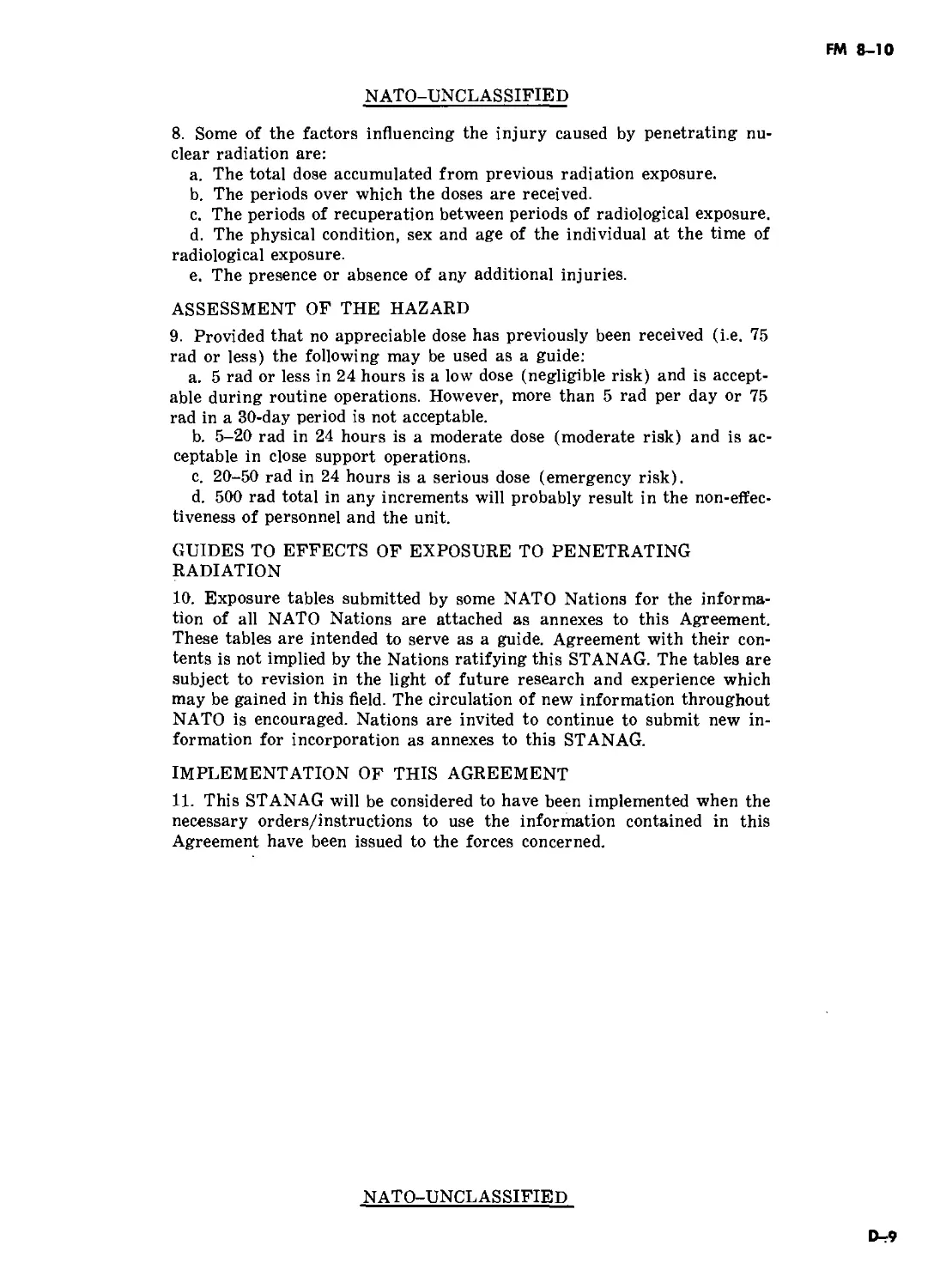

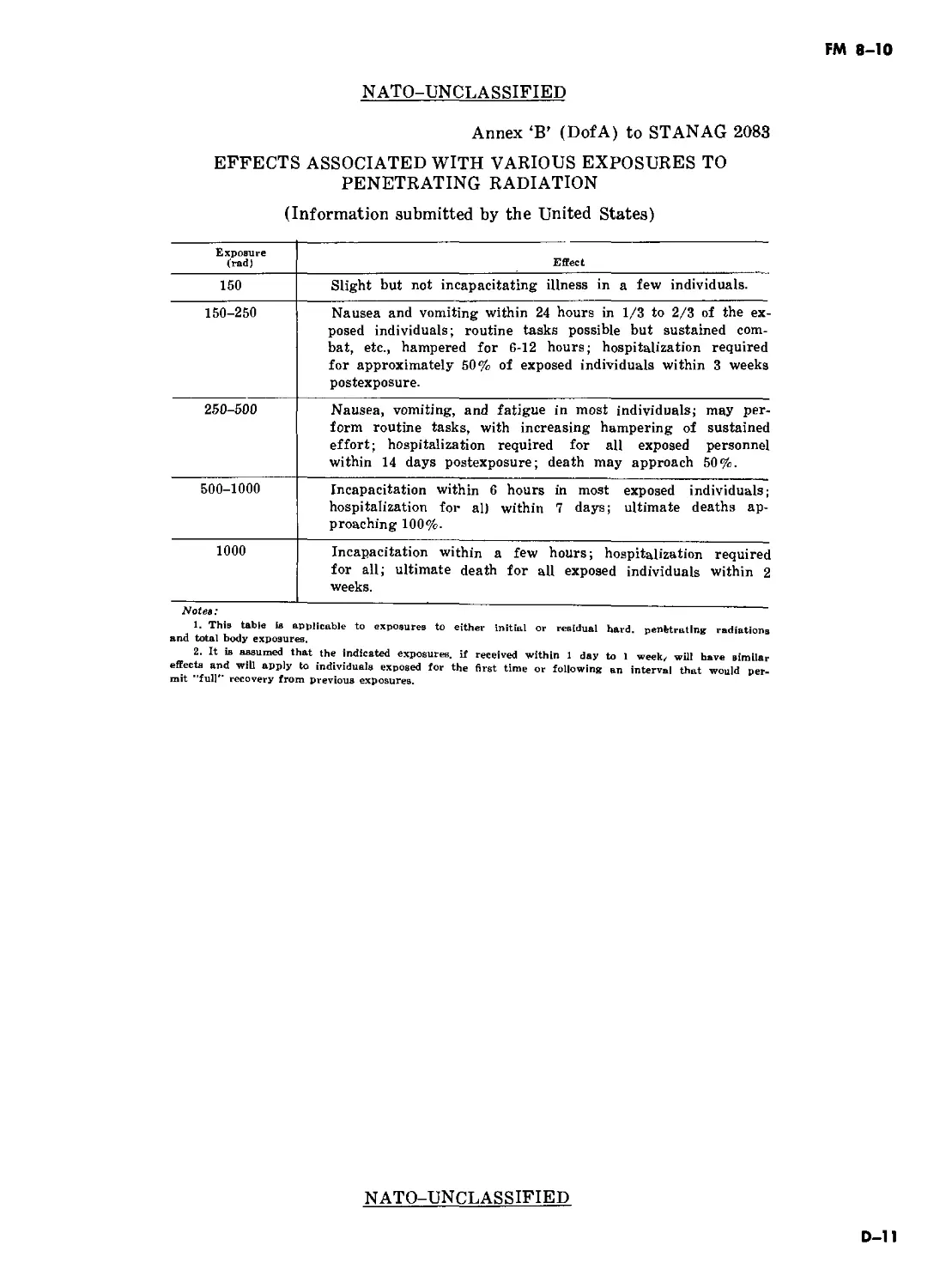


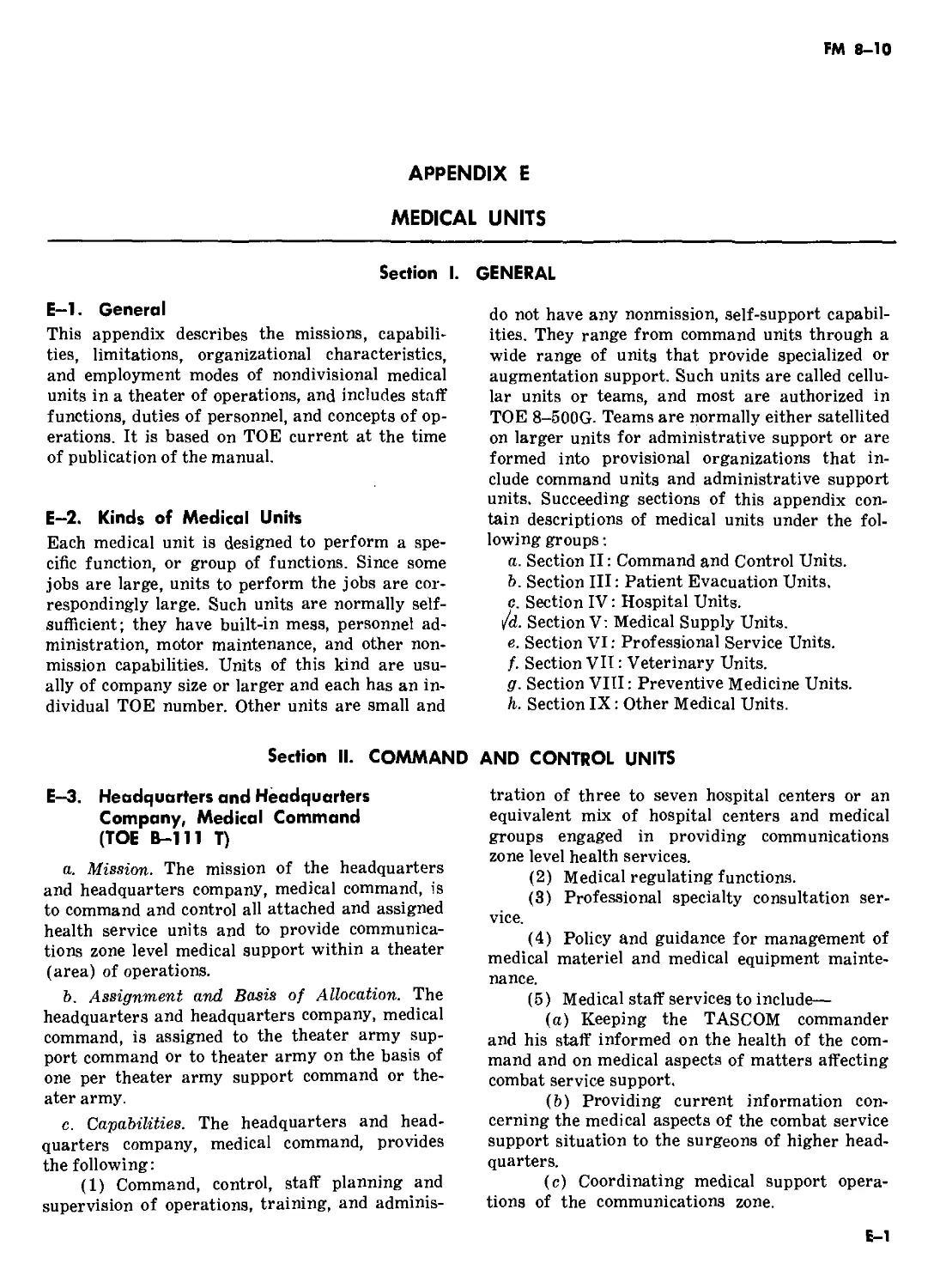

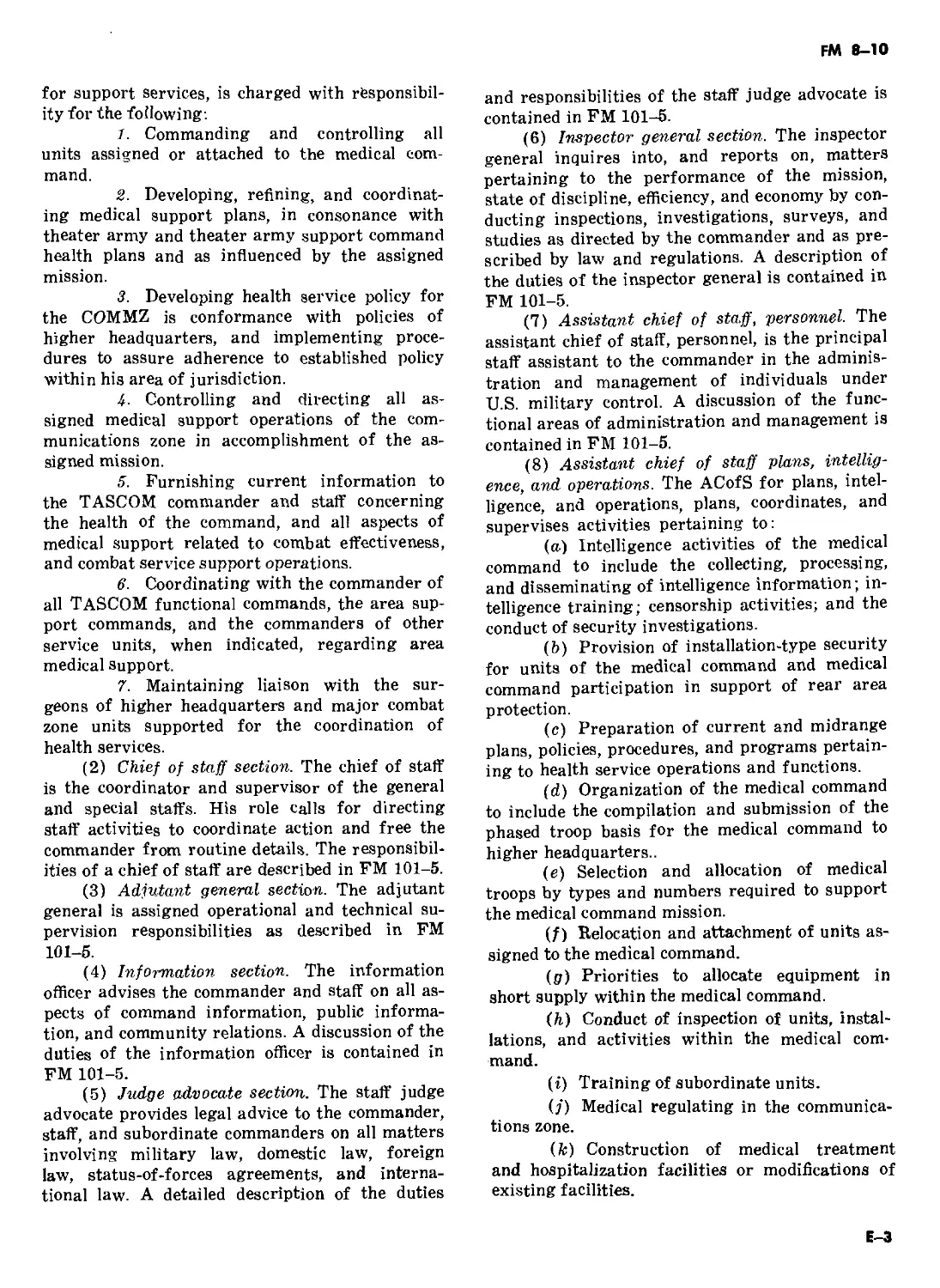


















Теги: military medicine field manual
Год: 1970

Текст
                    FM 8-10
DEPARTMENT OF THE ARMY FIELD MANDAL
MEDICAL SUPPORT
THEATER OF OPERATIONS
HEADQUARTERS, DEPARTMENT OF THE ARMY
APRIL 1970
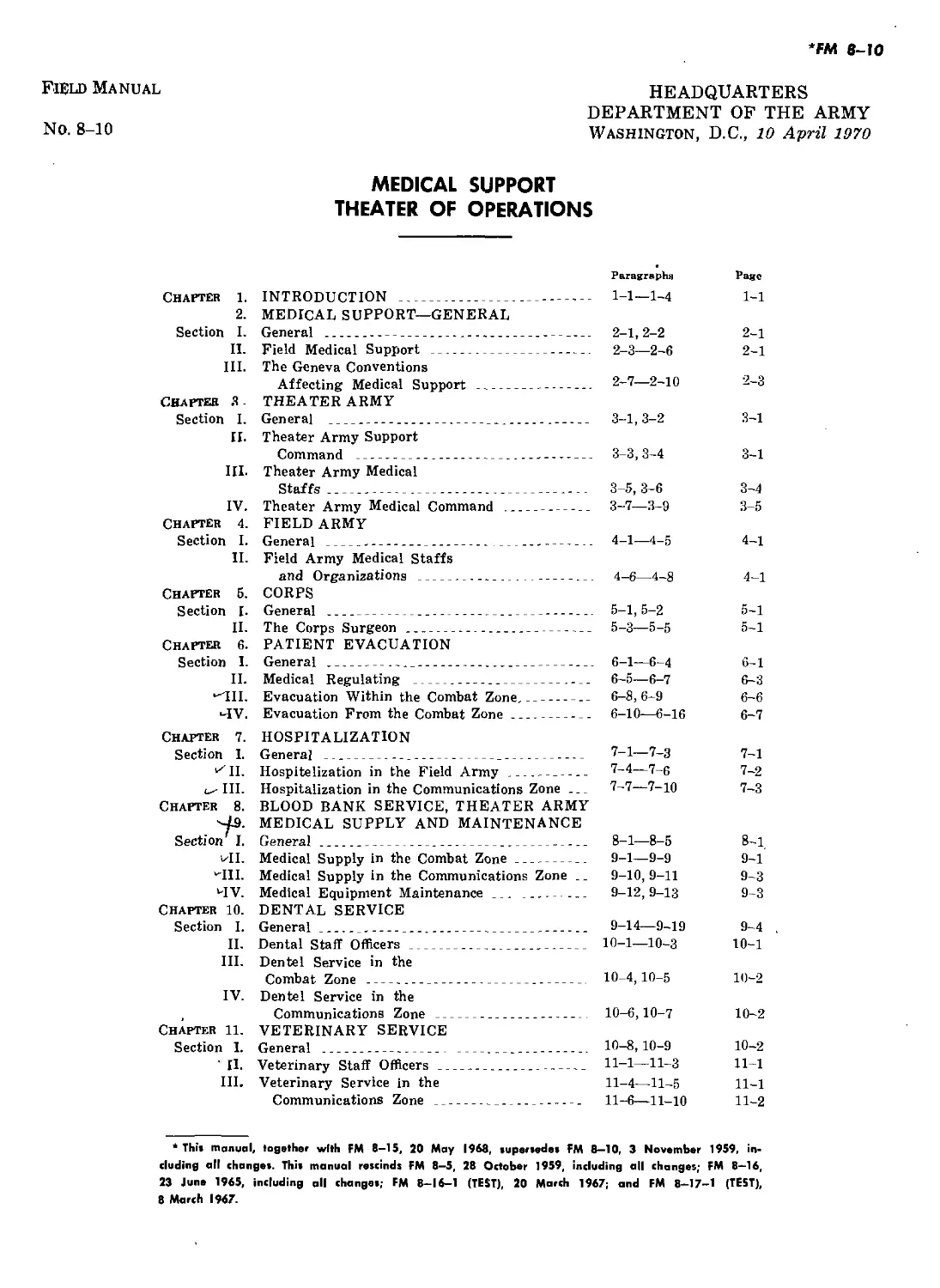
*FM в-10
Field Manual
No. 8-10
HEADQUARTERS
DEPARTMENT OF THE ARMY
Washington, D.C., 10 April 1970
MEDICAL SUPPORT
THEATER OF OPERATIONS
	Paragraphs	Page
Chapter 1. INTRODUCTION 				1-1—1-4	1-1
2. MEDICAL SUPPORT—GENERAL Section I. General 						2-1, 2-2	2-1
II. Field Medical Support 			2-3—2-6	2-1
III. The Geneva Conventions Affecting Medical Support 		2-7—2-10	2-3
Chapter Я - THEATER ARMY Section I. General 			3-1, 3-2	3-1
II. Theater Army Support Command 		3-3,3-4	3-1
III. Theater Army Medical Staffs 		3-5, 3-6	3-4
IV. Theater Army Medical Command 		..	3-7—3-9	3-5
Chapter 4. FIELD ARMY Section I. General 			4-1—4-5	4-1
II. Field Army Medical Staffs and Organizations 		 _.			4—6—4-8	4-1
Chapter 5. CORPS Section I. General 		5-1, 5-2	5-1
II. The Corps Surgeon 			5-3—5-5	5-1
Chapter 6. PATIENT EVACUATION Section I. General 			6-1—6-4	6-1
II. Medical Regulating 			6-5—6-7	6—3
‘"'III. Evacuation Within the Combat Zone		__	6-8, 6-9	6-6
4V. Evacuation From the Combat Zone		. _	6-10—6-16	6-7
Chapter 7. HOSPITALIZATION Section I. General 		.				7-1—7-3	7-1
’ZII. Hospitelization in the Field Army			7-4—7-6	7-2
III. Hospitalization in the Communications Zone —	7-7—7-10	7-3
Chapter 8. BLOOD BANK SERVICE, THEATER ARMY ^19. MEDICAL SUPPLY AND MAINTENANCE Section I. General		8-1—8-5	8-1
vll. Medical Supply in the Combat Zone			9-1—9-9	9-1
’"III. Medical Supply in the Communications Zone . _	9-10, 9-11	9-3
4V. Medical Equipment Maintenance			9-12,9-13	9-3
Chapter 10. DENTAL SERVICE Section I. General					9-14—9-19	9-4
II. Dental Staff Officers		10-1—10-3	10-1
III. Dentel Service in the Combat Zone 					10-4,10-5	10-2
IV. Dentel Service in the ,	Communications Zone 		10-6,10-7	10-2
Chapter 11. VETERINARY SERVICE Section I. General 	 				10-8, 10-9	10-2
[I. Veterinary Staff Officers 			11-1—11-3	11-1
III, Veterinary Service in the	11-4—11-5	11-1
Communications Zone 					.	11-6—11-10	11-2
* Thit manual, together with FM 8—15, 20 May
eluding all change*. This manual rescinds FM 8-5,
23 June 1965, including all changes; FM 8—16—1
8 March 1967.
1968, supersedes FM 8—10, 3 November 1959, in-
28 October 1959, including all changes; FM 8—16,
(TEST), 20 March 1967; and FM 8-17-1 (TEST),
FM 8-10
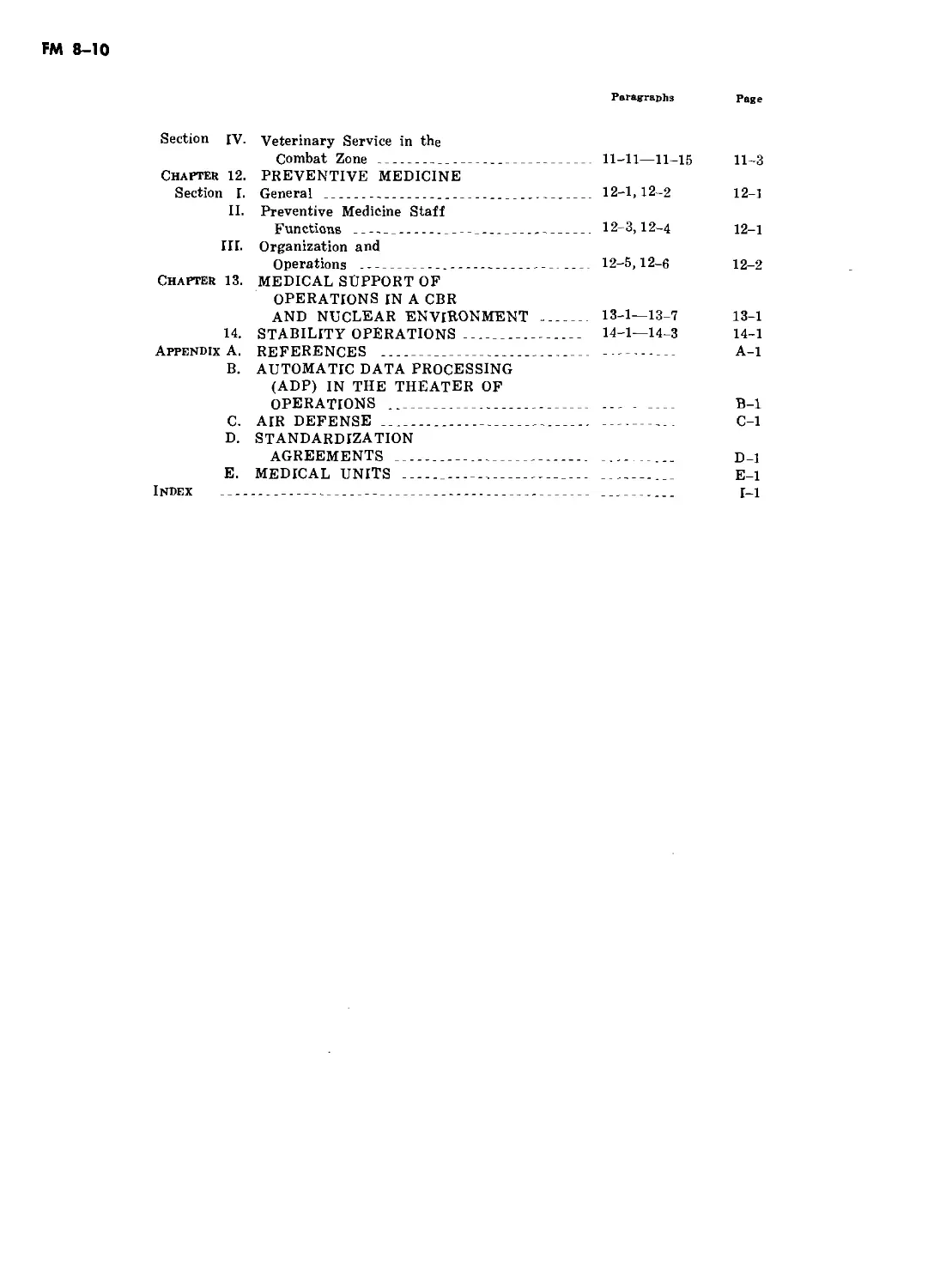
Paragraphs	Page
Section [V. Veterinary Service in the
Combat Zone ____________________________________ 11-11—11-15	11-3
Chapter 12. PREVENTIVE MEDICINE
Section I. General __________________________ 12-1, 12-2	12-1
II. Preventive Medicine Staff
Functions __ —  ___________________ 12-3,12-4	12—1
III. Organization and
Operations  _______________________ 12-5,12-6	12-2
Chapter 13. MEDICAL SUPPORT OF
OPERATIONS IN A CBR
AND NUCLEAR ENVIRONMENT ___________ 13-1- 13 7	13-1
14. STABILITY OPERATIONS________________ 11-1- 14 3	14-1
Appendix A. REFERENCES _________________________ ______... A-l
B.	AUTOMATIC DATA PROCESSING
(ADP) IN THE THEATER OF
OPERATIONS ..__________________________ ... . ___ B-l
C.	AIR DEFENSE _________________________ ______...	C-l
D.	STANDARDIZATION
AGREEMENTS ________________________ ______...	D-l
E.	MEDICAL UNITS ______________________ _______.	E-l
Index ____________._____________________________ ________ [-1
FM 8-10
CHAPTER 1
INTRODUCTION
1-1. Purpose and Scope
a.	This manual prescribes doctrine for use by
Army Medical Department unit commanders and
staffs in providing medical support to the army in
the field, and to familiarize others with the medi-
cal support system.
b.	The organization, mission, capabilities, and
concepts of operation are described in broad
terms. Unit and division level medical support, as
well as medical support in stability operations,
and the impact of nuclear, biological, and chemi-
cal operations, thoroughly covered in other man-
uals, are discussed briefly in order to supplement
doctrine common to all areas of operation.
e.	This manual is in accordance with the fol-
lowing International Standardization Agree-
ments (STANAG) which are identified by type of
agreement and number at the beginning of each
appropriate chapter and are contained in appen-
dix D:
Title	NA TO CENTO SEA TO A BCA
STANAG STANAG SEASTAG SOLOG
Patient Evacuation
Tag 			2051		2051	81
Procedures for Disposition by Medical Installations of Allied Patients 		2061	2061	2061	66
Patient Reporting by Medical Treatment Facilities 			2075	2075	2075	74
Radiological Hazards - -	2083					128
Medical Employment of Helicopters in Ground Warfare 		2087	2087	2087
Medical and Dental Supply Procedures _ 		2128
1—2. Application
This manual is applicable to—
a.	General war, to include consideration for the
employment of, and protection from, nuclear, bi-
ological, and chemical munitions and operations
in chemical, biological, and radiological (CBR)
environments.
b.	Limited war.
e. Cold war, to include stability operations.
1-3. Explanation of Terms
Terms and abbreviations used in this manual are
in consonance with those contained in AR 310-25,
AR 310-50, and JCS Pub 1. Key terms, not incor-
porated in above references but applicable specif-
ically to medical activities, are explained below.
a.	Area Medical Support. This concept of medi-
cal support involves the delineation of support re-
sponsibility by geographical area. It includes the
provision of unit level medical support to organi-
zations that do not possess an organic medical ca-
pability. Medical units required for this support
are allocated based upon troop strength, and are
established where and when requirements indi-
cate.
b.	Aeromedical Evacuation. Aeromedical eva-
cuation is the movement of patients to and be-
tween medical treatment facilities by aerial vehi-
cles that are specially crewed and equipped to ac-
commodate patients and to provide required in-
flight medical care.
c.	Dental Service. Dental service includes those
health services which promote, improve, con-
serve, or restore the physical well-being of dental
patients.
d.	Health Services. The term “health services,”
as used in this manual, includes all services per-
formed, provided, or arranged for, by the Army
Medical Department, which promote, improve,
conserve, or restore the mental or physical well-
being of personnel in the Army and, as directed,
in other services, agencies, and organizations.
They include, but are not limited to, the manage-
ment of health services resources, e.g., man-
power, monies, and facilities; preventive and cur-
ative health measures; the health services doc-
trine; transportation of the sick and injured and
wounded; selection of the medically fit and dispo-
sition of the medically unfit; medical supply and
equipment and maintenance thereof; and medical,
dental, veterinary, laboratory, and optometric
services.
e.	Medical Service. The Army Medical Service
(AMEDS) has been redesignated as the Army
Medica] Department (AMEDD). Therefore, in
this manual, the term “medical service” is used to
differentiate between specific branches within the
AMEDD (i.e., medical service, dental service, vet-
erinary service), and as a title of the subdivision
1-1
FM 8-10
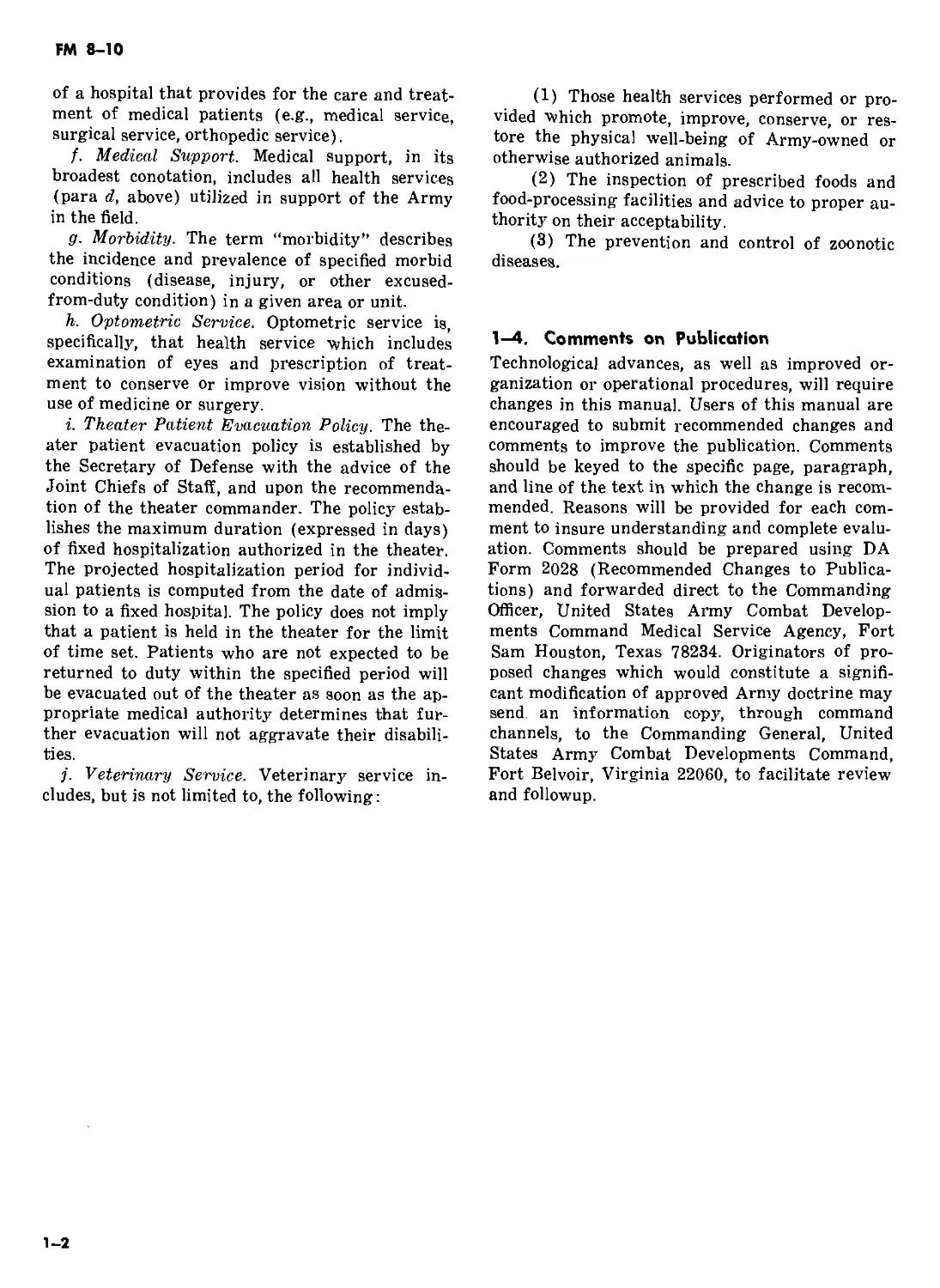
of a hospital that provides for the care and treat-
ment of medical patients (e,g,, medical service,
surgical service, orthopedic service).
f.	Medical Support. Medical support, in its
broadest conotation, includes all health services
(para d, above) utilized in support of the Army
in the field.
g.	Morbidity. The term “morbidity” describes
the incidence and prevalence of specified morbid
conditions (disease, injury, or other excused-
from-duty condition) in a given area or unit,
h.	Optometric Service. Optometric service is,
specifically, that health service which includes
examination of eyes and prescription of treat-
ment to conserve or improve vision without the
use of medicine or surgery.
i.	Theater Patient Evacuation Policy. The the-
ater patient evacuation policy is established by
the Secretary of Defense with the advice of the
Joint Chiefs of Staff, and upon the recommenda-
tion of the theater commander. The policy estab-
lishes the maximum duration (expressed in days)
of fixed hospitalization authorized in the theater.
The projected hospitalization period for individ-
ual patients is computed from the date of admis-
sion to a fixed hospital. The policy does not imply
that a patient is held in the theater for the limit
of time set. Patients who are not expected to be
returned to duty within the specified period will
be evacuated out of the theater as soon as the ap-
propriate medical authority determines that fur-
ther evacuation will not aggravate their disabili-
ties.
j.	Veterinary Service. Veterinary service in-
cludes, but is not limited to, the following:
(1)	Those health services performed or pro-
vided which promote, improve, conserve, or res-
tore the physical well-being of Army-owned or
otherwise authorized animals,
(2)	The inspection of prescribed foods and
food-processing facilities and advice to proper au-
thority on their acceptability.
(3)	The prevention and control of zoonotic
diseases.
1—4. Comments on Publication
Technological advances, as well as improved or-
ganization or operational procedures, will require
changes in this manual. Users of this manual are
encouraged to submit recommended changes and
comments to improve the publication. Comments
should be keyed to the specific page, paragraph,
and line of the text in which the change is recom-
mended. Reasons will be provided for each com-
ment to insure understanding and complete evalu-
ation. Comments should be prepared using DA
Form 2028 (Recommended Changes to Publica-
tions) and forwarded direct to the Commanding
Officer, United States Army Combat Develop-
ments Command Medical Service Agency, Fort
Sam Houston, Texas 78234. Originators of pro-
posed changes which would constitute a signifi-
cant modification of approved Army doctrine may
send, an information copy, through command
channels, to the Commanding General, United
States Army Combat Developments Command,
Fort Belvoir, Virginia 22060, to facilitate review
and followup.
1-2
FM 8-10
CHAPTER 2
MEDICAL SUPPORT - GENERAL
(NATO STANAG 2087; CENTO STANAG 2087; SEATO SEASTAG 2087)
Section I.
2-1. Introduction
The Army Medical Department supports all ele-
ments of the Army and is primarily concerned
with maintaining the health and fighting
efficiency of the individual soldier. The mission of
the Army Medical Department in a theater of op-
erations is to conserve the fighting strength of
the Army by recommending, supervising, and im-
plementing measures for safeguarding the health
of the troops through effective medical care and
treatment, rapid and orderly evacuation of the
sick and wounded, and early return of patients to
GENERAL
duty. The medical support system is a single, in-
tegrated system that reaches from the area of op-
erations to the Zone of Interior (ZI).
2—2. Characteristics
Medical support is continuing and interzonal. Ef-
ficiency of operations depends on the effective dis-
tribution of patients to those medical facilities
that are capable of providing the required treat-
ment in the shortest possible time. Patients must
be regulated and evacuated without regard to lat-
eral or rear boundaries.
Section II.	FIELD MEDICAL SUPPORT
2-3. Mission
Medical support for the army in the field is pro-
vided by Army Medical Department units or ele-
ments. The mission of the Medical Department is
to conserve manpower by planning, recommend-
ing, and supervising measures necessary for safe-
guarding the health of troops and for providing
treatment and rapid evacuation of the sick and
injured.
2—4. Functions
The general functions of the Army Medical De-
partment are treatment; evacuation; hospitaliza-
tion; preventive medicine; medical supply and
maintenance; dental, veterinary, laboratory, and
optometric services; and command and control of
medical units. In addition, medical assistance to
civilians is provided within the limits of available
resources.
2-5. Principles of Patient Care and Treatment
Medical care and treatment is based upon funda-
mental principles as follows:
a.	Continuity. Health services must be contin-
uous. Interruption of treatment results in in-
creased morbidity and mortality. Once begun,
treatment does not terminate until the patient
has been returned to duty or discharged from the
service. Army medical support is organized into
levels—unit, division, field army, communications
zone CCOMMZ), and Zone of Interior. Procedures
should be standardized to assure accomplishment
of essential treatment and other functions appro-
priate in all levels.
(1)	The hospitalization-evacuation system is
based on the doctrine that subordinate elements
are supported by the next higher echelon. Medi-
cal units are not normally required to evacuate
patients beyond their rearmost medical facility.
(2)	No patient is evacuated further to the
rear than his physical condition warrants or the
military situation requires. The evacuation policy
of the command designates a maximum period of
time during which patients may be retained for
treatment within the command prior to being re-
turned to duty. Patients who will require treat-
ment for longer periods of time are evacuated to
the next level of medical support as soon as prac-
ticable.
(3)	The medical support plan must be sim-
ple, particularly in the combat area. Facilities
must not be immobilized by instituting long and
complicated procedures. Except for minor in-
juries or illnesses that can be treated with minor
2-1
FM 8-10
surgery or available medicines, treatment in for-
ward areas is Jimi ted to those emergency measures
which preserve Jife and Jimb and prepare the pa-
tient for further evacuation or return to duty.
b.	Control. ControJ of medical support re-
sources must rest with the medical staff officer or
commander having responsibility for providing
health services within the command.
(1)	If medical support units are to respond
to the commander’s plans in a timely manner, the
surgeon responsible for direction of the support
must influence the operations of medical units.
For this reason, medical units are not attached if
their mission can be accomplished by placing
them in support.
(2)	Since the objective of military medicine
is to conserve trained manpower, medical re-
sources must be employed to do the most good for
the greatest number. When a wide disparity ex-
ists between requirements and available means, it
may be necessary to favor those patients who can
be returned to immediate duty, rather than those
more seriously injured.
(3)	The treatment to be performed at each
level of support must be commensurate with the
available resources at each level. Since medical
resources are limited, it is essential that control
of these resources be retained at the highest med-
ical level consistent with the tactical situation.
c.	Proximity. The medical means must be as
close to casualties as time/distance factors and
the tactical situation permits. Early collection,
sorting, and treatment of patients must be pro-
vided.
(1)	The speed with which medical treat-
ment can be initiated is extremely important in
reducing morbidity and mortality. When plan-
ning support of a tactical operation, the medical
planner is confronted with two alternatives. He
must either move the patient to a medical treat-
ment facility, or move the medical facility to the
patient. Two factors will govern the choice—the
military situation, and the condition of the pa-
tient. The medical facility must be located as far
forward as possible so as not to unnecessarily jeo-
pardize the patient’s chances for normal recovery
and survival; yet, it must be located far enough
to the rear not to interfere with combat opera-
tions or be subjected to enemy interferences.
Thus, a location which provides close medical sup-
port where helicopters are used is quite different
from that required when evacuation is provided
by Jitterbearers operating over difficult terrain.
(2)	Normally, the best solution will be a
combination of the two alternatives. In forward
areas, medical support is provided by locating
medical treatment facilities as far forward as
possible, moving as necessary to maintain con-
tact, and by rapid evacuation of patients. When
evacuation time exceeds that period considered
necessary to hold morbidity and mortality to a
minimum, the medical treatment facility must be
moved closer to the patient, or faster, more
efficient evacuation provided. In either case, pa-
tients and treatment facility must be brought to-
gether as promptly as possible.
d.	Flexibility. Medical support must be flexible.
Changes in tactical plans or operations may re-
quire redistribution of medical resources. The
medical commander must be able to shift medical
resources to meet the changing requirements. Al-
ternate plans and plans for a medical reserve are
essential. No more medical troops should be com-
mitted nor medical facilities established than are
required.
e.	Mobility. Contact with supported units must
be maintained; therefore, medical units must
have mobility comparable to that of the units
they support.
(1)	The mobility of a unit is measured by
the extent to which it can move its personnel and
equipment with organic transportation.
(2)	Once entirely committed, the mobility of
a medical unit can be regained only by the
prompt evacuation of patients. When the mobility
of a medical unit is jeopardized by the accumula-
tion of patients, it may be necessary to leave a
holding detachment with patients while the main
part of the medical facility is moved.
f.	Conformity. Conformity with the tactical
plan is one of the most fundamental elements in
the provision of field medical support. It is only
by analyzing the commander’s plan of operation
that the medical planner can determine the medi-
cal support requirements. Plans should provide
adequate medical support at the right place at the
right time.
2-6. Organizational Levels of Medical
Support in a Theater of Operations
Health services in a theater of operations for
support of combat, combat support, and combat
service support units are organized into four or-
ganizational levels extending rearward in an inte-
grated and continuous system to the Zone of In-
terior.
a. Unit level. Unit level medical support in-
cludes preventive medicine activities, acquisition
of the sick and wounded, emergency medical
treatment (EMT), and evacuation from the point
2-2
FM 8-10
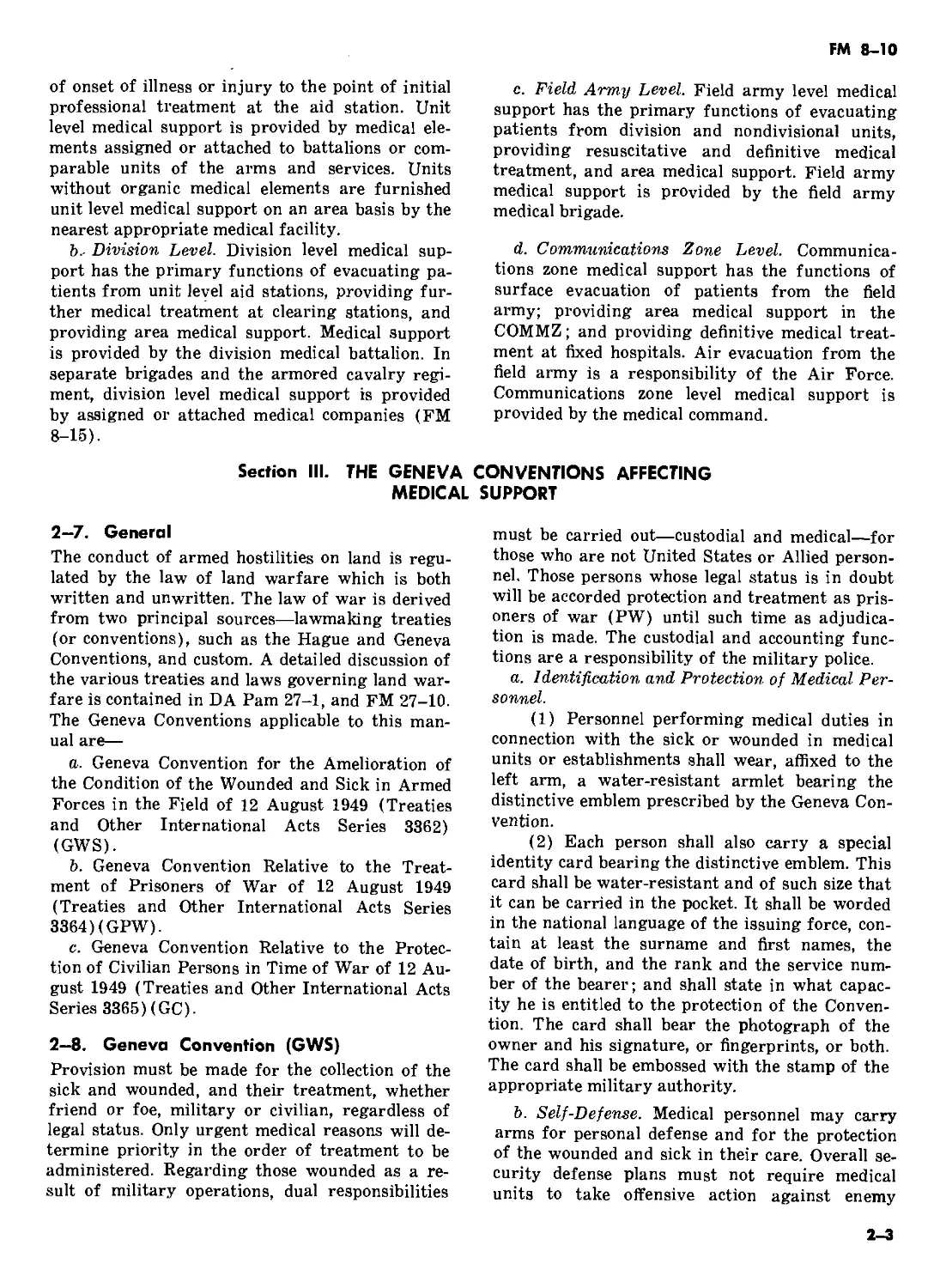
of onset of illness or injury to the point of initial
professional treatment at the aid station. Unit
level medical support is provided by medical ele-
ments assigned or attached to battalions or com-
parable units of the arms and services. Units
without organic medical elements are furnished
unit level medical support on an area basis by the
nearest appropriate medical facility.
b- Division Level. Division level medical sup-
port has the primary functions of evacuating pa-
tients from unit level aid stations, providing fur-
ther medical treatment at clearing stations, and
providing area medical support. Medical support
is provided by the division medical battalion. In
separate brigades and the armored cavalry regi-
ment, division level medical support is provided
by assigned or attached medical companies (FM
8-15).
Section III. THE GENEVA
MEDICAL
2—7. General
The conduct of armed hostilities on land is regu-
lated by the law of land warfare which is both
written and unwritten. The law of war is derived
from two principal sources—lawmaking treaties
(or conventions), such as the Hague and Geneva
Conventions, and custom. A detailed discussion of
the various treaties and laws governing land war-
fare is contained in DA Pam 27-1, and FM 27-10.
The Geneva Conventions applicable to this man-
ual are—
a.	Geneva Convention for the Amelioration of
the Condition of the Wounded and Sick in Armed
Forces in the Field of 12 August 1949 (Treaties
and Other International Acts Series 3362)
(GWS).
b.	Geneva Convention Relative to the Treat-
ment of Prisoners of War of 12 August 1949
(Treaties and Other International Acts Series
3364)(GPW).
c.	Geneva Convention Relative to the Protec-
tion of Civilian Persons in Time of War of 12 Au-
gust 1949 (Treaties and Other International Acts
Series 3365) (GC).
2—8. Geneva Convention (GWS)
Provision must be made for the collection of the
sick and wounded, and their treatment, whether
friend or foe, military or civilian, regardless of
legal status. Only urgent medical reasons will de-
termine priority in the order of treatment to be
administered. Regarding those wounded as a re-
sult of military operations, dual responsibilities
c. Field Army Level. Field army level medical
support has the primary functions of evacuating
patients from division and nondivisional units,
providing resuscitative and definitive medical
treatment, and area medical support. Field army
medical support is provided by the field army
medical brigade.
d. Communications Zone Level. Communica-
tions zone medical support has the functions of
surface evacuation of patients from the field
army; providing area medical support in the
COMMZ; and providing definitive medical treat-
ment at fixed hospitals. Air evacuation from the
field army is a responsibility of the Air Force.
Communications zone level medical support is
provided by the medical command.
CONVENTIONS AFFECTING
SUPPORT
must be carried out—custodial and medical—for
those who are not United States or Allied person-
nel. Those persons whose legal status is in doubt
will be accorded protection and treatment as pris-
oners of war (PW) until such time as adjudica-
tion is made. The custodial and accounting func-
tions are a responsibility of the military police.
a.	Identification and Protection of Medical Per-
sonnel.
(1)	Personnel performing medical duties in
connection with the sick or wounded in medical
units or establishments shall wear, affixed to the
left arm, a water-resistant armlet bearing the
distinctive emblem prescribed by the Geneva Con-
vention.
(2)	Each person shall also carry a special
identity card bearing the distinctive emblem. This
card shall be water-resistant and of such size that
it can be carried in the pocket. It shall be worded
in the national language of the issuing force, con-
tain at least the surname and first names, the
date of birth, and the rank and the service num-
ber of the bearer; and shall state in what capac-
ity he is entitled to the protection of the Conven-
tion. The card shall bear the photograph of the
owner and his signature, or fingerprints, or both.
The card shall be embossed with the stamp of the
appropriate military authority.
b.	Self-Defense. Medical personnel may carry
arms for personal defense and for the protection
of the wounded and sick in their care. Overall se-
curity defense plans must not require medical
units to take offensive action against enemy
2-3
FM 8-10
troops. Medical personnel are permitted to fire on
enemy troops only when they or their patients
are under attack; but if they use arms in viola-
tion of the laws of war, they are subject to pen-
alties related thereto and, provided they have
been given due warning to cease such acts, may
also forfeit the protection of their unit or the
unit they are supporting.
c.	Marking.
(1)	Medical units and establishments. The
distinctive flag of the Convention shall be hoisted
only over such medical units and establishments
as are entitled to be respected under the Conven-
tion, and only with the consent of the military
authorities. Marking of facilities and the use of
camouflage are incompatible and should not be
attempted concurrently. Use of the red cross is
authorized; however, the tactical commander
may not want such distinctive markings dis-
played in his area.
(2)	Ambulances,
(a)	Medical vehicles (ambulances) exclu-
sively employed for the removal of wounded and
sick or for the transport of medical personnel
and equipment shall not be attacked. Ambulances
will not be used to transport nonmedical troops
or materiel not required for the medical mission.
(b)	Air and ground ambulances will be
marked with the distinctive emblem as prescribed
in the Convention.
2—9. Geneva Convention (GPW)
The Army is responsible for prisoners of war
from the moment of capture. Below brigade level,
PW are handled by combat troops who bring
them to brigade collecting points. Sick, injured,
or wounded prisoners are treated and evacuated
through normal medical channels but are physi-
cally segregated from United States and Allied
patients. Guards are provided from other than
Medical Department personnel resources.
a.	Prisoner-of-war patients will be evacuated
from the combat zone as soon as possible. Only
those sick or wounded prisoners who would run a
greater health risk by being immediately evacu-
ated may be kept temporarily in the combat zone.
b.	When intelligence sources indicate that
large numbers of PW may result from an opera-
tion, medical units may require reinforcement to
support the PW patient workload. Procedures for
estimating the medical workload involved in the
treatment and care of enemy PW patients is de-
scribed in FM 8-55.
2—10. Geneva Convention (GC)
Civilians wounded or sick as a result of military
operations will be provided medical treatment
and, when followup treatment is required, trans-
ferred to a civil medical facility. All those
wounded and sick as a result of an armed conflict
will be collected and cared for. Each military po-
lice and medical element exercises its responsibil-
ities in the custody and treatment of captured or
detained personnel.
FM 8-10
CHAPTER 3
THEATER ARMY
Section I.
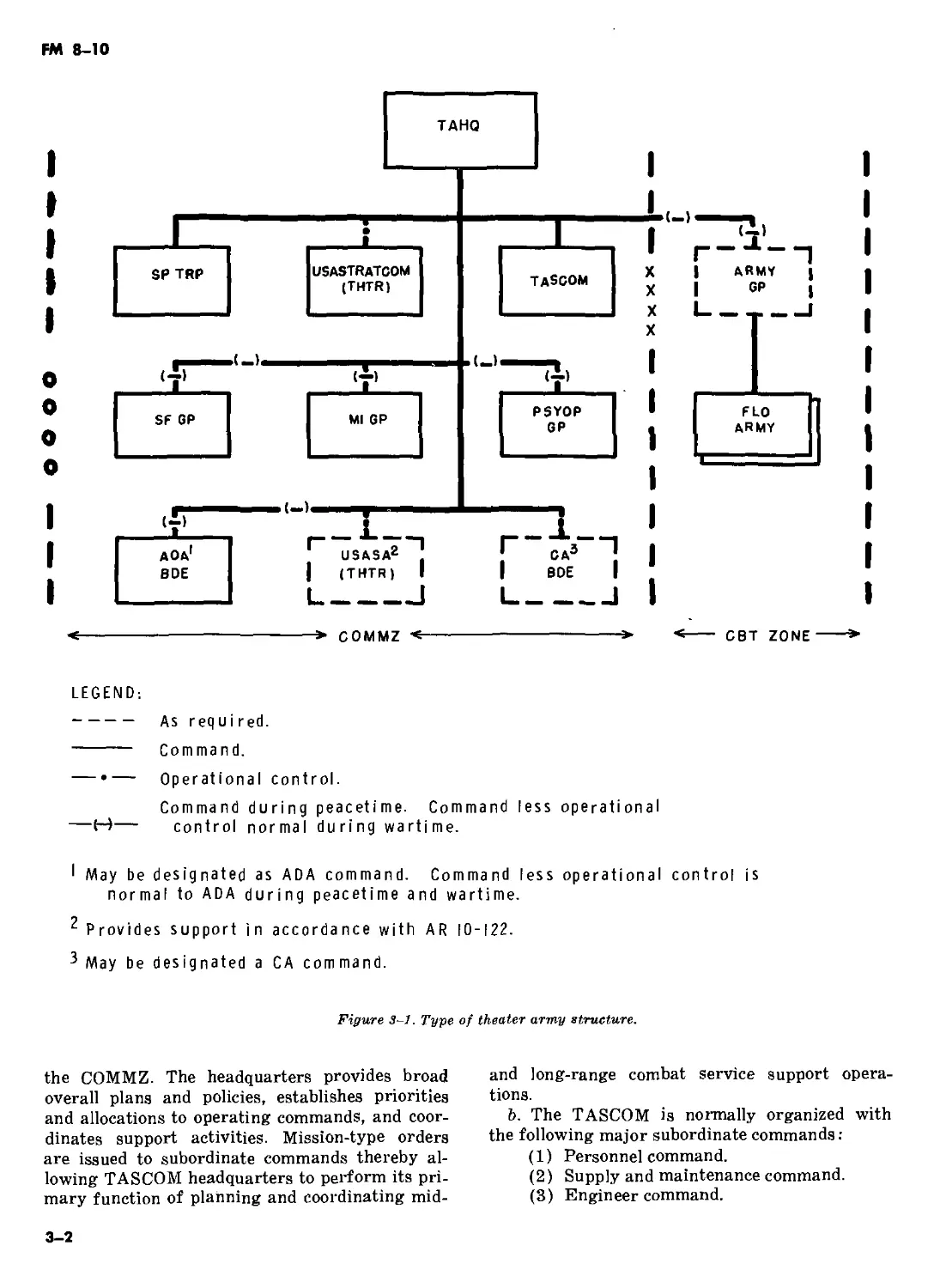
3-1. General
a.	United States Forces assigned to a theater
or area of operations may range from relatively
small task forces to a full array of large land,
sea, and air forces. The U.S. Army element in the
force structure may vary from a division or less
to one or more Aimy groups with the necessary
combat, combat support, and combat service sup-
port units. Normally, the theater army is orga-
nized into a theater army headquarters, a theater
army support command (TASCOM), one or more
field armies and other commands as indicated in
figure 3-1. In each case the command and organi-
zational structure will depend upon the size of
the force and the extent of participation by other
services and Allied Forces.
b.	The overall control of combat service sup-
port operations is retained at theater army level
to assure uniformity of the support effort within
the combat and communications zones. Control is
maintained through promulgation of appropriate
policies, broad planning and program guidance,
allocations, and priorities for achieving the the-
ater army mission. The theater army commander
is responsible for all Army elements in the the-
ater and for health services within the command.
A detailed description of the theater army is pro-
vided in FM 100-15.
3-2. Organization of a Theater of
Operations
a.	The President, through the Secretary of De-
fense, establishes the geographic limits of a the-
ater of operations (FM 100-10). That portion of
a theater of operations required for ground force
operations is normally divided into a combat zone
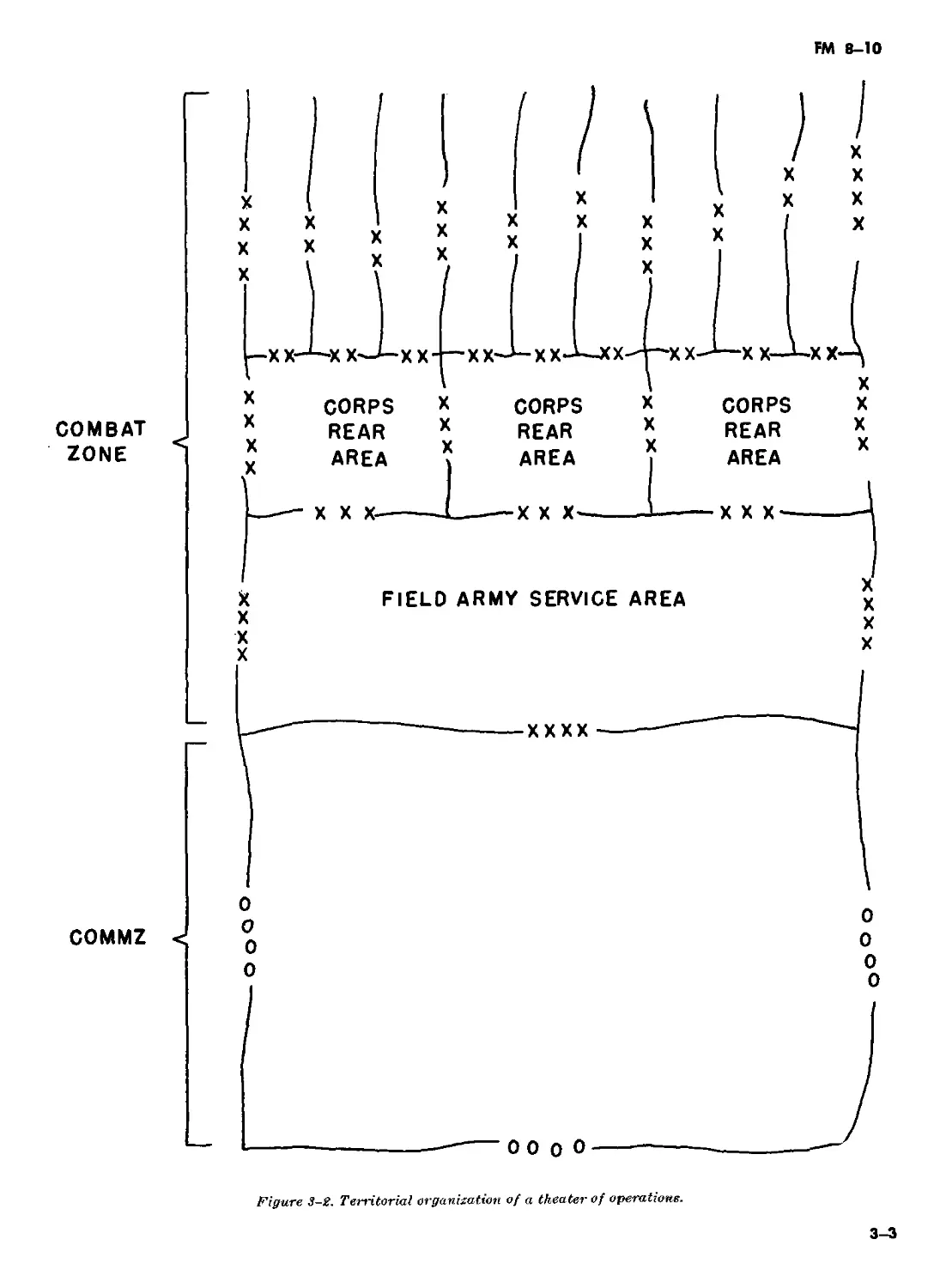
and a communications zone (fig 3-2).
(1)	Combat zone. The combat zone is that
GENERAL
part of the theater of operations that combat
forces require for operations. The combat zone in-
cludes the ground, air, and sea areas within
which the commander can influence the progress
or outcome of operations directly by maneuvering
his ground-gaining elements or delivering fire-
power with the fire support systems under his
control or command. Its size depends on the mis-
sion, organization, and equipment of the force in-
volved and the nature of the country. For tactical
control, the combat zone may be divided into
army group, field army, corps, and division areas.
The theater commander designates the rear
boundary of the combat zone; the boundary
changes as the field armies move forward.
(2)	Commzinications zone. The COMMZ is
the rear part of a theater of operations (behind
and normally contiguous to the combat zone) that
contains the lines of communications, establish-
ments for supply and evacuation, and other agen-
cies required for the immediate combat service
support of the field forces. The COMMZ includes
sufficient area for the operation of supply, eva-
cuation, transportation, and combat service sup-
port installations and for their defense. The
COMMZ also includes any area necessary for the
operation or support of Navy or Air Force ele-
ments based outside the combat zone. The rear
boundary of the COMMZ is normally the rear
boundary of the theater as designated by proper
authority. Area responsibility for the COMMZ
normally is delegated to headquarters, theater
army support command.
b.	Territorial organization of a theater of op-
erations varies with the type of theater, the type
of forces in a theater, and the nature of the oper-
ations planned. FM 100-10 provides a more com-
plete discussion of the territorial COMMZ.
Section IL THEATER ARMY SUPPORT COMMAND
3-3. General
a. The theater army support command prov-
ides combat service support in the COMMZ to
Army forces and to other designated forces. Sup-
port provided includes general support to the field
army, direct and general support in the COMMZ,
and rear area protection (RAP) responsibility
and participation in stability operations within
3-1
FM 8-10
I
I
I
I
I
0
0
0
0
I
I
I
* COMMZ <-
CBT
ZONE
LEGEND;
------ As required.
------ Command.
— •— Operational control.
Command during peacetime. Command less operational
—H—	control normal during wartime.
' May be designated as ADA command. Command less operational control is
normal to ADA during peacetime and wartime.
Provides support in accordance with AR 10-122.
3 May be designated a CA command.
Figure 3~1. Type of theater army structure.
the COMMZ. The headquarters provides broad
overall plans and policies, establishes priorities
and allocations to operating commands, and coor-
dinates support activities. Mission-type orders
are issued to subordinate commands thereby al-
lowing TASCOM headquarters to perform its pri-
mary function of planning and coordinating mid-
and long-range combat service support opera-
tions.
b.	The TASCOM is normally organized with
the following major subordinate commands:
(1)	Personnel command.
(2)	Supply and maintenance command.
(3)	Engineer command.
3-2
FM 8-10
I
COMBAT
ZONE
COMMZ <
X
X
X
X
X
X
X
X
к
X
X
X
0
0
0
X
X
X
X
CORPS
REAR
AREA
XXX-
XX
X
X
X
CORPS
REAR
AREA
XXX*
X
X
X
CORPS
REAR
AREA
XXX-
X
X
X
FIELD ARMY SERVICE AREA
xxxx
Figure 3-2. Territorial organization of a theater of operations.
X
X
X
X
0
0
0
0
3-3
FM 8-10
(4)	Transportation command.
(5)	Medical command.
(6)	Area support command.
The first five of these major subordinate
commands provide combat service support to the
theater army and other forces and activities as
the TASCOM directs. The sixth subordinate com-
mand, the area support command, provides direct
support services (less medical and ammunition)
to the TASCOM, to units passing through or lo-
cated in the COMMZ, and to such other forces as
the TASCOM commander directs.
c.	The TASCOM commander's area of respon-
sibility includes the entire COMMZ. The TAS-
COM commander assigns the authority and area
responsibility for the COMMZ to the area sup-
port command commander. He further assigns
area responsibility to his subordinate area sup-
port group commanders. The TASCOM organiza-
tion is adaptable to any size theater. For exam-
ple, in a small theater, combat support groups
may constitute the TASCOM subordinate com-
mands. As the theater expands, the subordinate
commands enlarge; however, the basic organiza-
tion of the subordinate commands remains un-
changed. If the COMMZ is extremely large, the
TASCOM commander may provide for two area
support commands (forward and rear).
3—4. Theater Army Headquarters
Assumption of TASCOM Headquarters
Function
The theater army headquarters, in wartime, may
assume the TASCOM function of planning and
Section III. THEATER
3—5. Theater Army Surgeon
a.	Command \and Staff Relationships. The the-
ater army surgeon is a member of the special
staff of the theater army commander. He func-
tions under the general staff supervision of the
assistant chief of staff, Gl, personnel, with access
to the commander and all members of the staff
concerning medical matters.
b.	Functions, Duties, and Responsibilities. The
surgeon provides information and medical profes-
sional advice to the theater army commander and
to the general and special staff; and maintains
current data with regard to the condition, capa-
bilities, and requirements for the theater army
medical support. As the principal medical staff
officer of the theater army, he is responsible to
the commander for staff planning and coordinat-
3-4
coordinating combat service support within the
COMMZ. The theater army headquarters issues
mission orders to its major subordinate assigned
units and provides procedures and guidance for
establishment of appropriate channels of com-
munications between Department of the Army,
unified command headquarters, army group/field
army, and the major subordinate commands
within the COMMZ. The theater army headquart-
er’s assumption of direction of the combat service
support mission in the COMMZ does not influence
the established working relations for routine
combat service support operations. Direct and
continuous contact is maintained between appro-
priate major subordinate commands in COMMZ
(normally assigned to TASCOM headquarters)
and with the field army support command. TAS-
COM major subordinate commands are designed
to operate with minimum direction from a higher
headquarters. Staff functions for day-to-day com-
bat service support operations will be accom-
plished by the headquarters of the functionally-
oriented subordinate commands. In the absence of
the TASCOM headquarters, theater army general
staff elements manage by exception, using auto-
matic data processing (ADP) summary printout
reports. Provisions must be made for increased
activity in detailed planning and policy guidance,
specific quantity allocations, and increased coor-
dination with the supported forces. The theater
army general staff sections may require personnel
increases in those staff elements concerned with
combat service support operations, theater-army
wide, and with RAP operations within the
COMMZ.
MY MEDICAL STAFFS
ing the medical support of the theater army
forces as a whole. The theater army surgeon de-
velops policy and coordinates rather than con-
ducts operations. The surgeon—
(1)	Advises on the health services of the
command and the occupied or friendly territory
within the commander's area of responsibility.
(2)	Advises on the medical effects of the en-
vironment and of nuclear, biological, and chemi-
cal weapons on personnel, rations, and water.
(3)	Determines requirements for the requi-
sitioning, procurement, storage, maintenance, dis-
tribution, and documentation of medical, dental,
and veterinary equipment and supplies.
(4)	Determines requirements for medical
personnel and makes recommendations pertain-
ing to their assignment.
FM 8-10
(5)	Plans and coordinates medical training
in the command.
(6)	Submits to The Surgeon General appro-
priate recommendations on professional problems
requiring research and development.
(7)	Plans and coordinates the following
medical support operations:
(a)	The system of treatment and patient
evacuation, to include aeromedical evacuation by
Army medical air ambulance units and air move-
ment of patients by nonmedical Army evacuation
units.
(6)	Preventive medicine in the command
and, as required, in public health activities.
(c)	Professional medical support in sub-
ordinate units.
(d)	Veterinary food inspection service
and animal veterinary service of the command
and, as required, in civilian veterinary activities.
(e)	Preparation of reports on, and cus-
tody of, the medical and other hospital adminis-
trative records of injured, sick, and wounded per-
sonnel.
(/) Medical supply, maintenance, and re-
pair facilities.
(g)	Examination and processing of cap-
tured medical equipment and supplies of nonintel-
ligence interest and necessary inspection service
for captured animals and food supplies.
(h)	Technical inspection of medical ma-
teriel.
(i)	The equipment status reporting sys-
tem within his area of responsibility.
(7) Medical laboratory service.
(fc) Blood transfusion service.
(I) Blood bank service.
(m) Optical service.
(n) Medical civic action program.
c. Organization. The size and composition of
the theater army surgeon’s office vary in accord-
ance with the strength of the Army forces in the
theater, the nature of military operations to be
conducted, and the specific responsibilities as-
signed. The office may be divided into the follow-
ing divisions: administrative, historical, plans,
medical records and statistics, nursing, opera-
tions, personnel, professional services, preventive
medicine, supply, veterinary, dental, fiscal, and
management.
3-6. TASCOM Medical Staff
a.	Command and Staff Relationships. The
TASCOM staff does not include a surgeon; how-
ever, a medical branch is present as part of the
ACofS, personnel, section. (The medical com-
mand commander is also the TASCOM surgeon.)
The medical staff consists of a medical officer,
medical service plans officer, medical service staff
officer, and enlisted assistants. The medical officer
is authorized direct access to the TASCOM com-
mander and staff on medical matters of command
interest.
b.	Fzmctions, Duties, and Responsibilities. The
functions of the medical staff officer are to—
(1)	Advise the commander and staff on
health service matters.
(2)	Develop, prepare, and coordinate with
the medical command the health service portions
of TASCOM plans and policies.
(3)	Plan and recommend assignment of
medical support units to the medical command.
(4)	Plan and coordinate the medical aspects
of rear area protection.
c.	The TASCOM commander may designate
the medical staff officer or the medical command
commander to serve as the command surgeon.
When so designated, the designee assumes the
functions, duties, and responsibilities of a sur-
geon (FM 101-5).
Section IV. THEATER ARMY MEDICAL COMMAND
3-7. Mission and Organization
a.	Mission. The mission of the medical com-
mand is to provide COMMZ level medical support
within the theater of operations.
b.	Organization. The number and size of the
units assigned are subxtt to wide variation, de-
pending on such factors as the size and locations
of forces to be supported, the type of operation,
and the evacuation policy. In general, the medical
command consists of a headquarters and head-
quarters company and health service units and
detachments concerned with command and con-
trol, evacuation, hospitalization, preventive medi-
cine, laboratory service, dental service, veteri-
nary service, medical supply and maintenance,
and such other specialized units required to per-
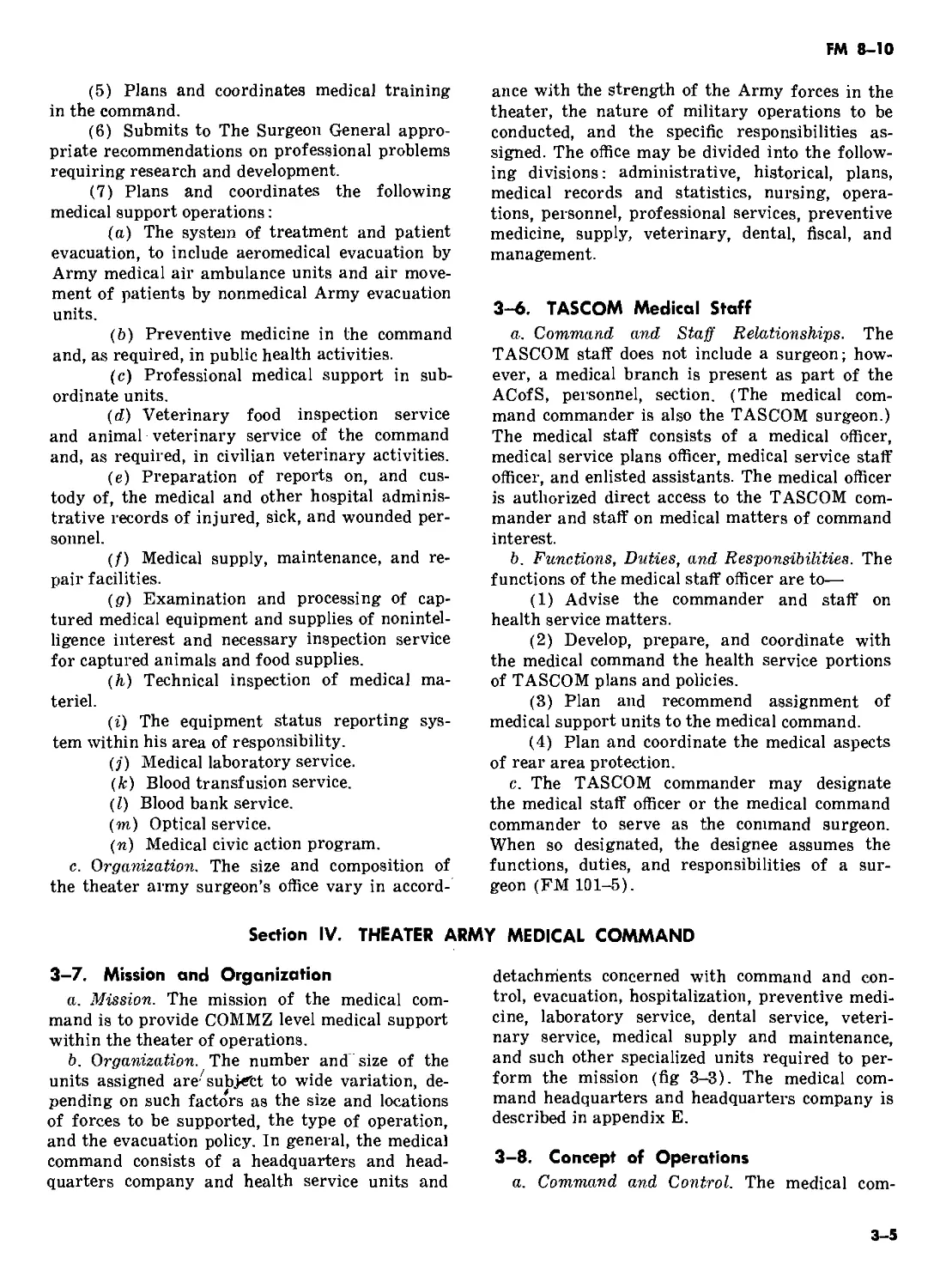
form the mission (fig 3-3). The medical com-
mand headquarters and headquarters company is
described in appendix E.
3-8. Concept of Operations
a.	Command and Control. The medical com-
3-5
FM 8-10
Г
MED
GP
1
MED
COMD
MED
GP
MED
GP
HOSP
CEN
GEN HOSP
1,000 BED
CONV
CEN
HOSP
CEN
GEN HOSP
1,000 BED
MED
LAB
PVNTMED
UNIT
MED
DEP
В-500/
600
TMS
MED
BN
FLD
HOSP
AMB
CO
COLL
CO
HOLD
CO
AMB TN
 RAIL)
NOTE:
STA HOSP
500 BED
STA HOSP
300 BED
STA HOSP
200 BED
STA HOSP
100 BED
MED
BN
FLD
HOSP
AMB
CO
COLL
CO
CLR
CO
AMB TN
 RAIL)
STA HOSP
500 BED
STA HOSP
300 BED
STA HOSP
200 BED
STA HOSP
100 BED
The number
vary according to assigned mission and composition of
forces supported.
and type units
MED
BN
FLD
HOSP
AMB
CO
COLL
CO
CLR
CO
AMB TN
(RAIL)
attached to the medical command
STA HOSP
500 BED
STA HOSP
300 BED
STA HOSP
200 BED
STA HOSP
100 BED
Figure 3-3. Type medical command (8-division force.)
mand headquarters commands and controls all
assigned and attached units. It major subordinate
command and control units are the hospital cen-
ter and the medical group headquarters.
(1)	Hospital center headquarters. The hos-
pital center functions as a controlling agency for
attached units, commands two or more general
hospitals, a convalescent center, and, when ap-
propriate, other medical units.
(2)	Medical group headquarters. The medi-
cal group headquarters units normally provide
command, control, staff planning, and supervision
of operations, training, and administration of
attached health service units. Medical groups
3-6
may have dual missions of providing support to
health service units operating in the combat zone
and medical support to COMMZ troops. Support
to the combat zone consists of relieving medical
units of patients and, in general, reinforcing the
combat zone health services. Medical battalion
headquarters units are assigned to the medical
command and attached to the medical groups to
exercise command and control, and to provide
personnel, supply, and vehicle maintenance ser-
vices to attached units.
b.	Hospitalization. Hospitals and other treat-
ment facilities of the command provide the re-
quired treatment necessary to return patients to
FM 8-10
duty or to prepare patients for evacuation to the
Zone of Interior. Hospitalization is provided for
patients from medical treatment facilities located
in both the combat zone and the COMMZ, and for
direct admission from troop units located in the
COMMZ. See chapter 7 for a discussion of hospi-
talization.
c.	Evacuation and Treatment. Medical evacua-
tion is related to patient treatment and assures en
route patient care to points where definitive
treatment is provided. The COMMZ medical
evacuation units are responsible for the surface
evacuation of patients from the combat zone,
coordinating air evacuation from the Combat
zone, and coordinating evacuation out of the
COMMZ. See chapter 6 for a discussion of patient
evacuation.
d.	Area Medical Support.
(1)	The area support command does not
have medical units assigned or attached. Person-
nel of, and those serviced by, the area support
command must receive medical support from
health service facilities of the medical command
on an area basis. Medical support can be provided
most economically and efficiently on an area basis
by extension of dispensary services from hospital
facilities. Health service units required for this
service are normally allotted based on troop
strength.
(2)	To insure adequate medical support to
the area support command and area support
groups, coordination between the area support
command and the medical command is necessary.
An exchange of information through effective li-
aison will provide the medical command com-
mander with the extent and location of troop con-
centrations to be supported, and will provide the
area support command commander with the type
and amount of service to be furnished. The senior
medical commander located within the geograph-
ical boundaries of an area support group will
normally provide medical staff advice for the
area support group commander. Standing operat-
ing procedures will be developed by the medical
command and the area support command govern-
ing the relationship between each area support
group commander and the senior medical com-
mander in his area.
(3)	The senior medical commanders located
within the boundaries of area support groups
normally will be responsible for the development
of health service plans in support of the area sup-
port group commander’s RAP plan. Once devel-
oped, these plans will be coordinated with the
medical command to insure availability of ade-
quate medical support to perform all assigned
missions.
e.	Preventive Medicine. Prevention of disease
and injury reduces military manpower losses, pa-
tient loads, and evacuation requirements. Special-
ized preventive medicine personnel and units as-
sist organic medical personnel and medical com-
manders that provide area medical support in
conducting the field army and COMMZ preven-
tive medicine programs. Preventive medicine
units provide services in surveillance and control
of health hazards which are beyond the capabili-
ties of organic medical personnel and area medi-
cal support units.
f.	Medical Laboratory Support. The medical
laboratory (TOE 8-650G) provides complete lab-
oratory support facilities to include laboratory
procedures listed in AR 40-4, medical research
and technical inspection, and the establishment
of a histopathology center. Medical laboratories
are organized to operate a base laboratory and
three mobile laboratories that can support medi-
cal and nonmedical units throughout the theater.
g.	Dental Service. Dental service in the com-
munications zone is furnished through hospital
and area dental facilities. General, station, field
hospitals, and convalescent centers have organic
dental services for the support of personnel ad-
mitted to these facilities. Dental service units
provide area dental service based on troop popu-
lation.
k. Veterinary Service. Veterinary service in
the communications zone includes treatment, hos-
pitalization, and dispensary service for military
animals; the control of zoonotic diseases; subsist-
ence inspections; the control of foodborne dis-
eases; and other assigned preventive medicine ac-
tivities. These services are provided on an area
basis by veterinary hospital, dispensary, and food
inspection teams that normally are under the
command and control of a veterinary headquar-
ters unit.
i. Medical Supply and Maintenance. See chap-
ter 9.
3—9. Command Relationships
a.	Command Relationships With Higher Com-
mands. The MEDCOM commander reports di-
rectly to the TASCOM commander. The coordina-
tion of medical command staff matters with the
theater army and its staff normally is through
command channels, except that health service
professional matters are coordinated directly.
b.	Command Relationship With Lower Com-
mandSr The staff elements of the medical com-
3-7
FM 8-10
mand headquarters have normal staff relation-
ships with respect to subordinate health service
elements. The dental surgeon and veterinary staff
officer of the command headquarters normally are
delegated operational control of subordinate den-
tal and veterinary units.
c.	Command Relationship With Field Army.
(1)	With headquarters, field army. Coordi-
nation with headquarters, field army, is through
normal command channels except that health ser-
vice professional matters may be coordinated di-
rectly with the field army surgeon.
(2)	With field army medical brigade. Direct
coordination on technical matters between the
medical command and the medical brigade is au-
thorized.
3-8
FM 8-10
CHAPTER 4
FIELD ARMY
Section I.	GENERAL
4-1. General
The field army is the largest self-contained tacti-
cal organization in the United States Army, It
has territorial, tactical, and administrative re-
sponsibilities but has no fixed organization. The
number and types of corps, divisions, and other
combat and supporting elements are determined
by the mission, availability of forces, availability
and use of nuclear weapons, terrain and climate,
and probable hostile forces.
4-2. Mission
The mission of the field army is to close with the
enemy and destroy his will to resist by ground
combat within an assigned area,
4-3. Organization
a.	The field army may consist of a headquarters
and headquarters staff, two or more corps, com-
bat support troops, and combat service support
troops. Combat service support troops are orga-
nized into a field army support command (FAS-
COM) but may, if required, function directly
under the control of field army headquarters (fig
4—1).
b.	The field army headquarters is composed of
a command element and staff assistants organized
into general, personnel, and special staff sections,
including a medical section. The staffs of the field
army headquarters and the FASCOM headquar-
ters supplement each other,
4—4. Operations
a.	The field army headquarters commands and
controls combat operations of the subordinate
corps. The army commander normally establishes
forward tactical command post to supervise com-
bat and combat support operations. Operational
planning and associated tasks usually are done at
the main command post under the supervision of
the chief of staff.
b.	The FASCOM headquarters conducts the
combat service support operations of the field
army. This headquarters is centrally located to-
ward the rear of the army service area,
4-5. Field Army Support Command
The field army support command is designed to
provide combat service support to a field army.
The FASCOM provides combat service support
primarily through two kinds of major subordi-
nate elements—army-wide service organizations
and support brigades. The army-wide services are
provided by the medical brigade, military police
brigade, transportation brigade, and civil affairs
brigade. The support brigades provide combat
service support to divisional and nondivisional
units. In supporting an 8-12-division field army,
one support brigade (corps support brigade) is
employed in each corps area and another (army
support brigade) is employed in the field army
service area. The commander of the FASCOM
and his staff are responsible for the success of
combat service support operations related to the
tactical operations in progress and for detailed
planning for support of operations in the near fu-
ture, This responsibility includes the development
of detailed implementing plans, the establishment
of policies, and the exercise of technical supervi-
sion over subordinate commands, and directives
for combat service support. FM 54-3 provides a
detailed description of the functions and opera-
tions of the FASCOM.
Section II.	FIELD ARMY MEDICAL STAFFS AND
ORGANIZATIONS
4—6. The Field Army Surgeon
a.	Command and Staff Relationships. The field
army surgeon is a special staff officer of the field
army commander. The surgeon functions under a
the general staff supervision of the field army
headquarters ACofS, Gl, personnel, and coordi-
nates medical matters with members of the gen-
eral and special staff. On medical professional
4-1
FM 8-10
LEGEND:
_______Attached as required.
1	Army artillery section plus field army group headquarters and
battalions noi attached to corps.
2	HHB. ADA brigade, plus ADA group headquarters and battalions
not attached to corps.
^'Assigned one per field army and may be attached to FASCOM.
4	Aviation company assigned. Other elements attached as required,
5	HHC, engineer brigade, plus engineer combat groups, and engineer
topographic battalion. Army.
Figure 4-1. Organization of a “type” field army.
and technical matters affecting the health of the
command and combat operations, he has direct
access to the field army commander.
b.	Functions, Responsibilities, and Duties. The
surgeon is responsible for keeping the com-
mander and the staff informed on the state of
health of the command, and on the medical as-
pects of combat effectiveness and combat opera-
tions. As the principal medical staff officer, he ad-
vises the commander and the staff on all medical
support matters. His duties normally include the
following:
(1)	Developing, preparing, and coordinating
the broad medical support plans and policies of
the command.
(2)	Developing, preparing, and coordinating
the health service portions of Army plans.
(3)	Providing current information on the
Army health service situation to the surgeons of
the next higher and subordinate headquarters.
(4)	Maintaining close liaison with ACofS,
G5, civil affairs, on civil affairs medical support
requirements.
(5)	Exercising staff and technical supervi-
sion over health service operations in the field
army.
(6)	Recommending the assignment and
reassignment of Army Medical Department per-
sonnel.
(7)	Maintaining a chronological record of
4—2
FM 8-10
health service operations, activities, events, and
other information of historical significance.
(8)	Furnishing health consultation services
to the field army.
(9)	Preparing or consolidating health ser-
vice statistical and other reports as required.
(10)	Recommending policies and determining
requirements and priorities for medical supply
and medical equipment maintenance services.
(11)	Recommending policies concerning the
medical aspect of the military civic action pro-
gram.
(12)	Assuming responsibility for compliance
with the theater army blood program as de-
scribed in chapter 8.
c.	Field Army Headquarters Staff Medical Sec-
tion (Office of the Surgeon). The field army staff
medical section includes the surgeon and commis-
sioned and enlisted assistants. In addition, a num-
ber of professional consultants are included to
satisfy medical requirements resulting from unu-
sual climatic, geographical, battle, or other condi-
tions. Office organization is not standard and
must be flexible to permit shifts of emphasis as
the situation requires. The following organiza-
tional outline is furnished as a guide for normal
operations:
(1)	The administrative branch is responsi-
ble for—
(a)	Operating the message center.
,	(b) Performing administrative functions.
(c)	Coordinating public information mat-
ters.
(d)	Furnishing administrative consulta-
tion assistance.
(e)	Collecting, evaluating, interpreting,
and presenting medical statistical data.
(2)	The plans branch is responsible for—
(a)	Developing the health service portion
of field army plans.
(b)	Coordinating the medical support op-
erations of the field army including the recom-
mendations for field army evacuation policies.
(c)	Developing health service training
policies and programs for the field army.
(d)	Developing, preparing, and coordinat-
ing the medical supply and medical equipment
maintenance plans and policies for the field army.
(e)	Coordinating requirements for critical
medical materiel, maintenance schedules, and
blood distribution.
(3)	The personnel branch is responsible
for—
(a)	Monitoring availability of critical
Army Medical Department personnel in the field
army.
(b)	Recommending assignment, reassign-
ment, and utilization of critical Army Medical
Department personnel.
(4)	The preventive medicine branch is re-
sponsible for developing, preparing, and coordi-
nating the field army preventive medicine pro-
gram.
(5)	The dental branch is responsible for—
(a) Developing, preparing, and coordinat-
ing the dental portion of health service plans and
policies to include a preventive dentistry pro-
gram.
(b)	Collecting, consolidating, evaluating,
and preparing dental reports, statistics, and
other information.
(c)	Furnishing dental consultation.
(d)	Providing policy for the management
of dental materiel.
(6)	The professional service branch is re-
sponsible for—
(a)	Furnishing medical consultation ser-
vices.
(b)	Disseminating medical professional
and technical information.
(c)	Formulating recommendations re-
garding the treatment of sick, wounded, or in-
jured personnel.
(d)	Reviewing and evaluating medical
technical reports.
(7)	The veterinary branch is responsible
for—
(a)	Developing, preparing, and coordinat-
ing veterinary plans and policies for the com-
mand.
(b)	Collecting, consolidating, evaluating,
and preparing veterinary reports, statistics, and
other information.
4-7. The FASCOM Surgeon Section
This section provides staff support to the FAS-
COM commander in a manner similai' to that
medical staff support provided to the TASCOM
command by the TASCOM medical staff (para
3-6b),
4-8. Field Army Medical Brigade
a.	Mission. The mission of the medical brigade
is to provide Army level medical support within a
field army.
b.	Organization. The medical brigade is a func-
tionally-oriented organization consisting of a
headquarters and headquarters detachment, a
4—3
FM 8-10
number of medical groups, medical battalions,
and other medical units of the field army (fig
4-2). The medical brigade is tailored to the field
army mission. Flexibility of organization is in-
herent and permits rapid organizational adjust-
ment to changing medical support requirements.
The Medical Brigade, Headquarters and Head-
quarters Detachment, TOE 8-112G, is described
in appendix E.
c.	Concept of Operations.
(1)	Command and control. The field army
medical brigade headquarters commands, con-
trols, plans for, and operates the field army medi-
cal support system. The medical support mission
is accomplished through centralized control of de-
centralized operations. Policies are provided for
the effective integration of health service activi-
ties in the field army and are coordinated with
supported units. The major subordinate command
and control elements of the medical brigade in a
type field army are the headquarters of the for-
ward and rear medical groups.
(a)	Medical group headquarters. The
number of units attached to the medical group
headquarters may vary according to the require-
ments of the tactical situation and specific mis-
sion assigned. The span of control of medical
groups is reduced by attaching company and
smaller sized units to the attached medical battal-
ion headquarters.
(b)	Forward and rear medical groups.^
The forward medical groups are concerned pri-
marily with evacuation and treatment of patients
from divisions. These groups will operate as close
as possible to the combat units without interfer-
ing with combat operations. The rear medical
groups primarily are designed to provide contin-
uous hospital service for the field army. Forward
and rear medical groups are shown in figure 4-2.
(2)	Hospitalization. The field army medical
brigade provides hospitalization for all classes of
patients in the combat zone. Hospitals and other
treatment facilities provide patients with the
treatment necessary to return them to duty or to
prepare them for further evacuation (chap 7).
(3)	Evacuation.
(a)	The field army medical units are re-
sponsible for evacuating patients from division
clearing stations, separate clearing stations, non-
divisional dispensaries, and aid stations to hospi-
tals of the field army. Evacuation is by ground
and air ambulance (chap 6).
(b)	The ground ambulance companies are
responsible for the routine evacuation of patients
from division and field army to, and between, ap-
propriate medical treatment facilities. Normally,
patients evacuated from divisions by ground am-
bulances will flow into supporting hospital facili-
ties over relatively fixed routes.
(c)	The air ambulance companies and de-
tachments are responsible for evacuating all cate-
gories of patients to designated medical facilities.
Normally, medical air ambulances will be used on
an “on-call” basis. Aeromedical evacuation prior-
Figure 4-2. “Type” medical brigade (8-division force).
FM 8-10
ity will be given to the seriously wounded. When
available, and circumstances permit, aeromedical
evacuation means will be the preferred method of
patient evacuation. Greater flexibility and respon-
siveness is introduced into the medical evacuation
system with increased use of air ambulances.
(d)	When available, ambulance trains
may be used for routine evacuation of patients
from combat zone hospitals to hospitals within
the COMMZ (chap 6).
(4)	Medical supply and maintenance.
(a)	The Army medical depot operates di-
rectly under the command and control of the
medical brigade headquarters. The medical depot
provides medical supply, medical equipment
maintenance, and optical fabrication services for
all units in the field army area. Advance depots
establish supply points well forward in the corps
to provide direct support to division medical bat-
talions, hospitals, and other units in the area.
(b)	The medical depot establishes its base
depot in the field army service area. Supply lev-
els of advance depots will be kept at a minimum
to permit their relocation whenever necessary to
provide close and timely service to supported
units. Division medical battalions submit their
supply requirements to the supporting advance
depot. Requirements are forwarded through the
ambulance evacuation shuttle system, other vehi-
cles, or by other means of communication availa-
ble. Normally, medical supply distribution is
through backhaul of medical brigade ambulance
elements supporting the division. Field army
medical units and all other nondivisional units
obtain medical supply and maintenance services
on a direct support basis from the supporting
base or advance depots. Unfilled and replenish-
ment requirements of advance depots are trans-
mitted to the field army medical inventory con-
trol point through combat service support data
system (CSa) communications channels. Distri-
bution is accomplished by shipment to advance
depots or, if necessary, by throughput to using
units. Unfilled and replenishment medical supply
requirements of the field army are transmitted
from the field army medical inventory control
point (ICP) to the COMMZ medical ICP through
the CS3 communications system. Distribution
from COMMZ medical depots is accomplished by
bulk shipments to the base depot or by through-
put to advance depots.
(5)	Convalescent center. A convalescent ca-
pability is provided for the field army to permit
rapid restoration of patients to full duty. Patients
from field army hospitals requiring only conva-
lescent care and reconditioning are evacuated to
the convalescent center prior to being returned to
duty.
(6)	Preventive medicine. A preventive medi-
cine field service unit provides comprehensive
preventive medicine support services to the field
army "which are beyond the capabilities of com-
manders and their organic medical personnel.
(7)	Medical laboratory support. The medical
laboratory (TOE 8-650G) provides complete lab-
oratory support facilities consisting of a base lab-
oratory and three mobile laboratories. It per-
forms laboratory functions authorized in AR
40-4, provides medical research and technical
inspection services, and establishes a histopathol-
ogy center. The laboratories support medical and
nonmedical units throughout the theater.
(8)	Dental service. Routine dental treatment
for the field army is provided by mobile dental
units operating under the command and control
of the medical brigade (chap 10). Dental officers
assigned to hospitals provide inpatient treatment.
(9)	Veterinary service. Veterinary services
are provided on an area basis by veterinary units.
The detailed operations of these units are dis-
cussed in the description of Medical Department
units (app E).
d.	Command Relationships.
(1)	Command relationship to higher com-
mands. The medical brigade commander reports
directly to the FASCOM commander. The coordi-
nation of medical command staff matters with the
field aiuiy commander and staff is normally
through command channels, except that health
service professional matters are coordinated di-
rectly.
(2)	Command relationship to lower com-
mands. The staff elements of the medical brigade
headquarters have normal staff relationships
with respect to subordinate elements. The dental
and veterinary staff officers of the brigade head-
quarters normally are delegated operational con-
trol of subordinate dental and veterinary units.
(3)	Command relationship to corps and divi-
sion. Coordination with corps and division head-
quarters is through normal command channels
except that health service professional matters
may be coordinated directly with the corps and
division surgeons.
(4)	Command relationships to the medical
command. Direct coordination between the medi-
cal brigade and the medical command is autho-
rized.
FM 8-10
CHAPTER 5
CORPS
Section I.
5-1. General
The corps, a task force of combined arms and ser-
vices, is a tactical unit of execution. Its composi-
tion is not fixed; however, the TOE 52-series es-
tablishes the organization of the corps headquar-
ters and headquarters company. Units normally
are assigned to provide the means needed to fa-
cilitate command and control. The field army as-
signs or attaches units to the corps. The type and
number of troop units assigned or attached to the
corps depend on the mission, the characteristics
of the area of operations, the availability of units,
the enemy situation, and the type of operations
contemplated. The corps organization permits
great flexibility since the field army organizes it
for a specific tactical mission.
5-2. Employment
A corps may be employed as a major subordinate
GENERAL
command of army groups or of theater army
groups or of theater army. When the corps is em-
ployed in such a role, or when the mission as-
signed to the corps requires it to operate far re-
moved from the field army, the corps is said to be
on an independent operation. It is similar to a
theater army in that it normally has area respon-
sibilities encompassing theater base functions
and is, therefore, responsible for its own combat
service support.
It is provided a corps support command (COS-
COM), which provides services similar to those a
FASCOM provides to a field army. FM 100-15
provides a detailed discussion of the corps opera-
tion.
Section II.	THE CORPS SURGEON
5—3. General
The corps surgeon is a special staff officer of the
corps commander. He is responsible for keeping
the commander and staff informed on the current
medical support situation. In addition to the nor-
mal duties of a surgeon (FM 101-5), the corps
surgeon—
a.	Advises the commander of the medical situ-
ation in all attached divisions.
b.	Develops plans and recommendations for
the reinforcement of division medical support
within the corps.
c.	Assumes the duties similar to the army sur-
geon when the corps is operating as an indepen-
dent corps.
5—4. Staff Relationships
The corps surgeon operates under the general
staff supervision of the corps ACofS, personnel,
and coordinates medical matters with the corps
staff. He has direct access to the corps com-
mander on professional and technical matters af-
fecting the health of the command, and on medi-
cal matters affecting corps operations. Coordina-
tion with surgeons and medical commanders of
higher, subordinate, and lateral headquarters is
through command channels, except for medical
professional matters which may be coordinated
directly.
5-5. Corps Medical Support
Normally, medical units are not attached to an
army corps. Medical support is tailored to the
mission, the composition of the supporting force,
and the geographical area of operations. The field
army medical brigade provides a medical group
with appropriate attached medical units to meet
support requirements. Designated units provide
unit and field army level health services to as-
signed and attached nondivisional units of the
corps on an area support basis. The medical group
commander works in close coordination with the
corps surgeon in planning and implementing
medical support. When a corps is assigned an
independent mission, the medical group is tai-
lored to the mission and attached to the COSCOM
5-1
FM 8-10
as the operating medical command of the inde-
pendent corps. The group commander and his in-
creased staff (Type B, TOE 8-122G) must as-
sume duties and responsibilities similar in scope
to those normally performed by the medical bri-
gade commander and staff.
5-2
FM 8-10
CHAPTER 6
PATIENT EVACUATION
(STANAG 2051)
(STANAG 2061)
(STANAG 2128)
Section I.
6-1. General
a.	Patient evacuation is the process of moving
patients from the battlefield or other locations to
and through successive medical treatment facili-
ties. The term “evacuation system” is applied to
the linear system of successive agencies and in-
stallations engaged in collection, treatment,
transportation, and hospitalization. The most for-
ward facility of an evacuation system in a theater
of operations is an aid station and the rearmost
installation, a general hospital. From the combat
area to the rear, each successive medical facility
provides a more extensive type of medical care.
Figure 6-1 depicts the patient evacuation flow
within the theater of operations.
b.	Evacuation of patients is a difficult task
even under the most favorable conditions. Eva-
cuation must be made against a constant forward
flow of troops and supplies, with a minimum of
interference with these activities. The majority
of patients are gathered as individuals from for-
ward areas of the combat zone and provided with
individual care and treatment through all succes-
sive stages of the hospitalization and evacuation
system.
6-2. Sorting (Triage) of Patients
Sorting is the process of examining sick and in-
jured patients in order that they may be properly
routed to, and within, the appropriate medical fa-
cility. Sorting includes establishing a priority for
treatment to assure the most beneficial medical
care for the largest number of patients and as-
sisting in determining the ultimate destination of
each patient as early as possible. The most expe-
rienced medical officer is usually in charge of
triage. Sorting is the key to the effective manage-
ment of patients. Patients must not be evacuated
farther to the rear than their physical condition
warrants or the military situation requires.
Every case evacuated without sufficient reason
GENERAL
imposes an unnecessary burden upon three agen-
cies—the patient’s unit, which must go short-
handed until the individual is discharged for re-
turn to duty with the unit or is replaced; the re-
placement system, which must procure, equip,
train, and transport a replacement; and the Med-
ical Department units which must provide eva-
cuation and medical care and treatment for the
patient. The problem created by one such case is
not impressive, but the total effect of indifferent
sorting may jeopardize the success of combat op-
erations. Unnecessary evacuation of patients is of
the nature of subsidized straggling. When deci-
sion for hospitalization is made, the illness or in-
jury must be incapacitating or of such nature
that serious consequences would result if the pa-
tient were discharged immediately for return to
duty. This decision is often difficult when there is
little time for observing patients. When the tacti-
cal situation permits, however, reasonable doubt
must be in favor of the patient.
6-3. Evacuation Lag
Delays are inevitable. They may be inherent in
the system, or may arise from circumstances
within a particular military situation. The sum
of such delays is referred to as “evacuation lag.”
If not properly considered in medical planning, it
may immobilize medical facilities and further re-
tard the process of evacuation. The most signifi-
cant causes of evacuation lag are—
a. Enemy action and combat requirements.
-b. Nonavailability of transportation,
c. Treatment time required en route.
d. Delayed receipt of the evacuation requests.
e. Road, terrain, and weather conditions.
6-4. Theater Patient Evacuation Policy
a.	The theater patient evacuation policy is es-
tablished by the Secretary of Defense with the
advice of the Joint Chiefs of Staff, and upon the
6-1
FM 8-10
ALTERNATIVES
NORMAL
EVACUATION
FLOW
NORMAL
EVACUATION
METHOD
LEVELS OF
MEDICAL
SUPPORT
ANY MEDICAL FACILITY MAY
BE BYPASSED WHEN THE
CONDITION OF THE PATIENT
WARRANTS SUCH PRACTICE,
AND THE EVACUATION MEANS
PERMIT SUCH MOVEMENT.
MEDICAL
AID MAN
WALKING
LITTER
FRONTLINE
AMBULANCE
u
N
BATTALION
AID
STATION
FIELD
AMBULANCE
AIR AMBULANCE
CLEARING
STATION
D
I
V
FIELD
AMBULANCE
AIR AMBULANCE
MASH
EVACUATION
HOSPITAL
field
AMBULANCE
USAF AIRCRAFT
AMBULANCE TRAIN
legend:
> NORMAL
> ALTERNATE
GENERAL
HOSPITAL
OTHER
THEATERS
USAF EVACUATION
AIRCRAFT
USN SURFACE
VESSELS
C
0
M
M
z
A
R
M
* THE FLOW OF EVACUATION FROM THE CLEARING STATION IS GENERALLY TO THE EVACUATION
hospital; however, selected cases go into the mash
** MAY BE LOCATED IN EITHER DIVISION OR FIELD ARMY AREA.
Figure 6—1. Normal patient evacuation flow.
6-2
FM 8-10
recommendation of the theater commander. The
policy establishes the maximum duration (ex-
pressed in days) of fixed hospitalization autho-
rized in the theater. The projected hospitalization
period for individual patients is computed from
the date of admission to a fixed hospital. The pol-
icy does not imply that a patient is held in the
theater for the limit of time set. Patients who are
not expected to be returned to duty within the
specified period will be evacuated out of the the-
ater as soon as the appropriate medical authority
determines that further evacuation will not ag-
gravate their disabilities.
b.	The theater evacuation policy specified has
direct impact on—
(1)	The number and type of medical units
required in COMMZ to support the combat zone.
(2)	The amount of medical materiel require-
ments.
(3)	The amount and timing of engineering
support.
(4)	The volume and type of transportation.
(5)	The rate of patient returns-to-duty.
(6)	The theater personnel replacement re-
quirements.
(7)	The number of hospital beds required in
the continental United States (CONUS) to sup-
port the theater. The shorter the theater evacua-
tion policy, the fewer the number of fixed hospi-
tals and other supporting resources that will be
required in the theater, and the greater the num-
ber of hospital facilities that will be required in
the CONUS. In general, for a longer evacuation
policy, the reverse is true.
c.	In conformity with the theater evacuation
policy, intratheater patient evacuation policies
may be established by subordinate commands,
subject to approval by the theater commander.
For example, a short evacuation policy usually is
established for the combat zone hospitals so as
not to impair their mobility or their capability to
accommodate surges of patients. These intrathea-
Section II. MEC
6-5. General
a.	The medical regulating system controls the
movement of patients for hospitalization and
treatment. The system of successive agencies and
installations which are engaged in this collection,
transportation, treatment, and hospitalization of
the sick and injured is called the hospitalization
and evacuation system.
b.	Many factors are considered in controlling
the movement of patients through the hospital-
ter evacuation policies must be flexible and
changed as dictated by the tactical situation. This
does not imply that a patient is held at each level
(combat zone or COMMZ) of medical treatment
for the limit of time set. The time a patient
spends in the combat zone evacuation chain does
not apply to the theater patient evacuation policy
time limit. In low-level conflicts, to include stabil-
ity operations, and, when combat zone hospitals
(evacuation and field hospitals) have been desig-
nated as fixed-bed units, patients may be retained
for longer periods. However, this in no way
changes the mission of the COMMZ hospitals or
the application of the theater evacuation policy.
The application of any evacuation policy is a
management tool in the selection of patients, for
evacuation requires close and continued coordina-
tion between all command surgeons concerned.
The efficiency of medical support operations de-
pends on the effective distribution of patients to
those facilities that are capable of providing the
required treatment in the shortest possible time.
(1)	In static situations. During a slow-mov-
ing or stabilized situation, when patients are re-
ceived at a fairly constant rate, combat zone hos-
pitals may be permitted to approach the rated
bed capacity by retaining patients who do not re-
quire treatment in a COMMZ general hospital.
(2)	During heavy combat. When heavy com-
bat causes a large number of patients, the intra-
theater evacuation policy must be adjusted to
make beds available for current and anticipated
needs, and as a result, a lesser proportion of pa-
tients admitted are retained for treatment. Eva-
cuation policies may differ among the hospitals in
the field army area, depending on their location,
facilities, staffs, and the type of patients received.
The forward displacement of hospitals temporar-
ily reduces the number of beds available for pa-
tients and results in a greater number being
evacuated to the communications zone.
L REGULATING
ization and evacuation system. Some of these fac-
tors are the—
(1)	Patients’condition.
(2)	Current bed status of treatment facili-
ties (e.g., beds available, beds occupied).
(3)	Surgical backlog in hours.
(4)	Location of treatment facilities with
special capabilities or resources.
(5)	Number and location of patients by
diagnostic category.
FM 8-10
(6)	Tactical situation in the combat zone.
(7)	Location of airfields and railheads.
(8)	Availability of transportation.
c.	The medical regulating system is under the
technical control and supervision of the medical
regulating officers (MRO) located at various
medical headquarters throughout the theater
army. These officers coordinate with, and require
information from, staff officers and organization
throughout the entire command.
6-6. Description of a "Type" Medical
Regulating System
a.	General. There are several medical regulat-
ing systems in operation throughout the Army.
All of these systems have the same basic princi-
ples of operations as described in AR 40-350; AR
40-535; FM 8-35; and FM 8-55, but the proce-
dures and agencies involved may differ somewhat
from system to system (fig 6-2).
(1)	Medical regulating is generally informal
within the field army. Control of patient evacua-
tion from the treatment facilities of the division
to hospitals of the field army is exercised by the
medical brigade MRO assisted by MROs of subor-
dinate medical groups. Since the medical evacua-
tion system is both vertical and lateral, a direct
and uninterrupted communications capability is
required between operational headquarters and
between division and field army levels of medical
support. Through a system of periodic and “spot"
reports, the movement of patients is controlled so
that treatment requirements can be balanced
against available field army treatment capabili-
ties to prevent the overloading of hospital facili-
ties and the development of surgical backlog. The
operations officer of the division medical battal-
ion is responsible for medical regulating when
movement of patients between divisional treat-
ment units is necessary.
(2)	The “formal” medical regulating system
AF
ч----► DATA
flow
-----►	EVACUATION REQUIREMENT
— M—*	MOVEMENT INSTRUCTIONS
--E—»	EVACUATION INSTRUCTIONS
* TREATMENT FACILITY
INTRAARMY
*** INTRATHEATER
**** CONUS
Figure 6-2. “Type” medical regulating system.
FM 8-10
starts in the hospitals assigned to the field ar-
mies.
(a)	Hospital physicians submit daily re-
ports to the hospital registrar listing the pa-
tients requiring evacuation the following day.
The registrar assembles all pertinent information
and transmits a report to the medical group head-
quarters to which the hospital is attached. This
report is a request for transportation as well as a
notification of the number of patients requiring
evacuation. The report classifies patients accord-
ing to diagnostic category, transportability (litter
or ambulatory), official status, nationality, de-
sired onload points, and time patients will be
available for evacuation.
(b)	The medical regulating officer at the
medical group headquarters consolidates these re-
ports from each hospital assigned to the group
and forwards his report to the field army MRO
located at the medical brigade headquarters. The
brigade MRO consolidates the reports for the
field army and transmits the data to the theater
army MRO located at the medical command head-
quarters. The medical command MRO, through
daily reports, is informed of the location and sta-
tus of general hospital beds and make a determi-
nation for the distribution of patients. To assist
the medical command MRO in developing an eva-
cuation plan, all accumulated information is pro-
cessed through the personnel administration cen-
ter (РАС) computer. Printout data received from
the РАС facilitiates the preparation and imple-
mentation of the evacuation plan. The medical
command MRO submits the request for move-
ment of patients to the Army movement control
center (MCC) for surface transportation and to
the Air Force aeromedical evacuation control of-
ficer (AECO) for air movement.
b.	Air Evacuation.
(1)	The aeromedical evacuation control
officer is an Air Force officer assigned to an Air
Force unit (i.e., aeromedical evacuation squad-
ron) whose mission is to control the movement
of, and to arrange for intransit medical care of,
patients when they are under the control of the
Air Force. There is an AECO located at the medi-
cal command, medical brigade, and at each of the
field army medical group headquarters. At each
level of command the AECO works closely with
the MRO, providing detailed flight schedules,
technical information on aircraft, and patient
preparation requirements for air movement.
(2)	Upon receipt of a request for air evac-
uation of patients from the medical command
MRO, the medical command AECO forwards the
movement requirements to the theater Air Force
aeromedical evacuation control center (AECC).
This center is responsible for coordination with
the Army, Air Force, and Navy with respect to
forward air movement of cargo and personnel and
the movement of patients aboard Air Force air-
craft. After the schedules have been arranged,
the AECC provides the AECO with a detailed
flight schedule. In turn, the AECO gives the med-
ical command MRO a detailed flight schedule and
disseminates the patient evacuation status infor-
mation to his subordinate AECOs. The medical
command MRO then issues to subordinate MROs
the instructions and authority to move patients.
c.	Ground Evacuation.
(1)	It is not possible to move all patients by
Air Force aircraft from the combat zone. Several
reasons which prevent this are—
(a)	Operational aspects which preclude
the use of aircraft.
(b)	Patients who cannot be moved by
AIR.
(2)	The alternate means of patient move-
ment is by ground transportation—either by rail,
field, or bus ambulance.
(a)	Rail. Ambulance trains (rail) may be
used for transporting patients from the combat
zone to the communications zone when ground
or surface transportation is employed. Since
the hospital cars are assigned to the medi-
cal command, the medical command MRO coordi-
nates the evacuation movement requirement with
the TASCOM movement control center. When
hospital cars are assembled into trains, the trans-
portation railway service is responsible for their
movement and the maintenance of the equipment
while en route. Upon receipt of a request for rail-
way evacuation of patients from the medical com-
mand MRO, the movement control center coor-
dinates the movement requirement with the trans-
portation railway service. After the railway
movement schedules have been confirmed with
the medical command MRO, the transportation
railway service provides the motive power and
train crew to move the train to the receiving
medical facility. Hospital trains have priority of
movement while en route with patients.
(b)	Field ambulance. Field ambulances
supplement normal air and rail movement. The
medical brigade, medical command, and medical
group MROs provide the necessary coordination
and planning for patient evacuation missions.
(c)	Bus ambulance. Bus ambulances are
employed in the COMMZ in lieu of field ambul-
ances when feasible.
6-5
FM 8-10
(d)	Ambulance convoy control. Operation
of ambulance convoys over controlled routes will
be coordinated with the highway traffic head-
quarters in the TASCOM MCC or regional tra-
nsportation movement office. Good route planning
for medical evacuation will expedite coordination
procedures and ensure the establishment of ap-
propriate traffic priorities.
6-7. Medical Regulating to the Zone of
the Interior
a.	The general hospitals within the COMMZ re-
port to the medical command MRO the numbers
and types of patients requiring evacuation to the
ZL The medical command MRO then submits a
consolidated report to a joint agency at theater
headquarters, the joint medical regulating office
(JMRO). This agency coordinates with a similar
agency in the Zone of the Interior, a joint agency,
the armed services medical regulating office
(ASMRO). The ASMRO authorizes, through the
JMRO at theater headquarters, the transfer of
patients by providing ZI hospital destinations for
designated patients. The destination hospital de-
termination is based upon the patient’s needs, the
hospital having the capability of meeting the pa-
tient’s needs, and, where possible, the hospital
closest to the patient’s home.
b.	When authorized to move patients, the the-
ater JMRO coordinates through the joint mili-
tary transportation board (JМТБ) or J4, trans-
portation services, for air transportation with the
military airlift command (MAC) and the mili-
tary sea transportation service (MSTS) for sur-
face means. When transportation requirements
cannot be accomplished by direct coordination
with MAC and MSTS for programed transporta-
tion, the JMRO will coordinate with the MCC for
nonprogramed movement.
Section III.	EVACUATION WITHIN THE COMBAT ZONE
6-8. General
The field army medical support system is response
ble for evacuating patients from division clear-
ing stations to the hospitals of the field army.
Careful control of the evacuation of patients to
field army hospitals is necessary to effect an even
distribution of cases, to assure adequate beds for
current anticipated needs and to route patients
requiring specialized treatment to the proper
installations. In the combat zone, evacuation in-
volves the movement of patients in a fairly con-
tinuous flow directly to hospitals. This is in con-
trast to evacuation in the COMMZ wherein pa-
tients are moved intermittently in large numbers.
The field army medical brigade is responsible for
evacuation within the combat zone.
a.	Divisions and Corps.
(1)	The responsibility for evacuating pa-
tients normally passes to the field army at divi-
sion clearing stations and aeromedical evacuation
of all categories of patients may take place from
any point within the division. In the airmobile di-
vision, aeromedical evacuation is performed by
both division and field army medical aircraft
(FM 8-15).
(2)	Transportable patients are evacuated as
soon as practicable. Prompt evacuation is essen-
tial to avoid-immobilizing clearing stations with
large numbers of patients. Patients normally are
evacuated to an evacuation hospital by field am-
bulance or air ambulance. Whenever a patient re-
quires immediate resuscitative surgery, he may
be transferred to a mobile army surgical hospital j
(MASH). After the patient is stabilized, he is 7
moved back into the normal system of evacuation./
b.	Field Army. Field army medical units, using/
organic ambulances, collect patients from dispen-l
saries and aid stations of units to the rear of divi-'
sion boundaries and transport them to evacuation i
hospitals, or, on occasion, to field army clearing
stations. Patients from field army clearing~sta-
tions normally are taken to an evacuation hospi- \
tai, an army convalescent center, or to units es- /
tablished for the treatment of special type cases,
e.g., mobile army surgical hospital, V'"
6-9. Evacuation Operations
The medical brigade commander is responsible
for the operation of the field army system of eva-
cuation and for obtaining the use of the areas,
buildings, and routes necessary for the coordi-
nated operation. Evacuation of patients from di-
visions in land warfare is carried out as follows:
a.	Arrangements. Evacuation of patients from
divisions is instituted through medical channels.
The arrangements include an estimate of the
number of patients to be evacuated, the locations
of the clearing stations, the schedule to be fol-
lowed, and the routes to be taken.
b.	Control. Control of patient evacuation to
field army hospitals is necessary to insure an
even distribution of patients, adequate beds for
current and anticipated needs, and the proper
routing of patients requiring specialized treat-
6-6
FM 8-10
ment to appropriate installations. This control is
exercised by the MRO of the medical brigade as-
sisted by MRO of subordinate medical groups. An
efficient evacuation system will decrease the num-
ber of times a patient is handled between the di-
vision clearing station and the combat zone hospi-
tal, and between one combat zone hospital and
another; it will also prevent the routing of am-
bulances to several installations in the attempt to
find beds for patients. Rigid control is maintained
for the evacuation of patients in need of surgery.
Without this control, backlogs of patients await-
ing surgery occur in the hospitals closest to the
combat action. Sound, professional judgment
must be exercised in division clearing stations in
deciding whether a patient is transportable, and
whether he must be evacuated to a nearby hospi-
tal, or evacuated farther to the rear,
IT c. Care and Treatment En Route. Prior to evac-x
uating a patient, the clearing station should note \
his condition and special care requirements
should be indicated on a field medical card. In ad-
dition, the medical officer at the clearing station
should remind air ambulance aid men, ambul-
ance drivers, or orderlies of any special attention
that may be required by the patient en route. The
ambulance orderly is responsible for the safety ’
and comfort of all patients.
Section IV.	EVACUATION
d.	Feeding En Roztte. When schedules are made
for the day’s evacuation, an effort must be made
to avoid having patients on the road during meal-
times. Receiving hospitals must be kept informed
of the expected time of arrival of ambulances to
enable the hospital commander to make necessary
arrangements for the reception and feeding of
patients. If an ambulance trip is over 3 hours, ad-
ditional facilities should be established en route
for feeding, examination, and emergency treat-
ment of patients.
e.	Property Exchange. Field army ambulances
carry sufficient equipment to provide exchange of
property. The clearing station is responsible for
the actual exchange of property. See paragraph
9-4 for additional information on property ex-
change. STANAG 2128 (app D) contains interna-
tional agreements on medical property exchange
procedures.
f.	Communications. An efficient system of com-
! munications must be established for the control
 of evacuation since it is not unusual for the entire
I evacuation pattern to be changed day to day dur-
ing combat, or even several times during one 24-
hour period. It is essential that a shift from one
plan to another be made smoothly and rapidly.
FROM THE COMBAT ZONE
6-1D. General
The evacuation of patients from the combat zone
to the COMMZ requires detailed planning and co-
ordination between the field army medical bri-
gade and the COMMZ medical command. Unlike
evacuation in the combat zone which involves a
fairly continuous movement of patients to hospi-
tals, evacuation to the COMMZ involves large
numbers of patients moved intermittently to air-
fields and railheads located in the vicinity of hos-
pitals. Normally, evacuation hospitals are the
rearmost medical treatment facilities in the field
army evacuation system. At these hospitals the
responsibility for evacuation passes to the
COMMZ medical command.
a. The availability of transportation deter-
mines the extent to which evacuation can be per-
formed. Aeromedical evacuation will be used
whenever possible. The Medical Department con-
trols field, bus, and rail ambulances for evacua-
tion from the combat zone to the communications
zone. For additional means of evacuation, the
Medical Department is dependent upon the Air
Force or Navy or the Army command controlling
other forms of transportation. The medical, com-
mand commander must, therefore, continuously
forecast the requirements for land, rail, air, and
water evacuation.
The medical brigade commander is responsi-
ble for the selection of patients to be air evacu-
ated from medical installations under his control.
Within its area of operations, the field army is re-
sponsible for—
(1)	Providing a holding facility at desig-
nated air terminals when the Air Force cannot
provide one.
(2)	Loading and unloading of patients on
aircraft when the Air Force has not established a
casualty facility.
(3)	Providing additional equipment made
necessary by the impracticability of property ex-
change with air evacuation units.
6-11. Evacuation by the Air Force
Based on information received from the medical
brigade, the medical command commander places
6-7
FM 8-10
requirements upon the aeromedical evacuation
control officer to evacuate specific numbers of pa-
tients from the combat zone. The AECO is fur-
nished information on the number of patients to
be evacuated, their location in the combat zone,
and destination in the COMMZ. The AECO fur-
nishes the medical command commander an air
evacuation schedule which may or may not prov-
ide sufficient transportation for all patients
awaiting evacuation. The medical command head-
quarters furnishes evacuation information to the
COMMZ medical facilities concerned and to the
medical brigade. Patients are transported by
Army field or bus ambulance units to Air Force
casualty staging facilities or Army holding units
established at airfields in the combat zone, where
they are enplaned in accordance with the air
evacuation schedule. At the destination airfields
in the COMMZ, Air Force casualty staging facil-
ities or Army holding units receive and hold the
patients until they are transported by Army am-
bulance units to the receiving hospitals.
6-12. Evacuation by Army Medical
Ambulance Units
The medical brigade and the medical command
headquarters plan and coordinate evacuation mis-
sions by ambulance companies of COMMZ medi-
cal groups supporting the combat zone. Field and
bus ambulances supplement normal air and rail
transportation when these means are not availa-
ble, when they are insufficient, or when the dis-
tances involved are such that use of field and bus
ambulances is more efficient.
6-13. Evacuation by Ambulance Trains
The medical brigade and the medical command
coordinate the planning for use of ambulance
trains. The medical command MRO requests mo-
tive power for the ambulance trains from the
TASCOM movement control center and informs
the MCC of pickup and destination locations. The
transportation railway service furnishes the ap-
propriate railway movement schedule, motive
power, train, and maintenance personnel. The
medical command commander issues implement-
ing instructions to the COMMZ medical facilities
concerned and to the medical brigade. The medi-
cal brigade and the medical command are re-
sponsible for the transporting of patients to and
from railheads and for establishing holding facil-
ities at these locations.
6-14. Holding Facilities
Holding facilities, either Army or Air Force, are
essential to the evacuation system and are neces-
sary for the proper care and stabilization of pa-
tient’s condition. A requirement for the care and
treatment of patients exists at each location
where there is a major change in mode of evacua-
tion. Patients must be collected at railheads and
held ready for the arrival of ambulance trains
which continue evacuation. Movement of the
number of patients required to fill an ambulance
train, from scattered medical units to the entrain-
ing point, requires an unusually large number of
ambulances, disrupts normal operations, and
often results in hardships for patients. The same
considerations apply to airhead and ports of em-
barkation and debarkation. At air, rail, and
water terminals, provisions are required for the
reception and distribution of patients to appro-
priate hospital facilities. When the route of eva-
cuation extends over long distances, intermediate
facilities may be necessary to provide rest and
treatment for patients en route. These facilities
provide temporary shelter and emergency medi-
cal treatment to patients awaiting transfer. Units
used to perform such missions may include hospi-
tals, medical clearing companies, and Air Force
casualty staging units.
6-15. Evacuation Within the
Communications Zone
a.	Medical evacuation units are placed through-
out the COMMZ based on population concentra-
tions and evacuation channels. These units evacu-
ate sick or injured patients to an initial treat-
ment facility or to a subsequent treatment facil-
ity for more definitive treatment. Arrangements
for this service are made between the treatment
facilities concerned and the medical units re-
sponsible for furnishing evacuation support.
b.	Patient evacuation to general hospitals from
any other COMMZ medical treatment facility re-
quires coordination through the medical com-
mand. Planning and coordinating is accomplished
in much the same manner as described for the
combat zone.
6-16. Evacuation From the
Communications Zone
Patients designated for evacuation from the
COMMZ are transported to air terminals and sea-
ports by Army bus ambulances, field ambulances,
or ambulance trains. The medical regulating and
evacuation procedures have been previously de-
scribed.
FM 8-10
CHAPTER 7
HOSPITALIZATION
Section I.	GENERAL
7—1. General
The term “hospitalization” is used to indicate
medical care and treatment provided at hospitals
for serious cases or cases requiring extended care,
as contrasted with emergency medical treatment
or outpatient treatment provided at a hospital.
a.	Objective. The objective of hospitalization is
to return sick or injured personnel to duty as
rapidly as possible. Because of their training and
experience, they are the most valuable of all re-
placements.
b.	Concept of Patient Care. Under combat con-
ditions, medical means must be distributed in
order to provide the greatest service to the great-
est number. To devote a disproportionate amount
of time and effort to one patient at the expense
of the treatment of the majority is to subordinate
the common welfare of many to one. It is impor-
tant that emphasis be placed on the treatment of
those conditions commonly encountered in mili-
tary practice, rather than on rare and unusual
types. The orderly processes and policies of evac-
uation are not to be hindered because of scien-
tific interest in certain patients.
c.	Interdependence of Evacuation and Hospital-
ization. Each of these functions is dependent on
the other for efficient operation; therefore, eva-
cuation and hospitalization must always be con-
sidered jointly.
7—2. Hospitalization Planning
a.	Principal Considerations. Basic planning re-
quires four major considerations: First, plans
pertaining exclusively to the Medical Depart-
ment; second, plans requiring coordination with
other services and agencies of the Army; third,
plans involving joint action with the Navy and
the Air Force; and fourth, plans pertaining to
combined operations with other Allied Powers.
The Army Medical Department must operate as
a part of the joint service team in order to ac-
complish its primary mission. Plans prepared by
the Medical Department, and which depend upon
the joint action of the Army, Navy, or Air Force
for implementation must be based on policies and
directives of the theater or joint commander con-
cerned.
b.	Planning Factors.
(1)	General. In hospitalization planning,
there are certain basic factors necessary to estab-
lish hospitalization requirements for a theater of
operations. To compute bed requirements for a
specific operation, it is necessary to establish a
theater patient evacuation policy; forecast daily
admission rates to hospitals; know the troop
strength of the theater; and estimate accumula-
tion and dispersion factors. The method of calcu-
lating the total number of fixed beds required in a
theater of operations is provided in FM 8-55 and
FM 101-10-1. In addition to the number of fixed
beds required for Army personnel in a theater of
operations, allowances must be made for other
personnel who may be dependent upon the Army
for medical care. These personnel include Navy
and Air Force personnel, merchant seamen, civil-
ian employees, and liberated U.S. and Allied na-
tionals. In addition, hospitals are required for
prisoner-of-war and labor units of indigenous
personnel recruited in the theater.
(2)	Theater patient evacuation policy. See
paragraph 6—4.
(3)	Daily admission rates. The daily admis-
sion rate is a statistical expression that reflects
the number of persons admitted to hospitals or
excused from duty for medical reasons on a 1,000-
troop-strength basis. While it is a major
planning factor employed by the Medical Depart-
ment it is also used by other agencies preparing
analyses of Army experience data. Admission
rates are usually based on statistics accumulated
over a period of time. These rates, under various
circumstances, are contained in FM 101-10-1 and
FM 8-55.
(4)	Accumulation factor. Patients will accu-
mulate in hospitals at a certain determinable rate
depending upon the admission rate, the type of
disability, and the average period of hospitaliza-
tion under a given evacuation policy. Rates have
7-1
been compiled into accumulation tables, which
are contained in FM 8-55 and FM 101-10-1.
(5)	Dispersion factor. A portion of the fixed
hospital beds in a theater will not be immediately
available for reasons enumerated below. This fact
must be considered when computing hospital bed
requirements and adjustments made by applica-
tion of a dispersion factor. Experience has shown
that an allowance of 20 percent applied against
the computed hospital requirement will generally
suffice to offset these temporary losses. Factors
contributing to dispersion are—
(a)	Wards for patients of different sexes;
cases of contagious disease; and cases needing
different types of treatment require a safety mar-
gin of beds in each ward, since the proportion of
these different classes varies.
(b)	Daily admission and disposition rates
vary from day to day and must be considered
when allowing for an extra margin of available
beds.
(c)	A certain proportion of authorized
beds may be packed for shipment within the the-
ater at any given time.
(d)	Troop units may be widely dispersed;
therefore, additional hospitalization facilities
will be required in order to provide a sufficient
number of hospital beds. As a result, these hospi-
tal facilities may not be fully utilized. The
greater the dispersion of troops—the greater the
dispersion factor.
(e)	Hospitals may not be given the most
favorable location in relationship to the most ef-
fective evacuation patterns, and, therefore, the
dispersion factor increases.
(/) Any fixed hospital delayed by any
cause from being placed in operation increases
the dispersion factor.
7—3. Classifications
Hospitals are classified as fixed and nonfixed.
Fixed hospitals include general and station hospi-
tals, and field hospitals when so designated. Non-
fixed hospitals include mobile army surgical hos-
pitals, evacuation hospitals, and field hospitals
when employed on other than fixed hospital mis-
sion. A detailed description of these fixed and
nonfixed hospitals is provided in appendix E.
Section II.	HOSPITALIZATION IN THE FIELD ARMY
7—4. General
a.	The employment of field army hospitals is
governed by two basic principles: First, hospital-
ization is provided as close as practical to the
troops requiring it; and, second, the maximum
number of personnel are returned to duty within
the combat zone. Although hospitalization is pro-
vided in forward areas, the retention of all ser-
ious cases in the most forward units should be
avoided. Patienta should be distributed to hos-
pitals according to type and professional capa-
bilities of hospital staffs. Evacuation is regulated
to effect a distribution of cases so that each pa-
tient can receive appropriate treatment.
b.	Hospitals of the field army area are charac-
terized by their tactical mobility which is main-
tained by transferring patients to hospitals in the
communications zone. Both mobile and semimo-
bile hospitals can be established in a matter of
hours when personnel, equipment, and transpor-
tation are readily available. These hospitals can
be established, without functional impairment,
under shelter other than that provided by the ta-
bles of organization and equipment (TOE); pre-
pared for movement several hours after patients
have been evacuated; and rapidly transported to
a new location. Field army hospitals must main-
tain the flexibility inherent in mobile and semi-
mobile units. They are not concerned with con-
struction standards, except as they may be af-
fected by special environmental needs such as in-
sectproofing, protection for extremes of heat and
cold, or protection from enemy weapons.
7-5. Types of Field Army Hospitals
Field army hospitals include mobile army surgi-
cal hospitals and evacuation hospitals. Facilities
for the treatment of certain conditions, such as
psychiatric disorders, may be established by the
addition of professional teams and extra equip-
ment. A detailed description of these hospitals is
provided in appendix E.
7-6. Location of Field Army Hospitals
Field army hospitals should be located near the
troops to be supported and should be accessible,
both from forward and rear areas, by normal
means of transportation. Sites are undesirable if
they cannot be easily evacuated and cannot effec-
tively display the Geneva Cross. They should not
be located near supply or ammunition dumps, im-
portant crossroads, or other areas of potential
enemy attack.
FM 8-10
Section 111.	HOSPITALIZATION IN THE COMMUNICATIONS
ZONE
7—7. General
The medical command provides hospitalization
for all Army patients and those of the other mili-
tary services, as directed, originating in the com-
munications zone and those evacuated from the
combat zone. The number and types of hospitals
depend upon the location of the communications
zone in relation to the Zone of Interior; the ex-
tent of the zone; troop strength of the theater;
nature of military operations, character of hostile
resistance; and the theater patient evacuation
policy. Communications zone hospitals are char-
acterized by the immobility of their facilities.
Unless major tactical, strategic, or logistical con-
ditions require a change in location, communica-
tions zone hospitals should remain stationary.
Hospitals in the communications zone are the
rear terminals of the theater evacuation system.
They must absorb a large volume of patients and
can reduce the patient load only by returning pa-
tients to duty or evacuating them out of the the-
ater.
7—8. Types of Communications Zone
Hospitals
Communications zone hospitals include genera]
hospitals; station hospitals; and field hospitals.
Detailed descriptions of these hospitals are pro-
vided in appendix E.
7-9. Location of Communications Zone
Hospitals
In order to reduce evacuation requirements, gen-
eral hospitals should be located as far forward as
possible, but only to the extent that enemy action
will not prejudice their full and continued opera-
tion. The effect of nuclear warfare on centers of
population may prevent the location of hospitals
in these areas and, thus, increase the requirement
for additional hospital construction materials.
Fixed hospitals must be located in accordance
with the evacuation pattern from the combat
zone and the evacuation pattern within, and
from, the COMMZ. Hospitals must be served by
roads, rail, and air, when possible. Suitable rail-
way sidings must be provided near general hospi-
tals for obtaining the best possible advantage of
rail evacuation. The availability of nearby land-
ing fields for the use of evacuation aircraft is most
desirable. Utilities, such as heat, electrical power,
air conditioning, and sewerage are essential for
the efficient functioning of hospitals. Establish-
ment and expansion of hospitals are dependent on
the availability of these utilities.
7—10. Communications Zone Hospital
Planning
a.	In order to provide the required number of
fixed beds by the time desired, timely planning
and coordination with the engineer command are
essential in preparing detailed plans and specifi-
cations for the various types of hospitals to be
constructed. The development of fixed hospitals
must be undertaken without delay. Temporary
improvisation only delays the establishment of
fixed hospitals, and increases the movement and
dispersion of patients. Regardless of its capacity,
a fixed hospital is designed to operate as an ent-
ity; fragmentation of the unit for operation in
more than one location is not desirable. Planning
must include requests for hospital plants, which
should be submitted well in advance. Since facili-
ties designated for other purposes are difficult to
obtain, it is necessary to mark potential sites
while they are still in enemy-held territory.
b.	The time necessary for the development of
the hospital program depends on plant availabil-
ity, engineer technical assistance, labor, and sup-
plies. The arrival of unit personnel and equipment
and availability of transportation contribute
greatly to the prompt completion of the hospital
program. Construction of hospitals is time con-
suming, even under favorable conditions. The ti-
melag existing between planned fixed beds and
actual fixed beds available will vary according to
the availability of the manpower and materiel re-
quired for the construction of the hospitals.
7-3
PM 8-10
CHAPTER 8
BLOOD BANK SERVICE, THEATER ARMY
8—1. General
The theater army blood bank service functions as
a theater-wide service and interfaces with the
continental United States system. The service’s
operations include the receipt, storage, and dis-
tribtuion of whole blood and blood components
(frozen blood, fresh frozen plasma, and living tis-
sue components of blood) received from CONUS
and the collection, processing, storage, and distri-
bution of whole blood and blood components ob-
tained within the theater.
8—2. Mission
The mission of the theater blood bank service is
to support U.S, military and, as directed, Allied
military and indigenous civilian medical estab-
lishments.
6—3. Functions
Specific functions of the blood bank service units
are—
a,	Command of subordinate units.
b.	Receipt of whole blood and blood compo-
nents from CONUS and movement from termi-
nals to storage areas, transshipment points, or to
using units, as required.
c,	Collection and processing of whole blood in
the combat zone and communications zone, and
delivery to storage areas, transshipment points,
or to using units, as required,
d.	Storage and distribution of theater army
whole blood stocks,
e.	To determine requirements and insure ade-
quacy of procurement, storage, distribution, and
proper use of whole blood and blood components.
8-4. Command and Control
a.	Theater Army. When designated by the the-
ater commander, the theater army commander,
through his surgeon, exercises overall control of
the theater blood program, The medical command
commander normally will be given operational
responsibility for the service. A Medical Corps
officer, assigned to the medical command, nor-
mally will be designated as the theater blood pro-
gram officer and will provide the staff planning
and supervision of the theater blood bank pro-
gram. The theater blood program officer—
(1)	Prepares basic policy and procedure for
handling and use of whole blood.
(2)	Determines theater army whole blood
requirements for the theater.
(3)	Insures proper training for theater
army personnel procuring and processing of
whole blood.
(4)	Insures quality control of blood.
(5)	Controls the total COMMZ blood inven-
tory.
(6)	Designates blood distribution elements
(e.g., blood distribution teams, medical depot),
The resources for technical assistance of the med-
ical laboratory and the storage and distribution
capabilities of the medical depot will normally be
made available to the blood program officer,
b.	Field Army,
(1)	The field army commander, through his
surgeon, insures compliance with the policies of
the theater army blood program. The field army
surgeon exercises staff supervision over the blood
receipt, collection, processing, storage, and distri-
bution function performed by field army units.
(2)	In the field army area the medical bri-
gade commander, in coordination with the field
army surgeon, designates a blood program officer
who exercises control of whole blood and blood
components stored in the field army. Whole blood
requirements of medical units are forwarded to
the appropriate blood distribution element desig-
nated by the field army blood program officer,
Once blood has been authorized, resupply is
through normal blood bank service channels using
the most expeitious means of transportation
available.
8-5. Concept of Operations
a.	The blood bank service’s operations are con-
ducted without regard to sectional or zonal
boundaries within the theater, Full advantage
will be taken of the procurement, storage, and
distribution capabilities of Teams NA, NB, and
NC and the storage and distribution capabilities
of medical depots assigned to the theater. In-
8-1
FM 8-10
creased communications for elements of the the-
ater blood program may be obtained by collocat-
ing these units with other medical units possess-
ing a greater communications capability. In addi-
tion, each hospital is provided blood collection
and processing equipment to utilize local donor
populations when the normal whole blood supply
is interrupted or an emergency requirement
arises.
b.	The blood bank service delivers blood and
blood components to the using medical facilities
with the least possible delay. In order to effect
rapid blood delivery, intermediate storage and
distribution facilities may be required. Establish-
ment of intermediate blood storage facilities is de-
pendent upon the responsiveness of the supply of
blood from CONUS. Lateral shipment of blood
between storage facilities may be necessary in
order to satisfy urgent requirements or to reduce
losses due to outdating.
c.	Blood Bank Service Units.
(1)	Blood bank service headquarters (Team
AJ). The blood bank service headquarters in the
COMMZ functions as the intersectional theater
blood bank service headquarters. One team is ca-
pable of managing blood bank services in support
of a 12-division-size theater army force.
(2)	Blood processing detachment (Team
A’/l). Two blood processing detachments normally
are attached to the blood bank service headquar-
ters of the medical command. These teams re-
ceive, process, and store blood collected in the
COMMZ as well as assist in processing and stor-
ing blood received from CONUS and possibly
field army. The teams may also be employed
in the field army to support blood collecting de-
tachments (Team NB) when the latter are being
employed in that area and to process blood re-
ceived from out-of-th eater sources which bypass
or overfly the COMMZ.
(a)	One Team NA receives, processes, and
stores blood collected in the COMMZ, and assists
in processing and storing blood received from
other sources (CONUS and field army).
(6)	The second Team NA is employed in
the field army to support blood collecting detach-
ments (Team NB) when used in that area, and to
process blood received from out of theater
sources which bypass the COMMZ.
(3)	Blood collecting detachment (Team
NB). Up to six blood collecting detachments are
attached to the blood bank service headquarters.
NB teams normally are employed in the COMMZ,
but may be profitably employed in the field army
area when sufficient donors are available. In this
latter instance, when processing of the blood col-
lected has been completed, the storage capability
of these teams can be used, when needed, pending
distribution of the blood by the blood distribution
detachments (Team NC) in the area.
(4)	Blood distribution detachment (Team
NC). Six blood distribution detachments are con-
sidered adequate to support a 12-division size the-
ater army force. NC Teams will be attached to
the blood bank service headquarters and used for
the movement of blood on relatively short trips to
and from airfields and to and between using med-
ical facilities and between blood collecting and
storage facilities. Prolonged travel over rough-
surface roads will shorten appreciably the “shelf
life” of this essential, fragile commodity. When
movement over long distances is required, or
rough roads are encountered, blood must be
moved by air except when the tactical situation,
weather conditions, or other conditions prevent
this service. Plans to cover air movement must be
considered when allocating available aircraft re-
sources for mission assignments. Medical air am-
bulance units currently provide emergency trans-
portation for whole blood, blood substitutes, and
other essential medical supplies. When requests
for blood distribution occur daily or at other reg-
ular intervals, they are no longer considered
emergencies, and specific distribution provisions
as well as schedules should be implemented. Con-
ceptually, these teams would be employed in both
the COMMZ and the field army, with three teams
supporting each,
8-2
FM 8-10
CHAPTER 9
MEDICAL SUPPLY AND MAINTENANCE
(STANAG 2128)
Section I.
9-1. General
a.	The theater army commander is responsible
for the development of supply systems that will in-
sure adequate provision of supplies for theater
army forces and, when applicable, for Navy, Air
Force, Allied forces, and civil affairs activities.
The commander determines the system to be em-
ployed and the days of supply to be maintained.
b.	The theater army surgeon develops the the-
ater army medical supply and maintenance sys-
tem for the commander. He assists in planning,
recommending policies, and establishing priori-
ties for the system; and exercises staff supervi-
sion over, and determines the number of, medical
supply and maintenance units required to conduct
operations. Requirements for civilian communi-
ties and related administration will be developed
in cooperation with the ACofS, G5, civil affairs.
Commanders of the theater army medical com-
mand and field army medical brigade exercise
command and control over the medical supply
and maintenance units assigned or attached to
their respective commands. The theater army
medical command and medical brigade command-
ers also exercise technical supervision over medi-
cal supply and maintenance activities of the the-
ater army and field army, respectively.
c.	Determination of the number, type, and lo-
cation of medical supply and medical mainte-
nance units to be established generally is depen-
dent upon the number of troops to be served,
their locations, and the availability of means for
storage and distribution.
9—2. Local Purchase of Supplies and
Equipment
a.	A general purchasing agency system may be
established in oversea commands in time of war
in furtherance of the overall policy of making
maximum use of available local resources in
supplying the needs of U.S. forces in the com-
mand in order to conserve vital airlift and sealift
GENERAL
capability required for support of the command.
If established, this general purchasing agency
system will fulfill the functions of a coordinating
staff or board activity rather than those of an op-
erating procurement agency.
b.	Many classes of supplies may be procured on
the local oversea market; however, procurement
of medical supplies may be limited because of the
following considerations:
(1)	Foreign-prod need medical materiel that
may not be acceptable.
(2)	The requirement for special training to
operate nonstandard equipment.
(3)	Difficulties in the procurement of repair
parts and replacement items.
(4)	Drugs and biologicals that may not meet
standards and specifications required by the U.S.
Government.
(5)	The problems of operating a medical
supply system involving a large number of for-
eign-produced nonstandard items.
(6)	The time necessary for production and
delivery.
9—3. Medicinal Gases
Since a large amount of medicinal gases
such as oxygen is required by medical facilities in
a theater of operations, arrangements must be
made for the refilling of cylinders without the ne-
cessity of returning them to the Zone of Interior.
Army engineer gas generating units normally
provide medicinal gas. In addition, the capabili-
ties of the theater Air Force and local commer-
cial outlets should be exploited as a backup re-
supply source when Army gas generating units
become inoperable.
9—4. Property Exchange
In the process of patient evacuation, litters, blan-
kets, pillows, splints, and like items of supply ac-
company patients. In order that these items may
not be drained from the units through which pa-
9-1
ЛМ 8-10
tients pass, an exchange system must be estab-
lished. Wherever practicable, there is a direct
item-for-item exchange. The increased use of
aeromedical evacuation imposes severe restric-
tions upon the property exchange system.
Nonmedical aircraft used for emergency evacua-
tion will not carry items for exchange. Medical
evacuation aircraft normally will carry only lit-
ters and blankets for exchange purposes. Proce-
dures for accounting for, and the replacement of,
special items of equipment transported with the
patient should be included in field army medical
brigade and theater army medical command regu-
lations. To avoid depletion of property exchange
supplies, plans should provide for the stockpiling
of such items in areas of probable usage. In addi-
tion to normal supplies, items to be authorized
for hospitals and other medical installations in-
volved in property exchange will be determined
by the medical brigade and medical command
commanders. In anticipation of combat opera-
tions, stocks or exchange items should be consid-
ered in all supply planning. Provision for launder-
ing or cleaning of certain exchange items must be
planned in advance. STANAG 2128, appendix D,
contains the details on this agreement.
9—5. Supplies for Prisoners of War,
Civilians, Displaced Persons,
Refugees, and Civilian Internees
The Army is responsible for providing medical
care and treatement for prisoners of war, and
may become responsible for providing medical
care or assistance to civilians, displaced persons,
and refugees. In computing requirements for sup-
plies and equipment needed to perform this func-
tion, full use should be made of all available in-
telligence data pertaining to estimates of the
numbers of individuals for whom medical care
must be provided, and the incidence of disease
among them. It is possible that the number of
prisoners of war will be such as to require the es-
tablishment of special PW hospitals (FM 41-5,
FM 41-10, and FM 100-10).
9-6. Local and Prisoner-of-War Labor
a.	Local Labor. Local labor should be used
whenever and wherever possible. Language diffi-
culties and adaptability of available individuals
will largely determine how they will be used.
b.	Prisoners of War. Prisoners of war used as
laborers have been of great value in past opera-
tions, and the tasks performed have been as var-
ied as the skills of the individuals. Equipment
maintenance and repair functions may be carried
on by skilled prisoners when adequately super-
vised. Using agencies are responsible for provid-
ing fully qualified personnel for the technical su-
pervision of PW work details. Since guards must
be provided for prisoner-of-war labor, it is most
economical to work prisoners in large groups. Se-
curity and the probability of sabotage and pilfer-
age must always be considered in the employment
of prisoners of war.
9-7. Captured Supplies and Equipment
Medical supplies and equipment captured from
the enemy are turned over to designated medical
supply facilities. Medical materiel is segregated
and that of value picked up in theater stock. Cap-
tured medical supplies of no value to the military
forces will be disposed of in accordance with the-
ater policies. Since captured medical personnel are
familiar with such equipment, captured supplies
and equipment are of particular value in the
treatment of prisoners of war. This- practice
tends to conserve the medical equipment and sup-
plies provided for friendly troops. It is essential
that adequate samples of all captured medical
items be preserved and forwarded to intelligence
agencies for evaluation. In the event that large
amounts of enemy medical supplies and equip-
ment are captured, it is frequently advisable to
concentrate this materiel in one or more medical
supply installations where it may be examined
for intelligence value, classified, and issued
promptly for the treatment of PW and the indig-
enous population.
9-8. Disposition of Medical Supplies
Subject to Capture
When the capture of medical supplies by enemy
forces is imminent, medical supplies must not be
destroyed purposely. Every attempt must be
made to evacuate all medical supplies and equip-
ment. Those that cannot be evacuated should be
abandoned, but the abandonment of medical sup-
plies is a command decision.
9-9. Medical Supply and Maintenance
Units
A detailed description of field army medical sup-
ply and maintenance units is found in appendix
E.
9—2
FM 8-10
Section II.	MEDICAL SUPPLY IN THE COMBAT ZONE
9-10. General
Medical supplies are managed by the TASCOM
medical inventory control point, which is located
in the army medical depot but operates under the
control and supervision of the medical brigade
headquarters. The army medical depot provides
medical supply, spectacle fabrication, and medi-
cal equipment maintenance services for all units
in the combat zone.
9-11. Operations
The medical depot establishes a base depot in the
field army service area, and advance depots well
forward in the corps areas to provide direct sup-
port to division medical battalions, hospitals, and
other supported units. Supply levels of advance
depots are kept at a minimum to permit reloca-
tion when necessary in providing close and timely
service to supported units. ^Division medical,bat-
talions submit supply requirements to the sup-
porting advance depot; Requirements are .^for-
warded by ambulance,- other~vehicles, or _any
available rneans~ of communi cationFJFieia army
aricT all othernon di visional “units ofitain medical
supply, maintenance, and opticat^ervices-on a di-
rect support basis from the supporting base or
advance depots. Direct depot support is provided
on a supply point and unit distribution basis. Un-
filled and replenishment requirements bfi advance
depotsZare transmitt^djEoj^e / FASСdM me dica 1
'inventory control center^I-CC). Distribution^ is
accomplished _b y. _sh ipment to advance - depots - or.
throughpjjtjto using units. Unfilled and replenish;
ment medicaC* supply requirements of the 'field
army are transmittefl~~from~the FASCOM' medical-
ICCto the~TASCOM medical ICC. Distribution
from TA SCO MTneHica depots is accomplished by
shipments to the field army medical base depot or
byjhroughput to advance depots or using units.
When feasibleTlhe army medical depot is located
centrally within the field army service area, eas-
ily accessible to motor vehicles operating from di-
vision, corps, and army medical unit supported.
Bulk issues are made from the base depot to ad-
vance depots, but issues may also be made to
nearby maintenance and using units as required.
Hospitals in the field army area draw their medi-
cal supplies directly from the base depot or the
nearest advance depot. Small nondivisional medi-
cal units may be satellited on the base depot, ad-
vance_depot, or hospitals.
Section III.	MEDICAL SUPPLY IN THE COMMUNICATIONS
ZONE
9—12. General
Communications zone medical depots provide sup-
port to_the field army based on requisitions sub-
mitted from the field army base medical depot.
Depots, receive, store, and distribute medical sup-
plies in a theater of operations. The medical de-
pots stock supplies to meet the demands of the
field armies and Army units within the COMMZ
as well as those of other services, allies, and civil-
ians.
9-13. Operations
a.	Management of medical supplies is accom-
plished by the medical ICC commodity managers
of the medical command. The medical ICC may
be located with an operating depot, but, regardless
of location, control of the medical ICC remains
with the medical command.
(1.)- Segregation of medical supplies from
mixed shipments will take place at points of dis-
charge (beaches, ports, or air terminals) or at a
transportation terminal established at a desig-
nated inland location.
(2)	Throughput of medical supplies desig-
nated for the field army will be accomplished by
the transportation movement control center in co-
ordination with the TASCOM medical ICC.
(3)	Medical supplies designated for COMMZ
medical depots will generally be moved from
ports or air terminals by appropriate movement
elements of the transportation command. Medical
supplies for COMMZ medical depots which are
not segregated and shipped from discharge
points, will be shipped to medical depots from the
inland transportation terminals having a segre-
gation mission.
(4)	COMMZ medical depots provide both
general and direct medical supply and medical
equipment maintenance support. Additional di-
rect support medical supply points may be estab-
lished with cellular supply detachments.
(5)	COMMZ medical units normally obtain
needed medical supplies and equipment on a sup-
9-3
FM 8-10
ply point distribution basis although maximum
use is made of backhaul medical evacuation means
in the distribution of medical supplies to using
units. When required, movement elements of the
transportation command will be used for unit dis-
tribution. Movement of medical supplies into the
field army normally is accomplished by the trans-
portation command.
(6)	Medical installations and units submit
replenishment requisitions for medical equipment
and supplies direct to designated medical supply
installations. Requisitions for regulated, com-
mand controlled, and items of equipment in ex-
cess of authorized allowances are submitted
through command channels for approval.
(7)	Inventory control of medical command
medical supply assets is centralized at the medi-
cal ICC. The medical ICC may possess sufficient
ADP equipment to operate an independent, auto-
mated supply management system. All medical
supply support for the COMMZ and to the com-
bat zone will be as directed by the medical ICC.
b.	Medical supply facilities in the communica-
tions zone are operated by units augmented,
whenever possible, by local and prisoner-of-war
labor.
Section IV.	MEDICAL EQUIPMENT MAINTENANCE
9—14. General
a.	The objectives and concepts of maintenance,
policies governing the conduct of maintenance op-
erations, and the responsibilities for the mainte-
nance of equipment adopted for Army use are
covered in detail in AR 750-series. Army medical
equipment maintenance procedures are described
in FM 8-55.
b.	Medical Department organization for the
army in the field provides resources for required
direct and general medical equipment mainte-
nance support. Organizational level medical
equipment maintenance resources, above that
which is inherent to capabilities of equipment
users or operators, are provided organically in
units having equipment densities that justify full
utilization of one or more medical equipment
maintenance specialists. Normally, units having
organic medical equipment, but no medical equip-
ment maintenance specialists assigned, are satel-
lited for organizational maintenance on units
having the required maintenance capability.
Where satellization is not feasible, direct medical
equipment support facilities provide the required
services using contact teams. Division medical
battalion equipment maintenance resources are
organizationally incorporated in medical supply
sections or branches of medical facilities. Sepa-
rately-identified medical equipment maintenance
elements are provided in medical depot organiza-
tions and cellular TOES. Command and staff per-
sonnel engaged in management of medical mater-
iel at all levels also participate in the manage-
ment of medical equipment maintenance. Repair
priorities are influenced by availability of re-
placement items, the highest priority being as-
signed to items in short supply and critical items.
*"5&с. Preventive maintenance takes precedence
over all but emergency repair requirements at or-
ganizational level. Workload, available skills, and
availability of repair parts permitting, organiza-
tional level medical equipment maintenance re-
sources may be utilized in accomplishing direct
and general support level maintenance. Higher
level maintenance-will not-be accomplished^at or-
ganizational level when such action will be detri-
mental to satisfying^preventive maintenance~reT
qu]renients~or when such action will create a
backlog in equipment jieeding repairs that^fall
within- the- pur-view—of—organizational mainte^
nancerNormally, excessive backlog at all organi-
zations,TZ^gardles£^ofZthe^extent7of“ repair-re-
quired, will be~resolved-by evacuation to the next
^higher maintenance .echelon. When required, low
density"life-saving diagnostic and therapeutic
equipment at operating treatment facilities will
be repaired or replaced immediately. Direct medi-
cal equipment maintenance support facilities
must make provisions for immediate repair or re-
placement. Operational readiness floats will be es-
tablished to assure availability of replacement
items; however, higher headquarters must ap-
prove of such action.
9-15. Objectives of Medical Equipment
Maintenance
The objectives of medical equipment maintenance
are—
a.	The prevention of equipment failure by
timely and adequate preventive maintenance ser-
vice in using organizations.
b.	The early detection and correction, at the
lowest practical level of maintenance, of potential
or actual equipment failures.
9-16. Principles of Maintenance
Direct support maintenance must be provided as
near to users as feasible. Performing repairs
9-4
FM 8-10
close to users reduces time-consuming evacuation
procedures and results in the rapid return of ser-
viceable equipment to the using unit. Equipment
that is beyond the maintenance service capability
of any organization, or equipment that requires
an excessive amount of time to repair, is evacu-
ated promptly to the next higher level mainte-
nance organization,
9—17. Categories of Maintenance
a.	Maintenance responsibilities are assigned to
specific levels of command in accordance with the
primary mission characteristics, mobility of the
level involved, and the economical distribution of
resources.
b.	The maintenance system is divided into four
mutually supporting categories in order to—
(1)	Relate maintenance to other military op-
erations.
(2)	Provide organization for maintenance
operations in the field.
(3)	Facilitate the assignment of mainte-
nance missions and responsibilities to specific lev-
els of command.
(4)	Permit the orderly and efficient distribu-
tion of available maintenance resources.
c.	/The four categories of maintenance are—
^/(1) Organizational. Organizational mainte-
nance is that maintenance normally authorized
for, performed by, and which is the responsibility
of, a using organization on equipment in its pos-
session. It includes preventive maintenance and
minor repairs performed .by individual users, or
by specially trained personnel of the organiza-
tion]
^(2) Direct support. Direct support mainte-
nance is that maintenance performed by special-
ized maintenance units operating in direct sup-
port of using organizations. This maintenance is
limited to the repair of end items or unservicea-
ble assemblies on a return-to-user basis.
"^(З) General szipport. General support main-
tenance is that maintenance authorized and per-
formed by designated TOE and table of distribu-
tion-augmentation (TDA) organizations. The
principal function performed by these units is the
repair of equipment for return to stock.
^(4) Depot maintenance. Depot maintenance
consists of the complete reconditioning of equip-
ment for return to depot stock.
9-18. Organization of Medical
Equipment Maintenance
a.	Theater Army. The theater army surgeon
determines the medical maintenance support re-
quirements of a theater army, recommends the
allocation of maintenance units to major subordi-
nate commanders, and formulates broad plans for
the provision of support and supervision of the
execution of these plans. The medical staff
officers of the theater army prepare broad plans,
policies, and procedures for the maintenance and
repair of equipment issued by the Army Medical
Department. After approval by the theater army
commander, these plans-usually are published as
maintenance directives. Medical staff officers nor-
mally exercise staff supervision over the execu-
tion of the theater army medical maintenance
directives.
b.	Communications Zone. The commander of
the medical command is responsible for develop-
ing the implementing policy and guidance for the
management of medical materiel and medical
equipment maintenance as prescribed by the the-
ater army headquarters. The medical command
ACofS, supply, maintenance, and services, exer-
cises staff supervision of medical equipment
maintenance within the COMMZ. The Medical
Depot, TOE 8-187G, provides direct and general
support maintenance to medical units located
within the COMMZ. The degree and amount of
direct support requirements placed upon the
depot depends upon the maintenance support sa-
tellization programs. The medical depot also
provides backup general support maintenance to
the army medical depot. Most items of equipment
evacuated to COMMZ medical depot can be re-
paired by that unit. Items that exceed the capa-
bility of the depot may be returned to the
CONUS.
Combat Zone. The commander of the medi-
cal brigade is responsible for providing medical
materiel and medical equipment support mainte-
nance within the field army. The medical brigade
S4 exercises staff supervision over the assigned
Army Medical Depot, TOE 8-667G.
(1) The base depot normally provides gen-
eral support to the advance depots. Under some
circumstances individual medical units located
within the army service area may receive direct
and general support medical maintenance from
the base depot. Where a satellization system of
maintenance is in effect, larger medical treatment
facilities may provide direct support maintenance
for their smaller medical unit satellites, thus ele-
vating the base depot to a general support role.
Backup general support maintenance is provided
to the army medical depot by the Medical Depot,
TOE 8-187G, in the COMMZ.
(2) Corps rear area. Medical units operating
9-5
FM 8-10
in nondivisional areas of the corps rely on the ad-
vance depot of the army medical depot for direct
support maintenance. The repairs accomplished
by the advance depot are done either on site by a
contact team, or in the maintenance shop of the
depot. Items requiring repairs beyond the capa-
bilities of the advance depot are evacuated to the
base depot of the army medical depot. The eva-
cuation hospital and the mobile army surgical
hospital have an organizational medical equip-
ment maintenance capability. The mobile army
surgical hospital can perform repairs to elec-
tronic equipment.
H3) Divis". on/separate brigade. The com-
mander of the division medical battalion is re-
sponsible for medical supply and medical equip-
ment maintenance for units organic or attached
to the division. Qrganizational_maintenance _of
medical equipment, above operafcorjevet is per-
formed by'th“elnedical''equipment repairman as^
signed to’ the medical-battaliom Thelmedical bat-
talion division " тесИсаГ' supply^pfficer exerciser
staff supervision"over’these maintenance activi-
ties. The extent of repairs accomplished at this
level is limited by the personnel qualifications,
capabilities, tools available, and the time availa-
ble within which to accomplish the repairs. The
medical company of the separate brigade has a
medical equipment organizational maintenance
capability. Direct and general support mainte-
nance is provided to the division/separate brigade
by the Army Medical Depot, TOE 8-667G. A con-
tact team from an advance depot of the army
medical depot may move to the division area for
short periods and provide on-site direct support
maintenance to the division medical battalion.
General support maintenance for the
division/separate brigade is provided by the base
depot of the army medical depot. Mobile army
surgical hospitals, which may be operating in the
area, possess the capability of performing repairs
to electronic equipment and offer another poten-
tial source of direct maintenance support to the
division/separate brigade.
9-19. Medical Equipment Maintenance
Teams
a.	Team GD, Medical Equipment Maintenance
Detachment, TOE 8-500G, provides direct medi-
cal equipment maintenance support for medical
facilities that support a force of 100,000. This de<
tachment is assigned to the field army on the
basis of 1 per independent corps task force not
supported by an army medical depot and to the
theater army support command on the basis of 1
per additional 100,000 troops not supported by
the medical depot in the COMMZ.
b.	Team GC, Medical Equipment Maintenance
Detachment, TOE 8-500G, provides direct sup-
port medical equipment maintenance for medical
facilities that support a force of 50,000. This de-
tachment is assigned to the field army on the
basis of 1 per additional corps not supported by
the army medical depot or Team GD and to the
theater army support command on the basis of 1
per additional 50,000 troops in the COMMZ not
supported by the medical depot or Team GD.
9-6
FM 8-10
CHAPTER 10
DENTAL SERVICE
Section I.
10-1. General
Dental service in the theater of operations is one
of the Army health services and, as such, shares
the responsibility for the conservation of the
health, strength, and effectiveness of the com-
mand. The dental support system is established
throughout the theater in a manner designed to
provide effective dental care and treatment in
order to prevent unnecessary evacuation of indi-
viduals requiring expedient dental treatment. The
theater of operations dental service encompasses
dental command and control, treatment, and labo-
ratory service. It provides dental support suffi-
cient to maintain the oral health of the troops
in the theater, with priority given to the combat
and combat support troops. A vigorous preven-
tive dentistry program with command support
is conducted to maintain the oral health of the
command. When the situation dictates, dental
personnel may be required to support other medi-
cal missions.
10-2. Mission
The mission of dental service in a theater of op-
erations is to conserve the oral health of the com-
mand by preventing oral diseases, promoting den-
tal health, and providing treatment to eliminate
or reduce the effects of dental disease and injury.
This service must be performed with minimum
interference with the operational mission of sup-
ported troops and without undue loss of duty
time by personnel. The accomplishment of the
dental mission in a theater of operations is depen-
dent upon the following principles:
a.	To be effective, dental support must be
brought to the areas of troop populations.
b.	Dental Corps officers assigned as command-
ers of dental command and control teams or den-
tal staff officers of the medical command, the
GENERAL
medical brigade, or other commands will control
and/or technically supervise assigned dental
units.
c.	Routine dental treatment, with emphasis on
preventive dentistry procedures, must be made
available by area dental units to all personnel, as
the tactical situation permits.
d,	Expedient dental treatment is provided by
dental personnel organic to other than dental
units.
10—3. Methods of Providing Dental
Service
a.	Unit. Unit dental support is that treatment
provided by Dental Corps officers organic to divi-
sions, hospitals, and convalescent centers. Unit
dental support is characterized by expedient den-
tal treatment which provides treatment necessary
to return dental patients to duty as quickly as
possible or to prepare them for further evacua-
tion. Unit dental support provides for the institu-
tion of as many preventive measures as possible
to reduce the dental patient load. Unit dental sup-
port also plans for the support of the medical
mission.
b.	Area. Routine dental treatment in a theater
of operations is provided by area dental units and
dispensaries in support of assigned geographical
areas. Dental units required for this service are
allocated on the basis of troop strengths. Area
dental support is characterized by a vigorous
preventive dentistry program in order to improve
the level of oral health in the supported units.
These dental units normally operate under the
control of dental service headquarters unit or
dental staff officers assigned to headquarters
units of the medical brigade, medical command, or
other commands. Dental units are discussed in
appendix E.
10-1
FM 8-Ю
Section II.	DENTAL STAFF OFFICERS
10—4. General
Dental staff officers are assigned to field army
headquarters, the medical brigade headquarters,
the medical command headquarters, and normally
are included on the staff of the theater army sur-
geon. In general, dental staff officers at theater
army and field army headquarters are concerned
with broad long-range planning and policy mak-
ing. Dental staff officers of the medical command
and the medical brigade are concerned with the
development and implementation of detailed
plans.
10-5. Functions of the Dental Staff
Officer
The dental surgeon—
a.	Coordinates dental activities with the sur-
geon.
b.	Exercises staff supervision over the dental
service of the command.
c.	Determines requirements for, and recom-
mends employment of, dental units and person-
nel.
d.	Plans and supervises the preventive dentis-
try program.
e.	Recommends modification of dental equip-
ment.
f.	Determines the needs and priorities for den-
tal equipment and supplies.
g.	Prepares reports on the dental activities of
the command.
h.	Advises commanders and staffs on dental
matters.
i.	Exercises operational control over subordi-
nate units when such authority has been dele-
gated by the appropriate commander.
Section III.	DENTAL SERVICE IN THE COMBAT ZONE
10-6. Area Dental Support
The largest volume of routine dental treatment
for the troops in the combat zone is performed by
area dental support units. Centralized control of
dental resources is essential for the immediate
response of the dental service to the needs of
combat units. The combat units are available for
routine dental support and treatment only at lim-
ited times; hence, area dental units must be
available for immediate deployment to combat
troop areas. Some area dental units must be kept
in the vicinity of divisions anticipating times
when division troops are available for routine
dental treatment. Close liaison must be main-
tained with these divisions. When practical, the
same dental unit or units should remain in sup-
port of a specific division. In the absence of a unit
dental surgeon, the unit surgeon is responsible
for maintaining liaison with the field army dental
support. Priority of treatment in forward areas
of the combat zone will be to combat and combat
support troops of divisions or separate brigades;
priority for routine dental treatment in the rear
areas will be to divisions or brigades retraining,
regrouping, or in reserve. When providing routine
dental treatment over an extended period of
time, sections or teams of the area dental support
units may be attached (less operational control)
to divisions. Operational control of the area
dental support units remains with the dental or
medical headquarters to which they are assigned
or attached.
10-7. Unit Dental Support
Unit dental support provides dental officers and
enlisted personnel to hospitals, convalescent cen-
ters, and divisions to perform expedient dental
treatment which will return patients to duty as
soon as possible or to prepare them for further
evacuation. The unit dental personnel are not al-
located in sufficient numbers to accomplish full
dental treatment. Full routine dental treatment
for troops is provided by, and is the responsibil-
ity of, the area dental support units. Unit dental
support provided the divisions is discussed in
more detail in FM 8-15.
Section IV.	DENTAL SERVICES IN THE COMMUNICATIONS ZONE
10-8. Area Dental Support
Dental service for a communications zone, as in
the combat zone, utilizes both unit and area den-
tal support concepts. Routine dental support is
provided by area dental units and is available
throughout the communications zone in propor-
tion to troop concentrations. When applicable,
priority of treatment will be for individual and
unit replacements being processed or prepared
for duty in the combat zone. This necessi-
tates close liaison to determine movement
and planned disposition of such individuals and
units located in, or staged through, the communi-
cations zone. Centralized control of dental units
10-2
FM 8-10
having area responsibility will insure this effort.
Area dental support units will be dispersed to the
extent necessary to assure the minimum in lost
duty time required for patients to travel to treat-
ment facilites.
10-9. Unit Dental Support
Unit dental support in the communications zone
consists of dental services organic to the various
hospitals, dispensaries, convalescent centers, and
to combat divisions that may be located in the
communications zone. Unit dental personnel in
the communications zone provide expedient den-
tal treatment on an area basis. In addition, dental
personnel in the hospitals and convalescent cen-
ters have the primary mission of providing den-
tal support to hospital patients. The mission of
dental personnel assigned to the divisions is dis-
cussed in FM 8-15.
10-3
FM 8-10
CHAPTER 11
VETERINARY SERVICE
Section I.
11—1. General
Veterinary service is an integral part of the(
Army health services in a theater of operations.
Veterinary organization, doctrine, training, and
equipment must be adequate to support the Army
in the field under all conditions and in any envi-
ronment.
11-2. Mission
The mission of the veterinary service is to prov-
ide veterinary support that contributes to con-
serving the health of the command. This integral
part of medical support is provided by the inspec-
tion of subsistence; control of zoonotic and food-
borne diseases; assistance in the preventive medi-
cine program; maintaining the health of military
animals; inspecting, monitoring, and testing sub-
sistence contaminated or suspected of being con-
taminated with chemical, biological, and radiol-
ogical agents; and by participating, when di-
rected, in other activities. The mission of the vet-
erinary service in a theater of operations will be
facilitated by adhering to the following doctrine:
a.	Veterinary service, either routine or emer-
gency, must be available as far forward as opera-
tional considerations and the tactical situation
permit.
GENERAL
b.	Veterinary personnel will emphasize the
preventive aspects of their duties. Preventive
measures apply in reducing the deterioration and
spoilage of subsistence; reducing the incidence of
zoonotic diseases; and reducing the incidence of
disease and(injury in military animals.
11-3. Veterinary Service System
Veterinary service in a theater of operations is
normally provided on a unit and area basis.
a.	Unit Veterinary Service. Veterinary service
at unit level is provided by veterinary personnel
organic to nonmedical TOE units such as the in-
fantry scout dog platoon. Nonmedical units to
which veterinary personnel are not assigned are
provided veterinary service on an area basis or
by the attachment of veterinary personnel or
units.
b.	Area Veterinary Service. Area veterinary
service is provided by the allocation of veterinary
units to support geographical areas and is the
primary method of providing veterinary service
in both the combat zone and communications
zone. Veterinary units required for this service
are allocated primarily on the basis of troop
strength and military animal strength.
Section II.	VETERINARY STAFF OFFICERS
11-4. General
Veterinary Corps officers are assigned to the field
army headquarters, the field army medical bri-
gade, the theater army medical command, and
normally are included on the staff of the theater
army surgeon. In general, veterinary staff officers
at theater army and field army headquarters are
concerned with long-range planning and policy-
making. Veterinary staff officers of the medical
command and medical brigade are operators and
are concerned with the development and imple-
mentation of plans to carry out the policies of
higher headquarters.
11—5. Functions of the Staff Veterinarian
The functions of the staff veterinarian with res-
pect to specific activities are—
a.	Recommending assignment and deployment
of veterinary units and personnel.
b.	Preparing and coordinating veterinary pol-
icies and plans.
c.	Developing and coordinating procedures and
plans for the inspection of food and food sources.
d.	Developing procedures and planning for the
care and treatment of military animals and con-
trol of military significant animal diseases.
11-1
FM 8-10
e.	Performing liaison with veterinary staffs of
higher and subordinate headquarters.
/. Preparing veterinary statistical, historial,
and other reports.
g.	Providing advice to the commander and staff
through the surgeon on all veterinary profes-
sional and technical matters.
h.	Developing and coordinating plans for tech-
nical assistance and supervision of veterinary ac-
tivities, in cooperation with the assistant chief of
staff for civil-military operations or a responsible
civil affairs unit, in support of military civic ac-
tion projects.
Section III.	VETERINARY SERVICE IN THE
COMMUNICATIONS ZONE
11—6. General
All veterinary service in the communications
zone of the theater of operations is performed by
veterinary units of the medical command. This
does not include activities in agriculture or other
activities normally assigned to civil affairs units.
11-7. Subsistence Inspection
a.	Effective subsistence inspection support
must provide for the inspection of subsistence
from the time it is received or procured until it is
issued to the using unit. The COMMZ is the prin-
cipal location of subsistence inspection activities
within a theater of operations. Most subsistence
provided from the CONUS base passes through
the COMMZ. In addition to the inspection of sub-
sistence supplied from CONUS, there will also
normally be requirements to inspect locally pro-
cured subsistence, as well as subsistence for mili-
tary animals. Other inspection activities in both
the COMMZ and combat zone may include inspec-
tion of captured enemy rations, inspection of in-
digenous subsistence when units are forced to
“live off the land,” and, as directed, inspection of
subsistence for civilian use. The major quantity
of subsistence consumed in the theater will be re-
ceived through the ports and over the beaches op-
erated by the transportation command. These in-
stallations, then, are the initial inspection points
for subsistence received in the theater. Veteri-
nary subsistence inspection at ports of entry is
designed to determine fitness for human con-
sumption and suitability for storage and ship-
ment. Condemnation of unfit subsistence at this
point will result in an economy of transport
means available for port clearance. Inspection of
subsistence in the COMMZ forward of the ports
or beaches will be at rear and forward field de-
pots operated by the supply and maintenance
command; ration storage and distribution points
operated by the area support command; and sub-
sistence processing establishments. As appro-
priate, inspections will be conducted at the time
of procurement; while in storage; at the time of
shipment, receipt, and issue; and, as appropriate,
will determine wholesomeness, quality, and suit-
ability for storage and shipment.
b.	The Army normally is responsible for the
wholesale distribution of subsistence within a
theater of operations. Consequently, the veteri-
nary service must be capable of inspecting all
subsistence at the wholesale level which is sup-
plied to all forces supported by the Army in a
theater of operations, to include Air Force, Navy,
Marine, and Allied personnel. The inspection of
subsistence at wholesale level, for other than
Army use, normally is performed only in the
COMMZ. Subsistence inspection service is pro-
vided on an area basis. Normally, the large
veterinary service detachment (TOE 8-500G,
Team JB), or multiples thereof, will be used to
provide subsistence inspection service in the com-
munications zone. Individuals, or varying sized
mobile service teams may be used to provide an
area subsistence inspection service to units, stor-
age and distribution points, or subsistence pro-
cessing establishments. The use of large veteri-
nary service detachments in lieu of many small
detachments will result in reduced administrative
requirements and a more efficient use of personnel.
11—8. Care of Military Animals
a.	Veterinary support for military animals in
the communications zone is provided on an area
basis by veterinary units of the medical com-
mand. The only exception is the unit level animal
care provided by veterinary personnel organic to
TOE units such as military police guard compa-
nies. The units having a capability for providing
animal care are large and small veterinary ser-
vice detachments and veterinary small animal
hospitals and dispensaries. Although the large
and small veterinary service detachments possess
the capability, the majority of animal care will
be provided by small animal hospitals and dispen-
saries.
b.	The normal flow of animal patients is from
using units to veterinary small animal dispen-
11-2
FM 8-10
saries. Dispensaries a^^located so as to be readily
accessible to the military animal population sup-
ported. They normally provide outpatient sup-
port; however, they also have a limited animal-
holding capability. Military animals which re-
quire hospitalization are evacuated from dispen-
saries to veterinary small animal hospitals. Hos-
pitals are provided for the hospitalization of mili-
tary animals which have been evacuated from the
combat zone or disabled in the COMMZ. Veteri-
nary units do not possess the means to provide an
evacuation service; consequently, the unit with
property responsibility for the military animal
will evacuate it to the site of treatment or hospi-
talization using organic or supporting transporta-
tion means. When available, veterinary 'personnel
will determine if evacuation is required. Military
animals are not evacuated to CONUS; therefore,
the veterinary hospitalization facilities in the
COMMZ are the rear terminals of the military
animal hospitalization system. At this point, the
condition of the animal must be such that it can
be returned to duty within a period of time speci-
fied by theater army or it will be destroyed. In
the treatment and evacuation of animal patients,
their disposition at all levels in the treatment
system is based on the number of animal patients
and treatment facilities; value of the animal pa-
tients; availability of replacement animals; and
estimated length of hospitalization. The disposi-
tion of animal patients may be any of the follow-
ing:
(1)	Treatment and return to duty without
hospitalization.
(2)	Hospitalization within the COMMZ.
(3)	Destruction of animal patients having
no possibility of being restored to an active, use-
ful status within acceptable time limits.
11-9, Zoonotic Disease Control
It is essential to establish a program for the
prevention or control of animal diseases trans-
missible to man (zoonoses). To facilitate the
prevention or control of the zoonoses, the medical
command veterinarian may divide the communi-
cations zone into areas of responsibility for the
various veterinary units of the command. In as-
signing areas of responsibility, consideration is
given to the capabilities of the units; zoonotic
diseases prevalent in the areas; indigenous do-
mestic and wild animal populations; obstacles to
the movement of animals such as rivers and
mountains; roads and rail nets used for the move-
ment of animals; direction of the flow of
streams; prevailing winds; and routes followed
by migratory wildlife. All veterinary units in-
cluded in the theater army forces are capable of
participating in a zoonotic disease control pro-
gram.
11—10. Other Activities
Participation by veterinary personnel and units
in preventive medicine activities and military
civic action projects will be used as directed by
higher authority. It is important that plans to
quarantine animals and control animal traffic be
fully coordinated with civil affairs and military
police personnel. If subsistence supplies are con-
taminated with chemical, biological, and radiol-
ogical agents, veterinary personnel will provide
appropriate recommendations as to their disposi-
tion following inspection, monitoring, and test-
ing.
Section IV.	VETERINARY SERVICE IN THE COMBAT ZONE
11—11. General
Veterinary services provided in the combat zone
are similar to those provided in the communica-
tions zone but are less comprehensive. In this
zone of the theater of operations the services are
performed by veterinary units of the medical bri-
gade. The material presented in this section is
based on veterinary service in a field army and is
equally applicable to operations by'independent
forces of corps or division size.
11—12. Subsistence Inspection
a.	Throughput of subsistence supplies is a
characteristic of the supply system in a theater
of operations. Subsistence supplies may be
shipped from a rear field depot to the division
support command (DISCOM), thus bypassing the
storage and distribution points operated by the
army support brigade and corps support bri-
gades. Consequently, veterinary personnel must
be located throughout the theater in order to
provide an effective inspection service. Inspection
of subsistence in the combat zone will be at stor-
age and distribution points operated by the army
support brigade, corps support brigades, and
division support commands. The larger quanti-
ties of subsistence located at the storage and
distribution points’ operated by the army sup-
port brigade and corps support brigades nor-
mally will necessitate the allocation of veterinary
11—3
FM 8-10
service detachments to the areas supported by
these brigades, rather than to divisions.
b.	The large veterinary service detachment
provides an area inspection service in the area
supported by the army support brigade. The
small veterinary service detachments provide an
area inspection service in the areas supported by
the corps support brigades. The small veterinary
service detachments also provide an area inspec-
tion service for the divisions. If subsistence is
procured within the combat zone, the majority of
such subsistence normally will originate in the
army service area. The large veterinary service
detachment normally conducts procurement
inspections for all subsistence procured within
the combat zone. Normally, one large veterinary
service detachment and multiples of the small
veterinary serv ce detachment are allocated to
provide subsistence inspection support in the
combat zone. In areas of low and mid-intensity
conflict, the small veterinary service detachment
may be allocated, one per division, to provide di-
rect support to divisions. Individuals, or varying
sized mobile service teams, from both the large
and small veterinary service detachments may be
used to provide an area subsistence inspection
service to units, storage and distribution points,
or food-processing establishments. To the maxi-
mum extent practicable, the large veterinary ser-
vice detachment should be employed in lieu of
many small veterinary service detachments. This
will result in reduced administrative require-
ments and a more efficient use of personnel.
11—13. Care of Military Animals
Veterinary support for military animals in the
combat zone is provided on an area basis by vet-
erinary units of the medical brigade. The only
exception is the unit-level animal care provided
by veterinary personnel organic to TOE units
such as infantry scout dog platoons. The forward
terminals for animal care in the combat zone are
at those units having assigned or attached veteri-
nary personnel, and the rear terminals are at vet-
erinary small animal hospitals of the medical
brigade. The normal flow of animal patients is
from using units to veterinary small animal dis-
pensaries and, as required, from dispensaries to
veterinary small animal hospitals. The disposi-
tion of small animaT patients may be of any of
the following:
a.	Treatment and return to duty without hospi-
talization.
b.	Hospitalization within the combat zone.
c.	Evacuation of animal patients for hospital-
ization in the COMMZ.
d.	Destruction of animal patients having no
possibility of being restored to an active, useful
status.
11—14. Zoonotic Disease Control
The control of animal diseases transmissible to
man presents many problems in the combat zone
which are either absent or materially reduced in
the communications zone. This is due to such fac-
tors as abandonment of animals by civilians, cap-
ture or liberation of animals, inability to conduct
definitive surveys, tactical requirements, and oth-
ers. The control program must, of necessity, be
limited. Areas of responsibility for zoonoses con-
trol in the combat zone normally will be assigned
to various veterinary units supported as appropri-
ate by preventive medicine units. Control meas-
ures must include quarantine and examination of
captured or liberated animals; examination of do-
mestic and wild animals suspected of having
zoonotic diseases; collection and submission of
specimens to the medical laboratory; control of
animal traffic; and, as required, the destruction of
animals and supervision of disposition of Cara-
cas ses.
11-15. Other Activities
Participation by veterinary personnel and units
in preventive medicine activities and military
civic action projects will be as directed by higher
authority. Participation in military civic action
projects in the combat zone usually will be much
less comprehensive than in the communications
zone. It is important that plans to quarantine ani-
mals and control animal traffic be fully coordinat-
ed with civil affairs and military police personnel.
If subsistence supplies are contaminated with
chemical, biological, or radiological agents, veteri-
nary personnel will provide appropriate recom-
mendations for their disposition following inspec-
tion, monitoring, and testing.
FM 8-10
CHAPTER 12
PREVENTIVE MEDICINE
Section I.
12—1. General
Preventive medicine (PVNTMED) enhances in-
dividual unit effectiveness by reducing environ-
mental and other health hazards. Preventive
medicine programs normally are established at
all levels of command. They are dependent upon
command interest and support for their success.
12-2. Preventive Medicine Program
a.	Preventive medicine programs provide—
(1)	Professional and technical advice to
commanders at all levels on measures to reduce
noneffectiveness from disease and injury.
(2)	Surveillance of the health of the com-
mand, to keep the commander informed, and to
provide a sound basis for recommendations when
indicated.
(3)	Education of troops in appropriate hy-
gienic practices and the training of field sanita-
tion teams.
(4)	Professional supervision of a program
of immunization and drug prophylaxes for the
prevention or suppression of disease.
(5)	Surveillance of military environments to
detect and identify actual or potential health haz-
ards and to formulate suitable means of minimiz-
ing their effects.
/'"(6) Advice and consultation on the plan-
ning, design, construction, operation, and mainte-
nance of water supply systems, waste disposal
systems, food-handling facilities, troop housing,
and medical facilities.
GENERAL
(7)	An environmental hygiene program for
the detection and elimination of health hazards
due to excessive noise, climate extremes, air con-
tamination, and electromagnetic radiation.
(8)	Consultation and advice on the means
and methods of controlling arthropods and ro-
dents.
(9)	Consultation concerning the selection
and development of campsites.
b.	The services listed above are called unit level
preventive medicine services when they are pro-
vided either by organic medical personnel of
nonmedical units or by area medical service units.
Services which are beyond the capability of unit
level medical personnel because of their complex-
ity, extent, or specialized nature are provided by
preventive medicine units and medical laborator-
ies, and are termed “preventive medicine support
services.”^
—c. General requirements of the PVNTMED
programs are stated in AR 40-5 and medical
technical bulletins. Implementing directives and
special requirements for a specific operational
area must be prepared early in the planning
phases.
d. Special environmental conditions may be [ov-
er ri din g\con si deration in planning and may have
an immediate impact on the number, composition,
and scheduling of the early arrival of
PVNTMED units and those supplies that are
needed to implement control measures.
Section II.	PREVENTIVE MEDICINE STAFF FUNCTIONS
12-3. General
A preventive medicine officer normally is in-
cluded as a staff member of the surgeon’s section
of major headquarters units and medical com-
mand and control units. In addition to serving as
a technical adviser, the PVNTMED officer assists
the surgeon in staff supervision of the activities
of assigned and attached PVNTMED units.
12—4. Functions of the Preventive
Medicine Officer
a.	The PVNTMED officer and his assistants aid
in the staff supervision of the command
PVNTMED program. Through continual plan-
ning, disease and injury problems are anticipated
and reduced in order to maintain optimum com-
mand effectiveness.
12-1
FM 8-10
b.	To facilitate planning, preventive medicine
officers maintain liaison with appropriate staff of-
ficers in their own headquarters, subordinate or-
ganizations, higher headquarters, and with civil-
ian health authorities. The information sought
through such liaison includes tactical, logistical,
and personnel situations; number, location, and
physical condition of prisoners of war; civilian
disease potential and incidence that would affect
friendly troops; and command directives and
guidance requiring clarification or additional em-
phasis.
Section III.	ORGANIZATION AND OPERATIONS
12-5. Organization
a.	The following preventive medicine units are
located in the theater of operations:
(1)	Preventive Medicine Service Unit, Field
(TOE 8-204G).
(2)	Preventive Medicine and Control De-
tachment (Team LA, TOE 8-500G).
(3)	Preventive Medicine Survey Detach-
ment (Team LB, TOE 8-500G).
b.	A detailed discussion of these units is pro-
vided in appendix E.
12—6. Operations
Field army and COMMZ preventive medicine
functions are accomplished with medical re-
sources available within the theater. These re-
sources include preventive medicine officers and
specialists at various headquarters assigned prev-
entive medicine units and unit level medical facil-
ities. Basic preventive medicine functions ordi-
narily are accomplished by personnel furnishing
unit level medical service. In the field army, prev-
entive medicine units or portions of preventive
medicine units may be placed in support of corps
or divisions to provide preventive medicine sup-
port services. In the communications zone, prev-
entive medicine units or portions of preventive
medicine units may be placed in direct support of
area support commands.
12-2
FM В-10
CHAPTER 13
(NATO STANAG 2083; ABCA SOLOG 128)
MEDICAL SUPPORT OF OPERATIONS
IN A CBR AND NUCLEAR ENVIRONMENT
13-1. Purpose and Scope
This chapter provides guidance for health service
support during operations in chemical, biological,
radiological, and nuclear environments. The ma-
terial presented provides emphasis and cohesive-
ness of thought for contingency planning of medi-
cal support, particularly those immediate prob-
lems confronting the Army health services fol-
lowing an enemy chemical, biological, or nuclear
attack. The influx of large numbers of patients or
the loss of medical facilities and personnel from
nuclear attacks or chemical/biological agent at-
tack will impair health services. Concepts on use
of the remaining medical resources effectively are
discussed.
13-2. Basic Principles
a.	In nuclear attacks, many more burns, low-
velocity missile wounds, and ionizing radiation
injuries can be expected as compared to a pre-
dominance of high-velocity missile 'wounds asso-
ciated with conventional warfare. Casualties will
be produced faster, and locally available means
for early resuscitative care may quickly prove in-
adequate.
b.	Enemy employment of chemical and biologi-
cal agents and some nuclear bursts may produce
militarily significant CBR contamination and ma-
terially increase operational problems. Command-
ers must consider this contamination in planning
under the threat or actual use of nuclear weapons
or chemical/biological agents by the enemy.
c.	Civilian casualties may be a significant prob-
lem in populated areas and the Army health ser-
vices may be required to assist in treating civilian
casualties when civil medicine cannot handle the
problem.
d.	In planning for support following enemy nu-
clear or chemical/biological attack, every effort
must be made to conserve and achieve the best
possible use of available medical personnel (TM
8-285).
(1)	Each soldier must be trained to apply
first aid to himself (self-aid) and to others (bud-
dy-aid) (FM 21-11, FM 21-40), FM 21-41).
First-aid training of nonmedical personnel for
nuclear casualties should stress simple treatment
techniques based on improvisations with availa-
ble materials.
(2)	Each physically capable individual is re-
sponsible for carrying out required decontamina-
tion of himself and his equipment as soon as pos-
sible. The medical personnel are responsible only
for the decontamination of patients who have
reached medical facilities and are unable to per-
form self-aid.
(3)	Trained medical personnel should be
used primarily to provide emergency medical care
or, if time and resources permit, more extensive
treatment. Nonmedical personnel should provide
for search and rescue of the injured or wounded,
immediate first-aid, and initial chemical agent de-
contamination. Nonmedical vehicles should be
used to supplement the movement of patients to
the initial medical treatment facility.
(4)	Dental officers and assistants will be
used in providing emergency medical treatment.
e.	Decontamination stations must be estab-
lished at treatment facilities and should be con-
veniently located for the flow of patient traffic,
with consideration given to the principles indi-
cated in TM 3-220. Patients received at these sta-
tions should not be admitted or removed from de-
contamination stations, medical facilities, or
other inclosed spaces in clothing or blankets
known to be contaminated. Proper steps must
also be taken to obtain timely replacement of
items made unusable by contamination and to in-
sure the salvage and decontamination of such
equipment. Patients should be decontaminated,
whenever possible, prior to their movement
through the evacuation chain. When this is not
possible, hazards to other persons may be reduced
by following simple procedures as stated in TM
8-285. Nuclear and chemical casualties must be
13-1
FM 8-10
considered separately as follows:
(1)	Chemical.
(a)	A frequent problem at the treatment
facility will be to determine whether the surgical
condition or the chemical agent hazard requires
priority of attention.
(b)	At the earliest practicable moment,
and with due consideration given to the condition
of the patient, clothing and equipment contami-
nated with chemical agents should be removed
from the patient and decontamination started.
(c)	The rapidity and irreversible reaction
to some of the chemical agents, especially the
nerve agents, dictate that medical treatment be
started as soon as possible after symptoms ap-
pear.
(2)	Nuclear. Since the physical injuries re-
sulting from nuclear weapons detonations will be
of greater significance to the individual than ra-
diological contamination, consideration should al-
ways be given to providing first aid or emergency
medical care before decontamination begins.
f.	Detailed information on chemical, biological,
radiological, and nuclear defense is contained in
FM 21-40. Detailed guidance on the widely vary-
ing possible doses of radiation is contained in FM
3-12.
13—3. Medical Planning
a.	Definitive planning and coordination are
mandatory at all command levels in an effort to
provide adequate medical support. Higher head-
quarters should distribute timely plans and direc-
tives to subordinate units. Provisions for emer-
gency medical care of civilians must be included.
b.	The surgeon, although not responsible for
casualty estimates, should make an appraisal to
determine medical requirements. Medical support
will not be delayed pending such estimates. A nu-
clear medical consultant is assigned to the medi-
cal command to assist the surgeon in the develop-
ment of the medical plan.
c.	In developing medical plans, the commander
should consider various simplified and standard-
ized procedures for patient care in the postattack
emergency phase, thus allowing less qualified
medical personnel to perform treatment. Com-
mand emphasis must be placed on the first-aid
training of nonmedical personnel.
13-4. Medical Sorting
a.	The mass casualties produced as a result of
a nuclear, chemical, or biological attack will sa-
turate the medical treatment facilities with pa-
tients. In order to achieve the maximum use of
the medical treatment capabilities, it is necessary
to quickly classify the incoming patients. The
classification procedure is known as medical sort-
ing (triage) and is a classification according to
the type and seriousness of the injury. Establish-
ment of a priority for treatment and evacuation
is based on the sorting category assigned to the
patient. The following categories may be desig-
nated:
(1)	Minimal. Individuals who can be re-
turned to duty immediately.
(2)	Immediate. Patients requiring immedi-
ate treatment to save life or limb.
(3)	Delayed. Patients who, after emergency
care, incur little additional risk by delay in fur-
ther treatment.
(4)	Expectant. Patients so critically injured
that only complicated and prolonged treatment
offers any appreciable improvement in life ex-
pectancy.
b.	For additional information, see ТВ MED
246.
13-5. Nuclear, Biological, and Chemical
Casualties
Treatment and evacuation of patients will be
based upon signs and symptoms of injury. Sus-
pected nuclear radiation injury alone without
specific symptoms and physical findings, however,
will not justify evacuation. Ordinarily, in nuclear
and conventional warfare, burns or traumatic in-
jury will be the basis for early medical care and
evacuation. Standing operating procedures
(SOP) will govern the use of prophylactic mea-
sures following known or suspected chemical or
biological agent attack.
13-6. Reinforcement of Medical Support
Commanders must provide for the equitable allo-
cation of medical means for the support of the
tactical mission as well as rear area protection.
Subsequent to a nuclear, chemical, or biological
attack, additional support, personnel, and vehi-
cles may be required from nonmedical units. Sub-
ject to the provisions of the Geneva Conventions,
military police may make available PWs and civil
affairs units may procure indigenous personnel
who may be employed to assist in both military
and civilian patient collection and evacuation.
13-7. Prepositioned Medical Materiel
a.	Prepositioned Medical Materiel program for
Nuclear Casualties (MMPNC).
(1)	The MMPNC is designed for the prepo-
sitioning of materiel to support treatment of mil-
13-2
FM 8-10
itary casualties resulting from nuclear warfare
as defined in the Emergency Medical Care Pro-
gram, AR 40-3.
(2)	The MMPNC materiel will consist of
two units identified as follows:
(a)	Emergency medical treatment unit,
phase I. This unit provides a 72-hour supply for
use in self or nonprofessional initial emergency
treatment of patients occuring in 100 personnel.
The components of this kit will not be used ex-
cept for the purpose intended without authority
of The Surgeon General.
(b)	Emergency medical treatment unit,
phase II. This unit provides a 20-day supply for
use in professionally directed survival case of
1,000 patients.
b.	Prepositioned Materiel Program for De-
fense Against Biological and Chemical Agents
(MMPDABC). Positioning of these medical sup-
plies increases the capability of the Army to cope
with the effects of biological and chemical
agents. The program provides for augmentation
and prepositioning of medical supplies for mili-
tary and U.S. national noncombatant personnel
and oversea commands and for military personnel
assigned to United States Strategic Army Forces
(STRAP) units is CONUS.
c.	For additional information concerning re-
sponsibilities, accounting, listing of components,
and inspection of units see AR 40-61, MMPNC
and MMPDABC.
13-3
FM 8-10
CHAPTER 14
STABILITY OPERATIONS
14-1. General
This chapter provides a brief discussion of the
role of the Army and Army health services in
stability operations. FM 31-23 provides detailed
information and guidance concerning operational
aspects of internal defense and internal develop-
ment by host country and U.S. Forces.
14-2. Stability Operations Roles
Military forces accomplish stability operations
missions through the conduct of advisory assist-
ance and civil affairs functions, psychological and
intelligence operations, populace and resources
control, and tactical operations. These operations
may be conducted by the military alone or in co-
ordination with other governmental agencies in
support of internal defense and internal develop-
ment programs. Through these operational roles,
the full capabilities of military forces can be
coordinated and directed toward the attainment
of internal security objectives. Stability opera-
tions is that type of internal defense and internal
development operations and assistance provided
by the Armed Forces to maintain, restore, or es-
tablish a climate of order within which responsi-
ble government can function, and without which
progress cannot be achieved.
a.	Internal Defense. Internal defense is the
full range of measures taken by a government
and its allies to free and protect its society from
subversion, lawlessness, and insurgency. Internal
defense is intended to create an atmosphere of
internal security and relative peace within which
internal development can assure national growth
through controlled social, economic, and political
change. Both internal defense and internal devel-
opment must be coordinated and mutually sup-
porting at all levels.
b.	Internal Development. Internal development
is the strengthening of the roots, functions, and
capabilities of government and the viability of its
national life toward the end of internal indepen-
dence and freedom from conditions fostering in-
surgency.
14-3. Medical Support of Stability
Operations
a.	Tactical Operations. The nature of the ter-
rain in which most stability operations will occur
and the unpredictable nature of guerrilla tactics
necessitate that certain measures be adopted in
the establishment of medical support for military
forces engaged in stability operations, including
the following:
(1)	Provision of medical treatment and
patient holding capabilities at lower levels of med-
ical support than is normal, particularly at area
control bases and with security detachments. Pa-
tients to be evacuated by ground transport are
held until movement by means of a secure convoy
is arranged, because of the vulnerability of
ground evacuation means to guerrilla ambush
and attack.
(2)	Provision of sufficient air or ground
means to move medical units or elements.
(3)	Maximum use of air evacuation means.
(4)	Provision of small medical elements to
furnish unit-level medical support to small mobile
units engaged in independent or semi-independent
combat operations in hostile areas through which
secure ground evacuation may be impossible, and
from which evacuation of patients by air may be
difficult.
(5)	Assignment to mobile units of specially
trained medical technicians, capable of operating
medical treatment facilities for short periods of
time with a minimum of immediate professional
medical supervision.
(6)	Formation of non-U.S. litterbearer
teams to accompany combat units where terrain
or other obstacles preclude transportation or eva-
cuation of patients by other means.
(7)	Strict supervision of sanitation, mainte-
nance of individual medical equipment, and ad-
vanced or special first-aid training throughout
the command.
(8)	Greater emphasis on basic combat train-
ing of medical department personnel; arming of
14-1
FM 8-10
Medical Department personnel, as required; and
use of armored carriers for ground evacuation.
(9)	Use of Allied medical resources and cap-
abilities whenever they are available.
b.	Medical Civic Action. Medical civic action is
the medical support provided to civilians which
contributes to their general welfare and serves to
improve the standing of the host country govern-
ment and its allies with the population. Poor
health and sanitation conditions may be antici-
pated in many areas in which the U.S. partici-
pates in stability operations. Such conditions may
include inadequate water supply and sewage dis-
posal facilities, insufficient housing, and lack of
good sanitary discipline and medical care facili-
ties. Although some medical civic action will be
performed at all levels of conflict, its greatest ap-
plication and importance are in stability opera-
tions. Basic principles of medical civic action are
as follows:
(1)	Medical civic action will not be under-
taken at the expense of health service support for
U.S. personnel.
(2)	Although one purpose of medical civic
action is to gain, restore, or maintain public con-
fidence in the host government and its military
forces and allies, such programs should not be
openly identified with the psychological opera-
tions program.
(3)	Medical civic action cannot be expected
to solve the health problems of a nation; rather, it
is a supplement to the public health program
with which it must be coordinated.
(4)	Medical civic action programs should
extend host government public or private health
facilities into remote or unsafe areas, but not du-
plicate or otherwise compete with established
health services.
(5)	Emphasis should be directed toward
solving simple health problems benefiting the
maximum number of people, rather than trying
to treat the major problems of a few people. Seri-
ous illness requiring long-term treatment is re-
ferred to the civilian public health service and
transportation to a civilian hospital may be pro-
vided.
(6)	Long-term benefits can be achieved by
teaching personal hygiene and sanitation.
(7)	Civilians injured as a result of military
operations will be provided appropriate treat-
ment in accordance with the severity of their in-
juries. Indigenous personnel treated for wounds
and injuries should be interrogated in order to
determine the cause of injury. Reports of treat-
ment of wounded personnel are provided to pro-
per authorities.
(8)	Medical civic action is coordinated with
the ACofS, operations, and ACofS, civil affairs,
to focus the effort where needed and to assure
compatibility with tactical operations.
(9)	Indiscriminate dispensing of medical
supplies may result in diversion of these supplies
into enemy hands or into the illicit market. Per-
sonnel engaged in medical civic action must be in-
formed of this consideration. Locally developed
policy and procedures for dispensing medical sup-
plies are required to prevent or minimize the di-
version of these civic action supplies.
(10)	Supply planning for medical civic ac-
tions will be required, since increased demand
will occur for supplies needed for other than tac-
tical operations, i.e., pediatric, gynecological, and
geriatric.
14-2
FM 8-10
APPENDIX A
REFERENCES
A-l. ARMY	REGULATIONS (AR)
40—3 40—4 40-5 40-61 40-350	Medical, Dental, and Veterinary Care. Army Medical Department Facilities. Preventive Medicine. Medical Materiel Policies and Procedures. Medical Regulating to and Within the Continental United States (BUMEDINST 6320.1B/AFR 160-107/PHS GEN CIR NO. 14).
40-535	Worldwide Aeromedical Evacuation (AFR 164-1/ OPNAVINST 4630.9B/MCO P4630.9).
310-25 310-50 711-16	Dictionary of U.S. Army Terms. Authorized Abbreviations and Brevity Codes. DSU/Installation Stock Control and Supply Procedures (Army Field Stock Control System).
725-50 750-Series	Requisitioning, Receipt, and Issue System. Maintenance of Supplies and Equipment.
A-2. Department of the Army Pamphlets (DA Pam)
310-Series Indexes of Publications.
700-4 Digest of Supply and Maintenance Policies.
A-3. Field Manuals (FM)
3-12 Operational Aspects of Radiological Defense.
8-15 Medical Service in Divisions, Separate Brigades, and the
Armored Cavalry Regiment.
8-35 Transportation of the Sick and Wounded.
8-55 Army Medical Service Planning Guide.
14-3	Comptroller Support in	Theaters	of	Operation.
16-5	The Chaplain.
19-40 Enemy Prisoners of War and Civilian Internees.
21-11	First Aid for Soldiers.
21-40	Chemical, Biological, Radiological,	and	Nuclear Defense.
21-41 Soldier’s Handbook for Defense Against Chemical and Bio-
logical Operations and Nuclear Warfare.
27-10 The Law of Land Warfare.
31-23 Stability Operations, U.S. Army Doctrine.
41-5 Joint Manual for Civil Affairs (OPNAV О 9B2P1/AFM
110-7/NAVMC 2500).
41-10	Civil Affairs Operation.
54-3	The Field Army Support	Command.
100-10	Combat Service Support.
100-15	Larger Units Theater Army—Corps.
101-5 Staff Officers’ Field Manual: Staff Organization and Pro-
cedure.

FM 8-10
APPENDIX В
AUTOMATIC DATA PROCESSING (ADP) IN THE
THEATER OF OPERATIONS
B-l. General
a.	The introduction of Automatic Data Sys-
tems within the Army in the Field (ADSAF)
program, when fully implemented, will provide
systems to perform data acquisition, transmis-
sion, processing, and dissemination. The aim of
the program is twofold—
(1)	To increase the commander’s capability
to employ his available resources effectively by
providing him accurate- and timely information
for consideration in arriving at command deci-
sions.
(2)	To provide for the automated solution
of problems subject to mathematical analysis and
for the near real-time dissemination of resulting
data.
6.	The ADSAF program consists of three re-
lated but semi-independent functions. Each will
address one of the three areas inherent in the
conduct of military operations in the field, i.e.,
employment of maneuver elements, control of
supporting artillery fires, and provision of effec-
tive combat service support. Respectively, the
functions are designated—
(1)	The Tactical Operations System (TOS).
The TOS will provide commanders and staffs at
field army and below with current, accurate, and
timely information and intelligence for considera-
tion in making operational decisions.
(2)	Tactical Fire Direction System (TAC
FIRE). The TAG FIRE will increase the effec-
tiveness of fire support through improved accu-
racy, faster use of target information and greater
efficiency in the determination of fire capabilities,
and the allocation of fire units to targets.
(3)	Combat Service Support System (CS3).
The CS3 will provide combat service sup-
port unit commanders with data leading to opera-
tional decisions based on best utilization of avail-
able resources; tactical commanders and their
staff with current, accurate information on the
combat service support situation; and Head-
quarters, Department of the Army, agencies with
information required for their mission.
(a)	The logistical portion of CS3 is de-
signed to provide a more effective control of lo-
gistics, increase its responsiveness, reduce inven-
tories and personnel requirements, and provide
timely and accurate status information to aid in
the decision-making process.
(6)	The personnel and administration
portion of CS3 is designed to increase the timeli-
ness and accuracy of personnel and administra-
tive information, reduce administrative work-
loads of tactical commands, and maximize the uti-
lization of personnel resources for administrative
functions. It is within this subsystem that Army
field medical support functions have been ana-
lyzed, evaluated, and designed for ADP applica-
tion.
(c)	In the initial development of CS3,
four medical functions were identified as possible
candidates for automation:
1.	Patient accounting/reporting.
2.	Medical regulating.
3.	Medical supply.
4.	Medical intelligence.
(d)	Of the above listed functions, patient
accounting/reporting and medical regulating
were selected for initial testing in a prototype in-
stallation; therefore, only these functions will be
addressed in subsequent paragraphs.
B-2. Purpose
The purpose of this appendix is to describe—
a.	The use of automatic data processing equip-
ment (ADPE) by Army Medical Department
units in the field.
b.	The procedures to be used in patient
accounting/reporting and medical regulating.
B—3. Scope
The following requirements for ADP support of
patient accounting/reporting and medical regulat-
ing functions in a theater of operations are iden-
tified :
(1)	To record, transmit, process, and sum-
8-1
FM 8-10
marize data in support of patient
accounting/reporting and medical regulating.
(2)	To provide the timely acquisition, pro-
cessing, and reporting of medical data.
(3)	To provide the timely information that
will help reduce the timelag in the treatment and
movement of patients. The general objectives of
automating selected medical support functions
are to—
(a)	Improve the efficiency and respon-
siveness in the care and treatment of patients.
(b)	Improve accuracy, availability, and
completeness of medical data.
(c)	Reduce the administrative workload.
B—4. System Considerations
The CS.4 system places computers at each major
echelon of support from the division to the
COMMZ, and will include items of ADP equip-
ment necessary for medical support functions.
Input/output (I/O) devices will be required to
provide the means of entry into, and exit from,
the automated system. Ultimately, each major
medical treatment facility in the corps and field
army will be provided with its own on-line I/O
device which will transmit information to the ap-
propriate computer with information copy for-
warded to group or center headquarters. In addi-
tion, Medical Department units will require on-
line I/O devices at medical command and control
headquarters and medical depots.
B-5. Patient Accounting and Reporting
a.	Basic Considerations. Patient accounting
begins at the time patients are located by medical
personnel and are brought to, or enter, a treat-
ment facility where data pertaining to admission,
diagnosis, and/or disposition is recorded. This re-
cording procedure is repeated each time a patient
is subsequently received by another treatment
facility. Patient information is either entered di-
rectly (corps, field army) to the supporting com-
puter by the medical facilities or forwarded to
the data processing detachment (division) for
edit and correction prior to entry into the auto-
mated system. At each level, data is consolidated,
summarized, disseminated locally, and forwarded
to the next higher echelon. The personnel admin-
istration center (PAG) computer, located in the
TASCOM, maintains a master personnel records
file containing medical data received from all the
medical treatment facilities in the theater of op-
erations. The master file provides information for
statistical reports required by the Office of The
8-2
Surgeon General, and a data base for reconstruct-
ing facility files at lower echelons.
b.	Source Information Required. Standard for-
mat input documents will be utilized by all re-
porting elements to record and report accounting
data. The following essential elements of infor-
mation must be included in patient
accounting/reporting:
(1)	Unit data. Unit identification, bed capa-
ity, bed status, and report period.
(2)	Patient data. Admission, diagnosis, dis-
position, name, serial number, organization, and
environmental data.
(3)	Special data. Special selected infor-
mation which is collected and reported as it
occurs.
c.	Transmission. Transmission of patient in-
formation to the supporting computer center will
be on a daily basis; however, situations will occur
where it may become necessary to forward the
information more frequently. Medical reporting
elements will forward patient information to the
data processing detachment (division level) in
the format required for entry into the ADP
system. The detachment then will cause this pa-
tient accounting information to be inserted into
the computer by the servicing on-line I/O device.
Medical elements of higher echelons will enter
patient information directly to appropriate com-
puters via I/O devices with information copy
going to the group or center headquarters.
d.	Output. The output of the patient account-
ing/reporting function may be divided into three
categories—
(1)	Reports prepared for the medical faci-
lities concerning admission and disposition data
and summary information.
(2)	Summary information to be transmitted
to the FASCOM and PAG computer for consoli-
dation and dissemination to command surgeons,
major medical commanders, and the Office of The
Surgeon General.
(3)	Individual patient information.
B-6. Medical Regulating
a.	Method. With the introduction of СЗз, the
current medical regulating function, aS described
in paragraphs 6-5 through 6-7, will be automated.
b.	Data Input.
(1)	Sources. The originators of input infor-
mation for medical regulating in the field army
are the evacuation and surgical hospitals, and in
COMMZ, the medical treatment facilities. The
most common documents used are medica] facility
FM 8-10
status reports, evacuation requests, and inquiries.
Input information received by the medical com-
mand medical regulating officer (MRO) from the
РАС computer and other computers at the the-
ater army level includes evacuation schedules and
inquiry transactions. Input to the medical regu-
lating function at the РАС computer includes—
(a)	Reports prepared and received from
the FASCOM computer.
(6)	Aircraft schedules received from the
aeromedical evacuation control center.
(c)	Requests for ambulance train evacua-
tion schedules which are entered by the medical
command MRO and transmitted by the computer
to the CS3 movements control center computer.
(d)	Management parameters and inquiry
transactions.
(e)	Source documents from the medical
groups and hospital centers organic to the medi-
cal command; e.g., evacuation requests, medical
facility status reports, and inquiries.
(2)	Transmission. Input will be transmitted
in the same language/format required for entry
into the ADP system by on-line I/O devices, thus
permitting the entry of data to an appropriate
central computer for processing and dissemina-
tion. Medical facility status information will be
transmitted as an integral portion of the medical
regulating function.
(3)	Preparation. Source information in field
army will be entered into the computer system by
means of the medical facility’s remote
input/output device which will be on line to the
corps support brigade computer. The information
then is switched by this computer to the FAS-
COM computer where the processing will be ac-
complished. In the communications zone the
source information from hospitals will be trans-
mitted to the РАС computer. The management
parameter transaction is used to enter manage-
ment controls into the automated system. These
controls provide a means for automatically prod-
ucing exception reports and transmitting them to
the MRO’s for appropriate action, e.g., a parame-
ter setting of 75 percent hospital bed occupancy
would cause a message to be transmitted to the
appropriate MRO for his attention when that oc-
cupancy level was reached or exceeded. An in-
quiry will be used to initiate the production of re-
quested report such as a medical facility status
report.
c.	Output. The outputs of the medical regulat-
ing function at the field army level and communi-
cations zone level may be divided into three cate-
gories—
(1)	Reports, e.g., summary evacuation data,
evacuation schedules, and inquiries.
(2)	Requests to be transmitted to higher
echelons, e.g., request for evacuation schedules
and inquiries.
(3)	Responses to requests originating at
lower echelons.
B-7. Medical Functions Under Considera-
tion for Future Automation
There are several other ADP applications which
may be beneficial from a functional point of view.
These include, but are not limited to, clinical re-
cord cover sheet, inventory control, distribution
of whole blood, optometric statistics for resource
management, medical consultant statistics or
analysis of disease/injuries, statistical routines
for development of accumulation-decumulation
factors and other measures in medical planning,
and medical services account (MSA) program.
Further investigation will be required before a
determination can be made as to which of these
areas are the most likely candidates for inclusion
in the ADSAF program.
B-3
FM 8-10
APPENDIX C
AIR DEFENSE
C-1. Defensive measures by medical units con-
sist principally of developing a passive and Active
air defense.
C—2. Passive air defense is directed toward the
protection of patients, personnel, and equipment
by training personnel in aircraft recognition;
digging shelters for patients and personnel near
working areas or hospital wards; dispersing ve-
hicles and equipment; concealing bivouacs and
working areas when authorized ; and providing an
effective warning system.
C-3. Active air defense is limited to engaging
low flying hostile aircraft with small arms fire,
and then only when the medical unit or facility
is under direct attack. The low altitude air threat
which may face medical units may be partially
countered by aggressive use of large volume of
fire which unit (nonair defense) weapons can
place against this threat. Use of unit weapons in
this role must be balanced against the require-
ment to prevent disclosure of position, and pre-
mature expenditure of ammunition.
a.	Rule of Engagement. In the absence of or-
ders to the contrary, individual weapon operators
will engage attacking aircraft. Engagement of all
other hostile aircraft will be supervised by unit
leaders. Nothing in this rule is to be taken as re-
quiring actions prejudicial to accomplishment of
the primary mission of the unit.
b.	Techniques. The following techniques should
maximize the destructive or deterrent effect
against aircraft. Aircraft may be divided into
two categories—low speed and high speed. Low-
speed aircraft include helicopters and liaison, re-
connaissance, and observation fixed-wing pro-
peller aircraft. High-speed aircraft include all
other propeller aircraft and all jet fixed-wing air-
craft. This distinction will result in simplified en-
gagement procedures.
(1)	Engagement of low-speed aircraft. In
accordance with the rule of engagement, engage
low-speed enemy aircraft with aimed fire, em-
ploying the maximum weapon rate of fire. Aerial
gunnery techniques generally applicable to all
small arms and automatic weapons are presented
in FM 23-65.
(2)	Engagement of high-speed aircraft. In
accordance with the rule of engagement, engage
high-speed enemy aircraft with maximum fire
aimed well in front of the aircraft, and above its
flight path, in order to force it to fly through a
pattern of fire. This technique is not unaimed
“barrage” fire, but requires a degree of aimed
fire. It does not, however, call for careful estima-
tion of aircraft speed and required lead.
(3)	Use of tracer ammunition. This type of
ammunition is intended for use with other types
to show the gunner, by its trace, the path of the
bullets, thus assisting in correcting aim. Auto-
matic weapons should use the highest practical
proportion of tracer ammunition to enhance the
deterrent or disruptive effect.
(4)	Massed fire. Units should employ a
massed fire technique when using small arms and
automatic weapons in an air defense role.
c.	Standing Operating Procedures. Medical
units standing operating procedures should cover,
but not be limited, to, the following items rele-
vant to engagement of aircraft with nonair de-
fense weapons:
(1)	Applicability. (Operators of designated
weapons.)
(2)	Relation to primary mission. (Primary
mission is never prejudiced.)
(3)	Relation to passive air defense. (The ne-
cessity for aggressively engaging hostile aircraft
is balanced with the requirement to place in pro-
per perspective the tactic of withholding fire to
preclude disclosure of position.)
(4)	Authority to engage. (Authority to en-
gage attacking aircraft delegated to individual
weapons operators and to engage all other hostile
aircraft on orders through unit chain of com-
mand, subject to the rule of engagement and
rules for witholding fire.)
(5)	Rule of engagement. (Normally, self-de-
fense only against all attacking aircraft and
those positively identified enemy aircraft which
pose a threat to the unit.)
C-l
FM 8-10
(6)	Rules for withholding fire. (When or-
dered. When not positive that aircraft are ac-
tually attacking or otherwise hostile. When
friendly aircraft or troops are endangered.)
(7)	Firing techniques. (Lead and superele-
vation.) Massed fire. Maximum rate of fire. Maxi-
mum use of tracer ammunition.)
(8)	Unit training requirements. (Motivation
and discipline. Gunnery. Aircraft recognition.)
FM 8-10
APPENDIX D
STANDARDIZATION AGREEMENTS
NATO-UNCLASSIFIED
STANAG No. 2051
DETAILS OF AGREEMENT
PATIENT EVACUATION TAG
GENERAL
1.	This agreement takes into account that a patient cannot discharge the
responsibilities of an ordinary passenger. The responsibilities therefore
for a patient in transit will devolve on the National Agencies concerned.
The agreement provides for a common printed form to meet the require-
ments of armed forces for transit identification of patients, notation con-
cerning medical care en route and as an aid for continuous control for each
patient throughout the evacuation.
AGREEMENT
2.	The patient evacuation tag normally shall be used by rear or base medi-
cal installations. Identification of patients on evacuation from front to
rear areas is catered for by the Field Medical Card referred to in STANAG
2039.
3.	The hospital/medical unit preparing patients for evacuation by land-
air-sea is responsible for initiating a “patient’s evacuation tag,” the
minimum information on which is indicated below. When patients moved
out for evacuation are returned to the initiating hospital/medical unit be-
cause of postponement of their departure, dates and effective entries on
the tag will be corrected by the appropriate personnel concerned.
4.	This tag will be printed in English, French, and the national language
of the using country if the national language is other than English or
French.
DETAILS OF PATIENTS’ EVACUATION TAG AND INSTRUCTIONS
FOR USE
5,	The tag will be affixed to the clothing of each patient to be evacuated
under the provisions of the agreement. The tag will consist of at least
three parts: the basic tag, the embarkation tag and the debarkation tag.
6.	At the beginning of the patient’s journey, the hospital/medical unit
which will deliver the patient to the Carrier for the first stage of the
journey will prepare the tag. If the journey is made in several stages so
that the patient enters medical treatment facilities for brief periods be-
tween stages, the basic tag will be preserved by these medical treatment
facilities and forwarded with the patient, affixed to the clothing of the pa-
tient, when embarking on the next stage of the journey (such medical
treatment facilities are referred to as “remaining overnight facilities,”
“holding facilities,” or “debarkation facilities”).
NATO-UNCLASSIFIED
D-l
FM 8-10
NATO-UNCLASSIFIED
INFORMATION TO BE CONTAINED ON THE TAG
7.	a. Name and initials.
b.	Service number.
c.	Rank/Rating/Grade.
d.	Armed force of origin.
e.	Evacuating unit.
f.	Diagnosis.
g.	Type of casualty.
h.	Transport category.
i.	Number of cabin, bunk or seat (to be completed by transportation
authorities).
j.	Ship/aircraft number and type (to be completed by transportation
authorities).
k.	Date.
1.	Signature.
8.	These details are defined as follows:
a.	Name and initials—self-explanatory.
b.	Service number—self-explanatory.
c.	Rank/Rating/Grade—self-explanatory.
d.	Armed force of origin—enter the authorized provisions as detailed
in STANAG No. 1059.
e.	Evacuating unit—enter the designation and geographical location of
the hospital/medical unit from which the journey originated. Geographical
locations will be indicated by authorized provisions as set forth in
STANAG No. 1059.
f.	Diagnosis—enter a brief diagnosis providing only such detail as will
be useful in caring for the patient during the journey.
g.	Type of casualty—the types or classes shall be noted as follows:
battle casualty
accident,
sick,
psychiatric.
h.	Transport category—the transport categorization is as follows:
lying, sitting, to be isolated, to be kept under observation.
i.	Number of cabin, bunk or seat—to be completed by transportation
authorities.
j.	Ship/aircraft number and type—to be completed by transportation
authorities.
k.	Date—date of signature of tag.
1.	Signature—that of authorized evacuation officer, either medical or
administrative.
9.	The reverse side of the basic tag will contain detail to be filled in where
necessary at any state of the evacuation as follows:
a.	Diet recommended—indicate whether regular or special diet; if spe-
cial, describe.
b.	Treatment recommended en route—enter information necessary for
the guidance of medical personnel accompanying the patient.
c.	Treatment and progress record—this space is provided for notes of
examination and treatment en route where such information requires re-
cording but is not of sufficient importance to justify opening the patient’s
records.
NATO-UNCLASSIFIED
D—2
FM 8-10
NATO-UNCLASSIFIED
10.	At Annex “A” is the Draft Format for the French Patient Evacuation
Tag, provided for information and as an example only of a tag that meets
the requirements of this agreement. An Annex “B” the disposition of three
parts of the tag (as used by the medical authorities of the United Kingdom
and United States) is provided for information and as an example only.
Note. Annex “A” and Annex “B” omitted.
NATO-UNCLASSIFIKD
D—3
FM 8-10
NATO-UNCLASSIFIED
STANAG No. 2061
DETAILS OF AGREEMENT
PROCEDURES FOR DISPOSITION BY MEDICAL
INSTALLATIONS OF ALLIED PATIENTS
1.	GENERAL
It is agreed that the NATO Armed Forces will use the standard procedures
for disposition by Medical Installations of Allied Patients indicated in the
paragraphs shown below.
The procedures outlined herein are based on the principles which should
govern the return of patients received in Allied Medical Installations to
their own National Organizations.
2.	TRANSFER OF PATIENTS
a.	The medical welfare of the patient must be the paramount considera-
tion. When deciding upon the transfer of a patient, due consideration
should be given to any increased medical hazard which the transfer might
involve.
b.	Arrangements for disposition of the patients should be capable of
being implemented by existing organizations. Consequently, no new estab-
lishment should be required specially for dealing with the transferring
of allied casualties.
c.	Patients will be transferred to their own national organization at
the earliest practicable opportunity consistent with the observance of prin-
ciples established in paragraphs a and b above and under any of the follow-
ing conditions:
(1)	When a medical facility of their own nation is within reasonable
proximity of the facility of the holding nation.
(2)	When the patient is determined to require hospitalization in ex-
cess of 30 days.
(3)	When there is any question as to the ability of the patient to per-
form duty upon release from the hospital.
d.	The decision as to whether a patient, other than those requiring trans-
fer under 2c. above, is fit for release from the medical treatment facility
is the responsibility of the commander of the medical facility treating the
patient.
e.	All clinical documents, to include X-rays, relating to the patient will
accompany him on transfer to his own national organization.
f.	The decision for suitability for transfer and the arrangements for
transfer will be the responsibility of the holding nation.
g.	Final transfer channels should be arranged by local liaison before
actual movement.
h.	Patients not suitable for transfer to their own national organization
must be dealt with for treatment and disposition purposes as patients of
the holding nation until they are transferred, i.e., they will be dealt with
either in military hospitals, military medical installations, or in civilian
hospitals that are part of the military medical evacuation system of the
holding nation.
NATO-UNCLASSIFIED
D—4
FM 8-10
NATO-UNCLASSIFIED
3.	CLASSIFICATION OF PATIENTS
Different channels for disposition will be required for the following two
types of cases:
a.	Patients Not Requiring Admission
Patients not requiring admission to a medical unit will be returned to their
nearest national unit under arrangements to be made locally.
b.	Patients Who Have Been Admitted to a Medical Installation
All such patients will be dealt with in accordance with paragraph 2 above.
NATO-UNCLASSIFIED
D—5
FM 8-10
NATO-UNCLASSIFIED
STANAG No. 2075
DETAILS OF AGREEMENT
PATIENT REPORTING BY MEDICAL TREATMENT
FACILITIES
general
1.	This agreement takes into account the fact that any one National medi-
cal formation/unit in a force may admit, transfer and discharge nationals
of the other NATO countries. Further, that each medical formation/unit
has the responsibility for notifying the national authority concerned of in-
formation concerning casualties of that nation, either direct or through
the reporting nation’s staff channels.
2.	It is agreed that the NATO Armed Forces will follow the procedures
set forth herein so that patient reporting between nations will be standard-
ized.
PROCEDURES
3.	Medical treatment facilities which administratively admit patients
(some are described below) will prepare daily separate lists of admissions,
transfers and discharges of personnel of each NATO nation serving in
the Force.
4.	These lists (para 3) will contain the information detailed in paragraph
9 below, and will cover the period 0001 hours to 2400 hours, being serially
numbered.
5.	The lists will be dispatched to medical authorities to be detailed by the
Force Commander.
6.	Special lists will be maintained of patients considered by the appropri-
ate medical authority to be Very Seriously Ill and/or Seriously Ill. The
placing on or removal from these lists of a patient will be made known by
fastest means to the authorities detailed in accordance with paragraph 5.
7.	a. Notification of deaths in medical installations will be made by fastest
means to the authorities detailed in accordance with paragraph 5, showing
cause of death.
b. Notification of loss of a hand(s), foot (feet), limb(s), or eye(s) will
be made to the authorities detailed in accordance with paragraph 5.
MEDICAL LEVEL OF NOTIFICATION
8.	The following equation of some NATO medical installations is given for
illustrative purposes only. Notification in accordance with preceding para-
graphs would normally be made by the installations underlined:
NATO-UNCLASSIFIED
D—6
FM 8-10
NATO-UNCLASSIFIED
UK	US	FR
Regimental Aid Post	Battle Group (Bn) Aid	Corps Medical Unit
Casualty Clearing Post	None	Station	Medical Company
Advanced Dressing Station	Clearing Station	Medical Battalion
Casualty Clearing	MASH & Evac.	Field Hospital
Station	Hospitals
Hospital (forward)	Hospital (station/	Hospital (forward)
	field)
Hospital (rear)	Hospital (general)	Specialized Fwd Hospital Hospital (rear)
PATIENT REPORTING
9.	The following details will be the minimum shown on all lists issued
under the preceding paragraphs:
a.	Designation and nationality of medical unit issuing list.
b.	Serial number and date of issue of list.
c.	Personal number of each casualty.
d.	Rank/grade of each casualty.
e.	Surname and initials of forenames of each casualty.
f.	Unit/regiment of each casualty.
g.	Nationality of the casualty’s Unit/Regi.nent.
h.	Diagnosis (also showing whether Very Seriously Ill (V.S.I.) or Seri-
ously (S.I.) and indicating if loss of a hand(s), foot (feet), limb(s) or
eye(s) has occurred.)
i.	Categorization:
(1)	Battle Casualty (BC)
(2)	Non-Battle Accident/Injury (NBA/NBI)
(3)	Sick/Disease (S/D)
j.	Date of:
(1)	Admission.
(2)	Transfer out, or
(3)	Discharge.
k.	Unit to which transferred or discharged (show nationality or unit).
1.	If died, to be shown as DIED giving date.
NATO-UNCLASSIFIED
D-7
FM 8-10
NATO-UNCLASSIFIED
Agreed English/French Texts	STANAG 2083
DETAILS OF AGREEMENT (DofA)
RADIOLOGICAL HAZARDS
Enclosures:	Annex ‘A’ (DofA)-Commander’s Guide on the Acute Effects
(For In- formation Purposes	of Whole-Body Penetrating Ionizing Radiation of Personnel (United King- dom)
Only)	Annex ‘B’ (DofA)-Effects Associated with Various Expo- sures to Penetrating Radiation (United States).
	Annex ‘C’ (DofA)-Symptoms and Probable Effects for Vari- ous Exposures to Penetrating Radia- tion (United States).
	Annex ‘D’ (DofA)-Schematic Showing Relationship Be- tween Remaining Radiation Service Categories and Risk Levels (United States).
Annex ‘E’ (DofA)-Nuclear Radiation Armed Forces Per- sonnel Safety Criteria (United States). AGREEMENT
1.	It is agreed that the NATO Armed Forces will use the information con-
tained herein to enable commanders to;
a.	Determine what constitutes a radiological hazard to armed forces
personnel in war.
b.	Weigh the effect of a radiological hazard on armed forces personnel.
GENERAL
2.	The hazards shown herein cover only those which might be expected to
have an effect on the military effectiveness of armed forces personnel in
war.
3.	In nuclear warfare military operations may require that peacetime
regulations on limits of radiation exposure and requirements for radiation
protection be exceeded.
4.	The risk involved from radiological exposure must be evaluated in ac-
cordance with the military situation and the state of emergency.
5.	The final decision on the dose to which armed forces personnel may be
exposed will be made by the responsible commanders concerned. Nothing in
this STANAG should be interpreted as limiting the commander’s authority
in this respect.
RADIOLOGICAL HAZARD
6.	All nuclear radiation, even in very small doses, has some harmful effect
on the body and should be avoided whenever possible to do so without in-
terfering with military operations.
7.	All nuclear radiation doses referred to herein are due to external whole
body exposures to penetrating radiation.
NATO-UNCLASSIFIED
D-8
FM 8-10
NATO-UNCLASSIFIED
8.	Some of the factors influencing the injury caused by penetrating nu-
clear radiation are:
a.	The total dose accumulated from previous radiation exposure.
b.	The periods over which the doses are received.
c.	The periods of recuperation between periods of radiological exposure.
d.	The physical condition, sex and age of the individual at the time of
radiological exposure.
e.	The presence or absence of any additional injuries.
ASSESSMENT OF THE HAZARD
9.	Provided that no appreciable dose has previously been received (i.e. 75
rad or less) the following may be used as a guide:
a.	5 rad or less in 24 hours is a low dose (negligible risk) and is accept-
able during routine operations. However, more than 5 rad per day or 75
rad in a 30-day period is not acceptable.
b.	5-20 rad in 24 hours is a moderate dose (moderate risk) and is ac-
ceptable in close support operations.
c.	20-50 rad in 24 hours is a serious dose (emergency risk).
d.	500 rad total in any increments will probably result in the non-effec-
tiveness of personnel and the unit.
GUIDES TO EFFECTS OF EXPOSURE TO PENETRATING
RADIATION
10.	Exposure tables submitted by some NATO Nations for the informa-
tion of all NATO Nations are attached as annexes to this Agreement.
These tables are intended to serve as a guide. Agreement with their con-
tents is not implied by the Nations ratifying this STANAG. The tables are
subject to revision in the light of future research and experience which
may be gained in this field. The circulation of new information throughout
NATO is encouraged. Nations are invited to continue to submit new in-
formation for incorporation as annexes to this STANAG.
IMPLEMENTATION OF THIS AGREEMENT
11.	This STANAG will be considered to have been implemented when the
necessary orders/instructions to use the information contained in this
Agreement have been issued to the forces concerned.
NATO-UNCLASSIFIED
D-9
FM 8-10
NATO-UNCLASSIFIED
ANNEX A(DofA) TO STANAG 2083
COMMANDER’S GUIDE ON THE ACUTE EFFECTS
OF WHOLE-BODY PENETRATING IONIZING RADIATION OF
PERSONNEL
(Information submitted by the United Kingdom)
(This table applies equally to initial and residual gamma radiation)
Seria (a)	Dose Received in less than 24 hours (b)	Effect (Post-Exposure) (c)
1	0-200 rads	No acute effects but increasingly serious long term hazard.
2	200-350 rads	Incapacitation in 9-24 hours. Some deaths.
3	350-500 rads	Incapacitation in 5-24 hours. Many deaths.
4	500-1,000 rads	Incapacitation in about 3-24 hours. Most die.
	Dose received in more than 24 hours to 2 weeks
5	0-200 rads	No acute effects.
6	200-500 rads	Incapacitation from about 1 week. Many deaths.
7	500-1,000 rads	Incapacitation from about 4 days. Most die.
NOTES:
(1)	It is currently estimated that an instantaneous whole-body dose of 5,000 to 10,000 rads would
lead to immediate Incapacity; i,e. loss within about 1 minute, of the capability to perform an organized
task.
(2)	These figures should only be used as a broad guide since:
a.	Whole-body dose will only occur rarely and partial dose due to partial body shielding will be
more common.
b.	Individuals will vary in their resistance to radiation injury.
c.	Individual reaction to radiation will occur.
d.	Mechanical injury will affect the biological response to radiation injury,
e.	Estimates of whole-body absorbed dose are likely to be only ±50% accurate.
(3)	For operational planning in combat situations, biological recovery is not significant during a
one or two weeks* protracted exposure.
AMENDMENT NO. 1.
NATO-UNCLASSIFIED
D-10
FM 8-10
NATO-UNCLASSIFIED
Annex ‘B’ (DofA) to STANAG 2083
EFFECTS ASSOCIATED WITH VARIOUS EXPOSURES TO
PENETRATING RADIATION
(Information submitted by the United States)
Exposure (rad)	Effect
150	Slight but not incapacitating illness in a few individuals.
150-250	Nausea and vomiting within 24 hours in 1/3 to 2/3 of the ex- posed individuals; routine tasks possible but sustained com- bat, etc., hampered for 6-12 hours; hospitalization required for approximately 50% of exposed individuals within 3 weeks postexposure.
250-500	Nausea, vomiting, and fatigue in most individuals; may per- form routine tasks, with increasing hampering of sustained effort; hospitalization required for all exposed personnel within 14 days postexposure; death may approach 50%.
500-1000	Incapacitation within 6 hours in most exposed individuals; hospitalization for al) within 7 days; ultimate deaths ap- proaching 100%.
1000	Incapacitation within a few hours; hospitalization required for all; ultimate death for all exposed individuals within 2 weeks.
Notes:
1. This table is applicable to exposures to either initial or residual hard, penetrating radiations
and total body exposures.
2. It is assumed that the indicated exposures, if received within 1 day to 1 week/ will have similar
effects and will apply to individuals exposed for the first time or following an interval that would per-
mit "full" recovery from previous exposures.
NATO-UNCLASSIFIED
D-11
D-12
NATO-UNCLASSIFIED
Annex ‘C’ (DofA) to STANAG 2083
SYMPTOMS AND PROBABLE EFFECTS FOR VARIOUS EXPOSURES TO PENETRATING RADIATION
(Information submitted by the United States)
(Based on total body, single, acute exposure to gamma and/or neutron radiation)
FM 8-10
Initial symptoms	Onset of symptoms	Incapacitation	Hospital course	Duration of hospitalization	Final disposition	Estimated exposure range (rad)
None to transient, mild headache.	Approximately 6 hours after exposure if they occur.	None to slight de- crease in ability to conduct normal duties.	Hospitalization re- quired for less than 5% in upper part of exposure range.	45-60 days in upper part of range.	Duty. No deaths anti- cipated.	50-200
Headache, nausea, and vomiting; malaise. Symptoms not relieved by antiemetics in upper part of exposure range.	Approximately 4-6 hours after exposure.	Can perform rou- tine tasks. Sus- tained combat or comparable ac- tivities hampered of 6 to 20 hours.	Hospitalization re- quired for 90% of exposed personnel in this range. Hospitalization follows latent period of 17-21 days duration.	60-90 days.	Some deaths anticipated; probably less than 5% at lower part of range, in- creasing to- ward upper end.	200-250
Nausea and vomit- ing prolonged, in- tractable, and se- vere. Diarrhea and fever early in up- per part of ex- posure range.	Approximately 1-4 hours after exposure.	Can perform only simple routine tasks. Significant incapacitation in upper part of ex- posure range. Lasts more than 24 hours.	Hospitalization re- quired for 10% of exposed personnel. Latent period short, 7-10 days in lower range to none in upper range.	90-120 days for the surviving.	A p p roximate 1 у 50% deaths at lower part of range, increas- ing toward upper end; all deaths occur- ring within 45 days.	500-1000
Severe vomiting, diarrhea, and pros- tration, Disorient- ation, lack of muscular coordi- nation, and coma in upper part of range.	Less than 1 hour after exposure.	Progressive in- capacitation fol- lowing an early capability for in- termittent heroic response.	Hospitalization re- quired for 100% of exposed per- sonnel. No latent period.	3-30 days.	100% deaths occurring within 30 days.	Greater than 1000
NATO-UNCLASSIFIED
FM 8-10
NATO-UNCLASSIFIED
Annex ‘D’ (DofA) to STANAG 2083
SCHEMATIC SHOWING RELATIONSHIP BETWEEN
REMAINING RADIATION SERVICE CATEGORIES AND RISK LEVELS
(Information submitted by the United States)
SINGLE EXPOSURE CRITERIA
-----I-------I---------г
NEG 5 MOD 20 EMERG 50
FULL REMAINING RADIATION
SERVICE (FRRS)
Blood changes start
to become detectable
75 rad
SINGLE EXPOSURE CRITERIA
I I
MOD 5 EMERG 20
Threshold for
onset of combat
ineffectiveness
75 rad
LIMITED REMAINING
RADIATION SERVICE
(LRRS)
150 rad
SINGLE EXPOSURE CRITERIA
ALL FURTHER EXPOSURE
IS EMERGENCY RISK
EMERG 5	//////
150 rad
NO REMAINING RADIATION
SERVICE (NRRS)
Notes:
1,	Remaining radiation service categories account for previous exposure history.
2.	Risk levels are graduated with Remaining Radiation Service (RRS) categories in order to provide more stringent criteria as the accumu-
lation of dose becomes more serious.
3.	No allowance is made for recovery from radiation injury. AH exposures are considered to be simply additive.
4.	Reclassification of units from a more serious Remaining Radiation Service (RRS) category to a less serious one is done by the com-
mander upon advice of the surgeon after ample observation of actual state of health of the exposed armed forces personnel has been made.
NATO-UNCLASSIFIED
D-13
FM 8-10
NATO-UNCLASSIFIED
Annex ‘E’ (DofA) to STANAG 2083
NUCLEAR RADIATION ARMED FORCES PERSONNEL SAFETY
CRITERIA
(Information submitted by the United States)
Status	Criteria
FRRS Units (Total past cumu- lative dose <75 rad)	NEGLIGIBLE RISK <5 rad MODERATE RISK >5, <20 rad EMERGENCY RISK >20, <50 rad (Use appropriate column in FM 101-31-2, 3 for armed forces personnel safety exposure to friendly weapons)
LRRS Units (Total past cumu- lative dose>75, <150 rad)	Risk levels for this category will be either MODERATE or EMERGENCY MODERATE RISK <5 rad (Use Negligible Risk columns in FM 101-31-2, 3 for armed forces personnel safety exposure to friendly weapons) EMERGENCY RISK >5, <20 rad (Use Moderate Risk columns in FM 101-31-2, 3 for armed forces personnel safety exposure to friendly weapons)
NRRS Units (Total past cumu- lative dose >150 rad)	All future exposure is considered to be EMERGENCY RISK (Use Negligible Risk column in FM 101-31-2, 3 for armed forces personnel safety exposure to friendly weapons)
jVote. For operations in radiologically contaminated areas, use any number in the risk range appropri-
ate to the Remaining Radiation Service (RRS) status and the mission for the operation exposure guid-
ance.
NATO-UNCLASSIFIED
D—14
FM 8-10
NATO-UNCLASSIFIED
STANAG No. 2087
DETAILS OF AGREEMENT
MEDICAL EMPLOYMENT OF HELICOPTERS IN
GROUND WARFARE
GENERAL
1.	It is agreed that the NATO Armed Forces will follow the principles
outlined herein in planning for and organizing the medical employment
of helicopters in ground warfare, missions which fall within the purview
of the Army regardless of which force operates the helicopters.
2.	Control of operations will be done according to local directives and the
organization of the forces concerned.
3.	Emergency helicopter evacuation is concerned with the prompt move-
ment of medical or surgical patients where rapid, atraumatic evacuation
or treatment will reduce morbidity and mortality. Such patients must be
picked up as soon after the request for air evacuation as possible and
evacuated directly to designated treatment facilities.
4.	Routine helicopter evacuation is used when surface means are either
non-existent or inadequate or where aerial evacuation is more effective.
In these cases, time is not of the same essence as in the emergency cate-
gory. If properly prepared prior to evacuation routine air evacuees will
require only nominal in-flight medical care.
5.	Helicopter ambulances are used as far forward as the tactical situation
will permit. If necessary, this may apply to evacuation from enemy terri-
tory.
REQUEST FOR EVACUATION
6.	The unit surgeon initiates helicopter evacuation missions by direct
contact with the surgeon of the command echelon concerned, i.e. the battle
group/regiment, the division, the corps, the army. Requests for these mis-
sions may be processed through medical technical channels or command
channels according to local directives and the organizations of the force
concerned.
7.	In order that the surgeon and the controlling agency may be able
properly to evaluate and establish priorities for evacuation, requests
should contain the number of cases to be evacuated, the diagnosis of each
case and the qualification ‘in-board’ or ‘out-board’ patient. Requests must
include the exact location by grid coordinates, identification of the landing
site, the time patients will be ready for evacuation and any requirements
for special items of medical supplies or whole blood and for medical per-
sonnel to act as escort.
PRIMARY MEDICAL MISSION
8.	The primary mission of medical air ambulance units and helicopters
made available for medical purposes is to provide aeromedical evacuation
for selected patients.
NATO-UNCLASSIFIED
D-15
FM 8-10
NATO-UNCLASSIFIED
SELECTION OF PATIENTS
9.	Based upon the decision of the medical officer in charge, suitable types
of casualties for helicopter evacuation will be:
a.	Those for whom helicopter evacuation is necessary as life saving
measure.
b.	Those who, by prognosis, would definitely benefit by helicopter evacu-
ation.
c.	Those who urgently require specialized treatment.
d.	Those who are liable to suffer unnecessary pain or discomfort unless
evacuated by helicopter.
e.	Those likely to go into shock as a result of prolonged or rough surface
evacuation.
SECONDARY MISSIONS
10.	Secondary missions of helicopters made available for medical purposes
should include:
a.	Airlift of critical medical supplies.
b.	Aerial movement of medical specialist personnel.
c.	Movement of casualties to hospitals capable of providing specialized
surgical treatment.
d.	Other medical evacuation missions as required.
LOADING AND SECURING
11.	The pilot of the aircraft is responsible for seeing that the prescribed
methods of loading litters and related equipment, and securing same as
outlined in the applicable flight handbook, are followed by the personnel
loading casualties in the helicopter. The final decision as to how many lit-
ter patients may be safely loaded, and where those patients may be loaded,
lies with the pilot in command of the aircraft.
12.	Ground medical personnel on the landing area will be responsible for
the landing, loading and securing of patient evacuees. Training of these
personnel will include:
a.	Familiarization with all types of helicopter capable of performing
medical evacuation missions;
b.	Familiarization with the medical care likely to be required during
flight and with the special medical equipment necessary for this purpose.
c.	Demonstrations of the various types of safety devices used for the
transportation of casualties by helicopter.
13.	In the absence of medical military personnel in the landing area, the
senior military authority present will be responsible for landing, loading,
and securing the patient evacuees.
MISCELLANEOUS
14.	Medical agencies are also responsible for:
a.	The movement of patients to and from helicopter landing sites.
b.	Rapid loading and unloading of patients.
c.	In-flight medical care.
NATO-UNCLASSIFIED
D—16
FM 8-10
NATO-UNCLASSIFIED
15.	Communications facilities between the body in control of evacuation
missions, the helicopters, and the requesting body must be provided when-
ever possible. Communications will be minimized by accurate information
in the original request for ambulance service. Changes in the tactical situa-
tion may require a change in the landing point or rerouting of the flight.
PREPARATION AND MARKING OF LANDING SITES
16.	The following factors must be considered when selecting and identify-
ing landing sites:
a.	General: Landing areas and approaches thereto should be free from
obstruction. Enclosed areas of restricted space, such as small clearings,
etc will be avoided. Sufficient room must be provided for hovering and
manoeuvring of the helicopter during landing and takeoff. Approaches
should permit the helicopter to land and take-off into the prevailing wind
wherever possible. It is desirable that, where possible, landing sites should
afford helicopter pilots the opportunity of making shallow approaches.
b.	Size: While definite measurements for landing sites cannot be pre-
scribed since they must vary with temperature, altitude, wind, terrain,
loading conditions and individual helicopter characteristics, minimum re-
quirements are a cleared area 100 feet in diameter with approaches clear
of obstruction, for light helicopters. This circle could be outlined with some
such material as engineer tape, rocks, etc, of a color contrasting with the
background, to facilitate identification.
c.	Marking Obstructions: Obstacles, at or near landing sites, such as
cables, wire, etc which cannot be removed and may not be readily seen by
a pilot, must be clearly marked. In this connection any object likely to be
blown about by the wind from the rotor, such as paper, cartons, cloth,
parachutes, etc should be removed from the landing ground.
d.	Identification;
(1)	Where the tactical situation permits, a landing site should be
marked with a letter H.
(2)	If the tactical situation permits, the wind direction may be indi-
cated by a small wind sock displayed in the vicinity of the site; or, alterna-
tively, by a man placed at the upwind edge of the landing site with his
back to the wind and his arms extended forward; or by a large smoke pot
set off as soon as the helicopter is sighted.
(3)	The marshalling signals to be employed on a landing site are set
out in STANAG No. 3117.
NATO-UNCLASSIFIED
D-17
FM 8-10
NATO-UNCLASSIFIED
STANAG 2128
NAVY/ARMY/AIR
DETAILS OF AGREEMENT (DofA)
MEDICAL AND DENTAL SUPPLY PROCEDURES
AGREEMENT
1.	The NATO Armed Forces have agreed to adopt for the use by their
Medical Services:
a.	Standardized procedures for the exchange, at all levels within a
Theatre of operations, of non-expendable items of medical and dental
property required to accompany patients during the process of evacuation
from the battlefield to the appropriate medical and dental unit.
b.	The metric system of weight and measures for dosage information
on the labels of medical supplies.
c.	Standardized colours and procedures to identify the contents of
atropine and morphine self-injection devices.
MEDICAL AND DENTAL EXCHANGE PROCEDURES
2,	Each nation is to, if possible, return at once to the nation of origin any
non-expend able item of medical or dental property accompanying patients
of another nation received by them.
3.	If it is not possible, items such as stretchers (litters), non-expendable
splints, blankets, etc, are to be immediately replaced by the receiving na-
tion who will hand over functional equivalent items in exchange for those
received.
4.	The handling of non-expendable items of medical or dental property
are to, in general, conform to national procedures irrespective of the coun-
try of origin of the equipment.
5.	Nevertheless, each nation is to undertake to segregate as soon as possi-
ble non-expendable items of medical or dental property belonging to an-
other nation and return them to that nation through property exchange
points.
6.	Property exchange points at which items of equipment are sorted and
exchanged with owner nations are to be arranged as circumstances may
require at the appropriate levels related to the national administrative
control and in accordance with the national supply procedures.
7.	Each exchange point is to be staffed with personnel familiar with the
items of medical and dental property peculiar to each nation.
LABELS FOR MEDICAL SUPPLIES
8.	Medical supplies to be used by the NATO Armed Forces are to be
labelled supplies with the metric system of weights and measures.
NATO-UNCLASSIFIED
D-18
FM 8-10
NATO-UNCLASSIFIED
9.	It is further agreed that where countries are in a transitional period
(i.e., changing from avoirdupois to metric system) these countries are to
label supplies with both metric and avolrdupcsis systems.
COLOURS FOR ATROPINE AND MORPHINE SELF-INJECTION
DEVICES
10.	One or more circular bands coloured BRIGHT RED are to encircle
the syrettes and/or containers for morphine self-inj ection devices.
11.	One or more circular bands, coloured BRIGHT YELLOW, are to en-
circle the syrettes and/or containers for atropine or equivalent self-injec-
tion devices.
12.	Other markings may be placed, according to national legislation deal-
ing with toxic matter, on the labels on morphine and atropine self-injec-
tion devices. However, the colours BRIGHT RED for morphine and
BRIGHT YELLOW for atropine should be used.
NATO-UNCLASSIFIED
0-19
FM 8-10
APPENDIX E
MEDICAL UNITS
Section I.
E-1. General
This appendix describes the missions, capabili-
ties, limitations, organizational characteristics,
and employment modes of nondivisional medical
units in a theater of operations, and includes staff
functions, duties of personnel, and concepts of op-
erations. It is based on TOE current at the time
of publication of the manual.
E—2. Kinds of Medical Units
Each medical unit is designed to perform a spe-
cific function, or group of functions. Since some
jobs are large, units to perform the jobs are cor-
respondingly large. Such units are normally self-
sufficient; they have built-in mess, personnel ad-
ministration, motor maintenance, and other non-
mission capabilities. Units of this kind are usu-
ally of company size or larger and each has an in-
dividual TOE number. Other units are small and
Section II.	COMMAND
E—3. Headquarters and Headquarters
Company, Medical Command
(TOE B-lll T)
a.	Mission. The mission of the headquarters
and headquarters company, medical command, is
to command and control all attached and assigned
health service units and to provide communica-
tions zone level medical support within a theater
(area) of operations.
b.	Assignment and Basis of Allocation. The
headquarters and headquarters company, medical
command, is assigned to the theater army sup-
port command or to theater army on the basis of
one per theater army support command or the-
ater army.
c.	Capabilities. The headquarters and head-
quarters company, medical command, provides
the following:
(1)	Command, control, staff planning and
supervision of operations, training, and adminis-
GENERAL
do not have any nonmission, self-support capabil-
ities. They range from command units through a
wide range of units that provide specialized or
augmentation support. Such units are called cellu-
lar units or teams, and most are authorized in
TOE 8-500G. Teams are normally either satellited
on larger units for administrative support or are
formed into provisional organizations that in-
clude command units and administrative support
units. Succeeding sections of this appendix con-
tain descriptions of medical units under the fol-
lowing groups:
a.	Section II: Command and Control Units.
b.	Section III: Patient Evacuation Units.
c.	Section IV: Hospital Units.
/d. Section V: Medical Supply Units.
e.	Section VI: Professional Service Units.
f.	Section VII: Veterinary Units.
g.	Section VIII: Preventive Medicine Units.
h.	Section IX: Other Medical Units.
AND CONTROL UNITS
tration of three to seven hospital centers or an
equivalent mix of hospital centers and medical
groups engaged in providing communications
zone level health services.
(2)	Medical regulating functions.
(3)	Professional specialty consultation ser-
vice.
(4)	Policy and guidance for management of
medical materiel and medical equipment mainte-
nance.
(5)	Medical staff services to include—
(a)	Keeping the TASCOM commander
and his staff informed on the health of the com-
mand and on medical aspects of matters affecting
combat service support.
(b)	Providing current information con-
cerning the medical aspects of the combat service
support situation to the surgeons of higher head-
quarters.
(c)	Coordinating medical support opera-
tions of the communications zone.
E-1
FM 8-10
Figure 1S-1. Medical command headquarters.
(d)	Advising the commanders of the
TASCOM personnel, supply and maintenance,
transportation, engineer, and area support com-
mands on medical matters.
d.	Medical Command Headquarters Staff Or-
ganization and Functions. The medical command
staff consists of the following:
(1)	Command section.
(a)	General. The commanding general of
the medical command is the operator, director,
and commander of the health service units of the
COMMZ. He has complete responsibility for the
command, control, and supervision of all health
service units assigned or attached to the medical
command. He is provided the authority, staff ca-
pability, and operating units for the accomplish-
ment of the medical support mission.
(b)	Functions, responsibilities, and duties.
The medical command commanding general, as-
sisted by a deputy commanding genera] for profes-
sional services, and a deputy commanding general
E-2
FM 8-10
for support services, is charged with responsibil-
ity for the following:
J. Commanding and controlling all
units assigned or attached to the medical com-
mand.
2.	Developing, refining, and coordinat-
ing medical support plans, in consonance with
theater army and theater army support command
health plans and as influenced by the assigned
mission.
3.	Developing health service policy for
the COMMZ is conformance with policies of
higher headquarters, and implementing proce-
dures to assure adherence to established policy
within his area of jurisdiction.
4-	Controlling and directing all as-
signed medical support operations of the com-
munications zone in accomplishment of the as-
signed mission.
5.	Furnishing current information to
the TASCOM commander and staff concerning
the health of the command, and all aspects of
medical support related to combat effectiveness,
and combat service support operations.
6.	Coordinating with the commander of
all TASCOM functional commands, the area sup-
port commands, and the commanders of other
service units, when indicated, regarding area
medical support.
7.	Maintaining liaison with the sur-
geons of higher headquarters and major combat
zone units supported for the coordination of
health services.
(2)	Chief of staff section. The chief of staff
is the coordinator and supervisor of the general
and special staffs. His role calls for directing
staff activities to coordinate action and free the
commander from routine details. The responsibil-
ities of a chief of staff are described in FM 101-5.
(3)	Adjutant general section. The adjutant
general is assigned operational and technical su-
pervision responsibilities as described in FM
101-5.
(4)	Information section. The information
officer advises the commander and staff on all as-
pects of command information, public informa-
tion, and community relations. A discussion of the
duties of the information officer is contained in
FM 101-5.
(5)	Judge advocate section. The staff judge
advocate provides legal advice to the commander,
staff, and subordinate commanders on all matters
involving military law, domestic law, foreign
law, status-of-forces agreements, and interna-
tional law. A detailed description of the duties
and responsibilities of the staff judge advocate is
contained in FM 101-5.
(6)	Inspector general section. The inspector
general inquires into, and reports on, matters
pertaining to the performance of the mission,
state of discipline, efficiency, and economy by con-
ducting inspections, investigations, surveys, and
studies as directed by the commander and as pre-
scribed by law and regulations. A description of
the duties of the inspector general is contained in
FM 101-5.
(7)	Assistant chief of staff, personnel. The
assistant chief of staff, personnel, is the principal
staff assistant to the commander in the adminis-
tration and management of individuals under
U.S. military control. A discussion of the func-
tional areas of administration and management is
contained in FM 101-5.
(8)	Assistant chief of staff plans, intellig-
ence, and operations. The ACofS for plans, intel-
ligence, and operations, plans, coordinates, and
supervises activities pertaining to:
(a)	Intelligence activities of the medical
command to include the collecting, processing,
and disseminating of intelligence information; in-
telligence training; censorship activities; and the
conduct of security investigations.
(b)	Provision of installation-type security
for units of the medical command and medical
command participation in support of rear area
protection.
(c)	Preparation of current and midrange
plans, policies, procedures, and programs pertain-
ing to health service operations and functions.
(d)	Organization of the medical command
to include the compilation and submission of the
phased troop basis for the medical command to
higher headquarters..
(e)	Selection and allocation of medical
troops by types and numbers required to support
the medical command mission.
(f)	Relocation and attachment of units as-
signed to the medical command.
(g)	Priorities to allocate equipment in
short supply within the medical command.
(fe) Conduct of inspection of units, instal-
lations, and activities within the medical com-
mand.
(i)	Training of subordinate units.
(/) Medical regulating in the communica-
tions zone.
(fc) Construction of medical treatment
and hospitalization facilities or modifications of
existing facilities.
E-3
FM 8-10
(I)	Medical automatic data processing
system (ADPS) design.
(m)	Medical support for communications
zone civil affairs operations and medical civic ac-
tion programs and projects when directed.
(n)	Assignment of health service task
responsibilities.
(9)	Assist chief of staff, supply, mainte-
nance, and services. The ACofS for supply, main-
tenance, and services, plans, coordinates, and
supervises medical command activities pertaining
to:
(a)	General supply and maintenance.
(b)	Management of medical materiel.
(c)	Management of medical equipment
maintenance.
id) Local procurement of emergency med-
ical supplies required by medical command
units.
(e) Spectacle fabrication.
(/) Supply and maintenance inspections
within the medical command.
(g) Evacuation or disposition of excess,
surplus, and salvage materiel.
(h) Development of requirements for ac-
quisition, allocation, administration, and disposi-
tion of medical command installations, facilities,
and real estate.
(£) Development of requirements for com-
munications and ADPS services required for sup-
port of the medical command as pertains to medi-
cal supply activities.
(;) Allocation of supplies and equipment
in critical supply within the medical command in
accordance with priorities established by the
ACofS, plans, intelligence, and operations.
(fc) Performance of materiel readiness
and other duties as prescribed in FM 101-5.
(10)	Assistant chief of staff, comptroller.
The ACofS, comptroller, serves as principal staff
officer to the commander for those activities per-
taining to management engineering; reviewing
internal controls; controlling reports; program-
ing and budgeting; and reviewing established
ADPS and automatic data processing equipment
(ADPE) utilization. The management engineer-
ing functions are responsive to conducting man-
agement surveys, special fiscal studies, and ad-
ministering the reports control program of the
command. The program/budget functions are res-
ponsive to analyzing funding programs and budg-
eting guidance and recommending courses of ac-
tion; coordination and development of a com-
mand position on budgeting matters and prepara-
tion of reports; and performing periodical analy-
E-4
sis of fund utilization. The data services func-
tions are responsive to reviewing established
ADPS and ADPE utilization; coordinating
changes in ADPS requirements with TASCOM
headquarters; and maintaining inventory and op-
erating status reports of ADPE assigned to com-
mand and subordinate elements. The internal re-
view function is responsive to conducting internal
reviews involving security controls and proce-
dures for achieving goals; auditing nonappro-
priated funds; interpreting regulations and direc-
tives governing nonappropriated funds and indoc-
trinating responsible personnel; and processing
reports of surveys.
(11)	Assistant chief of staff, professional ser-
vices. The ACofS, professional services section,
provides the necessary professional consultant
personnel to supervise activities pertaining to:
(a)	The practice of medicine and surgery
within communications zone medical treatment fa-
cilities.
(b)	Preventive medicine.
(c)	Neuropsychiatric serivce.
(rf) Blood transfusion service within the
theater of operations.
(e) Nursing service.
(/) Dietetic service.
(g) Training of professional personnel.
(12)	Assistant chief of staff, veterinary ser-
vice. The command veterinarian is responsible
for:
(a)	Advising commanders and their staffs
on veterinary matters.
(b)	Preparing the veterinary portion of
plans and policies.
(c)	Planning and supervising veterinary
activities.
(d)	Establishing priorities for the assign-
ment of veterinary service personnel.
(e)	Establishing priorities for issue of
veterinary equipment in short supply.
(/) Advising veterinary staff officers of
higher headquarters on veterinary matters.
(g)	Exercising operational control over
veterinary units attached to subordinate com-
mands not authorized a veterinary staff officer.
(h)	Preparing reports on veterinary ac-
tivities of the MEDCOM.
(13)	Assistant chief of staff, dental service.
The dental surgeon is responsible for:
(a)	Advising the TASCOM and the MED-
COM commanders and their staffs on dental mat-
ters.
(b)	Preparing the dental portion of TAS-
COM and MEDCOM plans and policies.
FM 8-10
(c)	Planning and supervising the dental
activities.
(d)	Establishing priorities for assignment
of dental service personnel.
(e)	Establishing priorities for issue of
dental equipment in short supply.
(/) Advising dental surgeons of higher
commands on dental matters.
(j9) Exercising operational control over
dental units attached to subordinate commands
not authorized a dental staff officer.
(h)	Providing policy for the management
of dental materiel.
(i)	Preparing reports on dental activities
of the MEDCOM,
(14)	Headquarters commandant. The head-
quarters commandant exercises operational con-
trol over headquarters troops not assigned or at-
tached to subordinate commands. His specific du-
ties are described in FM 101-5.
(15)	Headquarters company. The headquar-
ters company is responsible for the general
housekeeping support of the command headquar-
ters to include mess, vehicle maintenance, and
limited administration.
e.	Concept of Operations. The medical com-
mand headquarters is responsible for command,
control and supervision of assigned and attached
units. The primary function is planning for and
executing communications zone medical support.
The following are descriptions of the medical re-
lationships with other headquarters units:
(1)	Command and control. The TASCOM
commander, or theater army commander when a
TASCOM is not employed, exercises command
and control over all assigned or attached troops
(including those assigned to the MEDCOM). The
MEDCOM commander exercises command and
control over all assigned and attached medical
units. He also commands and controls any
nonmedical unit assigned or attached to the
MEDCOM for support of communications zone
health service operations.
(2)	Planning. The MEDCOM commander
provides assistance in preparing broad plans, pol-
icies, and directives for implementing so much of
the theater army plans as pertain to COMMZ
health services.
(3)	Coordination and liaison. The MED-
COM commander conducts liaison and coordi-
nates with the other major mission commands of
the TASCOM and appropriate Air Force and
Navy headquarters to insure the overall adequacy
of the support received or provided.
f.	Mobility. The medical command headquar-
ters and headquarters company is 20 percent mo-
bile.
E—4. Headquarters, Hospital Center,
Team All, TOE 8-500G
a.	Mission. The mission of the headquarters
hospital center is to command and control two to
eight general hospitals or their equivalent in a
combination of general hospitals and other health
service units.
b.	Assignment and Basis of Allocation. Team
AH is assigned to the medical command on the
basis of 1 per &,000 fixed beds required.
c.	Capabilities.. The headquarters, hospital cen-
ter commands and controls two or more general
hospitals. It is capable of assisting assigned hos-
pitals by coordinating and consolidating a major
portion of the administrative detail connected
with the operation of these hospitals.
d.	Organization. A brigadier general com-
mands the headquarters, hospital center. Twelve
additional commissioned officers are assigned to
this headquarters. Enlisted personnel with the
appropriate training in required specialties are
also provided. The duties of personnel assigned to
this headquarters are as follows:
(1)	Commanding general. The commanding
general is responsible for the organization, opera-
tion, administration, and discipline of the entire
center. The center commander maintains liaison
with the appropriate higher headquarters re-
garding the operation of the center, its incoming
patients, and the center’s requirements with res-
pect to evacuation means, such as ambulance
trains, air ambulance means, and field ambulance
units.
(2)	Administrative officer. An administra-
tive officer provides administrative support for
the headquarters.
(3)	Plans and operations officer. The opera-
tions officer supervises and coordinates the over-
all training program adopted for the hospital
center’s assigned units. He keeps the center com-
mander informed on all matters relating to the
current status, changes, and directives from
higher authority pertaining to operations and
training procedures within the center. He also
prepares the necessary operational plans and the
operational orders, rules, and local regulations
for publication by center headquarters. Other du-
ties include serving as the center medical regulat-
ing officer, and exercising general supervision
over the defensive measures employed to safe-
guard center installations and the communica-
tions system thereof.
E-5
FM 8-10
(4)	Dental staff officer. The staff dental
officer coordinates, and acts as consultant for, the
dental service of the hospitals assigned to the
center. He also acts as a special staff officer to the
center commander.
(5)	Veterinary staff officer. The veterinary
staff officer coordinates and acts as consultant for
the veterinary service detachments assigned or
attached to the center and also performs such
other special staff duties pertaining to veterinary
service matters as may be directed by the center
commander.
(6)	Chief nurse. The chief nurse acts as an
adviser and consultant to the center commander
on all matters pertaining to the Army nursing
service and the Army Nurse Corps. The chief
nurse consults with the staff medical officer rela-
tive to medical plans and policies having implica-
tions for nursing service and its function and in-
spects nursing activities to insure adherence to
established nursing service standards, policies,
and training.
(7)	Sanitary engineer officer. The sanitary
engineer acts as staff adviser to the center com-
mander on all phases of environmental health en-
gineering. He plans and directs a comprehensive
environmental health program to reduce adverse
effects of actual or potential health hazards; re-
views plans and specifications for medical facility
construction; and makes periodic inspections of
the center’s phvsical facilities and utilities. He
also conducts environmental engineering investi-
gations and prepares reports and recommenda-
tions.
(8)	Staff supply officer. The center head-
quarters supply officer advises the center com-
mander on matters pertaining to the supply situ-
ation of the center and of the headquarters. The
staff supply officer assists attached units in ob-
taining supplies, edits supply requisitions for dis-
crepancies. directs the disposition of excess sup-
plies by transfer to units requiring the items, re-
views and recommends revision of stock levels
where necessary, and inspects the supply services
of the hospitals to insure that operations are
being conducted in accordance with prescribed
directives. The staff supply officer also supervises
the center’s laundry facilities and services.
(9)	Executive officer. The executive officer is
the principal administrative assistant to the cen-
ter commander. In this capacity, he supervises
the administrative function of the headquarters,
e. Concept of Operations.
(1) Location. Hospital center installations
are located in the communications zone. Since the
E-6
hospital center headquarters, including its as-
signed hospitals, requires not only extensive
ground areas but certain adjuncts (water, power,
and sewerage disposal facilities) for its opera-
tions, ideal sites are seldom encountered. How-
ever, so far as possible, the center’s location
should conform to established principles regard-
ing the locating of medical installations of this
tvne These basic principles include the adapta-
bility of existing physical plant structures to the
center’s requirements.
(2) Centralized functions. The headquar-
ters, hospital center commander and staff, using
their centralized facilities, correlate and coordi-
nate the overhead activities of attached hospitals.
They assist the attached hospital staffs by coordi-
nating and consolidating a major portion of the
administrative details associated with such ser-
vices as supply and maintenance, transportation,
utilities, and similar essential services. These ac-
tions result in the immediate advantage of an
economical utilization of personnel and equip-
ment. The hospital center commander exercises
control over the movement of patients to and
from hospitals assigned to the center. Certain
hospitals operating under the center headquar-
ters may be staffed and equipped to provide spe-
cialized treatment. Thus, the hospital center af-
fords the opportunity for increased specialization
in certain fields of medicine. This procedure in-
sures the additional advantage of fully utilizing
the skills possessed by highly qualified medical
professional personnel.
f.	Mobility. This unit operates as a fixed instal-
lation. Organic transportation provided the head-
quarters, hospital center, is sufficient only for ad-
ministrative and housekeeping purposes of the
unit. In the event this headquarters must move,
additional transportation will be required. Res-
ponsibility for providing this additional transpor-
tation will be that of the higher commander
under which the headquarters, hospital center, is
functioning. The hospital center headquarters is
25 percent mobile.
g.	Attached Units. In order to properly accom-
plish the mission, the hospital center organiza-
tion requires various specialized services includ-
ing supply, maintenance, engineer, finance, mili-
tary police, and postal unit attachments.
h.	Contingency Employment in the Event of
Mass Casualties. In the event of an enemy nu-
clear, biological, or chemical attack resulting in
large numbers of patients, this headquarters can
function as a command and control headquarters
FM 8-Ю
in directing medical operations in support of the
affected area.
E-5. Headquarters and Headquarters
Detachment, Medical Brigade
(TOE 8-112G)
a.	Mission. The mission of the headquarters
and headquarters detachment, medical brigade, is
to command and control all attached or assigned
units and to provide army level medical support
within a field army.
b.	Assignment and Basis of Allocation. Medi-
cal brigade headquarters and headquarters de-
tachment is assigned to the field army on the
basis of one per field army support command.
c.	Capabilities. The headquarters and head-
quarters detachment, medical brigade, provides
the following:
(1)	Command, control, staff planning, and
supervision of operations, training, and adminis-
tration of three to seven medical groups or their
equivalent of attached units engaged in providing
field army level medical support.
(2)	Special staff services to include:
(a)	Keeping the FASCOM commander
and his staff informed on the health of the com-
mand and on the medical aspect of matters af-
fecting combat service support to the Army.
(b)	Advising the FASCOM commander
and his staff on all medical professional and tech-
nical matters.
(c)	Developing, preparing, and coordinat-
ing the medical portion of the FASCOM plans
and policies.
(d)	Providing current information con-
cerning the medical aspects of the combat service
support situation to the surgeons of higher head-
quarters.
(e)	Coordinating medical support opera-
tions of the field army.
(/) Field army medical regulating.
(g)	Field army medical supply.
d.	Medical Brigade Headquarters Staff Organi-
zation aiid Functions..
(1)	Brigade headquarters.
, (a) General. The medical brigade com-
manding-general is the operator, director, and
commander of all units attached or assigned to
the brigade headquarters. He is provided the au-
thority, staff capability, and operating units for
the accomplishment of the field army medical
support mission.
(b	) Functions, responsibilities, and duties.
The medical brigade commanding general, as-
sisted by a deputy commander, 'dental surgeon,
veterinary staff officer, chaplain, executive officer,
adjutant, operations and training officer, supply
officer, personal aid, and sergeant major, is res-
ponsible for the following:
1.	Commanding and controlling all med-
ical units assigned to the field army.
2.	Developing, refining, adjusting, coor-
dinating, and implementing medical plans in con-
sonance with the assigned mission.
3.	Developing medical policy in conso-
nance with policies of higher headquarters and
implementing procedures to assure adherence to
established policy.
4.	Controlling and directing the area
health services and medical support operations.
5.	Furnishing current information con-
cerning the health of the FASCOM, the command
aspects of medical matters affecting combat effec-
tiveness and combat operations, and combat ser-
vice support operations.
6.	Maintaining medical liaison and coor-
dinating medical professional and technical mat-
ters with the surgeons of higher, lateral, and sub-
ordinate headquarters.
(2)	Detachment headquarters. The detach-
ment headquarters, commanded by the adjutant,
provides mess, motor maintenance, and clerical
personnel to support the brigade headquarters.
(3)	Personnel administration section. This
section provides for*.
(a)	Management of military and civilian
personnel as individuals; manpower manage-
ment; reports; and personnel replacements for
the brigade.
(b)	Medical records and medical report-
ing.
(c)	Administration of labor management
policies and their execution with respect to non-
U.S. civilian employees and prisoner-of-war
labor.
(d)	Development and maintenance of
morale.
(e)	Discipline, law, and order.
(/) Graves registration.
(g)	Patient status reporting.
(h)	Decorations and awards.
(i)	Headquarters management.
(7) Miscellaneous administrative services
to include reception of visitors; personnel aspects
of estimates, plans, orders, reports, and adminis-
trative matters not assigned specifically to an-
other section.
(4)	Plans, intelligence, and operations sec-
tion. The plans and operations officer coordinates
and supervises activities pertaining to—
E-7
FM 8-Ю
(a)	Intelligence activities of the medical
brigade to include the collecting, processing, and
disseminating of intelligence information; intel-
ligence training; censorship activities; and the
conduct of security investigations.
(b)	Installation-type security for units of
the medical brigade and participation in support
of rear area protection operations.
(c)	Current and midrange plans, policies,
procedures, and programs to health services oper-
ations and functions.
(d)	Selection and allocation of medical
units by types and numbers required to support
the medical brigade mission.
(e)	Relocation and attachment of medical
units attached to the medical brigade.;
(/) Priorities to allocate equipment in
short supply within the medical brigade.
(g)	Inspection units, installations, and ac-
tivities within the medical brigade.
(h)	Training of subordinate units.
(i)	Medical regulating in the combat zone.
(j)	Medical support for combat zone civic
action operations.
(fc) Assignment of medical task responsi-
bilities.
(I)	Unit readiness activities.
(5)	Supply section. The supply officer coor-
dinates and supervises medical brigade activities
pertaining to:
(a)	General supply and maintenance.
(6)	Management of medical materiel.
(c)	Management of medical equipment
maintenance.
(d)	Local procurement of emergency med-
ical supplies required by medical brigade units.
(e)	Supply and maintenance inspections
within the medical brigade.
(/) Evacuation and disposition of excess,
surplus, and salvage materiel.
(g)	Development of requirements for ac-
quisition, allocation, administration, and disposi-
tion of medical brigade installations, facilities,
and real estate.
(h)	Development of requirements for
communications and automatic data processing
services required for support of the medical bri-
gade as pertains to medical supply activities.
(i)	Allocation of supplies and equipment
in critical supply within the medical brigade in
accordance with priorities established by the
ACofS, intelligence and operations.
(/) Performance of materiel readiness du-
ties as outlined in FM 101-5.
E-8
(fc) Supervision of food service activities
of the brigade.
(I) Unit readiness activities.
(6)	FASCOM surgeon section. The FAS-
COM surgeon section is composed of plans, medi-
cal supply and maintenance officer, and necessary
administration personnel to assist the brigade
commander in his role as FASCOM surgeon.
e.	Duties of Dental Surgeon, Veterinary Staff
Officer, Chaplain, and Comptroller.
(1)	Dental surgeon. The dental surgeon
(normally designated as the FASCOM dental
surgeon) plans and coordinates the dental activi-
ties of the medical brigade and exercises techni-
cal supervision over dental units and personnel
assigned or attached to the medical brigade. He
normally is delegated operational control over
subordinate dental units,
(2)	Veterinary staff officer. The veterinary
staff officer (normally designated as the FAS-
COM veterinary staff officer) plans and coordi-
nates veterinary activities of the field army and
exercises technical supervision over veterinary
units and personnel attached or assigned to the
medical brigade. He normally is delegated opera-
tional control over subordinate veterinary units.
(3)	Chaplain. The chaplain provides staff
and technical supervision of religious activities
throughout the brigade. In addition to the staff
duties of chaplains as discussed in FM 16-5, and
as outlined in FM 101-5, the brigade staff chap-
lain performs the following specific functions:
(a)	Furnishes recommendations for the
assignment and professional use of chaplain per-
sonnel and their enlisted assistants.
(b)	Develops plans and coordinating pro-
cedures for a sustained program of denomina-
tional religious services throughout the brigade.
(c)	Develops and coordinates plans for
area religious activities.
(d)	Furnishes the chaplain portion of bri-
gade contingency plans and provides implement-
ing procedures for shifting brigade chaplain per-
sonnel in support of brigade medical units han-
dling mass casualties or an unusual flow of pa-
tients.
(4)	Comptroller. The position of ^comptrol-
ler is not contained in TOE 8-112G; however, a
comptroller may be assigned when .the degree of
budgeting and management restrictions imposed
during peacetime and during stability operations
so warrants. Establishment of this position re-
quires the approval of the theater army com-
mander. Specific comptroller functions that may
FM 8-10
be performed and a recommended organizational
structure of that office are identified in FM 14-3.
f.	Concept of Operations. The concept of opera-
tions and command relationship are discussed in
chapter 4.
g.	Mobility. The medical brigade headquarters
and headquarters detachment is 80 percent mo-
bile.
E—6. Headquarters and Headquarters
Detachment Medical Group
(TOE 8-122G)
a.	General. The medical group headquarters is
one of the major subordinate command and con-
trol elements of the theater army medical com-
mand and is the major subordinate command of
the field army medical brigade. The medical
group headquarters receives mission type orders
and attachment of medical units from the medi-
cal command and medical brigade.
b.	Mission.
(1)	Type A. The mission of the type A medi-
cal group headquarters is to provide command,
control, and administrative supervision of at-
tached medical units.
(2)	Type B. The mission of the type В medi-
cal group headquarters is identical as that of the
type A headquarters with the added mission of
providing medical special staff services to the
headquarters of a corps support command.
c.	Assignment and Basis of Allocation.
(1)	Type A. The type A medical group head-
quarters units are assigned to the theater army
medical command on the basis of four per
COMMZ in support of each field army, to the field
army medical brigade on the basis of two per
corps supported, and three per independent corps.
(2)	Type B. The type В medical group head-
quarters unit is assigned to an independent corps
on the basis of one per independent corps.
d.	Capabilities.
(1)	Type A. The type A unit provides com-
mand, control, staff planning, and supervision of
operations, training, and administration of three
to seven nondivisional medical battalions, or their
equivalent; limited administrative support of at-
tached units; and staff advice to a headquarters
providing combat service support to an army
corps or comparable force,
(2)	Type B. The type В unit capabilities are
generally the same as the type A organization;
however, the type В capabilities are modified to
permit the headquarters to function as the princi-
pal medical command and control headquarters in
an independent corps.
(3)	Both types of group headquarters are
dependent upon subordinate or adjacent units for
messing and organizational maintenance.
e.	Organization. The medical group headquar-
ters and headquarters detachment consists of a
group headquarters, organized into “S” type staff
sections; a detachment headquarters; an adminis-
trative section; a plans, intelligence, and opera-
tions section; and a supply section. When dental
or veterinary units are attached, the group may
be provided with dental and veterinary headquar-
ters units for command and control.
(1)	Group headquarters. The personnel of
the headquarters perform command, staff plan-
ning, coordination, and supervision of the units
attached to the group. There are five officers as-
signed. They include the commander, the execu-
tive officer, the adjutant, the operations and
training officer, and a supply officer.
(2)	Detachment headquarters. The adjutant
acts as the detachment commander in addition to
other duties. The sergeant major also acts as the
first sergeant, with administrative assistance pro-
vided by the detachment clerk.
(3)	Administrative section. The adjutant,
with the assistance of a personnel staff noncom-
missioned officer and clerk-typists, performs the
usual headquarters administration. This includes
correspondence, filing, and the compilation of med-
ical statistics and reports.
(4)	Plans, intelligence, and operations sec-
tion. This section is supervised by the operations
and training officer with an assistant operations
officer who is designated the intelligence officer.
It maintains information concerning units at-
tached to the group and develops operational
plans and directives. The liaison officer provides
liaison to the supported corps, the medical bri-
gade, and to other medical units. This section op-
erates the group communications center.
(5)	Supply section. The supply officer super-
vises the supply, maintenance, transportation,
and food services within the group. Duties in-
clude:
(a)	Development of detailed supply plan-
ning in support of group planning. This includes
procedures for allocating and monitoring critical
items.
(b)	Frequent inspections of attached
units to determine the status of equipment, stock-
age, and supply facilities.
(c)	Arrangement of food service and
maintenance support of the group headquarters.
(d)	Supervision of food service activities
of units within the group.
E-9
FM 8-10
(e)	Supervision of maintenance and
transportation activities,
(6)	Medical special staff section (type В
unit). The medical special staff element provides
personnel for the accomplishment of medical spe-
cial staff functions at a corps support command
headquarters. The medical group commander is
also the corps support command surgeon.
f.	Concept of Operations. Medical units are as-
signed or attached to the group headquarters by
the theater army medical command or the field
army medical brigade. This assignment is based
on the mission and the medical resources availa-
ble. A type В medical group, with appropriate at-
tached health service units, will normally be as-
signed to an independent corps. This group head-
quarters organization provides for additional per-
sonnel to act as medical staff advisers to the inde-
pendent corps headquarters. A type medical
group may consist of a group headquarters unit,
medical battalion headquarters units, ambulance
company, air ambulance units, clearing compa-
nies, collecting companies, surgical hospitals, eva-
cuation hospitals, and cellular medical units of
the TOE 8-500G series (fig 4-2.). Medical groups
are employed in the combat zone and the
COMMZ.
(1)	Combat zone. In the combat zone the
support consists of relieving divisional and nondi-
visional units of their patients and reinforcing
combat zone medical units. Units of the medical
group operate as closely as possible to combat
units without interfering with combat operations.
(2)	Communications zone. The nature of the
COMMZ requires that medical groups be em-
ployed to perform dual-mission responsibilities
consisting of medical support to forces in the
combat zone and medical support to the COMMZ
forces. Medical groups located farther to the rear
provide medical support on an area basis. In addi-
tion to units shown in figure 4-2, dispensaries,
preventive medicine, dental, and veterinary units
may be attached to the medical group headquar-
ters.
g.	Mobility.
(1)	Type A. The type A medical group head-
quarters is 65 percent mobile.
(2)	Type B. The type В medical group head-
quarters is 50 percent mobile.
h.	Contingency Employment in the Event of
Mass Casualties. In the event of an enemy nu-
clear, biological, or chemical attack resulting in
large numbers of patients, this headquarters can
function as a command and control headquarters
in directing health service operations in support
of the affected area.
E-7. Headquarters and Headquarters
Detachment, Medical Battalion
(TOE 8-126G)
a.	Mission. The mission of the Headquarters
and Headquarters Detachment, Medical Battal-
ion, is to provide.command, control, and planning
for a medical battalion (nondivisional) to include
supply and organizational maintenance support.
b.	Assignment and Basis of Allocation. The
Headquarters and Headquarters Detachment,
Medical Battalion, is assigned to the medical bri-
gade or independent task force and to the medical
command on the basis of one per three to seven
medical companies or equivalent units.
c.	Capabilities. At full strength (level 1) the
headquarters and headquarters detachment prov-
ides command, administration, and control of
three to seven nondivisional medical companies.
d.	Organization. The unit consists of a battal-
ion headquarters; a detachment headquarters; a
plans, intelligence, and operations section; a sup-
ply section; and a maintenance section.
(1)	Battalion headquarters. The personnel
in this headquarters perform command, staff
planning, and coordination functions, and control
the units attached to this headquarters. The
headquarters is organized with a modified “S”
type staff.
(2)	Detachment headquarters. The adjutant
is also the headquarters and headquarters detach-
ment commander.
(3)	Plans, intelligence, and operations sec-
tion. Personnel of this section plan, prepare,
order, and supervise execution of all battalion
missions. They also perform intelligence, liaison,
and troop information functions and supervise
area damage control activities. The section func-
tions under the supervision of the operations
officer. The assistant plans and operations officer
is the intelligence officer.
(4)	Supply section. The supply officer super-
vises both this section and the maintenance sec-
tion. This section provides medical and general
supply support for all units attached to the bat-
talion. Small medical units, not part of the battal-
ion, may also be provided medical supply support
by this section.
(5)	Maintenance section. Personnel of this
section assist in organizational vehicle mainte-
nance. They may perform all organizational
E-10
FM 8-10
maintenance for the parent group headquarters
and for any battalion unit which does not have an
organic maintenance capability. Appropriate
teams of TOE 29-600G, Organizational Mainte-
nance Teams, are used to provide organizational
maintenance when organic resources are inade-
quate to support units attached to the battalion
headquarters.
e.	Concept of Operations. Medical battalion
headquarters units are located throughout the
combat and communications zone providing com-
mand and control to separate company or detach-
ment size medical units. Medical battalions may
be given an area support mission or a direct sup-
port mission and are provided with appropriate
medical units as determined by the mission. The
medical battalion headquarters unit is normally
attached to a medical group, but may operate di-
rectly under the command and control of the
medical brigade or medical command.
f.	Mobility. The medical battalion headquar-
ters unit is 65 percent mobile.
E-8. Company Headquarters, Team AC,
TOE 8-500G
a.	Mission. The mission of the Team AC is to
provide command and control for separate medi-
cal detachments or equivalent strength units.
b.	Assignment and Basis of Allocation. Team
AC is assigned to the medical brigade and medi-
cal command or task force on the basis of one per
two or more medical detachments or equivalent.
c.	Capabilities. The Team AC is capable of
commanding and controlling two or more medical
detachments whose aggregate strength is not less
than 75 or more than 150 individuals.
d.	Concept of Operations. The Team AC con-
sists only of a headquarters. It normally func-
tions under, and receives administrative and lo-
gistical support from, a headquarters and head-
quarters detachment of a separate medical battal-
ion; or may be attached to other medical or sup-
port elements. The team is used primarily in situ-
ations which require less than a battalion-size
medical support unit or to command a medical
unit composed of several teams. Attachments
may be tailored to perform a specific medical mis-
sion or to provide composite medical support on
an area basis. Team AC must be augmented by
appropriate detachments of TOE 29-600G in
order to provide company level mess and wheeled
vehicle maintenance support to attached units.
e.	Mobility. The Team AC is 100 percent mo-
bile.
E—9. Headquarters Unit Receiving Center,
Team AE, TOE 8-5OOG
a.	Mission. The mission of the Team A E is to
provide administrative support to nondivisional
medical units that have been withdrawn for reor-
ganization and to medical units arriving from the
Zone of Interior.
b.	Assignment and Basis of Allocation. The
Team AE is assigned to the medical command on
the basis of 1 per port designated to receive medi-
cal troops, but allocated only to theaters of
500,000 population or larger.
c.	Capabilities. The Team AE, when aug-
mented with the appropriate supply, mainte-
nance, postal, finance, engineer, and military po-
lice elements, is capable of providing the required
overhead services for the administration and con-
trol of attached nondivisional medical units.
d.	Concept of Operations. Nondivisional medi-
cal units arriving at a port of entry in a theater
of operations are attached to a headquarters, unit
receiving center, unless they are assigned imme-
diately to operate a medical facility. Each medi-
cal unit attached to this type center remains
there until its future assignment is determined or
the facility it is to operate is made available.
Usually, the installation operated by this center
is under the jurisdiction of the medical command
commander who controls the assignment of units
or replacements to the center and their subse-
quent reassignments. The medical command com-
mander may control the details of supply, admin-
istration, and the operation of the center’s facili-
ties. In order to accomplish its mission, the head-
quarters, unit receiving center, requires a number
of service detachments. Among those required
are personal services, supply, maintenance,
postal, finance, engineer, and military police ele-
ments. These detachments, together with the or-
ganic staff personnel, complete the organizational
framework of a unit receiving center.
e.	Mobility. The Team AE is 100 percent mo-
bile.
E-10. Headquarters, Veterinary Profes-
sional Service, Team AF, TOE
B-5OOG
a.	Mission. The mission of the Team AF is to
provide command and control for veterinary hos-
pitals, dispensaries, and service detachments-
b.	Assignment and Basis of Allocation. Team
AF is assigned to the medical brigade and the
medical command on the basis of one per three to
E-l 1
FM 8-10
seven veterinary hospitals, dispensaries, and ser-
vice detachments.
c.	Capabilities. Team AF provides command
and control of three to seven veterinary hospitals,
dispensaries or service detachments, or combina-
tions thereof.
d.	Concept of Operations. The headquarters
team, normally attached to a medical group head-
quarters, maintains liaison between the subordi-
nate veterinary detachments and the appropriate
higher command headquarters. The location of
Team AF is primarily dependent upon the loca-
tion of its subordinate veterinary detachments.
Veterinary service detachments usually are lo-
cated where there are concentrations of subsist-
ence items, while veterinary hospital and dispen-
sary detachments are normally located in areas
where military animals are present.
e.	Mobility. The Team AF is 100 percent mo-
bile.
E-ll, Headquarters, Medical Professional
Service, Team AG, TOE 8-500G
a.	Mission. The mission of the Team AG is to
provide command, control, and administrative
support for up to 24 professional service detach-
ments.
b.	Assignment and Basis of Allocation. Team
AG is assigned to the medical command on the
basis of 1 per 30,000 fixed beds and to the medical
brigade on the basis of 1 per 8 evacuation hospi-
tals allocated.
c.	Capabilities. Team AG provides the neces-
sary supervision, control, and administrative sup-
port for attached professional service teams. The
Team AG evaluates requirements for specialized
professional assistance and provides appropriate
professional service teams in support of operat-
ing medical treatment units. A continuing evalua-
tion must be made to afford the most effective and
economical use of highly specialized professional
personnel.
d.	Concept of Operations.
(1)	Health services teams (not attached to a
medical operating unit for administrative control
upon arriving at a theater of operations) are at-
tached to a headquarters, medical professional
service, Team AG. These teams are further at-
tached to appropriate medical treatment units;
however, Team AG maintains close liaison and
retains operational control.
(2)	The headquarters, medical professional
service, is normally established in a location
which affords liaison with the surgeon or com-
mander of the command to which attached. Team
E-12
AG is, preferably, located in the general vicinity
of hospitals for which professional service aug-
mentation is being provided. It provides liaison
between the next higher command and the medi-
cal units operating under its administrative con-
trol. The team does not provide transportation
for the assigned professional service detach-
ments. Circumstances may require the attach-
ment of an appropriate number of teams (TOE
29-600G) perform organizational vehicle main-
tenance functions for the professional service de-
tachments.
(3)	Personnel of the headquarters, profes-
sional service, perform frequent technical inspec-
tions to insure compliance with current policies
with regard to professional standards prescribed
for military medical practice. In this connection,
the headquarters conducts a continuing indoctri-
nation program for personnel of the detachments
under its control.
e.	Mobility. The Team AG is 45 percent mo-
bile.
E-12. Headquarters, Dental Professional
Service, Team Al, TOE 8-5OOG
a.	Mission. The mission of the Team Al is to
provide command, control, and administration for
separate dental service detachments.
b.	Assignment and Basis of Allocation. The
Team Al is assigned to the medical brigade and
to the medical command on the basis of 1 per 6 to
12 dental treatment units.
c.	Capabilities. The Team Al is capable of
providing command and control for 6 to 12 dental
treatment units.
d.	Concept of Operations.
(1)	The headquarters, dental professional
service, is normally attached to a medical group
headquarters for administration and logistical
support. Operational control would be retained by
the medical brigade or medical command head-
quarters as appropriate. The dental unit com-
mander normally is designated as group dental
surgeon to provide technical control of medical
unit dental services. Consideration is given to the
size of the units supervised and thereby, indi-
rectly, to the population of the area served. The 6
to 12 treatment unit allocation is based upon a
mix of dental operating detachments (KI) serv-
ing 1,000 personnel; dental service detachments
(KJ) serving 15,000 personnel; and various
prosthetic detachments. Six KI detachments
would normally serve too small an area to war-
rant a headquarters and; conversely, 12 KJ de-
tachments would serve an area so large that com-
FM 8-10
munication and proper supervision would be dif-
ficult for one headquarters. Consideration is also
given to locating in proximity to the headquarters
of the units being furnished dental service.
(2)	When a type В medical group headquar-
ters is employed in support of an independent
corps, a dental headquarters unit will be provided
if dental units are attached or if medical units
subordinate to the group have dental services re-
quiring technical control.
(3)	Unit personnel conduct frequent inspec-
tions to insure the compliance with established
dental professional policies, adherence to profes-
sional standards, and to evaluate accomplish-
ments and requirements. Developing, preparing,
and coordinating the preventive dentistry pro-
gram of the area being supported is also a res-
ponsibility.
e.	Mobility, The Team Al is 70 percent mobile.
E—13. Blood Bank Service Headquarters,
Team AJ, TOE 8-500G
a.	Mission. The mission of the Team AJ is to
provide command, control, and administrative
support for a group of blood bank service detach-
ments.
b.	Assignment and Basis of Allocation. The
Team A J is assigned to the medical command on
the basis of 1 per 10 blood detachments (Teams
NA, NB, NC) or major fraction thereof.
c.	Capabilities. The Team AJ is capable of
commanding its component units; supervising the
receipt of whole blood supplied from CONUS; su-
pervising the collecting and laboratory process-
ing of whole blood and delivery to storage or
transshipment points, or to using units as re-
quired ; and supervising the storage and distribu-
tion of theater army whole blood stocks.
d.	Concept of Operations. The theater army
blood bank service furnishes whole blood to all
theater army medical units; to other U.S. mili-
tary, Allied military, and indigenous civilian
medical establishments as directed. The theater
army commander, through his surgeon, exercises
overall control of the service, but normally dele-
gates to the medical command commander the ex-
ecutive responsibility to operate the service. The
medical command is authorized a blood transfu-
sion officer who provides staff planning and su-
pervision of the service’s operations. The ser-
vice’s operations are conducted without regard to
sectional or zonal boundaries within the theater.
The service attempts to deliver blood to the using
medical facility with the least possible delay. Be-
cause inventory and movement control of blood
stocks cannot be sufficiently precise and flexible
to permit delivery directly from the processing
center to each using unit, certain intermediate
theater army storage and distribution facilities
must be maintained. Storage is provided at the
lowest level permitted by the responsiveness and
reliability of the principal supply line from
CONUS. Transshipment of blood between theater
storage facilities is avoided wherever possible.
Control of the total COMMZ stored blood inven-
tory is exercised by the blood bank service.
e.	Mobility. The Team A J operates as a fixed
facility.
E-14. Medical Control, Team SA, TOE
8-500G
a.	Mission. The mission of the Team SA is to
control and provide medical professional supervi-
sion of a maximum of nine Teams SB, Medical
Support, within a theater of operations.
b.	Assignment and Basis of Allocation. The
Team SA is normally authorized and allocated on
the basis of one per nine medical support teams
SB or fraction thereof.
c.	Capabilities, The Team SA provides supervi-
sion and control of up to nine Teams SB, Medical
Support, within a theater of operations.
d.	Concept of Operations. The Team SA con-
sists of one Medical Corps officer who coordinates
and directs the activities of attached SB Teams.
The team is normally the medium through which
the plan for medical support of special action or
counterinsurgency forces is implemented. The
control officer directs deployment of SB Teams;
allocates available resources to ensure the most
efficient use; ensures that maximum use is made
of indigneous personnel; and maintains surveil-
lance of the the technical aspects of team opera-
tions. The team is dependent upon the unit to
which it is attached for administrative and logis-
tical support.
e.	Mobility. The Team SA is not provided or-
ganic transportation and normally moves with
SB Teams.
E-13
FM 8-10
Section HL PATIENT EVACUATION UNITS
E-15. Medical Holding Company
(TOE 8-57G)
a.	Mission. The mission of the medical holding
company is to provide patient holding facilities
and limited medical treatment at patient transfer
points such as airheads, railheads, and ports of
embarkation.
b.	Assignment and Basis of Allocation. The
medical holding company is assigned to the field
army medical brigade and to the theater army
medical command on the basis of one per corps
supported.
c.	Capabilities. At full strength (level 1) this
company can accommodate 300 patients in a sin-
gle holding facility, or when augmented by mess
teams, operate as 3 separate platoons, each capa-
ble of caring for 100 patients, providing neces-
sary emergency treatment, supportive therapy,
continuation of established treatment regimes,
and nursing care. The company is designed to
provide a facility where patients awaiting fur-
ther evacuation by sea, air, or land can be assem-
bled.
d.	Organization. The medical holding company
consists of a company headquarters and three
holding platoons.
(1)	Company headquarters. The company
headquarters may be organized as follows:
(a)	Command and unit administration.
(b)	Foodservice.
(c)	Supply and motor maintenance.
(2)	Holding platoon. Each of the three hold-
ing platoons includes a Medical Corps officer who
is the platoon leader. He is assisted by a Medical
Service Corps officer who functions as the assist-
ant platoon leader. Enlisted personnel with ap-
propriate specialties are included in the TOE.
e.	Conckpt of Operations. The medical holding
companies are attached to medical groups or bat-
talions as required. The company is usually estab-
lished and maintained at location(s) which sup-
port the patient evacuation channels. When em-
ployed, the company may be used on unusually
long routes of evacuation where patients can rest
and receive additional supportive medical care
and treatment. It is desirable to establish medical
holding facilities near existing rail or airheads.
Establishment at airheads, however, must be
coordinated with the theater air force.
f.	Mobility. The medical holding company is 50
percent mobile.
E—16. Medical Ambulance Company
(TOE 8^127G)
a.	Mission. The mission of the medical ambul-
ance company is to provide field or bus ambulance
evacuation of patients.
b.	Assignment and Basis of Allocation. The
medical ambulance company is assigned to—
(1)	The field army medical brigade on the
basis of one per division supported or its “equiva-
lent in separate combat brigades/armored cavalry
regiment and one per corps supported.
(2)	The theater army medical command on
the basis of two per corps supported.
c.	Capabilities. The medical ambulance com-
pany is capable of providing field or bus ambul-
ance evacuation service with the combat and com-
munications zones. It is operationally self-suffi-
cient. At full strength (level) the company has a
single-lift capability for evacuating 144 litter pa-
tients or 288 ambulatory patients. When bus am-
bulances are authorized in lieu of field ambul-
ances to perform mass evacuation mission, the
single-lift capability is increased by 125 percent
at each level.
d.	Organization. The medical ambulance com-
pany consists of a company headquarters and
three identical ambulance platoons.
(1)	Company headquarters. This headquar-
ters includes the personnel required to perform
command and administration, food service, and
supply and motor maintenance.
(2)	Ambulance platoons. Each ambulance
platoon leader is assisted by a platoon sergeant
and a light truck driver. Ambulance drivers and
ambulance orderlies are included in each platoon.
e.	Concept of Operations. The medical ambul-
ance companies are attached to medical groups or
medical battalions. In the combat zone, field or
bus ambulances evacuate patients from division
and nondivision clearing stations and dispen-
saries to hospitals. They also provide evacuation
from hospitals to air and railheads. In the
COMMZ, ambulance companies transport pa-
tients to or from hospitals or treatment facilities
to air or railheads and are used for the movement
of patients between hospitals. In some instances,
field or bus ambulances will evacuate patients
from the combat zone to the COMMZ hospitals
when air or rail evacuation is unavailable and
when distances are not too great. The company
may employ individual ambulances, section, or
E-14
FM 8-10
platoons in order to perform its mission.
/. Mobility. The medical ambulance company is
100 percent mobile.
E—17. Medical Clearing Company
(TOE 8-128G)
a.	Mission. The mission of the medical clearing
company is to receive, sort, and provide emer-
gency or resuscitative treatment for patients
until they are evacuated and to provide definitive
treatment for patients with minor illnesses or in-
juries.
b.	Assignment and Basis of Allocation. The
medical clearing company is assigned to the field
army medical brigade on the basis of 4 per corps
and 3 per field army and to the theater army
medical command on the basis of 4 per communi-
cations zone in support of a 12-division field
army.
c.	Capabilities. Under normal operating condi-
tions, the medical clearing company can provide
medical care and treatment for a total of 240 pa-
tients which may be expanded in emergencies to
360 patients. The company, or one or more of its
three platoons, may operate as a provisional con-
valescent or holding facility, expand the capabili-
ties of other medical units, and provide unit level
medical support on an area basis. It may replace
or supplement the services of division medical
clearing stations. When the unit operates more
than one clearing facility mess augmentation
must be provided.
d.	Organization. The unit consists of a com-
pany headquarters and three identical clearing
platoons.
e.	Concept of Operations. The medical clearing
company is attached to medical battalions or
groups and used where required. The company, or
one or more of its three platoons, may operate as
a provisional holding unit at such points as air-
strips, railheads, ports of debarkation and embar-
kation, and on feeder road nets. The company
may be used to establish and operate small spe-
cialized treatment centers such as psychiatric
treatment stations formed by augmentation with
psychiatric detachments (Psychiatric Detach-
ment, Team KO, TOE 8-500G). The clearing
company has no significant postoperative capabil-
ity; therefore, when the company is established
as a specialized treatment center involving the
care of postsurgical patients, it must be aug-
mented with appropriate nursing service person-
nel and equipment.
f.	Mobility. The medical clearing company is
100 percent mobile.
E—18. Medical Collecting Company
(TOE 8-129G)
a.	Mission. The mission of the medical collect-
ing company is to provide litterbearer support in
the theater of operations as required.
b.	Assignment and Basis of Allocation. This
unit is assigned to—
(1)	The. field army medical brigade on the
basis of one per corps..
(2)	The theater army medical command on
the basis of one per corps supported.
(3)	Two per independent corps.
c.	Capabilities. At full strength (level 1) the
medical collecting company is capable of aug-
menting other medical service units by providing
the services of 4 litterbearer platoons of 40 litter-
bearers each. The patient handling capability per
platoon will vary with the local situation and cir-
cumstances.
d.	Organization. The medical collecting com-
pany consists of a company headquarters and
four identical collecting platoons.
(1)	Company headquarters. The company
headquarters may be organized into the following
sections:
(a)	Command and administration.
(b)	Food service.
(c)	Supply and motor maintenance.
(2)	Collecting platoons. Each of the 4 col-
lecting platoons is commanded by a Medical Ser-
vice Corps (MSC) platoon leader and assisted by
a platoon sergeant. There is a total of 40 litter-
bearers in each platoon. Litterbearer teams may
also administer company aid-type emergency
medical care and treatment.
e.	Concept of Operations. The medical collect-
ing company is attached to medical groups, medi-
cal battalions, hospitals, or other medical treat-
ment facilities. Platoons or sections of the com-
pany may be employed to assist in loading and
unloading patients at airheads, railheads, hospi-
tals, or other treatment facilities, and may also
be employed in hospitals to move litter patients
from one hospital section to another. In division
areas, the company may be used in support of
special type operations; e.g., river crossings, am-
phibious operations, or mountain operations.
f.	Mobility. The medical collecting company is
50 percent mobile.
E-19. Medical Air Ambulance Company
(TOE 8-137G)
a.	Mission. The mission of the medical air am-
bulance company is to provide—
FM 8-10
(1)	Aeromedical evacuation of selected pa-
tients.
(2)	Emergency movement of medical per-
sonnel and equipment and supplies.
(3)	Uninterrupted delivery of whole blood,
biologicals, and medical supplies.
b.	Assignment and Basis of Allocation. The
medical air ambulance company is assigned to a
field army, independent corps, or task force, as
required, on the basis of one per corps and one
per independent corps or task force.
c.	Capabilities. The medical air ambulance
company is operationally self-sufficient and is ca-
pable of performing the following functions:
(1)	Aeromedical evacuation of critically
wounded patients who are not transportable by
other means to the nearest medical unit capable
of providing required surgery and medical treat-
ment.
(2)	Pickup of patients from units in direct
support of combat troops, except from an airhead
or airborne force objective area that is logisti-
cally supported by the U.S. Air Force.
(3)	Augmentation of ground patient evacua-
tion units when vehicular evacuation is not feasi-
ble or is insufficient.
(4)	Expeditious delivery of medical person-
nel and medical materiel to meet emergency
treatment requirements within the combat zone.
d.	Concept of Operations. The company is nor-
mally employed under the overall direction of the
medical brigade commander who exercises opera-
tional control through a subordinate medical
group. The company usually operates under mis-
sion-type orders which assign the role in support-
ing a corps. The company commander provides
detailed direction of his unit’s operations. He
simultaneously acts as staff adviser to the parent
medical group headquarters in all aeromedical
operations. Individual evacuation mission re-
quests are processed through appropriate com-
munications channels for approval. Assignment
of priority by the surgeon at each level is in ac-
cordance with the command aeromedical evacua-
tion standing operating procedures (SOP). Sub-
sequent to approval, requests are forwarded to
the company headquarters or directly to helicop-
ter ambulance platoons, as the situation dictates.
Platoons may operate semi-independently of the
parent company for a limited period and may be
placed in direct or general support of combat
units. Air ambulance company capabilities may
be reinforced by attaching helicopter ambulance
detachments, Team RA, TOE 8-500 (not exceed-
ing four per company).
e.	Organization. The medical air ambulance
company consists of a company headquarters, a
flight operations platoon, a maintenance platoon,
and four identical helicopter platoons.
(1)	Company headquarters. The company
headquarters may be functionally organized into
the following sections:
(a)	Command and administration.
(b)	Foodservice.
(c)	Supply and motor maintenance.
(2)	Flight operations platoon. The primary
function of this platoon is to plan and direct com-
pany operations in accordance with the com-
mander’s policies. The flight operations platoon
also coordinates the company’s individual and
unit training. It consists of a platoon headquar-
ters, an operations section, and a communications
section.
(a)	Platoon headquarters. The operations
officer also acts as the platoon leader, supervising
the operations section and the communications
section. He plans and directs operations of the
company and maintains liaison with the parent
medical group headquarters; the surgeons of the
major commands supported; other medical sup-
port units; and the Army flight control agencies
in coordinating helicopter ambulance flighte. The
operations officer keeps the company commander
advised on company operations and capabilities.
(6)	Flight operations section. This section
operates one heliport in the vicinity of the com-
pany headquarters. It also provides the opera-
tions officer with a radio communications capabil-
ities to net with the headquarters of supported
units and with the headquarters of the deployed
helicopter platoons. In addition, this section
maintains individual aviator flight records and
operates the flight control facility.
(c)	Communications section. This section
is responsible for the installation, maintenance,
and repair of the communications equipment of
the company. It operates the telephone switch-
board and teletypewriter set and has a capability
of communicating with field army, corps, and
medical group headquarters.
(3)	Helicopter platoons. Each helicopter pla-
toon can, when augmented by a section of the
maintenance platoon and an element of the air-
field service section, operate in a separate location
for a limited period of time. Under such circum-
stances, the dispersed platoon may receive logisti-
cal support from a nearby unit; however, the pla-
toon remains dependent upon the company head-
quarters for administrative support. The platoon
flight leader may, when operating separately, as-
FM 8-10
some total responsibility for direction of platoon
operations. Six helicopters are authorized each
platoon. Each helicopter crew includes a medical
aid man. The ambulance crew must be capable of
providing emergency medical treatment. The
pilot supervises the crew in treating and prepar-
ing the patient for flight and instructs the crew
in procedures for inflight medical emergencies.
(4)	Maintenance platoon. This platoon con-
sists of a platoon headquarters, four identical
maintenance sections, and an airfield service sec-
tion.
(a)	Platoon headquarters. The platoon
leader and his technical inspectors perform tech-
nical inspections of all aircraft after mainte-
nance, and at such other times as necessary to en-
sure that the aircraft operate safely and
efficiently. Ground controlled approach and avia-
tion electronic equipment organizational mainte-
nance support is provided by this element. The
platoon headquarters obtains aircraft spare parts
from supporting transportation corps aircraft
maintenance units and distributes them to the
maintenance sections as required. The headquar-
ters maintains consolidated aircraft maintenance
records for the company and coordinates aircraft
maintenance support provided by a transporta-
tion aircraft direct support company.
(b)	Maintenance sections. Each of these
four sections is identical and provides necessary
organizational maintenance for the aircraft as-
signed or attached to the company. One section
may be used in support of one helicopter platoon.
(c)	Airfield service section. This section
provides service for the company's heliport and
the four platoon heliports when dispersed, includ-
ing heliport lighting, helicopter fueling, firefight-
ing, and aircraft crash and rescue.
f. Mobility. The medical air ambulance com-
pany is 100 percent mobile using organic air and
ground vehicles.
E-20. Helicopter Ambulance Detachment,
Team RA, TOE 8-500G
a.	Mission. The mission of Team RA is to prov-
ide—
(1)	Aeromedical evacuation of selected pa-
tients.
(2)	Emergency movement of medical per-
sonnel and equipment and supplies.
(3)	Uninterrupted delivery of whole blood,
biologicals, and medical supplies.
b.	Assignment and Basis of Allocation. Team
RA is assigned to the medical brigade on the
basis of one per division and to the medical com-
mand on the basis of two per corps.
c.	Capabilities. The Team RA provides an im-
mediate response for battlefield aeromedical eva-
cuation of patients from as far forward as the tac-
tical situation permits. It performs inflight medi-
cal treatment and surveillance for patients en
route to treatment facilities. The unit is also ca-
pable of aerial delivery of medical personnel and
emergency delivery of medical supplies.
d.	Concept of Operations.
(1)	Combat zone. The helicopter ambulance
medical detachment is located within the combat
zone, but specific operational locations will de-
pend upon the mission. The helicopter ambulance
will be employed as far forward as the tactical
situation permits. Evacuation of patients is to the
division medical facilities or to a nondivisional
medical facility as professionally indicated. Nor-
mally, in this type of operation, the commander
of the division medical battalion will exercise op-
erational control of the helicopter unit. Location
of the unit with the division medical battalion is
considered desirable. When the division is in re-
serve or otherwise withdrawn from combat, the
Team RA may be attached to an air ambulance
company. The Team RA is ideally suited for oper-
ations with a separate task force and under these
circumstances may function under the direction
of the task force surgeon.
(2)	Communications zone. The helicopter
ambulance detachment provides emergency eva-
cuation of patients requiring urgent and special
types of medical care and treatment. Evacuation
within the COMMZ may be from patient sites to
hospital, from one hospital to another, or be-
tween air or rail terminals and hospitals. The
unit may be attached to medical groups or battal-
ions.
e.	The Team RA is 100 percent mobile.
E—21. Ambulance Detachment, Team RB,
TOE 8-500G
Ambulance Detachment (Bus),
Team RE, TOE 8-5OOG
a.	Mission. The mission of Teams RB and
Team RE is to provide ambulance service in the
communications zone.
b.	Assignment and Basis of Allocation. Teams
RB and RE are assigned to the theater army
medical command on the basis of two per corps
supported.
c.	Capabilities.
(1)	The Team RB, when equipped with field
E-17
FM 8-10
ambulances, is capable of providing for the move-
ment of 24 litter patients or 48 ambulatory pa-
tients or combinations thereof.
(2)	The Team RE provides for the move-
ment of 54 litter or 132 ambulatory patients or
combinations thereof by bus ambulances.
d.	Concept of Operations. The location of the
ambulance detachment in a theater of operations
conforms to the tactical disposition of the unit to
which attached. The function of the detachment
is to augment ambulance facilities currently in
operation in the communications zone, and to
provide motor ambulance service to units or other
elements having only temporary need for such
services. The detachment may be employed to
transport patients to airfields, hospital ships am-
bulance trains, nearby hospitals, convalescent
centers, and other medical facilities. In combina-
tion with two or more detachments and a head-
quarters element, a provisional ambulance pla-
toon or company may be formed.
e.	Mobility. The Team RB is 100 percent mo-
bile; Team RE is 100 percent mobile.
E—22. Helicopter Ambulance Air Crash
Rescue Detachment, Team RC,
TOE 8-5OOG
a.	Mission. The mission of Team RC is to prov-
ide rescue service to occupants of crashed air-
craft.
b.	Assignment and Basis of Allocation. Team
RC is assigned to the field army medical brigade
or independent corps on the basis of 1 per divi-
sion and 2 per corps, and to the theater army
medical command on the basis of 1 per 100 Army
aircraft operated in the communications zone.
c.	Capabilities. Team RC provides immediate
response for extrication of personnel, suppression
of post-crash fires, forced entry, as necessary, and
aeromedical evacuation of patients from crashed
aircraft. In addition, medical aid men provide
emergency medical treatment at air crash site
and inflight treatment while en route to a medical
treatment facility. Team RC provides command
and control for a maximum of four augmentation
detachments, Teams RD.
d.	Concept of Operations.
(1)	The helicopter ambulance air crash res-
cue detachment is located in the combat zone and
communications zone as required. At least one air
crash rescue helicopter and crew remains on alert
and immediately available continuously while
flight operations are in progress. The establish-
ment of a system and the furnishing of necessary
equipment for immediate notification to, and dis-
E-18
patch of, the air crash rescue unit is the responsi-
bility of the airfield commander. Appropriate fa-
cilities and airfield service must be provided and
the unit must be given the highest priority for
aircraft maintenance.
(2)	The majority of aircraft accidents or
crashes occur in the vicinity of airfields, there-
fore, the air crash rescue unit is organized and
employed primarily for air crash rescue opera-
tions in the vicinity of airfields; but the air crash
rescue unit will respond to on-base crashes if re-
quired. When dispatched, the alert flight unit of
the air crash rescue detachment will immediately
proceed to the scene of the crash; control or ex-
tinguish the aircraft fire; extricate the occupants
from the wreckage of the aircraft; provide em-
ergency medical treatment; and provide aeromedi-
cal evacuation to the nearest designated medical
treatment facility. During the rescue mission,
continuous communications will be maintained
with the controlling flight operations center in
order to facilitate requests for assistance, to ob-
tain additional aeromedical flight units in the
event of large numbers of injured, and to notify
medical treatment facilities of patient arrivals.
(3)	A requirement for air crash rescue sup-
port may result from the cumulative operations of
a number of smaller air activities within a spe-
cific area, although no major airfields or aircraft
concentrations exist. This requirement may be
met by the location of an air crash rescue unit at
the most central activity where appropriate sup-
port is available. The unit will then respond to
call for assistance on an area basis. Flight con-
trol will be accomplished through an air opera-
tions control element organic to one of the sup-
ported facilities. The medical unit commander re-
sponsible for area health services will establish
procedures and provide guidance through the air
installation commander to the appropriate air op-
erations control element for the dispatch of air
crash ambulances. The responsible medical com-
mander will also technically supervise the air
crash rescue unit and designate medical facilities
to which patients will be evacuated.
(4)	In addition to the employment described
above, the helicopter ambulance air crash rescue
detachment normally provides area support
within its capabilities and the range of its or-
ganic aircraft. As determined by the commander
of the unit to which assigned or attached, air
crash rescue flight units may be dispatched to the
scene of any crash if required. The air crash res-
cue plan, developed in coordination with the com-
mander of the medical unit providing area medi-
FM 8-10
cal support, should designate areas of responsibil-
ity and identify navigation and control facilities.
The plan is then disseminated to the commander
of all aviation units operating within the areas.
The air crash rescue unit is not responsible nor
does it have the capability for primary search for
downed aircraft. Air crash rescue flight units
may accompany search aircraft to distant areas
in order to be promptly responsive once the
downed aircraft is located.
e.	Relationships. When the team is based at
major Army airfields or with concentrations of
Army aircraft, the unit remains attached to, and
under, the operational control of the medical
commander having the responsibility for medical
support of the area. The airfield commander has
the responsibility for dispatch of crash rescue
units.
/. Mobility. Team RC is 100 percent mobile.
E—23. Helicopter Ambulance Air Crash
Rescue Augmentation Detachment
Team RD, TOE 8-500G
a.	Mission. The mission of Team RD is to rein-
force helicopter ambulance air crash rescue de-
tachments (Team RC) and to provide that unit
with an increased capability to accomplish its as-
signed mission of providing rescue service to oc-
cupants of crash aircraft at locations other than
Army airfields.
b.	Assignment and Basis of Allocation. The
Team RD is assigned to the field army medical
brigade and to the theater army medical com-
mand on the basis of from 1 to 4 teams per heli-
copter ambulance air crash rescue detachment
(Team RC) when aircraft supported by that de-
tachment exceed 100.
c.	Capabilities. This team supplements the capa-
bilities of Team RC.
d.	Concept of Operations. Team RD is em-
ployed as a reinforcement to Team RC.
e.	Mobility. Team RD is 100 percent mobile.
E—24. Ambulance Train, Rail (TOE
8-520G)
a.	Mission. The mission of the ambulance train,
rail, is to evacuate patients from hospitals or
holding units of the combat zone to the communi-
cations zone; between hospitals of the communi-
cations zone; and from hospitals to aerial or
water ports of embarkation.
b.	Assignment and. Basis of Allocation. The
ambulance train, rail, is assigned to the theater
army medical command on the basis of six per
field army supported.
c.	Capabilities. At full strength (level 1) the
ambulance train, rail, provides rail transporta-
tion and en route medical care for 180 litter pa-
tients; or 108 ambulatory and 72 litter patients;
or 72 litter patients and 144 ambulatory patients
not requiring litter berth accommodations. The
unit is not administratively or logistically self-
sufficient and must be attached to a command ca-
pable of supporting it.
d.	Organization. The ambulance train, rail,
consists of an administrative section and a pro-
fessional service section.
(1)	Administrative section. This section
provides control over the activities of the admin-
istrative and professional services of the unit.
The unit commander, a Medical Corps officer, is
responsible for the command, administration,
training, coordination, and operational control of
the ambulance train unit. He maintains liaison
with the appropriate headquarters regarding
source and destination of patients; local evacua-
tion policies; and other related matters. The unit
commander is assisted by an administrative
officer who also functions as the unit medical sup-
plyofficer.
(2)	Professional service section. This sec-
tion includes a Medical Corps officer who super-
vises all aspects of medical care and treatment
required by patients en route. A head nurse di-
rects the activities of nursing service personnel
providing prescribed nursing service for patients.
Nursing service personnel may include general
duty nurses, medical specialists, and medical
corpsmen. Nonsupervisory enlisted personnel,
consisting of ward specialists and ward attend-
ants perform assigned duties under the supervi-
sion of wardmasters.
e.	Concept of Operations. The ambulance train,
rail, may be attached to medical groups as re-
quired. All cars, including ward, personnel, and
kitchen are organic to the Army ambulance train
units. The motive power and personnel for opera-
tion and maintenance of the train are provided by
the transportation command. Routing of ambul-
ance trains is controlled by the transportation
command; however, technical details such as
source and destination of patients are coordinated
through the medical regulating officer of the med-
ical command. Patients may be evacuated by am-
bulance train from evacuation hospitals or other
forward medical facilities in the combat zone to
the communications zone general hospitals, and
from general hospitals to ports of embarkation.
f.	Mobility. When the unit is not operating an
ambulance train, it is immobile and transporta-
tion must be provided for movement of the unit.
E-19
FM 8-10
Section IV. HOSPITAL UNITS
E-25. General
Army hospitals are organized to provide the ad-
ministrative, logistical, and patient care services
that are required to process inpatient and outpa-
tient workloads. Organizational structures nor-
mally provide for the deliberation of major func-
tions and consolidation of closely associated
minor functions. The organization of individual
hospitals may vary according to the hospital size,
mission, and the tactical situation; however, the
basic functions are similar. The TOEs for hospi-
tals normally indicate the unit capabilities at var -
ious strength levels. These levels are—level 1, or-
ganization at authorized full strength U.S. per-
sonnel. This allows for completion of services
stated in the mission of the unit. Levels 2 and 3
adopt the authorized strength for reduced opera-
tional capabilities. Normally, the operational cap-
abilities are reduced by 10 percent decrements.
The capabilities of a type В organization are the
same as those of a level 1 organization. The type
В organization adopts the TOE to lesser require-
ments for U.S. military personnel. Vacancies ex-
isting in the type В column of the TOE indicate
the positions which can be filled by non-U.S. per-
sonnel. The number of non-U.S. personnel must
be determined by the major commands to which
the unit is assigned and will depend upon the ca-
pacity of available personnel to produce, number
of shifts, and local conditions. Interpreters and
translators required when organized under the
type В column will be provided from appropriate
teams available to the theater commander. Hospi-
tals normally are dependent on other units for
finance service and on military police teams when
PWs are hospitalized. Hospitals may be aug-
mented with professional teams when performing
missions that require additional means. The fol-
lowing description of the organization and func-
tions of a “type” hospital does not represent a
particular existing unit, but is designed to show a
typical hospital organizational structure and to
describe the functions and responsibilities of the
various branches, services, and sections of hospi-
tal units.*
(1)	Organization. The “type” hospital is or-
ganized into a hospital headquarters, administra-
tive services, and professional services. The ad-
ministrative and professional services are subdi-
vided into branches and professional service sec-
tions (fig E-2).
(2)	Functions.
(a)	Hospital headquarters. The hospital
headquarters provides command and control and
technical supervision over the operation of the
hospital. This includes all professional matters
pertaining to patient care and the administrative
details concerning the operation of the hospital.
(b)	Administrative services. The various
functions performed by the administrative ser-
vices sections include all the basic administrative
services necessary for the hospital to perform its
mission.
1.. Unit headquarters. This branch per-
forms the usual unit command and administra-
tive functions to include intrahospital assign-
ments and the training and discipline of enlisted
personnel.
2.	Administrative branch. This branch
provides administrative support to the hospital
headquarters and functions under the appro-
priate headquarters staff officer or adjutant.
3.	Registrar branch. The medical regis-
trar branch performs all administrative func-
tions involved in admission and disposition of pa-
tients. These include initiating medical records,
completing medical records prior to the disposi-
tion of patients, arranging for the patient’s re-
turn to duty, or arrangements for further evacua-
tion. This branch maintains a depository for pa-
tients’ funds and valuables and operates pa-
tients’ baggage (clothing) facility. The registrar
may also perform the duties of the detachment of
patients’ commander.
4.	Food service branch. The food service
branch is responsible for the procurement, stor-
age, and preparation of food. Its staff includes
the necessary personnel to provide food for the
patients and hospital personnel 24 hours daily.
5.	Supply and services branch. The sup-
ply and services branch is an amalgamation of
hospital supply and logistical service functions
under the direction of the hospital supply officer.
The supply section is responsible for medical and
general supplies for the hospital and for medical
equipment maintenance. The staff includes the
hospital supply officer, who also performs the du-
ties of motor officer, and the necessary enlisted
supply, clerical, and medical equipment mainte-
nance personnel. The service section also provides
laundry or linen exchange service, custodial ser-
vice, utilities service, and motor pool service.
E—20
FM 8-10
NOTE: SECTIONS WITHIN HOSPITALS ARE ESTABLISHED OR MAY BE
COMBINED, DEPENDING ON THE SIZE AND/OR MISSION OF THE
HOSPITAL.
Figure E-2. A “type" hospital organization.
E-21
FM 8-10
6,	Admission and disposition section
(A&D), An A&D section is not separately identi-
fied in the TOE of hospital units, however, it is
normally established from resources available
within a hospital unit. This section will usually
operate under the direction of a Medical Corps
officer designated by the hospital commander and
normally will be staffed with personnel from the
medical service and from the registrar section.
Upon the arrival of patients, this section exam-
ines, classifies, and assigns them to appropriate
wards; initiates the proper field hospital medical
records, records the admissions on a station log,
and notifies the registrar of the new admission;
delivers the patients to the proper wards; and ex-
changes property with incoming ambulances.
This section also assumes charge of all patients
awaiting further evacuation or return to duty;
collects and makes appropriate entries on the
medical records of outgoing patients; prepares
tally sheets of patients being returned to duty or
being evacuated; and exchanges property with
outgoing ambulances. This section provides clo-
thing and equipment for the hospital personnel
and for patients returning to duty and operates a
patients’ baggage (clothing) facility.
(3) Professional services. Depending upon its
assigned mission and patient load, the hospital
may be organized to include a varied number of
professional services. The professional services of
the hospital are directed by an officer who is des-
ignated by the hospital commander as the chief
of professional services, The chief of professional
services is responsible for the administration and
operation of the services including the care and
treatment of patients, Normally, the following
professional services are established with the
hospital:
(a)	Medical service. The chief of the med-
ical service section is normally a specialist in in-
ternal medicine. The medical service provides
diagnostic service and treatment to medical pa-
tients and may also provide psychiatric care and
treatment. The medical service section may be or-
ganized into a number of subsections such as car-
diovascular, gastroenterology, general medicine,
communicable disease, or others as required,
(b)	Surgical service. The surgical service
section is composed of officers, nurses, and enl-
isted personnel as prescribed by the unit com-
mander. The service may be organized to provide
a number of subelements such as orthopedic;
urological; Otolaryngol goy; ophthalmology; op-
tometry ; septic surgery; general surgery; or oth-
ers as required. The surgical section operates the
E—22
centralized material service which prepares,
stores, and issues supplies used in the operating
room and sterile supplies used throughout the
hospitals.
(c)	Neuropsychiatric service. This section
may be organized as required to provide care for
those patients who require psychiatric care and
those psychotic or seriously ill neuropsychiatric
patients who require additional treatment before
returning to duty. This function is established
within the medical service section in smaller
hospitals.
(d)	Nursing service. Hospital nursing ser-
vice is composed of a number of sections to prov-
ide nursing care to patients; it may include,
among others, medical, surgical, neuropsychiatric,
outpatient nursing, and centralized materiel sec-
tions.
,	(e) Radiological service. This service per-
forms radiographic and fluoroscopic procedures
and provides consultant services in support of the
hospital,
(/) Laboratory service. The laboratory
service performs the bacteriological and biochem-
ical procedures in support of the hospital.
(g) Pharmacy service. This section is or-
ganized to receive, store, prepare, issue, and ad-
vise on the use of pharmaceutical preparations
required for patient care.
(Л) Dental service. The dental service
provides diagnosis, treatment, and preventive
dentistry services to inpatients. This service is
composed of those subsections necessary to prov-
ide treatment which will return the patient to
duty, or prepare him for further evacuation.
E-26. Field Hospital (TOE 8-510G)
a.	Mission, The normal mission of a field hos-
pital is to provide hospitalization in the commun-
ications zone when limited treatment facilities
are required for temporary hospitalization. A
mission of providing care and treatment to the
indigenous population; displaced persons, and
prisoners of war may be assigned.
b.	Assignment and Basis of Allocation.
(1)	Field hospitals are assigned to the the-
ater army medical command on the basis of 3 per
10,000 fixed beds required in the theater,
(2)	Type В organization field hospitals are
assigned to the COMMZ on the basis of 1 per
40,000 medically destitute civilians; 1 per 10,000
displaced persons; and 1 per 10,000 prisoners of
war requiring support.
c.	Capabilities. The field hospital is capable
of—
FM E-1О
(1)	Operating a single hospital with a bed
capacity for 400 patients or operating three 100-
bed hospitalization units, each capable of sepa-
rate, independent operations at full strength
(level 1). When operating independently for ex-
tended periods, hospitalization units must be aug-
mented with administrative and logistical person-
nel.
(2)	Providing 2 hospitalization units of
100-bed capacity each, and 1 hospitalization unit
of 60-bed capacity at strength level 2.
(3)	Providing 2 hospitalization units of
100-bed capacity each at strength level 3,
d.	Organization,
(1)	General. The field hospital TOE prov-
ides a headquarters and 3 hospitalization units.
When operating as a 400-bed facility, the field
hospital adopts the standard organization de-
scribed previously for a “type” hospital.
(2)	Hospitalization units. There are three
identical hospitalization units included in the
field hospital. Each unit is capable of establishing
a hospital on a small scale apart from the re-
mainder of the organization. A Medical Corps of-
ficer, qualified as a general surgeon, commands
the hospitalization unit. When the unit is operat-
ing independently, he assumes full command re-
sponsibility. When the field hospital operates as a
whole, he may be designated chief of one of the
professional services in accordance with his pro-
fessional training. Each hospitalization unit may
be organized to function similarly to a “type”
hospital less a dental section. When the field hos-
pital operates as a whole, the units are merged to
operate as a single unit.
e.	. Concept of Operations. Field hospitals are
assigned to the theater army medical command
and are normally attached to medical groups for
command and control. Field hospitals are not
normally counted as fixed-bed facilities, but may
be designated as such. Operating units of the field
hospital are normally located in the forward area
of the COMMZ, These units provide area health
services and, in emergencies, hospitalization of
patients from the combat zone. The field hospital
type В organization adapts the TOE to
lesser requirements for U.S, military personnel.
Some positions may be filled by non-U.S. person-
nel as determined by the major commands to
which the unit is assigned. Interpreters and
translators are provided from teams when the
unit is in support of the indigenous population
and prisoners of war.
f.	Mobility. The field hospital is 40 percent mo-
bile. The organic motor transportation provided
field hospitals is sufficient only for routine over-
head functions and normal housekeeping services.
When movement of the hospital is directed, addi-
tional transportation must be provided.
g.	Contingency Employment in the Event of
Nuclear Warfare. In the event of an enemy nu-
clear attack resulting in large numbers of casual-
ties, a unit of this type can be utilized to operate
treatment stations in the immediate vicinity of
the stricken area. Three hospitalization units in
three separate locations may be established or a
complete field hospital may be established at a
single location. In either case, this unit performs
the functions of receiving and sorting patients;
providing emergency medical/surgical care and
treatment; and preparing the patients for fur-
ther evacuation. The flexibility of the field hospi-
tal enhances its value for use in situations involv-
ing the care and handling of mass casualties.
Therefore, it is vitally important that detailed
and comprehensive plans be formulated for the
utilization of this type unit under these circum-
stances. These plans should include provision for
a speedy change from routine operations to those
required for the early management of mass cas-
ualties. A field hospital operating as a complete
unit, or a hospitalization unit operating sepa-
rately, must monitor, for radiological contamina-
tion, those patients received directly from a
stricken area.
E—27. General Hospital, 1,OOO-Bed
(TOE 8-551G)
a.	Mission. The mission of the general hospital
is to provide hospitalization (1,000-bed) to in-
clude—
(1)	Medical treatment of a definitive and
specialized nature.
(2)	Observations and studies of patients
with serious or complicated illnesses, diseases, in-
juries, or combat-incurred wounds.
b.	Assignment and Basis of Allocation. The
general hospital is assigned to a theater army
medical command on the basis of 15 per 20,000
theater army fixed bed requirements.
c.	Capabilities.
(1)	At full strength (level 1) the general
hospital provides services as stated in the unit
mission and for reception and treatment of pat-
ients evacuated from—
(a)	Forward medical units, including
those in support of combat troops,
(b)	Station and field hospitals,
(c)	Dispensaries in the immediate vicinity
of the hospital.
E-23
FM 8-10
(2)	At strength levels 2 and 3 this unit can
provide and operate a 900-bed or 800-bed fixed
hospitalization facility.
(3)	When operating as a type В TOE, the
U.S. personnel vacancies can be filled by non-U.S.
personnel as required by the local area conditions
of employment.
d.	Organization. The general hospital is orga-
nized and operates as described in the discussion
of a “type” hospital (para E-25).
e.	Concept of Operations, General hospitals are
assigned to the theater army medical command
and are normally attached to hospital centers in
order to insure efficiency in the command, control,
and use of personnel. The majority of patients
admitted to general hospitals will come from the
combat zone; however, patients are also received
from other medical facilities of the COMMZ.
/. Mobility. The general hospital is a fixed fa-
cility.
g. Contingency Employment in the Event of
Nuclear Warfare. In the event of an enemy nu-
clear attack resulting in large numbers of casual-
ties within the communications zone, units of this
type can be employed effectively in the reception,
sorting, and providing of emergency medical and
surgical care and treatment. Medical teams can
also be organized and utilized to operate treat-
ment sections, or to augment other medical units
providing emergency medical care and treatment
to the patients near the damaged area. Detailed
and comprehensive plans should be formulated as
early as possible by each general hospital in
order to meet contingencies of this type. These
plans should include provisions for a speedy
change from routine operations to those required
for the early medical management of mass cas-
ualties.
E-28. Station Hospital, 100-200-300-
500-Bed, TOE 8-563G, TOE
8-564G, TOE 8-565G, and TOE
8-566G
a.	. General. Station hospitals are organized and
equipped under four different TOE. The mission
for each of the hospitals is the same, but the
basic difference is the number of beds that can be
supported with the personnel and equipment au-
thorized.
b.	Mission, The mission of the station hospital
is to provide station-type hospitalization, outpa-
tient service, and medical logistic support to an
installation or military population of a specified
geographical area.
c.	Assignment and Basis of Allocation. The
station hospital is assigned to the theater army
medical command as required to satisfy fixed bed
requirements.
d.	Capabilities.
(1)	At strength level 1 station hospitals
provide and operate a 100, 200, 300, or 500-bed
fixed hospitalization facilities and normally prov-
ide the following services:
(a)	Medical, surgical, and dental care and
treatment for inpatients.
(b)	Preparation of patients for further
evacuation.
(c)	Limited outpatient service, not to in-
clude dental care.
(d)	Limited optometrical, medical supply,
and medical equipment maintenance support to a
military population or geographical area.
(2)	At strength levels 2 and 3, the opera-
tional capabilities are reduced by 10 percent dec-
rements.
(3)	These units are not adaptable to a type
В organization.
e.	Organization. Station hospitals are orga-
nized and operate as described for a “type” hospi-
tal (para E-25).
f.	Concept of Operations,. Station hospitals are
assigned to the theater army medical command
and are normally attached to hospital centers or
medical groups. Subject to fluctuations in admis-
sion rates, disposition, and accumulation factors,
the following table may be used as a guide in esti-
mating the capabilities of station hospitals:
Station hospital
100-bed_______________________-
200-bed ----------------------
300-bed_______________________
500-bed	____________Л..
Ггоор population
Up to 4,000
4,001 to 8,000
8,001 to 12,000
12,001 to 20,000
Station hospitals are established at locations in
the communications zone where there is a con-
centration of military personnel.
g.	Mobility. All station hospitals are consid-
ered to be fixed installations.
h.	Contingency Employment in the Event of
Mass Casualties. In the event of an enemy nu-
clear attack resulting in large numbers of casual-
ties within the communications zone, station hos-
pitals can be effectively employed in the same
manner as outlined for general hospitals.
E-29. Mobile Army Surgical Hospital
(TOE 8-571G)
a.	Mission. The mission of the surgical hospi-
tal is to provide resuscitative surgery and medi-
cal treatment necessary to prepare critically in-
E-24
FM 8-10
jured or ill patients received from division medi-
cal elements for further evacuation.
b.	Assignment and Basis of Allocation. Surgi-
cal hospitals are assigned to the field army medi-
cal brigade, independent corps, or task force on
the basis of one per division.
c,	Capabilities,
(1)	At strength level 1 the surgical hospital
is capable of providing the following:
(a)	Resuscitative surgery and medical
treatment necessary to prepare critically injured
or ill patients for further evacuation to other
medical facilities capable of providing definitive
treatment,
(b)	Postoperative treatment and holding
facilities for a maximum of 60 patients that are
not transportable for medical reasons or that are
awaiting evacuation.
(2)	At strength levels 2 and 3 the capabili-
ties are reduced by 10 percent decrements.
d.	. Organization. The hospital consists of hospi-
tal headquarters; supply and service; preopera-
tive and shock; operating; postoperative; phar-
macy, laboratory, and X-ray; and holding sec-
tions. The organization and functions of the hos-
pital headquarters, supply and service section,
pharmacy, laboratory, and X-ray sections are
similar to that of a “type” hospital as previously
described (paraE-25).
(1)	Preoperative and shock section. Person-
nel of this section prepare incoming patients
for surgery and perform necessary resuscitation
of patients suffering from shock. In addition to
shock therapy, diagnostic procedures are per-
formed.
(2)	Operating section. Personnel of this sec-
tion perform resuscitative surgery. Sufficient per-
sonnel and equipment are provided to operate
three surgical teams simultaneously. The section
consists of general, orthopedic, and thoracic sur-
geons; a general medical officer; anesthesiologist;
nurse anesthetists; operating room nurses; and
enlisted operating room centralized materiel spe-
cialists. Normally, a basic surgical team will
consist of a surgeon, an operating room nurse, an
anesthetist, a senior operating room specialist,
and an operating room specialist. Personnel of
the centralized materiel service in this section pre-
pare, store, and issue supplies used in the operat-
ing unit and sterile supplies used throughout the
hospital.
(3)	Postoperative section. Personnel of this
section provide postoperative treatment. A gen-
eral surgeon, a general medical officer, a medi-
cal-surgical nurse, general duty nurses, and ap-
propriate enlisted personnel are included in this
section.
(4)	Holding section. When it becomes neces-
sary to move the hospital forward, the unit de-
taches its holding section to preserve the hospital’s
mobility and to continue the necessary medical
and nursing care for patients, pending their eva-
cuation. Normally, a Medical Corps officer, a
nurse, necessary enlisted specialists, and house-
keeping personnel are designated by the com-
manding officer to remain with this section while
the main body moves forward. As soon as all pa-
tients are evacuated, the holding section rejoins
the main body. This section receives patients
from the postoperative section and provides
treatment until they are evacuated.
e.	Concept of Operations.. The surgical hospital
normally is attached to a medical group, but may
be attached to a medical battalion and provides
direct support to combat divisions. This hospital
is an alternative to the normal chain of evacua-
tion and usually receives critically ill or injured
personnel only. The hospital may be located in
the division rear area when conditions permit;
otherwise, it will be centrally located behind the
division rear boundary. The hospital will nor-
mally move forward when the supported division
moves, leaving patients in the holding section
until they can be evacuated.
f.	Mobility. The surgical hospital is 100 per-
cent mobile.
g.	Contingency Employment in the Event of
Mass Casualties. In the event of an enemy nu-
clear, biological, or chemical attack resulting in
large numbers of patients, this hospital can be
used effectively in a manner comparable to that
outlined for the evacuation hospital.
E-30. Evacuation Hospital, Semimobile
(TOE 8-581G)
a.	Mission. The mission of the evacuation hos-
pital is to provide hospitalization for all classes
of patients within the combat zone.
b.	Assignment and Basis of Allocation, The
evacuation hospital is assigned to the field army
medical brigade, independent corps, or task force
on the basis of two per division.
c.	Capabilities.
(1)	At full strength (level 1), the evacua-
tion hospital provides—
(a)	Hospitalization for 400 patients of all
classes.
(b)	Definitive treatment within limita-
tions imposed by the evacuation policy.
E-25
FM 8-10
(c)	For the preparation of patients for
evacuation to other medical facilities.
(d)	Limited outpatient service to the mili-
tary population in the immediate vicinity of the
hospital.
(2)	At strength levels 2 and 3 operational
capabilities are reduced by 10 percent decre-
ments.
(3)	The evacuation hospital is not adaptable
to type В organization.
(t. Organization. The evacuation hospital is
composed of a hospital headquarters section, ad-
ministrative services, and professional services
and operates similar to a “type” hospital as de-
scribed (para E-25).
e.	Concept of Operations. Evacuation hospitals
are attached to medical groups and provide the
primary means of hospitalization in the combat
zone. The hospital is in the normal chain of eva-
cuation and receives patients from divisional and
nondivisional units, surgical hospitals and by di-
rect admission. Two hospitals normally support
one division and may be echeloned in depth or
laterally.
f.	Mobility. The evacuation hospital is 50 per-
cent mobile.
g.	Contingency Employment in the Event of
Mass Casualties. In the event of enemy nuclear,
biological, or chemical attack resulting in large
numbers of patients, this unit can be used effec-
tively in receiving, sorting, and providing emer-
gency medical/surgical care and treatment of
these patients. Detailed and comprehensive plans
should be formulated as early as possible to meet
a contingency of this type. These plans should in-
clude provisions for a prompt change from rou-
tine operations to those required for the early
medical management of mass casualties.
E-31. Convalescent Center (TOE
8-590G)
a.	Mission. The mission of the convalescent
center is to provide facilities for the convalescent
care and physical reconditioning of patients.
b.	Assignment and Basis of Allocation. The
convalescent center is assigned to the field army
medical brigade on the basis of 1 per field army
and to the theater army medical command on the
basis of 1 per 10,000 fixed beds in the COMMZ.
c.	Capabilities.
(1)	At level 1 this unit provides the follow-
ing for 1,500 patients:
(a)	Convalescent care and physical recon-
ditioning of patients expected to be returned to
duty under the prevailing evacuation policy.
E-26
(5)	Dispensary-type medical and dental
treatment.
(c)	Dispensary-type optometric care.
(d)	Expedient dental care for inpatients.
(2)	At level 2 the unit provides care for
1,350 patients and at level 3, care for 1,200 pa-
tients.
(3)	The center is adaptable for type В or-
ganization and the capabilities are the same as
that for level 1.
d.	Organization. The convalescent center is or-
ganized into a center headquarters, administra-
tive service, clinical service, and a reconditioning
battalion.
(1)	Center headquarters and administrative
service. The center headquarters and administra-
tive service are organized and operate similar to
a “type” hospital as described (para E-25).
(2)	Clinical service. The operation of the
clinical service is supervised by a senior Medical
Corps officer designated by the center com-
mander. The clinical service provides dispen-
sary-type care; physical examination and exer-
cise-tolerance test evaluation; physical classifica-
tion; makes recommendations for each patient’s
assignment to an appropriate reconditioning com-
pany; and provides physical reclassification at pe-
riodic intervals so that the most effective recondi-
tioning of the patient may take place in a mini-
mum period of time. During the patient’s stay at
the center, the clinical service is provided with
information concerning the patient’s exercise tol-
erance, rate of progress, and reconditioning acti-
vities. Whenever practicable, all patients originat-
ing from the same unit are assigned to the same
reconditioning company for the maintenance of
proper morale and esprit de corps. The clinical
service consists of medical, surgical, dental, op-
tometry (including single-vision spectacle fabri-
cation and repair), pharmacy, laboratory, and
X-ray sections. These sections operate as de-
scribed for a “type” hospital (para E-25).
(3)	Reconditioning battalion. The recondi-
tioning battalion consists of a headquarters and 6
reconditioning companies. Each company has a
capacity for 200 patients and is designed to prov-
ide the type of exercise required by patients (i.e.,
light, moderate, and heavy exercise). The initial
assignment of patients and their rate of progress
through the various reconditioning companies is
based upon a medical appraisal of the patients’
physical status and the evaluation of their exer-
cise tolerance. Officer and noncommissioned
officer patients are used whenever practicable as
platoon leaders and instructors in the various
FM 8-10
phases of the reconditioning program, including
athletic, recreational, and educational activities.
Screening of qualifications, special abilities, and
combat experience of all patients upon admission
affords the opportunity for selecting individuals
with the proper background and training for the
performance of these duties. When these individ-
uals are physically and mentally fit for return to
duty, they will not be retained for the sole pur-
pose of being used as instructors but will be
promptly returned to duty.
e.	Concept of Operations.
(1)	The convalescent center(s) are estab-
lished in the combat zone and COMMZ, where re-
quired, in order to prevent unnecessary evacua-
tion of patients requiring only convalescent care
and physical reconditioning prior to returning to
duty.
(2)	The convalescent center is not consid-
ered a hospital when estimating fixed-bed re-
quirements.
f.	Mobility. The convalescent center is consid-
ered a fixed installation.
g.	Contingency Employment in the Event of
Mass Casualties.
(1)	In the event of an enemy nuclear, bio-
logical, or chemical attack resulting in large
numbers of patients, the convalescent center
could—
(a)	Provide personnel and materiel to
reinforce other medical units servicing the af-
fected area.
(b)	Provide emergency medical treatment
teams to operate independently in or to reinforce
other medical units supporting the affected area.
(c)	Upon being augmented by appropriate
medical professional and technical teams, provide
austere hospital-type treatment support to the af-
fected area.
(2)	Plans should be formulated for the full
utilization of the center’s personnel in the event
of a contingency of this type.
Section V. MEDICAL SUPPLY UNITS
E—32. Medical Depot (TOE 8-187G)
a.	Mission. The mission of the medical depot is
to furnish medical depot support within a theater
of operations.
b.	Assignment and Basis of Allocation. The
medical depot is assigned to the theater army
medical command on the basis of two per field
army supported,
c,	Capabilities.
(1)	At level 1, with augmentation of labor
personnel, this unit is capable of providing gen-
eral and direct medical supply support to a maxi-
mum of 350,000 troops in a theater of operations
to include—
(a)	Receipt, classification, storage, and is-
sue of 50 short tons of medical supplies daily.
(b)	Direct and general support mainte-
nance of medical equipment of using organizations
in the communications zone, and backup general
support maintenance to the Army Medical Depot,
TOE 8-667G),
(c)	Optical laboratory service.
(rf) Assistance in the distribution of whole
blood to hospitals in the COMMZ,
(2)	At reduced strength levels 2 and 3, the
operational capabilities are reduced to approxi-
mately 90 percent and 80 percent, respectively,
(3)	The capabilities of a type В organiza-
tion are the same as those of a level 1 organiza-
tion.
d.	Organization. The depot consists of a depot
headquarters, company headquarters, stock con-
trol section, storage and issue section, medical
maintenance section, optical laboratory section,
and a blood distribution section.
(1)	Depot headquarters. The depot head-
quarters consists of the depot commander, execu-
tive officer, sergeant major, and a clerk typist.
The depot commander is responsible for the com-
mand, administration, and operation of the depot.
He maintains liaison with higher headquarters
regarding the status of supplies and other opera-
tional details concerning the depot activities.
(2)	Company headquarters. The depot com-
pany headquarters consists of the company com-
mander and the necessary personnel for the rou-
tine administration and maintenance of the depot,
(3)	Stock control section. This section in-
cludes personnel who maintain an effective stock
record account with an adequate supporting sys-
tem of debit and credit vouchers; initiate action
to maintain depot stocks of supplies; declare and
take action to dispose of excess property and
maintain requisition and shipping order files
which indicate the quantities of each item on
hand, issued or shipped, dues-in and dues-out.
The section prepares periodic and special reports
on depot supply operations and status of supplies
for the depot commander.
(4)	Storage and issue section. This section
includes personnel required to supervise and coor-
dinate the receipt, storage, and issue of supplies.
E-27
FM 8-10
The section is staffed with a complement of per-
sonnel comprised of—
(a)	The storage and issue officer who su-
pervises the operation of the section. He estab-
lishes procedures for warehousing, receiving,
issuing, packaging, shipping, and physically in-
ventorying the supplies within the depot. Nor-
mally, he will establish and maintain locator files,
and inspect the condition of materiel in storage.
All aspects of this latter function, as they pertain
to drugs, narcotics, precious metals, and potable
alcoholic items, are normally performed by a
pharmacy officer who is assigned to this section.
The storage and issue officer is also responsible
for the labor and equipment pool.
(b)	Receiving personnel who segregate,
by type of item, materiel received, check incom-
ing shipment against appropriate shipping docu-
ments, and route materiel to the appropriate stor-
age area. In addition, these individuals maintain
receiving documents necessary for stock record
account.
(c)	Storage and issue personnel who
store, issue, and perform in-storage maintenance
of stored supplies. Assignment of storage space is
made by medical supply classes. A loose issue
area is also maintained by this section in order to
serve local installations and to provide less than
original package quantities.
(d)	Shipping personnel are assigned the
task of directing the collection of outgoing mater-
iel from storage areas, and of preparing, docu-
menting, and shipping this materiel from the
depot.
(e)	The labor pool, which includes the
labor personnel, provides the depot with storage
and handling operations.
(5)	Maintenance section. This section is re-
sponsible for repairing, rebuilding, and renovat-
ing all medical materiel, and for the operation
and organizational maintenance of depot utilities
and motor transport vehicles.
(6)	Optical section. The optical section fa-
bricates and repairs spectacles for all military
personnel in the area supported by the medical
depot. An optometrist supervises the operation of
the optical section.
(7)	Blood distribution section. The blood
distribution section receives and stores whole
blood. It also delivers whole blood to using medi-
cal facilities. In the performance of these func-
tions, the sect.on is directly supervised by a medi-
cal supply officer, who establishes operational
plans and procedures for the section based on pol-
icies established for the theater blood bank ser-
vice.
e.	Concept of Operations.
(1)	The medical depot is employed to serve
as a receiving depot at a port or as a distribution
depot. When employed as one of several medical
depots, it may be assigned a key or reserve depot
mission. Specific missions for medical depots are
designated by the medical command. The depot’s
location will be directly influenced by its mission.
When the primary mission is that of receiving in-
coming supplies from a port, it will be located as
close as possible to the port. When the primary
mission is that of a distribution depot, it will be
located within its area of responsibility with con-
sideration given to the tactical and strategic ef-
fort, location of ports, and the major usable
transportation facilities. Other considerations are
adequate dispersion, defensibility, local roads and
railsidings, hardstandings, communications, ex-
isting buildings and structures, utilities, and
availability of local labor.
(2)	Shipments from ports or other medical
depots constitute the bulk of the depot’s receipts.
Other receipts are generated by excess and unser-
viceable returns, local procurement, and captured
enemy materiel. Incoming materiel is normally
transported to the depot by motor vehicle and
rail; a small percentage is transported by air.
(3)	Approximately 90 percent of medical
materiel requires covered storage. Provision must
be made for the protection of items (drugs) that
are susceptible to damage from freezing; items
subject to pilferage (narcotics and precious met-
als); and items requiring refrigeration (whole
blood and biologicals). Facilities are established
for classification and preservation processing of
returns and captured materiel. Provisions are
also made for processing and disposal of salvage.
(4)	Locally procured whole blood as well as
that received from out of the theater is processed
as required, stored, and transported by the pooled
blood program and depot resources (when collo-
cated). Surface transportation organic to these
units is normally used when possible. Shipments
may be made by air when warranted by distance,
emergencies, or enemy activities.
(5)	The depot provides spectacle frame re-
pair and fabrication of multifocal and single-vi-
sion prescriptions requiring lens grinding in sup-
port of medical facilities located within its distri-
bution area. Delivery of finished products is nor-
mally made through use of postal services to an
optometry officer for dispensing to the patient.
E-28
FM 8-10
(6)	Direct and general support medical
equipment maintenance is provided to units sup-
ported by the depot. Direct support is provided by
means of repair and return to user, or by direct
exchange using materiel designated as opera-
tional readiness float. The depot’s medical equip-
ment maintenance element also accomplishes
classification and repairs to unserviceable returns
in conjunction with the in-storage surveillance
program.
f.	Mobility. The medical depot is a fixed unit.
E-33. Army Medical Depot (TOE
8-667G)
a.	Mission. The mission of the army medical
depot is to furnish medical depot support to a
field army.
b.	Assignment and Basis of Allocation. The
depot is normally assigned to the field army medi-
cal brigade on the basis of one per medical bri-
gade. It may be attached in whole, or in part, to a
corps support command with further attachment
to a medical brigade or to a type В medical group
during an independent corps operation.
c.	Capabilities.
(1)	At level 1, this unit is capable of provid-
ing general and direct medical supply support to
a maximum of 400,000 troops in a combat zone to
include—
(a)	Establishment of the base depot and
three advance depots to provide medical depot
support on an area basis.
(b)	Receipt, storage, and issue of medical
supplies and equipment.
(c)	Direct and general support mainte-
nance of medical equipment.
(d)	Optical laboratory service.
(e)	Distribution of whole blood through-
out the army area.
(/) Operation of the army medical inven-
tory control point.
(2)	Under strength levels 2 and 3 the opera-
tional capabilities are reduced by 10 percent dec-
rements.
(3)	The capabilities of a type В organiza-
tion are the same as those of a level 1 organiza-
tion.
d.	Organization. The major elements of this
unit consist of the depot headquarters, company
headquarters, base depot, and three advance de-
pots. The base depot has a base depot headquar-
ters, stock control section, blood distribution sec-
tion, medical maintenance section, optical labora-
tory section, and the base depot storage and issue
section. Collectively, these base depot elements
operate the base medical depot facility. The ad-
vance depots have an advance depot headquar-
ters, medical equipment repair team, optical re-
pair team, and a storage and issue section. These
advance depots operate the forward medical sup-
ply and maintenance depots.
(1)	Depot headquarters. The depot com-
mander, assisted by an executive officer, sergeant
major, and a clerk typist is responsible for the
overall operation of the depot; command; admin-
istrative ; and liaison functions.
(2)	Company headquarters. This element is
supervised by a company commander who is di-
rectly responsible to the depot commander for the
routine company administration, unit supply,
food service, motor maintenance, and communica-
tions.
(3)	Base depot. The base depot consists of
headquarters, stock control section, blood distri-
bution section, medical maintenance section, opti-
cal laboratory section, and the base depot storage
and issue section. These elements function as fol-
lows :
(a)	Base depot headquarters. The opera-
tions of the base depot are supervised by a medi-
cal supply officer who is responsible for the con-
trol, management, and related administrative
tasks of the stock control, blood distribution,
medical maintenance, optical laboratory, and base
depot storage and issue sections.
(b)	Stock control section. This element
maintains accountability for all medical and den-
ial materiel received, stored, and issued to the
field army. It functions as the medical inventory
control point for the field army.
(c)	Blood distribution section. This sec-
tion receives, stores, and distributes whole blood
to the field army medical facilities. Blood distri-
bution is made to the advance depots, to medical
facilities in the corps rear, and field army service
area through the use of refrigerator equipped
trucks. Blood may be moved by airlift when fea-
sible.
(d ) Medical maintenance section. This
section performs direct and general medical
equipment maintenance. Two medical equipment
warrant officers are assigned to this section. The
services of the medical equipment maintenance
personnel are made available, on an oncall basis,
to the medical facilities located in the base depot
area of responsibility.
(e)	Optical laboratory section. This sec-
tion provides base level optical support to the op-
tical teams of the advance depots and overall fa-
brication and repair support for the field army
service area.
E-29
FM 8-Ю
(/) Base storage and issue section. This
section accomplishes receipt, storage, and issue
functions in support of the forward advance de-
pots medical facilities located in the field army
service area.
(4)	Advance depot headquarters. This head-
quarters accomplishes the control, management,
and related administrative tasks of the medical
equipment repair team, optical repair team, and
storage and issue section.
(a)	Medical equipment repair teams. This
team is capable of performing organizational and
direct support medical maintenance to units sup-
ported either on site or at advance depots.
(b)	Optical repair team. This team is ca-
pable of providing single-vision spectacle repair
and fabrication services to units supported by the
advance depot within the limitations imposed by
their supplies and equipment.
(c)	Storage and issue section. The ad-
vance depot storage and issue section functions in
the same manner as the base depot storage and
issue section. The only difference is the number
of items handled and tonnage.
e, Concept of Operations.
(1)	The unit is normally under control of
the medical brigade commander when employed
in the field army, or to a medical brigade or the
type В medical group commander when employed
in an independent operation.
(2)	When supporting the field army, the
unit establishes a base depot and three advance
depots. The base depot is centrally located within
the army service area. The advance depot is nor-
mally employed on the basis of one per corps and
is located in the corps rear area. When support-
ing an independent corps operation, a base depot
and one advance depot are required.
(3)	The army medical depot is capable of
maintaining 10 days of medical supply for the
field army. In ordinary depot operations, bulk is-
sues are made to the advance depots and issues
are also made to medical units and elements lo-
cated in the army service area on an area basis.
Direct and general support medical maintenance,
spectacle repair and fabrication, medical inven-
tory control, and assistance in whole blood distri-
bution may also be provided by the base depot in
support of both the advance depots and medical
facilities located in the army service area.>
д^(4) The advance depots maintain from three
to five days of medical supply for the supported
units. They provide medical supply; whole blood,
when directed; and direct support medical equip-
ment maintenance to divisions and other medical
facilities located within their respective area of
responsibility.
"The base and advance depots receive de-
mands for medical supply directly from users.
Demands for controlled and regulated medical
items are processed through the medical brigade
headquarters in the field army or the type В med-
ical group in the independent corps operation.
The base and advance depots edit requisitions and
complete necessary supply actions. A medical in-
ventory control point is established at the base
depot. Receipt, issue, turn-in, and due-out data
are provided to the inventory control point by the
base and advance depots using the ADPE type-
writer input-output service. The inventory con-
trol point maintains a record of stock balances,
computes requirements, and initiates resupply ac-
tion. This is accomplished in the inventory control
point manually until such time as data processing
system equipment can be standardized. Resupply
of the advance depot is accomplished by shipment
from the base depot or throughput from a
COMMZ medical depot. When required, lateral
redistribution of supplies between the advance
depots is accomplished to satisfy specific issue de-
mands.
(6)	When assigned the responsibility, the
base depot receives whole blood from the
COMMZ medical depot or the field army collec-
tion and processing system. Distribution of whole
blood to the advance depots and hospitals in the
army service area is accomplished by the blood
distribution section base depot by direction of the
medical brigade commander. The advance depots
store and issue whole blood to the divisions and
medical treatment facilities located in their area
of responsibility.
(7)	The advance., depots are , staffed- and
equipped to provide direct,support medical.mainz
tenance. The base depot, medical maintenance
section, provides direct support medical mainte-
nance to the medical facilities in their area of re-
sponsibility in the field army service area, and
general support medical maintenance for the field
army.
(8)	The optical laboratory of the base depot
provides the spectacle repair and fabrication for
the medical facilities in the army service area.
(9)	Captured enemy medical materiel will
normally be evacuated to the base depot. When
required, the base depot establishes a captured
materiel section for die purpose of identifying
and classifying the materiel. After release by. a
medical technical intelligence representative, the
materiel is identified and classified, and appro-
E-30
FM 8-10
priate information is provided to the medical in-
ventory control point. The inventory control
point maintains balance records for captured ma-
teriel and provides the medical brigade com-
mander with available data. Issue of captured
materiel is normally controlled by the medical
brigade commander. Issues will usually be lim-
ited to facilities providing health services to cap-
tured enemy personnel.
/. Mobility. The army medical depot is 75 per-
cent mobile.
E-34. Medical Supply Detachment,
Teams FB and FC, TOE 8-500G
a.	Mission. The mission of the Team FB and
Team FC is to augment existing medical supply
installations in a theater of operations and to
provide medical supply support to separate task
forces of varying types and sizes.
b.	Assignment.
(1)	The Team FB is assigned to the field
army medical brigade on the basis of 1 per divi-
sion not supported by a depot and to the theater
army medical command on the basis of 1 per
additional 20,000 troops in the COMMZ not sup-
ported by a depot.
(2)	The Team FC is assigned to the field
army medical brigade on the basis of 1 per addi-
tional corps not supported by a depot, or a Team
FB and to the theater army medical command on
the basis of 1 per additional 50,000 troops in the
COMMZ not supported by a depot or Team FB.
c.	Capabilities. The supply detachments Teams
FB and FC are capable of receiving, storing, and
issuing medical supplies, either as separate medi-
cal supply detachments operating with a task
force or as augmentation teams functioning with
existing medical installations. When augmented
with appropriate maintenance and optical teams,
these units provide depot level support.
d.	Concept of Operations. When operating in a
theater of operations, teams may be used to aug-
ment existing medical supply installations or
other types of medical facilities. When attached
to separate task forces, locations must conform to
the tactical disposition of the combat elements
being provided medical supply services.
e.	Mobility. The Teams FB and FC are 100
percent mobile.
E-35. Optical Detachment, Team GA,
TOE 8-500G; Optical Detachment
Augmentation, Team GB, TOE
8-500G
a.	Mission. The mission of Team GA and Team
GB is to furnish personnel and equipment for the
manufacture and repair of spectacles in a theater
of operations.
b.	Assignment and Basis of Allocation.
(1)	The Team GA is assigned to the field
army medical brigade on the basis of 1 per addi-
tional corps not supported by a depot or Team GB
and to the theater army medical command on the
basis of 1 per additional 75,000 troops in the
COMMZ not supported by a medical depot.
(2)	The Team GB is assigned on the basis of
1 per independent task force of division size or
smaller and to the field army medical brigade on
the basis of 1 per additional division not sup-
ported by a medical depot or Team GA.
c.	Capabilities.
(1)	The Team GA is capable of providing
presurfaced single-vision and special type specta-
cle prescription (excluding multifocals) repair
and fabrication services for a force of 75,000
troops.
(2)	The Team GB is capable of providing
presurfaced single-vision spectacle prescription
fabrication and repair services for a force of
10,000 troops.
(3)	These teams are not adaptable to organ-
ization and equipment levels 2 and 3.
d.	Concept of Operations. These teams can be
located in troop areas containing troop popula-
tions requiring optical services. The teams are
normally attached to a medical depot and used to
augment optical capabilities of the depot.
e.	Mobility. The optical detachments GA and
GB teams are 100 percent mobile.
E-36. Medical Equipment Maintenance
Detachment, Teams GC and GD,
TOE 8-500G
a.	Mission. The mission of Teams GC and GD
is to perform medical equipment maintenance.
b.	Assignment and Basis of Allocation.
(1)	Team GC is assigned to the field army
medical brigade on the basis of 1 per additional
corps not supported by a medical depot or Team
GD and to the theater army medical command on
the basis of 1 per additional 50,000 troops not sup-
ported by a medical depot or Team GD.
E—31
FM 8—10
(2)	Team GD is assigned to the field army
medical brigade on the basis of 1 per independent
corps not supported by a medical depot and to the
theater army medical command on the basis of 1
per additional 100,000 troops not supported by a
medical depot,
c,	Capabilities.
(1)	Team GC is capable of performing di-
rect medical equipment maintenance support for
medical facilities that support a force of 50,000
troops.
Section VI. PROFESSIONAL
E—37. General
Professional service teams provide medical, sur-
gical, psychiatric, and dental specialty services.
Medical, surgical, and psychiatric teams are orga-
nized and equipped for the mission of augmenting
units and facilities requiring specialty reinforce-
ment or support. Dental professional teams are
organized and equipped for the mission of estab-
lishing dental treatment facilities independent of
existing units; for augmenting established facili-
ties; and for augmenting each other as required,
a. Assignment. Unless specifically limited by
capabilities, the professional services teams may
be assigned to a field army medical brigade, the-
ater army medical command, independent corps,
task force, or special action force.
b.	Capabilities.
(1)	The level 1 capabilities of these units
vary with the size, groupings, and specialties of
the individual teams. Team capabilities are as in-
dicated in the following paragraphs,
(2)	Under strength levels 2 and 3 the opera-
tional capabilities of all teams are reduced by 10
percent decrements,
(3)	These teams are not adaptable to a type
В organization.
c.	Relationships, Professional teams are nor-
mally attached to a professional service head-
quarters team for command and control. When a
team is operationally attached to a unit or facil-
ity requiring a particular specialty, the team is
normally commanded by that unit and control is
normally exercised by the unit's specialty service
section during the period of attachment,
E—38. Surgical Detachment, Team KA,
TOE 8-500G
a.	Assignment and Basis of Allocation. Team
KA is assigned to the field army medical brigade
on the basis of 1 per 4 evacuation hospitals, and
(2)	Team GD is capable of supporting a
force of 100,000 troops.
d.	Concept of Operations. These teams are nor-
mally attached to medical supply installations in
a theater of operations. They are used to augment
or provide a direct support or general support
medical equipment maintenance capability.
e,	Mobility, The medical equipment mainte-
nance detachment Teams GC and GD are 100 per-
cent mobile.
SERVICES UNITS (TOE 8-500G)
to the theater army medical command on the
basis of 1 per 5,000 fixed beds required.
b.	Capabilities, This team is primarily de-
signed to function as a single operative team, per-
forming general surgery and related patient care
procedures. Two general surgeons are provided
Team KA; therefore, in an emergency and when
additional personnel and equipment are provided
by the unit to which it is attached, it can perform,
for a limited period, as two operative teams or as
a split-shift, single team to provide 24-hour cov-
erage. The organic medical equipment of this
team is oriented toward supplementing the equip-
ment of the unit which it augments and to prov-
ide those items that are peculiar to its specialized
service. The team depends on the unit that it aug-
ments for a portion of the basic items that are re-
quired for the accomplishment of major surgery;
sheltered working space; resupply; centralized
materiel services; clinical, and other services.
c.	Concept of Operations. This team is normally
under the control of a professional services head-
quarters. Based on predetermined or present re-
quirements, the team is operationally attached to
a medical unit or facility which requires augmen-
tation. The team may be redeployed frequently to
accommodate mission adjustments or shifting
workloads. When attached to a unit for opera-
tions, the team normally functions as an opera-
tive team in support of the unit’s surgical service,
d.	Mobility. Team KA is 100 percent mobile
and is 100 percent air-transportable.
E-39. Orthopedic Detachment, Team KB,
TOE 8-500G
a.	Assignment and Basis of Allocation. The
Team KB is assigned to the field army medical
brigade on the basis of 1 per 4 evacuation hospi-
tals allocated and to the theater army medical
command on the basis of 1 per 10,000 fixed beds
required.
E-32
FM 8-10
b.	Capabilities. This team is capable of provid-
ing specialized treatment for all orthopedic cases
including skeletal traction, reduction of frac-
tures, and other orthopedic procedures. The Med-
ical Corps officer personnel act as consultants
when required.
c.	Concept of Operations. This team is orga-
nized and operates in the same manner as Team
KA; the only difference is the type of specialty
involved.
d.	Mobility. Team KB is 100 percent mobile.
E-40. Shock Detachment, Team КС,
TOE 8-500G
a.	Assignment and Basis of Allocation. Team
КС is assigned to the field army medical brigade
on the basis of 1 per 8 evacuation hospitals allo-
cated, and to the theater army medical command
on the basis of 1 per 10,000 fixed beds required.
b.	Capabilities. This team provides personnel
and augmentation materiel for shock therapy.
Staffing and equipage of all patient care facilities
normally provide sufficient resources for the aver-
age shock therapy workload. When a unit is sub-
jected to an unusual numer of seriously ill pa-
tients, there is a corresponding increase in the
need for professional and ancillary services to
perform shock prevention and shock treatment
tasks. The shock team is capable of augmenting or
replacing a like number of personnel engaged in
shock therapy at the unit which it augments.
When used to replace unit personnel, the efforts
of the augmented unit’s personnel can be diverted
to other patient care procedures.
c.	Concept of Operations. The shock detach-
ment operates in the same manner as the Team
KA; the only difference is the type of specialty
involved.
d.	Mobility. Team КС is 100 percent mobile.
E-41. Maxillofacial Detachment, Team
KD, TOE 8-500G
a.	Assignment and Basis of Allocation. Team
KD is assigned to the field army medical brigade
on the basis of 1 per 8 evacuation hospitals, and
to the theater army medical command on the
basis of 1 per 20,000 fixed beds required.
b.	Capabilities. This team is capable of fur-
nishing specialized medical and dental treatment
for patients suffering from face and jaw wounds
and fractures. The team operates in a similar
manner as Team KA; the differences concern the
specialty of the personnel and the type of equip-
ment required. Because of the diversity in the
specialties of its surgeons, the detachment cannot
be split into two operative teams.
c.	Concept of Operations, The team operates in
the same manner as the Team KA; the only dif-
ference is the type of specialty involved and the
inability to operate as two separate teams.
d.	Mobility. Team KD is 100 percent mobile.
E-42. Neurosurgical Detachment, Team
KE, TOE 8-500G
a.	Assignment and Basis of Allocation. Team
KE is assigned to the field army medical brigade
on the basis of 1 per 4 evacuation hospitals allo-
cated, and to the theater army medical command
on the basis of 1 per 10,000 fixed beds required.
b.	Capabilities. This team is capable of provid-
ing specialized neurosurgical treatment, includ-
ing the treatment of brain, spinal cord, and pe-
ripheral nerve injuries.
c.	Concept of Operations. Team KE operates
in a similar manner as Team KA; however, it
normally functions as a single operative team.
d.	Mobility. Team KE is 100 percent mobile.
E-43. Thoracic Detachment, Team KF,
TOE 8-500G
a.	Assignment and Basis of Allocation. Team
KF is assigned to the field army medical brigade
on the basis of 1 per 8 evacuation hospitals allo-
cated and to the theater army medical command
on the basis of 1 per 20,000 fixed beds required.
b.	Capabilities. This team performs thoracic
surgery and related patient care procedures and
normally functions as a single operative team.
c.	Concept of Operations. The surgeon’s quali-
fications and the medical equipment of this team
are oriented toward thoracic surgery. The team is
equipped, staffed, and operated in the same man-
ner as Team KA.
d.	Mobility. The Team KF is 100 percent mo-
bile.
E-44. Medical Treatment Detachment
(Chemical Agents), Team KG,
TOE 8-500G
a.	Assignment and Basis of Allocation. Team
KG is assigned to the field army medical brigade
on the basis of 1 per 8 evacuation hospitals allo-
cated and to the theater army medical command
on the basis of 1 per 20,000 fixed beds required.
b.	Capabilities. This detachment provides the
unit to which it is attached facilities for the care
and treatment of patients exposed to chemical
agents. The detachment uses its own facilities for
E-33
FM 8-10
treating and sheltering up to 24 patients at a
time.
c.	Concept of Operations. When Team KG is
given the mission to augment a medical unit, the
team establishes a treatment facility near the
supported unit. When in operation, the team re-
ceives, decontaminates, and provides treatment
for those chemically injured patients that require
intensive care. When not actively engaged in
providing treatment for chemically injured pa-
tients, the detachment is normally employed to
augment a medical facility, and, within the quali-
fications of its assigned personnel, provide for
routine care of patients.
d.	Mobility. Team KG is 40 percent mobile.
E—45. X-ray Detachment, Team KH,
TOE 8-500G
a.	Assignment and Basis of Allocation. Team
KH is assigned to the field army medical brigade
on the basis of 1 per 24 evacuation hospitals allo-
cated, and to the theater army medical command
on the basis of 1 per 30,000 fixed beds required.
b.	Capabilities. This team performs radiogra-
phy and fluoroscopy procedures. Approximately
12 fluoroscopic procedures can be accomplished
per day without exposing operating personnel to
excessive radiation. When limited to the accom-
plishment and interpretation of radiography, 100
procedures can be completed per day. Approxi-
mately 50 radiographic and 12 fluoroscopic proce-
dures can be performed each day. The team can
provide a unit with an X-ray capability or it can
be used to increase the capability of a unit’s X-
ray service.
c.	Concept of Operations.
(1)	Upon being assigned a specific mission,
the team moves and establishes a complete X-ray
facility or augments the existing facilities of the
unit to which it is operationally attached.
(2)	When not performing a specific mission,
the team normally augments a large medical
treatment unit or facility and provides assistance
in patient care procedures.
d.	Mobility. Team KH is 70 percent mobile.
E—46. Dental Operating Detachment,
Team KI, TOE 8—500G
a.	Assignment and Basis of Allocation. Team
KI is assigned to the field army medical brigade
and to the theater army medical command on the
basis of 1 per 1,000 troop population not served
by Team KJ.
b.	Capabilities. Team KI is capable of furnish-
ing emergency dental treatment and limited rou-
tine dental treatment to a force of 1,000 troops.
Equipment is not authorized for the performance
of prosthodontic and major oral surgery proce-
dures.
c.	Concept of Operations. This team will nor-
mally operate under the control of a dental ser-
vice headquarters. It may be employed in direct
support of a single unit, in general support of
several units, or in reinforcing an existing dental
facility. Normally, the team establishes a dental
clinic in a central location within the area oc-
cupied by troops for which dental service is being
provided. This location is generally in the vicin-
ity of the medical dispensary serving the same
troops. If these troops comprise- several
dispersed units with considerable distance inter-
vening, the team moves from unit to unit to prov-
ide dental service.
d.	Mobility. Team KI is 100 percent mobile.
E-47. Dental Service Detachment, Team
KJ, TOE 8-500G
a.	Assignment and Basis of Allocation. Team
KJ is assigned to the field army medical brigade
and to the theater army medical command on the
basis of 1 per 15,000 troop population.
b.	Capabilities. This team is capable of provid-
ing routine dental treatment, except for those
cases requiring hospitalization, for 15,000 troops.
c.	Concept of Operations. Team KJ can operate
as a consolidated facility or as a headquarters
with dispersed teams. When operating as a conso-
lidated facility, the detachment functions as a den-
tal clinic consisting of a headquarters, a 12-chair
general dentistry element, a 1-chair oral surgery
element, a 1-chair prosthetic element, a prosth-
etic laboratory, and, when equipment is available,
a 5-chair oral hygiene element. When providing
dispersed facilities, the team functions as a head-
quarters section with 5 mobile operating teams, 3
semimobile operating teams, and a prosthetic
team as follows :
(1)	Headquarters section. This section prov-
ides command, control, administration, and sup-
ply support to its dispersed elements. It is nor-
mally collocated with Team 8 and the prosthetic
team.
(2)	Mobile operating teams. The 5 mobile
operating teams, numbered 1 through 5, furnish
dental care and treatment to troop units. These
teams may be used on an itinerant basis when nu-
merous small units are scattered within an area.
They can also be used to augment semimobile
E-34
FM 0-10
teams when the troop concentration requires.
Each mobile operating team is composed of a den-
tal officer and a dental hygienist. When the mo-
bile teams are deployed, the capability of the
Team KJ oral hygiene element is reduced.
(3)	S&tnimobile operating teams. The 3 sem-
imobile operating teams are numbered 6 through
8. Teams 6 and 7 can each furnish dental care to
approximately 2,000 troops; Team 8 can provide
such service to 4,000 troops.
(4)	Prosthetic team. This team normally
functions with one of the semimobile teams. The
team prosthodontist provides prosthetic support
to the entire Team KJ and supervises the fabrica-
tion of dental prosthetic appliances.
d.	Mobility. Team KJ is 100 percent mobile
when consolidated. When dispersed into separate
teams, mobility is restricted.
E—48. Dental Prosthetic Detachment,
Mobile, Team KK, TOE 8-500G
a.	Assignment and Basis of Allocation. Team
KK is assigned to the field army medical brigade
and to the theater army medical command on the
basis of 1 per 30,000 troop population.
b.	Capabilities. This team can provide dental
prosthetic service and limited laboratory service
in suppport of dental care and treatment facili-
ties.
c.	Concept of Operations. Team KK receives
prosthetic patient overloads from other dental fa-
cilities located in its area of responsibility, and
provides prosthodontic and prosthetic fabrica-
tion services to troops not otherwise provided
these services. The team may operate indepen-
dently or may reinforce the dental services of hos-
pitals or other dental service detachments.
d.	Mobility. Team KK is 100 percent mobile.
E-49. Dental Prosthetic Detachment,
Fixed, Team KL, TOE 8—500G
a.	Assignment and Basis of Allocation. Team
KL is assigned to the theater army medial com-
mand on the basis of 1 per 60,000 troop popula-
tion in the COMMZ.
b.	Capabilities. Team KL is capable of provid-
ing dental laboratory support to dental facilities
engaged in providing dental care and treatment
for a force of 60,000. Support provided by the de-
tachment consists of processing that portion of
the prosthetic fabrication workload or procedures
that is beyond the capability of the units provid-
ing dental care and treatment.
c.	Concept of Operations. This team estab-
lishes a dental laboratory in the communications
zone. Its location is primarily governed by exist-
ing lines of communication which will provide a
means for the rapid transfer of dental prosthetic
cases to and from the laboratory. Existing build-
ings or prefabricated shelters are normally used
to house the facility. The location of the team
will also be influenced by the availability of elec-
tric power and other essential utilities.
d.	Mobility. Team KL operates as a fixed in-
stallation.
E-50. Central Dental Laboratory, Team
KN, TOE 8-500G
a.	Assignment and Basis of Allocation. Team
KN is assigned to the theater army medical com-
mand on the basis of 1 per 200,000 troop popula-
tion in the COMMZ.
b.	Capabilities. The central dental laboratory
is capable of providing dental prosthetic labora-
tory service including procedures requiring spe-
cial fabrication methods.
c.	Concept of Operations. This laboratory may
support laboratories of other dental facilities
when a prosthetic overload develops, or may
provide assistance for those prosthetic appliances
which are beyond the technical capability of the
personnel and equipment of smaller laboratories.
The location of this laboratory will generally be
governed by existing lines of communication
which will provide a means for rapid transfer of
dental prosthetic cases to and from the labora-
tory. Existing buildings or prefabricated shelters
must be used to house the facility. The location of
the unit will also be influenced by the availability
of electric power and other essential utilities.
d.	Mobility. Team KN operates as a fixed in-
stallation.
E-51. Psychiatry Detachment, Team KO,
TOE 8-500G
a.	Assignment and Basis of Allocation. Team
KO is assigned to the field army medical brigade
on the basis of one per corps and to the theater
army medical command on the basis of one per
three corps supported.
b.	Capabilities. This team provides psychiatric
treatment for 200 to 300 patients; operates
within the facilities of the medical unit to which
it is attached; and is also capable of providing
psychiatric consultation and specialized treatment
teams on a mobile basis for use as required in
providing field army level psychiatric medical
support to combat operations.
E-35
FM 8-10
c.	Concept of Operations.
(1)	In the combat zone Team KO is nor-
mally employed by augmenting a separate medi-
cal clearing company or other medical facility to
form a specialized treatment station. In the com-
munications zone the team augments the psychia-
tric capabilities of hospitals and may be em-
ployed at ports and replacement camps for the
treatment of mental patients capable of being re-
turned to duty. In the interim between assign-
ments the team is normally located in the area,
where the headquarters professional service team
(AG) is in operation.
(2)	Therapy performed by the team in cases
of combat exhaustion emphasizes simple treat-
ment measures and expectancy of return to duty.
Narcosynthesis or hypnosis may be employed
when indicated to recover repressed traumatic
battlefield experiences. The team functions pri-
marily in open wards, but must be professionally
capable of treating closed ward cases and employ-
ing accepted procedures such as milieu therapy,
chemotherapy, and electroshock as well as neu-
rological procedures. The team may be used to
provide specialized treatment in the psychiatric
sections of wards functioning as convalescent or
reconditioning units. When employed to provide
Section VII.
E—53. Veterinary Large Animal Hospital
Detachment, Team I A, TOE
8-5OOG
a.	Mission. The mission of Team IA is to prov-
ide hospitalization and medical and surgical
treatment for equines or other large animal spe-
cies.
b.	Assignment and Basis of Allocation. Team
IA is assigned to the field army medical brigade
on the basis of 1 per 600 large animals sup-
ported; and to the theater army medical com-
mand on the basis of 1 per port designated for re-
ceiving and shipping animals and 1 per remount
unit processing 1,500 animals per month.
c.	Capabilities. The team is capable of provid-
ing hospitalization for approximately 30 large
animals which require medical or surgical treat-
ment and minor surgery on an area basis.
d.	Concept of Operations. This detachment is
dependent upon the unit to which it is attached
for mess, administrative, personnel, and motor
maintenance services. Normally, the team will es-
tablish a hospital near the major animal popula-
tion and provide medical and surgical treatment
field consultation and treatment services, the
team may be divided into a field section and a
ward and clinic section. The field section provides
consultation to troops at their place of duty. The
ward and clinic section provides assistance to for-
ward medical treatment facilities.
d.	Mobility. Team KO is 100 percent mobile.
E-52. Renal and Electrolyte Metabolism
Detachment, Team KP, TOE
8-500G
a.	Assignment and Basis of Allocation. Team
KP is assigned to the theater army medical com-
mand on the basis of 1 per 150,000 troops in a
theater of operations.
b.	Capabilities. This team is capable of provid-
ing an augmentation facility capable of caring
for a maximum of 20 seriously ill patients with
acute renal failure and providing consultation
services to supported medical units.
c.	Concept of Operations. Team KP will nor-
mally be attached to a fixed-type hospital and
will be dependent upon the facility for normal
administrative and logistic support.
d.	Mobility. The Team KP operates as a fixed
installation.
VETERINARY UNITS
as required. The team receives animal patients
evacuated from Team IB located in the field army
or communications zone. Control is normally pro-
vided by Team AF.
e.	Mobility. Team IA is 80 percent mobile.
E-54. Veterinary Large Animal Dispensary
Detachment, Team IB, TOE
8-500G
a.	Mission. The mission of Team IB is to prov-
ide dispensary service for equines or other large
animal species.
b.	Assignment and Basis of Allocation. Team
IB is assigned to the field army medical brigade
and the theater army medical command on the
basis of 1 per 300 large animals or major fraction
thereof to be supported.
c.	Capabilities. Team IB provides dispensary
service for large animals on an area basis to in-
clude emergency treatment and minor surgery.
d.	Concept of Operations. Normally, Team IB
will establish a dispensary close to organization
or installations employing large animals. Maxi-
mum effort is exercised by personnel of the team
E—36
FM 8-10
in large animal preventive medicine measures
and in emergency treatment and procedures to
prevent loss of animals to supported units by un-
necessary evacuation. Control of Team IB is nor-
mally provided by Team AF.
e.	Mobility. Team IB is 100 percent mobile.
E-55. Veterinary Smail Animal Hospital
Detachment Team ID, TOE
8-500G
a.	Mission. The mission of Team ID is to prov-
ide hospitalization, medical and surgical treat-
ment, or observation for small animals (military
dogs or laboratory animals) on an area basis.
b.	Assignment and Basis of Allocation. Team
ID is assigned to the field army medical brigade
and the theater army medical command on the
basis of 1 per 500 small animals, or major frac-
tion thereof, to be supported.
c.	Capability. Team ID is capable of providing
hospitalization, medical or surgical treatment, or
observation for approximately 50 small animals
and also provides emergency treatment and
minor surgery on an area basis.
d.	Concept of Operations. Team ID is depen-
dent upon the unit to which it is attached for
mess, administrative, personnel, and motor main-
tenance services. Normally, the team will estab-
lish a hospital centrally located in reference to
the supported animal population and provide vet-
erinary services to organizations or installations
which have military dogs or laboratory animals.
Control is normally provided by Team AF.
e.	Mobility. Team ID is 35 percent mobile.
E-56. Veterinary Smail Animal
Dispensary Detachment, Team IE,
TOE 8-500G
a.	Mission. The mission of Team IE is to prov-
ide dispensary service for small animals (mili-
tary dogs or laboratory animals).
b.	Assignment and Basis of Allocation. Team
IE is assigned to the field army medical brigade
and the theater army medical command on the
basis of 1 per 100 small animals, or major frac-
tion thereof, to be supported.
c.	Capabilities. This team is capable of provid-
ing dispensary service to include emergency
treatment and minor surgery on an area basis.
d.	Concept of Operations. Normally, this team
will establish a dispensary to provide limited vet-
erinary service to organizations or installations
which have dogs or other small animals. Maxi-
mum effort is exercised by the personnel of the de-
tachment to prevent loss of small animals to the
supported troop units by unnecessary evacuation.
Control is normally provided by Team AF.
e.	Mobility. Team IE is 35 percent mobile.
E-57, Veterinary Service Detachment,
Small, Team J A, TOE 8—500G
a.	Mission. The mission of Team J A is to prov-
ide subsistence inspection, animal care, and veter-
inary preventive medicine support.
b.	Assignment and Basis of Allocation. Team
J A is assigned to the field army medical brigade
on the basis of 1 per corps supported and to inde-
pendent corps or task forces and to the medical
command on the basis of 1 per 25,000 or fewer
troops supported not provided veterinary services
by Team JB.
c.	Capabilities. This team is capable of provid-
ing food inspection service, zoonotic and food-
borne disease control, and emergency treatment
for animals in a theater of operations. It inspects
subsistence and food-producing animals exposed
to chemical, biological, and radiological agents;
conducts ante-mortem and post-mortem examina-
tions of food animals not to exceed 90 cattie, 130
hogs, or 150 sheep per day; performs procure-
ment and surveillance food inspection of not more
than 110 short tons of subsistence per day.
d.	Concept of Operations.
(1)	Team JA is dependent upon the unit to
which it is attached for mess, administrative,
personnel, and motor maintenance services. It
may be attached to medical units; port com-
mands; isolated units dependent upon local food
supplies in countries where approved inspection
service is not available; ration breakdown points;
subsistence depots; and procurement points. The
tactical situation will dictate the specific theater
location of such elements.
(2)	Control is provided by Team AF or
Team JB, depending on the location of the team.
e.	Mobility. Team JA is 100 percent mobile.
E—58. Large Service Detachment,
Veterinary, Team JB, TOE
8-500G
a.	Mission. The mission of Team JB is to prov-
ide subsistence inspection, animal care, and veter-
inary preventive medicine support.
b.	Assignment and Basis of Allocation. Team
JB is assigned to the field army medical brigade
on the basis of 1 per field army and to the theater
army medical command on the basis of 1 per
200,000 troops supported in the theater.
c.	Capabilities. Team JB possesses all the capa-
bilities of Team J A. It provides food inspection,
E-37
FM 8-10
zoonotic and foodborne disease control, and emer-
gency treatment for animals in a theater of oper-
ations. It also has a capability of performing pro-
curement and surveillance food inspections for
not more than 1,000 short tons of subsistence per
day; inspecting subsistence and food-producing
animals exposed to CBR agents; and conducting
ante-mortem and post-mortem examinations of
food animals.
d.	Concept of Operations.
(1)	Command and control of Team JB is
normally provided by Team AF. Team JB or its
mobile service teams may be attached to medical
units, port commands, subsistence depots, pro-
curement points, ration breakdown points, or
other designated locations.
(2)	Team JB can provide a maximum of
eight mobile service teams. Such teams can be
tailored to fulfill the requirements of any specific
area or mission. A “type” team may parallel the
composition of a Team JA or it may be given an
added animal treatment capability or food inspec-
tion capability.
(3)	Team JA may be attached to Team JB
to assist in the performance of the mission.
e.	Mobility. Team JB is 100 percent mobile.
Section VIII. PREVENTIVE MEDICINE UNITS
E—59. Preventive Medicine Service Unit,
Field (TOE 8-204G)
a.	Mission. The mission of the preventive medi-
cine service unit, field, is to provide professional
consultation services, support and training in the
fields of medical epidemiology and medical zool-
ogy, sanitary engineering, and veterinary asnects
of zoonotic and foodborne disease control which
are beyond the routine responsibilities and capa-
bilities of the commander and his organic medical
personnel.
b.	Assignment and Basis of Allocation. This
unit is assigned to the field army medical brigade
and the theater army medical command on the
basis of one per field army supported, and one per
COMMZ in support of a field army.
c.	Capabilities. At full strength (level 1) this
unit provides the following
(1)	Epidemiological investigation and evalu-
ation of conditions affecting the health of humans
and animals.
(2)	Field surveys, investigations, and eval-
uation of significant environment health factors.
(3)	Collection, computation, and evaluation
of medical, veterinary, and sanitary data in the
area of operations.
(4)	Planning and application of measures
for prevention and control of diseases and inju-
ries.
(5)	Investigation and evaluation of militar-
ily significant disease reservoirs in the civilian
population and indigenous animals.
(6)	Planning and supervising health educa-
tion programs to include basic sanitation, per-
sonal health, and field sanitation team training.
(7)	Screening health protection surveys of
industrial operations, including medical X-ray fa-
cilities.
(8)	Control of militarily significant disease
reservoirs in the civilian population and indi-
genous animals,
d.	Organization.
(1)	Organizational elements of this unit are
command headquarters, company headquarters,
medical zoology service (composed of one survey
section and three field control sections), sanitary
engineer service (composed of an environmental
sanitation base section and three environmental
sanitation forward sections), epidemiology ser-
vice and veterinary service.
(2)	The unit command headquarters directs
the technical operations of all elements of the
unit.
(3)	The company headquarters provides su-
pervision of the unit’s administrative support to
the entire organization, including unit supply,
communications, and organizational maintenance
of equipment. The company’s mess capability is
limited to less than the unit’s full strength on the
assumption that a percentage of its personnel
will always be operating away from the base fa-
cility,
(4)	The medical zoology service directs ac-
tivities of its survey section and three field con-
trol sections. The survey section determines the
incidence and geographical and seasonal distribu-
tion of arthropods and rodents which are vector
reservoirs of disease. Survey reports provide di-
rection for formulating control programs. Each
control section supervises indigenous labor or
military personnel engaged in programs for con-
trol of animal reservoirs and disease vectors.
(5)	The sanitary engineering service con-
sists of an environmental sanitation base section
and three identical environmental sanitation sec-
tions, Each section normally operates multiple 2-
E—38
FM 8-10
man teams from a sanitation section base facility
and assists organic medical personnel or area med-
ical support personnel in maintaining surveillance
of water supplies, waste disposal practices, food
handling, housing, and occupational hazards. The
service provides advice on means of controlling
environmental health hazards and on the con-
struction and operation of facilities or utilities
which have impact on health.
(6)	Epidemiology service is composed of
two, 3-man field teams. Under the direction of the
epidemiologist, these teams plan and coordinate
execution of programs to study, define, prevent,
and control militarily significant diseases. The
teams evaluate the significance of disease reser-
voirs in the indigenous populace and determine
the incidence and circumstances of disease and
nonbattle injuries among troops. These activities
provide bases for recommending corrective mea-
sures. The service also coordinates its operations
with those of supporting medical laboratory fa-
cilities in conducting etiologic, pathologic, and ep-
idemiologic studies.
(7)	Veterinary services are performed by a
3-man field team under the supervision of the vet-
erinary staff officer. The team investigates and
evaluates foodborne diseases and animal diseases
transmissible to man or which may be a hazard to
military animals. The resulting data are utilized
in plans for necessary control measures. The
team also determines the suitability of indigen-
ous food establishments which may be used to
supply troops, including their production facili-
ties, methods of preparation and handling, and
sources of raw materials. The veterinary team is
also capable of providing a limited food quality
control function.
e.	Concept of Operations. The preventive medi-
cine service unit is normally employed under the
overall direction of the medical brigade or medi-
cal command commander. The unit depends upon
higher command headquarters for certain admin-
istrative and logistical support and, when certain
arthropod control operations are to be conducted,
must be provided labor service teams, equipment,
and vehicles to transport them to and from oper-
ational sites.
(1)	The unit investigates, collects, and
evaluates data (including biological specimens)
concerning unusual conditions which adversely
affect the health of the command. It reports these
conditions to the commander of the supported unit
and provides scientific consultation on methods to
prevent or curtail potential loss of manpower.
(2)	Each service is designed to fragment
into small teams which may be temporarily at-
tached to other units for administrative and lo-
gistical support only.
(3)	When augmented from medical re-
sources, the operating teams of each service are
capable of forming task elements, thus combining
skills for investigation, evaluation, and limited
control, to deal with unusual epidemiologic prob-
lems, comprehensive training missions, or to sup-
port separate forces of various sizes.
/. Mobility, The preventive medicine service
unit is 100 percent mobile. The unit has sufficient
transportation to accomplish an administrative
movement. When functionally deployed, mobility
is lessened and assistance is required. Additional
vehicles are also required to provide optimum
mobility and effectiveness when small teams are
formed.
E-60. Preventive Medicine Control
Detachment, Team LA, TOE
8-500G
a.	Mission. The mission of Team LA is to prov-
ide technical supervisory personnel for the con-
trol of disease vectors or reservoirs and related
environmental hygiene functions and to assist in
training troops in environmental hygiene.
b.	Assignment and Basis of Allocation. Team
LA is assigned to the field army medical brigade
or independent task force on the basis of one per
division not provided preventive medicine sup-
port, and to the theater army medical command
on the basis of one per independent corps or task
force supported.
c.	Capabilities. The Team LA is capable of
providing technical supervisory personnel for the
elimination of disease reservoirs including control
measures for arthropods, rodents, and related en-
vironmental hygiene. It is capable of assisting in
the training of troops in environmental hygiene.
d.	Concept of Operations. The preventive medi-
cine control detachment operates in any location
within its area of responsibility. The assigned
area of responsibility of a specific detachment is
determined by the medical command to which it is
attached. The total number of control detach-
ments assigned to a specific area depends upon
the extent and magnitude of environmental sani-
tation problems. When functioning, the detach-
ment requires labor details from civilian, pris-
oner-of-war, or friendly troop sources. The unit
may conduct basic surveys, when necessary, prior
to initiating control measures. It may also conduct
E—39
FM 8-10
on-the-job training in the control of animal reser-
voirs and vectors of disease for troop field sanita-
tion teams. When acting in support of combat
units, specific functions of the detachment may be
carried out as far forward as required by the
general tactical situation. The detachment coop-
erates with Navy, Air Force, and Allied forces
personnel engaged in similar tasks. The detach-
ment normally performs its functions in locations
exterior to the bivouac areas of other units, but
may be called upon to act in an advisory capacity
on sanitation problems to unit commanders in its
established area of responsibility,
e.	Mobility. Team LA is 100 per cent mobile,
E-61. Preventive Medicine Survey
Detachment Team LB, TOE
8-500G
a.	Mission. The mission of Team LB is to prov-
ide professional and technical personnel for the
field study, survey, evaluation of disease vectors
and reservoirs, and related environmental health
problems.
b.	Assignment and Basis of Allocation. This
team is assigned to the field army medical bri-
gade and to theater army medical command on
the basis of one per one to three Team LA autho-
rized.
c,	Capabilities. Team LB is capable of provid-
ing technical personnel for the field study, sur-
vey, and evaluation of arthropod and rodent-
borne disease problems. It can provde mobile en-
Section IX. OTHER
E-62. Medical Laboratory (TOE 8-650G)
a.	Mission. The mission of the medical labora-
tory is to furnish complete medical laboratory
service within a theater of operations,
b.	Assignment and Basis of Allocation. The
medical laboratory is assigned to the field army
medical brigade on the basis of 1 per field army
and to the theater army medical command on the
basis of 1 per 30,000 fixed beds.
c.	Capabilities.
(1)	At strength level 1 this unit provides
medical laboratory service in direct support of a
field army or general support within a theater of
operations, and is capable of—
(a)	Performing those laboratory exami-
nations indicated in AR 40-4 within the capabili-
ties of a unit of this type.
(b)	Conducting medical research, investi-
gations, and technical inspections.
E-40
tomological laboratory service in support of prev-
entive medicine survey activities, and assists in
training troops Tn environmental hygiene,
d.	Concept of Operations. The preventive medi-
cine survey detachment operates in any location
within its assigned area of responsibility. The as-
signed area of responsibility is determined by the
medical unit to which the detachment is attached.
Normally, preventive medicine survey detach-
ments are assigned to an area on the basis of one
survey detachment per three preventive medicine
control detachments (Team LA), The detachment
cooperates with Navy, Air Force, and Allied
forces personnel engaged in similar tasks. The
total number of survey detachments assigned to a
specific area is dependent upon the extent and
magnitude of environmental sanitation problems.
In instances where the detachment is directed to
perform specialized operations for which organic
equipment is inadequate, the necessary additional
materials are provided from appropriate supply
installations. The preventive medicine survey de-
tachment also provides instruction in the control
of various animal reservoirs and vectors of dis-
ease to personnel of other units during noncom-
bat phases of training. The detachment, in gen-
eral, provides assistance on matters pertaining to
the potential importance and actual incidence of
arthropod-borne and related diseases and effec-
tiveness of current control measures to the medi-
cal command commander.
e.	Mobility, Team LB is 100 percent mobile.
MEDICAL UNITS
(c)	Establishing a histopathology center.
(d)	Operating one base and three mobile
laboratories.
(2)	At strength level 2 the capabilities are
the same as those of level 1, but the operational
capabilities are reduced to approximately 90 per-
cent.
(3)	At level 3 the capabilities are the same
as those of level 1, but the operational capabilities
are reduced to one base and two mobile laborator-
ies.
(4)	The unit is adaptable to a type В organi-
zation and the capabilities are the same as those
of a level 1 organization.
d.	Organization. This unit is comprised of a
headquarters section and a laboratory section or-
ganized to provide a base laboratory and three
mobile laboratories.
(1)	Headquarters section. This section prov-
FM 8-10
ides command, supply, maintenance, and utilities
functions for laboratory operations. It coordi-
nates and supervises the activities of the base and
mobile laboratories. The laboratory commander
may act as a theater army or field army labora-
tory consultant, in which capacity he supervises
and inspects the operation of laboratory sections
of medical treatment facilities.
(2)	Base laboratory. The base laboratory
functions include performing standardized clini-
cal pathology and anatomic pathology tests and
examinations, water analysis, veterinary food
testing, and epizootiological investigations; man-
ufacturing special medical laboratory reagents,
culture media, biologicals, and bacterial an-
tigens not available through routine medical
supply channels; augmenting laboratory services
of other health service units; and acting as a his-
topathology center when required. The base labo-
ratory operates in close coordination with preven-
tive medicine units in studies and surveys of com-
mon interest. The facilties of the laboratory also
may be used in public health work. The base lab-
oratory may be functionally organized as fol-
lows:
(a)	Pathology. With histopathology and
autopsy subsections.
(b)	Biochemistry. With diagnostic, toxi-
cology, and food and water subsections.
(c)	Bacteriology. With diagnostic, serol-
ogy, intervenous fluids, and virology subsections.
(rf) Zoology. With entomology and parasi-
tology subsections.
(e) Clinical laboratory. With subsections
concerned with hematology, urinalysis, and other
general laboratory procedures.
(/) Medical radiological laboratory. With
field survey and spectroscopy subsections.
(g) Veterinary. With food testing and ep-
izootiological investigation subsections.
(h) Preventive medicine. The base labora-
tory operates in close coordination with preven-
tive medicine units in studies and surveys of com-
mon interest.
(3) Mobile laboratories. Each of the three
mobile laboratories duplicates, in part, but to a
lesser degree, the operation of facilities provi-
ded by the base laboratory. Laboratory work be-
yond the capabilities of a mobile laboratory is
submitted to the supporting base laboratory. This
is particularly true of veterinary, parasitology,
entomology, and immunology work submitted to a
mobile laboratory. However, if requirements for
capabilities beyond that normally furnished by a
mobile laboratory are anticipated, a mobile labo-
ratory may be augmented (by augmentation as-
semblages and personnel of the base laboratory)
to provide the service required. The composition of
the mobile laboratory should not be considered
fixed; and when special studies must be done in
areas inaccessible to the base laboratory, and de-
sired combination of specialized personnel may be
formed to augment a mobile laboratory unit. The
mobile laboratory commander acts as laboratory
consultant to the area surgeon when the mobile
unit operates in an area distant from the base
laboratory.
e. Concept of Operations. The medical labora-
tory is employed centrally in the field army and
communications zones. Mobile laboratories are em-
ployed wherever required and may be attached to
a medical group or medical battalion for adminis-
trative support. The laboratory maintains liaison
with the laboratories of other services when their
operations pertain in any way to the health of the
command. Technical control of the mobile labora-
tories, when attached to another command, re-
mains with the laboratory commander.
f. Mobility. The headquarters and base labora-
tory are fixed. The mobile laboratories are 100
percent mobile.
E-63. General Dispensary, Teams MA,
MB, MC, TOE 8-500G
a.	Mission. The mission of these dispensaries is
to provide outpatient service for units or military
personnel stationed in areas not provided with
unit dispensary service.
b.	Assignment and Basis of Allocation. The
Teams MA, MB, and MC are assigned to the the-
ater army medical command on the following
basis:
Team MA—One per troop population of
1,500 to 3,000.
Team MB—One per troop population of 2,000
to 5,000.
Team MC—One per troop population of
5,000 to 10,000.
c.	Capabilities.
(1)	The dispensary teams are capable of
providing outpatient service to an area or instal-
lation with troop populations as indicated in para-
graph b above.
(2)	Team MA can provide general medicine,
dental, pharmacy, and simple laboratory and X-
ray procedures.
(3)	Teams MB and MC can provide surgical,
E—41
FM E-10
internal medicine, dental, optical, pharmacy, X-
ray, and laboratory services.
d.	Concept of Operations. In general, the em-
ployment of these dispensaries is dependent upon
the size of the military population to be served
and the availability of hospitals in given areas of
military installations. Variations in specific loca-
tion assignments of the dispensary units will be
dictated, to some extent, by the population limits
each type of dispensary is capable of serving.
Team MC, having bed facilities for overnight
care, may be frequently located in remote or iso-
lated areas not provided with this service. Nor-
mally, Teams MA and MB are located in
areas where there are large troop concentrations,
headquarters, rest camps, or a transient military
population. Under normal conditions, the teams
do not provide medical treatment beyond the scope
of outpatient service. Patients may be referred to
hospitals providing area support for consultation
and specialty services. Due to the limited number
of dental personnel assigned to a dispensary,
organic dental officers cannot provide routine den-
tal treatment to the large number of troops for
which these units provide outpatient service,
Augmentation from dental units providing area
dental support will be necessary to provide rou-
tine type dental treatment.
e.	Mobility.
(1)	Team MA—40 percent mobile.
(2)	Team MA—25 percent mobile.
(3)	Team MC—15 percent mobile.
(4)	Movement of these three types of dis-
pensary units is held to a minimum. The dispen-
saries are authorized transportation sufficient
only for administrative purposes. When move-
ment is directed, the units must be provided with
additional transportation by the command to
which they are assigned.
E-64. Blood Processing Detachment,
Team NA, TOE 8-500G
a.	Mission. The mission of this team is to per-
form the necessary procedures involving labora-
tory testing, classification, processing, and stor-
ing of whole blood.
b.	Assignment and Basis of Allocation. Team
NA is assigned to the theater army medical com-
mand on the basis of one per six Teams NB.
c.	Capabilities, The Team NA supervises and
operates in conjunction with 6 Teams NB; pro-
cesses 1,200 units of whole blood daily; and can
store a maximum of 3,600 units of whole blood.
d.	Concept of Operations, Team NA is nor-
mally assigned to a Blood Bank Service Head-
quarters, Team AJ, TOE 8-500G, and will be po-
sitioned in the communications zone to best facili-
tate the exploitation of blood donor populations.
The team relocates with sufficient frequency to
minimize the necessity to transship blood en
route from collecting units. This team works in
close coordination with collecting teams and
other medical units. It may be associated with the
Medical Laboratory, TOE 8-650 G, in a particu-
lar arrangement which provides augmentation of
personnel, equipment, training, and consultation
support. Team personnel receive blood, determine
blood groups, RH type, and perform serological
tests. Outside assistance is required for house-
keeping, administrative, and logistical services.
e.	Mobility. Team NA is 70 percent mobile.
E-65. Blood Collecting Detachment,
Team NB, TOE 8-500G
a.	Mission, The mission of Team NB is to pro-
cure whole blood from donors and to store blood
pending delivery to a blood processing detach-
ment, Team NA.
b.	Assignment and Basis of Allocation. Team
NB is assigned to the theater army medical com-
mand on the basis of two per corps supported.
c.	Capabilities. This team is capable of procur-
ing from donors 200 units of whole blood daily
and is capable of storing 600 units. The team
must be supported by a medical laboratory or
unit having a blood processing capability.
d.	Concept of Operations. The team under con-
trol of the blood bank service headquarters is lo-
cated near donor density areas and moves as more
donors are required. Detachment personnel obtain
pertinent medical history data from donors, and
perform required prewithdrawal physical exami-
nations to determine suitability. After withdraw-
al, personnel observe the donors to insure that no
unfavorable reaction develops. When withdrawal
operations are completed daily, collected blood is
transported to the supporting blood processing
unit. The detachment requires approximately
lighted and heated shelter and is dependent upon
other units for housekeeping services and admin-
istrative support,
e.	Mobility. Team NB is 100 percent mobile,
E-66. Blood Distribution Detachment,
Team NC, TOE 8-500G
a.	Mission. The mission of Team NC is to
transport packaged blood to or from air termi-
nals, from collecting to processing detachments,
E—42
FM 8-10
from processing detachments to storage or trans-
shipment points, or to using units as required,
b.	Assignment and Basis of Allocation, Team
NC is assigned to the field army medical brigade
and to the theater army medical command on the
basis of six per field army supported,
c.	Capabilities. The detachment is capable of
operating 3 blood distribution teams with a total
single-lift capability of 2,808 units of blood. It
has the capability of storing 1,200 units of blood.
Personnel assigned are capable of operating in
two 12-hour shifts.
d.	Concept of Operations. Team NC is attached
to a Team AJ, blood bank service headquarters,
or may be attached to a Team NA or NB with
control provided by the senior officer of the team
to which attached. It is normally located in the
vicinity of collecting or processing units, or ter-
minals, and may be divided into three teams oper-
ating separately if the situation indicates. Distri-
bution functions of the team must be in close co-
ordination with Teams NA and NB.
e.	Mobility. Team NC is 100 percent mobile,
E-67. Medical Detachment, Team OA,
TOE 8-500G
a.	Mission. The mission of Team OA is to prov-
ide dispensary service for troops not otherwise
provided unit medical support.
b.	Assignment and Basis of Allocation. Team
OA is assigned to the field army medical brigade
on the basis of 10 per corps supported and to the
theater army medical command on the basis of 1
per 1,000 troop population not otherwise provided
unit medical support,
c.	Capabilities. The Team OA medical detach-
ment is capable of providing dispensary service
for approximately 1,000 troops,
d.	Concept of Operations. The location of this
medical detachment conforms to the disposition
of the unit(s) for which medical support is fur-
nished, When suitable buildings are available, the
medical detachment uses the physical facilities of
such shelter. When this is not feasible, the dis-
pensary normally is established under organic
tentage. This medical detachment normally prov-
ides dispensary service to troop units which, by
reason of their relatively small size, mission, and
location in rearward areas, are not assigned med-
ical personnel. In furnishing dispensary service,
the team must be supported by designated eva-
cuation units. Patients may be referred to hospi-
tals providing area support for consultation and
specialty services.
e.	Mobility. Team OA is 100 percent mobile,
E-68. Medical Illustration Detachment,
Team PA, TOE 8—5OOG
a.	Mission. The mission of Team PA is to prov-
ide art and photographic services in the produc-
tion of medical illustrative material,
b.	Assignment and Basis of Allocation. Team
PA is assigned to the theater army medical com-
mand on the basis of one per theater,
c.	Capabilities. This team is capable of provid-
ing facilities for recording or illustrating medical
procedures, cases, and specimens by the various
art and photographic processes; and producing
lantern slides, prints, transparencies, and motion
pictures in black and white and color.,
d.	Concept of Operations. Normally, the medi-
cal illustration detachment will be located in the
vicinity of the headquarters, medical command.
Appropriate sections of the medical art and pho-
tographic segments, or tailored combinations, are
attached to selected medical installations to ac-
complish specific recordings of a medical nature.
Upon completion of assignments, personnel re-
turn to the parent unit for final processing of col-
lected material.
e.	Mobility. Team PA is 40 percent mobile.
E-69. Medical Support, Team SB,
TOE 8-500G
a.	Mission. The mission of Team SB is to prov-
ide unit level medical support for U.S. personnel
as required,
b.	Assignment and Basis of Allocation. Team
SB is assigned as required.
c.	Capabilities. This team is capable of provid-
ing unit level medical support to U.S. military
forces; advise and train in medical treatment and
preventive medicine procedures as required; and
provide, as authorized, limited medical treatment
for Non-U.S, civilian and military personnel.
d.	Concept of Operations. Team SB operates
under the command of the unit to which assigned
and normally operates under the control of Team
SA, Medical Control. The team consists of enl-
isted men who have had sufficient training and
skill to enable them to operate without the direct
supervision of a medical officer. The team can op-
erate with special action forces, civic action
teams, or may act independently in remote areas
for relatively long periods,
e.	Mobility. Team SB is 100 percent mobile.
E-43
FM 8-10
INDEX
	Paragraph	Page
Accumulation factor ..... .. Admission rates:	7-26(4)	7-1
Daily admission rates 	 Aeromedical evacuation:	7-26(3)	7-1
Air ambulance company		Арр E	Е-15
Defined 	. _.		 Helicopter ambulance	1-36	1-1
detachment 			Арр E	Е-17
Units _	_ 		 Air crash rescue:	Арр E	Е-15
Units 	 				Арр E E-	-18, Е-19
Air defense _.		 Air Force: Aeromedical evacuation	Арр C	С-1
control officer ..		. _.	6-66	6-5
Evacuation 		 	 Ambulance:	6-11	6-7
Bus 					6-6c(2)(c)	6-5
Convoy control 	. . _	6-6c(2)(d)	6-6
Field 	 _ ...			6-6c(2)(6)	6-5
Marking .	. 	...	2-8c(2)	2-4
Rail 		 				6-6c(2)(a)	6-5
Restricted use Area dental service:	2-8c(2)	2-4
Combat zone	 .	10-6	10-2
Communications zone .. 		10-8	10-2
Defined .			 Area medical support:	10-36	10-1
Defined 		 Theater army medical	l-3a	1-1
command 		 Area veterinary service:	3-8rf	3-7
Combat zone 	...	1-11— 11-15	11-3, 11-4
Communications zone 	 Automatic data processing (ADP) : Combat service support	11-6— 11-10	11-2, 11-3
system (CSj) 	...	Арр В	В-1
Function requiremente 		Арр В	В-1
General 			Арр В	В-1
Medical regulating 		 Patient accounting and	Арр В	В-2
reporting 			 _	Арр В	В-2
System considerations 		 Tactical fire direction	Арр В	В-2
system (TAC FIRE) 	 Tactical operations	Арр В	В-1
systems (TOS) 	... Blood bank service: Command and control:	Арр В	В-1
Communications zone 		8-4а	8-1
Field army 			8-46	8-1
Theater army			8—4а	8-1
Concept of operations 			8-5	8-1
	Paragraph	Page
Functions 		8-3	8-1
General	..			8-1	8-1
Mission 	 Units 	 		8-2 8-5c(l)— (4),AppE	8-1 8-2, E-42

Chemical, Biological, Radio-
logical (CBR) and nuclear environment. (See medical support.)
Civic action (medical) 		 Combat service support system	14-36	14-2
(CS,) :		 _ 			9-11, 9-13,	9-3, B-l

System considerations 		9-13,	B-l
Command and control 		Арр В	B-2
	4-8,	4-3,
	Арр E	E-1
Communications zone (COMMZ):
Area medical support		l-3a,	1-1,
	3—8 c?	3-7
Blood bank service 	...	8-4a	8-1
Dental support				10-8—	10-2—
	10-9	10-3
Establishment . .. 			3-2a(2) 6-16	3-1
Evacuation from 			6-8
Evacuation within 		6-15	6-8
General (hospitalization) 		7-7	7-3
Location of hospitals 	 Medical equipment	7-9	7-3
maintenance 		9-186	9-5
Medical supply:
General .. 		9-12	9-3
Operations 				9-13	9-3
Medical support 		2-5a(3)	2-1
Planning (hospitalization) ..	7-10	7-3
Types of hospitals 	 Veterinary service:	7-8	7-3
Care of military animals.	11-8	11-2
General		 			11-6	11-2
Other activities 		 Subsistence	11-10	11-3
inspection ..	....	11-7	11-2
Zoonotic disease control .	11-9	11-3
Convalescent center 		4-8c(5),	4-5,
	Арр E	E-26
Corps:
Employment 		5-2	5-1
General 		5-1	5-1
Maintenance support 		9-18c(2)	9-5
Medical support 			 Surgeon:	5-5	5-5
General 		5-3	5-1
Staff relationships		5-4	5-1
Dentel service:
Area 		10-36	10-1
lndex-1
FM S-10
	Paragraph	Page		Paragraph	Page
Combat zone __ _ 		10-6,			7-6	7-2
	10-7		Types 		7-5	7-2
Communications zone			10-8,	10-2,	Hospitalization (See
	10-9	10-3	field army hospitals.)
Defined 	 		l-3c	1-1	Medical brigade:	4-8 V	4-3
General 				10-1	10-1	Concept of operations		4-8c	4-4
Medical brigade 		4-8c (8)1	4-5	Mission 	- - - 		4-8a	4-3
Medical command 		3-8p	3-7	Organization _	. .	4-86	4-3
Methods of providing 			10-3	10-1	Medical support 				2-6c	2-3
Mission 		10-2	10-1		4-2	4-1
Staff officer:			Operations . - 		4-Л	4-1
Functions	10-5	10-2		4 3	4 1
General 		 _ _	10-4	10-2	Surgeon .,			4—6	4-1
Unit 		 _	10-7,	10-2,	Field army support command	4-5	4-1
	10-9	10-3	(FASCOM)
Units 		Арр E E-	-34, E-35	Surgeon 			4-7	4-3
Dispersion factor	7-26(5)	7-2	Field medical support:
Evacuation:			Functions 			2-4	2-1
Aeromedical (See			Mission 			2-3	2-1
aeromedical evacuation.)			Principles of patient care
Air 	 		6-66	6-5	and treatment 			2-5	2-1
By ambulance trains	6-13	6-8	Geneva convention and prisoners
By Army medical ambulance			of war (PW):
units 						6-12	6-8	General -	- 	 		2-7	2-3
By the Air Force 			6-11	6-7	Marking of ambulances		2-8c(2)	2-4
Control _ 				 _ _ _	6-96	6-6	Marking of medical units
From the combat zone . .	6-10	6-7	and establishments 		2-8c(l)	2-4
From the communications			Prisoners of war and
zone 				6-16	6-8	retained personnel 		2-8—	2-3,
General __ 	 			6-1	6-1		2-10	2-4
Ground:			Protection and identification
Bus ambulance . - 		6-6c(2)(c)	6-5	of medical personnel		2-8a	2-3
Defined 		6—6c	6-5		2-86	2-3
Field ambulance 		6-6c(2)(6)	6-5
Rail (ambulance			Health services:
trains)		й 6	Defined		 . 			1-3 d	1-1
Holding facilities 				6-14	6-8	Holding facilities:
Lag _ _ . _		 _ _	6 3	6-1	Combat zone	 		6-14	6-8
Medical brigade 		4 8c(3)	4-4	Hospital center headquarters		3-8a(l)	3-6
Medical command . _	. ...	3-8c	3-7	Hospitalization:
Medical regulating:			Accumulation 		7-26(4)	7-1
Automatic data			Classification of hospitals		7-3	7-2
processing (ADP) ___	Арр В	B-2	Communication zone:
General	6-5	6 3	General — - - 		7-7	7-3
“Type” medical			Location of hospitals		7-9	7-3
regulating system	6-6	6-4	Types of hospitals		7-8	7-3
Operations			6 9	6 6	Concept of patient care		7-16	7-1
Patient 			6-1	6-1	Daily admission rates 		7-26(3)	7-1
Sorting of patients			6-2	6-1	Field army:
Theater evacuation policy . _	6-4	6-1	General	7-4	7-2
To the Zone of Interior ...	6-7	6-6	Location of hospitals		7-6	7-2
Units 		Арр E	E-14	Types of hospitals 		7-5	7-2
Within the combat zone:			General 					7-1	7-1
General 			__ _	6-8	6-6	Medical brigade 		4-8c(2)	4-4
Division and corps 				6-8a-J	6-6	Medical command 		3-7	8-5
Field army _ 				6-86	6-6	Objective 		7-la	7-1
Within the communications			Planning:	7-2	7-1
zone 		6 15	6 8	Communications zone
			(COMMZ) 		7-10	7-3
Field army;			Factors ~ -			7-26	7-1
Blood bank service 			8-46	8-1	Principal considerations _	7—2a	7-1
Evacuation from 		6-86	6-6	Units (See hospital units.)
Hospitals:			Hospitals:
General 	 		7-4	7-2	Classification 			7-3	7-2
Index-2
FM 8—10
	Paragraph	Page
Communications zone
(COMMZ):
General ,,	_ 		7-7	7-3
Location			7-9	7-3
Planning			7-10	7-3
Types 		 _			7-8	7-3
Field army;
General _			7-4	7-2
Location . 		7-6	7-2
Types , 		7-5	7-2
Units 	 		Арр E E-	-20, E-26
Labor, local 		9-6	9-2
Medical brigade:	4-8	4-3
Command relationships 		4-8d	4-5
Concept of operations 		4-8c	4-5
Convalescent center 		4-8c(5)	4-5
Dental service 		4-8c(8)	4-5
Evacuation 	 _ _ . _ _	4—8c (3)	4-4
Hospitalization 		4-8c(2)	4-4
Medical laboratory 		4-8c(7)	 4-5
Medical supply and
maintenance 	 		4-8c(4)	4-5
Mission	_ 		 		4-8a	4-3
Organization	4-8 b	4-3
Preventive medicine 		4-8c(6)	4-5
Veterinary service . _	4-8c(9)	4-5
Medical command:
Area medical suppport 	...	3-8d	3-7
Command relationships 		3-9	3-7
Concept of operations . . _	3-8	3-5
Den tel service _	3-8^	3-7
Evacuation and treatment ___	3-8c	3-7
Hospitalization	3-8 b	3-6
Medical laboratory support		3-8/	3-7
Medical supply			3-8i	3-7
Mission	_ _ _	3-7a	3-5
Organization	3-76	3-5
Preventive medicine 		3-8 e	3-7
Veterinary service 		_	3-86	3-7
Medical depot _ . _. _ .	4—8c(4) (a),	4-5,
	Арр E	E-27
Medical equipment maintenance:
Categories	9-17	9-5
General			9-14	9-4
Objectives	9-15	9-4
Organization:	9-18	9-5
Combat zone 		9-18c	9-5
Communications zone
(COMMZ)	.. .	9-186	9-5
Theater army 		9-18a	9-5
Principles _ .	9-16	9-4
Units 	.	9-19	9-6
Medical group headquarters:
Forward and rear		4—8c(l)(6)	4-4
Medical brigade 				4-8c(l)(a)	4-4
Medical command 		3-7c,	3-5,
Medical laboratory:	Арр E	E-40
Medical brigade .		4-8c(7)	4-5
Medical command 		3-8/	3-7
Medical personnel;
Arming	_ _ __	2-86	2-3
Protection and
identification 			2-8a	2-3
	Paragraph	Page
Medical planning: Chemical, biological, radiological (CBR),
and nuclear 	_	 Communications zone	13-3	13-2
(COMMZ) 		7-10	7-3
Factors 						7-26	7-1
Hospitalization 			. .	7-2	7-1
Principal considerations 	 Medical regulating:	7-2a	7-1
Air evacuation 		 Automatic data processsing	6-66	6-5
(ADP) 			Арр В	B-2
General Ground evacuation:	6-5	6-3
Bus ambulance	6-6c(2)(c)	6-5
Field ambulance		6-6c(2)(6)	6-5
Rail (ambulance train) .	6-6c(2)(a)	6-5
To the Zone of Interior	 “Type” medical regulating	6-7	6-6
system 	 Medical service:	6-6	6-4
Defined 			l-3e	1-1
Medical sorting (triage) 	 Medical staff:	6-2	6-1
Corps surgeon 		 Dental staff officer (See dental service.)	5-3	5-1
Field army surgeon 			4-6	4-1
Steff relationships 			5-4	5-1
TASCOM medical staff		3-6	3-5
Theater army surgeon 	 Veterinary staff officer (See veterinary service.) Medical supply: Automatic data processing	3-5	3-4
(ADP) 		9-11, 9-13	9-3
Captured supplies and	Арр В	B-l
equipment 			 Combat zone:	9-7	9-2
General 		9-10	9-3
Operations 	 Communications zone (COMMZ):	9-11	9-3
General 			9-12	9-3
Operations 	 Disposition of medical supplies subject to	9-13	9-3
capture			9-8	9-2
General Local and prisoner-of-war	9-1	9-1
(PW) labor 		 Local purchase of supply	9-6	9-2
and equipment 		9-2	9-1
Medical brigade 		4-8c(4)	4-5
Medical command 			3-8i	3-7
Medicinal gases 	,		 Prepositioned medical	9-3	9-1
materiel 			13-7	13-2
Property exchange 		6-9e,	6-7,
Supplies for prisoners of	9-4	9-1
Index-3
FM 8-10
	Paragraph	Page	Paragraph		Page
*	war (PW), civilians,			Headquarters and
displaced persons,			headquarters detach-
refugees, and civilian			ment, medical group,
internees 				9-5	9-2	TOE 8-122G 			5-5,	5-1,
Units		 		Арр E	E-27, E-31		Арр E	E-9
Medical support:			Headquarters hospital
Area				 ,			l-3a	1-1	center, Team AH,
Chemical, biological,			. TOE 8-500G			Арр E	E-5
radiological (CBR),			Headquarters, medical
and nuclear environment:			professional service,
Basic principles 			13-2	13-1	Team AG, TOE
	14-36	14-2	8-5OOG -			Арр E	E-12
General (Purpose and			Headquarters, unit
scope) 	 _ , 		13-1	13-1	receiving center, Team
Medical planning 		13-3	13-2	AE, TOE 8-500G 		Арр E	E-ll
Nuclear, biological, and			Headquarters, veterinary
chemical casualties _ _.	13-5	13-2	professional service,
Prepositioning medical			Team AF, TOE
materiel	13-7	13-2	8-500G			Арр E	E-ll
Reinforcement of medical			Medical control, Team
support 		13-6	13-6	SA, TOE 8-500G		Арр E	E-13
Sorting of patients		13-4	13-2	Hospital units:
Stability operations,			Convalescent center,
in			 _ 		14-3	14-1	TOE 8-590G	Арр E	E-26
Characteristics of 				2-2	2-1	Evacuation hospital
Corps 		5-5	5-1	(semi-mobile),
Defined 	 		1-3/	1-2	TOE 8-581G	Арр E	E-25
Field 			2-3—	2-1,	Field hospital, TOE
	2-6	2-2	8-510G	. 	 --	Арр E	E-22
Organizational levels:	2-6	2-2		Арр E	E-20
Communications zone		2-6d	2-3	General hospital, 1,000-
Division . 			 _	2-66	2-3	bed, TOE 8-551G 		Арр E	E-23
Field army			 _	2-6 c	2-3	Station hospital,
Unit ...	.	2-6a	2-2	100-200-300-500-bed,
Medical units;			TOE 8-563G, TOE
General 		Арр E	E-1	8-564G TOE 8-565G,
Cellular teams 		Арр E	E-1	TOE 8-566G	-	Арр E	E-24
Command and control units:	Арр E	E-1. E-13	Mobile Army Surgical
Blood bank service			Hospital, TOE
headquarters, Team			8-571G 		Арр E	E-24
AJ, TOE 8-500G 		8-5c(l)	8-2,	Medical supply units:
	Арр E	E-13, E-42	Army medical depot,
Company headquarters,			TOE 8-667G 		9-18c,	9-5,
Team AC, TOE				9-18c(3),	9-6,
8-5OOG	Арр E	E-ll		Арр E	E-27
Headquarters, dental			Medical depot, TOE
professional service,			8-187G			9-186,	9-5
Team Al, TOE				Арр E	E-27
8-500G	. ..			Арр E	E-12	Medical equipment
Headquarters and			maintenance detach-
headquarters company,			ment, Team GC,
medical command,			TOE 8-500G 		9-196,	9-6
TOE 8-111T . 			Арр E	E-1		Арр E	E-31
Headquarters and			Medical equipment
headquarters detach-			maintenance detach-
ment, medical			ment, Team GD, TOE
battalion, TOE			8-500G 		9-19a,	9-6
8-126G				Арр E	E-10		Арр E	E-31
Headquarters and			Medical supply
headquarters detach-			detachment, Team
ment, medical			FB,TOE
brigade, TOE			8-500G 		Арр E	E-31
8-112G			4-8,	4-3,	Medical supply
	Арр E	E-7	detachment, Team
Index-4
FM 8-10
Paragraph	Page
FC, TOE 8-500G 	 AppE Optical detachment, Team GA, TOE	E-31
8-500G		 Арр E Optical detachment augmentation, Team	E-31
GB, TOE 8-500G .... Арр E Organizational main- tenance Teams, TOE	E-31
29-600G			 AppE Other medical units: Blood collecting detachment, Team	E-10, E-ll, E-12
NB, TOE 8-500G	 8-5c(3), Арр E Blood distribution detachment, Team	8-2, E-42
NC, TOE 8-500G 	 8-5c(4), Арр E Blood processing detachment, Team	8-2, E-42
NA, TOE 8 -500G	 8-5c(2), Арр E General dispensary, Team MA, TOE	8-2, E-42
8-500G			 Арр E General dispensary, Team MB, TOE	E-41
8-500G				 Арр E General dispensary, Team MC, TOE	E-41
8-5OOG 			 Арр E Medical deatchment, Team OA, TOE	E-41
8-500G		 Арр E Medical illustration detachment, Team	E-43
PA, TOE 8-500G 	 AppE Medical laboratory,	E-43
TOE 8-650G			 3-8/, Арр E Medical suppport, Team	3-7, 4-5, E-40, E-42
SB, TOE 8-500G 	 AppE Patient evacuation units: Ambulance detachment, Team RB, TOE	E-43
8-500G		 Арр E Ambulance detachment (bus), Team RE,	E-17
TOE 8-500G 	 AppE Ambulance train, rail,	E-17
TOE 8-520G 	 ... AppE Helicopter ambulance air crash rescue augmentation detachment, Team	E-19
RD, TOE 8-500G _	Арр E Helicopter ambulance, air crash rescue detachment, Team	E-19
RC, TOE 8-500G		 Арр E Helicopter ambulance detachment, Team RA,	E-18
Paragraph		Page
TOE 8-500G _	. . .. Medical air ambulance company, TOE	Арр E	E-15
8-137G		 Medical ambulance company, TOE	Арр E	E-15
8-127G			 . Medical clearing company, TOE	Арр E	E-14
8-128G		 Medical collecting company, TOE	Арр E	E-15
8-129G	___. ... Medical holding company, TOE	Арр E	E-15
8-57G		 Preventive medicine units: Preventive medicine control detachment, Team LA, TOE	Арр E	E-14
8-5OOG	12-5a(2),	12-2,
Preventive medicine survey detachment, Team LB, TOE	Арр E	E-39
8-500G	. _ .	12-5a(3),	12-2,
Preventive medicine service Unit, field,	Арр E	E-40
TOE 8-204G ___ .	12-5a(l),	12-2,
Professional services units: Central dental laboratory, Team	Арр E	E-38
KN, TOE 8-500G Dental operating detachment, Team	Арр E	E-35
KI, TOE 8-500G	 Dental prosthetic detachment, fixed, Team KL, TOE	Арр E	E-34
8-500G 	 	 Dental prosthetic detachment, mobile, Team KK, TOE	Арр E	E-35
8-500G 			 Dental service detachment, Team	Арр E	E-35
KJ, TOE 8-500G		Арр E	E-34
General — — _ _	 Maxillofacial detachment, Team	Арр E	E-32
KD, TOE 8-500G 	 Medical treatment detachment (chemical agents), Team KG,	Арр E	E-33
TOE 8-500G 	 Neurosurgical detach- ment, Team KE, TOE	Арр E	E-33
8-500G			 Orthopedic detachment, Team KB, TOE	Арр E	E-33
8-500G			Арр E	E-32
Index-5
FM 8-10
Paragraph		Page
Psychiatry detachment, Team KO, TOE 8-500G		___		Арр E	E-35
Renal and electrolyte metabolism detachment, Team KP, TOE 8-500G 		Арр E	E-36
Shock detachment, Team КС, TOE 8-500G			Арр E	E-33
Surgical detachment, Team KA, TOE 8-500G			Арр E	E-32
Thoracic detachment, Team KF, TOE 8-500G		...	Арр E	E-33
X-ray detachment, Team KH, TOE 8-500G			___	Арр E	E-34
Veterinary units: Veterinary large animal dispensary detachment, Team IB, TOE 8-500G _____	Арр E	E-36
Veterinary large animal hospital detachment, Team IA, TOE 8-500G		Арр E	E-36
Veterinary small animal dispensary detachment, Team ID, TOE 8-500G _____	Арр E	E-37
Veterinary small animal hospital detachment, Team IE, TOE 8-500G 		Арр E	E-37
Veterinary service detachment, small, Team JA, TOE 8-500G 		 _ _	Арр E	E-37
Veterinary service detachment, large, Team JB, TOE 8-500G				11-76,	11-2,
	Арр E	E-37
Marking of ambulances __ —	2-8c(2)	2-4
Marking of units and establishments	—	.. -	2-8c(l)	2-4
Morbidity: Defined _ 		l-3p	1-2
Neuropsychiatric 	—	Арр E	E-35
Nuclear warfare:	13-1—	13-1,
	13-7	13-2
Contingency employment in.the event of nuclear warfare, (See individual medical units,) Nursing service 			Арр E	E-20
Office organization: Field army medical section				4-6c	4-3
Theater army surgeon 		Paragraph 3-5c	Page 3-5
Optical service: Army medical depot 		Арр E	E-29
Medical depot 		Арр E	E-27
Units 		Арр E	E-31
Optometric service: Defined ...				 			1-36	1-2
Patient: Accounting and reporting		Арр B, D	B-2, D-7
Care 			7-1	7-1
Care and treatment en route	6—9c,d	6-7
Evacuation and treatment __	3-8c	3-5
Holding facilities 		6-14	6-8
Principles of patient care and treatment 		2-5	2-1
Theater evacuation policy		1-Зг	1-2
Preventive medicine: General 				12-1	12-1
Medical brigade 	 		 _	4-8c(6)	4-5
Medical command 			3-8e	3-7
Officer (functions) 		12-4	12-1
Operations	12-6	12-2
Organization 	 _,		12-5	12-2
Program				12-2	12-1
Staff functions: General 		12-3	12-1
Preventive medicine officer 				12-4	12-1
Units 			Арр E E-	-38, E-40
Principles of patient care and treatment 			2-5	2-1
Prisoners of war (PW) :	2-8—	2-3,
	2-10	2-4
Medical supply for	.	9-5	9-2
Labor 		9-66	9-2
Professional services. (See professional services units.) Property exchange 			6-9e	6-7
	 Retained personnel 		2-8—	2-3,
	2-10	2-4
Sorting of patients ___	6-2,13-4	6-1,13-2
Special action forces (medical support units) 		Арр E E	-13, E-43
Stability operations: Civic action in 			14-36	14-2
General 			14-1	14-1
Internal defense 		14-2 a	14-1
Internal development 		14-26	14-1
Medical support 			14-3	14-1
Roles 		14-2	14-1
Standardization agreements (STANAG): Medical and dental supply procedures 		1-lc,	1-1,
STANAG No. 2128	App D	D-18
Medical employment of helicopters in ground warfare 		1-lc,	1-1
STANAG No. 2087	App D	D-15
Patient evacuation tag 			1-lc,	1-1,
STANAG No. 2051	App D	D-l
Index-6
FM 8-10
	Paragraph	Page	Paragraph		Page
Patient reporting by medical			service headquarters _ _	8-5c(l),	8-2,
treatment facilities 		1-lc,	1-1,		App E	E-42
STANAG No. 2075	App D	D-6
Procedures for disposition			Team FB, Medical
by medical installations of			supply detachment		App E	E-31
allied patients - _	1-lc,	1-1,	Team FC, Medical
STANAG No. 2061	App D	D-4	supply detachment	App E	E-31
Radiological-hazards 		1-lc,	1-1,	Team GA, Optical
STANAG No. 2083	App D	D-8	detachment			App E	E-31
			Team GB, Optical
Tables of organization and			detachment
equipment:			augmentation _ _ 		App E	E-31
TOE 8—57 D, Medical holding			Team GC, Medical
company	App E	E-14	equipment main-
TOE 8—HIT, Headquarters			tenance detachment	9-196,	9-6,
and headquarters				App E	E-31
company, medical			Team GD, Medical
command 		App E	E-1	equipment maintsnance
TOE 8-112G, Headquarters			detachment 			9-19a,	9-6,
and headquarters				App E	E-31
detachment, medical			Team IA, Veterinary
brigade		 		4-7,	4-3,	large animal hospital
	App E	E-7	detachment		 ...	App E	E-36
TOE 8-122G, Headquarters			Team IB, Veterinary
and headquarters detach-			large animal
ment, medical group		5-5,	5-1,	dispensary detachment.	App E	E-36
	App E	E-9	Team ID, Veterinary
TOE 8-126G, Headquarters			small animal hospital
and headquarters			detachment 	 _ _	App E	E-37
detachment, medical			Team IE, Veterinary
battalion __ .. _ _			App E	E-10	small animal dispensary
TOE 8-127G, Medical			detachment 	. _. _	App E	E-37
ambulance company 		App E	E-14	Team JA, Veterinary
TOE 8-128G, Medical			service detachment,
clearing company 		App E	E-15	small 			App E	E-37
TOE 8-129G, Medical			Team JB, Veterinary
collecting company 		App E	E-15	service detachment,
TOE 8-137G, Medical air			large	..	11-76	11-2
ambulance company 		9-186	9-5,		App E	E-37
TOE 8-187G, Medical depot -	App E	E-27	Team KA, Surgical
TOE 8-204G, Preventive			detachment 				App E	E-32
medicine service unit,			Team KB, Orthopedic
field 		12-5a(l),	12-2,	detachment 		App E	E-32
	App E	E-38	Team КС, Shock
TOE 8—500G, Medical service			detachment 		App E	E-33
organization:			Team KD, Maxillofacial
General	__			App E	E-1	detachment 		App E	E-33
Kinds of medical units	App E	E-1	Team KE, Neurosurgical
Team AC, Company			detachment 			App E	E-33
headquarters _ _		App E	E-ll	Team KF, Thoracic
Team AE, Headquarters			detachment 			App E	E-33
unit receiving center __	App E	E-ll	Team KG, Medical
Team AF, Headquarters			treatment detachment
veterinary professional			(chemical agents) 		App E	E-33
service 		 —	App E	E-ll	Team KH, X-ray
Team AG, Headquarters,			detachment 	 		App E	E-34
medical professional			Team KI, Dental
service 			App E	E-12	operating detachment .	App E	E-34
Team AH, Herdquarters			Team KJ, Dental
hospital center			App E	E-5	service detachment 		App E	E-34
Team Al, Headquarters			Team KK, Dental
dental professional			prosthetic detachment,
service 		App E	E-12	mobile	App E	E-35
Team AJ, Blood bank	App E	E-24
Index-7
FM 8-10
	Paragraph	Page		Paragraph	Page
Team KL, Dental prosthetic detachment, fixed	.	. 	-	App E	E-35	TOE 8-565G, Station hospital, 300-bed 			 TOE 8-566G, Station hospital, 500-bed 		App E	E-24
Team KN, Central dental				App E	E-24
laboratory 	 - -	App E	E-35	TOE 8-571G, Mobile army surgical hospital
Team KO, Psychiatric				App E	E-24
detachment		 -	App E	E-15	TOE 8-581G, Evacuation hospital
Team KP, Renal and electrolyte metabolism				App E	E-25
			TOE 8-590G, Convalescent
detachment	__			App E	E-36	center 	 		App E	E-26
Team LA, Preventive			TOE 8-650G, Medical
medicine control			laboratory				3-8/,	8-7,
	12-5a(2), App E	12-2,
detachment 	 -				4-8c(7), App E	4-5, E-40, E-42
		E-39
Team LB, Preventive			TOE 8-667G, Army medical
medicine survey detachment	_ _	_ _ _			depot __ _ 	 		9-18c,	9-5, 9-6, E-27, E-29
	12-5a(3), App E	12-2,		9-18c(3), App E
		E-40
Team MA, General			TOE 29-600G, Organizational
dispensary 	 		App E	E-41	maintenance teams 	 _	App E	E-10, E-12
Team MB, General			Theater army: Assumption of TASCOM
dispensary	_ 			App E	E-41
Team MC, General
	App E		headquarters functions 	 Blood bank service			3-4	3-4
dispensary 	 . -
Team NA, Blood				8-1— 8-5	8-1

processing detachment	8-5c(2),	8-2,	General 			 		8-1	8-1
Team NB, Blood	App E	E-42	Medical command -.	-	3-7—3-9	3-5
	8-5c(3),	8-2,	Organization	-		 _	3-2	3-1
collecting detachment -			Surgeon	3-5	3-4
Team NC, Blood distribu-	App E	E-42	Theater of operations; Combat zone 			3-2a(l)	3-1
tion detachment	 -	8-5c(4),	8-2,	Communications zone
	App E	E-42	(COMMZ) 			8-2a(2) 3-2	3-1
Team OA, Medical			Organization 			3-1
detachment 			App E	E-43	Theater army medical command _ _	3-7—8-9	3-5

Team PA, Medical			Theater army support command
illustration detach-	App E		(TASCOM):
ment 					3 3	3-1
Team RA, Helicopter			Medical staff 		3-6	8-5
ambulance detach-			Organization 	 -	3-36	3-2
ment	App E	E-15	Theater patient evacuation

Team RB, Ambulance			policy:
detachment 				 -	App E	E-17	Defined . 		1—3г	1-2
Team RC, Helicopter			Implementation __ , . _	6-4	6-1
ambulance air crash rescue detachment —	App E	E-18	Triage (sorting of patients) 		6-2	6-1
Team RD, Helicopter			Veterinary service:
ambulance air crash			Area 			11-36	11-1
rescue augmentation	App E	E-19	Care of military animals		11-8,	11-2,
Team SA, Medical				11-13	11-4
control	- - -	App E	E-13	Combat zone: Care of military
Team SB, Medical
support 		App E	E-43	animals	11-13	11-4
TOE 8-610G, Field hospital __	App E	E-22	General 		11-11	11-3
TOE 8-520G, Ambulance,			Other activities 		11-15	11-4
train, rail 		App E	E-19	Subsistence inspection	11-12	11-3
TOE 8-551G, General hospital,			Zoonotic disease control	11-14	11-4
1,000-bed 				App E	E-23	Communications zone
TOE 8-563G, Station	App E		(COMMZ):
hospital, 100-bed 			E-24	Care of military
TOE 2-564G, Station	App E		animals - 		11-8	It-2
hospital, 200-bed 		 —		E-24 _	General	_ 		11-6	11-2
Index-8
FM 8-10
Other activities 		Paragraph 11-10	Page 11-3	Other activities _ 	—.	Paragraph 11-10,	Page 11-3
Subsistence inspection . Zoonotic disease	11-7	11-2	Unit 		11-15 ll-3a	11-4 11-1
control 		11-9	11-3	Units		 	 -	App E	E-36, E-37
Defined 		 General 					1-3? 11-1	1-2 11-1	Veterinary service system _ _ Veterinary staff officers:	11-3	11-1
Medical brigade 		4—8c(9)	4-5	Functions 		11-5	11-1
Medical command		3-8 A	3-7	General 	- -	11-4	11-1
Mission 				11-2	11-1		Zoonotic disease control _ 			11-9, 11-14	11-3, 11-4
Index-9
FM 8-10
By Order of the Secretary of the Army:
Official:
W. C. WESTMORELAND,
General, United States Army,
Chief of Staff.
KENNETH G. WICKHAM,
Major General, United States Army,
The Adjtitant General.
Distribution:
To be distributed in accordance with DA Form 12-11 requirements for Medical Service, Theater
of Operations.
*U,S. GOVERNMENT PRINTING OFFICE: 1970—397-109/5081