/


























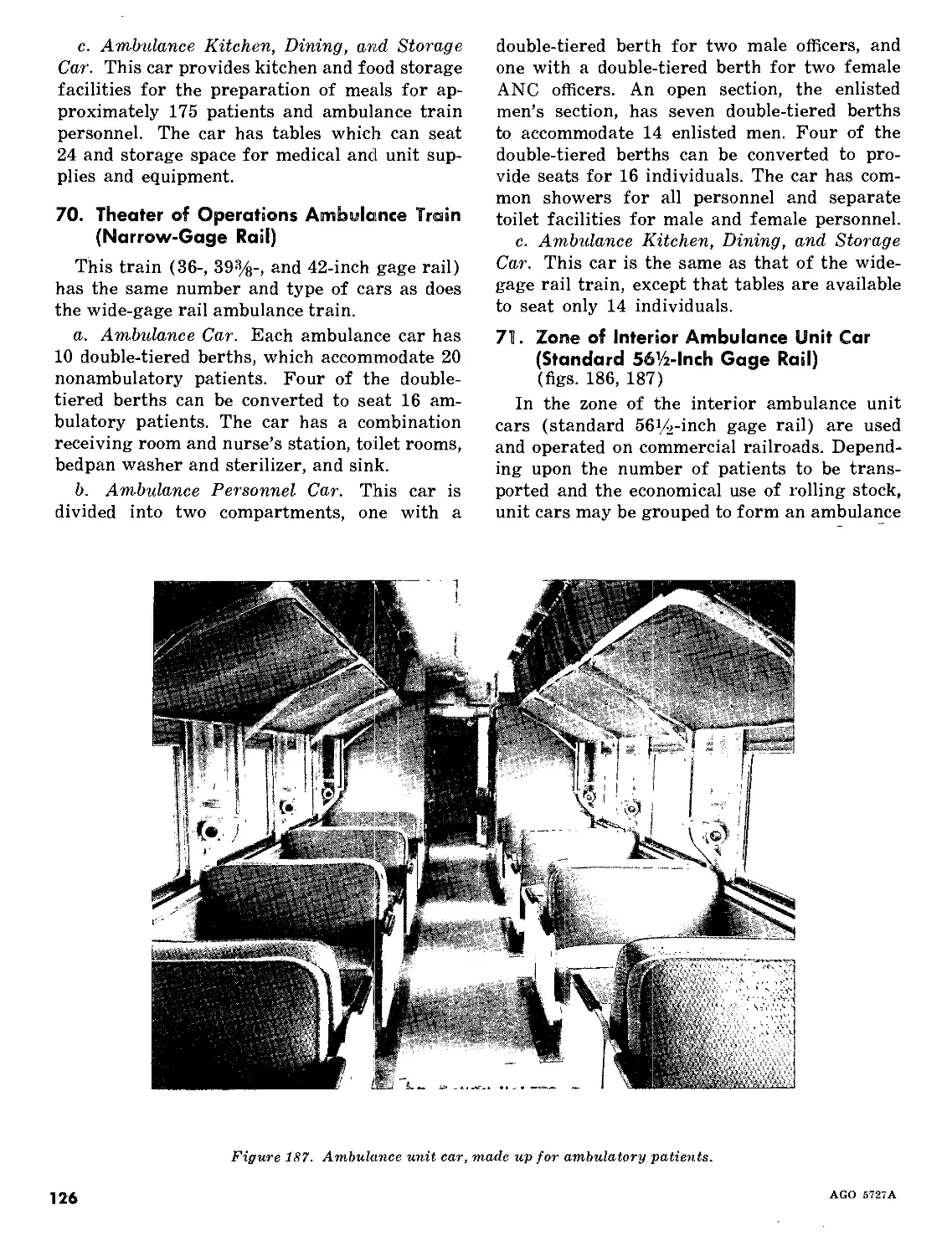

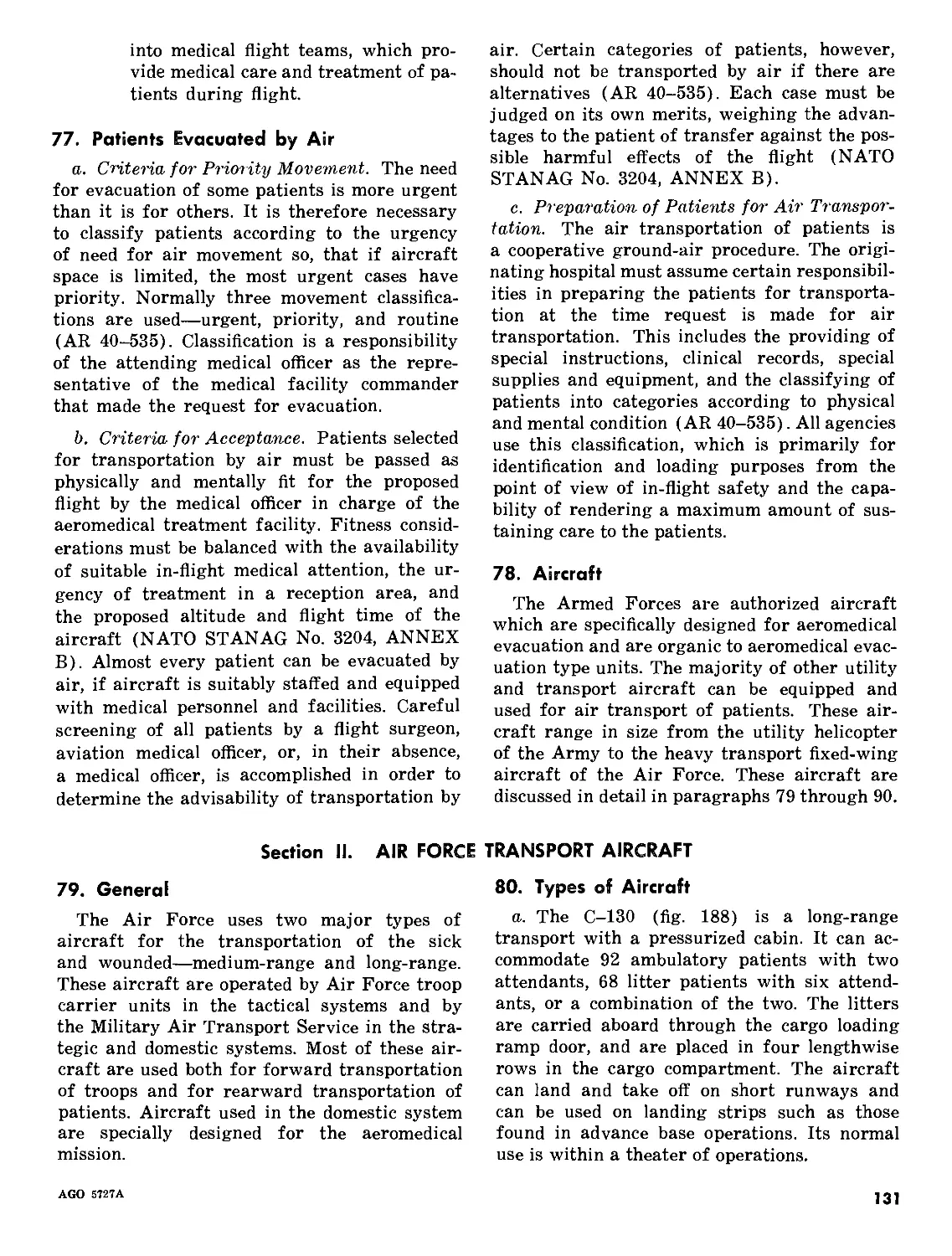
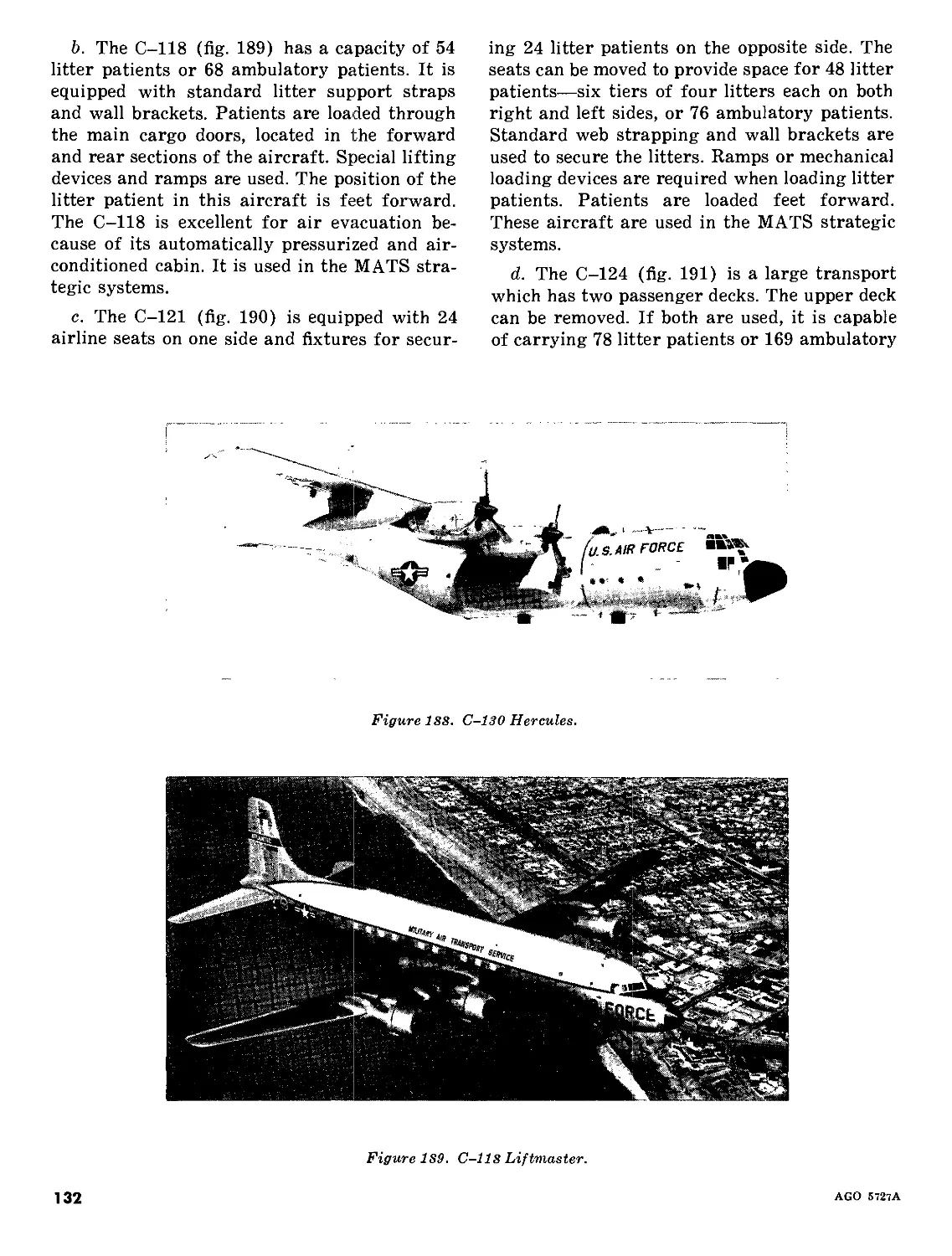
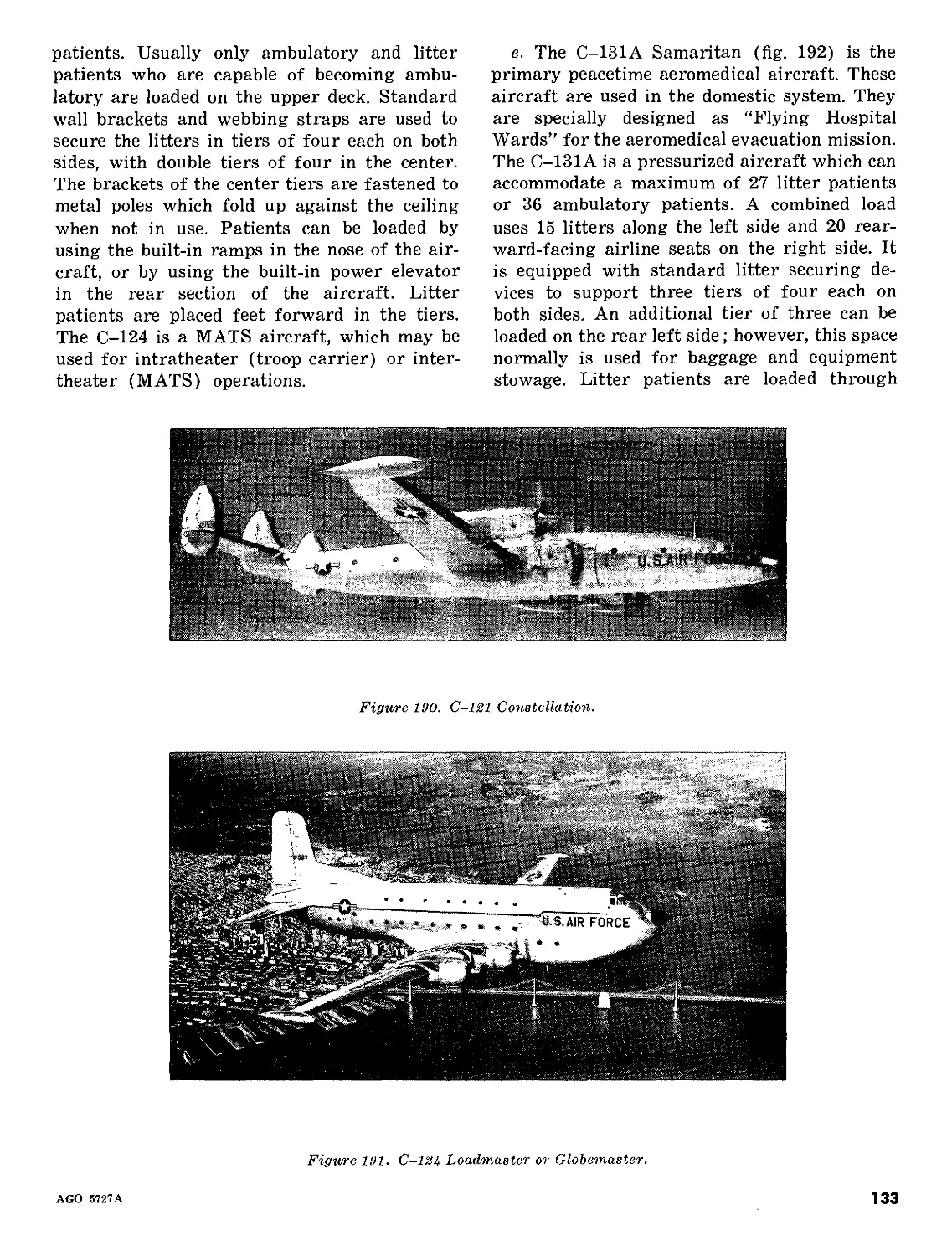
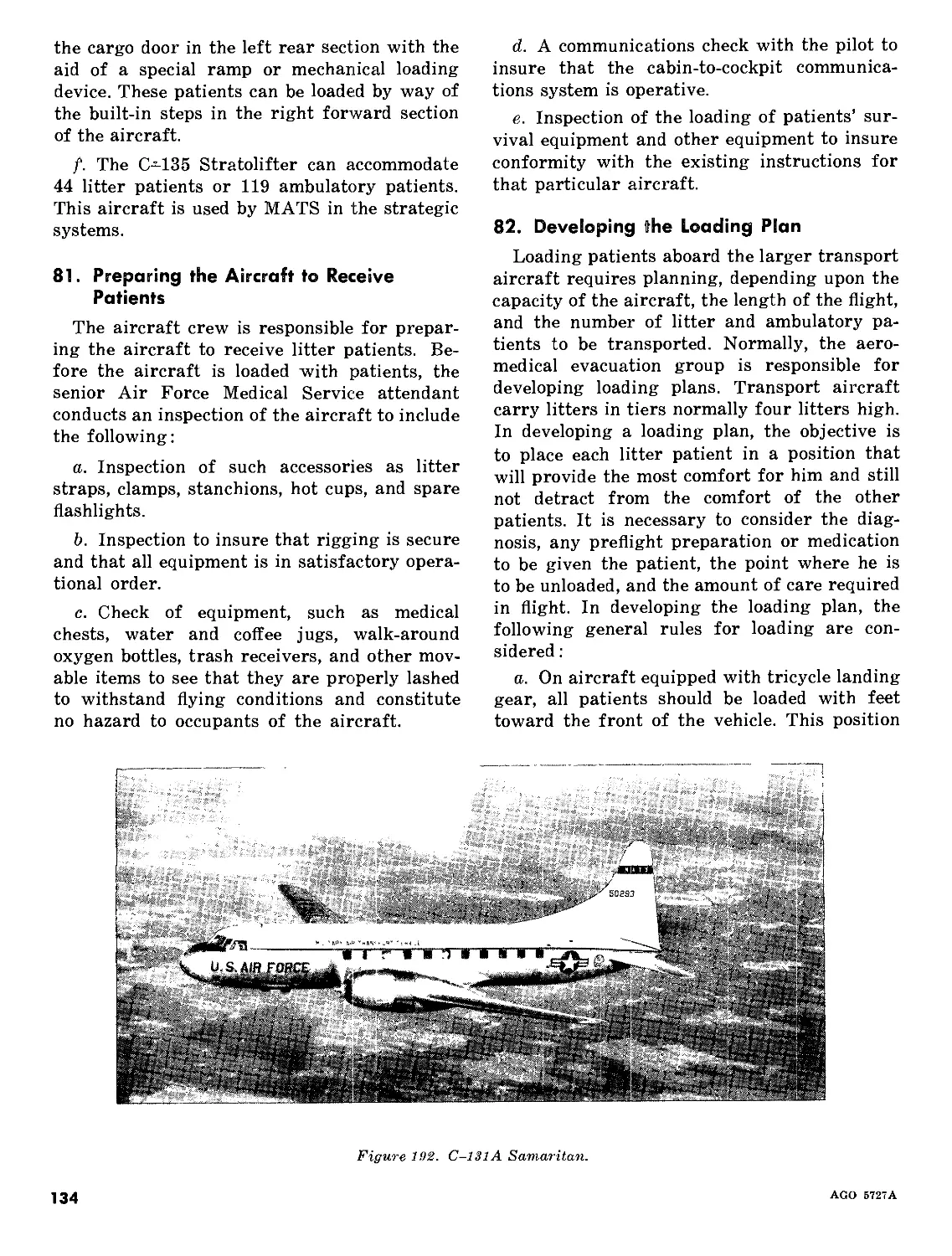
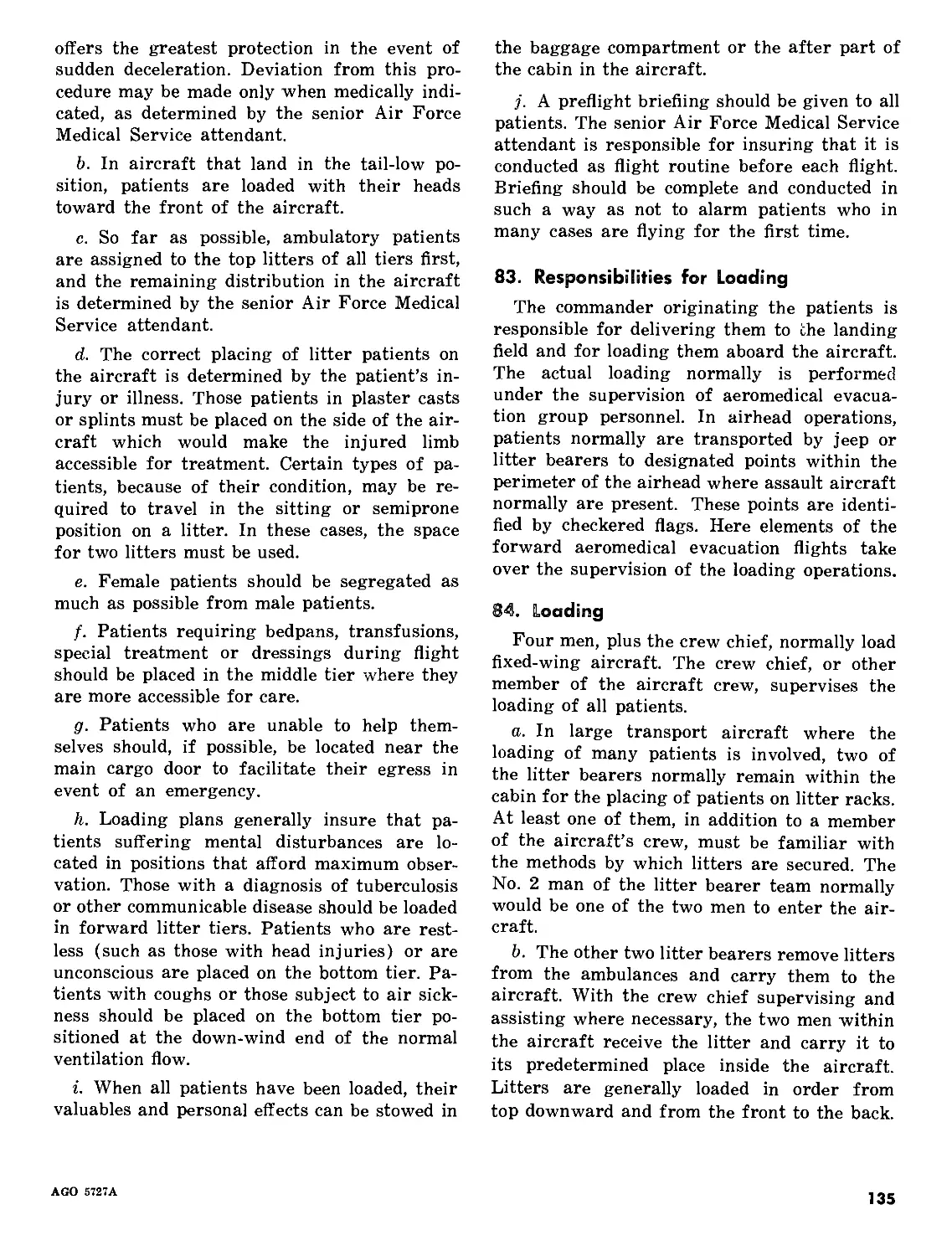

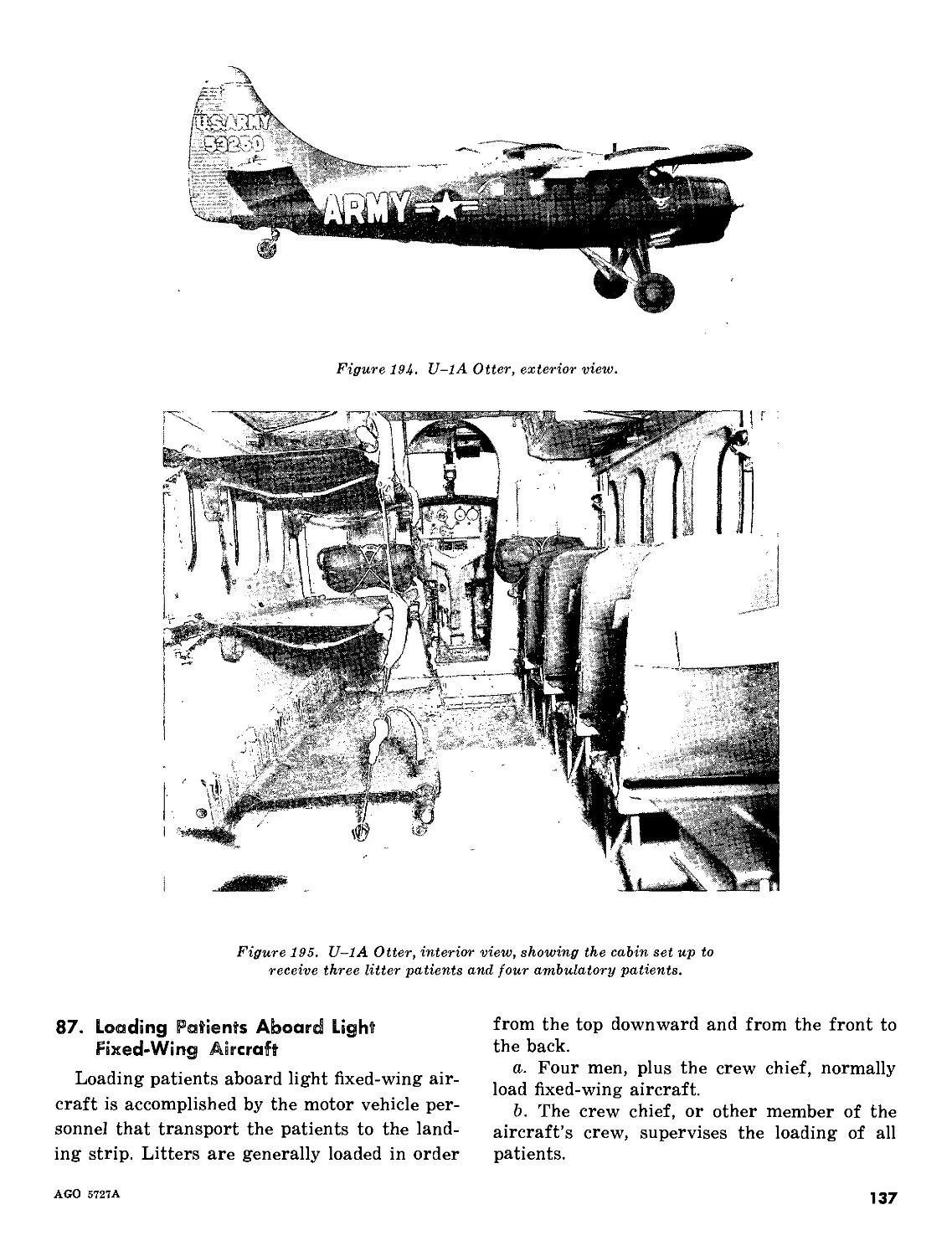
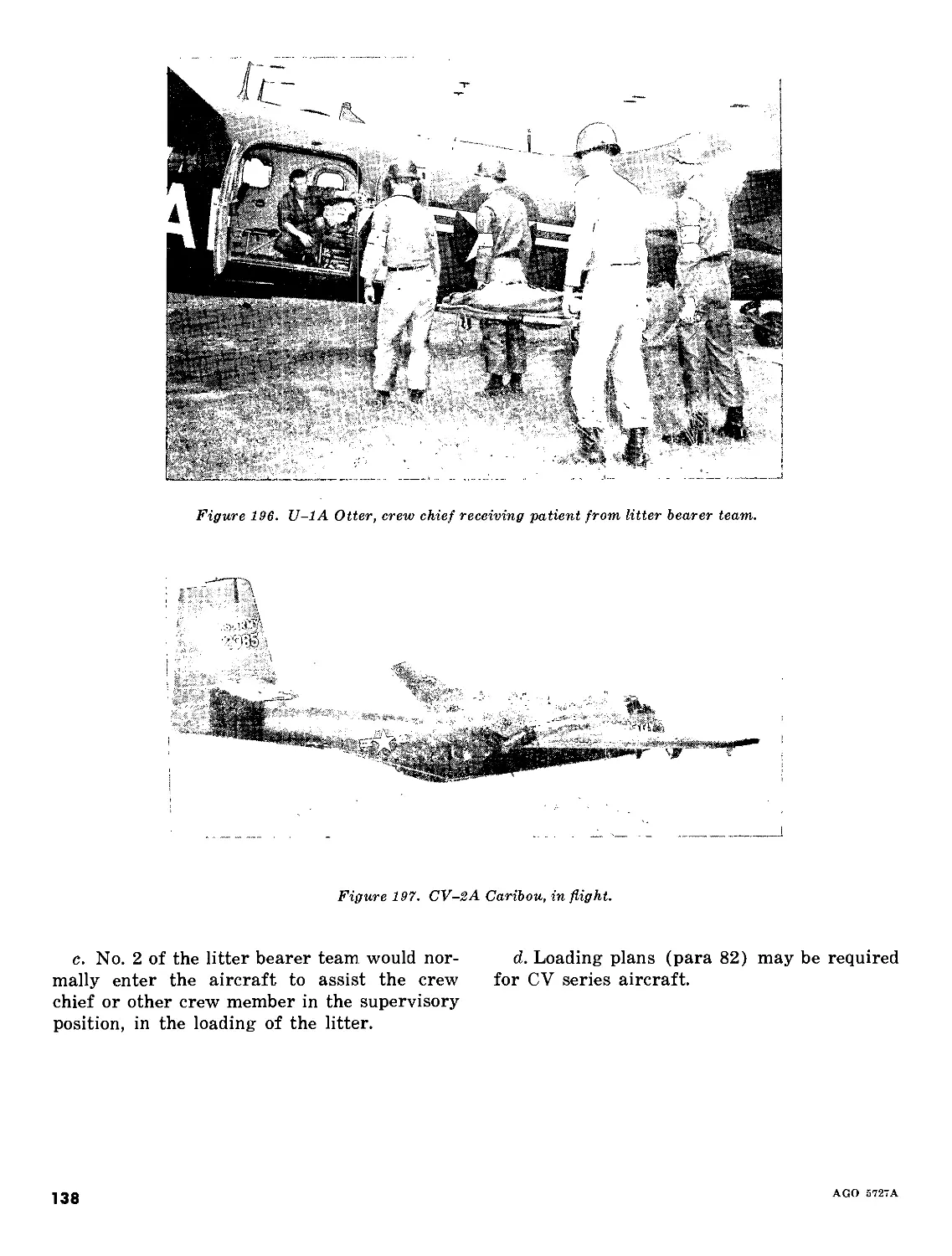
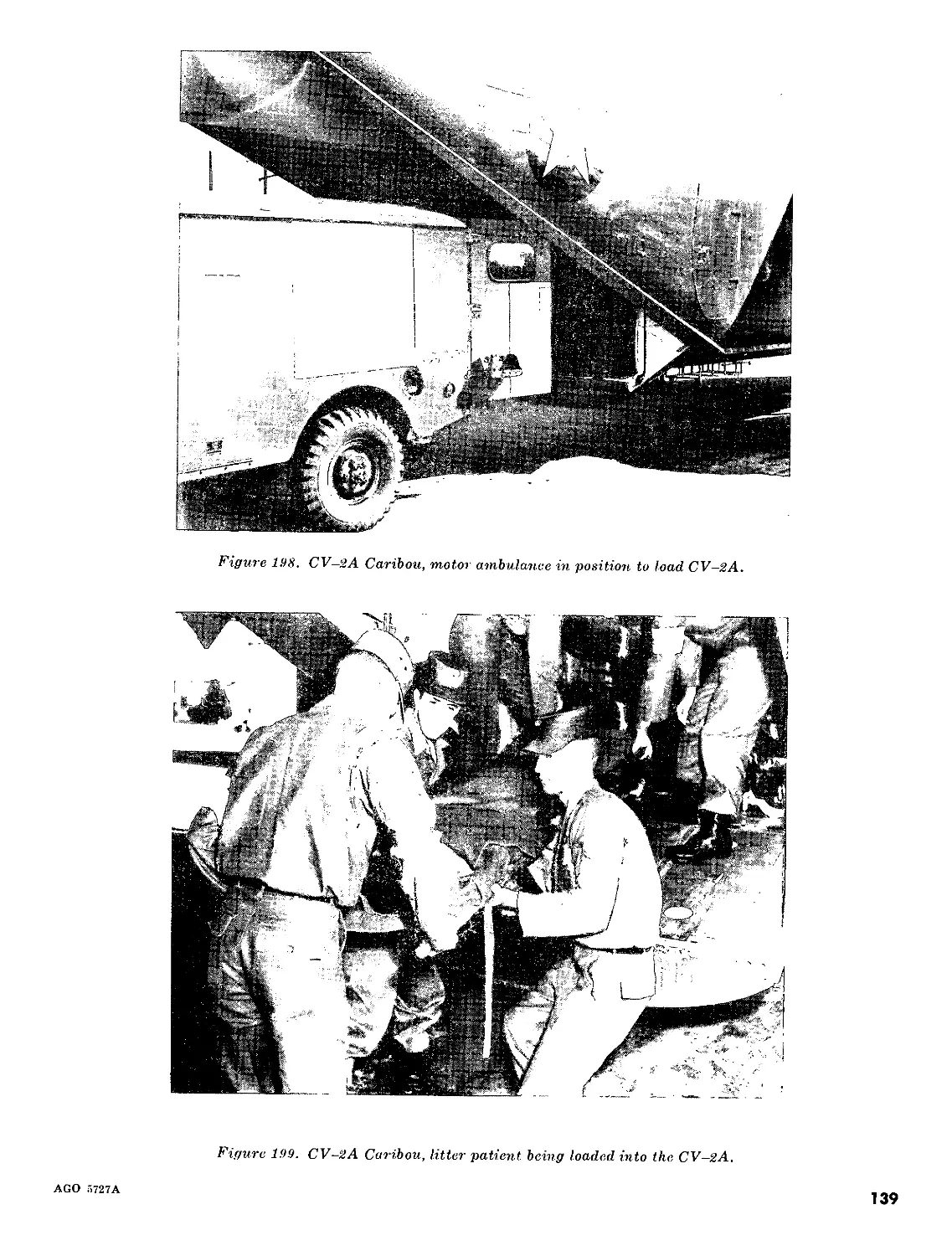


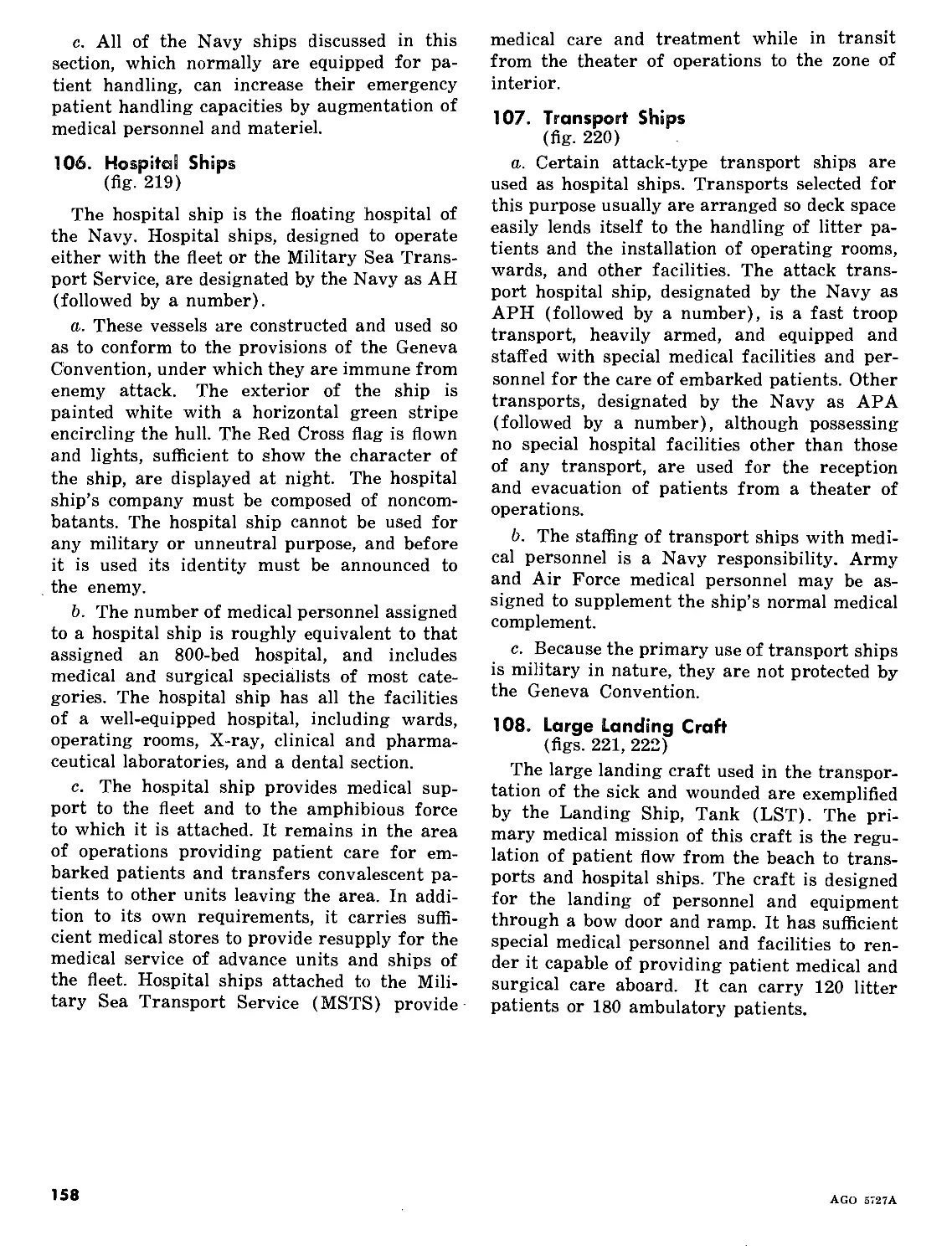


Теги: military medicine field manual
Год: 1966


Текст
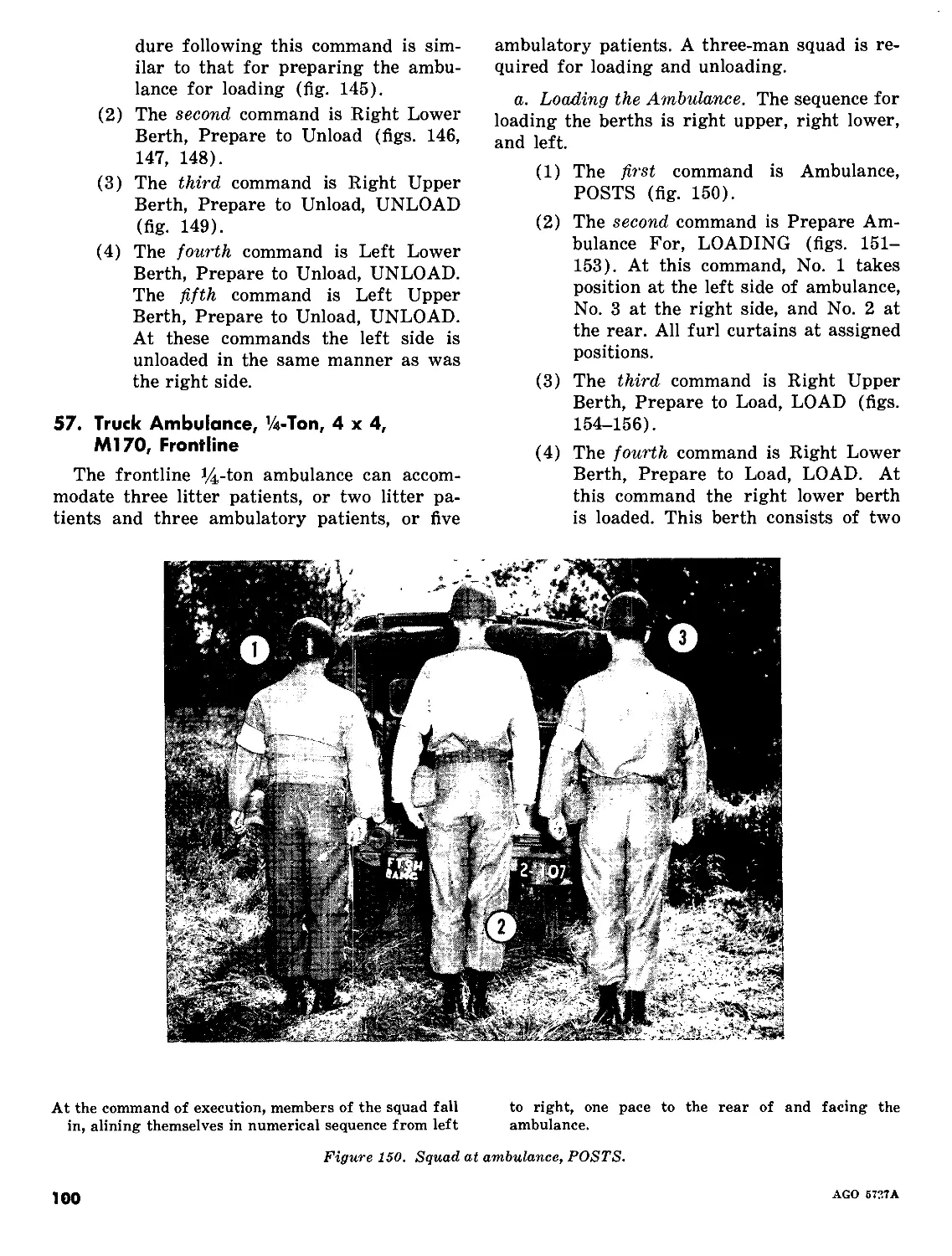
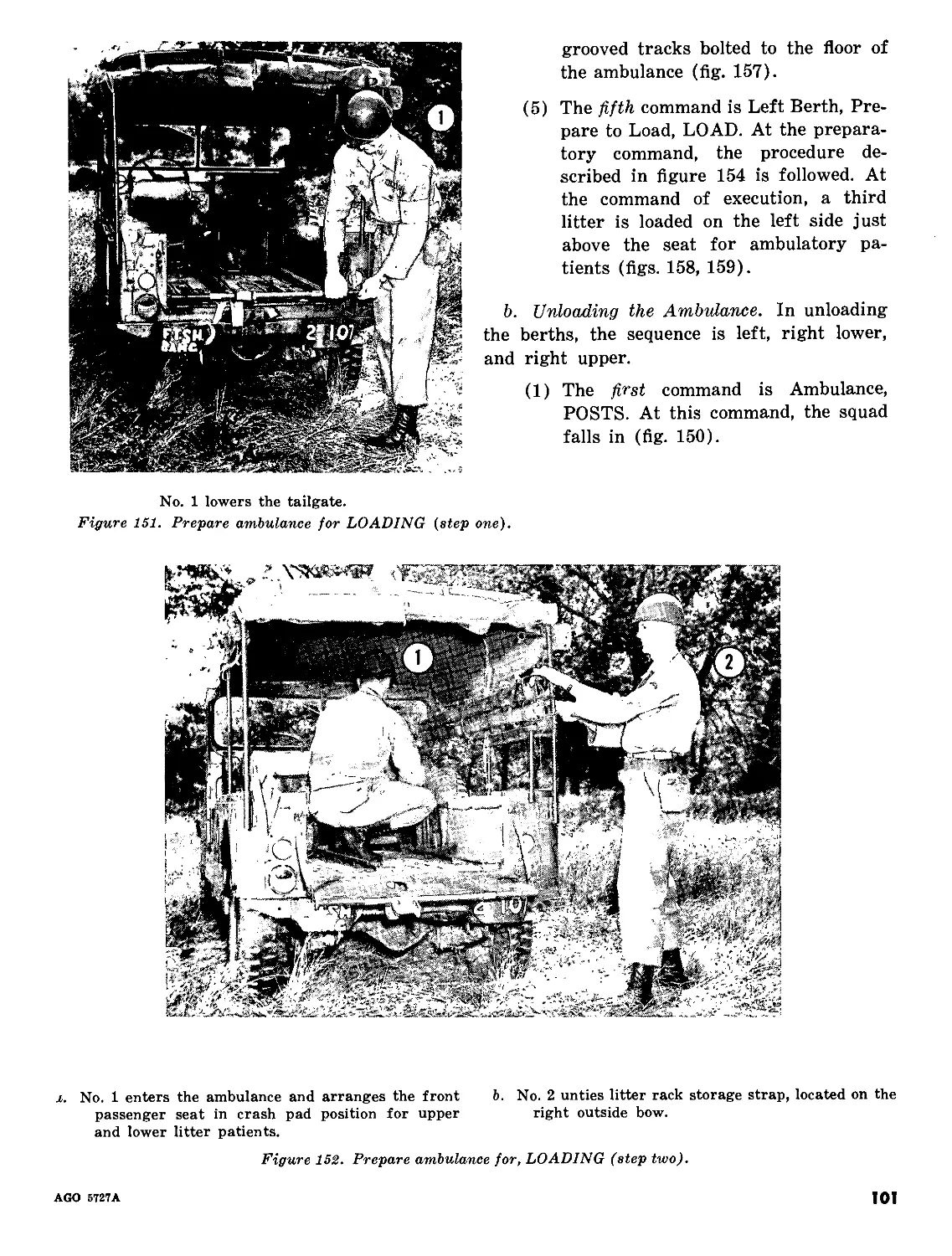
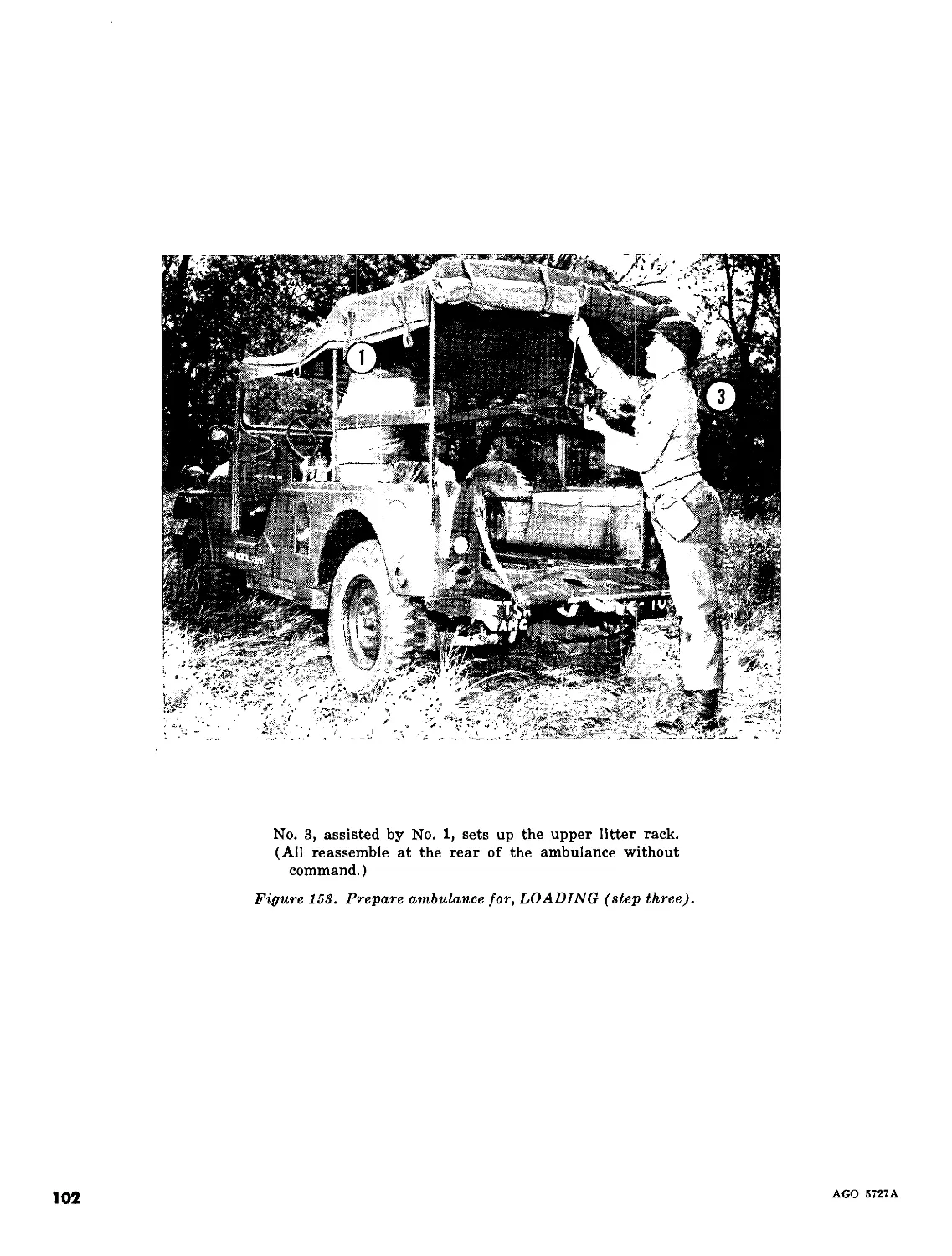
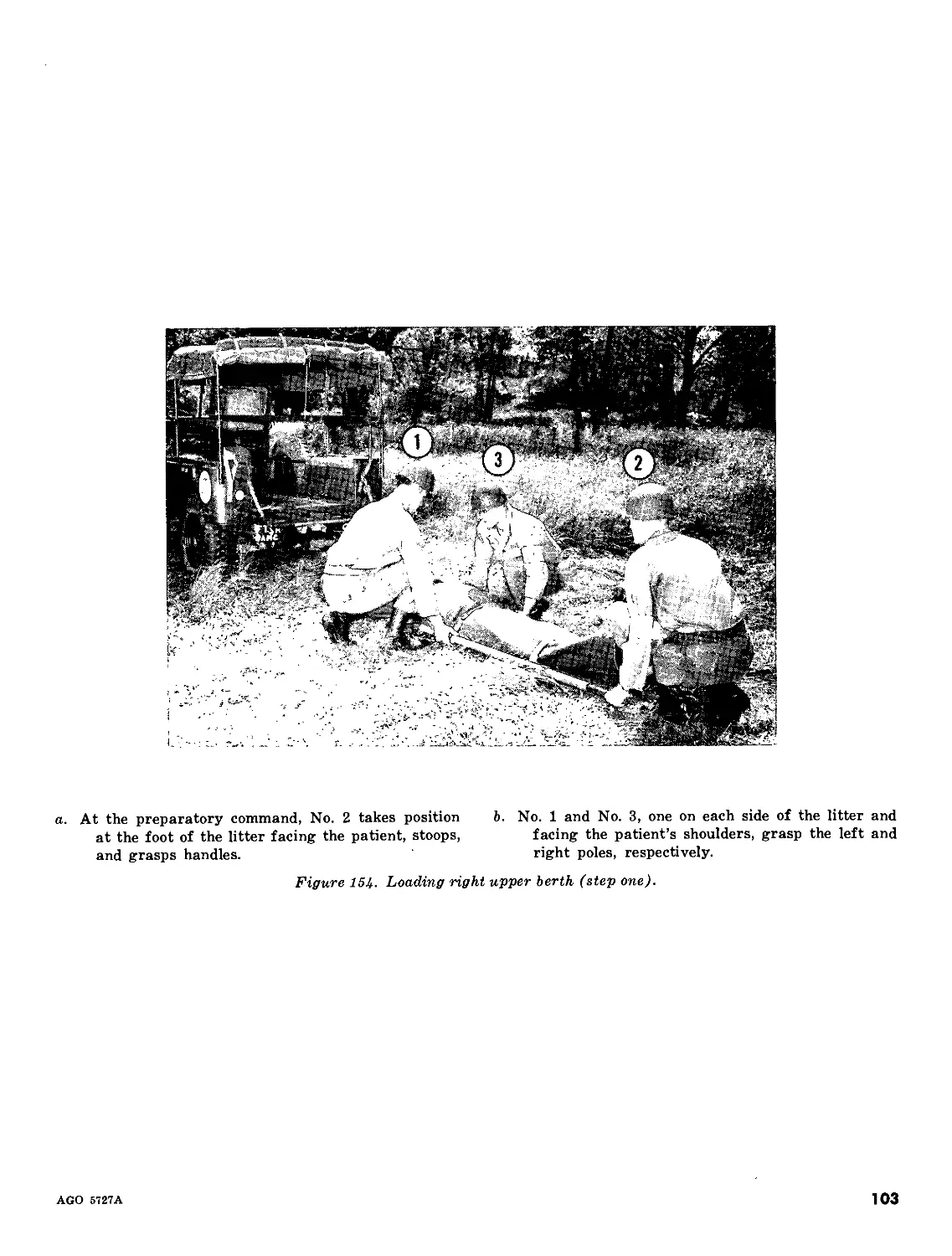
                    &з	FM 8-35
DEPARTMENT OF THE ARMY FIELD MANUAL
TRANSPORTATION
OF
THE SICK AND WOUNDED
HEADQUARTERS, DEPARTMENT OF THE ARMY
OCTOBER 1966
TAGO 5727A
FM 8-35
Field Manual
No. 8-35
DEPARTMENT OF THE ARMY
HEADQUARTERS
Washington, D.C., 19 October 1966
TRANSPORTATION OF THE SICK AND WOUNDED
	Paragraphs	Page
CHAPTER 1. GENERAL 		1-3	2
2. MANUAL TRANSPORTATION Section I. Introduction		4-6	4
II. One-Man Carries (figs. 1-20) 			5
III. Two-Man Carries (figs. 21-30)			14
IV. Special Manual Evacuation Techniques (figs. 31-35)		19
Chapter 3. LITTER TRANSPORTATION Section I. Litters		7-8	22
II. Litter Squad		9-12	25
III. Litter Drill		13-33	26
IV. Dressing the Litter		34	56
V. Litter Obstacles		35-43	59
VI. Improvised Litters		44,45	69
VII. Aids in Litter Transportation		46	73
VIII. Litter Evacuation in Snow and Extreme Cold		47,48	78
IX. Litter Evacuation in Mountain Operations		49,50	81
Chapter 4. TRANSPORTATION BY GROUND VEHICLE Section I. Motor Ambulance		51-58	87
II. Conversion of Military Vehicles to Patient Carriers _	59-65	115
III. Rail Transportation		66-71	124
Chapter 5. EVACUATION BY AIR Section I. Introduction		72-78	128
II. Air Force Transport Aircraft		79-84	131
III. Army Fixed-Wing Aircraft		85-87	136
IV. Army Helicopter Aircraft		88-90	140
V. AMEDS Aeromedical Evacuation Operations		91-102	145
Chapter 'б. TRANSPORTATION BY WATER Section I. Introduction 		103,104	157
II. Large Craft	_Z		105-108	157
III. Small Craft	/-		109-114	161
Appendix	REFERENCES	J-			170
*Thii manual supersedes 8—35, 19 December 1955, including С 1, 29 September 1958, C 2,
5 August I960, and C 3, 10 October 1963.
AGO 5727A
1
CHAPTER 1
GENERAL
1.	Purpose and Scope
The purpose and scope of this manual is to
describe the principal methods and means of
transporting the sick and wounded on land,
in the air, and on water.
a.	This material is applicable, without modi-
fication, to both nuclear and nonnuclear war-
fare.
b.	This manual contains references to details
of NATO agreements, STAN AG No. 2087,
Medical Employment of Helicopters in Ground
Wai fare; and ST AN AG No. 3204 and SOLOG
No. 83, Aeromedical Evacuation. Specific refer-
ences to these agreements are made wherever
details are discussed.
c.	Users of this manual are encouraged to
submit recommended changes or comments to
improve the manual. Comments should be keyed
to the specific page, paragraph, and line of the
text in which change is recommended. Reasons
should be provided for each comment to insure
understanding and complete evaluation. Com-
ments should be forwarded direct to The Sur-
geon General, Department of the Army, Wash-
ington, D.C. 20315.
2.	Medical Evacuation and Transportation
a.	Medical evacuation is the process of mov-
ing patients from sites as far forward as the
battlefield to medical treatment facilities which
can provide appropriate medical treatment. The
evacuation and transportation of the sick and
wounded and their medical treatment and care
are continuing, parallel functions, beginning
promptly at the place of injury or onset of
illness continuing along a system of medical
treatment facilities, and ending as far rearward
as fixed medical installations. The military
medical services accomplish these functions as
rapidly, as orderly, and as effectively as pos-
sible, with the condition and safety of the pa-
tient as the primary concern. Patients are
evacuated no farther to the rear than their
condition requires or the military situation per-
mits.
b.	It is the policy of the Department of De-
fense that, in both peace and war, the transpor-
tation of patients of the Armed Forces be ac-
complished by aircraft when air transportation
is feasible and available and conditions are suit-
able for air evacuation. Within a theater of
operations, patients may be moved by manual
means, litter, ground ambulance, aircraft, am-
bulance train, or by a combination of these
means. From the theater of operations to the
zone of interior, they are transported by air-
craft, or by surface water means when air
transportation is not feasible.
3.	Relation of Transportation to the
Medical Task
The transportation of the sick and wounded
to medical treatment facilities and the provision
of appropriate medical treatment and care dur-
ing transportation is one of the chief responsi-
bilities of the military medical services.
a.	Air transportation of the sick and wounded
within the combat zone is a mission of the Army
Medical Service. This includes battlefield pick-
up of patients, their transportation to the ini-
tial point of treatment, and initial and subse-
quent transportation to hospital facilities with-
in the combat zone. The Army Medical Service
is also responsible for transportation of pa-
tients by litter and manual means and by
ground ambulance. Ground ambulance is used
for patient transportation to medical treatment
facilities, to airstrips for air transportation
from the combat zone by Air Force aircraft,
and from the combat zone to and within the
2
AGO 5727A
communications zone. The Army also uses am-
bulance trains for patient evacuation. In gen-
eral, ambulance trains are used for the trans-
portation of patients who are unable to be
moved by air because of their condition, or
when aircraft transportation is not feasible or
available for patient evacuation.
b.	Patient evacuation by air over routes of
sole interest to the Navy and within naval (in-
cluding marine) combat areas is a function of
the Navy. It is a responsibility of the Navy
to provide water transportation for the sick and
wounded from the theater of operations to the
zone of interior. This means of transportation
is used as a supplement to aircraft transporta-
tion and as an alternative means when aircraft
transportation is not available or advisable. It
is accomplished by the Military Sea Transport
Service.
c.	The Air Force is responsible for providing
air evacuation of patients from airheads in
logistically supported airborne operations and
between zones in a theater of operations (ac-
complished by the theater Troop Carrier
Force); between theaters of operations and
from the theater of operations to and within
the zone of interior (accomplished by the Mili-
tary Air Transport Service).
AGO 5727A
3
CHAPTER 2
MANUAL TRANSPORTATION
Section I.	INTRODUCTION
4.	Handling the Patient
Careful and correct handling of the patient
is of primary importance in the evacuation and
transportation of the sick and wounded. If a
patient is roughly or incorrectly moved, his in-
jury may become more serious or even fatal.
5.	Treatment of the Patient
Many lifesaving and life preserving measures
are carried out before transporting the wounded
to medical treatment facilities. Before any
movement of the patient is attempted, the type
and extent of the injury is evaluated. Measures
are taken to stop bleeding, establish airway
and give artificial respiration when needed, pro-
tect wounds, and prevent or treat for shock. If
a patient has a fracture or a suspected fracture,
the part should be immobilized before he is
moved. Every precaution must be taken to pre-
vent the broken ends of bone from cutting
through muscle, blood vessels, nerves, and skin.
If a patient has a serious leg injury, the leg
should be splinted to prevent further injury,
even if the bone is not broken. For further dis-
cussion of emergency medical care and treat-
ment, see TM 8-230.
6.	Manual Carries
Manual carries are tiring for the bearer and
involve the risk of increasing the seriousness
of the patient’s injury. In some instances, lit-
ters are not available and patients must be
transported by manual carries. In these in-
stances, the patients should be transferred to
litters as soon as litters are available. In certain
types of terrain and in some combat situations,
only manual transportation is feasible, and in
some situations, manual transportation is
necessary to save a life.
a.	Some of the carries discussed in this chap-
ter may be used for unconscious patients.
Others can be used only if the patient is con-
scious. Some of the carries must not be used
if there is any evidence of a fractured arm,
thigh, neck, back, or hip.
b.	Manual carries are accomplished by one
bearer or by two bearers. Two-man carries are
used whenever possible. They provide more
comfort to the patient, are less likely to aggra-
vate injuries, and are also less tiring for the
bearers, who are thus able to carry the patient
farther.
c.	The fireman’s carry, which is one of the
easiest ways for one man to carry another, is
of special importance since the preliminary
steps of the carry are used in several other one-
man carries. An unconscious or disabled per-
son can be raised from the ground in the first
three steps of the carry.
d.	In this chapter, manual carries are de-
scribed step by step and basic doctrine is ex-
plained. Certain flexibility is permitted in the
application of the doctrine. In the discussion of
the fireman’s carry, the first three steps are de-
scribed two different ways: starting at the back
of the patient, and starting in front of the pa-
tient. The bearer, first determining the location
of the patient’s wound, can thus choose the
method he believes to be the safer for the pa-
tient. In the discussion of some of the carries,
the terms “left (right)” or “right (left)” are
used to indicate that the various steps of the
carry can be accomplished by starting from
either the left or the right side.
4
AGO 5727A
Section II.	ONE-MAN CARRIES
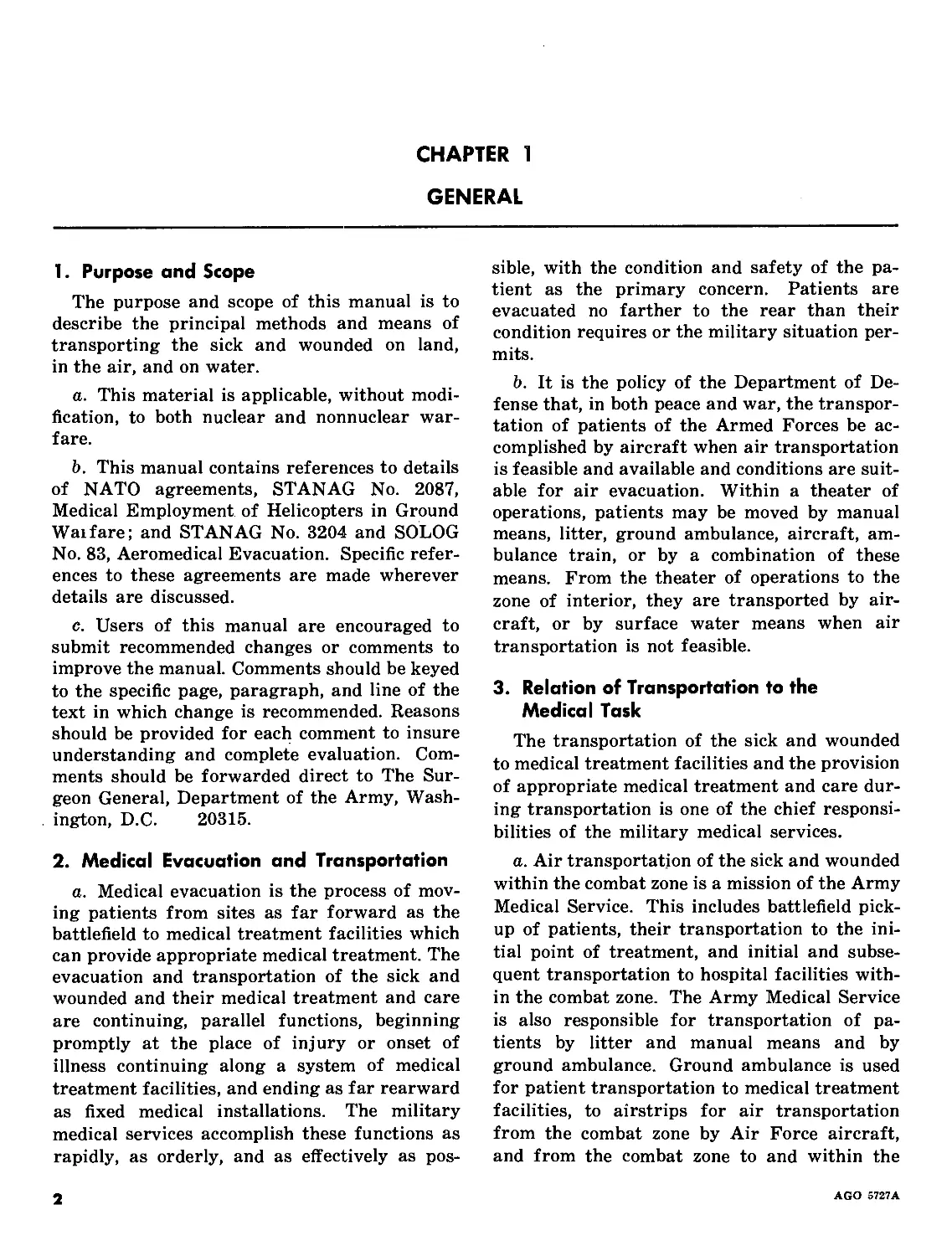
(Can be used if patient is unconscious.) Turn patient
face down.
Figure 1.	Fireman’s carry (step one).
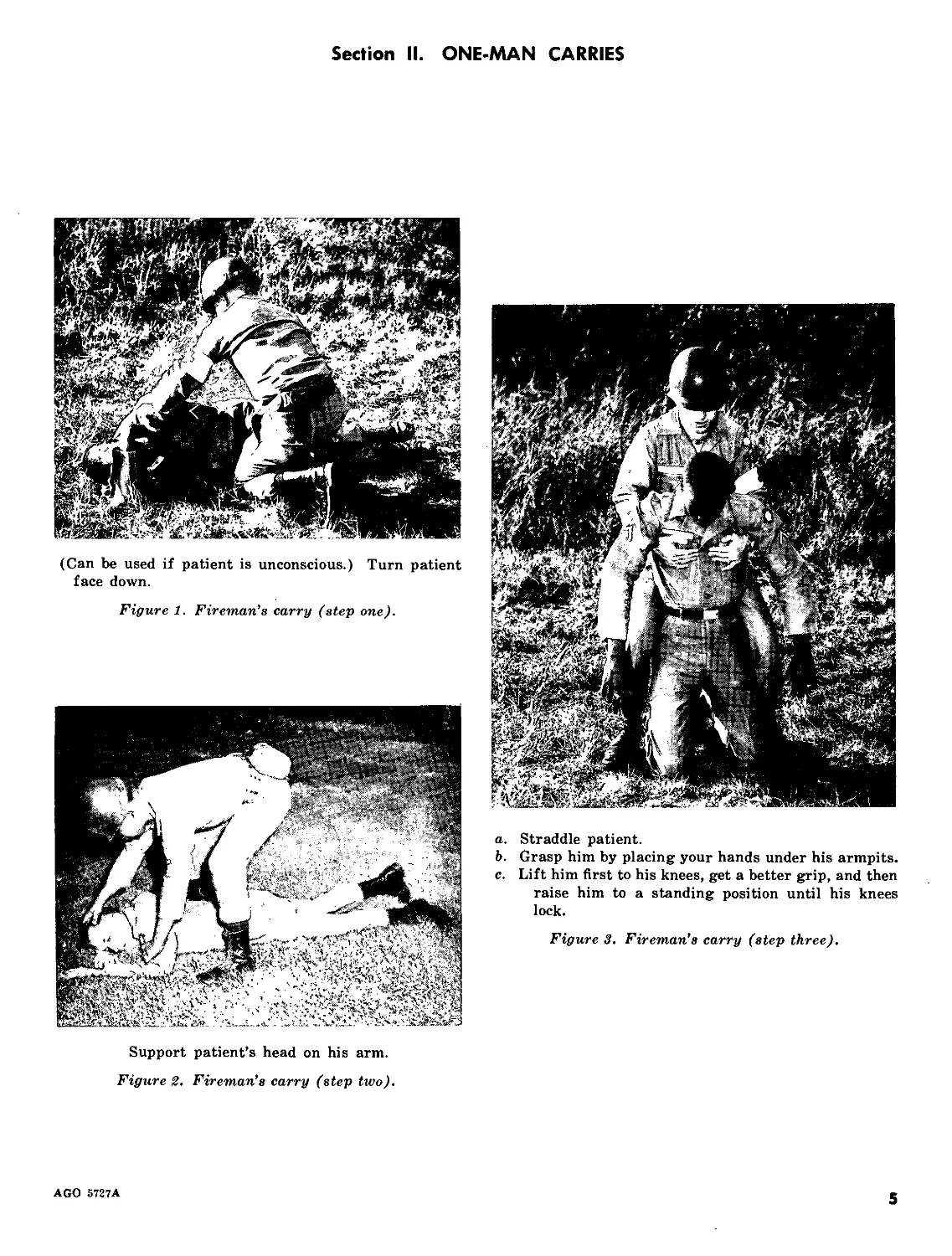
a.	Straddle patient.
b.	Grasp him by placing your hands under his armpits,
c. Lift him first to his knees, get a better grip, and then
raise him to a standing position until his knees
lock.
Figure 3. Fireman’s carry (step three).
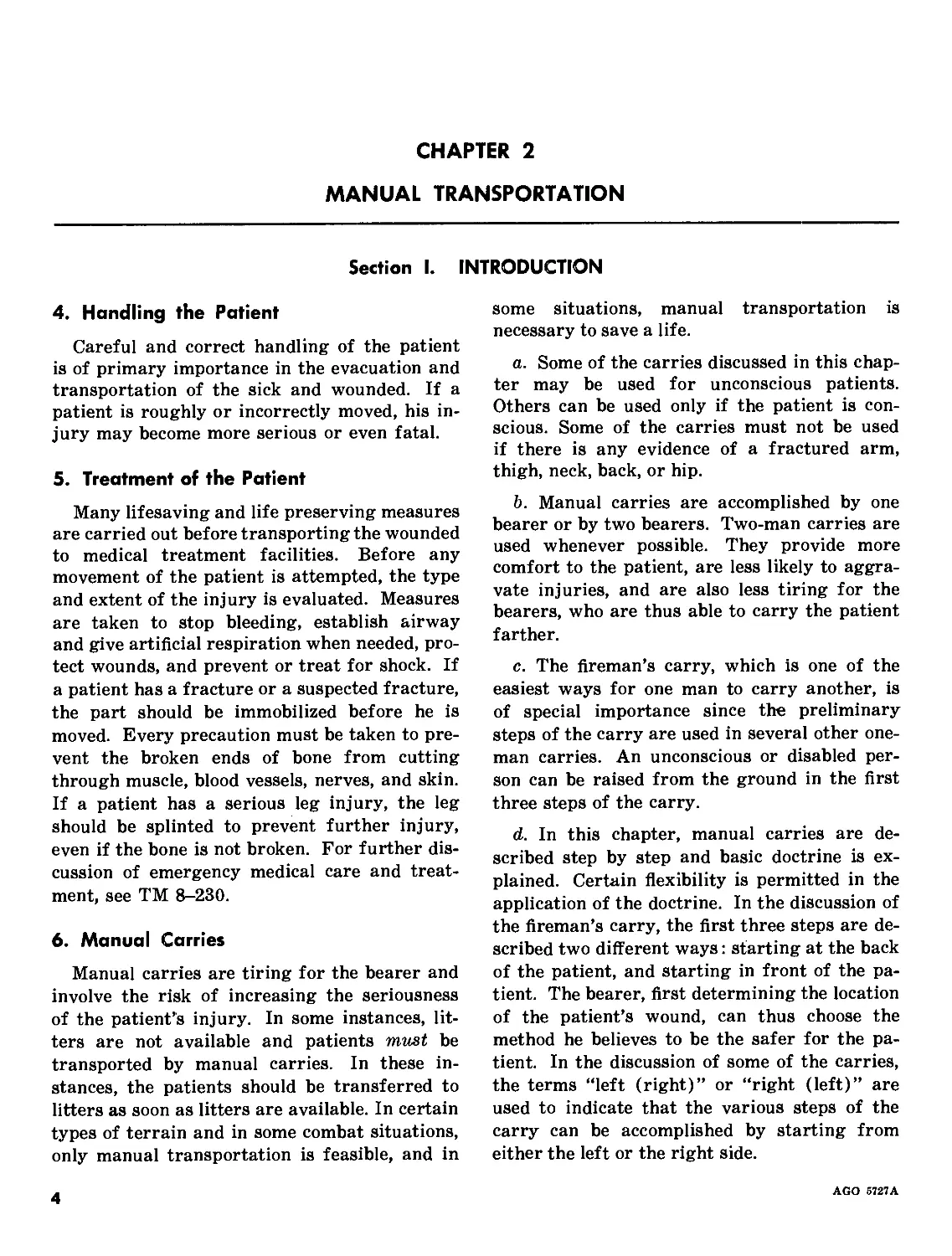
Support patient’s head on his arm.
Figure 2.	Fireman’s carry (step two).
AGO 5727A
5
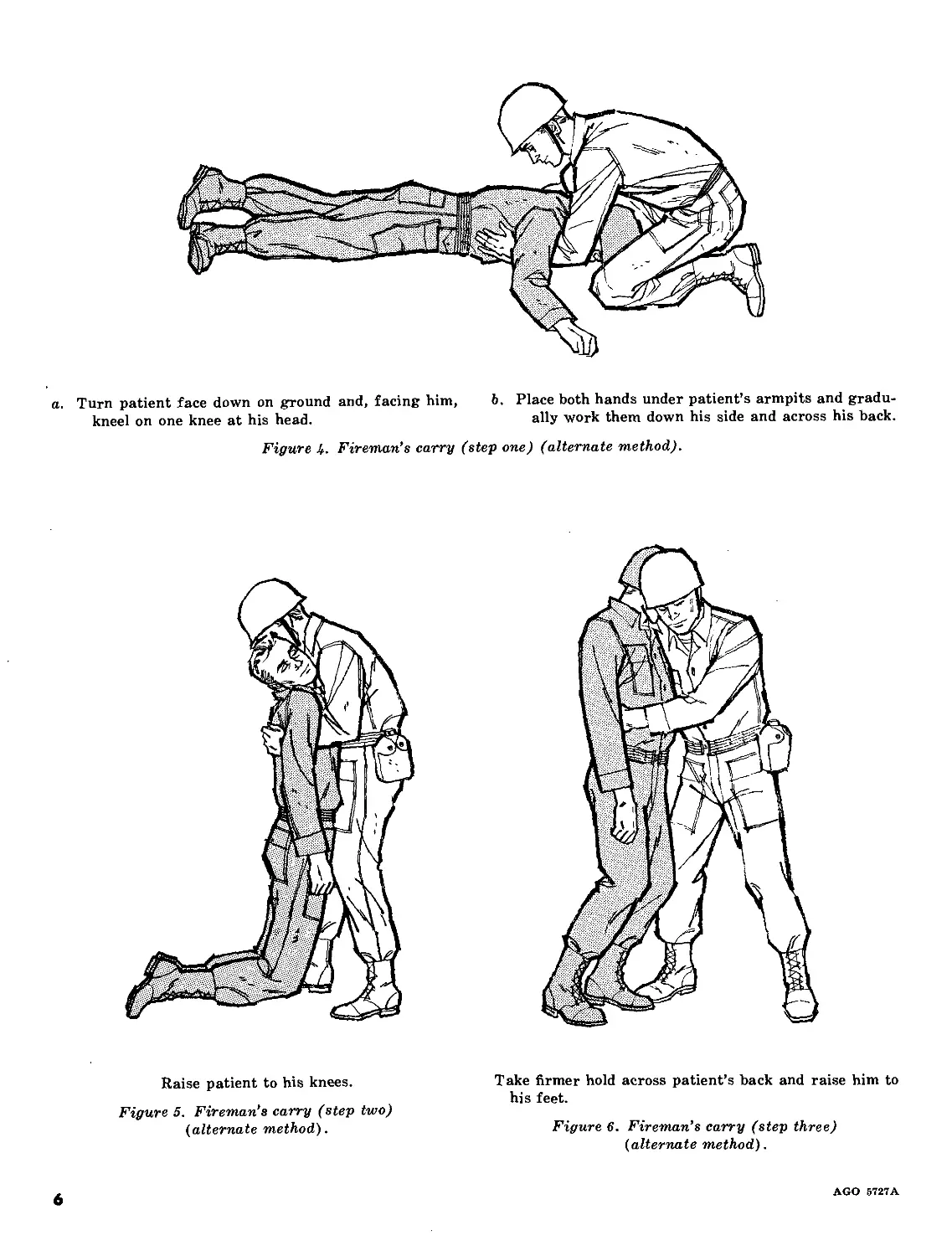
a.
Turn patient face down on ground
kneel on one knee at his head.
and, facing him, 6. Place both hands under patient’s armpits and gradu-
ally work them down his side and across his back.
Figure 4.	Fireman’s carry (step one) (alternate method).
Raise patient to his knees.
Figure 5.	Fireman’s carry (step two)
(alternate method).
Take firmer hold across patient’s back and raise him to
his feet.
Figure 6.	Fireman’s carry (step three)
(alternate method).
6
AGO 5727A
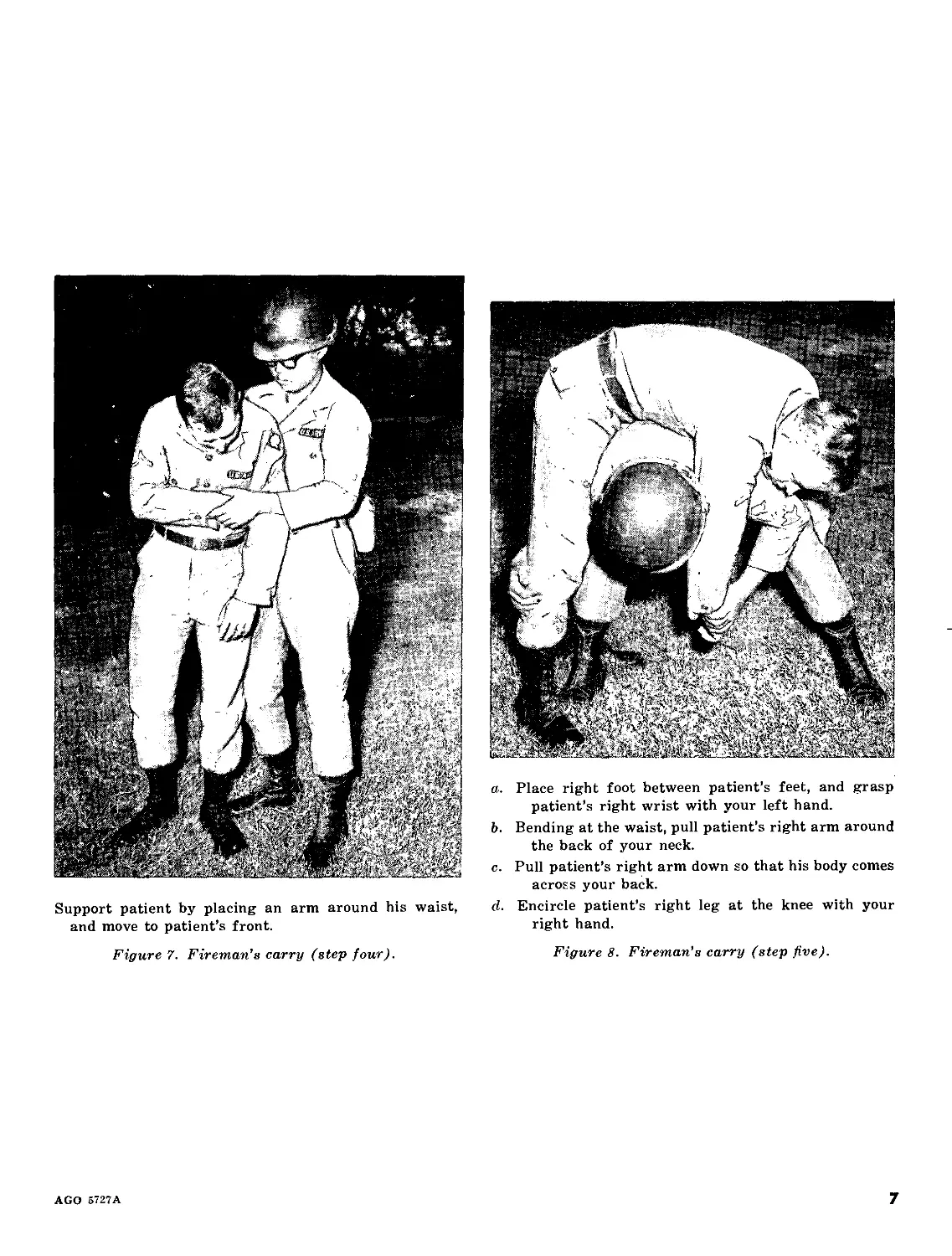
Support patient by placing an arm around his waist,
and move to patient’s front.
a.	Place right foot between patient’s feet, and grasp
patient’s right wrist with your left hand.
b.	Bending at the waist, pull patient’s right arm around
the back of your neck.
c.	Pull patient’s right arm down so that his body comes
across your back.
d.	Encircle patient’s right leg at the knee with your
right hand.
Figure 7.	Fireman’s carry (step four).
Figure 8.	Fireman’s carry (step five).
AGO 5727A
7
Lift patient while straightening up, holding patient’s
right wrist in your left hand and the patient’s right
knee in your right hand.
Figure 9.	Fireman’s carry (step six).
Grasp patient’s right wrist in your right hand, leaving
your left hand free.
Figure 10.	Fireman’s carry (step seven).
8
AGO 5727Л
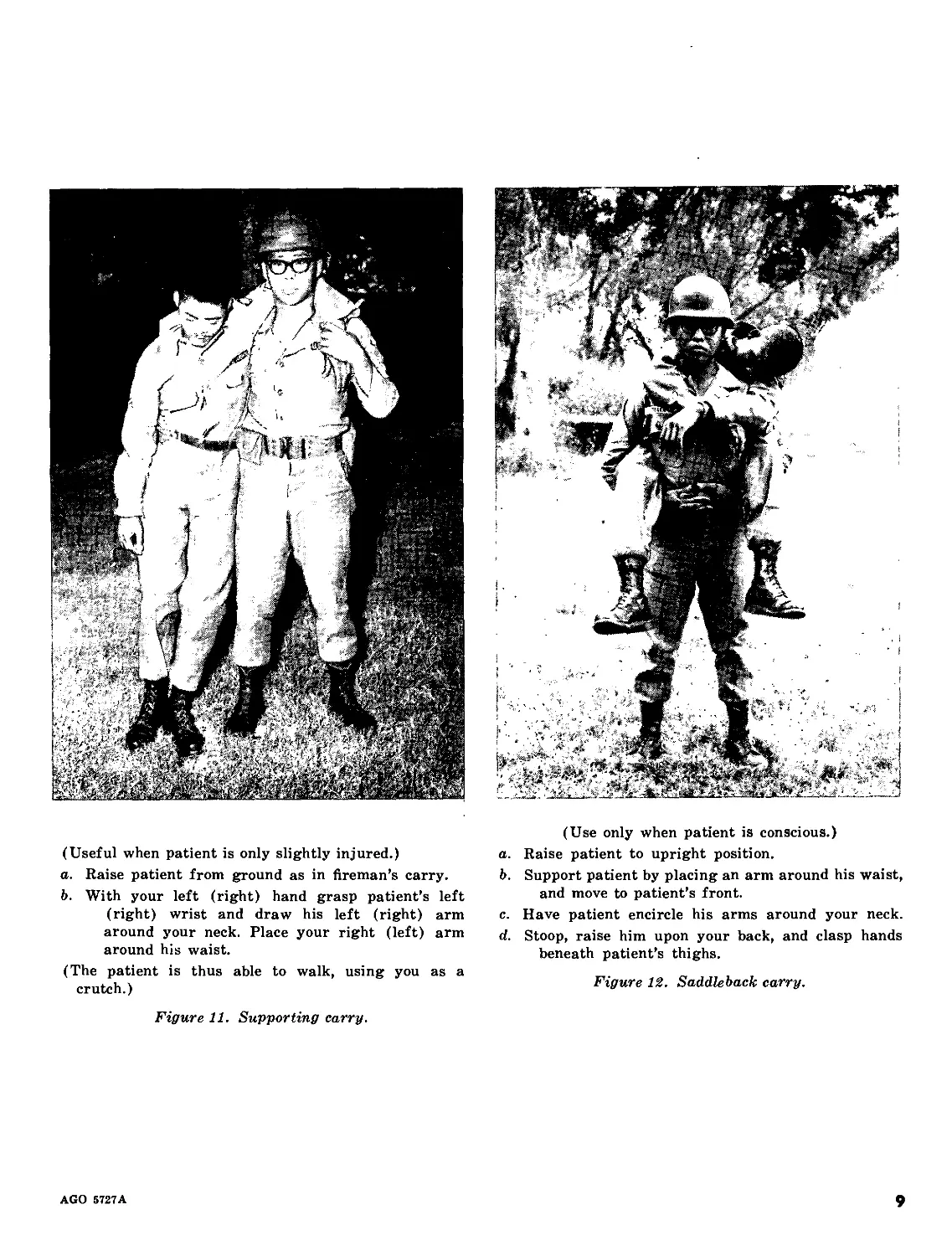
(Useful when patient is only slightly injured.)
a.	Raise patient from ground as in fireman’s carry.
b.	With your left (right) hand grasp patient’s left
(right) wrist and draw his left (right) arm
around your neck. Place your right (left) arm
around his waist.
(The patient is thus able to walk, using you as a
crutch.)
Figure 11.	Supporting carry.
(Use only when patient is conscious.)
a.	Raise patient to upright position.
b.	Support patient by placing an arm around his waist,
and move to patient’s front.
c.	Have patient encircle his arms around your neck,
d. Stoop, raise him upon your back, and clasp hands
beneath patient’s thighs.
Figure 12.	Saddleback carry.
AGO 5727A
9
(A good way of carrying an unconscious patient. Do
not use if there is a fracture or suspected fracture
of arm, leg, neck, back, or hip.)
a.	Raise patient from ground as in fireman’s carry.
b.	Support patient by placing an arm around his waist,
and move to patient’s front.
c.	Grasp patient’s wrists and hoist him so that his
armpits are over your shoulders.
Figure 13. Pack-strap carry.
(May be used for long distances without undue fatigue
of bearer.)
Link together two pistol belts to form a continuous belt
under the patient’s thighs and hips so that a loop
extends from each side.
(Can be used with alternate equipment, such as one rifle
sling, two triangular bandages, two litter straps, or
any suitable material that will not cut or bind the
patient’s flesh and is long enough to pass around
patient and be secured around carrier.)
Figure Ц. Pistol-belt carry (step one).
10
AGO 5727A
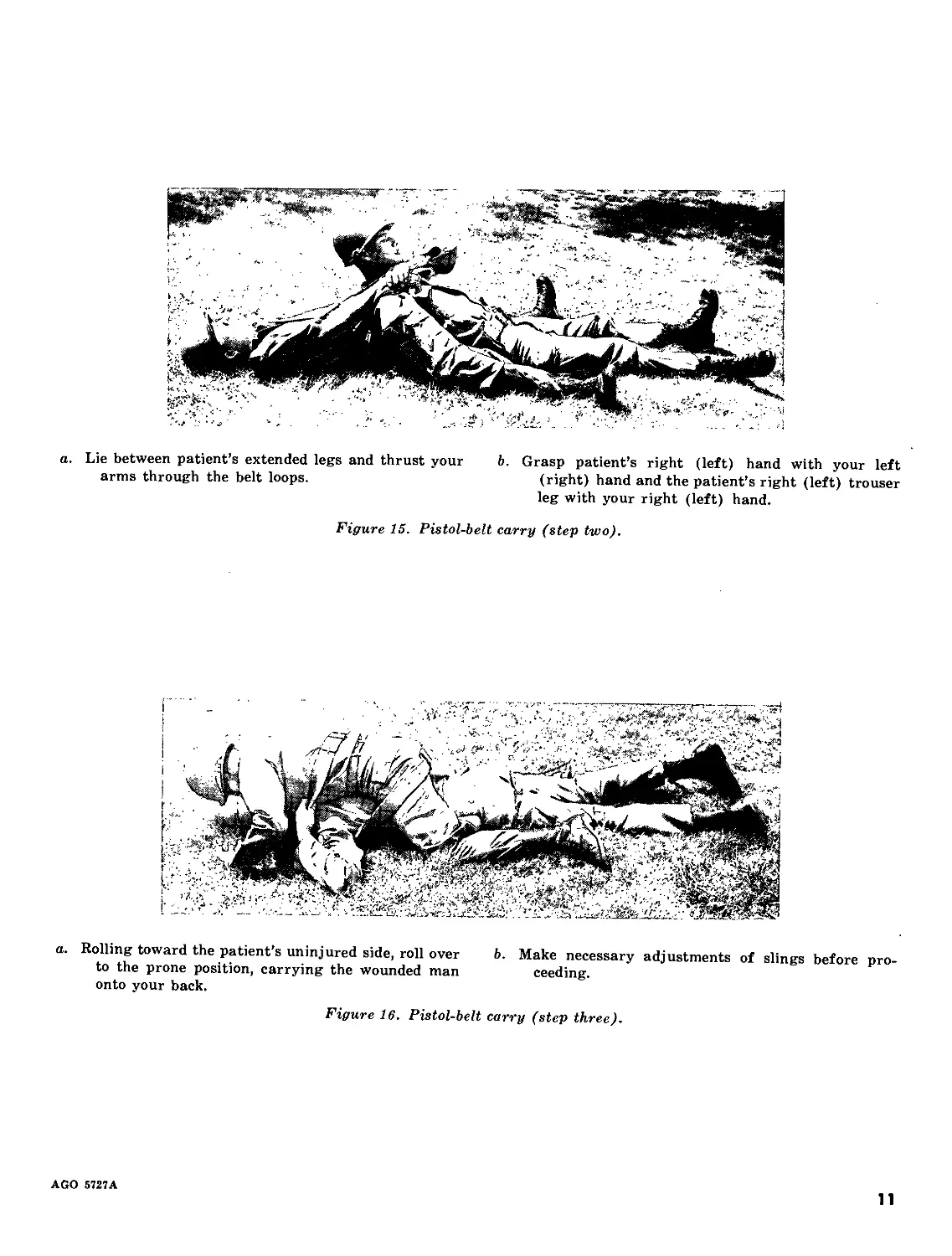
a.	Lie between patient’s extended legs and thrust your
arms through the belt loops.
b.	Grasp patient’s right (left) hand with your left
(right) hand and the patient’s right (left) trouser
leg with your right (left) hand.
Figure 15.	Pistol-belt carry (step two).
a. Rolling toward the patient’s uninjured side, roll over b. Make necessary adjustments of slings before pro-
to the prone position, carrying the wounded man	ceeding.
onto your back.
Figure 16.	Pistol-belt carry (step three).
AGO 5727A
11
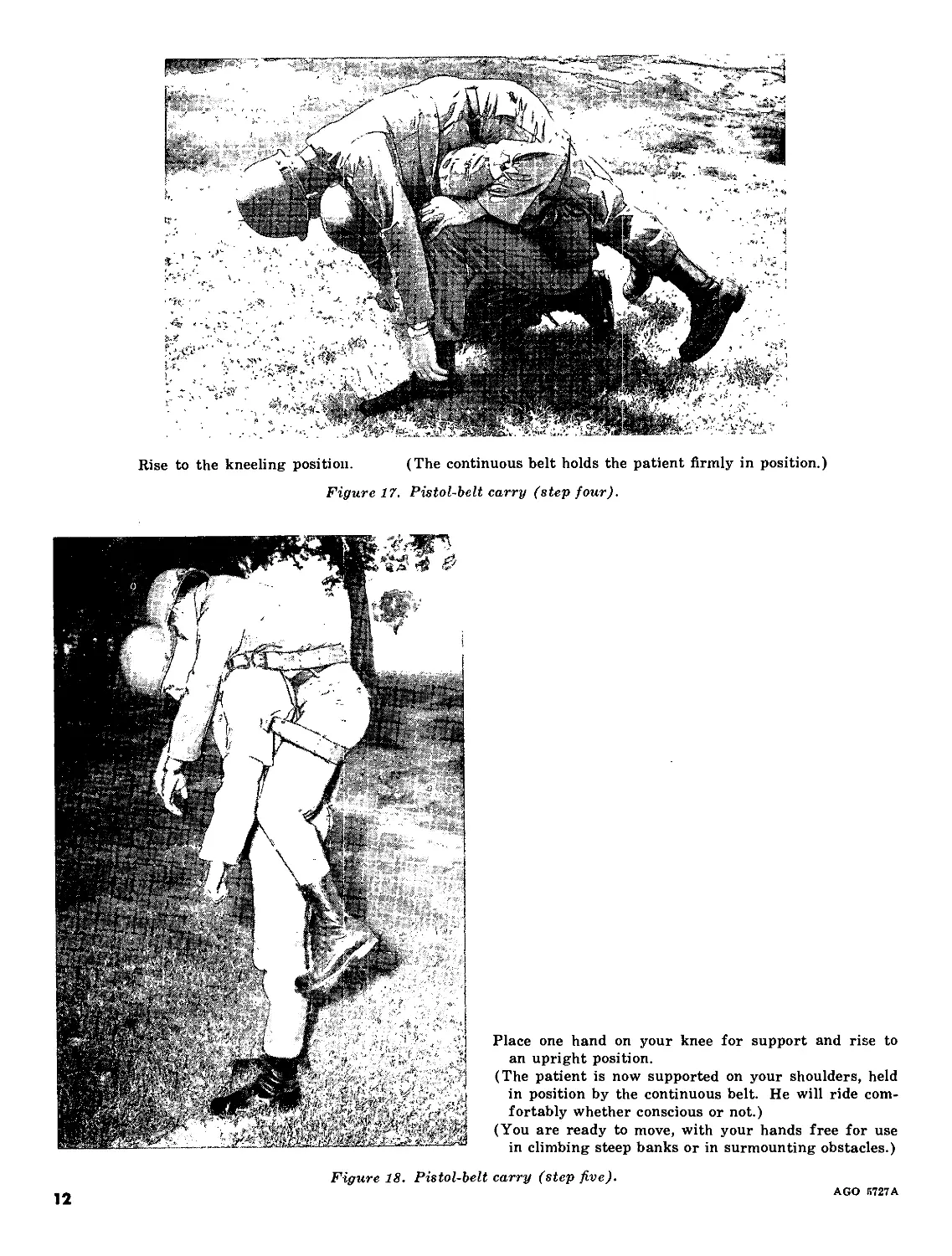
Rise to the kneeling position.
(The continuous belt holds the patient firmly in position.)
Figure 17. Pistol-belt carry (step four).
Place one hand on your knee for support and rise to
an upright position.
(The patient is now supported on your shoulders, held
in position by the continuous belt. He will ride com-
fortably whether conscious or not.)
(You are ready to move, with your hands free for use
in climbing steep banks or in surmounting obstacles.)
Figure 18.	Pistol-belt carry (step five).
AGO 5727A
12
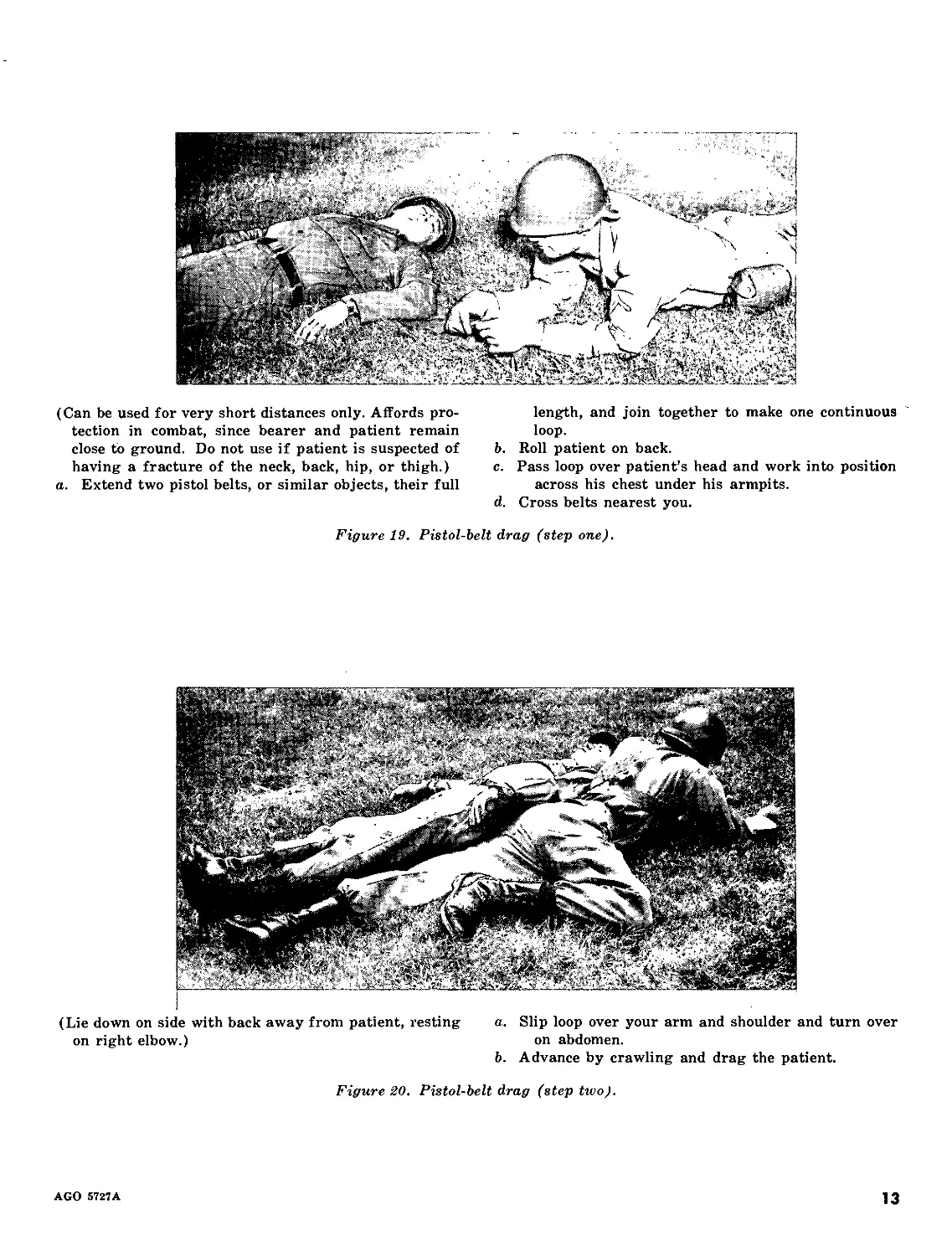
(Can be used for very short distances only. Affords pro-
tection in combat, since bearer and patient remain
close to ground. Do not use if patient is suspected of
having a fracture of the neck, back, hip, or thigh.)
a.	Extend two pistol belts, or similar objects, their full
length, and join together to make one continuous
loop.
b.	Roll patient on back.
c.	Pass loop over patient’s head and work into position
across his chest under his armpits.
d.	Cross belts nearest you.
Figure 19.	Pistol-belt drag (step one).
(Lie down on side with back away from patient, resting a. Slip loop over your arm and shoulder and turn over
on right elbow.)	on abdomen.
b. Advance by crawling and drag the patient.
Figure 20.	Pistol-belt drag (step two).
AGO 5727A
13
Section III. TWO-MAN CARRIES
(May be used for the unconscious patient. Do not use
if there is evidence of a fractured arm, leg, neck,
back, or hip.)
Method of accomplishment is similar to that for one-
man supporting carry (fig. 11), except that two men
are used instead of one.
Figure 21.	Two-man supporting carry.
Figure 22. Two-man arms carry (step one).
(Particularly suited to lifting a patient onto a litter
or other carrier.)
a.	The two bearers kneel at one side of the patient.
b.	One bearer places one arm beneath the patient’s
shoulders and the other arm beneath his back.
c.	The second bearer places one arm beneath the pa-
tient’s hips and the other arm beneath his knees.
Figure 22.	Two-man arms carry (step one).
14
AGO 5727A
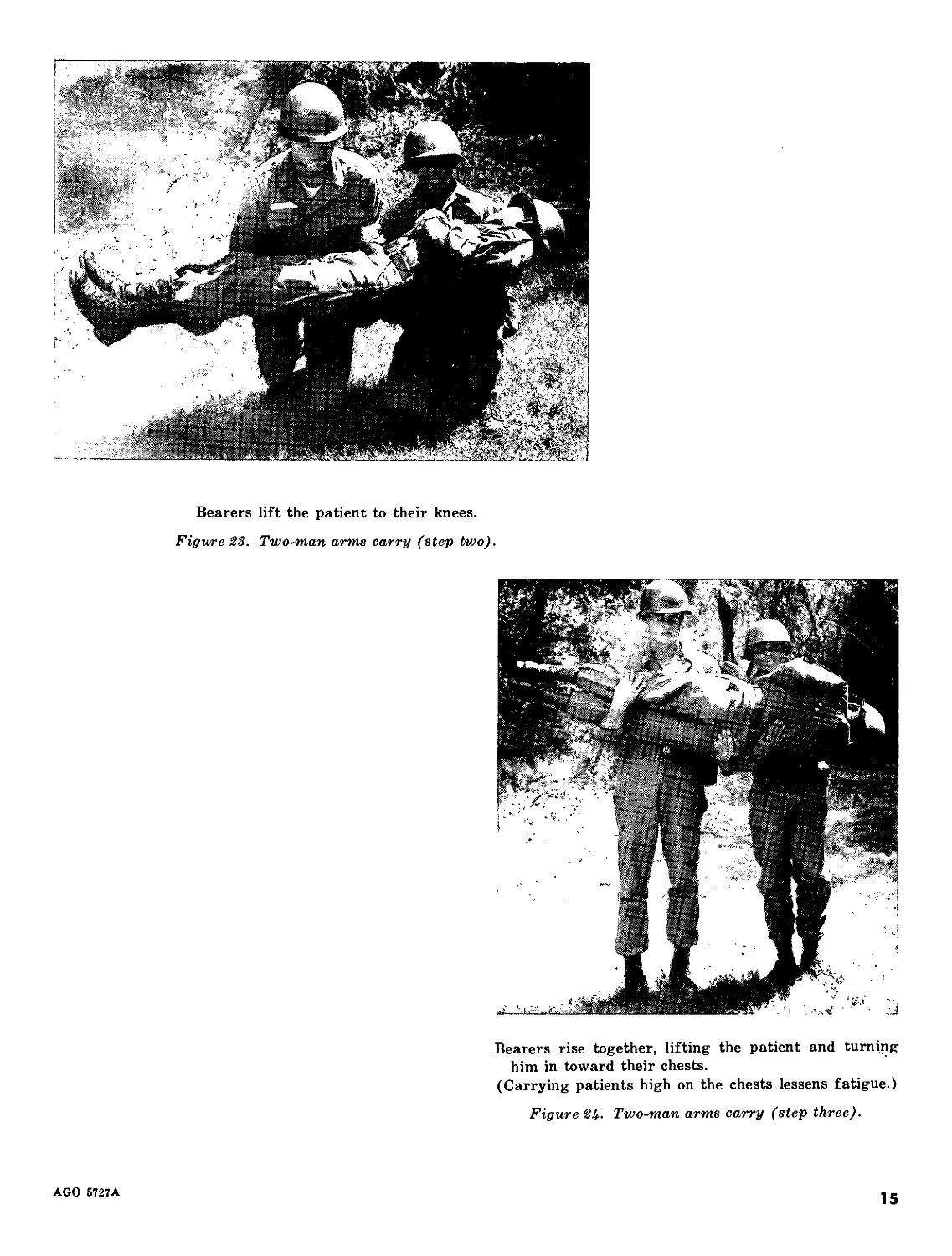
Bearers lift the patient to their knees.
Figure 23.	Two-man arms carry (step two).
Bearers rise together, lifting the patient and turning
him in toward their chests.
(Carrying patients high on the chests lessens fatigue.)
Figure 2Ь. Two-man arms carry (step three).
AGO 6727A
15
(A good method for carrying an unconscious patient a
short distance. Do not use if there is a fracture or
suspected fracture of the arm, leg, neck, back, or hip.)
a. With patient lying on his back, front bearer spreads
patient’s legs, steps between them, faces away
from the patient, kneels, reaches back, and grasps
patient behind the knees.
b. Rear bearer kneels at patient’s head, and thrusts
his arms under patient’s armpits and across his
chest, locking his hands together.
Figure 25.	Two-man saddleback carry (step one).
(A good carry for patients with injuries of the head
or feet. Patient must be conscious so he can hold on.)
Each bearer grasps his own left wrist with his right
hand, and then grasps the other bearer’s right wrist
with his left hand.
Bearers rise together, lifting the patient.
Figure 26.	Two-man saddleback carry (step two).
Figure 27.	Four-hand carry (packsaddle carry)
(step one).
16
AGO 5727A
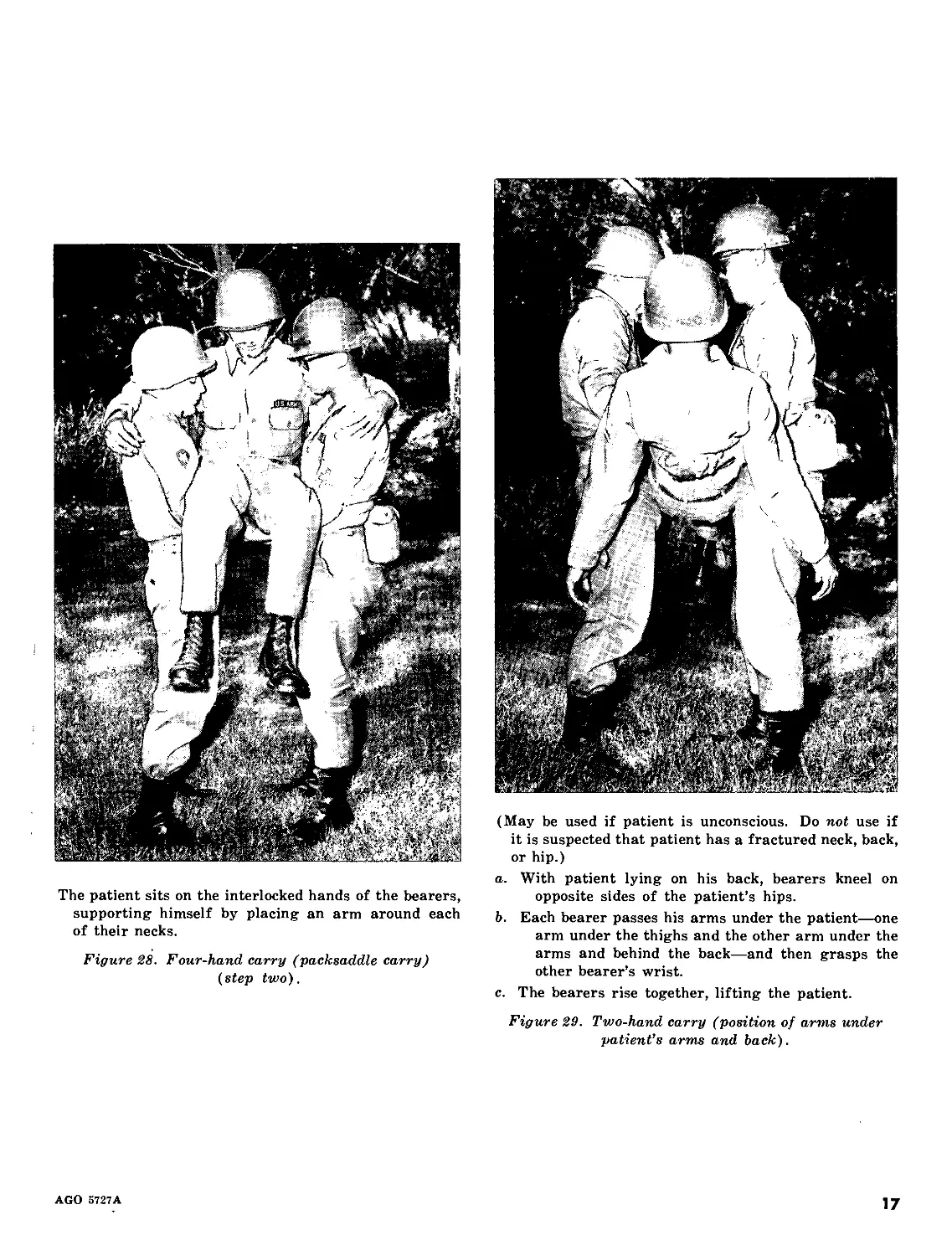
The patient sits on the interlocked hands of the bearers,
supporting himself by placing an arm around each
of their necks.
Figure 28.	Four-hand carry (packsaddle carry)
(step two).
(May be used if patient is unconscious. Do not use if
it is suspected that patient has a fractured neck, back,
or hip.)
a.	With patient lying on his back, bearers kneel on
opposite sides of the patient’s hips.
b.	Each bearer passes his arms under the patient—one
arm under the thighs and the other arm under the
arms and behind the back—and then grasps the
other bearer’s wrist.
c.	The bearers rise together, lifting the patient.
Figure 29.	Two-hand carry (position of arms under
patient’s arms and back).
AGO 5727A
17
18
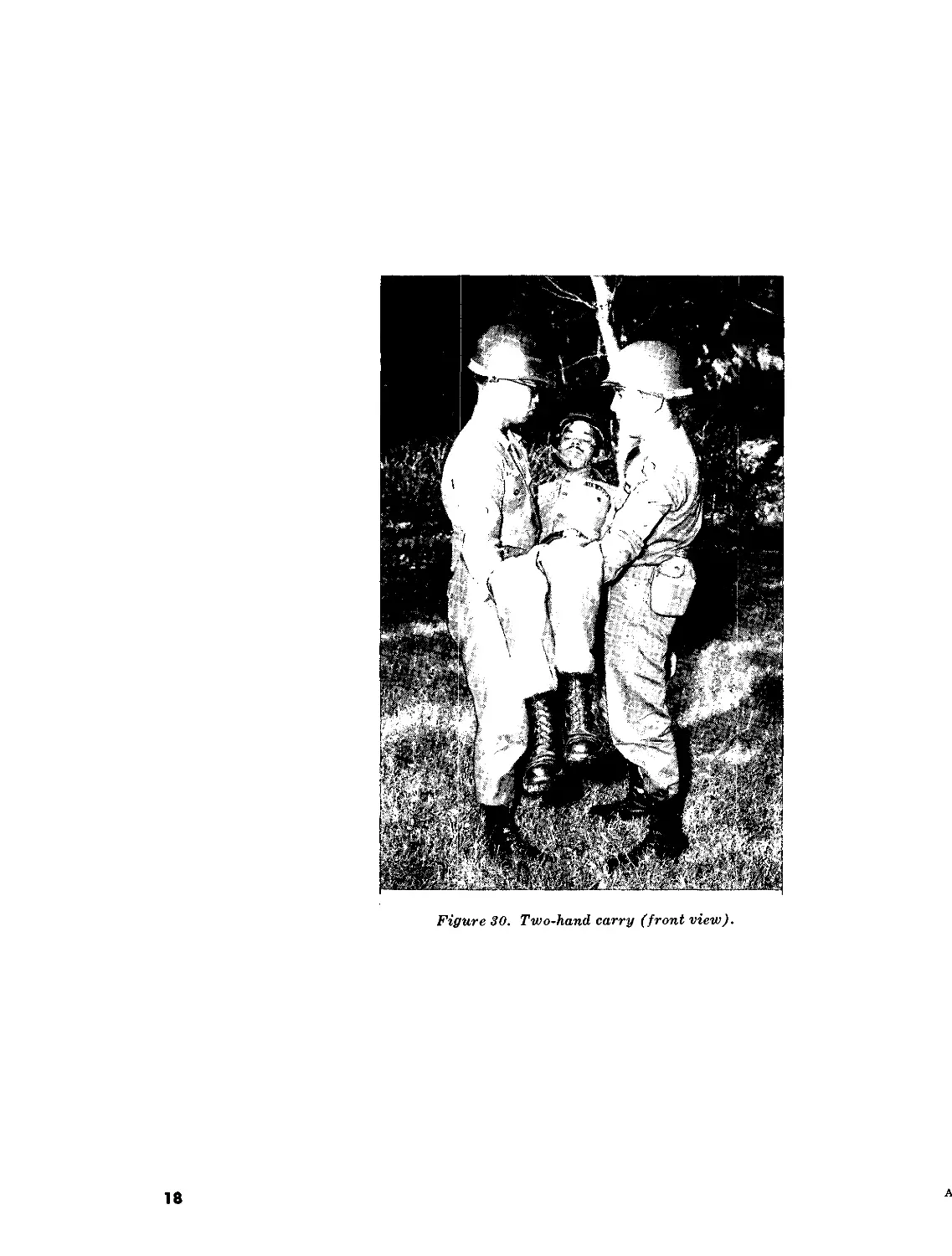
Figure 30. Two-hand carry (front view).
A
Section IV. SPECIAL MANUAL EVACUATION TECHNIQUES
(Task of removing wounded man from interior of tank
is difficult and requires speed, since stationary tanks
are good targets, and all disabled armored vehicles
are likely to explode. Two men, therefore, should be
used. If only one is available, he uses a pistol belt,
or similar device to lift the injured man from the
tank.)
a.	One man goes into the tank and supports the
wounded man from below.
b.	The second man stands on top of the turret and lifts
the injured man through the hatch.
Figure 31.	Removing a patient from a tank turret (step one).
a.	The second man holds the patient in place on the
hatch rim, while stepping to the fender or stowage
chest of the tank.
b.	He supports the patient until the first man can get
out of the tank and jump to the ground.
c.	The second man then lowers the patient into the
arms of the first man.
Figure 32.	Removing a patient from a tank turret (step two).
AGO 5727A
19
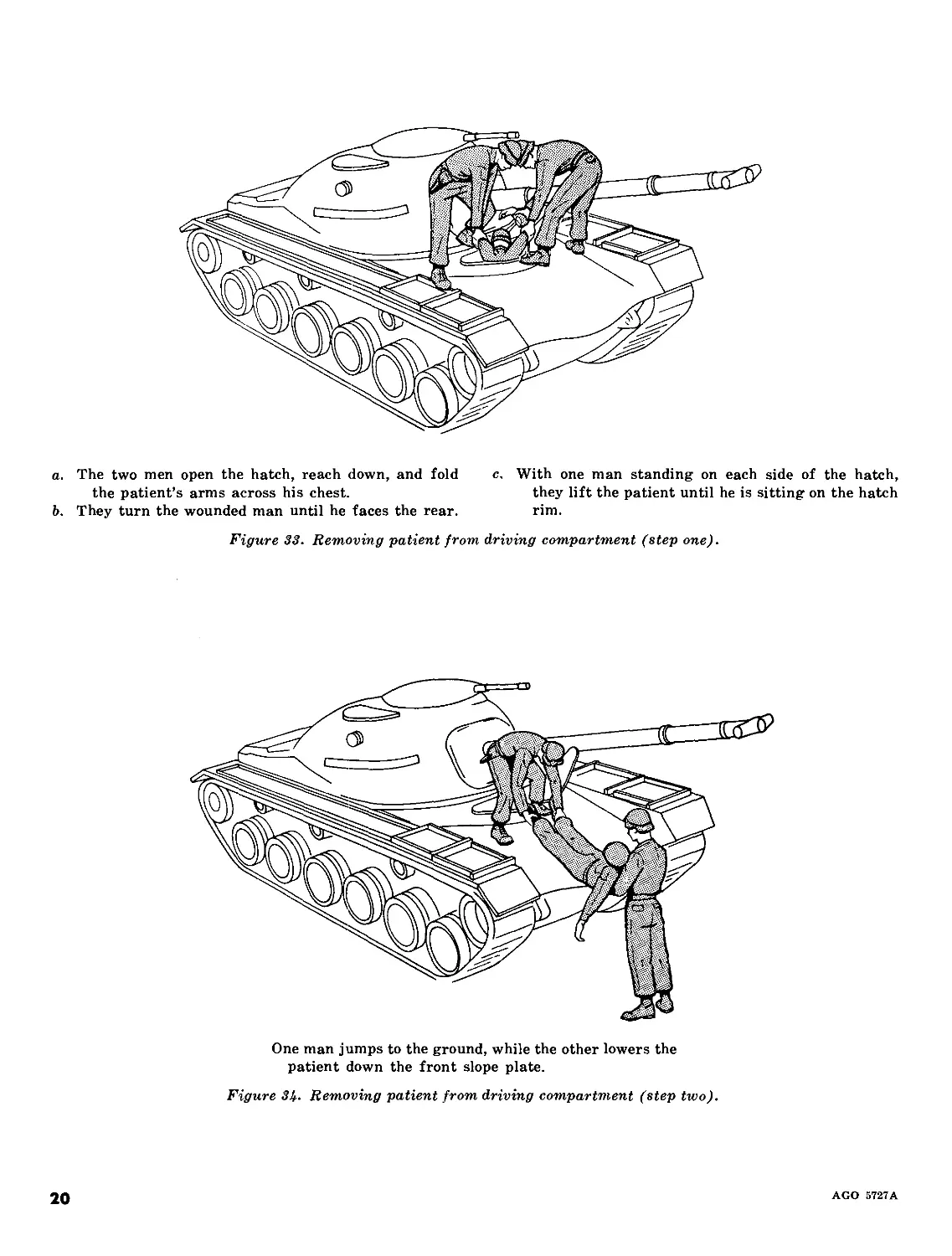
a.	The two men open the hatch, reach down, and fold
the patient’s arms across his chest.
b.	They turn the wounded man until he faces the rear.
c.	With one man standing on each side of the hatch,
they lift the patient until he is sitting on the hatch
rim.
Figure 33.	Removing patient from driving compartment (step one).
One man jumps to the ground, while the other lowers the
patient down the front slope plate.
Figure 3k- Removing patient from driving compartment (step two).
20
AGO 5727A
(During airborne and mountain operations, it may be
necessary to remove the wounded from trees. The
method to use will vary, depending upon the size of
the tree, the foliage, the strength of the branches,
the manner in which the injured man is wedged, and
the help available. It is best to use two men for this
type of evacuation.
a.	One man stands on the ground and holds one end
of a rope.
b.	The second man climbs the tree, taking the other’
end of the rope with him. He passes the rope over
a branch of the tree above the position of the
wounded man, and ties a bowline knot or some
knot which will not slip. (If necessary, he ad-
ministers emergency medical treatment.)
c.	He slips one loop over each thigh of the patient,
and then with the same rope ties a bowline around
the patient’s chest.
d.	The man on the ground, holding the other end of
the rope, lowers the injured man to the ground.
The first man escorts the injured man in his
descent and prevents his movement from being
impeded by intervening limbs or branches.
(When only one man is available, he can climb the tree,
attach the rope, climb down to the ground, and lower
the injured man to safety.)
Figure 35. Removing the wounded from trees.
AGO 5727A
21
CHAPTER 3
LITTER TRANSPORTATION
Section I. LITTERS
7.	General
Patient transportation by litter is a task of
Army Medical Service personnel which is begun
at the critical point in the process of evacu-
ation—the area between the patient on the field
and the most forward ambulance or medical
treatment installation. After being picked up
in a forward area by litter bearers, patients
may be moved on litters by vehicle to points as
far rearward as fixed medical treatment instal-
lations. The patient who requires litter accom-
modation while in transit is referred to as a
litter (stretcher) patient. The patient who is
able to walk and requires only sitting accommo-
dation in vehicles while in transit is a walking
(ambulatory) patient (STANAG No. 3204 and
SOLOG No. 83).
8.	Types of Litters
(figs. 36-41)
A litter may be a standard product, designed
for the purpose of carrying a patient, or it may
be a substitute improvised from certain avail-
able materials. A standard litter consists of a
frame, a cover, and accessories, such as poles,
stirrups, litter straps, and patient securing
straps. The medical services of the Armed
Forces use several types of standard litters, of
which the most widely used is the durable
straight aluminum litter.
a.	Two types of litters have lightweight
aluminum poles and are of the same general
dimensions when open. One litter has rigid
poles; the second type has folding poles, which
permit the litter to be folded to one-half its
length. This standardization allows a patient
to travel in various vehicles on the same litter,
minimizing the possibility of further harm to
the patient and saving valuable time.
b.	Four types of litters have been developed
for special purposes—the Stokes metal litter,
the semirigid poleless litter, the nonrigid pole-
less litter, and the mountain basket-type rigid
litter.
c.	The ambulance litter, Bomgardner type, is
designed for use in the metropolitan ambulance.
It is not used in the field.
a. Folds in long axis only.
b. Basic components are two rigid, lightweight alumi-
num poles and a cover (bed) of cotton duck.
c. Four wooden handles are attached to poles.
d. Four stirrups, one bolted near the end of each pole,
support litter when placed on ground.
e. Two spreader bars, one near each end of litter, ex-
tend crosswise at stirrups to hold cover taut when
litter is open.
f. Two litter securing straps are attached, one to each
pole at stirrup bolts, to strap litter when closed.
g. Two or four patients securing straps may be used
as accessories.
(Overall length—90 inches
Overall width —22% inches
Bed length
Bed width
Weight
—72 inches
—22% inches
—15 pounds.)
Figure 36.	Straight aluminum litter.
22
AGO 5727A
Closed, folded, and strapped.
Open.
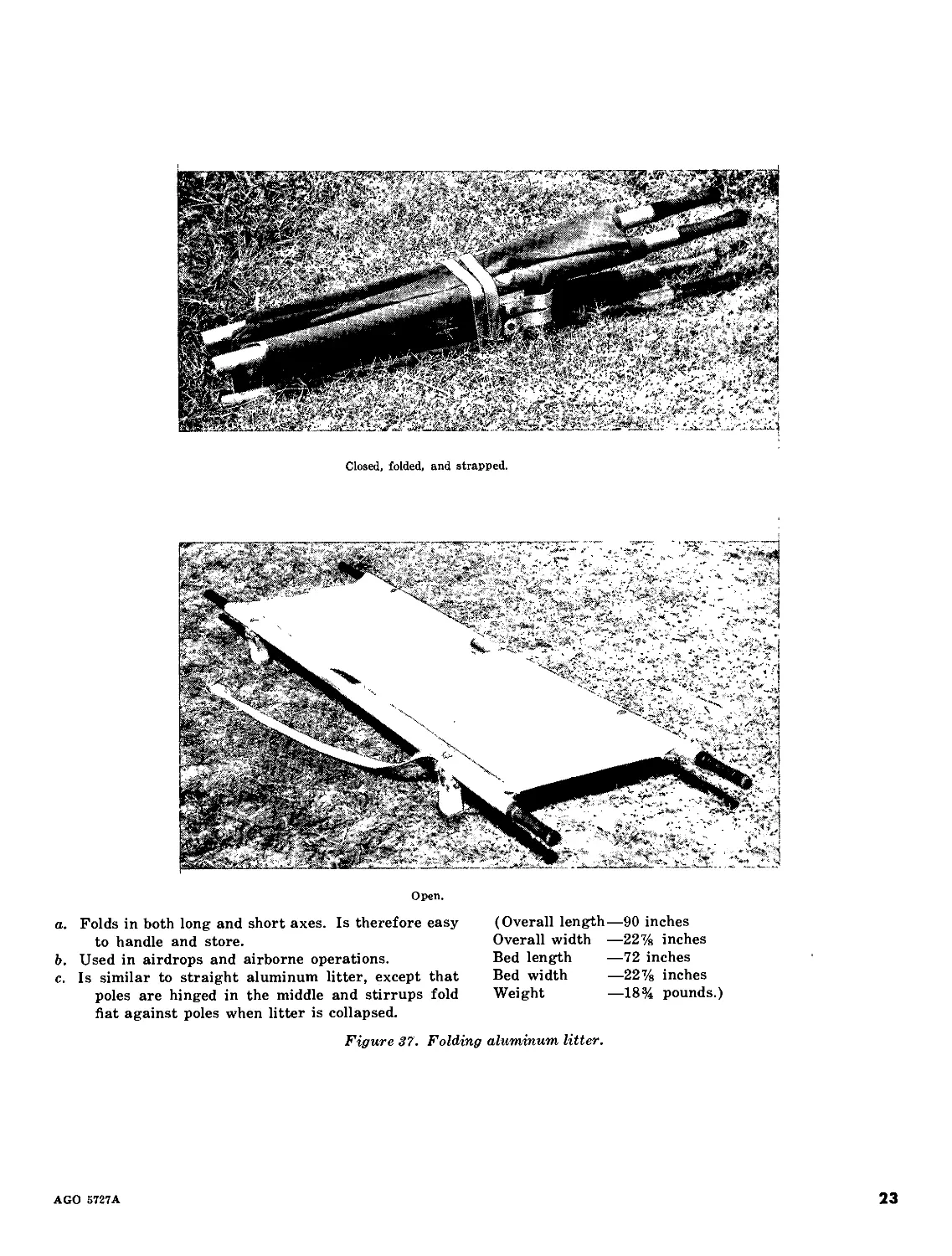
a.	Folds in both long and short axes. Is therefore easy
to handle and store.
b.	Used in airdrops and airborne operations.
c.	Is similar to straight aluminum litter, except that
poles are hinged in the middle and stirrups fold
fiat against poles when litter is collapsed.
(Overall length—90 inches
Overall width	—22%	inches
Bed length	—72 inches
Bed width	—22%	inches
Weight	—18%	pounds.)
Figure 37.	Folding aluminum litter.
AGO 5727A
23
i
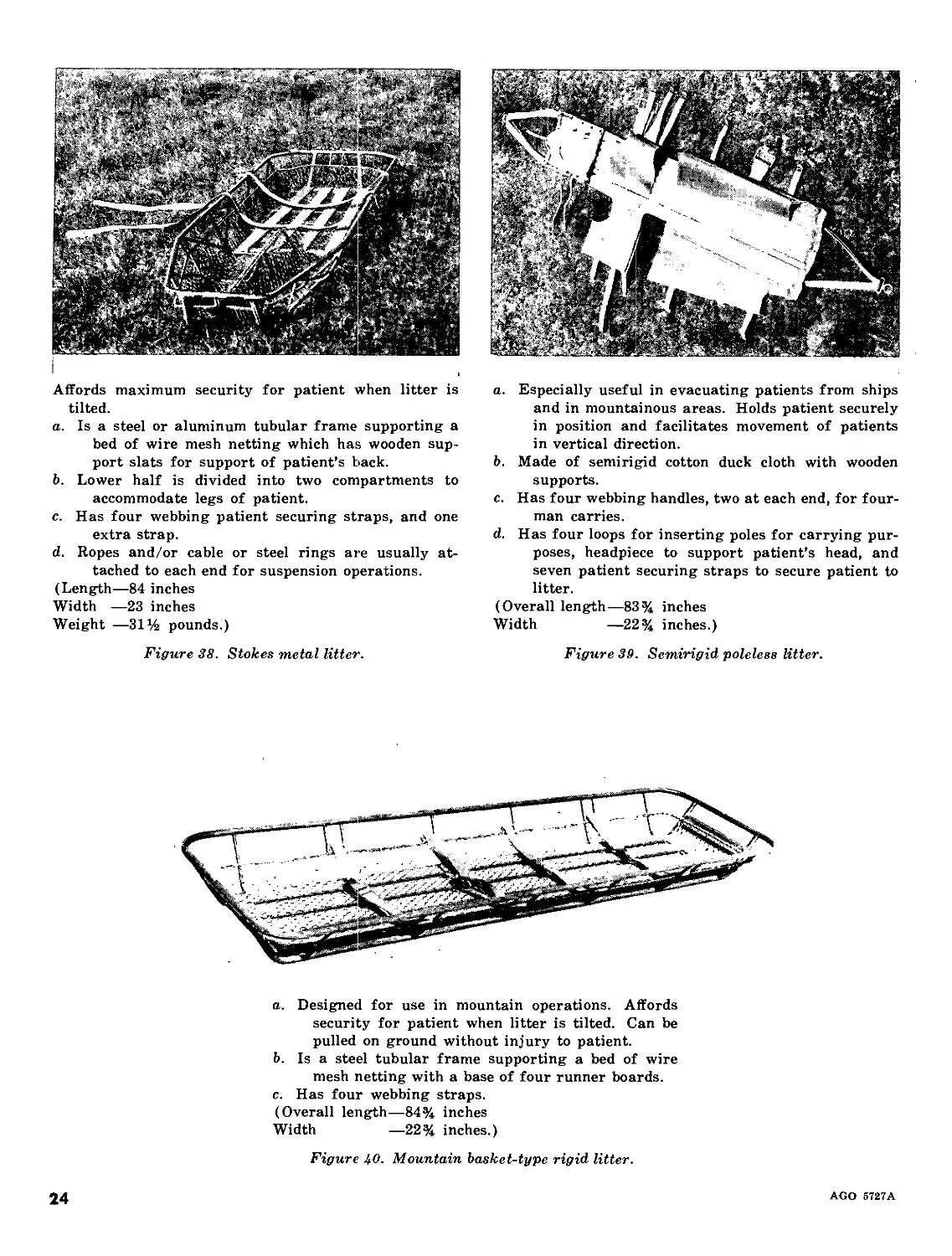
Affords maximum security for patient when litter is
tilted.
a.	Is a steel or aluminum tubular frame supporting a
bed of wire mesh netting which has wooden sup-
port slats for support of patient’s back.
b.	Lower half is divided into two compartments to
accommodate legs of patient.
c.	Has four webbing patient securing straps, and one
extra strap.
d.	Ropes and/or cable or steel rings are usually at-
tached to each end for suspension operations.
(Length—84 inches
Width —23 inches
Weight —31% pounds.)
a.	Especially useful in evacuating patients from ships
and in mountainous areas. Holds patient securely
in position and facilitates movement of patients
in vertical direction.
b.	Made of semirigid cotton duck cloth with wooden
supports.
c.	Has four webbing handles, two at each end, for four-
man carries.
d.	Has four loops for inserting poles for carrying pur-
poses, headpiece to support patient’s head, and
seven patient securing straps to secure patient to
litter.
(Overall length—83% inches
Width	—22% inches.)
Figure 38. Stokes metal litter.
Figure 39.	Semirigid poleless litter.
a.	Designed for use in mountain operations. Affords
security for patient when litter is tilted. Can be
pulled on ground without injury to patient.
b.	Is a steel tubular frame supporting a bed of wire
mesh netting with a base of four runner boards.
c.	Has four webbing straps.
(Overall length—84% inches
Width	—22% inches.)
Figure 40.	Mountain basket-type rigid litter.
24
AGO 5727A
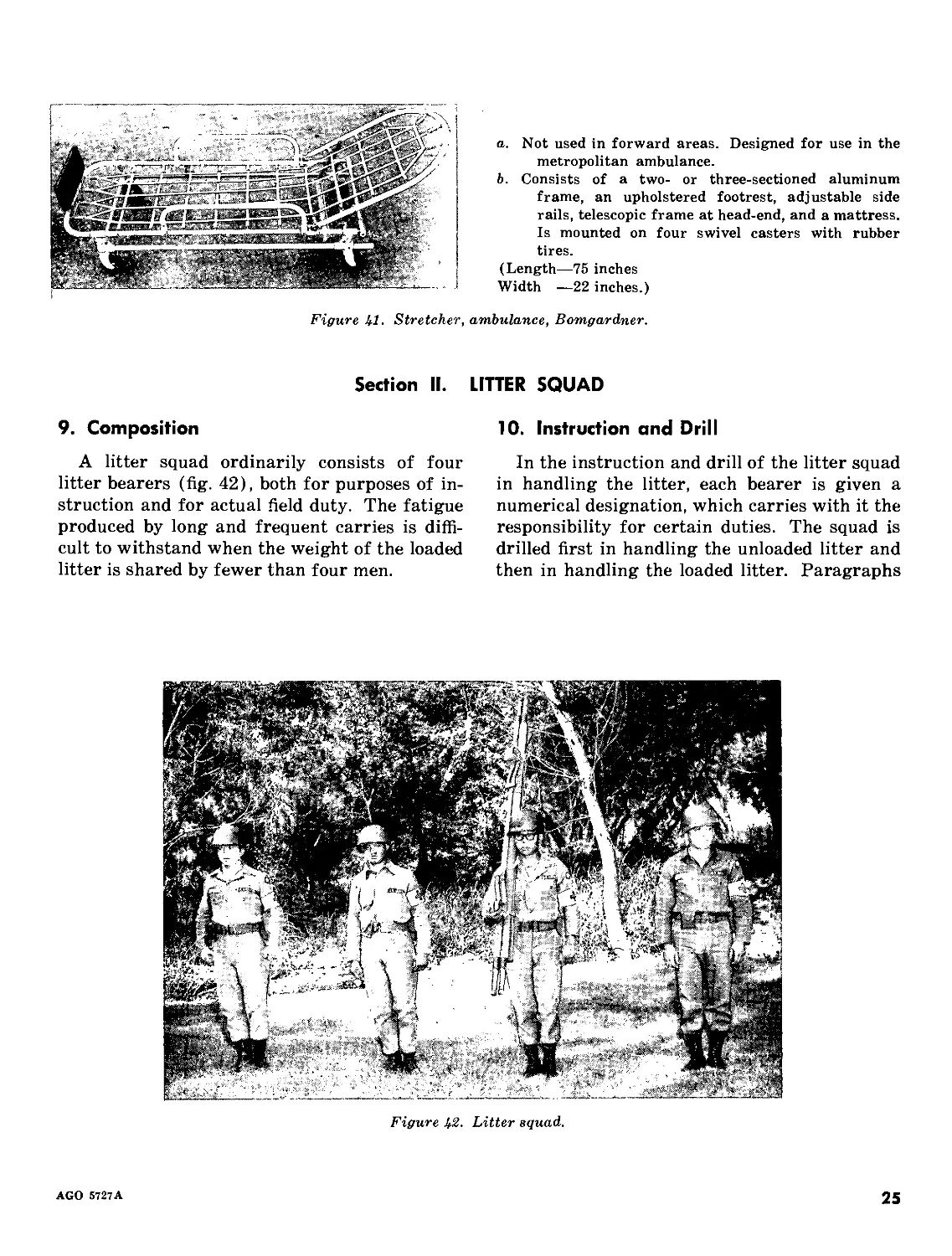
a.	Not used in forward areas. Designed for use in the
metropolitan ambulance.
b.	Consists of a two- or three-sectioned aluminum
frame, an upholstered footrest, adjustable side
rails, telescopic frame at head-end, and a mattress.
Is mounted on four swivel casters with rubber
tires.
(Length—75 inches
Width —22 inches.)
Figure 41.	Stretcher, ambulance, Bomgardner.
Section II.	LITTER SQUAD
9.	Composition
A litter squad ordinarily consists of four
litter bearers (fig. 42), both for purposes of in-
struction and for actual field duty. The fatigue
produced by long and frequent carries is diffi-
cult to withstand when the weight of the loaded
litter is shared by fewer than four men.
10.	Instruction and Drill
In the instruction and drill of the litter squad
in handling the litter, each bearer is given a
numerical designation, which carries with it the
responsibility for certain duties. The squad is
drilled first in handling the unloaded litter and
then in handling the loaded litter. Paragraphs
Figure 42- Litter squad.
AGO 5727A
25
13 through 33 contain a drill guide, the use of
which promotes uniformity and accuracy of
methods and economy of valuable training time.
11.	Designation and Duties of Bearers
A squad of litter bearers in line are numbered
consecutively from right to left.
a.	The bearer designated as No. 1 is the
squad leader.
b.	In the absence of No. 1, No. 4 assumes the
duties of leader.
Section III.
13.	Commands
Litter drill is not a precision drill; however,
certain preparatory commands and commands
of execution should be used to facilitate instruc-
tion. A preparatory command states the move-
ment or formation to be carried out and men-
tally prepares the individual for its execution.
A command of execution tells when the com-
mand is to be carried out. The use of these com-
mands in actual operations is not contemplated.
For purposes of identification in the discussion
of the different types of litter drill, preparatory
commands will be in lower case with initial
capital letters and commands of execution will
be in capital letters.
14.	Litters
When a litter is not open, it may be referred
to in one of the following ways:
a.	Litter, closed, when the two poles are
brought together and the canvas is evenly and
smoothly doubled upon itself.
b.	Litter, folded, when, after closing, it is
doubled upon itself along the long axis at the
hinges provided for that purpose. (Some lit-
ters have two pairs of hinges. Not all litters
can be folded.)
c.	Litter, strapped, when, after closing (and
folding, if a folding-type litter), it is secured by
cross-straps.
c.	If both No. 1 and No. 4 are absent, No. 3
becomes the leader.
d.	In the absence of No. 3 and No. 2, their
duties are assumed by No. 1 and No. 4, respec-
tively.
e.	If No. 4 is absent, his duties do not require
replacement.
12. Instruction in Reduced Squads
Under exceptional circumstances, when two-
bearer squads are being instructed, the instruc-
tion will be as for No. 2 and No. 3 of the four-
bearer squad.
LITTER DRILL
15.	General Rules for Moving Patients
a.	In moving a patient, either with or with-
out a litter, every movement should be made
deliberately and as gently as possible. The com-
mand STEADY should be used to prevent un-
due haste and other irregularities.
b.	The rear bearers should watch the move-
ments of the front bearers and time their own
with them, so as to insure ease and steadiness
of action.
c.	The litter must be kept as nearly level as
possible at all times. Care must be taken to do
this in passing obstacles and ditches.
d.	As a rule, the patient should be carried on
the litter feet foremost, but in going uphill or
upstairs his head should be forward.
e.	In case of fractures of the lower extrem-
ities, the patient is carried uphill or upstairs
feet foremost, and downhill head foremost.
This prevents the weight of the body from
pressing upon the injured part.
16.	Basic Guides for Litter Drill
a.	Several squads may be instructed simul-
taneously by one individual, or each squad may
be instructed separately by an instructor or by
the squad leader (No. 1).
b.	For purposes of instruction, the unloaded
open litter is handled as a loaded litter.
26
AGO 5727A
c.	In the instruction with loaded litters, some
men are designated “patients.” These men
should be frequently rotated with the men
carrying the litters so that all may participate
in each phase of the instruction.
d.	To facilitate instruction in the handling
of the different types of injuries, patients wear
moulages, bandages, and splints to simulate
actual disabilities.
e.	In the early phases of instruction, patients
may be positioned on the ground at suitable
intervals near the line of litters, first with the
head, and later with the feet, toward the litters.
As the instruction progresses, their positions
may be varied. Last, they may be dispersed
or concealed to simulate positions the wounded
might occupy on the battlefield.
f.	When patients are loaded on litters, their
equipment is carried by No. 1 and No. 4, or it
is placed on the litter.
17.	Formations
a.	Formation for Instruction. Appropriate
drill commands are used to form and aline the
unit in a single rank for instruction in litter
drill and to return the unit to its normal forma-
tion after completion of instruction.
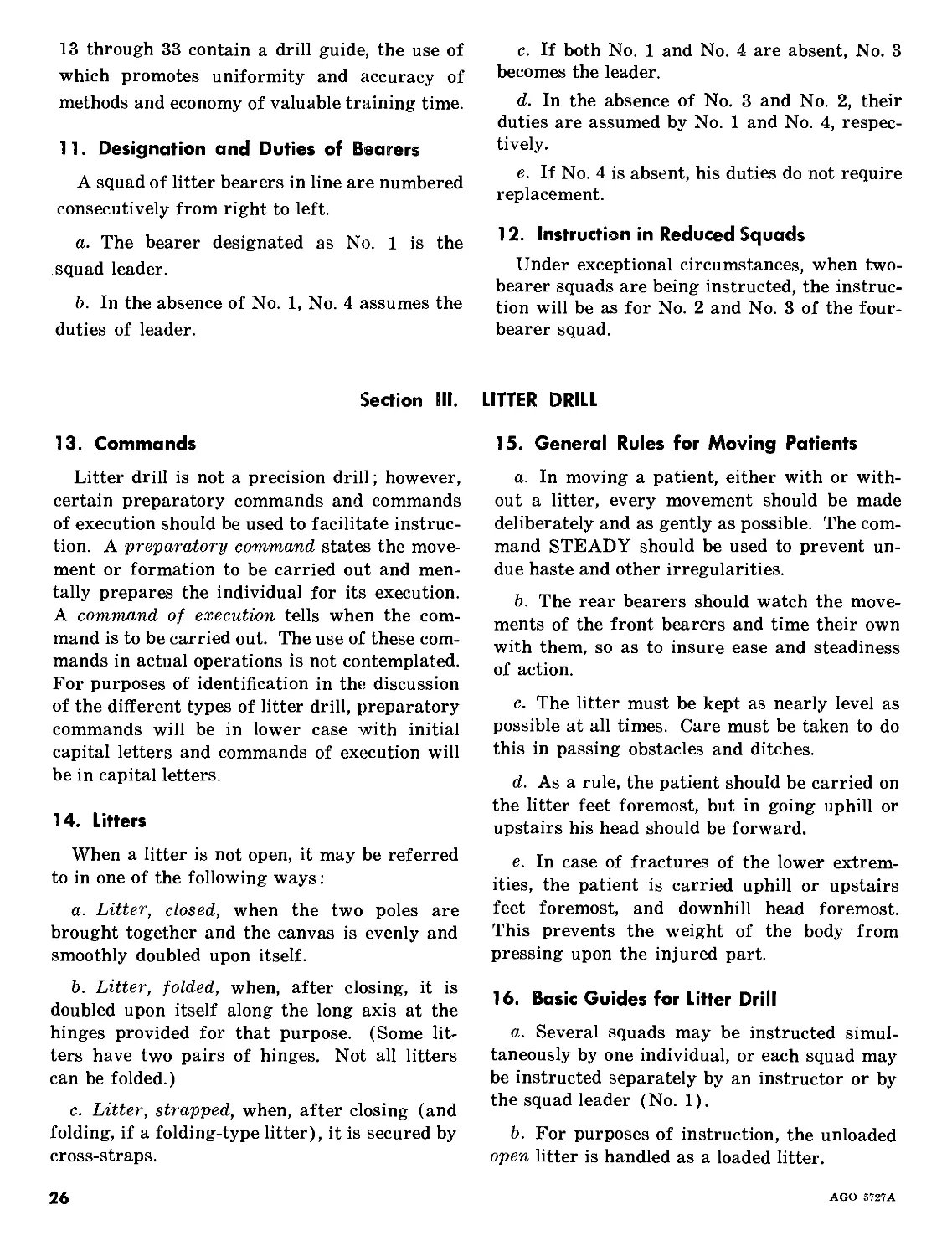
b.	Formation of Litter Squads (fig. 43). To
form litter squads (with the unit in single rank
and facing the front), the commands are By
Four, Count, OFF.
c.	Designation of Squads. To designate
squads by number, the commands are By Litter
Squad, Count, OFF. At the command Count,
OFF, No. 1 man of each squad, except the right
squad, executes Eyes, RIGHT; and beginning
at the right, counts in consecutive order ONE,
TWO, THREE, etc., until all squads have
counted. Each No. 1 man turns his head and
eyes to the front as he counts.
a. At the command Count, OFF, all men, except the
right file, execute Eyes, RIGHT.
b. Beginning with the right file, they count, ONE
TWO, THREE, FOUR, ONE, etc.
c. Each man turns his head and eyes to the front as
he counts.
Figure 43. Formation of litter squads.
AGO 5727A
27
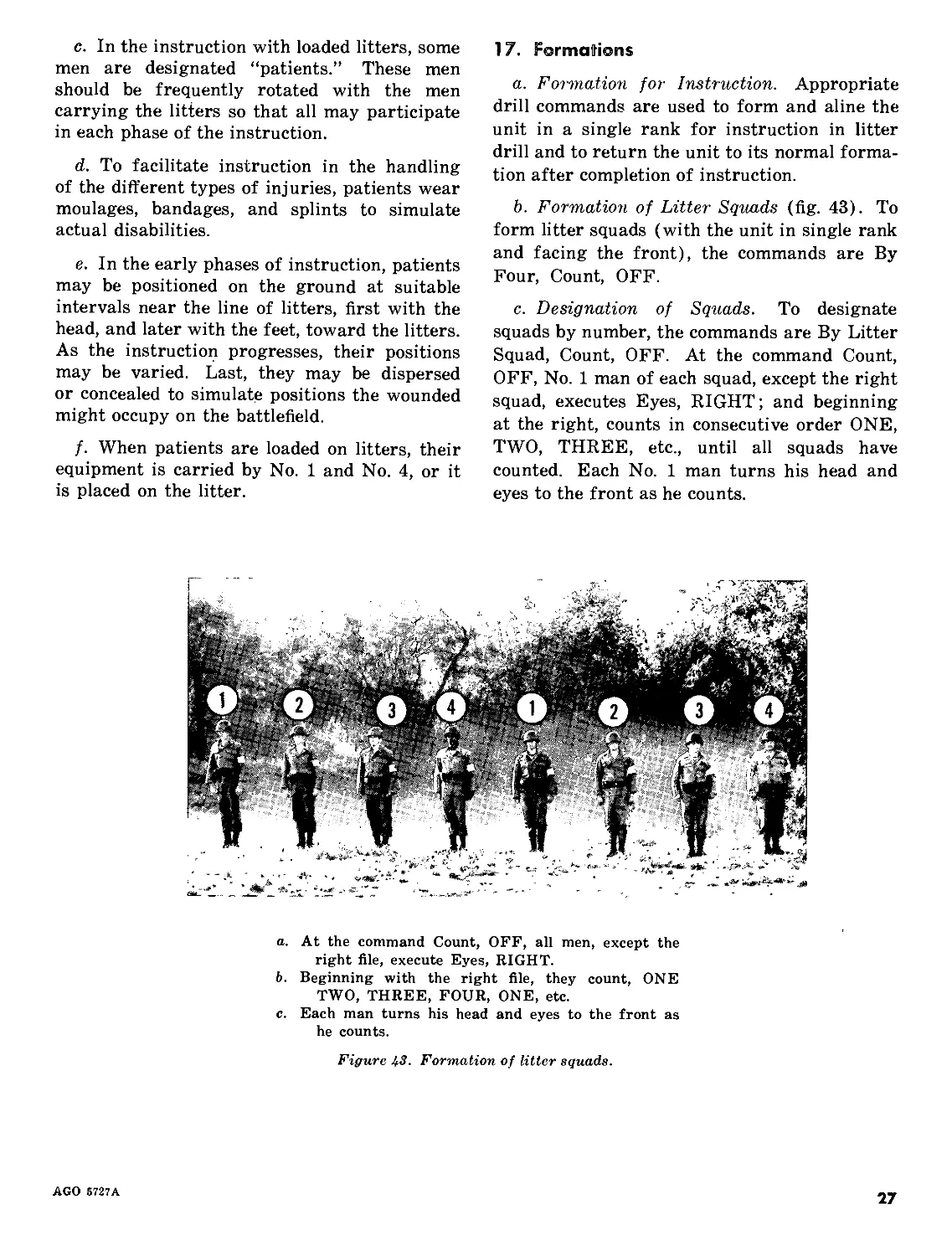
18.	To Procure Litter
(figs. 44-46)
Litters are available in the immediate vicinity. Commands are Procure, LITTER.
At the command of execution, all No. 3 men take one step to the rear.
Figure 44- Procure, LITTER (step one).
No. 3 men execute Right (Left), FACE, as required
by the location of the litters, and immediately
proceed in column of files by the nearest route to
the closed and strapped litters.
b. Each takes one litter and places it on his right
shoulder, and all promptly return in reverse order
to the rear of the line.
Figure Ь5. Procure, LITTER (step two).
28
AGO 5727A
No. 3 men turn and step into the line in unison.
Figure U6. Procure, LITTER (step three).
19.	To Return Litter
Instruction in the use of the litter having
been completed, litters are returned to the place
of procurement. Commands are Return,
LITTER. The procedure is as for Procure,
LITTER, in reverse.
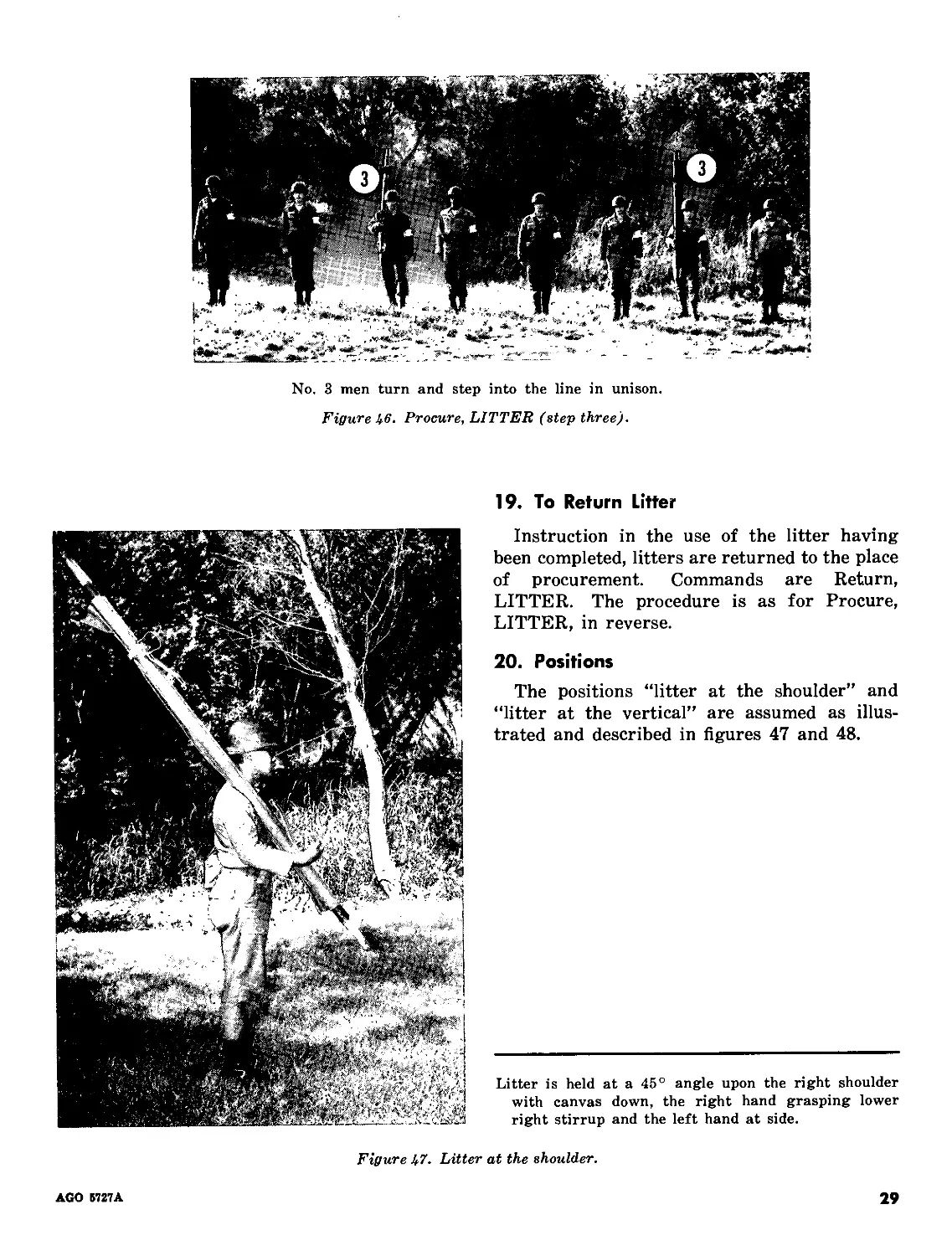
20. Positions
The positions “litter at the shoulder” and
“litter at the vertical” are assumed as illus-
trated and described in figures 47 and 48.
Litter is held at a 45° angle upon the right shoulder
with canvas down, the right hand grasping lower
right stirrup and the left hand at side.
Figure 47. Litter at the shoulder.
AGO Б727А
29
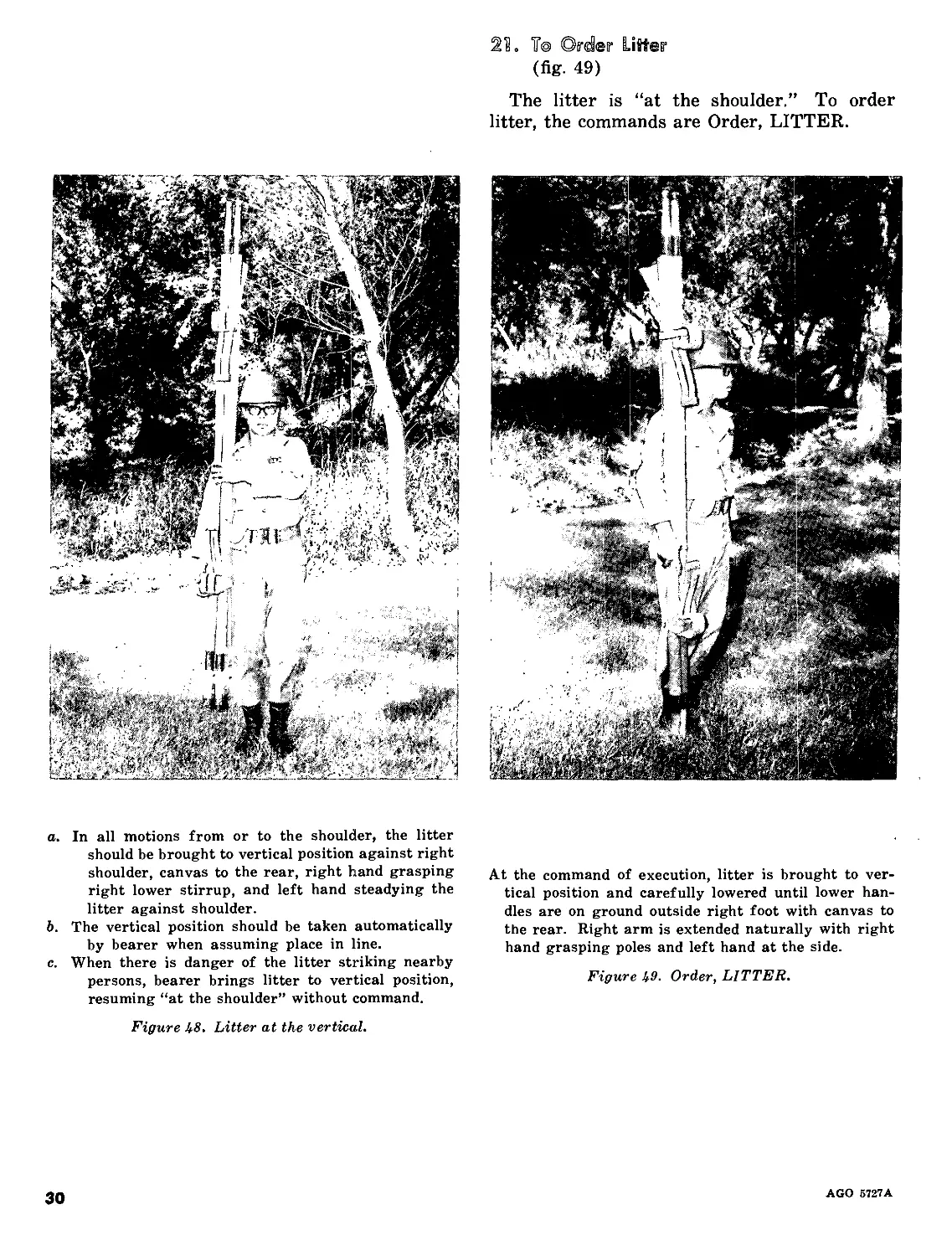
2L 7© Os'der LiKer
(fig. 49)
The litter is “at the shoulder.” To order
litter, the commands are Order, LITTER.
a.	In all motions from or to the shoulder, the litter
should be brought to vertical position against right
shoulder, canvas to the rear, right hand grasping
right lower stirrup, and left hand steadying the
litter against shoulder.
b.	The vertical position should be taken automatically
by bearer when assuming place in line.
c.	When there is danger of the litter striking nearby
persons, bearer brings litter to vertical position,
resuming “at the shoulder” without command.
At the command of execution, litter is brought to ver-
tical position and carefully lowered until lower han-
dles are on ground outside right foot with canvas to
the rear. Right arm is extended naturally with right
hand grasping poles and left hand at the side.
Figure 49. Order, LITTER.
Figure 48. Litter at the vertical.
30
AGO 5727A
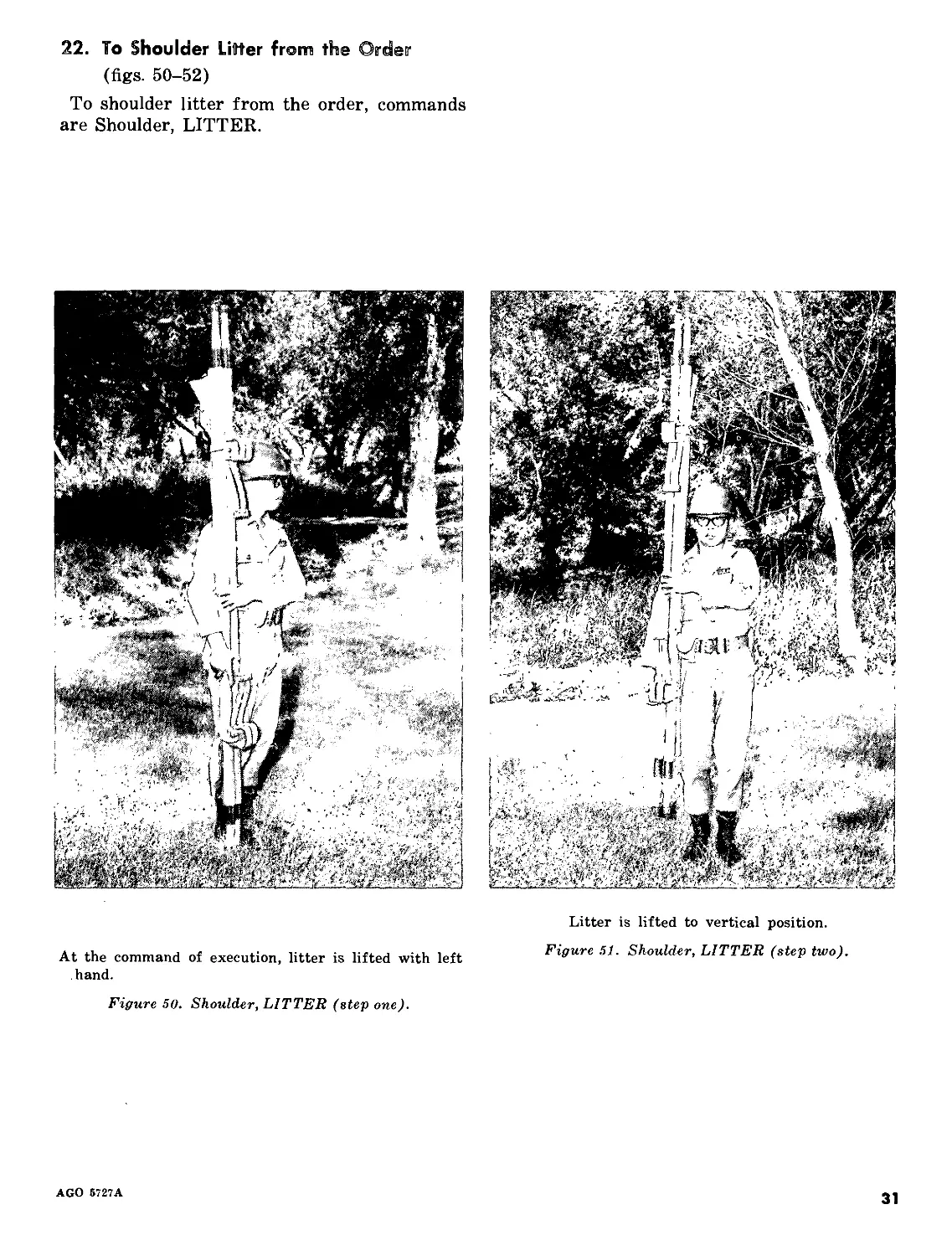
22. To Shoulder Litter from the Order
(figs. 50-52)
To shoulder litter from the order, commands
are Shoulder, LITTER.
At the command of execution, litter is lifted with left
hand.
Figure 50. Shoulder, LITTER (step one).
Litter is lifted to vertical position.
Figure 51. Shoulder, LITTER (step two).
AGO 5727A
31
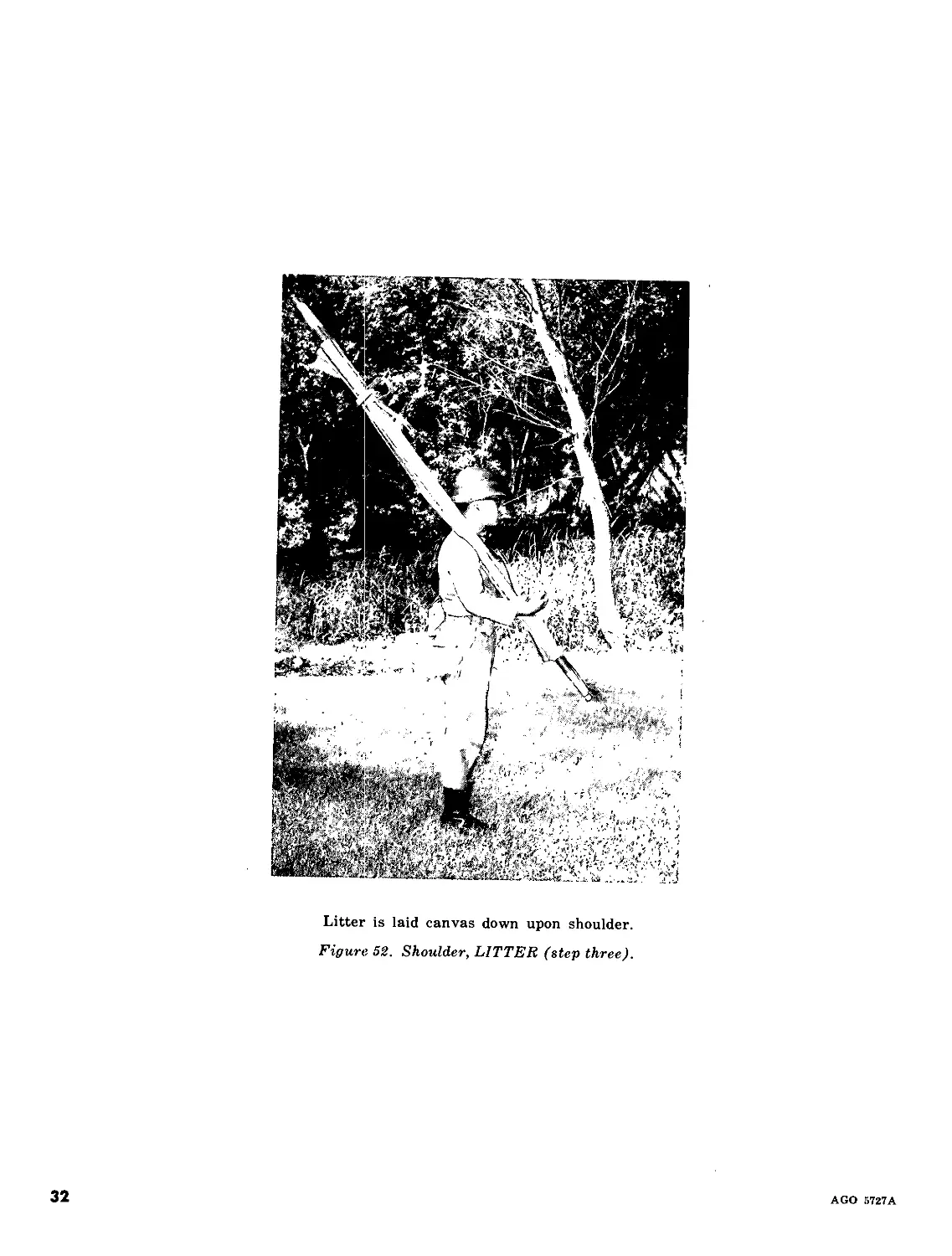
Litter is laid canvas down upon shoulder.
Figure 52. Shoulder, LITTER (step three).
32
AGO 5727A
23.	To Carry Litter
(figs. 53, 54)
a.	Designation of Litter Ends. The part of the
litter normally supported by No. 2 is the foot;
that by No. 3, the head. With the exception of
a few special movements, such as carrying
patients up or down an incline, the same desig-
nation applies.
b.	Being in Line. Litters are “at the shoul-
der.” Commands are Carry, LITTER.
At the command of execution, No. 3 brings the litter
to the vertical position and takes two steps backward.
Figure 53. Carry, LITTER, from shoulder (step one).
AGO 5727A
33
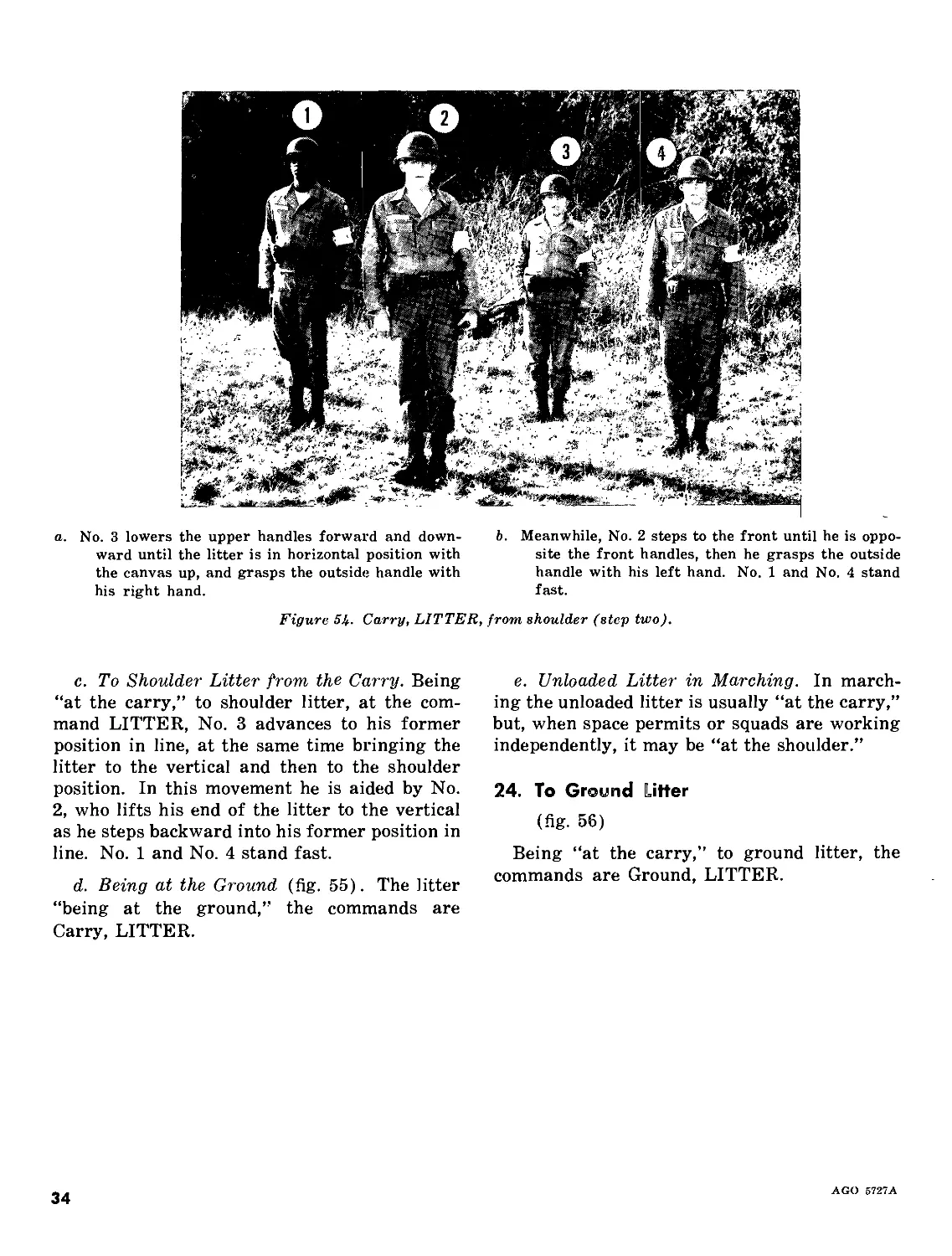
a. No. 3 lowers the upper handles forward and down-
ward until the litter is in horizontal position with
the canvas up, and grasps the outside handle with
his right hand.
b. Meanwhile, No. 2 steps to the front until he is oppo-
site the front handles, then he grasps the outside
handle with his left hand. No. 1 and No. 4 stand
fast.
Figure 5 k- Carry, LITTER, from shoulder (step two).
c.	To Shoulder Litter from the Carry. Being
“at the carry,” to shoulder litter, at the com-
mand LITTER, No. 3 advances to his former
position in line, at the same time bringing the
litter to the vertical and then to the shoulder
position. In this movement he is aided by No.
2, who lifts his end of the litter to the vertical
as he steps backward into his former position in
line. No. 1 and No. 4 stand fast.
d.	Being at the Ground (fig. 55). The litter
“being at the ground,” the commands are
Carry, LITTER.
e.	Unloaded Litter in Marching. In march-
ing the unloaded litter is usually “at the carry,”
but, when space permits or squads are working
independently, it may be “at the shoulder.”
24.	To Ground Hitter
(fig. 56)
Being “at the carry,” to ground litter, the
commands are Ground, LITTER.
AGO 5727A
34
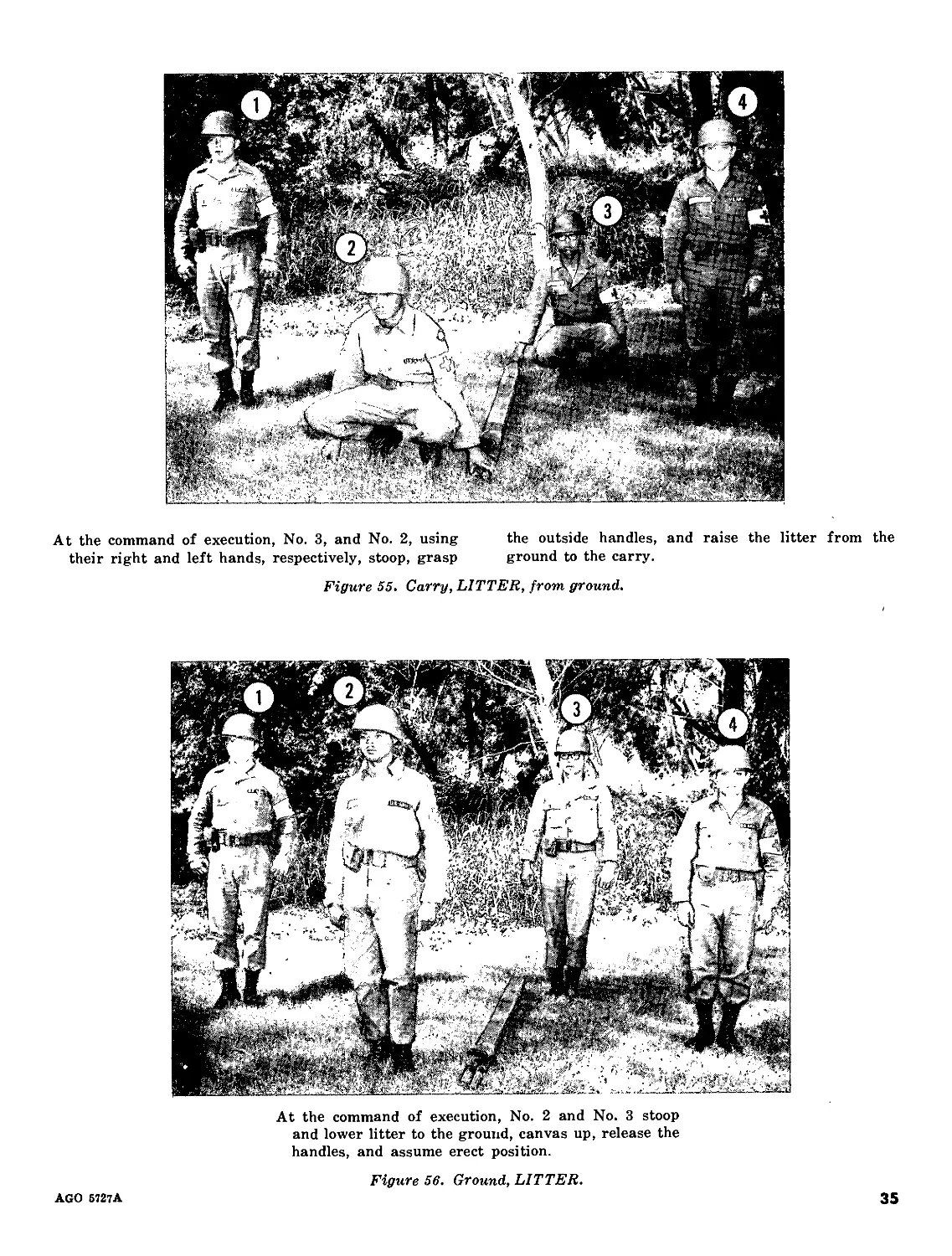
At the command of execution, No. 3, and No. 2, using	the outside handles, and raise the litter from the
their right and left hands, respectively, stoop, grasp	ground to the carry.
Figure 55.	Carry, LITTER, from ground.
At the command of execution, No. 2 and No. 3 stoop
and lower litter to the ground, canvas up, release the
handles, and assume erect position.
Figure 56.	Ground, LITTER.
AGO 6727A
35
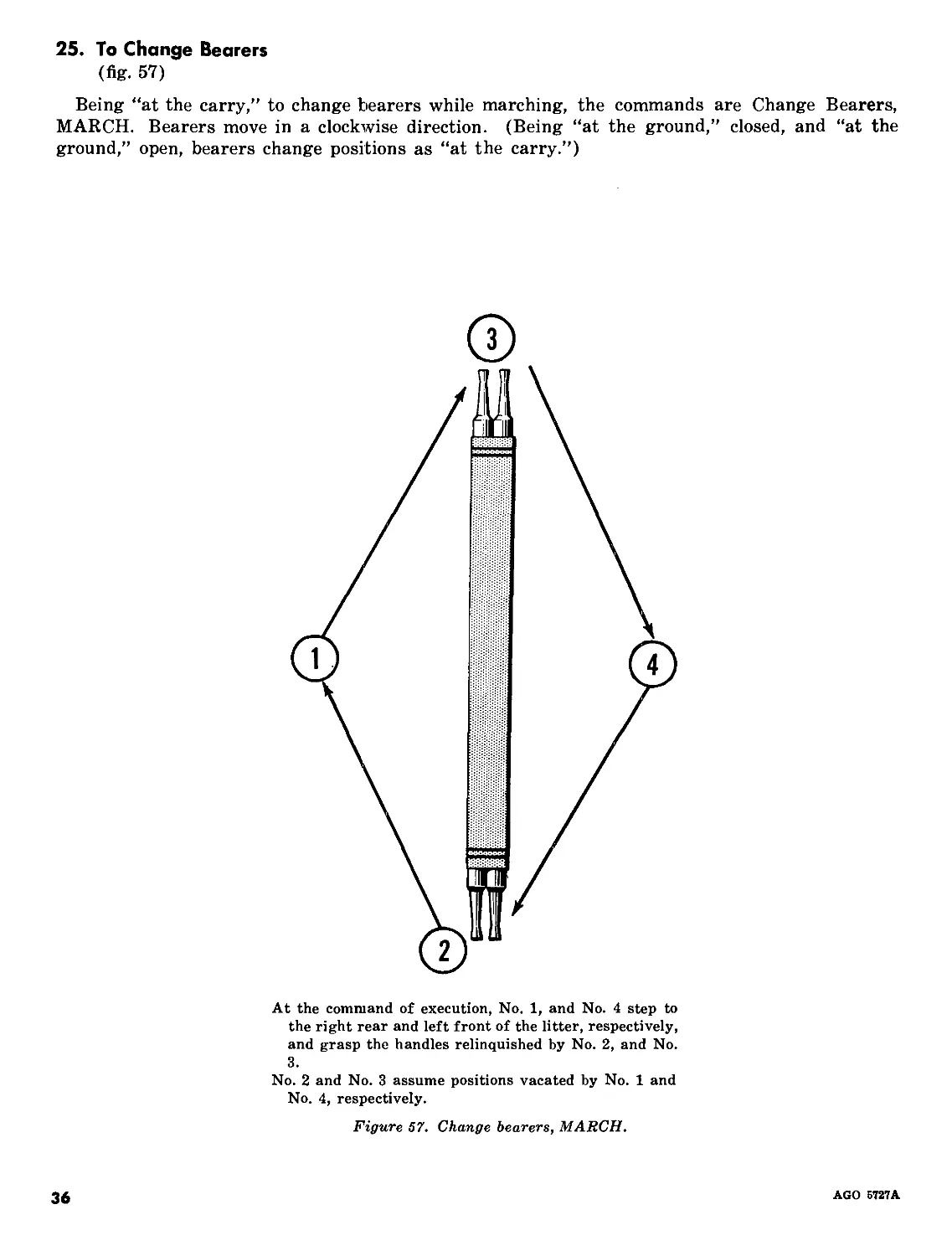
25.	To Change Bearers
(fig. 57)
Being “at the carry,” to change bearers while marching, the commands are Change Bearers,
MARCH. Bearers move in a clockwise direction. (Being “at the ground,” closed, and “at the
ground,” open, bearers change positions as “at the carry.”)
At the command of execution, No. 1, and No. 4 step to
the right rear and left front of the litter, respectively,
and grasp the handles relinquished by No. 2, and No.
3.
No. 2 and No. 3 assume positions vacated by No. 1 and
No. 4, respectively.
Figure 57.	Change bearers, MARCH.
36
AGO 5727A
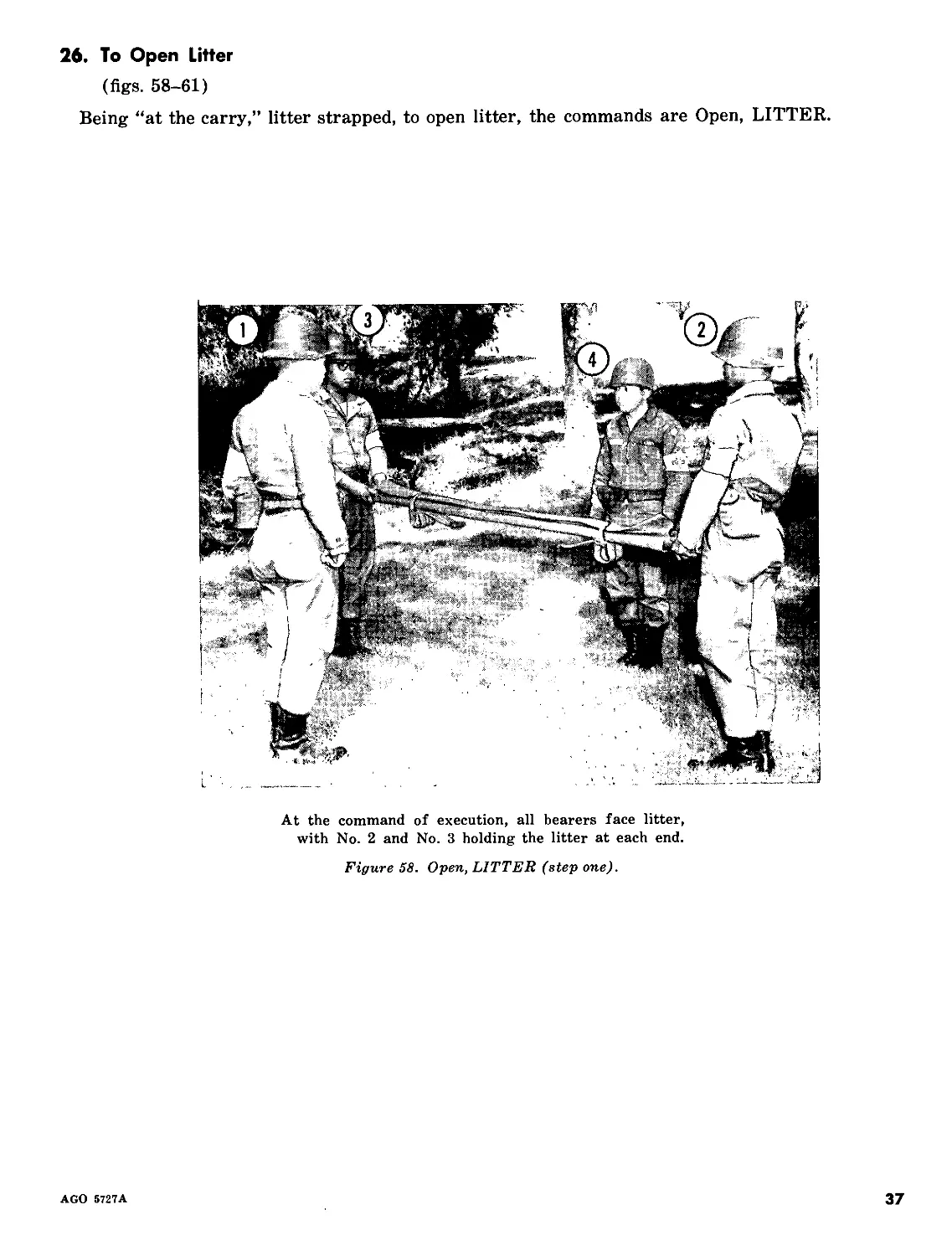
26.	To Open Litter
(figs. 58-61)
Being “at the carry,” litter strapped, to open litter, the commands are Open, LITTER.
At the command of execution, all bearers face litter,
with No. 2 and No. 3 holding the litter at each end.
Figure 58.	Open, LITTER (step one).
AGO 5727A
37
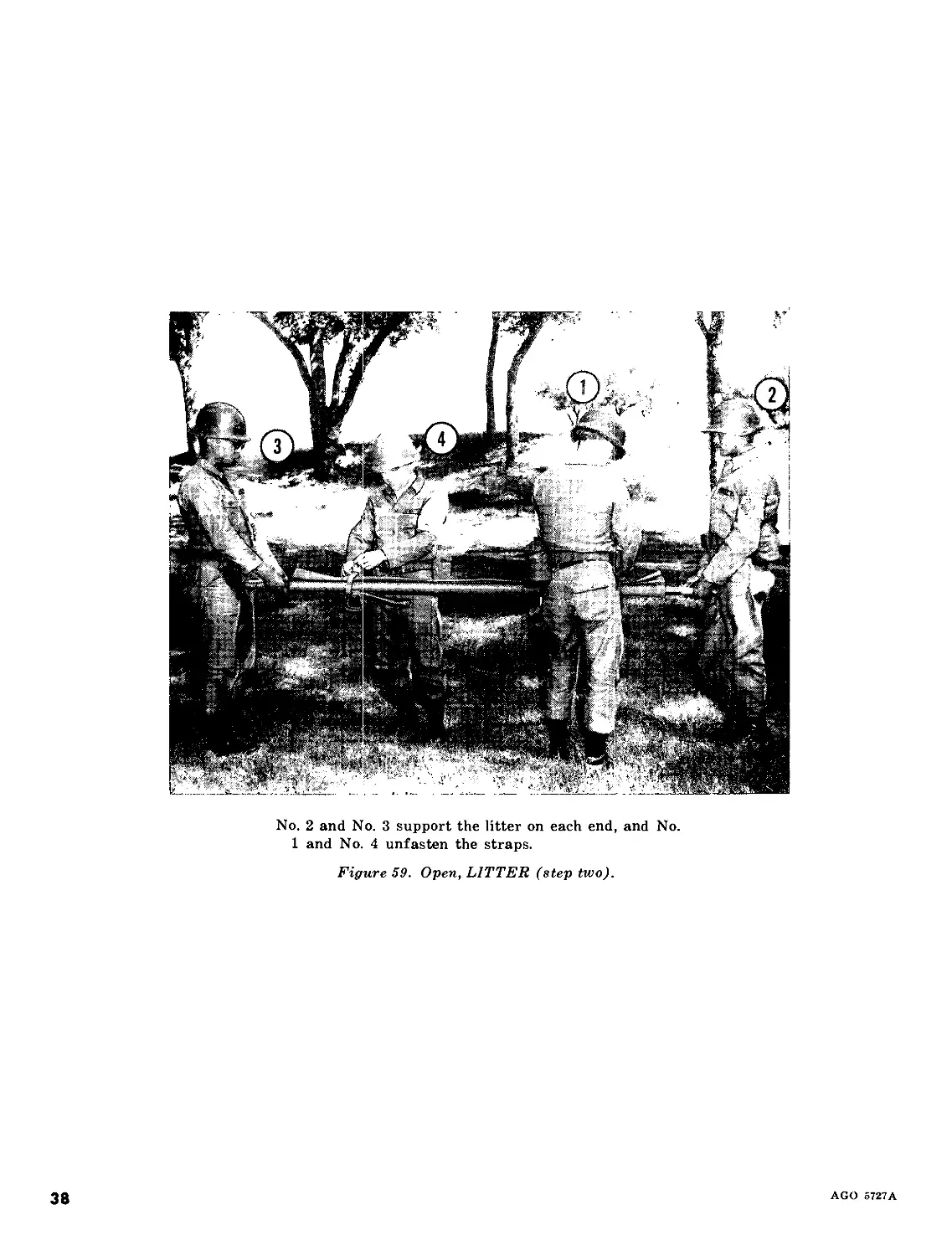
No. 2 and No. 3 support the litter on each end, and No.
1 and No. 4 unfasten the straps.
Figure 59.	Open, LITTER (step two).
38
AGO 5727A
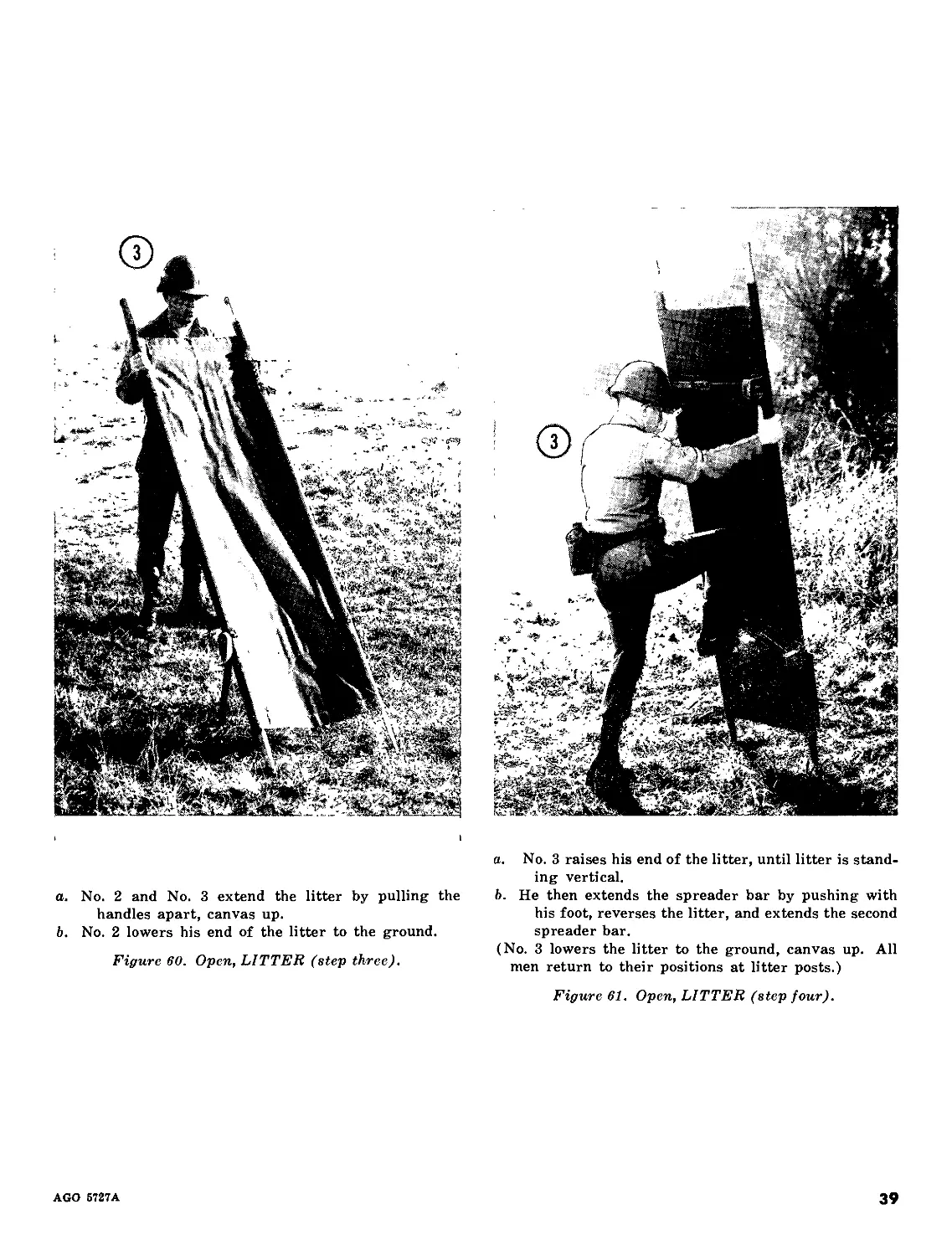
a.	No. 2 and No. 3 extend the litter by pulling the
handles apart, canvas up.
b.	No. 2 lowers his end of the litter to the ground.
Figure 60.	Open, LITTER (step three).
a.	No. 3 raises his end of the litter, until litter is stand-
ing vertical.
b.	He then extends the spreader bar by pushing with
his foot, reverses the litter, and extends the second
spreader bar.
(No. 3 lowers the litter to the ground, canvas up. All
men return to their positions at litter posts.)
Figure 61.	Open, LITTER (step four).
AGO 5727A
39
27.	To Strap Litter
(figs. 62-64)
The litter being closed or open, to strap litter, the commands are Strap, LITTER.
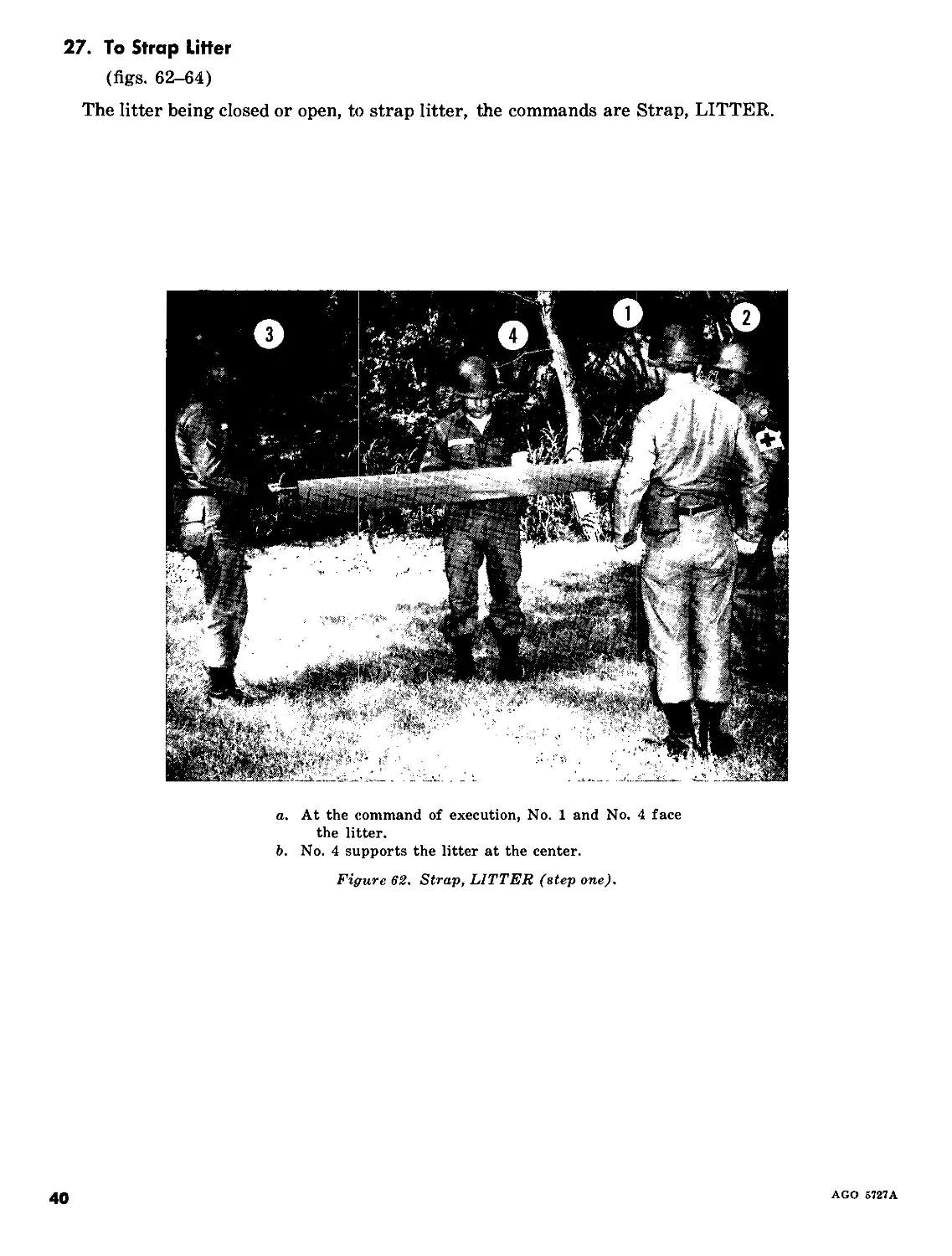
a.	At the command of execution, No. 1 and No. 4 face
the litter.
b.	No. 4 supports the litter at the center.
Figure 62.	Strap, LITTER (step one).
40
AGO 5727A
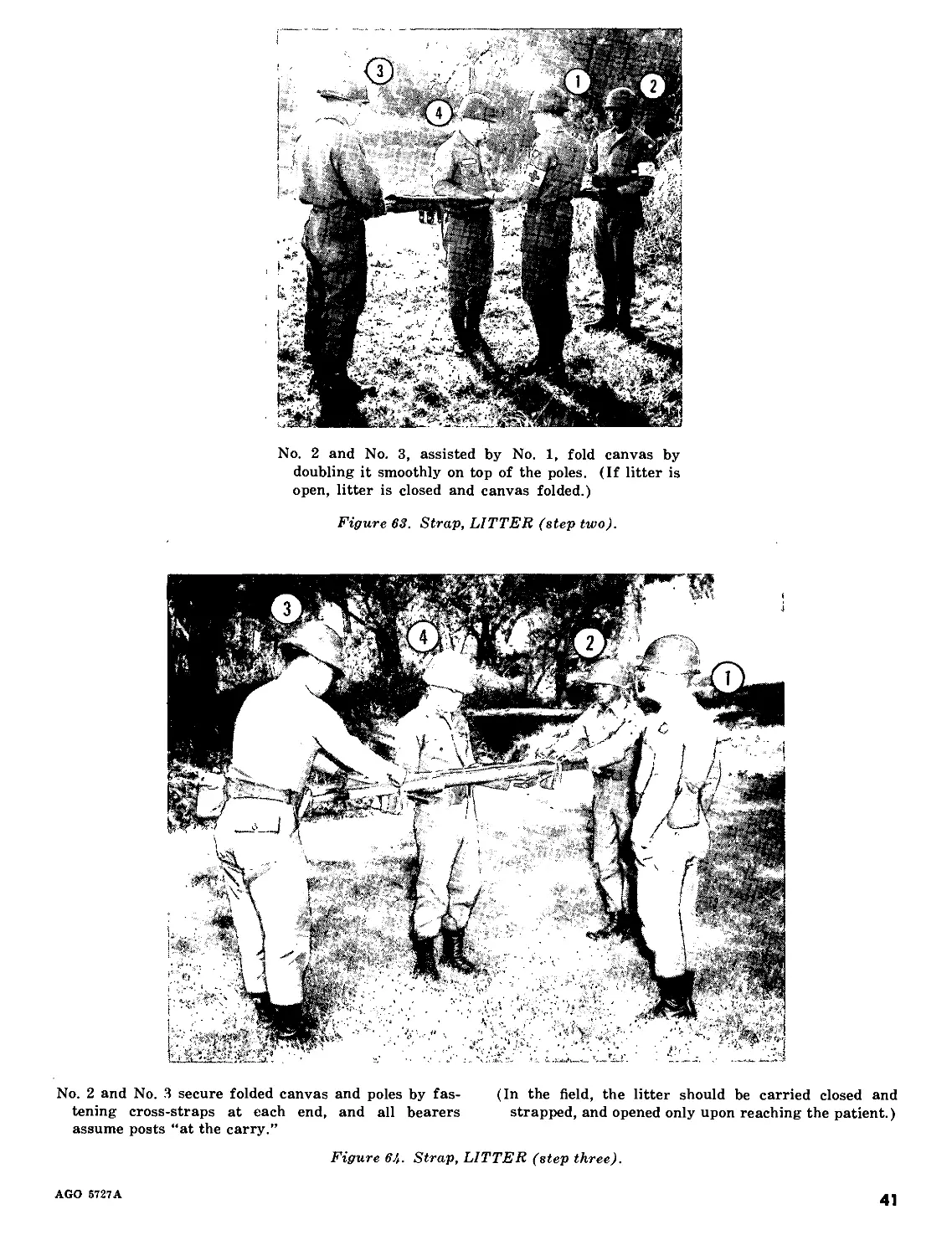
No. 2 and No. 3, assisted by No. 1, fold canvas by
doubling it smoothly on top of the poles. (If litter is
open, litter is closed and canvas folded.)
Figure 63. Strap, LITTER (step two).
No. 2 and No. 3 secure folded canvas and poles by fas-
tening cross-straps at each end, and all bearers
assume posts “at the carry.”
(In the field, the litter should be carried closed and
strapped, and opened only upon reaching the patient.)
Figure 64.	Strap, LITTER (step three).
AGO 5727A
41
28.	To Lift Open Litter, ©г У 01 folded
(figs. 65, 66)
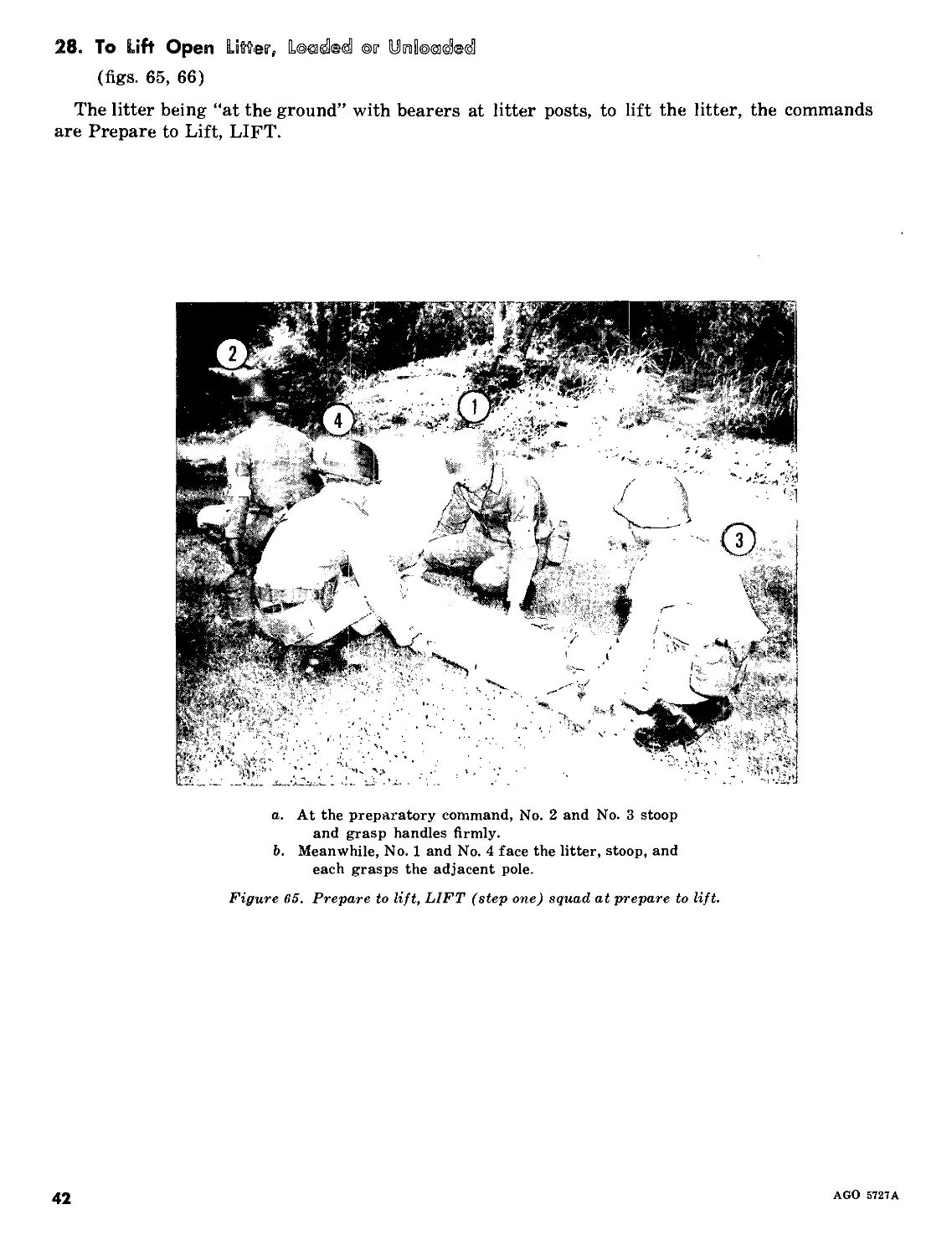
The litter being “at the ground” with bearers at litter posts, to lift the litter, the commands
are Prepare to Lift, LIFT.
a.	At the preparatory command, No. 2 and No. 3 stoop
and grasp handles firmly.
b.	Meanwhile, No. 1 and No. 4 face the litter, stoop, and
each grasps the adjacent pole.
Figure 65.	Prepare to lift, LIFT (step one) squad at prepare to lift.
42
AGO 5727A
At the command of execution, No. 2 and No. 3 rise
slowly, assisted in lifting by No. 1 and No. 4, all
maintaining a level litter position at all times. (To
march forward, commands are Forward, MARCH.
No. 2 steps off with left foot, No. 3 with the right,
both taking short sliding steps of about 20 inches to
avoid jolting and to secure uniform motion of litter.
No. 1 and No. 4 step off with left foot, at normal pace
at a cadence to conform with progress of No. 2 and
No. 3.)
Figure 66.	Prepare to lift, LIFT (step two) litter lifted.
AGO 5727A
43
29.	To Load and Unload Litter
(figs. 67-70)
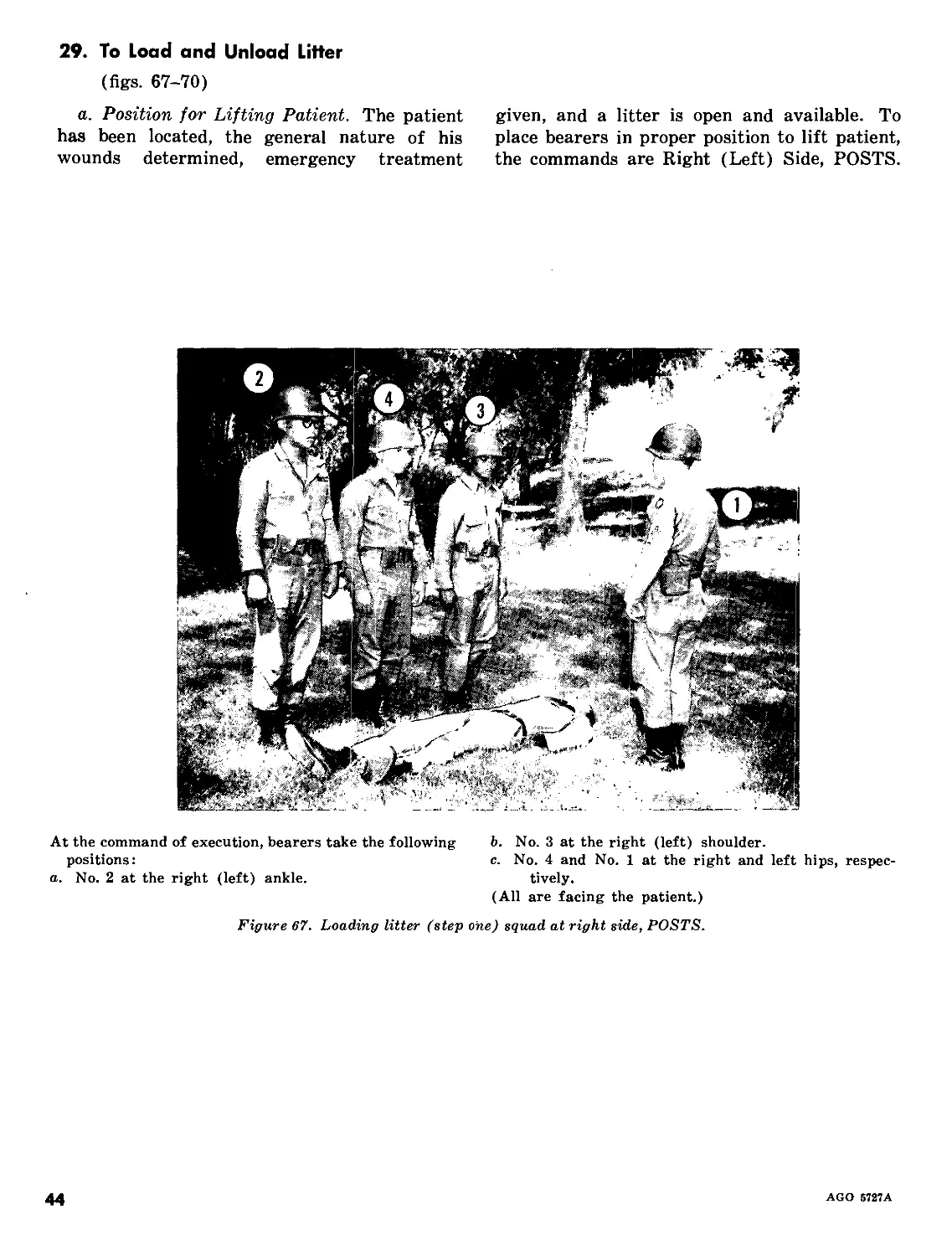
a. Position for Lifting Patient. The patient
has been located, the general nature of his
wounds determined, emergency treatment
given, and a litter is open and available. To
place bearers in proper position to lift patient,
the commands are Right (Left) Side, POSTS.
At the command of execution, bearers take the following
positions:
a.	No. 2 at the right (left) ankle.
b.	No. 3 at the right (left) shoulder.
c.	No. 4 and No. 1 at the right and left hips, respec-
tively.
(All are facing the patient.)
Figure 67.	Loading litter (step one) squad at right side, POSTS.
44
AGO 5727A
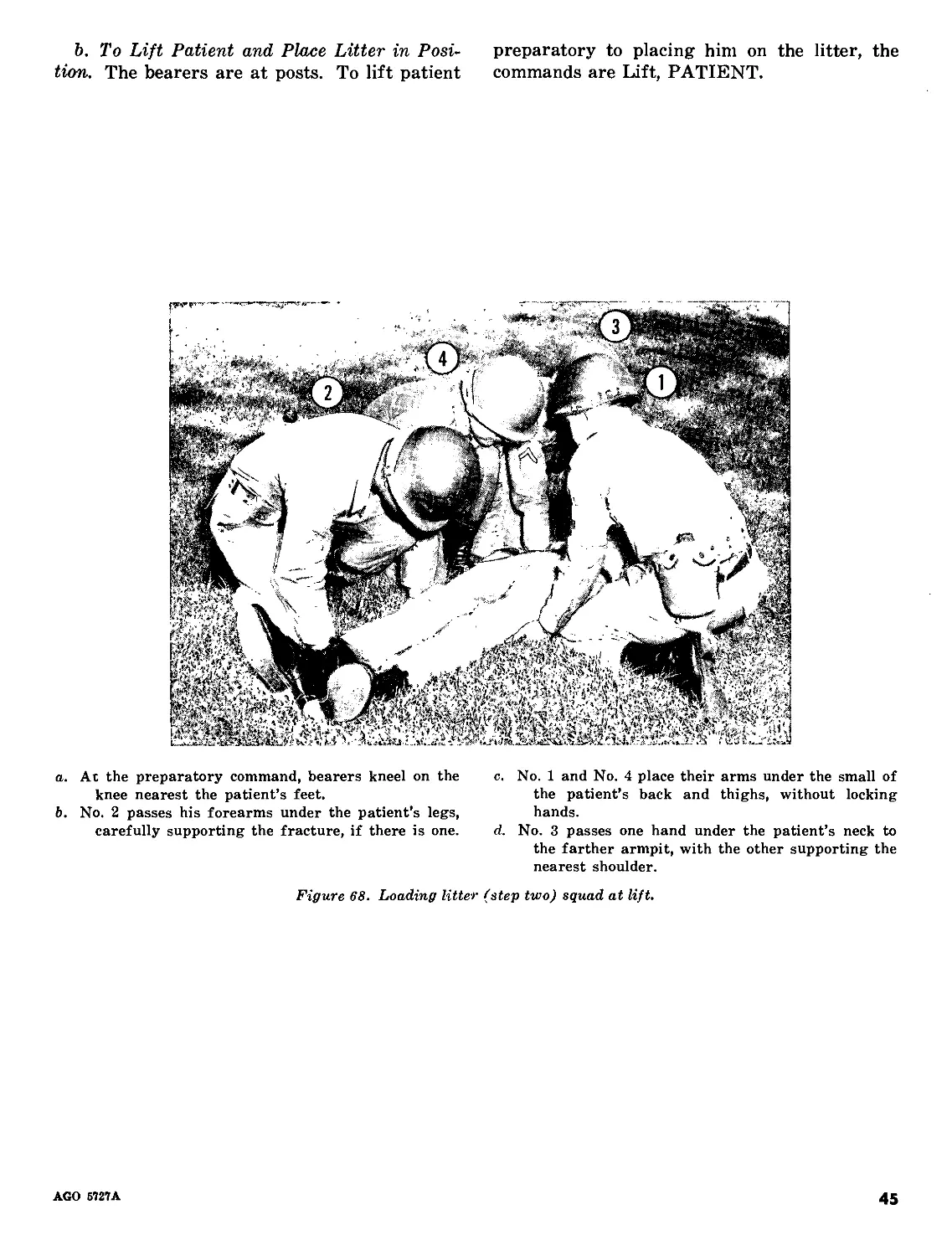
b. To Lift Patient and Place Litter in Posi-
tion. The bearers are at posts. To lift patient
preparatory to placing him on the litter, the
commands are Lift, PATIENT.
a.	At the preparatory command, bearers kneel on the
knee nearest the patient’s feet.
b.	No. 2 passes his forearms under the patient’s legs,
carefully supporting the fracture, if there is one.
c.	No. 1 and No. 4 place their arms under the small of
the patient’s back and thighs, without locking
hands.
d.	No. 3 passes one hand under the patient’s neck to
the farther armpit, with the other supporting the
nearest shoulder.
Figure 68.	Loading litter (step two) squad at lift.
AGO 5727A
45
At the command of execution, all lift together, slowly
and carefully, and place the patient upon the knees
of the three bearers who are on the same side.
Figure 69.	Loading litter (step three) patient lifted.
46
AGO 5727A
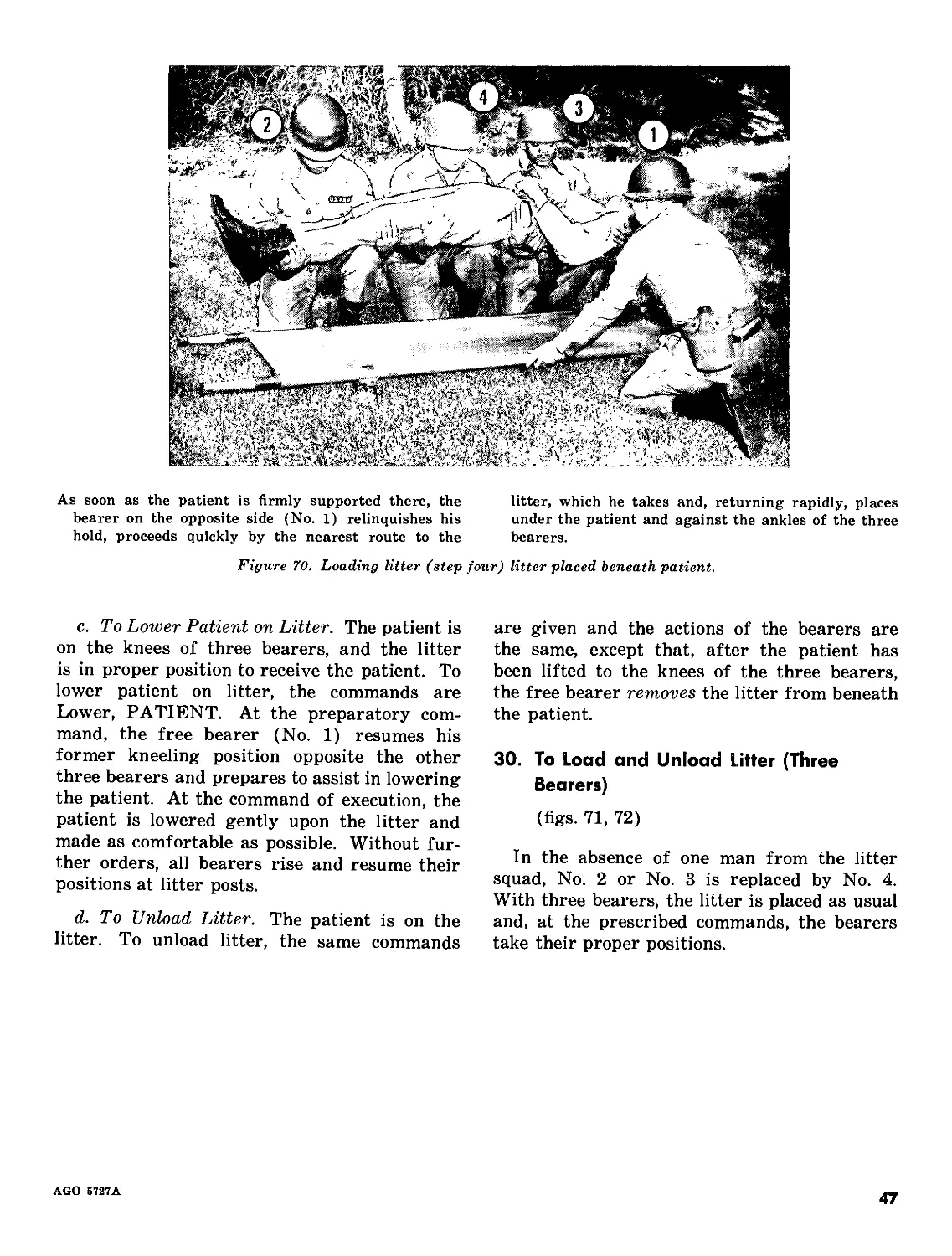
As soon as the patient is firmly supported there, the
bearer on the opposite side (No. 1) relinquishes his
hold, proceeds quickly by the nearest route to the
litter, which he takes and, returning rapidly, places
under the patient and against the ankles of the three
bearers.
Figure 70. Loading litter (step four) litter placed beneath patient.
c.	To Lower Patient on Litter. The patient is
on the knees of three bearers, and the litter
is in proper position to receive the patient. To
lower patient on litter, the commands are
Lower, PATIENT. At the preparatory com-
mand, the free bearer (No. 1) resumes his
former kneeling position opposite the other
three bearers and prepares to assist in lowering
the patient. At the command of execution, the
patient is lowered gently upon the litter and
made as comfortable as possible. Without fur-
ther orders, all bearers rise and resume their
positions at litter posts.
d.	To Unload Litter. The patient is on the
litter. To unload litter, the same commands
are given and the actions of the bearers are
the same, except that, after the patient has
been lifted to the knees of the three bearers,
the free bearer removes the litter from beneath
the patient.
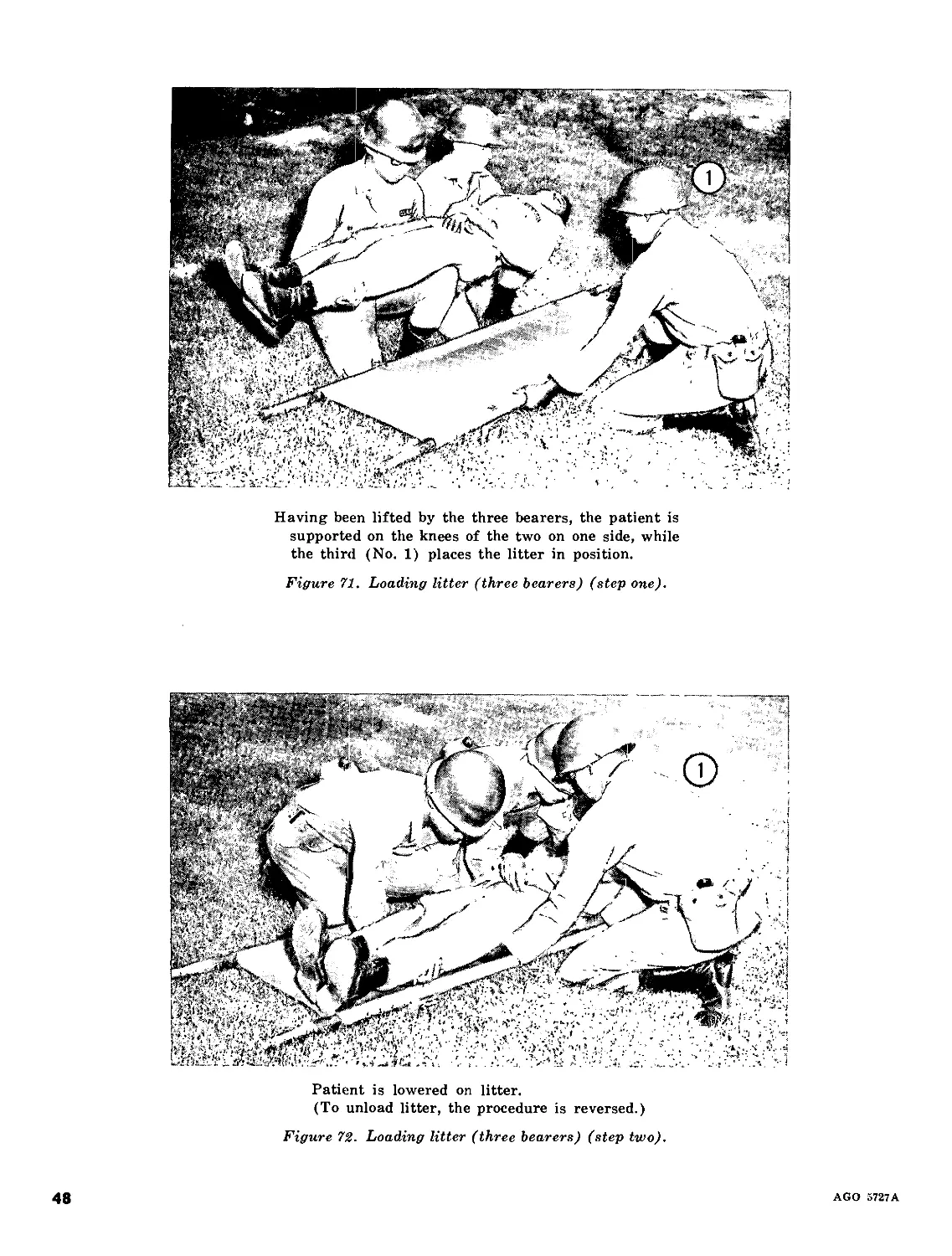
30. To Load and Unload Litter (Three
Bearers)
(figs. 71, 72)
In the absence of one man from the litter
squad, No. 2 or No. 3 is replaced by No. 4.
With three bearers, the litter is placed as usual
and, at the prescribed commands, the bearers
take their proper positions.
AGO 5727A
47
Having been lifted by the three bearers, the patient is
supported on the knees of the two on one side, while
the third (No. 1) places the litter in position.
Figure 71.	Loading litter (three bearers) (step one).
Patient is lowered on litter.
(To unload litter, the procedure is reversed.)
Figure 72.	Loading litter (three bearers) (step two).
48
AGO 5727A
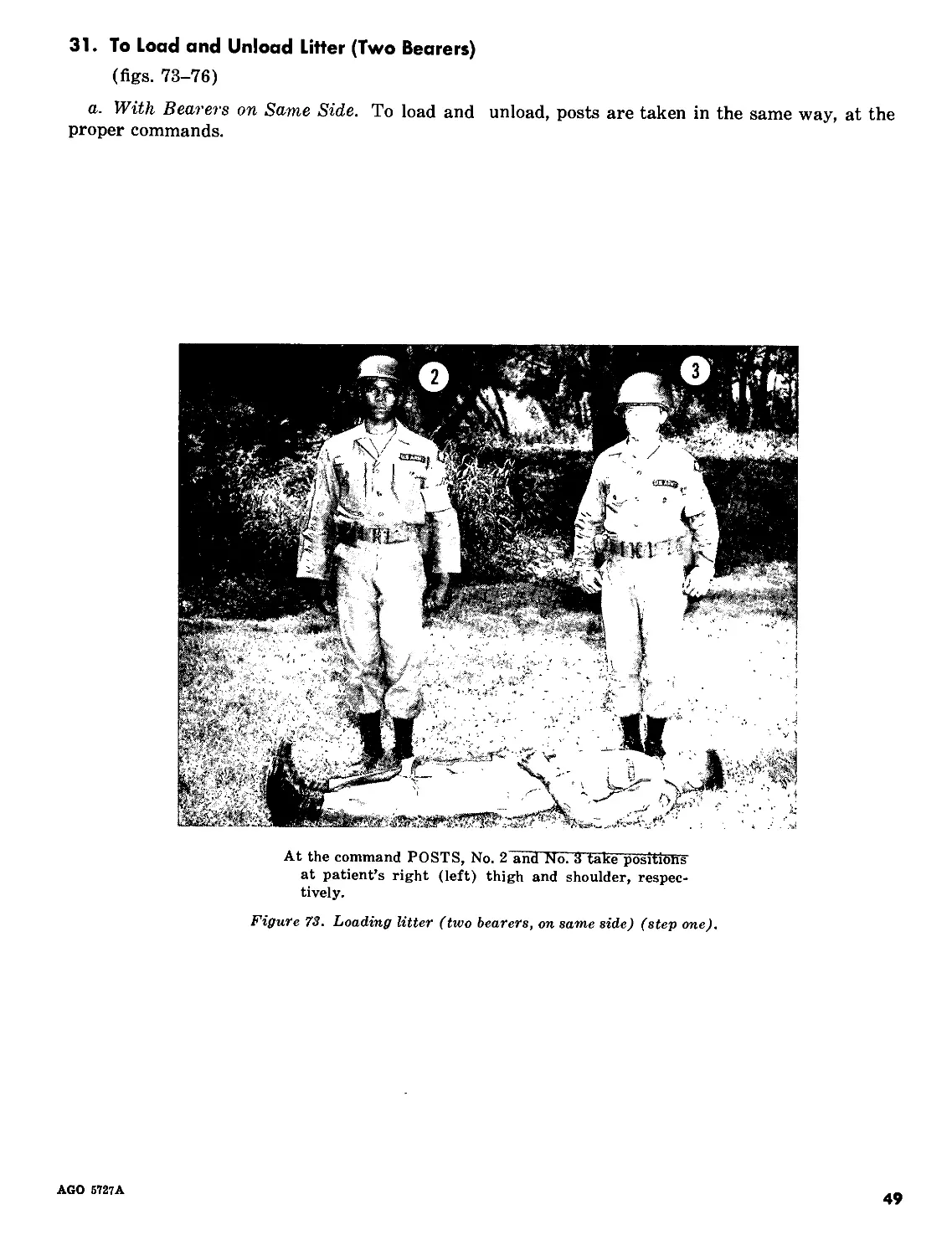
31.	To Load and Unload Litter (Two Bearers)
(figs. 73-76)
a. With Bearers on Same Side. To load and unload, posts are taken in the same way, at the
proper commands.
At the command POSTS, No. 2 and No. 3 take positions
at patient’s right (left) thigh and shoulder, respec-
tively.
Figure 73.	Loading litter (two bearers, on same side) (step one).
AGO 6727A
49
a.	At the command Lift, bearers kneel on the knee
nearest patient’s feet.
b.	No. 2 passes his arms beneath patient’s hips and
knees.
c.	No. 3 passes his arms beneath patient’s shoulders
and small of the back.
Figure 7U. Loading litter (two bearers, one same side) (step two).
a.	At the command PATIENT, they lift together, rais-
ing patient upon their knees.
b.	Readjusting their holds, they rise to their feet and
carry the patient to the side of the litter.
c.	At the command Lower, PATIENT, bearers kneel
and place patient on their knees.
Figure 75.	Loading litter (two bearers, on same side) (step three).
50
AGO 6727A
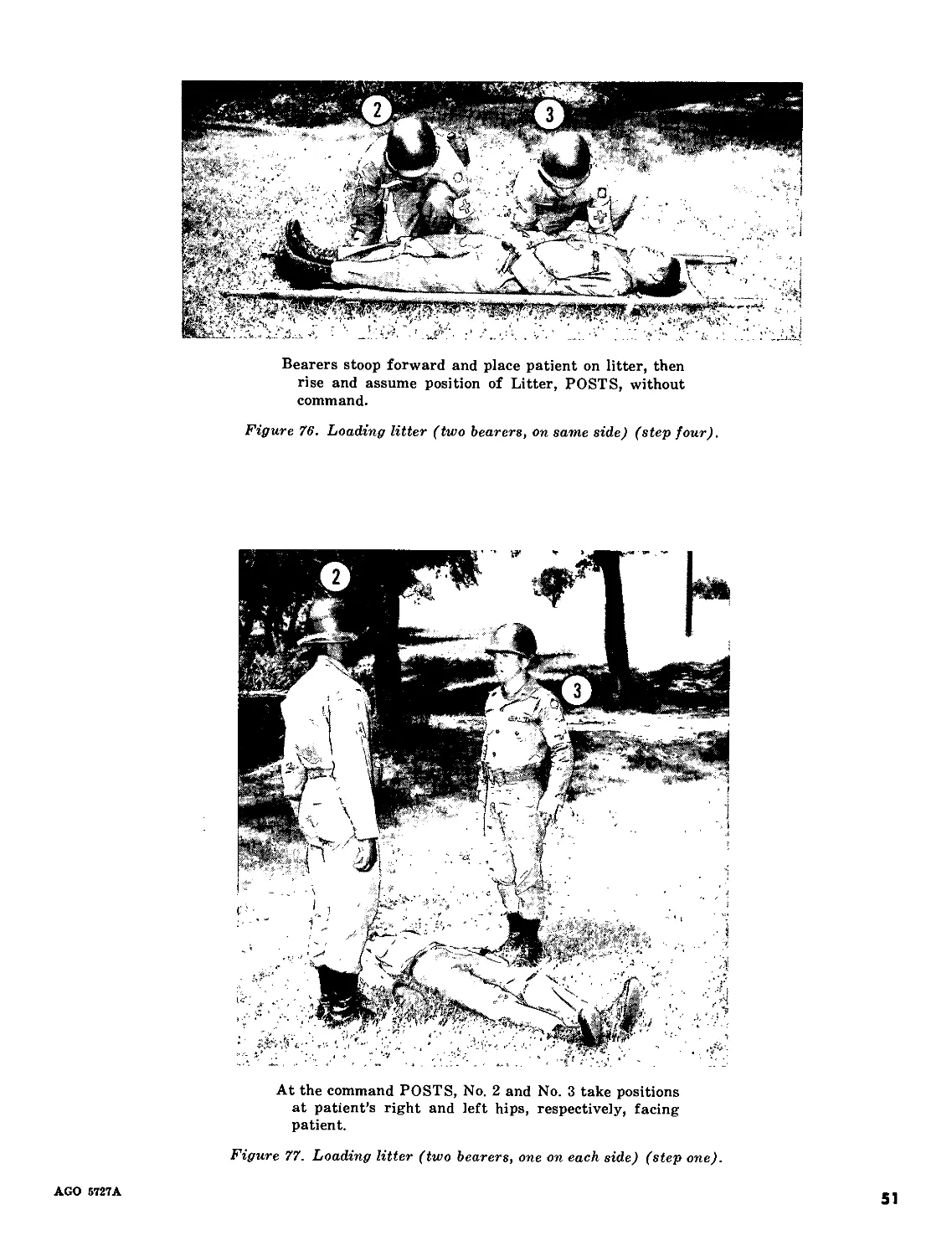
Bearers stoop forward and place patient on litter, then
rise and assume position of Litter, POSTS, without
command.
Figure 76.	Loading litter (two bearers, on same side) (step four).
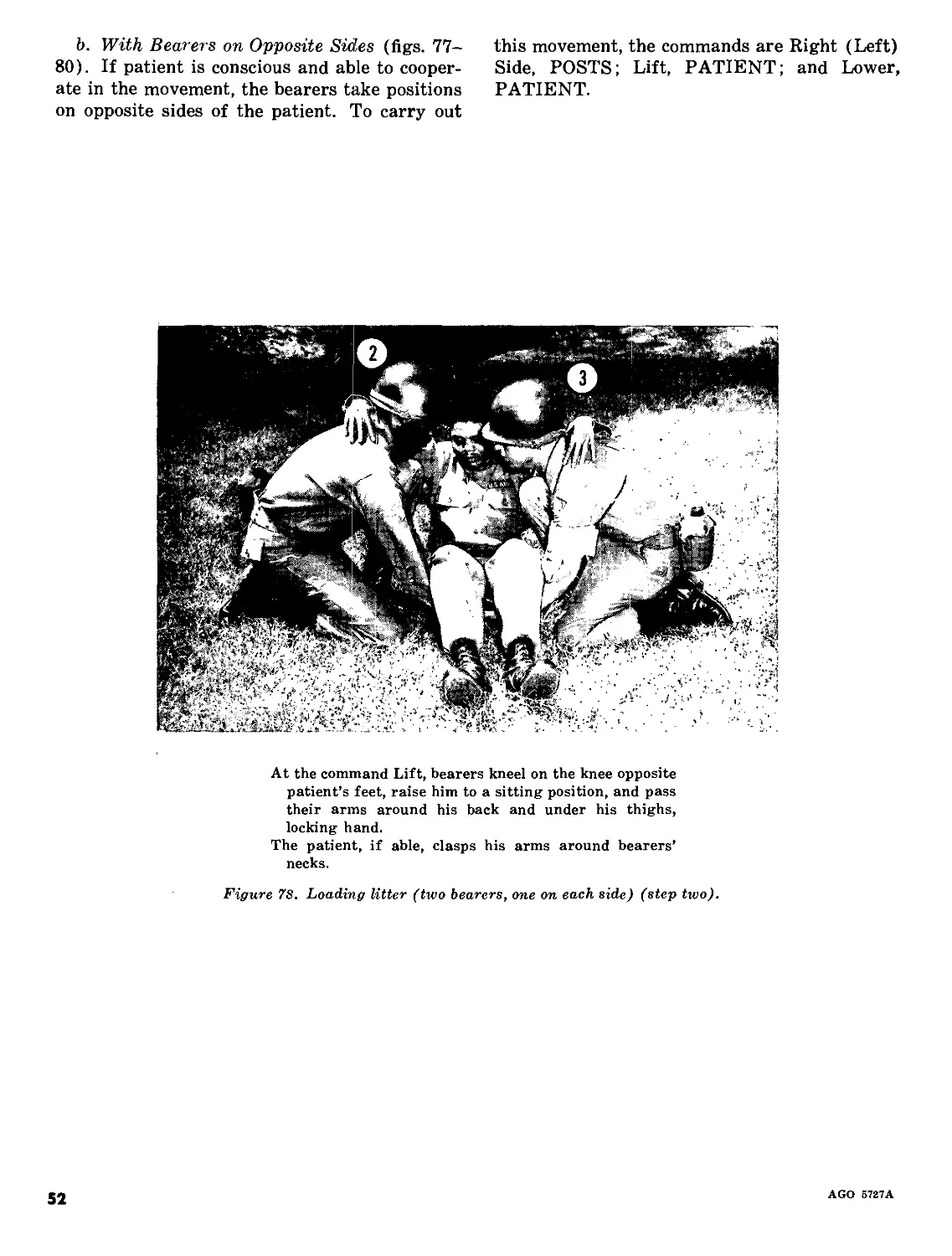
At the command POSTS, No. 2 and No. 3 take positions
at patient’s right and left hips, respectively, facing
patient.
Figure 77.	Loading litter (two bearers, one on each side) (step one).
AGO 5727A
51
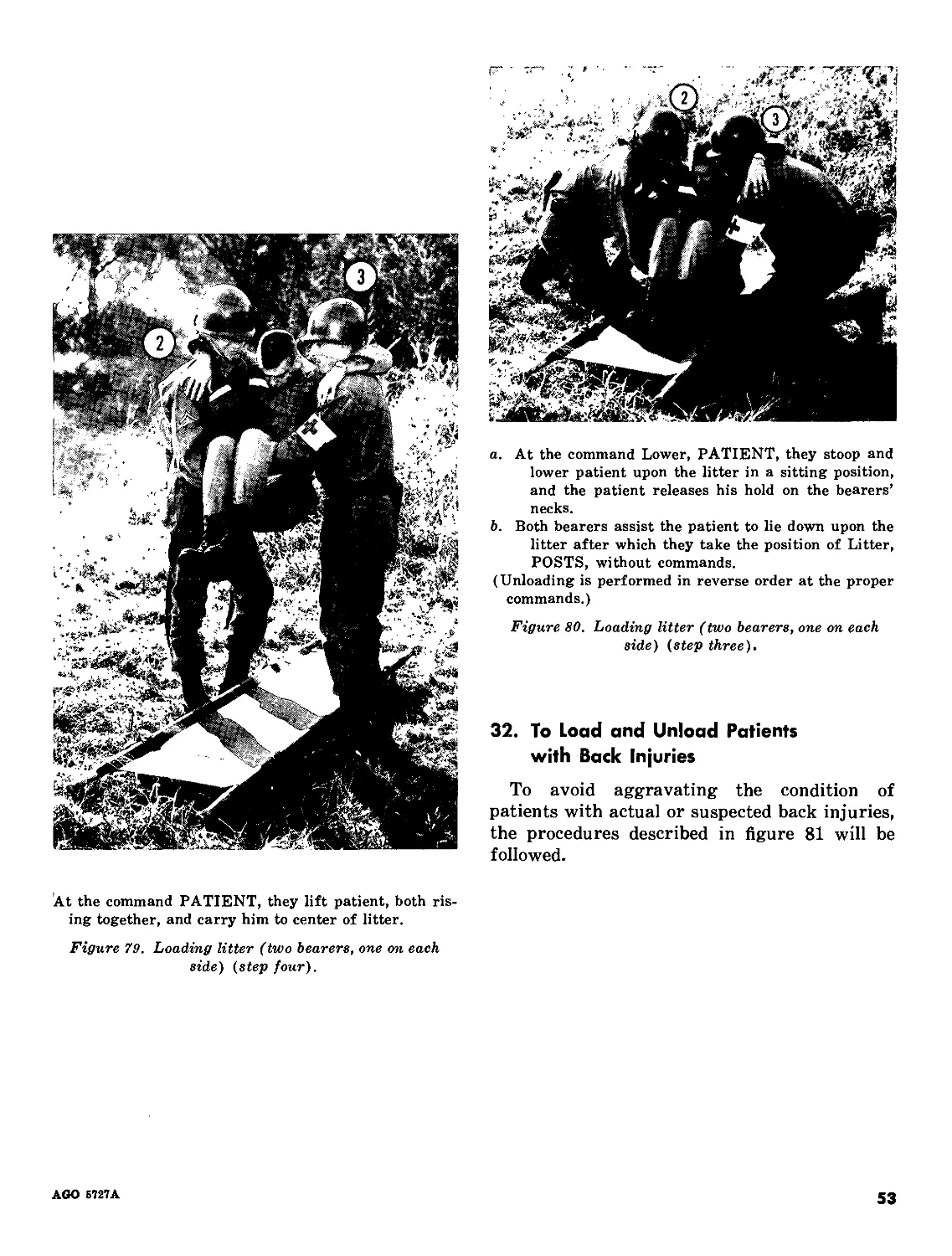
b. With Bearers on Opposite Sides (figs. 77-
80). If patient is conscious and able to cooper-
ate in the movement, the bearers take positions
on opposite sides of the patient. To carry out
this movement, the commands are Right (Left)
Side, POSTS; Lift, PATIENT; and Lower,
PATIENT.
At the command Lift, bearers kneel on the knee opposite
patient’s feet, raise him to a sitting position, and pass
their arms around his back and under his thighs,
locking hand.
The patient, if able, clasps his arms around bearers’
necks.
Figure 7S. Loading litter (two bearers, one on each side) (step two).
52
AGO 5727A
a.	At the command Lower, PATIENT, they stoop and
lower patient upon the litter in a sitting position,
and the patient releases his hold on the bearers’
necks.
b.	Both bearers assist the patient to lie down upon the
litter after which they take the position of Litter,
POSTS, without commands.
(Unloading is performed in reverse order at the proper
commands.)
Figure 80.	Loading litter (two bearers, one on each
side) (step three).
32.	To Load and Unload Patients
with Back Injuries
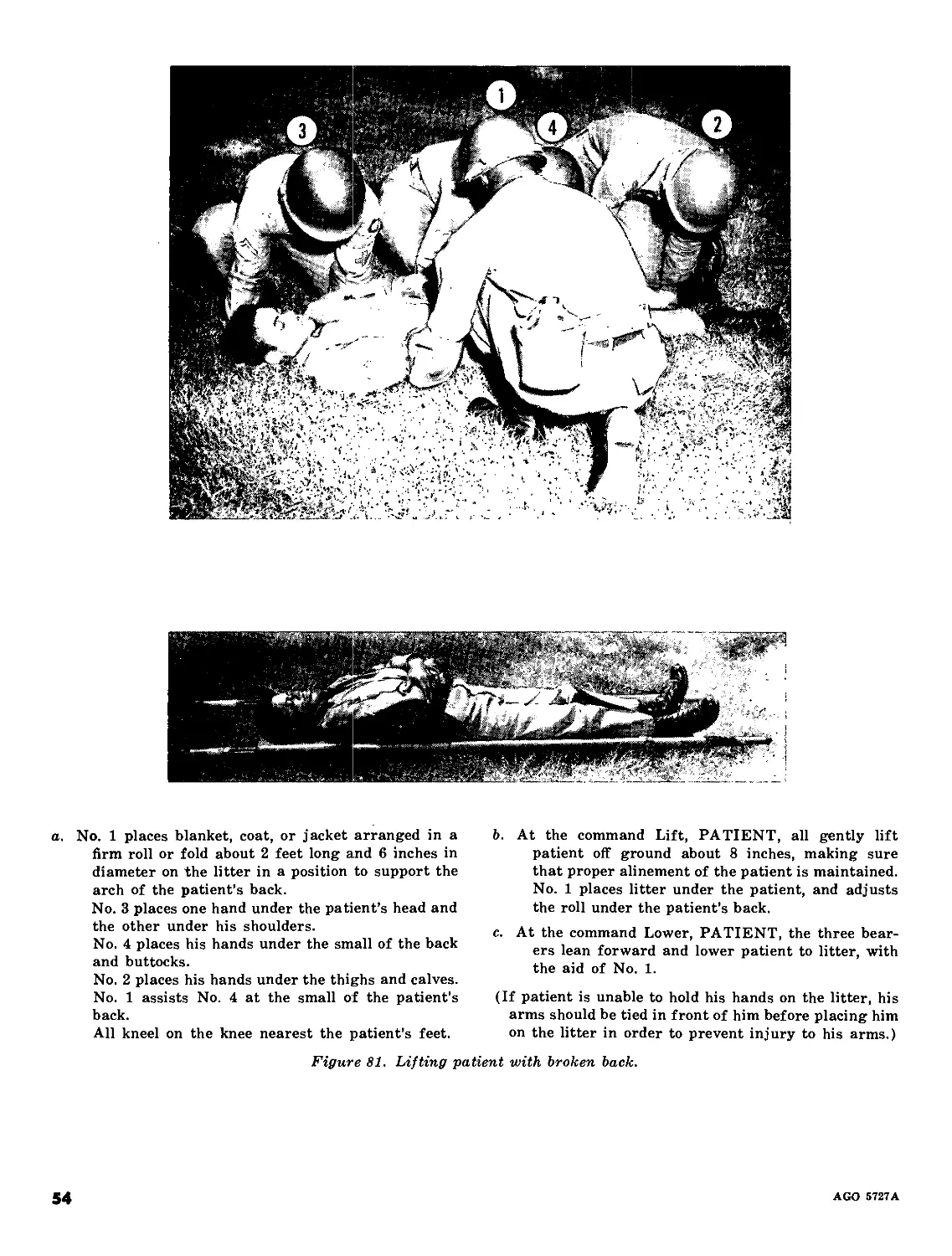
To avoid aggravating the condition of
patients with actual or suspected back injuries,
the procedures described in figure 81 will be
followed.
At the command PATIENT, they lift patient, both ris-
ing together, and carry him to center of litter.
Figure 79. Loading litter (two bearers, one on each
side) (step four).
AGO Б727А
53
a.	No. 1 places blanket, coat, or jacket arranged in a
firm roll or fold about 2 feet long and 6 inches in
diameter on the litter in a position to support the
arch of the patient’s back.
No. 3 places one hand under the patient’s head and
the other under his shoulders.
No. 4 places his hands under the small of the back
and buttocks.
No. 2 places his hands under the thighs and calves.
No. 1 assists No. 4 at the small of the patient’s
back.
All kneel on the knee nearest the patient’s feet.
b.	At the command Lift, PATIENT, all gently lift
patient off ground about 8 inches, making sure
that proper alinement of the patient is maintained.
No. 1 places litter under the patient, and adjusts
the roll under the patient’s back.
c.	At the command Lower, PATIENT, the three bear-
ers lean forward and lower patient to litter, with
the aid of No. 1.
(If patient is unable to hold his hands on the litter, his
arms should be tied in front of him before placing him
on the litter in order to prevent injury to his arms.)
Figure 81.	Lifting patient with broken back.
54
AGO 5727A
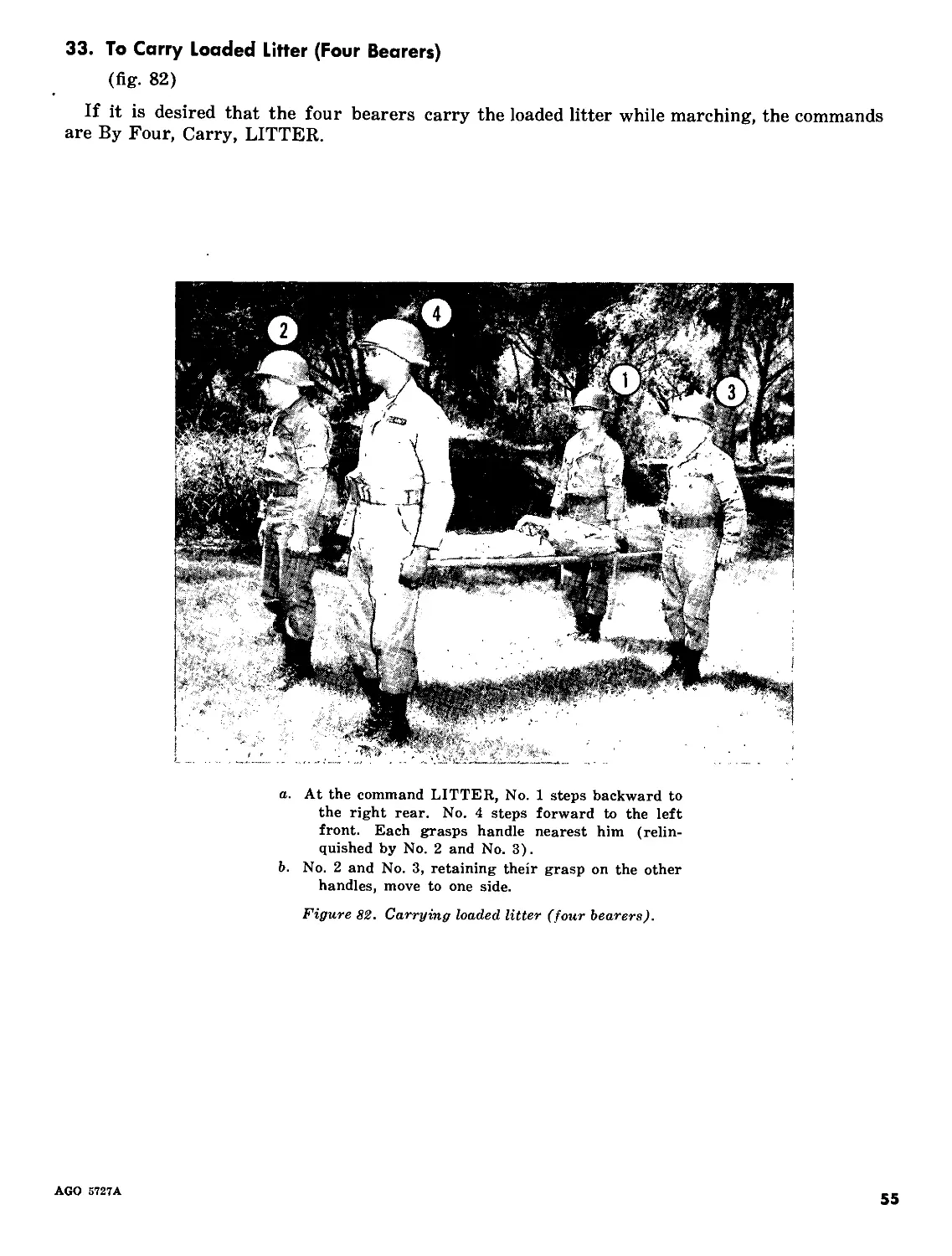
33.	To Carry Loaded Litter (Four Bearers)
(fig. 82)
If it is desired that the four bearers carry the loaded litter while marching, the commands
are By Four, Carry, LITTER.
a.	At the command LITTER, No. 1 steps backward to
the right rear. No. 4 steps forward to the left
front. Each grasps handle nearest him (relin-
quished by No. 2 and No. 3).
b.	No. 2 and No. 3, retaining their grasp on the other
handles, move to one side.
Figure 82.	Carrying loaded litter (four bearers).
AGO 5727A
55
Section IV. DRESSING THE LITTER
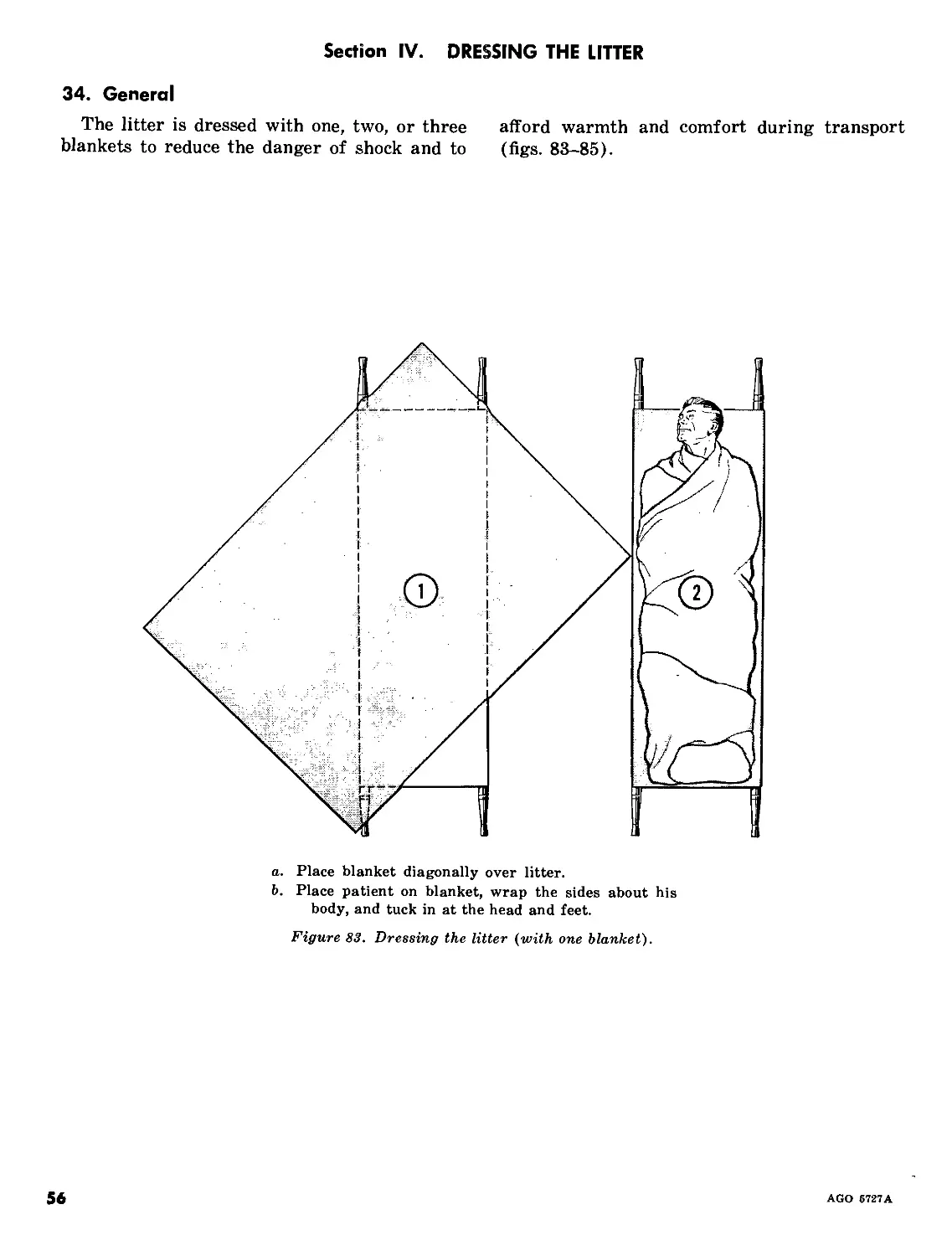
34. General
The litter is dressed with one, two, or three afford warmth and comfort during transport
blankets to reduce the danger of shock and to (figs. 83-85).
a.	Place blanket diagonally over litter.
b.	Place patient on blanket, wrap the sides about his
body, and tuck in at the head and feet.
Figure 83. Dressing the litter (with one blanket).
56
AGO 5727 A
a.	Place the first blanket lengthwise across litter with
the blanket edge close to or just beyond the head
end of litter.
b.	Fold second blanket in thirds, lengthwise, and place
over the first, the upper edge of this folded blanket
being about 10 inches below the upper edge of the
first blanket. The exact position of the second
blanket depends upon the height of the patient.
(Place lower on litter for taller men.) Open folds
of second blanket for about 2 feet at the foot end.
c. To wrap patient, place him in position on the second
blanket. Bring bottom of blanket up over the
patient’s feet, with a small fold between the feet.
Tuck the two open folds closely over and around
the feet and ankles.
d. Finally, wrap first one, then the opposite, side of the
first blanket over patient.
Figure 8!f. Dressing the litter (with two blankets).
AGO 5727A
57
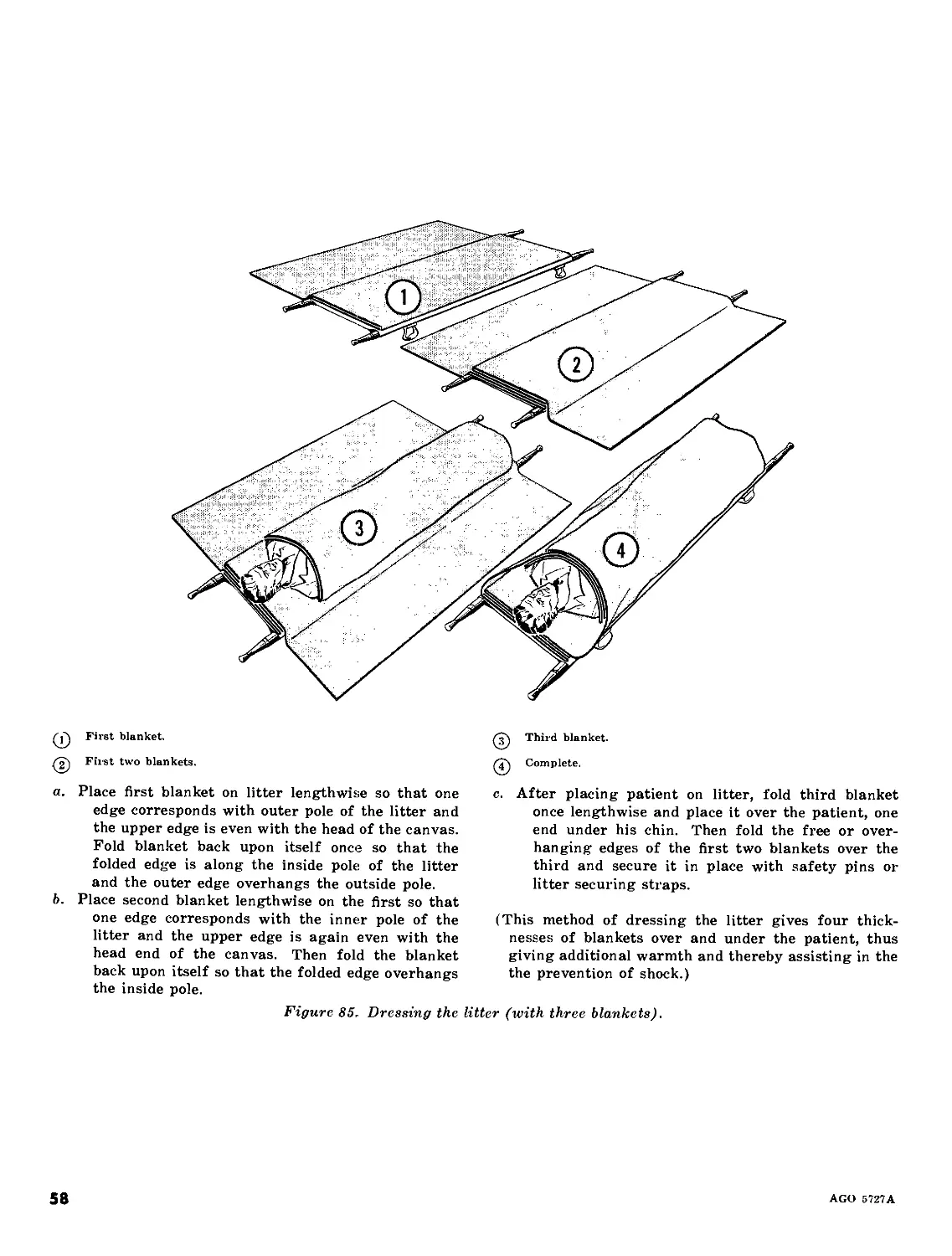
Q First blanket.
^2^ First two blankets.
a.	Place first blanket on litter lengthwise so that one
edge corresponds with outer pole of the litter and
the upper edge is even with the head of the canvas.
Fold blanket back upon itself once so that the
folded edge is along the inside pole of the litter
and the outer edge overhangs the outside pole.
b.	Place second blanket lengthwise on the first so that
one edge corresponds with the inner pole of the
litter and the upper edge is again even with the
head end of the canvas. Then fold the blanket
back upon itself so that the folded edge overhangs
the inside pole.
^3^ Third blanket.
Complete.
c.	After placing patient on litter, fold third blanket
once lengthwise and place it over the patient, one
end under his chin. Then fold the free or over-
hanging edges of the first two blankets over the
third and secure it in place with safety pins or-
litter securing straps.
(This method of dressing the litter gives four thick-
nesses of blankets over and under the patient, thus
giving additional warmth and thereby assisting in the
the prevention of shock.)
Figure 85. Dressing the litter (with three blankets).
58
AGO 5727A
Section V. LITTER OBSTACLES
35.	General
In litter transportation, bearers may be con-
fronted with several types of natural or arti-
ficial impediments which must be surmounted.
Orders for surmounting separate obstacles are
neither necessary nor feasible. Hence, flex-
ibility in the execution of orders concerning
obstacles must be maintained, common sense
dictating the details of action most suited to
the situation.
36.	Litter Obstacle Course
A litter obstacle course is useful, not only in
presenting obstacles of all kinds and teaching
the proper methods for surmounting them, but in
conditioning bearers physically for the arduous
tasks they will encounter in combat. It can be
constructed to simulate most of the natural
and artificial obstructions that litter bearers are
likely to meet. Where construction of a litter
obstacle course is impracticable, many of the
obstacles can be simulated from existing facil-
ities.
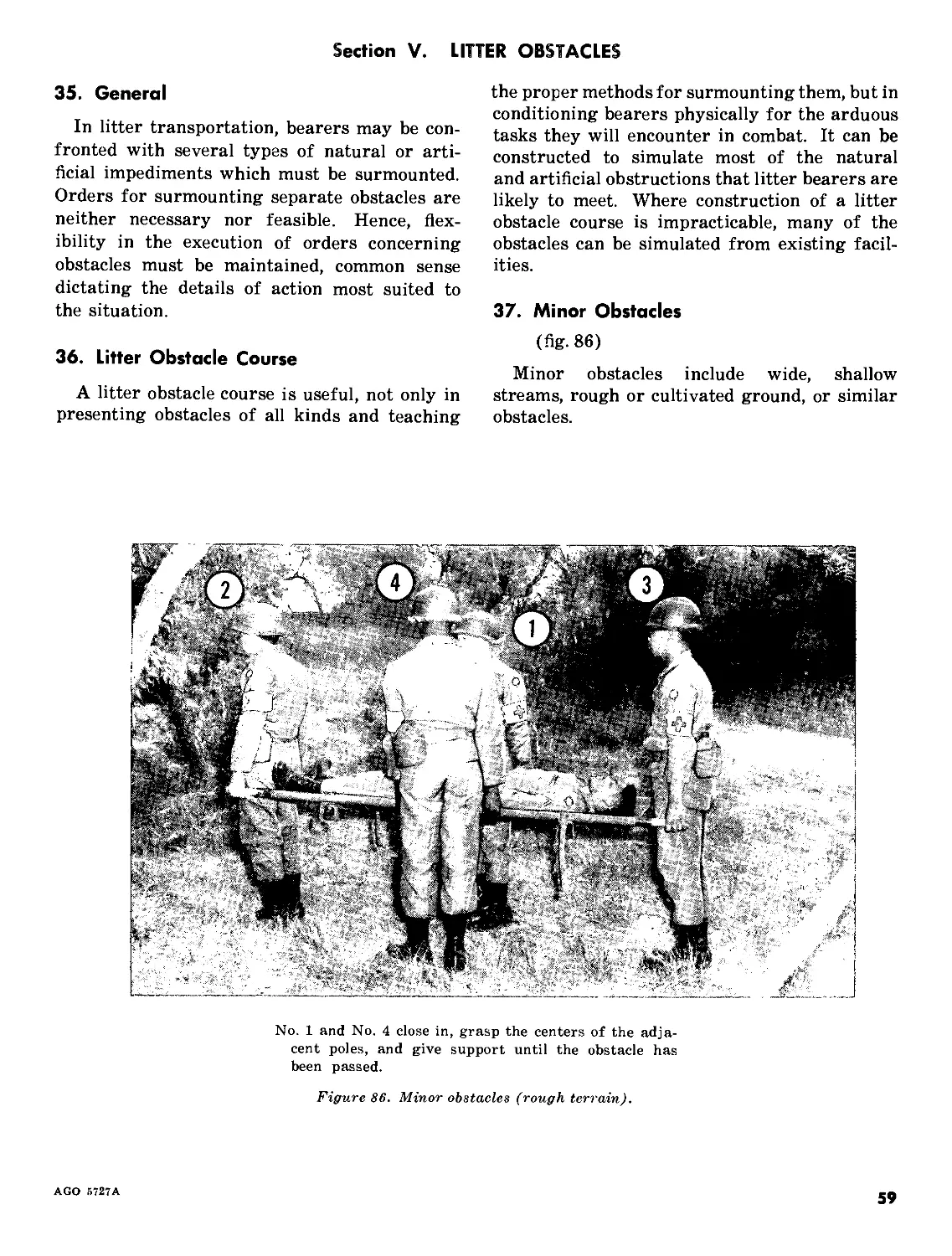
37.	Minor Obstacles
(fig. 86)
Minor obstacles include wide, shallow
streams, rough or cultivated ground, or similar
obstacles.
No. 1 and No. 4 close in, grasp the centers of the adja-
cent poles, and give support until the obstacle has
been passed.
Figure 86. Minor obstacles (rough terrain).
AGO 5727A
59
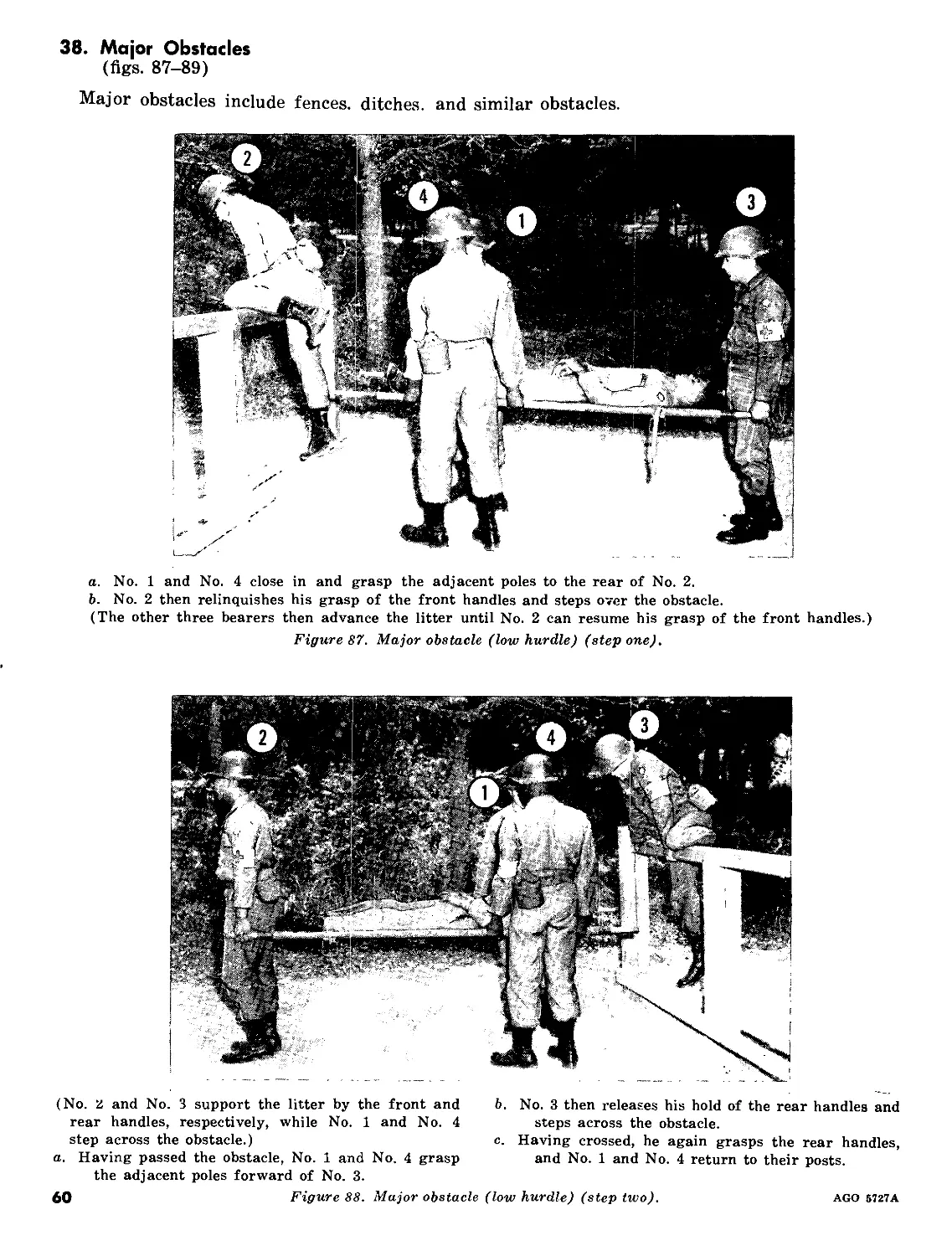
38.	Major Obstacles
(figs. 87-89)
Major obstacles include fences, ditches, and similar obstacles.
a.	No. 1 and No. 4 close in and grasp the adjacent poles to the rear of No. 2.
b.	No. 2 then relinquishes his grasp of the front handles and steps over the obstacle.
(The other three bearers then advance the litter until No. 2 can resume his grasp of the front handles.)
Figure 87. Major obstacle (low hurdle) (step one).
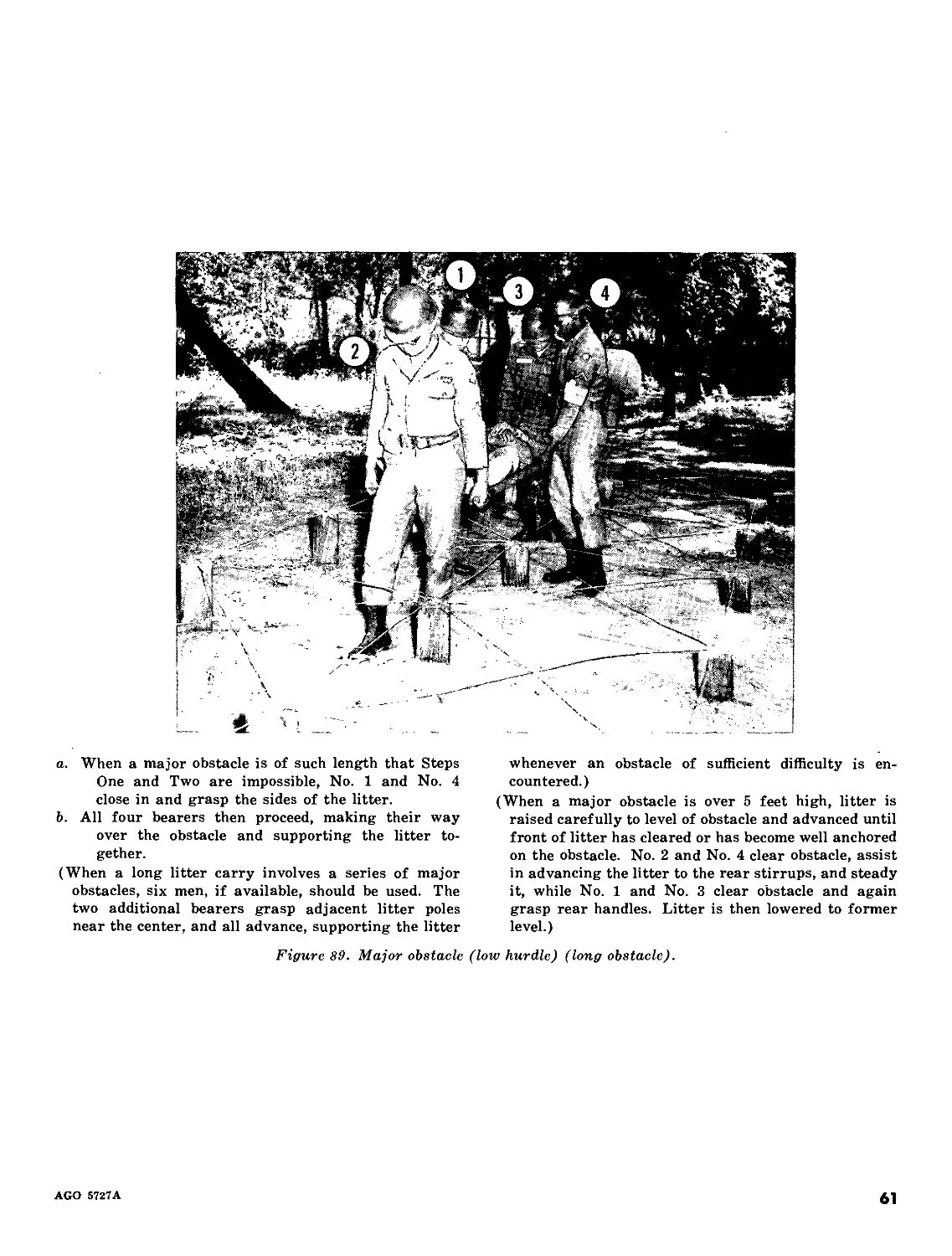
(No. 2 and No. 3 support the litter by the front and b. No. 3 then releases his hold of the rear handles and
rear handles, respectively, while No. 1 and No. 4	steps across the obstacle.
step across the obstacle.)	c. Having crossed, he again grasps the rear handles,
a. Having passed the obstacle, No. 1 and No. 4 grasp	and No. 1 and No. 4 return to their posts.
the adjacent poles forward of No. 3.
60	Figure 88. Major obstacle (low hurdle) (step two).	AGO 5727A
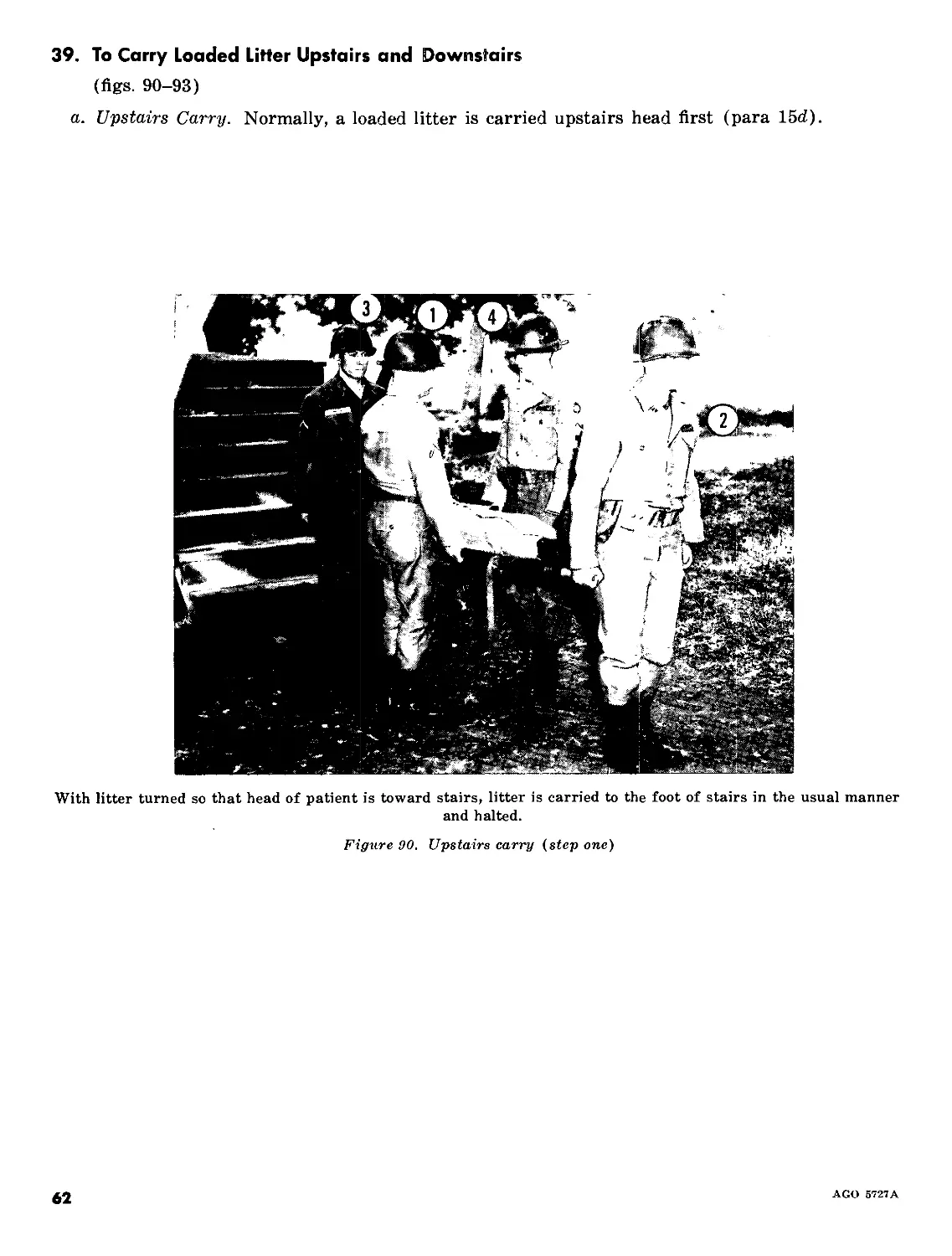
a.	When a major obstacle is of such length that Steps
One and Two are impossible, No. 1 and No. 4
close in and grasp the sides of the litter.
b.	All four bearers then proceed, making their way
over the obstacle and supporting the litter to-
gether.
(When a long litter carry involves a series of major
obstacles, six men, if available, should be used. The
two additional bearers grasp adjacent litter poles
near the center, and all advance, supporting the litter
whenever an obstacle of sufficient difficulty is en-
countered.)
(When a major obstacle is over 5 feet high, litter is
raised carefully to level of obstacle and advanced until
front of litter has cleared or has become well anchored
on the obstacle. No. 2 and No. 4 clear obstacle, assist
in advancing the litter to the rear stirrups, and steady
it, while No. 1 and No. 3 clear obstacle and again
grasp rear handles. Litter is then lowered to former
level.)
Figure 89.	Major obstacle (low hurdle) (long obstacle).
AGO 5727A
61
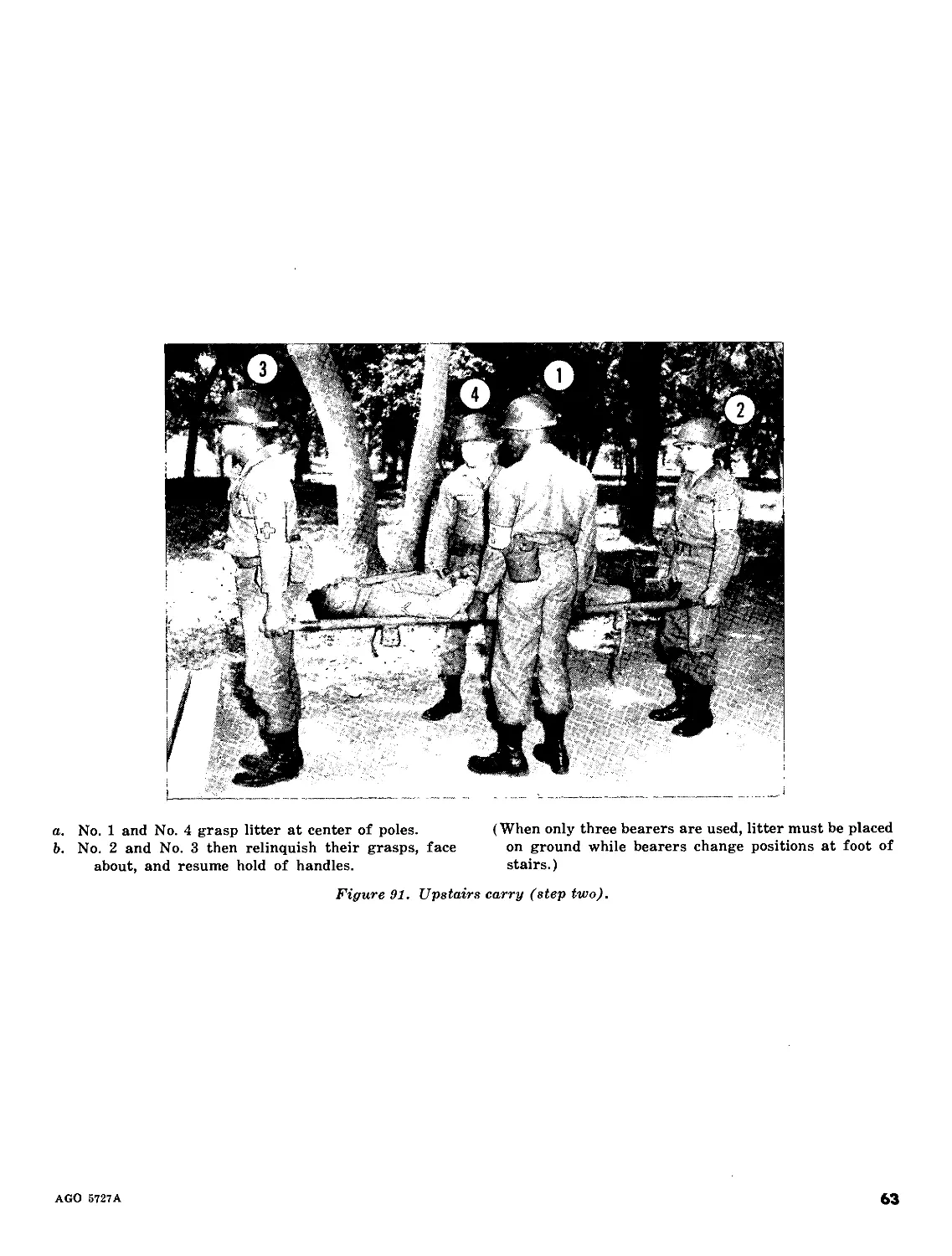
39.	To Carry Loaded Litter Upstairs and Downstairs
(figs. 90-93)
a. Upstairs Carry. Normally, a loaded litter is carried upstairs head first (para 15d).
With litter turned so that head of patient is toward stairs, litter is carried to the foot of stairs in the usual manner
and halted.
Figure 90.	Upstairs carry (step one)
62
AGO 5727A
a.	No. 1 and No. 4 grasp litter at center of poles.
b.	No. 2 and No. 3 then relinquish their grasps, face
about, and resume hold of handles.
(When only three bearers are used, litter must be placed
on ground while bearers change positions at foot of
stairs.)
Figure 91.	Upstairs carry (step two).
AGO 5727A
63
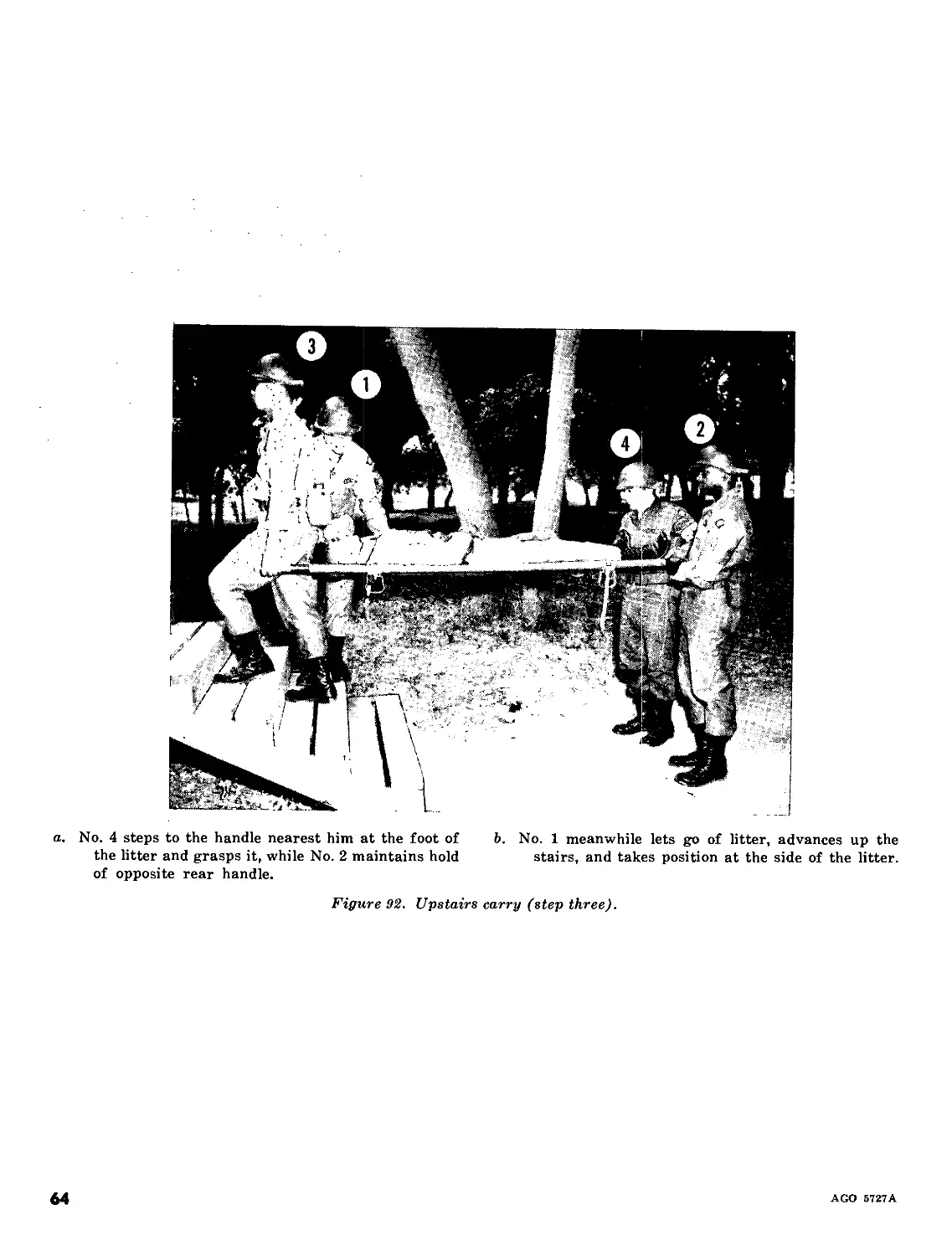
a. No. 4 steps to the handle nearest him at the foot of b. No. 1 meanwhile lets go of litter, advances up the
the litter and grasps it, while No. 2 maintains hold	stairs, and takes position at the side of the litter,
of opposite rear handle.
Figure 92.	Upstairs carry (step three).
64
AGO 5727A
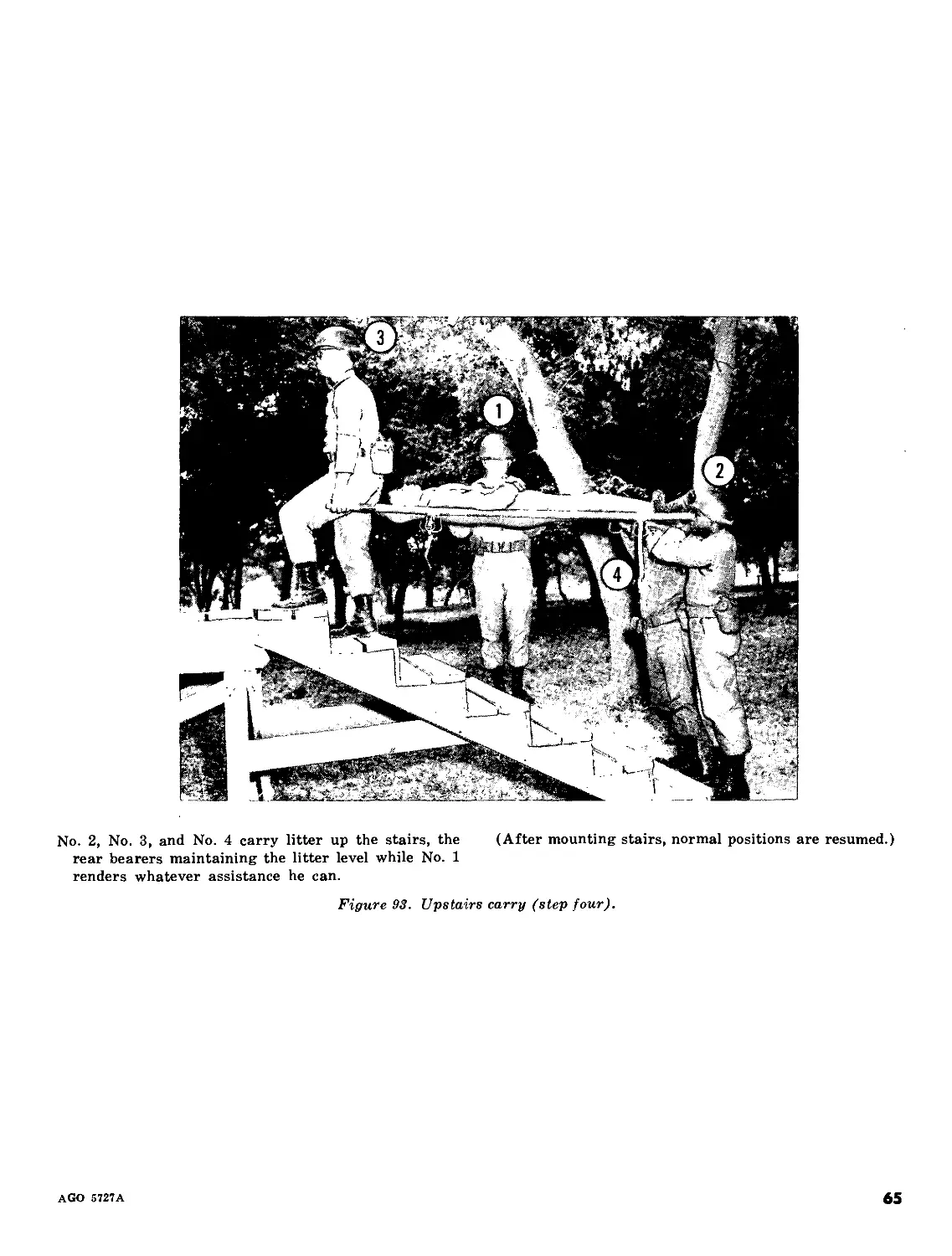
No. 2, No. 3, and No. 4 carry litter up the stairs, the (After mounting stairs, normal positions are resumed.)
rear bearers maintaining the litter level while No. 1
renders whatever assistance he can.
Figure 93.	Upstairs carry (step four).
AGO 5727A
65
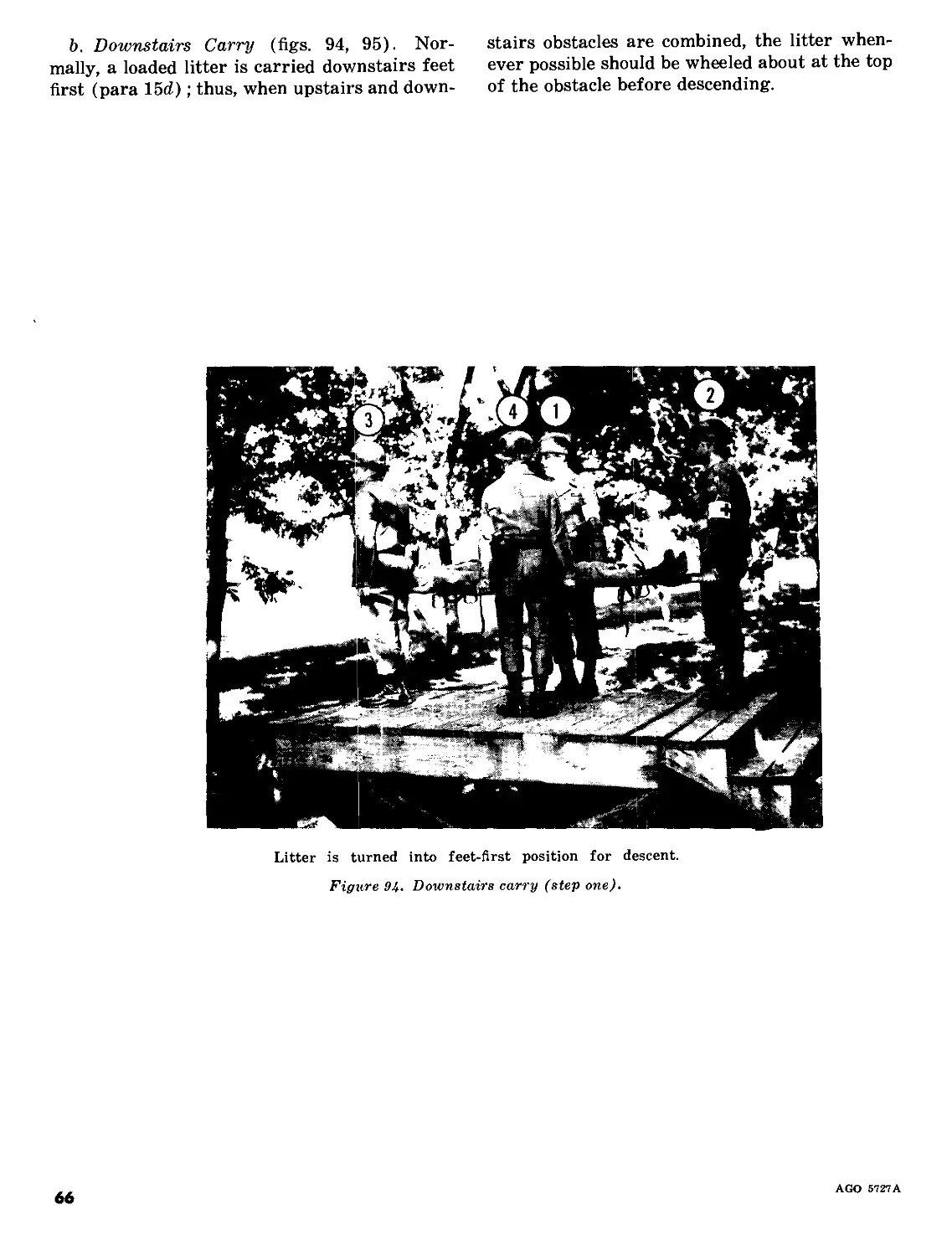
b. Downstairs Carry (figs. 94, 95). Nor-
mally, a loaded litter is carried dovznstairs feet
first (para 15d); thus, when upstairs and down-
stairs obstacles are combined, the litter when-
ever possible should be wheeled about at the top
of the obstacle before descending.
Litter is turned into feet-first position for descent.
Figure 94. Downstairs carry (step one).
66
AGO 5727A
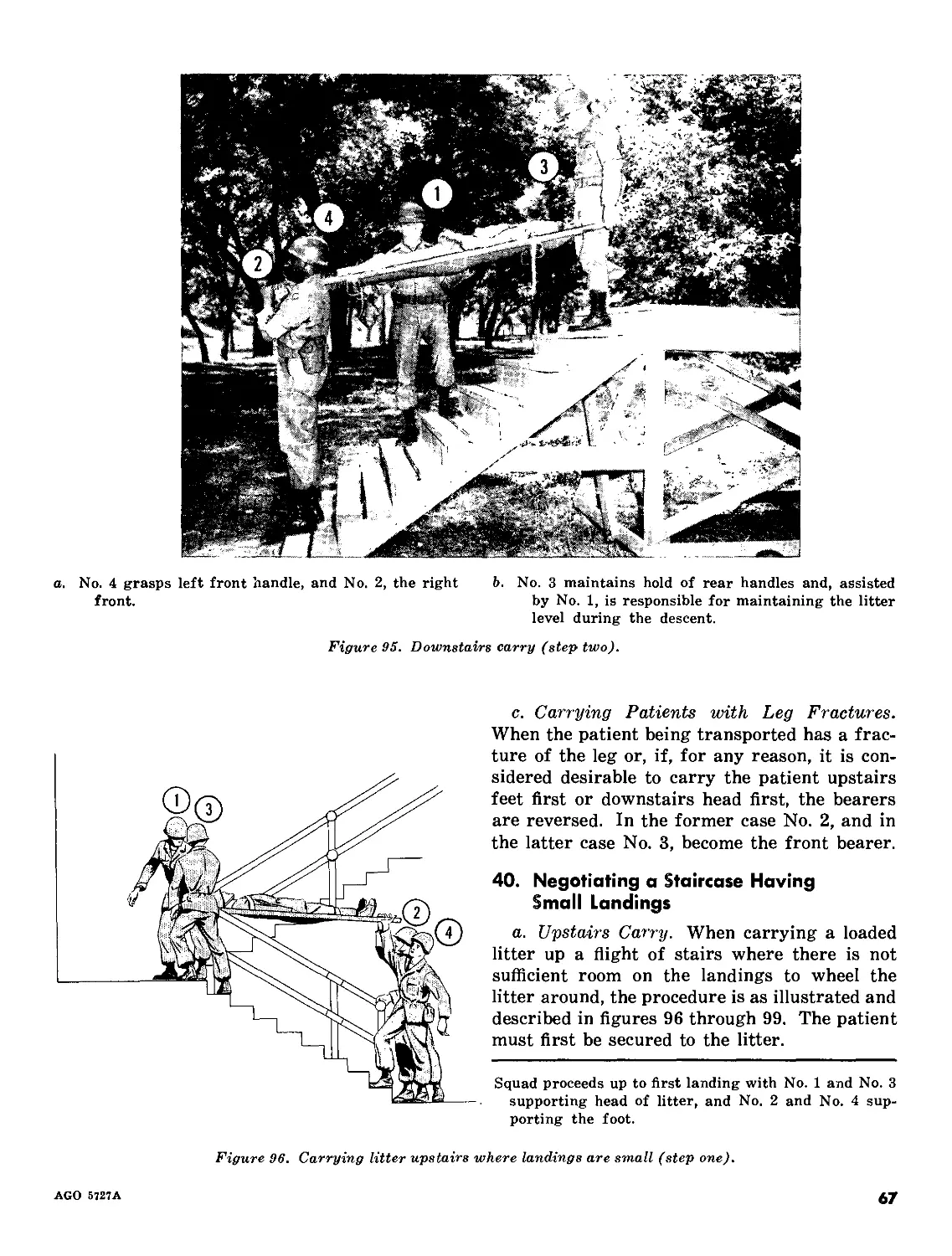
a. No. 4 grasps left front handle, and No. 2, the right
front.
b. No. 3 maintains hold of rear handles and, assisted
by No. 1, is responsible for maintaining the litter
level during the descent.
Figure 95. Downstairs carry (step two).
c. Carrying Patients with Leg Fractures.
When the patient being transported has a frac-
ture of the leg or, if, for any reason, it is con-
sidered desirable to carry the patient upstairs
feet first or downstairs head first, the bearers
are reversed. In the former case No. 2, and in
the latter case No. 3, become the front bearer.
40. Negotiating a Staircase Having
Small Landings
a. Upstairs Carry. When carrying a loaded
litter up a flight of stairs where there is not
sufficient room on the landings to wheel the
litter around, the procedure is as illustrated and
described in figures 96 through 99. The patient
must first be secured to the litter.
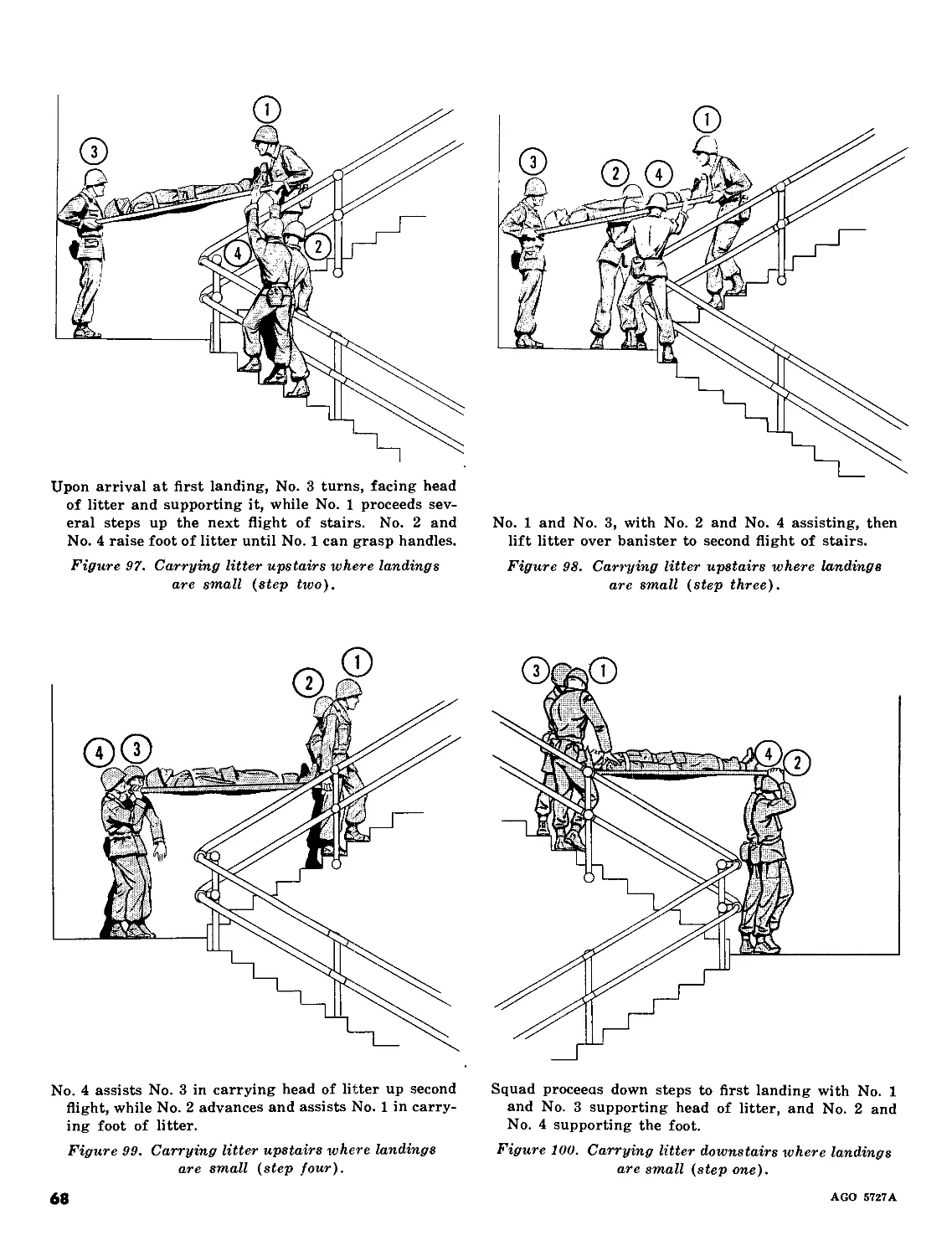
Squad proceeds up to first landing with No. 1 and No. 3
supporting head of litter, and No. 2 and No. 4 sup-
porting the foot.
Figure 96. Carrying litter upstairs where landings are small (step one).
AGO 5727A
67
Upon arrival at first landing, No. 3 turns, facing head
of litter and supporting it, while No. 1 proceeds sev-
eral steps up the next flight of stairs. No. 2 and
No. 4 raise foot of litter until No. 1 can grasp handles.
Figure 97. Carrying litter upstairs where landings
are small (step two).
No. 1 and No. 3, with No. 2 and No. 4 assisting, then
lift litter over banister to second flight of stairs.
Figure 98. Carrying litter upstairs where landings
are small (step three).
No. 4 assists No. 3 in carrying head of litter up second
flight, while No. 2 advances and assists No. 1 in carry-
ing foot of litter.
Figure 99. Carrying litter upstairs where landings
are small (step four).
Squad proceeds down steps to first landing with No. 1
and No. 3 supporting head of litter, and No. 2 and
No. 4 supporting the foot.
Figure 100. Carrying litter downstairs where landings
are small (step one).
68
AGO 5727A
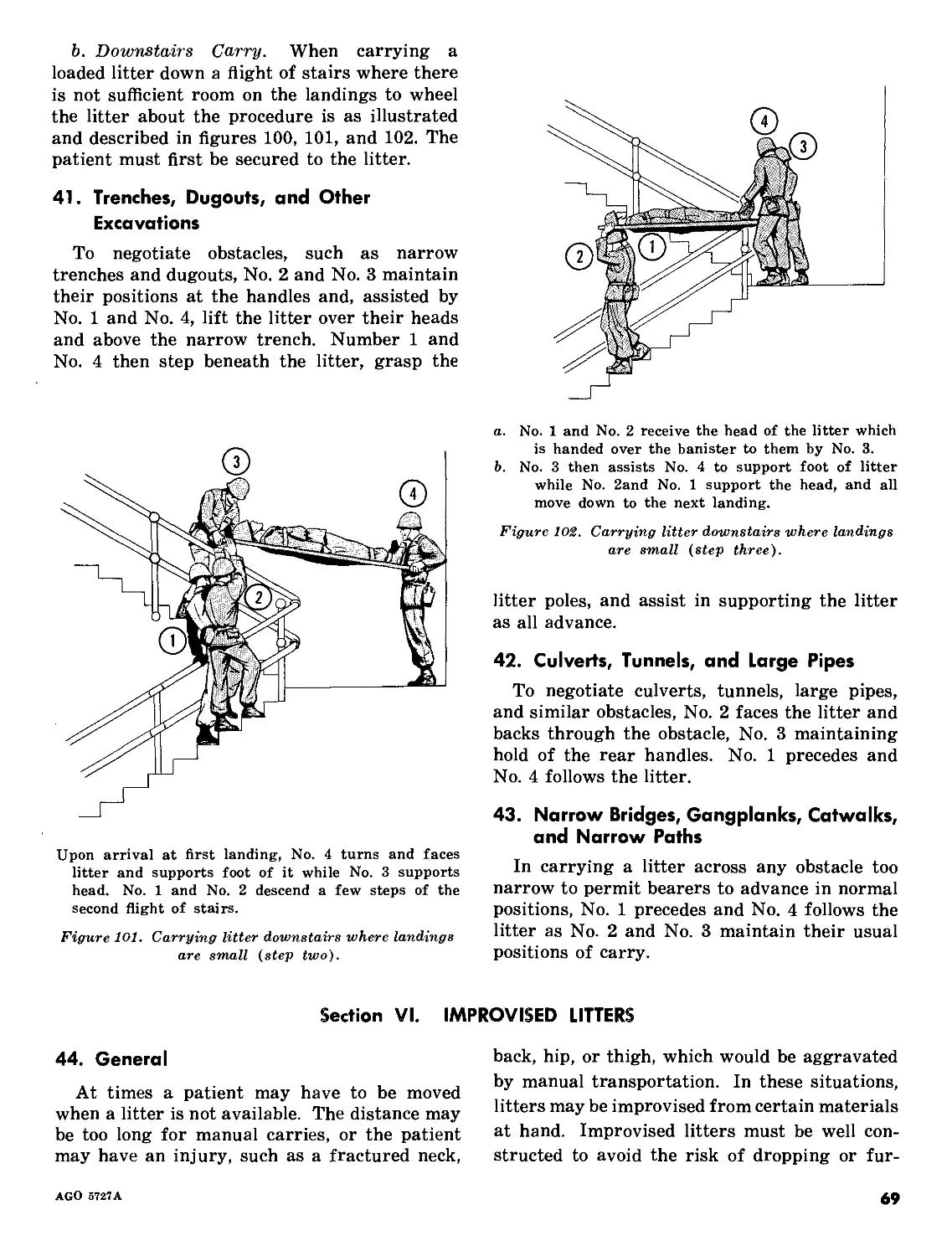
b. Downstairs Carry. When carrying a
loaded litter down a flight of stairs where there
is not sufficient room on the landings to wheel
the litter about the procedure is as illustrated
and described in figures 100, 101, and 102. The
patient must first be secured to the litter.
41.	Trenches, Dugouts, and Other
Excavations
To negotiate obstacles, such as narrow
trenches and dugouts, No. 2 and No. 3 maintain
their positions at the handles and, assisted by
No. 1 and No. 4, lift the litter over their heads
and above the narrow trench. Number 1 and
No. 4 then step beneath the litter, grasp the
Upon arrival at first landing, No. 4 turns and faces
litter and supports foot of it while No. 3 supports
head. No. 1 and No. 2 descend a few steps of the
second flight of stairs.
Figure 101.	Carrying litter downstairs where landings
are small (step two).
a. No. 1 and No. 2 receive the head of the litter which
is handed over the banister to them by No. 3.
b. No. 3 then assists No. 4 to support foot of litter
while No. 2and No. 1 support the head, and all
move down to the next landing.
Figure 102.	Carrying litter downstairs where landings
are small (step three).
litter poles, and assist in supporting the litter
as all advance.
42.	Culverts, Tunnels, and Large Pipes
To negotiate culverts, tunnels, large pipes,
and similar obstacles, No. 2 faces the litter and
backs through the obstacle, No. 3 maintaining
hold of the rear handles. No. 1 precedes and
No. 4 follows the litter.
43.	Narrow Bridges, Gangplanks, Catwalks,
and Narrow Paths
In carrying a litter across any obstacle too
narrow to permit bearers to advance in normal
positions, No. 1 precedes and No. 4 follows the
litter as No. 2 and No. 3 maintain their usual
positions of carry.
Section VI. IMPROVISED LITTERS
44.	General
At times a patient may have to be moved
when a litter is not available. The distance may
be too long for manual carries, or the patient
may have an injury, such as a fractured neck,
back, hip, or thigh, which would be aggravated
by manual transportation. In these situations,
litters may be improvised from certain materials
at hand. Improvised litters must be well con-
structed to avoid the risk of dropping or fur-
AGO 5727A
69
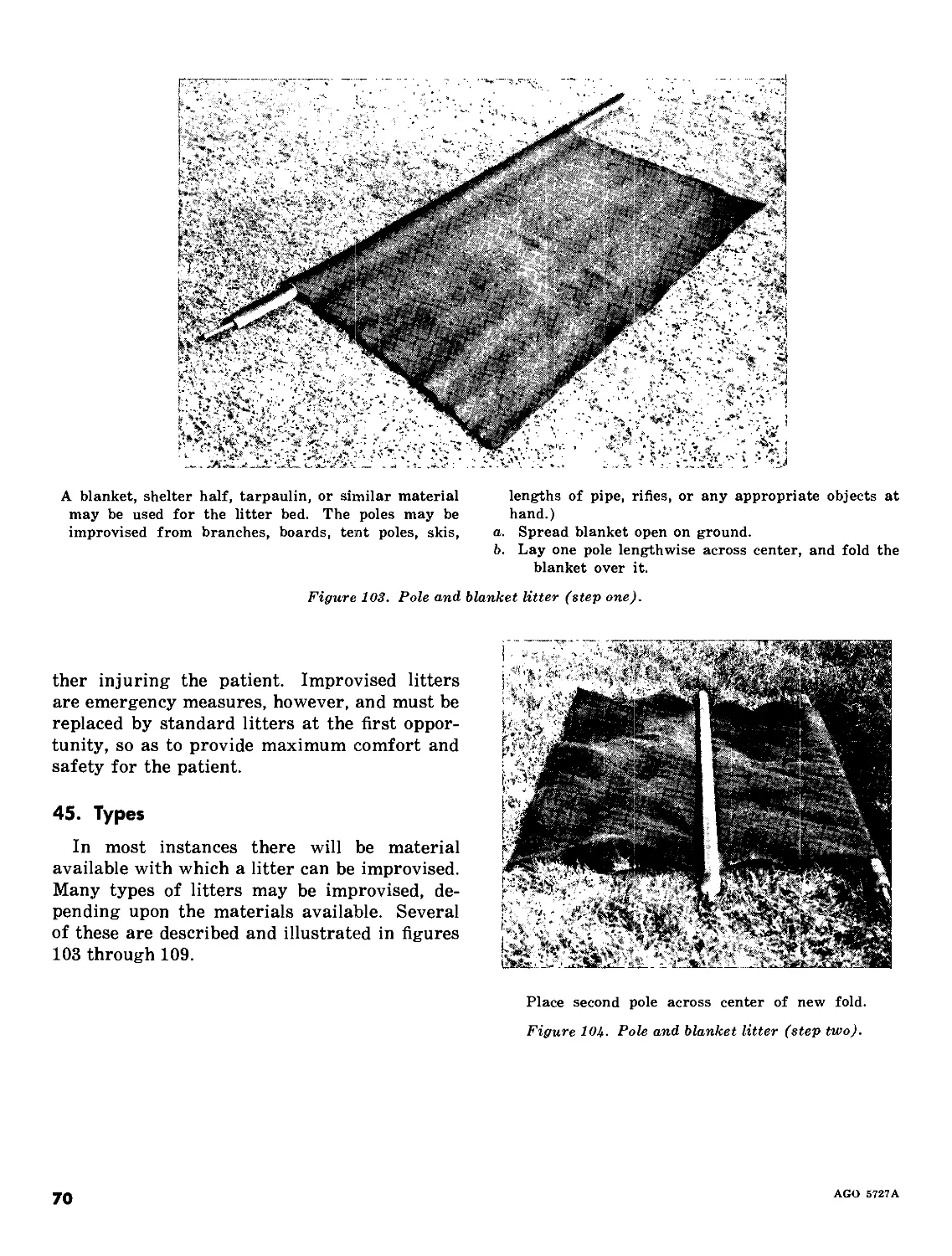
A blanket, shelter half, tarpaulin, or similar material
may be used for the litter bed. The poles may be
improvised from branches, boards, tent poles, skis,
lengths of pipe, rifles, or any appropriate objects at
hand.)
a.	Spread blanket open on ground.
b.	Lay one pole lengthwise across center, and fold the
blanket over it.
Figure 103.	Pole and blanket litter (step one).
ther injuring the patient. Improvised litters
are emergency measures, however, and must be
replaced by standard litters at the first oppor-
tunity, so as to provide maximum comfort and
safety for the patient.
45. Types
In most instances there will be material
available with which a litter can be improvised.
Many types of litters may be improvised, de-
pending upon the materials available. Several
of these are described and illustrated in figures
103 through 109.
Place second pole across center of new fold.
Figure 104.	Pole and blanket litter (step two).
70
AGO 5727A
Fold free edges of blanket over second pole.
Figure 105.	Pole and blanket litter (step three).
Fold two or three blouses, shirts, or jackets, button
them, turn them inside out so that the sleeves are on
the inside, and pass a pole through each sleeve.
Figure 106.	Litter improvised from poles and jackets.
AGO 5727A
71
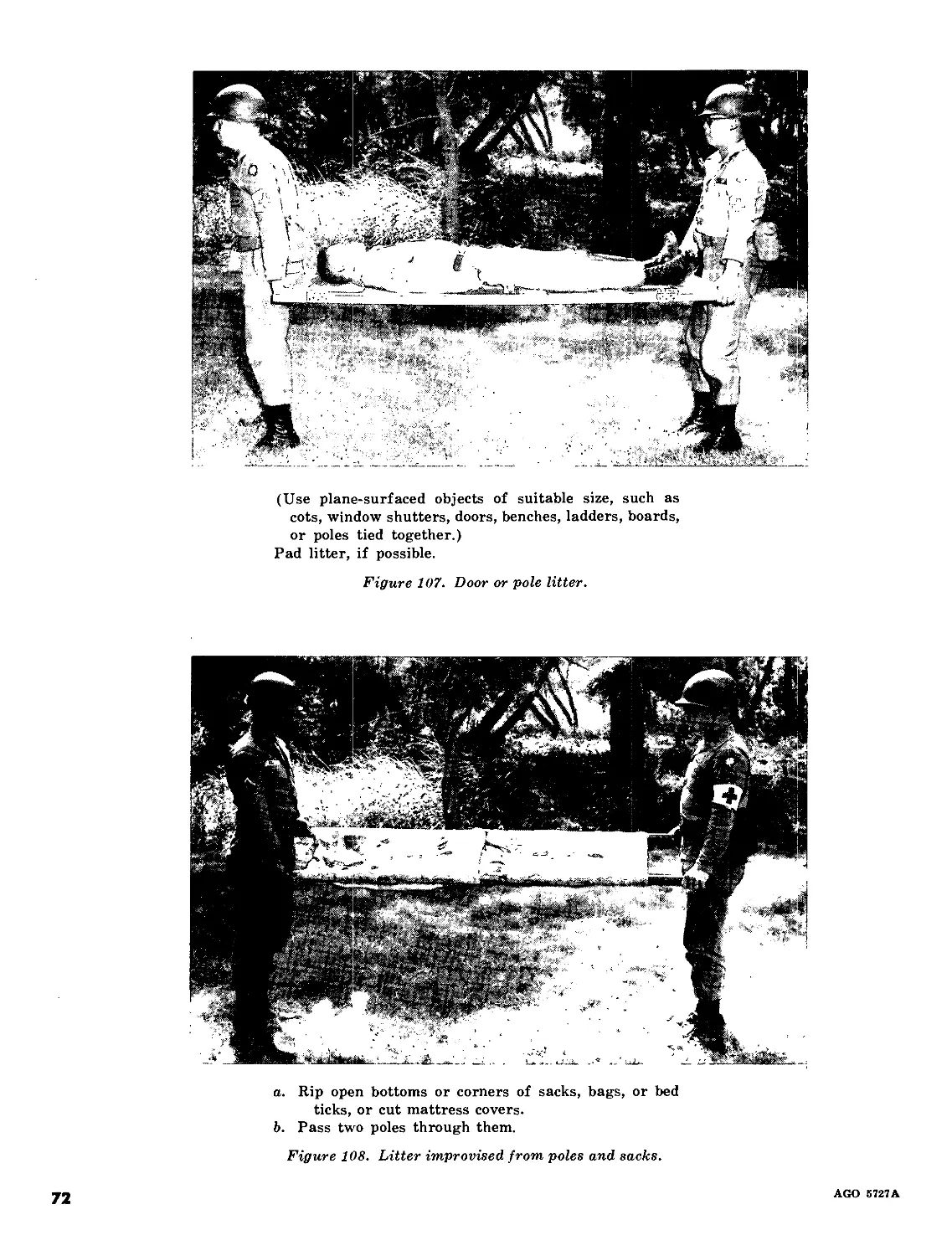
(Use plane-surfaced objects of suitable size, such as
cots, window shutters, doors, benches, ladders, boards,
or poles tied together.)
Pad litter, if possible.
Figure 107. Door or pole litter.
a.	Rip open bottoms or corners of sacks, bags, or bed
ticks, or cut mattress covers.
b.	Pass two poles through them.
Figure 108.	Litter improvised from poles and sacks.
72
AGO 6727A
(If no poles are available, use a blanket, shelter half,
tarpaulin, or similar object rolled from both sides
toward the center.)
Use rolls as grips when carrying patient.
Figure 109.	Rolled blanket used as litter.
Section VII. AIDS IN LITTER TRANSPORTATION
46. General
The manual transportation of a loaded litter
is one of the most tiring tasks of the Army
Medical Service personnel. Since it is per-
formed at the critical point in the process of
evacuation, every effort is made to minimize the
task and thus speed evacuation. Any mechani-
cal devices, issued or improvised, that will con-
tribute to this effort are used (figs. 110 through
117).
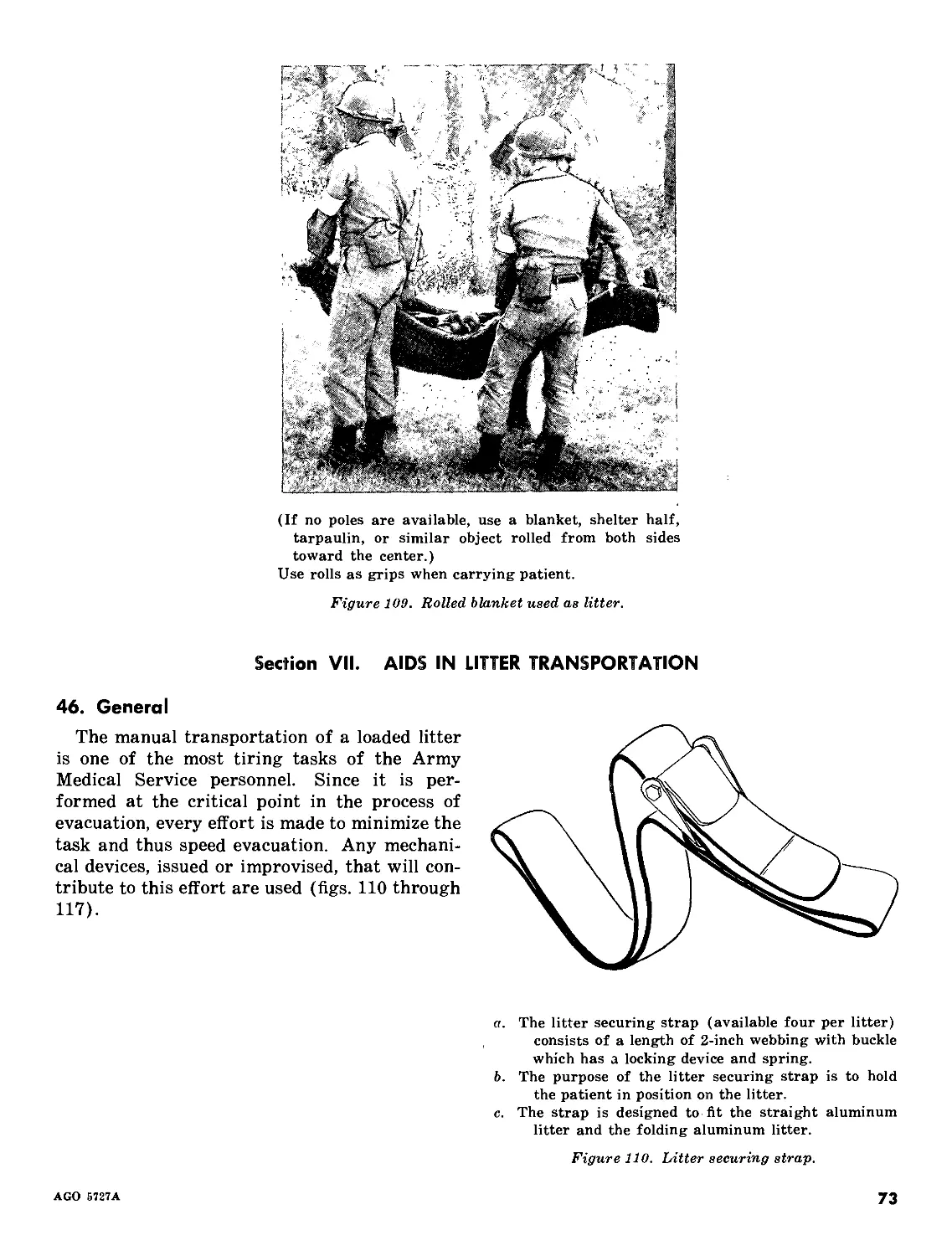
a.	The litter securing strap (available four per litter)
consists of a length of 2-inch webbing with buckle
which has a locking device and spring.
b.	The purpose of the litter securing strap is to hold
the patient in position on the litter.
c.	The strap is designed to fit the straight aluminum
litter and the folding aluminum litter.
Figure 110.	Litter securing strap.
AGO 5727A
73
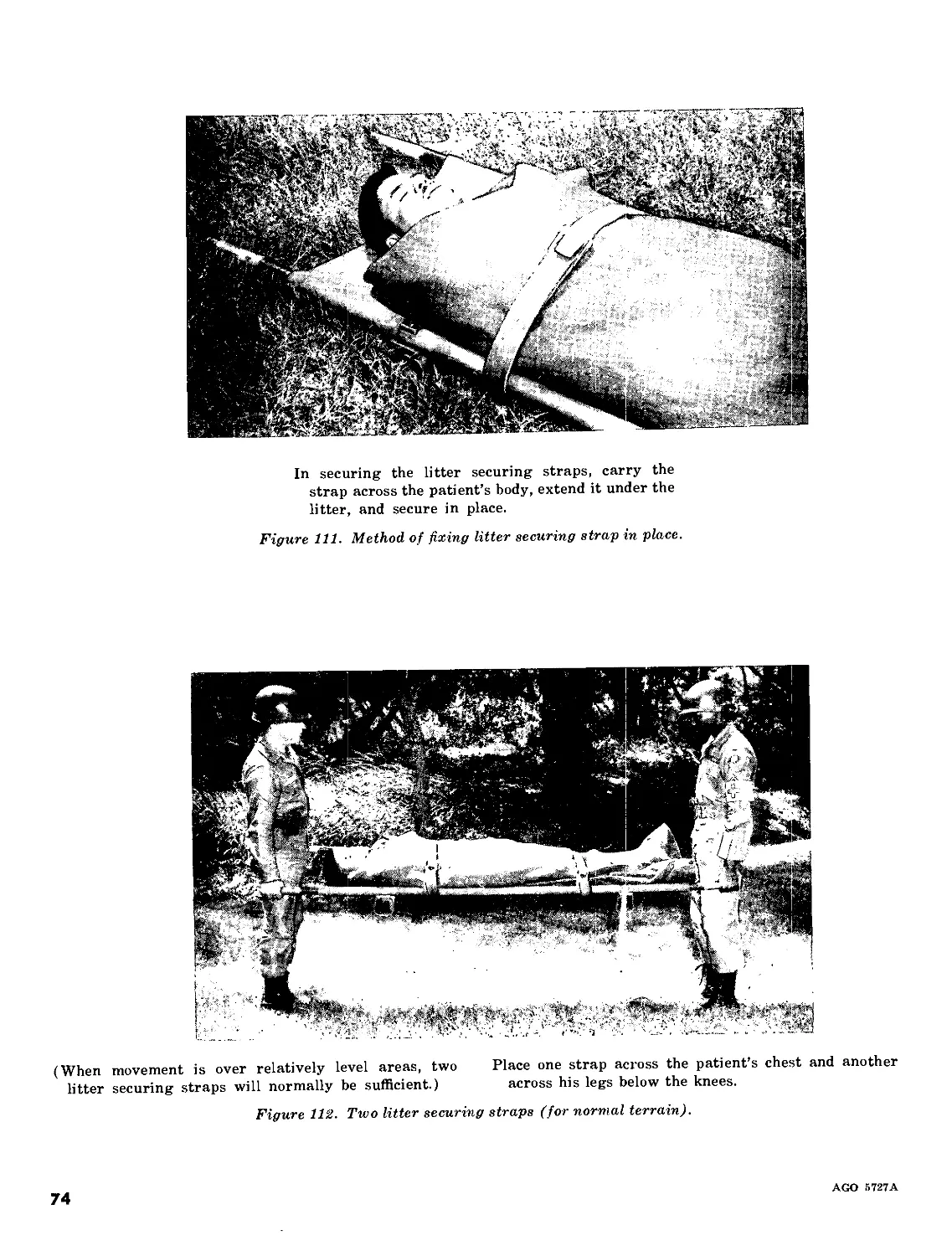
In securing the litter securing straps, carry the
strap across the patient’s body, extend it under the
litter, and secure in place.
Figure 111.	Method of fixing litter securing strap in place.
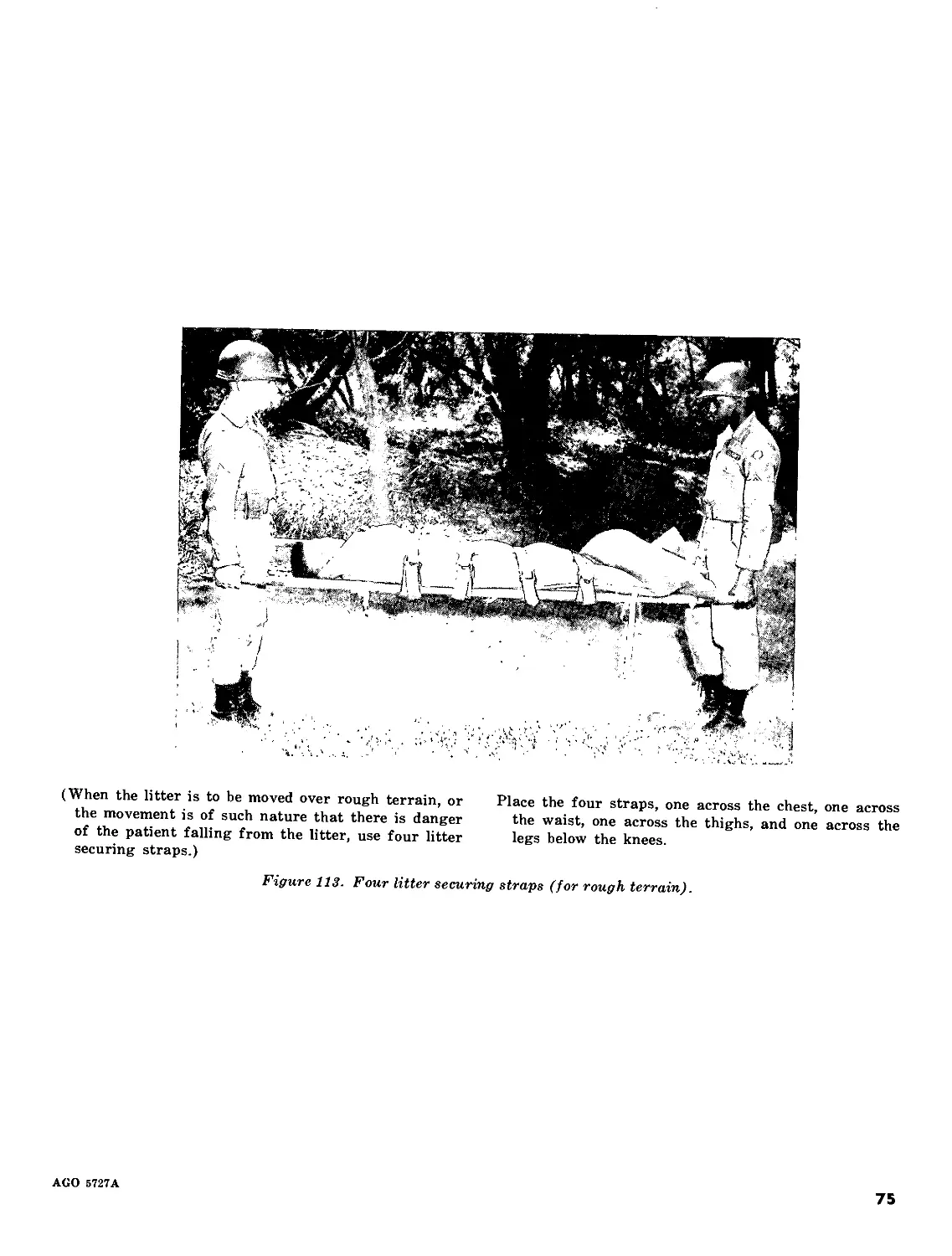
(When movement is over relatively level areas, two
litter securing straps will normally be sufficient.)
Place one strap across the patient’s chest and another
across his legs below the knees.
Figure 112.	Two litter securing straps (for normal terrain).
74
AGO 5727A
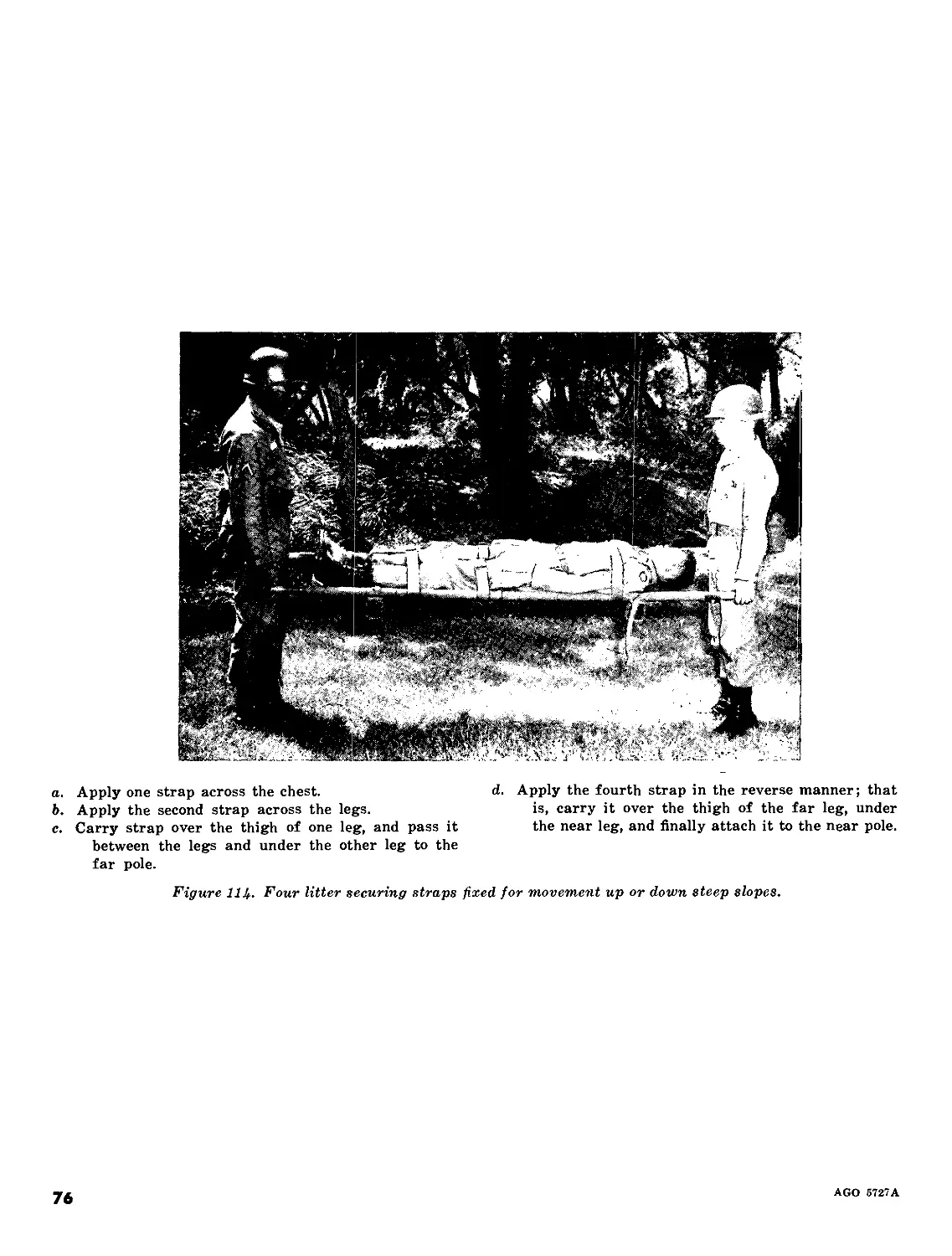
(When the litter is to be moved over rough terrain, or
the movement is of such nature that there is danger
of the patient falling from the litter, use four litter
securing straps.)
Place the four straps, one across the chest, one across
the waist, one across the thighs, and one across the
legs below the knees.
Figure 113.	Four litter securing straps (for rough terrain).
AGO 5727A
75
a.	Apply one strap across the chest.
b.	Apply the second strap across the legs.
c.	Carry strap over the thigh of one leg, and pass it
between the legs and under the other leg to the
far pole.
d.	Apply the fourth strap in the reverse manner; that
is, carry it over the thigh of the far leg, under
the near leg, and finally attach it to the near pole.
Figure 1Ц. Four litter securing straps fixed for movement up or down steep slopes.
76
AGO 5727A
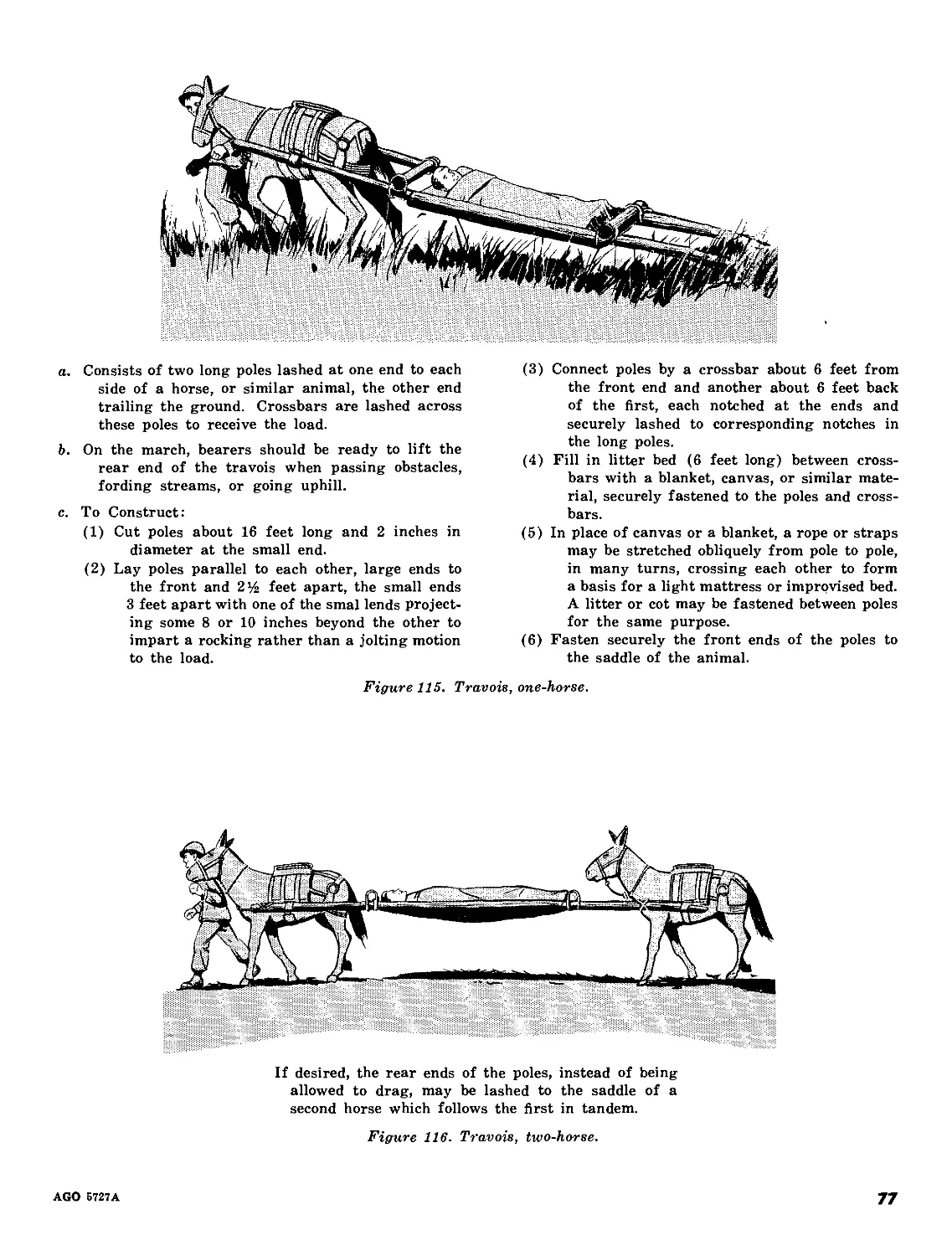
a.	Consists of two long poles lashed at one end to each
side of a horse, or similar animal, the other end
trailing the ground. Crossbars are lashed across
these poles to receive the load.
b.	On the march, bearers should be ready to lift the
rear end of the travois when passing obstacles,
fording streams, or going uphill.
c.	To Construct:
(1)	Cut poles about 16 feet long and 2 inches in
diameter at the small end.
(2)	Lay poles parallel to each other, large ends to
the front and 2% feet apart, the small ends
3 feet apart with one of the smal lends project-
ing some 8 or 10 inches beyond the other to
impart a rocking rather than a jolting motion
to the load.
(3)	Connect poles by a crossbar about 6 feet from
the front end and another about 6 feet back
of the first, each notched at the ends and
securely lashed to corresponding notches in
the long poles.
(4)	Fill in litter bed (6 feet long) between cross-
bars with a blanket, canvas, or similar mate-
rial, securely fastened to the poles and cross-
bars.
(5)	In place of canvas or a blanket, a rope or straps
may be stretched obliquely from pole to pole,
in many turns, crossing each other to form
a basis for a light mattress or improvised bed.
A litter or cot may be fastened between poles
for the same purpose.
(6)	Fasten securely the front ends of the poles to
the saddle of the animal.
Figure 115. Travois, one-horse.
If desired, the rear ends of the poles, instead of being
allowed to drag, may be lashed to the saddle of a
second horse which follows the first in tandem.
Figure 116. Travois, two-horse.
AGO 5727A
77
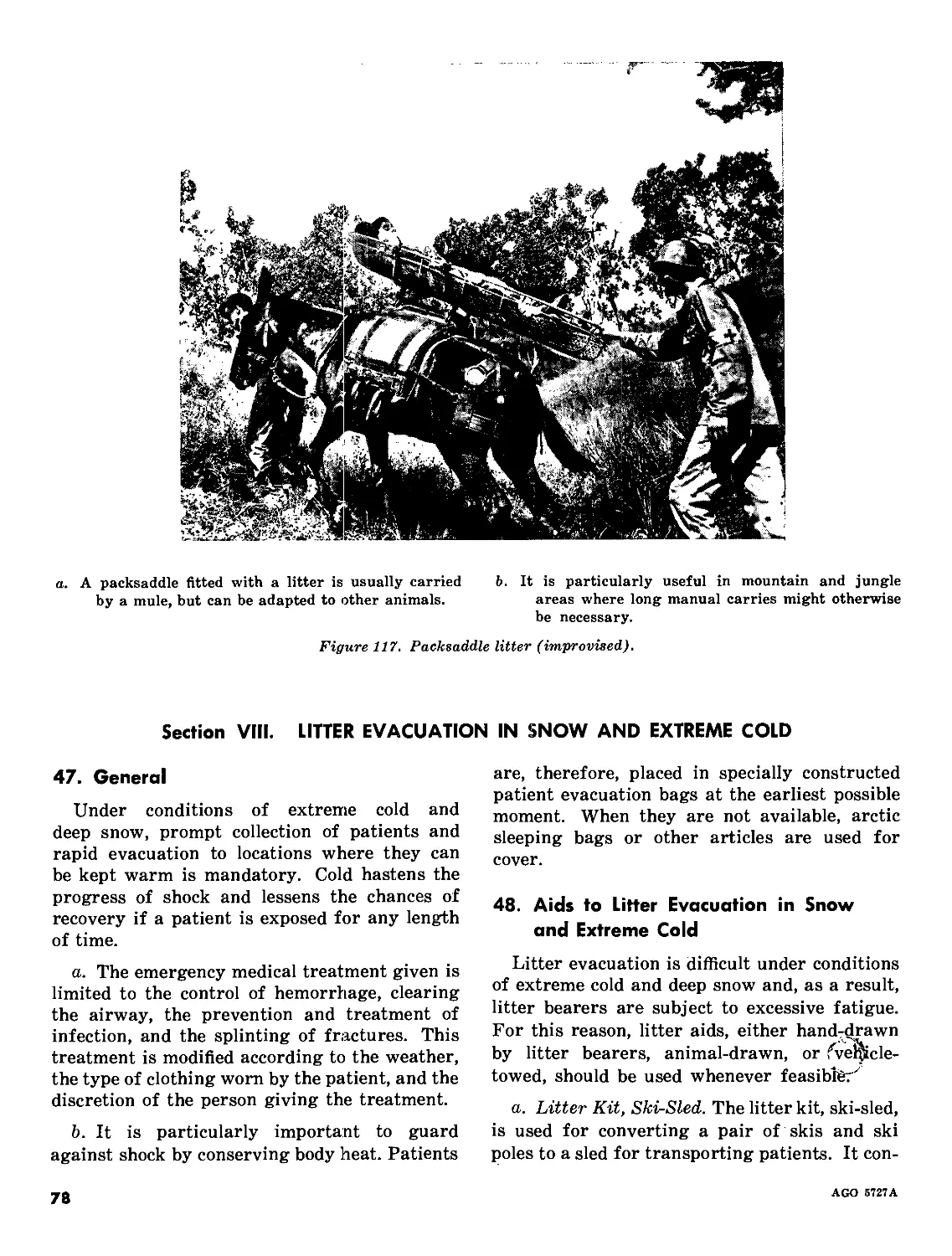
a. A packsaddle fitted with a litter is usually carried
by a mule, but can be adapted to other animals.
b. It is particularly useful in mountain and jungle
areas where long manual carries might otherwise
be necessary.
Figure 117. Packsaddle litter (improvised).
Section VIII. LITTER EVACUATION IN SNOW AND EXTREME COLD
47.	General
Under conditions of extreme cold and
deep snow, prompt collection of patients and
rapid evacuation to locations where they can
be kept warm is mandatory. Cold hastens the
progress of shock and lessens the chances of
recovery if a patient is exposed for any length
of time.
a.	The emergency medical treatment given is
limited to the control of hemorrhage, clearing
the airway, the prevention and treatment of
infection, and the splinting of fractures. This
treatment is modified according to the weather,
the type of clothing worn by the patient, and the
discretion of the person giving the treatment.
b.	It is particularly important to guard
against shock by conserving body heat. Patients
are, therefore, placed in specially constructed
patient evacuation bags at the earliest possible
moment. When they are not available, arctic
sleeping bags or other articles are used for
cover.
48.	Aids to Litter Evacuation in Snow
and Extreme Cold
Litter evacuation is difficult under conditions
of extreme cold and deep snow and, as a result,
litter bearers are subject to excessive fatigue.
For this reason, litter aids, either hand-^rawn
by litter bearers, animal-drawn, or fve^icle-
towed, should be used whenever feasible^
a.	Litter Kit, Ski-Sled. The litter kit, ski-sled,
is used for converting a pair of skis and ski
poles to a sled for transporting patients. It con-
78
AGO 5727A
sists of one canvas platform, four brackets, two
cross braces, two 7-foot and two 27-foot lengths
of rope, and two patient securing straps.
b.	Ski Adapter (fig. 118). The ski adapter
consists of four adapters which hold a stand-
ard litter on skis. These adapters clamp on the
litter stirrups and keep the litter above the
surface of the snow. Patients can then be easily
pulled by attaching ropes to the converted litter.
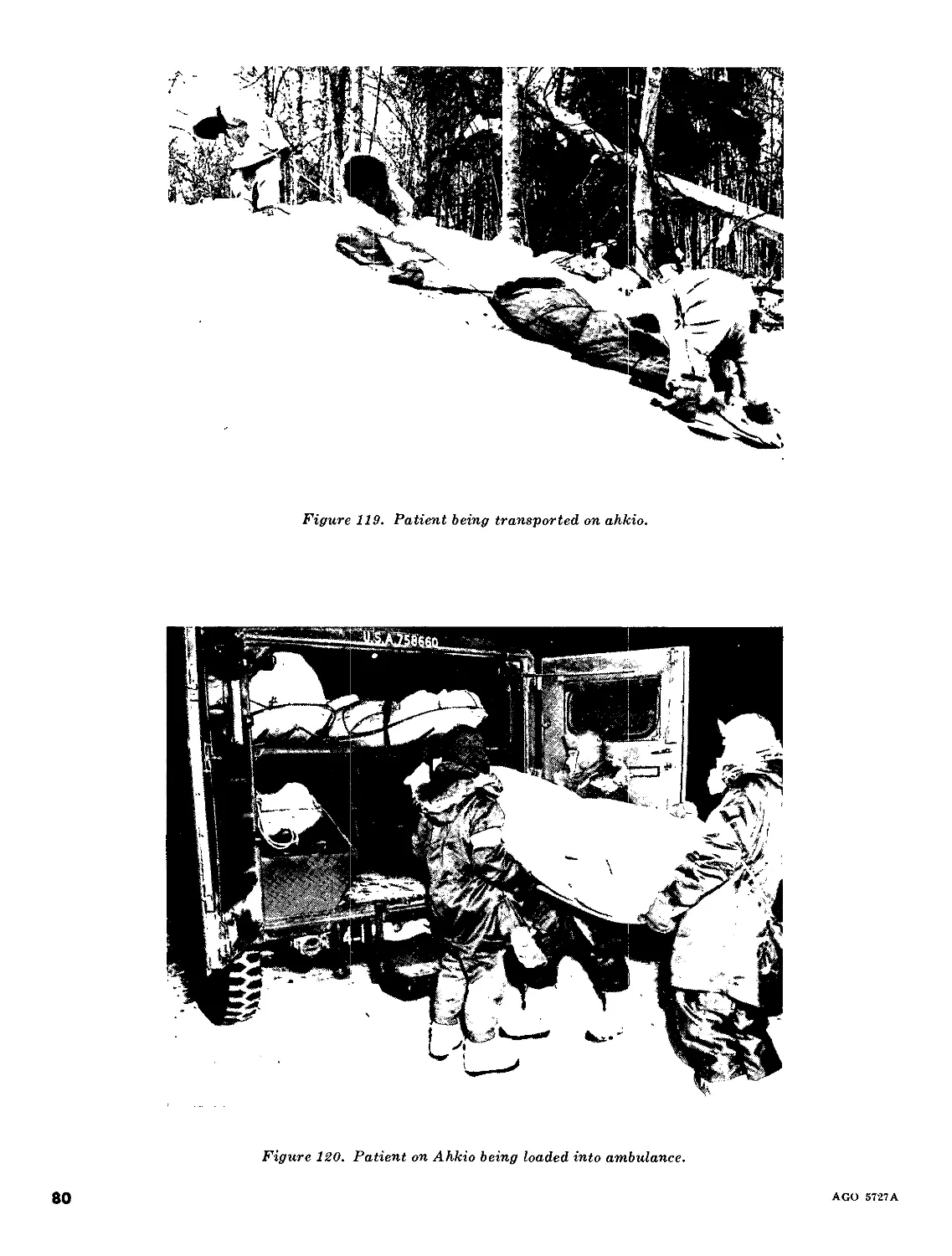
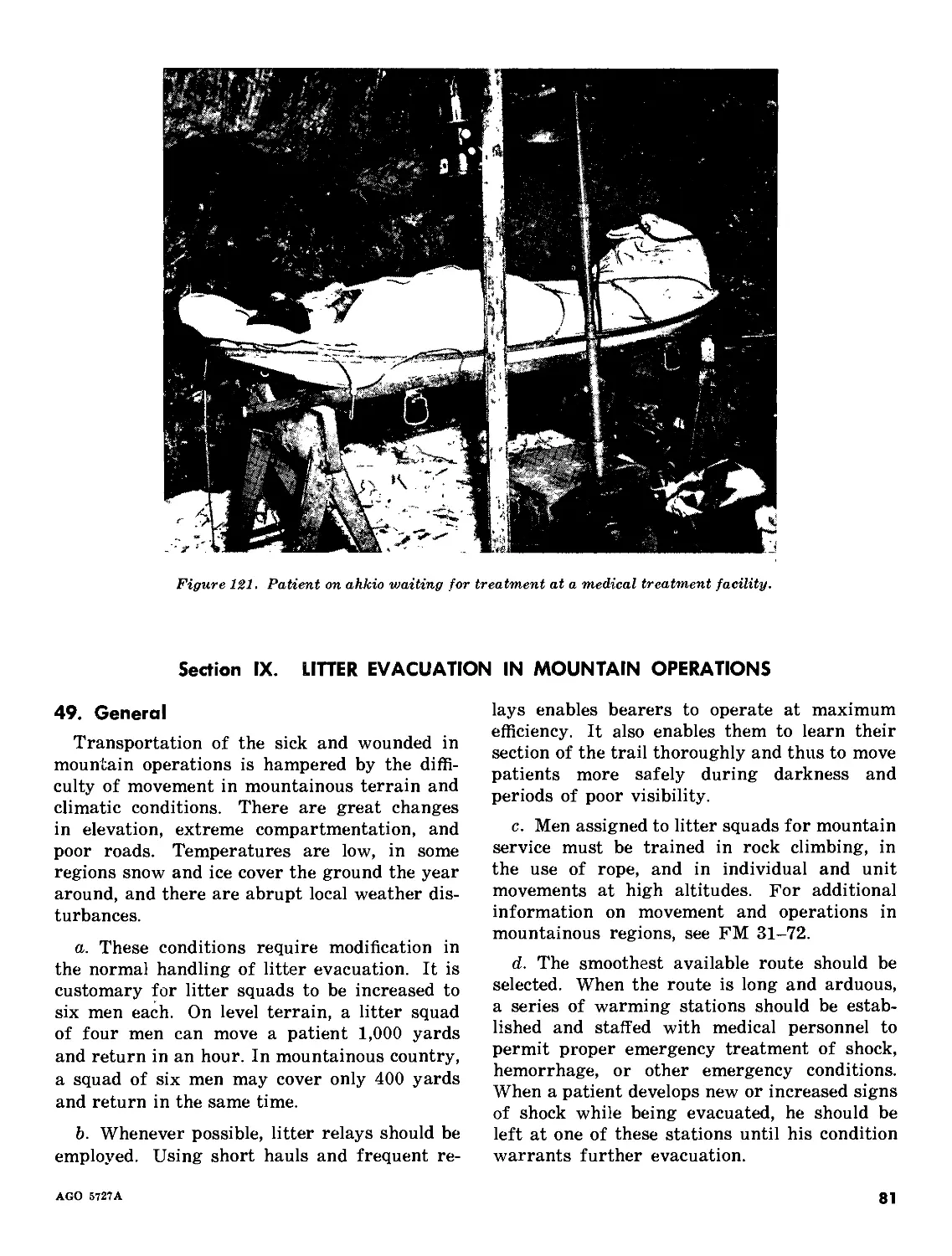
c.	Ahkio (figs. 119-121). The ahkio is par-
ticularly useful where patients must be evacu-
ated through deep snow.
d.	Evacuation Bag, Casualty (fig. 121). The
casualty evacuation bag is issued in cold cli-
mates to keep the patient warm. It zips up to
protect all parts of the patient. Blankets may
also be used inside the evacuation bag.
Figure IIS. Ski adapter.
AGO 5727A
79
Figure 119. Patient being transported on ahkio.
Figure 120. Patient on Ahkio being loaded into ambulance.
80
AGO 5727A
Figure 121. Patient on ahkio waiting for treatment at a medical treatment facility.
Section IX. LITTER EVACUATION IN MOUNTAIN OPERATIONS
49.	General
Transportation of the sick and wounded in
mountain operations is hampered by the diffi-
culty of movement in mountainous terrain and
climatic conditions. There are great changes
in elevation, extreme compartmentation, and
poor roads. Temperatures are low, in some
regions snow and ice cover the ground the year
around, and there are abrupt local weather dis-
turbances.
a.	These conditions require modification in
the normal handling of litter evacuation. It is
customary for litter squads to be increased to
six men each. On level terrain, a litter squad
of four men can move a patient 1,000 yards
and return in an hour. In mountainous country,
a squad of six men may cover only 400 yards
and return in the same time.
b.	Whenever possible, litter relays should be
employed. Using short hauls and frequent re-
lays enables bearers to operate at maximum
efficiency. It also enables them to learn their
section of the trail thoroughly and thus to move
patients more safely during darkness and
periods of poor visibility.
c.	Men assigned to litter squads for mountain
service must be trained in rock climbing, in
the use of rope, and in individual and unit
movements at high altitudes. For additional
information on movement and operations in
mountainous regions, see FM 31-72.
d.	The smoothest available route should be
selected. When the route is long and arduous,
a series of warming stations should be estab-
lished and staffed with medical personnel to
permit proper emergency treatment of shock,
hemorrhage, or other emergency conditions.
When a patient develops new or increased signs
of shock while being evacuated, he should be
left at one of these stations until his condition
warrants further evacuation.
AGO 5727A
81
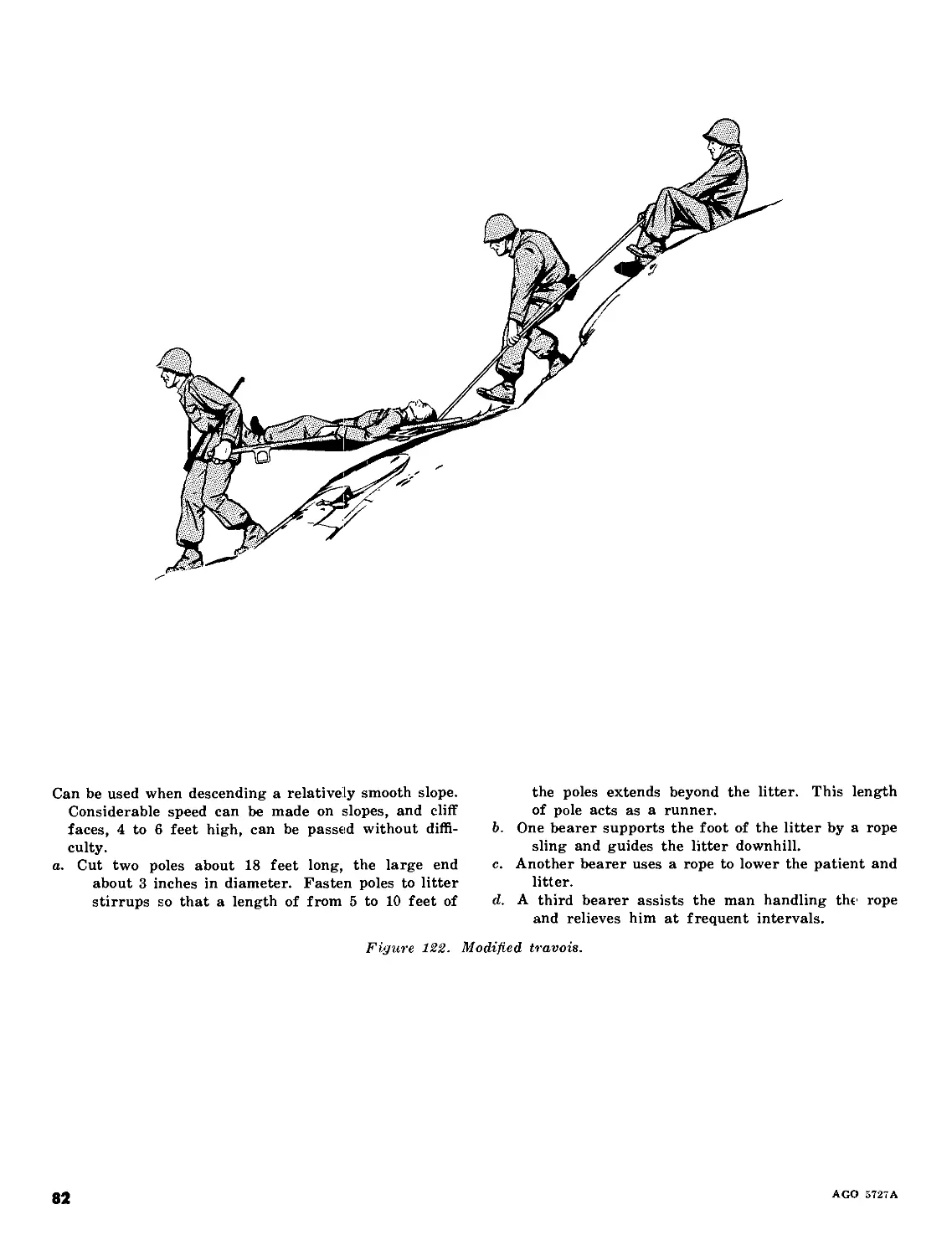
Can be used when descending a relatively smooth slope.
Considerable speed can be made on slopes, and cliff
faces, 4 to 6 feet high, can be passed without diffi-
culty.
a.	Cut two poles about 18 feet long, the large end
about 3 inches in diameter. Fasten poles to litter
stirrups so that a length of from 5 to 10 feet of
the poles extends beyond the litter. This length
of pole acts as a runner.
b.	One bearer supports the foot of the litter by a rope
sling and guides the litter downhill.
c.	Another bearer uses a rope to lower the patient and
litter.
d.	A third bearer assists the man handling the rope
and relieves him at frequent intervals.
Figure 122. Modified travois.
82
AGO 572TA
e.	The patient should be kept as warm as
possible during transportation and should not
be handled more than is necessary. His helmet
should be put over his head for protection from
falling rock.
f.	Since movement usually will be up or down
slopes or along the side of a mountain, the
patient must be securely lashed to the litter.
g.	The mountain basket-type litters or the
semirigid poleless litters are preferred for
evacuation in mountain operations; however,
any standard litter may be used.
50. Methods
(figs. 122-126)
Several methods of litter transportation
which are adapted to mountain terrain and
climatic conditions are described and illustrated
below. They are subject to improvement and
should be discarded as better methods are de-
veloped.
The litter is prepared as for descending.
a.	Two men take their places at the head of the litter.
(A thin sapling passed through the stirrups, ex-
tending 18 inches on each side of the lines, affords
a more secure grip for these two bearers.)
b.	A third, using an improvised rope sling, takes his
place at the foot.
c.	The fourth and fifth men take their positions along
the extended rope which is in the hands of the
sixth.
d.	At the signal UP ROPE, the fourth, fifth, and sixth
men pull, while the first, second, and third men lift
the litter and slowly climb.
(The men carrying the litter should not try to do all the
work but should allow themselves to be pulled up the
slope while they hold the litter off the ground. The
positions of the men should be rotated at each halt
so that the work will be distributed equally.)
Figure 123.	Steep slope evacuation (ascending).
AGO 5727A
83
In making the descent, the most direct, practicable
passage should be taken.
a.	To prepare the litter, litter securing straps are used,
if available. If rope is used, it is passed through
the head stirrups, lashed in place, and used as a
support.
b.	Two men hold the rope to assist in lowering litter.
c.	The three litter bearers take their positions as for
ascent.
d.	The sixth man may assist with the litter or precede
the team, picking a trail, making the passage more
negotiable by clearing away shrubs and vines,
and making a reconnaissance so that the team need
not retrace its steps if a cliff should be en-
countered.
Figure 124.	Steep slope evacuation (descending).
84
AGO 5727A
If a cliff is too extensive to bypass, select the smoothest
face for descent.
a.	Secure patient as before.
b.	Attach two large poles, the length of the litter or
longer, to the stirrups. Poles act as runners.
c.	Tie lashing ropes on poles in the notches cut in the
poles, to prevent fraying from rubbing against
stone cliff.
d.	Attach ropes to the stirrups at the foot of the litter
to use as guy ropes to keep litter from revolving.
e.	Two men lower litter over cliff edge, while a third
man secures the rope around a tree or large
boulder.
f.	One man descends the cliff face on a rope, moving
parallel to the litter, and assists the litter over any
projections.
g.	The remaining bearers guide the litter from the
foot of the cliff by holding the guy ropes.
h.	When the litter has almost reached the base of the
cliff, they ease it to the ground.
Figure 125.	Lowering patient down cliff.
AGO 5727 A
85
Consists of a continuous wire rope cableway, secured
by a system of snatch-blocks, spanning a maximum of
1,000 feet between terminals. (A slope of at least
10° is required for proper operation.) It is a standard
item of issue. (For use and maintenance, see TM
5-270.)
a.	A Stokes litter with patient is suspended from the
top of the cable at the upper terminal.
b.	An empty litter is suspended from the bottom of the
cable at the lower terminal.
c.	The litter patient at the upper terminal is lowered
by gravity to the lower terminal. (A belay line
has been attached to the litter to prevent injury
from a rapid and uncontrolled descent.) At the
same time the empty litter at the lower terminal
is raised to the upper terminal ready to receive
another patient.
d.	One man stands at the upper terminal controlling
the belay line, and another stands at the lower
terminal ready to receive the patient.
Figure 126.	Monocable casualty evacuation apparatus.
86
AGO 5727A
CHAPTER 4
TRANSPORTATION BY GROUND VEHICLE
Section I. MOTOR AMBULANCE
51.	General
Motor ambulances are vehicles specially de-
signed for carrying patients. They are organic
to the Army Medical Service units which are
assigned the task of transporting the sick and
wounded by ground ambulance. Motor ambu-
lances are equipped with supplies, including
litters, blankets, and splints, and are staffed
with ambulance personnel qualified in basic
emergency medical care and treatment proced-
ures. An ambulance crew consists of a driver
and an orderly.
52.	Types of Motor Ambulances
These vehicles are of three major types—the
field ambulance, the bus ambulance, and the
metropolitan ambulance.
a.	Field Ambulances. Field ambulances, de-
signed for use with field units, can cross rough
ground, climb steep grades, and, if required,
can operate across country. There are several
types of field ambulances.
(1)	Truck, ambulance, %,-ton, 4 x 4, M43
or M43B1 (fig. 127). This vehicle, de-
signed to transport the sick and
wounded, is the standard field ambu-
lance of the medical service units in
divisions and in higher units. It is
lightweight with a fully inclosed body
mounted on a light truck chassis. The
body of the vehicle is separated from
the driver’s compartment by a parti-
tion in which a small door is mounted.
Two rear doors provide access to the
body of the vehicle or the patients’
compartment. This compartment is
equipped with a heater and a surgical
light. The M43 ambulance is capable
of fording bodies of water up to 42
inches in depth and can operate while
completely submerged if equipped
with a deep water fording kit. It can
operate in temperatures as high as
125°F. and when equipped with an
Arctic winterization kit, it can operate
in temperatures as low as —65°F.
(2)	Truck, ambulance, Y\.-ton, 4#4, Ml70,
frontline (fig. 128). This forward area
ambulance is specially designed to
combine the maneuverability of the
ordinary *4-ton truck with some of the
advantages of a closed ambulance. It
is a lightweight vehicle with an open
body and canvas cover. The spare
wheel is carried inside at the right side
of the front passenger seat. Additional
facilities include crash pads and an
interior emergency light. The tailgate
can be lowered to facilitate the loading
of the litters. This ambulance normally
is used to evacuate patients from the
frontline units to aid stations.
b.	Bus, 44-passenger, 4x2, Integral Type
(Bus Ambulances) (fig. 129). The bus is de-
signed for rapid conversion into a bus ambu-
lance. It is available to oversea general hos-
pitals and other Army units. It can be used in
support of the Army in the field as far forward
as the road network and tactical situation will
permit. It is most useful in situations where a
large number of patients are to be transported
for relatively short distances over improved
roads, such as in transferring patients from
holding companies and hospitals to airheads,
railheads, and ports of embarkation.
AGO 5727A
87
Figure 127. Truck, ambulance, %-ton, 4 % 4, М4З or M43B1.
Figure 128. Truck, ambulance, %-ton, 4x4, M170, frontline.
c.	Automobile, Ambulance, Metropolitan Type
4 x 2 (fig. 130). The large metropolitan ambu-
lance is designed for use on good roads only.
It is supplied to named Army hospitals and to
certain other large hospitals. The ambulance
cot litter, Bomgardner type, is ordinarily used
with this ambulance. The capactiy of this ambu-
lance is one Bomgardner litter and three field
litters, or four field litters. There is an atten-
dant’s seat in the patient’s compartment.
d.	Truck, Ambulance, Light, 4 x 2 (fig. 131).
This ambulance is designed for use on good
roads only. It is supplied to Army hospitals and
to dispensaries. The capacity of this ambulance
is two Bomgardner litters and two field litters,
one Bomgardner litter and three field litters, one
Bomgardner litter and one field litter on one
side and on the other side four ambulatory
patients, or eight ambulatory patients.
AGO 5727A
88
Figure 129. Bus, Jib-passenger, bx 2, integral type (bus ambulance).
Figure 130. Automobile, ambulance, metropolitan type, 4 x2.
53.	Ambulance Driver
The ambulance driver is responsible for the
ambulance at all times. He performs driver
maintenance and is responsible for reporting
major defects to his section chief or to the unit
sergeant. When no ambulance orderly is as-
signed, he performs the duties of the orderly.
The driver also has the following specific re-
sponsibilities:
a.	Providing maximum possible safety and
welfare of patients entrusted to his care.
b.	Maintaining the proper number of litters,
blankets, and splints within his ambulance.
c.	Preparing the ambulance for loading and
unloading and thereafter for departure.
d.	Assisting the litter bearers in the loading
and unloading of patients.
e.	Carrying out property exchange when pa-
tients are loaded and unloaded.
f.	Delivering messages and medical supplies
upon request of authorized personnel.
54.	Ambulance Orderly
The ambulance orderly acts as assistant
driver when required, and performs the fol-
lowing duties:
a.	Becomes familiar with the condition of
each patient being transported.
b.	Checks with the person in charge of evac-
uation for any special instructions in the care
and treatment of patients while en route.
c.	Renders emergency medical treatment as
required by the patients while in transit.
d.	Makes periodic checks of patients.
AGO 5727A
89
Figure 131. Truck, ambulance, light, 4x2.
e.	Supervises and assists in the loading of
patients, taking care that patients with wounds
of the chest or abdomen and those wearing cum-
bersome splints are loaded in lower berths.
55.	Ambulance Loading and Unloading
a.	In loading and unloading all patient-carry-
ing vehicles, litter patients are moved as care-
fully as possible to provide the maximum pos-
sible safety and comfort for them. Details of
the loading and unloading procedures will vary
slightly depending upon the number of bearers,
the presence or absence of an orderly, and the
type of vehicle used. Unless contraindicated by
the nature of the patient’s injuries, patients are
loaded headfirst. Patients with wounds of the
chest or abdomen and those wearing cumber-
some splints are loaded in lower berths.
b.	In the instruction for loading and unload-
ing, men are numbered and formal commands
are given so that each man can learn what his
particular job is and all can learn to work as
a team. Demonstration of the steps in ambu-
lance loading and unloading, followed by appli-
cation, is the recommended method of instruc-
tion. Before loading, patients are grounded
three paces to the rear of and with the patient’s
head toward the ambulance.
56.	Truck Ambulance, %-Ton, 4x4,
M43 and M43B1
This ambulance can carry four litter patients
or eight ambulatory patients. It is primarily
designed for carrying no more than four litter
patients, so that the attendant may have space
to care for the patients. In an emergency,
however, one additional litter patient can be
carried on the floor (fig. 132). When only two
litter patients are to be carried, the lower
berths are used (fig. 133). When both litter and
ambulatory patients are to be carried, they are
loaded as in figure 134. The four longitudinal
spaces formed within the body of the ambu-
lance are known as berths, and are designated
as right (left) and upper (lower). A three-man
squad is needed to load and unload the ambu-
lance.
a. Loading the Ambulance. The sequence
for loading the berths is right upper, right
lower, left upper, and left lower.
90
AGO 5 727A
Figure 132. Five litter patients in ambulance, in emergency.
Figure 133. Two litter patients in ambulance.
AGO 5727A
91
Figure 13Ь. Two litter patients and four ambulatory patients in ambulance.
(1)	The first command is Ambulance,
POSTS (fig. 135).
(2)	The second command is Prepare Am-
bulance For, LOADING. At this com-
mand, No. 1 takes Steps One, Two,
and Three, as illustrated in figures
136, 137, and 138.
(3)	The third command is Right Upper
Berth, Prepare to Load, LOAD (figs.
139 through 143).
(4)	The fourth command is Right Lower
Berth, Prepare to Load, LOAD. At
this command the right lower berth is
loaded (fig. 144).
At the command of execution, members of the squad
fall in, alining themselves in numerical sequence from
left to right, one pace to the rear of and facing the
ambulance.
Figure 135. Squad at ambulance, POSTS.
92
AGO 5727A
Opens rear doors.
Figure 136. Prepare ambulance for, LOADING (step one).
Lowers rear step.
Figure 137. Prepare ambulance for, LOADING (step two).
AGO 5727A
93
a.	Enters ambulance, raises back rests, and latches
them in place.
b.	Raises front of seats and attaches them to partition
between the body and the cab to form the upper
berths.
(Resumes place with the rest of squad.)
Figure 138.	Prepare ambulance for, LOADING (step three).
At the preparatory command, positions and procedures
are as follows:
a.	No. 2, at foot of litter and facing the patient, stoops
and grasps handles.
b.	No. 1 and No. 3, one on each side of the litter and
facing the patient’s shoulders, grasp the left
and right poles, respectively.
Figure 139.	Loading right upper berth (step one).
94
AGO 5727A
a.	At the command of execution, the litter is lifted and
carried to the ambulance.
b.	The front stirrups are placed in the grooves of the
inclined upper berth.
Figure 140.	Loading right upper berth (step two).
No. 2 slides litter into right upper berth.
Figure 141.	Loading right upper berth (step three).
AGO 5727A
95
No. 2 pulls out the berth rods and raises them so that	the berth rods into their recesses to lock the berth
the upper berth with its litter is level, then pushes	in place.
Figure 142.	Loading right upper berth (step four).
a. No. 1 enters ambulance and secures each litter han-	b. He also fastens the roof straps to the upper berth,
die with the strap that is attached to the berth	(The squad then reassembles without command.)
for that purpose.
Figure ЦЗ. Loading right upper berth (step five).
(5) When loading is completed, No. 1
raises the rear step (which forms a
seat) and closes the rear doors. The
squad then resumes position (Ambu-
lance, POSTS) without command.
b. Unloading the Ambulance. The sequence
for unloading is right lower, right upper, left
lower, and left upper.
(1) The first command is Prepare Ambu-
lance For, UNLOADING. The proce-
96
AGO 5727A
The litter is slid into place and the handles secured by (The left side of the ambulance is then loaded in a
straps as before.	similar manner.)
Figure HU. Loading right lower berth.
(No. 1 opens the rear doors, lowers the rear step, enters
the ambulance, and releases the front straps securing
the litters and the front roof straps.)
(Meanwhile, No. 2 and No. 3 release the rear straps
securing the litter and the rear roof straps.)
Squad resumes position (Ambulance, POSTS) without
command.
Figure Ц5. Squad at ambulance, POSTS, ready to unload ambulance.
AGO 5727A
97
At the preparatory command, No. 2 grasps the rear
handles of the litter in the right lower berth while
No. 1 and No. 3 take their places on each side.
Figure 1^6. Preparing ambulance for unloading right lower berth.
At the command of execution, No. 2 pulls the litter from
the berth while No. 1 and No. 3 grasp the litter poles
toward the head as the litter slides out.
Figure lh-7. Unloading right lower berth (step one).
98
AGO 5727A
Squad removes litter at least three paces from ambu-
lance and places it on the ground.
(Squad reassembles at rear of ambulance without com-
mand.)
Figure Ц.8. Unloading right lower berth (step two).
a.	At the preparatory command, No. 2 steps forward
and pulls out the rods of the upper berth.
b.	No. 1 collapses the upright supports.
c.	No. 2 lowers the berth to unloading position.
(At the command of execution, No. 2 pulls out the
litter while No. 1 and No. 3 grasp it as before.)
Figure Ц9. Unloading right upper berth.
AGO 5727A
99
dure following this command is sim-
ilar to that for preparing the ambu-
lance for loading (fig. 145).
(2)	The second command is Right Lower
Berth, Prepare to Unload (figs. 146,
147, 148).
(3)	The third command is Right Upper
Berth, Prepare to Unload, UNLOAD
(fig. 149).
(4)	The fourth command is Left Lower
Berth, Prepare to Unload, UNLOAD.
The fifth command is Left Upper
Berth, Prepare to Unload, UNLOAD.
At these commands the left side is
unloaded in the same manner as was
the right side.
57. Truck Ambulance, !4-Ton, 4x4,
Ml 70, Frontline
The frontline J4-ton ambulance can accom-
modate three litter patients, or two litter pa-
tients and three ambulatory patients, or five
ambulatory patients. A three-man squad is re-
quired for loading and unloading.
a. Loading the Ambulance. The sequence for
loading the berths is right upper, right lower,
and left.
(1)	The first command is Ambulance,
POSTS (fig. 150).
(2)	The second command is Prepare Am-
bulance For, LOADING (figs. 151-
153). At this command, No. 1 takes
position at the left side of ambulance,
No. 3 at the right side, and No. 2 at
the rear. All furl curtains at assigned
positions.
(3)	The third command is Right Upper
Berth, Prepare to Load, LOAD (figs.
154-156).
(4)	The fourth command is Right Lower
Berth, Prepare to Load, LOAD. At
this command the right lower berth
is loaded. This berth consists of two
At the command of execution, members of the squad fall to right, one pace to the rear of and facing the
in, alining themselves in numerical sequence from left ambulance.
Figure 150. Squad at ambulance, POSTS.
100
AGO 5737A
No. 1 lowers the tailgate.
Figure 151. Prepare ambulance for LOADING (step one).
grooved tracks bolted to the floor of
the ambulance (fig. 157).
(5) The fifth command is Left Berth, Pre-
pare to Load, LOAD. At the prepara-
tory command, the procedure de-
scribed in figure 154 is followed. At
the command of execution, a third
litter is loaded on the left side just
above the seat for ambulatory pa-
tients (figs. 158, 159).
b. Unloading the Ambulance. In unloading
the berths, the sequence is left, right lower,
and right upper.
(1) The first command is Ambulance,
POSTS. At this command, the squad
falls in (fig. 150).
i. No. 1 enters the ambulance and arranges the front b. No. 2 unties litter rack storage strap, located on the
passenger seat in crash pad position for upper	right outside bow.
and lower litter patients.
Figure 152. Prepare ambulance for, LOADING (step two).
AGO 5727A
101
No. 3, assisted by No. 1, sets up the upper litter rack.
(All reassemble at the rear of the ambulance without
command.)
Figure 153. Prepare ambulance for, LOADING (step three).
102
AGO 5727A
a. At the preparatory command, No. 2 takes position b. No. 1 and No. 3, one on each side of the litter and
at the foot of the litter facing the patient, stoops,	facing the patient’s shoulders, grasp the left and
and grasps handles.	right poles, respectively.
Figure 15k- Loading right upper berth (step one).
AGO 5727A
103
(At the command of execution, the litter is lifted and
carried to the ambulance. The front stirrups are
placed in the grooves of the upper berth.)
(No. 2 slides litter into the berth. No. 1 enters am-
bulance. No. 3 goes to the right front entry of the
ambulance and secures litter to the berth at the head.)
Figure 155. Loading right upper berth (step two).
104
AGO 5727A
(2)	The second command is Prepare Am-
bulance For, UNLOADING (fig. 160).
At this command bearers take posi-
tions and furl curtains.
(3)	The third command is Left Berth, Pre-
part to Unload, UNLOAD (figs. 161,
162).
(4)	The fourth command is Right Lower
Berth, Prepare to Unload, UNLOAD
(fig. 163).
(5)	The fifth command is Right Upper
Berth, Prepare to Unload, UNLOAD,
(fig. 164).
58. Bus, 44-Passenger, 4x2, Integral Type
(Bus Ambulance)
a. General (figs. 165-167). Without modi-
fication, this bus has a capacity for 44 ambula-
tory patients. With modification, it can accom-
No. 2 secures litter to the berth at the foot, with the
litter securing devices attached to the litter rack.
(The squad reassembles without command.)
Figure 156. Loading right upper berth (step three).
a. At the command of execution, the litter is carried
to the ambulance and the front stirrups are placed
in the grooves of the berth.
b. No. 2 slides the litter forward.
c. After the litter is in place, No. 1 and No. 3 raise and
lock the tailgate, thus securing the litter.
Figure 157. Loading right lower berth.
AGO 5727A
Ю5
(At the command of execution, the litter is carried to
the ambulance, raised above the tailgate, and lifted
into ambulance.)
(No. 1 and No. 3 rest the head of the litter on the rear
litter supports of the left berth.)
No. 2 supports the foot of the litter.
Figure 158.	Loading left berth (step one).
106
AGO 5727A
(No. 1 enters ambulance from the front, comes to the
rear of ambulance, and grasps both handles at the
head of the litter.)
a.	With No. 2 at the foot and No. 1 at the head, they
carry the litter to the front of the ambulance.
6.	No. 3 proceeds to the front of the ambulance on the
left side and assists No. 1 in placing the litter
handles into the litter support rings, mounted on
each side of the driver’s seat.
c.	No. 2 places the rear handles of the litter in the
rear litter support braces and secures the rear
stirrups to the back of the ambulance with the
straps that are attached for that purpose.
(Bearers unfurl and secure curtains.)
Figure 159.	Loading left berth (step two).
AGO 5727A
107
a. No. 2 unfastens the straps securing the foot of the b. No. 1 and No. 3 go to the left side and No. 1 enters
litter to the ambulance.	the ambulance.
Figure 160.	Prepare ambulance for, UNLOADING.
108
AGO 5727A
a. No. 1 (at head) and No. 2 (at foot) carry litter to b. No. 1 rests front litter handles on the rear supports,
rear of ambulance.	and No. 2 retains hold of handles at the foot of
litter.
(No. 1 comes out of ambulance.)
Figure lei. Left berth, prepare to unload, UNLOAD (step one).
a.	At the preparatory command, No. 1 and No. 3 grasp
litter handles at patient’s head.
b.	At the command of execution, the three bearers lift
litter from ambulance and carry it at least three
paces to rear of ambulance and place it on the
ground.
(The squad then reassembles without command.)
Figure 162.	Left berth, prepare to unload, UNLOAD (step two).
AGO 5727A
109
a.	At the preparatory command, No. 1 and No. 3 grasp
gate and No. 1 and No. 3 take their positions, one
on each side of the litter.
b.	No. 2 grasps the litter handles at the patient’s feet.
c.	At the command of execution, No. 2 pulls the litter
from the berth while No. 1 and No. 3 grasp the
litter poles at the patient’s shoulders as litter
slides out of the berth.
d.	Before stirrups at head of litter reach the end of the
grooved tracks, No. 1 halts the squad in place to
prevent the patient’s head from striking the floor
of the ambulance.
e.	The three bearers lift litter from berth, carry it at
least three paces to the rear of the ambulance, and
place it on the ground.
(Squad reassembles at the rear of the ambulance with-
out command.)
Figure 163.	Right lower berth, prepare to unload, UNLOAD.
no
AGO S727A
(At the preparatory command, No. 1 enters the am-
bulance from the rear and releases the litter securing
rings from the litter handles at the patient’s head.)
(No. 2 unfastens the straps securing the litter to the
berth at the feet.)
a.	No. 1 and No. 3 take their positions, one on each
side of the litter, at the rear of the ambulance.
b.	No. 2 grasps the rear handles of the litter.
c.	At the command of execution, No. 2 pulls the litter
from the berth.
d.	No. 1 and No. 3 grasp the litter poles toward the
head as the litter slides out, keeping it level at
all times.
(The litter is lowered to the litter carry position, and
all three bearers carry it at least three paces from the
ambulance and place it on the ground.)
(When unloading is completed, No. 1 raises and locks
the tailgate. Bearers unfurl and secure curtains.
Squad then reassembles without command.)
Figure lei.. Right upper berth, prepare to unload, UNLOAD.
Figure 165. Bus, Ц-passenger, i x 2, integral type (bus ambulance), exterior view.
AGO 5727A
m
Figure 166. Bus, 44-passenger, 4x 2, integral type (bus ambulance), interior view.

Figure 167. Bus, 44-passenger, 4x2, integral type (bus ambulance),
interior view, seats removed and litters installed.
112
AGO 6727A
modate 18 litter patients and 4 attendants or
ambulatory patients. A kit containing the nec-
essary accessories for conversion is located in
the compartment on the right side of the bus
body (outside) approximately at the center of
the bus.
b. Conversion (figs. 168, 169). For conver-
sion, all seats are removed, except the seats
immediately behind the driver. These seats are
left in place to accommodate four medical at-
A. Seat Backrest
B. Seat Cushion
C. Seat Legs
D. Leg Wing-Nut
E. Seat Pin Lock, Center
H. Litter Support Hook, Bottom or Lower
I. Litter Support Hook, Top or Upper
J. Sleeve
K. Litter Support Hanger
L. Hook Bracket, Top or Upper
M. Hook Bracket, Bottom or Lower
Figure 168.	Conversion accessories, bus, U-passenger,
i. x 2, integral type (bus ambulance), side view.
tendants or ambulatory patients. Litter support
hooks are inserted in the brackets located at the
top and bottom of the interior of the body side.
The litter support hangers are then suspender
from the hooks in the ceiling rails. To revert
back to passenger operation, this procedure is
reversed. Detailed instructions for conversion
include the following steps:
(1)	Pull out seat pin (E) on the aisle
side of the seat and turn about 1/2
inch clockwise, then release.
(2)	Pull out seat pin lock (E) on window
side of seat and push seat backrest
(A) forward.
(3)	Loosen wing-nut (D) located on front
leg of seat on aisle side. Push wing-
D. Leg Wing Nut
F. Seat Pin Lock, Body Size
G. Seat Latch
N. Ceiling Hook, on Ceiling Rail
Figure 169.	Conversion accessories, bus, U-passenger,
It x 2, integral type (bus ambulance), rear view.
AGO 5727A
113
nut (D) up and retighten, thus pre-
venting latch from falling down.
(4)	Lift up aisle side of seat until legs
are free of the legrest, then fold seats
under by pushing toward window side
and upwards.
(5)	Holding seat level, raise seat latch
(G) on window side while at the same
time pulling the seat slightly to the
rear. Then lift seat out.
(6)	After removing seats, install lower
litter support hook (H) in brackets
(M), tapping if necessary to insure
proper seating. Install upper litter
support hook (I) by inserting the bent
end of the hook into the slots (L)
located above the windows.
(7)	Beveled edges of upper and lower
litter support hooks (H and I) should
meet in such a manner that the sleeve
(J) of the upper litter support hook
(I) can slide freely over the two edges,
locking them in place. When so locked
the litter support assembly cannot be
moved up or down.
(8)	Install the sectional litter support
hangers (K) by suspending from the
ceiling hooks (N). Add two more sup-
port hangers (K) by hooking through
open end of the top hanger (K).
(9)	When bus is set up for litters, 9 seats
may be stored under the lower litters,
4 on the left side and 5 on the right
side, secured with litter straps; 6 im-
mediately behind the driver’s seat and
secured with litter straps; and 7 on
the right side immediately behind the
passenger door.
by the team in the bus and loaded onto appropriate
berths.
a. One litter team remains in the bus.
b. A second litter team loads patients onto the floor
of the rear of the bus where they are picked up
Figure 170.	Loading patients on bus ambulance where loading ramps or
platforms are not available.
114
AGO 5727A
c. Loading. Two three-man litter squads are
required to load and unload the bus ambulance.
The bus is loaded from the front to the rear
and from top to bottom. Unless contra-indicated
by the nature of the patient’s injuries, all pa-
tients are loaded into the bus with the patient’s
head to the front.
(1) When loading from loading ramps or
platforms, one litter team enters the
rear of the bus with a litter patient,
loads the patient on the appropriate
berth, and exits through the front as
the second team enters the rear with a
litter patient. The second team loads
its patient and exits through the front
as the first team is entering the rear
with its second patient. Only one of
the teams is in the bus at a time,
thereby avoiding interference with
each other.
(2) When patients are to be loaded from
ground level without the aid of load-
ing ramps or platforms, the procedure
is as described in figure 170.
d. Unloading. Patients are unloaded (con-
trary to the loading procedure) from the rear
to the front and from the bottom to the top.
When the bus is to be unloaded from loading
ramps or platforms, the two litter teams alter-
nate in unloading. If patients are to be un-
loaded without ramps, one litter team removes
the litter patients from the berths in the bus
and places them on the floor at the rear of the
bus where they are picked up and unloaded by
the second litter team.
Section II. CONVERSION OF MILITARY VEHICLES TO PATIENT CARRIERS
59.	General
Often in combat areas, ambulances will be
unavailable or too few in number, or they may
be incapable of evacuating patients in certain
types of terrain. In these instances, many ve-
hicles which are available to most units can be
used with little or no change in structure. Some
amphibious cargo and personnel carriers can
be used for this purpose, their patient carrying
capacity varying with the type of vehicle used.
Methods of using several types of military ve-
hicles as patient carriers will be described in
this section.
a.	Most of these vehicles are not inclosed.
When using an open vehicle, litters must be
lashed securely to the side of the vehicles, so
that they will not bounce off while in transit.
Lengths of rope, litter securing straps, or any
convenient materials may be used to lash the
litters to the vehicle.
b.	When litters are loaded lengthwise to the
vehicle, the patient’s heads normally are placed
toward the front of the vehicle. When the litters
are loaded crosswise, the patient’s heads may be
placed alternately to the right and to the left,
in order to minimize the discomfort resulting
from cases of nausea and vomiting.
60.	Carrier, Light Weapons, Infantry, Уг-Топ,
4x4, M274, W/E
(figs. 171-173)
This vehicle is designed to carry light cargo
over rough terrain at slow speed with the ad-
vantage in combat of a very low silhouette.
It consists of a platform on which the driver’s
seat is mounted. The small size and cross-coun-
try mobility of this vehicle make it an expedient
patient carrier for forward units. It is easily
loaded with litter patients; however, the pa-
tients must be lashed securely to the litters in
all types of terrain. It can transport as many
as three litter patients. The most satisfactory
method of using this vehicle as a patient carrier
is to place two litter patients lengthwise on the
vehicle. A two-man team is used for loading.
61.	Truck, Utility, ’4-Ton, 4x4, M38 or Ml 51
The 14-ton truck is a forward area vehicle
designed for maneuverability and close-in sup-
port. It is a vehicle with a four-passenger
capacity, open-type body, normally used as a
general purpose personnel or cargo carrier.
The Vi-ton truck and the '/j-ton trailer, Ml 10,
are standard equipment of the medical com-
pany as well as many other units of the Army.
They generally are available and can be easily
converted to patient carriers.
AGO 5727A
115
Figure 171. Carrier, light weapons, infantry, y2-ton, 4x4, M274, W/E, transporting one patient.
Figure 172. Carrier, light weapons, infantry, ty-ton, 4x 4, M274, W/E, transporting two patients.
116
AGO 5727A
When transporting three patients, they must be placed across the body of the vehicle.
Figure 173.	Carrier, light weapons, infantry, Vz-ton, 4 x 4, M274, W/E, transporting three patients.
a.	Place one litter across the back of the truck with the
litter handles resting on the truck sides. (When
route of evacuation is along narrow roads or trails,
take care that handles of litter do not catch on
trees or bushes.)
b.	Place second litter lengthwise on right side of truck
with the rear handles resting on the side of the
first litter and the front stirrups fitting into the
groove below the windshield.
(The second litter can also be placed with the front
handles resting on the windshield frame and the rear
handles straddling the spare tire, with the litter
riding above the first litter.)
Figure 174.	Truck, utility, M-ton, 4 x 4, M38 or M151, with two litters.
AGO 5727A
117
a.	Bind together four poles, saplings, or boards to re-
semble a two-rung ladder.
b.	Lash this frame to the truck with ropes or straps.
c.	Load litters with patients’ heads placed toward the
front.
Figure 175.	Truck, utility, y^-ton, 1x1, M38 or M151,
with two litters loaded on improvised sapling frame.
a.	Two litter patients can be carried on the
14-ton truck without altering the vehicle or
using additional equipment (fig. 174).
b.	A pole or sapling frame can be improvised
to permit carrying two litter patients length-
wise on the rear of the truck (fig. 175).
c.	The trailer, !4-ton, 2-wheel, M115, de-
signed as a trailer to the 14-ton truck, may be
readily converted into a patient carrier (fig.
176). When attached to the '/(.-ton truck, two
patients may be transported on each. The trail-
er cannot be attached if an improvised sapling
frame is used on the truck.
a.	Load (4-ton truck with two litters as described in c. Bind handles of litter to the small hooks on sides of
figure 174.	the trailer body.
b.	Place two litters lengthwise on trailer side by side. (To unload, remove litters from their respective sides.)
Figure 176.	Truck, utility, y^-ton, ) x 4, M38 or M151, with trailer,
Уь-ton, 2-wheel, Ml 15 (two litters each).
118
AGO S727A
62.	Truck, Cargo, %-Ton, 4x4, M37
and M37B1
(fig. 177)
The %-ton cargo truck is a lightweight, open-
top, cab-type vehicle used to transport person-
nel or light general cargo. It is a common ve-
hicle for almost all units and can be easily
a.	Remove canvas top by rolling toward front of truck.
Remove center bows and secure to canvas roll.
Raise seats. Raise tailgate slightly to horizontal
position to prevent litters from sliding off.
b.	Place a layer of three litters side by side, crosswise
on vehicle resting on bow braces, and secure han-
dles to bow braces.
c.	Place two litters lengthwise, headfirst, in the bottom
of truck with litter ends protruding and supported
by tailgate. Bind protruding ends with rope.
(To unload, remove litters in the reverse order of load-
ing.)
Figure 177. Loading the %,-ton cargo truck, 4 x 4, M37 and M57B1, with five litters.
a.	Remove canvas roll by rolling toward front of truck.
Remove center bows and secure to canvas roll.
Raise seats.
b.	Place six litters crosswise on bow braces for top
layer of litters.
c.	Place six litters crosswise on seats for middle layer
of litters.
d.	Load four litters lengthwise in two rows of two
litters each on floor of truck.
e.	Lash top layer litters to bow braces, and lash middle
layer litters to seats. Lower tailgate almost to
horizontal position to prevent bottom layer litters
from sliding off.
Figure 178. Loading the HVz-ton cargo truck, 6x6, M135 or M135A1, with 16 litters.
AGO 5727A
119
adapted for use as a carrier with a capacity for
five litter patients.
63. Truck, Cargo, 2’/2-Ton, 6x6, Ml 35
or M135A1
(fig. 178)
The 21/2-ton truck, 6x6, normally is used
to transport general cargo and personnel. It
has a canvas-covered cab, is the open-top type,
and has removable tarpaulin braces and body
side boards. This vehicle has a maximum ca-
pacity of 16 litter patients. It can be loaded in
three layers from front to rear, in any conven-
ient order. Loading must be done carefully so
as not to obstruct the placing of one litter by
the premature loading of another.
Figure 179. Carrier, cargo, amphibious, tracked, Mil6.
Figure ISO. Carrier, personnel, full-tracked: armored, M113, T113E2,	/Е.
120
AGO 5727A
At this command, No. 2 takes the following steps:
a.	Assists the driver in lowering the rear ramp.
b.	Enters the vehicle and assists the driver to install
the chain conversion kit.
(Litter support chains are adjusted to D-rings
which are welded to the overhead doors on the
right side of the rear compartment so that two
litter patients can be supported lengthwise on
the vehicle to form a double tier. Litter sup-
port chains are adjusted to the left side of the
rear compartment in the same manner to form
another double tier.
All litter chains are secured to bed of vehicle to
keep tiers from swinging when vehicle is in
motion.)
c.	Resumes place with rest of squad.
Figure 181. Carrier, personnel, full-tracked: armored, M113, T113E2, W/E, converted and ready for loading.
AGO S727A
121
64.	Carrier, Cargo, Amphibious, Tracked,
M116
(fig. 179)
This type of tracked vehicle can be converted
to a patient carrier for operations over
marshes, snow, and ice. It is small but valuable
in Arctic operations. In low temperatures, a
special top is necessary. With the top installed,
the carrier has a litter capacity of four; two
litter patients can be loaded on the floor of the
At the preparatory command, positions and procedures
are as follows:
a.	No. 1 and No. 3, at the foot of the litter and facing
the patient, stoop and grasp handles.
b.	No. 2 and No. 4, at each side of the litter and facing
the patient’s shoulders, grasp the left and right
poles, respectively.
c.	At the command of execution, the litter is lifted and
carried to the vehicle.
d.	The driver grasps the handles at the head of the
litter and assists in placing litter in right upper
berth.
(The pole on the right side of the litter is placed in the
brackets installed on the right side of the vhicle.
No. 3 and No. 4 secure the left pole to the chain by
straps.)
Figure 182. Carrier, personnel, full-tracked: armored, M113, T113E2, WIE, driver receiving patient.
Figure 1S3. Carrier, personnel, full-tracked: armored, M113, T113E2, WIE,
right upper berth, loaded and secured with litter straps attached to the chains.
122
AGO S727A
vehicle and two more in the additional inclosure
provided by the top. A conversion kit is pro-
vided for the installation of the special top.
Without the top installed, four litters can be
placed lengthwise on the vehicle.
65. Carrier, Personnel, Full-Tracked:
Armored, Ml 13, T113E2, W/E
The Ml 13 armored personnel carrier (fig.
180) is a standard item available to several
units. It is a lightweight vehicle capable of am-
phibious operation on inland lakes and streams,
of extended cross-country travel over rough ter-
rain, and of high-speed operations on improved
roads and highways. Movement of the tracks
propels and steers the vehicle on both land and
water. This vehicle has a conversion kit which
can be easily and quickly installed and gives
the vehicle a normal capacity of four litter pa-
tients. The four longitudinal spaces formed by
the chain conversion kit are known as berths
and are designated upper and lower (right and
left). A squad of four men is needed to load and
unload the vehicle.
a.	Loading the Ml 13. The sequence for load-
ing is right upper, right lower, left upper, and
left lower.
(1)	The first command is Ambulance,
POSTS. At the command or execution,
the members of the squad fall in, alin-
ing themselves in numerical sequence
from left to right, one pace to the rear
of and facing the vehicle.
(2)	The second command is Prepare Ve-
hicles For, LOADING (fig. 181).
(3)	The third command is Right Upper
Berth, Prepare To Load, LOAD (figs.
182, 183).
(4)	The fourth command is Right Lower
Berth, Prepare to Load, LOAD. At
this command, the litter is loaded as
described in figures 184 and 185.
b.	Unloading the Ml 13. The sequence for
unloading is left lower, left upper, right lower,
and right upper. The procedures are the same
as for loading, except in reverse.
Figure ISi. Carrier, personnel, full-tracked: armored, M113, T113E2, W/E,
upper and lower (right) berths loaded.
AGO 5727A
123
Left side of vehicle is loaded as is the right side.
(No. 2 then assists driver in raising and securing rear
ramp, and squad reassembles without command.)
Figure 185. Carrier, personnel, full-tracked: armored, Ml 13, T113E2, WIE,
vehicle fully loaded.
Section III. RAIL TRANSPORTATION
66.	Use of Ambulance Trains
Ambulance trains, operated over commercial
or Army-controlled railroads, are another
means of overland transportation of the sick
and wounded. In general, they are used when
movement of patients by aircraft is not feas-
ible or available. In a theater of operations,
ambulance trains evacuate patients to transfer
points and to embarkation points within the
combat and communications zones. In the zone
of interior they are used to move patients from
various debarkation points to Armed Forces
hospitals and to transfer patients between med-
ical treatment facilities.
67.	Responsibilities for Rail Transportation
The Army Medical Service is responsible for
the determination of rail evacuation require-
ments and for staffing and equipping ambu-
lance trains with medical personnel and equip-
ment. It is also responsible for the adminis-
tration, training, and discipline of medical
personnel assigned to ambulance train duties,
the welfare and safety of patients being trans-
ported, and the maintenance of equipment used
in patient care. The United States Army Mate-
riel Command is charged with the procurement
of necessary rail rolling stock to meet rail evac-
uation requirements, the maintenance of this
equipment, and all rail operations relative to
the movements of ambulance trains. For fur-
ther information, see AR 40-4.
68.	Types of Ambulance Trains
a.	Most ambulance trains are standard trains
operating under the prescribed TOE or TD.
124
AGO S727A
The three principal types of standard ambu-
lance trains are the wide-gage and the narrow-
gage rail ambulance cars, both of which operate
in the theater of operations, and the ambulance
unit car, which operates in the zone of interior.
The number of cars in a standard ambulance
train varies, depending upon available locomo-
tive power, the number and types of patients
being transported, and the number of medical
personnel required to care for patients en route.
b.	In an emergency, practically any type of
standard sleeper, chair car, or baggage car
may be used to transport the sick and wounded.
Passenger-type cars are preferred, and in all
instances every effort is made to provide the
maximum possible comfort of the patients.
Standard baggage cars may be used on an im-
provised ambulance train for transporting bag-
gage and equipment of patients, duty person-
nel, medical equipment, and other supplies. A
baggage car may also be converted into a
kitchen car.
69.	Theater of Operations Ambulance Train
(Wide-Gage Rail)
This train (561/2-, 60-, 63-, and 66-inch gage
rail) consists of six air-conditioned ambulance
cars, two ambulance personnel cars, and one
ambulance kitchen, dining, and storage car.
a.	Ambulance Car. Each ambulance car has
six double-tiered berths and six three-tiered
berths which can accommodate 30 nonambula-
tory patients. The six three-tiered spaces can
be converted to seat 24 ambulatory patients.
The car has a combination receiving room and
nurse’s station, toilet rooms, bedpan washer
and sterilizer, and sink.
b.	Ambulance Personnel Car. This car is
divided into two compartments with double-
tiered berths with accommodations for four
male officers; one compartment with a double-
tiered berth for two female ANC officers; and
five compartments with three-tiered berths to
accommodate 15 enlisted men. It has separate
toilet facilities for male and female personnel
and common shower facilities for all personnel.
Figure 186. Ambulance unit car, made up for litter patients.
AGO 5727A
125
c.	Ambulance Kitchen, Dining, and Storage
Car. This car provides kitchen and food storage
facilities for the preparation of meals for ap-
proximately 175 patients and ambulance train
personnel. The car has tables which can seat
24 and storage space for medical and unit sup-
plies and equipment.
70.	Theater of Operations Ambulance Train
(Narrow-Gage Rail)
This train (36-, 39%-, and 42-inch gage rail)
has the same number and type of cars as does
the wide-gage rail ambulance train.
a.	Ambulance Car. Each ambulance car has
10 double-tiered berths, which accommodate 20
nonambulatory patients. Four of the double-
tiered berths can be converted to seat 16 am-
bulatory patients. The car has a combination
receiving room and nurse’s station, toilet rooms,
bedpan washer and sterilizer, and sink.
b.	Ambulance Personnel Car. This car is
divided into two compartments, one with a
double-tiered berth for two male officers, and
one with a double-tiered berth for two female
ANC officers. An open section, the enlisted
men’s section, has seven double-tiered berths
to accommodate 14 enlisted men. Four of the
double-tiered berths can be converted to pro-
vide seats for 16 individuals. The car has com-
mon showers for all personnel and separate
toilet facilities for male and female personnel.
c.	Ambulance Kitchen, Dining, and Storage
Car. This car is the same as that of the wide-
gage rail train, except that tables are available
to seat only 14 individuals.
711. Zone of Interior Ambulance Unit Car
(Standard 561/2-lnch Gage Rail)
(figs. 186, 187)
In the zone of the interior ambulance unit
cars (standard 561/j-inch gage rail) are used
and operated on commercial railroads. Depend-
ing upon the number of patients to be trans-
ported and the economical use of rolling stock,
unit cars may be grouped to form an ambulance
Figure 187. Ambulance unit car, made up for ambulatory patients.
126
AGO 5727A
train or integrated independently into trains
within the commercial rail system operating on
regular schedules.
a.	An ambulance unit car has nine three-
tiered berths accommodating 27 nonambulatory
patients; two three-tiered berths for six medical
enlisted personnel assigned to train duty; and a
separate compartment for a male officer and
another for the ANC officer. All patient-berth
spaces may be converted to seat 36 ambulatory
patients, and berth space for medical personnel
may be converted to seat eight individuals.
One three-tiered section in the patient area is
screened in such a manner as to permit the
transportation of mental patients.
b.	This car is air-conditioned and has a com-
bination receiving room and nurse’s station,
partitioned toilets and lavatory, bedpan washer
and sterilizer, and cabinet space for storage of
linens and baggage. It has a kitchen equipped
to prepare food and serve approximately 75
persons. It also has a common dressing room
and shower and separate toilet facilities for
patients and for male and female officer per-
sonnel.
127
AGO 5727A
CHAPTER 5
EVACUATION BY AIR
Section I. INTRODUCTION
72.	General
The Department of Defense policy requires
the use of aircraft as a means of transportation
of the sick and wounded, unless medically con-
traindicated, and whenever appropriate air-
craft can be made available. A major objective
of patient evacuation by air is to transport
the sick and wounded in the shortest time to
and between medical treatment facilities so
that they can receive specialized medical care.
The expediency and flexibility of air transpor-
tation are two major factors which lead to the
attainment of this objective.
73.	Advantages and Disadvantages
of Air Evacuation
a.	General. Aircraft is the preferred means
of transportation of the sick and wounded
because of its many advantages. These advan-
tages, as compared with other means of trans-
portation, may be measured in terms of the
lives, time, and resources saved. The speed with
which aircraft cover long distances may create
a tendency to overevacuate. This disadvantage
may be overcome, however, by exercising care
in the selection of patients. In general, the time
saved by the use of aircraft transportation re-
sults in the saving of lives, economy and maxi-
mum use of resources, and greater continuity
of the medical effort.
b.	Advantages.
(1)	The speed with which the sick and
wounded can be transported by air
from locations with limited medical
treatment capability to appropriate
medical treatment facilities insures
timeliness of treatment, thus contrib-
uting to the saving of lives, to the
reduction of permanent disability, and
to an increase in the number of pa-
tients returned to duty.
(2)	The range of aircraft makes it possi-
ble to transport patients by air over
relatively long distances in short
periods of time. This requires less
frequent displacement of medical
treatment facilities, a factor which
will be of even greater significance as
battlefields become more dispersed.
(3)	Helicopter aircraft can transport pa-
tients quickly over terrain where evac-
uation by other means would be diffi-
cult and perhaps impossible to accom-
plish in a way that would save lives.
The minimum landing requirements of
helicopters and VTOL and STOL (ver-
tical/short takeoff and landing) air-
craft permit patients to be picked up
well forward and delivered to the im-
mediate vicinity of supporting medical
treatment facilities.
(4)	Because of the speed,range, flexibility,
and versatility of aeromedical evac-
uation, patients can be moved di-
rectly to that medical installation best
equipped for the care of the particular
injury. Specialized treatment is placed
in direct support of every forward
surgeon. Patient flow from overloaded
hospitals can be diverted to others
with fewer patients, thus minimizing
the time from hospital admission to
surgical treatment and adding to the
chances for recovery.
(5)	The selectivity possible in aeromedical
evacuation procedures permits econ-
omy in the use of medical treatment
facilities. Fewer specialty treatment
128
AGO 5727A
teams are required because of the cap-
ability to move patients to hospitals
with the required specialties rather
than attempt to place surgical special-
ties in every hospital. Hospitals are
required to move less often, thereby
reducing periods of noneffectiveness
during movement and re-establish-
ment.
(6)	The ease and comfort of aircraft
movement reduces the patient’s dis-
comfort and the shock that might
otherwise be suffered from more han-
dling and longer, rougher, movement.
Thus they arrive at medical treatment
facilities in far better condition with
greater chances for recovery. These
advantages combine to improve pa-
tient morale, as well as the morale
of the fighting man when he realizes
that, if wounded, he can quickly re-
ceive specialized medical treatment.
This is a factor which will be of in-
creased importance in the dispersed
battlefields of the future.
c. Disadvantages.
(1)	Overevacuation. It is desirable to keep
the wounded man as far forward as
his recovery will permit so as to pre-
clude unnecessary personnel replace-
ments for experienced personnel. The
capability of modern aircraft to trans-
port patients a great distance in a
short time may create a tendency to
evacuate patients too far to the rear
and overfly intermediate medical fa-
cilities. This is particularly true if
the request for aeromedical evacua-
tion is not processed through medi-
cal channels. When evacuation re-
quests are retained in medical chan-
nels, the surgeon, based upon medical
considerations, decides whether to
evacuate by air and thus avoids un-
necessary movements.
(2)	Weather and darkness. Extreme
weather conditions limit the use of
aircraft for aeromedical evacuation.
Army aircraft are equipped with navi-
gational equipment to make instru-
ment flights during IFR (instrument
flight rules) conditions or marginal
weather conditions. Night evacuations
are accomplished routinely, but re-
quire more coordination and informa-
tion, such as that involving the use
of the guide slope, signal devices, or
radar. The pilot is the final authority
for any aeromedical evacuation mis-
sion.
(3)	Enemy action. Enemy air superiori-
ties may be a disadvantage in the
employment of aircraft for aero-
medical evacuation. The AMEDS air
ambulance, although unarmed, has an
advantage in that it is highly maneu-
verable and capable of flying nap of
the earth.
74.	Army Evacuation by Air
The assigned function of the Army is to pro-
vide air transportation for the sick and wound-
ed within the combat zone. This includes battle-
field pickup of patients (except those from an
airhead or airborne objective area which is
supported by Air Force airlanded logistical
support), their air support to initial points of
treatment, and any subsequent moves to hos-
pital facilities within the Army combat zone.
It is a mission of the Army Medical Service
to carry out this function.
a.	Army aeromedical evacuation is that
part of the combat zone medical evacuation
function which uses Army Medical, Service
(AMEDS) air ambulances for patient evacu-
ation to and between medical treatment facili-
ties and provides in-flight medical treatment
and/or surveillances. Combat zone aeromedical
evacuation operations under all conditions are
conducted exclusively under the operational
control of the responsible surgeon.
b.	Army air movement of patients is that
part of the combat zone medical evacuation
function which employs AMEDS air ambu-
lances or non-AMEDS air vehicles under the
operational control of the surgeon and in which
prior medical treatment precludes the need for
in-flight medical treatment and/or surveil-
lances. When Army aviation elements are com-
mitted to patient-moving missions, they re-
spond exclusively to the direction of the respon-
sible surgeon in regard to point of origin, desti-
AGO S727A
129
nation, and the time frame in which patients
are to be moved.
75.	Air Force Aeromedical Evacuation
Systems
The assigned function of the Air Force is
to provide air evacuation of patients from air-
heads in logistically supported airborne opera-
tions, between zones in a theater of operations,
between theaters of operations, and from the-
aters of operations to and within the zone of
interior. To carry out this function, the Air
Force operates three major aeromedical systems.
a.	Tactical Aeromedical Evacuation System.
Tactical systems operate within theaters of
operations or oversea areas to provide aero-
medical support for the Armed Forces. This in-
cludes air transportation for patients from
points of treatment within the combat zone
to points outside the combat zone and between
points within the communications zone. The
operation of these systems is the mission of the
Air Force troop carrier units and Air Force
aeromedical evacuation groups. While Air
Force tactical systems are organized, equipped,
and oriented to the primary mission of combat
support, they also render close support to the
Army Medical Service. In wartime, their pri-
mary task is combat support; in peacetime,
their services are comparable to those of the
domestic system (c below).
b.	Strategic Aeromedical Evacuation System.
This system of aeromedical evacuation provides
for air transportation for patients from over-
seas areas of from active theaters of operations
to the zone of interior or to a temporary safe
haven. This is accomplished by the Military
Air Transport Service (MATS), under the con-
trol of the Air Force. The Military Air Trans-
port Service operates on air routes to all major
points throughout the world where American
troops are stationed.
c.	Domestic Aeromedical Evacuation System.
This is a daily system of flights which operate
in the continental United States to transfer
patients from aerial ports of debarkation to
destination hospitals, and to transfer patients
between medical facilities within the continen-
tal United States. It is accomplished by the
Military Air Transport Service.
76.	Medical Evacuation Units
a.	Army. Air ambulance units of the Army
Medical Service (AMEDS) perform aeromedi-
cal evacuation within the combat zone.
(1)	The Army’s major air ambulance unit
is the medical air ambulance company,
which is designed to support the in-
creasingly fluid field army. The med-
ical air ambulance company may be
assigned to a field army, independent
corps, or task force. The major re-
sponsibilities of these units are aero-
medical evacuation of emergency-type
and routine patients, air movement of
patients, and movement of medical
personnel and of medical supply and
equipment. A medical air ambulance
company may be reinforced by attach-
ing, as required, helicopter ambulance
medical detachments.
(2)	The helicopter ambulance medical de-
tachment is a small, highly mobile,
cellular organization which normally
is attached to another medical organi-
zation for training and administrative
support. It may serve as an augmenta-
tion unit for the medical air ambu-
lance company, or it may furnish
aeromedical support for small inde-
pendent task force organizations. The
mission, purpose, and employment of
these units are similar to those of the
medical air ambulance company.
b.	Air Force. The Air Force aeromedical
evacuation group is used in conjunction with
troop carrier units. Its organization consists of
a headquarters and four flights.
(1)	The headquarters consists of an ad-
ministrative section and an operations
section, which provide the personnel
to operate the Aeromedical Evacuation
Control Center.
(2)	The flights provide the personnel who
operate staging facilities, serve as
Aeromedical Evacuation Control Offi-
cers (AECO’s) from the Aeromedical
Evacuation Control Center to the
using service, and supervise the load-
ing and unloading of patients aboard
an aircraft. Specially trained medical
personnel of the flights are organized
130
AGO 5727A
into medical flight teams, which pro-
vide medical care and treatment of pa-
tients during flight.
77.	Patients Evacuated by Air
a.	Criteria for Priority Movement. The need
for evacuation of some patients is more urgent
than it is for others. It is therefore necessary
to classify patients according to the urgency
of need for air movement so, that if aircraft
space is limited, the most urgent cases have
priority. Normally three movement classifica-
tions are used—urgent, priority, and routine
(AR 40-535). Classification is a responsibility
of the attending medical officer as the repre-
sentative of the medical facility commander
that made the request for evacuation.
b.	Criteria for Acceptance. Patients selected
for transportation by air must be passed as
physically and mentally fit for the proposed
flight by the medical officer in charge of the
aeromedical treatment facility. Fitness consid-
erations must be balanced with the availability
of suitable in-flight medical attention, the ur-
gency of treatment in a reception area, and
the proposed altitude and flight time of the
aircraft (NATO STANAG No. 3204, ANNEX
B). Almost every patient can be evacuated by
air, if aircraft is suitably staffed and equipped
with medical personnel and facilities. Careful
screening of all patients by a flight surgeon,
aviation medical officer, or, in their absence,
a medical officer, is accomplished in order to
determine the advisability of transportation by
Section II. AIR FORCE
79. General
The Air Force uses two major types of
aircraft for the transportation of the sick
and wounded—medium-range and long-range.
These aircraft are operated by Air Force troop
carrier units in the tactical systems and by
the Military Air Transport Service in the stra-
tegic and domestic systems. Most of these air-
craft are used both for forward transportation
of troops and for rearward transportation of
patients. Aircraft used in the domestic system
are specially designed for the aeromedical
mission.
air. Certain categories of patients, however,
should not be transported by air if there are
alternatives (AR 40-535). Each case must be
judged on its own merits, weighing the advan-
tages to the patient of transfer against the pos-
sible harmful effects of the flight (NATO
STANAG No. 3204, ANNEX B).
c.	Preparation of Patients for Air Transpor-
tation. The air transportation of patients is
a cooperative ground-air procedure. The origi-
nating hospital must assume certain responsibil-
ities in preparing the patients for transporta-
tion at the time request is made for air
transportation. This includes the providing of
special instructions, clinical records, special
supplies and equipment, and the classifying of
patients into categories according to physical
and mental condition (AR 40-535). All agencies
use this classification, which is primarily for
identification and loading purposes from the
point of view of in-flight safety and the capa-
bility of rendering a maximum amount of sus-
taining care to the patients.
78.	Aircraft
The Armed Forces are authorized aircraft
which are specifically designed for aeromedical
evacuation and are organic to aeromedical evac-
uation type units. The majority of other utility
and transport aircraft can be equipped and
used for air transport of patients. These air-
craft range in size from the utility helicopter
of the Army to the heavy transport fixed-wing
aircraft of the Air Force. These aircraft are
discussed in detail in paragraphs 79 through 90.
TRANSPORT AIRCRAFT
80.	Types of Aircraft
a.	The C-130 (fig. 188) is a long-range
transport with a pressurized cabin. It can ac-
commodate 92 ambulatory patients with two
attendants, 68 litter patients with six attend-
ants, or a combination of the two. The litters
are carried aboard through the cargo loading
ramp door, and are placed in four lengthwise
rows in the cargo compartment. The aircraft
can land and take off on short runways and
can be used on landing strips such as those
found in advance base operations. Its normal
use is within a theater of operations.
AGO 5727A
131
b.	The C-118 (fig. 189) has a capacity of 54
litter patients or 68 ambulatory patients. It is
equipped with standard litter support straps
and wall brackets. Patients are loaded through
the main cargo doors, located in the forward
and rear sections of the aircraft. Special lifting
devices and ramps are used. The position of the
litter patient in this aircraft is feet forward.
The C-118 is excellent for air evacuation be-
cause of its automatically pressurized and air-
conditioned cabin. It is used in the MATS stra-
tegic systems.
c.	The C-121 (fig. 190) is equipped with 24
airline seats on one side and fixtures for secur-
ing 24 litter patients on the opposite side. The
seats can be moved to provide space for 48 litter
patients—six tiers of four litters each on both
right and left sides, or 76 ambulatory patients.
Standard web strapping and wall brackets are
used to secure the litters. Ramps or mechanical
loading devices are required when loading litter
patients. Patients are loaded feet forward.
These aircraft are used in the MATS strategic
systems.
d.	The C-124 (fig. 191) is a large transport
which has two passenger decks. The upper deck
can be removed. If both are used, it is capable
of carrying 78 litter patients or 169 ambulatory
Figure 1SS. C-130 Hercules.
Figure 189. C-118 Liftniaster.
132
AGO 5727A
patients. Usually only ambulatory and litter
patients who are capable of becoming ambu-
latory are loaded on the upper deck. Standard
wall brackets and webbing straps are used to
secure the litters in tiers of four each on both
sides, with double tiers of four in the center.
The brackets of the center tiers are fastened to
metal poles which fold up against the ceiling
when not in use. Patients can be loaded by
using the built-in ramps in the nose of the air-
craft, or by using the built-in power elevator
in the rear section of the aircraft. Litter
patients are placed feet forward in the tiers.
The C-124 is a MATS aircraft, which may be
used for intratheater (troop carrier) or inter-
theater (MATS) operations.
e.	The C-131A Samaritan (fig. 192) is the
primary peacetime aeromedical aircraft. These
aircraft are used in the domestic system. They
are specially designed as “Flying Hospital
Wards” for the aeromedical evacuation mission.
The C-131A is a pressurized aircraft which can
accommodate a maximum of 27 litter patients
or 36 ambulatory patients. A combined load
uses 15 litters along the left side and 20 rear-
ward-facing airline seats on the right side. It
is equipped with standard litter securing de-
vices to support three tiers of four each on
both sides. An additional tier of three can be
loaded on the rear left side; however, this space
normally is used for baggage and equipment
stowage. Litter patients are loaded through
Figure 190. C-121 Constellation.
Figure 191. C-124 Loadmaster or Globemaster.
AGO 5727A
133
the cargo door in the left rear section with the
aid of a special ramp or mechanical loading
device. These patients can be loaded by way of
the built-in steps in the right forward section
of the aircraft.
/. The C-135 Stratolifter can accommodate
44 litter patients or 119 ambulatory patients.
This aircraft is used by MATS in the strategic
systems.
81.	Preparing the Aircraft to Receive
Patients
The aircraft crew is responsible for prepar-
ing the aircraft to receive litter patients. Be-
fore the aircraft is loaded with patients, the
senior Air Force Medical Service attendant
conducts an inspection of the aircraft to include
the following:
a.	Inspection of such accessories as litter
straps, clamps, stanchions, hot cups, and spare
flashlights.
b.	Inspection to insure that rigging is secure
and that all equipment is in satisfactory opera-
tional order.
c.	Check of equipment, such as medical
chests, water and coffee jugs, walk-around
oxygen bottles, trash receivers, and other mov-
able items to see that they are properly lashed
to withstand flying conditions and constitute
no hazard to occupants of the aircraft.
d.	A communications check with the pilot to
insure that the cabin-to-cockpit communica-
tions system is operative.
e.	Inspection of the loading of patients’ sur-
vival equipment and other equipment to insure
conformity with the existing instructions for
that particular aircraft.
82.	Developing the Loading Plan
Loading patients aboard the larger transport
aircraft requires planning, depending upon the
capacity of the aircraft, the length of the flight,
and the number of litter and ambulatory pa-
tients to be transported. Normally, the aero-
medical evacuation group is responsible for
developing loading plans. Transport aircraft
carry litters in tiers normally four litters high.
In developing a loading plan, the objective is
to place each litter patient in a position that
will provide the most comfort for him and still
not detract from the comfort of the other
patients. It is necessary to consider the diag-
nosis, any preflight preparation or medication
to be given the patient, the point where he is
to be unloaded, and the amount of care required
in flight. In developing the loading plan, the
following general rules for loading are con-
sidered :
a.	On aircraft equipped with tricycle landing
gear, all patients should be loaded with feet
toward the front of the vehicle. This position
Figure 192. C-131A Samaritan.
134
AGO 5727A
offers the greatest protection in the event of
sudden deceleration. Deviation from this pro-
cedure may be made only when medically indi-
cated, as determined by the senior Air Force
Medical Service attendant.
b.	In aircraft that land in the tail-low po-
sition, patients are loaded with their heads
toward the front of the aircraft.
c.	So far as possible, ambulatory patients
are assigned to the top litters of all tiers first,
and the remaining distribution in the aircraft
is determined by the senior Air Force Medical
Service attendant.
d.	The correct placing of litter patients on
the aircraft is determined by the patient’s in-
jury or illness. Those patients in plaster casts
or splints must be placed on the side of the air-
craft which would make the injured limb
accessible for treatment. Certain types of pa-
tients, because of their condition, may be re-
quired to travel in the sitting or semiprone
position on a litter. In these cases, the space
for two litters must be used.
e.	Female patients should be segregated as
much as possible from male patients.
f.	Patients requiring bedpans, transfusions,
special treatment or dressings during flight
should be placed in the middle tier where they
are more accessible for care.
g.	Patients who are unable to help them-
selves should, if possible, be located near the
main cargo door to facilitate their egress in
event of an emergency.
h.	Loading plans generally insure that pa-
tients suffering mental disturbances are lo-
cated in positions that afford maximum obser-
vation. Those with a diagnosis of tuberculosis
or other communicable disease should be loaded
in forward litter tiers. Patients who are rest-
less (such as those with head injuries) or are
unconscious are placed on the bottom tier. Pa-
tients with coughs or those subject to air sick-
ness should be placed on the bottom tier po-
sitioned at the down-wind end of the normal
ventilation flow.
i.	When all patients have been loaded, their
valuables and personal effects can be stowed in
the baggage compartment or the after part of
the cabin in the aircraft.
j.	A preflight briefiing should be given to all
patients. The senior Air Force Medical Service
attendant is responsible for insuring that it is
conducted as flight routine before each flight.
Briefing should be complete and conducted in
such a way as not to alarm patients who in
many cases are flying for the first time.
83.	Responsibilities for Loading
The commander originating the patients is
responsible for delivering them to the landing
field and for loading them aboard the aircraft.
The actual loading normally is performed
under the supervision of aeromedical evacua-
tion group personnel. In airhead operations,
patients normally are transported by jeep or
litter bearers to designated points within the
perimeter of the airhead where assault aircraft
normally are present. These points are identi-
fied by checkered flags. Here elements of the
forward aeromedical evacuation flights take
over the supervision of the loading operations.
84.	Loading
Four men, plus the crew chief, normally load
fixed-wing aircraft. The crew chief, or other
member of the aircraft crew, supervises the
loading of all patients.
a.	In large transport aircraft where the
loading of many patients is involved, two of
the litter bearers normally remain within the
cabin for the placing of patients on litter racks.
At least one of them, in addition to a member
of the aircraft’s crew, must be familiar with
the methods by which litters are secured. The
No. 2 man of the litter bearer team normally
would be one of the two men to enter the air-
craft.
b.	The other two litter bearers remove litters
from the ambulances and carry them to the
aircraft. With the crew chief supervising and
assisting where necessary, the two men within
the aircraft receive the litter and carry it to
its predetermined place inside the aircraft.
Litters are generally loaded in order from
top downward and from the front to the back.
AGO 5727A
135
Section Illi. ARMY FIXED-WING AIRCRAFT
85.	General
The capability of Army fixed-wing aircraft
to land on and take off from selected, small,
unprepared areas permits the evacuation of
patients from areas of operations which would
be inaccessible to larger aircraft. These air-
craft can fly slowly and maintain a high degree
of maneuverability, which further enhances
their value in forward areas under combat con-
ditions. Army fixed-wing aircraft are limited
in speed and range as compared with larger
transport-type aircraft, but they are capable
of more speed and longer operating range than
are rotary-wing aircraft. The Army, therefore,
uses fixed-wing aircraft when adequate airfields
are available and the rapid flight and longer
operating range of these aircraft are desirable.
These aircraft may be used in forward areas
for air transport of patients from division med-
ical installations. This is a secondary mission
for these aircraft, which will be utilized only
to augment AMEDS air ambulance capabilities.
86.	Types of Army Fixed-Wing Aircraft
The four Army fixed-wing aircraft used for
air transport of troops are as follows:
a.	U-6 Beaver (fig. 193). This aircraft is
the Army’s standard fixed-wing utility class
aircraft employed at division and higher head-
quarters to expedite operations in the combat
zone. It can carry two litter patients or five
ambulatory patients.
b.	U-1A Otter (figs. 194-196). This is a
rugged aircraft with large wing surfaces,
which is assigned to fixed-wing tactical trans-
portation companies. It is designed for maxi-
mum efficient operation from short unimproved
fields. It can carry six litter patients or 10
ambulatory patients.
c.	CV-2A Caribou, (figs. 197-199). The
CV-2A Caribou is a sturdy transport aircraft
with vertical take-off and landing character-
istics. It is assigned to company-sized units
normally operating at corps and Army level. It
may be operated from unprepared fields or
hastily prepared strips. The Caribou is author-
ized four litter kits—a right aft kit, a left aft
kit, a right forward kit, and a left forward kit.
This aircraft has a litter patient capacity of 20
or an ambulatory patient capacity of 32.
d.	CV-7A Buffalo. This aircraft has a litter
patient capacity of 24 or an ambulatory pa-
tient capacity of 42.
Figure 193. U-в Beaver.
136
AGO 5727A
Figure 19i. U-1A Otter, exterior view.
Figure 195. U—1A Otter, interior view, showing the cabin set up to
receive three litter patients and four ambulatory patients.
87.	Loading Patients Aboard Light
Fixed-Wing Aircraft
Loading patients aboard light fixed-wing air-
craft is accomplished by the motor vehicle per-
sonnel that transport the patients to the land-
ing strip. Litters are generally loaded in order
from the top downward and from the front to
the back.
a.	Four men, plus the crew chief, normally
load fixed-wing aircraft.
b.	The crew chief, or other member of the
aircraft’s crew, supervises the loading of all
patients.
AGO 5727A
137
Figure 196. U-1A Otter, crew chief receiving patient from litter bearer team.
Figure 197. CV-2A Caribou, in flight.
c.	No. 2 of the litter bearer team would nor-
mally enter the aircraft to assist the crew
chief or other crew member in the supervisory
position, in the loading of the litter.
d.	Loading plans (para 82) may be required
for CV series aircraft.
138
AGO S727A
Figure 198. CV—2A Caribou, motor ambulance in position to load CV—2A.
Figure 199. CV-2A Caribou, litter patient being loaded into the CV-2A.
AGO 5727A
139
Section IV. ARMY HELICOPTER AIRCRAFT
88.	General
Helicopters are rotary-wing aircraft capable
of horizontal, vertical, lateral, and hovering
flight. Their ability to circumvent terrain and
obstacles and minimum requirements for take-
off and landing enables them to operate from
areas otherwise inaccessible to fixed-wing air-
craft or surface vehicles. The capability of heli-
copters for flight at relatively slow speeds per-
mits operations during periods of reduced ceil-
ing and visibility. Helicopters are organic to
the Army Medical Service air ambulance units
and aviation units of the division corps, and
field army.
89.	Types of Helicopters
Helicopters are classified in three cate-
gories according to basic missions—observa-
tion helicopter (OH), utility tactical transport
helicopter (UH), and transport helicopter
(CH). The last two categories of aircraft will
be utilized for air transport of litter patients.
A description of each type follows:
a.	The UH-1D Iroquois (figs. 200, 201) is
the preferred aircraft for use as an Army Med-
ical Service air ambulance; however, the Army
Medical Service uses a mixed force of UH-1D
and UH-1B aircraft for this purpose. The
UH-1D has a litter patient capacity of 6 or an
ambulatory patient capacity of 10.
b.	The UH-1B Iroquois (figs. 202, 203) has
a litter patient capacity of three or an ambula-
tory capacity of six.
c.	The CH-47 Chinook (fig. 204) has a litter
patient capacity of 24 or an ambulatory patient
capacity of 33.
d.	The CH-21 Shawnee (fig. 205) has a lit-
ter patient capacity of 12 or an ambulatory
patient capacity of 20.
e.	The CH-37 Mojave (fig. 206) has a litter
patient capacity of 24 or an ambulatory patient
capacity of 23.
f.	The CH-34 Choctaw (fig. 207) has a lit-
ter patient capacity of eight or an ambulatory
patient capacity of 12 to 18.
g.	The UH-19 Chickasaw (figs. 208, 209) has
a litter patient capacity of six or an ambulatory
patient capacity of 8 to 10.
Figure 200. UH-1D Iroquois, in flight.
140
AGO 5727A
Figure 201. UH-1D Iroquois, interior view.
Figure 202. UH-1B Iroquois, in flight.
141
AGO 5727A
Figure 203. UH-1B Iroquois, interior view.
Figure 204. CH-47 Chinook.
142
AGO 572TA
Figure 205. CH-21 Shawnee.
Figure 206. CH-37 Mojave.
AGO 5727A
143
Fiugre 207. CH-3Jt Choctaw.
Figure 208. UH-19 Chickasaw, in flight.
90.	Loading Patients Aboard Helicopters
Generally, the procedures outlined in para-
graph 87 are applicable for loading patients
aboard helicopters. Loading plans may be re-
quired for the transport helicopters. Specific
loading instructions for air ambulances are
provided in paragraphs 101 and 102. When
loading and unloading rotary-wing aircraft,
certain precautionary measures will be ob-
served. Litter bearers should present as low a
silhouette as possible, and must keep clear of
the rotors at all times. Smoking is not permitted
in close proximity to the aircraft. Helicopters
should not be approached until signaled to do
so, and then should be aproached at a 45 degree
angle from the front of the aircraft. Directions
given by the crew will be followed and litters
will be carried parallel to the ground.
144
AGO 5727A
Figure 209. UH-19 Chickasaw, interior view.
Section V. AMEDS AEROMEDICAL EVACUATION OPERATIONS
91.	General
This section includes the provisions of NATO
STANAG No. 2087, Medical Employment of
Helicopters in Ground Warfare.
92.	Missions
The primary mission of air ambulance units
is aeromedical evacuation of patients. Addi-
tional missions include air movement of pa-
tients, critical medical supplies, personnel, and
equipment.
93.	Medical Employment
Medical employment of helicopters in ground
warfare will include planning and organizing
for fulfillment of missions which fall within the
purview of the Army, regardless of which force
operates the helicopters. Control of operations
will be in accordance with local directives and
the organization of the forces concerned.
94.	Selection of Patients for Helicopter
Evacuation
Based upon the decision of the medical
officer in charge, suitable types of patients for
helicopter evacuation will be:
a.	Those for whom helicopter evacuation is
necessary as a lifesaving measure.
b.	Those who, by prognosis, would definitely
benefit by helicopter evacuation.
c.	Those who urgently require specialized
treatment.
d.	Those who are likely to suffer unneces-
sary pain or discomfort unless evacuated by
helicopter.
e.	Those who are likely to go into shock as a
result of prolonged or rough surface evacuation.
95.	Selection of Helicopter Landing Sites
The unit requesting air ambulance service is
responsible for selecting and properly marking
the helicopter landing sites.
AGO 5727A
145
a.	The helicopter landing site and approach
zones to the areas should be free of obstructions.
Inclosed areas of restricted space, such as small
clearings, will be avoided. Sufficient space must
be provided for the hovering and maneuvering
of the helicopter during landing and takeoff.
The approach zones should permit the helicop-
ter to land and take off into the prevailing wind.
It is desirable that landing sites afford heli-
copter pilots the opportunity of making shallow
approaches.
b.	Definite measurements for landing sites
cannot be prescribed, since they must vary with
temperature, altitude, wind, terrain, loading
conditions, and individual helicopter character-
istics. The minimum requirement for light heli-
copters is a cleared area 100 feet in diameter
with an approach and departure zone clear of
obstruction.
96.	Marking the Obstructions
Any object likely to be blown about by the
wind from the rotor (for example, paper, car-
tons, clothes, or parachutes) should be removed
from the landing area. Obstacles, such as
cables or wires, at or near landing sites, which
cannot be removed and may not be readily seen
by a pilot, must be clearly marked.
97.	Identifying the Landing Site
(figs. 210-212)
a.	The landing site should be outlined with
material, such as engineer tape or rocks, of a
color contrasting with the background.
b.	Where the tactical situation permits, a
landing site should be marked with a letter
“H,” using identification panels or other appro-
priate marking material.
c.	If the tactical situation permits, the wind
direction may be indicated by a small wind sock
or rag tied to the end of a stick in the vicinity
of the site, by a man standing at the upwind
edge of the landing site with his back to the
wind and his arms extended forward, or by a
large smoke pot set off to emit colored smoke
as soon as the helicopter is sighted.
98.	Considerations for Night Operations
Providing time is available and the tactical
situation permits, the pilot should be permitted
time to make an aerial and ground reconnais-
sance of the sites and routes during daylight
hours. The requirements for night operations
are the same as for daylight operations with
the following additional requirements:
a.	For a landing site to be used at night there
must be no obstructions in the vicinity which
are higher than the surrounding trees, nor
any which would be invisible to the pilot (for
example, wires or poles). These obstructions
must be removed even though the pilots may
have become familiar with their locations dur-
ing daylight operations.
b.	If changing the landing site is preferred
to removing the obstructions, ample time for a
daylight ground and aerial reconnaissance of
the new location should be allowed.
c.	One of the many ways that a landing site
is marked is with four lights placed, one at
each corner of the usable landing area. These
lights should be colored in order to distinguish
them from other lights which may appear in
the vicinity. The color in this case also consti-
tutes one element in identifying the site. Flare
pots, or other types of open lights, should not
be used since they usually are blown out by the
rotor down-wash and often create a glare and
reflection on the aircraft windshields, which
tends to blind the pilots. The site is further
identified and distinguished from others oper-
ating in the general vicinity by a coded signal
flash to the pilot from a ground operator using
the directed beam of a signal lamp, flashlight,
vehicle lights, or other means which have been
agreed upon at the time the request for the
mission was made. The coded signal is continu-
ously flashed to the pilot until recognition is
assured. The signal operator who has taken his
position on the upwind side of the landing site
then directs the beam of light downwind along
the ground so as to bisect the landing area. The
pilot makes his aproach for landing in line with
the beam of light toward its source and lands
at the center of the marked area. All lights are
displayed for only a minimum time before ar-
rival of the helicopter and are turned off
immediately after the landing. Usually, the
146
AGO 5727A
DAYLIGHT OPERATIONS
PANEL INDICATES DIRECTION
OF LANDING
WIND
UNIT ID MARK
INDICATES END OF
LANDING AREA
INDICATES END OF
LANDING AREA
INDICATES END OF
LANDING AREA
LANDING
AREA
WIND
LANDING
AREA
INDICATES DIRECTION FROM
WHICH WIND IS BLOWING
NIGHT OPERATIONS
SMOKE POTS OR LANTERNS
INDICATES DIRECTION
FROM WHICH WIND
IS BLOWING
FLASHLIGHT POINTED TO GROUND VEHICLE LIGHTS
INDICATES END OF	INDICATES END OF	INDICATES END OF
INDICATES END OF INDICATES END OF INDICATES END OF
LANDING AREA LANDING AREA LANDING AREA
Figure 210.	Marking and lighting of airfields.
AGO 5727A
147
DAYLIGHT OPERATIONS
WIND
NIGHT OPERATIONS
Figure 211.	Marking and lighting of heliports.
148
AGO S727A
pilot will be able to take off without the assist-
ance of lighting. During takeoff only those
lights requested by the pilot are displayed;
they are turned off immediately after his de-
parture. Usually, no navigational or landing
lights will be displayed on the helicopter. The
ground contact team must, therefore, listen for
the helicopter and locate its exact position by
the exhaust flame or its silhouette against the
sky during its approach.
13 FT
13 FT
STAKE
DIRECTION
OF
LANDING
STAKE
STAKE
20 FT
STAKE
LANDING SITE
FROM
TO
STAKE
Figure 212.	Layout of heliport night-landing system (field expedient).
AGO 5727A
149
99.	Operation
Medical agencies are responsible for the
movement of patients to and from helicopter
landing sites, rapid loading and unloading of
patients, and in-flight medical care. In the ab-
sence of military medical personnel, the senior
military authority present will be responsible.
a. Responsibility for Loading and Securing.
The pilot of the aircraft is responsible for in-
suring that prescribed methods of loading and
securing litters and related equipment are fol-
lowed by the personnel loading patients in the
helicopter. The final decision as to how many
patients may be safely loaded lies with the pilot
in command of the aircraft.
b. Requests for Helicopter Evacuation. The
unit surgeon initiates helicopter evacuation
missions through available communications
channels with the surgeon of the command
echelons concerned. Requests for these missions
may be processed through medical technical
channels or command channels according to
local directives and the organizations of the
force concerned. In addition to clinical data
(normally prescribed in SOP) which may be
required by higher authority, requests for heli-
copter evacuation should include the following:
(1)	Location of the landing site, usually
by map coordinates.
(2)	Weather conditions.
(3)	Color of panels, smoke, or lights.
(4)	Freedom from enemy activity in the
area.
(5)	Number of patients, diagnosis, condi-
tion, and nationality.
(6)	The time patients will be available for
evacuation.
(7)	Requirements for special items of
medical supplies or whole blood and
for medical personnel to act as escort.
(8)	Tactical considerations.
c. Contact Man. Upon anticipating the evac-
uation of patients by helicopter, the unit com-
mander should assure himself that a contact
man familiar with the principles of helicopter
operations is designated to conduct the opera-
tion at the landing site, load or unload the
aircraft, and secure the site after the opera-
tion is completed. The contact man has the
following duties:
(1)	Select and prepare the landing site.
(2)	Brief his crew on safety measures.
(3)	Contact the pilot personnally and re-
ceive any supplies which may be de-
livered.
(4)	Direct the loading and unloading of
the aircraft according to the pilot’s
instructions.
(5)	Brief the pilot on the position of ene-
my troops, direct him to other units
in the area if he should inquire, and
make every effort to speed the helicop-
ter on its way.
(6)	Be prepared to report the type of sup-
plies received, quantity, where deliv-
ered, and patients evacuated.
d. Communications. Communications facili-
ties between the body in control of evacuation
missions, the helicopters, and the requesting
body must be provided whenever possible. Com-
munications will be minimized by accurate in-
formation in the original request for air am-
bulance service. Changes in the tactical situa-
tion may require relocating of the landing site
or rerouting the flight to another facility.
100.	Checklist
The following list contains the more impor-
tant items which must be considered in select-
ing, preparing, marking, and operating a heli-
copter landing site. It is recommended as a
checklist to insure that the landing site is ade-
quately prepared for operation.
a.	Is all pertinent information properly as-
sembled for the request of a helicopter mission ?
b.	Are the terrain features such that the
operation of the helicopter will be practical and
safe?
c.	Are the approaches of satisfactory width
and length? Are they free of obstruction?
d.	Is the site itself large enough for the safe
landing, loading, and takeoff of the largest type
aircraft expected?
e.	Are the correct identification symbols and
wind indicators available for display in advance
of the arrival of the helicopter, and are they
of the proper color in accordance with informa-
tion included in the request?
150
AGO 5727A
f.	Is the contact man properly briefed for
aiding the pilot in landing, unloading, and load-
ing the helicopter, and briefing the pilot on
enemy capabilities and location of friendly
troops ?
g.	Have all personnel been properly briefed
on safety precautions?
h.	Have personnel been designated to clear
the site of panels and other characteristics
which, upon conclusion of the operation, might
identify it as a helicopter landing site to the
enemy ?
101.	Army Medical Service Air Ambulance
(UH—IB Iroquois), Loading and
Unloading
This aircraft is equipped with a folding rack
designed to accommodate two standard litters,
as well as to permit the loading of a third
standard litter on the cabin floor. Two pas-
senger safety belts are used to secure each
litter patient. The rack may be folded to make
room for four ambulatory patients. A medical
attendant’s seat faces the litter rack. Three
men are required to load and unload the air-
craft.
a.	Loading (figs. 213-215).
(1)	To load this helicopter, the first com-
mand is Helicopter, POSTS.
(2)	The second command is Prepare to
Load, LOAD.
b.	Unloading. To unload the aircraft, the
reverse of the loading procedure is followed.
(1)	The first command is Helicopter,
POSTS. At the command of execu-
tion, the squad members position
a. At the command of execution, squad members ground
litter three paces from the open door of the air-
craft, with the head of the litter near the open
door.
b. No. 1 and No. 3 position themselves at the right and
left of the head of the litter, respectively.
c. No. 2 is at the foot of the litter.
Figure 213.	Army medical service air ambulance (UH-1B), loading,
squad in position to load upper berth.
AGO S727A
151
a. At the command of execution, the litter is raised and
transported to the open door of the aircraft.
b. No. 1 and No. 3 place the stirrups of the front of
the litter into the grooves of the upper berth of
the helicopter litter rack.
Figure 214.	Army medical service air ambulance (UH-1B), loading,
front stirrups of litter are placed into grooves of upper berth.
themselves so that No. 2 and No. 3
are at the right and left of the open
door of the aircraft, while No. 1 enters
the cabin.
(2)	The second command is Prepare to
Unload, UNLOAD.
(a)	At the command of execution, No.
1 unbuckles the patient securing
straps and loosens the litter retain-
ing straps of the litter in the lower
berth of the cabin.
(b)	No. 2 grasps the litter handles of
the foot end of the litter, and, with
the assistance of No. 3, pulls the
litter from its berth.
(c)	Before the time the stirrups of the
head of the litter reach the end of
the grooved tracks, No. 1 halts the
other two bearers in place, gets out
of the aircraft, and assists No. 3
at the head of the litter.
(d)	The three litter bearers then raise
the litter from its berth and trans-
port it to the appropriate surface
ambulance or medical receiving fa-
cility.
(e)	The second and third patients are
unloaded in the same manner.
102. Army Medical Service Air Ambulance
(UH—19), Loading and Unloading
(figs. 216-218)
On each side of the interior of the aircraft
cabin, there are facilities for carrying a tier
of three litters (fig. 218). Six litters can be
supported by their handles in litter support
brackets fixed to the sides of the cabin, and by
retainer straps suspended from the cabin’s
ceiling. The litter support brackets can be ad-
152
AGO S727A
a.	With the litter thus supported, No. 1 enters the cabin
of the aircraft.
b.	No. 2 and No. 3 slide the litter into the berth, assisted
by No. 1, who helps guide and secure the litter
into the slots.
c.	No. 1 also secures the patient on the litter by means
of the passenger safety straps.
(In the same manner, the second litter is placed under
the first litter and the third litter is placed on the
cabin floor.)
Figure 215. Army medical service air ambulance (VH-1B), loading,
litter being placed into the berth.
AGO 5727A
153
a. At the command of execution, the members of the
litter bearer squad ground the litter at least three
paces from the open cabin door of the aircraft,
and position themselves as follows:
b. No. 2 at the foot of the litter.
c. No. 3 at the head of the litter.
d. No. 4 and No. 1 at the left and right of the litter,
respectively.
(Grounding the litter three paces from the open cabin
door gives the crew chief, or other responsible per-
sonnel, an opportunity to check litter support brackets
and retainer straps in order to assure that they are
in proper position to receive litters.)
Figure 216. Army medical service air ambulance (U fl-
19), loading, litter is grounded at least three paces from
open door of helicopter ambulance.
justed, so that litters can be leveled. A four-
man litter squad is used for loading and un-
loading.
a.	Loading.
(1)	The first command is Helicopter or
Aircraft, POSTS.
(2)	The second command is Prepare to
Load, LOAD.
b.	Unloading. To unload the aircraft, the
reverse of the loading procedure is followed.
(1)	The first command is Helicopter or
Aircraft, POSTS. At the command of
execution, the squad falls in, facing
the aircraft and three paces from the
open door.
(2)	The second command is Prepare to
Unload, UNLOAD.
(a)	At the command of execution, No. 2
joins the crew chief, or crew mem-
ber, within the cabin and assists in
unbuckling patient securing straps
and loosening litter retaining straps.
(b)	No. 1 and No. 3 take their positions
beside the open cabin door.
(c)	No. 4 takes position two paces in
front of the open cabin door.
(d)	No. 2 and the crew chief, or crew
member, raise the litter from its
support brackets and transport it
to the open door of the aircraft.
(e)	No. 1, No. 3, and No. 4 receive the
litter and transport it to the appro-
priate surface ambulance or medical
receiving facility.
(/) Additional patients are unloaded in
the same manner, right tier of lit-
ters, from the bottom up, and then
left tier of litters, from the bottom
up.
154
AGO S727A
a.	At the command of execution, the litter is raised and
carried to the aircraft.
b.	At the door, No. 2 releases handles of foot end of
litter to No. 4 and No. 1, and joins the crew chief,
or crew member, within the aircraft.
Figure 217.	Army medical service air ambulance (UH-19), loading,
litter ready to be placed in helicopter.
AGO S727A
155
a.	No. 1, No. 3, and No. 4 then deliver the litter to the
crew chief, or crew member, and No. 2.
b.	Crew chief, or crew member, and No. 2 place the
litter on the appropriate support brackets within
the helicopter, with the patient’s head toward the
front of helicopter.
c.	Where the loading of more than one patient is in-
volved, No. 2 normally remains within the heli-
copter to assist the crew chief, or crew member, in
loading patients; and No. 1, No. 3, and No. 4
remove patients from motor ambulances and carry
them to the aircraft.
(Additional patients are loaded in the same manner,
loading from top to bottom, left wall first and then
the right wall.)
Figure 218.	Army medical service air ambulance (UH-19),
loading patient within helicopter.
156
AGO 5727A
CHAPTER 6
TRANSPORTATION BY WATER
Section I.	INTRODUCTION
103.	Responsibilities
a.	Evacuation of the sick and wounded of
the Armed Forces by ocean-going vessels is a
responsibility of the Department of the Navy.
The areas of Navy responsibility include trans-
oceanic, intra-theater, and coastwise evacua-
tion.
b.	Patient evacuation over water barriers,
such as rivers and lakes, normally is a respons-
sibility of the medical service of the Armed
Force concerned.
c.	The Navy is also responsible for the medi-
cal care and treatment of patients when they are
embarked on Navy ships or small craft. All
but the very smallest craft used for evacuation
of patients are staffed with Navy medical per-
sonnel. Army or Air Force personnel may be as-
signed to these vessels to augment the Navy
medical staff.
Section II.
105.	General
a.	During an amphibious operation, vessels
of the Navy provide care, treatment, and evac-
uation of patients. Several types of large craft
are used. Attack transports which move troops
to the area of operations receive patients from
medical installations ashore and the hospital
ship. The force hospital ship is an evacuation
means with definitive care and treatment cap-
abiliy. It may remain in the area for this pur-
pose. The large Landing Ship, Tank (LST), can
be used in amphibious landings as an emer-
gency treatment and patient sorting ship.
104.	Types of Craft Used
a.	The large, ocean-going vessels used for the
evacuation of the sick and wounded are of
four major types—hosiptal ships (AH), attack
transport hospital ships (APH), attack trans-
ports (APA), if properly fitted for evacuation
of the sick and wounded, and large landing
craft (LST), when augmented with medical
personnel and supplies.
b.	Small craft, which are used in the evac-
uation of patients from shore to ship, include
small landing craft, such as the Landing Craft,
Vehicle, Personnel (LCVP), the Landing Craft,
Mechanized (LCM), and the Landing Vehicle,
Tracked, Personnel (LVTP). Amphibious Ve-
hicles, such as the Amphibious Truck, 2y2 Ton
(DUKW) and the Amphibious Lighter, Re-
supply, Cargo, 5 Ton (LARC-5), are also used
in shore-to-ship evacuation. Engineer assault
boats, when available, may be used in evacuat-
ing patients across small bodies of water. Small
surface craft are used for evacuation in air-
craft crashes occurring over bodies of water.
tRGE CRAFT
b.	Water transportation for the 'evacuation
of patients from the theater of operations to
the zone of interior is accomplished by the Mili-
tary Sea Transport Service (MSTS), under the
control of the Navy. The Military Sea Trans-
port Service operates all hospital ships and
troop transports other than those assigned to
the Navy fleet. Water transportation for evac-
uation from the theater of operations to the
zone of interior is used as a supplement to air-
craft transportation and as an alternative
means when aircraft transportation is not
available or advisable.
AGO 5727A
157
c.	All of the Navy ships discussed in this
section, which normally are equipped for pa-
tient handling, can increase their emergency
patient handling capacities by augmentation of
medical personnel and materiel.
106.	Hospitai Ships
(fig. 219)
The hospital ship is the floating hospital of
the Navy. Hospital ships, designed to operate
either with the fleet or the Military Sea Trans-
port Service, are designated by the Navy as AH
(followed by a number).
a.	These vessels are constructed and used so
as to conform to the provisions of the Geneva
Convention, under which they are immune from
enemy attack. The exterior of the ship is
painted white with a horizontal green stripe
encircling the hull. The Red Cross flag is flown
and lights, sufficient to show the character of
the ship, are displayed at night. The hospital
ship’s company must be composed of noncom-
batants. The hospital ship cannot be used for
any military or unneutral purpose, and before
it is used its identity must be announced to
the enemy.
b.	The number of medical personnel assigned
to a hospital ship is roughly equivalent to that
assigned an 800-bed hospital, and includes
medical and surgical specialists of most cate-
gories. The hospital ship has all the facilities
of a well-equipped hospital, including wards,
operating rooms, X-ray, clinical and pharma-
ceutical laboratories, and a dental section.
c.	The hospital ship provides medical sup-
port to the fleet and to the amphibious force
to which it is attached. It remains in the area
of operations providing patient care for em-
barked patients and transfers convalescent pa-
tients to other units leaving the area. In addi-
tion to its own requirements, it carries suffi-
cient medical stores to provide resupply for the
medical service of advance units and ships of
the fleet. Hospital ships attached to the Mili-
tary Sea Transport Service (MSTS) provide
medical care and treatment while in transit
from the theater of operations to the zone of
interior.
107.	Transport Ships
(fig. 220)
a.	Certain attack-type transport ships are
used as hospital ships. Transports selected for
this purpose usually are arranged so deck space
easily lends itself to the handling of litter pa-
tients and the installation of operating rooms,
wards, and other facilities. The attack trans-
port hospital ship, designated by the Navy as
APH (followed by a number), is a fast troop
transport, heavily armed, and equipped and
staffed with special medical facilities and per-
sonnel for the care of embarked patients. Other
transports, designated by the Navy as APA
(followed by a number), although possessing
no special hospital facilities other than those
of any transport, are used for the reception
and evacuation of patients from a theater of
operations.
b.	The staffing of transport ships with medi-
cal personnel is a Navy responsibility. Army
and Air Force medical personnel may be as-
signed to supplement the ship’s normal medical
complement.
c.	Because the primary use of transport ships
is military in nature, they are not protected by
the Geneva Convention.
108.	Large Landing Craft
(figs. 221, 222)
The large landing craft used in the transpor-
tation of the sick and wounded are exemplified
by the Landing Ship, Tank (LST). The pri-
mary medical mission of this craft is the regu-
lation of patient flow from the beach to trans-
ports and hospital ships. The craft is designed
for the landing of personnel and equipment
through a bow door and ramp. It has sufficient
special medical personnel and facilities to ren-
der it capable of providing patient medical and
surgical care aboard. It can carry 120 litter
patients or 180 ambulatory patients.
158
AGO 5727A
Figure 219. Hospital ship.
Figure 220. Transport ship.
159
AGO 5727 a
Figure 221. Landing ship, tank. (LST), view from above.
W/
Figure 222. Landing ship, tank (LST), view from side.
160
AGO 5727A
Section III.	SMALL CRAFT
109.	General
In the early phase of amphibious operations,
docks or piers may be inaccessible or nonexis-
tent and embarkation must be accomplished
when the recipient ship is anchored at some
distance from the shore. In these situations, the
patients are transported from the beach to the
ship by small craft, such as small landing craft,
amphibious vehicles, and helicopters.
110.	Small Landing Craft
The various types of small landing craft used
in the evacuation of patients from shore to ship
include the Landing Craft, Vehicle, Personnel
(LCVP), the Landing Craft, Mechanized
(LCM), and the Landing Vehicle, Tracked, Per-
sonnel (LVTP).
a.	The LCVP (figs. 223, 224) has a patient
capacity of 17 litter patients or 36 ambulatory
patients. Only seven litter patients can be car-
ried if the vehicle is to be hoisted aboard for
loading.
b.	The LCM-6 (figs. 225, 226) has a patient
capacity of 30 litter patients or 120 ambulatory
patients. The LCM-8 can carry 50 litter pa-
tients or 200 ambulatory patients.
c.	The LVTP-5 (figs. 227, 228) can carry
34 ambulatory patients, and the LVTP-6 can
carry 20 ambulatory patients.
111.	Amphibious Vehicles
Amphibious vehicles are also used for patient
evacuation from shore to ship.
a.	Truck, Amphibious, 2^/-> Ton (DUKW)
(fig. 229). This vehicle usually is available only
to troops in or contemplating amphibious oper-
ations. It is most useful in transferring patients
from shore to ships nearby. The same truck
that moves supplies to the shore may carry
patients back to the ship. The maximum capac-
ity of the truck is 12 litter patients, six on the
bottom and six on the top.
b.	Lighter, Amphibious, Resupply, Cargo, 5-
Ton (LARC-5) (fig. 230). The LARC-5 and
other amphibious vehicles can also be used for
patient evacuation from shore to ship.
112.	Methods of Embarkation
Upon arrival at their ship, transport, hos-
pital ship, or LST, patients are embarked from
small craft in the following ways:
a.	Litter hoist—manual or mechanical, singly
or in multiples on prepared frames or plat-
forms.
b.	Ladder—Jacobs, or cargo net. This
method is suitable only for fully ambulatory
patients.
c.	Hoisting of boat by davits to deck level.
d.	Marriage of boat by davits to bow ramp
of LST.
Figure 223. Landing craft, vehicle, personnel (LCVP).
AGO 5727A
161
I
10'10"	7'5"
Figure 224. Landing craft, vehicle, personnel (LCVP),
with diagram showing dimensions.
AGO 5727A
162
Figure 225. Landing craft, mechanized (LCM-6).
Figure 226. Landing craft, mechanized (LCM-S).
AGO 5727A
163
Figure 227. Landing vehicle, tracked, personnel (LVTP—5).
164
AGO 5727A
Figure 22S. Landing vehicle, tracked, personnel (LVTP-6).
Figure 229. Truck, amphibious, 2Vs ton (DUKW).
AGO 5727A
165
Figure 230. Lighter, amphibious, resupply, cargo, 5-ton (LARC-5),
with diagram showing dimensions.
166
AGO 5727A
a.	String the cable of a 2%-ton winch truck through a
pulley and fasten it to a tree.
b.	Carry it across the stream and fasten it to another
tree or other holding device on the opposite shore.
c.	Allow a second pulley to run free along the cable.
d. Take two saplings, poles, or other appropriate ob-
jects of the width of two litters, and suspend them
from the second pulley by ropes. The litters rest
upon these poles, with the litter stirrups just in-
side the poles and holding them in position.
e. A man on the near shore pulls the litters across, and
a second man, on the far shore, maintains control
by holding them back, when necessary.
f. When the litters have crossed, the patients are re-
moved, the device is pulled back to the other side,
and two more patients are sent across.
Figure 231. Cable and sling method using winch cable from 2%-ton truck.
AGO 6727A
167
a.	Spread the paulin open on the ground, and place
three litters, stirrups up, in its center.
6.	Place the other four litters on their sides to form
the basis of the four walls of the raft, their han-
dles interlocking and lashed together with lengths
of rope.
c.	Lift the sides of the paulin, fold sides over the four
litters and tie in place, thus completing the raft
walls.
Figure 232. Litter and paulin raft, construction.
Figure 233. Litter and paulin raft, patient being transported.
168
AGO S727A
e. Embarkation of DUKW or LVTP on LST
via bow ramp.
113.	Assault Boats
Engineer assault boats, when available, are
readily adaptable for use in patient evacuation
across rivers or other small bodies of water.
Two litter patients can be placed lengthwise in
the bottom of the boat and four above them
crosswise, with the litter handles resting on the
gunwales and the litter stirrups just inside
the boat holding the litters in place. Room is
thus allowed in the bow and stern for personnel
to paddle the boat.
114.	Cables and Rafts
a.	Cables (fig. 231). Two litter patients can
be transported across the stream by the cable
and sling method. The entire apparatus can be
erected in less than half an hour with the use
of equipment readily available to medical
troops. Once constructed, it permits an unin-
terrupted flow of litter patients across the
stream. Because of the limited length of the
cable available, the use of this method is re-
stricted to bodies of water less than 200 feet
in width.
b.	Litter and Paulin Raft (figs. 232, 233).
Two litter patients plus escort can be trans-
ported across a river, lake, or small body of
water by a litter and paulin raft. A raft may
be constructed of seven litters and the paulin
from a 21/9-ton truck. With proper direction,
it can be constructed in 15 minutes even by
untrained men. It is very stable and can be op-
erated by paddling or being pulled.
AGO 572 7A
169
APPENDIX
REFERENCES
AR 40-2 AR 40-4 AR 40-20 AR 40-535 AR 95-100	Army Medical Treatment Facilities—General Administration. Army Medical Service Facilities. Evacuation of Patients. Worldwide Aeromedical Evacuation. Clarification of Roles and Missions of the Departments of the Army and the Air Force Regarding Use of Aircraft.
AR 320-5 AR 320-50 AR 700-26 DA PAM 108-1 DA PAM 108-2 DA PAM 310-2 DA PAM 310-3 DA PAM 310-4	Dictionary of United States Army Terms. Authorized Abbreviations and Brevity Codes. Designating, Redesignating, and Naming Military Aircraft. Filmstrips, Slides, Tapes, and Phono-Recordings. Film Reference Guide for Medicine and Allied Sciences. Index of Blank Forms. Index of Doctrinal, Training and Organizational Publications. Index of Technical Manuals, Technical Bulletins, Supply Man- uals (types 7, 8 and 9) Supply Bulletins, Lubrication Orders, and Modification Work Orders.
FM 1-5 FM 1-100 FM 8-5 FM 8-10 FM 21-11 FM 22-5 FM 31-12	Army Aviation Company Organization and Employment. Army Aviation. Medical Service Units, Theater of Operations. Medical Service, Theater of Operations. First Aid for Soldiers. Drill and Ceremonies. Army Forces in Amphibious Operations (The Army Landing Force).
FM 31-72 FM 60-30 FM 101-10-1	Mountain Operations. Embarkation and Loading Amphibious. Organization, Technical, and Logistical Data, Part I—Unclassi- fied Data.
TM 5-270 TM 8-230 TM 9-500	Cableways, Tramways and Suspension Bridges. Medical Corpsman and Medical Specialist. Data Sheets for Ordnance Type Materiel.
By Order of the Secretary of the Army:
HAROLD K. JOHNSON,
General, United States Army,
Official:	Chief of Staff.
KENNETH G. WICKHAM,
Major General, United States Army,
The Adjutant General.
Distribution:
To be distributed in accordance with DA Form 12-11 requirements for transportation of
Sick and Wounded.
☆ U.S. Government Printing Office: 1966— 250-503/5727A
170
AGO 5727A"