/















































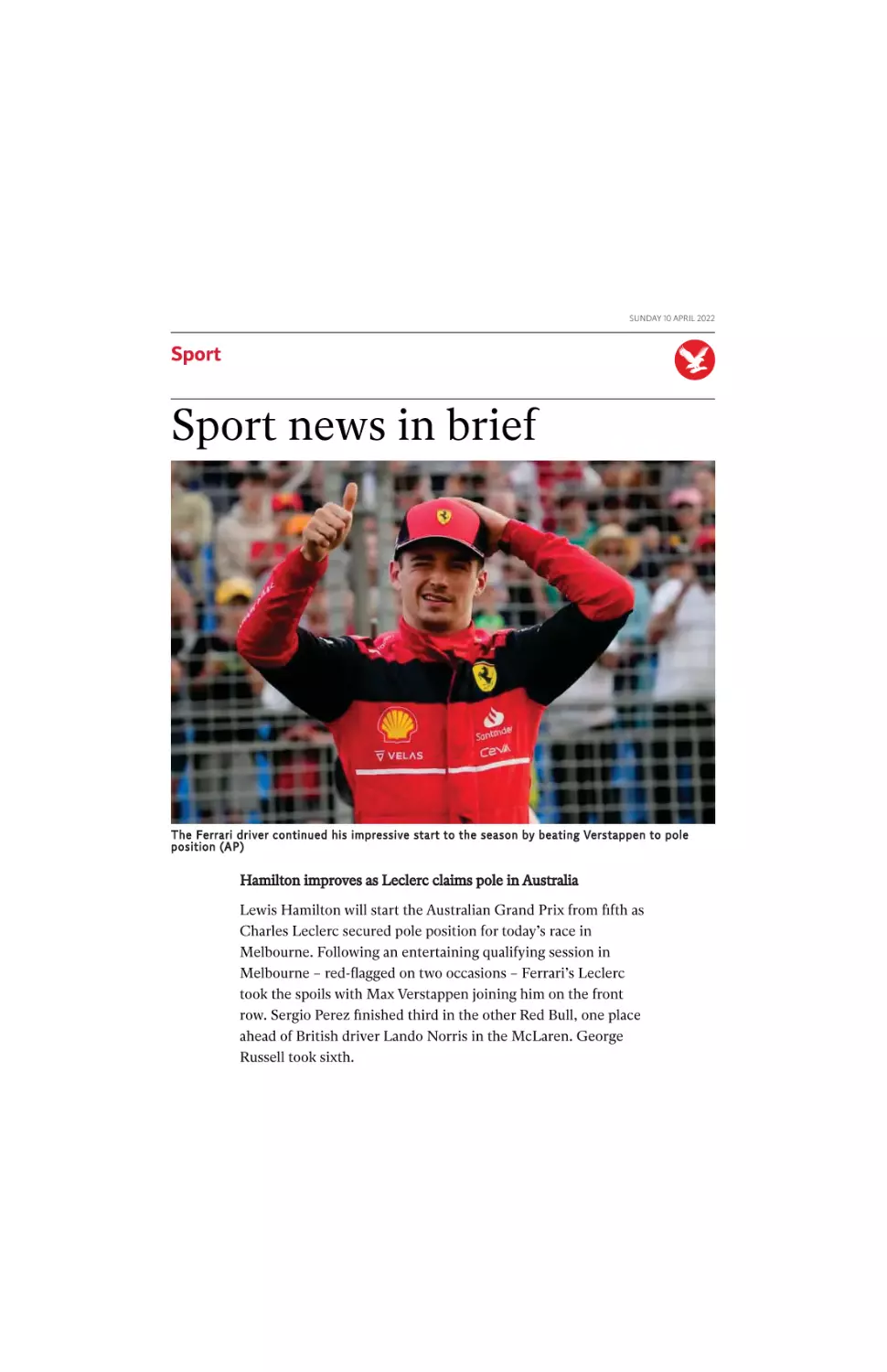































Теги: magazine the independent magazine the independent
Год: 2022


Текст
                    S U N D AY 1 0 A P R I L 2 0 2 2

May Bulman

W W W. I N D E P E N D E N T.C O. U K

Borzou Daragahi

Annabel Nugent

Tom Kershaw

Trafficking fears for France’s election is The feminist punk Spurs move clear of
refugee children
too close to call
band making waves fourth place rivals

Johnson’s face-to-face with Zelensky

The prime minister travelled to Kyiv yesterday for a surprise meeting with the Ukrainian president

More questions for Sunak
on family’s finances
Labour demands ‘full transparency’ after series of revelations
ADAM FORREST AND ANNA
ISAAC

Rishi Sunak has been urged to
provide “transparency” over
his family’s tax arrangements
and explain whether he helped
shape government finance

rules to benefit his own
interests. Opposition parties
have also called on the
chancellor to disclose his links
to Britain’s overseas territories
after The Independent revealed
claims that he was listed as a
beneficiary of tax haven trusts.

Mr Sunak’s standing among
Tory MPs has been rocked
after this newspaper revealed
that his wife Akshata Murty
holds non-domicile status.
Although she has since said
that she will pay UK taxes on
all her worldwide income.

SUNDAY 10 APRIL 2022

News

Editorials

The chancellor must be
open about his tax affairs
Rishi Sunak and Akshata Murty, his wife, have done the right
thing too late, and only because The Independent revealed her
arrangements for reducing her tax liability. As Anna Isaac, our
economics editor, reported on Wednesday, Ms Murty is a nondom: that is, she is a non-domiciled person for tax purposes.
As a British resident, she has to pay tax on her UK income, but
as an Indian citizen who intends to return to India eventually,
she can choose to have her income earned outside the UK taxed
outside the UK. Non-doms are required to pay £30,000 a year
for this privilege, which expires after they have lived here for 15
years – a change introduced by George Osborne as chancellor
the last time there was a fuss about the tax treatment of nondoms.
Everything Ms Murty has done has been lawful. The rules for
non-doms seem peculiar, but are in fact a reasonable approach
for a modern, open economy. They strike a balance between
encouraging mobile, rich people to live in the UK and raising
taxes from them.
However, Mr Sunak has failed to be open about his family
finances. It has been reported that he disclosed his wife’s non-

dom status to the permanent secretary of his department – then
called Housing, Communities and Local Government – when he
was first appointed a junior minister in 2018, and that he
reported it to the permanent secretary at the Treasury when he
became chief secretary in 2019, but The Independent has also
reported that senior officials at the Treasury say they feel
“uncomfortable” that they were not informed.
When The Independent asked about his wife’s status, it was met
with a wall of silence. As the fact of Ms Murty’s status was not
denied, and we were confident in our sources, we reported it.
Only then did a spokesperson for Ms Murty confirm that she
was a non-dom, and issue a statement wrongly suggesting that,
because she is an Indian citizen, she had no choice in the
matter.
Mr Sunak defended himself and his wife, implying that it was
sexist to hold him responsible for her finances and that the
Labour Party was “smearing” her in order to have a go at him.
Neither charge is justified. The ministerial code is rightly clear
that “interests of the minister’s spouse or partner and close
family” should be declared if they “might be thought to give rise
to a conflict”. And the questions being asked by Pat McFadden,
the shadow chief secretary to the Treasury, are important – and
in the public interest.
This was in effect conceded by Ms Murty in her statement on
Friday night, in which she renounced the “remittance basis” for
paying tax – that is, paying UK tax only on income remitted to
the UK – and undertook to pay UK tax on an “arising basis” on
income wherever in the world it arises. This means that she will
pay more tax than she is legally obliged to do, but it recognises
that her husband is in a special position.
As chancellor, he is asking the people of the UK to pay more in
tax – quite rightly, in The Independent’s view – but it would be
wrong to do so while his family benefits from a tax arrangement
that is not available to most UK citizens. Mr Sunak and Ms
Murty have therefore done the right thing, rather late in the day
and under pressure. Now perhaps Mr Sunak could turn his
attention to our latest report: that while he was chancellor he

was the beneficiary of trusts in the British Virgin Islands and the
Cayman Islands.
Instead of stonewalling our inquiries again, Mr Sunak should
explain what these arrangements are and how they are
compatible with the idea of fair taxes at a time of national
financial stringency.
Want your views to be included in The Independent Daily Edition
letters page? Email us by tapping here letters@independent.co.uk.
Please include your address
BACK TO TOP

SUNDAY 10 APRIL 2022

News

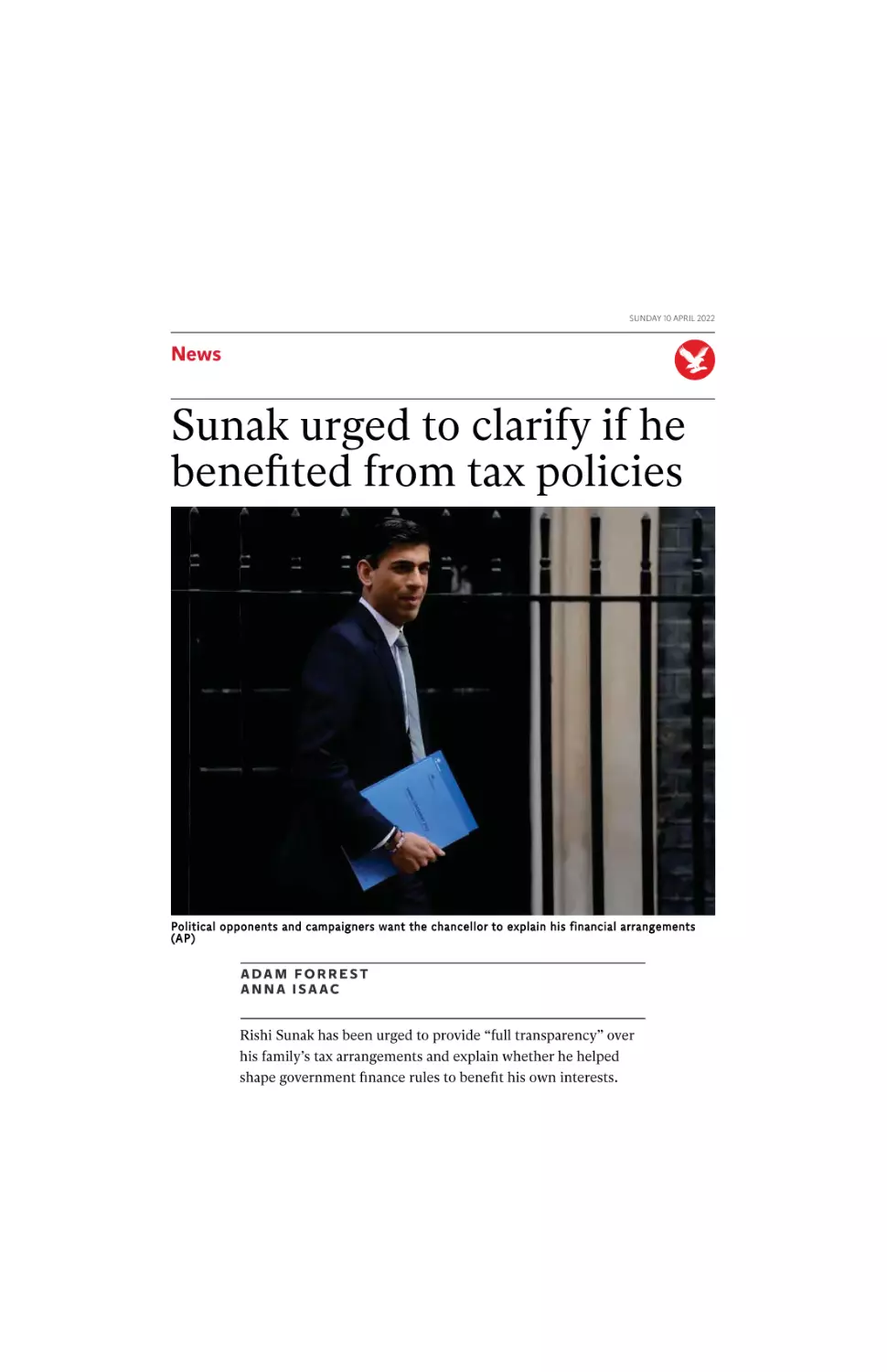
Sunak urged to clarify if he
benefited from tax policies

P o lii t i c a l o p p o n e n t s a n d c a m p a i g n e r s w a n t t h e c h a n c e llo
o r t o e x p laa i n h i s f i n a n c i a l a r r a n g e m e n t s
(A P )

ADAM FORREST
ANNA ISAAC

Rishi Sunak has been urged to provide “full transparency” over
his family’s tax arrangements and explain whether he helped
shape government finance rules to benefit his own interests.

Opposition parties and campaigners have also called on the
chancellor to disclose his links to Britain’s overseas territories
afterThe Independent revealed claims that he was listed as a
beneficiary of tax haven trusts.
Labour has called on him to urgently clarify whether he helped
“shape” tax rules through the recent Finance Act 2022 to benefit
wealthy investors with non-domicile status.
Mr Sunak’s standing among Tory MPs has been rocked after The
Independent revealed that his wife Akshata Murty holds nondom status, although she has since said she will pay UK taxes on
all her worldwide income.
A Whitehall probe is now underway to find out if any
government officials or advisers provided Ms Murty’s tax
details.
Some Conservatives believe this week’s tax rows have damaged
his chances of ever becoming prime minister. “His standing has
certainly fallen,” one senior Tory said.
The Independent understands that Mr Sunak suggested to a
contact in finance shortly before his Spring Statement that if he
couldn’t become prime minister, he might return to the industry
before the next election.
But a source close to Mr Sunak said: “Rishi has no intention of
leaving politics.”
The chancellor is understood to have moved his wife and
daughters out of the spotlight of Downing Street to their mews
house in west London.
Sir Keir Starmer’s party said a scheme in the Finance Act 2022
allowed fund manager non-doms to benefit by not having to pay
tax on foreign earnings.
“We need reassurances that the chancellor did not make an
enormous breach by shaping tax policy to benefit his own
personal finances,” said a Labour spokesperson. “He must
answer these questions now and bring full transparency about
his arrangements.”

Labour said any “trace” of the chancellor attempting to influence
the relevant rules in the Finance Act 2022 would constitute “a
serious breach of the ministerial code” which requires any
potential conflicts of interest to be disclosed.
The government responded by defending the scheme – saying
tax relief given through the new “qualifying asset holding
companies” (QAHC) regime was only available to fund
executives who manage portfolios on behalf of investors rather
than individuals.
It comes as transparency campaigners called on Mr Sunak to
explain whether or not he had benefited from his wife’s family’s
use of trusts set up in overseas territories.
Trusts in the British Virgin Islands and Cayman Islands –
created to manage the financial affairs of his wife’s family’s
interests – note Mr Sunak as a beneficiary in 2020, according to
people familiar with her finances and documents seen by The
Independent.
“We need to have clarity on these trusts on the nature of these
trusts,” said Paul Monaghan, chief executive of the Fair Tax
Foundation.
Mr Monaghan pointed to the government’s efforts to boost
transparency over wealth held in offshore entities through its
recently-passed Economic Crime Bill – and ministers’ promise
of a second such bill in the next parliamentary session.
He added: “There is a question of potential conflict of interest
for the chancellor, if he has made use of a trust in secrecy
jurisdictions, when we are looking to get greater transparency
and wipe away the veil of secrecy.”
Tax havens often offer a high degree of financial secrecy when
companies are registered there, or trusts are created as
beneficiaries of companies.
But the use of tax havens by British residents is entirely legal,
and there is no suggestion of legal wrongdoing. A spokesperson
for Mr Sunak has said they “did not recognise” the claims on the
use of tax havens, while Ms Murty has declined to comment.

The deepening row comes as it emerged that Ms Murty could
save £280m in inheritance tax by holding onto her non-dom
status.
Tax expert Richard Murphy said Ms Murty might still be able to
avoid up to £280m in inheritance tax because of a “loophole”
created in a treaty between the UK and India dating back to the
1950s.
Labour and the Liberal Democrats have called on Ms Murty,
who remains an Indian citizen, to pay the back taxes saved
through not having to pay UK taxes on her overseas income. It
has been estimated that she potentially saved up to £20m in UK
tax through the legal arrangement.
There are also growing questions about Mr Sunak’s use of
permanent US residency status, after he admitted holding a
US green card while he was chancellor between February 2020
and October 2021.
There is no suggestion that either Mr Sunak or Ms Murty have
broken any laws through their tax arrangements.
However, yesterday the SNP called on Mr Sunak to publish his
tax returns for the period he was an MP and held a US green
card to clarify whether or not he avoided paying more tax in the
UK.
The Lib Dems’ Treasury spokesperson Christine Jardine said Mr
Sunak “must be transparent about his financial arrangements
and the answer the question – have they been paying their fair
share?”
A senior G7 diplomat, who is not British and who worked with
Mr Sunak on efforts to improve corporate tax transparency, said
they would have preferred to know more about the potential
conflicts of interests at play.
Asked about the Finance Act of 2022, a government
spokesperson said: “Relief provided under the QAHC regime is
not available to individual taxpayers, whether they are domiciled
in the UK or not – it is only available to fund executives who
manage portfolios on behalf of investors.”

They added: “The QAHC regime was consulted on widely and
voted through by a majority in the House of Commons. It was
introduced as part of a review aimed at boosting UK
competitiveness – ensuring that taxes paid by those institutions
affected was proportionate to other jurisdictions, enabling the
UK to remain as an attractive place to invest and create jobs.”
Want your views to be included in The Independent Daily Edition
letters page? Email us by tapping here letters@independent.co.uk.
Please include your address
BACK TO TOP

SUNDAY 10 APRIL 2022

News

Putin took ‘nuclear football’
to the funeral of politician

T h e R u s s i a n p r e s i d e n t b e s i d e s V l a d i m i r Z h i r i n o v s k y ’s c o f f i n i n M o s c o w o n Fr i d ay (A P )

AISHA RIMI

Vladimir Putin was spotted with the Russian “nuclear football”
as he attended the funeral of a far-right politician on Friday.
The Russian president was accompanied by a man in a dark suit
who was carrying a briefcase, which contains the codes needed
to authorise a nuclear attack remotely.

Mourners were cleared from the Christ the Saviour Cathedral as
the Russian leader paid his respects to the ultranationalist,
Vladimir Zhirinovsky, amid fears of an assassination attempt.
At the open casket, Mr Putin picked up a bunch of roses and
placed them at the bottom of the coffin and then made the sign
of the cross. No armed guards were standing by the coffin when
he approached to pay his respects.
“For Vladimir Putin, the hall where people bade farewell to
Zhirinovsky was completely emptied of people – even from
relatives on chairs,” reported Telegram channel VCHK-OGPU.
Much like the nuclear football carried by presidential military
aides in the US, the Russian nuclear briefcase, known as the
“cheget”, was designed to be within reach for the president at all
times. A similar briefcase is thought to accompany the minister
of defence and chief of general staff.
Vladimir Zhirinovsky was a far-right politician and head of the
ultranationalist Liberal-Democratic Party. He died from Covid19.
Want your views to be included in The Independent Daily Edition
letters page? Email us by tapping here letters@independent.co.uk.
Please include your address
BACK TO TOP

SUNDAY 10 APRIL 2022

News

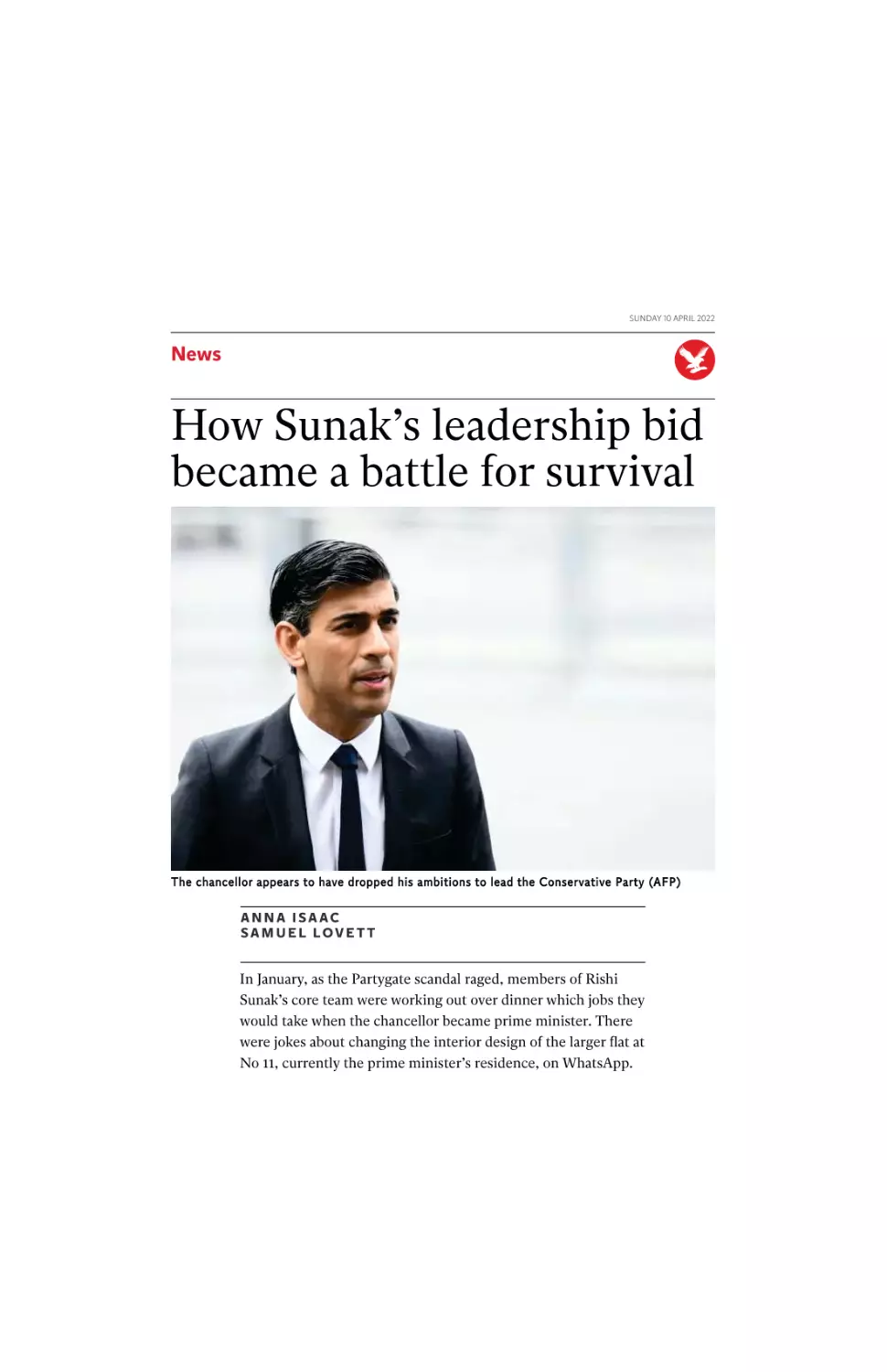
How Sunak’s leadership bid
became a battle for survival

T h e c h a n c e llo
o r a p p e a r s t o h a v e d r o p p e d h i s a m b i t i o n s t o lee a d t h e C o n s e r v a t i v e P a r t y ( A F P )

ANNA ISAAC
SAMUEL LOVETT

In January, as the Partygate scandal raged, members of Rishi
Sunak’s core team were working out over dinner which jobs they
would take when the chancellor became prime minister. There
were jokes about changing the interior design of the larger flat at
No 11, currently the prime minister’s residence, on WhatsApp.

The copy for the website for his leadership campaign, based on
the format of the No 11 newsletter, was ready to go.
When The Independent revealed that Boris Johnson had called
his Partygate comeback campaign Operation Save Big Dog, one
of the core messaged a friend with a screenshot saying “He’s
finished”.
So confident were the chancellor’s team that the Twitter handle
for the “Ready for Rishi” campaign was already prepared, along
with a wider communications campaign informed by data
harvested from the same newsletter, in a neat dashboard built by
Mr Sunak’s tech-savvy team.
He and his close circle held informal meetings with MPs and
senior figures in the Tory party in order to gauge his chances of
winning a leadership contest, and to measure the fallout from
senior civil servant Sue Gray’s investigation and that of the
police, it was claimed. The ground was laid.
Revelations about his wife’s financial affairs, first reported by
this publication, appear to have changed the chancellor’s plans,
at least for now. Crisis meetings throughout the past week have
turned from how to rethink a leadership bid to how he can
survive in his current role. Relations with his neighbour Mr
Johnson’s team have turned from challenging to outright sour.

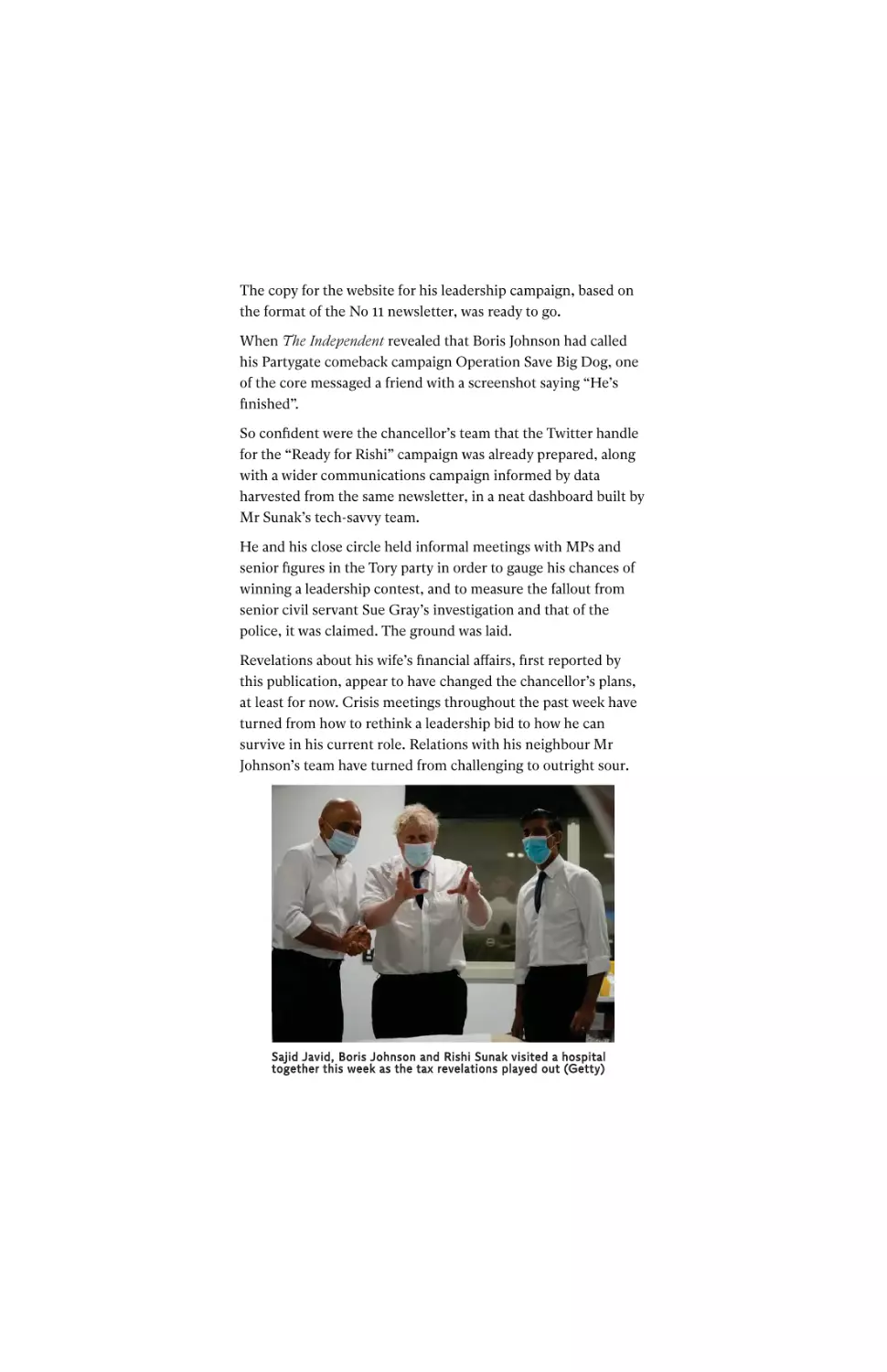
Saa j i d J a v i d , B o r i s J o h n s o n a n d R i s h i S u n a k v i s i t e d a h o s p i t a l
t o g e t h e r t h i s w e e k a s t h e t a x r e v e laa t i o n s p laa y e d o u t ( G e t t y )

“Did you know anything about this?” one No 11 staffer messaged
a No 10 equivalent. The recipient had not known about it, but
paranoia in both camps continues to build. A spokesperson said
there had been no leaks from No 10. The prime minister said
that he had not known about Ms Murty’s tax affairs.
Mr Sunak’s stock had arguably already dropped in the aftermath
of the mini-Budget last month. His spring statement was met
with a cold response on the back benches. The “jam tomorrow”
– a penny off income tax ahead of the next election – failed to
recognise that “there isn’t going to be enough bread for
everyone” today, one cabinet minister told The Independent.
Several Tory MPs are also concerned that the chancellor’s
measures fall short for those in greatest need. Economic analysis
from left and right has shown a grim outlook for the poorest
ahead of the local elections. Indeed, “No one needs to look at a
chart from a think tank to know that people are struggling and
the government isn’t doing enough,” said one MP.
Into this atmosphere of disquiet about the cost of living came
fresh problems. After an extensive investigation by The
Independent it was revealed that Akshata Murty, Mr Sunak’s
wife, was using non-dom tax status. It had – entirely legally –
saved her millions on her foreign earnings.
It put the couple in a politically awkward spot at a time when
UK households, many of whom cannot afford to put their
heating on, are facing a near 10 per cent, 1.25 percentage point,
increase in their tax bill.
It also caused disquiet among senior Treasury officials whose
work involves trying to make the UK appealing to foreign-born
entrepreneurs. One said that, in their view, there was “good
reason to share this information more widely to leaders of
relevant policy teams”.

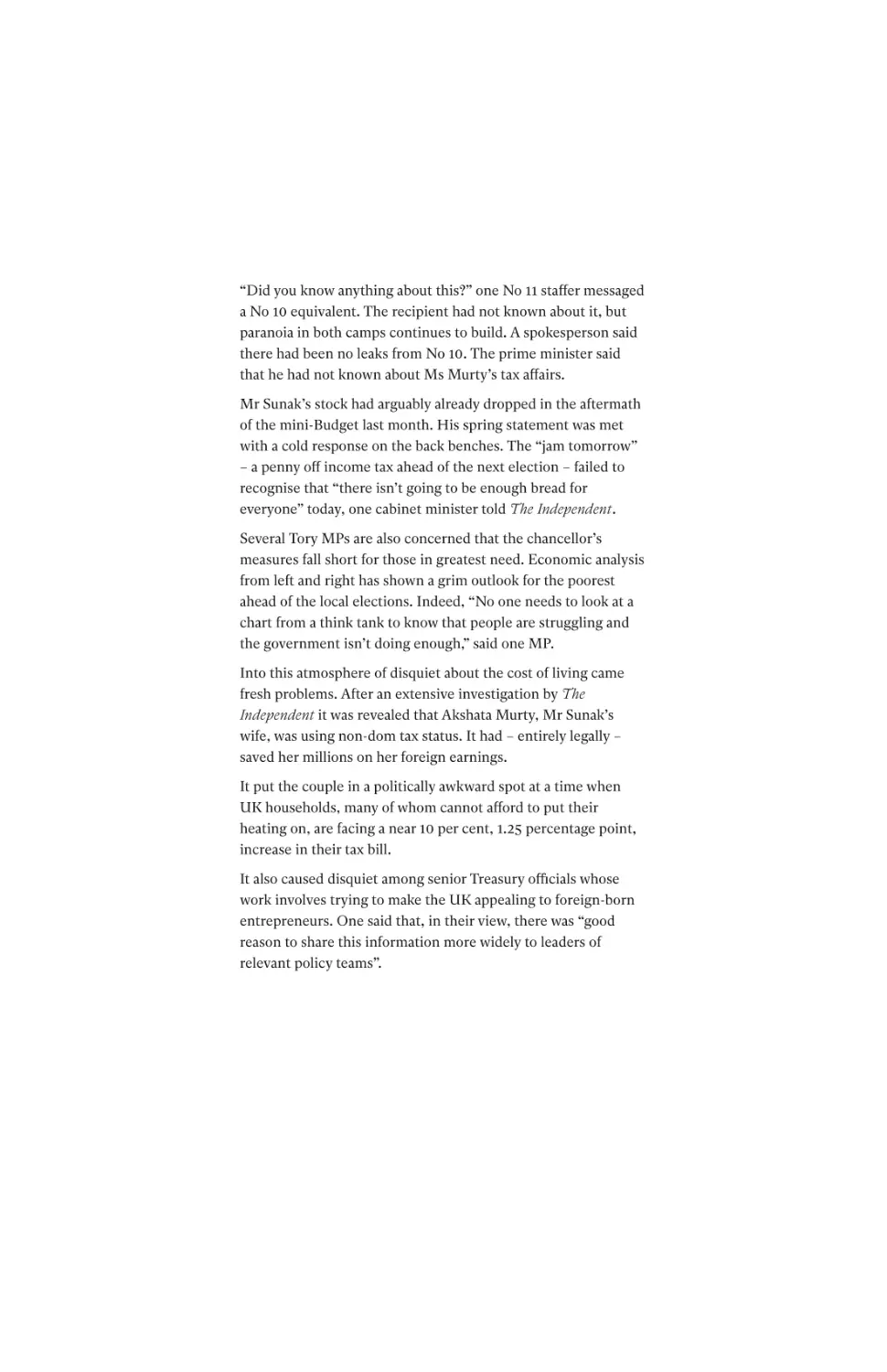
S u n a k w i t h h i s w i f e , A k s h a t a M u r t y , w h o s e n o n -d
dom tax
s t a t u s w a s r e v e a l e d e a r l i e r t h i s w e e k ( PA )

And a senior G7 diplomat, who is not British and who has
worked with Mr Sunak on efforts to improve corporate tax
transparency, said they would have preferred to know more
about the potential conflicts at play.
Shortly before the mini-Budget, Mr Sunak had suggested to a
contact from his former life in finance that if he couldn’t make it
to the top job soon, he might return to the industry before the
next election. He also mentioned that he was in desperate need
of a proper holiday, having cut short and cancelled recent trips
to the US.
It is not the only signal that the chancellor might feel torn
between the worlds of politics and finance. It was reported that
he and his wife had held on to US green cards, which are
supposed to be awarded on the basis of an intention to make the
US your permanent home, while he was chancellor. This adds to
the picture of a politician who would prefer not to have to
choose between a life of public service and a highly successful
career in money-making.
His wife’s U-turn on paying tax on her foreign income in the
UK, after the chancellor had previously suggested this was
incompatible with her Indian citizenship, is also a hedged bet.

She will no longer use the option on her tax return, but she has
determined that she will keep her non-dom status.
Open questions remain about beneficial inheritance-tax
arrangements and overseas tax-haven trusts. Allegations and
evidence suggesting the chancellor is named as a beneficiary of
some of these trusts were not met with an outright denial.
Being rich is no bar to a successful political career – either in the
UK or on the wider international circuit – and Mr Sunak’s stock
might recover, but right now it’s looking like a tough margin
trade. MPs on his own side may need to see Mr Sunak double
down on his commitments in the UK if they are ever going to be
Ready for Rishi as leader.
Want your views to be included in The Independent Daily Edition
letters page? Email us by tapping here letters@independent.co.uk.
Please include your address
BACK TO TOP

SUNDAY 10 APRIL 2022

News

Fears for lone Ukrainian
children arriving in UK to
live with unrelated adults

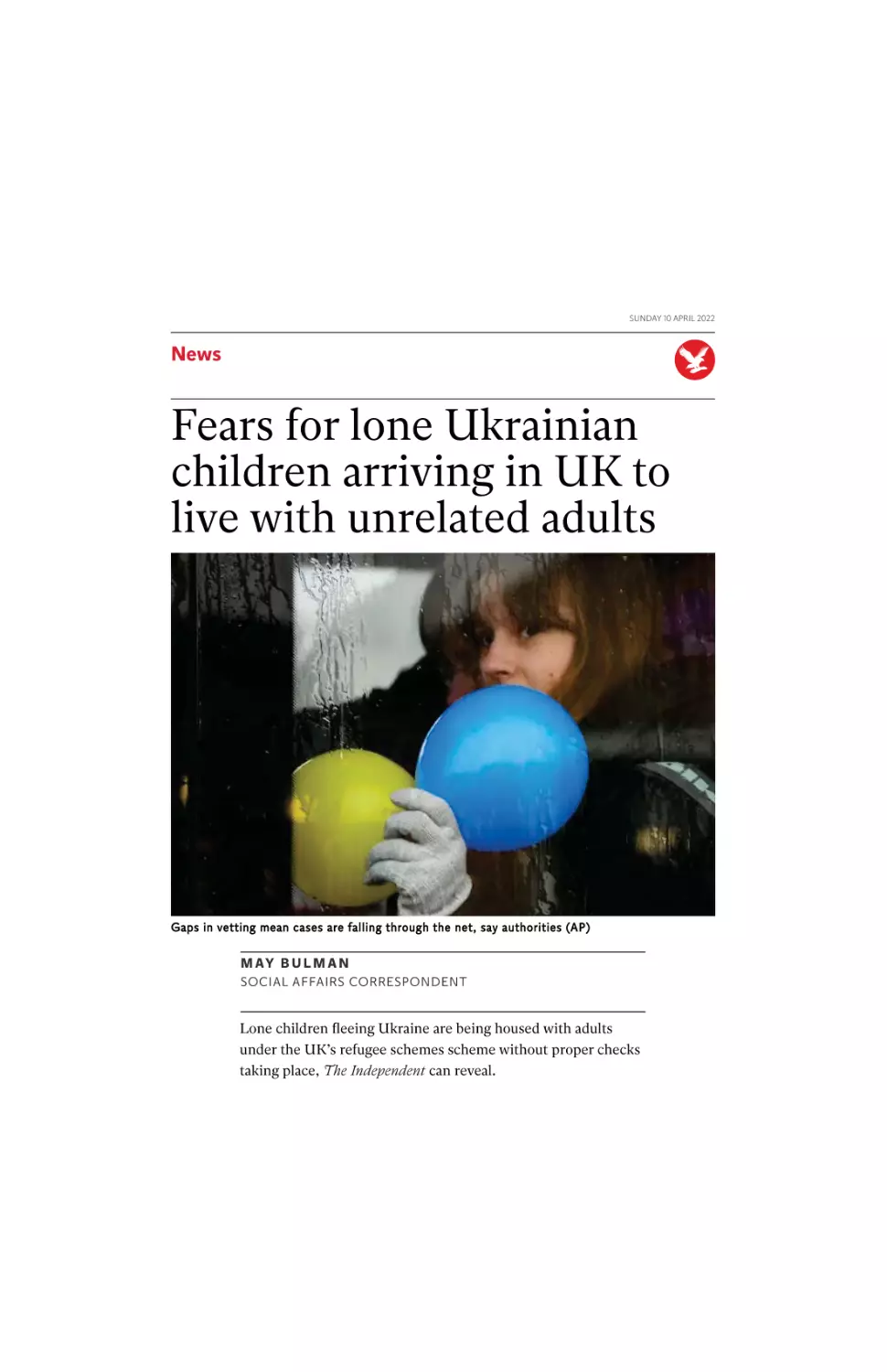
G a p s i n v e t t i n g m e a n c a s e s a r e f a llii n g t h r o u g h t h e n e t , s a y a u t h o r i t i e s ( A P )

M AY B U L M A N
SOCIAL AFFAIRS CORRESPONDENT

Lone children fleeing Ukraine are being housed with adults
under the UK’s refugee schemes scheme without proper checks
taking place, The Independent can reveal.

More than 200,000 Britons have signed up to the government
programme which allows UK sponsors to “match” with
Ukrainians fleeing the war. In total 1,200 refugees have arrived
under the scheme so far, while a further 10,800 have come
under the family scheme, which allows Ukrainian refugees to
join relatives in Britain.
But while the government claims unaccompanied children are
not eligible for either scheme, The Independent is aware of cases
in which minors have been granted visas and arrived in the UK
without a legal guardian.
Authorities warn that gaps in the vetting process mean cases are
“falling through the net”, prompting concerns about exploitation
and trafficking, with more than 4.5 million Ukrainian children
displaced in recent weeks, some of whom have been separated
from parents and family.
The Local Government Association (LGA), which represents
councils, said local authorities had seen children arriving
without adults who had any responsibility for them.
Lisa Nandy, Labour’s shadow levelling up secretary, said local
authorities and charities were getting “far too little information
and support” on how to respond.
Describing the situation as “disgraceful”, she added: “This was
always a risk with this DIY refugee scheme. The government
should have taken charge of matching sponsors to refugees from
day one.
“Before Michael Gove launched Homes for Ukraine he didn’t
even pick up the phone to councils and charities – the people
who would be responsible for looking after vulnerable children.”
The LGA said it was “unclear” if councils were expected to take
unaccompanied children into care. In one case, an
unaccompanied child recently arrived in Redbridge council after
being matched with an unrelated adult under the Homes for
Ukraine scheme.
The council said it did not have safeguarding concerns about the
case, but that it would follow up with the Home Office to better

understand what safeguarding checks were done when agreeing
to the match.

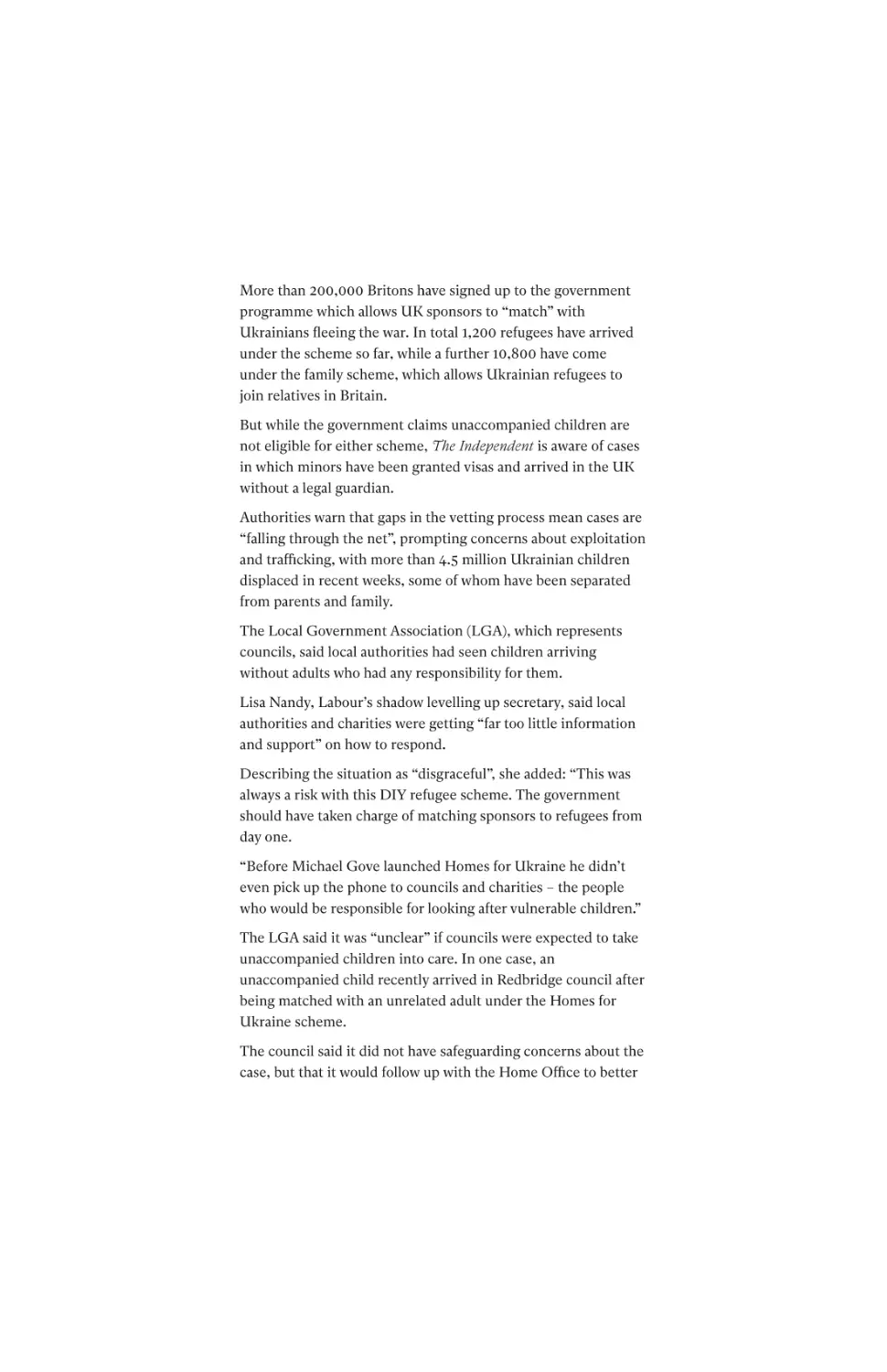
B r i t o n s h ave b e e n o p e n i n g t h e i r h o m e s t o re f u ge e s b u t t h e
p r o c e s s h a s b e e n c r i t i c i s e d a s ‘ D IY
Y ’ ( PA W i r e)

When an application is made to the Homes for Ukraine scheme
– which can only happen once the applicant has found a sponsor
who can host them in the UK – the “match” appears on a portal
that local councils can access so that they can begin carrying out
safeguarding checks.
But the LGA has said that in some cases councils are only being
told who is arriving in their local area once matches have been
made and visa granted, with many reporting “significant issues”
with the data.
The organisation also called for councils to be given advance
notice of new arrivals under the family scheme, in particular if
there are individuals or families with vulnerabilities, to enable
local services to meet their needs.
Kevin Bonavia, of Lewisham Council, said some locals had tried
to match with unaccompanied minors, adding: “Fortunately
none have been approved as yet, but we’re worried that they will
be and we will need to scramble to intervene. We’ve heard of
this happening in another council. We can’t allow vulnerable
children to fall through the net.”
Sian Summers-Rees, of charity City of Sanctuary UK, described
one case of a couple that applied to sponsor two 17-year-olds

they met via social media, and were reportedly told when they
contacted Home Office that the children were eligible under the
sponsorship scheme.
“The ones coming to our attention are people who are wellintentioned, but obviously there’s a massive concern that there
are people who are signing up to it for sinister reasons. There are
serious exploitation and trafficking concerns,” she said. “We also
know of cases where minors have arrived with people who are
not their parents or carers.”
Steve Crocker, of the Association of Directors of Children’s
Services, said the Ukraine schemes were “not designed with
unaccompanied children in mind”.
He said: “We continue to raise the need for any current and
future arrangements for Ukrainian refugees to be child-focused
and for local authorities to get necessary information, including
about the age of arrivals, as soon as possible so that we can plan
accordingly, and so children’s needs can be met in the short and
long term.”
A government spokesperson said councils should use normal
safeguarding processes if a Ukrainian child arrives. Claire
O’Meara, of Unicef, said: “Whilst the scheme offers a valuable
route for those fleeing the war, it has not been designed to
support unaccompanied children who require additional care
and support.
“There is a fine balance between getting children to safety as
quickly as possible whilst doing so in a way that does not cause
further harm or trauma. Unaccompanied children must
therefore only be brought to the UK where it is in their best
interests to do so, and their safety can be ensured.”
A government spokesperson said safeguarding checks were in
place and would ensure visa applications from unaccompanied
minors were not approved by the Home Office.
Want your views to be included in The Independent Daily Edition
letters page? Email us by tapping here letters@independent.co.uk.
Please include your address

BACK TO TOP

SUNDAY 10 APRIL 2022

News

Russians believe Putin, says
head of former TV channel

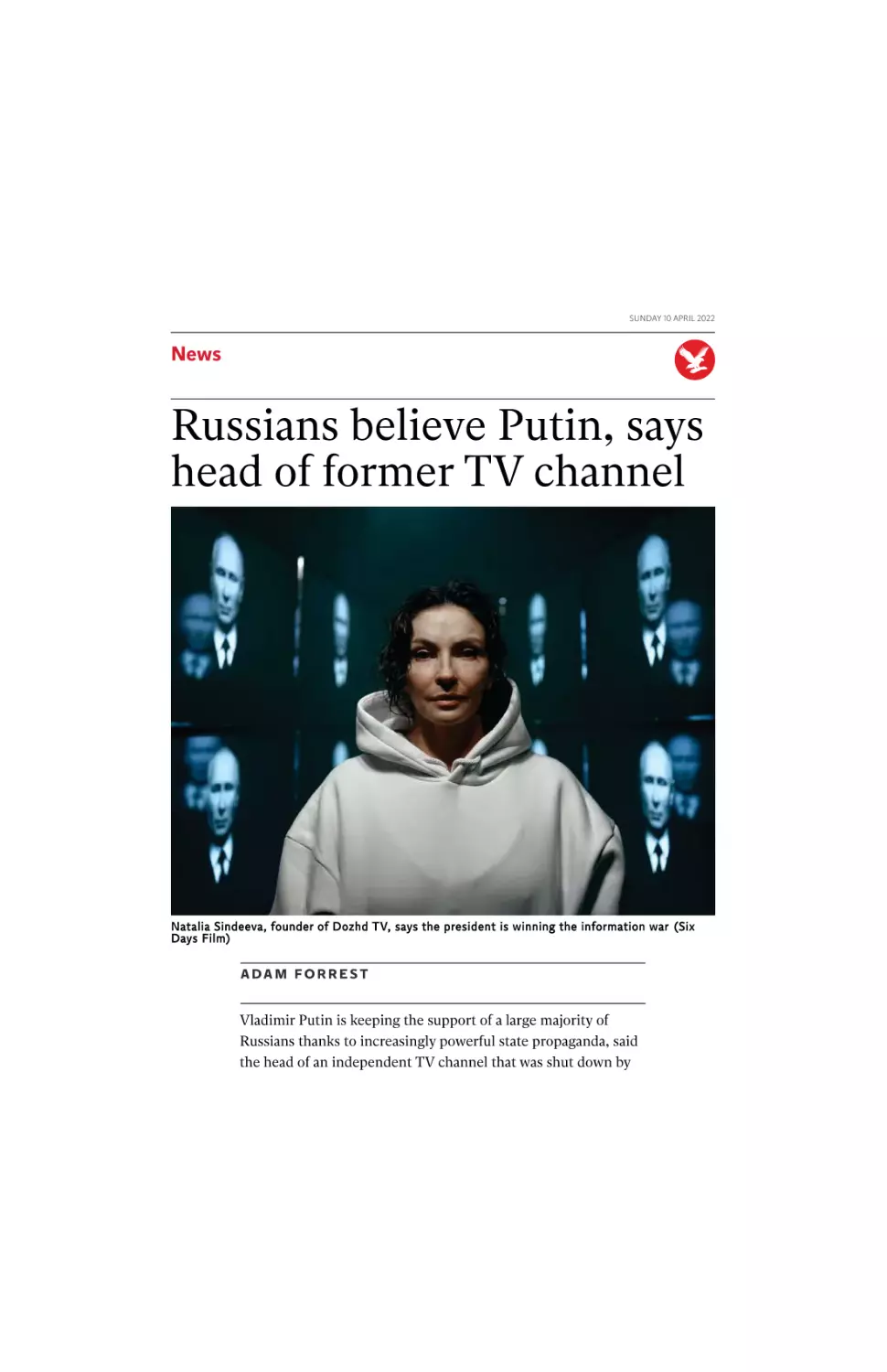
N a t a lii a S i n d e e v a , f o u n d e r o f D o z h d T V, s a y s t h e p r e s i d e n t i s w i n n i n g t h e i n f o r m a t i o n w a r ( S i x
D a y s F i lm
m)

ADAM FORREST

Vladimir Putin is keeping the support of a large majority of
Russians thanks to increasingly powerful state propaganda, said
the head of an independent TV channel that was shut down by

the regime. Natalia Sindeeva, founder of the Dozhd TV station,
told The Independent that a draconian censorship law introduced
last month had destroyed any chance of reaching a large Russian
audience with the truth about the Ukraine invasion.
Sindeeva said that the 20 per cent or so of Russia’s population
that was already opposed to Putin still had ways of finding out
what was happening in Ukraine – but the rest are now fully
absorbed in messaging from state-controlled media.
“These people watch propaganda. They have completely
opposite footage, they think it is Ukrainians who bomb
Mariupol, they believe that Ukrainians killed people in Bucha,”
she said. “The problem is the audience of the state propaganda.
We cannot reach them, and, to be honest, they do not have any
demand for independent information. It is a majority of the
people – they support the war, they support Putin, they make it
easier for him.”
The Dozhd channel, set up in 2008, was forced to shut at the
beginning of March after the Kremlin pushed through a media
censorship law that punishes what it terms “fake” information
about the war with up to 15 years in prison. “Passing this law
made impossible live reporting on TV online,” said Sindeeva.
“We could not report on news relating to Ukraine, or we would
have to use only Russian state official sources, which do not give
a real picture.”
Sindeeva is the focus of a new documentary, F@ck This Job –
renamed Tango with Putin for its appearance on BBC iPlayer –
about the prominent socialite’s efforts to run a truly
independent TV channel that was willing to challenge Putin’s
government. She had hoped that Dozhd, also known as TV Rain,
could mix serious news and “glamorous television”, building an
audience of young Russians eager for reform. But the Ukraine
war brought an end to the regime’s willingness to tolerate
autonomous media outlets.
Dozhd staff were swamped with threatening emails and calls
soon after the invasion began, even before the censorship law
made it impossible to continue.

Despite the crackdown in March, the minority of Russians
already opposed to Putin – some of whom have been arrested for
protesting against the war – are still able to get accurate
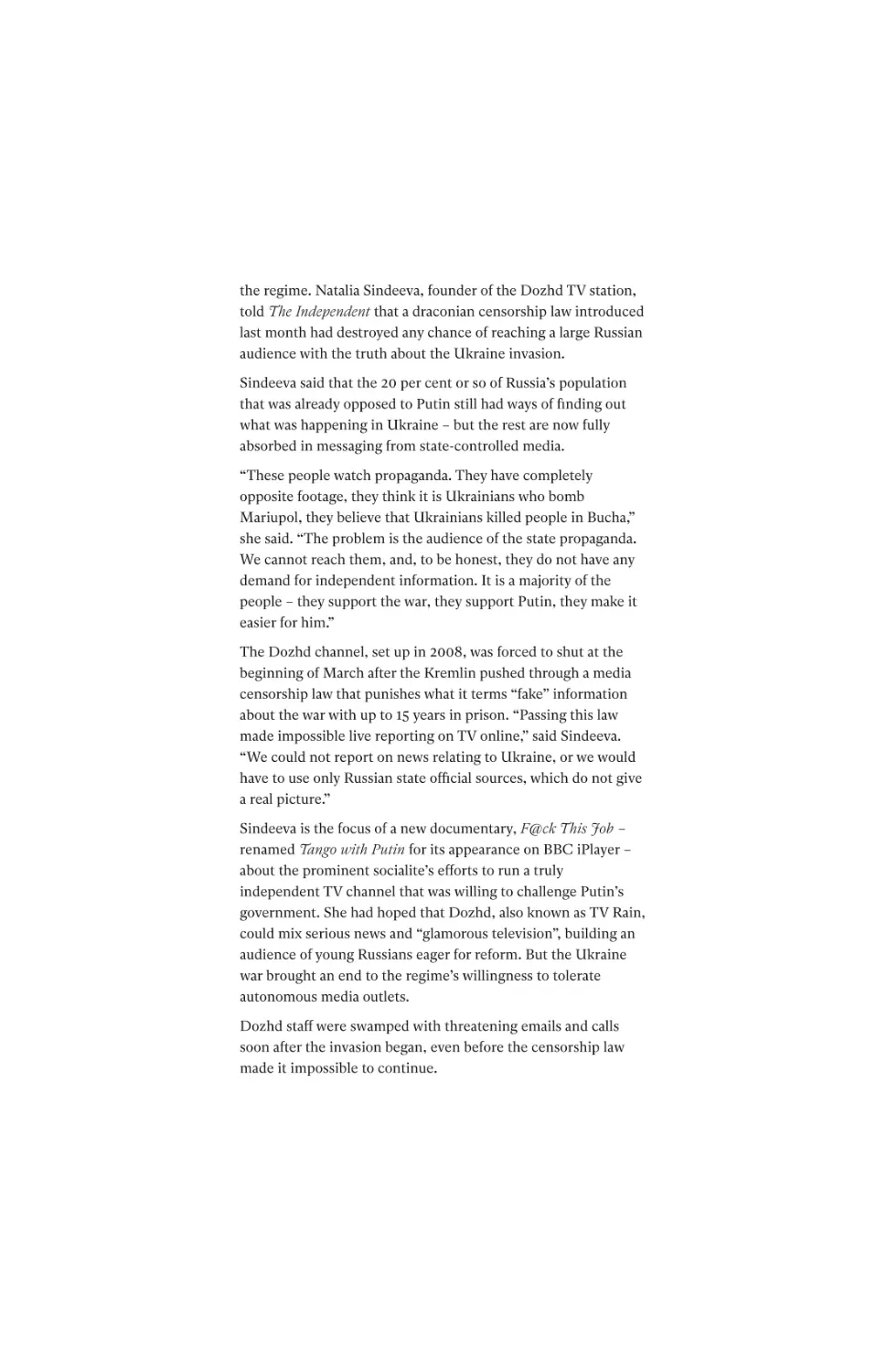
information about Ukraine online. “The core of our
audience knows how to use VPN to open some blocked sources,
or how to find our reporters or Ukrainian sources. It’s our
bubble,” said Sindeeva.

Sindeeva: ‘The core of our audience knows how to use VPN
t o o p e n b lo
o c k e d s o u r c e s ’ ( S i x D a y s F i lm
m)

Dozhd is not the only independent outlet to have been forced to
stop reporting on the invasion. The Novaya Gazeta newspaper
has suspended its activities until the end of Putin’s “special
military operation” in Ukraine. The newspaper’s editor, Dmitry
Muratov, a co-winner of last year’s Nobel Peace Prize, was
attacked in Moscow earlier this week by someone who threw a
mixture of red paint and acetone over him.
Some who work for state-controlled media have paid the price
for speaking out. Channel One news presenter Marina
Ovsyannikova was detained after shouting “Stop the war” on air,
and is now facing charges for holding an “unauthorised public
event”.
Campaign groups like Alexei Navalny’s Anti-Corruption
Foundation hope that the overwhelming pressure of
international sanctions might lead to an overthrow of the

government. But Sindeeva is pessimistic about the idea that the
squeeze on the Russian economy will lead significant numbers
to turn against the president. She said the Russian public would
be willing to “endure the hardships” that arise due to the
crumbling economy.
“For now, Putin’s propaganda is painting the picture that the
worsening economic conditions are part of the west’s plan to
weaken Russia. So Russians might even become more united
against this outside enemy.”
Vera Krichevskaya, a former producer at the network and
director of Tango with Putin, has predicted that Putin will
remain in power past the 2036 date his term is supposed to end.
“Putin will be there now until the physical end of his life: 2036?
2045? Dates don’t matter now.”
Sindeeva does not hold out much hope of democratic change in
the years ahead. “Right now, it’s hard to imagine any reforms,”
she said. But the former TV channel boss, who does not disclose
her location, said that many independent Russian journalists
would find a way to keep working.
“I am sure it has a future,” she said of her media company. “I am
now actively exploring new options to continue reporting on
what is happening in Russia. I am thinking about how to restart
the project, but I cannot give you any details now.”
Want your views to be included in The Independent Daily Edition
letters page? Email us by tapping here letters@independent.co.uk.
Please include your address
BACK TO TOP

SUNDAY 10 APRIL 2022

News/ Refugees Welcome

Village offer of homes for
refugees hit by visa red tape

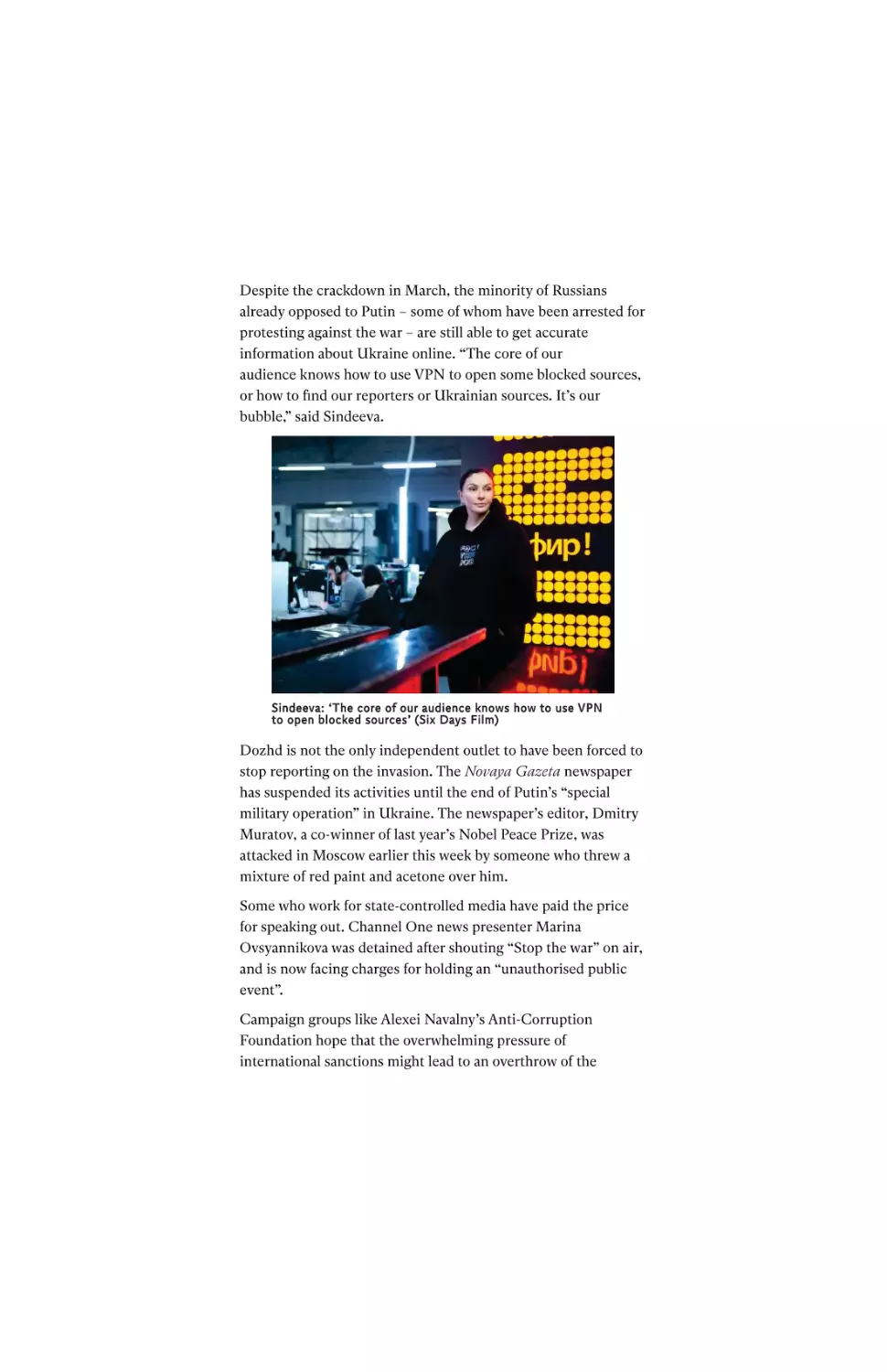
A t lee a s t 4 3 h o u s e h o ld
d s i n R o t h b u r y , N o r t h u m b e r laa n d , h a v e a p p lii e d t o h o s t U k r a i n i a n s ( G e t t y )

COLIN DRURY
NORTH OF ENGLAND CORRESPONDENT

A tiny rural village that’s home to just 2,100 people has at least
43 households willing to host Ukrainian refugees. So far,
however, not a single person escaping Russia’s devastating war
has actually arrived in Rothbury, Northumberland – because of
continuing delays with government visas.

Would-be hosts have spent the last three weeks helping families
from Kyiv, Lviv and Mariupol apply for the necessary documents
to move here – but not one is understood to have yet received a
full reply from the Home Office. Now, a local councillor says the
area’s thwarted efforts to offer sanctuary mean it is fast
becoming a symbol of the government’s failure to help
Ukrainian refugees.
“This is a whole community, not just ready and willing but
actually desperate to help people who are living with missiles
raining down near their homes, and yet the government’s lack of
urgency is preventing that happening,” says Steven Bridgett.
“People here are in disbelief that it is taking so long.

U k r a i n i a n s N a t a lii a N a h i r n i a k a n d d a u g h t e r K h r y s t y n a h a v e a
h o m e r e a d y i n R o t h b u r y – b u t n o v i s a s ( L e s lee y E t t e r lee y )

“I don’t know if the government’s going slow on purpose – you
could certainly believe that – or if it’s just sheer incompetence,
but it is outrageous that the delay is leaving lives needlessly at
risk. It is unbelievable. It is a situation that Sir Humphrey [
Appleby, from sitcom Yes Minister] would be proud of.”
He adds that the first visa applications were made 20 days ago,
and that Northumberland County Council – of which he is an
independent member – has already visited and approved most of
the homes for hosting. “All that’s missing are the visas,” he says.

For Tom and Lesley Etterley, the delay has caused particular
frustration. The couple are among those who have readied their
homes to accept a family. The elder of their two sons – currently
at university – will see his en suite room turned into a miniapartment for Natalia Nahirniak, a 46-year-old English teacher
from Lviv, and her 10-year-old daughter Khrystyna.

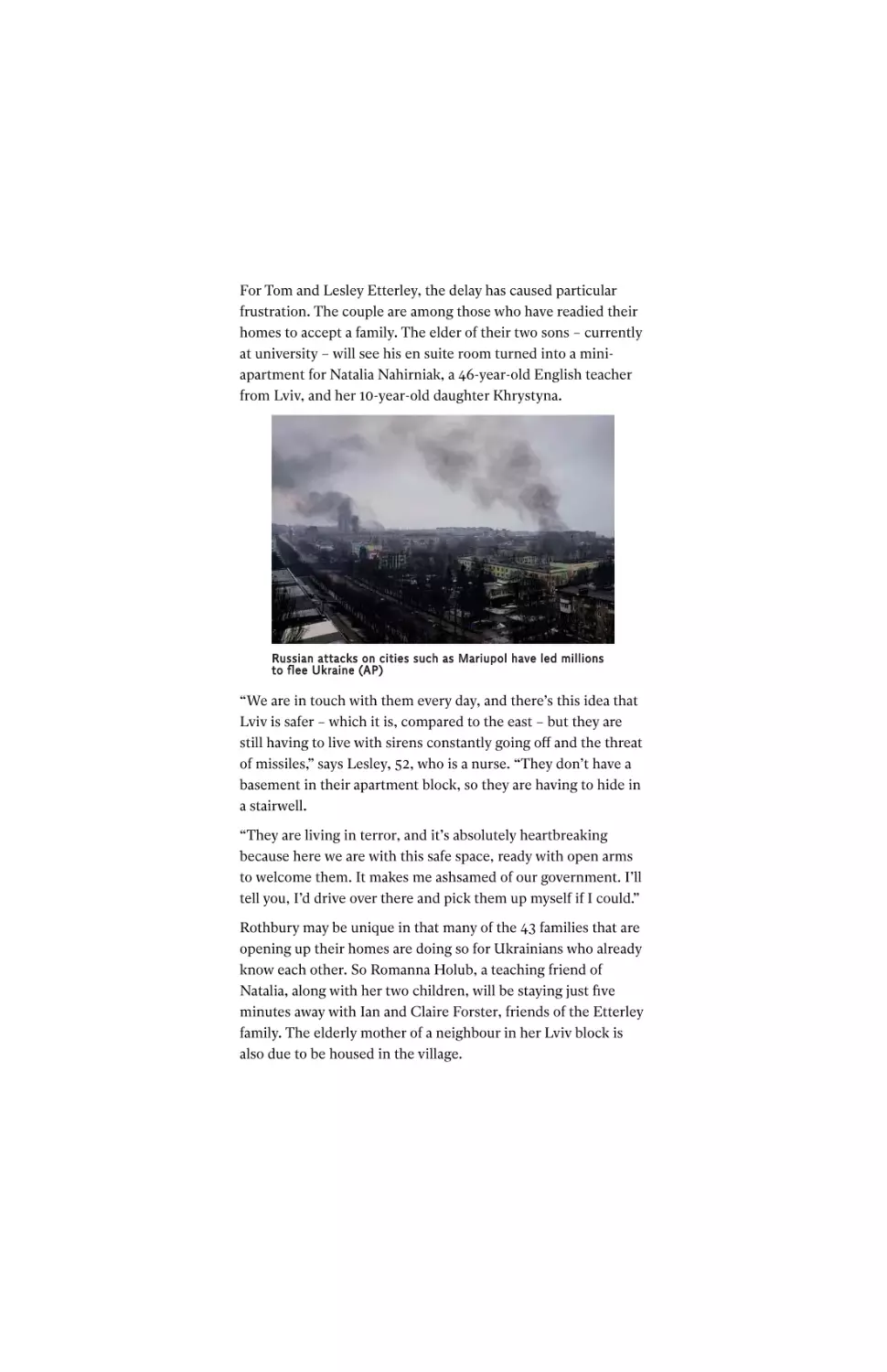
R u s s i a n a t t a c k s o n c i t i e s s u c h a s M a r i u p o l h a v e lee d m i llii o n s
t o f lee e U k r a i n e ( A P )

“We are in touch with them every day, and there’s this idea that
Lviv is safer – which it is, compared to the east – but they are
still having to live with sirens constantly going off and the threat
of missiles,” says Lesley, 52, who is a nurse. “They don’t have a
basement in their apartment block, so they are having to hide in
a stairwell.
“They are living in terror, and it’s absolutely heartbreaking
because here we are with this safe space, ready with open arms
to welcome them. It makes me ashsamed of our government. I’ll
tell you, I’d drive over there and pick them up myself if I could.”
Rothbury may be unique in that many of the 43 families that are
opening up their homes are doing so for Ukrainians who already
know each other. So Romanna Holub, a teaching friend of
Natalia, along with her two children, will be staying just five
minutes away with Ian and Claire Forster, friends of the Etterley
family. The elderly mother of a neighbour in her Lviv block is
also due to be housed in the village.

“The idea was that there would be familiar faces in the village as
they settled in,” says Lesley.

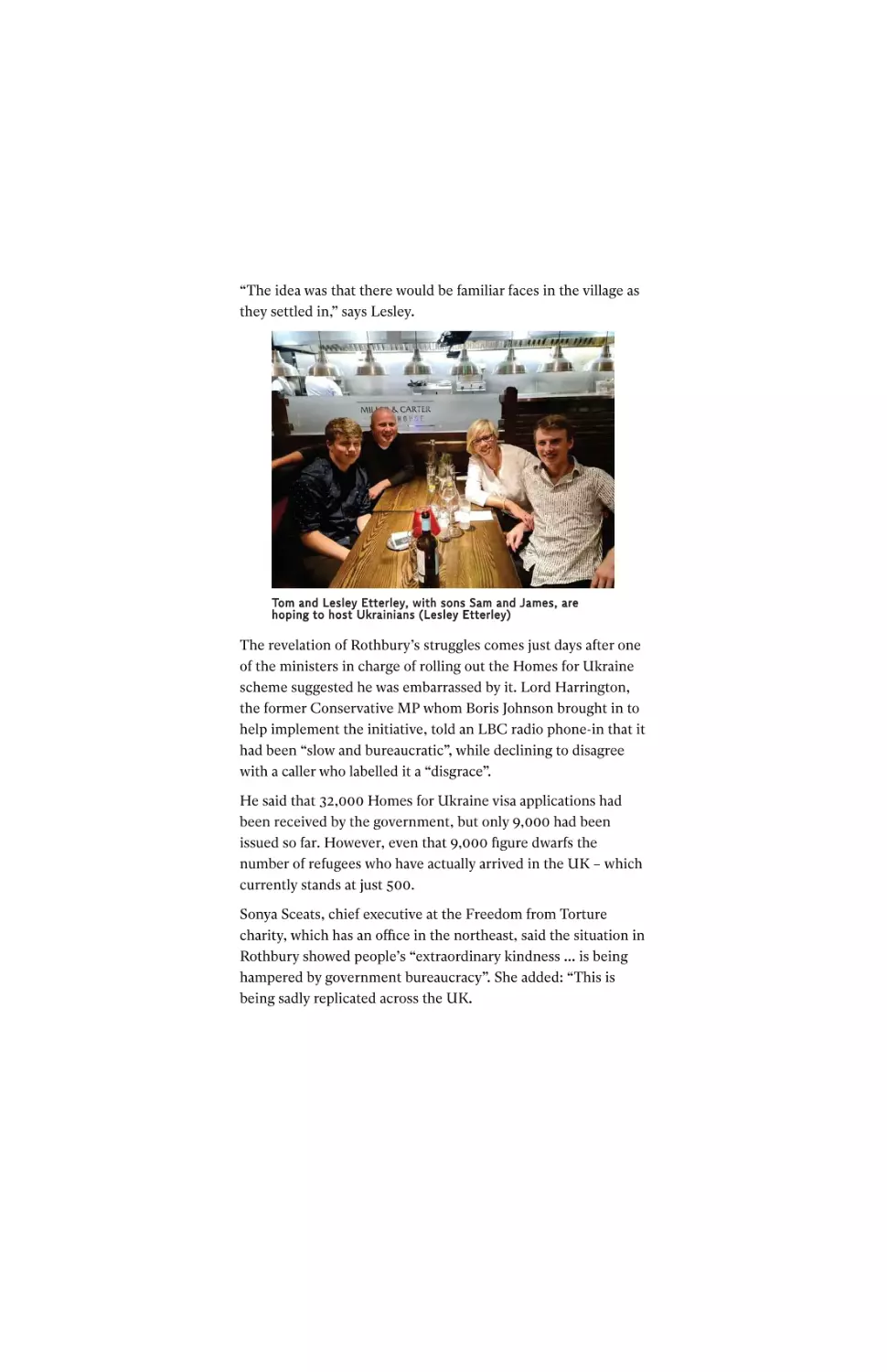
To m a n d L e s l e y E t t e r l e y , w i t h s o n s S a m a n d J a m e s , a r e
h o p i n g t o h o s t U k r a i n i a n s ( L e s l ey E t t e r l ey)

The revelation of Rothbury’s struggles comes just days after one
of the ministers in charge of rolling out the Homes for Ukraine
scheme suggested he was embarrassed by it. Lord Harrington,
the former Conservative MP whom Boris Johnson brought in to
help implement the initiative, told an LBC radio phone-in that it
had been “slow and bureaucratic”, while declining to disagree
with a caller who labelled it a “disgrace”.
He said that 32,000 Homes for Ukraine visa applications had
been received by the government, but only 9,000 had been
issued so far. However, even that 9,000 figure dwarfs the
number of refugees who have actually arrived in the UK – which
currently stands at just 500.
Sonya Sceats, chief executive at the Freedom from Torture
charity, which has an office in the northeast, said the situation in
Rothbury showed people’s “extraordinary kindness ... is being
hampered by government bureaucracy”. She added: “This is
being sadly replicated across the UK.

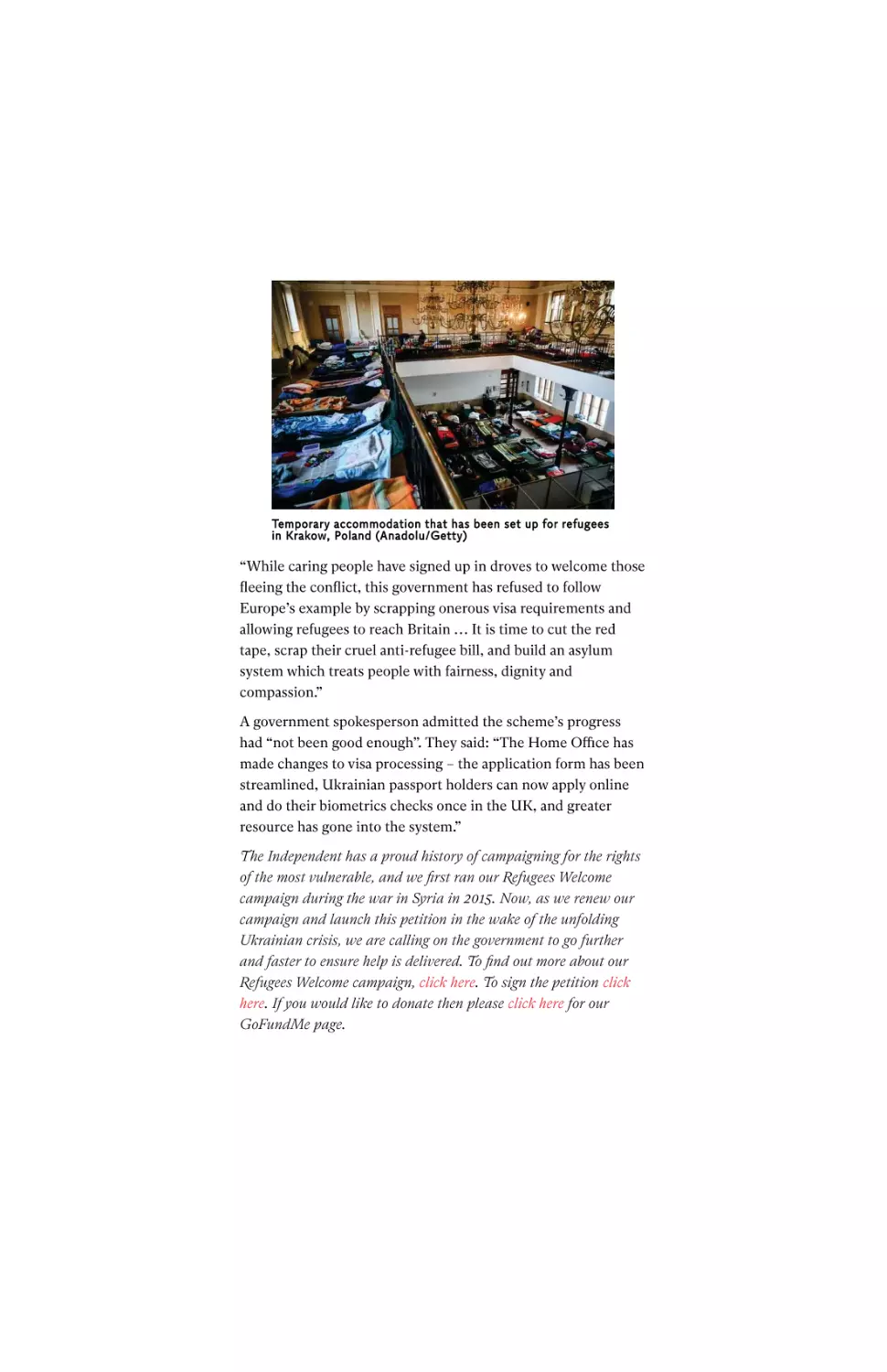
Te m p o r a r y a c c o m m o d a t i o n t h a t h a s b e e n s e t u p f o r r e f u g e e s
i n K r a k o w, Po l a n d (A n a d o l u / G e t t y)

“While caring people have signed up in droves to welcome those
fleeing the conflict, this government has refused to follow
Europe’s example by scrapping onerous visa requirements and
allowing refugees to reach Britain … It is time to cut the red
tape, scrap their cruel anti-refugee bill, and build an asylum
system which treats people with fairness, dignity and
compassion.”
A government spokesperson admitted the scheme’s progress
had “not been good enough”. They said: “The Home Office has
made changes to visa processing – the application form has been
streamlined, Ukrainian passport holders can now apply online
and do their biometrics checks once in the UK, and greater
resource has gone into the system.”
The Independent has a proud history of campaigning for the rights
of the most vulnerable, and we first ran our Refugees Welcome
campaign during the war in Syria in 2015. Now, as we renew our
campaign and launch this petition in the wake of the unfolding
Ukrainian crisis, we are calling on the government to go further
and faster to ensure help is delivered. To find out more about our
Refugees Welcome campaign, click here. To sign the petition click
here. If you would like to donate then please click here for our
GoFundMe page.

Want your views to be included in The Independent Daily Edition
letters page? Email us by tapping here letters@independent.co.uk.
Please include your address
BACK TO TOP

SUNDAY 10 APRIL 2022

News

Thousands sign petition to
make MPs accountable for
misleading the Commons

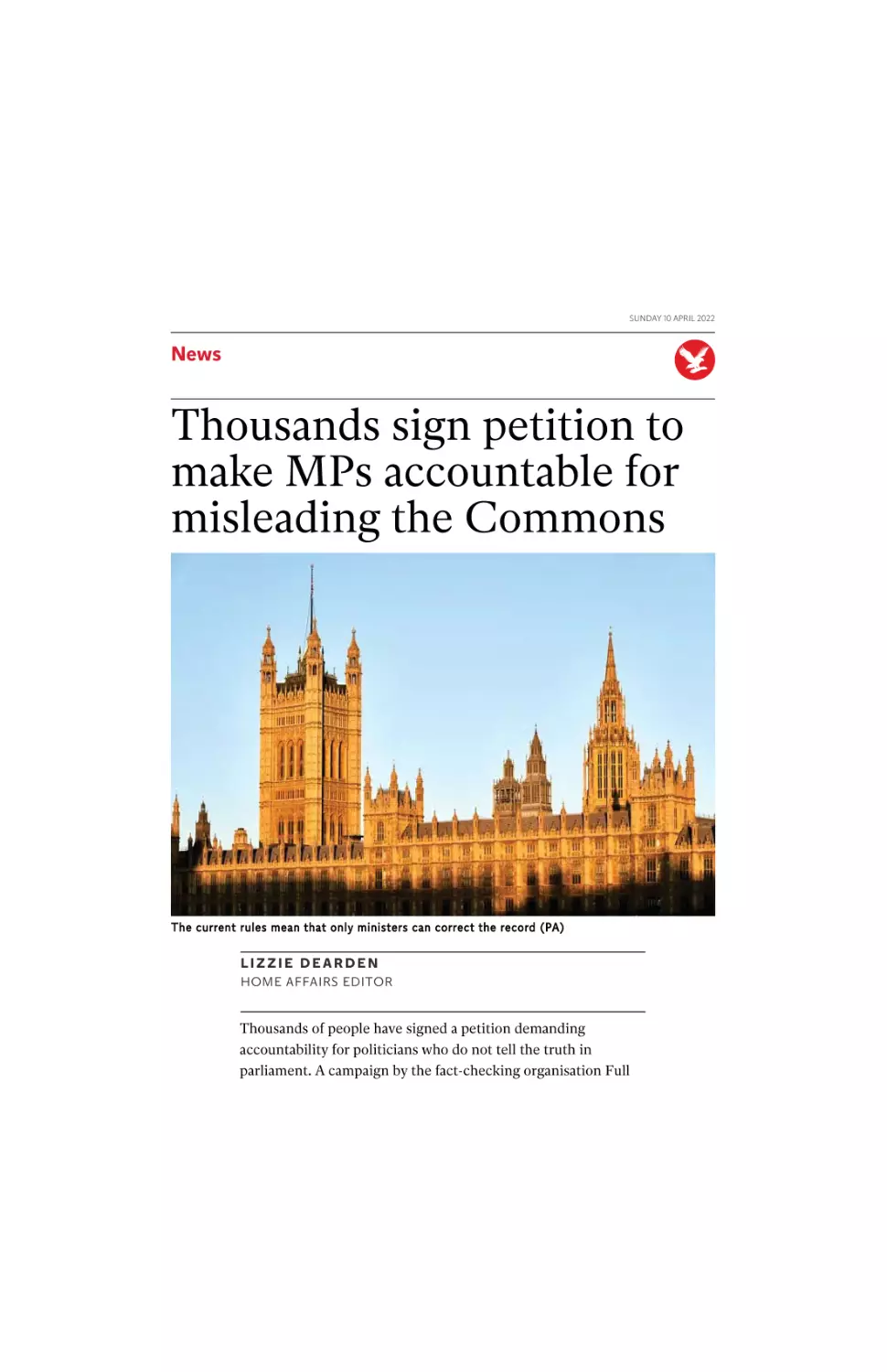
T h e c u r r e n t r u lee s m e a n t h a t o n lyy m i n i s t e r s c a n c o r r e c t t h e r e c o r d ( PA )

LIZZIE DEARDEN
HOME AFFAIRS EDITOR

Thousands of people have signed a petition demanding
accountability for politicians who do not tell the truth in
parliament. A campaign by the fact-checking organisation Full

Fact is calling for new rules that make it easier for MPs to
correct mistakes – and to “sanction those who don’t”.
The petition, which had been signed by more than 6,000 people
by Friday afternoon, said: “As our elected representatives, MPs
owe us the truth. And yet, we have a political system that
operates as if honesty doesn’t matter.
“There is a formal process for correcting the official record in
parliament. Most MPs aren’t allowed to use it. Even if they
wanted to, they wouldn’t be able to put right their false or
misleading claims,” it continues. “And those who can correct
themselves? Government ministers, our most powerful elected
representatives, too often choose not to.”
It came after an investigation by The Independent, working with
Full Fact, revealed that at least 27 false statements made to
parliament by Boris Johnson and other ministers since the 2019
general election had not been corrected. They include claims
relating to Downing Street parties, refugees, Covid boosters,
crime rates, and the economy.
Labour has accused the government of disrespecting the public
with a “litany of lies and falsehoods”, while the Conservative
former attorney general Dominic Grieve said the figures
suggested “a disregard both for good governance and truth”.
Some of the 17 incorrect statements made by the prime minister
have been repeated several times, despite reprimands by factcheckers and the statistics authority.
Other ministers who have made false statements in parliament
during the same period include Matt Hancock as health
secretary, home secretary Priti Patel, attorney general Suella
Braverman, and culture secretary Nadine Dorries. Full Fact said
that failing to correct the record on repeated false claims in
parliament meant Mr Johnson was “in breach of the rules of the
House of Commons and the ministerial code”.
Under the current system, only ministers can correct the official
Hansard record of parliamentary debate, and they cannot be
compelled to do so. Separate rules dictate that MPs cannot
accuse each other of lying in the Houses of Parliament.

A government spokesperson said: “The government takes
seriously its duties to ensure parliamentary accountability and
scrutiny by an independent free press.”
Want your views to be included in The Independent Daily Edition
letters page? Email us by tapping here letters@independent.co.uk.
Please include your address
BACK TO TOP

SUNDAY 10 APRIL 2022

News/ Politics Explained

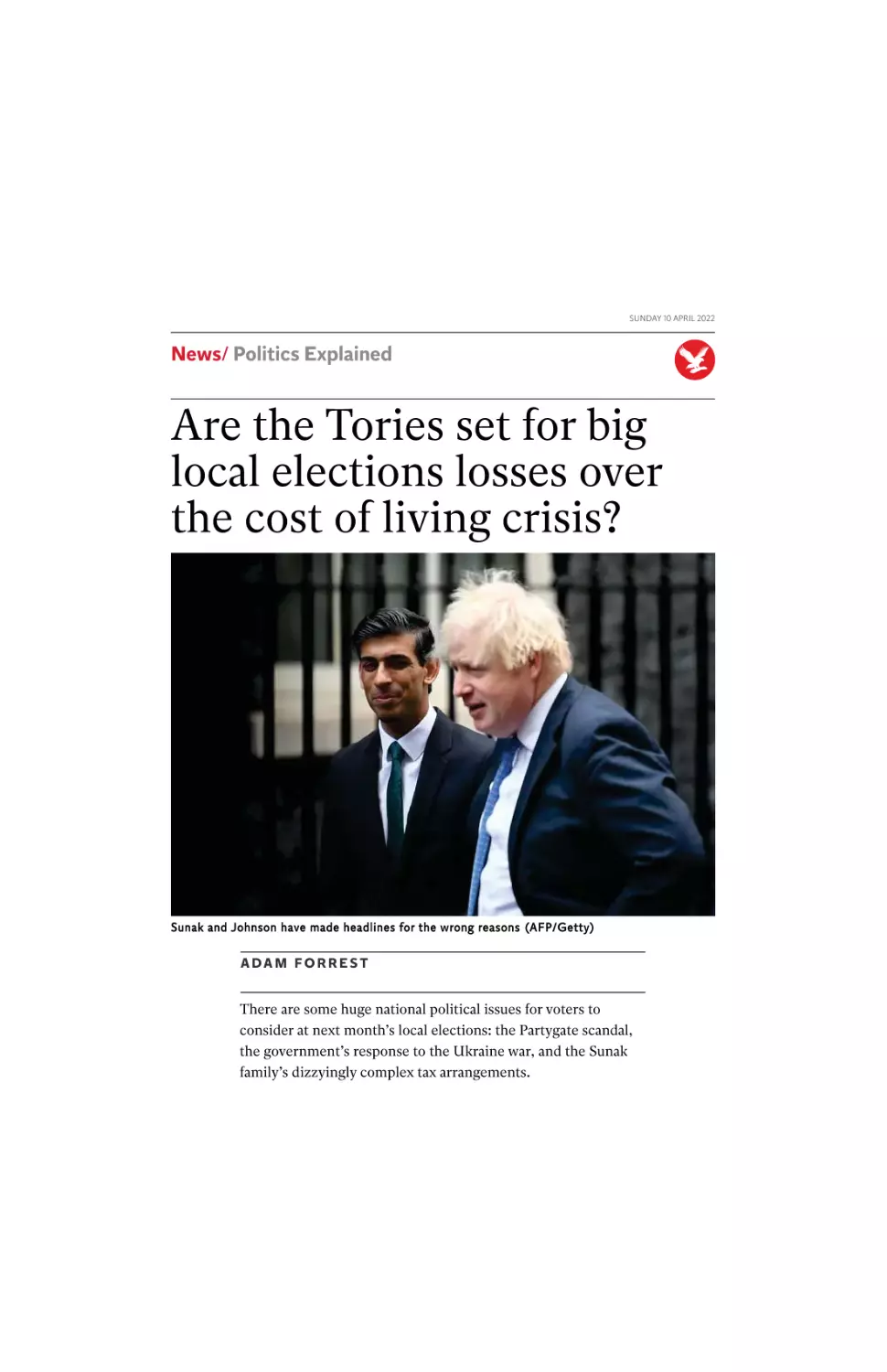
Are the Tories set for big
local elections losses over
the cost of living crisis?

S u n a k a n d J o h n s o n h a v e m a d e h e a d lii n e s f o r t h e w r o n g r e a s o n s ( A F P / G e t t y )

ADAM FORREST

There are some huge national political issues for voters to
consider at next month’s local elections: the Partygate scandal,
the government’s response to the Ukraine war, and the Sunak
family’s dizzyingly complex tax arrangements.

But crippling living costs will surely be at the very front of
people’s minds come 5 May. Britons are getting whacked by
soaring energy bills, rising food costs and a national insurance
hike, and many could opt to punish the party in power.
How big a factor will Britain’s cost of living crisis prove to be?
Some 45 per cent of Britons think reducing living costs should
be a priority for the government, a recent Kantar poll found –
making it the top concern ahead of the NHS and housing issues.
Tory MPs were spooked by a recent poll suggesting that they are
now viewed as the party of high taxation. The Savanta ComRes
survey found 39 per cent considered the Tories a “high tax”
party, while only 27 per cent saw Labour the same way.
Worse still for the party, the public are more likely to trust the
Labour to reduce their cost of living (40 per cent) than the
Conservatives (26 per cent), according to a recent Ipsos Mori
poll.
“The public are not happy about the rising costs and tax rises,
and they will be less happy in a month’s time,” says one senior
Tory figure, still angry at Rishi Sunak’s failure to drop the
national insurance hike and offer more support at his spring
statement.
However, polling guru Lord Hayward is not convinced that
soaring bills will dominate at the ballot box. The Tory peer says
the electorate is particularly “fluid” at the moment, and a lot
depends on what is dominating the headlines in the week
running up to 5 May.
“There is a perception that the spring statement was a disaster,
but if you look at opinion polling in the last two weeks it doesn’t
appear to have had an impact. The polls have been roughly
static, with a narrow Labour lead,” he tells The Independent.
Whether living costs will dominate, or whether Labour can
make more hay with Partygate, there is certainly plenty for Keir
Starmer’s to play for at the start of next month.

Tory MPs were spooked by a poll suggesting that
they are now viewed as the party of high taxation

In England, there are elections in 33 metropolitan borough
councils, 21 unitary authorities and 60 district councils – plus
the 32 London boroughs. Thousands more seats are up for grabs
in councils in Scotland and Wales.
Labour is expecting to make solid gains in London, hoping it can
take control of the Tory-held boroughs of Westminster and
Wandsworth, and possibly even Barnet. But it is vital for Starmer
to show Labour is winning back voters in the Midlands and
north of England.
Lord Hayward says Labour will be looking for a significant shift
in the vote share in those red-wall areas, compared to last year’s
poor local election showing, as evidence they are ready to mount
a serious challenge at the next general election.
“Labour will be looking to gain lost ground red wall areas, going
back to 2018 and 2019 [local election] positions. Both parties
will be looking at vote share changes in those areas,” says the
elections expert.
Tory strategists are hoping they can minimise the damage, and
even gain ground in some places – talking up their chances of
taking control of Sunderland city council.
So what kinds of stories could shift the dial decisively over the
next few weeks? Could the ongoing controversy over the tax

arrangements of the chancellor and his wife make a real
difference?
More details about Sunak’s family wealth won’t help
Conservative activists trying to fend off Labour sloganeering
about “one rule for them, another for the rest of us”. But voters
may be too worried about their own bank balances to think
much about Sunak’s finances.
As those grim gas and electricity bills begin to drop through
letterboxes, and supermarket prices creep up day by day, the
political parties have the unenviable job of convincing
increasingly scared and angry voters they that are on their side.
Want your views to be included in The Independent Daily Edition
letters page? Email us by tapping here letters@independent.co.uk.
Please include your address
BACK TO TOP

SUNDAY 10 APRIL 2022

News

Traffic jam sandwiches
Travellers to France told to bring food for long queues

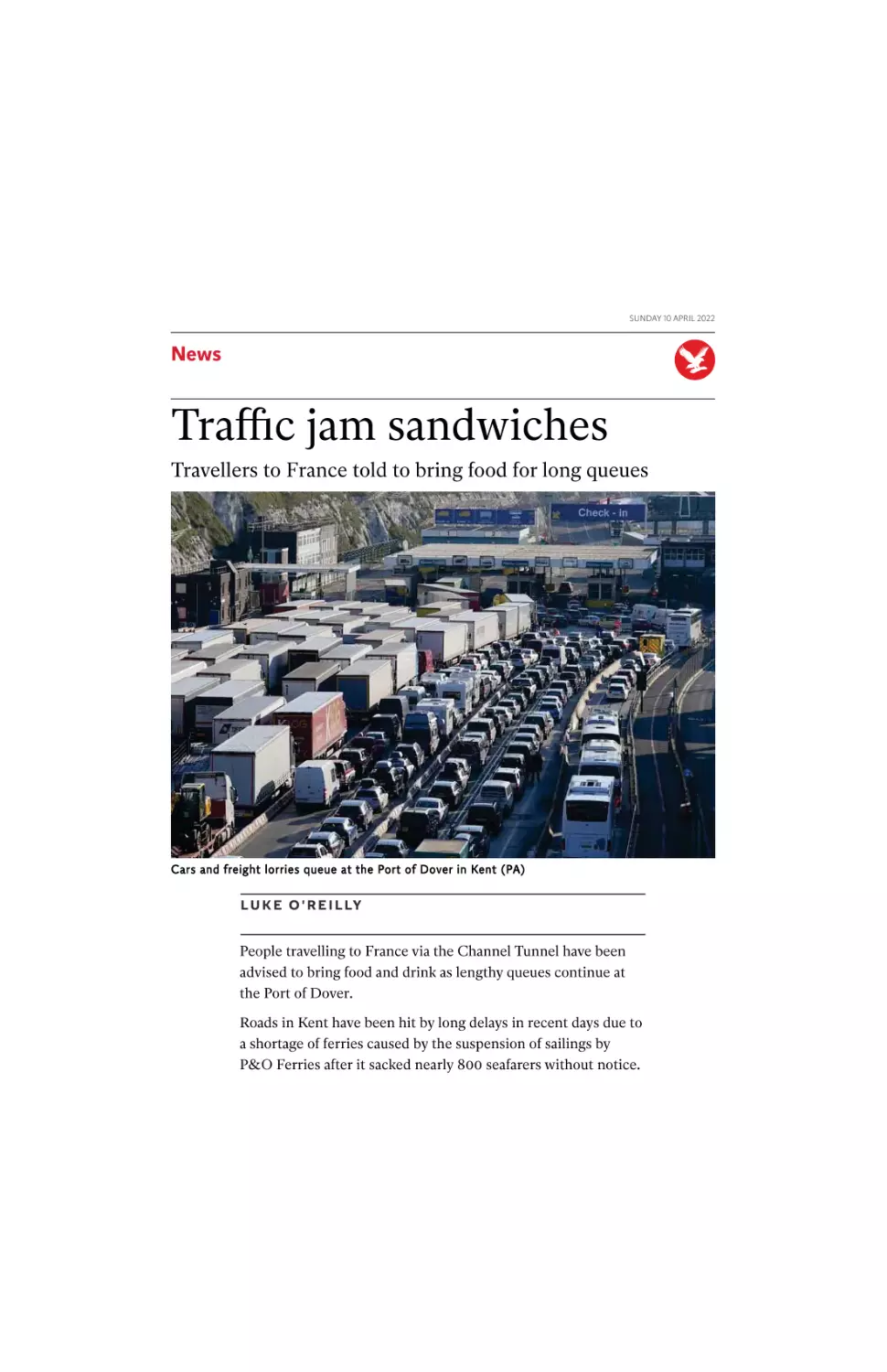
C a r s a n d f r e i g h t l o r r i e s q u e u e a t t h e P o r t o f D o v e r i n K e n t ( PA )

L U K E O ' R E I L LY

People travelling to France via the Channel Tunnel have been
advised to bring food and drink as lengthy queues continue at
the Port of Dover.
Roads in Kent have been hit by long delays in recent days due to
a shortage of ferries caused by the suspension of sailings by
P&O Ferries after it sacked nearly 800 seafarers without notice.

The operator said it plans to resume operations on the DoverCalais route next week pending regulatory approval.
Toby Howe, tactical lead at the Kent Resilience Forum, advised
travellers to France to “allow a lot of extra time”. He told BBC
Breakfast the delays had been caused by “the perfect storm”.
“Yes, we had the P&O issue,” Mr Howe said. “We then had a
storm at sea which meant that a lot of the ferries couldn’t cross
overnight.
“We had a few problems with the customs process, etc. We then
had some snow. We then had a train in the tunnels, so all of
these things had added up to culminate in the problems that we
have got for poor Kent at the moment.”
He said there had also been an IT issue with processing
documents. Mr Howe added: “Luckily things have been put in
place now so that isn’t a delay but that was something that
contributed to those initial delays.
“So last weekend Dover really suffered because of all of that
congestion. But we have put traffic management plans in place
now so that things can flow through Dover [which] can still
function as a town, and Eurotunnel and the Port of Dover are
able to operate as they need to.”
He added: “Make sure you have got some food and drink
because there will be delays. A lot of the minor roads, therefore,
are chock-a-block.”
Mr Howe advised travellers to look into the traffic on different
routes before making their journeys. He said that summer, when
traffic is likely to get busier, was a “worry”.
Mr Howe added: “What we need are plans in place moving
forward because every getaway, Kent could suffer. So we need
plans in place so that we can actually restrict that traffic coming
in. Hopefully, when the ferries are back from P&O that will
assist as well. But there will always be some problems as we
continue with this sort of thing.”
He added that it should not be Kent that “suffers” every time
there are travel issues.

Want your views to be included in The Independent Daily Edition
letters page? Email us by tapping here letters@independent.co.uk.
Please include your address
BACK TO TOP

SUNDAY 10 APRIL 2022

News

‘Brexit scenarios’ partly to
blame for Dover queues

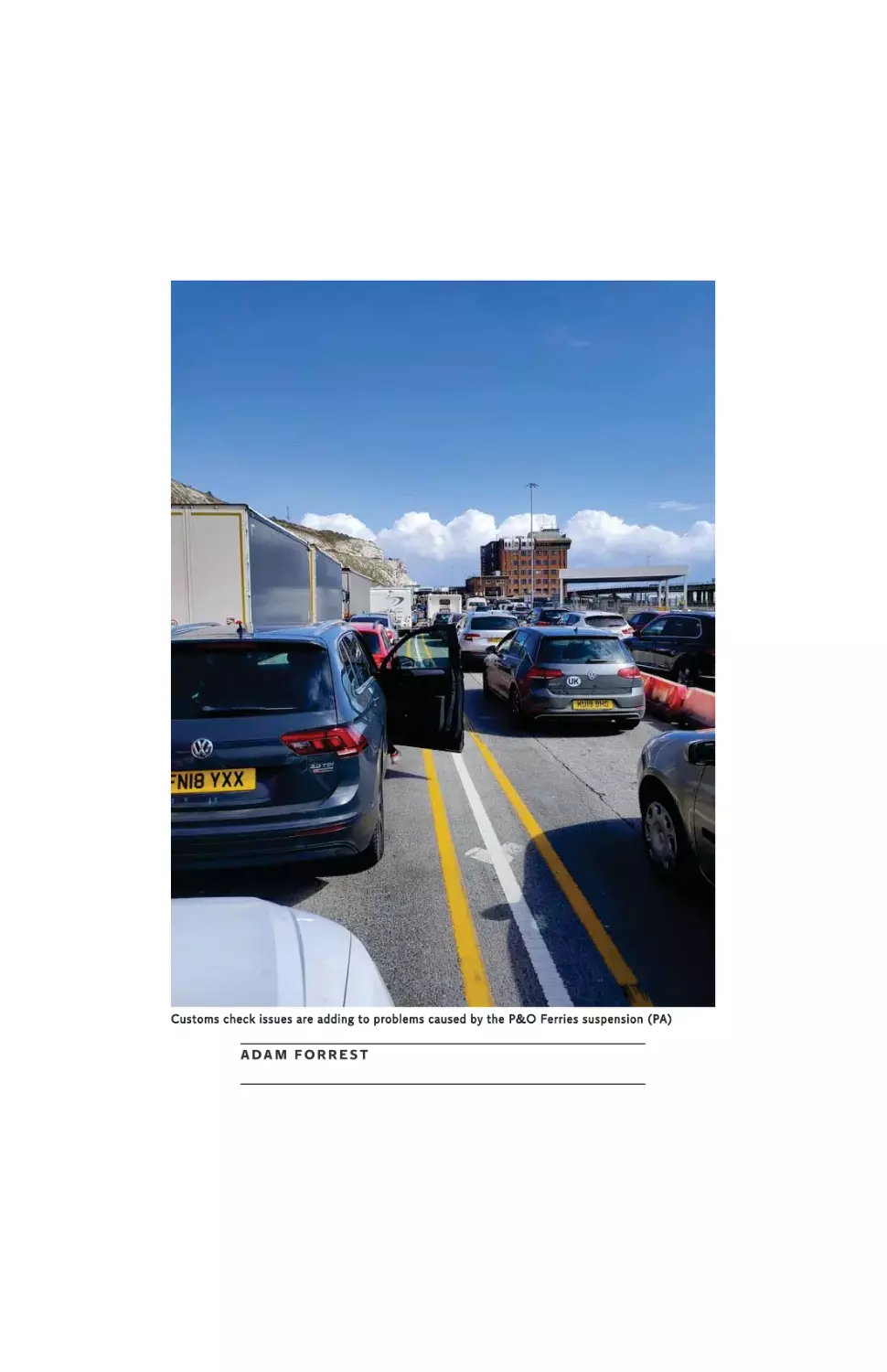
C u s t o m s c h e c k i s s u e s a r e a d d i n g t o p r o b lee m s c a u s e d b y t h e P & O F e r r i e s s u s p e n s i o n ( PA )

ADAM FORREST

Congestion around Dover is partly down to “Brexit scenarios”,
according to the head of the British Ports Association.
Chief executive Richard Ballantyne said the gridlock was mainly
down to the suspension of sailings by P&O Ferries after it
sacked 800 workers – but pointed to Brexit bureaucracy as
another factor.
“There’s still congestion,” he told Sky News yesterday. “P&O
Ferries is out of service at the moment, which is probably the
main cause of all the congestion – coupled with one or two other
little incidents, and other Brexit scenarios.”
Mr Ballantyne added: “We’re hoping things clears as soon as
possible, but I appreciate for those stuck in queues at the port
and Eurotunnel it must be very frustrating.”
Britons trying to travel to France over Easter have been advised
to bring food and drink for expected delays, as lengthy queues
continue around Dover.
The congestion in Kent has mainly blamed on the shortage of
ferries caused by the suspension of sailings by P&O Ferries
following the controversial mass sacking of seafarers.
But problems with a key IT system for post-Brexit customs
checks are also contributing traffic chaos around Dover, where
thousands of commercial lorries have been stuck in queues.
The Road Haulage Association (RHA) said the HMRC was
“continuing to have issues” with its new GVMS system for
customs declarations needed by hauliers following Britain’s exit
from the EU.
Drivers lack scannable barcodes needed for the rapid check of
lorries at ports including Dover, and temporary workaround
could be in place until Monday, the RHA said.
A message on the HMRC site says: “We are undertaking robust
investigations into our systems to address the underlying issues
behind this outage. We will provide a further update by midday
on 11 April.”

Hauliers have said it has been taking 15 to 20 minutes for each
driver to clear checks needed since full customs controls came
into force at the beginning of January.
A 23-mile stretch of the M20 has been closed to store queues
heading for Dover as part of Operation Brock, while the A20
Roundhill Tunnel was closed under the TAP traffic scheme.
Dover County Council has said it is ready to declare “a major
incident” should the traffic disruption around Dover continue
this weekend.
Mr Ballantyne said both Operation Brock and Operation Tap
were helping prevent “complete breakdown” in Dover town – as
well as keeping the port and Eurotunnel operational.
“As frustrating as it is for people in queues, it is actually
working,” said the ports chief on the traffic management plan.
Asked how soon P&O Ferries will able to start up again, Mr
Ballantyne said: “There’s politics involved in this…We’re
expecting probably imminently an announcement about P&O
going live again.”
Last month The Independent revealed that that the government
is exploring a delay to new controls on imports set to come in
July 2022 because of growing alarm over the cost of living crisis.
The Cold Chain Federation has warned of a potential “collapse”
in trade among “small volume” British businesses if the new
Sanitary and Phytosanitary (SPS) inspection of imported agrifood and plant products are imposed in the summer.
Want your views to be included in The Independent Daily Edition
letters page? Email us by tapping here letters@independent.co.uk.
Please include your address
BACK TO TOP

SUNDAY 10 APRIL 2022

News

Top scientists back hunger
strike by climate activist

A n g u s R o s e b e g a n h i s p r o t e s t o u t s i d e p a r lii a m e n t i n m i d -M
M a r c h ( Z o e T i d m a n / T h e In
ndependent)

SAPHORA SMITH
CLIMATE CORRESPONDENT

More than 75 leading scientists, including a former government
chief scientific advisor, have signed an open letter in support of

a climate activist on “indefinite” hunger strike outside the
Houses of Parliament.
Angus Rose, 52, has spent the last 27 days demanding minister
for energy, clean growth and climate change Greg Hands
organise a briefing for MPs and the cabinet so that they can
better understand the science behind the climate emergency.
He has said he wants the briefing to be televised for the public
so that everyone has an understanding of the climate crisis and
the risks it poses.
Now, dozens of scientists have signed an open letter to Mr
Hands saying they are “convinced” a “briefing on the climate
and ecological crises would help our leaders to enact the right
policies to decarbonise our society at the required pace, while
also preserving biodiversity.”
“It seems to me that it’s a minor thing to ask, and here is a man
putting his life on the line and I just feel: Please do it,” Sir David
King, a former government chief scientific advisor and special
envoy on climate change, told The Independent, when asked why
he felt compelled to sign the open letter. “What problems will it
cause if this is done?”
The news comes after Mr Rose told The Independent that he has
lost more than two stone since he began his hunger strike on 14
March and accused Mr Hands of “shirking” his responsibility.
Mr Rose, a software engineer from London, said he met Mr
Hands for fifteen minutes on Thursday, during which time the
minister urged him to reconsider his hunger strike and said it
was not in his power to organise a briefing.

Energy minister Greg Hands has advised Rose to end his
h u n g e r s t r i k e ( PA )

Instead, Mr Hands told him to contact Sir Lindsay Hoyle, the
speaker of the House of Commons, and Greg Clark, chair of the
science and technology select committee, who have the
authority to arrange a briefing, Mr Rose said. Mr Hands said he
would also speak to both men, according to Mr Rose.
“It’s shirking responsibility,” said Mr Rose, who says it’s crucial
lawmakers be briefed on climate change so that they can make
more informed decisions to help protect the future of children
around the world, including his own five nephews and niece.
The signatories of the open letter said they were “deeply
concerned” about Mr Rose whom they described as being on
“indefinite” hunger strike. The letter says that while they are not
all in agreement with the tactic of public hunger strike, they
could “unanimously” support the idea of the policy makers
receiving the latest scientific evidence on the climate and
ecological crises and its solutions.
“Most climate scientists are now anxious about the future and
expect to see catastrophic changes in their lifetimes,” the open
letter reads.
Faced with a similar demand recently, the Swiss Federal
Assembly agreed to receive a briefing from scientists about the
climate and ecological crisis, it added.

Mr Rose says he wants lawmakers to receive the same briefing
that Boris Johnson received on the climate emergency, which
reportedly helped the prime minister re-examine his beliefs on
climate change.
The presentation in question was published earlier this year by
Carbon Brief website, which obtained the slides through a
Freedom of Information request.
“There’s no reason on god’s earth why they haven’t had a
briefing yet by the chief scientific advisor,” Mr Rose told The
Independent. “All I’m asking for is an improved understanding
on this crucial issue.”
The United Nations warned this week that global emissions
must peak in the next three years to avert a “catastrophic”
temperature rise.
Days after the UN report, Mr Johnson announced plans to build
more nuclear power plants, boost renewable energy and extract
more oil and gas from the North Sea to help the country reduce
its need for Russian fossil fuels following the invasion of
Ukraine.
Green groups and climate campaigners criticised the plan,
saying it should not have included the extraction of more fossil
fuels in the UK, should have done more to build on the
country’s onshore wind power and to increase energy efficiency
and cut demand.
Critics also said it did little to ease the cost-of-living crisis in
Britain as many of the plans for greater energy supply would take
years to get up and running.
Mr Johnson said the plan would “scale up and accelerate
affordable, clean and secure energy made in Britain, for Britain –
from new nuclear to offshore wind – in the decade ahead.”
Mr Rose said reports from the UN and the UK’s Independent
Climate Change Committee could easily just sit on desks across
government, with lawmakers engaging to varying degrees.
But in a briefing organised by Sir Patrick Vallance, the
government’s chief scientific adviser, the important facts could

be distilled down into a relatively short presentation, he said.
“Just leaving politicians to their own devices to try and make
sense of it in their own time, no that’s not good enough,” he
added. “Many of them lack understanding you can see that in
the decisions they make.”
Scientists supporting Mr Rose said the climate and ecological
crisis was evolving at a” rapid pace” and that it is “increasingly
difficult for politicians to understand the significance of the
latest science that they do not have time to read and digest.”
Mr Rose said he was concerned that it could take days, if not
weeks, for Sir Hoyle and Mr Clark to respond to his request for a
briefing to be held.
Meanwhile, his supporters are increasingly concerned about his
health, as he says he is determined to carry on with his hunger
strike until his demands are met.
Mr Rose told The Independent he is increasingly feeling lightheaded, and was finding it hard to get up in the mornings. But
he said he is determined to carry on.
“This is vitally important for my nephews and niece, as it is for
other parents and their children and grandchildren,” he said.
“This has to happen, there’s no excuse.”
So far more than 1,000 people have signed an online petition
asking Mr Hands to organise a climate briefing.
A spokesperson for the the department for business, energy and
industrial strategy said Mr Hands visited Mr Rose to explain, as
he has in his earlier letters, that the information is already public
and to ask him to reconsider his “drastic” actions for his own
wellbeing.
“The Minister enquired after Mr Rose’s health and personally
reassured him about the seriousness with which the government
took climate change and its commitment to tackling the issue,”
the spokesperson added.
Want your views to be included in The Independent Daily Edition
letters page? Email us by tapping here letters@independent.co.uk.

Please include your address
BACK TO TOP

SUNDAY 10 APRIL 2022

News

Poet Laureate’s Philip elegy
shared online by royals

Ye s t e r d a y m a r k e d t h e f i r s t a n n i v e r s a r y o f t h e D u k e o f E d i n b u r g h ’ s d e a t h ( Im
m a g e s b y PA )

TONY JONES

The Queen and royal family have shared a poetic tribute to the
Duke of Edinburgh to mark the first anniversary of his death.
The elegy, written by the Poet Laureate Simon Armitage, was
posted to the royal family’s social media accounts yesterday, a
year after Philip, famously described by the Queen as her
“constant strength and guide”, died in his sleep at his Windsor
Castle home.
The poem, entitled “The Patriarchs: An Elegy”, is read by
Armitage over piano music and a video montage showing
photographs of the duke’s life, including his wedding day and
the birth of his children.
First published on the day of Philip’s funeral last year, the poem
pays tribute to his distinguished career in the Royal Navy: “On
such an occasion / to presume to eulogise one man is to pipe up
/ for a whole generation – that crew whose survival / was always
the stuff of minor miracle, / who came ashore in orange-crate
coracles, / fought ingenious wars, finagled triumphs at sea / with
flaming decoy boats, and side-stepped torpedoes.”
The duke’s generation is described in the poem as “husbands to
duty”, “great-grandfathers from birth” and “last of the great
avuncular magicians”.
In its final verse, it reads: “But for now, a cold April’s closing
moments / parachute slowly home, so by mid-afternoon / snow
is recast as seed heads and thistledown.”
Buckingham Palace announced Philip’s death just after noon on
9 April last year, issuing a statement that spoke about the royal
family joining with people across the globe to grieve. He passed
away just a few months short of his 100th birthday.
A man known as much for his keen interest in engineering and
science as his outspoken comments and gaffes, the duke was
central to the monarch’s life.
Philip became an international figure when he married the
Queen more than 70 years ago, and his death was marked with

tributes from world leaders, foreign royal families and charities
he supported.

T h e Q u e e n a c c e p t s a s p e c i a l r o s e t o m a r k w h a t w o u ld
d h ave
b e e n P h i l i p’s 1 0 0 t h b i r t h d ay o n 1 0 J u n e l a s t ye a r

At the recent service of thanksgiving for Philip’s life, Dean of
Windsor the Right Rev David Conner paid tribute to his abilities
and also highlighted his shortcomings.
He described the Duke of Edinburgh as a man of “passionate
commitment” who devoted his “intellectual and physical
energy” to a “host of down-to-earth enterprises”, but he could
also be “abrupt” in a “robust conversation, forgetting just how
intimidating he could be”.
The Queen is believed to be at Windsor Castle and it is
understood she will mark the first anniversary of the death of
her husband privately.
In her Christmas Day broadcast last year, she reflected on a year
of personal grief, saying there was “one familiar laugh missing”
as she acknowledged the death of her husband.
She gave a personal tribute to her “beloved Philip” and remarked
how his “mischievous, enquiring twinkle was as bright at the
end as when I first set eyes on him”.
At the duke’s funeral, attended by just 30 mourners due to
Covid regulations, the Queen was pictured sitting alone wearing
a face mask.

The royal family marked what would have been the duke’s 100th
birthday – 10 June 2021 – with pictures of Philip posted on social
media in tribute.
Princess Eugenie wrote on Instagram: “Thinking of Grandpa on
what would have been his 100th birthday.”

P h i lii p ’ s n a v a l u n i f o r m f o r m s p a r t o f a n e w e x h i b i t a t t h e
Na t i o n a l M u s e u m of t h e Roya l Nav y i n Po r t s m o u t h

The princess shared an image of her grandparents, Philip and
the Queen, together at her 2018 wedding outside St George’s
Chapel at Windsor Castle.
The Earl of Wessex, however, told CNN that his father was
“incredibly self-effacing” and probably would not have wanted
the hassle of celebrating turning 100.
Edward said: “I don’t think he really necessarily wanted to reach
his centenary because I just think he thought there would be too
much fuss and that wasn’t him, that was just not him at all.”
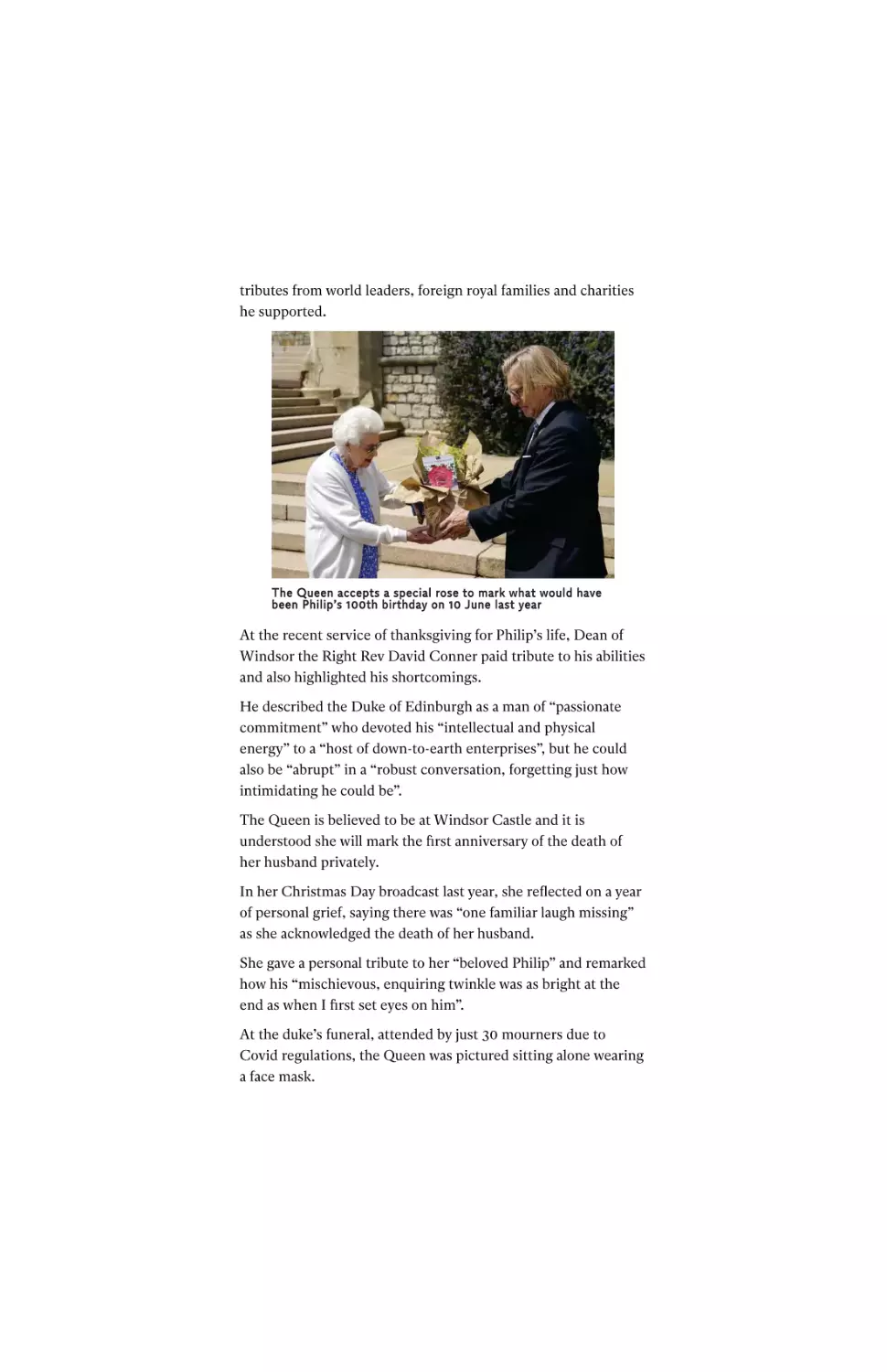
The Queen marked the occasion by watching the planting of a
newly-bred rose named after her late husband, a gift from the
Royal Horticultural Society, which was placed in the Windsor
Castle gardens.
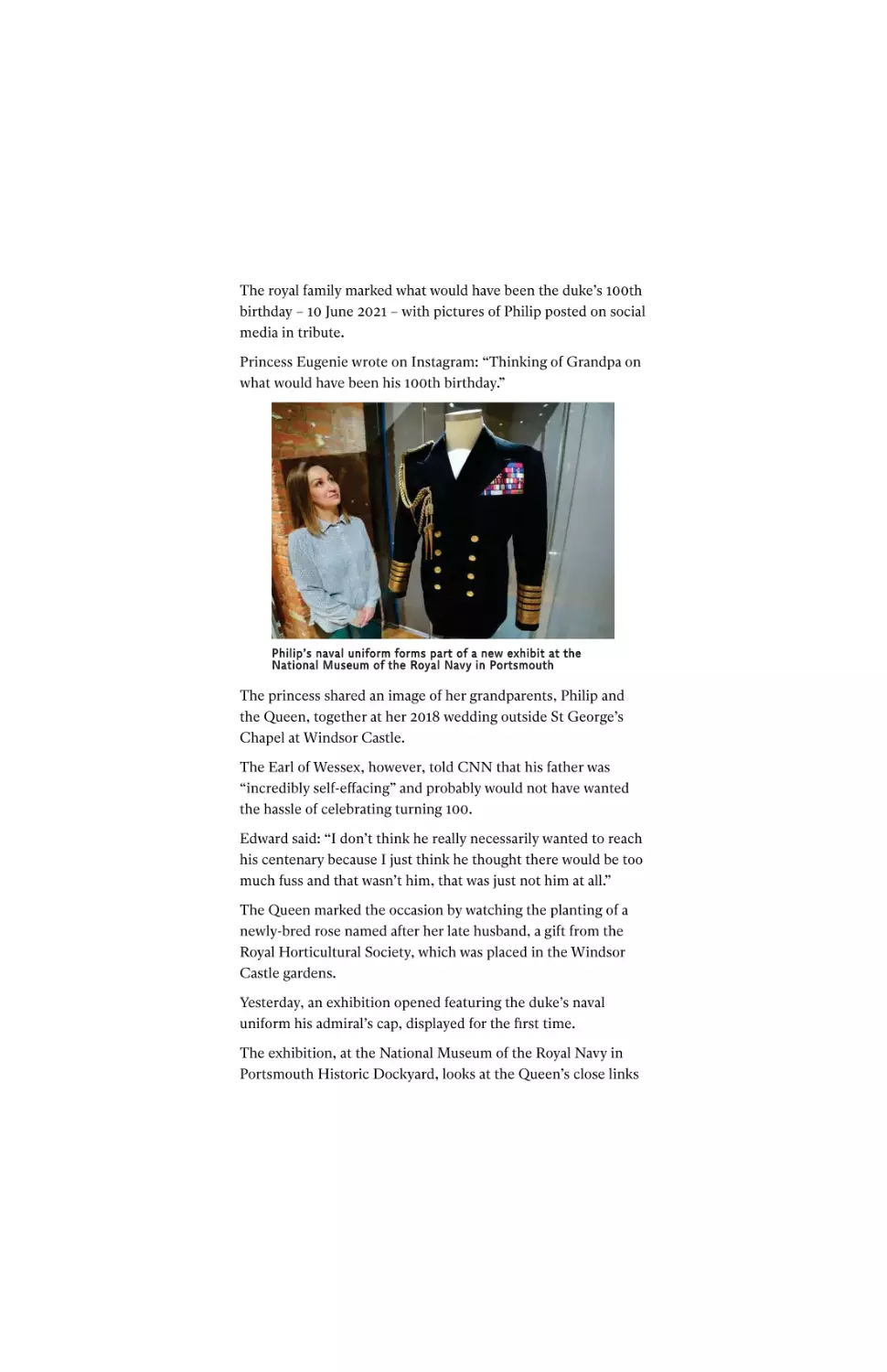
Yesterday, an exhibition opened featuring the duke’s naval
uniform his admiral’s cap, displayed for the first time.
The exhibition, at the National Museum of the Royal Navy in
Portsmouth Historic Dockyard, looks at the Queen’s close links

to the Navy as part of celebrations for her Platinum Jubilee.
Want your views to be included in The Independent Daily Edition
letters page? Email us by tapping here letters@independent.co.uk.
Please include your address
BACK TO TOP

SUNDAY 10 APRIL 2022

News

Hunt for boy, 14, continues
as British and French divers
are rescued in Malaysia

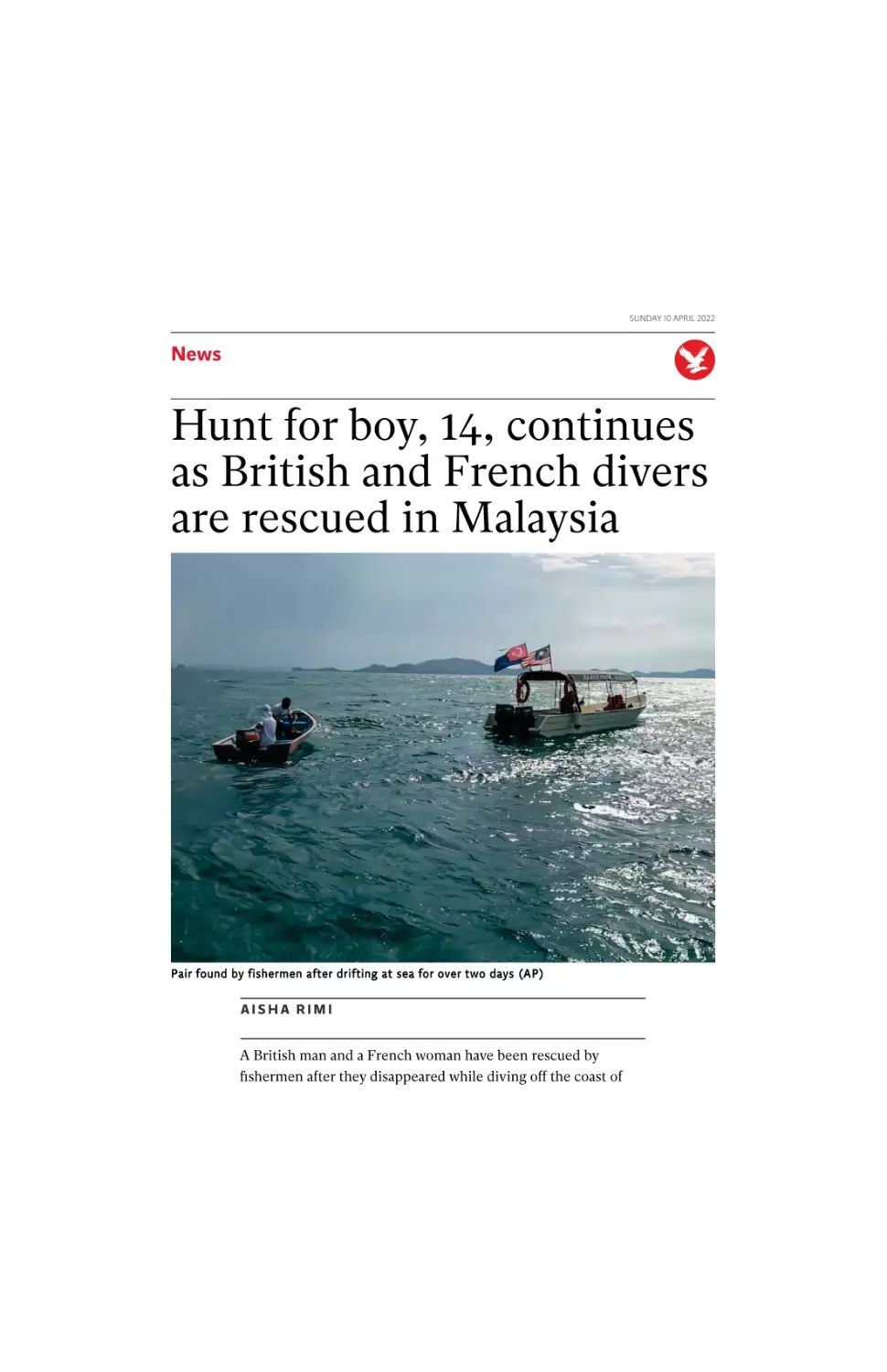
P a i r f o u n d by f i s h e r m e n a f t e r d r i f t i n g a t s e a f o r o v e r t w o d ay s (A P )

AISHA RIMI

A British man and a French woman have been rescued by
fishermen after they disappeared while diving off the coast of

Malaysia, but a 14-year-old boy remains missing, police said.
Adrian Chesters, 46, was found safe in the early hours of
yesterday morning, drifting at sea for two and a half days.
Rescuers are still on the hunt for Mr Chester’s 14-year-old son,
Nathan Renze Chesters.
Mr Chesters was rescued alongside Alexia Molina, 18, at around
1am in waters off Pengerang, a considerable distance south of
where they disappeared, Mersing district police chief Cyril
Nuing told reporters.
“Both individuals … are reported to be in stable conditions,” he
said, adding that marine police had taken them to hospital. He
declined to provide further details of the rescue.
Mr Chesters, his son and Ms Molina were among four people
who went missing on Wednesday 6 April at around noon on a
training dive in waters about 50 feet deep near Tokong Sanggol,
a small island off the southeastern town of Mersing.
The group’s instructor, Kristine Grodem, 35, from Norway, was
rescued by a tugboat on Thursday.
Ms Grodem told officials the group surfaced about an hour into
their dive on Wednesday but could not find their boat. She was
later separated after being caught in strong currents.
The search has now moved south to where Mr Chesters and Ms
Molina were found. Two aircrafts, nine boats and some 85
personnel, as well as fishermen, are involved in the expanded
search, Mersing maritime chief Khairul Nizam Misran said.
The boat operator who took them to the dive site was detained
for further investigation after testing positive for drugs, police
said.
Diving off of Mersing has been suspended. Several towns in the
area are popular dive spots for local residents and tourists.
Malaysia’s borders reopened to foreigners on 1 April after being
closed for more than two years during the pandemic.

Want your views to be included in The Independent Daily Edition
letters page? Email us by tapping here letters@independent.co.uk.
Please include your address
BACK TO TOP

SUNDAY 10 APRIL 2022

News

Pictures of the Day

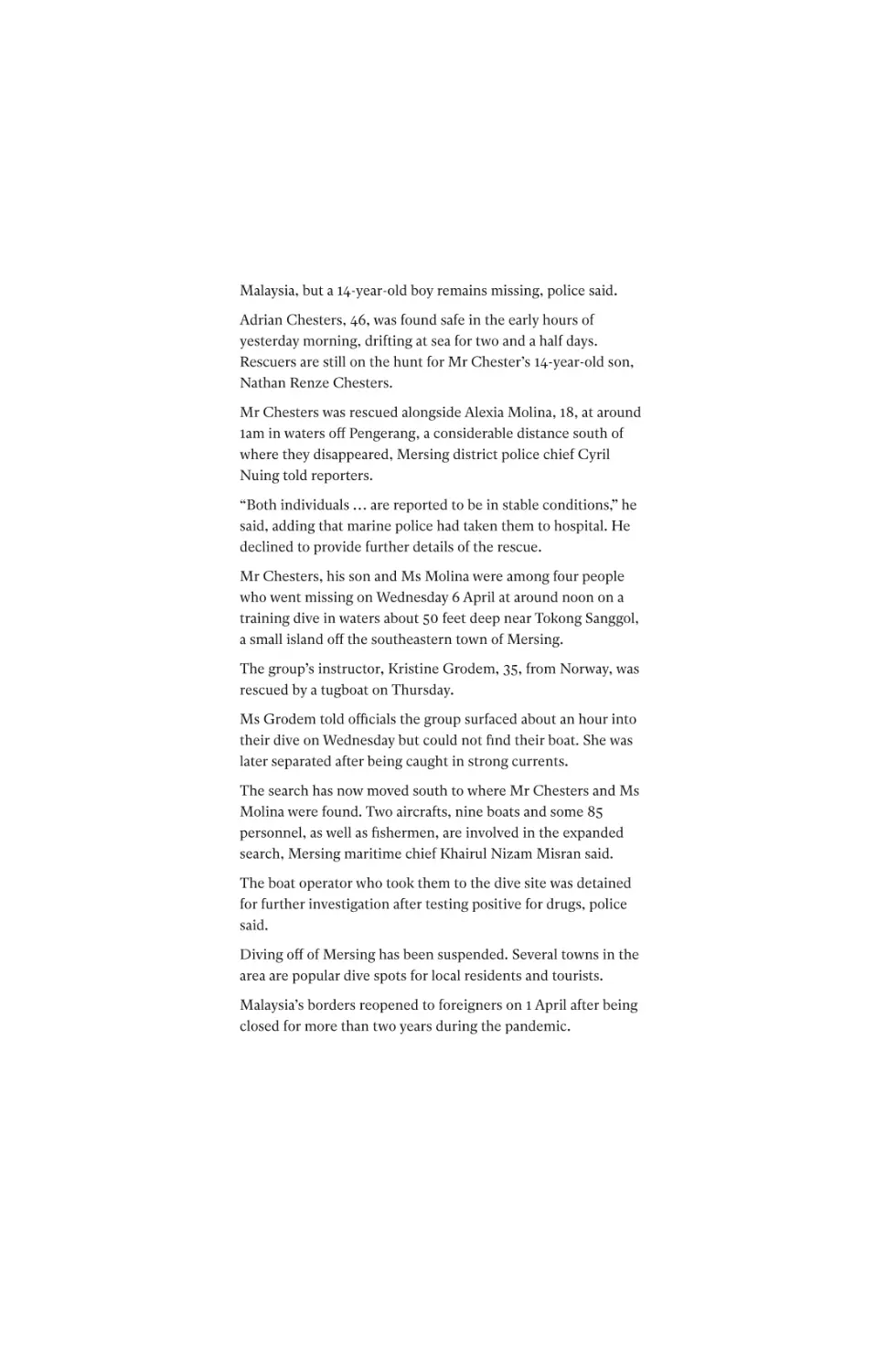
Danger money
Ravi Kumar stretches out his hand from his fast moving car to
grab money offered by a spectator in Maut ka Kuan (”the well of
death”) at a fair in Dharmsala, India. AP

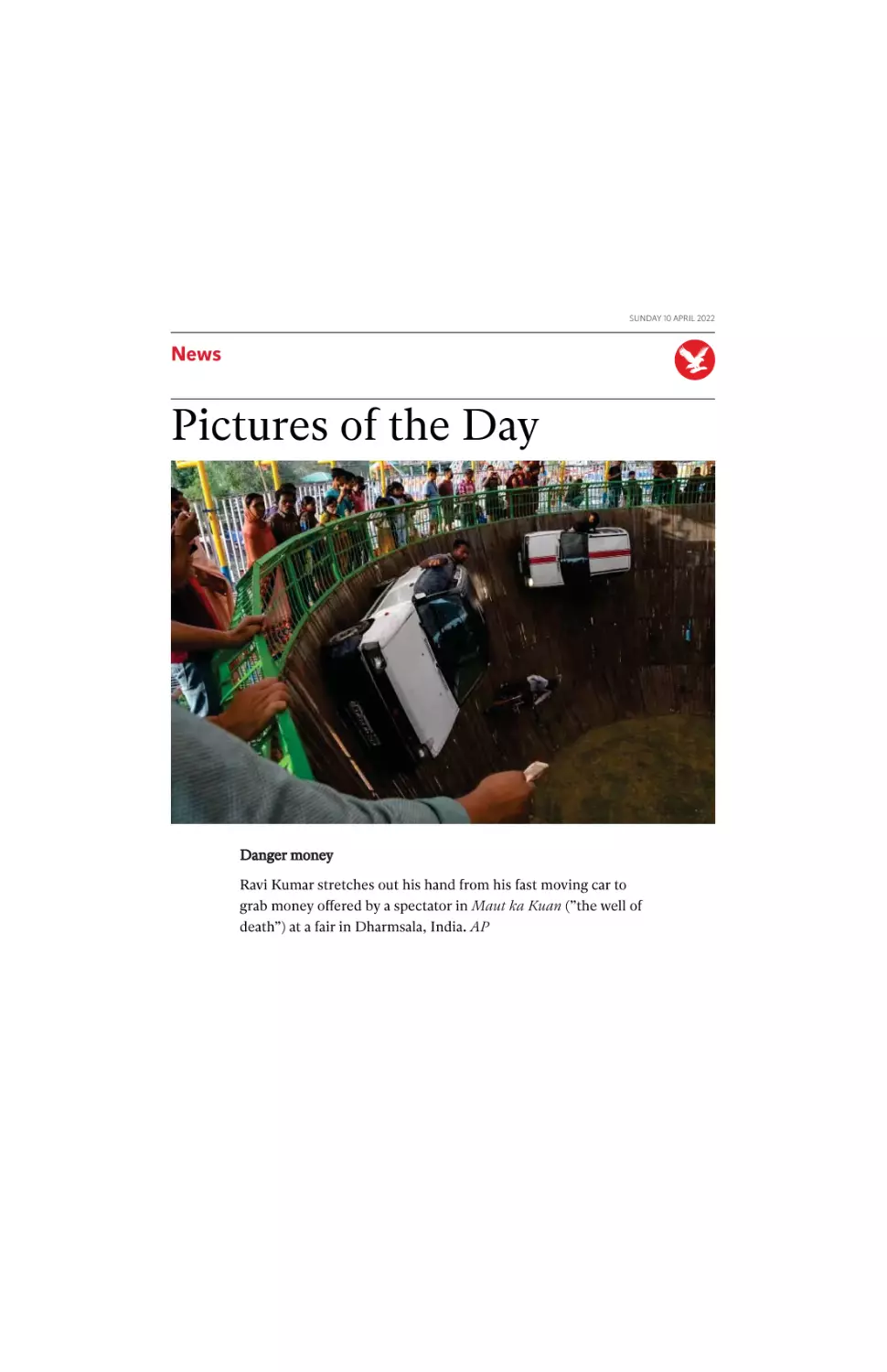
‘What’s the quack?’
A duck with weeds stuck to its breast on a sunny day in the
National Botanic Gardens, Dublin. PA

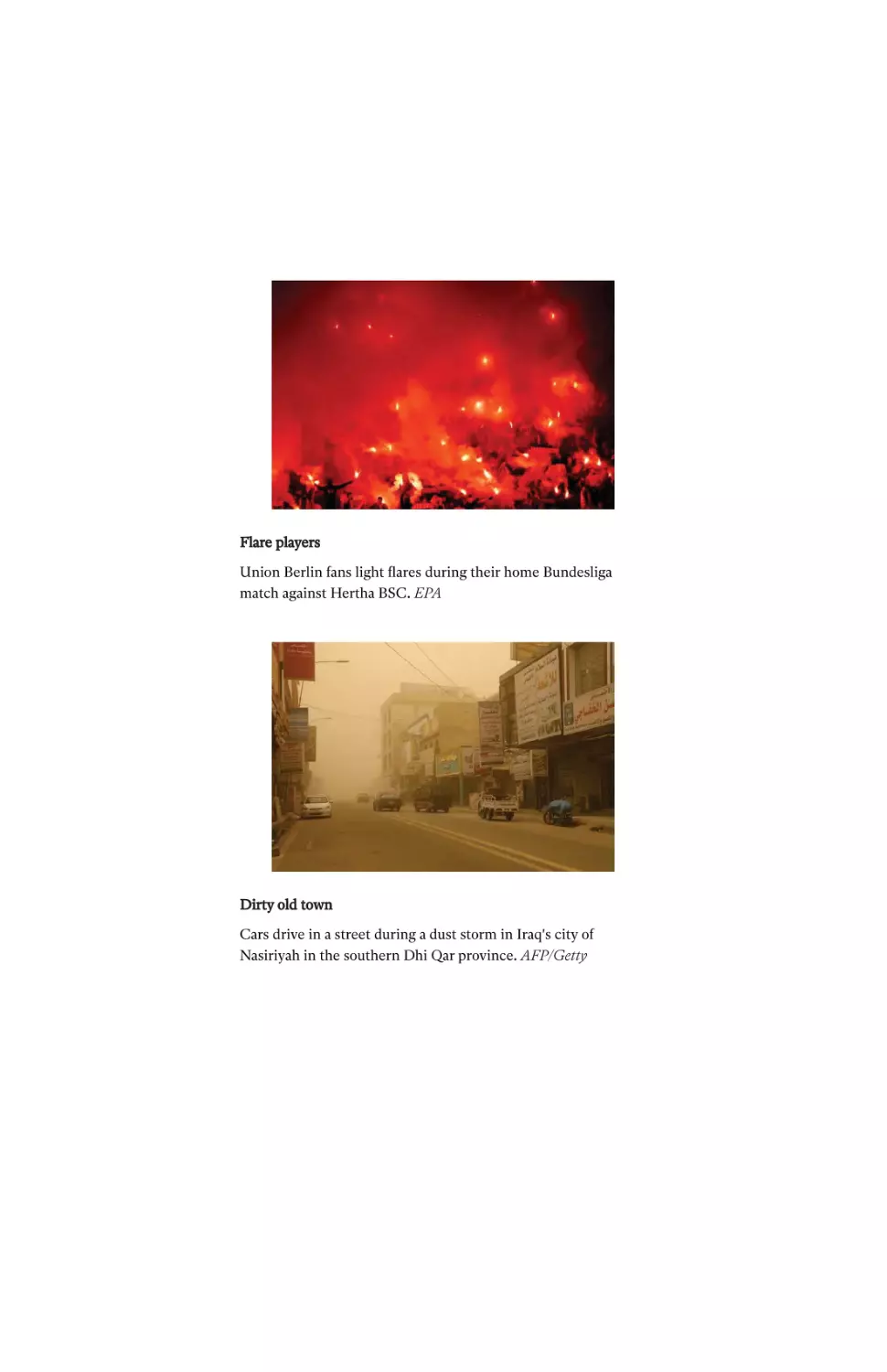
Flare players
Union Berlin fans light flares during their home Bundesliga
match against Hertha BSC. EPA

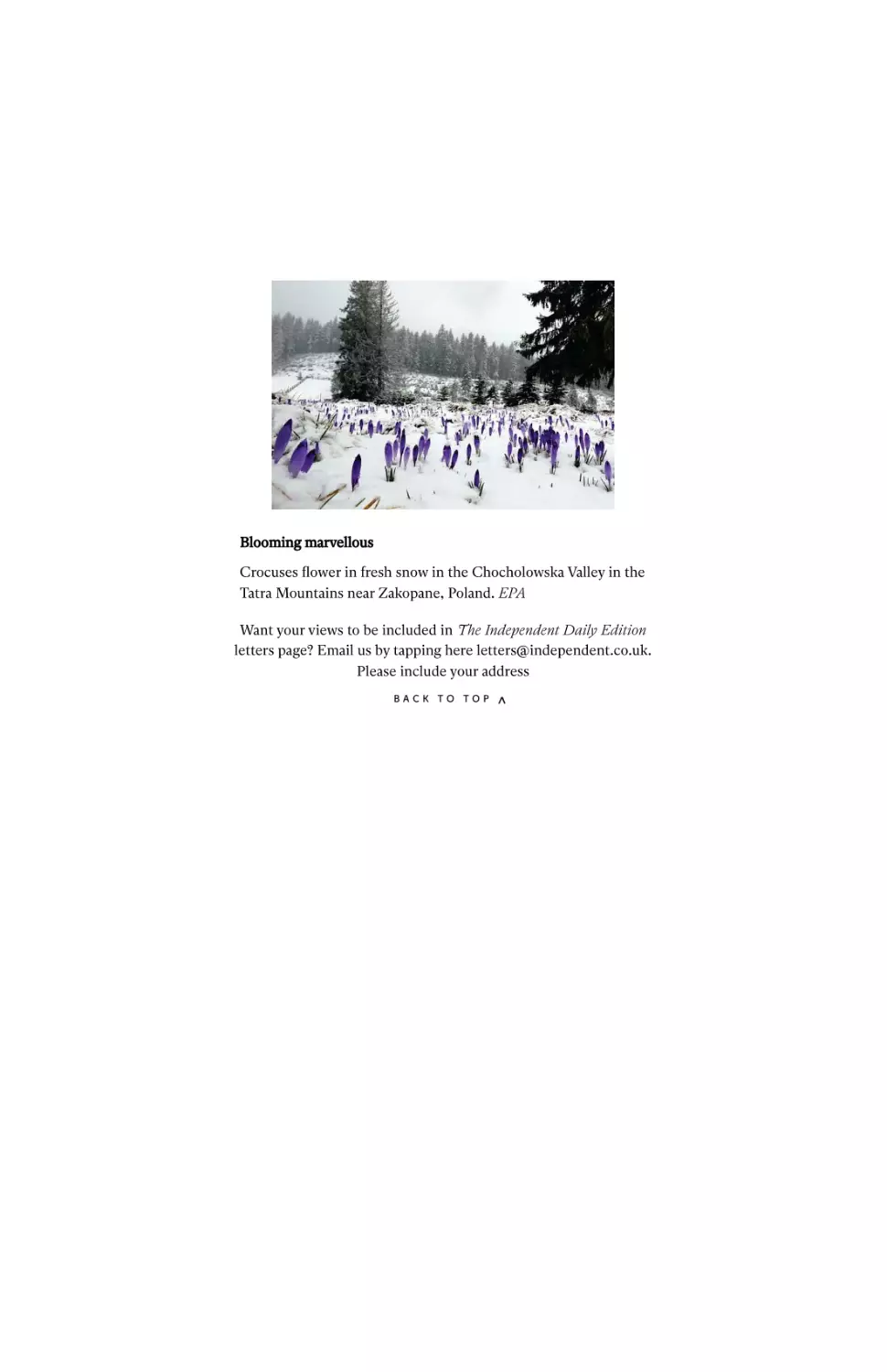
Diirty old town
Cars drive in a street during a dust storm in Iraq's city of
Nasiriyah in the southern Dhi Qar province. AFP/Getty

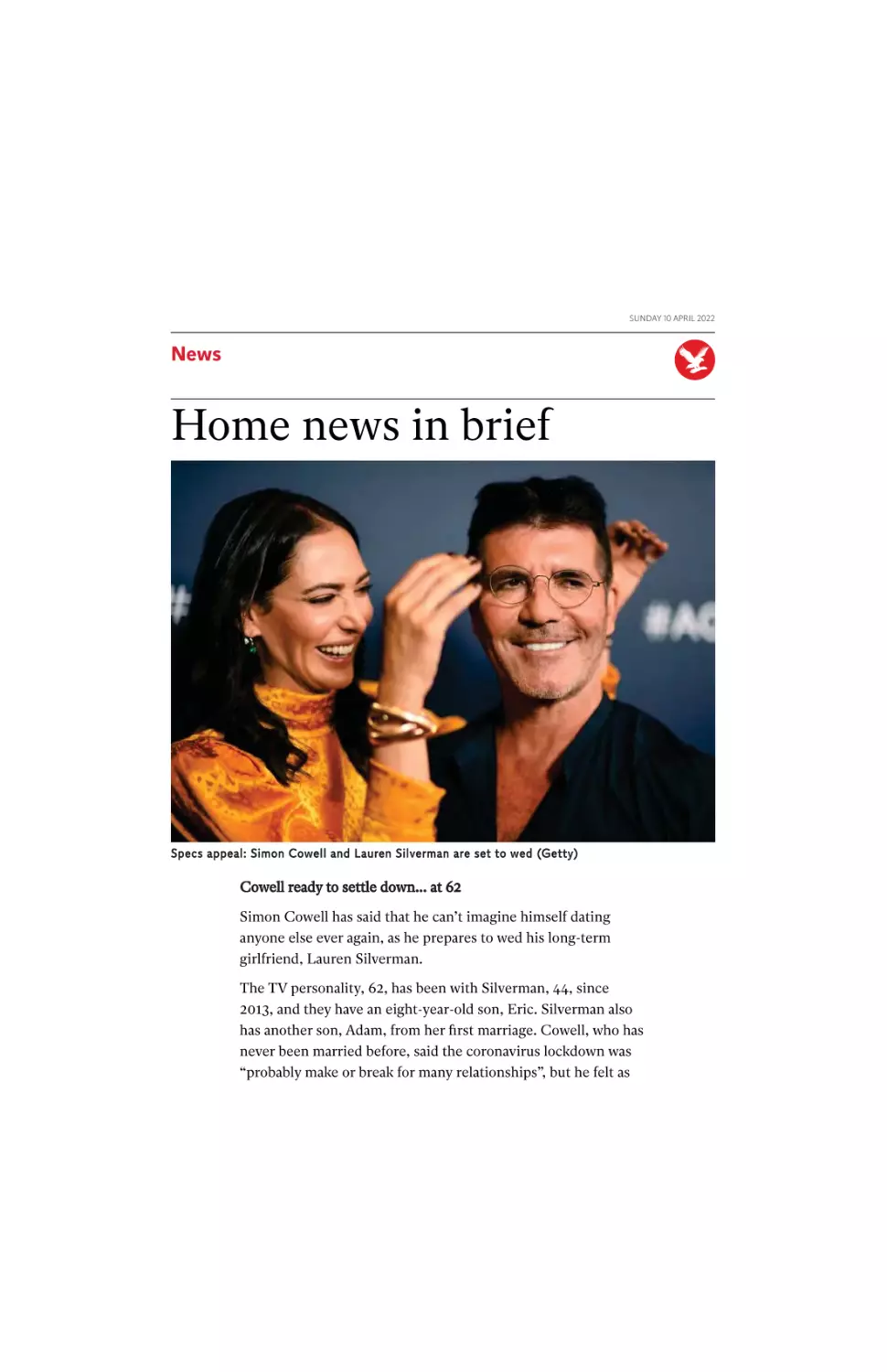
Blooming marvellous
Crocuses flower in fresh snow in the Chocholowska Valley in the
Tatra Mountains near Zakopane, Poland. EPA
Want your views to be included in The Independent Daily Edition
letters page? Email us by tapping here letters@independent.co.uk.
Please include your address
BACK TO TOP

SUNDAY 10 APRIL 2022

News

Home news in brief

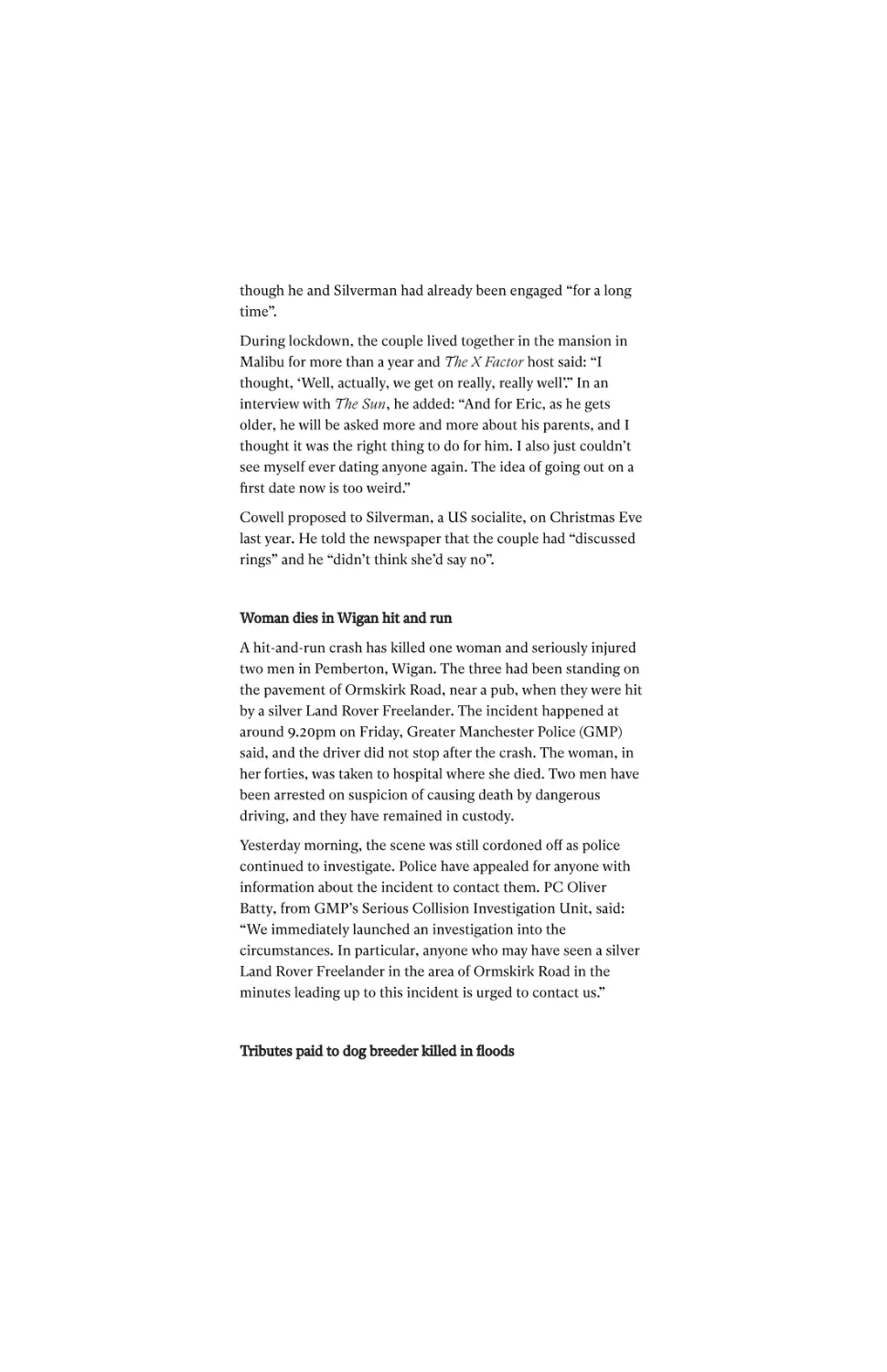
S p e c s a p p e a l:: S i m o n C o w e ll a n d L a u r e n S i lvv e r m a n a r e s e t t o w e d ( G e t t y )

Cowell ready to settle down... at 62
Simon Cowell has said that he can’t imagine himself dating
anyone else ever again, as he prepares to wed his long-term
girlfriend, Lauren Silverman.
The TV personality, 62, has been with Silverman, 44, since
2013, and they have an eight-year-old son, Eric. Silverman also
has another son, Adam, from her first marriage. Cowell, who has
never been married before, said the coronavirus lockdown was
“probably make or break for many relationships”, but he felt as

though he and Silverman had already been engaged “for a long
time”.
During lockdown, the couple lived together in the mansion in
Malibu for more than a year and The X Factor host said: “I
thought, ‘Well, actually, we get on really, really well’.” In an
interview with The Sun, he added: “And for Eric, as he gets
older, he will be asked more and more about his parents, and I
thought it was the right thing to do for him. I also just couldn’t
see myself ever dating anyone again. The idea of going out on a
first date now is too weird.”
Cowell proposed to Silverman, a US socialite, on Christmas Eve
last year. He told the newspaper that the couple had “discussed
rings” and he “didn’t think she’d say no”.

Woman dies in Wigan hit and run
A hit-and-run crash has killed one woman and seriously injured
two men in Pemberton, Wigan. The three had been standing on
the pavement of Ormskirk Road, near a pub, when they were hit
by a silver Land Rover Freelander. The incident happened at
around 9.20pm on Friday, Greater Manchester Police (GMP)
said, and the driver did not stop after the crash. The woman, in
her forties, was taken to hospital where she died. Two men have
been arrested on suspicion of causing death by dangerous
driving, and they have remained in custody.
Yesterday morning, the scene was still cordoned off as police
continued to investigate. Police have appealed for anyone with
information about the incident to contact them. PC Oliver
Batty, from GMP’s Serious Collision Investigation Unit, said:
“We immediately launched an investigation into the
circumstances. In particular, anyone who may have seen a silver
Land Rover Freelander in the area of Ormskirk Road in the
minutes leading up to this incident is urged to contact us.”

Tributes paid to dog breeder killed iin
n fl
flo
oods

A UK-born dog breeder has died after he got caught in severe
floods on the outskirts of Sydney. Tony Ikin, 68, was due to
attend the Royal Easter Show, which was being officially opened
by Anne, the Princess Royal yesterday before his van was
submerged by rising floodwaters.
The body of the father-of-two, a well-known and respected dog
breeder and judge, was found in his van on the morning of
Friday 8 April at Cobbitty, about 43 miles southwest of Sydney,
New South Wales Police said. Speaking to Australia’s 9 News,
his friend, Robert Zammit said: “He loved his dogs, of course,
but he was just a gentle human being.”
He described Mr Ikin as a “gentle soul” who would “help
everyone”. “Tony was not the sort of person who would take a
risk,” he added. “He left home to come to the Royal Easter show
early, it would have been dark. He must have thought it was not
too deep.”

Owner ‘in shock’ after tornado batters Welsh ffaarm
Strong winds that caused “at least £100,000” of damage to a
farm in north Wales have been confirmed as a tornado,
according to experts. The extreme weather struck Gogarth Hall
Farm in Pennal on Wednesday, uprooting trees and lifting a ewe
and lambs into the air.
The Tornado and Storm Research Organisation (Torro) said it
had investigated the site and believed that the damage was
caused by a T3 tornado. Investigator John Mason said objects
had spun around before falling to the ground. “The tornado was
confirmed as there was plenty of evidence of objects being
airborne and spinning around the circulation before falling to
the ground,” he said.
He added that he believed it had a strength of between 93mph114mph. Deilwen Breese, owner of Gogarth Hall Farm, said
she was away from the farm when she received a phone call
telling her to come home. Ms Breese said she did not realise the
scale of the damage until she got back. “I thought it was just that

part of the roof had gone,” she said. “But oh my god, when I
came home I could not believe it. The devastation, it was
heartbreaking.” PA
Want your views to be included in The Independent Daily Edition
letters page? Email us by tapping here letters@independent.co.uk.
Please include your address
BACK TO TOP

SUNDAY 10 APRIL 2022

World

Le Pen closes in on Macron
in France general election
The president has a fight on his hands after being the
favourite for much of the running, says Borzou Daragahi

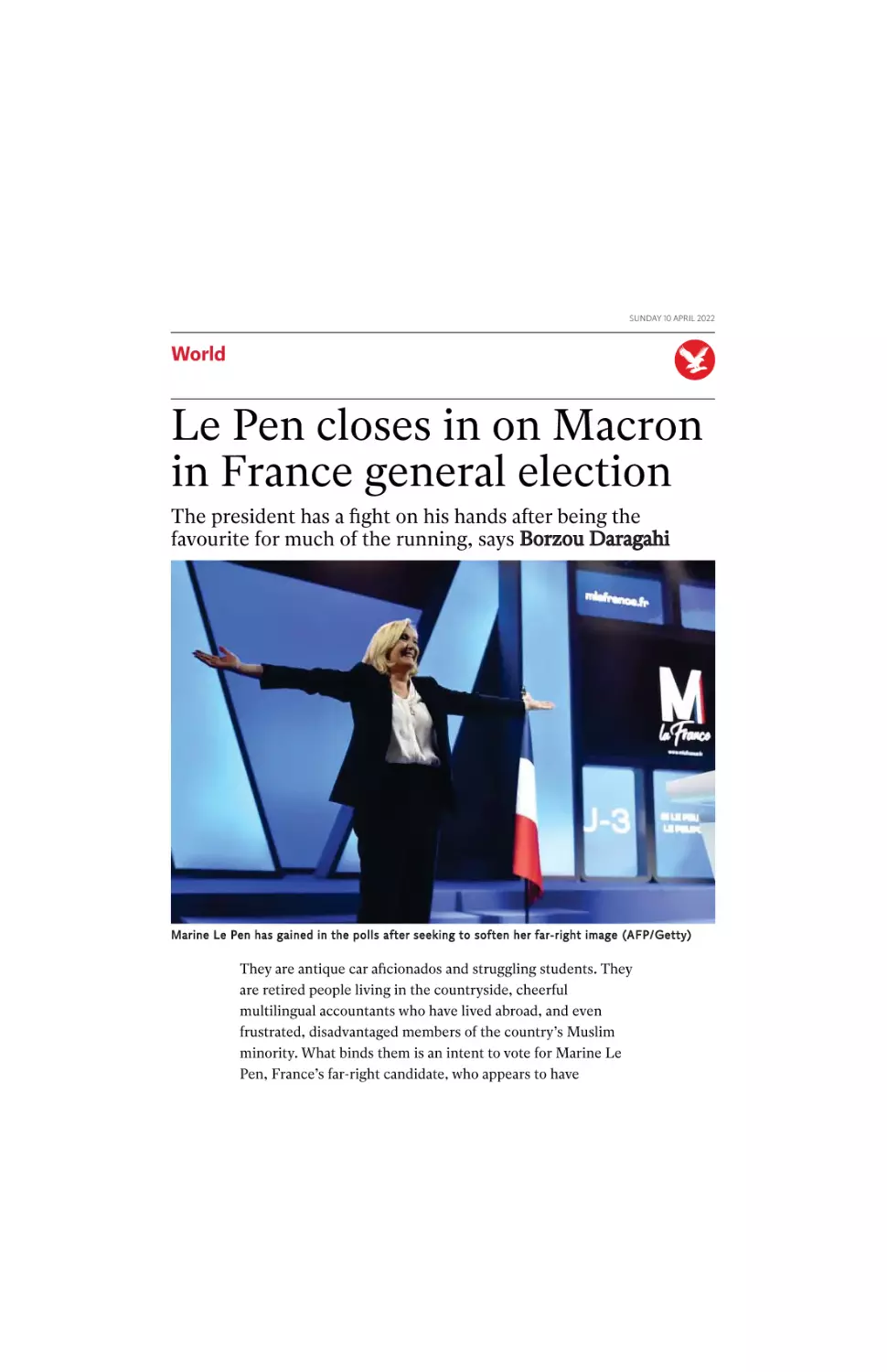
M a r i n e L e P e n h a s g a i n e d i n t h e p o llss a f t e r s e e k i n g t o s o f t e n h e r f a r -rr i g h t i m a g e ( A F P / G e t t y )

They are antique car aficionados and struggling students. They
are retired people living in the countryside, cheerful
multilingual accountants who have lived abroad, and even
frustrated, disadvantaged members of the country’s Muslim
minority. What binds them is an intent to vote for Marine Le
Pen, France’s far-right candidate, who appears to have

successfully smoothed out the harsher edges of her image as a
proto-fascist bigot and arrived within striking range of the
presidency.
“Voting Marine Le Pen in 2022 has nothing to do with racism or
fascism,” says Nathan Gazzoli, a 19-year-old student in Toulouse
and a first-time voter. “It is a vote for the people.”
While most polls show incumbent president Emmanuel Macron
narrowly winning the vote, a stunning survey by Atlas Politico
on Thursday showed Ms Le Pen, heir to the far-right National
Front party founded by her father, Jean-Marie, edging out Mr
Macron by 50.5 per cent to 49.5 per cent in a hypothetical
second-round match-up.
The French head to the polling stations today for the first round
of elections, which come at a particularly crucial moment in
European history, with Russia waging war against Ukraine and
the world emerging from a two-year pandemic. Ms Le Pen, who
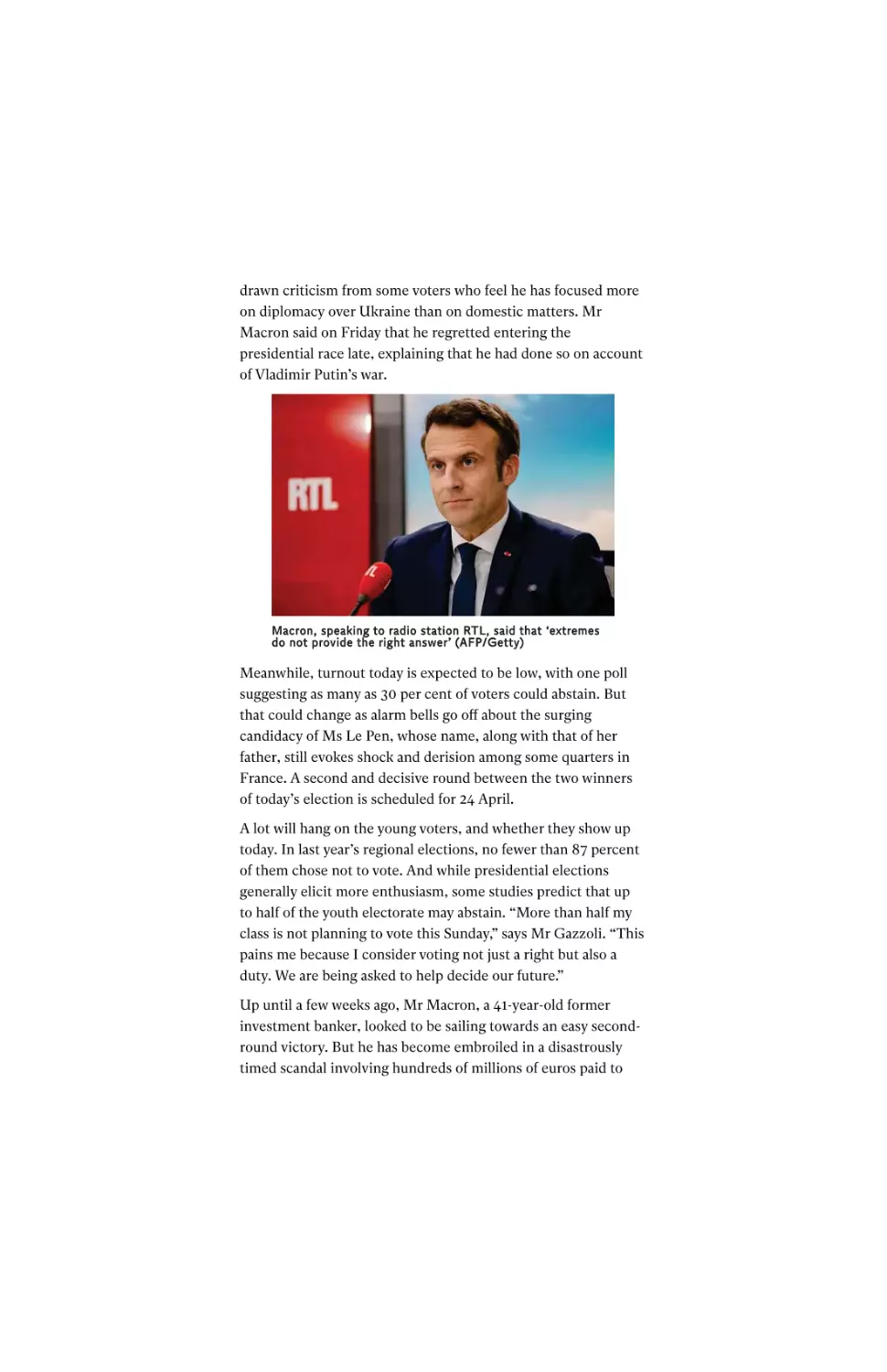
has been campaigning aggressively across France – and even
abroad – for months, initially spurred doubts when she shifted
her rhetoric away from immigration and cultural issues, which
were the core of her father’s political platform, and focused on
economic matters such as inflation, purchasing power and the
retirement age.
Her stump speeches became more Jeremy Corbyn than Viktor
Orban, the Hungarian prime minister whom she considers a
close ally. “If the purchasing power issue is strangling you today,
it’s because previous politicians have impoverished you, have
made public accounts collapse, and have even put our children
into debt for a long time,” Ms Le Pen told a crowd in the
southern city of Perpignan this week.

L e P e n h a s b e e n c a m p a i g n i n g a g g r e s s i v e lyy a c r o s s F r a n c e f o r
m o n t h s (A F P/ G e t t y)

That shift is now vindicated, as her party, Rassemblement
National (National Rally), is poised to perform better than it ever
has in its 50-year history. “I believe in France,” she said in an
interview this week with The European Conservative. “I dedicate
every second of my life to the happiness of the French people,
who are the top priority in all my battles.”
Although Ms Le Pen is still behind Mr Macron in all but one
poll, she has made up significant ground in recent weeks, while
the French are notoriously fickle when it comes to their voting
intentions. In polls conducted just a week before the election, a
third of the electorate said they might still change their voting
intention and dump their preferred candidate. Both the left and
the right of the political spectrum are crowded, while Mr
Macron is the undisputed champion of centrists.
“What matters to me [is] to go and convince people who are
tempted by extremes that extremes do not provide the right
answer; that the fears people have are sometimes legitimate, but
the real answer is different, and it can sometimes take time,” Mr
Macron said in a radio interview earlier this week.
Mr Macron has seen his lead in the polls fade since March,
having lost favour in the light of conservative proposals such as
raising the retirement age to 65, cutting inheritance tax, and
tightening access to welfare benefits. The president has also

drawn criticism from some voters who feel he has focused more
on diplomacy over Ukraine than on domestic matters. Mr
Macron said on Friday that he regretted entering the
presidential race late, explaining that he had done so on account
of Vladimir Putin’s war.

Ma c ro n , s p e a k i n g t o r a d i o s t a t i o n RT L , s a i d t h a t ‘e x t re m e s
d o n o t p r o v i d e t h e r i g h t a n s w e r ’ (A F P/ G e t t y)

Meanwhile, turnout today is expected to be low, with one poll
suggesting as many as 30 per cent of voters could abstain. But
that could change as alarm bells go off about the surging
candidacy of Ms Le Pen, whose name, along with that of her
father, still evokes shock and derision among some quarters in
France. A second and decisive round between the two winners
of today’s election is scheduled for 24 April.
A lot will hang on the young voters, and whether they show up
today. In last year’s regional elections, no fewer than 87 percent
of them chose not to vote. And while presidential elections
generally elicit more enthusiasm, some studies predict that up
to half of the youth electorate may abstain. “More than half my
class is not planning to vote this Sunday,” says Mr Gazzoli. “This
pains me because I consider voting not just a right but also a
duty. We are being asked to help decide our future.”
Up until a few weeks ago, Mr Macron, a 41-year-old former
investment banker, looked to be sailing towards an easy secondround victory. But he has become embroiled in a disastrously
timed scandal involving hundreds of millions of euros paid to

consultancy firms to advise the state on the Covid crisis. Mr
Macron has defended his government, but the saga has drawn
criticism from the right and left, reinforcing the view that he is
an out-of-touch elitist more focused on the interests of the
super-rich than on those of ordinary French people.
“He stigmatises and he despises the unions by saying that, in the
classrooms, there are teachers who do the ‘union minimum’ vs
the teachers who do more,” Yannick Jadot, the Green Party
candidate, said on Thursday, according to Le Monde. “I find it
shameful.”
The failure of the left-wing contenders to unite under one
candidate has benefited both Mr Macron and Ms Le Pen. JeanLuc Melenchon, the leader of the far-left La France Insoumise,
has also surged in polls in recent weeks, but not nearly enough
to reach the second round. He has also campaigned on
economic issues and sought to address voters’ daily concerns,
but has been pilloried by the candidates of the Socialist, Green
and Communist parties.

T h e f a i lu
u r e o f t h e lee f t -w
wing contenders to unite under one
c a n d i d a t e h a s b e n e f i t e d b o t h M a c r o n a n d L e Pe n (A P )

Mr Gazzoli says many of his peers are left-leaning and routinely
call him a fascist and a racist because he is a Le Pen supporter.
He is no fan of far-right candidate Eric Zemmour, who posed a
serious threat to Le Pen earlier on in the campaign but has
recently plummeted in the polls.

“Zemmour talks a big game about security and immigration, but
if you want to run the country that is not enough,” says Mr
Gazzoli. “Marine Le Pen has been very smart in talking about
both security and the cost of living,” he tells The Independent.
“She has spent a lot of time talking to the older people who have
trouble making ends meet.”
A win by Ms Le Pen, or, less likely, Mr Melenchon, would have
far-reaching geopolitical implications for a country that is the
EU’s second-largest economy, even though the French
parliament would be able to rein in their ambitions. Ms Le Pen
allegedly owes millions of euros to banks operated by Kremlinlinked oligarchs, and has voiced anti-European Union and antiNato commentary.
Mr Melenchon, on the other hand, “is basically so antiAmerican, he supported all the dictatorships that were antiAmerican,” said Mr Jadot.
Mr Gazzoli predicts that both far-right voters and supporters of
the left will rally to Ms Le Pen in the run-off. “What we have in
common with the left is that we all agree that another five years
of Macron would be a catastrophe,” he says. “[Ms Le Pen] has
never been closer to victory.”
Gert Van Langendonck contributed to this report
Want your views to be included in The Independent Daily Edition
letters page? Email us by tapping here letters@independent.co.uk.
Please include your address
BACK TO TOP

SUNDAY 10 APRIL 2022

World

Germany begins upgrading
underground bunker system

In
n t e r i o r m i n i s t e r N a n c y F a e s e r s a i d t h e c o u n t r y c u r r e n t lyy h a s 5 9 9 p u b lii c s h e ltt e r s ( R e u t e r s )

COLIN DRURY

Germany is to begin strengthening its bunker and basement
infrastructure following Russia’s invasion of Ukraine, the
country’s interior minister has said. The government will

improve its public shelter systems while also building up new
crisis stocks, Nancy Faeser revealed.
“There are currently 599 public shelters in Germany,” she told
the Welt am Sonntag newspaper yesterday. “We will check
whether we could upgrade more of such systems. In any case,
the dismantling has stopped.”
She added that civil servants had been ordered to work up new
concepts for strengthening underground car parks, railway
stations and basements to act as possible sanctuaries in the case
of conflict, while €88m (£74m) had been given to the federal
states to install new air-raid sirens. Emergency supplies of
medical equipment, protective clothing, masks and medication
will be improved and stocked in all major population centres,
she added.
But she admitted that more still needed to be done. “As far as
nationwide coverage is concerned, we’re not even close,” she
said.
The precaution – which would have seemed unthinkable just
two months ago – comes after chancellor Olaf Scholz made the
historic pledge to increase the country’s defence spending and
strengthen Germany’s army. Speaking to the Bundestag at the
end of February, he announced €100bn in additional military
funding – an epochal break with the country’s tradition of
maintaining a relatively minimal fighting force, which is rooted
in its history as an aggressor during the Second World War.
The bunker announcement also comes as many in the UK have
started questioning whether this country would be sufficiently
prepared for a missile or even a nuclear attack.
“There is certainly an emerging argument that we have relied on
deterrence for so long that we haven’t given enough thought as
to how we might withstand a nuclear attack,” Dr Patricia Lewis,
lead on the international security programme at Chatham
House, told The Independent previously. “And it may be we do
now see a shift [in that thinking] as a result of current events.”

Want your views to be included in The Independent Daily Edition
letters page? Email us by tapping here letters@independent.co.uk.
Please include your address
BACK TO TOP

SUNDAY 10 APRIL 2022

World

Alabama signs bill making
gender-affirming care for
young trans people illegal
Medical providers in the state would be unable to provide
therapies for transgender people younger than 19 years old

N e i l R a f f e r t y, t h e o n l y o p e n l y g a y m e m b e r o f t h e A l a b a m a L e g i s l a t u r e , s p e a k s d u r i n g a d e b a t e o n
t r a n s g e n d e r y o u t h b i llss d u r i n g a lee g i s laa t i v e s e s s i o n i n M o n t g o m e r y , A laa b a m a ( A P )

ALEX WOODWARD
MEGAN SHEETS

Alabama Governor Kay Ivey has signed a bill that could imprison
doctors for up to to a decade for prescribing medical treatments
to transgender youth.

The bill criminalising gender-affirming care for transgender
people younger than 19 years old is the first in the US to make
healthcare for young transgender patients punishable by up to 10
years in prison.
Senate Bill 184 prohibits doctors from prescribing puberty
blockers, hormone therapy and surgeries for transgender youth,
though Alabama health care providers have repeatedly told
legislators that such surgeries were not performed on minors in
the state.
The legislation – which passed the state House on 7 April
following its passage in the Senate earlier this year – also
prohibits “a nurse, counselor, teacher, principal or other
administrative officials at a public or private school” from
“encouraging or coercing a minor” to withhold from a parent or
guardian whether their “perception of his or her gender or sex is
inconsistent with the minor’s sex.”
Republican Governor Kay Ivey received the bill on Friday.
“There are very real challenges facing our young people,
especially with today’s societal pressures and modern culture. I
believe very strongly that if the Good Lord made you a boy, you
are a boy, and if he made you a girl, you are a girl,” the governor
said in a statement.
“We should especially protect our children from these radical,
life-altering surgeries when they are at such a vulnerable stage in
life. Instead, let us all focus on helping them to properly develop
into the adults God intended them to be.”
The American Civil Liberties Union, Lambda Legal and the
Transgender Law Center had vowed to sue the state if the bill is
signed into law.
“Anti-equality legislators in the state capital have recklessly
passed a bill that goes directly against the best advice of the
medical community and intrudes on the rights of parents and
families to make their own medical decisions,” according to
Human Rights Campaign’s Alabama State Director Carmarion
D Anderson-Harvey.

Governor Ivey also approved another bill – House Bill 322 – that
bans transgender youth from using restrooms or locker rooms in
schools that match their gender identity.
A last-minute amendment also added language mirroring what
opponents have called “Don’t Say Gay” legislation, creating a
broad prohibition on classroom speech related to sexual
orientation and gender identity.
“Here in Alabama, men use the men’s room and ladies use the
ladies’ room – it’s really a no brainer. This bill will also ensure
our elementary school classrooms remain free of any kind of sex
talk,” she said.
“Let me be clear to the media and opponents who like to
incorrectly dub this the ‘Don’t Say Gay’ amendment: That is
misleading, false and just plain wrong. We don’t need to be
teaching young children about sex. We are talking about fiveyear-olds for crying out loud. We need to focus on what matters
– core instruction like reading and math.”
Alabama state Rep Neil Rafferty, the only openly gay member of
the state legislature, said last month that the transgender
healthcare bill amounts to “putting [legislators] in the doctor’s
office and wagging our fingers at parents.”
“We’re talking about an unprecedented move…dictating what
parents do with private family medical decisions they make with
a team of medical providers,” he said.
Chase Strangio, deputy director for Trans Justice with the
ACLU’s LGBTQ & HIV Project, said that if the bill is signed
into law, “Alabama will have the most deadly, sweeping, and
hostile law targeting transgender people in the country.”
“The way to reduce harm to trans youth is to provide them with
gender-affirming health care where it is medically indicated,” he
said in a statement. “This bill takes that lifesaving treatment
option off the table and makes it a felony. Moving forward with
this bill will be deadly for trans youth, push doctors out of a state
that has a shortage of medical providers, hurt Alabama’s
economy, and subject the state to costly litigation.”

Medical groups including the American Academy of Paediatrics
have repeatedly objected to similar measures, arguing that laws
are denying patients and families access to comprehensive and
evidence-based care. A joint statement from six major medical
associations in 2019 said the groups are “strongly opposed to any
legislation or regulation that would interfere with the provision
of evidence-based patient care for any patient, affirming our
commitment to patient safety.”
Last year, Arkansas became the first state to pass a measure
banning gender-affirming care for transgender youth and
prohibiting providers from referring them to gender-affirming
care. The state legislature voted to override the governor’s veto
of this bill.
The ACLU promptly filed a lawsuit challenging the law, and a
federal judge granted an injunction halting its enforcement.
At least 30 similar measures have been introduced in state
legislatures this year.
Texas Governor Greg Abbott also directed state agencies to
investigate families with transgender children, which a judge has
stalled with a statewide injunction. Texas Attorney General Ken
Paxton has sought an appeal.
The US Department of Justice issued a letter to all state
attorneys general last week reminding them of federal
constitutional and statutory provisions that protect transgender
people from discrimination.
“State laws and policies that prevent parents or guardians from
following the advice of a healthcare professional regarding what
may be medically necessary or otherwise appropriate care for
transgender minors may infringe on rights protected by both the
Equal Protection and the Due Process Clauses of the Fourteenth
Amendment,” according to Assistant Attorney General Kristen
Clarke for the Justice Department’s Civil Rights Division.
Want your views to be included in The Independent Daily Edition
letters page? Email us by tapping here letters@independent.co.uk.
Please include your address

BACK TO TOP

SUNDAY 10 APRIL 2022

World

Iran’s president pledges to
continue nuclear activities

P r e s i d e n t R a i s i , s e c o n d r i g h t , v i s i t s a n e x h i b i t i o n o f Irr a n ’ s n u c lee a r a c h i e v e m e n t s ( A P )

S TA F F R E P O R T E R

President Ebrahim Raisi said yesterday that Iran would continue
with its nuclear development activities, state media reported, as
talks to revive Tehran’s nuclear deal with world powers
remained stalled. Speaking in a ceremony marking Iran’s
national day of nuclear technology, the hardline president said

his administration would support an acceleration in research
into peaceful nuclear technology.
“Our knowledge and technology in the nuclear field is not
reversible. Iran’s [continuation of] research in peaceful nuclear
fields will not depend on others’ demands or viewpoints,” said
Raisi, who came to power in August.
Raisi’s comments came as talks between Iran and world powers
in Vienna to revive the 2015 nuclear deal remained in deadlock.
There is concern that Iran could be closer to being able to
construct an atomic weapon, if it chose to pursue this. The
nuclear deal collapsed four years ago when former US president
Donald Trump withdrew the support of the United States and
imposed crushing sanctions on Iran. In the meantime, Iran has
vastly expanded its nuclear work.
Iran has long insisted that its nuclear programme has a peaceful
purpose, such as generating electric power and medical
isotopes. During yesterday’s ceremony, Iran displayed its new
civil nuclear achievements, including several medical isotopes,
agricultural pesticides, detoxification equipment and nuclear
fuel material. The report did not elaborate further.
The head of Iran’s civilian Atomic Energy Organisation,
Mohammad Eslami, said Iran would soon pursue the
construction of a new nuclear power plant with 360-megawatt
capacity. It is to be located near the town of Darkhovin, in the
oil-rich province of Khuzestan, in the country’s southwest.
The plant was supposed to be built before the 1979 Islamic
Revolution with help from France, but the project was halted in
its initial phase. The site became a major battlefield in the 8-year
war between Iran and Iraq that began in 1980. Iran’s sole nuclear
power plant, with 1,000-megawatt capacity, went online in 2011
with help from Russia in the southern port city of Bushehr.
Iran’s stockpile of enriched uranium continues to grow and is
currently able to be enriched at up to 60 per cent purity. That is
the highest level ever by Iran, and is a short technical step from
weapons-grade levels of 90 per cent. It is far greater than the
nuclear deal’s 3.67 per cent cap.

Meanwhile yesterday, Iran imposed symbolic sanctions on more
US officials over their role in harming Iran, the country’s foreign
ministry said in a statement.
The 16-person list includes George William Casey, former
commander of American forces in Iraq; Centcom former
commander Joseph Votel; the former commander of American
forces in Afghanistan, Austin Scott Miller; US ambassador to
Lebanon, Dorothy Shea; and other US officials from the Trump
administration.
From time to time, Iran adds to a long list of sanctioned
Americans. In January, Iran sanctioned more than 50 Americans
for their alleged role in killing a top Iranian general in Iraq in
2020. In 2021, Iran imposed sanctions on Trump, former
secretary of state Mike Pompeo, and eight others.
The sanctions ban the targeted persons from travel to Iran and
allow for the possible confiscation of their assets in Iran. They
are seen as symbolic, as the Americans don’t have any assets in
Iran.
Want your views to be included in The Independent Daily Edition
letters page? Email us by tapping here letters@independent.co.uk.
Please include your address
BACK TO TOP

SUNDAY 10 APRIL 2022

World

World news in brief

L i g h t s o u t i n S a n J u a n , c a p i t a l o f P u e r t o R i c o , a f t e r a p o w e r o u t a g e (A F P )

Island left in the dark after grid failure
Hundreds of thousands of people across Puerto Rico remained
without power yesterday, nearly two days after a fire at a main
power plant sparked an island-wide outage. Crews have restored
power to some 650,000 customers out of nearly 1.5 million, but
people in several neighbourhoods have complained that the
electricity went out once again as the island struggles to emerge
from the blackout that also left more than 160,000 people

without water. The outage forced the government to cancel
classes and shutter agencies for the second day in a row on this
US territory of 3.2 million people as frustration and anger
bubbled over.
Officials with Luma, which took over transmission and
distribution from Puerto Rico’s Electric Power company last
year, have said they don’t know exactly when power would be
fully restored but note crews have been working nonstop. “The
system is extremely fragile,” said Shay Bahramirad, an
engineering vice president with Luma.
Maribel Hernandez, 49, said “This is unbearable,” as she wiped
her forehead with a small blue washcloth that she hung over her
left shoulder. Ms Hernandez, who is recovering from cancer, has
been sleeping on the concrete floor in her home’s narrow
outdoor patio with only a sheet because her mattress doesn’t fit
there. She worries about being mugged because she lives in a
neighbourhood with a high crime rate, but the heat inside her
house is overwhelming. AP

Three dead in shooting at Georgia gun rraange
Three people have been shot dead during a robbery at a gun
range in Georgia. Thomas Richard Hawk Sr, 75; his wife,
Evelyn, 75, and their 17-year-old grandson, Luke, were killed
during the violent raid on Friday afternoon. The shooting range
is in rural Coweta County, about 80km (50 miles) southeast of
Atlanta.
Police chief Steve Whitlock told WSB-TV that this robbery has
hit him like nothing else has in his 40 years in law enforcement.
“I’ve been here eight years and we’ve never had anything like
this,” Mr Whitlock said. “Right now, I’m just speechless. I have a
hard time talking about it because they were friends of ours. I've
known them for a long time.” Investigators said that as many as
40 guns and the range’s surveillance camera and recorder were
taken from the scene.

The Hawks had operated Lock, Stock & Barrel and been a part
of the small, tight-knit community for nearly 30 years. Their
grandson was on a spring break, helping his grandparents at the
shop, authorities said. A reward of $15,000 (£11,500) has been
posted for information leading to the arrest and conviction of
the killer or killers. AP

Sm
mollett claims innocence in new track
Jussie Smollett has released a new song maintaining his
innocence three weeks after being released from jail. Last
month, the actor was sentenced to 150 days jail for “selfishly,
arrogantly and narcissistically” staging a hate crime hoax, but
has been released while he appeals the conviction. Smollet was
ruled to have paid two men to impersonate racist and
homophobic Donald Trump supporters and attack him in the
street.
Now, the Empire star has released a gospel-influenced single on
streaming platforms entitled “Thank You God...” The song
addresses his conviction, with a choir singing at one point:
“Thank you God for showing me my enemies.” His family said
profits from the song would be given to charities.
Smollett was released from Chicago jail on a $150,000
(£115,000) bond. His lawyers are arguing that his trial was
“unconstitutional” on the grounds that Chicago officials had
dropped the charges against him, before they were taken up by a
special prosecutor.

Rock: ‘I got my hearing back’ after Smith ssllap
Chris Rock reportedly addressed the incident with Will Smith at
the 2022 Academy Awards during a stand-up set on Friday night.
During the televised ceremony, Smith slapped Rock on stage
and swore at him after the comedian made a joke about his wife,
Jada Pinkett Smith.
California-based paper Desert Sun quotes the comedian as
saying at the show in Fantasy Springs: “I’m OK, I have a whole

show and I’m not talking about [the Will Smith incident] until I
get paid. “Life is good. I got my hearing back,” he then joked.
Want your views to be included in The Independent Daily Edition
letters page? Email us by tapping here letters@independent.co.uk.
Please include your address
BACK TO TOP

SUNDAY 10 APRIL 2022

Voices

Sunak is weakened but will
survive his self-inflicted woes

T h e c h a n c e llo
o r i s n o lo
o n g e r v i e w e d a s a n ‘ o v e n -rr e a d y ’ r e p laa c e m e n t f o r J o h n s o n ( A F P / G e t t y )

JOHN RENTOUL

Rishi Sunak has not taken adversity well. He has
shown a petulance, and a tendency to blame
others for bad news for which only he is
responsible. He should have “seen this slow train coming a long
time ago”, as Paul Goodman, a sympathetic Conservative and
former MP, put it.

Instead, the chancellor has compared himself to Will Smith,
whose wife was also disrespected; he has blamed the Labour
Party for “smearing” his wife and his father-in-law “to get at
me”; and his “allies” have blamed Boris Johnson for briefing
against him, one telling The Daily Telegraph: “It’s all coming
from No 10. Rishi’s the only credible show in town.”
It is unedifying, and mostly untrue. Far from smearing anyone,
Labour has been asking legitimate questions about the
chancellor’s private interests. That they were legitimate was
confirmed when Akshata Murty, Sunak’s wife, announced that
she would henceforth pay UK tax on her international income.
Nor do I think the prime minister is responsible for the
information making its way into the public domain. The
common assumption about news stories such as these is that
they are the product of a controlling intelligence, part of some
tightly knit group’s plan for world domination, when the reality
is usually chaos, gossip and journalism. Anna Isaac, my colleague
on The Independent, is a good journalist who has found things
out and published them.
Johnson may be the biggest beneficiary of Sunak’s troubles, but
he didn’t need to do his chancellor down any further to secure
his position. The attempt to challenge Johnson’s leadership had
already been called off, and Sunak’s standing within the party, as
well as with the public, had already collapsed as a result of last
month’s ill-judged spring statement.
Indeed, Johnson’s longer-term prospects are hardly helped by
refixing in people’s minds the idea that this is a government of
rich people whose tax affairs are different from those of the
typical voter.
No, the author of Sunak’s disarray is Sunak himself. He knew his
wife’s non-dom status was a problem, which is why he didn’t tell
more people about it. He claims to have disclosed it to his
permanent secretaries as required by the ministerial code, but it
seems that senior civil servants in the Treasury didn’t know
about it and thought they should have done.

He cannot have imagined that he could have fought a leadership
election and become prime minister without its becoming
public, though, can he?
The prime minister seemed to enjoy getting his own back on
Sunak yesterday, when he said that no, he hadn’t known the
chancellor’s wife was a non-dom. That was repayment for
Sunak’s conspicuously delayed support for Johnson when the
prime minister apologised in the Commons for the lockdown
parties in Downing Street.
Johnson also said, when he was asked about Sunak’s US green
card at a press conference with Germany’s Olaf Scholz: “As I
understand it, the chancellor has done absolutely everything he
was required to do.” (That was a reference to the chancellor of
the exchequer and not the chancellor of Germany, the latest
foreign leader to watch, bemused, as British domestic politics
interrupted world affairs.) That “as I understand it” was saying in
effect that Sunak was safe for now, but that if there are further
awkward disclosures, he might not be.
The matter of the green card, conferring permanent resident
status in the US, is probably not that damaging to Sunak. It
doesn’t have any tax benefits; he seems to have used it, as many
of the global rich do, to allow him to “come and go from the US
as if he were a passport holder”, as one tax accountant put it.
His wife’s non-dom status is different, although now that she has
given up the tax advantage of it, most of that damage has been
limited, too. She will still enjoy an advantage in respect of
inheritance tax, but she has dealt with the immediate problem
by paying millions, backdated to the tax year just ended, to save
her husband’s political career.
There is a new danger for Sunak in The Independent’s report last
night, in that he is named as the beneficiary of trusts in the
British Virgin Islands and the Cayman Islands. We need to know
more about that, as Pat McFadden, Labour’s shadow chief
secretary to the Treasury, has – legitimately – said. But for now,
Sunak has done enough, belatedly and with bad grace, to survive
in post.

He survives, but he is weakened. A lesser chancellor might have
gone – to be replaced by Steve Barclay or Nadhim Zahawi,
perhaps – but Johnson needs someone of Sunak’s ability in the
cabinet. We can see who might replace Sunak if he fell, but
suddenly it is harder than ever to see who could replace Johnson.
One of Sunak’s great strengths was that he seemed to be an
oven-ready alternative prime minister should his party and his
country need one.
Now that has gone. Ben Wallace, Liz Truss, Sajid Javid and Tom
Tugendhat are all Remainers; yet neither Zahawi, Barclay,
Dominic Raab nor Michael Gove is yet the obvious answer to
the Conservative Party’s prayers.
Boris Johnson is even more secure in No 10 for the time being,
even if Sunak’s problems make the next election a little harder
for the Conservatives to win.

Want your views to be included in The Independent Daily Edition
letters page? Email us by tapping here letters@independent.co.uk.
Please include your address
BACK TO TOP

SUNDAY 10 APRIL 2022

Voices

I’m of Indian heritage but I
don’t need to be a non-dom

S u n a k a n d h i s w i f e f a c e s o m e m a j o r q u e s t i o n s o v e r t h e i r f i n a n c e s ( PA )

P R A G YA A G A R W A L

The controversy around Rishi Sunak and his
wife’s finances raises interesting questions about
home, identity and belonging. And, about who
has the privilege to hold on to an Indian passport and claim non-

domicile status despite having lived in this country for more
than a decade.
Yesterday morning, Sunak defended his wife’s non-dom status
by saying: “Her family home is in India, she obviously has a very
close connection. It wouldn’t be reasonable or fair to ask her to
sever ties with her country because she happens to be married to
me. She loves her country. Like I love mine, I would never
dream of giving up my British citizenship. And I imagine most
people wouldn’t.”
While I do not claim to understand all the rules around nondomicile status, I was not aware of this when I first moved to the
UK. I paid all my taxes diligently. I paid taxes even when I was
barely making enough to live as a single parent, with no recourse
to any childcare support.
I wasn’t registered as a non-dom, and yet I maintained my ties to
India and my Indian passport. I believe it is possible for Sunak’s
wife Akansha Murty do the same.
I came from India in 2000 to study for a master’s degree and
then a PhD. I have lived in the UK since. I held my Indian
passport for more than 14 years until it became untenable to
travel and work globally with one. I would have to spend
hundreds and fill up many forms and queue for a visa every time
I had to travel anywhere outside the UK. I had no resort to any
kind of public funding or support on an Indian passport.
I love India and have strong roots and connections there. My
parents (well, my mum, since my dad died in 2020) still live
there. I consider it home, as much as I consider the UK home
where I have lived for 20 years, and where my children and my
husband were born. Much like Murty.

Not all of us are evading taxes, or finding loopholes in
the system to try and avoid doing so

Yes, I grieved the loss of my Indian passport, because India and
UK do not allow for dual citizenship. But my connection to my
home country has nothing to do with the passport that I hold. I
have nothing against Murty, and in fact until yesterday I had not
given her any thought, or known anything about her.
But as the news about her non-domicile status and possible tax
evasion broke out, I despaired.
Many first-generation immigrants, like me, have worked
extremely hard to acculturate and assimilate in this country
dealing with microaggressions in our work and social lives. And I
despair that news like this highlights and reinforces some of the
negative perceptions of immigrants, and by association tars
those who aren’t in the same league as multi-millionaires such as
Murty.
Unlike Murty, I did not have the luxury and financial resources
to travel around freely – nor did I have a US green card. Being
stopped at every passport control, scrutinised at every border,
sometimes kept waiting for four hours takes its toll. I don’t know
Murty’s specific circumstances, but if I had to guess, I would say
that she has not encountered this with her position of privilege
and her connection to one of the richest families in India. That
undoubtedly comes with political connections and leverage.
Not all of us are evading taxes, or finding loopholes in the
system to try and avoid doing so. And I worry how this would
reflect on other people from India, whether they would be
viewed suspiciously too.
It makes me angry on behalf of all the people living by the rules,
avoiding any missteps so that they don’t get penalised for being

an immigrant.
Dr Praƿa Agarwal is a behaviour and data scientist and visiting
professor of social inequities and injustice at Loughborough
University

Want your views to be included in The Independent Daily Edition
letters page? Email us by tapping here letters@independent.co.uk.
Please include your address
BACK TO TOP

SUNDAY 10 APRIL 2022

Voices

Johnson interviewed by Tory
MPs? Putin must be jealous

‘A lo
o t o f n o n s e n s e h a s b e e n t a lkk e d ,’ s a i d t h e p r i m e m i n i s t e r , i n a s t a t e m e n t o f t h e o b v i o u s ( G e t t y )

TOM PECK

Boris Johnson’s busy schedule has prevented
him from doing more than a single interview
with the BBC’s Today programme since
becoming prime minister two and a half years ago. So full credit
to GB News’s Saturday Selection for managing to land the big
exclusive, and elusive, sit-down interview – an achievement that

definitely overshadows the minor detail that its hosts, Esther
McVey and Philip Davies, are both Tory MPs.
The programme began, as it does each time, with the news at
the top of the hour. In recent weeks this invariably includes the
latest appalling massacres in Ukraine, about which Russian state
TV continues to tell the most shambolic, bald-faced lies. The
current outrage, a rocket attack on a railway station in which at
least 52 people were killed, has already been described on
Russia’s Channel One as Ukraine blowing up its own people for
the crime of attempting to flee to safety from their own Nazi
government (and its Jewish president).
But even Russian state TV channels appear to have worked out
that there are some things so ridiculous, you can’t even attempt
them. For example, they haven’t done a sit-down exclusive
interview with Putin, conducted by two MPs from his own
party.
One presumes that they are still clinging to the hope that their
audience is taking them seriously, as required, which very much
stopped being a concern in the GB News gallery about an hour
and a half after its launch last year, when its now ex-presenter
Simon McCoy had to issue a genuine on-air plea for people to
stop texting in comments for broadcast under the name of Hugh
Janus.
It was a tough session for the prime minister right from the
outset, when Esther and Philip were very keen to know more
about his heroic journey to St Thomas’ Hospital two years ago,
when our brave leader so nearly gave the last full measure of
devotion in brave service of his country. Tell us more, they
implored him – more about your not being able to get up the
stairs, more about your own brave suffering and struggle – and
Johnson duly obliged.

There were still a few short seconds to discuss
whether or not he had broken the law and then lied
about it, as 99.9 per cent of the country believe him to
have done

At this point there was a curious pirouette by Davies, who began
to pressure Johnson into guaranteeing that there would never be
another lockdown, in accordance with the ideological
commitment of Davies’s wingnut wing of the Tory party. It made
for rather strange viewing. “Tell us about how you nearly died.
And now tell us that you definitely won’t do what’s required to
stop it happening to anyone else,” he might as well have said.
Davies, arguably to his credit, was disappointed that Johnson’s
own brush with death had appeared to make him a convert to
the “nanny state” cause. Why is he banning “buy one get one
free” offers, telling supermarket managers where they can and
can’t place certain products, Davies asked. To which Johnson
responded with some terrifying statistics about how overweight
the UK now is, and followed that up with a line for the ages: “I
am no advertisement for willpower.” That much, there can be
absolutely no doubt, is true.
There were, after the foray into the prime minister’s personal
struggles, still a few short seconds to discuss whether or not he
had broken the law and then lied about it, as 99.9 per cent of the
country believe him to have done because absolutely no other
explanation is even remotely plausible. “A lot of nonsense has
been talked,” he said, before explaining that he wasn’t going to
say anything else on the subject. And on this, no one can doubt
that he’s absolutely correct. A lot of nonsense has been talked.
Somebody even once said that there hadn’t even been any
parties. Then they said that there had been, but that they hadn’t
attended them. And then they said that, all right, maybe they

had been at one or two of them, but either they didn’t know they
were parties, even while they were at them, or everybody at the
party was having a party apart from them, because they were
working.
So it is arguably a relief that no more nonsense was talked on
that subject. But it is perhaps a disappointment, and in equal
parts a mystery, that our fearless interrogators didn’t try to tease
out just a little bit more on this subject, from their own boss.

Want your views to be included in The Independent Daily Edition
letters page? Email us by tapping here letters@independent.co.uk.
Please include your address
BACK TO TOP

SUNDAY 10 APRIL 2022

Voices

So predictable, but we still
suffer Easter travel chaos

Itt ’ s h a r d t o u n d e r s t a n d h o w a i r lii n e s f a i lee d p r e -ee m p t t h i s m a y h e m ( T h e In
ndependent)

MARK PIGGOTT

We should have been packing for our Easter trip
to Mallorca about now. Having had a number of
foreign holidays cancelled in 2020 and 2021, this

was supposed to be the year that things began returning to
normal.
Instead, days before we were due to fly out from Gatwick, we
received a notification from Thomas Cook that easyJet has
cancelled our flight home. There is a flight available the next
day, but as our resort won’t have rooms for the extra night we’d
need to find accommodation at our own expense.
Even if we were willing to fork out extra to solve a problem not
of our own making, staying an extra day would mean my wife
missing work and my son missing school, so we had to cancel.
We are not alone. As Simon Calder describes, the scenes at
Manchester airport are already chaotic, and Heathrow and
Gatwick – our departure point – are almost as bad, and it’s still a
week to Easter. Meanwhile, the RAC is advising motorists to
avoid the M25 and A303 near Stonehenge, which means we
won’t even be able to repeat last year’s road trip to Cornwall.
Look, I get it. Covid has had a devastating impact not only on
peoples’ lives, but on the economy, on jobs, on industries like
tourism in particular. Companies like easyJet are caught in a
perfect storm: having laid off people during the pandemic, they
are now finding it hard to recruit workers to keep things running
safely, especially as Covid continues to wreak havoc.

Those long queues at airports, jams at Dover and
empty ferries seem symptomatic of something more
profound: a sense that our small island is adrift,
breached below the water line with no one in charge

However, it’s hard to understand why airlines and tour operators
failed to see this coming.
With so many of us confined to these shores for the past two
years, it was pretty obvious that as restrictions eased we would

want to spread our wings and fly to foreign lands. Delightful as
Blackpool and Southend may be, there’s nothing like making a
fool of yourself as you attempt to order lunch in a foreign
language. I have been dreaming of my walk along the Spanish
shoreline, feeling surf and sand beneath my bare feet for the first
time in years. (Try doing that in Britain and your toes will fall
off).
I realise that enjoying a foreign holiday isn’t a fundamental
human right; not when so many families are struggling to pay
their bills. It seems petty to make a fuss about the fact we won’t
be able to enjoy paella in the sunshine.
However, those long queues at airports, truck log-jams at Dover,
rail and road chaos and empty passenger ferries seem
symptomatic of something more profound: a sense that our
small island is adrift, breached below the water line with no one
in charge. Which wouldn’t be so bad if there was any way to get
off. You get the sense that if our government of multimillionaires had to wait in line with the rest of us, they might be
a little more inclined to help.
In order to try and get our money back I attempted to contact
Thomas Cook. This proved tricky. Yesterday I attempted to
explain our predicament to one of those infernal chatbots, which
pinged: “Oops! I didn’t get that, I’m a new bot in town and
learning with time. I’ll try connecting you!” After waiting for a
geological amount of time, I was cut off. This morning I tried
again but apparently Thomas Cook don’t take calls or chat
messages before 10am. Maybe they’re all on holiday.
However, tempting as it might be, we cannot pin all the blame
on government. Big business also has to take some responsibility
for the short-termism and greed which has in part caused the
current chaos.
Perhaps if airlines, for example, paid all their staff a decent
salary, rather than just their executives, they might not have had
so many problems filling vacancies.
Mark Piggott is a journalist and author

Want your views to be included in The Independent Daily Edition
letters page? Email us by tapping here letters@independent.co.uk.
Please include your address
BACK TO TOP

SUNDAY 10 APRIL 2022

Voices

The left must stop denying
China’s Uyghur genocide

A n a c t i v i s t t a k e s p a r t i n a p r o t e s t i n s o l i d a r i t y w i t h t h e M u s l i m m i n o r i t y (A F P/ G e t t y)

J AYA P A T H A K

The Uyghur genocide is one of the most
pressing humanitarian horrors of our time. The
campaign to end it has seen politicians and
advocates from a range of backgrounds join together, both in the

UK and internationally. Yet, in this broad coalition, some of the
most vocal people fighting against anti-Muslim hatred are
missing.
Most leftist discourse about the Uyghur genocide is largely
dominated by arguments around western imperialism. As a
result, other factors in the Chinese government’s onslaught are
overlooked: namely its Islamophobia. That should motivate
many more human rights advocates to fight for Uyghur rights.
The Chinese government’s criminalisation of practicing Islam,
both culturally and religiously, is widely known. Its campaign
against the Uyghurs – a Turkic Muslim people native to the
Uyghur region (also known as the Xinjiang Uyghur Autonomous
Region) – has also been widely reported. In China, growing a
beard, owning a Quran, or praying can result in arrests and
internment.
This attempted erasure has led to as many as three million
Uyghurs being detained in concentration camps, where they
face food and sleep deprivation, torture and systematic sexual
violence. There are increasingly credible reports of forced organ
harvesting too. At the epicentre of this genocide is Uyghur
women, who are tormented by birth control measures such as
forced abortions, forced marriages and mass forced
sterilisation – a factor which led to the independent Uyghur
Tribunal judgment of “genocide” last December.
Additionally, it is well noted that the west’s “War on Terror” was
weaponised by the Chinese government to target “three evils”:
“Terrorism, separatism and religious extremism.” Sean Roberts,
an expert on this area of research, stated that “the narrative of
the GWOT [Global War on Terror] allowed the Chinese state to
locate the source of Uyghurs’ failure to assimilate and their lack
of loyalty to a trait within their culture: Islam.”
But there is a failure by some prominent leftist antiIslamophobia voices in Britain to acknowledge the undeniable
connection between the Uyghur genocide and Islamophobia. I
believe this is based on their extensive obsession with

ideological purity. This leads them to accept and justify a form of
Islamophobia similar to western policies they rightly condemn.

This is about the denial of grave atrocities being
perpetrated by a world superpower under our noses

This has been happening under the radar for years. No Cold War
organiser Fiona Edwards, recently stated that: “No ‘genocide’ of
the Uyghurs is taking place in China.” The group – which has
links with Jeremy Corbyn, and Diane Abbott is a signatory as
well – has regularly held events with Uyghur genocide denier
Jingjing Li. Jingjing Li has said that “allegations” of the Uyghur
genocide in the Uyghur region are “false reports” and “far from
the truth”.
In December 2020, Abbott took part in an online event
organised by No Cold War, which hosted Jingjing Li and Danny
Haiphong, a New York-based activist. The latter had earlier
written: “I didn’t see concentration camps for Uyghurs in
Xinjiang. In fact, it is difficult to walk more than a mile without
running into a mosque. As more progress is made in Xinjiang,
the more sinister and numerous the American Empire’s lies
become.” Abbott later apologised for appearing at the event.
Another prominent activist in this space is rapper Lowkey. He
has previously said he “doesn’t consider what’s happening to the
Uyghurs as genocide”. Just a few weeks, the National Union of
Students (NUS) were willing to provide a platform to Lowkey to
speak at their annual conference, before removing him after
widespread outrage. The group Palestine Action expressed
solidarity – along with many others – with Lowkey after he was
removed from the NUS event. Lowkey also appeared on a
podcast recently, where he advanced the theory that think tanks
such as the Henry Jackson Society created “stories” to

manufacture concern about the Chinese government’s human
rights abuses.
Sadly, in my view, these are only some recent examples of the
blatant hypocrisy on display by “anti-racist” activists and
organisations. If Uyghur Muslims are excluded from their
advocacy, their support for human rights is conditional.
This is about the denial of grave atrocities being perpetrated by a
world superpower under our noses. Standing by the Uyghurs is
not only a moral obligation, but crucial to upholding the very
foundations of left-wing values.
Jaya Pathak is co-executive director of Yet Again UK, co-chair of
Students For Uyghurs, and an executive at the Labour Campaign
for International Development

Want your views to be included in The Independent Daily Edition
letters page? Email us by tapping here letters@independent.co.uk.
Please include your address
BACK TO TOP

SUNDAY 10 APRIL 2022

Voices

Mea culpa: large numbers
and straining for emphasis
John Rentoul addresses this week’s errata and ambiguities

G o ld
d j e w e llee r y f o u n d i n S p a i n – lii t e r a llyy ( U n i v e r s i t y o f S e v i llee )

In an enthusiastic article about a hoard of
jewellery found in Spain, we allowed ourselves to
be carried away, saying that “literally hundreds
of spectacularly beautiful gold, ivory, rock-crystal, amber,
greenstone, sea-shell, ostrich eggshell, flint and copper artefacts
have been unearthed”. In conversation, “literally” has been used

as an intensifier for emphasis for some time, but it is unusual to
see it in print in a factual article.
We were so excited by the find, which suggested that the site
was an international trade hub, that we did it again in the next
paragraph, saying that it had attracted “merchandise from
literally thousands of miles away”.
We also did it in another article about microalgae, saying that
“there are literally hundreds of thousands of species”.
However, we used the word to good ironic effect in an article
about the lessons of P&O Ferries sacking 800 employees and
replacing them with lower-paid foreign workers. This would
undermine job security and standards of service in an already
volatile industry, we argued. Staff will be less motivated, as they
“keep an eye out for a better offer, ready to literally jump ship”.
Flying chariot: We started an article about falling living
standards thus: “As Britons careen into the sharpest nosedive…”
I have mentioned “careen” recently. It is now used as a synonym
for “career”, in the sense of running out of control, because it
sounds similar, but it originally meant cleaning and repairing the
underside of a ship. I think we should stick with “career”, but
that is a word that applies to a wheeled vehicle – it comes from
the same Latin root as chariot – and doesn’t really fit a metaphor
about a plane in flight. Thanks to Philip Nalpanis for spotting
that one.
Two more days off: Philip also mentioned a report of possible
travel delays, which said: “Easter 2022, taking place over the
weekend of 16 and 17 April, with two bank holidays either
side…” As he said, “2022” is redundant, as it would be odd to be
predicting next year’s traffic, and the way we phrased it
inadvertently doubled the number of bank holidays. We meant
“two bank holidays, one on either side” of Easter weekend.
Hypothetically...: In an article about the chancellor of the
exchequer’s wife’s non-domiciled status for tax purposes, we got
ourselves into a tangle of hypotheticals. Thanks to Richard Parry
for pointing them out. We said that she was born and raised in
India, “and if she hadn’t have met her now-husband (at Stanford

University, in the US), it is reasonable to imagine she may never
have come to live in Britain at all”. There is a stray “have” in the
first part of that sentence; “hadn’t met” was all that was needed.
Then we meant “might” rather than “may”, because we know
that she did come to live in Britain.
As in binge: In a travel feature about using credit cards in the
Netherlands, we said that a Halifax Clarity Mastercard was “the
most straightforward way to avoid the swinging charge of almost
3 per cent that is added to overseas transactions”. That should
have been “swingeing”, to signify the “j” sound of the “g” –
“swinge” meaning strike hard – otherwise it might have been
read as a comment on the Netherlands’ liberal culture, as Keith
Bennett observed.

Want your views to be included in The Independent Daily Edition
letters page? Email us by tapping here letters@independent.co.uk.
Please include your address
BACK TO TOP

SUNDAY 10 APRIL 2022

Voices/ Editor’s Letter

Why does David Frost think
Remainers are regrouping?
Johnson’s Brexit negotiator has warned that the revolution is
in danger. John Rentoul wonders what his reasons might be

Itt m a y b e t h a t F r o s t t h i n k s t h e p r i m e m i n i s t e r h a s n e v e r r e a llyy b e lii e v e d i n B r e x i t ( G e t t y / i S t o c k )

David Frost, Boris Johnson’s Brexit negotiator, is
a mysterious person at the heart of the story of
our departure from the European Union. It was
his skill in devising the withdrawal agreement, including the
Northern Ireland protocol, that allowed the prime minister to
Get Brexit Done.

He then negotiated the Trade and Cooperation Agreement that
got the next bit of Brexit done – the part where we ceased to be
subject to EU law in January 2021. He stayed on as the prime
minister’s Europe adviser in No 10, as it turned out that there
was more to negotiate.
There appeared to be tensions between him and Johnson, and it
was rumoured that he wanted to leave. The prime minister
persuaded him to stay. Having already given him a peerage,
Johnson appointed him to the cabinet in March last year – so
that he could continue the negotiations as a minister.
Those negotiations soon included an attempt to renegotiate the
Northern Ireland protocol, which Lord Frost decided wasn’t
working and needed to be taken apart and put back together
again. Again, there were rumours of tensions, and after nine
months in the cabinet, Frost resigned in December last year,
saying that he had “concerns about the current direction of
travel” of the government.
Most of these were nothing to do with Brexit: he objected to the
raising of taxes, the net zero carbon target and coronavirus
restrictions. Since then he has been a frequent commentator on
politics. His latest column for The Daily Telegraph warns that the
“near-total victory for the advocates of a real Brexit” – that is,
the clean break that he negotiated – is under threat. “The
unreconciled Remainers are regrouping,” he writes.

It is a curious article, because the evidence for this
resurgence of the Rejoin tendency appears to
comprise the #brexitshambles hashtag on Twitter and
three peers saying that his Brexit was a bad idea

It is a curious article, because the evidence for this resurgence of
the Rejoin tendency appears to comprise the #brexitshambles

hashtag on Twitter and three peers saying that his Brexit was a
bad idea: Andrew Adonis, Nick Macpherson and Gavin Barwell.
Lord Adonis is chair of the European Movement, and his view
that “Brexit has failed” is hardly surprising. Lord Macpherson,
the former permanent secretary at the Treasury, thinks that
Brexit has made us slightly poorer than we would otherwise be.
This is not a controversial view.
While Lord Barwell stands accused of “trying to rehabilitate his
and Theresa May’s terrible backstop deal from 2019”. That is not
a crime, in my view, as May’s deal, which would have kept the
UK in the EU customs union, was an astonishingly good deal,
and Labour MPs should have voted for it.
Frost admits that Keir Starmer will keep his distance from
“these people”, and that “there is little chance of a serious
‘rejoin’ campaign developing in the short term”. So what is he up
to?
I suspect the subtext of his article is aimed at the prime
minister. It may be that Frost feels that Johnson has never really
believed in, or understood, Brexit. Dominic Cummings,
Johnson’s former chief adviser, claimed last year that Johnson
didn’t realise what a “hard” Brexit meant until October 2020: “I
will never forget the look on his face when, after listening to
Frost in a meeting on the final stage of the negotiation, he said,
‘No, no, no, Frosty, what happens with a deal?’”
According to Cummings, Frost replied: “PM, this is what
happens with a deal; that’s what leaving the customs union
means.”
When Frost writes that the Remainers are regrouping, does he
really mean that the prime minister is backsliding from his
“true” Brexit?
Yours,
John Rentoul
Chief political commentator

Want your views to be included in The Independent Daily Edition
letters page? Email us by tapping here letters@independent.co.uk.
Please include your address
BACK TO TOP

SUNDAY 10 APRIL 2022

Voices/ Letters

Sunak is levelling up taxes...
his go down, ours go up
When it comes to the Sunak’s tax affairs I really
don’t see what all the fuss is about. Surely this is
just an example of the government’s levelling-up
agenda. His family taxes come down while ours go up.
G Forward Stirling
As with many of this government’s misdemeanours, the claim
could be made that “no rules were broken” by the chancellor’s
wife having non-dom status. However, it seems that they now
consider it expedient for her to pay more tax. But that’s not
really the whole point, is it? In a world, and country, where
many have too little to eat, clinging on to extreme personal
wealth is simply not respectable.
Wealth may result from overcharging for goods or services,
manipulating markets, luck or inheritance. There are, of course,
decent billionaires in the world who use their money for the
good of others. Some rich people do work hard, but so do many
poor people. Mention of redistribution is likely to provoke
mutterings about the “politics of envy”. Well, they would say
that, wouldn’t they? But most of us who are merely comfortably
off have no wish to emulate the grubby rich or their dubious
financial practices; we know that the most contented societies
are the ones with least inequality. Unfortunately we don’t know
how to persuade this government of that case.
Susan Alexander South Gloucestershire

The pressing question to the Sunaks should be why did they
consider it reasonable to pay tax in America on their worldwide
earnings while holding green cards when they are not now
prepared to do the same for the good of the UK tax system.
Compulsion is clearly more compelling than any sense of
morality. But then questions of morality and members of the
Conservative government don’t sit well in the same sentence.
S Lawrence Enfield
I read Sean O’Grady’s column (Sunak’s hope of leadership may
have come to an end, 9 April) and he makes some interesting
and pertinent points about this now probably in the past heir
apparent’s tilt at the leadership role.
Yes his botched spring statement was dire and actually pleased
no one with its tin-eared response to the cost of living crisis, and
then of course it has been a subsequent downhill trajectory. I
agree with O’Grady that the one stand-out cabinet performer is
Ben Wallace, because he appears to have authenticity in spades
and does not rely on social media to boost his profile, which in
my book is a great plus in itself.
His appraisal of the cabinet ministers was a good one and
Wallace does appear to be a solid performer, and one has no real
difficulty in believing and actually respecting what emerges from
his mouth. The country needs veracity, a hard-working ethic and
less flash and cash, so bring it on.
Ju
udith A Daniels Norfolk

Russia is the immoral enemy
After Putin invaded Ukraine, the US administration timidly
succumbed to Putin’s threats to widen the war if the US and
Nato became directly involved. We abandoned Ukraine to the
Russian war crimes machine by not confronting the aggression
within Ukraine. Economic sanctions against Russia and the
supply of defensive military equipment to Ukraine will not stop

the wanton deaths and destruction. They need combat aircraft,
tanks and long range offensive missile systems.
The murdering of Ukrainian civilians by the Russian military is
similar to the German atrocities committed in Europe during
the Second World War, and the ramifications of the US and Nato
not going into Ukraine will reverberate in Europe for many
years.
Russia could have military forces closer to the borders of Nato
countries, and Russia could threaten these countries unless they
agree to leave Nato.
The world is faced with a Russian tyrant who is intent on
expanding into other countries and willing to achieve his aims
by warfare. The free world will be locked in a new Cold War and
possible military confrontations with Russia as Putin tries to
recreate the Soviet empire.
Nato should be encouraged to increase its military forces; and
offensive missile systems should be deployed in Nato countries.
Russia has exhibited inhumanity to man, and it is the immoral
enemy of mankind.
Donald Moskowitz Londonderry

P r i t i p i c t u re
Every time I see a photo of Priti Patel in The Independent, the
old Brecht/Weill song comes into my head:
“Oh the shark has
Shiny teeth, dear
And she keeps them
Pearly white”
I wondered if your picture editor has the same tune running
through their head?
Iain Boyd Bristol

Teachers deserve respect
In regard to your exhausted teachers article (8 April). It’s about
bloody time...
As a chair of governors my personal concern for at least the last
18 months has been for the physical and mental well-being of
our staff across the board, leaders, teachers and support staff.
Repeatedly required to continue education with reams of
“guidance”, in school and remote learning at the drop of a hat,
exams but then again no exams, non existent catch up tuition...
the list is endless.
And every time no warning, no help, just an expectation that the
usual edict from government would result in action and a result.
I have thought hard about taking a public stance, but as I survey
our children in A-level years, who have taken no exams at GCSE
level now, dealing with exams that will determine their future.
And the continuing efforts of our staff to support them and their
confidence and mental health through this Easter break, with
extra online and in-person tuition after all we have fought
through to give our children a good foundation for the future,
enough is enough.
Britain needs to refocus on the needs of our children and the
brilliant educationalists and all who underpin them to
strengthen our future.
All public services have received the same treatment. They have
simply been expected to carry on regardless. Unseen but
underpinning our nation they continued to educate, empty bins,
nurture our health and so on.
They are heroes and heroines yes, but most of all they are
spartans for their determination and resilience. For this they are
due recognition and respect.
Anon England

Want your views to be included in The Independent Daily Edition
letters page? Email us by tapping here letters@independent.co.uk.
Please include your address
BACK TO TOP

SUNDAY 10 APRIL 2022

Obituaries

Charismatic singer whose
boyband found global fame
As the eldest member of The Wanted, Tom Parker helped
them sell more than 600,000 albums and 2 million singles

P a r k e r , p i c t u r e d i n 2 0 1 3 , d e s c r i b e d h i m s e lff a s t h e ‘ c h e e k y o n e ’ o f t h e g r o u p ( G e t t y )

A N T H O N Y H AY W A R D

Singer Tom Parker, who has died of a brain tumour aged 33,
might not have made it past the audition phase when he tried for
a place on The X Factor, but he had the last laugh after going on
to top the charts as a member of The Wanted.
Beating 1,000 other hopefuls, Parker became part of the
boyband in 2009 after Jayne Collins, manager of girlband The
Saturdays, set about forming one. Parker described himself as
the “cheeky one” of the group, who also comprised singers Max
George, Siva Kaneswaran, Nathan Sykes and Jay McGuiness. As
the oldest and seemingly most confident one, he was seen as
their leader.
With their catchy pop tunes and chiselled good looks, the band
went on to sell more than 600,000 albums and 2 million singles.
In 2010, their self-titled first LP included the No 1 single “All
Time Low”, which stayed in the charts for 31 weeks.
“Glad You Came” (2011), from the band’s second album,
Battleground, also hit the top and was their first hit in the US,
reaching No 3. It gained even wider recognition after being it
was performed on American TV series Glee.
This sudden fame led The Wanted to be asked to record the
official Comic Relief charity single “Gold Forever” in 2011,
which peaked at No 3. Two years later, they were named Best
Group in the Virgin Media Music Awards.
The boyband even had their own American reality television
series, The Wanted Life, on E! in 2013, following them as they
recorded their third album, Word of Mouth, and prepared for a
world tour.
One episode featured the group meeting Michelle Obama – said
to be a fan – when the first lady and president Barack Obama
invited them to perform in the White House garden for the
annual Easter Egg Roll. She left them with the words: “Stay out
of trouble – I’m watching!”
But the band never entirely held on to the whiter-than-white
persona that is part of the mix when “manufactured” acts are
moulded.

In the same year, they were accused of throwing champagne out
of a London hotel window and soaking poet Todd Swift, who
called the police. No action was brought because there was no
proof of who committed the act.
“Our image initially was to be clean-cut, but how can you control
five lads who just want to party and have a wonderful time?”
Parker later told the American trade magazine Billboard. “So we
kind of just rolled with the party/bad boy image. However, none
of us are really bad boys. We’re all geeks at heart.”

T h e W a n t e d i n 2 0 1 1 , a y e a r o f h i t s f o r t h e b a n d ( PA )

But in 2014, after three studio albums and a string of Top 10 hits
in the UK, The Wanted announced a hiatus. Their final single,
“Glow in the Dark”, released that year, only just scraped into the
Top 200.
Looking to continue his singing career, Parker recorded singles
as a solo artist and, with former X Factor contestant Ollie
Marland, as half of the duo Lost + Found, but he never
rediscovered chart success.
Instead, he took his wit and warm personality to reality TV
shows. In a 2015 edition of Celebrity Masterchef, his tarragon
sauce was a winner with the judges, but he added drama to the
mix by putting his hand in a blender and ending up in hospital.

For the celeb winter sports challenge The Jump, a year later,
Parker stepped in to replace Tina Hobley, who dislocated an
elbow while training for the ski jump, and finished a respectable
third.
More satisfyingly as a performer, he starred as Danny Zuko on a
2017 British stage tour of Grease: The Musical, adding some deft
dance moves and hip-swivelling to his vocal skills.
Parker was diagnosed with a brain tumour in 2020, a year before
The Wanted reunited to record a new single, “Rule the World” –
which failed to chart – and release a greatest hits album, Most
Wanted, while announcing plans for a tour.

L e a d i n g m a n : P a r k e r p e r f o r m s i n N e w Yo r k , 2 0 1 1 ( A P )

First, his fellow band members joined him at the Royal Albert
Hall in September 2021 for a charity event he organised, Inside
My Head – The Concert, in aid of Stand Up to Cancer and the
National Brain Appeal. Guest stars included Ed Sheeran and
McFly.
When the eagerly anticipated limited-date tour went ahead in
March 2022, Parker was in a Spanish clinic receiving treatment
for cancer, so missed the first two gigs, with the group going on
as a four-piece. He then joined them, sitting on a “throne” for
the performance of “Glad You Came” each night.

Thomas Anthony Parker was born in Bolton, Lancashire, to
Noreen (née Roche) and Nigel Parker.
His musical influences were Oasis and Stereophonics, and he
learned to play the guitar at 16, shortly afterwards auditioning
for The X Factor. Although he began studying geography at
Manchester Metropolitan University, he left after a year to join a
Take That tribute band, in the role of Mark Owen.
The Wanted’s other singles included “Heart Vacancy” (2010),
“Lightning” (2011), “Chasing the Sun” (2012), “I Found You”
(2012) and “Walks Like Rihanna” (2013), which, although very
popular, all failed to hit the very top of the charts.
After the group disbanded, Parker became a DJ and music
producer, and launched his brief solo career with the single
“Undiscovered” (2015).
He told a House of Commons all-party parliamentary group on
brain tumours in December 2021: “I’m staggered they can find a
cure for Covid within a year, but for decades on end they haven’t
found better treatments, let alone a cure, for brain tumours.”
His memoir, Hope, will be published this summer.
In 2018, Parker married the actor Kelsey Hardwick. She survives
him, along with their daughter, Aurelia, and son, Bodhi, and his
parents.
Tom Parker, singer, born 4 August 1988, died 30 March 2022
Want your views to be included in The Independent Daily Edition
letters page? Email us by tapping here letters@independent.co.uk.
Please include your address
BACK TO TOP

SUNDAY 10 APRIL 2022

Obituaries

Legendary photographer of
fashion’s upper echelons
In a 50-year career, Patrick Demarchelier captured everyone
from Beyoncé to Princess Diana in the pages of ‘Vogue’ et al

Dee s p i t e t h e c i r c lee s h e m i x e d i n , D e m a r c h e lii e r w a s u n p r e t e n t i o u s a n d lo
o w -kk e y ( G e t t y )

L I N D A WAT S O N

Such was the legendary status of photographer Patrick
Demarchelier in fashion circles that his name was spoken in a
seminal scene in the 2006 film The Devil Wears Prada. Miranda
Priestley, the demanding editor in chief of a high fashion glossy
magazine (allegedly based on Anna Wintour at American Vogue)
dispatches the first directive at her hapless assistant and asks
one pointed question: “Do you have Demarchelier?”
In a career that lasted almost half a century, Demarchelier, who
has died aged 78, was regarded as a failsafe producer of
phenomenal fashion images, his unmistakable signature on par
with his contemporaries Meisel, Lindberg and Elgort.
“I found Patrick incredibly elegant,” said Sarajane Hoare, who
worked with Demarchelier on a regular basis since she was a 28year-old fashion director at British Vogue. “He was a silent
observer. Never a drama. His lighting was exquisite. He had eyes
and ears all over the place. He was intuitive and intelligent. A
very cool guy.”
As his reputation gained pace, he was commissioned by
American, British and Paris Vogue, Harper’s Bazaar, Elle and
Marie Claire and also shot covers for Life, Glamour, Newsweek
and Rolling Stone.

Po
o p a r t : D e m a r c h e lii e r b e s i d e s o n e o f h i s i m a g e s o f M a d o n n a
a t t h e P e t i t P a laa i s i n P a r i s i n 2 0 0 8 ( A P )

He worked with every major celebrity including Madonna,
Jennifer Lopez, Kate Hudson, Bella Hadid and Beyoncé. He
concocted memorable advertising campaigns for all the major
luxury labels including Chanel, Dior, Yves Saint Laurent, Ralph
Lauren, Moschino, Longchamp and Louis Vuitton.
Demarchelier’s most famous relationship – the one that made
him synonymous with understated elegance – was with Diana,
Princess of Wales. His classic portrait of her in a black polo
neck, sporting a short tousled haircut and looking directly into
the camera, appeared on the cover of British Vogue in 1991 and
was internationally applauded as a landmark image.
In the same way Mario Testino captured an insouciant Diana for
Vanity Fair, Demarchelier photographed a royal figure in a
relaxed fashion. Self-assured and often impromptu, speed was at
the core of his creativity. “Things go really quickly,”
Demarchelier told Keira Knightley in Interview magazine. “I like
to be spontaneous and get the shot before the subject thinks too
much about it.” Demarchelier made history as the first nonBritish photographer to be appointed photographer to a member
of the royal family.
Demarchelier was born near Paris in 1943. With his mother and
four brothers, he spent his childhood in Le Havre, Normandy.
Everything changed on his 17th Birthday when his stepfather
gave him an Eastman Kodak camera. Completely self-taught,
with no formal training he began taking photographs of friends
and weddings, gradually learning how to frame a shot, develop
film and retouch negatives.

R e c e i v i n g t h e 2 0 1 3 P h o t o g r a p h e r o f t h e Ye a r a w a r d ( G e t t y )

He started his career as assistant to celebrated Swiss fashion
photographer Hans Feurer. In 1975 Demarchelier left Paris,
moved to New York and embarked on a freelance career. It was
while assisting established photographers Jacque Guilbert and
Henri Cartier Bresson that he developed his own style.
He was unpretentious and low-key, and found joy in simple
pleasures – a favourite pursuit was to enjoy a glass of wine and
bowl of mussels in a small fishing village.
Demarchelier became synonymous with the higher echelons of
fashion photography. After The Devil Wears Prada, he appeared
in the 2009 American Vogue documentaryThe September Issue
working with creative director Grace Coddington. In her book
Saving Grace: My Fashion Archive, Coddington said of him:
“Patrick Demarchelier is a consummate professional. A tireless
worker with a generous spirit. He never fails to produce a
gorgeous photograph.”
Of the countless shots Demarchelier produced, his favourite one
from British Vogue was a head and shoulders shot of model
Christy Turlington, her face eclipsed by a huge white flower hat.
For his work in the fashion industry, Demarchelier was given the
Ordre des Arts et des Lettres (Order of Arts and Literature), the
highest honour by the French minister of culture, in 2007.

In February 2018 in the midst of the #MeToo movement,
Demarchelier – along with several other fashion photographers
– was accused by models of inappropriate behaviour. Although
vehemently denying the allegations, the aspersion remained. In
an immediate response to the allegations, Conde Nast
announced that they had cut ties with the photographer.
Demarchelier’s career did not recover.
Patrick Demarchelier, photographer, born 21 August 1943, died 31
March 2022
Want your views to be included in The Independent Daily Edition
letters page? Email us by tapping here letters@independent.co.uk.
Please include your address
BACK TO TOP

SUNDAY 10 APRIL 2022

Obituaries

Actor who shouted her way
into TV history on Seinfeld
With her high-pitched voice and humorously overbearing
manner, Estelle Harris delivered big laughs in the US sitcom

‘ S h e i s t h e m o t h e r t h a t e v e r y b o d y lo
o v e s , e v e n t h o u g h s h e ’ s a p a i n i n t h e n e c k ’ (G e t t y )

J E N N I F E R P E LT Z

Estelle Harris, who hollered her way into TV history as George
Costanza’s short-fused mother on Seinfeld and voiced Mrs
Potato Head in the Toy Story franchise, has died aged 93.
As middle-class matron Estelle Costanza, Harris put a
memorable stamp on her recurring role in the smash 1990s
sitcom. With her high-pitched voice and humorously
overbearing attitude, she was an archetype of maternal
indignation.
Trading insults and absurdities with her on-screen husband,
played by Jerry Stiller, Harris helped create a parental pair that
would leave even a psychiatrist helpless to do anything but hope
they’d move to Florida – as their son, played by Jason Alexander,
fruitlessly encouraged them to do.
Viewers of all backgrounds would tell her she was just like their
own mothers, Harris often said. “She is the mother that
everybody loves, even though she's a pain in the neck,” she told
the Pittsburgh Post-Gazette in 1998.
The career-defining role came after decades on stage and screen.
Born 22 April 1928, in New York City as Estelle Nussbaum,
Harris grew up in the city and later in the Pittsburgh suburb of
Tarentum, Pennsylvania, where her father owned a candy store.
She started tapping her comedic talents in high school
productions, where she realised she “could make the audience
get hysterical,” as she told People magazine in 1995.
Harris gave up performing when she married in the early 1950s
but resumed acting in amateur groups, dinner theatre and
commercials as her three children grew (“I had to get out of
diapers and bottles and blah-blah baby talk,” she told People).
Eventually, she began appearing in guest roles on TV shows,
including the legal comedy Night Court, and in films such as
director Sergio Leone’s 1984 gangland epic Once Upon a Time in
America.

A s E s t e l l e C o s t a n z a i n ‘ S e i n f e l d ’, o p p o s i t e J a s o n A l e x a n d e r ,
c e n t r e , a n d J e r r y S t i llee r ( N B C / K o b a l// S h u t t e r s t o c k )

Her Seinfeld debut came in one of the show’s most celebrated
episodes: the Emmy Award-winning 1992 instalment “The
Contest”, in which the four central characters challenge each
other to refrain from doing what is artfully described only as
“that”.
Harris appeared in 27 episodes of Seinfeld, which its characters
called the “show about nothing”. She seethed over snubbed
paella, screeched about George’s hanky-panky in the parental
bed and laid out the spread for screen husband Frank’s
idiosyncratic holiday, Festivus.
“Estelle is a born performer,” Stiller told the Record of Bergen
County, in 1998. “I just go with what I got, and she goes back at
me the same way.”
Still, Harris saw a sympathetic undertone to her character, often
saying Estelle fumed out frustration at her bumbling mate and
scheming slacker of a son.
Viewers, she told an interviewer in 1998, “just look at her as
being funny, cute and a loudmouth. But it’s not how I play her. I
play her with misery underneath.”
After the nine-season run of Seinfeld ended in 1998, Harris
continued to appear on stage and screen. She voiced Mrs Potato
Head in the 1999 animated blockbuster Toy Story 2 and played

the recurring character Muriel in the popular Disney Channel
sitcom The Suite Life of Zack & Cody, among other roles.
Her husband of almost 70 years, Sy Harris, died in 2021.
Survivors include three children; three grandsons; and a great
grandson.
Estelle Harris, actor, born 22 April 1928, died 2 April 2022
© The Washington Post
Want your views to be included in The Independent Daily Edition
letters page? Email us by tapping here letters@independent.co.uk.
Please include your address
BACK TO TOP

SUNDAY 10 APRIL 2022

Sport/ Football

Toffees boost survival bid
with win over abject United
Everton
Gordon (27)

Manchester United

1
0

O n e o f t h e i r ow n : G o rd o n’s d e f l e c t e d s t r i ke g i ve s t h e Me r s eys i d e c l u b s o m e b re a t h i n g ro o m i n
t h e r e lee g a t i o n b a t t lee ( A F P / G e t t y )

R I C H A R D J O L LY
AT GOODISON PARK

The Champions League will not beckon for Manchester United.
The Championship may not for Everton. If Ralf Rangnick’s
interim period at Old Trafford will end in failure, there was a
glimpse of salvation for Frank Lampard.
In the battle of the fallen giants, it was Everton, threatened with
a precipitous drop out of the top flight after 68 years, who
prevailed. They have spent – some would say wasted – some
£550m under owner Farhad Moshiri but a potentially priceless
winner came from a homegrown local, Anthony Gordon. After
just 11 points from their previous 22 matches, Everton conjured
three and grasped at a lifeline. There may be none for United.
Their chances of a top-four finish had already looked remote.
Rangnick had conceded they lacked margin for error and they
duly erred, delivering the sort of shapeless, witless performance
that has felt a recurring theme in their season.
They lacked cohesion and chemistry. They had Cristiano
Ronaldo back but, until he drew an injury-time save from Jordan
Pickford, he was ineffectual. They ended with a central midfield
trio of Paul Pogba, Bruno Fernandes and Juan Mata, making a
belated first Premier League appearance of the season,
symbolising a club who have overloaded on attack-minded
players, lack balance and score too few goals. So often this
season, Everton have been the side with the most pronounced
self-destructive streak. Not this time. They took a lead and,
unlike at Burnley on Wednesday, retained it. They showed
mettle and character.
It helped that the battle-hardened quartet of Seamus Coleman,
Michael Keane, Fabian Delph and Allan were back. If the centreback kept giving the ball away, he defended defiantly. Delph lent
a contagious brand of commitment, rattling Fred with a
challenge that meant the Brazilian limped off. Old heads gave
them more solidity and steel. Among their juniors, Vitaliy
Mykolenko had his best Everton game to subdue Jadon Sancho
while Gordon was increasingly rampant. As Dominic CalvertLewin’s goal drought continues, the youngster’s irrepressibility
could be invaluable.

F laa t lii n e d : M a n c h e s t e r U n i t e d ’ s h o p e s o f a t o p -ff o u r f i n i s h
t o o k a s e r i o u s b l o w (G e t t y)

Another drought continued, but Marcus Rashford was brighter
at the start of his recall. Omitted against Leicester last week,
when Rangnick preferred to play a striker-less formation, he
twice almost marked his 200th Premier League appearance with
a goal. Pickford parried a 20-yard shot and stopped a close-range
header.
A Mancunian came close to scoring. A Merseysider did. It was
doubly fitting Gordon got the goal; partly because he has been
Everton’s lone ray of light in recent months and partly because it
was the culmination of a passage of play he began by
dispossessing the ponderous Nemanja Matic. It was in keeping
with a match where neither showed much accuracy in
possession that the goal stemmed from a misplaced pass and a
deflected shot. Richarlison aimed for Alex Iwobi, Matic got a
foot in and the ball fell to Gordon. He let fly from 20 yards and it
felt emblematic of Harry Maguire’s fortunes that he applied the
sizeable touch that wrong-footed David de Gea in net.
A second deflection could have brought a second goal,
Richarlison’s effort requiring a fine save by De Gea. But United’s
response was inadequate. Sancho was a little better when
switched to the left as Rashford went off. They had a surfeit of
attacking personnel and exerted pressure but without
converting it into clear-cut opportunities. Everton were camped

in their own box at times but defended with resolve. Delph’s
afternoon ended early but with a standing ovation.
Goodison rediscovered its roar, showing its appreciation of
players who gave their all. They at least have renewed hope. For
United, this was confirmation of what had long looked the case.
There is surely no way back into the top four from here.
Want your views to be included in The Independent Daily Edition
letters page? Email us by tapping here letters@independent.co.uk.
Please include your address
BACK TO TOP

SUNDAY 10 APRIL 2022

Sport/ Football

Blues heed Tuchel to end
difficult week on a high
Southampton

0

Chelsea

6

Alonso (8), Mount (16, 54), Werner (21, 49), Havertz (31)

Wee r n e r , r i g h t , a n d M o u n t b o t h n o t c h e d b r a c e s , w i t h M a r c o s A l o n s o a n d K a i H a v e r t z t h e o t h e r
s c o r e r s (A F P/ G e t t y)

NICK PUREWAL
AT ST MARY’S STADIUM

Timo Werner hit the woodwork three times but still scored
twice as Chelsea arrested their mini slump by hammering sorry
Southampton 6-0 at St Mary’s.
The Germany forward Werner produced a perfect hat-trick of
sorts by striking the left post, right post and crossbar – but
shrugged off those misses with a morale-boosting brace. Mason
Mount helped himself to a double too, with Marcos Alonso and
Kai Havertz also on target to hand Chelsea a much-needed
winning tonic. Chelsea’s fourth win in their last five Premier
League matches inched the Blues ever closer to a third-place
finish, with London rivals Arsenal and Tottenham starting to lag
behind in the table.
Stamford Bridge boss Thomas Tuchel revealed a sleepless
Wednesday night binging on chocolate in rewatching Chelsea’s
3-1 Champions League quarter-final loss to Real Madrid.
Chelsea held summit talks on Thursday in a bid to hit back after
leaking seven goals in two matches, given the Blues’ 4-1 home
reverse to Brentford last Saturday.
Tuchel admitted he did most of the speaking in a tough-love
discussion with his players, and on this evidence that mix of
meeting-room candour and late-night candy has paid immediate
dividends. Chelsea’s German coach insisted the Blues’
Champions League chances were all but over after that first-leg
loss to Real.
The Blues will at least now head to the Bernabeu on Tuesday
night buoyed up by a victory as bullish as it was bullying on the
south coast. Southampton slumped to their fifth defeat in six
matches in all competitions, with their last win the 3-1 FA Cup
victory over West Ham on 2 March.
Saints’ third-heaviest loss under Ralph Hasenhuttl, after the
much-documented 9-0 humiliations at the hands of Leicester
and Manchester United, crystallised a wretched run of form.
Chelsea were so dominant so early in this clash as to be playing
keep-ball with little more than half an hour on the clock.

In
n o n t h e a c t : t h e E n g laa n d i n t e r n a t i o n a l M o u n t h e a p e d
m i s e r y o n t h e h o m e s i d e ( PA )

Werner struck the left post on a quick break to open the
afternoon, before inexplicably heading against the bar from
point-blank range. The pacy forward had the goal at his mercy
after Ruben Loftus-Cheek’s fine cross took Fraser Forster out of
the equation, but somehow managed to scoop the ball upwards
and onto the crossbar. Alonso’s drilled finish through traffic after
Mount’s cross alleviated any Chelsea nerves however. Deadlock
duly dismissed, the Blues ran Saints ragged.
Not content with teeing up the opener, Mount quickly fired
home himself – requiring just one touch to steady himself and
another to hit the corner of the goal from 20 yards.
Southampton’s day plumbed further depths when the usually
reliable captain James Ward-Prowse unwittingly provided an
assist for Werner.
Ward-Prowse’s back header gifted Werner a clear run on goal
and this time the Germany star kept his cool, rounded Forster
and slotted home. The Blues were not finished either, with
Werner reverting to type to complete that unwanted treble by
striking the right post – allowing Havertz to tap into the
unguarded net. Chelsea took that 4-0 lead into the break,
whereupon Havertz was replaced by Christian Pulisic.
Werner tapped into an empty net to open the second half,
profiting after N’Golo Kante’s cute chip was only parried by

Forster. Mount then quickly swept in after a six-yard box
scramble to put the Blues 6-0 up comfortably inside the hour.
Chelsea coasted out the rest of the contest, providing the
perfect riposte and offering perhaps just a glimmer of hope for
their midweek trip to Madrid.
PA
Want your views to be included in The Independent Daily Edition
letters page? Email us by tapping here letters@independent.co.uk.
Please include your address
BACK TO TOP

SUNDAY 10 APRIL 2022

Sport/ Football

Potter’s side end winless
streak as Gunners stumble
Arsenal
Odegaard (89)

Brighton & Hove Albion
Trossard (28), Mwepu (66)

1
2

B a c k o n t r a c k : M w e p u c e l e b r a t e s t h e v i s i t o r s ’ s e c o n d g o a l i n n o r t h L o n d o n (G e t t y )

TOM KERSHAW
AT THE EMIRATES STADIUM

From the moment the finish line in the top-four race came into
close proximity, it felt almost inevitable that Arsenal’s grip on
the final Champions League spot would be afflicted by a plague
of arthritis. The first bout of that disposition was made plainly
apparent earlier this week in a grim unravelling against Crystal
Palace and, although this 2-1 defeat by Graham Potter’s Brighton
side was not quite so emphatic, its impact was no less
devastating. A performance shorn of confidence has handed
Tottenham the ascendancy after their north London rivals made
easy work of Aston Villa yesterday. In truth, Mikel Arteta can
only field questions rather than complaints. The excuses of
injuries to Thomas Partey and Kieran Tierney were not
responsible for a display that seemed to be weighed down by
doubt and then bled into desperation after falling behind to
Leandro Trossard’s well-taken goal in the first half.
Many an aggrieved supporter might point to Gabriel Martinelli’s
equaliser that was ruled out on the brink of half-time. The
Brazilian had bustled the ball in at the back post after a scramble
from a corner only for a near-four-minute VAR intervention to
belatedly disallow the goal for a barely visible offside. There was
still plenty of time at that point for Arsenal to make amends,
though, and instead it was Brighton who compounded the
Gunners’ misery when Enock Mwepu’s brilliant volley from the
edge of the box beat Aaron Ramsdale with almost half an hour
still left to play.
To their credit, Arsenal did mount a determined late insurgence
and after Martin Odegaard’s hopeful shot from distance looped
into the top corner courtesy of a wicked deflection, bedlam
broke loose in the Brighton box. Somehow though, thanks
largely to the efforts of Robert Sanchez, Brighton were able to
deflect the onslaught and cling on to their first win in eight
league games. That stat alone should paint the picture of
Arsenal’s dismal return from the international break that now

leaves them level on points with Tottenham and with an inferior
goal difference.
Arteta had attempted to avert another implosion by benching
Nuno Tavares in favour of Granit Xhaka at left back. Really
though Brighton’s bluntness in attack ought to have provoked
few waves of fear. That appeared to be the case in a first half that
began with a startling lack of pace or urgency and left both
goalkeepers all but stationary objects as the action congealed in
front of them.
Alas, when the first shot of adrenaline arrived, Emile Smith
Rowe and Bukayo Saka only managed to muddle into one
another’s path as they hesitated over the ball inside the area. A
few minutes later, when Saka whipped in a brilliant cross to the
far post, the sedated crowd burst into life but promptly receded
back into their stupor after it was confirmed that Gabriel
Magalhaes’s header had only struck the side netting.
The next awakening was rather more jolting for an Emirates
emptied by the Easter holidays. Mwepu was set free down the
right flank by Lewis Dunk and his precise cut back was met by
Trossard on the edge of the box. The Belgian took the shot in his
stride, fizzing the ball past Ramsdale and into the roof of the net.
It was Brighton’s first goal in four matches and no less than a
criminally hesitant Arsenal deserved. And when Mwepu’s error
allowed Smith Rowe through on goal moments later, it was
Dunk who made a terrific block to deflect the danger.

C

h

hi

l id

l

i

i

Concern: Arteta has seen his Arsenal side now lose twice in
s u c c e s s i o n ( PA )

On the stroke of half-time, Arsenal thought they’d been afforded
a lifeline. Saka’s corner was met by Gabriel at the back post and
his header across the face of goal was turned in by Martinelli.
The VAR wait was torturous, tallying three minutes and 40
seconds in total, the angle so tight that such a delay brought no
conclusive revelation. On that basis, it may have been fairer to
award the goal by way of benefit of the doubt and yet, there
would be no such reprieve. To the dismay of Arsenal’s players,
offside was awarded and the referee blew his whistle for halftime.
Arsenal did at least return with a renewed sense of intent, but
Cedric Soares somehow wormed his way to the front of the
queue to take a free kick from the edge of the box and promptly
contrived to bullet the ball into the base of the wall. And
although Arsenal’s pressure appeared to slowly be grinding
Brighton down, it was the Seagulls who came closest when
Lacazette unwittingly flicked a corner just past his own post.
The sucker punch arrived not long afterwards. As Arsenal
committed men forwards, with Saka blazing a rebound over the
bar from the edge of the box, Brighton put together the sort of
slick and incisive team move that had eluded Arteta’s side. Marc
Cucurella raced down the left wing and found Moises Caicedo
just inside the box. The Ecuadorian collected the ball again by
way of Trossard’s sumptuous backheel and his chipped cross was
met on the volley by Mwepu. It was a divine finish, drilled low
into the bottom corner, with Ramsdale’s view obscured by a
maze of bodies, and Arsenal were once again left to study the
ruins of their own efforts.
Eddie Nketiah and Nicolas Pepe came off the bench as Arteta
threw caution to the wind. Sanchez put himself bravely in
harm’s way to deal with a dangerous Saka cross and Albert Sambi
Lokonga’s long-range shot soared venomously but then
harmlessly over the crossbar. Odegaard came within inches of
drawing blood when his free kick was tipped onto the bar by

Sanchez and Nketiah only manage to rattle the same piece of
woodwork on the follow-up.
It seemed at that stage as though Arteta’s side were destined to
draw a blank. But as they ransacked every well of opportunity,
the goal duly arrived with a great deal of fortune. Odegaard’s
speculative effort cannoned off Danny Welbeck and squirmed
into the top corner, giving Arsenal a flare of hope and the
promise of an improbable rescue.
It brought on a frantic flurry as Brighton wasted time to great
effect and Arsenal poured all ten outfield players into every
attack. They came agonisingly close to an equaliser, first when
Sanchez tipped Nketiah’s header away and then seconds later
when Gabriel’s effort was blocked by Cucurella. It wasn’t to be
enough, though, and the futility of those last-ditch efforts might
just provide the distance that sees Arsenal’s top-four bid fall
short.
Want your views to be included in The Independent Daily Edition
letters page? Email us by tapping here letters@independent.co.uk.
Please include your address
BACK TO TOP

SUNDAY 10 APRIL 2022

Sport/ Football

Liverpool fans ought to cut
the man in black some slack

R e d s s u p p o r t e r s a r e u p s e t t h a t M a n c u n i a n A n t h o n y Ta y lo
o r i s i n c h a r g e a g a i n s t M a n C i t y (G e t t y)

TO N Y E VA N S

There are not many referees better than Anthony Taylor. The
43-year-old is experienced, decisive and mobile enough to keep
up with play. He is one of the two English candidates put
forward to officiate at the World Cup in Qatar.
Taylor is just the sort of person you would want holding the
whistle for the biggest game of the season. Except that a section

of the Liverpool fanbase have been in uproar this week because
he has been given their team’s game against Manchester City at
the Etihad today. This is simply because Taylor is from
Manchester. The angst of Liverpool supporters was further
inflamed by the appointment of Paul Tierney as the VAR official.
Tierney is from Salford, 2.5 miles from Manchester. The
conspiracy theories started five days before kick-off.
It’s almost insulting to crunch the numbers comparing Taylor’s
performances in games involving Liverpool and City but the
statistics are remarkably close. Both teams earned 1.9 points per
game when he was in the middle and the number of yellow cards
distributed to each side is close enough to suggest he is applying
the sort of consistency that fans demand (1.53 for Liverpool and
1.48 per game for City).
But forget the reality. The stats do not matter. To be a supporter
is to be irrational. It just feels wrong that Mancunians can be in
charge of a game involving a team from their city. What this
does not take into account is professionalism. Taylor and Tierney
make a living from refereeing. For them, it’s just business. No
official would risk their career by being biased against a team.
There is not much room for fandom when the sport becomes
your main source of income.
That is true of players and managers, too (and, for that matter,
journalists). The edges get knocked off fanaticism pretty quickly
once a game becomes a livelihood. In the stands, it is all about
passion. For most supporters, their club becomes part of their
identity. That is a luxury not afforded to football’s participants.
They have to make dispassionate decisions; whether that’s a
player moving to a team he despised growing up or a referee
awarding a penalty for a side that irritates the hell out of him.

I n yo u r f a c e : A l e x Fe r g u s o n’s Ma n c h e s t e r U n i t e d s i d e s we re
a n i g h t m a r e f o r r e f e r e e s ( M a n c h e s t e r U n i t e d / G e t t y)

No one will ever be able to take human emotions out of the
game and officials are as susceptible as anyone to them. Tierney
will probably never forget his run-in with Jurgen Klopp after his
side’s 2-2 draw away to Tottenham Hotspur in December. The
Liverpool manager told the 41-year-old: “I have no problems
with referees. Only you.” It’s doubtful Tierney will have taken it
to heart. He will have heard plenty worse. He is a grown-up. His
only concern today will be getting any VAR decisions right.
Whether he likes Klopp is immaterial.
Referees from the 1990s and 2000s often talk about how difficult
it was to deal with Manchester United. The entire team – and
Sir Alex Ferguson – would browbeat the officials for the entire
90 minutes and many in the refereeing fraternity would have
enjoyed seeing them get their comeuppance. Yet most of the
football world – including individuals from rival clubs – would
complain that United got all the decisions in their favour.
Social media has amplified the paranoia of supporters. It’s
curious that Liverpool fans have become so obsessed with
perceived slights. That was traditionally the province of less
successful clubs, whose folklore revolved around bad decisions
that denied them a chance of glory rather than winning
silverware.

The name Clive Thomas is still spat out as an obscenity around
Goodison Park, passed down from parent to child like the myth
of the bogeyman. The Welshman disallowed what would have
been a winning goal in the 1977 FA Cup semi-final against
Liverpool. Generations of Everton fans yet unborn will learn to
hate Thomas. With good cause, to be fair. It was a horrible
decision.
Liverpool supporters have a plethora of more uplifting
memories, which makes the fixation on Taylor and Tierney even
stranger. Some of them seemed to be too consumed with
thoughts of a plot against their team this afternoon to enjoy the
3-1 victory over Benfica in the Champions League in midweek.
It does not matter where Taylor is from. He is one of the best in
the business and deserves to be in charge of a game of this
magnitude. He may be from Manchester but he certainly will
not side with City – and the same goes for Tierney.
Manchester City vs Liverpool; TV (Sky Sports Main Event,
4.30pm)
Want your views to be included in The Independent Daily Edition
letters page? Email us by tapping here letters@independent.co.uk.
Please include your address
BACK TO TOP

SUNDAY 10 APRIL 2022

Sport/ Racing

Long shot Noble Yeats takes
National in jockey’s farewell

F a i r y t a lee : t h e 3 9 -yy e a r -o
o ld
d S a m W a lee y -C
C o h e n ’ s f a r e w e ll r i d e e n d e d i n v i c t o r y d u r i n g t h e w o r ld
d ’s
m o s t f a m o u s s t e e p lee c h a s e ( R e u t e r s )

NICK ROBSON

Amateur rider Sam Waley-Cohen enjoyed a fairytale finale to his
career as steered Noble Yeats to victory in the Randox Grand
National at Aintree. The 39-year-old announced his intention to
retire on Thursday, nominating Emmet Mullins’s charge as his
farewell ride in the world’s most famous steeplechase.

Sent off at 50-1, few would have expected Noble Yeats to strike
in the extended four-and-a-quarter-mile showpiece – but he ran
a magnificent race as he fended off the 15-2 favourite Any
Second Now for a famous National success. Coming to the last
they were the only pair in contention and under a strong drive,
Noble Yeats kept finding more to prevail in the colours of WaleyCohen’s father, Robert. Delta Work (10-1) was third with Santini
(33-1) in fourth. Minella Times, ridden by Rachael Blackmore,
fell at the Valentine’s Brook fence while Snow Leopardess pulled
up before the second circuit.
A jubilant Waley-Cohen – who won the Cheltenham Gold Cup
with Long Run in 2011 – said: “He ran for me, he couldn’t go the
early pace and I just tried to find pockets to give him a bit of
space to run into. I found myself on the inner and was going
more forward than I wanted to. He loves seeing his fences, so I
kept trying to find a spot where he could see them. When I
asked him he came, but if I just half-asked him he wasn’t
confident, so I was trying to sit against him - he likes the bit in
his mouth and your legs against him.
“I was just trying to get him in that nice rhythm and as soon as I
asked him, he went. I thought I’d gone too early (at the last). I
really didn’t want to get there then, but as soon as he picked up I
thought ‘he’s gone, he’s got this’.
“Dad has always supported me unwaveringly, we’ve never had a
cross word, it’s always been for fun. It’s been a love affair. To my
wife, long-suffering, they aren’t all good days, there are bad days
in this sport. We came here thinking the sun’s out, it’s your last
ride - go and have a nice spin, no expectations. Just enjoy it. It’s
a dream. I couldn’t believe it.”

No re p e a t : l a s t ye a r ’s w i n n i n g j o c key B l a c k m o re f e l l a t t h e
Va lee n t i n e ’ s B r o o k f e n c e ( G e t t y )

Noble Yeats’s trainer Emmet Mullins added that the result was
almost unbelievable after the favourite, Any Second Now, trailed
by more than a length. “For Sam to go out on a win like that, you
could not write it,” he said.
“I was probably more confident a month ago than I was today. It
is the stuff of dreams. It’s nice when a plan comes together...
That last circuit everything seemed to fall into place. I don’t
know when this will register.” Ted Walsh, trainer of the runnerup Any Second Now, said: “To get that close, it’s a sickener, but
equally it’s a great for the Cohen family, and seeing the father
going down the track to meet his son in tears.
“Mark (Walsh, the jockey) said he missed the break but that he
jumped and travelled well. I thought jumping the last he might
get there, but the other horse has outstayed us from the elbow.
I’ve seen a lot happen from the elbow including Crisp getting
caught by Red Rum. Unfortunately for us the post is another 100
yards away, and that’s where you get paid.”
Polly Gundry, trainer of Santini, who ran a huge race in fourth,
said: “This was such an amazing thrill with a beautiful old
fashioned horse and I’m so pleased to see him come back. To
show the courage to avoid the carnage, I feel honoured to train
him.

“He got better and better as the race developed, but we are also
thrilled for the Waley-Cohens who come from the point-to-point
world like us. It’s just a fairytale ending.”
Additional reporting from PA
Want your views to be included in The Independent Daily Edition
letters page? Email us by tapping here letters@independent.co.uk.
Please include your address
BACK TO TOP

SUNDAY 10 APRIL 2022

Sport/ Formula One/ Profile

The unassuming star ready
to restore Ferrari’s glory era
At just 24, Charles Leclerc looks set to challenge for a world
title as he reaps the rewards of a life immersed in motor sport

H o p e s p r i n g s e t e r n a l:: c a n t h e M o n a c o n a t i v e p u t F e r r a r i b a c k o n t o p ? ( G e t t y )

LAWRENCE OSTLERE

Charles Leclerc considers himself a “real Monegasque”; not the
sort that arrives in Monaco with a bulging bank account and a
significantly lower tax bill but the natives who were born and
schooled there. His parents, Herve and Pascale, were not poor

but he did not grow up accustomed to the flash Monte Carlo
lifestyle many might imagine. He is proud of his beginnings, and
jokes that the typical Monegasque is “like the French, but
maybe more polite”.
Leclerc is certainly that. The laid back Ferrari driver and current
leader of the F1 world championship gets on with everybody and
has only love for his rivals – “I have no enemies in the paddock,”
he says. His name, which sounds like a sweet delicacy in French,
is regularly botched by the English-speaking world with a hard
“z” on the end of Charles and a firm “erk” at the end of Leclerc,
but he never corrects the mispronunciation. “I like both,” he
says with a smile.
The unassuming 24-year-old was immersed in motor sport from
a young age. Herve was a Formula 3 driver in the 1980s and
1990s, and later he would take Charles and his two siblings
(older brother Lorenzo and younger brother Arthur, now a
Formula 3 driver himself) to a local karting track owned by his
best friend and fellow racer Philippe Bianchi.
The Leclercs and the Bianchis were close and Philippe’s son,
Jules, was Charles’s godfather. When Jules first became an F1
driver in 2013 the families celebrated together, and then again
when he won his first ever world championship points the
following year, in Monaco of all places. So when Jules was
involved in an horrific crash at the Japanese Grand Prix later in
that 2014 season, Charles and the whole Leclerc family were
devastated. Jules spent nine months in hospital, first in Japan
before he was transferred to Nice, where he died in July 2015.
Charles and Jules were not dissimilar in temperament and
appearance, and it has not been uncommon down the years for
the Ferrari driver to be called his godfather’s name by mistake.
“Any time someone calls me Jules it gives me a smile on my
face,” Leclerc says. “He was a great person, we were very close.
Anytime someone remembers him it makes me smile because
he needs to be remembered in this sport.”

Leclerc’s mental state will be tested by the stresses
and strains of chasing motorsport’s greatest prize.
But then this is a driver with deep wells of mental
resolve and resilience, and more than a little
inspiration

At the time of Bianchi’s death, Leclerc was a teenager with a
growing reputation. He had won a stack of karting trophies and
that year finished fourth in the F3 European Championship
(current F1 drivers Lance Stroll, George Russell and Alex Albon
finished fifth, sixth and seventh). The following year he pipped
Albon to the GP3 title and then he won the Formula 2 world
championship, securing him a dream move to Formula One.
It was his greatest achievement so far but it came in the hardest
year of his life. Days before the fourth race of the F2 season,
Herve died aged 54 after a long illness. “It was a very, very
difficult weekend, I didn’t really have my head into racing,”
Charles remembers. “But then I put myself alone after the
practice, and asked myself what he wanted me to do in this
moment, and the answer came pretty quickly: he wanted me to
win, I’m pretty sure.” Charles did win, and celebrated
emotionally with his team. “It was the perfect weekend to
honour him, the way he deserved for everything he had done.”
The legacy of Herve Lecerlc and Jules Bianchi is the prodigious
racer they helped mould. Leclerc consistently proved himself as
he rose up the ranks so that by the time he arrived in F1, there
was already great anticipation about his career before it had
really begun.

During his debut season he showed off his skills in a sub-par
Sauber, collecting 39 points to finish 13th in the drivers’
championship (by comparison, his teammate Marcus Ericsson
finished 17th with only nine points), and it was enough to earn
an immediate call-up to Ferrari, a team who rarely put their faith
in youth. There he wasted no time taking on his illustrious
teammate, the four-time world champion Sebastian Vettel, and
over the course of the next two years the youngster proved
himself the faster driver, until Vettel’s departure from Ferrari at
the end of 2020.
Last season was one of frustration for Ferrari, almost always off
the pace of Red Bull and Mercedes, but it may have proved a
blessing in disguise: while the top two were fighting tooth and
nail for the world championship, Ferrari dedicated time and
resources to build their 2022 car ahead of sweeping changes to
F1’s regulations. The gamble worked and the Scuderia have fired
out of the blocks this year, winning the first race in Bahrain and
taking a thrilling second in Saudi Arabia. Leclerc leads the
championship with an apparent edge in speed over teammate
Carlos Sainz, and although it is early days he has a genuine
chance of becoming the new world champion in Abu Dhabi in
November.

B e s t o f e n e m i e s : Ve r s t a p p e n a n d L e c l e r c c o u l d b e t i t l e r i v a l s
f o r y e a r s t o c o m e (G e t t y )

His biggest threat is the reigning champion, Max Verstappen,
and the pair could not be more different. Verstappen has a

typical champion’s temperament not dissimilar to Michael
Schumacher – genial off the track but utterly single-minded and
coldly uncompromising on it. By contrast Leclerc is unusually
laidback: after the thrills of Saudi Arabia, far from fuming to
have lost the race, his immediate reaction was to revel in the joy
of the fight. “Every race should be like that!” he grinned.
The young duo have history having raced against one another
many times as young karters. There is a joyous clip of the pair
disputing the facts of a heated junior race 10 years ago, which
captures their opposing spirits. “It’s just unfair, Verstappen
complains. “I’m leading, he wants to pass, he pushes me, I push
him back, and after he pushed me off the track. It’s not fair.”
What did Leclerc think? “Nothing, just an incident on the race.”
After their race in Saudi Arabia two weeks ago, Leclerc was
pictured chatting with Verstappen in a way that simply didn’t
happen during the Dutchman’s title battle with Lewis Hamilton
last season. Leclerc has brought fresh energy to the front of the
grid, with a persona that is reflected in his smooth driving style,
and a steadiness that will be required through a long and taxing
season as expectation grows.
Leclerc’s mental state will be tested by the stresses and strains of
chasing motorsport’s greatest prize. But then this is a driver
with deep wells of mental resolve and resilience, and more than
a little inspiration. “I am doing all of this for me, because it’s the
way I like living, I love my job, I love doing what I’m doing. But I
also have my father and Jules that have helped me massively to
get there and I will give absolutely everything to make them
proud from up there and to thank them in the best way possible
for all the things they have helped me.”
Want your views to be included in The Independent Daily Edition
letters page? Email us by tapping here letters@independent.co.uk.
Please include your address
BACK TO TOP

SUNDAY 10 APRIL 2022

Sport

Sport news in brief

T h e F e r r a r i d r i v e r c o n t i n u e d h i s i m p r e s s i v e s t a r t t o t h e s e a s o n b y b e a t i n g Ve r s t a p p e n t o p o lee
p o s i t i o n (A P )

Hamilton improves as Leclerc claims pole iin
n Australia
Lewis Hamilton will start the Australian Grand Prix from fifth as
Charles Leclerc secured pole position for today’s race in
Melbourne. Following an entertaining qualifying session in
Melbourne – red-flagged on two occasions – Ferrari’s Leclerc
took the spoils with Max Verstappen joining him on the front
row. Sergio Perez finished third in the other Red Bull, one place
ahead of British driver Lando Norris in the McLaren. George
Russell took sixth.

Hamilton’s bid for a record eighth crown has been derailed by
his uncompetitive Mercedes machinery this season. The British
driver is already 29 points behind championship leader Leclerc.
But after he qualified only 16th at the last round in Saudi Arabia
before taking a sole point for finishing 10th, Hamilton will take
some comfort from his improved grid slot here.
However, the Silver Arrows remain some way off rivals Red Bull
and Ferrari, who have established themselves at the top of the
class for 2022. Indeed Hamilton languished almost a second
behind Leclerc. The top 10 drivers were forced to change their
visors for Q3 with the sun setting at Albert Park.
“Mate, I can’t see s*** with the sun,” Verstappen, the world
champion, said. “I am completely blinded.” The final action was
then delayed with just six minutes and 58 seconds remaining
after Fernando Alonso crashed out. PA
Want your views to be included in The Independent Daily Edition
letters page? Email us by tapping here letters@independent.co.uk.
Please include your address
BACK TO TOP

SUNDAY 10 APRIL 2022

The New Review/ The Big Read

Auntie’s early bloomers
In its formative years, the BBC was home to a succession of
nonconformist men who would ultimately pay the price for
being renegades. Simon Potter tells their fascinating stories

F r o m i t s e a r lii e s t d a y s t h e B B C w a s n e w s w o r t h y , a n d t h e r e s u ltt i n g c o n f lii c t s s o m e t i m e s a t t r a c t e d
s i g n i f i c a n t a t t e n t i o n ( G e t t y / T h e In
ndependent)

In his 1941 book The Power Behind the Microphone, Peter
Pendleton Eckersley, the BBC’s former chief engineer,
described his “dream” for the future of radio and television:

I see the interior of a living-room … flush against the wall there is
a translucent screen with numbered strips of lettering running
across it. The lettering spells out titles which read like newspaper
headlines. These are the titles describing the many different
“broadcasting” programmes which can be heard by just pressing
the corresponding button … I can, if I like, see the repeat of an old
favourite … I lower myself into a chair and press the proper
numbered button on a remote control panel … The voices are
suddenly in the room, startling in their naturalness … Wonderful
service the Wire Broadcasting Company ves me for half a crown
a week; only a shilling if I cut out television and the newspaper.
Eckersley predicted that flat-screen television sets would one
day provide audiences with a whole menu of programmes,
available on-demand at the touch of a button. Consumers would
be able to subscribe to their choice of service, with providers
offering television, radio and news in high fidelity. All this, he
believed, would be provided by “wire”: a cable network
supplying all the content that anyone could desire.
Eckersley’s foresight is all the more remarkable given that, in
1941, the BBC had a monopoly of all broadcasting in Britain and
provided listeners in the UK with a choice of only two radio
networks. It had mothballed its fledgling television service for
the duration of the war.
Clearly, Eckersley was a visionary. He was one of the true
pioneers of British broadcasting. But he was also one of the first
victims of an internal conflict that has come to define the BBC –
that thing that happens when trailblazers meet the
establishment head-on. This is the story of those early
mavericks.

T h e c o n t r o l r o o m a t B r o a d c a s t i n g H o u s e , c i r c a 1 9 3 2 (G e t t y)

During the 1930s and 1940s, Eckersley became persona non
grata at the BBC, and an outspoken critic of the broadcaster. In
his 1941 book, he lamented that broadcasting in Britain had
become …
… such a feeble thing compared with what it might be. It is a great
bore, dull and hackneyed and pompously self-conscious. Its effect is
more a drug than a stimulant. Choppy programmes break off a
concert to tell us, on all wavelengths, the price of a fat cow; a
prayer ends to ve, at dictation speed, some news for little ships.
Self-satisfaction oozes between salacious jokes, hardly tolerable in
a music-hall, while views are ven in prosy essays read in a highpitched whine of emasculated liberalism. Issues are dodged which
even a commercial press has no fear to expose. The BBC stands,
either remote and dictatorial or pawky and condescending,
oblivious of opportunity, hopeless in its timidity.
When I began writing a new, unauthorised history of the BBC, I
was aware that we were heading into a centenary year of
celebrations. Official histories, special programmes and public
events will inevitably emphasise the remarkable contribution
made by BBC staff and performers to British culture, society and
politics over the last 100 years – and rightly so, as there is much
to celebrate.

But I wanted to assess the corporation by looking into its
controversies as well as its achievements. One way to think more
critically about its history is to consider the role of
nonconformists and rebels like Eckersley: dissident voices
within the organisation, who sought to do things differently.
Sometimes, these people were able to effect fundamental and
lasting changes within the BBC, helping it adapt to the
challenges that it faced. But often, the BBC chewed them up and
spat them out. From its earliest days, the BBC was newsworthy,
and the resulting conflicts sometimes attracted significant
attention from newspaper columnists, particularly from those
sections of the press that opposed the idea of public
broadcasting.
Reithian values
The man behind many of these very public arguments during
the BBC’s first two decades was its chief executive, John Reith:
an imposing figure who dominated the corporation and seldom
tolerated dissent or opposition. Reith has often been celebrated
as the original mind behind public broadcasting, establishing a
“Reithian” approach – centring on the idea that this new
medium should inform and educate its audiences, as well as
entertain them – that set the tone for British radio and television
for decades.

Eckersley was named in a divorce case. Reith
believed this would damage the reputation of the
BBC, and he gave Eckersley no option but to resign

Yet historians have also long been aware of the problems that
Reith’s complex and sometimes dictatorial personality created
for the BBC, and of his difficult legacy. Thinking about the
BBC’s rebels and the way that different generations of managers
have handled them over the years can help us understand some
of the current challenges that the BBC faces as it celebrates its
centenary.
The BBC was formed in 1922 to control and discipline what was
then a poorly understood new medium of mass communication.
Reith, then a young engineer, was appointed to manage what
was called the British Broadcasting Company – it became a
corporation at the beginning of 1927, when it received a royal
charter and became the property of the nation.
Reith saw the introduction and consolidation of broadcasting as
an essentially technical problem. Radio was considered to be a
public utility, a bit like water, gas or electricity, and
nationalisation the best means to supply it. The challenge was to
get it into every home in the country, cheaply and efficiently.
The programmes that it provided for listeners were, to some
extent, a secondary consideration.

Scottish engineer and pioneer of broadcasting John Reith,
w h o w a s d i r e c t o r -g
g e n e r a l o f t h e B B C f r o m 1 9 2 7 -11 9 3 8 ( G e t t y )

Engineering became a prestigious and important branch of the
early BBC. Unlike today, when most of the UK’s broadcasting

infrastructure has been sold off or outsourced to private
companies, originally the BBC owned and operated most of its
own hardware. As the BBC’s first chief engineer, Eckersley set
about building powerful transmitters, linked together in a
national network, that would provide good reception across the
entire country.
Eckersley also took the lead in introducing a second BBC radio
network, which he hoped would bring listeners a genuine choice
of programmes, and experimental international broadcasting,
which would lead to the creation of the “Empire Service” and
eventually the BBC World Service.
Diivorce scandal
But before any of these projects were complete, in 1929
Eckersley was named in a divorce case. Reith believed this
would damage the reputation of the BBC, and he gave Eckersley
no option but to resign.
Reith was a strange man, authoritarian in his approach to
management, hostile to criticism, and tortured by self-doubt.
Reading his diaries in manuscript, and even in their expurgated
published form, gives us some insight into this. At times, Reith
comes across as paralysed with self-loathing, at others oblivious
of his own emotions and those of the people around him. As one
BBC colleague, Lionel Fielden, a BBC talks producer, later put
it, Reith had “one of the largest inferiority complexes ever
known to man and, as is the way of such things, it [made] him
arrogant”.
Eckersley certainly believed he was a victim of Reith’s
reluctance to tolerate creativity and initiative among his
subordinates. “My friends told me that, divorce or no divorce,
some way would have been found to get rid of me because I was
not sufficiently subservient,” he wrote in 1941. Eckersley
thought that Reith wanted to “eliminate from his staff everyone
who would not understand or sympathise with his point of view.
What a heterogeneous collection they were at the beginning and
what a lot of weeding was necessary”.
Pioneers forced out

Some of the people who left the BBC over the years that
followed went of their own accord, unwilling to work in the sort
of place that the BBC was becoming. As Fielden, the
aforementioned talks producer, recalled in his memoirs:
In the formative years before 1932, the BBC was a new and
exciting dish, sizzling over the fire, with Reith, as chef de cuisine,
and perhaps too many cooks spoiling the broth: by 1932 it was the
heavy though doubtless healthy pudding which it remains – rather
sog now to my taste.
Fielden went off to help establish broadcasting in India, then
part of the British empire, where he felt similarly frustrated by
the bureaucracy and the forces of conformity that dominated the
Raj.

R e i t h w i t h J o s e p h G a i n s f o r d a n d c o n s u ltt i n g e n g i n e e r C a p t
P e t e r P e n d l e t o n E c k e r s l e y o u t s i d e N o 2 S a v o y H i l l (G e t t y )

At the BBC, Fielden had worked under Hilda Matheson in the
talks department. Matheson was another key BBC pioneer, and
she also fell out with Reith and left. She had worked for MI5
during the first world war and joined the BBC in 1926. She took
the lead in expanding the range of material that the BBC
covered on air.
When it became a corporation in 1927, many of the earlier
restrictions on “controversial” broadcasting were relaxed.
Matheson invited influential and pugnacious figures from the

world of politics to speak on air, including Winston Churchill
and Harold Nicolson, as well as cultural figures like HG Wells
and George Bernard Shaw.
Bias, resignations and reformers exiled
However, bringing controversy to the microphone was a risky
business when the BBC held a monopoly over all broadcasting in
Britain. Who should be allowed to talk, and how could some sort
of balance between differing opinions be struck? Establishing
what was to become an enduring pattern, those on all sides of
politics began to complain that the BBC was biased against
them.
Notably, right-wing politicians and newspapers criticised the
BBC’s talks for being too plentiful, too boring and too left-wing.
In 1931, the Daily Mail claimed that BBC talks were promoting
socialism, communism and the USSR. Reith demanded that
Matheson limit the range of topics tackled on air and cut back
the number of broadcast talks. Matheson resigned rather than
comply.

W i n s t o n C h u r c h i ll,, C o n s e r v a t i v e c h a n c e llo
o r, b r o a d c a s t i n g a
s u m m a r y o f h i s B u d g e t f r o m a B B C r a d i o s t u d i o (G e t t y )

Other nonconformists were exiled to places where they could no
longer challenge Reith’s authority. When the left-leaning
producer EA Harding made a special “New Year Over Europe”
programme in 1932, which mentioned in passing the vast
amount the Polish government was spending on its military, a

minor diplomatic crisis ensued, with the Polish ambassador
lodging a formal complaint.
Reith decided to banish Harding from London, reportedly
telling him: “You’re a very dangerous man, Harding. I think
you’d be better up in the north where you can’t do so much
damage.”
Harding went on to build an innovative features production
group in Manchester, making programmes based on the voices
of “ordinary” people and illustrating themes in their lives.
During the economic downturn of the 1930s, features producers
from the BBC North region helped communicate the plight of
the unemployed, often in their own words, to listeners around
the country.
Another rebel who faced exile was Gladstone Murray, the BBC’s
head of publicity, who was sent even further north – to Canada.
Murray, who was Canadian by birth, had served with distinction
during the first world war as a fighter pilot. He worked capably
at the BBC from 1924, creating useful links with journalists and
seeking to protect and enhance the corporation’s public profile.
Some thought it was his drinking and liberal use of his expense
account that led to his fall from grace. Others believed it was his
dynamic approach to press work, which Reith and others viewed
as undignified, that sealed his fate.

Not for the last time, the BBC had been publicly
humiliated over an issue of governance. Such cases
have become familiar over the last two decades

Either way, he was about to be forced out when in 1936 he
received the offer of running the Canadian Broadcasting
Corporation (CBC). We now know, from material in the BBC’s
archives, that Reith agreed to keep the allegations about his
behaviour quiet, and to let him take the Canadian job.
In Canada, perhaps surprisingly given the way he had been
treated, Murray proved a good friend to the BBC. He helped
cement the links between British and Canadian broadcasting in
the run-up to the second world war and in the crucial early years
of that conflict, before further allegations concerning his
drinking, expenses, and links with the British secret service led
to his downfall.
He was shunted into a job with an impressive title but no real
power, and eventually left the CBC. He went on to run a public
relations business and to act as a prominent anti-communist
campaigner during the Cold War.
Rex Lambert: paranormal investigator
One of the other notable nonconformists to leave Reith’s BBC
was Richard “Rex” Lambert, editor of the Listener, the BBC’s
“magazine for intelligent listeners”. In his spare time, Lambert
was an aficionado of the paranormal, and he investigated the
celebrated case of Gef the talking mongoose. Gef, supposedly
either a spirit or an extraordinarily clever animal, lived on a farm
on the Isle of Man.
The family who owned the farm claimed that Gef made noises,
moved things, spoke to them, and could sing in several
languages. In 1936, Lambert published his findings in a book,
The Haunting of Cashen’s Gap. This prompted Sir Cevil Levita
to seek Lambert’s dismissal from the board of the British Film
Institute, on the grounds that he was insane.

P syc h i c a l re s e a rc h e r R i c h a rd S L a m b e r t o n t h e t r a i l o f G e f,
t h e t a lkk i n g m o n g o o s e ( H a r r y P r i c e a n d R i c h a r d L a m b e r t )

Lambert responded by taking Levita to court for slander.
Fearing the negative publicity that would result, the BBC
attempted to pressure Lambert into dropping the case, saying
his career would suffer if he did not do so. Producing evidence of
this threat in court helped Lambert win substantial damages
from Levita. Unsurprisingly, the case was widely reported in the
press and questions were asked in parliament. In the end, an
official inquiry was conducted and BBC employment practices
were supposedly reformed.
Lambert eventually followed Murray into exile in Canada at the
CBC. According to Lambert’s 1940 book about the BBC, Reith
began to “withdraw into seclusion”, having less and less to do
with the daily running of the BBC. He resigned as director
general and left the corporation in 1938.
Not for the last time, the BBC had been publicly humiliated over
an issue of governance. Such cases have become all too familiar
over the last two decades – most notably, concerning Jimmy
Savile’s crimes committed on BBC premises and Martin Bashir’s
interview with Princess Diana. They reflect the fact that the
BBC has, for good or evil, been left largely to regulate itself until
recent reforms introduced greater oversight.

Norman Collins and the creation of ITV
The 1930s were described by Maurice Gorham – who started his
BBC career at the Radio Times and ended it as head of the
television service – as “the great Stuffed Shirt era, marked
internally by paternalism run riot, bureaucracy of the most
hierarchical type, an administration system that made
productive work harder instead of easier, and a tendency to
promote the most negative characters to be found amongst the
staff”.
It took a long time for this legacy to
fade, as was demonstrated by the BBC
career of Norman Collins. A bestselling novelist with a distinguished
career as a publisher behind him,
Collins had joined the wartime BBC
and worked his way up through the
hierarchy. By the end of the war he
was director of the BBC Overseas
N o r m a n C o l l i n s (C o l l e c t )
Service, and in 1947 he was put in
charge of the television service, which was starting up again
after its wartime hiatus.
Collins was increasingly frustrated by the BBC’s refusal to make
the development of television a priority, and management’s
continued determination to focus resources on radio. BBC
managers eventually agreed to his proposal that a director of
television be appointed to the BBC’s top committee, the
Management Board, to give the medium a more influential voice
within the corporation. However, instead of Collins, a less
troublesome executive was appointed to that role, over Collins’
head.
The internal politics of the BBC remained newsworthy: the
Manchester Guardian reported Collins’s resignation on 14
October 1950. As he left the BBC, an enraged Collins
announced to the press that he was unwilling to see the
corporation continue to subordinate television to “the colossus
of sound broadcasting”.

O c t o b e r 1 9 5 9 : IT
T N a n d IT
TV broadcasting teams prepare for a
d u m m y r u n o f c o v e r i n g t h e g e n e r a l e l e c t i o n (G e t t y)

All this seemed reminiscent of the way the BBC had treated
people like Eckersley and Matheson in the past. The Daily
Mail’s radio and television columnist, Collie Knox, dubbed the
BBC the “British Borgias Corporation”, likening it to the
“endearing medieval family [who] had the cutest way of getting
rid of their nearest and dearest whenever the said nearest and
dearest became ‘awkward’ and would not toe the Borgia line”.
Instead of poisoning its victims, the BBC promoted them to key
positions, and then when they showed any “signs of initiative,
personality, ambition, or public-spiritedness”, sidelined them
until they inevitably resigned.
Collins continued to be outspoken in his criticism of the BBC,
as he launched a campaign to end its monopoly of British
broadcasting. A report in the Daily Mail on 25 September 1953
quoted Collins as saying: “It is entirely impervious to criticism,
it is imperturbable and impenetrable. It is broadcasting by the
unteachable to the untouchable.”

Unlike in the days of Eckersley and Matheson, when
the BBC monopolised British broadcasting, people
like Maitlis can now find work in a wide range of
different media outlets

The BBC’s neglect of television proved a serious mistake,
opening the door for critics like Collins to advance the case for
commercial broadcasting. Winston Churchill’s Conservative
government was receptive, and in 1954 created the Independent
Television Authority to manage and regulate commercial
television, along the lines suggested by Collins. As soon as the
government announced its plans to end the BBC monopoly,
Collins helped form a company to provide a commercial
television service, which eventually became part of Associated
Television and won an ITV franchise.
Collins also went on to play a significant role in the running of
Independent Television News (ITN). Weeding out this particular
nonconformist cost the BBC dearly.
Hugh Carleton Greene and the culture wars
Once commercial broadcasting was established in Britain, things
were never the same again for the BBC. During the 1950s, it
struggled to compete with ITV for viewers. That changed after
1960, when a new director general was appointed, Hugh
Carleton Greene – brother of the novelist Graham Greene.
He was a bit of a nonconformist himself, with a reputation as a
bon viveur, though he also had impeccable credentials as a Cold
War warrior due to his work in the BBC’s international

broadcasting division. More importantly, Greene was reasonably
tolerant of criticism and encouraged creativity. He empowered a
wide range of people to make entertaining and thoughtprovoking programmes that quickly won back the majority of
the British viewing public to the BBC.

Grr e e n e p r e s i d e d o v e r t h e e s t a b l i s h m e n t o f B B C 2 a n d t h e
i n t r o d u c t i o n o f c o lo
o u r t e lee v i s i o n ( G e t t y )

Greene presided over the establishment of BBC2 and the
introduction of colour television, the making of provocative
television satire in the form of That Was The Week That Was ,
the screening of enduring classics including Doctor Who, and
the production of a whole string of documentaries and dramas
that explored all aspects of British life, society, and culture.
All this probably saved the BBC from dwindling into
irrelevance. If it had failed to compete with ITV, licence fee
funding could not have lasted. Under Greene, the BBC managed
to balance the quest for popularity with the making of genuinely
innovative and challenging programmes. Yet this came at a cost.
By championing an adventurous new approach to programming
and bringing previously taboo aspects of life onto British
screens, the BBC became a lightning rod for debates about
acceptable standards of taste and behaviour.
It was clear what side Greene was on in this developing culture
war: as he put it, criticism of BBC programmes from people like

the moral campaigner Mary Whitehouse revealed “the split
between those who looked back to a largely imaginary golden
age, to the imperial glories of Victorian England and hated the
present, and those who accepted the present and found it in
many ways more attractive than the past”.

A c t r e s s , s i n g e r a n d c o m e d i a n M i llii c e n t M a r t i n r e h e a r s i n g o n
t h e s e t o f ‘ T h a t W a s t h e We e k T h a t W a s ’ (G e t t y )

The BBC’s willingness to engage in satire and in more critical
coverage of national politics also angered the Labour Prime
Minister, Harold Wilson, who ended up appointing Lord Hill of
Luton as the BBC’s chair. Luton was the former chair of the
Independent Television Authority, ITV’s governing body. David
Attenborough was said to have commented that this “was like
appointing Rommel to command the Eighth Army”. Greene
soon left the BBC.
All this pointed to a new trend, which would resurface again and
again over the decades that followed: if the BBC was not willing
or able to deal with its rebels, then the government would do so.
Nonconformity in the age of social m
me
edia
Corporate mismanagement has done serious damage to the
BBC’s reputation over the last two decades, fuelling calls for a
fundamental reform of British broadcasting and the abolition of
the television licence fee. In the midst of all this, the BBC
continues to struggle to contain its dissident voices. Its current
royal charter mandates it to act as a champion for freedom of
expression. Yet it is now attempting to impose new codes of

conduct on its employees, notably to limit what they are
permitted to say on social media platforms.

D r W h o h a s b e c o m e a n e n d u r i n g B B C c l a s s i c ( PA )

It is hard to see how this can work in practice, and the history of
the BBC suggests it is unlikely to make much difference. As
Lionel Fielden put it in 1960, “Whatever rules you may make, in
the last resort public opinion will be formed by the men who
actually produce programmes … The men who make
programmes (generally underpaid) sway the crowd: the
administrators and authorities (usually overpaid) do not”.
Since Fielden’s day, the BBC has become less dominated by
men, and some of the organisation’s most prominent recent
rebels have been women. Emily Maitlis has, for example, been
accused on several occasions of breaking BBC impartiality
guidelines in her social media output. She is now set to become
one of the latest in the long line of nonconformists to jump ship.
Unlike in the days of Eckersley and Matheson, when the BBC
monopolised British broadcasting, people like Maitlis can now
find work in a wide range of different media outlets. Stifling
internal criticism will surely do little to ward off the external
threats the BBC now faces. Managers would do well to learn the
lessons of the past, and encourage critical and creative thinkers
to speak their minds, rather than oblige them to leave.

Simon Potter is a professor of modern history at the University of
Bristol. This article first appeared on The Conversation.
Want your views to be included in The Independent Daily Edition
letters page? Email us by tapping here letters@independent.co.uk.
Please include your address
BACK TO TOP

SUNDAY 10 APRIL 2022

The New Review/ Centrist Dad

The plumber couldn’t take
his eyes off my trousers
Dressing to impress for a video call, Will Gore finds himself
confronted with an unexpected meeting in real life

I f e l t a b s u r d b u t c o m f o r t a b l e i n m y o u t f i t o f t w o h a l v e s – u n t i l t h e d o o r b e l l r a n g . . . (G e t t y )

I don’t suppose anyone actually enjoys Zoom meetings. Sure,
they made it possible to keep calm and carry on during the
pandemic’s most difficult days; and a video call is more timeefficient than an in-person meeting with someone who lives 200
miles away.

But plainly there isn’t the strength of connection on a screen
that there is when you’re in the same room – and that’s even
assuming the internet connection doesn’t cut out. Just imagine
how Handforth Parish Council might have been able to resolve
their differences had they not been forced to gather virtually.
I for one, am therefore delighted to no longer have every day
dominated by Zoom, Teams, Google Meet and the rest. And
where I do need to connect with someone who I can’t see in
person, I’ve rediscovered the joy of an old-fashioned phone call,
for which there is no need to worry about my lighting set-up or
dress code.
Actually, when it comes to that last point, I count myself
fortunate in not generally having to don a suit for work, whether
in the office or on Zoom. Equally, I am not one of those people
who enjoyed lockdown because it provided an opportunity to
stay in my pyjamas all day. And on the rare occasions I have had
to wear something smart for a video call, I’ve gone the full hog –
rather than tie and jacket on display and pants only off-screen.
But there is a first time for everything. On Thursday, I had put
on a suit to attend – in person – the funeral of an old friend; a
hugely uplifting affair at the wonderful St Bride’s Church on
Fleet Street. The suit was one I hadn’t worn for at least a year,
and I’m afraid to say the waist appeared to have somehow
shrunk. By the time I got home, I was experiencing a degree of
discomfort.
My next engagement was a video gathering, with people who I
suspected would be smartly dressed. But my trousers were liable
to do me a mischief if I kept them on for much longer, so for the
first time since the world of online meetings became a thing, I
matched my smart shirt and jacket with a scruffy pair of tracksuit
bottoms and slippers. I felt absurd but comfortable. All I had to
do was to remember not to stand up while my camera was on.
And then there was a ring at the front door.

As I opened the door in my suit/tracksuit combo, like
a cross between a (slightly) slimmer David Brent and
a (much) shabbier Steve Cram

I hoped it was my wife and son, who had gone out swimming
earlier on. I feared it might be the plumber, who my wife had
called out to deal with a leaky radiator.
Sure enough, it was the plumber, a youngish guy who we’ve had
to call on for various issues over the years; charming and cool. As
I opened the door in my suit/tracksuit combo, like a cross
between a (slightly) slimmer David Brent and a (much) shabbier
Steve Cram, I saw the plumber raise a discrete eyebrow, and I
immediately tried to explain myself, muttering senselessly about
Zoom meetings and funerals. With hindsight, silence would
have been the better part of valour.
The leak, it turned out, could be swiftly sorted with a few turns
of a spanner, which somehow made the whole episode worse, as
I – ridiculous and evidently impractical – made polite
conversation for the full four minutes he was in the house, all the
while wishing that plumbers could fix things remotely.
Rarely have I been so pleased to say goodbye to someone in
person and to run upstairs to join a video conference. I smiled at
the camera, greeted the other people on the call, and admired
my smart attire. Across the screen were other nice shirts and
worky tops on display, though I wondered if I was alone in being
less elegant from the waist down. There is, I reflected, a place
for everything – even Zoom.

Want your views to be included in The Independent Daily Edition
letters page? Email us by tapping here letters@independent.co.uk.
Please include your address
BACK TO TOP

SUNDAY 10 APRIL 2022

The New Review/ The world according to...

Bubbles of fire tore into the
sky above the Iraqi capital
March 2003: Robert Fisk gives an eye-witness account of the
start of the ‘festival of violence’ as US bombs fall on Baghdad

Tw o U S j e t s l a u n c h a s p a r t o f O p e r a t i o n I r a q i F r e e d o m o n 2 1 M a r c h 2 0 0 3 ( G e t t y )

It was like a door slamming deep beneath the surface of the
earth; a pulsating, minute-long roar of sound that brought US
president George Bush’s supposed crusade against “terrorism”
to Baghdad last night.
There was a thrashing of tracer on the horizon from the Baghdad
air defences – the Second World War era firepower of old Soviet
anti-aircraft guns – and then a series of tremendous vibrations

that had the ground shaking under our feet. Bubbles of fire tore
into the sky around the Iraqi capital, dark red at the base, golden
at the top.
Saddam Hussein, of course, has vowed to fight to the end, but in
Baghdad last night, there was a truly Valhalla quality about the
violence. Within minutes, looking out across the Tigris river I
could see pin-pricks of fire as bombs and cruise missiles
exploded on to Iraq’s military and communications centres and,
no doubt, upon the innocent as well.
The first of the latter, a taxi driver, was blown to pieces in the
first American raid on Baghdad yesterday morning. No one here
doubted that the dead would include civilians. Tony Blair said
just that in the Commons debate this week but I wondered,
listening to this storm of fire across Baghdad last night, if he has
any conception of what it looks like, what it feels like, or of the
fear of those innocent Iraqis who are, as I write this, cowering in
their homes and basements.
Not many hours ago, I talked to an old Shia Muslim lady in a
poor area of Baghdad. She was dressed in traditional black with a
white veil over her head. I pressed her over and over again as to
what she felt. In the end, she just said: “I am afraid.”

The sheer violence of it, the howl of air raid sirens
and the air-cutting fall of the missiles carried its own
political message; not just to Saddam Hussein, but
to the rest of the world

That this is the start of something that will change the face of
the Middle East is in little doubt; that it will be successful in the
long term is quite another matter.
The sheer violence of it, the howl of air raid sirens and the aircutting fall of the missiles carried its own political message; not
just to Saddam Hussein, but to the rest of the world. We are the
super-power, those explosions said last night. This is how we do
business. This is how we take our revenge for 11 September.
Not even George Bush made any pretence in the last days of
peace to link Iraq with those international crimes against
humanity in New York, Washington and Pennsylvania. But some
of the fire that you could see bubbling up through the darkness
around Baghdad last night did remind me of other flames, those
which consumed the World Trade Center. In a strange way, the
Americans were – without the permission of the United
Nations, with most of the world against them – acting out their
rage with an eerily fiery consummation.
Iraq cannot withstand this for long. Saddam Hussein may claim,
as he does, that his soldiers can defeat technology with courage.
I doubt it. For what fell upon Iraq last night – and I witnessed
just an infinitely small part of this festival of violence – was as
militarily awesome as it was politically terrifying. The crowds
outside my hotel stood and stared into the sky at the flashing
anti-aircraft bursts, awed by their power.
Want your views to be included in The Independent Daily Edition
letters page? Email us by tapping here letters@independent.co.uk.
Please include your address
BACK TO TOP

SUNDAY 10 APRIL 2022

The New Review/ Photography

GREEN SHOOTS
Business skills training from the World Food Programme is
helping Bangladeshi communities beat food insecurities and
achieve greater self-sufficiency, writes Antoine Vallas

T h e W F P a r e s u p p o r t i n g r u r a l w o m e n i n C o x ’ s B a z a r ( Im
m a ge s by W F P/ S aye d A s i f Ma h m u d )

Four years ago, shortly after hundreds of thousands of Rohingya
refugees arrived in her community of Cox’s Bazar, Bangladesh,

Hason Ara received food rations from the World Food
Programme (WFP).
At the time, her husband, a food trader, was struggling to find
any work, and with rising prices they could not afford to put
food on the table for their family of eight. They often skipped
meals so that their children could eat; and having chicken or fish
was a fantasy.
Prices are now rising again, in a ripple effect from the war in
Ukraine. Bangladesh, one of the world’s biggest grain importers,
is highly dependent on Russia and Ukraine for food imports, and
WFP buys more than 50 per cent of its grain from Ukraine.
The situation brings home the importance of resilience-building
agricultural projects, in a country highly vulnerable to extreme
weather events linked to climate change – and still reeling from
the economic fallout of the Covid-19 pandemic.
In 2018, WFP set up a livelihoods programme to support rural
women who were among the host community in Cox’s Bazar,
backed by the UK and other countries. To date, it has benefited
more than 45,000 women.
This helps to boost their incomes and gains them greater access
to nutritious foods.

Wo m e n f r o m t h e 2 3 -ss t r o n g g r o u p m a k e t h e i r w a y t o t h e
lee a s e d f a r m i n C o x ’ s B a z a r

T h e f a r m e r s p i c k a n d i n s p e c t a u b e r g i n e s , a s t a p lee i n t h e
Ukhiya community

G r o w i n g b u s i n e s s : w o m e n h a v e m o r e t h a n t r e b lee d t h e
a m o u n t o f v e g e t a b lee s t h e y b r i n g i n p e r w e e k

Last year, participants earned a total of nearly $7m (£5.38m),
through a wide range of business activities including vegetable,
fruit, mushroom and fish production, livestock rearing and
poultry farming, handicrafts, garments and pottery.
Hundreds of women received a grant of $180 from WFP, which
they used to start growing vegetables and rearing livestock. They
also received a monthly allowance of $12.

Participants learned how to prepare a business plan, safely
gather and deposit savings, and sell any surplus. They also
learned accounting and basic financial management.

Ree t u r n i n g w i t h t h e i r f r e s h l y c o l l e c t e d a u b e r g i n e s

Ve g p r e p : H a s o n c lee a n i n g t h e f r e s h c r o p

H e a v y lo
o a d : r e t a i lee r s c a r r y a u b e r g i n e s t o t h e lo
ocal market

Hason Ara is one of the graduates. She now helps other women
to start or expand their own economic ventures. “We were
taught how to take care of savings, how to negotiate with buyers,
and even how to protect and store our crops to prevent losses –
dealing with insects and who to call if there is an infestation,”
she says.
At the start of the training, the group of farmers that Hason Ara
had formed with 23 other women would produce an average of
80kg of vegetables per week. Now they bring in 280kg.
“We have more land now – the land feeds us, and what we
cannot eat, we can sell,” she says.
WFP has also built an “aggregation centre” in the community,
where buyers and sellers can meet to negotiate and trade the
fresh produce. The centre offers an auto-rickshaw service to
help farmers carry heavy loads. Some of the produce is directly
bought by the retailers who supply food to the Rohingya camps,
where WFP provides monthly food assistance to almost 900,000
refugees – benefiting two communities at once.

Hason prepares lunch using produce from the farm

H a s o n a n d h e r y o u n g e s t d a u g h t e r B u lb
bul Akhter Pakhi

“We used to need to travel to the market in Ukhyia to sell any
produce; now we can sell it at the aggregation centre, which is
very helpful,” says Hason Ara. “Sometimes the buyers even
come directly to us, because we have grown so big.”
Profits the group makes are divided equally among its members.
Over four years, these have grown steadily, allowing Hason Ara
to build a house, pay for the education of her six children and
support her grown-up children’s marriages.

“I even bought tables and chairs so my children can study at
home,” she says.
Growing economic autonomy is not the only change that’s
transformed her life in the past four years. She also leads
community discussions, driving home the importance of saving,
investing and not giving up after difficulties such as a bad
harvest.
“Being so successful in this programme built my confidence and
inspired me to do more,” she says. “I have realised that I can
work well and I know that I am capable of more. People in the
community often come to me to solve quarrels. I have found the
confidence and courage to solve issues – if a family cannot afford
to support a marriage, I help raise funds in the community to
pay for it. At the same time, I often speak out to prevent the
early marriages of the younger girls.”
Now, Hason Ara wants to take her leadership skills to the rural
council which she hopes to join. “I have more ambition than in
the past. I know that women can solve problems without
involving a man, and I even think we are better at it.”
Want your views to be included in The Independent Daily Edition
letters page? Email us by tapping here letters@independent.co.uk.
Please include your address
BACK TO TOP

SUNDAY 10 APRIL 2022

The New Review

Top 10… tales retold from a
minor character’s viewpoint
John Rentoul looks at familiar stories seen through fresh eyes

R e a d e r s n o m i n a t e d b o o k s ( a n d m u s i c a lss ) i n c lu
u d i n g ‘ M a lee f i c e n t ’ a n d ‘ W i d e S a r g a s s o S e a ’ ( G e t t y )

Thanks to Richard Morris for this one.
1. The Sea and the Mirror, W H Auden, 1944. Long poem in
which minor characters in The Tempest reflect on the events of
the play. Nominated by Sonia Nolten.
2. Rosencrantz and Guildenstern Are D
De
ead , Tom Stoppard,
1966. More Shakespeare. “Hamlet from the viewpoint of the

clueless twosome.” One of Richard Morris’s originals, also
nominated by Charles Arthur and Daniel Howard.
3. Wide Sargasso Sea, Jean Rhys, 1966. Prequel to (so not quite
“retold”) Jane Eyre, told by Mr Rochester’s wife, the
“madwoman in the attic”. Nominated by Sonia Nolten, Ann
Howarth, Emzles and Alastair Meeks.
4. Wild Wood , Jan Needle, 1981. Wind in the Willows from the
perspective of the weasels and stoats. Nominated by Ed Wilson.
5. Wicked, novel by Gregory Maguire, 1995, and musical, 2003.
The Wonderful Wizard of Oz retold by the witches. From
Richard Morris.
6. En
nder’s Shadow, Orson Scott Card, 1999. A sequel to his
earlier Ender’s Game, retelling the science fiction war story from
the viewpoint of Bean, a minor character. Thanks to Arieh
Kovler and James of Nazareth.
7. The Meursault Investigation (Meursault, Contre-Enquete),
Kamel Daoud, 2013. Retells The Stranger by Albert Camus from
the perspective of the family of the faceless Arab, who was killed
by the protagonist. Thanks to Arjun Neil Alim.
ficcent, 2014. Sleeping Beauty, retold by the wicked fairy.
8. Malefi
Another of Richard Morris’s.
9. From a Certain Point of View , 2017. Anthology of Star Wars
stories told from the perspective of background characters.
Thanks to Cafc4ever1.
10. The Silence of the Girls, Pat Barker, 2018. “It is amazing and
retells the Iliad from the point of view of Briseis, who despite
being the object of the argument that animates the original
poem, speaks only once in it,” said John Blake.
There is always one, and this week it is Richard K, who
nominated all the Gospels. We have a winner.
Next week: Political rows that seemed huge at the time but now
seem oddly quaint, such as the pasty tax (thanks to Matt
Chorley).

Coming soon: Fake deaths, inspired by the TV drama about John
Darwin, mistitled The Thief, His Wife and the Canoe (it was a
kayak).
Your suggestions, please, and ideas for future Top 10s, to me on
Twitter, or by email to top10@independent.co.uk
Want your views to be included in The Independent Daily Edition
letters page? Email us by tapping here letters@independent.co.uk.
Please include your address
BACK TO TOP

SUNDAY 10 APRIL 2022

The New Review/ Lifestyle

A FRESH START
Wendy Moncur details how your digital footprint can harm
your job prospects – and what you can do to prevent it

E m p l o y e e s c a n f a c e d i s m i s s a l o v e r i n a p p r o p r i a t e s o c i a l m e d i a c o n t e n t (G e t t y / i S t o c k )

Applying for a new (or first) job can be time consuming. The job
application process, particularly for graduate schemes, involves
multiple steps: tailoring your application, psychometric testing,
interviews and participation in a day or more of assessments
online or in person.

The process can also involve intrusive scrutiny of your digital
footprints. Behind the scenes, up to 80 per cent of employers
and recruitment agencies use social media content as part of
their assessment of candidate suitability. Being open online
about health conditions, addiction issues or pregnancy can
adversely affect an applicant’s chances of success when applying
for jobs, as can a profile which shows polarised views, nonmainstream lifestyle choices or excessive partying.
Once in a post, employees can face disciplinary action or
dismissal for their conduct on social networking sites, even
when posting outside of working hours. The unintentional
leaking of sensitive information online – such as trade secrets,
intellectual property and personal details of other employees –
can be a security risk for organisations, and lead to loss of
competitive advantage, reputation and client trust.
A vivid illustration of such security risks comes from footage
posted by two naval personnel on the OnlyFans pornographysharing website of their intimate activities at a secure UK
nuclear submarine base, resulting in disciplinary action.
Our team has been examining how employees’ digital footprints
can harm them and their employers. Through extensive
interviews with 26 people, we found that many struggle to recall
and conceptualise the entirety of their digital footprints or
imagine how others may string them together and draw
unforeseen conclusions.
This matters for young adults entering the job market, who
usually have extensive digital footprints across multiple
platforms, and extending back many years. These footprints may
reflect outdated versions of the person, and identities and
opinions “tried on for size” as they mature and work out who
they are.
Young people have told us of the peer pressure they face to
comment on hot topics, such as Black Lives Matter and
#MeToo, without necessarily feeling that they want to express
opinions publicly. Others have expressed regret at opinions
gauchely expressed around politics, race and sexuality –

opinions which seemed acceptable as a teenager, yet don’t read
well to adult eyes. The persistence of this online content can
affect young adults in ways unfamiliar to their parents, whose
murky pasts are likely consigned to photo albums under the bed.

Deletion is a luxury. Some of the young adults that
we interviewed in our research felt compelled to be
visible online via social media accounts while
jobseeking

Coherently cleaning up one’s digital footprints is a task that
people tend to find overwhelming. They struggle to recall what
they have posted across multiple channels across many years and
avoid decluttering, reassuring themselves they are boring and
unworthy of others’ interest.
Some take broadbrush actions, such as deleting some or all of
their social media accounts. Yet deletion is a luxury. Some of the
young adults we interviewed in our research felt compelled to be
visible online via social media accounts while jobseeking –
especially for white-collar jobs – so that potential employers
could check them out.
Online visibility builds legitimacy. It presents an identity to the
world – who we are, who we hang out with, our activities and
opinions. Admittedly, that identity may be a sanitised version of
the real person, carefully constructed with an online audience in
mind, but so is a CV.
There can be ongoing tensions for jobseekers between feeling
they have to be visible online and protecting their own safety.

One of our interviewees, whose family had sought asylum in the
UK, highlighted how asylum seekers could feel torn:
“I have met … people who were … running for their lives. Any
information that they put online digitally would be instantly
sought out, so they stayed off any kind of digital, social media …
But then they’re also met with the contrast of needing to put
something out in order to progress … to put yourself on show, or
otherwise people don’t think you’re legitimate.”
Similarly, survivors of domestic abuse may want to keep a low
profile to avoid being found by their abusers.
Decluttering is a painful, yet necessary aspect of entering the
world of work. Google yourself. Get a friend of a friend to look
you up online and see what they find. If you can, remove the
content that surfaces which shows you in a bad light. If you are
featured in content posted by others, ask them to take it down.
Untag yourself. If all else fails, detach yourself from online
connections who have tagged you at your worst, so that the
content is not associated with you.
If there’s too much content that may harm your employment
prospects, tighten your privacy settings so that potential
employers can’t see it. If membership of a specific social media
site is linked to a past that you no longer align with – such as an
OnlyFans account – untag yourself and delete your account for
good measure.
Wendy Moncur is a professor of computer and information sciences
at the University of Strathclyde. This article first appeared on The
Conversation.
Want your views to be included in The Independent Daily Edition
letters page? Email us by tapping here letters@independent.co.uk.
Please include your address
BACK TO TOP

SUNDAY 10 APRIL 2022

The New Review/ Lifestyle

‘It’s about the tiny wins’
After two years of pandemic pressure, Julia Carmel speaks to
those reimagining their lives to include more small pleasures

A c h o c o l a t e b a r o r a s t r o l l a n d a c o f f e e h a v e t a k e n o n a n e w i m p o r t a n c e (G e t t y / i S t o c k )

These days, whenever Jules Zucker has to run an errand, she
throws a chocolate bar into her bag.
“We’re living in an era where security and ‘the big joys’ are not
guaranteed at all,” she said. “So all we have to fall back on are
small comforts. It’s almost like a poor man’s hedonism.

“It’s about giving ourselves tiny wins,” she added. “Like a tiny
symbol of resistance against systems that are sucking us dry and
then telling us we’re failing.”
Zucker, a 26-year-old music coordinator living in New York
City, is one of the many people who have been reimagining their
lives to include more small pleasures after two years of cancelled
plans and lowered expectations.
Tracy Llanera, 35, a philosophy professor at the University of
Connecticut who studies nihilism, said this treat-forward
approach is one way people are reclaiming some of the freedom
and stability that has been lost since early 2020.
“In the pandemic, the thing that confirms that you’re suffering
from existential nihilism is the lack of control,” Llanera said.
Amid these feelings of ongoing helplessness and grief, she said,
people try to find consistent and reliable pleasures.
“Something about treat culture is that you’re always regularly
going to get the treat,” she added. “You can depend on that at
least. There’s a guarantee that this small little ritual that you
have every week will at least satiate something in you.”

This shift toward treat culture means that outside of
big-ticket purchases – and outside of the
multibillion-dollar self-care industry – people are
finding small and big ways to brighten up each day

Although the pandemic has altered spending and saving habits,
it has also encouraged people to redefine what a treat means for

themselves more often and more creatively. Daily walks, for
example, have become a coping mechanism for many workers
who no longer commute to the office.
In January, when Zucker posted a tweet about deserving treats,
more than a quarter-million people agreed with the sentiment.
The tweet read: “Me when i have a bad day: i think i deserve a
little treat. Me when i have a good day: i think i deserve a little
treat.” But as the tweet went viral, Zucker was wary of people
interpreting it as an endorsement of capitalism.
“That was a tweet that got posted by a lot of brands, which I
thought was kind of annoying,” she said. “Because first, they did
not pay me. And second of all, I was like, ‘No, this isn’t for you.’
Like, get out of here! I’m not trying to help you sell products.”
“I think a treat can be something you do for yourself,” she added,
“not just something you buy for yourself.”
Greyson Imm, a 16-year-old student in the greater Kansas City
area of Kansas, was one of the hundreds of people who
responded to Zucker’s tweet, writing that “the ‘as a treat …’
industrial complex” has been ruining his budget and validating
his iced chai habit.
“It’s grown into a constant in my life, which is why I phrased it
as the ‘as a treat industrial complex,’” Imm said. “It sounds kind
of serious, but it’s really, in essence, light-hearted, and a good
way to either pick-me-up or celebrate something good.”
This shift toward treat culture means that outside of big-ticket
purchases – and outside of the multibillion-dollar self-care
industry – people are finding small and big ways to brighten up
each day.

‘ T h i s s m a ll lii t t lee r i t u a l t h a t y o u h a v e e v e r y w e e k w i ll a t lee a s t
s a t i a t e s o m e t h i n g i n y o u ’ (G e t t y / i S t o c k )

Madison Butler, a 30-year-old vice president at a glassware
company, said the pandemic has encouraged her to indulge in
bigger treats.
“A treat, for me, isn’t always a big-ticket item; sometimes it’s
just like, ‘I want crab rangoon,’ or ‘I’m going to walk an hour and
just go sit by the water peacefully,’” she said. “But I’m a really big
advocate that black women deserve luxury.”
“I split my time between Austin and Rhode Island, which was
part of me treating myself,” Butler said, describing one of the
many ways her life has shifted since the beginning of the
pandemic. “The ultimate treat is being in a place that is good for
my mental health.”
Gretchen Rubin, a 56-year-old writer and podcast host who
studies happiness and habit formation, said treats have always
come up in her work, but the pandemic has given them a new
sense of urgency.
“A lot of people are justifying things: ‘Given everything that’s
going on; given what’s been demanded of me; given everything
I’ve been deprived of; I deserve a treat,’” Rubin said.
But not all treats are created equal. Moderation, Rubin said, is
what keeps treats feeling healthy and special.
“Crossword puzzles are my husband’s treat, and it’s not like he
regrets it,” Rubin said. “But if he did it seven hours a day, he

might regret it.”
Acknowledging the moment as something special is critical,
Rubin suggests. “You have to say it’s a treat; you have to know
it’s a treat,” she said. “If you just do it in passing, and you don’t
celebrate it as a treat, then you don’t get the benefit of it.”
Bettina Makalintal, a 29-year-old reporter at Eater, said she has
always been treat-inclined, but working from home has made it
easier for her to take the time and space to care for herself.
“A big shift in this idea of treats is approaching mundane,
everyday tasks and seeing it in a way that makes it feel like a
treat,” she said.
“If I go for a walk to get coffee, then it’s not just a walk; it’s an
outing,” Makalintal added. “Sort of just reshifting how I’m
seeing everything so it feels like something I want to do as
opposed to something I have to do.”
This article oriǀnally appeared in ‘The New York Times’
Want your views to be included in The Independent Daily Edition
letters page? Email us by tapping here letters@independent.co.uk.
Please include your address
BACK TO TOP

SUNDAY 10 APRIL 2022

The New Review/ IndyBest

Unnatural selection
Our pick of the best artificial plants look as good as the real
Waite Taylor
thing and last a whole lot longer, writes Eva-W

If you’re a fan of greenery within the home but are yet to
succeed at plant parenthood, you’re not alone. Sometimes just
remembering to feed and water ourselves is enough, let alone
thinking about the foliage.
But, they do offer a great way to inject some personality into
your humble abode. So if you are looking for an easy solution,

we’ve got just the answer: artificial plants.
Cast away those aspersions of plastic-looking trunks and shiny
leaves, because there are some very convincing lookalikes out
there that offer a great way to bring the outdoors inside, sans the
hassle.
Better still, there are a sheer number of faux species available,
including monsteras, eucalyptus, and string-of-pearls, so if
you’re looking for a particular plant to spruce up your home,
you’re in luck.
If you’re struggling to see the wood for the trees, we’re here to
help you on your quest for finding the perfect artificial plants for
your home.
How we tested
The main priority is how the plants looked – we didn’t want a
shiny, plastic look to our foliage. Similarly, we wanted to offer a
broad range of different species (albeit faux) and sizes to help
you decide which hassle-free plants to bring into your home.
Whether you’re after a large and statement swiss cheese or a
hanging plant to make a statement, we’ve found the lot.

George artifi
ficcial eucalyptus plant: £35, Asda
Best: Eucalyptus tree

Rating: 10/10
Although it seems far-fetched to say plants are “in”, we’re here
to tell you that eucalyptus trees are seemingly everywhere. But if
you’re concerned about whether you’ll be able to keep one alive
(don’t worry, us too), Asda has come to the rescue. Not only does
this have a great height (120cm), which means it works well next
to a sofa or in an entrance hall, but it looks particularly
convincing – no plastic-looking leaves here. The added bonus is
that it arrives in a black pot with faux soil.
Buy now

Blooming Artifi
ficcial artifi
ficcial strelitzia: £115 Blooming Artifi
ficcial
Best: Tall artificial plant
Rating: 9/10
When it comes to doing realistic-looking faux plants, there are
few brands that do it as well as Blooming Artificial. If you’re
looking for a real statement in your home, this artificial strelitzia
is the answer you were looking for.
It’s the most convincing artificial plant in this round-up largely
owing to the different tones of green and textures within the
leaves. It arrives with all the leaves facing upwards, allowing you
to rearrange the stems to your desired design. The height lends
itself well to taking up an empty space, and you can choose

between 175cm and 200cm depending on your preference. It
isn’t the most affordable option, but owing to its fuss-free and
real-looking design, it’s certainly worth investing in if you can.
Buy now

Habitat faux fl
flo
oral in face-shaped pot: £12, Habitat
Best: Showpiece
Rating: 8/10
With body-form vases all the rage (we’re looking at you, Anissa
Kermiche), this is a nice take on the trend. The high quality of
this faux plant seriously impressed us. Much to our surprise, the
leaves don’t look synthetic, in fact, quite the opposite. The
contrast between the terracotta pot and green leaves makes it a
bit more of a statement piece that’s ideal for putting on show –
be that on a TV stand or coffee table. It’s fair to say, we’re
obsessed.
Buy now

Dunelm artifi
ficcial monstera: £45, Dunelm
Best: Swiss cheese plant
Rating: 8/10
Measuring 120cm high, this monstera is a fantastic alternative if
you’re yet to succeed at owning a cheese plant. The faux bark on
the plant makes it that bit more convincing. As for the leaves,
luckily the monsteras do tend to look quite shiny, lending them
well to being artificial. It does come in a black plant pot, but to
make it look a little more genuine, you could invest in a large
one that will certainly show it off.
Buy now

Matalan fi
fid
ddle leaf fi
fig
g tree: £35, Matalan
Best: Fiddle leaf leaf tree
Rating: 8/10
Fiddle leaf fig trees are a popular choice and this one provides a
great focal point in a room – it stands tall (120cm) and looks
particularly persuasive. While it does come in a black pot, if
you’re looking to create a little bit of a statement, we’d
recommend opting for a larger, colourful one to contrast the
green leaves.
Buy now

George artifi
ficcial trailing eucalyptus: £9, Asda
Best: Hanging plant
Rating: 9/10
If you’re looking for an indoor hanging plant, we’d recommend
opting for a faux design, mainly because it won’t require
watering and cause any damage to your walls. Thankfully, this
particular one is very light, so hangs easily. If you’re in a rented
property and concerned about putting holes in the wall, we’d
recommend trying self-adhesive hooks. As for the design,
similar to the others here, it looks very much like the real deal.
Buy now

Next artifi
ficcial trailing plant in pink pot: £15, Next
Best: Trailing plant
Rating: 8/10
If the above hanging plant doesn’t quite work within your home,
but you’re looking for the same effect, this Next trailing plant
was made for you. It comes in a pink pot and looks particularly
nice when placed on a shelf. Owing to the fact that string-ofpearls are quite plastic-looking in their natural form, this
artificial alternative could easily pass as the real thing.
Buy now

Brazen Botany coral princess plant: £150, Brazen Botany
Best: Added colour
Rating: 9/10
Brazen Botany was founded in lockdown by Caroline Byrne who
herself had tried (and failed) at being a plant parent, so thought
of quite possibly the best alternative ever: handmade foliageinspired art.
This design draws on the pink princess philodendron plant but
is a whole lot more vibrant and colourful, with coral, pink and
blue, it stands out in any room. It arrives neatly packaged ready
for assembly and is available in three sizes: small (£65), medium
(£110), and a large (£150).
While it is a little more expensive than other artificial plants,
this one is a great centrepiece. An investment piece you’ll
treasure forever.
Bu
uy now

Outsunny artifi
ficcial dracaena plant: £56.99, The R
Raange
Best: Dracaena-style plant
Rating: 7.5/10
We’d heard quite a lot about the artificial plants at The Range, so
we had to see one of them for ourselves. And this one offers a
great alternative to a dracaena. Similarly to others in this roundup, the leaves are bendable to help achieve the ideal shape. The
leaves themselves have different colours and textures, which
make them look as real as possible and the pot is filled with
dried moss. It’s certainly a great statement in a room.
Buy now

M&S artifi
ficcial bonsai tree in concrete p
po
ot: £15, Marks aan
nd
Spencer
Best: Bonsai tree
Rating: 7.5/10
Bonsai trees are notoriously difficult to look after – they require
the perfect light, temperature and humidity. So whether you’ve
struggled to keep one thriving or not yet attempted, an artificial
design is the ideal alternative. The root does look slightly fake,
but it’s not too noticeable, and as for the leaves, these aren’t too
shiny. The fact that it arrives in a concrete pot is an added
bonus.
Buy now
The verdict
When it comes to artificial plants, there’s a range of options. The
Blooming Artificial artificial strelitzia is a fantastic option that
really does look like the real deal, and if it’s a statement you’re
after, it’s a great (albeit expensive) choice. For something a little
more pocket-friendly, turn to George’s artificial eucalyptus
plant, which looks very convincing yet takes the pain out of
being a plant parent.

Voucher codes

For the latest discount on artificial plants and other homeware
offers, try the links below:
Made discount codes
Very discount codes
Want your views to be included in The Independent Daily Edition
letters page? Email us by tapping here letters@independent.co.uk.
Please include your address
BACK TO TOP

SUNDAY 10 APRIL 2022

The New Review

BIRTHDAYS

S o p r a n o a n d b r o a d c a s t e r L e s l e y G a r r e t t i s 6 7 t o d a y (G e t t y )

Professor Allan Buckwell, agricultural economist and associate,
Institute for European Environmental Policy, 75; Ed Byrne,
comedian, 50; Ian Callaghan, former footballer, 80; Nicky
Campbell, radio and television broadcaster, 61; Roberto Carlos,
former footballer, 49; Sir William Castell, businessman and
former chairman, Wellcome Trust, 75; Sir Anthony Cleaver,
engineer and former chair, Medical Research Council, 84;

Sophie Ellis-Bextor, singer-songwriter, 43; Lesley Garrett,
soprano and broadcaster, 67; Professor Carole Goble, professor
of computer science, University of Manchester, 61; Charlie
Hunnam, actor, 42;
Gloria Hunniford, radio and television presenter, 82; Prriit
Kasesalu, computer programmer and co-creator, Skype, 50;
Vincent Kompany, manager and former footballer, 36; Kaatrina
Leskanich, singer and guitarist (Katrina and the Waves), 62;
Sadio Mane, footballer, 30; Liz McClarnon, singer (Atomic
Kitten), 41; Bob Marshall-Andrews, novelist and former MP, 78;
David Moorcroft, former middle-distance runner and chief
executive, UK Athletics, 69; Haley Joel Osment, actor, 34; Alex
Pettyfer, actor, 32; Q-Tip (Kamaal Ibn John Fareed/Jonathan
Davies), rapper, 52;
Daisy Ridley, actor, 30; Professor Dame Carol Robinson,
professor of chemistry, University of Oxford, and former
president, Royal Society of Chemistry, 66; Steven Seagal, actor
and martial artist, 70; Liz Sheridan, actor, 93; Paul Theroux,
novelist and travel writer, 81; Henning Wehn , comedian, 48;
Hayley Westenra , singer, 35.
Want your views to be included in The Independent Daily Edition
letters page? Email us by tapping here letters@independent.co.uk.
Please include your address
BACK TO TOP

SUNDAY 10 APRIL 2022

Culture/ Arts

Viper Room’s demolition is
the end of a Hollywood era
As bulldozers prepare to move in on the infamous LA venue,
Kevin E G Perry looks back at how Johnny Depp’s former
club witnessed drugs, Dolls and the death of River Phoenix

T h e c a v e -lii k e b u i ld
d i n g i s s e t t o m a k e w a y f o r a 1 2 -ss t o r e y g laa s s h i g h -rr i s e ( R i c h F u r y / G e t t y )

Today, the Sunset Strip is a shadow of its former self. In the
Sixties, the infamous two-mile stretch of Sunset Boulevard was
the heart of LA’s emerging counterculture, a place where world-

famous actors Jack Nicholson and Peter Fonda joined young
hippies in riots against a 10pm curfew.
Fast-forward to the Eighties and bands like Guns N’ Roses, Van
Halen and Motley Crue were staying up long past their bedtimes
as the area transformed into the whisky-soaked home of hair
metal. These days the counterculture is long gone and the
bulldozers are circling. In February, the iconic former home of
Tower Records, which went bankrupt in 2006, was torn down to
make way for a new branch of skatewear brand Supreme.
Last month it was announced that The Viper Room, the
rock’n’roll dive once owned by Johnny Depp, will soon be
demolished and replaced with a 12-storey glass high-rise. “Just
what the Strip needs!” jokes Steve Cohn, Depp’s former
construction manager and a Viper Room regular in the Nineties.
“There’s so much crap like that. It’s so sad.”
When it opened, on 14 August 1993, The Viper Room was the
hottest ticket in town. Despite the cave-like venue’s minuscule
capacity of just 250, the stellar bill on that first night featured
Tom Petty & The Heartbreakers, Evan Dando of the
Lemonheads and Pogues frontman Shane MacGowan. A who’s
who of Hollywood watched from the crowd, with directors
Quentin Tarantino, Jim Jarmusch and Tim Burton rubbing
shoulders with stars like Dennis Hopper, Christina Applegate
and Patricia Arquette. The building had been converted from a
grocery shop into a music venue in 1947 by mobster Mickey
Cohen, a fact proudly noted by a zoot-suited Depp. “I really love
the idea of clubs from the Twenties, Thirties and Forties,” he
told the LA Times on its opening night. “Like long slinky
dresses, gin fizzes and witty banter?” one party-goer asked. “No
wit, I don’t want any wit here,” Depp zinged back. What he did
hope to create, he said, was a club where celebrities “won’t feel
like they’re on display”.

D e p p w e a r i n g a V i p e r R o o m b e a n i e h a t i n J a n u a r y 2 0 0 2 ( PA )

He got his wish, and the deliberately dark and dingy Viper Room
quickly became the city’s hippest hang-out for film and music Alisters. It wasn’t long, however, before tragedy struck. On 30
October 1993, less than three months after it opened, rising star
River Phoenix arrived at the club with siblings Leaf (now known
as Joaquin) and Rain to play a set with the band P, whose
members included Phoenix’s friends Flea and John Frusciante of
the Red Hot Chili Peppers.
During the show Phoenix told a friend he feared he’d overdosed,
having taken the combination of heroin and cocaine known as a
speedball. Moments later the young actor was convulsing in fits
on the pavement outside. He died in the early hours of the
morning. In the wake of the incident the club was shut for a
week, and out of respect for Phoenix the venue closed on the
anniversary of his death every year until Depp sold his interest
in the club in 2004. “For years, every Halloween the whole
sidewalk would be full of candles and flowers,” remembers
Cohn. “Probably still, but in those days you couldn’t even walk
on the sidewalk there, it was so packed.”
Phoenix’s death did little to hurt the club’s reputation. It was
becoming known for excess. At Kate Moss’s 21st birthday party
at the club in January 1995, former Neighbours star Jason
Donovan had to be stretchered out after suffering his own

cocaine-induced seizure. At the time, Depp and Michael
Hutchence of INXS were onstage playing Van Morrison’s
“Gloria”. “The pair were halfway through the song, belting out
the chorus, when I realised I was about to go,” Donovan wrote in
2007 memoir Between The Lines. “My heart was racing, my
vision was blurring and I was becoming disorientated. I tried to
steady myself but my legs buckled under me and I fell to the
floor.” After discharging himself from hospital, Donovan
apologised to Depp and Moss for spoiling their party. “We’re
just pleased that you are OK,” Donovan remembers Depp telling
him. “Now take some advice from me, go to your room, get
some sleep and for God’s sake take it easy in future.”
Depp’s presence attracted some of the biggest bands in the
world. “It was a dive of a place, but it had the best sound system
anywhere on the Strip and because Johnny owned it he got a lot
of amazing people,” recalls Cohn, who says a personal highlight
was an unannounced jam session with Hutchence, The Rolling
Stones’ Keith Richards and ZZ Top’s Billy Gibbons. Over the
years, Hole, Iggy Pop, Slash, The Strokes, Johnny Cash and
Keanu Reeves’s band Dogstar all squeezed themselves onto the
tiny stage. “The best acts that ever came through LA played
there,” says Cohn. “Even if the night before they were playing at
the Hollywood Bowl.”

Aee r o s m i t h ’ s S t e v e n Ty l e r l e a v i n g t h e v e n u e t h a t a l s o b e c a m e
a r e g u laa r h a u n t f o r b a n d s s u c h a s G u n s N ’ R o s e s a n d M o t lee y
C r u e , w i t h i m p r o m p t u j a m s e s s i o n s b y s t a r g u e s t s (G e t t y)

In December 1995, Oasis were in the middle of touring second
album (What’s the Story) Morning Glory? and had just played to
thousands of fans at the nearby Universal Amphitheatre when
Depp talked them into an impromptu follow-up at The Viper
Room. “Depp told his people, and someone told [local radio
station] KROQ, who announced it at about 3pm yesterday
afternoon,” reported MTV News at the time. “In fact, it was
announced much to the band’s surprise. To tell you the truth,
they forgot that they’d promised – but after a few phone calls the
whole matter was straightened out, and the band showed up at
the club in time to play their short but stunning set at 12.15am.”
The Gallaghers played to a crowd featuring an unlikely selection
of Britpop fans. “At one point there were more than 1,000
people in line to get into the tiny club,” wrote MTV. “A line that
included members of Offspring, Korn, as well as Scott Weiland
from Stone Temple Pilots.”
That same year choreographer Robin Antin put together a
modern burlesque troupe called The Pussycat Dolls. They
landed a Thursday night residency at The Viper Room which
continued from 1995 until 2001. Over the years the provocative
dancers performed with mainstream stars such as Christina
Aguilera, Gwen Stefani and Scarlett Johansson and became so
popular that Interscope label boss Jimmy Iovine suggested
turning them into a pop group. They went on to become one of
the biggest-selling girl groups of all time, with some 55 million
records sold. “The performances they did there when they were
starting out were pretty outrageous and awesome,” recalls Cohn.
“Pretty much anything and everything went in that place.”
The club’s popularity – and celebrity appeal – continued well
into the 21st century. In 2004, the same year Depp sold his
stake, Spider-Man actor Tobey Maguire approached The Viper
Room’s co-owner Darin Feinstein about hosting a high-stakes
poker game in the basement. Feinstein hired former competitive
skier Molly Bloom to run the games, and they attracted a host of
high-end movie star players, including Leonardo DiCaprio, Ben
Affleck and Matt Damon. Bloom’s outlandish tale was adapted

into a movie in its own right, Aaron Sorkin’s 2017 drama Molly’s
Game.
In theory, at least, The Viper Room will re-emerge from the
rubble. Silver Creek Development, which bought the property
four years ago, says that their towering new building will include
a modern, revamped Viper Room alongside the inevitable hotel,
restaurants and 26 condos. Designs show the prospective
venue’s clean glass foyer, while plans promise that “memorabilia
from the original Viper will be featured throughout”.
For many in Los Angeles, however, something important will be
lost when the historic building is torn down in 2023. A common
jibe against the city is that it has no sense of history, but it’s
impossible to cultivate one when much-loved venues are torn
down to make room for yet another high-rise. Adrian Scott Fine
of the Los Angeles Conservancy says city planners often
overlook the cultural significance of such buildings. “They’re
not even talking about these places, or even thinking about them
as being potentially historic because they do see them as being
so new,” Fine told LAist. “So we need to change that because
we’re going to lose a lot of places before we even start
understanding how they fit into a larger context.”
The new developers promise their building will offer an
“unparalleled level of luxury”. Meanwhile the debauched antics
that once made The Viper Room so infamous now seem
consigned to another time.
Want your views to be included in The Independent Daily Edition
letters page? Email us by tapping here letters@independent.co.uk.
Please include your address
BACK TO TOP

SUNDAY 10 APRIL 2022

Culture/ The week on stage

GRIEF ENCOUNTERS
Reviews feature a stormy night for bereaved siblings, a deft
diva, a feuding family, and a bewitching cat-and-mouse game

C lo
o c k w i s e f r o m lee f t : ‘ D a d d y ’, ‘ T h e F e v e r S y n d r o m e ’, ‘ O r p h a n s ’, a n d D i v i n a D e C a m p o i n ‘ H e d w i g
a n d t h e A n g r y In
n c h ' ( M a r c B r e n n e r / E llii e K u r t t z / P e t e r D i b d i n / T h e O t h e r R i c h a r d )

This week’s theatre round-up includes a Drag Race star in a rock
musical, playwright Jeremy O Harris’s UK debut, a production
from National Theatre Scotland and Robert Lindsay.
Orphans – SEC Armadillo, Glasgow

★★★☆☆
It is easy to see why the National Theatre of Scotland thought
Peter Mullan’s magical-realist 1998 film Orphans was ripe for
musical adaptation. It’s set in Glasgow, it has a big heart, and it
deals with a particularly pertinent topic: the grief of losing a
loved one. Cora Bissett’s touring production – book by Douglas
Maxwell, score from singer-songwriters Tommy Reilly and
Roddy Hart – doesn’t really work, though.

F a m i lyy ( m i s ) f o r t u n e s : C o r a B i s s e t t ’ s t h r e e -h
hour staging is
u n i m a g i n a t i v e a n d o v e r lo
o n g ( P e t e r D i b d i n)

The story follows four siblings on the stormy eve of their
mother’s funeral, each of whom deals with their distress
differently. Eldest son Thomas locks himself in the chapel with
her coffin. Disabled daughter Sheila embarks on an adventure.
Adopted son Michael gets stabbed in a bar fight, and brother
John sets out on the streets to seek revenge.
Designer Emily James’s set does a good job of evoking central
Glasgow with its great, spinning slabs of red sandstone
tenement, and there are some entertaining ensemble scenes in
rowdy pubs. The cast cope capably, too. Dylan Wood has a
desperate menace as John, while Paul McCole earns laughs as an
affectionate drunk. His bar-chant, “Every Cunt Should Love
Every Cunt”, is the evening’s best number and typifies the
show’s sweary Scottish humour.

But the story itself is too episodic, too tonally up-and-down, and
too plain peculiar. Reilly and Hart’s stop-start score – piped in,
rather than played live – rarely reaches anything emotional or
exhilarating. Bissett’s three-hour staging is unimaginative and
overlong, too. It’s an awkward adaptation that only comes alive
down the pub. Fergus Morgan

Hedwig and the Angry Inch – Leeds Playhouse
★★★★☆
It seems wild that the UK hasn’t been treated to a major, fullscale production of Hedwig and The Angry Inch since its West
End iteration closed early in 2000 – especially given the
subsequent cult status of the 2001 film version. Certainly, it
feels like a smart bit of programming to ride the wave of
mainstream interest in drag queens by casting RuPaul’s Drag
Race alum Divina De Campo as Hedwig.

T h e f a b u lo
o u s D e C a m p o , a s H e d w i g i n t h e m u s i c a l,, w h i p p e d
t h e a u d i e n c e i n t o a f r o t h o f d e lii g h t ( T h e O t h e r R i c h a r d )

But thankfully, this casting choice is less cynically canny than
simply written in the stars: De Campo is made for this part and
whips an eager audience into a froth of sheer delight. She has
sublime comic timing, delivering both a purring, fabulous onstage persona and showing plenty of cracks.

The musical still feels remarkably fresh and original – far from
the predictable formulas of many musicals – and the soundtrack
rocks, with a fierce, punky energy. De Campo has a gorgeous
voice, but she’s not afraid to let rip either, embracing all the
rough edges of composer Stephen Trask’s songwriting. The live
band are clearly having the most fun, too. As a night out, Hedwig
and The Angry Inch makes for a truly delicious treat. Holly
Williams

Daddy – Almeida Theatre
★★★★★
A disclaimer: if you have a ticket for Daddy, I’d recommend
closing this review now. Jeremy O Harris’s play is a masterpiece
that doesn’t so much pull the rug from under you as yank it, then
stick around to laugh at you lying on the floor, dazed and
bewildered. Trust me: this is a show enhanced by a lack of
expectations.

S h a r lee n e W h y t e , Te r i q u e J a r r e t t a n d Io
oanna Kimbook in
Je re m y O Ha r r i s ’s m a s t e r p i e c e ‘ D a d d y ' ( Ma rc B re n n e r)

At the centre is the relationship between Franklin (Terique
Jarrett), a young Black artist, and Andre (Claes Bang), an older
white art collector. When they kiss for the first time, tongues
collide so aggressively that you could see them in space. It’s a
flirtatious cat-and-mouse game, just one where the mouse ends

up sprawled on the cat’s knee, being spanked with a slipper and
calling him “daddy”.
If the Freud fodder didn’t make it clear, Harris’s play is
undeniably provocative. Full-frontal nudity and casual drugtaking are introduced from the get-go; racial slurs are spat by the
Black and white cast members. But this is not shock for shock’s
sake. The mix of comedy and discomfort will likely polarise
audiences, but there’s no danger of you forgetting Daddy. Isobel
Lewis

The Fever Syndrome – Hampstead Theatre
★★★☆☆
There’s a lot going on in The Fever Syndrome. Alexis Zegerman’s
play opens on the eve of a family reunion to celebrate the
achievements of Dr Richard Myers (Robert Lindsay), a titan in
the field of IVF who has Parkinson’s. The house creaks with
unresolved tensions between his adult children and their
families. “This is very Edward Albee,” Thomas says. No kidding.
If it all sounds confusing, that’s because it is. Thankfully,
Lindsay is a more than capable anchor. From him, director
Roxana Silbert cajoles a performance of unexpected fragility,
pathos puncturing the fearsome gravitas. He may struggle to eat
unassisted, but Richard still intimidates his family and can shut
them down with a pithy comment.

b

i d

l

i hf

h

lii

lii

i h

R o b e r t L i n d s a y p laa y s a w a s p i s h f a t h e r s t r u g g lii n g t o lii v e w i t h
P a r k i n s o n’s i n ‘ T h e Feve r Sy n d ro m e’ ( E l l i e Ku r t t z)

Watching Richard’s slow deterioration, his lively mind
entombed in a body no longer willing, is particularly gruelling.
It’s distinctly at odds with the script, which is jaunty and
garrulous. When the whole family gathers, chaos ensues;
conversation ricochets back and forth, rat-a-tat-tat. No one can
keep up.
The jokes are as obvious as they are on the nose; nuance is not in
this script’s vocabulary. If your audience is nervously laughing as
a 12-year-old girl graphically fits on stage, then something’s gone
awry. Sure, levity can spring from darkness, but there’s a time
and a place. Isobel Lewis
Want your views to be included in The Independent Daily Edition
letters page? Email us by tapping here letters@independent.co.uk.
Please include your address
BACK TO TOP

SUNDAY 10 APRIL 2022

Culture/ New Sensations

TEENAGE RAMPAGE
Annabel Nugent meets The Linda Lindas, the punk-inspired
Los Angeles schoolgirls fired up by racism and sexism during
the pandemic and creating a viral feminist rock buzz

‘ W h a t w e w r i t e a r e j u s t r e f lee c t i o n s o f w h a t ’ s g o i n g o n a r o u n d u s ’ ( Z e n S e k i z a w a )

The Linda Lindas have a lot going on. Between class, homework
and science tests, the punk-powered all-girl four-piece – with
fans in Bikini Kill and Yeah Yeah Yeahs – are playing gigs and

appearing on late-night talk shows. “At least it’s the weekend,”
huffs Mila de la Garza over Zoom. At 11 years old, she’s the
youngest member. Squished up next to Mila is her sister and
bandmate Lucia, who dutifully reminds her that actually they’ve
got shows to play this weekend. Relaxing is not on the agenda.
That’s rock’n’roll, baby.
Or more accurately, that’s punk. The group – made up of Mila,
Lucia, their cousin Eloise Wong, 15, and their family friend Bela
Salazar, 17 – made their mark in suitably Gen Z fashion: they
went viral. Last year, their performance of “Racist Sexist Boy”
introduced the world to The Linda Lindas. Dressed in plaids,
knee high socks, and graphic tees, the four girls let rip a
galvanising war cry against the anti-Asian hate they saw surging
amid the pandemic. (The band are Los Angeles natives of Asian
and Latinx descent). Their shouty vocals and serrated guitars got
the attention of nearly a million people; Sandra Oh, Natasha
Lyonne, Jimmy Kimmel, and underground indie elite Best Coast
and Jawbreaker among them. And by then, they already had Amy
Poehler in their corner. The Parks and Recreation star was in the
crowd at a Bikini Kill gig in 2019; The Linda Lindas closed the
show with a blistering cover of Le Tigre’s “TKO” . So taken with
them was Poehler that she gave the band a cameo in her 2021
feminist high-school romp Moxie on Netflix.
“Racist Sexist Boy” could have easily been a one-off. But on their
debut album, Growing Up, The Linda Lindas put pedal to the
metal and don’t let up. “What we write are just reflections of
what’s happening around us,” offers Lucia, looking up from
beneath a heavy full fringe. It makes sense then that many tracks
share the same barbed ferocity as that breakout single; “what
was happening around” the girls when they were writing
Growing Up was difficult to witness, whatever your age.

T h e b a n d ’ s s h o u t y v o c a lss a n d s e r r a t e d g u i t a r s g o t t h e m
c e lee b r i t y a t t e n t i o n ( L A F a m i lyy H o u s i n g / S h u t t e r s t o c k )

Much of the album was written in Covid isolation. Restrictions
in LA have long been lifted, but today the band are sequestered
in their familiar digital boxes. Only Mila and Lucia are together,
speaking from the blue-painted bedroom they share. A framed
drawing of a tiger is visible behind them. “The pandemic, the
presidential election, stuff with Stop Asian Hate and Black Lives
Matter,” continues Lucia. “It was really difficult to sit at home
feeling like you can’t do anything about what’s happening. It’s
hard not to be your own worst enemy so you have to figure out
what’s going on in your mind – how to make sense of something
internally. And that’s what songwriting did for us.” There are
pockets of joy on Growing Up too; the title track is a tender but
rowdy ode to friendship, and “Nino” is a love song to Bela’s cat
(not the group’s first track dedicated to a feline friend).
Even before their viral moment – the details of which Bela,
being the only one on social media, had to relay to the others –
The Linda Lindas had been quietly ascending to rock’s feminist
forefront. But the effect of “Racist Sexist Boy” was more
immediate. Messages flooded in from strangers who had
likewise suffered the ignorance of, as the lyrics go, a “jerkface”.
Mila chirps up, “It was amazing that the song brought people
together but it was really sad that so many people could relate to
it.”
She and Eloise wrote the track in response to an interaction
Mila had with a classmate a week before lockdown began in

November 2020. “He said to me that his dad told him to stay
away from Chinese people,” she says, head peeking out from a
big pink tie-dye hoodie. “I was so confused why someone would
say that. I didn’t know what was happening so I told him I was
Chinese and he started backing away from me.” Mila went home
and told her family and her bandmates; “Racist Sexist Boy” was
born one Zoom call later.
The Linda Lindas feel comfortable with agit-pop, but it’s also
brought on certain expectations. “I feel like we’ve been put in a
position where we are expected to talk about this kind of stuff,”
says Lucia. “And I don’t think we owe anybody a story for being
who we are.” Admittedly, it’s easy to forget their age when they
rattle off terminology like “culture of power”. Eloise – who is
responsible for the band’s most hot-tempered tracks – chirps up,
“Right after ‘Racist Sexist Boy’ blew up, people would ask us
questions about what it's like to be Asian people in a band…”
Four pairs of eyes roll in unison.

It’s hard not to be your own worst enemy so you
have to figure out what’s going on in your mind –
how to make sense of something internally. And
that’s what songwriting did for us

There’s plenty of anti-establishment attitude on Growing Up,
but the girls are effusive about at least one authority figure in
their lives. Lucia and Mila’s dad, Carlos de la Garza – a
Grammy-winning producer who has worked with Paramore –
mixed The Linda Lindas in his backyard studio. At one point, he

pokes his head into his daughters’ room to say hi, laundry basket
in his arms. Their mum, Angelyn de la Garza, a children’s
designer and the band’s manager, is also nearby supervising.
The Linda Lindas admit they aren’t as punk as their music might
suggest. “I wish I was,” Eloise blurts out. The bassist responsible
for the snarliest vocals is brilliantly over-the-top in conversation,
pulling faces and casually exhibiting an encyclopaedic
knowledge of punk’s past and present. It’s hard to imagine she
cowers to anyone. Maybe her parents. “I go to nerd school,”
Lucia mumbles, with the others piling on good-naturedly. (“It is
definitely a school for nerds!”). Bela is the exception. “I think
I’m pretty punk in my daily life,” she says. Bela is dialling in from
her phone, the camera looking up at her chin to reveal a Tyler,
The Creator poster on the wall behind her. “I don’t pay attention
in school. I’m only there for the social aspect.” She laughs. “ But
musically, I don’t think I am.” Bela wrote “Cuantas Veces” in
Spanish. “I’m not good at sharing my emotions so that was a way
of relaying my feelings but not necessarily letting everybody in.”
Political statements aside, The Linda Lindas are enjoying their
youth – and a life outside lockdown. In February, they
performed on Late Night with James Corden (“Eloise stole all
the tea packets from the green room! Every flavour!” Lucia
recalls, sending the others into hysterics.) But the best thing
about fame, they agree, is having a rider. The way to The Linda
Linda’s hearts is simple: snacks! Flamin’ Hot Funyuns and
M&Ms are a priority. “Sometimes we’ll get chips and salsa,” says
Lucia. “You know, to be healthy and all that.” Talk about growing
up.
‘Growing Up’ is out now
Want your views to be included in The Independent Daily Edition
letters page? Email us by tapping here letters@independent.co.uk.
Please include your address
BACK TO TOP

SUNDAY 10 APRIL 2022

Culture/ Theatre

THE IVANKA ENIGMA
Lydia Wilson is currently appearing in ‘The 47th’, her second
‘future history’ play. She talks to Isobel Lewis about offensive
casting, disgusted audiences and getting her hands dirty

W i lss o n r e h e a r s i n g t h e p a r t o f D o n a ld
d Tr u m p ’ s ‘ a m b i g u o u s ’ d a u g h t e r Ivv a n k a ( M a r c B r e n n e r )

Lydia Wilson is always flipping the script, turning stock
characters into charismatic, fully formed people. The sweary
best friend in the Anna Paquin satire Flack. A spaceship officer

in Star Trek Beyond. Domhnall Gleeson’s fucked-up little sister
in About Time. When she first graduated from Rada, she would
roll her eyes at the reductive parts she would sometimes be
asked to audition for. “The main thing [would] be something
about how they’re physically perceived – ‘a brittle beauty’ or ‘a
fragility’.” She pauses, racking her brain for a more damning
example. “Actually quite offensive [ones] like, ‘a beauty that
doesn’t quite stand up on closer inspection.’”
Her resistance is no surprise – Wilson is far too commanding an
actor for bland parts. Whenever she’s performing, the 37-yearold commands a crowd, to the point where I’m surprised just
how softly spoken she is in person. At multiple points in our
conversation in the bar of The Old Vic theatre, I worry that her
voice won’t pick up on my dictaphone. Yet there’s a real strength
to Wilson’s presence. Her hair is pulled back and she sports a
black T-shirt and leather trousers. Her words, as quiet as they
may be, carry a real bite.
She’s going to need it for her latest role: Ivanka Trump. Wilson
stars in The 47th, a new play from man-of-the-moment Mike
Bartlett (who currently has three shows on the London stage,
new play Scandaltown at the Lyric Hammersmith and a revival
of Cock at the Ambassadors Theatre). It’s set on the eve of the
2024 election, at a showdown between presidential candidates
Donald Trump (Bertie Carvel) and Kamala Harris (Tamara
Tunie).
It’s not the first time Wilson has taken on a real-life role in one
of Bartlett’s “future history” plays. In 2014, she played Kate
Middleton in King Charles III, which imagined the events of
Prince Charles finally taking the throne. Her performance as the
Duchess of Cambridge was widely praised, with The
Independent’s Paul Taylor comparing her to Lady Macbeth – “all
smiles and underlying steel”. You’d probably choose similar
words to describe Ivanka.
But there are further similarities between the productions.
Bartlett’s dialogue in both is written in Shakespearean blank
verse, a lilting de-dum form that Wilson says bridges the flow
between comedy and tragedy. “It’s a really enabling form to have

people speaking poetry because it just takes them into that epic
space,” she says. “You don’t have to dig around for where the
drama is. It innately has it.”
When playing a well-known figure like Trump or Harris, it’s
hard not to slip into impersonation or caricature. But Ivanka is
different. She’s a bit of an enigma. We know she has power, but
not the extent of it. Wilson calls her a “silhouette” or a
“hieroglyphic” to decode. “I’ve always found she sort of defies
categorisation,” she says. Within the play, Bartlett presents her
as a mercurial outsider. “I think he’s trading on the unreadability
of power in real life… [He’s weaved] her in as a slightly
ambiguous presence.”

L e a d i n g m a n : w i t h B e r t i e C a r v e l,, w h o p laa y s D o n a ld
d Tr u m p , i n
re h e a r s a l s ( Ma rc B re n n e r)

Before reading the script, Wilson didn’t have any particularly
strong thoughts about Ivanka, as she theorises a lot of Brits
don’t. I ask if it’s hard to research a person who is so rarely
written about neutrally – if anyone talks about Ivanka, it’s
probably from a place of either reverence or loathing. She nods.
“One hundred per cent. And actually, maybe you’ve put your
finger on what a challenge it’s been for me in all this. It’s
interesting because, obviously her being a female, I’ve noticed
that people slightly take the brakes off their misogyny as well
and let that fly when they start talking about her… Once you
have permission to make someone a villain, then these other

things kind of get smuggled in. You realise that the misogyny is
so close to the surface.”
In previews, she’s noticed that British audiences are responding
to misogyny on stage in a very different way than they did with
King Charles III. There’s “a vocality to the disgust and the
protest in the audience when they see things happening to
Ivanka… When we did King Charles in America, I felt like they
were further ahead with that conversation… Whereas in
England, I really felt like I had to almost flirt with the audience
to get them to hear Kate Middleton’s point of view.”
At multiple points during our conversation, Wilson compares
The 47th to a musical theatre production – glitzy and a bit
“bonkers”. “I can’t believe we’ve got 21 people and it’s like
having a village and it’s so fucking nice,” she says. Being back in
a show like this has taken some adjusting to. Wilson was one of
the first actors to properly return to the stage when theatres
were able to reopen in May 2021, appearing opposite Gemma
Arterton and Fehinti Balogun in Walden at the Harold Pinter.
That, in comparison, was a totally different, “singular”
experience. “Honestly, I was probably more worried about
remembering my lines,” she says, with a laugh. “I know that
Gemma was much more conscious in that moment, and she
came off like, ‘Wow, that was a thing’. And I was like, ‘Oh, yeah,
it was a thing’.”
With the theatre industry having been severely impacted by the
pandemic, many artists have grappled with whether or not they
should depict the trauma of the last few years on stage. I wonder
if she was apprehensive, by the same line, about showing the
Trump presidency on stage?
“It’s hugely alive subject matter,” she says. “The stakes are life
and death, people’s livelihoods, jobs, and the future of the
planet. These people…” She trails off. “I guess there’s theatre as
an escapist space and then this is slightly messing with that. But
I also think there’s a bit of an awakening where we’re realising
that now is the time to act. So maybe in theatre, now is the time
to kind of get our hands dirty with the uncomfortable stuff that’s
happening now.” It’s only been during this conversation that I’ve

clocked that 2024 is just two years away, I say. She nods. “I hope
we’re not uncorking any spirits that we can’t put back in the
bottle.”
‘The 47th’ runs at The Old Vic until 28 May
Want your views to be included in The Independent Daily Edition
letters page? Email us by tapping here letters@independent.co.uk.
Please include your address
BACK TO TOP

SUNDAY 10 APRIL 2022

Culture/ Arts

A brilliant achievement that
I never want to watch again
ENO’s new staging of ‘The Handmaid’s Tale’ itemises the
stomach-turning ways in which the real world has caught up
with Margaret Atwood’s baleful fantasy, says Michael Church

T h e w o r k i s n o w j o i n i n g ‘ 1 9 8 4 ’ a s a d i s t u r b i n g lyy c o n v i n c i n g p r o p h e s y ( C a t h e r i n e A s h m o r e )

★★★★☆

George Orwell’s 1984 did what no other novel had done before:
it predicted the shape of the political world to come. The
embodiment of its predictions may have been a bit late in
arriving, but Big Brother accurately adumbrated the surveillance
states we now see in China and increasing parts of the West.
Russia now embodies Orwell’s state where the populace can be
made to unanimously reverse their political loyalties at the flick
of a switch.
The Handmaid’s Tale is now joining 1984 as a disturbingly
convincing prophesy. Margaret Atwood’s classic novel was
published 37 years ago, but it’s got into the west’s cultural
bloodstream thanks to a variety of factors including films,
stagings round the globe, a long-running TV adaptation and the
much-revived operatic version by the Danish composer Poul
Ruders. Meanwhile, even the victims’ veiled uniform has caught
on, with feminist groups now holding "handmaid parties".
English National Opera’s artistic director Annilese Miskimmon,
who has now redirected ENO’s original version of Ruders’s
work, itemises the stomach-turning ways in which the real world
has caught up with Atwood’s baleful fantasy.
Atwood, she points out, didn’t invent the sexual oppression in
her story: she researched centuries of female oppression by
patriarchal theocracies in which religion has been used as a
weapon for social control. Climate change and the assassination
of democratically elected lawmakers are what spark the drama,
but Miskimmon’s production focuses on Atwood’s central
prediction that basic human rights are set to be systematically
denied to half the human race. We don’t have to look far to find
current examples – see the Taliban’s trashing of women’s rights
in Afghanistan, or moves to outlaw abortion in the American
South. Miskimmon’s feminist zeal was sharpened by her own
background in the semi-theocracy of Northern Ireland’s politics.

The libretto veers between stylised Gilead-speak
and naturalism, but with a peppering of mock
profundities and casual jokes – Bentley clearly didn’t
know to stop bunging things in

Atwood’s big idea may be futuristic, but Ruders and his librettist
Paul Bentley present the action as a gigantic flashback, framed,
as Atwood did in the book’s epilogue, by an academic
symposium on the misogynistic prison-state of Gilead. Offred,
the central character, has seen her husband and daughter
snatched away, and has been taken prisoner; what now happens
to her serves to expose the horror and corruption of this state in
which the only function allowed to women is procreation.
We first encounter the assembled handmaidens as they are
drilled and humiliated by a Nazi-style “Aunt”, and watch them
singing a zombie-like chant in praise of their conditions. Shades
of the Uyghurs in their “re-education” camps? Certainly, but
some of the scenes, as the evening develops, are more redolent
of the atrocities we now see nightly from Ukraine. The concept
on which the work rests could be an emanation from Putin’s
deranged brain.
The plot is packed with incident, but certain scenes stand out –
two hangings, a group murder and some grotesquely ritualised
rapes. Miskimmon’s Gilead is all about stylised ritual, and it says
a lot for her stagecraft that she can make us believe in this
creepy alternative world and the desperate efforts by Offred and
fellow-victims to escape. Thanks to Annemarie Woods’ designs,

Imogen Knight’s movement direction and Paule Constable’s
lighting, this is a supremely elegant production.
But this is not a political tract. It’s an opera, and judged as such,
it’s a less-than-perfect triumph. The libretto veers between
stylised Gilead-speak and naturalism, but with a peppering of
mock profundities and casual jokes – Bentley clearly didn’t know
to stop bunging things in. Most characters are stereotypes.
Conducted by Joana Carneiro, the music suggests Ruders has
marinated his mind both in Schoenberg and the film music of
Bernard Herrman. Laced with brass and percussion, the effects
are often spare and graceful and the references work well,
notably the repeating of “Amazing grace” as a leitmotiv. The
problem with the score lies in its endless see-saw between
lyrical tonality and hard-line atonality, which grates the nerves
to no discernible purpose.

K a t e L i n d s e y i m p r e s s e s a s O f f r e d (C a t h e r i n e A s h m o r e)

With the chorus in fine form, the cast perform heroically,
notably Susan Bickley as Offred’s mother, Emma Bell as the
Aunt, Pumeza Matshikiza as a rebel handmaid and Robert
Hayward as the sexually predatory Commander. Kate Lindsey’s
Offred is a brilliantly sustained characterisation, holding the
evening together with a pure tone and commanding presence.
All in all, this is a brilliant communal achievement, showing off
ENO at its best and cheered to the rafters by its first night

audience. It’s a shocking waste of money and effort that there
should only be four more performances to come.
But there’s a cold and calculating cleverness at its core, and
hysteria is its relentless keynote: I wouldn’t choose to spend an
evening with it. Could any composer create a version of this
moral fable which could draw audiences back through sheer
operatic power? This is a moot point. Could a satisfactorily
realistic opera be created out of Isis’ story? Or would that also be
too repellent for some people to stomach? Discuss.
At the London Coliseum until 14 April
Want your views to be included in The Independent Daily Edition
letters page? Email us by tapping here letters@independent.co.uk.
Please include your address
BACK TO TOP

SUNDAY 10 APRIL 2022

Traveller/ The man who pays his way

Going nowhere: the maths
behind your cancelled flight

No t r ave l l e r w a n t s t o s e e t h e d re a d e d wo rd u p o n t h e d e p a r t u re b o a rd (S i m o n C a l d e r)

SIMON CALDER
TRAVEL CORRESPONDENT

Nice, Algiers, Malaga: that is how Saturday’s sequence began,
with a trio of spectacular Mediterranean locations.

The previous day the first three on the list had been beautiful
inland cities: Prague, Amsterdam, Milan.
No traveller wants to see their destination featured on these
registers, though. They are the first non-departures of the day
from London Heathrow on British Airways.
As you will probably know, for the past 10 days BA has been
cancelling around 60 or 70 domestic and European flights each
day (immediately before that, there were a couple of hundred
more as yet another IT snarl-up scuppered plans).
The other giant UK airline, easyJet, has had its own litany of lost
departures – most of them from its main base, Gatwick. Friday’s
first fallers were Agadir, Venice and Preveza, while Saturday’s
initial casualties were Mahon, Ibiza and Brindisi.
British Airways says that most of its cancellations were notified
to passengers a couple of weeks ahead, allowing them to select
other options. My observations suggest that easyJet’s
cancellations occur closer in, but once decided tend to stick.
In addition, BA always seems to have to make some overnight or
on-the-day groundings that cause maximum inconvenience.
The problem is resources – primarily, I understand, a shortage
of cabin crew. On any plane with more than 19 seats, there must
be one member of cabin crew for every 50 seats. (This is a safety
measure in case of an evacuation, nothing to do with passenger
comfort.)
What, I wondered, are the parameters that airlines use to decide
how that day’s list of cancellations is chosen? These are my
conclusions.
For a start, there is doubtless all manner of tricky practical
issues. I daresay that the way rosters work – eg a round-trip to
Nice always being followed by a rotation to Edinburgh – means
that if one is cancelled, then so is the other.
Pilots need special training for “Category C” airports such as
Salzburg, Innsbruck and Madeira, so if an unfortunate
proportion of those qualified to land at them have contracted
Covid-19 that can force the hands of the staff in the operations

room who are seeking to optimise the impact of the
cancellations.

The higher the number of premium long-haul
passengers on a domestic departure, the more likely
it is to stay on the departure screen

You might like to think that these demi-gods have the
omniscient ability to minimise pain: given that the average
traveller to Venice probably enjoys the experience more than a
passenger to Frankfurt, focusing limited resources on
maximising happiness is an attractive ambition. But these
difficult days finance rather than philosophy wins out.
Flights under 1,500km require British Airways to pay out less
compensation (£220) per passenger than those above it (at least
£350). Heathrow Budapest, at 1,493km, is the outer limit. But
the financial hit has many more dimensions.
Albania’s capital, Tirana, seems to have been taking more than
its share of cancellations – which, I speculate, is a consequence
of the revenue from that particular route. It will not be
particularly high, with little connecting traffic.
With demand for sunshine surging, fares to Mediterranean
destinations are off the scale: one Ryanair seat from Stansted to
Malaga was on sale this week for £334 one way, and that
included only a bag barely bigger or heavier than a packet of
crisps.

Given that a proportion of cancelled passengers will call off their
trip and demand a refund, the higher the total revenue from a
flight the lower the chance of its cancellation. But for a network
carrier like BA, the knock-on effects of a single cancellation are
also significant. As I write on Saturday afternoon, British
Airways has grounded only six domestic sectors – one-12th of
the number of international flights cancelled today.
On many of the links from Belfast, the Scottish airports,
Manchester and Newcastle to Heathrow, most passengers are
transferring – especially from the two northern England
airports. The higher the number of premium long-haul
passengers on a domestic departure, the more likely it is to stay
on the departure screen.
Getting travellers where they need to be is the main purpose of
an airline, and any cancellation is likely to trigger reputational
damage. But there are degrees: if a flight to Barcelona with many
cruise passengers booked is axed and they miss the boat, their
fury at the cancelling carrier is likely to be intense.
Conversely, if the airline is able to provide capacity – albeit
delayed – by deploying a bigger plane, travellers are less likely to
be cheesed off. After cancelling a morning flight from Heathrow
to Dublin this week, BA laid on a Boeing 787 Dreamliner for the
lunchtime departure – allowing Club passengers to enjoy lie-flat
beds for the short hop.
Creative thinking is to be applauded. But it is no substitute for
matching schedules to available resources and sticking to them.
After two years of coronavirus misery, travellers’ plans are more
precious than ever.
Want your views to be included in The Independent Daily Edition
letters page? Email us by tapping here letters@independent.co.uk.
Please include your address
BACK TO TOP

SUNDAY 10 APRIL 2022

Traveller/ Feature

MOUNTAIN HIDEAWAY
Megan Eaves samples wine and wintry delights in Georgia

Scc r u b s u p n i c e : T b i lii s i ’ s b a t h h o u s e d i s t r i c t ( Im
m a g e s by M e g a n E a v e s)

At the top of Mount Kokhta, there is silence. The quiet is broken
by a sharp, frigid breeze, but otherwise, the stillness is absolute.
I stare across a valley ringed by snow-topped mountains. Spruce
forests rise partway up, leaving the peaks frosted like cakes.
Then, in a sudden rush, I’m off. Whoosh, whoosh, whoosh,
whoosh. Scrape. I ski to a halt and this time hear a loud crack and

thud as a mound of snow falls from a branch some distance
down the slope.
The only other person on the piste is my German friend, who
has been on skis since birth and puts my rusty, Rocky Mountain
snow legs to shame as she effortlessly weaves down the
mountain. The slopes here remind me of Colorado: wide, with
packed powder groomed into a perfectly ridged crust. It’s -7C
but the sun is out and the sky is a cloudless azure blue that
meets the mountains like an upside-down ocean.
Georgia is not a country necessarily known for its skiing, though
I can’t make out why. With the Caucasus cutting clean across its
interior from the Black Sea to the Caspian in neighbouring
Azerbaijan, a mountainous way of life defines this region. It’s
easy to forget how high the Caucasus are. The tallest peak in the
mountain range (and Europe) is massive Mount Elbrus at
5,642m, while Georgia’s highest, Mount Shkhara in the far
north, stands at a towering 5,193m – 386m taller than the
highest peak in the Alps, the mighty Mont Blanc (4,807m).

Hitting the slopes at Bakuriani resort in the Caucasus

I’m at Bakuriani, a resort built in the 1930s, which now has 23
pistes and eight speedy, modern lifts spread across several
peaks. These surround an ancient, volcanic caldera that forms
the wide valley where the town sits.

As there aren’t any crowds, we zoom straight onto the lift,
making run after glorious run. The sun rises high, softening the
deep, February snowpack, and by midday, we are peeling off
layers and looking longingly at a group of beer drinkers enjoying
the lift-view terrace at the Rooms Hotel Kokhta.
Part of the homegrown Adjara Hospitality Group, Rooms has
been making strides in Georgia as an affordable boutique hotel
with sustainability and local sourcing at its core. In 2018, Adjara
opened the celebrated Stamba Hotel in a former Soviet
publishing house in the capital, Tbilisi, and it quickly became
one of the city’s hotspots, with a well-regarded restaurant,
trendy bar/coworking space and showstopping design that
celebrates the publishing heritage with floor-to-ceiling
bookshelves and golden, rolltop bathtubs in the deluxe rooms.
The ski-in/ski-out property at Kokhta is Adjara’s latest offering
and is surprisingly chic for a remote spot like Bakuriani.

The slopes here remind me of Colorado: wide, with
packed powder groomed into a perfectly ridged
crust

In the evening, I settle next to the fireplace in the Rooms bar to
ease aching muscles with the house cocktail: gin, creme de
mure, lime and berry puree garnished with a candied baby
pinecone (a local speciality). The bar is humming with Georgian
house music and beautiful people.
We started our journey a few days ago as most do, in the
Georgian capital. A long, thin city set along both banks of the

Mtkvari River, Tbilisi defies post-Soviet stereotypes with its
maze of Anatolian-Caucasian townhouses made of clay brick,
each with intricately carved, wood-lattice balconies.
“Balconies have always been our social spaces and the entry to
homes. They are the centre of life in Tbilisi,” says our guide,
Dato Nozadze. We huff up a steep, cobbled street from the Old
Town, where sulphur springs have been harnessed into baths
since the 5th century. Dato points to a brick structure standing
between several dilapidated houses and tells us it is the
Atashgah of Tbilisi, a Zoroastrian fire temple that has stood here
since Georgia was part of the Persian empire in the 5th-7th
centuries. It was later used as a mosque.

Daa l i m a k e s k h a c h a p u r i , a c h e e s e -ff i l l e d b r e a d

“The thing about my city is that it is very diverse,” Dato tells us.
“There are all kinds of people living here together in a tolerant
way. It’s because, historically, life was hard and a communal,
loving culture was a way for us to survive.”
The communality of Georgian culture is utterly inescapable.
From the extravagant supra (feast) with dozens of dishes (had
twice a day, every day for all seven days of my visit), to deeply
emotional dinner toasts and hyperlocal job initiatives in rural
communities, Georgians seem hell-bent on taking care of each
other – and all of their visitors – to an almost overwhelming
degree.

Nowhere is this more evident than in the wine culture. You
won’t spend five minutes in Georgia before someone tells you
that wine has been made here for millennia. Georgian is a
language-isolate (unrelated to any other language family) and
some contend that Latin borrowed the Georgian word gvino,
dropping the difficult-to-pronounce glottal sound at the
beginning to form vinum.
In the evening, we meet for a big group dinner at Terracotta, a
cosy, cellar restaurant founded by two women, Tata
Samkharadze and chef Anna Burduli. We gather around an
antique table with mismatched chairs surrounded by wooden
shelves full of colourful ceramics made by Samkharadze’s
parents, who formerly ran the space as a pottery studio.

Georgians seem hell-bent on taking care of each
other – and all of their visitors – to an almost
overwhelming degree

The wine is flowing from tall, glass carafes before we’re even
seated, and Dato explains the importance of the toast in
Georgia. Every supra is overseen by a tamada (toastmaster) and
there is a deeply established toasting etiquette that involves
long, rambling, emotional speeches throughout the meal.
Tonight’s tamada is jewellery maker Luarsab Togonidze, who we
met earlier at his workshop and showroom, Kebzari, where he is
reviving pre-Soviet jewellery traditions from all across Georgia
into contemporary, wearable pieces.

“Wine is not only to satisfy your thirst. It is to make friends, and
we have made many fantastic friends today,” he gushes before
picking up a guitar and launching into a series of traditional
ballads sung with his teenage daughter in astonishing
polyphonic harmonies (such a unique part of Georgian tradition
that this singing style has a place on the Unesco Intangible
Cultural Heritage list).

W i n e ex p e r t G e o rge Na t e n a d ze p o u r s s o m e of h i s f avo u r i t e

Georgia has somewhere between 400 and 500 native grape
varieties, including the famous saperavi used to make its
favoured reds. Much of the wine made here is biodynamic,
produced using only natural farming methods and often
employing an ancient technique of ageing the wine in large,
earthenware pots called qvevri. Some winemakers are taking this
commitment to natural methodology to a wonderful extreme.
In Meskheti, in the far south near the Turkish border, we meet
George Natenadze of Natenadze Wines. He is growing grapes
using historical, terraced slopes and 400-year-old vines that he
hand-forages in derelict villages in the area. George explains
that the vines have been protected for centuries because they
were grown on the trunks of mulberry trees. He grafts the
ancient grapes onto American vine roots and makes boutique
wines with astonishing depth and earthy, jammy flavours.

A few days later, we drive west to Gelati, a tiny village outside
the city of Kutaisi, for dinner at Agrohouse Korena. Maia
Kezevadze restored a 160-year-old stone farmhouse here and
created a guesthouse that offers cooking workshops, suppers
and farming experiences. When we arrive, flames are roaring in
a huge stone fireplace, while the timber walls are hung with
tapestries and woven blankets in burgundy and emerald green.
The table is already set with glasses of straw-coloured wine,
heaping bowls of salad and loaves of fresh bread. Maia is at the
hearth making ketsi (cornbread) using endemic Black Sea
rhododendron.

I wanted to create this house to bring people
together for love and for food, and it’s happened, so
my mission is accomplished

“I left the village and came back after 10 years,” she says as she
rolls out dough for khachapuri (cheese-filled bread). “I wanted to
create this house to bring people together for love and for food,
and it’s happened, so my mission is accomplished.” She believes
her farm is a good example of how tourism benefits local people.
The agrohouse employs 14 people from the village who were
previously in need of regular income, including 88-year-old
Dali, who oversees our cooking workshop and supper.
We feast on lobio (bean stew), roast chicken and locally made
soft cheese. After a few minutes, a traditional quartet begins to
serenade us with polyphonic singing and folk instruments – the

panguri and changuri (stringed, like lutes), duri (drum) and
salamuri (recorder).
The singers’ dissonant lines of melody blend and reverberate
bone-deep, filling the room up thick with emotion. During one
slow ballad, Dato leans over and whispers that the song is about
defeating the enemy in battle and saving Georgia and its people.
At the end, I notice one of the singers quietly wiping away tears.
A few days after I leave Georgia, Russia invades Ukraine and
tens of thousands of Georgians take to the streets in some of the
largest protests the country has ever seen. After all, Georgians
know first-hand what a Russian invasion is like – they have been
invaded twice in modern times, in 1992 and 2008, in
circumstances hauntingly similar to Ukraine. Travelling through
Georgia today, remnants of the wars are everywhere – from
Bakuriani mountainsides devastated by firebombing to people
that continue to live lives displaced from their hometowns
annexed by Russia. What strikes me is how little Georgians let
these horrendous events deter them. Instead, they drink wine
and eat feasts and look after one another, and aren’t afraid to
sing, laugh and cry openly.

F e a s t i n g i n G e o r g i a i s a r e g u laa r e v e n t

On my final day in Tbilisi, I go for a soak in the sulphur springs.
Several bath houses are clustered together around Abano Street
in the old district, including locals’ favourite Gulo’s Thermal

Spa. But I aim for the slightly more opulent Orbeliani Baths, in
part because I love the Silk Road-like tiled exterior. Inside, I’m
led down a marble corridor to a private room with a Roman-style
soaking tub. A menu offers all manner of medicinal teas,
alcoholic drinks and optional scrub treatments. Sinking into the
steamy water, I think back over the week, which has felt like a
month in the best possible way.
Maybe it was the soul-shaking dissonance of the polyphonic
songs, the giant feasts or the heavenly mountain air. Perhaps it
was the way that every Georgian I encountered so openly wore
their emotions on their sleeves. Most likely, it was all the wine.
But Georgia has me under its spell – and I will definitely be
back.
Travel essentials
Getting there
Trying to fl
fly
y less?
You can travel by train to Georgia via Istanbul by taking the
Eurostar to Paris and riding the rails through Hungary, Romania
and Turkey.
Fine with fl
fly
ying?
Pre-pandemic, there were direct flights from London to Tbilisi
on Georgian Airways and to Kutaisi on Wizz Air. It is expected
these will resume in 2022 but, in the meantime, Turkish Airlines
offers flights to Tbilisi via Istanbul or you can fly through
Munich on Lufthansa.
More information
Georgian Experience arranges bespoke tours starting from
£830pp for four nights. Independent travellers can reach
Bakuriani ski resort by train or taxi from Tbilisi. Rooms Kokhta
arranges basic ski hire with advance notice, but better options
are FreeStyler Shop or MPlus in Tbilisi, which both hire midrange equipment for around £8 a day. All-day lift tickets at
Bakuriani cost £9.50.

Want your views to be included in The Independent Daily Edition
letters page? Email us by tapping here letters@independent.co.uk.
Please include your address
BACK TO TOP

SUNDAY 10 APRIL 2022

Traveller/ Feature

Chilled to perfection
Lucy Thackray on why savvy oenophiles are touring Nordic
vineyards to find the best tipples to fill their glasses with

B a r r e l o f laa u g h s : w i n e m a k e r s a r e s p r i n g i n g u p a c r o s s D e n m a r k , S w e d e n a n d F i n laa n d ( S t o k k e b y e )

Picture the scene. After a sunny afternoon of walking the
vineyards, you settle in to taste their fruits. Swilling your glass of
white to see the honeyed colour, you tilt it gently and slurp your
first sip of Denmark’s finest.
Or Sweden’s. Or even Finland’s. It’s not so far-fetched – in fact,
winemaking is already a fresh and surprising part of the travel
scene in the Nordic nations.

The fact that winemakers have begun to spring up across these
chilly northern nations, yielding a decent number of bottles each
year, is sadly – though not surprisingly – due to climate change.
If temperatures continue rising at their current rate, it’s
predicted that Denmark’s climate will be more like northern
France’s in 50 years’ time.
While wines are being made in Sweden, Finland and even
Iceland, Denmark has the most advanced wine scene, with
nearly 100 winemakers in operation – Sweden has more like 30,
and Finland just a handful.
This is still small fry compared to the traditional European
markets of France, Spain and Italy – France alone has some
27,000 wineries.
Yet savvy oenophiles are beginning to invest in vineyards in the
region. As the Nordic countries heat up, so will their more
southerly neighbours – higher temperatures are already bringing
forward the grape harvest and turbo-charging the ripening
process in some places.

Org a n i c Da n i s h w i n e r y By St o k ke bye a i m s t o h ave a m i n i m a l
c a r b o n f o o t p r i n t ( S t o k k e b y e)

Right now, it’s more of a novelty than a booming moneymaker of
a market. You’ll pay somewhere between £25-33 for a bottle of
wine produced in Denmark or Sweden, easily six times what
you’d pay on the ground in more traditional European wine
regions.

Nordic wines are mostly whites, with many made from one type
of grape – solaris, a varietal that withstands cooler climates well.
It makes for tasty dessert wines as well as crisp apple-and-honey
whites. However, winemakers are experimenting with blends
and other varieties as their regions get warmer.
So what should we expect from the taste? “The main thing about
cooler climate regions is that their wines tend to be higher in
acidity, which makes a wine feel fresh and lively, but can be
overwhelming,” says Aleesha Hansel, a wine expert and blogger.
“As a newcomer I would recommend starting with wines from
grapes that are known to have medium levels of acidity, or are
early ripening – like madeline angevine, or solaris.
“As for Nordic reds, expect light-medium bodied. These will not
be your big, bold bruisers as they just don’t have enough warmth
and sun to ripen into such. But I think this is a region to watch
for sparkling wine.”
And only one Scandi tipple has so far achieved the distinction of
a DOP (Protected Designation of Origin, an industry stamp of
quality): the Dons sparkling wine, made outside the Danish city
of Kolding.
“As famous regions such as Champagne warm up, countries with
cooler climates like England and Scandinavia will start to come
into their own,” says Hansel.

Wineries are set to become part of the rising trend
for summer breaks in Nordic countries, which have
become increasingly popular with those seeking
lakeside cabins or an island-hopping journey

Their DOP means Dons wines are a protected variety, much like
champagne, and can only be made in this region. Their maker,
Skaersogaard Vin, produces red, white, rose, sparkling and
dessert wine at its winery 140 miles west of Copenhagen. You
can come and visit its 30,000 vines and shop at its onsite
boutique on the first Wednesday of every month, April to
November.
Meanwhile at By Stokkebye, on Denmark’s Funen island,
owners Jacob and Helle have developed sustainable winemaking
techniques to produce some 25,000 bottles a year. And at
Dyrehoj Vineyard on the Røsnæs peninsula, you can take weekly
tours or get a look at the production process by appointment.
Finland is also dabbling in winemaking – though mainly using
native fruits such as lingonberries, blueberries and cloudberries,
rather than grapes (I know what you’re thinking – put away
those Moira Rose gifs).
Uusi-Yijala Berry organic farm is one of the newest openings at
which to try them, with varieties ranging from dry table wines to
sweet dessert wines. In Finland’s Eastern Lakeland district, you
can take a Wine In the Woods tour, a 30-minute walking tour
through pristine woodland, followed by a 90-minute tasting

session, also in the forest, learning about Finnish wines with a
sommelier.
Over in Iceland, the “world’s
northernmost winery”, Westǟords, is
similarly using bilberry and crowberry
to make fruit wines. Sadly, it’s had to
postpone its big opening due to the
pandemic.
Yet you can already sleep over at some
of the loveliest wineries. Fladie Mat &
Vingård is a farm and vineyard near
Malmo, Sweden, with 27 tastefully
Ho m e d r i n ke r : s t ay i n a
chintzy rooms and nifty packages
converted wine barrel
(Lerkekasa Vingard)
including a vineyard tour,
accommodation, wine tasting and breakfast. At Lerkekaasa
Vineyard in Norway, you can stay in a giant converted wine
barrel between exploring the vines, while at Ästad Vingård, an
organic Swedish winery, there are cute mossy-roofed cabins and
a “floating sauna” and spa set on a lake.
Unsurprisingly following the New Nordic movement, Fladie
Mat also has a corker of a restaurant, with seasonally changing,
intricately presented dishes. You could have your city break in
Malmo (18km away) or Copenhagen (64km), then cycle out to
“wine country” for a farm stay, a standout meal and a few glasses
of an under-radar wine. The wine movement seems a natural
progression from the region’s wave of star chefs.
“Our ambition is to do for white and sparkling wine what Noma
did for food,” says Jacob Stokkebye of By Stokkeby, referencing
the original New Nordic “it” restaurant. “Most people still
haven’t bought into the idea of Danish wine yet, but that’s our
target.”
The wineries are set to become part of the rising trend for
summer breaks in Nordic countries, which have become
increasingly popular with those seeking lakeside cabins or an
island-hopping journey.

In the meantime, you can buy the best of the region online, at
nordicvineyards.com – and dream about your in-person tastings
as you sip your ahead-of-the-pack, cold-weather wine.
Want your views to be included in The Independent Daily Edition
letters page? Email us by tapping here letters@independent.co.uk.
Please include your address
BACK TO TOP

SUNDAY 10 APRIL 2022

Traveller/ Feature

TREASURED ISLAND
A visit to the Great Barrier Reef’s new eco-pontoon is more
or less paradise for nature lovers, writes Justin Meneguzzi

L a d y M u s g r a v e Iss laa n d i s 1 4 h e c t a r e s o f c o r a l c a y ( B u n d a b e r g To u r i s m )

“Are we allowed to punch the birds if they try to eat the baby
turtles?” asks one of my fellow island castaways, half-joking.
“Officially, no,” is the dry reply from Sanna Rigbye, a marine
scientist who is leading us on a guided beach walk on Lady

Musgrave Island in search of turtle hatchlings.
It’s nearly the end of March, late in the hatching season and the
shore is pockmarked with mostly empty turtle nests, but Sanna
has a knack for reading the signs that will lead us to an
unhatched clutch buried beneath the sand. The best time to find
the turtles is at sunset, when the hatchlings instinctively dig
towards the cooling sand on the surface. The sinking sun is just
beginning to set the sky ablaze when Sanna calls out – she’s
found two nests.
Within moments, the beach is scattered with baby green turtles
awkwardly flailing their tiny flippers in a race towards the water.
We’re not allowed to touch or interfere with them, but our
cameras certainly get a workout as we follow their adorable first
journey and watch them zip off into the sea. Only a few
successfully make their way to the Atlantic. The rest will make a
delicious amuse-bouche for the half dozen eager reef sharks
waiting in the shallows.

A b a by t u r t l e h e a d s fo r t h e wa t e r w i t h h a t c h i n g s e a s o n n e a r l y
o v e r ( To u r i s m a n d E v e n t s Q u e e n s laa n d )

This is nature at its most pristine, infused with tranquillity and
drama in equal measure, and on Lady Musgrave Island we have
front-row tickets in an empty theatre. The 14-hectare coral cay,
found near the southernmost edge of Australia’s Great Barrier
Reef, is just a two-hour boat ride from Bundaberg, yet it is one of
the least frequented sections of the World Heritage-listed reef.

Around 350 clued-in day trippers cruise out to the island each
day with Lady Musgrave Experience to float over the reef in a
glass-bottom boat, learn to dive and snorkel to their heart’s
content, but it’s only after they leave – a few hours before dusk –
that the reef really comes alive.

I love the water. You go in there at 6am and it’s a
party – all the turtles, all the sharks, all the fish,
they’re everywhere!

That’s why I’m staying aboard the new Lady Musgrave HQ, a
three-level eco-certified pontoon that was permanently moored
in the island’s lagoon in mid-2021. The HQ, which serves as
accommodation as well as a platform for snorkelling, diving and
meals, is entirely powered by the reef thanks to solar panels,
wind turbines and desalination pumps, with waste being
collected and taken away by boat each day. Ordinarily up to 30
people can sleep aboard, but I realise as I’m waving goodbye to
the day guests that there’s just five of us staying overnight. It’s
enough for a private tour of the island in search of baby turtles.
It’s dark when we bid farewell to the turtles and return to the
boat to learn our onboard chef, Rui Zanotto, has prepared a
three-course dinner while we’ve been away, with a light-as-air
meringue dessert that steals the show. I start to wonder if I
could get used to being marooned on an island like this, so I ask
the chef what it’s like. “God has blessed me with this job,” says
Rui when he joins us after dinner. Originally from Sao Paulo, “a
city with too many people where trains are crowded like tins of

sardines,” Rui says he can’t imagine returning home after
embracing the wide-open space on the reef. “I love the water.
You go in there at 6am and it’s a party – all the turtles, all the
sharks, all the fish, they’re everywhere!”

R o o m w i t h a v i e w : t h e L a d y M u s g r a v e H Q p o n t o o n lee t s
g u e s t s s lee e p o n t h e r e e f ( B u n d a b e r g To u r i s m )

He's not wrong. At sunrise, I unzip the sides of my glamping bed
and sip my morning coffee while watching an adult green turtle
swim past. A few minutes later my snorkel is on and I’m floating
over the reef, which has exploded with dawn activity exactly as
Rui promised. Rainbow parrotfish are marauding the coral and a
squad of translucent squid ripple through the water with their
tiny fins. A white-tipped reef shark calmly goes about her
business, weaving between wrinkly brain-like corals and
enormous yellow plate corals, with schools of fish completely
unperturbed by her presence. I spot a hawksbill turtle dozing on
a coral bed while tiny fish clean his shell. Everywhere I look
there is something new to see. The reef is a constantly shifting
kaleidoscope of wildlife, light and colour that is never the same
from moment to moment.
“I have dived and swum all around the world and the southern
Great Barrier Reef is one of the healthiest reef ecosystems I’ve
ever seen,” says Sanna. She’s tying a black and white secchi
disk to a rope that she will then use to measure the clarity of the
water. Her findings will be noted down as part of the
Queensland government’s Eye on the Reef surveying program.

The reef is a constantly shifting kaleidoscope of
wildlife, light and colour that is never the same from
moment to moment

The Great Barrier Reef is bigger than Italy and scientists don’t
have the resources to adequately monitor all of it on their own,
which is why they turn to marine tourism operators like Lady
Musgrave Experience to assist with research and monitoring.
Once a week, Sanna swims out on the reef with guests to collect
data – such as how clear the water is and how many keystone
species are present – and then sends it to the Great Barrier Reef
Marine Park Authority for analysis. Interested travellers,
especially kids, can tag along with Sanna and pretend to be
marine biologists for a day.
“I’ve realised that no amount of science is going to save the reef
by itself. We need to be out there teaching children how to be
more kind to the reef and our environment,” says Sanna.

T h e r e e f c o m e s a l i v e w i t h m a r i n e l i f e e v e r y m o r n i n g ( To u r i s m
a n d E v e n t s Q u e e n s laa n d )

Two young sisters join Sanna and I for the survey swim, their
parents watching from the pontoon, and Sanna is visibly excited
by the opportunity to teach them about the reef. Watching them
point at all the marine life, their squeals of delight audible from
under the water, I can’t help but wonder if I’m witnessing the
precise moment a marine scientist is being made – a new
generation of custodians to care for one of the world’s most
beautiful ecosystems.
Travel essentials
Getting there
Lady Musgrave Experience departs from Bundaberg Port
Marina daily, subject to weather. Bundaberg is a one-hour
domestic flight from Brisbane with Qantas, or a four-hour drive
from Brisbane.
Staying there
Travellers can stay overnight on Lady Musgrave Island’s lagoon
at Lady Musgrave HQ. Accommodation options include eight
reef view canopy beds on the upper deck, starting from €370pp
per night twin share with minimum two-night stay, and bunk
accommodation in the underwater observatory (minimum 10
people required and price on application). Rate includes all

meals, linen, snorkelling equipment hire, guided island walking
tour, glass bottom boat reef tour, and VIP transfers to the island,
with the option to purchase additional snacks, drinks, and
activities onboard. Guests share bathroom amenities, including
gender-separated shower cubicles and changing rooms.
Visiting there
Kelly’s Beach Resort is an eco-certified resort just outside
central Bundaberg featuring self-contained stand-alone villas for
up to five people, starting from €57 per night per person for a
two-bedroom villa (minimum two-night stay).
While in the region, learn about native macadamias before
enjoying a guided tasting at Macadamias Australia (free entry),
meet rescued farm animals at Splitters Farm (free entry but
bookings recommended) or join a new generation of distillers at
Kalki Moon for a tour and gin tasting (€7 per person).
Justin Meneguzzi travelled as a guest of Bundaberg Tourism
Want your views to be included in The Independent Daily Edition
letters page? Email us by tapping here letters@independent.co.uk.
Please include your address
BACK TO TOP

SUNDAY 10 APRIL 2022

Traveller/ Feature

The best last-minute Easter
breaks you can book now
Wanderlust getting the better of you? It’s not too late to get
away – Maary Novakovich rounds up the best deals around

D o m e s w e e t d o m e : g r a b s o m e s p r i n g s u n s h i n e i n C r e t e (G e t t y / i S t o c k )

There’s still time to book that Easter holiday. But whether you
fancy some late-season spring skiing, a break in a cosy country
cottage or a beach holiday in the sun, you’d better move quickly
before these Easter deals are snapped up...
Cornwall

Lose yourself in the tranquil Cornish countryside by staying in
Little Trebarvah, a two-bedroom stone cottage on a working
farm three miles from Helston. Stylish and cosy, it comes with a
wood-burning stove, separate laundry room, outdoor dining on a
sun-trap terrace and sweeping views of farmland. The owners,
who farm the surrounding fields, offer their own home-reared
beef and organic produce for sale. If you want to check out
Daphne du Maurier country around Frenchman’s Creek,
Helford River is just a short drive away. Booked through Classic
Cottages (classic.co.uk), it’s available from 15 April for seven
nights for £470, down from £587.
Crrete

T h e S e n s a t o r i A t laa n t i c a C a ld
d e r a P a laa c e a t Ly t t o s B e a c h ( Tu i )

Save more than £400pp when you book an Easter break on the
northern coast of Crete with First Choice (firstchoice.co.uk). Tui
Blue Sensatori Atlantica Caldera Palace is just a few metres away
from Lyttos Beach, and features five pools including a children’s
splash pool and one just for adults. As it’s an all-inclusive
holiday, you can sample food from each of the resort’s seven
restaurants. Departing 14 April, the holiday costs from £825pp,
down from £1,236pp, and includes Manchester flights, transfers
and full-board accommodation.
Oxfordshire
Spend Easter messing around in boats – or, specifically one of
the river cruisers you can rent from Le Boat (leboat.co.uk) for a

week-long self-driving tour of the Thames. Start in Le Boat’s
Benson base and see how far you can go – and return – in a
week. In the thick of Three Men in a Boat and Wind in the
Willows territory, you’ll pass lovely waterside towns including
Pangbourne, Henley and Marlow, all at your own pace. Or go
west and slowly explore Abingdon and Oxford. You’ll be given
tuition, and you’ll soon discover how quickly you can pick it up.
A week’s rental of a four-person Consul boat costs from £919, a
saving of £230, departing 11 April.
Portugal

P r a i a D a F a lee s i a , n e a r A lb
b u f e i r a , A lg
g a r v e (G e t t y / i S t o c k )

Lap up Algarve’s spring sunshine when you stay in the fishing
town of Olhos de Auga. Flanked by the busier resorts of
Albufeira and Vilamoura, the town has a laid-back air and the
strange sight of freshwater springs popping up in the sandy
beach. Tui (tui.co.uk) has a week’s self-catering in a onebedroom apartment in the Oceanus Aparthotel, where there’s an
indoor pool to go with two outdoor pools and a children’s splash
pool. Departing 14 April, the holiday costs from £453pp, down
from £582pp, and includes flights and transfers.
Barbados
If you’re in need of some serious downtime on soft Caribbean
sands, then head to Barbados and flop on its south-western
coast. Radisson Aquatica Resort has fabulous views of Carlisle
Bay to go with its beachfront terrace and outdoor pool. It’s also a

short walk from the Barbados Museum and Historical Society if
you want to dive into the history of this corner of the Caribbean.
Loveholidays.com has a week’s room-only holiday at the
Radisson from £1,352pp, down from £1,721, including flights,
departing 13 April from Manchester.
Kent
The section of the Kent coast near Dungeness and Greatstone
Beach is one of the most fascinating, coupled with Romney
Marshes, nature reserves and the Romney, Hythe and
Dymchurch Railway. Stay in one of the chalets or caravans at
Parkdean Resorts’ Romney Sands (parkdeanresorts.co.uk),
where seven nights cost from £479, down from £539, from 11
April. There’s plenty to do within the resort itself, with facilities
including indoor swimming pools, tennis courts and a fishing
lake. But it’s impossible to resist a walk through the atmospheric
landscape of Dungeness and its pebbly beach.
Want your views to be included in The Independent Daily Edition
letters page? Email us by tapping here letters@independent.co.uk.
Please include your address
BACK TO TOP

SUNDAY 10 APRIL 2022

Traveller/ City Guide

CAPITAL GAINS
Madrid may not have the quaintly ageing city centre of its
more touristy Iberian rivals – but the Spanish capital has a
glam-gritty charm all of its own, writes Lucy Thackray

F i n e d i n i n g : e n j o y a l f r e s c o lu
u n c h e s i n u n a s s u m i n g M a laa s a n a ( G e t t y )

Why don’t people think of Madrid for a city break? Barcelona
hogs the headlines while Seville and Granada lure the history
buffs – meanwhile, places like Bilbao and Valencia are on the rise
for weekenders. In a way, it’s a first city that’s been shunted
down to second city by tourists, voting with their feet.

Yet Spain’s capital has all of the late-night fun, bargain tapas and
creative buzz of its siblings – plus a lot more art history and
swirling royal architecture to see as you wander. There’s a faded
grandeur to its old kingly stomping grounds and a graffiti-slicked
grunginess to its rejuvenated hipster districts, but the clash of
old and new is all part of the fun.
It is, however, big. So pick the neighbourhoods you want to dip
into – there are easily five to seven worth your time – and plan
mornings and afternoons around seeing their highlights.
Blissfully, there are only a couple of truly “must-see” sights that
you’ll pay to enter – most are palaces, monuments and parks you
can stroll by or through – and you can skip the underwhelming
city centre (around “Sol”) altogether, bar the fun Mercado San
Miguel. Best of all, there’s a huge range of accommodation and
dinner options to choose from, whether your jam is celeb-fave
five-stars, edgy hostels, bargain caffs or swanky power lunch
spots. If you simply love being in Spain, this is a decadent place
to while away a few days in style.

M u s e o d e l P r a d o i s a m u s t f o r a r t lo
o v e r s (G e t t y)

Do
Promenade in Retiro Park
Madrid’s sprawling, elegantly faded green space, Parque de El
Retiro, hugs the main avenue that leads to the city’s two biggest
art museums as well as the main city station, Atocha. Grab a
morning coffee and stroll around it before heading to one of

them; you’ll spy huge former palaces with glass domes and
pretty painted tiles; a huge, serene boating pond; trickling
fountains; statues; and a glinting “Crystal Palace” modelled on
London’s in the late 19th century. The latter is now used as an
exhibition space by the Reina Sofia Museum – pass the fizzing
fountain in front and stop in to see site-specific projects and
one-off exhibitions.
Spanish art history 101
Madrid has two main galleries: the Museo del Prado and the
Reina Sofia. The former is a classic stroll through Spanish art
history, all mood-lighting and hushed hallways, while the latter
is a maze of bright-white, contemporary studios featuring edgy
photography, vivid protest art and, most famously, Picasso’s
Guernica. Both galleries are in the southeast corner of Madrid’s
Centro zone, beside the park, but both are epic and deserve
separate spells of attention, so try to go on different days.
Brilliantly, each also offers certain hours where you can visit for
free. The Prado’s are: Mon to Sat 6-8pm and Sun 5-7pm; the
Reina Sofia’s are: Mon to Sat (excluding Tuesdays, when it’s
closed) 7-9pm, or Sun 12.30-2.30pm. If you only have time for
one? Unless you’re a particular fan of Cubism or Surrealism, the
Prado feels far more sumptuous.
Wander its character-packed districts
Sprawling Madrid has so many distinct neighbourhoods that
you’ll probably only dig into half of them during a classic long
weekend. So do some research and pick your favourites: La
Latina is a must for mid-evening drinks (see below), while
Chueca is the hip dining and shopping quarter that comes alive
at weekend brunch times. Youthful Malasana will fill an
afternoon with cute indie shops, unpretentious cafes and tiny
restaurants. The Barrio de las Letras may look sleepy during the
day, but at night it has tons of subtle, tiny food and drink gems
to dig into, including some fantastic dive bars. If you can, base
yourself near one of these four so you’ve a maze of little social
hangouts to explore by night. The Sol/Gran Via areas are least
glam and most touristy – if you skip these, you won’t be missing
out.

See some fl
flaamenco
Madrid isn’t the home of flamenco, Spain’s impassioned,
stomping dance to hot-blooded guitar ballads – that honour goes
to Seville, and wider Andalucia. But, being the capital, the
dancers and tablaos (flamenco bars) here are still world-class.
There are several bijou tablaos across town, but for something
once-in-a-lifetime, do the supper club version at wood-beamed
Corral de la Moreria. Of the two evening shows, opt for the
later, 9.30pm start (only wussy tourists do the 6.30) – but be
aware that you’ll be feasting and toasting until the early hours.
Its musicians and dancers are second to none, celebs often sneak
in to watch, and the food is worth every (considerable) penny.
The show alone costs €50 (£41.60), while menus start at €69
and rise to €85 for a tasting menu. For something steeped in
tradition, you can even do paired sherries, with rare bottles
brought up from the cellar.

Laa d y i n r e d : t a k e i n t h e f laa m e n c o d a n c i n g a t C o r r a l d e laa
M o r e r i a ( C o r r a l d e laa M o r e r i a )

Stay
For a basic, chic and immaculate stay within a short suitcase’s
drag of the main station – also very close to key sights Retiro
Park, the Prado and Reina Sofia – the Atocha Hotel from
Hilton’s Tapestry Collection ticks all the boxes. Clean, bright
rooms have minimalist design, trendy light fixtures and colourpop furniture; larger suites have living rooms and large

kitchenettes that will make things easier for families. Doubles
from £155, room only.
For a central base with striking design and a rooftop for warm
days, you want Hotel Urban. This all-rounder is intriguing at
first glance – all hefty steel beams, gold mosaic, glinting black
marble and priceless artifacts brought back from Papua New
Guinea, Cambodia and Burma. The front desk team are like
super-concierges and greet you with welcome cava and huge jars
of penny sweets. But it also has a Michelin-starred Mexican
restaurant, Cebo, where you’ll have the best Eggs Benedict of
your city break life, plus a mellow rooftop with a plunge pool and
cocktail bar. Doubles from £228, B&B.
To do Madrid like the divas and diplomats do, it has to be Urso
Hotel and Spa, hiding between the cool hipster neighbourhood
of Malasana and more placid, residential Chamberí. In a sliver of
town with elegant neoclassical architecture, it’s got a grand
townhouse feel, with a glossy lobby filled with lilies and trickling
water features, and a basement spa with a fizzing whirlpool for
before or after your treatment. Don’t miss the churros and hot
chocolate “afternoon tea”. Doubles from £304, B&B.

H o t e l U r b a n i s a p e r f e c t c e n t r a l b a s e ( D e r by H o t e l s)

Eat
Whether you go for two nights or 30, you probably won’t have
enough meal times to eat everywhere you want to in Madrid.
You can’t swing a cat here without bashing it against some

divine-looking alfresco square, industrial-cool bistro or interiorsheaven Michelin joint. So do your research and pick your musteats: churros, brunch, seafood, tortilla and a food market should
all be on your hit-list.
There are a handful of brilliant food markets in Madrid, but the
most popular – for good reason – are Mercados San Miguel and
San Anton. The former is right in the tourist centre, near Plaza
Mayor, and is by far the busiest. But it’s a stylish affair, a pretty
cast-iron structure dating back to 1916, with prettily curated
stalls selling everything from €1 tapas to €14 cones of fried
anchovies. Grab your food then sit at communal counters or
benches to tuck in. It always seems to be busy, but go between 4
and 7pm for your best chance of a lull. San Anton is its hipster
cousin in Chueca: much more metallic, industrial design, much
more no-frills catering, and a younger crowd, but more locals.
Churros are a big deal here. The oldest and quaintest spot to
have them is San Gines, in the old town – but you’re a more
patient tourist than I if you stick out the insane queues. Luckily
my ex-local pal had whispered a back-up before I left: Valor, a
chain “where all the abuelas (grannies) go anyway”.
Cadaqués, in the posh Salamanca district, is the place to hit for a
special occasion seafood feast. With the laid-back, wicker-andblue-tile interior of a beach chiringuito, it does huge pans of
simmered rice, fresh-fresh oysters and amazing cocktails using
the Spanish tipple Gin Mare. Be sure to order the melting
chocolate-cream cake flecked with salt and olive oil.
In Chueca, Celso Y Manolo is a vibrant locals’ lunch spot
modelled on an old-school neighbourhood cafe. It does
wholesome Spanish wonders such as “four types of Spanish
tomato with four types of olive oil”, plus their own quirky takes
on tortilla, scrambled eggs and taquitos. Plus the menu is styled
like a vintage newspaper, which is always fun.
Talking of tortilla, my most-recommended stop was the humble
Pez Tortilla, a down-to-earth, rock’n’roll blasting café selling big
wedges of the beloved egg and potato creation like hot cakes.
Like San Miguel, a queue here seems inevitable – as the locals

tend to lunch late, we managed to get in after only a few
minutes’ wait at 12pm on a Tuesday. Whichever flavour you go
for, it’ll be nothing like the chilled, rigid tortilla of supermarket
fridges – this is the real, oozing, golden, half-liquid real deal.
Drink
La Latina – a neighbourhood, not a bar, where most of the locals
flock for mid-to-late evening drinks each night, spilling out onto
the street from pub-like bars and subtle cocktail joints along
Calles Cava Baja and Cava Alta. Vine-draped El Viajero is the
hot spot of the moment; if you want somewhere quieter, look to
the square behind the chapel, Capilla de Nuestra Señora y de
San Juan de Letrán. The local way is: pre-drinks around 7-9,
dinner 9-11. Take a catnap after sightseeing so you’re not the Brit
yawning through dessert.
Rooftops are also a hit here, especially at sunset. Try the localvibes one atop The Hat hostel, or join the glamazons at Radio
Rooftop.
The Barrio de las Letras district – the old starving-artists’
quarter – is a charming place for a drink and a bite, a low-key
grid of streets with intriguing coffee bars, indie bistros and even
the odd fun dive bar. For cocktails, try shiny new Belisa, which
has a small alfresco terrace and where bar staff snip fresh flowers
from vases to garnish their unusual potions.
Where to shop
For lovely gifts, little self-treats and souvenirs, head for Real
Fábrica Española in Las Letras, a real gem of a concept store
where the theme is simply “Made in Spain”. Be it a stylish paella
pan packaged up with authentic seasoning, or pretty marbled
ceramics made in Andalusia, you’ll bring a bit of that holiday
vibe home.
Another beautiful homewares haven is Cocol, where the
knowledgable owner will talk you through the chic wicker
baskets, ornately painted ornamental bird and espadrille-like
sandals.

If you like things one-off, unique or pre-loved, make a beeline
for El Rastro flea market, which is held every Sunday and public
holiday along Plaza de Cascorro and La Ribera de Curtidores.
You could linger for hours perusing the painted fans, vintage
trinket, retro signs and original artworks here.

C a i x a F o r u m a n d i t s ‘ l i v i n g w a l l ’ (G e t t y)

Architectural highlight
Swing by CaixaForum, a hyper-modern arts venue with an
unmissable, huge mossy living wall. Inside you’ll find temporary
art exhibitions on the likes of Miro, as well as music
performances and larger-scale installations. And don’t miss the
surreal botanical garden inside the main station terminal,
Atocha.

Travel essentials
What currency do I need?
Euros.
What language do they speak?
Spanish.
Should I tip?
Five to 10 per cent, or simply round up a euro or two.
How should I get around?

Walking or by Metro. As neighbourhoods are spread far and
wide, get to know the Metro on day one – it’s clean, safe and
easy to use, with lines marked out in playschool bright colours as
well as numbers. A 10-journey Metro card costs €12.20, plus
€2.50 for the reusable smartcard to load it on (so €14.70 total).
Or top up journey by journey: they cost between €1.50 and €2
depending on route and zone.
What’s the best view?
If you’re going to Corral de la Moreria, pause by the turn-off
from Calle Bailen for a glimmering nighttime view across to the
Palacio Real and the Cathedral (from Mirador Bailen).
Insider tip?
Get on local time as early as possible – people here do things
late. That means late-ish opening hours mid morning, late-late
lunches (2-4pm) and late-late dinners (9-11pm). Shifting on to
that local schedule means you’ll get plenty of atmosphere on
your dinners and drinks out, and allow for some sightseeing
time into early evening, too. Lots of the museums open until
8pm.

Getting there
Trying to fl
fly
y less?
You can travel from London to Madrid entirely by train: take the
Eurostar to Paris, then transfer to Gare de Lyon for a direct TGV
train to Barcelona. From here you can catch the AVE-S103 highspeed train to Madrid Atocha.
Fiine with fl
fly
ying?
EasyJet flies from Bristol, Edinburgh, Liverpool and Gatwick ;
other airlines with direct flights include British Airways, Ryanair
and Iberia.
Want your views to be included in The Independent Daily Edition
letters page? Email us by tapping here letters@independent.co.uk.
Please include your address
BACK TO TOP

SUNDAY 10 APRIL 2022

Traveller/ Ask Simon Calder

Help! Is there any way I can
recover my lost luggage?

W h e r e ’ s m i n e ? C h e c k i n g i n b a g s a lw
w a y s i n v o lvv e s a r i s k ( G e t t y )

Q We are currently in Australia. We flew with British Airways
from the dreaded Heathrow Terminal 5 to Copenhagen before
travelling on to Australia with Qatar Airways. On arrival at
Copenhagen we found out that no luggage whatsoever had been
loaded onto our flight. We completed the necessary missing bag
forms with the address in Australia. BA’s tracking system tells us
bags were found and placed on flights to arrive in Australia on 6
April. The flights arrived but no sign of our luggage. To date we

still haven’t had any response, still have no luggage and I’m
fuming at how bad the customer service of BA is. I’d there
anything you can suggest we do?
Stribs 22
A Sorry to read about your experience. Sometimes when bags go
astray the reuniting process can threaten to dominate the trip.
On the rare occasions when it has happened to me, I would
really rather not spend time online or on the phone trying to
find where the bag is and coordinating reunification with it.
Rather than chasing around for them, I ask the airline to return
the missing luggage after the trip. I also explain that I will buy
the minimum to meet my travel needs (keeping the receipts for
a later claim).
Checking in bags always involves a risk, though yours evidently
fell at the first hurdle and were left behind at Heathrow. Had you
been travelling only on British Airways, you could have avoided
any such problems by taking everything you need as cabin
baggage; the airline has an extremely generous 46kg, two-piece
hand luggage allowance. By taking advantage of this, as I
invariably do, you can avoid the risk that your possessions will be
misrouted or just left behind at Heathrow. But I see that as you
were taking a fairly exotic routing, transferring to Qatar Airways
in Copenhagen – presumably because of a good-value fare. The
Qatar Airways allowance is a paltry single piece weighing 7kg. In
practice many people take much more than this, but not as
much as British Airways would allow. Anyway, I hope you did
the sensible thing – which is to assume you will never see your
checked baggage again, and avoiding packing anything that you
would be upset not to see again.
Email your question to s@hols.tv or tweet @simoncalder
Want your views to be included in The Independent Daily Edition
letters page? Email us by tapping here letters@independent.co.uk.
Please include your address
BACK TO TOP*