/












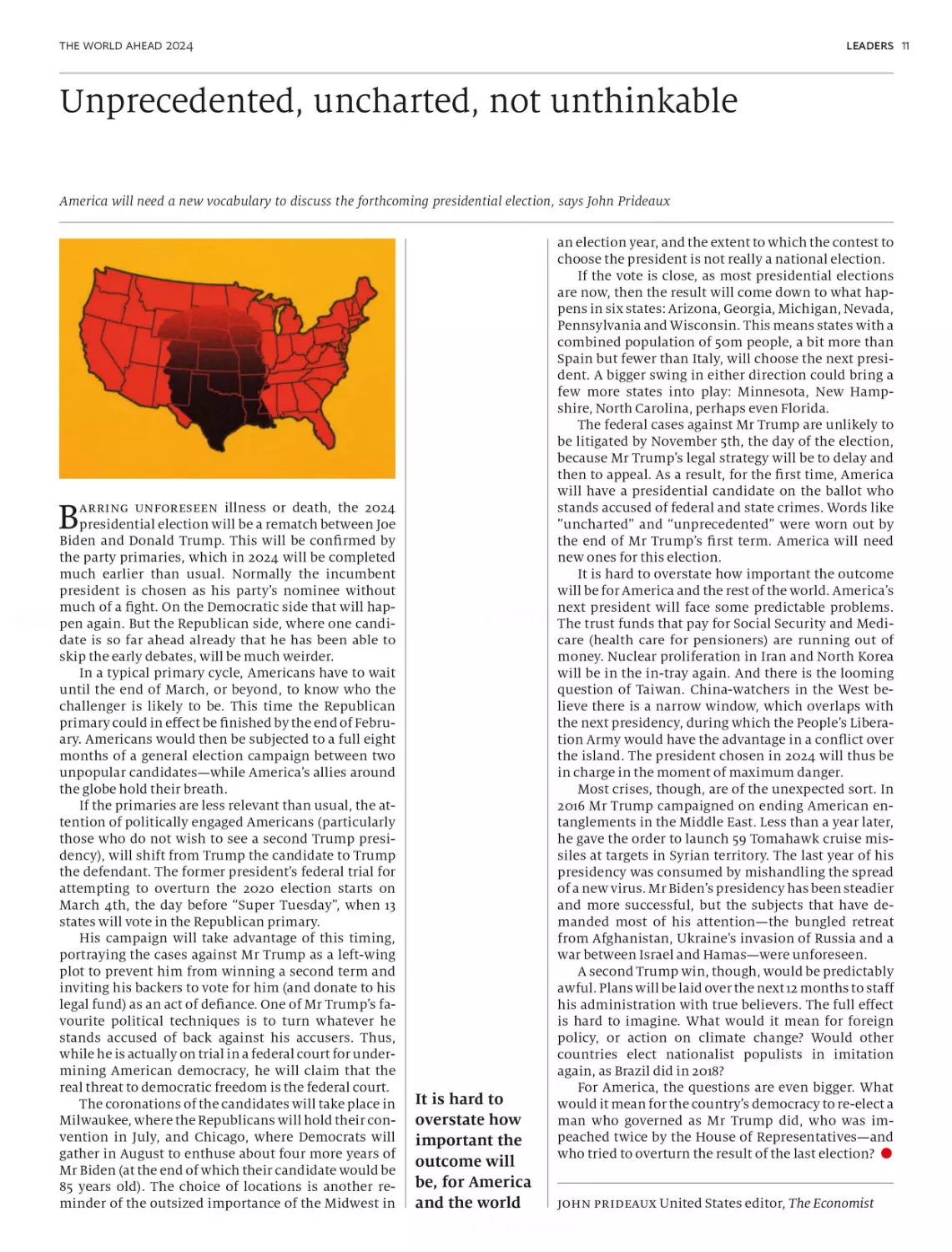

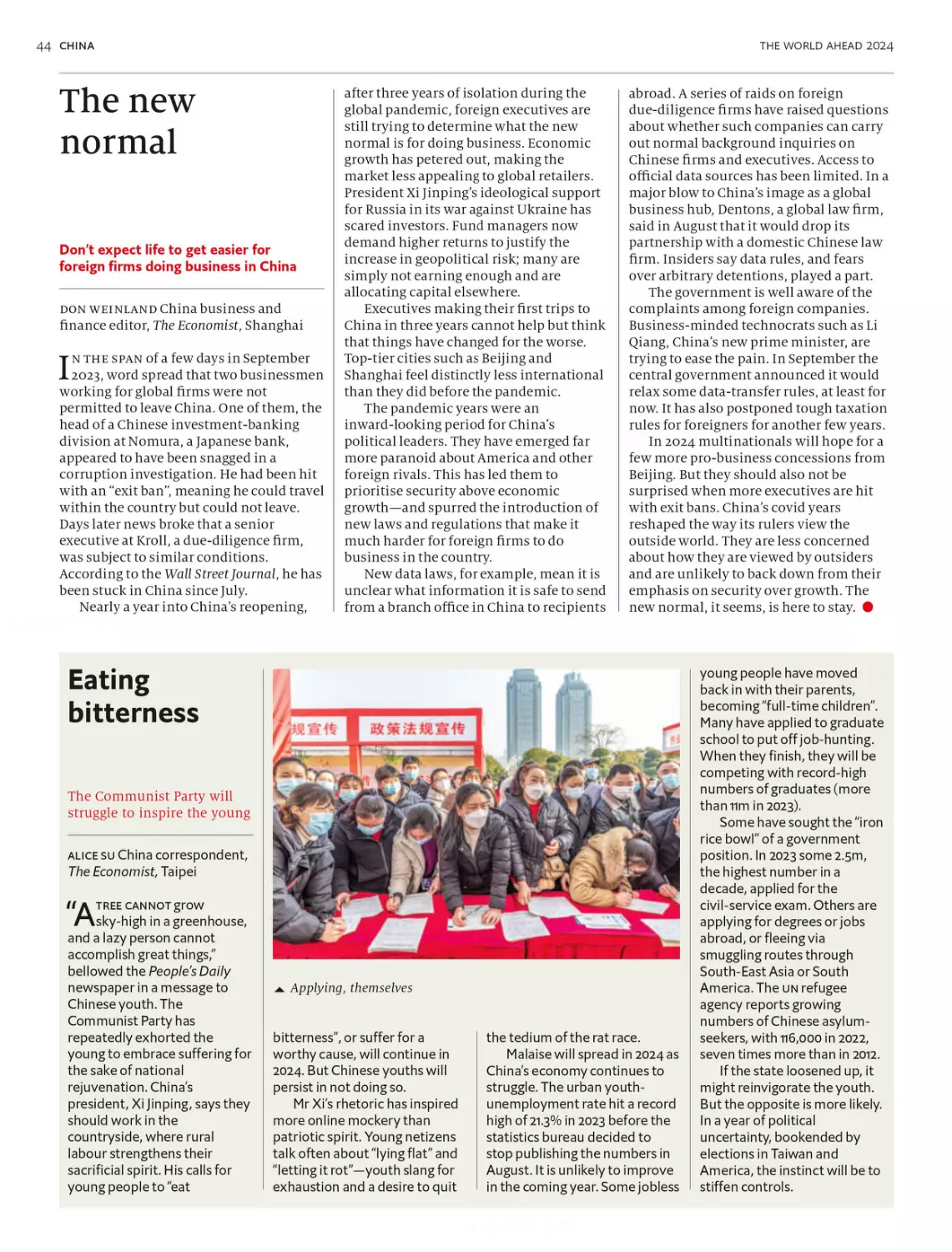









Текст
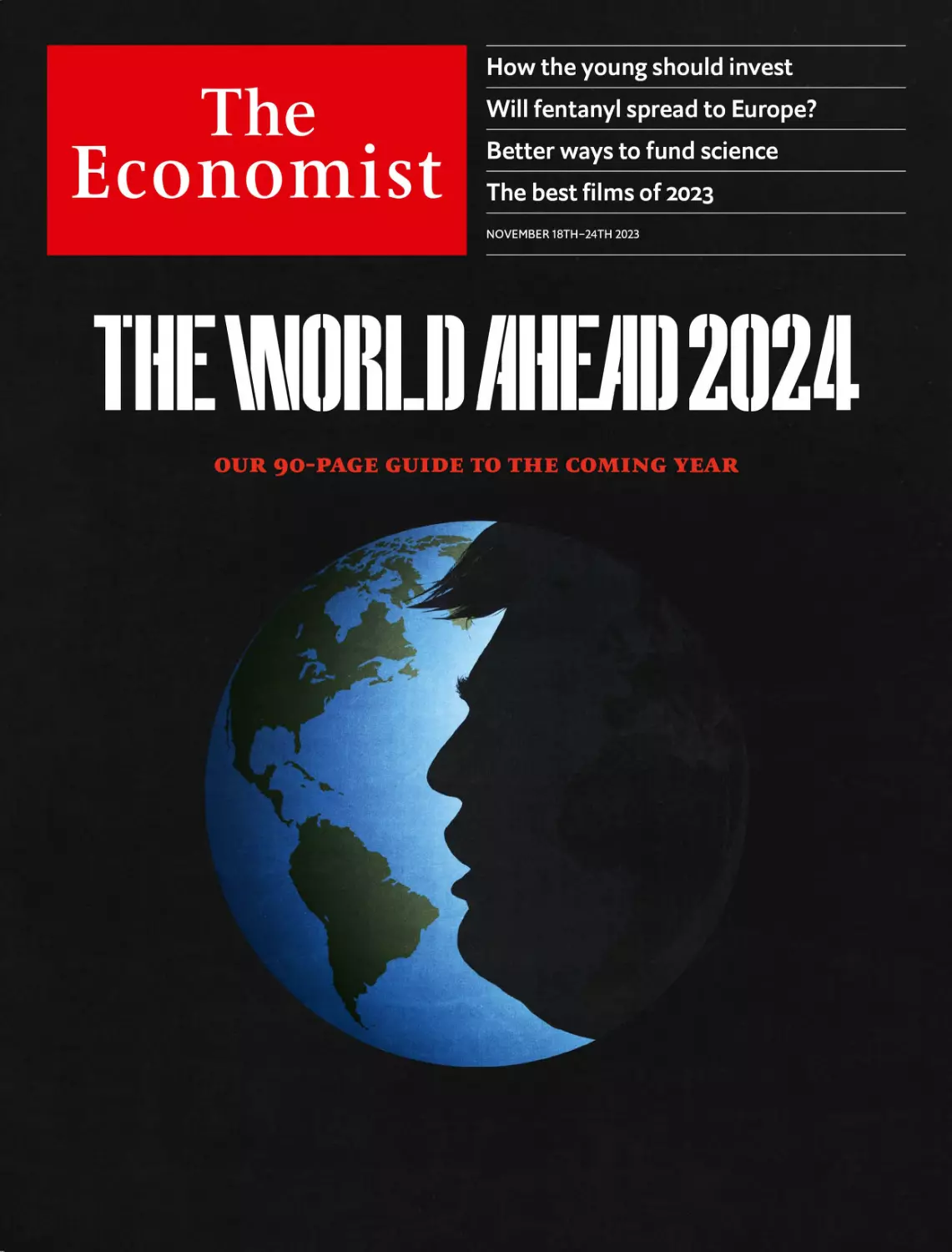
                    The
Economist
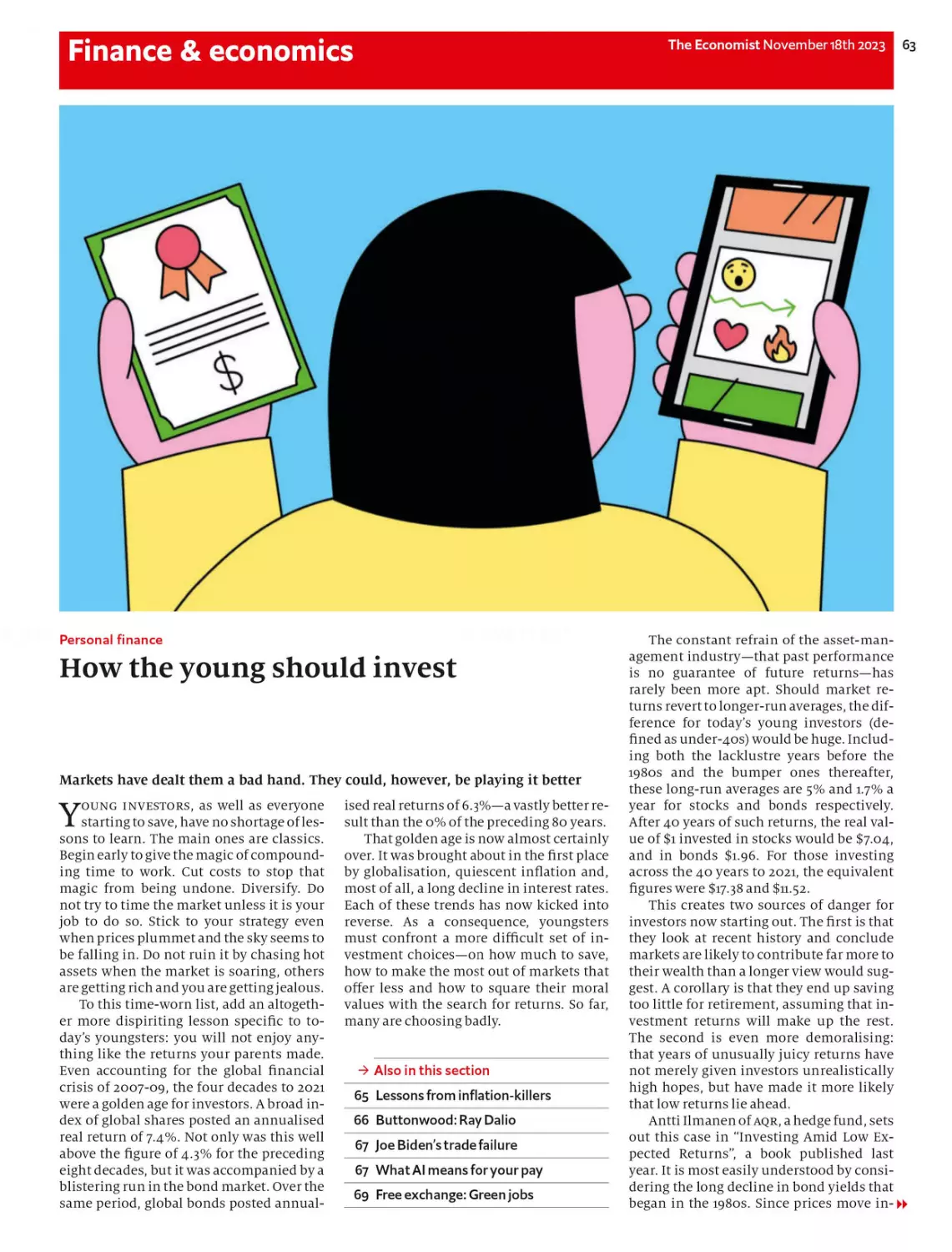
How the young should invest
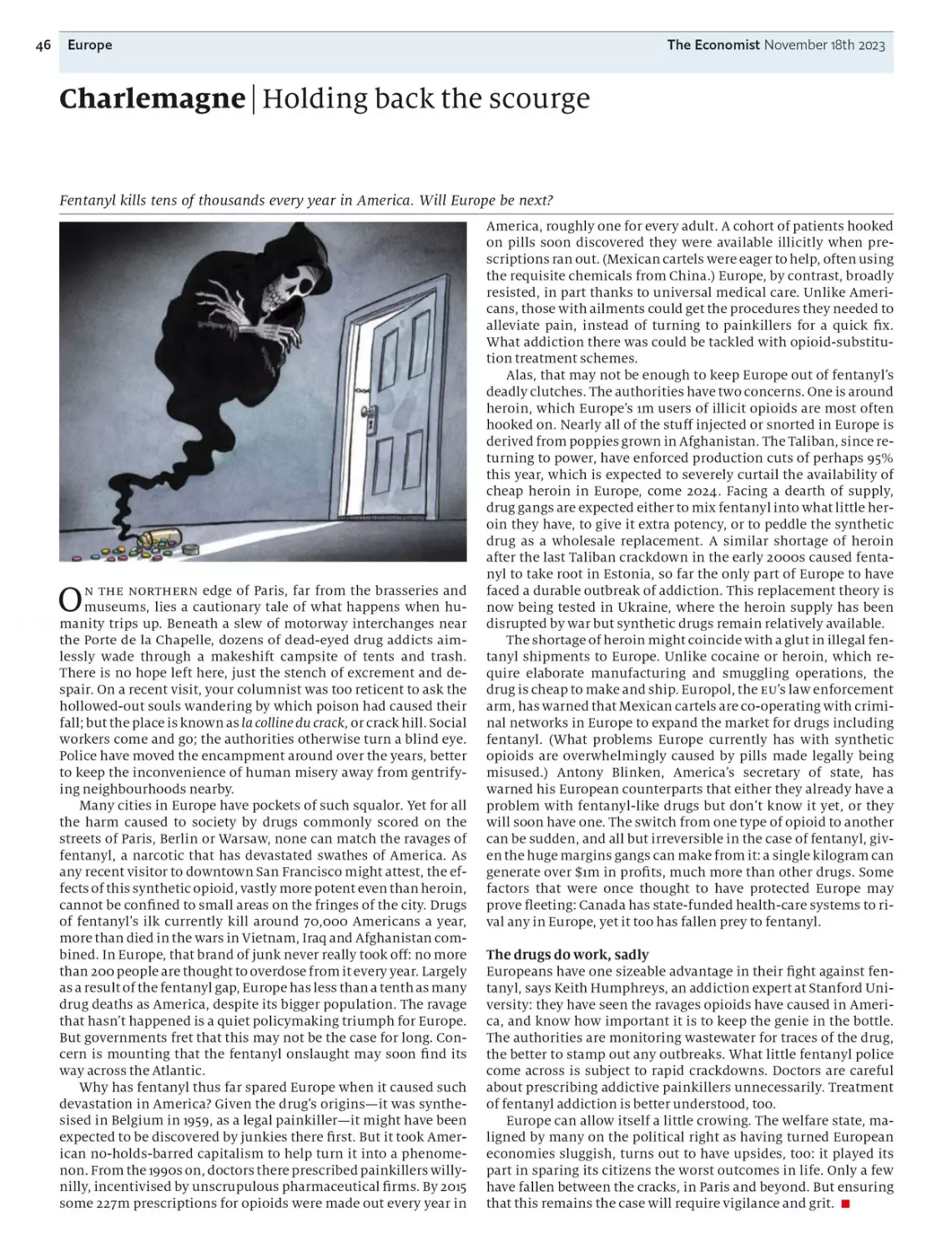
Will fentanyl spread to Europe?
Better ways to fund science
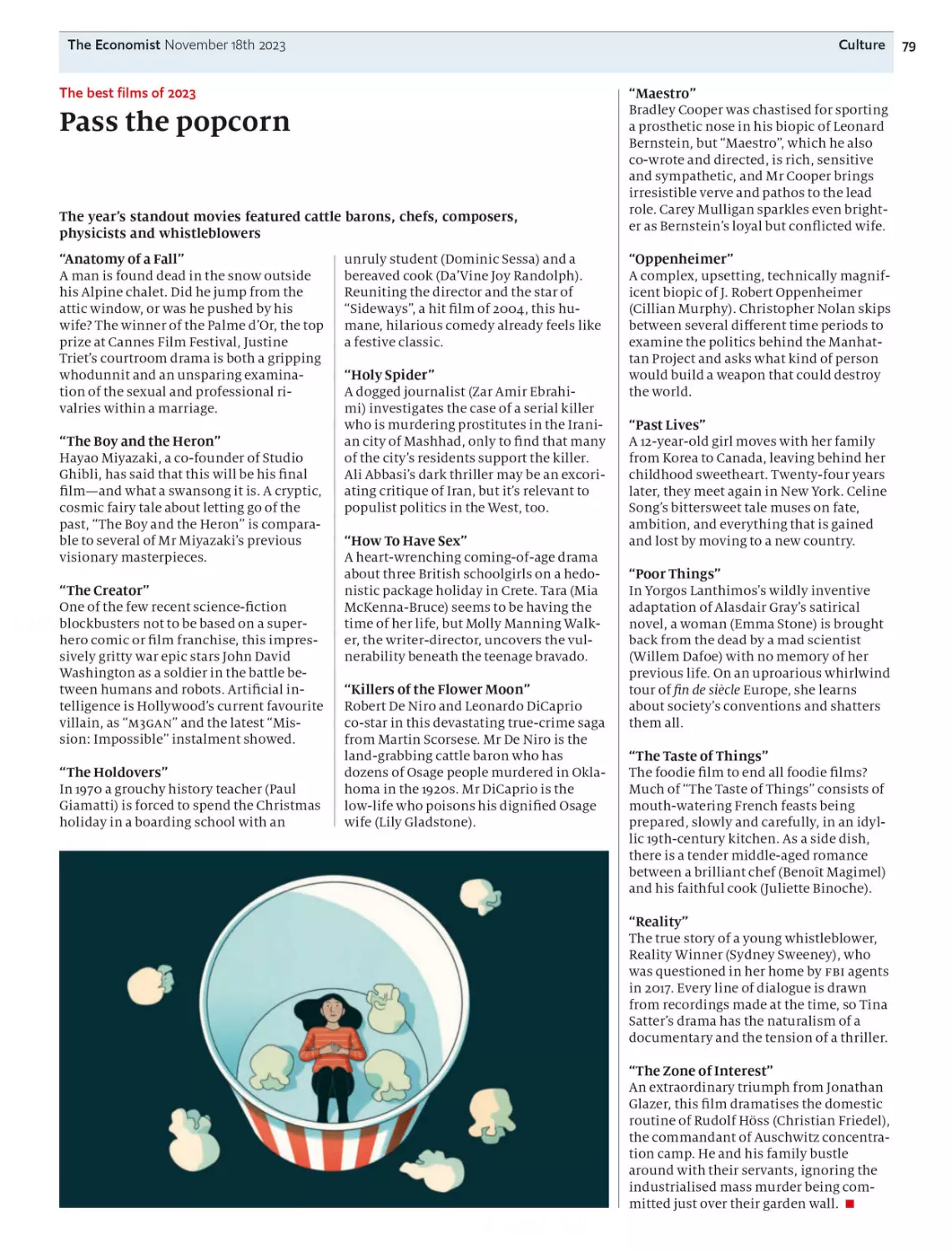
The best films of 2023
NOVEMBER 18TH-24TH 2023
30
LOUIS VUITTON
PARIS

THERE IS ETERNITY
IN EVERY 111 A\( P\l \
The spirit to preserve.
“Creation”
Wildlife Photographer
of the Year 2021
Grand Title winner
© Laurent Ballesta
anniversary
r .
A Fifty Fathoms is for eternity.
Launched in 1953, the Fifty Fathoms is the first
modern diver's watch. Created by a diver and
chosen by pioneers, it played a vital role in the
development of scuba diving. It is the catalyst
of our commitment to ocean conservation.
IB
1735
BlancpaiN
MANUFACTURE DE HAUTE IIORLOGERIE
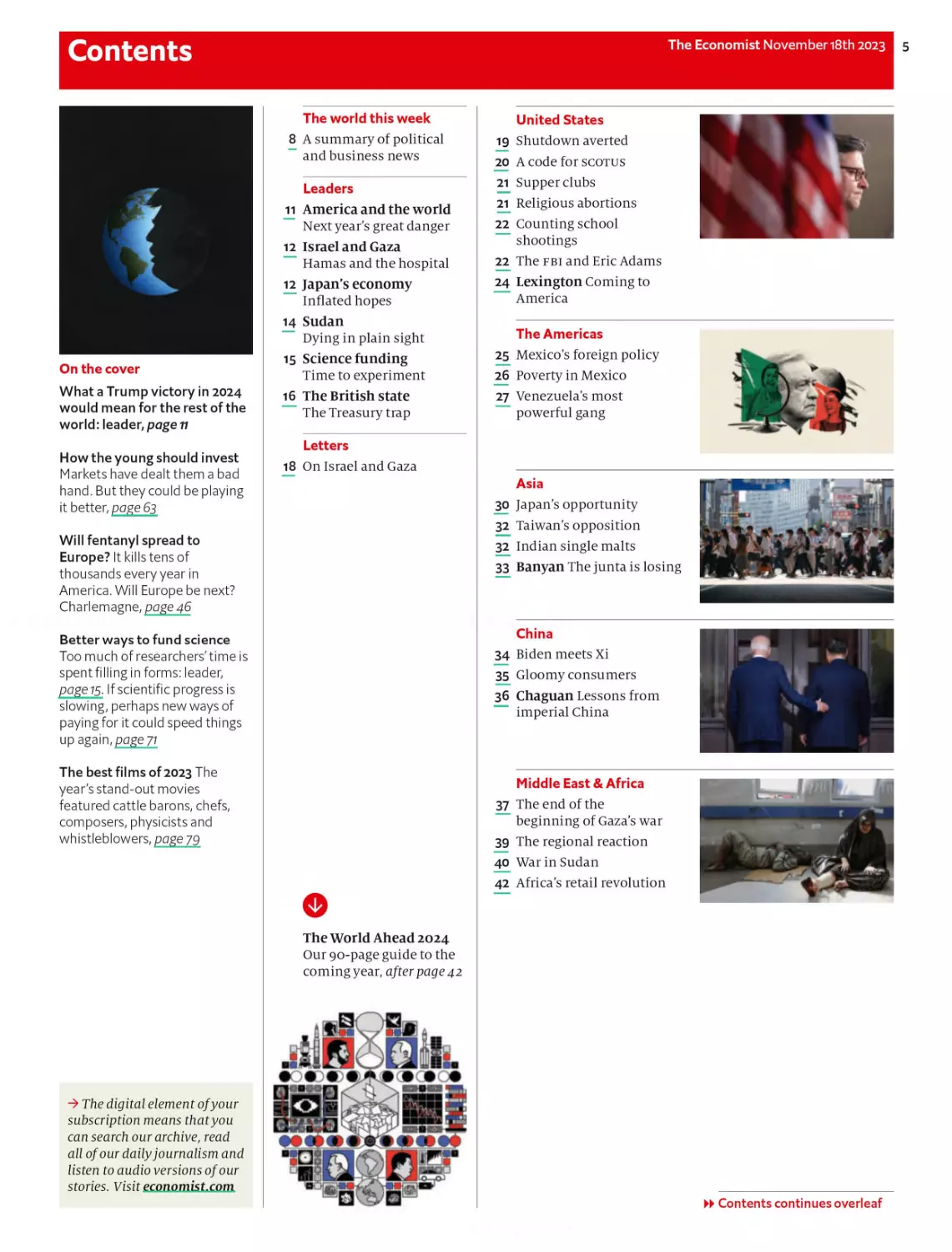
Contents
The Economist Novemberi8th 2023
5
On the cover
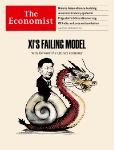
What a Trump victory in 2024
would mean for the rest of the
world: leader, page 11
How the young should invest
Markets have dealt them a bad
hand. But they could be playing
it better, page 63
The world this week
8 A summary of political
and business news
Leaders
11 America and the world
Next year’s great danger
12 Israel and Gaza
Hamas and the hospital
12 Japan’s economy
Inflated hopes
14	Sudan
Dying in plain sight
15	Science funding
Time to experiment
16	The British state
The Treasury trap
Letters
18 On Israel and Gaza
United States
19 Shutdown averted
20 A code for scotus
21 Supper clubs
21 Religious abortions
22 Counting school
shootings
22 The fbi and Eric Adams
24 Lexington Coming to
America
The Americas
25 Mexico's foreign policy
26 Poverty in Mexico
27 Venezuela’s most
powerful gang
Will fentanyl spread to
Europe? It kills tens of
thousands every year in
America. Will Europe be next?
Charlemagne, page 46
Better ways to fund science
Too much of researchers'time is
spent fi Hi ng in forms: leader,
page 15. If scientific progress is
slowi ng, perhaps new ways of
paying for it could speed things
up again, page 77
The best films of 2023 The
year's stand-out movies
featured cattle barons, chefs,
composers, physicists and
whistleblowers, page 79
-> The digital element of your
subscription means thatyou
can search our archive, read
all of our daily journalism and
listen to audio versions of our
stories. Visit economist.com
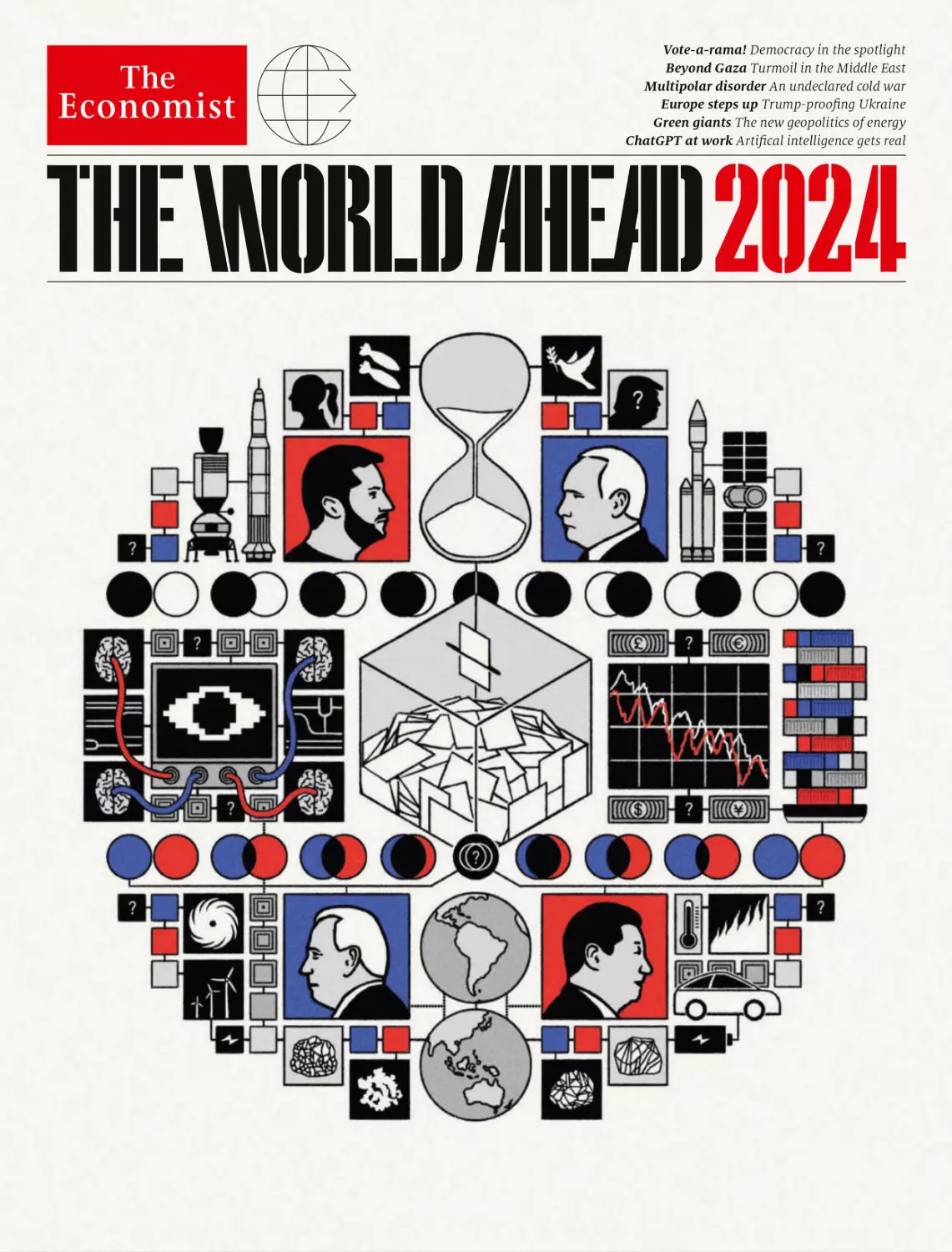
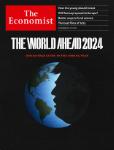
The World Ahead 2024
Our 90-page guide to the
coming year, after page 42
China
34 Biden meets Xi
35 Gloomy consumers
36 Chaguan Lessons from
imperial China
Middle East & Africa
37 The end of the
beginning of Gaza’s war
39 The regional reaction
40 War in Sudan
42 Africa’s retail revolution
Asia
30 Japan’s opportunity
32 Taiwan’s opposition
32 Indian single malts
33 Banyan The junta is losing
►► Contents continues overleaf
6
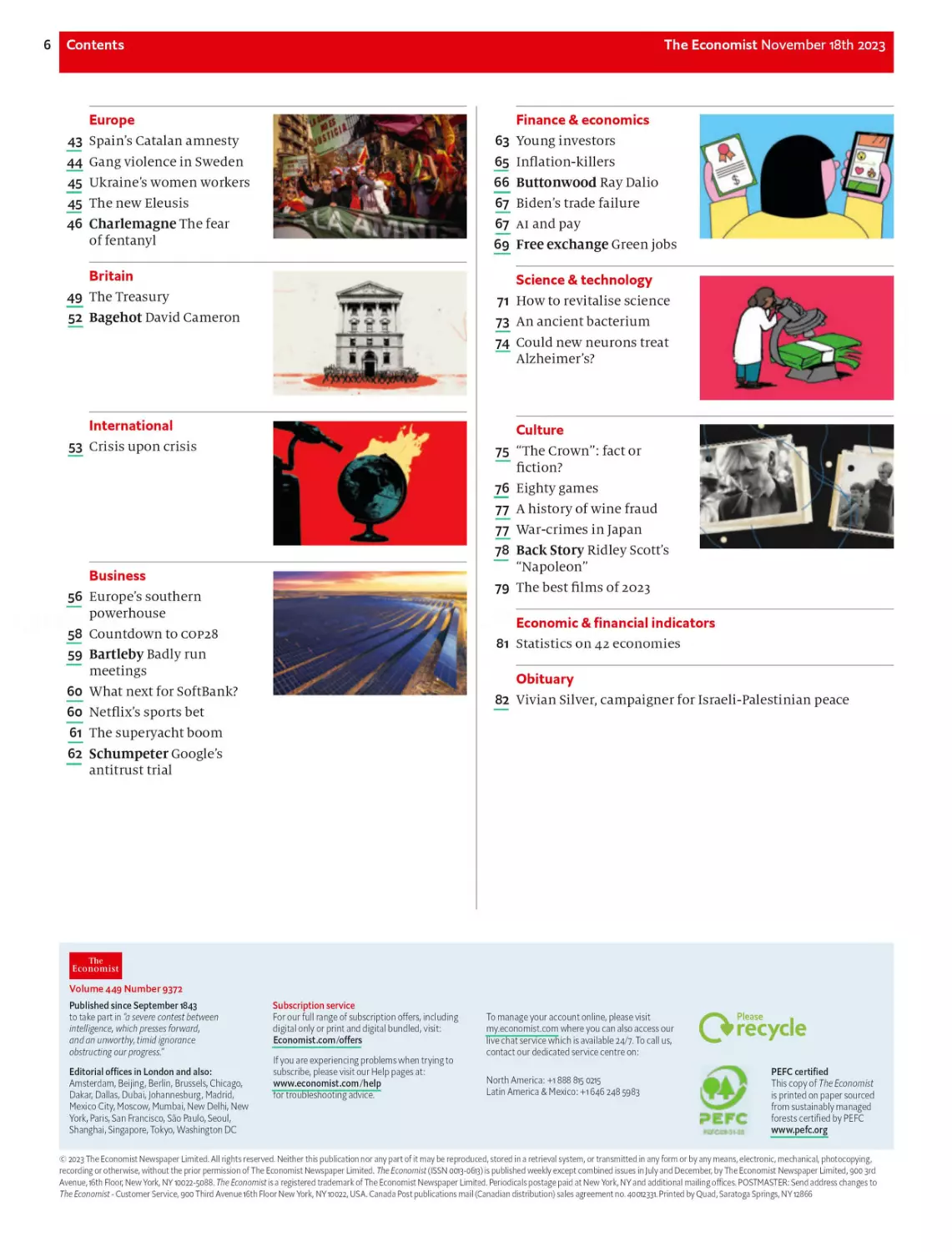
Contents
The Economist November 18th 2023
Europe
43 Spain’s Catalan amnesty
44 Gang violence in Sweden
45 Ukraine’s women workers
45 The new Eleusis
46 Charlemagne The fear
of fentanyl
Finance & economics
63 Young investors
65 Inflation-killers
66 Buttonwood Ray Dal io
67 Biden's trade failure
67 ai and pay
69 Free exchange Green jobs
Britain
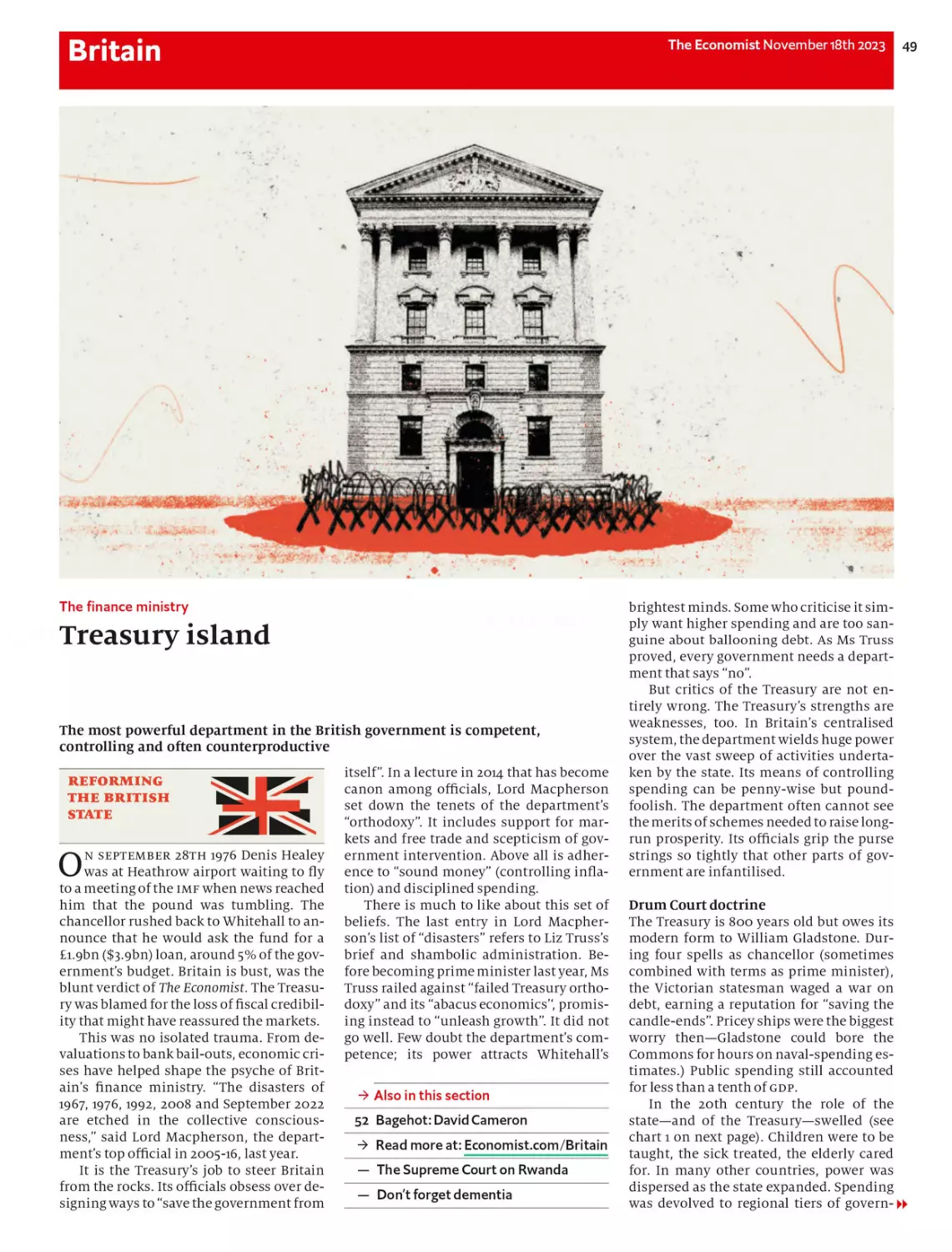
49 The Treasury
52 Bagehot David Cameron
Science & technology
71 Howto revitalise science
73 An ancient bacterium
74 Could new neurons treat
Alzheimer’s?
International
53 Crisis upon crisis
Business
56 Europe’s southern
powerhouse
58 Countdown to COP28
59 Bartleby Badly run
meetings
60 What next for SoftBank?
60 Netflix’s sports bet
61 The superyacht boom
62 Schumpeter Google’s
antitrust trial
Culture
75 "The Crown’’: fact or
fiction?
76 Eighty games
77 A history of wine fraud
77 War-crimes in Japan
78 Backstory Ridley Scott’s
"Napoleon”
79 The best films of 2023
Economic & financial indicators
81 Statistics on 42 economies
Obituary
82 Vivian Silver, campaigner for Israeli-Palestinian peace
The
Economist
Volume 449 Number 9372
Published since September 1843
to take part in Ъ severe contest between
intelligence, which presses forward,
and an unworthy, timid ignorance
obstructing our progress."
Editorial offices in London and also:
Amsterdam, Beijing, Berlin, Brussels, Chicago,
Dakar, Dallas, Dubai, Johannesburg, Madrid,
Mexico City, Moscow, Mumbai, New Delhi, New
York, Paris, San Francisco, Sao Paulo, Seoul,
Shanghai, Singapore, Tokyo, Washington DC
Subscription service
For our full range of subscription offers, including
digital only or print and digital bundled, visit:
Economist.com/offers
If you are experiencing problems when trying to
subscribe, please visit our Help pages at:
www.economist.com/help
for troubleshooting advice.
To manage your account online, please visit
my.economist.com where you can also access our
live chat service which is available 24/7. To call us,
contact our dedicated service centre on:
North America: +1888 815 0215
Latin America & Mexico: +1646 248 5983
PEFC certified
This copy of The Economist
is printed on paper sourced
from sustainably managed
forests certified by PEFC
www.pefc.org
c 2023 The Economist Newspaper Limited. All rights reserved. Neither this publication nor any part of it may be reproduced, stored in a retrieval system, or transmitted in any form or by any means, electronic, mechanical, photocopying,
recording or otherwise, without the prior permission of The Economist Newspaper Limited. The Economist (ISSN 0013-0613) is published weekly except combined issues in July and December, by The Economist Newspaper Limited, 900 3rd
Avenue, 16th Floor, New York, NY 10022-5088. The Econ omist is a registered trademarkof The Economist Newspaper Limited. Periodicals postage paid at New York, NY and additional mailing offices. POSTMASTER: Send address changes to
The Economist - Customer Service, 900 Third Avenue 16th Floor New York, NY 10022, USA. Canada Post publications mail (Canadian distribution) sales agreement no. 40012331. Printed by Quad, Saratoga Springs, N Y12866
The
Streamliner
Redefining the essence of minimalism and understatement,
the Streamliner Small Seconds embodies the ultimate fusion
of tradition and innovation. Combining steel and Grand Feu
enamel with the latest cutting-edge in-house calibre - a self-
winding micro-rotor marvel - it epitomizes timeless design.
by H. Moser & Cie.
Where time meets pure elegance.
8 The world this week Politics
The Economist Novemberi8th 2023
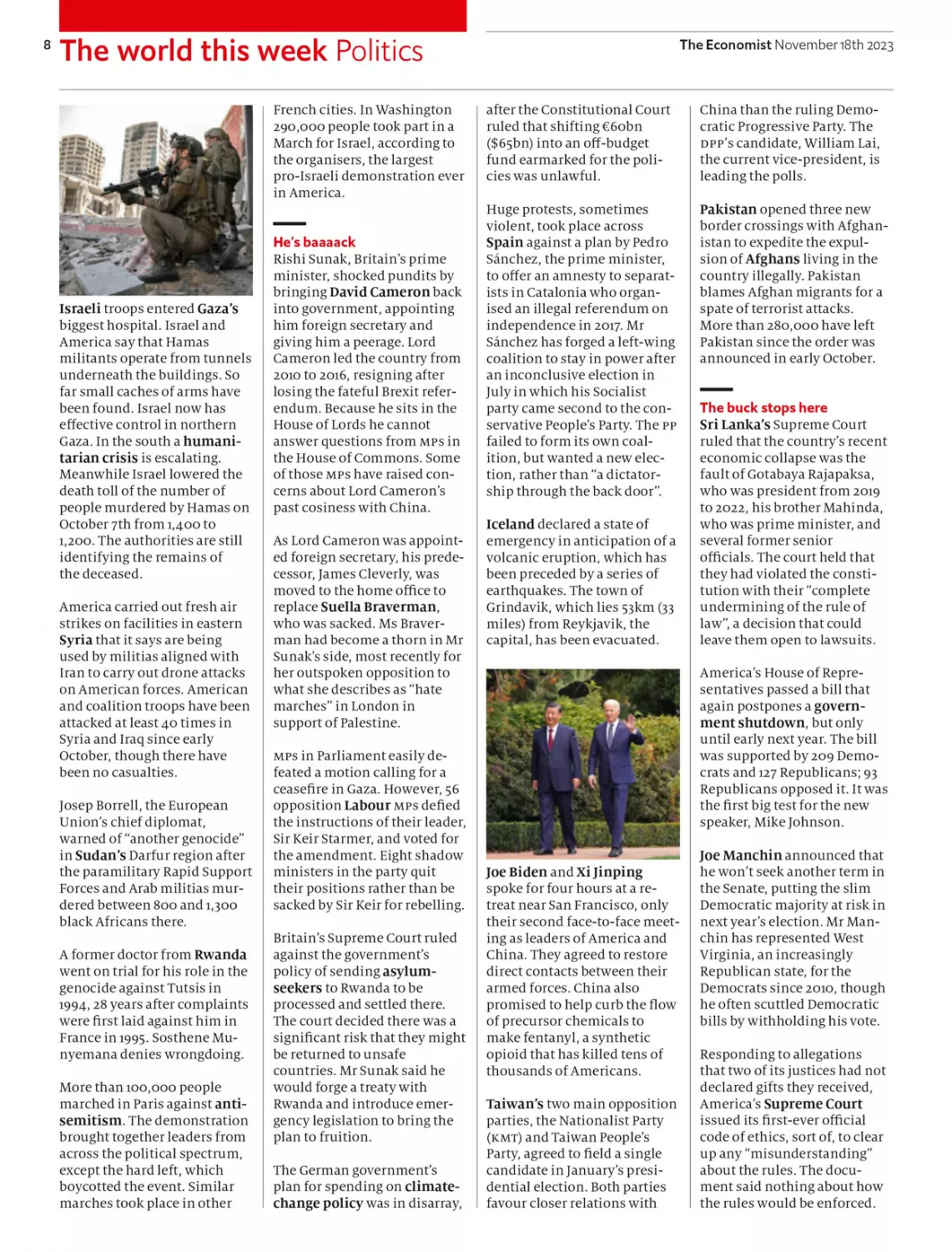
Israeli troops entered Gaza’s
biggest hospital. Israel and
America say that Hamas
militants operate from tunnels
underneath the buildings. So
far small caches of arms have
been found. Israel now has
effective control in northern
Gaza. In the south a humani-
tarian crisis is escalating.
Meanwhile Israel lowered the
death toll of the number of
people murdered by Hamas on
October 7th from 1,400 to
1,200. The authorities are still
identifying the remains of
the deceased.
America carried out fresh air
strikes on facilities in eastern
Syria that it says are being
used by militias aligned with
Iran to carry out drone attacks
on American forces. American
and coalition troops have been
attacked at least 40 times in
Syria and Iraq since early
October, though there have
been no casualties.
Josep Borrell, the European
Union’s chief diplomat,
warned of "another genocide”
in Sudan's Darfur region after
the paramilitary Rapid Support
Forces and Arab militias mur-
dered between 800 and 1,300
black Africans there.
A former doctor from Rwanda
went on trial for his role in the
genocide against Tutsis in
1994, 28 years after complaints
were first laid against him in
France in 1995. Sosthene Mu-
nyemana denies wrongdoing.
More than 100,000 people
marched in Paris against anti-
semitism. The demonstration
brought together leaders from
across the political spectrum,
except the hard left, which
boycotted the event. Similar
marches took place in other
French cities. In Washington
290,000 people took part in a
March for Israel, according to
the organisers, the largest
pro-Israeli demonstration ever
in America.
He's baaaack
Rishi Sunak, Britain’s prime
minister, shocked pundits by
bringing David Cameron back
into government, appointing
him foreign secretary and
giving him a peerage. Lord
Cameron led the country from
2010 to 2016, resigning after
losing the fateful Brexit refer-
endum. Because he sits in the
House of Lords he cannot
answer questions from mps in
the House of Commons. Some
of those mps have raised con-
cerns about Lord Cameron’s
past cosiness with China.
As Lord Cameron was appoint-
ed foreign secretary, his prede-
cessor, James Cleverly, was
moved to the home office to
replace Suella Braverman,
who was sacked. Ms Braver-
man had become a thorn in Mr
Sunak’s side, most recently for
her outspoken opposition to
what she describes as “hate
marches” in London in
support of Palestine.
mps in Parliament easily de-
feated a motion calling for a
ceasefire in Gaza. However, 56
opposition Labour mps defied
the instructions of their leader,
Sir KeirStarmer, and voted for
the amendment. Eight shadow
ministers in the party quit
their positions rather than be
sacked by Sir Keir for rebelling.
Britain's Supreme Court ruled
against the government’s
policy of sending asylum-
seekers to Rwanda to be
processed and settled there.
The court decided there was a
significant risk that they might
be returned to unsafe
countries. Mr Sunak said he
would forge a treaty with
Rwanda and introduce emer-
gency legislation to bring the
plan to fruition.
The German government’s
plan for spending on climate-
change policy was in disarray,
after the Constitutional Court
ruled that shifting €6obn
($6sbn) into an off-budget
fund earmarked for the poli-
cies was unlawful.
Huge protests, sometimes
violent, took place across
Spain against a plan by Pedro
Sanchez, the prime minister,
to offer an amnesty to separat-
ists in Catalonia who organ-
ised an illegal referendum on
independence in 2017. Mr
Sanchez has forged a left-wing
coalition to stay in power after
an inconclusive election in
July in which his Socialist
party came second to the con-
servative People’s Party. The pp
failed to form its own coal-
ition, but wanted a new elec-
tion, rather than “a dictator-
ship through the back door”.
Iceland declared a state of
emergency in anticipation of a
volcanic eruption, which has
been preceded by a series of
earthquakes. The town of
Grindavik, which lies 53km (33
miles) from Reykjavik, the
capital, has been evacuated.
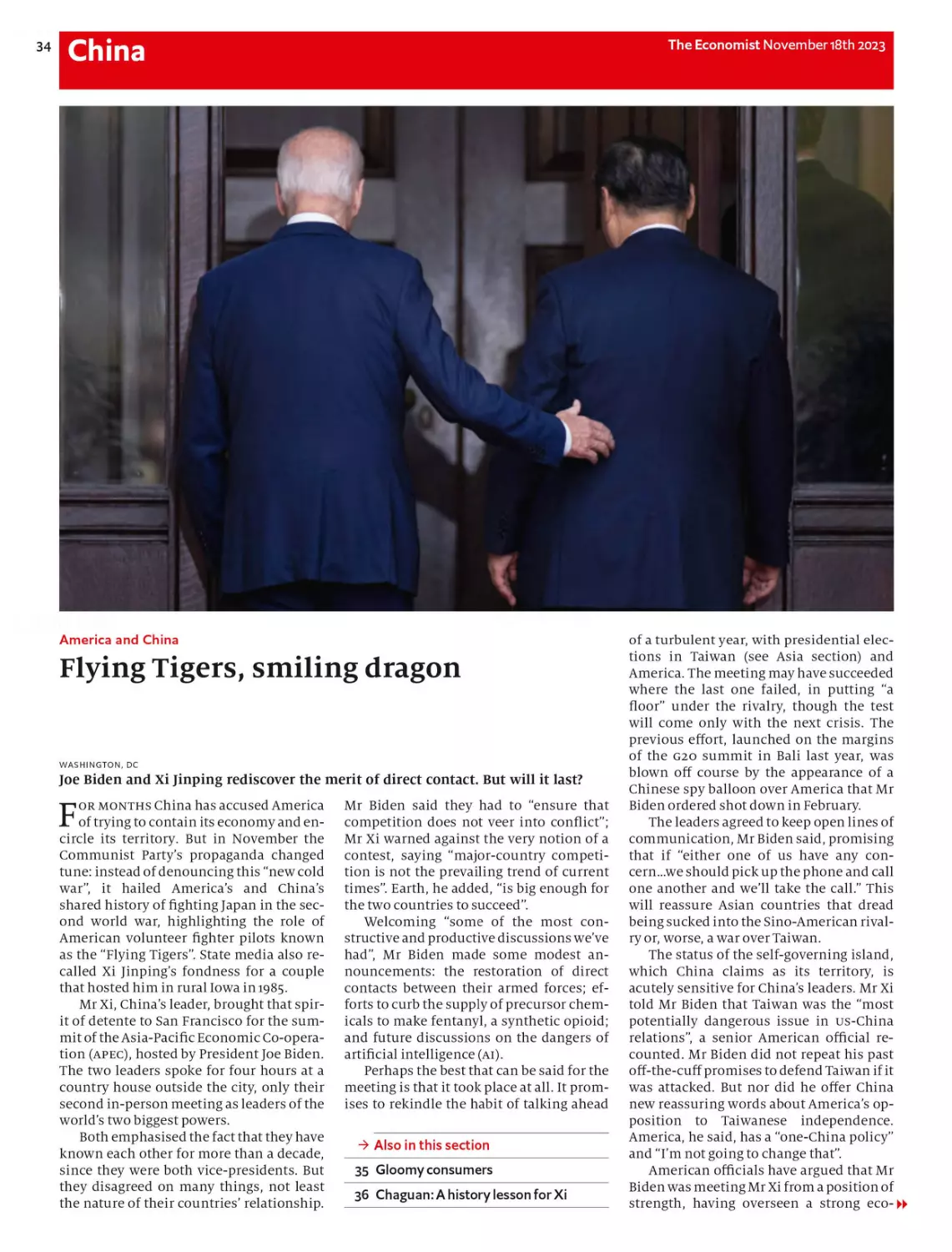
Joe Biden and Xi Jinping
spoke for four hours at a re-
treat near San Francisco, only
their second face-to-face meet-
ing as leaders of America and
China. They agreed to restore
direct contacts between their
armed forces. China also
promised to help curb the flow
of precursor chemicals to
make fentanyl, a synthetic
opioid that has killed tens of
thousands of Americans.
Taiwan’s two main opposition
parties, the Nationalist Party
(kmt) and Taiwan People’s
Party, agreed to field a single
candidate in January’s presi-
dential election. Both parties
favour closer relations with
China than the ruling Demo-
cratic Progressive Party. The
dpp’s candidate, William Lai,
the current vice-president, is
leading the polls.
Pakistan opened three new
border crossings with Afghan-
istan to expedite the expul-
sion of Afghans living in the
country illegally. Pakistan
blames Afghan migrants for a
spate of terrorist attacks.
More than 280,000 have left
Pakistan since the order was
announced in early October.
The buck stops here
Sri Lanka's Supreme Court
ruled that the country's recent
economic collapse was the
fault of Gotabaya Rajapaksa,
who was president from 2019
to 2022, his brother Mahinda,
who was prime minister, and
several former senior
officials. The court held that
they had violated the consti-
tution with their "complete
undermining of the rule of
law”, a decision that could
leave them open to lawsuits.
America’s House of Repre-
sentatives passed a bill that
again postpones a govern-
ment shutdown, but only
until early next year. The bill
was supported by 209 Demo-
crats and 127 Republicans; 93
Republicans opposed it. It was
the first big test for the new
speaker, Mike Johnson.
Joe Manchin announced that
he won’t seek another term in
the Senate, putting the slim
Democratic majority at risk in
next year’s election. Mr Man-
chin has represented West
Virginia, an increasingly
Republican state, for the
Democrats since 2010, though
he often scuttled Democratic
bills by withholding his vote.
Responding to allegations
that two of its justices had not
declared gifts they received,
America’s Supreme Court
issued its first-ever official
code of ethics, sort of, to clear
up any "misunderstanding”
about the rules. The docu-
ment said nothing about how
the rules would be enforced.
The world this week Business
The Economist Novemberi8th 2023 9
Japan’s economy shrank by
2.1% on an annualised basis in
the third quarter, or by 0.5% on
the previous quarter, amid
weak household consumption
and business spending. The
contraction suggests that
inflation, running at an annual
rate of 3%, which is high by
Japanese standards, is starting
to cut into domestic demand.
That complicates the central
bank’s path to ending its mas-
sive monetary stimulus pro-
gramme and policy of negative
interest rates, which markets
expect it to start undoing in
the coming months.
Consumer prices
% increase on a year earlier
Markets were cheered by news
that America’s annual
inflation rate dipped to 3.2%
in October, the first decline in
four months. Core inflation,
which excludes energy and
food prices, also slowed, to
4%. In Britain annual inflation
plunged from 6.7% in Septem-
ber to 4.6% in October, the
lowest rate in two years. After a
dismal few months, America’s
main stockmarkets have
roared back in November, as
investors bet that lower
inflation makes it more likely
that central banks have fin-
ished raising interest rates.
Nvidia unveiled its latest
superchip for generative artifi-
cial intelligence, the H200.
Delivering 141 gigabytes of
memory at 4.8 terabytes per
second, it has nearly double
the capacity of its predecessor
chip. The company expects
revenue this quarter to
increase by 170%, year on year.
Its share price is up by 240%
since the start of January.
Novo Nordisk’s stock surged
after the company released the
full results from a study show-
ing that its weight-loss drug,
Wegovy, reduces the risk of
having a heart attack, stroke or
dying by 20% in patients at
risk of cardiovascular disease.
The mining industry saw its
biggest deal in years, when a
consortium led by Glencore
agreed to pay $9bn for the
steelmaking coal business of
Teck Resources. The Swiss
commodities company is
taking a 77% stake, with Nip-
pon Steel of Japan and posco of
South Korea owning the rest.
Glencore will eventually merge
its existing coal business with
its new assets and spin off the
new entity on the stockmarket.
Prices for the coking coal used
in steelmaking have risen
sharply this year.
Salad days
A private-equity group took a
controlling stake in Joe & the
Juice, a fast-growing purveyor
of sandwiches, organic juices
and health shakes to the hip-
ster crowd. The firm started in
Denmark in 2002 and now has
360 stores around the world in
the usual hipster hotspots,
such as London, New York, San
Francisco and Stockholm.
Foxconn warned that its rev-
enues will fall slightly in 2023,
even though it managed to
post a surprise u% rise in net
profit in the latest quarter, year
on year. The electronics con-
tract manufacturer gets a big
chunk of its income from
Apple and sales of the new
iPhone 15 have been lower than
expected, especially in China.
The ratification of a pay deal
between the United Auto
Workers and Detroit’s car-
makers hit a small bump in
the road when workers at
several General Motors’
factories rejected the new
contract, though a majority at
its biggest plant accepted it.
Meanwhile Stellantis, Chrys-
ler’s parent company, offered
voluntary redundancies to half
its non-unionised employees
in America, because of "chal-
lenging market conditions”.
Continental said it would cut
jobs as part of its cost-cutting
drive. The German car-parts
supplier, oneof the world’s
biggest, expects the number of
job losses “to be in the mid-
four-digit range”. Four years
ago the company warned that
tens of thousands of positions
would be affected by the tran-
sition to electric vehicles.
Renault gave more details
about the future of Ampere, its
electric-vehicle division. The
French carmaker is aiming to
float Ampere on the stock-
market in the first half of 2024,
and hopes green investors will
back the 1 po. It laid out ambi-
tious targets for the business,
targeting 30% average annual
growth in revenues from this
year to 2031.
The Jetsons age has arrived
The first-ever flight of an
electric air taxi in New York
took off from downtown Man-
hattan’s heliport. Joby Avia-
tion, which is developing
electric vertical take-off and
landing aircraft for commer-
cial passenger service, per-
formed an exhibition flight. Its
air taxis are designed to be
much quieter than regular
helicopters so as not to add to
urban noise. Joby aims to have
its service up and flying in
2025, when passengers will be
able to book their trips by app.
In another novelty, Netflix
live-streamed its first sporting
event. The Netflix Cup paired
Formula One racing drivers
with pga Tour professionals in
a golf tournament. Carlos
Sainz, a driver for Ferrari, and
Justin Thomas, a two-time
winner of the pga champi-
onship, won the cup, which Mr
Sainz dropped, breaking it into
pieces. Netflix will pray that is
not an omen for its foray into
live broadcasts.
Designed in California	\
Assembled in the United States
Engineered for a better world
This is the Lucid Air, the longest range electric car on the market.*
Experience the new standard in sustainable luxury.
1
LUCIDMOTORS.COM
*EPA est. range ratings when equipped with 19" wheels: 516 Grand Touring/425 Touring.
Manufacturer's projected range for Pure equipped with 19" wheels is 410 miles; EPA est.
range is 419. Actual results will vary.
Leaders 11
The
Economist
Next year’s great danger
What a Trump victory in 2024 would mean for the rest of the world
A shadow looms over the world. In this week’s edition we
publish The World. Ahead 2024, our 38th annual predictive
guide to the coming year, and in all that time no single person
has ever eclipsed our analysis as much as Donald Trump eclipses
2024. That a Trump victory next November is a coin-toss proba-
bility is beginning to sink in.
Mr Trump dominates the Republican primary. Several polls
have him ahead of President Joe Biden in swing states. In one, for
the New York Times, 59% of voters trusted him on the economy,
compared with just 37% for Mr Biden. In the primaries, at least,
civil lawsuits and criminal prosecutions have only strengthened
Mr Trump. For decades Democrats have relied on support among
black and Hispanic voters, but a meaningful number are aban-
doning the party. In the next 12 months a stumble by either can-
didate could determine the race—and thus upend the world.
This is a perilous moment for a man like Mr Trump to be back
knocking on the door of the Oval Office. Democracy is in trouble
at home. Mr Trump’s claim to have won the election in 2020 was
more than a lie: it was a cynical bet that he could manipulate and
intimidate his compatriots, and it has worked. America also fac-
es growing hostility abroad, challenged by Russia in Ukraine, by
Iran and its allied militias in the Middle East and by China across
the Taiwan Strait and in the South China Sea. Those three coun-
tries loosely co-ordinate their efforts and share
a vision of a new international order in which
might is right and autocrats are secure.
Because maga Republicans have been plan-
ning his second term for months, Trump 2
would be more organised than Trump 1. True
believers would occupy the most important po-
sitions. Mr Trump would be unbound in his
pursuit of retribution, economic protectionism
and theatrically extravagant deals. No wonder the prospect of a
second Trump term fills the world’s parliaments and board-
rooms with despair. But despair is not a plan. It is past time to
impose order on anxiety.
The greatest threat Mr Trump poses is to his own country.
Having won back power because of his election-denial in 2020,
he would surely be affirmed in his gut feeling that only losersal-
low themselves to be bound by the norms, customs and self-sac-
rifice that make a nation. In pursuing his enemies, Mr Trump
will wage war on any institution that stands in his way, includ-
ing the courts and the Department of Justice.
Yet a Trump victory next year would also have a profound ef-
fect abroad. China and its friends would rejoice over the evi-
dence that American democracy is dysfunctional. If Mr Trump
trampled due process and civil rights in the United States, his
diplomats could not proclaim them abroad. The global south
would be confirmed in its suspicion that American appeals to do
what is right are really just an exercise in hypocrisy. America
would become just another big power.
Mr Trump’s protectionist instincts would be unbound, too.
In his first term the economy thrived despite his China tariffs.
His plans for a second term would be more damaging. He and his
lieutenants are contemplating a universal 10% levy on imports,
more than three times the level today. Even if the Senate reins
him in, protectionism justified by an expansive view of national
security would increase prices for Americans. Mr Trump also
fired up the economy in his first term by cutting taxes and hand-
ing out covid-19 payments. This time, America is running budget
deficits on a scale only seen in war and the cost of servicing
debts is higher. Tax cuts would feed inflation, not growth.
Abroad, Mr Trump’s first term was better than expected. His
administration provided weapons to Ukraine, pursued a peace
deal between Israel, the uae and Bahrain, and scared European
countries into raising their defence spending. America’s policy
towards China became more hawkish. If you squint, another
transactional presidency could bring some benefits. Mr Trump’s
indifference to human rights might make the Saudi government
more biddable once the Gaza war is over, and strengthen rela-
tions with Narendra Modi’s government in India.
But a second term would be different, because the world has
changed. There is nothing wrong in countries being transac-
tional: they are bound to put their own interests first. However,
Mr Trump’s lust for a deal and his sense of America’s interests
are unconstrained by reality and unanchored by values.
Mr Trump judges that for America to spend blood and trea-
sure in Europe is a bad deal. He has therefore threatened to end
the Ukraine war in a day and to wreck NATO, per-
haps by reneging on America’s commitment to
treat an attack on one country as an attack on
all. In the Middle East Mr Trump is likely to back
Israel without reserve, however much that stirs
up conflict in the region. In Asia he may be open
to doing a deal with China’s president, Xi Jinp-
ing, to abandon Taiwan because he cannot see
why America would go to war with a nuclear-
armed superpower to benefit a tiny island.
But knowing that America would abandon Europe, Mr Putin
would have an incentive to fight on in Ukraine and to pick off
former Soviet countries such as Moldova or the Baltic states.
Without American pressure, Israel is unlikely to generate an in-
ternal consensus for peace talks with the Palestinians. Calculat-
ing that Mr Trump does not stand by his allies, Japan and South
Korea could acquire nuclear weapons. By asserting that America
has no global responsibility to help deal with climate change, Mr
Trump would crush efforts to slow it. And he is surrounded by
China hawks who believe confrontation is the only way to pre-
serve American dominance. Caught between a deal making pres-
ident and his warmongering officials, China could easily miscal-
culate over Taiwan, with catastrophic consequences.
The election that matters
A second Trump term would be a watershed in a way the first was
not. Victory would confirm his most destructive instincts about
power. His plans would encounter less resistance. And because
America will have voted him in while knowing the worst, its
moral authority would decline. The election will be decided by
tens of thousands ofvoters in justa handful of states. In 2024 the
fate of the world will depend on their ballots.
12 Leaders
The Economist November 18th 2023
Israel and Gaza
Hamas and the hospital
Israel must meet and exceed the requirements of the laws of war
The crisis at al-Shifa hospital in northern Gaza is a tragedy in
its own right and a microcosm of the awful trade-offs created
by Hamas’s atrocities and Israel’s invasion of Gaza. Some of Isra-
el’s critics believe that any military activity near or in the hospi-
tal is a war crime because civilians maybe killed. In fact, because
it appears likely that the hospital has been used by Hamas as a
military facility, Hamas has probably turned it into a legitimate
military target. Still, as a matter of international law, morality
and self-interest, Israel must do more to protect civilians. That
matters at al-Shifa and beyond it. Even as Israel has won effec-
tive control in northern Gaza, the already grave humanitarian
crisis is about to explode in the south where over 2m people are
at risk as winter looms (see Middle East & Africa section).
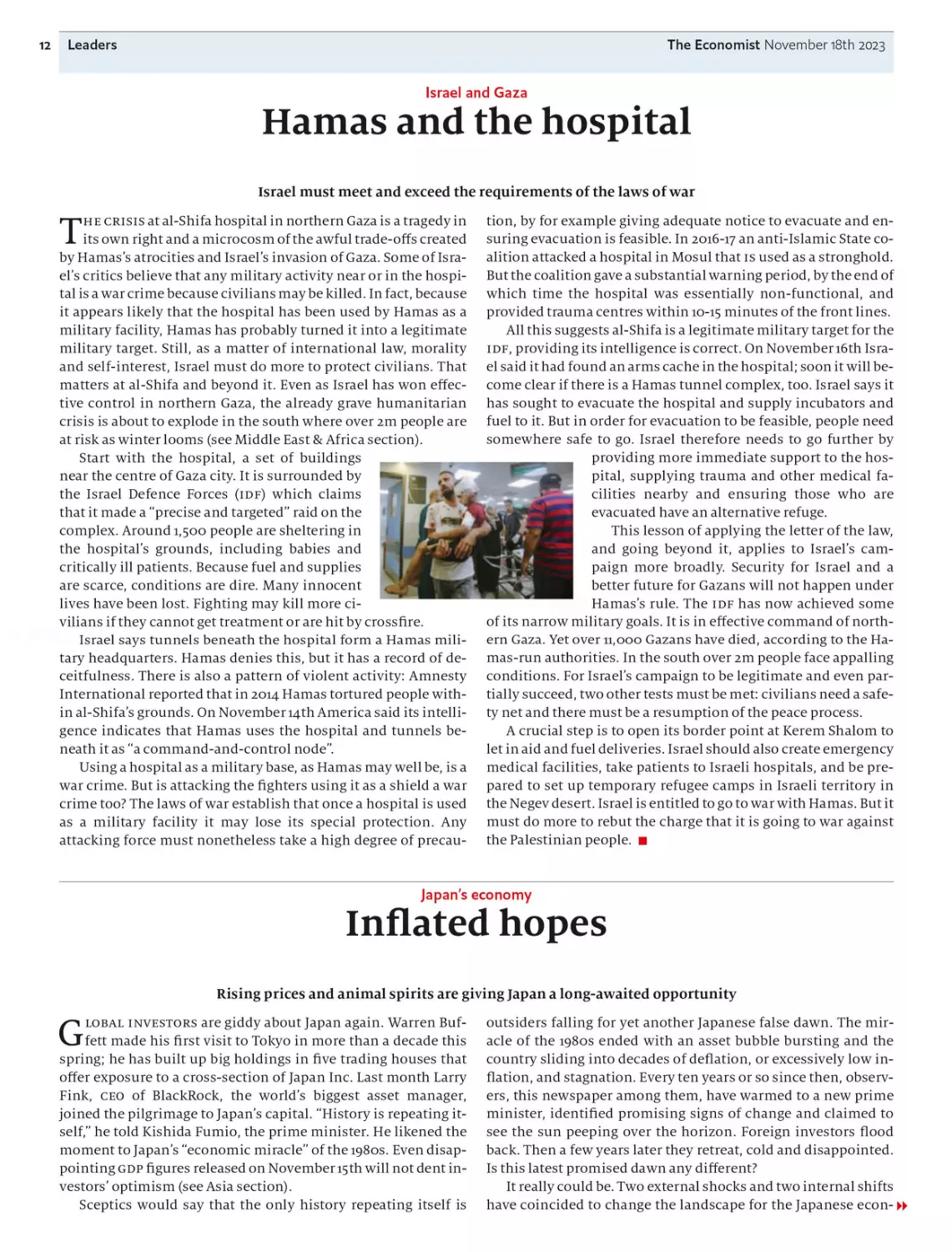
Start with the hospital, a set of buildings
near the centre of Gaza city. It is surrounded by
the Israel Defence Forces (idf) which claims
that it made a “precise and targeted” raid on the
complex. Around 1,500 people are sheltering in
the hospital’s grounds, including babies and
critically ill patients. Because fuel and supplies
are scarce, conditions are dire. Many innocent
lives have been lost. Fighting may kill more ci-
vilians if they cannot get treatment or are hit by crossfire.
Israel says tunnels beneath the hospital form a Hamas mili-
tary headquarters. Hamas denies this, but it has a record of de-
ceitfulness. There is also a pattern of violent activity: Amnesty
International reported that in 2014 Hamas tortured people with-
in al-Shifa’s grounds. On November 14th America said its intelli-
gence indicates that Hamas uses the hospital and tunnels be-
neath it as "acommand-and-control node’’.
Using a hospital as a military base, as Hamas may well be, is a
war crime. But is attacking the fighters using it as a shield a war
crime too? The laws of war establish that once a hospital is used
as a military facility it may lose its special protection. Any
attacking force must nonetheless take a high degree of precau-
tion, by for example giving adequate notice to evacuate and en-
suring evacuation is feasible. In 2016-17 an anti-Islamic State co-
alition attacked a hospital in Mosul that is used as a stronghold.
But the coalition gave a substantial warning period, by the end of
which time the hospital was essentially non-functional, and
provided trauma centres within 10-15 minutes of the front lines.
All this suggests al-Shifa is a legitimate military target for the
idf, providing its intelligence is correct. On November 16th Isra-
el said it had found an arms cache in the hospital; soon it will be-
come clear if there is a Hamas tunnel complex, too. Israel says it
has sought to evacuate the hospital and supply incubators and
fuel to it. But in order for evacuation to be feasible, people need
somewhere safe to go. Israel therefore needs to go further by
providing more immediate support to the hos-
pital, supplying trauma and other medical fa-
cilities nearby and ensuring those who are
evacuated have an alternative refuge.
This lesson of applying the letter of the law,
and going beyond it, applies to Israel’s cam-
paign more broadly. Security for Israel and a
better future for Gazans will not happen under
Hamas’s rule. The idf has now achieved some
of its narrow military goals. It is in effective command of north-
ern Gaza. Yet over 11,000 Gazans have died, according to the Ha-
mas-run authorities. In the south over 2m people face appalling
conditions. For Israel’s campaign to be legitimate and even par-
tially succeed, two other tests must be met: civilians need a safe-
ty net and there must be a resumption of the peace process.
A crucial step is to open its border point at Kerem Shalom to
let in aid and fuel deliveries. Israel should also create emergency
medical facilities, take patients to Israeli hospitals, and be pre-
pared to set up temporary refugee camps in Israeli territory in
the Negev desert. Israel is entitled to go to war with Hamas. But it
must do more to rebut the charge that it is going to war against
the Palestinian people.
Japan's economy
Inflated hopes
Rising prices and animal spirits are giving Japan a long-awaited opportunity
Global investors are giddy about Japan again. Warren Buf-
fett made his first visit to Tokyo in more than a decade this
spring; he has built up big holdings in five trading houses that
offer exposure to a cross-section of Japan Inc. Last month Larry
Fink, CEO of BlackRock, the world’s biggest asset manager,
joined the pilgrimage to Japan’s capital. "History is repeating it-
self," he told Kishida Fumio, the prime minister. He likened the
moment to Japan’s "economic miracle” of the 1980s. Even disap-
pointing gdp figures released on November 15th will not dent in-
vestors’ optimism (see Asia section).
Sceptics would say that the only history repeating itself is
outsiders falling for yet another Japanese false dawn. The mir-
acle of the 1980s ended with an asset bubble bursting and the
country sliding into decades of deflation, or excessively low in-
flation, and stagnation. Every ten years or so since then, observ-
ers, this newspaper among them, have warmed to a new prime
minister, identified promising signs of change and claimed to
see the sun peeping over the horizon. Foreign investors flood
back. Then a few years later they retreat, cold and disappointed.
Is this latest promised dawn any different?
It really could be. Two external shocks and two internal shifts
have coincided to change the landscape for the Japanese econ- ►►
Visit idaireland.com
Connecting
your busi ness
with extraordinary
opportunity
We partner with the world’s most
innovative and visionary companies.
Providing hands-on support as
you establish and grow, backed
by Ireland’s winning mix of people,
place and business philosophy.
See why leading tech, finance and
life sciences companies choose
Ireland as their European base.
* IDA Ireland
Invest in extraordinary
14 Leaders
The Economist November 18th 2023
►	omy. The most palpable shock has to do with prices. Whereas
most countries have been obsessed with keeping inflation down
in recent years, Japan has been hoping it might finally pick up—
and stay up. Global supply squeezes and a weak exchange rate
have duly done what years of audacious monetary easing could
not achieve, and pushed the headline inflation rate over the
Bank of Japan’s 2% target. Admittedly, that is not the demand-
driven inflation that the boj would like to see. Even so, it has
changed how firms, workers and consumers think about prices
and, crucially, wages. A path, albeit a narrow one, has opened to
a healthier cycle of wage and consumption growth.
The other shock is geopolitical. The war in Ukraine and the
superpower stand-off between America and China have spurred
a new wave of investment in critical industries and a reconfigu-
ration of regional supply chains that Japan could benefit from.
The internal shifts are subtler, but no less important. Cor-
porate-governance reforms that began under a previous prime
minister, Abe Shinzo, have become entrenched. Indeed, they
have entered a promising new phase, as Japanese institutional
investors—and even the Tokyo Stock Exchange—are putting
more pressure on big companies to enhance their value.
Another underappreciated part of the story is generational
change. At old firms, bosses attached to ways of doing business
that worked during the glory days of the 1980s are exiting the
scene. Young entrepreneurs want to build a new Japan Inc.
Yet much in the Japanese economy remains unchanged and
unchanging. For Japan to make good on the promise of the mo-
ment, policymakers, executives and politicians must do more to
nurture the green shoots of dynamism. For a start, the boj must
execute a complex dance in the coming year. It must unwind un-
orthodox monetary policies that have outlived their usefulness,
such as its yield-curve control, without suffocating the nascent
inflation. In time the highly indebted government will probably
have to find a way to cope with rising interest rates.
The process of corporate reform must also continue. Japa-
nese firms are now well versed in the forms of good governance,
but they need to get better at the substance. Around 40% of com-
panies in the TOPix 500 trade below book value. In an unstable
world corporate leaders must do more than just preserve the sta-
tus quo. Luckily they have plenty of room for manoeuvre, after
years of hoarding cash on their balance-sheets.
Mr Kishida has promised to focus on “economy, economy,
economy”. Compared with his predecessors, he has spoken
more about supporting startups. Yet his latest economic pack-
age, announced earlier this month, is heavy on one-off tax cuts
and stimulus measures that seem designed to boost his popular-
ity, rather than long-term growth. He could turn words into
deeds by revising tax codes to reward risk-taking investors and
entrepreneurs and by withdrawing support for zombie incum-
bents. The prime minister is right to trumpet the need for new-
company formation. But he also needs to play his part in clear-
ing away corporate dead wood.
Sudan
Dying in plain sight
The world is ignoring genocide and man-made famine in Sudan
The descriptions are harrowing, the suffering unimagin-
able. Earlier this month, genocidal gunmen went from home
to home for three days in a refugee camp in Darfur, Sudan, look-
ing for Masalit men and killing them. It was not the first such at-
tack, but by the time they had finished, say locals, between 800
and 1,300 members of the black-African ethnic group had been
killed. Unverified videos show streets filled with corpses and
terrified people crowded into what appears to be a mass grave, or
being beaten by fighters from the mainly Arab Rapid Support
Forces (rsf), a paramilitary group, which de-
nies the allegations. "There is a genocide hap-
pening around us,” says a weary aid worker. "It
feels pretty hopeless.” This ethnic cleansing is
just one of four horrors afflicting Sudan.
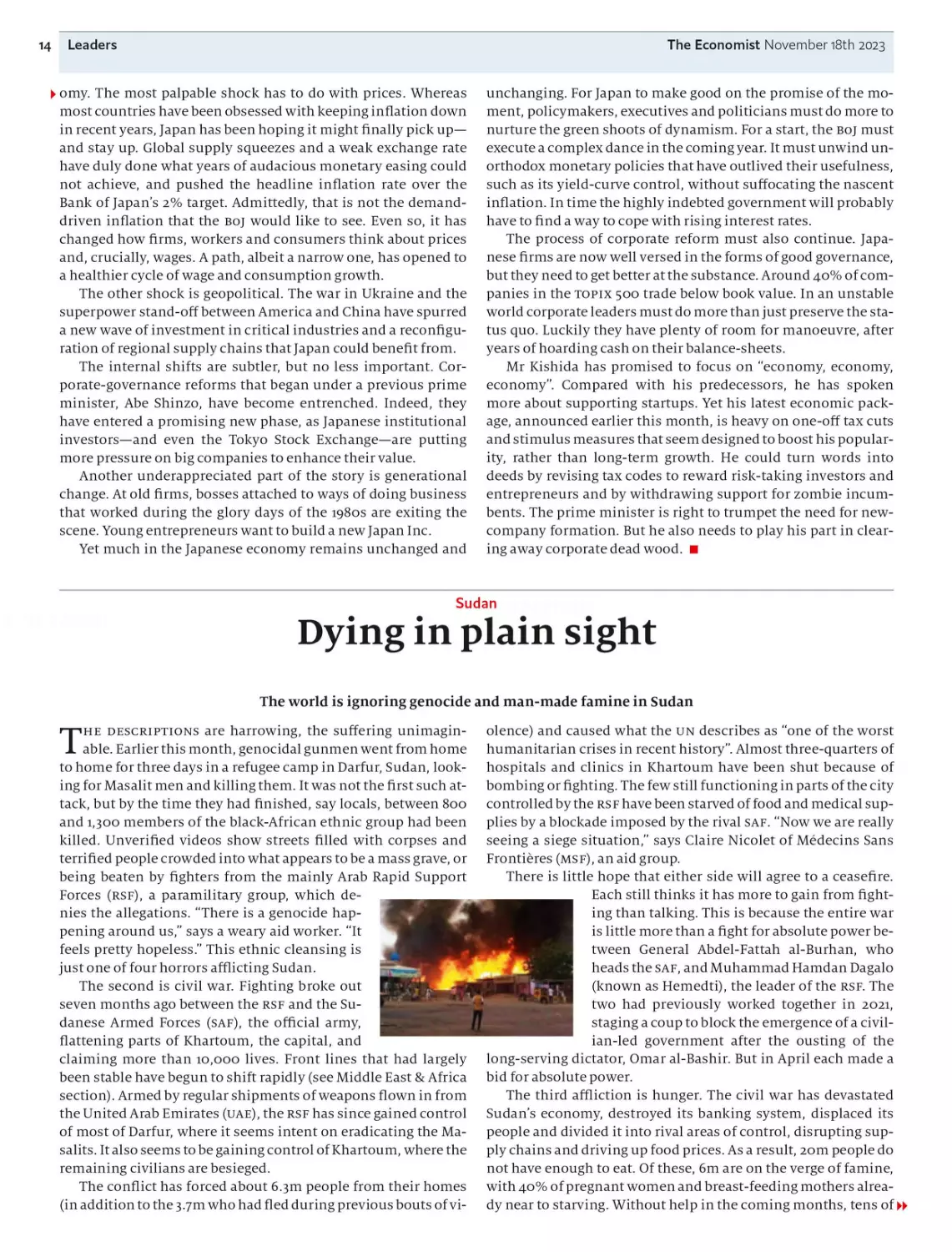
The second is civil war. Fighting broke out
seven months ago between the rsf and the Su-
danese Armed Forces (saf), the official army,
flattening parts of Khartoum, the capital, and
claiming more than 10,000 lives. Front lines that had largely
been stable have begun to shift rapidly (see Middle East & Africa
section). Armed by regular shipments of weapons flown in from
the United Arab Emirates (uae), the rsf has since gained control
of most of Darfur, where it seems intent on eradicating the Ma-
salits. It also seems to be gaining control of Khartoum, where the
remaining civilians are besieged.
The conflict has forced about 6.3m people from their homes
(in addition to the 3.7m who had fled during previous bouts of vi-
olence) and caused what the UN describes as "one of the worst
humanitarian crises in recent history”. Almost three-quarters of
hospitals and clinics in Khartoum have been shut because of
bombing or fighting. The few still functioning in parts of the city
controlled by the rsf have been starved of food and medical sup-
plies by a blockade imposed by the rival saf. "Now we are really
seeing a siege situation,” says Claire Nicolet of Medecins Sans
Frontieres (msf), an aid group.
There is little hope that either side will agree to a ceasefire.
Each still thinks it has more to gain from fight-
ing than talking. This is because the entire war
is little more than a fight for absolute power be-
tween General Abdel-Fattah al-Burhan, who
heads the saf, and Muhammad Hamdan Dagalo
(known as Hemedti), the leader of the rsf. The
two had previously worked together in 2021,
staging a coup to block the emergence of a civil-
ian-led government after the ousting of the
long-serving dictator, Omar al-Bashir. But in April each made a
bid for absolute power.
The third affliction is hunger. The civil war has devastated
Sudan’s economy, destroyed its banking system, displaced its
people and divided it into rival areas of control, disrupting sup-
ply chains and driving up food prices. As a result, 20m people do
not have enough to eat. Of these, 6m are on the verge of famine,
with 40% of pregnant women and breast-feeding mothers alrea-
dy near to starving. Without help in the coming months, tens of ►►
The Economist November 18th 2023
Leaders 15
►	thousands of people are at risk of starving. But aid agencies are
struggling to bring in supplies. The saf controls Port Sudan, the
main import hub, and is blocking the flow of aid workers and
supplies to RSF-controlled territory.
The saf is able to starve its people and the rsf is able to eth-
nically cleanse Darfur largely because of Sudan’s fourth afflic-
tion: the wider world’s utter indifference. The African Union ap-
pears to be unmoved by the catastrophe and is retreating to a
policy of "non-interference” in the affairs of its members, hav-
ing previously sat idle while 385,000-600,000 people died dur-
ing a civil war over the Tigray region in Ethiopia. The UN Security
Council has been just as toothless and held only informal con-
sultations on Sudan. This is not because its hands are tied by
strategic interests or deep divisions between great powers, as
with Ukraine or Syria, but because of gross neglect. America has
paid little attention, largely because it is distracted by Ukraine
and, more recently, Gaza. “The silence has been deafening,” says
Mathilde Vu of the Norwegian Refugee Council.
Yet the world need not helplessly watch a disaster unfold.
Governments should meet aid agencies’ requests for funds.
Ahead of the climate-change summit in Dubai, America and its
allies should press the uae to halt its supply of weapons to a
genocidal militia (the uae claims the flights carry assistance).
African leaders should redouble their diplomatic efforts. The Se-
curity Council, divided as it is, ought to be able to pass a resolu-
tion urging Sudan’s warring parties to protect civilians and let in
aid. This would also signal that war crimes will be prosecuted.
The world is not short of crises (see International section).
But it is more complex and America holds less sway than in the
2000s, when it belatedly led efforts to curb ethnic cleansing in
Darfur. Yet great powers are great in part because they pay atten-
tion. And Sudan is dying from neglect.
Science funding
Time to experiment
Too much of researchers’ time is spent filling in forms. There are better ways to fund their work
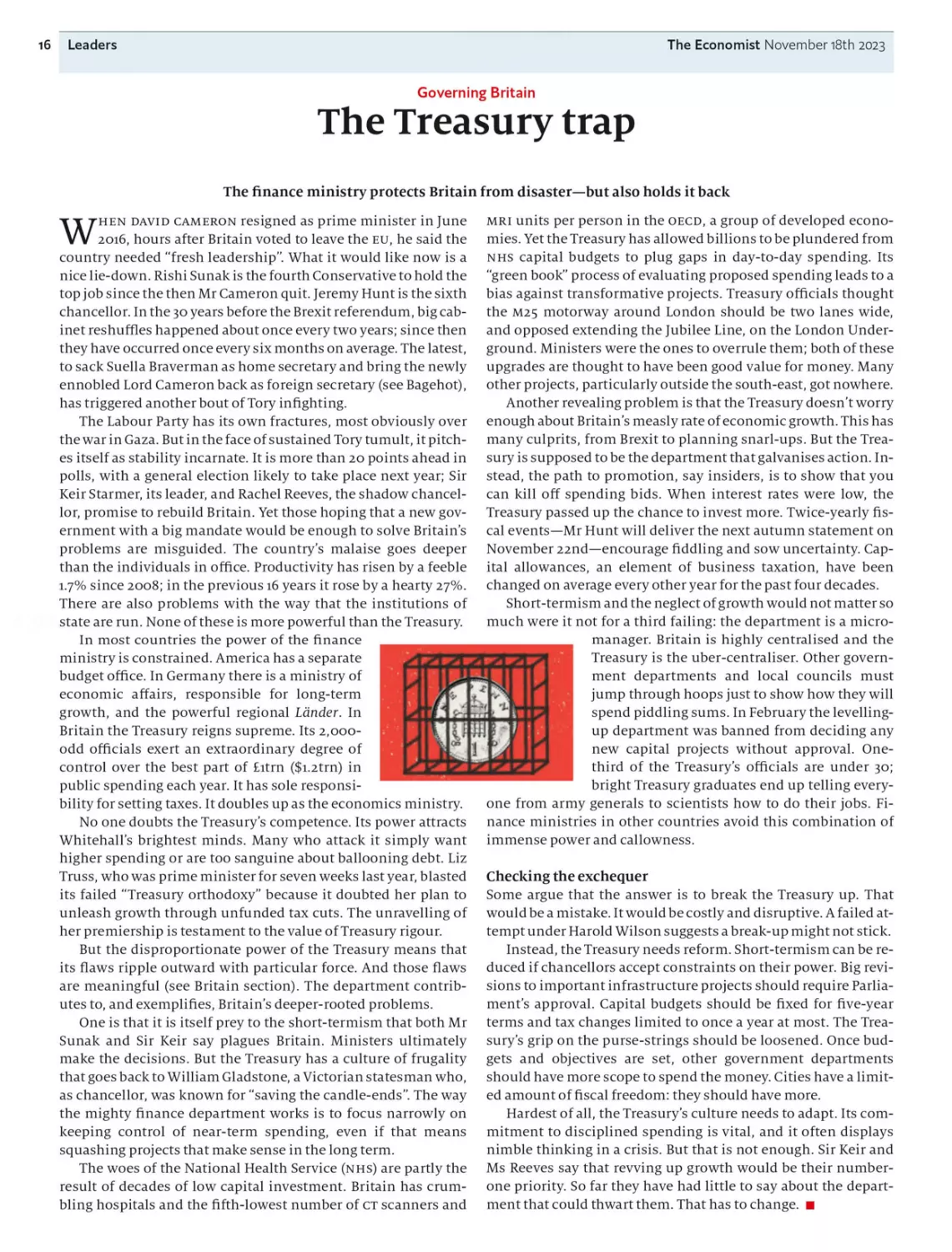
The transformation unleashed by increased funding for
science during the 20th century is nothing short of remark-
able. In the early 1900s research was a cottage industry mostly
funded by private firms and philanthropy. Thomas Edison elec-
trified the world from his industrial lab at Menlo Park, and the
Carnegie Foundation was the principal backer of Edwin Hubble.
Advances in science during the second world war—from the de-
velopment of radar to the atom bomb—led governments and
companies to scale things up. By the mid-1960s America’s feder-
al government was spending 0.6% of gdp on research funding
and the share of overall investment in research and develop-
ment rose to nearly 3%. Inventions including the internet, gps
and space telescopes followed.
That dynamism is fizzling out. A growing body of work shows
that even as the world spends more on research,
the bang for each extra buck has fallen. One ex-
planation for this is that the way science is
funded is out of date. Researchers must now
contend with a daunting amount of bureaucra-
cy. The rate at which grant applications are ac-
cepted has fallen, meaning more of them must
be made. Two-fifths of a top scientist’s time is
spent on things other than research, such as
looking for money. One study found that researchers spent a
combined 614 years applying for grants from a single funding
body in Australia in 2014 alone. Risky ideas are often put aside.
The current system is also monolithic. Western scientific
systems are dominated by handouts of project grants and peer
review. Most money flows to universities, and the academic ca-
reer ladder is such that researchers face incentives to pursue in-
cremental advances, in order to boost citations and gain tenure,
rather than breakthrough work. It is time for another shake-up.
A growing cadre of scientists, policymakers and philanthro-
pists hopes to revamp science funding. In 2022 America’s chips
Act reformed the National Science Foundation (nsf) to focus it
more on technology. America’s famed Advanced Research Pro-
jects Agency (today called darpa)—which was founded in 1958
and seeded the modern internet—has inspired copycats in Brit-
ain and Germany. Tech billionaires’ plans to fund pet projects
come thick and fast. On November 1st Eric Schmidt, a former
boss of Google, announced he was funding a moonshot to build
an "artificial-intelligence scientist” to speed up biology.
The problem is that no one really knows which approaches
work best. For example, many great scientific discoveries have
come not from funding basic science but from the pursuit of
commercial technology. The transistor, for instance, emerged
from AT&T's Bell Labs. That is why governments should start
treating the search for the best ways to fund science as though it
were itself a scientific problem.
The first step is to try new things. More money could fund
promising people rather than specific projects, encouraging re-
searchers to take risks. Funders could move
faster and bypass peer review entirely, for ex-
ample by using lotteries. Countries should also
learn from the best practices of others. Ameri-
can philanthropists give over three times more
to science than do their European counterparts.
Europeans might benefit from changing that.
More important still is to find ways to mea-
sure what is working and what is not, and then
adapt accordingly. Governments might consider appointing
"meta-scientists” or "chief economists” to do the number-
crunching across their various scientific agencies. One intrigu-
ing idea is to keep tabs on an "anti-portfolio”, or a list of projects
that they do not fund, and track how they perform.
None of this will be easy. Experimentation comes with trade-
offs. More cash for DARPA-like bodies means less for other ap-
proaches. Scientific funders say they want to experiment, but
they also face pressure to support research that can be easily ex-
plained, to keep politicians happy. In some cases more money
may be the only solution. Still, the economic returns to research
are so large—at least ten times the original investment, by one
estimate—that fixing the system is well worth the effort. Like
science itself, the way of funding it must also progress.
16 Leaders
The Economist November 18th 2023
Governing Britain
The Treasury trap
The finance ministry protects Britain from disaster—but also holds it back
When david Cameron resigned as prime minister in June
2016, hours after Britain voted to leave the eu, he said the
country needed "fresh leadership”. What it would like now is a
nice lie-down. Rishi Sunak is the fourth Conservative to hold the
top job since the then Mr Cameron quit. Jeremy Hunt is the sixth
chancellor. In the 30 years before the Brexit referendum, big cab-
inet reshuffles happened about once every two years; since then
they have occurred once every six months on average. The latest,
to sack Suella Braverman as home secretary and bring the newly
ennobled Lord Cameron back as foreign secretary (see Bagehot),
has triggered another bout of Tory infighting.
The Labour Party has its own fractures, most obviously over
the war in Gaza. But in the face of sustained Tory tumult, it pitch-
es itself as stability incarnate. It is more than 20 points ahead in
polls, with a general election likely to take place next year; Sir
Keir Starmer, its leader, and Rachel Reeves, the shadow chancel-
lor, promise to rebuild Britain. Yet those hoping that a new gov-
ernment with a big mandate would be enough to solve Britain’s
problems are misguided. The country’s malaise goes deeper
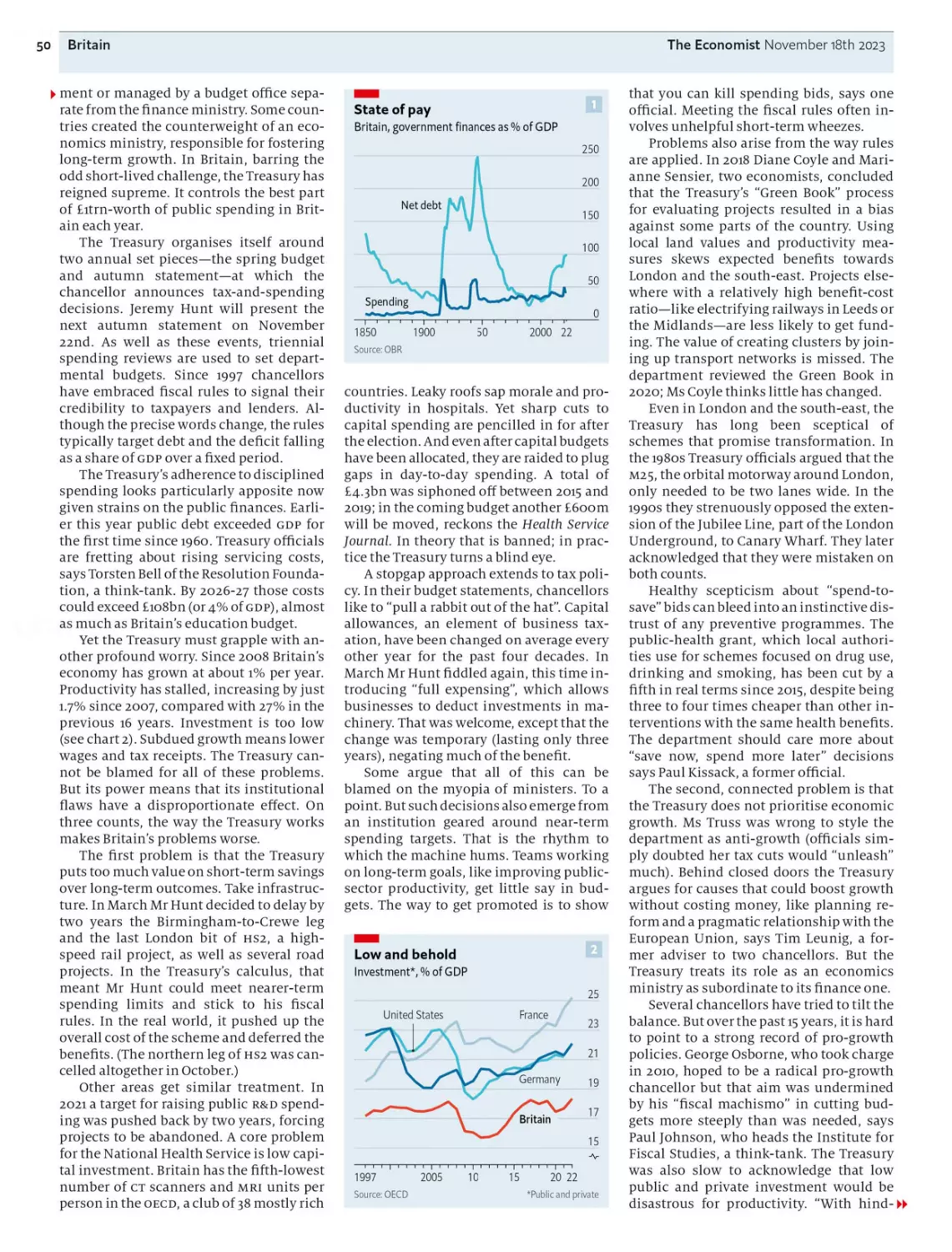
than the individuals in office. Productivity has risen by a feeble
1.7% since 2008; in the previous 16 years it rose by a hearty 27%.
There are also problems with the way that the institutions of
state are run. None of these is more powerful than the Treasury.
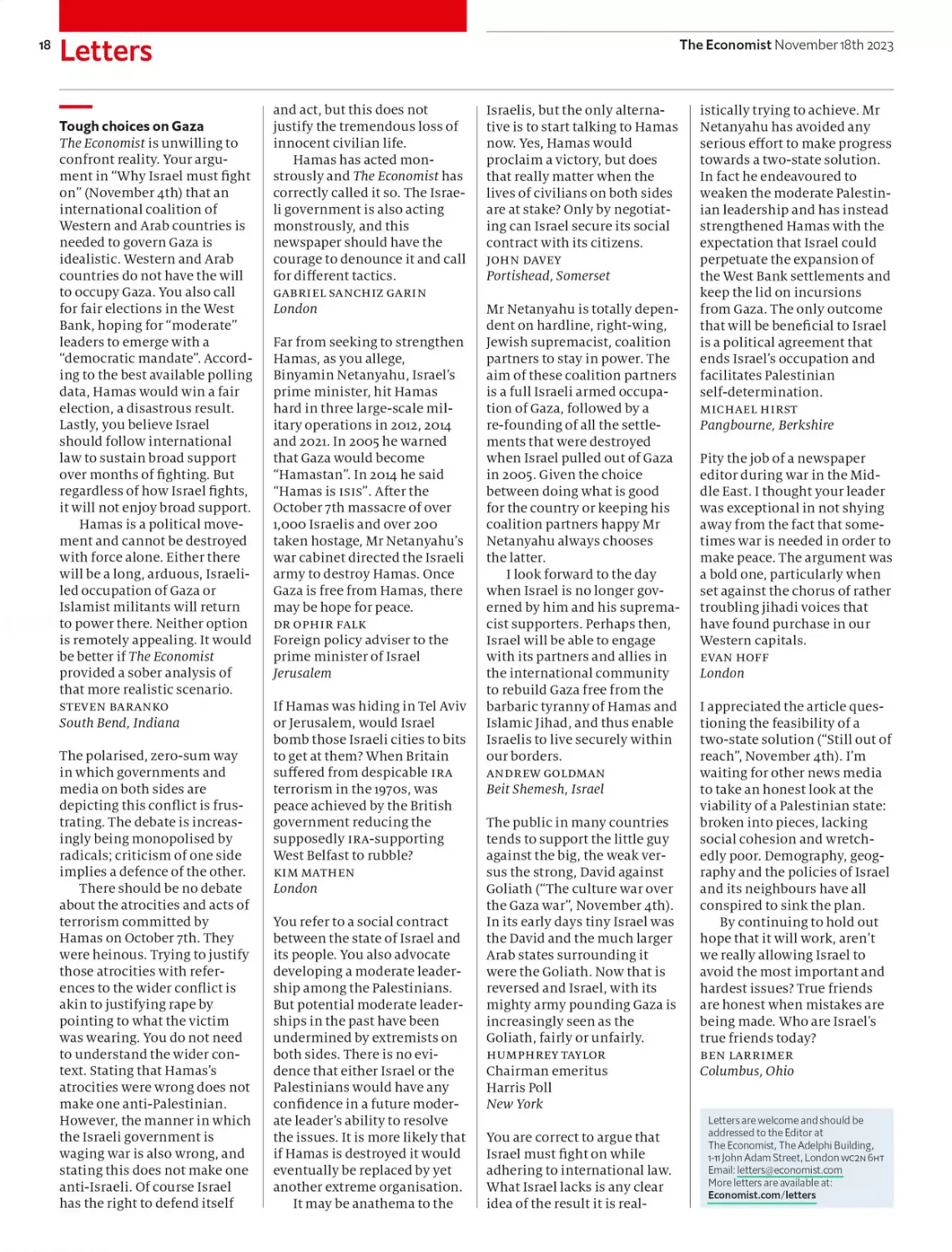
In most countries the power of the finance
ministry is constrained. America has a separate
budget office. In Germany there is a ministry of
economic affairs, responsible for long-term
growth, and the powerful regional Lander. In
Britain the Treasury reigns supreme. Its 2,000-
odd officials exert an extraordinary degree of
control over the best part of £itrn ($i.2trn) in
public spending each year. It has sole responsi-
bility for setting taxes. It doubles up as the economics ministry.
No one doubts the Treasury’s competence. Its power attracts
Whitehall’s brightest minds. Many who attack it simply want
higher spending or are too sanguine about ballooning debt. Liz
Truss, who was prime minister for seven weeks last year, blasted
its failed "Treasury orthodoxy” because it doubted her plan to
unleash growth through unfunded tax cuts. The unravelling of
her premiership is testament to the value of Treasury rigour.
But the disproportionate power of the Treasury means that
its flaws ripple outward with particular force. And those flaws
are meaningful (see Britain section). The department contrib-
utes to, and exemplifies, Britain’s deeper-rooted problems.
One is that it is itself prey to the short-termism that both Mr
Sunak and Sir Keir say plagues Britain. Ministers ultimately
make the decisions. But the Treasury has a culture of frugality
that goes back to William Gladstone, a Victorian statesman who,
as chancellor, was known for "saving the candle-ends”. The way
the mighty finance department works is to focus narrowly on
keeping control of near-term spending, even if that means
squashing projects that make sense in the long term.
The woes of the National Health Service (nhs) are partly the
result of decades of low capital investment. Britain has crum-
bling hospitals and the fifth-lowest number of ст scanners and
mri units per person in the oecd, a group of developed econo-
mies. Yet theTreasury has allowed billions to be plundered from
nhs capital budgets to plug gaps in day-to-day spending. Its
"green book” process of evaluating proposed spending leads to a
bias against transformative projects. Treasury officials thought
the M25 motorway around London should be two lanes wide,
and opposed extending the Jubilee Line, on the London Under-
ground. Ministers were the ones to overrule them; both of these
upgrades are thought to have been good value for money. Many
other projects, particularly outside the south-east, got nowhere.
Another revealing problem is that the Treasury doesn’t worry
enough about Britain’s measly rate of economic growth. This has
many culprits, from Brexit to planning snarl-ups. But the Trea-
sury is supposed to be the department that galvanises action. In-
stead, the path to promotion, say insiders, is to show that you
can kill off spending bids. When interest rates were low, the
Treasury passed up the chance to invest more. Twice-yearly fis-
cal events—Mr Hunt will deliver the next autumn statement on
November 22nd—encourage fiddling and sow uncertainty. Cap-
ital allowances, an element of business taxation, have been
changed on average every other year for the past four decades.
Short-termism and the neglect of growth would not matter so
much were it not for a third failing: the department is a micro-
manager. Britain is highly centralised and the
Treasury is the uber-centraliser. Other govern-
ment departments and local councils must
jump through hoops just to show how they will
spend piddling sums. In February the levelling-
up department was banned from deciding any
new capital projects without approval. One-
third of the Treasury’s officials are under 30;
bright Treasury graduates end up telling every-
one from army generals to scientists how to do their jobs. Fi-
nance ministries in other countries avoid this combination of
immense power and callowness.
Checking the exchequer
Some argue that the answer is to break the Treasury up. That
would be a mistake. It would be costly and disruptive. A failed at-
tempt under Harold Wilson suggests a break-up might not stick.
Instead, theTreasury needs reform. Short-termism can be re-
duced if chancellors accept constraints on their power. Big revi-
sions to important infrastructure projects should require Parlia-
ment’s approval. Capital budgets should be fixed for five-year
terms and tax changes limited to once a year at most. The Trea-
sury’s grip on the purse-strings should be loosened. Once bud-
gets and objectives are set, other government departments
should have more scope to spend the money. Cities have a limit-
ed amount of fiscal freedom: they should have more.
Hardest of all, the Treasury’s culture needs to adapt. Its com-
mitment to disciplined spending is vital, and it often displays
nimble thinking in a crisis. But that is not enough. Sir Keir and
Ms Reeves say that revving up growth would be their number-
one priority. So far they have had little to say about the depart-
ment that could thwart them. That has to change.
Executive focus
17
Planning a Ne
hallenge
EST 1976
Unique Access to Confidential Opportunities
InterExec is the global leader in assisting Top Executives
to access £200k to £2m+ unadvertised vacancies worldwide.
We act discreetly through our 15,000 strong Headhunter network.
Inter E\ec
UNIQUE NETWORK ♦ OUTSTANDING TALENT
london@interexec.net www.interexec.net +44 (0)20 7256 5085
8 Letters
The Economist Novemberi8th 2023
Tough choices on Gaza
The Economist is unwilling to
confront reality. Your argu-
ment in “Why Israel must fight
on” (November 4th) that an
international coalition of
Western and Arab countries is
needed to govern Gaza is
idealistic. Western and Arab
countries do not have the will
to occupy Gaza. You also call
for fair elections in the West
Bank, hoping for “moderate”
leaders to emerge with a
"democratic mandate”. Accord-
ing to the best available polling
data, Hamas would win a fair
election, a disastrous result.
Lastly, you believe Israel
should follow international
law to sustain broad support
over months of fighting. But
regardless of how Israel fights,
it will not enjoy broad support.
Hamas is a political move-
ment and cannot be destroyed
with force alone. Either there
will be a long, arduous, Israeli-
led occupation of Gaza or
Islamist militants will return
to power there. Neither option
is remotely appealing. It would
be better if The Economist
provided a sober analysis of
that more realistic scenario.
STEVEN BARANKO
South Bend, Indiana
The polarised, zero-sum way
in which governments and
media on both sides are
depicting this conflict is frus-
trating. The debate is increas-
ingly being monopolised by
radicals; criticism of one side
implies a defence of the other.
There should be no debate
about the atrocities and acts of
terrorism committed by
Hamas on October 7th. They
were heinous. Trying to justify
those atrocities with refer-
ences to the wider conflict is
akin to justifying rape by
pointing to what the victim
was wearing. You do not need
to understand the wider con-
text. Stating that Hamas’s
atrocities were wrong does not
make one anti-Palestinian.
However, the manner in which
the Israeli government is
waging war is also wrong, and
stating this does not make one
anti-Israeli. Of course Israel
has the right to defend itself
and act, but this does not
justify the tremendous loss of
innocent civilian life.
Hamas has acted mon-
strously and The Economist has
correctly called it so. The Israe-
li government is also acting
monstrously, and this
newspaper should have the
courage to denounce it and call
for different tactics.
GABRIEL SANCHIZ GARIN
London
Far from seeking to strengthen
Hamas, as you allege,
Binyamin Netanyahu, Israel's
prime minister, hit Hamas
hard in three large-scale mil-
itaryoperations in 2012, 2014
and 2021. In 2005 he warned
that Gaza would become
"Hamastan”. In 2014 he said
"Hamas is is is”. After the
October 7th massacre of over
1,000 Israelis and over 200
taken hostage, Mr Netanyahu’s
war cabinet directed the Israeli
army to destroy Hamas. Once
Gaza is free from Hamas, there
may be hope for peace.
DROPHIR FALK
Foreign policy adviser to the
prime minister of Israel
Jerusalem
If Hamas was hiding in Tel Aviv
or Jerusalem, would Israel
bomb those Israeli cities to bits
to get at them? When Britain
suffered from despicable ira
terrorism in the 1970s, was
peace achieved by the British
government reducing the
supposedly IRA-supporting
West Belfast to rubble?
KIM MATHEN
London
You refer to a social contract
between the state of Israel and
its people. You also advocate
developing a moderate leader-
ship among the Palestinians.
But potential moderate leader-
ships in the past have been
undermined by extremists on
both sides. There is no evi-
dence that either Israel or the
Palestinians would have any
confidence in a future moder-
ate leader’s ability to resolve
the issues. It is more likely that
if Hamas is destroyed it would
eventually be replaced by yet
another extreme organisation.
It may be anathema to the
Israelis, but the only alterna-
tive is to start talking to Hamas
now. Yes, Hamas would
proclaim a victory, but does
that really matter when the
lives of civilians on both sides
are at stake? Only by negotiat-
ing can Israel secure its social
contract with its citizens.
JOHN DAVEY
Portishead, Somerset
Mr Netanyahu is totally depen-
dent on hardline, right-wing,
Jewish supremacist, coalition
partners to stay in power. The
aim of these coalition partners
is a full Israeli armed occupa-
tion of Gaza, followed by a
re-founding of all the settle-
ments that were destroyed
when Israel pulled out of Gaza
in 2005. Given the choice
between doing what is good
for the country or keeping his
coalition partners happy Mr
Netanyahu always chooses
the latter.
I look forward to the day
when Israel is no longer gov-
erned by him and his suprema-
cist supporters. Perhaps then,
Israel will be able to engage
with its partners and allies in
the international community
to rebuild Gaza free from the
barbaric tyranny of Hamas and
Islamic Jihad, and thus enable
Israelis to live securely within
our borders.
ANDREW GOLDMAN
BeitShemesh, Israel
The public in many countries
tends to support the little guy
against the big, the weak ver-
sus the strong, David against
Goliath ("The culture war over
the Gaza war”, November 4th).
In its early days tiny Israel was
the David and the much larger
Arab states surrounding it
were the Goliath. Now that is
reversed and Israel, with its
mighty army pounding Gaza is
increasingly seen as the
Goliath, fairly or unfairly.
HUMPHREY TAYLOR
Chairman emeritus
Harris Poll
New York
You are correct to argue that
Israel must fight on while
adhering to international law.
What Israel lacks is any clear
idea of the result it is real-
istically trying to achieve. Mr
Netanyahu has avoided any
serious effort to make progress
towards a two-state solution.
In fact he endeavoured to
weaken the moderate Palestin-
ian leadership and has instead
strengthened Hamas with the
expectation that Israel could
perpetuate the expansion of
the West Bank settlements and
keep the lid on incursions
from Gaza. The only outcome
that will be beneficial to Israel
is a political agreement that
ends Israel’s occupation and
facilitates Palestinian
self-determination.
MICHAEL HIRST
Pangbourne, Berkshire
Pity the job of a newspaper
editor during war in the Mid-
dle East. I thought your leader
was exceptional in not shying
away from the fact that some-
times war is needed in order to
make peace. The argument was
a bold one, particularly when
set against the chorus of rather
troubling jihadi voices that
have found purchase in our
Western capitals.
EVAN HOFF
London
I appreciated the article ques-
tioning the feasibility of a
two-state solution ("Still out of
reach”, November 4th). I'm
waiting for other news media
to take an honest look at the
viability of a Palestinian state:
broken into pieces, lacking
social cohesion and wretch-
edly poor. Demography, geog-
raphy and the policies of Israel
and its neighbours have all
conspired to sink the plan.
By continuing to hold out
hope that it will work, aren’t
we really allowing Israel to
avoid the most important and
hardest issues? True friends
are honest when mistakes are
being made. Who are Israel’s
true friends today?
BEN LARRIMER
Columbus, Ohio
Letters are welcome and should be
addressed to the Editor at
The Economist, The Adelphi Building,
1-11 John Adam Street, London WC2N 6ht
Email: letters@economist.com
More letters are available at:
Economist.com/letters
United States
The Economist Novemberi8th 2023
19
The shutdown
Shut it all down (next year)
WASHINGTON, DC
The new Republican speaker halts shutdown drama for another few months
Insanity is said to be doing the same
thing repeatedly while expecting differ-
ent results. But perhaps a dose of insanity
is healthy when it comes to understanding
the Republicans who control the House of
Representatives. In September Kevin Mc-
Carthy, then the Speaker of the House, cut a
deal to avoid a government shutdown by
defying far-right Republicans and relying
heavily on Democratic votes to pass a
short-term funding bill. He was summarily
defenestrated. Six weeks later Mike John-
son, his replacement, defied hardliners
and relied on Democrats to pass a tempor-
ary funding bill. Yet, for the moment, his
job is safe. What gives?
The explanation has a lot to do with the
chaos that ensued after Mr McCarthy’s
ejection from the speakership by majority
vote—the first in American history. The
deal that he cut maintained government
funding for roughly six weeks. About half
of that time was wasted as Republicans
squabbled among themselves about select-
ing a replacement. That left little time to
haggle with Democrats, who control both
the Senate and the White House, over a
long-term solution. Mr Johnson recog-
nised that he needed more time and that
his party would get the blame for a shut-
down, so he moved a short-term funding
package similar to the one that led to his
predecessor’s ousting.
Ninety-three Republican representa-
tives—about two-fifths of the troops—vot-
ed against the bill. A similar number dis-
sented against Mr McCarthy. But so far Re-
-> Also in this section
20 AcodeforSCOTUS
21 Supperclubs
21 Religious abortions
22 Counting school shootings
22 The FBI and Eric Adams
24 Lexington: Coming to America
publicans have held back on ejecting Mr
Johnson for the same sin. “Johnson's going
to have a longer leash,” says Kevin Kosar, a
fellow at the American Enterprise Insti-
tute, a think-tank. "What can he really do?
And how long can he do it before they
come for him? It’s not clear.”
The House Freedom Caucus, which
counts dozens of hardline Republicans as
members, denounced the deal “as it con-
tains no spending reductions, no border
security, and not a single meaningful win
for the American People”. Yet the group
added that "we remain committed to work-
ing with Speaker Johnson.” Even they are
not keen to endure another bout of chaos
and embarrassment.
Someof it is a matter of personality, too.
Mr Johnson was a genteel, largely un-
known representative from Louisiana; his
prominent predecessor had developed tox-
ic relationships with many Democrats and
Republicans over the years. Some of those
resentments persist. On November 14th,
the day the House passed its latest spend-
ing legislation, a Republican lawmaker
who helped remove Mr McCarthy from
power accused him of elbowing him in a
hallway. Mr McCarthy pled ignorance: "If I
kidney-punched someone, they would be
on the ground.” Mr Johnson’s honeymoon
may be ending, but at least the marriage
has not degenerated into McCarthyesque
plate-throwing.
The Johnson bill includes several small ►►
20 United States
The Economist November 18th 2023
► but meaningful distinctions. Mr McCar-
thy’s reprieve had funding expire less than
a week before Thanksgiving, which was
suboptimal for lawmakers who like their
families. In the holiday spirit, Mr Johnson
did not want a funding extension so short
that it created a new deadline before
Christmas— “a terrible way to run a rail-
road”, in his words. His temporary measure
extends funding into the new year. Its ex-
piry would not turn the federal govern-
ment off all at once. Money would stop
flowing to parts of the federal government
on January 19th 2024; the rest would be cut
off on February 2nd.
Democrats had been braced for much
worse. Chuck Schumer, the Senate majori-
ty leader, said Mr Johnson's bill left him
cautiously "heartened”. Pramila Jayapal,
chair of the Congressional Progressive
Caucus, even called the short-term legisla-
tion "a very big win” because it kept fund-
ing at the (arguably profligate) levels that
was set back when Democrats had full con-
trol of government. That sort of praise does
not help Mr Johnson’s relationship with
conservative House members.
The real challenge comes in January,
when Mr Johnson will have to corral his
raucous Republican caucus and reach a
long-term spending deal with Democrats.
The ramifications are not just over politi-
cal embarrassment or even the annoyance
of a federal shutdown. The White House’s
request for $io6bn in military funding for
Ukraine, Israel, the Indo-Pacific and border
security remains stalled. Solid majorities
in the House and Senate support further
assistance to Ukraine, the largest benefi-
ciary and the country in greatest need of
additional aid. Mr Schumer hopes to bring
up the package after Thanksgiving, but Mr
Johnson has said he wants to "bifurcate”
Israel and Ukraine.
Mr Johnson’s election has not proved a
boon for America’s allies. Although the
new speaker has adopted some pro-Uk-
raine rhetoric in recent weeks, he had con-
sistently voted against sending aid to the
country. Mr Johnson has alluded to more
oversight of support for Ukraine, which
may be an unnecessary but acceptable
compromise. Despite being a consistent
supporter of Israel, he also suggested pair-
ing new military aid with spending cuts at
the Internal Revenue Service, a long-run-
ning Republican bugbear. This unserious
offer—which would actually increase defi-
cits—is not encouraging.
The uncertainty is worrying. "You’ve
got a lot of Republicans who I know, know,
in their hearts and minds—they support
Ukraine. But how do they deal with Trump
and his shall-we-say rather enthusiastic
supporters?” said Adam Smith, the top
Democrat on the House Armed Services
committee. "There’s not much policy here
and a lot of politics.”
SCOTUS
Code switch
NEW YORK
The Supreme Court gives itself a code
of conduct. It’s a start
For 50 years all but nine of America’s
around 2,000 federal judges have been
subject to a code of conduct laying out eth-
ical guidelines for jurists’ behaviour on
and off the bench. On November 13th the
exceptions—the justices of the Supreme
Court—announced that they had decided
to join their lower-court peers.
The new rules do not arrive in a vacu-
um. Calls for the court to clean up its act
have followed investigative reports from
ProPublica and other publications uncov-
ering several justices’ ethical lapses. Jus-
tice Clarence Thomas, the main target of
those articles, failed to declare decades of
luxury travel on the tab of Harlan Crow, a
generous donor to conservative causes. Mr
Crow also bought a home Justice Thomas
owned in Georgia and footed the tuition
bill for his grandnephew's private school.
A Senate committee found last month
that another friend of Justice Thomas ap-
parently forgave “a substantial portion” of
a $267,230 loan financing the justice's Pre-
vost Marathon motor coach (which he has
referred to as his “land yacht”). This too
was not declared. And although his wife
Virginia lobbied President Donald Trump's
chief of staff to help overturn the 2020
election outcome, Justice Thomas opted
not to recuse himself from cases challeng-
ing the election results and involving Mr
Trump’s role in the riot at the Capitol on
January 6th 2021.
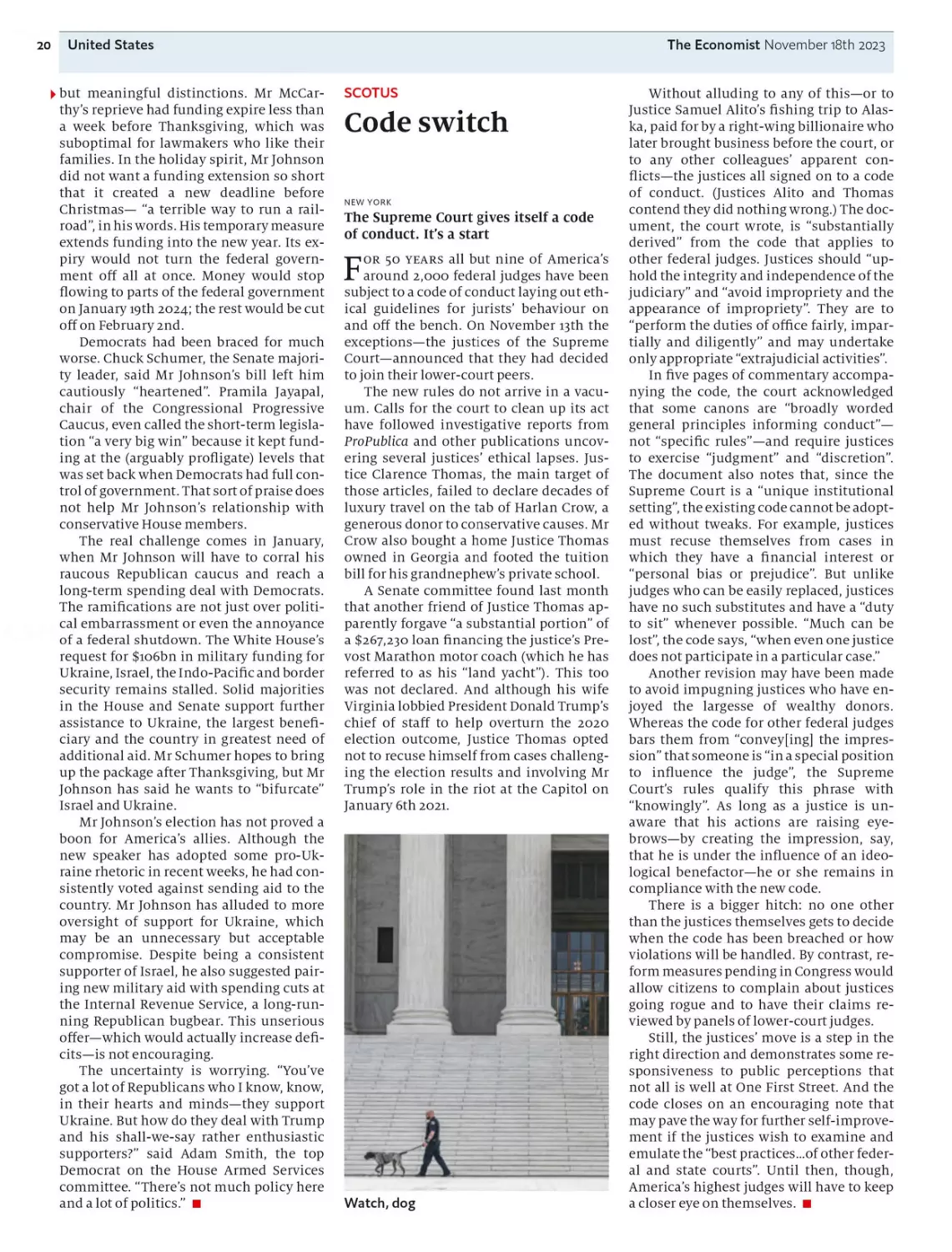
Watch, dog
Without alluding to any of this—or to
Justice Samuel Alito’s fishing trip to Alas-
ka, paid for by a right-wing billionaire who
later brought business before the court, or
to any other colleagues’ apparent con-
flicts—the justices all signed on to a code
of conduct. (Justices Alito and Thomas
contend they did nothing wrong.) The doc-
ument, the court wrote, is "substantially
derived” from the code that applies to
other federal judges. Justices should "up-
hold the integrity and independence of the
judiciary” and "avoid impropriety and the
appearance of impropriety”. They are to
"perform the duties of office fairly, impar-
tially and diligently” and may undertake
only appropriate "extrajudicial activities”.
In five pages of commentary accompa-
nying the code, the court acknowledged
that some canons are “broadly worded
general principles informing conduct”—
not "specific rules”—and require justices
to exercise "judgment” and "discretion”.
The document also notes that, since the
Supreme Court is a “unique institutional
setting”, the existing code cannot be adopt-
ed without tweaks. For example, justices
must recuse themselves from cases in
which they have a financial interest or
“personal bias or prejudice”. But unlike
judges who can be easily replaced, justices
have no such substitutes and have a "duty
to sit” whenever possible. "Much can be
lost”, the code says, "when even one justice
does not participate in a particular case.”
Another revision may have been made
to avoid impugning justices who have en-
joyed the largesse of wealthy donors.
Whereas the code for other federal judges
bars them from "conveying] the impres-
sion” thatsomeone is “in a special position
to influence the judge”, the Supreme
Court's rules qualify this phrase with
"knowingly”. As long as a justice is un-
aware that his actions are raising eye-
brows—by creating the impression, say,
that he is under the influence of an ideo-
logical benefactor—he or she remains in
compliance with the new code.
There is a bigger hitch: no one other
than the justices themselves gets to decide
when the code has been breached or how
violations will be handled. By contrast, re-
form measures pending in Congress would
allow citizens to complain about justices
going rogue and to have their claims re-
viewed by panels of lower-court judges.
Still, the justices’ move is a step in the
right direction and demonstrates some re-
sponsiveness to public perceptions that
not all is well at One First Street. And the
code closes on an encouraging note that
may pave the way for further self-improve-
ment if the justices wish to examine and
emulate the "best practices...of other feder-
al and state courts”. Until then, though,
America’s highest judges will have to keep
a closer eye on themselves.
The Economist November 18th 2023
United States 21
Sup on that
CHICAGO
Why supper clubs are booming
Before the main course comes out
on a Friday night, the diners are
asked to pause for some entertainment.
“I’m not one to just throw a dinner
party with nothing,” says the host, and
then a musician stands up and sings.
The assembled guests, seated along two
long tables, whoop. Each person attend-
ing has paid $90 for the meal, which
consists of six courses plus paired
wines and cocktails. The banquet is
themed loosely around Shabbat, the
Friday evening meal for observant Jews.
The scene is not, however, at a fancy
restaurant, but in an art gallery. Paint-
ings depicting different foods line the
walls. The host, Allan Weinberger, who
is also the gallerist, notes which have
already sold, and that the painter is
among the crowd.
The meal at Mr Weinberger’s gallery
was provided by TxaTxaClub, a business
started in Chicago in 2021 by two res-
taurateurs, Liz Bendure and Daniel
Parker. The two met working at an
organic restaurant in Logan Square, the
heart of Chicago’s hipster belt. But
when the pandemic closed dining
places, their lives were thrown into
chaos. "We kind of lost everything,”
says Ms Bendure. Starved of work, they
started running supper clubs fora
dozen or so people in their garden.
Within a year they were serving larger
crowds in "underused” spaces. Art
galleries work well because they are
empty at night, and the owners like to
bring in punters with fancy taste. But
they have also cooked in warehouses
and at a furniture store.
The past few years have been tough
for the restaurant industry. Last year
there were roughly a tenth fewer eating
places open in America than there were
in 2019. Supper clubs and the like are
thriving, however. Yelp, which runs a
table-reservation website, says open-
ings of "pop-up” restaurants (without
permanent premises) more than dou-
bled in the year to March. One reason
why is simple: spending is back, but
costs have soared. Wages in “food and
drinking places" have climbed by a
third since 2020, according to the Bu-
reau of Labour Statistics. In restaurants,
says Mr Parker, "the financial always
becomes the focus”. Staff must be paid
all day long, even when tables are emp-
ty. A pop-up is far more efficient, and
less risky. Just try not to damage the art.
Life and autonomy
Religious
abortions
NEW YORK
Some progressives are arguing for a
religious right to abortion
The book of Exodus contains a section
about liability. It is a bit outdated, enu-
merating damages if someone’s bull gores
another person’s slave. But one parable is
relevant to abortion debates today, since it
elucidates how Judaism understands the
unborn. If a pregnant woman is hit and
suffers a miscarriage, the perpetrator must
pay a fine. If she dies, however, the penalty
is death. The tale is said to differentiate be-
tween the value of a fetus and a person.
Other Jewish texts also hold that life
doesn’t begin at conception.
The justification for outlawing abor-
tion is to protect fetal life; some states’
bans say this explicitly. Yet that rationale
rests on a religious belief about when life
begins. What about people whose faith
maintains that it starts later? Indeed Jew-
ish law authorises, and even requires, an
abortion if a mother’s health—physical or
mental—is jeopardised. Jews disagree
about what degree of risk warrants the pro-
cedure. But the general principle is that her
well-being takes priority.
In Indiana and Kentucky, several Jewish
women are seeking religious exemptions
from their states’ abortion bans in court.
The restrictions, they say, make it impossi-
ble to get an abortion when their faith
might mandate one. The lawsuit in Indiana
is joined by a Muslim and a woman who
describes herself as a non-theistic believer
in the sanctity of bodily autonomy. It is the
Fanatically pro-choice
further along of the two cases: on Decem-
ber 6th the Indiana Court of Appeals,
which sits one rung below the state’s high-
est court, will take it up. Similar challenges
have been brought by religious leaders in
Florida and Missouri.
The religious case for abortion might
surprise many. After Roe v Wade guaran-
teed the right in 1973, religious activity on
the issue became synonymous with anti-
choice Catholics and evangelicals. But be-
fore Roe, liberal Protestants and Jews had
long agitated for reproductive choice as a
matter of conscience. Some understood it
as a moral obligation in certain cases given
the responsibility of parenthood; they ar-
gued that the interests of the already-born
superseded those of "potential life”. In 1967
a group of ministers and rabbis set up a re-
ferral and counselling network called the
Clergy Consultation Service on Abortion;
within six years it had assisted nearly half a
million women. The Indiana chapter said
it aimed to “help women through what
some have called ‘their deepest crisis’”.
The plaintiffs in Indiana and Kentucky
cite the Religious Freedom Restoration Act
(rfra), which empowers religious objec-
tors to seek exemption from a law if it "sub-
stantially burdens” the exercise of their
faith. Two dozen states, including Indiana
and Kentucky, as well as the federal gov-
ernment, have a rfra on the books. To
fend off a rfra claim, the government
must show that its application of the law is
the "least restrictive” way to ensure a
"compelling” state interest (ie, protecting
fetal life).
The plaintiffs have a strong case, not
least because of the disagreement about
when life begins and whether one is at
stake from conception. Even setting aside
that minefield, the Supreme Court has
made it much easier for religious objectors
to prevail in recent years. The court has
said that the government undermines its
case for withholding religious exemptions
by granting secular ones. All abortion bans
allow the procedure if a mother’s life is at
risk; Indiana lets victims of rape or incest
have it. Neither Indiana nor Kentucky
stops ivf clinics from discarding unused
fertilised embryos. Those are big carve-
outs, says Elizabeth Sepper, a law professor
at the University of Texas at Austin: "If
states cared about their interest in protect-
ing fetal life, they would pursue it in all the
relevant cases, and they’re not.”
The Supreme Court’s deference to reli-
gious objectors over the past decade has
principally served conservative Christians,
such as plaintiffs who did not want to offer
insurance coverage for contraception, or
bake wedding cakes for gay couples. But
progressives are religious too, and they
have had some luck with religious-liberty
claims in lower courts. In 2019 an activist
was acquitted of illegally aiding unautho- ►►
22 United States
The Economist November 18th 2023
► rised migrants in the Arizona desert, an act
that he said was compelled to do so by his
Unitarian faith. Abortion providers may
well make rfra claims on the basis that
their faith obliges them to perform the pro-
cedure for patients who need or ask for an
abortion. Doctors in states that have re-
stricted transgender health care could con-
ceivably say the same.
Some conservatives were against the
federal rfra before it passed in 1993. They
were suspicious that pro-choice progres-
sives would harness the law. The us Con-
ference of Catholic Bishops lobbied
against it. Eventually the anti-abortion
camp came around, and states enacted
their own versions. In fact Indiana’s was
signed into law by its governor at the time,
an anti-abortion evangelical named Mike
Pence. He may soon have regrets.
Not doing their homework
The federal government is blind to the full extent of school shootings
America’s FEDERALgovernment
publishes data on the number of
people injured in car crashes, each pro-
duct recalled for containing peanuts and
the "walkability” of every neighbour-
hood in the country. But there is no
federal record of gun crime in schools.
School shootings call to mind massacres
such as that in Uvalde, Texas, in 2022,
when a former student killed 19 pupils
and two teachers. But there is an incident
of gun crime in an American school
every day on average. The full, devastat-
ing impact is poorly understood.
David Riedman, a data analyst from
Orlando, wants to change that. He starts
his day by sifting through dozens of
Google news alerts on school shootings.
He then feeds these reports into a data-
base which includes every time a gun is
brandished or fired on school property.
The Economist has worked with Mr Ried-
man, and spoken to teachers, students
and parents, to explore a month of gun
crime in America’s schools.
Gun violence in schools is increasing,
but by how much is hard to say. There
were at least 264 incidents in the first
nine months of this year, almost three
times the number in the same period in
2018, according to Mr Riedman. Other
sources vary, because each defines a
More on school shootings
See our full, interactive investigation into a
month of gun crime in America's schools at
economist.com/school-shootings
Eric Adams
Mayor culpa?
NEW YORK
An fbi investigation raises questions
about Hizzoner’s honour
« q OMETHi ng’s always going to be going
^on in the city and you have to be fo-
cused, no distractions and grind,” said Eric
Adams, New York City’s mayor, recently.
That is no easy task at the best of times. It is
especially hard to do while dodging ques-
tions about an alleged fbi investigation.
The probe is reportedly looking into
questionable donations made to Mr Ad-
ams’s 2021 mayoral campaign, including
school shooting differently. "People
think that a school shooting is some-
thing where it’s this deranged person
who’s coming into the school,” Mr Ried-
man says. "But really, the most common
circumstance...is a dispute between
students, usually taking place in a hall-
way or parking lot.”
The government's lack of insight
stems in part from the Dickey Amend-
ment, which in 1996 banned federal
funds from being spent to "advocate or
promote gun control”. The Centres for
Disease Control and Prevention could
not treat gun violence as a public-health
issue and conduct proper research. The
restriction was scrapped in 2018, but its
effects linger in America’s haphazard
approaches to protecting children. Many
schools have installed metal detectors
and bulletproof glass, for example. But
70% of shootings happen outside, ac-
cording toMrRiedman, limitingthe
protection security measures provide.
Four Democratic senators are backing
a bill that would define “school shoot-
ing” for the first time in federal law and
require the government to collect data on
every incident. Republicans in Congress
say that will not make students or par-
ents feel safer. Mr Riedman disagrees.
"We need to be adjusting policy in real
time,” he says. A clearer understanding
of gun crime in schools could pointto
the security interventions that save lives.
It may also help galvanise politicians to
enact the one thing that most experts
agree is guaranteed to make schools
safer: stricter gun control.
possible illegal foreign donations from
people with ties to Turkey. During a press
briefing on November 14th Mr Adams said:
“We don’t do quid pro quo. We follow the
law.” He is not accused of any wrongdoing.
New Yorkers first got wind that some-
thing was up on November 2nd, when fbi
agents searched the home of Mr Adams’s
top fund-raiser. That morning the mayor
had landed in Washington, DC, to meet
lawmakers and White House officials to
discuss his city’s migrant crisis. For more
than a year Mr Adams has called on the fed-
eral government to help the city cope with
130,000 refugees. Mr Adams abruptly can-
celled his meetings and returned to New
York. Then on November 10th the New York
Times revealed that the fbi had seized Mr
Adams’s mobile devices. The fbi is also
said to be looking into whether Mr Adams
pressed the fire department to fast-track
the opening of the new Turkish consulate,
despite some unresolved safety issues. Mr
Adams pooh-poohed any impropriety.
New York City has strong campaign-fi-
nance laws. "They work because otherwise
we would not know about these contribu-
tions,” says Susan Lerner of Common
Cause, a watchdog. The Adams administra-
tion is not the first to be the subject of in-
vestigations. Back in 1932 Jimmy Walker,
who also prided himself on promoting city
nightlife, resigned amid corruption allega-
tions. More recently, prosecutors looked at
whether Bill de Blasio’s campaign tried to
dodge contribution limits.
At the same press briefing Mr Adams
warned that upcoming budget cuts would
be steep because housing migrants is ex-
pensive. “It’s going to be extremely painful
for New Yorkers, and that is why we con-
tinue to say we need help.” But it may be
harder to stay focused and grind while the
feds are sniffing around.
The NYC mayor
UNWRAP THE
GIFT of LOVE
No apps. No online profiles. Simply strategic dating.
As the nation’s leading luxury matchmaking firm, Selective Search
is revolutionizing how busy, successful people find love.
EXECUTIVE
SEARCH
MEETS PERSONAL MATCHMAKING
24 United States
The Economist November 18th 2023
Lexington Coming to America
The newly elected president of Saffronia is granted and audience in the West Wing
Imagine yourself the head of state of Saffronia, a midsized
country which looks to America for its security. You are on your
way to Washington for your first official visit, in the hope of open-
ing negotiations over a trade deal that would enrich the people
who just elected you. A closer trading relationship would also tilt
Saffronia towards the United States, which already provides some
security guarantees to your country, and away from China. This
seems like what the Americans call win-win.
Washington has its own way of measuring your importance:
who will take your meeting? First prize is an audience with Presi-
dent Joe Biden in the oval room with the big desk and the thick car-
pet. Second prize—above the vice-president, the Senate or House
majority leaders or members of cabinet—is the national security
adviser, Jake Sullivan.
Mr Sullivan’s position is important and impossible. Important,
because for all the angst about decline, America is still the greatest
military and economic power in history, and it falls to Mr Sullivan
to co-ordinate simultaneous responses to what is happening in Is-
rael, Gaza, Ukraine, Sudan, Myanmar, China and other potential
conflagrations that you probably haven't thought about yet but he
has. As is often the case with national security advisers, he is also
the administration’s foreign-policy brainbox. His job is impossi-
ble, because expectations that the president should manage the
entire world are unrealistic.
Great news! Your chief-of-staff confirms that Mr Sullivan has
time for you. He has both fewer hours available than most impor-
tant people, because of the absurd demands of his job, and more—
because reports suggest he works more than anyone else in Amer-
ica. You browsed his Wikipedia page on the plane coming over and
noted that he studied at Yale as well as Oxford, won Rhodes and
Marshall scholarships, was a champion debater and had already
been the adviser to a vice-president and to two presidential cam-
paigns before starting his current job. He is all of 46. You day-
dream for a while about your children one day amassing a similar
haul of credentials.
When you get back to your briefing book, which contains
copies of recent speeches and articles by Mr Sullivan, your sense
of wonder turns to alarm. They describe what penitent celebrities
call "a journey". After Hillary Clinton lost to Donald Trump in 2016
Mr Sullivan, who was Mrs Clinton’s policy adviser on the cam-
paign, went away and re-examined his assumptions about eco-
nomics and foreign policy.
His diagnosis was that the benefits of trade to American voters
had been oversold, that inequality was eating the American mid-
dle class, that the government had stopped believing it had a role
to play in fostering scientific and technological progress, and that
companies spent too much energy dodging tax. America could be
strong abroad only if it was once again strong at home. Foreign-
policy wonks had ceded too much ground to international-eco-
nomics wonks. The answer is: a foreign policy for the middle
class. This does not sound promising.
In person Mr Sullivan is nice and just as bright and persuasive
as Wikipedia suggested. Most Washington grandees, whether
through insecurity or vanity, spend half of any meeting on just
how important they are. Mr Sullivan doesn’t bother with that. But
it soon becomes clear that there’s nothing doing on increased
market access. If Saffronia had rare earths or commodities re-
quired to help the green transition along then exceptions could be
made. But a free-trade agreement is not on offer. That’s bad news,
evidently, for Saffronia. Might it be bad for America as well?
Part of the difficulty for Mr Biden and his foreign-policy team is
that what it calls the new Washington consensus—in favour of an
industrial policy to tackle climate change and boost the wages of
middle-class Americans—will take time to pay off, if it ever does.
Meanwhile, the link between domestic and foreign policy, about
which Mr Sullivan is surely correct, at least in a generic sense, is
undermining America in the eyes of Saffronia (and many other
countries too) right now.
The home front
On the plane home you become increasingly cross. How can
America, where a и ps d river can expect a package of pay and bene-
fits worth $170,000 a year, have convinced itself that the global
economy which it did so much to create has screwed the working
man? Real wages for those at the bottom of the income distribu-
tion have been rising modestly for a decade and have accelerated
since 2020. Income inequality in the us soared in the 1990s and
2010s but has been flat since then. Sure, the needs to reorganise
the economy to slow climate change are real, as is the need to keep
cutting-edge technology out of the hands of the People’s Libera-
tion Army. You would love to have America's economic problems.
Besides, during your visit to Washington it became clear that
even with an Ubermensch like Mr Sullivan co-ordinating the ad-
ministration’s foreign policy, America itself might not be that
committed to American values. Republicans in the House of Rep-
resentatives seem on the point of selling-out Ukraine for reasons
even they struggle to articulate. If they cannot carry on supporting
a country where not a single American soldier, pilot or sailor has
been deployed, then what use are the security guarantees from
America that Saffronia places so much trust in? China may be au-
thoritarian and overbearing, but it is at least dependably ruthless.
Your next foreign trip is to Beijing. The meetings there will be
stilted and scripted. The city has no vistas as stirring as the view
from the Lincoln Memorial over the reflecting pool. If there must
be a contest between Americana and Chinese values, you would
rather be on the side that has Netflix, Taylor Swift and one person
one vote. But if Beijing makes you an offer, what will you say to the
people of Saffronia?
The Americas
The Economist Novemberi8th 2023
25
Mexico's foreign policy
Missing in action
MEXICO CITY
A five-year absence from the world stage has damaged Mexico’s clout
Andres manuel lopez obrador, Mex-
ico’s president, is no globetrotter. His
trip to San Francisco on November 15th to
attend the summit of Asia-Pacific Econom-
ic Co-operation, an economic club of 21
countries, was only his seventh foreign
jaunt in five years in office. Before going,
he said: "I won’t go the whole time. It’s go-
ing to be, like, you arrive a day before,
sleep, participate, eat—and come home.”
Since becoming president, he has not visit-
ed a single country outside the Americas.
Foreign policy has never been easy for
Mexico, squished as it is between the dis-
similar regions of North America and Latin
America, each of which tends to view Mex-
ico as part of the other. Close ties with the
United States limit its relationship with
China. A lack of internal bodies to discuss
foreign policy—there is only one think-
tank focused on it in Mexico—means indi-
vidual whim looms large. Even so, past ad-
ministrations managed to carve out inter-
national roles for themselves, on disarma-
ment, free trade and climate policy. "Until
Lopez Obrador [Mexico] had a very strong
voice in multilateral organisations,” says
Shannon O’Neil of the Council on Foreign
Relations, a think-tank in New York.
Mr Lopez Obrador is not interested in
this kind of engagement. He does not at-
tend G20 meetings or the UN’s General As-
sembly. He has stymied Mexican dip-
lomats by cutting costs, reducing their tra-
vel budget by 42% between 2018 and 2022.
This has hurt Mexico’s standing, says Artu-
ro Sarukhan, a former Mexican ambassa-
dor to the United States. "A country that
isn't a military or geopolitical superpower
has two ways to navigate the international
system: sit at the table or be on the menu:
we are the latter,” he says.
Mexico’s most important relationship
is with the United States. Alicia Barcena,
Mexico’s foreign minister, says it is a "posi-
tive moment” for the two countries. It is
true that there is some good news: Mexico
overtook China as the United States' lead-
-> Also in this section
26 Mexico's war on poverty
27 Venezuela's most powerful gang
ing trade partner earlier this year. But that
is a result of tensions between China and
the United States. Trade has surged despite
Mr Lopez Obrador, not because of him.
Where Mr Lopez Obrador has engaged
with the United States, he has done so
along mercantile lines. His crackdown on
migrants making for the us border via
Mexico—a break from Mexico’s friendly
stance on refugees—seems to have earned
leeway from the United States on other
matters. He understands that Mexico
needs the United States, and that the
United States-Mexico-Canada Agreement
(usmca), which replaced the North Ameri-
can Free Trade Agreement, acts as a guard-
rail. Mexico has co-operated on policy
around fentanyl, a synthetic opioid that
killed 71,000 people in the United States in
2021, curbing imports of precursors (a rare
bilateral meeting between Mr Lopez Obra-
dor and Xi Jinping, China’s leader, was
scheduled for November 16th on that sub-
ject). Mexico has rightly argued for the
southward flow of guns to be stemmed.
But beyond that, Mr Lopez Obrador has
turned his back on his northern neigh-
bour. He was slow to congratulate Presi-
dent Joe Biden on beating Donald Trump in
2020. He has hollowed out the security re-
lationship, tearing up the bilateral security
framework that had been in place since
2008. Co-operation was restarted under a
new, weaker agreement in 2021. In eco-
nomic matters he has failed to take enough
advantage of the realignment of supply
chains prompted by us-China tensions. He ►►
26 The Americas
The Economist November 18th 2023
► has formulated few policies to attract com-
panies to Mexico.
Elsewhere Mexico’s foreign policy has
been erratic. In Latin America Mr Lopez
Obrador has been guided by ideology, hug-
ging close leftists old and new. Mexico was
one of the few countries that recognised
Nicolas Maduro’s sham election win in
Venezuela in 2019. Mr Lopez Obrador is a
vocal supporter of Pedro Castillo, Peru’s
former leader, who was ousted last year
after a bungled coup attempt. He is friend-
ly with Colombia’s Gustavo Petro and
Chile’s Gabriel Boric, but came away from a
recent trip to both countries with little to
show for it. He has failed to build rapport
with Brazil, Mexico’s natural rival for the
spotlight on the regional and global stage.
His policy of support for Central America
to address the causes of migration has had
little impact; it requires more money than
Mexico has to spend.
Farther afield, Mr Lopez Obrador has
frozen Mexico’s relationship with its main
European ally, Spain, because its govern-
ment spurned his demand for an apology
for the conquest of Mexico 500 years ago.
He has flip-flopped on war in Ukraine,
seeming to favour Russia in public com-
ments even as his diplomats backed Uk-
raine at the un. In September he angered
many by inviting Russian troops to take
part in Mexico’s Independence Day parade.
Mr Lopez Obrador has just 12 months
left in power. "Foreign policy will change
when he has gone,” says one diplomat. So
what should his successor, most likely
Claudia Sheinbaum, of his own party, but
perhaps Xochitl Galvez, the candidate of
the opposition coalition, do?
Mexico needs to start showing up. That
means a president who travels more, be-
yond the Americas, and a sufficiently
funded diplomatic corps.
The next president should act strategi-
cally, pursuing closer co-operation with
the United States, especially on security
but also on economics. The world needs
vast amounts of equipment to electrify
transport and boost renewable energy out-
put. Mexico is well placed to manufacture
a fair chunk of it. But capitalising on that
good fortune requires an ambitious for-
eign policy. Mexico must co-ordinate with
the United States and Canada, as well as
venturing abroad to lure multination-
als. Both Ms Sheinbaum and Ms Galvez
have promised to attract investment,
though the latter is more convincing, as
she can more easily step away from Mr Lo-
pez Obrador’s path.
Mexico must also renew other foreign
bonds, says Olga Pellicer, another former
diplomat. Relations with Spain (and so
Europe) must be mended. A more active
role in multilateral institutions would
help. Whoever succeeds Mr Lopez Obrador
needs to put Mexico back on the map.
Poverty in Mexico
A rare success
SAN CRISTOBAL DE LAS CASAS
Mexico’s president has eased poverty,
but there is much more to do
HEN HE CAME to office in 2018, An-
dres Manuel Lopez Obrador pledged
to put the poor fi rst. It is one promise Mex-
ico’s president has managed, in part, to
keep. The number of Mexicans living in
poverty has fallen from 52m to 47m during
his term, according to measurements
made by the National Council for the Eval-
uation of Social Development Policy, an in-
dependent government body. That would
count as success at the best of times. That it
coincided with a pandemic and Mexico’s
biggest economic contraction since the
Depression makes it remarkable.
Labour reforms were critical. The mini-
mum wage was stagnant in real terms for
years before Mr Lopez Obrador took office.
Since then, he has increased it by 90% to
207.45 pesos ($11.97) per day. Although only
the 45% of workers who hold formal jobs
benefit directly, the increase does drag pay
up for others, says Alice Krozer of Colegio
de Mexico, a university. The president also
cracked down on outsourcing, which firms
were abusing to avoid the legal require-
ment to share profits with their employ-
ees. When the law came into force, in April
2021, it stood to benefit the 2.9m workers
believed to be in illegal schemes.
Mr Lopez Obrador’s handouts are a sec-
ond factor. Although his government’s so-
cial spending did not exceed that of his
predecessor until this year, more money
has been spent on the handouts them-
selves. He managed this by slashing the
number of programmes and abolishing
Prospera, a lauded cash-transfer pro-
gramme that was conditional on children
attending school and medical appoint-
ments, and thus expensive to administer.
Measured improvement
Population living in poverty*, %
United States
--------------------—	10
Chile
—i-----1-----1---1----1----г
2012	14	16
Source: National statistics
0
18	20	22
‘National poverty rate
That left more money for rural people
who plant trees and young people on ap-
prenticeships, his signature programmes.
He also brought in a universal old-age
pension of 4,800 pesos, paid every two
months. That rises to 6,000 pesos from
January, as Mr Lopez Obrador ups spending
in an election year. All told, the new ar-
rangements reach fewer people, but those
in receipt get twice as much cash on aver-
age compared to previous schemes.
As ever with Mr Lopez Obrador, there is
a flip side. Extreme poverty has edged up
on his watch. Although the incomes of the
most vulnerable went up, their access to
health care declined. Mr Lopez Obrador did
not follow through on his campaign pro-
mise to create a universal health-care sys-
tem to replace the current formal job-
linked programme. But he nonetheless
abolished Seguro Popular, an insurance
programme for those without formal jobs,
hurting the poorest. That left 39% of the
population, some 50m people, without
health care, up from 16% in 2018. The cost
of treatment for illnesses such as cancer
pushes many Mexicans into poverty, or
stops them escaping it, says Ms Krozer.
Although distributing money more ef-
ficiently did let Mexico’s presidentdoleout
more cash overall, it also meant that the
number of the very poorest households co-
vered by handouts has dropped. Gerardo
Esquivel, an economist and former adviser
to the president, says Mr Lopez Obrador
could have avoided this by using the data
from Prospera to target his handouts. In-
stead, he drew up a list of his own, which
was aligned with his political goals.
The poverty rate is likely to drop again
in 2024. The economy is recovering, and
handouts have been increased, too. But Mr
Lopez Obrador’s tools are reaching their
limits. The minimum wage cannot keep
rising at the current rate. Social pro-
grammes are already unaffordable.
In any case the handouts are just a curi-
ta, a plaster, says Manuel Ramirez of Juven-
tudes Manos en Accion, an ngo based in
Chiapas, Mexico’s poorest state. Candela-
ria Lopez Gomez, a 48-year-old from Chia-
pas, says she would prefer the government
to pave roads and pipe in drinking water,
so she doesn’t have to buy it in bottles.
More and better quality health and educa-
tion services are needed, too.
Claudia Sheinbaum, Mr Lopez Obra-
dor’s likely successor, will have to raise tax-
es to afford the i ncreasing cost of handouts
(though she claims she will not do so).
More to the point, her government needs
to quicken Mexico’s economic growth, gdp
has expanded at a paltry average of 2% a
year over the last four decades. It would
also behove the next president to put an
end to the clientelistic nature of the hand-
outs on which much of Mr Lopez Obrador's
popularity rests.
The Economist November 18th 2023
The Americas 27
Organised crime
The exodus economy
BOGOTA
Venezuela’s most powerful gang has built a human-trafficking empire across
South America
By the time Venezuela’s army poured
into Tocoron prison, on September
20th, its target had already escaped. For
more than a decade Hector Guerrero Flo-
res, better known as Nino Guerrero, ran
Tren de Aragua, the country’s largest gang,
from his cell. Mr Guerrero left behind a pri-
son with all the hallmarks of a narco-lair:
restaurants and bars, a casino, a baseball
ground and a small zoo.
But Tren de Aragua is no drug gang. Its
main earner is the movement of people. Mr
Guerrero built his empire by exploiting
many of the nearly 8m Venezuelans who
left the country in the past decade, as
hyperinflation and dictatorship took hold.
The syndicate has industrialised human
trafficking on a scale not seen before in
South America, according to a recent re-
port by InSight Crime, a think-tank in
Washington, dc. It is active in six coun-
tries, with a network that stretches from
the Caribbean to the Southern Cone.
The gang got its start in 2011 after the
government handed over the policing of
jails to inmates in exchange fora reduction
of violence. Mr Guerrero took charge at To-
coron. His first revenue stream was a tax
called la causa, charging each prisoner a
monthly "stipend”. Upon release, gang
members started extorting from shops and
jacking cars. By 2018 Tren de Aragua had
taken control of illegal crossings at the bor-
der with Colombia. With thousands of
Venezuelans leaving their country every
day, the gang had found a new business.
At first it merely charged smugglers a
fee to shepherd their human cargo out of
Venezuela. But when the pandemic closed
borders in 2020 and those fees shot up,
Tren de Aragua saw an opportunity. The
gang set up its own smuggling operation,
hiring buses, laying on food and booking
accommodation. Within months they had
bought their own transport companies and
hostels, and were soon offering multi-leg,
multi-country packages. A few dollars got
you a journey into Colombia on foot. For
$500 you would be driven across the conti-
nent to Chile. To facilitate all this, the gang
started taking over border towns and brib-
ing local officials.
Having control enabled the gang to get
into a new, more lucrative industry: hu-
man trafficking. As clients, migrants only
ever paid once, and for a service with big
overheads and slim margins. As victims,
they could be exploited indefinitely. Real-
ising this, the gang spread into cities and
savagely monopolised the sex trade. They
murdered local pimps and any sex workers
who refused to work for them, dumping
dismembered corpses on street corners
and spreading videos of the killings on so-
cial media. Would-be migrants became a
pool of new forced prostitution. Thou-
sands of young Venezuelan women were
trafficked to Bogota, Lima and Santiago.
Most were promised jobs abroad. Others
were tricked by "boyfriends” they had met
online. Once they arrived, the women were
told they owed the gang money, and forced
to work in brothels and on webcam sites.
Orders came direct from Tocoron,
where Mr Guerrero ran Tren de Aragua like
a multinational. He vertically integrated by
controlling the migrants’ recruitment,
transport and sexual exploitation. He dis-
patched managers to run foreign opera-
tions, rotating them to new countries
when the police caught on. Those lieuten-
ants were just as enterprising, says Ronna
Risquez, who published a book about Tren
de Aragua this year. In Bolivia they chased
efficiencies by forcing migrants to smug-
gle drugs. In Brazil they formed a partner-
ship with First Capital Command, the
country’s largest gang.
Neighbourhood thugs were impressed.
Many joined Tren de Aragua, opening up a
more diverse array of criminal activities,
from loan-sharking to phone scams.
Through them, Tren de Aragua’s ranks have
swelled to 5,000 members, according to
Ms Risquez, making it one of the largest
crime outfits in South America today.
The reasons for the army’s invasion of
Tocoron are unclear. Tren de Aragua has
run amok for years. The gang may have be-
come an embarrassment for Nicolas Ma-
duro, Venezuela’s dictator, souring rela-
tions with its neighbours. Negotiations
with the United States on the removal of
sanctions may be one plausible incentive
for a showy clampdown. In the past two
months the government has retaken six
other criminal-controlled prisons, all
without bloodshed.
It is likely that the assault on Tocoron
was pre-negotiated, says Humberto Prado
of the Venezuela Prisons Observatory, an
ngo. "We counted 3,000 prisoners. They
said they found 1,500. So where are the
other 1,500?,” he asks. There was no shoot-
ing during the raid and only one (acciden-
tal) death. Inmates said Mr Guerrero and
his men had moved out days earlier. Their
whereabouts are a mystery.
Mr Guerrero is being hunted by govern-
ments across South America, worried that
he is hiding out in their country. Wherever
he is, the gang leader must diversify fast.
Tren de Aragua’s expansion was only possi-
ble because of the Venezuelan exodus, the
largest in Latin America’s history. A quarter
of the population has now left, leaving a
smaller pool of emigrants on which the
gang can prey. Those still moving are most-
ly headed to the United States, beyond the
extent of the gang’s network. If Mr Guerre-
ro is to survive the loss of his prison head-
quarters amid a pan-continental crack-
down, it may well be with a less spectacu-
lar kind of criminality.
Correction. Our article on gold production in last
week's issue ("All that glitters") contained a chart
which confused tonnes and kilograms. Sorry.
ADVERTISEMENT
SAMSUNG

USING Al TO FIGHT WILDFIRES IN TURKEY,
THANKS TO YOUTH TECH TRAINING
What happens when you equip young people with advanced artificial intelligence (Al) skills?
A solution that can help in the fight against one of the most pressing global issues—climate change.
While visiting the beach two years ago, Gozde Gozutok
remembers seeing a major wildfire break out in the dis-
tance of Qe§me, Turkey, bordering the Aegean Sea. This
event made a deep impression on Gozde. "I wanted to find
a solution," she recollects. It then ended up being the cata-
lyst for her and two teammates, including Ozge Ozkaya, to
develop an Al-driven system to tackle this issue.
"The goal for the project," Ozge explains, "is to identify
the wildfire risk for the given areas to inform the authori-
ties to be prepared for wildfire activity." The data for their
model didn't exist in Turkey, but that didn't stop them. The
team spent two months scraping the information they
needed —on soil pH, humidity and temperature, among
other data points—from the web. After testing, it was
found to have 80% accuracy. Feasibly, if the accuracy was
improved further, such a model could eventually spot arson
through simple deduction, Ozge adds.
Given the volatile weather patterns seen globally that
will only become more frequent with global warming, the
applications of their innovation is wide reaching. And the
launch pad for it was the Samsung Innovation Campus.
Kickstarted by Samsung Electronics in 2013, these global
programmes nurture young people like Gozde and Ozge,
developing their capabilities in advanced technologies by
offering theoretical and hands-on training. The programmes
have since expanded to more than 30 countries around the
world, benefiting some 120,000 students since 2019 when
the programmes were relaunched under its present name.
Bridging the tech talent gap
What drove the launch of Samsung Innovation Campus in
Turkey in the first place? Tech talent is sorely needed across
the world, and the country is no exception. According to
global workforce solutions company ManpowerGroup, three
in four employers in Turkey can't find the people with the
tech skills they need. Despite this shortage, the tech startup
scene and entrepreneurship in Turkey is still booming—so
the potential is clearly there.
More broadly, the world is also facing competing,
complicated and pressing issues, from the devastation
of climate change, to economic uncertainties, to natural
resources constraints. "The question of how we can nur-
ture future generations and provide them with the abili-
ties they need to thrive is one of the world's most crucial
challenges," says Kihong Na, executive vice president
and head of the Corporate Citizenship Office at Samsung
Electronics.
"Samsung Innovation Campus fulfils an important and
unique role, providing young people with the training and
support they need to not only compete in the ever-evolv-
ing job market, but also make a genuine difference in their
communities and beyond," he continues.
In Turkey, in partnership with the United Nations De-
velopment Programme, the Middle East Technical Univer-
sity (METU) and Istanbul Technical University, the campus
brings on 25 applicants aged 18-29 each year. Each cohort
is shortlisted out of thousands of applicants, and goes
through an intensive 350-hour course in recent technolo-
gies like Al and Internet of Things. Building on what they
learn in the classroom, students then design and complete
a project, finally presenting it in front of judges and their
peers. The programme doesn't stop here. Post-project,
mentoring and support are also provided to help the stu-
dents find financing.
ADVERTISEMENT
Samsung Innovation Campus
Samsung Innovation Campus
graduate Ozge Ozkaya
Grounding in hard and soft skills
For Gozde and Ozge, the Wildfire Forecasting Project was
the culmination of months of hard work and challeng-
ing themselves in the Samsung Innovation Campus. Both
already had backgrounds in STEM, but this didn't mean
that the course covered old ground. Over five months, the
students were taken through a "really comprehensive" cur-
riculum guided by professors from METU.
In addition to a grounding in technical knowledge, there
is also training in soft skills. After all, if someone conceives
graduation for her to delve deeper into machine learning,
and marry a "combination of technical [aspects] with social
problems". Similarly, the programme proved the ideal bridge
for Gozde to further her career in this field, especially since
she had not majored in computer engineering.
"I want to continue my career in Al, so I was excited to
see (that) such training was given by Samsung," says Gozde.
And her desire to work in this field has only strengthened
further since the course.
There's also another perhaps less quantifiable, but no
“The question of how we can nurture future generations and provide them with the
abilities they need to thrive is one of the world’s most crucial challenges.”
Kihong Na, executive vice president and head of Corporate Citizenship Office, Samsung Electronics.
of a genuinely transformative invention, but can't collabo-
rate, problem solve or communicate, there is a limit to how
far this idea can go. For Ozge, this aspect was "exciting and
valuable". For both, a highlight was the opportunity to learn
public speaking from a well-known expert in Turkey. "This
was so important to us because we never got training like
that before," Gozde says. "Also, storytelling is very impor-
tant in this century. Nobody wants to listen to just data."
The world needs tech talent, and fast. This gap is what
Samsung Innovation Campus hopes to help with plugging,
while empowering young people to tackle the issues closest
to their hearts.
For Ozge, this course was the "perfect match" post-
less impactful, way the programme fundamentally altered
participants' lives for the better.
"I started to feel more confident both in my technical
and soft skills. I guess I overcame my fear of speaking to the
public," says Ozge. For Gozde, the programme has enriched
her life beyond just technical knowledge—in fact, a video
they produced on their project went viral online. "So many
things have happened since taking this
course that were beyond what I could
have imagined," she says.

Produced by El Studios for Samsung
To learn more, visit
economistimpact.com/future-is-you.
Or scan QR code.
30
Asia
The Economist Novemberi8th 2023
Japan's economy
A chance to rise again
TOKYO
Wage and price inflation is coinciding with an exciting corporate renewal
Aoki masahiko, a prominent Japanese
economist, once predicted it would
take 30 years for his country’s economy to
emerge from the “lost decades” that began
in the early 1990s. At that time, an asset
bubble burst and the sun set on the model
that had helped Japan grow rapidly.
Though the country remained rich, it slid
into deflation and its growth rate slowed.
Aoki reckoned generational change would
be necessary for a new model to coalesce.
He started the clock at the moment the
bubble had definitively burst and the long-
time ruling party, the Liberal Democratic
Party, first lost power: the year of 1993.
Fast forward to 2023 and Aoki’s words
ring prophetic. The world’s third-largest
economy is awakening from its decades-
long torpor. After years of deflation or low
inflation, Japan is seeing its fastest price
growth in more than 30 years. Wages, long
stagnant, are rising faster than at any time
since the 1990s. Both increases are driven
largely by global supply shocks. But they
are not the only changes afoot. As Aoki pre-
dicted, gradual institutional and genera-
tional shifts are bearing fruit and changing
Japan Inc from within.
This confluence of external shocks and
internal evolution represents a chance for
Japan to change its economic trajectory.
The country's share of global gdp in ppp
terms has fallen from 9% in 1990 to under
4% today; its gdp per person in ppp terms
slid from 81% of America’s level to 64% ov-
er the same period (see chart on next page).
Goldman Sachs, a bank, projects that Japan
will drop out of the top five economies by
2050 and out of the top ten by 2075. A
shrinking population limits the upsides to
its growth. Even so, if Japan can reset infla-
tion expectations, boost productivity and
-> Also in this section
32 Taiwan's election
32 Indian single malts
33 BanyamThejunta is losing
unleash corporate dynamism, its fall from
the top league could perhaps be halted.
Investors are excited. Morgan Stanley,
an investment bank, reckons Japan has
“convincingly emerged from three decades
of economic stagnation”. Warren Buffett
has built up large holdings in five Japanese
trading houses. Earlier this year, the
benchmark Nikkei stock index hit its high-
est level since the bubble burst. "Japan is
undergoing a series of extraordinary eco-
nomic transformations,” gushed Larry
Fink, the ceo of BlackRock, an asset-man-
agement firm, while in Tokyo in October.
The past 30 years have seen many false
dawns in Japan. There are reasons for scep-
ticism this time, too. Japan’s post-pandem-
ic recovery remains fragile: after growing
4.5% year-on-year in the second quarter,
gdp contracted by 2.1% in the third quarter,
according to data released on November
15th. Wages have not kept pace with price
increases. Consumption is flat. The yen’s
depreciation led the International Mone-
tary Fund to project that Japan’s nominal
gdp in dollar terms will slip this year from
third largest to fourth in the world, behind
America, China and Germany.
Servicing Japan’s massive government
debt is already a heavy burden. It will be-
come more of one if the Bank of Japan (boj)
moves away from its ultra-loose policy
based on negative interest rates and yield-
curve control, as it hints it may do next
year. Many firms that rely on interest-free ►►
The Economist November 18th 2023
Asia 31
► capita] would struggle to stay solvent, too.
Japan’s workforce is still shrinking and
ageing. Its firms continue to hoard cash.
Over 40% of firms listed on Japan’s topix
500 trade below book value, compared
with under 5% on America’s s&p 500. For-
eign-investor interest has as much to do
with Japan’s relative stability and cheap
currency as excitement about new growth.
Yet those familiar flaws obscure other
developments. In recent decades “the fun-
damental problem of the Japanese econ-
omy was dynamism,” says Hoshi Takeo of
the University of Tokyo. Too few new com-
panies were formed, too many old ones
hung around, prices barely changed and
talent was trapped within firms for life.
"Now we're seeing that begin to change.”
Start with prices. Headline annual in-
flation has been above the boj’s 2% target
for 18 straight months. Even if much of that
is due to higher import costs the psycholo-
gy of price-setting is changing as a result.
Firms have been forced to test the long-
held assumption that pushing up prices
would mean losing customers. "We came
to understand we can raise prices,” says Ni-
inami Takeshi, the ceo of Suntory, a big
drinks maker, and the chair of Keizai Doyu-
kai, an influential association of corporate
executives. The practice has become wide-
spread: prices for nearly 90% of items
monitored by the boj are rising (see chart).
Demographic opportunity
Higher inflation has outsized implications
for wages, which have stagnated for de-
cades. Inflation of 1% in Japan produces
wage growth of just 0.2%, but the sensitiv-
ityjumps when inflation exceeds 2%, reck-
ons Ota Tomohiro of Goldman Sachs. De-
mographic change ought to provide anoth-
er push. Though Japan’s population started
shrinking more than a decade ago, women
and old people entering the workforce
largely offset the decline. But that trend
has slowed in recent years, leaving em-
ployers feeling the crunch and needing to
entice workers with higher pay. Though
wage growth still lags price growth, if next
year’s annual shunto wage negotiations
produce big gains again, a long-awaited
virtuous cycle of price and wage growth
would be tantalisingly close.
Geopolitical turbulence, from war in
Ukraine to tension between America, Ja-
pan’s security provider, and China, its larg-
est trading partner, has also changed the
landscape for Japan Inc. Agrowing number
of executives recognise that "we can’t keep
the status quo,” says Mr Niinami. As firms
prioritise supply-chain resilience and wor-
ry about location risk, Japan stands to
benefit. Even if manufacturers do not build
factories in Japan, they may rely on its fac-
tory-automation firms to help build them
elsewhere. America once perceived Japan
as an economic rival, yet it now wants to
Struggling to keep up
GDP per person, $'000 at PPP*, 2017 prices
70
—Г----1----1---Г I 1 I I I I
1980 85 90 95 2000 05 10 15	22
Source: IMF
*Purchasing-power parity
see Japan thrive. American officials
cheered as ibm, an American tech giant,
entered into a joint venture with Japanese
counterparts to design chips in Japan.
Japanese firms are poised to put their
cash to use. The growth rate for planned
capital investments is at its highest level
since the boj began collecting survey data
in 1983. The government is encouraging
this trend: big subsidies have gone to the
semiconductor industry; the government
has pledged to spend 2trn yen ($i3.2bn), or
0.3% of g dp, per year for the next decade to
fuel the green transition. With defence
spending set to rise substantially, officials
want to spur defence-industrial-driven in-
novation of a kind that was formerly taboo.
Corporate-governance reforms that be-
gan over a decade ago have become en-
trenched. Pressure to enhance corporate
value and return on equity no longer
comes solely from foreign activists—Japa-
nese institutional investors are also push-
ing. The pressure will increase. The gov-
ernment announced an “asset-doubling
plan” that seeks to encourage Japanese sav-
ers to invest their cash holdings, with tax
incentives set to come into effect next year.
The jpx, which oversees the Tokyo Stock
Exchange, is another force for change un-
der its new president, Yamaji Hiromi. Be-
ginning next year, the bourse plans to pub-
Getting dearer
Japan, consumer prices*, % of items
increasing or decreasing in price
100
Source: Statistics Bureau of Japan *Excludes fresh food
lish a list of firms that meet corporate-go-
vernance guidelines. Mr Yamaji says that
when ceos approach him at the golf club to
grumble, he answers: "Good luck.”
These shifts have coincided with gener-
ational change in Japanese business. The
average age of ceos at firms in the Nikkei
stock index has dropped by 12 years in a de-
cade, according to Jesper Koll of Monex
Group, a brokerage. Many are moving be-
yond old mores such as lifetime employ-
ment and seniority-based pay. Young Japa-
nese are happy to switch jobs. The best and
brightest increasingly join or start new
firms. "We should be betting on these
groups of people,” says Namba Tomoko, a
vice-chair of Keidanren, a business group.
The startup ecosystem is small relative
to Japan’s gdp, yet increasingly vibrant.
"The old Japan is still there, but in parallel
to that a new Japan coexists and grows,”
says Kushida Kenji of the Carnegie Endow-
ment for International Peace, an American
think-tank. Investment in startups rose
from 88bn yen in 2013 to 8ууЬп yen in 2022;
the number of Japanese venture-capital
funds has quadrupled in that time.
Where many Japanese entrepreneurs
were once content to be big in Japan, a new
class of founders with global ambitions is
rising. Shin Taejun, founder of Gojo, a
microfinance firm, wants it to be "the
World Bank of the private sector”. Maeda
Yosuke, founder of Wota, which builds de-
centralised water-treatment infrastruc-
ture, aspires to "solve the global water cri-
sis”. Rather than inheriting his family’s
construction firm, he decided to build his
own. "The old industrial structure can’t
solve the problems we want to solve,” he
says. Okada Nobu, founder of Astroscale, is
leading global efforts to clean up debris in
outer space. Japan needs new “champi-
ons”, Mr Okada says. “We still refer to Sony
and Honda—let’s forget about them.”
This new generation also seeks to re-
shape corporate culture. Many young Japa-
nese want to shed the post-war model
based on lifetime employment, male dom-
ination and age-based hierarchies, saysTa-
keshita Ryuichiro of Pivot, a media startup
that focuses on the new Japan Inc. "Change
used to be seen as negative or traitorous,”
he says. "But we aim to portray pivot or
change as positive.” In just over a year Pivot
has racked up over im subscribers on You-
Tube, where it broadcasts interviews with
founders, investorsand inventors.
Many Japanese executives and policy-
makers seem not only to understand that
Japan stands at a significant juncture; they
are determined to make the most of it.
"People who know Japan really well ask
me, is this time different?” Mr Yamaji says.
"My answer is it could be—we should make
it be.” The opportunity may not present it-
self again soon. Unlike the sun, Japan's
chance to rise does not come every day.
32 Asia
The Economist November 18th 2023
Taiwan's election
Great for China
TAIPEI
The island-state’s opposition unites
Taiwan will hold presidential elections
in January that could lead to a signifi-
cant relaxation of the island-state’s defiant
posture towards China. That would be a big
geopolitical event. And after Taiwan’s
main opposition parties announced on
November 15th that they had struck an
electoral pact, it looked a lot likelier.
Less than ten days before the deadline
to register candidates for the election, Hou
Yu-ih of the Nationalist Party, or kmt, and
Ko Wen-je of the Taiwan People’s Party
(tpp) said they would run on a joint ticket.
They had not agreed which of them will be
its presidential candidate. But as both are
far friendlier towards China than the rul-
ing Democratic Progressive Party (dpp),
victory for either would bring a big change.
The dpp’s candidate, William Lai, Tai-
wan’s vice-president, was leading the race
in late October with 33% of those polled. By
comparison, Mr Ko, a former mayor of Tai-
pei, was on 24% and Mr Hou 22%. (Terry
Gou, the billionaire founder of Foxconn
and an independent candidate, was poll-
ing at 8%.) If the opposition leaders can
succeed in pooling their vote-share, they
would seem to enter the campaign ahead.
They have not issued a joint policy plat-
form. But both candidates have previously
promised to reset cross-strait relations by
reopening dialogue with China. The main-
land cut off formal talks with Taiwan be-
cause the pro-American dpp refuses to af-
firm that the island-state is part of China.
The kmt promises to end the spat by re-
turning to the "1992 consensus”, a vague as-
sertion that there is only one China, with
multiple interpretations. Mr Ko says he
will not return to the 1992 consensus,
which is unpopular in Taiwan. But he has
proposed similar formulations, such as:
“The two sides of the strait are one family”.
He and the kmt both advocate cross-strait
exchanges and appeasing rather than re-
sisting (or, in their view, provoking) the
Communist Party. This might lower ten-
sions with the mainland. It could also give
China much greater influence in Taiwan.
The opposition deal follows months of
bickering and haggling between the kmt
and tpp. Mr Ko, who is popular among
younger voters, had insisted on being the
presidential candidate in the event of a
deal. But the venerable kmt, which has far
more seats in Taiwan’s parliament, was re-
luctant to yield to the relative parvenu tpp.
Under the terms of a deal brokered by Ma
Ying-jeou, a former kmt president, the
matter will be settled by public opinion.
Mr Ma, the kmt and the tpp will each
choose a polling expert to review public
polls and determine which leader would be
the stronger candidate; the decision will be
announced on November 18th. Taiwanese
commentators disagreed over which can-
didate this favours.Yet Mr Hou swore to
abide by the result: “No matter what the
outcome is, whoever gets to be the presi-
dent and who gets to be deputy, we will
work together to make the Republic of Chi-
na’s land and people safe,” he said.
The opposition parties also pledged to
establish Taiwan’s first coalition govern-
ment. The president would appoint its
ministers of defence, mainland affairs and
foreign affairs, they said. Other ministers
would be chosen separately by the parties
based on their relative success in concur-
rent legislative elections.
Senior Chinese officials have made no
secret of their distaste for Mr Lai, who is
committed to continuing the policies of
President Tsai Ing-wen, his party col-
league. They include strengthening ties
with America, asserting Taiwan’s sover-
eignty and hardening the island’s defence.
Officials in Beijing recently called the dpp
candidate a "Taiwan independence liar”
and "hoodlum to the extreme”. In response
to the opposition pact, a mainland spokes-
man urged Taiwanese to “join hands” with
the Chinese and oppose independence.
Whether the opposition candidates can
indeed combine theirvotes is unclear, says
Nathan Batto of Academia Sinica, a Tai-
wanese research institution. Mr Ko’s Gen-z
supporters may balk at his teaming up with
the conservative kmt. Some of the kmt’s
local factions have seemed reluctant to
embrace Mr Ko. The alliance could "ex-
plode”, says Mr Batto. But if it holds, the op-
position ticket will be formidable. That is
good news for the Communist Party.
Co-operative Ko Wen-je
Indian whisky
Swadeshi spirits
CUNCOLIM
Indian single malts are winning fans at
home and prizes abroad
Twenty-five thousand barrels of whis-
ky are stacked high at the Paul John Dis-
tillery in Goa, treating workers and visitors
to the seductive aroma of grain and spirit.
Mostly imported Bourbon barrels, the cas-
kets each contain 200 litres of single malt.
The drink is made with Indian barley and
distilled and aged in conditions most un-
like those in foggy Scotland. Goa is a tropi-
cal beach paradise on India’s western
coast. The whisky, which Paul John has
been producing in India since 2008, is
nonetheless award-winning and delicious.
It is "as good as a Scotch”, pronounces a
Dutch visitor to the distillery, Marco Nigh-
olt, a whisky aficionado.
Many Indians like hard liquor. Spirits
and the so-called "ready-to-drink” catego-
ry, which includes things like pre-mixed
gin and tonic, account for 40% of the Indi-
an alcoholic-beverage market by volume.
Most of that is whisky, reckons Nita Kapoor
of the International Spirits and Wines As-
sociation of India, an industry body. In
fact, most of what passes for whisky in In-
dia is nothing of the sort, but rather a mo-
lasses-based spirit with whisky-like fla-
vouring, colouring and branding. Yellow-
tinted spirits such as Bagpiper and Offi-
cers’ Choice are among the country’s most
popular tipples. Scotch, by contrast, is sub-
ject to a 150% import duty and traditionally
reserved for the wealthy.
Yet Indian demand for booze of all
kinds is growing with the country’s econ-
omy. Already the world’s fifth-biggest alco-
hol market, India accounted for a third of
global growth in the industry in 2021-22,
according to International Wine 8< Spirit
Research (iwsr), a market-analysis firm.
The industry expects India’s alcohol sales
to grow by around 6% a year, not least be-
cause half of Indians are under 25, the (of-
ten disregarded) legal drinking age in
many states. Among premium drinks, con-
sumption of Scottish single malts doubled
by volume between 2020 and 2022, accord-
ing to iwsr. Despite the tiny proportion of
Indians who drink Scotch, India is now its
biggest export market.
The combination of soaring demand
and high import costs has created an op-
portunity for home-made premium pro-
ducts. The first Indian single malt, Amrut
(or "nectar of immortality”), was launched
in 2004 and now has several competitors.
Paul John’s parent company, John Distiller-
ies, set up its single-malt distillery in Goa ►►
The Economist November 18th 2023
Asia 33
► in 2008, and began selling its first bottles
in India in 2015. It has since won over 300
international awards. Indri, a newer dis-
tiller based in the northern state of Harya-
na, won "double gold best in show” at the
Whiskies of the World Awards in America
in October. A barman at the Whisky Bar in
the Radisson Blu hotel in Bangalore, In-
dia’s tech capital, reckons that four out of
every ten whisky orders he fields are for In-
dian brands. None is cheap. Indian single
malts sell for as much as, and often more
than, imported Scotch.
Three factors are driving the boom. The
first, beyond India’s overall growth, is the
fact that its services-led model has dispro-
portionately benefited members of the
country’s educated middle class. That is
manifest not only in booming premium-
booze sales but also the high-end bars
mushrooming around the country. A sec-
ond, related reason is that alcohol, long
frowned on in polite society, is growing
more socially acceptable.
Last, Indians’ growing confidence in
their country’s progress is increasing en-
thusiasm for home-made products. (Some
have no choice: as part of India’s “self-reli-
ance” policy, the network of 4,000-odd
shops run by the army for service members
and veterans has not been allowed to sell
imported liquor since 2020.)
Booze firms are gearing up to meet the
rising demand. The Paul John distillery
plans to double its capacity of 25,000 bar-
rels a year. Global firms, too, are angling for
a piece of the action. Last year Diageo, a
multinational liquor behemoth, launched
its own Indian single malt, Godawan. Saze-
rac, an American whisky-maker and inves-
tor in John Distilleries, has nearly doubled
its stake in the firm. Spirits are soaring.
The junta is losing
Myanmar's armed opposition is growing more unified. The West should help it
It did not take long before the world’s
gaze drifted from Myanmar after, in
February 2021, its army chief, Min Aung
Hlaing, carried out a brutal coup. West-
ern hopes for Myanmar’s democratic
future had been vested in the figure of
Aung San Suu Kyi and her National
League for Democracy. When the general
threw her and her recently re-elected
government into jail, those hopes ap-
peared to be conclusively snuffed out.
To be sure, fugitive members of the
elected government promptly formed an
administration-in-exile. And, back in
Myanmar, even Burmese who had never
lifted a gun flocked to join resistance
militias known as people's defence forc-
es (pdfs). Yet for many Myanmar-watch-
ers these efforts seemed too feeble and
disparate to promise much. Raggle-
taggle bands were surely no match for
Myanmar’s powerful armed forces—
witness the long struggles of the many
ethnic militias scattered around the
country’s rugged periphery.
It is time to revise that view. Since late
last month Myanmar’s armed forces have
suffered astonishing setbacks. On Octo-
ber 27th, in an operation now known as
the 1027 offensive, a coalition of ethnic
armies, the Three Brotherhood Alliance,
launched attacks on the junta and its
allies in northern Shan state, bordering
China. The alliance has overrun over 100
outposts and seized towns that are key to
the regime’s lucrative trade with China.
The biggest prize, Laukkai, the adminis-
trative centre of the Kokang region, may
soon fall to the alliance. Laukkai is the
base of notorious Chinese crime king-
pins and junta allies who run huge on-
line gambling and internet scams out of
the town (much to the annoyance of the
Chinese authorities).
These successes are mirrored by
opposition fighters elsewhere. In Chin
state, in the west, a rebel army has over-
come outposts on Myanmar’s mountain-
ous border with India. In Kayin state, in
the south-east, the Karen National Libera-
tion Front has attacked the local military
headquarters. A new front has also re-
opened in Rakhine state. Its main rebel
group, the Arakan Army, has been fighting
as a member of the Three Brotherhood
Alliance way to the north, but has also
now breached a ceasefire to resume at-
tacks on the Burmese army in Rakhine.
These ethnic armies appear to be think-
ing strategically and acting in concert.
Several have also made common cause
with the pdfs, whom they both train and
involve in their campaigns. The armed
opposition is looking less raggle-taggle;
the Burmese armed forcesappearover-
stretched and demoralised. With little in
reserve, they may conceivably not have the
strength to recover.
The junta has only itself to blame for
the concerted nature of this assault. Since
the coup it has helped bring violence to 315
of the country’s 330 townships, calculates
Shona Loongof the International In-
stitute for Strategic Studies (uss), a
think-tank in Singapore. For the first
time since independence in 1948, even
the majority-Bamar (and Buddhist)
heartlands from which the army is large-
ly recruited have risen in revolt against
it. Hatred of the armed forces is evident
across the country. Rising numbers of
army conscripts are defecting or surren-
dering to the militias.
Repelled by the junta’s violence,
Myanmar appears to be uniting in oppo-
sition. A new and diverse generation of
leaders is coming together to “break with
past social and political patterns”, as
Priscilla Clapp of the United States In-
stitute for Peace, a think-tank, writes.
Huge numbers of Burmese, across ethnic
divisions, want to stake out a more in-
clusive, federal future—or at least one
not governed by their bullying generals.
It is high time the Western powers
re-engaged with Myanmar’s struggle. In a
forthcoming book for the uss, “New
Answers to Old Questions”, Aaron Con-
nelly and Ms Loong argue that the mis-
taken Western hopes pinned on the often
illiberal and controlling Ms Suu Kyi are
now more likely to be realised by the new
emerging leaders. The West should help
and encourage them. Even if supplying
arms to the Burmese opposition is out of
the question, providing it with satellite
internet access would help both its oper-
ations and delivery of humanitarian aid
to non-junta areas.
Meanwhile, the West’s near-absence
in back-channel diplomacy is leaving the
field open to outside powers, including
China, which care little about democracy
and rights. Much is at stake in Myanmar,
and not only for its 50m inhabitants.
Democracy is also on the line. The West
should come to its aid.
34
China
The Economist Novemberi8th 2023
America and China
Flying Tigers, smiling dragon
WASHINGTON, DC
Joe Biden and Xi Jinping rediscover the merit of direct contact. But will it last?
For months China has accused America
of trying to contain its economy and en-
circle its territory. But in November the
Communist Party’s propaganda changed
tune: instead of denouncing this “new cold
war”, it hailed America’s and China’s
shared history of fighting Japan in the sec-
ond world war, highlighting the role of
American volunteer fighter pilots known
as the “Flying Tigers”. State media also re-
called Xi Jinping’s fondness for a couple
that hosted him in rural Iowa in 1985.
Mr Xi, China's leader, brought that spir-
it of detente to San Francisco for the sum-
mit of the Asia-Pacific Economic Co-opera-
tion (apec), hosted by President Joe Biden.
The two leaders spoke for four hours at a
country house outside the city, only their
second in-person meeting as leaders of the
world’s two biggest powers.
Both emphasised the fact that they have
known each other for more than a decade,
since they were both vice-presidents. But
they disagreed on many things, not least
the nature of their countries' relationship.
Mr Biden said they had to “ensure that
competition does not veer into conflict”;
Mr Xi warned against the very notion of a
contest, saying "major-country competi-
tion is not the prevailing trend of current
times”. Earth, he added, “is big enough for
the two countries to succeed”.
Welcoming "some of the most con-
structive and productive discussions we’ve
had”, Mr Biden made some modest an-
nouncements: the restoration of direct
contacts between their armed forces; ef-
forts to curb the supply of precursor chem-
icals to make fentanyl, a synthetic opioid;
and future discussions on the dangers of
artificial intelligence (ai).
Perhaps the best that can be said for the
meeting is that it took place at all. It prom-
ises to rekindle the habit of talking ahead
Also in this section
35 Gloomy consumers
36 Chaguan: A history lesson for Xi
of a turbulent year, with presidential elec-
tions in Taiwan (see Asia section) and
America. The meeting may have succeeded
where the last one failed, in putting “a
floor” under the rivalry, though the test
will come only with the next crisis. The
previous effort, launched on the margins
of the G20 summit in Bali last year, was
blown off course by the appearance of a
Chinese spy balloon over America that Mr
Biden ordered shot down in February.
The leaders agreed to keep open lines of
communication, Mr Biden said, promising
that if "either one of us have any con-
cern...we should pick up the phone and call
one another and we’ll take the call.” This
will reassure Asian countries that dread
being sucked into the Sino-American rival-
ry or, worse, a war over Taiwan.
The status of the self-governing island,
which China claims as its territory, is
acutely sensitive for China’s leaders. Mr Xi
told Mr Biden that Taiwan was the “most
potentially dangerous issue in us-China
relations”, a senior American official re-
counted. Mr Biden did not repeat his past
off-the-cuff promises to defend Taiwan if it
was attacked. But nor did he offer China
new reassuring words about America’s op-
position to Taiwanese independence.
America, he said, has a “one-China policy”
and “I’m not going to change that”.
American officials have argued that Mr
Biden was meeting Mr Xi from a position of
strength, having overseen a strong eco-kk
The Economist November 18th 2023
China 35
► nomic recovery, investments in green
technology and semiconductors, and the
strengthening of America’s alliances and
partnerships in Asia. In contrast, China’s
economy has "real problems”, Mr Biden
told donors on the eve of the summit. In-
deed, Mr Xi sounded downcast, declaring:
“The global economy is recovering, but its
momentum remains sluggish.”
Yet hamstrung by domestic politics and
his own protectionism, Mr Biden struggles
to present Asian countries an attractive
counter-offer to China’s economic entice-
ments. Ahead of the apec summit, his ad-
ministration abandoned plans to unveil a
digital-trade deal under his Indo-Pacific
Economic Framework (ipef), the already
thin economic pillar of America’s Asia
strategy, ipef is regarded as a poor substi-
tute for the Trans-Pacific Partnership, a
trade deal signed by Barack Obama in 2016
and ditched by Donald Trump in 2017. The
framework does not offer improved mar-
ket access, but its trade element was in-
tended to promote open data flows akin to
those between the United States, Mexico
and Canada. Mr Biden has retreated under
pressure from Democrats who oppose fre-
er trade or want tighter regulation of big
tech (see Finance & economics section).
The resumption of high-level military
contacts, not only between theatre com-
manders but also between policymakers,
is welcome. Whether they help to reduce
dangerously close encounters between
American and Chinese forces, in the air
and at sea, is to be seen. The sides also re-
solved to pursue talks “to address the risks
of advanced ai systems”, but there was no
hint of a previously reported agreement to
restrict ai in autonomous weapons and
nuclear command-and-control systems.
Before the two presidents met, the State
Department announced that America and
China—the world’s biggest emitters of
greenhouse gases—had agreed to pursue
efforts to triple renewable-energy capacity
globally by 2030. Perhaps the most emo-
tionally resonant deal was the Chinese
promise to help curb the export of chemi-
cals to make fentanyl and pill presses to
make tablets. Fentanyl is claiming the lives
of about 70,000 Americans a year; Mr Bi-
den said he personally knew people who
had lost children to the drug.
The leaders also spent time talking
about regional crises, with Mr Biden urg-
ing China to help restrain both Russia’s war
in Ukraine and Iran’s support for Hamas
and other allied militias in the Middle East.
They may not have agreed on much. But
the long Biden-Xi encounter highlighted a
notable absence from the apec summit:
Vladimir Putin. He will not be pleased by
the sight of his greatest rival and his most
important friend discussing Russia over
his head. That in itself may count as a win
for Mr Biden.
Consumer spending
Bromptons,
not blusher
HONG KONG
China’s shoppers are gloomy and picky
Five years ago Jack Ma, the founder of e-
commerce giant Alibaba, briefly tried
his hand at selling lipstick. To promote
China’s largest online shopping festival,
called "Singles’ Day”, Mr Ma attempted to
sell more lipstick in five minutes than Li
Jiaqi, a live-streaming salesman known as
the “Lipstick King”. The king won.
Five years on, Mr Li’s crown has slipped
a little. In September he lost his cool with
an online commenter who questioned the
price of an eyebrow pencil he was show-
casing. “How is it expensive? It has been
this price for years,” Mr Li asked incredu-
lously. “Maybe you should look at yourself.
Has your pay risen? Have you been work-
ing hard in these years?”
Mr Li, who later apologised, had
touched a nerve. He had also touched on
one of China’s deeper economic difficul-
ties. It is hard for firms to increase prices
when wage growth is weak.
Although the unemployment rate in
China’s cities is only 5%, many households
are not optimistic about their pay or their
job prospects. According to the latest cen-
tral-bank survey, more people expect their
income to fall in the near future than to
rise. Consumer confidence collapsed dur-
ing the pandemic-related lockdowns of
2022. It has yet to recover (see chart).
The gloom is making customers picky
and cost-conscious. In October China
slipped into deflation, with consumer
prices falling by 0.2% compared with a
year earlier. People are not squandering
money by redefining their eyebrows. Dur-
ing the Singles’ Day festival—which now
runs from late October to November uth—
spending on makeup and fragrance fell by
Buyers be wary
China, consumer confidence
5.6%, according to Syntun, a data firm.
The e-commerce platforms did their
best during the festival to appease, not in-
sult, the price sensitivity of their custom-
ers. Pinduoduo offered merchants on its
platform extensive subsidies to help them
provide discounts to consumers. JD.com,
the closest rival to Alibaba, promised to
compensate customers if they found a
cheaper price for a product within 30 days
of buying it. Consumers are also becoming
ruthlessly strategic. Some shoppers add a
luxury item to their purchases so they can
meet the minimum spending threshold for
a discount on their bill. They then return
the luxury item and keep the rest.
These marketing gambits have, it ap-
pears, boosted the volume of sales more
than the value. The number of parcels deli-
vered from November 1st to nth rose by
23% year on year, according to the State
Post Bureau. But the amount of spending
on e-commerce platforms rose by less than
10%, according to most analysts.
Spending is not universally weak. Ac-
cording to official figures released on No-
vember 15th, retail sales (both online and
off) rose by 7.6% in October compared with
a year earlier. That was faster than expect-
ed. Spending on restaurants, cars and
phones made big contributions. Huawei’s
sales grew by 83%, according to Counter-
point, a research firm. That was thanks in
large part to Huawei’s new Mate 60 phones,
which boast chips made in China.
The fastest-growing retail category was
sports and entertainment products. Sales
rose by nearly 30% compared with a year
earlier. Lululemon, a maker of athletic
wear, reported that its second-quarter rev-
enue in greater China (including Taiwan)
grew by 61% year on year. China also be-
came the biggest market for Brompton, the
British folding bike. “People are willing to
concentrate their budget on something
which can actually make them feel happy,”
says Chen Luo of Bank of America.
Chinese consumers are not only invest-
ing in themselves. Spending on pet foods
during this year’s festival increased by al-
most 30%, according to Syntun. Young
people who cannot imagine supporting a
child instead lavish attention on their cats
and dogs. This affection extends beyond
food to fashion and gadgets. Mr Luo cites
the example of “smart” cat litters, which
help to remove bad smells.
Pets can also be used to market other
items. In 2016 Mr Li became the owner of a
fluffy Bichon Frise, which he called "Nev-
er”. Together with her pups and grand-
pups she has her own collective brand,
"Never’s Family”. But not everyone has
been won over by Mr Li’s pets—or his tear-
ful apology. For Halloween this year, at
least one person dressed up as the Lipstick
King, wearing a black top emblazoned with
the question: How is it expensive?
Зб China
The Economist November 18th 2023
Chaguan | Xi Jinping repeats imperial errors
Lessons of a loyalty test that stifled innovation
One hopes Gui Youguang, a 16th-century Chinese bureaucrat,
knew how to enjoy success in the moment. By the standards of
the time, he was old when he passed the Ming dynasty’s most ex-
acting grade of test for mandarins, after decades of failed at-
tempts. Alas, not long after securing ajinshi degree at 59, Gui died.
The rigours of imperial China’s civil-service examination sys-
tem—the keju, used to select scholar-officials for over 1,300
years—are described in a new book by Yasheng Huang called "The
Rise and Fall of the east: How Exams, Autocracy, Stability, and
Technology Brought China Success, and Why They Might Lead to
Its Decline”. Arguing that the exams stifled innovation in ancient
times, Professor Huang sees lessons for Xi Jinping’s China.
The keju became more doctrinaire over time. First instituted in
587, the exams progressively shed such subjects as mathematics
and astronomy. Soon, they only tested candidates’ mastery of
dense Confucian texts filled with injunctions to revere fathers, of-
ficials and monarchs. The curriculum narrowed again in the 14th
century, requiring candidates to memorise ultra-conservative
commentaries on Confucian classics. The commentaries advocat-
ed unquestioning obedience towards rulers. A final refinement
was added during the Ming dynasty: answers had to follow a rigid-
ly scripted format, the "eight-legged essay”, described as "the
greatest destroyer of human talent” by Ch’ien Mu, a historian.
The system was a blessing and a curse, the book suggests. At a
time when Europeans were recommended for public office by
well-connected relations or patrons, the keju offered diligent
commoners a path to advancement (women could not take the ex-
ams). Most tests were taken anonymously, enhancing public con-
fidence in them. Corrupt examiners, when unmasked, faced exe-
cution or exile. By the time of the Ming dynasty (1368-1644), qual-
ifying tests for the keju attracted millions of candidates, helping to
explain high levels of (male) literacy. With such a large pool of as-
piring scholar-officials, serving mandarins knew that they were
replaceable, and thus vulnerable. Few dared to start palace coups.
Yet stability came at a cost, argues Professor Huang. Gui You-
guang stands out for doggedness. But a dataset of 11,706 Ming-era
keju candidates shows that exam-takers who reached the third and
final stage of the keju got there in middle age, on average. Millions
sat the exams and never passed. This focus on bureaucratic glory
crowded out other paths to social mobility. It was handy for auto-
crats, as test preparation left scholars "no time for rebellious ideas
or deeds”, the book argues. The keju’s Confucian values promoted
conformity of thought and disdain for commerce. Over time, the
exams smothered the scientific curiosity that saw ancient China
develop many technologies before the West, including the com-
pass, gunpowder, movable-type printing and paper, known in
China as the country’s "four great inventions”.
The keju was scrapped in 1905, but its legacy lives on today, in
civil-service tests and in the fearsome gaokao, the college-en-
trance examination which rewards relentless toil. In the book’s
telling, the curse of the keju spirit was broken once in China’s his-
tory, when Communist Party leaders embraced market-based re-
forms after the disasters of Maoism and central planning (and re-
vived the gaokao, abandoned during the Cultural Revolution).
During that reform era, lasting for 40 years after 1978, the book
credits the party with successfully balancing stability, economic
growth and technological progress. As in imperial times, a strong
state overshadowed a weak society. But the reform-era party also
praised private entrepreneurs and allowed policy experiments by
regional governments. To harness the world’s dynamism, officials
sought out foreign capital and international academic exchanges.
Then, in 2018, Mr Xi abolished the only term limits that con-
strained him as leader. His China is increasingly autocratic, statist
and inward-looking. Private businesses endure more meddling by
party cadres, and youth unemployment is high. In a flight to safe-
ty, almost 2.6m people applied to sit civil-service exams this year,
chasing 37,100 posts. Too often, in public institutions that once
boasted of being meritocratic, "merit” means fealty to one man.
Officials and university students must devote ever more hours to
studying Xi Jinping Thought and other dogma.
Outsiders wonder how ordinary Chinese can bear this more
controlling age. One answer is that, to some at least, equality of
opportunity matters more than the pursuit of diverse, individual
dreams. A good place to hear such views is the Imperial Examina-
tion Museum of China in the eastern city of Nanjing. Its white-
walled, grey-roofed courtyards are surrounded by statues of prize-
winning test-takers from history. Civil-service exams are China’s
"fifth great invention”, signs declare. On this site in imperial
times, 20,000 candidates took exams alone in tiny brick cells.
Suffering can be endured, but not unfairness
Chaguan met Ms Xing, a medical student, praying at the God of Ex-
aminations pavilion in the museum grounds. Yes, China teaches
to the test and maybe that limits innovation, she ventured. But
China is unequal, with very rich and very poor regions. In such a
country, collective interests trump the "personal development”
that is important to foreigners, she suggested. "Just as in ancient
times, people are equal when they are in the same exam.”
Inside the museum a young doctor, Ms Wang, pointed at a row-
dy school group. In Western countries teachers can foster individ-
ual creativity, she said. "We have to stick to the tests, and we have
no way to do tailored education.” The poor, including her former
classmates from rural Henan, can change their destinies only with
books and exams, she says. The party knows to take that sort of
stubborn, unflashy ambition seriously. Bold talk of delivering a
prosperous, high-tech China for all may have to wait, as the econ-
omy slows. But in these hard times, guaranteeing a fair shot for the
diligent is one promise that rulers can ill afford to break.
Middle East & Africa
The Economist Novemberi8th 2023
37
Gaza
The end of the beginning
GAZA CITY AND DUBAI
The battle of northern Gaza is almost over
A city which, six weeks ago, was home
to nearly im people is now a hollow
shell. When The Economist was invited on
November 14th to join an Israeli military-
supply convoy to al-Shati, a once-cramped
refugee camp in northern Gaza, none of its
90,000 residents was there. Many of the
camp’s dense apartment buildings had
been destroyed; others were badly dam-
aged. Armoured columns of the Israel De-
fence Forces (idf) had torn up roads. Elec-
tricity, water and sewage infrastructure no
longer exist. The situation is similar in
much of Gaza city and in outlying towns.
After six weeks of war and three weeks
of ground fighting, Israel now has effective
control of the area north of Wadi Gaza, a
riverbed that bisects the 45km-long strip
(see map on next page). The devastation
heralds the end of one phase of Israel's war
against Hamas, which began on October
7th after the Palestinian Islamist group car-
ried out a massacre that ended with around
1,400 Israelis killed or kidnapped. Weeks of
Israeli action have killed more than 11,000
Palestinians in Gaza. They have also, in ef-
fect dislodged Hamas from power, at least
in the north of the enclave: the group that
has controlled Gaza since 2007 is now scat-
tered and reeling.
All this raises two important questions.
First, and most pressing, is how to alleviate
a humanitarian disaster in southern Gaza.
Almost all of the territory’s 2.2m people are
now kettled in the south. A total siege im-
posed by Israel on its border crossings to
Gaza, and the anaemic flow of aid across
Gaza’s border with Egypt, have left Gazans
desperately short of food and water. Fuel
shortages have crippled hospitals and aid
agencies. And winter has arrived, bringing
cold temperatures and rain that will fur-
ther add to the misery.
Second is what happens next on the
Also in this section
39 The regional reaction
40 Agenocidal militia is winning in Sudan
42 Africa's supermarket revolution
battlefield. It is not just civilians who fled
to southern Gaza: some of Hamas’s fighters
no doubt did the same. Israel has yet to find
the group’s leader in Gaza, Yahya Sinwar, or
its military chief, Muhammad Deif, both of
whom are thought to be hiding in the maze
of tunnels beneath the enclave. Israeli
troops will spend the coming weeks blow-
ing up the entrances to those tunnels and
scouring the north for arms and militants.
At some point, though, Israel will have to
turn its attention to the south. How much
it will be able to do there will depend on
domestic politics and diplomatic pressure.
In recent days attention has been fo-
cused on al-Shifa hospital, the largest in
Gaza, and other such facilities. Israel says
Hamas has an underground headquarters
beneath al-Shifa. It also believes that some
of its 239 hostages were hidden there, at
least temporarily. On November 15th, after
encircling it for six days, Israeli troops en-
tered the hospital compound.
The situation was still unfolding as The
Economist went to press, but initial reports
suggest the idf found neither the leader-
ship of Hamas nor any of the hostages.
Most of the 60,000 or so Palestinians who
had been sheltering at the hospital in the
early days of the war had also vanished.
When Israeli troops entered, only 1,500 or
so people remained, a mix of medical staff,
patients and displaced people.
Most fled south—as did everyone else.
Once home to more than half of Gaza's
population, the north is now a deserted ►►
38 Middle East & Africa
The Economist November 18th 2023
► wasteland. The Israeli troops in al-Shati re-
port only a few encounters with small
groups of civilians. There are no accurate
figures for how many people remain, clus-
tered around hospitals and relief centres.
Israeli and foreign sources believe they
number only in the tens of thousands.
The population of southern Gaza has
doubled over the past month, an increase
that would strain basic services even with-
out a near-total blockade of the enclave. An
estimated 1.5m people have been forced
from their homes, mostly from the north
but also from the south.
Since October 21st, when Israel con-
sented to allow in aid deliveries via Egypt,
around 1,200 trucks have brought food,
medicine and other essentials through the
Rafah crossing (before the war, around 500
entered Gaza each day). Many people in the
south are skipping meals and struggling to
find clean water. With shipments of fuel al-
most totally prohibited by Israel, some Pal-
estinians have taken to burning furniture
as firewood to cook.
The lack of fuel has paralysed basic ser-
vices. Almost two-thirds of health-care fa-
cilities have stopped working. Sewage-
pumping stations are offline. The Interna-
tional Rescue Committee says that water-
borne diseases like cholera and typhoid
will inevitably start to spread. On Novem-
ber 14th the un said that aid deliveries
would soon cease; it lacked enough fuel
even to operate forklifts.
The next day a tanker with 23,000 litres
of diesel entered Gaza from Egypt, the first
such shipment Israel has allowed since the
war began. That was better than nothing—
but barely. Israeli restrictions mean the
fuel can be used only by the и n , not by hos-
pitals, where generators have run dry. Tom
White, the director of the un aid agency in
Gaza, says the delivery covered just 9% of
his organisation’s daily needs.
Heavy winter rains have also arrived.
Some Palestinians found their tents had
collapsed during a downpour on Novem-
ber 14th; others are sleeping in the mud.
December and January are reliably cold
and wet in Gaza, with night-time tempera-
tures dipping to 8°C.
Before the war began, around two-
thirds of the trucks entering Gaza went
through Kerem Shalom, a crossing with Is-
rael. It has been closed since October 7th.
There is little support in Israel for helping
Gazans after Hamas’s atrocities, and the
far-right parties in Binyamin Netanyahu’s
government are adamantly opposed to it.
So supplies must take a circuitous route
through Egypt. They arrive in its North Si-
nai province. Then they are trucked to an
Israeli border crossing, to be inspected for
arms, and then back to Rafah. The detour
adds 100km to the journey, and Rafah is
open for only a few hours each day. “Relief
organisations find it very difficult to oper-
ate in Egypt, which is why they have usual-
ly done so in Israel, where the distances are
shorter and procedures used to be more ef-
ficient,” says Tania Hari, the director of
Gisha, an Israeli ngo that lobbies for more
access to Gaza. “Kerem Shalom has to be re-
opened for Gazans to survive."
The next step
Whether to do that is one question for Isra-
el as it decides how to proceed with its war.
Accompanied by tanks, sniffer dogs and
demolition squads, soldiers have spent ov-
er two weeks going from house to house,
searching for weapons and shafts leading
to Hamas’s tunnels. An officerexplains the
methodical procedure. Suspect buildings
are targeted with tanks or air strikes. Then,
along with the dogs and sappers, soldiers
conduct inspections. They are not allowed
to venture into the tunnels. More shafts are
constantly being found.
Weapons and explosives left behind in
houses indicate that Hamas fighters left in
a hurry. It is unclear where they have gone.
Some may be trying to survive in what is
Reported Israeli
military operations
19:00 GMT, Nov 15th 2023
; ISRAEL
1
Wadi Gaza riverbed 2	'
' Bureij >
I
I
I
Gaza Strip	\
I
f
Khan Younis /
/
I
*
1
/	1
/	/	1
// I	I /) J	'
Gaza I West	RafahX
Strip / z3 у Bank	*	/
c И	1
ISRAEL	j
Rafah crossing ?
\ (	'	'~i Kerem |-.
EGYPT Shalom
—------У /К N
Population density, 2020 Low	High
Sources: Institute for the Study of War; AEl’s Critical
Threats Project; OCHA; European Commission; OpenStreetMap
left of the tunnels. Others may have fled
south or retreated to the very centre of the
city. "We deal with about 90 or 100 build-
ings a day,” says Lieutenant Commander
Oz, a battalion commander. Dozens of bat-
talions are on similar missions in and
around Gaza city.
Israeli generals know that they will not
be able to act in southern Gaza with the
same ferocity as in the north. Instead, they
are planning a "more mobile” offensive.
But any operation will probably hamper re-
lief efforts and cause an international out-
cry, which is already mounting. At a sum-
mit in Saudi Arabia this month Arab and
Muslim countries demanded an end to the
fighting (see next article).
Some Western leaders have begun to
echo that demand. Emmanuel Macron, the
French president, called for a ceasefire in
an interview with the bbc. Joe Biden still
rejects a permanent truce, though he is un-
der pressure from some in his party to
push for a ceasefire. Talks are taking place
about a pause in the fighting in exchange
for the release of some of the hostages.
A less brutal war could ease that pres-
sure. The Palestinian death toll shot up by
hundreds each day during the first weeks
of the war. In recent days, though, the ca-
sualty rate has decreased significantly, as
there is almost no one left in the north.
That could buy Israel more time to contin-
ue its ground campaign. So would a greatly
expanded humanitarian effort.
Israel must also consider what comes
next in Gaza, something Mr Netanyahu has
so far refused to do. For now, Hamas has
lost its ability to rule. It may also have lost
the support of the people it once governed.
"[Gazans] blame Hamas for bringing this
tragedy upon them,” says an Israeli intelli-
gence officer accompanying troops inside
the strip. That is what one would expect the
idf to say—but it rings true.
Even before the war, it was difficult to
gauge public opinion in Gaza: Hamas ruled
as an authoritarian one-party state, and the
last Palestinian parliamentary elections
were in 2006. It is even harder now. Anec-
dotal evidence, though, suggests that
many people in Gaza are furious at their
ostensible rulers. Reached by phone in
southern Gaza in recent days, numerous
Palestinians described scenes of anger
aimed at Hamas. Policemen have been
cursed and beaten while trying to jump
queues for food and water.
That is not to say desperate Gazans feel
any warmth for Israel. Hamas was born in
Gaza; its most influential leaders, Mr Sin-
war and Mr Deif, grew up in the refugee
camp near Khan Younis, the city that now
hosts untold Gazans displaced from the
north. Israel may have dealt the group a fa-
tal blow. But a long period of miserable dis-
placement would ensure that something
else rises in its stead.
The Economist November 18th 2023
Middle East & Africa 39
The Middle East
The region reacts
DUBAI
Despite their condemnation of Israel, many Arab governments
would like to see Hamas gone
They all want the war to end. And they
all want someone else to end it. That
was the message, at once banal and contro-
versial, from the leaders of the 22-member
Arab League and the Organisation of Islam-
ic Co-operation (01c), a grouping of 57
mostly Muslim-majority states. It was all
to show from an extraordinary summit on
November nth in Riyadh, the Saudi capital.
The meeting came more than a month
into a Gaza war that remains a fixture on
television screens and in conversations
across the Middle East. The plight of the
Palestinians captures Arab attention and
inflames emotion in a way that the plight
of Sudanese or Yemenis or Syrians does
not. The joint summit ended with a sharp
statement reflecting that anger: it called
for an immediate ceasefire, implored
member-states to "break the siege on Gaza”
and urged an arms embargo on Israel.
It would be easy to dismiss the gather-
ing as a talking-shop, which the Arab
League often is. Several leaders denounced
the West’s double standards when it comes
to Palestinians. Fair enough. Yet they did
so at a summit where Bashar al-Assad, one
of this century's worst war criminals, was
invited to pontificate about Israeli war
crimes: their own bit of hypocrisy. Parts of
the final communique were similarly iron-
ic. Far from breaking Gaza’s siege, Egypt
has helped maintain it for almost two de-
cades. No one in the 01c sells weapons to
Israel—though some member-states do
buy them from Israel.
Read between the lines, though, and the
summit was revealing. Deep contradic-
tions sit beside the regional reaction to the
war. Many Gulf states, for example, would
like Israel to get rid of Hamas, even as they
fear that doing so will awaken extremism
in their own countries. They want to see
Iran’s “axis of resistance” of proxy militias
wounded, but worry about being caught in
the crossfire. For several years they have
promoted the narrative of a new Middle
East, focused on economics rather than
ideology. They fret that a long war in Gaza
will upset such plans.
Ebrahim Raisi, Iran’s hawkish presi-
dent, spoke for almost 40 minutes at the
summit; beneath his clerical robe he wore
a keffiyeh, the headscarf that is a symbol of
Palestinian identity. At one point he urged
Muslim countries to send weapons to the
Palestinians. That suggestion was politely
ignored. Several other participants urged
diplomatic and economic sanctions on Is-
rael but those, too, were swatted away.
A few Arab countries have recalled their
ambassadors to Israel, but those with dip-
lomatic ties are unwilling to sever them.
They have also ruled out using oil as a
weapon, as they did in 1973, when opec im-
posed an embargo on countries that sup-
ported Israel during the Yom Kippur war.
"That is not on the table today,” said Khalid
al-Falih, the Saudi investment minister, at
another conference earlier this month. The
Saudis need many years of stable oil rev-
enue to finance their plans for economic
diversification. The last thing they want to
do is force an embargo that would spur
Western countries to accelerate their tran-
sition away from oil.
The outcome of the summit was divi-
sive. Some Arabs were pleased with the
tough rhetoric; others complained that
their governments are too passive about
the war. Take away military threats or eco-
nomic sanctions, and all that is left is
tough talk.
Everyone is acting out of self-interest.
The Saudis decided to go ahead with Ri-
yadh Season, an annual festival that is part
of Muhammad bin Salman’s plan to loosen
the kingdom’s cultural strictures. That has
brought them a heap of criticism: the
crown prince wants people in Riyadh to
have fun while people in Gaza are dying.
Such condemnation rankles with the Sau-
dis, who feel that they are being singled
out, as if they alone are partying while the
rest of the region mourns.
Yet much of the region is trying to act as
if it is business as usual. Even Iran has so
far allowed a measure of pragmatism to re-
strain its actions. Though its militias have
carried out regular attacks on Israeli and
American targets, it has decided not to
waste Hizbullah, the Lebanese Shia group
that is its most powerful proxy, on an all-
out battle to support the Palestinians. On
the sidelines of the summit Prince Mu-
hammad held talks with Mr Raisi, their
first face-to-face meeting and the first visit
to the kingdom by an Iranian president
since 2012. It was a sign that the detente
they struck in March still stands. No one
wants a regional war—at least not now.
In the long run, though, the events of
the past six weeks are a reminder that the
Middle East’s recent calm is fragile. The re-
gion is still at a crossroads between end-
less conflict and ending its conflicts, and
the Gaza war has only sharpened the
choice. “If the peace camp fails, it is only a
matter of time” before a wider war comes,
says Mohammed Alyahya, a Saudi fellow at
the Belfer Centre at Harvard University. But
for it to succeed, Israel would have to make
concessions. That may seem far-fetched.
Although nothing would undermine Iran
and its proxies more than a peace deal with
the Palestinians, a right-wing Israeli gov-
ernment and a discredited Palestinian one
do not seem poised to revive the moribund
peace process.
However peace talks are the best hope
other Arab states can muster. America has
pushed them to commit to a multinational
force to secure Gaza after the war. At a press
conference after the Riyadh summit an ex-
asperated Faisal bin Farhan, the Saudi for-
eign minister, told reporters to stop asking
him about plans for a post-war Gaza. "The
only future, and this is the unifying posi-
tion of the Arab [world], is an immediate
ceasefire,” he said. The longer the war drags
on, Arab diplomats argue, the harder it will
be to imagine what comes next.
40 Middle East & Africa
The Economist November 18th 2023
Sudan
The forgotten war
CAPE TOWN
While the world looks away and dithers, a genocidal militia is winning
A distracted world has paid little at-
tention to Sudan since war broke out in
Africa’s third-largest country in April. The
West is focused on Ukraine’s counter-of-
fensive, China’s war games and the war in
Gaza. African leaders, preoccupied by their
own domestic problems, have shown all
the urgency of a camel crossing the Sahara.
The consequences of neglect are be-
coming starker. The conflict between erst-
while bedfellows—the Rapid Support Forc-
es (rsf), a paramilitary group, and the Su-
danese Armed Forces (saf), the regular ar-
my—is destroying the state they seized
together in 2021, in a coup aimed at pre-
venting a transition to democratic govern-
ment. The imf forecasts that Sudan’s econ-
omy will shrink by nearly a fifth this year.
The war is deepening geopolitical rivalries
in north-east Africa and the Persian Gulf.
Sudan has the world’s largest number of
internal refugees. About 6.3m have been
displaced since April alone, adding to the
3.7m Sudanese who had already fled their
homes in previous conflicts and the 1.1m
foreigners who had taken refuge in Sudan.
Some 1.4m Sudanese have fled to neigh-
bouring countries since the war began. Aid
agencies say that more than 6m people are
‘‘one step away from famine”. Two decades
after ethnic cleansing in Darfur, a region in
the west of the country about twice the size
of Britain, there is again credible evidence
of genocide—by the rsf, which metasta-
While the world looks away
sised from the Janjaweed militia that
slaughtered black Africans in the 2000s.
And things could soon get worse. In re-
cent weeks the rsf has chalked up several
major victories. Military analysts suggest it
could try to take the rest of the country.
Conflict monitors fear more genocidal vio-
lence. For those paying attention, the
stakes are only getting higher.
When war broke out, many foresaw
stalemate. Yet today the rsf is winning. In
August, in a sign of the rsf’s tightening
grip on Khartoum, General Abdel Fattah al-
Burhan, the saf’s head, fled from his army
headquarters in the capital. "Khartoum is
not the capital city any more,” says Entisar
Abdelsadig of Search for Common Ground,
an international ngo based in Washington
and Brussels. There is heavy fighting with-
in the city. The rsf is reported to be close to
capturing the army’s remaining positions
in the capital.
Though the saf controls most of the ag-
ricultural lands in the east and the oil ter-
minal in Port Sudan on the Red Sea, the rsf
has the gold mines in the west and control
over the borders with Chad and the Central
African Republic (car). It is extending its
control of the oil pipeline from South Su-
dan, on which Sudan’s government de-
pends for transit fees. In recent weeks the
rsf has been sighted in White Nile and Ge-
zira states, historically two of the army's
strongholds (see map on next page).
The rsf’s gains have been most dramat-
ic in Darfur. Since the end of the rainy sea-
son about a month ago it has taken three of
the region’s five main cities. Major military
bases have been captured by the group or
deserted by saf soldiers.
In October the rsf took Nyala, Sudan's
second-largest city and a staging post for
arms from the car. saf defences collapsed
after a pitched battle with a force led by
Abdelrahim Hamdan Dagalo, the brother
and deputy of the rsf’s commander, Mu-
hammad Hamdan Dagalo (better known as
Hemedti). Three days of looting ensued.
Salah al-Din Limouni, a lawyer in Nyala,
says much of the city has been laid to
waste. Residents are without electricity
and water supplies are disrupted.
In early November a renewed assault by
the rsf brought the fall ofa saf garrison in
the town of Ardamata, some 10km to the
north of el-Geneina, the capital of west
Darfur state. The attacks by the rsf’s new
armed drones, which made short work of
the army’s heavy artillery, followed clashes
earlier in the war that had forced the saf to
retreat to its base.
Mass murder
Not for the first time, in the days that fol-
lowed the rsf and allied Arab militias car-
ried out a vicious campaign of killings
against the local Masalit people, a black Af-
rican ethnic group. Men were separated
from women, rounded up and shot. Tribal
leaders were arrested or assassinated. Vid-
eos show young men crawling on all fours
as soldiers beat and whip them; some show
bodies scattered on the streets. UN officials
estimate that at least 800 people were
killed; local monitors put the toll as high as
1,300. These attacks follow earlier system-
atic massacres in el-Geneina, peaking in
June, that coincided with a mass exodus of
refugees to Chad. The un is investigating
more than a dozen mass graves. The rsf
denies any involvement in attacks on civil-
ians and said it is "firmly against any abus-
es or violations against any person”.
Zakia Zakaria Alsafi, a local journalist,
says that the paramilitary troops headed to
Adarmata after the army base had fallen,
preventing Masalit men from leaving and
"searching for people by name to be killed”.
She says she saw 25 civilians being lined up
and shot. Hafez Idris, a lawyer in Ardama-
ta, says that at night the rsf has been bury-
ing the corpses that litter the street. "There
are piles of bodies which are visible from
outer space,” says Nathaniel Raymond, a
conflict monitor at Yale University.
The rsf is at the gates of el-Fasher,
North Darfur’s capital. Some of its troops
are on the north side, terrifying locals and
looting homes. All the while, a much larger
force is closing in from the south. "They
are mobilising,” warns Nimr Mohammed
Abdul-Rahman, the state governor. ►►
The Economist November 18th 2023
Middle East & Africa 41
Meanwhile, the saf is holed up in bar-
racks. Supplies of water, food and medi-
cine are running out. Frightened residents
are trying to flee. If Mr Dagalo conquers el-
Fasher he will be able to claim control of all
of Darfur and to secure a critical route for
supplies of fuel and arms from Libya. A
Western diplomat adds: "It is a matter of
time before it goes.”
The presence of tens, if not hundreds,
of thousands of civilians displaced from
other parts of Darfur, as well as heavily
armed militias from the Zaghawa, another
ethnically African group, raise the pros-
pect of a humanitarian catastrophe in el-
Fasher. "If there were to be a fight it would
likely be very, very bloody and put civilians
in grave peril,” warns the UN’s Toby Har-
ward. Antony Blinken, America’s secretary
of state, says an rsf attack would put hun-
dreds of thousands in "extreme danger”.
Death on the Nile
The rsf’s advances in large part reflect the
uneven support outsiders have given the
two sides. The United Arab Emirates (uae)
reportedly provides the rsf with weapons,
armoured vehicles and drones via Chad,
though there has been a UN arms embargo
on Darfur since the early 2000s. By one
count there were 168 airlifts from the uae
between May and September. (The uae has
denied sending arms to “any of the warring
parties”.) Anti-aircraft missiles, reportedly
supplied by the Wagner Group, a Russian
mercenary outfit, have helped the rsf to
erode the saf’s advantage in air power.
Though Egypt has sporadically helped
its fellow military regime—most recently,
say sources, by bombing a bridge used by
the rsf in Khartoum—it has done much
less than the Emiratis. Its government has
been distracted by an economic crisis at
home, which it wants the uae’s help to fix,
and then by the war in Gaza to its north.
What might come next? Some analysts
fear a "Libya scenario” where the country is
cleft into two parts, one on either side of
the Nile. Yet Hemedti may not settle for a
landlocked Darfur and a shell-shocked
capital. If the rsf takes Khartoum, then the
next stop could be Port Sudan on the Red
Sea, a key location for both the rsf and its
Emirati backers. “The rsf cannot declare
victory without access to the sea,” says
Kholood Khair of Confluence Advisory, a
Sudanese think-tank.
Even if the rsf makes further advances,
however, its writ is unlikely to stretch
across the whole country. Myriad smaller
rebel groups would survive. The saf will
not evaporate; its hitherto reluctant back-
ers may stiffen their backbone if the saf is
about to lose its de facto capital on the Red
Sea. And the rsf militiamen are not exactly
administrators. “They don’t have a govern-
ing strategy,” says Ms Khair. "They can rule
but they can’t govern.”
EGYPT
LIBYA w
iNiie Port Sudan
r SUDAN
CHAD Darfur
Areas of control, Nov 1st 2023
 RSF SAF	Militiasand
e тк , • rebel groups
Source: Thomas van Linge ° r
Anarchy, one way or another, would
have profound consequences. A European
diplomat describes a scenario in which a
fractured Sudan is torn apart by a broader
regional rivalry from the Gulf to the Horn
of Africa. On one side there is a bloc backed
by the uae—potentially encompassing
Abiy Ahmed, Ethiopia’s prime minister,
the rsf’s Sudan, chunks of Somalia and
Chad. On the other is a Saudi-supported
camp, embracing the saf’s Sudan, Djibou-
ti, Eritrea and Egypt.
Cameron Hudson, a former American
official, imagines a scenario in which “tens
of mill ions of Sudanese flee across the con-
tinent and the Red Sea to escape the coun-
try's descent into warlordism and ethnic-
militia violence.” Sudan’s ungoverned
spaces could draw in jihadists, who are
currently fighting in the Sahel, and Rus-
sian mercenaries who are keen to give the
Kremlin its long-sought foothold in Port
Sudan, (cn n has reported that, in response
to Russian activity in Sudan, Ukraine’s spe-
A land of widows
cial forces may have carried out missions
against the rsf.) "While ongoing conflicts
in Gaza and Ukraine have captured the at-
tention of the world,” he argues, "the geo-
political ripple effects of Sudan’s collapse
are being woefully underestimated.”
International efforts to try to stop the
bloodshed have begun. Last month Saudi
Arabia, alongside America, restarted talks
in Jeddah between representatives of the
rsf and the saf. On paper there was an
agreement to improve access for humani-
tarians. But it is hard to see how it has
made much difference.
Fighting was raging in Darfur while the
belligerent bigwigs talked in Saudi Arabia.
The rsf, and, according to Emirati officials
in private, its backers, see no point in a
truce in a war it is winning. The saf, mean-
while, maintains that its foe must disarm
and withdraw to its bases. "There is a glar-
ing mismatch between the weakness of
[the saf’s] military position and their hi-
larious maximalist negotiating position,”
says another European diplomat.
No expert thinks it is easy to find a deal
that would suit such mendacious and self-
interested combatants, never mind one
that would also take account of the civilian
victims of the generals’ greed. Even so, the
international response has still been
"anaemic and ad hoc”, says Mr Hudson.
The un Security Council is paralysed and
the organisation’s leadership has shown
far less interest in Sudan than it has in Ga-
za. A joint African Union (au)-un peace-
keeping mission to Darfur withdrew in
2021 in the belief that blue helmets were no
longer unnecessary. The au and the conti-
nent’s leaders have been all but silent in
the face of the sort of atrocities it once
pledged to stop, igad, a regional group, has
been weak, though Kenya’s president, Wil-
liam Ruto, is keen to resume its efforts. He
met Mr Burhan in Nairobi on November
13th. Neither the uae nor Egypt has taken
part in the talks in Jeddah.
Western officials claim that they have
not neglected the conflict, noting that the
world is more complex than it was in the
2000s, when America could more easily
lead international responses such as the
one in Darfur and in what would become
South Sudan. Yet it is hard to make the case
that Sudan has attracted sufficient urgency
or creativity. The White House has adopted
a de facto "do not disturb us” policy, says
Alex de Waal, a British researcher. Sudan is
not going to be high on America’s agenda
in its discussions with the uae or Saudi
Arabia, especially since Hamas erupted
from Gaza on October 7th.
The wars in Ukraine and the Middle
East have drawn global attention. Mean-
while in Africa the grim effects of a huge
state’s collapse are passing almost unno-
ticed. “Sudan has died,” says Mr Raymond.
“And nobody wrote the obituary.”
42 Middle East & Africa
The Economist November 18th 2023
Aisle be there for you
Africa’s supermarket revolution
RUAKA
The rise of local chains reflects deeper trends on the continent
To walk along the main road in Ruaka,
a town on the outskirts of Nairobi, is to
glimpse the extremes of African shopping.
Market stalls selling vegetables and char-
coal spill onto the street. In the distance is
a plush mall with a Carrefour, one of 20
franchises of the French supermarket in
Kenya’s capital.
Further up, though, is a Quickmart. The
Kenyan supermarket chain has 59 branch-
es, an increase from 25 in 2020. It is not as
fancy as the Carrefour, but nor is it as cha-
otic as the roadside kiosks. "We are a shop
that is among the people,” says Peter Kan-
g’iri, the ceo. "That's the difference.”
Lost in the supermarket
On average Africans buy more than 70% of
their food, drink and cosmetics from infor-
mal vendors (see chart). Supermarkets
have historically served an affluent elite,
opting not to compete for poorer custom-
ers. But local chains such as Quickmart
suggest that it is possible to fill the missing
middle in African retail. Their success re-
flects deeper changes in African econo-
mies and demography.
Analysts have long tried to measure Af-
rica’s "middle class” by counting people
within somewhat arbitrary income ranges.
Newer analysis has incorporated data on
ownership of bourgeois assets such as
fridges. Last year Fraym, an analytics firm,
estimated that there were 330m people in
what it called Africa’s "consumer class”,
roughly a quarter of the continent’s popu-
lation of г.зЬп. Two-thirds were in just five
countries (Egypt, Nigeria, South Africa,
Morocco and Algeria); most of the other
third were spread across a further 15 states,
including Kenya.
Yet any analysis, however sophisticat-
ed, risks implying there are tens of mil-
lions of Africans able to pile their trolleys
high. Even when adjusted for the different
prices of goods in different places (so-
called "purchasing-power parity”), average
gdp per person in sub-Saharan Africa in
2022 was $4,400, according to the World
Bank, almost half of India’s and about one-
twelfth of Britain’s. Annualised food-price
inflation in the region has been at least 10%
since Russia’s invasion of Ukraine, squeez-
ing household budgets. The average basket
of goods bought at Quickmart is worth $6.
Twenty-four of Quickmart’s branches
are open 24 hours a day, serving the Ken-
yans who work in informal trades with no
fixed hours. It often locates branches on
the left-hand side of the road leading out of
the city, so that punters returning to swell-
ing satellite towns can pop in on their way
home. Shelves in downtown stores are re-
plete with takeaways for Nairobi’s yuppies,
who are marrying later, and living without
kids in newly built flats
Kazyon capitalises on similar trends in
Egypt. The discount retailer, founded in
2014, has about 1,000 shops. It competes
with traditional markets for customers,
targeting unfashionable parts of cities. Its
loyalty scheme is the largest in any country
in Africa, says Hassan Heikal, its founder.
Since it opened in 2015 in Nigeria, Afri-
ca’s most populous country, Marketsquare
has expanded to nearly 30 stores. Ebele
Enunwa, the ceo, saw a huge potential cus-
tomer base among the 97% of Nigerians
who shop at open-air markets. "These are
not the nicest places to shop: dirty, untidy,
disorganised, unsafe,” he argues. "People
are screaming at you. It can literally give
you a headache.”
"I had a bit of a nationalistic streak as
well,” says Mr Enunwa. In 2021 Shoprite, a
South African retailer, sold its outlets in
Nigeria, a tacit admission that it had failed
to crack the market. Its struggles had sever-
al causes, including a decision to sign leas-
es priced in dollars, so the chain was stung
when the naira depreciated. It also found it
tricky to repatriate funds. Yet at root, ar-
gues Mr Enunwa, was a belief that what
worked in South Africa would work in Ni-
geria. Its shops imported many South Afri-
can items. "These were products that Nige-
rians did not know or care about.”
Marketsquare began in Yenagoa, the
Trolley stars
Modern retail*, market share, %
includes supermarkets and convenience stores
Source: Boston Consulting Group
capital of Bayelsa State, the smallest of Ni-
geria’s 36 states, rather than Abuja, the fed-
eral capital, or Lagos, Nigeria’s sprawling
commercial capital. "The Lagos consumer
has become a diva,” explains Mr Enunwa.
"They are spoiled for choice.” His decision
to start in a secondary city speaks to an un-
derappreciated trend. The urbanisation of
Africa—the continent where cities are
growing at the fastest rate—is often depict-
ed as a story of megacities like Lagos. But
more Africans (200m) live in towns with
populations of between 30,000 and
300,000 than in cities of more than 3m
(140m). And small-town Africa is under-
served by formal retail.
Living in a material world
The size of this market has also encouraged
Jumia, once dubbed the "Amazon of Afri-
ca”, to change tack. When it was founded in
2012 it sold investors on the prospect of de-
livering to the doors of millions of African
online shoppers. They have proved elu-
sive; Jumia’s share price has fallen by 90%
in almost five years. “I’ve read a lot of arti-
cles about Jumia that say there is not
enough demand in Africa," says Francis
Dufay, who became the ceo earlier this
year. "The reality is much more complicat-
ed. The demand is scattered.” He says that
it used to be the view of some in Abidjan,
where he ran Jumia’s local operations, that
Ivorians living outside the capital were "a
bunch of peasants running naked who are
never going to own a tv”.
Today Jumia gets almost half of its or-
ders in Ivory Coast from "up country". Pop-
ular items include weed-sprayers, shoes,
blenders and other electrical goods. “We
are literally bringing fridges to people for
the first time,” says Mr Dufay. In small
towns teams of "JForce agents” help shop-
pers order goods and collect them from
bright orange pickup stations. In an ironic
twist for one of Africa’s e-commerce
giants, Jumia often prints catalogues for
these customers, many of whom often pay
for their goods in cash.
The quiet revolution in African retail
has attracted investors’ attention. Quick-
mart, Marketsquare and Kazyon are all
backed by private equity (pe). Venture cap-
italists and pe funds are also taking stakes
in startups that modernise informal retail-
ers’ payments systems and supply chains.
These investors are betting not only
that there will be more Africans with mon-
ey to spend in the future, but that shopping
habits are changing now. "The notion of
the 'rise of the African middle class’ can
give you distorted strategy,” argues Charles
Mwebeiha, a Ugandan partner and co-
founder of Sango Capital, a fund based in
Johannesburg. “You can’t just look at what
Africans have to spend—but how they
spend it.”
The
Economist
Vote-a-rama! Democracy in the spotlight
Beyond Gaza Turmoil in the Middle East
Multipolar disorder An undeclared cold war
Europe steps up Trump-proofing Ukraine
Green giants The new geopolitics of energy
ChatGPT at work Artifical intelligence gets real
•ООО®
олово®

Companies across industries are using Al
to supercharge growth and build engines
of innovation. You've heard the hype.
But what's your plan?
Our experience putting Al to work can help
you navigate a future that's still uncertain
but seemingly unlimited. Real strategies for
how to activate Alz real ideas for how Al can
deliver new value, real examples of how Al
is upending industries.
Let's get real about Al that delivers
real results for your business.
BAIN & COMPANY
THE WORLD AHEAD 2024
3
CONTENTS
6 From the editor
LEADERS
7	Democracy in danger
8	Multipolar disorder
9	Middle East in turmoil
io Whither Ukraine?
ii America’s fateful choice
12 The world economy
14 ai goes to work
15 The green transition
16 Beware ‘‘stealthflation’’
UNITED STATES
2i Unpopularity contest
22 Who to watch
24 America’s economy
24 Stretched superpower
25 Free speech online
26 Small towns get bigger
26 Cricket in America
27 Cities get hotter
28 NialT Ferguson and
Condoleezza Rice on the
new cold war
CHINA
39 An undeclared cold war
40 End of the road?
41 Xi and the yes-men
42 China’s economy
44 Foreign firms’woes
44 Disaffected youth
DRAWING ON 2024
17 The year ahead in colour
SUPERFORECASTS
20 Forecasts for key events
THE AMERICAS
29 Latin America’s politics
30 Mexican democracy
31 Thriving startups
31 Green resources
32 Canadian politics
MIDDLE EAST & AFRICA
45 Beyond Gaza
46 Despots v democracy
47 The Palestinians’ future
47 Middle Eastern music
48 Iran’s future
48 Africa’s economies
49 Chaos in the Sahel
50 South Africa’s election
EUROPE
57 Ukraine fights on
58 Russia’s perpetual war
59 Trouble in the Caucasus
59 Baltics and Nordics
60 Politics and Olympics
60 Centrists v populists
61 Europe’s economies
62 Dara Massicot on
Ukraine’s trauma
ASIA
33 India’s election
34 Indian technology
35 Taiwan’s election
36 Central Asia’s ties
36 Energy linkages
37 Indonesia after Jokowi
38 S. Jaishankar on India’s
growing influence
INTERNATIONAL
51 How to rig an election
52 Global temperatures
53 Green metals
54 Expanding brics
54 Deep-sea mining
55 A new arms race?
56 Regulating ai
56 How we did in 2023
BRITAIN
63 Britain votes
64 Tories in trouble
65 Britain's economy
66 Ditching the King
66 The ailing nhs
68 Rachel Reeves on
Labour’s economic plans
The World Ahead, The Adelphi, 1-11 John Adam Street, London WC2N 6HT. +44 (0) 20 7830 7000. economist.com/worldahead2024
worldaheadeditor@economist.com. Editorial close date: November 3rd 2023
4 CONTENTS
THE WORLD AHEAD 2024
TRENDLINES
69 A special section of trends
to watch, in charts
BUSINESS
73 Decarbonising industry
74 Energy islands
75 Companies adopt ai
76 The next tech platform
76 us-China chip wars
77 Chinese evs pull ahead
78 Going back to the office
78 Tourism rebounds
79 Indian investment
79 Self-driving cars
80 Decoupling from China
82 Timnit Gebru on labour
and ai
FINANCE
83 Strong labour markets
84 Global minimum tax
85 Poor countries’debt
85 Rollercoaster markets
88 Trade and tariffs
89 Are central bank digital
currencies dead?
89 Commodities to watch
SCIENCE & TECHNOLOGY
91 What’s next for ai
92 Fighting obesity
93 New drugs to watch
94 The year in space
95 A solar eclipse
95 A global crop pandemic
96 Jennifer Holmgren on
reinventing the carbon
economy
GRAPHIC DETAIL
101 There is more to
democracy than voting
OBITUARY
102 Reflections on
paperlessness
CULTURE
97 ai’s impact on Hollywood
98 New museums
99 Books to watch for
99 Musicals’ moment
100 African architecture
100 Music in China
The
Economist
EDITOR: Tom Standage MANAGING EDITOR: Yvonne Ryan DEPUTY EDITORS: Rob Gifford, Leo Abruzzese
COUNTRIES EDITOR: Alasdair Ross INDUSTRIES EDITOR: Martin Adams INDUSTRIES CONTRIBUTORS: Barsali Bhattacharyya, Ana Nicholls
CREATIVE DIRECTIOR: Stephen Petch ART DIRECTORS: Maddie Roberts, Cameron Weaver, Anita Wright PICTURE EDITORJoanne Banks CHARTS/MAPS: Helen Atkinson, Elizabeth Lees, Sarah Leo, Matt McLean, Adam Meara, Lloyd Parker
RESEARCH: Lisa Davies, David Griffiths, David McKelvey, Christopher Wilson EDITORIAL EAGLE EYES: Sheila Allen, James Baer, Patrick Lane, Simon Strachan
MEDIA SALES: Phil Wrigley PRODUCTION: Andrew Rollings, Melanie Smith, Brandy Ritenour
ILLUSTRATIONS: Cover: Jerome Berthier, Inside: Alvaro Bernis, Cristiana Couceiro, Lauren Crow, Ben Denzer, Mel Haasch, Olivier Heiligers, Shira Inbar, Sam Island, Chantal Jahchan, Kai, Nate Kitch,
Alberto Miranda, Mariano Pascual, Celina Pereira, Agnes Ricart, Rob en Robin, Israel G Vargas, George Wylesol
PHOTOGRAPHS: Nico Froehlich; David Guttenfelder/New York Times/Redux/Eyevine; Getty Images; Josh Valcarcel/NASA, Bompas & Parr; Ademola Olaniran and Jide Atobatele;
The Metals Company/Richard Baron; REX Shutterstock; Prod Antzoulis; Olivier Culmann/Tendance Floue
At Morgan Stanley, we may seem like a
contradiction—and we are.
At 88 years old. we see the world with
the wonder of new eyes, helping you see
untapped possibilities and relentlessly
working with you to make them real.
We partner with you to unlock new ideas,
to create new legacies, to research,
innovate, and collaborate to transform
a company, an industry, a generation.
Because grit and vision working in
lockstep puts you on the path to your
full potential.

morganstanley.com/whyus
© 2023 Morgan Stanley Smith Barney LLC. Member SIPC.
Investing involves risk including the potential loss of principal invested.
Morgan Stanley
б
THE WORLD AHEAD 2024
Life comes atyou fast.
Whether it’s the upsurge in
armed conflict, the redrawing
of the global energy-resou rces
map or rapid progress in
artificial intelligence (ai), the
world is changing at mind-
boggling speed. From the
situation in the Middle East to
the adoption of electric
vehicles to the treatment of
obesity, things look very
different from the way they did
just a year or two ago. Our aim
is to help you keep your
worldview up to date—and tell
you what might be coming
next. To kick things off, here
are ten themes to watch in the
coming year.
1.	Vote-a-rama!
Elections all over the world, for
more voters than ever before,
will put a spotlight on the
global state of democracy.
There will be more than 70
elections in 2024 in countries
that are home to around 4.2bn
people—for the first time,
more than half of the global
population. But while there is
more voti ng than ever, there is
not necessarily more
democracy: many elections
will be neither free nor fair.
2.	America’s global choice.
Voters, and the courts, will
give their verdicts on Donald
Trump, who has a one-in-three
chance of regaining the
presidency. The result may
come down to a few tens of
thousands of voters in a
handful of swing states. But
the consequences will be
global, affecting everything
from climate policy to military
support for Ukraine. Indeed,
election-rigging in Russia may
mean Vladimir Putin’s fate
depends more on American
voters than Russian ones.
3.	Step up, Europe.
Accordingly, Europe must step
up and provide Ukraine with
the military and economic
backing needed for a long
fight, while laying out a path
The World Ahead 2024
From the editor
towards eventual eu member-
ship. This is the right thing to
do, as well as insuring against
the risk that Mr Trump regains
power and withdraws support.
4.	Middle East turmoil.
Hamas’s attack on Israel, and
Israel’s retaliation against
Gaza, have upended the region
and scotched the idea that the
world could continue to ignore
the Palestinians’ plight. Will it
become a wider regional
conflict—or offer a new chance
for peace? For America, the
overstretched superpower, this
is also a test of whether it can
adapt to a more complex and
threatening world.
5.	Multipolar disorder.
America’s plan to pivot to Asia,
and focus more on its rivalry
with a rising China, has been
Vladimir Putin’s fate
will depend more on
American voters than
Russian ones
derailed by war in Ukraine and
now Gaza. Russia, too, is
distracted and losing
influence. Frozen conflicts are
thawing and local cold wars
are heating up around the
world. Instability in the Sahel
is rising. The world is
preparing for more conflict
now that America’s “unipolar
moment” has ended.
6.	A second cold war.
As China's growth has slowed,
tensions rise over Taiwan, and
America continues to limit
Chinese access to advanced
technologies, the "new cold
war” rhetoric has hardened.
But Western companies trying
to reduce their supply chains’
dependency on China will find
it much easier said than done.
Meanwhile both camps will
woo the "middle powers” of
the global south, not least for
their green resources.
7.	New energy geography.
The clean-energy transition is
minting new green super-
powers and redrawing the
energy-resources map.
Lithium, copper and nickel
matter much more, while oil
and gas, and the regions that
dominate their supply, matter
less. Competition for green
resources is reshaping
geopolitics and trade, and
creating some unexpected
winners and losers.
Meanwhile, a "greenlash” is
under way among voters who
regard climate-friendly
policies as an elite conspiracy
against ordinary people.
8.	Economic uncertainty.
Western economies did better
than expected in 2023 but are
not out of the woods yet, and
interest rates staying "higher,
for longer” will be painful for
companies and consumers
alike, even if recessions are
avoided. (Keep an eye on the
banks, and their exposure to
commercial property, where
things could go bad.) China
may fall into deflation.
9.	ai gets real.
Businesses are adopting it,
regulators are regulating it and
techies continue to improve it.
Debate will intensify over the
best regulatory approach—and
whether arguments over
"existential risk” are a decoy
that benefits incumbents.
Unexpected uses and abuses
will keep popping up. Worries
abound about ai’s effect on
jobs and potential for election
meddling. Its biggest actual
impact? Faster coding.
10.	Uniting the world?
Perhaps ideological
differences will be put aside as
the world enjoys the Paris
Olympics, astronauts (maybe)
looping around the Moon, and
the men's T20 cricket World
Cup. But it is just as likely that
those hoping for some global
unity will be stumped.
Read on for more detail on all
these trends—and check out
"Trendlines”, a data-heavy
selection of noteworthy
metrics to keep an eye on in
2024, from superhero movies
to space-launch costs. We hope
you will find The World Ahead
2024 a helpful guide to
navigating the coming year. •
TOM STANDAGE
Editor, The World Ahead 2024
THE WORLD AHEAD 2024
7
LEADERS
Democracy in danger
2024 will be a stressful year for anyone who cares about liberal democracy, predicts Zanny Minton Beddoes
More than half the people on the planet live in
countries that will hold nationwide elections in
2024, the first time this milestone has been reached.
Based on recent patterns of voter turnout, close to 2bn
people in more than 70 countries will head to the polls.
Ballots will be cast from Britain to Bangladesh, from
India to Indonesia. Yet what sounds like it should be a
triumphant year for democracy will be the opposite.
Many elections will entrench illiberal rulers.
Others will reward the corrupt and incompetent. By far
the most important contest, America’s presidential
election, will be so poisonous and polarising that it
will cast a pall over global politics. Against a backdrop
of conflict, from Ukraine to the Middle East, America’s
future direction—and with it the world order Ameri-
can leadership has hitherto underwritten—will be on
the line. It will be a nerve-racking and dangerous year.
Some elections will be obvious shams. In Belarus or
Rwanda, for instance, the only question is how close to
100% the incumbent’s vote-share will be. Having ille-
gally changed the constitution to remove term limits
in 2020, Vladimir Putin will doubtless win a third con-
secutive term (and fifth overall) as Russia’s president.
Most ballots cast will be in Asia. Its biggest demo-
cracies—Bangladesh, India and Indonesia—will all go
to the polls. Unfortunately, the danger is of growing il-
liberalism. Under Narendra Modi, India is enjoying re-
markable economic and geopolitical success, even as
the prime minister condones anti-Muslim chauvin-
ism and a dismantling of institutional safeguards. In-
donesia's president, Joko Widodo, seems focused on
entrenching a political dynasty. Bangladesh has alrea-
dy taken an authoritarian turn, with opposition lead-
ers jailed and no dissent brooked.
America’s
poisonous and
polarising
election will
cast a pall over
global politics
Africa will be the continent with the most elec-
tions, but its voters are increasingly disillusioned with
how democracy works. Coups are becoming more
common: nine regimes have seized power by force
since 2020. Polls suggest that growing numbers of Af-
ricans might be willing to go along with a military gov-
ernment. South Africa’s election will be a reminder of
serial disappointment. Three decades after the anc
swept to power in the first post-apartheid election, it
will limp to power again in a country ground down by
corruption, crime and unemployment.
The news is not all bad. Mexico will elect its first fe-
male president: both leading contenders are women,
and less populist than the incumbent. British voters
will (at last) have a choice between two competent can-
didates. After 14 years of Tory rule a Labour win is like-
ly, but few outside Britain will notice much change.
Some elections will have a disproportionate impact
beyond their country’s borders. Whether Taiwan’s 18m
voters plump for the incumbent Democratic Progres-
sive Party or the Kuomintang (kmt), the more China-
friendly opposition, will affect relations across the
Taiwan Strait and, as a result, the level of us-China ten-
sions. In the short term a kmt victory might reduce the
odds of conflict. But in the medium term Taiwanese
complacency might later increase the risk of Chinese
adventurism and, potentially, a great-power clash.
Nothing, however, will compare to America’s elec-
tion, either for grim spectacle or potential conse-
quences. It is hard to believe the most likely outcome
is a rematch between two old men, both of whom the
majority of voters wish were not candidates.
Donald Trump’s very candidacy undermines Amer-
ican democracy. That the Republican Party would
nominate a man who tried to overturn the results of
the previous presidential election dims America as a
democratic beacon. A second Trump term would
transform America into a loose cannon with isolation-
ist tendencies at a time of grave geopolitical peril. His
fondness for strongmen, particularly Mr Putin, sug-
gests that his boast to end the Russia-Ukraine conflict
in 24 hours would be at Ukraine’s expense.
Mr Trump may not become the nominee, and if he
does, he may well lose. But the odds of a second Trump
term are alarmingly high. The consequences could be
catastrophic—for democracy and for the world. •
zanny minton beddoes Editor-in-chief,
The Economist
8 LEADERS
THE WORLD AHEAD 2024
Multipolar disorder
In 2024 the world must try to break a vicious cycle of insecurity, argues Patrick Foulis
As 2023 drew to a close, wars were raging in Africa,
Israel and Gaza, and Ukraine. These crises are ex-
plosive in their own right. Combine them with a pres-
idential race in America and 2024 promises to be a
make-or-break year for the post-1945 world order.
The 2020s were destined to be dangerous. The
West’s share of world gdp has fallen towards 50% for
the first time since the 19th century. Countries such as
India and Turkey believe the global institutions creat-
ed after 1945 do not reflect their concerns. China and
Russia want to go further and subvert this system.
Though America’s economy is still pre-eminent, its
unipolar moment has ended. Allies in Europe and Ja-
pan are in relative economic decline. There is tepid
support among the middle class for America’s global
role, and an isolationist tilt in the Republican Party.
At the start of 2023 America was busy adapting to
this reality, implementing the Biden administration’s
foreign policy. The idea was to be a more selective,
even selfish, superpower. Prioritisation had meant
quitting Afghanistan and shifting resources to Asia to
counter China. Alliances were rejuvenated in the Pa-
cific and in Europe, where nato was expanded and Uk-
raine kept afloat. Energy and tech embargoes were
used to weaken adversaries, at little cost to the West.
Domestic industrial subsidies, though inefficient,
were potent: in mid-2023 American factory construc-
tion hit its highest rate since the 1950s.
By some yardsticks—oil and grain prices, Western
combat casualties—geopolitical risk is tolerable. Yet
the new dynamic is one of instability. In the 1990s
many countries aspired to a self-reinforcing cycle of
freedom, market economics and rules-based globali-
sation. Now there is an unpredictable cycle of popu-
lism, interventionist economics and transactional
globalisation. As a result, three threats loom in 2024.
First, there is a growing zone of impunity where
neither global powers nor global institutions tread.
You can walk 6,000km from the Red Sea to the Atlantic
through six African countries that have faced coups in
the past 36 months. Azerbaijan has just fought a war
against Armenia involving ethnic cleansing, without
much blowback. Iran’s proxies thrive in failing states
The final threat
is the fragility
of the Western
coalition
across the Middle East. In 2024 this zone of impunity
could expand further across Africa and Russia’s flanks.
Second, a trio of trouble is emerging featuring Chi-
na, Iran and Russia. They have much less in common
than Western allies do, and China is far larger and
more integrated into the world economy than the
others. But their interests intersect: all want to under-
mine American legitimacy and to evade actual or po-
tential sanctions. China buys Russian and Iranian oil.
None has condemned Hamas or the invasion of Uk-
raine. Their collaboration is likely to expand into tech.
China is pioneering ways to bypass Western finance:
half of its trade is now in yuan. Iran exports drones to
Russia; China and Russia collaborate on nuclear-
warning systems and patrols in the Pacific. In 2024 the
world will learn how far this nascent club might go.
The final threat is the fragility of the Western co-
alition. The response to Ukraine’s invasion was exhila-
rating: America and Europe united, public opinion
was supportive and the principles of the 1945 order
were defended, even if non-Western countries were
not fully onboard. Now, with a military stalemate,
cracks are showing. In America, Republicans are divid-
ed over funding for Ukraine. Israel’s invasion of Gaza is
even more divisive: it has split the eu and America,
which has vetoed a UN ceasefire resolution, fuelling
claims of double standards and Western illegitimacy.
Other crises could expose more splits: would Europe
join America in fighting to defend Taiwan?
How these threats play out in 2024 partly depends
on the performance of the West’s autocratic competi-
tors. Just as the very different regimes of China, Iran
and Russia share some interests, they have some simi-
lar vulnerabilities. All face economic difficulties and
rely on intensifying repression. Vladimir Putin faced a
mutiny in 2023; Ayatollah Ali Khamenei is 84 and has
no clear successor; Xi Jinping relies on purges. All this
could sap their vitality and their claim to have a rival
model that others should emulate.
But America’s election is key. An isolationist pres-
ident would not drop treaties overnight but will be
tested quickly: think of China "inspecting” Taiwanese
ships or Russia "reinterpreting” borders. If America’s
commitment falters, Europe will soldier on in Ukraine
but will struggle to provide funding or military mus-
cle. Asian allies will placate China and bolstertheirde-
fences. Middle powers such as South Korea and Saudi
Arabia may seek nuclear weapons.
If America elects an internationalist at the end of
2024, much of the world will breathe a sigh of relief.
But America faces a long slog to stabilise and then re-
new a system of international trade and security. The
to-do list includes European enlargement; deepening
co-operation with India; and a two-state solution be-
tween Israel and the Palestinians. Perhaps one day his-
torians will talk of the post-2025 order. •
Patrick foulis Foreign editor, The Economist
THE WORLD AHEAD 2024
LEADERS 9
Don't give up on peace in the Middle East
But the process of getting there will be alarmingly fragile, says Edward Carr
If 2023 was the year when the Palestinian conflict
shook the Middle East, 2024 will be the year when it
starts to become clear whether the Middle East can
shake the Palestinian conflict. Terrible as it is to write
after so much death, the region has not had a better
chance of peace in two decades. Unfortunately, nei-
ther has the Palestinian conflict had a greater chance
of spiralling out of control. Which will it be?
Hamas’s murder of 1,400 Israelis will bring change
in 2024 because it destroyed the strategic concept that
had allowed Israel and much of the Arab world to ig-
nore the Palestinians’ plight. No longer can anyone
pretend that a mix of financial incentives and Israeli
air strikes can control Hamas. If Israel is to honour its
founding promise to be a homeland where Jews are
safe, it needs a new approach.
The attack will also produce new leaders on both
sides. Israel’s military and intelligence chiefs will
resign when the war is over. And its prime minister,
Binyamin Netanyahu, will be forced from office. Not
only did this catastrophe take place when he was in
charge, but his political brand as Israel’s staunch de-
fender lies in ruins. Meanwhile, Hamas’s leaders are
likely to be killed by Israeli forces, and their counter-
parts in the Palestinian Authority (pa) in the West Bank
could end up being driven from power. New leaders
bring change, too.
A number of things could conspire to make this a
change for the worse. One is the war itself. Israeli forc-
es are killing thousands upon thousands of Palestin-
ians, including many women and children. Hamas
cannot defeat Israel, but it does not need to. Amid the
understandable fury this is causing in the Arab world
and beyond, just surviving would mean that Hamas
emerges stronger in the eyes of Palestinians. If Israel
loses international support, it may be forced to stop
fighting sooner than it is ready. If Palestinians are rad-
icalised, Hamas could rise from the ashes to become a
symbol of resistance.
Another danger is that the violence spreads. Hiz-
bullah, an Iranian-backed militia, could open a second
front in the north, across the border with Lebanon.
More likely is popular unrest in the West Bank, where
Hamas’s attack
destroyed the
notion that the
Palestinians’
plight could
be ignored
Hamas has recently been working to increase its influ-
ence, and where young Palestinians have lost faith in
the pa and its do-nothing, election-avoiding presi-
dent, Mahmoud Abbas.
If Hamas retains control of Gaza, and the West Bank
is in flames, Israel will not be safe. It will strike Gaza re-
peatedly, whenever Hamas seems a threat, lest another
attack take place. No Palestinian leader will be in a po-
sition to talk to it, even if they wished to. The Arab
world, whose backing is vital for peace, will want to
keep its distance. The Holy Land will be in a state of
permanent semi-war.
However, that does not have to be the outcome. The
operation to destroy Hamas and its tunnels could last
several months. Imagine that at the end of it, Israel is
satisfied that Hamas’s rule over Gaza has been broken.
Imagine that ordinary Palestinians will contemplate
the idea of living beside Israel in peace. And imagine
that even as the presidential campaign in America en-
ters its final months, the Biden administration still
has the drive and focus to undertake active diplomacy.
There is a slender chance of all these things falling into
place, but if they do, a delicate transition may begin.
It starts in the Palestinian territories, with leaders
who can combine legitimacy at the ballot box with an
acceptance of Israel’s right to exist. Only that combina-
tion will produce a partner with whom Israel can cau-
tiously begin to build trust. At the moment, while Pal-
estinians are seething with anger at Israel’s assault in
Gaza, no such leader is available. But although Mr
Abbas has engineered it so that he has no rivals today,
successors may appear once he has gone.
New leaders in Israel will have almost as daunting a
task. Not only must they win over traumatised Israelis
to the idea of making peace, but they must also con-
front the settler movement which was never so power-
ful as under Mr Netanyahu’s last government. For as
long as settlers are killing Palestinians in the West
Bank, peace will remain out of reach.
It will be just as hard to create the security needed
in Israel and the Palestinian territories to allow peace
to take root. In the past those who wished to destroy
peace were able to use violence to discredit moderate
voices within their respective camps.
Nowhere is this problem harder than in Gaza. An Is-
raeli occupation would only radicalise the Palestin-
ians there. Some imagine an Arab peacekeeping force,
perhaps of armed police rather than troops. The Arab
countries that now have closer relations with Israel
than they did in the past, through the Abraham ac-
cords, may help. But they will take a lot of persuading.
The Middle East is the graveyard of plans for peace.
It is a harsh and violent part of the world. But in 2024
you should cling to one hope. After two decades of
stagnation ended on October 7th with terrible vio-
lence, the pursuit of peace is the only fresh idea left. Ф
edward carr, Deputy editor, The Economist
10 LEADERS
THE WORLD AHEAD 2024
Time for Europe to step up
As a long war looms, American support for Ukraine can no longer be depended upon, argues Christopher Lockwood
It seems clear that, barring a last-minute miracle,
Ukraine’s counter-offensive, once the source of so
much optimism not just in Kyiv but across the West,
failed in 2023—and badly so. After five months of bloo-
dy and expensive effort, the results by early November
were minimal. No major town had been taken, and
only around 400 square km (154 square miles) of terri-
tory had been liberated, less than 0.1% of Ukraine's
total land mass. Russia still occupies about 18% of
Ukraine, around half of which it took in 2014, when it
annexed Crimea and grabbed the eastern Donbas; the
rest is what is left of the territory it seized after the
invasion of February 2022.
All this portends a long and grinding war of attri-
tion, and Ukraine’s backers must be ready for it. Russia
certainly is. Vladimir Putin's strategy rests on waiting
for the West to grow tired of what increasingly looks
like an open-ended commitment. A long war plays to
his strengths. A brutal dictator who has progressively
silenced dissent, he does not worry much about public
opinion. Russians anyway show little sign of turning
against the war, despite heavy casualties, in part be-
cause a high oil price has blunted the effects of West-
ern sanctions. Russia will gorily soldier on. But in
Europe, and above all in America, the danger looms
that votersand policymakers will tire of the burden.
Too much, it now appears, was promised of the
counter-offensive, and there has been too little prep-
aration for a long war. That will have to change. Nei-
ther Ukraine nor Russia has any interest in a peace that
leaves the situation on the ground looking anything
like it does now. For Ukraine, allowing Russia to hold
onto the territory it has taken is unacceptable, not least
because of the economic impact of losing most of its
southern coast. But for Russia the invasion still looks
like a failure, because it does not fully control any of
the four provinces it annexed in September 2022. So do
not expect either side to try to settle in 2024.
This new reality requires new policies, above all
from Europe’s leaders, who have to understand that
the task of supporting Ukraine is quickly passing to
them. Although America started out as the main arms
supplier to Ukraine, Europe increased its support in
Europe can
also help by
speeding up
Ukraine’s
integration
with the eu
2023, and by July 31st had narrowly overtaken America
as Ukraine’s largest cumulative supplier of military
aid. However, it has done this by running down its own
reserves of tanks, ammunition and missiles. Without
further big investments in defence procurement,
Europe will not be able to maintain this pace. And al-
though contractors can ramp up production at exist-
ing facilities, that will not be enough. To get them to
invest in new facilities, they will need big, multi-year
commitments from governments.
The story is better on non-military commitments,
and in particular funding to help Ukraine cover the
gaping budget deficits created by increased military
spending and war-ravaged tax revenues. In June, the
eu promised an extra €sobn ($53bn) to Ukraine in fi-
nancial aid for 2024-27. That pushes Europe far above
America in total assistance pledged. According to the
Kiel Institute for the World Economy, America’s com-
mitments by the end of July amounted to $69bn,
against $i55bn for the Europeans (the eu plus Britain,
Norway and Switzerland). But Ukraine’s budget defi-
cit, of roughly 20% of gdp, means that it needs some-
thing like $42bn every year to stay afloat. Then there is
reconstruction on top of that. Accordingly, €sobn over
four years is not enough. European governments can
easily afford to do better. But will they want to?
The fact is that America can no longer be depended
upon to lead this fight. The new speaker of the House
of Representatives, Mike Johnson, began his term by
blocking President Joe Biden’s attempt to get authori-
sation for a fresh package of $6ibn in military support
for Ukraine (though Mr Johnson has also said that he
does not want to see Mr Putin prevail). Donald Trump
is an even bigger mystery, having often contradicted
himself over Ukraine, as with so much else. Mr Biden,
who has done an excellent job of backing Ukraine so
far, may find the politics of fighting the Republicans
over it too difficult as the election in November nears.
All G7 countries agreed to produce bilateral security
guarantees for Ukraine, but none has yet done so.
So Europe will, like it or not, have to step up and
take on more responsibility for supporting Ukraine.
That means providing more cash as direct financial as-
sistance, but also investing much more heavily in mil-
itary kit so that Europe can arm Ukraine without leav-
ing itself defenceless. It can also help by speeding up
Ukraine’s integration with the eu itself. It was formally
accepted as a candidate in June 2022, but formal acces-
sion talks have still not started. At their summit in De-
cember 2023, the eu’s leaders should give the green
light to the start of detailed negotiations, while also
making it clear that these must not be allowed to drag
on for years. Bound into the huge European economy,
Ukraine has a far better chance of holding the line
against Russia—and outlasting Mr Putin. •
Christopher lockwood Europe editor,
The Economist
THE WORLD AHEAD 2024
LEADERS 11
Unprecedented, uncharted, not unthinkable
America will need a new vocabulary to discuss the forthcoming presidential election, says John Prideaux
Barring unforeseen illness or death, the 2024
presidential election will be a rematch between Joe
Biden and Donald Trump. This will be confirmed by
the party primaries, which in 2024 will be completed
much earlier than usual. Normally the incumbent
president is chosen as his party’s nominee without
much of a fight. On the Democratic side that will hap-
pen again. But the Republican side, where one candi-
date is so far ahead already that he has been able to
skip the early debates, will be much weirder.
In a typical primary cycle, Americans have to wait
until the end of March, or beyond, to know who the
challenger is likely to be. This time the Republican
primary could in effect be finished by the end of Febru-
ary. Americans would then be subjected to a full eight
months of a general election campaign between two
unpopular candidates—while America’s allies around
the globe hold their breath.
If the primaries are less relevant than usual, the at-
tention of politically engaged Americans (particularly
those who do not wish to see a second Trump presi-
dency), will shift from Trump the candidate to Trump
the defendant. The former president’s federal trial for
attempting to overturn the 2020 election starts on
March 4th, the day before "Super Tuesday”, when 13
states will vote in the Republican primary.
His campaign will take advantage of this timing,
portraying the cases against Mr Trump as a left-wing
plot to prevent him from winning a second term and
inviting his backers to vote for him (and donate to his
legal fund) as an act of defiance. One of Mr Trump’s fa-
vourite political techniques is to turn whatever he
stands accused of back against his accusers. Thus,
while he is actually on trial in a federal court for under-
mining American democracy, he will claim that the
real threat to democratic freedom is the federal court.
The coronations of the candidates will take place in
Milwaukee, where the Republicans will hold their con-
vention in July, and Chicago, where Democrats will
gather in August to enthuse about four more years of
Mr Biden (at the end of which their candidate would be
85 years old). The choice of locations is another re-
minder of the outsized importance of the Midwest in
It is hard to
overstate how
important the
outcome will
be, for America
and the world
an election year, and the extent to which the contest to
choose the president is not really a national election.
If the vote is close, as most presidential elections
are now, then the result will come down to what hap-
pens in six states: Arizona, Georgia, Michigan, Nevada,
Pennsylvania and Wisconsin. This means states with a
combined population of 50m people, a bit more than
Spain but fewer than Italy, will choose the next presi-
dent. A bigger swing in either direction could bring a
few more states into play: Minnesota, New Hamp-
shire, North Carolina, perhaps even Florida.
The federal cases against Mr Trump are unlikely to
be litigated by November 5th, the day of the election,
because Mr Trump’s legal strategy will be to delay and
then to appeal. As a result, for the first time, America
will have a presidential candidate on the ballot who
stands accused of federal and state crimes. Words like
’’uncharted” and "unprecedented” were worn out by
the end of Mr Trump’s first term. America will need
new ones for this election.
It is hard to overstate how important the outcome
will be for America and the rest of the world. America’s
next president will face some predictable problems.
The trust funds that pay for Social Security and Medi-
care (health care for pensioners) are running out of
money. Nuclear proliferation in Iran and North Korea
will be in the in-tray again. And there is the looming
question of Taiwan. China-watchers in the West be-
lieve there is a narrow window, which overlaps with
the next presidency, during which the People’s Libera-
tion Army would have the advantage in a conflict over
the island. The president chosen in 2024 will thus be
in charge in the moment of maximum danger.
Most crises, though, are of the unexpected sort. In
2016 Mr Trump campaigned on ending American en-
tanglements in the Middle East. Less than a year later,
he gave the order to launch 59 Tomahawk cruise mis-
siles at targets in Syrian territory. The last year of his
presidency was consumed by mishandling the spread
of a new virus. Mr Biden’s presidency has been steadier
and more successful, but the subjects that have de-
manded most of his attention—the bungled retreat
from Afghanistan, Ukraine’s invasion of Russia and a
war between Israel and Hamas—were unforeseen.
A second Trump win, though, would be predictably
awful. Plans will be laid over the next 12 months to staff
his administration with true believers. The full effect
is hard to imagine. What would it mean for foreign
policy, or action on climate change? Would other
countries elect nationalist populists in imitation
again, as Brazil did in 2018?
For America, the questions are even bigger. What
would it mean for the country’s democracy to re-elect a
man who governed as Mr Trump did, who was im-
peached twice by the House of Representatives—and
who tried to overturn the result of the last election? •
john prideaux United States editor, The Economist
12 LEADERS
THE WORLD AHEAD 2024
Soft landing? Don’t count on it
Inflation has fallen, but the world economy will remain vulnerable in 2024, predicts Henry Curr
For some time the world economy has seemed to de-
fy gravity. Despite the fastest tightening of mone-
tary policy since the 1980s, America’s economic
growth probably accelerated in 2023. Europe has most-
ly weaned itself off Russian gas without economic ca-
tastrophe. Global inflation has fallen without big surg-
es in unemployment, in part because labour markets
have so far cooled mainly by shedding job vacancies
not jobs themselves. As the year ends, optimists who
predicted a "soft landing” are taking victory laps.
Yet the world economy will remain fragile in 2024.
Though inflation will be lower, it will remain too high.
Economic policy still faces an excruciating balancing
act. And even if America continues to dodge a reces-
sion, the rest of the world looks vulnerable.
Inflation’s recent fall has been a relief to central
bankers. But in big, rich economies it is unlikely to
continue declining all the way to their 2% targets un-
less a recession strikes. For one thing, labour markets
still look too hot and nominal wage growth too high.
For another, economies will have to contend with the
effects of more expensive oil. Just when it seemed as if
the supply shocks of the pandemic era and Russia’s in-
vasion of Ukraine had dissipated, with supply chains
unclogged and economies rebalanced, a barrel of oil
has risen in price by about a third since the summer,
thanks to production cuts in Saudi Arabia and else-
where. A price fall was halted by Hamas’s attack on Is-
rael. The resulting pricier petrol could raise fears of a
“second wave” of inflation.
The major central banks will probably not raise in-
terest rates further, instead treating any oil-driven in-
flation rebound as temporary. But, fearful of prema-
ture declarations of victory, they will not be keen to cut
rates, either. On recent evidence America’s economy
can withstand tight money, even if big companies refi-
nancing debts and households who have run down
their pandemic-era savings are beginning to feel
squeezed. But high interest rates may be tipping the al-
ready-wobbly euro-zone economy into recession, and
fear of inflation could stop its policymakers from cut-
ting rates in response.
Even the robustness of America’s economy comes
Major central
banks will
probably not
raise interest
rates further
with a big asterisk: it is being supported by extraordi-
nary levels of government borrowing. At the time of
writing the federal government’s deficit is running at
an annual rate of over 7% of gdp. Debate rages about
whether interest rates have entered a "higher-for-lon-
ger” regime. The answer depends on whether the bor-
rowing binge continues. It probably will: Congress will
not confront it in a presidential-election year. And the
first order of business for the next occupant of the
White House will be renewing Donald Trump’s 2018
tax cuts, many of which expire in 2025 and which even
Democrats will be reluctant to let lapse in full.
Economies without freely borrowing governments
look more vulnerable. As well as the likely recession in
Europe, the world economy is suffering from China’s
growth slowdown. Whether China rebounds and es-
capes “Japanification” will depend on the degree to
which the government continues to open the stimulus
taps. But the recent deterioration of China’s economic
policymaking—in everything from ending zero-covid
to the technology crackdown—suggests it would be
unwise to expect a well-calibrated stimulus. And Chi-
na faces fiscal constraints owing to the indebtedness
of its local governments.
All the while, the gradual worsening of geopolitical
tensions between America and China, and the global
tide of protectionism, are throwing sand in the gears
of trade. The number of protectionist measures in
place is up from about 9,000 a decade ago to around
35,000 today, according to Global Trade Alert, a charity.
Although some economies in Asia benefit from the re-
location of supply chains outside China, the duplica-
tion of investment and loss of the gains from speciali-
sation are weighing on the global economy’s potential
growth. Even winners, such as fast-growing India,
show a worrying drift towards homeland economics.
Poor countries that are not in a position to benefit
from the redistribution of investment are suffering
from high indebtedness, low growth and a strong dol-
lar. In 2024 the imf will continue to struggle to work
out how to provide debt relief to countries that are
heavily in debt to China and other lenders who do not
subscribe to traditional principles for debt restructur-
ing. And if America’s deficits continue to propel its
economy while global growth disappoints, expect the
dollar to rise still further, exacerbating their woes.
The possibility of Mr Trump’s re-election to the
White House brings the potential for all of these trends
to be magnified. A second Trump term would probably
mean even deeper tax cuts—and hence bigger defi-
cits—and a further escalation of the trade war. As in
2016, stockmarkets might rally if Mr Trump wins in
November, but it would be no good-news story. By the
end of 2024 it might feel less as though the global
economy has landed softly, and more like the start of
another wild ride. Ф
henry curr Economics editor, The Economist
#ModernMBA
It s Time for the Business School of the Future
Network driven. Mobile first. Innovative tuition model.
Educating the next generation of business leaders.
Do you have what it takes?
Apply now at quantic.edu
Selective Admission / Accredited / MBA and Executive MBA
14 LEADERS
THE WORLD AHEAD 2024
The adoption decision
Generative ai holds much promise for businesses. Just don't expect adoption overnight, says Rachana Shanbhogue
When chatgpt was first launched at the end of
2022 it quickly became a sensation. Within two
months loom users were posing all sorts of entertain-
ing queries (“Write me a rap song using references to
SpongeBob SquarePants”). The number of people Goo-
gling "artificial intelligence” surged, and the mania set
off investors’ enthusiasm for all manner of ai projects.
Yet the real promise, these investors and entrepre-
neurs are betting, lies with its use in business. Here,
too, it could be more rapidly adopted than past innova-
tions. But that does not mean it will happen overnight.
The potential is exciting. According to McKinsey, a
consultancy, three-quarters of the business uses of
generative ai will fall into four areas: customer opera-
tions, marketing and sales, software engineering, and
research and development. Navigating a complex tax
code or summarising a legal document could become
a breeze. Type in the right prompt and a first draft of
marketing copy could magically appear. Already many
coders rely on Copilot, a coding tool from Microsoft, to
help them write software. Studies show that profes-
sional workers with below-average performance tend
to experience the most benefit from using generative
ai, promising a big increase in output for firms.
Helpfully, too, many generative ai tools will be eas-
ier to access than previous technologies. This is not
like the advent of personal computers or smart-
phones, where employers needed to buy lots of hard-
ware, or even e-commerce, where retailers needed to
set up physical infrastructure before they could open
an online storefront. Many businesses may find that
they can work with ai specialists to design bespoke
tools. And firms such as Microsoft and Google are em-
bedding generative ai into their office software, mean-
ing that anyone opening up a document or a spread-
sheetwill soon be able to make use of the tools.
Many of the largest companies are already experi-
menting. Morgan Stanley, a bank, is using ai to build a
tool to help wealth managers. Eli Lilly, a pharmaceuti-
cal firm, has struck a deal with a startup that runs "au-
tonomous labs” to identify promising molecules,
which the drugmaker will then develop, test and com-
mercialise. Around 5% of vacancies posted by Ameri-
Two other
camps are
emerging:
the wary and
the reluctant
ca’s big banks between 2020 and June 2023 cited ai in
the job description, and around 8% of patents regis-
tered by big tech firms in 2020-22 were Ai-related.
Yet not all businesses will be enthusiastic adopters.
Outside the tech world, only a third of global managers
tell McKinsey they are regularly using generative ai for
work; about half have tried the technology but have de-
cided not to use it, and about a fifth have had no expo-
sure to it all. ai adopters, in short, are outnumbered
two-to-one by the wary and the reluctant.
Start with the wary. Some businesses are taking a
cautious approach, since much about the technology
still needs ironing out. Chatbots are prone to "halluci-
nations”, or making up things that sound dangerously
plausible. And writers, artists, photographers and
publishers are challenging ai models' use of their data
in court. Some businesses are wary of being exposed to
legal risk by making use of the models, or the reputa-
tional risk of taking hallucinations seriously. JPMor-
gan Chase, a bank, has banned the use of ChatGPT,
though it is experimenting with ai in other areas.
Other businesses are reluctant to dip their toe in
the water at all. Differences in behaviour between
firms at the productivity frontier and those that are
less productive are not unusual. Lags in technology
adoption can be long. Even though the internet began
to be used by companies in the early 1990s, for in-
stance, it was not until the late 2000s that even two-
thirds of businesses in America had a website. Many
firms have outdated systems—think of the Japanese
bank that still uses cobol—which can make adopting
cutting-edge technology a tall order. Managers in the
public sector, or in heavily regulated industries such
as utilities, may feel little impulse to innovate. Those
sectors make up a sizeable chunk of economies: in
America they collectively account for a quarter of gdp.
Reluctance can also stem from workers. Although
the technology promises to do away with drudgery,
some people worry that it may ultimately replace
them. A survey by bcg, a consultancy, finds that front-
line workers are more likely to be concerned, and less
likely to be optimistic, about generative ai than man-
agers or leaders are. In some cases, unions may act to
slow the adoption of the technology; some may go as
far as the writers’ guild in Hollywood, which was on
strike for much of 2023, in part because of concerns
about ai’s impact on jobs.
How then should the Ai-curious boss think about
the technology? It helps to make a clear-headed assess-
ment of the gains to be had, and the costs of using a
still new and risky technology, before deciding wheth-
er to be an enthusiastic adopter, or a wary or reluctant
one. Most important of all, your workers need to be on
board. So pay attention to their fears—and convince
them of the joys of experimentation. •
rachana shanbhogue Business affairs editor,
The Economist
THE WORLD AHEAD 2024
LEADERS 15
Transfer window
The green transition will transform the global economic order, predicts Matthieu Favas
The transition to a carbon-neutral world should
make all countries better off, at least in theory.
Many will rely less on fuel imports, yielding big sav-
ings and insulating their economies from swings in
hydrocarbon prices. Those that export the metals
needed for new Teslas, turbines and terawatt-hours of
grid capacity will earn juicy rents. Even former petro-
states may thrive if they can use revamped refineries
and pipelines, as well as wind and sun, to make hydro-
gen. And everyone would welcome a planet that stops
getting hotter and more dangerous every year.
In practice, the transition to net zero will be turbu-
lent. Changing energy-consumption patterns and the
reshuffling of trade flows will both crown new win-
ners and create new losers. In 2024 this divergence,
hitherto masked by the effects of covid-19, a flagging
global economy and China’s deceleration, will start to
become more visible—but not always in the ways you
might expect. It is not simply the case that providers of
fossil-fuel resources will lose and providers of green
resources will win. There will be winners and losers in
both camps.
During the transition the world will continue to
guzzle hydrocarbons. The International Energy Agen-
cy predicts that oil demand will peak before 2030, but
green backlashes seen in 2023 suggest it may not ebb
so soon. Meanwhile investor pressure and doubts over
long-term demand mean that only state-owned firms
in the Gulf and Latin America are spending big on new
supply. This will concentrate still-meaty oil rents in
the hands of fewer exporters. Eventually the Organisa-
tion of the Petroleum Exporting Countries (opec), a
cartel whose members disagree on how best to handle
the transition, could implode, allowing low-cost pe-
trostates to grab even more market share.
Demand for gas will persist longer still, allowing
the trio that exports most of it in liquid form—Ameri-
ca, Australia and Qatar—to cash in. Even coal will re-
tain its lure into the 2040s. As long as energy-hungry
Asia devours it, Australia and Indonesia, best placed to
serve the region, won’t mind the dirty dollars.
But as oil riches continue to flow, many petrostates
will fail to future-proof their economies, and will suf-
Only the
sawiest few
will grow rich
flogging green
resources
fer eventually. Energy importers in Africa, Europe and
Asia will have to pay top dollar for their hydrocarbons.
After renewed volatility amid geopolitical worries in
late 2023, prices for these are likely to swing again in
2024. A rebounding global economy will demand
more oil just as Asia and Europe compete for gas. Bar-
ring a global crash, importing nations from Germany
to Japan may face high prices for a decade or more.
The effects of electrification will also be nuanced.
The rush to hit decarbonisation targets will create vast
demand for the metals—cobalt, copper, lithium and
nickel—that are vital ingredients in green power sta-
tions, grids and electric cars. In 2024 this prospect may
trump near-term worries about the economy, causing
metals prices to go up again. Yet with clean technol-
ogies still in flux, demand adapting to rising prices
and new supply arriving in big lumps, the market for
many of these minerals may go through rapid boom-
and-bust cycles, wrongfooting exporters. Many such
countries, new to mining, lack the well-run sovereign
funds, hedging mechanisms and fiscal prudence
needed to manage volatility. The difficulty and cost of
turning mines on and off, and the geographic disper-
sion of deposits, make it unlikely that an opec of met-
als will emerge. That suggests that only the sawiest
few will grow rich flogging green resources.
And the boom will not last for ever: once there are
enough windmills turning and electric cars on the
road, appetite for green metalswill stabilise at a lower
level. More durable rents will flow to countries that
can exploit strong sun, winds and rivers to generate
plentiful green electricity they don’t need. In some
cases the unequal endowment of resources will exac-
erbate regional differences: expect the windy North
Sea and the sunny Mediterranean to do well, while
cloudy continental Europe struggles. Luckiest will be
countries that can combine several types of resources
to guarantee a continuous supply of renewable energy.
Those with small populations may use any surplus
they produce to lure energy-hungry industries, such
as steelmaking or data storage, to their shores. Others
will seek to export the excess, either in the form of
electrons or liquid fuels.
The energy superpowers of the transition will be
those that ignore critics and do everything: flog fossil
fuels, dig out metals and turbocharge renewables. No
country does all that yet. The Gulf states talk a lot about
solar and hydrogen but have yet to make either happen
at scale. Chile mines vast amounts of copper and lithi-
um but does not exploit its 6,500km of coastline,
southern storms and sunny deserts to generate elec-
tricity in volume. America has shale oil and gas and
ever more renewables, but faces opposition when it
comes to mining for green metals in its backyard. The
transition’s biggest prizes are still to play for. •
matthieu favas Commodities editor,
The Economist
1б LEADERS
THE WORLD AHEAD 2024
The scourge of “stealthflation”
Companies have found sneaky ways to raise prices, says Leo Mirani. Where will it end?
There is, as economists like to say, no such thing as
a free lunch. Buy your lunch in a branch of McDon-
ald’s, however, and you may find there is no such thing
as free relish, either. Outlets in some countries now
charge for ketchup and other condiments. Yet McDon-
ald’s is notalone in hitting customers with unexpected
charges. Amid a surge of inflation, firms have found
several stealthy ways to raise prices. Could 2024 mark
a turning-point in this invidious trend?
A classic example is the technique of "unbundling”,
a ruse pioneered by low-cost airlines. Long ago they
began charging extra fees for things that used to be in-
cluded, such as in-flight food and checked luggage.
Then came charges for seat selection, or for any cabin
bag larger than a sock stuffed with spare underwear.
Lately things have got really out of hand. Some air-
lines now apply a "technology development charge”
for the privilege of booking online which, oddly, de-
pends on distance travelled—those web servers have
to work much harder, you see, to deliver long-haul
tickets. Others charge for printed boarding passes, air-
port check-ins, or in-flight blankets. It is only a matter
of time before airlines start selling tickets for the shut-
tle bus to the plane, levying a fee per item of clothing
worn, or charging to use the loo. (Ryanair’s boss,
Michael O’Leary, once actually suggested that last one.)
The practice has spread. Hotels and resorts often
charge a "check-in fee”, takeaway joints a "packing fee”,
and ride-hailing apps a "safety fee”. Airbnb, a short-
term rental platform, has been criticised for adding ex-
cessive service fees and cleaning fees.
But extra fees are not limited to services: they are
also being applied to physical products, bmw intro-
duced a monthly fee of $18 to activate seat warmers on
some of its cars, with "unlimited” access for a one-off
fee of $415. Mercedes-Benz charges $60 a month, or
$600 a year, for the option to boost the acceleration of
some of its electric vehicles. Imagine if this catches
on. Want to use your smartphone camera’s zoom? Pay
up. Need to use your oven at its maximum tempera-
ture? Sorry, that is for premium subscribers only.
A second way businesses are sneakily boosting rev-
enue is "surge” pricing. Airlines and hotels have long
bmw charged
$18 a month to
activate seat
warmers on
some of its cars
varied their prices with seasonal demand. But the abil-
ity to track demand in real time means prices can be
adjusted from minute to minute: Uber and other ride-
sharing apps charge more when demand is high.
Surge pricing is now infecting other industries. In
September a British pub chain announced that pints of
beer would cost more in the evenings and on week-
ends, or during big sporting events. Prices of tickets for
concerts, sporting events and theme parks are also
constantly tweaked. In theory, this is a triumph of the
invisible hand of the market: if you want to pay less,
buy when demand is low. But disgruntled consumers
complain that the line between charging what the
market can bear and profiteering is a thin one.
Then there is the seemingly unstoppable epidemic
of tipping. Foreigners visiting America have for years
been caught out by the country’s pervasive tipping cul-
ture and its eye-watering expectations. At 20%, Amer-
ica’s average tip rate is the highest in the world. The
justification is that service workers can legally be paid
as little as $2.13 per hour, so it is up to customers to do
the decent thing to ensure waiters, bartenders and the
like can earn a living wage. Touchscreen-based check-
outs mean customers are being asked to pay tips more
often, and in unlikely places. They may find them-
selves being asked for tips at convenience stores, by
self-service machines and even on websites.
Some hotels add gratuities for staff to the bill auto-
matically, thus taking the tip as a hidden fee. But it is
not just America. Asking for tips has spread to other
countries, because of the ubiquity of apps and contact-
less payment systems. Australians grumble that food-
delivery apps now add automatic tips. Indians are
often baffled by prompts to tip taxi drivers.
Might the fever of stealth price-rises finally break
in 2024? Perhaps. Falling inflation may temper the use
of outlandish methods to maintain margins. Govern-
ments are making noises about regulation: in Ameri-
ca, President Joe Biden wants to crack down on "junk”
fees. And consumers are pushing back. Americans
complain of "tipping fatigue”, bmw recently scrapped
its seat-warmer fees in response to customer anger.
Airbnb has revamped its platform to make extra fees
more visible. There is, surely, an opportunity for firms
prepared to offer simple, “no hidden extras” pricing.
Yet it seems more likely that having discovered
myriad methods of padding prices, companies will
keep doing so. Airlines are experimenting with un-
bundling perks from business-class tickets, bmw and
Mercedes-Benz plan to go ahead with other fee-based
"extras”. Demands for tips still abound. Indeed, one
American airline now lets passengers tip their cabin
crew. The cross-pollination of stealthflation tech-
niques evidently has some way to go. Expect to experi-
ence more outrage in 2024. •
leo mirani Asia correspondent,
The Economist, Mumbai

ADVERTISEMENT
Satoru Komiya
President and chief executive
Tokio Marine Group
Standing with
customers in times
of need
Tokio Marine believes insurance has two critical roles:
to give people confidence to overcome the unexpected,
and to help solve society's biggest issues.
In an interview with Satoru Komiya, the group's
chief executive, we hear how the insurer is working to
develop a resilient and sustainable society.
In the age of volatility, uncertainty, complexity and ambiguity,
how is Tokio Marine Group's purpose helping it deal with
emerging risks?
Since our founding in 1879, we have always worked to deliver on
our purpose "to be there with our customers in times of need",
standing by them through disasters and when they are stepping
into uncharted territory.
This age of unprecedented change brings a need for innovative
solutions to the challenges we face. As a company founded in Japan,
we have experienced many major natural catastrophes over our
140-plus years. Despite occupying only 0.25% of the world's area
and contributing 6% of global GDP, Japan accounts for more than
20% of global economic losses from natural disasters. Through these
experiences, we have learnt that to deal with great adversity we must
always deliver on our commitments and work with our clients and
communities to create a more resilient society.
"We need to build resilience in mitigating
and recovering from major events while
working to address their root causes."
Satoru Komiya, president and chief executive, Tokio Marine Group
To be part of the solution, we have been expanding our range
of services in areas like loss control, risk detection, recovery and
reconstruction, and recurrence prevention, with new technologies
advancing our efforts to do what we do well even better.
How is Tokio Marine Group using new technology to improve the
resilience of its customers and the cities they live in?
We are always thinking about how we can be robust and agile
through the best mix of people and technology. Technology evolves,
but our people's ability to use it for better outcomes is what makes the
real difference.
Insurance has always used data to evaluate risk, and we must view
each new technological evolution from two perspectives. First, new
technology brings new risks. We work with customers to mitigate the
potential negative impacts of implementation. Second, we have to think
how we as a business can use technology to further enhance our services.
Generative Al shows the need for this dual perspective. Its immense
possibility must be balanced with the obligation to protect and
properly use data and intellectual property. Internally, we are exploring
how it can support and enhance our people's decision-making.
Externally, we are looking at how our clients and society are planning to
implement Al and thinking how to support them in managing the risk.
As we see more extreme weather events and an increasing
number of natural catastrophes, how can Tokio Marine Group
contribute to achieving a sustainable future?
This is the biggest challenge the insurance industry faces. We need to
build resilience in mitigating and recovering from major events while
working to address their root causes. We have deployed satellites and
drones to provide rapid damage assessment, and created parametric
insurance to speed payment. We are also working with our customers
to help them build resilience in their businesses and lives.
At the same time, we must deal with the climate crisis and use the
power of insurance to facilitate the transition to net zero. From sharing
data to underwriting and investing in new green projects, insurance
plays a critical role.
This philosophy and desire to create a sustainable society is
reflected in the design of our new HQ building in central Tokyo,
scheduled for completion in 2028. By using Japanese timber and
renewable energy for the construction, we aim to reduce emissions
by half compared with traditional methods. The building will stand
as a symbol of our commitment as a group to realising a sustainable
society for years to come.
We remain committed to solving society's biggest issues, helping to
accelerate progress while giving people and businesses the confidence
they need to move forward in a world full of risk and possibility.
TOKIOMARINE
GROU P
ADVERTISEMENT
ECONOMIST
IMPACT
Resilient Cities Index
A global benchmark of urban
response and recovery
01.
02.
03.
Top five
Cities across America, Europe
and Asia have successfully
built infrastructural,
environmental, social and
economic resilience.
Scan to reveal the
most resilient city
Los Angeles
London
05.
Paris
Resilient cities continue to adapt and grow amid uncertainty and change. They identify
risks and create systems that enable businesses and residents to recover and thrive after
unexpected events. The Resilient Cities Index 2023, devised by Economist Impact, examines
the preparedness of 25 cities in four vital areas- critical infrastructure, environment, socio-
institutional and economic.
The research highlights the following strategies to build resilience:
•	Incentivise businesses and residents to guard against future risks by using financial
rewards for hitting targets.
•	Plan a cohesive response to shocks by integrating vulnerable groups and offering com-
prehensive social safety-nets.
•	Drive innovative, scalable and cost-effective solutions through a dynamic business
ecosystem.
•	Promote community stewardship through education and collaboration.
“A resilience strategy is not
something developed at a desk
by a city official. Cities need to
bring a variety of stakeholders
together, including community
representation, the poor and
the vulnerable.”
Katrin Bruebach
Global director of programmes and delivery
Resilient Cities Network
What is stopping cities from building holistic resilience?
Read the report to find out more about the risks, rankings
and best practices at https://impact.economist.com/projects/
resilient-cities/
Sponsored by
TOK1OMARINE
VV GROUP
20
THE WORLD AHEAD 2024
Superforecasts
Masters of prediction
Forecasts forkeyevents in 2024, from the superforecasters at Good Judgment
Journalists and commentators often
make predictions about the future using
ambiguous, carefully chosen words. Other
forecasters prefer the more precise
language of numbers. Good Judgment, a
forecasting firm, has recruited many such
people to its team of superforecasters,
who work together to provide detailed,
specific forecasts. Here are their
predictions forevents in 2024.
Ф
What will the outcome of Britain’s
next general election be?
Conservatives win a majority of seats 1%
1
Conservatives win a plurality of seats 3%
Labour win a plurality of seats	22%
Labour win a majority of seats
74%
What will the result of the United States
presidential election in 2024 be?
Democratic nominee
wins the electoral and popular votes 63%
wins the electoral vote,
but not the popular vote	2%
Republican nominee
wins the electoral and popular votes
wins the electoral vote,
but not the popular vote
Will the euro zone experience two
consecutive quarters of negative
GDP growth?
Yes
No, but there will be at least one
quarter of negative growth
10%
25%
14%
82%
What will the world’s annual GDP
growth be in 2024?
Less than 0%	4%
Between 0% and 1.5%	12%
Between 1.5% and 3%	62%
Between 3% and 4.5%	22%
More than 4.5%	0%
How many seats (out of 543) will the
the ruling BjP-led National Democratic
Alliance win in the next Indian general
election?
271 or fewer
Between 272 and 298
6%
24%
47%
Between 299 and 325
Between 326 and 352
21%
When will Russia and Ukraine sign
or announce an agreement to end the
current conflict?
October 2023 to March 2024	1%
1
April 2024 to September 2024	8%
Not before 1 October 2024	91%
Will a Quad country or China publicly
accuse the other of using a weapon
against its military or other forces?
Yes 21%
No 79%
There will be no quarters
of negative growth
Ф
What will China's annual GDP
growth be in 2024?
Less than 1.5%
Between 1.5% and 3%
Between 3% and 4.5%
Between 4.5% and 6%
More than 6%
4%
2%
4%
38%
54%
2%
353 or more
2%
Forecasting winner
Congratulations to Zane Stucker, a legal
professional based in the New York metro
area, who has won The World Ahead
2023 forecasting challenge organised in
collaboration with Good Judgment. Like
previous winners, he has been invited to
join Good Judgment’s professional
superforecasting team. Could you be a
superforecaster, too? Test your own
prediction skills in our 2024 forecasting
challenge, which runs until October 2024
at gjopemcom/economist
LAST YEAR'S PREDICTIONS
The Good Judgment team had a good year in 2023,
correctly forecasting the outcomes of the eight
questions that were resolved. Global growth was 3%,
China grew by 5%, ruling-party candidates won in
Nigeria and Turkey, Vladimir Putin was not ousted, and
there was no election in Britain, no clash over Taiwan,
and no nuclear device detonated by Russia. The ninth
question related to the end of the war in Ukraine. The
superforecasters predicted it would be after October
1st 2024. Events in 2023 did not prove them wrong.
THE WORLD AHEAD 2024
21
UNITED STATES
-> Also in this section
22 Who to watch
24 The economy
24	Foreign policy
25	Free speech online
26	Small towns
26	Cricket in America
27	Hot cities
28	Niall Ferguson and
Condoleezza Rice
on the new cold war
Armageddon
election
A divisive unpopularity contest looms
between Joe Biden and Donald Trump
idrees kahloon Washington bureau
chief, The Economist, Washington, dc
Ask voters how they really feel and you find that
the state of America’s union is unusually dismal.
In September 2023, when the Pew Research Centre
asked Americans to reflect on their country’s politics,
65% of respondents said that they were always or
often exhausted; 55% said they were typically driven
to anger; just 10% expressed frequent flashes of hope;
only 4% found themselves regularly excited. When
asked to describe politics in a single word, many
plumped for divisive, corrupt, messy or bad. The
coming year is likely to bring even greater malaise.
In the presidential campaign, all signs point
towards an octogenarian rematch between President
Joe Biden and his predecessor, Donald Trump. The
main issue in the election will not be anything
conventional, like the economy or foreign policy, but
whether either man is fit to serve in the office. The
year-long unpopularity contest will see Mr Biden
argue that his predecessor is an existential threat to
the republic. Mr Trump, unashamed by the attempted
insurrection on January 6th 2021 or the many related
criminal indictments he is fighting, will argue that
the current president is too old and weak to deal with
America’s problems. Both men will portray the other
as a harbinger of the end of the country—and most
members of their parties will subscribe to these
competing eschatologies.
The current president will tout ‘‘Bidenomics’’ and
argue that his massive spending on infrastructure has
improved the lives of working people. Mr Trump will
point to the discontent over inflation, which has
eaten away at Americans’ real disposable incomes
since Mr Biden took office, and the size of the national
debt, which has also grown considerably. It is unlikely
that Mr Trump’s policy proposals would improve the
country’s fiscal position: he aims to leave entitlement
programmes untouched while cutting taxes and
triggering a trade war with the rest of the world
through a 10% tariff on all imports. But both men
correctly see the road to the White House as running
through discontented working-class voters. Both of
their economic pitches will aim to curry favour with
this bloc, regardless of actual feasibility.
The strategy of Mr Trump, a man never confused
22 UNITED STATES
THE WORLD AHEAD 2024
► with a policy wonk, will be to whip Republicans into a
state of frenzy. His campaign rallies will echo the
"American carnage” that he invoked in his first
inaugural address: that Mr Biden is threatening to
destroy America by failing to secure the southern
border, failing to curtail crime or drug-overdose
deaths, and giving in to the leftist flank of his party,
which aims to turn America into a godless haven for
abortionists, criminals, the diversity-equity-and-
inclusion bureaucracy and trans people. Rather than
accept his loss in 2020, Mr Trump managed to
convince most of his supporters that the election had
been stolen. When the alternative to the Oval Office is
likely to be a prison cell, his rhetoric will be even
more extreme and corrosive to democracy in 2024.
There are of course real differences in policy
between the two men, but often in arenas that most
American voters ignore. The two would lead foreign
policy in wildly divergent directions. Though both are
staunch protectionists, Mr Biden is not the
isolationist that Mr Trump is. Now that it has been
Mr Trump
will whip
Republicans
into a frenzy
subsumed by the America First movement, the
Republican Party seems ready to give up on funding
Ukraine’s war effort against Russia. Though both
parties try to outdo each other on hawkishness
towards China, it is unclear whether MrTrump would
commit American troops to defending Taiwan. Allies
in Europe worry about the permanent erosion of
America’s central position in nato.
Fighting back against the onslaught of Mr Trump’s
pugilism requires a kind of vigour that Mr Biden
seems to lack, and will probably lack in greater
quantity by the time of the election. The hope from Mr
Biden’s supporters is that Mr Trump manages to
defeat himself—through the constant reminder of
January 6th that the criminal trials will bring, and the
unpopularity of Republican positions on issues like
abortion. American electoral margins tend to be slim,
heightening the existential angst that members of
both parties feel. The outcome cannot be predicted
one year out. But an increase in the rates of
exhaustion and anger looks very likely. •
The people to
watch in 2024
Some are well known, some are not
JAMES bennet Lexington columnist,
The Economist, Washington, DC
Time was when American politics
served up electrifying or at least
surprising nominees to be president:
Barack Obama, barely three years out of
the Illinois state legislature, storming past
Hillary Clinton; John McCain overcoming
the scorn of conservatives; Donald Trump
doing that thing he did in 2016; and even,
lest you forget, Joe Biden, once counted
out because of his age and past centrism,
clearing the field in 2020.
Now comes the 2024 political cycle, a
triumph of recycling. President Biden and
former President Trump are preparing to
star in a sequel most Americans do not
care to see. That means that eyes will be on
the vice-president, Kamala Harris, as well.
Because Mr Biden is the oldest president
ever, and would be 82 at his second
inauguration, voters will scrutinise Ms
Harris with unusual care.
The sequel does, however, promise
some new plot lines: for the first time in
presidential politics, courtroom action
will attract more attention than campaign
events, and may prove more decisive. Mr
Trump, the first president or former
president ever indicted, faces 91 felony
counts in four cases and four
jurisdictions. In Fulton County, Georgia,
where he is charged over his efforts to
overturn the 2020 election, the trial will be
televised and streamed live.
That will help make Fani Willis, the
Fulton County district attorney, one of the
most important players in American
politics in 2024, alongside Jack Smith, the
special counsel who has brought federal
charges against Mr Trump in Florida, for
absconding with classified documents,
and in Washington, DC, for trying to
overthrow democracy. Acquittals in these
cases could help put Mr Trump back in the
White House, but it is not certain that
convictions would bar the door.
That would depend on how successful
Mr Trump proves in damaging the
credibility of the prosecutors and of the
legal system itself. He is busy portraying
Ms Willis and Mr Smith as villains. Beyond
the prosecutors’ own steely demeanours,
their best defence will be the revelations
of their witnesses and other evidence.
In the end, in a country of 340m, a
small group will matter most. Mr Biden
won the popular vote in 2020 by nearly
7m, but if about 44,000 votes in three
states had gone the other way, he and Mr
Trump would have been tied in the
electoral college. The non-partisan Cook
Political Report rates four states as toss-ups
in 2024: Arizona, Georgia, Pennsylvania
and Wisconsin. In the suburbs of those
states are some voters who have not yet
sworn loyalty to one tribe. They will
choose the next president. •
ADVERTISEMENT
MINERALS INCOME INVESTMENT FUND of Ghana (MIIF)
seeks partnerships with North American investors
for new opportunities in Ghana's mining industry
Ghana's MIIF has stepped up efforts to attract North American
partners into the Ghanaian mining space. MIIF, the sovereign
minerals fund of Ghana, was created by law to manage the equity
interests of the Government of Ghana in mining companies and
collect and manage mining royalties due the state for purposes of
investment.
MIIF sees North America as a major growth pole for co-
investments and partnerships. Major North American mining com-
panies like Newmont and Piedmont are expanding their interests in
Ghana. Piedmont is positioning itself in lithium mining in Ghana
through Atlantic Lithium, an Australian and UK-listed company
through which it will be an offtake conduit for Tesla. MIIF, for its part,
just concluded an $32.9 Million equity investment into Atlantic
Lithium which will start production in 2024. Likewise, MIIF success-
fully took an equity position in 2021 in Asante Gold Corporation, a
Canadian-listed company, while acquiring Kinross Chirano Mine, a
Canadian mining company, in 2022.
Building North American ties
“MIIF is working alongside our international partners, especially in
Canada and the USA, to strengthen the value-offering of Ghana's
mining industry”, says Edward Koranteng, CEO of MIIF. North
America is interesting to MIIF because of its extensive history of
mining and related capital activities, which have created more value
from the mineral wealth in the region.
"Canada provides some clear best practice principles, especially
in the development of its capital markets. Ghana must still glean the
benefits that come from our mineral wealth the way Canada has
done”, says Edward Koranteng. The wealth creation that comes from
activities on the capital markets through initial public offerings
(IPOs), stock trading and exchange-traded funds (ETFs) are of
particular interest to Ghana. M11F is working on a gold-backed ETF to
be listed on the Ghana Stock Exchange, with discussions alongside
Bank of Montreal for a listing on the Toronto Stock Exchange.
Ml IF's interest in North America was piqued after acquiring over
20 million shares in Asante Gold, a Vancouver-based company
operating mines in Ghana. The company recently acquired the
Chirano Gold mine and operates Bibiani Mensin Gold Mine. Other
projects in its portfolio are the Kubi, Betenase and Fahiakoba mines.
Incorporated in 2011, the company is listed on the Canadian
Securities Exchange and has seen its market capitalization grow to
$647 million in 12 years, thanks to its operations in Ghana. Asante
Gold is considering further investments in the country, including the
Ashanti II project, which involves exploration concessions on the
Asankrangwa gold belt. Newmont Corporation - the world's biggest
gold mining company - started commercial operations in Ghana in
Edward Nana Yaw Koranteng, CEO
Minerals Income Investment Fund (MIIF)
2006 through the Ahafo and
Akyem mines. Newmont's
board recently approved a
further investment in excess
of $1 billion in a project in
North Ahafo.
Di versify i ng the base
The country's potential as an
electric vehicle (EV) ma-
nufacturing hub - thanks to
lithium and manganese de-
posits - could be interest-
ing to American investors.
Tesla, through Piedmont
Lithium, looks to off-take
Ghanaian lithium for their
EVs. With eight automotive
companies already setting
up assembly plants in Ghana
including Toyota (Japan), Nissan (Japan), Volkswagen (Germany),
Suzuki (Japan), Peugeot (France) and Sinotruck (China) - Ghana has
been earmarked as a high-potential EV hub.
MIIF is readying itself to invest $30 million into what is
potentially sub-Saharan Africa's largest salt project - the electro-
chem Ada Songhor industrial salt operation. This 41,000-acre area
could mine over ten million tons of 99.9%-quality industrial salt. MIIF
is open to со-investment options in this project which is set to be
listed on the Ghana Stock Exchange.
MIIF has grown its assets under management from $170 million
in 2021 to $320 million in 2022, and 2023 projections set at $1 billion.
By 2030 to portfolio could top $6billion. "Good governance, good
treasury management, sound business development initiatives, and
an aggressive mining royalty collection approach have been crucial to
M11 F's success,” says Edward Koranteng.
For Koranteng, MIIF's focus on sustainable development is
central to the fund's mission: "As a sovereign fund, sustainability is
central to our business decisions. Partnering with North American
investors who equally value sustainability will bring long-standing
value to investors and our country.”
MINERALS
INCOME
INVESTMENT
FUND
24 UNITED STATES
THE WORLD AHEAD 2024
Hard numbers
The economy has dodged a recession,
but it is not out of the woods yet
simon rabinovitch us economics editor,
The Economist, Washington, DC
America’s economy in 2023 provided a
lesson in humility for forecasters.
Before the year began, almost all predicted
that it was heading for sluggish growth at
best, and a recession at worst. The logic
was simple: beating inflation was bound
to be painful. Instead, America powered
ahead at an annualised pace of roughly 2%
growth, even as inflation receded.
This has persuaded many analysts to
ditch their gloom. Their median forecast
heading into 2024 is that America will
avert a recession and get price pressures
under control. This would qualify as a
"soft landing” after the inflationary scare
of recent years. But, given how wrong
many were about 2023, it is worth asking if
the same is possible about 2024. Three
dangers stand out.
First, there is always a delay between
when central banks raise interest rates and
when the economy feels the effects. In
2023 consumers and companies had
savings that limited their need for
financing; in 2024 they will have thinner
buffers, thus increasing their exposure to
higher rates. Second, even though the
Federal Reserve may have finished raising
interest rates, real rates will become
progressively more restrictive as inflation
falls. Finally, cracks are showing.
Unemployment, though still low, is
ticking up. Once an economic slowdown
gets under way, it risks feeding off itself.
Still, there ought to be one
unambiguously positive factor for the
economy in 2024: inflation will be less of a
concern. It has already tumbled from a
year-on-year paceof 7% in mid-2022 to
about 3%. Some worry that the “last mile”
of wrestling it down to the Fed’s target of
2% will be especially challenging, perhaps
prompting the central bank to raise its
inflation target. It will have an
opportunity to do so at the end of 2024,
when it launches a quinquennial review of
its monetary-policy framework. But it is
unlikely to be necessary.
A softening in housing rents is already
filtering into inflation readings, a process
that will continue into 2024. Weaker
demand for goods will combine with fully
healed supply chains, weighing on retail
prices. Most crucial, loosening in the once
ultra-tight jobs market will lead to slower
wage gains. So by the end of 2024 inflation
will be weaker, even if not down to the 2%
target. Indeed, the twin facts of slower
growth and quiescent inflation will pave
the way for the Fed to start cutting rates
again, possibly as soon as mid-2024.
The biggest question for the coming
year is how these trends will play into the
presidential election. President Joe Biden
and the Democrats have been frustrated by
the low marks that American voters have
given him on economic policy. Fewer than
four in ten adults approve of Mr Biden’s
handling of the economy, despite a
concerted push by his administration to
highlight its achievements: avoiding a
recession, keeping unemployment low
and reining in inflation, as well as passing
laws boosting investment in green energy,
infrastructure and manufacturing.
But, fairly or not, this messaging has
not worked. Many people cannot look past
the initial surge in inflation which took
place on Mr Biden’s watch. Prices are no
longer rising quickly, but they are still
nearly 20% higher than when he took
office in January 2021. That is the steepest
increase under any president since Jimmy
Carter’s single term in the late 1970s—an
ominous precedent.
All is not lost for Mr Biden. As long as
inflation continues to recede, there may
be enough time for voters’ perceptions to
change. Scores for consumer sentiment,
as measured by surveys, have risen since
mid-2022, even if they remain low by
historical standards. If the consensus is
correct this time, and America does avoid
a recession, Mr Biden will have a
propitious economic backdrop heading
into the election in November. But the
downside risks to growth go against that
scenario: the economy may end up being
more of a hindrance than a help in his
re-election bid. •
After the spike
United States
Federal funds rate*,
percentage points
Consumer prices,
% change on a year earlier
*Mid-point of target range Sources: Blue Chip Economic
Indicators; CME Group; Haver Analytics
Overstretched
superpower
With crises in Ukraine and Israel,
can America still defend Taiwan?
anton la guardia Diplomatic editor,
The Economist, Washington, DC
When joe biden entered the White
House his priority was to establish "a
stable, predictable relationship” with
Russia and end America’s "forever wars”
in the greater Middle East, to concentrate
on the economy at home and rivalry with
China abroad. It did not work out that way.
Russia invaded Ukraine; Hamas attacked
Israel. As America helps its friends under
assault, can it still defend Taiwan?
Strategists worry about a "window of
vulnerability” in the Indo-Pacific this
decade, as China’s forces grow stronger
and America’s investments in new
military equipment don’t fully bear fruit
until the 2030s. Concerns about this gap
will deepen with the approach of 2027, the
year when Xi Jinping, China’s leader,
wants the People’s Liberation Army to be
able to invade Taiwan if ordered to do so.
But whether a war breaks out does not just
depend on the military balance. Much will
be determined by politics. And with both
America and Taiwan holding elections in
2024, the danger period may start soon.
Despite talk of America’s decline, it
remains a military colossus, accounting
for 39% of global defence spending at
market exchange rates. But as Australia’s
defence strategic review concluded in
April 2023, "The United States is no longer
the unipolar leader of the Indo-Pacific.”
The changing balance places a premium
on America's unparalleled network of
alliances. Mr Biden has worked hard at
repairing the damage to this network
wrought by his predecessor, Donald
Trump, nato has united, expanded and
rallied to support Ukraine.
Asian allies have helped, too. There is
no nato in the Indo-Pacific, but Japan is
sharply boosting defence spending and
America is building up its presence in
Australia. It is also weaving a "latticework”
of ad hoc partnerships. These include the
aukus deal with Britain to supply
Australia with nuclear-powered
submarines and jointly develop other
weapons; a defence-industrial deal with
India to produce jet engines; and the
Philippines’ agreement to grant America
access to several bases. Expect America to
THE WORLD AHEAD 2024
UNITED STATES 25
► add more such strands in 2024.
Much depends on the perception of
America’s credibility and capacity. On
credibility, critics of Mr Biden believe
America’s pell-mell departure from
Afghanistan in 2021 signalled weakness to
America’s foes. Similarly, others contend
that cutting aid to Ukraine would grant a
victory not just to Russia but to China,
too. As for capacity, the Pentagon long ago
abandoned the requirement that its armed
forces be able to fight two major regional
wars simultaneously. Instead it now seeks
to "deter and, if necessary, prevail in
conflict” against a major adversary, while
also being able to “deter opportunistic
aggression elsewhere”.
In Europe Mr Biden has helped Ukraine
without sending American forces, and
deployed more units to Europe to deter
attacks on nato. In the Middle East, he
sent two aircraft-carrier strike groups to
the region, and strengthened other forces,
to deter attacks by Iran and its proxies.
On the face of it, supporting friends is a
cheaper way to preserve American power
than direct involvement in wars, as in Iraq
and Afghanistan. But American defence
firms are struggling to boost production to
supply allies while replenishing depleted
American stocks. War games suggest
America would run out of long-range
anti-ship missiles within days of a war
with China overTaiwan. "We have a one-
war military and a two-week industrial
base,” notes Kori Schake of the American
Enterprise Institute, a think-tank.
Perhaps the biggest obstacle to
sustaining America’s role in the world is
political dysfunction at home. "America
first” Republicans have hampered normal
budgeting and have grown especially
hostile to funding the war in Ukraine. If
they succeed in cutting aid to Ukraine in
2024, allies everywhere will shudder—
doubly so if their champion, MrTrump, is
again elected president. •
Online safety
v free speech
State internet-safety laws,
meet the First Amendment
TAMARA GILKES BORRUS public policy
correspondent, The Economist
THE FIRST AMENDMENT—which
prevents the government from
"abridging the freedom of speech”—is
foundational to America’s democracy.
Several states have recently passed
legislation to regulate the tech industry
that may violate this fundamental right. In
2024, tech companies will fight back.
The big question is whether a country
with First-Amendment protections can
regulate tech at all. The Children’s Online
Privacy Protection Act (coppa), which
went into effect in 2000, requires websites
to obtain parental consent before
collecting, using, or disclosing personal
data from children under 13. Aside from
this law, the tech industry operated with
limited regulation for 20 years. Now
statehouses on both sides of the political
divide have stepped in to fill this void.
The state policies can be split into two
broad categories. One type of law claims to
protect children. California’s governor
signed the California Age-Appropriate
Design Code Act in September 2022. It
requires companies to be more careful
about how they interact with children.
Florida and Connecticut have drafted
similar bills, but in September a federal
judge temporarily blocked California’s law
over First-Amendment concerns. A related
law in Arkansas was also blocked. The
worry is that these laws restrict the
publication of free speech.
A second type of law attempts to
regulate how tech companies moderate
content. A law in Florida prohibits
social-media companies from
"deplatforming” users. Texas’s version of
the law would prevent companies from
removing posts or banning users based on
their political viewpoints. A federal judge
upheld Texas’s law, but the policy in
Florida was blocked by a federal judge. The
tech firms argue that being able to decide
what to publish and what to take down,
without government interference, are
constitutionally protected freedoms.
These cases will force America’s legal
system to reckon with complicated
questions. The idea that the government
cannot limit speech (with exceptions such
as defamation and obscenity) extends to
media companies and their right to edit
content. But does it include tech firms’
moderation of posts and feeds?
A further question centres on the
First-Amendment rights of children. The
Supreme Court has ruled that children do
not “shed their constitutional rights to
freedom of speech or expression at the
schoolhouse gate” and have a right to read
controversial books. But it also says
harmful materials can be restricted. How
this applies to the internet is unclear.
NetChoice, a trade organisation that
counts Meta, Google and other tech firms
as members, says the new laws are
unconstitutional. It has sued Arkansas,
California and Texas, and shows no sign of
backing down. At least one case, relating
to efforts by Florida and Texas to intervene
in content moderation, may reach the
Supreme Court in the coming year. •
26 UNITED STATES
THE WORLD AHEAD 2024
Small is
beautiful
The places you haven’t heard
of are growing fastest
REBECCA JACKSON
Southern correspondent,
The Economist, Austin
H1/ eeping Austin weird” has
lx been more of a slog than
locals anticipated. Inundated
with Silicon Valley refugees
and Manhattan defectors, the
Texan city once known for its
cool subculture has become a
tech metropolis. Amazon,
Apple, Google, Meta and Tesla
set up shop there, offering jobs
that made it a magnet. From
2010 to 2020 metropolitan
Austin's population grew by
more than that of any other big
city, by one-third to 2.3m.
It has since burst at the
seams. Housing supply has
failed to keep up with
rocketing demand. In
September the Austin Board
of Realtors said the city is short
of 152,000 affordable
two-person homes. Locals are
getting priced out, homeless
people line the downtown
streets and traffic is hellish.
Cities across the Sun Belt,
from Charlotte to Dallas, have
seen an influx of newcomers
over the past decade. Dubbed
the "new great migration", it
has been led by thousands of
black college graduates
moving south, fuelling urban
renewal in Georgia, North
Carolina and Texas, even as
cities in the north-east,
Midwest and west shrink. And
small southern towns are
growing fastest.
Some of that is because of a
thirst for small-town living and
an ability to work remotely,
brought on by the pandemic.
In 2020 more people moved to
places with fewer than 30,000
residents than to ones with
more than 80,000. Even after
mask mandates eased, the
trend continued. Census
counts up to July 2022 show
that small metro areas in the
South saw 0.9 new arrivals per
100 residents, while southern
cities had just 0.6.
Daphne, Alabama, a fishing
town on the Gulf coast, fared
better than Birmingham, a city
whose population did not
budge. Spartanburg, South
Carolina, had twice the
in-migration rate of much
larger Charleston.
This trend will continue in
2024. In 2020 the local council
of a cluster of 31 mid-sized
towns in the Ozark mountains
of north-west Arkansas
offered movers $10,000 and a
bicycle. Now they no longer
need incentives. At the current
migration rate, the area is
projected to double in size,
hitting 1m residents by 2045.
The towns are creating a more
cosmopolitan feel by building
hotels and transport services.
In September the council was
advertising 11,000 new jobs. A
golden age for hamlets of the
South is coming.
From long leg
to silly mid-off
▲ Welcoming everyone
A cricket World Cup comes to America
leo mirani Asia correspondent,
The Economist, Mumbai
Cricket is
coming to
the world’s
most valuable
sports market
In 1994, when America hosted the fifa
men’s football World Cup, just 20% of
Americans even knew it was happening in
their country. Today, nearly a third of
Americans who follow sports describe
themselves as “avid” fans of soccer, no
doubt helped by two consecutive World
Cup victories, in 2015 and 2019, by their
women’s team.
Three decades after football’s first big
American outing, cricket is starting its
own journey in the world’s most valuable ►►
THE WORLD AHEAD 2024
UNITED STATES 27
► sports market. In June 2024 the United
States will, jointly with the West Indies,
host the men's Twenty2o World Cup—the
shortest and most popular form of cricket,
in which each game lasts three hours, not
five days. Around a third of the 55 matches
will take place in America. The American
team, as host, automatically qualifies for
the tournament—its first-ever top-tier
competition—and is hoping it will be a
coming-out party for American cricket.
For most Americans, cricket has (not
unreasonably) a reputation as a sport with
impenetrable rules. For now, it remains a
niche interest pursued mostly by
immigrants and their children. Indeed,
the majority of the American cricket team
consists of players with roots in South
Asia and the Caribbean. But that is still a
group numbering some 6.5m people in
America, a sizeable audience.
A new professional tournament in
America called Major League Cricket (mlc)
debuted in 2023 to largely positive, if
slightly bemused, media coverage, mlc
intends to organise its event back to back
Cricket is not the only
sport trying to raise
its profile in America
with the World Cup in 2024 to make it a
“summer of cricket” in America. And the
hope is that the momentum will build
from there: in October the International
Olympic Committee announced that both
men's and women’s cricket would be
included at the Olympic games in Los
Angeles in 2028.
Cricket is not the only sport trying to
raise its profile in America. In 2022 the
United States hosted the World Athletics
Championship for the first time. The next
fifa men’s football World Cup, in 2026,
will be hosted jointly by the United States,
Canada and Mexico. And the rugby World
Cup will be staged in America for the first
time in 2031.
The fact that the United States team is
unlikely to progress beyond the group
stages of the cricket World Cup is beside
the point. A cricket match framed against
the skyline of a big American city is bound
to generate publicity for the sport. And for
the United States squad, playing against
the world’s best teams—with a global
audience—is itself an opportunity unlike
any it has had before.
Building a new audience for a sport is,
after all, less like the action-packed
Twenty2o version of the game, and more
closely resembles its five-day incarnation,
the Test match: a slow accumulation of
small victories and close shaves that is a
test of endurance and determination as
much as it is of skill. •
Is your city
heatproof?
Extreme heat will bake America's cities,
but there are ways to prepare
aryn braun West Coast correspondent,
The Economist, Los Angeles
The monsoon is late again. Withoutthe
almost biblical rains, there is nothing
to break the heat during a long stretch of
days above 43°C (1O9°F). The pavement is
scalding. Hospital wards are filling with
burn victims. Even the cacti seem crispy.
Many people venture out only in the early
morning, before the sun rises. The rest of
the time they take refuge in air-
conditioned rooms: the invention that
makes life in the desert possible.
This was the scene in Phoenix, Arizona
in July 2023. But what if the demand for
electricity to power those air-conditioners
had stretched the grid to breaking point? A
study published in Environmental Science
and Technology, a journal, suggests that a
five-day heatwave in Phoenix, with a
blackout, could kill more than 13,000
people and send more than half of the
city’s residents to hospital.
This is Phoenix’s worst-case scenario.
But heatwaves do not not need to cause
catastrophic power loss to threaten
people’s lives. The urban heat-island effect
means that city centres can be much
hotter than surrounding areas because
roads and buildings absorb and trap heat.
Burning up
Forecast number of days exceec
temperature* of 100" F (38 C) in
*Humidity combined with air temperature
Source: First Street Foundation
20	40	60	80	100
Los Angeles, Miami and Phoenix have
hired "chief heat officers” to oversee
emergency response and adaptation
plans. In 2024, which may be the hottest
year on record, more cities will appoint
such officials. Ever more will adopt new
technology such as cool pavements, which
reflect rather than absorb sunlight. Trees
will be planted for shade. City officials will
open more cooling centres and try to coax
unsheltered homeless people, who are
among the most vulnerable to heat
exhaustion, inside.
But 2024 will also bring political
challenges. In America there are no federal
heat protections for workers. President Joe
Biden has directed the Occupational
Safety and Health Administration to create
a national standard for worker heat-safety,
but that could take years. And if Mr Biden
loses the election, pending climate
regulation may be scrapped. Things look
only mildly better at the state level. Just
five states have enacted such worker
protections; all of them are run by
Democrats.
Some cities in Republican-led states
are taking matters into their own hands.
"The state hasn’t really addressed extreme
heat or carbon mitigation at all,” says Jane
Gilbert, the chief heat officer for Florida’s
Miami-Dade County. Yet she was the first
in the world to hold her title, and, along
with the mayor, has made heat a priority
for the county.
Miami and Phoenix at least know that
their summers will be hot. But climate
change is also bringing extreme heat to
places unaccustomed to it. The First Street
Foundation, a non-profit group, reckons
that an “extreme heat belt” will emerge in
the centre of America over the next 30
years (see map). Perhaps these places, too,
will soon have heat chiefs of their own. •
No data
ME
NY
PA
OH
wv
VA I
NC
28 UNITED STATES
THE WORLD AHEAD 2024
By Invitation Five cold-war lessons
THE INTENSIFYING rivalry
between America and
China has led to much talk of a
new cold war. Some say that is
going too far, but the two do
seem now to have little space
for co-operation and rather
more for conflict.
The greatest difference with
the first cold war is, of course,
the origin of this rivalry. After
the second world war, the two
superpowers settled quickly
into confrontation. They had
little in common. The Soviet
Union was a military giant but
an economic recluse. China,
conversely, was brought into
the international economy
after 1978. For 30 years it
benefited from integration and
access to foreign capital and
know-how. Along the way, it
acquired an aptitude for indi-
genous innovation, not just
intellectual-property theft.
And China had been
chipping away at American
power for years. But it took the
more direct approach of Xi
Jinping, who speaks of
surpassing America in frontier
technologies and refers to the
Taiwan Strait as Chinese
national waters, to shock
America into understanding
the challenge ahead.
China has built an
impressive global network of
telecoms infrastructure, port
access and military bases (or
rights to build them) in client
states. Chinese influence has
steadily evolved from pure
mercantilism to a desire for
political influence. America
has been slow to react. Too
often it resorts to cajoling of
other countries to resist
Chinese investment, while
offering few alternatives.
The truth is, though, that
China’s foreign-investment
strategy is beginning to show
cracks. Its “loan-to-own”
approach, its reliance on
Chinese rather than local
workers and its infrastructure
construction failures are
Military strength matters, as do allies,
say Niall Ferguson and Condoleezza
Rice of Stanford’s Hoover Institution
arousing resentment.
In the cold war and after,
the Marshall Plan, the Peace
Corps, the American-backed
"green revolution” in Indian
agriculture and the pepfar
initiative to tackle hiv/aids
showed that America could
improve the lives of people
abroad. The question today is
how far it can take advantage
of Chinese missteps with an
equally effective strategy.
From the 1940s to the 1980s
the Hoover Institution, where
we are both fellows, fostered
the study of the cold war. Its
archives remain crucial to
scholars of the period. We
For deterrence, military
capability must match
rhetoric. Peace through
strength really works
would do well to understand it
and to take its lessons to heart.
Five stand out.
The first is that allies
matter. China has clients that
are beholden to it in one way
or another. Russia, the most
important, has become a
liability because of Vladimir
Putin’s war on Ukraine.
America, meanwhile, is
blessed with a European
alliance revitalised by its firm
response to Russia's
aggression, a stronger nato
and close allies in Asia.
Second, deterrence requires
military capability to match
rhetoric. China has been
improving every aspect of its
military capability, just as the
war in Ukraine and wargaming
about Taiwan have revealed
weaknesses in the West’s. The
West must respond by
procuring more advanced
weaponry, developing secure
supply chains for critical
materials and components,
and rebuilding the defence-
industrial base. Peace through
strength really works.
Third, we need to engage in
efforts to avoid accidental war.
To this day we benefit from
contacts between the
American and Russian armed
forces (established during the
cold war) to prevent an
accident between them.
Fourth, remember George
Kennan, the American
diplomat based in Moscow
who wrote the “long telegram”
in 1946, predicting that the
Soviet Union’s own internal
contradictions would
eventually weaken it. China is
economically stronger than
the Soviet Union but has many
of its own contradictions: a
deflating property sector, high
youth unemployment and
disastrous demography.
The final lesson of the first
cold war is that nothing is
inevitable. Success today will
require democracies to come
to terms with their own flaws
and contradictions—not least,
the fractures in society
amplified in online echo-
chambers. Failure to safeguard
the legitimacy of institutions
that protect freedom has led to
plummeting confidence in
democracy itself.
Yet democracies have been
counted out before by
authoritarians who mistook
the cacophony of freedom for
weakness and assumed that
the suppression of dissenting
voices in their own societies
was a sign of strength. The best
cold-war leaders understood
that the authoritarians were
wrong. If this generation of
leaders can show similar
resolve, the outcome of this
new superpower rivalry—
whether it is a second cold
war or something new-
should be another victory for
the free world. •
THE WORLD AHEAD 2024
29
THE AMERICAS
-> Also in this section
30 Mexican democracy
31 Thriving startups
31 Green resources
32 Canadian politics
A libertarian
wave?
The old divide between left and right
may be disrupted in 2024
emma hogan Americas editor, The Economist
Lati n America has long been dominated by
left-wing political parties. During a commodities
boom in the early 2000s, a series of left-wing
governments in the region came to be known as the
"pink tide” for their statist policies and social
handouts boosted by a sudden influx of cash. This
was followed, however, by a "blue tide” of right-wing
leaders, such as Mauricio Macri in Argentina and Jair
Bolsonaro in Brazil, who pushed back in the 2010s.
By the start of 2023 it seemed that another era of
progressive politics had dawned, as 12 of 19 countries
were run by left-wing governments. That represented
a whopping 92% of the region’s population and 90%
of its g dp. But 2024 looks set to be the year when the
old divisions between left and right recede. Politics in
the region will become far more complicated.
The first reason for this is the rise, in Argentina, of
Javier Milei. A self-described "anarcho-capitalist”, the
radical libertarian was due to go head-to-head with
Sergio Massa, the economy minister, in the
presidential election run-off on November 19th. A win
would make Mr Milei the first avowedly libertarian
president in Latin America (and, indeed, the world).
His rise has been meteoric. Even in the event of a loss
to Mr Massa, he has upended the status quo in
Argentina, long dominated by the left-wing populism
of the Peronist movement, by making free-market
ideas popular. Much of his appeal is due to the fact he
is an outsider: the economist and former tv pundit
entered Argentina’s Congress only in 2021.
Mr Milei often talks in a populist mode. But his
proposals are far more sweeping and radical than
those of most right-wing populists. They include
dollarising Argentina’s economy (and scrapping the
central bank), slashing public spending by at least 15%
of gdp and reducing the number of government
ministries from 18 to eight. He talks of achieving a
zero primary deficit (ie, before interest payments)
within a year. And although Mr Milei is pro-free-trade,
he advocates pulling Argentina out of Mercosur, a
free-trade agreement. He regularly bashes the
governments of Brazil and China, the country’s top
two trading partners, for being left-wing.
The second reason for the new complexity is that
many of the left-wing governments are going into
30 THE AMERICAS
THE WORLD AHEAD 2024
► 2024 with much weaker mandates. Consider Mexico.
It has a presidential election in June. Claudia
Sheinbaum, of the ruling Morena party, is likely to
win (see next story). Ms Sheinbaum is seen as the
hand-picked successor of Andres Manuel Lopez
Obrador, the president since 2018 who has combined
left-wing rhetoric with fiscal hawkishness. Although
most Mexicans think his record on issues such as
public security, corruption and the economy is poor,
he has high approval ratings, of above 60%. It is
unlikely that Ms Sheinbaum, if she wins, will be able
to sustain such high levels of support. She will have to
compromise, work with the opposition and curb
some of her more radical plans as a result.
Similarly, in Colombia, some believe the
government of Gustavo Petro, that country’s first
avowedly left-wing president, is unlikely to last until
the end of its term in 2026. Mr Petro reshuffled his
cabinet in April 2023, in order to try to push through
his ambitious reforms of the tax, health and pension
systems. But he has been stymied in his efforts. So far
Latin America
seems set for a
mixed political
picture in the
near future
only the tax reform has passed, in a watered-down
version. Mr Petro has also been tarnished by scandals
involving members of his family and his staff.
In Chile, Gabriel Boric, a millennial social
democrat who came to power on the back of huge
protests against inequality, has seen his approval
ratings drop because of rising crime and a weakening
economy. He also backed an attempt to rewrite Chile’s
constitution that faltered in 2022, with 61% of voters
rejecting it in a plebiscite, many of them because they
felt it leaned too far left. A vote on another draft is due
in December 2023. Mr Boric has surrounded himself
with capable politicians, but the wrangling over the
constitution has overshadowed his presidency and
limited his successes.
So it seems unlikely that any new tides, pink or
blue, will sweep the region in 2024. Instead, Latin
America seems set fora mixed political picture in the
near future. Perhaps the biggest question is whether
other countries will follow Argentina’s example—and
include a wild card like Mr Milei in the mix. •
First lady
Mexico will elect its first
female president
sarah birke Mexico City bureau chief,
The Economist, Mexico City
Mexico’s elections on June 2nd 2024
will go down in history. Never before
have there been so many voters on the
electoral roll or so many posts up for
grabs. Mexicans will elect a new president
and all 628 members of the two chambers
of congress, as well as nine state
governors, multiple local legislatures and
other local positions—around 20,000
roles. And it is almost certain that the top
job will go to a woman for the first time:
both the ruling Morena party and the main
opposition coalition are fielding female
presidential candidates.
Despite the democratic significance of
these elections, they are taking place
under difficult conditions. President
Andres Manuel Lopez Obrador’s divisive
rhetoric and erosion of democratic norms
have taken their toll. He has sought to
weaken the authority of the Instituto
Nacional Electoral, the electoral body.
Though his policies have reduced poverty,
the picture is nuanced. Social handouts
have often been used to secure votes, and
the number of people with access to
health-care services has declined on his
watch. Reported murders, although still
a After AMLO
shockingly high at around 30,000 a year,
have fallen slightly, but disappearances
(mainly murders without a body) have
risen significantly to around 9,500 a year.
The economy is stable, but Mr Lopez
Obrador’s anti-business actions have
undercut the commercial benefits of
proximity to the United States. The list of
wrong-headed policies is long, including
backing fossil fuels, empowering the
armed forces and an ill-planned shake-up
of the school curriculum.
But Mexicans may not see a radical
change from their next president, who
will assume office on October 1st. Claudia
Sheinbaum, the Morena candidate, seems
likely to prevail over Xochitl Galvez, of the
opposition. Ms Sheinbaum, who was
mayor (equivalent to state governor) of
Mexico City from 2018 to June 2023, is the
president’s protegee, and has promised to
continue his idiosyncratic mix of policies.
She is, however, less confrontational
than her mentor and would bring her own
approach to governance, indicating she
would be more business-friendly and
environmentally conscious. Her
administration's adept management of
security led to a faster drop in the murder
rate in the capital than elsewhere.
She would also face more checks on her
power. Morena and its allies are unlikely
to win the super majority in congress that
they had between 2018 and 2021, so
negotiation and compromise will be
necessary. Turbulence is likely, both
before and after the elections. Criminal
groups have become increasingly brazen,
threatening and killing local candidates
who refuse to co-operate with them. •
THE WORLD AHEAD 2024
THE AMERICAS 31
Latinnovation
Startups flourish around the
region's pain points
sarah birke Bureau chief for Mexico,
Central America and the Caribbean,
The Economist, Mexico City
S~ tartups have been a bright spot for
Latin America in recent years. The
number backed by venture capital more
than doubled between 2020 and 2023 to
over 2,500, according to lavca, an
association for regional investors. In 2021
Latin American startups attracted around
$i6bn in investment, roughly as much as
in the previous ten years combined.
Startup activity exploded during the
pandemic. As elsewhere, people confined
to their homes wanted to shop, consult
doctors and much more without leaving
the house. Many existing firms did not
have online portals, or at least not
user-friendly ones. It helped that
SoftBank, a Japanese investment
behemoth, had launched its first fund for
Latin America in 2019, worth $5bn. Other
funds followed suit.
Since then investors have calmed
down. Global economic conditions have
been a factor, too. In 2024 startup funding
will probably stabilise at around its
pre-pandemic level. But the number of
startups will increase. More will find
backing from venture capital, including
local funds, which are now proliferating.
As elsewhere, many Latin American
startups aim to make life more
convenient—groceries or takeaway food
delivered to your door, for example. The
likes of Cornershop, a Chilean app that
started in 2015 and was bought by Uber in
2020, and Rappi, a Colombian app, are
now used across the region. Both have
expanded to do more, including delivering
small parcels and running errands.
But startups also reflect the particular
"pain points” faced by people in Latin
America. Logistics is one fertile area. The
region’s postal services are shoddy and,
slow and a lot goes missing. E-commerce
startups such as Mercado Libre have
established their own logistics arms.
Startups are likely to expand into
business-to-business deliveries,
especially if Mexico attracts more
manufacturers seeking to move
operations from China.
Another pain point is low trust and
lack of legal recourse when things go
wrong. Kavak, based in Mexico, is a
platform on which people buy and sell
second-hand cars. Its founders realised
buyers did not have confidence in sellers
to tell the truth, so they stepped in as a
middleman. Similar platforms exist for
property. Loft, in Brazil, buys, remodels
and sells apartments and houses. Users
can sell their pad to Loft, apartment-swap
or simply list property on its website.
Brazil has long been the most
established startup hub, followed by
Mexico, Colombia, Chile and Argentina.
Expect some countries to produce their
first unicorns (companies valued at over
$ibn) and more cities, not just capitals,
becoming startup centres too. Other
countries will also see more activity as
startups expand across regional borders.
Nubank, a Brazilian firm, is one
example to watch. In mid-2023 it became
Brazil’s fourth-largest bank by number of
customers (it has 80m) and has expanded
to Colombia and Mexico. The region is
home to millions of unbanked people, and
plenty of banks that stick to traditional,
expensive models.
What will still be lacking in 2024 is
substantial official support. Governments
around the region have cheered on
innovation, but none offers anything like
the support services for entrepreneurs
that made successful startup hubs of
countries like Israel or Singapore. Slow
bureaucracies and out-of-date rules
continue to frustrate. Even so, startup
activity will continue to thrive.
Entrepreneurs in the region point out that
they have to be resilient to get to where
they are. Turning the region's obstacles to
their business advantage is what makes
Latin America’s startups so dynamic. •
Starting to motor
Latin America, cumulative number of startups
receiving venture-capital funding, '000
Argentina
A resource
blessing?
Latin America could lead
the way on green power
ana lankes Latin America
correspondent, The Economist, Sao Paulo
For centuries Latin America has been
dogged by the resource curse. Its
abundant natural resources have never
translated into a lasting, society-wide
ascent into broader prosperity. Many are
hoping this will change with the global
transition to clean energy. The region
holds more than half the world’s lithium,
used in electric-vehicle batteries;
produces over a third of its copper, for
electrical wiring; and churns out more
than half its silver, crucial for solar panels.
It is also home to around half of the
world’s biodiversity and a quarter of its
forests. In the coming years, regional
leaders hope that Latin America can take
off as a green power.
Its resources are not just material.
Thanks to ample wind and sun, and strong
rivers, more than a quarter of its primary
energy currently comes from renewable
sources, twice the global average.
According to the Global Energy Monitor, a
San Francisco-based charity, 320 gigawatts
of solar- and wind-power projects are
expected to come online by 2030, an
increase of 460% over existing solar and
wind capacity. The infrastructure to ►►
32 THE AMERICAS
THE WORLD AHEAD 2024
► transmit this energy is expanding, too. In
2024 Brazil will auction transmission
lines which, together with two auctions in
2023, could bring in as much as $i4bn.
Latin America could also become a
significant low-cost producer of so-called
“green” hydrogen, made from renewable
sources, a clean alternative to fossil fuels
for some uses. Brazil’s congress is soon
expected to pass regulatory frameworks
for offshore wind and green hydrogen,
which could unlock billions of dollars in
investment. A quarter of all green-
hydrogen projects are in Latin America,
the highest share globally. Chile plans to
produce the world’s cheapest by 2030, and
be among the top three exporters by 2040.
The region is also at the forefront of
climate-finance innovation. In 2022 Chile
became the first country in the world to
issue bonds with a reduced interest rate if
it meets sustainability goals, raising $2bn.
Uruguay followed suit, raising almost
$4bn. In 2023 Ecuador conducted the
world’s largest debt-for-nature swap, with
the savings going towards protecting the
Galapagos islands; the country’s departing
president has called biodiversity a new
"currency". The trend will continue in
2024, including a sustainable-bond issue
in Brazil worth an estimated $2bn.
The continent will offer two case
studies of whether fossil-fuel-dependent
economies can quickly go green. In
August, Ecuadoreans voted to ban oil
drilling in part of the Amazon rainforest,
giving the state oil firm a year to shut
down operations. The referendum was the
first time in history that a country’s
citizens voted to halt oil production. It
could cost Ecuador, whose main export is
crude, some $i4bn in lost income over the
next two decades. Gustavo Petro,
Colombia’s unironically named president
since 2022, has also pledged to end oil
exploration, even though oil and its
derivatives account for a third of exports.
Despite all the optimism, the shift will
not be an easy one. Old reliances die hard.
Brazil and Guyana are pouring money into
oil exploration. Deforestation of the
Amazon in Bolivia and Venezuela has
rocketed. Moving up the value chain, from
extracting raw materials to manufacturing
green technologies, requires investment
and expertise. And translatingany of this
into a broad increase in prosperity will
linger as a challenge. But the green
transition offers the region a historic
opportunity to turn the resource curse
into a blessing. •
A quarter of all green-
hydrogen projects are
in Latin America
Trump to
the rescue?
Justin Trudeau may find an unlikely
ally in his bid for a fourth term
james yan Former staff correspondent,
The Economist, Vancouver
The last time a Canadian prime
minister won a fourth successive term,
in 1908, the country boasted a population
smaller than that of modern-day Toronto.
Justin Trudeau, who has led Canada since
2015 and is now in his third term, is
convinced he can eke out another victory.
That is despite trailing the opposition
Conservatives in the polls for most of
2023. If he can pull it off, he will have
bested his father, Pierre Trudeau, who
narrowly lost a fourth campaign in 1979.
The younger Mr Trudeau is not obliged
to call an election until 2025, thanks to a
pact his minority Liberal government
struck with a smaller left-leaning party.
Even so, the prime minister may well be
tempted to go to the voters in late 2024, for
two reasons.
The first concerns the economy. Since
2022 Canada’s central bank has increased
its benchmark interest rate ten times in a
bid to curb inflation. That put a damper on
business activity and raised mortgage
rates for new borrowers. The economy
unexpectedly contracted in the second
quarter of 2023. Canadians will have borne
the brunt of the pain, however, before the
campaign begins. The central bank
reckons that by the second half of 2024
growth will have picked up and inflation
will have fallen to below 3% (from 8% in
mid-2022). Voters have short memories.
The second reason is more cynical, and
relates to America. Mr Trudeau portrays
Canada as a bulwark against populism,
and Donald Trump has been a useful foil.
A survey in 2020 found just 14% of
Canadians would vote for Mr Trump if
they had the option. If he becomes the
Republican nominee, expect Mr Trudeau
to brand Canada’s Conservatives as an
offshoot of Trumpism.
Perhaps anticipating this line of attack,
Pierre Poilievre, the Conservative leader,
has been wary of picking fights on
culture-war issues such as immigration.
In 2024 Canada is projected to admit
485,000 permanent residents—a new
record. But instead of calling fora
reduction, the 44-year-old opposition
leader proudly touts his pro-immigration
credentials. He often invites his wife, an
immigrant from Venezuela, to join him on
the stump. In his speeches he prefers to
focus on bread-and-butter issues such as
affordable housing and urban safety. So far
he has kept a lid on the most excitable
elements of his base.
But what happens south of the border
always finds its way into Canadian public
discourse. As America’s fractious general
election in November draws near, expect
Mr Trudeau to invoke the spectre of
"northern populism” as a way of
consolidating the left-of-centre vote
behind his Liberal Party. It might not work.
But for a government that is looking long
in the tooth, it cannot hurt to keep
attention focused elsewhere. •
THE WORLD AHEAD 2024
33
ASIA
-> Also in this section
34	Indian technology
35	Taiwan's election
36	Central Asia's ties
36	Energy linkages
37	After Jokowi
38	S. Jaishankar
on India's growing
influence
More Modi
Narendra Modi's expected re-election
will inspire fear as well as hope
jeremy page Asia diplomatic editor,
The Economist, Delhi
Ina speech on India’s independence day in August
2023, his tenth as prime minister, Narendra Modi
declared the country to be at a turning point. A new
world order, he told the crowds, was emerging in the
wake of the covid-19 pandemic. India was poised to
shape this new order, thanks to its “trinity” of
demography, democracy and diversity. "The world can
see a spark for itself in this beam of light that is
emanating from India,” he said.
India may indeed be at a turning-point with a
general election due in 2024—just not quite in the
way that Mr Modi suggests. Since he took office, India
has grown from the world’s tenth-largest economy to
its fifth (it could be third by 2027). It has become a key
partner in America’s pushback against China. But
there have also been persistent allegations from
critics at home and abroad that Mr Modi has repressed
political dissent and marginalised Indian Muslims.
The coming year could be critical for the future of
India's democracy—and its relations with the West.
Leaders of Mr Modi's Bharatiya Janata Party (bjp)
deny eroding Indian democracy. They point to his
78% approval rating and his government’s record in
tackling infrastructure, corruption and other
problems that hindered growth under the Indian
National Congress party, which ruled for 55 of the 76
years since India’s independence. The bjp says its
"Hindutva” ideology seeks not to marginalise
Muslims but to restore a national identity suppressed
under Mughal and British rule.
Mr Modi’s opponents say he is undermining
India’s secular constitution by pandering to its 80%
Hindu majority while encouraging discrimination,
and violence, against its 14% Muslim minority. They
accuse him of harassing critics, muzzling journalists
and eroding judicial independence. Such abuses,
critics say, mask a slew of failures, including botched
agricultural reforms and a shortage of good jobs,
especially foryoung Indians.
Opposition concerns were spelled out recently by
Rahul Gandhi, a Congress parliamentarian who was
given a two-year jail sentence in March, later
suspended by the Supreme Court, for mocking Mr
Modi’s name. "The concept of India, the concept of
34 ASIA
THE WORLD AHEAD 2024
► free elections, the concept of free speech, they are
now under mortal threat," Mr Gandhi said. "We are
now fighting for the soul of India.”
A bjp victory looks likely. In the last general
election in 2019, it won 303 of 542 seats in
parliament’s lower house, with 37% of votes. It now
controls the central government and about half of
India's 28 states and eight union territories. But it has
struggled in richer southern states. It lost Karnataka, a
technology hub, to Congress in May.
It also faces a more concerted national challenge
after 26 opposition parties, including Congress,
formed a coalition in July, called the Indian National
Developmental Inclusive Alliance, or India. Still, it
will struggle to match the electioneering firepower of
the bjp, which opinion polls suggest will win another
majority, or lead a coalition government.
Either way, the political pitch could skew further
in the bjp’s favour with a revision of electoral
boundaries due in 2026. That could expand the lower
house to around 753 seats, with most new ones going
to populous northern states, where the bjp does well.
A bjp victory
looks likely.
But it has
struggled
in richer
southern states
Mr Modi has also proposed holding national and local
elections simultaneously, in what critics see as
another move to centralise power.
So far, Western countries have been reluctant to
criticise Mr Modi in public. America, in particular,
sees India as a partner in its efforts to counterbalance
China. When Mr Modi visited America in June,
President Joe Biden prioritised defence deals.
Privately, though, some Western officials worry
that by failing to champion democratic values in
India, they undermine their own efforts to defend the
rules-based order against China, Russia and other
autocracies. Western anxiety was piqued further in
September when Canada accused Indian officials of
involvement in the killing of Hardeep Singh Nijjar, a
Sikh activist and Canadian citizen, in Vancouver. The
Indian government has denied involvement.
In his speech in August, Mr Modi promised that
India would be a developed country by 2047, the
centenary of independence. For his domestic critics
and foreign partners alike, the question is not just
how developed it will be—but how democratic. •
Ctrl-Alt-Delhi
India plans to export its
e-government technology
to other countries
leo mirani Asia correspondent,
The Economist, Mumbai
Buried on page 22 of the
29-page G20 leaders'
declaration (excluding
annexures), produced in New
Delhi in September and
endorsed by the world's
biggest economies, is a section
with the anodyne title of
"Technological Transformation
and Digital Public
Infrastructure". It is filled with
the sort of forgettable jargon
that big diplomatic summits
are notorious for producing. It
is also something that the
world should expect to hear a
lot more about in 2024.
The statement defines
digital public infrastructure
(dpi) as "a set of shared digital
systems [that] can enable
delivery of services at societal
scale." That means things like
biometric identity systems,
digital payments and data
management. Over the past
decade India has taken
advantage of its huge pool of
skilled technical labour to build
such services for its own
citizens. Aadhaar, its
digital-identity system, now
covers nearly the entire
population ofi.4bn.
Transactions on its United
Payments Interface (upi) are
growing rapidly—more than
iobn payments and transfers
were made in August 2023, up
from ibn in October 2019.
DigiLocker, an online warehouse
for official documents such as
drivers' licences and tax records,
has made dealing with India's
tiresome bureaucracy easier.
Buoyed by the success of
such innovations at home, the
government of Narendra Modi,
the prime minister, wants to
export its technologies to other
poor countries. He sees it as a
means to extend India's
influence, diplomats relish
winning goodwill at low cost,
tech doyens see it as an
endorsement of their abilities.
But to reap these rewards, India
needs a mechanism to
institutionalise its efforts. So far
it has relied on bilateral
agreements, a slower and less
flashy way of going about things.
The G20 offered the perfect
stage to boost the profi le of dpi.
Among India's achievements at
thesummit was the adoption of
a framework for "the
development, deployment and
governance of dpi" and
endorsement of its plan for a
global repository for dpi
products.The un Development
Programme, the World Bank
and the Bill & Melinda Gates
Foundation, among others, have
shown support.
The targets are chiefly in
Africa and Asia. In 2024, more
are likely to adopt India's
identity system or its payments
technology. Linkages will grow
between upi and home-grown
systems in other countries,
especially those with a large
number of Indian migrants,
making remittances easier.
The growing visibility and
adoption of India's technology
will also bring greater scrutiny.
Some of India's digital systems,
including its vaccination
database and identity system,
have proved vulnerable to
data leaks. The success of upi
obscures the fact that its
providers have yet to work out
how to charge users without
driving away merchants and
buyers. Not every country has
the technical capacity to
implement and maintain
complex digital projects
without expensive outside
support. In 2024, India hopes
to see its technology
celebrated. It should also be
prepared to have its
robustness tested.
THE WORLD AHEAD 2024
ASIA 35
Facing the
dragon
The next president will determine how
the island prevents and prepares for war
alice su China correspondent, The Economist, Taipei
On January 13TH 2024 Taiwan’s voters will elect a
new president. The stakes are high. Tensions
between China and America may reach a critical point
in the next four years. America’s intelligence agency,
the cia, has said that Xi Jinping wants China’s military
to be ready for an invasion of Taiwan by 2027.
Taiwan’s next president will determine the island’s
strategy to prevent that invasion, and preserve its
sovereignty and democracy.
Taiwan’s two main parties, the ruling Democratic
Progressive Party (dpp) and opposition Kuomintang
(kmt), have outlined opposing cross-strait strategies.
The pro-independence dpp favours strengthening
relations with America and its allies while building
military deterrence through increased defence
spending and reform. The pro-unification kmt
promises to relieve tensions by reopening dialogue
with China on the basis that the two sides of the strait
belong to one country. The kmt has said that this vote
is a choice between "peace or war’’, while the dpp calls
it a choice between "democracy or autocracy”. Both
parties suggest that the other’s election will lead to
Taiwan’s demise, either by provoking a Chinese attack
or by accelerating unification.
China has long made clear which it prefers. The
Communist Party calls the dpp "separatists” and has
put sanctions on several of its leaders. Over the past
eightyears of dpp rule, Beijing has steadily increased
its "grey zone” activity against Taiwan—aggression
that falls short of warfare but probes Taiwan’s
defences, such as cyber-attacks, disinformation and
incursions into Taiwan’s airspace. After Nancy Pelosi,
then speaker of America’s House of Representatives,
visited Taiwan in 2022, China fired missiles over
Taiwan in a mock blockade. If William Lai, the dpp’s
candidate, wins in January, China may respond with a
similar show of force or go further, enforcing a longer
blockade, interfering with Taiwan’s internet or
creating more crises in the Taiwan Strait.
A victory for the kmt, which has sent senior
leaders to meet mainland officials and facilitates
▲ We hope not to fight them on the beaches
A victory for
the kmt could
relieve tensions
in the short run
cross-strait exchanges, could reduce tensions in the
short run. China might lift bans on Taiwanese
agricultural products, which would allow the kmt to
show Taiwanese voters it can deliver improved
relations with the mainland. But China’s military
build-up at home would continue—as would its
determination to take Taiwan by force if it does not
give up its sovereignty peacefully.
The danger of a kmt victory is that it might lull
Taiwan into a false sense of security, just at the time
when it most needs to prepare for potential war. Hou
You-yi, the kmt's candidate, says he is committed to
Taiwan’s defence. But he has also said that he would
roll back Taiwan’s recent reform of conscription,
which is due to be extended from four months to one
year in 2024. He has accused the dpp of inciting
tensions with China and suggested that a кмт-led
Taiwan would not need to strengthen its military,
because it would no longer face a Chinese threat. This
is may sound nice as a promise, but it is not true.
Taiwan’s current president, Tsai Ing-wen of the
dpp, has had a more difficult and realistic message for
her people: that in order to prevent war, they must
unite and prepare for it. The aftermath of the 2024
election will show whether Taiwanese voters are
ready to do so. •
WHAT IF?
Imran Khan was removed as Pakistan's prime minister
by a vote of no-confidence in 2022. He was sentenced
in 2023 to three years in jail for corruption, and banned
from politics for five years. Many in his pti party have
been arrested ahead of an election in January. What if
the pti wins the election? Mr Khan's ousting by senior
generals has made him a hero among people weary of
economic and social chaos, and of military meddling.
But a pti win would be unpopular with the generals,
who might then try to intervene once again.
зб ASIA
THE WORLD AHEAD 2024
Stanning for
the Stans
Can Central Asia reduce
its ties with Russia?
joanna lillis, freelance correspondent,
The Economist, Almaty
Russia’s war in Ukraine has rattled its
traditional allies in post-Soviet Central
Asia. These countries are bound to
Moscow by formal ties of politics,
economics and energy supply, as well as
informal ties of family, culture and
language, and they have looked askance at
Russia’s invasion of another ex-Soviet
neighbour. Yet even as they seek
alternative alliances, in some ways they
are becoming even more tightly entangled
with their former colonial master.
The default position in the capitals of
the five Central Asian republics, known as
the "Stans” (see map), has been to profess
neutrality over the war and refuse to give
Russia diplomatic cover, beyond
abstaining from и n votes condemning its
aggression. That will continue in 2024.
But so will Central Asia’s efforts to
cultivate relations with other partners.
Chief among them is China. President
Xi Jinping hosted the first China-Central
Asia summit in 2023, and relations will
deepen further in 2024. Not to be outdone,
President Joe Biden welcomed the Central
Asian leaders to Washington for their first
summit with an American president.
Charles Michel, chairman of the European
Council, has sat down with the five leaders
twice since Russia's invasion. Ties with
the West will continue to grow.
Kazakhstan—long close to the Kremlin
but now feeling vulnerable along its
7,600-kilometre border with Russia—will
be particularly receptive to Western
overtures. The interests of China, Europe
and the Central Asians overlap in
promoting the Middle Corridor, a
transport route from China to Europe
bypassing Russia, along which trade has
soared in response to the war. There will
be progress on removing bottlenecks and
expanding transport links in 2024. Ties
with the Arab world are also expanding,
after an inaugural Central Asia-Gulf
Co-operation Council summit in 2023.
But some dependencies are here to
stay. Kyrgyzstan, Tajikistan and
Uzbekistan rely on Russia for
migrant-labour remittances. They may
become more dependent in 2024, as
conscription in Russia intensifies labour
shortages. Energy links will persist too:
Kazakhstan exports over 90% of its oil via
Russia, and is eyeing a deal to import gas;
Uzbekistan has already signed one.
The risk of sanctions contagion will
remain high. Trade with Russia has
boomed as Central Asian states have acted
as middlemen for many goods. Uzbek and
Kyrgyz firms have been penalised for
sanctions-dodging. Western efforts to
encourage Central Asian compliance with
sanctions on Russia will grow in 2024.
Central Asia is proof that Russia’s
invasion of Ukraine has disconcerted its
allies, who are wooing, and being wooed
by, alternative partners. But the region’s
symbiotic ties with Russia, forged over
centuries, should not be underestimated.
Russia will not retreat from a region it
considers its backyard. Its influence in
Central Asia will remain strong in 2024. •
The green hand
of friendship
The energy transition could create new
and unexpected linkages in the region
Dominic ziegler Banyan columnist,
The Economist, Singapore
To focus only on China’s great-power
contest with America risks missing
other shifts that will prove every bit as
important to Asian nations. The biggest
has to do with the region’s energy
transition. In 2024 burgeoning energy
linkages across Asia could rewrite the way
the region deals with itself, in ways that
both reinforce and undermine a narrative
of China’s dominance.
Take the fast-growing economies of
South-East Asia. Their energy demand is
expected to increase by a third by 2050. Yet
the same nations have made promises to
cut emissions to next to nothing. That will
be a tall order, given that renewables
account fora mere 15% of Asia’s power
generation to date. In Indonesia, Malaysia
and the Philippines, coal remains king.
The region has potential for
renewables. The Mekong river already
generates plenty of hydropower, in Laos
above all—albeit, right now, at a
significant environmental cost to the
mighty river. The huge island of Borneo,
divided between Indonesia and Malaysia,
is also rich in hydropower potential. Yet
such generation is a long way from the
region’s key industrial and urban centres.
Hence the need for a network of
long-distance cables and cross-border
energy interconnections. Europe’s grid,
with 400-plus interconnections, brings
huge savings by matching demand with
spare capacity. A better-connected
South-East Asian grid, currently
non-existent, could slash clean-energy
prices, turbocharging the energy
transition. In addition, rolling out a
super-grid could foster wider habits of
co-operation in a region marked by prickly
nationalism and bureaucratic sloth.
For years you could not go wrong
betting against Asian interconnections.
Yet the mood is changing fast—in part
because of higher hydrocarbon prices, in
part because grid technology has come on
in bounds. A series of interconnection
agreements were signed in August at a
regional summit in Bali. In a promising
pilot project, Laos now sends electricity
via Thailand and Malaysia to Singapore.
THE WORLD AHEAD 2024
ASIA 37
► That island country, with little space for
its own renewables, is in talks with the
Malaysian state of Sarawak regarding an
undersea cable from Borneo. In 2024 it
will look more closely at connecting
similar cables to Cambodia and to planned
solar farms on nearby Indonesian islands.
All this could supply nearly a third of
Singapore’s power needs in future.
Such projects can strengthen regional
coherence, a boon in an era of great-power
turbulence. Energy projects can also
provide valuable counterweights to an
often assertive China. Thanks to abundant
sun and wind, Australia has potential for
“green” hydrogen, made by splitting water
using renewable energy. Ambitious plans
are being touted in the Pilbara region of
Western Australia fora huge
renewable-energy hub. Japan and South
Korea are interested in taking hydrogen
and ammonia (a way to store hydrogen in
a more portable form). The technology is
untested at scale, but if it works, the
geopolitical consequence will be to draw
three natural democratic partners closer.
Something similar is at play in
attempts by Australia and other
pro-American countries to loosen China’s
grip on the supply and processing of rare
earths and critical minerals, several of
which are indispensable for renewable
technologies. Some in democratic
Mongolia want to use its abundance of
rare earths to move closer to Western
powers as a counterbalance to its problem
of being uncomfortably squeezed between
its giant neighbours, China and Russia.
None of these efforts poses any
immediate threat to China’s dominance in
several fields critical to the energy
transition. It remains the biggest
solar-panel exporter, EV-battery supplier
and critical-minerals processor. But the
transition offers welcome new options to
Asian countries in China’s shadow. In the
coming year, they will grab them. •
After Jokowi
The leader will change, the
policies probably not so much
sue-lin wong South-East Asia
correspondent, The Economist, Singapore
Indonesia’s president Joko Widodo is
leaving his decade in office on a high. A
relentless focus on curating his public
persona, coupled with the country’s
strong economic growth, means he is
well-liked: his popularity hovers around
80%, according to surveys. That in turn
means that Jokowi, as he is universally
known, will be pivotal in deciding who the
country’s next leader will be when the
world’s third-largest democracy goes to
the ballot box on Valentine’s Day 2024.
Prabowo Subianto, the current defence
minister, is leading in the polls, with
Ganjar Pranowo close behind. Yet as well
as wooing the electorate, they must also
court Jokowi. Both men have said they will
continue his signature policies, including
development of Indonesia’s booming
nickel industry and other ambitious
infrastructure projects, most notably
carving a new capital city out of the
jungles of Borneo.
Although Jokowi has not officially
endorsed a candidate, many believe that
he backs Mr Prabowo. The most obvious
sign is that Jokowi’s eldest son, Gibran
Rakabuming, was selected as Mr
Prabowo’s vice-presidential candidate,
after the constitutional court (whose chief
justice is Jokowi’s brother-in-law) made
an exception to the rule preventing
candidates under4o from running for
president or vice-president. Mr Gibran
was the only putative candidate under 40.
Many observers decried the ruling as
undemocratic and nepotistic.
The two front-runners are very
different. Mr Prabowo is the leader of the
Gerindra party, the third-largest in
parliament. He lost to Jokowi in 2014 and
2019. Both times, he rejected the result. A
former army general, he has been accused
of human-rights abuses in the 1980s and
1990s—accusations he strongly denies.
But many Indonesians do not know or
care about Mr Prabowo’s past, and he
enjoys strong support from the middle
class. Known for his fiery personality, Mr
Prabowo has emulated Jokowi’s soft-
spoken style as he tries to win over voters.
Mr Ganjar, a former governor of Central
Java, has the backing of the pdi-p, Jokowi’s
party and the country’s biggest. He has a
ten-year track record in Central Java, a key
province, where he is popular, and has
articulated a clearer set of sophisticated
policies than any other candidate.
The third candidate, trailing far behind
in the polls, is Anies Baswedan, a former
governor of Jakarta and former education
minister. Both Mr Ganjar and Mr Anies
have selected running mates from rival
factions of a powerful Muslim
organisation, Nahdlatul Ulama, which
claims to have over 100m members. It
represents an important voting bloc.
In the unpredictable world of
Indonesian politics, anything could
happen between now and the election.
Surveys suggest no candidate will win
outright in the first round in February, so a
run-off in June is likely. But Indonesian
elections are won more on personalities
than policies, so whoever wins, continuity
is more likely than major change. •
38 ASIA
THE WORLD AHEAD 2024
By Invitation India’s growing influence
As India looks back at
2023, its G20 presidency
and Chandrayaan-3 lunar
mission surely rank as major
accomplishments. They
contribute to a national mood
driven by a rapid post-covid-19
recovery and robust growth.
The Indian G20 presidency
witnessed a refocusing on the
challenges of growth and
development. It was expressed
as an action plan to achieve
Sustainable Development
Goals, a green development
pact, reform of international
financial institutions,
promotion of digital public
infrastructure and
encouragement of women-led
development. Convening a
global south gathering was a
prelude to ensuring the
permanent G20 membership
of the African Union.
In the past decade, India’s
‘‘neighbourhood first”
approach has built new
connectivity and deeper
contacts. The rapid response to
Sri Lanka’s economic crisis
reaffirmed the larger goodwill
from pandemic-era support.
The concept of the ‘‘extended
neighbourhood” put down
deeper roots in asean, the
Gulf, Central Asia and the
Indian Ocean. From the Pacific
to the Caribbean, intensified
engagement is enabling a
larger Indian footprint.
In that process, India
demonstrated during 2023
how to navigate the east-west
polarisation around Ukraine
and bridge the north-south
developmental divide. The
impact of skewed
globalisation, covid damage,
conflict in Ukraine, big-power
competition, climate events
and now violence in the
Middle East have certainly
made the world far more
volatile and unpredictable. To
rise in such challenging
circumstances requires nimble
and "multi-vector” Indian
diplomacy. Working with
S. Jaishankar, India’s minister for
external affairs, says his country has
an increasingly important global role
partners on agreed issues
was evident in the Quad
mechanism, the Indo-Pacific
Economic Framework, brics
expansion and creative Middle
East initiatives.
Some challenges require
determination and staying the
course. Delegitimising and
countering terrorism is still a
work in progress. This is a
matter on which double
standards cannot be
countenanced. Relations with
China, too, can become normal
only when peace and
tranquillity in the border areas
We support a
re-globalisation that is
diversified, democratic,
fair and market-based
is restored and the Line of
Actual Control fully respected.
The world is now
addressing over-concentration
that emerged in the
international economy.
Participating in resilient and
reliable supply chains has
consequently become a key
Indian goal. Similarly,
ensuring trust and
transparency is vital in the
digital domain. India is
preparing for an era of
artificial intelligence and the
arrival of new tools of
influence. We support a
re-globalisation that is
diversified, democratic, fair
and market-based.
A world increasingly
focused on green growth and
sustainable development is
now recognising the value that
India brings to the table.
Recently, it has initiated the
International Solar Alliance
and the Coalition for Disaster
Resilient Infrastructure, while
proposing a global grid for
renewables and greater
reliance on millets for food
security. India’s own
performance in embracing
renewables and strengthening
energy efficiency has been
remarkable. At the same time,
drawing on its own traditions,
prime minister Narendra
Modi’s Mission LiFE (Lifestyle
for Environment) initiative
seeks to enhance the well-
being of the planet through
changes in our daily lifestyle.
India’s increased visibility
abroad is also because of what
is changing at home. The
pandemic saw not just a
massive public-health
response but deep reforms as
well. Establishing digital
infrastructure on scale has
transformed delivery of
socio-economic benefits and
public services. So, too, has the
quality of governance since
2014, making it easier to do
business and promoting ease
of living. This is now
buttressed by a nationally
integrated infrastructure
initiative, improved skill
development and
encouragement of innovation
and start-ups.
The deepening of Indian
democracy has also nurtured
authentic and grounded
politics. While valuing culture
and heritage, the embrace of
technology and modernity are
equally visible in the progress
of the last decade. Today's
India is one of cashless
payments, of 5G networks, of
lunar landings and of digital
delivery. It is equally one of
women’s political representa-
tion and "leaving no one
behind”. This is a society that
is now more confident,
capable and responsive. This is
an India that is more Bharat. •
THE WORLD AHEAD 2024
39
CHINA
-> Also in this section
40 End of the road?
41 Xi and the yes-men
42 China's economy
44 Foreign firms’ woes
44 Disaffected youth
An undeclared
cold war
China's Communist Party rulers will seek to exploit
global divisions—while preaching harmony
david rennie Beijing bureau chief,
The Economist, Beijing
China will pursue two contradictory goals at once
in 2024. Xi Jinpingand other Communist Party
bosses will seek to rally and lead a bloc of countries
that are sceptical of an American-dominated world
order. But even as China’s rulers prepare for an age of
division and great-power competition, they will
present their country as a defender of global unity.
To advance their first goal, Chinese leaders will
accuse America and its allies of stoking a new cold
war. They sense an opportunity to dislodge the West
from the centre of world affairs. Their criticisms will
have an economic component, too. With global
growth slowing, including inside China, leaders in
Beijing will charge America and other rich Western
countries with erecting protectionist barriers to free
trade and imperilling the future of globalisation.
In service of their second goal, Chinese rulers will
call their country an upholder ofthe status quo. By
this, they mean that China is a defender of the "basic
principles” of the existing world order, as enshrined
in the United Nations Charter. This selective reading
ofthe UN’s founding documents favours articles that
defer to the inviolability of sovereign states, and
downplays those relating to individual rights.
Chinese officials will also cast their country as a
supporter of the World Trade Organisation, or at least
of those wto rules that opened rich-world markets to
China after its accession in 2001.
At times, these twin messages will blur and
overlap. Because the rich world still has some
know-how that China needs, Chinese leaders will,
from time to time, deny that they harbour any animus
towards the West. They may offer to co-operate on
climate change and other global goods—only, that is,
if America and allies stop such hostile acts as
condemning Chinese rights abuses or controlling
exports of semiconductors and other technologies.
This balancing act is hard. In 2024, it will be made
still more challenging by two things: the war in
Ukraine and a presidential election in America.
For China, the war offers risk and opportunity. In
2024 Chinese officials will tell leaders from Africa,
South Asia and elsewhere that high food and energy
prices are caused by Western sanctions, and accuse
40 CHINA
THE WORLD AHEAD 2024
► American arms and energy firms of profiteering at
Europeans’ expense. China will claim neutrality in the
Ukraine conflict (as it does in the Middle East). It will
then deepen ties to the Russian regime of Vladimir
Putin, a troublesome but vital partner.
China gains from an isolated Russia forced to turn
away from markets in Europe and face eastwards.
China is ready to step up purchases of oil, gas,
minerals and weapons, paying with its own,
non-convertible yuan. Though China’s leaders will
not humiliate Mr Putin or challenge Russia as a
provider of security in its former-Soviet backyard,
they can now expand their influence in Central Asia
or the Arctic without fear of a Russian veto.
Should 2024 bring talks to end the war in Ukraine,
China will seize the chance to play peacemaker. Mr Xi
will be helped by the Ukrainian government’s
insistence that he must be at the table, as a guarantor
of any possible settlement. In such talks China’s
stance will be cold, unsentimental realism. Mr Xi will
not endorse any Russian claim to all Ukraine. Indeed,
because China claims to set great store by the
principle of territorial integrity, it has never
recognised Russia’s annexation of the Crimean
For China, the
war in Ukraine
offers risks and
opportunities
peninsula in 2014. Instead, China will stress the need
to take Russia’s "legitimate security concerns” into
account, then offer to help rebuild Ukraine.
The American election in November, meanwhile,
poses a dilemma. America’s dysfunctional politics
strengthen Chinese arguments that the West is in
decline, and that liberal democratic values are a dead
end. China, like Russia, will be thrilled by isolationist
rhetoric from the candidates, if it signals a return to
the sort of 19th-century world order that they favour,
with great powers enjoying impunity in their
respective spheres of influence. But a wild American
campaign presents dangers, as candidates out-hawk
one another on China. Arguably, Mr Xi’s best hope is
that American democracy looks terrible during the
2024 election, but that China does not dominate
headlines. That will require restraint from Chinese
propaganda chiefs and "wolf-warrior” diplomats.
Shared resentment of the West is the force that
binds China to its closest partners, an otherwise
motley bunch. But making that scorn too explicit
could backfire, if China ends up centre-stage in
American politics. Though Xi-era statecraft is not
known for its subtlety, 2024 poses an exquisite test. 9
Less money,
more message
Xi Jinping's offer to poor
countries is changing
roger mcshane China editor,
The Economist
Not long after he assumed power in
2012, Xi Jinping began talking about
reviving the historic Silk Road, a network
of trade routes that once connected east
and west. Little did the world know that
these musings would turn into Mr Xi’s
signature foreign policy. In the years that
followed, China laid thousands of miles of
tarmac and poured an ocean of concrete,
building ports and pipelines across the
globe. In 2023 the country celebrated the
tenth anniversary of this infrastructure
binge, which came to be known as the Belt
and Road Initiative (bri).
More than 150 countries signed on to
the scheme, under which China doled out
hundreds of billions of dollars in loans
and grants. Many receiving countries
badly needed the infrastructure China has
helped provide. But there have been plenty
of problems, too. So the anniversary
festivities were accompanied by a
reassessment. The bri is changing, along
with Mr Xi’s message to the global south.
The strongest criticism of the в ri is
that it has contributed to dangerous debt
levels in poor countries, some of which
are now teetering on the edge of default.
During the scheme’s first decade, Chinese
lenders paid little attention to human
rights, corruption or risk assessments.
Deals were often secret, resulting in plenty
of white elephants. When debt needs
restructuring, China tends to go it alone,
shunning other lenders and driving a hard
bargain behind closed doors.
That has turned some countries off.
Meanwhile, a lack of consistent returns on
their investments has disappointed
Chinese banks. But far from scrapping his
project, Mr Xi is trying to make it more
sustainable. Now, he says, China should
seek “small but beautiful” projects—less
risky, more profitable and with a focus on
green energy and digital infrastructure.
This is not just a concession to the global
concerns of the day, but a sign that the
normative part of the plan, which was
End of the road?
China, overseas-development financing, $bn
Source: Boston University Globa Development Policy Centre
always there, could now become as
important as the economic part.
It may be pouring less concrete, but
China has not lost its desire to lead the
global south. It will always be a developing
country, no matter how rich it gets, says
Mr Xi: “We will continue to do our utmost
in raising the representation and voice of
developing nations in the global
governance system.” That may sound
benign, but Mr Xi’s words have a deeper
meaning. He is trying to rally poor
countries around his own vision of global
governance, one that rejects universal
values. He has staked out China’s claim in
several new foreign-policy proposals,
such as the Global Development Initiative,
Global Security Initiative and Global
Civilisation Initiative.
These projects may appeal to countries
that resent American bullying and
Europe’s colonial legacy. They represent a
beefing up of the implicit message that
has long existed, that China’s
development model, which downgrades
human rights, is better for poor states
than the one put forward by arrogant
Western democracies. Beseeching
countries to hold free elections or respect
free speech is interfering in their internal
affairs, say officials in Beijing. They regard
liberal values as a form of racism
propagated by the West.
China preaches a moral relativism that
is music to the ears of autocrats. Its pitch
will only grow louder in 2024. America
and its allies should not underestimate
the allure of China’s message. Many
countries are unhappy with the current
world order. Those who see value in it
must come to its defence. •
THE WORLD AHEAD 2024
CHINA 41
Xi and the
yes-men
How to read the comings and goings
in the president's team
james miles Senior China correspondent,
The Economist
China’s leader, Xi Jinping, is fond of
weather-related and nautical
metaphors. He often talks of fierce storms
that could impede the country's rise. In
recent months, Mr Xi has warned officials
to brace for "numerous major tests” amid
"high winds, rough seas and daunting
waves”. These are certainly testing times
for the team he installed in late 2022 and
early in 2023 to help him navigate the
country’s growing economic, diplomatic
and social challenges. Two prominent
members of the team have already fallen.
The coming year will not be plain sailing
for Mr Xi’s other underlings.
The president might have been hoping
to breathe a sigh of relief in 2023. His
sweeping reshuffle of the top echelons of
government—and, a few months earlier,
of the Communist Party’s high
command—had surrounded him with
people he knew well and trusted. His
abandonment late in 2022 of China’s
draconian "zero-covid” approach to
tackling the pandemic had led to a surge of
deaths, but officials were confident that an
economic rebound would help to buoy the
public mood.
But growth failed to reignite. And by
summer, flaws were appearing in Mr Xi’s
political arrangements. First the foreign
minister, Qin Gang, disappeared. A few
weeks later the defence minister, General
Li Shangfu, followed suit. Such a purge
had not been seen in years.
In secret briefings, cadres were
reportedly told that Mr Qin had “lifestyle
issues” involving a mistress and a
love-child. General Li was said to be under
investigation for alleged corruption in a
previous job. The clear message to China’s
ruling elite was that their political demise
showed Mr Xi’s probity and resolve: he
would have no hesitation in punishing his
own favourites if they misbehaved.
But among senior officials, the
shake-up is likely to have raised
questions: how much did Mr Xi know
before he appointed them? If he had no
inkling of their wrongdoing (the
Communist Party bans officials from
having extra-marital affairs) what does
that suggest about the rigour of his
vetting? Mr Xi has repeatedly stressed how
tough this process should be.
There has been no sign that Mr Xi
himself is in political trouble.
State-controlled media still fawn over him
as usual. More details may emerge about
Mr Qin and General Li in the coming
months. Reports will be sanitised to avoid
any suggestion that Mr Xi made any
mistake when appointing the two men, or
showed any lack of judgment in his choice
of close advisers.
But among Mr Xi’s underlings, more
surprises are possible in 2024. The
president still has no designated
successor. Tensions could emerge as
would-be candidates jockey for
attention—or simply when yes-men
compete with each other, regardless of
their long-term ambitions.
One person to watch is Cai Qi, who
became Mr Xi’s chief of staff in March
2023. He ranks only fifth in the
seven-member Politburo Standing
Committee (pbsc). But his closeness to Mr
Xi, with whom he worked in Fujian
province in the 1980s and 1990s, and later
in Zhejiang province, is evident. He
oversees matters relating to party
propaganda and ideology, as well as Mr
Xi’s personal security.
Li Qiang, the prime minister, who was
also appointed in March 2023, ranks
second in the pbsc, but his influence is
less wide-ranging—his job focuses mainly
on the economy. Many analysts regard
him as an unusually weak holder of this
title, despite his close work with Mr Xi in
Zhejiang in the early 2000s. And with the
economy in trouble, it will be hard for Mr
Li to impress his boss.
It will also be hard for Mr Xi to burnish
his own image. It is likely to have been
dented by the country’s economic malaise
and its chaotic exit from nearly three years
of strict pandemic controls—after
scattered small-scale protests against the
zero-covid policy, during which a few
protesters even dared to call for Mr Xi
himself to step down. In 2024 China’s
president will face the challenge of
managing tense relations with the West.
But he faces high winds and daunting
waves at home, too. •
WHAT IF?
China's property sector has been in disarray for the
past two years. Many large developers have defaulted.
Sales are way down. But a full-scale collapse has so far
been avoided. What if China's home prices fell by
half? The fragile economic recovery would stop, with
implicationsfor the world economy. More dangerous
for the Communist Party would be the impacton
social stability. People do not take to the streets to
protest against one-party rule. But they might do so
to protest against a bigfall in their main investment.
42 CHINA
THE WORLD AHEAD 2024
The hardest
target
China's rulers will face a trade-off
between confidence and credibility
simon cox China economics editor, The Economist
In the spring of 2024 China’s prime minister, Li
Qiang, and his colleagues will face an awkward
dilemma. They will have to choose between reviving
the morale of entrepreneurs or safeguarding the
credibility ofthe ruling Communist Party. Their
choice will be revealed in Beijing in March, when Mr
Li will read out his first report on the work of the
government to China’s legislature. The report will be
full of party boilerplate, but it will also contain a
consequential number: China’s official economic
growth target for 2024.
Such targets are easy to ridicule as a relic of central
planning. In today’s China, economic growth is the
alchemical result of countless decisions by
households, firms and officials. Surely even the party
cannot engineer it to within half a percentage point?
In fact, China used to miss its growth target by a
wide margin, exceeding it by several percentage
points in some years (see chart). But recently, it has
been a closer run thing. The target has therefore
loomed larger in policymaking. In 2023, for example,
the government’s fearof falling short of its 5% goal
prompted monetary and fiscal easing.
Many economists worry that these efforts to meet
an arbitrary target distort China’s policymaking,
resulting in reckless lending or wasteful
infrastructure projects. Some have urged China to
drop its growth target altogether. Doing so “would
serve as a clarion call that the government’s priorities
have shifted away from growth at all costs,’’ said Eswar
Wide ofthe mark
China, % change on a year earlier
GDP —GDP target rate ^—Consumer prices
15
Sources: Haver Analytics; EIU	*Forecast
Some
economists
have urged
China to drop
its growth
target
Prasad of Cornell University in 2014.
But 2024 would be the wrong year to make such a
gesture. China’s entrepreneurs will still be recovering
from the property slump that began in mid-2021, the
lockdowns that hobbled the economy in 2022 and the
disappointing recovery of 2023. They will need the
reassurance that an official growth target can provide.
So what number should Mr Li announce in March?
China’s economy struggled in 2023 to reach the
official target of around 5%, and inflation fell
dangerously low. Economists worried that falling
prices would erode profits and deter investment,
further weakening demand. Low inflation is,
however, an invitation as well as a threat. It is a sign
that the economy has capacity to grow faster, if only
spending were stronger. Mr Li’s first growth target
should therefore entice the private sector to spend, by
signalling that the government will do the same if
necessary. The way to do that is to set a growth target
of at least 5%.
That would be tougher than the same target was in
2023, because the economy will be into its second
year of recovery. It cannot count on the rebound that
results from removing social restrictions and
releasing pent-up demand. But after a disappointing
reopening, China presumably still has some ground
to make up. And if the economy runs hot at the end of
2024, putting upward pressure on wages and prices,
that would not be all bad. It would help dispel fears of
deflation and reduce the burden of China's debts.
The bigger worry is that a despondent, weakened
China might fall short of such a target, even with extra
government stimulus. That would be bad in itself. It
would also be embarrassing for the Communist Party,
denting the credibility of its economic management.
But setting an easy target entails risks of its own. It
could depress private-sector expectations further,
making a sub-par outcome more likely. In 2024, the
Communist Party should know that reviving
private-sector confidence is more important than
safeguarding its target’s credibility. •
ADVERTISEMENT


Metaverse
technologies
offer important
benefits


I]
The torch ignites, but no sparks fly. A welder
fuses steel plates with care and precision—but
without the blast of heat in his face. Rather
than a helmet, he’s wearing a virtual reality
(VR) headset, building muscle memory and
confidence before stepping into a dangerous
and costly session at a machine shop.
His metaverse classroom is OcuWeld, a
first-of-its-kind VR environment fortraining
welders whenever and wherever their
schedules allow. “We have found it eases
stress and empowers students to maintain
their engagement and enthusiasm,” says Mary
Kelly, president and CEO of StrataTech, which
commissioned the app.
The skilled labour industry is just one
sector seeing a positive impact. Metaverse
technologies—alongside breakthroughs
in artificial intelligence (Al)—are making it
possible for people and businesses to learn,
train and build in new ways.
In education, GoStudent in Europe has
launched GoStudent VR, an immersive
language learning platform. Additionally, they
are working on an “Al lesson plan generator”
tailored to individual student needs. US-based
Purdue Global is using virtual simulations to
train nursing students to make decisions with
virtual patients amid the sights, sounds and
distractions of a hospital.
“Training tough judgement calls in VR is as
close to real-world experience as we can get
without involving real-life patients,” says
Melissa Burdi, a vice-president and dean of
nursing at Purdue Global.
Students at South Korea’s Pohang University
of Science and Technology use a “digital
twin” laboratory, a replica of an existing
lab constructed in fully spatial 3D, to run
experiments, analyse results and test endless
variations—without the constraints of space
or time.
Immersive environments can benefit on-the-
job training and reskilling. In manufacturing,
the use of such technologies has been linked
with increases in productivity and operational
efficiency by 30% and 40% respectively,
according to an Information Technology &
Innovation Foundation report published in
February 2023.
As metaverse technologies evolve and
scale, they will not only make existing
industries more productive, but invent
entirely new ones. The benefits to the global
economy could reach up to $3.6trn per year
in additional GDP by 2035, according to
research conducted by Deloitte.
“Schools and leaders need to take steps now
to prepare today’s learners for future jobs,”
says Alex Swartsel, managing director of
Jobs for the Future, a US-based non-profit
organisation. It has found early success
partnering with community colleges to
implement augmented reality training
programmes.
To maximise the benefits of these
technologies, industry, governments,
academia and civil society should work
together to ensure early enthusiasm is
accompanied by a rigorous focus on their
safe and responsible development. Cross-
sectoral groups such as the XR Association
are already making collaboration a reality.
ECONOMIST
IMPACT
Economist Impact
insights
In June Economist Impact published
"Towards a Successful Metaverse", a
study supported by Meta, highlighting
the emerging social and economic
value of the metaverse, and the
market, organisational and consumer
areas to be addressed to help reach its
full potential. In December, to better
enable leaders to seize opportunities
and address obstacles, Economist
Impact will launch its Inclusive
Metaverse Index. An evolution of
the Inclusive Internet Index first
launched in 2017, the Index will provide
a research-backed diagnostic for
mapping the existing landscape and
areas ripe for innovation.
Read “Towards a
Successful Metaverse”
and learn more
about the Inclusive
Metaverse Index
People are experiencing meaningful impact
today from immersive technologies, and
these innovations are just getting started.
Meta
Produced by El Studios for Meta
44 CHINA
THE WORLD AHEAD 2024
The new
normal
Don't expect life to get easier for
foreign firms doing business in China
don WEiNLANDChina business and
finance editor, The Economist, Shanghai
INTHESPANofa few days i n September
2023, word spread that two businessmen
working for global firms were not
permitted to leave China. One of them, the
head of a Chinese investment-banking
division at Nomura, a Japanese bank,
appeared to have been snagged in a
corruption investigation. He had been hit
with an "exit ban”, meaning he could travel
within the country but could not leave.
Days later news broke that a senior
executive at Kroll, a due-diligence firm,
was subject to similar conditions.
According to the Wall Street Journal, he has
been stuck in China since July.
Nearly a year into China’s reopening,
after three years of isolation during the
global pandemic, foreign executives are
still trying to determine what the new
normal is for doing business. Economic
growth has petered out, making the
market less appealing to global retailers.
President Xi Jinping’s ideological support
for Russia in its war against Ukraine has
scared investors. Fund managers now
demand higher returns to justify the
increase in geopolitical risk; many are
simply not earning enough and are
allocating capital elsewhere.
Executives making their first trips to
China in three years cannot help but think
that things have changed for the worse.
Top-tier cities such as Beijing and
Shanghai feel distinctly less international
than they did before the pandemic.
The pandemic years were an
inward-looking period for China’s
political leaders. They have emerged far
more paranoid about America and other
foreign rivals. This has led them to
prioritise security above economic
growth—and spurred the introduction of
new laws and regulations that make it
much harder for foreign firms to do
business in the country.
New data laws, for example, mean it is
unclear what information it is safe to send
from a branch office in China to recipients
abroad. A series of raids on foreign
due-diligence firms have raised questions
about whether such companies can carry
out normal background inquiries on
Chinese firms and executives. Access to
official data sources has been limited. In a
major blow to China’s image as a global
business hub, Dentons, a global law firm,
said in August that it would drop its
partnership with a domestic Chinese law
firm. Insiders say data rules, and fears
over arbitrary detentions, played a part.
The government is well aware of the
complaints among foreign companies.
Business-minded technocrats such as Li
Qiang, China’s new prime minister, are
trying to ease the pain. In September the
central government announced it would
relax some data-transfer rules, at least for
now. It has also postponed tough taxation
rules for foreigners for another few years.
In 2024 multinationals will hope for a
few more pro-business concessions from
Beijing. But they should also not be
surprised when more executives are hit
with exit bans. China's covid years
reshaped the way its rulers view the
outside world. They are less concerned
about how they are viewed by outsiders
and are unlikely to back down from their
emphasis on security overgrowth. The
new normal, it seems, is here to stay. •
Eating
bitterness
The Communist Party will
struggle to inspire the young
Alice su China correspondent,
The Economist, Taipei
Ид TREE CANNOT grow
ZAsky-high in a greenhouse,
and a lazy person cannot
accomplish great things,"
bellowed the People's Daily
newspaper in a message to
Chinese youth. The
Communist Party has
repeatedly exhorted the
young to embrace suffering for
the sake of national
rejuvenation. China's
president, Xi Jinping, says they
should work in the
countryside, where rural
labour strengthens their
sacrificial spirit. His calls for
young people to "eat
▲ Applying, themselves
bitterness", or suffer for a
worthy cause, will continue in
2024. But Chinese youths will
persist in not doing so.
Mr Xi's rhetoric has inspired
more online mockery than
patriotic spirit. Young netizens
talk often about "lying flat" and
"letting it rot''—youth slang for
exhaustion and a desire to quit
the tedium ofthe rat race.
Malaise will spread in 2024 as
China's economy continues to
struggle. The urban youth-
unemployment rate hit a record
high of 21.3% in 2023 before the
statistics bureau decided to
stop publishingthe numbers in
August. It is unlikely to improve
in the coming year. Some jobless
young people have moved
back in with their parents,
becoming "full-time children".
Many have applied to graduate
school to put off job-hunting.
When they finish, they will be
competing with record-high
numbers of graduates (more
than 11m in 2023).
Some have sought the "iron
rice bowl" of a government
position. In 2023 some 2.5m,
the highest number in a
decade, applied for the
civil-service exam. Others are
applying for degrees or jobs
abroad, or fleeing via
smuggling routes through
South-East Asia or South
America. The un refugee
agency reports growing
numbers of Chinese asylum-
seekers, with 116,000 in 2022,
seven times more than in 2012.
If the state loosened up, it
might reinvigorate the youth.
But the opposite is more likely.
In a year of political
uncertainty, bookended by
elections in Taiwan and
America, the instinct will be to
stiffen controls.
THE WORLD AHEAD 2024
45
MIDDLE EAST & AFRICA
-> Also in this section
46 Sham elections
47 Palestinians' future
47 Middle Eastern
music
48 Iran's future
48	Struggling
economies
49	Chaos in the Sahel
50	South Africa votes
Beyond Gaza
The Middle East's new balance of power
gregg carlstrom Middle East
correspondent, The Economist, Dubai
At its start, 2023 was supposed to be a year of
regional de-escalation in the Middle East. Saudi
Arabia agreed to a detente with Iran in March; it was
also talking with America about a three-way deal that
would have seen it normalise ties with Israel. Civil
wars in Libya, Syria and Yemen had ground to a
stalemate. Prosperous and stable, the Gulf states were
the new centre of power in a region exhausted by
conflict—and they wanted everyone to settle down
and focus on economic growth.
So much for that idea. A month after the
Saudi-Iranian deal, Sudan tipped into a gruesome
civil war. Then came the terrible massacre in Israel on
October 7th, perpetrated by Hamas, and a long and
ongoing Israeli war in Gaza. After a long period of
relative quiet, the Middle East’s oldest conflict roared
back to life and brought the entire region to the brink
of broader violence.
The consequences of the Gaza war will define
2024. Some of those seem contradictory. On the one
hand, fragile detente between Iran and Saudi Arabia
will continue. The events ofOctober were a reminder
of Iran’s reach: its proxies fired missiles at Israel from
Gaza, Lebanon and even far-away Yemen, while other
militias attacked American bases in Syria and Iraq.
Gulf states reacted with fear: they did not want to be
targeted, as Saudi oil fields were in 2019. They will
strive to keep the peace with Iran, though it will be a
hollow one. Talk of big Gulf investments in Iran will
remain just talk.
At the same time, efforts toward Israeli-Saudi
normalisation have been delayed, but not completely
derailed. Muhammad bin Salman, the Saudi crown
prince and de facto ruler, has both economic and
security interests in reaching a deal with Israel.
Negotiations will continue, but they will be quieter
and more complicated than before. The Saudis will
want more concessions towards the Palestinians from
Israel. There will be much to renegotiate—and an
election year in America is a bad time to do that. Talks
are unlikely to conclude in 2024.
Outside the Gulf, many Arab countries will be
nervous as the new year begins. Egypt is one example.
It now has two active wars on its borders (in Gaza and
46 MIDDLE EAST & AFRICA
THE WORLD AHEAD 2024
► Sudan) and one frozen but unresolved (in Libya). It
also must repay $2gbn of external debt in 2024, a sum
equivalent to 85% of its foreign reserves. King
Abdullah of Jordan is worried that a long conflict in
the Holy Land will spark unrest among his own large
Palestinian population, who are already angry about a
stagnant economy.
These regimes will be focused on survival. They
will try to parlay the Gaza crisis into opportunity.
Egypt, for example, might seek financial aid as
compensation for its role as a provider of
humanitarian aid for the enclave.
For years, Arab countries had talked of a new
balance of power in the region. America seemed
distant, while Russia and China tried to accumulate
both hard and soft power across the Middle East. The
attack on October 7th has brought the region’s biggest
crisis in decades. As a result, America has sent two
aircraft-carrier groups, an array of missile-defence
batteries and planeloads of troops, as its secretary of
state embarked on some frantic shuttle diplomacy.
America might
wish to be done
with the Middle
East—but the
Middle East is
not done with
America
Russia appeared to content itself with taking jabs at
perceived Western hypocrisy, while China seemed
confused and disinterested.
America might wish to be done with the Middle
East—but the Middle East is not done with America. It
will have a chance to consolidate its role as a regional
power. Before the Gaza war, it had been discussing a
mutual-security pact with Saudi Arabia. That may
now look much less attractive to leaders in
Washington. The Saudis have sought to sit out any
possible regional conflict, which suggests that a
defence treaty would hardly be mutual. That, too, will
need to be negotiated anew—but President Joe Biden
will have little time to do so.
The Gulf states were not wrong to believe that
economics is a pressing issue for the Middle East.
Where they were mistaken was in believing that the
region’s frozen conflicts would remain frozen. With
luck, the coming year will bring new efforts to resolve
them, starting with the endless feud between Israelis
and Palestinians. •
Despots v
democracy
Middle East autocrats offer sham
elections. Real ones are too dangerous
Nicolas pelham Middle East
correspondent, The Economist
Judging by election cycles, the Middle
East is a paragon of democracy. Egypt
will hold an election in December 2023,
followed in 2024 by Algeria, Iran,
Mauritania and Tunisia. Sadly, with the
possible exception of Mauritania, the
elections will be farcical. Results are
decided in advance. Autocrats will record
huge victories and extend their
rule—while the region’s more-or-less
democracies of Iraq, Kuwait, Lebanon and
Morocco continue to flounder. Ah, but we
offer stability, say the despots.
Think again. Denied the safety-valve of
democratic participation, their regimes
will be haunted by the spectre of
insurrection. An Israeli-Palestinian war is
reawakening the Arab street for the third
time in a decade. Bearing the flag of
Palestine, malcontents will challenge
unaccountable and corrupt rulers. Only
greater repression will stop a domino
effect, starting with the Palestinian
Authority, then Jordan and Egypt.
The Gulf states will also tighten
controls. They view democracy as no less
ofa threat than jihadism. Under its laws,
Saudi Arabia should hold municipal
elections every four years. But
Muhammad bin Salman, the de facto
ruler, views them as a slippery slope that
might lead to demands for accountability
and representation.. No one dares ask him
why he has veered from the timetable.
Gulf despots will continue to bankroll
fellow strongmen in Egypt and Tunisia.
President Abdel-Fattah al-Sisi seeks to
secure his third term by barring credible
alternatives. Having locked up his rivals in
Tunisia, Kais Saied, the incumbent, will
win a second term. The Gulf states will
also work with their nemesis, Iran, to
prevent democracy spreading there.
Ahead of parliamentary elections in April,
the Council of Guardians will vet the
candidates to ensure that only yes-men
(and yes-women) can stand.
Kuwait’s democracy will limp on,
paralysed by the stand-off between the
royal palace and parliament. Armed
factions will tighten their grip in Lebanon
and Iraq. As Lebanon’s most powerful
militia, Hizbullah will continue to veto
the appointment of a president. Its
counterparts in Iraq lost power in an
election in 2021 but seized control
regardless. They will not let democratic
niceties get in the way.
Western powers will mostly watch
from the sidelines. Having failed to spread
democracy in Iraq, they have scant
appetite to try elsewhere in the region. Aid
for democracy projects will continue to
fall. In a few places the demand for
representation might rise again. But with
grievances escalating and avenues for
dissent largely curbed, the worry is that
Hamas might offer an alternative model.
Just as it was beginning to ebb, expect
jihadism to surge again. •
THE WORLD AHEAD 2024
MIDDLE EAST & AFRICA 47
What next?
Three factors will determine the outlook
for the Palestinian territories
Gregg Carlstrom, Middle East
correspondent, The Economist, Dubai
For more than a decade, life in the
Palestinian territories was painfully
static. The occupied West Bank was ruled
by the corrupt nationalists of Fatah, and
blockaded Gaza was run by the corrupt
Islamists of Hamas. Residents of the West
Bank endured the daily abuses of
occupation. Those in Gaza suffered
occasional short wars, and longer periods
where life was calm but miserable. There
was no progress towards a two-state
solution—nor any reconciliation between
the two estranged Palestinian factions.
Everything changed in 2023. Even
before October 7th, it was the deadliest
year on record for Palestinians in the West
Bank. Then, on a quiet autumn morning,
Hamas militants crossed the border into
Israel and massacred more than 1,400
people, most of them civilians. Israel
declared war immediately. Thousands of
air strikes and, later, a ground invasion
have laid waste to Gaza and killed more
Palestinians than any war since 1948.
The coming year will reshape
Palestinian life in a way unseen since
2007, when Hamas seized control of Gaza.
How it will turn out is impossible to
predict, but three important factors will
do much to shape the outcome.
The first is when, and under what
circumstances, Israel will end its war in
Gaza. The army says it will stop when it
has removed Hamas from power. It will
certainly hope to kill the group’s leaders.
But Hamas has tens of thousands of
militants and even more supporters. Israel
could find itself stuck in a longguerrilla
war, and the residents of Gaza stuck in a
long displacement.
The second is what will follow the war.
America and Israel hope the Gulf states
will step in with money for reconstruction
and, perhaps, troops for an international
peacekeeping force. They would probably
do the former; the latter is a harder sell.
Arab leaders will, in turn, urge the
Fatah-run Palestinian Authority (pa),
which controls parts of the West Bank, to
return to run Gaza.
That is a best-case scenario. But the pa
might not want to return to Gaza with the
help of Israeli tanks. And even if it did, it
might find that it is unable to govern the
territory (it has already lost control of bits
of the West Bank). That would leave Israel
in charge of security and basic services,
perhaps with the help of a jerry-rigged
government of local notables. Instead of
reuniting the Palestinians, the war could
reinforce their split.
That points to a third question: the fate
of the pa and its leader, Mahmoud Abbas.
Half of Palestinians want to dissolve the
pa, which they see as hopelessly corrupt,
and 80% want Mr Abbas, who will soon
start the 20th year of his four-year term, to
resign. He is unlikely to listen, and he
lacks a clear successor. Various
apparatchiks hope to replace him, such as
Majed Faraj, who heads the pa’s
intelligence services, and Jibril Rajoub, a
former security chief, but none is popular.
Optimists hope that there might be a
silver lining in a blood-soaked 2023: that
the pa (flawed, corrupt but much more
moderate than Hamas) could emerge
strengthened, and a shocked Israel could
re-commit itself to peace talks. But these
days, optimism is in short supply. •
Arabic
rhythms
The Middle East's music
industry has huge potential
ann hanna News editor,
The Economist
Music has always spilled
out of Cairo's cafes. But
the lilting tones of traditional
songs are now being replaced
by the rapping of musicians
such as Wegz, a 25-year-old
Egyptian hip-hop artist. His
music is popular across the
region. In 2022 his song "El
Bakht" ("Luck") was streamed
45m times—the most ever
recorded by Anghami, the
leading Arabic
music-streaming platform. In
2023 he became the first Arab
artist to announce a world tour
with Live Nation, an American
concert promoter.
▲ Local talent
This growth is not just
confined to Wegz. Revenues
from recorded music in the
Middle East and north Africa
rose by 24% in 2022, says ifpi, a
trade body. In 2021 it was the
world's fastest-growing market.
Hip-hop is driving the trend.
Spotify, another streamer, says
hip-hop consumption shot up
by 479% in Egypt between
January 2020 and August 2023,
and by 143% in the United Arab
Emirates (uae). Other genres,
such as Khaleeji pop from the
Gulf, are growing, too.
Governments want to
capitalise. Saudi Arabia's official
music strategy, launched in 2021,
includes bu i Id ing 130 recording
studios by 2030. An industry
conference hosted in the
kingdom, xp Music Futures,
attracts global heavy-hitters.
The uae will introduce a new
system to protect intellectual
property (ip) in 2024—the first
of its kind in the Middle East.
Egypt has also announced
plans to create a new ip office.
The potential of the
market—and the presence of
so much local talent—is also
attracting international
investors. In August the
world's biggest record
company, Universal Music
Group, acquired Chabaka, a
firm in the uae which
represents 150 artists across
the region. Reservoir Media, in
New York, has teamed up with
PopArabia in Abu Dhabi to
acquire tooCopies, an Egyptian
record label which played a
significant role in the
popularisation of mahraganat,
a genre that combines
traditional elements with
electronic beats.
Many in the industry hope a
local star will achieve a global
breakthrough hit. That may
well happen in 2024.
48 MIDDLE EAST & AFRICA
THE WORLD AHEAD 2024
It's all about
the succession
The calculations of Iran's
supreme leader
nicolas pelham Middle East
correspondent, The Economist
As conflict again rages in the Middle
East, one issue continues to fixate
Ayatollah Ali Khamenei, Iran’s 84-year-old
supreme leader—the survival of his
regime. War in Gaza; escalation in the
region’s Shia heartlands of Iraq, Lebanon
and Yemen; America’s floating military
bases off its shores; and above all, the
ructions of his disgruntled population:
all his challenges will be seen through
the prism of ensuring that his system,
wilayatal-faqih, or clerical rule, continues
after his death.
The answer to all of them is Mojtaba,
the supreme leader’s 54-year-old second
son and unofficial successor. As the senior
chaplain to the Islamic Revolutionary
Guard Corps, the regime’s praetorian
guard, he sits at the apex of the republic’s
two principal pillars, its military and
clerical establishment. As he enters his
dotage, the father will entrust ever more
power to his son. Ambitious clerics will
prove their loyalty by calling him
ayatollah, the senior scholarly rank
required of any successor. Diplomats in
Iran will study his place in official
ceremonies to track his growing power.
In the region, Iran will continue to try
to escalate without being dragged into
direct confrontation with either America
or Israel. Its regional satellites will
struggle to find a balance between
projecting strength while stopping short
of provoking an impetuous war which
might blow their deterrence capabilities.
Iran will encourage Hizbullah in Lebanon,
the Houthis in Yemen and pro-Iranian
Shia militias in Iraq to sabre-rattle and
launch sporadic missile strikes on
American and Israeli targets.
Internally, the regime will project
uncompromising power, while
demonstrating sufficient flexibility to
absorb domestic discontent. The dress
code, the emblem ofthe Islamic Republic
since the revolution in 1979, will ease. Men
will go out in shorts and women cast off
their veils, even as surveillance cameras
keep watch. Some will receive fines, but as
with satellite dishes in the 1990s, the
regime will continue to give way to social
pressure. Economically, Iran’s oil sector
will continue to benefit from high prices
resulting from regional tensions.
Many challenges await Mojtaba’s
succession. Iran’s various satellites could
break ranks and lash out, as Hamas did in
October in southern Israel. Its Lebanese
counterpart, Hizbullah, might seek to
emulate its incursion, in the north. Israel’s
strategists could try to seize the window of
opportunity afforded by the presence of so
many aircraft-carriers to precipitate an
American attack on Iran. There is a
considerable risk they will miscalculate.
Shia clerics might balk at blessing a
dynasty—the very thing they staged a
revolution to overthrow. Above all, Iran’s
87m people might seek to slough off a
stubborn theocracy that they increasingly
consider an anachronism. Still, the
mayhem raging elsewhere in the region
will remind Iranians of the costs of
upheaval. Mojtaba will get closer to taking
the helm. •
Struggling
economies
Countries will scrimp on investment,
dragging down future growth
kinley salmon Africa correspondent,
The Economist, Dakar
SUB-SAHARAN AFRICA’S growth
prospects for the coming year are
modest. The region’s gdp expanded by 4%
in 2022 and 3.3% in 2023, and the imf
reckons on 4% in 2024. Alongside
population growth of about 2.6%, that is
not a combination for widespread
prosperity. Worse, the region may not
surpass these modest rates any time soon.
Most African economies lack what they
need for transformational economic
growth: a well-educated workforce,
reliable roads and electricity, and
well-resourced, clean government. When
starting from a low base—and with access
to enough finance—poor countries can
spark stellar economic growth through big
improvements in electricity, roads and
literacy. But when finance is tight, and few
ofthe drivers of growth are in place, they
can undershoot their potential for long
periods. That may well be the fate of many
African countries in the coming years.
Cash has dried up for most African
economies, points out the imf, making
investing in the future difficult. First, the
mix of covid-19, the war in Ukraine and
debt-fuelled spending, often with poor
returns, has left many with heavy debts.
Some, such as Ghana and Zambia, are
already in default and working through
painful imf programmes.	►►
The burden builds
Africa, average external government
debt service as % of revenue
THE WORLD AHEAD 2024
MIDDLE EAST & AFRICA 49
Fully 19 countries in Africa are forecast
to spend more than a fifth of their
revenues in 2024 servicing external debt.
Among them are oft-lauded economies
such as Ethiopia, Ivory Coast and Kenya.
On average, across Africa, 17% of revenues
will be spent on external debt service in
the coming year (see chart on previous
page). Alas, the continent's record at
increasing tax revenues, the other side of
the equation, is poor.
A second problem is that countries that
still want to boost growth by borrowing
and investing face soaring costs. Rising
interest rates have locked most countries
in sub-Saharan Africa out of global debt
markets. None has issued a typical
dollar-denominated bond since early
2022. Even if they manage to borrow
commercially, any debt-funded projects
will need to achieve even higher returns.
There are few options. Ghana was
borrowing $3bn a year from the market,
but the IMF’s whole programme is just
$3bn over three years, points out Ernest
Addison, the governor of Ghana’s central
bank. "Obviously the imf and World Bank
are not an alternative to the market.”
One erstwhile alternative for Africa
was loans from China. Yet those too are
drying up. Disbursements from Chinese
loans fell in 2022 to roughly 10% of their
total in 2016. With China’s economy
struggling, a rebound seems unlikely.
A final problem is that Africa’s big
economies are too weak to pull others up.
South Africa is in a prolonged rut, badly
hampered by a plague of electricity
blackouts and an often incompetent
administration. The imf forecasts just
1.8% growth in 2024. As for Nigeria, the
fund forecasts 3.1% growth next year,
helped in part by President Bola Tinubu’s
decision to end a wasteful fuel subsidy
and interfere less in foreign-exchange
markets. That has excited investors.
Yet Nigeria is still battered by jihadism
and kidnapping, and MrTinubu’s
government is muttering about
controlling petrol prices again. Debt
remains a headache. In 2022 Nigeria spent
96% of tax revenues servicing it. Even
without burning $iobn a year on the fuel
subsidy, it will still spend over 60% of
revenues on debt service in 2026.
There are some bright spots. Senegal,
which expects to begin pumping natural
gas for export in 2024, should do well.
Benin and Rwanda continue to grow
healthily, as do other countries that are
not reliant on natural resources. And
rising oil and mineral prices could give
countries dependent on pumping and
digging a boost, too. Yet because many of
Africa’s commodity producers are poorly
governed, high prices are unlikely to
transform ordinary lives. For many, the
future, again, looks like a struggle. •
Of chaos
and coups
The future looks grim in the Sahel,
the world's most conflict-hit region
kinley salmon Africa correspondent,
The Economist, Dakar
Draw an arc across Africa south of the
Sahara, and it passes through not just
a belt of junta-run countries but the most
conflict-ridden region in the world. This
arid stretch, known as the Sahel, takes in
jihadist conflict in Burkina Faso, Mali and
Niger; rampant banditry in northern
Nigeria; the fight against the terrorists of
Boko Haram and its offshoots by four
countries around Lake Chad; civil war in
Sudan; smouldering ethnic conflict in
northern Ethiopia; and, to the south, the
terrorists of al-Shabab in Somalia.
The devastation is shocking. In Mali,
Niger and Burkina Faso, known as the
central Sahel, more than 10,000 people
were killed in armed conflict in 2022. By
September 2023 that total had already
been surpassed. In northern Nigeria, more
than 7,000 people were killed in 2022. In
five months of conflict in Sudan more
than 9,000 people were slaughtered. A
conservative tally of the number of people
forced from their homes in the region,
excluding Somalia, comes to 15m..
There will be no sudden silencing of
The conflict in the
central Sahel will
probably grow
even more violent
CHAD
MAURITANIA
MALI •’	NIGER
Violent events, 2022-23*
Involving
 jihadist groups and affiliates
Govt, forces, militias and others
Source: ACLED *To October 18th
CJC-'
the guns in 2024. The conflict in the
central Sahel—in which jihadists linked to
al-Qaeda and the Islamic State attack
civilians, fight against government forces
and each other—will probably grow even
more violent. Jihadists seethe recent coup
in Niger as a chance to gain ground from a
distracted army, and the army will then
probably pursue a more scorched-earth
approach against jihadism.
In Burkina Faso the government’s
"total war” strategy, which involves
arming tens of thousands of men in
civilian militias, is already spiralling into
chaos and spurring ethnic massacres. And
in Mali over 10,000 UN peacekeepers will
leave by the end of 2023, having been
blamed for failing to stop the jihadists. A
peace deal they had, in fact, been helping
to maintain between the government and
Tuareg separatists—a related but distinct
conflict to that with jihadists—is already
collapsing into open war.
In Sudan further clashes are almost
certain between the Sudanese armed
forces and the Rapid Support Forces, a
paramilitary group, as is more ethnic
cleansing in Darfur. The two at least have
clear leaders, holding out the possibility,
however remote, of a sudden peace deal,
in a way that is impossible to imagine in
the jihadist conflicts elsewhere.
Though most of these conflicts are
separate, some countries such as Niger are
battered by more than one. Refugees spill
in all directions. Some wars are spreading.
In Ethiopia the fighting between Tigray
and the government officially ended, but
clashes with other ethnic groups, such as
the Amhara and Oromo, appear to be
spiralling. And states such as Benin and
Togo are already suffering attacks from
jihadists crossing over from Burkina Faso.
All this violence has gone hand in hand
with political chaos, most recently
through coups in Burkina Faso, Chad,
Mali, Nigerand Sudan. If the violence
spreads in 2024, expect political chaos to
do so as well. •
SUDAN
ERITREA
ETHIOPIA
SOMALIA
CONGO
TANZANIA
1,000 km
50 MIDDLE EAST & AFRICA
THE WORLD AHEAD 2024
From apartheid
to apathy
Thirty years after the end of white rule,
South Africa faces a defining election
john mcdermottChief Africa correspondent,
The Economist, Cape Town
Someof the happiest queuing ever took place in
South Africa on April 27th 1994. On that day
millions lined up to elect Nelson Mandela in the
country’s first general election under multiracial
democracy. Some 86% of eligible voters turned out.
But when South Africans go to the polls in 2024
there will be no sense of jubilation. The country is
profoundly fed up with corruption, crime and
joblessness. Analysts expect turnout to be even lower
than the 49% who cast their ballots last time, in 2019.
It is possible that less than a quarter of the post-1994,
"born free” generation will bother to vote.
How many—and which—South Africans turn out
will determine whether Mandela’s African National
Congress (anc) wins less than half of the vote in a
general election for the first time since 1994. Under
the country’s system of proportional representation,
that would mean the anc losing its majority in
parliament and the possibility of a coalition
government. But an even bigger question looms: what
is the future of South African democracy itself?
In many ways life is better than in 1994. A liberal
constitution protects rights and liberties. Most South
Africans think racial tensions have eased somewhat.
There is a basic welfare state. Black children do better
at school. But there is justified disappointment with
30 years of anc rule. Democracy’s benefits have been
fewer than expected, and skewed towards the elites,
white and black. When Ipsos, a pollster, asked people
from 29 countries in 2023 about the direction of their
country, only Argentina and Peru had a higher share
saying things were going wrong.
And little wonder. South Africa’s rates of
unemployment, murder and inequality are among the
highest in the world. Adjusted for inflation, gdp per
person is lower than in 2008. Electricity blackouts are
frequent. Anyone who can afford private solutions to
public problems pays for them. In 1997 there was
roughly the same number of private security guards
as police. Today there are almost four times as many.
Behind all of this is the mismanagement and graft
of the anc. Though corruption was at its most brazen
between 2009 and 2018 under Jacob Zuma, it predated
and outlasted the former president. The nature of the
ruling party, which sees no distinction between itself
and the state, and views the private sector as a malign
force to be shaken down, means that patronage and
venality are inherent to its modus operandi. At least
80% of South Africans believe that some or all people
A stunning 72%
would opt for a
strongman, if
he created jobs
and cut crime
in government departments, municipalities and the
presidency are corrupt, according to Afrobarometer, a
pan-African pollster.
Other parties ought to be able to capitalise on this.
The Democratic Alliance, the main opposition party,
wants a "moonshot coalition” with smaller parties.
But the compact will struggle to get anywhere close to
50% of the vote; its members are too dissimilar and its
leaders too divided. For many black South Africans,
who make up more than 80% of the population, the
ruling party is still the devil they know. Those who
stop voting for it often choose to stop voting
altogether, rather than opt for another party.
So if the anc can pick up enough votes using its
formidable grassroots machine, it should stay in
power, even if it requires a coalition with smaller
parties. The widely feared scenario, in which the
anc’s vote share falls so low that it must team up with
the Economic Freedom Fighters, an anc offshoot led
by Julius Malema, a rabble-rouser, is seen as unlikely.
Despite failing to deliver the “new dawn” after Mr
Zuma that he promised, Cyril Ramaphosa will almost
certainly remain as president.
The lack of alternatives to the anc reflects the poor
health of South African politics. Some 70% of South
Africans say they are dissatisfied with the way
democracy works. A stunning 72% say they would
ditch democracy for an unelected leader if he—and in
the patriarchal world of South African politics, it
would be a he—could deliver jobs and combat crime.
Since 1999 there has been a Mandela-shaped
chasm in South African politics. The country is crying
out for the sort of intelligent and pragmatic
leadership he embodied. The anc may have one last
triumph in 2024. But the battle for the soul of South
Africa is only just beginning. •
THE WORLD AHEAD 2024
51
INTERNATIONAL
-> Also in this section
52 Global temperatures
53 Green metals
54 Expanding BRICS
54 Deep-sea mining
55 A new arms race?
56 Regulating Al
56 How we did in 2023
Distorting
democracy
A global guide to the election-rigging
tricks that will be used in 2024
Robert guest Deputy editor, The Economist
Men rise to great fortune "more through fraud
than through force”, argued Niccolo Machiavelli,
a 16th-century adviser to unscrupulous princes.
Modern potentates can find similar advice in "How to
Rig an Election”, a book by Nic Cheeseman and Brian
Klaas. "In many countries around the world the art of
retaining power has become the art of electoral
manipulation,” argue the two academics (who, to be
clear, do not approve).
Only a handful of autocratic regimes, such as
China and Eritrea, dispense with elections entirely.
Most at least pretend to offer voters a choice, while
making sure the opposition cannot win. It is a shrewd
strategy. Regimes that practise what Mr Cheeseman
and Mr Klaas call "counterfeit democracy” tend to last
longer than pure dictatorships. Holding elections
makes them seem more legitimate, so they are less
likely to be ostracised internationally. And allowing
an opposition gives them someone to demonise.
Several elections in 2024 will illustrate this sad
truth. In some cases, the deception will be obvious.
Paul Kagame, president of Rwanda, won 99% of the
vote last time, so it is safe to say he will be re-elected
in August. In Mali elections due in February were
delayed for "technical reasons”. Voting is impossible
in jihad-racked partsof the country and few expect
the junta that seized power in 2021 to step aside.
Most election-riggers are more subtle. They want
to cheat just enough to win, but not so much that their
country’s reputation takes a nose-dive. Rather than
crudely stuffing ballot boxes on election day, they try
to tilt the playing field beforehand, in various ways.
This starts with steps that are not directly tied to
elections, such as handsomely paying the police and
army to ensure their loyalty, co-opting judges, turning
the public broadcaster into a propaganda megaphone
and hounding watchdog groups into bankruptcy with
meritless tax probes. Some leaders deploy convoluted
legal arguments to evade term limits, as in El
Salvador and Russia.
All this sets the scene for stage two: nobbling the
election itself. By fiddling with electoral boundaries,
rulers can make opposition votes count for less. By
not updating the electoral roll, they can keep dead
people registered—and the dead generally vote for the
52 INTERNATIONAL
THE WORLD AHEAD 2024
Only a handful of
autocratic regimes
dispense with
elections entirely
► ruling party. Permits for opposition rallies will take
months to process; ruling-party rallies proceed
without a hitch. Some regimes quietly sponsor bogus
opposition candidates to split the anti-incumbent
vote. Expect plenty of this in Russia in 2024.
Real opposition parties are kept off balance with a
thousand bureaucratic shoves. In Zimbabwe in 2023,
strict but selectively enforced limits on campaign
spending, combined with a sudden 20-fold increase
in registration fees for candidates, left the opposition
with little cash for campaigning, while the president
swanned around in a helicopter. On election day
itself, a mysterious shortage of ballot papers in
opposition strongholds forced voters to queue until
the small hours. No such delays afflicted ruling-party
strongholds, where ferocious "volunteers” (who
actually worked for the security services) sat outside
polling booths checking 1 ds and conducting an “exit
poll" to make sure everyone voted for the president.
All these tricks will be copied by others in 2024.
Popular opposition candidates are often barred
from running for office—it is astonishing how many
can’t seem to fill in their paperwork properly. Some
are locked up; not for political reasons, of course, but
for ordinary crimes such as fraud—one ofthe charges
for which Alexey Navalny is serving 30 years in
Russia. Rahul Gandhi, the main opposition leader in
India, was sentenced to prison for defamation in 2023
and barred from political office; he managed to get the
ruling suspended in time for the world’s biggest-ever
election in 2024, but it wasted months that could have
been spent campaigning.
If Bangladesh were to hold a fair election in 2024,
the opposition led by Khaleda Zia would probably
win. But Ms Zia is under house arrest after being
convicted of corruption, and the ruling party is
expected to triumph. The last time Belarus held a
presidential election, the wife of a disbarred and
jailed opposition leader almost certainly won by a
wide margin, but the incumbent despot Alexander
Lukashenko says she didn’t, and he has both guns and
Vladimir Putin on his side. The next election, in
February 2024, will be “fair, unlike elections in the
United States”, Mr Lukashenko says.
Many people fret that technology—especially
ai—will make election-rigging easier. The volume
and verisimilitude of fake videos of opposition
leaders doing unspeakable things will surely increase
in 2024, and that may sway some voters, especially in
countries with low literacy and declining press
freedom, such as India and Pakistan. But ruling
parties already had ample tools to spread
disinformation, so the effect may be marginal.
Institutions matter more. In a country with
ingrained democratic habits and robust checks and
balances, it is hard for a leader to alter the result, as
the United States discovered in 2020. For institutions
to survive, however, voters need to care about them.
If, in 2024, Americans re-elect the man who tried to
overturn the 2020 election, they will have to live with
the consequences. •
Baked Alaska
Global average temperatures may pass
a significant threshold in 2024
Catherine brahic Environment editor,
The Economist
When will the annual global average
temperature rise by more than i.5°C above
pre-industrial levels for the first time? There have
been individual days when the global average
temperature has exceeded that threshold, but so far
no single year has, on average, been that hot overall.
This may change in 2024, when the steady, century-
long rise in temperatures driven by greenhouse-gas
emissions syncs with a natural cyclical warming
pattern for the first time in nearly a decade.
Meteorological agencies collect temperature data
from across the globe and throughout the year to
determine the annual average global surface
temperature. That number, published each January,
has been rising since early in the 20th century, but not
systematically. The line zigzags (see chart). This is
because global warming, driven by greenhouse gases,
is happening at the same time as natural variations in
the global climate system, which cause some years to
be hotter or colder than others.
The largest such hot-and-cold cycle is the El Nino
Southern Oscillation (enso), a pattern that begins in
and above the waters of the equatorial Pacific and
affects the weather in the tropics and beyond, enso
alternates between three states: La Nina, neutral and ►►
Hotting up
Global land and ocean temperature,
difference from 1901-2000 average, °C
1900	20	40	60	80	2000	23*
Source: NOAA
*January-August
THE WORLD AHEAD 2024
INTERNATIONAL 53
El Nino. The two extremes are typically cooler (La
Nina) and hotter (El Nino) than average; both bring
enhanced probabilities of wild weather extremes.
From mid-2020 to early 2023, enso was in a La
Nina pattern. As well as exacerbating some
remarkable weather events, including record-
breaking floods in Pakistan in 2022, this unusually
long La Nina temporarily depressed global average
temperatures, masking some of the warming caused
by industrial emissions. There will be no such
reprieve in 2024. In June 2023, enso flipped into a
much-anticipated El Nino state, which will add to
global warming. And this El Nino is forecast to be a
strong one, bringing a greater likelihood of extremes.
The last such event was in 2015-16. It brought
record-breaking global temperatures in 2016, an
annual record that still stands. There are two
possibilities. El Nino is an end-of year phenomenon
that starts in the later days of the boreal summer and
peaks at Christmas and the new year (it was named
after Baby Jesus by Peruvian fishermen who noticed
the way its warmer Pacific temperatures chased
anchovies into deeper, cooler waters). Typically, the
This El Nino
is forecast to
be a strong
one, bringing
a greater
likelihood
of extremes
year after an El Nino is the record-breaker. But the
boreal summer of 2023 brought serious climate fevers
in both the oceans and the atmosphere. Starting in
July, daily temperatures rose to new heights. As a
result, when all the data are in and published in
January, it may turn out that 2023 was the hottest year
ever. If it was not, then 2024 almost certainly will be.
So will either year’s average exceed the Paris
threshold? The Paris agreement talks of a rise in
temperatures "above pre-industrial”. Naturally, when
the threshold is passed depends on what is used as
the pre-industrial average (temperatures are now
measured with a precision that is not available from
the proxies used to estimate averages before the
steam engine). So some predict it will happen in 2024,
others that it could take one more El Nino cycle.
Paris signatories will, however, have a little longer
before the overshoot of i.5°C will technically have
been reached. The deal refers to a vaguely defined
long-term average, taken over several years. So there
will be a few more ups and downs before that average
exceeds the threshold. Not many, though—climate
models suggest the game will be up in the 2030s. •
Full metal
jackpot
The energy transition will mint new
fortunes in surprising places
matthieu favas Commodities editor,
The Economist
A net-zero global economy, if it
materialises, will not just be
carbon-neutral. It will also consume far
fewer raw materials. Going from here to
there, however, will require a heap of
them. In the next few decades, supplying
them will create new fortunes.
A planet moving towards a cleaner
energy system will still need dirty fuel.
And even when oil consumption peaks,
countries that can produce high-quality
crude at low cost will be strengthened
rather than weakened, as their market
share and pricing power rise in tandem.
Gulf giants such as Saudi Arabia and the
uae will be obvious beneficiaries. Less on
the radar is tiny Guyana, where recent
discoveries—enough for it to extract 1.2m
barrels a day, or 1.1% of global supply, by
2028—could allow it to produce more oil
per person than any country in the world.
Appetite for natural gas, a cleaner
alternative to coal in fossil-fuel-fired
power plants, may last longer still. As
Europe has weaned itself off Russian gas,
America, Australia and Qatar, which are
cranking up output of the fuel in liquefied
form, will pocket the proceeds. But so may
Argentina. And African countries,
meanwhile, could see their share of the
global gas market double by 2050.
More durable riches may be earned
through exporting the billions of tonnes
of metal the planet needs to build new,
low-carbon infrastructure. Chile and Peru
already supply much of the world's
copper; their vast remaining reserves will
be tapped as the roll-out of everything
green, from wires to wind turbines, boosts
demand for the red metal. Declining
copper content of ores in ageing mines is
raising costs, however, and pushing
miners to riskier frontiers. Barrick Gold, a
Canadian firm, wants to invest $7bn in a
copper mega-project in the volatile
borderlands between Pakistan and Iran.
The Democratic Republic of Congo is
already well known as the world’s biggest
source of cobalt, used in electric-car
batteries. Less well known is the fact that
11 Asia Pacific Europe  Latin America North America Africa
Oresome
Share of global reserves, Jan 2023, %
Lithium Total 26m tonnes
Source: USGS
Copper	890m tonnes
Nickel	102m tonnes
cobalt is a by-product of the extraction of
other minerals. In recent years that has
allowed Indonesia, the largest exporter of
nickel, another battery metal, to become a
big and growing supplier of cobalt as well.
The world’s fourth-largest producer of
nickel, by the way, is New Caledonia, a
French territory of 300,000 people in the
Pacific that holds 7% of global reserves.
When it comes to lithium, the king of
battery metals, Latin America, Australia
and China look like the obvious
champions (Latin America alone hosts
60% of known resources). But they may
face unexpected competition. In March,
Iran said it had discovered what maybe
the world’s second-largest deposit.
Atlantic Lithium, an Australian firm, is
developing Ghana's first lithium mine.
And in September a huge deposit was
found in America, on the Nevada-Oregon
border. Demand for “green” metals will
redraw the global mining map in ways that
are hard to predict. •
54 INTERNATIONAL
THE WORLD AHEAD 2024
More BRICS
in the wall
The group will host its largest-ever
summit in 2024
john mcdermott Chief Africa
correspondent, The Economist
When the brics meet in Russia in
October 2024 they will need a bigger
stage than ever. Leaders of the five
countries that gave their name to the
bloc—Brazil, Russia, India, China and
South Africa—will be joined by those from
an additional six. The admission of
Argentina, Egypt, Ethiopia, Iran, Saudi
Arabia and the United Arab Emirates will
reflect how geopolitics is changing: the
world is becoming more multipolar and
middle powers more assertive in
challenging the Western-led order. But the
summit will also show the limits of what a
heterogeneous "global south” can achieve.
In the 2010s the bloc was derided by the
West. The economies of China and India
grew rapidly but stagnation elsewhere
meant the brics became synonymous
with underperforming emerging markets.
Other forums, such as the G20, were better
places to thrash out thorny global issues.
The brics lacked a purpose.
Not any longer. Rising tensions
between the West and China, and Russia’s
invasion of Ukraine, mean emerging
powers see the brics as a vehicle for more
independent foreign policies. For China,
the driving force behind expansion, the
bloc is a potential counterweight to the G7.
The group will forgo becoming
brisiesauce and retain the brics name. It
looks, at first glance, to be a formidable
outfit, accounting for 46% of world
population and 29% of gdp. It will include
two of the three largest oil producers, and
the most powerful countries in the Gulf,
Latin America and, arguably, Africa. A
bigger brics will have a louder voice to
critique the Western-led order.
Yet the bloc is too economically diverse
to embrace a currency union or free-trade
area. Its members also have different
political systems and contradictory
strategic aims. So it will never have a
unified position on, say, reform of the UN
Security Council—due to be discussed at
the organisation’s annual meeting in New
York in September. Ultimately, the brics
are the geopolitical version of Manchester
United or Paris Saint Germain: 11 players
that are less than the sum of their parts. •
Deep down
and dirty
Deep-sea miners are due
to get down to work
hal hodson Special projects
writer, The Economist
Mining in THEdeep isan
arresting prospect. It
involves robotic vacuums the
size of combine harvesters
lowered thousands of metres
onto the abyssal plains of the
Pacific ocean. They rumble
alongthe seabed, sucking up
nodules of manganese, copper,
cobalt and nickel—metals
whose supply is crucial to
efforts to electrify the global
economy. These nodules sit
unattached on the seabed
thanks to millions of years of
accretion of metal particles in
one of the stillest places on the
planet. A patch of the Pacific
ocean seabed called the
Clarion Clipperton Zone (ccz)
holds nodules containing
quantities of these metals that
are roughly equivalentto all
terrestrial reserves.
Collecting this metal means
going through the Inter-
national Seabed Authority
(isa), a un body set up in 1994.
But it has been mulling mining
rules for three decades. In 2024
one of two things is likely to
happen: either the isa will
publish its rules, most likely at
a meeting in July, or companies
will decide to go ahead
without it.
One firm in particular, The
Metals Company (tmc), says it
is ready to start. In tests, it has
already gathered thousands of
tons of nodules. It has had the
right to file an application to
mine its ccz concession since
July 2023, after the isa failed to
meet a two-year deadline to
finalise its rules. If those rules
are not put in place in 2024
then tmc's hand may be forced.
Without a flow of nodules, and
the resulting revenues, it will
run out of money.
tmc says it will submit an
application to mine after the
July meeting, new rules or not.
Either outcome will create
conflict. Environmental groups
want deep-sea mining to be
banned entirely, arguing that
access to green metals does
not justify damage to deep-sea
ecosystems. But mining metals
on land also causes damage,
for example in the Indonesian
rainforest. As it considers
mining's impact on the ocean,
the isa would do well to weigh
the harms of sourcing metals
on land, too.
The brics
lacked purpose.
But not
any longer
▲ Into the abyss
THE WORLD AHEAD 2024
INTERNATIONAL 55
A new
nuclear era?
A nuclear test by one of the big three
powers could start a new arms race
anton la guardia Diplomatic editor,
The Economist, Washington, dc
Seismological detectors around the world could
soon twitch not to the tremors of earthquakes, but
of an underground nuclear explosion, at Novaya
Zemlya in Russia’s Arctic region, or Lop Nur, in the
Xinjiang region of China. Then, soon enough, a blast
at the Nevada National Security Site in America.
None of the big three powers has detonated a
nuclear device since 1996, the year the Comprehensive
Test Ban Treaty (ствт) was negotiated. Yet satellite
imagery suggests intense activity at their test sites. A
detonation at any of them could start an arms race
more dangerous than that of the cold war.
Nuclear arms-control has been eroding since
America withdrew from the Anti-Ballistic Missile
Treaty (which limited anti-missile defences) in 2002.
But nuclear dangers have become more acute with
Russia’s invasion of Ukraine and its threats to use
nuclear weapons. America and Russia have stopped
exchanging information under the New start Treaty,
which limits each side’s long-range "strategic” nuclear
weapons. Russia is deploying tactical nuclear
weapons to Belarus, and in late 2023 it set out to
reverse its ratification of the ствт. According to the
Pentagon, China’s stockpile of nuclear weapons will
grow from 500 warheads to more than 1,000 by 2030.
America and Russia are still abiding by the limits
of New start (for instance, a maximum of 1,550
deployed strategic warheads, out of total stockpiles of
5,000 each). But after decades of two-sided nuclear
stability, the new three-sided rivalry—“an existential
challenge for which the United States is ill-prepared”,
says a bipartisan commission of experts—will put
pressure on President Joe Biden to build up America’s
stockpile. For now, his administration is just
modernising existing forces. A Republican successor
might conduct a test, and expand the arsenal after
New start expires in February 2026, if not sooner.
How likely is a test? Computer simulations can do
a lot using data from previous tests. But they do not
provide certainty. China has the greatest appetite for
A new arms
race would be
hard to stop
fresh data, having conducted just 45 tests, compared
with 1,030 by America and 715 by Russia.
Russia probably has the greatest political incentive
to test a weapon. It says the rationale for revoking the
ствт is to mirror America. If so, Russia would not test
if America refrains from doing so. But President
Vladimir Putin also says the warheads for new
weapons may need testing. The deciding factor may
be the war in Ukraine. The worse Russian forces
perform on the battlefield, the likelier Mr Putin is to
reach for nuclear weapons. An underground test
would be a less risky form of escalation.
A new arms race would be hard to stop. Nuclear
agreements are usually based on parity. Russia and
China will each insist on parity with America. But
America may want more than either, to fend off the
two combined.
Counting warheads is hard enough. But if limits on
their numbers are gone, it will be harder to control
other technologies such as hypersonic missiles, anti-
satellite weapons and artificial intelligence. The arms
race could become a stampede. •
WHAT IF?
Betelgeuse, a red supergiant star, is 570 light years
away. When its core collapses, as it must within
100,000 years or so, it will become the brightest thing
in the galaxy. If that collapse happened in the year
1454, which it might have, the flash would arrive in
2024. What if Betelgeuse exploded in a supernova?
For a few months, it could be visible by day, outshining
all stars. It would have no practical impact, so some
would look up simply in wonder. Others, as of old,
might see it as a worrying portent.
5б INTERNATIONAL
THE WORLD AHEAD 2024
Al’s regulatory
challenge
Setting up a global agency to oversee ai
is as complex as the technology itself
ludwig siegele European business
editor, The Economist, Berlin
International bodies often start small.
The International Civil Aviation
Organisation (icao), established in 1944,
held decades of discussions before it
began to set air-traffic rules. In 1952 the
European Organisation for Nuclear
Research, otcern, started life in unused
offices at the University of Copenhagen.
And until 1979 the International Atomic
Energy Agency (iaea), the world’s nuclear
watchdog, was based in a hotel in Vienna.
These three organisations, each
embodying a different way to govern a
powerful technology, are now the
preferred templates fora new global
entity. The icao is mainly a standards-
setter; cern is a research outfit; the iaea is
a nuclear cop. Over the coming year, the
world’s governments are expected to
decide what kind of global body they want
to regulate another technology: artificial
intelligence (ai).
Discussion of ai often blurs three types
of risk, ai-powered software that, say,
interprets medical images, may not be
perfectly accurate. Large language models
(llms), which power “generative ai”
services such as ChatGPT, may display
prejudice or bias. And some fear that the
most powerful "frontier models” could be
used to create pathogens or cyber-
weapons, and might lead to superhuman
"artificial general intelligence” that could
even threaten humanity’s survival.
National laws might be able to deal
with simpler ai applications and llms, but
frontier models may require global
rules—and an international body to
oversee them. Microsoft, for instance, has
advocated for an agency similar to the
icao; OpenAi has called for “an iaea for
superintelligence”; ai researchers,
meanwhile, are keener on a CERN-like
entity. A compromise would be to create
something akin to the Intergovernmental
Panel on Climate Change, which keeps the
world abreast of research into global
warming and develops ways to gauge its
impact. Ursula von der Leyen, the
president of the European Commission,
has endorsed the idea, as has a group of
tech executives.
Yet this is unlikely to be the last word.
An International Panel on ai Safety, as
some call it, could lead to the creation of
other global organisations. Based on
research about the international
institutions spawned by other major
technologies, the authors of a recent
research paper imagine an entire
constellation of bodies. These range from
an "ai Safety Project” for risk research to a
"Commission on Frontier ai” to build
consensus around critical questions. As
Margaret Levi of Stanford University, one
of the authors, puts it: “a single institution
cannot do it all.” Expect to have to learn
the meaning of even more acronyms. •
How we did
in 2023
You win some,
you lose some
том standage Editor,
The World Ahead 2024
Economists, as the old joke
goes, have successfully
predicted nine of the last five
recessions. The main thing we
got wrong in The World Ahead
2023 was being too gloomy
about Western economies,
predicting a brief recession in
America, a deep one in the eu
and a longonein Britain
during 2023. But a mild winter
in Europe (which softened the
economic blow of high energy
prices) and the strength of the
labour market in America
meant we were wrong.
Recessions could still happen in
2024, of course, but that is the
pointof the joke: any prediction
of a recession will come true
eventually. Timing matters.
China's abrupt dropping of
its zero-covid rules in December
2022 also caught us out. We had
expected some loosening
during 2023, but not a total
reversal of the policy (though
we did suggest it as a wild-card
"What If?" item). Nor did we
predict October's surprise
attack on Israel by Hamas.
We did better elsewhere.
The war in Ukraine did indeed
become a grinding stalemate,
with Russia trying to string out
the conflict in the hope that
Western support would
crumble. The war accelerated
adoption of renewable energy,
hastening the clean-energy
transition by five to ten years.
There was much talk of "Peak
China", American politics
settled into a Biden-Trump
rematch, the brics signed up
new members, arguments over
"esg" investments intensified
and yimbys gained ground, all as
we expected. (Acronyms!)
When it came to elections,
we said Recep Tayyip Erdogan
would probably win in Turkey,
and Peter Obi would probably
lose in Nigeria, much as we
might wish otherwise. Sadly we
were right on both counts. We
noted that tensions between
Sudan's president and
vice-president "could spell
trouble"—and in fact a civil war
broke out in April. In
Argentina, we suggested
keeping an eye on Javier Milei,
who who is indeed in a run-off
for president in November.
In technology, as
anticipated, Apple revealed its
mixed-reality headset, the
Vision Pro—but did not use the
word ''metaverse'', instead
preferring the term "spatial
computing". We did not,
however, foresee the "iPhone
moment" for artificial
intelligence (ai), namely the
launch of ChatGPT in late
November 2022, which
abruptly catapulted ai into the
cultural mainstream.
So have we asked a chatbot
for its predictions for 2024?
No, because we think human
expertise has the edge over
machine learning, for now at
least. But who knows what
might happen in future?
THE WORLD AHEAD 2024
57
EUROPE
Also in this section
58	Vladimir Putin's
perpetual war
59	Trouble in the
Caucasus
59	Baltics and Nordics
60	French politics
60	Centrists v populists
61	Europe's economies
62	Dara Massicot on
Ukraine's trauma
Stuck in the mud
The war may be heading for an impasse
shashank Joshi Defence editor, The Economist
«тт те do not assess that the conflict is a
W stalemate,” insisted Jake Sullivan, America’s
national security adviser, in late August 2023.
Ukraine, he said, was taking territory "on a
methodical, systematic basis”. Alas, the evidence now
suggests that Ukraine’s counter-offensive has stopped
well short of its stated minimum goal, and that the
war may indeed have entered a period of military
stalemate. The coming year will be a difficult,
dangerous period for Ukraine.
Its counter-offensive, which began in June, made
modest progress on the flanks of Bakhmut, an eastern
town that Russia had captured in May, and in the
south, in Zaporizhia province. A combination of
weary units, limited ammunition and wet weather
will slow offensives during the winter, though some
small-unit infantry attacks will continue.
The winter is likely to see a new and intense
campaign of long-range strikes from both sides.
Russia has been stockpiling missiles and is likely to
attack Ukraine’s power grid again. Ukraine has been
accumulating drones and will keep up strikes on
Russian-occupied Crimea, aided by a small injection
of American-supplied atacms missiles. It might also
widen its attacks to include Russia’s power grid, in
part to establish a form of deterrence. The strikes may
help Ukrainian morale but their strategic impact is
likely to be modest.
The crucial question for 2024 is which side can
rebuild more high-quality forces the quicker. That is
partly a matter of manpower. Russia’s army has fallen
short of its recruitment targets, but scraped together
enough troops to hold the line through the summer. If
it wants to go on the offensive, as it did in the winter
of 2022-23, it may need to conduct a larger wave of
mobilisation. It also has a large pool of conscripts,
though committing these to war would involve
significant political risks. Ukraine must also decide
whether it conscripts men in their younger 20s, many
of whom have so far avoided the draft.
Men also need weapons and ammunition. Russia
ramped up defence production in late 2022, and is
might produce more than 2m shells during 2024,
along with hundreds of new and refurbished tanks.
North Korea is also sending a massive number of
58 EUROPE
THE WORLD AHEAD 2024
► shells, boosting Russian firepower further. Western
governments invested later, so Ukraine is unlikely to
have an advantage in artillery ammunition—the
single most important factor at the tactical
level—until late 2023 or early 2024.
Ukraine will not get another massive influx of
equipment, as it did in spring 2023. Instead the focus
will be on Western help with repairing equipment. A
key decision for Western governments is whether
they re-open production lines for weapons that they
themselves no longer operate, or pass on sensitive
intellectual property to Ukrainian factories. The
arrival of America’s Ground-Launched Small-
Diameter Bomb (glsdb) in early 2024 will replenish
Ukraine’s arsenal of longer-range missiles. It will also
receive F-16 jets, though they are unlikely, on their
own, to have a transformative effect on the battlefield.
Timing is important. Each side will hope to take
the initiative. Ukraine wants to keep a spring
offensive on the table but will struggle to muster the
land power to do this. Vladimir Putin, Russia’s
president, will also want his army to keep up
symbolic offensives, like the one under way around
Avdiivka in the east. But constantly throwing poorly
trained troops into grinding battle will weaken the
Russian army without moving the front line.
A key challenge for 2024—and one that will shape
the subsequent year—is whether Ukraine’s partners
can expand and reform training. Its summer offensive
highlighted many problems. Some will need to be
fixed if the next serious offensive is to be more
successful. Ukraine's battalions and brigades, for
instance, need far more staff officers capable of
planning and commanding complex operations
Orikhiv
November 1st 2023
Russian-controlled
Russian operations*
	Claimed as Russian-
controlled
	Ukrainian advances*
• Russian fortifications*
‘Areas Russia operated in or
attacked, but doesn't control
*Since May 1st 2023 *Built/
expanded Feb 2022-Oct 2023
Kharkiv
Kupiansk
Luhansk
*
JU
BakhmuU.j5/r
Avdiivka. *L
& ° (f b a s
Mykolaiv
UKRAINE
Donetsk
5 Д  •
Zaponzhia
’•	• “i
, Melitopol
Kherson
Kherson
r
1.
Crimea
^Ukrainian territory A- '
annexed in 2014
Mariupol
Berdiansk
RUSSIA
75 km
Sources: Institute for the Study of War; AEl's Critical Threats Project; Brady Africk; OpenStreetMap
involving many units across a wide front.
If neither side can generate a meaningful offensive
threat in 2024, the war is likely to be dominated by
factors beyond the battlefield. The Black Sea may
become increasingly central, with Russia attacking
cargo ships and Ukraine striking at Russia’s fleet and
facilities. A nato summit in Washington in July will
be viewed as a test of Western support. Russia’s
strategy is simple: keep going until Ukraine’s partners
grow weary. The West intends to stay the course.
Optimistic officials argue that the war is accelerating
Russia’s political decomposition. But pessimists warn
that Mr Putin can keep this up for years. •
Mr Putin’s
perpetual war
The Russian leader cannot keep
funding the war for ever
arkady ostrovsky Russia editor,
The Economist
In march vladimir putin will hold a
presidential election designed to
demonstrate support for his regime’s
invasion of Ukraine two years earlier. His
achievements in those two years should
not be underestimated. Hundreds of
thousands of people have been killed,
millions displaced. Most of them are
Ukrainians fleeing Russian missiles. But
as many as 1m educated Russians may
have fled their country, fearful of
repressions and mobilisation.
Mr Putin has strangled Russia’s nascent
civil society, isolated the country from the
West, made it more dependent on China
ж Dictator perpetuo
and strengthened nato. Russia’s budget
for 2024 shows a 70% increase in military
spending, to 6% of gdp and a third of all
spending. He has long framed his war in
Ukraine as part of Russia’s struggle against
the West, so even if fighting were to get
less intense, spending will not go down.
So far, money has not been an issue.
ReiRussia, a think-tank, reckons that in
the war’s first year Russia received $59obn
in export revenues, mostly from oil and
gas. That is $i6obn more than the annual
average over the previous decade. In the
second year, revenues were still some
$6obn above that average. War costs are
estimated at over $ioobn a year. Turmoil
in the Middle East, which could push up
oil prices, would benefit Mr Putin.
This income lets him keep up the
appearance of normality at home. But the
longer the war goes on the harder this will
be. To fight a long war, Russia needs more
men, officers and weapons. That in turn
will require mass mobilisation and central
planning of military production. Neither
is easy in a country with Russia’s poor
demography and pervasive corruption.
Mr Putin will not have a problem
declaring himself winner of the election.
His problems may start afterwards, as the
futility of his war exposes the hollowness
of his triumph. That is by no means a
given. But if Mr Putin’s hopes are dashed,
Donald Trump does not return to the
White House, and Ukraine continues to
receive support, his problems will only
mount. In the past Mr Putin dealt with any
decline in his approval rating by starting a
war. That option has already been used. •
THE WORLD AHEAD 2024
EUROPE 59
Russia's waning
influence
The war in Ukraine is changing the
balance of power in the Caucasus
arkady ostrovsky Russia editor,
The Economist
Compared with Russia’s invasion of
Ukraine or the horrors of Hamas’s
attack on Israel and the ensuing conflict,
the one-day war waged in September 2023
by Azerbaijan against its ethnic-Armenian
enclave of Nagorno-Karabakh may seem
like a blip. This final episode in a long
cycle of violence between Azerbaijan and
Armenia gave Azerbaijan control of a
region that has wished to be separate from
it since before the Soviet collapse, and
prompted the exodus of most of the
Armenian population.
But this short war is part of a huge shift
that has changed the balance of power in
the former Soviet Union and in the world,
and that will continue well into 2024.
Nagorno-Karabakh played a key role both
in the composition of the Soviet Union
and in its decomposition. Now it marks
what could be the last spasm of the system
which has kept the Caucasus, one way or
another, connected to Moscow.
A century ago, as the Bolsheviks
captured the Caucasus, they placed
Nagorno-Karabakh, a mountainous swath
of land rich in Armenian history, into
Soviet Azerbaijan as a reward for gaining
access to the Azeri oilfields. Seventy years
later, as the Soviet Union weakened,
Nagorno-Karabakh demanded to be
reunited with Soviet Armenia. When the
empire collapsed in 1991, a war erupted.
Armenia, backed by Russia, gained control
over not just Nagorno-Karabakh but also a
large surrounding area of Azerbaijan.
Nagorno-Karabakh became a rallying
cause for majority-Christian Armenia, a
source of trauma and grievance for
Azerbaijan and a tool of leverage for
Russia. Turkey, a majority-Muslim nation
that stood with Azerbaijan, blocked its
border with Armenia in 1993, making it
more dependent on Russia. In 1998 a more
belligerent and thuggish regime, run by
Armenian warlords from Nagorno-
Karabakh, seized political power in
Armenia itself and drew closer to the
Kremlin. Russia saw Armenia as an
important counterweight to Georgia,
which was leaning towards the West.
But in 2018 young Armenians took to
the streets and swept away the corrupt,
Moscow-backed Karabakh clan. In 2020,
Russia’s president, Vladimir Putin, gave
Azerbaijan and Turkey the green light to
retake territory around Nagorno-
Karabakh. But he also placed troops inside
Nagorno-Karabakh as "peacekeepers”,
notionally to protect Armenians, but
actually to retain influence.
But as he contemplated his war against
Ukraine, Mr Putin cared more about his
relationship with Turkey and Azerbaijan
than about poor, democratic Armenia. He
allowed Azerbaijan to cleanse Nagorno-
Karabakh of Armenians who had relied on
Moscow’s protection.
As well as betraying those Armenians,
Russia hopes to exploit their exodus to
foment regime change in Armenia itself.
Mr Putin is also hoping to keep a foot on
the ground by controlling a corridor
linking Turkey to mainland Azerbaijan
that might cut through Armenia.
Azerbaijan and Turkey hold all the
cards, however, and neither wants to make
unnecessary concessions to Moscow,
particularly when its influence is
declining. Nor do they want to side with
the West. Instead they want to establish
their own power-base in the Caucasus.
One consequence of Russia’s war has
been the rise of middle powers such as
Turkey. Another has been to weaken its
influence in the post-Soviet world. *
Friends in
the north
The war in Ukraine has
brought Baltic and Nordic
countries closer together
matt steinglass Deputy
Europe editor, The Economist,
Amsterdam
By the end of the cold war,
the Nordic countries had
become symbols of how to
transcend geopolitical conflict.
Norway brokered peace deals
for Guatemala and Palestine,
and "getting to Denmark"
became slang for perfecting
liberal democracy. The Baltic
countries, by contrast,
emerged from Soviet
occupation afraid Russian
imperialism would return. Yet
their warnings were often seen
as post-communist paranoia.
Vladimir Putin has brought
the Nordics around to the
Baltics' way of thinking. In 2024,
with Finland and Sweden having
joined nato, co-ordination of
the Nordic-Baltic region's
defence against the Russian
threat will get underway.
In fact the Nordics were
always tougher than their
image. Finland has a big
conscript army. Sweden's
home-made fighter jetsand
submarines are world-class.
Norway plays a crucial naval
role in the North Atlantic and
the Arctic. Denmark plans to
meet nato's norm of spending
2% of gdp on defence by 2030.
The war has led nato to
change its strategy. The alliance
used to accept that a Russian
invasion would overrun much of
Putin has brought
the Nordics around
to the Baltics' way
of thinking
Iceland
Finland
Norway
Sweden Est.
Lat.
Den.	Lith.
Britain
Neth.
Belg.
Lux.^
France
Portugal
Spain
the Baltics; it planned to
conquer them back. But Russian
atrocities in Ukraine have made
giving up ground unacceptable.
nato now says it will defend
"every inch of territory”, and is
deploying more forces to do so.
Fighting has brought the
region together economically
too. The Baltics quickly cut their
remaining links to Russia's
electrical grid and hooked up
with Poland and Finland. Both
European
NATO members
By joining date
1949-1991
M  1992-2022
 April 2023
Russian-
n . . Belarus
Poland
Germany	,.
7	Ukraine
Czech ri Bl 1.
Rep. slovak,a -
Hung.
Slovenia
Croatia
Romania
controlled
Mont.
Alb.
Bulg.
N. Mac.
Greece
regions have been tougher
than other parts of Europe in
blocking Russian tourists.
Nearly every party and
politician across the
Nordic-Baltic region now
agrees on standing tough
against Russia. That has
pushed electoral contests onto
other terrain. All this has made
the two regions more equal:
the Baltics are no longer such
junior partners.
60 EUROPE
THE WORLD AHEAD 2024
Right EU are
Spectator sport
The Olympics will briefly
pause the polarising politics
sophie pedder Paris bureau chief,
The Economist, Paris
The year 2024 will be when Emmanuel
Macron seeks to re-establish his
leadership in Europe, and France begins to
look ahead to the race to succeed him.
Both will take place against the backdrop
of the Paris Olympics, which will serve as a
global showcase for France and a test of its
ability to come together as a nation at a
fractious and volatile time.
In 2017 the freshly elected French
president laid out his vision for a more
"sovereign” and autonomous Europe in a
speech at the Sorbonne. In 2024 Mr
Macron will try to revive that pioneering
drive. As Europe commemorates the 80th
anniversary of the D-Day landings, he will
urge it to wake up to new geopolitical
risks, not least the danger that America
will again elect a president less committed
to European security. Expect to hear plenty
about European "strategic autonomy”. Mr
Macron will also champion Ukraine’s
integration into the eu and nato.
His country, meanwhile, will start to
think about his successor. In 2027, when
the next presidential election is due, Mr
Macron will have to step aside after two
terms. The big question is who from the
broad political centre can replace him and
take on Marine Le Pen on the hard right.
Front-runners include Edouard
Philippe, an ex-prime minister; Gerald
Darmanin, the interior minister; and
Bruno Le Maire, the finance minister. Polls
suggest that Mr Philippe is best placed. But
others will fancy their chances, including
Jean Castex, another ex-prime minister, or
even Gabriel Attal, the ambitious
34-year-old education minister.
Mr Macron will not endorse a
successor this far ahead of the vote,
preferring to show that his grip remains
firm. His reform agenda at home will
include an attempt to reach full
employment and further dirigiste "green
planning”, including investment in public
transport, new nuclear reactors and
battery production. A rebuilt Notre Dame
cathedral will open five years after the fire.
Ms Le Pen, for her part, will turn the vote
for the European Parliament in June into a
call for a mid-term sanction of Mr Macron.
Her National Rally party could well top
national voting, which would revive
worries about a resurgent hard-right vote
ahead of 2027. It could also prompt Mr
Macron to ditch his prime minister,
Elisabeth Borne.
Differences over the Israel-Gaza
conflict will deepen political divisions.
The main left-wing alliance may split.
Worries about sectarian tension and
anti-Semitism will also intensify. France
is home to Europe’s biggest Jewish and
Muslim populations.
Despite polarised politics, France will
try to come together for the Olympics,
from July 26th to August nth. A glitzy
opening ceremony will be staged in Paris
along the River Seine. The lead-up to the
games will be marred by arguments over
unfinished transport lines, expensive
tickets and terrorism fears. But once the
action begins the French will enjoy the
spectacle. Mr Macron will be sorely hoping
that the unifying spirit can last. •
The eu goes to the polls in June. Expect
another clash of centrists v populists
Stanley PiGNALCharlemagne columnist,
The Economist, Brussels
Elections in Europe, to paraphrase
Mark Twain, do not repeat themselves,
but they do rhyme. From Germany to Italy
to Slovakia, there is a familiar pattern.
Centrist parties that have held power for
decades increasingly vie against
hard-right rivals that would once have
been deemed beyond the political pale. It
will be the same story on June 9th as
elections for the European Parliament are
held across the eu’s 27 member states.
Nationalist parties of various hues will
fare well, but the centre is likely to hold.
Sensible policies emanating from Brussels
on everything from supporting Ukraine to
cutting carbon emissions should carry on
(mostly) unchanged, after the customary
fight over who gets what top euro-job.
Polls from Lisbon to Helsinki indicate
that the centre-right (known as the
European People’s Party, or epp) should
once again emerge as the largest bloc. But
alongside fellow centrists of the
centre-left (Socialists & Democrats) and
liberals (Renew), it will probably lose a
little ground. Hard-right parties such as
those of Giorgia Meloni in Italy, Viktor
Orban in Hungary and Marine Le Pen in
France, by contrast, will pick up seats in
the newly expanded 720-strong chamber.
The centrist outfits will probably have
enough heft to cobble together a majority.
That would be good news for Ursula von
der Leyen, president of the European
Commission since the previous elections
in 2019. Though the top job in Brussels is
decided by the eu’s 27 national leaders, the
European Parliament must then approve
their choice. If the epp wins most votes,
Mrs von der Leyen will be a shoo-in for
another five years. But a poor showing by
centrist parties may force her to enter
some kind of pact with hard-right parties
to secure a majority.
Should Mrs von der Leyen stay on,
expect more of the same from Brussels.
Most notably, continued staunch support
for Ukraine. Working with America, the
commission helped craft 11 rounds of
sanctions against Russia. Moves to bring
the war-torn country and up to eight
others (mainly in the Western Balkans)
THE WORLD AHEAD 2024
EUROPE 61
► into the eu will continue, though it will be
many years before formal accession.
More contentious will be the next
tranche of carbon-cutting regulations.
Populists across Europe grumble about
green policies, and will fancy their
chances if the eu elections are turned into
a referendum on rapid emissions cuts.
The eu’s commitment to reach net-zero
emissions by 2050 will require more
money (of which Europe is short) and
more regulation (of which it has a
seemingly inexhaustible supply). Even the
centrist parties sometimes balk at green
plans put forward by Brussels.
The elections could also trigger spats
over the top jobs. Mrs von der Leyen
staying on would provide continuity. But
her team of 26 commissioners, including
powerful briefs guiding the bloc’s
attempts at building an industrial policy,
will be refreshed. There will also be a new
president ofthe European Council, who
chairs meetings of eu leaders and
represents the bloc abroad, as Charles
Michel, the Belgian incumbent, leaves
after five years. Afresh foreign-policy
chief will also be appointed and, across
town, a new secretary-general of nato.
The closer Europe gets to the vote, the
more its own debates will be over-
shadowed by America’s elections later in
the year. The mere prospect of a
triumphantTrumpian candidate—
especially The Donald himself—would
turbocharge French calls for "strategic
autonomy”, whereby Europe relies less on
America for defence and other needs. For
all the importance of the eu elections in
June, those across the Atlantic in
November will do more to determine the
future shape of the union. •
Growing apart
Europe's economies will
diverge in new ways
CHRISTIAN ODENDAHL European
economics editor, The Economist
For the past decade or so, economic
fortune favoured Europe’s north. The
Scandinavian countries, plus Germany,
Poland and even Britain, all boasted
decent growth and employment. The
south, by contrast, was hit first by the euro
crisis in 2010-12 and the subsequent
painful adjustment, and then by the
pandemic, which hurt its tourism-heavy
economies more than most. As Europe
faces new challenges such as climate
change and geopolitical upheaval, its
countries’ economic fortunes are
divergingin new ways that will start to
become visible in 2024.
Start with climate change. Europe aims
to become the first carbon-neutral
continent. For that to happen, it needs to
make its electricity supplies carbon-free,
then revamp industry, heating and
transport to run on green energy. It is a tall
order. For some, this green transformation
may boost growth, as investment
increases demand and geography creates
opportunities. Places with lots of
renewable-energy potential, like those
along the wi ndy coast of the North Sea or
in practically all of sunny Spain, may see a
green boost to growth.
But legacy industries will struggle.
Processes such as cement- or steelmaking
use fossil energy that is hard to replace
cheaply with green energy. On the global
market where such products are traded,
other producers will have much lower
energy costs than European ones, because
they either have natural gas today or will
enjoy abundant green electricity and
hydrogen tomorrow. In heavy industry,
Germany is Europe’s largest energy user,
consuming around twice as much as the
next largest, Italy and France.
The car industry, too, faces new
competition as combustion-engine cars
are phased out and electric vehicles (evs)
take over the market. The eu’s recently
announced probe into China’s subsidies to
its ev industry shows how nervous Europe
is about this new competitor. Countries
with big car industries—the Czech
Republic, France, Germany, Slovakia and
Spain—stand to suffer as a result.
Next up is demography. Already,
companies across Europe are struggling to
find enough workers. The vacancy rate,
the ratio of how many vacancies there are
to the total number of jobs in the
economy, exceeded 4% in Austria,
Germany and the Netherlands in the
second quarter of 2023 (the euro-zone
average was just above 1% a decade ago).
And each year, large cohorts from the
baby-boom generation enter retirement.
The euro zone has 23m people aged 60-64,
but only 18m aged 15-19. Among the big
countries, the gap is largest in Germany,
Italy and Poland. There is hardly any gap
in France or Scandinavia, and just a small
one in Belgium and the Netherlands.
Not all European countries can
compensate for the shortfall with
increased migration. The war in Ukraine
forced many people to flee westward,
giving the Czech, German and Polish
economies a new source of workers. In
2024, immigration will dominate the
political debate again, as labour shortage
intensifies, more Ukrainians decide to
return home and migrants from outside
Europe continue to arrive on its shores.
Finally, the growing geopolitical rivalry
between America and China—and, by
extension, democracies and
autocracies—will have economic
repercussions across Europe. Countries
with strong trade links to autocracies may
see their supply chains disrupted, or find
themselves subjected to economic
retaliation. Germany and Italy have
already been through one such shock,
namely Russia’s attempted blackmail with
gas supplies. They, along with a few
eastern European economies such as
Poland, trade intensively with autocracies,
unlike, say, France or Sweden. The eu,
which aims to make economies converge,
has seen divergence before. But the new
kinds that will hit the continent in 2024
will be much harder to manage. •
Two-speed Europe
EU27 and Britain, average yearly GDP change, %
Size=population
2019-28, forecast
4
Growing	/
faster Hungary Romania ,/
*	• Estonia / Poland
Latvia	—z	/
*	/	2
2009-18
Source: IMF
*2009-18 =-2.8%
62 EUROPE
THE WORLD AHEAD 2024
By Invitation The trauma of war
THE military, economic
and diplomatic cost of
Russia’s invasion of Ukraine
has been evident for nearly
two years now. But there are
many other unseen costs of the
fighting, including the mental
and physical scars of high-
intensity combat accumulated
by combatants on both sides.
As Ukraine and its
supporters make long-term
plans for their country’s
reconstruction, the Ukrainian
government is pursuing policy
solutions for the care of its
soldiers to help them heal and
cope. It will need help to
provide trauma-informed care
on a large scale.
There are many groups i n
Ukraine experiencing different
types of trauma: millions of
soldiers and their families;
health-care providers and
other first responders exposed
to combat conditions and
casualties; internally and
externally displaced persons;
and prisoners of war.
Ukraine faces several
challenges in supporting the
mental-health needs of its
citizens, and will need a great
deal of external help in order
to do so. First is the scale of the
problem: the government
estimates that it will have a
veteran population of i.8m by
the end of the war, or 5m if
immediate families are
included. This means that
around 11% of Ukraine’s
pre-war population will have
been directly affected by
combat trauma.
Officials estimate that,
since 2014, a quarter of
veterans have developed
post-traumatic stress
disorders (ptsd) of some sort.
Yet because every last soldier is
needed, even those
experiencing severe mental
distress are often given only a
short break before being sent
back to their unit.
The bureaucratic process
for wounded Ukrainian
Dara Massicot of the Carnegie
Endowment says Ukrainians need help
to recover, mentally and physically
soldiers and their families to
access care and benefits is
cumbersome. There are not
enough specialised clinicians
to provide therapy.
The second challenge is the
severity of the trauma caused
by the nature of the war itself:
the intensity and duration of
combat, the prevalence of
injuries from artillery and
landmines, and systemic war
crimes committed by Russian
forces. These circumstances
create complex and
intertwined physical and
mental trauma for Ukrainian
Around 11% of Ukraine’s
pre-war population will
be directly affected by
combat trauma
soldiers and civilians. Treating
physical polytraumas
(amputations, burns,
traumatic brain injuries, loss
of hearing or eyesight, and
spinal injuries) is
resource-intensive and
Ukraine does not have
sufficient capacity.
The Ukrainian government
is raising domestic awareness
of these challenges and the
importance of seeking help,
but there is still a social stigma
about getting support for
mental-health disorders. Even
after Russia’s invasion of
Ukraine in 2014, ptsd was not
commonly treated, partly
because soldiers viewed
military psychological support
with suspicion—an echo of
Ukraine’s Soviet past.
It is encouraging that
Ukraine has an emerging
societal openness to caring
for veterans. Mental-health
awareness is growing, partly
because of generational
change and partly from the
war itself.
The government and ngos
are actively seeking support to
improve care for veterans and
their families. For example,
they want to use modern
technology such as
smartphone apps to ease
veterans’ access to care.
Many international
partners are willing to provide
this type of help and share best
practices. With financial
support and knowledge
transfer during international
exchanges under way since the
war began, Ukraine is trying to
bring best practices for
trauma-informed care back to
the country.
In contrast, Russia lacks
partners to assist with veteran
care, and secrecy impedes
appropriate policy
development. While
discharged Russian veterans
are few at present, doctors
quietly warn that those
returning home lack support
and abuse drugs and alcohol.
Some commit violent crimes.
Providing trauma-informed
care is an essential part of
Ukraine’s recovery.
Governments assisting
Ukraine’s reconstruction can
codify this support for the long
term by including it in their
recovery packages.
International organisations
and ngos play an important
role already, working with
their Ukrainian counterparts
in raising awareness,
providing support and
continuing to train Ukrainian
medical professionals, at
home and abroad. Together,
we can help Ukrainians
affected by the trauma of
the war to rebuild their lives,
even as they look to rebuild
their country. •
THE WORLD AHEAD 2024
63
BRIAN
-> Also in this section
64	Tory grief
65	The economic
outlook
66	Republicanism
66 The NHS
68 Rachel Reeves
on Labour's
economic plans
A long-awaited
battle
Two men who are not natural brawlers
will fight it out for power
matthew holehouse British political
correspondent, The Economist
At the labour party’s conference in Liverpool in
October 2023, Sir Keir Starmer spoke at a breakfast
for business leaders. His host asked the Labour leader
for predictions for the year ahead.
First, Sir Keir said, his party would be ready to fight
a general election in May 2024. The election must be
held by January 2025, and the date is in the gift of
Rishi Sunak, the prime minister. Many in the
Conservative Party think October is their best option
as that would allow inflation to abate and incomes to
recover. But Labour officials think Mr Sunak is more
likely to want to align with the local-government
elections in May, because a bad result for the Tories in
those would hobble it for an autumn campaign.
Second, said Sir Keir, it will get dirty. That looks a
safe enough bet. The Tories portray Sir Keir as an
indecisive metropolitan who is soft on crime and
migration. Labour portrays MrSunakasa weak, aloof
moneybags who surveys the country from a
helicopter. Neither man—a teetotal banker and a
pescatarian human-rights lawyer—is a brawler by
disposition. They will slug it out nonetheless.
Third, he said the election will be dominated by
the economy. No great surprise there, either. The state
of the economy overtook health as voters’ most
important issue in January 2022. Labour will focus on
the cost-of-living squeeze. Rachel Reeves, the shadow
chancellor, likes to riff on Ronald Reagan’s question
from the American presidential election in 1980,
asking: "Ask yourself this: are you and your family
better off than you were 13 years ago?”
Labour has outlined a programme of subsidies and
home-building deregulation which it claims can
kick-start growth. It has held a lead in polls as the best
party to manage the economy since Liz Truss’s
disastrous mini-budget of October 2022. But the lead
is hardly hegemonic. Expect the Tories to hammer
away at voters' lingering doubts about Labour’s fiscal
rectitude. A proposed programme of £28bn ($34bn) a
year in green subsidies, announced by Labour in 2021
when borrowing costs were low, has become a
liability the Tories will seek to exploit.
The state of public serviceswill figure heavily, too.
Waiting lists for the National Health Service
64 BRITAIN
THE WORLD AHEAD 2024
► continued to rise throughout 2023, despite Mr Sunak’s
pledge to bring them down. The courts are still
overloaded and there is a backlog of urgent repairs to
school buildings. Yet do not expect either party to
propose radical public-service reforms. Keen to avoid
racking up spending commitments, the Labour Party
has announced only a handful of small tax-rises on its
favourite bogeymen (private schools, oil giants, rich
foreigners) to fund narrow programmes.
Mr Sunak knows that voters overwhelmingly tell
pollsters that they want change. He will therefore
attempt to shake off the past 13 years of Conservative
rule and position himself as the "change" candidate,
and paint Sir Keir as an agent of a failing status quo.
One by-product is to turn Britain’s net-zero pledges
into a battleground. Mr Sunak has said that deadlines
to phase out internal combustion engines will be
deferred. It is a carefully calibrated message: voters in
Conservative-held seats in the formerly left-leaning
“red wall” of northern England are particularly reliant
on their cars. Sir Keir, for his part, thinks tackling
climate change is a vote-winner, and says Labour will
“speed ahead” with green industries.
This will be the first election since 2010 without
the crosswinds of Europe and Scotland. Labour will
The Tories
say Sir Keir is
indecisive, and
soft on crime
and migration
propose only modest changes to Britain’s deal with
the eu, the Tories probably none. And with the
Scottish National Party’s popularity sliding, the
prospect of a second independence referendum is
slim. In swathes of foreign and defence policy—such
as support for nato and Ukraine, relations with China
and America, and trade—the difference between
Labour and the Tories is only in emphasis.
Sir Keir’s party enjoyed a consistent double-digit
poll lead in the first year of Mr Sunak’s tenure. If that
holds, it will create an asymmetric contest. With
nothing to lose by gambling, it will be in the Tories’
interest to fight an agile campaign, pivoting between
issues until they find an attack that lands.
Labour will be cautious and disciplined. Its leaders
know all about complacent centre-left parties that
throw away a winnable election before they acquire
the ruthlessness to win: Labour losing in 1992 before
finally winning in 1997; the Democrats losing to
Donald Trump in 2016 before winning in 2020; the
Australian Labor Party, too, in 2019 and 2022. Sir Keir’s
task, they say, is towin without tasting the bitterness
of an unnecessary first defeat. Quibble with the
selection bias behind this thesis, but do not discount
the psychological effect it will have on a campaign. •
Tory grief
As the election looms, the Conservative
Party faces up to its mortality
duncan robinson Political editorand
Bagehot columnist, The Economist
Grief purportedly has five stages:
denial, anger, bargaining, depression
and acceptance. With a general election
coming in 2024, the Conservative Party
will run through them all.
Denial will come first. Whatever the
date of the election, the campaign will
kick off at the start of the year. Rishi Sunak
is seen as the Conservatives’ best hope.
The plan is still for a presidential
campaign, with Mr Sunak facing off
against Sir Keir Starmer, the Labour leader.
But if he is a president, he is an
increasingly unpopular one. Mr Sunak was
once more popular than his party; by
spring, he will comfortably poll below his
party. All is not lost, Tory spinners will
insist. Events happen. Wars break out.
Something may turn up.
When nothing does, the anger will
begin. The Conservatives once bridled at
their reputation as "the nasty party”. In
2024 they will embrace it. A pledge to
leave the European Convention on Human
Rights will form the centrepiece of their
manifesto. Sir Keir’s record running the
Crown Prosecution Service will also
feature. When Boris Johnson wrongly
accused Sir Keir of personally failing to
prosecute Jimmy Savile, a celebrity
paedophile, Mr Sunakdistanced himself
from the comments. Now Sir Keir and
Savile are regularly mentioned in the same
breath by party apparatchiks. (Labour will
repay the favour by digging into the
finances of Akshata Murty, Mr Sunak’s
wife, who is a billionaire.)
Bargaining comes next. Things have
improved, Tory mps will argue. When it
comes to the economy, they will be
half-right. Inflation, which peaked at
almost 11%, will fall to a far more
digestible level. That will mean strong
real-wage growth, an all-too-rare treat for
British voters in the past 15 years. But there
will be no electoral dividend for the Tories.
Left and left behind
Britain, voting intention, %
1-------------1------------1--------
2020	21	22
Source: The Economist's UK poll tracker
Wages may be going up, but so are
mortgage costs for the swing voters who
helped the Tories to victory in 2019.
After the election, in which Labour will
win its first big majority since 2005,
depression will set in. Rather than fight
on, Mr Sunak will resign. It will be little
solace that his position was close to
impossible. Politics is often about
punishment rather than policy. Voters
discipline parties when they screw up.
When Liz Truss’s chaotic 49-day tenure as
prime minister ended, so did the
Conservatives’ chances in the election.
This will not stop her launching an
ill-fated bid for the Tory crown during the
autumn leadership contest, however.
(Some people never move past denial.)
Acceptance is the final stage.
Opposition can be an opportunity, if
handled well. The party’s remaining mps
will face a choice: to appeal to their party
or to the country. Sir Keir, the new prime
minister, will have shown it is possible for
a party to recover from a big defeat in just
one parliamentary term. The speed ofthe
Conservative recovery will depend on
whether, for new leader, they opt for one
of James Cleverly or Tom Tugendhat, two
moderates; or Kemi Badenoch, a culture
warrior; or Suella Braverman, a nativist.
The fragile hegemony of the
Conservative Party, which lasted from
2010 to 2024, has shattered. Obituaries for
the Tories will be written, just as they were
in the mid-noughties, when Labour was
utterly dominant under Sir Tony Blair. The
obituaries were wrong then, and they will
be again. Political parties may decline, but
they can always reinvent themselves. •
THE WORLD AHEAD 2024
BRITAIN 65
Stagnation
continuation?
Britain's economic outlook is better
than expected, but hardly rosy
gavin jackson Finance and economics
correspondent, The Economist
The outlook for Britain was bleak at the start of
2023. The country was on its fourth prime
minister in four years, after the brief rule of Liz Truss
ended in financial turmoil. Even that political
instability was a minor worry for many Britons, given
high energy prices, rising interest rates and falling
wages. Yet in the end, the worst that could be said for
Britain’s economy in 2023 was that it went sideways.
Growth was minimal—gdp increased by around
0.5%—but stagnation, not disaster, was the outcome.
Can Britain expect to do better in 2024? Many of
the challenges of the past year have faded. The cost of
natural gas has fallen sharply, a big cause of the fall in
inflation from 10% in December 2022 to a forecast
4.5% in the same month of 2023. Continued strength
in the labour market means wages are now growing in
real terms. The Bank of England has either finished
raising interest rates—from 0.25% in 2022 to 5.25% in
July—or will do so soon.
Yet many Britons, other than pensioners, will still
see their household incomes fall, says Adam Corlett of
Through the roof
Britain, fixed-rate mortgages up for renewal,
by initial effective interest rate, '000
 Under 2%	2-2.5%  Over 2.5%
400
Many Britons
will still see
their household
incomes fall
▲ Linger on the sidewalk where the neon lights are pretty
the Resolution Foundation, a think-tank. Many
homeowners have not yet felt the pinch as they have
been on fixed-rate mortgages, which typically last two
to five years. Even if the bank does not raise interest
rates in 2024 it will still feel for many as though
monetary policy is tightening.
There could be some wiggle room later in the year
to deliver pre-election tax cuts. But current fiscal
policy, alongside the government’s tax and spending
decisions, is set to take money out of Britons’ pockets.
Subsidies for energy use will end, as will direct
payments to poorer households. Tax thresholds, too,
have been frozen in cash terms, so that much of the
increase in real wages will go to the government
rather than to workers.
The long-term structural factors behind Britain’s
economic sluggishness are unlikely to change, either.
Productivity, as measured by output per hour worked,
has risen by only 6% since 2010. With already high
employment and a shrinking working-age
population, Britain would have to triple its
productivity growth to achieve the same
improvement in gdp as before the pandemic, reckons
Bert van Ark, an economist at Manchester University’s
Productivity Institute.
Inflation could prove to be less sticky than
expected, giving the Bank of England room to ease up
on monetary tightening. But overall, even if the
outlook is better than it was a year ago, Britons can
still only cross their fingers and hope it continues not
to be as bad as originally feared. •
WHAT IF?
For years Nigel Farage has outflanked the Tories from
the right. But they have now embraced some of his
policies. What if Nigel Farage became leader of the
Conservative party? It might go like this. Ahead of the
election in 2024, the prime minister, Rishi Sunak,
agrees that, in exchange for not running candidates for
the Reform uk party in Tory-held seats, Mr Farage can
run as a Tory in a safe seat. The party is defeated by
Labour and, in disarray, makes him leader, splitting it
permanently between moderates and radicals.
66 BRITAIN
THE WORLD AHEAD 2024
Throne out?
Commonwealth realms are
moving to ditch the king
Catherine nixey Britain correspondent,
The Economist
Can you name the King of Tuvalu? Or of
Papua New Guinea? Or Belize? Probably
not. How about the King of Canada? That
one’s easier. It’s also a clue. For they are all
King Charles III. Never a man short of
titles (he has also, at various times, been
the "Great Steward of Scotland” and the
Tolkienish "Lord of the Isles”, and is
currently " Defender of the Faith”), Charles
III is the head of 15 realms including
Australia, the Bahamas and Grenada. A
third of the world’s monarchies have him
as their king. For now, at least.
In 2024 some will start trying to change
that. In the coming year, Jamaica hopes to
hold a referendum on kicking Charles out.
Australia expects to hold nationwide
consultations on becoming a republic.
Increasing discontent will also be heard in
realms like Antigua and Barbuda (which
has promised a referendum on the royals
within two years) and Belize.
This burst of republicanism creates
several problems. It is a minor problem for
the royals (who care a bit about all this)
and for the British government (which
does not, but must pretend to). But chiefly
it is a problem for anyone trying to work
out what is happening with Britain’s
monarchy. Because it is fiendish.
The monarchy has never been easy to
understand. It is governed by laws and
customs dating back a millennium or
more that cover everything from the king’s
power over Britons (minimal) to his power
over swans (maximal, provided they are
mute and in the River Thames). It even
governs what his queen is allowed to think
about (anything she likes, apart from her
king’s death, forthat is high treason).
Understanding all that, however, is a
doddle compared with understanding the
tangle of laws and customs governing the
monarchy abroad. This, says Sathnam
Sanghera, author of "Empireland: How
Imperialism Has Shaped Modern Britain”,
is "incredibly confusing”.
One source of confusion is how the
Commonwealth fits in. In practice, it
doesn’t. Today it is little more than a club
with occasional sports days. To leave the
Commonwealth, all a country needs is "a
letter...on headed notepaper”, says Philip
Murphy, a historian at the University of
London. But kicking out a king is
constitutional. It is far more complicated
and may need referendums—which, as
Britons know, can backfire. That maybe
putting some countries off.
Still, the process is gathering pace. And
if countries do kick Charles out, many
people will be relieved—including,
possibly, some royals. As Prince Philip
once told journalists in Canada: "We don’t
come here for our health.” If countries did
want rid of them, he added, then “let’s end
the thing on amicable terms.” In 2024,
those terms may start to be drawn up. •
Emergency
room
The nhs will continue to
be a political hot potato
Georgia banjo Britain correspondent,
The Economist
Few cou ntri es are as devoted to their
health system as Britain. During the
opening ceremony of the London
Olympics in 2012, jiving nurses enthralled
a stadium—and bemused a global
television audience—proclaiming their
pride in the National Health Service (nhs).
In adverts broadcast during the covid-19
pandemic the British government urged
the public to lock down not only to save
lives but, in larger letters, to "protect the
nhs”. The health service will play an even
bigger role than usual in the general
election expected in 2024.
But it will take centre stage for all the
wrong reasons. The year will begin with
another terrible winter: not enough
ambulances, and old ladies dying on
trolleys in hospital corridors. Nurses will
not be jiving for the nhs but handing in
their notice, continuing a trend of record
departures. Waiting lists will continue to
tick up. Calls for further privatisation will
be steadfastly ignored, but taken a little
more seriously than they were before. At
some point Britons will start to notice that
patient outcomes, already bad, worsen
whenever doctors go on strike (as they
have done intermittently since March,
with no resolution in sight).
The nhs is not the only public service
in crisis. Crumbling schools, prisons and
courts will all worsen in 2024. These
problems typically build up beyond the
glare of flashing blue lights, though many
of the underlying causes—a lack of
predictable funding, cuts to capital
expenditure—are the same. In a stagnant
economy and with little political benefit,
long-term investment is unappealing to a
government. Solutions, it follows, tend to
be short-term patches.
If it wins the election, the Labour Party
will have some difficult decisions to make
over which parts of the wider health
system—general practice, social career
capital projects—need the cash most. In
theory, the service will remain free at the
point of use. In practice, a growing
number of Britons are not getting the
treatment they need. The political toll that
takes is likely to become clear. •
ADVERTISEMENT
ECONOMIST
IM PACT
The true effects
of travel and tourism
Insights from Destination Always into
the impact of overnight visitors
Supported by Booking.com
Generating $2.5trn in direct revenues,
travel and tourism bolsters local economies,
promotes intercultural understanding
and fosters an appreciation ofthe natural
world. But it presents challenges, too, from
overcrowding in popular destinations to
greenhouse gas emissions from transport.
Global tourism is on track to return to
pre-pandemic levels by the end of this year.1
How can destinations manage travel and
tourism to maximise its positive impact?
Economist Impact, supported by Booking.com,
explores this question in a new research
programme. The Destination Always initiative
measures the economic, environmental and
social impacts of overnight stays in 50 cities
and regions globally.
The research unpacks how overnight visitors
can drive economic growth, improve social
tolerance and advance conservation, and how
stakeholders can manage trade-offs between
competing priorities.
Main insights from the research include that
overnight visitors can help achieve gender
equity and reduce prejudice—both positive
counterpoints to the fear that tourism will
erode local culture. Also, contrary to perception,
overnight stays are often not a driving factor in
cost-of-living increases and residential rent prices.
Understanding these trade-offs allows
policymakers to refine travel and tourism
strategies to optimise the benefits of overnight
stays while minimising adverse effects.
Destination Always provides a roadmap for
the public and private sectors to promote
local economies without degrading local
environments.
Unlocking the potential of travel and tourism
requires a shift among governments, companies
and individual visitors themselves. From
preserving cultural sites as visits swell to
developing progressive housing or building a
tourist economy off your local whisky, see how
you can help your location thrive.
Scan the QR code
to access the full
report for a more
comprehensive
understanding of
the insights.
1 httpsy/www.unwto.org/news/tourism-on-track-for-full-recoverY-as-new-data-shows-strong-start-to-2023
68 BRITAIN
THE WORLD AHEAD 2024
By Invitation Labour’s economic plans
AS MANY WRITERS for this
publication will know,
accurately predicting what is
going to happen in the next
12 months is a fool’s game.
During the two and half years I
have been shadow chancellor
we have had the fallout from a
global pandemic, a war in
Europe following Russia’s
illegal invasion of Ukraine, a
global energy crisis and central
banks across the world having
to respond to sharp rises in
inflation. And, at the time of
writing, Hamas has launched a
terrorist attack against the
state of Israel and triggered the
most dangerous conflict in the
region for decades.
There has been uncertainty
at home as well as on the
global stage. Over the past 13
years Britain has had five
prime ministers, seven
chancellors of the exchequer,
four general elections, a vote to
leave the European Union and
Liz Truss’s disastrous mini-
budget. Insecurity has become
the watchword for British
politics—and that insecurity
has come at a price.
With every new shock to
the global economy, Britain
suffers more deeply and for
longer than our international
peers. In 2024, we are
predicted to have the lowest
growth and the highest
inflation among G7 countries,
according to the latest
forecasts from the imf. We are
falling behind in the global
race for the industries and jobs
of the future, with European
countries and America
charging ahead.
When I talk to chief
executives and other business
leaders—and I have spoken to
more than 500 since I was first
appointed—they tell me the
same thing, time and time
again: that although they want
to invest in Britain they are put
off by the turmoil in
Westminster. Missing out on
this private investment means
Rachel Reeves, shadow chancellor of
the exchequer, outlines Labour’s plans
for Britain’s national finances
there is less money in our
economy, less money in our
towns and cities, less money
for our public services and less
money in people’s pockets.
After 13 years of chaos and
instability under the
Conservative government,
Britain is worse off. Working
people are worse off.
Government incompetence
has become a drag on
economic performance. But, in
this age of insecurity, there is
one certainty facing us in the
next 12 months: a general
election. It is a chance for the
British people to vote for
A new set of fiscal
rules will apply
to every decision
change and for a new
economic model.
At the heart of Labour’s
pitch for the next general
election is a mission to deliver
the strongest sustained growth
in the G7, with good jobs and
productivity rising in every
part of the country. It is the
most important mission for us
because economic growth is
the only way we can support
new industries, increase
wages, revitalise high streets,
bringdown household bills
and reform our public services.
Delivering that mission can
only be achieved by a future
Labour government that puts
economic security first:
security for our national
economy and security for
family finances. It is an
approach that I call
"securonomics”.
It means rebuilding our
economy so it is stronger and
more resilient in a volatile
world. It means a new
industrial strategy for Britain
that can strengthen our ability
to make, do and sell more here
and that seizes on the
opportunities of the future,
such as clean energy, artificial
intelligence and life sciences.
It means getting Britain
building again by taking on
ourantiquated planning
system. And it means
investing in British industries
so we can create decent,
well-paid jobs that give
families the security they need
to pay the bills today and plan
for the future.
Government cannot deliver
this mission alone, and nor
can business. That’s why I have
promised a new partnership,
with government and business
working side by side to unlock
the opportunities in our
economy and to draw on the
talent and effort of millions of
working people in every part of
the country.
And economic stability can
be realised only if webring
back stability to the nation’s
finances. When I worked at the
Bank of England, I learnt a very
simple lesson: your sums must
always add up. As chancellor of
the exchequer I will never
spend what we cannot afford. I
will introduce a new set of
fiscal rules which will apply to
every decision taken by a
Labour government. We will
not borrow to fund day-to-day
spending and we will reduce
the national debt as a share of
total economic output.
In the coming year the
British people have the chance
to vote for a stronger, more
secure future, to vote for an
economy built on financial
stability and economic
security. And with that, we can
make working people better
off—and get Britain’s future
back on track. •
THE WORLD AHEAD 2024
69
TRENDLINES
Sometimes the best way to follow a trend is to plot it on a chart. Here is a selection of
noteworthy metrics that are worth keeping an eye on in 2024, from solar-cell technology
to superhero movies. Some are merely fun—while others are potentially world-changing
Compiled and written by gilead amit, rachel lloyd, Jonathan rosenthal,
TOM STANDAGE, PRATIBHA THAKER AND CHRISTOPHER WILSON
Cost to low-Earth orbit per kg, 2021 prices
US •Russia •China •Other
Log scale
$100,000
Space Shuttle
Saturn V
Successful launches
I I I
1960	70
Source: CSIS
80
90
2000	10	20 24
Year of first launch
★The Economist estimate
WILL THE COST OF LAUNCHING THINGS
INTO ORBIT FALL FURTHER?
The cost of launching things into space
has plunged over the past decade, a direct
consequence of the development of
reusable rockets by SpaceX, the
rocket-launch company founded by Elon
Musk. Its Falcon 9 rocket has a reusable
booster stage, which can send a payload
on its way to orbit and then return to
Earth, touching down either on land or on
a drone ship. Not throwing away the
booster, which costs tens of millions of
dollars, but instead reusing it up to 15
times, has slashed launch costs, and
SpaceX now carries more to orbit than the
rest of the world combined. But launch
costs could soon fall even further, if two
new rockets make successful flights in
2024. The first is SpaceX’s Starship, the
largest rocket ever built, which is fully
reusable and can carry as much as 150
tonnes into orbit, ten times more than
Falcon 9. But keep an eye, too, on Neutron,
a new reusable rocket from Rocket Lab, a
rival startup. It aims to be competitive on a
cost-per-kilogram basis with the Falcon 9,
but for smaller payloads. To open up new
opportunities in space, what goes up must
come down—in price.
70 TRENDLINES
THE WORLD AHEAD 2024
IS ENTHUSIASM FOR AI
CHATBOTS IN DECLINE?
ChatGPT attracted 100m users
within two months of its
launch in November 2022, but
user visits peaked in mid-2023
and have since levelled off.
This may indicate flagging
enthusiasm for chatbots in
general. Or it may just signal
that users have become more
discerning, and have switched
to other chatbots that are
better suited to particular
tasks. Another possibility is
that the mid-year decline is the
result of school holidays:
watch to see if the numbers
tick up again in late 2023.
Monthly unique visitors, m
Photovoltaic cell efficiency, %
35
Perovskite-silicon >
tandem cells /	30
25
^z-*******^ Perovskite cells
20
/ 15
~n—i—i—i—i—i—i—i—i—m
2013 15	17	19	21	23
Source: NREL
WILL PEROVSKITE
SOLAR CELLS TAKE OFF?
Most photovoltaic cells are
made of silicon, and convert
sunlight to electricity with an
efficiency of about 23%.
Perovskite cells, which use
other elements in a particular
crystal structure, cost more but
offer higher efficiency: over
25%, and over 30% when
combined in a "tandem” cell
with silicon. So the extra
expense can be worth it,
particularly in situations
where space is tight. Firms in
America, Britain, South Korea
and Sweden aim to start selling
perovskite cells in 2024.
Amount saved, in euros,
in the European Union
by new solar and wind
capacity introduced
since the beginning
of the energy crisis
WHEN WILL RENEWABLES
OVERTAKE COAL?
Renewable supplies of energy,
such as solar and wind power,
will soon overtake coal-fired
power stations to become the
world’s largest single source of
electricity, according to the
International Energy Agency
(iea). But when? Having
previously said it would be in
2025, the 1 ea now thinks it
could happen in 2024, "as a
result of the accelerated pace
of renewable capacity
additions” and “the plateauing
of electricity generation from
coal”. Adoption of renewables
in Europe has been accelerated
by the war in Ukraine: eu
countries added 41 gigawatts
(gw) of solar capacity in 2022,
and are expected to add more
than 50GW in 2023. China
added 107GW of solar capacity
in 2022, roughly equivalent to
all existing capacity in
America, and is expected to
have added two Americas’
worth of solar capacity in 2023.
Meanwhile, use of coal for
generation rose by 1.7% in
2022, as high natural-gas
prices prompted gas-to-coal
switching. But use of coal in
Europe and America in 2023
and 2024 is predicted to drop
sharply, more than offsetting a
slight increase in Asia.
Global electricity generation, GWh
FORECAST 12
Coal	______
D kl	8
Renewables _-z^
Gas
Nuclear
Oil
2014	16	18	20	22	24
Source: IEA
THE WORLD AHEAD 2024
TRENDLINES 71
WILL SUPERHERO FILMS
MAKE A COMEBACK?
Superheroes may have met
their match—at the box-office,
that is. In 2023 superhero films
were overshadowed by
“Barbie”, whose plastic heroine
battled the patriarchy with
frequent wardrobe changes,
rather than superhuman
powers, and "Oppenheimer”, a
biopic of an non-super (but
very clever) human. Much
speculation ensued about
whether the appetite for
endless superhero flicks from
Marvel, and its imitators, had
cooled. The scene is thus set
for a showdown in 2024, when
superhero releases include
"Captain America: Brave New
World”, "Deadpool 3” and two
Spider-Man spin-offs, "El
Muerto" and "Madame Web”.
They face off against "Mickey
17”, Bongjoon Ho’s follow-up
to "Parasite”; "Challengers”,
Luca Guadagnino’s tennis
drama; "It Ends with Us”, based
on Colleen Hoover’s book; and
"Gladiator 2”, Ridley Scott’s
follow-up to his epic of 2000.
Let battle commence.
Share of top ten films' worldwide box-office revenue, %
70
World coffee market
60kg bags, m
2010	15	20 22*
Source: ICO, years beginning Oct ‘Estimate
WILL YOUR CUP OF COFFEE
GET MORE EXPENSIVE?
Consumption of coffee is now
outstripping production,
according to the International
Coffee Organisation. The gap
could widen in 2024: extreme
weather in Brazil in late 2023
may reduce harvests of arabica
beans, while El Nino threatens
to depress yields of robusta
beans in Indonesia. Coffee
producers may need to
consider cultivation in new
areas as the planet warms, and
encourage coffee-drinkers to
embrace a third species, called
liberica, which is more
heat-tolerant.
Global wild poliovirus cases
200
2019	20	21	22	23*
Source: WHO	*To September 23rd
WILL ROBOTAXIS TURN
THE CORNER?
After much hype five years ago,
plans for self-driving robotaxis
were delayed and scaled back,
as ironing out the bugs from
the technology proved harder
than expected. But they have
since made quiet progress,
with the distance between
"disengagements” (mistakes
requiring intervention by a
safety driver) ticking up across
the industry, and commercial
roll-outs in more cities. More
will follow in 2024. But
Americans’ trust in self-
driving cars fell for the second
year running in 2023,
according to a survey by J.D.
Power. People who have ridden
in one, however, were more
positive. The question for 2024
is: can robotaxis get better
more quickly than perceptions
of them get worse?
Robotaxis, miles per
disengagement, '000
Source: IDTechEx
WILL WILD POLIO BE
ERADICATED?
2024 could be the first year
without wild polio. Pakistan
and Afghanistan are the last
countries where the disease is
endemic. Cases have dwindled
(the chart shows the number of
cases, not thousands or
millions) and are limited to
small geographical areas.
Eradication programmes have
a good chance of eliminating
the wild virus in the coming
months. The focus is shifting
towards eliminating a new
form of the disease,
vaccine-derived polio,
which is on the rise.
72 TRENDLINES
THE WORLD AHEAD 2024
Quantum volume achieved
Log scale
2'6
I---------1----------1---------Г
2020	21	22	23
Sources: IBM; Quantinuum
WILL QUANTUM COMPUTING
BECOME USEFUL?
A race is under way to harness
the spooky, counter-intuitive
laws of quantum physics to
build a new kind of computer.
For some tasks a quantum
computer could outperform
any non-quantum machine
that could ever be built,
blazing through calculations
in cryptography, chemistry
and finance. But when will a
useful machine arrive?
One measure of a quantum
computer’s capability is its
number of quantum bits, or
qubits. But existing machines,
which implement qubits in
various different ways, all have
a fatal flaw: the delicate
quantum states on which they
depend "decohere” after a
fraction of a second.
A better measure may be
so-called “quantum volume”
(qv), which depends on the
"width” of a computer (its
number of qubits) and its
"depth” (the number of
operations they can perform
before decohering). A
computer with 14 qubits that is
able to execute 14 operations is
said to have a qv of 2 to the
power of 14, or 16,384.
The maximum qv achieved
is rising steadily, but the
volume needed to perform
useful operations, not just
small-scale tests, remains
unclear, ibm, a leader in the
field, has set itself a qv target
of 2 to the power of 100. Like
artificial intelligence, which
disappointed for decades
before its sudden, spectacular
success, quantum computing
is likely to go from useless to
ubiquitous very quickly—just
as soon as researchers figure
out how to turn up the volume.
Worldwide number of coups Attempted  Successful
WILL THE NUMBER OF COUPS
CONTINUE TO RISE?
Coups are back, and in
sub-Saharan Africa in
particular, after a lull in the
2010s. You can walk from the
Red Sea to the Atlantic entirely
within countries that have had
coups in the past three years.
Of 18 attempted coups since
2021, nine have succeeded.
Coups tend to occur for one of
two reasons: either a collapse
of security, as in Niger and
Mali, where generals claimed
to be restoring order; or when
an unpopular leader outstays
his welcome, as in Gabon.
Instability in the Sahel
shows no sign of abating, so
further coups are possible. But
where? Analysts at bmi, a
research firm, reckon South
Sudan is at most risk, followed
by the Central African
Republic, much of which is no
longer under government
control, sbm Intelligence, a
Nigerian firm, reckons the
chances are highest in the
Democratic Republic of Congo.
And keep an eye on Equatorial
Guinea, which is ruled by
Africa’s longest-standing
leader, Teodoro Obiang
Nguema Mbasogo, now 81
years old. A succession crisis
could trigger a coup.
WHEN WILL CHINA TAKE THE
LEAD IN CAR EXPORTS?
The switch to electric vehicles
(evs) has reshaped the car
industry. In many ways, evs
have more in common with
smartphones on wheels than
they do with combustion-
engine vehicles; they contain
fewer moving parts and are
mechanically much less
complex. Incumbent
manufacturers, which excel at
building engines and
gearboxes, have lost their
competitive advantage.
Chinese manufacturers
spotted an opening—and have
charged into it.
Some time in 2024 China
will overtake Germany and
Japan to become the world’s
largest car exporter, driven by
demand for evs. Admittedly,
Chinese car exports include a
lot of vehicles made by Tesla,
an American firm, in its
Chinese factory. But Tesla, the
world’s biggest maker of evs,
will be overtaken by byd, a
Chinese firm, which will sell
more vehicles, both within
China and globally.
Increase in Chinese car
exports from 2019 to 2023
(12 months to August)
Monthly passenger-car exports, m
Sources: UN Comtrade; government statistics
THE WORLD AHEAD 2024
73
BUSINESS
-> Also in this section
74 Energy islands
76 Headset battles
76 Chip wars
77	The EV race
78	Remote working
78	Tourism rebounds
79	Indian investment
79	Self-driving cars
80	Conscious
decoupling
82 Timnit Gebru
on labour and Al
Now for the
hard part
The process of decarbonising industrial
activities is getting under way
vijay vaitheeswaran Global energy and
climate-innovation editor, The Economist
TH E fi rst shots of the nascent "brown-to-green”
revolution will be fired in 2024. In the global effort
to tackle climate change, governments have focused
on cleaning up the generation of electricity by
promoting renewables, and greening transportation
by boosting electric cars. So far, industrial sectors
such as steel, cement, manufacturing and
petrochemicals have escaped serious scrutiny.
That is because it can be difficult and costly to
tackle emissions from industrial activities. Many
involve high-temperature heat or chemical processes
(such as steelmaking in blast furnaces) for which
fossil-fuel inputs, like coal and natural gas, are not
easily replaced by electricity. The only viable
alternative for many industrial firms today is to use
carbon-capture equipment bolted onto existing kit,
but this is expensive and cumbersome. Fossil inputs
can be replaced by hydrogen and ammonia made with
clean energy, but these have been slow to take off.
That is why these sectors are called “hard to abate”.
But the dirty little secret is that heavy industry is the
biggest global emitter of net greenhouse gases (ghgs),
on a par with the much more visible, coal-guzzling
electricity sector. Cement- and steelmaking each
contribute 5% of global emissions, compared with 1%
for aviation, which attracts far more criticism.
In its baseline scenario for 2050, BloombergNEF, a
research firm, predicts there will be "almost no
emissions abatement from industry” without
significant technological and policy changes. The
challenge is compounded by the industrial boom to
come in India and other emerging economies.
But the wheels are turning at last. For example, the
First Movers Coalition, a group of multinational
companies, has agreed to buy clean technologies in
seven hard-to-abate sectors, including cement and
steel, to seed the market and drive down prices. Other
public-private partnerships, focused on trade
corridors, ports and shipping, are in the works.
The technology itself is also improving. Areas to
watch include new cement-making methods that do
not require "clinker” (a carbon-intensive input); the
production of Iow-ghg steel through the application
of electrified methods; and energy-storage
74 BUSINESS
THE WORLD AHEAD 2024
► technologies that can store intermittent renewable
power cheaply and release it on demand as
high-temperature heat. With the right support,
reckons Bill Gates, an early investor in numerous
decarbonisation startups, “we will see the beginning
of real industrial change”.
That points to policy. The coming year will reveal if
the eu’s pioneering effort to impose carbon
border-adjustment taxes will take hold. If it does,
several American senators stand ready with matching
proposals. This approach would, albeit more clumsily
than co-ordinated carbon pricing, encourage
manufacturers and exporters around the world to
decarbonise in order to retain access to big markets.
Investment in carbon capture and hydrogen in
America slowed in 2023 thanks to uncertainties about
how the Inflation Reduction Act, its landmark climate
law, will be implemented. As the regulations around
its generous subsidies are clarified, expect press
releases promising green infrastructure to give way in
2024 to lots of real shovels in the ground.
Press releases
about green
infrastructure
will give way to
real shovels in
the ground
The final big force is a shift in global finance.
Recoiling from the excesses of "esg” activism, which
called for spurning legacy industries, many investors
are shifting to a more pragmatic approach. BlackRock,
the world’s biggest asset manager, has even launched
an explicitly brown-to-green materials fund. Look for
other investors to follow suit.
The coming year will show how much the
decarbonisation of heavy industry is really hotting up.
Given its sheer scale, it will require the eventual
redirection of trillions of dollars, which would have
otherwise gone into carbon-spewing infrastructure
for legacy industries, into greener capital stock
instead. This shift will spark renovation and
decarbonisation in the rich world, and leapfrogging to
cleaner industries in the emerging world.
As Larry Fink, BlackRock’s boss, puts it, “We need
to pass through shades of brown to shades of green.”
As this happens, profit-minded climate investors may
see that sectors considered hard to abate today will in
time become hard to resist. •
Power
archipelago
Europe needs to build energy
islands. But what sort?
ludwig siegele European business
correspondent, The Economist, Berlin
<< blivion", a film starringTom
Cruise and released in 2013, was
quickly relegated to the fate of its title.
Still, it was memorable for one thing:
gigantic contraptions of alien origin called
"hydro-rigs”. They hovered over the Earth’s
oceans and sucked up water. Europe’s
ambitious plans to build an archipelago of
artificial “energy islands” in the North and
Baltic seas evoke a similar sci-fi vibe.
Some will be huge, the size of dozens of
football fields, designed to collect the
power generated by hundreds of
surrounding wind turbines. In March
2024 Elia, a Belgian power-grid operator,
will start building the first one 45km off
the country’s coast. But does Europe
require such pharaonic projects?
You need not be an engineer to see the
benefit of such islands. Today each
offshore wind farm has its own cable
connecting it to the grid on land. But as
Europe gears up to produce 300 gigawatts
(gw) from its northern seas by
2050—enough to power all of the
continent’s homes—this method will
become increasingly inefficient. It is
much cheaper first to gather the electricity
from several wind farms offshore and then
send it onshore through one large cable.
Energy islands could also feed power to
multiple countries based on demand.
Elia’s "Princess Elisabeth Island” will
be the world’s first such electric-network
node. It will gather up to 3.5GW from a
nearby offshore-wind zone. The power
will be processed by two substations on
the island and sent to Belgium through a
cable, as well as to Britain and Denmark.
Costing an estimated €2bn ($2.ibn), the
five-hectare island will take a couple of
years to build. Based on sand-filled
concrete caissons resting on the seabed, it
will also have a small harbour and a
helicopter pad for maintenance visits.
Others have even bigger goals.
Denmark plans to build an island 80km off
its coast that will be more than twice the
size, to have space for all sorts of add-ons:
accommodation for crews (and even
tourists), spare parts for wind turbines
and, crucially, devices called electrolysers,
which turn water into hydrogen and
oxygen using electricity. Producing
hydrogen would be a key source of
revenue. Industries like steelmaking
could use it to reduce carbon emissions.
But the project has hit some snags. In
June 2023 Denmark again postponed a
tender to build the island owing to its
anticipated cost. The Danish state, which
is meant to own slightly more than 50% of
the island, would have had to cough up
nearly €ybn on its own. The government
has now gone back to the drawing board.
This does not mean the islands are
doomed, but their final design is
uncertain. Even Elia’s smaller plans may
turn out to be overkill. They could end up
resembling boring old oil platforms. •
THE WORLD AHEAD 2024
BUSINESS 75
AI goes to work
Generative ai will go mainstream.
Data-centric firms will benefit first
guy scriven us technology editor,
The Economist
When new technologies emerge they
benefit different groups at different
times. Generative artificial intelligence
(ai) first helped software developers, who
could use GitHub Copilot, a code-writing
ai assistant, from 2021. The next year came
other tools, such as ChatGPT and dall-e 2,
which let all manner of consumers
instantly produce words and pictures.
In 2023 tech giants gained, as investors
grew more excited about the prospects of
generative ai . An equally weighted
share-price index of Alphabet, Amazon,
Apple, Meta, Microsoft and Nvidia grew by
nearly 80% (see chart). Tech firms
benefited because they supply either the
ai models themselves, or the infra-
structure that powers and delivers them.
In 2024 the big beneficiaries will be
companies outside the technology sector,
as they adopt ai in earnest with the aim of
cutting costs and boosting productivity.
There are three reasons to expect
enterprise adoption to take off.
First, large companies spent much of
2023 experimenting with generative ai .
Plenty of firms are using it to write the
first drafts of documents, from legal
contracts to marketing material. JPMorgan
Chase, a bank, used the technology to
analyse Federal Reserve meetings to try to
glean insights for its trading desk.
As the experimental phase winds
down, firms are planning to deploy
generative ai on a larger scale. That could
mean using it to summarise recordings of
meetings or supercharging research and
development. A survey by kpmg, an audit
firm, found that four-fifths of firms said
they planned to increase their investment
in it by over 50% by the middle of 2024.
Second, more ai products will hit the
market. In late 2023 Microsoft rolled out
an ai chatbot to assist users of its
productivity software, such as Word and
Excel. It launched the same thing for its
Windows operating system. Google will
follow suit, injecting ai into Google Docs
and Sheets. Startups will pile in, too. In
2023 venture-capital investors poured
over $36bn into generative ai, more than
twice as much as in 2022.
High on Al
Big Al-focused technology companies*
Share prices, January 1st 2023=100
‘Equally weighted basket of Alphabet, Amazon,
Apple, Meta, Microsoft and Nvidia
Source: Refinitiv Datastream
The third reason is talent, ai gurus are
still in high demand. PredictLeads, a
research firm, says about two-thirds of
s&p 500 firms have posted job adverts
mentioning ai. For those companies, 5%
of adverts now mention the technology,
up from an average of 2.5% over the past
three years. But the market is easing. A
survey by McKinsey, a consultancy, found
that in 2023 firms said it was getting easier
to hire for Al-related roles.
Which firms will be the early adopters?
Smaller ones will probably take the lead.
That is what happened in previous waves
of tech nology such as smartphones and
the cloud. Tiddlers are usually more
nimble and see technology as a way to
gain an edge over bigger fish.
Among larger companies, data-centric
firms, like those in health care and
financial services, will be able to move
fastest. That is because poor data
management is a big risk for deploying ai.
Managers worry about valuable data
leaking out through ai tools. Firms
without solid data management may have
to reorganise their systems before it is
feasible to deploy generative ai. Using the
technology can feel like science fiction,
but getting it to work safely is a much
more humdrum affair. •
WHAT IF?
Since Elon Musk took over Twitter—now renamed
X—in 2022, the social-media platform has had a
problem with nasty posts. America's government is in
no hurry to do anything about online misinformation
and aggression. Butthe eu has had enough, and its
new Digital Services Act allows it to police social
media. What if the eu takes X to task? Mr Musk, who
claims to be a free-speech absolutist, might balk and
pull X out of Europe. That could hasten the platform's
decline by cutting off users and advertisers.
7б BUSINESS
THE WORLD AHEAD 2024
Head to head
The fight to control the next
big tech platform intensifies
том WAiNWRiGHTTechnology and media
editor, The Economist
Th e most eagerly awaited gadget of
2024 is Apple’s Vision Pro, a sleek
headset that can transport users to the
middle of a ‘‘Star Wars” battlefield, or
simply project the world’s biggest Excel
spreadsheet into their office. The magic
goggles combine virtual reality (vr) with
“mixed reality”, using front-mounted
cameras to show the user a live video-feed
of the outside world, onto which
computer graphics can be superimposed.
The device is controlled with eye
movements and hand gestures. Apple calls
it the most ambitious product it has ever
made. At $3,499 its price is ambitious, too.
Apple will be jostling for consumers’
attention with various rivals. Chief among
them is Meta, formerly known as
Facebook, which had a big hit with its
Quest 2 headset during covid-19
lockdowns, when the metaverse was
briefly more enjoyable than real life. It
launched an upgraded Quest 3 late in 2023,
offering mixed reality. The Quest 3 is more
basic than Apple’s device, but at $499 will
outsell it. Fancier models will follow.
Google may re-enter the headset race. A
decade ago it launched camera-toting
smart specs called Google Glass, which
flopped. Plans for high-tech glasses called
Iris seem to have gone the same way. Its
latest gambit is a partnership with
Samsung, a South Korean giant, and
Qualcomm, an American chipmaker. The
three are working on a mixed-reality
project which may produce a headset.
Smaller firms are creating their own
niches. Valve, an American video-game
company, makes vr headsets for gamers,
as does Pico, a Chinese-owned vr firm.
Pico’s parent company, Bytedance, also
owns TikTok, an app that has aroused
suspicion in America—a situation that
might make it hard to sell a device that
tracks your eyeballs.
Don’t expect any headset to take the
world by storm just yet. Worldwide sales
of video headgear will grow by a third in
2024, but will still total only 18m units,
forecasts Omdia, a market-research
company. (Smartphone sales will exceed
ibn.) Apple’s Vision Pro will probably sell
fewer than 200,000 units, because of
supply constraints on components, as
well as the price tag. It “will be a hit with
developers in 2024 and then consumers in
2025”, predicts Dan Ives of Wedbush
Securities, an investment company.
The thing to watch in 2024 is what
those developers find to do with the
device. Smartphones took off only after
the launch of apps that turned
internet-connected phones from novelties
into vital everyday tools. Headsets, used
mostly for gaming, still lack compelling
use cases for most people. But as
programmers begin to play around with
the Vision Pro, that could change. In the
months ahead, tech-watchers will have
their eyes on Apple’s new gadget—and it
will have its four internal cameras looking
right back at them. •
Chip wars,
continued
Semiconductors will remain central
to America's tech rivalry with China
don weinland China business and
finance editor, The Economist, Shanghai
As soon as the Huawei Mate 60 Pro
handset went on sale on August 29th,
technologists raced to smash it open and
see how it worked. The Chinese
telecoms-equipment maker had somehow
succeeded in creating a new 5G
smartphone—something few thought it
could accomplish. Huawei had been
forced to give up making such devices in
2020 after American sanctions blocked it
from buying advanced semiconductors or
the equipment needed to make them.
Sales of Huawei smartphones, which at
one stage even outsold Apple's iPhones
globally, collapsed. Yet as they sifted
through the innards ofthe Mate 60 Pro,
engineers discovered a Chinese-made
chip that seemed to show that American
sanctions had been overcome by
indigenous innovation.
This chip, the Kirin 9000s, was
manufactured by smic, the leading
Chinese chipmaker, and its appearance
was a deeply symbolic moment. China’s
tech war with America began in earnest in
2019 when Donald Trump’s administration
banned the sale of high-end chips to
Huawei. In 2022 President Joe Biden built
on the framework of those sanctions to
introduce a blanket ban on the sales of
advanced semiconductors to all
companies in China. Since then leaders in
Beijing have retaliated by banning the
sales of some chips made by Micron, an
American firm, to Chinese companies, on
security grounds. They also began
restricting exports of gallium and
germanium, two rare metals needed to
make state-of-the-art chips.
Huawei’s new phone, and the chip that
powers it, are thus seen in China as
signalling a paradigm shift. "People can
see from this that American sanctions
cannot stop China’s technological
progress,” read an editorial on September
12th in the People's Daily, a government
mouthpiece. Photos on local social media
showed children bowing in front of
Huawei advertisements in Shenzhen. In
America, the Mate 60 Pro was used as
evidence both to argue that sanctions on
China were failing and should be
THE WORLD AHEAD 2024
BUSINESS 77
► abandoned and to argue that they should
be tightened. In fact, it highlights just how
difficult it will be for Huawei and other
Chinese firms to make new breakthroughs
in 2024 and beyond.
The performance of the Mate 60 Pro is
on a par with Samsung’s Galaxy S20, a
handset released in 2020 and powered by
a chip manufactured by tsmc of Taiwan,
the world’s leading chipmaker. Being three
years behind may not sound like a lot, but
smic is using a previous generation of
lithography machines, based on a
technology called duv, to etch its chips.
Industry observers reckon that the
Kirin 9000s represents the limit of duv
technology, tsmc’s superior chips are
made using more advanced euv
technology. And that is off-limits to smic
and other Chinese chipmakers because
euv machines are made only by asm l, a
Dutch company, and are covered by
American sanctions.
Impressive as it is, in short, the Kirin
9000s probably marks the boundary of
what China can achieve without euv
technology, which it will have to develop
on its own. That is likely to take many
years—and tsmc will continue to race
ahead in the meantime. The Mate 60 Pro is
not the decisive blow in the tech war that
it seemed. And other aspects of the
phone’s innards signal the direction the
tech war will take in 2024.
The handsets were found to contain
memory chips made by sk Hynix, a South
Korean firm. It says it has not done
business with Huawei in years. But
Chinese companies have found clever
workarounds to get their hands on chips
via underground markets. For this reason,
America is likely to step up global
enforcement of its sanctions. The Biden
administration has already dragged allies
such as Japan, the Netherlands and South
Korea into the fight, to the displeasure of
companies in those countries. In 2024 it
may expand that group, perhaps in places
such as the Middle East, where Chinese
firms are rumoured to be buying chips.
That may hamper Chinese firms’
ability to create new high-tech products,
from smartphones to the specialised
systems needed to train artificial-
intelligence models. But it will also sap
the patience that America’s friends have
for its tech war. •
China charges
ahead
Its lead in battery-making will make
it the world's biggest car exporter
hal hodson Special projects writer,
The Economist
Combustion engines in motor
vehicles account for about 15% of
carbon-dioxide emissions each year.
Eliminating them requires the
electrification of transport, which in turn
requires batteries in unprecedented
quantities. In 2024 the outlines of a new
global battery-production infrastructure
will come into focus in China, Europe and
America—a network of factories capable
of churning out batteries in sufficient
amounts to store the energy required to
propel the global fleet of vehicles.
The majority of battery factories,
existing and planned, are in China. Many
in Europe are being built by Chinese firms.
Benchmark Mineral Intelligence, a firm of
analysts, says that China will have 69% of
global battery-production capacity by
2030, down from 78% in 2022, but still
sufficient to make enough batteries for
90m cars every year. Europe and America,
in contrast, are each forecast to have
around 14% of global capacity by 2030,
enough for 19m vehicles each.
China holds this lead in part because
its government has been supporting
electric-vehicle (ev) manufacturing and
adoption for longer. Tax breaks for ev
purchases began in the early 2010s, and by
▲ Saving the planet
2022 the Chinese government had poured
around $зоЬп into supporting the market
through consumer incentives alone; ev
manufacturers received further support
through local governments. These
subsidies created competition between
many new ev companies. Most have now
gone bust, leaving winners such as byd
and catl in a strong position. China’s
pre-existing strengths in the electronics
supply chain also gave ev manufacturers a
boost. By 2010 there were already more
than 100m electric bikes in China, thanks
to government bans of petrol-powered
motorcycles in city centres.
Europe and America have only recently
started to catch up. In America the
Inflation Reduction Act (ira), passed in
2022, provides tax breaks for ev buyers,
but only if the car contains no parts from
China or Russia. The ira also offers
battery-makers a tax credit which covers
about one-third of the cost of production.
All told, Benchmark calculates that
American automakers will receive $i4obn
in subsidies over the next decade. In early
2023 the European Union proposed a
similar measure, the Green Deal Industrial
Plan, which opened the way for
member-states to offer subsidies of their
own, as well as providing some funding.
Thanks to these stimulus efforts, it
now looks as though both Europe and
America will have sufficient
battery-production capacity to cover
domestic demand for evs by 2030. China
is set to have three times more battery
capacity than it needs to service its home
market. As 2024 begins, China is poised to
become the world’s largest car exporter for
the first time. And no matter how much
money Europe and America spend trying
to catch up, China’s battery dominance
will last for the foreseeable future. >
78 BUSINESS
THE WORLD AHEAD 2024
Out of office
Home, and not alone
Full-time days per week working from home
Latest week average, April-June 2023*
No escape from
travel chaos
Planned by employer • Desired by employees
Actual
As the fight over remote work heats
up, reality will set in for landlords
rachana shanbhogue Business affairs
editor, The Economist
When coviD-19 forced office workers
to toil from their spare rooms and
kitchen tables, it triggered the biggest
shift in professional life for decades. And,
as with any big shift, the consequences are
still working their way through corporate
hierarchies and the financial system. In
2024 reality will start to set in, for
workers, bosses and landlords.
Managers and their employees do not
quite see eye to eye on the vexed question
of where work should be done. According
to a survey by wfh Research, a group of
academics, full-time workers with at least
a secondary education in America, Britain
and Canada work, on average, a day and a
half a week from home. And, on average,
they want to double their time doing so.
Employers, however, have different ideas.
Everyone from Goldman Sachs, a Wall
Street giant, to Zoom, of video-calling
fame, is asking its reluctant workers to
show up to the office more often.
No one is expecting, or even looking
for, a return to five days a week. The most
likely outcome is that bosses and workers
meet in the middle, with a little less work
done remotely than employees would
prefer. But a lot depends on whether rising
interest rates eventually weaken the
economy. If unemployment starts rising
and workers are no longer in short supply,
bosses will drive a harder bargain.
The shift to remote work has so far had
a curiously muted effect on the
commercial-property industry. Offices are
certainly less busy than they used to be:
according to Kastle, a firm that operates
swipe-in systems for offices, occupancy in
America is roughly half what it was before
the pandemic. Yet the long duration of
office leases means that vacancy rates,
though rising, have been relatively low.
Goldman Sachs reckons that 12% of leases
will come up for renewal in 2024, more
than twice as many as in 2023.
The bank reckons that remote working
could contribute to an extra 46m square
feet (4.3m square metres) of office space
lying vacant in America—equivalent to all
the floor space built in 2022. Whereas
swish offices that comply with tightening
0
Canada
Britain
United States
Australia
Germany
South Africa
Singapore
Sweden
Spain
Mexico
China
Italy
Malaysia
France
Japan
South Korea
0.5 1.0 1.5 2.0 2.5 3.0
Source: WFH Research
‘Based on worker surveys
environmental standards will stay in high
demand, the offices most likely to stay
empty are in older buildings.
None of this is welcome news for
landlords. Their refinancing costs have
gone up as well, as interest rates have
risen. In America most commercial-
property loans are owed to smaller
lenders, which are especially under strain
after the collapse of Silicon Valley Bank in
March 2023. And financing costs for less
desirable office space are likely to be
higher still. The yields on commercial
mortgage-backed securities, for instance,
are higher for low-quality offices than
they are for "prime” properties.
Expect to see more of these buildings
being sold at a discount, so that they can
be refurbished or demolished. Those that
have sufficient light and the right
plumbing may be turned into homes.
Though this is unlikely to be financially
viable for most unwanted offices, the
number of conversions in places like
London and New York is growing. In
Manhattan, 25 Water Street, which used to
house a newspaper and a bank, is being
converted into a residential block with
1,300 flats, a spa, a swimming pool—and a
co-working space. The pandemic may be
over, but in 2024 the remote-work
revolution will continue to change how
and where people work and play. •
Demand is recovering faster than supply,
which means delays and higher prices
thomas lee-devlin Global business
correspondent, The Economist
Nobody enjoys starting or ending a
hard-earned holiday by wasting hours
in an airport waiting for a flight. Alas, that
is what many travellers will face in 2024.
People have recovered their appetite
for whizzing around the world. The UN
World Tourism Organisation estimates the
global number of travellers will be at 95%
of pre-pandemic levels in 2023, up from
63% in 2022, driven by a post-pandemic
"revenge tourism” boom. Business travel
is also rebounding faster than expected:
the Global Business Travel Association
now anticipates a return to pre-pandemic
levels of business-travel spending in 2024,
rather than its previous estimate of 2026.
For the airline industry, however,
restoring capacity has not been
straightforward. Reversing the mass
lay-offs triggered by the pandemic is
taking time. With demand for flights
outstripping supply, prices have risen
faster than inflation, padding airlines’
profits. But operations are buckling under
the pressure. In America, the share of
flights delayed continues to rise.
Flying will not be the only pain point
for travellers in 2024. Cities around the
world are cracking down on short-term
rentals like those accessed through
Airbnb. A new law that came into effect in
New York in September requires hosts to
register with the city and be present
during a guest’s stay. Airbnb calls the law a
"de facto ban”. Berlin, Paris and Rome have
also implemented restrictions, and others
including Vienna will follow suit in 2024.
Municipal governments hope these curbs
will ease pressure on rents and house
prices for residents. For travellers, the
result is less choice and higher prices.
China could yet throw out a wild card.
The World Travel and Tourism Council, a
trade group, forecasts that Chinese
outbound travel-and-tourism spending
will reach roughly nine-tenths of 2019
levels in 2024, up from half in 2023. But a
flagging Chinese economy could derail
that recovery. That would be bad for
businesses counting on Chinese demand.
For other tourists, however, it might mean
a less crowded return to globetrotting. •
THE WORLD AHEAD 2024
BUSINESS 79
Missing money
Sluggish investment is holding India
back. Will 2024 be different?
том easton South Asia business and
finance editor, The Economist, Mumbai
Strong headline growth, and the
possibility of offsetting China as a
location for global production, have raised
expectations for India. It is the world’s
fifth-largest economy, and potentially
larger than Germany by 2025, so it would
be reasonable to assume that businesses,
foreign and domestic, are pouring in cash.
New factories pumping out iPhones, wind
turbines and batteries suggest they are.
But behind the headlines the reality is
more subdued. Investment as a fraction of
gdp, which exceeded 40% in 2008, is now
34%, says Barclays, a bank. The money is
not going into factories, research and
other parts of private business, but rather
infrastructure, often with government
involvement. According to one recent
estimate, 36.5% of bank-sanctioned
funding is for roads and bridges and
another 20% for power. Chemicals, often
an indicator for broader manufacturing,
represent just 2.3%, down from 3.4% over
the past decade. Foreign portfolio
investment only recently turned positive
after more than two years of outflows, and
foreign direct investment fell by 16%, to
$7ibn, in the fiscal year to March 31st 2023.
The paucity of investment has come
despite a strong recovery in the financial
health of companies, which have reduced
their leverage, and banks, which have
written off bad loans and now produce
better returns than their Western
counterparts. There is room to borrow for
growth, and demand as well. India, says
Barclays, is at "a breakout moment”.
Perhaps. A jump in money spent on
new projects earlier in 2023 suggested
something similar, yet the numbers
proved illusory, boosted by large one-time
orders for aircraft by India’s two big
airlines. New announcements have since
Investment as a fraction
of gdp has fallen from over
40% in 2008 to 34% now
crashed to a 20-year low, reflecting
insufficient "animal spirits”, concludes
Mahesh Vyas, managing director ofthe
Centre for Monitoring Indian Economy.
There is much debate about potential
reasons for the investment hesitancy.
Narendra Modi, the prime minister, and
his administration have been aggressive
in pushing investment. Fourteen sectors
receive direct production-linked
incentives. Taxes have been cut overall.
The new bridges and roads are intended to
provide the crucial underpinnings for
manufacturing to come. Because these
efforts are still unfolding, it is still early
days, the government says.
A counter-argument is that, even with
improvements, the Indian business
climate remains difficult. The touted tax
changes have too many tiers and leave too
much discretion in the hands of feared
revenue agents. Tariffs are altered
overnight. And the playing field is not
seen to be level, with a few local giants
perceived to have gamed the system.
Ofthe $i2obn-worth of projects
scheduled to be completed by the end of
March 2023, only $72bn were finished.
The largest completed in the quarter
ending in September was a steel plant on
which work began in 2003. All of which
suggests that India’s breakout may still
come—but for wary businesses, not yet. •
Wheels
within wheels
Self-driving cars are inching
towards wider adoption
simon wright Industry editor,
The Economist
A HIGH-PERFORMANCE Sensor
is not needed to detect the
list of missed targets for the
widespread adoption of
self-driving cars. General
Motors once promised
autonomous vehicles (avs) in
abundance by 2019. Ford and
Lyft, a ride-hailing firm, had
reckoned 2021 was more
plausible. For a decade, Elon
Musk has loudly proclaimed
that fully autonomous Teslas
were a year away at most.
Taking a nap behind the wheel
on a tediously long drive
remains a distant dream. But
broad adoption of avs will inch
closer in 2024.
In the coming year robotaxis
will spread beyond test zones
and powerful self-driving
featureswill become available
to more motorists. The pursuit
of autonomy has split into three
camps: firms working on fully
autonomous robotaxis;
carmakers focused on various
forms of driver assistance; and
Tesla, which does its own thing.
Hailing robotaxis will
become more commonplace.
Waymo (owned by Alphabet)
and Cruise (gm's av arm), have
long been testing vehicles. They
have been charging for rides in
San Francisco around the clock,
with no need for safety drivers
(though Cruise's licence was
suspended in October after an
accident involving a pedestrian).
In 2024 such vehicles,
already operating in Austin, Los
Angeles and Phoenix, as well as
avs from Amazon's Zoox, may
pop up in other American cities
including Atlanta, Miami and
Seattle. In China, Baidu, a tech
giant, and Pony.ai, also both
with small operations in Beijing
and other cities, have similar
expansion plans—in Baidu's
case to 65 cities by 2025.
Establishing a robotaxi
business requires years of
investment, and the prospects
remain uncertain. Many
carmakers think a faster route
to profit is to add self-driving
tech to ordinary cars. Some
already have "level 2" systems
that can steer, brake and
change lanes. But Mercedes-
Benz is leading the way with
Drive Pilot, a "level 3" system
that does not require constant
supervision. Already available
in Germany, it will become
available in several American
states in 2024, as a $2,500-a-
year subscription option in
some of the firm's fanciest
models. Crucially, Mercedes
assumes full legal liability
when Drive Pilot is on. Other
carmakers are not far behind:
Ford, Stellantis and others are
likely to launch similar "level 3"
systems in 2024.
And that leaves Tesla.
Despite much hype, its
self-driving system is "level 2",
requiring constant supervision
and hands on the steering
wheel. Mr Musk claimsthe
next version, likely to be made
available in 2024, provides a far
higher level of autonomy.
Perhaps it will. One way or
another, the driverless journey
is creeping ever closer.
80 BUSINESS
THE WORLD AHEAD 2024
Conscious
decoupling
Can the high-tech supply chains that
bind America and China be untangled?
mike bird Asia business and finance editor,
The Economist
Gwyneth paltrow introduced the world to the
concept of "conscious uncoupling” in 2014 during
her divorce from Chris Martin. Much mockery
ensued. But in 2024 it is not an actress and a rock star
who want to gently step back from an interdependent
relationship. America and China now face that
challenge, as relations become increasingly chilly.
The most common term for it is "decoupling”,
though the American government prefers
"de-risking”, and applies it narrowly, to a few areas of
advanced manufacturing. But whatever you call it, the
difficulties in making a separation work are clear.
In some respects, decoupling is underway. The
Rhodium Group, a research firm, says that the annual
level of greenfield investment by Chinese companies
in America dropped to below $ibn from 2019 to
2022—less than investment by Norway and Spain. In
2023, Mexico surged past China to retake its historical
position as America’s largest trading partner.
America wants to bring production of some
semiconductor manufacturing back home, and is
subsidising firms to invest. It also wants to move
supply chains to friendlier Asian countries, but that
sometimes clashes with business reality.
Take solar-panel production. America imposed
steep tariffs on Chinese solar-panel makers, and
buyers switched to producers in South-East Asia. But
Chain reaction
United States, % of total manufactured goods
imported from selected Asian countries*
2018 —• 2022
30	40	50	60	70	80
China	>
3	6	9	12
Vietnam	S
India	<
Taiwan	<
Thailand	<
Malaysia	-•
‘Bangladesh, Cambodia, China, India, Indonesia, Malaysia, Pakistan, Philippines,
Singapore, Sri Lanka, Taiwan, Thailand and Vietnam
Source: Kearney
America wants
supply chains
in friendlier
countries
the content of solar panels destined for America is
still often Chinese. In August, the Department of
Commerce said five large Chinese firms were skirting
tariffs by manufacturing in South-East Asia.
The reorientation of massive, low-margin contract
manufacturers also illustrates the challenges of
decoupling. Foxconn, a Taiwanese giant with
factories in China which lists Apple, Dell and HP
among its clients, aims to expand in India. But it
pulled plans for a $2obn chipmaking venture in
Gujarat in July, after running into difficulties.
Foxconn is investing heavily in Vietnam, but
continues to grow in China. In 2023, the company
acquired land for further production in Henan
province and began production at two other sites.
Wistron, another Taiwanese manufacturer with
factories in China, ended its own presence in India
after a decade and a half, selling its operations to Tata,
an Indian conglomerate. Wistron did not confirm the
reason for its move, but Indian media reports
suggested that even with the country's lower labour
costs, it struggled to turn a profit.
Many Western firms are relying on such
manufacturers to do their decoupling for them. Those
firms’ ability to rearrange their supply chains will
make the difference between successful de-risking
and messy half-separation.
South-East Asian countries like Vietnam will
benefit. With no intention of limiting trade and
investment flows to and from China, they are of
growing interest to both China and America. The two
sides in the trade war may both end up losing, while
the non-combatants win big. •
о
о
Неу. Maybe we could
- Earth

Our world is trying to tell
us something. For humans
to thrive, we must rethink
our values and systems
to craft a framework for a
healthy future relationship
with our planet that isn’t at
odds with prosperity. Better
is possible. Join us!
globalfutures.asu.edu

| Julie Ann Wrigley
rOil Global Futures Laboratory
Arizona State University
Reshaping our relationship with our world
82 BUSINESS
THE WORLD AHEAD 2024
By Invitation Stopping harmful AI systems
The field of artificial
intelligence (ai) cycles
through what are called ai
summers, epochs where every
other news headline seems to
be about ai and there is ample
funding for the field, and ai
winters, which come from the
disappointment of
undelivered overpromises
during the summers. We are
currently in perhaps the most
intense ai summer ever, where
just the mere mention of “ai”
gets startups 15-50% more
funds in investment.
But just like past summers,
even the current hype cycle is
an "ai summer” only for those
profiting from building these
systems or the researchers
who get funding to work on
the dominant paradigm of the
day. For many people in the ai
pipeline—from the exploited
workers supplying and
labelling data that power these
systems and the content
moderators who filter out toxic
content, to the marginalised
groups who live in apartheid
states being overpoliced
because of ai—it is a
nightmare that shows no signs
of abating.
A number of countries
around the world are
scrambling to propose
regulation pertaining to ai,
and some have passed laws.
Many are feeling the pressure
to act because of the current
fascination with ai and daily
headlines about the utopia
that its boosters promise, or
the doom that, some predict, it
will bring to humanity.
Groups parroting
unfounded claims about the
impending ai utopia or
apocalypse have brainwashed
students at some of the
prestigious universities that
supply Silicon Valley’s
engineers and scientists, and
have influenced multilateral
organisationsand
governments. One group they
have not influenced so far,
The labour movement has a vital role
to play, says Timnit Gebru of The
Distributed ai Research Institute
however, is the labour
movement.
Those working on the
repetitive task of providing
examples to train or evaluate
systems like ChatGPT or dall-e
do not expect an all-knowing
machine on the horizon. They
clearly see how hiding the
extent to which their labour
powers these systems helps
multinational corporations
sell the supposed power of
their technology, while
exploiting millions of people
around the world. These
workers are organising to
The current cycle
is an "ai summer”
only for those
profiting from it
improve their working
conditions and curb the
development and deployment
of harmful ai systems.
For example, in 2023
Kenyan workers employed by
third-party outsourcing
companies for the likes of
Meta, OpenAi and ByteDance,
established the first African
Content Moderators Union,
and one of them sued Sama, an
outsourcing company, for
union-busting. As noted by
Adrienne Williams, a former
Amazon delivery driver who
campaigned for better working
conditions, the less labour that
companies are able to exploit,
the less they are able to
develop harmful ai systems,
because it would not be
profitable to do so.
Higher-paid tech workers
are also organising with their
lower-paid counterparts, not
only to advocate for better
working conditions but also to
stop their organisations from
developing harmful ai
systems. From Google workers
protesting against the
company’s involvement in
developing computer-vision
technology for drone warfare
in partnership with the
American government, to the
NoTechForApartheid
campaign started in
partnership with Google and
Amazon employees, tech
workers are protesting against
the use of their labour in
creating harmful technology.
The labour movement’s
pushback against the
proliferation of harmful ai
systems is not limited to tech
workers: many industries that
are affected by the potential
uses of ai systems have joined
the fight, ai was a key topic of
contention in the historic
strikes by writers and actors in
Hollywood in 2023. Concept
artists hired lobbyists and filed
class-action lawsuits against
companies that generated “ai
art” using their work as
training data, without consent
or compensation. Creatives
refused to accept studio terms
stipulating that their material
could be used to train
generative-Ai systems that
could then put them out of
work or devalue their labour.
Given widening
inequalities around the world,
the climate catastrophe
pushing more people into the
margins, and the growing
number of refugees, which is
projected to rocket while tech
billionaires amass more
money than ever, the labour
movement is only going to
grow in importance during
2024. It has a vital role to play
as it becomes one of the key
ways in which the
development of harmful ai
systems can be curbed. •
THE WORLD AHEAD 2024
FINANCE
-> Also in this section
84 Global minimum tax
85 Poor countries' debt
85 Rollercoaster
markets
88 Trade and tariffs
89 Are CBDCs dead?
89 Commodities
The rise of the
hoarders
Rich-world labour markets will remain
strong—even in the event of a recession
callum williams Senior economics
writer, The Economist, San Francisco
After the lifting of lockdowns in 2021, rich-world
labour markets roared back to life faster than
anyone had expected. In 2022 and 2023 they
continued to strengthen, breaking records in the
process. The economic outlook for 2024 is uncertain:
will the post-pandemic expansion come to an end?
Even if the world falls into recession, though, expect
labour markets to remain strong. Finding a job will
rarely have been so easy.
The unemployment rate across the rich world, at
less than 5%, is at historical lows. For a broader
measure of labour-market health, consider the share
of people aged 16-64 who are actually in a job. This
"working-age employment rate” is at an all-time high
in around half of oecd countries. Even in countries
synonymous with high unemployment, such as Italy
and Portugal, employment rates are smashing
records. Labour markets, to a greater extent than at
almost any time in recent economic history, are
delivering for workers, especially those on low
incomes and with poor skills.
This strength confuses many economists. Wasn’t
there supposed to be a "jobspocalypse”, with positions
eliminated by the millions, as companies deployed
artificial intelligence and robots? In fact the latest
research finds that in many cases the opposite could
be happening. Companies that adopt technology
often end up hiring more workers, not firing
them—possibly because they are able to grab more
market share and, therefore, need more people to
service orders. One recent paper looks at Japanese
manufacturing between 1978 and 2017, and finds that
an increase of one robot per 1,000 workers boosts
firms’ employment by 2.2%.
Three structural factors set the scene for this jobs
boom. The first relates to demographics. Rich-world
populations are ageing rapidly. Older people are, on
average, less likely to be registered as unemployed
than younger folk, in part because they are more
skilled. They may also feel more shame at being out of
work. The second factor is policy. In recent decades
governments have cut out-of-work benefits, in some
cases to the bone. The returns on finding a job are
therefore relatively higher. And third, technological
84 FINANCE
THE WORLD AHEAD 2024
► improvements—including platforms such as Indeed
and LinkedIn—have made it easier for people to find
work that is right for them.
Thus primed, labour markets were able to deliver
huge numbers of new jobs from 2021 to 2023.
Consumers, flush with government stimulus
payments and accumulated savings, and looking to
make up for lost time, splurged on labour-intensive
services such as hotels, restaurants and
entertainment. Total demand for labour across the
rich world quickly outpaced the available supply of
workers, showing up in a surge of unfilled
vacancies—and howls from employers about a labour
shortage. Wage growth across the rich world has for
months hovered at almost 5%, year on year.
With demand and supply still so out of whack, it
would probably take a deep recession to truly damage
jobs markets. Demand for labour has ebbed in recent
months, but so far this has largely resulted in a
decline in vacancies rather than a fall in employment.
In Australia vacancies on Indeed have fallen from
their peak by over 20%. Yet the working-age
employment rate keeps rising to new record levels.
Vacancies still have a long way to fall before reaching
a historically normal level. In the average rich country
for which there are data, there are still about a third
more unfilled positions than before the pandemic.
There is another reason to expect continued
labour-market strength. During the depths of the
lockdowns many companies let workers go, only to
struggle to rehire them when the economy opened up
again. Bosses do not want to make the same mistake
twice. So, assuming any recession is fairly mild, they
may be inclined to hoard workers, even if they cannot
really afford it.
This theory of "labour hoarding" is consistent with
the data, which show that unemployment across the
rich world is even lower than expected given the
current rate of gdp growth. In 2023 some rich
countries, including Germany and New Zealand,
actually fell into brief, shallow recessions. Is there
any sign that the labour market has cracked? Hardly.
Firms will have another reason to keep workers if
they can. As baby-boomers retire, the available pool of
labour is shrinking fast. Someone willing and able to
work is an increasingly prized commodity, meaning
the labour shortage could, over time, turn from a
temporary phenomenon to a permanent one.
Whatever happens in 2024, the world of ultra-hot
labour markets is likely to endure. •
No more
offshore
The global minimum
corporation tax comes
into force
mark Johnson International
correspondent, The Economist
More than 130 countries
struck a historic deal in
2021 that sought to change the
way big companies are taxed.
This agreement promised to
alter how countries divvy up
the right to tax multinational
companies' profits. It also
decreed that no big firm
should pay tax at a rate lower
than 15%, no matter where it
books its profits (an idea
known as the "global minimum
tax"). But the fanfare
underplayed quite how much
of the nitty-gritty was still to
be worked out. In 2024,
however, some elements of
this big deal will at last start to
have an impact.
The changes that are
coming soonest relate to the
global minimum tax. In 2024
laws that bring it closer will go
into force in Britain, the eu,
Japan and elsewhere. Most of
these places already tax
companies more than 15%. But
from now on they will also
start collecting "top-up" taxes
from big firms that use legal
loopholes to shift profits to
places such as Caribbean tax
havens which charge lower
rates. The idea is to halt a "race
to the bottom" in which for
years governments have
slashed corporate-tax rates to
attract investment. Though at
first only a handful of big
countries will enforce the
minimum tax, more will follow.
Even as plans for a global
minimum tax move forward in
2024, however, another
important part of the big
international tax deal could fall
apart. For years governments
have complained that
fast-rising sales of digital
products and services have
allowed big foreign firms to
make a mint from their citizens
without setting up local outfits
they can tax. To tackle this, the
agreement in 2021 granted
governments a firmer right to
tax some of the profits that the
world's largest companies earn
from selling stuff in their
markets. In exchange
countries agreed to drop plans
to impose new taxes of their
own on tech giants, which
would make doing business
across borders more complex.
The problem is that most
companies affected by these
provisions are American—and
America's Congress is unwilling
to grant foreigners more rights
to tax its firms (even though
Joe Biden's administration was
instrumental in arrangingthe
global deal). If this remains the
case by the end of 2024, some
30 countries may press ahead
with new tariffs. That could
prompt angry American
politicians to hit back with
levies of their own. As 2024
slides to a close, efforts to
avoid a costly skirmish will
grow more fraught.
Nice work
OECD, average unemployment rate, %
I------------1------------1-------------1------------1------------1----
2018	19	20	21	22	23
Source: OECD
THE WORLD AHEAD 2024
FINANCE 85
Another year
in limbo
Geopolitical tensions have frozen
the process of debt restructuring
cerian Richmond jones International
economics correspondent, The Economist
Twenty years ago, debt restructurings
were a triumph of multilateralism.
Governments and banks, watched over by
the imf, worked together to reduce the
debts of countries that could no longer pay
their bills. In return, poor countries
agreed to the kind of free-market reforms
that had made their creditors prosper. An
official "Heavily Indebted Poor Countries"
(hipc) plan made write-downs of huge
swathes of debt routine and relatively
painless. Restructurings were proof of
globalisation going well, and ofthe
benevolence of rich countries at the helm.
Not any more. In 2024 the collapse of
that system will continue. It has been at
least three years since China agreed to a
deal that writes down debts. The world's
fragmenting geopolitics now plays out in
miniature in each creditor meeting.
Beijing refuses to play by Western
financiers’ rules, but as the world’s biggest
creditor, it is too big to ignore. At least 21
countries were in default or seeking
restructuring but only Zambia managed to
get a deal done involving China.
Many other poor countries will remain
stuck as relations between their lenders
fray. Governments have to agree on a deal
before private lenders can start
negotiating. Sri Lanka’s biggest official
creditors, China and India, refuse to sit in
the same room. Each stage that was once a
bureaucratic formality now takes months.
Progress will continue to be slow or will
stop altogether. Lebanon, Mozambique
and Venezuela have all been in default for
more than three years; none has even
managed to started negotiations.
More countries now borrow from their
own banks and populations in their own
currency. Sri Lanka and Zambia face the
formidable challenge of restructuring this
domestic debt in order to keep their
international deals moving forward. This
requirement is, perhaps, the only thing in
international finance on which China, the
imf and Wall Street can agree. A light
touch will not satisfy the imf. Too heavy,
and the banking system will crash.
So it is hardly surprising that many
countries on the brink of restructuring,
such as Pakistan and Sri Lanka, are
clinging to the pretence of solvency
however they can, often with unstable
dollars deposited by China or Gulf
countries in their central banks. But the
developing world is engulfed in the worst
debt crisis since the 1980s. Ignoring
insolvency has steep costs too. It makes
restructuring, whenever it is done, more
painful. But, with restructurings frozen, in
2024 that will seem to many countries like
a price worth paying. •
Rollercoaster
ride
When violent ups and downs bring
you back to where you started
alice fulwood Wall Street
correspondent, The Economist
In "the gap in the curtain”, a novel
written by John Buchan in 1932, a
scientist picks five subjects who are
shown the front page of a newspaper, one
year in the future—the figurative gap in
the curtain of time which gives the book
its title. Two see their own obituaries and
spend the next year driving themselves
mad in their efforts to prevent their fate.
As the day arrives one realises he was
mistaken: it was not his obituary, but one
for a man of the same name.
Hugh Hendry, an eccentric hedge-fund
manager, has called this the “best
investment book ever written” because it
taught him to worry about the journey, as
well as the destination, of asset prices.
In October 2023 American stocks, as
measured by the level of the s&p 500, are
hovering at around 4,100 points. If she had
been able to peer through the gap in the
curtain, your correspondent would have
seen, at various points in 2021, 2022 and
2023, that stocks at the end of 2023 would
be largely unchanged from their level at
the time.
But that would not have revealed much
about their ups and downs along the way.
In 2021, with the bull market roaring,
investors might have assumed a serene
plateau. In 2022, with shares plunging like
a falling knife as interest rates were jacked
up, they might have thought monetary
tightening had stopped. Instead, the
three-year chart of American stocks looks
like a rollercoaster, with steady climbs and
violent plunges.
Now the situation is stranger than even
science fiction might predict. Despite
extreme and continuing increases in
interest rates, which caused the failure of
several medium-sized banks in the spring
of 2023, unemployment is still just 3.8%.
And despite continued strong economic
growth, inflation has become much more
manageable. During 2023 markets have
embraced this unusual mix of strong
growth, moderate inflation and rising
interest rates, although not without some
wild gyrations along the way.
But the destination is only half the
story. The journey matters just as much. It
is hard to imagine that even higher rates
will not break more things in America’s
financial system, perhaps enough of them
to upset economic growth. Already alarm
bells are ringing in the commercial-
property sector, and the value of many
bank assets will have fallen further in 2023
as rates climbed. The so-called "shadow
banks” which have sprung up in corporate
loan-making might struggle if growth
starts to slow.
Still, many of these risks are already
apparent. None has dimmed growth or
investor enthusiasm yet. The
pollyanna-ish story is that ofthe "soft
landing” in which growth remains robust,
inflation floats gently back to Earth and
the Federal Reserve can start trimming
rates from their elevated levels in 2024 or
2025. This scenario would surely fuel a
surge to new all-time highs (stocks are
around 13% shy of that level now).
Peeking through the curtain to October
2023, in 2021 or 2022, might not have
helped an investor understand the wild
unpredictability of post-pandemic
financial markets. In 2024 markets may
finally chart new territory. •
ADVERTISEMENT
Unlock the
net-zero value
of scope 3
ADVERTISEMENT
SCO P3 FOR
CHANGE
Are you missing out on the vast decarbonisation potential
in your supply chain?
Scope 3 emissions can account for up to 95% of an organisation's carbon
footprint, yet most net-zero strategies do not include them.
Economist Impact, supported by Infosys, has launched the world's first Value
Chain Navigator as a free, online resource to help companies achieve high-value
scope 3 reductions.
Based on extensive research, our self-assessment tool cuts through the
complexity of supply-chain emissions to give you a personalised action plan.
You can also explore our findings from over 1,200 companies, learn about their
net-zero initiatives and track the latest global conversations about scope 3.
As COP28 reinforces the urgency to decarbonise,
visit the Value Chain Navigator to unlock the scope 3
potential of your own net-zero journey.
economistimpact.com/vcn
ECONOMIST
IMPACT
Infosys
The Sustainability Project
DIGITAL INNOVATION PARTNER
88 FINANCE
THE WORLD AHEAD 2024
Building
new walls
An onslaught of protectionism will
change trade, but not diminish it
cerian Richmond jones International economics
correspondent, The Economist
What’s going on with global trade? 2023 should
have been a disaster. America and China entered
an all-out trade war, with export bans, import tariffs
and investment restrictions. Europe agonised over a
riposte to the Inflation Reduction Act (ira), America’s
plan to kickstart manufacturing with $itrn in
subsidies and tax incentives. India threw up import
bans of its own. War in Ukraine played havoc with
grain supplies and shipping. The World Trade
Organisation, enfeebled by America’s disengagement
under Donald Trump, looked on in horror. Predictions
about the death of trade came thick and fast.
And yet the world ended up buying more from
China, relative to the country’s gdp, in the first nine
months of 2023 than in the same period in any
previous year. As a portion of its gdp, China bought
just as much from the rest of the world as it did in
2022. India’s manufacturing share of gdp rose for the
first time in five years. Including intermediate goods,
America bought as much as from China relative to its
gdp as it had in the previous five years. In 2024, policy
and reality will continue to diverge. Though
protectionism will continue to flourish, firms and
countries will carry on adapting, not retreating.
For a start, expect more intermediated trade.
Tensions over Taiwan, the source of 65% of the
world’s semiconductors, as well as concerns about
military uses of ai and a battle over the supply of
rare-earth metals, make an economic thaw between
the West and China unlikely. But laws to scrub China
from supply chains will make Western companies
nervous and eager to find alternatives. Chinese firms
are looking for ways to skirt the West's trade barriers.
Both will settle on countries friendly to both but
allied to neither. More goods made in China, or by
Chinese companies, will be traded via countries like
Vietnam, which is already prospering as a result.
The race to build the hardware of the green
revolution will add to the need to adapt. In 2023,
Indonesia banned the export of bauxite, necessary to
Still sailing
Firms and
countries
will adapt,
not retreat
make aluminium, after a similar ban in 2020 on
nickel, a crucial component of green batteries. In
2024, other countries will follow suit, though few
foreign firms will want to go to unstable countries.
In June, policymakers in Washington, dc, carved
out green minerals from the ira’s tariff regime, as
long as the exporting country has a free-trade
agreement with America. More developing countries
could start negotiating similar arrangements. Should
China’s economic slowdown continue to cool its
demand for green commodities, the West could
benefit from lower global prices (though poor
producers such as Turkmenistan and Zambia, which
rely heavily on exports to China, could suffer).
Many things will not change. China has long
protected its chipmakers and car industry, but trade
has continued. The West’s new industrial policies will
take years to payoff. Europe’s desire to reduce its
reliance on Chinese cars, particularly evs, will take
time. It will be a while before new factories in
America’s rustbelt start producing chips and evs. That
is good news for trade in 2024. But it also means that
the logic of national security will drive trade for years,
regardless of the economic merit of the argument. •
WHAT IF?
In 2023 a number of financial institutions, including
Silicon Valley Bank in America and Credit Suisse in
Europe, collapsed as depositors fled. Intervention by
regulators on both sides of the Atlantic halted any
contagion. But what if new pressures developed
into a full-blown crisis? Central-bank officials say
interest rates will remain higher for longer than
expected, as America's economy remains strong.
Small banks hold lots of bonds and are exposed to
commercial property. Things could turn ugly quickly.
THE WORLD AHEAD 2024
FINANCE 89
Are CBDCs
dead?
They solve few problems,
and create new ones
arjun ramani Global business and
economics correspondent, The Economist
N ew technologies have changed the
nature of money many times in the
past. The Lydians invented coins in the
seventh century вс; paper money emerged
in seventh-century China. Credit and
debit cards spurred a shift away from
paper money and cheques. In the 2010s,
smartphone-based payments took off. Use
ofcash is now plummeting: its share of
retail transactions in ten of the world’s
biggest markets fell from about three-
quarters to one-half from 2011 to 2021,
according to McKinsey, a consultancy.
As the world goes cashless, central
bankers have been pondering the next
evolution of money. Some are keen on
“central bank digital currencies” (cbdcs).
Most money is already digital, so what is
different about a cbdc? It is a liability of a
country’s central bank, rather than of a
commercial bank. So cbdcs do not come
with the run risk of commercial banks. But
not all are the same. China’s e-CNY has
programmable rules; Brazil’s is only for
retail use. Yet all major cbdcs are inter-
mediated by commercial banks, easing the
management burden for central banks.
In 2016, cbdcs were barely on the
central-banking agenda. But things
Conventional digital-
payment systems already
provide most of the
benefits of a cbdc
changed, for two reasons. First, Facebook’s
announcement of a global digital currency
called Libra in 2019, and the rise of
cryptocurrencies such as Bitcoin,
prompted fears among central bankers
that the bank-based financial system
would lose clout to digital alternatives.
Second, many countries grew
enamoured with the idea of instantly
settled cross-border cbdc payments to
reduce fees and even sidestep the dollar.
Interest in building new cross-border
payment methods grew after the West
imposed sanctions on Russia for its
invasion of Ukraine. The Atlantic Council,
a think-tank, now says that 130 countries,
representing over 98% of global gdp, are
exploring a cbdc.
More recently, though, there have been
murmurs of dissent. “What actual
problem would a cbdc solve?” asked Neel
Kashkari, president of the Minneapolis
Federal Reserve, in May. Libra was
scrapped because of regulatory pushback,
and cryptocurrencies have failed to gain
wide adoption. Cross-border cbdc
projects have struggled to find sources of
liquidity outside traditional capital
markets, and remain in the pilot stage.
After doing their homework, central
bankers from Sweden and Denmark to
Japan have expressed scepticism.
Sweden’s Riksbank released a 900-page
report in March arguing that the case for a
cbdc was weak, citing the nation’s already
advanced payment system. An economist
at a major central bank observes that
digital-payment systems already provide
most of the benefits of a cbdc.
cbdcs also pose new questions. For
example, if they are safer than
commercial-bank deposits, customers
may flock to cbdcs in times of stress,
which might increase financial instability.
That is why major cbdcs have caps on
holdings and offer no interest, relegating
them to the sidelines. Technological
innovation will continue, and some new
and improved type of cbdc may yet
become important. But that is unlikely to
happen in 2024. Expect the fomo around
cbdcs to continue to fade. •
Through
the roof
A trio of commodities could
get very hot in 2024
matthieu favas Commodities editor,
The Economist
For much of 2023 commodity markets
were treading water. Russia’s invasion
of Ukraine, on top of supply-chain snarls
from covid-19, had sent raw-material
prices soaring in 2022. But a subdued
economic outlook turned a busy market
boring. Some excitement returned in late
2023, as oil prices perked up. But worries
about demand kept indices on the floor.
In 2024 supply problems, together with
resurgent demand, could cause three
markets to take off. The first is crude oil.
Most analysts reckon that new supply will
combine with slow economic growth to
cause a gradual decline in price, from
more than $90 in September 2023 to $80 a
barrel or less during 2024. But that could
prompt Saudi Arabia, the world’s biggest
producer, to announce deeper output
reductions than the im barrel-per-day
cut—equivalent to 1% of global demand—
it adopted in July. Iran’s production may
also be dented by sanctions or shipping
problems. That could set the stage for a
squeeze when economic growth returns.
Some metal markets also look
vulnerable. Those for cobalt and lithium,
two green metals on everyone’s radar in
2022, look well supplied. Instead watch
copper, prices for which fell during 2023
because of low Chinese growth. The
hottest of all metal markets could be the
ultra-niche one for uranium. The search
for steady sources of low-carbon power
and the war in Ukraine have made
governments hungrier for atomic energy
just as coups and conflicts have disrupted
uranium production. Prices for the metal,
already at their highest for a decade, could
rise further as market deficits remain.
The third area to watch is the market
for grain. Russia’s invasion of Ukraine did
not jolt the market for long: wheat prices,
at $12 a bushel in March 2022, hit $5 in
autumn 2023. But Ukraine, the world’s
fifth-biggestexporterofthegrain, now
exports 35% less. Bumper crops from
Russia have made up the difference, but
bad weather and escalating tensions could
jeopardise that. Stocks at large exporters
have been falling for years. Buffers against
shocks are slim. •

For the 257 million women with no access
to contraception, life has few options.
You can provide a woman with a year of
contraception and all the life choices that
come with it for just $8.
How many women will you help?
ffiMSI
UNITED STATES
Make
reproductive
choice
possible.
msiunitedstates.org
THE WORLD AHEAD 2024
91
SCIENCE 8 TECHNOLOGY
-> Also in this section
92	Fighting obesity
93	New medicines
94	The year in space
95	A solar eclipse
95 Crop diseases
96 Jennifer Holmgren
on reinventing the
carbon economy
What’s next
for AI research?
How artificial intelligence might
improve in the year ahead
abby bertics Science correspondent,
The Economist
Interest in artificial intelligence (ai) reached fever
pitch in 2023. In the six months after OpenAi’s
launch in November 2022 of ChatGPT, the internet’s
most famed and effective chatbot,, the topic
"artificial intelligence” nearly quadrupled in
popularity on Google’s search engine. By August 2023,
one third of respondents to the latest McKinsey
Global Survey said their organisations were using
generative ai in at least one capacity.
How will the technology develop in 2024? There
are three main dimensions on which researchers are
improving ai models: size, data and applications.
Start with size. For the past few years, the accepted
dogma of ai research has been that bigger means
better. Although computers have got smaller even as
they have become more powerful, that is not true of
large language models (llms), the size of which is
measured in billions or trillions of “parameters”.
According to SemiAnalysis, a research firm, GPT-4, the
llm which powers the deluxe version of ChatGPT,
required more than 16,000 specialised gpu chips and
took multiple weeks to train, at a cost of more than
$ioom. According to Nvidia, a chipmaker, inference
costs—getting the trained models to respond to users’
queries—now exceed training costs when deploying
an llm at any reasonable scale.
As ai models transition to being commercial
commodities there is a growing focus on maintaining
performance while making them smaller and faster.
One way to do so is to train a smaller model using
more training data. For instance, "Chinchilla”, an llm
developed in 2022 by Google DeepMind, outperforms
OpenAi’s GPT-3, despite being a quarter of the size (it
was trained on four times the data). Another approach
is to reduce the numerical precision of the parameters
that a model comprises. A team at the University of
Washington has shown that it is possible to squeeze a
model the size of Chinchilla onto one gpu chip,
without a marked dip in performance. Small models,
crucially, are much less expensive to run later on.
Some can even run on a laptop or smartphone.
Next, data, ai models are prediction machines that
become more effective when they are trained on more
data. But focus is also shifting from “how much” to
92 SCIENCE & TECHNOLOGY
THE WORLD AHEAD 2024
► "how good”. This is especially relevant because it is
getting harder to find more training data: an analysis
in 2022 suggested that stocks of new, high-quality text
might dry up in the next few years. Using the outputs
ofthe models to train future models may lead to less
capable models—so the adoption of llms makes the
internet less valuable as a source of training data. But
quantity isn’t everything. Figuring out the right mix of
training data is still much more of an art than a
science. And models are increasingly being trained on
combinations of data types, including natural
language, computer code, i mages and even videos,
which gives them new capabilities.
What new applications might emerge? There is
some "overhang” when it comes to ai, meaning that it
has advanced more quickly than people have been
able to take advantage of it. Showing what is possible
has turned into figuring out what is practical. The
most consequential advances will not be in the
quality of the models themselves, but in learning how
to use them more effectively.
At present, there are three main ways to use
models. The first, "prompt engineering”, takes them
as they are and feeds them specific prompts. This
method involves crafting input phrases or questions
to guide the model to produce desired outputs. The
second is to "fine-tune” a model to improve its
performance at a specific task. This involves giving a
pre-existing model an extra round of training using a
There is “no
reason to
believe...that
this is the
ultimate neural
architecture”
narrow dataset tailored to that task. For instance, an
llm could be fine-tuned using papers from medical
journals to make it better at answering health-related
questions. The third approach is to embed llms in a
larger, more powerful architecture. An llm is like an
engine, and to make use of it for a particular
application, you need to build the car around it.
One example of this is "retrieval augmented
generation”, a technique that combines an llm with
extra software and a database of knowledge on a
particular topic to make it less likely to spit out
falsehoods. When asked a question, the system first
searches through its database. If it finds something
relevant, it then passes the question, along with the
factual information, to the llm, requesting that the
answer be generated from the information supplied.
Providing sources in this way means users can be
more confident ofthe accuracy of responses. It also
allows the llm to be personalised, like Google’s
NotebookLM, which lets users supply their own
databases of knowledge.
Amid all the focus on ai’s commercial potential,
the hunt for artificial general intelligence continues.
llms and other forms of generative ai may be a piece
in the puzzle, or a step on the way, but they are
probably not the final answer. As Chris Manning of
Stanford University puts it: there is "no reason to
believe...that this is the ultimate neural architecture,
and we will never find anything better.” Ф
Curing obesity
Expect a bumper year for
weight-loss drugs
natasha loder Health editor,
The Economist
For decades, weight-loss drugs have
been a disappointment, delivering
ineffective or even dangerous treatments.
The recent arrival of drugs that are both
effective and safe is therefore a medical
milestone. Some now talk of a long-term
future in which obesity might be cured.
That is no small claim: obesity is a serious
global problem, with i.ibn people, or
roughly 14% of the world’s population,
being obese.
In 2024 the two companies, Novo
Nordisk and Eli Lilly, will battle for
dominance of what could be a $77bn
market by 2030. Their drugs Wegovy
(semaglutide) and Mounjaro (tirzepatide)
are going to be blockbusters. The size of
the market is attracting a lot of
competition and innovation. More than
70 other obesity treatments are in
development, according to stat, a medical
news site. Most firms are chasing the same
idea, namely glucagon-like peptide 1
(glp-i) agonists. These mimic the
hormones the body produces after a meal,
thus regulating glucose in the blood,
which is why glp-1 drugs worked so well
to treat diabetes.
Unexpectedly, though, glp-i drugs also
work on weight loss. They do this by
slowing down the rate of "gastric
emptying”, keeping people fuller for
longer. They also affect the brain’s
hypothalamus, which controls hunger.
And they seem to make fat more likely to
breakdown. Although glp-iwill probably
continue to be the primary target for new
medications, some firms are exploring
additional cellular targets in the hope of
making ever more effective drugs that
shed ever h igher percentages of body fat.
Ray Stevens, the boss of Structure
Therapeutics, says the challenge is to
ensure patients tolerate the medicine and
find it easy to use. A number of firms,
including his, are chasing oral versions of
glp-i drugs. They are betting that oral
drugs will be cheaper to make and deliver,
and will be more tolerated by patients,
who don’t like injecting themselves. Novo
Nordisk hopes to deliver a new oral
version of semaglutide as early as 2024.
The drugs have proved so popular that
demand has continually exceeded supply.
Supply is likely to improve in 2024, but
shortages of the medications are expected
to continue, glp-i drugs are generally
regarded as safe but there are risks of
gastrointestinal complications such as
pancreatitis and bowel obstructions.
Another quibble is durability. The drugs
have to be taken continuously to keep
weight off. Amgen, which is developing a
longer-lasting drug, will get results from
phase-2 trials in the coming year.
Human trials may also start in 2024 on
a one-time gene-therapy glp-i drug,
which triggered a 23% weight loss in obese
mice. Biotech Fractyl Health, based in
Lexington, Massachusetts, injected the
THE WORLD AHEAD 2024
SCIENCE & TECHNOLOGY 93
► drug into the pancreas, allowing mice to
make their own glp-i agonists. This sort of
research will need many years of work
before it is deemed safe and effective in
humans. Gene therapy also poses the
challenge that, unlike with a medication,
patients cannot stop taking it if there are
unwanted side-effects.
One factor driving interest from
doctors is that obesity is increasingly seen
as a medical, rather than cosmetic,
concern. A recent paper on Wegovy
showed that it can reduce the risk of major
cardiovascular events, such as strokes and
heart attacks, by 20%. Given widely,
weight-loss injections in America could
prevent hundreds of thousands of heart
failures. Globally, such drugs could
transform public health. In 2024, more
data on the health impacts of obesity
medicines will bolster the case for
prescribing these drugs.
Ahmed Ahmed, a reader in metabolic
surgery at Imperial College London, says
he expects a flurry of consumer interest in
nutraceuticals, such as konjac fibres, that
enhance or amplify the body’s own
gut-peptide systems. Those who have
been lucky enough to be able to get hold of
prescription glpi drugs are, says Mr
Ahmed, "reasonably happy with them, as
long as they don’t expect too much weight
loss”. The catch, though, is that you have
to keep taking them. He says one patient
has likened the psychological need to take
the drug to an opiate addiction. But
eventually, taking a cheap oral drug every
day may become widely accepted. For
now, the revolution is just beginning. Ф
Medical marvels
Treatments arriving in 2024 will use
genetic scissors and other new tricks
natasha loder Health editor,
The Economist
New medicines to treat sickle-cell
disease and beta thalassaemia, two
genetic blood disorders, will make
headlines in 2024. Most notable of these is
the first cris PR-gene-edited drug, which
made its historic arrival in late 2023. Gene
editing uses molecular scissors to edit
dna. It is a more precise form of
modification than gene therapy, an older
technology that uses a viral vector to inject
a working gene into a cell. Gene editing
has moved astonishingly quickly through
drug pipelines—much faster than gene
therapies, which have been slow and
difficult to develop.
For sickle-cell disease, the gene-edited
therapy, exa-cel, developed by Crispr
Therapeutics and Vertex, is likely to be
approved just ahead of a gene-therapy
drug from Bluebird Bio, lovo-cel. In both
cases, stem cells are first extracted from a
patient’s body. They are then either edited
(exa-cel) or transfected with the viral
vector (lovo-cel), and returned to the body,
where they correct the genetic defect. The
effects are said to last a lifetime.
But these drugs will cost more than
$2m per patient. Even in America some
patients will struggle to get hold of them.
In poorer countries, where most patients
with sickle-cell disease live, they will be
impossible to obtain.
The great flexibility of the gene-editing
technology, and its ability to target
non-genetic diseases, means it has a
particularly bright future. The coming
year will see progress in efforts by Crispr
Therapeutics and Caribou Biosciences to
develop off-the-shelf cell products that
can treat cancer and other diseases.
The workhorse of the immune system,
the т-cell, can be gathered from donors
and reprogrammed, via gene editing, to
fight cancer without triggering an
immune rejection by the patient’s body.
This approach means that powerful car-t
treatments no longer have to be
manufactured individually, and
expensively, for each patient.
Crispr Therapeutics is developing
similar technology to create replacement
insulin-producing cells in the pancreas.
There are also efforts to develop "in vivo”
gene editing, to allow gene-editing
treatments to be delivered into the body
by packaging them in lipid nanoparticles.
Gene-editing technology is advancing
in other ways, too. Verve Therapeutics is
focusing on cardiovascular disease using a
more precise approach to gene editing
known as "base editing”, which can
change a single base in the genome
without damaging the dna molecule
itself. Look for news of its early-stage
work, on a treatment to lower cholesterol
levels. Meanwhile another treatment,
EBT-101 from Excision, which aims to use
gene editing to eliminate hiv infection
from the body, will complete enrolment of
patients for its first phase-i trial in 2024.
Other coming highlights in the year
ahead include a hotly anticipated decision
on a new antibiotic for urinary-tract
infections, many of which are resistant to
existing antibiotics; two "pentavalent”
meningococcal vaccines that protect
against a wide range of serotypes of
meningitis; and an innovative
"microinvasive” eye implant that
continuously releases minuscule
amounts of a drug forglaucoma, an eye
disease. It promises to deliver far better
results than eye drops, which patients
often forget to apply regularly. Yet another
exciting new treatment to keep an eye on,
you might say, in the coming year. •
94 SCIENCE & TECHNOLOGY
THE WORLD AHEAD 2024
Do look up
The launches, missions and rockets
to watch for
alok jha Science editor, The Economist
BY th E en d of 2024, astronauts are due to return to
the Moon for the first time in more than half a
century. Well, sort of. As part of NASA's Artemis II
mission, four astronauts—Reid Wiseman, Victor
Glover, Christina Hammock Koch and Jeremy
Hansen—will travel 7,400km beyond the Moon,
swing around and return to Earth, without landing on
the lunar surface. Their ten-day voyage will test the
Space Launch System (sls) rocket and the Orion
spacecraft for future missions. As well as being the
first humans to reach the vicinity of the Moon since
those of Apollo 17 in 1972, Mr Glover, Dr Koch and Mr
Hansen will be the first black man, first woman and
first non-American respectively to leave Earth orbit.
The earliest that Artemis II can launch is
November, and it may be delayed to 2025. It will
certainly be beaten to the Moon in May by the latest
mission in the Chinese Lunar Exploration Programme
(known as Chang'e). Like Change 5 before it in 2020,
Change 6 aims to deliver a robotic lander to the
Moon’s surface, collect a few kilograms of rocks and
bring them back to Earth. The target location is on the
far side of the Moon and the mission will also carry
instruments from France, Italy, Pakistan and Sweden.
In September Japan will attempt to join the Mars
club by launching its Martian Moons Exploration
(mmx) mission to study the planet’s moons, Phobos
and Deimos. Because the moons are too small to
gravitationally capture the spacecraft, mmx will
instead enter a "quasi-satellite orbit’’ around them. It
is due to land on Phobos in 2025 to scoop up rock
samples for return to Earth by the end of the decade.
In October nasa plans to launch Europa Clipper, a
probe dedicated to studying the habitability of one of
Jupiter’s moons. The observation in 2012 of water
vapour near Europa’s south pole reignited interest
among planetary scientists in studying the big moons
of Jupiter and Saturn, which seemingly harbour
subsurface oceans of water, and could be home to
alien life. When it arrives at Europa in 2030, Europa
Clipper will perform 45 fly-bys of the moon, varying in
Astronauts are
due to return
to the Moon-
well, sort of
altitude from 2,700km to 25km, to study Europa’s
magnetic field and icy shell, and the nature of the
water and rocks underneath.
In December the Indian Space Research
Organisation aims to build on the success of its
Chandrayaan-3 mission in August 2023, which landed
a spacecraft near the Moon’s south pole, by launching
Shukrayaan to Venus. This will be the first dedicated
mission to Earth’s "evil twin” since Japan’s Akatsuki in
2010. Scientists hope to study everything from the
chemistry of Venus’s atmosphere to its lava
flows—and find out whether or not the planet
harbours phosphine (a molecule suspected to be
present, which is normally associated with life).
Closer to home, private companies will be testing
out new rockets. Blue Origin, Jeff Bezos’s company,
could test its New Glenn rocket for the first time in
2024. It is a reusable heavy-lift vehicle, capable of
placing 45 tonnes into low-Earth orbit, compared
with 64 metric tonnes for SpaceX's Falcon Heavy, or 95
tonnes for the expendable sls. Rocket Lab, a startup,
plans to fly its reusable Neutron rocket for the first
time. ArianeGroup’s Ariane 6, an expendable rocket,
may also make its maiden flight in 2024.
All these rockets, though impressive, will
eventually be dwarfed by SpaceX’s reusable Starship
which, when it works, will be capable of lofting 150
tonnes into orbit. Expect to see more trials of that
behemoth in 2024. •
▲ Heirs to Apollo
WHAT IF?
Celestial phenomena can sometimes bring terrestrial
enlightenment. What if a flood of particles from
space revealed new physics? Were radiation from the
supernova explosion of a nearby star to hit the Earth in
2024, not only would the skies be lightened, but a flood
of neutrinos would be picked up in the specialised
detectors which look for such things in subterranean
caverns and under icecaps—and possibly traces of
mysterious dark matter, too. A new intellectual dawn
could break deep below the surface.
THE WORLD AHEAD 2024
SCIENCE & TECHNOLOGY 95
Lights out
One event that is guaranteed
to happen in 2024
Geoffrey carr Senior editor, science
and technology, The Economist
Total solar eclipses are elusive. The
tracks of the shadows cast when, from
Earth’s point of view, the Moon passes in
front of the Sun, can be calculated
millennia in advance. But those shadows
may fall on the ocean, or in sparsely
populated regions.
Of the 17 total eclipses since 2000, two
were visible only from Antarctica and the
sea surrounding it. A third could, just, be
seen at the North Pole. And the track of a
fourth brought visitors from all over the
planet to Easter Island, which jostles with
Tristan da Cunha for the title of "most
remote inhabited territory”.
Some eclipse-watchers consider all
this a challenge, and enjoy making their
way to places that they would otherwise be
unlikely to visit. Most people, however,
are content to wait for an eclipse to come
to them. So it is excellent news for readers
of The Economist, half of whom live in
North America, that on April 8th an
eclipse is coming their way.
And it is a good one, which is why it is
being called the Great North American
eclipse. When the shadow of totality
makes landfall near Mazatlan, on Mexico’s
Pacific coast, at 11.07am local time, totality
will last four minutes and 27 seconds. It
maxes out at a mere second longer in
Durango province and then starts slowly
shrinking. As the shadow crosses the
border from Mexico to Texas near Radar
Base, totality will be down to four minutes
26.9 seconds. By the time it passes
Indianapolis it will last precisely four
minutes and will carry on shrinking until
it grazes the southern tip of South Bird
Total eclipse path
April 8th 2024
Source: NASA
Island, off the coast of Newfoundland, at
5.13pm and 46.9 seconds local. By this time
totality will last two minutes 53.5 seconds.
Once, eclipses were events of fear and
portent. Now they are a good excuse for a
party. From one coast to the other,
Mexicans, Americans and Canadians will
flock to the track of totality, open a beer or
two and watch the show. Though they are
no longer deemed portentous, eclipses are
still awesome. Your correspondent has
seen four, including Easter Island’s and
one of the Antarctic manifestations.
However noisy the crowd is beforehand,
the black hole in the sky punched by the
Sun’s obliteration is guaranteed to reduce
everyone to thoughtful silence. •
The next
pandemic?
Plant diseases are spreading
globally. More scrutiny is
needed to halt them
Caitlin talbot Social-media
editor, The Economist
W~ _ ’ н eat blast, a fu nga I
disease, is poised to turn
the world's breadbasket into a
chalky mess. It has spread
more than 15,000km in a
decade—from Brazil to
Argentina, and then Zambia
and Bangladesh. It may yet get
to India, the second-biggest
producer of wheat.
Crop-killing diseases are
spreading fast. The same
fungus that causes wheat blast
destroys enough rice a year to
feed 60m people. Potato blight,
a water mould, causes up to
$iobn in losses annually. Spuds
are ravaged too by blackleg, a
bacterial disease, and potato
virus "Y". Such pathogens bring
chaos to a food system already
weakened by war, climate
change and export bans.
A plant pandemic could tip
the world towards mass hunger.
In 2024, that looks ever more
likely. Most farmers rely on
monocultures, which are
efficient but vulnerable. If one
plant is infected, the whole crop
can be lost. Some diseases
A blueprint is
offered by the
tracking of avian flu
thrive in rain, spelling trouble
for countries like India as
monsoons become more erratic.
Global warming also increases
the range of pathogens, by
enablingthem to survive in
hitherto hostile regions.
Fungi can travel hundreds of
miles as spores in the wind.
Viruses and bacteria journey
with insects. The largest jumps
are made with the help of
humans. When diseases arrive
in fields, methods of attack are
devious. Blast fungus uses
specialised infection cells to
generate pressure around 40
times that of a car tyre to break
open the leaf's cuticle. Once
inside, it kills young plants
within four days.
Shipments of grain are
inspected for disease, but
pathogens manage to hitchhike
anyway. Coffee rust, a fungal
disease, evaded America's
biosecurity efforts to reach
Hawaii. Pesticides afford some
protection, but they are pricey
and energy-intensive.
The best way to stop
diseases, so far, has been to
genetically engineer resistant
crops. Scientists at the John
Innes Centre, a plant-science
institute in Britain, found two
genes that confer resistance to
wheat blast. Crops bred with
those are safe. But the fungus
will, in time, evolve to
overcome them.
Greater scrutiny is needed
to stop it. A blueprint is offered
by the tracking of avian flu,
which threatens human
health. Scientists, poultry
farmers and the World Health
Organisation collaborate to
stop its spread. Without
similarly dynamic surveillance,
wheat will be defenceless
when disaster strikes.
9б SCIENCE & TECHNOLOGY
THE WORLD AHEAD 2024
By Invitation Reinventing the carbon economy
Carbon is a main
component in the make-up
of all living things. It is the
primary ingredient in the
threads in our clothes, the
materials in our homes and
the fuel we use to power
vehicles. It is also the source of
our biggest environmental
challenges.
It is best known in its
gaseous form, carbon dioxide,
a potent greenhouse gas that is
overheating our planet. Most
of the carbon in the Earth’s
atmosphere is a by-product of
industrial processes like the
production of fossil fuels,
refining of petrochemicals and
manufacture of metals which
feed into our carbon-
dependent global supply
chains. This linear carbon
economy is out of balance: it
depends on energy-intensive
industries to extract
non-renewable resources
underground to make
necessary, yet disposable,
things. Our “take, make, waste”
system is deeply entrenched in
society—but is untenable.
To protect life on Earth, we
must reimagine this extractive,
linear carbon economy as a
circular model. We must
rebrand the many forms of
carbon-rich waste as valuable,
abundant resources rather
than inevitable, harmful
liabilities. Instead of pulling
virgin fossil carbon out of the
ground to make things we
discard, we can reduce
emissions and make more
sustainable products by
capturing and reusing the
gigatonnes of carbon already
above ground.
Companies like mine
provide carbon-recycling
technologies to make this
circular carbon economy a
reality. We capture
industrial-waste carbon at the
source, preventing it from
entering the atmosphere. We
transform it into more
sustainable versions of
This must be the year we get serious
about a circular carbon economy, says
Jennifer Holmgren, ceo of Lanzatech
chemicals like ethanol, a
critical ingredient for everyday
products typically sourced
from virgin fossil carbon. Our
bioreactor hardware can be
attached to any facility
generating carbon waste,
including oil refineries, steel
mills and landfill sites. Four
commercial facilities are
already operational, with two
more starting production by
2024. Combined, these six
plants can abate 500,000
tonnes of carbon each year.
However, our industries are
a long way from a truly circular
We must reimagine
our linear carbon
economy as a
circular model
carbon economy. To meet such
a huge challenge, we need a
gigatonne-scale solution.
Getting there requires
collaboration between
consumers, industry and
government to enact systemic
change. We are running out of
time, but we can make
significant progress in 2024.
The decisions we
collectively make over the
coming year will determine
how quickly we can redesign
our carbon economy. If we let
“business as usual” continue,
we will bake in even more
warming for years to come,
and the extreme heat and
natural disasters we saw
intensify in 2023 will escalate.
Wealthier nations causing the
most emissions will have to
foot the bill for poorer
countries dealing with
disproportionate impact.
If we decide to break free of
the current system, we can
invest the money for disaster
relief into expanding circular
technology. Forward-thinking
governments are already
making these investments,
such as the European Union’s
strategy for sustainable and
circular textiles, and subsidies
in America’s Inflation
Reduction Act for technologies
like carbon capture and
utilisation. In emerging
economies such as India,
leaders are exploring carbon
recycling to better control
their domestic resources and
supply chains.
Consumer education will
be critical for this transition,
as shoppers pay more
attention to their purchases’
environmental impact. When
people vote with their dollars,
companies will offer more
sustainable products. Global
brands like Adidas, h&m Move
and Zara already sell products
made with recycled carbon,
and in 2024 more options will
come to market.
Some energy-intensive
industries will embrace new
circular technologies, and the
local jobs that follow. Others
will cling to the linear status
quo by focusing solely on
storing carbon emissions. To
push back against industry’s
call to inaction, we must
support myriad solutions that
accelerate the transition to
more environmentally
friendly business models.
To bring the circular carbon
economy to life, we must resist
the urge to do things the way
we’ve always done them.
Technology that got us into
this situation will not get us
outof it. If wecommit
ourselves to rethinking our
systems, we can make
meaningful progress toward a
circular carbon economy in
2024. Let’s get to work. •
THE WORLD AHEAD 2024
97
CULTURE
-> Also in this section
98 New museums
99 Interesting books
99 Musicals' moment
100 Architecture
in Africa
100 Chinese music
Once upon
AI time...
ai will transform every aspect of
storytelling, in Hollywood and beyond
Alexandra suich bass Culture editor,
The Economist
Reunions offer a chance to reflect on how much
has changed. One will happen during the coming
year in Hollywood when "Here” premieres, bringing
together the actors, director and writer behind
"Forrest Gump” 40 years later for a new, unrelated
film. Set in a single room over decades, "Here” is very
much a film of the here and now. The stars, Tom
Hanks and Robin Wright, will be “de-aged” using new
ai tools, rendering them more youthful in some
scenes and enabling the film-makers to see the
transformation in real time while shooting.
Generative ai now means images can be produced
in seconds. Songs can be created in the style of singers
dead or alive. More than 3,000 books on Amazon
name ChatGPT as the author or co-author, lending
new meaning to the term "ghostwriter”.
It is still early days, but 2024 will be a preview of
what is to come. Three things are worth watching. The
first is how ai will be used to tell new types of stories,
as storytelling becomes more personalised and
interactive. Films will change and so will gaming, an
industry where people can choose their own
adventures more easily than moviegoers can. The
amount of entertainment available will also balloon.
Like the arrival of the internet, which led to an
explosion of "user-generated content” being posted to
social media and YouTube, generative ai will
contribute to reams of videos and other material
proliferating online. Some predict that as much as
90% of online content will be Ai-generated by 2025.
Curation and good search tools will be vital, and there
will be debates about whether, and how, to label
Ai-generated content.
No one is quite sure how the nature of storytelling
will change, but it is sure to. David Thomson, a film
historian, compares generative ai to the advent of
sound. When movies were no longer silent, it altered
the way plot points were rendered and how deeply
viewers could connect with characters. Cristobal
Valenzuela, who runs a company called RunwayML,
which offers Ai-enhanced software tools to creative
types, says ai is more like a “new kind of camera”,
offering a fresh "opportunity to reimagine what
stories are like”. Both are right.
98 CULTURE
THE WORLD AHEAD 2024
The Hollywood writers’ strike shone a spotlight on
the question of whether ai would start producing
scripts. For now, studios have agreed to concessions
and will not bypass writers’ rooms to employ ChatGPT
instead. It will probably be a few years before a
full-length blockbuster is produced entirely by ai.
Instead, the second big development to watch is
how ai will be used as a time-saving tool. Generative
ai will automate and simplify complex tasks like
dubbing, film-editing, special effects and background
design. For a glimpse of the future, watch "Everything
Everywhere All at Once”, which won the Academy
Award for Best Picture in 2023. It featured a scene that
used a "rotoscoping” tool offered by RunwayML to edit
out the green-screen background and make a talking
rock more believable. It compressed into hours what
might have otherwise taken days of video-editing.
The third thing to watch for is more dramatic
clashes between creators (otherwise known as
copyright-owners) and those who run ai platforms.
The coming year is likely to bring a deluge of lawsuits
It will be a few
years before
a blockbuster
is produced
entirely by ai
from authors, musicians, actors and artists about how
their words, music and images have been used to train
ai systems without consent or payment. Perhaps they
can agree on some sort of licensing arrangement, in
which ai companies start paying copyright-holders
for content to train their models. But that will not
happen without an intense legal brawl.
ai presents bigger questions about the future of
stories and the nature of collective storytelling. For
example, will generative ai simply imitate previous
hits, resulting in more derivative blockbuster films
and copycat interpretations of pop songs that lack
depth, rather than original stories and art forms? And
as entertainment becomes more personalised, will
there still be stories that become part of humanity’s
collective consciousness and move large numbers of
people, who can talk about them together?
As creators grapple with ai’s rise, they will channel
their anxieties about technology into their work. Look
out for more "Terminator”-style clashes between man
and machine. Life imitates art—and art life. •
Night at the
museum
From robots in Seoul to Go-Go music
and Shakespeare
Imogen white Co-ordinating editor,
Culture, The Economist
The pandemic plunged the world’s
104,000 museums into crisis. Though
masks are now off and lockdowns are over,
spiralling living costs and expensive travel
mean many cultural institutions are still
suffering from what industry figures call
“the tourism equivalent of long covid”.
In London, big venues like the British
Museum and Tate Modern reported visitor
numbers in 2022 well below the heights of
2019. Despite this gloom, some countries
have recovered well. Attendances at
Danish and Polish museums have
rebounded to pre-pandemic levels. In
Seoul, the National Museum of Korea was
more popular in 2022 than 2019.
The Korean capital's culture-lovers
may be thrilled, then, by the opening of
the country’s first Robot & ai museum,
delayed from 2023. The building’s
designers, Melike Altinisik Architects,
used robots to construct the orb-shaped
2,500-square-metre museum. Elsewhere
in South Korea, a new museum dedicated
to Park Seo-bo, the founder of
Dansaekhwa, a monochrome abstract-art
movement, will welcome guests in 2024
on Jeju Island, south ofthe mainland. In
▲ To the last syllable of recorded time
Japan, meanwhile, Nintendo’s former
factory site in Kyoto will reopen as a
museum of video-game history.
In 2024 Adriano Pedrosa, a Brazilian
curator, will be the first Latin American to
organise the Venice Biennale, the world's
most important contemporary-art
gathering. His region’s galleries are
booming. In March in Argentina, the
Latin American Art Museum of Buenos
Aires is opening a second site in Escobar.
In late 2024, the Museu de Arte de Sao
Paulo’s 180m reais ($36m) expansion will
Nintendo’s former factory
site in Kyoto will reopen
as a video-game museum
increase its size by two-thirds.
In February, a small but mighty
museum will open in Washington, dc,
dedicated to Go-Go music, a style
entwined with the history of the city’s
black community. In recent years
gentrifiers making noise complaints have
threatened the genre’s survival. Built on a
budget of less than $100,000, the space
will push back, loud and proud.
Across the pond in London,
Shakespeare buffs will be able to visit a
new immersive museum dedicated to the
bard, due to make its debut in spring on
the site of the freshly excavated Curtain
Playhouse, where "Romeo and Juliet” was
performed in the late 1590s. Head there to
explore the wordsmith’s life through
whizzy installations and ai trickery. All
the world’s a stage, indeed. •
THE WORLD AHEAD 2024
CULTURE 99
Robots, Russia
and romance
What to expect from the
biggest books of 2024
rachel lloyd Deputy culture editor,
The Economist
In 2023, bestseller lists continued to be
populated by medical tomes in the wake
of the pandemic and by scientists
sounding the alarm about climate change.
In 2024 there will be a distinct change of
tack, as other topics take the lead.
Artificial intelligence (ai) is one of
them. Several books will look at how it
might reshape the world: "ai Needs You", a
"humanist manifesto for the age of ai” by
Verity Harding, formerly of Google
DeepMind; "The Heart and the Chip: Our
Bright Future with Robots” by Daniela Rus,
director of the ai laboratory at мit; and
"Literary Theory for Robots”, an
examination of how machine intelligence
will influence the way we read, write and
think, by Dennis Yi Tenen, a professor of
English at Columbia University.
Geopolitics will also dominate
publishers’ frontlists. Dale Copeland, a
professor of international relations, will
chronicle how commerce has shaped
America’s foreign policy; Jim Sciutto of
cnn will explore “The Return of Great
Powers: Russia, China and the Next World
War”. Several authors will focus on the war
in Europe. Eugene Finkel, who was born in
Ukraine, will offer a "deeper history of
Russian violence against civilians” in the
country; in “Putin and the Return of
History” Martin Sixsmith will look back
over a thousand years to put the Russian
president’s aggression in context. Peter
Pomerantsev’s "How to Win an
Information War” will apply the
perspective of a propagandist during the
second world war to the conflict.
For those hoping for a few hours of
diversion, there will be plenty of novels to
look forward to. Bestselling authors
including Percival Everett, Yann Martel,
David Nicholls, Kiley Reid, Colm Toibin
and Amor Towles will return with new
stories in 2024. James Patterson will be
completing an unfinished manuscript left
behind by Michael Crichton, the author of
"Jurassic Park”.
An unseen work by Gabriel Garcia
Marquez, who died in 2014, will also be
released. In “En Agosto Nos Vemos”
("Until August”), a novella of fewer than
150 pages, the late Nobel laureate told the
tale of a middle-aged woman’s affair. His
children opposed its publication but now
say it has the author’s trademark "capacity
for invention, his poetic language [and]
his captivating storytelling”. True or not,
Garcia Marquez will probably enjoy a
resurgence, as an adaptation of his most
celebrated work, “One Hundred Years of
Solitude”, is also in production at Netflix.
If you want a fantastical tale, who better to
turn to than the Colombian master of
magical realism? •
All-singing,
all-dancing
A spate of new musicals
will cheer the spirits
rachel lloyd Deputy culture
editor, The Economist
Musicals are finding their
rhythm again. After an
off-beat couple of years,
attendance on Broadway and
in the West End is approaching
or exceeding pre-pandemic
levels. Theatres are once again
bolstering the economies of
New York and London. The
musical genre, long derided as
uncool, has been given a boost
by "Barbie”, 2023's biggest film,
which was partly inspired by
the technicolour musicals of
the mid-20th century.
A host of productions will
hit the stage in 2024. Several will
be adaptations of existing films
or stories. "Starter for Ten",
David Nicholls's novel about
television quizzes, was turned
into a hit film in 2006; its musical
iteration will be performed at
the Bristol Old Vic in Britain. In
America, fans of "The
Notebook" and "Water for
Elephants" can watch
all-singing, all-dancing versions
on Broadway. "El Otro Oz", a
bilingual production billed as a
"Mexican folk-infused musical
inspired by'The Wizard of Oz'",
will open off-Broadway.
In Boston, meanwhile,
"Gatsby" will have its premiere.
A stellar creative team has
adapted F. Scott Fitzgerald's
classic tale of wealth, deceit and
longing: Florence Welch of
In hard times
musicals, on stage
or screen, offer an
appealing reverie
Florence and the Machine, a
British indie band, and Thomas
Bartlett, an Oscar-nominated
songwriter, wrote the tunes;
Martyna Majok, who won a
Pulitzer prize in 2018, penned
the script; Rachel Chavkin, a
Tony award winner, will direct.
Real-life figures have also
inspired forthcoming shows.
"Ali" will have its premiere in its
subject's hometown of
Louisville, Kentucky, in the
autumn. It chronicles the
boxer's supremacy inside the
ring and his civil-rights activism
outside it. The recent wave of
media involving Marilyn
Monroe—which has included
"Blonde", a film; a musical
version of "Some Like It Hot";
and James Ellroy's novel "The
Enchanters"—will continue with
"Smash”, a Broadway musical.
Somewhat confusingly, it is
based on a television series of
2012-13 which was itself about
the creation of a Broadway
musical of Monroe's life.
For a more surreal yarn,
book tickets to "42 Balloons",
playing in Salford, England, in
the spring. It reimagines the
true story of Larry Walters
who, unable to become a pilot
owing to bad vision, realised
his dream of flying in 1982 by
attaching helium balloons to
his patio chair. He ascended to
16,000 feet and, after 45
minutes of drifting over
California, safely came back
down to Earth. "It was
something I had to do," he said.
That desire to escape will
resonate with many in 2024, as
people the world over face
sluggish economic growth and
political instability. In hard
times the reverie offered by a
musical, on stage or screen, is
appealing. Consider that in
1929, the year the Depression
began, all of the ten highest-
grossing films in America were
musicals. As someone
famously once asked:
"Whatgood is sitting/Alone in
your room?/Come hear the
music play."
100 CULTURE
THE WORLD AHEAD 2024
Constructive
progress
Three buildings exemplify a new era
for west African architecture
claire mcque Assistant culture editor,
The Economist
The history of colonisation still stands
tall across west African cities. Benin’s
politicians pass laws in a French-built
villa. Modernist architecture was brought
to Ghana by British colonists. If public
buildings help shape a country’s identity,
perhaps it is no wonder the region is
looking for new ones. In 2024 several
grands projets will be completed across
west Africa, heralding an exciting new era
of architecture that represents democracy,
modernity and sustainable development.
A new National Assembly will grace
Porto Novo, Benin’s capital, and an elegant
cultural centre for the Goethe-Institut will
be finished in Dakar, Senegal’s capital.
Both are designed by Francis Kere, the first
black architect to win the prestigious
Pritzker prize. Nigerians will have a
cultural space to marvel at, too. The
colourful John Randle Centre 0 rc) will
open to visitors in Lagos with a mission to
celebrate the culture of the Yoruba, one of
the country’s largest ethnic groups. A
sloping, grass-roofed building, it will be
the first public museum to open in
Nigeria’s largest city since 1957.
Through design, these projects bridge
ж Bringing it all back home
pre-colonial traditionsand post-colonial
modernity. For Benin’s new seat of
democracy, Mr Kere drew inspiration from
the palaver tree, a typical meeting spot.
The jrc’s complex is based on a traditional
Yoruba village; its facade of woven steel
nods to their traditional crafts.
The new buildings will provide space
for cultural diplomacy, too. At thejRC,
visitors will eventually be able to see
Yoruba artefacts on loan from the British
Museum and other Western institutions,
saysSeun Oduwole, the architect behind
the project. Mr Kere describes the
German-run Goethe-Institut as "a
marketplace to exchange ideas without
tension". A baobab tree, a symbol of
Senegalese resilience, stands at its centre.
These buildings reflect surging interest
in African architecture. Western-trained
African architects are winning prominent
commissions and awards. In 2023, for the
first time, more than half of the
participants at the architectural biennale
in Venice were from Africa and the
diaspora. Ideas are travelling in both
directions, particularly because of climate
change. Ancient building methods from
Africa’s hot, dry regions are inspiring
designers trying to protect city-dwellers
from extreme heat around the world.
Nurturing a pipeline of architects from
the continent will take time. Africa is
home to few architecture schools relative
to the size of its population, though some
new ones have opened in recent years. A
culture around architecture has not yet
taken root, explains Lesley Lokko, who
curated the Venice show. Funding remains
a perpetual barrier. But architects who
overcome these hurdles are making a
mark on west Africa’s fast-growing
metropolises. Expect more innovative
structures to come. •
Hear me roar
In China female rock stars are becoming
increasingly popular
anonymous Freelance correspondent,
Beijing
Ata music festival in the Chinese city
of Shijiazhuang in mid-October, a fan
in the crowd waved a banner that read “Let
all women embrace bigger, limitless
dreams”. Though its earnestness clashed a
little with the smash-it-up attitude of
some of the bands, it was clearly a
sentiment close to the hearts of many of
those present. As 45-year-old Helen Feng,
lead singer of Nova Heart, an electronic
rock band, strode out on stage, men and
women in the mosh pit screamed "Niu bi,
niu bi", a crude term most politely
translated as “You’re a bad-ass".
The early stages of China’s post-Mao
music scene in the 1980s and 1990s were
dominated by male artists. It was then
subsumed in a sea of cutesy boy bands and
ditzy girl bands all dancing in time. Now
female musicians and all-female bands
are making themselves heard. Observers
of China's music scene expect more
outspoken female musicians to come to
the fore during 2024.
Not surprisingly, they write songs
about the empowerment of women,
breaking out of stereotypes. “I can be
beautiful, all I have to do is change,” sang
Ms Feng at a recent music variety show.
"Screw that, I don’t really want to change,”
she continued, to roars from the crowd.
The Hormones, an all-female band from
the southwestern city Chengdu, said in a
recent interview, “We should go out there
and express ourselves more. With more
women doing this, the negativity around
female bands will decrease.”
But musicians, like everyone, have to
keep one eye on politics. Censorship has
increased with President Xi Jinping’s
crackdown on civil society. Singers are
sometimes asked to submit lyrics and
spoken remarks for approval before
performances. Women are especially in
the spotlight. A feminist movement that
challenged the Communist Party over
misogyny was crushed in 2015. Since then,
Chinese authorities have kept a close eye
on women’s groups, wary of any
disruption to social stability. Some leeway
is permitted in music, for now—but
bad-ass rock stars walk a fine line. •
THE WORLD AHEAD 2024
101
Graphic detail
There is more to democracy than voting
2024 is the biggest election year in history, but the quality of democracies varies widely
Countries with an election in 2024, by democracy score
Authoritarian
regimes
US, November 5th Domestic
politics are likely to remain painfully
polarised, but who wins matters
greatly for foreign policy.
Britain A win for Labour could
see the Conservatives unravel, but
will also expose Labour's schisms.
Full
8+
Brazil*
NK
Hybrid
regimes
Mexico, July Morena's re-election
as ruling party is almost assured,
and Mexico will have a woman
president for the first time. ______
Elections not fully
free and fair
Democracies
Flawed
South Africa The ANC may fall short
of a majority, which would be a political _
earthquake weakening president
Cyril Ramaphosa.
Ukraine
France*
65m
Germany
83m
Ghana
35m
Pakistan, February The increasingly
unpopular Pakistan Muslim League__________
(Nawaz) will probably retain power
with the help of the military.
India
Mbn population
India, April-May In elections to
determine who rules over i.4bn people,
Narendra Modi's BJP is seeking a third _
consecutive term.
86m
129m
00
Algeria
Turkey'
Pakistan
245m
Mexico
Indonesia
280m
Bangladesh
175 m
South '
Africa ,
United States
342m
Britain
68m
Spain
47m
S Korea
52m
Taiwan
European Parliament elections
^Municipal elections
joan hoey, Editor,
eiu Democracy Index
I- N 2024 COUNTRIES
accounting for 4.2bn people,
or more than half the world’s
population of 8.ibn, will go to
the polls to elect governments,
presidents, governors and
municipal representatives.
Based on the number of
potential voters, 2024 will be
the biggest election year since
the advent of universal
suffrage. According to our
calculations, 76 countries are
due to hold nationwide
elections of some form.
But quantity is not the same
as quality. When it comes to
democracy, elections are
necessary but not sufficient.
Elections are meant to allow
people to choose who governs
them. That requires elections
to be free and fair, and all
sections of society to be
represented in a competitive
party system. Without these
things, democracy is a sham.
Many undemocratic
countries have held elections
for decades without power
changing hands, while many
democratic countries change
governments but fail to deliver
what voters want. When
political systems become
uncompetitive, as they have in
many mature democracies,
people can lose confidence in
democracy itself.
According to the
Democracy Index, produced
annually by eiu, a sister
organisation of The Economist,
voting will be free and fair in
only 43 of the 76 countries that
are due to hold elections in
2024. Of these, 27 are eu
4.17BN
Number of people living in countries
with an election in 2024-equivalent
to 51% ofthe global population
4bn
3
2
__________ JI Illi lai 1
iMUllil. Mill]'I	0
1900	50	2000 24
Includes nationwide municipal or regional elections
in 2024, and from 1950-2023 only for countries with
over 100m people. Sources: EIU;V-Dem; UN
member states. Eight of the ten
most populous countries in
the world—America,
Bangladesh, Brazil, India,
Indonesia, Mexico, Pakistan
and Russia—will hold
elections in 2024.
In half of these, elections
are neither free nor fair, and
many other prerequisites of
democracy, such as freedom of
speech and association, are
absent. In countries such as
Bangladesh, Pakistan and
Russia, where opposition
forces are subject to various
forms of suppression by the
ruling party, elections are not
likely to bring about a change
of government. Elections in
America, India and Indonesia,
all classified by the eiu index
as "flawed democracies”, at
least allow for the possibility
of change. •
102
THE WORLD AHEAD 2024
Obituary
Lines on paperlessness
As several airlines prepare to phase out paper boarding passes in 2024, our obituarist
invokes the spirit of Ogden Nash to lament the decline of paper tickets of all kinds
ann wroe Obituaries editor,
The Economist
A mantelpiece doth furnish a room,
but of late mine has been looking
decidedly bare,
For lack of invitations there.
Properones I mean, stiff and shiny, with
gilt edges and copperplate font,
The sort we all want
To impress the Armstrong-Baxters when
they call, or the Finkelstein-Ferrers,
And make them wildly jealous.
Well, I have to admit there’s a lot
to be jealous about,
For such a card evokes visions of
splendour both inside and out,
Oak panels and Aubusson carpets, marble
terraces and sweeping lawns, black tie
and beautiful women, silver salvers
and carriages at eleven,
And a good deal else I’d choose for my
section of heaven.
Alas, though, the last two summonses
did not come by the usual post,
But popped up on my screen as virtual
as the Holy Ghost,
One paperless wedding and one soiree,
floating from their envelopes in misty
landscapes of roses and bounding deer,
To hover limply here.
No proper rsvp, just the options of
"Will Come” or "Will Not”,
In tones both rude and curt,
And nothing grand or beautiful to put
up on my shelf
To generally enhance myself.
Now take card concert tickets, or I wish
that someone would,
And not insist that they were waved
in their faces from a screen, which
is no good
When they are hidden deep in emails
that resist my feverish scrolling
and scrolling and scrolling
And the third bell's tolling.
Besides, such tickets also had
mantlepiece cachet,
Tasteful, though tidy, in an
understated way,
Proving that I would just as soon go to
a Pinter play or a jazzmen’s gala
as a symphony by Mahler.
How evocative they were of the brouhaha
of theatre, the smoky dive or the
hushed hall, and the pause
before the baton falls, or the applause!
Alas, alack for my old paper friends,
drowned in the flux to which all
history tends!
Talking of which, the ancient
Romans knew how to put on
a family-friendly show,
And if you cared to go
To see Christians turned into salami
by ravening lions, or a gladiator
minced in a net,
Your ticket was a free clay token, nicely
stamped up with your row and seat.
As for the ancient Greeks, they could offer
you an evening of Aeschylus or
Euripides or some other learned,
bearded head
For one solid coin of lead.
Those tickets, like ours, ended up in the
gutter or the jakes, or otherwise tossed
away,
But you’ll pay a dollar to admire
such things today.
Tickets for the stagecoach were fine,
handwritten things,
Allowing you to proceed from New York
to Elizabeth, New Jersey with
maximum inconvenience and
a minimum of springs,
Clinging to the roof in a blanket, since
only wimps or the chronically sensitive
travelled inside,
And whiskey was not supplied.
But tickets in their true pomp came with
the age of steam,
When countless slow-scribbling clerks in
shirtsleeves with eyeshades and cigar
stubs parked behind their ears gave
way to one swift machine,
And whatever you needed, whether train
or ship or show
Was pressed out as promptly as the
ancients did it, aeons and aeons ago.
A train ticket was a companion, one you
could needlessly but pleasurably pat
As it sat in your pocket, or stick in the
band of your hat
Where any inspector could read it and,
if a considerate chap,
Would not disrupt your nap.
But now, when you must prove that you
have paid to travel from Great Neck
via Des Moines to Yellowstone,
the proof is in your phone,
Which when you are rudely woken
may turn out to have died
In the course of the ride.
So where once a ticket gave you firm
reassurance that the trip you had
planned and packed and considered
taking out a second mortgage for
would actually occur,
Now all seems queasier.
I blame boarding passes for the
modern manner
Of conducting all life’s meaningful
events by phone and scanner,
For they were the first to convince us
that “Have QR code, will fly”
Was not pie in the sky,
And that moreover we would save the
planet, and stop destroying trees,
With habits such as these.
Personally I’d rather learn the number of
my seat, and whether aisle or window,
and the gate, from a piece of reliable
white card I am given
Than from some algorithm.
However, this is the age we live in,
and we must accept the proposition
That reality has inverted from its
previous position:
Digital now being substantial,
and card and paper
Just so much mist and vapour. •
ADVERTISEMENT
ECONOMIST
IMPACT
Five steps to successful
technology implementation
Imagine this scenario: A financial-services firm, a retail company or a
manufacturer invests in new technology to meet new customer demands.
Yet the technology takes longer than expected to implement, winds up
creating cost overruns and fails to live up to its promise. Meanwhile, the firm
falls short of customer expectations.
The view from Google Cloud
Leveraging Al in the sky
Lufthansa Group and Google Cloud
developed a system that pulls data
into the cloud for analysis by artificial
The story is all too common among global firms
struggling to keep up with rapidly evolving
technology, as well as increased competition,
supply chain disruptions and all the other
challenges of today's economy. New research
developed by Economist Impact and sponsored
by Google Cloud reveals why technology
adoptions fail, and what companies can do
about it.
Align technology investments with
business objectives
As many as 85% of survey respondents said
their firms purchase technology to help them
meet increasing customer demands, enable
flexible work and attract new talent. Yet 67%
also said new technology purchases failed
to deliver against these objectives. Cross-
functional teams whose members come from
both technology and business departments can
solve this problem.
Include all impacted parties in
decision-making
The C-suite dominates nearly all proposals for
new technology purchases. Just 5% of such
proposals come from department or business-
unit heads. Decision-making teams that include
all parties can help. Seek views from middle
managers, technical experts and frontline
workers. "The highest-paid person in a room is
not always the best person to make a decision,"
Christopher Rosenqvist, a senior research
fellow at the Stockholm School of Economics,
told researchers.
Train employees
Some 31 % of respondents cited a poor
understanding of new technologies as an
impediment to their implementation. And
29% identified employee resistance to new
technology as a problem. Despite recognising
this, only one out of four respondents said their
companies offered technology training. The
solution: invest in training programmes and
foster communication that gives employees a
way to voice concerns and managers a chance
to course-correct.
intelligence, taking in crew availability
and locations, passenger demand,
aircraft maintenance status and
weather. Suggested scenarios—for
example, a particular aircraft for
a specific flight—are then sent to
human operations controllers to
support faster decision-making,
helping to reduce costs and optimise
the overall passenger experience.
Follow proven methodologies for managing
complex projects
Successful technology adoptions follow
established methodologies for project
management, such as Stage Gate or Agile,
yet the majority of businesses surveyed are
not using them. Such methodologies give
companies access to industry best practices and
flexibility for meeting unique organisational,
leadership and technology needs. Project
management should also emphasise people.
"Implementations are usually more people-and
process-related than technology-related,” Ian P.
Rifkin, director of data and systems integration
at Brandeis University, told researchers.
Perform multi-faceted post-adoption
assessments
What worked? What didn't? How can lessons
learned aid future technology investments?
Cost-benefit analysis tools help organisations
understand the financial impact of
implementation, while usage data and user
surveys measure equally critical facets of
technology implementation. Too frequently,
global firms fail to achieve their objectives with
new technology adoptions. However, research-
backed best practices point the way to success.
Unleashing the power of data
SEVEN-ELEVEN JAPAN'S (SEJ) new
platform, Seven Central, cuts the
time needed to share data with
stores, vendors and customers
from more than one day to just
a few minutes, using the cloud.
With Google Cloud's fully managed
service, SEJ dramatically shortened
development time compared with
on-premise technology. Real-time
data and rapid development
have enabled SEJ to launch new
capabilities such as 30-minute
deliveries and Al-powered orders.
DOWNLOAD THE PLAYBOOK
economistimpact.com/technology-imperative

Sponsored by Google Cloud
From ION IQ 5 to robotaxi.
Excellence goes autonomous.
NIQ 5, 2022 World Car of the Year
Hyundai introduces the IONIQ 5 robotaxi.
The IONIQ 5 is proven worldwide for its prowess in electrification and sustainability.
With its global award-winning DNA, Hyundai now begins a pivotal journey with the
IONIQ 5 robotaxi, a level 4 autonomous vehicle that can drive without a driver.
More than 30 sensors including LiDAR, and a computing system allows the robotaxi
to detect 360° and make optimal decisions. Hyundai is beginning production ofthe
IONIQ 5 robotaxi, which is set to launch in Las Vegas during the first half of 2024.
Computer generated images shown, and actual production model may vary.
The vehicle is not available for purchase.
HYUnDRI
Europe
The Economist Novemberi8th 2023
43
Catalonia
Spaniards on the verge of a
nervous breakdown
MADRID AND BARCELONA
A amnesty for Catalan separatists riles the country
Abus marked "Sanchez traitor” driving
past the Prado. Talk of a "coup” and a
"dictatorship through the back door”. Bois-
terous protests every night in front of the
Socialist party headquarters. Spain is see-
ing its biggest constitutional clash in
years. And it is not likely to end soon.
The crisis has been gestating for
months. In July’s general election, the con-
servative opposition People’s Party (pp)
came first, but fell short of a majority even
with support from the hard-right Vox par-
ty. But the Socialist party of the incumbent
prime minister, Pedro Sanchez, fell even
shorter, despite its alliance with Sumar, a
farther-left party. Since then, however, Mr
Sanchez has won support from five region-
al parties, including two Catalan separatist
ones that held an illegal independence ref-
erendum in 2017. Junts per Catalunya (“To-
gether for Catalonia”) held out for the big-
gest prize: an amnesty for hundreds of
people prosecuted for the referendum. It
would allow, most notably, its leader and
Catalonia’s former president, Carles Puig-
demont, to return from exile in Belgium.
The prospect of this amnesty has
brought Spain’s politics, at an angry sim-
mer at the best of times, to a raging boil. Mr
Sanchez’s solid control over his party is ex-
pected to ensure that he wins a vote in par-
liament to reinstall him as prime minister,
which was due to be held on November
16th shortly after The Economist went to
press. But if Mr Sanchez does indeed get a
new term, it will come at a heavy cost.
Mr Sanchez had insisted before the
election that any amnesty would be un-
constitutional, a view shared by many
other Socialists, including Felipe Gonza-
lez, modern Spain’s longest-serving prime
-> Also in this section
44 Gang violence in Sweden
45 Ukraine's women workers
45 The new Eleusis
46 Charlemagne: The fear of fentanyl
minister (1982-1996). Mr Sanchez refused to
use the word for weeks while negotiating.
When he finally broke the taboo, he pre-
sented it as a high-minded opportunity to
turn the page on the Catalan conflict-
while admitting he would not have done so
if the parliamentary maths had turned out
differently. But in a speech on November
15th he said more frankly than ever before:
“The circumstances are what they are. It’s
time to make a virtue of necessity.”
What are those virtues? The deal in
question consists of two documents: a
four-page political agreement between
Junts and the Socialists, and the amnesty
bill itself, released several days later, on
November 13th. The Junts-Socialists deal
reads as though written by Junts, even re-
ferring—as Catalan independence narra-
tives invariably do—to an 18th-century de-
feat in which the region lost much of its
self-governance. Coming to the present
day, it says that a commission will investi-
gate the use of politically motivated crimi-
nal prosecutions against separatists. This
is a big concession to Junts, and earned a
rare public rebuke from a clutch of judges’
organisations over fears that their inde-
pendence would be subsumed.
But the prevailing view in Madrid—that
the deal "was cut as though by a tailor” for
Junts, in the words of one pp leader—is
hardly universal in Catalonia. The docu-
ments make no mention of a Catalan "na-
tion”, something the separatists crave (be- ►►
44 Europe
The Economist November 18th 2023
► cause it would, in their view, ground inde-
pendence in international law). And the
only mention of a future independence
referendum is in fact a major concession
by Junts: the agreement says Junts will
seek another vote under Article 92 of the
constitution—which only the prime min-
ister may initiate, and in which “all citi-
zens” (not just Catalans) could vote, in ef-
fect dooming it to failure.
That means, at least for now, a renunci-
ation of unilateral action—a concession
that has infuriated the pro-independence
hard core. Clara Ponsati, a separatist mem-
ber of the European Parliament who went
into exile with Mr Puigdemont, calls it an
"insult to the people who trusted and pro-
tected him” and a "humiliation”. The Cata-
lan National Assembly (anc), the main
grassroots organisation for the indepen-
dence cause, says the deal "continues the
[Catalan] submission to Spain”. The
group’s president, Dolors Feliu, told The
Economist before the agreement became
public that the anc may create a new inde-
pendence party if the deal was insuffi-
cient—as it now says it is.
The amnesty bill includes an unprece-
dented u-page prologue explaining its pur-
pose. It makes repeated reference to the
rule of law and the importance of the con-
stitution (which guarantees the territorial
integrity of Spain). In other words, it is in-
tended to render the law bulletproof before
a challenge at the constitutional court.
More than 300 referendum supporters
now facing trial will see their charges an-
nulled, as will 70-odd police in trouble for
their part in the government’s brutal break-
ing-up of the referendum in 2017.
The way Mr Sanchez has repeatedly
trampled through red lines and gone back
on categorical promises has gravely dam-
aged the country’s convivencia, peaceful co-
existence between people of different plac-
es and politics. But Mr Sanchez not only
has a grip on his party that will prevent an-
ti-amnesty voices from prevailing; he has
also populated other parts of the state with
allies. This includes the constitutional
court that will scrutinise the amnesty, and
which now has a left-leaning majority. Mr
Sanchez’s opponents seem to take it for
granted that the court wi 11 wave the amnes-
ty through. The pp controls the Senate but
it can only delay, not block, the law.
Hence efforts to internationalise the
dispute. The right wants the European Un-
ion to intervene: many take it for granted
that the bloc will take disciplinary action
as it has against Hungary and Poland for
rule-of-law backsliding. But two European
Commission spokesmen played down any
such talk this week. Mr Sanchez has gam-
bled and won before. He now hopes tem-
pers will cool with time, as they have be-
fore. But each time he takes another un-
precedented step, he makes that harder.
Sweden
Gang of rivals
STOCKHOLM
The country is suffering a grim wave of
gang violence
On October 15TH thousands of follow-
ers of siftyy, a Swedish rapper, tuned
into his Instagram channel for what he
said would be an important livestream.
They found themselves watching a beard-
ed man brandish a gold-plated AK-47 while
hurling insults at rival gang members. The
man with the golden gun was Mustafa
“Benzema” Aljiburi, a leading member of a
Swedish narcotics network known as Fox-
trot, thought by police to be the country’s
biggest supplier of illegal drugs. Mr Aljibu-
ri, who is believed to be living in Iraq,
staged the appearance to dispel rumours of
his death—and to threaten enemies, in-
cluding a Swedish prosecutor.
The livestream looked ridiculous, but
the threats were serious. For years Sweden
has suffered from high rates of gang-relat-
ed violence, but for the past two years it has
been relentless. In the first ten months of
2023 there were 324 shootings in Sweden,
48 of them fatal. The rate of gun crime is
several times higher than in neighbouring
countries. Gangs have taken to attacking
the homes of rivals with hand grenades
and dynamite; there have been 139 explo-
sions this year. The government is tough-
ening laws and spending more on policing.
But it is behind the curve.
In early September a 13-year-old boy
from one of Stockholm’s richer and safer
suburbs was found in a forest south of the
city, shot in the head. Prosecutors have not
released details, but say the murder was
gang-related. Because the minimum age of
Et in suburbia ego
criminal responsibility is 16, gangs are re-
cruiting ever-younger teenagers as drug
couriers and, occasionally, as assassins.
Police say that some of the recruitment
happens via chat apps. School-age children
follow accounts that post lists of tasks and
prices. They often have to deliver drugs; ve-
ry rarely they may be handed a gun and a
description of a target. With no training,
they are likely to miss.
The crime wave is a tricky political is-
sue for the government. Ulf Kristersson,
the centre-right prime minister, led his
Moderate party to power in an election last
year by blaming gang violence on the cen-
tre-left Social Democrats, who had been
running the country since 2014. Conserva-
tive voters expect a right-wing cabinet to
tackle crime, especially as it depends on
support from the hard-right, anti-immi-
grant Sweden Democrats.
The government has indeed lengthened
criminal sentences, though many are still
shorter than those in other northern Euro-
pean countries. Mr Kristersson says he
wants to adopt "Danish penalties for Swed-
ish crimes”, a nod to Denmark’s tougher
rules, which can allow for doubling sen-
tences if the perpetrator of a crime was part
of a gang. Mr Kristersson is also giving the
police more powers. A new law allows
them to request electronic surveillance
based on evidence that the target is in-
volved in organised crime; previously they
had to be suspected of a specific cri me.
Some parties have been floating less
practical ideas. The Sweden Democrats
have suggested that children as young as 13
should face adult penalties for severe
crimes, including life in prison, and that
gang members with non-Swedish back-
grounds be deported. The Social Demo-
crats’ leader mooted the idea of using the
army—though what it could do about ado-
lescents joining gangs is not clear.
Curtailing gang violence through law
enforcement will be a slog. Many of the
criminal networks’ top figures, like Mr Al-
jiburi, are not even in Sweden. The boss of
the Foxtrot network, a 37-year-old Kurdish
Swede named Rawa Majid, lives in Turkey.
In late October five people connected to
Foxtrot, reportedly including siftyy, were
arrested in Tunisia. On October 31st anoth-
er man reported to be a member of Foxtrot
was killed in the Bosnian city of Sarajevo.
As police well know, success in a drug
war is usually temporary. In 2020 Dutch
and French police cracked an encrypted
network called Encrochat which drug net-
works had been using to communicate.
Swedish prosecutors used the evidence to
send dozens of figures from gangs then
dominant, such as Bandidos and Satuda-
rah, to prison. The effect, according to one
detective, was simply to open up territory
for someone new. A few years later Foxtrot
was running the show.
The Economist November 18th 2023
Europe 45
Ukraine
Dancer in the dark
TERNIVKA
As Ukrainian men head off to fight,
women take up their jobs
Oksana says she has placed her life on
hold. Covid-19 took her mother and her
husband two years ago. Russian artillery
took her father and her oldest son this
spring. “I’ve immersed myself in my work,”
she says, 480 metres under the outskirts of
Ternivka, a town in eastern Ukraine. The
whites of her eyes glow in the surrounding
darkness. Back in Bakhmut, the site of one
of the war's most vicious battles, Oksana,
aged 49, was a dance teacher at a boarding
school for impoverished children. Today,
with her former house and home town de-
stroyed, her school closed and her closest
relatives dead, she is a coalminer.
After the Russians invaded, Oksana (the
mine asked that the full names of its work-
ers not be used) escaped to Poland, where
she worked as a dishwasher and a cook. But
she missed Ukraine. Friends told her the
Ternivka mines were looking for new
workers, and she signed up. Her new job
pays better than most, she says, and offers
a good pension. The work also helps her
block out the memories, she says, taking a
break from shovelling coal. "I want to for-
get everything.”
The war has upended the lives of count-
less Ukrainians, as well as the labour mar-
ket. Some 4.8m people lost their jobs al-
most overnight when Russia attacked. Un-
employment is estimated to have eased to
18.4% in October this year, from more than
30% in the spring of 2022, but remains well
above pre-war levels. Hundreds of thou-
sands of workers have been conscripted.
As more Ukrainians are called up, demand
for workers in sectors traditionally domin-
ated by men is growing.
Step forward Ukraine’s women. The
conflict has made collecting good data im-
possible. But there are signs that women
are increasingly powering Ukraine’s hob-
bled economy. Of the 36,000 small- and
medium-sized companies registered in
Ukraine so far this year, 51% are run by
women, says Yulia Svyrydenko, the econ-
omy minister. More women are starting to
work in industry, construction and min-
ing. "We will see this on a larger scale, once
we start reconstruction,” she says.
At the mining complex near Ternivka
the army has conscripted 600 men, about a
tenth of the total workforce, says the direc-
tor, Dmytro Zabielin. To make up for the
shortage, about 300 women have joined.
The mine had employed women before the
war, but none worked underground. More
They can do it
than 100 of the new workers are now doing
just that. Oksana operates and maintains a
conveyor-belt that carries coal to the sur-
face. Other women are working as safety
inspectors and electricians. More are com-
ing on board. Olena, whose husband, a for-
mer miner, commands a platoon near Lu-
hansk, is training to operate the trains that
connect sections of the mine. Anna, who
recently turned 18, will look after the cages
that carry the miners between levels. Ter-
nivka is well behind the front lines, but the
Soft power, then and now
ELEFSINA
A new incarnation of the ancient Eleusinian mysteries
In the perpetual rivalry between
ancient Greek cities, one of the assets
boasted by Athens was control of a numi-
nous place called Eleusis, about 20km to
its west. For centuries, seekers of illumi-
nation processed along the Sacred Way
from the foot of the Acropolis to a seaside
temple where they underwent a secret
rite. It was forbidden on pain of death to
disclose what happened. All that is
known is that having fasted for three
days, initiates would quaff a drink and
then be presented with "things enacted,
things shown, things said” that celebrat-
ed the return of the goddess Persephone
from her abduction to the underworld.
For the past year, modern Greece’s
mandarins have tried to turn the loca-
tion, now called Elefsina, into a new
intangible asset, hosting their own won-
drous variety of happenings, from multi-
media installations and dance displays
to a conference of scholars, including
psychedelic medicine buffs, who debat-
ed the Eleusinian mysteries. Elefsina has
area has been struck by Russian cruise
missiles. "It’s very scary,” says Anna. “But
as long as I’m underground I can’t hear it.”
Ukraine has a way to go when it comes
to equality of the sexes. The participation
rate of women in the labour force has been
in decline. It fell from 54% in 1990 to 48%
on the eve of the invasion. Women are over
represented in education, domestic work
and tourism, professions in which salaries
tend to be low. The gender pay gap has nar-
rowed from 26% seven years ago to 18.6%
today, but remains well above the eu aver-
age of 12.7% in 2021.
Until as late as 2017, when it was finally
repealed, a law dating from the Soviet era
had banned women from 450 professions,
ranging from lorry-driver to welder. The
next year Ukraine gave women in the
armed forces the same rights as those of
male soldiers. Around 43,000 women are
currently in the army, including 5,000 in
combat positions.
Stereotypes persist. "Women should
pursue their ambitions in other areas,”
muses Mr Zabielin, the mine director, in
his office. "A woman is the keeper of the
home and the family.” But he concedes that
the mine will probably have no choice but
to hire more of them. Many men will never
come back from the front, and Ukraine will
need a large army even after the war ends.
“Our neighbour”, he says, referring to Rus-
sia, "is not going anywhere.”
been one of three European "capitals of
culture” during 2023.
The year-long festival’s focus was not
merely on the under-visited archaeolog-
ical site, but also the hardscrabble new
town of some 30,000 blighted by steel-
works, cement factories and oil refin-
eries, as well as a graveyard for ships.
This grim backdrop has not deterred bold
experimentation. Katerina Gregos, the
doyenne of Greece’s contemporary-art
curators, invited creative types from nine
countries to assemble a show that used
underwater film clips, random industrial
artefacts, gravestones and wrappings
from munitions to comment on migrant
labour, shipwrecks and arms factories.
Next month’s closing ceremony will
be a beginning, not an end, insists Nana
Spyropoulou, the festival’s administra-
tor. The stress will be on the use of semi-
ruined buildings which have been re-
habbed. Buffing up the whole of the
Sacred Way, part of it now a motorway, is
not yet planned; but it should be.
46 Europe
The Economist November 18th 2023
Charlemagne | Holding back the scourge
Fentanyl kills tens of thousands every year in America. Will Europe be next?
On the northern edge of Paris, far from the brasseries and
museums, lies a cautionary tale of what happens when hu-
manity trips up. Beneath a slew of motorway interchanges near
the Porte de la Chapelle, dozens of dead-eyed drug addicts aim-
lessly wade through a makeshift campsite of tents and trash.
There is no hope left here, just the stench of excrement and de-
spair. On a recent visit, your columnist was too reticent to ask the
hollowed-out souls wandering by which poison had caused their
fall; but the place is known as la collinedu crack, orcrack hill. Social
workers come and go; the authorities otherwise turn a blind eye.
Police have moved the encampment around over the years, better
to keep the inconvenience of human misery away from gentrify-
ing neighbourhoods nearby.
Many cities in Europe have pockets of such squalor. Yet for all
the harm caused to society by drugs commonly scored on the
streets of Paris, Berlin or Warsaw, none can match the ravages of
fentanyl, a narcotic that has devastated swathes of America. As
any recent visitor to downtown San Francisco might attest, the ef-
fects of this synthetic opioid, vastly more potent even than heroin,
cannot be confined to small areas on the fringes of the city. Drugs
of fentanyl’s ilk currently kill around 70,000 Americans a year,
more than died in the wars in Vietnam, Iraq and Afghanistan com-
bined. In Europe, that brand of junk never really took off: no more
than 200 people are thought to overdose from it every year. Largely
as a result of the fentanyl gap, Europe has less than a tenth as many
drug deaths as America, despite its bigger population. The ravage
that hasn’t happened is a quiet policymaking triumph for Europe.
But governments fret that this may not be the case for long. Con-
cern is mounting that the fentanyl onslaught may soon find its
way across the Atlantic.
Why has fentanyl thus far spared Europe when it caused such
devastation in America? Given the drug’s origins—it was synthe-
sised in Belgium in 1959, as a legal painkiller—it might have been
expected to be discovered by junkies there first. But it took Amer-
ican no-holds-barred capitalism to help turn it into a phenome-
non. From the 1990s on, doctors there prescribed painkillers willy-
nilly, incentivised by unscrupulous pharmaceutical firms. By 2015
some 227m prescriptions for opioids were made out every year in
America, roughly one for every adult. A cohort of patients hooked
on pills soon discovered they were available illicitly when pre-
scriptions ran out. (Mexican cartels were eager to help, often using
the requisite chemicals from China.) Europe, by contrast, broadly
resisted, in part thanks to universal medical care. Unlike Ameri-
cans, those with ailments could get the procedures they needed to
alleviate pain, instead of turning to painkillers for a quick fix.
What addiction there was could be tackled with opioid-substitu-
tion treatment schemes.
Alas, that may not be enough to keep Europe out of fentanyl’s
deadly clutches. The authorities have two concerns. One is around
heroin, which Europe's 1m users of illicit opioids are most often
hooked on. Nearly all of the stuff injected or snorted in Europe is
derived from poppies grown in Afghanistan. The Taliban, since re-
turning to power, have enforced production cuts of perhaps 95%
this year, which is expected to severely curtail the availability of
cheap heroin in Europe, come 2024. Facing a dearth of supply,
drug gangs are expected either to mix fentanyl into what little her-
oin they have, to give it extra potency, or to peddle the synthetic
drug as a wholesale replacement. A similar shortage of heroin
after the last Taliban crackdown in the early 2000s caused fenta-
nyl to take root in Estonia, so far the only part of Europe to have
faced a durable outbreak of addiction. This replacement theory is
now being tested in Ukraine, where the heroin supply has been
disrupted by war but synthetic drugs remain relatively available.
The shortage of heroin might coincidewithaglutin illegal fen-
tanyl shipments to Europe. Unlike cocaine or heroin, which re-
quire elaborate manufacturing and smuggling operations, the
drug is cheap to make and ship. Europol, the eu’s law enforcement
arm, has warned that Mexican cartels are co-operating with crimi-
nal networks in Europe to expand the market for drugs including
fentanyl. (What problems Europe currently has with synthetic
opioids are overwhelmingly caused by pills made legally being
misused.) Antony Blinken, America’s secretary of state, has
warned his European counterparts that either they already have a
problem with fentanyl-like drugs but don’t know it yet, or they
will soon have one. The switch from one type of opioid to another
can be sudden, and all but irreversible in the case of fentanyl, giv-
en the huge margins gangs can make from it: a single kilogram can
generate over $im in profits, much more than other drugs. Some
factors that were once thought to have protected Europe may
prove fleeting: Canada has state-funded health-care systems to ri-
val any in Europe, yet it too has fallen prey to fentanyl.
The drugs do work, sadly
Europeans have one sizeable advantage in their fight against fen-
tanyl, says Keith Humphreys, an addiction expert at Stanford Uni-
versity: they have seen the ravages opioids have caused in Ameri-
ca, and know how important it is to keep the genie in the bottle.
The authorities are monitoring wastewater for traces of the drug,
the better to stamp out any outbreaks. What little fentanyl police
come across is subject to rapid crackdowns. Doctors are careful
about prescribing addictive painkillers unnecessarily. Treatment
of fentanyl addiction is better understood, too.
Europe can allow itself a little crowing. The welfare state, ma-
ligned by many on the political right as having turned European
economies sluggish, turns out to have upsides, too: it played its
part in sparing its citizens the worst outcomes in life. Only a few
have fallen between the cracks, in Paris and beyond. But ensuring
that this remains the case will require vigilance and grit.
More propulsion. Less aggravation
$1.2 В in federal contracts awarded
$125M in annual aerospace export*
University-based R&D
Flexible incentives
Streamlined process
Skilled workforce
MIGHTY

ADVERTISEMENT
Senior Management is starting to take sustainability
seriously and that means being accountable for it
As European companies prepare to apply the new rules from the
Corporate Sustainability Reporting Directive for the first time in 2024,
we interviewed IESE Professor and Dean of Research Gaizka Ormazabal
about the role of accounting in sustainability practices.
Does senior management today recog-
nize sustainability as a priority?
I think so. In my mind, there are two factors
that could be pushing senior management
to improve their sustainability performan-
ce: personal preferences and pressure from
stakeholders. Business leaders may be mo-
tivated to move towards sustainable prac-
tices because their principles drive them
to combat issues such as climate risk as
responsible members of society. But im-
portantly, they are also receiving unprece-
dented pressure from a wide range of stake-
holders including capital providers, clients,
governments, employees, and activists.
How can firms improve sustainability
performance?
My research shows that tying executive
compensation to certain ESG metrics is fo-
llowed by improvements in sustainability
performance. But when it comes to finan-
cial returns, our results are less conclusive
and, if anything, suggest that improving
sustainability performance could be cost-
ly for shareholders in the short-term. Of
course, it is possible that such an effort
could yield superior financial performan-
ce in the long-term.
There is ample scientific evidence that
tying performance to compensation is not
enough to ensure that managers act in the
best interest of shareholders. We also need
monitoring. In the context of corporate
governance, the monitoring function is
entrusted to the board of directors, but sha-
reholders themselves also influence cor-
porate decisions through engagement and
voting (including "voting with their feet").
Efficient monitoring mechanisms are parti-
cularly important in the transition towards
a more sustainable economy. However, in
sustainability, monitoring goes beyond sha-
reholders and shareholder financial return.
The focus is on a wide variety of stakehol-
ders and their welfare. This poses the cha-
llenge of reconciling potentially differing
- and perhaps even opposing - interests.
Do we also need regulation?
That depends. The need for government
intervention is usually justified based on
the presence of market failures resulting
in less-than-optimal social outcomes. Re-
gulation would then be designed to ad-
dress the inherent limitations of the mar-
ket mechanism.
In the context of sustainability, these mar-
ket "failures" are likely to be particularly
pronounced. For example, is it possible to
develop a global market for hydrogen wi-
thout the help of government subsidies?
Will all firms disclose their carbon emis-
sions without a regulatory mandate to do
so? Some might doubt it.
Designing regulation is not a trivial task.
One needs to decide - among other things -
how much regulation we need, what to re-
gulate specifically, and what kind of man-
date to introduce. We should keep in mind
that regulatory interventions often have
unintended consequences. For example,
carbon pricing schemes such as carbon ta-
xes or cap-and-trade systems could induce
firms to relocate their production facilities
in jurisdictions with lower environmental
costs (a phenomenon commonly known
as "carbon leakage").
To what extent could accounting help
companies improve their sustainability
performance?
The transition to a more sustainable eco-
nomy requires information beyond finan-
cial performance. However, there is also
a common perception that the quantity
and quality of the available information
on sustainability does not match current
needs. The most recent data from the Tas-
kforce on Climate-Related Financial Dis-
closure's (TCFD) status report shows the
percentage of surveyed firms has increa-
sed over time, but is still below 50% glo-
bally and as low as 15% and 25% in certain
industries and regions, respectively.
Considering this shortage of information,
it is not surprising that a large part of the
regulation currently being introduced rela-
tes to corporate reporting and disclosure.
A paramount example is the Corporate
Sustainability Reporting Directive (CSRD),
which will be implemented in 2024.
What makes reporting on sustainability
particularly challenging?
I would highlight two factors: uncertainty
and multidimensionality.
First, there is uncertainty about whether,
when, and how the risks and opportunities
related to sustainability will materialize.
Let us consider, for example, climate risk.
There is considerable uncertainty about
what the price of carbon will be in the
future, as this price is a function of many
factors, including macroeconomic and re-
gulatory developments.
Second, sustainability is multidimensio-
nal in nature. For example, environmen-
tal performance includes not only carbon
emissions, but also water quality, waste
management, and measures of biodiver-
sity, among other things. Measuring whe-
ther a company has a positive impact on
society most likely requires considering a
wide range of criteria.
At IESE, sustainability involves
the full arc of business activity,
from how companies treat the
world around them, to how they
treat each employee. IESE drives
sustainability through its research
and programs for executives.
Sustainability
& ESG program
IESE
programs
IESE
Business School
University of Navarra
Britain
The Economist Novemberi8th 2023
49
The finance ministry
Treasury island
The most powerful department in the British government is competent,
controlling and often counterproductive
REFORMING
THE BRITISH
STATE
On September 28th 1976 Denis Healey
was at Heathrow airport waiting to fly
toameetingofthe imf when news reached
him that the pound was tumbling. The
chancellor rushed back to Whitehall to an-
nounce that he would ask the fund for a
Ei.gbn ($3.9bn) loan, around 5% of the gov-
ernment’s budget. Britain is bust, was the
blunt verdict of The Economist. The Treasu-
ry was blamed for the loss of fiscal credibil-
ity that might have reassured the markets.
This was no isolated trauma. From de-
valuations to bank bail-outs, economic cri-
ses have helped shape the psyche of Brit-
ain’s finance ministry. "The disasters of
1967,1976,1992, 2008 and September 2022
are etched in the collective conscious-
ness,” said Lord Macpherson, the depart-
ment’s top official in 2005-16, last year.
It is the Treasury’s job to steer Britain
from the rocks. Its officials obsess over de-
signing ways to "save the government from
itself”. In a lecture in 2014 that has become
canon among officials, Lord Macpherson
set down the tenets of the department’s
"orthodoxy”. It includes support for mar-
kets and free trade and scepticism of gov-
ernment intervention. Above all is adher-
ence to "sound money” (controlling infla-
tion) and disciplined spending.
There is much to like about this set of
beliefs. The last entry in Lord Macpher-
son’s list of "disasters” refers to Liz Truss’s
brief and shambolic administration. Be-
fore becoming prime minister lastyear, Ms
Truss railed against "failed Treasury ortho-
doxy” and its "abacus economics”, promis-
ing instead to "unleash growth”. It did not
go well. Few doubt the department’s com-
petence; its power attracts Whitehall’s
-> Also in this section
52 Bagehot: David Cameron
-	> Read more at: Economist.com/Britain
—	The Supreme Court on Rwanda
—	Don't forget dementia
brightest minds. Some who criticise it sim-
ply want higher spending and are too san-
guine about ballooning debt. As Ms Truss
proved, every government needs a depart-
ment that says "no”.
But critics of the Treasury are not en-
tirely wrong. The Treasury’s strengths are
weaknesses, too. In Britain's centralised
system, the department wields huge power
over the vast sweep of activities underta-
ken by the state. Its means of controlling
spending can be penny-wise but pound-
foolish. The department often cannot see
the merits of schemes needed to raise long-
run prosperity. Its officials grip the purse
strings so tightly that other parts of gov-
ernment are infantilised.
Drum Court doctrine
The Treasury is 800 years old but owes its
modern form to William Gladstone. Dur-
ing four spells as chancellor (sometimes
combined with terms as prime minister),
the Victorian statesman waged a war on
debt, earning a reputation for "saving the
candle-ends”. Pricey ships were the biggest
worry then—Gladstone could bore the
Commons for hours on naval-spending es-
timates.) Public spending still accounted
for less than a tenth of gdp.
In the 20th century the role of the
state—and of the Treasury—swelled (see
chart 1 on next page). Children were to be
taught, the sick treated, the elderly cared
for. In many other countries, power was
dispersed as the state expanded. Spending
was devolved to regional tiers of govern- ►►
50 Britain
The Economist November 18th 2023
► ment or managed by a budget office sepa-
rate from the finance ministry. Some coun-
tries created the counterweight of an eco-
nomics ministry, responsible for fostering
long-term growth. In Britain, barring the
odd short-lived challenge, the Treasury has
reigned supreme. It controls the best part
of £itrn-worth of public spending in Brit-
ain each year.
The Treasury organises itself around
two annual set pieces—the spring budget
and autumn statement—at which the
chancellor announces tax-and-spending
decisions. Jeremy Hunt will present the
next autumn statement on November
22nd. As well as these events, triennial
spending reviews are used to set depart-
mental budgets. Since 1997 chancellors
have embraced fiscal rules to signal their
credibility to taxpayers and lenders. Al-
though the precise words change, the rules
typically target debt and the deficit falling
as a share of gdp over a fixed period.
The Treasury’s adherence to disciplined
spending looks particularly apposite now
given strains on the public finances. Earli-
er this year public debt exceeded gdp for
the first time since i960. Treasury officials
are fretting about rising servicing costs,
says Torsten Bell of the Resolution Founda-
tion, a think-tank. By 2026-27 those costs
could exceed £io8bn (or 4% of gdp), almost
as much as Britain's education budget.
Yet the Treasury must grapple with an-
other profound worry. Since 2008 Britain’s
economy has grown at about 1% per year.
Productivity has stalled, increasing by just
1.7% since 2007, compared with 27% in the
previous 16 years. Investment is too low
(see chart 2). Subdued growth means lower
wages and tax receipts. The Treasury can-
not be blamed for all of these problems.
But its power means that its institutional
flaws have a disproportionate effect. On
three counts, the way the Treasury works
makes Britain’s problems worse.
The first problem is that the Treasury
puts too much value on short-term savings
over long-term outcomes. Take infrastruc-
ture. In March Mr Hunt decided to delay by
two years the Birmingham-to-Crewe leg
and the last London bit of HS2, a high-
speed rail project, as well as several road
projects. In the Treasury's calculus, that
meant Mr Hunt could meet nearer-term
spending limits and stick to his fiscal
rules. In the real world, it pushed up the
overall cost of the scheme and deferred the
benefits. (The northern leg of HS2 was can-
celled altogether in October.)
Other areas get similar treatment. In
2021 a target for raising public r&d spend-
ing was pushed back by two years, forcing
projects to be abandoned. A core problem
for the National Health Service is low capi-
tal investment. Britain has the fifth-lowest
number of ст scanners and mri units per
person in the oecd, a club of 38 mostly rich
State of pay
Britain, government finances as % of GDP
250
200
150
100
50
0
—I—1—1—1i—11nq[рн1r“iгпirn1—1—1—1—1rn1—।pn1—г---
1850	1900	50	2000 22
Source: OBR
countries. Leaky roofs sap morale and pro-
ductivity in hospitals. Yet sharp cuts to
capital spending are pencilled in for after
the election. And even after capital budgets
have been allocated, they are raided to plug
gaps in day-to-day spending. A total of
£43bn was siphoned off between 2015 and
2019; in the coming budget another £6oom
will be moved, reckons the Health Service
Journal. In theory that is banned; in prac-
tice the Treasury turns a blind eye.
A stopgap approach extends to tax poli-
cy. In their budget statements, chancellors
like to “pull a rabbit out of the hat”. Capital
allowances, an element of business tax-
ation, have been changed on average every
other year for the past four decades. In
March Mr Hunt fiddled again, this time in-
troducing "full expensing”, which allows
businesses to deduct investments in ma-
chinery. That was welcome, except that the
change was temporary (lasting only three
years), negating much of the benefit.
Some argue that all of this can be
blamed on the myopia of ministers. To a
point. But such decisions also emerge from
an institution geared around near-term
spending targets. That is the rhythm to
which the machine hums. Teams working
on long-term goals, like improving public-
sector productivity, get little say in bud-
gets. The way to get promoted is to show
Low and behold
Investment*, % of GDP
United States	France
—I—I—I—I—I—I—I—I—I—I—I—I—I—I—I—I—I—I—I—I—I—I—I—I—I—I
1997	2005	10	15	20 22
Source: OECD	*Public and private
that you can kill spending bids, says one
official. Meeting the fiscal rules often in-
volves unhelpful short-term wheezes.
Problems also arise from the way rules
are applied. In 2018 Diane Coyle and Mari-
anne Sensier, two economists, concluded
that the Treasury’s "Green Book” process
for evaluating projects resulted in a bias
against some parts of the country. Using
local land values and productivity mea-
sures skews expected benefits towards
London and the south-east. Projects else-
where with a relatively high benefit-cost
ratio—like electrifying railways in Leeds or
the Midlands—are less likely to get fund-
ing. The value of creating clusters by join-
ing up transport networks is missed. The
department reviewed the Green Book in
2020; Ms Coyle thinks little has changed.
Even in London and the south-east, the
Treasury has long been sceptical of
schemes that promise transformation. In
the 1980s Treasury officials argued that the
M25, the orbital motorway around London,
only needed to be two lanes wide. In the
1990s they strenuously opposed the exten-
sion of the Jubilee Line, part of the London
Underground, to Canary Wharf. They later
acknowledged that they were mistaken on
both counts.
Healthy scepticism about "spend-to-
save” bids can bleed into an instinctive dis-
trust of any preventive programmes. The
public-health grant, which local authori-
ties use for schemes focused on drug use,
drinking and smoking, has been cut by a
fifth in real terms since 2015, despite being
three to four times cheaper than other in-
terventions with the same health benefits.
The department should care more about
"save now, spend more later” decisions
says Paul Kissack, a former official.
The second, connected problem is that
the Treasury does not prioritise economic
growth. Ms Truss was wrong to style the
department as anti-growth (officials sim-
ply doubted her tax cuts would "unleash”
much). Behind closed doors the Treasury
argues for causes that could boost growth
without costing money, like planning re-
form and a pragmatic relationship with the
European Union, says Tim Leunig, a for-
mer adviser to two chancellors. But the
Treasury treats its role as an economics
ministry as subordinate to its finance one.
Several chancellors have tried to tilt the
balance. But over the past 15 years, it is hard
to point to a strong record of pro-growth
policies. George Osborne, who took charge
in 2010, hoped to be a radical pro-growth
chancellor but that aim was undermined
by his “fiscal machismo” in cutting bud-
gets more steeply than was needed, says
Paul Johnson, who heads the Institute for
Fiscal Studies, a think-tank. The Treasury
was also slow to acknowledge that low
public and private investment would be
disastrous for productivity. "With hind-kk
The Economist November 18th 2023
Britain 51
► sight, we probably could have borrowed
more and invested more," Lord Macpher-
son said in October.
This would all matter less if not for the
third problem: how jealously the Treasury
guards its power. Its grip on Whitehall
owes much to Gordon Brown, who ruled it
as chancellor for a decade from 1997. The
department “lost one empire” through his
decision to cede operational control of
monetary policy to the Bank of England,
Mr Brown wrote in his memoir. But it as-
sumed an “even bigger” one, extending its
tentacles across government.
Mr Osborne handed responsibility for
forecasting to the Office for Budget Re-
sponsibility, an independent watchdog,
and declared that “the micromanagement
would stop”. Few think it has. The Trea-
sury’s 2,ooo-or-so officials exert huge in-
fluence over an array of complex activities.
However bright, many lack experience. A
third are under 30, and a quarter leave their
jobs each year. Departments complain of
old hands being bossed around by recent
graduates in the Treasury.
Overzealous control manifests itself in
several ways. Once spending is allocated,
approval is needed for “novel” and “con-
tentious” changes. Moving as little as £5m
between programmes can require lengthy
negotiations. In one case during the pan-
demic, the Department for the Environ-
ment, Food and Rural Affairs needed Trea-
sury approval to roll over a subsidy pro-
gramme to help abattoirs slaughter pigs.
The scheme was worth less than £im.
Despite saying it wants to let go, the
Treasury always tends to “snap back to the
old Gladstonian model of ‘we’ll give you
thruppence and see how you get on’”, says
Ms Coyle. Such bureaucracy is not only a
huge waste of time. It limits departments’
ability to deal with actual problems.
And not just departments. The Treasury
is slowly moving towards block grants for
some devolved authorities in English cit-
ies, which then get to decide how to spend
the cash. But the default remains a beg-
ging-bowl culture in which councils sub-
mit lengthy bids for tiny sums of money. In
the past seven years English councils have
been asked to compete for 36 separate pots
for pedestrian and cycling schemes. Other
departments also micromanage funding as
it moves down the chain, but the Treasury
sets the culture. A review of research fund-
ing found that it insists on stifling levels of
bureaucracy, putting British innovators at
a disadvantage.
Trusting individual departments to
make decisions works better, according to
an oecd study. Dutch ministries, for exam-
ple, follow a rigorous collective process for
agreeing on budgets and setting goals.
They then have more freedom to decide
how to meet those goals, with an in-house
finance function keeping track. Elsewhere
in Europe, the cabinet often gets more say
on fiscal decisions than in Britain.
The easy answer to these three pro-
blems is to break the mighty department
up. That would bring Britain into line with
other countries, and is an idea that has ad-
vocates on the left and the right. In a forth-
coming review of the civil service, Lord
Maude, a Tory grandee, suggests moving
control over spending to the Cabinet Of-
fice, a department he once ran.
Yet it is not obvious that countries with
other models do any better. Mergers and
splits tend to absorb an absurd amount of
attention in Whitehall, and often don’t
last. Labour, which has a comfortable lead
of around 20 points in the polls, in any case
appears uninterested in such a radical
break. Rachel Reeves, the shadow chancel-
lor, is pushing an agenda of supply-side
and public-service reform while retaining
“iron discipline” on spending.
Money and bunnies
However, to raise Britain’s economic-
growth rate, which she wants to be the fast-
est in the G7, Ms Reeves would need to
change the institution she aspires to lead.
Several ideas come to mind. First, chancel-
lors could accept more constraints on their
power, in order to give taxpayers and in-
vestors more certainty. The consensus on
funding HS2 survived 15 years before it was
unceremoniously shredded in October.
Changes to the scope and budget of big
projects could require parliamentary ap-
proval, says JP Spencer, a former Treasury
official who advises Labour.
Capital budgets could be set for the
whole five-year parliament, and properly
ring-fenced. Plans could be changed—for
example, if managing the business cycle
required more active fiscal policy. But vital
investment would not be raided everytime
things got tough. Nor is there a good rea-
son for chancellors to tinker with the tax
system at every spring budget and autumn
statement. They could set out a tax strategy
at the start of each parliament, with chang-
es scheduled only once a year, and taxes
could be automatically indexed to infla-
tion. Britain needs fewer rabbits.
Second, the Treasury could relax its grip
on spending. Britain owes much to Glad-
stone’s efforts to establish control. But de-
partments, agencies and councils—not
only bright graduates in the Treasury-
should be able to manage programmes.
Once a budget and outcomes are agreed,
ministries should take more decisions.
Third, the Treasury needs to change the
way it assesses proposals. David Gauke,
who served as chief secretary to the Treasu-
ry in Theresa May’s government, suggests
creating a new independent body, along-
side the obr, to evaluate the likely impact
of policies on long-term goals like reduc-
ing demand for public services or boosting
growth. Scrutiny would happen on an an-
nual basis before a decision is made, with
policies scored from one to five. Currently
no external body does this. Studies have
found the standard of evaluation by de-
partments and the Treasury to be poor.
Andy Haldane and Jim O’Neill, two
economists courted by Tory and Labour
politicians, have separately argued that ad-
herence to today’s rules is unhelpfully con-
straining investment and growth. Al-
though borrowing is already high, Lord
O’Neill says there is a case for carve-outs
from the fiscal rules for investments pro-
ven to have the biggest effect on long-run
growth. This approach could go alongside
tighter control of current spend ing.
The Treasury prides itself on stopping
bad things from happening—“God’s work”,
as a former official calls it. It has often pro-
tected Britain from disaster. It also needs
to set a course for long-term prosperity.
52 Britain
The Economist November 18th 2023
Bagehot | Aesthetics over achievement
David Cameron’s return marks the triumph of image over reality in British politics
David cameron always looked the part. Even the most power-
ful man on Earth was taken aback by the ease with which the
jacketless, tieless British prime minister behaved. Barack Obama,
a former American president, noted that Mr Cameron "possessed
an impressive command of the issues, a facility with language and
the easy confidence of someone who’d never been pressed too
hard by life”. Mr Cameron had the attributes to be an excellent
prime minister: intelligence, diligence, a quick wit and a smooth
manner. Instead, he managed to be one of the worst.
Seven years after Lord Cameron left office in 2016, in the wake
of losing the Brexit referendum, the former prime minister has re-
turned to front-line politics as foreign secretary. (He has been hur-
riedly ennobled, to do the job from the House of Lords.) The deci-
sion of Rishi Sunak, the prime minister, to fire Suella Braverman, a
hard-line home secretary, cleared the way. James Cleverly, a bar-
rel-chested reservist, was shunted to take Ms Braverman’s spot,
leaving a vacancy as the country’s top diplomat. And so, on the
morning of November 13th, the familiar figure of Mr Cameron
wandered through the door of 10 Downing Street again.
Mr Cameron’s return is a peculiar one, given his record. A man
who bungled British foreign policy will help shape it once more. A
government struggling to figure out how to repair public services
has appointed the man who, more than any other, caused their
current difficulties. A man who deserted his office is now painted
as an example of duty. In British politics, the appearance of com-
petence is more important than the evidence of it. Aesthetics
trump achievement. Nothing demonstrates this more than the re-
naissance of Mr Cameron.
A plausible manner hides many of Mr Cameron’s flaws. In for-
eign policy his errors were numerous. For half a millennium Brit-
ain aimed to ensure Europe did not unite against it; as a result of
the referendum he promised to call in 2013, Mr Cameron managed
it in three short years. He was too doveish on China. Chinese firms
were cajoled into investing in British infrastructure, from tele-
coms to nuclear power stations—investment that has now largely
had to be scraped away like an unwanted Artex ceiling. When
Vladimir Putin invaded Crimea in 2014, Britain was supposedly
one of Ukraine’s security guarantors; yet Mr Cameron allowed
France and Germany to take the lead on negotiating a peace.
Liberals cling to a distorted vision of Mr Cameron’s politics,
hailing him as a bulwark against populism. Centrists rejoice that
Ms Braverman has departed, but it was he who first promised the
impossible on immigration. His government pledged to bring the
numbers of newcomers down to fewer than 100,000 per year
while also staying in the eu, which demanded free movement of
people. Between the government’s promise to cut immigration
and Britain’s membership of the club, something had to give. That
thing was Britain’s membership of the eu.
Mr Cameron’s image is one of a successful political strategist
brought low by one error: the Brexit referendum. In fact Mr Cam-
eron’s philosophy of fiscal conservatism combined with social lib-
eralism was never a popular vision. In 2010 Mr Cameron could not
win an outright majority even after a gargantuan recession. In
2015 it required a tantrum in Britain’s Celtic fringe—when south-
west England deserted the Liberal Democrats and Scotland
ditched Labour—for Mr Cameron to scrape the smallest winning
majority since the 1970s. Mr Cameron won significantly smaller
vote shares than either Theresa May or Boris Johnson. There are
not many Cameroons in Britain. Outside some newspaper op-ed
pages, there never were.
After the chaotic experimentation of Liz Truss’s government,
Mr Cameron’s own economic policy might be painted as cautious
conservatism. It was anything but. Austerity was a radical experi-
ment, and it largely failed. The size of the state was not sustainably
reduced; his tax cuts have been unpicked; years of underinvest-
ment, which began under him, have resulted in decrepit schools
and hospitals. Only by comparison does he look cautious.
Old allies have praised Mr Cameron’s sense of duty in returning
to government. But he did not have to disappear from public life in
the wake of Brexit. Mr Cameron once chided a prospective mp for
cheekily asking whether he might be made a minister. “You will
find that being a backbench Member of Parliament is the greatest
honour you can have in life,” said Mr Cameron. "When I cease to be
prime minister I will return with great pride to the backbenches as
Member of Parliament for Witney, for the rest of my life.” I n reality,
Mr Cameron served for eight weeks on the backbenches before
leaving. When he would have been most useful, during the years
of screeching over Brexit between 2016 and 2019, he deserted his
post. Now he is bored with private life, he has returned.
Manners maketh the mandarin
After the clownshow of Mr Johnson’s tenure as prime minister,
Westminster wallahs project a dignified air onto Mr Cameron. Yet
he embarrassed himself out of office. Practically every senior Brit-
ish politician attempts to fill their boots once they have left Parlia-
ment, but most do so quietly and effectively. In contrast Mr Cam-
eron lobbied on behalf of Greensill Capital, a failed supply-chain
payments company, in simpering text messages to cabinet minis-
ters at the height of the pandemic ("I know you are manically bu-
sy—and doing a great job, by the way”).
This kind of record is clearly no obstacle to high office. Mr
Cameron has returned largely because Mr Sunak is desperate. He
may reassure some wavering southern Conservative voters, who
provided the former prime minister’s narrow base. Mercifully, he
will do less damage as foreign secretary than he did as prime min-
ister. But the fact is that Mr Cameron maintains a good reputation
in certain quarters because of how he comes across rather than
what he actually did. It still helps to look the part.
International
The Economist Novemberi8th 2023
53
Mounting crises
Everything, everywhere, all at once
How diplomats and generals are running out of bandwidth
An israel-hamas war in Gaza threatens
to spread across the Middle East, with
America and Iran facing off in the back-
ground. The Ukraine war, Europe’s largest
since 1945, shows no sign of ending. Chi-
nese jets and warships now menace Tai-
wan in growing numbers and with increas-
ing frequency. Looming elections on the
island are likely to bring more tension.
Civil conflict in Mali, Myanmar and Sudan
has worsened in recent weeks, too.
Such a concatenation ofcrises is hardly
unprecedented. Sergey Radchenko, a his-
torian, points to the examples of the Soviet
invasion of Hungary and the Suez crisis
overlapping in 1956, crises in Lebanon and
the Taiwan Strait in 1958 and the tumultu-
ous years of 1978-79, with the Chinese inva-
sion of Vietnam, the Islamic revolution in
Iran and the Soviet Union’s invasion of Af-
ghanistan. In 1999, India and Pakistan,
newly armed with nuclear missiles, waged
a war over Kashmir while nato bombed
Serbian forces in Yugoslavia.
But America and its allies cannot inter-
vene in today’s crises as easily or cheaply as
they once did. Adversaries such as China
and Russia are more assertive, and work-
ing more and more together. So too are
non-aligned powers, including India and
Turkey, which have growing clout to shape
distant events and believe that a new and
more favourable order is emerging. And
the possibility of a war directly between
major powers hangs over the world, forc-
ing countries to keep one eye on the future
even as they fight fires today. The mix is
stretching the capacity of Western dip-
lomats, generals and leaders to its limits.
The large powers are becoming more
polarised on issues where they might once
have pushed in the same direction. In the
Middle East, for instance, Russia has
moved closer to Hamas, tearing up years of
careful diplomacy with Israel. China,
which in past wars issued bland state-
ments urging de-escalation, has exploited
the crisis to criticise America’s role in the
region. Few Western countries talk to Rus-
sia any longer. And even dialogue with Chi-
na is strained, despite the need to tackle
joint problems like climate change—not-
withstanding the fanfare which accompa-
nied a meeting between Joe Biden and Xi
Jinping in California on November 15th.
Another shift is growing convergence
between America’s adversaries. ‘‘There
really is an axis that is emerging between
Russia, China, North Korea and Iran, which
rejects their version of the American-led
international order," says Stephen Hadley.
He sat on America’s National Security
Council in the 1970s and the Pentagon in
the 1980s before becoming national securi-
ty adviser to George W. Bush in 2005. The
war in Ukraine has cemented the partner-
ship between Russia and China (although
they are not formal allies). Iran and North
Korea have both supplied Russia with
weaponry in return for military technolo-
gy. The result is greater entanglement. A
crisis involving one enemy is increasingly
likely to draw in another.
Massively multiplayer game
Moreover, each crisis not only involves
more enemies, but also more players in
general. The leaders of Australia, Japan,
New Zealand and South Korea have all at-
tended the past two nato summits in
Europe. Ukraine’s counter-offensive this
year could not have happened without an
infusion of South Korean shells. Turkey
has established itself as an important arms
supplier throughout the region, reshaping
conflicts in Libya, Syria and Azerbaijan
with its military technology and advisers.
European countries are planning more in-
tensively how they might respond to a cri-
sis over Taiwan. Crises thus have more
moving parts to them.	►►
54 International
The Economist November 18th 2023
That reflects a broader shift in the dis-
tribution of economic and political power.
The idea of "multipolarity”, which refers to
a world in which power is concentrated not
in two places, as in the cold war, or in one,
as in the American-dominated 1990s, but
in several, has entered the diplomatic
mainstream. In September, Subrah-
manyam Jaishankar, India’s influential
foreign minister, noted that America, fac-
ing the "long-term consequences of Iraq
and Afghanistan”—a nod to two failed
wars—and relative economic decline, “is
adjusting to a multipolar world”. The argu-
ment is debatable. In a recent essay, Jake
Sullivan, America’s national security ad-
viser, argued that his country is actually in
a stronger position now than it was while
mired in those wars. But America’s image
has undoubtedly suffered.
The dial tone
A poll conducted in February by the Euro-
pean Council on Foreign Relations, a
think-tank, found that more than 61% of
Russians and Chinese, 51% of Turks and
48% of Indians expect a world defined by
either multipolarity or Chinese domi-
nance. In his final state-of-the-union
speech in January 2016, Barack Obama,
then America’s president, insisted that on
"every important international issue, peo-
ple of the world do not look to Beijing or
Moscow to lead—they call us.” Seven years
on, things are less clear-cut.
The result of all this is a sense of disor-
der. America and its allies see growing
threats. Russia and China see opportuni-
ties. Middle powers, courted by larger ones
but concerned by the growing dysfunction
of institutions like the World Trade Organi-
sation and the United Nations, see both. "A
kind of anarchy is creeping into interna-
tional relations,” wrote Shivshankar Me-
non, who served as India’s foreign secre-
tary and national security adviser, in an es-
say published last year. It was “not anarchy
in the strict sense of the term”, he ex-
plained, "but rather the absence of a cen-
tral organising principle or hegemon.”
That tendency has been compounded
by several other trends. One is the climate
crisis, which increases the risk of conflict
in many parts of the world and, through
the green transition, is creating new sourc-
es of competition, such as that for critical
materials crucial for wind turbines and
electric vehicles. The other is the pace of
technological change, notably the advance
of artificial intelligence at a breathtaking
rate, with unpredictable consequences. A
third is globalisation, which knits crises
together in new ways. A war over Taiwan,
for instance, would cause acute disruption
to the semiconductor industry and thus to
the world economy.
The fourth is a rising tide of national-
ism and populism, which infects attempts
to solve all of these global problems. In a
book published in 2021 Colin Kahl, who re-
cently stepped down as the Pentagon’s
policy chief, and Thomas Wright, a senior
official in Mr Biden's National Security
Council, noted that international co-oper-
ation seized up during the covid-19 pan-
demic as countries rushed to close borders
and shield themselves. "For all practical
purposes the G7 ceased to exist,” they not-
ed. “Pandemic politics ultimately dealt the
final blow to the old international order.”
The new world disorder is putting the
institutional capacity of America and its
allies under stress while stretching their
military capabilities. Start by considering
the institutional pressure. The cold war,
Mr Hadley argues, was an "organised
world”. There were global challenges, he
acknowledges, but many were subsets of
the larger superpower struggle. “For post-
cold-war national security advisers,” he
says, "it’s more like cooking on an eight-
burner stove with every burner having a
pot, and every pot just about to boil over.”
A world in which more crises occur to-
gether poses two sorts of challenges to
those tasked with managing them. One is
the tactical problem of fighting several
fires at once. Crises tend to have a centra-
lising effect, says a former senior British
diplomat, with prime ministers or presi-
dents taking personal charge of issues that
might otherwise be scattered among for-
eign and defence ministries. Even in pow-
erful states, bureaucratic bandwidth can
be surprisingly limited.
Diplomats, immersed in crises, often
perceive that their own times are unusu-
ally chaotic. Catherine Ashton, who was
the European Union’s de facto foreign
minister from 2009 to 2014, points out that
she was dealing with the Arab spring, Iran’s
nuclear programme and the Serbia-Kosovo
dispute at the same time. "I can remember
very clearly, when the Ukraine crisis be-
gan,” she says, referring to a revolution in
Kyiv in 2014, "that I just didn’t know if we
would have the bandwidth for all of this.”
One change is that competition has
turned to conflict. The war in Ukraine has
been especially debilitating for diplomacy.
Baroness Ashton recalls that when the Uk-
raine crisis began in 2014, her negotiating
team for nuclear talks with Iran in Vienna
included Russia’s deputy foreign minister.
She would travel to Kyiv to condemn Rus-
sia’s meddling and he to Moscow to con-
demn the European Union. “Then we’d fly
back and all sit down and carry on with the
Iran talks." Such fleet-footed compartmen-
talisation would now be impossible.
America’s National Security Council is a
bare-bones operation, in part because Con-
gress is loth to fund White House staff. In
an essay published in 2016, Julianne Smith,
now America’s envoy to nato, recalled her
time as deputy national security adviser to
Mr Biden when he was vice-president. "A
typical day would often involve four to six
hours of back-to-back meetings on any-
thing from Syria to cybersecurity to North
Korea,” followed by 150-500 emails per day.
"My ability to plan, think beyond the next
day in the office, or significantly deepen
my knowledge of any single issue was vir-
tually non-existent.”
The expectation that top officials repre-
sent their country in a crisis often puts
enormous pressure on a handful of people.
Antony Blinken, America's secretary of
state, has spent almost every waking hour
shuttling between Middle Eastern capitals
over the past six weeks. He recently flew
from the Middle East to Tokyo, for a meet-
ing of G7 foreign ministers, then to India,
and on to San Francisco. Mr Sullivan is also
spread thinly (see Lexington).
Even if diplomats can successfully spin
multiple plates, the concurrence of crises
presents a larger, strategic problem when it
comes to military power. The current crisis ►►
The Economist November 18th 2023
International 55
► in the Middle East shows that military
power is a scarce resource, much like dip-
lomatic bandwidth. Even in recent years,
Pentagon officials would boast that they
were finally rebalancing naval power from
the Middle East to Asia, after two decades
of counterinsurgency in Afghanistan and
Iraq. Now, under the pressure of events,
the trend is reversing.
When the uss Dwight D. Eisenhower and
its escorts entered the Red Sea on Novem-
ber 4th it was the first time an American
aircraft-carrier had operated in the Middle
East for two years. The exercises it con-
ducted earlier with the uss Gerald R. Ford
marked an unusually large show of force. If
the war in Gaza drags on or widens, Amer-
ican naval forces may need to choose be-
tween sticking around, creating gaps in
other parts of the world, including Asia,
and emboldening Iran.
Meanwhile, Western officials increas-
ingly think the war in Ukraine could drag
on for another five years, with neither Rus-
sia nor Ukraine prepared to give in, but
neither capable of breaking the stalemate.
As the 2020s roll on, the red lights begin to
flash. Many American intelligence offi-
cials, and some Asian ones, believe that the
risk of a Chineseattack on Taiwan is great-
est in a window at the end of this decade.
Earlier, China will not be ready. Later, Chi-
na will face the prospect of demographic
decline and a new generation of Western
military technology.
Shelling out
Even without a war, the West’s military ca-
pacity will come under enormous pressure
in the coming years. The conflict in Uk-
raine has been a reminder of both just how
much ammunition is consumed in big
wars, but also how meagre Western armou-
ries—and their means of replenishment—
really are. America is dramatically upping
its production of 155mm artillery shells.
Even then, its output in 2025 is likely to be
lower than that of Russia in 2024.
The violence in Ukraine and Gaza illus-
trates these stresses. Israel and Ukraine are
fighting two different sorts of war. Ukraine
needs long-range missiles to strike Cri-
mea, armoured vehicles to allow infantry
to advance in the face of shrapnel, and de-
mining gear to punch through vast mine-
fields. Israel wants air-dropped smart
bombs, including bunker-busters, and in-
terceptors for its Iron Dome air-defence
system, which are being fired at a prodi-
gious rate. But there is overlap, too.
Last year America dipped into its stock-
pile of shells in Israel to arm Ukraine. In
October it had to divert some Ukraine-
bound shells to Israel. Both countries also
use the Patriot missile-defence system,
which takes out planes and larger missiles.
So do other allies in the Middle East: on Oc-
tober 19th Saudi Arabia used a Patriot bat-
tery to intercept Israel-bound missiles
launched from Yemen. Ukraine’s con-
sumption of interceptors is likely to rise
sharply over the winter as Russia, having
stockpiled missiles for months, unleashes
barrages against Ukraine’s power grid.
America can probably satisfy both of its
friends for the moment. In recent weeks
France and Germany have both pledged to
increase assistance to Ukraine. But if either
war—or both—drags on, there will be a
pinch. "As time goes on, there will be trade-
offs as certain key systems are diverted to
Israel,” writes Mark Cancian of the Centre
for Strategic and International Studies, a
think-tank in Washington. "A few systems
that Ukraine needs for its counter-offen-
sive may not be available in the numbers
that Ukraine would like.”
The bigger problem is that, realistically,
America could not arm itself and its allies
at the same time. "If us production lines
are already struggl ing to keep pace with the
exigencies of arming Ukraine,” notes Is-
kander Rehman of Johns Hopkins Univer-
sity in Baltimore in a recent paper on pro-
tracted wars, “they would be completely
overwhelmed in the event of an actual pro-
tracted, peer-to-peer conflict with an ad-
versary such as China.”
These challenges point to deeper ten-
sions in American defence strategy. From
1992 American military planners held to
what was known as the “two-war” stan-
dard. America’s armed forces had to be rea-
dy to fight two simultaneous medium-
sized wars against regional powers—think
Iraq or Iran—rather than simply a single
big war. In 2018 the Trump administration
changed this to a "one-war” standard: in
practice, a commitment to be able to fight
either a war in Europe or in Asia, but not
both at the same time. Mr Biden’s adminis-
tration stuck with this approach.
The aim was to instil discipline in the
Pentagon and to bring ends into line with
means: America’s defence budget is virtu-
ally flat in real terms, while Chinese de-
fence spending has soared. But the risk, ar-
gued critics, was that the one-war standard
would tempt enemies to open a second
front—which could then force America to
either back down or resort to unappealing
options, like nuclear threats.
What risks do America and its allies run
by being so stretched across diplomatic
and military realms? If the war in Ukraine
stays an open sore in Europe and the Mid-
dle East remains ablaze, the West will
struggle gravely should another serious
crisis erupt. One risk is that adversaries
simply capitalise on chaos elsewhere for
their own ends. If America were bogged
down in a Pacific war, for instance, Iran
would surely feel more confident of get-
ting away with a dash for nuclear weapons.
Even more worrying is the prospect of
active collusion. European military plan-
ners give weight to the possibility that Rus-
sia might conduct menacing manoeuvres
during a crisis over Taiwan in order to di-
vert American attention and tie down its
allies, preventing them from lending a
hand in Asia. As in the cold war, each crisis,
no matter how parochial or trivial, might
come to be seen as a test of American or
Chinese power, drawing each country in.
Then there are the surprises. Western
intelligence agencies have their hands full
watching China and Russia. Few expected
Hamas to throw the Middle East back into
turmoil as it did on October 7th. Civil wars
and insurgencies in the Democratic Re-
public of Congo, Mali, Myanmar, Somalia
and Sudan have all been neglected, dip-
lomatically, even as Russian influence in
the Sahel continues to grow. Meanwhile on
November 10th dozens of Chinese ships
circled Philippine vessels, blasting one
with water cannon, as the latter attempted
to resupply an outpost on Second Thomas
Shoal in the South China Sea, which China
claims as its own. If the confrontations
worsen, the terms of America's defence
treaty with the Philippines may eventually
oblige it to intervene.
Dexterity needed
Amid disorder, strategists talk about the
importance of "walking and chewing
gum”. It is a uniquely American metaphor
that once referred to performing two trivial
activities at once, and now explains the im-
portance of geopolitical multi-tasking.
Others are available. In his forthcoming
book, "To Run the World”, Mr Radchenko,
the historian, quotes Zhou Enlai, China’s
premier, identifying America’s predica-
ment in 1964: “If there were just a few more
Congos in Africa, a few more Vietnams in
Asia, a few more Cubas in Latin America,
then America would have to spread ten fin-
gers to ten more places...we can chop them
off one by one.”
56
Business
The Economist Novemberi8th 2023
Europe's energy transition
A place in the sun
PALMA. MALLORCA
How the Mediterranean can become Europe’s southern energy powerhouse
Tourists on mallorca might now mar-
vel at a new attraction on the Mediter-
ranean island: a miniature economy en-
tirely energised by "green” hydrogen. At its
heart, two solar plants power an electrolys-
es which splits water into oxygen and hy-
drogen, creating carbon-free fuel. The hy-
drogen can then propel buses, be injected
into the island’s gas grid, and power fuel
cells at hotels and the port. “The project
shows what is possible,” says Belen Lina-
res, head of innovation at Acciona Energia,
a renewable-energy firm that is one of the
project’s investors.
There is one snag: the hydrogen has yet
to materialise. Because of a design flaw, the
electrolyser, which is made by Cummins,
an American firm, has been recalled. Im-
porting green hydrogen, which is derived
from renewable sources, is impractical.
Buses and fuel cells stand unused. A newly
elected local government also appears less
interested. The previous administration
talked “a lot of hot air”, according to a quote
in the local press by the new mayor of Pal-
ma, the island’s capital.
Boundless possibilities, or hot air? The
same question also hangs over a wider
green-hydrogen economy, which Euro-
pean governments hope to see emerge in
the Mediterranean basin, turning the re-
gion into a sun-fuelled counterpart to a
wind-driven northern dynamo already
taking shape around the North Sea. The
prize is large. If plans for Europe’s southern
powerhouse go well they will give the con-
tinent access to plenty of cheap renewable
energy and allow it to clean up its carbon-
-> Also in this section
58 COP28's climate conundrum
59 Bartleby: How to wreck a meeting
60 What comes next for SoftBank?
60 Netflix lays a bet on sport
61 Swellingsalesof superyachts
62 Schumpeter: Google in the dock
spewing heavy industry.
The Mediterranean has always been a
conduit for energy. From the days of Ro-
man dominance to the 19th century it was
manpower in the form of slaves. Today it is
mostly natural gas. Half-a-dozen pipelines
connect Europe to Africa and the Middle
East. The eu depends on the region for over
a third of its natural-gas imports. In the age
of renewable energy, countries on the Med
boast some of the best conditions on Earth
for harvesting natural forces.
Solar capacity shows vast potential (see
map on next page). Spain basks in a daily
average of 4.6 kilowatt-hours (kwh) of sun-
light per square metre and Morocco in
5.6kwh, double what Germany can expect.
Sparse populations mean that Spain and
Portugal have ample land for such plants,
as do the deserts of north Africa and the
Middle East. In parts of Morocco and Mau-
ritania both sun and wind are abundant,
forming rare sweet spots where electrolys-
ers can run virtually non-stop. "There are
only ten such locations around the world,”
explains Benedikt Ortmann, who runs the
solar business of BayWa, a German energy
and construction company.
Tapping this reservoir of renewable en-
ergy is not a new idea. In the early 2000s an
association backed by dozens of corpora-
tions, mostly German, came up with the
idea of plastering the Sahara with giant so-
lar plants. But support for Desertec, incor-
porated in 2009, quickly evaporated main- ►►
The Economist November 18th 2023
Business 57
ly because of the cost of the technology.
The development of better and
cheaper means of harvesting the sun's rays
is behind a revival ofthe idea. According to
the In ternational Renewable Energy Agen-
cy' the average cost of electricity' from util-
ity-scale solar plants declined from $0.45
per kwh in 2010 to $0.05 lastyear.
Transporting the energy' north, to
where it is needed, is now also more feasi-
ble. Desertec's plan involved undersea ca-
bles, which have limited capacity'. But now
cheap and efficient electroly'sers can con-
vert electricity into hydrogen at source.
This can then be transported as a gas or a
derivative, such as liquid ammonia. An-
alysts expect that in a few years green hy-
drogen from north Africa will cost under
S1.50 per kilogram, probably making it
cheaper than "blue" hydrogen, which is de-
rived from natural gas and requires the re-
sulting carbon to be captured and stored.
Demand for energy' from the south is
much more likely to materialise than in
the days of Desertec, too. Hydrogen and its
derivatives will be badly needed as carbon-
free feedstocks for Europe's steel and
chemicals industries. Of the 20m tonnes
that the eu has set as a consumption target
by 2030, much will come from its southern
fringe and north A f rica.
The Mediterranean's position as
Europe's southern powerhouse is not,
however, a given. Europe has to jump-start
a market for a new' source of energy' and do
so in a deregulated arena with many' com-
peting players. "It’s a chicken-and-egg pro-
blem," says Kirsten Westphal of the Ger-
man Association of Energy and Water In-
dustries, a lobby group. Simultaneously'
ramping up demand and supply is a deli-
cate balancing act. Companies are hesitant
to commit themselves to signing long-
term offtake agreements if they' are unsure
about the future availability' and pricing of
hydrogen. This, in turn, discourages pro-
ducers from making crucial investment
decisions. It does not help that political in-
stability'in north Africa increases risksand
Sola г irradiation
kWh per square
rret'e зе' day.
2023
2 ЯМН7
thus the cost of capital.
Yet the biggest problem is linking both
sides ofthe market, which starts with es-
tablishing physical connections. Most of
the hydrogen will first need to be trans-
ported by' ship, probably in the form of am-
monia (liquid hydrogen, which has to be
kept at-253 °C, is tricky' to move around).
But shipping capacity is limited. James
Kneebone of the Florence School of Regu-
lation estimates that, wen if it were tech-
nically possible, repurposing the entire ex-
isting global fleet of vessels able to trans-
port liquefied natural gas could only deliv-
er some 6.5 m tonnes peryear. That leaves a
reliance on pipelines.
Pipe dreams
Experts are divided over whether existing
gas networks can be upgraded for hydro-
gen, and building new pipelines is expen-
sive. Geopolitical turmoil may deter in-
vestments in pipelines as well as hydrogen
production. All three corridors identified
byr the eu through which hydrogen could
flow in the Mediterranean basin cross
troublesome territory'. Hydrogen piped
from Mauritania would ideally go through
Western Sahara but Morocco's control of
the region is disputed. An alternative un-
der consideration is an offshore route via
the Canary Islands.
Once built, pipelines are vulnerable to
political interference. In November 2021
Algeria’s rocky relations with Morocco led
to a cutting off of diplomatic relations and
an interruption of gas flows through the
Maghreb-Europe pipeline, which connects
Algeria's gasfields with Spain, via its neigh-
bourrs territory.
Closer to home, things are no less com-
plicated. An agreement for an undewater
pipeline connecting Barcelona to Mar-
seille, whence hydrogen could be trans-
ported from Spain through existing infra-
structurevia France to Germany, could still
get caught up in a spat be Ween Germany
and France over whether nuclear power
should be considered “green". Moreover,
Air Liquide, a French firm that is the
world s largest producer of industrial gas-
es, is lobbying hard against a project that
would devalue its own nework of hydro-
gen pipelines.
Europe has no choice but to confront
the myriad problems if it wants to meet its
ambitious targets to reduce carbon emis-
sions. Steps already' taken include the
European Commission's launch of half a
dozen initiatives from a "hydrogen accel-
erator" to spread the use of the gas to a
"European hydrogen bank" to jump-start
trade. More important, the commission
has allowed subsidies to flow by relaxing
state-aid rules, so member countries can
support firms in their efforts to decarbo-
nise. Funds have also been earmarked for
hydrogen pipelines, such as a 3,300km link
from Algeria and Tunisia to Austria and
Germany'. Hydrogen projects in north Afri-
ca will benefit from investment from insti-
tutions such as the European Bank for Re-
construction and Development.
Some mem ber states want to move fast-
er. Spain and Portugal have embarked on
ambitious national strategies aiming to
transform the Iberian peninsula into a
green-hydrogen hub. But it is Germany,
which will have to import up to 70% ofthe
hydrogen needed to decarbonise its
mighty' heavy industry; that is keenest.
Germany has set aside over €8bn ($8.6bn)
to help its firms go green and on November
14th its government announced further
subsidies for building a neworkof hydro-
gen pipelines. In a show of zeal a couple of
years ago, the country’s foreign office em-
barked on "hydrogen diplomacy”, com-
plete with half a dozen "hydrogen embas-
sies" in keyr countries. More recently, the
ministry' of economic affairs spawned
HzGlobal, a platform for trading hydrogen.
Most important, Germany seems to ac-
knowledge that it needs to give in order to
get. It appears not just happy' to see the in-
stallation of solar plants and electrolyser
farms in Africa, but is ready' to help create
local jobs, upgrade grids and build desali-
nation plants (electrolyse rs need a lot of
pure water). In time Germany may' even ac-
cept that parts of its heavy' industry could
migrate to where the hydrogen is pro-
duced. "The industrial map always follows
the energy' map," observes Simone Taglia-
pietra of Bruegel, a think-tank.
Such schemes arevital if Germany is to
avert a dependency' on unpredictable au-
thoritarian regimes for energy', as it did
with Russia and gas. "To avoid a repeat
with hydrogen, Germany needs to build
true partnerships," says Andreas Goldthau
of Erfurt University'. If all goes to plan and
Europe's southern dynamo gets up to
speed, places like Mallorca will be buzzing
not just because of its beaches and night-
life, but with the energy' sparked by hyd ro-
gen electroly'sers.
58 Business
The Economist November 18th 2023
Climate change
A gulf between them?
DUBAI
A climate summit in the world’s oiliest region will be
dominated by three big fights
THE UNITED ARAB EMIRATES, Venue for
COP28, the latest climate summit con-
vened by the United Nations, is a contro-
versial choice. Some 70,000 climate advo-
cates, diplomats and other hangers-on will
attend an event that begins on November
30th in Dubai, one of the gleaming cities
built on wealth that fossil fuels have
brought to the region. The fact that the
world’s most important climate gathering
will be hosted by a leading oil producer has
sparked outrage among environmental-
ists. That the summit’s president, Sultan Al
Jaber, runs adnoc, the uae’s national oil
company (noc), is proof, whisper conspi-
racists, that the fix is in on behalf of Big Oil.
Yet from Abu Dhabi on the Persian Gulf,
the shipping route to global markets for
the world’s greatest concentration of oil re-
serves, to Fujairah on the Gulf of Oman, an
entrepot abuzz with tankers carrying Rus-
sian oil evading Western sanctions, comes
a sense of vulnerability to climate change.
The region is short on water and home-
grown food. The rising heat of summer is
becoming inhumane. The cities built on
these desert sands are at risk from a rising
sea level. That the uae shares the threat
from increasing global temperatures
makes the gathering no less fraught.
So low is trust among many delegates
that the talks may break down. That would
be alarming. A UN report analysing the na-
tional climate-action plans of the 198 par-
ties to the cop found them woefully inade-
quate for achieving the goal of limiting the
global temperature rise called for in the
Paris agreement of COP21 in 2015. In short,
the stakes are high. Amid the summit’s
myriad technical and procedural goals,
three big topics cry out for action.
The first is the task of cracking down on
emissions of methane, an overlooked
greenhouse gas (ghg). The second is the
need to fill massive shortfalls in climate fi-
nance. And the third is an ideological bat-
tle over how and how fast to end the use of
fossil fuels. The outlook for meaningful
progress can be summed up as good, bad
and ugly, respectively.
The good news surrounds methane, a
ghg that is much shorter-lived in the at-
mosphere than carbon dioxide but causes
at least a quarter of atmospheric warming.
Fred Krupp, head of edf, an environmental
group, insists that addressing methane “is
the single fastest opportunity available to
slow the rate of global warming”.
Cleaning bill
Worldwide clean-energy investment
needs per year, $trn*
 Energy efficiency & end use Grid and storage
Low-emissions power  Clean-energy supply
Advanced China
economies
Rest of world
As methane is the main component of
natural gas, tackling emissions from the
energy industry would have a significant
impact. And often the payback is quick
since methane neither vented nor flared
during gas extraction can be sold, says
Bjorn Sverdup of the Oil and Gas Climate
Initiative (ogci), a consortium of a dozen
leading oil and gas firms. Its members have
reduced their methane emissions roughly
by half since 2017, from a leakage rate of
0.3% of total marketed gas to 0.15% in 2022,
using technologies that monitor leaks and
improve operations. They have pledged to
keep that level below 0.2%.
Rumours suggest that many nocs are
resistant but Mr Sverdup reports that “mo-
mentum is building for action at cop” even
among those companies. As part of a deal
struck this week with America, China (the
Fossil remains
Worldwide energy demand by scenario
— Actual Announced policies
Announced net-zero pledges — Net-zero 2050
Source: International Energy Agency
Natural gas
metres3, trn
6
world’s largest methane emitter) says it
will, for the first time, include the gas in its
national climate plan. The eu has also just
agreed strict curbs on methane emissions
from fossil fuels, including imports. A
credible side deal involving many big oil
companies "would mean more than an
ambitiously worded diplomatic commu-
nique” from official proceedings, reckons
Mr Krupp. Mr Al Jaber has been pres-
sing big oil and gas firms hard in private to
commit to slash methane emissions.
The prospects for improved climate fi-
nance are gloomier. Emerging economies
will complain about the failure of the rich
world to keep its promises. The $ioobn
that was due to have been provided by 2020
by rich countries has yet to turn up in full.
At COP27 in Egypt last year a “loss and dam-
age” fund was agreed in principle, to com-
pensate vulnerable countries (which often
contribute the least emissions). After an
acrimonious process, negotiators recently
agreed to give the World Bank a temporary
role in hosting this new facility but failed
to agree to fund it. The eu may announce
some funding for it at COP28.
Armond Cohen, head of catf, an envi-
ronmental group, calls $ioobn “the tip of
the iceberg” compared with the trillions of
dollars needed annually by 2030 and be-
yond to transform energy systems, mostly
in energy-hungry economies of the devel-
oping world (see chart 1). Carlos Pascual of
s&p Global, a financial-data firm, insists
"those trillions of dollars will not come
from the public sector, so we have to lever-
age the private sector.” Rumours suggest
that the uae wants to play a catalytic role
by launching a $25bn global climate-fi-
nance fund seeded with its own oil riches.
The third arena of battle is the ugliest.
Much blood will be spilt over the question
of whether fossil fuels should be “phased
down” or "phased out” and whether the
use of "abatement” technologies (which
enable the capture and storage of ghg
emissions from energy use) should permit
the continued use of fossil fuels.
A deal is hard to reach because the le-
gitimate climate ambition of a rapid end to
burning fossil fuel runs into the equally le-
gitimate reality of fossil dependence (see
chart 2). As Mr Cohen observes, “You can
wish fossil fuels away, but they still com-
prise 80% of world energy supply and are
growing.” A new scenario from the iea, a
global forecaster, for achieving net-zero
emissions envisions a significant amount
of fossil-fuel use even in 2050 (albeit at
much lower levels than today), making a
mockery of talk of rapid phase-out.
At least the direction of travel is clear if
not the pace, with fossil fuels likely to peak
and decline in coming decades as efficien-
cy, renewables and alternative clean fuels
take off. But when it comes to technologies
for abatement of emissions like carbon ►►
The Economist November 18th 2023
Business 59
► capture and sequestration (ccs), scepti-
cism runs deep in some quarters, includ-
ing countries that want a fast end to fossil
fuel and which think this will be a "get-out-
of-jail-free card” for dirty energy.
If negotiators can agree to allow well-
monitored use of abatement, it would per-
mit a managed end to fossil-fuel use that
spares consumers painful supply shocks.
The ipcc, the UN's official climate-science
body, makes clear that technologies for
"negative” emissions could well be needed
at massive scale in the second half of the
century, which means nascent abatement
technologies need a big push now.
The uae wants to play a leading role on
climate innovation, too. It has been in-
vesting heavily in decarbonisation. A big
ccs project capable of removing ghgs
equivalent to the annual emissions of half
a million petrol-powered cars was un-
veiled in September, adnoc recently
brought forward its net-zero ghg target for
its operations by five years to 2045. It
stopped routine methane venting and flar-
ing long before its peers. The company is
spending nearly $4bn on undersea cables
to ship carbon-free electricity to offshore
rigs to replace burning natural gas.
Huge solar farms run by Masdar pro-
duce the world’s cheapest renewable ener-
gy. This Emirati clean-energy giant, in
which adnoc has a stake, is the world’s
second-biggest developer ofclean energy.
It has committed to installing 100 giga-
watts of renewable-energy capacity global-
ly by 2030, up from 15 gigawatts in 2021.
How did this green behemoth emerge in a
land flush with oil riches? It was started
back in 2006, before the solar revolution
took off and climate tech became fashion-
able—by Mr Al Jaber.
щ Called to disorder
The very many ways in which meetings sabotage the workplace
In January 1944 the Office of Strategic
Services, an American wartime in-
telligence agency, issued a short docu-
ment. The “Simple Sabotage Field Man-
ual” offered advice on how ordinary
citizens in occupied Europe could dis-
rupt the German war machine.
To cause physical damage, the guide
tells the "citizen-saboteur” to use every-
day items like salt, nails, pebbles and
candles as weapons. This bit of the guide
is a window into historical derring-do:
dried-up sponges that can expand to plug
sewer systems, jammed locks on un-
guarded buildings, various references to
emery dust.
But the guide also outlines a less
direct sort of sabotage, which is alarm-
ingly familiar to anyone who works in an
office today. This form of obstruction
involves behaviour that confuses, de-
moralises and delays. Manager-sabo-
teurs should ensure that three people
have to approve things when one would
do. Employees should spread disturbing
rumours. Everyone should "give lengthy
and incomprehensible explanations
when questioned”. At some point a war-
time effort to hurt the Nazis appears to
have been mistaken for a serious guide
on how to run the modern workplace.
No bit of the manual is more recog-
nisable than its advice on how to turn
meetings into weapons of mass dis-
traction. Hold them when there is more
important work to be done, it urges. Talk
as often as possible and at immense
length. Reopen questions that have
already been decided. Bring up irrelevant
issues whenever you can.
It’s hard not to read all this and pon-
der if your own organisation is being
targeted by an enemy. And once that
thought enters your mind, you also start
to wonder whether all sorts of behaviour
reflect instructions in a revised edition.
•	Call hybrid meetings whenever pos-
sible to maximise inefficiency. If you are
in the room together, initiate side con-
versations to sow confusion among re-
mote attendees.
•	IfyouareonZoom, unmute yourself
slowly or not at all. Pretend not to be able
to hear anything even when you can. Look
baffled. Put on eight different pairs of
headphones. Shrug theatrically. Entire
geological eras can pass in this way.
•	Alternatively, dial into the meeting on
your phone, unmute yourself and put the
phone in your pocket. Go for a long walk.
If this is done right, a single person can
force tens of others to abandon a meeting.
•	Always turn up to meetings a few
minutes late. This is especially important
(j) Bartleby
In a new subscriber-only podcast series,
our Bartleby columnist searches for
the secrets of being a good manager.
Learn more at economist.com/bossclass
if you hold a senior role. Nothing will
happen until you get there except for
some awkward interchanges about week-
end plans. If discussions have started,
ask for a recap. If you haveco-conspira-
tors, stagger arrival times so that you are
constantly going back to the beginning.
•	Don’t have an agenda. Just turn up
and look expectant. If there is pre-read-
ing, don’t do it. Never agree on action
items or take minutes.
•	If there is an agenda, take advantage
of "the law of triviality”, a rule of thumb
coined in 1957 by Cyril Northcote Parkin-
son. This refers to an imaginary commit-
tee whose members are asked to decide
on proposals for a nuclear power plant
and a new bike shed. Lacking expertise in
nuclear power, the committee nods the
plant through. Where everyone is an
authority, like the bike shed, endless
debate ensues. Whatever your version of
the bike shed is—coffee machines, Ox-
ford commas—bring it up early.
•	If you are giving a presentation after
someone else, take an absolute age to
find it. Faff around in the wrong folder.
Act as if you can’t see the slide-show
button until someone else points it out.
•	Say things like "there are no bad
ideas”, so that everyone offers up their
own bad ideas. At the end ask "does
anyone have anything else?” and wait for
as long as it takes for someone to fill the
silence. Hopefully, it will be about the
coffee machine and everything will kick
off again. Conclude by saying that you
think it has been a very useful meeting
but don’t specify in what way.
If you are behaving like this inad-
vertently, listen to the latest episode of
Boss Class, our management podcast, to
find out how to run a meeting better. If
you are trying to cause disruption, your
cover is blown.
6o Business
The Economist November 18th 2023
Venture capital
Son rise, Son set
SoftBank is ready to splurge again
<<T Tls EYES were verY strong. Strong,
171 shining eyes.” So Son Masayoshi ex-
plained his decision back in 2000 to invest
$2om in a Chinese e-commerce startup
founded by Jack Ma. By the time SoftBank,
Mr Son’s investment group, finished sell-
ing most of its stake in Alibaba earlier this
year, it had made $6sbn from the gamble.
Less successful was the Japanese billion-
aire’s bet on Adam Neumann, the charis-
matic founder of WeWork, an office-rental
firm that declared bankruptcy on Novem-
ber 6th. SoftBank is estimated to have
torched around $ubn backing it.
Mr Son’s career has been a tale of
soaring highs and crushing lows that have
followed the hype cycles in tech. A strategy
of doling out big cheques to buzzy firms
has served SoftBank well in the upswings
but poorly in the downswings. Now, after a
bruising year, the indefatigable Mr Son is
jumping on tech’s latest craze for all things
artificial intelligence (ai). It promises to be
a wild ride.
SoftBank, which began life as a software
distributor in Japan, reinvented itself amid
the dotcom boom of the 1990s as an invest-
mentvehicle, buying stakes in hundreds of
startups, including Yahoo, a once-popular
search engine. At the height of dotcom
mania, Mr Son was briefly the richest man
in the world. After the bubble burst, he re-
oriented SoftBank around mobile internet,
launching a telecoms business in Japan in
2005, buying a majority stake in Sprint, an
American carrier, in 2013, and acquiring
Arm, a British designer of smartphone
chips, in 2016.
A year later Mr Son launched SoftBank’s
Vision Fund, a $ioobn war chest bank-
rolled in part by Saudi Arabia’s sovereign-
wealth fund, and began pouring capital
into loss-making startups. Despite some
notable flops, including WeWork, by the
summer of 2021 the investment binge
looked like a resounding triumph, with the
Vision Fund and its successors having
made a cumulative gain of $66bn. Since
then, a collapse in tech valuations has
flipped that into a $6bn loss (see chart).
SoftBank is doubly exposed to higher
interest rates, which decrease the value of
startups whose profits lie mostly in the fu-
ture and increase the cost of debt, of which
the investment group has plenty. In May
s&p Global, a rating agency, downgraded
SoftBank’s credit deeper into junk territory.
To ease jittery investors, it has sold assets
and expanded its cash pile from $25bn two
years ago to $34bn, equal to a quarter of its
interest-bearing debt. The initial public of-
fering of Arm, in which SoftBank retains a
90% stake, has also made its portfolio
more liquid.
Mr Son is now itching to start writing
cheques again, having declared SoftBank
ready to switch back into "offence mode”.
The firm has done only 23 deals so far this
year, compared with 125 last year and 251 in
2021, according to PitchBook, a data pro-
vider. Mr Son has his eyes on ai, which he
predicts will "surpass the total intelligence
of humankind by ten times in ten years”.
The danger is that the investment giant
is entering the market at its frothiest.
Valuations of ai companies have rocketed
in recent months as investors have piled
into competitive fundraising processes. As
a result, SoftBank is also looking to carve
out novel investment opportunities for
itself, says Alex Clavel, со-head of the
group’s Vision Funds.
He gives the example of GreenBox, a
new joint venture between SoftBank and
Symbotic, a robotics company, that will de-
velop and rent out automated warehouses.
In September SoftBank was also reported
to be in discussions with OpenAi, the start-
up behind ChatGPT, and Jony Ive, a design-
er of the iPhone, to fund the development
of an ai device powered by Arm’s chips.
Yet other elements of SoftBank’s ap-
proach to investment will remain. "We
usually put our eggs in fewer baskets,” says
Mr Clavel, a pattern he expects to continue.
Mr Son’s willingness to trust his gut is also
unlikely to change.
In a decade’s time, when Mr Son’s prog-
nostications on ai have been tested, he will
be 76, pointing to another question hang-
ing over SoftBank: succession. Mr Son,
who hopes the business will endure for at
least 300 years, began talking publicly of
handing over the reins in 2015. A string of
potential successors have since left and
SoftBank continues to revolve around its
enigmatic founder. If it is to last, Mr Son
must ready it for a future without him.
Poor vision
SoftBank Vision Funds*, cumulative net return
from investments since inception, $bn
Source: Company reports
*Vision Fund 1, Vision Fund 2
and LatAm Funds
Sport and media
Netflix tees off
The world’s biggest streamer takes
a swing at live sport
From Korean horror to Palestinian ro-
mance, Netflix covers every genre—al-
most. Among tens of thousands of hours of
video on its servers, the world’s largest
streaming platform has long ignored the
category that draws bigger audiences to
television than anything else: live sport.
That changed at 3pm on November 14th
in Las Vegas with the Netflix Cup, a celebri-
ty golf tournament which was streamed
live to the company’s 250m subscribers.
The unconventional show, featuring teams
made up of professional golfers and For-
mula One racing drivers, was billed as a
one-off. It may tu rn out to be a warm-up for
something bigger.
Netflix says the purpose of the cup was
to promote “Full Swing” and “Drive to Sur-
vive”, its successful docu-series about golf
and racing. Lately the company has been
active in a niche that it calls sports shoul-
der-programming, commissioning factual
series such as "Break Point” (following pro-
fessional tennis players) and "Unchained”
(tracking the Tour de France), as well as
profiles of stars such as David Beckham.
Showing sport itself has not tempted
the streaming giant. Rights are wildly ex-
pensive—America’s National Football
League (nfl) earns more than $iobn a year
from its media deals—as well as low mar-
gin: the more value broadcasters get out of
the games, the more the leagues demand
when the rights come up for renewal. Last
year Ted Sarandos, Netflix’s co-chief exec-
utive, said the company was “not anti-
sports, we’re just pro-profit”.
That wording left the door open to a dif- ►►
The Economist November 18th 2023
Business 61
► ferent approach—and the Netflix Cup sug-
gests one. By owning the tournament, Net-
flix will keep any upside. “If they create val-
ue, they will enjoy the fruits of that, as op-
posed to creating value for another sports
league who might turn around and ask
them for an increase,” says Brandon Ross
of Lightshed Partners, a research firm. Net-
flix has reportedly explored buying small
sporting outfits such as the World Surf
League on this basis.
The bigger question is whether the
company might one day bid for rights to
established leagues. Analysts increasingly
believe that it will, though they disagree on
when. "Netflix’s next frontier has to be
more sports rights,” says Michael Nathan-
son of MoffettNathanson, another re-
search company, who sees the golf cup as a
test of sport’s ability to attract viewers to
the platform, and of Netflix’s ability to exe-
cute live programming. He sees rights to
America’s National Basketball Association,
which come due for renewal in 2025, as a
possible future target. Mr Ross thinks that
is too soon.
Netflix downplays all such talk. But it
has more reason than in the past to bid for
sports. Since its subscriber growth stalled
early last year, leading to a plunge in its
share price, Netflix’s executives have
racked their brains for new ways to expand.
Last year the company introduced adver-
tising, which it had previously dismissed.
This year it has cracked down on users
sharing passwords, which it once encour-
aged. Sport could help to attract new sub-
scribers, particularly in foreign markets
where the streamer has struggled to break
through. Cricket turbocharged the early
growth of Disney+ in India—though it
proved so expensive that Disney eventual-
ly dropped it.
Netflix’s newish ad business also makes
sport more attractive. Sport appeals to ad-
vertisers, who say that it engages audi-
ences like nothing else, while being reli-
ably brand-safe (some clients balk at show-
ing off their products alongside, say, the
bloody drama of "Squid Game”). Live ac-
tion means commercial breaks can’t be
skipped; fans are loth to slip out to put the
kettle on for fear of missing the action. And
sport offers advertisers unmatched scale,
with nfl games reliably drawing more
than 20m concurrent viewers in America
on Sunday nights.
If Netflix were to take to the field it
could be game-changing. Sports-rights
holders have cashed in following interest
from deep-pocketed streamers such as Ap-
ple, Amazon and Google (which last year
bought nfl rights for YouTube). But they
are nervous that old-media bidders are
tightening their belts. Disney (which owns
espn, a giant sports network) and Warner
Bros Discovery are both aggressively eco-
nomising as their legacy cable networks
A lifestyle on the ocean waves
ROME
The surprisingly buoyant market for luxury sailing vessels
Even oligarchs, tech barons and
other super-rich folk might have been
expected to reconsider spending hun-
dreds of millions of dollars on a su-
peryacht amid gathering global turmoil.
In 2020, as covid-19 spread, "I spent my
days doing worst-case scenarios and
drawing up the budgets to go with them,”
says Giovanna Vitelli, chairwoman of
Azimut Benetti, the world’s biggest mak-
er of such craft. Then Western sanctions
on Russia after its invasion of Ukraine
lost her a tenth of her customers.
Rather than sinking, the makers of
superyachts are riding a wave. Recent
events, says Ms Vitelli, are "unexpected”.
Her firm’s turnover has surged by around
20% since the start of 2022, as has that of
the entire sector. A recent survey by
Fortune Business Insights, a market-
research firm, found that "Most, if not
all, yacht-brokerage firms are reporting
record sales at the world’s leading ship-
yards.” Future Market Insights, another
market-researcher, expects the industry’s
annual revenues to more than double
over the next ten years, to $ig.9bn.
In the past surging sales have been
the result of ever more would-be mari-
ners joining the ranks of the mega-rich.
Yet this year the number of the world’s
shrink. "The entire [sports] content world
right now...is hoping that Netflix gets in-
volved in bidding for sports rights,” says
Mr Ross. "And all of the traditional media
buyers are praying that Netflix doesn’t.”
Netflix, meanwhile, is simply praying
that its live-streaming technology holds
up. Its first live show, a comedy special
with Chris Rock in March, went well. Butin
April a live episode of "Love is Blind”, a dat-
billionaires dropped to 2,640 from 2,668
in 2022, according to Forbes magazine. A
yearning for the lonely sea and the sky
could be another explanation. The pan-
demic first hit sales but has since fos-
tered what Fortune Business Insights
terms an "increase in the desire for se-
clusion and social distancingamong
affluent individuals”. Ms Vitelli detects a
deeper psychological effect of the pan-
demic: "a realisation that life is short and
that it can give us surprises”.
The latest designs reflect that intro-
spective mood. There is less emphasis on
ostentation and more on customising
vessels to suit the tastes and enthusi-
asms of owners and their families. Own-
ers are also considering their outsized
environmental impact. Solar panels,
wind turbines and hybrid-propulsion
systems are increasingly common on
luxury yachts.
Jeff Bezos, the boss of Amazon, may
be setting a new trend. He took delivery
in April of Koru, the world’s largest sail-
ing yacht at 127 metres. There is a draw-
back to relying on wind power. Koru is
followed everywhere by a diesel-engined
support vessel carrying extra supplies
and even a helicopter pad. At 75 metres it
almost qualifies as a mega-yacht, too.
ing contest, was a technical fiasco. The
Netflix Cup again demonstrated that live
television is tricky to pull off. Presenters
struggled to explain the complicated for-
mat of the tournament, microphones mal-
functioned and within the show’s first ten
minutes an animal-rights protester burst
onto the course, before being wrestled out
of shot. Whether or not Netflix can do
sport, it can certainly do drama.
62 Business
The Economist November 18th 2023
Schumpeter | The trustbusters of tech
How does the man who defeated Microsoft view the Google anti-monopoly trial?
Forgive yourself if you have forgotten that Google, owned by
Alphabet, is on its third month in the dock during the biggest
anti-monopoly trial since America’s Department of Justice (doj)
won a conviction against Microsoft, another tech giant, a quarter
of a century ago. Though some in antitrust circles hoped it would
be the "trial of the century”, so far the proceedings, which are ex-
pected to wrap up shortly, have had little of the Sturm und Drang of
the historic Microsoft showdown. The excitement may increase
when the verdict is announced next year. For now, no one can con-
fidently predict the outcome because Amit Mehta, the judge,
keeps his cards close to his chest. But in the meantime, Schumpe-
ter spoke to someone once lionised by Vanity Fair, a magazine, as
"The Man Who Ate Microsoft”. How does David Boies, the govern-
ment’s lead trial lawyer in the Microsoft case, see the similarities
and differences between the two antitrust battles?
Mr Boies makes clear that he has not been present in the Dis-
trict of Columbia courtroom to witness the Google trial. At 82, he is
still busy, including serving as counsel on two pending cases
against Google (which suggests he may not be an impartial observ-
er). Yet he says media coverage of the trial is sufficient to form
some opinions, and two things stand out. First, like Microsoft,
Google came to court with a history of innovation and consumer
success, effectively saying "Trust us, we know what’s best for con-
sumers.” Second, the doj may not have challenged that trustwor-
thiness forcefully enough. “During the Microsoft case, even if you
were a casual observer, you were constantly confronted with at-
tacks on Microsoft’s credibility. I haven’t seen that in the press,” he
says. He is not alone. Broadly, the feeling is that the doj has not yet
dealt Google a spectacular knockout blow.
Mr Boies has had some setbacks in an otherwise illustrious ca-
reer, including representing The Weinstein Company, co-founded
by Harvey Weinstein, a former Hollywood producer jailed for rape.
But when it comes to antitrust, he has played starring roles in two
trials that have helped shape the tech landscape for 50 years. He
first led ibm’s successful defence against an antitrust case in the
1960s. Though the personal-computer giant won, it was so rattled
by years of investigations, he says, that it gave Microsoft, then an
upstart, carte blanche to sell its Windows software widely, rather
than insisting on exclusivity. Microsoft subsequently leapfrogged
ibm. Mr Boies' role in the ibm case drew the attention of the doj’s
prosecutors, who recruited him years later to take the lead in their
anti-monopoly battle against Microsoft. The government's victory
in that case may have so distracted Microsoft that it helped Google
steal a march in the internet-search business.
Whether Google is similarly hobbled in the future will depend,
above all, on an issue that is at the crux of the doj’s case. That is the
annual payments that Google provides to Apple, maker of the
iPhone, other smartphone-makers such as Samsung, who use Al-
phabet’s Android operating system, and providers of browsers
such as Mozilla, to ensure it is their default search engine. The
amounts are staggering. During the trial it emerged that Google’s
payments were as high as $26bn in 2021. The New York Times re-
ported that $i8bn of that went to Apple. This week, an economist
testifying in Google’s defence disclosed that Google pays Apple
36% of the revenues it earns from search advertising via Apple’s
Safari browser, suggesting it generates advertising revenues of
$5obn from Safari alone. The doj argues that these payments pre-
vent competitors from challenging Google, and that because they
are generated from digital-advertising revenues that Google
shares with the recipients, the latter have less incentive to offer
competing search products. It likens the deals to Microsoft’s prac-
tice in the 1990s of bunding its Internet Explorer browser with its
Windows operating system, making rival browsers such as Net-
scape harder to install. Mr Boies, who zeroed in on bundling in the
Microsoft case, says it is not only harmful to competitors. It hurts
consumers, because it deprives them of choice.
Google rejects that claim. It says that default search engines
can be changed with a couple ofclicks. They are not sticky. For in-
stance, the top search globally on Microsoft’s Bing, a rival, is
"Google”, suggesting users willingly switch to their preferred plat-
form. Nor are they exclusive; Bing, too, pays Apple for space on Sa-
fari. Google argues that its default payments help lower the cost of
phones and other devices to consumers. It says its success in
search comes from innovation, not from an illegal monopoly.
Will that narrative prevail? Mr Boies says an antitrust trial is
part “morality play”, in which the successful prosecutor should
seek to destroy the defendant’s credibility. At the start of the
Google trial, the doj’s lead lawyer, Kenneth Dintzer, raised the
trustworthiness question, accusing Google of trying to conceal
documents under attorney-client privilege and turning off the
history function on group chats. But on the witness stand weeks
later, Sundar Pichai, Alphabet's boss, proved unflappable. He dem-
onstrated none of the brittle defensiveness Bill Gates, then the
boss of Microsoft, had showed during his depositions.
Search and destroy
So the verdict will come down to how Judge Mehta views the de-
fault payments. His decision may rest on whether he buys the
doj’s argument that they foreclose competition, or Google’s de-
fence that they benefit consumers by improving the product. De-
feat will cost both sides a lot. If Google loses few believe it would
be broken up, but the status of default payments would be thrown
into doubt. If deprived of Google’s cash, Apple might build a rival
search engine. A loss for the doj would be yet another setback for
the Biden administration’s efforts to move antitrust cases beyond
a focus on consumer welfare. It might try to console itself that a
loss would prompt Congress to write new laws to rein in big tech.
But given the woeful state of bipartisanship, dream on.
Finance & economics
The Economist Novemberi8th 2023
63
Personal finance
How the young should invest
Markets have dealt them a bad hand. They could, however, be playing it better
Young investors, as well as everyone
starting to save, have no shortage of les-
sons to learn. The main ones are classics.
Begin early to give the magic of compound-
ing time to work. Cut costs to stop that
magic from being undone. Diversify. Do
not try to time the market unless it is your
job to do so. Stick to your strategy even
when prices plummet and the sky seems to
be falling in. Do not ruin it by chasing hot
assets when the market is soaring, others
are getting rich and you are gettingjealous.
To this time-worn list, add an altogeth-
er more dispiriting lesson specific to to-
day’s youngsters: you will not enjoy any-
thing like the returns your parents made.
Even accounting for the global financial
crisis of 2007-09, the four decades to 2021
were a golden age for investors. A broad in-
dex of global shares posted an annualised
real return of 7.4%. Not only was this well
above the figure of 4.3% for the preceding
eight decades, but it was accompanied by a
blistering run in the bond market. Over the
same period, global bonds posted annual-
ised real returnsof 6.3%—a vastly better re-
sult than the 0% of the preceding 80 years.
That golden age is now almost certainly
over. It was brought about in the first place
by globalisation, quiescent inflation and,
most of all, a long decline in interest rates.
Each of these trends has now kicked into
reverse. As a consequence, youngsters
must confront a more difficult set of in-
vestment choices—on how much to save,
how to make the most out of markets that
offer less and how to square their moral
values with the search for returns. So far,
many are choosing badly.
-> Also in this section
65	Lessons from inflation-killers
66	Buttonwood: Ray Dalio
67	Joe Biden'stradefailure
67	What Al means foryour pay
69 Free exchange: Green jobs
The constant refrain of the asset-man-
agement industry—that past performance
is no guarantee of future returns—has
rarely been more apt. Should market re-
turns revert to longer-run averages, the dif-
ference for today’s young investors (de-
fined as under-4os) would be huge. Includ-
ing both the lacklustre years before the
1980s and the bumper ones thereafter,
these long-run averages are 5% and 1.7% a
year for stocks and bonds respectively.
After 40 years of such returns, the real val-
ue of $1 invested in stocks would be $7.04,
and in bonds $1.96. For those investing
across the 40 years to 2021, the equivalent
figures were $17.38 and $11.52.
This creates two sources of danger for
investors now starting out. The first is that
they look at recent history and conclude
markets are likely to contribute far more to
their wealth than a longer view would sug-
gest. A corollary is that they end up saving
too little for retirement, assuming that in-
vestment returns will make up the rest.
The second is even more demoralising:
that years of unusually juicy returns have
not merely given investors unrealistically
high hopes, but have made it more likely
that low returns lie ahead.
Antti Ilmanen of aqr, a hedge fund, sets
out this case in "Investing Amid Low Ex-
pected Returns”, a book published last
year. It is most easily understood by consi-
dering the long decline in bond yields that
began in the 1980s. Since prices move in-»
64 Finance & economics
The Economist November 18th 2023
► versely to yields, this decline led to large
capital gains for bondholders—the source
of the high returns they enjoyed over this
period. Yet the closer yields came to zero,
the less scope there was for capital gains in
the future. In recent years, and especially
recent months, yields have climbed sharp-
ly, with the nominal ten-year American
Treasury yield rising from 0.5% in 2020 to
4.5% today. This still leaves nowhere near
as much room for future capital gains as
the close-to-16% yield of the early 1980s.
The same logic applies to stocks, where
dividend and earnings yields (the main
sources of equity returns) fell alongside in-
terest rates. Again, one result was the
windfall valuation gains enjoyed by share-
holders. Also again, these gains came, in
essence, from bringing forward future re-
turns—raising prices and thereby lowering
the yields later investors could expect from
dividend payouts and corporate profits.
The cost was therefore more modest pros-
pects for the next generation.
As the prices of virtually every asset
class fell last year, one silver lining ap-
peared to be that the resulting rise in yields
would improve these prospects. This is
true for the swathe of government bonds
where real yields moved from negative to
positive. It is also true for investors in cor-
porate bonds and other forms of debt, sub-
ject to the caveat that rising borrowing
costs raise the risk of companies default-
ing. "If you can earn 12%, maybe 13%, on a
really good day in senior secured bank
debt, what else do you want to do in life?”
Steve Schwarzman, boss of Blackstone, a
private-investment firm, recently asked.
Even so, the long-term outlook for
stocks, which have historically been the
main source of investors’ returns, remains
dim. Although prices dropped last year,
they have spent most of this one staging a
strong recovery. The result is a renewed
squeeze on earnings yields, and hence on
expected returns. For America’s s&p 500
index of large stocks, this squeeze is pain-
fully tight. The equity risk premium, or the
expected reward for investing in risky
Worth life and limb?
United States, equity risk premium*
Percentage points
Source: Bloomberg
*S&P 500's 12-month forward-earnings
yield minus ten-year Treasury yield
Cash is trash
United States, Vanguard, retail investors'
average asset allocation, 2022, %
Cash
 Bonds
Other
Gen Z (born after 1996)
Millennials (1981-1996)
Gen X (1965-1980)
Baby-boomers (1946-1964)
Silent generation and older (born in or before 1945)
0	25	50	75	100
Source: Vanguard
stocks over “safe” government bonds, has
fallen to its lowest level in decades (see
chart 1). Without improbably high and sus-
tained earnings growth, the only possible
outcomes are a significant crash in prices
oryears of disappointing returns.
All this makes it unusually important
for young savers to make sensible invest-
ment decisions. Faced with an unenviable
set of market conditions, they have a stron-
ger imperative than ever to make the most
of what little is on offer. The good news is
that today’s youngsters have better access
to financial information, easy-to-use in-
vestment platforms and low-cost index
funds than any generation before them.
The bad news is that too many are falling
victim to traps that will crimp their already
meagre expected returns.
A little flush
The first trap—holding too much cash—is
an old one. Yet youngsters are particularly
vulnerable. Analysis of 7m retail accounts
by Vanguard, an asset-management giant,
at the end of 2022 found that younger gen-
erations allocate more to cash than older
ones (see chart 2). The average portfolio for
Generation Z (born after 1996) was 29%
cash, compared with baby-boomers' 19%.
It could be that, at the end of a year dur-
ing which asset prices dropped across the
board, young investors were more likely to
have taken shelter in cash. They may also
have been tempted by months of headlines
about central bankers raising interest
rates—which, forthose with longer memo-
ries, were less of a novelty. Andy Reed of
Vanguard offers another possibility: that
youngsters changing jobs and rolling their
pension savings into a new account tend to
have their portfolios switched into cash as
a default option. Then, through inertia or
forgetfulness, the vast majority never end
up switching back to investments likely to
earn them more in the long run.
Whatever its motivation, young inves-
tors’ preference for cash leaves them ex-
posed to inflation and the opportunity cost
of missing out on returns elsewhere. The
months following Vanguard's survey at the
end of 2022 provide a case in point. Share
prices surged, making gains that those
who had sold up would have missed. More
broadly, the long-run real return on Trea-
sury bills (short-term government debt
yielding similar rates to cash) since 1900
has been only 0.4% per year. In spite of
central banks’ rate rises, for cash held on
modern investment platforms the typical
return is even lower than that on bills.
Cash will struggle to maintain investors’
purchasing power, let alone increase it.
The second trap is the mirror image of
the first: a reluctance to own bonds, the
other "safe” asset class after cash. They
make up just 5% of the typical Gen Z port-
folio, compared with 20% for baby-boom-
ers, and each generation is less likely to in-
vest in them than the previous one. Com-
bined with young investors’ cash holdings,
this gives rise to a striking difference in the
ratio between the two asset classes in gen-
erations’ portfolios. Whereas baby-boom-
ers hold more bonds than cash, the ratio
between the two in the typical millennial’s
portfolio is 1:4. For Gen Z it is 1:6.
Given the markets with which younger
investors grew up, this may not be surpris-
ing. For years after the global financial cri-
sis, government bonds across much of the
rich world yielded little or even less than
nothing. Then, as interest rates shot up last
year, they took losses far too great to be
considered properly "safe” assets.
But even if disdain for bonds is under-
standable, it is not wise. They now offer
higher yields than in the 2010s. More im-
portant, they have a tendency to outpace
inflation that cash does not. The long-run
real return on American bonds since 1900
has been 1.7% a year—not much compared
with equities, but a lot more than cash.
The name ofthe third trap depends on
who is describing it. To the asset-manage-
ment industry, it is "thematic investing”.
Less politely, it is the practice of drumming
up business by selling customised pro-»
You weren't there
United States, Vanguard, retail investors' median
equity allocation by tenure of account, 2022, %
90
/Vi
60
—I—I-1-1-1-1-1-1---------1—I
1982	90 95 2000 05 10 15	22
Year account opened
Source: Vanguard
The Economist November 18th 2023
Finance & economics 65
► ducts in order to capture the latest market
fad and flatter investors that they are can-
ny enough to beat the market.
Today’s specialised bets are largely
placed via exchange-traded funds (etfs),
which have seen their assets under man-
agement soar to more than $iotrn globally.
There are etfs betting on volatility, canna-
bis stocks and against the positions taken
by Jim Cramer, an American television per-
sonality. More respectably, there are those
seeking to profit from mega-themes that
might actually drive returns, such as age-
ing populations and artificial intelligence.
An enormous subcategory comprises strat-
egies investing according to environmen-
tal, social and governance (esg) factors.
Niche strategies are nothing new, and
nor are their deficiencies. Investors who
use them face more volatility, less liquidity
and chunky fees. Compared with those fo-
cused on the overall market, they take a
greater risk that fashions will change. Even
those who pick sensible themes are com-
peting with professional money managers.
However the ease with which etfs can
be customised, advertised and sold with a
few taps on a phone screen is something
that previous generations of investors did
not have to reckon with. So is the appeal to
morality accompanying their marketing.
esg vehicles are presented to youngsters as
the ethically neutral option. If there are in-
vestments that will save society and the
planet while growing your savings at the
same time, what kind of monster would
buy the ordinary, dirty kind?
This both overstates the difference be-
tween esg and "normal” funds, and papers
over their impact on costs and returns. Ac-
cording to a recent study by the Harvard
Business School, funds investing along
esg criteria charged substantially higher
fees than the поп-esg kind. Moreover, the
esg funds had 68% of their assets invested
in exactly the same holdings as the non-
esg ones, despite charging higher fees
across their portfolios. Such funds also
shun "dirty” assets, including fossil-fuel
miners, whose profits are likely to generate
higher investment yields if this shunning
forces down their prices.
Next to the vast difference between the
investment prospects of today’s young-
sters and those of their parents, the bene-
fits to be gained by avoiding these traps
may seem small. In fact, it is precisely be-
cause markets look so unappealing that
young investors must harvest returns.
Meanwhile, the investment habits they are
forming may well last for some time. Van-
guard’s Mr Reed points to evidence that in-
vestors’ early experiences of markets shape
their allocations over many years.
Ordering the portfolios of Vanguard's
retail investors by the year their accounts
were opened, his team has calculated the
median equity allocation for each vintage
(see chart 3 on previous page). The results
show that investors who opened accounts
during a boom retain significantly higher
equity allocations even decades later. The
median investor who started out in 1999, as
the dotcom bubble swelled, still held 86%
of their portfolio in stocks in 2022. For
those who began in 2004, when memories
of the bubble bursting were still fresh, the
equivalent figure was just 72%.
Therefore it is very possible today's
young investors are choosing strategies
they will follow for decades to come. Mr II-
manen’s treatise on low expected returns
opens with the “serenity prayer”, which
asks for "the serenity to accept the things I
cannot change, the courage to change the
things I can, and the wisdom to know the
difference”. It might be the best investment
advice out there.
Price rises
Keep fighting
SAN FRANCISCO
Lessons from countries that are
winning their battle with inflation
Could the nightmare be over? Across
the oecd club of rich countries, con-
sumer-price inflation fell from a peak of
10.7% in October 2022 to 6.2% in Septem-
ber. The latest data from America and Brit-
ain offer more encouragement. And wage
growth is slowing. As a consequence, share
prices are rising. Investors hope that the
world has turned a corner, and that central
bankers will soon cut interest rates.
Still up Down Under
Selected countries, Q3 2023 or latest
Ranking* Out of ten countries	Core inflation1" % increase on a year earlier	Inflation expectations* %
1 Australia
2 Britain		3.0
3 Germany		2.4
4= Canada	3.7
4= United States
6 France	3.3
7= Italy		3.9
7= Spain		3.9
9 South Korea	3.3	3.1
10 Japan	2.8	1.5
*Three indicators not shown: Google-search behaviour, inflation
dispersion and unit labour costs ^Consumer prices. Excludes
energy and food *Over the next 12 months
Sources: Federal Reserve Bank of Cleveland; Google Trends;
Morning Consult; OECD; Raphael Schoenle; The Economist
Yet they may be getting ahead of them-
selves. Last year The Economist calculated a
measure of "inflation entrenchment”. We
found that the disease, symptoms of which
first appeared in America, was infecting
the whole rich world. We have repeated the
analysis, looking at core inflation, unit la-
bour costs, "inflation dispersion”, infla-
tion expectations and Google-search be-
haviour. We rank ten countries on each in-
dicator, then combine the rankings to form
an "inflation-entrenchment” score.
Overall, the data show that inflation is
entrenched, maybe more so than in 2022.
The country with the worst score then,
Canada, would have been only third-worst
now. Things are not looking good in the
Anglosphere, even after recent improve-
ments. But there are bright spots, such as
Italy and Spain. In Japan and South Korea
the war might be nearly over. What can
strugglers learn from the inflation-killers?
Start with the problem countries. In
Australia, our worst performer, the jobs
market is on fire. Over the past year labour
costs, measured by how much employers
pay workers to produce a unit of output,
have risen by a chunky 7.1%—faster than in
any other country sampled. Nor does any-
where else have more "inflation disper-
sion”, which we define as the share of con-
sumer prices across the economy that are
rising by more than 2% year on year.
Other Anglophone countries have dif-
ferent problems. Data from researchers at
the Federal Reserve Bank of Cleveland,
Morning Consult, a data firm, and Raphael
Schoenle of Brandeis University provide a
cross-country gauge of what people expect
to happen with prices. Canadians think
that consumer prices will rise by 5.7% over
the next year, the most of any country in
our sample. Canadians are also googling
terms related to inflation most often.
America does not do very badly on any
measure. Equally, it does notdo very well.
Inflation’s stickiness may reflect the
fact that fiscal stimulus across Anglo-
phone countries in 2020-21 was about 40%
more generous than in other rich places. It
was also more focused on handouts such
as stimulus cheques than on measures to
keep businesses alive, which may have fur-
ther stoked demand. Indeed, a new paper
by Robert Barro of Harvard University and
Francesco Bianchi of Johns Hopkins Uni-
versity finds evidence for a link between
fiscal expansion during the covid-19 pan-
demic and subsequent inflation.
Monetary policy is another factor at
work. When covid struck, central banks in
America, Australia, Britain and Canada re-
duced interest rates by one percentage
point on average, twice as big a cut as in
other countries in the rich world. This ex-
tra stimulus may have pushed up inflation.
In the past year or so English-speaking
countries have also received lots of mi-H
66 Finance & economics
► grants, which in the short term can be in-
flationary, because new arrivals compete
for housing, driving up rents. Estimates by
Goldman Sachs, a bank, imply that Austra-
lia’s current annualised net-migration rate
of 500,000 people is raising inflation by
around half a percentage point.
So why are countries elsewhere doing
better? Japanese people expect prices to
rise by just 1.5% over the next year; South
Koreans have better things to do online
than to search for information about infla-
tion. Recent history could play a role in ex-
plaining this. Before covid, rich Asian
countries had lived with low inflation for
so long that it may have seemed a natural
state of affairs. Therefore, following a jump
in inflation in 2021-22, behaviour may have
shifted in a disinflationary direction more
quickly. By contrast, in places like Britain,
which experienced inflation surges in
2008, 2011 and 2017, people may have devel-
oped a more inflationary mindset.
In Europe inflation expectations have
fallen a long way from their peak. The pic-
ture is particularly rosy in parts of the con-
tinent. Owing to a combination of policy
and luck, energy-price rises were not as
The Economist November 18th 2023
sharp last year in Italy and Spain as in other
countries, which may have prevented peo-
ple from anticipating further inflation.
France, with a perkier economy, is
somewhere between the Anglosphere and
Asia. Germany is a different story. Once, its
workers were known for their pay re-
straint. Now, with an uber-tight jobs mar-
ket, unit labour costs are rising by over 7%
a year. Price dispersion is also unusually
high. In what will be a source of satisfac-
tion in many European capitals, German
economists are increasingly looking at
southern European countries with envy.
Pure alpha male
Ray Dalio is a monster, suggests a new book. Is it fair?
TH E tome opens with Ray Dalio laying
into an employee he apparently knew
to be pregnant. He calls her an "idiot”
over and over, until she runs from the
room sobbing. The founder of Bridgewa-
ter Associates, the world's largest hedge
fund, was supposedly "delighted”. His
"probing” of this woman was evidence of
his commitment to "truth-seeking” at
any cost. The meltdown, which had been
recorded, was uploaded to a library of
firm meetings. He had it edited into a
clip to be shown to future employees.
This is just the first of many damag-
ing titbits in "The Fund”, a new book
about Mr Dalio by Rob Copeland, a re-
porter at the New York Times. The book’s
narrative builds to two points. One is that
Mr Dalio’s "principles”, a philosophy he
described as being centred on "radical
transparency”, are really little more than
time-wasting tools which he uses to
bully employees. The system requires
meetings to be recorded, for employees
to rank one another and for them to
upload complaints onto a platform. This
is supposed to foster an “ideas meritocra-
cy” but instead leads, at best, to petty
gripes about how the peas in the cafeteria
are too "wrinkled” and, at worst, to a
culture of fear. Mr Dalio is supposed to
have manipulated this system so that his
opinion always mattered most.
The second is that there is “no secret”
to Bridgewater’s success. Mr Dalio’s
hundreds of research staff write reports
he does not even read. Mr Copeland
claims Mr Dalio made all the investing
decisions himself, or with some input
from lieutenants. Far from having a
codified set of rules, as he tells clients, he
uses hunches and simple "if then” state-
ments such as: if interest rates fall in a
country then you should sell its cur-
rency. These worked, the story goes, for a
while, but the rise of high-frequency
traders and quantitative funds, which
often follow market "momentum”, eroded
his edge. Returns for Bridgewater’s flag-
ship "Pure Alpha” fund have been pretty
paltry for the past 10 or 15 years.
The conclusions of the two intertwine:
the cult of Bridgewater is pointless.
Bridgewater’s employees have time to
waste on nonsense because the investing
process is simple, really. Mr Dalio might
have been a gifted investor—since 1991 he
has earned $58bn for those who have
bought into his funds—but his efforts to
codify investment rules and culture were a
waste of time. His legacy will fade.
Mr Copeland’s deep reporting un-
earthed damning tales, but they seem to
have been told so as to place Mr Dalio in
the worst possible light. Take, for example,
a passage where Mr Dalio invites Niall
Ferguson, a celebrated historian, to
Bridgewater. Mr Dalio supplied Mr Fergu-
son with a copy of his book, which offers a
sweeping theory of economic history and
a model of “the economic machine”—only
for Mr Ferguson to tell the assembled staff
that there was no way of modelling histo-
ry since models could not account for the
“caprices of decision-makers”. Mr Dalio
began shouting at Mr Ferguson, who
soon left. Mr Copeland writes that Mr
Dalio then sent round a poll asking who
won the debate (Mr Dalio triumphed).
It is one of many anecdotes that are
supposed to reveal that Mr Dalio is un-
principled. Far from listening to un-
filtered criticism he uses his power to
silence others. But apparently Mr Dalio
later solicited advice asking whether he
had behaved inappropriately. His em-
ployees implored him not to invite peo-
ple to Bridgewater just to shout at them—
advice to which he is said to have lis-
tened. Mr Dalio’s radical transparency
might be strange and misguided, but
perhaps he is not a hypocrite.
The book’s arguments about Mr Da-
lio’s investment process are harder still
to swallow. Macro funds that follow
trends are a dime a dozen, and few come
close to touching Bridgewater’s record.
As for the erosion of his edge, the earliest
momentum funds were established in
the 1980s, before Bridgewater set up its
first funds. They grew in the 1990s and
2000s, when his edge was as sharp as
ever. How Mr Dalio achieved what he did
is something of a mystery. Perhaps some
of the magic could have been codified or
captured. It was worth trying, anyway.
Mr Dalio dismisses Mr Copeland's
book out of hand. He has written that it is
"another one of those sensational and
inaccurate tabloid books written to sell
books to people who like gossip”. The
hagiography of Mr Dalio already exists:
he penned his own tale in 2017. Mr Cope-
land seems to have written its foil, which
can find only the ill in Bridgewater’s
founder. The book is worth a read—but
only with that in mind.
The Economist November 18th 2023
Finance & economics 67
International commerce
Indo-Pacific Empty
Framework
SINGAPORE
Joe Biden’s trade failure benefits China
At the annual Asia-Pacific Economic
Co-operation summit in San Francis-
co, all eyes were on the meeting between Xi
Jinping and Joe Biden. But when it comes
to competition between the two great pow-
ers in Asia, the most consequential deci-
sions were to be made—or rather not
made—behind the scenes.
Trade negotiators had hoped the sum-
mit would yield an announcement on the
Indo-Pacific Economic Framework (ipef),
America’s offering on trade to 13 regional
economies, intended as its main weapon
in the battle for economic influence in
Asia. Instead, a decision by the Biden ad-
ministration to halt discussions on digital
trade has frozen an important part of an al-
ready limited agreement. There will be no
announcement on the trade portion of
ipef, one of the deal’s four pillars. With
American elections now just a year away,
further progress will be difficult.
Digital trade is a large and growing cate-
gory, covering online services, cross-bor-
der flows of data and e-commerce. In 2017,
when Donald Trump withdrew from the
Trans-Pacific Partnership (tpp)—a more
comprehensive agreement than ipef—
Asian countries had little hope of greater
access to American markets. Support for
opening up digital commerce was one of
America’s last claims to international
openness. Indeed, the usmca agreement
with Canada and Mexico, signed by Mr
Trump in 2018, prohibited both customs on
digital products and data localisation (the
practice of forcing companies to store data
in the country where it is collected).
But concerns about the sway of Ameri-
ca’s tech giants have made Democrats, in-
cluding Elizabeth Warren, a left-wing sen-
ator, sceptical about looser digital-trade
rules. Those on both sides of the aisle want
to ensure they are not restricted when reg-
ulatingartificial intelligence (ai), says Sam
Lowe of Flint Global, a consultancy. Mr Bi-
den’s change of heart reflects these shifts.
For liberal economies in the region, this
is only the latest disappointment. In 2020
Chile, New Zealand and Singapore signed a
pact covering issues from paperless trade
certification to co-operation on future ar-
eas of interest, such as ai and fintech. Just
as the tpp grew out of a deal between New
Zealand and Singapore in 2000, partici-
pants hoped to tempt America into broader
agreements by getting the ball rolling
themselves. That now looks unlikely.
In the wake of America’s retreat, data lo-
calisation may follow. India and Indonesia
recently passed privacy laws without strict
localisation requirements. That was in no
small part due to American advocacy, says
Nigel Cory ofthe Information Technology
and Innovation Foundation, a think-tank.
Without such pressure, countries will be
more likely to take a nationalistic path.
American policy in Asia is now focused
on limited bilateral deals that support Mr
Biden’s industrial policy, which seeks to
boost domestic manufacturing. The visit
by Joko Widodo, Indonesia’s president, to
Washington this week is an early step in
negotiations over minerals for batteries
(Indonesia accounts for almost half the
nickel that was mined globally last year).
And the government of the Philippines is
pushing for a similar agreement.
Technological progress
What does AI mean for your pay?
A dispatch from the front line of an economic revolution
Around a decade ago Carl Benedikt
Frey and Michael Osborne, two econo-
mists, published a paper that went viral. It
argued that 47% of American jobs were at
risk of automation. A deluge of research
followed, which suggested the poorest and
least-educated workers were most vulner-
able to the coming revolution. Such fears
have intensified as artificial-intelligence
(ai) capabilities have leapt ahead. On No-
vember 2nd, speaking after Britain’s ai
summit, Elon Musk predicted: "There will
cornea point where no job is needed.”
At the same time as America is with-
drawing from multilateral deals, China is
throwing its hat into the ring. The Asian
superpower has little chance of joining the
Comprehensive and Progressive Trans-Pa-
cific Partnership, which succeeded the
tpp. But the Regional Comprehensive Eco-
nomic Partnership, a 14-member trade deal
that came into effect last year, will bind
Asian economies more tightly to it.
In the contest between America and
China for influence over Asian trade, only
one side is making progress. Few Asian
governments started out with great hopes
for the ipef, which even its most ardent
supporters conceded was no equivalent to
the formal trade deals once pursued by
American negotiators. Yet the agreement,
whenever it comes, will now fall short of
the low bar it faced.
Yet at the same time, economists have
become more optimistic. Recent studies
have found that fewer workers are exposed
to automation than Messrs Frey and Os-
borne supposed (see chart 1 on next page).
In 2019 Michael Webb, then of Stanford
University, showed that ai patents are
more targeted at skilled jobs than those for
software and robots. New ai seems better
at coding and creativity than anything in
the physical world, suggesting low-skilled
jobs may be insulated. In March Shakked
Noy and Whitney Zhang, both of the Mas- ►►
68 Finance & economics
The Economist November 18th 2023
► sachusetts Institute of Technology (mit),
published an experiment showing that
ChatGPT boosted the productivity when
writing of lower-ability workers more than
that of higher-ability workers.
Although ai is still in its infancy, some
industries have been eager adopters. A
close look at three of these—translation,
customer service and sales—is broadly
supportive of the optimistic shift among
economists, though not without complica-
tions. In translation, perhaps the first in-
dustry to be heavily affected by language
modelling, workers have become copy edi-
tors, tidying a first draft undertaken by ai,
which eases the path of newbies into the
industry. In customer service, ai has
helped raise the performance of stragglers.
But in sales, top performers use the tech to
find leads and take notes, pulling away
from their peers. Will ai boost the incomes
of superstars more than those of stragglers,
much as the internet revolution did? Or
will it be a "great equaliser", raising the in-
comes of the worst off but not those of high
flyers? The answer may depend on the type
of employment in question.
Roll the dice
Roland Hall has been translating board
games and marketing material from
French to English for 27 years. He recalls
that even in the 1990s software was used to
render specific words from one language
to another. Today the tools are more ad-
vanced, meaning the types of job available
have split in two. One type includes texts
where fluency is less important. An exam-
ple might be a several-thousand-page
manual for an aircraft, says Mr Hall, where
readers simply need to know "what part to
look for” and "do you turn it left or right".
The other type includes literary transla-
tions, where the finest details matter.
The first type has been most affected by
ai. Many workers now edit translations
that have gone through a machine similar
to that underlying Google’s translation ser-
vice. They are paid at a steep discount per
word, but more work is available. Lucia Ra-
tikova, a Slovakian who specialises in con-
struction and legal translations, reckons
that such work now makes up more than
half of listings on job sites, up from a tenth
a few years ago. A larger pool of businesses,
many eager to expand into global markets,
are taking advantage of the drop in price.
If machines are able to do what humans
do more cheaply, employers will turn to
computers. But as prices fall, overall de-
mand for a service may rise, and possibly
by enough to offset the increased use of
machines. There is no law to determine
which effect will dominate. So far in Amer-
ica the number of translators has grown,
yet their real wages have fallen slightly (see
chart 2)—probably because the profession
now requires rather less skill.
Jobmageddon
United States, estimated % of jobs
exposed to automation by Al*
*Central estimate when range is given
Sources: Capital Economics; academic papers
Customer service offers more difficult
terrain for ai. Firms have been trying to
automate it for years. Thus far they have
mostly just annoyed customers. Who
doesn't try to game the chatbot in order to
speak to an actual human? The American
Customer Satisfaction Index has been fall-
ing since 2018, and workers also appear fed
up. Turnover in American "contact cen-
tres” hit a record high of 38% last year.
But there may be consolation: the work-
force is becoming more welcoming to the
low-skilled. Erik Brynjolfsson of Stanford,
as well as Danielle Li and Lindsey Ray-
mond of mit, studied the roll-out of an ai
assistant to more than 5,000 customer-
support agents earlier this year. The assis-
tant offered real-time suggestions to work-
ers. This lifted the productivity of the least-
skilled agents by 35%, while the most-
skilled ones saw little change.
It would be reasonable to assume that
the impact on salespeople would be fairly
similar to the one on customer-service
workers. But that is not the case. Marc
Bernstein of Balto, a firm that creates ai
software for both sales teams and call cen-
tres, notes that “style points” (ie, charisma
Phone up
United States, real hourly wages, Jan 2007=100
130
Call-centre worker
120
1--1-1--1-1-1--1-1--1-1--1-1--1-1--1-1--ГТ
2007 09 11	13 15 17 19 21 23
Source: Bureau of Labour Statistics
and the ability to develop a relationship)
matter much more in sales than in custom-
er service, where the important thing is
getting the right answer quickly.
ai might even create sales superstars.
Skylar Werneth has been in the industry
for eight years and is now at Nooks, a start-
up that automates sales. Software analyses
his calls, identifying which tactics work
best. It also helps him call many people at
once. Most customers do not pick up; diall-
ing in parallel ensures Mr Werneth is talk-
ing more and listening to dial-tones less.
He reckons the tools Nooks offers makes
him three times more productive, earning
him a solid amount more than before.
What does this mean for labour mar-
kets? Sales representatives are given bo-
nuses based on the number of clients they
bring in over a threshold. When productiv-
ity grows across a firm, bosses tend to raise
the threshold. Because not everyone is able
to meet it, low performers are pushed out
of the workforce, since demand for pro-
ducts does not grow in parallel with sales
performance, as would be necessary to jus-
tify retaining them. The result is a shrink-
ing set of highly productive salespeople. At
least, given high turnover in the industry,
the shift to this state of affairs might mean
hiring fewer people, not mass firings.
AI caramba
If ai eventually becomes superhuman, as
many attendees at Britain’s recent summit
believed possible, all bets are off. Even if ai
advances in a less epochal fashion, labour
markets will see profound change. A study
by Xiang Hui and Oren Reshef of Washing-
ton University in St Louis and Luofeng
Zhou of New York University, published in
August, found that earnings for writing,
proofreading and copy-editing on Upwork,
a freelancing platform, fell by 5% after
ChatGPT was launched last November,
compared with roles less affected by ai. A
survey of 400 call-centre managers by Bal-
to found that the share using at least some
ai grew from 59% in April to 90% by Octo-
ber. Mr Bernstein thinks that although "to-
day ai is not capable of replacing a human
[in call centres]...in ten years, quite possi-
bly five, it will be there.”
The flipside of ai disruption is new jobs
elsewhere. Modelling in 2019 by Daron
Acemoglu of mit and Pascual Restrepo of
Boston University suggests that the impact
of automation is worst for workers when
productivity gains are small. Such "so-so”
automation creates little surplus wealth to
increase the demand for workers in other
parts of the economy. Our investigation of
industries at the front line of ai change
suggests that the new tech has a shot at
leading to much greater efficiency. The pic-
ture on inequality remains murkier. Better
to be a superstar than a straggler, then,
even if only to be safe.
The Economist November 18th 2023
Finance & economics 69
Free exchange | Tough climate
Politicians are overpromising when it comes to green jobs
<<tythen 1 think climate, I think jobs—good-paying, union
W jobs,” proclaims Joe Biden, America’s president. Ursula
von der Leyen, the head of the European Commission, says that
her "Green Deal” offers a "healthy planet” for future generations,
as well as "decent jobs and a solemn promise to leave no one be-
hind”. Sir Keir Starmer, Britain’s probable next prime minister,
promises to back "a new energy company that will harness clean
British power for good British jobs”. The state will intervene. The
planet will be saved. Jobs will come. And they will be good.
Politicians across the rich world agree that industrial policy-
wheezes which ai m to alter the structu re of the economy by boost-
ing particular sectors—deserves to make a comeback. Just about
all agree that it should focus on climate change. But is there actu-
ally any logic to combining the two? Industrial policy seeks pros-
perity in the form of economic growth and jobs; climate policy
seeks lower emissions and the prevention of global warming.
Marrying two aims often means neither is done well. As politi-
cians pour trillions of dollars into green industrial policy, they
will increasingly have to choose between the two objectives.
The argument in favour of any climate-change measure starts
with externalities (those costs or benefits not borne by producers).
There is a missing market for pollution, since emitting green-
house gas is free. It is thus oversupplied, despite the fact that it
hurts others. One way to tackle this is by putting a price on carbon,
as many countries are doing. Yet doing only this might encourage
investment in making dirty technologies more efficient, and as a
result allow fossil fuels to extend their lead over clean tech.
Hence the need to combine carbon prices with subsidies for
clean-tech research. In a paper published in 2016, Daron Acemoglu
of the Massachusetts Institute of Technology and colleagues argue
that, under such a regime, subsidies would do most of the work in
redirecting technological progress towards clean energy. Only
after alternatives to polluting tech had become better and cheaper
would carbon pricing take over by encouraging their uptake.
Would such a regime, prudent though it may be, satisfy the po-
litical desire for green jobs? Consider the lithium-ion battery,
which powers electric vehicles. In 2019 the chemistry Nobel prize
went to three scientists for developing it: John Goodenough, then
at the University of Oxford, a British university; Stanley Whitting-
ham of ExxonMobil, an American oil firm; and Yoshino Akira of
Asahi Kasei, a Japanese chemical firm. Yet none of these countries
dominates production of such batteries. China does. Research
produces its own set of externalities (positive ones), since knowl-
edge tends to be shared. As companies would rather not give com-
petitors a leg-up, that makes it undersupplied.
The most efficient climate-change policy—taxing carbon and
subsidising research—is unselfish. As Dani Rodrik of Harvard
University, an advocate of industrial policy, has noted, not only is
the social return from investing in green research higher than the
private one, so is the international return higher than the national
one—meaning that both companies and governments tend to un-
derinvest in it. The greenest policies may therefore not create
many jobs. By contrast, greenish policies that create jobs may at
least have the merit of making climate action acceptable to voters
leery of spending on things that benefit other countries.
But as the rich world proceeds along this path, difficulties will
emerge. Economists have traditionally criticised industrial policy
on the grounds that governments are bad at it. Their ineptitude
comes in two forms. First, politicians struggle to "pick winners”.
They lack the ability to identify which tech will win out. Although
in the late 2000s the American government offered a loan guaran-
tee to Tesla, which eventually emerged as a successful electric-ve-
hicle maker, it also offered support to Solyndra, a solar-power firm
that went bankrupt. This lack of knowledge among politicians
contributes to the second problem: rent-seeking. Industrial policy
offers a way for companies to capture public funds via lobbying.
Governments fail to cut off weak businesses, since doing so means
admitting that they wasted public money in the first place.
The new economics of industrial policy, as put forward by Reka
Juhasz of the University of British Columbia, Nathan Lane of the
University of Oxford and Mr Rodrik in a paper this year, rests on
the idea that such problems can either be solved or have been ex-
aggerated. A disciplined government that cuts off bad investment
can avoid waste. Clarity and transparency when it comes to goals
will help politicians jettison failing companies.
Striking a blow
Maybe. But this is where climate and industrial policy become un-
comfortable bedfellows. A firm could deliver good jobs while not
being any greener than its competitors. Is that a failure or a suc-
cess? Is an investment that cuts emissions while displacing work-
ers a worthwhile one? Moreover, it is unclear whether, say, guaran-
teeing a loan to a loss-making clean-tech firm, such as the bail-out
for Siemens Gamesa, a German wind-turbine maker, which was
confirmed on November 14th, is th rowing good money after bad or
investing in the climate. Recent strikes by American carmakers
were partly motivated by the idea that manufacturing cleaner
electric vehicles will mean fewer jobs than assembling their pet-
rol-powered counterparts—a difficult situation for a government
committed to green industrial policy. Such policy seeks to im-
prove international competitiveness, deliver high-paying work,
make the economy grow, revitalise poorer regions and cut emis-
sions at the same time. In reality, these goals are often opposed.
The more ambitious industrial policy becomes, the more diffi-
cult it will be for politicians to exercise the control advocates say is
required. Many governments, including America’s, also want in-
dustrial policy to bolster national security. Taken together, such
aims risk an almighty mess.
ADVERTISEMENT
CALLING
ON THE
WORLD TO
REDUCE
EMISSIONS
Reducing emissions by 43%
within seven years is necessary
to safeguard our planet
A key pillar in COP28's vision for
battling climate change places
responsibilities on the energy sector
Ahead of the COP28 summit in the UAE at the end of
this year, there is universal consensus on the target.
Over the next seven years, nations must unite to cut
emissions by almost half-22 gigatons, or 43% from
today's levels-to limit global temperature increases
to 1.5°C above pre-industrial norms. The question is:
how to achieve such rapid progress?
For the COP28 organisers, the answer lies in
twin-tracking: investing in tomorrow's world of
electrification, renewables and new green fuels while
simultaneously decarbonising today's energy system
so our economies can continue to function. This entails
a large role forthe energy industry, which not only
dominates the current system but also has the vital
components to create a new one.
As COP28 approaches, discover how the energy
sector can take a central role in fast-tracking
decarbonisation and shaping a sustainable future.
Don't miss the complete story: this is a journey that
demands ourattention.
LEARN MORE
йЦь COP28
UAE
Science & technology
The Economist Novemberi8th 2023
71
Paying for science
Putting science under the microscope
If scientific progress is slowing, perhaps new ways of paying
for it could speed things up again
How might science be done on an alien
planet? Since the laws of nature are the
same everywhere, the aliens would make
the same discoveries as humans have—
that matter is made of atoms, say, or that
life develops via evolution. But while the
results might be the same, aliens would be
unlikely to have come up with the same
methods for arriving at them. It would be
remarkable if the little green men had in-
vented universities, funding committees,
a tenure system and all the other accoutre-
ments of modern academic life.
This thought experiment, dreamed up
by Michael Nielsen, a physicist, and Kanjin
Qiu, an entrepreneur, was not merely a
flight of fancy. It was part of an essay pub-
lished last year pointing out that the way
modern science is organised is not the
only way it could be done, and perhaps not
even the best way. Experimenting with dif-
ferent sorts of institutions, or novel ways
to hand out research money, might help fix
what the authors say is a "discovery eco-
system in a state of near stasis”.
Dr Nielsen and Ms Qiu are among a
band of researchers concerned that scien-
tific progress is slowing. A paper published
in 2020 by economists from the Massachu-
setts Institute of Technology (mit) and
Stanford University concluded that Ameri-
can research productivity was falling, with
more effort required to produce smaller
gains in knowledge. A second paper, pub-
lished in January this year, argued that the
"disruptiveness” of both scientific papers
and patents, as measured by citation pat-
terns, fell by over 90% for papers, and
more than 80% for patents, between 1945
and 2010 (see chart 1 on next page).
Also in this section
73 Awakening an ancient bacterium
74 Could new neurons treat Alzheimer's?
"The main thing I’d like to see is far
more diversity in how we fund and organ-
ise research,” says Dr Nielsen. There are
plenty of ideas around. Some researchers
advocate giving out research grants via lot-
teries, or expanding the system of compet-
itive scientific or technological prizes.
Others prefer to found entirely new types
of institutions, displacing the universities
that dominate scientific research today.
And many see a chance to run a grand sci-
entific experiment, turning science’s
methods inwards to work out how science
itself might be improved.
Following the Benjamin Franklins
The modern system of science funding—at
least in America, the world’s leading scien-
tific power—is relatively recent. The Royal
Society in Britain, the world’s oldest na-
tional scientific academy, was founded in
1660 but limited its funding to an elite
group of fellows. Before the second world
war a good deal of American science was
paid for by rich industrialists and cor-
porate laboratories. The modern system in
America owes much to the Rockefeller
Foundation, a charity, in particular. It dis-
bursed its money as grants for specific,
well-defined projects, such as investigat-
ing the cause of yellow fever. As govern-
ment funding rose after the second world
war (see chart 2), America’s government»
72 Science & technology
The Economist November 18th 2023
► adopted a similar system.
These days, over half the funding given
to universities by the National Institutes of
Health (n 1 h)—which, with its budget of
nearly $5obn, is the world's biggest funder
of medical science—is given out as fixed-
term grants. Around 70% of the $8.6bn dis-
tributed in 2022 by the National Science
Foundation (nsf) was structured the same
way. A scientist applying for this money
must write a grant proposal, perhaps 15
pages long, and ideally including some
early results to prove her project’s worthi-
ness. The proposal is given a score by other
researchers; this, in turn, helps a commit-
tee decide whether to fund it. Some 80% of
nih funding, and 90% of nsf grants, go
through such peer review.
Silvana Konermann, a biochemist at
Stanford University, notes that, with its
mix of short timelines and small grants,
the system leaves researchers "constantly
thinking” about where their next cheque is
coming from. But skill at raising money is
not necessarily correlated with the useful-
ness of one’s research. In October Katalin
Kariko won a Nobel prize for discoveries
that led to mRNA vaccines. She had been
demoted early in her career by the Univer-
sity of Pennsylvania because of her failure
to bring in sufficient money.
And grants are becoming harder to win.
Between 2003 and 2015 the likelihood that
a researcher would be funded by the nih at
least once over a five-year window fell
from 43% to 31%. One study estimated that
researchers applying for grants from the
National Health and Medical Research
Council in Australia cumulatively
spent 614 years writing them in 2014. One
prominent biologist quips that if success
rates keep falling, more money will be lost
in wasted researcher time than the value of
the grants themselves.
There are plenty of ideas for how to do
things better. One criticism of having com-
mittees decide where money goes is that
the need for consensus will suppress unor-
thodox ideas. Sethuraman Panchanathan,
the director of the nsf, is keen to try a pro-
posal called the "golden ticket”. Reviewers
would be able to back a few risky ideas de-
spite disagreement from their colleagues.
A more radical solution is to abandon
committees altogether and hand out mon-
ey by lottery. Some organisations are alrea-
dy experimenting along such lines. In 2013
the Health Research Council of New Zea-
land began giving out around 2% of its an-
nual funding at random—though propos-
als had to first clear a minimum quality
bar. The Novo Nordisk foundation, in Den-
mark, is testing a hybrid system that re-
jects projects assessed as being of poor
quality, gives money to good ones, and ran-
domly hands cash to some of those judged
middling. The Volkswagen Foundation in
Germany, the British Academy and the Na-
Approaching zero
Impact of research papers*, 1 =max disruption’1’
0.6
— Social sciences
*Five years after publication
Mil subsequent work does not cite predecessors' work
Source: "Papers and patents are becoming less disruptive over
time", by M. Park, E. Lea hey and R. Funk, Nature, 2023
tional Science Foundation in Switzerland
are all running similar trials.
Rather than reforming existing institu-
tions, another idea is to create new ones. In
his essay Dr Nielsen suggested an "Insti-
tute for Travelling Scientists". Inspired by
Craig Venter, a biologist and entrepreneur
who has done much good science from the
deck of his yacht, the institute would be
based on a boat that would travel around
the world, picking up and dropping off sci-
entists with the aim of offering a relaxing
atmosphere in which to master a new dis-
cipline or meet unusual collaborators.
A more hard-headed, if less relaxing,
source of inspiration is the Defence Ad-
vanced Research Agency (darpa), an Amer-
ican military funding agency originally
founded in 1958 that has had a hand in de-
veloping everything from the internet to
gps and voice interfaces for comput-
ers. darpa's $4bn budget sits outside the
rest of America's military-research bu-
reaucracy. Around 100 programme manag-
ers—described by Adam Russell, formerly
one of their number, as "aliens” on account
of their often unconventional back-
grounds—can fund ambitious research
problems however they see fit. At its best, it
acts as a "force multiplier” on entirely new
fields of research, says Dr Russell.
In America, the idea has given birth to
The sinews of science
United States, research funding by source
As % of GDP
1953 60	70	80	90 2000 10	20*
Source: National Science Foundation	*Estimate
organisations such as iarpa, which ap-
plies the same model to America’s spy
agencies rather than its armies, and arpa
e, which pays for research into novel ener-
gy technologies. The Economist calculates
that the total amount of cash handed out
by such entities rose from about $4bn in
2021 to nearly $6bn in 2022. The most re-
cent addition to the family, founded in
2022, is arpa-h, which covers health care.
Britain, Germany and Japan have all tried
to copy the model outside America in re-
cent years, setting up aria, sprin-d and
Moonshot r&d, respectively.
But how well the arpa model can be
replicated is unclear. One former employ-
ee notes that darpa "no longer attracts the
same talent as it used to” and says there is
"little interest” in studying cases of failure
to figure out how to improve. The model
may be less successful outside military re-
search, suggests a book chapter written by
Pierre Azoulay and Danielle Li, a pair of
economists at mit, published in 2022.
America’s armed forces are the end-users
of the technologies darpa develops, and
have a good understanding of what they
need. End-users in other fields, such as en-
ergy or health care, are less single-minded.
Prizes, which offer a jackpot to anyone
who can meet a scientific or engineering
goal, can also push research in new direc-
tions. The Clay Mathematics Institute’s
$im Millennium Prize Problems exist to fo-
cus attention on unsolved problems in
mathematics. So-called XPrizes have
boosted research into everything from
rainforest preservation to space flight. The
biggest, for removing carbon dioxide from
the atmosphere, has a total pot of $ioom,
paid for by Elon Musk, an entrepreneur. A
study in 2021 found that research topics
that were associated with prizes gained
40% more papers and 37% more new sci-
entists than fields that were not.
Prizes also have the advantage of being
tightly focused. Adam Marblestone and
Sam Rodriques, a physicist and a biologist
respectively, have been thinking along
similar lines. They have proposed setting
up a series of "focused-research organisa-
tions” (fros). Each fro would have well-
specified goals and limited lifetimes, a bit
like the Human Genome Project, which be-
gan in 1990 and then shut down in 2003
after the first draft of a human genome had
been published. The hope is that this
would prevent them from sliding into bu-
reaucratic complacency over time. Money
could come from governments or philan-
thropists, for whom the prospect of bold,
time-limited funding may prove attractive.
Mr Marblestone’s organisation, Con-
vergent Research, has helped launch six
fros. One is trying to map neural circuits
in mammalian brains. On November 1st Mr
Rodriques launched a FRO-like non-profit
called Future House that aims to create akk
The Economist November 18th 2023
Science & technology 73
► semi-autonomous "ai scientist” within
ten years. It is backed by Eric Schmidt, a
former boss of Google. Mr Rodriques ex-
pects it to spend $2om next year. In March
Rishi Sunak, Britain’s prime minister, an-
nounced his intention to set up several
such organisations—though exactly what
they will study remains unclear.
And then there is the idea of funding
people rather than projects. In theory, that
would give researchers freedom to follow
their noses, pursue ideas that may not have
an obvious pay-off, and change course
when something doesn’t work. The idea is
not new: the most famous example is the
Howard Hughes Medical Institute (hhmi),
founded in 1953 in Maryland. Researchers
are generously funded for seven or more
years, compared with four for the typical
nih grant. Between them they have won
over 30 Nobel prizes, as many as Russia
and the Soviet Union combined.
There is other evidence to suggest the
approach works well. Dr Azoulay has com-
pared the hhmi with the nih’s standard
funding programme, hhmi researchers
produced nearly twice as much highly cit-
ed work, as well as a third more flops, sug-
gesting a willingness to take more risks.
Inspired, in 2021 Dr Konermann of Stan-
ford (an hhmi fellow herself) started the
Arc Institute, which is run on similar lines.
The science of science
No one knows how fruitful any of these
ideas will prove. Dr Russell argues it is vital
to try many things, "collect data” and build
"feedback loops” to improve the system.
Kyle Myers, an economist at Harvard Busi-
ness School, thinks funders should ap-
point chief economists to keep track of
how each approach is working.
This turning of science’s methods back
on itself has been dubbed "meta-science”.
It is a growing field of study, says Ilan Gur,
aria’s boss. Dr Myers calculates that since
2015 there have been an average of nearly
60 randomised experiments studying the
scientific process. Two decades ago that
number would have been in the single dig-
its. More are coming: on September 28th
the nsf announced a partnership with the
Institute for Progress, a science-and-tech-
nology think-tank, to conduct meta-
scientific experiments.
Using science to decide how best to do
science is an idea with a pleasing symme-
try. Yet Dr Nielsen cautions that finding
out which funding method gives the best
bang for each buck may take a long time. In
the meantime, says James Wilsdon, who
runs the Research on Research Institute at
University College London, a diverse eco-
system of funders would bring its own
benefits. "If you can’t get funded one way,
you have another,” he says. That might
help prevent others falling through the
cracks in the way Dr Kariko did.
Microbiology
Roused from a
salty slumber
How a i25m-year-old bacterium was
awakened by an industrial disaster
New species are generally found rather
than awakened. And they are typically
discovered in remote places like rainfor-
ests or Antarctic plateaus. But not so a spe-
cies of bacterium described in a paper just
published in Extremophiles. As Russell
Vreeland and Heng-Lin Chui, the paper’s
authors, point out, the bug is new to sci-
ence. But it is not new to Earth. In fact the
microbe may have been slumbering for
millions ofyears before being awakened by
an industrial disaster.
The bacterium in question lives below
Lake Peigneur in southern Louisiana. The
ground beneath the lake is rich in natural
resources. In 1980 it boasted a mine pro-
ducing rock salt, while a drilling rig run by
Texaco was moving about on the surface
looking for oil. But on November 20th, the
two operations came together accidental-
ly—and spectacularly. The oil rig’s drill
penetrated the third level of the salt mine,
creating a drain in the lake’s floor.
Over the next few days the resulting
man-made sinkhole swallowed up the oil
rig, 11 barges, a tugboat, 35 hectares of land
and part of a house. A canal that drained
the lake into the Gulf of Mexico began
flowing backwards as the water level fell,
briefly creating the tallest waterfall in Lou-
isiana, while muddy geysers erupted from
mine shafts. Somehow, all 50 people work-
ing in the mine managed to get out ahead
of the rising flood waters.
It lurks beneath
An official report could not determine
whether the oil rig had been drilling in the
wrong place, or whether the maps of the
mine were inaccurate. Either way, the di-
saster created an entirely new environ-
ment. The water that flowed into the mine
contained less than 2% salt. But rock salt
dissolves readily in water. When Dr Vree-
land, then at the University of New Or-
leans, was granted access to part of the
flooded mine in 1987, he found the water
within contained 32% salt, about nine
times more than seawater.
For most creatures, that much salt
would be lethal. But Dr Vreeland found a
species of bacteria, one of a salt-loving
group called Halobacteriales, in his sam-
ples. The bug grew best in water containing
18% salt—and died when concentrations
fell below 10%. Since the bacterium could
not have survived in the lake, how did it get
into the water in the mine?
Having access to only a small lab, and
with comparatively few resources, Dr Vree-
land decided to shelve the mystery and
move on to other projects. During a visit to
China in 2016, though, he met Dr Chui, an-
other expert in salt-loving microbes, and
decided to return to his cold case.
In the intervening years, scientists have
found that some bacteria possess excep-
tional powers of self-preservation. When
times are hard they can enter a form of sta-
sis, shutting down all biological activity
until things improve. The salt beneath
Lake Peigneur was formed by the evapora-
tion of a previous body of salty water. Some
ofthe salt is 125m years old, meaning it was
laid down during the heyday of the dino-
saurs. The new species, the researchers
suggest, is therefore antediluvian both lit-
erally and metaphorically. It was there be-
fore the mine was flooded, trapped in wa-
ter pockets within the salt crystals—and it ►►
74 Science & technology
The Economist November 18th 2023
► may have been there for millions of years.
Exactly how long bacteria can remain in
suspended animation is difficult to test,
because experiments cannot reasonably
run for more than a few decades. But Dr
Vreeland claimed in Nature in 2000 that he
and his colleagues had succeeded in reviv-
ing another salt-loving bacterium that was
250m years old. A study published last year
argued that, in some circumstances, a par-
ticularly resilient species called Deinococ-
cus radiodurans might be able to manage
300m years in stasis.
And Dr Vreeland points out that the
conditions in the salt mine might have
helped this latest species while away the
aeons in relative safety. One problem faced
by a somnolent organism is the gradual ac-
Neuroscience
The wisdom of youth
WASHINGTON, DC
Newborn neurons might treat Alzheimer’s disease—assuming they actually exist
One of the first signs of Alzheimer’s
disease is confusion. Most people can
park their car in a different space every
morning and find it again in the evening.
Those with Alzheimer’s find this type of
problem much harder. Memories of things
they do often, like eating or taking medica-
tion, become tangled in their minds.
The ability to distinguish between sim-
ilar memories depends on a tiny strip of
brain tissue called the dentate gyrus. Stud-
ies in mice have shown that the dentate gy-
rus is one of the few bits of the brain to gen-
erate new neurons even in adulthood.
Those new neurons are thought to help
keep similar memories distinct.
Whether something similar happens in
humans is less clear. But a clutch of new re-
sults described this week at the Society for
Neuroscience’s conference in Washington,
dc, suggest that it might. And if it does,
then encouraging the process might offer a
new treatment for Alzheimer’s disease.
Until the 1960s scientists thought adult
brains did not produce new neurons. Then
evidence began to emerge of young neu-
rons in the brains of adult rats and mice —
specifically in the olfactory bulb, which
processes smell, and the dentate gyrus.
These new neurons had developed from
neural progenitor cells, a type of undiffer-
entiated neuron akin to a stem cell, in a
process scientists call neurogenesis.
And there seems to be a link, at least in
mice, between these new neurons and Alz-
heimer’s disease. Mice genetically engi-
neered to have Alzheimer’s-like symptoms
also have fewer young neurons in their
cumulation of damage to its dna. Oxygen
is one source of such damage. But the ele-
ment does not exist inside rock-salt crys-
tals, and is only very slightly soluble in
brine. Ultraviolet light is another danger,
but none penetrates below the ground.
Background radiation can also damage
genomes. But the only radioactive atom
found in brine is potassium-40. With a
half-life of over a billion years, it is only
mildly radioactive. And bacteria that live in
harsh environments, including Halobacte-
riales, contain plenty of DNA-protecting
proteins to prevent damage. Now, thanks
to a human mistake, Dr Vreeland’s bacteri-
um has been given an entire mine in which
to live, where it can finally reap the re-
wards of its prodigious patience.
brains. Two studies published in 2021 and
2022 showed that encouraging neuro-
genesis could improve memory in such
animals. And a paper published in April
this year found that boosting neurogenesis
also caused other cells known as microglia
to begin cleaning up tangles of protein,
called amyloid-beta plaques, that are char-
acteristic of Alzheimer’s disease.
So far so promising—if you are a mouse.
But studying neurogenesis in humans is
tricky, mri scanners cannot watch the
growth of individual neurons. Scientists
must take samples of brain tissue from ca-
Neurogenesis in action
davers and either stain them with chemi-
cals that bind only to young neurons, or
measure the genes that have been ex-
pressed within brain cells to look for the
hallmarks of youth.
Dozens of such papers have been pub-
lished. But for every one that has found ev-
idence of neurogenesis, another has failed
to do so. The pro-neurogenesis camp
thinks the null results are down to poor-
quality brain tissue or crude preservation
techniques. The antis argue that either hu-
mans do not grow these neurons in the
dentate gyrus, or if they do, there are too
few of them to be useful.
The research presented in Washington
strengthens the case for human neuroge-
nesis. Maura Boldrini of Columbia Univer-
sity, Maria Llorens-Martin of the Universi-
ty of Madrid, Orly Lazarov at the University
of Illinois at Chicago and Hongjun Song of
the University of Pennsylvania presented
evidence of young neurons in the dentate
gyruses of humans—though most of their
findings have not yet been peer reviewed.
Three of these researchers also studied
the brains of healthy older people or peo-
ple with Alzheimer’s disease. Their results
suggested that the production of the sup-
posed new neurons slows with age, and
falls precipitously in Alzheimer’s disease.
Previous studies by two of the groups also
found that Alzheimer’s patients with more
of these neurons had better memories.
But while the new research strengthens
the case for human neurogenesis, it is not
yet definitive. One group of researchers
from Yale University questioned whether
the staining technique used in one of the
studies was accidentally tagging other
brain cells such as astrocytes. They are also
concerned that the studies tend to find ve-
ry few progenitor cells. "Where are all the
mothers of these baby neurons?” asked Jon
Arellano, one of the sceptics.
There are other wrinkles. Dr Song found
a different set of genes expressed in the
supposedly young human neurons from
those seen in neurons from other animals.
And the few young neurons that both Dr
Song and Dr Lazarov found in the brains of
Alzheimer’s patients looked very different
from the same neurons in healthy brains.
If the new cells are somehow defective, in-
creasing their number may not help.
But although not all the scientists at the
conference were convinced, some drug-
makers appear to be. In April, Biomed In-
dustries, a pharmaceutical firm based in
California, said that results from an early
clinical trial suggested that a new drug that
the firm claims increases neurogenesis in
mice improved memory in people with
moderate Alzheimer’s. If subsequent trials
prove to be equally encouraging, that could
be further evidence that the neurogenesis
theory of Alzheimer’s may indeed have
something to it.
Culture
The Economist Novemberi8th 2023
75
The royals
Historical friction
Much of “The Crown” might be nonsense, but it will change how history
is seen anyway
Few series have had the ability to irritate
audiences as reliably as Netflix’s "The
Crown”, whose sixth and final season was
released on November 16th. There has been
affection, too: at least 73m viewers world-
wide, critical acclaim, a glitter of awards
and whatnot. But irritation reigns. The se-
ries has been criticised for its portrayal of
Prince Charles (too scheming), the Queen
Mother (too nasty) and the Duke of Wind-
sor (too Nazi). It has been called “crude”,
"cruel”, “intrusive”, "impertinent” and sev-
eral sorts of nonsense, including “pure
nonsense”, "nonsense on stilts”, and "a
barrel-load of nonsense”. News that this
season would feature Princess Diana’s
ghost led one historian to call it “farcical-
just a sick joke".
There are two ways to look at "The
Crown”. One is as soap opera with added
sceptres, a royally expensive royal drama.
(It was rumoured to be Netflix’s costliest
show yet.) The other is to see it as an ex-
cellent if impromptu education in what
history is and what it is not—a historio-
graphical triumph if not a historical one.
Millions who hitherto might never have
wondered how the sausage of history is
formed from the raw meat of the past are,
with each successive season, turned into
amateur historical analysts, as they Google
primary sources, fact-check phrases and
scrutinise photographs. Again and again,
the same question is asked: is this history?
It is not asked without cause. A great
deal of "The Crown”—even before you get
to the ghastly cameo by Princess Diana’s
ghost—is manifest historical bunkum.
Prince Philip did not, as was claimed in the
second season, inadvertently cause his
sister to be killed in a plane crash (a fact
that he found so offensive he reportedly
considered suing). Prince Charles did not
-> Also in this section
76 Travelling the world through games
77 An intoxicating history of wine fraud
77 Japan's war-crime tribunals
78 Back Story: Ridley Scott's "Napoleon"
79 The best films of the year
hint to John Major, the then prime minis-
ter, that Queen Elizabeth II should abdi-
cate. The short answer to the question of
whether or not “The Crown” is history is
clear: no. It is not.
The longer answer is more complicat-
ed. History might be problematic for "The
Crown”, but it is also part of the appeal.
Many viewers’ interest is not just in the
drama but in its historical backdrop. Peo-
ple have found themselves fascinated by
forgotten facts, including the finer details
of the Suez crisis, the severity of the Great
Smog of 1952 and the (to many astounding)
fact that the late queen had, once upon a
time, been young.
In its defence, "The Crown” does not
claim to be history. On the contrary, as its
new disclaimer explains, it is merely a “fic-
tional dramatisation” that was "inspired
by real events”. In doing so it is following
in a grand dramatic tradition of playing
fast and loose with the facts. Had Shake-
speare had to slap a disclaimer on "Richard
III” he would have had to opt for something
stronger even than that, like "highly fic-
tional dramatisation”, says Emma Smith, a
professor of Shakespeare studies at Oxford
University. To get cross with “The Crown”
for not being history is, on this reading, a
simple category error: it never said it was.
Though it is not quite so simple as that.
For one thing, the “is it history?” question
assumes there is something that is "his-
tory” that is true and beyond reproach and
somethi ng separate and all made-up that is
"drama”. In fact, there is “a porous linen
76 Culture
The Economist November 18th 2023
► between history and historical fiction”,
says Dan Jones, a historian and author. Not
for nothing was Herodotus, "the father of
history”, also called "the father of lies”.
When Thucydides, another Greek histori-
an, wanted to quote a speech whose text he
did not have, he simply made it up and had
“the speakers say what was in my opinion
demanded of them by the various occa-
sions”. History has a long and august histo-
ry of blending fiction and truth.
Modern historians are more careful and
do not—or should not—make things up.
But it is foolish to imagine that sleight of
hand and imagination are not involved in
writing history. One of the most essential
aspects of that art is also the least visible,
namely what historians choose not to in-
clude. Leaving things out is essential: there
is a lot of past out there. As the historian
Gregory of Tours glumly observed: “A great
many things keep happening, some of
them good, some of them bad.” That was in
the sixth century; a whole lot more has
happened since then.
History is therefore as much about
what is unwritten as what is written. The
creator and writer of “The Crown”, Peter
Morgan, has complained that he is criti-
cised for what he included but not praised
for what he tactfully omitted: “Speculation
about paternity, affairs, this, that. It's un-
believable, all we could have written.”
Moreover, historical facts are tricky
things. It is not necessary to endorse the
“your truth” truthiness of Oprah Winfrey's
infamous interview with Meghan Markle
to know that more than one historical nar-
rative can be correct at the same time. Just
as a mountain might appear "to take on dif-
ferent shapes from different angles of vi-
sion”, so a simple historical “fact” can ap-
pear differently to different people, wrote
the historian E.H. Carr. That does not mean
that there are no facts but—as the royals
themselves might say—"recollections may
vary.” Newspaper fact-checks of the series
(and there are many) often start by har-
rumphing but tail into ho-humming. So
much is debatable.
History does not sit preserved from the
pollution of fiction, like an insect in am-
ber. History and drama interact. There is,
wrote Carr, a "two-way traffic between past
and present”. When Edward VIII abdicated,
Winston Churchill turned to Shakespeare's
"Richard П” to see how to draft the instru-
ment of abdication; when Queen Elizabeth
II was crowned, the man chosen to narrate
the footage was not an august elder states-
man but Laurence Olivier, an actor. Those
close to the royals admit that the family
has watched “The Crown” and been affect-
ed by it. The series reportedly led the late
queen to think about how she had treated
her sister, Margaret.
The debate over whether or not “The
Crown” is history or not might be fraught.
It is also largely irrelevant. To write history,
as one philosopher observed, "is the only
way of making it”. Historians might com-
plain that Shakespeare’s "Richard III” is in-
correct, or that “The Crown” takes creative
liberties, but both have something more
powerful than accuracy: popularity.
In Shakespeare’s day, people were alrea-
dy complaining that there were those who
learn their history not from the chronicles
but "from the play-books”. This series con-
tinues that tradition. "The Crown” might
not be true history in the technical, aca-
demic sense of the term. However, that is
immaterial. It will change how history is
seen nonetheless.
A global history of gaming
Well played, sir
Around the World in 80 Games.
By Marcus du Sautoy. Basic Books; 384
pages; $30. Fourth Estate; £16.99
Which are the best properties to buy
when playing Monopoly, and how
many houses should you build on them?
Which continent should you aim to take
over first in Risk? And what is the best
strategy when using the doubling cube in
backgammon? These are some of the ques-
tions considered and answered by Marcus
du Sautoy, a British mathematician and
Oxford professor, in his sprightly, light-
hearted history of games and gaming.
The narrative is organised geographi-
cally as a trip around the world, starting
with ancient games from the Middle East-
backgammon, the Royal Game of Ur, the
Egyptian game of senet—and ending up in
Europe with modern games such as Pan-
demic and Dobble. Along the way the au-
thor considers many old favourites (Clue-
do, Scrabble, Risk), recent arrivals (Wordle,
Settlers of Catan) and less familiar games
from a wide range of cultures and histori-
cal periods, such as the African game of
mancala and the Indian card game of ganji-
fa, whose rules change at night.
The list is not exhaustive or compre-
hensive but reflects his own collection. It
includes a handful of video games (Prince
of Persia, Game of Life) and one sport (the
Mayan ball game of pitz).
All this is, of course, really an opportu-
nity for Mr du Sautoy to sprinkle in plenty
of mathematical explanations, to provide
what he calls “a celebration of the mathe-
matics that swims seductively just below
the surface of many of the games I love”.
Playing games, he writes, "overlaps with
what I enjoy about mathematics”: the chal-
lenge of solving a problem within a set of
rules, the need to overcome obstacles and
the victorious "aha” moment when a
solution is found.
As well as forays into probability and
game theory, he explains dice rolls in Mo-
nopoly using Markov chains; the torus-
shaped playing field of video games like
Spacewar!; and how the geometries of fi-
nite projective planes underpin the decep-
tively simple game of Dobble. And in many
cases these explanations provide concrete
advice to players.
In Monopoly, says Mr du Sautoy, the
best properties to buy are the orange ones,
followed by the red ones (and build three
houses on them). In Risk, control of North
America has the best risk-reward ratio,
generating a good supply of bonus armies
while being easy to defend. In backgam-
mon, accept a double if you think you have
more than a 20% chance of winning; offer
one if you think you have more than an
80% chance of winning. Oh, and “tales” is
the best starting word in Wordle.
The hybrid history-travelogue app-
roach is clunky at times, and some of the
entries are not games at all, but mini-
essays on game-related topics, from bio-
graphy to psychology. And despite its high-
concept framing, the book can be read in
pretty much any order; indeed, the author
suggests a game to randomise the order of
the chapters. (In an appendix, he then
works out how many possible options
there are, which doubles as an illustration
ofthe techniqueof proof by induction.)
Fun, unexpected, operating within
fixed but arbitrary rules, producing a range
of complex outcomes and offering insights
that can be applied to everyday life—a good
game combines all these elements. The
same can also be said of this book.
When it's all fun and games
The Economist November 18th 2023
Culture 77
Fake wine
Bottle shock
Vintage Crime. By Rebecca Gibb.
University of California Press; 282 pages;
$30 and £25
To make a 1945 Mouton Rothschild, mix
two parts Chateau Cos d’Estornel to one
part Chateau Palmer and California caber-
net. That was the strategy of Rudy Kurnia-
wan, a wine fraudster, who poured his mix-
ture of wines into old bottles with fake la-
bels and sold them to gullible collectors. In
2014 he was sentenced to ten years in an
American prison and ordered to forfeit
$2om and to pay another $28m to victims.
Deported to his native Indonesia in
2021, Mr Kurniawan is now back in
business. At fancy dinner parties, clients
ask him to create fake fine wines to taste
and compare with the real thing. Many
tasters reportedly prefer his concoctions.
"Mr Rudy Kurniawan is a vinous genius,”
one fawned. If a phoney bottle fulfils its
purpose—to give pleasure—does it matter
that it is not what it claims to be?
Mr Kurniawan is one of the high-profile
scammers whose exploits are recounted in
"Vintage Crime”, a history of wine fraud by
Rebecca Gibb, a wine journalist and master
of wine. The wine world shares similarities
with the art world. It relies on the opinions
of experts, whose belief in the authenticity
of a Chateau Lafite (or a Rembrandt) can
dramatically alter its value. But experts can
be duped. Many wine connoisseurs have
vouched for dubious bottles. General con-
sumers do not question the labels on their
wines. A study involving more than 6,000
blind tastings found that non-expert
drinkers actually preferred cheaper wines.
Another study found tasters perceived ex-
pensive wines to be higher quality only
when the prices were revealed.
Ms Gibb’s history begins in Roman
times, when winemakers and vendors ad-
justed wines with herbs and spices to make
them taste better. Only the rich could af-
ford wines that did not require adultera-
tion. Soldiers drank a blend of vinegary
wine and water, while slaves' wine was
made from the skins of already-trodden
grapes. Pliny the Elder insisted that these
drinks "cannot rightly be styled wines”.
Most additives were innocent, but not
all. In the 1690s monks in Ulm, Germany,
began keeling over. A physician discovered
that a dodgy merchant had been sweeten-
ing sour wines with lead monoxide. A new
law criminalised this practice, but drinkers
continued to imbibe toxic wine. Some
Not the real deal
biographers have suggested that Beetho-
ven, a heavy wine-drinker, may have gone
deaf due to lead poisoning.
Labels can be deceptive. When vine-
yards in Burgundy were ravaged by the
phylloxera parasite in the 1880s, French
winemakers began importing wine from
elsewhere and sold it as Burgundy. In 1889
France passed the loi griffe, which defined
wine as fermented fresh grapes (and re-
stricted producers from watering it down
or including additives).
However, the law did not prevent mer-
chants from buying low-quality grapes and
turning them into wines labelled "cham-
pagne”. Between 1907 and 1911 nearly half of
all champagne bottles sold in France were
not genuine. Pressure from wine groups
eventually led to the creation of the appel-
lation system, which drew borders around
regions to ensure that only wine from
there could be labelled as such. (The sys-
tem relies on the concept of terroir, a spe-
cific piece of land giving wine a taste that
cannot be replicated elsewhere.)
Naturally, scammers have continued to
flout the rules. In a case in 1974 that Ms
Gibb dubs "Winegate”, merchants were
discovered selling cheap wines from the
Languedoc region as pricey Bordeaux.
When Austrian grapes failed to ripen in
1985, winemakers added diethylene glycol
to sweeten their wine.
China is now the primary purveyor of
knock-off wines, which often bear visibly
fake labels (for example, saying the pro-
ducer is "Benfolds” instead of "Penfolds”).
One survey found that more than a quarter
of outlets across 13 provinces sell fraudu-
lent bottles. No wonder some winemakers
demand to see their finest bottles smashed
after drinking when they do tastings in
China. An empty bottle bearing a coveted
label is a fraudster's dream.
War crimes
The scales of
injustice
Judgment at Tokyo. By Gary Bass. Knopf;
892 pages; $46. To be published in Britain
by Pan Macmillan in January; £30
The world is still haunted by 20th-
century crimes so grave that any
attempt to bring the perpetrators to justice
seems feeble. The trials at Nuremberg
in 1945-46 did little to salve wounds left by
the Holocaust. And the Tokyo trials of
alleged Japanese war criminals, which
lasted two and a half years from 1946-48,
have not stopped outpourings of anger
across Asia whenever, for example, a
senior Japanese politician visits Yasukuni,
a Tokyo shrine to the war-dead, including
convicted war criminals.
The aftermath of wars has taken on
fresh significance with conflicts raging in
Israel, Sudan and Ukraine. In much of Asia,
the second world war, which was fol-
lowed by tribunals that tried to dispense
justice, is still unfinished business. Japan’s
trials concluded 75 years ago. In a meticu-
lously researched history, Gary Bass, a pro-
fessor at Princeton (and former journalist
for The Economist), looks at why attempts
to produce a shared sense of justice failed.
Like Nuremberg, Japan’s tribunal was
for the most serious war criminals, those
guilty not just of breaking the laws of war
but, in addition, of "crimes against peace”
(ie, planning the war). This was controver-
sial then and remains so. For America the
greatest crime was the attack on Pearl Har-
bour in Hawaii and elsewhere in December
1941. But, as aggressors always do—think
Vladimir Putin in Ukraine—the accused
pleaded that they and Japan acted in self-
defence. Even some of the 11 judges from
different Allied countries disputed wheth-
er Japan’s aggression was actually a crime.
Radhabinod Pal from India, for example,
argued the law lets each country decide
what counts as self-defence.
Few doubted that Japanese troops had
been guilty of outrageous war crimes,
exhaustively covered at the trials, which
heard months of harrowing testimony,
including about the "rape” of Nanjing,
China, in 1937 and the Bataan death march
of prisoners-of-war in the Philippines in
1942. The issue with these and other hor-
rors was not whether they were crimes, but
where responsibility lay—with the indi-
vidual soldier, his immediate commander,
his general, the prime minister or the man
who had appointed the prime minister,
Emperor Hirohito.	►►
78
Culture
The Economist November 18th 2023
Before the tribunal convened it had
been decided not to indict the emperor.
This led to a feud between the bibulous
chief American prosecutor, Joseph Kee-
nan, and the court's president, Sir William
Webb, a pompous and cantankerous Aus-
tralian. Webb found himself at odds with
most of the other judges. They failed to
reach unanimous verdicts.
Of the 25 defendants who survived the
trial, all were convicted and seven were
hanged, including the prime minister, Tojo
Hideki. But some of the judges dissented,
including Pal, who argued in a 1,230-page
objection that all the defendants were in-
nocent. Pal became a hero to many Japa-
nese for saying the trials represented “for-
malised vengeance” and could bring "only
an ephemeral satisfaction, with every pos-
sibility of ultimate regret".
His dissent also covered events beyond
the scope of the trial: what he called the
"inhuman blasts” at Hiroshima and Naga-
saki in 1945. The killing of tens of thou-
sands of civilians in these attacks, seen by
many as militarily unnecessary, was not a
war crime. That will always make the To-
kyo trials seem lopsided to many Japanese.
Mr Bass’s assertion that the tribunals’
failure played an important and largely
negative role in the making of modern Asia
is true enough. But would it have made a
difference had, say, the emperor been put
on trial? It is hard to believe that would
have made the outcome more palatable in
Japan, or that it would have changed much
in the prosperous democratic country that
Japan has become.
In Tokyo justice was always going to be
tempered with compromise and political
expediency. For all their flaws, the trials
were not the problem. The war was.
ВмчЖита The Napoleon complex
Sir Ridley Scott’s "Napoleon” illustrates the challenges of making a good biopic
Two versions of Napoleon Bonaparte
crop up on screen. The first is a titan
of history who marches vast armies
across Europe, forging his own destiny
and the continent’s. This is the figure
with whom men of a certain age and type
are often fascinated—such as would-be
statesman Connor Roy, who in the tv
show "Succession” tries to buy Napo-
leon’s shrivelled penis at auction.
The second Napoleon appears in
cartoons and comedies in a bicorne hat.
He is touchy about his height (in reality,
average for his era) and talks in a panto-
mime French accent (the actual Napole-
on had a Corsican twang). One version
casts him as an embodiment of martial
power; the other lampoons it.
You might expect the hero of "Napole-
on”, a lavish film directed by Sir Ridley
Scott and released on November 22nd, to
stand firmly in the potentate camp.
Oddly, he has a foot in both. The mis-
firing movie is a case study in handling
two big challenges of biopics, one peren-
nial, the other especially acute now: how
to shape a luminary’s life into a story,
and how to judge and depict his flaws.
The real Napoleon—a general by 24,
emperor at 35—lived on fast-forward. Sir
Ridley packs lots of the highs and lows
into a two-and-a-half-hour extravaganza:
victory at Austerlitz, calamity in Russia
and the finale at Waterloo, where a van-
quished Napoleon (played by Joaquin
Phoenix) is doomed to exile (again). He
weaves the triumphs and disasters into a
chronicle of Napoleon’s passion for
Josephine de Beauharnais, his first wife.
It’s grisly stuff—and that’s just the
love affair. This emperor is not like Mar-
lon Brando’s, the suavest to don the
familiar greatcoat, in his case for "Desi-
ree” (1954), which chronicles Napoleon’s
passion for, er, Desiree Clary, briefly his
fiancee. Instead he is a gauche oddball.
Looking distinctly wizened for a 26-year-
old (Mr Phoenix is 49), he runs into Jo-
sephine (Vanessa Kirby), fresh out of a
Jacobin prison, at a louche ball in 1795.
Along with their skimpy bodices, the
ladies wear red ribbons around their necks
in a ghoulish nod to the guillotine.
"Why are you staring at me?” she asks
him. Romance-wise, it’s downhill from
there. Napoleon is a selfish, perfunctory
lover, and both have affairs. "You are
empty,” he bawls at Josephine at a formal
dinner, angry at her failure to give him an
heir. “And you are fat,” she volleys back.
Then they throw food at each other.
The battles are pretty nasty, too. When
the foes of France plunge through the ice
at Austerlitz, the underwater shots are
bloody yet balletic, as memorable in their
way as the scenes of carnage in Sergei
Bondarchuk’s "Waterloo” (1970). The real-
life Napoleon did not spare the horses,
and neither does Sir Ridley. If you were
squeamish about Russell Crowe’s tussle
with a tiger in "Gladiator”, another of the
director's sword-and-soundbite epics, you
will not like what a cannonball does to
Napoleon’s mount at the siege of Toulon.
A closing note estimates that his wars
cost 3m human lives.
The film glosses over Napoleon’s
industrial-scale looting and habit of
skedaddling when his armies got into
bother. Still, Sir Ridley’s verdict on his
subject, as both husband and leader, is
cutting. To Napoleon’s defenders, he was
a fiery champion of the Enlightenment
and a swooning romantic. In this in-
carnation he is a warmonger and a pig.
The harsh judgment, however, is not
what hobbles the movie. Good films can
be made about bad people. The problem
lies in Sir Ridley’s answer to the other
challenge of biopics, namely how to edit
such an overstuffed life for the screen.
Among his omissions is: why? His
malignant Napoleon is shorn of mys-
tique, but his motivation is a mystery,
beside a hint of sexual neurosis, some
mummy issues and the odd mean re-
mark about Corsicans. The same goes for
his appeal, to both Josephine and his
followers. His laws and reforms—a fig-
leaf for conquest or an enduring legacy,
depending on your view—are neglected.
As a statesman he is crass and petulant.
"You think you’re so great because you
have boats!” he yelps at the British.
Biopics, like statues, are both homag-
es to historical figures and an argument
about history itself. Implicitly they claim
that some individuals shape the world
rather than the other way round. Napole-
on did that as much as anyone; yet be-
cause Sir Ridley prefers events to expla-
nation, his hero is a slight man in a big
film. For all his derring-do, he has a whiff
of the grouchy Napoleon in “Bill and
Ted’s Excellent Adventure” (1989), who is
teleported to modern America, hogs the
ice-cream and cheats at ten-pin bowling.
The Economist November 18th 2023
Culture 79
The best films of 2023
Pass the popcorn
The year’s standout movies featured cattle barons, chefs, composers,
physicists and whistleblowers
“Anatomy of a Fall”
A man is found dead in the snow outside
his Alpine chalet. Did he jump from the
attic window, or was he pushed by his
wife? The winner of the Palme d’Or, the top
prize at Cannes Film Festival, Justine
Triet’s courtroom drama is both a gripping
whodunnit and an unsparing examina-
tion of the sexual and professional ri-
valries within a marriage.
"The Boy and the Heron”
Hayao Miyazaki, a co-founder of Studio
Ghibli, has said that this will be his final
film—and what a swansong it is. A cryptic,
cosmic fairy tale about letting go ofthe
past, "The Boy and the Heron” is compara-
ble to several of Mr Miyazaki’s previous
visionary masterpieces.
"The Creator”
One of the few recent science-fiction
blockbusters not to be based on a super-
hero comic or film franchise, this impres-
sively gritty war epic stars John David
Washington as a soldier in the battle be-
tween humans and robots. Artificial in-
telligence is Hollywood’s current favourite
villain, as "M3GAN” and the latest "Mis-
sion: Impossible” instalment showed.
"The Holdovers”
In 1970 a grouchy history teacher (Paul
Giamatti) is forced to spend the Christmas
holiday in a boarding school with an
unruly student (Dominic Sessa) and a
bereaved cook (Da’Vine Joy Randolph).
Reuniting the director and the star of
"Sideways”, a hit film of 2004, this hu-
mane, hilarious comedy already feels like
a festive classic.
“Holy Spider”
A dogged journalist (Zar Amir Ebrahi-
mi) investigates the case of a serial killer
who is murdering prostitutes in the Irani-
an city of Mashhad, only to find that many
ofthe city’s residents support the killer.
Ali Abbasi’s dark thriller may be an excori-
ating critique of Iran, but it’s relevant to
populist politics in the West, too.
“How To Have Sex”
A heart-wrenching coming-of-age drama
about three British schoolgirls on a hedo-
nistic package holiday in Crete. Tara (Mia
McKenna-Bruce) seems to be having the
time of her life, but Molly Manning Walk-
er, the writer-director, uncovers the vul-
nerability beneath the teenage bravado.
"Killers ofthe Flower Moon”
Robert De Niro and Leonardo DiCaprio
co-star in this devastating true-crime saga
from Martin Scorsese. Mr De Niro is the
land-grabbing cattle baron who has
dozens of Osage people murdered in Okla-
homa in the 1920s. Mr DiCaprio is the
low-life who poisons his dignified Osage
wife (Lily Gladstone).
“Maestro”
Bradley Cooper was chastised for sporting
a prosthetic nose in his biopic of Leonard
Bernstein, but "Maestro”, which he also
co-wrote and directed, is rich, sensitive
and sympathetic, and Mr Cooper brings
irresistible verve and pathos to the lead
role. Carey Mulligan sparkles even bright-
er as Bernstein’s loyal but conflicted wife.
"Oppenheimer”
A complex, upsetting, technically magnif-
icent biopic of J. Robert Oppenheimer
(Cillian Murphy). Christopher Nolan skips
between several different time periods to
examine the politics behind the Manhat-
tan Project and asks what kind of person
would build a weapon that could destroy
the world.
“Past Lives”
A 12-year-old girl moves with her family
from Korea to Canada, leaving behind her
childhood sweetheart. Twenty-four years
later, they meet again in New York. Celine
Song’s bittersweet tale muses on fate,
ambition, and everything that is gained
and lost by moving to a new country.
"Poor Things”
In Yorgos Lanthimos’s wildly inventive
adaptation of Alasdair Gray’s satirical
novel, a woman (Emma Stone) is brought
back from the dead by a mad scientist
(Willem Dafoe) with no memory of her
previous life. On an uproarious whirlwind
tour of fin de siecle Europe, she learns
about society’s conventions and shatters
them all.
"The Taste of Things"
The foodie film to end all foodie films?
Much of "The Taste of Things” consists of
mouth-watering French feasts being
prepared, slowly and carefully, in an idyl-
lic 19th-century kitchen. As a side dish,
there is a tender middle-aged romance
between a brilliant chef (Benoit Magimel)
and his faithful cook (Juliette Binoche).
"Reality”
The true story of a young whistleblower,
Reality Winner (Sydney Sweeney), who
was questioned in her home by fbi agents
in 2017. Every line of dialogue is drawn
from recordings made at the time, so Tina
Satter's drama has the naturalism of a
documentary and the tension of a thriller.
"The Zone of Interest”
An extraordinary triumph from Jonathan
Glazer, this film dramatises the domestic
routine of Rudolf Hoss (Christian Friedel),
the commandant of Auschwitz concentra-
tion camp. He and his family bustle
around with their servants, ignoring the
industrialised mass murder being com-
mitted just over their garden wall.
so Courses
18
"MAKE AN INVESTMENT IN
YOURSELF THAT WILL BE
PROFITABLE"	.
b Fareda Sands, CBMBA Graduate
President, Imtium Novum Enterprises
' Bahamas

f
r
PRI FYSGOL
BANGOR
UNIVERSITY
EXECUTIVE
EDUCATION
Cutting edge & innovative learning for
the global financial services sector
Chartered Banker MBA
Financial Crime & Compliance MBA
bangor.ac.uk/Executive-Education
Economic & financial indicators
The Economist Novemberi8th 2023 81
Economic data
	Gross domestic product				Consumer prices % change on year ago			Unemployment rate %		Current-account balance % of GDP, 2023*	Budget balance % of GDP, 2023*	Interest rates 10-yr gov’t bonds latest,%	change on year ago, bp	Currency units
	% change on year ago			2023*										per$ Nov 15th	% change on year ago
	latest		quarter*		latest		2023*
United States	2.9	Q3	4.9	2.0	3.2	Oct	4.1	3.9	Oct	-2.9	”5 7	4.5	73.0	-
China	4.9	Q3	5.3	5.5	-0.2	Oct	0.7	5.0	Oct**	1.8 |	-3.8	2.5 «	-14.0	7.24	-2.9
japan	1.2	Q3	-2.1	2.0	3.0	Sep	3.2	2.6	Sep	2.9	-5.1	0.8	55.0	151	! 7
Britain	0.6	Q3	-0.1	0.4	4.6	Oct	6.8	4.3	Jun**	-2.5 |		-3.9	4.4	89.0	0.80	5.0
Canada	1.1	Q2	-0.2	1.1	3.8	Sep	4.0	у	Oct	-0.4	-1.3	3.8	63.0	1.37	-2.9
Euro area	0.1	Q3	-0.2	0.7	2.9	Oct	5.6	6.5	Sep	2.2 |	-3.4	2.6 |	56.0	0.92	4.3
Austria	-1.3	Q2	-3.0*	-0.3	4.9	Oct	7 7	5.5	Sep	2.6	-2.4	3.2	50.0	0.92	4.3
Belgium	1.5	Q3	2.0	1.0	* 1 7	Oct	2.6	5.6	Sep	-0.7 |	-4.6	3.2	54.0	0.92	4.3
France	0.7	Q3	0.4	0.9	4.5	Oct	5 7	7.3	Sep	-1.3	-5.0	3.3	80.0	0.92	4.3
Germany	-0.4	Q3	-0.3	-0.3	3.0	Oct	6.1	3.0	Sep	5.2 |		-2.4	2.6 |	56.0	0.92
Greece	2.9	Q2	5.1	2.4	3.8	Oct	4.0	10.0	Sep	-6.5	-2.1	3.9	-37.0	0.92
Italy	nil	Q3	0.2	0.9	1.8	Oct	6.3	7.4	Sep	1.0 |	-5.3	4.4 |	38.0	0.92	4.3
Netherlands	-0.6	Q3	-0.8	0.2	-1.0	Oct	4.5	3 7	Sep	8.1	-1.9	3.0	57.0	0.92	4.3
Spain	1.8	Q3	1.3	2.4	3.5	Oct	3.5	12.0	Sep	1.6	-4.1	3.8	60.0	0.92	4.3
Czech Republic	-1.1	Q2	-1.2	nil	8.5	Oct	10.4	2 у	Sep*	-1.1	-3.8	4.4	-55.0	22.5	4.0
Denmark	0.6	Q2	-1.2	1.5	0.1	Oct	3.8	2.9	Sep	11.1 |	1.5 |	2.9 j	46.0	6.86	4.7
Norway	0.7	Q2	0.1	1.4	4.0	Oct	5.8	3.6	Aug**	17.1	10.8	3.8	49.0	10.8	-7.5
Poland	0.4	Q3	-5.5	-0.1	6.6	Oct	11.3	5.0	Oct*	1.0 |	-4.8	5.6 |	-138	4.04	11.9
Russia	5.5	Q3	na	1.1	6.7	Oct	6.2	3.0	Sep5	2.8	-2.7	11.9	154	89.2	-31.9
Sweden	-1.2	Q3	nil	-0.6	6.5	Oct	6.0	у 7	Sep5	4.6 I	-0.3	у у	69.0	10.5	-0.9
Switzerland	0.5	Q2	0.1	0.8	у	Oct	2.2	2.1	Oct	7.3	-0.7	1.0	-11.0	0.89	6.7
Turkey	3.8	Q2	14.6	3.4	61.4	Oct	53.1	8.9	Sep§	-4.6	-5.0	26.7	1,515	28.7	-35.1
Australia	2.1	Q2	1 4	1.9	5.4	Q3	5.6	3.7	Oct	2.2	0.5	4.5	77.0	1.53	-3.3
Hong Kong	4.1	Q3	0.3	4.2	2.0	Sep	2.0	2.8	Sep**	7.0 |	-1.5	3.9 j	16.0	7.81	0.1
India	7.8	Q2	11.0	6.5	4.9	Oct	5 7	8.1	Apr	-1.3	-5.9	7 7	-3.0	83.2	-2.5
Indonesia	4.9	Q3	na	4.9	2.6	Oct	3.8	5.3	Q3®	0.61	-2.5	6.7	-28.0	15,535	П11
Malaysia	3.3	Q3	na	4.0	1.9	Sep	2.6	3.4	Sep5	1.7	-5.0	3.9	-41.0	4.67	-2.6
Pakistan	1.7	2023	** na	1 7	26.9	Oct	31.8	6.3	2021	-0.1 |		-7.6	15.1 +**	222	288	-22.8
Philippines	5.9	Q3	13.9	4.1	4.9	Oct	5 7	4.8	Q3*	-4.6	-7.0	6.5	-105	55.8	2.5
Singapore	0.7	Q3	4.0	0.9	4.1	Sep	4.8	2.0	Q3	19.0 |	-0.7	3.0 |	-30.0	1.35	1.5
South Korea		Q3	2.4	1.3	3.8	Oct	3.6	2.1	Oct*	2.2	.y 7	3.8	-6.0	1,301	1.3
Taiwan	2.3	Q3	10.5	0.8	3.0	Oct	2.2	3.4	Sep	12.5 j	-0.4	1.3	-44.0	32.1	-3.3
Thailand	1.8	Q2	0.7	2.8	-0.3	Oct	1.6	0.9	Sep5	0.5	-2.7	2.8	13.0	35.5	0.3
Argentina	-4.9	Q2	-10.9	-1.8	143	Oct	135.2	6.2	Q2*	-3.0	-4.8	na	na	353	-54.1
Brazil	3.4	Q2	3 7	3.1	4.8	Oct	4.6	у у		-1.3	-7.6	11.2	-200	4.87	9.4
Chile	-1.1	Q2	-1.2	-0.2	5.0	Oct	7 5	8.9	<xz> CL Ф uO	-4.3 j	-3.0	6.0	36.0	882	0.5
Colombia	-0.3	Q3	1.0	1.6	10.5	Oct	11.8	9.3	Sep5	-4.0	-4.2	10.6	-265	3,983	20.7
Mexico	3.3	Q3	3.6	3.2	4.3	Oct	5.5	у у	Sep	-1.8	-3.8	9.5 j	32.0	17.3	12.0
Peru	-0.5	Q2	1.5	-0.3	4.3	Oct	6.5	6.1	Oct*	-1.3	-2.9	7.1	-41.0	3.77	1.6
Egypt	3.9	Q1	na	3.8	35.9	Oct	37.5	7.1	Q3*	-1.8	-6.7	na	na	30.9	-20.9
Israel	3.4	Q2	3.1	0.8	3.7	Oct	4.4	3.2	Sep	4.8	-4.6	4.3	112	3.79	-10.0
Saudi Arabia	8.7	2022	na	0.1	1.6	Oct	2.3	4.9	Q2	3 7	-1 7	na	na	3.75	0.3
South Africa	1.6	Q2	2.4	0.7	5.5	Sep	у	31.9	Q3*	-1.8	“57	10.2	-4.0	18.2	-5.1
Source: Haver Analytics. *% change on previous quarter, annual rate. *The Economist Intelligence Unit estimate/forecast. *Not seasonally adjusted. *New series. **Year endingjune. ^Latest 3 months. **3-month moving
average. **5-year yield. ***Dollar-denominated bonds. Note: Euro area consumer prices are harmonised.
Markets
Commodities
In local currency	Index Nov 15th	one week	Dec 30th 2022
United States S&P 500	4,502.9	у у	17.3
United States NAScomp	14,103.8	3.3	34.8
China Shanghai Comp	3,072.8	0.7	-0.5
China Shenzhen Comp	1,934.8	0.7	-2.1
japan Nikkei 225	33,519.7	4.2	28.5
japan Topix	2,373.2	2.9	25.5
Britain FTSE100	7,486.9	1.2	0.5
Canada S&PTSX	20,057.9	2.7	3.5
Euro area EUROSTOXX50	4,315.5	3.3	13.8
France CAC40	7,209.6	2.5
Germany DAX*	15,748.2	3.4	13.1
Italy FTSE/MIB	29,466.9	3.6	24.3
Netherlands AEX	762.8	3.8	10.7
Spain IBEX 35	9,640.7	3.8	17.2
Poland WIG	73,688.5	3.0	28.2
Russia RTS, $ terms	1,134.2	1 1.9 I	16.9
Switzerland SMI	10,708.2	1.1	-0.2
Turkey BIST	7,665.9	-2.5	39.1
Australia All Ord.	7,316.7	1.6	13
Hong Kong Hang Seng	18,079.0	2.9	-8.6
India BSE	65,675.9	1.1	7.9
Indonesia IDX	6,958.2	2.3	1.6
Malaysia KLSE	1,466.8	0.6	-1.9
US corporate bonds, spread over Treasuries
Basis points
Investment grade
High-yield
% change on:
	index Nov 15th	% change on:
		one [ week	)ec 30th 2022
Pakistan KSE	56,765.3	4.5	40.4
Singapore STI	3,132.1	0.1	*3 7
South Korea KOSPI	2,486.7	у у	11.2
Taiwan TWI	17,128.8	2.3	21.2
Thailand SET	1,415.2	0.2	-15.2
Argentina MERV	629,361.5	7.6	211.4
Brazil BVSP*	123,165.8	3.3	12.2
Mexico IPC	52,796.5	3.5	8.9
Egypt EGX30	24,138.8	0.6	65.4
Israel TA-125	1,723.9	-0.6	-4.3
Saudi Arabia Tadawul	11,022.9	0.9	4.5
South Africa jSE AS	74,800.3	3.2	2.4
World, dev'd MSCI	2,975.2	3.0	14.3
Emerging markets MSCI	983.5	2.7	2.8
Dec 30th
latest	2022
135	154"
430	502
Sources: Refinitiv Datastream; Standard & Poor's Global Fixed Income
Research. *Total return index.
The Economist commodity-price index			% change on
2015=100	Nov 7th	Nov 14th*	month	year
Dollar Index All Items	148.8	151.1	4.8	2.7
Food	132.2	135.3	5.4	-1.5
Industrials All	164.4	165.8	4.3	6.1
Non-food agricultural'	; 115.4	116.5	1.2	-16.8
Metals	178.9	180.4	5.0	12.0
Sterling Index All items	184.7	185.1	2.5	-1.9
Euro Index All items	154.5	154.6	2.3	-1.8
Gold $ per oz	1,963.9	1,968.7	2.2	11.2
Brent $ per barrel	81.7	82.6	-8.5	-12.1
Sources: Bloomberg; CME Group; Cotlook; Refinitiv Datastream;
Fastmarkets; FT; ICCO; ICO; ISO; Live Rice Index; LME; NZ Wool
Services; Thompson Lloyd & Ewart; Urner Barry; WSJ. *Provisional.
For more countries and additional data, visit
economist.com/economic-and-financial-indicators
82 Obituary Vivian Silver
The Economist Novemberi8th 2023
A hundred ways to peace
Vivian Silver, peace activist, has been confirmed killed in
the Hamas attacks of October 7th, aged 74
Sometimes truth could come from the mouths of babes. This
time it came from Vivian Silver’s two small sons. They had
made a friend of Nassar, a Palestinian labourer who worked at
their kibbutz, and wondered why, after the second intifada, he
wasn’t working for them any more. She explained that he had no
permit to come over now. “Why not?” one son wondered. "Because
there is a big conflict between the Palestinians and the Israelis.”
“What is it over?” “Land," she told him.
In Hebrew the words for “earth” and land” were the same. So
her son went off, fetched a bucket, filled it with earth, and re-
turned. “Here,” he said. “Give it to Nassar, so he can come back.”
How simple peace could be, she thought. How uncomplicated,
if it were only a matter of talking, sharing and helping. She spent
50 years with that thought in her head, trying all the ways she
could think of to bring neighbours together. For neighbours they
were, with only four and a half kilometres separating her kibbutz,
Be’eri, from the Gaza Strip. What was home to her was also home to
them. No one intended to move anywhere. It made no sense to
fight, only to live in mutual respect and freedom. On the other side
were women like herself, mothers with children, who wanted
nothing more than to bring them up happy, healthy and in peace.
She would tell friends from Tel Aviv how quiet it was in the kib-
butz. Yet she endured four wars. In the conflict of 2009 she was
walking in the fields when bombs began falling round her. She
knew at once this was not a stray raid; a war had started. With no
safe place near, she simply had to run, in terror, the several kilo-
metres home. In 2018 Palestinian kite-bombs torched other green
places she loved, the Tel Gama archeological site and her local na-
ture reserves. They were all turned to ash. Israel’s retaliation, as
usual, was fierce. But what good did that do?
At the kibbutz they tried to live normally. There was no guard
on the gate, and most people did not bother to lock their doors.
They got shelters later, which made them feel safer; but they were
not safe. The war with Gaza in 2014 was the worst. It lasted 50 days,
the killing and maiming, the destruction and deep psychological
damage on both sides. Yet the idea that war would bring peace had
been proved false time and time again. When were the two parties
going to come to their senses, and stop this?
She had never expected to become a peace activist, though she
knew some cause would consume her. When she was younger,
growing up in Canada and, for a while, in New York, women’s
rights were her chief passion. But a stint at Hebrew University in
Jerusalem convinced her in 1974 to move to Israel, where her inter-
ests began to expand. She became one of the few female secretar-
ies, or chief decision-makers, at her first kibbutz, Gezer, and took
charge of building both there and at Be’eri, not usually a woman’s
job. She also began to help the Bedouin she found camped almost
in her front yard at Be’eri, as poor as if they were in some pocket of
India or Africa. And she started to work with Palestinians in any
way she could, because that gave peace more of a chance.
Her work burgeoned. She gave Palestinians jobs on the kibbutz,
and founded a group called "Creating Peace” which encouraged
cross-border links between traders and artisans. In 1998 she be-
came executive director of the Negev Institute for Strategies of
Peace and Development, later in partnership with Amal Elsana
Alh'jooj, a Palestinian; in 20U they won an international award.
She spent a lot of time in Gaza in the late 1990s, making friends
there; it infuriated her when people said that Israel had "no partn-
er on the other side”. But when Hamas took over the strip in 2007,
everything became hard. The Friday night phone calls she had or-
ganised, gathering her neighbours in a field to chat to Gazan
friends, had to stop. To make sure her Palestinian workers, who
now could not cross, were not destitute, she had to take their mon-
ey to the checkpoint. She had to go there, too, to pick up the sick
Palestinians she would then drive to hospitals in Jerusalem.
By 2014 she felt that nothing was working. It was a momentous
year for her. She turned 65, retired, and became a grandmother: a
good time for soul-searching. For 40 years now she had been a
peace activist, and a proud member of the Left for just as long. But
the Left had not managed to end the seemingly eternal conflict be-
tween Israelis and Palestinians. What was the answer? As her fem-
inist brain eagerly suggested, it was to turn to woman-power. She
would help build up a movement of Israeli and Palestinian women
who would work together if they could, and would also keep in the
public eye by marching and appealing (including every Monday
outside the Knesset), for negotiated agreement rather than war.
Her branch, the Israeli side, now with around 45,000 Jewish
and Arab-Israeli women, was called Women Wage Peace. From the
moment she joined, she lived and breathed it. The Palestinian
branch was called Women of the Sun. In a mass rally on October
4th this year they gathered at the "separation wall” in Bethlehem,
walked hand in hand to the Haas Promenade in Jerusalem and
mustered on the shore ofthe Dead Sea, the wwp members in white
shirts with turquoise ribbons and the slogan "Peace is possible”. At
the Dead Sea beach, against a fence hung with peace quilts, sympa-
thetic female diplomats and representatives of Israel, Palestine,
the United States and several European countries sat at a round ta-
ble to talk. It was a symbolic, triumphant moment. The peace-wa-
gers dispersed with hugs and laughter.
Three days later, Hamas broke into the Be’eri kibbutz. Her son
Yonatan, now in his 30s and in Tel Aviv, had called his mother to
check she was safe. Even as the terrorists rampaged through,
shooting from house to house, she made light of it. Then, wary of
making any sound, she switched to WhatsApp. She was typing in a
cupboard in her safe room; the terrorists had now barged in.
What, an interviewer asked Yonatan later, would she have said
about this new war, and the atrocities that had launched it? He
knew the answer at once, without equivocation. “That this is the
outcome...of not striving for peace.”
Now included in your subscription
Weekly podcast: Drum Tower
Available with Economist Podcasts+,
exclusively for subscribers
Enjoy conversation about what's really going on inside China,
brought to you by our team of experts. Analyse the stories at the
heart of the country and examine its global influence.
The launch of Economist Podcasts+ is supported by IDA Ireland
Listen now
economist.com/drum-tower-Dods
Listen on
Apple Podcasts
Listen on
Spotify
Economist
Podcasts+
^Jaeger-leCoultri>
THE WATCHMAKER
OF WATCHMAKERS
REVERSO