/
















Автор: Митрошкина Т.В. Савинова А.И.
Теги: английский язык учебники и учебные пособия по английскому языку языкознание
ISBN: 978-985-536-170-2
Год: 2011

Текст
                    T. B. ltllnruuilrna, A. 11. Casrmna
IROSS{lJITURAt
STllIIIS
llqe[m-meTolrqecfiog noco[re
un cMellT0B By30B
Il.:4,|."

L B. illruouffira, [" ll. [mruom
ITPAllOBEITlllIT
ENETISH
GROSS.GUIIllRAI
STUDITS
I.le[il0-ueroil'rgcroo nocffim
flnn GryleilIo[ BysoB
Muxcr
<<TerpaCucreuc>>

vAK 8l l.l I 1(075.8)
EEK 81 .2Aurr923
M67
Pexoue ttdooatto xa(nc)poi) mcoputt rt ry)ilK'ttttKlt anuttitc xttil 1tc'ttt
Eettttpyccxttztt tocydapc mac l'I oiro iKotIol't ltqc cKo?" y' ltutcpcunrc ma
npenoJlansrcnr, r<ur[e4
V.^;."'#
nocyAap0l'RClllloro
np.,ioroitnt"ns xat[eApsr reopuu u n
xofi pe'rn
l'ocyrapc'rBeHHoro SKoHoMl4qecKoro yHxBepwneta A' 14' Caeuuoea
PeueH3eHTbI:
rcaQedpa meoputt u npaKmuKu anztuilcrcoil peqlt Muncxoeo zocydapcmeenuozo
JtuHzilucmu|lecKoeoyHu7ePcumema;RaHAvl,iaTneAaror.nqecKHxHayK'AoueHT'
ru*. ,o"a:ry,or{cro ra$eApoft HHocrpallHbtx x3btKoB llncrury'ra ynpanrenuecrux
KaApoB AraAeuuu ynpu,n"u"t nplr flpe3llireHro Pecny6nnr<u Berapycr
C, M. Botrodt xo
Unit 1. THE REPUBLIC OF BELARUS
The Republic of Belarus Today: General Outlook
Higher Education in the Republic of Belarus.
30
The Economy of the Republic of Belarus
46
Unit 2. THE RUSSIAN FEDERATION
The Russian Federation Today: General Outlook
69
Higher Education in the Russian Federation
91
The Economy of the Russian Federation.
108
Unit 3. THE UNITED KINGDOM OF GREAT BRITAIN AND NORTHERN
|RELAND.....
............124
The United Kingdom Today: General Outlook
124
145
163
184
Higher Education in the United Kingdom
The Economy of the United Kingdom
Unit 4. THE UNITED STATES OF AMERICA..
MnrPournuHa' T' B'
M67 Au'rufiowril rsutrc.
;tHi:
Studies : )qe6'-MeroA'
n
PollrKuHa, A'H' CasilHosa'
20ll' -
288 c'
ISBN 978-9 S5-536 -17 0-2'
floco6rae BK:Iloqasr s ce6q lcxc'rrl Art rlrelltdq u ynpDKtlel{nq
Jrri#";
ofi Peun'
of 14qHLle
u 3KOHO-
Icurnx Yue6ur'tx :a-
"" "l#5Tffi:T#l
xun'enoAaloul'x
aHrnrificxltil gsHr'
vAI{ 8l l'111(o7s'8)
EEK 8l'2Asr'n-923
The United States of America Today: General Outlook
... .. 184
Higher Education in the United States of America
... .. ... .. .. .208
The Economy of the United States of America ..................... ..................226
OTBETbI
253
253
253
256
258
261
261
263
265
267
267
270
273
275
275
Unit 1
The Republic of Belafus Today: General Outlook
Higher Education in the Republic of Belarus
The Economy of the Republic of Belarus
Unit 2
The Russian Federation Today: General Outlook
Higher Education in the Russian Federation
The Economy of the Russian Federation
Unit 3
The United Kingdom Today: General Outlook
Higher Education in the United Kingdom
The Economy of the United Kingdom
The United States of America Today: General Outlook
I ligher Education in the United States of America
278
281
284
I-he Economy of the United States of America
|sFr?D9t$3*t7}2
tlona A' ll" 201I
v
<TvrPaCncrevc'>' 2ol I
@
c n hcoK ncnon b3yEMol4 n rTEPAryPbt

BBEAEH14E
<Cross-cultural Studies for Students of Englislr) - 3ro yve6Ho-
MeroAHqecKoe noco6ne, aApecoBaHHoe cryAeHTaM H rrperroAaBare-
JrrM Bbrcrunx yve6nux saoeqeunfi,, a raKxe urpoKoMy Kpyry nnq,
H3yqarcu{Hx H nperroAaroulnx arruuficrcHI sssrrc.
floco6ue [peAHa3HarreHo AJrfl Hc[oJrb3oBaHVA Ha 3aHflTuqx no
auuuficxol'ty t3blKy 14. Aaer ytrauruMcff Bo3Mo)KHocrs nponecrn cpab-
unrelsHslft aHaJrH3 HeKoropr,rx crpaHoBeAr{ecKux pearuit, $arcroe
o6qecreeHHo-nonnTHqecxofi xnsHh, cncreMbr Bbrcurero o6pa:ora-
Hvtfl, a raKxe coBpeMeHHono gKoHoMHqecKoro cocrotHltt Pecrry6nr,r-
ru Belapycr, Poccnficxofi @e4eparlnn 14 llByx ns Frafl6oree pa3Br4Trrx
aHrJroroBoprrrlnx crpaH Mrrpa - CoeqrHennoro Kopolescrsa BerH-
rco6puravuu ra Cerepnofi Vpnawpuu N CoeAuueHrrsrx LUraroe Ar\ae-
pLrKH.
OcnosHofi uenblo Kypca flDJrfle'l'cl $oprtar,rpoeaHue y cryAeHToB
ToqHbrx, cr4creMarhqecKHx, o'r 'Bcr{a}ourH x coBpeMeH nu ru rpe6onauu-
rnl gHaunfi o reorpa$nu, oco6eHnoc'rrx HcTopnqecKoro pa3Burnq,
[oJrHTHqecKoIo c'rpor H nocJreAHhx TeHAeHqr4gx pa3Br4Tr4fl 3KOHOMHK
yKa3aHHbrx cTpaH.
,{n4arrnuecKuMu 3aAariaMu AaHHoro noco6uq qBrrrorcr: co-
BepueHcTBoBaHrre HaBbrKoB pa3JlHrrHbrx BHAOB qTeHlrr, pa3BvrTvre vl
coBepueHcrBoBaHhe yrueHrfi H lraBbrKoB ycrHofi peqh, yMeHHil aecrN
6ece4y r,r Bbrpaxarb co6creeHHoe MHeHHe, $opvraponaHue HaBbrKoB
o6qeHuq e porenoft ilFpe, a raKxe 3aKpenneHr4e H aKTHBrr3aIIHq reK-
cnqecKoro MaTepuana no H3yqaeMbrM TeMaM.
flpe4craueHHrlfi s noco6n n Marepxan crpyKTypHo pacnpe4elen
rto qerbrpeM pzuAenaM: "The Republic of BelarLls", "The Russian
Federation", "The United Kingdom of Great Britain and Northern
Ireland", 'lThe United States of America". KaxAsrfi pa3Aen BKrloqaer
TpH OCHOBHbTX TeKCTa Am H3yqaloqero qTeHI,rt, paCCMaTpI,IBarcqI4e
ynoMrH)irble crpaHrr c ror{Ku 3peHn.fl r,rx Hcropr,rH, reorpa$nn, o6ule-
crBeHHo-nolurnqecxofi )Kr,r3Hlr ("General Outlook"), cncreMbr BbIc-
urero o6pasoBaHnq ("Higher Education"), a raKxe Iix coBpeMeH
3KOHOMHqeCKOTO pa3BHTl4t, nOrO)KeHU{ B MHpOBOM XO3tt4CTBe, MeX-
AyHapoAHbrx gKoHoMuqecKHX orHouresufi ("Economy").
4
Ilpopa6orrca KaxAor-o H3. rroApa3Aeloe c6opulrKa npeAnoJraraer
r rcc KoJrbKo sTanoB: rrpeATeKCTOBSrfi, TeKCrosrr[ a nocJrereKcTOeSrfr .
l[crr'porra pa3Aena eBrxercfl TeKcr, npeABapseMrrfi cucremofi npe4_
loKcroBBlx ynpiDKHeHI4fi, a rarcxte crIHcKoM cJroB, rroAJre)Kaurux aKTh-
B'3at\uvt. {onoluurenbHyro r,lHQopuraqnro no reMe MoxHo Hafrrn e
lry6pzre "It's interesting to knowl,. 3a rencrou
"naoya,
,uour^",
lla[paBJIeHHbIe Ha KoHTponb noHVMaHHfl npoqlrraHHoro r.I BeAeHHe
)rL'tcKyCCHU nO coAepx(aHr4ro TeKCTa. B xoHqe Ha:NAOfi TeMarrzr{ecKr,r
tr6o3HaqenHofi qacrn
-
3a1aHv$t npo6leuHol-o xapaKTepa, HarrpaB_
rrcuHsre Ha pa3BHTHe HenoAroroueHHOft peqfl cryAeHTOB H Cnoco6-
.,rByfoll{fie upocBneH,ro HX TBopr{ecrnx cnoco6socrefi. Kponae roro,
rraxglrfi pa3Aen BKJIrOqaer TeKCTbr An, AononHlrrenbHoto qreHHfl
("optional Reading"). flocle4oeareJrbHoe BbrnoJrHeHHe ynpaxHeHufi
n saaaauit KDKAoto DTa[a no3Bonr,rr yqarqurnlcr csoprralapo"ur" ,u_
rrbrKrr H yn'eH*fl B pa.n'rrHbrx Br{Aax pe.reeofi Ae.flTenbHOCr.,.3arauux
11 yIIpzDKHeHUf HMeIor ruIIoqI4, qro lro3BoJIfier l,rcnoJrb3osars uoco6ne
r(aK AJrr ay4nropuofi, TaK u AJu caMocro.srelsHofi pa6oru.
flpegraraeurle s noco6nu TeKcrbr orJnsarorc.fl mrconofi arry_
irlrbHocrsro' lTO yKpenur yBepeHHOCTb yqaurnxcq e Heo6xoAr4MOCT'
r1x ocBoeHnfl v Aacr Honrrfi crHMyJr r yrny6reHurc gsanufi no aHr-
rrnficroruy fl36rKy.
Anroprr 6laro4aprr pelleH3eHroe: rca$e4py reopr,rn u npaKTHKH
irrruHficxofi pevra MfJIV r,r 3aM. 3aBeAyrouero xaQeapofi lruocrpaH_
rrbrx r3brKoB Vncrntyra ynpaBneHrrecKr,rx KaApos AxaaeMHH yfipaB_
)rcHr4s npa llpe:rz4eure pE, a rarur(e BbrprDralor oco6yro 6laroaap_
rocrb cr. [penoAaBarenro xaSeap'r reop'r, ]r npaKTr,rKH aHmaficrofi
pcvz Ef3Y Po4vtou C.K. sa rleHHbre ,u"""u"r" r,r rrrlareJrbHoe pe_
r lcH3HpOBaHrre pyKonHcH.

The Republic of Belarus Today: General Outlook
f,D Pre-Reading Activitiet
{ Task I. study the vocabutary notes that will help you to understand
the text better:
accountable (a-dj) - o6qgaHHrtfi orql'ITblBarbcq, orBercreeuHrtft, no4-
orqerHuil
adopt (v) - nphHnMarb
advocate (v) - noqAep)Kl{Barb' 3aqnqarb
ally (n) - colo3HnK, cropoHHl'lK
anthem (n) - runan
appoint (v) - Ha:Havaru
approximately (adv) - npn6rnsxrerbHo
ascendancy (n) - uacrr, BJIHflHHe' rocnoAcrBo
at the expense - 3a cqer
auspicious (adj) - 6raronPnrrHufi
ballot (n) - noJlocoBaHre
bicameral (adj) - 4aYxnanarustfi
bilateral (adj) - 4eYcroPouuufi
bill (n) - 3aKoHonpoeKr
birch (adj) - 6ePesoesrfi
chamber (n) - narara
checks and balances -
(cAepxffa H fiporllBoBecbl)
collapse (n) - rcpyueHlle, KPax
Commander-in-Chief (n) - uarnoxotuangyroqufi
comprise (v) - cogepxarb, Blclllorlarb, 3arurroqars e ce6e
confine (n) - rpaHulra, rPeAeJI
coniferous (adj) - xeofiHrtfi
consent (n) - couaclle
constitute (v) - cocraelrrl
constitutional amendment - nonpanKa K KoHcrI4TyqHl'I
6
co n t i n n ity (n ) - HenpepbrBHocrb, Hepa3pbrB Hocrb, rleJrocrHocrh
sontribute (v) - nnocnrb BKJraq, coAeftcrsosars, cnoco6crBoBarb
crrrrently (adv) - Tenepb, B Hacrorrqee BpeMq
tlcclare (v) - npoeo3rrarrrarb
rlcvastate (v) - onycrouarb, ptBoprrb
domestic policy - BFD/TpeHHrr rroJrtrrnKa
clect (v) - ns6npars (rorocoaaHneu)
clectoral suffrage - z:6nparelbHoe npaBo
cnact a decree - r,BAarb yKa3
cnsure (v) - o6ecneqilBarb, rapaHTr,rpoBarb
ontire (adj) - qelsrfi, aecr
ospouse (v) - no4gep)KuBarb (r.raero)
cxecute (v) - ocyuecrBJlrrb, Bbr[orH.flTb
cxecutive (n) - racnonHrnreJrbHar BnacTb
oxercise authority - ocyqecrBnrrb npaBneHae
lbreign policy - BHeurHrfl noJrr4ruKa
lbrest nature reserve - rryqa
liagrant (adj) - apouarntrfi, 6laroyxaroulufi
lulfilment (n) - eurnolHeHHe, lacnorHeHr4e
gain recognition - nonyrrnTr npr,r3HaHue
guideline (n) - o6rqrail Kypc, HanpaBJreHHe, renepanbHa.r lr4Httfl,
habitation (n) - upoxr.rBaHr.re
heritage (n) - nacle4crBo, HacJreAne
human trafficking - roproBn{ nroAbMH
impeachment trial - rporleAypa r{Mrrur{MeHra
i nr p I ementati on (n ) - uc rroJr HeH he, ocyulecrBJre Hr,re, peanv3a\r4fl
in a framework - e paMKax, B rrpeAenax
integrity (n) - qenocrHocrb
intermediation (n) - nocpeAHnrrecrBo
irrternal (adj) - nnyrpeHHuft
iudicial (adj) - cyAe6Hufi
jrrdiciary (n) - cyae6Har Brracrb
lrrndlocked (adj) - He lrMerculnfi stxola x rvroprc
lcgaiy (n) - Haene4crBo, HacJleAr,re
lcgal and physical persons - rcplrAuqecrcue u SueuuecKlre JrHrIa
I cg i slative (adj ) - 3aKoHoAarelsnufi
legislature (n) - sarcouoAareJrbHaq BJracrb

maintain (v) - no44epll(HBarb, coxpaHrrb
marshy (adj) - 6olorncrrtfi
moderately (adv) - YMePeHHo
negotiate (v) - aecru repenoBopbt
personif (v) - oruuerBopcrb
prevention (n) - nPeaorBpauleHue
pursue a policy - npoBoAHTb nonl{Tl'lKy
respectively (adv) - coorBercrBeHHo
revival (n) - eo:poNgeHlae
si gn ifi cant (adj ) - 3HaqlrreJlbHrtfi , eaxnrtfi , cyulecrneHnufi
state body - rocyAapcrseHustfi opraH
supervision (n) - ynpaaJleHue, KoHTpoJIb, na6nrcAeHue
term of office - cpoK nolnotuoqrlfi
thorou gh fare (n) - rpaHc rl o prHafl MarH crpzlrlb
tract (n) - noJloca, YqacroK
urban area - ropoAcKafl reppnlopnfl
vote of confidence - BoryM AoBePHfl
O lask ll. Mind the following proper nouns:
cIS (Commonwealth of Independent States) - cHf, coApyrxecrno
HesaeucHMux focyAaPcra
collective Security Treaty organisation - opraHn3alllle AoloBopa o
KoJIJIeKTHBHoft 6esonacHocrn
Council of the Republic - Coeer Pecny6rr'mu
Eurasian Economic Community - Enpa:nficKoe sKoHoMuqecKoe co-
o6uecrso
General Public Prosecutor - feHepansHuft nporypop
House of Representatives - flalara npe4crannrenefi
International Monetary Fund - MexAyHapoAuslft ealrcrnr,rft Qon4
National Assembly - HaquoHaruHoe Co6paune
Non-Al i gned Movement - r{enxeHl4e HenpncoeAllHeHnfl
organisation for Security and cooperation in Europe - opraHnsaqur
no 6esonacHocru H corpyAHnqecrBy B Eepone
State Control Committee - Kot'lwrgr rocyAapcrBeHHolo KoHTporq
Supreme Court - BePxonHstfi cYA
I
I lrritcd Nations Organisation - C)praHusaqur O6r,e4rzHeHHbrx Haqr,rfi
World Bank - BcevnpHsrfi 6aHrc
@ Reading and Comprehension Activities
{i fask lll. Go through the text and check y.our understanding by do-
ing the tasks that fotliw:
Belarus is an ancient Slavonic country situated in the centre of
lrurope. The territory of the Republic of Belarus covers 207,600
square kilometres, stretching 650 kilometres from west to east and
.5(>0 kilometres from north to south and bordering on Russia in the
rrorth-east and east, on Ukraine in the south, on Poland in the west and
on Lithuania and Latvia in the north-west. The most important cities
lre Minsk, the capital, Brest, Grodno, Gomel, Mogilev and Vitebsk.
'l'hey are not only administrative, but also industrial and cultural cen-
trcs of the six territorial regions of Belarus.
The country is populated by approximately l0 million people.
lithnic Belarusians constitute 81.2% of the total population. Tlre next
lalgest ethnic groups are the Russians (11.4%), the Poles (3.9%o), and
tlre Ukrainians (2.4%). Belarus' two official languages are Belarusian
irnd Russian, spoken at home by 36.7% and 62.8%o of the Belarusians,
rcspectively. More than 70o/o of Belarus' population resides in the
rrrban'areas surrounding Minsk and other regional centres.
Belarus is landlocked, relatively flat and contains large tracts of
rnarshy land. The country is,rich in water resources. There are more
than 10,000 lakes in Belarus and the river network comprises about
,10,800 rivers and streams. The longest rivers are the Dnieper, the
Western Dvina, the Nieman, the Bug and the Prypyat. The biggest
lirke is Naroch. Almost a third of the country is a coniferous and birch
lirrestland. Due to a great number of lakes and forests the Belarusian
pcople call their count{y 'blue-eyed' or 'a country of blue lakes and
l,,r'oen forests'.
'l'he endless woodlands, deep rivers and lakes, vast
l'iclds and meadows of fragrant grass have always been an enjoyable
right for residents and visitors. Belarus possesses such valuable natu-
rrl complexes as the national parks Belavezhskaya Forest Nature Re-

serve and Braslav Lakes, Nalibokskaya Forest Nature Reserve' Bere-
zina reserve, the lakes Natoch, Svityaz and others' The plane charac-
ter of the territory, the moderately continerrtal climate, the developed
hydrographic system and the forest reserves create auspicious condi-
ti,ons ior-habitation of people, managing agriculture, building indus-
trial enterprises and thoroughfares.
The ctuntry,s advantageous geographical position at the crossing
of roads going from east to west and from north to south often turned
into a disadvantage. B'elarus wbs the arena of many wars' invasions
and aggressions. The territory and its nation were especially devas-
tated in world war II, during which Belarus lost about a third of its
population and more than half of its economic resources. But the re-
pulti" managed to recover in the post-war years - it restored its cities
and rebuilt its economY.
The Parliament of the Republio of Belarus declared tlre so-
vereigntyofthecountryon2TJulylgg0,andfollowingthecollapse
of the Soviet Union, Belarus declared its independence on 25 August
1991. According to tlre Constitution, adopted in March 1994, the Re-
public of Belarus is a unitary democratic social state based on the rule
of lu*, which exercises supreme control and absolute authority over
its entire territory, and puisues an independent internal and foreign
policy. currentlythe Republic pf Belarus is a sovereign independent
state with its own goveinment, constitution, state emblem' flag and
anthem. The nationi anthem of the Republic of Belarus is "We, Bela-
'
constitution of the Republic of Belarus, the rights and liberties of
man and citizen. The Piesident personifies the unity of the nation, thei
^f +L^
'l^mpctin qnd fnreiqn.
implementation of thg main guidelines of the domestic and foreig4
poii"y, represents the State in the relations with other states and inter'
l"ai"""r organizations. The President provides the protection of thq
sovereigntyof the Republic of Belarus, its national security and terri'
torial integrity, ensures its political and economic stability, continuity
10
and interaction of bodies of state power, maintains the intermediation
among.the bodies of state power. Under the Constitution, the Presi-
dcnt is elected directly by the people of the Republic of Belarus for a
term of office of five years by universal, free, equal,-direct electoral
suffrage and by secret ballot.
State power in the Republic is exercised on the principle of divi-
sion of powers between the legislature, executive and judiciary. State
bodies, within the confines of their powers, are independent: they co-
operate among themselves acting on the principle of checks and ba-
lances.
The country's supreme legislative authority is the National As-
sembly, however the President may enact decrees that are executed
the same way as laws. The National Assembly is a bicameral Parlia-
ment comprising the ll0-seat House of Representatives (the lower
house) and the 64-seat Council ofthe Republic (the upper house). lhe
I'louse of Representatives has the power to appoint the Prime Minis-
ter, make constitutional amendments, call for a vote of confidence on
the Prime Minister, and make suggestions on foreign and domestic
policy. The Council of the Republic has the power to select various
government officials; conduct an impeachment trial of the President,
and accept or reject the bills passed by the House of Representatives.
llach chamber has the ability to veto any law passed by local officials
if it is contrary to the Constitution of Belarus.
Executive power in the Republic of Belarus is exercised by the
Government - the Council of Ministers of the Republic of Belarus -
the central body of state administration. The Government in its activ-
ity is accountable to the President and responsible to Parliament. The
head of the Council is the Prime Minister, appointed by the President
with the consent of the House of Representatives. The Prime Minister
nranages the activities of the Government and informs the President
orr its basic guidelines and on all.the most important decisions.
The judicial power in the Republic is performed by the Supreme
('ourt and specialized courts such as the Constitutional Court, which
tlcals with specific issues related to constitutional and business law.
I lrc judges of national courts are appointed by the President and con-
lirrled by the Council of the Republic. Supervision of the exact and
11

unifoffn execution of laws by all bodies of state management, local
councils and other legal and physical persons is carried out by the
General Public Prosecutor of the Republic of Belarus.
control over the fulfilment of the republican budget, the utiliza-
tion of state property, the execution of parliamentary acts, regulating
the relations with state property, economic, financial and tax rela-
nic expression, and a market.economy. The Belarusian Social Democ-
ratic Assembly advocates an independent Belarus, which does not
vate propertY, and peaceful relations
parties include the Communist Party
ocratic Party of Belarus, the Liberal D
the All-Belarusian Party of Popular Unity a
Party of Labour and Justice, the Agrarian
arusian Ecological Party, etc. All in all in 2
State University in 1921 became an impoftant step in the development
of Belarusian soience. In 1929 the Academy of Sciences of Belarus
was founded. The achievements of Belarusian scientists in the fields
12
llrc l6tl'to the 18th century is considered the golden age of Belarusian
culture. The l8th and 19'l'centurieswere a time of Polish and Russian
cultural ascendancy. The revival of Belarusian culture began only in
llrc late 1980s. At present the Ministry of Culture finances events
promoting Belarusian arts and culture both inside and outside the
country. The Belarusian Government sponsors various cultural festi-
vals like the Slavianski Bazaar in Vitebsk, which showcases Belaru-
sian performers, artists, writers, musicians, and actors. Several state
lrolidays, for example, Victory Day and Independence Day, draw big
crowds and often include displays such as fireworks and military pa-
rades.
Belarus and Russia have been close trading partners and diplo-
rnatic allies since the break-up of the Soviet Union. Since 1996, Bela-
rLrs has been negotiating with Russia to uniff into a single state called
tlre Union of Russia and Belarus. Belarus has trade agreements with
scveral European Union member states as well as with its neighbours
l,ithuania, Poland and Lafvia. Bilateral relations with the United
States are based on intellectual property protection, prevention ofhu-
rnan trafficking and technology crime, and disaster relief. Belarus has
recently increased its cooperation with China, India, Venezuela, the
United Arab Emirates, the Republic of South Africa and Syria. In ad-
dition to the CIS, Belarus has membership in the Eurasian Economic
Community and tbe Collective Security Treaty Organisation. Belarus
interacts with the major international institutions such as the United
Nations Organisation, the Organisation for Security and Cooperation
in Europe, Non-Alignment Movement, World Bank, International
Monetary Fund, etc.
The Republic of Belarus owns a valuable potential of natural, ar-
chitectural and ethnic resources, rich cultural and historical heritage,
lavourable geographical position on tourist routes connecting Western
lrurope, Russia, Scandinavia and Asia. International economic and
cultural activity of Belarus today is becoming more and more inten-
sive. [t contributes to the world peace, friendship and cooperation
irlrong nations.
13-

It's interesting to know .''
The literal translation of Belarus is 'white Russia" after the an-
cient term
,Belaya Rus',. The 'white' may refer to the beauty of
thebirchforestsortothesnowthatblanketstheeartheveryyear.
Another explanation is that in ancient times the word 'whitg'
meant free, in the sense of free from conquering invaders'
Belarus was named 'Byelorussia' until 1991, when the Supreme
soviet of th'e Byelorussian Soviet Socialist Republic decreed by
law that the new independent republic should be called 'Belarus'
in Russian and in all other language transcriptions of its name'
Until the 20tl century, the Belarusians lacked the opportunity to
create a distinctive national identity, since the lands of modern-
day Belarus belonged to several countries, including the Princi-
puiity of Polotsk, the Grand Duchy of Lithuania, the Polish-
Lithuanian Commonwealth, the Russian Empire and t6e Soviet
Union.
Belarus is twice as small as France, Spain, Sweden' It is twice as
large as Greece and Bulgaria; three times as large as lreland and
thJCzech Republic; five times as large as Estonia and Denmark'
Belarus o""upi., some 2%o of the territory of Europe and ranks
85tl'in area in the world.
./ The Belarusians account for l.5Yo of the population of Europe
and the country ranks 86tl' among the countries of the world in
population.
,/ bn 3l May 2008 a memorial sign was put up in the city of Po-
lotsk, Vitebsk region to mark the geographical centre of Europe'
./ The relief of the territory bears the witness of the Ice Age' name-
ly the Valday's Glacier' which shaped the landscape l4-18 thou-
sand years ago'
./ For the first time Minsk wa6 mentioned in chronicles in 1067 un-
der the name of Mensk in connection with the battle of the Ne-
miga River during which it was completely destroyed' As for its
original name - Mensk (the current name 'Minsk' was acquired
onl*y in the late l Ttl' century as a result of transferring the lands
14
runder the power of Rzecz Pospolita), there is an interesting ver-
sion of its origin. Mensk originates from the word 'menyat' (to
change), which allows to make a conclusion about intensive trade
activities there since ancient times.
Minsk has been the nation's capital since 1919, and 4t present it
is home to [,741,400 of Belarus' residents.
There are about 0.88 males per female in Belarus. The average
life expectancy is 63 years for males and 74.9 years for females.
Belarus has a negative population growth rate. In 2007 Belarus'
population declined by 0.41% and its fertility rate was l.22,well
below the replacement rate.
According to Article l6 of the Constitution, Belarus has no offi-
cial religion, although the primary religion in the country is Rus-
sian Orthodox' While the freedom of worship is granted in the
same afticle, religious organisations tlrat are deemed harmful to
the government or social order of the country can be prohibited.
Belarus is the only nation in Europe that retains the death penalty
for ceftain crimes during times of peace and war.
Belarus lras four World Heritage Sites: the Mir Castle Complex,
the Nesvizh Castle, the Belovezhskaya Forest Nature Reserve
(shared with Foland), and the Struve Geodetic Arc (shared with
nine other countries).
The Belovezhskaya Forest Nature Reserve is home to the Euro-
pean bison (or wisent), a relative of the American buffalo. This
creature is often depicted in prehistoric wall paintings found all
over Europe. It survives only in the reserve.
In 1945 Belarus was one of the 50 member countries that formed
the United Nations Organisation to promote peace and interna-
tional cooperation and security.
In December l99l Belarus was one of the three Slavic republics
of the former USSR to set up the Commonwealth of Independent
States with the purpose of economic, financial and monetary co-
operation. The headquarters of the CIS is in Minsk.
Almost two thirds (61.5%) of the Belarusians do not support any
political party.
15

6. relating to the administration ofjustice
7. the system or body of fundamental principles according to which
a nation or state is constituted and governed
tl. to assiln officially, as for a position,,responsibility, etc.
9, an addition, alteration, or improvement to a document
10. supreme and unrestricted power,.as of a state.
C lask Vt. Check your understanding of the text by marking these
statements as True or False. Provide evidence from the text to support
your answers:
l.
'fhe geographical position of Belarus is tactic, Iinking Western
Europe with the Russian Federation.
2.
3.
4.
5.
(r.
More than 80% of the population is native Belarusians, with siz-
able miriorities of the Russians, the Ukrainians and the Poles.
Approximately l+V" of the country's territory is foiested.
The Republic of Belarus as a sovereign country was formed in
1.990, following the disintegration of the Soviet Union.
A nat,ional Constitution was adopted in Maich 1994 in which the
functions of the Prime Minister were given to the President.
According to the Constitution,:the Republic of Belarus is a presi-
dential republic, governed by the President and the National As-
sembly.
7. Alexander Lukashenko has been
1992.
8. The unicameral Parliament consists
lic and the House of Representatives.
tlre President of Belarus since
of the Council of the Repub-
9. The Council of Ministers is the legislative branch of state power,
and is appointed by the President of Belarus.
10. Control over the constitutional compliance of nermative acts in
the country is fulfilled by the Supreme Court.
O lask Vll. Read the text more carefully and complete the suggested
statements:
l. The
2. The
I. Stat
realized through ...
17
Noun
Verb
Adiective
suDervlstng
constitute
declaration
Drevent
sovernrnenl
I
indeoendent
nreside
lesislature
authorize
unlon
1g TasR IV. Consutt a dictionary to fill in.the missrng pafts of speech in
the table below:
& Task v. scan the text and find the words which correspond to these:
definitions. comptete the puzzle and'frnd a key wod in the entre boxes:
l0
l.
2.
3.
4.
5.
16
affecting or undertaken by two parties; mutual
to talk (with others) to achieve an agreement
reakdown
)s
ice of selecting a representative'of, a,course ol
the options to a vote of all qualified personq
'
a renewed use, acceptance of, or interest i4 past customs, styles' etc' l

* Task Vttt. Read the text again and give extensive answers to the
fotlowing questions:
l. What do you know about the origin of the words 'Belarus' and
'Minsk'?
2. How does Belarus rank among the countries of the world in area
and PoPulation?
3. Is Belarus an urban nation? Why did Belarus change from a rural
nation to an urban nation?
4. Is the territory oin"tu'us favourable for life and economic activi-
ties? WhY? WhY not?
5. What losses did the country suffer during World War II?
6. Why does Belarus have two official languages?
7 . What are tlr" .ount'V;' *pt"*" legislative' executive and judicial
authorities?
8. What is the official name of the Belaru6ian Parliament? What
chambers does it consist ofl
9.Whoistt
" "ou"if's
President at the moment? Who is the head of
the Government nowadaYs?
10. Is it true that Belarus isi country of well-developed science, cul-
ture and education?
&TaskX.Checkhowweltyouknowyourcountrybychoosingthe
correct Variatnt from the alternatives below:
l. What is the territory of the Republic of Belarus?
a. 2O7,600 km2
'
t'-20t'700 km2
b. 206,700km2 d' 206,E00km2
18
.1 . I low many countries does Belarus border on?
c.6
d.7
a. Poland
b. Ukraine
c. Russia
d. Lithuania
a.4
b.5
l. Belarus has the longest common border with ...
1. The geographical centre of Belarus is situated in ...
a. Puhovichi district
c. Dzerzhinski district
b. Smolevichi district d. Molodechno district
5. The geographicalcentre of Europe is situated in ...
Which is the second largest city in Belarus in terms of its popula-
tion?
a. Gomel
c. Vitebsk
b. Grodno
d. Brest
Which of the combinations 'the city - the river on which it
stands' is erroneous?
a. Minsk - the Svisloch c. Grodno - the Neman
b. Mogilev - the Sozh d. Vitebsk - the Berezina
Minsk's 950t1' anniversary will be celebrated in ..
.
a. Vitebsk
b. Polotsk
a. 2012
b. 2022
a. Lisaya
b. Dzerzhinskaya
a. the Berezina
b. the Dnieper
c. Novopolotsk
d. Glubokoe
c.2017
d.2027
c. Mayak
d. Zamkovaya
c. the Prypyat
d. the Neman
c. the Svityaz
d. the Glubokoe
c. the Naroch
d. the Seliava
(). The highest peak (345m) in Belarus is the hill ...
10. The longest river flowing within the territory of Belarus is ...
I I . The deepest lake in Belarus is ...
a. the Dolgoe
b. the Naroch
I 2. The largest lake in Belarus is ...
a. the Osveiskoe
b. the Dolgoe
19

l3 Which of the regions ranks first in the number of nature conserva-
tion territories?
a. Minsk
b. Vitebsk
c. Brest
d. Grodno
tory of Belarus.
a. Minsk Sea
b. Zaslavl water-storage reservoir
c. Soligorsk water-storage reservoir
d. Vileika water-storage reservoir
16. The oldest national park in Belarus is "'
a. Belovezhskaya Forest Nature Reserve
b. Nalibokskaya Forest Nature Reserve
c. Braslav national Park
d. Berezina biosPhere reserve
17 . . . . was created for protection of beavers'
a. Nalibokskaya Forest Nature Reserve
b. Belovezhskaya Forest Nature Reserve
c. Berezina biosPhere reserve
d. Braslav national Park
18. How many health resorts are there in Belarus?
a.4
c'3
b.s
d'6
19. Which of these sports complexes is not a skiresort?
a. Silichi
c' Raubichi
b. Logoisk
d' Staiki
20. Which climate is characteristic of Belarus?
a. moderately continental c' c'ontinental
b. acutely continental d' maritime
21. Which pu,t otthe country is considered to be relatively favour-
able in terms of ecologY?
a. central
c' southern
b. northern
d' eastern
20
td'
22. More than ... of B"turu.' territory
tive substances.
is contaminated with radioac-
a. 20o/o
b. 15%
a. Catholicism
b. Orthodoxy
c.25Yo
d.30%
c.164
d. 90
c. Protestantism
d. there's no official religion
2l
24
What is the state system of the Republic of Belarus?
a. a constitutional monarchy
b. a parliamentary republic
c. a federal iepublic
d. a presidential republic
When do the Belarusians celebrate Independence Day?
a. 15 March
c.3 July
b.9May
d. 7 November
According to the Constitution the President of Belarus is elected
for ...
a. a four-year term
c. a six-year term
b. a five-year term
d. a two-year ternl
2(r. Parliament is the supreme ... body in Belarus.
a. legislative
c. judicial
b. executive
d. governing
27. In Belarus there are... elected members of the House of Repre-
sentatives.
a. 64
b.110
The number of Representatives which each region sends to the
House of Representatives depends ...
a. on its territory
b. on its industrial development
c. on its population
d. on the wish of the voters
The country has had two official languages, Belarusian and Rus-
sian, since the referendum in ...
c.1996
d. 1992
10. What is the official religion in the Republic of Belarus?
28
a. 1994
b. 1995
2'l

@TaskX.Trytogiveanadequatetranslationofthefollowingsen-
fences;
1. Be.rrapycr - crpaHa c yHnKanbnofi ucropuefi u 6orarslvt KyJlbryp-
HblM HacJIeAI4eM.
2. Corlacno Koucrnryuuu, Pecrry6lrxa Eenapycr' -
yHI'ITapHat
AeMOKpaTHt{ecKa,I COUl',IiuIbHO-[paBOBag Aept€Ba', KOTOpaf caMO-
croqreJlbHo OcyulecrBncer BHyTpeHHIOIO H BHeUTHIOIO nonl'nl{KY'
3. Mnucr - cToJrnqa coBpeMeHHofi Benapyu',r, rpynuefi,urnfi qenrp
gKoHoM[r{ecrcofi , rylrrypnofi H coqualsHofi x(Il3HH o6uecrsa'
4. flo nocleAHHM pacqeraM yqeHblx' reorpa$r'ruecrnfi uenrp Eepo-
nbl pacnoJlo)I(eH uMeHHo Ha reppl4Topnn Belapyct't'
5. Hs6pauue AerlyraroB flalarrt npeAcraBnTelefi ocyuecrBJrflerct
Ha ocHoBe sceo6ulero, paBHol'o' npqMolo us6upareluHoro npaBa
npn tafi uotrl roJlocoBaHul,t'
6. Eelapycs HaxoAl'lrct B coro3Hblx orHouleHl'Iflx c Poccuefi' co-
TpyAHlrqaer co MHOII4MII MexAyHapoAHbIMl'I opraHH3auHtMld'
nogepxuBaer AHrIJIoMarHqecKI'Ie H ToproBble cnsgu noqrH c 160
crpaHaMH Ml'Ipa'
7. Eelapycs qBrlflercq qrIeHoM OOH' CHf' OAKE' EnpA:3C' Co-
ro3Horo rocyAapcrBa Poccnn r'r Benapycn' MBo n Bcemnpnoro
6aHxa.
Crparern.recxofi uelsto Pecrry6nuxr'r Belapycs rax erponefi cro-
ro rocyAapcrBa flBrcerct qJIeHcrBo n Enponeftcrcov Colore rry-
TeM BbInoJIHeHHt craHAapTHbIX norhrHqecKux' 3KoHoMI{qecKInx
H r.rHcrllryqnoHaJlbHbrx rpe6onaHIafi '
Hecuorpr Ha To, vro Benapycb - eAItHcrBeHHat crpaHa n Eepo-
ne, rAe Her HH Mopfl' Hl4 rop, Y Hee ecrb 3HaqureJlbHrtfi noreHuu-
u NtA pa3BlrTllt ceJlbcKofo rypl'I3Ma'
10. Typr,rcru, nocernBulue Eelapycb' yBo3tr Aorraofi 6orarlte gne-
qarJleHnq o6 osepe Hapovs H Eerosexcrofi nyue' o xpacore flo-
JroqKoro Co$uficxoro co6opa, cpeAHeBeKonoro Mt'tpcKoro 3aM-
Ka, MHoflIx ApyfHx naMtrHl4Kax HCTOpI4H H Kynbrypbl'
8.
@ Follow-up Activities
Task Xl. Share your opinions on the following:
What are the most typical features of the Belarusian national cha-
racter?
Speak about the advantages and disadvantages ofthe geographical
position of Belarus.
If you were a guide, what places of interest in Belarus would you
show the tourists? Which of them can give a visitor a good idea of
the historic past of the country?
lf you were asked to send one thing representing your country to
an international exhibition, what would you choose? Why?
What future would you forecast for the Republic of Belarus?
@ Optional Reading
A Brief History of Belarus
The region that is now modern-day Belarus was first settled by
Slavic tribes in the 6'r' century. East-Slavic tribes of Krivichi, Drego-
vichi and Radimichi were the Belarusian people's ancestors. They
scttled around the Polota (a Western Dvina tributary) and were later
rramed Polotchane. By the Stl' to gtl' century they had formed several
slate formations, such as the Principalities of Pinsk, Turov, Polotsk,
Slutsk and Minsk. In the mid-9tl' century they all came under the suze-
laiuty of Kievan Rus, the first East Slavic State. During the l0tl'-l2tl'
ccnturies some of the major principalities actually became independ-
crrl. and were being ruled by local dynasties.
From the middle of the l3tl'century the Belarusian lands belonged
lo the Grand Duchy of Lithuania. In 1386 the Grand Duchy of Lithua-
rriir and the Kingdom of Poland were joined in a personal union
tlrlough a marriage of their rulers. This union eventually resr.rlted in
llrc fbrmation of the Polish-Lithuanian Commonwealth (Rzecz Po-
',1rolita), created in 1569. The state system of the Grand Ducl-ry of
23
9.
22

f;il"J, ho*eu"r, to turn into a fully_fledged state: it had no constitu-
';
il;,;" ;"" boundaries, it had no armed forces of its own' the finan- '
cial system and other athibutes of
either'
Soon afterwards, the BPR fell und
heviks
and the Red Army and became a
-
Soviet
Union.onthelJanuarylglg,theByelorussianSovietSocialistic
Republic (the BSSR) was formed, in which political and economic
life was under contri of the central authority. Non-communist parties
and organisations were banned, and the administrative functions were
perforired by the party machinery' After Russian occupation
:T,1tj-
pvrrvrrllvs
"J
-^.-
r---J
'
,i
r:d_ . __
L* u,rd' northern Liihuania, it was merged into the Lithuanian'
ByelorussianSovietSocialistRepublic.TheByelorussianlandswere
then split between Poland and the soviets after the Polish-Soviet wai
ended ln lg2l, andthe recreated Byelorussian SSR became a founding
memberoftheUnionofSovietSocialistRepublicsinlg22.Thefinal
unificationoftheByelorussianlandswithinitsmodernbordQrstook
placeinlg3g,whentheethnicallyByelorussianlandsthatwerepart:
ofinterwarPolandwereannexedbytheUSSRand.attachedtothe
SoViet Byelorussia-
I
--
NuriC"rmany invaded the SovietUnion in 1941. Byelorussiawas
the fr"ra." iili"Viet Republic in the war and remained in Nazi langq
until 1944. During that time, Germany destroyed most of the cities i'r'
in" ,"puUtl" ,85o/f, of the republic's industry, and more than one mi
24
lion buildings, while causing human losses estimated between two
rlrd three million. After the war ended in 1945, Byelorussia was
nnrong the founding countries of the United Nations Charter and be-
gan rebuilding the Soviet Republic. During this time, Joseph Stalin
irnplemented a policy of Sovietisation to isolate the Byelorussian SSR
liom Western influences. The official use of the Byelorussian lan-
piuage and other cultural aspects were limited by Moscow. After Sta-
lirr died in 1953, his successor Nikita Khrushchev continued that pro-
gram. When the Soviet leader Mikhail Gorbachev began pushing
lhrough his reform plan, the Byelorussian people delivered a petition
Io him in December 1986 explaining the loss of their culture. Since
llrcn the revival of Byelorussian culture has began.
On the disintegration of the USSR, on 27 July 1990, Byelorussia
proclaimed its sovereignty by issuing the Declaration of State So-
vcreignty of the Byelorussian Soviet Socialist Republic. Political
r:hange in Byelorussia came about only after the August l99l coup
rl'ctat in Moscow. Following the coup's collapse and declarations of
irrdependence by Estonia, Latvia, and Ukraine, Byelorussia declared
its own independence on 25 August by giving its Declaration of So-
voreignty the status of a constitutional document. ln September 1991,
prcssed by the small but vocal democratic opposition, the Parliament
clranged the state's name from the Byelorussian Soviet Socialist Re-
public to the Republic of Belarus. On 8 December, Belarus joined
Itussia and Ukraine in signing the Minsk Agreement to form the
('ommonwealth of Independent States, which formally put an end to
tlrc Soviet Union. On 2l December, Belarus signefl the Alma Ata
l)cclaration, which expanded the CIS membership from the original
[hree signatories of the Minsk Agreement to eleven states.
The national Constitution went into'effect in March 1994, in
which the functions of the Prime Minister were given to the President.
'l'wo-round elections for the presidency in June and July 1994 resulted
Itr Alexander Lukashenko becoming the President of the Republic of
Bolarus. The four-question referendum was held on l5 May 1995.
'l lre populace voted 'yes' on all four questions: Russian as an official
Irrrrguage, the return of a Soviet-era red and green flag, economic inte-
grttion with Russia, and presidential power to dissolve the Supreme
Soviet. A. Lukashenko was re-elected President in 2001 and in 2006.
25

ThelonghistorytaughttheBelarusianstoovercomedifficulties.
Today they"are optimistlc because their historical experience makes
,t**'.u." it
"y
wiit do their best to preserve their unique culture, lan-
guage and revive industry and agriculture'
The first five years of the 21't century did not make
more peaceful and stable' The threat of global nuclear c
was replaced by new challenges: international terrorism'
"rl,o",
drug trafhcking, and proliferation of weapons of mass ussLru"-
tion. The emersence Ji unipolar world not only failed to ease tensions
in in,"
ations, but also brought about new hotbeds of
nl"i.,
vely affected fates of many nations' Afehall
The Role of Belarus in Protecting Peace
il;" the centre oi Atug trafficking' Iraq continues to remain the
source of instability of the entire region'
All these features of the mo lern world development-acquired
,uroount impoftance for the Republic of Belarus' seriously influer
ii. for"ign policy, the effectiveness of which largely depe"qt
:1
;";;;;
"i"orrfr".ion
between world trends and nationat objecti
""0
p"*lUilities at the international arena'
.Even
un9.eJ::1"j::
,iunJ"r, far from being favourable, peaceful pragmatism and {emoc
ratic approach have lE"n
-O
." nuin politicbl clrnerstones of Beld
rus' international strategY.
The Declaration ort-State Sovereignty adopted in Belarus in I
proclamation of economic
signified a new Period of i
its na.tural right to be indeP
nation, conduct its own foreign policy, almed at strengtnenrlrB rrl
f"nd"""", inclusion in pan-European processes' fostering cooperat
with neighbouring countries and world powers'
Because of the complicated historical path of Belarus'.its forei
pori"v*"'formedthroughasynthesisofhistoricaltraditionsw
iu" ,"guta for fundamJtltatty new approaches rela'"d.:o,dtu:
licity of today's stage of development of international relations,
pragmatic economic estimates determined the decision taken by Bela-
rrrs to choose multidimensional foreign policy, which implies con-
stnrctive work at all directions.
At the same time, objective limitation of Belarus' foreign policy
roriources makes it necessary to concentrate them on the most impor-
llnt directions - this is a common practice in the world. Strategic
goals of Belarus at the international arena are safeguarding the so-
vcreignty of the nation, protecting interests of the citizens, preserving
rruclear-free status.
The main goals of Belarus in the field of foreign policy are as fol-
Iows:
-
promotion of a favourable foreign policy environment for improv-
ing well-being of the citizens of
-
integration of Belarus on an equal basis in the world political,
economic, scientific, educational, culfural and communication areas;
-
promotion of a stable, just and democratic world order based on
the principles of international law;
-
building good-neighbour relations with neighbouring countries;
-
protection of rights and interests of Belarusian citizens abroad;
-
promotion of national, cultural and other rights of ethnic Belaru-
sians residing abroad;
-
strengthening of intemational security, non-proliferation of weap-
ons of mass destruction, disarmament and arms control;
-
expansion of international cooperation in environmental, informa-
tional and humanitarian fields;
.
attraction of external intellectual resources for the purpose of
educational, scientific and cultural development of Belarus;
participation in international cooperation in the field of encour-
agement and promotion of human rights.
The Republic of Belarus has established diplomatic relations with
153 states. Diplomatic infrastructure has been developed abroad. Cur-
lently, 5l diplomatic missions in 45 countries worldwide represent
llclarus, including 43 embassies, 3 permanent missions to interna-
lional organizations, and 7 consulates general. 3l embassies of foreign
"nung"J
uo,h in Belarus and in the world. The mentality of Belarusia
;;;il;h; had always been looking for friends and paftners' spec
27

countries, 3 branches of embassies, I trade mission' 13 consular
offices, r2 missions of i'ternational grganizations function in Belarus.
Sl nrirrio"t of foreign countries rnd international organizations are
accred ited to Belarus concurrently'
The priorities of the foreign pol
d rela-
tions with Russia, panicipati'on in
d eco-
nomic processes, contribution to str
global
security, work in i ntern ati onal organization s'
Belarusproceedsfromtheconvictiontlratworldorderoftl.rel.t
century shou
on joi
on the Pri-
rnacy of UN
intern
e sYstem of
international
n only
equalitY of
all its subjects, mutual respect
us coopera-
and nations.
Press-Rel'
of the Entbassy of the Republic of Belarus in the Russian Federation
Environmental Protection in Belarus
vcrs and lakes are poisoned with industrial waste, clremical and sew-
irge discharge. As a result some rivers and lakes are so badly contami-
rrated that the water is unfit for bathing. Modern technologies based
orr water recycling or low water consumption are some of today's an-
swers to the question of water pollution.
Another issue is soil contamination. The primary soil pollutants
irrc feftilizers, pesticides and herbicides, when used in unreasonable
tluantities. Soils, containing harmful chemicals lose their natural fer-
tility and agricultulal products produced on such soils are a real threat
lo consumers' health. Moreover, radioactive contamination of a con-
siderable part of the country's territory after the nuclear accident at
tlrc Chernobyl power plant in 1986 seriously aggravated the ecologi-
cal situation in Belarus and made 23Yo of the Belarusian territory un-
suitable for habitation and agricultural activity. The problem of the
(:ousequences of that explosion is still one of the most pressing.
It's no secret that Belarus lacks space in which to discard garbage,
irnd the current rnethods of its disposing are endangering the environ-
rrrcnt, putting hectares of land out of useful circulation. Finding an
ccologically safe solution to the problem of waste disposal is one of
tlrc headaches of modern civilization. Reduction of wastes and recy-
r:ling could possibly put an end to this problem.
The ecological situation in Belarus remains grave. That's why at
llrc present stage the key priorities of the government policy of the
l{opublic of Belarus are ameliorating the system of nature exploitation
rrrrd preserving the environment. The ultimate objective of this policy
is to maintain ecologically safe conditions for habitation of people, to
plrtect and use rationally the natural resources ofthe country not only
lirr the sake of the present but also for the future generations. To
rrchieve this goal, a system of state management for environmental
luotection in the industrial sphere with gradual transition to conserv-
irrg resources, low waste and non-waste technologies, improvement of
r. ' r r v ironmental legislation, are required.
The integrated approach to the solution of the existing problems
rrrcludes measures directed at preserving and strengthening the eco-
hrliical security of the country. The basis of environmental legislation
rs lrrid by the Law of the Republic of Belarus "On environmental pro-
Icclion". State contrcil in this field is carried out by the Ministry of
' The relationship between man and nature has become one of t
most acute problems facing the mankind today' Ecology stands at t
crossroads of politics, ,"iei"e and economics' Unfortunately' Bel
is running all icological hazards facing any modern society today'
iil [uestion oithe rational use of water resources and their p
tection from pollution becomes of primary impoftance' Streams'

Natural Resources and Environme
Belarus. The perspectives are the i
sphere of industry; ensuring
and reduction in wastes and
sion of the network of enterPrises
processing; th
Being a
ments in the
has ample opportunity to protect an
-' E^r-- .. ^
i
Higher Education in the Republic of Belarus
I
l
@ Pre-Reading Activities
Task I. The words in the list betow are essentia! for understanding 1,,
e text. Learn their ii"n''g and pronunciation:
1
accessible (adj) - 4ocrynHutfi
i
accommodation (n) - rloMeureHne' xI'IJIbe
account (v) - cocrarntrb onpeAereHHylo qacrb
admission (n) - npraen'r (e yve6noe saee4eHre)
allowance (n) - aenexsoe noco6ue' cruneHAllt
annually (adv) - exeroAHo
applicant (n) - xauaraAar' rIpereHAeHT' concKareJlb
available (adj) - 4ocrynustft
average (v) - e cpeAHeM paBHflTbct' cocraBrqrb
award (v) - nPucY)KAarb
by corresPondence - 3aoqHo
carry out (v) - erruonHflTb' ocyulecrBJltrb
competition (n) - copenuoBaHne, KoHKypc
competitive (adj) - copeBHoBarersHrtil' KoHKypcHbrn
"o-pul.ory
Gaii - o6Rgarerssstfi
concern (n) - ra6ora
confirmation (n) - noArBep)KAeHI4e
30
erlnform (v) - cooraercrBoBarb
urcdit (n) - 3aqer
c'rrrriculum (n) - rcypc o6y,reHnr; yve6Hrrft nnaH, nporpaMMa
rlcmand (n) - cnpoc
rlisposal (n) - pacnopfl)r(eHHe, npaBo pacnoprxarbc.s
tlistinguish (v) - paslravarb, pacno3HaBarb
crninently (adv) - a srlcrueft creneHr,r, ucKrroqHTelrHo, oco6euuo
cncourage (v) - noourprrb, no.unepxHBarb
cngage (v) - saHuuarscr
crrhancement (n) - MoAepHH3aqHr, coBeprreHcrBoBaHHe
cnsure (v) - rapanrnpoBarl, o6ecneqranars
cntitle (v) - 4aaarr flpaBo
cntrance exam - BcrynureJlbuufi sxsaverr
crrtrant (n) - a6nrypueHT, nocryraloulufi (n yve6Hoe taaegeHne)
crrvisage (v) - npelycMarpnBarb
cxternal studies - 3aoqHoe o6yveHue
lcc (n) - (AeHexusrfi) nsuoc, nJrarex
lirr own account - ga co6crseuusrfi cqer
lirll-time student - cryAeHT orrHoro orAeneHat
gilied (adj) - oAapeHHblfi, cnoco6nnfi, raraH'uururfi
graduate (n) - eslnycKHr,rK yHr4Bepcnrera
graduation project - AHnJroMHtrfi npoercr
Frant (v) - rpeAocraBnrrb
lrostel (n) - cryAeHqecroe o6ruexnrue
Iturnanities (n) - ryr',raHHTapHbre HayKu
irr irccordance with - corracyqcb c, B coorBercrBr4n c
Itr charge of- oreercreeHHrrfr ga
Itr oompliance with - B coorBercrBar,t c
irr concordance with - B coorBercrBr,rur c
irrclination (n) - cxnoHHocrs
itrlcrnal (adj) - nHyrpeHHr.rfi
lrrcspective of- HesaencHMo or
ttcccssitate (v)-4enarr Heo6xo4nrusru, Hens6exHo Bnerrb ga co6oft
niche (n)- Huura, $aArexauee Mecro
nonrinal scholarship - nMenHafl crr.neHAlfn
uhligatory (adj) - o6csaremHHfi
31

obtain (v) - norYuars
option (n) - naPaaHr
pattern oi ownership - Sopva co6crseHHocrpt
perception (n) - eocnPvt*Tfie
personnel (n) - nepcoHzIJI' KaApbl
iotigtuo uuie train in g - nocJl eAU nrloM Hoe o6yueun e
ir"p"u*to.y d epartm ent - noAroroBr'IteruH st fi $ aryl srer
irimury (udj) - repBoHaqzilsttltil' nepnuuuutfi
prohibit (v) - :anPeuraru
public policy - rocyAapcrBeHHafl no;IrlrnKa
Quality Assurance, Control and Management - o6ecreveHlae'
Tponb h yIIpaBneHI4e KaqecrBOM
rank (v) - KorllpoBarbcq,3aHnMarb KaKoe-n' Mecro
reduction (n) - corcPauleHne
regardless of - Hegasucl4Mo or
render assistance - oKa3blBarb noMoxrb
staff(n) - nepcoHan, KaAPbI
BATb
tax credit - HuLIIoroBas Jlbrora
tui
tui
un
Hoe o6YveHne
workshop (n) - ceunHaP, cHMno3rryM
[-Fl Reading and Comprehension Activities
c fask lll. Read the text and check your understanding by doing the
lasks fhaf follow:
Scientific and intellectual potential is the major wealth of the Re-
pLrblic of Belarus. Therefore, development and enhancement of the
rrltional education system is the top priority of the public policy. As
provided by the Constitution of the Republic of Belarus, the country
guarantees its citizens the right to universal secondary education and
ercates conditions for further professional education. The state as-
sures that secondary specialized and higher education is accessible to
t'vcrybody according to their abilities. In compliance with the Consti-
lulion and the Act on Education, every citizen of the country has a
tiglrt to receive tuition-free education.
Belarus tries to preserve the democratic character of education,
lxrying much attention to common human values, developing inde-
lrcrrdent critical thinking instead of simple perception of information.
I'lrc main principles of the educational system in Belarus are the pri-
ulily of human values, national culture as the basis of education, hu-
rrr:rrrism, sense of ecological purpose, scientific basis, democracy,
srrpport of gifted students, and so on. The country is looking for the
wrys to develop innovative education in order to improve specialist
It'rrirring and raise their competitive ability as Belarus gets integrated
irrlo the global economy.
'llre system of higher education in Belarus as the basic source for
itrcroase in intellectual, cultural, scientific and personnel potential,
irrvolves 53 higher educational establishments, of which 43 are state
l\vrrod (28 universities, 8 academies, I institute, 5 higher colleges, I
Itil',lrcr school) and l0 are private. ln 2007-2008 there were 413,658
alrrtlcnts in the country getting higher education in 320 areas of know-
It'rl1',c , which lets the national economy fully meet its needs in the spe-
tirrlists. Annually, about 3,000 students from over 70 world countries
(('lriua, Lebanon, Iraq, Syria, Pakistan, Poland, Jordan,India) study in
llrc l{opublic. 425 students account for 10,000 residents of Belarus
KOH.
@ Taskll. Guess the meaning of these words and word
checking your guesses as you read the text:
top prioritY
h i gher educational establi shment
Bachelor's degree
Master's degree
subordinate
rules of enrolment
at budget cost
entrance score
teaching staff
state-run comPanies
32
I hr rro0
33

(est. 2008). This ratio is among the highest in Europe. For every thou-
sand people engaged in the national economy there are 331 specialists
with higher and secondary specialized education.
Higher education is available both on free and paid basis. The lat
ter option is for those who failed to win the entrance competition. The
paying students can make use of tax credit system. The state prohibits
the increase of the places for paying students at the cost of reduction
of budget places. This policy is the major guarantor of the
lity of all levels of education to all groups of population. On
whole, the volume of budget spending on education is fixed at 10Yo
national income.
Belarusian education is ranked among the best ones, and the
rusian specialists are much in demand in the world. Therefore
our citizens and foreign students wish to study in the higher ed
tional institutions of the Republic. In the system of higher educati
of Belarus a broad network of educational establishments was sh
Four major types can be distinguished: University, A
Institute, and Higher College. University carries out fundamental
search in natural sciences, humanities and other sciences. Univers
is the centre of developing education, science and culture. It trai
specialists at all levels of higher education over a wide range of fi
of study. Academy trains specialists at all levels in one field of
and carries out applied and fundamental research, mainly in
branch of science or engineering. Institute trains specialists, as a ru
at the first level of higher education in a variety of specialities of
field of study. Higher College trains specialists at the first level of
or several specialities. Universities, academies as well as institutes
classified as higher educational establishments of university type
provide a two-level system of higher education with academic
of Bachelor and Master. The oldest higher educational institutions
the country are the Belarusian Agricultural Academy; the Belarusi
Mogilev and Vitebsk State Universities; the Belarusian Nati
Technical University; Vitebsk Veterinary Medicine Academy.
Higher educational establishments are headed by Rectors.
rectors are in charge of academic and scientific work. Every insti
;rrrtl occupies its particurar niche in training of highry quarified staff
I,r'all branches of national economy. Regardless o?putt"* of owner-
r;lrip all higher educational establishments are subordinate to the Mi_
rristry of Education of the Republic of Belarus.
The rules of enrorment to the institutions of higher education pro-
virlc for unified conditions for admission. But it is not that easy to
lrccome a student. Great demand < n higher education red to substan-
lial entrance competition irrespective oiforn, of studies or speciarity.
'llrcrefore,
only the very best can rtudy at budget cost. To obt"in fr""
t'tlucation at state institutions a person has to successfuily pass the
c()rrpulsory centrarized testing in two or three admission ii."rptinrr.
Applicants can
on their own or join u f."pu*a.y
r[rparlment and
efore trying to enter a'f,igi". eAu_
r.'rrlional establi
ts who passed the entrance exams
srrccessfully but did not get the necessary entrance score have the op-
D.rtunity to study for their own account. As regards tuition payment,
rrrriversit5r education does not significantry exceed education services
costs and stays within $2500 for the most prestigious specialities.
Three forms of rearning are avairabre at Beiarusian trigner educa-
li.'al establishments: fuil-time, evening and by
"orr".poni"nce.
Fuil-
lirrre learning is the most widespread and in the greatest demand with
l/i of the students. Less than lyo of students ir.
"u"ning
ro* of
lcrrrning and over 35yo of students learn by correspondenJ". co.," -
rD'rrdence and evening fonns of rearning are a good opportunity for
l)crsons with financial, age, physical and other limitations. External
slrrdies represent another form of receiving higher education. It is
lrirscd on the independent study of subjects rro* th" regular curricu-
lrrr' credits and examinations are taien without obrlgatory atten-
rl;rrrce of classes. This form of rearning is for person, *iIn selondary
.rlrrcation, who cannot study fuil-ti." o, reave their workprace. Di-
;rl.'as are granted to externar students on a regurar basis. Acombina-
liorr of various forms of learning is accepted,
di_
virlrral curricula. The efficiency of any foim of
by
t'nrinently qualified teaching staff inctuding a I
di_
r|rlcs and doctors ofscience, associate professors and professors.
tion has several departments specializing in various fields of
35

r Specialists are educated on the basis of the modern seience
technology -aohievements, in conditions of close integration of
i"u"t ing"process with scientific, practical and creative activities of
,students and teacherr. rfigl,., educational institutions create withiri
their structures ot ur"
"orn-bit "d
with research institutes, laboratort
i-ruin ing.unO-production .,and investigation enterpri ses' O-"-:1i1.,:
i, workshops, other enterprises and organisation
in line Jith the rypg of speciaiists trainin',g. curricula and prog16ry
tut" lnto *"ouni both specific features of the national Ytl"-
oJ
it,i".;a,rirrtion andtneceSsity of its integfation into the world's edr;1
curricutumstructureincludes.itudybfdiscipliire
o^'ial-Pnnnnmic type - 25-35Yo'' of general scier
'
i:i.
-Jf-
tific and
i5-45yo, of speciql disciplines"
25-35Vo,
-
10-15%" r'":"
l
^-^l-,
*^^-.
l^^+,,-o.
optn'
t
Higi.," . education in Belarus does ncit only mean'lectures, sem
nu.. un -d exams. In addition, Belafusial students participate in internt
tional scientific conferences and competitions, studerit exchange pr1
grams. Belarusian ,"n , take firdt pi1*t at competitt:":. t"
T:tl
matics, economy and prograrnming' However' organisation of tl
educationalproc9SSi'"bttt'"onlyconcer'nofthehigherschool.
'
Social siate policy in the sphere ofhigher education envisages i
nancial support of students: non-resident students are provided wi
accommodation at hostels, advanced students of state institutions I
ceive monthly'allowance, some groups of students are granted soc
allowance. The most gifted young people can also apply for the nQn
nal scholarship from"a ,p."iul plesident Fund on Social support:
cit"a pupils and Students. universities place at studentst free d
posal spons facilities and library funds, encourage their creative w-c
and render assistance in conducting leisure activities'
ii
Sincelgg4thecountryhasbeenireformingthenationalsysterx
higher education basing on thq principles of state policy in the fielc
ed-ucation and international classification adopted by UNESCO,
?0a2,atwo-stage system of higher education was introduced,in'Bo
rus. The first-stage university education usually lasts four to five yg
and after that a student takes state examinations and defends a
tion project. Those who have successfully completed their studies
36
r
ccive a Diploma of Higher Education and in accordance witli attesta-
tion results they may be given a Bachelor's degree. Graduates both
li'om state and private universities are granted state diplomas of high-
cr education. A more stringent selection and much more advanced
sccond-stage curriculum (for obtaining a Master's degree) allow per-
lbctly educated intellectual elite of the country to be formed. After
university graduation young specialists have the possibility to get a
postgraduate education. Here training of the scientific personnel with
highest qualifications is conducted with grahting scientific degrees of
Carrdidate of Science and Doctor of Science.
Graduates of state educational establishments are provided with
lhc first workplace in concordance with the tabour leglslation of the
Itcpublic of Belarus. ln 2007 the head of state gave an instruction. to
straighten out the system of primaryjob assignment to university gra-
duates taking into consideration the demand for specialists. At present
university graduates can be given jobs both at state-run and private-
owned companies. In the 2006-2007 academic year 94Yo of students,
whose education was funded by the state budget, and 988 students out
ol'7,980 ones, who paid for their education, were assigned jobs by the
g<lvernment.
Transition to the mass higher education necessitated a more strict
control over the quality of providing educational sgrvices. Regardless
rul' the pattern of ownership, all higher institutions of ,education are
subject to accreditation procedure, which takes place every five years.
Accreditation is aimed at the confirmation of the-adequate level of the
qrrality and contents of undergraduate. and postgraduate training,
which should meet the requirements of the established educational
slarrdards. Accreditation entitles the educatiohal establishment in
rprcstion to issue a standard cdrtificate of education of the correspond-
irrg level. Quality Assurance, Control and lVlanagement in higher edu-
errlion is provided by the President; the Ministry of Education, the
l)cpaftment of Quality Control, and the Rectors' Council on the basis
ol' lhe National Educational Standards.
Belarus continues to reform its system of higher education with
llrc: aim of creating an independent, qualitatively new national higher
37

school, conforming to international standards and ensuring each citi-
zentherighttothehigh-qualityeducationinaccordancewiththeir
abilities and inclination"s. The work is in progress with respect to im-
proving the infrastructure, mult
re-
sources, reviewing the structur"
its
content in compliance with the n
de-
velopment of the societY'
,,nn ,
Task tV, Find the words in the text which are close in mear
the following:
I . institution of higher education (4)
2. candidate for admission (2)
3. a list of courses of studY (l)
4. to promise (3)
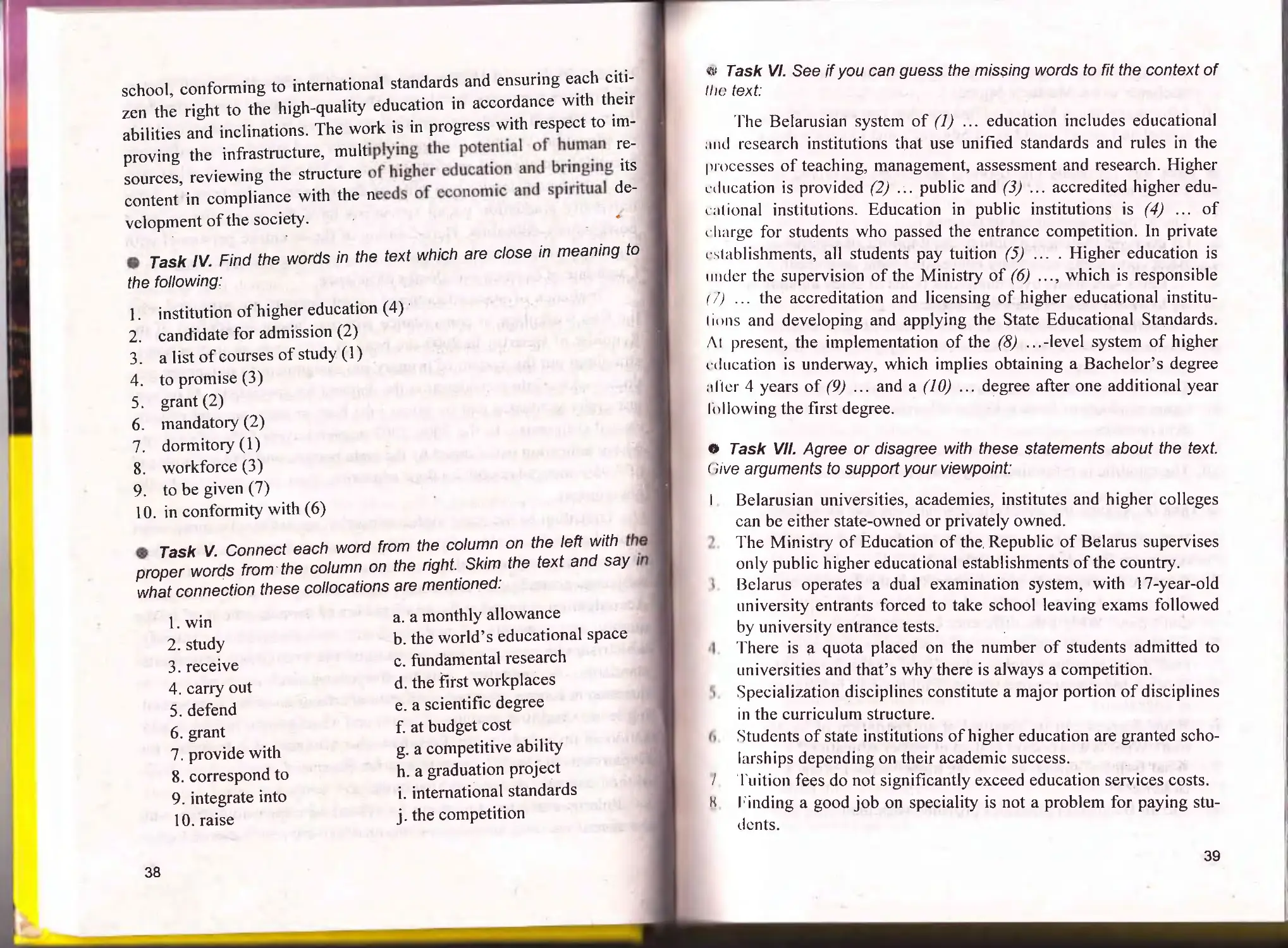
5. grant(2)
6. mandatory (2)
7. dormitory (1)
8. workforce (3)
9. to be given (7)
10. in conformity with (6)
* Task V/. See if you can guess the misging words to fit the context of
llrc text:
'l'lre Belarusian system of (I) ... education includes educational
rrrrrl research institutions ihat use unified standards and rules in the
l)rl)cesses of teaching, management, assessment and research. Higher
etlrrcation is provided (2) ... prfulic and (3) ... accredited higher edu-
e:rlional institutions. Education in public institutions is (4) ... of
t lrirrge for students who passed the entrance competition. ln private
t'stablishments, all students pay tuition (5) .... Higher education is
rrrrcler the supervision of the Ministry of (6) ..., which is responsible
(/) ... the accreditation and licensing of higher educational institu-
tiorrs and developing and applying the State Educational Statrdards.
Al present, the implementation of the (8) ... -level system of higher
crlrrcation is underway, which implies obtaining a Bachelor's degree
rrlicr 4 years of (9) ... and a (/0) ... degree after one additional year
lirllowing the first degree.
a Task Vll. Agree or disagree with these statements about the text.
(;ive arguments to suppott your viewpoint:
I Belarusian universities, academies, institutes and higher colleges
can be either state-owned or privately owned.
l{
'l'he Ministry of Education of the Republic of Belarus supervises
only public higher educational establishments of the country.
Belarus operates a dual examination system, with l7-year-old
tuniversity entrants forced to take school leaving exams followed
by university entrance tests.
'l-here is a quota placed on the number of students admitted to
turriversities and that's why there is always a competition.
Specialization disciplines constitute a major portion of disciplines
in the curriculum structure.
Students ofstate institutions ofhigher education are granted scho-
larships depending on their academic success.
I'uition fees do not significantly exceed education services costs.
lrinding a good job on speciality is not a problem for paying stu-
tlcnts.
Task V. Connect each word from the column on
prop", *oras from'the column on the right' Skim the
'ih'"t
ronn"ction these collocations are mentioned:
the left with
text and saY
1. win
2. study
3. receive
4. carry out
5. defend
6. grant
?. provide with
8. correspond to
f . integrate into
10. raise
a. a monthlY allowance
b. the world's educational sPace
c. fundamental research
d. the iirst workPlaces
e. a scientific degree
f. at budget cost
g. a competitive abilitY
h. a graduation Project
i. international standards
j. the competition
38
39

g- The higher school graduates are issued a diploma and awarded a
Bachelor's or a Master's degree'
10. After acquiring aMaster's biplotu one can enter a postgraduate'
school and get a Candidate of Science's and Doctor's degree'
& Task Vtlt. Complete the fotlowing sentences according to the con-
tents of the text:
1.
Z.
ofBelarus "'
3'
PeoPle can " '
1.
.. . trains specialists over nume
study and has author-
ity to award various academic degrees'
5. T'he rules of admission to the institutions of higher education "'
6. Those not successful at exams but complying with minimum re-
quirements may '..
7. The first-stage university education is completed by " '
S. Ufon gruAultion from u t igt,.t educational establishment a stu'
dent receives . -.
g. All highereducational establishments "'
io. itt" re"public is reforming its system of education " '
& Task X. Answer the questions scanning the text for essential
er education?
Wh;i J.g*es can be obtained at an institution of higher
tioof Wn""t is a twolevel system of higher education?
7 What forms of tuition exisi in the higher school of the Republic
Belarus?
8. Are all Belarusian graduates provided with their first workp
40
9. In what way is the quality of higher education assured?
10. What are the reasons for the growing demand for higher educa-
tion in the Republic of Belarus?
', f:h Task X- Translate into English:
L B Eelapycr,r HacqnTbrBaercc 55 srrculr,rx yve6Hsrx saeeAeHfifi ro-
cyAapcrBeHnofi u qacrsofi Qopuu co6creeHHocrr, Koropbre Be-
Ayr noAroroBKy cryAeHToB rro 320 cneunarbHocrsM.
2. flepexo4 K MaccoBoMy BbrcueMy o6pa:oaaunlo nprBen K yxe-
croqeHHro Kourponr HaA KaqecrBoM npeAocraBJreHnr o6pasona-
TeIbHLtX y0nyn
l. fnasa rocyAapcrBa A:u nopyqeHr4e ycnnurs cBq3b Mex,qy By3aMH
H rrpo Mbr rxneH H br M ceKTopoM HaulroHan bHofi erco govurcn.
.1
.
Be-rrapycs r4Meer ABycropoHHhe corraureHnt o B3aHMHoM nplr-
3HaHrrH Ar4nnoMoB co MHorr4MLr cTpaHaMr,r MHpa.
5. t{ro6sr [ocrynHTb B r-ocyAapcrBeHHoe Bbrcuree yue6Hoe 3aBeAe-
HHe, HyxHo ycflerrrHo npofirn o6csarersHoe ueHTpanr43oBaHHoe
TCCTI'IPOBAHHE fi O TPEM BCryN}ITENbHbIM IPEAMETAM.
6. Y.re6Hure [JraHbr rr flporpaMMbr yqr,rrbrBaror oco6eHnocrfi Hauuo-
salrrrofi chcreMbr Bbrcr.ltero o6pa:oaaHnr u neo6xoAHMocrb ee
HHTe rpauu H B M r,rpoBoe o6pa:onarelb H oe npocrpaHcrBo.
/. YHnrepcr4Ter roroBHT cfleqnuu]ncroB no pa3nl4qHbtM cnequirnb-
nocrflM, npoBoAr4T QyHgarrnenrarrbHbre H npnruIaAHbre HayqHble
uccneAoBaHur, roroBHT HayqHbre KaApr,r esrcurefi xaannQnxaqnu
qepe3 acrupaHrypy H AoKropaHrypy, qBJl'ercs ueHrpoM pa3BU-
rnl o6pasona*nfl, HayKu H Kynbrypbr.
It. f{syxcrynelluartafl cncreMa Bbrcrrrero o6paaonannfl npeAnonataer
noAroroBKy xaalnSuqapo BaHHbrx cneunanncroB Anr pezurbHoro
ceKTopa 3KoHoMHKH H corlniurbHofi c$eprr ua nepeofi cryfleHn, H
noAroroBKy K rrayqHo-HccneAoBarenscrcoft AetrerbHocrn Ha BTo-
pofi , varucrepcrofi cry[eHn.
() llocle oKor{qaHHc Kypca acnrpaHrypbr, HanhcaHnr H 3aurr,rrbr
llnccepTaqH h coHcKaTeIb fionyqaeT cTerreHb KaHAHAaTa HayK.
10. Bsrcoxoe KaqecrBo o6pa:oeaunq, xoporrne ycJroBur Anq npn3Ha-
rrHfl AlrrlJroMoa aa py6exoM, cra6ullrHarr noJnITI,IqecKafl curyaqut
/(enalor o6yveHue n Eenapycrz npHBJIeKareJrbHbrM He ronbKo Arq
6enopyccxlrx rpDKAaH.
6.
41

@ Follow-uP Activities
Task Xl. Provide arguments from your life experience to prove or
disprove the following statements:
I . Education is the kindling of a flame, not the filling of a vessel.
2. The money spent on brain is never speut in vain.
3. Going to university is likely to make you richer, healthier affd
happier.
4. The 'best' institution is the one that most clearly matches the
individual student's aspirations and abilities.
5. lt's a good idea to consider higher education as a serious op-
tion. lt can broaden your experience and mind as you encoun-
ter all types of ideas. people and activities.
fD-l Optional Reading
The Belarusian State Economic University
The Belarusian State Economic University was formed in 1992 on
the basis of the Belarusian State Institute of the National Economy
founded in 1933 as a department of the Belarusian State University.
Nowadays it is the leading higher educational establislment in Bela-
rus training specialists in the spheres of economics, management,
marketing and law. More than 60,000 of the University graduates are
employed in all sectors of tlre national economy both in the country
and abroad.
The Belarusian State Economic University has a well-developed
infrastructure which provides training and research within schools of
Management, Marketing, Law, Accounting and Economics, Finance
and Barrking, lnternational Economic Relations, Trade Management,
International Business Communications. In addition, the BSEU incor-
porates Higher School of Tourism, Higher Sclrool of Business and
Management, Consulting Centre for Commerce, a Specialized School
of Pre-university'Iraining, and a Specialized School of Psychological
42
rrrrd 'leaching updating.The University has a Research centre, an
lrrtcrnational Relations Division, and a publishing Centre.
.
T'he university has more than 27,000 internal and external stu_
rlcrrts and 1,300 facurty members. 47o/o ofthe teaching stairtras aa_
virnced degrees and titres and many of the University"p-[rror. ur"
noted scholars.
ching are thorough train_
Iedge, as well as making
skills and abilities. The
c approach to studies, making
irrstructionandeffectivemethods.r," r',Tro*t
"lLi"lli,ff til:,
r TT:
t()norrors learning. Acquiring the most up+o-daie Lchniques of
tcaching combined with doing scientific researcrr on topicar issues of
t.co19mic development are made possibre due to fruitiur contacts of
lhc.University with rerated educaiionar estabrishments, business or-
lirrnisations, and enterprises including those beyond Belarus.
Tlre University provides a
crrl knowledge. Many subjects
lirndamental theoretical backgrou
1lllrance, banking, acconnting, s
;rrrd those that rnake students edu
rlevelop their world outlook (pol
t'c:onomic geography, world economy, foreign languages).
The conditions for studies at the Univ- . .ity -a.""agieeabre
to the
errrrent starrdards. Numerous research raboratories, clnputer crass-
roorlrsJ autonrated pc-based training offices for speciaiists in nra_
rrrgcnrent, finance, banking, and commerce are at tlre students, dis-
prsal' Lecture halls and tutorial rooms have state-of-the-aft audio and
vidco facilities, slide projectors and other required educationar tech-
rrrlogies. The Internet, rocal computing network and sateilite TV are
rviclely used in trre rearning p.o ." .r. irre University ribrary with its
'r1r:rcious reading halls is one of the best suppried and equipied in the
t'orultly.
'flre tuition is free, but about 70%o, basicaily those who failed to
['t'l the necessary score during their entrance exams, have to pay for
43

theirstudies.Manystudentsaregivenstatograntsandmostgethostel
to implement an irlnovative model of development'
4
"Higher education has to meet and to satis$ the needs of the de-
veloping Belarusian economy. The country needs highly qualified
specialists. The innovation economy demands innovation in educa-
tion", said the Head of the Government, Sergey Sidorsky. The Chair-
man of the Board of the National Bank of the Republic of Belarus,
Petr Prokopovich, stated that "we are going round in circles in this
llcld and are still living in our Soviet ancestry". Mr. Prokopovich
doubted the reasonability of decreasing the number of expefts to be
trained,in the sphere of banking, i.e. economists and finarlcfeqq. "Over
cal basis of highpr educational institutions as well as significant
slrortage of rooms in student dormitories. Today only 57Yo of students
liom other towns of Belarus live in student dorms, four dormitories
are undergoing capital repairs. He proposed to elaborate a system of
loans for higher educational establishments, which eould be used to
huild student dorms, with an interest rate to be paid out of the state
budget.
The Minister of Education, Alexander Radkov, pointed to the "'in-
sufficient financial resources that could be used to equip higher edu-
cational establishments, the latter have out-of-date laboratory equip
nterft (70o/o is obsolete) and only 52Yo of the needed space". Minister
Radkov specifically indicated the lack of close relations with the fu-
lure employers.
Around $2.5 billion is needed in order to realize the mentioned
nbove Programme using the state budget and around $356 rnillion using
cxtra-budgetary resources. In the course of the implementation of the
programme it is planned to increase the number of educational, scien-
lilic and experimental establishments from 24 in 20n8 up to 66 in
2015. There will be more afFrliated departments of institutions of
lrigher education: th'ere are 103 of them today and in 2015 there
slrould be296.It is planned thatthe leading enterprises and organisa-
tions will provide their premises for setting up laboratories and train-
ing classes for future specialists.
45
rbtain a Bachelor of Arts degree' (Jne-year lvrr\
graduation students c
!.".r" i, required for the award of a Master of Arts degree. A great
nurnber of graduatet
"t" "ngoged
in research and corrtiT::l^"it"""1i:
;;;i"" iostgraduate t"ttiol where they pursue a Candidate of Sci:
ence's and Doctor's degrees'
'
A lot of rictivity ;t B"i"t done outside the curriculyrn.3s ltll:
Tl-'
Students, Tutorial Board iJthe initiator of students' festivals, tourir
programs, sports
"nO-uif,f"ii"s
meetings which become regular eveni
in tte life oithe BSEU students' Going to the cinema' theatre' conce
it"ffi
"ftUt
or dancing parties is also very popular' Time at the uni'
versity passes n"ry qii"t ty, but memories about it stay for a lonl
time.
The University continues to upgrade the quality of education an
ui-. ut high standards of contemporary university' able to meet thr
"nuff"ng"Jof
domestic and global economic development'
"r
Higher Education: Between Yesterday
and the DaY Before YesterdaY?
l1
After reforming secondary education, the Belarusian authortt
took a closer look at the system of higher education' TF-9:*"I
ffil;reviewed the oraft of the State Programme of Ti-gFI B(
;i;D"""lopment for 2008-2010 and in perspective until 20.15' T
*uin gout of the Programme is to irnprove the quality of trainingr
;i;iid. In oider to aJhieve this goal it is important to equip the.hil
"i""",i"""i
esiaUtisnments with modern material and technical bi
io introd u"" state-of-the-art technolo gies into educational proce ss,
,i

The Draft Programme was aPP
further develoPed in the course o
said that the Programme should
ther than general ones in order to
sian educational sYstem' The Min
nion that the financial inPut into t
cause (v) - 6strr npnvunofi, Bbl3blBarb, no6yN4arr
competitiveness (n) - KoHKypeHtocnoco6Hocrs
conrprise (v) - axnrcuarb, oxBarblBarb
ooncern (v) - 6ecnoKouTbct, ga6ort,trsctl
constituent (adj) - o6paryuqnfi, coctanrlrcuuft qacrb Ilenoro
construction (n) - crponreJlbcrBo
c()nsumer (n) - norpe6rTeJlb
contaminate (v) - :arPrrurrr
contribution (n) - cogeficrBue, BISIaA
e clre (n) - rApo, cyrb, cylqHocrb
distribute (v) - pacnpeAentrb
tlomestic (adj) - sHyrpeuunfi; oreqecrBeuHslfi, uaxoAsurnficc B npe-
/(cJrax cTpaHbl
tl Lr rabi I ity (n) -,qor roeer{Hocrb; cpox clyx6rt
tlwindle (v) - yueimuJarbct, coKpaularbct, npuxoAuTb B yraAoK
crlploy (v) - Hannrvrarb, rpeAocraBJltrb pa6ory
c ntcrpri se (n) - npouulrxneHHoe rlpeAfiputrl'Ie, npeA[pnHhMareJlbcr-
Iro
cxtract (v) - 4o6rraarb, noJlyqarb
lirbric (n) - rKaH6, MarepHaJI
lcr-tilizer (n) - yao6penne
llax (n) - reH
lirrestry (n) - lecouoAcrBo, JIecHoe xossficreo
lircl (n) - ronJIHBo, t-oprcqee
( iDP (Gross Domestic Product) - sarosrtft eHyrpeur'rrail npoAyKT
lrcritage (n) - Hacre4ue
lrousehold appliances - 6ttrosar rexHllKa
lrousehold plot - noAco6soe xogqftcreo
'
irrrpact (n) - enarHNe
irrrpIement(v)-
n srlolHsTb, ocyuIecTBJIqTb, o6ecnequsarb B 6I nOJIHe-
IIr.ro
i r r strument m aki n g in dustry - npr.r6opocrpoeHne
ioirrt-stock (adj) - arcquouepuuft
ioirrt venture - coBMecrHoe npeA[pnqrl,Ie
krritwear (n) - rpraxorol(, TpIlKorzDKHble u3Aeruc
livcstock (n) - Aorvraurunfi cror
Iow-cost (adj) - HH3Ko larparHrtfi, ue.qoporofi
will be returned within 8 to l0 years'
flti tvtatn Website of Belarusian-European
Coopeiation andPartnershiPi
I7 SePtember 2008
The Economy of the Republic of Belarus
6 Pre-Reading
Task I. Before reading the text below, make sure you know the
wiig words and word combinati ns:
able-bod ied (a-dj ) - rpy4ocnoco6Hsrfi
account for (v) - orBeqarb 3a
adopt (v) - npI4HHMars (nlau' peKoMeHAalrun' oruvr)
amount to (v) - cocraBrqrb, PaBlrcrbct
appropriate (adj) - noAXoA'I
crBytorqllH
approximatelY (adv) - nPn6
urti"l. (n) - npegrvrsr ropfoBnu'
Beurb
attain (v) - AocrurHyrs, 4o6nrrcr
cattle breeding - cnoronoAcrBo
46
47

mach inery (n) - rvraur nnocrpoeHne'
make (n) -v34eilve'
rPoAYKuuc
make up (v) - cocraurrr
manufacturing (n) - rpoln3BoAcrBo' o6pa6arutnaloqaq ilpoMbIIlIJIeH-
HOCTb
nr""ttuni"ut engineering and metalworking - l'IDI(eHepHas MexaHI'IKa I'I
uerall.oo6Pu6ot*u
i
mitigat
oil and
P.AYKTLI
output
Pa6orrca
rrrrcvenly (adv) - HepaBHoMepHo
woodworking (n) - 4epenoo6pa6orra
.
Iask ll. Mind the difference:
cconomy (n)'- xo:rftcrBo, 3KoHoMHKa, gKoHoMHt
t'conomics (n) - sr<ouoMnKa, HapoAHoe xo:lficrno, noJrnTnr{ecKafl
',r(oHoM14q
cconomic (adj) - gKoHoMriqecrnfi, xosxficrBeuHnfi, sKoHoMr4qecKH
rr r,r lo4Hbrfi , penra6elsunft
cconomical (adj ) - sxoHonrHsrft , 6epexluasr fr , uarep nalbHsr fi
o lask lll. Mind the following proper nouns:
l:t J (the European Union) - Esponeftcxr.rfi coros
IISSR (the Union of Soviet Socialist Republics) - CCCP
[-B -l Reading and Comprehension Activities
o fask lV. Go through the text and do fhe fasks that follow:
After seven decades as a constituent republic of the USS'R, Bela-
ttrs attained its independence in 1991. Nowadays the republic is one
ul'cconomically developed countries of the CIS. Due to its advanta-
Eluous geographical position, developed net of transportation ways
corrnccting Europe and Asia and possession of the scientific and tech-
ttical potential with highly qualified personnel, the economy of the
l{cpublic of Belarus achieves the desirable level of satisf ing its needs
lltrrrLrgh wide trade with many countries of the world increasing the
tlrurlity and competitiveness of its products in international markets.
'lhe economy of Belarus has the contribution of approximately
5 i million people, out of which 35Yo are employed in industry;21%o
Itt irgriculture and forestry; and 40%o in services such as culture, edu-
GRlior.r, health services, trade and transportation. Agriculture and in-
{ristry are the largest sectors of Belarus' economy, making up 13%o
Arrrl -14% of GDP, respectively.
llased on the Soviet heritage, traditional industries continue to
plny the most important role in the econorny. The contribution of
49
M arrntH Hoe o6oPY,4onauue
per capita - Ha Ay[Jy HaceJleHufl' Ha qeJIoBeKa
petrochemical (a-dj ) - HeSrexnrrluqecnnfi
proprietary (adj) - co6creeHtll4r{ecK}lll' s(ruralbJlrruu{'rrr '-'- '
-J
co6creeHuocrs
-
cHa6
ng com
o6uecrseuHoro rII4TaHu
I
cstPofi
.l
reliant (adj) - aael4cl4r'{ltfi; gasl4cqull4n
i
respectively (adv) - coorBercrBeHHo
i
roundwood (n) - rpyrnuft leconnarepuar
i
set up (v) - ocuoeblBarsr orKpblBarb' Bo3ABI4rarb
i'
sewing industry - urnefiHaq npoMbnuneHHocrb
I
share (n) - AoJIfl, qacrt'
shift (n) - cg;Blat, [epeMeIrIeHI'Ie, cMelqeH?Ie
solid fuel - TBepAoe rorIJIHBo' TBepAoe roploqee
-
\i
sophisticated (adj) - uoNnslfi, roHrloft (o npra6ope' Maull{He ra t'n')
stock market - $on4oean 6raPNa
store (v) - cHa6xaru, 3anacarb, xpaHllrb
sugar beet - caxaprlafl cBeKJIa
supply (v) - cHa6Narb' nocraBJltrb
48

these industries to GDP in 2007 amounted to 26.7%. However a ceri'
tain shift towards expansion of share of services and trade appears
logical and is in line with global trend.
Industry is the traditional flagship of Belarus' econbmic growth.
is a major branch of the national economy, supplying almost a third
the GDP. The Belarusian industry includes over 100 branches.
are over 20,000 industrial enterprises and production facilities in
countiy.
Currently, large-sized industrial enterprises serye as a pillar of
Belarusian economy. They employ nearly half of the able-bodi
population. Having managed to keolp their production capacities
dwindling, these enterprises are specifically concerneid to enter
world markets. The Government provides a sizable support to them
stimulate their export as one of the priority spheres of the social
economic development of the country.
To increase their performance, the majority of the state-owned
terprises are changing their category of ownership, are being
joint-stock and are sold to investors. Socio-economic development
Belarus in 2006 demonstrated positive dynamics on virtually all
important parameters, thus proving the effectiveness of the
economic model chosen by the leadership of Belarus.
Sectorc of Economy
Mechanical engineering and metalworking are the leading
dustries. Supplying a quarter of the mechanical engineering o
automobile production is the largest branch of the national
cal engineering industry. Minsk Automobile Plant (MAZ tradema
and Belarusian Autoworks (BelAZ trademark, the town of Zhod
are the key companies.
The national tractor and agricultural machinery engineering
almost fully satisfo the need of the Belarusian agribusiness forr
necessary machines and equipment. The industry comprises
companies specialized in designing and manufacturing tractors
agricultural machines. Minsk Tractor Works (MTZ trademark) iq
of the world's eight largest tractor producers, which accounts for
50
Belarus arso produces buirding, road construction machines and
equipment for trading and public
liances;
nrachines, and others. TV sets ma
rcliigerators Atlant are known far
sophisticated mechanical engineerir
'y
instrurnent making indusiry; erectrotechnicar industry; radio tech-
trical, electronic, optical mechanical industries.
pctroleum products, sorid fuer, erJric and heating energy. Berarus
It's proprietary smat oir reselves and is ."iiunt on oir and gas suppries
f'rurn Russia. The Druzhba oir piperin" i, u major transit corridor used
Iu transport Russian oir and is a continuation of ttr" ryrt"' oit.unt
Transneft. Beltransgaz distributes
elarus. The company also serves
scontinental gas pipeline yamal_
specialists also started working
cting seismology joint venture
r[ the internationar tractor sales. MTZ exports the make to more than
(r0 countries.
't,n,,,v
v srr.Dtrr. tn zntJ t tne sldes started ,"nt"r'ro'"ffiffi;:tl::
ll{lracting oil in Venezuela.
'l'he core of construction industry is made up by the companies
,
:"j:5.:::"T:",:l^,f:?riat
sasweII
.",
;i;. and fai ence, forestry
lnrl woodworking mechanical engin"e.lng and metalw"rO6;::'i
!l):';,li:_l_"lli"::""
companies p.oau"l materiats and articles to
L..buildings meeting at European durab'ity and desigri standards.
,lT.* .::::1?ri",
Betarus has a signiircant impact on the eco_
t.y .
'l'he country has become a signifiJan, ;;il;;;r#;;
*
51

the Baltic countries and to Europe, providing low-cost raw materi
for their industries.
Light industrv unites more than
10 l*Tl"-t:11,:::Tt*tl
,i"";:.il;;;;i",
;;;;uni". tur" the leading position.in the.r
ture of this industry' ii;J;" ufacture all types
.?f
f"bli:jj'ld.
H;'d;:"ffi"il"iri"*',
industry sectoi is the sewing ind
which unites more than 250 compantes'
";;;;ii"oltuor sector is an import"nl.bfi:l"-f ::"J:fI
.h" ilil;;i;;;;;;"t
of the agro-in{ustrial sector 9'f B'e'lqrt
ip,r,, arn, Fnterprises l?n"ii*; roims, of o;une*l]f , :11:*:
t;
i
utti"ulturuit goodp: ,4gricultural companfes' farms' h
h
etc. Altho;gfr i"ig"'i;'*it, formerly collectiveE have
,^-: -.^+^ f-*o
T arcc
nreserved in Belarus, i"h"'" u-'" over 2'000 private farms' Large
;'."d";;;
j t" .irn" nati on' s.agricultural 9ll?ll^^
^.. ^1, o.,hcao,
srvuuvv
'
cludes'such subsectors
The Belarusian agribtrsiness sector lncluoes susn suusevLu
c^--:-ft i-'l,rcrru r"r.,? and animal husbandry), processing indut
!-- -.^L^-^
(l^^A m
ocessing), service sPhere (land ma
other services)' The agrarian sectr
and Plant growing' Cattle-breedi
companies produce more than half of the total livestock output' O
of the most rapidly devel'oping industry 9e-ctor.s
it ry*Y
tu-tTlg:,,
rr trrv rrrvsr
-
^
mland in Belarus inclu<
There are 89,800 square kilometres of larmlano. ln Eslarus rrrerr
-
ss,400 square kilometres of arable landt.!3t ?.
tl*
::TTLt^":
and a lack of fertile ,oil muk" farming difficult' Four fifths of
i""a-lr constituted'by acid soil which needs constant imF^o;
g;rid"r, the lgg6 explosion at the chernobyl nuclear power
Uk;;;contaminate-d much of the soil in southern Belarus'
in"-"oun,w's total area of arable land by more
lhT
I01:.^
^-
Grain farming companies mainly produce barley' rye' 91ts'
una ,p.iig wheai. Belarus is one
"rt19
t"l"l-:"-'l1l*Iq
"..ari".J*d
tops the list of the countries in terms of potato p
;;;;; ;;;.ih" eo11try has about t6%i 1l-: ]:'ll"T::
n^*.'fft" ciirnatic conditions in Belarus are favourable for sugar
cultivation. The country can completely satisfl. the domestic.der
i;;;";;t. More than 1,600 agricuitural companies and about 3
piit"t! households and farms grow vegetabl:t'-
,-
-
^r ^..+-,,
Prr'qrv
-
-"*h ttLat seiond in teims of'output irl'r
The processing branch stands secono
ln tttit.:
'' "::I::-l
structure of Belarui' agricultural industry' One of the most imporl
conrponents is food industry, which is divided into 20 sectors. Meat
nrrtl rnilk branches take the leading positions in the structure of the
Industry, which also unites bread-making, sugar, confectionary, wine-
trrnking and fish sectors.
Belarus can completely satis$ the needs of the population for
rrrcat and milk products. But the country has to'import vegetable oil,
I'ish and fish products, vegetables and fruit to meet the domestic de-
Inand.
Service system is developed in Belarus unevenly. InfraStructure
arrd services are more developed in the big cities of the Republic. In
tlrc year of 2008 this sector of economy generated 42-43% of the total
(;l)P.
Belarus' favourable geographical position helps to build up high
trnrrsit potential of the country'p transport communications. Transport
Inliastructure of Belarus is well integrated into similar infrastructures
ol' the CIS countries. It includes a fairly developed network of auto-
nrobile, rail, air and pipe communications.
The automobile public transport in Belarus is well developed and
plays a great role in passenger transportation. Public railways in Bela-
Ius make 5,500 kilometres including 900 kilometres electrified. The
rnilroad and the railroad transport are monopolized by the state. Bela-
rus is at the crossroads of air routes from Asia to Western Europe.
|.,lowadays Belarus has several well-equipped airports including inter-
Itntional ones, the largest of which is Minsk-2.
For the purpose of developing effective foreign trade in the country,
opriate infrastructure is being established; Such infrastructure
gorrtributes to the establishment of mutually beneficial business con-
tncts, development of industrial and commercial links, attraction of
llvcstments, and new technologies.
A great number of goods produced by Belarusian industries and
lgliculture are oriented towards the CIS countries' markets. The largest
tnrding partner of Belarus is Russia, the largest supplier of raw mate-
tluls to Belarus and the largest consumer of Belarusian investment,
ical, and food products.
'l'he EU is Belarus' second main trade partner, accounting for al-
one third of its overall trade. The main export items from Bela-

lizen outPut
G lobal firianci al and e'conom ic cri si s' caut-"d
""1
":T ],:t-:
,t"'T'""i'#'1i;t'1;;;d' "itt" "ounffies
in Europe' smaller i
are related to smaller, in
"otputiton
to.rnany:1Tt-:?:y:",t;
il"#* r"-t
""i't"""t*!no'
and incomptete reforms in the
mestic stock market'
A key negative effect of the. global
"":l,tl]: ::t"ti::ti:f:t:
"."J":"Li;i"."Jr"t
the Belarusian goods on foreign markets
of the amount of loanslnd inn"'t*tnts fiom abroad' To help miti
;;" i;;; of the crisis, the Government adopted
"
plTjl':::
liberalization measures and a set of measures to support maJor I
rial enterPrises.
'-
i" ,r'" year of 2008 some mrj9r. steps were
:i-::::i"t-:11i:
,h" ;:"l;Tt#t"t" t"t"stors' and improving the investment clir
in general. rhe efforts m"a"
'"*rt"atl ti::1T:5::illl
;"il;il"g irt"'ibp-10 reformers according to the-World
6;t"; e"r#" - zooq'ryPort as well
"1]: 1*^:1t::fi::::
Jor"jil:""t
"
toitt. * t*t DirectInv estment)affraction-
?*::di
the
,,World InvestmJ#n"pon 2008' issued by the United Nt
cooperation strategy between Belarus and the World Bank for the
financial years2002-2004. An energy conservation program in the
social sphere was successfi.rlly implemented as part ofthat stratery.
ln 1992 the country also became a member of the International
Bank for Reconstruction and Development, the International
Monetary Fund, and the European Bank for Reconstruction and
Development. The International Monetary Fund's Monitoring
Program was put in place in 2001. The Republic has been working
with the IMF since 2002 on the implementation of a project for
the development of small and medium enterprises.
Belarus is a member of the unified customs territory with Russia.
For potential investors this means that an investment in Belarus
offers access not only to the Belarusian market, but also to Bela-
rus' giant neighbour to the east.
Belarus has established six Free Economic Zones with liberal tax
and customs rules. Profit earned by Free Economic Zone residents
through the s.ale of products of own manufacturing is exempted
lrom taxation for a period of five years following its declaration.
According to the specific law order a preferential taxation order
cxists in Free Economic Zones. It includes legislatively estab-
lished common privileges for all the organizations of Belarus as
welf as additional privileges and preferences for FEZ residents.
Belarus hosts the Foreign Investment Advisory Council, which is
headed by the Prime Minister of Belarus. The Advisory Council
helps to formulate and implement comprehensive measures aimed
at attracting foreign investment and improving business condi-
tions in the Republic, and helps to provide rapid solutions to prob-
lcrns faced by foreign investors in connection with their opera-
tions in Belarus.
'l'he Republic of Belarus is a member of the Eurasian Economic
Oommunity. Apart from Belarus and the Russian Federation, the
rnembers of this union are the Republic of Kazaklrstan, the Re-
public of Kyrryzstan and the Republic of Tadjikistan. The crea-
tion of a single economie zone on the basis of this union is the
rnajor objective of the Republic's foreign economic policy. This
Conference on Trade and Development'
It's interesting to know "'
Belarus maintains active relations with international financ
;;;l ";
;.rheRepuu.l icbecame-a
T3:;1 :"t * : Y""i:i
il'ffi;. il" gunk ctntinues to support Belarus in enhanctnl
---ri+i-. ^-oo. ^f irs Fnnnomv to assure rising incomgt-uld,
ll-^^^:--
-l^hql l
}
54
and addressing global !
2 saw the aPProval of a
55

goal is declared by the Treaty on the Tariff Union and S
Economic Zone coricluded on 26 February 1999 in Moscow.
C lask V. Fill in the deivatives of the words given in the chaft
? Task Vl. Match the words in the left column with their
the ight column:
) Task Vil.
nyms of the
equivalents or s4no-
n-ection thiy
ns' SaY in what con-
t,
1
3,
4,
5,
6,
t,
to manufacture (3)
employees (l)
to displace (l)
sector (l )
to meet the needs (2)
profitable (l)
farming (l)
to moderate (l)
to have and control fully (l)
common, reciprocal (l)
vzrrv, vservrro owUltd tflle:
9,
Itt.
the text again and decide whether fhese sfafe_
nomy_of your country are True or rarci.-
iaii-in"
'l'he economy of Berarus has the contribution of approximatery r0
million people.
Automobile production is the largest branch of the national me-
rhich supplies a quarter of the me_
and natural gas.
ic growth, supplying
G. to bring in (me
fiom a foreign c
H.gvoiding*@
I. penaining.t"
rncome, wealth, and commodities; pertaining to an eco_
J. the siience
and consump
industry / industriali-
zation / industrialist
l. Gross Do-
mestic Product
A. active redirecting of resources from being
so that they mav create benefits in the future
B. the way total output or income is distributed
individuals or among the factors of production (
C. the monetaryr Value of all the goods and services
duced by an economy over'a specified period. It i
consumption, government purchases, invesfinents,:,i
exDorts minus imnorts
:,
D. to ship (commodities) to other countries or
r,I
etc.
E. an act or means of thriffy saving; the
the resources of a community, country, etc.,
with a view to its nroductivi
F. a persistent, substantial rise in the general
prices related to an increase in the volume of
resulting in the loss of value of currenc
56
57

5.
6.
Agricultural companies. farms and household plots speciali
production of agricultural goods.
Farming industry is the leading subsector of the Belarusian
business.
7. 10%o of arable land in Belarus is constituted by acid soil whi
needs constant improvement.
8. Service sector of the Belarusian economy remains u
loped.
9. A great amount of goods produced by Belarusian industries
agriculture is oriented towards the EU countries' markets.
10. The major import items in Belarus are mineral products.
@ Task lX. Provide guesflons to which the following sfafemenfs
be the right answers:
L ln 1991.
2. Minsk Automobile Plant (MAZ trademark) and Belarusian A
works.
3. A wide range of sophisticated consumer goods such as TV
refrigerators, washing machines, and others.
4. Construction materials and articles.
5. The sewing industry.
6. Over 2,000.
7. Cattle breeding, plant growing.
8. Barley, rye, oats, potatoes.
9. A fairly developed network of automobile, rail, air and
communications.
10. Mineral, products, petrochemicals, textiles and textile
wood and wood products.
) Task X. Check your understanding of specific detail by giving
best continuation to these statements:
l. The economy bf the Republic achieves the desirable level of
f,ing its needs through ...
2.
... serye as a pillar of the Belarusian economy.
3. The Government provides a sizable support to industrial
prises in order to ...
58
4' The national tractor and agriculturar machinery engineering can
virtually fully ...
T'he industrial potentiar of sophisticated mecrranicar engineering
industries is represented by ...
The Druzhba oil pipeline is ...
....
started working for a Belarusian_Venezuelian prospecting
seismology joint venture SeismoVenBe l.
Belarus is one ofthe seven world leading ...
.. . are favourable for sugar beet cultivation.
.. . generated 42-43% of the total GDp in the year of 200g.
o rask Xl. Re-read the text, paying more aftention to the defarl so as
to answer the follawing questroni: -
l' Is Belarus one of economicalry deveroped countries of the cIS?
What factors make it possible?
What is the structure of the Belarusian economy?
What is a major branch of national economy? iay what you know
about its contribytion to GDp.
What does Belarus manufacture?
Why is Belarus reliant on oil and gas supplies from Russia?
What subsectors does the Belarusian agiitr.iness include?
What factors make farming difficult inlhe country?
What are the country's principle exports?
What does Belarus import?
What are the main trade partners of the Republic of Belarus?
) Task Xll. Check how well you know the.econony of your country by
altoosing the correct variant irom the atternitives berow:
l,
'lhe .'. of Belarus is traditionally driving the country,s economic
groMh.
a.
c,
b.d.e
3, Wh
highly devel
of the economy of Bela_
rLIS
4.
5.
6.
7,
ll.
r),
l0
a. service industry
b. light industry
c. petrochemical industry
d. heavy industry
59

J.
4.
b. optornechanical industry
c. agricultural machine-building
d. motor industry
5. What Belarusian industry features a strong infrastructure and
id growth of freight traffic?
a. machine-building c' transPort
b. petrochemical d.heavy
..,
-
,,-r.-.
b. petrochemtcat
(l. Ilgavy
.
.,
-
t--) .
6.ThemaincomponentoftheagribusinessSectoristhe...industrl
a. processing
c' petrochemical
,,
-
,-- .,,r,-- l
b. i"arming
d' agricultural machine-building
7. When did lrivate farms begin to appear in Belarus?
a. in 1992
c' in 1994
b. in 1993
d' in 1995
8. Belarusian agriculture is moving in the direction of creating " '
a. agricities
c' agritowns
b. alrivillages
d' all of the above
9. The Eelaruriun ..' industry is export-oriented in terms of
rous types of goods: fibreboardi, furniture and plywood'
which branch stands second in terms of otrtput in the structure
Belarusian agricultural industry?
a. food processing c' Processing
b. wood processing d' agrarian
The...accountsforthelargestshare(32.5%o)intheBe
machine-building comPlex'
a. instrument-making
,),
timber, wallPaPer, matches, etc'
f
a. lumber industry c. instrument making
b. processing
d' construction-
D. PtUU('lslllts
10. The share of this city in the t tal export volume of the Republic
Belarus makes uP about 30%'
a. Gomel
c' Grodno
b. Mogilev
d' Minsk
ll. 30yo oitt i, region's land area is covered with forestg coni
forests mainly. South-east of the region is especially v
more than 50%oin certain areas'
a. Mogilev
b. Minsk
c. Brest
d. Grodno
60
12. What regions in Belarus are the most affected by the Chernobyl
nuclear disaster?
a. Gomel and Mogilev c. Gomel and Grodno
b. Brest and Grodno d. Vitebsk and Grodno
13. This town's core manufacturer is the production association '.Be-
laruskaliy", which specializes in potash fertilizers producti.on.
a. Zhodzino
c. Molodechno
b. Soligorsk
d. Dzerzhinsk
14. This town is home to one of the largest oil refineries in Belarus,
pumping out l8 million metric tons per year,.
15. The Belarusian tyre works is located in this Belarusian industial city.
a. Moryr
b. Polotsk
a. Novopolotsk
b. Bobruysk
a. forest
b. coal
a. phosphorite
b. peat
c. Gomel
d. Zhodzino
c. Baranovichi
d. Fanipol
c.10%o
d.25%
c. potash
d. slate
c. potassium salt
d. coal
l(>. Mogilevchimvolokno Public Joint Stock Company and Belshina
Public Joirit Stock Company, the two largest chemical enter-
prises, make more than ... of the total production output of
Mogilev region.
a. 50Yo
b. 70%
17. In Belarus, ... resources are one of the main natural wealth.
What is country's most valuable mineral resource, which is used
for fuel and fertilizer and in the chemical industry?
l(). What are the country's principle crops?
a. wheat and barley
b. potatoes, grains, flax, fruits, vegetables
c. cattle and hogs
d. fruits and vegetables
20.'fhe fuel arid energy industry of Belarus includes... systems for
alltypes of power.
a. mining and transportation c. production
b. storage
d. all ofthe above
61

2l . Nearly . .. of energy resources used in the oconomy are iqrported.
c' the heads of major internationar organizations operating in the
country
d. the parliament
J0. Belarus is a member of ...
a. the International Monetary Fund
b' the Internationar Bank foi Reconstruction and Deveropment
c. the World Bank
d. all ofthe above
] Task Xilr. Transrate fhese senfe nces into Engrish using the vocabu_
lary of the text:
I ' Mascrc - He roJlsKo croJrnrla, Ho r.r KpynH eilurvtit npoMbruneH-
Hulfi qernp Belapycrz. 3Aecr BbtflycKaerc, rrerBeprb scefi npo_
IrrruueuHofi npoAyKrIHH crpaHbr.
2. Be4ylqnnau orpacnrMr,r o6pa6arrraarcuefi npoMbrurneHHocrg flB_
Jrrrorcr ceJlbcKoxo3cfi ctseuHoe Maur4HocrpoeHue (rpaxropa, ca_
M OCBarr br, rcolr6ail tru ), craHKOCTpoeHLre, BoeHHo-[povrt urleHHrrfi
KOM[JreKc, uesrexnuugecKafl rlpoMbrurneHHOCT' H
'p.H3BOACTBO
cTpor4TeJrb H brx MaTeplr€uloB.
I' Ka-rrafiusre coeAHFreHHr, go6rrnaelrbre B uraxTax 6rr,. convtrop-
cna' o6ecneqr4Balor KpyrlHoMacrxra6soe npor43BOACTBO XHMkqe-
crr.rx y4o6peanil. B 6olrurux KoJrnqecrBax AMerorc, 6ypslfi
yronb u rop$.
4. Iielapycr
-
rpynHrrfi oKcnoprep rpy3oBbrx anrouo6ulefi (MA3,
BelA3), TpaKTopoB (Berapyc), aopo*no-""ponrelruofi u KoM_
MyHurn
(Anaro4op), reJreBn3opoe (fopHsoHr, Bn_
'r.r:r),
a (ArnaHr); x,Milr{ecKhx BoJroKoH u anreit
(llonu
x yAo6peHufi (Eenapycrrcalufi), rpoAyKrlr.tr4
'r'eKcrlrJrbHofi n lenxofi npoMbrrxneHHocru.
$, Crpana pacronaraer AByM, HeQrenepepa6arsrna'qnMa 3aBo_
)laula, nocrpoeHHbrMl4 B coBercKne BpeMeua, Mo:upcxau lr Ho_
BOtIOnouKHM.
(l Ocaoeune flpoa3BoAcrBa HoBbtx KoHKypeHTocnoco6suxroBapoB,
cH
er, noeuileHl,re KaqecrBa BblnycKaeuofi npo_
)ly
HoBbrx pbrHKoB c6rna _ npnopr.rrerHbre 3aAa_
Ll14
a. 30
o/o
b. 50%
a. Western Europe
b. the USA
c.70 %;o
d.85 %
c. Russia
d. the'CIS countries' markets
i
l
i
l
22. Cunently, the industrial potential of the Belarusian energy s
consists of ... thermal power stations, a number of smaller
stations and hydropower stations.
a. 15
c.34
b. 20
d.56
1
23. When were market oriented reforms initiated in Belarus?
c. 1990
d. 1993
a. 1992
b. 1995
24. When was the currency of Belarus, the Belarusian ruble, first i
troduced?
a. May,1992
c. May, 1993
b. May,2000
d. May, 1995
25. When did the Belarusian ruble become the official currency of
country?
a. 1993
c.1995
b. 1994
d.2000
What is the largest media holding group in Belarus?
a. privately-owned National Teleradiocompany
b. state-owned National State Telerad iocompany
c. Belarusian Broadcasting Company
d. National TV and Radio Company
Belarusian export is mainly oriented towards ...
26.
27.
28. Belarus and ... adopted a plan ofjoint measures to tackle the
pacts of the crisis, keep the bilateral trade going and improve
vironment for businesses.
a. Ukraine
c. Russia
b. Poland
d. the EU
29. Belarus hosts the Foreign Investment Advisory Council, whi
headed by ... of Belarus.
a. the Prime Minister
b. the President
62
63

7. |rlaeHlle ceJlbcKoxosq
PacnoJloxeHbl B ueHT-
pe Pecny6n AKkt vt Ha
::1":"T-lffii":ffi:
pe pecllyuJlvll\n rr "*,oo.,t. -,t'e
aE'nvvDrnbcKofi aBapvlv Ha 40:
HOe 3afpt3HeHl4e B pe3ynbT:il'g rvprnvvo''I
500/o yveHrurr,rJro nJlolqilt "orA"n"IBaeMbIx
3eMerb s noroJloBbc
AOMauIHero cKora B 3TItx pafioHax'
8. flpe4nprarrufl JrecHofi npoMbIIxneHHocrI'I pa3MeureHbl rlpel4
uIecrBeHHO Ha ceBepe u tofo-3anaAc'
..
g- XeresHste Aopofll ta asrol\'{o6unsustfi TpaHcnopr - rJlaBHbIe
Abt rpaHcfloprHoro coo6ueuns B crpaHe'
I 0. I{enHure 6vtuaru - repYlt oxBarblBalll::3"10:::J #;
SnuaHconu* o*tt"o*' B Pecrry6luKe Eenapycb K Hx r{Hcny (
HOCqrcq rocyAapcrBeHHble qeHHbIe 6ytuaru' BeKceJIq' arcIILln
nvv/rrv,r
t__J _
t
o6nuraqnn aKuI4oHepHbIx o6qecrs H KoMnaHI'rn'
(-G -l Follow-up
C TaskXlV. Share your opinions on the followihg:
In what waY do the geograPhical Po
tfr" i"prUfi" of Belarus infl-uence the d
lng l\tiPuuuw ur uvrq se
Whut iu"to.s have contributed to Betarus usuu! .rrrv'rE rr'-
10 reformer. u."o'Oing to ttre World Bank's "Doing Busi
2009" rePort?
3. Comment on the Republic's membership in different intern
fi nancial organisations'
flrink of the ,"uron. *hy Belarus has the capacity to becot
i --L^-^
.^oLinc f^ cr)nollef ngw
;;
foreign investors seeking to conquer
;.
ets throughout the CIS'
Pt
.
r r,,--^ D^t^- .'o io nrrrrentl'
pr
r
vrr !r. vFD---
-'
rs is currently faci
bomment on the economic problems Belart
[Dl optional
DeveloPment since lndePendence
At independence in 1991, Belarus inherited one of the
standards of living in the Former Sovi.et.UnionJFSU}j,t::i.
;ila" ilpur."i through several political and economtc
I
2.
4.
5.
From 1991-1995, with the support of international organisations,
llclarus initiated preliminary reforms toward transformation to a mar-
kct economy.
Following an estimated decline of close to 4OYo during the period
1992-95, GDP growth resumed in 1996. Since then statistics show a
continuous and substantial growth in GDP and industrial production,
t'crrolring a peak in 1997-1998. Growth began at a time when,almost
nll other FSU countries continued to experience decline, and persisted
llrror-rgh the regional economic crisis of 1998-1999. Rates of GDP
glo',vth in 1999-2002 in the aftermath of the Russian financial crisis of
l()()8 were relatively moderate, but accelerated after 2001.
The economic growth during 1996-2000 could be explained
lnrgcly by active political re-integration with Russia, which resulted
Irr irnproved market access; and government policies that provided
rizrrble net benefits for many leading exporters through the real de-
pleciation of the rubble and an increase in implicit subsidies, espe-
sirrlly through subsidized interest rate. Since end-2000, the role of the
Itritial growth drivers has gradually been declining. However, new
fne lors have emerged that have helped to sustain growth, namely: (a)
drrr st ical ly improved external environment; (b) strengthened domestic
{crrrand; and (c) improved financial performance of domestic enter-
pt iscs.
Strong growth in labour-intensive sectors (such as services, food
prtreossing, and machinery), backed by the government wage and in-
rrc policies, ensured broad sharing of recent growth across the pop-
ion. The result has been a rapid decline in poverty rates with ine-
lity remaining stable and low (Gini coefficient0.262 in 2006). The
:r'ty headcount ratio (national definition) fell from 41.9% in 2000
I l.lYo in2006.
Challenges ahead
llclarus has the potential to provide high levels of income for its
lrtion. Located strategically in the conidor between Russia and
LtJ, Belarus is a major transit route for enerry and otherproducts.
hrrs irccess to growing regional markets. It can benefit from a greater
64
65

degree of regional integration in trade' energy' environment' etc' I
country has ample ;;;;;i'"'"u'"""' l!:":":l! *"-::,i:"r11.:"
country lras 4rrrPrv
m these opportunities,
;i"hl;'educated. However; to benefit-fror
;ili" il;;;;
^a.dd;;"
u
"u*u"'
of critical challenges and to
April
Natural Resources of Belarus
I
prises selling mineral medical and table waters inside the country and
nbroad.
Oil deposits,are not gre4t and oil is extracted in small quantities,
'l'lrere were also developed deposits of brown coal and shale. Only
dctailed exploration of the Brinevsk deposit of brown coal can ensure
plcparation to an industrial development of their stock of 30 million
Iorrs. In general, the amount of the fuel-power resources being ex-
Ilacted nowadays, including the accompanying gas and firewood,
otrvcr l2Yo of the total demand only.
There are promising deposits, areas and spgts where additional
gcological prospecting is required. They are deposits of ferrous ores,
tnrc metals, aluminium and soda raw materials, combustible shale,
plrosphorites, gypsum, mineral fibres, bentonite clay; underground
higlrly mineralized brines, areas looking promising with regards to
tliiuuonds, gold, and amber,
'l'he depths of Belarus have not been studied enough. The appea-
flnce of the up-to-date technologies requires the acceleration of the
rlogical prospecting work.
More than 20,000 rivers of the total leng(h of about 91,000 kilo-
Ftolres are flowing acress the country. The rivers belong to the water-
lltctls of the .Black and Baltic seas. 6 rivers of 500 kilometres long
Beresina, the Nieman, the Sozh, the Western Dvina and the
icper) are also important as navigable rivers.
One of the peculiarities of the Belarusian nature is a great number
lakes: about I1,000 of the total area of about 2,000 square kilome-
Over 130 water reseryoirs of the total area of 799 square kilome-
were built to control the ground waters and humidity of the adja-
tl lands.
'['lre whole territory of the country is covered with a network of
lirirned channels, the total length of which amounts to 17,051 kilo-
of which 9,095 kilometres belong to the river Pripijat water-
t.
I I big fish-breeding facilities were built, having the total area of
I square kilometres.
l{esources of the surface and underground waters are fairly suffi-
I to meet the current and future demands in water: river water re-
monstrate:
-
er markef;
cipline and encouragin
-
Continuous increasing
a sturdier
more diversifi ed economY;
-
f-tp.uingthe effectiveness of the government'
--- ^
-
The Of\iiat Website of the Wo.rld.
There are more than 4,000 of deposits of 30 types of minerali
the lands of the Republic of B"lutut' Of particular
1Try-"::::-1t":
tais;il t"l;" i" a"p"ti's of which the country is among the
lSad
Europe. The reserves ai individual mines can be utilized another
"t +;Tt"."ntry is rich in non-ore materials:.*'l"ll"::1':1"^ltlli
dolomite limestone, -u'l unA chalk' fire-resistant and refractory
loam, sand-gravel
".*p"""at'
The develop:d-li: l1t::t3:.1?
ll::ll ;ffi; ;; ;;;i" - at a
"'
un
9ln
dsl
" ": I T:-:. l.o."n'
pansionofmining.at
f i"'*'"t i:
":t:^"l f ff *"ji*i1f "-1, 'n, "0
t*H;;"il'iJt" ;;i; amount to 4'4 billion tons' orwhi
million tons are extracted annually' lhe 1e^se1e::"-Tlltlf :"
preserving fund or *uL" u part of ihe.land.fund' Sapropel is a
ing type of resources;" Jt*k
"ttln-1'*"-'i.',Y*,::irol
ili:
';ffi..';JJ..];G,.;;;, r unique suppry of minerar drin
and balneological waters'
Widely spread are mineral.waters'
lht"h "-i:rti::.:::
"r;t';;i
#"-i"t" and health resort compounds' as well as
66
67

serves amount to 57.9 cubic kilometres, the resources of the
ground fresh water - l5'9 cubic kilomefie: pej
I"T-ll" l"Ji,t^
If water accumulated in lakes is estimated as 6 to 7 square ktlom
the reservoir water - 3.1 square kilometres' Water intake for
sumer and economic needs does not normally exceed 5 to 7yo of
annually renewed resources'
Belarusian forests occupy about 36% of the territoV ol
!he-c^ou
Pre-mature, mature and overmature forest amount to l9o/o' 1'3 ctl
i., .,",r"r-"r ii,,,b", from I hectare of the forest area are stockpiled'
Belarus, compared to 5.4 in Germany and3'7 in Austria'
Our forests are rich in medi:al herbs' About 290 types of hei
important for the scientific and people medicine can be found' B
rus is one of the countries exporting wild rosemary' fresh r"
sponge, bearberry, etc.
^-^c^L:
^
f'oi a long time, Belarusian forests have been a source of a hi
quatity soft rJsin. Potential collection as of 1999 amounts to 30'
tons, whereas the actual output - 20'100 tons'
LUltJr VVrlVrv4
General biological ,"rou'""t of mushrooms by main types
count for 70,300 tons, gross - 58,400 tons' The annual stockpilin
wild fruit and berries is estimated as minimum 36'000 tons'
only ZlVoof this quantity is being actually bought'
Forest apiculture is an important type of forest utilization'
cal output of the forest lands is estimated at 36'000 tons inr
27,200 of ecologically safe resources'
Belarus
68
The Russian Federation Today: General Outlook
@ Pre-Reading Activities
O lask l. Study the vocabulary notes that will help you to understand
llr: text better:
ru I r t r n d ant (adj ) - Nso6ranyro qu ft , 6onaru ft (vervr-nrl6o)
nrrcient (adj) - ApeeHrafi
ttppointment (n) - HasuaveHue Ha AoJr)r(Hocrb
nl)l)rove (v) - oao6pflTb, cqnTarb [paBunbHbrM, yrBepx,qarb
Itlrred forces - Boopy)KeHHbte cuJrbr, apMr,lq
Itrtrrner (n) - sHarvrr, $lar
brrred (adj) - 3anpeueHHbrfi, saxpsrrrrft
Itirlren (adj) - uenlogopogHrrft
hill (n) - aKT [apnaMeHTa; 3aKoH; 3aKoHoAarelsusrfi arcr
e lrirmber (n) - nalara
uo r rr m ander-i n-ch ief (n) - ruraBHoKoMaugyrouluft
torrrplicate (v) - ycnoxHflTb, 3arpyAHqrb
corrsecutive (adj) - nocregyroqnfi
eonsent (n) - cornacne
corrnterterrorism (n) - 6opr6a c reppopu3MoM
derclare (v) - sarnnrrs, o6rlnnarb; rrpoBo3rJrarrrarb
dee line (n) - na4eHue, yna,r(oK, yxyAueHr4e
{1:llLrty (n) - npeqcraBhreJrb, AerD/Tar, 3aMecrr{TeJrb
dcscrt (n) - q/crblHfl
disintegration (n) - pacnaA
ertslcrnmost (adj) - causrft socroqHsrft
ele clion (n) - au6opu
elil',ible (adj) - uuerculufi npaBo 6trm us6paHHbrM; noAxoAqrqufi
cttlirrce (v) - sao4urr n 4eftcrnue, o6ecnevr,rBarb ncrroJrHeHne
Cxccutive (adj) - NcnonHnrelsurrfi
69

extract (v) - 4o6stsarb, noJlyqarb
faith (n) - BePa
fertile (adj) - nlo4oPognotfi
foothitls (n) - noaoruBa' HH)KHHe cKIIoHbr xoJIMa nnu ropHoro Kptxa
foundin g (adj ) - yvpe4nrel rnlt ft , qerqrculllfi cc ocHoBarereM
hem (v) - oKPY)Karb, orcailMllrl
heritage (n) - Haclegc'rBo, HacJIeAHe
horde (n) - oPAa
inhabitant (n) - xlrrenb
I
.luOi"iut (ad)- cYAe6Hufi
:'
iegislative iudj) - 3aKoHoAarersnstfi
1
liberlry (n) - cno6oaa
:
mineral fuel - MuHeparlbHoe ronJIHBo
minority (n) - ueusruuHcrBo
mountain chain - ropHafl uerb' ropHblfi xpe6er
nonferrous metals - IrBerHbIe MeTzIJIJIsI
nonproliferation (n) - HepacnpocrpaHeHl{e
occur (v) - Bo3HHKarb' npoHcxoAnTb
orthodox (adj) - oproAoKcuulsHbtfi' rpaBocJlaBHrtfi' o6
Hufi
ecrnft
plain (n) .-
PaBHI'IHa,
HI'I3MeHHocrb
popular vote - HapoAHoe roJIocoBaHHe' roJloca us6nparelefi
population density - rlJlorHocrb HaceJleHilt
remote (adj) - Aatrcttuit
renowned (adj) - npocnaBneHustfi , rl3necrHsli
reserves (n) - PecYPcrt
responsible (adj) - o.ree.rcrseHHutfi
security (n) - 6esonacHocrb
,prawl-ing (adj ) - pacrq HyBrI H fi cr, pacrruyrrtfi
steppe (n) - crens
stretch (v) - npocrr'rparbc'1, l{Merb rlport)KeHl4e
taper (v) - cysurr(cr)' saocrprrrcr
70
lcrnperate (adj) - ymepeHurrfi (o ruuuare)
Ircaty (n) - MexAyHapoAur,lfi AoroBop
virlley (n) - 4orr,rua
'.
vcst (v) - na4elrrs (npanaMn, Macrbro), noslarars (o6rsanHocrra)
vcto (v) - Hanararb nero (ua vro-ln6o), 3anpeqarb
wcsternmost (adj) - causrft sana4urrfi
Q Task ll. Mind the following proper nouns:
Asia-Pacific Economic Cooperation (APEC) Asnarcxo-
'
l'rxoorceancKoe gKoHoMr,rqecKoe corpyAHl,rqecrBo
('lS (Commonwealth of Independent States) - CHf, Co4pyxcec.reo
I I c3aszcr,tN,rrrx locyAapcrn
('ouncil of Federation - Coser (De4epaqr.ru
lroderal Assembly - Oe4epansnoe Co6paHne
ti ft (the Group of 8: Canada, France, Germany, Italy, Japan, Russia,
llro tJnited Kingdom, and the United States) - crpaHbr <Eomnofi
ltocbMepKn)
( )r'ganization for Security and Cooperation in Europe (OSCE) - OE-
('li, OpraHn3arlxq no 6esonacHocrl'tkr corpyAHnqecrBy B Espone
Shanghai Cooperation Organization (the SCO) - lllaHxaficrar opra-
I I H',Jaqlr{ coTpyAHHqecTBa
tillte Duma - focy.4apcraeuHar .$zrrla
llrrion of Soviet Socialist Republics (USSR) - Corcs CosercrcHx Co-
I lunJr r.icrHqecrcax Pecny6narc, CCCP
I I r r i tcd Nations (l-JN) - OOH, Oprannraqur O6repuneHnsx Haqnft
[El Reading and Comprehension Activities
I lask tlt. Go through the text and check your understanding by doing
lho tasks that follow:
l{ussia is an independent country officially known as the Russian
Fnluration. In terms of territory, Russia is the world's largest country.
Witlr a total area of more than l7 million square kilometres, Russia
eovcrs about one-eighth of the world's land surface.
7'l

Until the disintegration of the Union of Soviet Socialist Reput
ruSSn or 'soviet Union') in 1991,.th.e Ryssil:-:Y]::.:*:i*
"iutirt
Republic was the iargest and dominant administrative cor
nent of the Soviet Union. hiAugust 1991, the Russian Republic
one of the 15 countries that declared independence from the
Union.
-- '-ft"
capital of the country, Mo.scolv'-is an
ldlninisllltll..
."."',1i,
'TiJ:ili
ffi ffi;i"i
'
ir'" r'"in 9i q"'"9"anRussii'i
Russia stretches from its westernmost point in the city of fali{1
"r"d.l;i;h
of Warsaw, Poland, to its easternmost point at I
il}id. ilt; in the Bering Strait. Within evesight is Little D
mede Island, belonging to the United States just off-the coast
Alaska's Seward p"niisuta' Russia's great breadth. of territory
cludes rnany different geographical regions' These include areas
p"rtuf.or. (u."u, or
"t"-"tnJt:?
t"
.Siblria.and
th:]'1 )"iY:";
as taiga and steppes- Much of Russia's northern and eastern co
i, f.,"il-"a in by ice for much of the year, complicating navi
Ho*"u"r, Russia has year-round warm water seaports at M
on its northwestern coastline of the Barents Sea and at Vladi
the far eastern coast on the Sea ofJapan'
It is bordered by Norway and Finland in the north-west'
Latvia, Belarus and the Ukraine in the West' Georgia and Azerb
in the south-wes! and Kazakhstan, Mongoli4 China along the sou
border. The federation comprises 21 republics'
The land of Russia varies from thick forests to barren
from high peaked mountains to deep valleys' The counlry ts lo1
on two plains, Great Russian Plata and West Siberian t"Y]if
f""g"" mouniain chains are the Urals, separating Europe from A
,i""Cuu*tus, and the Altai. Russia's most important rivers-are
Volgu, Europe's biggest river, flowing into the Caspian
l:u' T"
Site"rian rivers (the Ob, th" Yenisei and the Lena)' and the-Arn
OrefurEast,flowingintothePacificOcean'Thetotalnumberofrivbi
Ru..iu is over Z million' The world's deepest lake' Lake Baikal''l
the depth of 1,600 m, is situated in Russia, too'
Russia has one-sixth of the world's forests' They are
1'he country contains the greatest reseryes of mineral resources of
nny country in the world. Although minerals are abundant, many are
irr rcmote areas with extreme climate conditions, which makes them
cxpensive to extract. Russia is especially rich in mineral fuels; it is
nlso well endowed with most of the nonferrous metals.
On the vast territory of the country there are various types of cli-
rrr:rte, from arctic in the north to subtropical in the south. In the middle
ol'the country the climate is temperate and continental.
Russia's total population in 2009 was estimated at 140,041,250,
rrraking the country less populous than China, India, the United States,
Irrclonesia, and Brazil. Unlike these other countries, however, Russia's
Iotal population has been in steady decline since the early 1990s. The
population density of a particular area generally reflects the land's
rrgricultural potential, with localized population centers occurring at
rrrining and industrial centers. Most of the country's people are con-
ccrrtrated in European Russia in the so-called fertile triangle, which
hls its base along the western border between the Baltic and Black
$cirs and tapers eastward across the southern Urals into southwestern
Sihcria. The heaviest population densities are in sprawling urbanized
nlcas such as Moscow Oblast.
itussia developed a large urban population during the Soviet pe-
tiocl, despite government attempts to limit the populations of major
ulban centers. Today, 73% of Russia's population lives in urban areas.
More than ten cities, most in European Russia, have more than 1 mil-
lkrrr inhabitants. The largest city by far is Moscow. The next largest city
h Saint Petersburg, a lgading port and majgr industrial center situated
{lrr tlre Gulf of Finland. Other large cities include Omsk, western Sibe-
rlrr's chief petrochemical center; Chelyabinsk, in the foothills of the
Urrrl Mountains; Kazan', capital of the republic of Tatarstan, located
;krrrg the middle course of the Volga River; and Perm', a major indus-
lriirl center in the Kama River region to the west of the Urals. Ufa is
fn irnportant petrochemical center in the southern Urals, and Rostov-
Frr"l)onu is a commercial, industrial, and transportation center in
forrlhern European Russia on the lower stretch of the Don River. Vol-
3o;r,rad, a center of machinery production and other industrial activity,
l[,r ,r ' .r the lower course of the Volga River.
in the European north of the country' in Siberia and in the Far
73

Russia has one of.the widest varieties of
'ethnic groups in
world, btrt ethnic Russians form the vast majority, or about 80 o/o
tlre population. The non-Russian population constitutes about20o/o
the total, with the largest minority, the Tatars,.making up only
4Yo.lJkrainians and Chuvash are the only other minorities consti
ting more than lYa of the population. Other minorities include
sians, Germans, Bashkirs, and Jews (considered an ethnic group'
Russia).
The Russian language is the country's official language and it
the most commonly spoken in business, government, and ed
Russia's 160 ethnic groups speak approximately 100 languages:
Christianity, Islam, Buddhism, and Judaism are identified as
sia's only traditional religions. The law limits the activities of
zations that represent any other religious faith.
The Russian Federation is set up by the Constitution of 1993.
der the Constitution Russia is a presidential republic. The F
Government consists of three branches: legislative, executive and
dicial. Each of thern is checked and balanced by the President.
The legislative power is vested in the Federal Assembly. It
sists of two chambers. The Upper Chamber is the Council of
tion; the Lower Chamber is the State Duma. The members of the F
Assembly are elected by popular vote for a four-year period.
Each Chamber is headed by the Speaker. Legislature may be ini
in either of the two Chambers. But to become a law a bill must be
proved by both Chambers and signed by the President. The Presi
may veto the bill.
The President is commander-in-chief of the armed forces,i
makes treaties, enforces laws, appoints ministers to be
the Federal Assembly. The President is elected by popular vote
six-year term (eligible for a second term but constitutionally
for a third consecutive term). Ministries of the Government are
posed of the Premier and his deputies, ministers, and selected
individuals; all are appointed by the President on the
of the Prime Minister (the appointment of the latter requires the
sent of the State Duma).
74
.
.rh"-*cutive power berongs to the Government which is headed
by the Prime Minister. The firsl actioir of the prime Minister on ap-
pointment is to form the Cabinet.
The judicial branch is represented by the constitutionar court, the
srpreme court, supreme Arbitration court and the regionar courts.
'fhe leading poriticar parties in Russia incrude un-itea Russia, the
('.nrmunist Party, the Liberar Democratic party of Russia and Just
l( ussia.
.
After the collapse of the Soviet union in 199r, Russia assumed
lhc IJSSR's place in the United Nations (UN). Consequently, Ru;;;;
nlso gained
position on the United Nations-Security
('ouncil, the
ponsible for maintaining international peace
trrrd security.
sia became a founding member of the CIS,
which includes most of the fonner Soviet repubrics. The country is
'lso
a member of the organization for secuiity and cooperation in
lirrrope (oscE); Partnership for peace, a program intended to streng-
llrcrr relations between member countries of ttre Nero and cerrtrar and
li,stern European countries; and the councir of Europe (cE). Russia
bccam-e a limited partner in NATo in May 2002 under a iandmark
'ccord
allowirrg the country to herp set joint poricy on a rimited range
'l'
issues, such as nonproriferation and counterterrorism. Russia is
trlso a member of the Group of Eight (Gg) industriarized nations and
Al,DC.
'foday the state symbor of Russia is a three-coroured banner. It
h's three horizontar stripes: white, brue and red. The white .stripe
tyrrrbolizes the earth, the brue one stands for the sky, and the red one
ryrrrbolizes liberty. It was the first state symbor thai repraced the for-
nrc'symbols in 1991. The national anthem of Russia is.The patriotic
li'rrg' by M. Glinka. A new nationar embrem is a two-headed eagre. It
h l.hc most ancient symbot of Russia. It originates from the herardic
errrblcm of the Ruricovitches. Ail these symbors are officiar. They
hrrvc been approved by the Federal Assembly.
ture developed, as did the country
of native Slavic cultural material
of foreign cultures. In the Kievan
ings were primarily from Eastern

Orthodox Byzantine culture. During the Muscovite period (14th-l
centuries), the Slavic and Byzantine cultural substrates were enrlc
and
'rodified
by Asiatic influences carried by the Mongol hordes.
nally, in the modern period (since the l8d' century), the cultural het
tageof Westem Europe was added to the Russian melting pot'
Thenationcanboastalongtraditionofexcellenceineveryasl
of the arts and sciences. some of the most-rgnowned museums in
world are found in Moscow and st. Petersburg. In Moscow the P
kin Fine Arts Museum houses treasures of western European
while the Tretyakov Gallery has a strong collection of Russian
Moscow's Krimlin, the former seat of communist power and
home of the Russian president, also contains a series of museums
include notable cathedrals and features the stunning architecture
tlre Kremlin building. The Tolstoy Museum Estate in Moscow
tures an excellent literary collection. In St' Petersburg the Hermi
is one of tlre great art museums of the world, the Russian Mu
displays the world's largest collection of Russian aft, and.the Ru
trrtureum of Ethnography details Russian culture and daily
throughout history. St. Petersburg is also home to the country's c
*ur"i*, the Kunstkammer (formally Peter the Great's Museum
Anthropology and Ethnograohy), which is now under the direction
the hisiory iepartrnent of the prestigious Russian Academy of S
ences. Moreover, in the suburbs of St. Petersburg, 'the former tsal
palaces at Pavlovsk, Pushkin, and Petrodvorets have been restore
museunrs. They are popular destinations for both Russians and
reign tourists.
Russia is a keen sporting country, successful at a number of
and continuousty finishing in the top rankings at the olympic Gafi
A.ong the mosi played sports are football, ice hockey and basketbt
It's interesting to know "'
Russia is 60 % larger than the world's second-largest
try, Canada.
The country extends across the whole of northern Asia
the eastern third of Europe, spanning 1 1 time zones'
76
Permafrost covers l0 million square kilometres - an area seven
tinres larger than the drainage basin of the Volga River, Europe's
longest river - making settlement and road building difficult in
vast areas.
Russia may be subdivided into six main relief regions: the Kola-
Karelian region, the Russian Plain, the Ural Mountains, the West
Siberian Plain, the Central Siberian Plateau, and the mountains of
the south and east.
Russia contains two million fresh- and saltwater lakes.
Lake Baikal is the ldigest and the oldest existing freshwater lake
on Earth (20-25 million years old).
Russia is the only country, on the territory of which there are 12
SCAS.
On the territory of Russia there are 100 reserves, total area of
which makes 33.55 million hectares, and 35 national parks with
total area of 6.96 million hectares.
Linguistically, the population of Russia can be divided into the
lndo-European group, comprising East Slavic speakers and
smaller numbers speaking several other languages; the Altaic
group, including Turkic, Manchu-Tungus, and Mongolian; the
Uralic group, including Finno-Ugric and Samoyedic; and the
Caucasian group, comprising Abkhazo-Adyghian and Nakho-
Dagestanian.
Moscow is the largest metropolitan area in Europe, and ranks
among the largest urban areas in the world.
Moscow possesses the world's second busiest (after Tokyo) metro
system which is famous for its architecture and artwork.
A person from Moscow is called a Muscovite in English.
On 8 December 1991 in Viskuli, the residence of the Belarusian
Government in Belovezhskaya forest preserve, the leaders of the
Russian Federation, Republic of Belarus and Ukraine signed the
Agreement on establishment of the Commonwealth of, Indepen-
dent States (CfS).
'fhe CIS performs its activities on the basis of the Charter,
adopted by the Council of Heads of States in 1993, which stipu-
lates the goals and principles of the Commonwealth, rights and
obligations of the countries, which established it voluntarily.
77

/ On May 9, in New York, a plenary rneeting of the UN lene
Assem6ly elected 47 membeis of the UN.H1ma1\ie$.s
9tY1
;he;'Ji"i t*rgouemmental rights body of the united l
.. tions system. The nJuisian Federatiol.*ut 3leit3d 1-:*::
in" u".V first round of voting' its candidacy drawing support
137 deiegations out of the 191 UN member states'
& Task tv. Find the derivatives of fhe following words and fill in
tabte. Note that some'boxes will not be filled:
Q Task V. Find the words in the text with similar meanings to
l. be situated (2)
2. make difficult (1)
3. varied (l)
4. resources (l)
5. distant (1)
6. outstanding, famous (l )
7. previous in time or order (l)
8. constant (l)
9. breakdown (2)
10. start, introduce (l)
C Task Vt. Do you agree or disagree with the following
retating to the text?
1. Russia's total area is 15 million square kilometres'
2. Big Diomede Island is the country's westernmost potnt'
78
limit / limitation
.1 . The country is located on two plains, Great Russian Plata and
West Siberian Lowland
/1. Russia has one-eighth of the world's forests. :
I
5. The anthem of Russia was the first state symbol that replaced the
former symbols in 1991.
6. The Russian Federation is set up by the Constitution of 1993.
7. The executive power belongs to the Federal Assembly.
tl. Each Chamber in the Federal Assembly is headed by the Speaker:
I. After the collapse of the Soviet Union in 1991, Russia lost the
USSR's place in the United Nations (tIN).
10. The President is elected by popular vote for a six-year term.
O lask Vll. Complete the given senfences.'
l. Russia covers the ... part of Europe and the ... part of Asia.
2. There are steppes in the south, ... and ... in the midland, ... and ...
in the north, highlands and deserts in the east.
3. The largest mountain chain, ..., separates Europe from Asia.
4. In the middle of the country the climate is ... and ... .
5. The main Siberian rivers - the Ob, the Yenisei and the Lena -
flow...
.
6. Under the Constitution Russia is ... .
7. The judicial branch is represented by ... .
ll. The Head of State is ... .
9. The white stripe on the flag symbolizes ..., the blue one stands for
.. . , and the red one symbolizes ... .
10. Some of the most-renowned museurns in the world are found in
I lask Vlll. Check your understanding of the aetait Oy answering
lhese quesfions:
l, When did Russia become an independenl country?
?, Why are the physical features of the Russian Federation consi-
dered to be diverse?
t, What natural resources is the country especially rich in?
79

4. Russia has one of the widest varieties of ethnic groups in tl
world, doesn't it?
5. What branches does the Federal Government consist of?'
6. What are the functions of the Russian President?
7. What is the first action of the Prime Minister on appointment?
8. What are the country's official symbols?
9 What are the country's leading political parties?
10. What international'organizations is Russia a member ot'/
tE Task IX. Think of some more questions about the Russian
tion and then ask your groupmates to give you extensive
Repoft your results.
@ Task X. Check how wetl you know Russia by deciding which of
fottowinE alternatives is most likely to be true:
1. The Russian Federation covers about "' of the world's land
face.
a. one-sixth
c' one-third
Z.
ublic
immediatelY after the
of 19
union rePublic in " ' '
a. 1922
b. 1918
c. l9l9
d.l92r
3. To the southwest and west Russia borders ofl "'' as well as
land and NorwaY.
a. Ukraine, Belarus, Latvia, and Estonia
b. North Korea, China, Mongolia
c. Kazakhstan, Azerbaijan, and Georgia
d. all of the above
4. On the basis of geologic structure and relief' Russia can bd
vided into two main parts - western and eastern - roughly al
the line of ... .
a. the Urals
b. the Lena River
c. the YeniseY River
d. the Ob River
80
I'his relief region is the smallest of Russia's relief regions, lies in
the nofthwestern part of European Russia between the Finnish
border and the White Sea.
a. The Kola-Karelian region
b. The Russian Plain
0. c. the UralMountarns
d. the Central Siberian Plateau
Wlrat is the highest point in Russia (5,642 m)?
it. Mount Narodnaya c. Mount Yamantaw
b. Mount Elbrus
d. Kosvinsky Mountain
l.ake Baikal is located in the ... part of eastern Siberia within the
republic of Buryatia and Irkutsk oblast (province) of Russia.
ll Nearly one-tenth of Russian territory is ..., a treeless, marshy
plain.
a. taiga
b. steppe
. .. constitute more than four-fifths of the total population and are
prevalent throughout the country.
a. East Slavic speakers c. Turkic speakers
b. Finnic peoples
d. Caucasian speakers
Nonferrous metals are available in great variety from many dist-
licts, but by far the most important are those of ..., which is Rus-
sia's main centre of nonferrous metallurgy.
a. western
b. northern
a. Siberia
b. Kola Peninsula
ru. sixth
b. eighth
a. Kotlety
b. Pelmeni
c. eastern
d. southern
c. wooded steppe
d. tundra
c. Central Black Earth region
d. the Ural region
c. seventh
d. ninth
c. Studen'
d. Lapsha
Moscow is the ... largest city in the world.
Wlrat is a traditional Eastern European (mainly Russian) dish
rrsually made with minced meat filling, wrapped in thin dough?
81

20.
'l'he second President of Russia was ...
-
he was elected for a first
tenn on 26 March 2000 (inaugurated on 7 May) and re-elected
lbr a second term on 14 March 2004 (inaugurated on 7 May).
a. Boris Yeltsin
b. Vladimir Putin
a. Yuri Dolgoruki
b. Dmitry Donskoy
a. a four-year term
b. a five-year term
P. Tchaikovsky
A. Scriabin
c. Mikhail Gorbachev
d. Dmitry Medvedev
c. Dmitry Pozharsky
d. Peter the Great
c. a six-year term
d. a two-year term
c. S. Rachmaninoff
d. D. Shostakovich
?I.
'l'he President has a special copy of the Russian Constitution that
is used ... .
a. during the inauguration
b. on special occasions
c. during presidential term
d. to represent Russia in international relations
22. l{ussia emerged as a great world power during the reign of ...,
who built Saint Petersburg as Russia's new 'window on the
West' and moved the sOat of government there in 1712.
2.t . tn his first address to the Russian Parliament on 5 November
2008, D. Medvedev proposed to change the Constitution of Rus-
sia in order to ... .
a. to reform the civil service system
b. increase the terms of the President and State Duma
c. set up the Historical Truth Commission
d. to inject large funds from the state budget into the markets to
stabilize the financial situation
14. When do the Russians celebrate Independence Day?
a. 12 December c. 12 June
b. I September
d. 12 July
5, According to the Constitution the President of Russia is elected
lor ...
, l{ussian composer ... composed the world's most famous works
o l- ballet -'Swan Lake','The Nutcracker', and'Sleeping Beauty'.
ll.
b.
83
13. ... is the largest one in Europe' Its area makes 18 400 square
lometres, average depth is 5l metres' the largest one is up to
metres.
a. Lake Baikal
c' Lake Onega
b. Lake Ladoga
d' Lake Seliger
1 4. . . . are considered to be one of the first mountains in the world'
a. The Urals
c' The Caucasus
b. The Altai
d' Baikal Mountains
l5. Moscow and St. Petersburg are three hours ahead of London ti
and ... hours ahead of New York'
b. four
d' eight
and the Dragon'
a. Moscow
b. NizhniY Novgorod
c. seven
c. Saint Petersburg
d. Kaliningrad
a. slx
16. The coat of Arms of ... depicts a horseman with a spear in
hand slaying a basilisk and ls often identified with Saint Get
17. ... was built to commemorate the victory of the Russian
over Polish invaders in 1612'
a. The VerkhosPasskY Cathedral
b. The Cathedral of the Kazan Icon of the Holy Virgin
c. The Cathedral of the Archangel
d. The Patriarch's Palace
18. ..., known as Zatishye until 1938, is a-city in the Moscow
which is located 58 kilometres east of Moscow and has a
tion of 146,294' It is a centre of metallurgy and building of h
machinery.
a. Elektrogorsk c' Elektrostal
b. Elektrougli d' Elista
a. State Duma
c. Federal AssemblY
b. Council of Federation d' Supreme Court
19. The Russian parliament, termed the "'' consists of two chaml
the Lower Chamber and the Upper Chamber'
82
f

b. Semipalatinsk d. Saint Petersburg
29. ... is considered to be the greatest medieval Russian painter
Ofthodox icons and frescoes.
28.Dostoyevskycalledthiscity..Themostabstractandintentio4
-
-
city in tt,e world," emphasizing its artificiality, but it was also
world championships, and overtaking " ' as the top ranked
hockey team in the world.
a. the USA
c' Sweden
b. Canada
d. Finland
symbol of modern disordei in a changing Russia'
" a. Moscow
c. Omsk
a. Daniil ChyornY
c. Andrei Rublev
b. Ivan AivazovskY d. Dionisius
30. Which of these museums is situated in Moscow?
a. The National Museum of Russian Fine Art
b. the cruiser Aurora
c. Pushkin Memorial Museum
d. the State Hermitage
Task XI. Try to give an adequate translation of the following
fences:
27.1n recent years the national hockey team has re-emerged
hockey superpowet' winning gold medals in the 2008 and
l. Poccuficras @e4epaunr - caMat 6orburaq no rIJlouaALI cr
Mupa, pacnorox(eHHag Ha BocroKe Eeponst 14 ceBepe A:I4I'I'
6,'iaroHogarenbHyro snacrs ocyu{ecrBnrer @e4epalrnoe Co6pa-
rue - flap.raueur, cocrocrtlnfi nr 4eyx fluta"t: Cosera Oegepa-
rlura (nepxHar nalara) a focy4apcrneHHoft {yr',r;r (nuxurr nalara).
1. l4cnolHrarelbHyro BJracrb ocyulecrB.lrer flpanarerscrso. Crlc-
.C
T,,TA QE4CpULII bH bIX opTaHoB I,TCTIOJIHI4TeJI sHoft sJlacrlz B KJI ToaIaeT
rlle4epalrHsre Mr.rHlrcrepcrna, Qe4epzurbHbre clyxr6rr ra Se4e-
l)zutbHble ateHTcTBa.
[l l'ocygapcreeHHsrfi 6rcAxer s P@ o6ecneqnB-aer SyHrcqnoHr,rpo-
Baltwe rocyAapcrBa Ha rpex ypoBHsx: o6ulerocy4apcrBeHHoM,
rlre4epansHou (6ro4xerrr 89 cy6tercroa Segepaquu) u uecrHou.
q. lla rcoHeq anpenq 2009 roua e PoccuN o$uquamuo 3apeil,rcrpr,r-
poBaHo l5 naprr.rfi, u3 HVx u focy4apcreenHofi ,{ynre npe4crae-
reHr,t qerbrpe: EAnuas Poccu.r, KIIPO, nAIIP u Cnpaae4.rnnar
I)occus..
10. I'occlq rrpoBoAHT MHoroBeKToprryrc BHeruHroK) rroJrrdrnrcy. Ona
r roAAep)KlrBaer AunJroMarr4qecKue orHorueHlrs co 1 78 crpaHaMr4,
v Meer 140 noconscre. BueurHflq ilorHTHKa Poccnu o[peAenJrer-
ol flpesugeHToM crpaHbl H ocyrqecrBJlflercr Mnuucrepcrnonr
14rlocTpaHHbrx Aen.
@ Follow-up Activities
) Task Xll. Share your opinions on the following:
l, Which do you think are the most important Russian achieve-
ments?
2, I)o you see any drawbacks in the Russian political system? What
are its strengths?
3 Which parts of your country are most in need of protection and
development: cities or the countryside? Give reasons for your de-
cision.
1, What are at least three areas in which Russia leads the world?
) Task XIil. Comment on the quotation:
"We need to develop respect for our history, despite all of its
s, and love for the Fatherland. We need to pay the utmost atten-
r [o our common moral values and consolidate Russian society on
85
2. Bepera Pocclln oMbIBaK)Tct 12 n'topruu, npuHaAJIexaIqI{MH;8
ceilsav 3 oKeaHos.
.
3. Ha ceeepo-3anaAe Pocctau JIexHT caMoe KpynHoe H3 eBpo
cKlrx npecHoBoAHblx o3ep, JlaAoxcKoe'
4. I4s rpaAl,lunoHHblx pelnrufi Ha reppl'Iropl'lt't Poccuu ncuo:
Iorcq xpLIcrI,IaHcrBo r'$oprvre [paBocJIaBI'It, HcJIaM, B MeHE
creneHlt l4yAaH3M r'r 6Y.u.unsu.
5. Corlacuo KoHcrxryquu, rranofi FocyAapcrBa tBnteTct
4eur, n:6npaeustfi sa 6 ler. flpesll4eur sBruIercfl TaKxe"tr
xo BHsI M rJIaBHo KoM aHAylouILIM B oopyxeHHbl MH c HJI aMra Po,
84

this basis. I think that this is an absolute priority." Vladimir
Russian Prime Minister
[D-l optional
Daily Life and Customs
During the Soviet era most customs and traditions of Russia's
perial past were suppressed, and life was strictly controlled and
lated by the state through its vast intelligence network. Beginning
the 1980s, Mikhail Gorbachev's reforms eased political and
restrictions, and common traditions and folkways, along with the
practice ofreligion, began to reappear.
Many folk holidays, which are often accompanied by tradit
foods, have gained popularity and have become vital elements
popular culture. Festivities generally include street carnivals that
ture entertainers and children in traditional Russian dress. Boys
ally wear a long-sleeved red or blue shirt with a round, e
collar, while girls wear a three-piece ensemble consisting of a
green sarafare , a long-sleeved peasant blouse, and an ornate
nik.
Maslyanitsa, the oldest Russian folk holiday, marks the
winter; a purely Russian holiday, it originated during pagan ti
During Maslyanitsa ('butter'), pancakes - symbolizing the sun -
served with caviar, various fish, nuts, honey pies, and other
and side dishes. The meal is accompanied by tea in the ever.
samovar.
Baked goods are ubiquitous on Easter, including round
sweet bread and Easter cake. Traditionally, pashka, a mi
sweetened curds, butter, and raisins, is served with the cake.
boiled eggs painted in bright colours also are staples of the
holiday.
The Red Hill holiday is observed on the first Sunday after
and is considered the best day for wedding ceremonies. In
llrrssian celebration of Ivan Kupalo centres on water, and celebrants
uurnrnonly picnic or watch fireworks from riverbanks.
Arrother popular trad
is the Troitsa, during which
fionrcs are adorned with
nches. Girls often *uk" gur_
lnrtls of birch branches
put into water for fortune-
lcllirrg. In the last month of summer, there is a cluster of three folk
hrlirlays - known cotlectively as the Spas -that celebrate honey and
thc sowing of the apple and nut crops, respectively.
Itussia also has several official horidays, including the Russian
Or'llrodox Christmas (January 7), Victory Day in Wo
91. lndependence Day (June l2), and Constitution
l.l). Women's Day (March 8), formerly known
P.rrren's Day and celebrated elsewhere in the world by its original
lrnnrc, was established by Soviet authorities to highlight the advances
l,v'r.crr made under communist rule. During the holiday women usu-
Flly receive gifts such as flowers and chocolates.
polrrrlar is kvass, a traditional beverage that can be made at home from
ltnlc black bread. on a hot summer day, chiiled kvass is used to make
6httshka, a traditional cold soup laced with cucumbers, boiled eggs,
Strslrges, and salamis.
lln's rniddle class has adopted values that are distinctly different from
Itvicl practice. The new values include self-reliance and viewing
l'rk as source ofjoy and pride; the middre crass arso tends to avoid
86
87

political extremes, to participate in charitable organizations, arld
patronize theatres and restaurants. Estimates of the size of the mid
class vary (as do definitions of it), but it is generally assumed
constitutes about one-fourth of Russian society, and much of
concentrated in Moscow, St. Petersburg, and other urban areas,
The rebirth of religion is another dimension of the changed
styles of new Russia. Although a majority of Russians are nol
lievers, religious inbtitutions have filled the vacuum created by
downfall of communist ideology, and even many nonbelievers
cipate in the now-ubiquitous religious festivities'
Encyclopedia Br
Assessing the Shelf Life of a President
The lower house of parliament gave its final approval to a bill
tending the presidential term from four to six years. lf enactedt
change would not apply to President Dmitry Medvedev current
llut the issue qf what is the optimal presidential term provides an
ulrportunity to ask how long most leaders can rule before they lose
lltt' i r leadership skills.
l)uring the last 50 years of Russian history, only four people have
frrlctl for extended terms - Soviet leaders Nikita Khrushchev and
l,corrid Brezhnev, and Presidents Boris Yeltsin and Vladimir Putin.
'l'lrc rest, including Soviet leader Mikhail Gorbachev, held power for
llrrrclr shofter periods. But if we look at the activities of the four lea-
dcls who stayed in their posts the longest, we see a curious pattern.
Within five or years of coming to power, they lost their motivation,
€ncrgy, innovation and the ability and willingness to consider the
opirrions of others. Khrushchev ruled from 1953 to 1964. His worst
€hrrracter traits - tyranny, megalomania and a propensity for making
fnslr, arbitrary and incompetent decisions - began appearing in the
lnlt' 1950s and early 1960s. The result was an increasing number of
ptrrhlcms and mistakes, from food shortages to the Cuban missile cri-
lls
Ilrezhnev, who led the Soviet Union from 1964 to 1982, lost
trylrirtever scant leadership abilities he had in the early 1970s. The fi-
Fnl I 0 years of his l8-year rule went down in history as the period of
trrvict stagnation. Yeltsin served from 1991 to 1999. His first presi-
derrtial term was not very successful, and his second is widely consi-
dcte'tl to have been catastrophic.
lrirrally, most of Putin's reforms were implemented during his first
idential term. His second term was marked by a slowdown in re-
rs, a sharp increase in both bureaucraey and coriuption and wor-
irrg relations with the West.
( lomparing such diverse epochs and dissimilar leaders may be
and historians might rightfully consider this analysis superfi-
irrrd inaccurate. Nevertheless, one general conclusion is clear:
ttssian leaders - and their advisers - are productive, innovative and
iuicnt for no more than five or six years. After that, they become
lred from the real problems facing the country, corruption flouri-
due to end in 2012.
Kremlin supporters and loyal analysts claim increasing the
will improve political stability, saying Russia's traditions and ur
history make it far too difficult to handle its complex problems in
years.
Opponents point to the experience of Western democratic
ries, where presidential authority is decreasing rather than i
And in nations where the terms are long, like Austria, it is on
cause the presidential post is more or less symbolic' They
only the least democratic countries, such as the former Soviet
lics in central Asia, have chosen to increase their presidential
This puts Russia in questionable company.
It is not entirely clear why the issue was raised now. At a
increasing financial instability, the question of presidential
could have easily been put on the backburner - unless Med
plans to resign soon.
88
s irnd the economy declines into stagnation and then crisis.
89

Although this phenomenon may be more pronounced in
is seen in mature democracies as well. Great leaders in the West
try to exceed the limits placed on them by historical circu
and the results are usually negative. For example, Winston Chu
second term as British Prime Minister was less triumphant than
first, and Charles de Gaulle's presidency in France took on an
comical turn in the mid-1960s.
Of course, the fi.rst temptation is to attribute the drop in a
abilities to his age. But old age and health are probably not the
factors. Each leader has his own particular mission in history.
chill's mission was to achieve victory in World War II
Gaulle's was to found the French Fifth Republic. The same was
for every Kremlin leader. After his mission has been completed, i
ageing leader continues to cling to power, he quickly loses his
greatness and becomes a parody of himself. Napoleon Bonaparte
said, "There is only one step from the sublime to the ridiculous."
ward the end of his brilliant career he fell victim to the same
law.
If this theory is right, then an amendment should be
Medvedev's proposal. The presidential term could be extended
years, but on the condition that each President serves only one
This is the best way to ensure that there is always fresh air
Kremlin corridors.
By Andrei
The Moscow Times, 30 November
Higher Education
Russian Fedeiation
@ Pre-Reading Activities
o rask l. The words in the list below are essenfialfor understanding
tln text. Learn their meaning and pronunciation:
etlrrrission (n) - nprzev (e yre6Hoe sane4enae)
6gcrrda (n) - noaecrKa AHt
Hlkrcate (v) - npeaHa3Harrars, orBoAr,rrb
apply (v) - rroAaBarb 3aflBJreHHe
Eplitude (n) - cxloHHocrb, cloco6noc.m
Esscssment (n) - oqeHxa
allrrne (v) - rpl,tcloca6rfisarr
Fwrrrd (v) - rrpncyAurb, yAocrourb
brrsio education - 6atoeoe o6pasoraHne
gornpetition (n) - copenHoBaHr{e, KoHKypc
gorrpetitive (adj) - copeBHoBarersutrft, rcoHrcypcHuft
conrpulsory (adj) - o6.ssarersHslfi
0orrlbr (v) - npnceavrBartb, npucyxAarb
cilr'rcnt (adi) - Hslneurunfi, 4eficrayou1nfi s Hacroqrqufi uoMeHr
Clu riculum (n) - rcypc o6yveuu.r; yve6Hufi rJraH, rrporpaMMa
Cluborate (v) - paspa6arbrBarb
€lirrrinate (v) - ycrpaHrrb, ncKJuor{arb
€nlille (v) - gaaarr npaBo
EltIrauce exam - Bcrynr.{Tenssslfi grganren
fne rrlty (n) - $axynbrer, orAerreHae
fee 1n1- (4eHexusl[) nsnoc, rrrare)rc
fttc olcharge - 6ecnlarHo
frtrstrate (v) - Hapyurarb, AeJrarb 6ecnoresHsrM, copBarb
$trrtluate (n) - nsrnycrcnrx
gtritl:line (n) - npr.rHqnn, HopMbr, AHpeKTHBa
httrrrrrnities (n) - rynraHr,rrapHbre HayKH
fltrrl.iculation (n) - 3aq,cJreHr,re B Bbrcilree yve6uoe 3aBeAeHr,re; Bcry-
lllttcruuufi 3K3aMeH B BbrcuJee y.re6Hoe 3aBeAeHHe
in the
91
90

priority (n) - npraopl'Irer, rpel{MyulecrBeHHoe npaBo
research (n) - r'rccle4oBaHl{e' H3yqeHI'Ie
restrict (v) - orpaHr'rql4Barb, cBoAlITb K qeMy-n'
rote (n) - MexaHuqecKoe 3anoMLlHaHIte, sy6pexxa
scholar (n) - YueHsrft
school-leaver (n) - BsITIyoKHHK IuKoJIbl
secondary education - cpeAHee o6pasouaHne
soph i sti cated (a-dj ) - yroHqe HH sl fi , ycloxHesHrtfi
tertiary education - Bblculee o6pasonaHne
transparent (adj) - lcuslfi, noHqrllrtft
tuition fee - nlara:a o6YueHue
tutor (n) - perernrop, vacrHslft yqllrenb
Unified State Examination (USE) - eAuustfi rocyAapcrBeHHblu
naeu (Ef3)
& Task l/. Guess the meaning of fhese words and word
checking your guesses as you read the text:
uorrsidered to be one of the best in the world with advanced and so-
plrrsticated teaching methods and scientific approaches. Russian deg-
tecs have gained global recognition. Students and graduates of Rus-
rirrn universities are in demand in western countries.
'l'he education system of the Russian Federation has undergone
rigrrilicant change since the dissolution of the Soviet Union in 1991.
l)rrring Soviet times, education was highly centralized and state ideo-
Irgy was a major component of the national curriculum. Through the
It)()0s, educational reform programs have concentrated on eliminating
political ideology and moral education from the curriculum so that the
lcrrlning process is more attuned to the needs of a market-driven
FCollomy.
More attention has therefore been devoted to the teaching of pro-
ll.ssional disciplines such as business, management, law, economics,
eurrrputer technologies and accounting. Additionally, teaching me-
llrotls have been addressed in an attempt to move away from the So-
vicl-sfyle pedagogical methodology of rote learning towards a more
tlrrtlont-centered methodology designed to promote critical thinking
pkills. Inadequate state budgetary allocations have, however, frus-
Itrrlcd rnany of these reform efforts.
ln 1992 a structural and philosophical reform agenda was set forth
Itr tlrc Law on Education. The fundamental principle of the 1992law
Wus the removal of state control from education policy so that schools
We rc ntore attuned to the needs of the region and the nationalities they
Wcro serving. To achieve this, far greater autonomy has been given to
locn I education authorities.
(.lurrent reform efforts are outlined in a government-approved
{ucrrnrent entitled 'Concept of the Modernization of the Russian Edu-
SHlion for the Period until 2010'. This document provides the frame-
Wurl< for all innovations, experiments and education reforms. One of
lltc rrrost important goals has been to develop state standards for basic
lttrl socondary education, including federal guidelines on minimum
€urricr-rlum requirements. Priority has been placed on developing the
ing of foreign languages, economics, and information and com-
to enroll students
postgraduate higher ed
supervisor
to enter a universitY
to defend a DiPlorna Pro
@ ReaOing and ComPrehension
@Tasklll.Readthetextandcheckyourunderstandingby
tasks that follow:
Russia, a land of great scholars, has been a leading centre
ture, science and education in Europe for centuries' The
Puslrkin, Tolstoi, Chekhov, Mendeleyev, Pavlov attracts peop
over the world for education. Now Russian universities welcon
educational reform
a distinguished rePutation
Bachelor's degree
Master's degree
take special PreParatory courses
onlyRussianschool-leavers,butinternationalstudentsaswell.
ThehighereducationsysteminRussiahasadistinguished
tion in the world' The standard of the higher education in R
92
frlttr r ication technologies.
93

The first nation-wide Unified State Examination (USE)
covering all regions of, Russia was held in the summer of 2008.'fi
USE is an instrument of the school-leavers' knowledge
administered at their graduation from secondary education and an'
ternal quality control tool of the secondary schools education.
USE results are used for application and enrollment into the
education institutions.
There are a lot of heated discussions about the USE
Opponents argue that the test system does irot permit to assess al
titudes and knowledge, that it will be difficult to guarantee cc
tiality of the materials and security of the tests adminisffation.
concerns are not groundless, but at the same time the tests desi
and piloted do allow a transparent and fair assessment and the trb
tion period should provide for setting up a Federal - regional i
structure of the test administration and public control over its
parency which would allow to dirninish and eliminate possible;
practice and guarantee the test validity.
The Russian Constitution guarantees everyone the right
higher education free of charge on a basis of competition. The l
vernment allocates funding to pay the tuition fees within an
lished quota / number of students for each state institution. T
ly the size of quota varies from institution to institution and
field (discipline) to another. It depends on the share of state hr
institution's budget, demands from state bodies in a region,
programs and other, sometimes rather subjective estimates. On
the quotas, the universities are free to enroll students on a fee-pa
basis and have the right to define the fee for their programmes ac(
ing to the market price and demand.
Many students wishing to enter a university need additional
paration to gain admission. Only one-third of students are
enter university relying only on the knowledge acquired in
Another one-third take special preparatory courses. Others ei
private tutors or educate themselves. The cost of preparing
trance examination is a heavy economic burden for Russian
and their families.
94
a
cLrrrently the certificate of Secondary complete General Educa-
tiorr and the successful passing of university-matriculation exams are
fet;uired for admission to all kinds of higher education institutions.
l{ussia has four types of institutions:
.
ljniversities: responsible for education and research in a variety
of disciplines. There are 'classical' and 'technical' universities
with special attention paid respectively to social sciences and
humanities or natural fundamental and appried (engineering) scien-
ces. Unofficial ratings also distinguish old 'classical, universities
and 'new' universities, former pedagogical or technical institu-
tions which have acquired their university status quite recently.
l'stitutes: multi-discipline oriented. They can be independent
structural units, or part of a university or academy and usually
specialize in one field. However pedagogical institutes are re-
sponsible for the spectrum ofdisciplines taught at schools.
r Private institutions: present in increasing numbers. ,They offer
degrees in non-engineering fields such as business, culture, socio-
logy and religion.
'l'here are two levels of higher education in Russia - basic higher
rcation (4 years) leading to a Bachelor's degree, the first univeisity
vcl degree, and postgraduate higher education (5_6 years or more).
llcr two years, students are entitled to receive a Master,s Degree
4rrster of Science, Master of Arts). Upon obtaining a Master,s degree,
rrtlents can continue to study towards a doctoral degree: the first
vr:l is Doctor of Philosophy and the second, highest level, is profes-
).
'l'he Bachelor's degree programmes last for at least 4 years of full-
: university-level study. The programmes are elaborated in accor-
roe with the State Educational standards which regulate almost
zr of their content. The other 20%o are elaborated by the university
95

itself. The programmes include professional and special courses
,"i*"", tt''". t't,ti-,anities and sociai-economic disciplin":'pJt"f,"::]:
training
a research project and passing State final e
Having
Bachelor's degree,. students.ti,y
"1llll^::
,nl'*ir,"r,, programme or continue their studies in the framework
ifr" Sp""iulisi's Diploma programmes' Th.e
^Bachelor's, 9"^*:"-
aminations.
Access to the postgraduate level again is very compettttve'
dates must hold a Specialist Diploma or a Master's^degree'
turi fo. 3 years. The postgraduate school prepares for research
f-r"..o.iut activities.
'stuA-"nt"
must learn t:""111g
T.:li:i:'i*
iion and Communications Technologies, and pass qualiffing.t
ih"y
"ur.y
out independent research, RleRar3
"11
O:M
"^1t
Higher educational establishments in Russia are headed by tr
tors. Pro-rectors are in charge of academic and scientific worl$
institute or a university has a number of faculties, each special
a field of study. paculti"s have specialized councils which
candidate and doctoral degrees'
The system of second-ary and higher education in.Russ.ia is
tt,rougfr a'transitional period nowadays' The main objectives
reform are: to decentralize the higher education system, to de'
o Iask lV. Fill in the derivatives of the words given in the chaft below.
Milc that sorne boxes will not be filled.
Noun
gr irtlLrate /
uation
admission
education
cnrolment
I Iask V. Connect each word from the column on the left with the
Ptt\)cr words from the column on the right. Skim the text and say in
Ntlt,rl connection these collocations are mentioned.
I
E
?
4
g
6
1
!
e
rvclcome
lr:rve
;lromote
irn instrument of
rrllow
lirhe
lrold a status of
spccialize in
e olttlnue
lr:rvc
a. gained global recognition
b. a university or an academy
c. special preparatory courses
d. not only Russian school-leavers
e. a transparent and fair assessment
f. to study towards a doctoral degree
g. critical thinking skills
h. one field
i. specialized councils
j. the school leavers' knowledge assessment
0
fask Vl. Read the text and use the suggesfed words to fill in each
llnt blanks:
establish enrolled potential ewollment preparatory
extramural admil
distance
llrc Slranghai Co-operation Organization (SCO) will e)... a new
t'rsity network in mid-2009. Last autumn, education ministers
new financial mechanism' to give more academic freedom to
uerl to create the SCO University at a meeting in Astana, with the
and students.
96
I lo trnite leading national universities' intellectual (2) ...
97

The SCO University model will be based on co-operation
parent universities and is to offer (3) "- language courses, tsachel
programmes, Master's programmes, (4) " ' studies, doctorates,
vanced training programmes, professional retraining, (5) "'
and (6)... training.
Students (7) ... in the University will be able to study, from
beginning of any semester, in a parent foreign university offerinl
.u r" kind of pro$ramme. Furthermore, the education period
number of foreign partner universities are not limited. (8) ..' wi
pend on mutuaily agreed quotas set in proportion to the contri
made by an SCO member state to the university budget.
The SCO University will also (9) ... those who wish to
their own studies. lJpon (10)... , students will obtain a diploma
the university in which they spent 60Yo of their time, as well
SCO University certificate, which will later be replaced by the'
University diploma.
By Natalia
Russia Beyond the Headlines, 22 February
8 Task Vtl. Provide evidence from the text to prove or
following statements:
l. Russian institutions of higher education attract foreign citi
2. Higher education is provided by public and non-public
State) accredited higher education institutions.
3. The education system of the Russian Federation hasn't c[a
since the dissolution of the Soviet Union in 1991.
4. One of the most impoftant goals of the current reform in
tion is to eliminate political ideology and moral educati
the curriculum.
5. To graduate from the secondary education establishment
tain education at an institution of higher education a person
successfully pass the compulsory centralized testing in t
three admission disciplines.
6. The USE does not permit to assess all aptitudes and knol
school-leavers.
98
7, Many students wishing to enter a university need additional pre-
paration to gain admission.
i, l(ussia has four types of higher education establishments.
0. Academies are responsible for education and research in a
ol'disciplines.
l0 lligher educational establishments in Russia are headed
roctors.
variety
by Pro-
o Task vlll. complete the fottowing senfences according to the con-
lettls of the text:
I , llussia, a land of great scholars, .. .
.
t 'l'he standard of the higher education in Russia is considered to be
one of the best in the world with ... .
I 'l'hrough the 1990s, educationar reform programs have concen-
lrated on ... .
Nowadays priority is placed on ... .
'l'he USE results are used for ... .
.. . about the USE nowadays.
Opponents argue that the unified test system ...
l{ussia has four types of institutions:
'l'lrere
are . . . levels of higher education in Russia.
ll.
'l'he system of secondary and higher education in R'ssia is going
through...
.
Task lx. Answer the questions scanning the text for essentiat detait:
What is the right to education in Russia ensured by?
what is necessary for entering a higher education estabrishment?
Why are there a lot of discussions about the USE nowadays?
What degrees can one get at a higher education establishment?
what is the difference between Universities and Academies?
What are Institutes?
l)o potential students need additional preparation to gain admis-
sion?
99

8. How many years does a student have to study to obtain a
lor's degree in Russia?
9. What are Pro-rectors in charge ofl
10. What are the main objectives of a current reform in education?
6 Task X. Translate into English:
I . B l8 nerce, KorAa Bo3Hr,{KrrH nepBbte poccnficrne yHr4Bepc
d xaqecree o6pasqa 6una arr6paHa HeMer-lKat
cucreMa.
2. Cyulecrnye'r' ABa grarra o6qsarersHoro ruKonbHoro
e PoccHr,r: HaqaJrbHoe o6pa:oeauue x cpeAHee o6patoeaHne,
3. O6qsarerrHoe cpeAHee o6pasoeaHue s Poccnr,r cocror,rr H3;
STanoB: cpeAHHe KJraccbr r,r cTapuHe Kjraccbr.
4. flocrynaoullre B By3 AonxHlr 3aKoHqHTb l l xraccos
llIKoJIbI, cAarb eALrHufi rocyAapcrseHHsrfi gK3aMeH a npofit[
pe3 KoHKypcHbre BcrynHTeJrbHble gK3aMeHbr.
llocle oKoHqaHHr Kypca acm{paHrypbr A Hanvcarvrfl
\uv acilvpaHT nonyqaeT cTeneHb KaHAHAaTa HayK.
6.
7.
BrrnycrcHnrH BY3os o6rrqso nonyqaror ArnnroM, a
Ha nocleAHeM gTane o6yveuur cryAeHTbr r4 acnnpaHTbr
rro r.rToraM 3auIHTbr KaHAHAaTcKoH AHccepTaqlrl,r MoxeT
rrplrcylrqeHa yr{eHac cTeneHb.
He roJIbKo nonyr{arb o6paloeaHue e o6rtqHoM cMbIcJIe
cJroBa, Ho H npHHHMaTb yqacTne B HayqHbrx
flonyqeHrde AlrnnoMa uln yvenofi creneHn 3aBncl,rr or
roB HayqHofi pa6oru.
8. A6urypneHTlr H3 CHl, nocryraroulne u poccr,rficrue B
nporpaMMe B paMKax cnerlHanbHbrx AoroBopoB, HMeroT
Hocrb yqrTbct 6ecmarHo.
9. Bo rpeur nepexoAHolo nepuoAa MeHrercs QnHaHcorufi
Husu o6paroBaHnt: noqBrrrorct qacrHble ilKoJrbI It
AeneHu.fl B HHCTHTyTaX.
O4Ho ns HanpaBneHr,rfi o6parorarelrsoft perfoprvrrr e
[-F] Follow-up Activities
) Task Xt' provide arguments from your rife experience to answer the
lollowing questions:
l. lJow can you prove that education in Russia is going through a
transitional period?
2' what are the advantages and disadvantages of the Nationar Uni-
fied Examination?
l' what are the main differences between university courses in Rus-
sia and in other countries?
4' Do you think education shourd be free? Are there any advantages
in a fee-paying system?
i' FIow usuar is it to goto university in Russia? Is it difficult to enter
the university or institute?
6' ls a university education necessary for professionar jobs? what
are other ways to get professional education?
[-D-] optional Reading
Professionar rraining in Russia: Geared to the Future
lrirst of at, Russia is one of the leading countries in terms of as-
iate or higher professional educatiln pu,iijoution: the crrrrenr nar_
prvrsrsrurat eoucatlon participation: the current per_
I:":^::"tTt:ry
I
ili
9i:
ithassociate;;;li;;;;'::
-:"^ : i:' ;; Zl'%
is means the rate is 630 people n"i
"*f;;;5
"l;!iJi;
:j::.1,,",1f.i:,li,theUnited sta;esi;;i6;;. #,r?n"
c level in Finland.
oout tne
,l;T;'jr"'"n
is largety:gibTa?te to a.tink berween the profes_
rirl train
if rr-^l-,^^,
-- ;-
-,
"':^ v.lrwwwrr trr' Pl'olgs-
)andhi
lf (technical schools, institutes and universi-
ts Thic
lqgg:ry s offering primary p.or"rrionur
ills. This r,.,A,r,o,
""saKer
in the weste;### .isproresstonal
,, # ::H::f :::'^ 3::"1_11* 1lqil;;;
"
pro r^
" "', ^-fi' .
-
-'
-
ins
lcrn is a. broad gap between the stalte,s needs and
#
rlirrg training quarified professionars und ii" uvair
5
10.
100
KJnoqaercr B nonbrrKax c6rnxeHuq HayKr4 n o6pasonauur.
101

This trend has been there for the past I 5 to 20 years. Insu
funding of education programmes has led to a situation which I
call 'pseudo-education': the level of training people get does not
the employers' requirements. Some people are aware of this predi
ment, while others might be oblivious to it r,rntil they face difficu
with employment.
'fhis problem is currently plaguing nearly 30%o
the country's education system.
The correlation between education and income is an indirect
eloquent evidence of the problem. It becomes clear from
the situations in Russia and in the OECD countries that indivi
with higher level of education qualif, for better-paid jobs both
Russia and in those countries. However, the university-degree
mium' is lower in Russia, while the difference to income made
associate professional education is very slight, ifany.
Russian education is characterized by an emphasis on fi
tal theoretical courses in the comprehensive education
which constitute up to 50% of all courses taught at the expense of
plied disciplines.
This trend is certainly a benefit for university education. In
Russian university education is still highly competitive. Yet, in
education programmes the predominance of fundamental
over applied skills damages the person's chances to meet the de
of the labour market. This is an urgent problem, and not only
academic perspective. The shortage of adequately qualified
sionals has forced companies to develop retraining systems.
As it is, retraining is an important and useful business, but
timated total cost of preparing a sufficiently qualified
makes the combination inefficient, because it means we pay for
specialist's training twice: first when he or she goes to college /
nical school and again while they master professional skills
required for the job. In other words, the final cost of professional
cation in Russia is two or three times higher than it should be.
It also needs to be recognized.that the average qualifi
teaching staff leaves much to be desired. Statistics show that
people who choose to major in education in college largely
from families with lower education levels. When they graduate,
rnre ly
they have to, b
hing is
tt()l sc
s of income or
ige.
n
back to school
, often
Irlrro
.e ers
because they were not top stu_
rl'rrts themselves. The failing quarification revers of teachers have
iln.y reasons, but the most important one is low salaries.
llowever, there is reason for optimism despite the many adverse
lne ttrrs. There is an amazing publi
ith most
ul its population seeking universi
suryeys,
Irr';rlly 90% of Russian families wa
'llre lrigh demand.makes the devel
iversity.
Irr,;'crJive, one thai is n;;;;;;* by the government
""0 ltff#
'vcrlooked
i'the analysis of general soliar and economic trends.
'l'his factor certainly affects the e
tvrrrrl university degrees, but once
t()nlc
llrcir'
'
Itor k,
i as into social projects.
()ne of the probrems in professionar education i. the shortage of
qilrrlilied non-manageriar staff. Incidentaly, it is the .,rr". .iJ" ,r*,"
etlrrcirtion drive we have discussed.
o actualize their formal freedom of
onth, he or she can hardly afford to
the other hand, making over
come more selective about the
$*
'lcy d.ve' crothes they wear, and furniture they use..And they
llcrlirirrly do not want to work as ordinary team members. yet, some_
lrlr(' luts to perform that role.
lilllron foreign workers this year, twice as many as
e
ittlrlrcr of foreign workers officially registered in Russ
g
l0 rrrillion by 2010, or l|yo of empl[,able population. In any case,
102
103

effective reciPe known todaY'
Russian professional eiucation is
etitive and up
-r^L^t t-hngJ *urt
"t
r"quireme ts, alth
es not apply to
d universities - a large patt ur Lrrerrr rLrrr
standards' Lack of proficiency in forei
major limitation to Russian professionals' employnrclrL uutrruv
sia. This problern it *oin"*' and efforts have been recently mi
change the situation
.
L- E-) ^.
'lar
F"inally, it is no sense trying to find
"dl"utlll.ty"tf:t^:t:t,"
'
,h" R;tJ;; it",
""Jrt
r'
"quuttl'
senseless to adjust this system to
.
.,
-
c^-^:--
-^'lalc r, i"
"i..,
oointless since the outcome is
gxl$
r^ r^^,,-
^- -oLino
ifn
exl$
to focus on making it
very
on and restore the aca
effic
t
.., r
-ri--
^r.raa
lltil.tr. We should also maintain contacts with leading educati
centres.
According to federal statistics' !h-e
nyssian system of
o.oferrional Jducation includes 2'600 institutions tr
;;;;;";1.:;-inn .'.,r"""ions.'They cater to t j Tit]
system
onal education includcs J'7vv rw
teachin
cateringto l'68 million students'
The system turns out more than 645'000 graduates a year' or
of
"*no*i"ally
active population of Russia'
Yaroslav Ku'*inou' Rector of the Higher School of
the labour market stretches to emerging economies' as it is the
Rus'sn neyoid'the Headlines, 3l October
Russia Wants its Brains Back
The Government would like to entice the thousands of Ru
scientists who have left for better-paying jobs
lb;tq"9'" l:t:11-o
H;l,i;il':;;;il;;1;"r',
it upp"u's-ihat ornciars w'r settle fi
t
few montls a-year-
The Education and Science Ministry has oPened
" fll-":Y.
,"i"rrtirt, working abroad to come to Russia' offering them a
to lead scientific teams and conduct scientific seminars' Those
lo take paft are required to stay in Russia for only two months every
ycal"
The tender comes as top officials express concern over the brain
rlnin that depleted much of the country's intellectual resources after
llrc fall of the Soviet Union, when Russian science suffered a precipi-
krrrs decliue in financial supporJ, prompting tens of thousands of scien-
lists to seek opporlunities elsewhere and others to leave science for
rnore profitable fields.
In his first address to the nation on November 5, President Dmitry
Mcdvedev called for Russian scientists to come back home, echoing
prcvious calls from his predecessor, Prime Minister Vladimir Putin.
"We need to organize a large-scale and systematic search for talent
lrolh in Russia and abroad, to carry out ... some headhunting," Med-
veclev said. "This will increase the number of talented young people
itr basic and applied sciences."
BLrt while salaries for scientists have increased in recent years, the
( iovernrnent still faces an uphill battle. Many scientists based abroad
sir_y they would think twice about coming back even if the salaries in
l(rrssia were to rise to levels found in other countries.
Monthly salaries from the state for Russian scientists run from
$ 1.000 to $1,500 - a figure that is l0 times higher than six years ago.
lrrrrtlrermore, scientists have the possibility of receiving Russian or
lirrcign grants to finance research, meaning that at the end of the
nr()nth they could take home up to $3,000.
"1-he salary is not a problem anymore like it was years ago," said
Alcxander Karasik, a professor at the Moscow Engineering Institute
Htrtl a laser researcher at the General Physics Institute in Moscow.
Ilut according to research carried out by Ivan Sterligov, an expert
witlr the Open Economy Foundation, better wages are not attracting
l{rrssian scientists home. Scientists wlro have worked in the West find
It tlilficult to adapt to Russian reality and face Russian bureaucracy
arrrl polifics, Sterligov said. "Some professors, after working in Can-
Erlrr, came back to St. Petersburg and saw how authorities cracked
dolvrr on the Dissenters' Marches," said Sterligov, referring to public
ptr)losts led by liberal opposition movements. "Scientists pay attention
p llrcse things as well. Science needs free.dom. It is something liberal."
'tg4
105

Alexander Nevsky, a senior researcher who heads a lab at the
stitute for Experinr"ntal ehysics at the University of Diisseldorf'
Germany, left Akademgorodok, a scientific town 40 kilometers tl
Novosibirsk, for bettei opportunities in the 1990s' Nevsky said
would come back home only if he could get the same treatment
he currentlY gets in GermanY'
While the economic sit ration of his colleagues in A
dok has drastically improved in the past few years, Nevsky said
still remain numerous problems in Russia, above all a lack of t
parency. "sometimes money is spent to buy new equipment' but p
don't use it because they didn't need such equipment"'Nevsky
"Equipment is bought through such complicated channels that no
understands where the money came from'"
Scientists say the Russian Fund for Fundamental Research git
the grants but that the money is enough only to pay salaries' not
compete intemationallY."
Valentin Gordeli, a biophysics professor at the Jean-Pierre
Institute of Structural Biology in Grenoble, France' echoed that
orly in numbers: Soviet scientists were considered among the best in
llrc world.
After the fall of the Soviet Union, Russia inherited immeuse So-
vict scientific resources. During the economic and social turmoil of
llrc 1990s, however, science was downgraded from its status as a state
priority. Consequently, the Russian research establishment - like
rrr:rrry other sectors of Russian society - was hit hard by the economic
crisis that followed the Soviet collapse.
Problems in tlre field are evident in the number of scientists actr"r-
rrlly working in Russia. There are an estimated 30,000 to 40,000 Rus-
si;rrr scientists now working abroad, as compared to 30,000 actively
rvorking in the country today, according to research carried out by
Slcrligov of the Open Economy Foundation.
'fhe field also suffers from 'internal brain drain', said Alexander
A llaklrverdyan, Head of the History of Science Organization Center at
llrc Russian Academy of Sciences. According to his research, a total
n1 160,000 scientific workers left the field for primarily business-
te lrrted jobs in 1993 alone. The yearly average has since declined, but
il is still a conlmon trend, Allakhverdyan said.
Experts and scientists agree that Russia is still struggling to re-
covcr from the crisis of the 1990s, as young people'prefer to work in
rrrolc profitable fields. Today, the average age of Russia's scientists is
15. whereas in the West it is 40.
Only 9 percent of young people in Russia consider the profession
rullr;rctive, while only 3 percent of those who receive an undergraduate
rh'y, ,1 e" plan to wolk in the sciences, according to the Education and
Slir:lrce IVfinistry.
Scventy percent of students at Novosibirsk State University plan
lr l('lve the country soon after they get their degree, according to re-
Et'rrrclr conducted by the Novosibirsk branch of the Russian Academy
rrl Scicnces. Young Russian scientists prefer to get their doctorates in
Irrropc or the United States, as it gives them the chance not only to
lc,rrr a foreign language but also to improve their future ernployment
lri I r,.l)ccts, Sterligov said.
reaucracy and constant lack of funds hamp6r work done in R
"An experimenter needs equipment and substances' and he
thern quickly, otherwise it is impossible to compete"' Gordeli
"When compared to working in the West, there are very few R
scientists who want to come back and work under such circu
should be'a transparent process, and people should get grants in
competitions."
The Soviet scientific establishment was one of the largest i11
Transparency is also an issue, with grants often given to groups
have connections rather than to those that deserve fundirrg. Finar
world, boasting more than I million scientists, or roughly one'tl
more than in the United States at the time. But its superiority was
106
107

"Young people don't study science"' said Nevsky' the senior
searcher at"tire iJniversity of brisseldorf' "Th-ey prefer
l":11":-
economics. For two y"ut's
'unning'
there are fewer students than
;;il ;; NovosibirSl state university because there are no p
Pects'"
BY Francesca
The Moscow Times, 14 January
,/ Is it possible to reverse the Brain Drain? What should be done?'
The Economy of the Russian Federation
(-fl] Pre-Reading
& Task I. Study the vocabulary notes that will help you to
the text better
arrear (n) - sa4oln<eHHocrb, npocpoqKa
average (v) - cocranftrb B cPeAHeM
balance of payments - nrare)KHblit6ut.asc
cod (n) - rPecKa
combat (v) - 6oPo'rccr
consumer (n) - norPe6llrerb
oopper (n) - ue4t
co-product (n) - no6ouHrtft npo4yrr
crop (n) - YPoxafi
crunch (n) - nepenoM, Kpn3llcHafl cvfiyawrfl
cutback (n) - conpaulellue, [IoHHxeHI'Ie
dampen (v) - ocla6nlrb, cAepxuBarb
decline (v) - yn'rensuarbct, rrpuxoAurb B yrIaAoK
deposit (n) - ruecroPoxAeHl4e
diamond (n) - alua:
disperse (adj) - PacceaHHsrfi
diverse (adj) - PasluvHstfr
enterprise (n) - nporrnbIUIJIeHI{oe flpeAnpl4flTl're' n
CTBO
expand (v) - Pacuupcrbcr
108
rxpcnditure (n) - pacxoa
cxlract (v) - ao6usarb, z3BJIeKarb
li'r'lile (adj) - nrogopo4urtft
llorrnder (n) - xaru6ara
lirrlcler (n) - rcopu Ar.fl cKora, KopMoBoe pacreHue
lirrcign debt - nHeruHufi 4orr
( il)P (Gross Domestic Product) - earoaHft rHyrpeuHnfi npoAyKr
Itclring (n) -cemgu
irr the vicinity - no6nl,I3ocrl,I
ilorr (n) - x(eJle3o
It'rd (n) - cBrHeIr
lrvcstock (n) - aor'aarusHfi crcor
I r r rrr ber (n) - nnnor',r arepvartbt, 6perua
r r rir rr ufactu rin g (n) - npoH3BoAcrno, o6pa6arblBaloulat flpoMbl tlrneH-
ll( )c'rb
Irrcadow (n) -ryr
trrirre (v) - Ao6unars
Itrirring (n) - ropHoe Aeno
Irorrl'errous metals -- IrBerHble MeruulJlbt
oll.shore (adj) - hHocrpaHHblfi, ocyqecrnrce'Nlrrfi B Apyl'HX crpaHax,
orlr(ruropnufi
rlc (rr) - pyAa
orrtline (v) - oveprr,rts, Ha6pacstnatr
prrs(ure (rr) - nacr6raqe
povcrty (n) - 6eluocrs
plincipal (udj) - rrannrtfi
ttrrrk (v) - 3aHHMarb Mecro
nrw (adj) - cupofi, crtpteeofi
l€fioue(adj)-
c nac areJl b H stfi , aYapuitasti't
fetilil tradg - po3HnqHat roproBJls
fcvcnue (n) - 4oxoa
levorse (v) - nepenepHyrb Ha 180 rpaAycoB, norHocrbrc u3MeHI'ITbct
teir I tor (v) - pa:6pacblBarb, paccpeAoroquBarb
Errrliment (n) - vueHne
Eelup (n) - crpyKTypa, clicreMa
:kuw (v) - cKJIoHI4TLcr, cABhHyrbcc
E;
rc c i alty (n) - cneqr,r.rJrr.{3r,rpoBaHHoe H3Aen He
ltrrck market - prruox arcqnfi / ueHustx 6yuar, QoHgonar 6upxa
109

surplus (n) - raslnurer, n36ttr.orc
taper (v) - cysr.rrs(cr), saocrprrrcr
unemployment (n) - 6e:pa6ornqa
unveil (v) - orxplrrs, o6uapo4ouars
walrus (n) - rrropx
welfare (n) - 6larococrorHue
Task ll. Task ll. Mind the following proper nouns and
CIS (the Commonwealth of Independent States) - CHf, C
crgo HesasHcHMbIX focyAapcrn
EU (the European Union) - Enponeftcrclrfi corcs
lju \Lllg LuruPg4rr urrrvrrrt - IDPUIlwnvArlYr \
APEC (Asia-Pacific Economic Cooperation) - As
Tl-rxoo KeaHcKoe 3Ko HoM HqecKoe coTpyAHHqecTBo
G 8 (the Group of 8: Canada, France, Germany, Italy, Japan, Ru
the United Kingdom, and tlre United States) - crpaHbr <<Bors
BOCbMepKH))
SCO (the Shanghai Cooperation Organization) - lllauxaitcxac
Hu3Artvfl coTpyAHHrrecTBa
Task IIl. Guess the meaning of these words and word
checking your guesses as you read the text:
domestic manufacturing
global crisis
to diversify and modernize industries
light-industry sector
the catch
Strategic Sectors l
@ Reaoing and Comprehension
Task lV. Read the text and check your understanding by doing
tasks that follow:
Russia ended 2008 with GDP growth of 6.0Yo, followin
straight years of growth averaging 1Yo annually since the fi
crisis of 1998. Over the last six years, fixed capital investrrent I
and personal income growth have averaged above l0%, but both
at slower rates in 2008. GroMh in 2008 was driven largely by
tradable services and domestic manufaeturing, ratlrer than ex
110
l)rrr irrg the past decade, poverty and unemployment declined steadily .
nn(l the middle class continued to expand.
ruscrve fund to support budgetary expenditures in case ofa fall in the
Irrvcstor concerns over the Russia-Georgia conflict, corporate gover-
nrrrrcc issues, and the global credit crunch caused the Russian stock
rtr:rlket to fall by roughly 70Yo.
^l'he global crisis also affected Rus-
( i,vcrrrment also unveiled a $20 biilion tax cut plan and other safety
Ircts lbr society and indr-rstry.
Iteetlstod
o
rrawmate_
I'lrrls still
s
budget re_
uciltls. Ru
c
pd must be
tr;rlirced or modernized if the country is to achieve broad-based eco-
ilorr
rust in institutions, exchange rate
ltnc
crisis continue to dampen domes_
llt'i
111

Sectors of EconomY
Mining is a major sector of the Russian economy and prov
sizable share of the country's exports. Russia is a leading producef
nickel and aluminium. Nickel ores are extracted primarily in
Siberia, although significant deposits are also located in the Kola
ninsula near Murmansk. Aluminium bauxite deposits are
mainly in the Urats aird northwest European Russia near saint Petd
burg; other deposits are found in western and eastern Siberia.
'
Russia ranks among the world's top five producers of gold, si
and diamonds. Gold is mined in the Urals, western Siberia, and
Russia is also alrlong the top five producers of lead, copper,
uranium ores. Lead is min6d in European Russia and western Sibet
copper in tlre southern Urals, and uranium in eastern Siberia' Ru
also an irnportant producer of iron and zinc ores. Most iron extr
takes place in the Kursk region of western Russia, while zinc is mil
in Siberia.
Manufacturing. The Russian economy is dominated by large I
dustrial enterprises, and manufacturing remains strongly skewed
Lena Rivei valley of eastern Siberia. Most diamonds are extractedl
the republic of Sakha (Yakutia) in north-eastern Sibelia, and nearlyl
the output is exported. Silvel is mined in ttre far eastern region, and
a co-product at gold mines in the Urals and western Siberia'
l(ussia's manufacturing enterprises produce many types of goods.
1'lrc nrachine building sector makes a wide range of products, from
Sorrrprrters and precision tools to railroad locomotives, automobiles,
lgrrcrrltural machinery, space vehicles, and nrilitary weapons. The
lltclrllurgical industry produces a number of specialty steels and non-
fFrr,,rrs metals, and the chemical sector produces an array of industrial
ulrt'rrricals and chemical fertilizers. Some of these manufacturing
htrrrrclres, suclr as tlre aerospace industry and certain types of def.ence
ptotlrrction, are technologically advanced, but tlre overall level of
ler lrrrology in the manufacturing sector is far below the levels of other
lrrplrly industrialized countries. The technological level of manufac-
lttrrrrg processes and products is particularly low in the light-industry
It'r'lor' (which produces consumer goods such as footwear, clothing,
atrrl tcxtiles).
l,lncrgy plays a central role in the Russian economy because it
dtivcs all the other elements of the system - the industrial, agricul-
Itrrirl, commercial, and governrnent sectors. In addition, energy, par-
llerrllrrly petroleum and natural gas, is the most important export and
:rrrcc of foreign exchange for the Russian economy.
('limatic and geographic factors limit Russia's agricultural
ttlivily to about l0% of the country's total land area. Of that amount,
plrorrt 600% is used for crops, the remainder for pasture and meadow.
|ylosl of the farmland lies in the so-called fertile triangle. The base of
llte triarrgle extends along the country's western border from tlre Bal-
lil lo tlre Black seas, and its two sides taper eastward to the southem
llrrrl Mountains, where it becomes a narrow strip of land extending
i('ross the soutlr-western fringes of Siberia. East of the Altai Moun-
lHtrrs, agricutture is found only in isolated mountain basins along the
lurrllrcrn edge of Siberia. Without human modification, areas outside
llu' lcrtile triangle are unsuitable for crops.
llre country's major grain crops are wheat, barley, oats, and rye.
Illlrcr irnportant crops are potatoes, sugar beets, and sunflower seeds.
lllr.rcirsed production of fodder crops and expansion of pasture land
hnvr, suppofted Russia's livestock industry, although econornic condi-
lllrrs have caused cutbacks in animal holdings. Cattle are the most
eulurr()n form of livestock except in the drier areas, where sheep and
113
ward lreavy industries. Small and medium-sized enterprises are
but remain badly underdeveloped by internatiotral standards'
Russia's manufacturing capacity is located principally in
Russia and the Ural Mountains region. Extractive industries, such
mining and oil and gas production, are more widely dispersed, w
major facilities located in Siberia. Other industrial centers such
Tomsk and Novosibirsk in Siberia, the eastern regions of Russia
main largely unindustrialized, having traditionally served as a baso
the extraction of raw materials and the production of energy'
processing industries are concentrated in Moscow, Saint Petersl
Yekaterinburg, and Nizhniy Novgorod. These larger cities have
naged the economic transition relatively well, as they have been
to diversiff and modernize their industries.
't12

goats dominate. The third largest category is pigs, which are raised
areus of European Russia and the Pacific coast that offer grain, pd
toes, or sugar beets as fodder'
I
Forestry: Russia is a major producer of h'rmber and wood
ducts. The irincipal commercial hardwood tree is birch. The pri
areas of timber production are north-western European Russia'
central Ural Mountains, southern Siberia in the vicinity of the Tr
Russia,s fishing industry is one of the largest in the world. Mr
than half of the RLrisian catch is taken from the Pacific Ocean and
marginal seas, including tlre Bering Sea. Vladivostok is the I
fishing port and fish-processing centre of the far eastern region;
smaller'fishing ports are scattered along the mainland coast as wel
on Sakhalin Island. The Sea of okhotsk is one of the richest fisl
grounds, known especially for its salmon. Other species taken in
Facific include herring, flounder, mackerel, and cod, as well as
rine mammals such as walrus and seal.
The IT market is one of tlre most dynamic sectors of the Rus!
economy. Since the year 2000 the IT market has demonstrated grr
rates of 30- 40Yo ayear. The biggest sector in tenns of revenue is
iem and network integration, which accounts for 28.3o/o of the t<
market revenues. Meanwhile the fastest growing segment of the
market is offshore programming.
Important service industries include financial services
insurance; advertising, marketing, and sales; tourism; retail trade,
the beginning of the 2l't century, services accounted for more
half oi GDp. Still, complaints remained regarding the provisir
services by the public sector, particularly the police, schools,
hospitals. owing to budget shortfalls, many of the public-sector
vices are poorly financed and have been unable to retain skilled
ployees.
ln the Russian law, there are sectors of the Economy which
Siberian Railroad, and south-eastern Siberia'
considered to be crucial for national security, foreign companiegll
restricted from owning them. Investments in the so-called
Sectors (oil, gas, media and telecoms) are defined in a law A
by the Russian Parliament in 2006 Federal Law 'On the
Foreigners to Strategic Sectors''
114
lroreign trade is tremendously impoftant to the Russian economy.
'llrt'
country has generally enjoyed a healthy trade surplus since the
dirsolution of the Soviet Union. The country's principal exports have
Irrrrlitionally been oil (accounting for about 33Yo of earnings), natural
gl'-.
rninerals, military equipment and weapons, gold, shipping, and
trirrrsporl services. Principal imports include machinery and equip-
lilurl, consumer goods, medicines, meat, grain, sugar, and semi-
flrrrslrod metal products. Russia's chief trade-partners are the count-
fiur, ol'1he EU, Belarus, Ukraine, China, and Japan.
It's interesting to know ...
l(ussia is a permanent nrember of the United Nations Security
('ouncil, amemberof tlre G8, APEC and the SCO, and is a leading
rrrclnber of the Comrnonwealth of [ndependent States.
llrc Shanghai Cooperation Organization (SCO) is an intergo-
vcrrrrnental mutual-security organization which was founded in
.100 | by the leaders of China, Kazakhstan, Kyrgyzstan, Russia,
laf ikislan. and Uzbekistan.
( )n 29 March 1996 the Eurasian Economic Comrnunity originated
lnrrn a customs union between Belarus, Russia and Kazakhstan. It
rvas named EEC on l0 October 2000 when Bglarus, Kazakhstan,
l(yrgyzstan, Russia, and Tajikistan signed tlre treaty. EurAsEC
rvas formally created when the treaty was finally ratified by all
livc member states in May 2001. Armenia, Moldova and Ukraine
lrrrvc the observer status. EurAsEC is working on establishing a
( onrnon energy market and explorillg the more efficient use of
rvrrtor in central Asia.
l lrc ruble or rouble (code: RUB) is the currency of the Russian
I ctlcration and the two parlially recognized republics of Abkhazia
;rntl South Ossetia.
l(rrssia has the largest stockpile of nuclear weapons in the world.
It lras the second largest fleet of ballistic missile submarines and
r'; thc only country apaft from the US with a modern strategic
l'rrrrber force. The country has a large and fully indigenous arms
115

industry, producing all of its own military equipment. The
is the world's top supplier of weapons, a spot it has held
2001, accounting for around 30Yo of worldwide weapons
and exporting weapons to about 80 countries.
The country has more than one-fifth of the world's total
an area nearly as large as the continental United States.
The Russian fishing industry rivals the size of the world's
leading producers (Japan, the United States, and China).
produces about one-third of all canned fish and some
of the world's tottil fresh and frozen fish.
Russia produces about one-sixth of the world's iron ore
ween one-tenth and one-fifth of all nonferrous, rare, and
metals.
The Russian Trading System is a stock market established in
in Moscow, consolidating various regional trading floors
exchange. Originally RTS was modelled on NASDAQ's
and settlement software.
The Moscow Interbank Currency Exchange or MICEX is
the largest universal stock exchanges in the Russian
and Eastern and Central Europe. It accounts for about 98olo
Russian on-exchange share market.
I lask V. Fill in the derivatives of the wotds given in the chaft
fask vl- Match the verbs on the teft with a suitabte object on the
tt to make correct word-combinations. Recalt the conteits ir-iii"n
combinations are used.
, to inrprove
a. budgetary refonns
b. banking system
. c. corruption
d. financial position
e. investments
f. economic priorities
g. a rescue plan
h. growth rates
i. industries
j. cutbacks
kl support
, kr iuitiate
, to cause
kr combat
kr rnodernize
, kr outline
kr alfect
to rcquire
, lo demonstrate
Task vll- Read the text again and decide whether fhese sfafements
tut the economy of your country are True or False:
l'lconomic growth in 2008 was driven rargery by the middre-crass
cxpansion.
lrositive trends in the Russian economy began to reverse in the
sccond halfof2009.
l' the first year of his term, president Medvedev outlined a num-
bcr of economic priorities for Russia which reflected different
aspects of economic development.
Mining provides a sizable share of the country's imports.
Natural resources, especially energy, dominate Russian exports.
l(ussia's manufacturing capacity is rocated mainry in the repubric
ol'Sakha and eastern Siberia.
l(ussia is one of the world's two energy
ratural energy resources.
superpowers, is rich in
'l'hc Russian timber industry is a significant contributor to the
(:oonomy of Russia.
117
corruption / corruptibi-
116

@ Task Vlll. Read the text more carefully and complete the
statements:
l. Russia's two sovereign wealth funds are: ... and ... .
2. The decline of Russian stock market was caused by ...
3. Russia's infrastructure requires ... if the country is to ac
broad-based economic growth.
4. Russia ranks among the world's top producers of ... .
5.
.Russian manufacturing remains strongly skewed toward ... .
6. Light-industry sector produces ... .
7.
... limit Russia's agricultural activity to about l0% of the
try's total land area.
8. [ncreased production of. . and expansion of... have su
Russia's livestock industry.
9. The ... market is one of the most dynamic sectors of the
economy.
10. Russia's chief trade-partners are ... .
Task lX. Check your understanding of the detail by answering
quesfions:
l. What are the country's economic priorities?
2. What is a major sector of the Russian economy? What
know about its development?
3. Where are extractive industries located? What do they incl
4. What type of production do Russia's manufacturing ente
produce?
,
Why does energy play a central role in the Russian economy?'
What is fertile triangle?
What are the country's principal crops?
Why are some sectors of the Russian economy called '
What are they?
9. What are the country's principal exports?
10. What does Russia import?
& Task X. Fill in the blanks with the necessary preposrTrons:
f trssia' It is also bigger (3) ... terms (4) ... investment, population and
tsrrr.'y than any Russian region. But now more and more Russian
icrs are developing and are very attractive places to conduct busi_
s. (5) -.. Russian and foreign companies arike. There are several
irsorrs (6) ... that: Moscow became too small (7) ... bigbusinesses,
itlr lbwer opportunities; and growth can be sustainedlnly by ex_
rrrlirrg and multiplying a well-established and well-run
-busin"ss
lcl into the regio's. consumer power is arso dramaticaily growing
.. the regions.
'l'here is also the political factor. Several years ago the Russian
'sitfcnt changed the established order (9) ... elections for the Gov-
l'l()r's and Presidents of the Russian regions and created asystem (10)
,, rvhich the President of Russia appoints Governors and presidents
I I t ... the Russian regions. This was a major factor prompting tre-
Ir,'rrtlous growth (12) ... regionar business. previousry Regionalbov-
no's and Presidents bothergd little (13)... the economic growth (14)
, llroir region because (15) :.. Russia it has never been necessary
5.
6.
7.
8.
The growth (1) ...
no exception. Moscow
118
any country starts from its capital and Rr
is the biggest and most developed city
rrl ... politicians to answer (IZ) ... the people who elected them.
illr the new system, key performance indicators needed to be com-
:d ( I8) .., in orderto be appointed (Ig)... the president (20) ... the
do
I
I tcnn: economic growth, social stability and political loyalty.
Russia Beyond the Heodlines, 20 March 200g
Task Xl. Translate into English the sentences fhaf fottow:
('oapeve'Han poccuitcKat rroJrr,rr,Ka B orHo'reHHH TpyAoBbrx
l)ocypcoB opneHTr.rpoBaHa Ha coKparqeHne uercaaln$nq[poBaH_
ttot'o rpyAa, [epenoAroroBKy KaApoB, loBbtrreHile ux npo0ec_
c uosalrHofi uo6nlsHocru.
llpousluueHHocrb Poccl,'.r Harlr,rHaer cBoro Hcropuro c roHqa l7
rcKa, Kor-Aa B crpaHe Bo3HITKJIH nepBbte KperrocrHbre uaHyQarc_
rypbr.
llpt't po4usre pecypcbr, HcnoJrb3yeMbre sKoHoMarcofi poccun, co_
('lirBrqlor 95,7yo HauuoHiurbHoro 60rarcrsa crpaHbr. K HUU Or-
il()crrTct 3a[acbt npecHblx BOA n MHHepiulbHofo cbtpbq,
119

4.
5.
llo ganacan yrlr PO 3aI{HMaer rl4Aupytolqee rloJroN(eHfie B
3HeprerHqecrnfi noreuunuu yronbuofi npovtutuJneHHocrr 3H
TerbHo npeBbt Ixaer He$rrHofi .
Poccns 3Kcnoprtlpyer B ocHoBHoM yrneBoAopoAHoe
(He$rs n HeQrenpoAyKTbt, raa, yrortl), cranrHofi npoKar H
ropbre IIBeTIIbIe MeruulJlbl (anrovr'rHrzfi, HI'IKeJIb, rrae.qs) a
Hsrx Qopuax.
6. B arponporubtulJleHHoM KoMn,'IeKce PO 6srcrpnMu reM[aMH
uHTefpauns u Koonepauat MeJIKHX H CpeAHI'IX COoCTBeHHHK(
aKlrl,IoHepHbte o6ulecrea, KoofleparuBLI, accoqtzalryln,
$nHancoso-npoM bIttrneHI{bIe rpytrtrbl.
7.
8.
9.
10.
locy4apcraeusrtfi 6rcAxer e PO o6ecnevnnaer Qyux
BaHrne rocyAapcrBa Ha rpex ypoBHex: o6ulenocy
Qe4epanrnoM H MecrHoM.
EaHroecxaq cucreMa 4eficrnyer e PO Ha ABlx ypoBHqx:
Poccll,r (I{enrparrHstft 6aHr PO) n MHoror{HcJleHHble
qecKne 6aHrcn.
Pons 6asrcoBcKoro ceKTopa B SKoHoMHKe Poccnn
yBennqHBaercr KpeAHToBaHlre Mzuroro n cpeAHero 6nsueca,
TeqHoe KpeAHToBaHne u norpe6urelscltufi KpeAur'
i
3rcoHovn.{ecrc}rfi coser CHf - ocHosHoft ucnolHurelrHuil
lan, o6ecneqaearouruft BbITIoJIHeHHe cornaureHllfi n
Kacarouluxcr Qoprnrr.rpoBaHufl u Aeilcrsus gousl cno6oAnofi
r-oBJrH, a raKxe ApyrHX BonpocoB coul'IzurbHo-3KOHOM
corpyAHl,IqecrBa.
@ Fottow-up A(
8 Task XIl. Share your opinions on the following:
l. Do you think that Russia is still a superpower? Give er
arguments to prove your position.
2. What are recent positive tendencies in the Russian economy?
3. What type of economy does Russia currently have?
120
) Task Xlll. Comment on the quotation:
"'l'lrc crisis is not only a time for dramatic trials and troubles; it is
plru ;r challenge life gives us. We ought to use this opportunity." Dmi-
Fy Me dvedev, President of Russia (Russia Today, 04 June 2009)
[-Dl Optional Reading
High-Tech: ls lT the Answer to the Financial Crisis?
Sr:vcral entrepreneurs have proven it is possible to rapidly de-
?eh'p ir business focused on innovation. The last economic crisis in
ll,lttlt catalyzed the expansion of Russia's informrition technologies
'lrrr. Can it happen again?
h 2007, it seemed clear Russia was not a shining star among
r;iiug markets when it came to high-tech. Neglected scientists, a
ol'state suppoft, bloated state companies, corruption and red tape
I rrll stymied any profitable innovation. Analysts and journalists
ll Russia had missed its nanosecond when it came to high-tech.
l)r'csident Dmitry Medvedev explained the lack of results bluntly:
tre ouraging innovation is something we talk a lot about but, frankly
,,rrkirrg, no breakthrough has taken place ... almost nothing has been
' irr tlre high-tech and nanotechnology industries, while the money
re irlcd is not being used," he told ltar-Tass in late 2008.
llowever, one of the few positive surprises of the economic crisis
liom this neglected industry: the few existing high-tech compa-
rcnrained profitable, unlike many firms operating in 'traditional'
rrllurgical and raw materials sectors. Taking note of this, venture
rrlrrlists and software giants began to invest in the industry.
Microsoft's recent announcement that it is making a $300 million
slrnent into the country's fledgling tech infrastructure underscores
potential.
"Microsoft views Russia not only as a market of strategic impor-
'c. but also a global center for innovation and groMh," Nikolay
r islrnikov, President of Microsoft Russia, told Russia Now.
"Slrategically savvy companies realtze this is the time to gain a
rctitive edge they can leverage when the crisis is over, which is
121

wlry they choose to invest," Pryanishnikov said' "In many cases'
nomic downturns encourage people to seek new businet::tP:1
ties and develop somethin[new' This was the case in the 1990s
ii
"
.":"riay of the Russia"n high-tech industry was born' and it
be the case now."
At a recent press conference in Moscow' Steve Ballmer'^C
Vi"roroft, praised the Russian Government's anti-crisis efforts
prornised the money ri."iJ e" t"*Id i""l"Ti1i::'rt:::1":":i
"n,"t""v tilil,
"truuritr'ting
iinovation centers throughout the cou
and providing free softw;re to start-up
".".,*t:"1::;
UI?l-l?:,Yt
.of, flop", to"provide 300,000 RussianJ with lT skills and training.
A new generation of tech entrepreneurs is beginning to reveal
self, as wai the case during the iast crisis'. Tl:^To* famous'
;;;;r;, is the search engine Yandex, launched in 1997 '
Tlre company's giowth has been iTPI":iu::,.0"tP1':
up, unJ O*tit. Yund""*', revenue topped $300 million in 2008'
has maintained more than half of iiussian searches' while (
maintains about one quafter' Russia remains one of the few
in the world - along with China, South Korea and. a few
where a domestic search engine renrains more popular than
Yahoo or any other international giants'
Fortune Magazine reported that Yandex had
.an.'u'.gy1!ly
rior' search technolory than their US rivals' rooted in the highly
lex nature of word-endings in the Russian language'
Jh" T
;;;.;t opened its first office in California' not far from
headquafters.
"We're happy to coordinate with Yandex' a key player in the
sian market, on'ou. first joint project for Internet Ex-plorer 8 dist
tion,i'ruiO Pryanishnikov' Firefox 3'1 also selected Yandex as
fault set ptouid"t in Russia - over Google'
-
Witft the help of government incentives - such as recently
lished 'special economic zones' (SEZs) for innovation -
mini-Silicon Valleys springing up in unlikely hubs like Al
Nirfr"V Novgorod una Stl llteisburg' ln these hubs' scienti
designers are encouraged to wear rlip flops and'
T:.:: .1*f.:
;;;i; "* ""lv
r,igh-iech ideas, but
oducts' "Wo
u grl* or-ber of pJople with a high I
1"1*:,11;
,o"ur" new technoiogies to create startups,.. aooeq rryanishnikov
''ltussia actually looks more like a developed market, but one that
clrll lras opportunities to grow quickly," commented Pryanishnikov.
I 'ovcrirrg 20 percent of the earth's surface on l l time zones has its
rrrlv;rrrtages: the need for digital services will always be high, and will
hlt p increasing.
By Margol Linsky,
Russia Now, 29 May 2009
Russian Economic Slide Worsening
Itussia's economy contracted sharply in April - shrinking by
lll r')zu f16n1 the same month a year ago - Deputy Economy Minister
Arrtlrci Klepach has said. The data came as officials were quoted as
rrrr irrg Russia would have a budget deficit equivalent to 9%o of GDP
Irr ,'009, from an earlier 7 .4o/o prediction.
l{ussia's economy had been growing thanks to high oil prices,
wlrrclr peaked at about $147 a barrel last summer. But since then, the
1rt
rt c of oil, a key expoft, has fallen by more than half.
I he sharp drop in the economy in April came after Federal State
Hlrrtistics figures showed that, on a yedr-on-year basis, output dropped
U ',"'1, in the first three months of the year. Industrial output has
lhrrvccl in the wake of the global economic slowdown, and investors
frtrr t' rvithdrawn from Russia.
'lhere are fears that poverly levels are rising - with Russian
shrrrelres reporting a rise in the number of people seeking free meals
Ir n rcsult of the global financial cnsrs.
t )u Monday, Russian President Dmitry Medvedev gave downbeat
€lrunrcuts on the country's economy - though he avoided giving pre-
glrl slirtistics on how bad it had become. However, he called for sharp
Strllr:rcks in government spending in a "shift to a regime of tough eco-
llrrtrrrsiug of budget funds".
l(rrssia's regions should be less reliant on Moscow and be pre-
ptt'tl to fend more for themselves' he added
BBC News, 26 May 200g
122
123

The United Kingdom Today: General Outlook
@ Pre.Reading
O Task t. Study the meaning of the words from the text which
cause difficulty of u nderstanding :
affairs (n) - Aena, Bonpocbt
ages-old (adj) - oqeHb Apennnfi, crolernuft
bilingual (adj) - AByt3blttHblfi, ronoprulufi Ha 4eyx q3blK:x
charge (v) - nopy.tarb, Bo3Jlararb orBercrBeHHocrb
command majority support - noJlb3oBarbct noAAepxKoI'I
IIIHHCTBA
cgmparatively (adv) - cpaBHl,IrenbHo, orHocnreJl bHo
compile (v) - cocraenrrs (rcHury, c6opHnr)
densely (adv) - rycro, rlrlorno
deprive (v) - orHuruarb, Jll{urarb
dissolve (v) - pacnycxarr (naprnlo, naplaveHr)
exercise' (v) - ocyulecrBJlttrb, rIpHMeHflTb
exhibition (n) - nrtcraerca
fertile (adj) - ruoAopoAusrft
fleet (n) - BoeHHo-Mopcrcofi $lor
flourish (v) - npoqeerarr
general election - sceo6qne nst6oprt
gl ori ou s (adj ) - npocJlaBneHHstft , mt4arounfi cs
grant (n) - AeHelKHoe Bo3Harpax,qeHl{e, tpaHT
hereditary peer - HacJleAcrBennrtfi nsp
hold up (v) - npraocraHaBruBarb
life peer - noxl{3HeHHufi nap
link (n) - cBq3b, coeAl4HeHre
124
htclging (n) - crr,rrHne, o6reguHeHne
ffiorlcrate (adj) - yvepeuHrrfi
ftorrcy bill - $nHaHcosslfi 3aKoHonpoeKT
piulrrlesque (adj) - xneonucHrrfi
plnin (n) - paBHHHa
pt'crIominantly (adv) - nper.rMytrlecrBeHHo
teign (v) - qapcrBoBarb
felrrin (v) - coxpaHrrb
Iu.y;rl assent - KoponeBcKurr caHKUHt
!trnrn.ron (v) - cosuaarr (co6paHue)
tttt'vive (v) - npogoJDr(arb cyrqecrBoBarb, coxpaHflTbct
tt'crrly (n) - Aor-oBop, corraureHne, KoHBeHrIufl
O lask ll. Mind the following proper nouns:
Atts Council of Great Britain - Coeer no ncKyccrsarr{ Berr,rKo6pmra-
Jlltlt
torrrr.nonwealth of Nations (the Commonwealth) - Co,qpyxecrno Ha-
[xii
f'orrrt of Appeal- AnerlrquoHHuft cyA
prrropean Economic Community - EnponeficKoe sKoHoMUqecKoe co-
€6trtccrso
porrsc of Commons - flalara o6u1uH
Fhrusc ofLords - flarara nopAoB
rrlicial Committee of the Privy Council - Cyae6Hrrfi xonan.rer Tafi-
w Lords - cyAe6nrre nopA6r, nopAbr-cyAbr,r
Lortl Chancellor - lopa-KaHurep
lorrls Spiritual -'4lxoBHbre'
rileHbr naJrarbr nopAoB (apxaenncrconrr
I errucrconsl)
lorrls 'lemporal
-
cBercKue r{JreHbr naJrarbr nopAoB
rllr Atlantic Treaty Organisation - Opraun3ar{n Cenepoauauru-
t(olo AoroBopa (HATO)
kcr - cnurep (e naplanrenre)
125

[-E -l neading and Comprehension
{& Task lll. Read the text carefully and check your general
hension:
The United Kingdom of Great Britain and Northern Ireland is
official name of the British Kirrgdom, including England, Scot
Wales and Northern lreland. The country is situated on the
Isles which lie off the northwest coast of Europe and compri
group of over 5,000 islands. Politically the British lsles are di
into two countries - the United Kingdom of Great Britain and Not
Ireland, or jr.rst the UK, and the southern part of Ireland, or
Irish Republic, or Eire. The total area of the British Isles is 3
square kilometres, whereas that of the UK is 244,l00.square ki
tres, which is half the size of France or Spain. The UK occupies
75thplace in the world in terms of area. The country is washed by
Atlantic Ocean in the northwest, north and southwest, and is
from the European continent by the North Sea, the Straight of
and the English Channel. Nevertheless, Britain has a direct
link with Europe by means of the Channel Tunnel built across
English Channel. The geographical position favoured the
ment of the United Kingdom as a great sea country. Itis
great geographical discoveries and glorious victories of the
Fleet.
Britain is comparatively small, but there is hardly any cou
the world where such a variety of scenery and landscape can
found. England, which is the richest, the most fertile and the
populated paft of the country, is a vast plain. It is separated from
land by the Cheviot Hills running from east to west. In
England there is the famous Lake District, a region of pic
lakes and mountains that includes England's largest lake, Wi
mere, and highest mountain, Scafell Pike (977 m). Wales and
land are mountainous areas, by the way, the Highlands of Scotla
among the oldest mountains in the world. The highest mountain
are Ben Nevis (1343 m) in Scotland and Snowdon (1085 m) in W
Scotland is a land of famous lakes. They are called'lochs'there,
126
trcrrrrlilul Loch Lomond is the largest one in Scotland and Loch Ness
Fllrrrcts millions of tourists by its legendary monster. The largest lake
Itr tlrc British Isles, Lough Neagh, is in Northern lreland. The rivers
ltrc rrot lo
n. Tlre longest
Severn (350 km),
tvlrile the
6km)isthem
t waterway as the
€nlrilll of
Kingdom, Lon
on it. Woodlands
errvcr about 8 Yo of the country. As for the climate of Britain it is
llritain is a densely populated country; besides, it is one of the
flr'sl urbanized countries in the world. with the present population of
I.rrrc 60 million the UK ranks l4tr' in the world. The English make up
ovcr 80oz of the total population. The proportion of the scotsmen,
wt'lshrnen and Irishmen is about l5%. Four out of every five people
llvc irr big i'dustrial cities like London, the capital of engtand, ndin-
!u'gh, the capital of Scotland, cardiff, the capital of wales, Berfast,
lht' c,'pital of Northern Ireland, Birmingham, Liverpoor, Manchester,
Ehcllield, Glasgow. London, being the-greatest city and port on the
itish Isles, is also the capital of the United Kingdtm. It is its politi-
, cconomic and commerciar centre. London is one of the largest
llies of_the world; its popuration is about 7 miilion peopre. Besides, it
i'rrc of the oldest cities in the world - it is two thousand years old.
ttrrkrrr consists of the city (the financiar part), the rich west End
rt' r:ntertainment and major shopping centre) and the poor East End
c i.dustrial and former dock area). one can say that tne crty is trre
rrcy of London, the west End is the goods of London and tire East
irl rs the hands of London.
'l'.day in England, Wales, Scotland and Norlhern Ireland, English
llrt' language predominantry spoken. wares is officiaily uitin!,rut,
I tlrc Welsh language is spoken by a fifth of its population.ihe
rllislr and Irish forms o_f tfe Gaeric ranguage survive in some parts
Scolland and Northern Ireland.
127

The United Kingdom is one of the few developed countries of1
world where a constitutional monarchy has suruived with its
customs and traditions. There is no written constitution in the
that is, the British constitution is not compiled in any single r
ment.
The present Sovereign is Queen Elizabeth II who reigns but
not rule. Being a constitutional monarch she acts on the advice ol
Prime Minister and does not make any major political decisions'
though the Queen is deprived of actual power' she has retained r
impJrtant, though formal, functions' She summons and dissolves
liament, gives royal assent to bills passed by both Houses of Pa;
ment. The Queen appoints tlre Prime Minister (usually the leade
the political pafty which has a majority in the House of Commons
form a Government. As head of state she has the power to declare,
and make peace, to conclude treaties, etc' The Queen is the he
the executive, an integral part of legislature, the head of the judi
the most important political issues are debated; the executive (
puts laws inio effect and plans policy) is the Cabinet of the G'
rnent consisting of the leading members of the political party in
er; and the judiciary (which decides on cases that arise out of the
is the Law Lords and the Judicial committee of the Privy council.
The supreme legislative authority in the United Kingdom'
ment, resides in Westminster Palace, and its power is concent
the commander-in-chief of all armed forces, the 'supreme
of the established church of England and the Head of the comnl
wealth.
1
Britain does not have a very strict division and separation ol
wers. The legislative branch is Parliament where laws are passed
the 651-seat House of commons. Members of Parliament are e
at a general election which is usuatly held every five years' The
didat-es may be nominated by different parties, but the real conti
between the two big parties - the conservative and the Labour.
chief officer of the House of commons is the Speaker whose
duty is to preside over the House in its debate. The Speaker is el
by the House and, when elected, he must not belong to any party'
't28
l'lrc House of Lords is composed of about 1,200 appointed mem-
bers l'hey are the Lords Spiritual and the Lords Temporal, consisting
rrl irll hereditary peers (about 800), all life peers (about 350), and 2l
I,Hrv Lords, to assist the House in its judicial duties, because the
ll,'rrtc of Lords is the Supreme Court of Appeal. The Lord Chancellor
lltu.;irlcs over the House. There is no Minister of Justice in Britain, but
lltl l,ord Clrancellor performs some of the functions which would
llrrrrrrirlly belong to a Minister of Justice if there was one. The powers
trl llrc llouse of Lords are now strictly limited. The main bills are in-
ltorlrrccd first in the Commons, and the Lords can only hold them up
fitr ,,rrc year, and tlrey cannot do even this to money bills. The House
Fl l ,orcls is characterized as an anachronistic body of aristocracy in a
lltor lr:r'rr, progressive democracy.
Ilrc executive body, the Government, is formed by the political
ftnrlv which can command majority supporl in the House of Com-
flrrrrrs
'lhe leader of the majority pafty is appointed Prime Minister by
llrl Sovereign, and all other ministers are appointed by the Sovereign
llrc recommendation of the Prime Minister. Most of the ministers
tlrc members of the Commons, although there are always some
iristors in the Lords. The Government is charged with the admtnt-
Itrrrtiorr of national affairs. The Prime Minister has a considerable list
0l lrrrrctions and powers. It is his dutyto inform the Crown and Par-
linrrrcrrt of the general business of the Government, to exercise a gen-
I srrperuision over Depaftments, to speak in Parliament on the most
rollant government bills, etc.
Still, there is a merging of roles in the British political system.
' rncrnbers of the Cabinet, as well as the Prime Minister, are mem-
,; ol'the executive and the legislative who have the right to vote in
lirrnrent. The Lord Chancellor is the Cabinet minister,.the Speaker
tlrc House of Lords and the head of the judiciary. The House of
rrrls has a right to vote on bills so they are paft of the legislative but
l,ords also contains the Law Lords who are an important part of
lhe jrrtliciary. Some have argued that this is needed for flexibilig in a
rrle nr society.
l'lrc arts in Britain are flourishing, and present avaried and lively
Irrlc. London has become an international forum of the arts, with
or oxhibitions of painting and sculpture and theatre, opera and
*t
129

ballet companies and orchestras drawing large audiences.
Britain there are festivals and centres of artistic activity - among
Eisteddfod, the Edinburgh International Festival, the music
at Aldeburgh, Windsor and others. There are over 900 museums
art galleries in Britain and art exhibitions are shown all over the
try through the Arts Council of Great Britain, which distributes
ernment grants for music, drama, painting and sculpture.
Britain is one of the world's major industrialized and trad
tions. It enjoys a long established democratic system of gove
which has provided political stability. The United Kingdom
member of the European Economic Community, the United N
Organisation, the North Atlantic Treaty Organisation and the
monwealth of Nations.
It's interesting to know ...
The United Kingdom, the UK, and Britain are all proper
the entire nation, although the term 'Britain' is also often
when talking about the island of Great Britain. The use
term 'Great Britain' to refer to the entire nation is now o
the term 'Great Britain', properly used, refers only to the i
of Great Britain, which does not include Northern Ireland.
term 'England' should never be used to describe Britain,
England is only one part of the island. It is always correct
people from England, Scotland, or Wales British, although
from England may also properly be called English, people
Scotland Scottish, and people from Wales Welsh.
,/ The separation of Britain from the continent had a
impact on the British nation. For centuries the British fe
and secure protected by the Channel, and no foreign
ever invaded the country since the Norman Conquest in
century.
./ In the UK there are nearly 105 females to every 100 ma
average life expectancy is 72 years for men and 78
women.
lrr Britain the Queen is not only the head of state, but arso the
'syrnbol of the nation's uniqr,. The royal title of the eueen is:
"lilizabeth the Second, by the Grace of God of the United King-
rl.rn of Great Britain and Northern rreland and of Her other
l(calms and Territories eueen, Head of the Commonwealth, De_
lcrrder of the Faith".
I lrc flag of the United Kingdom of Great Britain and Nofthern
lrcland, adopted in 1801, is officially called the Union Flag, be_
t iruse it ernbodies the emblems of the three countries undei one
Sovereign. The flag is made up of three crosses on a blue and
:ur<l 'Jack' means the flag flown at the jack staff (a small flag_
slalf) of ships to show their nationality.
ln the
of
ield shows the
t'nrble
tp
n: the three lio
irr tlre
hq
ion of Scotland
rrirr ones are: statutes such as the Magna carta of 12l5 and the
130
131

Act of Settlement of 1701; laws and customs of Parli
litical conventions; case law; constitutional matters
court of law. Amendments to Britain's unwritten Constitutioi
made by a simple majority support in both Houses of Parlii
to be followed by the Royal Assent.
Supporters of the unwritten constitution believe that it allo!
flexibility and change to occur without too many
Those who want a written constitution believe that it s
codified so that the public has access to it - as opposed
constitutional experts who know where to look and how to
pret it.
pret lt.
The Great Britain is often referred to as the 'Mother of F
ments' because it was the first in the Western world to in
a workable body, an assembly of elected representatives
people with the authority to resolve social and economic
lems by free debate leading to the making of law. The
Parliament was the model for most other parliamentary
and its Acts created many other parliaments. Many nati
parliaments have to some degree emulated the British 'th
model. Most countries in Europe and the Commonwea
similarly organized parliaments with a largely ceremonial
state who formally opens and closes Parliament, a large
lower house and a smaller, upper house.
i
One of the fundamental principles of the British unwritten
tution is the sovereignty of Parliament. It means that
has unlimited power in the legislative and executive
that there is no institution that can declare its acts
tional. In other words, Parliament can act as it pleases: to
change any law, to prolong its own life beyond the normal
without consulting the electorate, etc. But in practice,
Parliament does not make use of its supremacy in this
members bear in mind their responsibility to the e
The Lord Chancellor presides over the House of
Speaker and is sitting on a large couch known as the W
symbol surviving from the l4s century when wool was
staple trade.
132
I lask lV. Complete the table with missing derivatives:
T,ask v' l-ook.
9t. the puzzre berow. Go back to the text and scan it
,te words wnrch are equivarent in meaning to the fortowing defini_
:; Complete the puzzle and find a key wori in the centre Ooi""
ol lrighest status or power
tlrc presiding officer in a legislative body
l. be granted the rank and titre of a sovereign without having rur-
irrg authority
lo rnake clearly known or announce officially
llre greater number or part of something
133

6. the executive and policy-making body of a country,
all government ministers
7. to make or compose from other materials or sources
8. visually pleasing, especially in being striking or vivid
9. a form of government in which supreme authority is vested
single and usually hereditary figure, such as a king
10, to express or signifo one's preference, opinion, or will
against some question
@ Task Vl. Say whether fhese slafements are True or False
to the text. Give reasons for your answers.
l. Great Britain consists of four countries: England, Scotland, Wt
and Northern Ireland. Their capitals are London, Cardiff, Ed
burgh and Belfast respectively
2. The British Isles have an easy contact with mainland Europe.
3. As the United Kingdom is an inland state the climate there is
specific.
4. There is a contrast between the relatively high relief of
and northern Britain and the lowland areas of the south and
east.
5. One of the characteristics of the British Constitution is that
not contained in any single document.
6. The UK is a constitutional monarchy. This means that a
is the head of state and rules the country.
7. The Unitbd Kingdom is governed by Her Majesty's Govern
in the name of the Queen.
8. Parliament is the supreme executive body in the United Ki
9. The Queen is the head of the British Parliament which consi
two chambers: the House of Lords and the House of Com
10. The Prime Minister is usually the leader of the party which
majority in the House of Lords.
rC Task Vll. Read the text more carefully and complete the
sentences:
l. The official name of Britain is ...
2. The United Kingdom ...
134
.l (ireat Britain has favourable conditions ...
4, l'he English channel and the North Sea are important for the
country as ...
5 'l'he peculiarity of the British Constitution is ...
n Although the Queen dispossesses ...
7 Members of the House of Commons are ...
ll A distinctive feature of the House of Lords ...
U 'l'he Cabinet is ...
l0 ... parties dominate the political and social scene.
I rask vlll. Focus on the essenfia/ details and give extensive an-
ew(:rs to fhese quesfions:
I what is the territory and the population of the United Kingdom?
I what factors present the advantages of Britain's geographical po-
sition?
I What people inhabit Britain? What languages do they speak?
4 why is it annoying to many British peopre when foreigners say
'lrngland' and 'English, when they mean ,Britain,
and .British,?
5 What can you say about the state organisation of the UK? What
tloes the term 'constitutional monarchy, mean?
h what are the country's supreme legislative, executive and judicial
rruthorities? Is there a merging of roles in the British politics?
7 wny is the British Parliament called the 'Mother of parliaments'?
B who has more real power: the House of Lords or the House of
('onrmons? Why is it so?
u what party is in power at present in Britain? who heads the Go-
vclnment?
l(l I )o you see any drawbacks in the British political system?
o lask lX. check how welt you know the tJnited Kingdom by deciding
Wltt,:lt of the following alternatives r's mosf tikety to belrue:
I I lrc United Kingdom is situated to ... of Europe.
rr the northwest c. the northeast
lr. the southwest d. the southeast
135

2. The English Channel separates Great Britain from ...
a. Belgium
b. Ireland
c. the Netherlands
d. France
). The largest undersea tunnel in the world is under ...
a. the North Channel c. the Strait of Dover
b. St. George's Channel d. the English Channel
What is another name of Great Britain?
4.
a. Ulster
b. Union Jack
c. Albion
d. Britannica
5. What is the symbol of the United Kingdom?
a. a bald eagle
b. tsritannia
c. a rose
d. a dragon
6. The British national flag is called ...
a- the Union Jack
c. the Stars and Stripes
b. the Star Spangled banner
Which mountain chain is called 'the backbone of England'?
7.
tL- the Cumbrians
c. the Pennines
8.
b. the Cheviot Hills d. the Grampians
Which is the highest mountain in Britain?
a. Snowdon
b. Ben Nevis
c. Cheviot
d. Scafell Pike
9. Which is the longest river in the UK?
a- the Thames
b. the Tay
c. the Trent
d. the Severn
10. The largest lake in the British Isles is ...
a. Loch Lomond
c. Loch Ness
b. Lake Winderrnere d. Loch Neagh '
I l. The Lake District is situated in ...
a. England
b. Wales
c. Scotland
d. Northern Ireland
I2. What city is known as 'the heart of England'?
a. Birmingham
b. Worcester
c. Nottingham
d. Manchester
13. The second largest seaport of Britain is ...
a. London
c. Liverpool
b. Belfast
d. Swansea
136
l'l What are the best English resorts?
ir. Bristol and Southampton
b. Brighton and Bath
c. Leeds and Bradford
tl. Plymouth and Hove
ir. the Queen
c.
nister
.
b. the Speaker
d.
ncellor
I / Who presides in the House of
r. the Queen
c. the prime Minister
.
b. the Speaker
d. the Lord Chancellor
Itt Who composes the Cabinet?
ti
I
I
I
lri
i
irl
I'l
ir. the Queen
c. the prime Minister
the Speaker
d. the Lord Chancellor
Itt lirries and Whigs are ...
;r. the Conservative and the Democratic parties
lr. the Conservative and the Labour parties
c. the Labour and the Liberal parties
rl. the Liberal and the Democratic parties
2ll llre most important departm"nt, or"iuit service and ministries are
siLuated in...
ir. Whitehall
c. Westminster
lr. Downing Street d. Fleet Street
E t We stminster palace is the seat of ...
it. the Queen
lr the Lord Chancellor
( . the Parliament
rl. the Government
3l Where does the British premier live and work?
ir. at 10 Downing Street
lr in the Houses of parliament
(r. at l0 Baker Street
rl at Buckingham pal3ce
137

23. Who is the heir to the British throne?
a. Prince Edward c' Prince Charles
b. Prince Henry
d. Prince Andrew
24. Most of the British are ...
a. protestants
b. the Orthodox
c. Catholics
d. nonconformists
25. What is the centre of Britain's national newspapers?
a. Piccadilly Circus c' Fleet Street
b. Downing Street
d. Trafalgar Square
26. The famous Britislr newspaper which is printed on pink
a. The Tirnes
b. The Guardian
c. The Financial Times
d. The Sun
27. What is the world's largest museum?
a. the Victoria and Albert Museum
b. the British Museum
c. the National Gallery
d. the Tate Gallery
28. Eisteddfod is the international competition of "'
a. folk-dancing and music
b. modern drama
c. poetry
d. rock music
29. British inventors didn't give the world "'
a. telephone
c. television
b. bicycle
d' radio
30. Britain established direct diplomatic relations with Belarus in"
a. 1990
b. 1992
%TaskX.Tryto
follow:
c. 2000
d.2004
give an adequate translation of the senfenceg
l. CoeAmenuoe Kopolencreo paclono)KeHo Ha Bpn:raHcKl4x ocrTK
Koropbte HixoAsraq HeAarleKo or ceBepo-3arlaAHoro no6epex<r*
138
poIIbL
l0
I ) en lrxo6 p rar anlns - M H otoHaqr4 oH zlrrbHoe rocyAapcrBo. CosAaea-
rocb oHo nocrefleHHo: s 1543 AHrrHq npucoeAlrHnra Yeltc, n
1107 - LlIomanAurc, a n I 800 -Vpnauguw.
llernrco6puraHnr BecbMa 6orara AocronpnMeqareJrbHocrffMh.
(-'pe4ra HHX - osepo Jlox-Hecc, CroyrrxeHAx, OsepHsrfi rcpaft, ,{o-
pora BelnraHa, Harlr4oHalruslil naprc <CuoyAoHHr) H Ap.
Ilpnraucxrafi [apnaMeHr qacro HzrbrBaror rrpapoAhreneM Bcex
uapJraMeHToB, xorfl nclauAcxnfi zrJrbrlrHr, co:4aHHsril e 930 H.e .,
naMHoro crap[e 6prraHcrcoro, cJro)t(r4Brrrerocr B TeqeHrde 13-14 ss.
llanzcaHsofi KoHcrH'ryrIHn r Epnraunr rpa1nrlvtoHHo He cyue-
olByer B ToM cMbrcJre, qro ee ocHoBHbre npaBHna He o6re4uueHrr
rr oco6ou AoKyMeHTe, oAHaKo oHa ocHoBaHa Ha.craryrax, lopu-
/lnqecKHx peureHHrx, [apJraMeHTcKHX 3aKOHaX, TpaAHqHqx H
tl6urqagx.
MoHapx cqilTaercr rnasofi rocyAapcrBa, BepxoBHbrM rJraBHoKo-
MarrAyroqfiv, rlaaofi aAMrHncrpaq:zu H cBercKHM uarofi oQn-
r lnalrnofi qepKBH AHnll.r l,r.
l(oHcruryunoHHa.fl MoHapxuc npeAnonaraer coBMecrHoe npaB-
rcnne MoHapxa, Ilalaru nopAoB n flalarrr o6u1uu, Koropbre Bce
rrMecTe cocTaBncroT napnaMeHT.
l(a6ra ner MprHl.tcrpoB, pyKoBoArulnfi ucnolHl,rrelsnofi BJracrbro,
rfropn,trapyercr lpeutep-MuHncrpoM - nHAepoM raprvtvt, HMero-
rr1cfi 6olsurr,tHcrBo B napnaMeHre. gleHsr Ka6nHera oflpeAensror
ilpaBuTeJrbcTBeHlryro noflyrTr,tKy l.t oTBeTcTBeHHbr 3a Hee nepeA
ilapnaMeHToM.
tLreur,r flalarsr o6ulng npHHaAnexar K pa3nHqHbrM rroJlnTtdqec-
ro.rM fiaprncM, ll Ta ilaprvrt, Koropaq flonyqaer 6orsruuHcrso
Mccr B rrapnaMeHTe, Ha3brBaercr npauulefi naptuefi, a Apytne -
or rnognquefi.
ll uacro.sulee BpeMq Bennrco6puraHuq rBrrerc.c trocroflHHblM
'rrreHoM Coeera EegonacHocrr,r OOH, qJreHoM Erponeficrcoro
(loro:a, Eolrruofi Bocsuepxu, OpraHn:aqnn gKoHoMnqecKoro
( o'rpyAHnqecTBa H pa3BHTr,tr.
139

&
l.
2
(-El Follow-up
Task Xl. Share your opinions on the following:
with the discovery of America the British Isles became an inl
mediary between Europe and the New World, didn't they?
oo you agree that the British are different in their behaviour
other Europeans living on the continent?
3. Law effectiveness of the House of Lords work caused a
criticism in the UK. Is the House of Lords'as a second c
necessary, in Your oPinion?
4. Is the merging of powers in Britain's political systen'l
needed for flexibility in the British society?
5. Carry out a comparatrve analysis of the state structure of
United Kingdom and Belarus (Russia)'
[D-l optional
A Brief History of the United Kingdom
The United Kingdom of Great Britain and Northern Ireland i
countryofgreathistoryrichinimportanteventsandentertaining
gends connected with them.
They say that in prehistoric times Britain was joined to
So the first people came there over dry land. The present Engll
Chan'el wniin separates Britain from Europe appeared at the end
the lce Age. In the New Stone Age the hunters crossed the sea to
west of the channel and settled along the western shores in searcl
food. The first inhabitants of the island came from the Iberian
sula, where Spain is located, somewhere after 3000 BC' After
'
BC the people from the east of Europe entered the country. The
peoples intermixed. They left us Stonehenge and Avebury as i
sive monuments of their time.
After 800 BC the Celts arrived from Central Europe' 'Ihe
.Britain, comes from the name of a celtic tribe known as the Bri
Their influence was the greatest in Wales, Scotland and Ireland,
140
llrr,y were driven to these pafts by the invaders who followed them.
'llrrrt's why these parts of Britain are very different from England in
lhrrlir rage, ctrstoms and traditions.
ln 54 BC Julius Caesar, the Roman ruler, invaded Britain. But
('rresar didn't stay in Britain. He left the country with slaves and
tlllrt's and made the Celts pay a regular tribute to Rome. In 43 AD the
uounlry was conquered by the Romans and the occupation continued
kr irlxrut 410 AD. Roman influence was the greatest in the south and
torrllrcast, while in the north and west the country remained un-
lrrrrt lrcd. The Romans built many towns, connected them by good
lrrrrtls.
'l'he largest of the towns was called Londinium. Roman culture
ilrrrl civilization had a positive influence on the development of the
l,orrntry. When the Romans left, Britain remained independent for
torrre tit.tte.
llowever, in the 5tl' century Britain was attacked by Germanic tri-
lt,',, lhe Jutes, the Saxons and the Angles, that settled down and
lirrrrrcd a number of small kingdoms. The Saxon kingdoms warred one
frp,rrrrrst another, but at the beginning of the 9tl'century Wessex be-
t,rrrne lhe leading one. Since 829 the greater part of the country was
Ittriletl under the name 'England'. Having become the most powerful
lirlirlom of England, Wessex had to resist the invasion of the Danes
ln(l lhc Scandinavian Vikings. Although the Anglo-Saxons occupied
lrro.;l of the British Isles, certain areas were left to the natives. Wales,
('or rluvall, the northern part of Britain and lreland remained uncon-
tlrrt'rertl and preserved Celtic culture. The northern paft was the home
ol tlrc Picts and Scots. After the conquest of the Picts by the Scots in
llrr'')'r'century this territory was called Scotland. And in the lltl'cen-
llrv rr united Scottish kingdorn was formed.
'l'he conquest of England by the Normans began in 1066 with the
llirtllc of Hastings. William the Conqueror defeated the English and
esl;rblislred his rule as the King of England. The French language be-
tiirrnc the official language of the ruling class for the next three centu-
lir'., l'he feudal system contributed to the groMh of power and little
hr little England began to spread its power- first on Wales, then on
i['oll:urd and later on Ireland. Wales was brought under the English
lnrlilrlent in the 16th century by Henry VIII.
141

In 1588 Philip of Spain claimed the English throne and
great fleet against England. The Spanislr Annada was defeated,
that victory meant tlre establishment of English naval
which was the most important for the English bor-rrgeoisie to
its colonial ventures with great rapidity and success.
In 1603 the union of England, Wales and Scotland became
as Great Britain. Ijowever the final unification of Scotland and
land took place only in 1707 when both sides agreed to fonn a st
Parliament, although Scotland continued to keep its own system
law, education and lrave an independent church.
At the beginning of the l8tr' century the r,r'ealth and porver of
land was in the hands of the landed aristocracy and the big fi
bourgeoisie. Tlrese classes shared their power by means of the
called two-party system, whereby the Government alternated bet
the party of the Tories - representing landowning interests, and
party of the Whigs - representing the growing power of capital.
fact, the parly system has existed in one form or another sirrce the l,
century, and began to assume its modern shape towards the end of
lgtl'century.
The English bourgeoisie, having secured political and
domination in the country, became deeply interested in promoting
interests abroad. The making of the British colonial empire in the
century was closely associated with the numerous wars waged
England against its main rivals and colonial conquests made by
state in different parts of the world. Ireland became the first target
the English colonialists. After a long and bitter struggle the sou
part of lreland became Flee State in 1921. The northern part of
larrd, Ulster, remained paft of the UK. The Irish Free State
itself a republic in 1949 and is known as the Irish Republic or Ei
nrr capital invested in enterprises abroad returned immense profits and
fll tlrg same time brought the weaker, backward countries under Bri-
Itrirr's sway. Alr this enabred the United Kingdom to become ttre
we rrlthiest nation on earth.
lly the end of the rgth century Britain was graduaty rosing its po-
liti.n of tlre worrd's reading industrial power. at tne beginnin'g of the
l(lrr' century the USA became the r
tvorld, wh
Itrrlrortant
lllt :rrue st
Irrrrrtls of t
,l l() I I established the dominant rore of the House of commons.
A fler world war I Britain rost its read in the world trade and run
Irt' . permanent state crisis. The effort of the capitarist
"tu*
to ,otu"
llri:r crisis at the expense of the workers brought new and serious po-
lilreirl problems. Materiar damage and rosses of Britain after worrd
wrrr II made the country seil abou harf of its foreign
"upir"i
invest-
lt.rrls and borrow money widery. rn 1973 Britain wa-s admitted to the
llrrr"pean Econonric community which meant serious changes for the
tJuunlry and its people.
'l'he future deveropment of the country depends on the class con_
r( r()rsress of the working peopre, their unity and determination to
I''rrrrte peace, security and friendship among the nations of the
Wur ltl.
is completely independent and its capital is the city of Dublin.
During the l8'l'and early l9'l'centuries Britain, ruthlessly
and exploiting its rivals (Spain, the Netherlands, France),
,
I lrc^20d'century witnessed an intensive process of decoronization
1rl tlrc.British Empire. The nations that wanted independence were
trirrrterl.it. A tende'cy.to de_coronize grew into a desire to form a great
rhrrrily',
a special union, for econoiric, curtural and sociar reasons.
'l'lr. rrrrrne of that 'family' is The commonweatth of Natior.r, an asso-
glirtr.rr.of sovereign states that have been ruled or are .iiil b"ing
rfrrl,,l'by Britain. The eueen is Head of the commonwealth of Na_
[,::"
,
.l'|'":_she
is represented by the Governor_General appointed by
[Fr r' tlre advice of the Government of the country concerned and
The Commonwealth of Nations
donrination on the high seas and acquired vast overseas colonial
tories which extended over one fourth of the world's territory. By
middle of the 19'r' century Britain established its industrial superi
in tlre world as well as its dominant positiofl in the world trade,
ving accumulated colossal wealth, Britain became the world's
loans granted by the British bourgeoisie to foleign countries as
142
rrplctely independent of the British Government.

The Commonwealth is an association of 54 states. Alongside
Britain and such developed countries as Canada, Australia, New
land, it includes such large developing countries as lndia, Nigeria
very small states as Nauru (population
-
13,000), as well as
ent territories, like Anguilla, Bermuda, Gibraltar and otlrers. Tlre
population of these member states has been estimated at 1.7 bill
(around 30%o of the world population). The Comrnonwealth offers
example of close cboperation among countries of equal status
widely different strength. It is this fact which has often made
vers speak about the Commonwealth as a model for internati
cooperation. The Commonwealth of Nations is listed on the Gui
Book of Records as the World's largest political alliance.
1
The Commonwealth is not a federation, because there is no
ral government, no common defence force, judiciary and no rigid
ligations among the members. Nevertheless, all the members of
Commonwealth are bound together by a common sense of ideals
a corimon interest in the nraintenance of peace, freedont and
The Comrnorrwealth does not fonnulate central policies on
nomic and foreign affairs. However, there is a considerable
tion and cooperation between the member states of the C
wealtlr. Consultations among the Commonwealth countries take
tlirough diplomatic representatives known as High Commissi
meetings of heads of Government, specialized conferences of
ministers and officials, expert groups, and discussions at i
conferences and the United Nations. Trade and cultural exhibi
and conferences of professional and unofficial medical,
sports, educational and economic organisations are other
which frequent contacts are made.
The Commonwealth has relatively little political maclrineryr
nrost impoftant institution for formal exchange of views, tlre
monwealth Prime Ministers' Meeting (or the Commonwealth
rence), has no executive authority. Heads of Governments
nreet every two years. Proceedings are usually held in private
rntormal exchange of'views. On international affairs no formal
sions are taken and no attempt is made to formulate speci
Commonwealth policies, althouglr, on occasion, common vi
matters of major international concern are formulated and
the communiqu6 issued at the end of nreetings. Conference
144
l.r,rs have no legal effect, unress adopted by the individuar countries.
llre Meeting of prinre Ministers is, therefore, a means of consurtation,
rrot rr formal organ for reaching decisions.
'l'he commonwearth Secretariat provides the centrar organisation
lor r:onsultati
rati
ished in
l orrrlon in I
by
by the
Itcirrls of Gov
fin
flre Se_
t'r('lirria
monwealth Governrnents collectively.
I lrt' Sc
ultation, disseminates infonnation on
li i',"' il,,
",","
shSharma(1"
{ :1,i"i'ii: :T: J"::lljff :
j,,",'"
I 3JH,T.
lr.rrcr:tl on I April 2008. He was appointed to the post by Co*nron_
rrr';rlrh Fleads of Governments at trreir rneeting in rurpuiu, ugunau,
Itr Nrrvcnrber 2007.
('rmnronwealth Day is an annuat event during which ail the fifty-
Irrrr rrrernber countries of the commonwearth cerebrate their rinks
Wtllr rl
h r\,:
T::fflil:,""1:J;"lTJ,: il:llfj?::#,H1i*I
Irl tlrc
Her Majesty The eueen, rvho issues a special
llir",'';rge, through commonwearth prime Ministers and preside'nts to
llrr'
'
itizens of the commonwearth. Everyone cerebrates in their own
hirr . li'om official receptions to schoor assembries, sports tournaments
11r .,rccrts, multi-faith observances to tree-pranting ." ." -oni"r.
'
I
I
I
Higher Education in the United Kingdom
@ Pre-Reading Activities
I tsk I' Learn the words essenfia/ for identifying the main ideas of
lr,r/
r',,.,ible (adj) - 4ocrynHurfi
lllrrrtctl (adj) - rar.rnulnficr Smrarotr
rr lirr'
-
AonycKarb, flpeAycMarpr.rBarb
tr orrt'h (n) - noAXoA
rr,,r inrately (adv)
-
npu6_nn:HrersHo
,,',rrrctrt (n) - or1eurca, oUeHHBaHr4e
145

lulrrrit (v) - npegcraBJlflTb, noAaBarb
fcrl'el (n)-Irerb
{gtor iirl (n) - roncyrbratlwfl, npaKTl,{qecKoe 3aHflTUe
Ultrlt'rgraduate education - o6yueHne B BbIcIreM yve6uona 3aBeAeHnl,I
Utrr['rpin (v) - noaaep)KuBarb, noAKpeflnqrb
,l lask ll. Explain the following words and word combinations as you
fiavo ttnderstood them from the text:
t'onr prise
slalc-owned
r ncet national expectations
in rro order of preference
t'onditional offer
miss the conditions
repayable
extend
transfer
a wide array
@ Reading and Comprehension Activities
Ttrsk lll. Go through the text and check your understanding by do-
l/rr: fasks that follow:
I lrc system of higher education in the United Kingdorn of Great
rrin and Northen-r Ireland comprises universities, colleges of high-
t'rlrrcation and small specialized colleges in areas of study such as
' Art, Music and Agriculture. Nowadays approximately 1.8 mil-
slrrdents attend higher educational establishments in Britain.
rcl cducation is a priority in the current policy of the British Go-
rrrrrcrrt, with a target set to make education and training accessible
I I r r rc or part-time at times and places wlrich suit individual needs.
lrsl itutions of higher education in the UK are divided into the fol-
Irry', lypes:
Arrcicut universities, which were founded during the Middle Ages
irrrrl tlre Renaissance. Since no universities were founded in the
ilrrilcd Kingdom between the l6th and lgth century, the term 'an-
r rcrrt university' generally refers to higher educational institutions
tlrrrl rvere established before the lgtl' century. The two top ancient
rrrrrvcrsities are Oxford and Cambridge. Of the two Oxford seems
lrr lnvc been the earlier; probably it was founded in I 167-68. Ox-
147
bursary (n) - crunenAnq' rpaHr
commitment (n) - o6rgaterrcruo
consi stent (adj ) - rocJleAoBarersHstft '
loruqurtfi
contingent (adj) - saeucquufi
council (n) - coner
ffi;; i'i:l -
""tetuutrfi,
leilcrsyro'Iilfi s Hacrosurnft uo*esr
eligible (adj) - r'rrraerolr(rafi npano
eliminate (v) - ycrpautrb, HcKJIIoqarb
entitle (v) -,uaears npaBo
;;;;i;"tt.-
i"a:l' -
BHelrKorluHstfr
'
tf axvrurarneHstfi '
BHeay
ropHslfi
forward (v) - ornpaBJltrb' nocbularb
framework (n) - cracrerraa, crpyKrypa' ocHoBbl' paMKI4
income (n) - aoxoa, saPa6oror
index-linked (adj) - I4HAeKcl4poBaHurtfi
Ivy League - Jlura nnrcura (rpynna caMblx flpecrta;KHblx qacT
rcolleAxeii H yHHBepclrreroB Ha ceBepo-Bocroxe CIIIA)
I eague table - cpaBHl'lreJlbH aq ra6r?tu a' r a6 nwga pefi runror
loan (n) - 3aeM, ccyAa, KPeAnr
maintain (v) - no44ePxl4Barb
maintenance (n) - cpeAcrBa K cyulecrBoBaHnlo
non-"ott"glute (adj) - He I'IMetoruuft ronreAxefi
obvious (adj) - oqeeuAt{srfi
offset (v) - Bo3Meularb' KoMneHcrlpoBarb
peer-review (n) - srccneprHafl oqeHKa
plate glass - 3epKanbHoe creKro
ptut" gi utt un iversities -
(creKrlHHble y HHBepcHrerbI))
predominantly (adv) - rper4MylllecrBeHHo
provisionally (adv) - rpeABapurerlbHo-
recreational (adj) - pa3BreKareJlbHbll4' orHocqquficr rc' cSepe
ereqeHHfi
reference (n) - orslra, peKoMeHAaIrHfl
relevant (udj) - coorBercrBylourlrfi '
unnerctrluft orrlolreH I4e
sacrifice (v) - xePrnoaars
set (n) - ua6oP, KoMtlJIeKr
,opili*i"*"d iadj) -
I
croxnltil; conpeueuHstft
146

ford and Cambridge together are called Oxbridge' Oxbridge
ten compared to the American Ivy League universities' but I
League institutions are private universities' while Oxfordt
Cambridge are state-owned.
The British Government doesn't think to build more new
sities. There is a tendency to expand the old ones' The most i
.Redbricf universities, such as Liverpool, Birmingham and
chester Universities. These universities were founded in t
clustrial parts of the cities in the 19'" century' They were n
.after the buildings they were housed in which were usually
with red brick. The ,ruin diff"ttnce between redbrick and ar
universities is that Red Bricks were so called non-collegiate'
tutions and admitted men without regarding their relrgton ol
cial background. Furthermore they concentrated on teaching
dominantly practical subjects often linked to engineering'
-
The 'plateglass universities' such as the University of Essex'
castei University, the University of Kent, etc' They were
lished in the 1960s at the Government's initiative to sati
country's needs in scientific and technological personnel'
terrn 'ilateglass' reflects their modern architectural design' I
often contains wide expanses of plate glass in steel or conr
frames.
-
.New universities, such as the University of Greenwich, thd
versity of Westminster, Kingston University, etc' The term'
rrniversities' has recently been used to describe any of the fl
polytechnics or colleges of higher education that were giv!
.tatu, of universities in 1992, or colleges that have been $t
university status since then, also called 'post-1992 univers
'modern universities'. These universities have the poorest
tion among British higher educational establishments' and
of them regularly appear in bottom Tenth of league tables'
ing irrnovations are Open University and the University of th6'
n[". fft" new era in higher education begal in l9?1 with the ct'l
oitn. Open University where the formal qualifications (G.C
levels) are not necessary. lt provides awards by distance ler
Some 150,000 students are following its courses now' Over
148
furlv .ycars the Open University has become Britain's largest univer-
llty tt offers people a chance to study with one of the most presti-
rus ccntres of learning in the UK without sacrificing work or family
rritnrents. People study at home using specially written texts, videos,
irrrd radio programmes and computers. The University of the
r I Age is for the retired who just want to study without receiving
rliplomas or degrees.
lligher educational institutions in Britain are autonomous self-
crniug bodies responsible only to their governing councils. All the
rlutions have legal power to develop their own courses, award
rr owu degrees and determine the conditions on which they are
tlcd. Enjoying cornplete academic freedom they appoint their
r slu lf and decide for thernselves which students to admit.
Undcrgraduate edr,rcation in Britain is largely state financed. Of
lll('s 325 institutions offering further and higher education, only
, llrc University of Buckingham, is private and receives no direct
itl-y lrom the governrnent. This contrasts with the USA, where
rrtrx inrately 25o/o of its higher education institutions are out of state
tol
At rrdemic standards are established and maintained by higher
It'rrlional institutions themselves using an extensive and sophisti-
'rl rirnge of quality assurance approaches and structures. Standards
I rlrrulity in institutioris are underpinned by universal use of exter-
t'rrrrniners, a standard set of indicators and other reports and by
nt'livities of the Quality Assurance Agency (QAA) and in profes-
I rrreas by relevant Professional and Statutory Bodies. This en-
llrat institutions meet national expectations described in the
t'rvork for Higher Education Qualifications. QAA conducts peer-
,rv based on audits and reviews of higher education institutions
llrc oppoftunity for subject-based review as the need arises. Ac-
'\' rrrrd adequacy of quality-related information published by the
'r t'tlucation institutions is also reviewed.
Slrrrlorrts normally enter one of tlre British universities from 18
tls. The most common requirement for entry to higher education
lht' ( icneral Certificate of Secondary Education at the advanced
(( i(lSE A-level). A-levels are normally taken by students in their
149

ftlrl' within which both applicants and institutions can compete.
Ftorn 2005 students can make applications online.
'l'rrition fees are set at a maximum index-linked f3,145 per year. If
the slrrdent is not eligible for the Home Student status they will be
Cltnrllcd as an Overseas Student and these range from about f6,000 up
fu trlrout f,l0,000 per annum. At university level, there are numerous
btrrsrrries (awarded to low income applicants) to offset the under-
llntlrrate fees, witlr the state paying all fees for students from the
rurt:st backgrounds. For postgraduates full scholarships are available
university and they cannoi appty to both Oxford and Cambridge
rr nrost subjects, awarded competitively. UK students are generally
rllcd to student loans for maintenance that are repayable after
final year of school and consist of up to three or four specialist
jects itudied in considerable depth, involving coursework and
examinations.
As nearly all British higher educational institutions are
of University and Colleges Admissions Service (UCAS)'
those wishing to study for a Bachelor's degree in the UK must
through UCRS, the central organisation that processes appli<
i"r"i"?,ill' ,""a"Lruarate courses. tn case of cambridge ari6
ford, candidates should apply through UCAS and also directly tr
same time.
Applicants submit to UCAS a single application with a list
to six educational establishments for which they are applying'
choices are confidential during the application process so unlvr
and colleges considering an application cannot see any of the
date's other choices. As well as the student's personal details-
paragraph on their extracurricular interests, the UCAS tt*
Y]ll
details of their GCSE grades and an academic reference
school which will include a prediction of the grades that the
is likely to obtain at A-level' The application is then torwa
TJCAS io the instittttions applied to, and if a university or insti
impressed by the student's UCAS form they will send him/her
fer of a place. Offers are either unconditional or conditional' i
pendent on obtaining certain stated A-level grades' Applt
utto*"d to provisionally accept and hold a maximum of two
the applicant has accepted conditional offers then he/she will
maticaily have a place at that institution if the requirements havc
met by I September in the year of application' Final place col
tions are generally made in mid-August, when the results of
level and Higher Grade examinations become available' If
miss the conditions, a UCAS Clearing system offers ca
apply for any course that has places at that time'
.. r n"systemiscomplicatedandallowsformanydifferent
Its advaniages for both applicants and institutions are that it
nates duplication of effort, and provides a fair and consistent
150
lultion and contingent on attaining a certain level of income.
l ho academic year usually begins in autumn and is divided into
uc tcl'rns, each tenn lasts from 8 to l0 weeks. Universities and col-
's ure responsible for providing the students with the inforrnation
ul tlre course, its airns, the qualification received and opportunities
lorrtinue education. Class sizes at British universities and other
ilru'institutions are typically small and a mixture of lectures and
rr irrls are commonly given, plus practical work where relevaut. As-
rncnt is mainly by examinations held at the end of the course.
urr.y degree courses also involve practical experience outside the
vt'rsity itself which may extend the length of the course from the
rrrrrl three years to four. Repeating a year of study or transferring
nr ()ne institution to another are both comparatively rare. Some
ivt lsities are changing their attitudes about these possibilities but
'r rr lly if students are working badly they simply lose their places.
SlLrclents or undergraduates can complete their first (Bachelor's)
cc iu a minimum of three years. Law degrees and some others
irc four years of study, while medicine takes longer. Students
rtled their Baclrelor's degree are called graduates. Some universi-
ollor a vocationally-based foundation degree, typically two years
llrrl',{lr for those students who hope to continue to take a Bachelor's
t't' but wish to remain in employment. Students who have com-
'tl rr first degree are eligible to undertake a postgraduate degree,
'lr includes Master's degree (typically taken in one year) and Doc-
151

tor,s degree (typically taken in three years). Postgraduate educatl
not automatically financed by the state, and so admission is in'
tice highly competitive. It should be noted that a degree from
British institution of higher education is considered to be i
cally equivalent to a degree from any other British institu
higher education. However, certain British universities carry,
torical reasons, extra prestige. Oxford and Cambridge are
examples, and competition for entry to these universities is so
that applicants typically require three A grades at A-level to t
ring various areas such as sport' drama, debating, music, politics
religion. Every university has a students'union which provides a'
array of services for students, ranging from sports and special
rests clubs to recreational and shopping facilities and student
Student unions organize activities between and across the
such as sports championships. They also deal with the admini
place.
At most universities
152
students organize clubs and societies
representing student interests. The union is required to have a I
constitution approved by the governing body. The reports of the
are published annually. Most student unions are affiliated
National Union of Students, one of the biggest student orgr
7. obtainable (2)
8. variety (3)
9. complex (2)
i
10. to involve (3)
in the world.
& Task lv. Look through the words in the text that have similar n
ings to fhese:
1. dependent (l)
2.tofund(l)
3. goal (2)
4. contemporary (3)
5. to enlarge (2)
6. extent (2)
.'l
[ask V. The text contains a number of verb-noun paftnerships.
t up these verbs and nouns to make collocations. Recall the con-
la trr which these combinations are used:
Flrrrd
a. academic standards
Eplrly
b. duplication of effort
eslrrblish
c. a certain level of income
Errhnrit
d. undergraduate fees
Fllrrin
e. a loan for maintenance
6r'rr0pt
f. a degree
elirrrirrate
g. a wide array of services
rrl lsul
h. an application
prrrvide
i. through UCAS
, he cntitled to
j. a conditional offer
Task VI. Read the text and use the suggested words to fill in each
tlto blanks:
attend academic fees study bursary available
loans full-time grants first-year
Nowadays student debt is spiralling because of increasing tuition
/ , irrrd the use of some commercial (2) ,.. at veryhigh rates, are-
cornmissioned by the British Government suggests.
Morc than half of the students questioned said that money worries
rrf'l'ccted their (3) ... performance. One in 12 full-time students
t'orrsidered dropping out because of financial problems.
f
'lrc direct cost of going to university for (4) ... students had risen
nlrrrost 7|Yo between 2005 and 2008, the report found. Concerns
rlcbt nearly slopped a quarter of (5) ... and almost a third of
I linrc students.from going to university.
l'lrc President of the National Union of Students said: "It is not
rlrrble that a third of students have to base their decisions about
lr rrniversigr to (6) ... or which course to (7) ... on the amount of
rt iirl support which will be (8) ... to them. We need a national (9)
!r lrcnle, so that all financial support is based on how much a stu-
153
rrecds it, not where they happen to be studying."

The Minister for Higher Education said: "Higher educatioi
mains one of the best pattways to a rewarding career'
1:d.
it.i1-t:-
see that students ,""oini" it as a good investment for their futurel
firnrly believe tf,ut fiian"e shoulJ never be
i -!itj't:l^:"" Y: :l
il;.''dtr';t;; *; continue to make generous loans and (/
available to students'"
Task VIt. Provide evidenQe from the text to prove or
foltowing statemenfs:
l. All Britislr higher educational establishments are funded
Government.
The Oxbridge universities which are amongst the world's
3.
universities are generally ranked at the top of all UK univert
To become an unde'g'aduate, a candidate makes one single
cation through Universities Central Admissions Service
than to individual universities and colleges'
An unconditional offer implies that the candidate will be at
Uy ttte university if he/she fulfils the requirements stated in
fer.
5. Once the applicant has received responses from all the inst
he/she applied to, he/she must respond by accepting up
available offers.
Stud"nt, are admitted largely on the basis of the-ir performa
the examinations for the beneral Certificate of Secondary
tion at the ordinary level'
In the UK a Bachelor's degree can be obtained by a
three years' study at one of the institutions of higlrer ed
fering degree courses.
StudJnts'working for their Master's and Doctor's
called postgraduates'
A Master's degree normally is earned in two years' and a"
IE
l
4
5
6
7
t
I Iask Vlll. Complete the given senfences usinQ the information from
tfut lext:
I Although UK colleges and universities receive financial support
liom the State...
All higher educational establishments are responsible for ...
l)cgree courses can last...
.. is an official body in Britain which deals witlr people's re-
tltrests to study for degrees at colleges and universities.
Arr applicant should complete ...
'l'he principal examinations taken by secondary school-leavers ...
When the university sends the candidate an offer ...
I'he final decision on which institution the student will actually
lttcnd ...
I 'l'rr finance their stay at a British university, British students ...
lll I'hc typical first degree offered at British universities ...
) Task lX. Read the text again scanning it for the information needed
fu rrrrswer the questions that follow:
I What are the main types of higher educational establishments in
thc United Kingdom?
3 Why are Cambridge and Oxford universities considered to be the
rrxrst prestigious of all higher educational establishments in the
tlnited Kingdom?
5 ls it true that British universities are autonomous and self-
,1()vern ing institutions?
lrr what way is the quality of higher education assured in the UK?
lrrragine you are a secondary school pupil in Britain. You are
planning to enter a university. What should you do to apply?
What information should a candidate submit to UCAS? What
rlocs UCAS do with the applicant's papers?
7lr,
'
all the students in the UK have to pay for their education?
t, What is the difference between undergraduates, graduates and
posl.graduates?
Wlrat are the general routes for the award of Bachelor's, Master's
rrrrrl Doctor's degrees?
What are the peculiarities of British students' life?
2.
4.
6
7.
8.
9
tor's degree is completed after three ye'ars'
10. After glduation, students begin repaying their loans
annual income exceeds a certain salary'
-
154
155

2 ll l9 e. flo.sslrJracb raK Ha3bIBaeMLIe (KpacHoKI,Ipnt4qHbIe) yHI,I-
ilopcnTeTr,I, KoTopble cTpoHnllcb fi3 KuplrHr{a, B To BpeMg KaK
l(peBHHe creHbr Orcc$opaa n Kev6pragxa 6sultt coopy)KeHbl I,I3
l(irMHq. 3rn yHraaepcnrerbl, B orltlqfie or Orcc6puA)Ka, nMeJII4
rr
l)aKTlrqecKylo, a He aKaAeMldqecKylo HanpaBJreHHocTb.
i 'JarereHnr, cocraBJIeHHbIe Ha ocHoBe xapaKTepncruK, IIoJIyqeH-
ur,rx or rnKoJlbHbrx yuareleft, H npeAnonaraeMblx 3K3aMeHaqI{-
( r I I Hbrx orIeHoK, rroAalorcrr qepe3 Harlr4oHzrnbHyro cryx<6y npHeMa
rr yltHBepcllTeTbr H KOJIJIeAXI'I.
4 l'arc KaK Ha MoMeHT floAaqu 3asBreHI,Iq pe3ynbrarbr gK3aMeHoB
('rle He H3BecrHbr, mo6oe npeAno)KeHile or yHllBepcilTeroB cJIe-
I (yeT paccMaTp?IBaTb KaK ycnoBHoe.
5 ocrroeHrre Qopvsr salnsrnit - 3To neKuI{}I, ceMllHapbl r,I I4HAHBLT-
,r (y zL.lbHbre KoHcyJrbrarlr4 lr c [perroAaBaTe JreM .
6 Mcro4rzKa rrpenoAaBaHur a Bernro6pATaHAvt iloApa3yMeBaer He
roJIbKo 3ayrtnBaHr4e KaK Mo)KHo 6olrurero KonugecrBa nH$oprr,ra-
r (r.r H, Ho il caMocroqrenbHyro nccJleAoBarenbcKyro pa6ory.
7 Mrrorue Kypcbr Aaror Bo3MoxHocrb npoilrra ilpol,I3BoAcrBeHHylo
ul)aKTHKy Bo BpeM.r o6yueHur. B sroNa cnyqae o6ua.q [poAon]Io-
rcJrbHocrb y.re6rr Bo3pacraer Ha roA.
I lir,rcuee o6pa:oeaHue s EpuraHr4rl MHorocryneHqaro. flocle
: r roporo Kypca BblAaerct AHIrJroM, no3Bonfltolqufi pa6orarr no
( trc[aaJIbHocTH, nocJle rpeTbero - npHcBal4BaeTcq yqeHafl cTe-
rrcrru 6aKaraepa,,{alrHefiuue nporpaMMbl cqvratorcq nocneAlr-
il [oMHbIMH.
( )6yuenue rrHocrpaHHbrx cryAeHToB exeroAHo lprtHocnT s 610A-
/r(c r BeJrr,rKo 6pnrauun HecKoJr bKo MLInnHapAoB $yHron crepn aH-
t()r!, a IIo Konr,rr{ecTBy HHocTpaHHblx cTyAeHToB cTpaHa 3aHHMaer
rrc/tyilrue rro3tluuu, HecMorpq Ha ro, qro crol{Mocrl o6yveuur
()rlila n3 caMbIX BbIcoKHX B MHpe.
lll t'orpeveHHoe 6plrraHcKoe o6pa:oraHne Aaer rearuQnraquro
r\,to)r(AyHapoAHoro ypoBHfl H uMeeT ertcoqafiuee KarlecTBo rlo
r I I illloKoMy crreKTpy npeAMeToB.
157
For many, higher education will have been (I) "' the cards
some time now, br,t for others this will be a new' exciting poss
Either way, there's a lot to be taken (3) "' account'
(4) ... acareer point (5) "' view' a degree may be essential'
likely higher salaries, better future prospects and increased job
faction make it a crucial consideration' Indeed' surveys have
lated that over a career a graduate is likely to have an earntng po\
(6) ... about f160,000 more than someone educated (7) "' A'lc
Task X. Fitl in the blanks with the necessary prepositions: I
standard.
(8) ... addition, women gain more financial
^d'"ituf,l l?1. --: .;; , .
ving a degree than men, wh-ile men (10) "'poorer backgrounds
crease their earning potential more than those (11) "' more affll
homes. If you are ceftain (12) "' your future career' then a vocal
degree directly related (13) a specific work,area.
^uy
b-" -,y^
yo.:,. e*u*pl", h"re are teaching, pharmacy and various enginec
areas.
The studies may prove tough but the social life can be a real
It is an ideal opporlunity to to"et p"ople (15) " awide ralge of
grounds, to expiole new interests, and to make new-friends' many
...whomwillbecomelifelong.lfyoumoveaway(17)'.home,y
beconre more indeperident. Another survey suggests that yoUt'
likely to enjoy better f',"uftft as a graduate 1mo'"
]il:t't ::::":::::
likely to ,rnot
"
or be depressed), more likely to be more inflt
ftS)' the community, and to be more positive towards Oll:lt]
equal opportunities. Remember: there's a niche (19) "' everyonc
.. . university, you don't have to be the 100% party animal to ht
great time.
TaskXl.TranslatethefotlowingsenfencesintoEnglish.
1. Cucreua Bblculero odpa:oeauur n Coe4uueHuoM
Har{HHaerct c ocHoBaHus s 72 s' Crapeiturnx yHI4
Orcc$opa r.r Ker''r6Puqx.
156

Task XIt. Dwetl on the Similarities and differences between the
cationa!sysfems of Britain and Belarus (Russra)'
fEl Follow-up
Task Xllt. Role-play the situ ations:
l. A Belarusian (Russian) student exchanges information abor
missionproceduresinBelarusiarr(Russian)andBritishuni
ties with his British friend.
2. You rvant to know the requirements for the course in [-li
Management. You find out that there are two options in
collrse: to take a final examination or write a research paper.
the details and make uP Your mind'
3. A first-year student is discussing the classes he is taking
his first semester at the University with a setrior student
eager (o give some usefirl advice.
Task Xtv. Translate the fotlowing statemenfs into English and
pare to dlscuss them expressng your support or disagreement:
l.
-fl snaro rortbKo ro, qro Hllqero He 3HaIo' Coxpam - dpeaueepl
cxuil rltuaocoQ @5 e.,[o u.s.)
2. Jlyuute coBceM He 3Harb uero-[u6o, qeM 3Harb nlloxo'
Cup - dpeauepuarcxuil nosm (l a' lo x'e')
3. I,Icropnro rIHBHJrH3arIhr,t MO)KHO Bblpa3l,tTb B rtecTH CnoBax,
6orrrue 3Haerlb, rev 6olnue Moxeub' 3dwond A6y -
crcuil nucamenu ( I 828- I 885)
4. Ouru6oqso AyMarb,
r{To MHolosHaHHe ecrb AocroI'IHcrBo'
He KorHqecrBo, a KaqecrBo 3HaHr4s. JLH. Tonanou (1828-191
5. Xoqeruu 6rtrs yvtHlIM, Hayqucb pa3yMHo c[paull'{Barb, BH
TeJIbHO CJIyUIaTL, Cnoxofino oTBeqaTb u nqpecTaBaTb lo
KorAa Heqero 6ollure cKa3arb. I'Ioeauu Jlailamep - waeflq
crcuilnucamena(I74I-IB0I)
158
(-[ -l Optional Reading
lrltish Universities Lose Ground to their Richer Foreign Rivals
lllitish universities have slipped down the world rankings as they
rl)cle ever harder with eminent institutions overseas.
t'arnbridge and Oxford have lost ground to Harvard and Yale,
ile lbwer British universities are in the top 200 list, published to-
y. llran last year.
Al a time when it is essential for British institutions to attract lu-
rvc international students who pay higher fees, they are being out-
rrrc irrcreasingly by American universities that receive huge endow-
rts. Harvard tops the Times Higher Education-QS World Univer-
1' l(ankings for the fifth consecutive year. Its endowment fund is
cr than the total annual public funding for all universities in Eng-
\':rle holds the second spot after being joint second with Cam-
1',c iurd Oxford last year. The two British institutions came third
I lirrrrtlr respectively this year.
I otrr British universities are in the top 10, the same as last year.
t;rt'rial College London fell from fifth to sixth place while Univer-
('ollege London rose from ninth to seventh.
lrr all, l7 universities inBritain made it intothetop 100list, down
rrr 19 last year. More than a third of the top 100 are based in the
Vicc-Chancellors and commentators voiced concern that, without
rr(:r'case in investment, Britain's standing as a first-class destina-
lirl higher education could be under threat.
Wcndy Piatt, director-general of the Russell Group of leading
t rsities, said that its members were performing well against inter-
r,'rurl rivals, adding: "The list reflects the growing strength of our
1or competitors - particularly the US institLrtions - which benefit
rrr rrruch higher levels of investment than UK universities. Without
rt'rrscd investment there is a real danger that the UK's success will
lrt' sustained. As a result of huge investment in higher education
159

and science in recent years' China is likelv to overtake the UK
soon in terms of
't"r"it""'J
fulri"uti*t' and its universities
been stead i ly c limbin g up internatioTl J:"?Y : ::l:*,
'*\il:T;;* -i';;;? iio"""ii"'-qs worrd un iversitv
29 British unlrr^..:+;."
i," tlre top,2.00,
":t: 1",:::jTT
i;::';'ill':i
-'*ting''
rhe rise of Asi*" "'--'
is reflected in t
"i" "rtn"i YTlllL::::"::;l
il";;;ffi":"d in Hon, Kong' L*o.ntY entrants this vear are I
"13#',]
", ""';t,t';
i's;i:n"" u'na rechno I o gv and Seou I Nati onal
u ttt
P. oooe sm an fo r-Q uacq uarelIiSvmo'd
:Jl : :l ":":*f [1
A sporestltarr rur \<'uavYusrY.i
-r
tile higher profile of
." "r;;,
";iJ
that its findings also reflected
nology-based universities' rr:_L
: .,Ul
nology-baseq ulllvElsrLrvJ'
n m:_-_^^ Lri-l^
: "UK
""'Xttl
fVtoz, the editor of Times High
-
-e very ^t"'i- ".t"ls the worl
::II
E vErJ
tt'o' Cambil
fHJ:
v::l;:'fl
have cemented their dominance among tnc wur * o
'lite'
at the
expi:nse,raiseskev* ;'
: "' " 9l'I5..11t11: i"tttil:Jr:
tl:
;
il"l' ri;# ;;"';i g'"
"
a
"i" "
i
" t':q 1,",t'^ll'^'.
USspendsmoro
,*i*Lt muchln its universities as the Y\ d311-'
.^ ^-
^.o hacr
The rankings - which are now in their fifth year - are DasE
surveys of academ i c'
""
J 9;;9
;
1t"-"lil 1v"1' :::::::1,::Jl 11
Survgys (Jl cw4uvllllv"iii".
in their fields, the ratio of students to
sider the best univers
demics, the proportion of ou"tteas students
T1-::*iti,,"""::"::
LT:'lh1'*il;;;r;;i*"r
r"r"ur"h by each universiry's aca
is qLroted in other journals'
By Nicola W
The Times, 9 October
Given the Gost of Higher Education'
Should I Bother Going to Universny r
I'es,saysAndrewOswald'Professorofeconomicsatthe
sity of Warwick.
n--^^ -^L -Lows that going to university i.t
llk"l{ 1"
""d
h;;;;;' T"h"se gains' for the tvpical Bri
igfr the tottt of university education' Intet
160
rlnrrrg a degree will probably also make you a little more left-wing and
ntrrl'c you live slightly longer.
llowever, there are caveats that need to be kept in mind. The
gurrrs liom a universify education are greater for those who do science
Il sooial sciences, for those who go to a top university and for those
Wlro carn first-class honour degrees. They are also generally bigger
Ilr rvornen than men.
liirst, let us irnagine that you have a couple of A-levels and are
ll1rng to decide whether to do a university degree. On average, a de-
gtt't' will improve your lifetime income by about 20% if you are a
flrrrrr irrrd by around 30% if you are a woman, sums that would easily
!rrrt'r.your university fees and the cost of not earning for a few years
Wlulr: young. Nevertheless, such averages hide a lot of variation. For
llt.ll,,,rcc, when put into economists' jargon, arts and humanities de-
ltr'('s are associated on average with a positive rate of return only for
lfnrrrerr. The biggest financial returns seem to be gained by students
duinll subjects such as mathematics, medicine, engineering, account-
lltp.. :r r rcl ecorromics.
Sccond, it is difficult to say what education does for a person
rrn we cannot run a proper controlled experiment, an experiment in
tit lr some people are randomly assigned to university education
*lrrle others in a control group are told they must start work. Here the
llr t'rlucation acts that raised the school-leaving age have helped re-
t'lrcrs enormously. These effectively forced cohorts of youngsters
'il:ry on in education longer than the year group that graduated just
rrt'them. Sure enough, the ones who were required to stay on turn
.
rrrrrch later in life, to be richer, happier and healthier.
I lrird, we are not sure why extra years of education lead people to
lrtrrlthier and (probably) have longer life spans. One potential
lr:rrrisrn is that people with more education are better able to as-
I'robability and risk. For example, they seem to smoke less.
rtlrcr possibility, suggested by some of my own research on obesity
lr;rppiness, is that those who mix with highly educated individuals
rv nrore about putting on weight and eating the wrong food; they
\t nrore in their own health.
161

Fourth, we know that people with degrees who are made.
dant find new iobs more quickly' This may be because a unl
education fosters a flexible, adaptable way of thinking'
My own view is that the biggest advantages of a degree are rt
different: a university education helps people to understand what
do not know and ttterefore makes human beings less dogmatio I
-or. op"o-minded. Not even an economist such as I knows hoyt
put a price on that asset.
No, says Tom'Mursell, l9-year-old founder ofjob-search
There is no getting around the fact that a university ed
expensive and that cost is one ofth.e main reasons,tnat nlif
r'igt'"'education.TheNationalUnionofStudentshasestimated
d"i."e typically costs f,10,980 a year - f32'940 fot..u
1T:
"oirr"
and f'43-,920 for four years' The average university debt i
pected to rise to f,20,000 by 2010, typically taking 1l years to pal
i,m not here to tell anyone whether or not to go to university, but
on" ,t,int ing about it has to ask themselves - is it really worth it?
Sure, uiriversity is fantastic for a lot of people' For tomorl
doctors. vets and barristers' university pays for itself not long
graduation, apart from the fact that it is essential for anyone
fo embark on such a career.
However, with up to one in four students dropping out of
sity and most accumulating debt in the process'^i^t.is time to I
noi only the government's target of getting 50Yo of young t
tt rougt univeisity by 2010, but also the stigma attached to
graduates. For years ittit ttigt't target has been pushing people th
iniversity who don't wantlo be there, but feel that they shou
Ou". tn" past few months I have spoken to lecturers who fec
high., education will be of no benefitlo some of their tlYd:ntt.
Despite the fact that the costs of going to university have
you
"ouid
argue that the value of-a degree has diminished A1
year-old ."""-nt school-leaver, I have personal experience t
Wt it" working through sixth-form college, stacking shelves
local supermarket, I was astounded by the number of graduates
the same job, complaining that a degree had not helped them
way. On average, around a quarter of graduates are not ln
162
frrlrs lhree-and-a -half years after graduation, a"figure that rises to 40%o
ill sorne collrses.
Orr average, graduates may earn f100,000 more than non-
grirtluates over their lifetime, but that figure is skewed by the high-
lcvcl carnings of, for example, brain surgeons and doctors. Besidbs,
slrorrld we define success by how much we earn over a lifetime or by
Irlrv happy we are in our jobs? As the new apprenticeship TV ad cam-
llirrl'r1 r""o*nises, some people would just rather just'get on with it'.
A lrtrll that was run through my website found that 75o/o of partici-
lrirrrls believe you don't need a degree to be successful.
lrr ceftain sectors you can be better off not going to university -
hotlr llnancially and in terms of career progression. A great example
lq irr accounting, where you can either go to university and rack up an
Fv('rirge of f 15,000-worth of debt before progressing to chartered ac-
errrrrrlant status, or learn on the job through the AAT (Association of
Aclourrting Technicians) scheme and reaching the same level with no
dr,lrt :rnd earn around f,36,000 a year, the difference being about
€50.000 and some useful work experience.
I prefer to promote the idea of lifelong learning. University isn't
Jrr:t lirr school leavers; it's for evelyone. There are so many different
H+rys l.o learn without getting into debt. Various employers offer
lLrr.led degrees, which cancel out the prospect of debt and enable you
Il t';rrrr at the same time. The Open University offers another.
The Observer, B February 2009
t llirs university paid dividends for you? Or is it a waste of rnoney and
llrrre that might be better spent gaining more practical experience?
The Economy of the United Kingdom
(-[ -l Pre-Reading Activities
I lask l. Go through the fottowing list of words that witt help you to
gtrhttstand the contents of the text:
orrrrI for (v) - oreevars :a
ur r rol ive (adj) - aeroN{o6r.rmHslft
lrv (rr) -.qqMeHb
163

beef (n) - roBtAI'IHa
beverage (n) - uanurox
bulk (n) - ocHoBHal Macca, 6orsuaq qac'rs
clay (n) - rrILIHa
coal (n) - xauesnrtfi Yronb
"o*rnodity
(n) - npe4vrer norpe6leurar' (pl) roBap
competition (n) - coperHoBaHne' KoHKypeHqHq
coniferous (adj) - xsofrHrtil
contribution (n) - co4eficrBl'Ie' BKJIaA' corpyAHnqecrBo
crop (n) - YPoxaft
currency (n) - salrora
"urr"nt'u"tount
deficit - ae$rarVr reKyuero 6a-laHca'
c:rnbAo TeKyltlllx onepaqu il
decline (v) - yvenrularbcs, [plIXoAHTb B ynaAoK' yxyAuarbct
demand (n) - cnPoc, norPe6uocrs
dolomite (n) - 4olotnlnr
earnings (n) -:aPa6orox,
nPn6ulr
economic outlooks - 3KoHoMI4qecKHe nepcneKTlIBbI
emerge (v) - eosunxarb' rloflBJlqrbcs
exceed (v) - npeesrularb, IIpeBocxoAl'ITb
fell (v) - PY6urs, Barlltrb
fertilizer (n) - Y4o6PeHue
fiber optic - orIToBoJIoKHo, BoJIoKoHHaq o[TI'IKa
finished goods - roroBble r43AeJlilt
foreign eichange earnings - AoxoA or BHeulHI'IX BaJIlorHbIx
fuel (n) - ToTrJlHBo, roprcqee
handle (v) - yupann.flrb' ocyulecrBrltrb KoHTponb
income inequality - HepaBeHcrBo AoxoAoB
insurance (n) - crPaxoBaHue
interest rate - nPoqeHTHaq craBKa
item (n) - e,qHHI4Ira, H3AeJIHe
join (v) - ttpncoeAnHnru(-cr), o6reAuHnrrcfl' Bcry[I4Tb B qJleHbl
limestone (v) - usnecrHm
merchandise (n) - roBaPbI
motor vehicle - aBTorpaHc[oprHoe cpeAcrBo; asroNao6l'ulrHas
MbIUJJTEHHOCTb
n iche producer - y3Kocneql4anH3HpoeauHst fi npor3BoAurenb
164
tihlrrirr (v) - ronyqarb
rrllrlrolc (adj) - r,rHocrpaHHrrfi, ocyqecreJrseN4rrfi B Apyrlrx crpaHrx,
otlrrlrrrr<lpuufi
E;rirrion poll - onpoc o6ulecreeHHoto MHeHHt
arpp()so (v) - conporuBJrflTbcr, Bbrcryflarb nporr.rB
tllllul (n) - npoayKrllr-fl, Bbrrrycr, eupa6orra
prr e lr;)ta - Ha qeroBeKa, Ha Ayuy HaceneHut
prr |\|)crous (adj) - flporlBerarouail, ycneurHsrfi
Filr( lrasing power parity - fiapnTer rroKynarenbuoft culsr
fupt'sood (n) - panc
feir I plopertlz - HeABr,r)KrrMocrb
fer tssion (n) - cna4, cHHXeHHe
le-rlrrr-:c (v) - nonnxarL, yMeHburarb, coKpaularb
l'elt'r f tl (v) - o6parqatbcr, ccburarbcq
fel;ril lrade - po3HHrrHulc roproBnfl
fFlrr r rr (v) - yAep)KnBarb, coxpaHrrrb
fFv('ruc (n) - goxog, AoxoAHarr crar6q, trocryrrneHufl
fttlrlrt:r (n) - pesr,rHa
fer'tl (rr) - ceMq, 3epHo
tc\'( rc (adj) - xecrrufi, cyponurfi
rlrirlc (rr) - rJruHr,tcrbrfi claHeq
ri;1r
rillcant(adj)-
3 Haqr4Ter bHtrfi , eaxuu fi , cyulecraeFrrrtrfi
llnrr rlown (n) - cunxeHue reMna pa6orrr, TopMo)KeHHe, 3aMeAJreHhe
Slrrrrrp (n) - pesrcuft craA; pe3Koe rraAeHlre rIeH, cnpoca; Kplr3r.rc
tk'rrtlily (adv) - HeH3MeHHo, HeyKJroHHo, ilocroqHHo
llr';rrrr-power (n) - eueprHr napa
ltr I rs I i r nti al (adj ) - 3HaqHTeJrb Huft , cyulecrseHHbrft
lrr:;rt'rrding - BpeMeHHoe [peKpaqeHHe, [puocraHoBKa
ItrLt' lr<lld - Haqarb 4eftcrnoearb, Haqarb pacflpocrpaHsrbct
lrrtrl'lr (adj) - xecrrcuft
lttttrroil (n) - cynraroxa, 6ecnopr4ox
trrlrrrrrs car - JrerKoBofi aeroNao6r,rJlb MaccoBoto npolr3BoAcrBa
Warrt' (v) - vATn ua y6trlr, yMeHbuarbc.t, ocla6enaru
Flrolcsale trade - orrroBar roproBnt
*utst'rr (v) - yxy4ruarsca
165

Task It. Mind the following proper nouns and abbreviations:
EMU (the European Economic and Monetary Union) -
cKoHoMl{qecxufi u earrcrHrtfi coro: (3BC)
G7 (the Group of 7: the UI( the USA, Germany' France' Italy'
ada, Japan) - crpaHbl "Eolstuoft ceMepxa"
GVA (Gross Value Added) - BUroBaq 4o6aereuHar cronMocrb
tMF (ihe International Monetary Fund) - MexgyHapo4HLr[ t
Huft $oH.4
OECD (the Organisation for Economic Cooperation and De
ment) - OpraHu:aqufl sKoHoMnqecKoro corpyAHuqecrBa H
(o3cP)
[B-l Reading and ComPrehension
TasR tll. Read the text carefully and do the comprehension
thattallow:
During the days of the British Ernpire the UK economy was
largest in In" *orid and the first to industrialize. Although it has
cliied in significance since, the UK is still the eighth largest
in the world by purchasing power parity (2008 est')'
The UK is a membei of the G7 (now expanding to the G8 I
G20)" the European Union (although not the European Economic t
Mon"tury Union - EMU) and the OECD (the Organisation for
nomic Ctoperation and Development)' It is also the founding me
of the Commonwealth, the association formed by former British
pire states.
The economy of the United Kingdom of Great Britain inc
the economies of England, Scotland, Wales and Northern Ireland'
Isle of Man and the channel Isles are part of the British Isles and
offshore banking status'
The British economy is one of the most globalized
the world, thanks in no small part to the City of London' conside
be the largest financial centre in the world'
In the- 1980s, under the Government of Margaret Thatcher'
state-owned enterprises in the industrial and service sectors'
166
Elrrre lhe 1940s had been nationalized, were privatized. The British
tilrt'rrrrnent now owns very few industries or businesses - Royal
Mrrrl is one example. Following the end of World War Il, despite a
lnip,'ly prosperous period in the 1950s and 1960s, the British eco-
lllrrv rccorded weaker growth than other European nations and by the
lu/0,; was referred to as the 'sick man of Europe'. However, the
luH(ts saw a new economic boom and in recent years Britain has seen
tlrc lorrgest period of sustained economic growth for more than 150
yerrr:r- lraving grown in every quarter since 1992. This ended in 2008
wlrcrr tlre United Kirrgdom entered a recession brought about by the
glolr;rl linancial crisis.
I lrc British economy was one of the strongest EU economies rn
ler rrr:; of inflation, interest rates and unemployment, all of which re-
htirirrctl relatively low. The United Kingdom, according to the lMF, in
3{l(}/ lrad the ninth lrighest level of GDP per capita in the EU in terms
el prrrchasing power parity, after Luxembourg, Ireland, the Nether-
lurrrl:,. and other countries. However, in common with the economies
6l otlrcr English-speaking countries, it had higher levels of inconre
ltrt'r;rrlliqr than many European countries. During August 2008 the
llvl I lr:rs warned that the UK economic outlooks have worsened due to
€ lrrirr shock: financial turmoil as well as rising commodity priccs.
prrllr rlcvelopments harm the UK more than most developed countrics,
a llrc U[( obtains revenue from exporting financial services whilc
f€r ortling deficits in finished goods and comrnodities, including food.
llrt lll( has the world's third largest current account deficit, despito
ligrrrlicant oil revenues. This is mainly the result of a large deficit in
llic tr:rdc in manufactured goods.
llrc global economic slowdown, tight credit, and falling homc
Fr ir('s prompted the Government to implement a number of new
fllcir';rrlos to stimulate the economy and stabilize the financial mar-
|e1,,. lhcse include paft-nationalizing of the banking system, cutting
l5rrt";. suspending public sector borrowing rules, and bringing forward
ptrlrlit' spendings on capital projects. The Bank of England periodi-
€nilt' eoordinates interest rate moves with the European Central Bank,
but ltritain remains outside the EMU, and opinion polls show the nra-
ily of British people oppose joining the euro.
167

but British agriculture is very intensive' highly productive and
chanized. During the 20tl'
""ni'ry
output rose steadily' although
;;;""* ;*"Ji"*".ds the end of the century' and agricultural
bour became more productive' The improvement was due to innc
;; j; ;;.;
.u"hin"ry, biological engineering of seeds and pla
and the increased r'rr" of fertilizers' Compared to other nations in
nU, gri,uin's agricultural sector is much smaller in terms of empl
ment and contribution to the GDP' In 2008 agriculture employ-ed
froxi*ut"ty 1 .4% of the workforce and contribute d 0 '9% to the total Gl
Many of Britain's full-time farms-are dev.oted. to livestock farmi
raising
"uttl"
fo. dairy products or beef or raising sheep for wool and
Iiost crop farming in Britain takes place in eastern and south
England unJ in eastern Scotland' The leading crops are wheat' stl
bee"ts, potatoes, barley, and rapeseed' As concern has Sroln ab11t
use of fertilizers, p".ii"id"', and biologicalty engineered seeds
their effect on the environment, some farmers have turned to org
farming, with support from the government'
The UK retains a significant' although vastly reduced' fishing
dustry. Fish and fish products are both imported into and exp
from'Britain. Kingston upon Hull, Grimsby' Fleetwood' Great
mouth, Peterhead, Fraserburgh, and Lowestoft are among the
towns that have fishing industries'
Forestry. Britain was once covered with thick forests' but
the centuries the expanding human population steflly def?t
nearly the entire country, felling trees for fuel and building matt
Most of the forested ui"u tontitts of commercially planted'
growing coniferous trees in Wales and north-eastern Scotland' Brll
has made efforts to increase the managed forest areas' Impottl
wood and wood products are substantial because Britain prodlJ
only a small proportion of the wood it needs'
Minins. Raw materials for construction form the bulk of min
i -a,
p
cluding limestone, dolomite, sand' gravel' sat
i
uttd sh-ale. The UK has large coal' natural gas'
Sectors of EconomY
Rritain,s land surface is minimal compared to many other
168
tFir)ur'ocs, but its oil and natural gas reserves are declining and the
lllr lrccame a net impofter of energy in 2005. Energy industries con-
Itilrrrlc a6ofi4Yo to GDP.
llrc history of manufacturing in Britain is unique because of
llrrt:rirr's role as the birthplacc of the Industrial Revolution. During
!lrr lrrclustrial Revolution new methods of nranulactr.rring products
\tlrt' tlcveloped. Instead of being made by hand, many products were
Irrir,le lry nrachine. Production moved from small craft shops to facto-
lit".. rrnd popLrlation shifted to urban areas where these factories were
lor rrlcd. Cotton textile factories using newly developed steam-
lrlrrercd machines produced more goods at a lower cost per item.
It'rlilcs, shipbuilding, iron, and steel emerged as irnpoftant industries,
riu(l r'()al remained the rnost important industrial fuel.
l hc structure of British industry changed substantially in the last
hirll ol'the 20'r'century. Coal mining and cotton textile industries de-
ulrrr.'tl sharply. As coal production declined, oil production replaced it
fle ,r rnajor industry. Motor vehicle productiorl became a significant
plrl ol'the industrial base but was subject to severe foreign competi-
lilrr As incomes increased, consumer demand rose for durable goods
lt( lr irs cars and kitchen appliances.
Itlitish industrial production also expanded into communications
crlurl)luent, including fibre optics, computers, computer-controlled
ntirt lrirre tools, and robots. Growing industries in recent decades in-
Eltrrlt: paper products and publishing; chenricals, such as pharmaceuti-
FHI';, rubber and plastics; electronic and optical equipment.
llrc UK electronics manufacturing industry, despite experiencing
e rlt'r'lirre in output sirrce the peak of the global infonnation and com-
llttrrrit:rtior.r technologies boom in 2000, remained the fifth largest in
lltr rr,rrlld, accounting for lo/o of manufacturing GVA in 2006, and 60/o
Itl r r r;r r r u lacturing employment.
Sirrrilarly, the UK's automotive industry sector continued to em-
pllt -,''uund 180,000 people and accounted for 6Yo of manufacturing
{rVr\ in 2006. Within the UK, more than 40 companies manufacture
Uelrrt'lcs, ranging from volume car and van makers, to specialist niche
Frn{luocrs manufacturing high value and luxury vehicles. While over-
3ll lrrrployment in the UK automotive industry has fallen in recent
|err.r . irr line with many OECD economies, there are many positive
Eftrr rt's regarding the UK auto sector's response to.globalisation. Ford
169

now source s 25oh of its global engine requirement from the UK'
sanSunderland,splantha,b""o*"Europe'smostproductivecarplant.
ln the year oi ZOOS the industry generated 22'8% of the total C
As the global economic crisis takes hold, hardly. any other country
seen its fbrtunes wane as brutally as the United Kingdom' The
of output, new orders and employment in the manufacturing
recorded unprecedented declines in 2008'
sector is facing a very tough 2009 due to the ongoing financial
housing marke-t slump, and the fall in consumer spending' All c
nents Jf the sector decreased in the three months to January 2009
which business services and finance showed the most significant
port, civil aviation, travel, government services' investment tnct
tr-ansfers. and financial services - accounts for tlre otller half,
many years tourism has been a major element in the UK economy
the most important invisible source of foreign exchange.earnings'
crease. As a result service sector companies are cutting jobs'
naif of Britain's overall trade. Trade in services - includirrg sea
Finance, insurance and real propefty has always been the
important service industry in Britain' Banking and financial,se
i'#;';1;;; ;;*;;;"',
p"n in London's J"ono''''v' and,levelr
sfecialiration and expertise hav: been high' London,has.:1"
].111
ctncentration of inteinational banks in the world and is the wot
leading centre for currency trading' Leeds.
-Manchester'
Clfiff'
u"rpoi, Edinburgh, and Giasgow have developed as financial ct
inrecentdecades'Londonisalsotheworld'sleadingcentrefor
rance and handles 20Yo of the world's insurance business'
Britain remained one of the world's leading trading nations in
2l't century. It generally ran a large trade deficit, with imports exceod
exports. Visib-le
"*port.,
or tride in.merchandise, account tl :!
Service sector includes finance, retailing, wholesaltng'
business services, transport, insurance, investment, advertising' pu
relations, market research, education, admi nistration' government
professional services.
Services account for three quafters of the UK economy and
Much of Britain's trade is with the European Union,
Germany, France, and the Netherlands' The United States is
major trading Partner.
170
Itr illin's major exports are manufactured goods, fuels, chemicals,
firr rrl. bcverages, tobacco. The nrain country's irnporls are manufac-
frrrrl rioocls, machinery, fuels, and foodstuffs.
It's interesting to know ...
llrc lJank of England (formally the Governor and Company of the
ll;rnk of England) is the central bank of the United Kirrgdom and
r,, llrc nrodel on wlricl, most modern. large central banks have
I't'crr based. It was established in 1694 to act as the English Gov-
t'rrrnrcnt's banker, and to this day it still acts as the banker for the
I llr. Government. The Bank has a monopoly on the issue of bank-
rrolcs i11 England and Wales, although not in Scotland ol Northern
lrclaucl.
'l'he Bank's Monetary Policy Committee has been given
,lt'volved responsibility (sometimes called independence) for
rrr;rrrz'rgir.rg the monetary policy of the country. The Bank's head-
rlurrlters has been locatcd in London's main financial district, the
{ ily of London, since 1734.
llrc Commonwealth of Nations, usually known as the Cotnmon-
rvullth, is an intergovemmental organisation of fifty-three inde-
Pt:rrls1l1 nrember states. Most of them were fonnerly parts of the
lllitish Ernpire. They cooperate within a framework of common
r':rlues and goals, as outlined in the Singapore Declaration.
'Ihese
rrrclude the prornotion of democracy, human rights, good gover-
r;urL-c, rule of law, individual liberty, egalitariartism, free trade,
rrrrrltilateralism, and world peace. The symbol of this free associa-
Iron iS the Head of the Commonwealth, whiclr is a ceretnonial po-
,,iliorr culrently held by Queen Elizabeth IL
llrc G7 (also ktowr as tlie G-7 or HALEY GROUP) is tlre meeting
.l tlrc finance ministers from a group of seven industrialized na-
trons. [t was formed in 1916, when Canada joined the Group of
\rr: France, Germany, Italy, Japan, the United Kingdom, and the
I lrrited States. The firrance ministers of these countries tneet se-
r. r'irl tirnes a year to discttss economic policies. Their work is
''rrppofted by regular, functional meetings of officials, including
llre (17 Finance Deputies.
171

,/ 'fhe Group of Eight (G8) is a forum, created by France in
for Governments of eight nations of the northern hemi
Canada, France, Germany, ltaly, Japan, Russia, the United
dom, and the USA; in addition, the European Union is
sented within the G8, but cannot lrost or chair. 'G8' can
the member states or to the annual summit meeting of
Heads of Governments. The former term, G6, is now
applied to the six most populous countries within the
Union. G8 ministers also meet throughout the year, such
G718 finance ministers (who meet four times ayear), G8 fol
ministers, or G8 environment ministers.
./ On January l,1999 the Euro (€) became the official cu
the participating countries inside the European Union.
Germany, Spain, Porlugal, the Netherlands, Belgium,
bourg, Austria, Italia, Ireland, Finland and Greece i
currency as the new single currency. A few countries of
did not join the European Economic and Monetary Union (E
and have not introduced the Euro. Sweden, Denmark and
refused to take part in the EMU and preferred to sustain their
currencies.
Task lV. Complete the puzzle by guessing the words which
spond to the definitions below. Find a key word in the centre
172
10
ll rrrrke or hold private; to turn over (a public property, service,
elt' ) lo private interests;
rlrrrrirrish or lessen in extent, quantity, strength, power, etc.; to
ttt;tl'c less;
Irrrvirrg to do with the supply of money in an economy;
tlre irrnourrt by which a sum of money falls short of the required
rt trrortttt;
llrt' pcrcentage or number of people who are involuntarily out of work;
.u ry nrcans in or by which someone travels or something is carried
or r-tlnveyed;
tlrt lrorses, cattle, sheep, and other useful animals kept or raised
orr rr (hrm or ranch;
n pclsistent increase in the level of consumer prices or a persistent
rlt't'liuc in the purchasing power of money, caused by an increase
rrr rrvailable cuffency and credit beyond the proportion of available
1iootls and services;
lo :rcl" against or provide resistance to something;
lo transfer ownership or control of (land, resources, industries,
t'lt:.) l-o the national government.
fask V. Match the words in the right colurnn with their definitions.
:rtll lhe contexts in which these combinations are used:
{l I rorary falling off of business activity during a period
:h activiW has been senerallv increasing
a. net importer
, located, conducted, or operated in a foreign b. recession
rrk done or amount produced by a person, rnachine,
rn line or manufacturins olant
c. revenue
ntry or territory whose value of irnported goods is
ran its value of exported goods over a given period
d. currency
lcn or sharp fall; a decline in business activity, pric- e. interest rate
;ome of a governrnent fiom taxation, excise duties,
or other sources, appropriated to the payment ofthe
f. offshore
SS
fits: eains frorn investments:
e. retail
ch
I t'l
'
| \l Ored
Itlt
lltr' rvr
lrrt lir
tl({rlll
rt'rII
lt
I
I
llrt' irrcome
l( (:x
c
173

Task Vl. Fitt in the gaps with prepositions, if necessary: "
l. The UK is still the eighth largest economy in the world "'
chasing power ParitY.
2. The British ecorlomy is one of the most globalized economies
the world, thanks '..
no small paft '.' the City of London
3. By the 1970s the British economy was referred "' as the
man of EuroPe'.
4. In 2008 the United Kirrgdom entered a recession brought ...
the global financial crisis.
5. Britain's land surface is minimal compared ... nrany other
tions.
6. Compared ... other nations in the EU, Britain's agricultural se
is much smaller ... terms of employment and contribution ..,
GDP.
'l
.
Opinion polls show a rnajority of British people oppose ' ' '
join
the euro.
8. Fish and fish products are both imported " ' and exported " '
Bri
9. Motor vehicle production became a significant part of the ind
base but was subject .' . severe foreign competition'
10. Trade in services accounts ... a half of Britain's overall trade ,
TaskVtt.tJsethevocabularyofthetexttocompletethese
fences. Guess the suitable word by the first letter:
L Tlre UK is also the founding menrber of the C"', the assoc
formed by former British Empire states.
2. ln the 1980s most state-owned enterprises were p"', the
Government now owns very f'. ' industries or businesses'
3. The UK has tl-re world's thild largest current account d"',
signifi cant oil revenues.
174
S.th. *1"
"f
g""dt to ultimate consumers, usually in small
q th. p"*..t"g"
"f"
sum of money charged for its use; the
rnonthiy effective rate paid (or received ifyou are a creditor)
10. the rnoney in circulation in
,l lhc leading country's c... are wheat, sugar beets, potatoes, bar-
lcy, and rapeseed.
5 l'hc UK has large coal, natural gas, and oil r..., but its oil and
rurtural gas r... are declining.
fr l'hc UK e... manufacturing industry remained the fifth largest in
tlrc world, accounting for 1Yo of manufacturing GVA in 2006.
'l 1,... is the world's leading centre for insurance and handles 20oh
ol' the world's insurance business.
It V... exports, or trade in merchandise, account for only about hall'
ol' Britain's overall trade.
U 1... is a major element in the UK economy and the most impor-
trrnt invisible source of foreign exchange earnings.
lll llritairr's major t... partners are the European Union, especially
( iormany, France, and Netherlands, and the United States.
O Task VIll. Decide if the following statements are True or False to
nrir/(() sure you understand the gist of the text:
I thc economy of the United Kingdom of Great Britain includcs
tlrc cconomies of England, Scotland, Wales and Ireland.
J lhc British economy is one of the most globalized econornics in
tlrc world.
1 llclbre 2008 the British was one of the strongest EU economics irr
le lrns of inflation, interest rates and unemployment, all o1" whiclr
r cr rrained relatively low.
{ l'irrarrcial turmoil, as well as rising commodity prices, harnrs lhc
lll( rnore than most developed countries, as the UK obtains rcvr:-
rrrrc l'rom exporting manufactured goods. fuels, chemicals.
i Slrccp and cattle are Britain's chief livestock.
6 Most of the area consists in Wales and north-eastern Scotland is
, ,,v<: red with thick forests.
7 llrc UK became a net exporter of energy in 2005.
t ltr itain is the birthplace of the lndustrial Revolution.
H ll'itish major industries are coal mining and cotton textile industries.
lll Scrvice sector is the most highly developed sector of the economy
rrowadays.
175

Q Task lX. Answer fhe suggested questions scanning the text
sentialdetail:
l. Does the UK rank among the
world?
a. "Import or live"
b. "Export or die"
most globalized economies
c. "Live or die"
d. "Export or import"
2. Why have the UK economic outlooks worsened in recent
3. What measures did the Government implement in order to
late the economy'and stabilize the financial markets?
4. What changes have taken place in the UK agriculture?
';
5. Does the country inrport wood and wood products? Why?
6. What raw materials form the bulk of.mineral production?
7. What are the country's major industries? What ploblems
manufacturing sector face nowadays?
8. What does service sector include?
9. Where are the country's major financial centres situated?
10. What do the British exporls and irnports include?
& Task X. Check how wett you know the economy of the United
dom by choosing the correct variant from the alternatives below: i.'
l. The slogan ofthe British industry is ... .
2. Britain set its monopoly on the world market in the ,.. centu
a. l6tL
c. 19tl'
b. l Ttl'
d. 20tr'
3. At its zenith the British Empire stretched over... of the e
surface.
a. one-third
c. one-fourth
b. two-fifths
d. two-thirds
4. ln the l8tl'and lgth centuries Britain didn't make use of ... a
the major sources of its profits.
a. loans to foreign countries
b. investments in enterprises abroad
c. slaves
d. freight
176
lrr the l gtl' century Britain was not the world's ...
rr. banker
h. flnancier
lllitain was ... country
plrduction.
rr. the first
lr. the second
;r. barley
b. potatoes
rr. London
b. Manchester
ir. lace
b. pottery
c. manufacturer
d. merclrant
in the world to put up large-scale factory
c. the third
d. the forth
c. wheat
d. tomatoes
c. Leeds
d. Newcastle
c. linen goods
d. knirwear
177
t Jp to the end of the lgtr' century the British Navy ... .
rr. carried the manufactures of British industry
lr. brought raw materials to Britain
c. was tlre world's freighter
rl. held a supremacy over the high seas
llritain lost its colonial empire ... .
rr. in the 19tl'century c. after World War I
b, in the l8tr' century d. after World War II
'l'lrc 'garden of England' is ... .
ir. London
b. the county of Kent
b. the county of Yorkshire d. the southwest Peninsula
Which of these crops isn't widely cultivated in Great Britain?
L llritain's chief Iivestock is ... .
rr. hogs
c. dairy cattle
lr. beef cattle
d. sheep
2 Wool is produced rnostly in ... .
ir. Wales
c. England
h. Scotland
d. Northern Ireland
J, Most British farmers practise ... .
rr. livestock breeding c. sheep breeding
b. rnixed farming
d. crops growing
'l'lre chief centre of the British clothing industry is ... .
la
l5 Northern Ireland has a world-wide reputation for its ... .

l6 Britain is not self-sufficient in ." '
a. petroleum
c' coal
b. natural gas
d' Peat
Petroleum refining is centred in " ' '
11.
a. Aberdeen
b. Glasgow
c. Manchester
d. Belfast
18. Great Britain is one of the world's leading " '
producers.
a. steel
b. lace
c. trucks
d. silk
19. 'lnvisible trade' doesn't imply ." '
a. human beings trade c. insurance
b. tourism
d. banking
20. Community, social and personal services don't include "' '
a. transportation c. data processing
b. healthcare
d' advertising
21. Therailroads in Great Britain are owned by " ' '
a. private companies c' individuals
b. the Government d' the Queen
22. Which service doesn't The British Post office provide?
a. selling gun licenses c' selling dog licenses
b. selling TV licenses d' selling insurance
23. The BBC is rnainly financed by "'
a. the Government
b. fees that people must pay to watch the BBC's programs
c. licenses people rnust buy to own a TV set
d. advertisers
24. The British Government now owns " '
of Britain's industries'
a. very few
b. the majoritY
c. half
d. none
25. Britain's largest airline is called "' '
a. British Aerospace c' British Airways
b. British Airlines
d. Lufthansa
26. The financial centre of England is " ' '
a. tlre Bank of England c' the London Stock Exchange
178
b. the City
d. the Lloyd's
) I I he London Stock Exchange was founded in the ... century.
c. l8tl'
d. l6th
.i ll l'hc most famous insurance company in Britain is called . . .
rr. 20tlt
1,. lgtl'
ir. 1995
b. 2000
l. Barclays
b. Lloyd's
c. Mark and Spencer's
d. Sheffield's
J() ( ireat Britain is a member of the EU which was established in ...
c. 1993
d.1992
1() l he UK is not one of the founding members of ... .
;r. the UN Security Council c. the Commonwealth
b. NATO
d. EMU
) task Xl. Translate the following senfences into English using the
vn:,rltulary of the text:
I ll rcouqe 18 e. BeruKo6puraHur 6stra nepeofi nn4yc'rpralsHofi
rlcpxanofi Mvpa, a e l9 e. oHa trpota3Bela 6olrue npoMbtuneH-
ur,rx roBapoB, qeM rro6aq Apyrat crpaHa.
I ll rraua-ne 20 e. [poMbruneHHat Moulb 6pnrancrofi sKoHoMHKI.I
{)il3l4poBaracb nilIUb Ha HeMHofHX orpacntx.
-l lic:rnrco6pvraHtfl - crpaHa co cNteuiaHsofi arcouol,lnnofi. Eols-
ilTHHCTBO npOH3BOACTB H MHOI-Lie yCnyIH BblnolHqroTcq qacTHbI-
N414 flpeAnpilflrr4flMt', cSepa [por43BoAcrBa HaxoAurcq B ocHoB-
noM B pyKax rcpynuefiu-rux $npv.
4 llcrrr,rro6pnTaHAfl o6raAaer 6orsmuttlt 3arlacaMn pecypcoB 3Hep-
rr1, Brurrosal ueQrr, npnpo4uurfi ra3 t,t yronb, qeM rlo6aq I4s
t r parr Eeponeilcrcoro Coo6ulecraa.
5 llirn6olee Ba)KHbrMh ceKTopaMu npoMbtlllreHHocrl.{ sBrqlorct
r\r;r r u HlrocrpoeHI4e, nhuleBat flpoMbrrxJIeHHocrs (nxlrcqaq npol't3-
rr(rlc'r'Bo 6egalxonorbHblx t4 ctu4prHbrx Hanarnoe), ra6aqnag n
\ rrr\4HqecKag npoMbrlxneHHocrb, 6yntaxuar 14 neqarHat IIpoMbIUl-
t('t r l rocTb, JIef Kafl fipoMbluneHHocT[,.
6 /l,o"rrr HeeaALrN{oft ToploBn}r (roHcpapsr u nJlara aa $uHaucoslte
\( rtyt'H, npoueHTbt IIo BKJIaAaM, npn6rtln u AHBHAeHAsI) nOCrO-
rruo yBeJrr4r{HBaerc.fl c oAfioil Tperfi Ao nonoBHHLI Bcex BHeilrHr{x
,to\oAoB rocyAapcTBa.
179

1.
8.
9.
l0
MauranocrpoeHne n rpaHcnopr, npoMbllureHHble roBapbl H
MHKarbt qBrqfo'I'cq ocHoBHblMll crarbtlMn 3Kcnopra Belnrco(
TAHVV.
Ha cercrop ycnyr n Benurco6pvfiaHnl npHxoAllrct orcoto 213
BBfl Berrarco6praraHnn. B Helt ocHoBHyto .qorrc (orolo 40%)
HllMalor AenoBbte n Snuaucoeble ycnylu'
B enuxo6puraH ht pacilonaraer pa:nlrofi u H.qycrpuefi TypI'I3M&'
Heft:aHqro 2,1 uln. qeJIoBeK.
Celucrcoe xosqficrso Belnrco6pnraHnvt - oAHo I43 caMblx
AyKTHBHbIX H MeXaHu3HpOBaHHbIX B MHpe'
[-cl Follow-up
Task Xtl. Share your opinions on the following:
'l
.
wlrat is the difference between privatization and nationalizat
2. What advantagcs can you see in privatization? Are there any t
amples of privatized or nationalized industries in your country?
3. Whictr industrics do you think should be controlled by the
and which by private shareholders? Give reasons for your choices.
4. If British industries continued to change at the same rate,
would you expect them to look like now?
5. Prepare to talk about the rnajor financial institutions of the Uni
I(ingdonr. where are they located? what are their functions?
6. Sunr-marize the changes in the British economy. compare the
uation in Britain with your own country.
Task Xttt. Comment on the quotations:
l.
"There can be economy only where there is efficiency'" Ben
Disraeli (1 S04-1881), British Statesman' Prime Minister
2. "We must now face the difficult task of moving forward t
a sirrgle econolny, a single political entity... For the first^tll
since the fall of the Roman Empire we have the opportunifl
unite Europe." Romano Prodi (speech to European Parliar
13'r' October 1999), an Italian Politician and Statesman, I
2004 - EU Cornmission President
180
[-D-l optional Reading
Recession Britain: lt's Official
llritairr has officially entered recession for the first time since
lrl() l. af,ter the economy slrrank at the fastest pace for nearly 30 years
In tlrc lourth quarter.
l'he UK economy contracted by a worse-than-expected 1.5% be-
Irr't t'rr October and December from the previous three montlrs, beating
llrt'tlcclines seen during the 1990s recessiort, figures from the Office
frrr National Statistics showed today. This followed a 0.6Yo slump in
llrl tlrird quafter. Two or more consecutive quafters of contraction are
lr'p';rltlcd as a recession.
l'he fall in gross domestic product (GDP) was the biggest since
llrt'sccond quafter of 1980, the year of the Bristol riots, the lranian
Frrrlrrrssy siege arrd British Leyland's launch of the Metro.
Alistair Darling (British Chancellor of the Exchequer) said: "In
llir l;rst few weeks there has been a substantial downturn. lt is un-
drrrrlrtcclly sharper than many people believed, mainly because you've
rcln irrdustrial production go down because the export markets have
lrtt n badly affected." The Chancellor added that tlre Government
Wnrrlrl take all necessary steps to help the economy recover and
tlrt'rscd the need for international cooperation.
'l'lrc pound hit a23-year low of $1.3500 after the GDP figures
Wt'rt'r-cleased. Against the yen, sterling fell to an all-time low of
*l l't:5. The data fuelled expectations that interest rates, currently at
| "",,.
will fall close Io zero. Bank of England governor Mervyn King
Irrr', ,rlso hinted that the central bank could take more unconventional
llr=;r'rrcs to stinrulate the economy by increasing the supply of
lllt t111'Y .
llrc City had expected the economy to shrink by 1.2% in the
Itrrrrtlr rprafter. Over the whole of last year, the economy expanded by
ltt.7 o lyo - the weakest since 1992. The Chancellor's forecasts now
llrrl' rvildly optimistic. [n November's pre-budget repoft, he predicted
181

that tlre economy would shrirrk by between 0.75% and 1.259lo this
and return to growth of L5Yo to 2o/o next year.
'fhe dorvnturn has rapidly spread across the economy, front
slricken financial industry to the higlr street and manufacturers.
prodr,rction has dived artd the housing market has ground to a
[Jnemployment has shot rrp close to 2 million, with the rate at 6.1
Manufacturing output is the biggest drag on the economy, phl
meting by 4.6% in the foufth quarter. l'he service sector slumped
lo%, driven by a 2.4Yo drop at hotels and restaurants. Financial
business services dropped by 05%. Even the government
r-u,til recently the only sector tlrat was still growing and hiring
shrank by 0.5%.
"Most recessions are paitrful," said RBS economist Ross W
"J'here's no sign of an imminent upturn in any of these meast
We're lookirig at five consecutive quafters of contraction and
employment hitting I 0oZ-plus."
By Julia
Guardian.co.uk, 2 3 January
The Role of the Government in the Economy of the UK
Like many modern developed countries, the United Kingdorn
a nrixed economy. This means tltat some sectors of the economy
operated by the Government and some are operated by private t
nesses. Since World War II (1939-1945), Britain has worked to
lance the mix of private and public enterprises in order to
the country's economy and ensure the economic well-being of its
zens. Historically, Britain's Conservative Party has sought a
private component in the mix while the Labour Party has sottl
strengthen the public component. Both pa(ies are committed
healthy mix of both elements, however.
The public component consists of the rvelfare system, which
cludes socialized medicine, kno'vn as the National Health
plus government coutrols over business, banking, and the money
ply.
'l'he welfare systet.n provides slrpport from before birth to
grave.
'fhe govcrrrment is a major employer; Public officials, the
182
Flrrrr, llrc nrilitary, police depaftments, fire departtnents, educators,
lttrl lre;rlth professionals are, for the most part, employed by the state.
if lrr' ;,,'vcrnment is also a major purchaser of goods, particularly mili-
16qIrr1r
r ipment.
Altcr World War ll tlre Government nationalized, or took over, a
flltrrrl,t'r ol large and troubled industries. These inclrrded coal, electri-
€llr', triursport, gas, oil, steel, ceftain car and truck manufacturing,
lltlpl'rrildirrg, and aircraft building. Since the 1950s, the Goverrrment
fril', 1'r ivatized a nunrber of these industries, selling them to private
litrrr',
'l'he first sales were the steel and road transportation industries.
'l lrt' ('onservative Covernments between 1919 and 1996 denationa-
lll,',1 ,'il companies, telecommunications, car and truck production,
!1,,, ;rirlincs and aircraft building, electricity, water, railways, and nu-
Fllru power. By privatizing these industries, the Governnrent hoped
lhlr rvould become more efficient, due to pressure by stockl-rolders
$urrrrrtling profits. Neverlheless, the Government continues to regu-
16ll tlrcsc uewly privatized industries by controlling prices and moni-
rrr1, pcrformance. The Govemment also seeks to encourage compe-
llll,rr irr the economy and increase productivity by sponsoring and
lttlr',r,lizing training and educational programs.
,\s in many modern states, the British Governnrent seeks to fine-
lq111r' tlrc economy in order to keep econonric booms from becoming
Ilrr rrrllatior.rary and recessions from becoming too deep. In carrying
fltrl lrrrc-tuning, the Government uses a cornbination of monetary poli-
plr',,;rrrtl liscalpolicies. Monetary policies involve the attempt to control
llrr,',rrgrply and demand for money througlr the Treasury and the central
1,, tlrc Bank of England. Fiscal policy is concerned with the level
I rlrstribution of govemment spending and taxation. The Governnrent
ltlllrr opts to manage dernand, intervening wlren demand for goods
llrrl ,('n,ices is higlr enough to threaten inflation. In such cases the
llr\( runent tries to reduce demand by raising interest rates and taxes.
lg1 ,,,,'rrornic emergencies the Government can control prices and in-
grrtrrr"; lo a considerable extent, but this is only done in extreme cir-
€tln',t:ulces, such as in times of war or runaway irrflation.
Micr os oft Enc ar ta Encyc I opedia
183

ivu (adj) - err6opurtfi, ns6uparelsustfi
rrous (adj) - orpovtxufi
rrtivc (adj) - HcnoJlHl,IreluHutft, npl4HaAnexaur,ufr rc crpyKrypaM
rrr rr.r'r-eluttoft BracrLI
rrlivc budget - SrzHaucoBat cMera, flpeAnaraeMa{ npe3HAeHToM
l)e ccy
'isc (v) - ocyulecrBrcrb
rurl (adj) - HHocrpaHHbrfr, ruetuuufi (o nolrarurce, roproue)
I(rr) - ganns
rrl 1rr) - pHcK, onacHocrb
lrrp,c (n) - HacJleArne
rsc ol- Representatives - flalara npe4craeurelefi
rsc taxes - BBoAHT6 HzLIIoft4
il (v) - HacneAoBarr,
url (adj) - nuyrpeuHrafi
le ill (adj) - cyAe6ur,ril
xrliction (n) - elacrr, rIoJIHoMoqHfl
rr ioLrs (ad-i) - rpy4oeuxnfi
(il) - lteAocraroK, orcyrcrBne
slirtive (adj) - 3aKonoAareruHuil
lirrg pot - rrJraBnJrr,Hstfi rcorel
slide (n) - o6ezur, orroJl3eHb
rliirtion (n) - nepeioBopbl; o6cyxgeHrae yclosufi
p,irli<ln (n) - o6raaHHocrb, AoJIr
vo a holiday - npa3AHoBarb, orMeqarb
irlcrs (n) - HenocBrtqeHHbre JII{ua
cir;lrta - Ha Ayury HaceJIeHI,rr, Ha qeJroBeKa
ous (adj) - MHoroJrro4Hufi, rycroHaceJleHsrrfr
rrrinence (n) - npeuvyulecrBo, npeBocxoAcrBo
:r'ibe (v) - npeAnr{cbrBarb; ycraHaBrHBarb
: cnterprise -
qacrHoe npeA[puHnMareJrbcrBo
llirn (v) - flpoBo3rnaurarr, o6bgBJllrr,
rosc (v) - flpeArararb, BHocHTb npeAnoxeHr{e
ic lroliday - oQraqraalsuslfi Hepa6ouuft geuu
crrrphasis - npHAaBars oco6oe 3HaqeH[e, yAenrrb 6olruroe gnu-
rc, /leJlaTb aKueHT
llcss of - He3aBhcriMo or
185
The United States of America Today: General
(-lt I Pre-Reading
Task t. The vocabulary below ls essenfi'a/ for understanding t
of the text:
access (n) - 4oc'ryn
affairs (n) -. uela, Bonpocbr
affluence (n) - nocraror, 6oratctao
amendment (n) - nonpaerca
annual (adj) - exero4nstff, ro4oeofi
appoint (v) - uasHavars
apportion (v) - pacnpeAerqrb, Aenllrb
checks and balances -
(cAep)KKI4 I,r nporl4BoBecbl>
chief executive - Hasa ucfioJ]HnreJlrHofi eracrpl
civil case - rpaxAaHcKoe Aeno
Commander-in-Chief - flaaHorcoMaHAyrcqrft noopyxeHnrt
IAMH
conti guous (adj ) - con puKacarc tguitct, cuelKHstfi , rpaHuuauln il
convention (n) - co6paHl4e, cbe3A
criminal case - yronoBHoe Aeno
declare (v) - sa .rur.rs, o6tlulrb, rIpoBo3rJIaIrarb
Depaftment of Defense - MI,rH14crepcreo o6oponrt
Department of Justice - MlrHncrepcrBo locrllqnn
Department of State - rocyAapcreeHHrlfi AerapraMeHr,
BO HHOCTpaHHbIX AeJI
descendant (n) - nororvlor
designate (v) - o6trelcrb, Ha3btBarb
detach (v) - orgelrrr
dual (adj) - qnofiHofi, coc'rocqnfi H3 AB)rx'lacrefi
earthquake (n) - :erurerpflceHHe
election (n) - nrr6opu, ra:6upareJlbHaq KaMnaHHt
184

retire (v) - yxoAI4Tb B orcraBKy, Ha neHcnto
ru gged (adj ) - repece qeHHstil, rpy,AHonpoxo,4uu rtfi
Secretary of State - rocyAapcrseHHr,tft ceKperapb , MHHI'tcrp l
cTpaHlrblx Aen
staggered (adj) - cveureHssrfi
'
subject (v) - no4vrlHrrr
succeed (v) - cveurrs, 6sltu fipeeMI{HKoM
taxpayer (n) - HaroronJlareilbulnK
tongue (n) - r:rtrc
treaty (n) - AotoBop, colrauleHHe, KoHBeHuHfi
unevenly (adv) - HepoBHo
urban (adj) ropo4crcoft
vast (adj) - o6ruupHsrft
veto a bill - Hanararb Bero Ha 3aKoHoIrpoeKT
via (adv) - rocpeAcrBoM, c noMourblo
voluntarily (adv) - 4o6poeollHo, no co6crneHHoMy xeraHHIo
welfare (n) - 6narococroflHhe
well over - 3rlaqt4TeJrbHo 6o.nuure
fB I Reading and Comprehension
Task It. Read the text and check your understanding by
fasks fhat follow:
The United States of America is located in tl-re middle of
Norlh American continent. It covers 9,666,861 square kilometrel
is the fourth largest country in area (after Russia, Canada, and Ch
The 48 states stretch from the Atlantic Ocean in the east to the Pf
in the west. The US shares borders with only two countries:
iu the north and Mexico in the south. It also has a sea-border
Russia. The two newest states, Alaska and Hawaii, are detaclred
the continental United States: Alaska borders on nofth-western
da, and Hawaii lies in the central Pacific. The geographical
of the USA is extremely favourable for its development. It
USA a sea power, provides easy access to the country and stimUl
foreign trade.
,
The enormous size of the country influences the diversity of
scape, climate and people. The USA is the third largest country
'186
Ilrl,l rrr population (after China and India). About 280 million people
fit, tlr.',rc.
'lhey are the people of all races and nationalities, either
$atcrrtlrrrrts of irnnrigrants or irnmigrants that have come to the
Uliit,,l States from all the courrtries of the world in search of inde-
ffrrrllnrc and self-realization. Whites constitute the majority of the
llrllt population,.Afro-Americans make up over l2o%, Hispanics
lhrrrrt
()'Zr and Native Americans about l%. The urban population of
flte , r rrrntry is continuously growing, now it is well over J}Yo.
,\rrrcrica is the land of physical contrasts and can be divided into
lcrp, r.'gions, each with unique topography, geology and resources.
hlr,' is a vast central plain, mountains in the west, and hills in the
rrrgged mountains and broad river valleys in Alaska; rugged,
fllr;rrrio topography in llawaii. The highest mountains are the Rocky
rrrrrtrrins, the Cordilleras and the Sierra Nevada. The highest peak rs
rrrrrt McKinley (6193 m), which is located in Alaska. America's
1't'sl rivers are the Mississippi, the Missouri, the Rio Grande and
t'olumbia. The Great Lakes on the border with Canada are the
y-t'st and deepest in the USA. The most impoftant cities are New
nrl,. Los Angeles, Chicago, Philadelphia, Detroit, San Francisco and
rs A great propoftion of the country consists of open land marked
illr lrrlnr lrouses and small towns.
llrc climate of the country varies greatly from arctic in Alaska,
orrglr continental in the centrat part to subtropical in the south. The
rrrrrlc along the Pacific coast is much warmer than that of the Atlan-
, r'o;r:it. Hot winds blowing from the Gulf of lVlexico often bring ty-
rorls. d11s1g other natural hazards are tsunamis, volcarloes, and
llrtlrrake activity around Pacific Basin; hurricanes along the Atlan-
r orrst: tornadoes in the Midwest; mudslides in California and forest
r',, irr the west.
lrr lhct, the USA is the world's wealthiest nation. For almost all of
.'{)rl' ceutury tlre country has enjoyed economic pre-eminence
torry-, ,lrout the world, particularly during the post-World War II era.
Ftill lvithin the USA wealth and general welfare are unevenly distrib-
rrl grcr capita of its population, with areas of affluencc often con-
'rrs
with areas of poverty.
I lrc USA is a federal republic that is made up of 50 states and the
r ict of Columbia, a special area where the capital of the country,
187

Washington, D.C ., is situated. The capital was founded irr I790
*us naried after the first President George Washington. Tl -re nafi
thecapitalalwaysgoeswiththeabbreviationD.C.(District
lumbia) not to bL mixed with another Washi'gton, one of the
Washington, D.C . is the residence of the President and the
of the USA.
The basic law of the United States is the Constitutionl
1787, which prescribes the structure of the national govern
lists its rights and fields of authority. A federation is a country
compriseJ of more than one self-governing regions united by
tral, or 'federal,' government. Besides tlre Federal Governmen
state has its own government. Thus, the Government in Ameri
The basic principle of the American Government is the seg
of the three branches: legislative, executive and judicial' Each
holds a certain degree of power over the others, and all take
the governmental process creating a system ofchecks and balal
-Legislative
authority is exercised by the Congress of the
States *tli"n has two elective houses: the Senate and the H
Representatives. The Senate has 100 senators, two for each stt
gurdl"r, of population, serving six-year terms'^ Senators' terri
Itagge."d, so that o'e third ofthe Senate stands for election eve
y";;.Members of the House of Representatives are elected fc
the dual character of both Federal and State Government'
year terrns. The House has 435 members, apportioned amr
.states on the basis of population. The most populous states
lowed more representatives than the smaller ones, some of
have only one. The main task of the Congress is to make lau
uS constitution also gives the congress the power to control tl
tion's currency, to iripose taxes, to distribute funding to evoi
vernment organization, to make rules for tlade with other
and between states, to put foreign treaties into effect, to orgar
Armed Forces, to declare wat', etc' Another power possessed
Congress is the riglrt to propose amendments to the Const
whenever two tliirds of both Houses consider it necessary
The chief executive of the United States is the President
gether with tlre vice-President is elected for a fbur-year ter
iesult of a constitutional amendment that went into effect in
188
Ffe,,r.lcnt may be elected to only two terms. The President is the head
€f llre state and the Government; he is also the Commander-in-Chief
tlrt' [JS Armed Forces and has a wide range of responsibilities,
rrrr cxternal affairs, such as negotiation of treaties, to internal af' -
frira. srrch as preparation of an annual executive budget and economic
E;rrrr l.
'l'lre President may also veto any bill passed by the Congress.
I lro President is assisted by the Vice-President and the Cabinet.
Irt'r than succeeding a President who is unable to finish his term,
Vico-President's only official duty is to preside over the Senate,
V icc-President rather tends to be the forgotten man of Arnerican
rtrts, because of his lack of power. The US President is also as-
'rl by the Cabinet of l2 members. The Cabinet.secretaries are
rl.r ol- different departments (the Department of State, the Depart-
rt ol- Defense or the Pentagon, the Department of Justice, the De-
lrrrcut of Commerce, etc.) and are responsible to the President who
rrnts them for an indefinite time. The Department of State is rc-
rrrriblc for American foreign policy and ranks ahead of other Dc-
lrrrc:nts in prestige and seniority. The Secretary of State, whose po-
urrl power is second only to that of the President, has the duty of
irrl', lo maintain peace and negotiate economic and political treaties.
llro judicial power is the third branch of the US Federal Govern-
It consists of a system of federal courts and is headed by the
t'ruc Couft of the United States. The Supreme Court meets in
rrrrgtor.r, D.C ., and the other federal courts are located in cities
urrl',hor-rt the United States. Federal judges are appointed for life or
rl tlroy retire voluntarily; they can be removed from office only vra
l[lrorious process of impeachment and trial in the Congress. In addi-
r lo f,ederal courts, each state has its own judicial system. This
r.r that the United States has two distinct systems of law, state and
'rrrl. By the Constitution the courts have the power to hear and
irlt: criminal and civil cases and to declare legislative acts uncon-
tlional.
lrr lhe United States there exist two major political parties: thc
roeratic and the Republican. The present-day Democratic Party
lirrrnded in 1828, representing Southern slave owners and part of
llrcln bourgeoisie. The Republican Party, established in 1854,
lhose who opposed the expansion of slavery. The Democratic

Party is considered to be more liberal' and the Republican is
conservative. Democrats generally believe that the government
obligation to provide social and economic programs for those
need them. Republicans are not necessarily opposed to such
br-rt believe they are too costly to taxpayers' Republicans put
emphasis on encouraging private enterprise in the belief that a
private sector makes citizens less dependent on the goventment
siders often complain that they find it difficult to distinguish bet
the two major political parlies of the USA, which appear to
sirnilar policies.
The nrain task of the parties is to win elections. Every four
the American parties come together as national bodies in the
dential nominating conventions and make up the party programs.
once a President is ohosen, the parties again become amorphous
ies. One of the reasol'rs of the stability of the two-party system is
ily tradition. Each new generation of Americans inherits its
and party loyalty from their fathers.
There are other, smaller pafties in the United States besi
two major ones. None of these smal ler parties has enough
supporl to win a presidential election. But some of them are
strong in certain cities and states. They can have their own
city caudidates elected, or can determine which major party
supporting one or the other.
'Ihere are some federal holidays in the United States' In
each of the 50 states has jurisdiction over its own holidays' [n
tice, l-rowever, most states observe the federal public holidays,
though the President and the Congress carr legally designate
only for Federal Government employees. Ten holidays per yeaf
proclaimed by the Federal Government. They are as follows:
Year's Day (January l), Martin Luther King's Day (third
January), George Washington's Bifthday (third Monday in Fe
Memorial Day (last Monday in May), Independence Day (Ju
Labour Day (first Monday in September), Columbus Day (
Monday in October), Veteran's Day (November 11), Thanks
Day (foufth Thursday in November), Christmas (December 25).
are also traditional holidays, observed by a large number of
cans, which are neither legal nor official. Antong these are St' V
llrr,'',, l)ay, St. Patrick's Day, Mother's Day, Easter and Halloween
lllrl lrrst day of October).
llrc United States of America has often been called 'a melting
pul rvhcre economic and social pressures have forced non-English
troarkirrg immigrants to drop their native tongue and habits and to as-
lltrrrl;rlc into the American way of life. Yet, this vast land is one coun-
f6y', rvlrose people speak the same language, share their cultural heri-
lnp,t' ;rncl are subject to the same laws as provided by the Constitution
pl tlre tluited States.
lt's interesting to know ...
Anrerica was originally peopled by lndians and was opened to
Luropean colonization by the first voyage of Christopher Colum-
lrtrs in 1492. Columbus died believing that he had found a new
rvuy to the Indies and never understood that he had discovered a
rrcw continent. However, the new world was given the name of
Arnerigo Vespucci who made several voyages to the West and
lllve spirited accounts of his discoveries. As for Columbus, who
is generally recognized as the discoverer of America, he is hon-
oLrred on Columbus Day celebrated on the second Monday of Oc-
Iober in commemoration of his voyage.
I he USA is about half the size of Russia; about three-tenths the
size of Africa; slightly larger than Brazil slightly smaller than
('hina; about two and a half times the size of Western Europe.
lhc USA is one of the few countries in the world that has no 'of-
l'icial' national language. English is the common language by use,
lrrrt it is not the national language by law.
lhe ration of females and males is 51.4 to 48.60/o. The average
lil'c expectancy for a white man is 71.3 and for an Afro-American
rrran 65.4 years, for a white woman 78.3 and for an Afro-
A rnerican woman 73.6 years.
190
191

The American flag is often called the'Stars and Stripes'or
Glory'. It has l3 red and white stripes whiclr stand for the
nal l3 colonies. In the top left corner there are 50 white stars
blue background: one star for each state. There is no o
meaning for the colours of the flag, but it is thought that
represents purity and liberty, red proclaims courage and
and blue syrnbolizes perseverance, justice and loyalty. The
was adopted in 1777.
The coat of arms of the US represents a bald eagle with
outspread, holding a bundle of arrows (the symbol of strengtlr)
the left claw and an olive twig (the emblem of peace) in the
claw.
'fhe eagle became the national ernblem of tl,e country
1782. The motto of the coat of anns is 'one out of marry'.
J'he national anthem of tlre United States is 'The Star-S
Banner'.
'l-he Statue of Libcrty is the symbol of American democracy
stands on Libefi Island in New York. It is one of the first th
people see when they arrive in New York by sea. France
sented the statue to America in 1884 as a symbol of fri
Liberty carries the torch of freedom in her right hand. In her
hand she is holding a tablet with the inscription 'July 4, I
American Independence Day.
The US Constitution of 1781 embodied the political theori
the Founding Fathers, who represented the interests of a
leged class, as the great majority of those who formulated
Constitution were men of properly. "Private properly is the
bone of liberty" is the main principle that forms the basis of
Constitution.
The presidential election is in fact an election of presidential
tors, uot of a President directly. Candidates for the Presidency
chosen by political parties several months before the presi
election. Every leap year on the first Tuesday after tlre first
day in November Americans choose as many electors as this
has Senators and Representatives in the Congress. The
with the highest number of votes wins all the electoral
the state. On the first Monday after the second Wednesday in
cember the electors (538 persons) vote for the candidate wi
192
highest number of popular votes in their respective statol
cloct the President. To be erected president, a candidate for the
l'r'esidency must receive 270 votes.
lrotfiD
Dm{ocro\Tnc
TME'PARTY
oI.
PR@GrurSS
votuu
nnilEPAWIY
@F
AND
O /ask
laltu:
lll- Find the derivatives of the fortowing words and fitt in the
193

A Task tV. Look at the puzzle below. Complete it by guesst
words which correspond to the definitions. Find the name of an
tant person in Ameican history in the centre boxes:
l0
1 . a rule or a body of rules made by the legislature
2. a person who comes to a country in order to settle there
3. to lay down as a rule or directive
4. the evidence of the past (historical sites, buildings' the
natural environment) considered collectively as the
present-day society
5. dealing or concerned with another country, area, people, ett
6. to continue or retain, to kegp in existence
7. the executive policy-making body of a political unit, com
etc"
8. a formal agreement or contract between two or more stal
as an alliance or trade arrangement
I
9. to put forward (a plan, motion, etc.) for consideration or
10. involving a nation's domestic affairs as opposed to foreign
194
Task V. Do you agree or disagree with the fotlowing statenents
to the text?
Alaska and the island state of Hawaii are separated from the main
rriid-continental group of 50 states.
It's impossible to generalize about the weather, the landscape and
llrc way of living a,s the USA occupies most of the South Ameri-
c:rn continent.
As a result of massive immigration the United States today lras
orrc of the world's most varied populations.
Arnerican Indians and Afro-Americans have long been subjected
to racial discrimination and this process still continues.
l'he seat of the Federal Government is Washington, D.C ., one of
llrc largest cities in the USA.
l'lre White House is the seat of the American Congress, while the
( lapitol is the President's residence.
l'ogether with the Secretary of State, the President manages all
ollicial contacts with foreign governments, concludes treaties
with other countries.
lJnder the Constitution the power is divided among legislative
(the President), executive (the Congress) and judicial (the Su-
l)reme Court) branches of the national government.
lloth the Republican and the Democratic parties emerged to re-
llcct the interests of the same social groups.
lrrdependence Day is a national holiday in the USA. It commemo-
rntes the signing of the Declaration of Independence on July 4,
t778.
Task Vl. Check your comprehension of the text by cOmpleting the
senfences;
l'he United States of America is ...
l'he US population combines people of different races and na-
t ionalities including ...
l'he climate of the country ...
'l'lre name of the US capital always goes with ...
'l'he American Constitution, drawn up in Philadelphia in 1787, is ...
195

6. According to the Constitution, the President of the United States .,1'
7 . Executive power in the USA is vested in ...
8. The Congress is the only branch of the US Government that
9. The Republican and the Democratic parties become most active ., i
10. The USA is often called 'a melting pot' ...
3 Task Vll. Look for specific detail to answer the questions
l. How does the United States rank among the countries d
world in area and population?
2. Why are the physical features (surface, climate, etc.) of the I
ed States considered to be diverse?
I
3. Can you explain what a federal system is?
'
4. Why does the Constitution dividi power into three branches?
5. Whose interests did the US Constitution reflect from the
ginning?
6. To whom are all legislative powers of the Federal Govern
granted by the Constitution of the US?
7. Do the chief American political parties have clear poli
8.
9.
forms?
In what way are the presidential elections held?
Who is in line of succession to the Presidency, if a Presi
10.
or is unable to carry on his duties?
Why is the US flag called the 'Stars and Stripes'? E
symbolism of the stars and the stripes on it. What other
the American flag do you know?
& Task Vlll. Check how well you know the United Sfafes of
Complete the statements choosing the right variant:
1. The United states of America is ...
a. a constitutional republic c. a federai republic
b. a monarchy
2. How many time zones
into?
a. four
b. five
196
d. a commonwealth
is the continental part of the USA
c. six
d. three
What is the most widely known natural wonder in America?
rr. the Colorado River c. Niagara Falls
b. the Rocky Mountains d. sequoias
What is America's largest state?
What is the longest river in the USA?
ir.
'lexas
b. Alaska
l. Rio Grande
b. Mississippi
rr. Boston
b. New York
ru. Los Angeles
b. Washington
a. Mississippi
b. Missouri
c. Montana
d. New York
c. Colorado
d. Missouri
c. Lake Michigan
d, Lake Huron
c. Washington
d. Miami
c. Chicago
d. New York
c. Potomac
d. Ohio
What is the largest lake in the USA?
l. Lake Ontario
b. Lake Superior
Native Americans are ...
r. the Spaniards c. the Indians
b. the English
d. the Afro-Americans
l'he largest city in the USA is . . .
l'he 'Big Apple' is a popular nickname for ...
Washington, the federal capital, is located in ...
a. the State of Washington c. the State of New york
b. the District of Columbia d. the District of California
Washington, D.C. stands on the river ...
Which of these cannot be found in Waihington, D.C .?
a. the Pentagon
c. the Department of Justice
b. the National Archives d. the Statue of Liberty
l'he first President to live in the White House was ...
a. John Adams
c. Thomas Jefferson
b. George Washington d. Abraham Lincoln
Who is called 'The Fatl-rer of the American Constitution,?
a. James Madison c. Thomas Jefferson
b. George Washington d. Andrew Jackson
'197

15. The Bill of Rights is ."
a. the Constitution
b. the articles of the Constitution
c. the amendments to the Constitution
d. the Preamble to the Constitution
16. How many amendments have been made to the originaltext of
Constitution?
a. 25
l't 21
c.28
d.26
t7. The 22"d amendment to the Constitution, adopted in 1951' limi
the PresidencY to no more than " '
a. one term
c' three terms
b. two terms
d' four terms
18. How often do American people choose a new President?
a. every four Years
b. every five Years
19. Barack H. Obama II is " '
a. the 42"d
c. every three Years
d. every six Years
President of the USA.
c. the 44tl'
b. the 43'd
d. the 45th
I
20. 'White House Office' is "'
I
a. the lrouse where the President lives
I
b. the office where the President works
J
c. the President's assistants and advisors
d. the Cabinet secretaries
i
2l . What chambers does the American Congress consist of?
a, the Flouse of Lords and the House of Commons
b. the Senate and the House of Commons
c. the House of Lords and the Flouse of Representatives
d. the Senate and the House of Representatives
22. The nickname for the American Government is " '
a. Uncle Sam
b. Uncle George
c. Uncle Ben
d. Uncle James
23. To provide continuity one third of the Senate is renewed every
'
a. 2 years
b. 4 years
c. 3 years
d. 5 years
198
='.1 I lro Constitution provides, that if no candidate has a majority, the
tlccision should be made by ...
;r tlre Senate
lr the House of Representatives
t' Lhe President
tl. both Houses
li Wlrat are the two leading American parties?
;r the Labour Parly and the Republican Parly
lr the Conservative Party and the Democratic Party
t:. the Democratic Party and the Labour Party
tl. the Republican Party and the Democratic Party
lf' n t every level of political life the two main political parties strug-
glc for...
;r. dominating position c. people's loyalty
b. popular support
d. public office
J / What animal represents the Democratic Party?
rr. a monkey
b. a donkey
l'lre motto of the United States which is written on a dollar bill is ...
rr. "America the Beautiful"
b. "God save the USA"
c. "In God we trust"
d. "Liberty Enlightening the World"
l'he nationalemblem of the United States of America is ...
l. the turkey
c. the bald eagle
b. the Statue of Libefi d. the Flag
.l() Which famous event happened in California in 1849?
r. The Gold Rush
c. The War of lndependence
b. The Great Plague d. The Civil War
C Task lX. Try to give an adequate translation of the sentences that
hlktw:
| ('lUA - rocyAapcrso s Ceeepnoft ArraepnKe, pacKuHyBuleecr or
6cperou TNxoro oKeaHa 4o no6epexs.s ArraHrr4rcu. Ha rore rpa-
u14r{r{T c Merccsrcofi. Ha ceBepe - c Kaua4ofi, ua ceeepo-3anaAe -
e Poccaefi, Ha rcro-BocroKe - c Ky6ofi.
199

T
i:
2. CIIIA - cHJIbHoe coBpeMeHHoe rocyAapcrBo' craHoBJIeHI'Ie
poro fipoxoAr4no noA BJII'IflHIreM KynbTypHblx, MopzlJrbHblx H
qHoHaIIbHblx ycToeB coTeH TbICtq nepeceneHlleB Id3 MHo
crpaH MI,Ipa, [pHexaBIIrHX s Hosrtfi ceer s floficKax nyqll
)ICI,I3HH.
.I
3. B CIXA ecrb HeMaJIo yHrKanbHblx flpllpoAHblx rBopeHuil' K
TOpbrM MO)KHO OTHeCTI'I EOISUTOfr KaHSOH, Benntsae osepa,
rapcxraft BoAo[aA, MHoroqucJIeHHLIe HaqnoHzurbHble ttapKI'I'
Hr,rM H3 CaMbIX H3BeCTHbIX [apKoB cBnterc.fl nennoycroHcKi
4olNHofi refi:epon u 6olnuuvt KoJrHqecrBoM peAKax x(ttBorl{
4. CIIIA - BeAyurat sKoHoMllr{eclrax 14 BoeHHzrt Aep)I(aBa,
Maroqaf rperbe Mecro B MHpe no qUcJIeHHOCTH
qerBeproe IIo TIJIOUaAH.
5. Buro.{eHHrte s KoHcrllTyry{ro nonpaBKu HanpaBJleHbI,
o6paeou, Ha 3aIrIHry rlpaB qeJIoBeKa' pac[flpeHne us6
Frbrx BpaB, pIBBI,ITI,Ie [oJIHoMoqItfi $e.qepar sHo ro flpaBureJlb(
6. KoHcrntyulrc pacnpeAernJla nonHoMotll4fl Mex(Ay
BJracrblo r,t BracrcMlt lIITaroB, co3AaB $eaepalrnylo clrcreMy
cyAapcrBeHHofo ynpaBJIeHI4t.
7. B coorsgrcrBfiH c npnHullnoM pa3AeneHnt BJlacreu'
rpex nersefi "BJIacrH (ncnonunrerbHaf' 3aKoHoAareJlbH&.fl H :
4e6ua*) QynxquoHupyer orHocurerlHo He3aBnclrMo or
Hrrx. Bnaecre c reM, cl,IcreMa cAepll(eK H nporl'IBoBecoB
Ku(Ayro BerBb cnoco6uocrrrc KoHTponupoearr AeficrsHfl
FI,D(.
8. ?IcnorHurenbltyrc Bracrb ocyqecrBnter npe3u.qeHT' t
cr rrauoft rocyAapcrBa I'I rnaBHoKoMaHAylourlrM
cI4JraMlI, a TaK)I(e MI,IHHCTpbI, Ha3HaqaeMble npe3uAeHTOM I',l n
oTqeTHbIe TOn6KO eMy.
9. 3arcoHo4arelrurtil opraH Bracrfi - Kourpecc, cocrouT I't3
flaJrar - Cenara u llalarut ilpeAcraBl4Teleft' Cesar
rag 100 ceHaropoB, npeAcraBnsloulllx IIJTarbI. flalara
releft tpopul,lpyerct npoflopqnoHaJlbHo Konl{qecrBy
llITaTa.
10. CoeAr,rneHH5ls IIIrarbI cBr.qlorcq qJleHoM OOH, IOHECKO, I
MBO, HATO, OpraHnsaqull 3KoHoMur{ecKol-o corpyAHl'l
pa3BHTHff rI Ap.
zga
[-Fl Follow-up Activities
Tosk X. Share your opinions on the following:
lrr what way do the geographical position and physical features of
llrc USA influence the development of the country?
lrxplain how the federal and state governments divide powers.
('irn a country be governed without political parties, in your opi-
rrion? Why? Why not?
What was the basis for the formation of the American variant of
tlrc English language?
l)crform a comparative analysis of the state structure of the USA,
llritain, Belarus and Russia.
@ Optional Reading
A Brief History of the United States
l'he demand for Asian spices, textiles, and dyes spurred European
igators to dream of shorter routes between East and West. Acting
hchalf of the Spanish crown, in 1492 the Italian navigator and ex-
:r Christopher Columbus sailed west from Europe and landed on
ol the Bahama Islands in the Caribbean Sea. For the next 100
ls English, Spanish, Portuguese, Dutch and French explorers
letl there for gold and riches, for honour and glory.
I'he first English colony was founded at Jamestown, Virginia, in
l6ttZ. n few years later, in July 1620, English Puritans, the Pilgrims,
rc to America to escape religious persecution for their opposition
tlrc Church of England. They sailed on the 'Mayflower' among tbe
102 colonists who wanted to set up a colony in America, to find
r civil and religious freedom. They arrived in America with a
rng will to create in the New World the so called 'Cify upon the
ill' - an ideal community based on Biblical Testament. Ever since,
Irrclicans have viewed their country as a great experiment, a worthy
rrlcl For other nations to follow.
201

The Pilgrim leaders (Pilgrim Fathers) knew that in older to
nize their lives in the new land they had to establish rules of tlreir
haviour. So 4l men aboard the 'Mayflower' held a meeting and
their first governor. They also signed a special document known
the Mayflower Compact (1620) - the agreement about the creation
the civil political body with the aim of supporting order and
making just and equal laws. That was the first arrangement for'i
government in America.
l
Though the first English settlers were the largest group,
were also colonists from other countries (Flolland, France,
and Sweden). Among the bulk of immigrants to North America,
groqp of people came unwillingly. These were Africans who
brought to the colonies as slaves. Impofting slaves to the US
crime in 1808, but slavery itself was eliminated after the Civil war,
I 865.
By the rniddle of the l8'r' century the English settlers had
13 colonies along the Atlantic coast. In May 1775 the Con
Representatives of the colonies met in Philadelphia, and began to
as a national government. It organized the Corrtinental Army
Navy urrder the command of G. Washington, printed its own
and opened diplomatic relations with foreign countries. The C
came to the conclusion that the colonies had the right to gain f
and become independent. Th . Jefferson, G. Washington, B. F
J. Madison, and A. Hamilton prepared the text of the Decl
Indeperrdence adopted by the Congress on July 4, 1776. This
ment proclaimed the independence of the 13 colonies from Bri
also proclaimed that all men are created equal and possess ceftain
alienable rights - life, liberty and the pursuit of happiness.
In the l8'l' century the colonies in North America were deve
rapidly. Meanwhile their growing strength worried Britain, which
gan to take measures against the development of the colonies.'fhlt
to protest and then to the War of Independence (1775-83). As a
of intense n-rilitary operations the British army surrendered and
British Governrnent asked for peace. Britain finally recognizcd
independence of the US by signing the Treaty of Paris in 1783.
202
A ller winning the War of Independence, tlre new nation needed to
tluviso a form of governrnent that would bind the l3 states into an ef-
llr it'rrt and workable union. The first arrangement which gave much
llr\\'cl to the states was Articles of Confederation - the very first US
f 'lrrslitr-rtion. The Articles proclaimed independence, determined the
t.1'\lt. nl of government of the former English colonies, and consoli-
rlllt'tl 1he weak points of the central authority. T'he Articles renrained
t,rrlirl up to 1789.
l'lre Constitution of the United States - the source of government
flrrllrolity and the fundamental law of the country was drawn up in
l/ti/ in Philadelphia and became law in 1789. lt set up a federal sys-
Ir,rrr rvith a strong central government, prescribed the structure of na-
lllrr;rl government with three branches and listed its rights and fields
ll irrrtlrority. I{owever, the Constitution caused dissatisfaction of the
Arrre ricans as it didn't contain guarantees of certain basic freedoms
trrrl irrdividual rights. Thus, in l79l the Congress was forced to adopt
llrr llrst l0 amendments to the Constitution dealing with civil liber-
lh'.;: li-eedom of speech, the press and religion, the right of peaceful
ir.,t'rrrbly, the right to own firearms, freedom from unreasonable
Ir,nrt:lr, arrest and seizure. They were called collectively the'Bill of
krl',lrls'. Since then l7 other amendments have been added to the Con-
rlilrrtion. Perhaps the most important of tlrese are the Thifteenth and
I'rrrrrtcenth, which outlaw slavery and guarantee all citizens equal pro-
Icrlron of the laws, aud the Nineteenth, which gives women tlre right
hr vo[c. Together witlr its 27 Constitutional Amendments, adopted
fi,rrrr l79l till1992, the Constitution of 1789 is in force atthe present
lltt rt'
I lrough Britain recognized American independence in 1783, it did
Fvcry{hing to hinder the development of the new nation. British inter-
h.rtrrcc with American trade and economy and other aggressive acts
lcr I lr r war in I 8 I 2. Mllitary operations of the two countries were con-
dri,'tetl with a varying success and the Second War of American Inde-
;rerr,lcnce ended in a compromise by signing the Treaty of Ghent in
lltl I The Treaty restored the pre-war status quo but didn't solve the
lpr itorial and economic matters having provoked the war.
203

InlS4SgoldwasdiscoveredinCalifornia,andagreatgold
started.
'Ihousands of settlers went.there to find gold. The gold
led to an intensive colonization of the west' The gold rush
the west not only gold-diggers, but also merchants, farmers and
contributed to the building of post-roads and railways' the
lopment of engineerirrg, the attraction of investments and the
lopment of economY as a wbole.
The American Civil War begarr in 1861 when the 11
states supportirrg slavery decided to leave the American Union
pro"fuit"LO theriselves an independent nation - tlre Conf,elt
,stut".ofArnericawithitsownPresident'governnlentandaf
Though the Southern army fought well it could not rvin the war'
"u,,rJth"
Nofthern Army had tlre supporl of the industrial no.th
tlre people who were against slavery. The war was over in 1865' [t
an end io slavery and made the USA a single united nation. sinco
late 19!r'century the US is marked by a growth in big business'
emergence of labour as an organized economic and political torce
the increasing role in world affairs.
Morethan500-year-oldhistoryoftheUSAisricliinexci
and drama: the transformation of an ttntatned land into a mrghty
dustrial power, the grorvth of a basically English colony into a cl
plex muitiethnic society. The history-shows the American
ih"i, *uy to the Anrerican Dream: independent, democratic'
state wiih the developed economy and equal rights for everybt
There have been nrolnents of triumph and sadness, but there also
been remarkable faithfulness to the democratic ideals proclai
the moment of nation's birth.
British and American English
English is an Indo-European language belonging to-.the
Germaiic branch. lt is the native language of over 300 million
and is acquired as a second language by rnarrymore' In the'nuntbt
native speakers it is second only to Chinese' Speakers of English
wadays comprise a very large number of people across the globo' I
,r", uury considerably, Uutlt is believed that nearly one quarterof
rvorld's population, or between 1.2 at'rd 1.5 billion people, is a
fluent or competent in English.
204
oI rll the people in the world who speak English as their ntothcr
ftrrrln('. rnore than 200 million people live in North America. Antcri-
enrr I nglislr reflects numerous non-English cultures wlrich colonists
ltret rrr llrcil conquest of the continent in the early l Ttl' century.
lirsl irr impoftance come the words derived from the speech ol'
lilrr)u\ ludian tribes. This was caused by the necessity of talking
61. , 111 1lsyy things, qualities, operations, concepts, and ideas. Namcs
liirrl t,' bc given to all these aspects of their new life. So, from the ln-
di,rrr', rvcre borrowed not only the many geographical names of rivcrs,
lnh,", rnountains, but names for objects, plants, animals, as well as
lttrlrlt'rncrrts and food preparations of a new kind, such as canoe, ntoc-
211tttt. tt,igwam, toboggan, lomqhawk, totem, igloo, hammock, etc. ltt
llir rr cstlvard expansion of their territory, the English-speaking ctlltt-
[i'.t',
.;oou came into contact with the French settlers. Front thcttt it
urrrr',rrlcrzrble number of words were derived, e.g . rapids, prairies, clc.
illlrt substantial borrowings were made from the Spanislr cultttt'c.
I lr,' Sparrish colonial occupation of North American territory is rc-
flrr t, rl through the words rodeo, cafeteria, lqsso, nrulallrt, crtttyott,
t'ttnt lt, ,\'otnhrero.The Dutch settlers contributed to Anrerican l-irrglislr
llr, rrtrrrls boss, cookie, Yankee, Santa Claus. The words showirrg
!rnr( irspects of German influence also found their way into tlrc
Arrr, ricrrrr form of the language: frankfurter, senlesler, seminur. cLc.
llrrr', thc borrowings frorn different languages and new meanings ol'
turrrrl.; rppeared due to the development of American way of liFe.
llrc American vocabulary duiingthe l9'1'century began to bc cx-
pr rr tttl abroad, and by the 20tl'century, with its econonric, politiclrl
6rrrl tt'chnological prominence in the world, the United States ol'
Arrr, rica and its language became one of the greatest forccs lirr
ehirnl'e and expansion of English. The increasing influence ol' tlrc
gurrrrtry caused a steady infiltration of American words and cxplcs-
Ei,rrr,. irrlo British English. The words okay, cocktail, fan, eggheud,
/ltl, 1,rc'key, show business, slar, once exclusively American, arc to-
drrl rrormal British ones. Americans are constantly inventing ncw
h'r rl'j. nrany of which lrave found a permanent place first in Attrcri-
Erirr rrrrrl tlren in British usage. In tlris category we have formations likc
Htt'lriL,rtd, bookstore, brainstorm, chewing gum, credit card, feul-
hr l', linow-how, home-ntade, to bahy-sit, to sporl-casl, etc. The usc
205

of nouns as verbs and vice versa has also given rise to new w
l'lrus we have to park, lo package, to prograt x, to vacation.
There are, however, a number of cases in which British
American people continue to use different words to mean the
thing. These words are still in constant use and lrave retained tl
national character. In the table below there are a few examples il
trating certain variations in the two languages.
I
Ir6 9gl 14rrr vcr t4LluUJ trt Ltrg Lwu t4rl6uotsgJ.
Apart from the vocabulary distinctions, there are a number of
sic differences between British and American pronunciation:
-
American English intonation does not rise or fall as much as
of British English, it sounds more monotonous,
-
Arnerican prolunciation is more nasalized;
-
words ending in -ary and -ory have a stress on the next to last
fable in American English: secrelary, laboratory, monastery;
-
the Americans often pronounce [r] in position where it is not
nounced in British English: car, here, fanner, bird, hurt, tear;
-
the Americans omit [] in the words like produce, stupid,
news;
-
in Arnerica they pronounce [r] instead of [a:]: class, bath, past,
-
'in such words as direct, dynasty, vilamin, privacy letters i
are pronounced [ai] in American English and [i] in British English.
In American English there is an increasing tendency to
sirnplified spelling. The commonest feature of this is the use of
all words that in English contain -our: labor, honor, color.
the Arnericans write thru for through, Marlboro for Marl
catalog for catalogue, progrqnx for programme, cenler for
theater for theatre, check for cheque, jewelry for jewellery,
for ,speciality, etc. Nouns ending in -ence in British English, ha
ing -ense in American English: defense, license, offense. The
cans prefer to use endings -ize, -yze and -ization in place of
-ise, -yse and -isation: realize, modernize, colonization But the
advertise, compromise, surmise have the same spelling in both
The changes introduced into the American variety of Engli
also to be found in grammar and structure, but most of them
not cause any serious confusion as valid differences are not
merous or very significarrt.
206
clll
Et titclt
book i
hotrnr
wtrrr ls
gil llu
gtrirr rl
goorls
llti
Iot ry
ll trt rr
plil n
hun(l
post
posl c,
pillrrr'1
purccI
llttlrli r
pct srtt
h tlvcr
,i
and
Tt
British
American
British
American
lr
iing office
rct (of a car)
lscreen
gc
.l (of atrain)
ls train
about
automobile
bus
ticket window
hood
windshield
service station
conductor
freight train
elevator
truck
street-car
baby-carriage
tiaffic circle
traffic lights
dual carriageway
lay by
diversion
pavement
motorway
railway
underground, tube
filling station
level crossing
cul-de-sac
car park
petrol
traffic signals
divided highway
rest ar€a
detour
sidewalk
freeway
railroad
subway
gas station
grade crossing
dead end
parking lot
gas, gasoline
I'o ,st, tel
Food
llritish
American
British
American
code
'box
rl
call
rrral call
crse the c
raln
mail
zip code
mail box
package
long-distance call
person-topenon call
to call collect
wlre
biscuit
boiled. sweets
dry martini
high tea
knife and fork tea
sweet biscuit
cracker
hard candy
dry vennouth
supper
light supper
cookie
Clot
Other.s
llritish
American
British
American
:nders
coat
garters
undershirt
vest
autumn
bill (iestaurant)
chemist
cinema
ring up
minister
secondary school
form
cupboard
fall
check
drug store
rnovie theatre
call up
secretary
high school
grade
closet
207

Higher Education in the United States of
@ Pre-Reading
& Task l. Study the fottowing vocabulary notes to avoid
understanding:
American College TeSt - Tecr auepuKaHcKoro KonneA)Ka
ascertain (v) - eulrcHtrb, ycraHaBJluBarb
assign (v) - ua:Havarr
Associate's degree - crefieHb MJlaAurero cfiequzrnncra (aHalon
pycc KoI-o AI,InnoMa o cpeAHeM Crleul4anbHorr'r o6paso naunra)
authentic (adj) - ucruuHslfi, Hacroqu{ufi, nogrnuHutfi
average income - cPegHufi AoxoA
commitment (n) - crpeMneHHe, I'oroBHocrb
community college - uecrHslfi (o6urunnurfi) xolre4x
complain (v) - xalonarbc.s' BblpoKarb HeAoBorlbcrBo
comprise (v) - co4epxarb' BKJIIoqarb
counterpaft (n) - aHaror
distinction (n) - ouuvue, put3JIHque
dormitory (n) - cryaeHqecKoe o6urexurHe
enrol (v) - craHoBuTbcq qreHoM' Bcrynarb
extracurricu I ar activities - B HeayAl'lropHafl AeRTeJI bHocrb'
fraternity (n) - eryaeHqecK:ul opraHu3aunr (6parcrso)
grade point average - cpegur'rfi 6al-n
graduate studies - o6yueHne B acnupaHrype
harsh (adj) -xec.rrcufi, cYPoestfi
high school - cPeAHtfl IIIKoJIa
in conjunction with - B coqeraHnu c' coBMecrHo c
index (n) - rloKa3areJlb, nPLI3HaK
insurance (n) - crPaxoBaHne
interest (n) - nPoqeHrst
Ivy League - Jlura nnrcura
liberal arts - ryuaHllTapHble HayKM
208
6n jor'(n) - cflellnuull43arrvts
i r-rp - Bo3MelqaTb, KoMneHcHpoBaTb
rrrliar (adj) - cnequ$lrvecrcufi, oco6eHHstfi
rrrrotion (n) - npo4eH)KeHl4e, noBbluleHHe (no cnyx6e)
rit (n) - crpeMneHue, tto?IoKH
lltlio (n) - coorHoureHue
hlccl (v) - orBeprarb, orKroHqrb, orKa3blBarb
llr (adj) - npuMepHblir, npu6nuzutersustft
Ir,rllrship (n) -- cruneH4nr
Sulrollstic Aptitude Test
-
3K3aMeH Ha BbttBJreHae aKa.&eMHqe-
rrx crroco6Hocreil (cuoco6nocrefr r o6yueHurc)
f(orr'
-
cyMMa 6arroe
icc academy - BoeHHoe yqhnHlqe
ftr'vicc commitment - npoxoxqeHue BoeHHofi c-nyx6r'r
rr ority (n) - xceHcrcoe cryAeHqecxoe o6urecreo
n I l' c:ollege - aKaAeMLIc reHepirnbHoro utra6a
rcnd (n) - rfturoBaHbe, perynqpHoe AeHe)KHoe coAepx(aHne
I rscc; uent (adj ) - nocneAylouttft , cre,qyrcrqu fr
rcslrold (n) - rpauuqa, npeAeJl
rrrblcsome (adj) - rpy4uuIfi, npnqnHttourufi 6ecnoxoficreo
iorr (n) - o6y.reHue; nJlara sa o6yueHue
ion fee - rrJlara sa o6yveune
t:r'graduate studies - o6yueHne B BbIcueM yve6Hou 3aBeAeHnH
'ir( ional (adj) - npo$eccraonamHstfi
) Task tl. Guess the meaning of these words and word combinations
your guesses as you read the text:
gt rrrrt a degree
lirrrtling
rcll'-governing
rtrlrjcct area
open door policy
teaching block
teachin! staff
competitive
index
wait-listed
English proficiency
living expenses
needy
academic adviser
209

@ ReaOing and Comprehension
J TasR lll. Go thro;ugh the text and then check your
Since advances in technology and great interrelation of the
in political and economic areas of life have set harsh standards
professionals in various spheres, the majority of Americans
consider higher education as their top priority. The United States,
a highly decentralized system of education that gives students a
range of educational options, from two-year community colleges
technical training institutions to four-year colleges and uni
All in all, in the USA there are about 4000 colleges and uni
granting academic degrees.
r
While the US Department of Education provides support
funding for higher education, it does not act as a central a
Except for the United States service academies and staff
federal government does not directly regulate universities, alt
can give federal grants to them. US colleges and universities
mostly self-governing and have significant independence and
dom.
The American college is an institution which has no
in Europe. A college is an undergraduate institution requiring a
condary school certificate for admission and granting a Bache
Arts or Baclrelor of Science degree after four years of study. C
prepares the student either for graduate studies at the university
a job immediately after graduation. It may or may'not be a part'
university. Each college has a special subject area. There may I
College of Liberal Afts, a College of Education, a College of Bus
and so on.
Some students choose to attend a two-year community
that rnay offer a number of vocational programs in hundreds of
from Business Administration and Computer Programming to N
Fashion Design, Hotel and Restaurant Management, or
Art. Community colleges meet the educational and
needs of local communities. Usually they are run by a state
ment and maintain an 'open door policy' with low tuition
few entrance requirements. Students who complete the course
Associate's degree and then may enter many professions
210
llre local community. Those seeking to continue their education may
It'rrrrsl'cr to a four-year college or universitlz. Technical institutes or
uollc:ges provide school-leavers with two- or three-year courses in
;rr irctical subjects (design, business, computer programming, account_
Itrl',, r:lc.).
'l'lre universiry" in the United States is a research-oriented institu-
li'rr wlrich provides both undergraduate and graduate education. The
rrrrrvcrsity is comprised of a number of colleges, a professional school
ttllcncled primarily by those who plan to be practitioners instead of
rt'lr'lars, and a graduate school offering postgraduate programs and
lcrrtlirrg to a Master's and Doctor's degree. Arnerican univeisities are
;trivrte sources if it is private, or it may be funded by a religious
gl r)lrl).
r\ unique feature of higher education irr the United States is the
{err.,. .' I<nown as accreditatio'. Nationaily recognized accrediting
211

agencies establish educational criteria to evaluate institutions in
of their own objectives and to ascertain whether programs of
tional quality are being maintained. The accreditation agencies
r-rniversities and colleges on academic quality - the quality of
libraries, the publishing records of their faculty, the degrees
their faculty hold, etc. Accreditation provides institutions with
tinued stimulus for improvement and ensures that accredited
may serve as an authentic index of educational quality.
At the same time many Americans are not satisfied with thc
dition of higher education in their country. The high tuition fees
it difficult for low-paid American farnilies to send their children
university. Though much is spent by the state on education, Am
universities complain that these funds are becoming smaller
every year. The equipment wlrich is used at the universities for
search is not modern enough, and the universities do not have
rl1oney to install new equipment. Under such conditions tuition
are growing and many talented young people cannot receive high
education.
Out of the more than three million students who graduate
lrigh school each year, about one rnillion go on for higher edtrcati
A college at a leading university might receive applications from
per cent ofthese high school graduates, and then accept only one
ol'every ten who apply. Simply by being admitted into one of
ntost respected universities irr the United States, a high school
ate achieves a degree of success.
There is no linrit to the number of colleges or universities
which a student rnay apply. With a few exceptions, most ed
establishments maintaiu the policy that students are to be adrnitted
(or rejected frorn) the entire college, not to a pafticular
Some students, rather than being rejected, are 'wait-listed' for a
ticular college and may be admitted if another student who was
ted decides not to attend it.
Each college or university in the USA has its own requi
for admission that usually involve grades earned in high sc
courses, the students' grade point average and standardized test
such as the American College Test (ACT) or the Scholastic Apt
212
It',t (SAT). Both tests rneasure verbal and matl'rematical reasoning
rlrrlilics. Additionally, certain colleges require the so called Achieve-
Irrlnl l-est that measures knowledge of a particular subject and the
llrrlil;, to appl1, that knowledge. Foreign applicants lrave to take a
l( )l,lrl- test of English proficiency. Most colleges also consider more
rrrlr;cctive factors such as a commitment to extracurricular activities, a
1rr r,,orral essay, and an interview. While numerical factors rarely ever
irt ;rbsolute reqLrired values, each college usually has a rough threshold
lr, l,,iv wlrich admission is unlikely.
ll'an applicant has successfully enrolled at the university, the next
Ir.rrlrlcsorne issue he or she will have to resolve will be a financial
rr( l uition is charged at almost all Americarr universities, except the
lrr,' lcderally-sponsored service academies in wlrich students attend
lr,t'rrrrd with a stipend in exchange for a service cornrnitrnent ir-r the
lll' rrrnrcd forces after graduation. Generally, private universities
r lr;rr1c much higlrer tuition than public iustitutions, lvhich rely on
clrrtr' linrds to make up the difference. Because each state supports its
lrrrr university system witli state taxes, most public universities
rlr,rr1,,c rnuch higher lates for out-of-state students. Annual under-
gr ;rrlrrate tuition varies widely from state to state. At most public uni-
rr,r.,rrics it is $5,000 to $20,000 per year. In private colleges and uni-
vlr';rlics it is about $30,000 per year. These prices do not include li-
vrrt,oxpenses or additional fees that schools add on such as'activities
llr",'cr health insurance. Every young person who enters a higher
+=rlrrt rrtional institution can get financial assistance. [f a student bor-
tr\\,i nroney from special funds (a loan), they should repay it with
Irrlr rest after they finislr their educatiorr. Needy students are alvarded
grrrnts
'uvhich they do not have to repay. Scholarships are given when a
rllrlt'rrt is doing exceptionally well at school. Though each universitlz
rrllt'rs a number of scholarships rnany of the students have to work to
lrrt\ lltcir expenses.
llrc academic year in American colleges and universities is usr-r -
nllr ol'two semesters or nine rnonths duration. The methods of in-
clrrrr lion are lectures, discussions and work in laboratory. Students
rtt, , lrrssified as freshnen, sophomores, juniors, and seniors. A fresh-
213

man is a first-year student, a sophomore - a second-year
junior - a third-year student, and a senior - a fourth-year
students wlro have graduated from the senior class and who
studies at a university are called advanced or graduate st
peculiar feature of American college or university life is n
students' unions, fraternities and sororities. A great deal of
and recreational life at a university is created by different kin,
students'clubs.
Once admitted, students engage in undergraduate studies,
consist of satisffing university and class requirements to achi
Bachelor's degree in the primary academic area of interest
major. As soon as a student chooses his or her major field of
there will be a specific number and type of courses they must
earn a degree for that particular major. In addition to the maj
minor courses students can select other subjects according to,
professiohal interests. Every student is assigned an 'academic
who helps with academic planning, course selection, requi
the degree and answers questions on class attendance, disci
matters, problems that may have an impact on academic work.
are no final examinations and students receive a degree if they'
collected enough credits in a particular subject.
Graduate studies, conducted after obtaining a Bachelor's
and sometimes after several years of professional work, lead to a
advanced degree such as a Master's degree. After additional
study and sometimes in conjunction with the completion of a
degree, students may earn a Doctor's degree. Entrance into
programs usually depends upon a student's undergraduate
performance or professional experience as well as their score
standardized entrance exam like the Graduate Record Exam
the Medical College Admissions Test, or the Law School Admisl
Test.
The 2006 American Community Survey carried out by the
States Census Bureau found that 19.5% of the population
tended college but had no degree, T.4Yoheld an Associate's
17.l% held a Bachelor's degree, and 9.9Yo held a graduate or
214
rl degree. Only 8.9% of students ever receive postgraduate de-
:s, trnd most, after obtaining their Bachelor,s degree, proceed di-
ly into the workforce.
Stlorrg research and funding have helped to make American col-
s and universities among the world's most prestigious, which.is
icrrlarly attractive to international students, professors and re-
:lrcrs in the pursuit of academic excellence.
) Iask IV. Find the words in the text with similar meanings to fhese:
, lirculty (l)
to perform (2)
, prol"essional ( l)
, lo compensate (2)
, rrrark (l)
to specifo (2)
payment for instruction ( I )
posterior (l)
Io support (l)
occupation (1)
Task V. Form word paftnerships by matching verbs to nouns. Make
your own senfences with them:
, cotrtluct
s('l
urgage
, t'orrtlrlete
, eslublish
p-r rrrrt
, trrlrintain
t'il 1 ()y
t'otrsider
Irirve
a. the course
b. as a top priority
c. research
d. educatiofral criteria
e. an 'open door policy'
f. equal prestige
g. harsh standards
lr. a rough threshold
i. in undergraduate studies
j. an academic degree
215

l, American colleges and universities are mostly self-goveming and
lrave significant independence and freedom.
3, ACT and SAT are used to predict the facility with which an indi-
vidual will progress in learning school-level academic subjects.
(lurrrrnunity college can be a starting point to eam a Bachelor's degree
li'om a US university.
I ('olleges and universities differ in their competitiveness and repu-
lltion; generally, the most prestigious ones are public, rather than
pri vate.
6 All higher.educational establishments in the United States charge
l'ccs.
7, l'ublic universities often have much higher tuition payment than
private ones.
| 'l'lrose who study at a university.or four-year college are known as
11r'aduates, and those who have received a degree after four years
ol' study are called postgraduates.
l, Students often use scholarships, student loans, or grants, rather
'
llran paying alltuition out-of-pocket.
0. Anrerican universities have developed independent accreditation
organisations to vouch for the quality ofthe degrees they offer.
Task Vlll. Read the text more carefully and complete the suggested
:ments:
lligh school graduates may ...
'l'hc American college is an institution which ...
. is financed by the local authorities and is intended for local
rrccds.
, .. occupy a position in American university life rather like Ox-
lrr idge in Britain.
, lt is not easy to enter a college or university in the US because ...
Applicants are usually chosen on the basis of ...
, l'lrc financial aid to a student may be given in the form of ...
A llcr completing four years of study the graduates . ..
, is awarded for successful completion of research work carried
orrt at the university graduate school.
A lthough the government spends much on education ...
217
QTaskVl.Readthetextandcompletethegapswiththe
words and word combinations from the box below:
InthefirstAmericaneffortofitskind,universitiesandcolleg
Indiana, Minnesota'and Utah are starting pilot projects to make
.
institution of higher learning'
216
The goal is to give universities, students and employers in a i
al
""onoity
enough (9) ...and comparability that wherever a- stu
(10) ...adegree, it would stand for the sante thing and be wi
While the project will design a (12) "', and reference po
different degrees, it will not standardize (13) "" Each un
would still (14)..' for itself how best to teach lhe (15) "'skills'
The New York Times, APril 8'
TaskVll.Giveextensiveargumenfsfoproveordisprove
sfatemenfs;
I . Post-secondary education in the United States is known as ct
or university and commonly consists of five years of study
that degree programs in their states reflect a consensus about
specifiJknowledge and (1) "' should be. taught'
a-
-
Instead of defining degrees by the (2) "'taken or the crel
earned, the three states"will
"(3)
.. .whatstudents must learn. ln the x
ject, lndiana will draft learning standards for education'-. lit'ovl
"chemistry
degrees; Utah fcr tristory and physics; and Minnesoti
graphic O"rign and chemistry' In each state' the project includes
cation officials, (4) ..-and students from a wide variety of (5) "' '
The project is based on the principles of the decade-long Bo
Process,'named for the Italian city where European higher-edut
(6) ...agreed to seek an alliance in which thousands of institu
ilign", lducation in dozens of countries would (7) "'degreesb
@
comparable determine
authorities courses establish
oward curriculums facalty members obtains

f,ol bcen completed due (8) ... circumstances that the professor under-
llnrrtls and accepts. If the work remains unfinished (9) ... a specified
iod (10) ... time (usually, the next term), the grade will then be
€lrrrrrg,ed (l l) ... "F".
Strme courses may be offered (12) ..a "pass lfail basis. This
Flcirrrs that no letter grade is given. Work is judged to be either satis-
f}ctoly and credit is given, or unsatisfactory and no credit is given
(1.t) ...1he class.
(11) ...the end of a term, each professor will evaluate the stu-
rl's performance and test results to determine a grade for the
n'sc. (15)... most US universities and colleges a letter grade is
r (16) ... a numerical equivalent. This number will be used, along
tlr other grades, to determine the student's Grade Point Average.
utlcnts in the United States work very hard to maintain an above-
irge GPA. (17) ...many cases, they will be asked to supply GPA
lirrrnation (18) ...potential employers Q9) .graduation. Graduate
rols will also use the students' GPAs when they consider candi-
(20) ...a graduate degree program.
Task Xl. Translate into English the sentences that follow:
, 14 xolleprx.u, u yHnBepcnTerbr rBJtrrorcr qerbrpexroAnr{HbrMn
y.re6Hrrnru 3aBeAeHH.rIMrr, Koropble npeAnaralor creneHr 6axa-
l r aBpa ryMaHuTapHbrx r,tJrH ecTecTBeHHbrx HayK.
( )cHosHoe orJrr,rqr4e yHr4Bepcr4TeroB or xollegxefi cocrotrr B
'r'oM, rrro yHnBepcnTerbr npeAnararcr 6olee esrcorcHft ypoBeHb
rl6yveHur, pe3ynbraroM Koroporo ABilsercs, crerreHb Matucrpa
l.rJr14 AOKTOpa HayK.
I lpnrraepHo 57Yo rconteAxefi u yHHBepcr,rreToB, 3aqr4cJlqlouux
2\o/o scex ClyAeHToB, f,BJIflIoTc-f qaCTHbtMH.
I I an6olee [pecrnxHbrMH rBJr.rlrorcr BoceMb yHtrBepcnTeron, o6r-
c/(r.rHeHHbrx e JIury nnrcqa. 3Aecs cawafl BbrcoKaq B crpaHe rrnara
'rr o6yreHue H caMbre xecrru.te rpe6oBaHur K nocrynaroql,rM.
l| o4Hra nyssr Ha6op ocyulecrBnrercr rry/reM KoHKypcHbtx DK3a-
rvroroB, co6ece4oaaHnr, TecrlrpoBaHur, Mfl Apytt4x eAHHcrBeH-
r r r,r M ycJroBlreM sBrtgrcr HzuII,IqHe cpeAHero o6paroeaHIzr,
219
Task lX. Check your understanding of the detail by answenng
questions:
1 . What are the main categories of higher educational institutioti
the USA? Specifl the difference between them'
2. What factors contribute to the prestige of this or that higher i
cational establishment in the USA?
3. The American system of higher education is largely
isn't it?
4. Do all the students have to pay for their education at the col
or university? What are the sources of getting money to pay
tion fees?
5. Why do most students study at public institutions of higher ec
tion?
6. Imagine you are going to enter a university in the USA'
stroutO you know about the terms of application?
7. What dt you know about the classification of students in
can colleges and universities?
can colleges ano unlverslrlcsl
(
8. What degree do American colleges and universities award
fou. y"a. - , of study? What degrees do graduate schools grantl
g. What criteria do the accreditation agencies use to rate
and colleges?
10. Why are many Americans not
higher education in their country?
satisfied with the cond
Task X. Supply the missing prepositions and adverbs"
Grades in American Golleges and Universities
While the quantity (l) ... a student's academic work is mt
(2) ...credits or units, its quality is evaluated (3) ';:.!Lud"1:
USR tt-r"r" are four pursing gtudet "A", "3;2, "C" and "D" and i
(4) ... between. There is usually one failing grade: "F"' If
u
I
receives an "F" (5) ... a class, he will not be awarded credit t
degree for that class. If the class is required (6) "' the comple
the degree, the student must repeat the class and earn a paSsin!
"Incomplete" ("Inc." or "1") indicates that work (7) "' the cou
218

6. Y noAasrqrculero 6olturnscrBa aMepI4KaHcKI{x cryAe
xBaraer SuHaHcorstx cpeAcrB, qro6st 3anJlarl'lrb aa o6y'r
7. BueayAraropHat AesreJrbHocrb cryAeHToB - 3To oourecrBc
pa6ora, AHcKyccHoHHrte uy6u' cnopr' My3blKa' caMoAe*
,
HOCTb H T'TI.
8. C rpertero Kypca HaquHaerct cnequzlnil3allt4fl - yr
u TpeTbel0 KyPUa ni
H3yqeHne pflAa npeAMeTOB, le[ocpeAcTBeHHO CersaHHHX*
AYr{eil nPo$eccnefi'
g.
.{nr nonyveHltt crefleHn 6axalaepa cryAeH'rbl Aon)KHbI np(
rxaTb onpeAeJreHHoe KOIfiqecTBo neKIII4fi 14 CAaTb TpeoyeMl
3aMeHbI.
10. floryvr'rB Bbrculee o6pasonaHlae r CIIIA' Mo)KHo
r{a nepcreKruBHyro pa6ory e ro6ofi crpaHe MI'Ipa'
& Task XIl. Give a brief comparative summary of the
tems of the IJK and the USA'
(-Gl Follow-up
Task Xlll. Act out the following siiuations'
I . You are discussing the reasons for and the possibility of ohd
your major with your academic faculty advis.er'
,:
-,-
-L:
2. A Belarusian (Russian) student exchanges information at
rni*i"t f.o."iur".
in'Belarusian (Russian) and American
sities with his American friend'
3. Suppose you have got an opportunity.to study abroad' Y
to choose between an Ameiican university and a Briti
Whu, *itt your choice be? Share your views with the class' '
& TasR XIV. Make up a tist of questions to ask at the
view. Role-play the interview with your groupmates:
For examPle:
-
How have you prepared yourself to study in the States?
-
How well can you speak, read and write the English
Have you taken an English proficiency test?
220
What particular academic field do you want to pursue?
What are your financial resources?
ottt the paft of the interuiew where the interviewee is invited fo ask
@ Optional Reading
Time to Address our Education Crisis, Too
ll'you think our nation's financial crisis has been staggering, wait
il you consider our educational crisis. The new economy is a
rrvlcdge-based economy, and we are woefully lagging other coun-
in the accumulation of formal knowledge.
Ncarly 40o/o of Americans ages 55-64 have either a Bachelor's
) or an Associate's degree, making us the world leader in that
l'rrrge. In contrast, while about 40Yo of 25- to 34-year-old Ameri-
s lrave Bachelor's or Associate's degrees, we rank 1Oth in educat-
llris age group behind such countries as Canada, Japan and South
Why do we lag so far behind? Other countries see education as a
cl priority. They invest in building new colleges, expanding ex-
f'.
ones, improving curricula and providing incentives for young
c to continue their educations. In a generation, we have recon-
:d the way we expect young people to fund their educations.
r tlccades ago, grants covered more of the costs. Now, more stu-
s shoulder heavy loans - the average college student graduates
r irt least $20,000 in debt.
lrr recently reviewing these trends, the Lumina Foundation for
rrlion, a private foundation based in Indiana, has set an exciting
. ll would like the higher-education attainment rate in the USA to
'rrsc from 40Yo to 60% by 2025.If that goal were met, the US
kl have l6 million additional college graduates. If it is not met
inir says, our nation is likely to face a shortage of college-
'rrtcd workers by 2020, especially as the highly educated Baby
crs retire.
221

lioremost, our national leaders must reinforce the public sector's
pnrt in the 'three-legged stool' business model that has made Ameri-
€an lrigher education so successful. Those three sources ofsupport are
fturrr students and their families, the university itself, and state and
ferlcral governments. Unfortunately and unden iably, the publi c-sector
Itrpport has declined relative to need. For example, the value of Pell
€ltrrrrts has not kept pace with inflationary increases in the cost of
€drrcation, and federal student aid has gravitated from gtants to loans.
I'he inability or unwillingness of the public sector to carry its
Fcight is creating enorrnous challenges at a time when demand for
friplror education has never been greater, and when the issue of af-
tlability is paramount. The next administration must set policy pa-
rcters to preserve its stake in the 'education compact' that has
ccl the country so well, and in the long run ensure that higher edu-
lion can play its relevant part in sustaining the national interest.
lligher education must also change. The political process, at a
tc of reduced flexibility in discretionary federal spending, has made
lloges and higher-education associations appear to be jubt so many
:ial-interest groups, rather than enterprises oriented toward help-
the country to solve its most pressing challenges. We approach
nslrington and our state capitals with a grab bag of requests. At
rcs we seem more intent on protecting our own flanks than on deal-
witlr issues that are relevant to society.
What specifically can and should we do to regain our credibility
lrclp to solve the difficult and complex problems now facing our
trtry?
, liirst, at a time of fiscal dislocation, there is nothing more compel-
lhan leading by example. Those of us who work at colleges and
ities can all learn from the significant streamlining that has
r done at other higher-education institutions, particularly public
:r'sities. We all rnust work to aggressively and systematically re-
't: costs to gain savings, even if relatively. marginal, and use those
irrgs to slow the rate of tuition increases. For our students and their
ilics, every dollar counts.
223
To produce more college graduates, we will have to foctl0
those underrepresented in highei education -' Af,rican Americansl
Latinos. More than 30% of white adults have at least four yeat
""f
f.g", compared with l8% of blacks and.lT%o of
Titpuni-":: ^^-
frhut ro do? First, we must'make higher education more ac
ble, which means more affordable' Federal and *".t" q"l-":l
*urt off". less costly loan programs and better grant programs"
Pell Grant has been increased to a little more than $4'700' It ougl
;; ;#i"J by cutiing spending in other areas' such as,defense'
cond, we *usi investinore in K-l2 (Kindergarlen thlough t.2-,G'),
education, with emphasis on the inner cities' so that more st
ready lor college'
We must invest not only to provide opportunities to indivi
students, but also to gin" oui"ountty a chance to.be as c.ompetitii
othernationswhoseeducationalprofileslookfarbetterthanours'
By Julianne Malv
USA TodaY, October 24,
Higher Education: Special lnterest or NationalAsset?
The deepening financial crisis that is now affecting marke
p"opl. urouna tne"gtobe gives new context to wh{ 1"t^L".':"^1
ii-ng. A*"ricans calnnot tnink of business as.usual t".?n1
prUii" or private life, including higher education' Presiden
rack Obama will have very little financial latitude and- enc
,n"Jio* problems, beginning with the wars in Iraq and Afghanis
tror.rbled health-care ,yrl"., und thp complex economic conundrum'
It is time to strengthen and clariff the role that we at gollegq
universities can play-in this unsettling environment' The nation
un unp."""dented moment, one that higher education c-a1 sei1e,
ofpo,tr,llty to become a more cruciai determinant.?f th" lill
tJt
"n
Uy tfie United States: Higher education has not been on th
tional agenda except insofar uJ*" at" viewed as less and^le-ss .al
able, and to some extent less relevant to a broad range of chall
in
"if""t,
policy makers and the public view us as an elective at
when more, not 1".r, knowledge and preparation are needed to:
come our national diffictrlties' That must change'
222

Secorrd, the enormous potential of higher education to
problems dispassionately and thoroughly must be deployed to in
the policy debate on the thorniest issues. We must cease abdi
our policy role to think tanks and once again become the nation'
tellectual bully pulpits, debating the best ways to solve
problems - health-care delivery and renewable energy, to name
two - as an extrapolation of our missions of researcfr and ou
We can support the rise in student voluhteerism in our local
nities and nationally. We can focus more directly on our role in
culture by maintaining and even enhancing our efforts in the arts
the humanities.
Third, we must become better citizens locally and regionally
a force for economic development in our states. We need to help
states to think about better ways to fulfil their obligations to
people even as public resources diminish. Our community col
already very valuable, call, with appropriate government support,
come even more nimble and effective in responding to local
work-force retraining. Our four-year colleges and universities can
collaborate more aggressively with local companies to develop
ships and summer-job opportunities that can pay off in highly
additions to the regional work force a few years down the road.
land-grant universities have extension components that
linked rnore closely to regional economic development. Our
universities can contribute even more in the area of technology tif
fer and the promotion of business incubators and start-ups.
Robust collaborations between higher education and the
community in every locale must be potent forces for economic
lopment. Many of our institutions are already successfully
such activities, but national models and best practices must be
loped. The times require that we redouble our efforts.
Fourth, American higher-education institutions also have tho
to think internationally and set up the programs that ensure a
cient work force for the new global economy and a ready flow
search leading to innovation. Our main industries of growth
national boundaries. With the information and idea sharing
lnternet makes possible, we in higher education, too, must
224
tlr.so boundaries. we-can accomprish basic research and innovation -
rrrrl their application in pharmaceuticar deveropmen! ug.i"uriu.., und
n"rcrous other areas - as easily on the other side, oF rrr" jou"
.,
d'wr the hall. we must work wiih counterparts and partners overseas
lo lrrrild capacity so that all boats
bcirrg depends in part on the suc
htlrr, depends on the availability of
j.r' tlran can be trained onry in cofleges and universities on American
Ioil
I
bnl;,
mes, colleges may be tempted to
hrrrri
Tg:y
we need to tead with hu_
es ln not only good times but also
slrrrllcrrgrng ones. racurty members are the heart of our institutions,
lllrl we must vigorously defend the tenure svstem as rveil oo offer ado_
{Urrlc salaries and start-up packages.
leges anr.l
ll::i:::'::';j1"^l:.".1ry,"ri.pto!""' ranks ytrr
.;rrst as important, only in a different way. We should n"fp iu in_
;,li:i:"11a:il.::]r1*
u,., .y"|as possitre. we must u" Jrnpnv-
i l'at lead the way to show that Americun orguni*;;;;;;'il"d:
'l
'ur
human resources even, or especia'y, in a time or nnurliur
:lis.
lrinally, we need to exprain ourselves more crearry and prainry to
American people, who struggle to pay our tuition. e, tn! p.ili
"f
cr education continues to escarate, students and famiries are find-
:i:fl::.^if:T: y-11
'h:J tnk they wiu e"t ;;;i;;;;;;.
cc. One of the great strengths of American htgh;;;;;;;; l;;fr;
: ::i,.:::::1,',l1u,i:lr.item.bra93s,
yet we ha've not d.;;; il;l
rlr's we should to articurare the distingui.tring r*i"r";;;;;ff;;",
lcgcs and universities and the types o"i siuaents that each kind of
itrrtion can best serve. We have made
"...;;;;;;";il ffi;;
i::.
*ttt improve one's career options, but we have forgotten to
rirr,
istinctive missiorrs, *n" *"'l',np";;;ffi;;
: ll,:
tlnuri:n must clearty indicare tir;;";;;;?;g
lr'tan" vr c rrusrilr cducation andthe place ofthe urtr, hun,unirier,
I srcial sciences in deveroping eaucaiJ
"i,ir"nr.
It,s time to ro-
rrct.
225

nrortgage (n) - sarcnaA, urloreKa
ovc:rtake (v) - 4oroutrb, fleperoHflTb
pstrrrleum (n) - nerprr, 6eHsuH
polk (n) - cBI,IHITHa
porrltry (n) - 4ouauHqt nrnqa
prolit (n) - rroJrb3a, Bbrr-oAa; npn6uls, AoxoA
raqrirl (adj) - 6ucrpuft, ctcopsrfr
roybcans (n) - coesrre 6o6u
llrrgnation (n) - sacrofi, 3acrofiHocrb
thrt'clbld (adj) - yrpoeuHuft, rpoftttofi
tirlrbcr (n) - recorvrarepHanbl, crpoenofi lec
*trrchousing (n) - xpanenne, pa3MeIIIeHHe Ha cKJIaAe
Wlrt'll (n) - nureHl,Iua
I lask tt. Mind the fottowing proper nouns and abbreviations:
l('
-
Brazil, Russia, India, China
A central intelligence agency
rrrbled Asset Relief Program - nporpaMMa BbIKyna npo6leuustx
'illroB
D ReaOing and Comprehension Activities
Task lll. Go through the text and check your understanding by doing
lasks thaf follow:
lhe United States of America has the world's largest and most
rrrologically powerful economy in the world. According to the CIA
rlltl Factbook, 2008 GDP is believed to be $14.58 trillion. This is
r lirnes the size of the next largest economy, Japan.
tlS dominance has been eroded however by the creation of the
rpcan Union common market, which has an equivalent GDP of
,ximately $15 trillion, and by the rapid growth of the BRIC
rrornies, in particular China, which is forecast to overtake the US
rizc within 30 years.
l)cspite the country's position as the most powerful economy, it
lirces many serious economic problems. Some of these are short-
227
If there was ever a time for higher education to be front and
in ,otuing societal problems - including those related to eco
iayoff, (n) - npl4ocraHoBKa I'rnH npeKpalqeHue rlpolt3Boo:T-"i
i
HeHI,Ie u3-3a orcyrcrnur pa6orbl; npnocraHoBKa npoll3BoAcrB8
diversification and development - that time is now'
By DnidJ.
Cornell PersPectives, 2l November
The Economy of the United States of America
@ Pre-Reading
O lask l'. Make sure you know the fotlowing words and word
nations:
acquire (v) - nprao6perarb' Aocrularb
biofuel(n) 6nororlrlnBo
cereals (n) - xne6Hble 3JIaKH
consumption (n) - norPe6leuue
.,
copper (n) - uear
.i
corn (n) - 3epHo' (Am.) KyKypy3a' Mauc
costs (n) - 3arParbl' I'BAePxKI'I
crude oil - HeoqnureHuar ue$rr
depreciate (v) - o6ecueHl'IBarbcfl' naAarb B ueHe
discourage (v) - npemrcrBoBarb, Meluarb
downturn (n) - YueHuIreHHe' crlaA
enterprise (n) - npeAnpnHl'IMareJlbcrBo' npoMbIlIrJIeHHoe npc
tTHe, npeAnpHI',IMqHBOCTb
entrepreneurship (n) - npeAnpl'IHuMareJlbcrBo
erode (v) - Pa3seAarb' Pa3PYIxarb
extraction (n) - ao6srsaHl{e, H3BJrerreHue
I
grain (n) - 3epHo, xle6srte 3naKH
-
-----.
J
lead (n) - cBHHeIr
leasing service - JII'I3LIHroBas ycnym
lumbei (n) - (Am.) nunoMarepl{anrt, 6peaua
maize (n) - rcYrYPY3a, Mallc
mining (n) - roPuoe Aeno
226

term, but some of them reflect an underlying weakness'
;;ilt include inadequate investment tl""::y
::]
ilt"oil#; *iar""r and pension costs of an aging population'
zable trade and budget deficits, and stagnation of family income in
lower economi" g,ot'i'-' The merchundit" trade deficit reached a
cord $847 billion in-iool,but declined to $810 billion t" to^l:-l
depreciating
"x"hung"
rat; for the dollar against most major c
";*
ait"orlged US imports and made US exports.*-"
:::l
uU.ouC. the ltobal economic downturn' the sub-prime mortgage
sis, investment bank failures, falling
.h"-:
plt^",:ti^":-1J,tt,::
;
ilh;J il't" Uni
"d
States tnto a recession' To help to stabilize
cial markets, the US Congress established a $]!O billion Tr
Asset Relief Program (TARP) in October 2008' The Government
^^*^ ^rtho"e firnds to-purchase equity in US banks and other il
-r
January 2009 the US Congress
signed a bitt Proviaing an addit
';hilt';
udditionuitpending ano ortc rrrrid
tax cuts - to create jobs and to
y recover'
The American economy is
as a'mixed'
I ll9 nrrlvr
rv4rt vvv'vrr_J
_-
with the Government playing an important role
prl
enterprise. fn" nrn"t"un"fre"e enterptit"
1Yt:"^T,
::t
grrlvl Pr rrv.
o*""?.ftlp. Private businesses produce most goods artu or^
"-9s;
almost two thirds of itte nation's total economt:.
":lpt: -gt::.t:.i
;i;;;t for personal use (the remaining one third is bought by
Con"rn.n"niand business). The consumer role is so great' in fact'
in. -*ion is sometimes characterized as having a 'consumer
nomy'.
Producers decide which goods and services to make and sell'
howmuch to ask for those products' At the same time'
""""1-T:l:
cidewhattheywillp,"t'u*andhowmuchmoneytheyarewilling
pay for different goods and services' The interaction between coml
P4J rvr srrrv'Yrr-
D---
ting producers, who attemPt to
"onru-"tt,
whotrytoPaYasI
,,,^-+ rrlrimqtelv determines the
economy' the Government plays a lllllltcu rL're rrr
making. However, the United States.doeslot ht
llre rrational economy. It provides services and goods that the market
r,rrrr()t provide effectively, such as national defence, assistance pro-
gr :rrrrs for low-income families, and interstate highways and airports.
I lrc Government also provides incentives to encourage the production
rrn(l consumption of cerlain types of products, and discourage the pro-
rlrrttion and consumption of others; sets general guidelines for doing
lrrr.rirress and makes policy decisions that affect the economy as a
rllr,rle; establishes safety guidelines that regulate consumer products,
\r o r.k i n g cond ition s, and environmental protection.
'l'he factors of production, which in the United States are con-
tr,llcd by individuals, fall into four major categories: natural re-
irlur ces, labour, capital, and entrepreneurship.
l'he United States is rich in mineral resources and fertile farm
s,il. and it is blessed with a moderate climate. The country has re-
.,r'r vcs of coal, copper, lead, phosphates, potash, silver, zinc, petro-
h'rrrrr, natural gas, timber, etc. The US has the world's largest coal
rr',,crves with 491 billion short tons accounting for 27Yo of the world's
fol;rl. lt also has extensive coastlines on both the Atlantic and Pacific
( )( ('iurs, as well as on the Gulf of Mexico. Rivers flow from far within
tlrt' continent and the Great Lakes provide additional shipping access.
llrt'sc extensive waterways have helped to shape the country's eco-
ironric growth over the years and helped to bind America's 50 indi-
vrrlrrrrl states together in a single economic unit.
l,abour converts natural resources into goods. The number of
uvrrilable workers and their productivity help to determine the health
ll rrr economy. Of the 304 million people living in the US in 2008,
rrcrrrly 155.2 million adults were working or actively looking for
rvrrrl'. Of this total in 2008, 0.6Yowere employed in farming, forestry,
rrrrl lishing, 22.6% in manufacturing, extraction, transportation, and
r r;rlis, 35.50% in managerial, professional, and technical services,
='
I li'% in sales and office, 16.5% in other services. Labour-force quality
'rrtinues to be an impor-tani issiie, Today, Americans consider 'hu-
rrr;rrr capital' a key to success in numerous modern, high-techrroiogy
Irrrlrrslries. As a result, government leaders and business officials in-
lr':rsiugly stress the importance of education and training to develop
ir,rrlicrs with the kind of nimble minds and adaptable skills needed in
rr,'rv irrdustries such as computers and telecommunications.
pure market
""ono*y,-*d
the Government plays an important
229

lirrits, vegetables, cotton; beef, pork, poultry, dairy products; fish;
lirlcst products.
'l'he US remains the leading world expofter of wheat, maize and
ro.ybeans and its meat exports grow steadily. The EU and the US are
llrc world's biggest cheese producers, accounting for almost 70Yo of
grroduction. The US is the largest producer and consumer of poulfry
nrrtl nreat products. Grains and animal products account for two thirds
ol llre export gains.
Asia continues to be an important growth market for US agricul-
Irrlal commodities.
Global biofuels production has expanded rapidly in recent years,
;rlirying an increasingly important role in the cereals, oils and sugar
rurrkets and appears set to continue on this growth path. The market
is tlominated by ethanol, which grew threefold from 2000 to 2007,
trririnly in the US (world leader with production of 30 billion litres)
Errrl Brazil (19 billion litres).
Manufacturing. The USA is the leading manufacturer in the
wolld, highly diversified and technologically advanced. Main indus-
lrics are petroleum, steel, motor vehicles, aerospace, telecommunica-
liorrs, chemicals, electronics, food processing, consumer goods, lum-
be r' . rnining.
't-he US by far remains the world's leading manufacturer by value
ol goods produced. It hit a record $1.6 trillion in 2007.In2007 the US
Ioltl more than $200 billion worth of aircraft, missiles and space-
rclrrlcd equipment, $80 billion worth of automobiles and auto parts.
l)ccrc & Co., best known for its bright green and yellow tractors, sold
tlo 5 billion worth of farming equipment, much of it to the rest of the
world. There are also such energy products as gas turbines for power
plnrrts made by General Electric, computer chips from Intel and figh-
lel icts from Lockheed Martin among leading US categories of prod-
Ulls l-lousehold names sdch as GE, General Motors, IBM, Boeing,
lle wlett-Packard are among the largest manufacturers by revenue.
'l'he private non-good producing industries account for ap-
pt'rrxirnately 70Yo of total economic activity in the US. These indus-
tties include financial services, retail trade, wholesale trade, and the
231
In February 2009 the number of unemployed persons increased
12.5 million and the unemployment rate rose to 8'l%' In key indr
tries - manufacturing, financial services and retail - layoffs have
celerated so quickly as to suggest that many companles are aDanc
ning whole areas of business.
tapitat includes buildings, equipment, and other intermedis
p.oduci, that businesses use to make other goods or services' But
nesses have additional capital investments in their inventories of
nished products, raw materials, and partially completed-goods'
Bui natural resources, labour and capital account for only part
an economic system, These resources must be organized and di
as efficiently as possible. In the American economy' managers'
sponding to signals from markets, perform this function'.The tr
tional m-anagerial structure in America is based on a top-down chl
of command; authority flows from the chief executive in the boh
room, who makes sure that the entire business runs efficien'
through various lower levels. of management responsible for cool
nating different pafts of the enterprise, down to the foreman on
shophoor. Many enterprises nowadays continue to operate with
trad-itional structure, but others have taken changing views on
agement. Facing heightened global competition, American busil
aL seeking moie flexible organisation structures, especially in
technologf industries that employ skilled workers and must de
modiff, and even customize products rapidly' As a result,
--uny q
puni"s have 'flattened' theii organisational structuret,
.t:du::l
number of managers, and delegated more authority to interdi
nary teams of workers.
I
Sectors of EconomY
The Agriculture, Fcrestry and Fisiring sector comprises
iishments frimarily engaged in growing crops, raising animals,
vesting timber, and harvesting fish and other animals on a I
ranch. or from their natural habitats.
r
In 2008 agriculture accounted fot l-ZYo of the US GDP'
American major crops and products are wheat, corn, other
230

service industries, government services, transportation, entertainrn
tourism, etc.
The US service sector is the largest sector in the economy
accounts for an increasingly significant share of GDP. Both in the
as well as in other industrialized nations, the service sector is a
namic component of economic activity and growth. It includes a
variety of businesses: Truck Transportation, Messenger Services
warehousing; Securities, commodities, and other Financial Inr
oil), capital goods (computers, telecommunications equipment,
vehicle parts, office machines), consumer goods (automobiles,
ments; Rental and Leasing Services; Professional, Scientific,
Technical Services; Health Care and Social Assistance, etc' Gov
ment services play a major role in the economy
The United States is one of the most significant nations in
world when it comes to international trade. For decades, it has led
world in imports while simultaneously remaining as one of the:
three exporters of the world.
The leading US exports include: agricultural products (
fruit, corn), industrial supplies (organic chemicals), capital
(transistors, aircraft, motor vehicle parts, computers, te
tions equipment), consumer goods (automobiles, medicines)'
partners are Canada, Mexico, China, Japan, the UK and Germany'
Major imports are agricultural products, industrial supplies (c
ing, medicines, furniture, toys). China, Canada, Mexico, Japan
Germany are chief trading partners'
It's interesting to know...
./ The economic history of the United States has its roots in
pean settlements in the l6d', l7h, and 18ft centuries. The
can colonies progressed from marginally successful
economies to a small, independent farming economy'
1776 became the United States of America. In 230 yearr
United States grew to a huge, integrated, industrialized
that makes up over a quarter of the world economy. The
232
causes were a large unified market, a supportive political-legal
system, vast areas of highly productive farmlands, vast natural re-
sources (especially timber, coal and oil), and an entrepreneurial
spirit and commitment to investing in material and human capital.
ln addition, the US was able to exploit these resources due to a
unique set of institutions desigrred to encourage exploration and
cxtraction. As a result, the US's GDP per capita converged on
that of the UK, as well as other nations that it previously trailed
cconomically. The economy has maintained high wages, attrac-
ting immigrants by the millions from all over the world.
'lhe Great Depression in the United States, worst and longest eco-
rromic collapse in the history of the modern industrial world, lasting
liom the end of 1929 until the early 1940s. Beginning in the
United States, the depression spread to most of the world's indus-
trial countries, which in the 20tl' century had become economi-
cally dependent on one another. The Great Depression saw rapid
declines in the production and sale of goods and a sudden, severe
lise in unemployment. Businesses and banks closed their doors,
people lost their jobs, homes, and savings, and many depended on
charity to survive. In 1933, at the worst point in the depression,
rnore than 15 million Americans - one-quarter of the nation's
workforce - were unemployed.
'l'he US dollar is the unit of currency of the United States and is
clefined by the Coinage Act of 1792 to be between 371 and 416
grains (27.0 gram) of silver (depending on purity). It is divided
into 100 cents. Taken over by the Congress of the Confederation
ol'the United States on July 6,1785, the US dollar is the currency
used in many international transactions. Although US dollar is a
llat currency, several countries use it as their official currency,
irnd in many others it is the de facto currency.
f
'he colloquialism buck is often used to refer to dollars of various
nations, including the US dollar. This term, dating to the l8th cen-
tury, may have originated with the colonial fur trade. Greenback
is another nickname originally applied specifically to the lgth cen-
tury Demand Note dollars created by Abraham Lincoln to finance
233

the costs of the Civil War for the North. The original note
printed in black and green on the back side. It is still used to rc
to the US dollar (but not to the dollars of other countries).
The first institution with responsibilities of a central bank in
US was the First Bank of the United States, chartered in l79l
Alexander Hamilton. Its charter was not renewed in l8ll,
1816, the Second Bank of the United States was chartered.
renewal of the bank's charter became the primary issue in the
election of President Andrew Jackson. After Jackson, who
opposed to the central bank, was re-elected, he pulled the
vernment's funds out of the bank. Nicholas Biddle, President
the Second Bank of the United States, responded by
the money supply to pressure Jackson to renew the bank's
The country entered into a recession, and the bank blamed
son's policies. The bank's charter was not renewed in 1836.
1837 to 1862, in the Free Banking Era there was no formal
bank. From 1862 to 1913, a system of national banks was
tuted by the 1863 National Banking Act. A series of bank
in 1873,1893, and 1907 provided strong demand for the c
of a centralized banking system.
The Federal Reserve System (also the Federal Reserve; i
mally The Fed) is the central banking system of the United
Created in 1913 by the enactment of the Federal Reserve Act,
a quasi-public (government entity with private components)
ing system that comprises (l) the presidentially appointed
of Governors of the Federal Reserve System in Washington, D
(2) the Federal Open Market Committee; (3) twelve regional
vately-owned Federal Reserve Banks located in major
throughout the nation acting as fiscal agents for the US
each with its own nine-member board of directors; (4) nu
other private US member banks, which subscribe to
amounts of non-transferable stock in their regional Federal
serve Banks; and (5) various advisory councils.
In its role as the central bank of the United States, the Fed
as a banker's bank and as the government's bank. As the
234
bank, it helps to assure the safety and efficiency of the
system. As the government's bank, or fiscal agent, the Fed pro_
cesses a variety of financial transactions involving trillions of dol-
lars. Just as an individual might keep an account at a bank, the US
'freasury keeps a checking account with the Federal Reserve
through which incoming federal tax deposits and outgoing go_
vernment payments are handled. As part of this service relation-
ship, the Fed sells and redeems the US Government securities
such as savings bonds and rreasury bills, notes and bonds. It also
issues the nation's coin and paper currency. The US Treasury,
lhrough its Bureau of the Mint and Bureau of Engraving and
l'rinting, actually produces the nation's cash supply and, in effect,
sells it to the Federal Reserve Banks at manufacturing cost, cur-
rently about 4 cents per bill for paper curency. The Federal Re-
serve Banks then distribute it to other financial institutions in var-
ious ways. The Federal Reserve System's role as a central bank is
criticized for enabling the United States Federal Government to
issue fiat currency.
o rask lv. The words below are from the text. Fiil the appropriate
fuues with the words related to them:
235

9, productive work (especially physical work done for wages);
10. something that stimulates one to take action, work harder; encour-
agement.
O lask Vl. Match the verbs on the left with a suitabte object on the
rlght to make correct word-combinations. Say in what connection
lhcse collocations are mentioned in the text:
l, lo be eroded by
2, lo face
.1, to stabilize
4, to emphasize
l. to play
(r, to provide
7, lo stress
[, to include
l), to pass and sign
l0 to delegate
a. serious economic problems
b. additional shipping access
c. a limited role
d. a wide variety of businesses
e. the creation of the EU
f. the"importance of education and training
g. more authority
h. financial markets
i. private ownership
j. a bill
A
s
1
) Task Vll. Check your understanding of the gist by saying whether
lhnse stafemenfs as True or False. Provide additional information or
lpcls:
I
'l'he US Congress established a $700 billion Troubled Asset Re-
lief Program (TARP) in October 2008 to help to solve some short-
lerm economic problems.
I'he US economy is mainly based on a free enterp,rise system.
'l'he American free enterprise system emphasizes government
control.
'l'he United States has a pure market economy, and the Govern-
rnent plays an important role in the national economy.
'l'he factors of production are controlled by individuals in the
tjnited States.
'l'he United States is rich in mineral resources and fertile farm soil
irr addition to a moderate climate.
'l'he traditional managerial structure in America is based on a
rlown-top chain of command.
237
7
I
o laslr V. Look through the text and pick out the words that
iqiiiiiini in
^""niri
ti in" rouo*ng-definitions. comptete the pa
iiJ r,na a key word in the centre boxes;
l0
z
4
7
8
7. a business venture or comPany;
1. the price paid or required for acquiring' producing' or ma
something, usually measured in money' time' or enerry;
2. ilaftl"lfl}f"ss of cultivating the 5oil, producing crops, andi
ing livestock;
t .,___-_
+^ rrrrr'
3. ;""##;l under which a person borrows money to buy
perty, especially a house,
"$.th"
lender^may take.possessir
h" p-p"tty if ihe bonower fails to repay tl" tolt],1-:-
-^ -:;
4. ; ;t'-"
o, ,"r,"out" a-djusting expenses during a certain perio
th; estimated or fiied income for that period;
,i
5. ap
goods or servicesfor personal needs and
for
ii'the production ofother goods for resalel
6. a gathering of people for buying and selling things' esp
provisions or livestock:
,
,l
8. A; t"* or amount of money or its equivalent for which anyl
is bought, sold, or offered for sale;
236

8. Germany is an important growth market for US agricultural
modities.
g. There are different energy products among leading US
of production.
10. Th; private non-good producing industries include
primarity
"ngug"d
in glowing crops' raising animals' h
timber,
t
T'ask VItt. Finish up the suggesfed sfafements using the
from the text above:
l The US dominance has been eroded by ' " and " '
2.
.. . pushed the United States into a recession'
3. The interaction between competing "' and "' ultimately
mines the price of goods and services'
4. The factors of production, which in the United States are
trolled by individuals, fall into four major categories: " '
5 Extensive waterways ...
6'ThetraditionalmanagerialstructureinAmericaisbasedon...
means that ...
1 The US main industries are '..
S.TheUSbyfarremainstheworld,sleadingmanufacturerby'..
g. Service sector includes a wide variety of businesses: ' ' '
10. The leading US exports include " '
&TasktX.Re.readthetext,payingmoreattentiontothedetailso
to answer the questions that follow:
l. What are the current problems the United States faces
2. What measures have been taken to help the economy to
3. What system is the US economy based on?
4. Why is the nation's economy called a 'consumer economy'
times?
5. What is the role of the Government in the US economy?
provide anY services and goods?
6. Is the country rich in mineral resources?
7. What is the level of unemployment in the USA?
238
It. What are the key sectors of American economy?
U What are the American major crops and products?
10. What is the role of the US in global biofuels production?
O lask X. ldentify the key senfences in each paragraph. By doing this
yott'll sum up the facts about:
L the place of the USA among the world's most competitive economies;
), the real state of the US economy nowadays and measures that are
taken to help to stabilize financial markets, create jobs and help
the economy to recover;
1 the way the American economy is better described;
4 the way the economy works and the role and functions of the
Government;
5, lbur major factors of production in the USA;
(r the US leading agricultural products;
'1, the reasons why the USA is the leading manufacturer in the world
and what its main industries are;
[, the largest sector in the American economy;
tJ lhe reasons why the country is one of the most significant nations
in the world when it comes to international trade;
10. the US main imports, exports and major trading partners.
o TaskXl. Check how well you know the economy of the United Sfafes
ril Ameica by choosing the nnectvaiantfrcm the altematives below:
| 'fhe ... Government is responsible for national defence, backs
research that often leads to the development of new products,
oonducts space exploration, and runs numerous programs de-
signed to help workers develop workplace skills and find jobs.
a. Federal
b. State
c. city
d. local
l.
'l'he Federal Government pursues the policy of laissez faire, a sys-
tem of government that upholds the autonomous character of the
cconomic order, believing that the Government should ... the di-
rection of economic affairs.
a. control and intewene in c. not intervene in
b. follow
d. intervene as little as possible in
239

3.
4.
b.
system. and comPetition
c.
enterPnse
t
'
d.
and Providing Public goods and
vices
The front
the one
ictures "'' tho'
Presid6nt
States of
a. Georg
c' Ro
11
b. a physical currency d' a stable currency
7.
...
-" "*.",
the dollar value of all goods and services
the US economy in one Year'
a. Value Added Tax c' Consumer Price Index
b. Gross Domestic Product d' Interest Rate
5.
b. Abraham Lincoln
d. Theodore ttoosevelt
6. The dollar ur"d ;;i; standard and/or silver standard from I
until 1975, when it became "' '
a. anational currency c'afiat currency
8. A relatively independent central bank' known as "'' was
inlgl3toprovid.eastablecuffencyandmonetarypolicy.
a. the Federal Reserve
b. The Chicago Board of Trade
c. the New York Stock Exchange
d. the Federal Bank
9.
.. . is the first permanent home of the New York Stock
a. Downing Street c' Main Street
b. Wall Street
d' Times Square
10. ; th"
""tfv
iO. century, the automobile companies of I
Olds and Henry Ford Promoted " ' '
a. the Patent for the telePhone
b. the phonograPh
240
lt
c. nuclear weapons
d. the assembly line
By 2009,the Ford Motor Company had become the second largest
automaker in Europe (only behind ...), with large markets in the
United Kingdom and Germany and sales that exceeded those in
the United States.
a. General Motors
b. Toyota
.. . is a US cosmetics, perfume and toy seller with markets in over
140 countries across the world and sales of $9.9 billion world-
wide as of 2007 .
a. Oriflame Cosmetics S.A . c. Avon Products Inc.
b. The L'Oreal Group d. Max Factor & Company
'l'he ... company, which distributes its soft drinks around tho
world, began in Atlanta in 1886, when a pharmacist John
Pemberton invented a new drink.
Although US workers have long had the right to organize, only ...
of them were labour union members in 2006.
a. McDonald's
b. Coca-Cola
a. 50%
b.32%
a. the same as
b. smaller than
c. Volkswagen
d. Chrysler
c. Levi Strauss
d. Pepsi
c.5
o/o
d. t2%
c. not so large as
d. larger than
'Ihe groups of workers getting the highest average wages' moro
than $80.000 ayear, havejobs in... .
a. agriculture,
b. food preparation and seryice
c. management and law
d. construction
As a proportion of GDP, public health care spending in the United
States is ... in most other large Western countries.
Americans are convinced that ... promotes economic growth, stl-
cial stability, and democracy in individual countries and that it
241

advances world prosperity, the rule of law, and peace in in
tional relations'
a. trade
b. free market sYstem
c. implementation of new technologies
d. spirit of enterPrise
l8.TheUnitedStatessupportedtrade...andwasinstrurhentalin
creation of the General Agreement on Tariffs and Trade (GA
an international code oftariffand trade rules'
a. tightening
b. limitation
19. ... is an international organization (founded in 1945) whose
aims are to facilitate Cooperation in international law' it
tional security, economic development, social progress' h
rights, and achieving world Peace'
u.-
tt," United Nations c. The World Health organization
b. The League ofNations d. The Group of 7
20. The North American Free Trade Agreement (NAFTA) is a
a. second
b. first
c. liberalization
d. cancellation
c. third
d. fourth
eral trade bloc in North America created by the governments
the United States, ' '.
.
a. Canada and Brazil c' France and the UK
b. Brazil and Mexico d. Canada and Mexico
21'TheUnitedStatesisthe..'largestproducerofoilintheworld,
well as its largest imPofter'
22. Ameican agriculture increasingly has become "'
'
a term crel
to reflect the big, corporate nature of many farm enterprises in
modern US economY.
a. an 'agribusiness' c. the 'Garden of America'
b. a'family farm'
d. an'agrimarket'
23. This region is known as the nation's 'breadbasket' because
abundant production ofoats, wheat, and corn'
a. the West
c. the Midwest
b. the Middle Atlantic d. the East
242
... is the nation's most populous state, and is famous for its movio
and high-technology industries.
'l'o meet its needb, the USA must import ... .
a. California
b. Florida
a. coal and copper
b. gold and silver
il. recovery
b. crisis
c. Hawaii
d. Michigan
c. chemicals
d. iron ore and petroleum
c. NAFTA
d. Laissez Faire
c. stimulus
d. investment
)l
What are the country's major export partners?
a. Canada and Mexico c. the EU countries
b. China and Russia
d. BRIC countries
... was the name that US President Franklin D. Roosevelt gavc to
a complex package of economic programs he initiated with thc
goal of giving relief to the unemployed, reform of business and
financial practices, and promoting recovery of the economy during'l'lrc
Great Depression.
a. The Great Deal
b. The New Deal
ln February 2009, President Barack Obama signed his hard-fouglrt
cconomic ... plan, which includes a combination of measurcs cle-
signed to maximize its political support, including tax cuts, addi-
tional spending on infrastructure and aid to the US states, which
are having their own budget difficulties.
Ilconomic ... is a historical process, the result of human innovt-
lion and technological progress. It refers to the increasing intcglt-
tion of economies around 'the world, particularly through thc
rrrovement of goods, services, and capital across borders.
c. recesslon
b. 'Americanization' d. expansion
An economists' proverb says that when the United States sneezcs,
Iherestoftheworld.. .
.
ir. catches a cold
c. stays in bed
b. sneezes too
d. gives a sigh ofrelief
249

C Task Xtl. Translate the following sentences into English using
vocabulary of the text:
l. 3rconorr.ruqecxnfi npusttc n CIIIA, TaK Ha3blBaeMac ((BenHKat
rrpeccHr)), xapaKreplt3oBtlJlc.fl pe3KI,IM cnaAoM
pocroM 6espa6orr.rqrt u unQmqun.
2. Oeqeparsnaq pe3epBHat cncreMa CIXA KoHTponHpyer
AeHexHofi Maccbt B crpaHe lI oKa3blBasr KoJlocczrn6Hoe
ua QuHaHcoBbte p;IHKI,L
3. Beqyulee Mecro i] cenbcKoM xoggficree CIUA 3aHHMaer
HHe KpynHoro poraroto cKora H gouaruuefi rITHIlbI,
BO slflI lt MoJrorrHbIX npoAyKroB, BblpaupIBaHI'Ie 3epHoBblx, I
osouefi r.r Spyxroe.
4. B CIIIA, noMHMo xeJle3a, 4o6uaaro'r cBI,IHeIr, ue4u, ypaH,'d
l,rnHHfi, TIHHK, BoJIbSpat, 3oJloro l.l cepe6po, a Hs Her{eranjti
cKoro cbrpbs - cepy, r<aluit,I,I3BecrH{K, necoK, rpanuft n 4p.
5. Clll4 norpe6lnor 25%o ncefi unponofi sHeprnu,
6olsure,
.{eM nrc6at Apyrat crpaHa MHpa.
6. C$epa ycnyr - xpynnefiutnfi cerrop eKoHoMItKIt CIIIA, rcoro
BKrroqaer MHo)I(ecrBo pa3JIHqHbIx orpacnefi u npoQeccnft.
7. [o6rrnaroqne orpacnfl xoscftcrBa l{rpalor x(n3HeHHo
ponb B o6ecneqennu 3KoHoMHrIecKoro pocra.
8. AuepvrcaHcKylo gKoHoMLIKy cneAyer orHecrlr K
cncreMe cMe[IaHHoro runa, n roropofi rocyAapcrBo Iinpaer
Hylo ponb HaptAy c qacrHblM npeAnpuHHMareJIbcTBoM.
9. CIIIA - xpynHefiurufi rr,rnporofi noKynarenb (l3olo rr,rnpoaoro
nopra) n npoAaBeu (18% unponoro nunopra).
10. CIIIA, KaHaAa u MexcNra s 1994 r. 3aKnloqlmn
KaHcKoe coruIarlreHr,re o cso6oAe ropl'oBJIH, o6rerqus[ee
uoo6ueH ToBapaMH, ycnyraMlt LI KanHTulJIoM Me)KAy rpeMt
HAMI,I .
244
@ Follow-up Activities
O lask Xlll. ln groups dr.scuss the following problems and then share
your major conclusions. Give extensive arguments to prove your posi-
llon.
! Discussions of US economic stimulus plans are heating up. The
US Goveniment is prepared to spend billions to the economy to
regain its footing, but questions remain about where the money
should be best applied, what sectors should receive aid - and what
the likely outcomes will be. What would be your decision?
2. American prosperity has attracted worldwide attention and imita-
tion. There are several key reasons why the US economy has been
so successful and other reasons why, in the 2l't century, it is pos-
sible that some other industrialized nations will surpass the US
standard of living. What are they?
l. A guiding principle of the US economy, dating back to the colo-
nial peliod, has been that individuals own the goods and services
they make for themselves or purchase to consume. Individuals
and private businesses also control the factors of production.
They own buildings and equipment, and are free to hire workers,
and acquire things that businesses use to produce goods and ser-
vices. Individuals also own the businesses that are established in
the United States. What are tiie strengths and weaknesses of this
system?
4 Greater world trade and cooperation offer an enormous range of
mutually beneficial activities. Trading with other countries inevi-
tably increases opportunities for travel and cultural exchange, as
well as business opportunities. In a very broad sense, nations that
buy and sell goods and services with each other also have a
greater stake in other forms of peaceful cooperation, and in seeing
other countries prosper and grow. On the other hand, global inter-
dependence also raises major problems. What are they?

$
L
Task XlV. Comment on the quotations:
"In today's knowledge-based economy, what you earn depends
what you learn." Bill Clinton, 42nd US President
2.
"If we only have great companies, we will merely have a
rous sociefr, not a great one. Economic growth and power are
means, not the definition, of a great nation." Jim Collins, B
Author and Theorist
"Government's view of the economy could be summed up
few short phrases: If it moves, tax it. If it keeps moving,
it. And if it stops moving, subsidize it". Ronald Reagan, 40th
President
[D-l optional
The Role of Government in the Economy
America points to its free enterprise system as a model for
nations. The country's economic success seems to validate the
that the economy operates best when the Government leaves
nesses and individuals to succeed - or fail - on their own merits
open, competitive markets. But exactly how 'free' is business
America's free enterprise system? The answer is, 'not completely'.
complex web of governi-rrent regulations shape many aspects of
ness operations. Every year, the Government produces thousandg
pages of new regulations, often spelling out in painstaking detail
actly what businesses can and cannot do.
The Ameriean approach to govemment regulation is far from
however. In recent years, regulations havg grown tighter in somo
eas and been relaxed in others. Indeed, one enduring theme of
American economic history has been a continuous debate about
and how extensively, the Government should intervene in busi
affairs.
246
Laissez-faire Vercus Government lntervention
llistorically, the US government policy toward business was
Etrrnrled up by the French term laissez-faire -'leave it alone'. The
eoncept came from the economic theories of Adam Smith, the 18tl' -
er,rrtury Scot whose writings greatly influenced the growth of Ameri-
crrn capitalism. Smith believed that private interests should have a frec
rcirr. As long as markets were free and competitive, he said, tlre ac-
tiorrs of private individuals, motivated by self-interest, would work
Iogcther for the greater good of society. Smith did favor some forms
ol government intervention, mainly to establish the ground rules for
[r'cc cnterprise. But it was his advocacy of laissez-faire practices that
eru'rrcd him favor in America, a country built on faith in the individual
arrrl distrust of authority.
Laissez-faire practices have not prevented private interests fronr
hrlrring to the Government for help on numerous occasions, howevcr.
l{rrrlroad companies accepted grants of land and public subsidies irr
llrc lgtr' century. Industries facing strong competition from abroad
ltrrvc long appealed for protections through trade policy. American
Rgriculture, almost totally in private hands, has benefited from go-
vcrlment assistance. Many other industries also have sought and re-
eeivcd aid ranging from tax breaks to outright subsidies from thc
( itlvernment.
Government regulation of private industry can be divided into two
err(cgories - economic regulation and social regulation. Economic
tcgulation seeks, primarily, to control prices. Designed in theory to
prrrtcct consumers and certain companies (usually small businesses)
lionr more powerful companies, it often is justified on the grounds
llrrrl fully competitive market conditions do not exist and therefore
e rrrrr.rot provide such protections themselves. In many cases, however,
ee onomic regulations were developed to protect companies from what
llrcy described as destructive competition with each other. Social
11:gulation, on the other hand, promotes objectives that are not eco-
Irorrric - such as safer workplaces or a cleaner environment. Social
rcgulations seek to discourage or prohibit harmful corporate behavior
ul lo encourage behavior deemed socially desirable. The government
247

controls smokestack emissions from factories, for instance, an
provides tax breaks to companies that offer their employees he
and retirement benefits that meet certain standards.
American history has seen the pendulum swing repeatedly
tween laissez-faire principles and demands for government
of both types. For the last 25 years, liberals and conservatives
have sought to reduce or eliminate some categories of economic
lation, agreeing that the regulations wrongly protected compal
from competition at the expense of consumers. Political leaders
had much sharper differences over social regulation, however.
rals have been much more likely to favor government intervention
promotes a variety of non-economic objectives, while conservatll
have been more likely to see it as an intrusion that makes businet
less competitive and less efficient.
About the USA, Outline of the US
Money in the US Economy
While the budget remained enormously important, the
managing the overall economy shifted substantially from fiscal
managing the overall economy shifted substantially from fit
to monetary policy during the later years of the 20u' century.
policy is the province of the Federal Reserve System, an i
US government agency. 'The Fed', as it is commonly known, i
72 regional Federal Reserve Banks and 25 Federal Reserve
branches. All nationally chartered commercial banks are required'
law to be members of the Federal Reserve System; membershi
optional for state-chartered banks. In general, a bank that is a
of the Federal Reserve System uses the Reserve Bank in its regi
the same way that a person uses a bank in his or her community.
The Federal Reserve Board of Governors administers the
Reserve System. It has seven members, who are appointed by
President to serve overlapping l4-year terms. Its most i
monetary policy decisions are made by the Federal Open
Committee (FOMC), which consists of the seven governors,'
President of the Federal Reserve Bank of New York, and
of four other Federal Reserve banks who serve on a rotating
248
fihlrough the Federal Reserve System periodically must report on its
Iriliorrs to Congress, the governors are, by law, independent from
tongress and the President. Reinforcing this independence, the Fed
gorrrlucts its most important policy discussions in private and often
discloses them only after a period of time has passed. It also raises all
trl'ils own operating expenses from investment income and fees for its
pwrr seryices.
I'he Federal Reserve has three main tools for maintaining control
tuve l the supply of money and credit in the economy. The most impor-
lnrrt is known as open market operations, or.the buying and selling of
govcrnment securities. To increase the supply of money, the Federal
llesorve buys government securities from banks, other businesses, or
Itrtlividuals, paying for them with a check (a new source of money that
ll pr ints); when the Fed's checks are deposited in banks, they create
ltcw reserves - a portion of which banks can lend or invest, thereby
hrcrcasing the amount of money in circulation. On the other hand, if
llre lred wishes to reduce the money supply, it sells government secu-
tllics to banks, collecting reseryes from them. Because they have
hrwcr reserves, banks must reduce their lending, and the money sup-
plv drops accordingly.
'l'he Fed also can control the money supply by specifuing what re-
tcr vcs deposit-taking institutions must set aside either as currency in
tltcir vaults or as deposits at their regional Reserve Banks. Raising
lcscrve requirements forces banks to withhold a larger portion of their
flrrrtls, thereby reducing the money supply, while lowering require-
ltrt'rrls works the opposite way to increase the money supply. Banks
trllcn lend each other money over night to'meet their reserve require-
ltre rts. The rate on such loans, known as the 'federal funds rate', is a
hev gauge of how 'tight' or 'loose' monetary policy is at a given mo-
lltctrt.
'l'he Fed's third tool is the discount rate, or the i4terest rate that
r,orrrrnercial banks pay to borrow funds from Reserve Banks. By raising
ur lowering the discount rate, the Fed can promote or discourage bor-
Irrrvirrg and thus alter the amount of revenue available to banks for
lltrrk ing loans.
249

These tools allow the Federal Reserve to expand or contract
amount of money and credit in the US economy. [f the money
rises, credit is said to be loose. In this situation, interest rates tet
drop, business spending and consumer spending tend to rise, and i
ployment increases; if the economy already is operating near its i
capacity, too much money can lead to inflation, or a decline ini
value of the dollar. When the money supply contracts, on the
hand, credit is tight. In this situation, interest rates tend to rise,
ding levels off or declines, and inflation abates; if the
operating below its capacity, tight money can lead to rising
ployment.
I I l9rrL.
Many,factors complicate the ability of the Federal Reserve to 'i
monetary policy to promote specific goals, however' For one
money takes many different forms, and it often is unclear which
to target. In its most basic form, money consists of coins and
currency. Coins come in various denominations based on the va
a dollar: the penny, which is worth one cent or one-hundredth o
dollar; the nickel, five cents; the dime, l0 cents;the quarter,25
the half dollar, 50 cents; and the dollar coin. Paper money
denominations of$1, $2, $5, $10, $20, $50, and $100.
A more important component of the money supply con
checking deposits, or bookkeeping entries held in banks and
financial institutions. Individuals can make payments by
checks, which essentially instruct their banks to pay given sums to
checks' recipients. Time deposits are similar to checking deposits
cept the owner agrees to leave the sum on deposit for a specified
riod; while depositors generally can withdraw the funds earlier
the maturity date, they generally must pay a penalty and forfeit
interest to do so. Money also includes money market funds, which
shares in pools of short-term securities, as well as a variety of
assets that can be converted easily into currency on short notice.
.l
The amount of money held in different forms can change
time to time, depending on preferences and other factors that
may not have any importance to the overall economy. Further
cating the Fed's task, changes in the money supply affect the
nomy only after a lag of uncertain duration.
About the USA, Outline of the US
250
Globalization. The lnstitutions of Globalization
Globalization, a comprehensive term for the emergence of a
global society in which economic, political, environmental, and cul-
Iural events in one part of the world quickly come to have significance
lirr people in other parts of the world. Globalization is the result of
firlvlnces in communication, transportation, and information tech-
nologies. It describes the growing economic, political, technological,
f,trtl cultural linkages that connect individuals, communities, busi-
ltc:iscs, and governments around the world. Globalization also in-
volves the growth of multinational corporations (businesses that have
opcrations or investments in many counhies) and transnational corpo-
Fttlions (businesses that see themselves functioning in a global mar-
lerlPlace).
I'hree key institutions helped to shape the current era of globaliza-
lion are the International Monetary Fund (IMF), the World Bank, and
llrc World Trade Organisation (WTO). All three institutions trace
tlre ir origins to the end of World War II (1939-1945) when the United
lltirlcs and the United Kingdom decided to set up new institutions and
Itrles for the global economy. At the Bretton Woods Conference in
frle rv Hampshire in 1944, they and other countries created the IMF to
Itclp to stabilize currency markets. They also established what was
llrcrr called the International Bank for Reconstruction and Develop-
ttrcrrt (IBRD) to help to finance rebuilding of Europe after the war.
The World Bank. Following Europe's postwar recovery the
llll{D became known as the World Bank. Its mission was redirected
lo lrclp developing countries to grow faster and provide a higher li-
virrg standard for their people. The World Bank made loans to
dcvcloping countries for dams and other electrical-generating plan{5,
Irrrrbour facilities; and other large proiects, These projects were in-
Itn(lcd to lowef COSIS ioi private businesses and to attract investors.
lleginning in 1968 the World Bank focused on low-cost loans for
Ircirlth, education, and other basic needs of the world's poor.
'Ihe IMF makes loans so that countries can maintain the value of
llreril currencies and repay foreign debt. Countries accumulate foreign
dcbt when they buy more from the rest of the world than they sell
[lrroad. They then need to borrow money to pay the difference, which
h krrown as balancing their payments. After banks and other institu-
llons will no longer lend them money, they turn to the IMF to help
251

them to balance their payments position with the rest of the
The IMF initially focused on Europe, but by the 1970s it
focus to the less-developed economies. By the early 1980s a
number of developing countries were having trouble financing
foreign debts. In 1982 the IMF had to offer more loans to
which was then still a developing country and other Latin
nations just so they could pay offtheir original debts.
The IMF and the World Bank usually impose certain cond
for loans and require what are called structural adjustment
from borrowers. These programs amount to detailed instructi
what countries have to do to bring their economies under control.
programs are based on a strategy called neoliberalism, also
the Washington Consensus because both the IMF and the World
are headquartered in Washington, D.C. The strategy is geared
promoting free markets, including privatization (the selling
government enterprises); deregulation (removing rules that
companies); and trade liberalization (opening local markets to
goods by removing barriers to exports and imports). Finally, the
tegy also calls for shrinking the role of the government, redud
taxes, and cutting back on publicly provided services.
i
The World Trade Organisation (WTO) traces its origins
1948 United Nations (UN) conference in Havana, Cuba. The
rence called for the creation ofan International Trade Orsanisati
lower tariffs (taxes on imported goods) and to encourage trade.
though the adririnistration of President Harry S. Truman was i
mental in negotiating this agreement, the US Congfess consi
violation of American sovereignty and refused to ratiff it. In its
sence another agreement, known as the General Agreement on T
and Trade (GATT), emerged as the forum for a series of negoti
on lowering tariff-s . The iast cf these negotiating sessions,
the Uruguay Round, established the WTO, which Degan
1995. Since its creation, the WTO has increased the scope of
agreements. Such agreements no longer involve only the
manufactured products. Today agreements involve services, in'
ments, and the protection of intellectual property rights, such as
and copyrights. The United States receives over half of its inten
income from patents and royalties fortlre use of copyrighted material.
'
,;
Microsofi Encarta
252
Unit 1.
The Republic of Belarus Today:
General Ouflook ,'
Task V.
l0
Task Vl.
l, False: strategic
2 True
Task lV.
Noun
Verb
Adiective
supervrslon
constitution
supervlse
suDerylslng
constitute
oonstitutional
declaration
declare
declarative
prevent
preventive / preventable
sovern
governmental
depend
independent
oreside
oresidential
lesislate
lesislative
authorize
authoritative, authoritarian
unifu / unite
unitary / united
IB
IateraI
ne
obotIatE
JcoL
apSe
4
6
bAIIot
5Revtva
jUd
cIaI
7conSt
tutIon
8appoInt
9Ammendment
sovere
I
obNt
253

3. True
4. Fatse: in l99l
5. Tru'e
6. True
7. False: since 1994
8. False: Bicameral
9. False: executive
10. False: Constitutional Court
Task VIl.
l.
... an ancient Slavonib country situated in the centre of Europe' / .
''
locked, relatively flat and'contains large tracts of marshy land- /
...a
tary democratic law-borrnd state of social orientation. /
.
'. a sbvereign'
dependent state with its own goverrrment, constitution, state emblem, f
and anthem.
2.
... is rather picturesque. The endless woodlands, deep rivers and
vast fields and meadows of fragrant grass have always been an enjoya
sight for residents and visitors.
3.
.. . Aividing it into three main branches - legislative, executive and j
cial.
4.
.. . the Council of Ministers of the Republic of Belarus (the
5.
... the National Assembly, a bicameral Parliament comprising the
of Representatives and the Council of the Republic.
6.
.. . the Supreme Court and specialized courts such as the Constitu
Court, which deals with specific issues related to constitutional and
ness law.
'7
.
. . . is the head of state and the Commander-in-Chief of the armed fot
... is elected once in five years.
8.
.. . among them are the United Democratic Party of Belarus, the
sian Social Democratic Assembly, the Commurist Parly of Belarus,
National Democratic Party of Belarus, the Liberal Democratic Parly
Belarus, the All-Belarusian Party of Popular Unity and Accord, the
publican Party of Labour and Justice, the Agrarian Paty of Belans, the
lartuian Ecological Party, etc.
9.
... Russia, Lithuania, Poland and Latvia, China, India, Venezuela,
United Arab Emirates, the Republic of South Africa and Syria.
has close relations with the United Nations Organisation, the
tion for Security and Cooperation in Europe, the Eurasian
Community and the Collective Security Treaty Organisation,
Alignment Movement, World Bank, International Monetary Fund, ett
10. ... a valuable potential ofnatural, architectural and ethnic resources,
cultural and historical heritage, favourable geographical position on
routes connecting Western Europe, Russia, Scandinavia and Asia.
254
)
I
6
7
lask Vlll.
The literal translation of Belarus is 'White Russia', after the ancient term
'Belaya Rus'. The 'white' may refer to the beauty of the birch forests or
to the snow that blankets the earth every year. Another explanation is that
in ancient times the word 'white' meant free, in the sense of free from
conquering invaders. Mensk (the cwr€nt name 'Minsk' was acquired only in ttre
late l7h centrry) originates fiom the word 'menyat', which aitows to -at e u
conclusion about intensive tade activities there since ancient times.
Belarus ranks 85s in area and 86ft in population among the countries of
the world.
More than 70Yo of the Belarusian population resides in the urban areas
surrounding Minsk and other regional centres.
The plane character of the territory, the moderately continental climate,
the developed hydrographic system and the forest reserves create auspi-
cious conditions for habitation of people, managing agricultwe, building
industrial enterprises and thoroughfares.
The territory and its nation were devastated in World War II, during
which Belarus lost about a third of its population and more than half of
its economic resources.
The National Assembly is a bicameral Parliament comprising the l l0-
seat House of Representatives (the lower house) and the 64-seat council
of the Republic (the upper house).
Since 1994 the President of the Republic of Belarus is Alexander Luka-
nuclear p
try, biology, micro-
in agricul
and environmental
ional reco
Task lX.
a
b
c
a
b
6.a
7.d
8.c
9.b
10. b
ll. a
12. c
13. c
14. a
15. d
t6. a
17. c
t8. b
t9. d
10. a
2t. b
22. a
23. d
24. c
2s. b
26. a
27. b
28. c
29. b
30. d
255

Task Vlll.
I ... the right to universal secondary education.
) ...425 are studenls.
1.
...
continue their education at nurnerous educational establishments.
;1. University ...
I ... provide for unified conditions for enrolment.
fr, ... decide to pay for their education or try passing exams the nextyear.
1.
... takingtlre state examinations and defending a graduation project.
ll ... a Diploma of Higher Education and according to attestation results
they rnay be given a"Bachelor's degree.
r).
.. . are subordinate to the Ministry of Education of the Republic of Bela-
rus. / .. . are subject to accreditation procedure, which takes place every
five years.
10. ... with the aim of creating an independent, qualitatively new national
school, corresponding to international standards and ensuring each citi-
zen the right to the high-quality education according to their abilities and
inclinations.
Task lX.
l, 'The rigfrt to education' means that the state assures that secondary spe-
cialized and higher education is accessible to everybody according to
their abilities. In compliance.with the Constitution and the Act on Educa-
ticin every citizen ofthe counby has a right to receive tuition-free educa-
tion.
.1. The main principles of the educational system in Belarus are the priority
of human values, national culture as the basis of education, humanism,
sense of ecological purpose, scientific basis, democracy, support of
gifted students, and so on.
I (Jniversity carries out fundarnental research in natural sciences, humani-
ties and other sciences. It trains specialists at all levels ofhigher educa-
tion over a wide range of fields of study. Academy trains specialists at all
levels in one field of study and carries out applied and fundamental re-
search in one branch of science or engineering. Institute trains specialists
at the first level of higher education in a variety of specialities of one
field of study. Higher College trains specialists at the first level of one or
several specialities.
4, To obtain free education at state institutions aperson has to successfully
pass the cornpulsory centralized testing in two or three admission disci-
plines. The entrants who passed the entrance exams successfully but did
not get the necessary entrance score have the opportunity to study for
their own account.
9'!rr 600
Task lV.
candidate for admission - entrant' applicant
a list of courses of study - curriculum
institution ofhigher education - higher educational establishment, h
educational instrltution, higher institution of education, higher school
l.
2.
J,
4.
5.
6.
7.
8.
9.
10.
Higher Education in the Republic of Belarus
to promise - to guarantee, to assure, to ensure
grant - scholarshiP, allowance
mandatory - comPulsory' obligatory
dormitory - hostel
workforce - personnel, staff, human resources
to be given - to be awarded, to be granted, to be provided, to be
signed, to obtain, to receive, to acquire
in-"oniot ity *ittt - as provided by, according to, in concordance
in accordancL with, in line with, in compliance with
Task V.
l-j,2-f, 3'a, 4-co5-h, 6-e, 7-d, 8-i, 9-b, l0-g
Task Vl.
Task Vll.
1
1. True
2. False: all higher educational establishments
3. True
4. True
5. False: General scientific and general professional disciplines
6. False: Full-time budget students
.t
7. False: Education services costs exceedtuition fees'
8. True
g. False: The higher school graduates, who successfully completed
education are-issued a diploma and awarded a Bachelor's degree.
10. True
256
6. Education
7. for
8. two
9- study
10. Master's
l. higher
2. bv
3. private
4. free
5. fees

Task VI.
l-c, 2-f, 3-j, 4-e, 5-i, 6-h, 7-g, 8-d,9-a, l0-b
Task Vll.
fask Vlll.
l. Falsq 5.3 million; l0 millidn - total population
2. True
3. False: small
4. False: industry
5. True
6, True
1, False: four-fifths
E, True
9. False: the CIS countries
10. True
Task lX.
l, When did Belarus attain its independence?
2. What are the country's key companies specialized in automobile produc-
tion?
3, What do the country's mechanical engineering companies produce?
4, What does the construction industry produce?
5. What is the second most important light industry sector?
6. How many private farms are there in Belartrs?
1 , What is-the agrarian sector specialized in?
8, What are the country's principle crops?
9. What does transport system include?
10. What are the main export items from Belarus to the EU?
Task X.
l, ... trade with many countries of the world increasing the quality and
competitiveness of its products in international markets.
2, Large:sized industrial enterprises ...
259
5 Higher educational establishments are headed by Rectors. Pro-rec
in charge of academic and scientific work' Every institution has
departnents specializing iir various fields of study. The curricu
cludes study of disciplines of humanitarian and social-economic
25-35o/o, of general scientific and general professional type - 354501
special disciplines -25-35Vo, of specialization disciplines - l0 -157o-
The graduates receive a Diploma of Higher Education an
degree. At the 2nd stage a graduate can obtain a Master's
postgraduate school fiaining -of the scientific.personnel *lt! h
qualifications is conducted with granting scientific degrees of Can
6. The I't-stage university edlcation usually lasts four to five years and
that a student takes state examinations and defends a graduation pre
ofScience and Doctor ofScience.
7
8.
9.
Three forms of learning are available at Belarusian higher educati<
establishments: full-time, evening and by colrespondence. :.
Gradudes of state educational establishments are provided with frrc first w
place in concordance with the labour ligislation ofthe Republic of Belanrs.
'
All higher institutions of education ars subject tci accreditation pt
dure, which takes place every five years. Accreditation is aimed 4
confirmation of the adequate level of the quality and contents of
graduate and postgraduate training, which should meet the requir
of the established educational standards.
The Ec6nomy of the Republic of Belarus
Task V.
258
, rnake, produce, construct
2, labour force
3. transport \
4. branch
satisfo the needs / the demands
6. beneficial
7. husbandry
8. mitigate
9. monopolize
10. mutual
productiveness / pro-
ducer/product/pro-
distribution / distributor

Unit 2
The Russian Federation Today: General Outlook
Task IV.
Task V.
L be situated - be located, lie
2. make difficult - complicate
3. varied - various
4. resources - reserves
5. distant - remote
6. outstanding, famous - renowned
L previous in time or order - former
.
tt. constant - permanent
9 breakdown - disintegration, collapse
I0. start - initiate
Task Vl.
L False: 17 Wn2
?,. False: easternmost
3. True
'1. False: one-sixth
5. False: a three-coloured banner was the first symbol that replaced the for-
mer symbols.
6.
'Irue
'
7, Falsc: it belongs to the Government which is headed by the Prime Minis-
ter.
261
Noun
Verb
Adiective
oblisation
'oblise / oblieate
oblisatorv
svmbol
svmbolize
svmbolic(al)
limit / limitation
limit
limited / limitless / lim-
itarv
intesration
intesrate
intesrate
deoth / deeoness
deenen
deeo
endowment
endow
i nhabitant / inhabitation
inhabit
inhabited
relision / relisiousness
relisious
initiation / initiative
initiate
initiative / initiatorv
fioreigner
foreisn
J
spheres ofthe
industry, radio
sumer goods, etc., all types of fabrics and knitwear'
'l
4.
5.
6.
7.
8.
9.
10.
TaskXl.
L Yes, it is: its advantageous geographical position, developed net of,,trr
portation *uyr, porr6rsion of ihe-scientific and technical potentia1ll
highly qualifi ed Personnel.
2. nlricutiure (13% of GDP) and industry (34%) - the largest sectors;
viies (culture, education, health services, trade and transportation). i
3. Traditional industries, almost a third of GDP.
4. Tractors, agricultural machines, building and road construction machi
equipment,-household appliances, a wide range of sophisticated r
5. It has proprietary small sil and natural gas reserves'
6. Farming i"auttt1, (crop and animal husbandry), processing-industry (1
-. -.
--.-.r^ ,.-,.
fl^-)
^^-^ -^*
pro""rrIng, primary flax processing), service sphere (land managem{
construction, trade and other services).
I
7. Short growing season, lack of fertile soil'
-
,..
&. Machi-nery aid equipment, potassium fefiilizers, chemicals, round*o;
TV sets, etc.
I V SetS, erc.
g. Natural'gas, petroleum, industrial raw materials, vegetable oil, fish
fish products, vegetables and fruits, etc.
10. Rusiia and the CIS countries, the EU countries.
TaskXll.
260

10. The UN Security Council, OSCE, the Council of Europe (CE), a limited
partner in NATO, the Group of Eight (G8) industrialized nations and
APEC.
Task X.
Higher Education in the. Russian Federation
Task IV.
Task V.
l-d,2-a,3-g,4-j;5-e, 6-c, 7-b, 8-h, 9-l l0-i
Task Vl.
establish
potential
preparatory
postgraduate
distance
Task Vll,
L True
2. True
263
tb
2a
3a
4c
-5a
6.b
7.d
8.d
9.a
10. d
Il.c
lz. b
13. b
14. a
15. d
16. a
t7. b
18. c
19. c
20. b
21. a
22. d
23. b
24. c
25. c
26. a
27. b
28. d
29. c
30. a
Noun
Verb
Adiective
sraduate / eraduation
sraduate
competitiveness
comnete
competitive'
assessment
assess
assessable
defence
defend
defenceless
admission
admit
admissible
applicant / application
applv
applied
hnance
finance
financial
education
educate
educational
research / researcher
research
enrolment
enrol
6. extramural
7. enrolled
8. enrolment
9. admit
8. True
9. False: it assumed the USSR's place in the UN'
10. True
Task Vll.
l. eastern, northern
2. plains and forests, tundra and taiga
3. the Urals
4. temperate and continental
5. into the Pacific Ocean
6. a presidential republic
,,1
7 - th-e Constitutional Court, the S lreme.Court, Supreme Arbitration Cqi
and the iegional courts
L the President
9. the earth, the slcy, liberty
10., Moscow and St. Petersburg
Task VIil.
1992
Russia's great breailth of territory includes many different
regions. These include areas ofpermafrost (areas ofeternal ice) in S
ria and the Far North as well as taiga and steppes. The land of
varies from thick forests to barren deserts, from high peaked mounta
to deep valleys. On the vast tenitory of the country there are varil
types of climate, from arctic in the north to subtropioal in,the south'
J^
4.
Russia is especially rich in mineral fuels, it is also well endowed u
most of the nonferrous metals.
Russia h4s one of the widest varieties of ethnic groups in the world,
nic Russians form the vast majority (80 % of the population)' The'ni
Russian population constitutes about 20 %o of the totaf with the
minority, the Tatars (4 o/o). Ukainians and Chuvash are the only o!
minorities constituting more than I % of the population.
.:,),
Three branches: legislative, executive andjudicial.
:
The President is commander-in-chief of the armed forces, he makes tr,
ties, enforces laws, appoints ministers to be approved by the Federal
sembly.
7. The first action of the Prime Minister on appointrnent is to form
Cabinet.
8. A three-coloured banner, the hymn, a two-headed eagle.
9. United Russia, the Communist Party, the Liberal Democratic
Russia and Just Russia.
262
l.
2.
5.
6.

disciplines; Acailemies - for education and research, but specialize in
one field.
6. Independent structural units, or part ofa university or academy and usu-
ally specialize in one field.
7. One-third of school-leavers take special preparatory courses. Others ei-
ther hire private tutors or educate themselves.
tl. 4 years
I. They are in charge of academic and scii:ntific work.
10. The main objectives ofthe refonn are: to decentralize the higher educa-
tion system, to develop a new financial mechanism, to give more aca-
demic freedom to faculties and students.
The Economy of the Russian Federation
Task V.
Task Vl.
l-d, 2-a, 3-9, 4-j,5=c, 6-i, 7-f, 8-b, 9-e, l0-h
Task VIl,
I False: by non-tradable seryices and domestic manufacturing.
2. False: second halfof2008.
3.
'l'rue
4. False: exports
.5 . True
6. False: in westem Russia and the Ural Mountains region.
7. True
ll. True
9. True
10. False: exports
265
3. Falsc during.soviet times, education was highly centralized and st4
ideolog was a major component of the national curriculum'
.
.
.'
4. Falss 6 develop itate standards for basic and secondary education; ii
cludingfederalguidelinesonminimumcurriculumrequirements
5. False: one has to Pass the USE.
6. False: it allows a transparent nd fair assessment and the transition
should provide for setting up a Federal - regional inffastructure of
test administration and publii control over its transparency which wc
.g. False: they restrict lhepsglves !o.l single disciplipe' '
10. False: by Rectors.
l....hasbeenaleadingcentreofculture'scienceandeducationinEurol
forcenturies.
2. ... advanced and sophisticated teaching methods and scientific
allow to diminish and eliminate possible malpractice and guaranteejH
test validitY. . l
7'-True:]:
8. True
TeskVIIf.
4.
--.
developing'the teaching of foreign languages, economics, and infol
proaches.
3. :. . eliminating potitical ideolory and moral education from the
'
lum so that th; iearning process is more attuned to the needs.of a
driven economY.
rration and cornmunication technologies'
5.
... application and enrolment into the tertiary educatioh institutions.
6.
7.
tudes and knowledge, that it will
of the materials and securitY of:
tests adminisfration.
8.
.-. Universities, Academies, Institutes and Private institutions'
9.
... two ...
10. ... atransitional Period.
Tap,k IX.
1. the Constitution
2. results of the usE, the certificate of Secondary complete General
cation and the successful passing of university-matriculation exams
3- Opponents believe that lt doesn't permit to assess all aptitudes
krowledge.
4. Bachelor's and Master's
5- Universities are responsible for education and
M.
research in a varietY
transitional / transi

Task Vlil.
L
2.
a reserve fund and a national welfare fund
t'he Russia-Seorgia conflict, corporate governance issues' and the
credit crunch
3. large investments and must be replaced or modernized"
l
1'. ;fd, ;iG, una oia*onJs, nickil and aluminium, lead' copper' and q
nlum ores
5. heavy industries
e:.
"onto*"t
goods suih as footwear, clothing, and textiles'
7 - Climatic and geographic factors
8. fodder croPs, Pasture land
9. IT
lO. ttr" countries of the EU, Belarus, Ukaine, China, and Japan
":
Task IX.
l. They are improving infrastructurq innovation,
H:tg:T**
iiotir; .eOo"ing the-state's role in the economy; reforming the tax -5y
anJ Uankl"g ,E.tor; developing one of the biggest financial ienters i
world, com-batin g comrption, and'improvi n g the j udiciary:
2. frrfi.irg is a rnajoi sectoi of the economy. Russia is a leading producer
nickel and aluminiurn, gotd and silver, etc'
3. Extractive industries, irch as mining and oil and gas production' t
widely dispersed, with major facilities located in Siberia'
,-.
-
--- -
^i
4. i'il;;il; uuiiaine secior makes a wide range of products' from cG
fi; ;"e precisioniools to railroad locomotives, *t*:t-!:t^'-1{ti
ilJ;;"hi;tt. The metallurgical industry produces a number of I
cialty steels and non-ferrous metals, etc.
5. It drives alt the other elements of the system. In addition, €fl€r$)'r
larly petroleum and natural gas' is the most important export',
6. rrr"'u"r" of the triangl" e*tends along the counti-y' -s western border
the Baltic to the Bi-ack seas, and its two sides taper eastward t(
routft"- Ural Mountains, where it becomes a nalrow strip of land
t*aing across the south-western fringes of Siberia' Without hu' r
modifiation, areas outside the fertile triangle are unsuitable for cro
7. ihe country's major grain crops are wheat, barley, oats, and rye'
toes, sugar beets, and sunflower seeds.
8. They arJconsidered to be crucial for national security, foreign coml
are restricted from owningtlrem' They are oil, gas, media and telecoms' i
9. Exports: oil, natural gas, minerals, military equipment and
gold, shipping, and transport services.
r0. ri"Jhiiiil,';fra1ilfiJ;' ;;;;;' goods, medicines, meat, r
sugar, and semi-finished metal products'
266
Task X.
l. of
2. in
3. in
4. of
5. for
6. for
7. for
8. in
9. of
10. bv
l. of
2. in
3. about
4. of
5. in
16. for
17. to
18. with
19. by
20. for
Unit 3
The United Kingdom Today: General Outlook
TaskV.
Task lV.
Noun
Verb
Adieclive
socieW
sociali2e
social
comparison
comDare
comparative
advice
advise
advisable
aooointment
aonoint
appointed / appointive
iustice
iustifv
iust
heir / heritase
inherit
hereditary
influence
influence
influential
commerce
commercialize
commercial .
varieW
vary
vanous
compilation
comoile
comoilable
IsuPreme
2
4
SpeAker
JReI
ob
D
de
cLar
e
5maJ
orItv
6CAbIn
e
t
7coMpIIe
ptct
u
rEsque
9
l0
moNarchv
voTe
267

Task Vl.
'!':.
l. False: Britain (orthe tJnited Kingdom) consists ..' Cardiffis the
of Wales, Edinburgh is the capital of Scotland.
2. True
3. Falsq It is an island state.
4. True
5. True
6. Falsq A monarch is the head of state, who reigns but does not rule.
7. True
8. False: legislative
9. True
10. False: in the House of Commons
TaskVll.
l.
.. . the United Kingdorn o'f Great Britain and Northern lreland.
2.
.. - is situated on the British Isles which lie offthe northwest coasf
Europe and cornprise a group ofover 5,000 islands
3.
. . . for the development of shipping, trade and economy as a whole due
its geographical position.
4.
...
they separate it from the European continent. For centuries the Briti
feft safe and secure protected by the Channel, and no foreigrr army hd
ever invaded the country since the Norman Conquest in the I l'n century.'
l-:.: ^L
^^ -- a:a,.1:^-
:^
-^
5.
...
that it is unwritten constitution; that is, the British Constitution is
compiletl in any single document.
complled ln any slngle oocumeru.
6.
., . actual power, she summons and dissolves Parliament, gives royal al
sent to bills passed by both Houses of Parliament, appoints the Prit
Minister to form a goverrlment. As head of state she has the power to t
clare war and make peace, to conclude treaties, etc.
7.
...
elected at a general election rryhich is usually held every five years.
8.
...
is that its rnembers are hereditary and life peers who are appointed bt
not elected.
9.
...
is the executive branch of power which puts laws into effect and plal
policy, it consists of the leading'mbtnbers of the political party in poweri
10. The Conservative and the Labour .,.
Task Vlll.
L The total area of the UK is 244,100 kmz; the present population is
60 million people.
uv rlrllllull PswPrs,
2. The.geographical position favoured the development of the UK as a gt
sea country. The coastline of Great Britain is deeply indented and cr
tains numerous gulfs and bays which serve as convenient ports. The
268
lar position of Britain, close to the economically developed countries of
Europe and in the very centre oftrade routes, is favourable for shipping
and ocean commerce. This position, moreover, safeguards the country
from invasion.
The English make up over 80o/o of the total population. The proportion of
the Scotsmen, Welshmen and lrishmen is about 15%. English is the lan-
guage predominantly spoken. Wales is officially bilingual, and the Welsh
language is spoken b_y a fiftt of its population. The Scottish and Irish
forms of the Gaelic language survive in soine parts of Scotland and
Northern lreland.
The term 'England' should never be used to describe Britain, because
England is only one part of the island. If you describe something as being
English, or in England, you are talking about that part of the island of
Great Britain that to the east of the Welsh, and south of the Scottish, bor-
der. lt is always correct to call people from England, Scotland, or Wales
British, although people from England may also properly be called Eng-
lish, people from Scotland Scottish, and people from Wales Welsh.
The United Kingdom is a constitutional monarchy; that is a monarchy
governed according to a Constitution that limits and defines the powers
of the sovereign. It's worth mentioning that there is no written constitu-
tion in Britain; it means that the British Constitution is not compiled in
any single document. The Sovereign reigns b.ut does not rule acting on
the advice of the Prime Minister and not making any major polit,ical deci-
sions.
The legislative branch is Parliament; the executive is the Cabinet of the
Government; the judiciary is,the Law Lords and the Judicial Committee
of the Privy Council. The members of the Cabinet, as well as the Prime
Minister, are members of the executive and the legislative whohave the
right to vote in Parliament. The Lord Chancpllor isthe Cabinet minister,
the Speaker of the Hoise of Lords and the head of the judiciary. The
House of Lords has a right to vote on bills so they are part of the legisla-
tive but the Lords also contains the Law Lords who are an important part
of the judiciary.
The British Parliament was the model for most other parliarnentary sys-
tems, and its Acts created many other parliaments. Many nations with
parliaments have to some degree emulated the British 'three-tier' model.
Most countries in Europe and the Commonwealth have similarly,orga-
nized parliaments with a largely ceremonial head of state who formally
opens and closes Parliament, a large elected lower house and a smaller,
upper house.
The supreme legislative authority in Britain is the House of Cbmrnons.
The powers of the House of Lords are now strictly limited. The main
269

bills are introduced first in the Commons' and the Lords can only
them up for one year, and they cannot do even this to.rnoney Pillt:.,
g. David camerorl t-eaoer ortne ionservative Party, has been Prime Minister
of the
10. There
oles in the British political system' A constitu-
tinnnl
the advice of the Prirne Minister and does not
terized
democ.
spheres
Task IX.
Higher Education in the United Kingdom
Task lV.
l. dependent - contingent
2. to fund - to finance
3. go
4. co
urrent, Present-daY, modern
5, to
tend, to exPand
6. extent - degree, level
7. obtainable - accessible, available
8. varietY - set,
g. compiex - so
cornPlicated-
10. toinvolve-t
toconsistof,toinclude
Task V.
l-f,2-i,3-a,4-h,5-c, 6-j, 7-b, 8-d, 9-g, l0-e
Task VI.
270
6.
7.
8.
9.
10
attend
study
available
bursary
l. fees
2. loans
3. academic
4. first-year
5. full-time
Task Vll.
l. False: except Buckingham University
'). True
i. False: University and Colleges Adrnissions Service
/1. False: A conditional offer
_5 True
6. False: the advanced level
l. False: a minimum of three years
8. True
9. False: a Mas{er's degree normally is eamed in one year
10. True
Task VIll.
l.
.. . they are autonomous self-governing bodies responsible only to their
governing councils. /
... they have legal power to develop their own
courses, award their own degrees and determine the conditions on which
they are awarded. /. .. they enjoy complete academic freedom, appoint
their own staff and decide for themselves which students to adrnit.
2.
...providing the students with the infonnation about the course, its aims,
the qualification received and opportunities to continue education.
3.
.. - froin three to four years.
4. University and Colleges Admissions Service (UCAS) ...
-5.
.. . an application with a list of up to six educational establishments for
which they are applying.
6.
.. . are the exams for the General Certificate of Secondary Education at
the advanced level.
1.
... this means that the candidate will be accepted by the university if
he/she fulfils the requirements stated in the offer by I Septernber in the
year ofapplication.
tt.
...
will be taken when the A-level results are published in rnid-August.
() ... can apply for student loans.for maintenance.
I 0. .. . is a Bachelor's degree.
Task.lX.
I. lnstitutions of higher education in the UK are divided into the following
types: ancient universities, 'redbrick universities', 'plateglass universi-
ties', and 'new universities'.
'). Oxford and Cambrid5e carry extra prestige for historical reasons. Com-
petition for entry to these universities is so great that applicants typically
require three A grades at A-level to eam a place.
271

3. All the institutions have legal power to develop their own courses, awai
their own degrees and determine the conditions on which they a
awarded. Enjoying complete academic freedom they appoint their
staffand decide for themselves which students to admit.
4. Academic standards are established and maintained by higher
institutions themselves using an extensive and sophisticated range
quality assurance approaches and sfuctures. Standards and quality in institutit
are underpinned by univenal use of extemal examiners and a shndard set of
dicaton and by the activities ofthe Quality Assurance Agency.
1'
5. Those wishing to stl.rdy at a British higher educational establishment mu
apply through UCAS, the central organisation that processes applicatiot
for fu ll-time undergraduate courses.
6- Applicants submit to UCAS a single application with a list of up to
educational establishments'for which they are applying. As well as
student's personal details and a paragr?ph 04 their extracurricular intet
ests, the UCAS form will carry details of their GCSE grades and an
demic reference from the school which will include a prediction of
grades that the applican! is likely to obtain at A-level. The application
then forwarded by UCAS to the institutions applied'to, and if a universr
or institution is impressed by the student's UCAS form they will
hirn/her an offer of a place.
7. The state pays all fees for students from the poorest backgrounds'
low income applicants there are numerous brusaries to offset the
fees. UK students are generally entitledto student loans formaintenanca.
8. Undergraduates are students of higher educational institutions.
awarded their Bachelor's degree are called graduates. Students who
'dertake a postgraduate degree are postgraduates.
9. Students can complete a Bachelor's degree in a minimum of three year
Students who have completed a first degree are eligible to undertake;
postgraduate degree, which includes Master's degree (typically taken;
one year) and Doctor's degree (typically taken in three years).
10. At most universities students organize clubs and societies covering
ous areas such as sport, drama, debating, music, politics, and religi
Every university has a students' union which provides a wide array
services for students, ranging from sports and special interests clubs
recreational and shopping facilities and student pubs.
TaskX.
272
ll. from
12. of
13. to
14. for
15. from
16. of
17. from
18. in
19. for
2O. at
Task lV.
The Economy of the United Kingdom
Task V.
l-b,.2-f , 3-j, 4-a,5-i, 6-c, 7-h, 8-g, 9-e, l 0-d
Task Vl:
l.by;
| 4. about;
| 7.-;
2. in,to;
| 5.to;
I 8. into, from;
3. to;
| 6.to,in,to;
| 9.to;
10. for
Task Vll.
L Commonwealth
I 6. electronics
2. privatized, few
1 7. London
3. deficit
| 8. visible
4. crops
I 9. tourism
5. resources, reseryes
I tO.
Task Vlll.
-
l. False: and Northern lreland
2. True
IPr
a
tI
S
e
2de
c
Rea
s
e
Jmone
tarv
4
5
DefIcIt
UnempIovment
6vehIcIe
II
e
S
Tock
8
InfIatIon
9.oppose
l0NatIonaI
s
e
273

r.b
2.d
3.c
4.c
5.b
6.a
7.d
8.d
9.b
10. d
l.c
2.c
3.b
4.c
5.c
r6. d
t7. d
18. a
t9. a
10. a
21. b
22. a
23. c
24. a
25. c
26. b
27. c
28. b
29. c
30. d
3. True
4. False: The country gets revenues from.exporting financial services
5. True
6. False: The.area is covered with commercially planted, fast-growing
niferous trees
7. False: The couritry was anet importer.
i
I Tnre
9. False: Major industries are pommunications equipment, including
optics, computers, compflter-controlldd machine tools, and robots;
products and publishing; chemicals, such as pharmaceuticals; rubber
plastics; electronic and optical equipment.
10. False: The sector is iacinlu ve.y i.,' .rghiOos due to the ongoing financi
crisis, housing market slump, and the fall in consumer spending.
Task lX.
:
l. Although it has declined in significanbe, the UK is still the eighth
economy in the world and one of the most globalized economies.
2. The UK entered a recession brought about by the global frnancial crisi
The UK economic outlooks have worsened due to a twin shock:
turmoil as well as rising commodity prices. Both developments harm
UK rnore than most developed countries, as thi: UK obtains revenue f
exporting financial services while recording deficits in finished
and commodities, including food.
3. Part-nationalizing the banking system, cutting taxes, suspending
sector borrowing rules, and bringing forward public spending on capi
projects.
4.
5
6
7
As concern has grown about the use of fertilizers, pesticides, and bien
logically engineered seeds and their effect on the environment,
farmers have tumed to organic farming, with support from the govemment.
hnports of wood and wood products are substantial because Britain pro
ducesonlyasmallpioportionofthewooditneeds.
Limestone, dolomite, sand, gravel, sandstone, common c.lay, and shale.
Equipment, including fibre optics, computers, computer-controlled ma
chine tools, and robots; paper products and publishing; chemicals,
as pharmaceuticals; rubber and plastics; electronic and optical equi
ment. Levels of output, new orders and employment in the manufacturi
sector recorded unprec.edented declines in 2008.
8. Finance, retailing, wholesaling, tourism, business services,
'
insurance, investrnent, advertising, public relations, market
education, administration, govemment and professional services.
,{
g. [,ondon, lredsb Manchester, barditr, Liverpooi fdinburgh, and CIurgo*
''J
10. Exports are manufactured goods, fuels, chemicals; fdod, beverages,
bacco. Imports are manufactured goods, machinery, fuels; foodstuffs.
2V4
Unit 4
The United States of America Today: Generaf Ouflook
Task lll.
Task lV.
Noun
Verb
Adiective
access
access
accessible
successlon
succeed
successlve
oooulation
populate
pooular. oooulous
economv. economtcs
economlze
economic. economical
stabiliW
stabilize
stable
election
elect
elective
distinction
distinsuish
distinct
residence
reside
residential
resoonsibilitv- resDonse
respond
resoonsible
nesotiation
tiate
neeotiable
I
aw
mm
g
b
rAnt
5preScr
I
be
4HetI
a
ge
5
8
foreI
obn
6ma
NtaI
n
7Go
e
rnme
n
t
tre
aTv
9propos
e
to
Nter
n
a

Task V.
600000 PeoPle.
6. False: Tire Whit. Hour" is the President's residence, while the Capitol{
ih" ,r"t of the American Congres ;'
l. False:48 states
2. False: nearly half of the North American continent
3. True
4. True
5. False: Washington, D.C . is not a large city; its population is abou
:
7. True
i. Faise: legistative (the.Congress), executive (the President)
g. False: diiferent social groups
10. False: 1776
Task Vl.
l....locatedinthemiddleoftheNprthAmericancontinent./'..theland
il;t""l
"-""ttasts
and can be divided into large regions, each with uniqu
i"ri"gt"pfl, geology and resources' / "' mide up of 50 states and t!
District of Columbia.
2.
...
Afro-Americans, Hispanics and Native Americans'
3.
...
uuti"t greatly from arctic in Alaska, through continental in the
part to subtropical in the_south.
--
-1
.^ L^
-:. .
4. 1.. tft. abbreviation D.C. (District of Columbia) not to be mixed w
another Washington, one of the states'
5.
.. : the basic law of the United States'
'l
e:. .. . i, trr" head of the state and the Government, the commander-in-chir
oftheUSArmedForcesandhasawiderangeofresponsibilities,fiot
-^L
,:
extemalaffairs,suchasnegotiationoftreaties,tointernalaffairs,such
preparation ofin annual exicutive budget and econornig repofi'
7 . 1. . itte pt"tlaent, Vice-President i d the President's Cabinet'
8. :.: ;;;;;;;[.
federal laws, levv federal taxes, declare war' and
foreign treaties into effect.
9....w -hentheycometogetherasnationalbodiesinthePresidentialnon
nating conventions and make up the party.progrlms'
10. ..;t;""onori" and social pressurei hune forced non-Englislr
ing immigrants to drop their ritive tongue and habits and to assi
inio the American waY of life.
Task Vll.
I . The USA is the fourth largest country in area (after Russia
' layadat
ahi"t and the third largist country in the world in population (
China and lndia).
276
6.
1.
8.
through continental in the central part to subtropical in the south.
powei is shared between a central authority and its constituent PaIts
(states), with some rights reserved to each.
iach branch holds a certain degree ofpower over the others, and all take
part in the governmental process creating a system of checks and bal-
ances.
The US
the. political theories of the
Founding
rests of a privileged class, as
the great-
the Constitution were men of
property.
L"gistaiive authority is exercised by the Congress of the United States.
It is difficult to disiinguish between the two major political parties of the
ber the electors (538 persons) vote for the candi-
number of popular votes in their respective states
nt. To be elected President' a candidate for the
Presidency must receive 270 votes.
9. Vice-Presldent, the Speaker ofthe Representatives, the Secretary ofstate
and the rest of the Cabinet ministers.
10.
called the 'Stars and Stripes' or 'Old Glory''
es which stand for the original 13 colonies. In
50 white stars on a blue background: one star
for each state.
Task Vlll.
Lc
2.a
3.c
4.b
5.d
6.c
7.c
8.b
9.d
10. b
Il. c
12. d
13. a
14. a
15. c
16. b
17. b
18. a
19. c
20. c
21. d
22. a
23. a
24. b
25. d
26. d
27. b
28. c
29. c
30. a
277

Higher Education in the United States of America
Task lV.
1. faculty - teaching staff
2. to perfotm - to conduct, to carry out
3. professional - vocational
4. to compensate - to make up, to repay
5. mark - grade
6. to specifl - to establish, to ascertain
7'. payment for instruction - tuition fee
8. posterior - subsequent
9. to support - to maintain
10. occupation - ernPloYment
Task V.
1-c,2-g,3-i,4-a,5-d, 6-j, 7-e' 8-f, 9-b, l0-h
Task Vl.
Task VIl.
rl
l. False: five Years
I
2. True
]
3. False: college-level subject,
'
4. True
5. False: the most prestigious are private
6. False: almost all, except the five federally-sponsored service academies
7. False: Private universities have much higher tuition payment than public
ones.
g. False: Those who study at a university or four-year college are known ag
undergraduates, and those who have received a degree after four years
study are called graduates.
9. True
10. True
278
I l. accepted
12. framework
13. curriculums
14. determine
6. authorities
7. award
8. required
9. quality assurance
10. obtains
l. skills
2. courses
3. establish
4. faculty members
5. institutions
Task Vlll.
I.
...
be given a wide range of educational options, Ilom two-year colntnu-
nity colleges and technical training institutions to four-year colleges and
universities.
2.
...
requires a secondary school certificate for admission and grants a
Bachelor's degree after four years of study. /
...
prepares the student ci-
ther for graduate studies at the university or for a job imrnediately after
graduation.
3. A two-year comtnunity college ...
4. The Ivy League universities ...
5.
... out of the more than three million high school leavers, about onc ntil-
lion go on for higher education. A college at a leading university rnight
receive applications from 2Yo of them, and then accept only one out of
every ten who apply.
6.
.. . grades eamed in high school courses, the students' grade point avcr-
age and standardized test scores, a commitment to extracurricular activi-
ties, a personal essay, and an interview.
1.
... a loan, that should be repaid with interest upon graduation, Nccdy
students are awarded grants which they do not have to repay. Sclrolar-
ships are given when a student is doing exceptionally well at school.
8.
.. . obtain a Bachelor's degree.
9. Doctor's degree ...
10. ... Arnerican universities cornplain that these funds are becoming smallcr
with every year. The equipment which is used at the universities for rc-
search is not rnodern enough, and the universities do not have thc moncy
to install new equiprnent.
Task IX.
I . A college grants a Bachelor's degree after four years of study and prr.:-
pares the student either for graduate studies at the university or I'or a .iolt
immediately after graduation. A ttryo-year comrnunity collcge ollbls n
number of vocational programs; students who complete the course gct thc
Associate's degree and then may enter many professions necdcd in (hc
local community. Technical institutes or golleges provide two- or thrco-
year courses in practical subjects. The university is a research-oricntcd
institution which provides both undergraduate and graduate education.
2. Universities and colleges are graded on such criteria as quality of teach-
ing staff and research facilities, amount of funding available For librarir:s
and special programs, the competence and number of applicants for ad-
mission. The status of a particular university is also assessed by considc-
ring the ratio between the number of its graduates and their subseclucnl
ernployment in their professional fields, their average incomes and pcr-
279

J
4.
'7
10.
spectives for promotion. Research conducted by a university is a factor
contributing to its prestige as well.
While the US Department of Education provides support and funding for
higher education, it does not act as a central authority. Colleges and uni.
versities are rnostly self-goveming and have significant independence
and freedon. Except for the United States service academies and staff
colleges, the Federal Covernment does not directly regulate universities,
although it can give federal grants to them.
Tuitioi is charged at almoJt all American universities, except tlre five
federally-sponsored service academies in which students attend free and
with a stipend in exchange for a service commitment in the US armed
forces after graduation. Every young person who enters a higher educa-
5.
tional institution can get financial assistance. If a student borrows
from special funds (a loan), they should repay it with interest after they
finish their education. Needy students are awarded grants which they do
not have to repay. Scholarships are given when a student is doing expep-
tionally well at school. Though each university offers a number of schol-
arships many of the students have to work to pay their expenses.
Private universities charge much higher tuition than public institutions,
which rely on state funds to rnake up the difference. As each state sup-
ports its own univeisity systern with state taxes, most public universities
6
charge rnuch higher rates for out-of-state students.
Each-college oiuniversity in the USA has its own requirements for ad;
rnission that usually involve grades earned in high school courses, the
students' grade point average and standardized test scores. Most colleges
also consider more subjective factors such as a commitment to extracur-
ricular activities, a personal essay, and an interview. While numerical
factors rarely ever are absolute required values, each college usually hag
a rough threshold below which admission is unlikely.
Students are classified as freshmen, sophomores, juniors, and seniors.
freshman is a first-year student, a sophomore - a second-year student,
junior - a third-year student, and a senior - a fourth-year student.
students who have graduated from the senior class and who continug
studies at a university are called advanced or graduate students.
American colleges and universities award a Bachelor's degree after four.
years of study. Graduate schools grant Master's and Doctor's degrees.
The accreditation agencies rate universities and colleges on academio
quality - the quality of their libraries, the publishing records of their fa:
culty, and the degrees which their faculty hold.
The high tuition fees make it difficult for low-paid American families
send their children to university. The equiprnent which is used at the uni.
versities for research is not modern enough, and the universities do not
have the money to install new equipment.
280
8.
9.
TaskX.
Lof
2. in
3. in
4. in
5. for
6. for
7. during
8. to
9. for
10. of
to
on
for
At
At
Il.
12.
13.
14.
15.
16. with
17. In
18. to
19. after (upon)
20. for
The Economy of the United States of America
Task V.
Task lV.
Noun
Verb
Adiectivc
dominance
dominate
dominant
manager/ management
manage
managerial
decline
decline
declinatory
adaotati on/ adaotabi liw
adapt
adaptable
acquisition/ acquire-
ment
acqulre
acquisitive
reserve
reserve
reserved
oreanisation/ or eanizer
organrze
orsanizational
accounV accountabiliW
account
accountable
product
Droduce
productive
Dnvacy
orivatize
private
Icosts
a
o
brlcuITure
JmortobAobe
4
9
budGet
5
7
8
coNsumer
6mArket
enTerpr
s
e
prtce
I
abour
l0INcent
ve

Task Vl.
l-e,2-a,3-h, 4-i, 5-c, 6-b, 7-f, 8-d, 9-j, l0-g
Task Vll.
l. False: to help to stabilize financial markets.
2. True
3. False: It emphasizes private ownership.
4. Ealse: The United,States does not have a pure market economy.
5. True
6. True.
7. False: on a top-down chain of command.
8. False: Asia
9. True
10. False: include retail trade, wholesale trade, and the service industries.
Task Vlll.
I.
... the creation of the European Union common market, and by the
growth of the BRIC economies.
2. The global economic downturn, the sub-prime mortgage crisis, i
rnent bank failures, falling home prices, and tight credit ...
.. . producers, who attempt to make the highest possible profit and
sumers, who try to pay as little as possible to acquire what they want, ...
.. . natural resources, labour, capital, and entrepreneurship.
.. , have helped to shape the country's economii growth over the
and helped to bind America's 50 individual states together in a singl
economic unit.
6.
.. . a top-down chain of command; authority flows from the chief
tive in the boardroom, who makes sure that the entire business runs e
ciently, through various lower levels of management responsible for
ordinating different parts of the enterprise, down to the foreman on
shop floor.
J
4
5
7.
8.
9.
.,.petroleum, steel, motor vehicles, aerospace, telecornmunicati
chernicals, elecffonics, food processing, consumer goods, lumber, mining.
.. value ofgoods produced.
Truck Transportation, Messenger Services and Warehousing; Securitiet
Commodities, and Other Financial Invesfinents; Rental and Leasing
vices; Professional, Scientific, and Technical Services; Health Care
Social Assistance, etc.
!
10. ...agricultural products (soybeans, fruit, corn), industrial supplies (
ganic chemicals), capital goods (transistors, aircraft, motor vehicle pal
282
computers, telecommunications equipment), consumer goods (automo-
biles, medicines),
Task IX.
I . Some of these are short-tenn, but some reflect an underlying weakness:
inadequate investment in economic infrastructure, rapidly rising medical
and pension costs of an aging population, sizable trade and budget defi-
cits, and stagnation of family income in the lower economic groups. The
global economic downtum, the sub-prime mortgage crisis, investment
bank failures, falling home prices, and tight credit pushed the United
States into a recession.
2. The US Congress established a $700 billion Troubled Asset Relief Pro-
gram; the Governmbnt used some of these funds to purchase equity in US
banks and other industrial corporations. The US Congress passed and
President Barack Obama signed a bill providing an additional $787 bil-
lion fiscal stimulus.
Free enterprise system.
The consumer role is great.
Limited role, but it provides services and goods that the market cannot
provide effectively, such as national defence, assistance programs for
low-income families, and interstate highways and airports, etc.
The country has reserves ofcoal, copper, lead, phosphates, potash, silver,
zinc, petroleum, nafural gas, timber, etc.
The unemployment rate rose to 8.1% in2009.
The Agriculture, Forestry and Fishing sector, Manufacturing, The private
non-good producing industries
Wheat, corn, other grains, fruits, vegetables, cotton; beef, pork, poultry,
dairy products; fish; forest products.
The market is dominated by ethanol, which grew threefold from 2000 to
2007, rnainly in the US.
J.
4.
5.
7.
8.
9.
Task Xl.
l.a
2.d
i.c
4.b
5.a
6.c
7.b
8.a
9.b
10. d
ll. c
12. c
13. b
14. d
15. c
t6. d
17. a
18. c
t9. a
10. d
21. c
22. a
23. c
24. a
2s. d
26. a
27. b
28. c
29. a
30. a
283

cnrcoK ncnonb3yEMol4 n hTEPAryPbt
l. Belarus Investment Guide 2009: Published with the support of
National Investment Agency, 2009.
-
55 p.
2. Belarus. Facts - 2007 I compiled by N. Parkhomchik; authors: V
Vasilkov [and others]. - Minsk: BelTA, 2007. - 128 p.
3. Developing Strategies in Reading Comprehension. KH. l: V
noco6ne / E. E. Kapnencrcar, H. A. flaalorn{, P. A. Crpaxeea
Ap.l floa o6rq. pea. E. B. Kapnencrcofi. - MH.: Bsrur. nt<.,2002.
239 c.
4. Harvey P., Jones R. Britain Explored: Longman, 2002. - 174 p.
5. Longman Dictionary of Business English. J.H. Adam.
Longman, 1993. - 492 p.
6. Eapauorcxufi, JI. C. ,{o6psrfi geHs, Auepnxa! : Hello, Ameri
Vqe6. noco6ne I Il. C. Eapauoncrcufi, A. A.KosurcHc.
-
MHn
Bsru. ruK., 2007. -223 c.
7. EapaHoncrcuit, IL C.lo6psrfi 4eHs, Epurauur! : How Do Yot
Do, Britain?: Yqe6. nocoSne I n. C. BapaHoscxnil, A. A.Kosnxyc.
MH.: A-uo CA[V; M.: <Mocrconcrnfi ruueft>r,1997. -
335 c.
8. 3aunua, E. JI. 95 ycrHbrx reM rro aHrulHficrovy s3brKy / E. JI. 3a-
:erurm- .- 2 -e H3A., Hcrrp. - M.: Pols$, Afipnc-npecc, 1998. - 304 c.]
9. Koanrcuc, I. A. CrpaHoeegeHue. Berfirco6pnraHur : Briti
Studies: Vqe6. noco6ue I I.
^.Kosnrcnc,
f . Z. Mease4ee, H.
,{euveHro. - MH.: Jlexcnc, 2004. - 120 c.
10. Kosuruc, A. A. CrpaHoae4eHue. CIIIA : American Studi
Yqe6. noco6ue / A. A.Kosurcuc, f. H. Measegee, H. B.
xo. - MH.: Ilerccnc, 2008. - 272 c.
IL Kycrcon, M. 14 . Asrrnficrcufi rsrrrc: HauuoualsHbte 3KoHoMr,rKH
English: National Economies: Vqe6. noco6ue I M. V. Kycron.
Mu.: <<}I(accrcou>>,2001. - 188 c.
12. Kycrcon, M. 14 . Asunficrcnft rsrrrc: OcHoesr srcoHovnrcH : Fu
damentals of Economics: Yqe6. noco6ue I M.14 . Kycxoa.
-
M
<Xaccxon>>, 2001. - 204 c.
284
Hecrepona, H. M. CrpanoBeAeHne: Benr.rrco6pnratvfl2 Yve6.
noco6ue / H. M. Hecrepoea. - 2-e h3A. - Pocron-na-,{ony:
OeHnrcc,2006.-3 67 c.
Ilecrepvyx, f. B. CTIIA r4 aMepl4KaHusl / f. B. Hecrepuyr, B. M.
I4saHoea. -VIzl.3-e, 4on. - MH.: Brtur. ux., 1999. -238 c.
llyuluna, T. C. AHrrraficru,rfi ssstx: Ycr. TeMbI, TeMar. TITeHI{e u
ynpoxHeHr.rs Mfl nep. / T. C. ilyr{nHa, O. B. EeAorcLINtoBa. -
Ms.: florsru s, 2000. - 432 c.
f6. CaruHoea, B. O. BpnraHur u 6pwrawgu I
Mu.: Bsrur. urc.,2004. -334 c.
17. Cyrurcenuv, A. C. AHunficrcufi qrstK:
yrpar(HeHusvu I A. C. Cyurrcennu, M. A.
Anepcea, 1998. - 256 c.
SnerrponHbre pecypcbr
l. About the USA: Outline of the US Economy:
2. BBC News: www.news.bbc.co.uk
3. Belarus Inside: wrvw.belarusinside.org
4. Commonwealth Secretariat: www.thecommonrvealth.org
5. Cornell Chronicle Online: www.news.cornell.edu
6. Council of British International Schools: www.cobisec.org
7. Office for Standards in Education: www.of,sted.gov.uk
8. Russia Beyond the Headlines: www.rbth.ru
9. Study English Today: www.studvenglishtoday.rret
I 0. The British Parliament: www.parliament.uk
I L The Guardian: www.guardian.co.uk
12. The Higher School of Economics of Russia: rvww.lrse.ru
13. The New York Times: www.r-rytimes.conr
14. The Official Website of the World Bank:
www. web.rvorldbank.org
I 5. Times Online: www.timesonline.co .uk
I 6. UK National Europass Centre: www.uknec.org.uk
17. USA Today: rvww.usatoday.com
B. O. CarnHosa. -
YcrHsre reMbr c
Mausrur.
-
MH.:
285

18. Website of the Central Bank of the Russian federation:
www.cbr.nr
19. Website of the Russian Federation administrative bodies:
wwlv.gov.ru
20. Welcome to Belarus: www.belarus.by
2 l. Belopyccrcufi rocyAapcrBeunuft eKoHoMprqecrcr,rfi yHnoepcnrer:
www.bseu.bv
.
22. BercpyccKo-eBponefi crcoe corpyAHHqecrBo H naprHepcrBo:
www.eurobelarus.intb
23 . MmsucrepcrBo Qnuaucon Pecrry6lnru Eelapycr :
www.minfin.gov.by
2 4. O buuwar sHufi uHTepHsr-nopran flpesuAeHra Pecny6n r.mu Be-
napycb : www.president. gov.by
25. llocolrcrao Pecny6lnxn Belapycr a Poccuftcrofi Oegepaqnu:
www.embassybel.ru
26. Coser Muuucrpoa Pecny6lnxr.r Belapycs : www. government. by
9nerrponHbre gHqxKronegtlx
l. Country Studies: wrvw.countrystudies.us
2. Encyclopedia Britannica: www.britannica.com
3. Microsoft Encarta Encyclopedia: www.encarta.msn.com
4. The Encyclopedia of the Nations: www.nationsencyclopedia.com
5. World Book Multimedia Encyclopedia: www.worldbook.com
6. Onlaftn sHrrlrKJroneAr,rx <Kpyrocser)): www.krugosvet.ru
enexrponHbre cnoBapx
1. Lingvo: www.lingvo.ru
2. Longman English Dictionary Online: www.ldoceonline.com
3. Microsoft Encarta World English Dictionary:
www.dictionary.m sn.com
4. Multitran: www.multitran.ru
5. Oxford Dictionary: www.askoxford.conr
286
l- , /-l_
h3AArEnbcrBo
\i'l lerPaea6reMc
E-mail: tetra@litera.by
http//www.ts.by
Hau aaoec:
220014, r MuHcr,
yn. Xenesxo4opoxxan, 9
Ten.: 219-73-88, 219-73-90
298-59 -8S, 298.59-87
14Hrepxer-uaraer,tx: http:/Anrww.litera.by
l4s4aren ucrBo "Terpac ncreMc" n peAna raer KH t,t rn
fpauuaruxa aHmxfi cxoro r3btKa
Y,ae6no-u emoduqecxoenoco6ue
Mumpouxuna T. B.
2010 e., o6noxxa, e. 60 * g4 1/16, 2gB c.
14s4axue npeAcraBnrer co6ofi yve6to_MeroAuqecKoe noco6ue
no rpaMMaruKe coBpeMeHHofo axrnuicxoro nssrxa. Oxearureaet
ocHoBHbte rpaMMaTuqecKue rBfieH4g, t43ytlaeMbte B cooTBeTc_
I
aLlv'.MUTU
crpaHHbtM
n
btKoBbtx By
c9 KaKAng
a
tA AnF CaM
3KoHoMt4qecKoro npoeunn,
cnonb3ytot414x atrnuhcxuit
Hocrl4 B ceepe aroxourru
ocHOBHbte pa3Aenbt rpaM_
Aenoaor aHrnhHcx[tt ngHx.
Business English
Yqe6noe noco6ue dnn cmydenmoe eyaoe
Cnenoeuq B. C.
2010 e., nepennem, e. 6O * g4 l/16, 272 c. ,
o-e u30aHue, dononHeHHoe
Knrra npeAcraenger co6oi no-co6ue no 4enosoruy arrnuicxouy
n:urry. Coctout ug nnru qactefi, oxBaruBarcu.lt4" o"ror"","
"14r,
nucluenuori n ycrxofi 6uexec_rouuyHuKaqrh Ha aHrnuficKoM
F3brxe: AefloByb nepenucKy, ycrpoficreo xa pa6ory, noAroroBxy
pe3rcMe, npe3eHTaquh r BbrcrynneHur, rene$oxisre pa3roBo_
pbr u neperoBopur, 6ustec_xoMMyHuKalluto a 4ericrauu. Moxer
hcnonb3oBaTbct B Kai{ecTBe cnpaBoqHoro u npaKTuqecKoro
pyKoBOACTBa.
ft ry111a_a1av
exoAnecryAeHroB, nonyqarou.tnxo6paaoaaxue
B oonacrlt luupoaori oKoHoMr4Kil, MeXAyHapoAHoro 6nsxeca,
or,rsxec-a4uuxr4crphpoBaHhe, a raKxe'irn;' r[i
^v"arcu]]rx
4enosoi axrnnicxufi sssrx.

r. MHHaK, y,t. )l(enezuotopox<uan, 9
reteQonrt: (+375 l7) 219-73-88,
298-59 -85, 298-59-87,
219-74 -01 (petaxuun),
219-73-90 (Qaxc)
Terpagxsreilc
Kuux<uttil uHTepHer-MaraguH:
www.litera.by
Yue6nan, cnpaBoqHirt, aetoBan,
KOMnbKrTepHirfl, nPuau qecKart,
x yAoKecrB e H H ire Aure Pary Pa