/

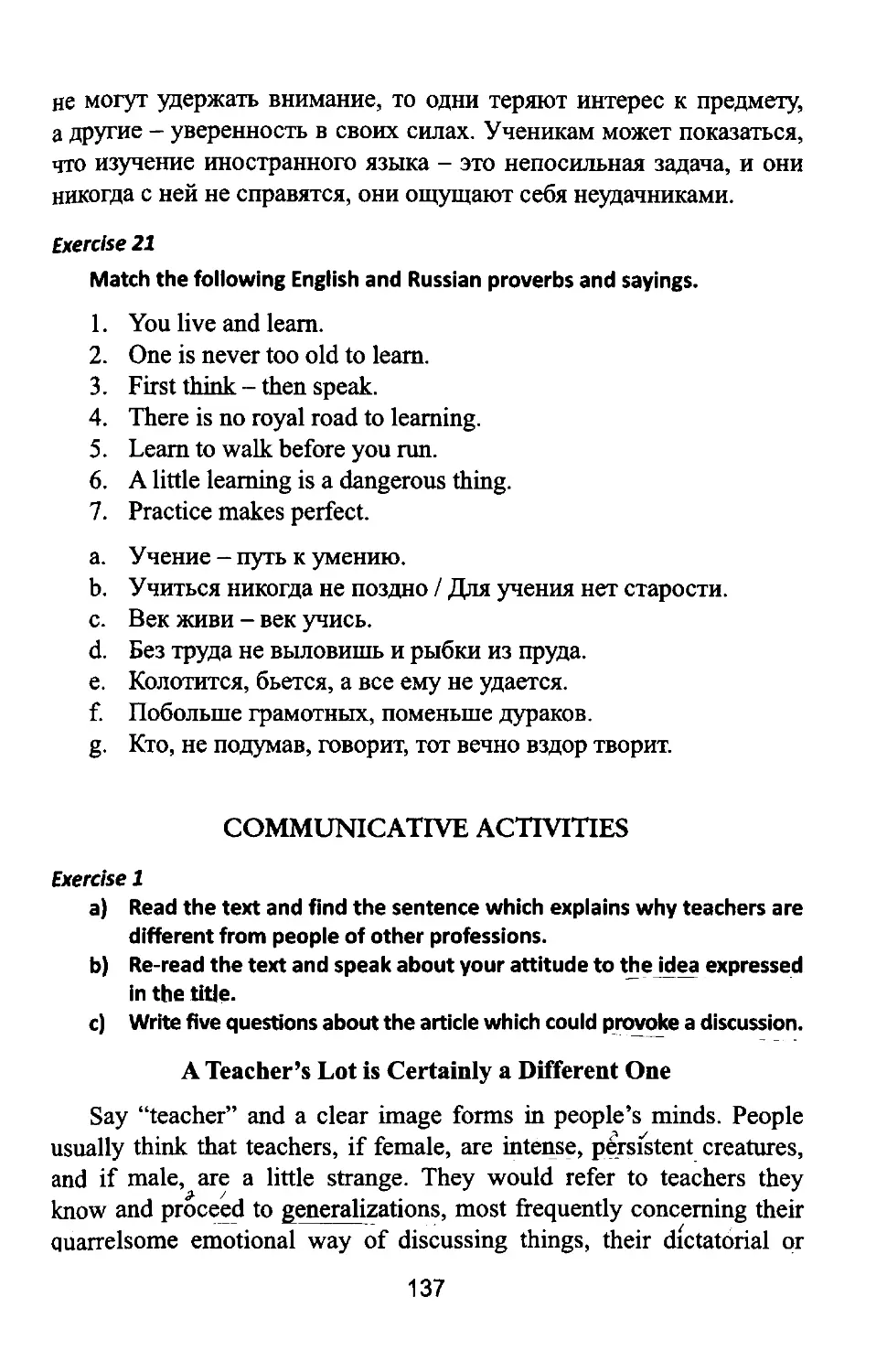
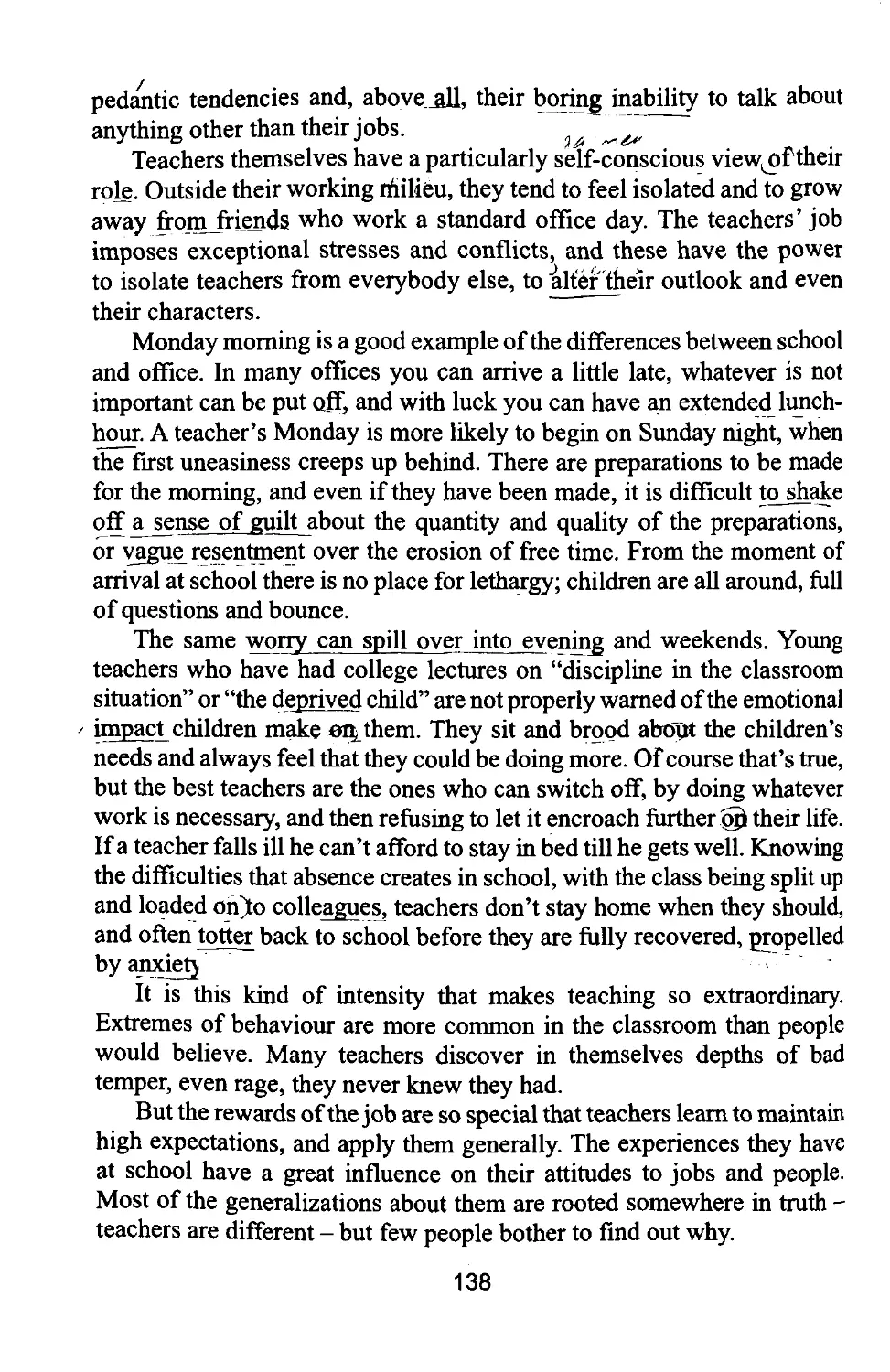
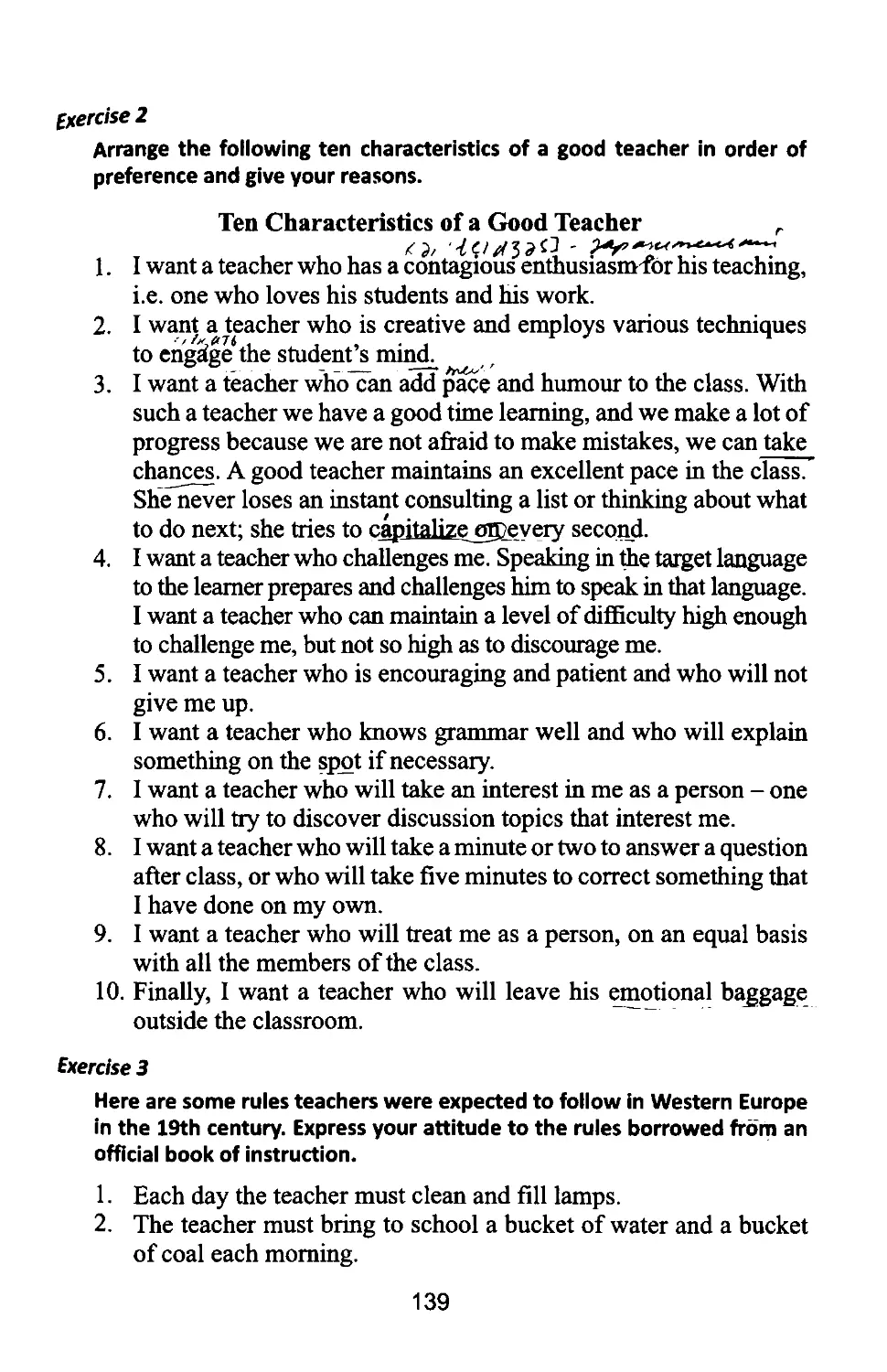
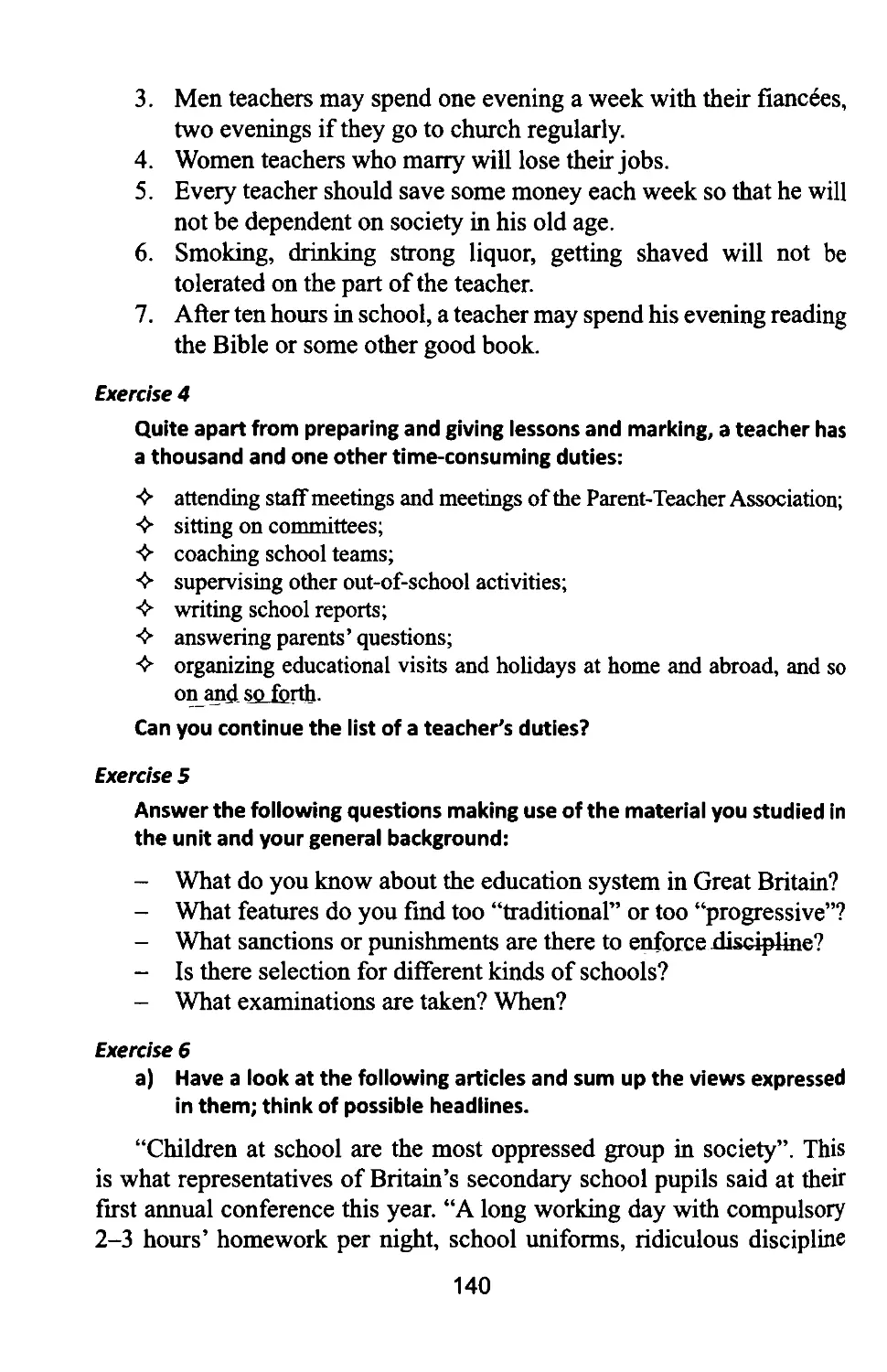




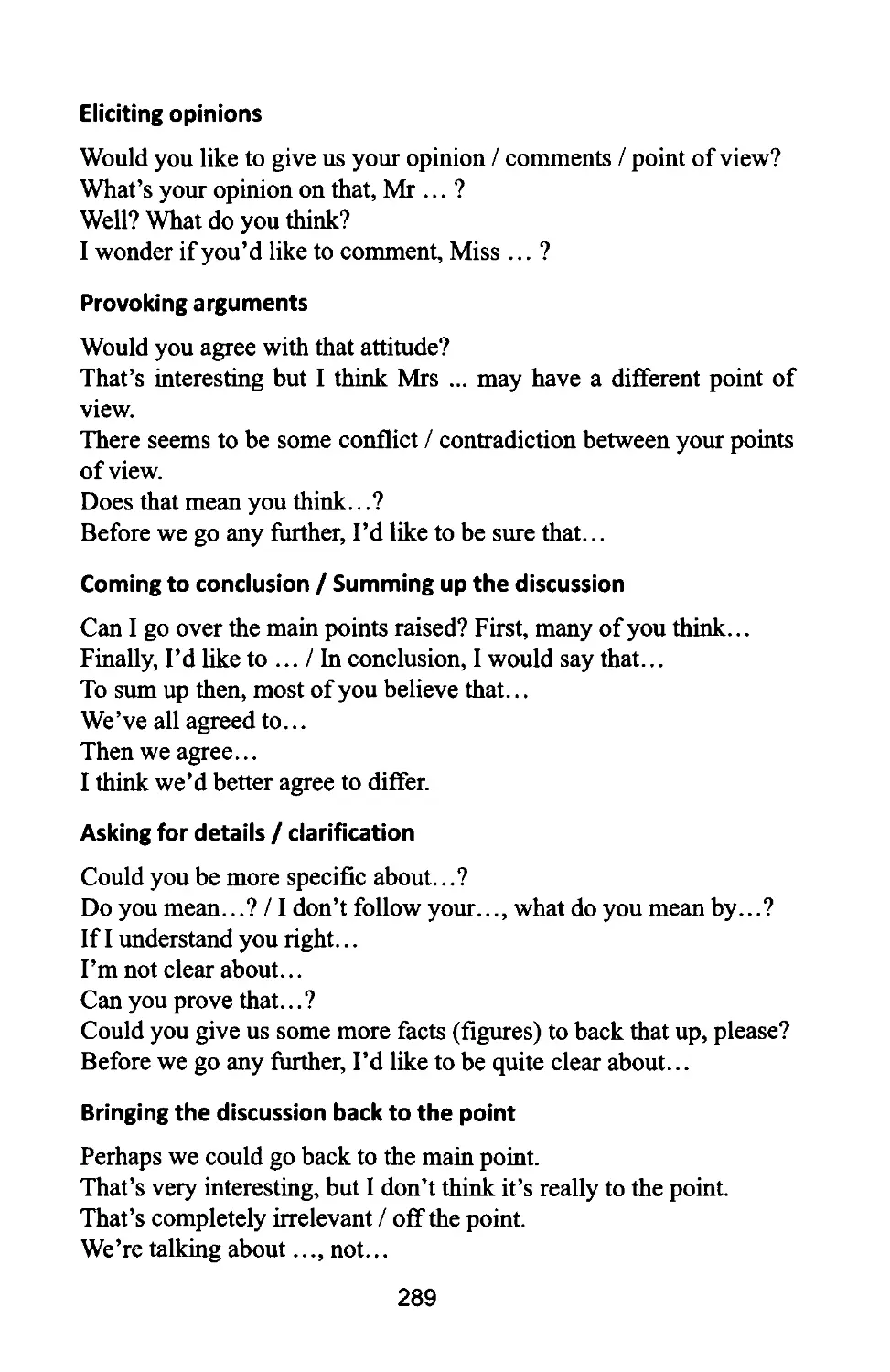
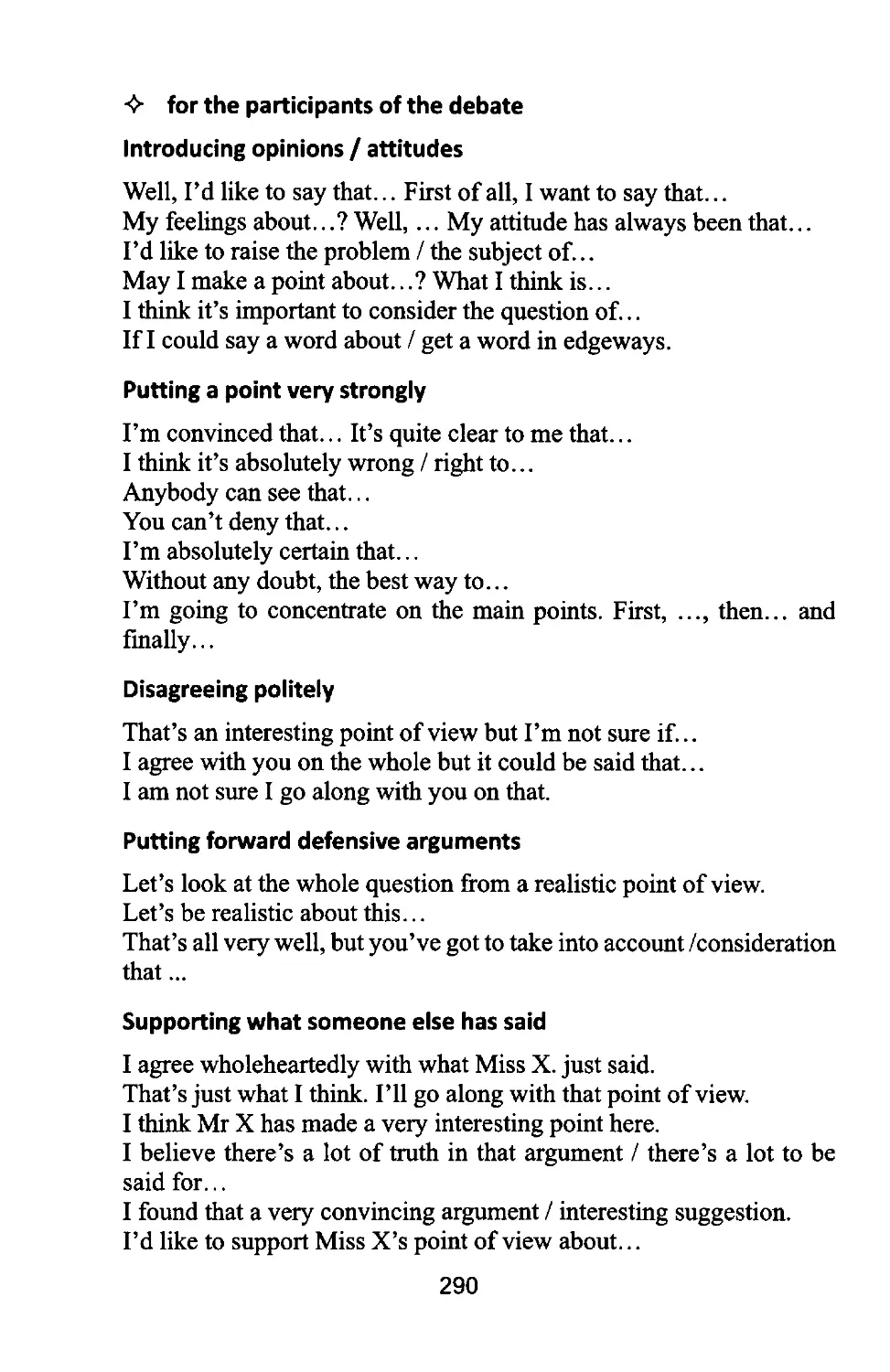

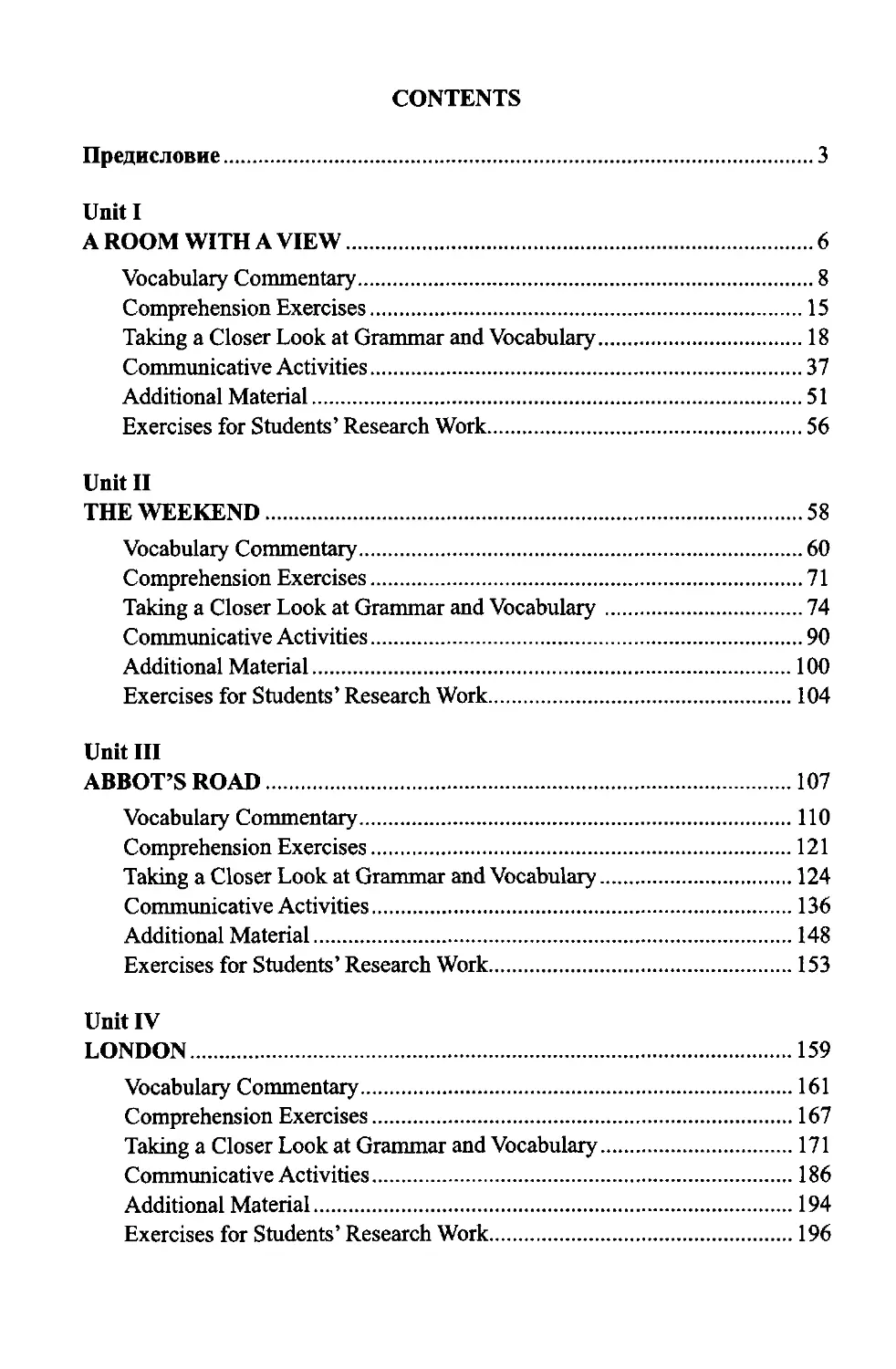
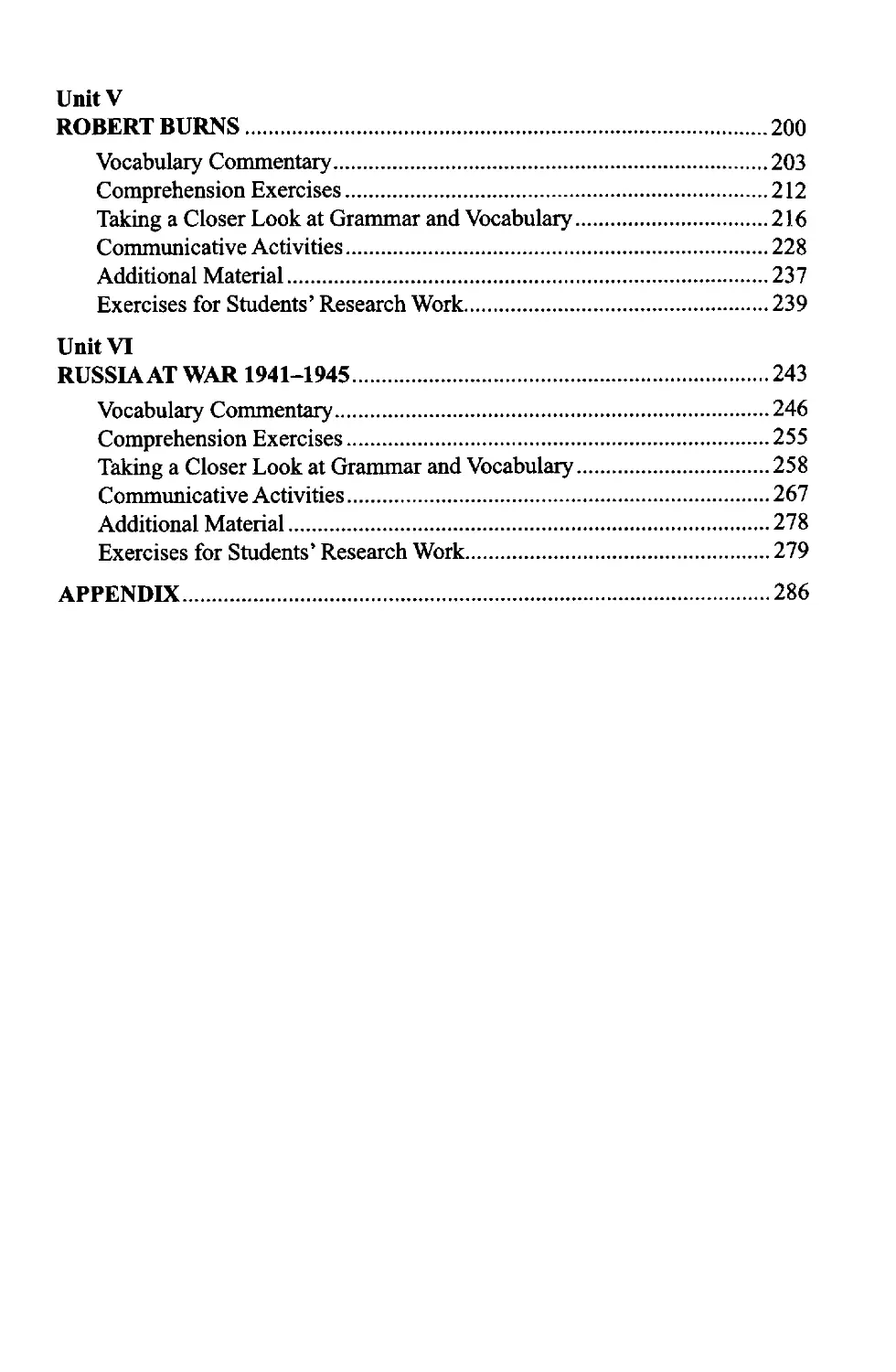
Автор: Фролова Г.М. Лебедева М.С.
Теги: английский язык учебники и учебные пособия по английскому языку языкознание
ISBN: 978-5-88983-710-7
Год: 2015

Текст
                    Учебник для I курса языкового вуза

Министерство образования и науки Российской Федерации
Федеральное государственное бюджетное образовательное учреждение
высшего профессионального образования
«Московский государственный лингвистический университет»
Г. М. Фролова, М. С. Лебедева
ПРАКТИЧЕСКИМ КУРС
АНГЛИЙСКОГО ЯЗЫКА
Учебник для I курса языкового вуза
Пятое издание, стереотипное
Рекомендовано
Учебно-методическим объединением по образованию
в области лингвистики Министерства образования и науки Российской Федерации
в качестве учебника для студентов, обучающихся по специальностям направления
‘Лингвистика и межкультурная коммуникация",
и бакалавров, обучающихся по направлению “Лингвистика"
Москва
ФГБОУ ВПО МГЛУ
2015

УДК 811.1114075)
ББК 81.2Англ-923
Ф91
Печатается по решению Ученого совета
Московского государственного лингвистического университета
Учебник подготовлен
на кафедре лексикологии английского языка
факультета ГПН МГЛУ
Рецензенты:
д-р пед. наук, проф. К. С. Махмурян, зав. кафедрой иностранных языков
Московского института открытого образования (МИОО);
канд. филол. наук, доц. Е. А. Фесенко,
проф. кафедры английской филологии
Института филологии и истории (ИФИ)
ГОУ ВПО «Российский государственный гуманитарный университет»
Фролова Г. М., Лебедева М. С.
Ф91 Практический курс английского языка : учебник для I курса языковых
вузов. - 5-е изд., стереотип. - М.: ФГБОУ ВПО МГЛУ, 2015. - 294 с.
УДК 811.1114075)
ББК 81.2Англ-923
ISBN 978-5-88983-710-7
© ФГБОУ ВПО МГЛУ, 2015

ПРЕДИСЛОВИЕ
Данный учебник предназначен для студентов, продолжающих
изучение английского языка на базе навыков и умений общения,
сформированных в средней школе.
Цель учебника - совершенствование межкультурной коммуника¬
тивной компетенции обучающихся, что позволит им стать эффектив¬
ными участниками общения с носителями / пользователями изучае¬
мого языка.
В соответствии с концепцией учебника в его основу легли совре¬
менные лингводидактические и методические принципы обучения
иностранному языку, в том числе:
•Ф принцип коммуникативности, а также сопряженные с ним
принципы ситуативно-тематической организации учебного
материала и функциональности;
-Ф принцип взаимосвязанного обучения всем формам устного
и письменного общения, т. е. параллельного формирования
умений чтения, говорения и письма;
■Ф принцип учета родного языка и опоры на родную лингво-
культуру;
■ф принцип межкультурного взаимодействия;
■ф принцип системности учебного материала;
■Ф принцип стилистической дифференциации и др.
Учебник разработан, исходя из принципа поаспектного обучения
иностранному языку и предназначен для занятий по учебной дисци¬
плине «Практический курс английского языка», что определило его
структуру и содержание.
Учебник состоит из 6 тематически организованных уроков, каж¬
дый из которых включает следующие разделы:
1.	Основной текст. В основу уроков положены специально
отобранные темы, которые раскрываются через тексты лингвокуль¬
турологического характера, позволяющие формировать у студентов
социокультурную компетенцию.
Все тексты основаны на аутентичных источниках, некоторые из
них подверглись незначительной адаптации.
Основной текст урока при необходимости сопровождается при¬
мечаниям (Notes), которые поясняют реалии текста.
2.	Лексический комментарий (Vocabulary Commentary)
включает слова и словосочетания, которые подлежат активному
3

усвоению. Все лексические единицы иллюстрируются при помощи
аутентичных контекстов употребления.
3.	Послетекстовые задания (Reading Comprehension Exercises),
предлагаемые после прочтения текста урока дома, предназначены
для формирования умений лингвокультурологической интерпрета¬
ции художественного или публицистического текста. Послетексто¬
вые задания призваны также развивать умения применять необходи¬
мые стратегии чтения для извлечения информации из разных типов
текста, формируя таким образом умения зрелого чтеца.
4.	Формирование лексической и грамматической компе¬
тенций (Taking a Closer Look at Vocabulary and Grammar). Боль¬
шое внимание в учебнике уделяется лингвистической компетенции,
в том числе ее лексической и грамматической составляющим. Раздел
«Формирование лексической и грамматической компетенций» пред¬
назначен для расширения словарного запаса обучающихся, а также
направлен на преодоление типичных грамматических ошибок и за¬
крепление практических навыков употребления повторяемых яв¬
лений. Данный раздел включает как чисто языковые упражнения,
так и упражнения с коммуникативной направленностью. Важными
являются упражнения в сравнении лексических средств выраже¬
ния одной и той же мысли в английском и русском языках, так как
упражнения подобного типа способствуют формированию межкуль¬
турной компетенции и развитию элементарных умений переводче¬
ской деятельности.
В ряде грамматических упражнений предлагается комментарий /
объяснение грамматических явлений, навыки употребления которых
закрепляются с помощью данных упражнений.
5.	Коммуникативные задания (Communicative Activities) обе¬
спечивают формирование стратегий иноязычного устного и пись¬
менного общения в ситуациях, максимально приближенным к реаль¬
ным. Разнообразные упражнения, в частности ролевые игры, задания
для парной и групповой работы позволяют подготовить студентов
к участию в дискуссии, способствуют развитию творческого вообра¬
жения, стимулируют интерес к обсуждаемым проблемам, позволяют
провести межкультурные и исторические параллели.
6.	Дополнительный материал (Additional Material). Боль¬
шое количество дополнительных текстов создают возможность
дифференциации и индивидуализации обучения. Тексты и задания
4

данного раздела в первую очередь предназначены для продвинутых
студентов.
7.	Задания для научно-исследовательской работы студентов
(Exercises for Students’ Research Work). Учебник познакомит сту¬
дентов - будущих лингвистов с элементарными приемами научно-
исследовательской работы с языковым материалом, а также будет
способствовать развитию у них языковой интуиции.
Пособие создает благоприятные условия для автономного обуче¬
ния, для формирования умений самостоятельной работы с учебным
материалом, для самосовершенствования (в частности, на основе
обращения к словарям различного типа).
Учебник сопровождается Приложением (Appendix), куда вклю¬
чены распространенные речеобразующие / этикетные формулы,
которые помогут студентам корректно оформлять свои коммуни¬
кативные намерения (запросить информацию, уточнить информа¬
цию, согласиться / не согласиться с собеседником и т. д.) средствами
изучаемого языка.
Таким образом, в результате изучения курса обучаемые должны
будут:
•Ф- знать:
правила оформления высказываний с различными коммуни¬
кативными намерениями, предусмотренными программой I
курса лингвистического вуза по английскому языку; формулы
речевого этикета, принятые в изучаемой культуре; правила
поведения, принятые в изучаемой культуре;
■Ф- уметь:
оформлять свои устные и письменные высказывания в со¬
ответствии с фонологическими, грамматическими и лекси¬
ческими нормами английского языка; употреблять лингви¬
стические средства общения адекватно коммуникативным
ситуациям; пользоваться этикетными формулами общения;
решать несложные практические профессиональные задачи;
-ф- быть ознакомленными с:
особенностями общения в изучаемой культуре;
историей и традициями изучаемой культуры.
Авторы
5

Unit I
A ROOM WITH A VIEW
Anna in working in the London sales office of Lufthansa, the big
German airline. She is going to be in England for at least two years. She
likes the job; she likes London. The reason she is not happy is that she
cannot find a room of her own. She has lookedv^Tmany flats but they
have all been so expensive. At the moment she is staying with a cousin
in Putney, a suburb of London. The two girls do not get on well together.
Anna knows that she must find a room of her own. She likes Putney. The
journey to her office only takes twenty minutes. So the question is: Can
she frnd a room in Putney ifor)i reasonable rent?
On Tuesday, April the 15th, Anna asked the manager for the morning
off. The manager said that she could have the whole day free. She left the
house and got a bus to Putney Bridge. Anna set off for the offices of The
Echo, the local newspaper, to put an advertisement. She arrived at the
offices of The Echo at twenty past nine and went up to the advertising
department on the second floor.
Opposite her she saw a pretty, dark-haired girl and smiled df her. The
girl was also filling in a form.
Anna looked at the girl for a while and finally said:
Anna: Excuse me. I’m not quite sure how you say this in English. Do
you say “I want to let a room” or “I want to rent a room”?
Girl’. Well, that depends. Have you got a room, or ...
Anna: No, I want one ...
Girl: Then you want to rent a room. You rent a room from someone,
you let ajoom to someone.
Anna: I see. I always mix up those two verbs.
Susan: You speak very good English. Where do you come from?
Anna: Germany. My home’s in Hamburg. My name’s Anna Klein.
Susan: How do you do? I’m Susan Bond. (They shake hands) You
say you’re looking for a room?
Anna: Yes.
Susan: Furnished of unfurnished?
Anna: Furnished.
Susan: Hm. How much do you want to pay?
Anna: Not more than five pounds a week.
6

Susan: That’s funny. We want to let a room, and the rent is five pounds
a week. Why don’t you come and see it? It’s quite near here.
Susan and Anna left the offices of The Echo together. They crossed
the bridge over the river and walked along the busy High Street. Then
they climbed a steep hill and took the third turning on the left. The name
of the street was Chestnut Avenue.
It was a tall, well-built house. Anna liked the look of it immediately.
Susan walked up a short flight of steps and opened the front door. Anna
followed her into the hall.
Susan: Mother’s out. But I can show you the room. It’s on the top
floor. (They climbed the stairs). Here we are. (She opens a
door on the landing at the top of the stairs).
Anna: What a lovely room!
Susan: You like it?
Anna: Yes, I do. Very much. (She walks over to the window and
looks at the view.) And such a marvelous view! Doesn’t the
river look beautiful when the sun’s shining on it? I do like to
live near water. You’ve got a very nice garden, haven’t you?
Anna liked the room very much. It was bigger than she expected -
about twenty feet (6 meters) long by sixteen feet (5 meters) wide. One end
had a curtain in front of it. Anna looked behind the curtain. In one comer
there was a wash-basin. She turned on the taps. The water from the hot
tap was really hot. There was also an electric cooker, and on a shelf above
it there were three new saucepans and a frying pan. Beside the cooker
there was a small cupboard. Anna opened it. In it there were plates, cups,
saucers and a teapot. In a drawer at the top there were knives, forks and
spoons. This part of the room was really a small kitchen. Anna pulled
back the curtain and looked at the rest of the room.
The carpet was light grey and covered most of the floor. In front of
the gas fire there was a thijik red mg. The curtains were also red - but of
a lighter shade. The walls were white. The sun was now shining brightly
through the window. It was a cheerful comfortable room.
Beneath the window there was a dressing-table with three drawers
and a mirror. There were two armchairs, a small table with reading lamps
and a few pictures on the walls. Anna did not like the pictures. “I’ll soon
change those”, she thought, for she had already decided that she wanted
the room. Next to the gas jko there was a large built-in cupboard for
clothes.
7

That evening Anna met Mrs. Bond. The two of them got on very well.
Mrs Bond: Well, that’s fine, Anna. We’ll be very pleased to have you.
When do you want to move in?
Anna:	May I come on Saturday?
Mrs Bond: Yes, of course. I’ll be in all Saturday morning. I hope
you’ll like it here.
So, Anna got a room with a view over the river Thames,
from "Anna in London "
by Alan R. Beesley
VOCABULARY COMMENTARY
1
At the moment she is staying with a cousin in Putney.
stay with sb. to live in a place for a while as a guest or a visitor - гостить,
жить у кого-л. (некоторое время)
One stays(witb friends (in their house), but at (or in) a hotel.
Where are you staying?
At the Grand Hotel
(with George / at George's).
He owns the house, I’m just staying.
My mother is staying with us this week.
Где вы остановитесь?
В Гранд Отеле
(У Джорджа).
Он хозяин дома, я здесь гость
(в гостях).
Моя мама гостит у нас эту неделю.
2
...Putney, a suburb of London.
suburb n [c] a part or district of a town, lying away from the centre, an
outer area of a town or city, where people live (usually a residential
area) - пригород, окраина;,/ftpthe suburbs за городом, на окраине,
в пригороде:
I live in the suburbs and it takes me Я живу за городом и трачу около часа
about an hour to get to the office.	на дорогу на работу.
8

suburban adj. пригородный:
Suburban shops are not so crowded. В магазинах на окраинах меньше
народу.
♦ Note that the English equivalent for «пригородный поезд» is a local
train I a commuter train I a short-distance train.
3
The two girls do not get on well together.
get on well to get along, to form or have a friendly relationship - ладить
с кем-л., иметь дружеские отношения:
They are getting on well (together). Они прекрасно ладят. (Живут дружно.)
Do you get along well with your aunt? Вы ладите с тетей?
4
The journey to her office only takes twenty minutes.
take here means “to last; need (a period of time)”:
It took them an hour to find him.	Им потребовался час, чтобы найти его.
It took me four hours to drive from Я ехал на машине отсюда до Эдин-
here to Edinburgh.	бурга четыре часа.
How long does the flight take?	Сколько времени длится полет?
5
Ann asked the manager for the morning off.
off an adverbial particle here, used in the meaning “away or free from
regular work”:
I think I’ll take the afternoon off.	Я думаю отпроситься с работы после
обеда.
Не wants Thursday off.	Он хочет взять выходной на четверг.
We are off till Tuesday.	Мы не работаем до вторника.
The manager gave the staff a day off Управляющий предоставил персоналу
(a day’s holiday).	выходной.
9

Wednesday is his day off.	y него выходной по средам.
I’ll be off tomorrow (said at home).	Завтра я не работаю.
I’ll be off tomorrow (said in the office).	Завтра я не приду / меня не будет.
б
Anna set off for the office.
\/ set off for / towards the place to begin / to start a journey - отправиться,
направиться куда-л.:
They set off on a trip across Europe. Они отправились путешествовать no
Европе.
We set off for the theatre.	Мы отправились в театр.
At dawn the children set off towards На рассвете дети отправились к реке,
the river.
7
She arrived at the office of The Echo at twenty past nine.
arrive w to reach a place, esp. the end of a journey
arrive (of people: on foot) - приходить
arrive (by vehicle) - приезжать
arrive (of trains, planes, and officially of people) - прибывать
♦ Note the use of the prepositions after the verb: arrive fat, the airport /
(Ui)a city / arrive home.
The preposition in is used with
at is used with villages, clubs,
We arrived at their flat early.
The delegation arrived in London
yesterday.
We arrived home late.
At last our holidays arrived.
The train arrived half an hour late.
continents, countries, cities and towns;
stations, theatres, airports, hotels:
Мы рано пришли к ним.
Делегация прибыла в Лондон вчера.
Мы поздно пришли домой. Мы
добрались до дома поздно.
Наконец наступили каникулы.
Поезд опоздал на полчаса.
10

8
Can she find a room in Putney for a reasonable rent?
rent n money paid regularly for the use of a room, building or piece of
land - квартирная / арендная плата; to pay a high (big, low) rent
платить много / мало за квартиру:
They pay a high (big) rent for Они платят много за свою квартиру,
their flat.
They owe a month’s rent.	Они задолжали за квартиру за один
месяц.
9
The rent is five pounds a week.
b Note that the English non-prepositional construction corresponds to the
Russian prepositional phrase: twice a^ear (a day, a month, an hour) -
два раза / дважды в год (в день, месяц, час).
She practises the piano three
hours a day.
We have English classes four
times a week.
Она упражняется на пианино три раза
в день.
У нас занятия по английскому языку
четыре раза в неделю.
10
I hope you ’ll like it here.
* Note the difference between the English and Russian constructions:
I tike it here. - Мне здесь нравится (безличное предложение).
It may be used in various verb patterns:
a)	as an object to represent a verb phrase:
I found it exciting to stay at
Granny’s for the holidays.
b)	to represent a clause:
I kept it quiet that she had left.
I liked it when she refused.
Мне очень понравилась идея пожить
у бабушки на каникулах.
Я никому не сказала, что она уехала.
Мне понравилось, что она отказалась.
11

и
Where do you come from?
come from (not with continuous or perfect tense) to have as a birthplace,
place of origin, etc. - быть родом откуда-л., происходить от чего-л.,
откуда-л.:
She comes from Scotland (or she is Она родом из Шотландии,
from Scotland).
This word comes from Arabic.	Это слово пришло из арабского языка.
The quotation comes from Pushkin. Эта цитата из Пушкина.
^ Note that the possible English equivalents for «Откуда вы родом?» are
“Where are you from?” or “What country are you from?”
12
How do you do? (also: “How’d you do?”) a phrase used as a polite
greeting, esp. when you meet someone for the first time, esp. when
they have introduced themselves or have been introduced to you. Can
be translated as «Здравствуйте!». This person replies with the same
phrase. They usually shake hands at the same time:
-	Mrs Brown, may I introduce Mr. Fox? (Have you met Mr Fox?)
-	How do you do, Mr Fox?
-	How do you do, Mrs Brown? Glad to meet you.
Less formal greetings are Hello, Hi (very familiar). Polite greetings
are: Good morning / afternoon / evening (a more informal way, e.g.
Morning, Ann. Did you have a good journey?).
“How are you?” is not only a question about someone’s health («Как
вы себя чувствуете?», «Как самочувствие?», «Как поживаешь?»),
but also a phrase used when meeting again a person already known.
The reply is often “Fine (thanks)l And how are you?” (pay attention
to the logical stress in the question and in the reply) - «Спасибо,
хорошо. А как ты / вы?».
Formulas that are frequently used when leaving or parting, or when
you are finishing a telephone call: Good-bye or Bye (the most common
way of saying goodbye to a friend or someone you know well).
12

Other ways of saying goodbye:
•	Cheerio! or Cheers {informal):
Cheerio, thanks for coming!
•	See you later! or See you tomorrow! {informal):
I’d better go now. I have to pick up the children from school. See you later!
•	So long! (very familiar):
So long, it was really nice bumping into you.
Other ways of saying goodbye:
•	Good night / Night used when you leave someone at night or
before they go to bed:
Good night. Thanks for a great party!
•	Take care used to say goodbye to someone you know well when
they are leaving, in order to show that you care about them:
Take care. Give my regards to your parents.
•	Safe journey used when someone you know well is leaving to go
on a journey:
Safe journey! Give us a ring when you get home.
•	Nice to meet you used for saying goodbye to someone when you
have just met them for the first time:
Nice to meet you, Mr Mitchell. Have a good trip back to the States.
13
Mother s out.
be out to be absent from home or from a building - отсутствовать, не
быть дома / на месте; {ant.) to be in / to be present (esp. at home or
under the roof of a building) - быть дома / на месте:
I’m afraid Mr Jones is out, he'll be Боюсь, м-ра Джонса сейчас нет, он
back soon.	вышел, но скоро будет.
Let’s spend the evening in (at home)
watching television.
Is there anybody in?
She won't be in until six o’clock.
Давай проведем вечер дома,
посмотрим телевизор.
Кто-нибудь здесь есть? /
Кто-нибудь есть дома?
Ее не будет до шести часов.
13

** Note the difference between to be out and to be away. The latter means
“to be gone for a long time, to be at another place, out of town”:
You’ll have to call again. The	Вам придется зайти позже. Директор
director is away on business.	в отъезде (в командировке).
14
They stopped at Number 24.
In English the address is given in the following way:
We live at No 10 (Market Street).	Мы живем в доме номер десять.
What number do you live at?	В каком доме вы живете?
Му aunt's address is Flat 2, (Number) 7, Адрес моей тети: Россия, Москва,
Cheknov Street, Moscow, Russia.	Ул- Чехова, д. 7, кв. 2.
^ Note that the word house should not be used of a building consisting of
flats. Here only block (of flats) is appropriate or, in some cases, flats:
I	live in a(n) big / old / new /
modem block of flats / apartment
building.
There is a shop on the ground
floor of our block.
Я живу в большом / старом / новом /
современном многоэтажном доме.
На первом этаже нашего дома
магазин.
There is a cinema near my flat. Недалеко от моего дома кинотеатр.
The shop is at No 28 (Nevsky Магазин находится в доме номер 28
Prospect).	по Невскому проспекту.
What are those buildings over Что это за дома / здания вон там?
there?
14

COMPREHENSION EXERCISES
Exercise 1
Translate the following sentences from the text. The purpose is for you to
compare the ways of expressing the same idea in English and in Russian.
1.	Anna is working in the London sales office of Lufthansa, the big
German airline.
2.	.. .she cannot find a room of her own.
3.	At the moment she is staying with a cousin in Putney, a suburb of
London.
4.	The two girls do not get on well together.
5.	Can she find a room in Putney for a reasonable rent?
6.	Anna asked the manager for the morning off. The manager said
that she could have the whole day free. She left the house and got
a bus to Putney Bridge.
7.	Anna set off for the offices of The Echo, the local newspaper,
to put an advertisement. She arrived at the office of The Echo at
twenty past nine and went up to the advertising department on the
second floor.
8.	They crossed the bridge over the river and walked along the busy
High Street. Then they climbed a steep hill and took the third
turning on the left.
9.	It was a tall, well-built house. Anna liked the look of it immediately.
Susan walked up a short flight of steps and opened the front door.
Anna followed her into the hall.
10.	She walks over to the window and looks at the view ... “Doesn’t
the river look beautiful when the sun’s shining on it? I do like to
live near water.”
11.	Anna pulled back the curtain and looked at the rest of the room.
12.	The curtains were also red, but of a lighter shade.
13.	There were two reading lamps and a few pictures on the walls.
14.	... she had already decided that she wanted the room.
15.	Anna got a room with a view over the river Thames.
Exercise 2
In the text find English equivalents for the following Russian phrases.
Arrange them into groups according to the subject matter.
По крайней мере; своя собственная комната; посмотреть мно¬
го квартир; дорогой (о цене); дорога на работу занимает 20 минут;
1 ё

умеренная плата за квартиру; во вторник 15 апреля; можете быть
свободны' целый день; отправиться куда-либо; редакция Устной
газета; помёстить объявление; отдел Объявлений на третьем этаже;
запблниТъ блайк (анкету); напротив кого-либо; улыбйутьс/ кому-
либо; смотрёть ’на гкойб^лйбо“некоторое время; сказать ^нго-либо
по-английски; сдавать комнату кому-либо; меблированная комната;
шесть метров в длину и 5 Метров в ширину; на верхнем Этаже; загля-
* нуть за занавеску; повернуть краны; рядом х, чем-либо; возле чего-
либо, в ящике наверху; ковер покрывал почти весь пой; быть более
^ светлыИ'пЬ' тону; Настольная лампа; въеКать'Й7квартиру.
Exercise 3
Arrange the points in logical order. Retell the original text using the key
words given below.
1)	to ask for the morning off, to get a bus, to set off for, to put an
advertisement, arrive at, to go up to the advertising department, to
write out the advertisement, to sit down examining the form;
2)	to speak good English, to come from, to shake hands, a furnished
room, five pounds a week, to be quite near here;
3)	a room of her own, at the moment, not to get on well together, the
journey to her office, for a reasonable rent;
4)	opposite her, a dark-haired girl, to smile at her; to fill in the form,
to say sth, in English, not to be quite sure, to rent a room, to let
a room to someone;
5)	to climb the stairs, on the landing, a lovely room, to walk over to
the window, to stay somewhere;
6)	She liked the look of it, to walk up a short flight of steps, to follow
sb., to be out, to show the room, on the top floor;
7)	to leave the office, to cross the bridge, to climb a steep hill, to take
the third turning on the left;
8)	to cover most of the floor, in front of the gas-fire, of a lighter
shade, through the window, beneath the window, next to the
gas-fire;
9)	to be pleased, to move in, to be in, you’ll like it here, to get a
room, a view over the river.
10)	to be bigger than she expected, to look behind the curtain, in
the comer, turn on the tap, a shelf above, beside the cooker, in a
drawer at the top, to pull back the curtain.
16

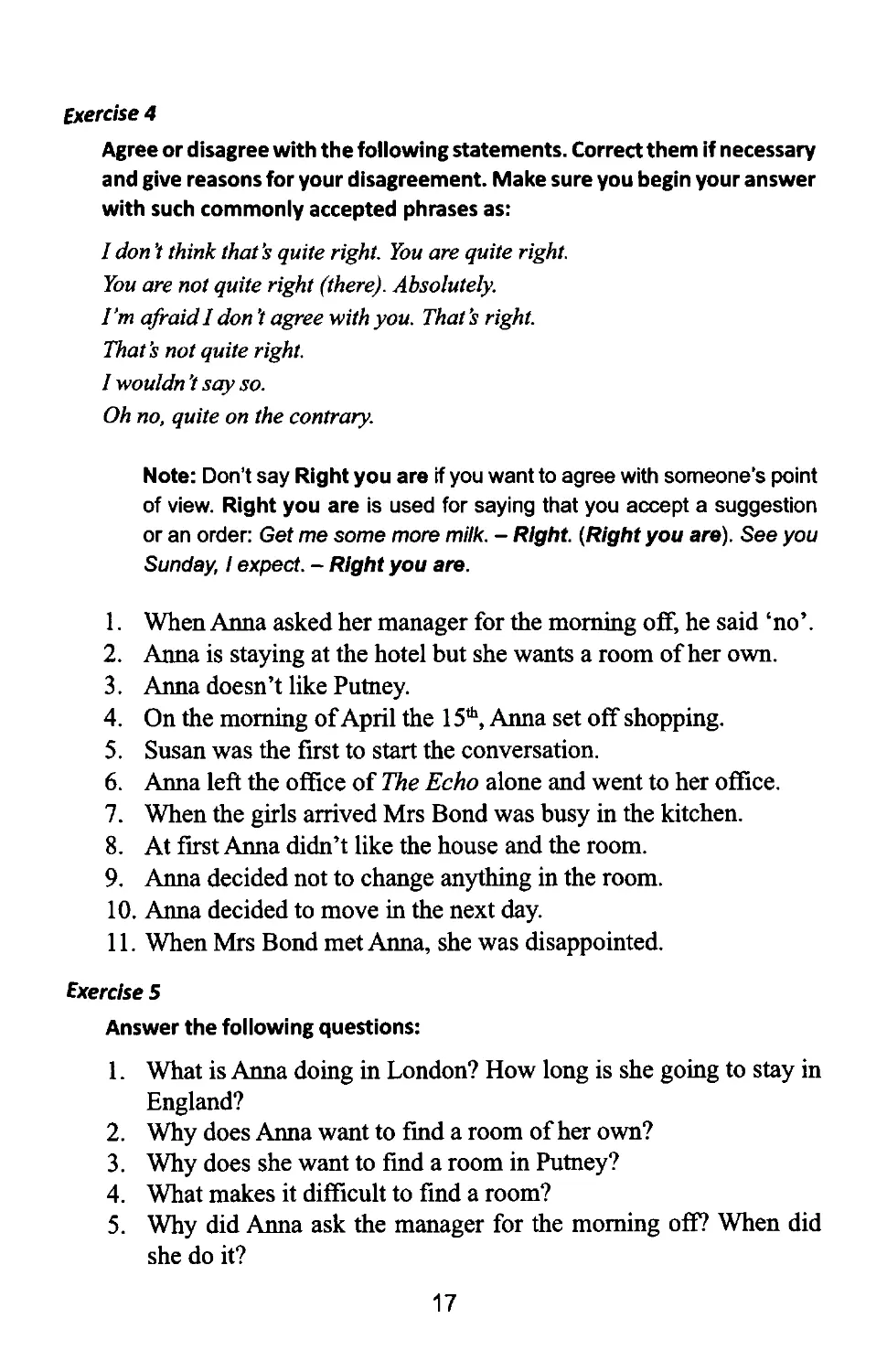
Exercise 4
Agree or disagree with the following statements. Correct them if necessary
and give reasons for your disagreement. Make sure you begin your answer
with such commonly accepted phrases as:
I don’t think that’s quite right. You are quite right.
You are not quite right (there). Absolutely.
I’m afraid I don't agree with you. That’s right.
That’s not quite right.
I wouldn't say so.
Oh no, quite on the contrary.
Note: Don’t say Right you are if you want to agree with someone’s point
of view. Right you are is used for saying that you accept a suggestion
or an order: Get me some more milk. - Right. {Right you are). See you
Sunday, I expect. - Right you are.
1.	When Anna asked her manager for the morning off, he said ‘no’.
2.	Anna is staying at the hotel but she wants a room of her own.
3.	Anna doesn’t like Putney.
4.	On the morning of April the 15th, Anna set off shopping.
5.	Susan was the first to start the conversation.
6.	Anna left the office of The Echo alone and went to her office.
7.	When the girls arrived Mrs Bond was busy in the kitchen.
8.	At first Anna didn’t like the house and the room.
9.	Anna decided not to change anything in the room.
10.	Anna decided to move in the next day.
11.	When Mrs Bond met Anna, she was disappointed.
Exercise 5
Answer the following questions:
1.	What is Anna doing in London? How long is she going to stay in
England?
2.	Why does Anna want to find a room of her own?
3.	Why does she want to find a room in Putney?
4.	What makes it difficult to find a room?
5.	Why did Anna ask the manager for the morning off? When did
she do it?
17

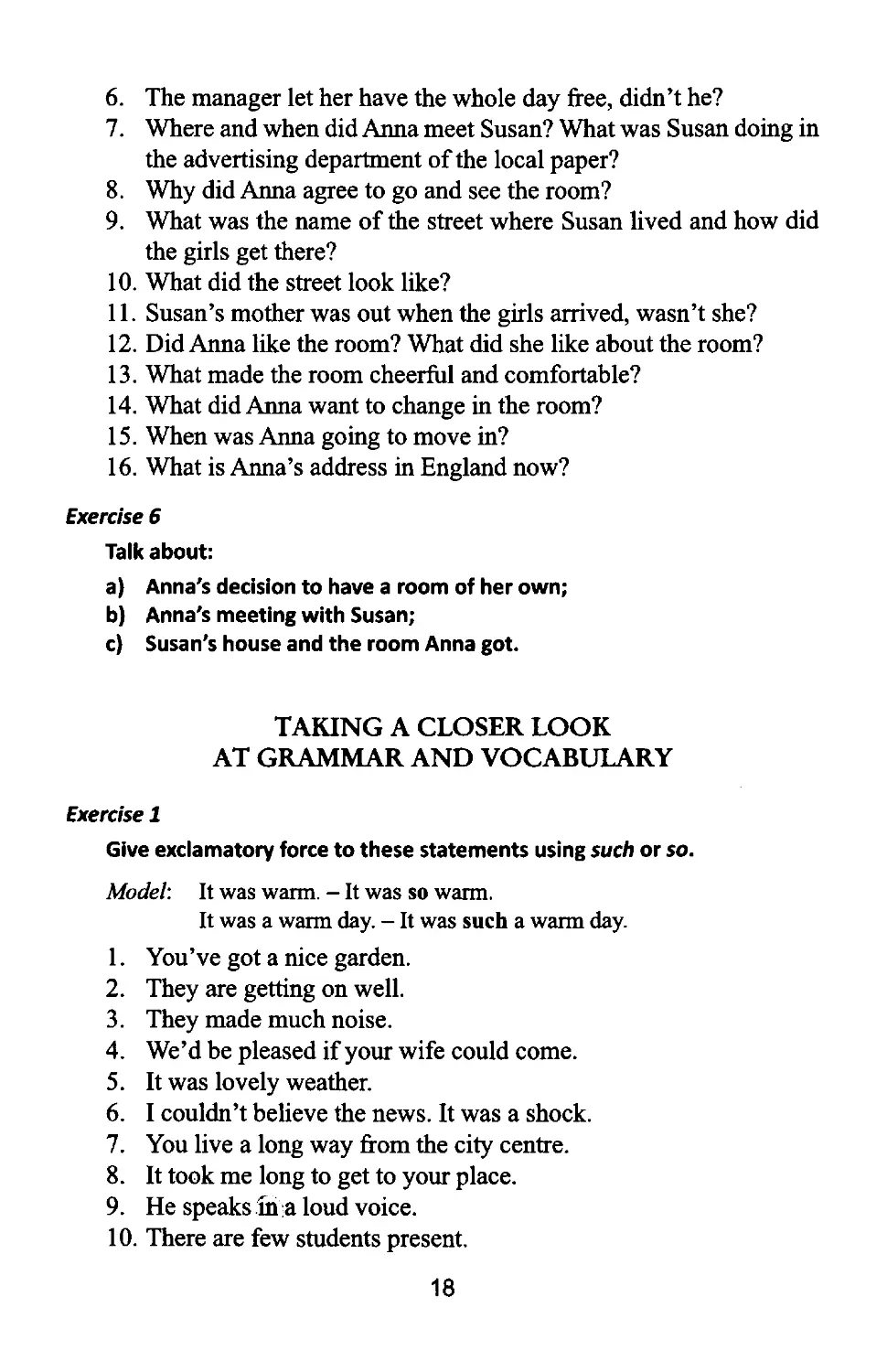
6.	The manager let her have the whole day free, didn’t he?
7.	Where and when did Anna meet Susan? What was Susan doing in
the advertising department of the local paper?
8.	Why did Anna agree to go and see the room?
9.	What was the name of the street where Susan lived and how did
the girls get there?
10.	What did the street look like?
11.	Susan’s mother was out when the girls arrived, wasn’t she?
12.	Did Anna like the room? What did she like about the room?
13.	What made the room cheerful and comfortable?
14.	What did Anna want to change in the room?
15.	When was Anna going to move in?
16.	What is Anna’s address in England now?
Exercise 6
Talk about:
a)	Anna's decision to have a room of her own;
b)	Anna's meeting with Susan;
c)	Susan's house and the room Anna got.
TAKING A CLOSER LOOK
AT GRAMMAR AND VOCABULARY
Exercise 1
Give exclamatory force to these statements using such or so.
Model: It was warm. - It was so warm.
It was a warm day. - It was such a warm day.
1.	You’ve got a nice garden.
2.	They are getting on well.
3.	They made much noise.
4.	We’d be pleased if your wife could come.
5.	It was lovely weather.
6.	I couldn’t believe the news. It was a shock.
7.	You live a long way from the city centre.
8.	It took me long to get to your place.
9.	He speaks m a loud voice.
10.	There are few students present.
18

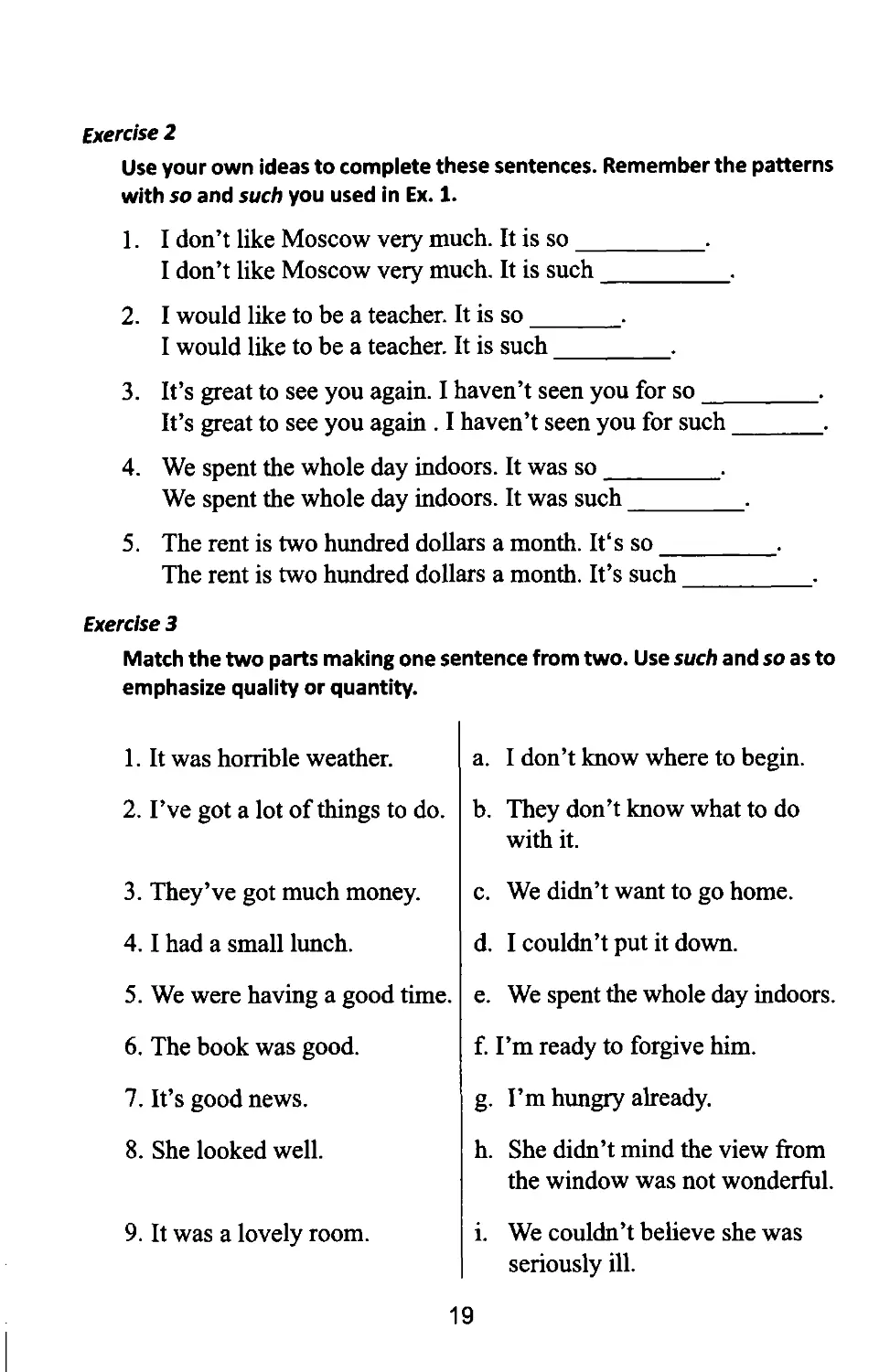
Exercise 2
Use your own ideas to complete these sentences. Remember the patterns
with so and such you used in Ex. 1.
1.	I don’t like Moscow very much. It is so	.
I	don’t like Moscow very much. It is such	.
2.	I would like to be a teacher. It is so	.
I	would like to be a teacher. It is such	.
3. It’s great to see you again. I haven’t seen you for so	.
It’s great to see you again . I haven’t seen you for such	.
4.	We spent the whole day indoors. It was so	.
We spent the whole day indoors. It was such	.
5.	The rent is two hundred dollars a month. It‘s so	.
The rent is two hundred dollars a month. It’s such	.
Exercise 3
Match the two parts making one sentence from two. Use such and so as to
emphasize quality or quantity.
1.	It was horrible weather.
2.	I’ve got a lot of things to do.
3.	They’ve got much money.
4.1	had a small lunch.
5.	We were having a good time.
6.	The book was good.
7.	It’s good news.
8.	She looked well.
9.	It was a lovely room.
a.	I don’t know where to begin.
b.	They don’t know what to do
with it.
c.	We didn’t want to go home.
d.	I couldn’t put it down.
e.	We spent the whole day indoors
f.	I’m ready to forgive him.
g.	I’m hungry already.
h.	She didn’t mind the view from
the window was not wonderful.
i.	We couldn’t believe she was
seriously ill.
19

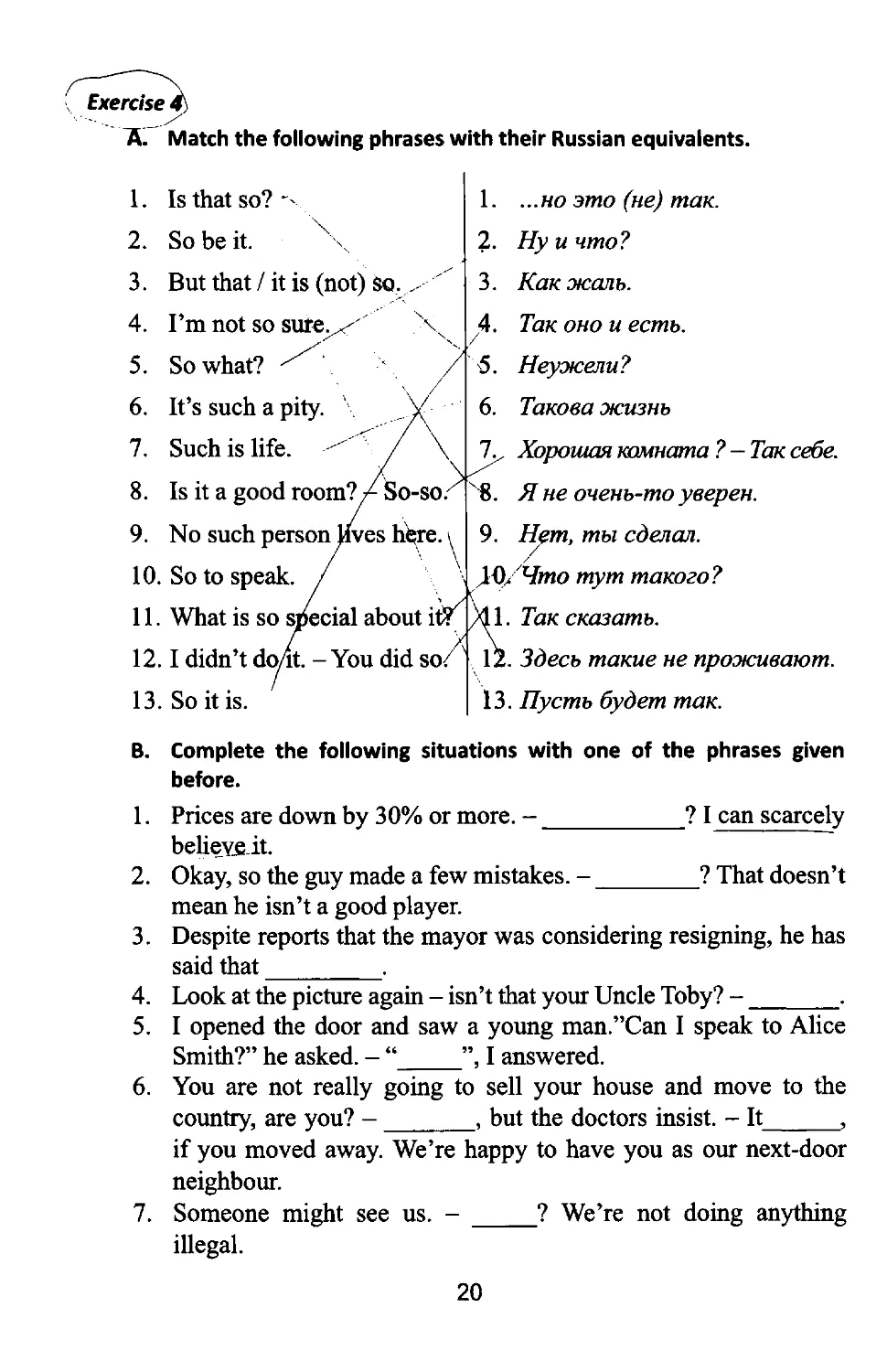
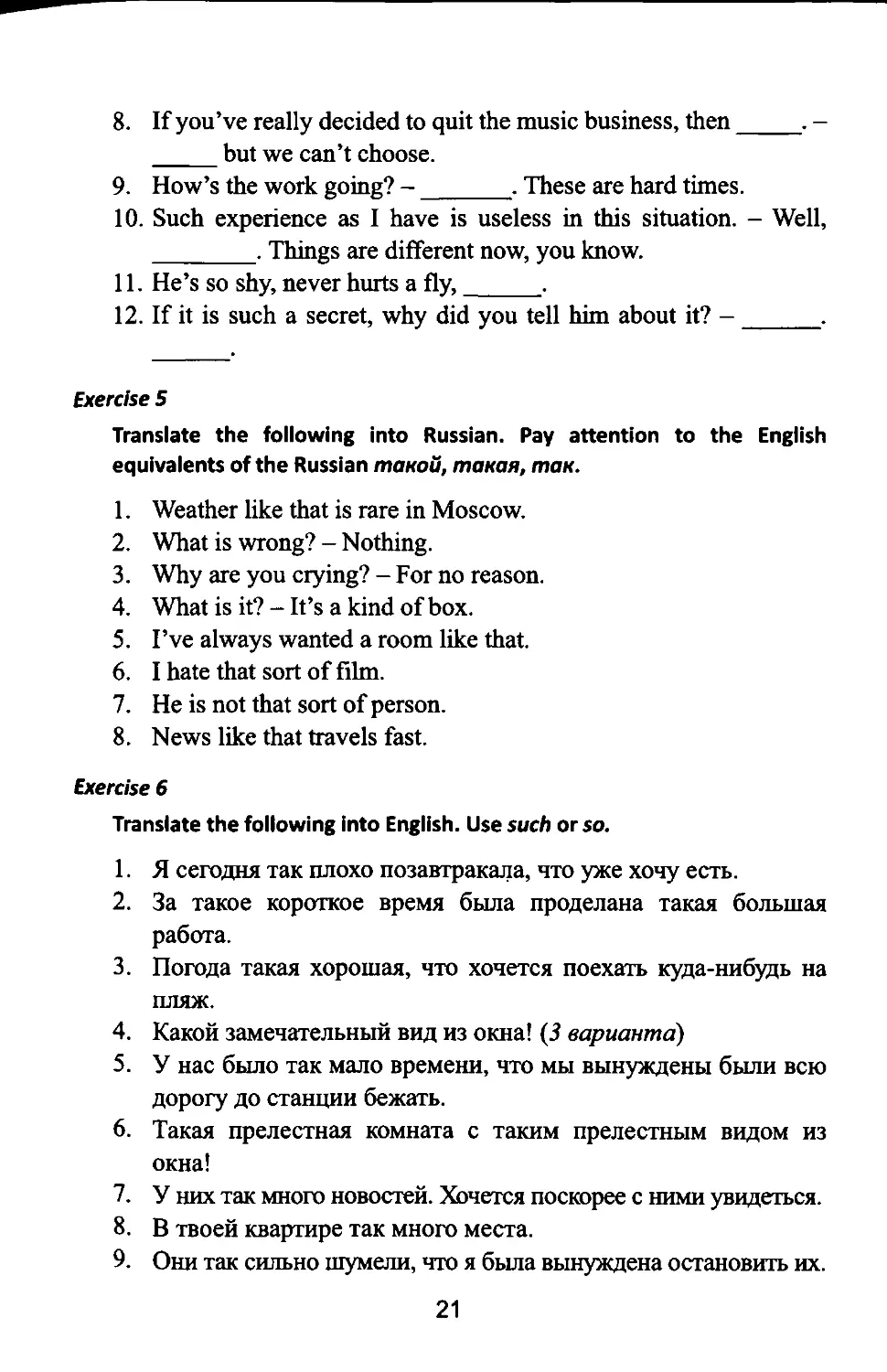
Л. Match the following phrases with their Russian equivalents.
1. Is that so?
1. ...но это (не) так.
2. So be it.
2. Ну и что?
3. But that / it is (not) so, ^ '
3. Как жаль.
4. I’m not so sure. / \4
4. Так оно и есть.
/
5. So what? // ' /
/
5. Неужели?
\ /
6. It’s such a pity. ' Y
6. Такова жизнь
7. Such is life. / \
/ \
Т, Хорошая комната ? — Так себе.
8. Is it a good room? / So-so Y
ч8. Я не очень-то уверен.
9. No suchpersonpveshere.у
9. Нет, ты сделал.
10. So to speak. /
/
\б/Что тут такого?
11. What is so special about itY^
)) 1. Так сказать.
12.1 didn’t dcyit. - You did so/
12. Здесь такие не проживают.
13. So it is.
13. Пусть будет так.
B. Complete the following situations with one of the phrases given
before.
1.	Prices are down by 30% or more. -	? I can scarcely
belieye.it.
2.	Okay, so the guy made a few mistakes. -	? That doesn’t
mean he isn’t a good player.
3.	Despite reports that the mayor was considering resigning, he has
said that	.
4.	Look at the picture again - isn’t that your Uncle Toby? -	.
5.	I opened the door and saw a young man.”Can I speak to Alice
Smith?” he asked. - “	”, I answered.
6.	You are not really going to sell your house and move to the
country, are you? -	, but the doctors insist. - It	,
if you moved away. We’re happy to have you as our next-door
neighbour.
7.	Someone might see us. -	? We’re not doing anything
illegal.
20

8.	If you’ve really decided to quit the music business, then	. -
	but we can’t choose.
9.	How’s the work going? -	. These are hard times.
10.	Such experience as I have is useless in this situation. - Well,
		. Things are different now, you know.
11.	He’s so shy, never hurts a fly,	.
12.	If it is such a secret, why did you tell him about it? -	.
Exercise 5
Translate the following into Russian. Pay attention to the English
equivalents of the Russian такой, такая, так.
1.	Weather like that is rare in Moscow.
2.	What is wrong? - Nothing.
3.	Why are you crying? - For no reason.
4.	What is it? - It’s a kind of box.
5.	I’ve always wanted a room like that.
6.	I hate that sort of film.
7.	He is not that sort of person.
8.	News like that travels fast.
Exercise 6
Translate the following into English. Use such or so.
1.	Я сегодня так плохо позавтракала, что уже хочу есть.
2.	За такое короткое время была проделана такая большая
работа.
3.	Погода такая хорошая, что хочется поехать куда-нибудь на
пляж.
4.	Какой замечательный вид из окна! (3 варианта)
5.	У нас было так мало времени, что мы вынуждены были всю
дорогу до станции бежать.
6.	Такая прелестная комната с таким прелестным видом из
окна!
7.	У них так много новостей. Хочется поскорее с ними увидеться.
8.	В твоей квартире так много места.
9.	Они так сильно шумели, что я была вынуждена остановить их.
21

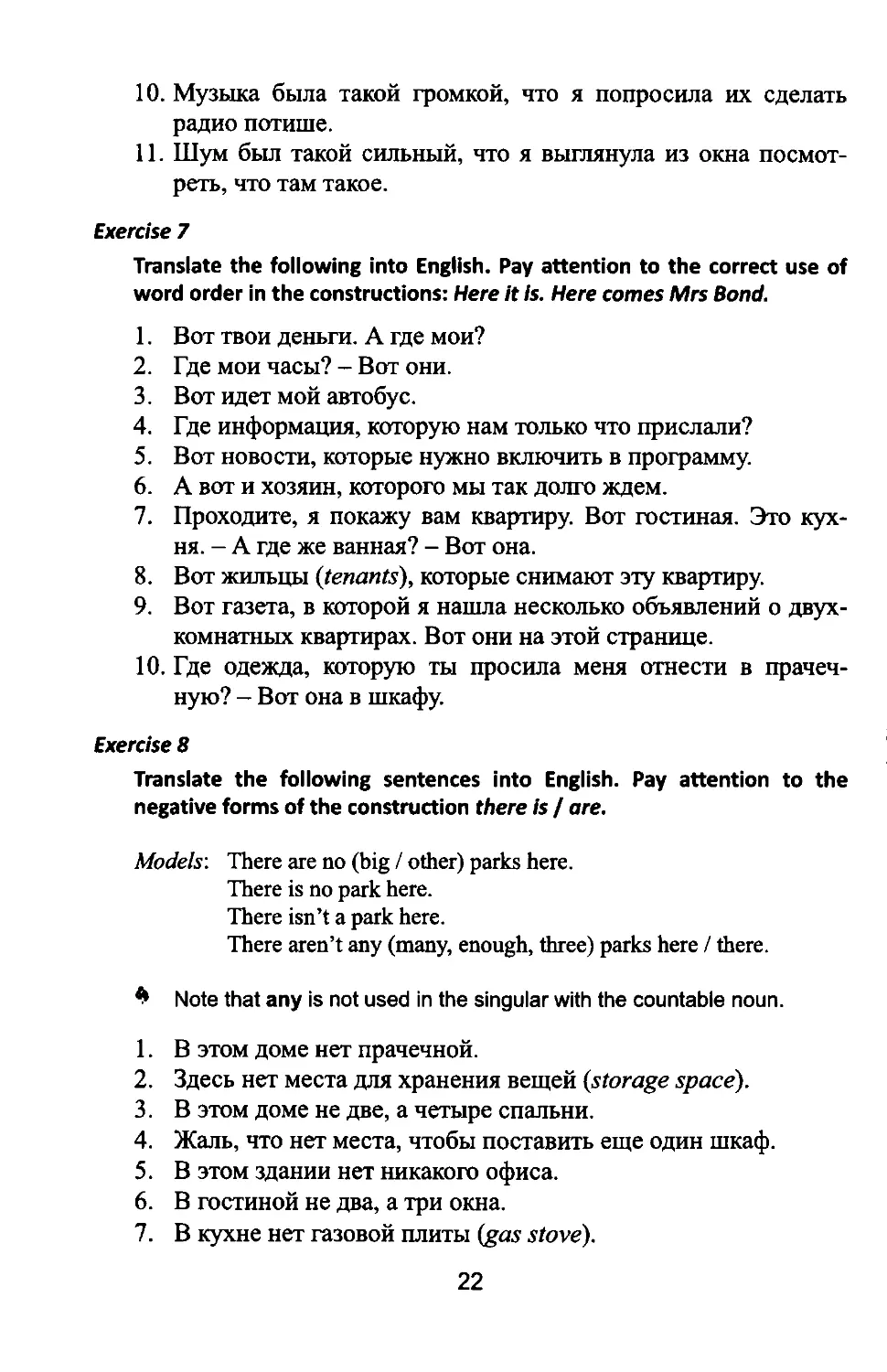
10.	Музыка была такой громкой, что я попросила их сделать
радио потише.
11.	Шум был такой сильный, что я выглянула из окна посмот¬
реть, что там такое.
Exercise 7
Translate the following into English. Pay attention to the correct use of
word order in the constructions: Here it is. Here comes Mrs Bond.
1.	Вот твои деньги. А где мои?
2.	Где мои часы? - Вот они.
3.	Вот идет мой автобус.
4.	Где информация, которую нам только что прислали?
5.	Вот новости, которые нужно включить в программу.
6.	А вот и хозяин, которого мы так долго ждем.
7.	Проходите, я покажу вам квартиру. Вот гостиная. Это кух¬
ня. - А где же ванная? - Вот она.
8.	Вот жильцы {tenants), которые снимают эту квартиру.
9.	Вот газета, в которой я нашла несколько объявлений о двух¬
комнатных квартирах. Вот они на этой странице.
10.	Где одежда, которую ты просила меня отнести в прачеч¬
ную? - Вот она в шкафу.
Exercise 8
Translate the following sentences into English. Pay attention to the
negative forms of the construction there is / are.
Models: There are no (big / other) parks here.
There is no park here.
There isn’t a park here.
There aren’t any (many, enough, three) parks here / there.
^ Note that any is not used in the singular with the countable noun.
1.	В этом доме нет прачечной.
2.	Здесь нет места для хранения вещей (storage space).
3.	В этом доме не две, а четыре спальни.
4.	Жаль, что нет места, чтобы поставить еще один шкаф.
5.	В этом здании нет никакого офиса.
6.	В гостиной не два, а три окна.
7.	В кухне нет газовой плиты (gas stove).
22

8.	В этом доме не много квартир и нет ни одной, которую можно
было бы снять.
9.	На картине не четыре, а пять деревьев. Вон еще одно в пра¬
вом верхнем ушу.
10.	Осторожно, здесь не много ступенек, но они очень крутые
(steep).
11.	В доме пять этажей, а лифта нет.
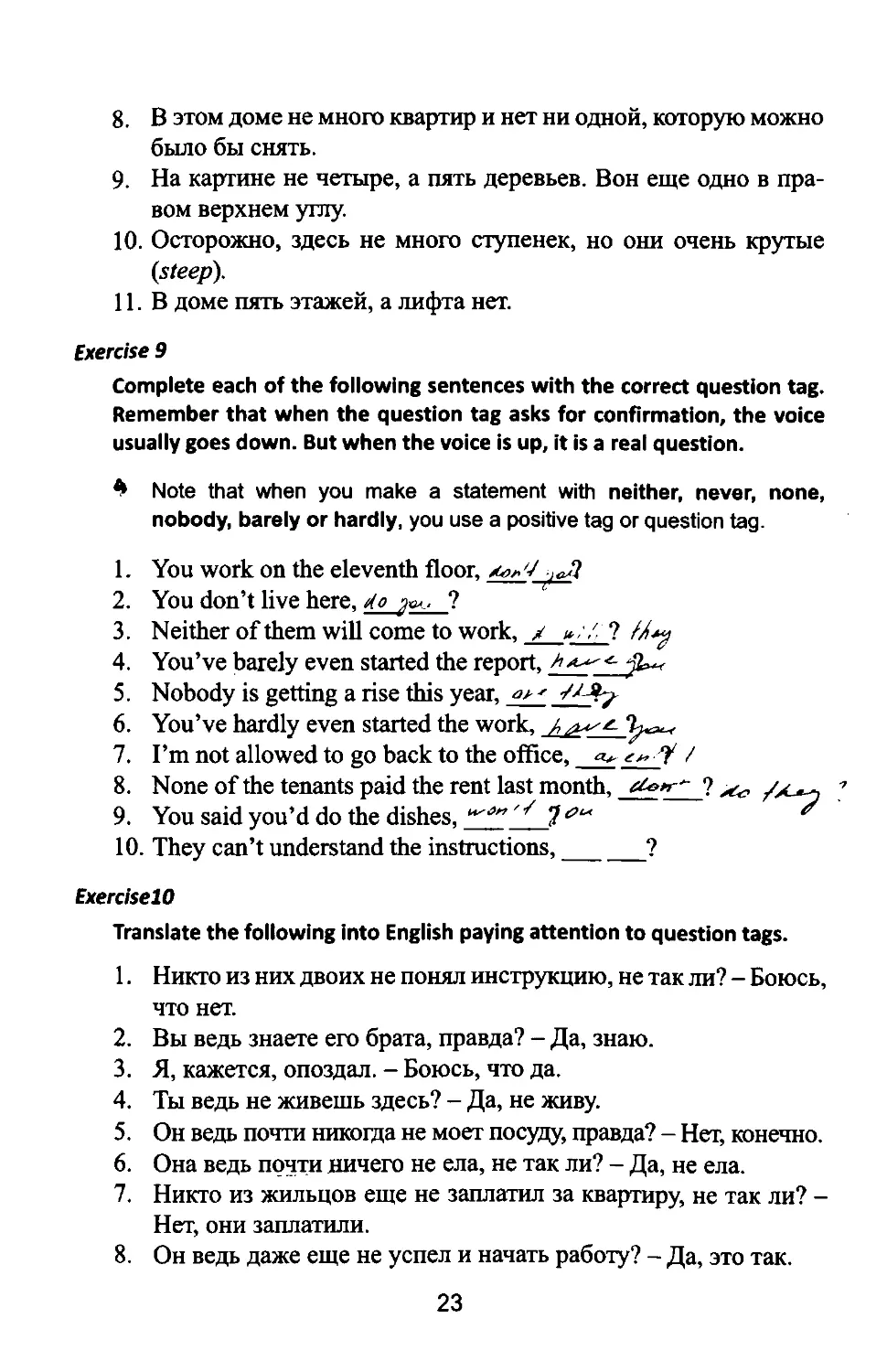
Exercise 9
Complete each of the following sentences with the correct question tag.
Remember that when the question tag asks for confirmation, the voice
usually goes down. But when the voice is up, it is a real question.
^ Note that when you make a statement with neither, never, none,
nobody, barely or hardly, you use a positive tag or question tag.
1.	You work on the eleventh floor,
2.	You don’t live here, Mo p»,. ?
3.	Neither of them will come to work, м ? //*?
4.	You’ve barely even started the report,
5.	Nobody is getting a rise this year, ММЛр-
6.	You’ve hardly even started the work,
7.	I’m not allowed to go back to the office,	У /
8.	None of the tenants paid the rent last month,	^
9. You said you’d do the dishes,	7 0“	*
10.	They can’t understand the instructions,	?
ExerciselO
Translate the following into English paying attention to question tags.
1.	Никто из них двоих не понял инструкцию, не так ли? - Боюсь,
что нет.
2.	Вы ведь знаете его брата, правда? - Да, знаю.
3.	Я, кажется, опоздал. - Боюсь, что да.
4.	Ты ведь не живешь здесь? - Да, не живу.
5.	Он ведь почти никогда не моет посуду, правда? - Нет, конечно.
6.	Она ведь почти ничего не ела, не так ли? - Да, не ела.
7.	Никто из жильцов еще не заплатил за квартиру, не так ли? -
Нет, они заплатили.
8.	Он ведь даже еще не успел и начать работу? - Да, это так.
23

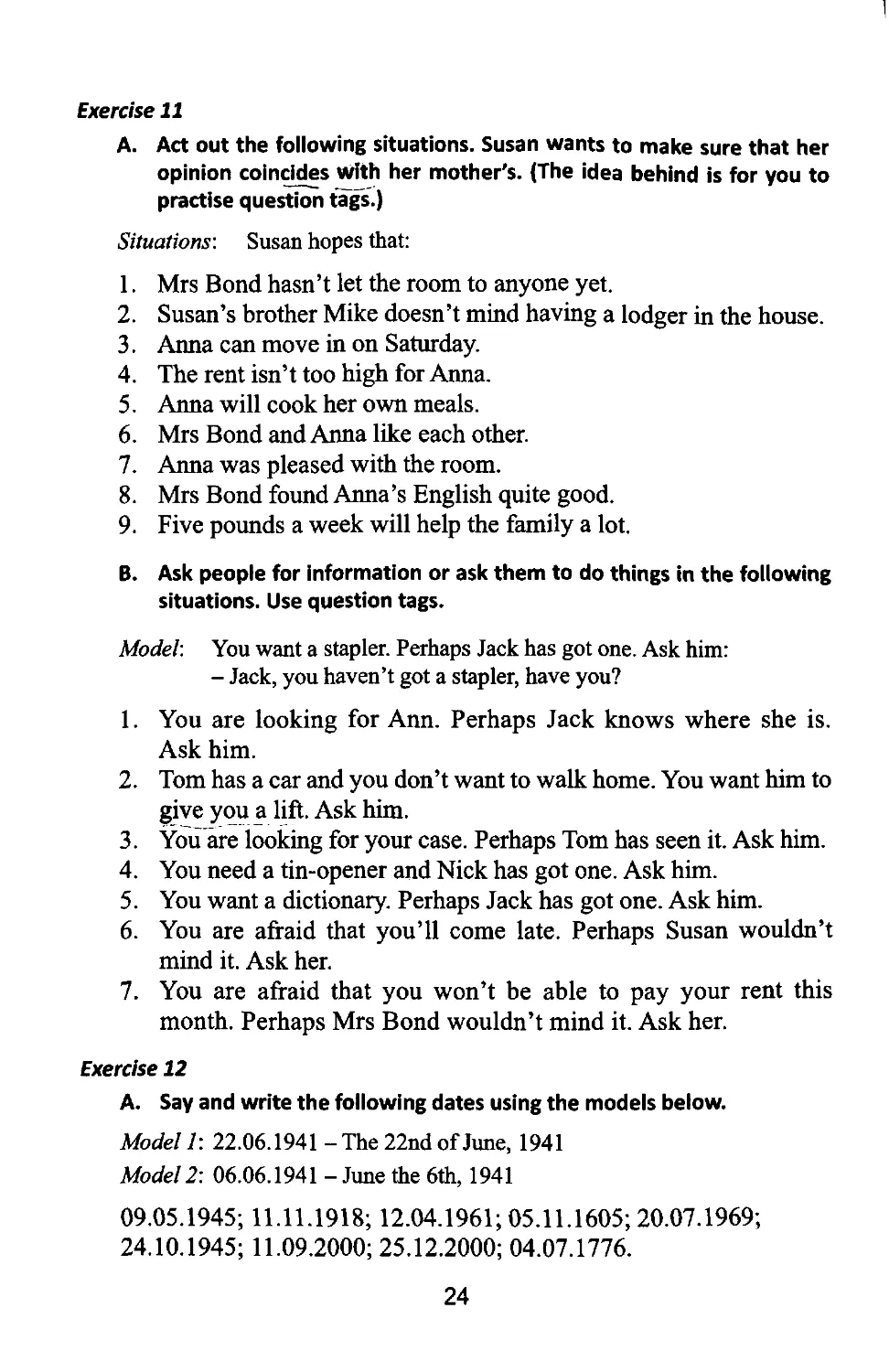
Exercise 11
A.	Act out the following situations. Susan wants to make sure that her
opinion coincides with her mother's. (The idea behind is for you to
practise question tigs.)
Situations: Susan hopes that:
1.	Mrs Bond hasn’t let the room to anyone yet.
2.	Susan’s brother Mike doesn’t mind having a lodger in the house.
3.	Anna can move in on Saturday.
4.	The rent isn’t too high for Anna.
5.	Anna will cook her own meals.
6.	Mrs Bond and Anna like each other.
7.	Anna was pleased with the room.
8.	Mrs Bond found Anna’s English quite good.
9.	Five pounds a week will help the family a lot.
B.	Ask people for information or ask them to do things in the following
situations. Use question tags.
Model: You want a stapler. Perhaps Jack has got one. Ask him:
- Jack, you haven’t got a stapler, have you?
1.	You are looking for Ann. Perhaps Jack knows where she is.
Ask him.
2.	Tom has a car and you don’t want to walk home. You want him to
give you a lift. Ask him.
3.	You are looking for your case. Perhaps Tom has seen it. Ask him.
4.	You need a tin-opener and Nick has got one. Ask him.
5.	You want a dictionary. Perhaps Jack has got one. Ask him.
6.	You are afraid that you’ll come late. Perhaps Susan wouldn’t
mind it. Ask her.
7.	You are afraid that you won’t be able to pay your rent this
month. Perhaps Mrs Bond wouldn’t mind it. Ask her.
Exercise 12
A. Say and write the following dates using the models below.
Model 1: 22.06.1941 -The 22nd of June, 1941
Model 2: 06.06.1941 - June the 6th, 1941
09.05.1945; 11.11.1918; 12.04.1961; 05.11.1605; 20.07.1969;
24.10.1945; 11.09.2000; 25.12.2000; 04.07.1776.
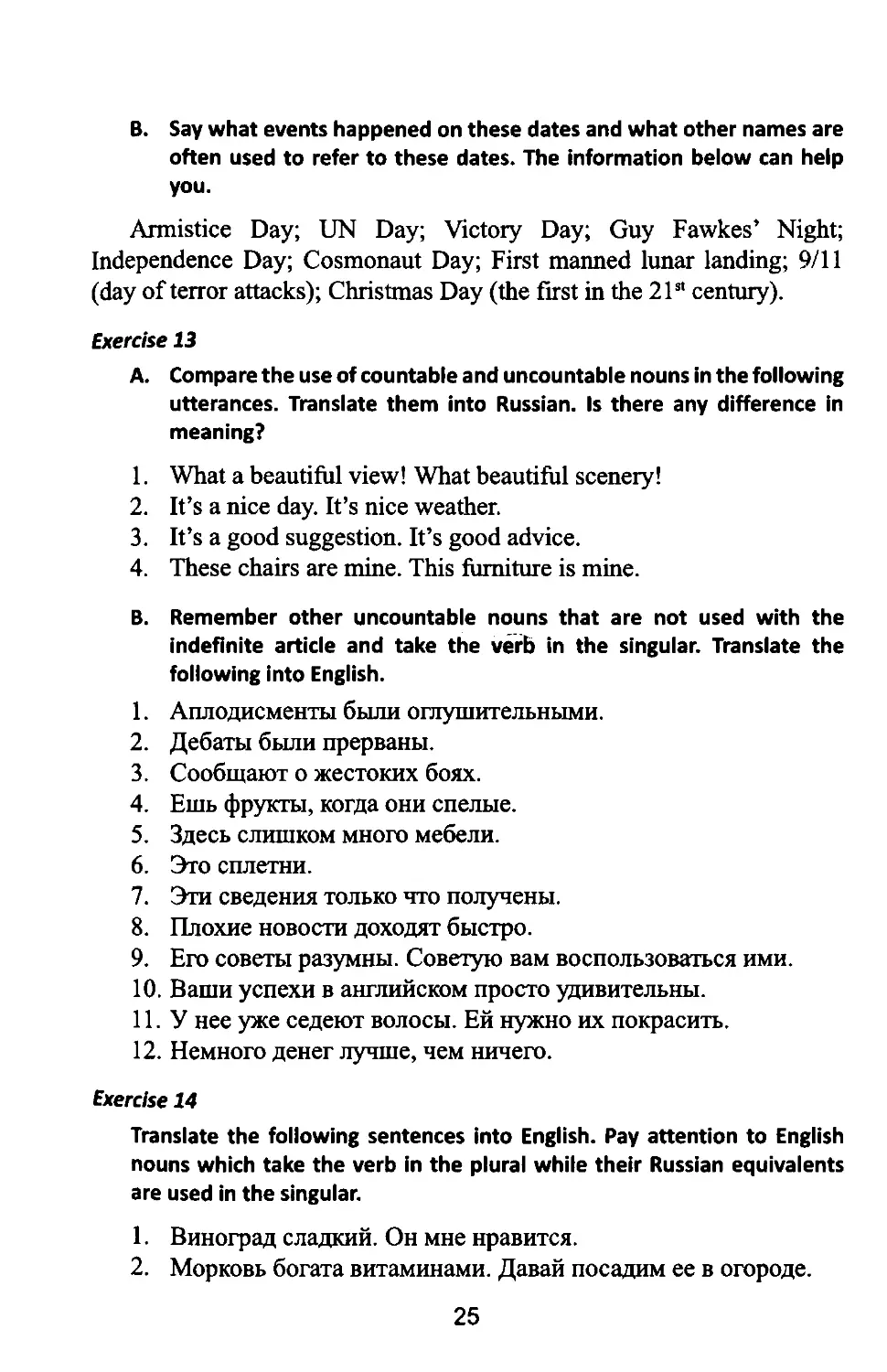
24

В. Say what events happened on these dates and what other names are
often used to refer to these dates. The information below can help
you.
Armistice Day; UN Day; Victory Day; Guy Fawkes’ Night;
Independence Day; Cosmonaut Day; First manned lunar landing; 9/11
(day of terror attacks); Christmas Day (the first in the 21st century).
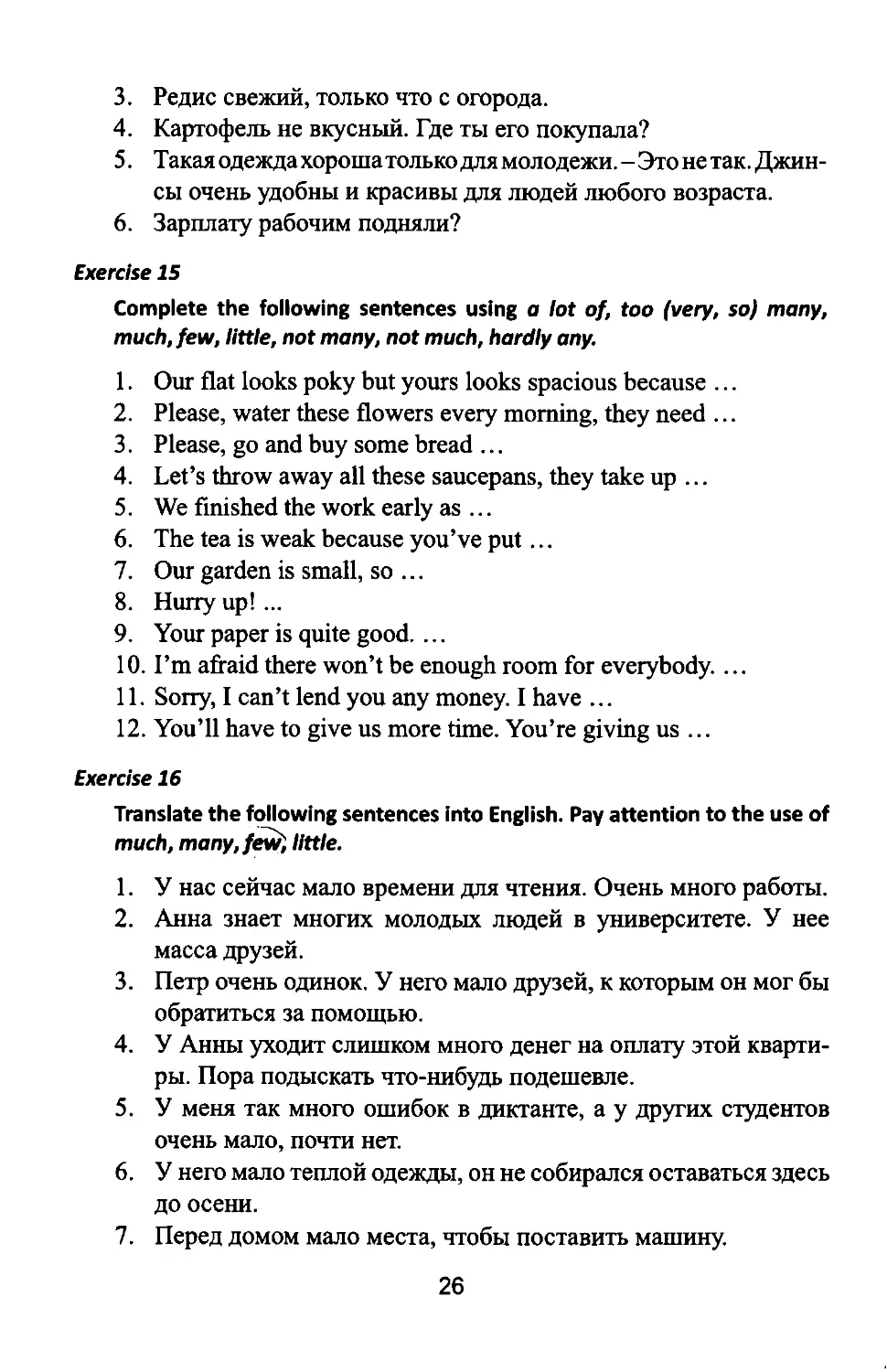
Exercise 13
A.	Compare the use of countable and uncountable nouns in the following
utterances. Translate them into Russian. Is there any difference in
meaning?
1.	What a beautiful view! What beautiful scenery!
2.	It’s a nice day. It’s nice weather.
3.	It’s a good suggestion. It’s good advice.
4.	These chairs are mine. This furniture is mine.
B.	Remember other uncountable nouns that are not used with the
indefinite article and take the verb in the singular. Translate the
following into English.
1.	Аплодисменты были оглушительными.
2.	Дебаты были прерваны.
3.	Сообщают о жестоких боях.
4.	Ешь фрукты, когда они спелые.
5.	Здесь слишком много мебели.
6.	Это сплетни.
7.	Эти сведения только что получены.
8.	Плохие новости доходят быстро.
9.	Его советы разумны. Советую вам воспользоваться ими.
10.	Ваши успехи в английском просто удивительны.
11.	У нее уже седеют волосы. Ей нужно их покрасить.
12.	Немного денег лучше, чем ничего.
Exercise 14
Translate the following sentences into English. Pay attention to English
nouns which take the verb in the plural while their Russian equivalents
are used in the singular.
1.	Виноград сладкий. Он мне нравится.
2.	Морковь богата витаминами. Давай посадим ее в огороде.
25

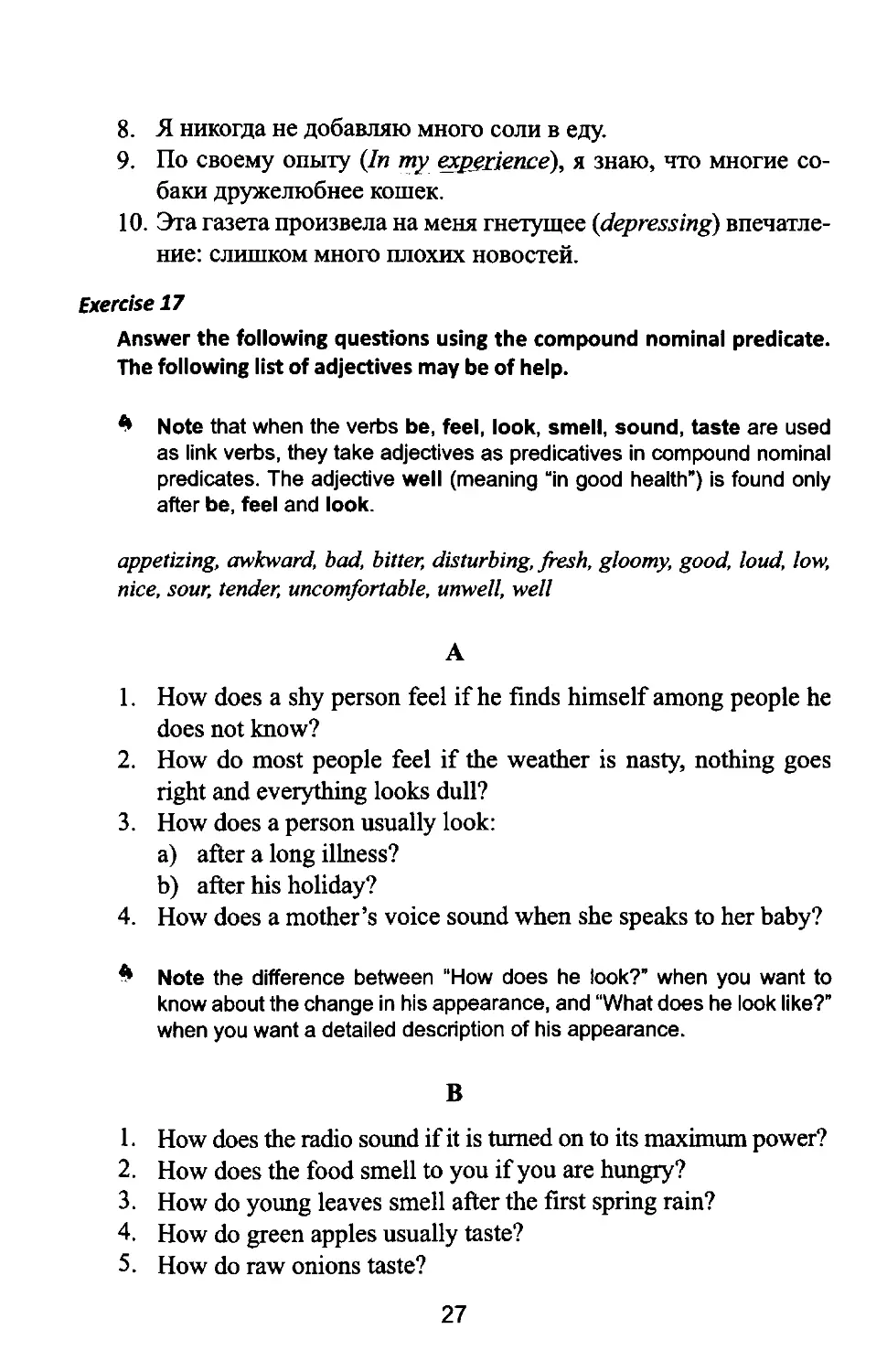
3.	Редис свежий, только что с огорода.
4.	Картофель не вкусный. Где ты его покупала?
5.	Такая одежда хороша только для молодежи. - Это не так. Джин¬
сы очень удобны и красивы для людей любого возраста.
6.	Зарплату рабочим подняли?
Exercise 15
Complete the following sentences using a lot of, too (very, so) many,
much, few, little, not many, not much, hardly any.
1.	Our flat looks poky but yours looks spacious because ...
2.	Please, water these flowers every morning, they need ...
3.	Please, go and buy some bread ...
4.	Let’s throw away all these saucepans, they take up ...
5.	We finished the work early as ...
6.	The tea is weak because you’ve put...
7.	Our garden is small, so ...
8.	Hurry up! ...
9.	Your paper is quite good. ...
10.	I’m afraid there won’t be enough room for everybody....
11.	Sorry, I can’t lend you any money. I have ...
12.	You’ll have to give us more time. You’re giving us ...
Exercise 16
Translate the following sentences into English. Pay attention to the use of
much, many, few) little.
1.	У нас сейчас мало времени для чтения. Очень много работы.
2.	Анна знает многих молодых людей в университете. У нее
масса друзей.
3.	Петр очень одинок. У него мало друзей, к которым он мог бы
обратиться за помощью.
4.	У Анны уходит слишком много денег на оплату этой кварти¬
ры. Пора подыскать что-нибудь подешевле.
5.	У меня так много ошибок в диктанте, а у других студентов
очень мало, почти нет.
6.	У него мало теплой одежды, он не собирался оставаться здесь
до осени.
7.	Перед домом мало места, чтобы поставить машину.
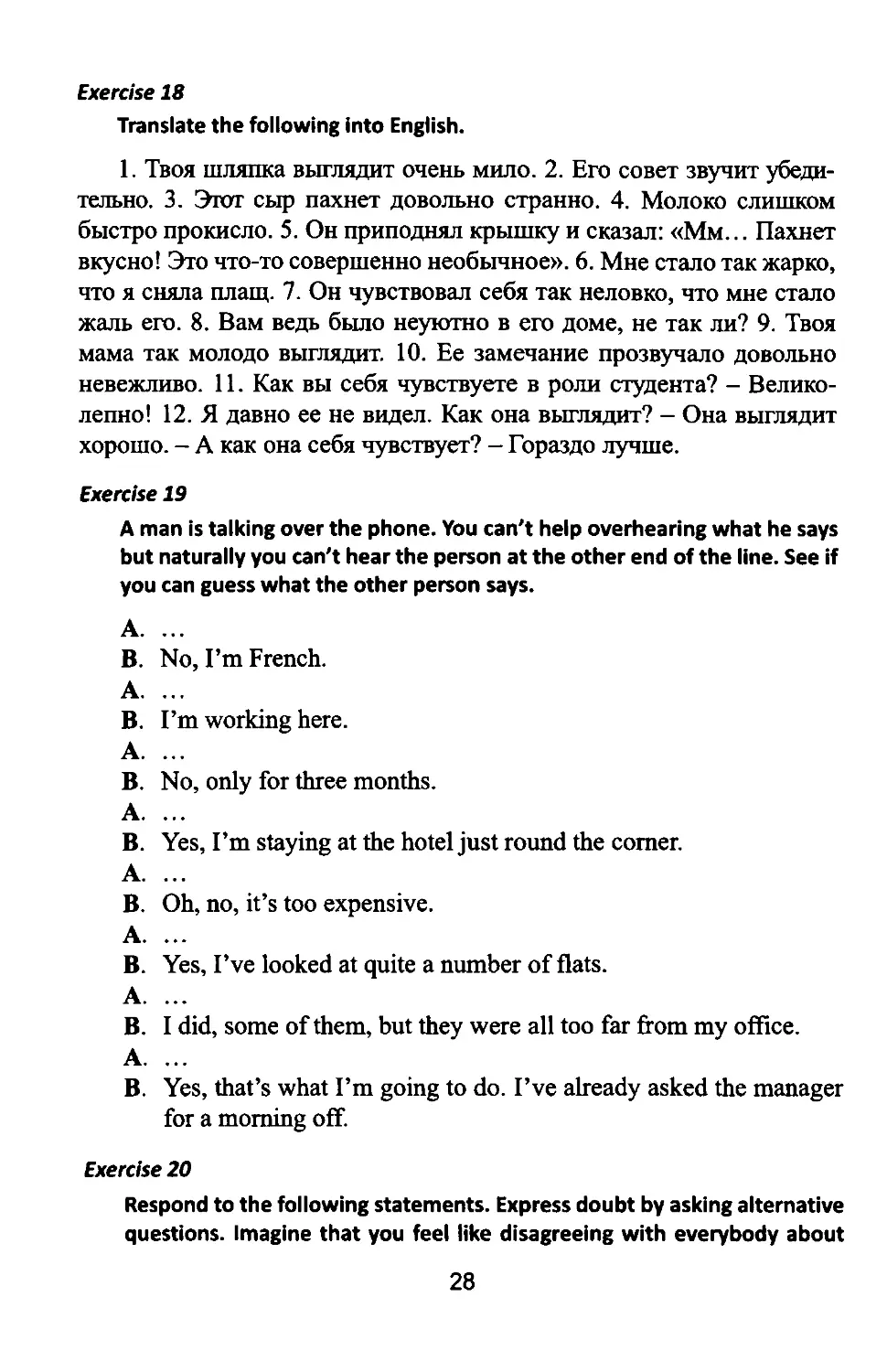
26

8.	Я никогда не добавляю много соли в еду.
9.	По своему опыту (In ту experience), я знаю, что многие со¬
баки дружелюбнее кошек.
10.	Эта газета произвела на меня гнетущее (depressing) впечатле¬
ние: слишком много плохих новостей.
Exercise 17
Answer the following questions using the compound nominal predicate.
The following list of adjectives may be of help.
** Note that when the verbs be, feel, look, smell, sound, taste are used
as link verbs, they take adjectives as predicatives in compound nominal
predicates. The adjective well (meaning “in good health”) is found only
after be, feel and look.
appetizing, awkward, bad, bitter, disturbing, fresh, gloomy, good, loud, low,
nice, sour, tender, uncomfortable, unwell, well
A
1.	How does a shy person feel if he finds himself among people he
does not know?
2.	How do most people feel if the weather is nasty, nothing goes
right and everything looks dull?
3.	How does a person usually look:
a)	after a long illness?
b)	after his holiday?
4.	How does a mother’s voice sound when she speaks to her baby?
* Note the difference between "How does he look?” when you want to
know about the change in his appearance, and “What does he look like?”
when you want a detailed description of his appearance.
В
1.	How does the radio sound if it is turned on to its maximum power?
2.	How does the food smell to you if you are hungry?
3.	How do young leaves smell after the first spring rain?
4.	How do green apples usually taste?
5.	How do raw onions taste?
27

Exercise 18
Translate the following into English.
1.	Твоя шляпка выглядит очень мило. 2. Его совет звучит убеди¬
тельно. 3. Этот сыр пахнет довольно странно. 4. Молоко слишком
быстро прокисло. 5. Он приподнял крышку и сказал: «Мм... Пахнет
вкусно! Это что-то совершенно необычное». 6. Мне стало так жарко,
что я сняла плащ. 7. Он чувствовал себя так неловко, что мне стало
жаль его. 8. Вам ведь было неуютно в его доме, не так ли? 9. Твоя
мама так молодо выглядит. 10. Ее замечание прозвучало довольно
невежливо. 11. Как вы себя чувствуете в роли студента? - Велико¬
лепно! 12. Я давно ее не видел. Как она выглядит? - Она выглядит
хорошо. - А как она себя чувствует? - Гораздо лучше.
Exercise 19
A man is talking over the phone. You can't help overhearing what he says
but naturally you can't hear the person at the other end of the line. See if
you can guess what the other person says.
A.	...
B.	No, I’m French.
A.	...
B.	I’m working here.
A.	...
B.	No, only for three months.
A.	...
B.	Yes, I’m staying at the hotel just round the comer.
A.	...
B.	Oh, no, it’s too expensive.
A.	...
B.	Yes, I’ve looked at quite a number of flats.
A.	...
B.	I did, some of them, but they were all too far from my office.
A.	...
B.	Yes, that’s what I’m going to do. I’ve already asked the manager
for a morning off.
Exercise 20
Respond to the following statements. Express doubt by asking alternative
questions. Imagine that you feel like disagreeing with everybody about
28

everything. If you are at a loss for an alternative make use of the list below.
Follow the model. Remember that if the second part of an alternative
question has no ellipsis, the word order in it is inverted.
Model: A.: I’m feeling tired.
B.: Are you really feeling tired or are you just lazy?
A.: 1. This is my car. 2.1 want to become a teacher. 3. I’ve already
read the book. 4. It’s very far from here to the station. 5.1 feel ill.
6.	I’ve just come. 7. I’ve done the work. 8. I’ve caught a cold.
9.1	came in time. 10.1 have a sore throat.
Suggested alternatives:
1)	to be in) doubt about something
2)	to say something to please (displease, annoy, etc.) somebody
3)	to belong/t^ somebody;
4)	to want to ride in a taxi;
5)	to be somewhere for an hour;
6)	only to be pretending;
7)	to have too much ice-cream;
8)	to be late;
9)	not to want to sing;
10)	to be half way through something.
Exercise 21
Translate the following sentences into English.
1.	Вы всегда приходите домой поздно или иногда бываете дома
днем? 2. Ваша подруга москвичка или она живет в Петербурге?
3.	Вы завтракаете перед работой или уходите, не позавтракав {without
having breakfast)? 4. Моя одежда на стуле или вы ее убрали в шкаф?
5.	Редакция этой газеты все еще в центре города или они уже пере¬
ехали на окраину? 6. Вы идете в отдел объявлений или уже побывали
там? 7. У вас есть комната или вы хотите снять комнату? 8. Вы родом
из Германии или вы австрийка (an Austrian)? 9. Вы согласны платить
пять фунтов в неделю или эта плата слишком высока для вас?
Exercise 22
Supply the missing articles. Answer the questions following the text.
Mrs Bond is Я. widow. Her husband died two years ago. She has
three children - two boys and Л. girl. Michael, Ш younger son, is thirteen
29

years old and goes to a. local grammar school. Her elder son, John, is
twenty-nine. He is	engineer and works for M oil company.
Mrs Bond’s daughter, Susan, is nineteen. She is studying at*!.,
business college in London.
Bond family live in Putney, .<?. suburb of London. They have ?..
large house. It has four bedrooms, я. living room, dining room,
small study, kitchen,... and two bathrooms. There are also two empty
rooms at top of J.'. house.
Mrs Bond likes \ U house but she sometimes thinks that she will have
to sell it and buy something smaller. She has .a part-time job at A. local
public library. The work is interesting, but iHpay is not very good. So £.
big problem in Ш lives of s’/.'Bond family at... moment is money.
Questions
1.	What is the Bonds’ house like?
2.	Why does Mrs Bond think sometimes that she will have to sell the
house?
3.	What do you know about the Bond family?
Exercise 23
Rephrase the following sentences. Use the vocabulary of the Unit.
1.	The girl sitting at the table in the middle of the room was also
writing information in a form.
2.	Anna asked her manager for permission not to come to work in
the morning.
3.	That morning Susan Bond left for the office of the local
newspaper.
4.	Anna liked the appearance of the room immediately.
5.	Mrs Bond and Anna were pleased with each other.
6.	When the girls arrived, Mrs Bond was not at home.
7.	When they came to the newspaper office, she went up to the
advertising department.
8.	When Anna came to London, she lived in her cousin’s flat for
a while.
9.	It takes her 20 minutes to get to her office.
10.	“What’s your birthplace?” Anna asked.
30

Exercises 24
Guess which words from the vocabulary of Unit I are explained below.
1.	a deep usually round metal cooking pot with a handle and usually
a lid;
2.	a flat pan with a long handle, used for flying food especially in the
home;
3.	a vessel, usually round, with a handle at one side and a spout
(bent pouring pipe) at the other, in which tea is made and
served;
4.	a set of shelves enclosed by doors, where clothes, cups, plates,
food, etc. may be stored;
5.	the steps between two landings;
6.	a place for the foot when going from one level to another;
7.	a piece of furniture with shelves for books;
8.	an apparatus on which food is cooked;
9.	a table often with drawers, at which one reads, writes, or does
business;
10.	a thick usually woolen floor mat, smaller than a carpet;
11.	a room used for cooking;
12.	the passage just inside the entrance of a house from which the
rooms open;
13.	a platform at the top of a flight of stairs onto which doors open.
Exercise 25
Fill in the gaps with the right preposition (wherever necessary).
1.	Who is this woman jh the photograph? 2. She lives <л. King
Street .'’.’r number 15. 3. There wasn’t a cloud />. the sky. 4. My office
is fP. the left as you come°.нР Pi the lift. 5. Are you sure ?/. her address?
5.	I last saw her on July 10. 7. Can you lend .T. me a coat, please?
8.	They set off hf the office	10 o’clock and arrived ti the office ?/.
noon. 8. She walks fГ.^.i?the window and looks f-P. the view. 9. Look
^ this word in the dictionary. 10. Go along this road, then tum^. the
shop. 11. I’m moving In a new address March or ?P. the beginning
of April. 12. We arrived London tf. 6 o’clock fr. the first of April.
13.	Did you stay the hotel or T.'/*your friends? 14. There are fifty
rooms -0. the hotel. 15. There is a garden in the front of the hotel.
16.	They climbed^ the stairs and*??, the top of the flight saw an open
door.
31

Exercise 26
Work in pairs. Take turns to ask and answer the following questions.
1.	Where do you prefer to stay when you go to some other city?
2.	Can you stay with your relatives when you go to some other city?
3.	Do you like it when your friends or relatives stay at your place?
4.	How long do your relatives usually stay with you when they come
to visit you?
5.	When do you prefer to stay at a hotel rather than with your
relatives?
6.	What hotel in Moscow would you recommend me to stay at?
* * *
1.	How long does it take you to get to the university?
2.	How long does it take to drive from Moscow to St.Petersburg?
3.	How long does the flight from Moscow to Sochi take?
4.	How long does the journey to your father’s office take?
5.	Does your journey to Sokolniki take long?
6.	Does it take you long to get to the underground station from here?
* * *
1.	What are your days off?
2.	How many days off do fifth-year students have?
3.	Can your mother take a day off any time she likes? What does she
have to do if she wants a day off?
4.	How many days off a week does your father have?
* * *
1.	What rent do you pay?
2.	Have you ever had to rent a room? How much did you pay?
3.	How often do you pay your rent?
4.	Is it easy to find a room for a reasonable rent?
* * *
1.	How many holidays a year would you like to have?
2.	How many times a month do you write tests?
3.	How often do you have your classes in English Grammar?
4.	How often do you have exams in English?
5.	Do you often visit your relatives?
32

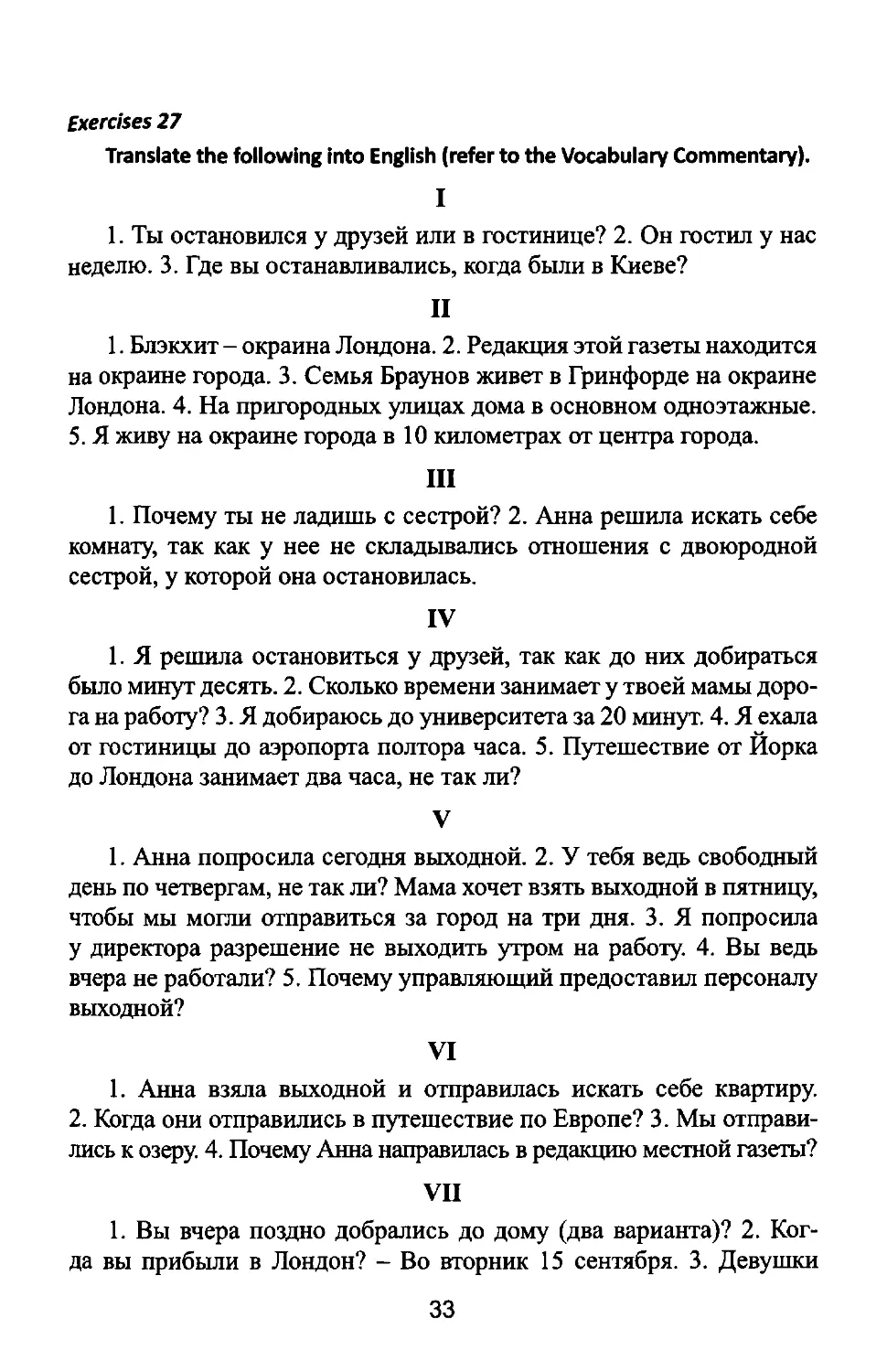
Exercises 27
Translate the following into English (refer to the Vocabulary Commentary).
I
1.	Ты остановился у друзей или в гостинице? 2. Он гостил у нас
неделю. 3. Где вы останавливались, когда были в Киеве?
II
1.	Блэкхит - окраина Лондона. 2. Редакция этой газеты находится
на окраине города. 3. Семья Браунов живет в Гринфорде на окраине
Лондона. 4. На пригородных улицах дома в основном одноэтажные.
5.	Я живу на окраине города в 10 километрах от центра города.
III
1.	Почему ты не ладишь с сестрой? 2. Анна решила искать себе
комнату, так как у нее не складывались отношения с двоюродной
сестрой, у которой она остановилась.
IV
1.	Я решила остановиться у друзей, так как до них добираться
было минут десять. 2. Сколько времени занимает у твоей мамы доро¬
га на работу? 3. Я добираюсь до университета за 20 минут. 4. Я ехала
от гостиницы до аэропорта полтора часа. 5. Путешествие от Йорка
до Лондона занимает два часа, не так ли?
V
1.	Анна попросила сегодня выходной. 2. У тебя ведь свободный
день по четвергам, не так ли? Мама хочет взять выходной в пятницу,
чтобы мы могли отправиться за город на три дня. 3. Я попросила
у директора разрешение не выходить утром на работу. 4. Вы ведь
вчера не работали? 5. Почему управляющий предоставил персоналу
выходной?
VI
1.	Анна взяла выходной и отправилась искать себе квартиру.
2.	Когда они отправились в путешествие по Европе? 3. Мы отправи¬
лись к озеру. 4. Почему Анна направилась в редакцию местной газеты?
VII
1.	Вы вчера поздно добрались до дому (два варианта)? 2. Ког¬
да вы прибыли в Лондон? - Во вторник 15 сентября. 3. Девушки
33

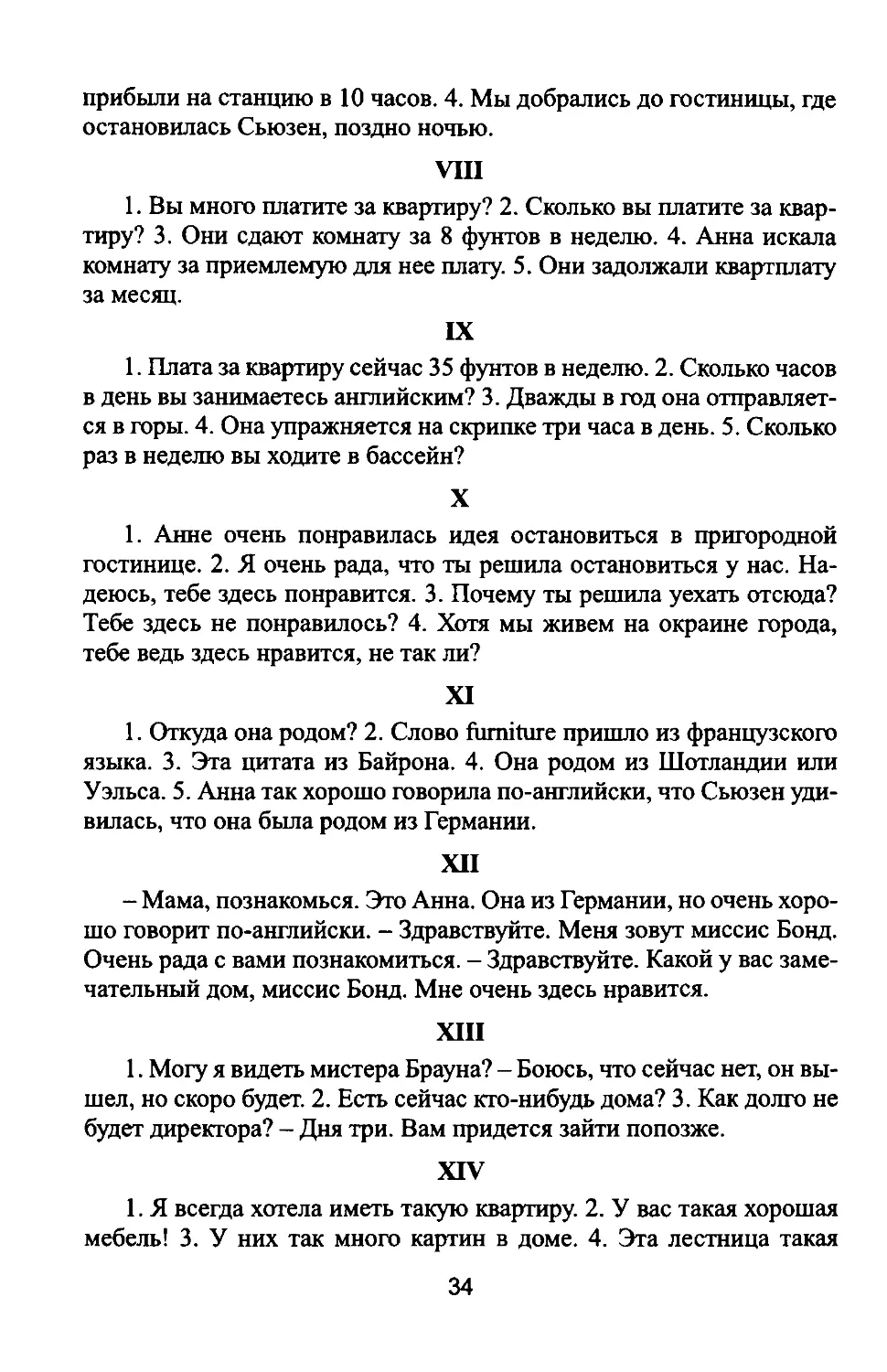
прибыли на станцию в 10 часов. 4. Мы добрались до гостиницы, где
остановилась Сьюзен, поздно ночью.
VIII
1.	Вы много платите за квартиру? 2. Сколько вы платите за квар¬
тиру? 3. Они сдают комнату за 8 фунтов в неделю. 4. Анна искала
комнату за приемлемую для нее плату. 5. Они задолжали квартплату
за месяц.
IX
1.	Плата за квартиру сейчас 35 фунтов в неделю. 2. Сколько часов
в день вы занимаетесь английским? 3. Дважды в год она отправляет¬
ся в горы. 4. Она упражняется на скрипке три часа в день. 5. Сколько
раз в неделю вы ходите в бассейн?
X
1.	Анне очень понравилась идея остановиться в пригородной
гостинице. 2. Я очень рада, что ты решила остановиться у нас. На¬
деюсь, тебе здесь понравится. 3. Почему ты решила уехать отсюда?
Тебе здесь не понравилось? 4. Хотя мы живем на окраине города,
тебе ведь здесь нравится, не так ли?
XI
1.	Откуда она родом? 2. Слово furniture пришло из французского
языка. 3. Эта цитата из Байрона. 4. Она родом из Шотландии или
Уэльса. 5. Анна так хорошо говорила по-английски, что Сьюзен уди¬
вилась, что она была родом из Германии.
XII
- Мама, познакомься. Это Анна. Она из Германии, но очень хоро¬
шо говорит по-английски. - Здравствуйте. Меня зовут миссис Бонд.
Очень рада с вами познакомиться. - Здравствуйте. Какой у вас заме¬
чательный дом, миссис Бонд. Мне очень здесь нравится.
XIII
1.	Могу я видеть мистера Брауна? - Боюсь, что сейчас нет, он вы¬
шел, но скоро будет. 2. Есть сейчас кто-нибудь дома? 3. Как долго не
будет директора? - Дня три. Вам придется зайти попозже.
XIV
1.	Я всегда хотела иметь такую квартиру. 2. У вас такая хорошая
мебель! 3. У них так много картин в доме. 4. Эта лестница такая
34

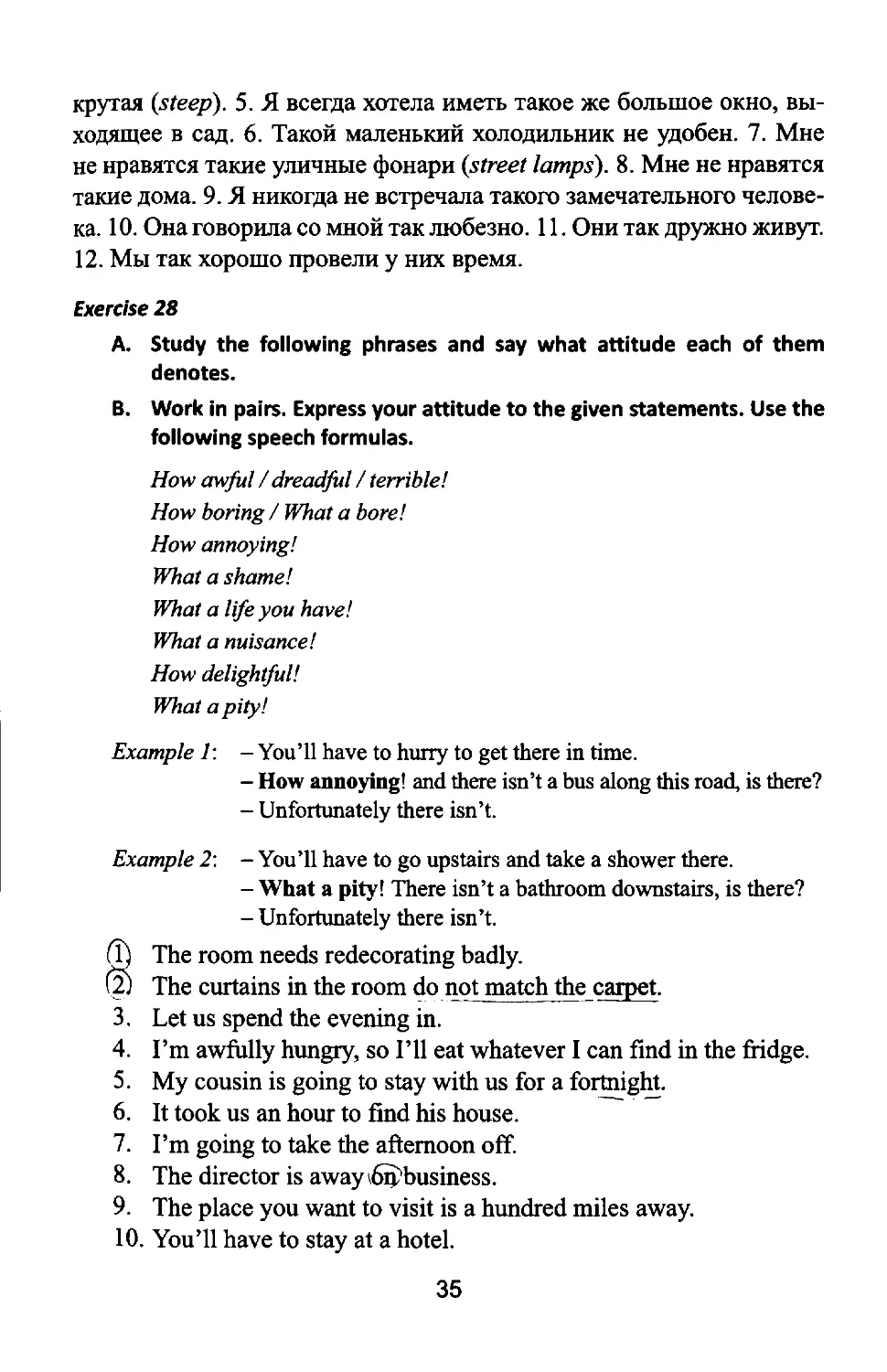
крутая (steep). 5. Я всегда хотела иметь такое же большое окно, вы¬
ходящее в сад. 6. Такой маленький холодильник не удобен. 7. Мне
не нравятся такие уличные фонари (street lamps). 8. Мне не нравятся
такие дома. 9. Я никогда не встречала такого замечательного челове¬
ка. 10. Она говорила со мной так любезно. 11. Они так дружно живут.
12.	Мы так хорошо провели у них время.
Exercise 28
A.	Study the following phrases and say what attitude each of them
denotes.
B.	Work in pairs. Express your attitude to the given statements. Use the
following speech formulas.
How awful / dreadful / terrible!
How boring / What a bore!
How annoying!
What a shame!
What a life you have!
What a nuisance!
How delightful!
What a pity!
Example 1: - You’ll have to hurry to get there in time.
-	How annoying! and there isn’t a bus along this road, is there?
-	Unfortunately there isn’t.
Example 2\ - You’ll have to go upstairs and take a shower there.
-	What a pity! There isn’t a bathroom downstairs, is there?
-	Unfortunately there isn’t.
(T) The room needs redecorating badly.
(2) The curtains in the room do not match the carpet.
3.	Let us spend the evening in.
4.	I’m awfully hungry, so I’ll eat whatever I can find in the fridge.
5.	My cousin is going to stay with us for a fortnight.
6.	It took us an hour to find his house.
7.	I’m going to take the afternoon off.
8.	The director is away 6nbusiness.
9.	The place you want to visit is a hundred miles away.
10.	You’ll have to stay at a hotel.
35

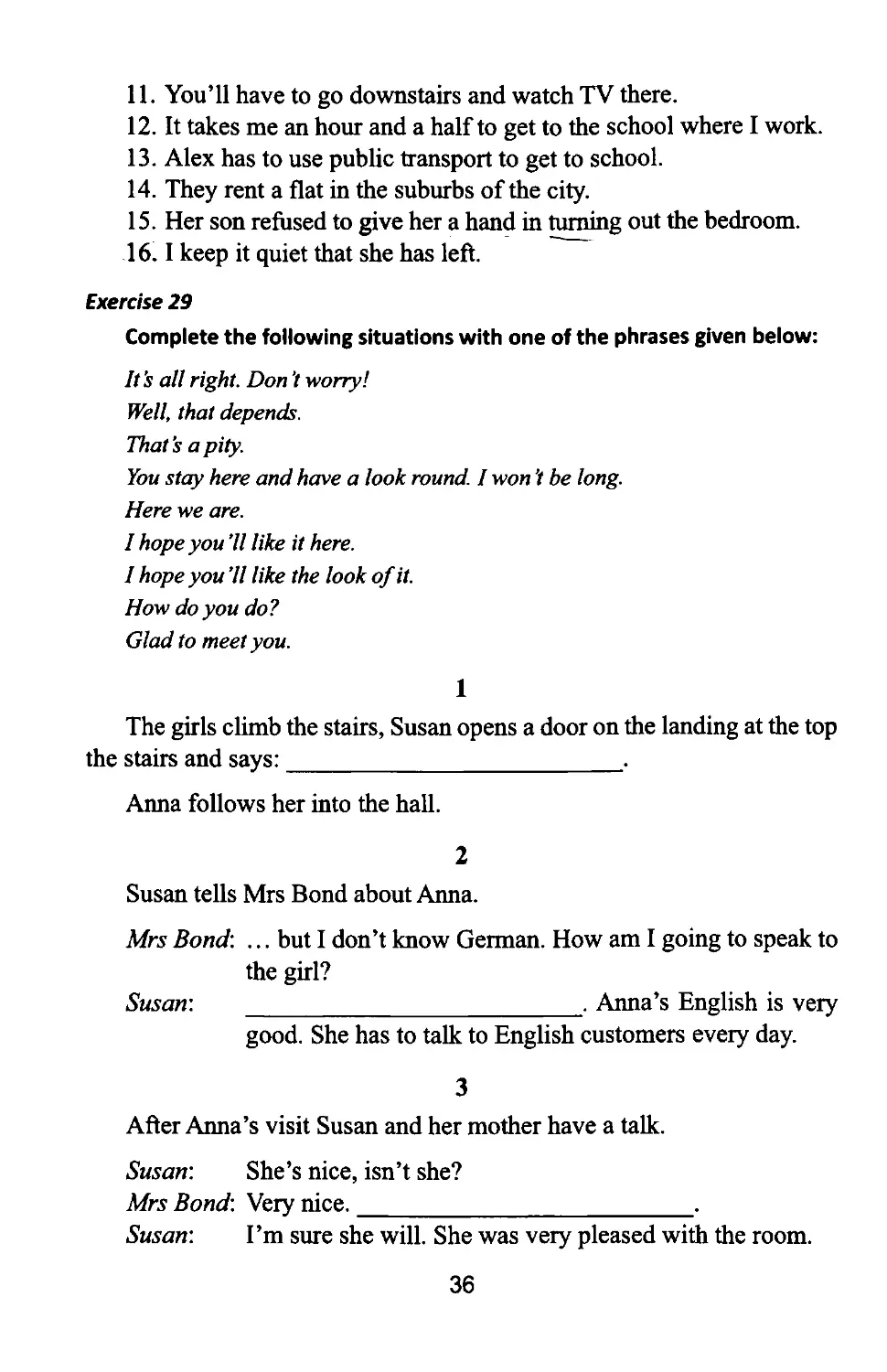
11.	You’ll have to go downstairs and watch TV there.
12.	It takes me an hour and a half to get to the school where I work.
13.	Alex has to use public transport to get to school.
14.	They rent a flat in the suburbs of the city.
15.	Her son refused to give her a hand in turning out the bedroom.
16.1	keep it quiet that she has left.
Exercise 29
Complete the following situations with one of the phrases given below:
It's all right. Don't worry!
Well, that depends.
That s a pity.
You stay here and have a look round. I won’t be long.
Here we are.
I hope you 'll like it here.
I hope you ’ll like the look of it.
How do you do?
Glad to meet you.
1
The girls climb the stairs, Susan opens a door on the landing at the top
the stairs and says:	.
Anna follows her into the hall.
2
Susan tells Mrs Bond about Anna.
Mrs Bond: ... but I don’t know German. How am I going to speak to
the girl?
Susan:		. Anna’s English is very
good. She has to talk to English customers every day.
3
After Anna’s visit Susan and her mother have a talk.
Susan:	She’s nice, isn’t she?
Mrs Bond: Very nice.	.
Susan:	I’m sure she will. She was very pleased with the room.
36

4
The girls stopped at number 24. It was a tall, well-built house with
gardens at the front and at the back.
Susan said:		.
5
Susan walks with Anna to the bus stop.
Ann: Excuse me. I’m not quite sure. What do you say when you
greet someone: “How do you do?”, “Hello” or “Hi”?
Susan: 	. “Hi” is a more informal
equivalent of “Hello”. “Hello” is generally used with the first
name and is a universal form of informal greeting. You say
	when formally introduced or when you
meet a person for the first time.
6
Anna comes to see the Bonds in the evening. Mrs Bond opens the
door. She is wearing an apron. She hasn’t finished preparing a meal.
Mrs Bond: You are Ann, aren’t you? I’m Mrs Bond.
	, Ann?
Anna:		, Mrs Bond?
Mrs Bond: Please come in and take off your coat. Excuse me, I’m
just going to the kitchen for a minute
Anna:	That’s all right. Thank you.
OMMUNICATTVE ACTIVITIES
Exercise 1
Act out the following situations.
1.	Susan gets back home from college at half past four. Mrs Bond
is in the kitchen. She asks Susan whether she has put the advertisement
in The Echo and is surprised to hear that she hasn’t.
2.	Susan tells her mother about her meeting with Anna. At first
Mrs Bond doesn’t like the idea, but Susan finally persuades her. Mrs
Bond does not know German and she is afraid she will have
37

some difficultyCm speaking to Anna. Susan tells her mother how good
Anna’s English is and what a nice girl she is. Susan is sure her mother
will like the girl.
3.	When Anna leaves the house, Susan and her mother discuss
the girl. They hope she was pleased with the room and she will like it
here.
Exercise 2
Translate the dialogue into English and then sum up the situation in
English.
Сьюзен:
Миссис Бонд :
Сьюзен:
Миссис Бонд :
Сьюзен:
Миссис Бонд:
Сьюзен:
Миссис Бонд:
...Но мама, ты говорила уже много раз, что этот
дом слишком велик для нас. Почему мы не сдаем
одну из двух пустых комнат наверху?
Мы этот вопрос уже обсуждали, Сьюзен. Я ска¬
зала тебе, что мне не нравится эта идея. Я не
хочу иметь чужого человека (a stranger) в своем
доме.
Но мы можем иметь несколько фунтов в неделю
за эту большую комнату.
Да, это кажется не мало. Но не забудь {remember),
что комната не обставлена.
Да, но у нас много лишней мебели в других ком¬
натах. В комнате есть раковина, и мы можем
взять напрокат {hire) или купить электрическую
плиту. Мы можем сделать так, что комната будет
выглядеть очень хорошо.
Несколько фунтов в неделю будут нам неплохой
поддержкой.
Ну, значит, согласна?
Хорошо, на следующей неделе мы поместим
объявление в «Эхо».
Exercise 3
Read the following dialogues. Write out the forms of affirmation and
agreement. Act out the dialogues.
Mrs Innes: Julian!
Mr Innes: Yes, Ruth?
38

Mrs Innes: I’d like to move the wardrobe a bit, but it’s far too heavy
for me.
Mr Innes: Of course it is. You mustn’t push heavy things alone. It’s
dangerous, you know.
Mrs Innes: Indeed it is. You are quite right.
Mr Innes: Which way do you want me to move it, a little nearer to
the wall?
Mrs Innes: That’s right, but not too near, please.
Mr Innes: Naturally. Will that be enough?
Mr Innes: Yes, dear, thank you. It looks better now, don’t you think so?
Mrs Innes: It certainly does, and it’ll be easier to do the carpet now,
won’t it?
Mrs Innes: Oh, yes, of course, you’re right, though I didn’t think of
that.
Mr Innes (smiling): But I did. After all it’s my job to do the carpets.
Every little helps, doesn’t it?
Mrs Innes: That’s right. It does, indeed, especially when one is in a
hurry.
Mr Innes: As I’m, every morning.
* «• Sf
Mr Innes:
Mrs Innes:
Mr Innes:
Mrs Innes:
Mr Innes:
Mrs Innes :
Mr Innes:
Mrs Innes:
Mr Innes:
Mrs Innes:
You know. Ruth, I’ve been thinking...
Yes, Julian?
Let’s have the flat redecorated. What do you say?
I’m all for it. Those walls are positively black.
They certainly are.
Mike and Ellen are all for it, too.
All right, then. I’ll talk to that chap we had in last time,
and try to book him for April, if that’s all right by you.
Very well, though it seems a long way off.
I	quite agree, but you see, we have to wait. By the way,
where is Mike? I want him to help me in the bathroom,
there’s something wrong with the taps.
He hasn’t come back from college yet, but he’ll be in any
time now.
39

I
Exercise 4
Respond to the following statements using different forms of agreement
or affirmation: keep the conversation going (The vocabulary given in Ex. 3
may be of help).
1.
2.
3.
4.
5.
6.
7.
8.
I	think this is the most beautiful house tfn) this street. (strong
agreement)
Let’s meet here at ten. What do you say? (agreement)
I	must ask you to come again in the evening. I’m busy now.
(agreement)
Let’s spend next Sunday(m)the country. What do you say?
(enthusiastic agreement)
You live in a block of modem flats, don’t you? (agreement)
I asked you to draw the plan of the kitchen. You didn’t do it, did
you? (you didn’t and are sorry)
This room looks better with yellow curtains, don’t you think so?
(you agree though you didn’t think of it)
May I come on Saturday to have a look at the room? (you agree
willingly. You’ll be in all Saturday morning.)
Exercise 5
Read the following dialogue. Write out the forms of addressing,
introducing and greeting people. Act out the dialogue.
The Guests Arrive
Mike:
Sam:
Mike:
Sam:
Mr Innes:
Sam:
Mr Innes:
Mike:
Mr Innes:
Hello, Sam, nice of you to come. Take off your coat, will
you, and let’s go in. You haven’t met my mother, have
you?
No, I haven’t had the pleasure, but I met your father at
Wimbledon, don’t you remember?
Oh, yes, of course. Ah, there’s Mother, come on, old boy.
Mum, this is Sam Williams, a friend from College.
How do you do, Mrs Innes?
How do you do? I’m glad to meet you. Will you excuse
me please, everybody seems to be coming at once.
Certainly, Mrs Innes.
Good evening, Sam. This is Sam, isn’t?
Yes, Dad, you gave us tea at Wimbledon last summer.
Oh, yes, of course. How are you?
40

Sam:
Good evening, Mr Innes. I’m fine, thank you. And how
are you?
Mr Innes: Not too bad, my boy, not too bad. Let me introduce you
to my wife. Oh, where’s she gone? I thought she was here
a moment ago.
Sam:	I’ve already met Mrs Innes. Mike has introduced me to her.
Mr Innes: Oh, he has, hasn’t he? That’s good.
Exercise 6
Work in pairs to complete the following dialogues. Take turns to read the
parts. Respond as you wish (The vocabulary given in Ex. 5 may be of help).
Act out the dialogues. Try to sound very polite.
1
Dick: Hi! How are you?
Helen:
Dick: Just fine. Where are you going?
Helen:
Dick: OK. I’ll see you later.
Helen:
Paul: Hello. How are you?
Don:
Paul: Fine thanks. Oh, excuse me ... Here’s my bus. Good-bye.
Don:
Margaret: Mr Wilson, I’d like you to meet Dr Edward Smith.
Mr Wilson: 	, Dr Smith.
Margaret: Dr Smith is an economist. He’s just finished writing a
book on international trade.
Mr Wilson: Oh? That’s my field too.
4
Jim:	Who’s the tall girl next to Barbara?
Charles: That’s Mary Anderson. Haven’t you met her?
Jim:
Charles: Oh, then
_. Mary
41

Mary: Hi, Jim, I’m glad to meet you.
Jim:		. Can we sit down some¬
where and talk?
Exercise 7
Act out the following situations.
1.	You know Miss Bell very well. She is a scientist and writer. You
would like to interview her for your local paper. You ask your friend and
Miss Bell’s colleague, Jack, to introduce you to her. Jack says he will
do, but forgets his promise. You have to introduce yourself without your
friend’s help.
2.	You are a guide. You work for the Russian British Friendship
Society and arrive at the railway station to meet a guest from Britain -
Mr Parker. You recognize him at once, come up to him and introduce
yourself. Mr Parker knows that you will be his guide, he is glad to meet
you. You greet the guest and promise to do your best to make his stay in
this country both useful and pleasant.
3.	You are a student and work as a guide. You accompany Mrs Cook,
a lecturer from Canada, who is going to give a course of lectures at this
University. You introduce Mrs Cook to Professor Sedov. Professor Sedov
knows that Mrs Cook is going to give a few lectures here and wonders
how long she is going to stay in this country. Mrs Cook doesn’t know yet
but hopes to stay for about a month.
4.	You are working as a guide with a group of American women
who are taking part in the World Congress of Women. While waiting for
the group at the hotel “Tourist” you run into Mary Brown, with whom
you made friends a few years ago. She was a student then. You notice
Mary, come up to her and greet her. She is glad to see you. She has just
come to Moscow to work for some British firm at the Moscow book fair.
You have no time to talk as your group arrives at the hotel. You are very
sorry and you’ll have to say good-bye and arrange to meet in the evening
at about 8 o’clock, at the same place.
Exercise 8
Read the dialogue and sum it up in indirect speech.
We’ll take it
Steve and Patricia are interested in moving into a new apartment.
Mr Berger, a landlord, is showing them one of his apartments available to
rent. He takes them through the apartment and answers their questions.
42

Mr Berger:
Patricia:
Mr Berger :
Steve:
Mr Berger :
Patricia:
Steve:
Patricia:
Mr Berger:
Steve:
Mr Berger:
Patricia:
Mr Berger :
Patricia:
Mr Berger:
Steve:
Mr Berger :
Come on in, let me show you around. Here’s the living
room.
Great! The view from this window is wonderful.
This is the kitchen.
It looks new.
Yes, we renovated just last year and replaced all the
appliances.
Just look at all the closet space in the master bedroom!
Well, I’m sure you can fill those closets in no time.
Oh, come on, give me a break. I don’t have that much
stuff.
And here’s the bathroom.
What did you say the rent was?
Thirteen hundred dollars a month.
Does that include utilities?
It includes heat, gas, and hot water. Electricity and
telephone are extra.
When will the apartment be available?
On the first of the month.
We like it a lot, but we’ll have to think about it. Can we
call you tomorrow?
Sure.
(The next day)
Steve:
Mr Berger :
Steve:
Mr Berger:
Steve:
Mr Berger:
Steve:
Mr Berger:
Steve:
Hello, Mr Berger, this is Steve Heller. I’m calling about
the apartment we looked at yesterday. We’d like to take
it if it’s still available.
Great!
So, what’s the next step?
I’ll draw up a lease and send it to you. What I’ll need
from you is one month’s rent as security deposit, and
the first month’s rent in advance.
I’ll get the deposit back, won’t I?
Of course, as long as the place is not damaged beyond
the usual wear and tear when you move out.
Great! Can I send you a check?
Sure, a check will be fine. Just send it along with the
lease after you’ve signed it.
Thanks!
43

Take a closer look at the vocabulary used in the dialogue.
Match the definitions with the words in bold type in the text of the
dialogue:
1.	put back into good condition
2.	owner of the apartment, from whom someone rents a room
3.	tools, instruments for a particular purpose
4.	able to be obtained
5.	a written agreement made according to the law by which the use
of a room or building, or piece of land is given by its owner to
somebody for a certain time in return for a rent.
6.	a part payment which is made so that the seller will not sell the
goods to anyone else.
7.	the damaging effect of ordinary use.
Now let's practise the vocabulary given in the list below. Fill in the gaps
with the right word.
classifieds (classified ads), available, renovated, landlord, appliances,
tenant, storage space, laundry room, lease, deposit, in advance, the usual
wear and tear
1.	She has been in the	for hours; she’s got a lot of clothes to
wash.
2.	I need to buy a toaster. Where can I get small kitchen ...?
3.	After people saw the ... in the newspaper, the restaurant was full
every night.
4.	If she’s late againron'her rent, she’s going to have a problem with
the ... .
5.	Their dog did so much damage to the apartment that the landlord
kept all of their security ....
6.	A car that old is going to have
7.	We’re going to rent a	to keep our bikes, winter clothes, and
other things we don’t need all the time.
8.	Sally needs to find a cheap used car, so she’s looking through the
9.	The landlord just sent me my copy of the ..., signed by both of us.
10.	Rita was always a very good ...; she never made noise and she
paid the rent on time every month.
11.	The Fields are moving out at the end of March, so their apartment
will be ... on April 1.
44

12.	These cabinets are so old, it looks like they haven’t been ../in,
thirty years.
13.	He signed the lease without even seeing the apartment	?
That’s crazy!
Exercise 9
Read this dialogue between Mr Watson, a landlord and his tenant Mario
who has just moved into a new apartment, and he's found some things
that need to be fixed. Pay attention to the vocabulary that will come in
handy if you ever need to have anything repaired.
A Few Problems
Mario:
Mr Watson:
Mario:
Mr Watson:
Mario:
Mr Watson:
Mario:
Mr Watson:
Mario:
Mr Watson:
Mr Watson, this is Mario, your tenant in 6B.
Hi. What’s up?
There are a few problems with the apartment. First, the
faucet in the bathtub drips constantly. And the water
won’t drain from the sink in the kitchen. There must be
a clog.
I’ll ask my plumber to come by^nd fix it tomorrow.
Also, one of the bumersT>n)the stove doesn’t work.
What’s the matter with it?
I can’t control the temperature. I think you’ll have to
get an electrician.
I’ll see what I can do. Is that everything?
Well, there’s one more thing. I can’t get a dial tone on
the phone; it’s dead.
I’m sorry, there’s nothing I can do about that. You’ll
have to call the phone company.
'k'k'k
Take a closer look at the vocabulary that will come in handy if you ever
need to have anything repaired. Complete the sentences using the words
listed below.
faucet, radiator, burner, electrician, plumber, locksmith, leaking, water
heater, clog, drain
1.	The toilet isn’t flushing. There must be a ... .
2.	We should call a ... to fix the toilet.
45

3.	The ... repaired the lock and gave me a new set of keys.
4.	The wires were so old we needed to have an ... replace them all.
5.	I heard the ... dripping all night long! It must be ....
6.	The ... are too hot. I can’t control the heat.
7.	The landlord finally replaced the	after the tenants complained
about cold water.
8.	Pull the plug and let the water ... from the sink. The ... is at the
bottom of the sink.
9.	There are four ... on the stove, but only three work. Don’t touch
the front left .... It’s off, but it’s still hot.
Exercise 10
Read the text and explain why most people in Britain try to avoid living in
blocks of flats.
Houses, not Flats
Almost everybody in Britain dreams ofrliving in a detached house: that
is, a house which is a separate building. The saying, ‘An English man’s
home is his castle’ is well known. It illustrates the desire for privacy and
the importance attached to ownership which seem to be at the heart of the
British attitude to housing.
A large, detached house not only ensures privacy. It is also a status
symbol. At the extreme end of the scale there is the aristocratic ‘stately
home’ set in acres of garden. Of course, such a house is an unrealistic
dream for most people. But even a small detached house, surrounded by
garden, gives the required suggestion of rural life which is dear to the
hearts of many British people. Most people would be happy to live in a
cottage, and if this is a thatched cottage, so much the better.
Most people try to avoid living in blocks of flats (what the Americans
call ‘apartment blocks’). Flats, they feel, provide the least amount of
privacy. With a few exceptions, mostly in certain locations in central
London, flats are the cheapest kind of home. The people who live in them
are those who cannot afford to live anywhere else.
The dislike of living in flats is very strong. In the 1950s millions
of poorer people lived in old, cold, uncomfortable nineteenth century
houses, often with only an outside toilet and no bathroom. During the
next twenty years many of them were given smart new ‘high rise’ blocks
of flats to live in which, with central heating and bathrooms, were much
46

more comfortable and were surrounded by grassy open spaces. But
people hated their new homes. They said they felt cut off from the world
all those floors up. They missed the neighbourliness. They couldn’t keep
a watchful eye 6fr their children playing down there in those lively green
spaces. The new high rise blocks quickly deteriorated. The lifts broke
down. The lights in the corridors didn’t work. Windows got broken and
were not repaired. There was graffiti all over the walls.
In theory (and except for the difficulty with supervising children),
there is no objective reason why these high-rise blocks (also known as
‘tower blocks’) could not have been a success. In other countries millions
of people live reasonably happily in flats. But in Britain they were a failure
because they do not suit British attitudes. The failure has been generally
recognized for several years now. No more high-rises are being built. At
the present time, only 4% of the population live in one. Only 20% of the
country’s households live in flats of any kind.
Exercise 11
Read the text and discuss the following questions:
1.	Do most British people prefer owing or renting their
accommodation?
2.	What is the mortgage system?
3.	Why is the percentage of owner-occupied households in Britain
well above the European average?
After reading the text explain how you understand these notions: owner-
occupier, first-time buyer, second-time buyer, council houses, council rents,
council tenants, homes-for-votes scandal, property-owning democracy.
Owning and Renting
Most British people do not ‘belong’ to a particular place nor are they
usually brought up in a long-established family house to which they can
always return. Perhaps this is why they are not usually content to rent
their accommodation. Wherever they are, they like to put down roots.
The desire to own the place where you live is almost universal in
Britain. However, house prices are high. This dilemma is overcome by
the mortgage system, which is probably a more established aspect of
everyday life than it is anywhere else in the world. About 70% of all the
houses in the country are occupied by their owners and almost all of these
were bought with a mortgage. At any one time, half of these are owned by
47

people who have borrowed 80% (or even more) of their price and are now
paying this money back month by month. The normal arrangement is for
the borrower to pay back the money over the period of twenty to twenty-
five years. The financial institutions known as ‘building societies’ were
originally set up to provide mortgages. In the 1980s, however, regulations
were relaxed, so that banks now offer mortgages as well.
People are happy to take up mortgages because house prices normally
increase a bit faster than the general cost of living. Therefore, most people
can make a profit when they sell their house. So strong is this expectation
that phrases such as ‘first-time buyer’ and ‘second-time buyer’ are well
known. The former can only afford one of the cheaper houses available.
But around ten years later, when some of their mortgage has been paid
off, they can become the latter. They sell their houses at a profit and move
into a more expensive house.
Although nearly everybody wants to own their house, it was only
at the end of the twentieth century that a majority of people began to
do so. Before that time, most working-class people lived in rented
accommodation. At one time, most of them rented from private landlords,
some of whom exploited them badly. In the 1950s and 1960s, however,
millions of homes were built by local government authorities. By 1977,
two-thirds of all tenants lived in these council houses (or, in some cases,
flats). Council rents are subsidized, so they are low. Each local council
keeps a waiting list of households who want to move into a council
property. The order of preference is worked out by a complicated set of
priorities. Once they are given a council house, tenants have security; that
is, they do not have to move out even if they become rich.
From 1950 to 1980 the proportion of ‘owner-occupiers’ gradually
increased. The ambition to own was made easier by policies of‘tax relief’.
With both owner-occupiers and council tenants increasing in numbers,
the percentage of people who rented from private landlords became one
of the lowest in the world - and continues to be so.
Then during the 1980s, the number of owner-occupiers increased
more sharply. A major part of the philosophy of Thatcherism (under
Prime Minister Margaret Thatcher) was the idea of the ‘property-owning
democracy’. Council tenants were allowed to buy their council houses and
were given financial incentives to do so. The increase in the financial help
given to owners who wanted to make improvements to their property also
48

encouraged house-buying. At the same time, local councils were severely
limited in the number of properties which they could build and were also
encouraged to sell their properties to private ‘housing associations’. As a
result, the number of council tenants actually decreased.
In the 1990s, the policy of selling off council houses was discredited
by the ‘home-for-votes’ scandal. It became clear that a few local councils
run by the Conservative party had decided to keep their properties
empty, instead of renting them to families who needed them, until they
found buyers for them. The idea was that the buyers would probably
vote Conservative - while people who could only afford to rent would
probably not.
Exercise 12
The most desirable home in Britain is a detached house. Second best is
a semi-detached house and less desirable is a terraced house. Match the
type of the house with their descriptions given below.
A
One building with two separate households. Each house is the mirror
of the other, inside and out. These houses can be found, street after street,
in the suburbs of cities and the outskirts of towns all over Britain. There
is a separate front garden for each house. At the sides there is access to
the back, where there are also two gardens. The most common building
material is brick. The typical house has two floors and three bedrooms.
В
A house not connected on any side with any other building, free¬
standing. The traditional building material is brick, the shape is usually
irregular, with little comers, making the house feel cozy. There is a large
front garden with trees and bushes, giving greater privacy. The garage
is hidden discretely away, so that it is not too obvious and doesn’t spoil
the rural feeling.
C
This kind of house usually has no way through to the back except
through the house itself. Each house in the row is joined to the next
one. They usually have two floors, with two bedrooms upstairs. Some
have gardens back and front, others only at the back and others no
garden at all.
49

Exercise 13
Discuss your accommodation preferences:
a)	a house in town / in the country
b)	a house / a flat
c)	owning / renting accommodation
d)	high-rise(tower) block / one or two-storey old house
e)	life in the suburbs / in the central part of the city
f)	a room at the students’ hall of residence / a rented room.
I’ve always wanted ...
I must say I like ...
I (much) prefer
I’d (much) rather have / do / like
I’d prefer to do ... rather than do ...
Exercise 14
Give a talk on the following topics.
1.	Describe a flat you’d like to live in.
2.	Describe a famous writer’s house which is a museum now.
3.	Speak about the housing conditions in this county.
4.	Speak about the housing problems in Great Britain.
5.	Compare different types of dwellings in Britain with the types
popular in your country.
6.	Compare British attitude to housing with the attitude to housing
in Russia.
Exercise IS
Comment on the following:
1.	Houses are built to live in and not to look on {Francis Bacon).
2.	East or west, home is best.
3.	Men make houses, women make homes.
Language material
for expressing likes / dislikes and preferences:
I (quite) like ...
I’m very / extremely fond of...
I love ...
I’m afraid I don’t like
I dislike living in ...
I hate living in ...
50

4.	There’s no place like home.
5.	Home is the place where,
when you have to go there,
They have to take you in {Robert Frost).
ADDITIONAL MATERIAL
I.	Read the following information and:
a)	explain whether a 'home' and a 'house' mean the same to the
English;
b)	explain why living in a block of flats has not caught on in Britain. What
'uncertainties' does it involve?
c)	compare the English and Russian attitudes to the notion of 'home' /
'private property' / 'public property';
d)	explain what class divisions have to do with the names used for
rooms.
The Importance of ‘Home’
Despite the reverence they tend to feek^r ‘home’, British people have
little deep-rooted attachment to their house as an object, or to the land
on which it stands. It is the abstract idea of ‘home’ which is important,
not the building. This will be sold when the time and price is right and
its occupiers will move into some other house which they will then tom
into ‘home’ - a home which they will love just as much as they did the
previous one.
But the houses themselves are just investments. An illustration of
this lack of attachment to mere houses (as opposed to homes) is that
two thirds of all inherited, houses are immediately sold by the people
who inherit them, even if these people have lived there themselves at
some time in their lives. Another is the fact that it is extremely rare for
people to commission the building of their own houses. (Most houses are
commissioned either by local government authorities - for poorer people
to live in - or, more frequently, by private companies known as ‘property
developers’ who sell them on the open market).
Private Property and Public Property
The image of a home as a castle implies a clear demarcation between
private property and the public domain. This is very clear in the case
51

of a detached house. Flats, on the other hand, involve uncertainties.
You share the corridor outside your front door, but whojwith? The other
residents on the same floor, or all the residents of the building? What
about the foyer downstairs? Is this only for the use of the people who live
in the block, or for the public in general? These uncertainties perhaps
explain why the ‘communal’ living expected of flat-dwellers has been
unsuccessful in Britain.
People prefer to live in houses a little bit set back from the road. This
way, they can have a front garden or yard as a kind of buffer zone between
them and the world. They allow residents to have low fences, walls or
hedges around them. Usually, these barriers do not physically prevent
even a two-year child from entering, but they have psychological force.
They announce to the world exactly where the private property begins.
Rooms: Uses and Names
It is difficult to generalize about how British people use the various
rooms in their houses. They may like the idea of tradition, but they are
too individualistic to follow the same traditional habits. The only safe
generalization is that, in a house with two floors, the rooms upstairs are
the ones used as bedrooms. The toilet (often separate) and bathroom are
also usually upstairs. The living room(s) and kitchen are downstairs. The
latter is usually small, but those who can afford the space often like to
have a ‘farmhouse kitchen’, big enough for the family to eat in.
Class divisions are sometimes involved in the names used for rooms.
With living rooms, for example, the terms ‘sitting room’ and ‘drawing
room’ are regarded as upper-middle class, while ‘lounge’ is regarded as
lower class. ‘Front room’ and ‘back room’ are also sometimes looked down on.
II.	Read the following opinion expressed by a Brit on their patterns of social
behaviour and:
a)	say which rules of introduction you find odd / the most difficult to
follow / the most 'un-Russian' / embarassing, etc.
b)	prove that British society is still very class-conscious.
Rules of Introduction
Greetings and introductions are such an awkward business for the
English. The problem has become particularly acute since the decline of
52

‘How do you do?’ as the standard, all-puipose greeting. The ‘How do you
do?’ greeting - where the correct response is not to answer the question, but
to repeat it back, ‘How do you do?’, like an echo or a well-trained parrot -
is still in use in upper-class and upper-middle circles, but the rest are left
floundering, never knowing quite what to say. Instead of sneering at the
old-fashioned stuffiness of the ‘How do you do?’ ritual, we would do better
to mount a campaign/forjits revival: it would solve so many problems.
As it is, our introductions and greetings tend to be uncomfortable,
clumsy and inelegant. Among established friends, there is less awkward¬
ness, although we are often still not sure what to do with our hands, or
whether to hug or kiss. The French custom of a kiss on each cheek has
become popular among chattering classes and some other middle- and
upper-class groups, but is regarded as silly and pretentious by many other
sections of society, particularly when it takes the form of the ‘air-kiss’,
or disparagingly referred to as ‘Mwah-Mwahs’. Even in the social circles
where cheek-kissing is acceptable, one can still never be entirely sure
whether one kiss or two is required, resulting in much awkward hesitation
and bumping as the parties try to second-guess each other.
Handshakes are now the norm in business introductions - or rather,
they are the norm when people in business are introduced to each other for
the first time. Ironically, the first introduction, where a degree of formality
is expected, is the easiest. Note, though, that the English handshake is
always somewhat awkward, very brief, performed ‘at arm’s length’, and
without any of the spare-hand involvement - clasping, forearm patting,
etc. - found in less inhibited cultures...
Hands are half-extended and then withdrawn or turned into a sort of
vague wave; there may be awkward, hesitant moves towards a cheek-
kiss or some other form of physical contact such as an arm-touch - as no
contact at all feels a bit unfriendly - but these are also often aborted half¬
way. This is excruciatingly English: over-formality is embarrassing, but
so is an inappropriate degree of informality.
The No-name Rule
In purely social situations, the difficulties are even more acute.
There is no universal prescription of handshakes on initial introduction -
indeed, they may be regarded as too ‘businesslike’ - and the normal
business practice of giving one’s name at this point is also regarded as
inappropriate. You do not go up to someone at a party (ordn)any other
53

social setting where conversation with strangers is permitted, such as
a pub bar counter) and say ‘Hello, I’m John Smith’ or even “Hello,
I’m John’. In fact, the only correct way to introduce yourself in such
settings is not to introduceyourself at all, but to find some other way of
initiating a conversation - such as a remark about the weather.
The ‘brashAmerican’ approach: ‘Hi, I’m Bill from Iowa’, particularly
if accompanied by an outstretched hand and beaming smile, makes the
English wince and cringe. The American can be both baffled and hurt
by this reaction. T just don’t get it’, said one American tourist. ‘You say
your name and they sort of wrinkle their noses, like you’ve told them
something a bit too personal and embarrassing. And then they give you
this tight little smi!e_and say ‘Hello’ - kind of pointedly not giving their
name, to let you know you’ve made this big social booboo. What the hell
is so private about.a person’s name, for God’s sake?’
The English do not want to know your name, or tell you theirs, until
a much greater degree of intimacy has been established - like maybe when
you marry their daughter. Rather than giving your name, I suggest, you
should strike Upa conversation by making a vaguely interrogative comment
about the weather (or the party or pub or wherever you happen to be). This
must not be done too loudly, and the tone should be light and informal, not
earnest or intense. The object is to ‘drift’ casually into the conversation, as
though by accident. Even if the other person seems happy enough to chat,
it is still customary to curb any urges to introduce yourself.
Eventually, there may be an opportunity to exchange names, providing
this can be achieved in a casual, unforced manner, although it is always
best to wait for the other person to take the initiative. Should you reach
the end of a long, friendly evening without having introduced yourself,
you may say, on parting, ‘Goodbye, nice to meet you, er, oh - I didn’t
catch your name?’ as though you have only just noticed the omission.
Your new acquaintance should then divulge his or her name, and you
may now, at last, introduce yourself- but in an offhand way, as though it
is not a matter of any importance: ‘I’m Bill, by the way’.
The ‘Pleased to Meet You’ Problem
In a small social gathering such as a dinner party, the host may solve
the name problem by introducing guests to each other by name, but these
are still awkward moments, as the decline of ‘How do you do?’ means
that no one is quite sure what to say to each other when introduced in this
54

manner. ‘How are you?’, despite having much the same meaning, and
being equally recognized as a non-question (the correct response is ‘Very
well, thank you’ or ‘Fine, thanks’ whatever your state of health in mind),
will not do in initial introductions, as custom dictates that it may only be
used as a greeting between people who already know each other. Even
though it does not require an honest answer, ‘How are you?’ is far too
personal and intimate a question for first-time introduction.
The most common solution, nowadays, is ‘Pleased to meet you’ (or
‘Nice to meet you’ or something similar). But in some social circles -
mainly upper-middle class and above, although some at the higher end of
the middle-middle are affected,- the problem with this common response
is that it is just that: ‘common’, meaning a lower-class thing to say.
The people who hold this view may not put it quite like this - they are
more likely to say that ‘Pleased to meet you’ is ‘incorrect’, and you will
indeed still fmd some etiquette books that confirm this. The explanation
offered by some etiquette books is that one should not say ‘Pleased to
meet you’ as it is an obvious lie: one cannot possibly be sure at that
point whether one is pleased to meet the person or not. Given the usual
irrationalities, dishonesties and hypocrisies of English etiquette, this
seems unnecessarily and quite uncharacteristically scrupulous.
Whatever its origins or dubious logic, the prejudice against ‘Pleased
to meet you’ is still quite widespread, often among people who do not
know why it is that they feel uneasy about using the phrase. They just
have a vague sense that there is something not quite right about it. But
even among those with no class prejudice about ‘Pleased to meet you’,
who believe it is the correct and polite thing to say, this greeting is
rarely delivered with ringing confidence: it is usually mumbled rather
awkwardly, and as quickly as possible - ‘Plstmtye’. This awkwardness
may, perversely, occur precisely because people believe they are saying
the ‘correct’ thing. Formality is embarrassing. But then, informality is
embarrassing. Everything is embarrassing.
In fact, the only rule one can identify with any certainty in all this
confusion over introductions and greetings is that, to be impeccably
English, one must perform these rituals badly. One must appear self-
conscious, ill-at-ease, stiff, awkward and, above all, embarrassed.
Smoothness, glibness and confidence are inappropriate and un-English.
55

EXERCISES FOR STUDENTS’ RESEARCH WORK
Exercise 1
Arrange the following units into three lexical sets. Using dictionaries add
some other words to the lexical sets formed from the words given below.
In each set pick out the word which has the most general meaning.
Room, furniture, picture, faucet, forks, curtain, door, radiator,
utilities, storage space, gas, cooker, sink, flat, washbasin, sink, tableware
and cutlery, frying pan, apartment, basement, saucer, tea-pot, laundry,
household, spoons, mirror, hall, shelf, reading-lamp, book-case, comer,
stairs, stove, floor, rug, drawer, refrigerator.
Exercise 2
Arrange the following words into groups according to their contextual
associations.
Language, garden, office, bridge, rent, flower, word, system, drain,
clog, deposit, desk, banks, plumber, lease, shine, river, water, faucet,
forms, landlord, meaning, principle, bathtub, tenant, advertisement, street,
busy, fix, bus, leaking, reception, fill in, walk along.
Exercise 3
We can outline groups of words which usually go together in speech and
in this way reflect the objective relations in real life. Which of the words
given below collocate with the words girl, room, office, hill, house, form,
mortgage?
To examine, to fill in, to take, to write out, to smile, to rent, to let,
furnished, funny, busy, steep, modem, to walk up, lovely, look marvelous,
to climb, to provide, to stay, cheerful, comfortable, to change, to move,
tall, well-built, to keep, to send, to do business, to offer, to renovate.
Exercise 4
Compare the semantic structure of the Russian word дом and its English
equivalents. Use English and Russian explanatory dictionaries.
Exercise 5
Define the meaning of the word house in the following contexts, refer to
your dictionaries.
1. A house in the suburbs. 2. A full house. 3. Every word was heard in
all parts of the house. 4. The White House. 5. It was a noisy cheerful house.
6.	Who’s going to keep house? 7. When did he leave his father’s house?
56

Exercise 6
Proceeding from the definition of paradigm as the system of the
grammatical forms of a word, give the paradigms of the following words:
Work, to wake, furniture, tea-pot, warm, today, to let, to climb, pretty,
to fill, to rent.
Exercise 7
Dictionaries are very important teaching and learning resources when
you study languages. You'll have to use different types of dictionaries in
your work. The best way to learn about them is to use them. Answer the
following questions using your learner's explanatory dictionaries.
1.	At what part of an entry (словарная статья) does the dictionary
tell you the part of speech to which the word belongs and other
grammar information? Where does the dictionary explain the
abbreviations that are used in providing grammar information?
2.	When a word may be spelled in more than one way, how does the
dictionary list the variants? Look up the word “storey” in your
dictionary: does the dictionary give all the spellings together at
the head of a single entry or does it enter each spelling in its own
alphabetical position in the word-list? If it gives more than one
spelling in a single entry, which spelling does the dictionary place
first?
3.	What other possible spelling does your dictionary give for the
following words: skilful, theatre, advise, cigarette, catalogue,
neighbourliness, cozy?
4.	Does your dictionary say anything about the spelling of the word
“alright”?
5.	How is the past tense of the following verbs spelled: to travel, to
burn, to learn, to spell, to broadcast, to forecast?
57

Unit II
THE WEEKEND
Most people in Britain work a five-day week, from Monday to
Friday; schools, colleges and universities are also closed on Saturdays
and Sundays. Therefore from Friday evening till Monday morning people
are usually free.
Everyone looks forwarflfdithe weekend and when Friday comes along,
as people leave work they say to each other, “Have a nice weekend”.
Then on Monday morning they ask, “Did you have a nice weekend?” or
“What did you do(at)the weekend?”
Students, young people working away from home and single people
in general like to go away for the weekend. They may go home, go to
stay with relatives or friends in different parts of the country or stay in
a hotel or boarding house hi)the country o^at?the sea. Most towns in
England are not more than four hours apart by train and many are much
less. For example, the London-Birmingham train takes one and -a half
hours, the London-Bristol - 2 /4; and no one in England lives more than
100 miles from the sea. Therefore it is possible to leave straight from
work on Friday and come back on Sunday evening. It is of course more
difficult for married couples with children to go away for the weekend.
They do so sometimes, but as they usually have a house they more often
have people to stay.
The traditional seaside holiday has become less popular: on the one
hand, the increase in car ownership has encouraged many people to take
caravan holidays in the country, on the other hand, millions of people take
their cars across the channel to spend their weekends abroad. In fact, most
people enjoy going abroad for their weekend, and having an opportunity
to stay in an interesting city or a seaside resort.
There are also many other types of weekends. Hiking in the country and
sleeping in youth hostels has long been popular and so has pot-holing (the
exploration of underground caves). There are also a wide range of ‘ activity ’
weekends available, giving full expression to British individualism. You
can take part in a ‘minder weekend’, and find yourself living out the plot
of a detective story. An increasing number of people now go on ‘working’
holidays, during which they might help to repair an ancient stone wall
or take part in an archaeological dig. This type of weekend goes back to
another traditional type of ‘holiday’ - fruit picking.
58

Those who stay at home at the weekend try both to relax and catch up
with all the jobs they are too busy to do during the week. For women who
go out to work these include housework, sewing, washing, shopping and
sometimes gardening; for men - repairs and other odd jobs in the house,
cleaning the car, mowing the lawn and gardening. Saturday morning is
a very busy time for shopping, as this is the only day when people who
are at work can shop for any length of time. On weekdays shops close
between 5.30 and 6.00 p.m. and are closed all day on Sunday (except for
newsagents and some small grocers and sweetshops). On Saturdays the
shops in the centre of big cities usually close at 1 p.m.; in the suburbs
and small towns they stay open till 5.30 or 6.00 p.m. like on weekdays
(though they have an “early closing day” in the week to make up for4t).
On Saturday afternoon the most important sporting events of the week
take place - football, rugby (in the summer, cricket and tennis), horse¬
racing, car and motor-cycle racing and other sports. Some men go and
watch, others sit and watch the sports programmes!(on1television. In the
late afternoon the sports results are announced^ )the radio and television
and the sports editions of the evening papers are(6n)sale.
Saturday evening is the favourite time for parties, dances, going to the
pictures or the theatre, in fact, for “going out” generally. For many people
it is the climax of the weekend. There is plenty of time to get ready and no
one has to worry about getting up early for work the next day.
Having gone to bed late the night before, many people have a lie-
in on Sunday morning. When they finally get up they have a leisurely
breakfast. Some have breakfast in bed, although this depends on your
having someone willing to get it and bring it up. However, some breakfast-
in-bed enthusiasts will get up, get breakfast themselves and take it back
to bed. While having breakfast people start reading the Sunday papers,
which they either fetch themselves ТгопГ the local paper shop or have
delivered by the paper boy for a small extra charge. There are several
papers which are published weekly on Sunday, some serious, others
specializing in crude sensationalism. It is usual for a family to have two
or three Sunday papers, and some enthusiasts have more. These people
have little time for anything else on Sunday and spend the day submerged
in a sea of newspapers^
If the weather is fine, people may decide to go out for the day.
Often, however, having got up late in any case, they wait till after lunch.
Sunday dinner is traditionally the most important family meal of the
59

week. Most people have a “joint” (a piece of meat for roasting in the
oven) which is roasted, then carved and served with roast and boiled
potatoes and one or more other vegetables, such as peas or cabbage,
and gravy. Then comes the pudding, for example apple pie and custard,
and finally tea or coffee.
This meal induces in most people a state of inertia, and they sit talking,
reading the paper, watching television or just dozing, until tea time. In
the summer they sit in the garden and more energetic people go out for
a walk or to see friends. After what often seems quite a short while it is tea
time, that is 5-5.30. Besides the all-important tea there are sandwiches,
sometimes cold meat and salad, fruit and cream, bread and butter and
jam, and cakes. Quite often friends are invited to Sunday tea.
Some people spend Sunday evening quietly at home, others go to see
friends, go to a concert or film, or go out for a drink. The realization that
the weekend is nearly over casts a slight melancholy on the evening.
VOCABULARY COMMENTARY
1
Everyone looks forward to the weekend.
weekend n [c] a period of rest from Friday evening till Monday morning -
выходные дни:
Where are you going for the weekend? Куда вы собираетесь на выходные дни?
Can you stay overthe weekend?	Можете остаться до понедельника?
What did you do at the weekend? How Как вы провели выходные дни?
did you spend / pass the weekend?
2
On weekdays shops close between 5.30 and 6.00 and are closed
all day on Sunday.
weekday n [c] 1. a day of the week, including Friday, not at the weekend -
день недели 2. any day except Sunday - будний день:
There is one train timetable for	Расписание движения поездов
weekdays, another for Saturdays, and в будние дни отличается от расписа-
another for Sundays.	ния на субботу и воскресенье.
60

3
Saturday evening is the favourite time for parties, dances, going
to the pictures or the theatre, in fact for “going out' generally.
go out vi is often used with reference to^ those forms of recreation which
take place outside home (except sport) - пойти куда-л. (чтобы
развлечься, отдохнуть).
In the following sentences the speaker implies either some form of
entertainment, for example, a play, a concert, or going to a restaurant,
a party or to see some friends:
She goes out a lot.	Она часто куда-нибудь ходит.
I’m going out every night this week. У меня на этой неделе все вечера
заняты.
out adv is used in various phrases to indicate absence from home:
She hardly ever has an evening out.	Она редко куда-либо ходит по вечерам.
We are dining out this evening.	Мы сегодня ужинаем не дома.
Let’s have a night out (e.g. at a cinema Пойдем сегодня вечером куда-нибудь,
or discotheque or at a restaurant).
take sb. out to go somewhere with a person, to accompany, e.g. to take the
children out for a walk / one’s wife out for dinner (i.e. at a restaurant) -
пойти куда-л., пригласить кого-л. куда-л.:
Му husband is taking me out to the Сегодня я иду с мужем в театр,
theatre tonight.
4
For women who go out to work these include housework, sewing;
washing; for men - repairs and other odd jobs.
Work n 1. [u] a general word that can be usedfoFfoctivities which require
bodily or mental effort with the purpose of doing or making sth. -
труд, дело, работа:
It takes a lot of work to build a house. Построить дом - это большой труд.
Let's get / set to work.	Давайте возьмемся за дело.
61

He is at work on his second novel.
Он работает над своим вторым
романом.
I always find plenty of work that	У меня всегда много работы в саду,
needs doing in the garden.
I must do some housework.	Мне нужно сделать кое-что по дому.
Syn. job п [с] piece^of work - дело, работа:
I’ve got a job for you - to peel the
potatoes.
He does odd jobs around the house.
I've got lots of jobs that need dojng.
2.	[u] what a person does to earn a
He has been out of work for a year.
He'll be glad to be(jn)(regular) work
again.
It was difficult to find work during the
depression.
У меня есть для тебя работа -
почистить картошку.
Он помогает по дому.
У меня масса всяких дел.
living; employment:
Он уже год без работы.
Он мечтает вновь найти постоянную
работу.
Во время кризиса было трудно найти
работу.
** Word-combinations and words like in / out of work, look for work, the
workers are used particularly of people who work with their hands.
Syn. job n [c] post or position, regular paid employment - работа,
должность:
He has a good job in a bank.	У него хорошее место в банке.
There wasn't work for everybody in В те годы было трудно найти работу,
those years, but he still managed to get но он сумел устроиться дворником,
himself a job as a sweeper.
He has lost his job.	Он потерял работу, его уволили.
Не is out of a job now.	Он сейчас без работы.
I’m looking for a job.	Я И1ДУ работу.
an odd job man one who makes a living by doing any bits of work he is
asked to do - человек, живущий случайным заработком
62

3.	[и] one’s place of employment
He is at work now.
As people leave work on Friday
they say to each other “Have a nice
weekend”!
I go to work at 9.
What time do you get home from
work?
The men were on their way to work.
He is off work today.
место работы:
Он сейчас на работе.
Уходя в пятницу с работы, они
говорят друг другу: «Желаю
хорошего отдыха в выходные дни»!
Я ухожу на работу в 9.
В котором часу вы возвращаетесь
с работы?
Мужчины шли на работу.
Он сегодня не вышел на работу. Его
сегодня нет на месте.
А 1 Note the absence of article with the word work used in meanings 2 and 3.
4.	[c] a product of the intellect or the imagination - произведение:
a work of art	произведение искусства
the complete works of Gogol	полное собрание сочинений Гоголя
in Gogol’s work(s)	в творчестве (произведениях) Г оголя
Then on Monday morning they ask, "Didyou have a nice weekend? "
ask 1. vt / vi to call for an answer, request information - спрашивать,
осведомляться:
I asked him where to go.
She asked about his health.
Has anyone asked for me?
He asked the way (the time).	Он спросил как пройти (спросил,
который час.)
Я спросил у него, куда нужно идти.
Она справилась о его здоровье.
Меня кто-нибудь спрашивал?
2.	vt/ vi to make ^request - просить:
She asked my help (meiforhelp; me Она попросила меня помочь,
(lohelp).
Не asked to speak.	Он попросил слова.
63

He asked me a favour / a favour of me.
She asked(for)permission to go.
3.	vt to demand (sth., such as a price)
рассчитывать:
He is asking a lot of money for his house.
The job asks a great deal of me.
One shouldn’t ask too much ofia 10-year
old.
It is too much to ask of me.
4.	vt to invite - приглашать:
I have asked some friends for (to)
dinner.
He asked her for a dance.
I asked her (to come) over (to my house).
Он попросил меня об услуге.
Она спросила разрешения уйти.
expect-требовать, запрашивать,
Он гросит за дом очень большую сумму.
Эта работа требует от меня очень
многого.
Нельзя слишком много требовать от
10-летнего.
Вы слишком многого хотите от меня.
Я пригласила друзей на ужин.
Он пригласил ее на танец.
Я пригласил ее в гости.
6
Those who stay at home at the weekend try both to relax and catch
up with all the jobs they are too busy to do during the week.
busy adj. 1. (of people) occupied, having too much to do (only attr.) -
занятой, деятельный, трудолюбивый; (usually predict.) занятый:
He is a busy man.
She is a busy housewife.
The doctor is busy now and cannot
see you.
He was busy getting ready for his
journey.
He is busy ^rith some important work.
I’m busy with the children for the moment
Он занятой человек.
Она - заботливая хозяйка.
Доктор сейчас занят и не может
принять вас.
Он готовился к поездке.
Он сейчас выполняет очень важную
работу.
Сейчас я занимаюсь с детьми.
64

He is busy with / at / over his thesis.
The director is busy ,6th meeting.
She is busy a bout the house.
I found him busy packing his things.
The baby keeps me busy.
The garden keeps me busy.
I like to keep myself busy.
Он занят работой над диссертацией.
У директора сейчас совещание
(Директор занят на совещании).
Она хлопочет по дому.
Я застал его за укладкой чемоданов.
Ребенок не дает мне покоя.
Я много занимаюсь садом.
Я не люблю сидеть без дела (сложа
руки).
2.	{of friends, of time, of places, etc.) full of activity, filled with
people, traffic, etc. - оживленный, шумный и т. n.: the busy hours
часы пик; a busy street оживленная улица; a busy town / market¬
place шумный город / рынок; a busy railway-line перегруженная
ж/д линия:
The busiest time of year for the
gardener is the spring.
It's a busy day for me.
The hospital is very busy just now.
In summer Cambridge is very busy.
The shops are very busy before New
Year.
Для садовника самое горячее время -
весна.
Сегодня у меня было много дел
(хлопот).
Больница сейчас переполнена.
Летом на улицах Кембриджа толпы
туристов.
В магазинах идет бойкая предново¬
годняя торговля (большой наплыв
покупателей).
7
Saturday morning is a very busy time for shopping, as this is the only
day when people who are at work can shop for any length of time.
time n 1. [u] a general word used to denote all the days of the past, present
and future; the passing of all the days, months and years, taken as
a whole - время:
Time will show who is right.	Время покажет, кто прав.
65

You will understand everything in time. Ты все поймешь со временем.
Time flies /drags.	Время бежит / тянется.
2.	[и] (also with indef. art. and adj.) period, interval - время:
That doesn’t leave much time for
shopping.
Take your time!
It takes time to get to know him.
Did you have a good time at the
Smiths'?
We waited for a long / short time.
My spectacles were there all the time.
I’ll stay here for the time being.
Let me know in good time.
We set off in good time.
He’ll do it in no time at all.
3.	[u] point of time stated in hours
срок:
What time is it? What’s the time?
What time is it by your watch?
The child can now tell the time.
The time was 5.30.
The time is 5.45.
This watch keeps good (bad) time.
My watch loses (gains) time.
The train came in on time.
У нас останется мало времени на
покупки.
Не торопись.
Нужно время, чтобы узнать его
получше.
Вы хорошо провели время у Смитов?
Мы ждали долго / недолго.
Очки все время лежали на видном
месте (а я их искал).
Я пока что останусь здесь.
Дай мне знать заранее.
Мы отправились заранее
(заблаговременно).
Он сделает все в два счета,
and minutes - час, точное время,
Который час?
Который час на ваших часах?
Теперь ребенок может сказать,
сколько времени.
Было полшестого.
Сейчас без четверти шесть.
Эти часы идут хорошо (плохо).
Мои часы отстают (спешат).
Поезд пришел вовремя (точно, по
расписанию).
66

We were only just in time for the
concert.
Мы еле-еле успели на концерт.
4. [с] occasion - раз, случай: this / that / next time... в этот
(тот, следующий, другой) раз; for the first / last time в первый /
последний раз:
I've been here several times.
We’ve met him at various times.
I've told you a dozen times not to do it.
Don't try to do two things at a time.
Я здесь бывал не раз.
Мы встречались с ним в разное время.
Я тебе сто раз говорил этого не делать.
Не берись за два дела сразу.
8
On Saturdays the shops in the suburbs and small towns stay open
till 5.30 or 6.00 p.m. like on weekdays (though they have an “early
closing day " in the week to make up for it).
make up for sth. vi to compensaterfo?} outweigh, repayjor - восполнять,
возмещать, наверстывать
make up for lost time to hurry, work hard, etc. after losing time, starting
late, etc. - наверстывать упущенное время:
Hard work can often make up for	Упорный труд может подчас
a lack of talent.	восполнить отсутствие таланта.
9
Some have breakfast in bed, although this depends on your
having someone willing to get it and bring it up. Some get breakfast
themselves and take it back to bed. While having breakfast people
start reading the Sunday papers, which they fetch from the local
paper shop.
fetch vt to go and get and bring sb. / sth. back - пойти и принести:
Please fetch the scissors from my Пожалуйста, принеси ножницы из
bedroom.	спальни.
67

I’ll fetch the children from school.
Я заберу детей из школы.
bring vt (with) come towards the speaker carrying sth. or accompanying
sb. - принести чего-л., привести кого-л.:
I’ve brought you an article to read. Я принес тебе статью, почитай.
May I bring my friend to the party (with Можно мне прийти на вечер
те)?	с другом? (Можно мне привести на
вечер друга?)
The opposite of this meaning is take away.
take Vt (away) carry sth, accompany sb. away from a place - отнести
чего-л., отвести кого-л.:
Take the letters to the post.	Отнеси письма на почту.
Не took his friend home in his car.	Он отвез ДРУга домой на машине.
10
They may stay in a hotel or boarding house.
stay w be, remain in a place or condition - оставаться где-л., пребывать
где-л., находиться где-л.:
I’m too busy to stay /1 can't stay.	Мне пора уходить.
stay in not to go outdoors - не выходить, оставаться дома:
The doctor advised me to stay in for Доктор сказал, что я еще день
another day.	должен сидеть дома.
stay out remain outdoors - отсутствовать, не возвращаться, быть
вне дома и т. п.:
Tell the children they mustn’t stay out Скажи детям, чтобы они не
later than usual.	оставались на улице до поздна.
stay up not to go to bed - не ложиться спать:
I stayed up reading until midnight.	Я зачитался и не спал до полуночи.
68

I'll be late home, but please don’t stay He жди меня, ложна, я приду
up for me.	поздно.
stay away / off to miss sth. - отсутствовать, отлучаться, не при¬
ходить:
Не often stays away from school / Он часто пропускает школу /
rehearsals / work.	репетиции / не является на работу.
Не stayed off work last week.	Он не выходил на работу на
прошлой неделе.
stay п [с] period of staying - пребывание, визит:
I had a short stay there.
I had a busy stay in Paris.
He enjoyed his stay with his uncle.
During my stay in London I saw many
places ofjnterest. 11Мое пребывание там длилоа
недолго.
У меня было много всяких дел в
Париже.
Ему понравилоа гостить у дяди.
Во время моего пребывания в
Лондоне я посмотрел многие
достопримечательности.
11
There is plenty of time to get ready and no one has to worry about
getting up early for work the next day.
worry 1. vt to trouble, cause anxiety or discomfort to sb. - надоедать
кому-л., волновать, беспокоить кого-л.:
The noise of the traffic worried her. Ее раздражал шум транспорта.
Don’t worry herwith requests.	He надоедай ей своими просьбами.
2. w (about / over sth.) be anxious, uneasy, troubled - волноваться,
беспокоиться (из-за чего-л.):
Don’t worry about trifles.
What’s the use of worrying?
Don’t worry trying to find it - it’ll turn
up one day.
He волнуйся по пустякам.
Зачем волноваться?
He старайся найти потерянную вещь-
она сама найдется.
69

worried adj. anxious - обеспокоенный, озабоченный:
She had a worried look.	y нее был очень обеспокоенный вид.
She seems worried about smth.	Ее что-то волнует (беспокоит).
I'm worried about his future.	Меня беспокоит (заботит) его будущее.
12
...most people enjoy having an opportunity to stay in an
interesting city.
opportunity n[c/ u] a time when a particular situation makes it possible to
do or achieve sth. - шанс, возможность:
You’ll have an opportunity to ask any
questions at the end of the discussion.
There was no opportunity for further
discussion.
At least give him the opportunity^
explaining what happened.
Our company promotes equal
opportunity for women.
I’d like to take this opportunity to
thank my colleagues for their help.
После обсуждения у вас будет
возможность задать вопросы.
Продолжить обсуждение было
невозможно.
По крайней мере дайте ему шанс
объяснить, что случилось.
Наша компания выступает за
равные возможности для женщин.
Позвольте мне воспользоваться
этой возможностью и поблагодарить
моих коллег за их помощь.
Syn. chance п [с, usu. sing.] an opportunity for you to do smth,
especially smth that you want to do - шанс, случай, возможность:
We work together whenever we get
a chance.
The show gives / provides / offers
a chance for the public to see the best
seaside resorts.
Если предоставляется возможность,
мы работаем вместе.
Выставка предоставляет шанс
увидеть лучшие морские курорты.
Note! You should not mix up the words opportunity and possibility, they
are not interchangeable: possibility n[cl u] a thing that might happen or
might be true - вероятность, возможность чего-л.:
There’s a strong possibility of rain Вероятность дождя завтра очень
tomorrow.	велика.
70

There’s hardly any possibility that
we’ll get there before noon.
Маловероятно, что мы доберемся
туда до обеда.
4 You can use chance but not opportunity to say that it is possible that
something might happen: There is a chance (= a possibility) that I’ll see
him when I’m in New-York. But: I’ll have a chance / an opportunity to
visit the Louvre when I’m in Paris.
COMPREHENSION EXERCISES
Exercise 1
Translate the following sentences from the text. The purpose is for you to
compare the ways of expressing the same idea in English and in Russian.
1.	Most towns in England are not more than four hours apart by train
and many are much less.
2.	Saturday evening is the favourite time for parties, dances, going
to the pictures or the theatre, in fact, for “going out” generally.
3.	When they finally get up they have a leisurely breakfast. Some
have breakfast in bed, although this depends on your having
someone willing to get it and bring it up.
4.	There are several papers which are published weekly on Sunday,
some serious, others specializing in crude sensationalism.
5.	There are also a wide range of ‘activity’ weekends available,
giving full expression to British individualism.
6.	Besides the all-important tea there are sandwiches, sometimes
cold meat and salad, fruit and cream, bread and butter and jam,
and cakes.
Exercise 2
Explain the meaning of the following in English:
1.	As they usually have a house, they more often have people to
stay.
2.	Those, who stay at home at the weekend try both to relax and
to catch up with all the jobs they are too busy to do during the
week.
3.	Having gone to bed late the night before, many people have a lie-
in on Sunday morning.
71

4.	While having breakfast people start reading the Sunday paper
which they either fetch themselves or have delivered by the
paper boy for a small extra charge.
5.	Those people have little time for anything else on Sunday and
spend the day submerged in a sea of newspapers.
6.	The London-Birmingham train takes one and a half hours.
7.	This meal induces in most people a state of inertia.
8.	The realization that the weekend is nearly over casts a slight
melancholy on the evening.
Exercise 3
Draw a general conclusion from the following facts or specify the idea.
Model. Saturday evening is the favourite time for parties, dances, going
to the pictures or the theatre, in fact,...
.. .Saturday evening is the favourite time for going out.
1.	Students, young people working away from home like to spend
their weekends in a hotel, or a boarding house in the country or at
the sea, in fact,...
2.	Saturday evening is the climax of the weekend since you don’t
have to worry about getting up early for work the next day, in
fact,...
3.	Saturday is a very busy time for married people, especially for
women who go out to work, as they have to catch up with the
weekly washing, ironing, shopping, gardening, in fact,...
4.	The English often invite friends to Saturday tea or Sunday dinner,
or they may ask relatives over for the weekend, in fact,...
5.	Professional sport was for many years forbidden on Sundays,
and although the restrictions have been relaxed in recent years,
it is still difficult to find any large sporting event taking place on
Sundays, in fact,...
Exercise 4
Arrange the points in logical order to be able to retell the original text
using the given words and phrases as key words.
1)	to have a lie-in, to have a leisurely breakfast, to depend on;
2)	to deliver newspapers, to publish weekly, to specialize (m) sth.;
3)	to work a five-day week, to look forward to sth., to go away for
the weekend, to come along;
72

4)	to be four hours apart (by train), the train takes 1,5 hours, to live
more than 100 miles from the sea;
5)	sporting events, to watch sports programmes on television, to
announce sports results on the radio and television, to be on sale;
6)	to catch up with sth., to go out to work, to do odd jobs in the house;
7)	a busy time for shopping, on weekdays, to make up for sth.;
8)	to go out, to worry about sth;
9)	to become less popular, to encourage people to do sth.; to take a
caravan holiday, to take part in an activity, to find oneself doing
sth.
Exercise 5
Find evidence in the text to prove that:
1.	The English like to go away from home for the weekend.
2.	Saturday is a busy day for those who stay home.
3.	Saturday evening is the climax of the weekend.
4.	The English are newspaper enthusiasts.
5.	Habit is second nature.
6.	Britain is a country governed by routine.
Exercise 6
Agree or disagree with the following statements.
1.	People in Britain do not have to go out to work at weekends, do they?
2.	It is practically impossible for a family (married people) to relax
if they stay home at the weekend, isn’t it?
3.	Sunday dinner looks a very heavy meal, doesn’t it?
4.	Shops close too early in Britain, don’t they?
5.	It’s a good idea to have breakfast in bed, isn’t it?
6.	Sunday papers specialize in crude sensationalism rather than in
serious political or social news, don’t they?
7.	The English don’t often ask people over, do they?
Exercise 7
Answer the following questions:
1.	How many days a week do English people work?
2.	How long does a weekend last?
3.	Where do most English people generally spend their weekends?
73

4.	What makes it possible for many people to go away for the
weekend?
5.	Do you think people who stay at home at the weekend manage to
relax?
6.	What in the busiest time for shopping? Why? Can you go shopping
on Sundays in Britain?
7.	When do the most important sporting events take place? How can
one learn the sports results?
8.	What is the favourite time for going out? Can you explain why?
9.	How do many English people spend their Sunday morning?
10.	What are the most important meals of the weekend?
11.	Do most people spend their Sunday evening at home?
TAKING A CLOSER LOOK
AT GRAMMAR AND VOCABULARY
Exercise 1
Fill in the articles where necessary.
Remember that the nouns breakfast, lunch, tea (the name of a meal),
dinner, supper are usually used without articles. The indefinite article
appears if there is a descriptive attribute expressed by a gradable
adjective; the definite - if there is a limiting attribute (given or implied in
the situation). When these nouns mean “a social occasion” they always
have an article.
A
1.	“Morning, everyone — breakfast’s ready,” called Mother.
2.	Granny and Granddad usually come on Christmas Day for
Christmas dinner.
3.	David and Sally had	lunch at school, and Dad had his in
town.
4.	You can unpack after — supper.
5.	wedding breakfast was held in her father’s house.
6.	At last they all sat down to ~ breakfast.
7.	He arranged to take Tom out to ~~ dinner.
8.	Were you at -f к/ lunch for the chairman?
9.	Asa rule — dinner was served at six o’clock.
10.	It was Mother’s birthday and Mother was having — breakfast
in bed.
74

в
1.	Next came — lunch.
2.	They sat round the table and ate what Mother had found in the
kitchen - bread, butter, marmalade, some cold meat, a bar of
chocolate, two tomatoes. “Hm,	very funny lunch”, said Dad.
3.	In fact, 'he dinner we ate was unusual.
4.	Is it a custom in your family to take	afternoon tea?
5.	Eat something. We’ll have _a	real breakfast at the station.
6.	In Scotland and the north of England a. high tea is an evening
meal, usually with meat or fish. ^	);J
7.	Doctors recommend A substantial breakfast, e moderate
lunch and a light dinner or supper.
8.	They were at — lunch when I called.
9.	Father took him out to — lunch and gave him a talk. He enjoyed
■\U lunch but he didn’t like the talk.
10.	I’ll phone you after — supper it you don’t mind.
Exercise 2
Speak about your day off paying attention to the meals of the day and
tfie things you do before, at and after them. Make use of the following
commonly used word combinations: to have, come to, stay for, ask
someone tdbreakfast / lunch / tea / dinner / supper; before, at, after, for,
instead of breakfast / lunch / tea / dinner / supper.
Exercise 3
Fill in the gaps using another, [the) other, [the) others.
1.	On Sunday the whole of the Smallwood family usually sleep
late щ the morning. Before breakfast their dog Fub always fetches the
newspapers from the doormat. On Sundays there are two newspapers: the
Observer and the Sunday Express. First he picks up one paper, then he
picks up	. Then he takes them into the dining-room where
they all have breakfast.
2.	John had an accident. An ambulance came and took him straight
away to hospital. The following evening his friends came to the hospital.
They were very worried: it is one thing to read about accidents in
newspapers and it’s quite	thing when someone you know
ends up ifrhospital.
- “Here”, said David. “We’ve brought you some chocolates - but
we’re hungry too.” John opened the box and gavejhem one chocolate
each. They all shouted.
75

- “Please, stop making such a noise”! said the nurse. “Think about
		patients”. The nurse smiled at John and looked crossly at
“What about my bike?” asked John. - “It’s a mess. Smashed up. You’d
better begin saving up for	one, when you get out of here”.
3.	David decided to buy a second-hand car. His friend Chris who
worked in a garage tried to help him. “David, I’ve got a couple of second¬
hand cars round here. A friend of Mr Hunt’s brought one in this morning
and	belongs to a friend of mine. The green one looks better,
but the old black thing has a better engine. So it would be a much better
buy than	one”.
Exercise 4
a)	Read the story and answer the questions that follow it;
b)	Do the assignments that follow.
I	One Pair of Hands
♦
I was fed up. As I lay awake in the grey small hours of an autumn
morning I reviewed my life and a deep depression was setting over me.
“Surely”, I thought, “there’s something more to life than just going
out to parties that one doesn’t enjoy. What a pointless existence it is!”
In a flash it came to me: “I will have a job!”
I decided to turn to cooking as that was the thing that interested me most.
When I told my family that I was thinking of taking a cooking job,
the roars of laughter were rather discouraging. No one believed that I
could cook at all, as I had never had a chance to practise at home. In fact,
I was unable to boil so much as an egg or roast a joint of beef.
If the family weren’t going to be helpful I would look for a job all by
myself. I had no idea of exactly what job I should apply for, so I decided
to go to an agency.
The woman at the desk asked:
-	What experience have you had, and have you any references?
-	Well, you see, I haven’t actually had a job quite like this before, but
I’ve kept house, formy mother for quite a time, and also, I’ve done quite
a lot of cooking for dinner parties at various houses.
The woman at the desk said it would be difficult to get a job without
experience or references. Then I heard her_sqy: “As a matter of fact
I’ve got someone who might suit. Ring up this lady. She wants a cook
76

immediately. In fact, you would have to start tomorrow by cooking
a dinner for ten people. Could you manage that, I wonder?”
“Oh, yes”, said I - never having cooked for more than four in my life.
I took a deep breath and dialed the number. A voice at the other end
informed me that I was speaking to Miss Cattermole. I assured her with
all the bluff at my command, that I was just what she was looking for. I
asked her what tomorrow’s menu was to be.
“Just a small, simple dinner: lobster cocktails, soup, pheasants with
vegetables, fruit salad, and a savoury. It’s a celebration for my brother,
you know.”
In rather a shaken voice, I promised to turn up in good time and
rang off.
.. .As I started to prepare the dinner it dawned on me more and more
that a little practical experience is necessary.
I made the fruit salad first. That was quite easy, as all I had to do was
cut тф) fruit and mess it together in a bowl. But soon I was confrontedjbJ)
the problem of how on earth one made a lobster cocktail...
Dinner was at eight. I only just had time to get the fruit salad and
soup ready when the hired waitresses came in with trays and said that
they wanted to serve dinner. I had forgotten to put the sheny in the soup,
but I was past worrying about trifles like that. The waitresses came
back for the pheasants long before they were ready...
.. .1 think Miss Cattermole refrained from telling the agency what she
thought 6f me, for they rang me up a few days later and offered me
another job. This time it was a Mrs Robertson, who wanted someone
twice a week to do the washing and ironing and odd jobs. As I had
already assured the agency that I was thoroughly domesticated in every
way I didn’t feel like admitting I was the world’s worst ironer.
After M. Dickens
Questions
1.	Why did Miss Dickens decide to take a cooking job?
2.	Did she have any practical experience as a cook?
3.	Did she find a steady job or just an odd one?
4.	Miss Dickens was asked to cook a very simple dinner, wasn’t she?
5.	Did it take Miss Dickens long to get the dinner ready?
77

6.	Was everything ready by the time the waitresses wanted to serve
dinner?
7.	Do you think the dinner was a success?
8.	Do you think Miss Dickens’s first experience as a cook dis¬
couraged her?
Assignments
1.	Reread the story and use the following word combinations in situations
based on the story.
1.	On the one hand... on the other... 2. to have another try 3. to offer
sb. another job 4. the other members of the family 5. to do (get) sth one
way or another 6. to need another halFHour jo do sth 7. in other words. 8.
some people... other... 9. It is one thing to..., it’s quite another...
2.	Speak about your cooking experience. Have you ever done any cooking
at all? Are you good at cooking? Have you ever cooked a dinner for
a special occasion (a birthday dinner, for example)? Was it a success?
Why?
Exercise 5
Make up short stories or situations leading up to the following concluding
sentences:
1	... but I didn’t manage to convince the others.
2.	... and he had to take another.
3.	... he meant another country (person, story, etc.).
4.	... It turned out she had been learning other languages.
5.	... Later we learnt that there were other ways of doing it.
Exercise 6
Work in pairs. Respond to the following by saying that you do not have the
required products. Express your regret by using such generally accepted
phrases as unfortunately; sorry, but; It's such a pity, but and the negative
constructions with the verb have. Make use of the model.
Model: A. Let’s have some meat for supper.
B. Sorry, but we have no meat (left) though we have some cold
chicken if you like.
1.	Could I have some more pudding?
2.	I think I could do with a cup of coffee.
78

3.	Do we have any strawberry jam left?
4.	I’m tired of this sausage. Let’s have some other.
5.	What do you think of making a cheese cake? Have we got enough
cheese?
6.	I think we can make some salad. All we need is vegetables and
meat.
7.	Count the apples. Have we got enough to give each child an
apple?
8.	We need a lot of cream. I hope we won’t have to use milk as
a substitute.
9.	I could do with some more custard. I like it.
10.1	hope we haven’t eaten all the sandwiches.
Exercise 7
Your flat is badly in need of redecoration. Naturally, you are not going to
do everything yourself. Say what things you want to have done for you.
Follow the model.
Model: We must have the door upholstered. I’d like to have the kitchen
sink changed.
What about:
1) installing a new bath? 2) white-washing the ceilings? 3) painting
the windows? 4) re-papering the walls in the rooms? 5) painting the
kitchen yellow (blue, green, etc.)?
Would you like to have any other changes made? What are they?
Exercise 8
Say what things you usually do or have done for you by others before you
go away on holiday.
Exercise 9
Re-phrase the following sentences using the vocabulary of the Unit.
1.	Most people in Britain work from M6nday to Friday ^	^
2.	Single people don’t usually stay at Kom^af Йе yveeken^ .
3.	Those who don’Cgo away to^the^weekend try both to have'
4.
5.
a rest and do all the jobs about the house which they didn’t
manage to do during the week. .
_	,	.	,,	JtM, У;,	,
On Saturday morning the shops are overcrowded.
pi ^
Married couples often ask people to come over for the weekend.
к t	J-t- Jo S'to*i
79	'

6.	Those who fail to spend the weekend away from home, go
to the pictures or to the theatre or to see friends, trying to
compensate for it.
7.	People who were too busy to do any housework during the week
try to make up for it at the weekend. ^	,
8.	On Sunday many people stay in bed for at least another hour
instead of getting up at 7.30 or 8 o’clock, as they do during the
rest of the week.
Exercise 10
Define the meaning of the word time in the following proverbs. Try to explain
the meaning of those proverbs. Think of possible Russian equivalents.
1.	Busiest men find the most time.
2.	Life is short and time is swift.
3.	A stitch in time saves nine.
4.	There is a time to speak and a time to be silent.
5.	There is no time like the present.
6.	Time is the great healer.
7.	What may be done at any time is done at no time.
8.	The worse luck now, the better another time.
9.	Time and tide wait for no man.
Exercise 11
Complete the following sentences, give as many variants as you can.
© By the time the train stopped ...
2.	We had a very good time at...
3.	Time will show ...
When the time comes, I’ll...
(?) It’s high time I were more ...
Exercise 12
Re-phrase the following sentences using the word time.
1.	Don’t hurry!
2.	Did you enjoy yourself at the party?
3.	It’s late already, I’m afraid I must be going.
4.	We must arrange everything for the trip well in advance.
5.	You must ask Paul for help. He’ll do everything very quickly.
6.	I’ve seen him on several occasions, but I can’t say I know him
well.
80

7.	I must have my watch repaired. It doesn’t show the hour
correctly.
8.	Is he the manager now? He was a junior clerk when I was there.
Exercise 13
Re-phrase the following sentences using the word busv.
1.	He doesn’t go out much now, he is at work on his thesis now.
2.	He always has a lot of Work in the garden.
3.	He does not have much time for newspaper reading on weekdays
and he tries to catch up with it at weekends.
4.	Don’t bother jnm with questions now. He is un to his pvm in
work. i
5.	I prefer to do my shopping on weekdays, mere are too many
people in the shops on Saturday.
6.	I’m afraid to cross the street at this crossroads. There is too much
traffic here.
7.	Though she doesn’t go out to work, she always has a lot of work
about the house.
C
8.	The trams are always overcrowded during the rush-hours.
9.	1 did not have a'spare minute during my stay in Newcastle.
10.1	can’t sit idle. I hate doing nothing.
Exercise 14
Act out the following dialogues. The prompts below may be of help,
a)
A.	: Where have you been?
B.	: In the garden. I’ve been busy ... (1)
A.	: And I’ve been busy getting ... (2) ready.
B.	: I hope I’m not late for ... (2).
(1)
(2)
cutting the hedge / the grass
tea
mowing the lawn
coffee
doing odd jobs
dinner
planting potatoes
lunch
watering the fruit-trees
clearing the flower-beds
81

b)
A.	: Гт ... (1) every day this month.
B.	: But it’s only this month, isn’t it?
A.	: Yes. Next month Denis’ll be ... (1) and I’ll be ... (2).
B.	: It’s different with us. I always ... (1) and Kate always ... (2)
(1)	(2)
take the children to school	do the housework
fetch the children from school	do all the cooking
tidy / clean the house/ flat / room	washing up
work in the garden, etc.	ironing, etc.
c)
A.	: Where did you spend the weekend?
B.	: ...(1)
A.	: What did you do there?
B.	: Oh, lots of things. We went... (2), for example.
(1)
on the coast / the lakes
at the seaside
at home
in the country
fin the mountains, etc.
(2)
climbing
fishing
sailing
dancing
mushrooming
to the theatre, etc.
d)
A.	: What about asking Mrs Smith ... (1)?
B.	: That’s a good idea! I’m looking forward to ... (2).
A.	: We could ask her to bring her ... (3) with her, couldn’t we?
B.	: Yes, certainly.
(1)	(2)	(3)
over / for the weekend	seeing sb.	new book / novel /
to lunch / tea / the party	meeting sb.	violin / children, etc.
out, etc.	discussing one’s new book
hearing sb play, etc.
82

Exercise IS
Fill in the gaps using the right word: fetch - bring - take.
	"Г f /. >
You don’t seem to be well. Let me go and :t.'& doctor.
2.	The postman usually 4'/the morning papers at 7 o’clock.
3.	* my shawl, please. It’s chilly here.
4.	James came to see us the other day. He №:4iis sister with him.
Wait a minute. I’ll (к.'my car here and".Л'^ои home.
What lovely flowers! Who has them?
“Hullo. Is that you, Sally? Chris here. Can I speak to David?
- Yes, just a moment, Chris. He’s upstairs. I’ll Iffthim.”
Mr Smith'll his wife out at weekends, as that was the only time
hehad-
David got the breakfast tray ready, and Sally 'V. Mother’s presents
from her room where she had hidden them.
1
Exercise 16
Fill in the gaps usingthe rightword (fetch-take). Explain why MrSmallwood
wanted David to learn to drive.
The Smallwoods had a car. Mr Smallwood often Kc.: his daughter
from the club, he ^ his son David too, from the station, or dances, or
from the cinema if the weather was bad and \ ?ffhem/Out in the car at the
weekend if the weather was good. Sometimes he said his car was nothing
but a free taxi.
“David, you’d better start your driving lessons this autumn. Then you
can ki! Sally toitell these parties and things in the car, and I wouldn’t have
to turn up. I’m getting too old for that kind of thing.”
Exercise 17
Re-phrase the following sentences using the word ask.
1.
2.
3.
4.
5.
6.
You can’t expect him to behave properly. He is only 3.
How much money does he^van^to have for his country house?
They often have pehple to stay over the weekend.
She wondered if the Dean would allow her to stay away from
college on Friday. Her mother was ill.
Did anyone want td°see me while I was absent?
Could you do me a favour?
83

7.	He’s very busy now and I can’t turn to him for help.
8.	What about inviting the Browns to dinner?
Exercise 18
Complete the sentences choosing the right word: opportunity, possibility
or chance. If necessary, consult a dictionary.
1.	They decided to go on holiday at the earliest f:?.
2.	They believe in the notion of equal. for all in education.
3.	You can’t miss this career . This is your greatu.\. for success.
4.	During the holiday you’ll have ample ff.ho relax.
5.	One ?!. for the weekend is to rent a car and go to the beach.
6.	Is everyone aware of the f.*?' of injury when skateboarding?
7.	We can’t rule out the ^.V that the weather might change for the
worse.
8.	There’s a strong !.. that he’ll win the next election.
9.	In the 1930s war was a real .
10.	The exhibition gave the local artists an ideal to display then-
work.
я"-
11.	An exchange programme is an ... for students to deepen their
understanding of different cultures.
Exercise 19
Choose the correct word to complete the sentences.
a) resort, b) walk, c) cottage, d) holiday, e) stop, e) ticket, f) breakfast,
g) hostel, h) journey, f) beach cabin
1.	The bus made an overnight ?.. in a town near the border.
2.	John never carries cash on . ^. He always takes credit cards.
3.	The family rented a ,v. in a small village for the summer.
4.	We spent a fortnight in a lively seaside . We had a great time
there.
5.	We were exhausted after our ten-mile .!>. .
6.	As it was cheaper, they decided to buy a return ^
7.	If you are a student, you can save money by staying in
a youth. 4
8.	Karen stayed the night in a small bed and . .
84

9.	Some resorts have wooden huts on or near the beach, known as
‘bathing huts’, ‘beach huts’ or lc.‘, in which you can change into
your swimming costume.
10.	A h. by train can be difficult, since trains are often crowded in the
summer, and you have to reserve a seat in advance.
Exercise 20
Read the following passage and explain:
a)	why it is hard work being a milkman,
b)	what makes up for it.
The Milkman
Mr Johnson has a job as a milkman. He starts work very early in
the morning when there is nothing in the streets. He is a very early bird.
He finishes work at lunchtime. It is hard work being a milkman, for it
is every day of the week, and he has to go to work in any weather. But
Mr Johnson likes it. He is free in the afternoon and if the weather is fine
he can do a bit of gardening when everyone else is at work. There is
nothing he likes better than to dig in the garden.
Exercise 21
a)	Fill in the gaps using the right word (work or job).
b)	Describe the situation as if you were David.
Holiday Jobs
Most of the young people in Greenford who were still at school and
over seventeen tried to get aw... at the post-office at Christmas. The boys
were given the УУ. of delivering and sorting parcels and the girls sorted
the letters. Sally was too young, she took a holiday .j. in a shop instead.
The shops always have too much УУ. to do at Christmas and like to have
extra help from schoolgirls. When David got home after his first day’s
at the post-office, his feet felt, in fact, as if they were dropping off.
Then Sally came back from her .>. and fell into a chair with a groan.
Mother looked at them both. “What kind of workers are you?” she said,
“one day’s j.. and you’re finished”. Dad laughed at them. “You’ll get
used to it”, he said. “There’s nothing like a bit of A. to show how lazy
you are”.
85

Exercise 22
a)	Decide which variant (А, В, C or D) best fits each blank space.
b)	Reread the story and answer the questions that follow.
The British on Holiday
Many British people have decided that it is not (1) A. spending money
on a holiday in Britain because the weather is so (2) A- £ They prefer
to spend their money on (3)... holidays in Southern Europe. A package
holiday is a (4) ... form of group travel. You pay a (5)... agent a sum of
money and he arranges the flight, hotel, food and entertainment. All you
need is pocket money when you get to a (6) ... country. It is sometimes
cheaper to go abroad on a package holiday than to stay in England. In
spite of this, seaside holidays in Britain are still very popular with the (7)
... of British people.
Britain is quite a small island, and no one lives (8) ... than 75 miles
from the sea. As soon as summer weather begins, thousands of people
in cars make their way to the (9) ... . Many parents are willing to sit on
crowded (10) ..., in traffic jams, and - sometimes - in bad weather, to
give their children a (11) ... holiday. Many of the towns and villages on
the South coast of England are still very beautiful, but oil (12)... in water
has become a problem over the last few years.
The seaside is a place for a family holiday. Many teenagers prefer to
go youth hostelling and (13) ... around the countryside. Youth (14) ...
are cheap and simple. Hitch-hiking is a very cheap way of traveling, but
sometimes you have to wait for hours at the side of the (15)... before
you get a lift.
A lot of people enjoy active (16)... holidays such as walking or
mountaineering. Although British mountains are not so spectacularly
high, there are difficult to climb.
Another traditional holiday destination, which was particularly
popular in Britain in the 1950s and 1960s, is the holiday camp, where
visitors stay in chalets and self-contained villages with all food and (17)
... organized for them.
1)
A worth
В good
C worse
D proper
2)
A changing
В unlikely
C unreliable
D predictable
3)
A expensive
В camp
C hostel
D package
4)
A cheap
В expensive
C rich
D reasonable
86

5) A travel
В trip
C voyage
D tourist
6) A native
В foreign
C target
D alien
7) A most
В majority
C number
D many
8) A father
В closer
C nearer
D farther
9) A coast
В beach
C shore
D bank
10) A coast
В bank
C seaside
D beaches
11) A seaside
В beach
C shore
D sea
12) A pollution
В environment
C refinement
D production
13) Agoing
В driving
C mountain-climbing
D hitch-hiking
14) A hostels
В accommodation
C residence halls
D dormitories
15) A route
В way
C road
D mountain path
16) A out
В open-air
C plain air
D indoor
17) A entertainment
В board
C bed
D amusement
Questions
1.	What is a package holiday? Why do so many British people prefer
this form of traveling?
2.	What is still the most traditional form of holiday in Britain?
Why?
3.	What problems do British holiday-makers have to face nowadays?
4.	What does youth-hostelling provide for teenagers?
5.	Why do you think many British families choose to spend their
holidays in special camps?
6.	What are the most popular forms of spending a holiday in this country?
Exercise 23
Work in pairs. Ask and answer the following questions using the vocabulary
of the Unit. Be ready to sum up your partner's answers.
1.	How long does your weekend last? You always look forward to it,
don’t you? Where do you and your family normally spend the weekends?
Do you spend your weekends quietly at home or do you prefer to go away
for the weekend?
2.	How often do you go out? Do you go out on weekdays as often as
at the weekend? What is your idea of going out? Why do you prefer to go
to parties (to the theatre, to the pictures, etc.)?
3.	Do you manage to relax at the weekend? Your weekends are very
busy sometimes, aren’t they? Do you try to help your family with the
housework at the weekend? What odd jobs do you do about the house?
87

Do you manage to catch up with all the jobs you were too busy to do
during the week? Do you at least try?
4.	Do you read newspapers every day? How many papers does your
family subscribe to? What news do these newspapers specialize in? Do
you prefer to read articles on political, cultural or social news? Do you
follow sports news in newspapers?
5.	Who does the shopping in your family? How often do you go
shopping? Do you prefer to go shopping on weekdays or at the weekend?
Which do you think is the most convenient time for shopping?
Exercise 24
Translate the following texts into English. Try to avoid word for word
translation. The important thing is to get the message across as accurately
as you can.
Очень интересно описать обычный день в той или иной стране.
Все люди, конечно, ночью спят, утром и днем на работе или чем-то
заняты, к вечеру возвращаются с работы, и некоторые из них позво¬
ляют себе расслабиться. Тем не менее у каждой страны существуют
свои традиции.
Обычный день англичанина очень похож на расписание движе¬
ния поездов. График составляется заранее на недели, иногда меся¬
цы, и поезда всегда приходят точно по расписанию.
День в Англии начинается с газет. Они будут продаваться с ран¬
него утра.
Но те, кому газеты доставляют на дом, получают их только
после 7: разносят газеты мальчишки перед занятиями в школе за не¬
большую дополнительную плату, а детям в Англии запрещено на¬
чинать работу до 7 утра.
В домах теперь уже проснулись, и хозяйки очень заняты: они го¬
товят завтрак мужьям и детям. Завтрак будет почти везде одинако¬
вым: тарелка овсяной каши - столь же знаменитой, сколь и безвкус¬
ной, яйцо с кусочком бекона и чашка кофе. После завтрака мужья
отправляются на работу. Рабочие должны быть на работе к 8, служа¬
щие, секретарши, продавцы магазинов - к 9 или 10, в зависимости от
учреждения. Начинаются часы «пик».
Добираться до места работы придется, как правило, долго, час-
полтора. Большинство семей предпочитает жить в своем доме, по¬
дальше от центра города.
88

А дома хозяйки наводят порядок и отправляются по магазинам.
В будние дни магазины открыты с 9 утра до 5.30 вечера, но в 4 кон¬
чаются занятия в школе, и хозяйки стараются успеть домой к тому
времени, когда дети вернуться из школы.
Между тем наступает время обеда. Одни приносят из дома сэнд¬
вичи, другие идут в ближайшие кафе или ресторанчики. Но у всех
обед будет с двенадцати до двух дня.
В 4 часа кончают работу предприятия, в 5 - учреждения и бан¬
ки. Снова железнодорожные линии перегружены. В 7-8 часов вечера
англичане ужинают. После ужина остается еще несколько свобод¬
ных часов. Одни любят поработать в саду, другие предпочитают по¬
сидеть у телевизора. Любители потолковать отправляются на вечер
в паб - «public house», где можно выпить пива, поиграть в «дартс».
Вы можете оставаться там до 11, но ровно в 11 бармен произнесет
традиционное «Время, джентльмены, прошу Вас» (Time, gentlemen,
please). Это означает, что вам пора уходить.
Странички из дневника
13	января, вторник. Наконец-то я нашла себе место секретаря
в небольшой конторе. Теперь мне не придется жить на одном хлебе
с сыром, а родителям - беспокоиться о моем будущем.
Мои коллеги показались мне очень милыми людьми, хотя, разу¬
меется, нужно время, чтобы узнать их получше. Одно плохо - чтобы
приступить к работе в 9.15, мне приходится вставать в 7.45, а это
очень рано для такой лентяйки, как я. Хотя я добираюсь до работы
всего за полчаса, я не успеваю позавтракать.
11	апреля, пятница. Вчера у меня был очень напряженный (хло¬
потный) день. Мне даже некогда было пообедать. Я пригласила на
ужин друзей, и поэтому мне пришлось во время обеденного переры¬
ва сбегать за покупками. Вечер удался, но я не ложилась спать до часа
ночи: мне надо было перемыть всю посуду и убраться в комнате.
18 мая, четверг. У меня сейчас сплошные неприятности. На
прошлой неделе я проспала два раза, и мне пришлось задержаться
после работы, чтобы наверстать упущенное. А сегодня я допустила
серьезную ошибку в письме. Начальник (boss) очень на меня сердит.
И я теперь беспокоюсь, я ведь могу потерять работу.
Сегодня не буду засиживаться допоздна, лягу спать пораньше
и приду завтра на работу к 9. Это очень удивит моего начальника!
89

COMMUNICATIVE ACTIVITIES
Exercise 1
Read the following dialogue and answer the questions following it.
H.: Nora! Nora!
N.: Yes, what is it now, Harry?
H.: Oh, there you are. Look here, Nora. I’m tired of lying here on my
back with nothing to do. I like to keep myself busy.
N.: Don’t be silly, Harry. You’ve got a temperature, and staying in
bed is the only sensible thing to so. Now just be quiet and let me
do my housework.
H.: No, seriously, Nora. I’m going to get up. What’s the use of staying
in bed? Being ill doesn’t suit me.
N.: No, and trying to nurse you doesn’t suit me!... Now don’t stand by
that window and catch another cold... Let me see, half past eleven.
H.: Why do you keep looking at the clock?
/ N.: I’m expecting Mother - I’ve asked her over for the day.
H.: Oh, heavens! Have you? (Groans)... You know, Nora, I do feel
a bit ill, I’d better get back into bed, hadn’t I?
N.: Oh, what a pity! I thought perhaps you might stay up to see her.
H.	: (to himself). That’s the very reason I’m getting back into bed!
Questions
I.	Why did Harry have to stay in that day?
2.	Was it easy to nurse him? Why did he hate staying in bed?
3.	What made him stay in bed after all?
4.	Do you think Nora was sincere when she asked her husband to
stay up to see his mother-in-law?
5.	Do you always follow your doctor’s advice?
6.	Do you often ask people over? When did you have your friends
or relatives to stay last? Do you think they enjoyed their stay with
your family?
Exercise 2
Half of all the holidays taken by British people are now for three days
or less. Every bank-holiday weekend there are long traffic jams along
the routes to the most popular holiday areas. Only the rich have second
houses or cottages in the countryside to which they escape at weekends.
90

Read the dialogue and:
a)	explain why Sarah has been looking forward to the weekend;
b)	describe Ann's plans for the weekend.
Re-read the dialogue and do the assignments following it.
A Weekend in July
Sarah and Reg arrive to relieve Annie, housebound with her and Reg’s bed¬
ridden mother, for the weekend.
Sarah: Hallo! We’re here.
Annie: Sarah! Good journey?
S.: Oh yes, yes, not too bad. Reg drove far too fast as usual but we got
here - oh, it’s lovely to come down. I’ve been looking forward to
this weekend away from it all for weeks. You’ve no idea how the
dreary little house of ours gets me down.
A.: Oh, it’s not bad.
S.: Try living there sometime. You’re so lucky, Annie, you have no
idea. Just to see a tree once in a while and the birds... I really miss
it. Now then, how are you, let’s look... Oh, Annie, darling, you
look just the same. Now tell me. Where are you going?
A.: When?
S.: For your weekend, where are you going?
A.: Well... I was going to Hastings.
S.: Oh, lovely! Hastings is gorgeous. I think I was there with Reg
just before we were married. There’s a heavenly little pub
somewhere...
A.: No, well I couldn’t get in at Hastings.
S.: Couldn’t get in?
A.: No, it was all booked. I forgot it was summer.
S.: Oh, yes. Well, where are you going?
A.: I rather fancied East Grinstead.
S.: East Grinstead? What an extraordinary idea. What on earth made
you choose there?
A.: Well, it sounded - interesting.
S.: Yes, I suppose it is. I’ve never heard of anybody having a holiday
in East Grinstead. I suppose they do, but I’ve never heard of
anybody.
A.: I’ve left you a cold supper.
S.: Lovely.
91

А.: I was just laying things in here.
S.: Oh, there’s no need for that. We’ll eat with our fingers. We’re on
holiday, for heaven’s sake.
A.: Okay.
from A. Ayckbourn. Table Manners
Assignments
1.	Describe the situation (A Weekend in July) using the following
words and word-combinations: to come down for the weekend; to be eager
to relax, to be a busy housewife; to look forward to having a holiday; to
be on holiday; to book a room at a boarding house; to spend the weekend
at the seaside.
2.	Learn the dialogue by heart and act it out in class.
Exercise 3
Read the story and explain why the English devote so much time to
gardening. (Is it their favourite pastime? Do they want to keep up with the
Joneses?) Do the assignments following the story.
I’m Glad it’s January
I’ve been waiting for a long time for January and its frosts to begin.
But they’re here at last. Now, I’ll be able to curl up in front of the fire and
relax, and I’ll think with great satisfaction that there’s absolutely nothing
I can work at in the garden while the frost lasts.
Don’t misunderstand me. I love my garden. I’m English, after all. For
years I’ve lived gardenless in a London flat. For years I’ve longed for a
garden. Now that I’ve got one, I adore it. My garden was wild when I took
it over and isn’t under control yet; the worst of our problems, however,
has come from outside. It’s been cows.
A Real Garden
When I lived in London I told everyone I wanted a house with a real
garden, one with a lawn and colourful flowerbeds for friends to admire.
Last winter I found my dream - a cottage surprisingly close to London.
The garden was admittedly neglected. “It’ll take you years to get
that straight”, the herdsman called across the hedge one afternoon as
he drove his friendly-looking cows along. I was furious. People in this
country believe that to get a first-class lawn (which is the one thing
essential to a decent garden) you need only to mow and roll the grass
92

twice a week for 200 years. But I’d seen lots of men produce gardens
with good lawns in just one summer, and I knew I was at least as clever
and hardworking as they.
To prove my point I invited twenty friends to a party in mid-August.
To see my lawn. And my flowers. I’d show them!
The Great Day
When the great day finally arrived I hung fairy lights to illuminate
carefully selected areas where no cow had left its mark. The lawn behind
the house really looked quite respectable. I set tables there and spread on
them bottles and glasses and food. Then I had to go off to meet friends at
the station in my car. It was arranged that I would meet three trains and
be away for half an hour while my good friend Peter took charge of the
guests in my house.
As I walked proudly down the garden path with the last of the guests
I could hear none of the normal party sounds coming from behind the
house. When I got round to the back, it was easy to see why. The whole
place was full of cows. Not only were they enjoying my grass but they had
obviously enjoyed the sandwiches and biscuits as well. The tables were
overturned, the glasses and bottles were all over the place. And where
were the guests? They sat in the house watching through the window what
one of them called “those wild animals”. The party wasn’t a success.
That time, it took me several weeks to clear up all the mess the cows
had made on my lawn and flowerbeds. Reparation work kept me busy in
the autumn. And that, as you can probably understand, is why I’m glad
it’s January.
Assignments
a)	Answer the following questions:
1.	Why did Mr Jones look forward to having a garden of his own?
2.	Why did the garden keep Mr Jones so busy?
3.	Why did he ask his friends down to the country? Did he look
forward to the party?
4.	What did the garden look like by the time Mr Jones brought his
last guest to the party?
5.	Why was Mr Jones glad it was January?
93

b)	Use the following words and expressions in situations based on the
story:
to look forward to sth / doing sth; to spend one’s weekend(m)the
country; to take a lot of work to do sth; to get / set to work; to keep sb.
busy; to ffetchsb. from the station in a car; to ask sb. to a party; to relax;
to make up for sth.; to be famous for sth.
c)	Retell the passage trying to prove that there is nothing an Englishman
likes better than to do a bit of gardening.
d)	Read the following gardening tip and express your attitude to it.
Tired of mowing the lawn? Pave it over!
Homeowners weary ofiyardwork are turning to ‘hardscaping’ replacing
grass and plants ^th low-fnairitenance stone and concrete. Some others
are keeping things green with fake vegetatfonW>'1
A new backyard may now include a hot-tub, an outdoor fireplace and
grill, a multilevel paved terrace - and very few plants.
“For me, the backyard has become a war zone”, says a homeowner
tired of spending hours every week trimming azaleas and hollies and
trying to get the grass to grow under the oalc-trees.
Here’s what’s on the way out in landscaping: grass, flowers, and trees.
Frustrated by extreme changes in the weather - floods this year, droughts
last year - some homeowners are simply giving up. They are wearying
of maintaining £i&bbfate plantings and Competing with the neighbours
for the showiest roses. They are replacing ferfrs and plants with life-Щсе
fakes, pulling up the soil and putting down stone, concrete and other types
of paving, and drastically shrinking planting beds.
Exercises 4
a) Read the following dialogue paying special attention to the ways of
making suggestions and refusing them. Learn the dialogue by heart
and act it out.
A.	: D’you fancy going shopping on Saturday?
B.	: O.K. I’ll meet you outside Harrods at 1.00.
A.	: Can you make it earlier?
B.	: Oh, no, it’s out of the question. I always like lying in on
Saturdays.
94

A.	: You could always have a lie-in on Sunday, couldn’t you?
B.	: It’s all very well to say, but Saturday morning is the only time
during the week I really relax.
Exercise 5
Work in pairs. Take turns to read the statement and to make an appropriate
suggestion using one of the expressions listed above. Make as many
suggestions as possible. You can find other ways of making suggestions
in the Appendix.
1.	A.: I’ve got a splitting headache!
B.: ...
2.	B.: There’s a good programme on TV tonight, but my set’s not
working.
A.	: ...
3.	A.: You know ... I’m really tired of cooking day in, day out.
B.	: ...
4.	B.: What a day! It’s too hot for me.
A.	: ...
5.	A.: The guests are coming in aniiour’s-time ... and just look at
the mess the house is in!
B.	: ...
Exercise 6
Work in pairs. Take turns to make a suggestion and to refuse it or raise an
objection. 1 2 3 41.	A: You are thinking of spending a week down in the country.
B: It’s cold there at this time of the year.
2.	B: You suggest going to the South and spending two weeks on
the beach.
A: You like the idea, but you are sure the beach will be over¬
crowded.
3.	A: You are looking forward to a camping holiday.
B: You can’t bear the discomforts,Sfjliving in a tent.
4.	A: You are going to spend your summer holiday at home.
B: You have read that the summer weather is going to be very
bad.
95

Exercise 7
Make up a dialogue with your partner based on the situation given below.
(Make use of the various ways of making suggestions and refusing them).
It is a lovely hot summer day. You want to spend the weekend with
your friend and you ring him up.
You
Your friend
- Comment on the weather and
suggest going somewhere for the
weekend. Say why you want to go.
- Refuse your friend’s suggestion,
explain why you don’t like the
idea (or: raise an objection).
- Ask your friend what he’d like to do.
- Say what you would like to do.
- Agreefrn something to do and
arrange when and where you’ll meet.
- Agree on a time and place to meet
- Say good-bye.
- Say good-bye.
Exercise 8
Arrange a weekend party with your friends. (Ex. 4 may be of help.)
Role 1
You want to have a party at the weekend. Discuss with you friends
where to have it (your parents have guests all weekend), who to invite,
what to eat and drink, what music you want.
Role 2
You want to have a party at the weekend (but not Friday, as you are
going out). Discuss the details with your friends. You are free on
Saturday morning, so can help with the preparations.
^ Role 3
You want to have a party at the weekend. Discuss the details with
your friends. You do not want to lend your CDs, as two were damaged
the last time.
■Ф- Role 4
You want to have a party at the weekend. Discuss the details with
your friends. Your parents let you use the flat as long as you don’t
make too much noise, (or you don’t make a mess:of it).
96

Exercise 9
Act out the following situation.
A family is discussing where they will go for their summer holidays...
Even though their tastes are different, the family wants to go on
holiday together. They areTooking^ at the holiday pages in the papers.
They are trying to choose a holiday they all can agree to. They are at
home in London ой) a wet Sunday afternoon.
1
Daughter. Holidays are for doing something different - I’d like to
work with my hands - Wealvifig or pottery, or something.
I can’t stand lying on a beach for more than a couple of
days.
2
Father. An active holiday for me - I’d like to go horse-riding. I’m
stuck in an office all year round.
Son:	I love exploring and discovering things; old churches and
^castles, different ways of life: something genuineand off
the beaten track. I don’t want to get stuck in a crowd of
tourists. It’s not worth going on holiday if you can’t get
away from what you do all year round.
4
Mother:	I’ve been working so hard this year that all I want is to sit
around on the beach and have a really lazy time. I want to
soak in enough sun to see me through November.
CS 3**2		"■
97

ADVERTISEMENTS
1
f	X
SOUTH COAST HOLIDAYS
ACCOMMODATION
•	Camping
Many good sites, but crowded in July and August. Book in
advance at Tourist Information Centres.
•	Cottages
S6lf catering. Prices: £40-£200 per week, book early through
travel agent.
/
•	Hotels
Family hotels - expecially good for families with children.
•	Activities
Riding / Fishing / Shooting / Golf / Boat hire
V	J
2
f	' '		 \
Mediterranean ❖ Caribbean FAR EAST ❖
North Africa ❖ CANARIES
Numerous fascinating cruises aboard luxury liners -from 14 nights
to more than three months.
v
J

3
You relax, we’ll move the scenery:
Л
CTC CRUISES START AT ONLY £265
1,?а>
CTC Liners, the people who pioneered a new style of cruising 3Ti
prices that everyone can afford, offer superb holiday cruises to the
Mediterranean, the Canaries, the Black Sea, Scandinavia and many other
colourful locations. Five^ojie-class modern ships, most with cabins with
shower or bath and toilet' and excellent on-board entertainment and all
facilities. Now a CTC cruise could cost less than your holiday last year
V	' J
4
5
99

г
6
Russia "HOLIDAY OF A LIFETIME"
25th July - 11th August 15 days from £1289
Group 1: Moscow - Riga - Moscow
Group 2: Moscow - St.Petersburg - Moscow
Group 3: Moscow - Odessa - Moscow
Group 4:15 days from £1360 Moscow - Tashkent - Moscow.
V	J
8
TAKE THE PLUNGE IN THE BLACK SEA
Included in the two-week holiday are three nights in the Russian
capital Moscow; two nights in St.Petersburg and in the seaside resort
of Sochi.
You travel by air, leaving Gatwick on September 1.
V	J
Y
f	^
Intourist Moscow Limited:
Russian business trips ❖
Trans-Siberian Express ❖ Motoring holidays in Russia ❖
Moscow - St. Petersburg UJeekend Breaks
For those looking for something different and interesting in the
holiday field Intourist Moscow Limited now offers the widest range ever
of tours to suit all tastes.
Call now for your copies of the Intourist brochures or for more
information.
V	J
Exercise 10
Speak about the weekend plans of the following people (e.g. a married
couple with children: a woman who goes to work; a student living
100

away from home; a football fan; a breakfast-in-bed and Sunday paper
enthusiast, etc.).
Exercise 11
Assignments for oral and written composition.
1.	Make up a written plan for a typical weekend of a typical
Englishman.	,	*
/~>Jf
2.	Prove that every country has its customs.
3.	Give your friends advice on where and how to spend a summer or
winter holiday.
4.	Speak about your favourite form of entertainment.
5.	Tell your friends about your impressions of a camping holiday
(a visit to the cinema, theatre, etc.).
ADDITIONAL MATERIAL
Exercise 1
Read the text and answer the following questions:
1.	Why did the author find himself in the music hall?
2.	Why did the author find the evening show more impressive?
Do the assignments following the story.
J. B. Priestly. Lost Empires
It might be the worst house of the week - and indeed most of the
people sitting near me looked stupid - but even so it was wonderful in
a way to leave the darkening and chilly streets of Newcastle and then
find oneself sitting in the fourth row at the Empire. I think the secret of
all these music-halls is that while they seemed big - and most of them
were - at the same time they seemed warm, cosy, intimate. A lot has been
written about the magic of the playhouse, but it has always seemed to me
very pale and thin compared with the warmer and deeper magic of the
music-hall.
The first turn was a ‘fill-in’, a pair of trick cyclists, and of course
I wasn’t interested in them. The second act on the programme were the
Colmars, three male acrobats and a girl. It was one of those acts, which
had always rather bored me, in which the men stood on each other’s
shoulders and chucked the girl around a lot. (I saw one recently, on a TV
101

circus programme, and it seemed just the same, unchanged in a world of
bewildering transformations).
Next was Harry G.Burrad, Eccentric Comedian, who came rushing on,
with the band playing its loudest, waving his arms and hoarsely breaking
at once into one of his hell-for-leather idiotic songs. His make-up and
costume - a grotesque ginger wig, a white face and red nose, an enormous
collar, a bottlegreen tunic and peg-top patched pants - left the audience
in no doubt that he was a funny man. But this Monday first house offered
him only a few distant giggles. Perhaps like me they didn’t think him
funny. Diddy-diddy-oodah-oodah-oodah, he croaked away, "'still waving
his arms; and nobody cared. At first, he made me feel embarrassed, and
then as he went on and on without any encouragement,began to feel
sorry for him.
I know Helt relieved when he took himself off, with the band at its
loudest again, pretending desperately that a little weary clapping was an
ovation.
Uncle Nick was next, the last act before the interval. The orchestra
opened as usual with part of the Ballet Egyptian, and then a gong sounded.
And there - a tall, commanding, sinister figure - was the Indian magician
himself. There was no doubt that Uncle Nick was a superb showman.
Even the stupid fat deadheads sitting all round me waiting for death rather
than for any entertainment, were not entirely unimpressed.
At first, from seemingly empty bowls and vases he produced bunches
of flowers, fruit, coloured silks, gold and silver coins, and then he
performed the feat, a genuinely Oriental one, of covering a heap of sand
with a cloth once, twice, three times, while a magical plant appeared to
grow there... The act was oyer. 2 .
I led the rather scattered appiause, but did not succeed in bringing back
the magician before the curtain to take a final bow. When the lights went
up for the interval, I looked around me. The Monday first-house people
looked just as stolid as they had done before. Their sense of wonder had
not been touched and aroused, because they had none.
Tommy Beamish, topping the bill, came on next. He was one of those
rare comedians who began to make me laugh as soon as they appeared.
He was a bom comic. He never bothered <With the ordinary comedian’s
^attef, ‘ told no funny stories, sang no comic songs. He would go on
repeating some commonplace phrase or even one word, with deepening
bewilderment or growing indignation, like a creature from some other
world baffled by this one, until he had only to make the smallest gesture
102

or mutter half a word to produce another roar of laughter from the nearest
stalls to the high distant gallery. Even the fat deadheads all around me had
to laugh, though they hated doing it.
...I watched the evening performance from the wings. It was queer
watching it all again from the side. Luckily the atmosphere was quite
different from what it had been during the first house. The audience was
now large, lively, and responsive. The Colmars went very well, and had
to take several calls. I found Uncle Nick’s act even more impressive than
at the first house, seeing it from the front. This was chiefly because of the
audience. He was called back several times.
As the curtain came down for the interval, Uncle Nick joined me in
the wings.
“Went well, didn’t it?”
“Wonderful”, I told him.
ASSIGNMENTS
1.	Write out words and word-combinations which will help you to
describe
a)	the programme of the show;
b)	the impression it produced on the audience and on the
storyteller in particular.
2.	Answer the following questions using the vocabulary of the story
(see assignment 1).
1)	What was the first act(ofr the programme? What impression
did it make on the storyteller?
2)	What acts came next? Which act topped the bill? Did they live
up to the narrator’s expectations?
3)	Was the author interested in ali the acts? Which of them did he
find more impressive?
4)	How did the audience take the show? Did any of the acts make
them laugh? Was it easy to impress or touch the audience?
103

Exercise 2
Say a few words about a theatre performance (a TV programme, a concert,
etc.) which: you thought very funny; left you entirely unimpressed; you
found most impressive; bored you; made you feel embarrassed.
Exercise 3
Discuss the following.
1.	People say that television is like a drug; people get addicted to
certain TV series, that TV kills conversation. Does it?
2.	Some people are fond of documentary TV films, they make people
argue and discuss things more. Do you ever watch documentary
films? Why? What are your favourite TV programmes?
3.	People spend too much time in front of the TV set. Too much
television is unhealthy, isn’t it?
4.	Sports events, music hall or circus programmes are worth seeing
on television. You can often see them better than if you were there
in person. Would you agree?
104

EXERCISES FOR STUDENTS’ RESEARCH WORK
Exercise 1
Analyse the pattern according to which the words given below are built.
Arrange all the words in columns according to their derivational patterns.
Make conclusions about the suffixes, saying
a)	what part or speech can be formed with the help of the suffix;
b)	what is the part-of-speech meaning of the base (производящая
основа) to which the suffix is added;
c)	what is the meaning of the suffix.
Usually, friendly, daily, brotherly, manly, womanly, weekly, weakly,
newly, badly, structurally, beautifully, awfully, monthly, quietly.
Exercise 2
1.	Translate the following word-combinations into Russian without using
any dictionaries, relying on your knowledge or guessing:
-Ф- thin hair, thin soup, a thin excuse, a thin stick, a thin sheet of
paper, thin mist;
•Ф- new potatoes; a new baby in the family, new milk, to become
a new man;
-Ф- fresh eggs, fresh paint, fresh news, fresh colours, fresh-water
fish.
2.	Compare the meaning of the English words thin, new, fresh with the
words тонкий, новый, свежий using MED (The Macmillan English
Dictionary) and the Russian-English Dictionary. Pay attention to the
difference in the arrangement and the number of meanings. Which
of the meanings are identical? Which of the meanings of the Russian
words are not to be found in the corresponding English words?
Exercise 3
Compare the dictionary entries of the word holiday taken from three
different dictionaries. What is the difference in the technique of
definitions? Is there any difference in the order of the meanings of the
word? Which dictionary gives more illustrative examples and what do you
think their role is? What kind of information is given in brackets?
-Ф* The Macmillan English Dictionary (MED)
holiday 1. [c] often plural British a period of time when you do not work
or study and do things for pleasure instead. The American word
105

is vacation: They are going to Jamaica for their holidays. ♦ bejon,
holiday (= not working): I am away on holiday for the next two weeks.
♦	the Christmas / Easter / summer holidays: The kids get bored by
the end of the summer holidays, la. [c] an occasion when you go and
stay in another place for pleasure: a golfing / skiing / seaside holiday
♦	a holiday resort ♦ Out trip to Victoria Falls was the holiday of a
lifetime (= a very special holiday) ♦ go on holiday: Several years ago,
I went on holiday with some friends.
2.	[c] a day that is a celebration of something special, on which you
do not have to work or to go to school: 1st May is a holiday in many
European countries. BANK HOLIDAY.
3.	[u] British the number of days or weeks during a year when you do
not have to work but paid. The American word is vacation: Employees
are entitled to four weeks’ annual holiday.
■Ф" The Concise Oxford Dictionary (COD)
holiday 1. n Day of festivity or recreation, when no work is done; || (usu.
in pi.) period of this, vacation: BANK3, BLEND1 man’s, BUSman’s
holiday; make ~, take a ~ have break from work; || on ~, on one’s ~s
in course of one’s vacation; (attrib., of clothes, etc) gay; ~ camp place
with organized amusements for people on holiday; ~ maker person on
holiday. 2. v.i. Spend a holiday [OE haligdaeg (holy day)]
-Ф- The Longman Dictionary of English Language and Culture (LDELC)
holiday /holidi/ (usually vacation AmE) - n 1. a time of rest from work,
especially a) also public holiday - a day on which there is a general
stopping of work: Next Friday is a holiday. \ The Fourth of July is
a national holiday of the US. b) especially BrE a day or period in
which a person does not go to work, school, etc.: According to your
contract, you get 25 days ’paid holiday a year. \ the school holidays
c) also holidays pi. (especially BrE) - a period of free time in which
one travels to another place for enjoyment: We’re going to Spain
for our holiday(s). | a skiing holiday \ They have a holiday retreat
(= a house etc in a peaceful place, where they spend their holidays)
in the mountains. 2. on holiday / on one’s holidays having a holiday,
especially over a period of time: away on holiday ► see also BANK
HOLIDAY, BUSMAN’S HOLIDAY and see Feature on page A22
106

-Ф- Webster's New Collegiate Dictionary (WNCD)
hol-i-day ****[ME, fr. OE haligdaeg fr. halig[Ao/y] + [day]] (bef. 12 c)
1. HOLY DAY 2. a day on which one is exempt from work; specif:
a day marked by a general suspension of work in commemoration of
an event 3. chiefly Brit: a period of relaxation: VACATION < four
weeks ’ ~ annually plus additional days at Christmas - advt. - often
used in the phrase on holiday; often used in pi.
Exercise 4
Arrange the words in the text "The Weekend" into lexical sets: "Meals",
"Sports", "Housekeeping", "Rest and Recreation".
Exercise 5
Make up five groups of three words associated in meaning:
grocery	television	chocolate	tea	football
amusement	butter	rugby	radio	confectionary
newspaper	candies	carnival	soccer	discotheque
Exercise 6
1.	Find out the meaning of the following abbreviations, or "labels", used
in dictionaries (use LDELC or COD): ЫЫ, tech, derog, lit, poet, fig,
inf ml, fml, AmE, old-fash, euph, apprec.
2.	Look up the words given below in The Longman Dictionary of English
Language and Culture and say what meanings of these words are
marked by special usage labels and what these labels mean.
Brolly, blimey, docket, codswallop, crap, knackered, pony, posh,
permit, perisher, puissance, waif, wail, wellie, bookie, fie, robot, robust,
verso, vex, heaven, sepulchre, slammer, sinful, velocipede, pants (adj).
Exercise 7
Account for the similarity in the sound-forms and meanings of the
following English and Russian words. Use any dictionary where you can
get information about the etymologies of these words:
decree - декрет telegraph - телеграф telephone - телефон
epoch - эпоха	triumph - триумф	democracy - демократия
prose - проза	principle - принцип energy - энергия
107

Unit III
ABBOT’S ROAD
(extract from “The Heart of London” by M. Dickens)
In the staff room of Abbot’s Road Secondary Modem School, Grace
Peel ate her sandwiches while she corrected the essays of Form lb1.
They were her despair, and then suddenly her joy. She could be'utterly
defeated, exhausted by the impossible struggle to force knowledgeTntq
minds that were stockaded agamstjleaming. Then all at once the class
was quiet, listening to what she read, and some shabby twelve-year
old who had not said a sensible word all week jumped up and asked
a beautifully imaginative question. . (r/js]	i^' s]
“You are too pretty to be so°mduslrious”, Mr Ferris, the senior
assistant said. “You won’t catch me correcting essays in the lunch hour.
I flick through ’em in class while the flower of Commonwealth youth is
copying down the dates of kings. Where should we be without the dates
of kings? You’re even reading those7 Abominations, aren’t you?”
“But I really enjoy reading them. It’s so exciting when they improve,
even just a little bit, or when they suddenly put in something, with
the grammar and spelling all wrong, but some really original twist of
imagination. Listen to this.” She turned back to the mutilated exercise
book on the table in front of her. Terry. He lives in one of those awful
streets behind the Baths and he thinks Hampstead Heath is the country,
but he’s written here: “I am looking forward to the spring because the
leaves curl out of the buds like a hand opening”.
Grace took another sandwich, gave Terry an A mark2, and took the
next open book from the pile.
There were only two lines on the page, cramped лр at the top
underneath a heading. “Wy I lik Spring. It is a seson after Winter. Not
so Cold”.
The next composition was longer. It covered three pages. It may have
contained some startling thoughts, but it was completely ill^gitie?i!b,:i
The class which had been Grace’s for the year since she had finished
her probation at Abbot’s Road and moved on to the staff as a qualified
teacher3, was in some respects the most difficult group in the school. They
were first-year children who had moved on from the primary school two
108

streets away, not in the excitement of progress, but in the dullness of
disappointment.
These were boys and girls who had failed their eleven-plus
examination and could not go to Grammar School4. They had given up,
and it was Grace’s gargahtUan'task to get them going again.
Before they took the examination, the more literate among them had
known ambition. Since they failed they had lost interest and in most
cases their parents had lost whatever interest they had in their children’s
schooling.
Some of the boys were “latchkey kids”, whose mothers had jobs
which kept them away longer than the school hours, so that the boys
either went round to “my Nan’s”Jtor home to an empty flat, or out casting
for trouble on the streets.
Acting, which was not a lesson, was their favourite lesson, and Grace
quite often let them perform impromptu sketches of blbodshed and torture ^
as a means of keeping them eager. For some of them, it was the only
piece of the school day, apart from dinner and recreation, in which they
could take part. After five years at elementary school, they were almost
completely illiterate.
“You can help them”, the headmaster had told her. “You can help the
thick ones by making them feel secure at school and - what’s the word I
want? - necessary, I suppose. Wanted in a way that most of them aren’t
wanted at home. And you can help the others by making them feel that
this is the beginning of their school life, not the end. They get sent here
because they can’t make the grade at Grammar School. Or because they
fight or steal or run away. I won’t say they never fight or steal or play
truant agam, but they do it for different reasons; not because they were
ashamed of themselves or afraid of the school.”
Mr Rawlings, the headmaster, was in chargeTophe minds and bodies
of adolescent children of allcolours, alTraces, all varieties of morals from
the red brick jungles of ther council flats!
Poor and shabby at it was, he was very proud of his school. A widower
for many years, and childless, Abbot’s Road was his whole life. To him
each child was a challenge, to be met as far as possible on his own level.
Teachers who had not stayed at Abbot’s Road had labeled Mr Rawlings
“progressive”. They meant this as an insult, but it was a word he liked in its
simplest sense. The children had to progress. They must get somewhere,
and it did not matter if their goal was not an educationally conventional
one. He wanted them to get somewhere as human beings.
109

Because of Mr Rawlings and the way the school was run, Grace was
very happy at Abbot’s Road. She did not have to be'rigicfrftyher lessons.
If she could capture the attention of the class and teach them something,
the Head did not mind if she vedreft miles away from the curriculum. She
could spend all day reading them Treasure Island if she liked, or taking
them down the river on a boat to Hampton Court.
It was a shabby, old-fashioned school with small rooms and narrow
windows. The classrooms and their furniture were inadequate. The large
central hall had to serve for everything from Assembly through gymnastics
and school dinners to recreation on a wet day.
And oddly, in spite of what it had now become, and what the
neighbourhood had become, the school retained a sort of family spirit
and as much of its tradition as was possible.
Notes
1 Form - most English school forms start only in the secondary school, at the age
of eleven. Thus if we say that a pupil is in the first form an English person
will suppose the child to be eleven or twelve.
1 “A” mark - in traditional British English a mark is a grade which indicates
a certain degree of quality or achievement. Marks are usually expressed in
letters. “A” is the highest mark, “D/F” the lowest.
3 A qualified teacher - a teacher who has a Teacher’s Certificate. A teacher gets a
Teacher’s Certificate after a year of probation at school.
School teachers in England are trained in one of the following ways:
1)	at a university, an English university student who wishes to take up school
teaching doesn’t study education parallel to his special subject courses. He first
of all studies his subject and having obtained a first degree - usually the B.A.
or B.Sc (Bachelor of Arts / Science) - takes a postgraduate diploma course at
a university Department of Education. This course is exclusively concerned
with training him as a teacher, usually as a secondary-school teacher.
2)	at a college of education, where they take either a four or three-year
degree course leading to the Bachelor of Education, or a shorter, less
academic course leading to the Teacher’s Certificate. Both courses combine
the study of subject(s) to be taught with teacher training.
3)	at a college of higher education, where they take the Diploma in Higher
Education, and then a teacher training course leading either to the Bachelor
of Education or the Teacher’s Certificate. Teachers with a degree are called
110

graduate teachers (or simply graduates) and those with a Teacher’s Certificate
certified teachers or non-graduate teachers (or non-graduates).
Teacher training, whether at a college of education, college of higher
education or in the education faculty / department of a university, includes:
lectures on educational history, theory, psychology; classes and seminars on
teaching methods; teaching practice.
4 Grammar School: before 1965 most children in Britain had to take an exam at
about the age of eleven, at the end of their primary schooling. If they passed
this exam, they went to a grammar school where they were taught academic
subjects to prepare them for university, the professions, such as law, medicine
and teaching, managerial jobs or other highly-skilled jobs. If they failed, they
went to a secondary modem school, where the lessons had a more practical
and technicarbias/Many people argued that it was wrong to decide a person’s
future at such a young age as those who went to ‘secondary modems’ were
regarded as failures. As a result of this criticism the division into grammar
and secondary modem schools was changed. These days, most eleven-year-
olds all go on to the same local schools known as comprehensive schools.
VOCABULARY COMMENTARY
1
But I really enjoy them.
enjoy vt 1. to get pleasure ffonp- получать удовольствие от чего-л.,
наслаждаться чем-л.:
Did you enjoy the film?	Вам понравилась картина?
Му friend enjoys music (poetry).	Мой друг любит музыку (поэзию).
I thought she would enjoy a cup of tea. Мне показалось, что она не прочь
выпить чашечку чая.
I have enjoyed seeing you and tajkjng Мне было очень приятно встретиться
about old times.	c и поговорить о прошлом.
2.	to have a good time - хорошо провести время, веселиться, на¬
слаждаться:
Did you enjoy the holidays?	Вы хорошо провели каникулы?
Не enjoyed himself in the Crimea. Он хорошо провел время в Крыму.
111

2
These were the boys and girls who had failed their eleven-plus
examinations and could not go on to grammar school.
fail 1. vt to be unsuccessful - терпеть неудачу:
He failed injlife (business).	Он был неудачником в жизни (деле).
All our plans failed.	Все наши планы рухнули.
Не failed to pass the examination. Он провалился на экзамене.
Не failed (in) mathematics.	Он провалился по математике.
2.	vi to neglect, not to remember, not to manage - не сделать что-то,
забыть сделать что-то:
Не never fails to write to his mother Он не забывает писать матери два
twice a week.	раза в неделю.
We failed to arrive in time.	Нам не удалось приехать вовремя.
failure п 1. [u] lack of success - неудача, неуспех, провал:
Failure in an examination should not Провал на экзамене не должен вас
discourage you from trying again.	обескураживать, нужно попытаться
еще раз.
VT-fdt^
All his efforts ended InjaiIиге.	Все его усилия были напрасными
(окончились неудачей).
2.	[с] an unsuccessful effort - неудачная попытка, усилие:
The attack was a failure.	Наступление окончилось провалом.
The play was a failure.	Пьеса провалилась.
Success came after many failures. Успех пришел после многих провалов.
3.	[с] a person who fails - неудачник:
Не was a failure as a teacher.	Он был плохим учителем.
Не was a failure in art.	Он был неудачником в искусстве.
112

3
Since they failed they lost interest and in most cases their parents
had lost whatever interest they had in their children s schooling.
interest n 1. [u] curiosity or concern - интерес, заинтересованность; to
show / lose / arouse interest in smth. - проявить / потерять / возбудить
интерес; to take (an) interest irismth. - заинтересоваться чем-л.:
These events aroused great interest. События вызвали большой интерес.
Unfortunately, he takes nointerest iiy к сожалению, он совсем не интере-
sports.	суется спортом.
2. [с] something in which one takes interest, an object of concern -
увлечение, интерес:
His two great interests in life are	Два самых больших увлечения в его
music and painting.	жизни - музыка и живопись.
interest vt to cause (a person) to take interest in; excite or rouse the
attention or curiosity of - заинтересовать, возбуждать интерес,
любопытство:
The story interested everybody who
heard it.
He is interested in (learning) foreign
languages.
История заинтересовала каждого,
кто ее слышал.
Он интересуется изучением ино¬
странных языков.
4
Wanted in a way that most of them aren’t wanted at home.
way 1. n [c] method or plan; course of action - метод, способ, образ
действий; the right / wrong / best, etc. way to do / of doing a thing -
(не)правильный, лучший способ сделать что-л.:
What is the best way to memorize
words of a foreign language?
There’s no way to prove / of proving
he is to blame.
Как (каким образом) лучше всего
запоминать слова иностранного
языка?
Невозможно доказать, что он
виноват.
113

“Way” meaning “method” is often used without a preposition:
I think you’re writing your composition Я думаю, что ты неправильно
(in) the wrong way.	пишешь свое сочинение.
Do it any way you like.	Делай, как хочешь (как тебе нравится).
In relative sentences after “way” we often use “that” instead of “in
which”:
The way (that) you are doing it is	To, как ты это делаешь, абсолютно
completely wrong.	неверно.
I liked the way (that) she organized Мне понравилось, как она организо-
the meeting.	вала собрание.
2. п [u] space for forward movement, for passing ahead, freedom to
go forward - путь, дорога:
Don’t stand in the way!	He мешайся! (He стой на дороге!)
They say we would just be in the way	Они говорят, что наша помощь будет
if we tried to help.	только помехой.
Note! Do not confuse “in the way” and “on the way”. “In the way" is
used to talk about Obstacles-things or people that stop you getting where
you want to go. “On the way” means “during the journey”. Compare:
Please, don’t stand in the kitchen Пожалуйста, не стой в дверях кухни,
door-you're in the way/in my way.	ты мне мешаешь.
Let’s not stop too often on the way. Давайте не будем делать частые
остановки в пути.
5
...before they took the examination, the more literate among them
had known ambition.
examination n [c] a careful test of a person’s knowledge - экзамены; an ~ in
geography - экзамен по географии; an entrance ~ - вступительный
экзамен; a history — экзамен по истории:
Have you passed your English exam? Ты сдал экзамен по английскому
языку?
114

English students take their exams at
the end of each term.
In this country applicants take their
entrance exams in July.
Those students who fail in an
examination have a chance to take it
again.
Английские студенты сдают
экзамены в конце каждого семестра.
В нашей стране абитуриенты сдают
вступительные экзамены в июле.
Студенты, которые провалили
экзамен, имеют возможность сдавать
его еще раз.
examine vt to ask questions (spoken or written) in order to find out how
much a person knows - экзаменовать:
I was examined in)Latin.	Меня проэкзаменовали по латыни.
Who examined you (^English?	Кто экзаменовал тебя по английскому
языку?
examiner п [с] a person who examines - экзаменатор:
Usually two examiners give an	Обычно два экзаменатора принимают
examination.	экзамен.
6
They were the first-year children who had moved on from the
primary school two streets away, not in the excitement of progress,
but in the dullness of disappointment.
progress n [ul development, improvement, advance - успех, развитие,
улучшение, продвижение:
The progress of science means much to
the development of a national economy.
Work is now in progress.
He worked very hard and made great
progress.
Развитие науки значит очень много
для развития экономики страны.
Работа находится в стадии выполнения.
Он много работал и добился боль¬
ших успехов.
7
The boys either went round to "my Nan s ", or home to an empty
flat or out casting for trouble in the street.
trouble n [и] 1. distress, worry, vexation - горе, беда, неприятности:
Her heart was full of trouble.	Ее сердце было переполнено горем.
115

She is always making trouble.
He gotjnfo trouble.
His carelessness got him into trouble.
The trouble is that he does not help me.
2. difficulty, effort, inconvenience
забота:
It will be no trouble.
Did it give you much trouble?
Она всегда создает неприятности.
Он попал в беду.
Неосторожность привела его к беде.
Беда в том, что он мне не помогает.
- трудности, усилие, неудобство,
Никаких трудностей не будет.
Это вызвало много проблем?
trouble vt to worry - беспокоить, тревожить:
Не was deeply troubled by what he
heard.
His leg is troubling him.
His conscience troubled him.
Он был очень обеспокоен тем, что
слышал.
Его беспокоит нога.
Его мучила совесть.
8
If she could capture the attention of the class and teach them
something, the Head did not mind if she veered miles away from the
curriculum.
teach vt to give a person knowledge
преподавать:
He taught his boys to swim.
I taught him physics.
Who taught you German?
fig. I’ll teach him a lesson!
of or skill in sth. - учить, обучать,
Он учил мальчиков плавать.
Я учил его физике.
Кто учил Вас немецкому языку?
Я его проучу!
Syn. train vt / vi to give teaching and practice to a person in order
to bring to a desired standard of behaviour, efficiency or physical
condition; accustom - обучать, учить, готовить, тренировать; при¬
учать.
То train is more restricted in its application than to teach. It implies
a specific purpose, often a particular job or profession; to train sb.
for a job / profession; vocational training - training for a particular
occupation - профессиональное обучение; teacher training /
116

training of teachers - подготовка преподавателей: Bradwell College
of Education trains 200 teachers a year.
To train is not generally used with reference to universities, because
they do not as a rule prepare students for a particular job; vocational
training comes after graduation. The faculty / department of education
is an exception because it trains graduates as teachers.
To train may also be used in the sense of “accustom” - приучить:
I train my classes to give their work
in on time.
Try to train your students to speak
without using notes.
Students must be trained to think
and express themselves clearly.
Я приучаю своих учеников сдавать
работу вовремя.
Попробуйте приучить своих
студентов говорить, не заглядывая
в записи.
Студентов необходимо приучать
четко мыслить и правильно
выражаться.
Compare to practise (BrE) / to practice [AmE) vt / vi to repeat an
activity regularly to become better at it - упражняться в чем-л.,
тренироваться:
Practise putting up the tent in the
garden before you go camping.
How many hours a day do you
practise your English?
You should practise hard for the piano
competition.
Прежде чем идти в поход, попробуй
поставить палатку в саду.
Сколько часов в день ты занимаешь¬
ся английским?
Тебе нужно много заниматься, чтобы
принять участие в фортепьянном
конкурсе.
9
She could be utterly defeated, exhausted by the impossible struggle
to force knowledge into minds that were stockaded against learning.
leam vi 1. to gain knowledge, become familiar with by studying, by being
taught - получать знания:
He is learning to be an engineer.
He learnt French from his mother.
What do they leam at school?
He is learning to drive.
Он учится на инженера.
Он научился французскому языку у мамы.
Что они изучают в школе?
Он учится водить машину.
117

2.	vt to memorize - учить наизусть:
Children learn poems easily.	Дети легко учат стихи наизусть.
Syn. study 1. vt to make efforts to learn, to be a student - учиться,
быть студентом:
He studies Latin.
He is studying for a medical
profession (to be a doctor).
I study with professor N.
He studies hard.
Он изучает латинский язык.
Он учится на врача.
Я учусь у профессора Н.
Он много занимается.
2.	vt to examine carefully - тщательно изучать, исследовать:
I studied his proposal carefully.	Я тщательно изучил его предложение.
Не is studying the effects of radiation Он изучает влияние радиации на
on plants.	растения.
The difference between the verbs study and learn is as follows. To
learn means to get knowledge of (some subject) or skill in (some
activity) - either by reading, having lessons or by experience:
I leam French / biology / typing at
school.
She is learning to play the piano.
Some children leam to read before
they start school.
Я изучаю французский язык /
биологию / учусь печатать в школе.
Она учится играть на пианино.
Некоторые дети умеют читать до
того, как пойти в школу.
Study means to give time and attention to gaining knowledge,
especially from books. Unlike learn, it applies only to knowledge, not
skill or ability to do something:
He is studying to be a doctor.	Он учится на врача.
Note that with the names of subjects for example, history / English /
physics etc., either learn or study are possible:
In the second form many pupils Во втором классе средней школы
study two foreign languages.	дети учат два иностранных языка.
Не studied history at Oxford.	Он изучал историю в Оксфорде.
118

Study is restricted mainly to formal style, at least with reference to
elementary of practical knowledge (as one acquires at school), in non-
formal style “learn” is preferred:
He learns English at school.	Он изучает английский в школе.
Study in such cases, besides being too formal for the situation, would
imply an advanced theoretical course (a degree course at college):
He is studying English at University. Он изучает английский язык в уни¬
верситете.
With the names of authors and their works, periods of history, subjects of
investigation study but never learn is used:
This term we are going to study В этом семестре мы будем изучать
Chaucer.	Чосера.
10
They meant this as an insult, but it was a word he liked in its
simplest sense.
mean vt 1. to signify - значить, иметь значение:
Bart's love meant a lot to Jane.	Любовь Барта много значила для
Джейн.
This name means nothing to me. Это имя мне ничего не говорит.
2.	to intend, to contemplate - намереваться, иметь в виду, думать:
I mean to leave tomorrow.	Я намереваюсь уехать завтра.
Не means to work all the summer. Он думает работать все лето.
3.	to imply, tt/refeV- подразумевать, иметь в виду:
What do you mean by coming so late?
I'm very angry(Wjth you. I mean it.
Co you mean Miss Elsie Smith or
Miss Dora Smith?
В чем дело? Почему Вы приехали
так поздно?
Я очень сердит на Вас. Я не шучу /
Я говорю серьезно.
Вы имеете в виду Мисс Дору или
Мисс Элси Смит?
119

to mean well (ill) (to / by) sb. to have kindly (ill) intentions towards sb. -
иметь добрые / дурные намерения в отношении кого-л., желать
зла / добра кому-л.; to mean sb. harm - желать зла кому-л.:
Хотя отец часто был не в духе, мы
знали, что он желает нам добра,
и полностью доверяли ему.
meaning п 1. [с, u] what one intends to convey fey a word, a passage,
a facial expression, an action, situation, a work of art or other things
that require interpretation - значение, смысл:
Even though our father was often bad-
tempered we knew he always meant
us well (never meant any harm) and
we trusted him completely.
The verb “divide" has several meanings. Глагол «делить» имеет несколько
значений.
What's the meaning of this?	Что все это значит?
Не looked at me with meaning.	Он посмотрел на меня многозначи¬
тельно.
If you get (understand) my meaning,
you’ll follow my advice.
Look up the meaning of the word in
the dictionary.
Если вы понимаете, что я хочу
сказать, вы последуете моему совету.
Посмотрите значение слова в сло¬
варе.
2.	[и] importance or value - значимость, ценность:
Не says his life has lost its meaning	Он говорит, что его жизнь потеряла
since his wife died.	смысл с тех пор, как умерла его жена. 1111
In the staff room of Abbot’s Road Secondary Modem School,
Grace Peel ate her sandwiches while she corrected the ‘essays of
Form lb.
In the context of written work to mark, correct or go through are used.
To mark means to put marks, meaning ticks, crosses, underlining, and
other signs showing that something is right or wrong and often also to
put a mark (in the sense of «оценка») at the end:
I've marked your homework /	Я проверила ваше домашнее
translations / exercises.	задание / переводы / упражнения.
120

Hand in^our books to bejnarked / for
marking.
It took me all evening to mark the
4th-year essays.
Sometimes pupils / students mark
their own work in class.
У меня весь вечер ушел на проверку
сочинений IV курса.
Иногда ученики / студенты сами
проверяют свои работы в классе.
Сдайте тетради на проверку.
mark п numerical or alphabetical symbol to indicate an award in an
examination, or for a written paper, or for conduct - отметка, оценка;
to give a mark (orally or in writing) - выставить отметку (устно или
письменно); to put a mark (only in writing) - выставить отметку
(письменно)-, to give / have / get a high / good / low / poor / bad mark
for sth
Speaking of a teacher, one may say that he is a strict marker or that he
marks strictly / stiffly (Он строго ставит отметки), a lenient marker
or that he marks leniently (Он ставит отметки не строго).
То correct is used of teachers in practically the same meaning as “to
mark”:
I’ve corrected your homework /	Я проверила ваше домашнее
composition.	задание / сочинение.
То correct may mean “to set right”, “amend”. If a teacher corrects
written work in this sense, it means crossing out or underlining
mistakes and writing in the correct version:
You’ve made so many mistakes	Вы сделали так много ошибок, что я
I couldn’t correct them all.	не смогла исправить их все.
When pupils / students correct written work it may mean:
1)	the same as mark, that is, they do not give in the work for the
teacher to mark, but mark (or correct) it themselves under the
teacher’s supervision in class;
2)	correcting their mistakes after the teacher has marked the work.
** Note: the meaning of to check is quite different from to correct and to
mark. It means “to make sure”, “to find out definitely”: II think the exercise is on page 85 Я думаю, это упражнение на стра-
but I'll just check (up).	нице 85, но я проверю / уточню.
121

Please go and check which room
we are in, John.
I want to check who is absent.
I’ve marked your books, but I want
to check the marks before I hand
the books out.
Джон, пожалуйста, пойди и проверь,
в какой мы аудитории.
Я хочу проверить, кто отсутствует.
Я проверила ваши тетради, но
прежде чем их выдавать, я хочу
уточнить отметки.
COMPREHENSION EXERCISES
Exercise 1
Translate the following sentences from the text into Russian. The purpose
is for you to compare the ways of expressing the same idea in English and
in Russian.
1.	“But I really enjoy reading them. It’s so exciting when they
improve, even just a little bit, or when they suddenly put in
something, with the grammar and spelling all wrong”.
2.	They were the first-year children who had moved on from the
primary school two streets away, not in the excitement of progress,
but in the dullness of disappointment.
3.	Acting, which was not a lesson, was their favourite lesson,
and Grace quite often let them perform impromptu sketches of
bloodshed and torture as a means of keeping them eager.
4.	“They get sent here because they can’t make the grade at Grammar
School. Or because they fight or steal or run away”.
5.	Teachers who had not stayed at Abbot’s Road had labeled
Mr Rawlings “progressive”.
6.	The large central hall had to serve for everything from Assembly
through gymnastics and school dinners to recreation on a wet day.
Exercise 2
Explain the meaning of the following sentences.
1.	You won’t catch me correcting essays in the lunch hour. I flick
through’em in class while the flower of Commonwealth youth
is copying down the dates of kings.
2.	They had given up, and it was Grace’s gargantuan task to get
them going again.
122

3.	Before they took the examination, the more literate among them
had known ambition.
4.	Some of the boys were “latchkey kids” whose mothers had jobs
which kept them away longer than the school hours.
5.	To him each child was a challenge to be met as far as possible on
his own level.
6.	They must get somewhere and it did not matter if their goal was
not an educationally conventional one.
7.	The classrooms and the furniture were inadequate.
8.	Mr Rawlings, the headmaster, was in charge of the minds and
bodies of adolescent children of all colours, all races, all varieties
of morals from the red brick jungles of the council flats.
Exercise 3
Arrange the points in logical order and retell the original text using the key
words given below.
1.	to fail one’s eleven-plus examination; to go to Grammar school;
to lose interest in sth.
2.	to enjoy reading; to live in one of those awful streets behind the
Baths; some really original twist of imagination.
3.	to get somewhere; to progress, they meant it as an insult; their
goal was an educationally conventional one.
4.	to retain a sort of family spirit; a shabby old-fashioned school; the
classrooms and their furniture were inadequate.
5.	to be in charge of the minds and bodies of sb; to be proud of one’s
school; to be a challenge.
6.	to be happy at Abbot’s Road; to be rigid in her lessons; to
capture the attention of her class; to veer miles away from the
curriculum.
7.	to finish one’s probation; to be first-year children; to move on
from primary school.
8.	to be one’s despair; to force knowledge into minds; to ask
a beautifully imaginative question.
Exercise 4
Correct the following statements if you find them wrong. Make sure you
begin your answers with such commonly accepted phrases as:
I quite agree with you...	Iam afraid I don't agree with you...
You are quite right...	I am afraid that s (completely) wrong...
123

Yes, that’s quite right...
That’s quite true...
I don’t think that’s quite right...
You 're not quite right (there)...
1.	The class which had been Grace’s for the year since she had
finished her probation at Abbot’s Road and moved on to the staff
as a qualified teacher was the best class at school.
2.	These were boys and girls who had done well at their 11-plus-
examination.
3.	Before they took the examination, the more literate among them
had known ambition.
4.	Most of all Grace disliked acting.
5.	Mr Rawling, the headmaster, was not proud of his school, he took
no interest in his pupils at all.
6.	It was a school with large classrooms and well-equipped
gymnasiums. There were also special halls for recreation.
7.	The head did not mind if Grace veered miles away from the
curriculum.
Exercise 5
Find proof in the text to support the following statements.
1.	The class which had been Grace’s for the year ... was in some
respects the most difficult group in the school.
2.	She did not have to be rigid in her lessons.
3.	Acting was their favourite lesson.
4.	Grace was very happy at Abbot’s Road.
Exercise 6
Answer the following questions about the story.
1.	Why did Grace enjoy reading her pupils’ essays?
2.	Why was Grace’s class the most difficult group in the school?
3.	What made Grace’s pupils lose interest in studies?
4.	What teaching techniques did Grace use to make her pupils feel
secure?
5.	Why was Mr Rawlings proud of the school?
6.	What was Abbot’s Road like?
7.	Why did the school retain a sort of family spirit?
That’s not quite right (true)...
I wouldn’t say so...
Oh, no, quite on the contrary...
As far as I remember...
124

8.	What kind of teacher was Grace?
9.	Were all the teachers at Abbot’s Road like Grace?
£xercise 7
Get ready to speak about Abbot's Road school, prove that:
1.	Grace was a good teacher trying to make her pupils get somewhere.
2.	Mr Rawlings was proud of the school.
3.	The teachers did their best to make the pupils feel secure rather
than ashamed of themselves.
Exercise 8
л/i ди
Make up an outline of the story. Write out the key words for each point
of the outline.
Exercise 9
Think of a suitable title for the story and explain your choice.
TAKING A CLOSER LOOK
AT GRAMMAR AND VOCABULARY
Exercise 1
Answer the following questions giving as many answers as you can.
1.	What can make a language learner enjoy his / her foreign language
classes?
2.	What should or shouldn’t the teacher do not to let one student
(a very active one, a very noisy one, a very talkative one, an
attention seeker type, etc.) dominate or even disrupt the lesson ?
Exercise 2
Give a young teacher advice in the situations given below using the
Complex Object construction after the verbs let and make.
Model: The child looks pale.
a)	Let him go out more. It’ll bring colour to his cheeks.
b)	Make him go to bed earlier. He hasn’t had enough sleep lately.
1.	The class is very noisy. 2. Billy refuses to copy down the dates of
kings. 3. Janet doesn’t want to write an essay about spring, she wants to
write about summer. 4. Kate is afraid of her exam. 5. The children insist
125

on performing sketches instead of writing an essay. 6. Nick is playing
truant again. 7. Samantha is very shy. It’s a problem for her to mix with
other children. 8. Dick doesn’t like to read out loud. 9. Martha is very
good at reciting poems. 10. I want my children to get somewhere as
human beings.
Exercise 3
Supply the missing articles.
1.	a) We never stay in щ town in summer, b) I bought this book
in A town in Scotland. 2. a) Where) shall we go? - Let’s go to -iJ.
sea. I’ve never seen it at dawn, b) Martin Eden went to <%	sea to earn
some money. 3. a) Ann comes to school sometimes to speak to her
former teachers, b) Is your daughter at	college? - No, she’s still
at - school. She will leave ^ school this year, but she doesn’t
want to go to —' college, she’s going to work. 4) Pushkin and
Goncharova were married in л church. Do you know where 4M
church is? 5. a) The tour of - /, < town included -i university,
b) Peter is interested in Biology and he dreams of going to tiu
university after leaving - school. 6. a) When does your mother come
back from ijq work? b) This piece of sculpture might be quite modem
but I wouldn’t call it n work of art. 7. a) No teacher will come to
<x class unprepared, b) It’s a hard work managing ьил class
of 40 young children. 8. a) John has to go to A hospital to have his
appendix removed, b) I can’t go on the excursion with you. I’m going
to hospital to visit John. He had his appendix removed three days
ago. 9. Michael Voinich first saw his future wife Lilian when he was
in j prison in Warsaw. She was standing in the square looking up
at { aj. prison and he saw her through the window. It was much later
that they met each other for the first time. 10. The famous English writer
Stevenson was a sick child and had to spend a lot of time in — bed.
His mother would often sit in an armchair by ■ bed or even right on
f, ( bed and read to him.
Exercise 4
Complete the following in as many ways as possible using gerunds.
1.	School children are usually fond of ... . 2. Grace’s colleagues
constantly complained of	3. Was Grace’s class really interested in... ?
4.	Grace was in the habit of... .5.1 hope you don’t object to ... .6. I’d
126

like to thank you for .... 7. The head of Abbot’s Road liked the idea of
.... 8. Sometimes Grace was so upset she couldn’t help ... .9. When the
class looked bored, Grace wondered if they felt like .... 10. The children
of Abbot’s Road were often seen as ‘failures’. Some people thought it was
no use ... . 11. Grace did not mind ... . 12. The headmaster was proud
of... .
Exercise 5
You may hear the following phrases in class. Open the brackets using
gerunds or infinitives to complete them.
1.	Would you mind (open) the window? It’s very stuffy in here.
2.	Would you mind (repeat) that last sentence? I’d like (put it down).
3.	Do you feel like (take) a break or shall we go on (work) ? 4. Stop
(write) now. Your time isjjp. 5. Do stop (talk). It’s like a parrot house in
here. 6. This exercise is well worth (do). 6. After you read the story, go on
(answer) the questions about it. 7. Remember (check) your spelling with
a dictionary. 8. Sorry (interrupt) you, but I’ve got a question.
Exercise 6
Express your doubt or disappointment in the following actions by using
I (don't) feel like doing..., It's no use (what's the use of) doing...(l), Is it
really worth doing.... Give your reasons.
1)	dieting, 2) doing physical exercises, 3) keeping away from late
suppers, 4) overeating, 5) jogging, 6) going in for sports, 7) eating
vegetables, 8) not eating sweets, 9) giving up chocolates.
Exercise 7
Read the dialogue between Peter's parents and his school teacher. Get
ready to answer questions about it.
Parents. For some time now our son has been asking to be transferred
to another group. He says he’s bored in class. Time and again he repeats
he’s much cleverer than anyone in his group and this makes it impossible
for him to make friends with anyone. He even says he wants to leave
school. We’ve come for advice since we fail to convince him he’s wrong.
Class mistress. It’s an unpleasant surprise to hear this. Our group has
always been a very united one. The children are proud to be members of
this class. I’ve noticed that Peter hasn’t been too sociable. For instance,
he refused to go hiking with us. But I didn’t think it important to worry
127

about. It’s true that your son is a capable pupil. But in this school we
don’t think it good to group children according to ability. If I ask the
headmaster to transfer Peter to another class, I’m sure the headmaster will
object. Have you tried to explain to Peter where he’s wrong?
Parents. We’ve tried to influence him but had to give it up. He says
he hates it when grown-ups begin to teach him morals.
Class mistress. I think you must start treating Peter like a grown-up.
It might help. We’ll also try to have a serious talk with him. We must help
your son see he’s mistaken. Keep in touch with us.
Parents. Thank you for advice. We’ll be coming again soon.
A. Questions
1.	What does Peter insist on?
2.	What does he complain of?
3.	What does he keep saying?
4.	How does Peter feel about school?
5.	What is Peter’s classmistress surprised at?
6.	What are the children in Peter’s class proud of?
7.	How does the teacher try to prove that Peter isn’t sociable?
8.	Did she think it worth worrying about at the time?
9.	What are the authorities of the school against?
10.	What will the headmaster object to?
11.	What idea have Peter’s parents given up?
12.	What’s Peter’s attitude to being taught morals?
13.	What does the teacher advise the parents to do?
14.	What does she think of doing herself?
15.	What do the parents thank the teacher for?
в.
1.	How old do you think Peter is? Why do you think so?
2.	What would you do in place of Peter’s parents?
3.	What advice would you give Peter’s parents if you were the
teacher?
C. Comment on the following letter from school.
Dear parents,
If you don’t believe everything your child tells you about school,
I will not believe everything your child tells me about home.
128

Exercise 8
Fill in the gaps choosing the right word (say, tell, speak, talk) in the
required form.
Almost all universities have some form of student government, that
is to ..students are allowed, even encouraged - to participate in the free
election of students to represent them on a Student Council. Last week
my roommate ... that he was going to run for' student president. I was
surprised because to ... the truth, I don’t think Jack would make a good
president. Of course, I didn’t... him that. After all, I want to stay on ...
terms with him. And so I.., a white lie and ... that he would make a good
president. We ... about the idea for a while and then he ... me that he
wanted me to be his campaign manager! I... “No, no, a thousand times no!”
Because I am his closest friend, it goes without... that he was surprised
byjny refusal, but I ... him why I didn’t want to take the responsibility.
“Jack”, I... “I would have to give a lot of... and interviews. I would have
to ... to large crowds. I can’t do that. I would become tongue-tied and
unable to ...” But Jack thought my reasons were senseless and silly and
he ... so in no uncertain terms. You can ... what you like about Jack, he’s
always direct and honest! But I was stubborn and ... him that he ought to
... to some of his other friends and ask one of them to be his manager. He
was disappointed and, although he didn’t... so, I think he was also angry.
Later, when he ... me that his girlfriend ... that she would be his manager,
I felt a little ashamed. I... myself that perhaps I should have agreed. After
all, you never сапя1^, maybe some day I’ll need him to help me.
Exercise 9
Complete the following sentences. Give as many variants for each sentence
as you can.
1.	Much can be learnt from ...
2.	I should like to study ...
3.	I learnt to ... at the age of four.
4.	Can you learn ... in just three weeks?
5.	The more you study ...
6.	It is easy to learn to swim if...
7.	You can’t learn a foreign language if...
8.	She has an excellent memory, that is why ...
9.	Learning things by heart...
10.1	wish I had been taught to ... at school.
129

Exercise 10
Fill in the gaps using the right word (/earn, study) in the required form.
1.	Students of modem languages often ...
2.	The more you ... about the subject, the easier it becomes.
3.	He ... for the medical profession.
4.	Some boys in my class ... slowly.
5.	We’ll... Shakespeare next term.
6.	If you know how ... you will save a lot of time and effort.
7.	We have ... all the grammar rules on the use of the article.
8.	A good way of generating interest in your work is to read widely
@Lthe subject and to ... its history and methods.
9.	How long have you been ... English?
10.	She has a splendid memory and can easily ... pages and pages by
heart.
11.	Ever since his boyhood he has dreamt of... mathematics.
12.	What subject do they ... at the Physics department?
13.	... a foreign language is very much like ...ing type-writing or
driving a car which also requires development of skills.
Exercise 11
Work in pairs. Ask and answer the following questions using the vocabulary
of the Unit. Be ready to sum up your partner's answers.
A.
1.	How long have you been learning English? At what age did you
begin to learn English? Who taught you the English language
when you were a child?
2.	Do you prefer to study with a friend of yours or do you prefer to study
on your own? Do you sometimes prefer to study at the library?
4.	What are the advantages and disadvantages of studying at home,
at the library?
5.	Do you find it useful to learn many things by heart to have a good
command of a foreign language? Why / Why not?
6.	Is it possible to leam a foreign language by reading?
7.	Is it possible to leam a foreign language in one year?
8.	Is it better to study in the morning or in the evening?
B.
1.	Why are you interested in learning English? What other foreign
languages would you like to leam?
130

2.	Do you take an interest in Latin? Why?
3.	What can arouse interest in learning a foreign language?
C.
1.	Do you have trouble setting downto work at the beginning of a
study period?
2.	When you have trouble with your work, do you talk the matter
over with your teacher?
3.	Do you have trouble expressing yourself in English?
4.	If a teacher springs a tesJjon_ypu, do you have trouble with it?
5.	Do you have trouble participating in class discussion? Why?
6.	Do you have trouble giving your paper in on time? Why?
7.	Do you have trouble working according to weekly plan? Why?
How do you try to make up for lost time?
Exercise 12
a) Respond to the following expressing your approval or disapproval.
Follow the model:
Model. I Some people like to spend their holiday in the library
reading from morning till night.
St. 1. I don’t think it’s the right way to spend a holiday.
St. 2. I believe it’s a good (pleasant, useful, excellent, etc.)
way of spending a holiday. Some people enjoy books
more than anything else.
1.	Some people think that the exam system tests a person’s knowledge
very well.
2.	Many people consider a lecture to be the best way of teaching
university students.
3.	Discussion in a foreign language is considered to be very useful
in developing speaking skills.
4.	Do you agree that conventional question and answer work is the
most effective of all language-learning exercises?
5.	Work in a language laboratory gives the student every opportunity
to learn to speak a foreign language.
6.	Translation exercises are very useful in mastering a foreign
language.
7.	Learning grammar is enough to master a foreign language.
8.	Memorizing words of a foreign language is considered by some
people to be most effective in enriching one’s vocabulary.
131

b) Respond to the following expressing your attitude. Follow the model.
Model: T. John is very patient with his children.
St. I like the way John treats his children.
That’s the way to treat (of treating) children.
1.	Mary is having her vacation now. She is glued to the Ту set and
has no exercise.
2.	John takes defeat easy.
3.	Dennis speaks with his superiors with self-respect.
4.	Jane admits failure gr^cefhlly.
5.	Alice is in the habitfofi speaking rudely to her parents.
6.	Mr Green treats his students ,With respect.
7.	Jack drives the car carelessly.
8.	Ann always does her homework in a hurry.
Exercise 13
Think dfthe questions you would like to ask:
a)	an English school graduate about the exams he took at school;
b)	a second-year student of your university about the exams he took last year.
Write the questions down and discuss them in class.
Exercise 14
Responcfto the statements below and say what can bring about a person's
failure. (Try to give as many variants as possible.)
A.	: All his efforts to fulfill the task have failed.
B.	: The trouble is that he did not work hard during the term (did not review
the material in time, is not well-read oh the problem, his knowledge is poor).
1.	Tom has failed his exam in English.
2.	The play has failed.
3.	The exhibition is a failure.
4.	The singer is a failure.
5.	Ben has failed his exam in maths.
7.	The playwright is a failure.
8.	They failed to arrive on time.
9.	He is a failure as a teacher.
Exercise IS
Rephrase the following sentences using the vocabulary of the Unit.
1.	I liked the film very much.
2.	Tom had a very good time at the party.
132

3.	My friend likes music.
4.	He had a very good time in the Crimea.
5.	Many people like reading fiction. ■
6.	In many countries women fight to have equal rights with men.
Exercise 16
Give reasons why you enjoy or do not enjoy doing something.
Example: (reading detective stories) -1 enjoy reading detective stories when
I’m tired because it helps me to have a good rest.
-	going to the conservatoire;
-	reading before going to bed;
-	going to the country for the week-end;
-	visiting my schoolmates on holidays;
-	taking a walk in the evening;
-	going to the river ой) a hot day;
-	staying at home and reading a book 6n)a rainy morning.
Exercise 17
Fill in the blanks using the words below which are opposite or
compiementarv in meaning Qthose underlined.
final(-ly); brief(-ly); primary (primarily); subsidiary; theoretical(-ly);
central(-ly); upper; external(-ly); TcttterT"compulsory ‘^compulsorily);
enthusiastic; physical; bored; strict'; ‘noisy; intelligent; mjerforforal; depressed.
1.	Is English optional or ... at the polytechnical secondary school?
2.	He teaches at a secondary school and his wife at a ... school.
3.	The practical and ... aspects of language teaching are inseparably
linked.
4.	Internal examinations are those organized by the school itself;...
examinations are set and marked by outside examining boards.
5.	The problems facing the students in their first year are, in many
ways, different from those they encounter in their ... year.
6.	English teachers are trained at Colleges of Education and
universities; the former institutions are often single-sex; the ... are all co¬
educational.
7.	... planning in education need not exclude local initiative.
8.	Is English your main or your ... subject?
9.	After a lengthy discussion the headmaster gave а... summing up.
133

10.	The children in the lower forms attend the village school. Those
in the ... forms are taken each day by bus to a central school.
11.	If you are ... at first, you can afford to be more easv-going later.
12.	A really ... teacher can awaken a response in even the most
seemingly apathetic class.
13.	In England most examinations are written, in this country they are
mainly....
14.	The class is fairly quiet during lessons, but they are ... in the breaks.
15.	When she began teaching she was often ..., but when I last met
her she seemed quite cheerful.
16.	Many English schools are still streamed. The top stream is
supposed to contain the most... pupils and the bottom stream the thickest
ones. The children in the В stream are supposed to be superior to those in
the C stream, but... to those in the A stream.
17.	We must promote both the mental and ... development of children
and young people.
18.	One or two of the brighter pupils were interested, but the majority
of the class were ....
Exercise 18
What do we call the following?
1.	the art or practice of writing words with the correct combination
of letters
2.	an exercise in which pupils write down a text the teacher reads
aloud to them
3.	a test designed to check a larger amount of material already dealt
with and recently re-leamed
4.	a group of pupils who are taught together
5.	a period in which one has no teaching duties
6.	an official written or printed document which can be used as proof
of something, e.g. that one has passed an examination
7.	a written statement sent to parents at the end of each school term
giving an assessment of their child’s progress in general and in the
various subjects.
8.	a general meeting of the teachers in a certain school
9.	the money paid by government bodies to students to help them
meet the costs of their education
10.	an expert on education
134

11.	a subject to which less time is devoted, studied in addition to a
main subject
12.	a university teacher or other person who guides the studies or
training of a small group of students or an individual
13.	training at school connected with a trade or a job
14.	the seminar which is not compulsory
15.	non-selective secondary schools catering for children of an age-
range of 11-18
16.	qualified teachers who hold degrees
17.	a qualification awarded after a three- or four-year course involving
study of education and other subjects
18.	a teacher who is supervising the work of a student teacher on
teaching practice
19.	a period of school teaching spent by a student teacher under the
supervision of a tutor
20.	a course designed for graduates whose further one-year educational
studies and teaching practice qualify them to teach
21.	education that includes teacher training as well as the study of
academic disciplines and educational subjects
Exercise 19
A. Choose the best option (A-D) to complete the blanks in the following
text.
Most people spend a third of their lives at (1) ... and spend more time
with their work (2)... than their families or friends. So, it is important that
people should (3)... their work as much as possible: and enjoying work
means choosing the right (4) ... in the first place.
People in Britain can start work at the age of sixteen, though many
people stay at school after this (5)... . For all people, as they (6) ... the
end of their school lives, the big question is - what are they going to do?
How are they going to find a (7)... ? What kind of (8)... training will they
need? How will they know if it is the right kind of training for them?
Most young people have several (9)... open to them when they leave
school. Here are some of them. They can leave school at sixteen, or (10)...
a job but spend one day a week at College of Further (11) ... learning
more about theory and practical skills. Many people, like car mechanics,
caterers, hairdressers or typists do this. At the end of their training they
get a qualification which gives them a better (12) ... of promotion and
135

higher wages. At the same time, they have (13)... practical experience щ
their job because they have been working while training.
1)
A work
В job
C school
D university
2)
A bosses
В colleagues
C rivals
D books
3)
A hate
В enjoy
C do
D make
4)
A company
В career
C vocation
D thing
5)
A time
В age
C period
D term
6)
A see
В approach
C come
D find
7)
A work
В job
C career
D qualification
8)
A further
В next
C farther
D other
9)
A careers
В choices
C jobs
D professions
10)
A accept
В take
C gain
D receive
11)
A knowledge
В education
C training
D career
12)
A possibility
В chance
C luck
D fortune
13)
A studied
В gained
C learned
D reached
В.
Re-read the text and get ready to discuss the problems raised
Questions for discussion:
1.	Do you agree that choosing the right career is a problem? Prove
your point.
2.	Do Russian school-leavers facethe same problemsas their British
counterparts? How are the problems of choosing the right career
solved in this country?
3.	Who helped you choose your future profession?
4.	What do you think should be done to make it easier for school
leavers to choose a career?
Exercise 20
Translate the following into English, make the most of the vocabulary of
the Unit.
Общеизвестная истина, что нельзя ничему научить, можно только
помочь научиться. Учитель практически всегда знает, чему он хочет
научить и обладает для этого достаточным знанием своего предмета.
Однако неопытные преподаватели не всегда отдают себе отчет в том,
научаются ли чему-либо их ученики.
Почему это происходит? Преподаватель так хорошо владеет ино¬
странным языком, что забывает, что ученики могут испытывать труд¬
ности. Если учитель объясняет материал так быстро, что учащиеся
136

не могут удержать внимание, то одни теряют интерес к предмету,
а другие - уверенность в своих силах. Ученикам может показаться,
что изучение иностранного языка - это непосильная задача, и они
никогда с ней не справятся, они ощущают себя неудачниками.
Exercise 21
Match the following English and Russian proverbs and sayings.
1.	You live and learn.
2.	One is never too old to learn.
3.	First think - then speak.
4.	There is no royal road to learning.
5.	Learn to walk before you run.
6.	A little learning is a dangerous thing.
7.	Practice makes perfect.
a.	Учение - путь к умению.
b.	Учиться никогда не поздно / Для учения нет старости.
c.	Век живи - век учись.
d.	Без труда не выловишь и рыбки из пруда.
e.	Колотится, бьется, а все ему не удается.
f.	Побольше грамотных, поменьше дураков.
g.	Кто, не подумав, говорит, тот вечно вздор творит.
COMMUNICATIVE ACTIVITIES
Exercise 1
a)	Read the text and find the sentence which explains why teachers are
different from people of other professions.
b)	Re-read the text and speak about your attitude to the idea expressed
in the title-
c)	Write five questions about the article which could provoke a discussion.
A Teacher’s Lot is Certainly a Different One
Say “teacher” and a clear image forms in people’s minds. People
usually think that teachers, if female, are intense, persistent creatures,
and if male, are a little strange. They would refer to teachers they
know and proceed to generalizations, most frequently concerning their
quarrelsome emotional way of discussing things, their dictatorial or
137

pedantic tendencies and, above_aU, their boring inability to talk about
anything other than their jobs.
Teachers themselves have a particularly self-conscious view^f their
role. Outside their working rtiilieu, they tend to feel isolated and to grow
away fromfriends who work a standard office day. The teachers’ job
imposes exceptional stresses and conflicts, and these have the power
to isolate teachers from everybody else, to alter their outlook and even
their characters.
Monday morning is a good example of the differences between school
and office. In many offices you can arrive a little late, whatever is not
important can be put off, and with luck you can have an extended lunch-
hour. A teacher’s Monday is more likely to begin on Sunday night, when
the first uneasiness creeps up behind. There are preparations to be made
for the morning, and even if they have been made, it is difficult to shake
off a sense of guilt about the quantity and quality of the preparations,
or vague resentment over the erosion of free time. From the moment of
arrival at school there is no place for lethargy; children are all around, full
of questions and bounce.
The same worry can spill over into evening and weekends. Young
teachers who have had college lectures on “discipline in the classroom
situation” or “the deprived child” are not properly warned of the emotional
' impact children make en, them. They sit and brood about the children’s
needs and always feel that they could be doing more. Of course that’s true,
but the best teachers are the ones who can switch off, by doing whatever
work is necessary, and then refusing to let it encroach further @ their life.
If a teacher falls ill he can’t afford to stay in bed till he gets well. Knowing
the difficulties that absence creates in school, with the class being split up
and loaded on^to colleagues, teachers don’t stay home when they should,
and often totter back to school before they are fully recovered, propelled
by anxietj
It is this kind of intensity that makes teaching so extraordinary.
Extremes of behaviour are more common in the classroom than people
would believe. Many teachers discover in themselves depths of bad
temper, even rage, they never knew they had.
But the rewards of the job are so special that teachers learn to maintain
high expectations, and apply them generally. The experiences they have
at school have a great influence on their attitudes to jobs and people.
Most of the generalizations about them are rooted somewhere in truth -
teachers are different - but few people bother to find out why.
138

exercise 2
Arrange the following ten characteristics of a good teacher in order of
preference and give your reasons.
1.
2.
3.
4.
5.
6.
7.
8.
9.
10
Ten Characteristics of a Good Teacher
<2,	3?^ -
I want a teacher who has a contagious enthusiasmfor his teaching,
i.e. one who loves his students and his work.
I want a teacher who is creative and employs various techniques
to engage the student s mind.
I want a teacher who can add pace and humour to the class. With
such a teacher we have a good time learning, and we make a lot of
progress because we are not afraid to make mistakes, we can take
chances. A good teacher maintains an excellent pace in the class.
She never loses an instant consulting a list or thinking about what
to do next; she tries to capitalize oiDeverv second.
I want a teacher who challenges me. Speaking in the target language
to the learner prepares and challenges him to speak in that language.
I want a teacher who can maintain a level of difficulty high enough
to challenge me, but not so high as to discourage me.
I want a teacher who is encouraging and patient and who will not
give me up.
I want a teacher who knows grammar well and who will explain
something on the spot if necessary.
I want a teacher who will take an interest in me as a person - one
who will try to discover discussion topics that interest me.
I want a teacher who will take a minute or two to answer a question
after class, or who will take five minutes to correct something that
I have done on my own.
I want a teacher who will treat me as a person, on an equal basis
with all the members of the class.
Finally, I want a teacher who will leave his emotional baggage
outside the classroom.
Exercise 3
Here are some rules teachers were expected to follow in Western Europe
in the 19th century. Express your attitude to the rules borrowed from an
official book of instruction.
1.	Each day the teacher must clean and fill lamps.
2.	The teacher must bring to school a bucket of water and a bucket
of coal each morning.
139

3.	Men teachers may spend one evening a week with their fiancees,
two evenings if they go to church regularly.
4.	Women teachers who marry will lose their jobs.
5.	Every teacher should save some money each week so that he will
not be dependent on society in his old age.
6.	Smoking, drinking strong liquor, getting shaved will not be
tolerated on the part of the teacher.
7.	After ten hours in school, a teacher may spend his evening reading
the Bible or some other good book.
Exercise 4
Quite apart from preparing and giving lessons and marking, a teacher has
a thousand and one other time-consuming duties:
•Ф- attending staff meetings and meetings of the Parent-Teacher Association;
•Ф- sitting on committees;
-Ф- coaching school teams;
•Ф- supervising other out-of-school activities;
■Ф- writing school reports;
-Ф- answering parents’ questions;
"v* organizing educational visits and holidays at home and abroad, and so
on and soifiith.
Can you continue the list of a teacher's duties?
Exercise 5
Answer the following questions making use of the material you studied in
the unit and your general background:
-	What do you know about the education system in Great Britain?
-	What features do you find too “traditional” or too “progressive”?
-	What sanctions or punishments are there to enforce discipline?
-	Is there selection for different kinds of schools?
-	What examinations are taken? When?
Exercise 6
a) Have a look at the following articles and sum up the views expressed
in them; think of possible headlines.
“Children at school are the most oppressed group in society”. This
is what representatives of Britain’s secondary school pupils said at their
first annual conference this year. “A long working day with compulsory
2-3 hours’ homework per night, school uniforms, ridiculous discipline
140

and punishments - if we had a proper union there’d be an immediate
strike”, they said.
The pupils called for a new charter for children at school - no
uniforms, no punishments, no selection - a more relevant curriculum
with pupils choosing the subjects they want - fewer academic subjects,
more politics and society, plus practical things like driving a car, running
a house, bringing up children, sex education...
* * *
Today’s school leavers haven’t got the skills employers need. This
is the main point made in a “Black Paper” on education published
recently. The paper claims that all the so-called “modem methods” and
new subjects taken in schools nowadays just mean that the three R’s -
reading, writing and arithmetic - have been neglected; that all the trendy
claims that schools are there to develop pupils’ personalities and social
awareness have just led to a loss of discipline. “We need to go back to the
basic subjects and strong, firm discipline, so that the 15 and 16 year olds
have the right skills and attitudes for working life.”
b) Here are the beginnings of letters to the editor discussing the points of
view expressed in the articles. Complete the one you agree with most:
1.	‘Dear Sir,
The authors of the black paper on education must think we were still
in the 19th century...
2.	Dear Sir,
How ridiculous can our children get? When will today’s youth
realize...?
Exercise 7
Study the list of characters and the opinions expressed by them. Which
characters might say these things? Account for your choice.
Characters
1. Mrs Gwen Harvey is an Inspector of Education for Wessex. Her
ideas can be described as moderately “progressive”. She agrees that a
command of basic skills is necessary, but thinks that education should
do more than this. It is to do with developing pupils’ artistic talents - for
music and art; with developing their awareness of society and the world
around them; with preparing them for leisure and private life as well as
141

for working life. She tends to believe that discipline is too rigid and that
more responsibility should be given to pupils.
2.	George Thompson is headmaster of a large comprehensive school
in South London. He took it over 5 years ago when it was known as a
“difficult” school. Since then, through strong discipline and organization,
he has brought it under control and obtained a high degree of academic
success. He is strongly in favour of a return to the traditional values of
education. His critics say his school is fine for the brighter children, but
doesn’t help the less academic ones.
3.	Nicholas Gregg is in his last year at private school in Bristol,
and is going to study medicine at University. He has enjoyed and has
been successful in his academic education and thinks that no enormous
changes are needed in the way schools are organized; languages and art
subjects interest him and he thinks pupils should be able to specialize
very early. He thinks teachers should be respected and should know how
to keep discipline.
4.	Helen Williams is in her last year at school, too, but is much more
critical than Nicholas. She finds the school day boring, hates being told
what to do all the time, studying a series of subjects which have nothing
to do with \real life; she considers most of her teachers old-fashioned and
resents the lack of freedom.
5.	Alice Green is a teacher in a school widely known as being
“progressive”. She has introduced a number of experiments in her school,
expecially one which has abolished “streaming” children according to
ability. She feels that a school’s job is to let children discover what they
want to do and be, and that learning to be independent is more important
than subject content - “when people know what they want, they can
always learn it later”.
6.	Richard Newson has three children at school - the one where
Alice Green teaches - and is in two minds about the education they are
receiving. He says the children are interested in all the projects they
do, but he is worried about whether they are being adequately prepared
for passing exams and getting good jobs later; he wonders if the free
atmosphere at the school reflects the reality of life outside school.
Opinions
142

1.	Kids need education for life - filling in the tax form, driving a car,
bringing up children.
2.	It’s obvious that you can’t have clever kids in the same class as
dull ones. The clever ones are bored, the dull ones can’t follow.
3.	The purpose of education is to prepare children for working
life. That means good spelling, good arithmetics + the habit of
working hard.
4.	Schools are there to protect a country’s culture. An educated
person needs a broad general culture.
5.	Examinations should be abolished. There should be no selection
or streaming in schools.
Exercise 8
a) Read the following dialogue, learn it by heart and act it out.
English university students of Italian talking after their summer
holiday spent in Italy.
John: How well can you follow Neapolitan? ... erm ... I mean It’s
er ... it’s a dialect isn’t ... even a different language. How
well can you follow it after doing ... well you know ... just
pure Italian?
Sue:	Talking about that makes me think of... oh ... when I arrived
in Rome and ... in fact... I was going to meet a Neapolitan
friend. And well my ordinary Italian - spoken Italian - isn’t
that good anyway ... So I asked another Italian I was with
... a Roman ... he speaks good English ... if he’d help me
along. And do you know what he said? “I’m Roman”, he said.
“You can’t expect me to understand a Neapolitan. It’s another
country down there”.
Stacie: But ... going back to John’s point... erm ... er ... John said
we’ve been doing pure Italian. Did anybody here hear any
pure Italian?
Tony: It’s a fictitious animal... as far as I’m concerned.
Stacie: ... while we were over in Italy this summer?
Tony: Of course not. In the first place... everybody in every language
speaks differently ... we have idiolects1, don’t we ...
John: I don’t think we’ve considered the fact that here at university
we’ve mainly studied the literature of the language. And we
1 Idiolect - one person’s individual way of speaking or writing a language.
143

may have a good reading skill... but... just no experience at
all of the spoken language ...
Sue: Yes ... man ... But on the other hand, we’ve spent endless
hours in the language lab ...
Tony: But that hasn’t helped at all, has it. I m^an ... all those
artificially constructed exercises ... drills - aren’t they called?
Have you ever heard a lab drill in Neapolitan or Roman or ...
even in the idiolect of an individual?
Stacie: Yes ... you’re right. Take, for example, all the listening
practice we’ve done. What has it been? Listening to people
delivering lectures in Italian, news reports ... all that sort of
thing. Well ... nobody talks like that except when they’re
delivering a lecture and so on.
John: By the way ... apart from bringing back some Italian films...
I also took my cassette recorder and brought back ... erm ...
oh, lots of stuff recorded in shops, buses.
Tony: While we’re on that subject... Who’s in the mood to listen to
John’s cassettes?
Stacie: I’m not for one...
Sue:	Let’s have some more music...
b) Express your opinions on language learning. Support as many of your
opinions as possible by referring to your personal experiences. The
following statements of opinion might help you to think about the
subject.
Opinion 1
I think all language learners need lots of practice in a language
laboratory. It gives you plenty of opportunities to speak the language.
Opinion 2
In my opinion, you need to begin to get a good knowledge of grammar
right from the beginning.
■Ф- Opinion 3
The trouble is, there’s not much you can do outside the classroom to
practise and improve - that is, unless you’re learning in a country where
the language is spoken.
Opinion 4
144

The classroom environment is too artificial for you ever to use real
language, the language of real situations.
■Ф- Opinion 5
You have to have a native speaker teacher from the very beginning.
Use the language material to express one's opinion, agreement, disagreement,
etc. given in the previous units or refer to the Appendix for phrases which
have the functions of linking the parts of the conversation together.
c)	Role-playing. Work in two groups.
•Ф" Group A
You are a group of university students who are discontented about
the way that foreign languages are taught at university level in your
country. Hold a meeting to decide what you are going to do about it
(see the problems listed below). Members of a Ministry of Education
subcommittee will sit in on the meeting.
You will then hear the sub-committee’s discussion and you will have
chances to comment.
Group В
You are a sub-committee of the Ministry of Education. There is
a great deal of discontent about the way that foreign languages are taught
at university level in your country. You sit in on a meeting of university
students who are discussing the problem (see the problems listed below).
Take careful notes of the points they make. Then meet to discuss the
problem and suggest tentative remedies. The students will listen to your
discussion and you should invite them to comment.
Suggested problems for discussion
1.	Measures to be taken to ensure democracy in higher education.
Student’s participation in the running of the college.
2.	Ways of assessment: examination or continuous assessment. Their
advantages and disadvantages.
3.	Measures to improve the techniques and methods of teaching in
higher education, the problem of teaching a student how to learn.
4.	Attendance at lectures: voluntary or compulsory.
5.	A range of options a student should be offered.
145

6.	Student activities. Changes you would like to introduce in
student’s social life.
d)	(optional) Express your own views on the problems raised.
Exercise 9
Role-play: WHO IS A GOOD TEACHER?
Act out a 30-minute teachers’ radio-debate devoted to the problem of
teacher training. The text and the language notes below will help you to
discuss the problem.
The question below is to be answered as a result of the debate:
- What do you consider to be more important for a foreign language
teacher: a) a good teaching skill or b) a good command of
English?
Put this question to vote before the debate and form (divide into)
3 groups:
•Ф- group 1 emphasizes the priority of good teaching skills;
group 2 considers a good command of English to be much more
important;
■Ф- group 3 is still in two minds (or has a different opinion altogether)
Think (6f)she argumentsin favour of your opinion, think of the possible
arguments against your opponents.
Remember that this is a formal meeting, you may not know the other
participants very well. So the language will be formal and you will be
very polite even if you disagree.
The meetingfs chajredfby a radio-reporter who knows that his listeners
enjoy programmes most when there is plenty of argument and conflict;
he often asks provocative questions. He has to make sure everyone gets
a chance to speak, and avoid the discussion being dominated by one or
two strong characters. He will try to sum up at the end.
The programme can receive questions or comments telephoned in by
listeners (other members of the group can participate in this way).
* * *
Should teachers whose command of English is rather poor teach
English? There would be a great deal less teaching of English in the world
if the answer to this question were a clear “No”, and one hesitates to give
so unqualified an answer. It is not even obvious that the best teacher is
146

one who has acquired an almost effortless command perhaps as a result
of “inheriting” the language as a mother tongue. The matter is more
complicated. It is hard for the thoughtlessly competent speaker to simplify,
hard for him to see what the learner’s difficulties are. Furthermore,
command of a language is not necessarily accompanied by skill in
teaching it. The unskilled teacher with a good command, and perhaps an
analytical awareness @the language too, is common. On the other hand,
the skillful teacher who is still struggling .with the language himself and
who has some considerable distance to go, but who can interest his pupils
and transfer Tdi them a good measure of his own language using ability, is
far from rare.
One may also ask two straight questions:
-	Is the relatively effective teacher interested in the craft of teaching
unlikely to seek improvement ofhis command of the language?
-	Is the relatively proficient user of language, having found himself
ineffective as a teacher, as likely to seek improvement irphis
teaching skill?
The following words and word-combinations may help you to discuss the
problem:
to acquire / develop /practise teaching skills; to train teachers; to graduate
from teacher training institutions (departments of education); to have
classroom competence; to get to know / introduce new teaching methods; to
have a theoretical background; to be / while on teaching (school) practice;
to have background information about (new) methods; to enter the teaching
profession.
See the Language Notes for the chairperson and the participants of
a discussion in the Appendix.
Exercise 10
Retell the information in English. The following words and expressions
may help you:
to dominate British education; to turn out prominent civil servants; fierce
competition; redbrick universities; rivalry; to draw a distinction»between:
rosy stone; class loyalty; Parliamentary faction; the ruling class; the old boy
network; tutor; tutorial system.
Оксфорд и Кембридж являются университетскими городами,
которых в Европе сохранилось совсем немного. Оба они вот уже
семь веков доминируют в британском образовании, большинство
147

выдающихся чиновников являются выпускниками именно этих
университетов.
Хотя все это время между ними существует соперничество, про¬
вести грань между Оксфордом и Кембриджем не легко. Оксфорд
уделяет сравнительно больше внимания гуманитарным наукам, осо¬
бенно философии и литературе. В Кембридже наряду с классически¬
ми дисциплинами преподаются точные и естественные науки.
Однако сами соперники считают такое противопоставление
условным и утверждают, что Оксфорд и Кембридж имеют лишь два
различия: первый построен из серого, а второй - из розового камня.
Гораздо легче установить сходство между Оксфордом и Кем¬
бриджем. Англичанин, учившийся в Оксфорде, предпочтет сказать,
что окончил Балиол (Baliol) или Крайстчерч (Christ Church). Вы¬
пускник Кембриджа скажет, что он окончил Тринити (Trinity) или
Кингз (King’s). Оба они назовут не университет, а один из двадцати
с лишним колледжей, из которых каждый университет состоит.
Студенты Кембриджа любят рассказывать случай с иностранцем,
который сошел с поезда в Кембридже, сел в такси и сказал: «В уни¬
верситет, пожалуйста». Шофер ответил с недоумением: «А здесь нет
университета». Водитель был по-своему прав. Для иностранца это
слово означает здание или группу зданий, где размещаются факуль¬
теты, аудитории и лаборатории, куда студенты приходят на лекции
и семинары.
Кембриджский университет - это нечто иное. Это прежде всего
22 автономных колледжа, которые играют в его структуре гораздо
большую роль, чем существующее деление на факультеты.
Именно колледжи, которые делятся на более престижные и менее
престижные, осуществляют набор студентов, то есть продолжают
дело их социальной квалификации. Именно колледжи заняты вос¬
питанием студентов.
В отличие от «краснокирпичных» университетов, Оксфорд
и Кембридж имеют общую своеобразную черту - систему личных
наставников, своего рода научных руководителей, которые прикре¬
плены к каждому студенту. Это очень дорогостоящая система, ко¬
торую не могут себе позволить «краснокирпичные» университеты.
Студент Оксфорда или Кембриджа ходит на факультет слушать лек¬
ции, индивидуальные занятия в колледже посвящаются каждой теме.
Студенты сдают наставнику письменные работы, тот их проверяет,
и затем они подробно обсуждают содержание работы.
148

Студенты воспитываются в духе классовой верности. Сначала
это верность своему колледжу, затем верность клубу, концерну, пар¬
ламентской фракции, своему классу. Главная цель обучения - воспи¬
тать человека, который бы продолжал традиции правящего класса.
Выпускник Оксфорда или Кембриджа чувствует себя окруженным
«сетью старых друзей», которые его всегда поддержут.
Эти университеты считают своей главной задачей воспитание
человека, способного управлять страной. Именно это, а не учение,
является главным.
Exercise 11
Topics for oral and written composition.
1.	What subjects do you think should be studied at school /
university?
2.	Should there be different schools for bright children and less
intelligent ones?
3.	What kind of discipline is needed at school / university?
4.	Should homework be compulsory?
5.	What qualities make a good teacher?
6.	Talk about:
a)	the steps an English university student must take to become
a teacher;
b)	the curriculum of the one-year training course leading to the
Diploma of Education.
ADDITIONAL MATERIAL
I
Read the text and compare the systems of lecturing and assessment at
Heriot-Watt University and at your college. Answer the questions following
the text.
Lecturing and Assessment in Heriot-Watt University
(Edinburgh, Scotland)
All of the courses given in the University at undergraduate level rely,
in the main. ЮП lectures given in fifty-minute periods throughout the three
termsjin the early years of the courses. Each subject will normally have
at least two lecture hours per week with an additional tutorial hour. The
latter can consist of small groups with one tutor, or larger groups with
149

several tutors, for example in mathematics tutorials. Additionally, for
many of the science and engineering subjects one or more afternoons
per week may be devoted До) laboratory work at which experiments are
conducted to back up lectures.
The University has a wide range of audio-visual equipment which
is used both in lectures and in laboratory work, but is also available for
individual use for revision of, as well as additional material to, work done
in classes.
Many of the subjects are assessed continuously ^69) the performance
achieved throughout the term on written work and in some cases good
performances throughout the term can exempt from end of session
examinations. However, most subjects are assessed at the end of each
term in the first year of a course although the end of session examination
contributes most to final achievement. In later years examinations are
normally only held at the end of the first term and at the end of the session,
and indeed first term examinations are rare in the final year of most courses.
Final examinations are normally held in the May of the final year.
It should be noted that each student has a mentor or tutor who keeps
an eye ton his progress throughout his university career and is available to
advise the student who experiences difficulties with his academic studies.
Questions
1.	How many terms does the academic year at Heriot-Watt consist of?
2.	How long does a lecture last?
3.	What other classes do University students have in each subject
besides lectures?
4.	What is audio-visual equipment used for?
5.	How and when are many of the subjects assessed?
6.	When are final examinations normally held?
7.	What are the duties of a mentor or tutor?
8.	What are the major differences between the systems of lecturing
and assessment at Heriot-Watt University and at your college?
H
Compare the structure of the language course offered by your University
and the department of languages at Heriot-Watt University. Use the
150

information from the guide for applicants to Heriot-Watt University given
below.
The Department of Languages at Heriot-Watt University
The department of languages at Heriot-Watt University was
established ip. 1968. At present its staff includes several foreign language
assistants. The Department has a 30-booth language laboratory, an
interpreting teaching laboratory, the use of a conference theatre equipped
for multilingual simultaneous interpreting and a large and varied tape
library, audio-visual teaching equipment and closed circuit television
facilities.
At the present time, when international communication is developing
more and more rapidly, the need for highly competent and well-informed
linguists is becoming correspondingly more urgent. The BA degree course
in Languages (Interpreting and Translating) is designed to meet this need.
The course, being primarily concerned with applied and relevant language
studies as well as with the contemporary background of the countries
concerned, is designed to be both stimulating and challenging. Students
who successfully complete the course should have careers open to them in
a number of spheres^such asB organizations of an international character,
branches of Government service, industry and commerce, journalism and
broadcasting, educational and academic institutions.
Degree of BA in Languages (Interpreting and Translating)
The aims of the course are: the mastery of the contemporary spoken
and written language ip, a number of fields of a general and specialized
nature; the development of the special skills of translating and interpreting,
backed by a theoretical appreciation of the problems involved; a thorough
acquaintance with the contemporary scene and the background of the
countries whose languages are being studied; a sound understanding of
the structures and functions of European and international organizations.
Awards of Honours
The degree course is offered at ordinary or honours level1 (after four
years). All students take, throughout the course, two of the languages
offered at present: French, German, Russian and Spanish. Both languages
are studied to the same level.
151

Course structure
First Year. Language Studies I (in the student’s two languages,
including an element of Linguistics): courses in the modem history of the
two countries whose languages are being studied (including a series of
lectures on European Ideologies); one elective subject; Phonetics.
Second Year. Language Studies II (in the student’s two languages):
European Studies; Linguistics II; one elective subject.
Third Year. Abroad, each student spending a five month period of
study in both language areas. Students are attached to Interpreting and
Translating Departments at Universities or other approved institutions.
Fourth Year. Language Studies IV (in the student’s two languages).
International Organizations and Economy.
All students will be engaged in intensive language work throughout
their course, particular emphasisbeing given.to oral proficiency. For this
purpose all oral classes are restricted in size. The Language Studies will
include: oral and written comprehension; oral and written translations;
essays, precis-writing and note-taking: consecutive and simultaneous
interpreting. The study of the contemporary background will deal with
such fields as: modem history; national, regional and local government
and administration; the political, economic, legal, social and cultural
life and institutions, current affairs; modem literature; European and
international organizations.
The third year abroad forms an integral part of the degree course. In
addition to following a prescribed programme of studies at the institutions
to which they are attached, students prepare two dissertations2, one in each
language studied. In choosing the subjects for their dissertations students
will be encouraged to pursue their particular interests.
^ Note:
1	honours degree - one requiring some specialization
2	dissertation - (here) a diploma paper (выпускная квалификационная
работа).
152

Ill
Read the following article from Newsweek and state its main idea. How
far are you ready to go along with the author? What is your idea of a good
job? Have you ever thought of taking up a manual job?
Reconsidering a good job
For years American educators have been touting the rise of “the
knowledge economy” and shifting focus away from the manual trades,
encouraging teens^ontcMhe four-year college track in preparation for
our supposedly postindustrial society. Meanwhile, cubicle jobs are
increasingly going the route of manufacturing work as corporations
outsource any task that can be delivered over a wireless connection. And
that drain is only likely to accelerate. So perhaps it’s time to reconsider
where the future of work is headed as the 21st century unfolds. It’s a
subj ect that is starting to gain traction in the writings of Princton economist
Alan Binder and in a clever book called Shop Class as Soulcraft, by
philosopher ( and motorcycle repairman) Matthew Crawford.
The Idea
American elite tend to harbor ambivalent feelings about manual labor
and the blue-collar trades, which are increasingly identified as jobs of the
past, only suitable for low-skilled or immigrant laborers. However, manual
trades ( construction, repair, and maintenance) are among the few jobs
that have proved resilient to global outsourcing. Moreover, as Crawford
argues, working with one’s hands can be potentially more lucrative and
intellectually satisfying than being a low-level cubicle worker.
The Evidence
Crawford, who left a think tank to open his own repair shop, makes
some compelling arguments about independent thinking, self-reliance,
and working with one’s hands. The connection is hardly new: ancient
Greek notions of “knowledge” (sophia) and “craftiness” (techne) also
implied manual dexterity (Athena was patron goddess of both wisdom
and craftsmen).
Alan Blinder predicts that work will soon be divided between “personal
services” requiring face-to-face contact (a physician, for example) and
“impersonal services” that don’t, and can thus be sent abroad (a radiologist
who reads patients’ X-rays and types up the results). He counts 30 million
153

to 40 million of these impersonal jobs, from scientists and editors to
clerks and typists, and predicts that the economic upheaval^ for white-
collar workers is just beginning. For manual labor, however, his analysis
suggests a future of rising wages and demand.
The Conclusion
Americans may need to rethink whether they should continue to push
kids toward cubicles. Perhaps it’s time to start relearning independent
craft skills that integrate both the head and the hands.
By Katie Baker, Newsweek, 2009
EXERCISES
FOR STUDENTS’ RESEARCH WORK
Exercise 1
Look up the word "synonym" in your dictionary and make conclusions
about the words given below. Which of them may be considered
synonyms? Arrange the synonyms in pairs.
Schoolchildren, extra-curricular subjects, extra-curricular activities,
assistance, model, difficult, facilities, basis, various, to be associated with,
optional classes, school-kids, out-of-school activities, hard, foundations,
equipment, different, to be closely connected, help, pattern.
Exercise 2
1.	Compare the meanings of the following words using any English
explanatory dictionary and prove that they are synonyms.
2. Which of the synonyms denote one and the same notion but differ in
shades of meaning (ideographic synonyms)? Which of the synonyms
differ in stylistic characteristics (stylistic synonyms)?
deep - profound
sense - meaning
gift - present
daddy - father
girl - lass
policeman - bobby
meal - snack - bite
to discuss - to argue - to debate - to dispute
trade - commerce
154

Exercise 3
Look up the word "discuss" in The Longman Dictionary of English Language
and Culture and The Macmillan English Dictionary for Advanced Learners,
or any other English explanatory dictionaries. In what part of the entry are
synonyms placed? Do the dictionaries give illustrative examples to clarify
the likeness and differences?
Exercise 4
Look up the word "antonym" in your explanatory dictionary and make
conclusions about the words given below. Which of them may be
considered antonyms? Arrange the antonyms in pairs.
Passive, general, majority, cheap, minority, particular, active, slow,
expensive, great, correct, fast, to continue, small, to stop, wrong.
Exercise 5
Give derivational antonyms (formed with the help of prefixes) to the
words given below.
^ Note that the prefixes in-, H-, im-, ir- are variants of one and the same
prefix having the meaning of “not”. The form of the prefix depends on
the initial letter of the stem with which it assimilates: im- occurs before
bilabials (impossible, immaterial)', Ir- occurs before V (irrational); II- -
before T (illiterate) and in- - before any other consonant or vowel
(indirect, inability).
Expensive, accurate, moral, polite, mature, regular, proper,
experienced, decent, modest, legal, sincere, justice, responsible.
Exercise 6
Give antonyms to the adjectives in the following word-combinations.
Translate them into Russian. Use your dictionaries to check your variants.
A light-blue dress; a light box; an old man; an old house; a hard task;
a hard bed; to lose a book; to lose a battle; a soft voice; a soft cushion.
Exercise 7
Define the meaning of the italicized word in each group using an English
explanatory dictionary. Give their Russian equivalents.
1)	head, director, manager, leader; head, title;
2)	leader, editorial, leading article; leader, manager, director;
3)	heart, centre, substance; heart, soul, nature;
4)	father, male parent, forefather; father, patriarch;
155

5)	power, might, force; power, state, country.
Exercise 8
Compare the semantic structures of the following Russian and English
words. Use English and Russian explanatory dictionaries.
Письмо - letter; ум - intelligence; опыт - experience; история - story.
Exercise 9
Study the individual meanings of the polysemantic word "take" by
analyzing its grammatical context in conventional symbols on "the part-of-
speech level". Identify contexts in which the verb has identical meanings.
Say in what cases the grammatical context is not enough to signal different
meanings.
1.	The Red Guards took the Winter Palace by storm.
2.	He took a notebook and began to write.
3.	He took a holiday and went to Europe.
4.	Did you take history at school?
5.	The work took us four hours.
6.	He took the letters to the post-office.
7.	The policeman took a quick look round.
8.	The rabbit was taken in a trap.
9.	These things take time.
10.	Take her some flowers.
11.	I’d rather take a bus.
12.	The doctor took his temperature.
13.	Shall I take your message to her?
14.	Has the tailor taken your measurements?
15.	He took her arm and led her across the road.
Exercise 10
Here is a list of nouns and noun phrases with which the verb "to take"
can collocate. Arrange them into sets (groups) according to the meaning
the verb realizes collocating with different nouns. Translate the word-
combinations into Russian.
My hand, a house, a spoon, time, the first place, a course of lectures,
a drink of water, sb’s address, lodgings, sb’s pulse, a bath, a leave,
a suggestion, a train, a bag, a prize, an obstacle, an early breakfast,
a piece of cake, a resolution, rooms, a boat, a fortress, a prisoner, a
156

reward, a week, dinner, Latin, sb’s name, sb’s temperature, a shower, a
journey, an umbrella, sb’s advice, a secretary, a taxi, a ship, a city, an hour,
refreshments, mathematics, the number of the car, barometer readings,
a walk, a holiday, a plane, a tutor, a tram, an enemy town, one’s degree,
an honourary doctorate, a cup of tea, facts, fingerprints, an examination,
a whole life, the lift, a cook.
Exercise 11
Study the entry of the word "intelligent" and make conclusions about the
type of dictionary this entry is taken from. Say whether this dictionary is
a)	linguistic or encyclopedic
b)	monolingual or bilingual
c)	translation or explanatory
intelligent [in’telidtjont] adj having or showing powers of reasoning or
understanding: All human beings are much more intelligent than animals', an
intelligent plan / an intelligent dog easily trained to control sheep, -ly, adv:
Try to act intelligently.
Usage an intellectual, or intellectual person, is one
who has developed his brain and intellect, is
highly educated, and is interested in subjects
that exercise the mind. One can be very
intelligent I have great intelligence, without
knowing much. A small child with a clever
quick mind is intelligent but he can hardly be
an intellectual.
from The Longman Dictionary of Contemporary English
Exercise 12
Correct the mistakes in the following English translations. Explain what
caused the mistakes.
датский флот
политика правительства
аккуратная одежда
интеллигентный человек
новелла того же автора
дверь на сцену
рабочие фабрики
the Dutch fleet
the politics of the government
accurate clothes
an intelligent person
the novel of the same author
a scene door
the workers of the fabric
157

снять номер в гостинице
имя и фамилия
превосходный спектакль
интересоваться политикой
кабинет директора
народная музыка
to take a number at the hotel
the name and the family
a wonderful spectacle
to be interested in policy
the manager’s cabinet
people’s music
Exercise 13
Look up the word "style" in your English explanatory dictionary. Explain
the meaning of the word "style" in the sentences given below. Translate
them into Russian.
1.	Flattery is not his style.
2.	Let us do the thing in style if we do it at all.
3.	He’s a gentleman of the old style.
4.	The style of this book is more attractive than the matter.
5.	What do you know about the styles of architecture?
6.	Did they live in European style when they were in Japan?
7.	The letter is written in a delightful style.
8.	I am interested in the latest styles in hats.
9.	As you read a work of literature you become aware of its style,
even though you may be unable to describe the style accurately
after you have finished reading.
10.	It happened on March 3rd old style.
11.	I like that style of car.
12.	What do you think of the new hair style?
Exercise 14
1.	Give Russian equivalents of the following English words and explain
the meaning of their components.
Philology, lexicography, allomorph, morphology, polysemy, phraseo¬
logy, semasiology, alphabet, autobiography.
2.	Give examples of other words consisting of the same elements
(components) of Greek origin.
Exercise IS
Read the following riddles and comment on the language phenomena
they are based on.
1. What people handle more letters than lexicographers?
(.Postmen and typists.)
158

2.	Why are different trees like different dogs?
(They have different barks.)
3.	What has a tongue and has to be answered, and yet cannot speak
a word?
(A bell)
4.	What is the difference between a watch-maker and a jailer?
(The former sells watches and the latter watches cells.)
5.	Which river in America has four eyes?
(The Mississippi. It has four “i”s.)
Exercise 16
Look up the word "language" in your explanatory dictionary to answer the
following questions:
1.	What is the origin of this word?
2.	Which meanings registered in the dictionary can be referred to the
following examples:
a)	The language of a Hemingway story is simple and direct.
b)	Her dark eyes spoke the language of love.
c)	Her language may be quiet and refined, but her listeners
always sit up and take notice.
d)	The language of bees is a fascinating study.
e)	The eyes have one language everywhere.
f)	All languages are good if they are spoken in a human way.
Exercise 17
Give nouns corresponding to the following adjectives. Speak of the word¬
building means used in each case. Make a list of noun-forming suffixes
and derivational patterns.
Cold, embarrassed, polite, false, public, sensible, exciting, tricky,
certain, dark, indignant, happy, difficult, hard, free, steady, equal, curious,
cheap.
159

Unit IV
LONDON
London was not built as a city in the same way as Paris or New York.
Its history really began in the Roman times when the bridge was built
across the Thames and a settlement known as Londinium was founded.
The city is built on a clay lowland on both banks of the Thames in a
strategic point for maritime trade with Europe. From the ancient nucleus
called the “City” London gradually expanded as its commercial and
financial importance grew. Mile after mile, Greater London incorporated
all the surrounding villages and now has a surface area three times greater
than that of Tokyo even though it “only” has nine million inhabitants. The
metropolis is a disorderly agglorneration of ciistrictsTeach with its own
peculiar features and rhythms of life.
Some people think that London is too big, too noisy, and too expensive
while others view it as a matchless'cultural centre and a lively commercial
market.
The financial and commercial centre is still to be found in the City,
a square mile of winding medieval streets towered over L>y skyscrapers
and containing many beautiful ancient monuments as well as the majestic
dome of St.Paul’s. This is the masterpiece of Sir Christopher Wren who
was responsible for the rebuilding of this area after the terrible fire of
1666. Almost all the historical monuments are situated in the old city
centre. One of them is the Tower of London first built by William the
Conqueror more than 900 years ago. These days the City is proud of its
role as a centre of trade and commerce and as one of the major banking
centres of the world. London is also home to four of the world’s six
biggest law firms. If you find yourself in the City during weekdays, you
can see the City gents with their bowler hats, pinstriped suits and rolled
umbrellas. This is the ‘uniform’ only of those men involved in banking
and business in the City, and outside this small area you will probably not
see anyone dressed like this.
The West End is the name given to the area of central London which
includes Trafalgar square, the main shopping areas of Oxford Street,
Regent Street, and the entertainment centres of Soho and Piccadilly
Circus. Soho has been the foreign quarter of London since the 17th
century. Now it has restaurants offering food from a variety of different
160

countries, especially Chinese and Italian ones. The West End is famous for
its theatres. There are over thirty theatres within a square mile. Naturally
there is a great variety of shows to choose from: opera, musicals, drama,
comedies and so on. The atmosphere one breathes in commemorative
Trafalgar square, magnificent Regent Street or in Piccadilly Circus is a far
cry from the smart, refined and exclusive atmosphere of the Gentlemen’s
Clubs in Pall Mall. The elegant Georgian buildings of Mayfair are not
very distant in geographical terms from the noisy streets of Soho lined
with red-light cinemas and restaurants, or from Knightsbridge, home
to the thousand shining lights of Harrods, London’s most famous and
popular department store.
Westminster is a part of London that has long been connected with
royalty and government. Now Westminster is often referred to the Houses
of Parliament which stands on the site of a royal palace first built beside
the River Thames in the 11th century. At first, Parliament was organized
by the monarch as a way of governing the country. Over the centuries
power gradually passed from the monarch to parliament but not without
a few problems. Opposite the Houses of Parliament stands Westminster
Abbey. From the Norman times British monarchs have been crowned
there and since the 13th century have been buried there.
Just as Westminster frequently stands for the Houses of Parliament,
so Whitehall is often used as a name for the Civil Service. In fact, it is
the street stretching from Parliament Square to Trafalgar Square in which
there are all the important ministries: the Foreign Office, the Ministry
of Defence, the Home Office and the Treasury. One of the small side
streets off Whitehall is Downing Street which is the home of the British
Prime Minister, who lives at number 10. In the middje of Whitehall is the
Cenotaph where the Queen and the government lay wreatfis of poppies on
Remembrance Day. On that day each year the people of Britain remember
their dead from the two world wars by wearing a red paper poppy.
The East End grew with the spread of industries to the east of the
City and the growth of the port of London. It is one of those areas of
London where people from abroad have come to find work These days
many foreigners who had to leave their countries for religious or political
reasons or who wanted to find a better life live in the East End, and within
a small area you can see a mosque, a church and a synagogue. At the
moment the East End is developing very fast and Londoners dream that
the East End will no longer be a synonym for second best, no longer
a place people leave - but will become a destination of choice.
161

In fact, the population of London is the most cosmopolitan in the
world. These days it is not easy to find a Londoner who can say, ‘I was bom
in London as were my father, my grandmother, and my great-grandfather
before me’. The current London Plan for change and improvements sets
out an integral economic, environmental, transport and social framework
for the development of the capital over the next 20-25 years. They want to
combine in London the attractions of the world’s small cities - which are
clean, green, safe, and have efficient public transport - with the energy,
ambition, and cultural diversity of a great metropolis. Londoners want
their capital to be the best city on earth in which to live and do business.
VOCABULARY COMMENTARY
1
...the financial and business centre called the City...
call 1. to give a name to smb. - называть кого-л., давать кому-л. имя:
They called the boy John.	Мальчика назвали Джоном.
The child was calletfafterhis father. Ребенка назвали в честь отца.
2. to name, describe as... - звать, называть, характеризовать:
Му name is John, but my friends call
me Jack.
<Wha* do they call him at home?
She cannot be called a beauty.
v What do you call this flower?
What do you call this in English?
He called me a liar.
Мое имя Джон, но мои друзья зовут
меня Джек.
Как его зовут дома?
Ее не назовешь красавицей.
Как называется этот цветок?
Как это по-английски?
Он обозвал меня лгуном.
3.	to consider, regard as - считать, рассматривать как...:
I call it an insult.	Я считаю это оскорблением.
I call that dishonest.	Я считаю это бесчестным.
4.	to say something in a loud voice; cry, speak or shout to attract
attention - кричать, звать, позвать, окликнуть:
Не is in the next room; call him.	Он в соседней комнате; позовите
его.
162

5.	to invite, send for - вызывать:
I’ve broken my leg. Call a doctor.	Я сломал ногу. Вызови врача.
Please, call me a taxi.	Вызовите мне, пожалуйста, такси.
The police were called immediately. Полицию вызвали немедленно.
6Tcall^n)sb/ at)i place to pay a short visit, go to sb’s house - зайти
к кому-л. / навестить:
I hope to call on you at your office at 3 Я надеюсь зайти к тебе на работу
o’clock to-day.	сегодня в три часа.
7. call on sb to do sth / for sth officially ask or order a person or
organization to do sth - призывать кого-л. сделать что-л. /
к чему-л.:
The protesters call on the govememnt Демонстранты призывают
to cany out reforms / for reforms.	правительство провести реформы /
к реформам.
2
Old St. Paul s was built during the Norman times.
In this sentence times means period of time, epoch, associated with certain
events, circumstances, persons:
The castle was built in the time(s) of
the Stuarts.
You must know a lot to keep up with
the times.
We lived through terrible times
during the war years.
Замок был построен во времена
Стюартов (при Стюартах).
Вы должны много знать, чтобы идти
в ногу со временем.
Мы пережили ужасные времена
в годы войны.
Those were hard times.
Other times1 оШешштб!?;
He was a famous singer in his time.
Это были трудные времена.
Другие времена - другие нравы.
В свое время он был знаменитым
певцом.
It may also have the meaning “interval, measure of time” - период
времени:
What a longtime you've been!	Как долго тебя не было!
That will take time.	На это потребуется время.
163

I didn’t see him at the club for some
time.
I’ll come back in no time.
I was ill at the time.
There is no time to lose.
I'll finish the work in two weeks’ time.
Некоторое время я не встречал его
в клубе.
Я моментально вернусь.
В то время (тогда) я болел.
Нельзя терять ни минуты.
Я закончу работу через две недели.
3
They, too, can find themselves on the streets.
find oneself to discover, realize that one is in a certain place or condition -
оказаться, очутиться:
He found himself alone with a strange Он оказался наедине с незнакомой
woman.	женщиной.
I found myselfTri'an awkward	Я очутился в неловком положении,
situation.
4
It has restaurants offering food from a variety of different
countries...
offer 1. to hold smth out to be accepted or refused - предлагать:
It was raining heavily and he offered Шел сильный дождь, и он предложил
me his umbrella.	мне свой зонтик.
When I found myself in a difficult	Когда я оказался в трудном положении,
situation he offered me help.	он предложил мне помощь.
She offered him a seat.	Она предложила ему сесть.
2. to declare one’s readiness or willingness - вызваться, выразить
желание или готовность предложить сделать что-л.; to offer to do
sth:
He offered to buy tickets to the	Он вызвался купить билеты в кино,
cinema.
^ Note! The verb to offer may be mixed up with the verb to suggest as
they are both translated into Russian as “предлагать”. Attention must be
paid to the difference in their meanings.
164

suggest vt to put forward a plan or an idea for consideration, as
a possibility - предлагать, советовать; to suggest sth; to suggest
doing sth; to suggest that sb (should) do sth:
He suggested an interesting way of
memorizing words.
The host suggested playing a very
amusing game.
Mother suggested that I (should) put
on the blue dress when I went to the
theatre.
Он предложил интересный прием
запоминания слов.
Хозяин дома предложил поиграть
в очень занимательную игру.
Мама посоветовала мне надеть
в театр голубое платье.
^ Note! The verb to suggest is never followed by an infinitive:
I suggest leaving now.	Я предлагаю уйти сейчас.
Mary suggested that he (should) Мэри предложила / посоветовала
come at six.	емУ придти в 6.
5
There are over thirty theatres within a square mile.
within 1. inside, in the inner part of - в, внутри:
I’m fed up living within these four	Мне надоело сидеть в четырех
walls.	стенах.
2.	not farther than, nearer than - в пределах, не дальше, чем...:
Their country-house is situated within Их дача находится в миле от станции,
a mile 6f the station.
I’ll be within call (hearing, reach). Я буду поблизости (в пределах
слышимости, досягаемости).
The store is within walking distance До магазина от дома можно дойти
of home.	пешком (рукой подать).
3.	not later than, in less than - в течение, не позднее, чем..:
We were dressed within 10 minutes.	Мы оделись за 10 минут.
She’ll be here within an hour.	Она будет здесь не позднее, чем
через час.
165

You must give a final answer within
three days.
Вы должны дать окончательный
ответ не позднее, чем через три дня
(в трехдневный срок).
4.	not beyond - в пределах, в рамках:
The task is within his powers.	Эта задача ему по силам.
He’s always lived within his income. Он всегда жил по средствам.
6
It (the Bridge) lasted 650 years.
last vi 1. to continue; to endure - продолжать, длиться, выдерживать,
оставаться в живых:
The war lasted five years.	Война длилась пять лет.
The frost has lasted a month.	Морозы стоят целый месяц.
How long will the fine weather last?	Сколько простоит хорошая погода?
2. to be adequate or enough for... - быть достаточным, хватать
кому-л.:
We have enough food to last us for Еды нам хватит на три дня.
three days.
Will our petrol last?	У нас хватает бензина?
That car has lasted them for years. Эта машина у них очень давно.
7
...a royal palace first built beside the River Themes.
first 1. for the first time - впервые, в первый раз:
When did you first arrive in Moscow? Когда вы впервые приехали в Москву?
2. before starting sth else - сперва, сначала:
I must finish the work first.	Сначала я должен кончить работу.
When he came home, he first	Когда он пришел домой, он сначала
telephoned his friend, then began	позвонил другу, потом начал делать
doing his lessons.	уроки.
166

* Note! First may be mixed up with at first as both are translated into
Russian as «сначала». First is used when order of actions or things is
implied. At first implies contrast:
At first I did not like the place, but Сначала мне не понравилось это
then I got used to it.	место, но потом я к нему привыкла.
8
...have efficient public transport...
efficient adj working well, quickly, and without waste (opposite -
inefficient) - действенный, эффективный, умелый, подготовлен¬
ный, квалифицированный:
She is a quick, efficient worker.	Она очень хороший работник
(энергичный, деловой).
The hotel’s staff are friendly and	Персонал отеля очень дружелюбный
efficient.	и хорошо обученный.
efficiency п [и] эффективность, действенность, продуктивность, уме¬
ние, работоспособность, подготовленность:
It would improve our efficiency if we	Эффективность нашей работы
used more up-to-date methods.	повысилась бы, если бы мы исполь¬
зовали более современные методы.
4 Note! Efficient may be mixed up with effective which can also be
translated Into Russian as «эффективный».
effective adj producing the desired result - результативный, эффек¬
тивный, впечатляющий:
Their efforts to improve the school
have been effective.
It is an effective treatment for hair
loss.
You need more effective com¬
munication within the organization.
Humour is often far more effective
than shouting.
Их усилия сделать школу лучше
оказались весьма успешными.
Это весьма эффективное, действен¬
ное средство от выпадения волос.
Вам нужны более эффективные
средства обмена информацией
внуфи вашей организации.
Юмор часто действует эффек¬
тивнее, чем крик.
^ Nouns that are frequently used with effective: means, method, strategy,
control, way.
167

COMPREHENSION EXERCISES
Exercise 1
Translate the following sentences from the text. The purpose is for you to
compare the ways of expressing the same idea in English and in Russian.
1.	Mile after mile, Greater London incorporated all the surrounding
villages and now has a surface area three times greater than that of Tokyo
even though it “only” has nine million inhabitants. The metropolis is
a disorderly agglomeration of districts...
2.	The financial and commercial centre is still to be found in the City,
a square mile of winding medieval streets, towered over by skyscrapers
and containing many beautiful ancient monuments as well as the majestic
dome of St.Paul’s.
3.	... you can see the City gents with their bowler hats, pinstriped
suits and rolled umbrellas.
4.	The atmosphere one breathes in commemorative Trafalgar square,
magnificent Regent Street or in Piccadilly Circus is a far cry from the small,
refined and exclusive atmosphere of the Gentlemen’s Clubs in Pall Mall.
5.	The elegant Georgian buildings of Mayfair are not very distant
in geographical terms from the noisy streets of Soho lined with red-light
cinemas and restaurants or from Knightsbridge, home to the thousand
shining lights of Harrods, London’s most famous and popular department
store.
6.	Just as Westminster frequently stands for the Houses of Parliament,
so Whitehall is often used as a name for the Civil Service.
7.	One of the small side streets off Whitehall is Downing Street
which is the home of the British Prime Minister...
8.	Some people think that London is too big, too noisy, and too
expensive while others view it as a matchless cultural centre and a lively
commercial market.
9.	They want to combine in London the attractions of the world’s
small cities - which are clean, green, safe, and have efficient public
transport - with the energy, ambition, and cultural diversity of a great
metropolis.
Exercise 2
Rephrase or explain the following (use an English explanatory dictionary).
1.	The city is built... in a strategic point for maritime trade with
Europe.
168

2.	From the ancient nucleus called the “City” London gradually
expanded as its commercial and financial importance grew.
3.	London is home to four of the world’s six biggest law firms.
4.	This is the ‘uniform’ only of those men involved in banking and
business in the City.
5.	The population of London is the most cosmopolitan in the world.
6.	London combines the attractions of the world’s small cities and the
energy, ambition, and cultural diversity of a great metropolis.
Exercise 3
Find in the text English equivalents for the following Russian phrases.
Быть основанным; морская торговля; миля за милей; расширять¬
ся; торговая и финансовая значимость; в три раза больше; девять
миллионов жителей; извилистые средневековые улицы; величе¬
ственный купол; шедевр (архитектуры); исторические памятники;
в наши дни; гордиться чем-то; коммерция; славиться чем-либо; вы¬
страиваться в ряд (вдоль улицы); называть что-то каким-то именем;
местоположение / местонахождение; способ управления страной;
короновать / совершать церемонию коронации; улица, протянувшая¬
ся от чего-то до чего-то; резиденция премьер-министра; возлагать
венок; по религиозным и политическим причинам; четко работаю¬
щий общественный транспорт.
Exercise 4
Arrange the points in logical order and retell the original text using the
key-words given below.
1.	to be found, to tower over, ancient monuments, to be responsible
for, a centre of trade and commerce, to be involved in;
2.	the Roman times, to be founded, on a clay lowland, to expand
gradually, a surface area, peculiar features;
3.	to be connected with, to be referred to, the site of a palace, at
first, over the centuries, to pass power to somebody, opposite
something;
4.	to give a name, an entertainment centre, to offer food, to be famous
for, to breathe the atmosphere of something, to be distant, to be
lined with, to be home to somebody or something.
5.	the spread of industries, to find a better life, within a small area,
these days, a lively commercial market, second best, destination
of choice.
169

6.	to use as a name, to stretch from ... to, the Civil Service, a side
street, to live at number 10, to lay wreaths , to wear a red paper
poppy.
7.	the attractions of, efficient public transport, a great metropolis, to
do business.
Exercise 5
Correct the following statements if you find them wrong. Make sure
you begin your answers with commonly accepted phrases to express
agreement or disagreement (see the Appendix).
1.	The history of London began long before the Roman times.
2.	The surface area of Greater London is as big as that of Tokyo.
3.	London is a well planned and systematically organized collection
of districts.
4.	Westminster is a square mile of winding medieval streets.
5.	There are no skyscrapers in the City.
6.	The Tower of London is Sir Christopher Wren’s masterpiece. He
rebuilt it after the Great Fire.
7.	Trafalgar Square is the main shopping centre.
8.	Harrods is one of the most famous gentlemen’s clubs in Europe.
9.	Whitehall is famous for its theaters.
10.	The East End has a reputation of the second best place to live in.
11.	Westminster is a palace where British monarchs have been crowned
and buried.
12.	British Parliament was first organized by the aristocracy to limit
the power of the monarch.
13.	Businessmen working in the City have to wear a uniform.
14.	Soho and Piccadilly Circus are the centres of night life in the
West End.
15.	Whitehall is the home of the British Prime Minister.
16.	On Remembrance Day people wear red paper poppies in Britain.
Exercise 6
Find evidence in the text to support the following statements.
1.	In fact, there are several Londons.
2.	London is a lively commercial market.
3.	Almost all the important historical monuments are in the old city
centre.
170

4.	The West End is the fashionable shopping and entertainment
centre of London.
5.	The immigrants’ communities are concentrated in the East End of
London.
Exercise 7
Answer the following questions about London.
1.	When did the history of London begin?
2.	What does Greater London include?
3.	What are the oldest historical monuments of the City?
4.	What is Westminster often referred to and why?
5.	What area of London is associated with the Civil Service, the
executive power of Great Britain?
6.	What British ministry is responsible for financial planning and
economy?
7.	Where is the residence of the British Prime Minister?
8.	Where can Londoners see the Queen on Remembrance Day?
9.	What are the famous shopping areas of London?
10.	What is the atmosphere of Pall Mall and Mayfair like? What
architectural style dominates in this area?
11.	Why is London often called the metropolis of contrasts?
12.	What is the aim of the Plan for a better London?
Exercise 8
Talk about:
a)	The structure of London
b)	London’s different faces
c)	London as the capital of the United Kingdom
d)	Symbols of London.
e)	Planning for a better London.
171

TAKING A CLOSER LOOK
AT GRAMMAR AND VOCABULARY
Exercise 1
Work in pairs. Answer the following questions using the Complex Object
construction. The verbs in brackets may help you.
Model:
T. How do you know he can drive a car? (see)
St. I saw him driving a car yesterday.
T. Why has Mary brought her younger sister with her? (not to want,
I think).
St. I think she didn’t want her sister to stay alone.
1.	Does she really sing well? (Unfortunately, not to hear)
2.	Are you sure they have arrived? (Absolutely, to see)
3.	Why was she so startled when he addressed her? (I think, not to
notice)
4.	How well does she skate? (You know, not to see)
5.	Does James speak English well? (Frankly speaking, not to hear)
6.	Who will see you off? (should like)
7.	Such heavy bags! Why didn’t you call a taxi? (The matter is, not
to expect)
8.	I hear Janet’s mother is dead against her entering a medical college
(The thing is, to want).
9.	Are you sure you’ll manage to speak to him before the meeting?
(You see, to expect)
10.	Are you sure he’ll do the work in time? (Certainly, to make)
11.	Has John really given up smoking? (Oh, to make)
12.	Can I do the work tomorrow? (Sorry, but I should like)
Exercise 2
a)	Say what changes you would like or expect to have in the work of your
group, in your relationship with your parents and friends.
Model: I’d like everybody to be attentive in class.
I expect my friend to share all her troubles with me.
b)	Your friend is going to London for a week. Say what places in London
you expect him to visit; give your reasons.
Model: I expect my friends to visit the British Museum because he is
interested in the antiquities of Rome and Greece.
172

Exercise 3
Translate these sentences into Russian paying attention to the meanings
of feel, hear and see. Why can't we use the Complex Object construction
here? Formulate the rule.
1.	I’ve always felt there was something strange about her.
2.	We hear John is going to get married soon.
3.	I heard that he was ill.
4.	I see we’ve got a slight problem.
5.	She saw he meant something else.
6.	I feel that you’re making a mistake.
Exercise 4
Translate these sentences into English using the Complex Object
construction or a subordinate clause.
1. Я не слышала, как она поет с тех пор, как она была ребенком.
Мы слышали, что и теперь она хорошо поет. 2. Я видел, что ребенок
боится собаки. 3. Он почувствовал, что она совершает ошибку.
4.	Я слышал, что вчера у тебя был серьезный разговор с отцом. 5. Ты
слышал, как она плакала? Я думаю, она чувствовала, что никогда
его больше не увидит. 6. Мальчик увидел, что женщина упала,
и поспешил помочь ей встать. 7. Она почувствовала, что друзья
говорят ей правду. 8. Я вижу, что вы не верите мне. 9. Приятно
чувствовать, что в лицо тебе дует легкий ветерок. 10. Он слышал,
как она предложила ему сесть.
Exercise 5
Translate these sentences into English paying attention to the use of
tenses in sentences with an indication of a period not yet over.
^ Note that Present Perfect is chiefly used with these indications in
interrogative or negative sentences.
1.	а) Я ее не видел сегодня, б) Я не видел ее сегодня на лекции.
Была она там?
2.	а) В этом году во время каникул мой друг сочинил новую
песню. Я люблю его песни, б) Я знаю, что ваш друг сочиняет
песни. Он уже сочинил что-нибудь новое в этом году?
3.	а) Мы обычно часто встречаемся с Ольгой, но в этом месяце
я ее не встречал, б) В этом месяце я встретила Ольгу у своей
школьной подруги. Я не знала, что они знакомы.
173

4.	а) Он тебе звонил на этой неделе? б) На этой неделе он звонил
мне в пятницу, как обычно.
5.	а) Сегодня я повторила все грамматические правила, б) Сего¬
дня перед уроками я повторила все грамматические правила.
6.	а) Угадай, кого я встретила сегодня в метро, б) Угадай, кого я
сегодня встретила.
7.	а) Сегодня я сделал очень мало, но вечером еще есть
время, б) Сегодня днем я сделал очень мало, поэтому мне
и приходится работать так поздно вечером.
8.	а) В этом году мы отремонтировали всю квартиру, б) В этом
году я сам отремонтировал квартиру во время отпуска.
9.	а)Я не видела Джона с мая, с тех пор как он был у нас.
б)	Я была так занята в конце мая, что целых две недели не
видела Джона и очень без него скучала.
Exercise 6
Learn the dialogue by heart and act it out. Describe the situation in the
present.
^ Note the use of Present Perfect with the indications of time with for and
since.
Mrs A: You look worried, Mary. What’s the matter?
M.:	I haven’t heard from home for two weeks. Strictly speaking
I haven’t had a letter since Thursday last week.
Mrs A: Eleven days isn’t very long, surely.
M.:	No, but you see, my mother hasn’t been very well for the
last few weeks.
Mrs A: I ’m sorry to hear that. Nothing serious, I hope.
M.:	She hasn’t been strong since her illness last summer. And
this winter she has already had flu three times. That’s why
I’m worrying.
Mrs A: I’m sure everything is all right. No news is good news. Has
the postman been yet?
M.:	Not yet. (A ring at the door.)
Postman: Good morning. A telegram for Miss Brown.
M.:	(Opens the telegram.) “Feeling much better. Mother”. Oh,
I’m so glad. This is the best news I’ve heard for weeks.
174

Exercise 7^
"'RTfranslate these sentences into English.
1.	Это мой дом. Я живу здесь уже два года. 2. М-р Холл жил два
года в Лондоне, а затем переехал в Эдинбург. 3. Я помню, ты всег¬
да хотела побывать в Ирландии, когда мы учились в школе. - Да,
это так. Но с тех пор, как я там побывала, я мечтаю съездить в Ка¬
наду. 4. Мистер Плюс проработал в нашей школе уже пять лет. Он
работает здесь с тех пор, как окончил университет. 5. Мистер Минус
проработал в нашей школе пять лет и перешел работать в колледж.
6.	Ты запер дверь? Уже поздно, никто не придет. 7. Ты запер дверь,
когда уходил? 8. Мы опоздали на автобус, и нам пришлось идти пеш¬
ком. 9. Мы опоздали на автобус. Теперь нам придется идти пешком.
10.	Шекспир написал много пьес. 11. Мой брат написал несколько
пьес. Не так давно он закончил свою вторую комедию. 12. Питер
не курил две недели, но потом, к сожалению, снова начал курить.
13.	Питер не курит уже две недели. Он пытается бросить курить.
14.	Вы когда-нибудь видели северное сияние (Northern lights)? - Нет.
Я был на Севере в прошлом году, но северного сияния я не видел.
15.	Вы бывали здесь раньше? - Да. Я отдыхал здесь прошлым ле¬
том. - Вы хорошо отдохнули? - Нет. Дождь лил, не переставая.
' В. Translate the following into English using long ago or for a long time.
ХЯ давно знаю об этом. 2. Я давно узнал об этом. 3. Боба видели
давно. 4. Мы давно не видели Боба. 5. Как давно Джек писал вам?
6.	Как давно Джек не писал (не пишет) вам? 7. Как давно вы не были
в Лондоне? 8. Как давно вы были в Лондоне? 9. Как долго длилось
собрание? 10. Как долго длится собрание? 11. Энн давно пришла.
12.	Энн давно не приходила.
Exercise 8
Say and write the following figures in full.
* Note that when the words hundred, thousand or million are used as
numerals they don't have the plural form.
9,000,000 inhabitants; 900 years ago; 4,406 feet; 346 km; 6,000,000
Roman Catholics; in the year 750 AD; the population is about 120,000;
the number of entries is 160,000; 2,176 sq. km; 3,000 feet or 910 m;
$150,000; 100,000 visitors.
175

Exercise 9
Work in pairs. Ask questions the answers to which are given below. Give
a short answer.
Model: The population of London is over 9,000,000 people.
What is the population of London? - More than nine million.
1.	Ben Nevis, the highest mountain in Scotland is 4,406 feet (1,343 m).
2.	Everest, the highest mountain in the world is 29,000 feet (8,839 m).
3.	The River Thames is 215 miles (346 km).
4.	The River Amazon in South America is 4,195 miles (6,751 km).
5.	46,000,000 people live in England.
6.	Less than a quarter of all Welsh people (600,000 out of 2,800,00)
speak Welsh.
Exercise 10
Work in pairs. Answer the following questions using hundred[s),
thousand{s), million(s). In your answers give either the definite or the
approximate number. Follow the model.
Model: A.: How many people came to the meeting?
В.: 1) Three hundred and ten.
2)	Oh, hundreds (of them) did.
3)	I think about a hundred.
1.	A.: How many books does the university library have?
B.:
2.	A.: How many first-yeaf students are there in your department?
B.:
3.	A.: How many years have passed since the Egyptian pyramids
were built?
B.:
4.	A.: How many days are there in a leap-year?
B.:
5.	A.: How many stars are there in the sky?
B.:
6.	A.: Can you count how many years have passed since William the
Conqueror conquered England?
B.:
176

7.	A.: What is the population of London?
B.:
8.	A.: I wonder how many tourists arrive in Russia every year.
B.:
9.	A.: What is the distance between St. Petersburg and Moscow?
between Moscow and Vladivostok?
B.:
Exercise 11
Answer the following questions. Pay attention to nationality words. Refer
to any explanatory dictionary containing this type of information in special
tables.
1.	People of what nationalities live(u^the British Isles?
2.	People of what nationalities are citizens of the United Kingdom?
4.	What languages do the people in European countries speak?
5.	What country do the Dutch come from? What language do they
speak?
6.	Where do the Swedes live?
7.	Who lives in Switzerland?
8.	Who speaks Danish?
9.	What countries does Russia border on in the Far East? What do
we call the people living in these countries?
10.	What nations (nationalities) speak a) Slavonic languages? b) Roman
languages? c) Germanic languages?
Exercise 12
Translate these sentences into English.
1.	Жителей США называют американцами. Это люди различ¬
ных национальностей, чьи предки - голландцы, англичане, ирланд¬
цы, русские, испанцы, евреи и другие - эмигрировали в Америку.
2.	Более двух тысяч лет тому назад Британские острова на¬
селяли {to be inhabited) кельты, которые пришли первоначально
{originally) из континентальной Европы. В течение следующего века
имели место многочисленные вторжения {invasions). Римляне приш¬
ли из Италии в 43 году нашей эры (AD43) и дали стране имя Бри¬
тания. Англы и саксы пришли из Германии, Дании и Нидерландов
177

в пятом веке, и Англия получила это имя в результате этого втор¬
жения. Викинги прибывали из Дании и Норвегии постоянно весь
{throughout) девятый век. В 1066 году (дата, которую знает каж¬
дый британский школьник) нормандцы вторглись из Франции. Эти
вторжения оттеснили (to drive) кельтов на территорию нынешних
Уэльса и Шотландии. Англичане, с одной стороны, потомки всех
завоевателей (descendants of all the invaders), но все же они больше
англо-саксы. Эти различия в происхождении объясняют различия,
которые обнаруживаются между Англией, Уэльсом, Шотландией и
Ирландией - различия в культуре, религии и, особенно очевидные,
в языке.
Exercise 13
Fill in the articles where necessary.
1.	It is safe to sav that the three most famous buildings in England
are ... Westminster Abbey,... Tower of London and St.Paul’s Cathedral.
Seen across ... Parliament Square, ... Abbey looks overshadowed by its
neighbour,... Palace of Westminster. It does not stand out. The outlines of
... Tower and StPaul’s have come to represent London to people all over
the world. The area which these two buildings together dominate -... area
of... City - is one in which ... feel of old London has lingered longest....
names of... streets and alleys, ... names of the churches above all, take
one back to ... Middle Ages and to ... days before ... Great Fire.
2.	...Trafalgar Square was so named to commemorate Nelson’s
victory at ... battle of ... Trafalgar, and ... monument in the centre,
known as ... Nelson’s Column, is surmounted'with a statue of... Nelson
16 feet high.
3.	Commencing from ... Trafalgar Square, go down ... Whitehall.
At the end of ... Whitehall you come to ... Parliament on the left. The
clock of ... Clock Tower, which towers over ... Houses of Parliament,
is considered one of ... finest time-keepers in the world. The hours are
struck on the largest bell, well known as “Big Ben”.
4.	... Thames in London is now only beautiful at certain times of
day, in certain lights, from certain viewpoints - from ... Waterloo Bridge
at... dawn or on ... summer evening, for example, and at night from ...
Cardinal’s Wharf on ... South Bank.
5.	... Queen Victoria Memorial provides ... splendid view of the
Changing of the Guard at... Buckingham Palace.
178

6.	They are investing so massively in ... public transport, with ...
biggest program of rail upgrades since ... Victorian times.
7.	Walk for 10 minutes east from ... Bush House along ... famous
Fleet Street. Turn left up ... narrow passage way, and after ... few twists
and turns you may find yourself staring at ... house that’s more than
300 years old. It’s .. .place where Dr Samuel Johnson wrote his celebrated
dictionary.... house is now ... museum.
8.	I’m standing ... short distance away from ... Bush House - ...
home of ... BBC World Service - and I’ve come to see... statue of ...
famous man, described here as ... critic,...essayist, ... biographer, ...
wit,... poet,.. .dramatist and ... talker. But Dr Samuel Johnson’s greatest
achievement was perhaps as ... ‘lexicographer’ - he was ... creator of...
first comprehensive English dictionary, published in 1755.
Exercise 14
Fill in the gaps choosing the right verb (to offer or to suggest) in the
required form. Translate the sentences into Russian.
1.	My friend ... to pay the fare as I had no change.
2.	Mother ... that I should take along the umbrella as it looked like
rain.
3.	The dean ... that the question be discussed at the next meeting.
4.	The man greeted his visitor and ... him a seat.
5.	Our group mate ... a new and more effective method of learning
words.
6.	The guide ... walking along the streets of the capital.
7.	My friend ... to go on the business trip instead of me.
8.	The boy ... to carry the old woman’s basket.
9.	I ... to go to the station to find out when our train started and ...
that Mary should take care of the luggage.
10.	What do you ... doing? The weather is fine.
11.	The host... playing a very amusing game.
12.	If you are interested in such problems I can ... you quite
a remarkable novel to read and there is a play dealing with the
same problem. I might... that we should go to see it one of these
days, I can even ... to buy tickets.
13.	The guide ... walking along the central street of the capital and ...
picture booklets telling the history of the city.
179

14.	The librarian ... me a lot of interesting books on the problem and
... that we should go on an excursion to the History Museum.
15.	He ... going to the country for the week-end and ... to give me
a lift.
16.	She ... we should go on with the work if we wanted to finish it
within two days.
Exercise IS
Respond to the suggestions given below. Work in pairs.
Model: SI: Let’s go out of town.
S2: I suggest waiting for better weather before setting out. A thunder
storm is approaching.
1.	Let’s go to the cinema tonight.
2.	Let’s have another meeting next week.
3.	Let’s leave by the 10.45 train.
4.	What about putting the piano between the windows?
5.	What about sending a letter immediately?
6.	Let’s look for the missing papers in the dining room.
7.	Let’s read the article about the new play.
8.	Let’s have a break. I’m tired.
9.	Let’s go to the seaside in summer.
10.	Let’s walk to the cottage.
11.	Let’s call the baby John.
Exercise 16
Complete the following statements. Suggest doing or offer to do something-
1.	As it is late...
2.	Ted looks cold and tired ...
3.	It’s raining heavily ...
4.	The exams are coming ...
5.	You see your group-mates don’t understand the rule ...
6.	Mother is very tired ...
7.	Jane is about to faint...
8.	Ann is fond of flowers ...
9.	Katherine is interested in history ...
10.	We have some time to spare ...
11.	John left his text-book at home ...
180

Exercise 17
Give advice and offer help in the following situations. Work in pairs.
Model: SI: I’ve seen two plays this week and found them boring.
S2: I suggest you should see the ballet “Anna Karenina”. I’m sure
you’ll like it. I can offer to buy tickets. (I can offer you a ticket
for tonight’s performance).
1.	If we go to Kiev by train, we won’t be there until tomorrow.
2.	Ann will be twenty tomorrow.
3.	The Smiths want to sell their seaside cottage.
4.	It is embarrassing for ine to speak to her - we are not on very
good terms.
5.	Betty says she would like to buy a new computer but she hasn’t
got enough money.
6.	I am very disappointed in this author. The last book I read by him
was very boring.
7.	I cannot eat the whole pie. It’s much too big.
8.	Susan is upset. She has broken her sister’s watch.
9.	I don’t know what this flower is called in English.
10.	There’s only half an hour left before the beginning of the
performance. Betty is afraid she’ll miss the first act.
11.	I’ve been offered a new job and must give a final answer within
three days.
12.	Ann is very upset. The canary has escaped from the cage.
13.	We’ll be away for a week. We’re going hiking.
Exercise 18
Translate these sentences into English.
1.	Майклу предложили очень интересную работу, которая долж¬
на быть закончена через два дня.
2.	Когда Кэт узнала, что случилось, она позвонила своим дру¬
зьям и предложила свою помощь.
3.	Я предлагаю сначала послушать последние известия, а потом
пойти погулять.
4.	Джон предложил всей группе поехать летом на экскурсию
в Москву.
5.	Когда прохожий увидел, что женщина боится перейти улицу,
он предложил ей помощь.
181

6.	Дедушка предложил назвать внучку Кристиной в честь
бабушки.
7.	Я предлагаю пойти куда-нибудь сегодня вечером, мне надое¬
ло сидеть в четырех стенах.
8.	Поскольку погода прекрасная, я предлагаю пойти пешком от
станции до дачи, она находится в километре от станции.
9.	Когда в автобус вошла пожилая женщина, молодой человек
встал и уступил ей место (предложил ей сесть).
10.	Узнав, что у моей подруги заболела дочка, я предложила вы¬
звать врача.
11.	Здание парламента открыто для посетителей завтра. Я пред¬
лагаю пойти туда на экскурсию.
Exercise 19
A.	Ask questions about the words in bold type.
1.	The Guards of the Tower of London are called Beefeaters.
2.	The British national flag is often called Union Jack.
3.	The British Minister of Finance is called Chancellor of the
Exchequer.
4.	The Monument to Nelson in Trafalgar Square is called Nelson’s
Column.
5.	The Scots call lakes lochs.
6.	Fleet Street was commonly called the “Street of Ink” or “Street
of Shame”.
7.	The monument at which wreaths are laid once a year on the 11th
of November or the Sunday nearest is called the Cenotaph.
8.	The monument which was moved from Egypt and set up on the
Thames Embankment in 1878 is called Cleopatra’s Needle.
B.	Complete the sentences using at, back, for, on, upon, up.
1.	He called ... the office to pick up some papers.
2.	The inspector called ... the family to see what conditions they
lived in.
3.	The director was out, so the secretary asked me to call... after lunch.
4.	I’ll find out the time of the train and ring you ....
5.	He called ... the bank on his way to the airport.
6.	He promised to call... him ... the hotel.
7.	He promised to call... the parcel later.
8.	They called ... the government.. .prompt action.
182

9.	Do you think we should call ... the Blairs while they are in
Moscow?
10.	Do you think we should call... Bob to take him to the theatre?
11.	Let’s call... Chris for 10 minutes.
12.	She called ... help but nobody heard her.
Exercise 20
Complete the following sentences using:
-Ф- first or at first
1.	Not far from the coast lies the city of Canterbury which was ...
a busy trading port during the Roman times.
2.	I recommend you ... to see the Tower of London, one of the
most popular attractions, and then you’ll still have time for more
sightseeing before lunch.
3.	... we decided to see the Tower of London but when we learned
that it would take us more than two hours to see it properly, we
gave up the idea.
4.	Let’s go to St.James’s Park. ... it is within walking distance of
the hotel, besides it is a lovely spot to rest a while not only for its
scenery but also for watching its wildlife.
5	1 didn’t recognize this square. It had been completely rebuilt
after the war.
6.	...the Palace of Westminster was the reigning King’s place of
residence.
7.	The famous Big Ben was ... broadcast on the radio in 1923.
■Ф- efficient or effective
1.	Our ... new equipment is much cheaper to run.
2.	Their efforts to improve the school have been very ....
3.	Although there is Parliament, the army is in ... control of the
country.
4.	This process makes ... use of limited resources.
5.	Someone who is ... works well and quickly and is good at
organizing their work in the way that gets the best results.
6.	He became a highly ... Secretary General.
7.	Someone or something that is ... works well and produces the
result that was intended.
8.	He suggested very ... security measures.
9.	The troops should be deployed where they will be most....
183

Exercise 21
Fill in the gaps with the right prepositions or adverbial particles (wherever
necessary).
1.	As soon as we arrived ... London we set	a sightseeing tour.
2.	The travelers set	sunrise.
3.	... weekends there’s a lot of traffic ... the roads.
4.	They arrived ... the appointed day and .. .the appointed time.
5.	... this time tomorrow you ’ll see the cliffs of Dover. They gave the
country the ancient name ... Albion,... the colour of the rocky formations
raised ... the sea by tectonic movements.
6.	Piccadilly Circus takes its name... “pickadills”, a type of neckwear
popular ... the 18th century.
7.	There are twenty road bridges ... the River Thames ... Greater
London.
8.	“Trooping the Colour” is celebrated every year ... June ... the
Queen’s birthday and ... this occasion some regiments parade ... honour
of the sovereign.
9.	Located ... the middle of London, Trafalgar Square is dedicated
... Admiral Nelson, whose defeat.. .Napoleon’s navy ... Trafalgar put an
end ... the French plans to invade England.
10.	Trafalgar Square makes a good place ... people to meet, and ...
Christmas time carol singers gather ... a huge Christmas tree which is
sent... Britain from Norway every year.
11.	Oxford Street and Regent Street are always crowded, but... sale
times,.. .January and July, there are so many people that it is difficult to
move and it is usually safer to go ... the direction of the majority.
12.	The monument... Minin and Pozharsky ... Red Square was the
first monument set up ... Moscow. The monument is the work... I.Martos
who is also famous ... his monument... Lomonosov ... Kholmogori.
Exercise 22
Translate these sentences into English:
I
1.Джордж заходил к нам вчера. 2. На обратном пути мы зашли
к Бэкхемам. 3. Когда вы в последний раз были у Роберта? 4. Я обе¬
щал зайти к Давиду в гостиницу. 5. Они навестили Макса в Лондоне.
6.	Он зайдет за мной в пять. 7. Я зайду за письмом завтра. 8. Все
выступавшие призывали полицию к срочным и действенным мерам.
184

9.	Полицейские призывали всех сохранять спокойствие. 10.Демон¬
странты призывали правительство освободить политических заклю¬
ченных. 11. Не знаете ли вы, как называется этот памятник в середине
Уайтхолла? 12. Как вы сказали называют в Лондоне полицейских? -
Их называют «бобби» по имени Роберта Пила, реорганизовавшего
лондонскую полицию в 1829 году.
II
1. Эта крепость была построена во времена нормандского го¬
сподства. 2. Во времена Тюдоров Вестминстерский дворец был рези¬
денцией монархов. 3. Этот исторический памятник пережил трудные
времена наполеоновского нашествия. 4. Сейчас наступили тяжелые
времена. 5. Небоскребы в центре города - знак нашего времени
(a sign of these days). 6. Правительство Москвы считает, что город
должен идти в ногу со временем. 7. Сколько времени нужно, что¬
бы как следует осмотреть Кремль? 8. Этот дворец некоторое время
был концертным залом. 9. Реконструкция Вестминстерского Аббат¬
ства была остановлена на некоторое время после смерти Генриха III
в 1272 году. 10. Этот маленький городок очень скоро превратится
в большой индустриальный центр.
III
1. Как случилось, что ты очутился в таком неловком положении?
2. Мы долго бродили по улицам, когда вдруг оказались на набереж¬
ной Темзы возле «Иглы Клеопатры».
IV
1. Он предложил новый проект расширения Лондонского метро¬
политена (expanding the capacity of the London Underground). 2. Они
предлагают ввести новую высокоскоростную линию, которая соеди¬
нит аэропорт Хитроу и Сити. 3. Лондонцы ожидают, что новый мэр
предложит новые способы повышения эффективности общественно¬
го транспорта. 4. Мэр ожидает, что Министерство финансов предло¬
жит помощь в модернизации общественного транспорта. 5. Многие
банки предлагают финансовые услуги (services). 6. Многие бизнес¬
мены предлагают инвестировать в новые проекты.
V
1. Когда я узнал, что музей находится в полукилометре отсюда,
я предложил пойти туда пешком. 2. Они хотят, чтобы я сделал это за
185

неделю, но это не в моих силах. 3. Такие вопросы надо обсуждать
в семейном кругу. 4. Самые интересные исторические памятники на¬
ходятся в пределах так называемой «квадратной мили». 5. До этого
собора можно пешком дойти от Кремля. 6. Этот дворец расположен
на территории Королевского ботанического сада (входит как часть
в ансамбль).
VI
1. Эта пьеса идет четыре часа. 2. Эта машина у них давно. 3. Силь¬
ная жара держалась до сентября. 4. Наши каникулы продлятся два
месяца. 5. Им хватило денег только на неделю. 6. Когда вы в послед¬
ний раз были в Консерватории? 7. Их счастье длилось не долго.
VII
1.Вначале я не узнала его. 2. Вначале послушайте эту историю,
а потом ответьте на мои вопросы. 3. Сначала подумай - потом скажи.
4.	Сначала исправь ошибки. 5. Вначале я хотела позвать полицию,
но потом передумала, я просто испугалась. 6. Вначале мы должны
поехать на Воробьевы горы и посмотреть общую панораму Мо¬
сквы. 7. Вначале мы хотели поехать в Клин в музей Чайковского,
но потом отложили поездку до следующих выходных из-за плохой
погоды. 8. Когда он впервые увидел эту девушку, он не нашел ее
привлекательной.
VIII
1. Она очень энергичный и умелый руководитель. 2. Мы ожида¬
ем, что новое оборудование будет более эффективно и будет легче
в использовании. 3. Необходимо найти более действенный способ,
чтобы сделать наш город привлекательным для туристов. 4. Из него
вышел очень деловой и энергичный генеральный директор. 5. Этот
процесс делает использование ограниченных ресурсов весьма эф¬
фективным. 6. Самый эффективный способ планирования - распре¬
делить ваши задачи в порядке первостепенности (in order of priority)-
7.	Персонал этой больницы не только очень дружелюбный, но также
дисциплинированный и хорошо обученный.
186

COMMUNICATIVE ACTIVITIES
Exercise 1
Read the dialogue between a tourist (Callum Robertson) who is visiting
a historical monument and a guide (James Clare, the Historic Building
Architect for the City of London) and sum it up in the form of a story about
the Monument.
James: We are at the Monument to the Great Fire of London.
A monument is a statue or building that is put up to remember
and honour a person or event and this one is rather tall. It is
a stone column and there are stairs inside that you can climb
and view London from the top. Just above that viewing
platform there is a golden ball of fire that commemorates the
Great Fire of London in 1666.
Callum: You said that the Great Fire of London was 1666, when was
the Monument built?
James: It was started in 1671 and finished in 1677.
Callum: Who was responsible for designing it and building it?
James: There was a Commission set up jointly between the
government, which was the Crown, and the City of London
and they had equal representation on that committee. The
leader for the Crown was Sir Christopher Wren and the
leader for the City was Robert Hooke.
Callum: And Christopher Wren had an important part in another one
of London’s most famous buildings, didn’t he?
James: Yes, he designed and supervised StPaul’s Cathedral, the new
cathedral in classical form which replaced the old Gothic
cathedral which had been destroyed in the Great Fire. And
you can get a good view of St. Paul’s from the top of the
Monument.
Callum: Well, I think that’s a prompt, I think we should go up into the
Monument, go to the top and have a look at St. Paul’s from
up there.
(Entering the building)
Callum: We’ve just come into the monument and are at the bottom
and if I look up I can see there’s a very tall staircase which
we’re going to climb. How tall is this?
James: Well it’s over 200 ft tall, that’s about 61 metres and there are
311 steps to the viewing platform.
187

Callum: 311 steps! Well we’d better get going, 1 ... 2 ... 3 ... James,
as we’re going up here, how many times have you been up
this monument?
James: Well over the past twenty years I must have been up here
about 50 times and it’s exhausting!
Callum: Well, we’ve just stopped for a little breather as we’ve got
a tiny window here and from it we are lined up directly with
the dome of St. Paul’s Cathedral. And James, you don’t think
that’s an accident, do you?
James: No, the building seems to be slightly twisted, almost as if it
was intended it should be possible to view St.Paul’s from it.
Callum: So do you think Christopher Wren was may be just pointing
out some of his other work?
James: I think it was jointly Hooke and Wren who were keen
experimenters and they were both working on St. Paul’s, it
was just them being playful probably.
Callum: Ok, well let’s continue our journey up to the top ... 309,
310, 311. And we finally made it up to the top and what
a spectacular view! We’re out now on the viewing platform.
We’re looking towards one of London’s most famous
landmarks, which is Tower Bridge. Really it is a fantastic
view from up here. James, I wonder if you could tell us
a little bit more about the Monument.
James: Yes, it was at the time probably the tallest free-standing
building in Western Europe. Another interesting piece of
trivia is the fact that the height of the building is considered
to represent the distance from the building to the site where
the fire started in Pudding Lane.
Callum: So we’re at the top of the Monument and I’m going to find
some people to speak to, I’ve got some people here, hello,
what’s your name?
(Introductions)
Exercise 2
In the continuation of the dialogue, when Callum is talking with other
people at the top of the Monument, try to reconstruct the questions he
asks and James's final phrase (fill in the blanks).
Callum: We’re up over sixty metres, ... ?
188

Man:	It’s a really amazing view, it’s really nice, we have a perfect
view over the whole city and I’m really enjoying it.
Woman: It’s really cool, I can’t say any more. You must be here and
see it.
Callum:
Man:	It’s the perfect sport and so I don’t need to go to the gym
later.
Callum: So,
Man:	Yes, of course!
Callum: OK, thank you very much.
Man:
Callum: Well some good advice there from some visitors to the
monument, good exercise and it’s a good view. James, thank
you very much for joining us today and telling us all about
the Monument.
James:
Callum: Well now it’s time to go back down those 311 stairs!
(Now compare your variants with these prompts:
Did you find it very tiring coming up the 311 steps?What do you think of it?
It’s been a pleasure, thank you. Thank you. So it s good exercise and a good
view at the end.)
Exercise 3
Read the text. Answer the questions that follow it.
The Thbe
You can get to most places in London very quickly if you take the
Underground, or the “Tube”, as it is called. But don’t travel between 7.30
and 9.30 in the morning, or 4.30 and 6.30 in the evening. These are the
“rush hours”. If you do travel then, you will meet quite a lot of the 2.300
million people who travel by Tube every year!
You have decided where you want to go - so you buy a ticketjfromjhe
ticket office at the Underground Station, or from an automatic machine.
Some stations have automatic gates where you go in with your ticket.
Keep your ticket till the end of your journey; that’s when the ticket-
collector (or machine) takes it from you.
There are eight lines on the London Underground. On an Underground
map all the lines are different colour.
189

Nowadays there is a special programme of Tube upgrades. They
are not only putting air conditioning in the Tube for the first time in its
150-year history. They are also expanding the capacity of the London
Underground by 30 percent and introducing a new east-west high-speed
link in the form of Crossrail - a truly awesome piece of engineering that
from 2016 will deliver the first fast connection between Heathrow airport
and the City and Canary Wharf.
Questions
1.	What’s the quickest way to get to most places of London?
2.	What is the London Underground popularly called?
3.	At what time of day is it best not to travel by the Underground?
What are these hours called?
4.	Where do you buy your tickets?
5.	Why must you keep your ticket till the end of your journey?
6.	How many lines are there on the London Underground?
7.	How are Londoners planning to upgrade the Tube?
8.	How many lines are there on the Moscow Underground? Are there
any plans to improve the quality and efficiency of the Moscow
Underground?
Exercise 4
a)	Look through the first paragraph and say what the text is going to be
about.
b)	Read the text carefully and do the assignments following the text.
Behind the Scenes
How well do you know your own city, town or village? Have you ever
stopped and wondered why something was built in a particular style? Or
have you suddenly noticed something which you have passed many times
but have never seen before? In a large, bustling city such as London, there
is usually very little time to stop and look at things. If you work there, most
of your time is spent struggling on the Underground or waiting in a bus
queue which gets longer and longer. Or if you are a tourist, you often see
London through the eyes of a guide. You are so busy taking photographs
of the usual sights (Buckingham Palace, the Tower of London, Trafalgar
Square) that you miss many things that are just waiting quietly to be
discovered. Things which have no signs, no flashing lights, no queues or
guides; just things which you must make the effort to find.
190

For example, did you know that Trafalgar Square contains the standard
measurements for British units, such as a yard and a foot? Quite apart
from Nelson’s Column and the fountains, the north wall of the square
has brass plaque&showing the measurements of a foot and a yard at 62°F
(17°C). Older lengths such as rods, poles and perches^are also shown, but
these are no longer used. For a future historian writing about Britain’s
odd ways of measuring in the mid-twentieth century there will always be
a reference point in Trafalgar Square - at 62°F.
Not far from Trafalgar Square is Piccadilly, a very well-known
London name, but do youknow its origin? Names, such as St.Martin’s in
the Fields, Moorgate and Plough show their agricultural or country origin,
but it is said that Piccadilly was named after Robert Baker, who lived near
where Piccadilly is now, towards the end of the sixteenth century. Here
he manufactured shirt frills of “pikadills”, which earned his house the
nickname of “Piccadilly Hall”, and now we use “Piccadilly” to describe
the surrounding area.
The statue of “Eros” in the center of Piccadilly Circus, also has an
interesting history. In fact, the figure is not Eros at all. It was originally
erected in 1893 as a memorial in honour of the seventh Earl of Shaftesbury
who had greatly helped the poor people in the local area. It was designed by
a young artist called Alfred Gilbert who sculpted a naked, winged archer
to represent the Christian goodness and kindness of Lord Shaftesbury.
Many people were so shocked at the naked memorial of the Earl that
Gilbert, who lost his reputation and a fair amount of money, went to live
abroad and only returned on a few occasions. One of these was in 1932
when he eventually received a knighthood for his masterpiece, which is
now one of the most famous statues in London, although it is wrongly
called Eros, the Greek God of Love.
There are many stories connected with buildings in London, such as the
church in Smith Square, built near the Houses of Parliament in 1721-28. It
was designed with four sturdy towers so that if it ever sank into the swampy
ground it would at least sink in a dignified manner - evenly and upright.
It is amazing the number of things we miss in an area which we
think we know very well. Why don’t you look at your area closely and
try to discover more about it? How, why and when was something built?
Is there a story behind it? Was it a mistake? In a world where we are so
often pulling down so many buildings and putting up new ones, it can
be very interesting and satisfying to discover different aspects of one’s
environment. But it takes time and patience, to discover the best things.
They won’t come to you - you have to go to them and find them.
191

Assignments
1.	Re-read the text and find the sentences referring to the main idea
of the text.
2.	Interpret the title of the text.
3.	Think of a new title of the text.
4.	Write a summary of the text.
5.	Make up situations based on the text using the following words
and word combinations:
to be situated, to be called; to be named; to care; to offer; to suggest;
to miss; to discover; to take time; to be shown; to take photographs; to
arrive in; a time; to be associated with sth.; an area; to be noted for sth. ;
to look for sth.
Exercise 5
A.	Study the talk between Clara and a passer-by. Note the forms of asking
the way.
Clara:	Excuse me.
Passer-by: Yes?
Clara:	Could you tell me where Smith Square is, please? I’ve
lost my way.
Passer-by: I’m afraid I don’t know. Sorry. I’m a stranger here myself.
You’d better ask someone else.
Clara:	Oh, all right. Never mind.
B.	Ask for these places in London. Your friend answers like the passer-by.
Milford Street
-у* Castle Street
■Ф- Queens Road
■Ф- Brick Lane
-Ф- Gardens Square
•Ф- Homsay Lane
Exercise 6
A. Study the dialogue and pay attention to the possible ways of asking
and giving directions.
Clara:	Excuse me. Could you tell me where the post office is,
please? I’m a stranger here.
Passer-by: Pardon?
192

Clara:	Could you tell me where the post office is?
Passer-by: Yes. It’s in Castle Street.
Clara:	Ah, Castle Street. Thanks.
B. Ask for these places. Your friend answers like the passer-by.
Moscow Linguistics University
Д The Fine Arts Museum
The Tchaikovsky Hall
-Ф- The Bolshoy Theatre
-Ф- The Vakhtangov Theatre
■Ф- The Kremlin
•Ф- Moscow University
Exercise 7
Study the dialogue and pay attention to the possible ways of asking for
and giving directions.
Clara:
Passer-by:
Clara:
Passer-by:
Clara:
Man:
Excuse me. Could you tell me where the paint shop is,
please?
Yes. It’s in Cannon Street.
Tell me how to get there, please, (Which is the best way to
get there?)
Oh, it’s right over there. Go straight on and take the second
turning on your left. Then you can’t miss it. (You’d better
take a number 8 bus, it’ll take you right to Cannon Street.
The bus stop is round the comer. Get off at the third stop).
Thank you so much (thanks).
Not at all. (You are welcome. Don’t mention it. It’s a
pleasure. That’s all right. No problem.)
Exercise 8
Ask your friend the following questions trying to follow a logical scheme.
Find out
What the capital of Great Britain is; London is famous for; the
English are famous for; river London is situated on; the
oldest part of London is; the most striking building in the
city is; we can leam about Westminster Abbey;~part of
London lies to the west of the City; part of London lies
193

to the east of the City; the best-known foreign quarter of
London is; the British Museum is famous for; paintings
are exhibited in the National Gallery; Whitehall is; area of
London is known as a shopping area;
How big the population of London is; many parts London is
divided by the Thames into; large the City is; big the
resident population of the City is; many bridges there
are over the River Thames within Greater London; badly
London was damaged in the Great Fire; badly St. Paul’s
was damaged in World War II; old Westminster is; many
people travel by Tube every year; many lines there are on
the London Underground.
Where	the residence of the British Prime Minister is; the statue of
Eros is; Smith Square is situated; the National Gallery is;
tourists can see beefeaters; the famous Clock Tower with
Big Ben is; Speakers’ Comer is.
Whether London is too big and expensive to live in; there are many
parks in London; the palace of Westminster is the Queen’s
place of residence; the British national flag called Stars and
Stripes; if the Houses of Parliament was badly destroyed
during the Second World War.
When the Great Fire and the Great Plague broke out; the Tower of
London was built; the statue of Eros was erected; tourists
can see “Trooping the Colour” in London; carol singers
gather in Trafalgar Square; Oxford Street and Regent
Street are so overcrowded that it is difficult to move.
Exercise 9
Act out the following situation.
A group of Russian students arrives in London on an exchange
programme. They decide to make a tour of London the very first Saturday.
Only the group leader knows London as it is her / his third visit to the
capital of Great Britain. The students know quite a lot about London from
books and they are looking forward to seeing everything with their own
eyes. But their interests are totally different and it takes them time to
come to an agreement.
194

ROLES:
-Ф- Student 1 cares for painting;
Student 2 is interested in historical monuments;
Student 3 wants to see what Speaker’s Comer really is;
-Ф- Student 4 prefers just to stroll about London parks.
* Each tries to prove his suggestion is the best. The group leader tries to
remain neutral and help the students to work out a programme acceptable
to everyone.
Exercise 10
Topics for oral and written composition.
1.	Speak in favour of doing the sightseeing of London on your
own.
2.	Prove that a guided tour of London is the best way to see it.
3.	Imagine you are a student of London University and you take
a friend of yours on a tour of London. Prepare a list of places
and buildings you recommend your friend to see and give your
reasons trying to get him interested in these places.
4.	Prove that London is a city of contrasts.
5.	Explain how this or that London street (square) got its name.
6.	Speak of the history of a famous Moscow street (square).
7.	Speak of the problems Moscow’s government faces now trying to
keep up with the times.
ADDITIONAL MATERIAL
Read the article and think of a title for it.
The British have long looked to US cities for inspiration. Now
Americans are starting to seek UK solutionsiTo their urban problems.
Gleaming skyscrapers, the lanJof opportunity - many admire major
cities in the United States and their dash of extra polish.
Leading Labour and Conservative figures regularly look to the likes
of New-York and Chicago to fix urban problems back home.
But the reality behind the shining urban bastions of the American
dream isn’t always so rosy. When it comes to preventing urban sprawl
and tackling congestion, UK cities are actually further ahead.
So what canUК cities teach their Atlantic neighbours?
195

Tackle Gridlock
Since the Mayor of London brought in the congestion charge in
2003 (amidst a barrage of criticism and only reluctant support from the
government), the volume of traffic entering the congestion charge zone
has fallen by bver a fifth-with bus use increasing by 15%. Meanwhile the
extra cash generated by the charge (after its upkeep costs), goes straight
back into public transport.
Miami, Minneapolis, Seattle and San Francisco are also currently
looking to London’s congestion charge to solve their traffic problems.
The charge in London has its critics, particularly concerning the charge
amount and the western extension, and there are still problems with
congestion caused by road works in parts of the capital. But the fact that
the charge survived the change of mayoralty is testimony Jtoits-suecess -
and the likes of Seattle and San Francisco could leam from the scheme’s
success and limitations.
Keep town and city centres alive
In 1996, the Conservative government took action to stop UK city
and town centres and their High Streets turning into Ghost towns.
While not everyone supports recent city centre redevelopments, by
putting down centres first in the planning rules, successive governments
have reduced the number of car-dependent shopping centres being built -
and encouraged more shops and offices into city centres.
As a result, total retail floor space in UK town and city centres
increased from 25% in the mid-1990s to 34% in 2004.
How to beat suburban sprawl
The Labour government went on to take further steps to stop UK
cities and towns sprawling like their American equivalents. Atlanta and
Los Angeles have become known for the segregated neighbourhoods,
lengthy commutes and gridlock that resulted from suburban sprawl.
Reusing urban land where possible, rather than building on Greenfield
sites, has helped cities like Leeds and Bristol to avoid far-flung car-
dependent suburbs proliferating. In 2000 the Government introduced
a housing density target for new housing developments of 30-50 homes
a hectare - where it’s appropriate to do so. By 2006, new homes were
being built at an average density of 40 a hectare.
196

The British experience suggests that American cities would benefit
ftoma strong steer from the federal government to make neighbourhoods
denser and less dependent on private transport.
Of course, the British can and should continue to learn from US cities.
For one, US city mayors have more control over their own finances -
meaning they can innovate more and grow their economies as a result.
Only 5% of all tax revenues are raised by local councils in England,
compared to 41% in the US.
British ministers have for too long gone cap in hand to the US for
ideas on how to improve their cities. With cities and towns on both sides
of the Atlantic now facing tougher economic times, isn’t it time for the
two nations’ cities to share the best of both?
EXERCISES
FOR STUDENTS’ RESEARCH WORK
Exercise 1
Look up the word "etymology" in some explanatory or special linguistic
dictionaries. Are etymologies given in all types of dictionaries? Where are
the symbols used in the etymologies explained?
Exercise 2
a)	Look up the following words in any English dictionary where
etymologies are given and explain the etymologies of these words:
Century, capital, metropolis, suburbs, country, cathedral, architect,
palace, museum.
b)	Classify these words according to their origin. The given words are
borrowings, i.e. words that came into the English vocabulary from
another language.
Exercise 3
Analyze the semantic relations between the meanings of the following words
and speak about the way the words acquired new meanings. What in your
opinion are the circumstances that caused and stimulated their development
(linguistic or extra-linguistic)? What is the nature of the process, i.e. are the
associations based on similarity (metaphor) or contiguity (metonymy)?
What is the result of the semantic development: generalization (broadening)
of meaning or specialization (narrowing) of meaning?
story 1. (archaic) history 2. an account of incidents or events 3. a fictional
narrative shorter than a novel
197

tube 1. long, hollow cylinder, esp. for conveying liquids, etc. 2. soft metal
container with a screw-cap, used for pastes, paints 3. (in London)
underground railway.
Bobby 1. Robert Peel (Bobby), English statesman, died 1850, founder of
the modem system of British police 2. (GB; colloq.) policeman.
Cenotaph 1. sepulchral monument to a person whose body is elsewhere
2.	the Cenotaph, esp. that in London commemorating the dead of the
1914-1918 and 1939-1945 wars.
Exercise 4
State to what sphere of human activity the following words belong:
Cosmopolitan, metropolis, policy, democrat, federation, colony, quarter,
nationality, immigrants, province, inflation, volunteer, original, guide,
resident, architect, bomb, coronation, memorial, decoration, fa?ade, palace.
Exercise 5
Study the derivational patterns of the following words. What type of
affixes are used to form the derivatives? What part of speech does the
base belong to? What part of speech does the derivative belong to? Define
the meaning of each suffix.
Unhappy, rebuild, replace, unattractive, impossible, dishonest,
disorder, recall.
Exercise 6
Study the following groups of words. Pick out derivatives. Which of the
words in each group are simple? Check with your dictionary.
rebuild
warmth
decolonize
immaterial
resident
north
destroy
immediate
replace
fourteenth
decide
immigrant
reform
wealth
decorate
immemorial
reason
wreath
dethrone
immortal
rejoin
depth
devalue
Exercise 7
Form nouns with the help of suffixes. Classify the derivatives into some sets
according to the type of base (part of speech) and according to the suffix.
Try to define the meanings of the suffixes. Check with your dictionary.
Foreign, noise, expense, commerce, finance, to inhabit, frequent, to
exclude, distant, fame, national, to visit, to commemorate, gradual.
198

Exercise 8
Look up the words "homonym", "homograph" and homophone" in your
dictionary. What is the difference in the lexicographic treatment of these
words? What are the etymologies of these words?
Exercise 9
Spell out the transcribed words. Explain why these words are considered
to be homophones.
1.	He’ll [rait] a letter to you. You are old enough to know the
difference between [rait] and wrong. Do it [rait] now.
2.	There’s a [houl] in my sock. I waited for him the [houl] day.
3.	Let me give you a [pi:s] of advice, [pits] talks began. After a brief
[pits] war broke out again.
4.	[влт] up the results of the experiment. There must be [said]
reason for what he has done. He asked for money and I gave him
[$Am],
5.	Abee [flu:] in through the open window, [flu:] is a serious disease.
He [flu:] round and round and could not land.
6.	She is a slender [feo]-haired girl. “What is the [fea]?” asked the
passenger. “Is it a [fea] copy?” asked the teacher.
7.	He [wAn] the first prize. Two heads are better than [wAn].
8.	A [wi:k] later another order followed. He was too [wi:k] to raise
his head.
9.	What is the [’we6a] like? I doubt [’weda] it’s the only way out.
Exercise 10
Analyse the homonyms given in the following sentences. State whether
they are homonyms proper (words which are the same in sound and spelling).
1.	What made the children write such essays? I was in Russia right
through the war.
2.	The lessons of WWII make us struggle for peace. What the
patient needed was not medicine but a piece of bread and there
was none.
3.	I couldn’t see the sufferings of those people. Some English
correspondents arrived in Russia by sea with the military convoy.
4.	Not many people were present at the match. He struck a match
and I saw his frightened face.
5.	Roses were in flower. Flour is made from grain, especially wheat,
and used for making bread, cakes, etc.
199

Exercise И
Analyse the structure of the compounds given below. Explain their
meaning.
Great-grandfather, bus-driver, schoolmate, note-book, red-light
(cinemas), old-fashioned.
Exercise 12
Find in the text "London" words that came into different languages
(English, Russian or any other you study) from the same source. Study
their etymology, (e.g. convoy - конвой).
Exercise 13
Find in the text "London" words which are used metaphorically. Comment
on the interplay of their direct and indirect meanings in the contexts.
Look up the meanings of the terms "metaphor" and "metaphorical" in
your explanatory dictionary or in a special dictionary of linguistic terms.
200

Unit V
ROBERT BURNS
When Robert Bums was at the height of his literary fame he proudly
said: “I was bom a very poor man’s son..
The poet’s father William Bumes (his children dropped the “e” from
the name) was the son of a tenant farmer. In 1750 William accepted an
offer,<ff)gardening in Ayrshire and earned enough to lease seven acres of
nursery land at Alloway, a tiny village outside the country town of Ayr.
He hopedlo become an independent market-gardener.
At a fair in 1756 Bums met and fell in love'^ItEAgnes Broun, a tenant-
farmer’s daughter with red hair, clear skin, dark eyes and a fine singing
voice. With Agnes in mind he spent the summer and autumn evenings
of 1757 building, with his own hands on his own seven acres, a small
cottage of two rooms. By winter it was whitewashed and ready, so on
December 15, 1757 William Bumes married Agnes Broun and took her
back to their clay cottage.
Their son Robert was bom there on January 25, 1759. Robert’s
childhood, within a tightly knit family group, was a happy one. His
industrious, intelligent father used his little leisure to improve the
penmanship he had learned at school, and Mrs Bums sang old Scottish
songs to her children.
William Bumes sent Robert and his brother Gilbert to a little school
near the cottage that threatened to close down when the schoolmaster
left for a better job. Thereupon Bums organized a scheme which enabled
himself and four neighbours to hire the services of a nineteen-year-old
schoolteacher, John Murdoch. Using texts from the Bible and Masson’s
Collection of Prose and Verse, Murdoch required his pupils to memorize
and analyse passages. He found that Robert and Gilbert were generally
at the upper end of the class, even when ranged'(WjtE)boys by far their
seniors.
Musically, Murdoch found Robert’s ear remarkably dull, and his voice
untenable, though this did not prevent the adult Bums fronrmagnificently
matching words to music.
^TnT772 Bumes sent Robert and Gilbert on alternate weeks to study at
the village school four miles away from Ayr. And the following summer
Robert was sent to Ayr itself to lodge for three weeks with Murdoch,
now an English master at the burgh1 school. The 14-year-old boy and his
201

mentor crammed as much English instruction as they could into this short
period and Robert even started to learn French. Robert read all the books
he could and developed a remarkable command of literary English.
In 1769, unable to engage outside help William Bumes was forced to
relv(6n)the efforts of his eldest son who, at 15, became the farm’s principal
labourer. Undoubtedly, the strain xffithese years led to the rheumatic heart
condition that resulted in the poers premature death.
In 1784 William Bumes died. Robert and his brother Gilbert rented
the farm of Mossgiel and struggled on.
Robert had already written many songs and in 1785 began writing
satires and “epistles” which, handed about in copies, won him local fame.
A love affair with Jean Armour, who later bore him twins, landed him
in trouble. Under threat of prosecution by her father, and hard pressed
foF money he gave up his share f<g) the farm to)Gilbert and planned to
emigrate to Jamaica; he decided to print his poems to raise the money fig)
the voyage.
The book was enthusiastically received, and praised in the Edinburgh
magazines. Bums gave up the idea of emigration and went to Edinburgh
to publish a second edition. He married Jean Armour and it was a happy
marriage and they had several children.
Bums wanted to give up farming, but his Edinburgh friends could
find him nothing better than} a minor post in the Excise2 in Dumfriesshire,
and he had to take another farm there in 1788.
He published a revised third edition of his poems in Edinburgh in 1793.
Robert Bums died in Dumfries on 21 July 1796, of heart disease
induced ft)y) the rheumatic fever he had suffered in his early years. He
lived to be only 37.
Bums’s first love was song. He had a keen musical ear and a great
feeling (for )rhythm. His first poems were songs, the earliest written when
he was 15, and on his own evidence he never composed a song without
first having a tune in his head. While in Edinburgh he met two music
publishers, James Johnson and George Thompson to whose collections
of Scots3 songs he was contributing right up to his death; in this field
his Dumfriesshire years were specially fruitful. Bums is Scotland’s first
and greatest collector of folk songs. He rescued some 360, polishing old
words or writing new ones.
The second important part of his work is the epistles and satires,
their style modeled on that of two earlier Scots poets, Allan Ramsay and
202

Robert Fergusson4. These show him as an acute observer and critic of
humanconduct, with a warm heart, a strong sense of humour and hatred of
hypocrisy. His philosophy of the brotherhood of man was partly inspired
@)the ideals of Freemasonry5, some of this work isvoTfrniversal appeal;
but much of it, to be really appreciated, needs some knowledge of Burns’s
18th century world.
Thirdly, there is “Tam O’Shanter”. Bums wrote only one tale in verse,
but it is the best since Chaucer6. It is a story of witchcraft with comic
touches, based on folktales Bums heard in his childhood.
Lastly, there are Bums’s letters, notable for)their style and polish, of
which over 700 survive.
In Scotland Bums is more than a literary figure - a popular hero,
whose birthday is celebrated by Scots all over the world.
Bums’s character was not a complicated one; but it has been variously
distorted by both admirers and detractors. He was a good husband and
father, companion and friend, a man of undaunted courage in many
adversities. He sprangTronrihe country people and their traditions.
from “Robert Bums ” by Alan Bold
A Notes
1	burgh [Ългэ] (scot.) E. “borough” - a town or part of a town with rights
of self-government conferred hyiroval charter; a town that sends one
or two members to Parliament. Burgh often found as a part of place
in Scotland (e.g. Edinburgh [’edinboro]).
2	Excise feksaiz] government office collecting excise (акцизное
управление)', “excise” - a government tax on certain good,
manufactured, sold or used within a country.
3	Scots (adj.) = Scottish (e.g. Scots songs, Scottish music)
4	Allan Ramsay (1686-1758) a Scots poet; Robert Fergusson (1750-1774)
a Scots poet.
5	Freemason [‘frL.meisn] a member of a fraternity (for)mutual help
called Free and Accepted Masons and having elaborate secret ritual.
Freemasonry - a system and institution of freemasons.
6	Chaucer (1340-1400) the earliest English poet, the creator of a new
literary language.
203

VOCABULARY COMMENTARY
1
On December 15,1757 ... William Bumes married Agnes Brown...
^ Note that the corresponding Russian verbs take prepositional objects:
жениться на ком-л., выйти замуж за кого-л.
marry vt to take a husband or wife - жениться, выйти замуж:
John is going to marry Jane.
Jane married a Scot.
I (But: She is marriecHo a Scot.)
They were married last April.
(or: They got married.)
He never married.
He married lor'love.
Джон собирается жениться на Джейн.
Джейн вышла замуж за шотландца.
(Она замужем за шотландцем.)
Они поженились в апреле прошлого
года.
Он не был женат.
Он женился по любви.
marry sb.'tojsb to find a partner щ> marriage for^(a daughter, a son,
etc.) - женить кого-либо на ком-л., выдать замуж кого-л. за
кого-л.:
She married (offpher two daughters Она выдала двух своих дочерей за
to rich farmers.^	богатых фермеров.
marriage п a state of being married
Was it a civil orchurch marriage?
It was a marriage of convenience.
Irene’s marriage to young Jolyon
came as a shock to Soames.
- брак, замужество, женитьба:
Это был гражданский брак, или они
венчались в церкви?
Это был брак по расчету.
Брак Ирен с молодым Джолионом
был страшным ударом для Сомса.
2
...a little school near the cottage that threatened to close down ...
threaten vi 1. (with) to express a threat against someone or to do sth -
грозить, угрожать, грозиться что-л. сделать:
The strikers were threatenedwlthy Забастовщикам грозили увольнением,
dismissal if they did not return to work.	если они не возобновят работу.
204

The terrorists threatened to blow up Террористы угрожали взорвать
the plane if theirdemands were not самолет, если их требования не
met. ~	будут выполнены.
2. to give warning of something bad:
The black clouds threaten rain.	Похоже, что будет дождь.
While danger threatens, we must all Пока есть опасность, мы должны
be on our guard.	быть настороже.
Under threat ofpersecution by her father...
threat n 1. [с, и] an expression of an intention to hurt, punish, cause pain
etc., especially if one’s instructions or demands are not obeyed:
I obeyed his orders, but only under Я выполнил его приказ, но только
threat of punishment.	под угрозой наказания.
2. [с] (to) a person, thing or idea regarded as possible danger:
Some people see computers as a
threat to their jobs.
These weapons pose a grave threat
(13) the future of the world.
Некоторые люди видят в компьюте¬
рах угрозу потерять работу.
Это оружие представляет серьезную
угрозу для будущего мира.
3
... boys by far their seniors...
senior n a senior person (older in years, higher in rank, authority, etc.) -
старший по возрасту, положению:
He is ten years my senior.
The seniors (members of the senior
class) defeated the juniors 3-1.
senior adj
He is ten years senior ® me.
(= He is ten years older than I am.)
Он на десять лет старше меня.
Команда старшеклассников одержала
победу над младшими со счетом 3:1.
Он на десять лет старше меня.
Ant. junior
Не is two years my junior.
205
Он на два года моложе меня.

Both senior and junior as adjectives are often used after a person’s
name, esp. when a father and his son have the same Christian name:
John Brown, Senior (Sr, Snr)	Джон Браун старший
Tom Brown, Junior (Jnr, Jr)	Джон Браун младший
^ Junior is used also of the younger of two boys of the same surname in
a school.
4
William Bumes was forced to rely on the efforts of his eldest son.
effort n 1. [c] an attempt to do something that is difficult or that involves
hard work - попытка, усилие, напряжение:
It's quite an effort (pM this heavy box.	Tребуется немалое усилие, чтобы
поднять эту коробку (совсем не
просто поднять эту коробку).
I've made an effort to drink less coffee.	Я попробовала меньше пить кофе.
Не made no effort to escape.	Он даже не попытался убежать.
2. [sing., u] physical or mental energy needed to do hard work:
This work requires a lot of time and
effort.
A great deal of effort has gon^Jnfo
this exhibition. It took a lot of effort to
organize it.
He did it without much effort.
Эта работа требует много времени
и усилий.
На организацию этой выставки
затрачено много сил.
Он сделал это без особых усилий
(без особого труда).
5
...his brother rented the farm and struggled on.
/ot) adv, adj 1. continuously, not stopping:
He worked^ (and on) all night.	Он продолжал работать всю ночь.
She kept onlalking.	Она продолжала говорить.
After school he wentort)to university. После школы он продолжил
образование в университете.
206

2. further in space or time, forward:
It's time to move on.
I'll do it later on.
If any letters come, shall I send them
on? (to your new address)
Пора двигаться дальше.
Я сделаю это позже.
Если будут приходить письма,
переслать тебе?
6
... in 1785 he began writing satires and "epistles ” which, handed
about in copies, won him local fame.
hand to give or pass (to sb) help with the hands - передавать, вручать:
Please, hand me that book.	Передайте мне, пожалуйста, эту книгу.
Не handed the book to the man at Он передал книжку человеку рядом,
his side.
^ The verb hand is often used as a phrasal verb - a combination of a verb
and an adverb or a preposition or with both, forming an idiomatic phrase.
Such verbal phrases are often used in informal speech.
hand about / around to pass from one person to another, pass about (here
and there) - раздавать (here the verb is combined with prepositions
which specify the basic meaning of the verb):
She was handing round tea.	Она раздавала чай.
The leaflets were handed about in Листовки распространялись из рук
copies.	в руки.
hand sth. out 1. to distribute (to give one of a set of things to each member
of a group of people); 2. to distribute free of charge - раздавать:
Hand out the pencils.	Раздай карандаши.
hand sth. over to deliver a person to authority or into someone else’s
care - отдавать, передавать:
He handed the criminal over to the Он передал преступника в руки
police.	полиции.
You can’t play with matches, Tom.	ты не должен играть со спичками,
Hand them over at once.	Том. Отдай их сейчас же мне.
207

hand on to give from one person to another sth. which can be used by
many people - передавать (дальше):
Please, read this notice and hand it on. Прочитай эту записку и передай
дальше (другому).
hand in to give (sth.) to someone in charge by hand-подавать (заявление),
сдавать (работы):
Hand in (syn. give in) your papers as Сдайте ваши работы, когда будете
you leave.	уходить.
You must hand in a request.	Вы должны подать просьбу.
to hand back to return (sth.) to someone by hand - возвращать, отдавать:
Hand the book back to Lily.	Верни книгу Лиле.
7
...he gave up his share of the farm to Gilbert. Bums wanted to
give up farming.
He gave up emigration and went to Edinburgh.
give up sth / doing sth to stop doing sth - отказаться от чего-л., бросить
чем-л. заниматься (here the phrasal verb has an idiomatic meaning
which can’t be deduced from the meanings of the verb and the particle,
and their semantic unity makes it possible to replace the phrase by a
one-word verb (abandon, surrender)):
I wish I could give up smoking.
Why did he give up the idea ongoing
there again?
I can do nothing more. I give up
(abandon the attempt to do something).
Хотелось бы мне бросить курить.
Почему он отказался от мысли
поехать туда снова?
Я ничего не могу больше сделать. Я
сдаюсь (отказываюсь, признавая это
дело безнадежным).
Compare with refuse (not to accept or do or give) - отказаться
принять что-л., сделать то, что просят:
Не refused to help her.	Он отказался помочь ей.
Не refused their offer.	Он отказался от их предложения.
208

We asked them to come to dinner but Мы пригласили их на ужин, но они
they refused.	отказались.
h Note that after give up a noun or a gerund fs used) but not an infinitive.
Refuse is foHowedfcy^i direct object or an infinitive.
8
The book was enthusiastically received and praised...
praise vt to express strong approval or admiration.for^omething especially
in public (praise to the skies) - хвалить, восторгаться:
He praised theeffortsof those
involved in the rescue.
The doctor praised her for the courage,
praise n [u] expression of admiration:
The new film received high praise
from everyone.
Он похвалил работу всех, кто
участвовал в спасательной операции.
Доктор похвалил ее за мужество.
Новый фильм получил высокую
оценку.
praiseworthy adj deserving praise or admiration - заслуживающий
похвалы, высокой оценки (a praiseworthy attempt, performance,
achievement, effort):
It’s a praiseworthy attempt to^implifv Заслуживает похвалы попытка
our system of taxation.	упростить нашу систему налого¬
обложения.
^ Note popular ways of praising someone: Well done! - the most
common way 6f) praising someone when they have done something
well. Congratulations'. - used for praising someone who has achieved
something important, such as passing a major exam. Goodjob\ - a more
informal way of telling someone that they have done something well.
You’re a genius! That’s an idea! Good thinking! - used for praising
someone when you think that their idea or suggestion is good.
9
Burns gave up the idea of emigration.
idea n [c] 1. a thought or picture in the mind - идея, представление,
понятие:
This is not my idea of fun.	У меня другое представление
о веселье.
209

Now I have a good idea ofhow
English students do their teaching
practice.
What’s your idea of a good teacher?
I have no / not the slightest / not
the faintest / not the foggiest / idea
where he is.
2.	plan, intention - план, замысел:
I’ve come here Mftfrhe idea 6$
observing lessons given by experienced
teachers.
Теперь у меня есть хорошее
представпение о том, как англий¬
ские студенты проходят школьную
практику.
Как ты представляешь себе
хорошего преподавателя?
У меня нет ни малейшего
представления о том, где он.
Я пришла с намерением посетить
занятия опытных преподавателей.
10
Не published a revised third edition of his poems...
revise 1. vt to read through (a piece of writing) carefully, making improve¬
ments and putting mistakes right - переработать, исправить:
He revised the manuscript of his book Он переработал (внес исправления
before sending it to the publisher.	в) рукопись своей книги, прежде чем
отправил ее издателю.
2.	vi (for) to study again (lessons or a subject already learnt) usually
before an examination || AmE review:
I'm revising my history notes^the Я готовлюсь к экзамену по истории
exam on Monday.	в понедельник (повторяю материал).
revision п [с, и]:
The book needs a lot of revision.
The book has already had three
revisions.
She did some revision for the exam.
Книга нуждается в редактировании.
Это уже третье издание книги.
К экзамену она кое-что повторила.
210

11
In Scotland, Bums is more than a literary figure - a popular hero,
whose birthday is celebrated by Scots all over the world.
hero / heroine n 1. a man (or a woman) noted or admired for nobility,
courage, outstanding achievements, a great warrior-герой (героиня);
a national / great / famous hero - национальный / великий /
известный герой:
Не fought like a hero.	Он сражался как герой.
2.	the most important character in a play, poem, story, etc. - герой,
героиня романа.
** Note that hero I heroine {герой, героиня романа, рассказа) may be
used only when the given character is worthy of the name: Achilles is
a hero of the Trojan War and a hero of Greek legends. The English
for «главный герой произведения» is “the principal (main, leading)
character (personage)” and for «положительный / отрицательный
герой» is “a good character, a bad character”:
Speak about the main characters
of the novel “Vanity Fair”.
I find all the characters of the
play amusing and interesting.
The characters of Charles
Dickens' novels.
Расскажите о главных героях
романа «Ярмарка тщеславия».
Все герои этой пьесы кажутся мне
забавными и интересными.
Герои романов Чарльза Диккенса.
^ Alongside with the meaning “a person in a book, play, etc” the word
character has other meanings. In the text it is used in the meaning of
“moral nature, the qualities that make a person different from another”
{характер). In this meaning the word is used without any articfe:
He is a man of good and noble Он хороший и благородный человек,
character.
She is a woman of strong
character and a kind soul.
211
Она - женщина сильного характера
и доброй души.

12
Thirdly, there’s "Tam o’Shanter”...
Lastly, there are Burns’s letters...
Thirdly and lastly are adverbs used here as enumerative devicesid achieve
'Mr) the smooth flow of ideas between paragraphs. The paragraph is a unit
of thought. It contains one incident, one complete little part of the
story. Every turn, every change of the subject or point of view is
shown by a new paragraph. The paragraph is supposed to have a topic
sentence which calls the reader’s attention to the central idea of the
paragraph. The above mentioned sentences are topic sentences. In
the two preceding paragraphs the topic sentences are: “Burns’s first
love was song” and “The second important part of his work is the
epistles and satires”. The topic sentence often stands at the head of
the paragraph.
Like the total communication, paragraphs should be unified, each
should possess an obvious relationship to both the preceding and the
succeeding paragraphs. The smooth flow of ideas between the above
mentioned paragraphs is achieved by using enumerations - in the
first place, to begin with, secondly, in the second place, the latter, the
former, etc.
Enumeration is often used to smooth the flow of ideas within the
paragraph, and adverbs in such cases function in the paragraph
as sequence signals through which the unity of the paragraph is
achieved:
Last Sunday was a beautiful day, so we decided to go on a picnic. First, we
found a park with tables and we unpacked the car. Next, we gathered wood and
made a fire. After that, we set the table and waited for the fire to settle down so we
could cook the meat.
After lunch, we rested awhile. Then, some of us took a short hike. When we
returned, we all watched the sunset. Finally, we packed the car and drove home.
212

COMPREHENSION EXERCISES
Exercise 1
Translate the following sentences from the text. The purpose is for you to
compare the ways of expressing the same idea in English and in Russian.
1.	His industrious, intelligent father used his little leisure to improve
the penmanship he had learned at school...
2.	He found that Robert and Gilbert were generally at the upper end
of the class, even when ranged with boys by far their seniors.
3.	The 14-year-old-boy and his mentor crammed as much English
instruction as they could into this short period.
4.	Robert read all the books he could and developed a remarkable
command of literary English.
5.	He had already written many songs and in 1785 began writing
satires and “epistles” which, handed about in copies, won him
local fame.
6.	.. .he decided to print his poems to raise the money for the voyage.
7.	Bums is Scotland’s first and greatest collector of folk songs. He
rescued some 360, polishing old words or writing new ones.
8.	Lastly, there are Bums’s letters, notable for their style and polish,
of which over 700 survive.
9.	Bums’s character,... has been variously distorted by both admirers
and detractors. He was a good husband and father, companion and
friend, a man of undaunted courage in many adversities.
Exercise 2
Rephrase the following sentences.
1.	Robert’s childhood, within a tightly-knit family group was a
happy one.
2.	When Robert Bums was at the height of his literary fame...
3.	Thereupon Bums organised a scheme which enabled himself
and four neighbours to hire the services of a nineteen-year-old
schoolteacher.
4.	Bums sent Robert and Gilbert on alternate weeks to study at the
village school.
5.	He was an English master at the burgh school.
6.	Unable to engage outside help William Bumes was forced to rely
on the efforts of his eldest son.
213

7.	Robert and his brother rented the farm of Mossgiel and struggled on.
8.	A love affair with Jean Armour landed him in trouble.
9.	Robert gave up emigration.
10.	Some of this work is of universal appeal.
11.	He sprang from the country people and their traditions.
Exercise 3
Find in the text the English equivalents for the following Russian words
and phrases. Arrange them into groups according to the subject matter:
-	НлЗ<	r/Шл-. с- ■	-oj
. крошечная деревушка; трудолюбивый и умный человек; счастли¬
вый брак; требовать от своих учеников’запоминать иакалйзировать
отрывки; привести к ревматизму сердца; влюбиться* в кого-либо; че-
* и/ dX*7 S<-Ь*< У С&*-**' ‘C/V	к,
ловек несгибаемого мужества; прошедший через множество невзгод;
дружная семья; школьный учитель; строить своими собственными
руками; арендовать ферму; опубликовать второе издание; оценивать
высоко; напечатать поэму; подражать какому-то стилю; написать
историю в стихах; маленький дом из двух комнат; чувство юмора;
ненависть к лицемерию; учиться в сельской школе; дожить только
до 37 лет; обладать чувством ритма; сборник шотландских народных
песен; положить слова на музыку; обладать тонким музыкальным
слухом; сложный характер; основной работник в хозяйстве; выйти
замуж за кого-либо; нанять работников; заработать достаточно; пре¬
красно овладеть литературным английским языком; умереть от бо¬
лезни сердца; говорить с гордостью; преждевременная смерть.
Exercise 4
Arrange the points in logical order. Retell the original text using the key
words given below.
1.	to hire the service of a nineteen-year-old schoolteacher, to be at
the upper end of the class, to consider, to prevent sb.'from,doing
sth., to match words to music;
2.	to be enthusiastically received, to publish a second edition,
a happy marriage, to give up farming, a revised edition, to die of;
heart disease;
3.	to be at the height of his literary fame, to say proudly, to be the
son of a tenant farmer, to lease some acres of nursery land;
4.	the following summer, to lodge with sth., a 14-year-old boy, to start to
learn French, to develop a remarkable command of literary English;
214

5.	at a fair, to fall in love with sb., to build with one’s own hands, by
winter, to marry sb., a tightly-knit family;
6.	an acute observer, hatred of hypocrisy, inspired by the ideas of
Freemasonry, to be really appreciated;
7.	to rent a farm, to struggle on, to win local fame, to be hard pressed
'tbj) money, to give up his share, to raise money for sth.;
8.	to have a keen musical ear, compose a song, while in Edinburgh,
right up to his death, to be specially fruitful, a collection of folk¬
songs;
9.	to be distorted, admirers and detractors, a popular hero, to be
celebrated all over the world, to spring from the country people;
10.	to be forced to do sth., to rely on sb., the strain of the years, to
resulfm)sth., sb’s premature death.
Exercise 5
Agree of disagree with the following statements.
1.	Robert Bums didn’t like to mention that he came from a poor
family, did he?
2.	William Bumes, the poet’s father, was an independent market
gardener, wasn’t he?
3.	William Bumes married Agnes Broun in the summer of 1757,
a few months after meeting her at a fair, didn’t he?
4.	Robert’s childhood was a happy one, wasn’t it?
5.	William Bumes did not want to send his children to school, did
he?
6.	Robert’s first teacher, John Murdoch, was an old schoolmaster,
wasn’t he?
7.	Murdoch considered Robert to be a more gifted child than his
brother, didn’t he?
8.	Robert Bums didn’t know any foreign language, did he?
9.	When Robert was 13 he stopped going to school and became the
farm’s principal labourer, didn’t he?
10.	Robert Bums began writing at the age of 15, didn’t he?
11.	It was Bums’s songs that made him famous, wasn’t it?
12.	Robert didn’t want to give up farming even when he became a
famous poet, did he?
13.	Robert Bums died.from a sudden heart attack, didn’t he?
14.	Bums’s letters didn’t survive, did they?
215

Exercise б
Find evidence in the text to support the following statements:
1.	William Bumes was an industrious and intelligent man.
2.	William Bumes saw to it that his sons were well-educated.
3.	Robert Bums was a^marT^T^undaunteJ^courage in many
adversities.
4.	Robert Bums is Scotland’s first and greatest collector of folk
songs.
5.	Robert grew up to a life of toil, hardship and poverty.
Exercise 7
Answer the following questions about the story.
1.	Where and when was Robert Bums bom?
2.	What family was Robert Bums bom in? Who was his father?
What family did Robert’s mother come ffopi?
3.	Why is the poet’s surname spelt differently fromjhat of his father’s?
4.	Was Robert’s childhood a happy one? How did his parents
influence him?
5.	Who was Robert’s first teacher and what role did he play in his life?
6.	What prevented Robert and his brother from going to school
regularly?
7.	When did Robert write his first poem? What helped him to win
local fame? How old was he then?
8.	When did Robert Bums decide to publish his poems? How was
his first book received?
9.	Why couldn’t Robert Bums give up farming?
10.	When and how did Robert Bums die?
11.	What was Robert Bums’s first love in his work as a poet? What
contribution did he makeCto) collecting folk songs?
12.	What tale in verse did Robert Bums write? What is its place in the
history of English literature?
13.	What makes Robert Bums a popular hero in Scotland and one of
the most popular poets all over the world?
Exercise 8
Get ready to speak about:
1.	Robert Bums’s parents.
2.	Robert Bums’s childhood.
216

3.	The education Robert Bums got.
4.	Robert Bums’s literary work.
TAKING A CLOSER LOOK
AT GRAMMAR AND VOCABULARY
Exercise 1
Choose the right word from those is brackets to fill in the missing parts,
(hero / heroine - character)
1.	Who do you think is the main ... in “War and Peace” by Tolstoy?
2.	Martin Eden is the ... of Jack London’s novel.
3.	Thackeray called his novel “Vanity Fair” a novel without a ....
4.	Name the ... s in Oscar Wilde’s play “An Ideal Husband”.
5.	In this novel there are no .. .s that are all good or all bad.
6.	Who is the main ... of Richard Aldington’s novel “Death of a ...”?
7.	We have every right to call Tatyana the ... of Pushkin’s novel
“Eugene Onegin”.
8.	On the whole I would say that I’m not sorry I read “Jane Eyre”.
I didn’t care much for the stiff way the .. .s talked and acted. But it was
a relief to meet a ... whcTwasnT the most beautiful woman who ever
lived, a ... who wasn’t perfect either physically or morally, and a stress
on virtue (which is rare these days).
9.	An author may create a ... who declares that he is honest, yet
does dishonourable things. Uriah Heep in “David Copperfield” has such
characteristics.
10.	The degree to which an author can make a ... come alive is a mark
of his skill.
lTTlh analysing what.. .s do, you must ask whether the ...’s actions
are consistent with his words. If not, why not?
Exercise 2
Choose the right word from those is brackets to fill in the missing parts,
(hand down / in / on / out / over / back)
1.	Please, hand ... the dish from the top shelf. I can’t reach it.
2.	Your test papers must be handed ... on Monday.
3.	Examination papers will be handed ... after the marks have been
officially recorded.
217

4.	The director has threatened to hand ... his resignation Unless his
demands are accepted.
5.	Visitors to the camp must hand ... any weapons at the main gate.
6.	The secret word is “forever” - hand it... to everyone on our side.
7.	The precious flame representing the spirit of the Olympic Games
is handed ... from runner to runner all the way from the original fire on
the ancient mountain to the place where the Games are being held on this
occasion.
8.	Hand ... the question papers as the students enter the examination
room.
9.	The Red Gross went at once to the scene of the great floods, to
hand ... medicine and tents to the homeless people.
10.	Hand ... that bag at once. It’s mine.
Exercise 3
Work in pairs. Take turns to complete the.exchanges. Read the statements
and responcHolhem using different ways of praising someone. Refer to
the Vocabulary Commentary.
1
-	I passed all my exams!
-		! Let’s go out and celebrate.
2
-	I told him I would only do it if he paid me more.
-		. He needed to be told.
3
-	We should finish just ahead of schedule.
-		, Karl! That’s fantastic’news!
4
-	Look, here’s a much easier way of doing it. Let me explain it... •
-	Ann,	! I never would have thought of that myself.
5
-	Max, I suggest putting our tasks in order of priority.
-		. That’s a much better way of doing it.
6
-	Bill and his team finished the project in record time.
!
218

Exercise 4
Rephrase the following using the vocabulary of the Unit.
I
1.	He is two years older than I am. 2. The boys of the 10th form
defeated the team of the 9th form by 2:1. 3. He holds a higher position in
the Ministry. 4. He is the head partner of the firm. 5. John Brown’s son,
whose name is also John, gave an interview.
H
1.	Jane became John’s wife last year. 2. Her husband is a Scot.
3.	They became husband and wife last January. 4. Her mother wanted
her daughter to become a rich man’s wife. 5. It was a marriage in which
material advantage was the chief consideration. 6. The news that Helen
became Michael’s wife came as a shock to Andrew. 7. He is a bachelor.
8.	He married for money. 9. Mr Marshall remained single for three years
after his wife’s death.
Exercise 5
Read the following sentences which contain colloquial phrasal verbs and
then choose the correct meaning for each from the list below.
to meet by chance; to depart for the purpose; to enter (a building or room);
to leave, abandon; to leave home, etc; to delay; to say that one regards smb.
as hopeless; to inherit money
1.	I ran into John Bradley while I was in town today. It must be at
least five years since I last saw him. 2.1 went to see Ruth yesterday but
she was out. 3. When John’s father died, he came into money. 4. The door
was locked, so I couldn’t get in. 5. When his wife died, Charles gave up
the family house and moved into a flat. 6. The doctors have given Colin
up but his family still believe he will recover. 7. I’m going on a day trip
to Cambridge tomorrow. 8. Don’t put off buying the tickets till the last
minute.
Exercise 6
Replace the underlined words by idiomatic phrasal verbs.
1.	Mr Carr completed the insurance form and handed it back to the
secretary. 2. When are you going to become adult and decide things for
219

yourself? 3. An inspector visited the family to see what conditions they
lived in. 4. If this rain continues, the picnic will be a wash-out. 5.1 went
to see Ruth but she had left home for a holiday the day before. 6. Roy
is progressing very well in his new job. 7. This job is too much for me.
I’ll have to abandon it. 8. The air hostess distributed newspapers to
the passengers. 9. As George grew older, he abandoned his romantic
ideals and became very prosaic. 10. Marion was so independent that I
stopped trying to help her. 11. We began our tour early in the morning.
Exercise 7
Give advice in the following situations. Pay attention to the use of
pronouns with the phrasal verbs given below:
to take off, to ring up, to let in, to put on, to find out, to look up, to throw
away, to look for, give up, switch off, write down.
Model: - I’m too hot in this sweater.
- Take it off then.
1.	I can’t remember what that word means.
2.	I’d like to invite Ann to the party.
3.	Our guests have arrived.
4.	I won’t be able to remember all those names.
5.	I don’t need these old clothes.
6.	I don’t know what to do with this insurance form.
7.	This coat takes up too much room in my case.
8.	I don’t like this television programme.
9.	I don’t like this idea, it seems absurd to me.
10.	I’m afraid my hat looks ridiculous here.
11.	I don’t know where my dictionary is.
Exercise 8
Fill in the missing additive or sequence signals in the texts below. Choose
from the following:
first, second, first of all, in addition, besides, further more, even so, to be
sure, next, after that, finally, next, later, then, also, too.
^ There is more than one possibility in some of the blanks.
1
Miss Wesson is an excellent secretary - for several reasons	she has
all the necessary secretarial skills ..., she is intelligent and experienced
220

enough to answer correspondence by herself. ..., she is experienced and
competent enough to run the office while Mr Brown is away on short
business trips.
Mr Brown said that he was more than satisfied with Miss Wesson’s
work...., he gave her a 50 dollar rise.
When Mr Brown reaches the office in the morning, he ... reads the
financial pages of several newspapers. ... he reads his mail. He ... calls
in his secretary and dictates letters. His secretary ... types the letters. ...
she brings them to him for his signature.
2
Bryce is not satisfactory as a mail boy.... he is often late to work. He
also takes long lunch hours and morning and afternoon coffee breaks. ...
he wastes a lot of time on the job. ..., he sometimes does not leave the
office until after five, but this time hardly makes up for his inefficiency
during working hours.
Exercise 9
Answer the following questions. Pay attention to the use of:
a) travel, voyage, journey, trip
1.	Who made a journey to India 30 years before Vasco da Gama?
Later he wrote a detailed description of his travels to India and other
Eastern countries.
2.	Which of the Russian scientists found it necessary to establish a
sea route from Europe to the Pacific Ocean along the Siberian coast? In
what year was this idea realized? What is the name of the ship that made
the first voyage from the White Sea to the Pacific Ocean along the North
coast of Siberia in one navigation season?
3.	Which Russian writer made a round-the-world voyage? What was
the name of the ship on which he made this voyage? What is the name of
the book in which he described it?
4.	What was the purpose of Leo Tolstoy’s journey round Europe
which he made in 1860-1861?
5.	What Russian writer made a long journey to the Far East? When
did he do it?
b) hero, character
1. Who created the following characters: Eliza Doolittle, Sybil Vane,
Becky Sharp, Lady Rovena, Oliver Twist, Soames Forsyte?
221

2.	Which novel was Hemingway awarded the Nobel Prize for? Who
is the hero of the novel?
3.	In what well-known English or American novels are the principal
characters artists?
4.	Which of Shakespeare’s characters said “Brevity is the soul of
wit”? Who were the words said about?
5.	Who is the hero of Greek and Roman myths worshipped as a god
of prodigious strength and courage who performed twelve immense tasks
or labours? He is usually shown in art with a lion-skin, club, and bow.
^ These names and facts can prompt you the right answer:
a)	Aphanasiy Nikitin in 1471-74; Shmidt O. Y. in 1929-30 ("Sedov”) and
in 1932 (“Sibiriakov”); Goncharov I. A., “Frigate “Pallada””, 1855-57; the
system of school education in Europe; Chekov A. P. in 1890 to Sakhalin.
b)	George Bernard Shaw, Oscar Wilde, William Thackeray, Walter
Scott, Charles Dickens, John Galsworthy; “The Old Man and
the Sea” in 1954, Santiago; Charles Strickland in “The Moon and
Sixpence” by Somerset Maugham and Eugene Vitla in “The Genius”
by Th. Dreiser; Hamlet about Polonius; Hercules.
Exercise 10
Translate these sentences into English. (Refer to the Vocabulary
Commentary and to the text if necessary.)
I
1.	Она вышла замуж, когда ей было 18 лет. 2. Зачем он женился
на этой женщине? 3. Он выдал замуж старшую дочь за миллионера.
4.	Она замужем за врачом. 5. Они расписались во дворце бракосоче¬
таний. 6. Об их женитьбе много говорят. 7. Ричард никогда не был
женат. 8. Говорят, они поженились весной.
II
1. Он пригрозил прекратить финансировать этот проект. 2. Они
вынуждены были эмигрировать под угрозой судебного преследова¬
ния. 3. Ему угрожают увольнением, если он не сделает работу во¬
время, но он не принимает их угрозы всерьез. 4. Что угрожает миру
и спокойствию в этом регионе?
III
1. Мой брат на два года моложе меня (2 вар.). 2. Мальчики намно¬
го старше Тома уважали его за храбрость и благородство. 3. Роберт
222

и Гильберт были лучшими в классе даже в сравнении с мальчиками
намного старше их. 4. 15 декабря 1757 года Вильям Бернс женился
на Агнес Браун, которая была на 11 лет моложе его. 5. Джон Ллойд
старший увлекался собиранием народных песен. 6. У Джона Смита
младшего великолепный слух и прекрасное чувство ритма.
IV
1.	Я приложу все усилия, чтобы помочь вам завершить этот про¬
ект. 2. Это можно сделать без особых усилий. 3. Он даже не пытался
помочь ему издать этот сборник. 4. Неплохо для первого раза. 5. Это
была жалкая попытка. 6. Он попробовал нанять помощника, но по¬
том решил отредактировать рукопись сам. 7. Я пытался забыть этот
неприятный случай. 8. Я не получаю удовольствия от чтения книги
на иностранном языке, если мне приходится делать усилие, чтобы
понять, что происходит: мне не хватает запаса слов.
V
1.	Мы проговорили с ним всю ночь. 2. Далее от сказал, что никто
не помешает ему подготовить новое издание книги. 3. Читай даль¬
ше, чтобы узнать как развивается сюжет (the rest of the story). 4. Я
остался на некоторое время после того, как все ушли. 5. Когда я не
знал ответа, преподаватель переходил к следующему студенту, что
было очень тактично с его стороны. 6. Когда будут приходить пись¬
ма, пересылай мне их на новый адрес, пожалуйста.
VI
1.	Официант передал мне телеграмму. 2. Когда вам передали пись¬
мо? 3. Вы должны подать заявление (the request) сейчас же. 4. Ваши
лабораторные работы должны быть сданы через неделю. Преподава¬
тель вернет их вам после проверки. 5. Этот обычай был передан нам
нашими дедами. 6. «Время пришло передать (уступить) мое место
более молодому человеку», - сказал председатель. 7. Передай, по¬
жалуйста, эту сумку. Это моя. 8. Представитель правительства был
послан в столицу, чтобы распространить заранее подготовленное за¬
явление. 9. Жители отказались сдать город врагу.
VII
1.	Бернс отказался от своей доли наследства в пользу брата.
2.	Он решил бросить заниматься сельским хозяйством и переехал
в Эдинбург. 3. Почему он отказался от мысли уехать из страны
223

(эмигрировать)? 4. Не отказывайся от помощи друзей. 6. Почему он
бросил теннис? 7. Она сказала, что у нее болит голова и отказалась
от прогулки. 8. Она отказалась объяснить нам свое поведение.
VIII
1.	Оперу приняли восторженно и очень хвалили в прессе. 2. Его уси¬
лия совершенствовать свой стиль достойны похвалы. 3. Он похвалил
ее за мужество и трудолюбие, которые привели ее к успеху. 4. Я сдала
экзамен на права и теперь могу водить машину. - Молодец! Поздрав¬
ляю. 5. Учитель похвалил мое сочинение, сказав: «Отличная работа!
Ты делаешь успехи!» 6. Актера, исполняющего главную роль, можно
поздравить с отличным исполнением этой трудной роли. 7. Каждый
раз когда я предлагал что-то изменить в этой программе, он хвалил
меня и говорил: «Да ты гений, Дэн! Я бы сам никогда не додумался
до этого». 8. «Она предложила отказаться от их помощи». - «Хорошая
мысль! Это гораздо лучший способ быстро достичь успеха».
IX
1.	Затем ей пришла мысль послать эти стихи издателю. 2. У нее
довольно странное представление о том, как воспитывать детей.
3.	Как ты представляешь себе настоящего профессионала? 4. Где ты
черпаешь идеи для своих рассказов? 5. Стоять под дождем целый
час - не вижу в этом ничего веселого. 6. Они не имели ни малейшего
представления, сколько им понадобиться времени, чтобы добраться
до места. 7. Он понятия не имел, как она себя чувствовала в этот
момент. 8. У меня только общее представление о том, как работает
эта машина. 9. Что стоит за их предложением взять в аренду этот
участок земли? 10. Идея заключается в том, чтобы сделать больше
людей богатыми и счастливыми.
X
1.	Через 2 года вышел исправленный и переработанный сборник
его стихов. 2. Необходимо пересмотреть содержание первого тома
его произведений. 3. Он предложил очень эффективный способ по¬
вторения материала перед экзаменом по литературе. 4. Я готовлюсь
к экзаменам по конспектам и сейчас повторяю историю английского
языка. 5. У меня 2 дня на подготовку к экзамену по лингвистике.
6.	Отредактированная рукопись этой поэмы хранится в библиотеке
224

Британского музея. 7. Мне надо подготовиться к завтрашнему тесту
по немецкому языку.
XI
1.	В этом романе нет чисто положительных и чисто отрицатель¬
ных героев. 2. Он стал героем. 3. Кто героиня романа Толстого «Вос¬
кресенье» (.Resurrection)? 4. В этом романе нет героев. 5. Сравните
его с Мартином Иденом, героем романа Джека Лондона. 6. Он че¬
ловек сильного характера. 7. Герой этого романа - сильный и муже¬
ственный человек. 8. Назовите имена героев романа «Ярмарка тщес¬
лавия». 9. Какую известную английскую школу закончил молодой
Джолион, один из героев романа Голсуорси «Сага о Форсайтах»? (The
Forsyte Saga). 10. Что характерно для героев рассказов О’Герни?
XII
1.	Эпиграммы, которые писал Роберт Бернс, быстро распростра¬
нились по округе и принесли ему известность. 2. Во-первых, он
требовал от своих учеников выучивать наизусть отрывки из книги.
3.	Отец Роберта был умным и трудолюбивым человеком. Кроме того,
он использовал свободное время для того, чтобы совершенствовать¬
ся в искусстве писать. 4. Мать пела своим детям старинные ирланд¬
ские песни. 5.Начнем с того, что мальчик обладал живым вообра¬
жением. Он был более остроумен, чем его младший брат. 6. Семья
была слишком важна для него, чтобы пренебрегать ею. 7. На сле¬
дующее лето Роберта послали в Эйр на 3 недели, чтобы он там по¬
жил у Мэрдока. 8. Он много читал, благодаря чему прекрасно владел
литературным английским языком. 9. Не имея возможности нанять
работника, Вильям, в конце концов, вынужден был положиться на
своего старшего сына, который в свои 15 лет стал главным работни¬
ком на ферме. 10. Несомненно, напряжение тех лет сказалось на его
здоровье и привело к болезни сердца, что, в конечном счете, стало
причиной его преждевременной смерти. 11. Его первая книга была
принята с восторгом, ее хвалили во всех журналах. 12. Эти годы
были особенно плодотворными для него. 13. Он опубликовал новое
издание своих стихов. 14. Бернс был тонким, наблюдательным кри¬
тиком поведения человека. 15. Добросовестный, с тонким чувством
юмора, он ненавидел лицемерие. 16. В Шотландии Бернса чтят не
только как писателя, но и как народного героя.
225

Exercise 11
Translate these sentences into English. Review the use of nationality
words.
1.	Как шотландцев, так и англичан, и валлийцев иногда называ¬
ют британцами.
2.	«В Англии живут англичане, во Франции - французы, а кто
живет в Нидерландах?» - спросил мальчик папу. - «Голланд¬
цы», - ответил папа.
3.	Жареная индейка подается к обеду по случаю Дня Благодаре¬
ния (Thanksgiving Day) в США. Американцы считают ее тра¬
диционным праздничным блюдом. Интересно, у турков она
также популярна?
4.	Японцы любят говорить: «Если японец готовит чай, этот чай
с удовольствием выпьют еще два японца».
5.	Вьетнамские изделия ручной работы (handmade) всегда очень
высокого качества.
6.	Дети во всем мире любят сказки известной шведской писа¬
тельницы Астрид Линдгрен.
7.	Этот человек француз? Мне кажется, он говорит по-фран¬
цузски. - Он швейцарец.
8.	Многие датчане ездят на работу на велосипеде. Велосипед -
очень распространенный вид транспорта в Дании.
9.	Евреи, русские, немцы, поляки приехали в Великобританию
во время политических изменений, происходивших в Европе.
Exercise 12
Use the adverbs from List A to modify the meaning of the adjectives and
participles from List B. Use the resulting word combinations to complete
the questions listed below. Answer the questions.
Model. Q: How would you describe a well-dressed person?
A: A well-dressed person wears smart and fashionable clothes.
-C- List A
easily, widely, carefully, newly, poorly, richly, awfully, well, badly.
List В
recognizable, known, qualified, painted, married,planned, dressed,prepared,
afraid, frightened, tired, sick.
226

Questions
1.	What scheme is referred to as ... ?
2.	What work is described as ... ?
3.	What writer is considered ... ?
4.	WTien do you feel... ?
5.	What do you feel when you are ... ?
5.	WTien is the style of an author ... ?
6.	How can you recognize a ... couple?
7.	What do you feel when you see a ... man or woman?
8.	What report would you describe as ... ?
9.	What teacher is usually referred to as ... ?
Exercise 13
Translate these sentences into English. Pay attention to the use of adverbs.
1. Хорошо сшитая одежда делает женщину красивее. 2. Я ужас¬
но устал. 3. За домом был хорошо распланированный сад, перед
домом - аккуратно подстриженный газон. 4. Суффиксы латинского
происхождения делают слова легко узнаваемыми во многих языках.
5. Среди гостей было две недавно поженившиеся пары. 6. Если вы
хотите всегда быть модно одетой, ваш гардероб должен состоять
из нескольких хорошо подобранных вещей, хорошо сочетающихся
друг с другом. 7. Приятно слушать хорошо подготовленный доклад.
8.	Анна знает множество вещей, она хорошо осведомлена.
Exercise 14
Supply the missing articles where necessary. Reread the text and explain
why G. Chaucer is considered to be the founder of English poetry.
Chaucer: the First English Poet
Geoffrey Chaucer was ... soldier and ... diplomat, ... courtier and ...
poet. There was no ... English language literature when he was bom in
1340. For him to write in ... English was revolutionary.
No one knows when Chaucer began “The Canterbury Tales”, but he
worked on them for ... quarter-century. “The Canterbury Tales” are ...
lusty stories supposedly told by ... pilgrims to shorten ... tedious four
days’ trip. ... distance from London to Canterbury is 60 miles, but in
those days there was no ... straight road to go by.
In ... general prologue 30 men and women from all ranks of ...
society pass before our eyes. Chaucer makes ... rapid portrait of each
227

traveler thus showing his character. ... stories are written in verse. They
are ... first true poems in English.
“The Canterbury Tales” remained unfinished when Chaucer died in
1400, to be buried in ... Westminster Abbey as ... first occupant of what
we now call... Poets’ Comer.
Exercises 15
Fill in the gaps with the right prepositions or adverbial particles if
necessary. Reread the text and answer the following questions.
Robert Frost
As poets go, Frost (1874-1963) was no longer young when he
published his first book ... poems, “A Boy’s Will”,... 1913. Though bom
... San Francisco, he came ... a New England family which returned ...
New England when he was ten. Like many other writers, he had a brief
bmsh ... college and then supported himself... various means, ranging
... shoe-making ... editing a country newspaper. However, he had been
brought	a farm and he liked farming. Most... all he liked to write
but he could not support himself ... writing. He was ... his late 30s
when he moved ... England, where he issued his first book and found an
appreciation ... his work he had not found ... America.
... the outbreak of World War I, Frost went	farming in New
Hampshire. Thereafter, although he made many journeys and frequent
visits elsewhere he considered the farm his home and its activities
remained the focus .. his poetry.
Frost’s verses became part... a great tradition shaped ... the Roman
poet Vergil, of what is called bucolic poetry - poetry about farming.
However, though he used farm situations ... much ... his poetry, he
gave them a wide application. He might write ... stepping ... a rake and
describe the feeling when it hit him, but he used the incident to show how
life gives us bruises.
He reached the height... his popularity ... World War II, in the 60’s.
If America ... the 20th century had a national poet, it was Frost. He was
chosen to read one ... his poems ... the inauguration ... President John
Kennedy, the first poet ever so honoured.
Questions
1.	Where and when was Robert Frost bom?
2.	When did Robert Frost publish his first book?
228

3.	What education did he get and how did he support himself in his
young years?
4.	Where and when did Robert Frost find an appreciation for his
poetry?
5.	What poetry did he write?
6.	When did Robert Frost reach the height of his popularity and how
was he honoured?
7.	When did Robert Frost die? How old was he?
COMMUNICATIVE ACTIVITIES
Exercise 1
Get ready to speak about Sir Walter Scott according to the following
plan: a) time and place he was born; b) his education; c) publication of
his books; d) his place in the history of English literature. The text below
will help you.
Explain why Walter Scott, "more than anyone else, is responsible for
the average Englishman's idea about the Scottish Highlands and their
inhabitants".
Scott and Scotland
Sir Walter Scott (1771-1832) more than anyone else, is responsible
for the average Englishman’s ideas about the Scottish Highlands and their
inhabitants.
Scott’s own family came from the Border country, which is around the
English-Scottish border. He was brought up in Edinburgh and followed
his father’s profession by studying law. He qualified in 1792, and always
earned some money from his legal work. He also inherited some money,
and later on became a partner in a printing and publishing firm.
When he was only eighteen months old, he was crippled by an attack
of polio. This, together with a severe internal bleeding when he was about
fifteen, meant that he had to spend a lot of his boyhood in bed. He filled
his time by reading. He was only interested in the plot, the action of what
he read. This love of action is obvious in his own novels. The characters
of his people may be flat and stereotyped, but the adventures race on.
229

\
Scott had a remarkably vivid memory for scenes, places, stories and
people. As a boy, he came in contact with many older people who had
memories of the rebellions in Scotland in the 18th century, which were
identified with the Catholic religion which was strong in Scotland. Scott
took many events and stories from people’s memories and moved them
into his novels.
The rebellions provided a background for most of his famous novels
and his heroes and heroines are continually getting tangled up in plots to
put the rightful king back on the throne again.
In his books Scott was trying to keep the memories of the Scottish
feudal traditions. In 1812 he bought Abbotsford and built the house
following his own ideas of a Scottish castle. He liked to think of himself
as a Scottish laird (lord), and was generous to all his visitors. He was also
very strongly aware of his duty to the tenants on his estate. He realized
that the new industrialised society was destroying this feudal system.
In 1813, Scott, a famous poet, refused the poet laureateship. His
first novel was published anonymously in 1814, and it was eleven years
before Scott admitted that he had written it, and its nineteen successors.
He had forbidden his children to read his poetry, saying that it was trite
and worthless. Equally, they never knew about his novels either.
Fortunately, the majority of his readers did not share his own opinion
of his work. His greatest contribution was surely to the romantic novel.
He made the age of chivalry live again.
He lived for 61 years - poet, novelist, advocate, sheriff, and country
laird. His poems and novels are his best memorial, but so are the hills and
lochs, the castles and abbeys, which he made an integral part of his books.
Exercises 2
Read the following biography of a well-known English writer and try to
answer the following questions:
1.	What is the name of the writer?
2.	What are the names of the two famous characters created by the
writer?
3.	What method did the famous character use in his work?
230

4.	What is your favourite book by this author?
He was born in Edinburgh in 1859 and died in 1930. Though his
ancestors were of the Irish landed gentry1, his grandmother was of French
extraction. His grandfather was the most brilliant cartoonist of the early
1800’s. His uncle drew the cover for Punch1 2. His other uncle was the
director of the National Gallery of Ireland.
The writer was educated at Stonehurst, and later studied medicine
at Edinburgh University where the methods of diagnosis of one of the
professors are said to have provided the idea for the methods of deduction
used by the main character of his books.
He first set up as a doctor at Southsea and it was while waiting for
patients that he first began to write. His success as a writer was only one
of the facets of a versatile man. He defended those convicted for crimes
they had not committed; he was a sportsman, a flesh and blood detective
himself for whose help there were frequent demands, a physician in the
Boer War, a preacher, and a missionary.
He wrote many historical novels but he is best known in the world
for having created a character who soon attained an international status.
He was the creator’s rival who had so many of his characteristics and
experiences that he even adopted one of the writer’s friends and turned
him also into one of the famous characters of fiction.
The writer, like the character he created, was a man of unusual physical
strength who would undoubtedly have been a great boxer had he chosen.
Even the character’s background, to a certain extent, parallels that of the
man who created him.
Exercise 3
Read the text and supply the missing information. Make use of the
chronology given below.
William Somerset Maugham, a well-known English writer, was bom
(when and where?) and lived (where and how long?). He was educated
(where?). He spent some time (where?) with the idea of practising
1	landed gentry - нетитулованное мелкое и среднее дворянство,
владеющее земельной собственностью.
2	Punch - еженедельный сатирико-юмористический журнал, издавался
в Лондоне. Основан в 1841 г. (по имени героя кукольного представления
«Панч и Джуди» (“Punch and Judy”) типа русского Петрушки).
231

medicine, but the success of his first novel, “Liza of Lambeth”, published
(when?) won him over to letters.
“Of Human Bondage”, the first of his masterpieces, came out
(when?), and with the publication (when?) of “The Moon and Sixpence”
his reputation as a novelist was established.
His position as one of the most successful playwrights on the London
stage was consolidated (when?). His first play “A Man of Honour” was
staged (when?) and was followed by a procession of successes just before
and after the First World War.
His theater career ended with “Sheppey” (when?).
His fame as a short-story teller began with “The Trembling of a Leaf’
(when?).
(When?) he settled (where?) and lived there (how long?).
* * *
1874: January 25 - William Somerset Maugham was bom in Paris.
Lived there until he was ten.
1888: Studied at King’s School, Canterbury.
1890: Went to Europe, studied at Heidelberg University.
1892: Worked at St. Thomas’s Hospital with the idea of practising
medicine.
1897: His first novel “Liza of Lamberth” published.
1916: “Of Human Bondage” came out with the autobiographical
hero.
1919: The publication of “The Moon and Sixpence”.
1903: His first play “A Man of Honour” was staged.
1933: His theatre career ended with “Sheppey”.
1921: Maugham’s first short story “The Trembling Leaf’ was
published.
1927: Settled in the South of France.
1965: Died in 1965 in France.
Exercise 4
Using the information given in the chronology below, get ready to speak
about George Gordon Byron's life. The words given below may help you.
1788: January 22 - George Byron was bom in an old aristocratic
family in Scotland.
232

1798: Byron’s grand-uncle died and the boy inherited the title of
Lord and the family estate in Nottinghamshire.
1801: George was sent to Harrow School.
1805: Entered Cambridge University; his literary career began.
1807: Published his first collection of poems “Hours of Idleness”.
1808: Graduated from the University.
1809: Went traveling and visited Portugal, Spain, Greece and
Turkey; described his travels in a long poem “Childe
Harold’s Pilgrimage”. Occupied himself with politics and the
publication of his poems.
1812: The first two parts of the poem published, made Byron famous.
1815: Delivered his revolutionary speeches in Parliament, left
England for Switzerland where he met Percy Bysshe Shelly.
1817: Went to Italy where he lived until 1823; joined the Carbonari,
a revolutionary organization, struggling for the national
independence of Italy; wrote many of his best poems, among
them - “Don Juan” (1819-1824).
1823: August 3 - arrived in Greece and joined the people in their
struggle for independence against Turkey.
1824: April 19 - died in Greece; his remains were conveyed home
to England, burial in Westminster Abbey having been refused,
buried in the family vault in Nottinghamshire.
* * *
to come ofa family, thefollowing year, to be educated at, while in / at, tofill his
time by reading, to publish the collection of poems, to provide a backgroundfor,
to be fruitful (years), to show oneself as an acute observer and critic of human
conduct, a strong sense of humour, hatred of hypocrisy, to be really (highly)
appreciated, to be inspired by sth., to win sb. popularity, to be enthusiastically
received, to die of, to live to be only 36, to be buried, a man of undaunted
courage in many adversities, to be more than a literary figure.
Exercise 5
Speak about coincidences in the biographies of some writers and the
characters of their books (e.g. Martin Eden and Jack London, Conan Doyle
233

and Sherlock Holmes, etc.). The following phrases will help you to develop
your ideas:
Both ... and; what is more; moreover; besides; as well as; but; while one of
them ... the other; in fact; on the contrary; first; second; in addition; finally;
in the first place; to begin with; lastly; in conclusion; thus.
Exercise 6
Comment on the ideas expressed in the following popular quotations.
Use facts given in the texts and exercises of the Unit as well as facts from
biographies of other famous writers.
1.	The childhood shows the man as morning shows the day (.Milton
John).
2.	Talent alone cannot make a writer. There must be a man behind
the book (Emerson Ralph Waldo).
3.	He who would write heroic poems should make his whole life
a heroic poem {“Life of Schiller”, Carlyle Thomas).
4.	The proof of a poet is that his country absorbs him as affectionately
as he has absorbed it {Whitman Walt).
Exercise 7
Retell the following stories in English. The words, given before each story
may help you.
I
to take a walk near the docks, a cry for help, to jump off a boat, to save from
drowning, a merchant, to recover, to protest loudly, let sb. alone, to be the
best judge of what sth. is worth.
Роберт Бернс, великий шотландский поэт, любил простых лю¬
дей и писал о них. Однажды, когда Бернс прогуливался у доков, он
услышал крик о помощи. Он подбежал к воде. Как раз в это время из
лодки, стоявшей рядом с доком, выпрыгнул матрос и поплыл к чело¬
веку, который звал на помощь.
Спасенный утопающий оказался богатым купцом. Когда он при¬
шел в себя, он поблагодарил храброго матроса и дал ему шиллинг.
К этому времени вокруг них собралась большая толпа. Люди на¬
зывали матроса героем и стали громко возмущаться, когда богач дал
ему всего один шиллинг.
Но Р. Бернс остановил их и сказал: «Оставьте его в покое.
Джентльмен, конечно, лучше знает, чего стоит его жизнь».
234

II
to be asked to autograph sth, politician, to make conversation, to look up
at sb.
Однажды Марка Твена попросили автограф на книге «Автобио¬
графия Бенджамина Франклина», известного американского поли¬
тического деятеля и ученого.
Владелец книги, пытаясь завязать беседу, пока Марк Твен пи¬
сал свое имя, спросил: «Между прочим, когда Бенджамин Франклин
умер?».
Марк Твен открыл книгу, внимательно прочитал последние стра¬
ницы, затем посмотрел на владельца книги и сказал: «Он здесь об
этом ничего не пишет».
III
to have a full and interesting life, to try many professions, to be on a desert
island, to put sb. ashore, an island off the coast of Chili, to put in at the island
for water, to become the talk of the town, unique experience, to capture sb s
imagination, a shipwrecked man, an imaginary character, with his skill of a
journalist, to be able to make a story
В 1978 г. Даниэлю Дэфо (Daniel Defoe), великому английскому
писателю, было уже около 60 лет. Он прожил интересную жизнь -
путешествовал, попробовал себя во многих профессиях, написал
много книг и памфлетов.
В 1712 г. Дэфо встретил моряка, который пробыл несколько лет
один на необитаемом острове. Его имя было Александр Селкирк
(Alexander Selkirk). После ссоры с командиром матроса высадили
на берег острова недалеко от побережья Чили. Больше четырех лет
он прожил один на этом острове. В конце концов его спас корабль,
зашедший к острову за водой. Когда матрос вернулся в Лондон, его
приключения стали предметом всеобщего внимания в Лондоне. Не¬
сколько рассказов о нем было напечатано, их прочитали и скоро
забыли.
Но Дэфо не забыл. Необычное приключение Селкирка захватило
его воображение. И Дэфо написал историю человека, потерпевшего
кораблекрушение. Он выбрал остров в другой части мира и создал
вымышленный образ своего героя, Робинзона Крузо. Его мастерство
журналиста позволило создать абсолютно правдивую историю.
235

Книга имела успех. История Робинзона Крузо, вымышленного
героя, известна сейчас во всем мире, в то время как подлинная исто¬
рия Селкирка практически неизвестна сегодня.
IV
it is generally believed, the oldest ballads, Yorkshire man, Robin Hoods Day
attended by..., Anthony Munday, to make sth /sb out of sth /sb, a noble man,
an ordinary man.
Всем известно, что Робин Гуд был человек, который боролся за
лучшую жизнь для бедных людей. Самые древние баллады о Робин
Гуде относятся к XV в. В одной из этих старинных баллад говорится,
что Робин Гуд был йоркширцем. Но жил ли действительно когда-то
этот человек? Его имя впервые упоминается в правительственных
документах в XIII в., а в английской литературе в поэме Вильяма
Лэнгланда, написанной в 1377 г.
Можно с уверенностью сказать (быть уверенным), что Робин Гуд
действительно существовал, и был чем-то похож на человека, опи¬
санного в этих старинных балладах.
Он стал таким популярным героем, что во многих местах празд¬
новали день Робин Гуда, на который собирались тысячи людей.
В XVI в. писатель Антонии Манд ей решил сделать из Робина дво¬
рянина. Возможно, богачи думали, что слишком опасно позволять
простым людям верить, что простолюдин может быть героем, борю¬
щимся за их счастье.
Exercise 8
Work in pairs following the instruction:
1.	Write down, in note form (see ex. 3, 4) some details of a famous
person's life: date and place of birth, what sort family s/he was born
into, education, career, first job, what s/he was famous for, etc. Bring
your notes to the lesson.
2.	Student A will ask student В questions to find out as much as s/he can
about the famous person and try to guess his / her name.
■Ф- Language material
Definite Questions	Tentative Questions
(expecting factual reply)	(expecting speculative reply)
236

-	When / where (was he bom)?
-	Which (college did he attend)?
-	How long (did he spend in...)?
-	Did he ever (travel to...)?
-	Was he ever (arrested ...)?
Do you happen to know ... when /
where he was bom?
You don’t know (You don’t happen
to know) when / if..do you?
I don’t suppose you know (Have
you got an idea) when / where /
(he was bom)?
He was bom in ..., wasn’t he?
I always thought (I had an idea)
he was bom in..., wasn’t he?
Student В will answer Student A's questions supplying the necessary
information from the notes prepared at home.
-Ф- Language material
Definite Information
(referring to facts)
-	He was bom in (place) on (date)
in (year)...
-	He was educated at... and then...
-	He attended college in ... where
he studied...
-	When he left ..., he went to...
-	After a while he ... because...
Tentative Information
(without referring to facts)
Well, I believe he...
As far as 1 can remember, he ...
To the best of my knowledge, he...
I think he (studied in)..., but I can’t
be sure about that.
I seem to remember that he...
I’ve got an idea that he...
3.	Play the following game: Divide into two teams. A member of team A
comes in front of the class and starts by giving team В the "first clue"
(from his notes). Team В members may ask questions trying to guess
the name of the famous person at any point, but each question or
guess earns team A another point.
Model for a game:
(Looking at his / her notes)
Team A student:
Team В student:
Team A student:
Team В student:
Team A student:
Team В student:
Team A student:
Team A captain :
This person was bom in 1869.
Is it a man or a woman?
A man.
Do you happen to know where he was bom?
Yes, in India.
Was he a famous soldier?
No, he wasn’t.
That’s 4 points so far.
237

* The score can be kept by team captains. When team В has finally
discovered the identity of the man or woman, or has given up, one of
them has a turn and team A must find out the name of a famous person.
Exercise 9
Two students decide what characters they will be (for example, Martin
Eden - Ruth, Jane Eyre - Mr Rochester, etc.). They hold a conversation
always talking in character, but not mentioning their names. Let the other
students in the group guess their names and say what facts from their
biographies they remember.
Exercise 10
Collect all the words and word combinations from the texts and exercises
of the Unit which might help you to a) speak about a writer; b) describe
someone's biography.
ADDITIONAL MATERIAL
I.	Read the story about Jane Austen and say what makes her one of the most
outstanding British authors.
Jane Austen
Pride and Prejudice by Jane Austen owes much of its popularity to
its vivid portrayal of character. Customs may come and go, governments
rise and fall, inventions revolutionize ways of living, but character
remains the same. The men and women who lived in Longboum were
much the same as those living on Main Street. It was Jane Austen’s happy
genius that caught these common characteristics and crystallized them
in Elisabeth and Darcy, Mrs Bennet, Mr Collins, and many others who
will live for ever for those fortunate enough to read Pride and Prejudice.
Perhaps the snobbishness of middle class provincial England of the late
eighteenth century was no greater than that of the small cities of today.
But through Jane Austen’s eyes we see it to be much more humorous and
entertaining. She entered into the life of the people about her and wrote
of it in language that was direct, simple, and ironical, but never unkind. It
was as though she asked them to laugh with her. We seldom tear a friend
into pieces and like this bit and detest that, we like the whole of him or
her. Just so Elisabeth and Darcy were dearly loved by the author, who
238

knew they were not perfect beings but quite suited for life among other
mere mortals. She seemed to say to us,” See, Elisabeth is impertinent and
Darcy is proud; but are they not dears?” And we quite agree. They are.
Jane Austen put her own happiness into her writing, and the happiness
of her brothers and sister. Her farther was rector of Steventon and Dean
of the County of Hampshire. His was a gentle family, much interested
in books, the countryside, the gayeties of the social capitals of Bath
and Southampton, and, most of all, in one another. When a little girl,
Jane began by writing stories, dramas, and comedies which she and her
brothers and sister acted together. She completed Pride and Prejudice
when she was only twenty, and her father, recognizing its excellence, took
it to the best publisher he knew. But the publisher was less astute than the
Reverend Mr Austen and returned the manuscript immediately.
The young author continued to write, much encouraged by her family,
and soon saw Sense and Sensibility published by another firm. Then Pride
and Prejudice was again submitted and this time accepted. But even now
her book did not carry her name. The first was said to be “By a Lady”
and the second “By the author of Sense and Sensibility". However, since
she wrote with such truth, the locality was recognized, and her identity
became known.
The surprising merit of her books was realized by few of her
contemporaries, but Scott generously declared them to be superior to his
own. Her work has a naturalness and freshness that was not common in
the Georgian period, and in fact which has not been surpassed to this day.
Northanger Abbey was written in 1798, but was published only after
her death in 1817. It was the first of her books to carry the name of “Jane
Austen” on the title page. Of all her books, Pride and Prejudice is the
favourite, and it delights the reader so much that he immediately seeks
out the others.
II.	Read the following article and:
a)	say what reference books can help you understand books from
different cultures better;
b)	explain why a good reader can be compared to a detective.
Reading Books from Other Cultures
A good reader is just like a detective, searching for clues. But readers,
just like detectives, are shaped by the culture or society in which they
239

live. Imagine a detective preparing to investigate a crime at a wedding.
Depending on the detective’s nationality, religion or background, he or
she might have all kinds of assumptions about what happens at weddings.
What do the bride and groom wear, for example? What happens at the
ceremony? Readers reading a novel about a wedding may also have
different expectations about it, depending on their own society, religion and
background. Reading about a wedding from a culture different from our
own may be fascinating and exhilarating, but also confusing and difficult.
So how can we read books from other cultures more effectively?
One way is to prepare ourselves a little before we start reading, by
gathering together some useful background information. We might ask
ourselves, for example, who the writer was or is, and in what circumstances
the text was written.
For classic novels, literary encyclopedias may provide helpful
background. For more modem novels, newspaper reviews and the wide
range of resources on the internet can provide us with a few clues. From
this background information, we can begin to make predictions about the
book so that we get actively engaged in interpreting its cultural meanings
while we read.
As we read, we may be puzzled by some of the cultural references
in the book, particularly to objects, customs or institutions that do not
exist in our own society. But it may just be possible to guess from context
what these mean. For example, a poem by South AfHcan poet Stephen
Grey entitled ‘Apollo Cafe’ lists, amongst other things, the comic books,
watermelon and brooms that can be bought at the caf6. To a European
reader this is slightly baffling as a caf<£ is a place to drink coffee. But
for a South African, a cafe as it is known, is a small shop selling a lot
of different goods - a comer shop to a British reader, a drugstore to an
American, and perhaps something entirely different to you! If you were
reading the poem in a book, you might be able to guess from the context
what kind of place a South African cafe is.
If you can’t guess, dictionaries and reference books may provide
some help. The Longman Dictionary of English Language and Culture,
for example, contains many entries providing cultural information. Many
students found this of particular help when reading British or American
novels.
But take heart even if a cultural dictionary is of no use. We inevitably
interpret books differently depending on the age we live in or the social
240

groups to which we belong. Reading books from other cultures does
open other worlds to us but sometimes these worlds may never be fully
understood.
EXERCISES FOR STUDENTS’ RESEARCH WORK
Exercise 1
Look up the word "compound" in your dictionary, pay attention to the
meaning in which the word is used as a term of lexicology - "a compound
word". Analyse the structure of the following compound words and classify
them according to the patterns given below and define the meaning of
each word.
Patterns:
-Ф- n+adj —■ Adj;
•Ф- n+n — N;
(adj+n)+ed — Adj
^ Note that words built up according to the last pattern are derivational
compounds because they are formed with the help of the suffix -ed which
is added to the base built of a free phrase.
Landlord, seashore, open-hearted, grass-green, school-master, world¬
wide, blue-eyed, market-gardener, week-end, snow-white, weak-kneed,
Highland.
Exercise 2
1.	Define the meaning of the following compounds. Give the free word-
combinations they are based on. Provide Russian equivalents.
An out-of-towner, an East Ender, hot-tempered people, deep-rooted
habits, a long-tailed monkey, a long-distance call, a heavy-handed
compliment, snow-capped mountains, wild-life funds.
2.	Paraphrase the following using derivational compounds and compounds
proper built on the patterns:
-Ф- (adj+n)+ed — Adj
A n+adj — Adj
A girl with grey eyes, shoes having low heels, a man with a dull face,
hands with short fingers, hands as cold as ice, a face as white as snow,
love affair lasting for a long time.
241

Exercise 3
Look up the following words in any English dictionary which gives
etymologies and get ready to speak about the origin of these words.
Tutor, professor, lecture, college, school.
1.	How can you account for the fact that the Russian equivalents of
these words sound very much like in English?
2.	What are the etymologies of these Russian words?
Exercise 4
Study the etymological data for the following English words and speak
about their origins and meanings. Which of the words are borrowings?
^ Note: ME - Middle English; OE - Old English; OF - Old French;
L - Latin; Gk - Greek.
CHARACTER n < ME caracter < OF caractere < L < Gk Character “stamp,
impress”
THEOLOGY n < ME < OF theologie < L < Gk theo + logia / logos (God -
knowledge)
DEMAND v < OF demander < L (de)mandare “order”
LORD n < OE hlaford < hlafweard “bread-keeper”
HYPOCRISY n < ME < OF hypocrysie < L < Gk hypokrisis “acting of a part,
pretence”
MUSEUM n < Gk mouseion “seat of the Muses” (< the Muses [Gk and Rom
Myth] - nine Goddesses, inspirers of poetry, music, drama, etc.)
Exercise 5
Look up the following words in your English explanatory dictionary and
give their Russian equivalents. Which of the meanings of the given English
words do not exist in the semantic structures of the correlated Russian
words? (Russian explanatory dictionaries may help you in your work.)
Dramatic, student, sportsman, champion.
Exercise 6
Compare the semantic structure of the following English and Russian
words using dictionaries. What conclusion can you make?
Faculty - факультет, decade -декада, address - адрес, intelligent -
интеллигентный.
242

Exercise 7
Classify the following words according to the ways they are built:
a) a derivative (suffixal / prefixal formation); b) a compound proper;
c)	a derivational compound; d) a simple word.
Punishment, computer, rewrite, root-word, disgraceful, discuss,
discipline, well-known, well-grounded (arguments), improper, important.
Exercise 8
Look up the meaning of the suffix -hood in your English dictionary. Explain
the origin of the suffix. Find words with this suffix in the text of the Unit
and define their meanings.
Exercise 9
Group the following words according to their derivational patterns. Define
the meaning of the suffix -ly in each of the patterns.
Slowly, thirdly, lovely, friendly, lastly, specially, enthusiastically,
undoubtedly, hourly, motherly, daily.
Exercise 10
Find synonyms of the word "wonderful" in the text of the Unit. Speak
about their similarity in meaning and their differences.
Exercise 11
Find words denoting an active doer or a person following some special
trade or profession in the text of the Unit. Analyse their morphological
structure.
Exercise 12
Study the Appendices in your English dictionary. What type of information
is given there? Does it include the part "Biographical names"? In what type
of dictionary can you find information about people and places? What do
you think is the difference between a dictionary and an encyclopedia?
Do you think information about people and places should be given in
dictionaries? How can you argue your point?
^ Refer to the Longman Dictionary of English Language and Culture for the
brief information about places and biographical names mentioned in the
text about Robert Bums and compile your own notes to the text.
243

244

Unit VI
RUSSIA AT WAR
1941-1945
After A. Werth
On July the 2nd, 1941, on the outbreak of the war in Russia,
Alexander Werth was the first English correspondent to fly out to the
Soviet Union, where he stayed until 1948 as Sunday Times correspondent
and BBC commentator.
His book is devoted "To the Memory of Mitya Khludov, aged 19,
killed in Action in Belorussia, July 1944”.
Introduction
. .This book... is much less a military story of the war than its human
story. I think I may say that one of my chief qualifications for writing this
story of the war years in Russia is that I was there. Except for the first
few months of 1942,1 was in Russia right through the war - and for three
years after it - and what interested me most of all was the behaviour of
the Russian people in the face of both calamity and victory. In the fearful
days of 1941-1942 and in the next two-and-a-half years of hard and costly
victories, I never lost the feeling that this was a genuine People’s War;
first, a war waged by a people fighting for their life against terrible odds,
and later a war fought by a fundamentally un-aggressive people, now
roused to anger and determined to demonstrate their military superiority.
The thought that this was their war was as strong among the civilians
as among the soldiers; although living conditions were very hard almost
everywhere throughout the war, and truly fearful during some periods -
people went on working as they had never worked before, sometimes to
the point of collapse and death. The spirit of genuine patriotic devotion
and self-sacrifice shown by the Russian people during those four years
has few parallels in human history, and the story of the siege of Leningrad
is altogether unique...”
The Leningrad Story
(excerpts)
There were many mass tragedies in the Second World War. There
was Hiroshima, where 200,000 people were killed in a few seconds,
245

and many thousands of others were maimed and crippled for life; there
was Nagasaki, on which second atom bomb was dropped. In Dresden
135,000 men, women and children were killed in two nights in February
1945. At Stalingrad on August 23, 1942, 40,000 people were killed.
Earlier in the war, there had been the London Blitz and Coventry, where
some 700 people were killed in one night. There were the massacres in
hundreds of “Partisan” villages in Belorussia; and there were the Nazi
extermination camps where millions perished in gas chambers and in
other horrible ways. The list is almost endless.
The tragedy of Leningrad, in which nearly a million people died,
was, however, unlike any of the others. Never had a city of that size
endured what Leningrad was to endure during the winter of 1941-42.
Here in September 1941, nearly three million people were trapped by
the Germans and condemned to starvation. And nearly one-third of them
died - but not as German captives.
In Leningrad the news on June 22, 1941 of the German invasion
produced a wave of mass meetings, and in the next two weeks an immense
number of Leningraders volunteered for immediate military service.
The shelling of Leningrad began on September 4, and on September
8, 9 and 10 the city was subjected to some particularly fierce air-raids.
This shelling continued for the rest of the year, and it was not till January
1944 that the ordeal of Leningrad finally ended.
Already in November, people in Leningrad (in the first place, elderly
men) began to die of hunger. In November alone over 11,000 people died.
Apart from hunger, people also suffered acutely from cold in their
unheated houses. People would bum their furniture and books - but these
did not last long. Hospitals were of very little help to the starving. Not only
were the doctors and nurses half-dead with hunger themselves, but what
the patients needed was not medicine, but food, and there was none.
* * *
One of the Leningrad memories that stands out most clearly in my
mind is the afternoon I spent in September 1943 at the Kirov Works,
where work continued even then under almost constant shelling from the
German lines barely two miles away.
At the Kirov Works 15,000 men and women applied for immediate
military service. Not all these applications could be accepted, since it was
essential that the Kirov Works should go on producing armaments.
246

Another striking memory is my visit to a secondary school in
a modem and heavily shelled part of the city, three or four miles from
the front. It was run by an elderly man, Tickhomirov, who had started as
an elementary teacher back in 1907. This school was one of the few that
had not closed down even at the height of the famine. On four occasions
it had been heavily damaged by German shells; but the boys had cleared
away the glass, bricked up the walls that had been smashed, and had
put plywood in the windows. During the last shelling in May, a woman-
teacher had been killed in the yard of the school.
The boys were typical Leningrad children; eighty-five per cent of the
boys’ fathers were still at the Leningrad Front, or had already been killed
there, while many others had died in the Leningrad famine, and nearly
all their mothers - if still alive - were working in Leningrad factories,
or on transport, or on wood-cutting or in civil defence. The boys all had
a passionate hatred for the Germans, but were fully convinced by now
that the Germans would be destroyed outside Leningrad before long.
The head master told me how “they had stuck it” and “stuck it
fairly well”:
“We had no wood, but the Leningrad Soviet gave us a small wooden
house not far away for demolition, so we could use the timber for heating.
The bombing and shelling was very severe in those days. We had about
120 pupils then - boys and girls - and we had to hold our classes in the
shelter. Not for a day did the work stop. It was very cold. There was no
lighting, apart from a kerosene lamp. But we carried on, and the children
were so serious and earnest that we got better results than in any other
year. Surprising, but true. We had meals for them; the army helped us to
feed them.
Several of the teachers died, but I am proud to say that all the children
in our care survived. Only it was pathetic to watch them during those
famine months. Towards the end of 1941, they hardly looked like children
any more. They were strangely silent. They would not walk about; they
would just sit. But none of them died; and only some of those pupils who
had stopped coming to school and stayed at home, died, often together
with the rest of the family...”
Tikhomirov then showed me an extraordinary document which he
called “Our Famine Scrapbook”, containing copies of many children’s
essays written during the famine... It was bound in purple velvet, and the
margins were composed of children’s water-colours depicting soldiers,
tanks, planes and the like.
247

One young girl wrote an essay on how the school-children dug
trenches while the Germans were approaching Leningrad:
“...In August we worked for twenty-five days digging trenches. We
were machine-gunned and some of us were killed, but we carried on,
though we weren’t used to this work. And the Germans were stopped by
the trenches we had dug...”
And this from another essay:
“... One day, after standing in a bread queue for six hours (I had to
miss school that day, for I had received no bread for two days) I caught
a cold and fell ill. Never had I felt so miserable as during those days.
Not for physical reasons, but because I needed the moral support of my
school-mates, their encouraging jokes...”
What a human story was behind these simple words!
Notes
Foreign authors did not always discriminate between Russia and the Soviet
Union, they often spoke of Russia (and the Russian people), though what
they actually meant was the Soviet Union (and the people of the USSR).
Compare the following examples quoted from the same extract of A. Werth’s
book “Russia at War, 1941-1945”:
“In 1945 Russia was in a serious economic situation..., the industrial areas
of Kharkov, Kiev, the Donbas..., besides many others, had been laid
waste...”
“In 1945, fifty-one per cent of all industrial workers in the Soviet Union were
women.”
VOCABULARY COMMENTARY
1
Russia at war 1941-1945.
war П 1. [u] (state created by) armed fighting between nations - война,
состояние войны:
War means death and suffering.
No one could tell how many people
had died at the front, or had been
taken prisoner (of war) or were
otherwise missing.
Война несет смерть и страдание.
Никто не знал, сколько людей
погибло на фронте, было взято в
плен или пропало без вести.
248

In 1914 tzarist Russia was at war with	В 1914 году царская Россия воевала
Germany.	с Германией.
Humanity is facing the task of	Перед человечеством стоит задача
preventing (nuclear) war.	предотвращения (ядерной) войны.
^ Note that in this meaning the word “war” is used without any article:
When Poland was invaded,	После захвата Польши у союзников
the Allies had no choice but to	оставался только один выход -
declare war.	объявить войну.
Не volunteered for the Navy when Он добровольно пошел служить во
war broke out.	флот, когда началась война.
^ Verbs frequently used with war: wage, declare, fight, lose, prevent, win.
2.	[c] an example or period of this:
The Great Patriotic War was a genuine
People’s War, a war waged by a people
fighting for their life.
Both the First and the Second World
War (WWI and WWII) broke out in
Europe.
The Soviet Union did everything
possible to end (stop) the war.
Contrary to the obligations, the USA
had as an ally of the USSR in the anti-
Hitler coalition, it played a foremost
part in unleashing the cold war against
the USSR.
When the war ended, everybody
hoped that fascism and militarism were
destroyed forever.
The feeling of overwhelming relief that
the war was over found perhaps its
fullest expression on that unforgettable
V-Dayof May 9,1945.
Великая Отечественная Война
была настоящей народной войной,
войной, в которой народ сражался,
чтобы выжить.
И Первая, и Вторая мировая война
начались в Европе.
Советский Союз делал все возмож¬
ное, чтобы покончить с войной (оста¬
новить войну).
Вопреки своим обязательствам,
США, будучи союзником СССР по
антигитлеровской коалиции, сыграли
решающую роль в развязывании
холодной войны против СССР.
Когда окончилась война, все
надеялись, что фашизм и
милитаризм уничтожены навсегда.
Пожалуй, чувство величайшего
облегчения, что война кончилась,
нашло свое наиболее полное
выражение в тот незабываемый
День Победы 9 мая 1945 года.
249

2
Already in November, people in Leningrad ... began to die of
hunger.
die vi to come to the end of life - скончаться, погибнуть:
^ Pay attention to the prepositions in the following word-combinations:
die of an illness (a disease) hunger / grief / old age - умереть от болезни /
от голода / от старости
die from a wound / a heart attack - погибнуть от раны / умереть от
сердечного приступа
die for one’s country - умереть за свою страну
die in battle / in poverty - пасть в бою / умереть в нищете
die an early (violent / natural) death - безвременно уйти из жизни /
умереть насильственной / естественной смертью
die happy / poor / a beggar - умереть счастливым человеком / умереть
бедняком / нищим
^ Note that we use the verb to die if the time, place or cause of death is
mentioned.
He is an orphan. His parents died Он сирота. Его родители умерли
a few years ago / in an accident. несколько лет назад (погибли
в результате несчастного случая).
But: His parents are dead and he Его родители умерли, и он живет
lives with his aunt.	с тетушкой.
The doctors and nurses were half-dead with hunger.
dead adj. no longer living - мертвый:
He was more dead than alive.
“The Quick and the Dead" is one of the
most popular novels about the war.
During the Second World War the Soviet
Union lost 20,000,000 people dead.
Он смертельно устал / ни жив, ни
мертв.
«Живые и мертвые» - один из
самых известных романов о войне.
Во время Второй Мировой войны
СССР потерял 20 миллионов
человек.
250

3
^ The words hunger, starvation and famine are synonyms and can all be
translated into Russian as «голод». Note the difference in their usage.
...People in Leningrad began to die of hunger.
hunger n [u] need, desire for food, lack of food - голод:
He was dying of hunger.	Он умирал от голода.
hungry adj. feeling hunger - голодный
I’m hungry.
After a long walk he got hungry.
We went hungry that day.
hungrily adj. жадно, с жадностью:
They ate hungrily.	Они жадно ели.
Я хочу есть.
Он очень проголодался после прогулки.
В тот день мы остались голодными.
Nearly three million people were trapped by the Germans and
condemned to starvation.
starvation n [u] suffering or death from lack of food - голод, голодание,
недоедание, голодная смерть:
They died of starvation.	Они умерли голодной смертью.
They live on starvation rations.	Они живут на голодном пайке.
starve 1. vi / vt to suffer or die from great hunger - голодать, морить
кого-л. голодом, умереть от голода:
The travellers got lost in the desert and Они заблудились в пустыне и умерли
starved to death.	от голода.
The Germans tried to starve the city Немцы надеялись, что голод
into surrender.	заставит город сдаться.
2.	coll, to feel hungry:
What’s for dinner? I'm simply starving. Что у нас на ужин? Я просто умираю
с голоду.
251

The school was one of the few that had not closed down even at
the height of the famine.
famine n [u] very serious lack of food - голод (стихийное бедствие):
Militarism robs the people of the earth
of the means to combat famine and
disease, protect nature and overcome
underdevelopment.
Милитаризм крадет у человечества
средства, необходимые для борьбы
с голодом и болезнями, для охраны
природы и преодоления отсталости.
2.	[с] a case of this:
Parts of Ethiopia have often suffered	Г0Л°Д не Раз поражал отдельные
from famines.	районы Эфиопии.
4
The spirit of genuine patriotic devotion and self-sacrifice shown
by the Russian people during those four years has few parallels in
human history.
sacrifice n [c] sth. of great value given up for a special purpose or belief
or to help sb. - жертва:
He gave his life up as a sacrifice for
his country.
She is making these sacrifices for
the sake of her children.
Он пожертвовал своей жизнью ради
Родины.
Она готова идти на эти жертвы ради
своих детей.
sacrifice vt to make a sacrifice - приносить в жертву, жертвовать:
The Soviet people could win the war
because they had a great purpose
and were ready to sacrifice for that
purpose.
He sacrificed his life / himself to save
the drowning child.
He sacrificed his holiday in order to
look after his sick mother.
Советские люди смогли победить
в войне, потому что у них была
великая цель и они готовы были
отдать свои жизни во имя этой цели.
Он пожертвовал своей жизнью,
чтобы спасти тонущего ребенка.
Он не поехал в отпуск, остался,
чтобы ухаживать за больной
матерью.
252

5
On four occasions the school had been heavily damaged by
German shells.
damage n [u] harm or injury that causes loss of value - урон, ущерб:
The storm did (caused) great (a lot Урожай сильно пострадал от бури,
of) damage to the crops.
damage vt to cause damage to sth. - нанести ущерб, повредить:
The furniture was damaged by fire.	Огонь повредил мебель.
6
It was bound in purple velvet, and the margins were composed of
children’s water-colours depicting soldiers, tanks, planes and the like.
^ ...and the like is used for including other similar people or things in what
you are saying.
like n:
At the party you could see pop stars, На вечеринке были звезды эстрады,
film stars, models, and the like.	кино, модели и тому подобная публика.
They hardly looked like children any more.
like prep, such as, resembling:
The portrait isn’t like him.	В портрете мало сходства с ним.
His house is like mine.	Его дом похож на мой.
It’s not like you to be late	Опаздывать на тебя не похоже.
(It’s not typical of you...).
It looks like gold.	Это похоже на золото.
What is he like? (What sort of person	Что он за человек?
is he-in looks, behaviour, character, etc. ?)
What does he look like?	Как он выглядит?
The tragedy of Leningrad was unlike any of the others.
unlike prep, not like, different from:
He’s quite unlike his sister.	Он совсем не похож на сестру.
253

It is unlike him not to phone.
Her latest book is unlike anything she
has written.
Unlike many other western authors,
A. Werth does not try to distort the truth
about WWII.
Странно, что он не позвонил - это
на него непохоже.
Ее последняя книга - это лучшее из
того, что она написала.
В отличие от многих западных
писателей, А. Верт не пытается
исказить правду о Второй Мировой
Войне.
7
This was a genuine People s War; first, a war waged by a people
fighting for their life against terrible odds, and later a war fought by
a fundamentally un-aggressive people.
odds n pi 1. the chances of something happening - вероятность,
возможность какого-л. события; шансы:
The odds of being hit in an air-raid
were very high.
The odds were 100 to 1.
The odds are they won't succeed
(It’s likely they will fail.).
In 1941 the odds were against the
Red Army, while in 1945 the odds
were in its favour.
Вероятность попасть под обстрел
была очень велика.
Шансы были 100 к одному.
Маловероятно, что у них что-л.
получится.
В 1941 обстоятельства были не
в пользу Красной Армии, в 1945
преимущество было на ее стороне.
2.	difficulties or conditions that
гоприятные обстоятельства:
They were fighting against
overwhelming (heavy, terrible) odds.
She struggled against terrible odds
to overcome her illness.
Against all the odds, he won the case.
The film is a heartwarming tale of
triumph against the odds.
make success unlikely - небла-
Они боролись с огромными труд¬
ностями (против превосходящих сил).
Несмотря ни на что, она боролась
с болезнью.
Вопреки всему он выиграл дело.
Фильм является щемящим
рассказом о победе над
обстоятельствами.
254

8
... We carried on, though we weren’t used to this work.
used (to) adj. accustomed (to) - привыкший:
You will soon be (get) used to it.
I got (am) used to the dark (to getting
up early).
We are not used to being treated like
that.
Вы скоро к этому привыкните.
Я привык к темноте (рано вставать).
Мы не привыкли, чтобы с нами так
обращались.
9	Distinguish used to ['ju:stu] or [‘ju:ste] from the past form of the verb use -
used [ju:zd] and the adjective used [ju:st] meaning “accustomed”.
be / become accustomed to to become familiar by frequent use or
prolonged experience - привыкать, приучаться к чему-л.:
I am accustomed to hard work.	Я привык к тяжелой работе.
Не is not accustomed to working so Он не привык работать так поздно,
late.
Used to + infinitive is used to express past habits:
You used to live in Leeds, didn't you? Вы когда-то жили в городе Лидс, не
(informal)	так ли?
9
I am proud to say that all the children in our care survived.
proud adj. 1. (in a good sense) having or showing self-respect (pride,
dignity) - гордый, обладающий чувством собственного достоин¬
ства, испытывающий гордость:
We are proud of this country.	Мы гордимся своей страной.
Не was too proud to complain.	Он был слишком горд, чтобы
жаловаться.
The war was over, and every soldier
and every civilian was proud that he
had done his bit.
255
Война кончилась, и каждый солдат и
каждый гражданин гордился тем, что
внес свой вклад.

He was proud of being a student of	Он гордился тем, что был студентом
Oxford.	Оксфорда.
2.	(in a bad sense) arrogant, having or showing too much pride -
заносчивый, надменный, спесивый:
He was too proud to apologize even Он был слишком заносчив, чтобы
if he was wrong.	извиниться, даже если он был неправ.
3.	arousing justifiable pride; splendid, imposing - вызывающий
чувство гордости, величавый, торжественный:
It was a proud day for our country День, когда, наконец, была снята
when the siege of Leningrad finally	блокада Ленинграда, был счаст-
ended.	ливым (радостным, торжественным)
днем для нашей страны.
proudly adv. in a proud manner - гордо, с гордостью:
Не proudly said: “I was bom in a very Он с гордостью сказал: «Я родился в
poor family.	бедной семье».
pride п [u] 1. self-respect, dignity; feeling of satisfaction arising from what
one (sb.) has done - гордость; чувство собственного достоинства:
Не has no pride.
Pride prevented him from asking for
help.
The anger and resentment against
the German invaders produced
an emotional reaction of national
pride and national injury, which was
extraordinarily well-reflected in the
literature and music of 1941.
У	него нет гордости.
Гордость не позволяла ему просить
о помощи.
Гнев и ненависть к немецким
захватчикам пробудили
национальную гордость и
национальную боль, необычайно
ярко отразившиеся в литературе и
музыке 1941.
2.	the most valuable person or thing - предмет гордости:
He was the pride of his school.	Он был гордостью школы.
Му garden is my pride and joy.	Мой сад - моя радость и гордость.
256

COMPREHENSION EXERCISES
Exercise 1
Translate the "Introduction" into Russian.
Exercise 2
Explain the following in English.
1.	This book is much less a military story of the war than its human
story.
2.	This was a war waged by a people fighting for life against terrible
odds.
3.	The headmaster told me how they “had stuck it”, and stuck it
fairly well.
4.	It was not till January 1944 that the ordeal of Leningrad finally
ended.
5.	This school was one of the few that had not closed down even at
the height of the famine.
6.	.. .One of my chief qualifications for writing this story of the war
years in Russia is that I was there.
Exercise 3
Find in the text the following words and word-combinations and arrange
them into groups according to the subject matter.
перед лицом трагедии; победы, добытые дорогой ценой; военное
превосходство; иметь мало подобных примеров в человеческой
истории; стать калекой; терпеть (выносить) что-л.; помимо голода;
неотапливаемые дома; очень яркое воспоминание; учитель начальных
классов; изображать солдат, танки и т. д.
Exercise 4
Arrange the points in logical order and retell the original text using the
key-words given below.
1)	to stand out most clearly, in one’s mind, to work under constant
shelling, to apply for immediate military service, to accept
applications;
2)	to volunteer for immediate military service, an immense number
of people, to be subjected to fierce air-raids;
3)	to approach Leningrad, to carry on, to be used to sth., to dig
trenches, to stop the enemy;
257

4)	massacres, to be unlike sth., to be condemned to starvation, to die
as captives;
5)	to suffer from sth., to last (long), to be of little help, the starving,
to be half-dead with hunger;
6)	a genuine People’s War, to wage a war, to be determined to do sth.,
hard living conditions, to go on working, to the point of collapse
and death;
7)	to be at the front, to have a passionate hatred for the enemy, to work
in civil defence, to be fully convinced, to destroy the enemy;
8)	to be in someone’s care, to be pathetic, to look like sb., to stop
coming to school, to need moral support.
Exercise 5
Write out of the text all the sentences expressing emotional attitude.
What emotions do they help convey?
The following word-combinations will help you to point out the author's
intention.
-	It suggests / implies / is meant to show...
-	It conveys to the reader the idea that...
-	It draws the reader’s attention to the fact that...
-	What the author had in mind was (obviously / presumably)...
-	It is meant to...
-	It might mean...
-	It presumably means...
-	I suppose it means...
-	It is supposed (meant) to show (indicate, suggest, etc.)...
-	The intention is to...
-	The author tries to make you feel...
-	You are obviously expected to...
Exercise 6
Quote the text to prove that:
1)	WWII was the most destructive war in history;
2)	the Great Patriotic War was a genuine People’s War;
3)	the people of Russia were convinced that the enemy would be
destroyed;
4)	the children showed as much self-sacrifice and devotion as their
parents;
258

5)	the author admires the courage and devotion of the Russian
people.
Exercise 7
Answer the following questions about the story.
1.	How does the author account for his decision to write the story of
the war years in Russia?
2.	What makes the author call the war of 1941-1945 a “genuine”
People’s War?
3.	What makes the story of the siege of Leningrad altogether unique
among the many mass tragedies of WWII?
4.	How did the people of Leningrad react to the news of the German
invasion?
5.	What did the people of Leningrad have to endure during the siege?
What made them suffer most?
6.	Were hospitals of any help to the starving? Why?
7.	How did the people of Leningrad try to survive the fearful living
conditions?
8.	What were A.Werth’s most striking memories of the siege of
Leningrad?
9.	What was so “typical” about the boys and girls of the school
described?
10.	How did the children try to help the grown-up destroy the enemy?
11.	Why was it so important for the children of Leningrad to carry on
with their classes? Did they do well at school?
12.	How long did the siege of Leningrad last? When did the ordeal of
Leningrad finally end?
Exercise 8
Speak about the siege of Leningrad trying to show that the behaviour of
the people of Leningrad in the face of calamity was a typical example of
the patriotic devotion and self-sacrifice of the nation.
Exercise 9
Write a summary of "The Leningrad Story", the outline given in ex. 6 may
be of help.
259

TAKING A CLOSER LOOK
AT GRAMMAR AND VOCABULARY
Exercise 1
To emphasize a particular piece of information a cleft sentence with
a subject or an object clause can be used. Compare:
The behaviour of the Russian people interested me most of all
{neutral). —* What interested me most of all was the behaviour of the
Russian people {emphatic).
This type of sentence usually implies contrast and is mostly used in written
English, where contrastive emphasis cannot be marked by intonation, or
in public speaking.
Complete the following emphatic statements. Give several variants where
possible.
1.	What made A. Werth write the book was... .
2.	What interested the author most of all was ....
3.	What made A. Werth admire the people of Russia was ....
4.	What helped the people of Russia survive against the odds was ....
5.	What made an immense number of very young people volunteer
for immediate military service was ....
6.	What helped the children of Leningrad carry on with their classes
was ....
7.	What made the people of Leningrad suffer most was ... .
Exercise 2
Express the same idea using the vocabulary of the Unit. Comment on the
statements.
1.	During the war the civilian population was not only underfed,
but also grossly overworked during the war years, and many died under
the strain.
2.	The civilian population of the Soviet Union without actually
starving, were having a worse than thin time.
3.	The anger and resentment against the fascists, mixed with
a feeling of infinite pity for the Soviet land, made many women go off to
war and leave their children behind in the care of their grandparents.
4.	Some of the most pathetic casualties of the war were the children
who had been orphaned. Many died, alone and starving, bewildered,
emotionally wounded by the experiences they had undergone.
260

5.	WWII was drawing to a close when the US dropped atom bombs
on Hiroshima and Nagasaki, with the result that hundreds of thousands of
people were killed or subjected to life in agony.
6.	An anti-nuclear coalition of nations can and must be forged before
the irreparable begins.
7.	All peace-loving people are speaking out with increasing
determination to make some nuclear powers listen to reason.
8.	The allied armies could only wonder at the heroic actions of
the Red Army and the entire Soviet people, at their military operations
on the Eastern front because nothing in their experience could even
approximate them.
Exercise 3
Translate the following sentences into Russian. Pay special attention to
the underlined words and expressions.
a)
1.	Passed! It took David several seconds to realize that it was all over.
2.	Ben has nearly finished his exams, but Dick’s got a few left.
3.	Would you like to give me a hand before you go out? - Do you
mind if I finish my coffee first?
4.	I wish I could go out after I’ve finished my homework.
5.	He wants me to admit that that part of my life is over.
6.	There was applause again when the report was finished and the
floor opened for discussion.
7.	He could go back home now. His work here was really finished;
the visit was over.
8.	“Nothing in life ever ends”, he thought, “It merely becomes
something else”.
9.	The talk ended almost as inconsequentially as it had begun, but
leaving both of them drenched with regret.
10.	The day is not over yet, perhaps I’ll find everything out.
11.	They had small hope of finding their possessions intact when the
war was over.
12.	He had never been a liar or a cheat or dishonest... Yet his life had
ended in a muddle, and he did not know why.
b)
1. By six-thirty that night, when the shift ended, Willi was half-
dead, but he had the job.
261

> W >	> 03 >	>03
2.	“What about Karl?” I asked him. “I haven’t seen Karl in ages” -
“Karl’s dead”, he told me. “Dead?” - “He had pneumonia”.
3.	Richard, it seemed, had died quite heroically.
4.	His brain said, “Richard is dead”, but his heart could not accept it.
5.	He was only forty-two years old and he was about to die.
6.	“I’m going to die tonight”, he thought, and was seized by
melancholy.
7.	His life had been stupid, yes. And he was to die for it.
8.	He wanted to remain alive until the following night. If then the
planes didn’t come, all would be over for him - and he would
die as stupidly as he now felt he had lived.
9.	“Some questions about your background, first of all .. .Father an
electrical worker... died in 1917 ... Did he die at the front? -
“No sir, a factory accident”.
Exercise 4
a) Work in pairs. Take turns to read the statements and encourage your
partner to continue. Follow the model.
Model:
1.	A: I went to the country at the weekend.
B: Oh, did you, what was the journey like?
A:
2.	A.: Ann was wearing a new dress at the party.
B: Oh, what did she look like?
A:
1
A: It was a proud day for our school when we won the
championship.
2
I’m not sure you’ll recognize my brother. He’s changed very much.
3
We have a new English teacher.
262

и >■ я ► со у	в > и >	> 60 >•
4
A: Though it was a bit cold for this time of the year I enjoyed my stay
in Siberia.
B: ...
A: ...
5
: We are planning to set up a debating society (youth club, etc.)
6
: I’ve just read an interesting book about the school system in Great
Britain.
Comment on the following statements showing your surprise (or lack
of surprise). Try to keep the conversation going.
Model:
1.	A: Nick overslept twice last week.
B: Really? It’s not like him to sleep late. He used to be an early
riser.
2.	A: Nick overslept twice last week.
B: No wonder, it’s not unlike him to sleep late. (= It’s just like
him to sleep late) He likes to lie-in.
1
: That was my best dictionary you know ... and Bill has lost it.
: No wonder ...
2
: Tom spoke so rudely to me. I’m not used to being talked to like
this.
: Oh, really? ...
3
: Jim never apologizes, even if he is wrong.
4
A: Bill will never admit he is wrong.
B: ...
263

5
A: Oh dear! I left my wallet at home.
B: ...
6
A: When Ann learnt the news she very nearly burst out crying.
B: ...
7
A: Jim told us about his adventures yesterday. I didn’t believe a word
of it.
B: No wonder ...
A: ...
Exercise 5
Work in pairs. Take turns to read the complaints and to give advice. Follow
the model.
Model:
A: I’m not used to British traffic conditions.
B: Don’t worry! ... You’ll soon get used to driving on the left/ to their
traffic conditions.
1
A: It’s very difficult to understand Scottish people if you’re not used
to their accent.
B: I’d advise you to listen to more tape-recordings ...
2
B: When I was younger I was used to walking long distances, but
now I’m out of practice.
A: I do advise you to make a real effort...
3
A: Our classes begin at 8. It’s much too early for someone as lazy as
me.
B: You must make an effort to get up earlier ...
4
B: My roommates are so noisy!
A: Take it easy ...
264

5
А: Му granny has always lived in the country. She’s old now and
will have to come up to town.
B: You must not worry about her. She’ll be all right...
6
B: I’m afraid I’ll never learn to use a computer.
A: Oh, that’s easy, try harder and soon ...
7
A: You can say what you like! But I believe our boss was too hard on
me. I’m not used to being treated like this!
B: Try to be more self-critical and ...
Exercise 6
Complete the utterances filling in the blanks with the clues below, and act
out the dialogues.
Model.
A: This village (town, street, etc.) hasn’t changed much since... (1)
B: Except that there used to be a... (2) where the ... (2) is now.
A: And there’s a ... (2) where the ... (2) used to be.
B: Yes, that’s right.
1
(	\
my childhood
before the war
1980
five years ago
last year
my / your last visit, etc.
v	J
2
Exercise 7
Complete the following situations giving as many variants as possible.
1.	We didn’t use to play ... at school. What about you? Did you use
to play ...
265

2.	When I was young I used to like ... but now ...
3.	We used to ... this man but when ...
4.	When my mother was a young child she used to ... but...
5.	Some years ago our family used to ... at the weekends but now ...
6.	I used to remember ... unfortunately now ...
7.	I didn’t use to like ..., but after...
8.	I used to think ...
Exercise 8
Work in pairs. Talk about your school life.
-Ф- Student A. Tell your partner about your life at school. You can
note down some memories of your past beforehand.
Kg.:	went to a local comprehensive school;
didn’t wear a uniform like the other boys (girls) did;
wore jeans all the time;
went to the country every summer with parents;
didn’t go out much;
watched TV very often, etc.
-ф- Student B. Listen to your partner’s story and ask him (her)
questions to encourage him (her) to say what he (she) used to do
(like, dislike, etc.) when he (she) was at school. Be ready to tell
your groupmates about your partner’s school life.
E.g.:	Did you use to do sports at school?
Did you use to have any clubs at school? etc.
Exercise 9
Fill in the right word or word combination (to use, to be [get) used to, used
to) in the required form.
1.	You have to	your intelligence to answer that question.
2.	I	work in London but now I work in Birmingham.
3.	She	be a very good poet.
4.	Mary	hard work.
5. If you	a ladder you can reach the shelf.
6.	I	not	getting up early.
7.	Dr. Smith	be a very good tennis player.
8.	The family that	live here has now gone away.
9.	They	living here but they found it very difficult at first.
266

10.	Keep trying and you’ll soon	it.
11.	Can we	your flat for a dance tomorrow?
12.	When we were children we	dread the dark.
13.	Peter	writing business letters.
14.	I’ll never	wearing a hat in summer.
15.	Are you	speaking in public?
16.1	dislike rainy weather; now I don’t care.
Exercise 10
Translate the sentences into English.
1
Вторая Мировая война была самой разрушительной войной.
Никогда прежде наша планета не знала трагедий такого масштаба.
Война, развязанная фашистами, унесла 50 миллионов жизней.
Мир никогда не забудет тех, кто отдал свои жизни, чтобы покон¬
чить с войной.
2
На фронтах Великой Отечественной войны наряду с советски¬
ми людьми сражались представители других стран и народов. Как
только началась война, в июне 1941 Г. Дмитров предложил вклю¬
чить в Красную Армию политэмигрантов, проживавших в то вре¬
мя в нашей стране. Около двух десятков коммунистов из Европы,
Азии, Америки - немцы, болгары, вьетнамцы - ушли добровольно
на фронт и сформировали интернациональный батальон. Как и все
советские люди, они ненавидели фашизм и были готовы отдать
жизнь за свою страну. Интернациональный батальон принимал уча¬
стие в параде 7 ноября 1941 года. Парад этот - наша гордость, одна
из крупнейших акций Второй Мировой войны. Он длился недолго -
всего 62 минуты, но он вселил в людей уверенность, что враг будет
разбит. Солдаты, участники парада, шли на фронт, исполненные ре¬
шимости защитить свою Родину.
Среди сотен тысяч воинов Красной Армии интернациональный
батальон выглядел всего лишь небольшой горсткой бойцов. Но это
были люди огромного мужества, преданности, готовые на самопо¬
жертвование. Многие из них пали в бою, пали смертью храбрых.
Мы гордимся этими людьми. Они внесли свой вклад в разгром врага
и в укрепление дружбы между народами.
267

3
Одна из причин, по которой А. Верт взялся за книгу «Россия
в войне 1941-1945», заключалась в том, что молодое поколение очень
мало знает о тех днях. Некоторое время А. Верт преподавал в одном
из американских университетов и обнаружил, что многие студенты
имеют искаженное представление о Второй Мировой войне, о роли
СССР в этой войне. Они практически ничего не знали о жертвах Со¬
ветского Союза, о победах Красной Армии, добытых дорогой ценой.
Действительно, средствам массовой информации Запада свой¬
ственно замалчивать (to play down) тот факт, что Советский Союз
внес решающий вклад в победу над фашизмом.
В отличие от многих западных писателей А. Верт попытался рас¬
сказать правду о Великой Отечественной войне. Он хотел показать
западному читателю, что помогло народу вести эту войну и победить
в ней. Великая Отечественная война была поистине народной вой¬
ной, советские люди сражались за свою родину.
4
Почему ленинградцы выстояли? Патриотизм, безграничная пре¬
данность и мужество - вот, что помогло ленинградцам выдержать все
невзгоды. Враг надеялся, что голод заставит ленинградцев сдаться,
но даже в самый разгар голода люди были уверены, что враг будет
разбит. Они страстно ненавидели врага: около 1 млн ленинградцев
умерли, но не сдались врагу. Блокада Ленинграда была окончательно
снята 27 января 1944 года. Это был радостный день для всей страны.
5
О.	Бергольц была типичной ленинградкой, которая гордилась
своим родным городом и была готова отдать за него жизнь.
Ее книга «Дневные звезды» - одно из самых волнующих вос¬
поминаний о страшных днях блокады.
Однажды она, смертельно уставшая, голодная, прошла 15 км
по покрытой льдом Неве, чтобы навестить отца, пожилого доктора.
Добравшись, она нашла отца полумертвым от голода, в окружении
умирающих пациентов.
Несмотря на тяжелые условия жизни, О. Бергольц продолжала
писать стихи, стихи, полные ненависти к врагу и гордости за свой
народ.
268

6
Как же выглядел Ленинград после снятия блокады? Город был
сильно поврежден. Там, где когда-то были прекрасные здания и двор¬
цы, лежали руины. Потребовалось много времени и усилий, чтобы
восстановить красоту города.
7
Миллионы людей различных национальностей погибли в фашист¬
ских концентрационных лагерях в годы войны. Это были русские,
поляки, евреи, французы, немцы и люди других национальностей,
проживавшие на оккупированных территориях.
8
Японцы - первая нация, пострадавшая от атомного оружия.
Ежегодно в августе японцы отмечают день Хиросимы и Нагасаки
(Hirochima, Nagasaki).
9
Герой романа Хемингуэя «По ком звонит колокол» (For Whom
the Bell Tolls) Роберт Джордан - американец. Вместе с испанцами
он борется против фашистов и отдает жизнь за свободу испанского
народа.
COMMUNICATIVE ACTIVITIES
Exercise 1
a)	Look at the title of the story given below. What does this title suggest
to you?
b)	Read the story and answer the questions following it.
The Night Witches
As the Nazi armies invaded the Soviet Union in the fall of 1941, the
defending Soviet forces suffered great losses. In the very first days of the
Nazi sneak attack, most of the Soviet air force was destroyed on the ground.
Greatly outnumbered, Soviet pilots fought fiercely to gain needed time.
During this period, Marina Raskova, the Soviet Union’s most famous
aviator, sent out a call over Radio Moscow for female volunteers to join
the Soviet Air Force.
269

What resulted was a phenomenon unmatched during World War II:
women pilots flying fighters and bombers. No other country allowed
the participation of women in this way. Neither was this a collection
of isolated and “exceptional” cases. Three air regiments were formed
entirely of women, from cockpit to ground crew. There were about 400
women in each regiment.
One of these, the 588th Night Bomber regiment, so distinguished
itself that it was awarded the elite title of Guards regiment. Many of
the women fighter pilots became aces, shooting down over five enemy
aircraft while many more received the highest decorations, including
Hero of the Soviet Union.
The women of the Night Bombers became especially feared by the
Nazi troops, who gave them the name “Night Witches”. As the Nazis
crouched in their trenches at Stalingrad, few could sleep when they heard
the approach of these highly accurate bombers.
Other regiments, staffed largely by women, like the Long-Range Air
Regiment, flew highly dangerous and daring missions delivering supplies
to Soviet partisans (resistance fighters) fighting behind enemy lines.
The efforts of the Soviet pilots were unparalleled. Like all other Soviet
troops, they often suffered, not knowing the fate of their families - many
behind enemy lines. Some had left children behind. Like all other Soviet
forces, they fought with bravery and utter disregard for their own lives.
The story of these pilots puts a special emphasis on the nature of
the war from the Soviet side. The profoundly democratic aspect of the
Soviet struggle meant that all sectors of the Soviet people were as one
in repelling fascism. Only in a genuine people’s liberation struggle,
could women have won acceptance as military pilots and have found the
opportunity to make this kind of contribution.
Questions
1.	What made M. Raskova send out an urgent call for female
volunteers to join the Soviet Air Force?
2.	Did many Soviet women respond to this call or was it just “a
collection of exceptional cases”?
3.	Where does the name of the “Night Witches” come from?
4.	What were the main missions entrusted to the women-pilots?
How did they carry out those missions?
270

5.	What made it possible for Soviet women to make this kind of
contribution to the Victory over fascism?
6.	How did the Soviet Government pay tribute to the heroism of the
women-pilots?
c)	Speak about the Soviet women-pilots. The following words and word-
combinations may help you:
to fight for, to be determined to do sth., to rouse sb., to be of great value,
women of great courage and determination, to have few parallels in human
history, to apply for immediate military service, to sacrifice one’s life for the
sake of, to show genuine devotion, to make a great contribution to the defeat
of fascism, to suffer great losses, to get used to (flying underj dangerous
conditions.
Exercise 2
Read the text and answer the questions given below. Do the assignments
following the text.
Questions
1.	Where and when was the first A-bomb dropped?
2.	Was the use of the A-bomb really of any material assistance in the
defeat of Japan?
3.	What did the mass tragedy of Hiroshima and Nagasaki finally
prove?
World War II was over. But the instrument that brought it to such
a sudden end had started a new conflict that would last much longer.
This new war would be fought in the troubled area of man’s mind and
conscience. Americans, and men everywhere, would ponder one question
above all others: had it been right to use the bomb?
The man who ordered its use, President Truman, was blunt and
positive in accepting responsibility and defending his action:
“The final decision of where and when to use the atomic bomb was up
to me. Let there be no mistake about it. I regarded the bomb as a military
weapon and never had any doubt that it should be used. The top military
advisers to the President recommended its use, and when I talked to
Churchill he unhesitatingly told me that he favored use of the atomic
bomb if it might aid to end the war.”
271

Yet there were troubled hearts in the high command, too. Fleet Admiral
W. D. Leachy, chief of staff to both Roosevelt and Truman, denounced
the bomb as “a fool thing” before it was tested. His postwar judgement
would be a bitter one:
“The use of this barbarous weapon at Hiroshima and Nagasaki was
of no material assistance in the war against Japan. The Japanese were
already defeated and ready to surrender... My own feeling was that in
being the first to use it, we had adopted an ethical standard common to the
barbarians in the Dark Ages. Wars cannot be won by destroying women
and children...”
Even those who had justified their decision to drop the bomb had to
fight with their consciences. Later, examining his own actions, Secretary
of War Stimson had to say: “In this last great action of the Second World
War we were given final proof that war is death”.
Assignments
1.	Explain the main idea of the extract. The vocabulary listed
in Comprehension Exercises (see ex. 5) will help you to point out the
author’s idea.
2.	Think of a title for the extract.
3.	Humanity is facing a number of difficult tasks. Prove that the
task of preventing nuclear war overrides everything else and that in the
modem era there is no alternative to ending the nuclear arms race. The
vocabulary listed below may be a help:
a mass tragedy, to be unlike, to have no parallel in human history, to mean
destruction, to be maimed and crippled for life, to cause great damage, to
be condemned to extermination, to fight for life (against terrible odds), to
fight (prevent, remove) the danger of nuclear war, to fight a common threat,
to struggle for the preservation and consolidation ofpeace, to end the arms
race, to limit (reduce, ban, destroy) all nuclear and other weapons of mass
destruction, a task / matter / problem / of great importance.
Exercise 3
Read the letters of WWII veterans published on the occasion of the 50th
anniversary of V-Day and answer the questions given below:
1.	What were the chief lessons that the veterans of the anti-Hitler
coalition learnt from their struggle against fascism?
272

2.	Why (and in what way) does western propaganda try to obscure
or distort the truth about the nature of the antifascist coalition and the
decisive role of the Soviet Union in the defeat of fascism?
3.	What made war veterans take an active part in the peace
movement today?
* * *
One day this writer, a veteran of WWII, had the disquieting experience,
on addressing a group of history students at high school graduating level
in a Canadian classroom, to be asked: “How do you reconcile your
fighting in the Canadian Army against the Soviet Union in WWII?” When
I answered that Canada had fought alongside the Soviet Union and told
them about the Red Army’s contribution to the victory over fascism, my
remarks were greeted with a combination of astonishment and disbelief.
Ignorance of history among youth has assumed dangerous proportions.
Since the conclusion of the war, historiographers of the West have set
themselves the less than honourable task of obscuring the nature of the
anti-fascist coalition and the decisive role of the Red Army in the victory
over fascism while exaggerating the contribution of the United States
and Great Britain. Needless to say, war veterans and democratic opinion
refuse to be reconciled to this falsification of history.
The anti-fascist coalition, aside from defeating Hitler fascism and
its drive for world conquest, provided important lessons for today’s
generations. One of them is that countries of the two opposing social
systems joined hands to defeat fascism.
.. .In Canada the anniversary of victory over fascism is acknowledged
by the vast majority of the people as a great historical occasion. The
anniversary also provides an opportunity to end confusion among those
from whom the real history of WWII has been concealed. History is a
stubborn thing. So it is with the history of WWII. Events of the past years
have shown more than once that mankind remembers the chief lesson of
the war: another world war would destroy the human race.
273

Only those who draw lessons from the past can influence the course
of events and avert a recurrence of past tragedies.
W. Stewart,
Canadian WWII veteran
* * *
In the 1930s, we, workers of London, were following the spread of
fascism in Germany with alarm and indignation.
Together with volunteers from all over the world I joined the
International Brigade to help the Spanish people in their struggle against
fascism.
The ruins of Madrid, and the Nazi bombs raining on women and
children brought home the truth that fascism is synonymous with war.
Over the three years of the struggle in Spain I learnt, as did millions of
people in other countries, that durable peace could only be won if fascism
was defeated and eradicated.
...Fighting in the British Army in North Africa, Italy, France and
Germany I experienced all the horrors of war. In our difficult battles we
understood and valued the advances and victories of the Red Army. We
knew from our own experience in battle the quality of their efforts and the
price they must be paying.
With the defeat of Japan we hoped that fascism and militarism were
destroyed forever. However, reality proved different.
It is a logical consequence of my experience in two anti-fascist wars
that today I am active in the peace movement. Many war veterans with
experiences like my own have joined the peace movement in many
countries.
I know that the young people today can display the same understanding,
the same courage and conviction that marked the anti-fascist fighters
of my youth. Let the lessons we learnt from our joint struggle against
fascism help to check and defeat those who dream of world domination
in our nuclear age.
W. Alexander,
British WWII veteran
274

Exercise 4
Who do you think is the author of the article? Is it a Russan or an American
war veteran? What is the message of the article? Do you share the author's
point of view?
We Must Never Forget
The war ended many years ago. The younger generation doesn’t know
what war means. They learn about war from books, movies and stories by
those who have gone through it.
But the war of 1941-1945 - which didn’t spare a single Soviet - is
always with us. It symbolizes a great deal for us: a great victory at the
horrifying cost of 20 million lives, and an everlasting hatred towards
war itself; the Soviet people remember and pay tribute to the weighty
contribution to the common victory over Hitler that was made by our
wartime allies, first of all by Americans. Nearly 400,000 American
soldiers died in the battle for the freedom of Europe.
The Soviet people still warmly remember the American lend-lease
aid that helped them survive the years of hardship and starvation.
But do the Americans know that the lend-lease deliveries to the
Soviet Union constituted only 4% of the industrial output of our country?
Do they know that two-thirds of Hitler German’s manpower, armaments
and war material were destroyed on the eastern front?
Nowadays, there is hardly any use getting involved in mutual disputes,
trying to prove to each other who has done more for the victory.
The main point today is to remember that during the war our two
countries and people had a common enemy who had threatened to enslave
the whole of humankind. Together we defeated him and proved that we
were able to work together despite the enormous social, political and
economic differences.
In April 1945 Soviet and American soldiers pledged to do everything
they could to make WWII the last one and to establish relations of peace
and friendship between our two countries.
Today we still have a chance to make that war the last one, we can
prevent the threat of a nuclear war. What we need is a commitment of
American and Russian people to the Elbe oath1.
1 On April 24, 1945 the US 1st Army’s 69th Infantry Division and the
Soviets’ 1 st Ukrainian Army met at Torgau on the river Elbe thereby cutting Nazi
Germany in two. The six-year European most destructive war ended 13 days
later with Germany’s unconditional surrender.
275

Exercise 5
Retell the following in English.
В книге известного американского публициста Стадса Теркела
«Хорошая война» собраны воспоминания участников сражений вто¬
рой мировой войны и простых людей, которых так или иначе она
затронула (to affect sb.).
-	Почему я решил написать эту книгу? - говорит автор. - Тогда
мы были союзниками и смогли сообща разгромить фашизм, угро¬
жавший всему миру. Но та война, кроме общей победы, принесла
нам и еще более страшную опасность - атомные бомбы, сброшен¬
ные над Хиросимой и Нагасаки. Поэтому я и хотел напомнить о том,
что мы могли сотрудничать, несмотря на различия в общественно-
политических системах, хотел подвести читателя к мысли о насущ¬
ной необходимости и сегодня объединить наши усилия, чтобы по¬
бедить общего врага.
С.	Теркелу удалось проинтервьюировать не только американцев,
но и советских людей.
По-разному война коснулась людей в США и СССР, взрослых и де¬
тей. Американке Шерилл Каннинг было семь лет, когда она началась.
-	Наша семья, - говорит она, - жила тогда в Пэлм-Биче. И хотя
на берегу появились пушки, они так никогда и не стреляли. Зато каж¬
дый год в городе было по нескольку парадов. По Пайн-авеню прохо¬
дили танки, их, размахивая флагами, приветствовали собравшиеся.
Вот почему я и смотрела на войну как на большую детскую игру...
Ленинградскому поэту Олегу Цакунову было всего шесть, когда
гитлеровцы взяли в кольцо блокады его город.
-	На всю жизнь (to ту dying day) я запомню снег, голод, холод
Ленинграда. Повсюду были разрушены дома. Я помню, как от го¬
лода не смогла встать с кровати моя мама. Когда мне было семь, я
прочитал по радио поэму «Ко дню победы». До победы было еще
далеко (to be a long way off). Но было очень важно, чтобы солдаты
на фронте услышали этот детский голос, знали, что не погибли дети
Ленинграда.
Теперь, когда ядерное уничтожение грозит всем нам, мы должны
полностью ликвидировать ядерные арсеналы, предотвратить гонку
вооружений в космосе.
Но для того, чтобы сохранить жизнь на Земле, нельзя забывать
трагические уроки прошлого.
276

Exercise 6
A foreign journalist who works for a western magazine is doing a survey
on the attitude of the people of Russia to WWII. You will be called up to
take the part of one of the people being interviewed. Think how you'd
answer the questions listed below. The foreign journalist is particularly
interested in the following questions:
1.	WWII is a matter of history already. What’s the point of celebrating
V-Day today?
2.	Don’t you think that a celebration of the end of WWII might seem
an anti-German event?
3.	Why are there so many films and books about the war? Are young
people interested in them at all?
^ The following exchange may help you act out the interview(s):
Interviewer: Excuse me...
You:	Yes?
I.: We’re doing a survey on ... for the “...” magazine. Would you
mind helping us / giving us your views on this / answering some
questions? (I wonder if you’d help us... etc.)
Y.: I will if I can. (Well... all right).
I.: Thank you. I’d like to begin by asking you...
Y.: ...
I.: Right. This brings us to my next question...?
Y.: Well...
I.: I see ... / really? You said that... Why do you think...?
Y.: ...
I.: Yes / That’s interesting / mm... uh-huh... Just one more question
and that’ll be all. ...?
Y.: ... (Now I really must be going... Please excuse me).
I.: Well, thank you very much. This has been very (most) helpful /
interesting. (Your views / opinion will help us a lot in our survey).
Y.: Right. Good-bye / You’re welcome.
Exercise 7
Read the following excerpts from a history schoolbook meant for
British school children and comment on the choice, presentation and
interpretation of historical events in the book. Why do you think this
277

section of the book is followed by questions? What other questions would
you like to ask schoolchildren if you were a history teacher?
Leningrad
In 1941 Hitler said of Russia: “We have only to kick in the door and
the whole rotten structure will come down.”
He was wrong. In the end the door swung back and flattened the
German army in the East. One place where the Germans kicked and
kicked but did not get in was the city of Leningrad. German and Finnish
troops surrounded the city in September 1941 and the greatest siege in
modem history began. It lasted for two and a half years. This section
looks at the siege, and how people lived and died in Leningrad.
In September 1941 Hitler ordered:
“1. The Fuhrer has decided to wipe the City of Leningrad from the
face of the earth. After the defeat of Soviet Russia there will be not the
slightest reason for the future existence of the large city.
2. It is intended to blockade the city and destroy it by artillery fire and
ceaseless bombardmentfrom the air ...if they want to surrender they will
be refused ... We have no interest in keeping even part of this great city’s
population.” (German Directive No. la 1601/41.)
Three million people lived in Leningrad. About one million of them
died. This was more than the total British and American war dead.
Leningrad and the area around it was cut off from the rest of Russia.
It could only be reached by the dangerous trip across Lake Ladoga. The
Germans hammered away at the city. The Russians defended it bravely.
Men, women and children all helped by fighting, digging defences and
making weapons. The Germans could not break through. They decided to
starve the city into surrender.
278

???
1.	Why do you think the people of Leningrad did not surrender, despite
the conditions?
2.	What evidence shows that they were right not to give in to the
Germans?
3.	Why was the capture of Leningrad important to the Germans?
4.	Imagine you are a young Russian trapped in Leningrad. Write a diary
account for one day. (Mention waking up, your feelings, your home,
journey to work, your job, when to eat your ration, ideas for keeping
warm, rumours, the dark, your family, death, sleep.)
The Impact of War
Winston Churchill said:
“Nothing that happened in the West can compare with the wholesale
massacre not only of soldiers but of civilians and women and children in
Hitler’s invasion of Russia."
He was right. The war between the Soviet Union and Germany was
different from the war between the Western Allies (Britain, France, the
USA and Canada). It was much more cruel. Hitler said it was a ‘war of
extermination’, a war of one race against another.
The Nazis thought the Slav people, such as the Russians, were sub¬
human, inferior. The Slavs were shown no mercy. They had to make way
for Lebensraum ’living space’ for the Germans. The Nazis believed the
Germans were the ‘master race’.
...Russia suffered more than any other country in the war. Between
20 and 25 million Russians - soldiers and civilians - died. Several million
of these died in German labour camps.
By 1945 much of Western Russia was in ruins. The war had destroyed
or badly damaged over 1,700 towns, 70,000 villages, six million houses
and nearly 100,000 collective farms. A visitor to Russia wrote:
“For thousands of miles there was not a standing or living object to be
seen. Every town was flat, every city. There were no bams, no machinery,
no stations. There was not a single telegraph pole standing. ... The houses
all being gone, the people were living in dug-outs: pits dug into the earth,
and roofed over with fir branches, wattle and earth ... millions lived like
279

this, not only all over the countryside but also amid the ruins of the great
cities.”
It is no wonder that Russia was determined this should never happen
again.
???
1.	Why were the Germans much more cruel towards the Russians than
towards the Western Allies?
2.	How was Russia affected by the war? (Mention: loss of life; damage
to industry, towns, the countryside.) What do you think was the
worst damage?
ADDITIONAL MATERIAL
Exercise 1
Read the information about the Council of Europe. If necessary, find some
more information about this organization. Why was the organization set up?
Do you think the Council of Europe is capable of achieving its main goal?
The work of the Council of Europe is based mainly on co-operation
between nations. It is a forum for debate and reflection. The member-
countries believe that continual dialogue between European countries can
lead to real steps forward on the road to democracy and European unity.
The Council of Europe was created in 1949 when war-tom Europe
had hardly awoken from a totalitarian nightmare. Its mission: to forge
a closer union between European democracies, so that together they can
guarantee peace, social progress, freedom and human rights. The Council
of Europe has continually striven to build bridges between the peoples of
Europe, encouraging them to understand each other better and above all
to live in closer harmony. How? By protecting human rights and helping
to harmonise legislation and national policies throughout Europe. It now
plays an active role in many different spheres, including: human rights,
media, social affairs, education, culture, youth, health, local and regional
government, environmental issues and legislation. Military defence is the
only issue that remains outside its scope.
280

Exercise 2
Read the following information and explain why they mark Remembrance
Day in the United Kingdom and why people wear poppies on this day.
The first Remembrance Day commemorated the end of the First
World War (or the Great War, as the British call it). People wanted to
remember the many millions that had died, so their deaths would not be in
vain and “the Great War” would really serve as “ the war to end all wars.”
Since then Remembrance Day has come to be an opportunity to honour
and respect all those who have died for their country.
Remembrance Day takes place on the second Sunday of November or
the Sunday nearest to 11th November. This is to commemorate the First
World War which ended at the eleventh hour on the eleventh day of the
eleventh month 1918 (11 o’clock on 11th November 1918). Armistice
Day, as it was then known (when the warring forces agreed to stop
fighting), has been observed ever since.
Nowadays Remembrance Day is marked with a number of services
and parades.
The Queen, government representatives and soldiers march to the
Cenotaph and lay wreaths. At exactly 11 o’clock a two-minute silence is
held all over the country to remember all those who have died for their
country in the First World War and all wars since, a tradition initiated by
King George V. On Remembrance Day commemoration services are held
in churches and at war memorials throughout Britain.
Remembrance Day is also known as Poppy Day. When soldiers in the
First World War saw poppies growing in the battlefields in France, the
poppy became a symbol of a new life and hope for the future. Nowadays
people wear artificial red poppies as a sign of remembrance. Some people
wear white poppies, which have become a peace symbol.
EXERCISES
FOR STUDENTS’ RESEARCH WORK
Exercise 1
Look up the word "idiom" in your English explanatory dictionary. Compare
its semantic structure with the corresponding Russian word «идиома».
281

Explain the meaning of the words "idiom" and "idiomatic" in the following
sentences:
1.	She speaks idiomatic English.
2.	I don’t understand the local idiom.
3.	This should be accepted as established idiom.
4.	“Red tape” in the sense of “bureaucratic method” is an idiomatic
phrase.
5.	It’s Shakespeare’s idiom.
6.	This dictionary is concerned with idiom and the idiomatic.
Exercise 2
1)	Read the following definition of a "phraseological unit" given by Professor
A. V. Kunin and compare it with the definition of the term "idiom".
** A. V. Kunin: “A phraseological unit is a stable word-group characterized
by a completely or partially transferred meaning”.
2)	What conclusion can you make about the criteria used to distinguish
between free word-groups and phraseological units?
Exercise 3
Proceeding from the information you got in ex. 1 and ex. 2 classify the
following word-combinations into free word-groups and phraseological
units. Give their Russian equivalents.
Red tape, red flower, black eyes, black market, cold water, cold war, to
fall in love, to fall in the street, to show sb the door, to show sb a picture,
to take a book, to take pains, to pull at a rope, to pull sb’s leg, to cross the
Rubicon, to cross the river.
Exercise 4
1)	Explain the meaning and the origin of the following phraseological
units. Use the Macmillan English Dictionary and the Engiish-Russian
Phraseological Dictionary by A. V. Kunin.
Rubicon of History, the Trojan horse, Achilles’ heel, to meet
one’s Waterloo, the Gordian knot, the sword of Damocles, Solomon’s
judgement.
2)	Compare the ways these phraseological units are treated in different
types of dictionaries, e.g. The Longman Dictionary of English Language
282

and Culture, The Macmillan English Dictionary and the English-Russian
Phraseological Dictionary by A. V. Kunin.
Exercise 5
On what linguistic phenomena are the following jokes based? What causes
misunderstanding?
1
“Are your father and mother in?” asked the visitor of a small boy who
opened the door. “They was in”, said the child, “but they is out”. “They
was in. They is out. Where’s your grammar?” “She’s gone upstairs”, said
the boy, “for a nap”.
2
The hotel manager suggested to a leaving guest. “Here are some views
of our hotel which you may take as souvenirs”. “Thanks, but I have my
own view on your hotel”, replied the guest.
3
A speaker asked, “Did I make a moving speech?” “Yes, everybody
moved to the door”.
4
A publisher gave notice that he intended to get up “a new head” for
his paper. One of his subscribers dropped him the following note: “Don’t
do it - better keep the money and buy a new head for the editor”.
5
It turns out that both soldiers and girls have to deal with powder. The
difference being that the girl powders her face while the soldier faces
powder.
Exercise 6
1)	Analyse the derivational patterns of the given words and make
conclusions about the meanings of the suffix.
2)	Group the following derivatives according to the meaning of the suffix
-ish.
Boyish, bookish, reddish, British, roguish, Danish, fortyish, Irish,
feverish.
283

Exercise 7
Explain the difference between the meanings of the words derived
from the same root by means of different suffixes. Give their Russian
equivalents.
Mannish - manly, watery - waterish, excited - exciting, delighted -
delightful, childish - childlike, social - sociable.
Exercise 8
Translate the following sentences into Russian. Comment on the meaning
of the suffixes.
1.	He is a good speller and a quick learner.
2.	The examinees were given extra time to get ready for the answer.
3.	She doesn’t look auntish at all.
4.	The jam was sugary.
5.	I’ll never forget that eventful day.
6.	The lamb’s tail was long and pullable.
7.	The apartment was carpetless.
8.	What is she like? Sixtyish. Stout. Grey hair.
9.	Such activities are punishable.
10.	It’s a shockproof watch.
Exercise 9
In the text of the Unit find nouns corresponding to the verbs given below
and define their contextual meanings. Speak about the world-building
means used in all the cases and the semantic relations between the verb
and the noun.
To embrace, to kiss, to hunt, to smell, to trouble, to wish, to work, to
comment, to sacrifice, to exterminate, to volunteer, to apply, to destroy, to
shelter, to bomb, to devote
Exercise 10
Arrange the following words into groups of synonyms. Prove that they are
ideographic synonyms (words conveying the same notion but differing in
shades of meaning).
Ask, pretty, wish, beg, terrified, hate, desire, call, anger, beautiful,
visit, longing, accident, pardon, rage, tender, dislike, misfortune, lucky,
delight, indignation, alarmed, pleasure, handsome, loving, excuse, happy,
affectionate, disaster, forgive, detest, frightened, fortunate.
284

Exercise 11
Study the following contexts and make conclusions about the differences
in meaning between the synonyms. Use any dictionary of synonyms.
I
1.	He could scarcely hide his anger at their answer.
2.	The crime of aggression arouses their moral indignation.
3.	He gritted his teeth in anger at the insult.
4.	All the refinement of his anger, the sneering, the sarcasm, the
irony vanished, and instead, his rage foamed over like a raging sea.
5.	She was sure that he was innocent... Aunt Milly was now in her
sixties, but still capable of vigorous indignation.
6.	The blood came to his face, his heart filled with a bursting passion
of rage and incompetence.
II
1.	I hate him for his pettiness and cowardice.
2.	You may hate those who have done injury to yourself, but you
detest those who have done injury to others.
3.	In his long life he has loved and he has hated.
4.	He is a most disagreeable, horrid man... I quite detest him.
5.	I care little for dress or fashion, detest afternoon calls and look
upon society as one big lie and sham.
6.	I mortally detest cards.
III
1.	Many unemployed British workers took part in the hunger matches
during the Great depression of the late 1920s and early 1930s.
2.	He threatened to starve himself to death if the war didn’t stop.
3.	Millions are threatened by starvation and disease each year.
4.	I’m feeling starved of intelligent conversation.
5.	It’s a new chance to fight world hunger and poverty.
6.	The senator talked about America’s hunger for leadership.
7.	Many people die of starvation during famines every year.
8.	I’m on a starvation diet.
IV
1.	There was a fire in our street, but no one was harmed.
2.	Getting up early won’t harm you!
3.	Smoking can damage your health.
285

4.	The building was severely damaged by the explosion.
5.	I can’t play today because I’ve injured my knee.
6.	His reputation will be badly injured by these rumours.
7.	Two people were killed and seven were injured, some of them
seriously, when the car hit the bus.
Exercise 12
Read the following contexts in which some words are omitted, then guess
which of the four choices given after each of the contexts is the word that
has been omitted.
1.	The night was so	that not a sound could be heard.
A quiet В scary C busy D quite
2.	Although Alice expected her parents to be worried by her long,
unexpected absence, both her mother and father seemed quite
A unavailable В undecided C unworried D unexpected
3. His	handwriting resulted from haste and carelessness
rather than from inability to form the letters correctly.
A careful В unreadable C beautiful D legible
4.	When the letter from his wife arrived he 	 the
contents carefully. Because she had not answered his question, he
was angry and tossed the letter into the fire.
A destroyed В wrote C tore up D read
5.	After so many nights of	, Mrs Clay decided that she
really must see a doctor. She couldn’t continue to lie awake every
night, worrying about her health.
A parties В frightening dreams C sleeplessness D loneliness
6.	There was no hope of	. Hours were spent in useless
talk.
A conversation В agreement C satisfaction D joy
7.	The best time for parents to put their children to bed is when they
still have	.
A knowledge В wit C strength D time
286

Exercise 13
Study the information about the influence of WWII on the English
language. Which words mentioned below are still frequent? Which words
do you think have not survived the test of time? Check your answers with
dictionaries.
The Second World War brought the first mass invasions of Americans
into Britain. The GIs arrived and a small handbook was given them to
ease their conversation with the natives. They were informed that a kipper
was a smoked herring. They were told that a five and ten store should
be called a bazaar and instead of OK, which was already on its way to
becoming the most famous word in the world, they should say ‘righto'.
They were also told: ‘the British are tough... The English language did
not spread across the oceans and over the mountains and jungles and
swamps of the world because these people were panty-waists.’ ‘Panty
waist' is American for ‘sissy’.
By 1944, more than one and a half million Americans were billeted
around Britain. And this war, like all wars, brought the recording of
new words - from ‘jitterbug’ to ‘doodle-bug’, ‘smooch’ to ‘stakeour’,
‘passion-wagon’, ‘teenager’, ‘ballsy’, ‘gung-ho’ (from Chinese ‘work
together’), ‘genocide’, ‘anti-gravity’, ‘jetplane', ‘chicken' for ‘coward’,
‘laundromar’ and ‘squillions'.
Despite this mass of new words, Old English, seemingly plain and
more or less monosyllabic, could still resonate quite movingly and
powerfully, as one saw in Winston Churchill’s speech:’We shall go on
to the end... we shall fight on the seas and oceans... we shall fight with
growing confidence and growing strength in the air... we shall fight on the
beaches, we shall fight on the landing grounds, we shall fight in the fields
and in the streets, we shall fight in the hills; we shall never surrender.’
287

APPENDIX
Ways of:
-Ф- making suggestions (informal):
What about... (doing sth.) ... ?
Why don’t we (do sth.) ... ?
We could always ...
I’ve got a/great/marvelous idea; we could ...
Listen, let’s ...
A refusing suggestions
It’s out of the question (to) ...
It’d be a complete waste to ...
Of course we couldn't...
What a ridiculous idea ...
// raising objections or difficulties
It’s all very well to say ..., but...
It’s not as easy as all that, if we ..., it means that...
Yes, but look, /Bill /, that would mean ...
Yes, but on the other hand ...
LANGUAGE NOTES
(for role plays)
-Ф- for the chairperson
Explaining the purpose of the meeting
The purpose of today’s meeting is to reach a decision on ...
•S make up our minds whether ...
^ work out a plan for ...
The subject for today’s meeting is ...
On the agenda today is ...
Starting
Today we are going to talk about...
Who’d like to begin / start the ball rolling?
288

Eliciting opinions
Would you like to give us your opinion / comments / point of view?
What’s your opinion on that, Mr ... ?
Well? What do you think?
I wonder if you’d like to comment, Miss ... ?
Provoking arguments
Would you agree with that attitude?
That’s interesting but I think Mrs ... may have a different point of
view.
There seems to be some conflict / contradiction between your points
of view.
Does that mean you think...?
Before we go any further, I’d like to be sure that...
Coming to conclusion / Summing up the discussion
Can I go over the main points raised? First, many of you think...
Finally, I’d like to ... / In conclusion, I would say that...
To sum up then, most of you believe that...
We’ve all agreed to...
Then we agree...
I think we’d better agree to differ.
Asking for details / clarification
Could you be more specific about...?
Do you mean...? /1 don’t follow your..., what do you mean by...?
If I understand you right...
I’m not clear about...
Can you prove that... ?
Could you give us some more facts (figures) to back that up, please?
Before we go any further, I’d like to be quite clear about...
Bringing the discussion back to the point
Perhaps we could go back to the main point.
That’s very interesting, but I don’t think it’s really to the point.
That’s completely irrelevant / off the point.
We’re talking about..., not...
289

Д for the pa rtici pa nts of the debate
Introducing opinions / attitudes
Well, I’d like to say that... First of all, I want to say that...
My feelings about...? Well,... My attitude has always been that...
I’d like to raise the problem / the subject of...
May I make a point about...? What I think is...
I think it’s important to consider the question of...
If I could say a word about / get a word in edgeways.
Putting a point very strongly
I’m convinced that... It’s quite clear to me that...
I think it’s absolutely wrong / right to...
Anybody can see that...
You can’t deny that...
I’m absolutely certain that...
Without any doubt, the best way to...
I’m going to concentrate on the main points. First, ..., then... and
finally...
Disagreeing politely
That’s an interesting point of view but I’m not sure if...
I agree with you on the whole but it could be said that...
I am not sure I go along with you on that.
Putting forward defensive arguments
Let’s look at the whole question from a realistic point of view.
Let’s be realistic about this...
That’s all very well, but you’ve got to take into account /consideration
that...
Supporting what someone else has said
I agree wholeheartedly with what Miss X. just said.
That’s just what I think. I’ll go along with that point of view.
I think Mr X has made a very interesting point here.
I believe there’s a lot of truth in that argument / there’s a lot to be
said for...
I found that a very convincing argument / interesting suggestion.
I’d like to support Miss X’s point of view about...
290

Delaying an answer
Well, let me see...
That’s a good question...
Well now...
I’m glad you asked that question...
Oh, let me think (about that) for a moment...
It’s difficult to give you an exact answer..., but...
I’m not too sure, but...
I’m not sine, I’ll just have to find out...
Trying to avoid answering altogether
That’s a very good question...
I’d rather not answer that now, if you don’t mind, I’ll have to think
that over.
I’m terribly sorry, I really don’t know.
I’ve no idea, I’m afraid.
* * *
Linking parts of the conversation together
-	Talking about that makes me think of...
-	But going back to John’s point... erm ... er ... John said we’ve
been doing pure Italian.
-	I don’t think we’ve considered the fact that...
-	But on the other hand ...
-	Take for example all the listening practice we’ve done.
-	By the way ...
-	While we’re on that subject...
291

CONTENTS
Предисловие	3
Unit I
A ROOM WITH A VIEW	6
Vocabulary Commentary	8
Comprehension Exercises	15
Taking a Closer Look at Grammar and Vocabulary	18
Communicative Activities	37
Additional Material	51
Exercises for Students’ Research Work	56
Unit II
THE WEEKEND	58
Vocabulary Commentary	60
Comprehension Exercises	71
Taking a Closer Look at Grammar and Vocabulary	74
Communicative Activities	90
Additional Material	100
Exercises for Students’ Research Work	104
Unit III
ABBOT’S ROAD	107
Vocabulary Commentary	110
Comprehension Exercises	121
Taking a Closer Look at Grammar and Vocabulary	124
Communicative Activities	136
Additional Material	148
Exercises for Students’ Research Work	153
Unit IV
LONDON	159
Vocabulary Commentary	161
Comprehension Exercises	167
Taking a Closer Look at Grammar and Vocabulary	171
Communicative Activities	186
Additional Material	194
Exercises for Students’ Research Work	196

UnitV
ROBERT BURNS	200
Vocabulary Commentary	203
Comprehension Exercises	212
Taking a Closer Look at Grammar and Vocabulary	216
Communicative Activities	228
Additional Material	237
Exercises for Students’ Research Work	239
Unit VI
RUSSIA AT WAR 1941-1945	243
Vocabulary Commentary	246
Comprehension Exercises	255
Taking a Closer Look at Grammar and Vocabulary	258
Communicative Activities	267
Additional Material	278
Exercises for Students’ Research Work	279
APPENDIX	286

Учебное издание
Г. М. Фролова, М. С. Лебедева
ПРАКТИЧЕСКИЙ КУРС
АНГЛИЙСКОГО ЯЗЫКА
Учебник для I курса языкового вуза
Пятое издание, стереотипное
Учебник подготовлен в авторской редакции
Компьютерная верстка Ю. Л. Герасимовой
Дизайн обложки А. Г. Проскурякова
Подписано в печать 20.03.2015 г.
Объем 18,4 п. л. Формат 60x90/16 Тираж 500 экз.
Заказ № 1284
Отпечатано в ФГБОУ ВПО МГЛУ
Адрес редакции:
Москва, Остоженка, 38
Тел./факс (8 499) 766-44-20
E-mail: ipk-mglu@rambler.ru